
Nexentis Technologies Inc 8-K/A, filed Nov 12, 2025
Nexentis Technologies Inc. (NXTS)
About this 8-K/A
Nexentis Technologies Inc filed this 8-K/A on November 12, 2025, reporting on events of October 23, 2025.
Items reported
- Item 8.01: Other events
- Item 9.01: Financial statements and exhibits
UNITED STATES
SECURITIES AND EXCHANGE COMMISSION
Washington, D.C. 20549
FORM
CURRENT REPORT
Pursuant to Section 13 or 15(d) of the
Securities Exchange Act of 1934
Date
of Report (Date of earliest event reported):
(Exact name of registrant as specified in its charter)
(State or other jurisdiction of incorporation) |
(Commission File Number) |
(IRS Employer Identification No.) |
| (Address of principal executive offices) | (Zip Code) |
(Registrant’s telephone number, including area code)
N/A
(Former Name or former address, if changed since last report)
Check the appropriate box below if the Form 8-K filing is intended to simultaneously satisfy the filing obligation of the registrant under any of the following provisions:
| Written communications pursuant to Rule 425 under the Securities Act (17 CFR 230.425) | |
| Soliciting material pursuant to Rule 14a-12 under the Exchange Act (17 CFR 240.14a-12) | |
| Pre-commencement communications pursuant to Rule 14d-2(b) under the Exchange Act (17 CFR 240.14d-2(b)) | |
| Pre-commencement communications pursuant to Rule 13e-4(c) under the Exchange Act (17 CFR 240.13e-4(c)) |
Securities registered pursuant to Section 12(b) of the Act:
| Title of each class | Trading Symbol(s) | Name of exchange on which registered | ||
| The |
Indicate by check mark whether the registrant is an emerging growth company as defined in Rule 405 of the Securities Act of 1933 (§230.405 of this chapter) or Rule 12b-2 of the Securities Exchange Act of 1934 (§240.12b-2 of this chapter).
Emerging
growth company
If
an emerging growth company, indicate by check mark if the registrant has elected not to use the extended transition period for complying
with any new or revised financial accounting standards provided pursuant to Section 13(a) of the Exchange Act.
EXPLANATORY NOTE
Item 8.01 Other Information.
The unaudited pro forma combined financial information included as Exhibit 99.3 to this Current Report on Form 8-K/A does not necessarily reflect what the Company’s results of operations, balance sheets or cash flows would have been during the periods presented had the Acquisition been completed in prior periods and does not necessarily indicate what the Company’s results of operations, balance sheets, cash flows or costs and expenses will be in the future.
Except as provided herein, the disclosures made in the Original Form 8-K remain unchanged.
Item 9.01 Financial Statements and Exhibits.
| (a) | Financial Statements of Business Acquired. |
In accordance with Item 9.01(a), the audited financial statements of MitoCareX as of December 31, 2024 and December 31, 2023 are attached hereto as Exhibit 99.1 to this Current Report on Form 8-K/A and are incorporated by reference herein.
In accordance with Item 9.01(a), the unaudited financial statements of MitoCareX for the for the six months ended June 30, 2025 are attached hereto as Exhibit 99.2 to this Current Report on Form 8-K/A and are incorporated herein by reference.
| (b) | Pro Forma Financial Information. |
In accordance with Item 9.01(b), the unaudited pro forma condensed combined financial information of the Company updated to reflect the acquisition of MitoCareX as if it had occurred on each of December 31, 2024 and June 30, 2025 are attached hereto as Exhibit 99.3 to this Current Report on Form 8-K/A and are incorporated by reference herein.
| (c) | Not Applicable. |
(d) Exhibits
| Exhibit No. | Description | |
| 23.1 | Consent of Kost, Forer, Gabbay & Kasierer, a member of EY Global, independent auditor of MitoCareX Bio Ltd. | |
| 99.1 | Audited Financial Statements of MitoCareX Bio Ltd. for the years ending December 31, 2024 and 2023 | |
| 99.2 | Unaudited financial statements of MitoCareX Bio Ltd. for the six months ended June 30, 2025 | |
| 99.3 | Unaudited Pro Forma Combined Financial Information for the six months ended June 30, 2025 and for the year ended December 31, 2024 | |
| 99.4 | Supplemental Business Description | |
| 99.5 | Supplemental Risk Factors | |
| 104 | Cover Page Interactive Data File (embedded within the Inline XBRL document) |
SIGNATURES
Pursuant to the requirements of the Securities Exchange Act of 1934, as amended, the registrant has duly caused this report to be signed on its behalf by the undersigned hereunto duly authorized.
| N2OFF, Inc. | ||
| Date: November 12, 2025 | By: | /s/ David Palach |
| Name: | David Palach | |
| Title: | Chief Executive Officer | |
Exhibit 23.1
 |
Kost Forer Gabbay & Kasierer 144 Menachem Begin Road, Building A, Tel-Aviv 6492102, Israel |
Tel: +972-3-6232525 Fax: +972-3-5622555 ey.com |
Consent of Independent Auditors
We consent to the incorporation by reference in Registration Statement No. 333-266159 on Form S-3 and in Registration Statement No. 333-289293 on Form S-1 of N2OFF, Inc. of our report dated May 12, 2025, relating to the financial statements of MitoCareX Bio Ltd. as of and for the years ended December 31, 2024, and 2023 appearing in this Current Report on Form 8-K/A of N2OFF, Inc.
| /s/ KOST FORER GABBAY & KASIERER | |
| A member of EY Global | |
| Tel Aviv, Israel | |
| November 12, 2025 |
Exhibit 99.1
MITOCAREX BIO LTD.
FINANCIAL STATEMENTS
AS OF DECEMBER 31, 2024
U.S. DOLLARS IN THOUSANDS
INDEX
- - - - - - - - - - - - - - - - - - -
 |
Kost Forer Gabbay & Kasierer 144 Menachem Begin Road, Building A, Tel-Aviv 6492102, Israel |
Tel: +972-3-6232525 Fax: +972-3-5622555 ey.com |
REPORT OF INDEPENDENT AUDITORS
To the board of directors and shareholders of
MITOCAREX BIO LTD.
Opinion
We have audited the financial statements of MitoCareX Bio Ltd. (the “Company”) which comprise the Balance Sheets as of December 31, 2024, and 2023, and the related statements of Operations, Changes in Shareholders’ Equity (Deficit) and Cash Flows for the years then ended, - and the related notes (collectively referred to as the “financial statements”).
In our opinion, the accompanying financial statements present fairly, in all material respects, the financial position of the Company at December 31, 2024, and 2023, and the results of its operations and its cash flows for the years then ended in accordance with accounting principles generally accepted in the United States of America.
Basis for Opinion
We conducted our audits in accordance with auditing standards generally accepted in the United States of America (GAAS). Our responsibilities under those standards are further described in the Auditor’s Responsibilities for the Audit of the Financial Statements section of our report. We are required to be independent of the Company and to meet our other ethical responsibilities in accordance with the relevant ethical requirements relating to our audits. We believe that the audit evidence we have obtained is sufficient and appropriate to provide a basis for our audit opinion.
Substantial Doubt About the Company’s Ability to Continue as a Going Concern
The accompanying financial statements have been prepared assuming that the Company will continue as a going concern. As discussed in Note 1b to the financial statements, the Company has suffered recurring losses from operations, has a net capital deficiency, and has stated that substantial doubt exists about the Company’s ability to continue as a going concern. Management’s evaluation of the events and conditions and management’s plans regarding these matters are also described in Note 1b. The financial statements do not include any adjustments that might result from the outcome of this uncertainty. Our opinion is not modified with respect to this matter.
Responsibilities of Management for the Financial Statements
Management is responsible for the preparation and fair presentation of the financial statements in accordance with accounting principles generally accepted in the United States of America, and for the design, implementation, and maintenance of internal control relevant to the preparation and fair presentation of financial statements that are free of material misstatement, whether due to fraud or error.
In preparing the financial statements, management is required to evaluate whether there are conditions or events, considered in the aggregate, that raise substantial doubt about the Company’s ability to continue as a going concern for one year after the date that the financial statements are available to be issued.
| 2 |
Auditor’s Responsibilities for the Audit of the Financial Statements
Our objectives are to obtain reasonable assurance about whether the financial statements as a whole are free of material misstatement, whether due to fraud or error, and to issue an auditor’s report that includes our opinion. Reasonable assurance is a high level of assurance but is not absolute assurance and therefore is not a guarantee that an audit conducted in accordance with GAAS will always detect a material misstatements when it exists. The risk of not detecting a material misstatements resulting from fraud is higher than for one resulting from error, as fraud may involve collusion, forgery, intentional omissions, misrepresentations, or the override of internal control. Misstatements are considered material if there is a substantial likelihood that, individually or in the aggregate, they would influence the judgment made by a reasonable user based on the financial statements.
In performing an audit in accordance with GAAS, we:
| ● | Exercise professional judgment and maintain professional skepticism throughout the audit. |
| ● | Identify and assess the risks of material misstatements of the financial statements, whether due to fraud or error, and design and perform audit procedures responsive to those risks. Such procedures include examining, on a test basis, evidence regarding the amounts and disclosures in the financial statements. |
| ● | Obtain an understanding of internal control relevant to the audit in order to design audit procedures that are appropriate in the circumstances, but not for the purpose of expressing an opinion on the effectiveness of the Company’s internal control. Accordingly, no such opinion is expressed. |
| ● | Evaluate the appropriateness of accounting policies used and the reasonableness of significant accounting estimates made by management, as well as evaluate the overall presentation of the financial statements. |
| ● | Conclude whether, in our judgment, there are conditions or events, considered in the aggregate, that raise substantial doubt about the Company’s ability to continue as a going concern for a reasonable period of time. |
We are required to communicate with those charged with governance regarding, among other matters, the planned scope and timing of the audit, significant audit findings, and certain internal control-related matters that we identified during the audit.
| Tel Aviv, Israel | /s/ KOST FORER GABBAY & KASIERER |
| May 12, 2025 | A Member of EY Global |
| 3 |
BALANCE SHEETS
U.S. dollars in thousands
| December 31, | ||||||||||||
| Note | 2024 | 2023 | ||||||||||
| ASSETS | ||||||||||||
| CURRENT ASSETS: | ||||||||||||
| Cash and cash equivalents | $ | 259 | $ | 209 | ||||||||
| Other account receivables and prepaid expenses | 3 | 13 | 28 | |||||||||
| Total current assets | 272 | 237 | ||||||||||
| NON-CURRENT ASSETS: | ||||||||||||
| Property and equipment, net | 4 | 14 | 33 | |||||||||
| Total non-current assets | 14 | 33 | ||||||||||
| Total assets | $ | 286 | $ | 270 | ||||||||
| LIABILITIES AND SHAREHOLDERS’ EQUITY | ||||||||||||
| CURRENT LIABILITIES: | ||||||||||||
| Trade payables | 3 | - | ||||||||||
| Other account payables and accrued expenses | 5 | 89 | 40 | |||||||||
| Short-term loan | 6 | 250 | - | |||||||||
| Total current liabilities | 342 | 40 | ||||||||||
| Total liabilities | 342 | 40 | ||||||||||
| SHAREHOLDERS’ EQUITY (DEFICIT): | 7 | |||||||||||
| Ordinary shares of 0.01 NIS par value - 100,000 shares authorized at December 31, 2024 and 2023; 35,438 and 28,842 shares issued and outstanding at December 31, 2024 and 2023, respectively; | *) | *) | ||||||||||
| Additional paid-in capital | 1,704 | 1,104 | ||||||||||
| Accumulated deficit | (1,760 | ) | (874 | ) | ||||||||
| Total shareholders’ equity (deficit) | (56 | ) | 230 | |||||||||
| Total liabilities and shareholders’ equity (deficit) | $ | 286 | $ | 270 | ||||||||
*) Represents less than $1.
The accompanying notes are an integral part of the financial statements.
| 4 |
STATEMENTS OF OPERATIONS
U.S. dollars in thousands
Year ended December 31, | ||||||||
| 2024 | 2023 | |||||||
| Operating expenses: | ||||||||
| Research and development | $ | 708 | $ | 426 | ||||
| General and administrative | 175 | 99 | ||||||
| Total operating expenses | 883 | 525 | ||||||
| Operating loss | 883 | 525 | ||||||
| Financial expenses (income), net | 3 | (2 | ) | |||||
| Net loss | $ | 886 | $ | 523 | ||||
The accompanying notes are an integral part of the financial statements.
| 5 |
STATEMENTS OF CHANGES IN SHAREHOLDERS’ EQUITY (DEFICIT)
U.S. dollars in thousands, except share and per share data
| Ordinary shares | Additional paid-in | Accumulated | Total shareholders’ | |||||||||||||||||
| Number | Amount | capital | deficit | equity (deficit) | ||||||||||||||||
| Balance as of January 1, 2023 | 24,445 | $ | * | ) | $ | 704 | $ | (351 | ) | $ | 353 | |||||||||
| Issuance of ordinary shares | 4,397 | * | ) | 400 | - | 400 | ||||||||||||||
| Net loss | - | * | ) | - | (523 | ) | (523 | ) | ||||||||||||
| Balance as of December 31, 2023 | 28,842 | $ | * | ) | $ | 1,104 | $ | (874 | ) | $ | 230 | |||||||||
| Issuance of ordinary shares | 6,596 | * | ) | 600 | - | 600 | ||||||||||||||
| Net loss | - | * | ) | - | (886 | ) | (886 | ) | ||||||||||||
| Balance as of December 31, 2024 | 35,438 | $ | * | ) | $ | 1,704 | $ | 1,760 | $ | (56 | ) | |||||||||
*) Represents an amount lower than $1.
The accompanying notes are an integral part of the financial statements.
| 6 |
STATEMENTS OF CASH FLOWS
U.S. dollars in thousands
Year ended December 31, | ||||||||
| 2024 | 2023 | |||||||
| Cash flows from operating activities: | ||||||||
| Net loss | $ | (886 | ) | $ | (523 | ) | ||
| Adjustments to reconcile net loss to net cash provided by operating activities: | ||||||||
| Depreciation | 22 | 22 | ||||||
| Decrease (increase) in other account receivables and prepaid expenses | 15 | (27 | ) | |||||
| Increase in trade payables | 3 | - | ||||||
| Increase in employees and payroll related accruals | 9 | 16 | ||||||
| Increase (decrease) in other account liabilities and accrued expenses | 40 | 8 | ||||||
| Accrued interest on short-term loan | *) | - | ||||||
| Net cash used in operating activities | (797 | ) | (504 | ) | ||||
| Cash flows from investing activities: | ||||||||
| Purchase of property and equipment | (3 | ) | (4 | ) | ||||
| Net cash used in investing activities | (3 | ) | (4 | ) | ||||
| Cash flows from financing activities: | ||||||||
| Issuance of Ordinary shares | 600 | 400 | ||||||
| Proceeds from short-term loan | 250 | - | ||||||
| Net cash provided by financing activities | 850 | 400 | ||||||
| Increase (decrease) in cash and cash equivalents | 50 | (108 | ) | |||||
| Cash and cash equivalents at the beginning of the year | 209 | 317 | ||||||
| Cash, cash equivalents and restricted cash at the end of the year | $ | 259 | $ | 209 | ||||
The accompanying notes are an integral part of the financial statements.
*) Represents an amount lower than $1.
| 7 |
NOTES TO FINANCIAL STATEMENTS
U.S. dollars in thousands, except share and per share data
NOTE 1:- GENERAL
| a. | MitoCareX Bio Ltd. (the “Company”) was incorporated on February 27, 2022. The Company commenced its operations on the same day and is engaged in the development of medical drugs for future cancer treatment. | |
| b. | The Company has incurred recurring losses and negative cash flows since inception and has an accumulated deficit of $1,760. For the year ended December 31, 2024, the Company used approximately $797 of cash in operations. The Company expects to continue to incur net losses and negative cash flows from operating activities for the foreseeable future. The Company’s ability to continue to operate is dependent upon raising additional funds to finance its activities. There are no assurances, however, that the Company will be successful in obtaining an adequate level of financing needed for the long-term operational activities. These conditions raise substantial doubt about the Company’s ability to continue as a going concern. The financial statements do not include any adjustments with respect to the carrying amounts of assets and liabilities and their classification that might be necessary should the Company be unable to continue as a going concern. |
NOTE 2:- SIGNIFICANT ACCOUNTING POLICIES
The financial statements have been prepared in accordance with United States generally accepted accounting principles (“U.S. GAAP”), as follows:
| a. | Use of estimates: |
The preparation of the financial statements in conformity with U.S. GAAP requires management to make estimates, judgments and assumptions. The Company’s management believes that the estimates, judgments and assumptions used are reasonable based upon information available at the time they are made. These estimates, judgments and assumptions can affect the reported amounts of assets and liabilities and disclosure of contingent assets and liabilities as of the dates of the financial statements, and the reported amounts of revenues and expenses during the reporting periods. Actual results could differ from those estimates.
| b. | Financial statements in U.S. dollars: |
The Company’s financing rounds and loans, are denominated in United States dollars (“dollar” or “U.S. dollars”). The Company’s management believes that the dollar is the primary currency of the economic environment in which the Company operates. Thus, the functional and reporting currency of the Company is the dollar.
Accordingly, monetary accounts maintained in currencies other than the dollar are re-measured into dollars in accordance with Accounting Standards Codification (“ASC”) No. 830 “Foreign Currency Matters”. All transaction gains and losses from the re-measured monetary balance sheet items are reflected in the statements of comprehensive loss as financial income or expenses, as appropriate.
| 8 |
MITOCAREX BIO LTD.
NOTES TO FINANCIAL STATEMENTS
U.S. dollars in thousands, except share and per share data
NOTE 2:- SIGNIFICANT ACCOUNTING POLICIES (Cont.)
| c. | Cash and cash equivalents: |
Cash equivalents are short-term highly liquid investments that are readily convertible to cash with original maturities of three months or less.
| d. | Property and equipment: |
Property and equipment are stated at cost, net of accumulated depreciation. Depreciation is calculated using the straight-line method over the estimated useful lives of the assets at the following annual rates:
| % | |||
| Computers, electronic and related equipment | 33 | ||
| Office furniture and equipment | 15 |
Property and equipment subject to amortization are reviewed for impairment in accordance with ASC No. 360, “Accounting for the Impairment or Disposal of Long-Lived Assets” whenever events or changes in circumstances indicate that the carrying amount of an asset may not be recoverable.
Recoverability of assets to be held and used is measured by a comparison of the carrying amount of an asset to the future undiscounted cash flows expected to be generated by the assets. If such assets are considered to be impaired, the impairment to be recognized is measured by the amount by which the carrying amount of the assets exceeds the fair value of the assets. As of December 31, 2024, no impairment losses were recorded.
| e. | Severance pay: |
Pursuant to Section 14 of Israel’s Severance Compensation Law, 1963 (“Section 14”), all of the Company’s Israel employees are included under this section and entitled only to monthly deposits, at a rate of 8.33% of their monthly salary, made in their name with insurance companies. Payments in accordance with Section 14 release the Company from any future severance payments in respect of those employees. As a result, the related obligation and amounts deposited on behalf of such obligation are not stated on the balance sheet, as the Company is legally released from severance obligation to employees once the amounts have been deposited, and the Company has no further legal ownership on the amounts deposited.
Severance pay expenses for the years ended December 31, 2024, and 2023 amounted to $28, and $17, respectively.
| f. | Research and development: |
Research and development costs are charged to statements of operations as incurred.
| 9 |
MITOCAREX BIO LTD.
NOTES TO FINANCIAL STATEMENTS
U.S. dollars in thousands, except share and per share data
NOTE 2:- SIGNIFICANT ACCOUNTING POLICIES (Cont.)
| g. | Fair value of financial instruments: |
Fair value is an exit price, representing the amount that would be received to sell an asset or paid to transfer a liability in an orderly transaction between market participants at the measurement date. As such, fair value is a market-based measurement that should be determined based on assumptions that market participants would use in pricing an asset or a liability. A three-tier fair value hierarchy is established as a basis for considering such assumptions and for inputs used in the valuation methodologies in measuring fair value:
Level 1 - Inputs are unadjusted quoted prices in active markets for identical assets or liabilities that can be accessed at the measurement date.
Level 2 - Inputs are quoted prices for similar assets and liabilities in active markets or inputs that are observable for the assets or liabilities, either directly or indirectly through market corroboration, for substantially the full term of the financial instruments.
Level 3 - Inputs are unobservable inputs based on the Company’s own assumptions used to measure assets and liabilities at fair value. The inputs require significant management judgment or estimation.
The fair value hierarchy also requires an entity to maximize the use of observable inputs and minimize the use of unobservable inputs when measuring fair value.
The carrying amounts reported in the balance sheet of cash and cash equivalents, other account receivables and prepaid expenses and other account payables and accrued expenses approximate their fair value due to the short-term maturity of such instruments.
| h. | Concentrations of credit risk: |
Financial instruments that potentially subject the Company to concentrations of credit risk consist principally of cash and cash equivalents.
Cash and cash equivalents and are invested in a major bank in Israel. Generally, these cash equivalents may be redeemed upon demand and, therefore management believes that they bear lower risk.
| i. | Leases: |
The Company applies ASC 842 to its leases. As of December 31, 2024, all the Company’s leases have a lease term of less than 12 months. The Company elected to not recognize Right of Use (“ROU”) assets and lease liabilities for leases with term of less than 12 months. Thus, the Company recognize lease cost on a straight-line basis over the lease term.
| 10 |
MITOCAREX BIO LTD.
NOTES TO FINANCIAL STATEMENTS
U.S. dollars in thousands, except share and per share data
NOTE 2:- SIGNIFICANT ACCOUNTING POLICIES (Cont.)
| j. | Income Taxes: |
The Company accounts for income taxes in accordance with ASC No. 740, “Income Taxes”. ASC No. 740 prescribes the use of the liability method whereby deferred tax asset and liability account balances are determined based on differences between financial reporting and tax bases of assets and liabilities and are measured using the enacted tax rates and laws that will be in effect when the differences are expected to reverse. The Company provides a valuation allowance, if necessary, to reduce deferred tax assets to amounts more likely than not to be realized.
ASC 740 contains a two-step approach to recognizing and measuring uncertain tax positions accounted for. The first step is to evaluate the tax position taken or expected to be taken in a tax return by determining if the weight of available evidence indicates that it is more likely than not that, on an evaluation of the technical merits, the tax position will be sustained on audit, including resolution of any related appeals or litigation processes. The second step is to measure the tax benefit as the largest amount that is more than 50% likely to be realized upon ultimate settlement. The Company accrues interest and penalties related to unrecognized tax benefits in its provision for income tax.
As of December 31, 2024, the Company did not record any provision for uncertain tax positions.
| k. | Recently issued but not yet adopted accounting standards: |
| 1. | In December 2023, the FASB issued ASU 2023-09, Income Taxes (Topic 740), Improvements to Income Tax Disclosures, which requires disaggregated information about the effective tax rate reconciliation as well as information on income taxes paid. The guidance will be effective for the Company for annual periods beginning January 1, 2026, with early adoption permitted. The Company is currently evaluating the impact of the ASU on its financial statement disclosures. | |
| 2. | In November 2024, the FASB issued ASU 2024-03, Income Statement – Reporting Comprehensive Income – Expense Disaggregation Disclosures (Subtopic 220-40): Disaggregation of Income Statement Expenses. This ASU requires an entity to disclose the amounts of purchases of inventory, employee compensation, depreciation, and intangible asset amortization included in each relevant expense caption. It also requires an entity to include certain amounts that are already required to be disclosed under current GAAP in the same disclosure. Additionally, it requires an entity to disclose a qualitative description of the amounts remaining in relevant expense captions that are not separately disaggregated quantitatively, and to disclose the total amount of selling expenses and, in annual reporting periods, an entity’s definition of selling expenses. The amendments in the ASU are effective for annual reporting periods beginning after December 15, 2026. The Company is currently evaluating the impact of the ASU on its financial statement disclosures. |
| 11 |
MITOCAREX BIO LTD.
NOTES TO FINANCIAL STATEMENTS
U.S. dollars in thousands, except share and per share data
NOTE 3: OTHER ACCOUNT RECEIVABLES AND PREPAID EXPENSES
| December 31, | ||||||||
| 2024 | 2023 | |||||||
| Prepaid expenses and other | $ | 2 | $ | 24 | ||||
| Government authorities | 11 | 4 | ||||||
| $ | 13 | $ | 28 | |||||
NOTE 4: PROPERTY AND EQUIPMENT, NET
| December 31, | ||||||||
| 2024 | 2023 | |||||||
| Cost: | ||||||||
| Computers, electronic and related equipment | $ | 66 | $ | 65 | ||||
| Office furniture and equipment | 6 | 4 | ||||||
| 72 | 69 | |||||||
| Less: accumulated depreciation | (58 | ) | (36 | ) | ||||
| Depreciated cost | $ | 14 | $ | 33 | ||||
Depreciation expenses for the years ended December 31, 2024, and 2023 were $22 and $22, respectively.
NOTE 5: OTHER ACCOUNT PAYABLES AND ACCRUED EXPENSES
| December 31, | ||||||||
| 2024 | 2023 | |||||||
| Employees and payroll accrual | 22 | $ | 15 | |||||
| Accrued expenses | 55 | 15 | ||||||
| Government authorities | 12 | 10 | ||||||
| 89 | $ | 40 | ||||||
NOTE 6: SHORT-TERM LOAN
On December 22, 2024, the Company entered into a loan agreement with N2OFF, as the lender (The “Loan”) (see note 9) for a principal amount of $250 to be repaid in 6 months. The loan agreement amounts bear interest at an annual rate of 3% to be repaid at maturity.
Under the loan agreement, L.I.A Pure Capital Ltd., a related party, provided a guarantee to the lender for the full loan amount.
As of December 31, 2024, Interest accrued in the approximate amount of $0.2.
| 12 |
MITOCAREX BIO LTD.
NOTES TO FINANCIAL STATEMENTS
U.S. dollars in thousands, except share and per share data
NOTE 7: SHAREHOLDERS’ EQUITY (DEFICIT)
| a. | Composition of share capital of the Company: |
| Authorized | Issued and outstanding | |||||||||||||||
| December 31, | December 31, | |||||||||||||||
| 2024 | 2023 | 2024 | 2023 | |||||||||||||
| Number of shares | ||||||||||||||||
| Ordinary shares | 100,000 | 100,000 | 35,438 | 28,842 | ||||||||||||
| b. | Ordinary shares: |
Ordinary shares confer upon their holders the right to receive notice to participate and vote in shareholders meeting of the Company, the right to receive dividends, if declared and the right to share in excess upon liquidation.
| c. | Issuance of ordinary shares: |
On February 2, 2023, the Company issued 4,397 Ordinary Shares of 0.01 NIS par value each to Scisparc Ltd. The total consideration received amounted to $400.
On March 11, 2024, the Company issued 6,596 Ordinary Shares of 0.01 NIS par value each to Scisparc Ltd. The total consideration received amounted to$600.
| 13 |
MITOCAREX BIO LTD.
NOTES TO FINANCIAL STATEMENTS
U.S. dollars in thousands, except share and per share data
NOTE 8: INCOME TAXES
| a. | Corporate tax in Israel: |
The Israeli corporate tax rate was 23% in 2024 and 2023.
| b. | Tax assessments: |
The Company has not been assessed for tax purposes since its incorporation.
| c. | Deferred income taxes: |
Deferred taxes in respect of carryforward losses have not been provided, since the Company’s management currently believes that it is more likely than not that all the deferred tax regarding the carryforward losses for which valuation allowance was provided will not be realized in the near future.
| d. | Net operating losses carryforward: |
The Company has accumulated losses for tax purposes as of December 31, 2024, in the amount of approximately $1,037 which may be carried forward and offset against taxable income in the future for an indefinite period and may be subject to restrictions due to ownership changes.
| e. | Rate reconciliation |
In 2023 and 2024 the main reconciling item for the Company’s tax rate is tax loss carryforwards and temporary differences, for which a full valuation allowance was provided.
NOTE 9:- SUBSEQUENT EVENTS
| a. | On February 25, 2025, N2OFF, Inc., a Nevada corporation, entered into a Securities Purchase and Exchange Agreement (the “Agreement”) with the Company. pursuant to which N2OFF will acquire from each of the Company’s owners their respective ordinary shares, nominal (par) value NIS 0.01 each, thereby resulting in the Company becoming a wholly-owned subsidiary of N2OFF. The closing of the Agreement is contingent upon, among other customary obligations, obtaining approval of N2OFF’s stockholders by the requisite majority. | |
| b. | On March 12, 2025, N2OFF, entered into an additional Loan Agreement (the “Second Loan”) with the Company, and Pure Capital pursuant to which N2OFF agreed to lend $250 to the Company under the same conditions as the Loan granted on December 22, 2024. Any loan made by N2OFF to the Company will be deducted from any future amount allocated by N2OFF to the Company during the first year following the closing of the Agreement. |
- - - - - - - - - - - - - -
| 14 |
Exhibit 99.2
MITOCAREX BIO LTD.
UNAUDITED INTERIM FINANCIAL STATEMENTS
As of June 30, 2025
U.S. DOLLARS IN THOUSAND
INDEX
- - - - - - - - - - - - - - - - - - -
MITOCAREX BIO LTD.
INTERIM BALANCE SHEETS (UNAUDITED)
U.S. dollars in thousands
| June 30, | December 31, | |||||||||
| Note | 2025 | 2024 | ||||||||
| ASSETS | ||||||||||
| CURRENT ASSETS: | ||||||||||
| Cash and cash equivalents | 168 | 259 | ||||||||
| Other account receivables and prepaid expenses | 31 | 13 | ||||||||
| Total current assets | 199 | 272 | ||||||||
| NON-CURRENT ASSETS: | ||||||||||
| Property and equipment, net | 7 | 14 | ||||||||
| Total non-current assets | 7 | 14 | ||||||||
| Total assets | 206 | 286 | ||||||||
| LIABILITIES AND SHAREHOLDERS’ DEFICIT | ||||||||||
| CURRENT LIABILITIES: | ||||||||||
| Trade payables | 8 | 3 | ||||||||
| Other account payables and accrued expenses | 77 | 89 | ||||||||
| Short-term loan | 4 | 758 | 250 | |||||||
| Total current liabilities | 843 | 342 | ||||||||
| Total liabilities | 843 | 342 | ||||||||
| SHAREHOLDERS’ DEFICIT: | ||||||||||
| Ordinary shares of 0.01
NIS par value - 100,000 shares authorized at June 30, 2025 and December 31, 2024; 35,438 shares issued and outstanding at June 30, 2025 and December 31, 2024; | * | ) | * | ) | ||||||
| Additional paid-in capital | 1,704 | 1,704 | ||||||||
| Accumulated deficit | (2,341 | ) | (1,760 | ) | ||||||
| Total shareholders’ deficit | (637 | ) | (56 | ) | ||||||
| Total liabilities and shareholders’ deficit | 206 | 286 | ||||||||
The accompanying notes are an integral part of the interim financial statements.
*) Represents less than $1.
| 2 |
MITOCAREX BIO LTD.
INTERIM STATEMENTS OF OPERATIONS (UNAUDITED)
U.S. dollars in thousands
Six months ended June 30, | ||||||||
| 2025 | 2024 | |||||||
| Operating expenses: | ||||||||
| Research and development | 446 | 311 | ||||||
| General and administrative | 123 | 79 | ||||||
| Total operating expenses | 569 | 390 | ||||||
| Operating loss | 569 | 390 | ||||||
| Financial expenses, net | 12 | 1 | ||||||
| Loss | 581 | 391 | ||||||
The accompanying notes are an integral part of the interim financial statements
| 3 |
MITOCAREX BIO LTD.
INTERIM STATEMENTS OF CHANGES IN SHAREHOLDERS’ EQUITY (DEFICIT) (UNAUDITED)
U.S. dollars in thousands, except share and per share data
| Ordinary shares | Additional paid-in | Accumulated | Total shareholders’ equity | |||||||||||||||||
| Number | Amount | capital | deficit | (deficit) | ||||||||||||||||
| Balance as of January 1, 2024 | 28,842 | * | ) | 1,104 | (874 | ) | 230 | |||||||||||||
| Issuance of ordinary shares | 6,596 | * | ) | 600 | - | 600 | ||||||||||||||
| Loss | - | - | - | (391 | ) | (391 | ) | |||||||||||||
| Balance as of June 30, 2024 | 35,438 | * | ) | 1,704 | (1,265 | ) | 439 | |||||||||||||
| Balance as of December 31, 2024 | 35,438 | * | ) | 1,704 | (1,760 | ) | (56 | ) | ||||||||||||
| Loss | - | - | - | (581 | ) | (581 | ) | |||||||||||||
| Balance as of June 30, 2025 | 35,438 | * | ) | 1,704 | (2,341 | ) | (637 | ) | ||||||||||||
*) Represents an amount lower than $1.
The accompanying notes are an integral part of the interim financial statements.
| 4 |
MITOCAREX BIO LTD.
INTERIM STATEMENTS OF CASH FLOWS (UNAUDITED)
U.S. dollars in thousands
| June 30, | ||||||||
| 2025 | 2024 | |||||||
| Cash flows from operating activities: | ||||||||
| Loss | (581 | ) | (391 | ) | ||||
| Adjustments to reconcile net loss to net cash provided by operating activities: | ||||||||
| Depreciation | 8 | 11 | ||||||
| Decrease (increase) in other account receivables and prepaid expenses | (18 | ) | 2 | |||||
| Increase in trade payables | 5 | 9 | ||||||
| Increase (decrease) in other account payable and accrued expenses | (12 | ) | 30 | |||||
| Accrued interest on short-term loan | 8 | - | ||||||
| Net cash used in operating activities | (590 | ) | (339 | ) | ||||
| Cash flows from investing activities: | ||||||||
| Purchase of property and equipment | (1 | ) | (3 | ) | ||||
| Net cash used in investing activities | (1 | ) | (3 | ) | ||||
| Cash flows from financing activities: | ||||||||
| Issuance of Ordinary shares | - | 600 | ||||||
| Proceeds from short-term loan received | 500 | - | ||||||
| Net cash provided by financing activities | 500 | 600 | ||||||
| Increase (decrease) in cash and cash equivalents | (91 | ) | 258 | |||||
| Cash and cash equivalents at the beginning of the year | 259 | 209 | ||||||
| Cash and cash equivalents as of June 30, 2025 | 168 | 467 | ||||||
The accompanying notes are an integral part of the interim financial statements.
| 5 |
MITOCAREX BIO LTD.
NOTES TO FINANCIAL STATEMENTS (UNAUDITED)
U.S. dollars in thousands, except share and per share data
| NOTE 1:- | GENERAL |
| a. | MitoCareX Bio Ltd. was incorporated on February 27, 2022. The Company commenced its operations on the same day and is engaged in the development of medical drugs for future cancer treatment. | |
| b. | The Company has incurred recurring losses and negative cash flows since inception and has an accumulated deficit of $2,341. For the six months ended June 30, 2025, the Company used approximately $590 of cash in operations. The Company expects to continue to incur net losses and negative cash flows from operating activities for the foreseeable future. The Company’s ability to continue to operate is dependent upon raising additional funds to finance its activities. There are no assurances, however, that the Company will be successful in obtaining an adequate level of financing needed for the long-term operational and production activities. These conditions raise substantial doubt about the Company’s ability to continue as a going concern. The interim financial statements do not include any adjustments with respect to the carrying amounts of assets and liabilities and their classification that might be necessary should the Company be unable to continue as a going concern. |
| NOTE 2:- | SIGNIFICANT ACCOUNTING POLICIES |
The financial statements have been prepared in accordance with United States generally accepted accounting principles (“U.S. GAAP”), as follows:
| a. | Interim financial statements: |
The balance sheet as of December 31, 2024 was derived from the audited financial statements as of that date, but does not include all of the disclosures, including certain notes required by GAAP on an annual reporting basis. Therefore, these unaudited interim financial statements should be read in conjunction with the audited financial statements and the related notes thereto as of and for the year ended December 31, 2024.
In management’s opinion, the unaudited interim consolidated financial statements have been prepared on the same basis as the annual financial statements and reflect all adjustments, which include only normal recurring adjustments necessary for the fair presentation of the Company’s financial position as of June 30, 2025, the Company’s interim results of operations and shareholders’ equity for the six months ended June 30, 2025 and 2024, and cash flows for the six months ended June 30, 2025 and 2024. The results for the six months ended June 30, 2025 are not necessarily indicative of the results to be expected for the full year ending December 31, 2025 or any other future interim or annual period.
The Company’s significant accounting policies are discussed in Note 2, Significant Accounting Policies, in the Company’s Annual Report for the year ended December 31, 2024. There have been no significant changes to these policies during the six months ended June 30, 2025.
| 6 |
MITOCAREX BIO LTD.
NOTES TO FINANCIAL STATEMENTS (UNAUDITED)
U.S. dollars in thousands, except share and per share data
| NOTE 2:- | SIGNIFICANT ACCOUNTING POLICIES (Cont.) |
| b. | Use of estimates: |
The preparation of the interim financial statements in conformity with U.S. GAAP requires management to make estimates, judgments and assumptions. The Company’s management believes that the estimates, judgments and assumptions used are reasonable based upon information available at the time they are made. These estimates, judgments and assumptions can affect the reported amounts of assets and liabilities and disclosure of contingent assets and liabilities as of the dates of the financial statements, and expenses during the reporting periods. Actual results could differ from those estimates.
| c. | Financial statements in U.S. dollars: |
The Company’s financing rounds and loans are denominated in United States dollars (“dollar” or “U.S. dollars”). The Company’s management believes that the dollar is the primary currency of the economic environment in which the Company operates. Thus, the functional and reporting currency of the Company is the dollar.
Accordingly, monetary accounts maintained in currencies other than the dollar are re-measured into dollars in accordance with Accounting Standards Codification (“ASC”) No. 830, Foreign Currency Matters. All transaction gains and losses from the re-measured monetary balance sheet items are reflected in the statements of comprehensive loss as financial income or expenses, as appropriate.
| d. | Concentrations of credit risk |
Financial instruments that potentially subject the Company to concentrations of credit risk consist principally of cash and cash equivalents.
Cash and cash equivalents and are invested in a major bank in Israel. Generally, these cash equivalents may be redeemed upon demand and, therefore management believes that they bear lower risk.
| e. | Fair value of financial instruments |
Fair value is an exit price, representing the amount that would be received to sell an asset or paid to transfer a liability in an orderly transaction between market participants at the measurement date. As such, fair value is a market-based measurement that should be determined based on assumptions that market participants would use in pricing an asset or a liability. A three-tier fair value hierarchy is established as a basis for considering such assumptions and for inputs used in the valuation methodologies in measuring fair value:
Level 1 - Inputs are unadjusted quoted prices in active markets for identical assets or liabilities that can be accessed at the measurement date.
| 7 |
MITOCAREX BIO LTD.
NOTES TO FINANCIAL STATEMENTS (UNAUDITED)
U.S. dollars in thousands, except share and per share data
| NOTE 2:- | SIGNIFICANT ACCOUNTING POLICIES (Cont.) |
Level 2 - Inputs are quoted prices for similar assets and liabilities in active markets or inputs that are observable for the assets or liabilities, either directly or indirectly through market corroboration, for substantially the full term of the financial instruments.
Level 3 - Inputs are unobservable inputs based on the Company’s own assumptions used to measure assets and liabilities at fair value. The inputs require significant management judgment or estimation.
The fair value hierarchy also requires an entity to maximize the use of observable inputs and minimize the use of unobservable inputs when measuring fair value
The carrying amounts reported in the balance sheet of cash and cash equivalents, other account receivables and prepaid expenses, other account payables and accrued expenses and employees and payroll related accruals approximate their fair value due to the short-term maturity of such instruments
| f. | Recently issued but not yet adopted accounting standards: |
| 1. | In December 2023, the FASB issued ASU 2023-09, Income Taxes (Topic 740), Improvements to Income Tax Disclosures, which requires disaggregated information about the effective tax rate reconciliation as well as information on income taxes paid. The guidance will be effective for the Company for annual periods beginning January 1, 2026, with early adoption permitted. The Company is currently evaluating the impact of the ASU on its financial statement disclosures | |
| 2. | In November 2024, the FASB issued ASU 2024-03, Income Statement – Reporting Comprehensive Income – Expense Disaggregation Disclosures (Subtopic 220-40): Disaggregation of Income Statement Expenses. This ASU requires an entity to disclose the amounts of purchases of inventory, employee compensation, depreciation, and intangible asset amortization included in each relevant expense caption. It also requires an entity to include certain amounts that are already required to be disclosed under current GAAP in the same disclosure. Additionally, it requires an entity to disclose a qualitative description of the amounts remaining in relevant expense captions that are not separately disaggregated quantitatively, and to disclose the total amount of selling expenses and, in annual reporting periods, an entity’s definition of selling expenses. The amendments in the ASU are effective for annual reporting periods beginning after December 15, 2026. The Company is currently evaluating the impact of the ASU on its financial statement disclosures. |
| 8 |
MITOCAREX BIO LTD.
NOTES TO FINANCIAL STATEMENTS (UNAUDITED)
U.S. dollars in thousands, except share and per share data
| NOTE 3: | SECURITIES PURCHASE AND EXCHANGE AGREEMENT |
On February 25, 2025, N2OFF, Inc., a Nevada corporation, entered into a Securities Purchase and Exchange Agreement (the “Agreement”) with the Company. pursuant to which N2OFF will acquire from each of the Company’s owners their respective ordinary shares, nominal (par) value NIS 0.01 each, thereby resulting in the Company becoming a wholly owned subsidiary of N2OFF. The closing of the Agreement is contingent upon, among other customary obligations, obtaining approval of N2OFF’s stockholders by the requisite majority.
| NOTE 4: | SHORT-TERM LOAN AGREEMENT |
| a. | On December 22, 2024, the Company entered into a loan agreement with N2OFF (the “Lender”), as the lender (The “Loan”) for a principal amount of $250 to be repaid in 6 months. The loan agreement amounts bear interest at an annual rate of 3% to be repaid at maturity. |
Under the loan agreement, L.I.A Pure Capital Ltd., a related party, provided a guarantee to the lender for the full loan amount.
As of June 30, 2025, accrued interest was approximately $3.
| a. | On March 12, 2025, the Company entered into an additional loan agreement (The “Second Loan”) with the Lender for a principal amount of $250 to be repaid in 6 months. The loan agreement amounts bear interest at an annual rate of 3% to be repaid at maturity. |
Under the loan agreement, L.I.A Pure Capital Ltd., a related party, provided a guarantee to the lender for the full loan amount.
As of June 30, 2025, accrued interest was approximately $4.
| b. | On May 22, 2025, the Company entered into a third loan agreement (the “Third Loan”) with the Lender for a principal amount of $250 to be repaid in 6 months. The loan agreement amounts bear interest at an annual rate of 3% to be repaid at maturity. |
Under the loan agreement, L.I.A Pure Capital Ltd., a related party, provided a guarantee to the lender for the full loan amount.
As of June 30, 2025, accrued interest was approximately $1.
| b. | On May 22, 2025, the company signed an Amendment to the First and Second Loans agreements, which extended the loans maturity date by 6 additional months. The Company accounted for the amendment as a debt modification. |
| 9 |
MITOCAREX BIO LTD.
NOTES TO FINANCIAL STATEMENTS (UNAUDITED)
U.S. dollars in thousands, except share and per share data
| NOTE 5: | SUBSEQUENT EVENTS |
| a. | On July 23, 2025, the Company, together with its shareholders and N2OFF Inc., executed a second amendment to the Securities Purchase and Exchange Agreement originally signed on February 25, 2025. Pursuant to the amendment, the outside date for the closing of the transaction was extended by an additional 90 days, such that either party may terminate the agreement if the closing has not occurred within 270 days from the original signing date, i.e., by November 23, 2025. | |
| b. | On August 17, 2025, the Company entered into a fourth loan agreement (the “Fourth Loan”) with the Lender to be repaid in 6 months. Under the terms of the Loan, the Lender agreed to lend $372 to the Company to be provided in three installments as follows: $200 upon execution of the agreement, $86 on September 15, 2025, and $86 on October 15, 2025. The loan agreement amounts bear interest of 3%. |
- - - - - - - - - - - - - -
| 10 |
Exhibit 99.3
UNAUDITED PRO FORMA CONDENSED COMBINED FINANCIAL STATEMENTS
On October 20, 2025 (the “Closing”), the Company consummated the transactions contemplated by the Purchase Agreement, dated February 25, 2025 (the “Purchase Agreement”), with MitoCareX Bio Ltd. (“MitoCareX”), a private company incorporated under the laws of the State of Israel, SciSparc Ltd. (“SciSparc”), Dr. Silberman and Ciro as sellers. Pursuant to the terms and subject to the conditions contained in the Purchase Agreement, including approval of the Company’s stockholders by the requisite majority, on the Closing the Company acquired from each of the sellers their respective ordinary shares, par value NIS 0.01 each, of MitoCareX, which collectively represented 100% of the ordinary shares of MitoCareX (the “Exchange Ordinary Shares”), thereby resulting in MitoCareX becoming a wholly-owned subsidiary of the Company.
Such Exchange Ordinary Shares will include transfers to the Company of (1) 11,166 ordinary shares by Dr. Silberman, which will represent 100% of Dr. Silberman’s ownership in MitoCareX as of the Closing; (2) 5,584 ordinary shares by Ciro, which will represent 100% of Ciro’s ownership in MitoCareX by Ciro as of the Closing; and (3) 12,066 ordinary shares by SciSparc. Contingent upon these transfers, on the Closing, the Company will acquire from SciSparc additional 6,622 ordinary shares of MitoCareX held by SciSparc (the “Purchased Shares”), in consideration for a cash payment of $700,000, such that, together with the Purchased Shares, the Company will receive 100% of SciSparc’s ownership in MitoCareX. In addition, the Company will issue to the Sellers a number of shares of its common stock equal to 40% of its capital stock on a fully diluted basis as of immediately following the Closing, the Sellers may receive up to an additional 25% of the Company’s fully diluted common stock upon achievement of specified development milestones by December 31, 2028, and are further entitled to 30% of the gross proceeds from financing transactions completed within five years of the Closing, capped at $1,600,000.
The unaudited pro forma condensed combined financial statements have been prepared for informational purposes only and are not necessarily indicative of what the Company’s condensed financial position or results of operations actually would have been had the Acquisition been consummated on June 30, 2025. In addition, the unaudited pro forma condensed combined financial statements do not purport to project the future financial position or operating results of the Company.
Unaudited Pro Forma Condensed Combined Balance Sheet
As of June 30, 2025
(U.S. dollars in thousands except share and per share amounts)
| N2OFF, Inc. | MitoCareX | Pro Forma Adjustments | Note | Pro Forma | ||||||||||||||
| Historical | Historical | |||||||||||||||||
| Assets | ||||||||||||||||||
| Current Assets | ||||||||||||||||||
| Cash and cash equivalents | 3,138 | 168 | - | 3,306 | ||||||||||||||
| - | - | (700 | ) | 2b(1) | (700 | ) | ||||||||||||
| - | - | (150 | ) | 2f | (150 | ) | ||||||||||||
| Restricted cash | 25 | - | - | 25 | ||||||||||||||
| Investment in Marketable Securities | 271 | - | - | 271 | ||||||||||||||
| Accounts receivable | 195 | - | - | 195 | ||||||||||||||
| Short term loan | 704 | - | (704 | ) | 2a | - | ||||||||||||
| Inventories | 16 | - | - | 16 | ||||||||||||||
| Prepaid expenses | 593 | 31 | - | 624 | ||||||||||||||
| Other current assets | 74 | - | - | 74 | ||||||||||||||
| Total Current Assets | 5,016 | 199 | (1,554 | ) | 3,661 | |||||||||||||
| Non-Current Assets | ||||||||||||||||||
| Long term prepaid expenses | 127 | - | - | 127 | ||||||||||||||
| Right-of-use asset arising from operating leases (Note 12) | 24 | - | - | 24 | ||||||||||||||
| Property and equipment, net 5) | 43 | 7 | - | 50 | ||||||||||||||
| Long term loan | 451 | - | - | 451 | ||||||||||||||
| Solar photovoltaic joint venture project (Note 8) | 1,634 | - | - | 1,634 | ||||||||||||||
| Solar projects under development | 457 | - | - | 457 | ||||||||||||||
| Goodwill | - | - | 4,994 | 2c(2), | 4,994 | |||||||||||||
| 798 | 2g | 798 | ||||||||||||||||
| Intangible asset | - | - | 4,506 | 2c(1) | 4,506 | |||||||||||||
| Total Assets | 7,752 | 206 | 8,744 | 16,702 | ||||||||||||||
| Liabilities and Shareholders’ Equity | ||||||||||||||||||
| Current Liabilities | ||||||||||||||||||
| Accounts payable | 31 | 8 | - | 39 | ||||||||||||||
| Other liabilities | 623 | 77 | - | 700 | ||||||||||||||
| Short term loan | - | 758 | (758 | ) | 2a | - | ||||||||||||
| Current warrant liabilities | 406 | - | - | 406 | ||||||||||||||
| Total current liabilities | 1,060 | 843 | 1,448 | 1,145 | ||||||||||||||
| Non-Current Liabilities | ||||||||||||||||||
| Non-current operating lease liabilities | 13 | - | - | 13 | ||||||||||||||
| Credit facility | 699 | - | - | 699 | ||||||||||||||
| Stock purchase warrants liability | 429 | - | - | 429 | ||||||||||||||
| Contingent equity consideration | - | - | 2,034 | 2b(3) | 2,034 | |||||||||||||
| Contingent cash consideration | - | - | 1,290 | 2b(4) | 1,290 | |||||||||||||
| Deferred taxes | - | - | 798 | 2g | 798 | |||||||||||||
| Total Liabilities | 2,201 | 843 | 3,364 | 6,408 | ||||||||||||||
| Stockholders’ Equity (**) | ||||||||||||||||||
| Common stock of $ 0.0001 par value (“Common Stock”): 495,000,000 shares authorized as of June 30, 2025; issued and outstanding 860,135. | * | * | * | 2b(2) | * | |||||||||||||
| Preferred stock of $ 0.0001 par value (“Preferred Stock”): 5,000,000 shares authorized as of June 30, 2025; no shares issued and outstanding as of June 30, 2025. | - | - | - | - | ||||||||||||||
| Additional paid-in capital | 46,056 | 1,704 | 47,760 | |||||||||||||||
| (1,704 | ) | 2a | (1,704 | ) | ||||||||||||||
| 4,839 | 2b(2) | 4,839 | ||||||||||||||||
| Foreign currency translation adjustments | (36 | ) | - | (36 | ) | |||||||||||||
| Accumulated deficit | (40,255 | ) | (2,341 | ) | - | (42,596 | ) | |||||||||||
| 2,395 | 2a | 2,395 | ||||||||||||||||
| (150 | ) | 2f | (150 | ) | ||||||||||||||
| Total Company’s stockholders’ equity | 5,765 | (637 | ) | 5,380 | 10,508 | |||||||||||||
| Non-controlling interest | (214 | ) | - | - | (214 | ) | ||||||||||||
| Total stockholders’ equity | 5,551 | (637 | ) | 5,380 | 10,294 | |||||||||||||
| Total liabilities and stockholders’ equity | 7,752 | 206 | 8,744 | 16,702 | ||||||||||||||
(*) Less than $1 thousand
** The Company effected a 1-for-35 reverse stock split on September 22, 2025. Accordingly, all share and per-share amounts have been adjusted retrospectively to reflect the reverse stock split.
Unaudited Pro Forma Condensed Combined Statement of Operations
For the six months Ended June 30, 2025
(U.S. dollars in thousands except share and per share amounts)
| N2OFF, Inc. | MitoCareX | Pro Forma Adjustments | Note | Pro Forma | |||||||||||||||
| Revenues from sales of products | 66 | - | - | 66 | |||||||||||||||
| Cost of sales | (17 | ) | - | (205 | ) | 2c(1) | (222 | ) | |||||||||||
| Gross profit | 49 | - | (205 | ) | (156 | ) | |||||||||||||
| Research and development expenses | (29 | ) | (446 | ) | - | (475 | ) | ||||||||||||
| Selling and marketing expenses | (95 | ) | - | - | (95 | ) | |||||||||||||
| General and administrative expenses | (3,377 | ) | (123 | ) | (83 | ) | 2e | (3,583 | ) | ||||||||||
| Operating loss | (3,452 | ) | (569 | ) | (288 | ) | (4,309 | ) | |||||||||||
| Financing expenses, net | (2,011 | ) | (12 | ) | 8 | 2a | (2,015 | ) | |||||||||||
| Other income, net | 3 | - | - | 3 | |||||||||||||||
| Changes in fair value of investments measured under the fair value option | (349 | ) | - | 30 | 2a | (319 | ) | ||||||||||||
| Net loss from continuing operations | (5,809 | ) | (581 | ) | (250 | ) | (6,640 | ) | |||||||||||
| Gain from discontinued operations | 44 | - | - | 44 | |||||||||||||||
| Net loss before tax | (5,765 | ) | (581 | ) | (250 | ) | (6,596 | ) | |||||||||||
| Income taxes | - | - | 47 | 2g | 47 | ||||||||||||||
| Net loss | (5,765 | ) | (581 | ) | (203 | ) | (6,549 | ) | |||||||||||
| Less: Net loss attributable to non-controlling interests | 63 | - | - | 63 | |||||||||||||||
| Net loss attributable to the Company’s stockholders’ equity | (5,702 | ) | (581 | ) | (203 | ) | (6,486 | ) | |||||||||||
| Loss per share from continuing operations (basic) (*) | (9.78 | ) | (3.61 | ) | |||||||||||||||
| Loss per share from discontinued operations (basic) (*) | 0.08 | 0.02 | |||||||||||||||||
| Total loss per share (basic) (*) | (9.70 | ) | (3.59 | ) | |||||||||||||||
| Weighted average number of shares of Common Stock outstanding- basic (*) | 676,343 | 1,808,248 | |||||||||||||||||
| Loss per share from continuing operations (diluted) (*) | (18.86 | ) | (6.97 | ) | |||||||||||||||
| Loss per share from discontinued operations (diluted) (*) | 0.07 | 0.02 | |||||||||||||||||
| Total loss per share (diluted) (*) | (18.79 | ) | (6.95 | ) | |||||||||||||||
| Weighted average number of shares of Common Stock outstanding – diluted (*) | 650,126 | 1,870,900 | |||||||||||||||||
* The Company effected a 1-for-35 reverse stock split on September 22, 2025. Accordingly, all share and per-share amounts have been adjusted retrospectively to reflect the reverse stock split.
Unaudited Pro Forma Condensed Combined Statement of Operations
For the Year Ended December 31, 2024
(U.S. dollars in thousands)
| N2OFF, Inc. | MitoCareX | Pro Forma Adjustments | Note | Pro Forma | |||||||||||||||
| Revenues from sales of products | 210 | - | - | 210 | |||||||||||||||
| Cost of sales | (165 | ) | - | (410 | ) | 2c(1) | (575 | ) | |||||||||||
| Gross profit | 45 | - | (410 | ) | (365 | ) | |||||||||||||
| Research and development expenses | (369 | ) | (708 | ) | - | (1,077 | ) | ||||||||||||
| Selling and marketing expenses | (238 | ) | - | (238 | ) | ||||||||||||||
| General and administrative expenses | (3,758 | ) | (175 | ) | (3,933 | ) | |||||||||||||
| (306 | ) | 2e | (306 | ) | |||||||||||||||
| (150 | ) | 2f | (150 | ) | |||||||||||||||
| Operating loss | (4,320 | ) | (883 | ) | (866 | ) | (6,069 | ) | |||||||||||
| Financing expense, net | (155 | ) | (3 | ) | * | 2a | (158 | ) | |||||||||||
| Other income | 428 | - | 428 | ||||||||||||||||
| Changes in fair value of investments measured under the fair value option | (1,300 | ) | - | 16 | 2a | (1,284 | ) | ||||||||||||
| Net loss before taxes | (5,347 | ) | (886 | ) | (850 | ) | (7,083 | ) | |||||||||||
| Income taxes | - | - | 94 | 2g | 94 | ||||||||||||||
| Net loss | (5,347 | ) | (886 | ) | (756 | ) | (6,989 | ) | |||||||||||
| Less: Net loss attributable to non-controlling interests | 154 | - | - | 154 | |||||||||||||||
| Net loss attributable to the Company’s stockholders’ equity | (5,193 | ) | (886 | ) | (756 | ) | (6,835 | ) | |||||||||||
| Loss per share (basic & diluted) (**) | (31.05 | ) | (5.05 | ) | |||||||||||||||
| Weighted average number of shares of Common Stock outstanding- basic & diluted (**) | 167,243 | 1,354,361 | |||||||||||||||||
(*) Less than $1 thousand
(**) The Company effected a 1-for-35 reverse stock split on September 22, 2025. Accordingly, all share and per-share amounts have been adjusted retrospectively to reflect the reverse stock split.
NOTES TO UNAUDITED PRO FORMA CONDENSED COMBINED FINANCIAL INFORMATION
| 1. | Description of Transaction and Basis of Presentation |
Description of Transaction
On February 25, 2025, the Company entered into a Purchase Agreement with the Sellers. Pursuant to the Purchase Agreement, the Company acquired all of the outstanding ordinary shares of MitoCareX, nominal value NIS 0.01 per share (the “Ordinary Shares”), resulting in MitoCareX becoming a wholly-owned subsidiary of the Company. The transaction closed after receiving the required stockholder approval on October 20, 2025 and the completion of other customary closing conditions.
Upon the Closing, the Company acquired 6,622 Ordinary Shares from SciSparc in exchange for a cash payment of $700,000 (the “Purchased Shares”). In addition, the Company issued to the Sellers a number of shares of its common stock equal to 40% of its capital stock on a fully diluted basis as of immediately following the Closing (the “Exchanged Common Stock”), in exchange for the transfer of all remaining Ordinary Shares of MitoCareX held by Alon (11,166 shares), Ciro (5,584 shares), and SciSparc (12,066 shares). Collectively, these transferred shares (the “Exchanged Ordinary Shares”) represent 100% of the issued and outstanding capital stock of MitoCareX.
Following the Closing, the Sellers will be eligible to receive, for no additional consideration, up to an additional 25% of the Company’s fully diluted common stock, contingent upon MitoCareX achieving certain development milestones by December 31, 2028.
Additionally, Dr. Silberman entered into an amended employment agreement with the Company and MitoCareX, under which he will serve as CEO of MitoCareX and receive restricted stock representing 5% of the Company’s fully diluted common stock (calculated as of immediately following the closing date). These shares will vest in three equal annual installments beginning on the first anniversary of the Closing, subject to continued employment.
As additional consideration, the Sellers will be entitled to receive, in aggregate, 30% of the gross proceeds from any financing transactions completed by the Company within five years of the Closing, subject to a cap of $1,600,000.
Upon the Closing of the Purchase Agreement, the Company has committed to provide an initial investment of $1,000,000 to MitoCareX, net of amounts already loaned pursuant to loan agreements dated December 22, 2024, March 12, 2025, May 22, 2025 and August 13, 2025 between the Company, MitoCareX and Pure Capital.
Basis of Presentation
In accordance with Article 11-02 of Regulation S-X, the objective of the pro forma financial information is to provide investors with information about the continuing impact of a particular transaction by illustrating how the acquisition of MitoCareX by N2OFF might have affected N2OFF’s historical financial statements if the transaction had been consummated at an earlier time.
On October 20, 2025, the Company completed the acquisition of MitoCareX pursuant to the Purchase Agreement dated February 25, 2025. The following unaudited pro forma condensed combined balance sheet as of June 30, 2025 combines the unaudited historical consolidated interim balance sheet of N2OFF as of June 30, 2025, with the unaudited historical balance sheet of MitoCareX as of June 30, 2025, giving effect to the Purchase Agreement, as if they had been consummated as of that June 30, 2025. The unaudited pro forma condensed combined statement of operations for the six months ended June 30, 2025 and for the year ended December 31, 2024, gives effect to the Purchase Agreement, and related financing transactions, as if they had been completed on January 1, 2024, the beginning of the earliest period presented.
The unaudited pro forma condensed combined financial information does not purport to be indicative of the financial position and results of operations that the Company will obtain in the future, or that the Company would have obtained if the Acquisition had been consummated as of the dates indicated above. The pro forma adjustments are based upon currently available information and upon certain assumptions that the Company believes are reasonable. The unaudited pro forma condensed combined financial statements should be read in conjunction with the historical consolidated financial statements of the Company.
| 2. | Pro Forma Adjustments on |
The unaudited pro forma combined financial statements include pro forma adjustments that are (i) directly attributable to the transaction which was completed on October 20, 2025 contemplated by the Purchase Agreement, and (ii) factually supportable,
The pro forma adjustments reflect the purchase price allocation (“PPA”) determined as of the Closing Date, based on the estimated fair values of the assets acquired and liabilities assumed in accordance with ASC 805, Business Combinations. Additionally, the unaudited pro forma condensed combined financial statements do not give effect to revenue synergies, operating efficiencies or cost savings that may be achieved with respect to the combined company.
The accounting policies used in the preparation of the unaudited pro forma condensed combined financial information are consistent with those described in N2OFF’s unaudited financial statements as of and for the six months ended June 30, 2025. Management performed a comprehensive review of the accounting policies between the two entities. Management is currently not aware of any significant accounting policy differences and has therefore not made any adjustments to the pro forma condensed combined financial information related to any potential differences.
The following adjustments have been reflected in the unaudited pro forma condensed combined financial information:
| a. | Intercompany transactions and balances between N2OFF and MitoCareX have been eliminated in the unaudited pro forma condensed combined balance sheet. This includes the elimination of an outstanding intercompany loan previously provided by N2OFF to MitoCareX, including the interest expenses on the loan liability recorded in MitoCareX’s statement of profit and loss and fair value gains and losses recorded for the loan measured under the fair value option in the N2OFF’s financial statements . | |
| b. | The total consideration of the acquisition was calculated using a third-party appraiser at approximately $8,863,000 and is comprised of the following components: |
| 1. | Cash consideration of $700,000. | |
| 2. | Share consideration consisting of 1,171,942 shares of the Company’s Common Stock, issued at a fair value of $4.13 per share N2OFF’s close share price at October 20, 2025 totaled to approximately $4,839,000 and is included as part of additional paid-in capital. | |
| 3. | Contingent share consideration. Pursuant to the terms of the Purchase Agreement, following the Closing, the Sellers will receive such number of additional shares of Common Stock, for no additional consideration, that reflects an aggregate amount of up to 25% of the issued and outstanding capital stock of the Company on a fully-diluted basis calculated as of immediately following the Closing (the “Additional Shares”), which Additional Shares, if the respective Milestones are achieved as set forth in the Purchase Agreement, shall be duly issued in installments based on the achievement of each Milestone, as set forth in the Purchase Agreement. The Contingent share consideration of up to 976,618 shares were calculated using third-party appraiser. The third-party appraiser considered the expected probability for each milestone, its expected period and discount rate. The Contingent share consideration is considered as a liability Since possible changes in the number of shares issuable fail the indexation guidance of ASC 815-40. The Contingent share consideration were calculated at approximately $2,034,000 which included in non-current liabilities. | |
| 4. | Contingent cash consideration of up to $1,600,000, representing 30% of the proceeds from future capital raises. The fair value of this contingent cash consideration was calculated using third-party appraiser. The third-party appraiser considered the expected future fund raising, its expected period and discount rate. The Contingent cash consideration was calculated at approximately 1,290,000 of which included in non-current liabilities. |
| c. | Estimated consideration and PPA | |
| The Company has performed a valuation analysis to determine the fair market value of the assets acquired and liabilities assumed of MitoCareX. Based on the total consideration transferred in connection with the acquisition, the Company has determined the allocation of the purchase consideration to the identifiable assets acquired and liabilities assumed. The following table summarizes the allocation of the purchase price as of October 20, 2025: |
| Net liabilities assumed | $ | (637,000 | ) | |
| Identifiable intangible assets | 4,506,000 | (1) | ||
| Goodwill | 5,792,000 | (2) | ||
| Deferred taxes liability | (798,000 | ) | ||
| Total fair value of consideration | $ | 8,863,000 |
The PPA has been used to prepare the transaction accounting adjustments in the proforma balance sheet and income statements and was performed using a third-party appraiser. The analysis was based on Company’s share price of $4.13 as of October 20, 2025.
The PPA is comprised of: |
(1) A proprietary algorithm developed by MitoCareX, with an estimated fair value of approximately $4,506,000 and preliminary estimation of useful life of 11 years. The asset is amortized on a straight-line basis over its estimated useful life, resulting in an annual amortization expense of approximately $410,000 and a six month amortization expense of approximately $205,000, both of which have been reflected in the unaudited pro forma condensed combined statements of operations for the respective periods.
(2) Goodwill in the amount of approximately $5,792,000, representing the excess of the total consideration transferred over the fair value of the identifiable net assets acquired.
| d. | Based on the guidance of ASC 805, the Company excluded the following from the total consideration: |
| ● | The 5% Restricted Stock Units grant to the CEO of MitoCareX. These shares are subject to a three-year vesting schedule. The Company has determined that this equity award represents compensation for future services rather than consideration for the acquisition. | |
| ● | Company’s commitment to Future Financing of MitoCareX of up to $1,000,000 to support its research, development, and other costs. |
| e. | The 5% Restricted Stock Units grant to the CEO of MitoCareX will vest quarterly on an equal quarterly installment over three years following the Closing of the transaction. The Company calculated the fair value of the Restricted Stock Units using the B&S option pricing model with the following assumptions: |
| Expected volatility | 188.86 | % | ||
| Risk-free interest rate | 3.47 | % | ||
| Expected dividend yield | 0 | % | ||
| Expected term of options (years) | 1.98 | |||
| Share price | $ | 4.13 | ||
| Fair value | $ | 497,000 |
| Share-based compensation expenses recorded in the pro forma condensed combined statement of operations for the six months ended June 30, 2025 and for the year ended December 31, 2024, amounted to $83,000 and $306,000, respectively. |
| f. | The unaudited pro forma condensed combined financial statements reflect the impact of estimated transaction costs directly attributable to the acquisition, which are not expected to have a continuing impact on the combined company’s results of operations.
Total estimated transaction costs amount to approximately $150,000, and primarily consist of legal, accounting, and other professional fees incurred or expected to be incurred in connection with the acquisition.
These transaction costs have been reflected in the unaudited pro forma consolidated statement of operations as if incurred on January 1, 2024, for pro forma purposes and as a reduction of cash in the unaudited pro forma consolidated balance sheet. |
| g. | The company recognized deferred tax liability (DTL) in the unaudited pro forma condensed combined financial statements in respect of the identifiable intangible assets recorded.
The DTL was calculated using a statutory tax rate of 23%, resulting in a gross deferred tax liability of approximately $1,036,000, which was partially offset by deferred tax assets of approximately $238,000 related to net operating loss carryforwards of the acquired subsidiary. The resulting net deferred tax liability recognized amounts to approximately $798,000.
This deferred tax liability is reflected in the unaudited pro forma consolidated balance sheet as an increase in long-term liabilities, with a corresponding impact on the goodwill.
The related income statement effect is limited to the tax impact of the amortization expense on the identifiable intangible assets, which has been reflected in the unaudited pro forma condensed combined statements of operations. The tax effect of the amortization expense is approximately $94,000 for the year ended December 31, 2024, and $47,000 for the six months ended June 30, 2025. |
Exhibit 99.4
BUSINESS OF MITOCAREX
Overview
MitoCareX Bio is a drug discovery company dedicated to the development of cancer therapeutics by targeting the mitochondrial carrier family (SLC25A protein family) with a specific focus on one undisclosed SLC25A protein of interest. The company’s core technology and know-how relate to structural biology combined with computational chemistry – a knowledge that can be utilized for potentially each of the 53 protein members belonging to the SLC25A family (i.e., a platform-based drug discovery company). MitoCareX Bio’s current focus is on Non-Small Cell Lung Cancer (NSCLC) therapeutics however it may consider other oncology and non-oncology indications in the future. MitoCareX’s mission is to be the foremost biopharma company that develops and delivers transformative metabolic-based therapies that improve and extend the lives of patients.
Mitochondria are key metabolic hubs regulating many processes in health and disease (PMID 32455902). As the biggest subgroup of the Solute Ligand Carrier (SLC) superfamily in the human, the SLC25A proteins mediate the transport of a wide array of substrates including nucleotides, amino acids, carboxylic acids, and inorganic ions across the inner mitochondrial membrane, directly supporting oxidative phosphorylation, lipid metabolism, and apoptosis regulation. Comprising of 53 protein members, these carriers are critical for cellular energy metabolism, redox balance, and biosynthetic processes. Dysregulation or mutation in SLC25A genes is increasingly recognized as a key contributor to metabolic disorders, neurodegeneration, and cancer. Despite their great importance, SLCs have been difficult to access for drug discovery purposes due to a limited number of research tools, assays, and probes. To meet this challenge, the Innovative Medicines Initiative consortium, ReSOLUTE, was launched in 2018 by several big pharma companies, among others, to develop tools and de-orphanize some of the SLC transporters which are understudied with more than ~ 30% being orphan (PMID 32265506). The latter reflects the urge as well as the enormous potential in finding novel drug targets among the SLCs for exploiting the discovery of new necessary therapeutics for clinically hard to treat diseases.
Despite being directly linked with a variety of malignancies including cancer, there are still no FDA approved drugs targeting directly a member protein belonging to the SLC25A family. One way to progress drug discovery related to the mitochondria SLC25A proteins would be to generate reliable computerized 3D molecular models of the SLC25A protein of interest and virtually screen a very high number of molecules against it, as a first step. However, a major limitation for generating 3D molecular models of the SLC25A protein family is the very limited amount of solved 3D protein structures that are crucial to use for proper and reliable modelling. In addition, the SLC25A proteins have different functional conformations that are challenging to be reliably predicted with current Artificial Intelligence (AI)-based systems, without ad-hoc guidance. These limitations have pushed MitoCareX to develop MITOLINE™ - a novel proprietary algorithm which outputs can be used for the generation of reliable 3D models for potentially all the 53 human mitochondrial proteins.
Mitochondrial carriers are directly linked to diverse types of malignancies (PMID 32783608) including lung cancer – the 2nd worldwide cancer in the world. Notwithstanding the emerging treatment strategies of recent years, lung cancer remains the leading cause of cancer death worldwide, with an estimated 1.8 million deaths every year. Two obstacles interfere with curative therapy of lung cancer: poor diagnosis at the early stages, and emerging drug resistance after treatment (PMID 37240224). To address the latter, a combinational therapy is needed for improved survival outcomes after chemotherapy and Epidermal Growth Factor Receptor Tyrosine Kinase (EGFR) therapy in lung cancer. Non-Small Cell Lung Cancer (NSCLC), the most common form of lung cancer, is the leading cause of cancer-related mortality accounting for 80-85% of the lung cancer cases with a 5-year survival rate of less than 25%. (PMID 37240224). NSCLC is any type of epithelial lung cancer other than small cell lung cancer (SCLC). The most common types of NSCLC are squamous cell carcinoma, large cell carcinoma, and adenocarcinoma, but there are several other types that occur less frequently, and all types can occur in unusual histological variants. Although NSCLCs are associated with cigarette smoke, adenocarcinomas may be found in patients who never smoked. The treatment landscape for NSCLC is changing quickly, as therapies initially approved for later lines are increasingly being granted approval for use in the first-line setting. While this shift enhances initial patient outcomes, it also reduces the number of effective options available once the disease progresses, highlighting a pressing need for new treatments in subsequent lines of therapy.
The MitoCareX target protein is associated with worse overall survival in lung Adenocarcinoma including in lung Adenocarcinoma with mutated EGFR. Therefore, MitoCareX aims to demonstrate that the inhibition of this protein with its drug candidate could overcome drug resistance of EGFR therapies and possibly of chemotherapy by sensitizing lung adenocarcinoma cells to therapies. Furthermore, to the knowledge of MitoCareX - current published inhibitors targeting MitoCareX target protein fail to demonstrate necessary drug like properties and hence could not be progressed towards clinical trials. Based on the above, MitoCareX decided to direct its efforts towards finding promising chemical scaffolds that can efficiently target its protein of interest and influence the disease progression of NSCLC patients.
The Global Market
| 1. | Mitochondria-related therapies - Mitochondria-based small molecule therapies aim to restore, enhance, or modulate mitochondrial functions to treat diseases where mitochondrial dysfunction plays a central role. The global market for mitochondria-based therapies is poised for significant growth due to the rising prevalence of mitochondrial and metabolic disease, emergence of biomarkers and non-invasive diagnostic tools, as well as advanced computational tools. This target was valued at approximately USD 400.5 million in 2023, projected to reach USD 779.4 million by 2032, with a CAGR of ~7.7% (www.growthplusreports.com). |
| 2. | 3D Protein Structure Analysis – the primary goal of 3D protein structure analysis is to determine the spatial configuration of proteins at atomic or near-atomic resolution. This structural insight may be critical for: deciphering biological functions and mechanism of diseases, designing targeted drugs and therapies, and developing precision medicine applications. 3D structural data enables structure-based drug design (SBDD), improving the efficiency of pharmaceutical R&D by identifying binding pockets, predicting protein–ligand interactions, and guiding lead optimization. In addition, there is a growing demand for accurate structural models for applications such as antibody design and enzyme engineering. The market is experiencing strong growth due to expanding drug discovery pipelines, integration of AI-based protein prediction tools, and advances in imaging and computational technologies. Protein structure analysis market: USD 1.26 billion in 2023, expected to grow to USD 2.5 billion by 2030 with a CAGR of ~10% (ww.verifiedmarketreports.com). |
Lung cancer -The rising incidence of lung cancer worldwide is a key factor driving the market. According to the Lung Cancer Research Foundation, an estimated 238,340 individuals in the U.S. were diagnosed with lung cancer in 2023. Over a lifetime, 1 in 16 people develop the disease, affecting 1 in 16 men and 1 in 17 women. Increasing smoking rates in certain regions, along with environmental factors such as air pollution and occupational hazards, have contributed to this trend. MitoCareX target gene is associated with worse overall survival in lung adenocarcinoma, which is a subtype of NSCLC and develops from the epithelial cells in the lungs. Lung adenocarcinoma treatments include chemotherapy, targeted small molecules, and immunotherapy. According to market research by Grand View Research (www.grandviewresearch.com), the global lung adenocarcinoma treatment market size was estimated at USD 6.08 billion in 2024 and is projected to grow at a CAGR of 10.7% from 2025 to 2030. The market is driven by several factors, such as the rising number of lung cancer cases, advancements in targeted therapies and immunotherapies, increased awareness and screening efforts, and more investment in research and development. Furthermore, the treatment landscape for NSCLC is undergoing a remarkable transformation, driven by the success of therapies initially approved for later line use that are now earning label expansions into the first line setting. This shift is most notably seen among those with EGFR or ALK mutations, as well as patients without actionable driver mutations through the use of immune checkpoint inhibitors (ICIs).However, this front-line success brings new challenges: as more patients benefit from targeted treatments earlier in their disease course, the options available upon progression become increasingly limited, particularly in the second-line setting. This unmet need is especially pronounced in patient subgroups where sequential use of drugs within the same class (such as EGFR inhibitors or chemotherapy), may not be successful. Rewardingly, this dynamic presents a compelling opportunity for innovative therapies that can address the growing demand for effective later-line treatments and reshape the ongoing efforts in NSCLC.
Platform and Pipeline
Since 2022, MitoCareX has been developing and improving diverse types of platforms to serve its drug discovery needs:
| 1. | MITOLINE™ - a major challenge for SLC25A related drug discovery is the very limited amount of solved 3D protein structures (e.g., by x-ray crystallography) that can often ignite computer aided drug discovery campaigns. While homology modeling remains a useful approach for understanding the structure and function of SLC25A mitochondrial carriers, it is limited by template availability, conformational diversity, and membrane protein complexity. Indeed, SLC25A proteins undergo two major conformational changes during substrate translocation: the cytosolic (c-) conformation, which opens toward the cytosol, and the matrix (m-) conformation, which opens toward the mitochondrial matrix. However, of the 53 human SLC25A family members, high-resolution structures are available in the c-conformation for only two carriers-ADP/ATP carrier and Uncoupling Protein 1-and in the m-conformation for only one: the ADP/ATP carrier. These multiple conformations make the modelling of mitochondrial carriers more complex even for AI based tools. To address this challenge, MitoCareX Bio has developed MITOLINE™ - an algorithm used by the company to perform accurate multiple sequence/ structure pairwise alignments which could then be used for generating reliable 3D comparative models of potentially all 53 mitochondrial carrier proteins. MITOLINE™ based 3D comparative models of mitochondrial carriers can be used for the study of ligand binding, substrate translocation mechanism, and for the characterization of yet uncharacterized mitochondrial carriers. Importantly, MITOLINE™ relies on specific sequence/structure pairwise alignment based on specific anchor points used for building the pairwise alignment. These anchor points consist of residues highly conserved in all the members of the family, despite the great variety of translocated substrates and the low percentage of identical residues observed among different subfamily members (i.e., nucleotide and dinucleotide transporters, amino acid transporters, and organic acid transporters). |
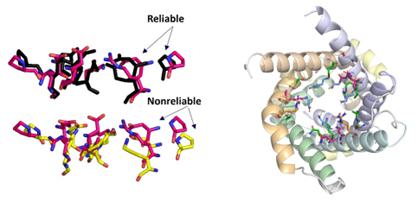
Left panel: Illustration of proper modelling of specific amino acid sequences of a mitochondrial carrier as generated following utilizing the MITOLINE™ algorithm (top left) as compared to alternative modelling generated by an AI based tool (bottom left). Pink amino acids - taken from a crystallized structure used as a template to lead 3D comparative modeling; yellow amino acids - 3D comparative model generated by an AI-based tool; black amino acids - 3D comparative model predicted by using the pairwise alignment built by MITOLINETM. Right panel: A complete 3D protein model of a mitochondrial carrier generated based on the specific sequence/structure pairwise alignment obtained by MITOLINE™.
| 2. | Advanced Computational Platform - MitoCareX has built an advanced cloud-based computational chemistry platform with specific architecture that allows it to: |
| A. | Utilize MITOLINE ™ as a first step towards generating reliable 3D models for its protein of interests belonging to the SLC25A family. | |
| B. | Utilize massive compute power (CPUs/GPUs) for performing virtual screening experiments (e.g., docking experiments) and related calculations using millions of small molecules. The aim of such experiments, for example, is to recognize hit molecules that virtually interact with a protein of interest. | |
| C. | Utilize algorithms and dedicated softwares for analyzing data. | |
| D. | Implement Machine Learning (ML) based models for further improving its virtual screening results. | |
| E. | Re-dock known inhibitors in template structures used for building 3D comparative models. |
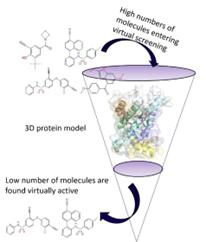
Illustration of MitoCareX’s virtual screening workflow process by utilizing its computational platform. The 3D model of its protein of interest was generated following the specific sequence/structure pairwise alignments based on the proprietary algorithm MITOLINE™. The drawn molecules are only for illustration purposes
| 3. | Novel In-Vitro Screening Platforms - To biologically validate its results, MitoCareX has developed or optimized a few advanced in vitro screening platforms: 1. A novel cell based assay that detects the changes in the intracellular status of a main signaling protein, downstream to MitoCareX’s protein of interest. Utilizing this assay, it is possible to differentiate between active vs. inactive molecules. 2. Real time mitochondrial assay that is monitoring the activity of physiologically active mitochondria in the presence of drug candidates. These two complementary in-vitro systems allow MitoCareX to rapidly detect and validate potential true ‘hit’ molecule candidates while excluding false positive results. Out of the top eighty (80) molecules that were virtually predicted by MitoCareX to bind its protein of interest and further screened in vitro - a few molecules were validated to be biologically active. 3. Cell free assay using proteoliposomes combined with in-house developed Biolayer Interferometry (BLI) method. Using this method allows MitoCareX to measure important binding parameters which are crucial for the prioritization of its screened small molecules during the validation and development stages. 4. Acceptable toxicity and Drug Metabolism and Pharmacokinetics (DMPK) methodologies. |
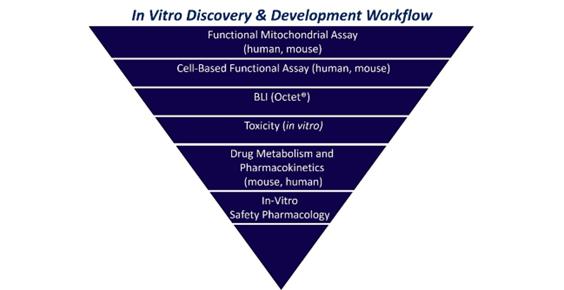
MitoCareX’s in-vitro workflow for validating and advancing compounds
| 4. | Advanced 3D NSCLC tumor spheroid systems – To test the efficacy of MitoCareX’s developed compounds, MitoCareX has been generating 3D spheroid systems for diverse types of NSCLC cells lines with different genetic backgrounds. Utilizing 3D spheroid systems better mimic the 3D tumor structure and microenvironment. Furthermore, working with 3D samples is highly important in cancer metabolism since it was shown in numerous amounts of studies that the 2D culture system doesn’t represent the metabolic activity and gene expression patterns as compared to tumor cells (PMID 28615311). |
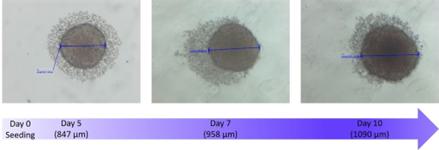
An example of a 3D spheroid system generated by MitoCareX using 4X magnification. The spheroids are derived from the NSCLC cancer cell line H358
MitoCareX’s product is an anti-cancer small molecule therapeutics (ACSMT) that inhibits a mitochondrial SLC25A protein that was found to be significantly involved in diverse types of cancers including NSCLC. The company aims to develop a New Chemical Entity (NCE), based on its hit compound 1 that was identified as an active compound by the company in a non-biased computational manner and confirmed to have anti-cancerous activity, in-vitro. MitoCareX expects that its final lead product will be clinically tested initially for previously treated advanced NSCLC patients, which is the most meaningful underserved segment in this type of cancer. Its efforts are focused on demonstrating in-vitro efficacy in a few areas:
| ● | Overcoming drug resistance of EGFR inhibitors by sensitizing lung adenocarcinoma cells to EGFR therapies. | |
| ● | Overcoming drug resistance of chemotherapy by sensitizing lung adenocarcinoma cells to platinum-based chemotherapies. |
In addition to hit compound 1 based derivatives that MitoCareX is developing and progressing, the company is routinely performing new virtual & in- vitro screenings to recognize additional chemical scaffolds as potential anti-cancer therapeutics, targeting the same protein of interest. Finding alternative active chemical scaffolds may serve as a backup series to the hit compound 1-based series.
Strategy
Internal Pipeline Development -
MitoCareX mission is to develop efficacious metabolic-based therapies targeted at mitochondrial transport proteins belonging to the SLC25A family. To accomplish this mission, MitoCareX leverages its unique expertise in computational chemistry, structural biology, and precision oncology for developing and progressing its most promising drug candidates for treating resistant cancers with a current focus on NSCLC. As a first stage, MitoCareX harnessed MITOLINE™ to generate reliable 3D model structures for its protein of interest. Next, utilizing its cloud-based, computational chemistry platform, MitoCareX performed virtual screening campaigns initially with ~3.3 million molecules trying to identify potential binders to its protein of interest. Indeed, MitoCareX has identified a few virtual binders out of which a few were shown to have biological activity, in-vitro. Next, MitoCareX prioritized hit compound 1 for further development. Hit compound 1 demonstrates reasonable drug like properties while its chemical scaffold provides an opportunity for high oral bioavailability and reduced in vivo clearance rates. In parallel, MitoCareX performs in-vitro efficacy evaluations of hit compound 1 and hit compound 1 based derivatives as potential standalone treatments or as combinational therapy for NSCLC patients with defined genetic backgrounds. The combinations are done with either Tyrosine Kinase Inhibitors (TKIs) or platinum-based medicines. If found to be successful, this approach is novel since currently there are no FDA approved drugs targeting MitoCareX’s protein of interest, to MitoCareX knowledge. Currently, MitoCareX is progressing a hit-to-lead medicinal chemistry campaign aimed at optimizing the structure of hit compound 1.
While partnerships will drive early revenue, selected assets may be co-developed or out-licensed at later stages, enhancing monetization flexibility. Such components may include:
| ● | Upfront payments | |
| ● | Development and/or Regulatory Milestones | |
| ● | Sales Milestones | |
| ● | Royalties following FDA approval |
Commercialization of MITOLINE ™ -
While MITOLINE™ is routinely used by MitoCareX for its drug discovery purposes, the commercialization of MITOLINE™ is structured to generate near- and long-term revenue streams while expanding MitoCareX Bio’s reach through strategic partnerships with pharmaceutical and biotechnology companies. The Company may adopt a hybrid licensing model that leverages upfront fees, performance-based milestone payments, and downstream royalties from partner-developed therapeutics. A few models may include:
1. Licensing and Strategic Partnerships
MitoCareX Bio may license access to MITOLINE™ on a target-class or indication-specific basis, enabling pharmaceutical partners to identify new drug candidates efficiently. A few possibilities may include:
| ● | Upfront Licensing Payments: strategic partners will pay an upfront licensing fee per collaboration, depending on the therapeutic area, exclusivity, and target scope. | |
| ● | Platform Access Tiering: Tiered access will allow smaller biotech partners to use MITOLINE™ under a lower upfront fee model with increased backend royalties, supporting wider adoption and early validation of the platform across a range of indications. |
2. Milestone-Linked Revenues Partners will pay development, regulatory, and commercial milestones aligned with the progress of candidate programs derived from MITOLINE™ inputs:
| ● | Preclinical Milestones for validated hit nomination and lead series optimization. | |
| ● | Clinical Development Milestones - Phase I through Phase III | |
| ● | Regulatory Milestones for successful NDA/BLA filings and FDA approval. | |
| ● | Commercial Launch Milestones upon first commercial sale in key markets (U.S., EU, Japan). |
3. Royalty fee on Approved Therapeutics
MitoCareX Bio may receive royalties on net sales of FDA-approved therapeutics discovered using MITOLINE™. This royalty structure should be aligned with industry benchmarks for computational discovery platforms and reflects MITOLINE™’s novelty.
| ● | Higher royalty tiers may apply where MitoCareX contributes significant preclinical validation or compound optimization beyond algorithmic target nomination. | |
| ● | MitoCareX Bio may also retain co-development rights or profit-sharing options in selected programs, particularly in oncology indications aligned with the Company’s internal pipeline priorities. |
History and Team of MitoCareX
MitoCareX Bio is a drug discovery company dedicated to the development of therapeutics targeting mitochondrial carrier proteins (SLC25A family) in cancer. MitoCareX Bio was founded in February 2022 based on successful proof-of-concept experiments that were performed in the UK prior to the establishment of the company. MitoCareX’ s investors, SciSparc Ltd., a specialty clinical-stage pharmaceutical company focusing on the development of therapies to treat disorders and rare diseases traded on NASDAQ, has conducted due diligence on MitoCareX and decided to invest $1.7M in the company, with several investment milestones that have already been met.
In February 2022 – the company was founded and received 700,00$ for equity to begin its activities.
In February 2023 – the company met its first milestone – the establishment of its advanced cloud-based computational platform. For this, the company received 400,000$ for equity.
In May 2023 – the company announced the development of its proprietary algorithm MITOLINETM for the generation of sequence/structure pairwise alignments and reliable 3D mitochondrial carrier protein models and included that as part of its computational platform.
In November 2023 – the company met its second milestone – development of diverse in vitro screening platforms, related to mitochondria, for the discovery, validations and progression of anti-cancer inhibitors, targeting its protein of interest. For this, the company received an additional 600,000$ for equity. In addition, the company has successfully performed in silico screening (i.e., virtual screening) and identified hit compound 1 as a hit molecule (i.e., virtual binding with reasonable affinity to its protein of interest), out of millions of small molecules. Hit compound 1 was further validated as a positive hit molecule using the company’s diverse in-vitro screening platforms. Furthermore, using several cancer cell lines with diverse genetic backgrounds, the company demonstrated that hit compound 1 is an anti-cancer molecule. In February 2024, MitoCareX filled out two provisional patent applications in the USA which are based on its hit molecule hit compound 1. In February 2025, MitoCareX withdrew its provisional patent applications because its latest scientific results did not support prosecuting the provisional patent applications.
MitoCareX’s computational 3D modelling capability combined with its virtual screenings and diverse in vitro screening capabilities are found at the core of the company’s technology. To meet its challenges, MitoCareX Bio has assembled a professional team uniting experienced scientists with a proven track record including:
Dr. Alon Silberman – Co-Founder, Chief Scientific Officer and a Board member - Dr. Silberman is a biological chemist with a strong interdisciplinary background in both chemistry and biology. Following his PhD in medicinal and biological chemistry he pursued a full postdoctoral fellowship at the Weizmann Institute of Science focusing on Cancer Metabolism and Drug Discovery. After spending a few successful years as a Senior Scientist in the biotech industry, he led the fundraising for the establishment of MitoCareX Bio. At MitoCareX Bio he leads, guides and manages all the scientific programs as well as correspondence with potential investors.
Prof. Ciro Leonardo Pierri (University of Bari, Italy) – Co-Founder and advisor - Prof. Pierri is a world expert in the field of Mitochondrial Carrier proteins. He is an expert biochemist who combines mitochondrial related approaches with computational chemistry methodologies. Prof. Pierri routinely advises the company on different aspects including cell free assay systems and biochemistry related to mitochondrial carriers.
Dr. Adi-Zuloff-Shani – a Board member. Dr. Zuloff-Shani is a highly accomplished biotech leader, bridging deep scientific knowledge in immunology with executive experience. Dr. Zuloff-Shani has over 20 years of experience in advancing therapeutics within highly regulated environments. She has been the CTO at SciSparc Ltd. (NASDAQ: SPRC) since Feb 2016, where she advanced products across varied CNS indications. In addition, she has been the CEO of Clearmind Medicine Inc. (NASDAQ: CMND) since July 2021, spearheading the development of novel psychedelic-derived therapeutics targeting various addictions, weight loss and metabolic disorders.
Mitochondrial Carriers (SLC25A protein family) – a unique class of drug targets in cancer
Mitochondria are key metabolic hubs regulating many processes in health and disease. Despite the role of mitochondria in cancer initiation and progression is widely studied, much remains to be elucidated. The Mitochondrial Carrier family (SLC25A protein family) is the largest group of solute carriers (i.e., transporters; PMID 32455902) translocating a variety of metabolites, nucleotides, and cofactors across the highly selective inner mitochondrial membrane. Transporters of this family are extensively shown to be significantly involved in different types of malignancies such as cervical (PMID 22227854), prostate (PMID 23047795), hepatocellular carcinoma (PMID 19140237), breast (PMID 23642734), colon (PMID 27451147), pancreas (PMID 24440978), as well as including a direct cross talk with the tumor microenvironment. Mitochondrial carriers are considered unique drug targets due to the following reasons:
| ● | Several SLC25A transporters show selective cancer expression patterns which make them suitable for targeted therapy | |
| ● | Many SLC25A transporters are non-redundant which may reduce the risk of compensation from other family members | |
| ● | Some small molecule inhibitors have shown preclinical efficacy |
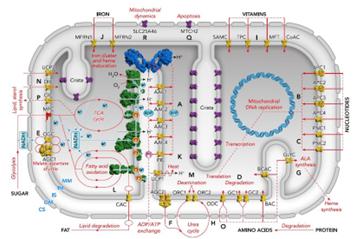
Schematic representation of the mammalian mitochondrion. Mitochondrial Carrier proteins are depicted in yellow. The figure is taken from PMID 32783608.
EGFR mutations in NSCLC patients
The epidermal growth factor receptor (EGFR) is a critical molecular driver in a significant subset of NSCLC cases, particularly in adenocarcinoma histology. EGFR mutations are identified in roughly 20% of newly diagnosed NSCLC cases in the U.S. and Europe, making EGFR inhibitors the preferred first-line treatment for these patients. Mutations in the EGFR gene lead to constitutive activation of the receptor, resulting in persistent downstream signaling that promotes tumor cell proliferation, survival, and metastasis. These mutations are especially prevalent among never-smokers, women, and patients of East Asian descent, with frequencies ranging from approximately 10–15% in Western populations to up to 50% in Asian cohorts (PMID 36162323).
The identification of activating EGFR mutations has revolutionized the treatment landscape of NSCLC, enabling the use of targeted therapies that significantly outperform traditional chemotherapy in terms of response rate and progression-free survival. First-generation tyrosine kinase inhibitors (TKIs) such as gefitinib and erlotinib, and more recently, third-generation TKIs like Osimertinib, have demonstrated substantial clinical benefit for patients harboring common EGFR mutations, including exon 19 deletions and the L858R point mutation in exon 21 (PMID 37937763). Osimertinib has shown superiority in the first line setting due to its efficacy against both sensitizing and resistance mutations (e.g., T790M), as well as its ability to penetrate the central nervous system.
Despite initial success, resistance to EGFR inhibitors eventually develops in nearly all patients, presenting a major challenge in long-term disease control. This has prompted extensive research into mechanisms of resistance and the development of combination strategies and next-generation inhibitors. Nevertheless, EGFR remains a cornerstone in the molecular profiling of NSCLC and is essential for guiding personalized treatment strategies, underscoring its pivotal role in the era of precision oncology (PMID 37937763).
Synthetic Lethality – a means for precision oncology
Synthetic lethality is a concept where the combination of mutations/inhibitions in two genes leads to cell death, while a mutation/inhibition in just one of them does not (see illustrative figure below). In cancer therapy, this concept is utilized to target tumor cells harboring specific genetic mutations by inhibiting a second gene or pathway that becomes essential for the survival of these mutated cells (PMID 33795234). This approach allows for selective targeting of cancer cells, minimizing damage to normal tissues.
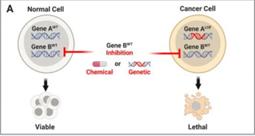
Cellular synthetic lethality is caused by combined alterations of gene pairs that are otherwise individually viable. The figure is taken from PMID 33795234
The most well-known application of synthetic lethality in cancer therapy involves the use of poly (ADP-ribose) polymerase (PARP) inhibitors in tumors with BRCA1 or BRCA2 mutations (PMID 25341009). These mutations impair the homologous recombination repair pathway, making cancer cells more reliant on PARP-mediated DNA repair. Inhibiting PARP in these cells leads to the accumulation of DNA damage and cell death. This strategy has been successfully implemented in the treatment of certain breast and ovarian cancers.
While synthetic lethality offers a targeted approach to cancer therapy, several challenges remain (PMID 33795234):
| ● | Resistance Mechanisms: Cancer cells may develop resistance to therapies exploiting synthetic lethality, necessitating combination strategies or alternative targets. | |
| ● | Tumor Heterogeneity: The genetic diversity within tumors can affect the efficacy of synthetic lethal strategies. | |
| ● | Biomarker Identification: Reliable biomarkers are needed to identify patients who would benefit most from synthetic lethal therapies. |
Of importance, in the context of mitochondrial carrier proteins, a few studies have already demonstrated synthetic lethality relationships between a mitochondrial carrier and an oncogenic mutated protein. For example, SLC25A22 was shown to be a novel and potential therapeutic target in glutaminolysis addicted KRAS-mutant CRC (PMID 27451147).
Synthetic Lethality in non-small cell lung cancer – an unmet need for targeting metabolic dependencies
Lung cancer, particularly NSCLC, often has mutations in tumor suppressor genes (e.g., KRAS, TP53. STK11, KEAP1) that are hard to target directly. Synthetic lethality offers a way to target the partner gene of these mutations. Examples of key advances in synthetic lethality for NSCLC include:
| 1. | TMPRSS4 and DDR1 Co-Targeting - NSCLC cells deficient in TMPRSS4 exhibited heightened sensitivity to DDR1 inhibition using dasatinib. Combined knockdown of both genes led to significant cell cycle arrest and apoptosis, and enhanced sensitivity to cisplatin, indicating a promising therapeutic avenue (PMID 31659178). | |
| 2. | Overcoming EGFR Inhibitor Resistance - Resistance to EGFR inhibitors remains a significant challenge in NSCLC treatment. Synthetic lethality screens have uncovered several potential targets to overcome this resistance, including components of the NF-κB pathway, PRKCSH, CDK6, and members of the SWI/SNF chromatin remodeling complex. These findings suggest that targeting these pathways could restore sensitivity to EGFR inhibitors (PMID 28478283). See below for more detailed description regarding EGFR and synthetic lethality. | |
| 3. | Concurrent Synthetic Lethality in NRF2-Activated Tumors |
NSCLC tumors with hyperactivation of the NRF2 pathway are often resistant to conventional therapies. A novel approach termed “concurrent synthetic lethality” involves co-targeting these tumors with mitomycin C (MMC) and the HSP90 inhibitor 17-AAG. This combination exploits the NRF2-driven metabolic dependencies of the cancer cells, leading to enhanced cytotoxicity (PMID 36200139).
| 4. | BRG1/SMARCA4-Deficient Tumors |
Loss of the chromatin remodeling factor BRG1 (SMARCA4) is observed in a subset of NSCLC cases. These tumors exhibit synthetic lethality when SMARCA2, a homologous ATPase, is inhibited. Targeting SMARCA2 in BRG1-deficient tumors has shown promise in preclinical models, suggesting a potential therapeutic strategy for this NSCLC subtype (PMID 23872584)
Mutated EGFR in NSCLC – an opportunity for Synthetic Lethality based discoveries
Synthetic lethality in the context of EGFR mutations in NSCLC exploits vulnerabilities that arise from EGFR mutations, targeting a second gene or pathway that, when inhibited, leads to the selective death of EGFR-mutant cancer cells. Since EGFR mutations are present in approximately 18-20% of newly diagnosed adenocarcinoma NSCLC cases in the United States and Europe, and in these patients EGFR inhibitors are the first-line choice,finding synthetic lethal protein partners is a promising avenue for getting over EGFR related resistance.
Examples of synthetic lethality in EGFR-Mutant NSCLC:
| 1. | EGFR and DNA Repair Pathways: EGFR mutations can make cancer cells more reliant on specific DNA repair mechanisms, and targeting these repair pathways can lead to synthetic lethality in EGFR-mutant cells. For example, PARP inhibitors like olaparib exploit deficiencies in DNA repair caused by EGFR mutations, leading to cancer cell death (PMID 3458994). | |
| 2. | EGFR and PI3K/AKT/mTOR Pathway: The EGFR signaling pathway activates PI3K/AKT/mTOR, promoting cell survival and proliferation. Inhibition of this pathway, particularly in combination with EGFR-targeted therapies, can lead to synthetic lethality. For example, mTOR inhibitors such as rapamycin can enhance the cytotoxic effects in EGFR-mutant tumors when used in combination with EGFR TKIs like gefitinib (PMID 32953503). | |
| 3. | EGFR and Metabolic Pathways: EGFR mutations can increase cancer cells’ reliance on certain metabolic pathways, including glutamine metabolism. Targeting these metabolic dependencies using glutaminase inhibitors such as CB-839 can lead to synthetic lethality in EGFR-mutant cells (PMID 33229301). | |
| 4. | Combination of EGFR Inhibition with Other Targeted Therapies: EGFR-mutant cancers may rely on WEE1 kinase for DNA damage repair after EGFR inhibition. Combining WEE1 inhibitors with EGFR TKIs like erlotinib or gefitinib can induce synthetic lethality and enhance cancer cell death (PMID 31387179). | |
| 5. | Synthetic Lethality with Immunotherapy: EGFR mutations may alter tumor immunogenicity, and combining EGFR-targeted therapies with immune checkpoint inhibitors (such as PD-1/PD-L1 inhibitors) could induce synthetic lethality by amplifying immune responses specifically in EGFR-mutant cells (PMID 31563735). |
MitoCareX approach to developing treatment for NSCLC Patients
MitoCareX consider itself to be a unique company that addresses a major problem and market gap. Resistance to platinum-based therapy together with acquired or innate resistance to EGRF TKIs is a major obstacle in NSCLC since it eventually develops in nearly all patients, presenting a major challenge in long-term disease control.
As noted earlier in the text, higher expression of the MitoCareX target gene is associated with worse overall survival in lung Adenocarcinoma and in lung Adenocarcinoma with mutated EGFR. Therefore, MitoCareX aims to demonstrate that inhibition of its protein of interest with its drug candidate could overcome drug resistance of chemotherapy and/or EGFR therapies, respectively, by sensitizing lung adenocarcinoma cells to therapies. As mentioned, current efforts are focused on demonstrating efficacy in 2 sub-segments:
| ● | Overcoming drug resistance of EGFR inhibitors by sensitizing lung adenocarcinoma cells to EGFR therapies. | |
| ● | Overcoming drug resistance of chemotherapy by sensitizing lung adenocarcinoma cells to platinum-based chemotherapies. |
MitoCareX is developing its hit compound 1 based derivatives to be administered as single agents and/or in combination with other therapies. The rationale for a combination approach is based on the observation described above that EGFR mutations in NSCLC exploits vulnerabilities that may be synthetically lethal with MitoCareX target protein and as such may be a rewarding avenue to follow. However, despite being directly linked with a variety of malignancies including NSCLC, there are still no FDA approved drugs that specifically target MitoCareX target protein. While MitoCareX takes a novel approach, some of MitoCareX’s drug discovery and development activities are rooted in traditional small molecule drug discovery methodologies.
Bioinformatic analysis
MitoCareX analyzed the Tumor Cancer Genome Atlas (TCGA) cohort of biopsies taken from NSCLC patients and found the following important findings among others:
| 1. | Upregulated expression of its protein of interest is higher as compared to the adjacent healthy tissues and its upregulated expression is associated with worse patients’ survival prognosis in lung adenocarcinoma. This pointed to the possibility of applying MitoCareX’s developed compounds as a stand-alone therapy for part of the NSCLC patients. | |
| 2. | Upregulated expression of its protein of interest on the background of EGFR mutations but not on the background of non-mutated tumor samples is associated with a worse survival prognosis in lung adenocarcinoma. This pointed to the possibility of applying MitoCareX’s developed compounds for a combination therapy in EGFR mutated NSCLC cases along with EGFR inhibitors. |
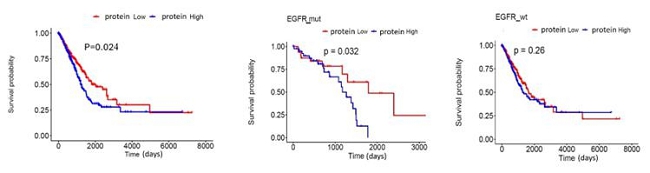
Left: Upregulated expression levels as compared to low expression levels of the protein of interest in lung adenocarcinoma tumor samples are associated with a worse patients’ prognosis. Upregulated expression levels of the protein of interest worsen prognosis for lung adenocarcinoma patients with mutated (middle) but not with wild type EGFR (right). “protein High” means above the averaged expression levels and “protein Low” means below the averaged expression levels. P- value <0.05 means significance.
Target Identification and Validation
Three-dimensional (3D) cell culture systems are increasingly favored over traditional two-dimensional (2D) cultures, especially in the study of cellular metabolism. In 2D cultures, cells grow on flat, rigid surfaces, leading to artificial cell polarity, distorted nutrient gradients, and atypical mechanical stresses, all of which can alter metabolic behavior (PMID 24797513). These conditions often result in metabolic profiles that do not accurately reflect in vivo physiology, with changes observed in glucose uptake, mitochondrial activity, and oxidative phosphorylation.
In contrast, 3D cultures better replicate the in vivo microenvironment by preserving natural cell–cell and cell–extracellular matrix interactions, creating realistic oxygen and nutrient gradients, and maintaining mechanical cues (PMID 27663511). As a result, cells in 3D cultures display more physiologically relevant metabolic features, including enhanced mitochondrial dynamics, altered glycolytic flux, and appropriate responses to hypoxia (PMID 24797513).
This shift is particularly important in disease models like cancer, where metabolic reprogramming is a hallmark. Studies have shown that drug responses and metabolic pathways differ markedly between 2D and 3D models, underlining the importance of using 3D systems for accurate therapeutic and mechanistic studies.
To assess the importance of its protein of interest to the growth and viability of NSCLC cells, MitoCareX chose a few NSCLC cell lines with diverse genetic backgrounds and knocked down the expression of its protein of interest using small hairpin RNAs (shRNA). Next, MitoCareX generated for each such cell line 3D spheroid structures, using its in-house established protocols. Below are representative examples showing the significant differences between control NCI-H1299 NSCLC cells vs. the comparable knockdown NCI-H1299 cells.

NCI-H1299 derived representative spheroid pictures taken with 4X magnification. Spheroids produced from knockdown cells were significantly smaller as compared to control NCI-H1299 spheroids.
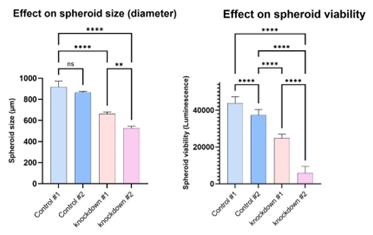
Left Panel: quantification of the averaged diameter of NCI-H1299 derived spheroids from control #1, control #2, knockdown #1, knockdown #2 cells. Right panel: quantification of the averaged viability of NCI-H1299 derived spheroids from control #1, control #2, knockdown #1, knockdown #2 cells. Spheroids produced from knockdown cells were significantly smaller and less viable as compared to control NCI-H1299 spheroids. ** means p-value <0.01; *** means p-value <0.0001
The NCI-H1299 cell line was originated from a lymph node metastasis of the lung of a 43-year-old Caucasian male patient with cancer. These cells possess homozygous partial deletion of the p53 gene so that the cells do not express the p53 protein. These results may point to a direct link between MitoCareX’s mitochondrial protein of interest and the lack of p53 protein in NSCLC cells.
Another representative example of the importance of the protein of interest to the growth of NSCLC cells is exemplified using the NCI-H1975 cell line. This cell line is a human non-small cell lung cancer cell line derived from a patient with lung adenocarcinoma who previously received chemotherapy. NCI-H1975 cells are notable for harboring two critical mutations in the EGFR gene: L858R (a point mutation in exon 21) and T790M (a secondary “gatekeeper” mutation in exon 20) (PMID 2785594).
These mutations make NCI-H1975 cells particularly valuable for studying resistance to EGFR TKIs, such as erlotinib and gefitinib. The T790M mutation confers resistance to first and second generation TKIs, which has driven the development of newer inhibitors like Osimertinib (PMID 2785594).
First, like in the case of the NCI-H1299 cell line, MitoCareX knocked down the expression of its protein of interest using small hairpin RNAs (shRNA) in NCI-H1975 cells. Next, MitoCareX generated for each cell line 3D spheroid structures, using its in-house established protocol. Below are representative examples showing the significant differences between control NCI-H1975 NSCLC cells vs. the comparable knockdown NCI-H1975 cells.

NCI-H1975 derived representative spheroid pictures taken with 4X magnification. Spheroids produced from knockdown cells were significantly smaller as compared to control NCI-H1975 spheroids.
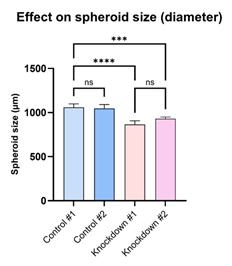
Quantification of the averaged diameter of NCI-H1975 derived spheroids from control #1, control #2, knockdown #1, knockdown #2 cells. *** means p-value <0.001; **** means p-value <0.0001
Virtual screening (In-Silico) campaigns and the discovery of hit compound 1
To discover molecules that virtually bind their protein of interest, MitoCareX utilized its cloud-based, computational chemistry platform and have taken the following steps:
| ● | Utilized MITOLINE™ for performing multiple sequence alignments resulting in reliable 3D molecular models of its protein of interest | |
| ● | Performed Virtual Screening campaign (e.g., docking experiments) with initially 3.3 million molecules | |
| ● | Recognized top scored ~1560 molecules (0.05%) | |
| ● | Out of the top scored 1560 molecules, initially prioritized 80 molecules (0.0024%) for further in-vitro validations |
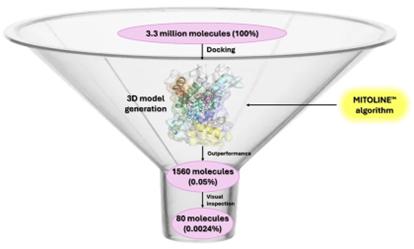
MitoCareX’s virtual screening workflow starting from millions of small molecules, ending with low amounts of prioritized molecules that are top ranked according to in-silico (virtual) predictions.
Using cell based and functional mitochondrial assays, MitoCareX has screened all the initial computationally prioritized eighty (80) molecules that were predicted to interact with its SLC25A target protein. Out of the 80 screened molecules, a few in-vitro active molecules were recognized, out of which hit compound 1 was chosen for a hit-to-lead medicinal chemistry campaigns. Below is a representative dose-response potency curve that was generated following measurement of hit compound 1 alongside a few inactive compounds using MitoCareX’s developed cell-based assay.

Hit compound 1 is a validated inhibitor of MitoCareX’s protein of interest. IC50 dose response curve using its cell-based assay in which hit compound 1 is found to be active as compared to negative compound 1, negative compound 2 that are found to be inactive.
Ongoing and near future planned activities- compound screenings, synthesis of analogs, SAR and efficacy studies
| 1. | Optimization of MITOLINE™ - using ensemble docking and/or molecular dynamics-based methods, generating multiple conformers of SLC25A proteins, including predicted and experimental binding parameters are among the different methods to optimize MITOLINE™. |
| 2. | In-Silico and in-vitro screenings of different chemical scaffolds - using MITOLINE™ combined with MitoCareX’s computational platform, the company performs virtual screening campaigns and further in-vitro validations of the most promising small molecule candidates. Recognizing additional biologically active compounds targeting MitoCareX’s target protein is important to establish alternative hit series for further drug development. | |
| 3. | Synthesis of derivatives related to hit compound 1 and performing Structure Activity Relationship (SAR) studies - based on the chemical structure of hit compound 1 that was identified by MitoCareX as a promising scaffold, the company has designed and synthesized a variety of analog compounds. The analogs are currently being evaluated according to the company’s in-vitro workflow for validating and advancing promising molecules. Specifically, each compound is being evaluated and characterized in a funnel wise manner (See MitoCareX in-vitro workflow as described above), thus prioritizing the most promising molecules. | |
| 4. | Relating to the bioinformatic and in-vitro results that were demonstrated above, MitoCareX is currently evaluating in-vitro the influence of hit compound 1 with or without either FDA approved tyrosine kinase inhibitors or platinum-based medicines. On this regard, the NCI-H1975 cell line is one of the most commonly used preclinical models to study the influences of Osimertinib. Osimertinib (Tagrisso®) is a third-generation, irreversible EGFR tyrosine kinase inhibitor developed specifically to target both the sensitizing EGFR mutations (such as L858R) and the resistance-associated T790M mutation found in non-small cell lung cancer (PMID 36482474). Osimertinib has revolutionized the treatment of EGFR-mutant NSCLC, particularly in tumors with T790M-mediated resistance to first- and second-generation EGFR inhibitors (PMID 25971621). However, despite initial success, acquired resistance to Osimertinib is inevitable, typically within 10–19 months of treatment (PMID 36482474). Developing drugs that re-sensitize tumors would allow continued use of Osimertinib without needing to completely switch therapies, which often involve more toxic or less effective options. Furthermore, new agents could be used in combination with Osimertinib early (preventatively) or upon signs of emerging resistance (reactively), helping to prevent clonal evolution and resistance diversification, which are major challenges in long-term cancer control (PMID 36681369). Achieving synergistic efficacy while combining Osimertinib with MitoCareX’s developed compounds can be of great interest to MitoCareX from a development and commercial point of view. Following the evaluations described above, MitoCareX aims to test its developed compounds in a dedicated preclinical setting. |
Potential addressable patient populations for hit compound 1 based future lead compounds
MitoCareX’s in-vitro results support the company’s approach of evaluating & developing small molecule treatment targeting its protein of interest for NSCLC patients with EGFR mutated backgrounds (either as a standalone treatment or in combination with TKIs). In addition, given that the protein of interest is associated with worse overall survival in lung adenocarcinoma and that platinum-based chemotherapy remains a standard first-line treatment for advanced lung adenocarcinoma, particularly for patients without specific gene mutations, MitoCareX intends to evaluate & develop its small molecule treatment combined with platinum-based chemotherapy as a promising avenue for clinical applications.
Hit compound 1 based derivatives are planned to be investigated as potential therapy in 2 sub-segments of previously treated advanced NSCLC patients (i.e., second line):
| ● | In NSCLC Adenocarcinoma, EGFR overexpression correlates with aggressive disease and poor prognosis, making it an optimal target for cancer therapy. The prevalence of EGFR mutations ranges from 14% to 38%. (PMID 37240224). The efficacy of EGFR-tyrosine kinase inhibitors in EGFR-mutated patients has revolutionized lung cancer treatment, with responses observed in 60–80% of patients, (PMID 36835536) yet drug resistance is a major challenge. As a result, patients often experience disease progression and relapse after initial response to therapy (PMID 37350939). Almost all EGFR TKI responders acquire drug resistance within a few years, with median progression-free survival ranging from 9.2 to 18.9 months (PMID 37240224). It is hoped that the inhibition of MitoCareX’s target transporter gene with its drug candidate would overcome drug resistance of EGFR TKI by sensitizing lung adenocarcinoma cells to EGFR therapies. |
| ● | Chemotherapy is one of the most commonly used and primary treatment options for lung cancer (alone or in combination with immunotherapy). As most patients (77%) are diagnosed at later stages when surgery for curative intent is ineffective, platinum-based chemotherapy became one of the basic options to determine the survival and quality of life of patients. Long-term use of these anti-cancerous agents has been associated with significant side effects, including chemoresistance which is followed by tumor relapse. Nevertheless, the exact mechanisms underlying cisplatin resistance remain largely unclear, and may be related to tumor microenvironment, drug transporters, genetic and epigenetic factors (PMID 36778005). It is expected that the inhibition of MitoCareX’s target transporter gene with its drug candidate could overcome drug resistance of chemotherapy by sensitizing lung adenocarcinoma cells to platinum-based chemotherapies. |
Competition
Biotechnology and pharmaceutical industries are characterized by rapid evolution of technologies and understanding of disease etiology, intense development and commercial competition, and a strong emphasis on intellectual property. MitoCareX believes that its approach, development and commercial strategy, scientific capabilities, know-how, and experience, provide the company with competitive advantages. Nonetheless, MitoCareX expects substantial competition from multiple sources, including major biopharmaceutical, specialty pharmaceutical, and existing or emerging biotechnology companies, academic research institutions, governmental agencies, and public and private research institutions worldwide.
| Company | Link to Website | Name of potential Competitive Product | Description of the Product | |||
| Relay Therapeutics, INC | https://relaytx.com/ | Computational and experimental Dynamo™ platform | Relay Therapeutics’ proprietary computational drug discovery engine, designed to integrate dynamic protein motion with AI-driven drug design. Dynamo captures and models how proteins move and change shape over time | |||
| Daiichi Sankyo | https://www.daiichisankyo.com/ | Patritumab deruxtecan - HER3 Antibody-Drug Conjugates (ADC) developed with MSD granted priority review after phase 2 | Patritumab deruxtecan demonstrated an objective response rate (ORR) of 29.8% in patients following disease progression with an EGFR TKI and platinum-based chemotherapy in Phase 2. | |||
| Scorpion Therapeutics | https://www.scorpiontx.com/ | STX-241 - a highly selective, 4th generation EGFR inhibitor designed to address resistance to third generation EGFR inhibitors (IND enabling studies) | In Preclinical studies STX-241 demonstrated strong biochemical inhibition of EGFR double mutant kinase activity as well as strong C797S double mutant potency and selectivity vs. clinical-stage competitor benchmarks. |
A few examples of potential competitors to MitoCareX
Intellectual Property
MitoCareX strives to protect the intellectual property and proprietary technology that it considers important to its business through a variety of methods. MitoCareX seeks to obtain domestic and international patent protection and endeavors to promptly file patent applications for new commercially valuable inventions as they arise to expand its intellectual property portfolio. MitoCareX also relies on proprietary know-how and trade secrets to protect certain innovations that may be important to its business and to benefit from their confidential status.
Intellectual Property Relating to Our Drug Discovery activities
MitoCareX continually assesses and refines its intellectual property strategy as it discovers and validate new ‘hit’ small molecules and make structural improvements to its hit compound 1 based derivatives. To that end, MitoCareX aims to file additional patent applications as appropriate to support its intellectual property strategy, or where MitoCareX seeks to adapt to competition or seize business opportunities.
MITOLINE™ is currently trademarked in Israel. MitoCareX currently have an application for registration of “MITOLINE™” mark in the United States.
Scope and Duration of Intellectual Property Protection
The area of patent and other intellectual property rights in the biopharmaceutical industry is an evolving one with many risks and uncertainties, and third parties may have blocking patents that could be used to prevent us from commercializing our product candidates and practicing our proprietary technology. Our patents that may issue in the future may be challenged, narrowed, circumvented, or invalidated, which could limit our ability to stop competitors from marketing related product candidates. In addition, our competitors may independently develop similar technologies, and the rights granted under any issued patents may not provide us with protection or competitive advantages against competitors with similar technology. For these and other reasons, we may have competition for our product candidates. Moreover, because of the extensive time required for development, testing, and regulatory review of a potential product, it is possible that before any product candidate can be commercialized, any related patent may expire or remain in force for only a short period following commercialization, thereby reducing any protection afforded by the patent. For this and other risks related to our proprietary technology, inventions, improvements, and product candidates,
We also rely on trade secret protection for our confidential and proprietary information. Although we take steps to protect our confidential and proprietary information as trade secrets, including through contractual means with our employees, consultants, outside scientific collaborators, sponsored researchers, and other advisors, third parties may independently develop substantially equivalent proprietary information and techniques or otherwise gain access to our trade secrets or disclose our technology. Thus, we may not be able to meaningfully protect our technology as trade secrets. It is our policy to require our employees, consultants, outside scientific collaborators, sponsored researchers, and other advisors to execute confidentiality agreements under the commencement of employment or consulting relationships with us. These agreements provide that all confidential information concerning our business or financial affairs developed or made known to the individual during the individual’s relationship with us is to be kept confidential and not disclosed to third parties except in specific circumstances. In the case of employees, the agreements provide that all inventions conceived by the individual, and which are related to our current or planned business or research and development or made during normal working hours, on our premises or using our equipment or proprietary information, are our exclusive property. In many cases our agreements with consultants, outside scientific collaborators, sponsored researchers, and other advisors require them to assign or grant us licenses to inventions they invent as a result of the work or services they render under such agreements or grant us an option to negotiate a license to use such inventions. Despite these efforts, we cannot provide any assurances that all such agreements have been duly executed, and any of these parties may breach the agreements and disclose our proprietary information, and we may not be able to obtain adequate remedies for such breaches.
We also seek to preserve the integrity and confidentiality of our proprietary technology and processes by maintaining physical security of our premises and physical and electronic security of our information technology systems. Although we have confidence in these individuals, organizations, and systems, agreements or security measures may be breached, and we may not have adequate remedies for any breach. To the extent that our employees, contractors, consultants, collaborators, and advisors use intellectual property owned by others in their work for us, disputes may arise as to the rights in relation to the resulting know-how or inventions.
Manufacturing
We do not own or operate, and currently have no plans to establish, any manufacturing facilities.
Commercialization
MitoCareX intends to retain significant development and commercial rights to our future lead compound/s and, if marketing approval is obtained, to commercialize it on its own, or potentially with a partner, in the United States and other regions. MitoCareX currently have no sales, marketing, or commercial product distribution capabilities. MitoCareX intends to build the necessary infrastructure and capabilities over time for the United States, and potentially other regions, following further advancement of its small molecule compounds. Future clinical data, the size of the addressable patient population, the size of the commercial infrastructure, and manufacturing needs may all influence or alter MitoCareX’s commercialization plans.
Exhibit 99.5
RISK FACTORS
Risks Related to the Company’s Business
For risks related to the Company’s business, please refer to the section titled “Item 1A. Risk Factors” set forth in the Company’s Annual Report on Form 10-K for the year ended December 31, 2024, as filed with the SEC on March 31, 2025 (the “2024 Annual Report”), incorporated by reference herein.
Risks Related to the Acquisition
The market price of our shares of Common Stock following the Acquisition may decline as a result of the Acquisition.
The market price of our shares of Common Stock has been and may continue to decline as a result of the Acquisition for a number of reasons. In connection with the Acquisition, the Company issued shares representing approximately 40% of our shares on a fully diluted basis at the closing of the Acquisition, and, pursuant to the terms of the Purchase Agreement we might have to issue additional shares to the Sellers of up to 25% of a fully diluted basis if certain milestones are achieved. The Sellers are also entitled to receive 30% of the gross proceeds of each financing transaction closed by the Company within five years after Closing Date, up to a maximum amount of $1,600,000. Moreover, Dr. Silberman entered into an amended employment agreement with MitoCareX in connection with his continued employment as the Chief Executive Officer of MitoCareX, upon which the Company granted to Dr. Silberman restricted stock units representing 5% of the capital stock of the Company on a fully diluted basis pursuant to the Company’s 2022 Share Incentive Plan. The Company has also agreed that under certain conditions to make available to MitoCareX such amount of funding necessary to finance MitoCareX’s ongoing research and development and other costs. All these provisions could result in negative pressure on our stock price in the market, especially if the prospects of MitoCareX are not consistent with the expectations of financial or industry analysts.
The integration of MitoCareX after the Acquisition may result in significant accounting charges that adversely affect the announced results of our company.
The financial results of our Company may be adversely affected by cash expenses and non-cash accounting charges incurred in connection with the Acquisition. In addition to the anticipated cash charges, significant non-cash restructuring charges and costs associated with the amortization of intangible assets are expected. See “Unaudited Pro Forma Condensed Combined Financial Statements” on page __ that reflect the effects of the Acquisition and, accordingly, the amount and timing of these possible charges. The price of our Common Stock could decline to the extent our financial results are materially affected by the foregoing charges or if the foregoing charges are larger than anticipated
The Acquisition may result in unexpected consequences to our business and results of operations.
We may not have discovered all risks applicable to MitoCareX’s business during the due diligence process and such risks may not be discovered prior to closing. Some of these risks could produce unexpected and unwanted consequences for us. Undiscovered risks may result in us incurring financial liabilities, which could be material and have a negative impact on our business operations.
MitoCareX may need to expand its organization and may experience difficulties in recruiting needed additional employees and consultants, which could disrupt its operations.
As a result of the Acquisition, MitoCareX may not have the resources to focus on the discovery and development of potential drugs for cancers and other life-threatening conditions, its development and commercialization plans as well as strategic development. We may need additional managerial, operational, sales, marketing, financial, legal and other resources. The competition for qualified personnel in the pharmaceutical field is intense. Due to this intense competition, the Company may be unable to attract and retain qualified personnel necessary for the development of its business or to recruit suitable replacement personnel.
The Company’s management may need to divert a disproportionate amount of its attention away from its day-to-day activities and devote a substantial amount of time to managing these growth activities. The Company may not be able to effectively manage the expansion of its operations, which may result in weaknesses in its infrastructure, operational mistakes, loss of business opportunities, loss of employees and reduced productivity among remaining employees. MitoCareX’s expected growth could require significant capital expenditures and may divert financial resources from other projects, such as the development of additional pharmaceutical product candidates. If its management is unable to effectively manage its growth, its expenses may increase more than expected, its ability to generate and/or grow revenue could be reduced and MitoCareX may not be able to implement its business strategy. Its future financial performance and its ability to commercialize pharmaceutical product candidates and compete effectively will depend, in part, on its ability to effectively manage any future growth.
Securities litigation or shareholder derivative litigation frequently follows the announcement of certain significant business transactions, such as the sale of a business division or announcement of an acquisition or a business combination transaction.
We may become involved in this type of litigation in connection with the Acquisition. Stockholders who oppose the Acquisition do not have dissenters’ rights and therefore may consider commencing litigation against us. Litigation often is expensive and diverts management’s attention and resources, which could adversely affect our business.
Risks Related to Business Operations of MitoCareX
MitoCareX has no operating history.
MitoCareX is a drug discovery and development company with a current focus on oncology with a limited operating history upon which you can evaluate its business and prospects. MitoCareX commenced operations in 2022, has no products approved for commercial sale, and has not generated any revenue from the sale of its products. To date, MitoCareX has focused primarily on organizing and staffing its company, business planning, raising capital, building its proprietary computational platform, discovering potential Anti-Cancer Small Molecule Therapeutics (ACSMT), establishing its intellectual property portfolio, conducting research, establishing arrangements with third parties for the manufacture of ACSMT and supply of related raw materials, and providing general and administrative support for these operations. Its scientific approach to the discovery and development of ACSMT is unproven and MitoCareX does not know whether MitoCareX will be able to develop or obtain regulatory approval for any products of commercial value. MitoCareX has only one type of chemical scaffold of ACSMT in early development. MitoCareX has not yet completed any preclinical and clinical trials, successfully developed and validated a diagnostic test, obtained regulatory approvals, manufactured products on a commercial scale, or arranged for a third party to do so on its behalf, or conducted sales or marketing activities necessary for successful product commercialization. Consequently, any predictions made about its future success or viability may not be as accurate as they could be if MitoCareX had a history of successfully developing and commercializing biopharmaceutical products.
MitoCareX has incurred significant operating losses since its inception and expects to incur significant losses for the foreseeable future. MitoCareX does not have any products approved for sale and has not generated any revenue since its inception. If MitoCareX is unable to successfully develop and obtain the requisite approval for and commercialize ACSMT, MitoCareX may never generate revenue. MitoCareX incurred net losses of $637,000 and $886,000 for the six months ended June 30, 2025 and for the year ended December 31, 2024, respectively. As of June 30, 2025, MitoCareX had an accumulated deficit of $2,341,000. Substantially all of its losses have resulted from expenses incurrsed in connection with its research and development programs and from general and administrative costs associated with its operations. ACSMT will require substantial additional development time and resources before MitoCareX would be able to apply for or receive regulatory approvals and begin generating revenue from product sales. MitoCareX expects to continue to incur losses for the foreseeable future, and MitoCareX anticipates these losses will increase substantially as MitoCareX continues its development of, seeks regulatory approval for, and potentially commercializes ACSMT and seeks to discover and develop additional solutions as well as operate as a public company.
To become and remain profitable, MitoCareX must succeed in discovering, developing, obtaining regulatory approvals for, and eventually commercializing products that generate significant revenue. This will require MitoCareX to be successful in a range of challenging activities, including preclinical studies and completing clinical trials of ACSMT, discovering additional ACSMTs, obtaining regulatory approval for these and manufacturing, marketing, and selling any products for which MitoCareX may need to obtain regulatory approval. MitoCareX is in the preliminary stages of these activities. MitoCareX may never succeed in these activities and, even if MitoCareX does, it may never generate revenue that is significant enough to achieve profitability. In addition, MitoCareX has not yet demonstrated an ability to successfully overcome many of the risks and uncertainties frequently encountered by companies in new and rapidly evolving fields, particularly in the biopharmaceutical industry. Because of the numerous risks and uncertainties associated with biopharmaceutical product development, MitoCareX is unable to accurately predict the timing or amount of increased expenses or when, or if, MitoCareX will be able to achieve profitability. Even if MitoCareX does achieve profitability, MitoCareX may not be able to sustain or increase profitability on a quarterly or annual basis. Its failure to become and remain profitable may have an adverse effect on its value and could impair its ability to raise capital, expand its business, maintain its research and development efforts, diversify its ACSMTpipeline, achieve its strategic objectives, or even continue its operations. A decline in the value of MitoCareX could also cause you to lose all or part of your investment.
MitoCareX will require substantial additional capital to finance its operations, and a failure to obtain this necessary capital when needed on acceptable terms, or at all, could force it to delay, limit, reduce, or terminate ACSMT development programs, MITOLINE™ related validations and optimizations, commercialization efforts or other operations.
The development of ACSMT, including conducting preclinical studies and clinical trials, is a very time-consuming, capital-intensive, and uncertain process. Since its acquisition in October 2025, MitoCareX’s operations have continued to consume substantial amounts of cash. The Company expects that MitoCareX’s expenses to substantially increase in connection with MitoCareX ongoing activities, particularly when MitoCareX will conduct its ongoing and planned preclinical studies and clinical trials and potentially seeks regulatory approval for its ACSMT and any future ACSMT MitoCareX may develop. If MitoCareX obtains regulatory approval for ACSMT, the Company expects that MitoCareX’s to incur significant commercialization expenses related to product manufacturing, marketing, sales, and distribution. Because the outcome of any preclinical study or clinical trial is highly uncertain, MitoCareX cannot reasonably estimate the actual amount of capital necessary to successfully complete the development and commercialization of ACSMT.
The Company will need to obtain substantial additional funding to support MitoCareX’s continuing operations. The ability to raise additional funds may be adversely impacted by global economic conditions, disruptions to, and volatility in, the credit and financial markets in the United States, inflation, diminished liquidity and credit availability, declines in consumer confidence, declines in economic growth, increases in unemployment rates, and uncertainty about economic stability. If the equity and credit markets deteriorate, it may make any necessary debt or equity financing by the Company more difficult, more costly, and more dilutive. If additional capital cannot be raised when needed or on attractive terms, the Company could be forced to delay, reduce, or eliminate MitoCareX’s research and development programs or any future commercialization efforts, or even cease operations.
The Company may also seek to finance MitoCareX’s operations through public or private equity or debt financings or other capital sources of MitoCareX, including potential collaborations, licenses, and other similar arrangements involving MitoCareX. Such transactions could include the issuance of new equity interests in MitoCareX to third parties, which may dilute the Company’s ownership and/or the value of its investment in MitoCareX.
Its future capital requirements will depend on many factors, including, but not limited to:
● the initiation, type, number, scope, progress, expansions, results, costs, and timing of preclinical studies and clinical trials of ACSMT that MitoCareX is pursuing or may choose to pursue in the future, including the costs of any third-party products used as combination agents in its clinical trials; the costs and timing of manufacturing for ACSMT , including commercial manufacturing at sufficient scale, if any ACSMT is approved;
● the costs, timing, and outcome of regulatory meetings and reviews of ACSMT;
● the costs of obtaining, maintaining, enforcing, and protecting its patents and other intellectual property and proprietary rights;
● the costs associated with hiring additional personnel and consultants as its preclinical and clinical activities begin and increase;
● the costs and timing of establishing or securing sales and marketing capabilities if ACSMT is approved;
● its ability to achieve sufficient market acceptance, coverage, and adequate reimbursement from third-party payors and adequate market share and revenue for any approved products;
● patients’ willingness to pay out-of-pocket for any approved products in the absence of coverage and/or adequate reimbursement from third-party payors;
● the terms and timing of establishing and maintaining collaborations, licenses, and other similar arrangements; and
● costs associated with any products or technologies that MitoCareX may in-license or acquire.
Conducting preclinical studies and clinical trials and discovering additional potential ACSMT is a time-consuming, expensive, and uncertain process that takes years to complete, and MitoCareX may never generate the necessary data or results required to obtain regulatory approval and commercialize ACSMT. In addition, ACSMT, if approved, may not achieve commercial success. Its commercial revenue, if any, will initially be derived from sales of products that MitoCareX does not expect to be commercially available for many years, if at all.
Accordingly, MitoCareX will need to continue to rely on additional financing to achieve its business objectives. Adequate additional financing may not be available to MitoCareX on acceptable terms, or at all, including as a result of financial and credit market deterioration or instability, market-wide liquidity shortages, geopolitical events, or otherwise.
Raising additional capital may restrict MitoCareX’s operations, or require it to relinquish rights to its ACSMT or other technologies.
If the Company raises additional funds through future collaborations, licenses, and other similar arrangements, it may be required to cause its subsidiary, MitoCareX, to relinquish valuable rights to MitoCareX’s future revenue streams, ACSMT, intellectual property, or proprietary technology, or grant licenses on terms that may not be favorable to the Company and/or that may reduce the value of its common stock. If the Company is unable to raise additional funds through equity or debt financings or other arrangements when needed or on terms acceptable to it, the Company may be required to delay, limit, reduce, or terminate the product development or future commercialization efforts of MitoCareX, or grant rights to develop and market ACSMT that MitoCareX might otherwise prefer to develop and market itself, or on less favorable terms than would otherwise be chosen.
MitoCareX is early in its development efforts. All of its ACSMT programs are still in the preclinical or discovery stage. Its MITOLINE™ algorithm requires further validations and optimizations. If MitoCareX is unable to successfully develop, obtain regulatory approval, and ultimately commercialize any current or future ACSMT or its MITOLINE™ algorithm, or experience significant delays in doing so, its business will be materially harmed.
MitoCareX is early in its development. All ACSMT programs are still in the development stage. MitoCareX has invested substantially most of its efforts to date in developing ACSMT, identifying other potential targets for therapeutic pursuit, and continuing to develop its proprietary MITOLINE™ algorithm. MitoCareX will need to progress through first-in-human clinical trials and progress its other ACSMT programs through additional preclinical studies to enable it to submit INDs to the FDA and receive allowance from the FDA to proceed with initiating their clinical development. Its ability to generate product revenue will depend heavily on the successful development and eventual commercialization of ACSMT. MitoCareX does not expect this to occur for many years, if ever. The success of ACSMT will depend on several factors, including the following:
● successful initiation and enrollment of clinical trials, and timely completion of hit-to-lead development of its ACSMT, preclinical studies and clinical trials with favorable results;
● allowance to proceed with clinical trials for ACSMT under INDs by the FDA, or under similar regulatory submissions by comparable foreign regulatory authorities;
● the frequency and severity of adverse events observed in clinical trials and preclinical studies;
● maintaining and establishing relationships with contract research organizations (CROs) and clinical sites for the clinical development of ACSMT , and ability of such CROs and clinical sites to comply with clinical trial protocols, Good Clinical Practice requirements (GCPs) and other applicable requirements;
● demonstrating the safety and efficacy of ACSMT to the satisfaction of applicable regulatory authorities, including by establishing a safety database of a size satisfactory to regulatory authorities;
● successful development, validation, and regulatory approval of companion diagnostic tests for use in patient selection with ACSMT, if required;
● receipt of regulatory approvals from applicable regulatory authorities, including approvals of new drug applications (NDAs), from the FDA and maintaining such approvals;
● maintaining relationships with its third-party manufacturers and their ability to comply with current Good Manufacturing Practice requirements (cGMPs) as MitoCareX will be making arrangements with its third-party manufacturers for, or establishing its own, commercial manufacturing capabilities at a cost and scale sufficient to support commercialization;
● establishing sales, marketing, and distribution capabilities and launching commercial sales of its products, if and when approved, whether alone or in collaboration with others;
● obtaining, maintaining, protecting, and enforcing any patent and trade secret protection, patent term extensions (if applicable) and/or regulatory exclusivity for ACSMT;
● maintaining an acceptable safety profile of its products following regulatory approval, if any;
●maintaining and growing an organization of people who can develop and commercialize its products; and
● acceptance of its products, if approved, by patients, the medical community, and third-party payors.
If MitoCareX is unable to develop, obtain regulatory approval for, or, if approved, successfully commercialize ACSMT , or if MitoCareX experience delays as a result of any of the above factors or otherwise, its business would be materially harmed.