
OGS 10-K
ONE Gas, Inc. (OGS)
10-K
2026-02-19
For: 2025-12-31
View Original
Added on
April 09, 2026
UNITED STATES
SECURITIES AND EXCHANGE COMMISSION
WASHINGTON, D.C. 20549
FORM 10-K
For the fiscal year ended December 31, 2025 .
OR
For the transition period from __________ to __________.
Commission file number 001-36108
(Exact name of registrant as specified in its charter)
| (State or other jurisdiction of incorporation or organization) | (I.R.S. Employer Identification No.) | |||||||
| (Address of principal executive offices) | (Zip Code) | |||||||
Registrant’s telephone number, including area code (918) 947-7000
Securities registered pursuant to Section 12(b) of the Act:
| Title of each class | Trading Symbol | Name of each exchange on which registered | ||||||||||||
| NYSE Texas | ||||||||||||||
Securities registered pursuant to Section 12(g) of the Act: None
Indicate by check mark if the registrant is a well-known seasoned issuer, as defined in Rule 405 of the Securities Act. Yes ☒ No ☐
Indicate by check mark if the registrant is not required to file reports pursuant to Section 13 or Section 15(d) of the Act. Yes ☐ No ☒
Indicate by check mark whether the registrant (1) has filed all reports required to be filed by Section 13 or 15(d) of the Securities Exchange Act of 1934 during the preceding 12 months (or for such shorter period that the registrant was required to file such reports), and (2) has been subject to such filing requirements for the past 90 days. Yes ☒ No ☐
Indicate by check mark whether the registrant has submitted electronically every Interactive Data File required to be submitted pursuant to Rule 405 of Regulation S-T (§ 232.405 of this chapter) during the preceding 12 months (or for such shorter period that the registrant was required to submit such files). Yes ☒ No ☐
Indicate by check mark whether the registrant is a large accelerated filer, an accelerated filer, a non-accelerated filer, a smaller reporting company, or an emerging growth company. See the definitions of “large accelerated filer,” “accelerated filer,” “smaller reporting company,” and “emerging growth company” in Rule 12b-2 of the Exchange Act. Large accelerated filer ☒ Accelerated filer ☐ Non-accelerated filer ☐ Smaller reporting company ☐ Emerging growth company ☐
If an emerging growth company, indicate by check mark if the registrant has elected not to use the extended transition period for complying with any new or revised financial accounting standards provided pursuant to Section 13(a) of the Exchange Act. ☐
Indicate by check mark whether the registrant has filed a report on and attestation to its management’s assessment of the effectiveness of its internal control over financial reporting under Section 404(b) of the Sarbanes-Oxley Act (15 U.S.C. 7262(b)) by the registered public accounting firm that prepared or issued its audit report. ☒
If securities are registered pursuant to Section 12(b) of the Act, indicate by check mark whether the financial statements of the registrant included in the filing reflect the correction of an error to previously issued financial statements. ☐
Indicate by check mark whether any of those error corrections are restatements that required a recovery analysis of incentive-based compensation received by any of the registrant’s executive officers during the relevant recovery period pursuant to §240.10D-1(b). ☐
Indicate by check mark whether the registrant is a shell company (as defined in Rule 12b-2 of the Act). Yes ☐ No ☒
The aggregate market value of the equity securities held by nonaffiliates based on the closing trade price of the registrant on June 30, 2025, was $4.2 billion.
On February 13, 2026, we had 62,692,484 shares of common stock outstanding.
DOCUMENTS INCORPORATED BY REFERENCE:
Portions of the definitive proxy statement to be delivered to shareholders in connection with the Annual Meeting of Shareholders to be held May 21, 2026, are incorporated by reference in Part III.
1
This page intentionally left blank.
2
ONE Gas, Inc.
TABLE OF CONTENTS
Item 1. | Business | |||||||
| Cybersecurity | ||||||||
Item 4. | Mine Safety Disclosures | |||||||
Item 5. | Market for Registrant’s Common Equity, Related Stockholder Matters and Issuer Purchases of Equity Securities | |||||||
Item 6. | [Reserved] | |||||||
Item 7. | Management’s Discussion and Analysis of Financial Condition and Results of Operations | |||||||
Item 7A. | Quantitative and Qualitative Disclosures about Market Risk | |||||||
Item 9. | Changes in and Disagreements with Accountants on Accounting and Financial Disclosure | |||||||
Item 9A. | Controls and Procedures | |||||||
Item 9B. | Other Information | |||||||
Item 9C. | Disclosure Regarding Foreign Jurisdictions that Prevent Inspections | |||||||
Part III. | ||||||||
Item 10. | Directors, Executive Officers and Corporate Governance | |||||||
Item 11. | Executive Compensation | |||||||
Item 12. | Security Ownership of Certain Beneficial Owners and Management and Related Stockholder Matters | |||||||
Item 13. | Certain Relationships and Related Transactions, and Director Independence | |||||||
Item 14. | Principal Accountant Fees and Services | |||||||
Part IV. | ||||||||
Item 15. | Exhibits, Financial Statement Schedules | |||||||
Item 16. | Form 10-K Summary | |||||||
Signatures | ||||||||
As used in this Annual Report, references to “we,” “our,” “us,” or the “Company” refer to ONE Gas, Inc., an Oklahoma corporation, and its predecessors and subsidiaries, unless the context indicates otherwise.
The statements in this Annual Report that are not historical information, including statements concerning plans and objectives of management for future operations, economic performance or related assumptions, are forward-looking statements. Forward-looking statements may include words such as “will,” “anticipate,” “estimate,” “expect,” “project,” “intend,” “plan,” “believe,” “should,” “goal,” “forecast,” “guidance,” “could,” “may,” “continue,” “might,” “potential,” “scheduled,” “likely,” and other words and terms of similar meaning. Although we believe that our expectations regarding future events are based on reasonable assumptions, we can give no assurance that such expectations and assumptions will be achieved. Important factors that could cause actual results to differ materially from those in the forward-looking statements are described under Part I, Item 1A, Risk Factors, and Part II, Item 7, Management’s Discussion and Analysis of Financial Condition and Results of Operation, Forward-Looking Statements, in this Annual Report.
3
AVAILABLE INFORMATION
We make available, free of charge, on our website (www.onegas.com) our Annual Reports, Quarterly Reports, Current Reports on Form 8-K, amendments to those reports filed or furnished to the SEC pursuant to Section 13(a) or 15(d) of the Exchange Act and reports of holdings of our securities filed by our officers and directors under Section 16 of the Exchange Act. Such materials are available as soon as reasonably practicable after filing such material electronically or otherwise furnishing it to the SEC, which also makes these materials available on its website (www.sec.gov). Our Code of Business Conduct and Ethics, Corporate Governance Guidelines, Certificate of Incorporation, by-laws, the written charters of our Audit Committee, Executive Compensation Committee, and Corporate Governance Committee, and our Sustainability Report are also available on our website, and copies of these documents are available upon request.
In addition to filings with the SEC and materials posted on our website, we also use social media platforms as channels of information distribution to reach investors and other stakeholders. Information contained on our website and posted on or disseminated through our social media accounts is not incorporated by reference into this report.
4
GLOSSARY - The abbreviations, acronyms and industry terminology used in this Annual Report are defined as follows: | |||||
| AAO | Accounting Authority Order | ||||
| ADIT | Accumulated deferred income taxes | ||||
| AFUDC | Allowance for funds used during construction | ||||
| AI | Artificial intelligence | ||||
| Annual Report | Annual Report on Form 10-K for the year ended December 31, 2025 | ||||
| ASC | Accounting Standards Codification | ||||
| ASU | Accounting Standards Update | ||||
| Bcf | Billion cubic feet | ||||
| bps | Basis points | ||||
| CAA | Federal Clean Air Act, as amended | ||||
| CFTC | Commodities Futures Trading Commission | ||||
| Code | Internal Revenue Code of 1986, as amended | ||||
| CODM | Chief operating decision maker | ||||
| COSO | Committee of Sponsoring Organizations of the Treadway Commission | ||||
| DART | Days Away, Restricted or Transferred Incident Rate; calculated by multiplying the total number of recordable injuries and illnesses, or one or more restricted days that resulted in an employee transferring to a different job within the company by 200,000, and then dividing that number by the total number of hours worked by all employees | ||||
| DHS | United States Department of Homeland Security | ||||
| DOT | United States Department of Transportation | ||||
| ECP | The ONE Gas, Inc. Amended and Restated Equity Compensation Plan (2018) | ||||
| EDIT | Excess deferred income taxes resulting from a change in enacted tax rates | ||||
| EPA | United States Environmental Protection Agency | ||||
| EPS | Earnings per share | ||||
| ERT | Emergency Response Time; calculated as the time between the creation of an emergency order and the arrival of a first company responder to the scene expressed as the percentage of emergency orders with a response time of 30 minutes or less | ||||
| ESPP | The ONE Gas, Inc. Amended and Restated Employee Stock Purchase Plan | ||||
| Exchange Act | Securities Exchange Act of 1934, as amended | ||||
| FASB | Financial Accounting Standards Board | ||||
| FERC | Federal Energy Regulatory Commission | ||||
| GAAP | Accounting principles generally accepted in the United States of America | ||||
| GRIP | Gas Reliability Infrastructure Program | ||||
| GSRS | Gas System Reliability Surcharge | ||||
| HDD | Heating degree day is a measure designed to reflect the demand for energy needed for heating based on the extent to which the daily average temperature falls below a reference temperature for which no heating is required, usually 65 degrees Fahrenheit | ||||
| IRS | United States Internal Revenue Service | ||||
| IT | Information Technology | ||||
| KCC | Kansas Corporation Commission | ||||
| KDHE | Kansas Department of Health and Environment | ||||
| KGSS-I | Kansas Gas Service Securitization I, L.L.C. | ||||
| MGP | Manufactured gas plant | ||||
| MMcf | Million cubic feet | ||||
| Moody’s | Moody’s Investors Service, Inc. | ||||
| NYSE | New York Stock Exchange | ||||
| NYSE Texas | NYSE Texas, Inc. | ||||
| OCC | Oklahoma Corporation Commission | ||||
| ONE Gas | ONE Gas, Inc. | ||||
| ONE Gas Credit Agreement | ONE Gas’ $1.5 billion revolving credit agreement, amended and restated on October 30, 2025 | ||||
| OSHA | Occupational Safety and Health Administration | ||||
| PBRC | Performance-Based Rate Change | ||||
| PCAOB | Public Company Accounting Oversight Board | ||||
5
| PHMSA | United States Department of Transportation Pipeline and Hazardous Materials Safety Administration | ||||
| PIPES Act | Protecting Our Infrastructure of Pipelines and Enhancing Safety (PIPES) Act of 2020 | ||||
| PVIR | Preventable Vehicle Incident Rate; calculated by multiplying the number of total preventable vehicle incidents by 1,000,000 and then dividing that number by the total number of business use miles driven | ||||
| Quarterly Report(s) | Quarterly Report(s) on Form 10-Q | ||||
ROE | Return on equity calculated consistent with utility ratemaking principles in each jurisdiction in which we operate | ||||
| RRC | Railroad Commission of Texas | ||||
| S&P | Standard & Poor’s Ratings Services | ||||
| SEC | Securities and Exchange Commission | ||||
| SOFR | Secured Overnight Financing Rate | ||||
| Securities Act | Securities Act of 1933, as amended | ||||
| Securitized Utility Tariff Bonds | Series 2022-A Senior Secured Securitized Utility Tariff Bonds, Tranche A | ||||
| Securitized Utility Tariff Property | Securitized Utility Tariff Property as defined in the financing order issued by the KCC in August 2022 | ||||
| Senior Notes | ONE Gas’ registered unsecured notes consisting of $550 million of 5.10 percent senior notes due April 2029, $300 million of 2.00 percent senior notes due May 2030, $300 million of 4.25 percent senior notes due September 2032, $600 million of 4.658 percent senior notes due February 2044, and $400 million of 4.50 percent senior notes due November 2048 | ||||
| TCEQ | Texas Commission on Environmental Quality | ||||
| TRIR | Total Recordable Incident Rate; calculated by multiplying the number of recordable cases by 200,000, and then dividing that number by the number of hours worked by all employees | ||||
| TSA | United States Department of Homeland Security’s Transportation Security Administration | ||||
| Term SOFR | The SOFR for a specific loan term | ||||
| Unsecured Term Loan Agreement | ONE Gas’ agreement which provides for a $250 million 13-month term loan facility | ||||
| WNA | Weather normalization adjustment(s) | ||||
| XBRL | eXtensible Business Reporting Language | ||||
6
PART I.
ITEM 1. BUSINESS
OUR BUSINESS
ONE Gas, Inc. is incorporated under the laws of the state of Oklahoma. Our common stock is listed on the NYSE and the NYSE Texas under the trading symbol “OGS,” and is included in the S&P MidCap 400 Index. We are a 100-percent regulated natural gas distribution utility, headquartered in Tulsa, Oklahoma, and one of the largest publicly traded natural gas utilities in the United States. We are the successor to the company founded in 1906 as Oklahoma Natural Gas Company, which became ONEOK, Inc. (NYSE: OKE) in 1980. On January 31, 2014, ONE Gas officially separated from ONEOK, Inc.
We provide natural gas distribution services to approximately 2.3 million customers. We are the largest natural gas distributor in Oklahoma and Kansas and the third largest in Texas, in terms of customers. We primarily serve residential, commercial, and transportation customers in all three states. Our largest natural gas distribution markets, in terms of customers, are Oklahoma City and Tulsa, Oklahoma; Kansas City, Wichita, and Topeka, Kansas; and Austin and El Paso, Texas. Our three divisions, Oklahoma Natural Gas, Kansas Gas Service, and Texas Gas Service, distribute natural gas to approximately 89 percent, 72 percent, and 13 percent of the natural gas distribution customers in Oklahoma, Kansas, and Texas, respectively.
OUR STRATEGY
Our mission is to deliver natural gas for a better tomorrow. Our business strategy is focused on:
•Engaged and High-performing Workforce - Our employees are the foundation of the Company. Our success begins with a culture built on our core values and a commitment to engaging people to do their best work in an inclusive environment. Every employee makes a difference and contributes to our success.
•Safe Operations - We are committed, first and foremost, to pursuing a zero-incident and 100-percent compliance safety culture. We deploy a variety of operational and damage prevention procedures and technologies to monitor, protect, and maintain our natural gas distribution system. Our focus on safety also extends to protecting our information systems from cyber intrusions.
•Capital Investments - A significant portion of our capital spending is focused on the safety, integrity, and reliability of our natural gas distribution system in a way that serves our customers’ energy needs responsibly and sustainably. We invest capital to meet growing customer demand, support economic development, and manage our technology needs.
•Serving Customers - We provide safe, reliable, and affordable energy to meet our customers’ evolving energy needs. We manage our resources effectively and leverage technology solutions to enhance operational efficiency.
•Delivering Foundational Energy - Our assets are essential to our customers and the integrated energy system. Natural gas and its applications as a foundational energy source play a crucial role in meeting growing energy needs and complementing renewables and other energy sources.
REGULATORY OVERVIEW
We are subject to the regulation and oversight of the state and local regulatory authorities of the territories in which we operate. Rates and charges for natural gas distribution services are established by the OCC for Oklahoma Natural Gas and by the KCC for Kansas Gas Service. Rates and charges in the incorporated cities of our service areas in Texas are established by those cities, which have primary jurisdiction. Rates and charges in the unincorporated areas of our service territory in Texas are established by the RRC. All appellate matters in Texas are subject to regulatory oversight by the RRC. These regulatory authorities have the responsibility of ensuring that the utilities under their jurisdiction provide safe and reliable service at a reasonable cost, while providing utilities the opportunity to earn a fair and reasonable return on their investments.
Generally, our rates and charges are established in rate case proceedings. Regulatory authorities may also approve mechanisms that allow for adjustments between rate cases for investments made or specific costs incurred. Due to the nature of the regulatory process, there is an inherent lag between the time that we make investments or incur additional costs and the setting of new rates and/or charges to recover those investments or costs. Additionally, we are not allowed recovery of certain costs we incur.
7
In each jurisdiction in which we operate, changes in customer usage are considered in the periodic redesign of our rates.
The following provides additional detail on the regulatory mechanisms in the jurisdictions we serve.
Oklahoma - Oklahoma Natural Gas currently operates under a PBRC mechanism, which provides for streamlined annual rate reviews between rate cases to adjust rates for incremental capital investment and changes in revenue and allowed expenses. Under this mechanism, we have an authorized ROE of 9.4 percent, with a 100 basis point dead-band of 8.9 to 9.9 percent. If our achieved ROE is below 8.9 percent, our base rates are increased upon OCC approval to an amount necessary to restore the ROE to 9.4 percent. If our achieved ROE exceeds 9.9 percent, the portion of the earnings that exceeds 9.9 percent is shared with our customers, who receive the benefit of 75 percent of those earnings. We retain the benefit of the remaining 25 percent. Oklahoma Natural Gas is required to make filings pursuant to the PBRC mechanism for the 12 months ended December 31 for each of the years 2021 through 2025. Oklahoma Natural Gas is also required to file a rate case on or before June 30, 2027, based on a test year ending December 31, 2026.
Kansas - Kansas Gas Service files periodic rate cases with the KCC. Between rate cases, Kansas Gas Service adjusts rates through provisions of the GSRS statute. The GSRS statute allows Kansas Gas Service to file for a rate adjustment providing a recovery of and return on qualifying infrastructure investments incurred between rate case filings, including safety-related investments to replace, upgrade or modernize obsolete facilities, as well as projects that enhance the integrity of pipeline system components or extend the useful life of such assets. Eligible investments also include expenditures for relocations and physical and cyber security. Filings cannot occur more often than once every 12 months and the rate adjustment cannot increase the monthly charge by more than $0.80 per residential customer per month compared with the most recent GSRS filing. Rate adjustments reflected in the GSRS surcharge may only be collected for 60 months before Kansas Gas Service is required to file a rate case or cease collection of the surcharge. A full rate case may be filed at shorter intervals if desired by either Kansas Gas Service or the KCC.
Texas - Texas Gas Service files periodic rate cases with cities we serve and the RRC. Between rate cases, Texas Gas Service can adjust rates through annual filings pursuant to the GRIP statute. In February 2026, Texas Gas Service’s customers were aggregated in a single statewide service area. Prior to February 2026, Texas Gas Service’s customers were aggregated in three services areas.
Annual filings under the GRIP statute allow Texas Gas Service to recover depreciation, taxes, and a return on the annual net increase in investment. After the fifth anniversary of the effective date of the rate schedules from the first GRIP filing, Texas Gas Service is required to file a full rate case. A full rate case may be filed at shorter intervals if desired by either Texas Gas Service or the applicable regulator. In 2025, Texas Gas Service made annual GRIP filings in all of its previously designated service areas.
Weather normalization - All of our service areas utilize weather normalization mechanisms. These mechanisms are designed to reduce the delivery charge component of customers’ bills for the additional volumes used when actual HDDs exceed normalized HDDs and to increase the delivery charge component of customers’ bills for the reduction in volumes used when actual HDDs are less than normal HDDs. Normal HDDs are established through rate proceedings in each of our jurisdictions.
The following tables provide additional detail on our rate structures and the regulatory mechanisms in each of our jurisdictions:
| Division | Jurisdiction | Effective Date of Last Action(1) | Rate Base (millions) | Pre-Tax Rate of Return | Equity Ratio | ROE | ||||||||||||||
Oklahoma Natural Gas (2) | Oklahoma | June 2025 | $2,453 | 8.94% | 59% | 9.40% | ||||||||||||||
Kansas Gas Service (3) | Kansas | August 2025 | $1,468 | 8.97% | N/A | 9.60% | ||||||||||||||
Texas Gas Service (4) | Texas | January 2026 | $1,887 | 9.22% | 60% | 9.80% | ||||||||||||||
| Division | Jurisdiction | Interim Rate Adjustment Mechanism | Interim Capital Recovery | WNA | WNA Effective Dates | Energy Efficiency / Conservation Program | ||||||||||||||
| Oklahoma Natural Gas | Oklahoma | PBRC | Yes | Yes | November - April | Yes | ||||||||||||||
| Kansas Gas Service | Kansas | GSRS | Yes | Yes | January - December | No | ||||||||||||||
| Texas Gas Service | Texas | GRIP | Yes | Yes | September - May | No | ||||||||||||||
8
| Division | Jurisdiction | Purchased Gas Adjustment(5) | Bad Debt Recovery(6) | Expense Trackers(7) | ||||||||||
| Oklahoma Natural Gas | Oklahoma | Yes | Yes | N/A | ||||||||||
Kansas Gas Service (3) | Kansas | Yes | Yes | Yes | ||||||||||
| Texas Gas Service | Texas | Yes | Yes | Yes | ||||||||||
| (1) | Effective date of last approved rate case or interim filing. | ||||
| (2) | The rate base, authorized ROE, authorized debt/equity ratio, and authorized return on equity presented in this table are those from the most recent approved regulatory filing for Oklahoma Natural Gas. | ||||
| (3) | Kansas Gas Service’s most recent rate case, approved in November 2024, settled without a determination of rate base, ROE, authorized debt/equity ratio, and authorized return on equity. This reflects Kansas Gas Service’s estimate of rate base from that rate case adjusted for approved GSRS filings and of the ROE embedded in the pre-tax carrying charge utilized in its GSRS filing. | ||||
| (4) | The authorized ROE, debt/equity ratio, and return on equity presented in this table are those from the most recently approved rate case for Texas Gas Service, which settled without a determination of rate base. The rate base presented reflects Texas Gas Service’s estimate of rate base from that rate case. | ||||
| (5) | Our purchased gas adjustment mechanisms allow recovery of expenses the Company incurs to purchase, transport, and store natural gas for our customers. These costs are passed on to customers without markup. | ||||
| (6) | We recover the gas cost portion of bad debts through our various purchased gas adjustment mechanisms. | ||||
| (7) | Expense trackers include pension and other postemployment benefits costs for Kansas Gas Service and Texas Gas Service, ad-valorem taxes in Kansas, and pipeline integrity testing expenses in Texas. | ||||
Our natural gas sales include fixed and variable charges related to the delivery of natural gas and gas costs that are passed through to our customers in accordance with our cost of natural gas regulatory mechanisms. Fixed charges reflect the portion of our natural gas sales attributable to the monthly fixed customer charge component of our rates, which does not fluctuate based on customer usage in each period. Variable charges reflect the portion of our natural gas sales that fluctuate with the volumes delivered and billed and the effects of weather normalization.
For the year ended December 31, 2025, approximately 91 percent, 52 percent, and 66 percent of our revenues from sales customers, excluding the cost of natural gas, were recovered from fixed charges for Oklahoma Natural Gas, Kansas Gas Service, and Texas Gas Service, respectively.
MARKET CONDITIONS AND SEASONALITY
Supply - We purchased 165 Bcf and 149 Bcf of natural gas supply in 2025 and 2024, respectively. Our natural gas supply portfolio consists of contracts with varying terms from a diverse group of suppliers. We award these contracts through competitive-bidding processes to ensure reliable and competitively priced natural gas supply. We acquire our natural gas supply from natural gas processors, marketers, and producers.
An objective of our supply-sourcing strategy is to provide value to our customers through reliable, competitively priced, and flexible natural gas supply and transportation from multiple production areas and suppliers. This strategy is designed to mitigate the impact on our supply from physical interruptions, financial difficulties of a single supplier, natural disasters, and other unforeseen force majeure events, as well as to ensure that adequate supply is available to meet the variations of customer demand.
We do not anticipate problems with securing natural gas supply to satisfy customer demand; however, if supply shortages were to occur, we have curtailment provisions in our tariffs that allow us to reduce or discontinue natural gas service to large industrial users and to request that residential and commercial customers reduce their natural gas requirements to an amount essential for public health and safety. In addition, during times of critical supply disruptions, curtailments of deliveries to customers with firm contracts may be made in accordance with guidelines established by appropriate federal, state, and local regulatory agencies.
Natural gas supply requirements for our sales customers are impacted by weather and economic conditions. Our customers’ usage may also change in response to a variety of factors, including:
•the occurrence of a significant disruption in natural gas supplies, either by itself, or accompanied by higher or lower natural gas prices;
•the availability of more energy-efficient construction methods or home improvements such as installation or replacement of insulated doors and windows, additional or energy efficient insulation, and installation or replacement of existing appliances with more efficient appliances; and
•fuel switching from natural gas to other energy alternatives.
9
In managing our natural gas supply portfolios, we partially mitigate price volatility for our customers using a combination of natural gas in storage, fixed-price natural gas contracts, and financial derivatives. We have natural gas financial hedging programs that have been authorized by the OCC, KCC, and in the incorporated municipalities in Texas. We do not utilize financial derivatives for speculative purposes, nor do we have trading operations associated with our business.
As of December 31, 2025, we had 60.8 Bcf of natural gas storage capacity under contract with remaining terms ranging from one to ten years and maximum allowable daily withdrawal capacity of approximately 1.8 Bcf. This storage capacity allows us to purchase natural gas during the off-peak season and store it for use in the winter periods. This storage is also needed to support the reliability of gas deliveries during peak demands for natural gas. Approximately 35 percent of our winter natural gas supply needs for our sales customers is expected to be supplied from storage.
Demand - See discussions below under Seasonality and Competition for factors affecting demand for our services.
Seasonality - Natural gas sales to residential and commercial customers are seasonal, as a substantial portion of their natural gas requirements are for heating. Accordingly, the volume of natural gas sales is normally higher during the months of November through March than in other months of the year. The impact on our natural gas sales resulting from weather temperatures that are above or below normal is offset partially through our WNA mechanisms. See the tables above under Regulatory Overview for additional information.
Competition - We encounter competition based on customers’ preference for natural gas, compared with other energy alternatives and their comparative prices. We compete primarily to supply energy for space and water heating, cooking, and clothes drying. Significant energy usage competition occurs between natural gas and electricity in the residential and small commercial markets. Customers and builders typically make the decision on the type of equipment, and therefore the energy source, at initial installation, generally locking in the chosen energy source for the life of the equipment. Changes in the competitive position of natural gas relative to electricity and other energy alternatives have the potential to cause a decline in consumption of natural gas or in the number of natural gas customers. In Texas, we are also subject to competition from other local distribution companies.
We are subject to competition from other pipelines for our large industrial and commercial customers. Under our transportation tariffs, qualifying industrial and commercial customers are able to purchase their natural gas supply from the provider of their choice and contract with us to transport it for a fee. A portion of the transportation services that we provide are at negotiated rates that are below the maximum approved transportation tariff rates. Reduced-rate transportation service may be negotiated when a competitive pipeline is in close proximity or another viable energy option is available to the customer.
ENVIRONMENTAL AND SAFETY MATTERS
See Note 15 of the Notes to Consolidated Financial Statements and Management’s Discussion and Analysis of Financial Condition and Results of Operations in this Annual Report for information regarding environmental and safety matters.
HUMAN CAPITAL
We intentionally cultivate an inclusive culture that values diverse perspectives. This approach fosters an engaged, high-performing workforce and creates an environment that attracts top talent.
Employment - We employed approximately 4,000 people on February 1, 2026, including approximately 700 people at Kansas Gas Service who are subject to collective bargaining agreements. The following table sets forth our contracts with collective bargaining units at February 1, 2026:
| Union | Approximate Employees | Contract Expires | ||||||||||||
| The United Steelworkers | 400 | May 31, 2028 | ||||||||||||
| International Brotherhood of Electrical Workers | 300 | June 30, 2027 | ||||||||||||
We recognize that employees are a key stakeholder group for the success of our business. Therefore, we perform an annual survey to monitor and assess employee engagement.
10
Workplace Health and Safety - Safety is our number one core value. We are committed to pursuing a zero-incident safety culture, which can reduce risk, enhance productivity, and build a strong reputation in the communities in which we operate. Our success is reliant on training and development, performance management, and shared responsibility that focuses on engagement and ensures our employees know what is expected to keep themselves, their co-workers, our customers, and communities safe. We have implemented and track operational safety measures focused on the importance of personal injury prevention, reducing the severity of injuries, safe driving, and public safety. The following table sets forth our performance for the periods indicated:
| Year Ended December 31, | ||||||||||||||||||||
| Operational measures focused on safety | 2025 | 2024 | 2023 | |||||||||||||||||
| TRIR | 1.27 | 1.33 | 1.09 | |||||||||||||||||
| DART | 0.18 | 0.15 | 0.16 | |||||||||||||||||
| PVIR | 1.60 | 1.56 | 1.82 | |||||||||||||||||
| ERT | 66.3% | 65.6% | 64.8% | |||||||||||||||||
TRIR, DART, and PVIR are personal safety metrics tracked by the American Gas Association. We regularly rank in the top quartile for similar-sized local distribution companies for these metrics.
We are committed to a supportive culture of physical, financial, emotional, and social wellness for employees. We provide health and wellness programs to support and inspire our employees to make healthy personal and professional lifestyle choices.
Inclusion and Diversity - Our core values include inclusion and diversity, and we believe in creating equal opportunities to recognize the value and voice of every employee.
We have an Inclusion and Diversity Council, which is chaired by our Chief Executive Officer, that includes both permanent members and rotating members from various functional areas, backgrounds, and experiences. The Inclusion and Diversity Council provides governance and guidance for sharing our vision of an inclusive and diverse workforce. In addition, we have employee-led resource groups, which are open to all employees, to provide community and support to our employees.
The Company is committed to providing equal opportunity to all employees and applicants and proactively reviews its policies and programs for compliance with all applicable laws, regulations, and executive orders. None of the Company’s Inclusion and Diversity efforts include quotas or preferences based upon an individual’s membership in a particular constituency, and participation in all Inclusion and Diversity activities is voluntary and open to all employees.
11
INFORMATION ABOUT OUR EXECUTIVE OFFICERS
All executive officers are elected annually by our Board of Directors and each serves until such person resigns, is removed, or is otherwise disqualified to serve or until such officer’s successor is duly elected. Our executive officers listed below include the officers who have been designated by our Board of Directors as our Section 16 officers.
| Name | Age* | Business Experience in Past Five Years | ||||||||||||
| Robert S. McAnnally | 62 | 2021 to present | President, Chief Executive Officer and Director | |||||||||||
| 2020 to 2021 | Senior Vice President and Chief Operating Officer | |||||||||||||
| Christopher P. Sighinolfi | 42 | 2024 to present | Senior Vice President and Chief Financial Officer | |||||||||||
| 2022 to 2024 | Vice President, Corporate Development and Investor Relations | |||||||||||||
| 2021 to 2022 | Vice President, Corporate Development | |||||||||||||
| Curtis L. Dinan | 58 | 2021 to present | Senior Vice President and Chief Operating Officer | |||||||||||
| 2020 to 2021 | Senior Vice President and Chief Commercial Officer | |||||||||||||
| Regina L. Gregory | 55 | 2025 to present | Senior Vice President, General Counsel and Assistant Secretary | |||||||||||
| 2020 to 2024 | Executive Vice President, General Counsel and Corporate Secretary, Targa Resources Corp. | |||||||||||||
| 2018 to 2020 | Vice President and Assistant General Counsel, Targa Resources Corp. | |||||||||||||
| Mark A. Bender | 61 | 2015 to present | Senior Vice President, Administration and Chief Information Officer | |||||||||||
| Angela E. Kouplen | 51 | 2023 to present | Senior Vice President and Chief Human Resources Officer | |||||||||||
| 2022 to 2023 | Vice President of Administration and Chief Information Officer, the University of Tulsa | |||||||||||||
| 2021 to 2022 | Vice President and Chief Information Officer, the University of Tulsa | |||||||||||||
| 2016 to 2021 | Senior Vice President of Administration and Chief Information Officer, WPX Energy | |||||||||||||
| W. Kent Shortridge | 59 | 2022 to present | Senior Vice President, Operations and Customer Service | |||||||||||
| 2018 to 2022 | Managing Vice President, Operations | |||||||||||||
| Brian F. Brumfield | 58 | 2022 to present | Vice President, Chief Accounting Officer and Controller | |||||||||||
| 2017 to 2022 | Controller, Tucson Electric Power/UNS Energy | |||||||||||||
* As of January 1, 2026 | ||||||||||||||
No family relationship exists between any of the executive officers, nor is there any arrangement or understanding between any executive officer and any other person pursuant to which the officer was selected.
12
ITEM 1A. RISK FACTORS
Our investors should consider the following risks that could affect us and our business. Although we believe we have discussed the key factors, our investors need to be aware that other risks may prove to be important in the future. New risks may emerge at any time, and we cannot predict such risks or estimate the extent to which they may affect our financial performance. Investors should carefully consider the following discussion of risks and the other information included or incorporated by reference in this Annual Report, including Forward-Looking Statements, which are included in Part II, Item 7, Management’s Discussion and Analysis of Financial Condition and Results of Operations.
OPERATIONAL RISKS
Our business is subject to operational hazards and unforeseen interruptions that could materially and adversely affect our business and for which we may not be insured adequately.
We are subject to all the risks and hazards typically associated with the natural gas distribution business that could affect public safety as well as the reliability of our distribution system. Operating risks include, but are not limited to, leaks, accidents, pipeline ruptures, and the breakdown or failure of equipment or processes. Other operational hazards and unforeseen interruptions include adverse weather conditions, third-party damage to our system, accidents, explosions, fires, the collision of equipment or vehicles with our pipeline facilities, and catastrophic events, such as severe weather events, hurricanes, thunderstorms, tornadoes, wildfires, sustained extreme temperatures, earthquakes, floods, acts of terrorism, pandemics and other health crises, or other similar events beyond our control. Climate change could cause these catastrophic events to become more severe or more frequent. It is also possible that our facilities, or those of our counterparties or service providers, could be direct targets or indirect casualties of an act of terrorism, including cyber-attacks. These issues could result in legal liability, repair and remediation costs, increased operating costs, significantly increased capital expenditures, regulatory fines and penalties, and other costs, and diminish customer confidence.
Our general liability, cyber, and property insurance policies for many of these hazards and risks are subject to certain limits, deductibles, and policy exclusions. The insurance proceeds received for any loss of, or any damage to, any of our systems or facilities or to third parties may not be sufficient to restore the total loss or damage. Further, the proceeds of any such insurance may not be received in a timely manner. The occurrence of any of the foregoing could have a material adverse effect on our financial condition, results of operations, and cash flows.
We may be unable to attract and retain management and professional and technical employees, or we may experience workforce disruptions due to strikes or work stoppages by our unionized employees, which could adversely impact our operations, earnings, and cash flows.
Our ability to implement our business strategy, satisfy our regulatory requirements, and serve our customers is dependent upon our ability to continue to recruit and employ a skilled, agile, diverse, and engaged workforce consisting of talented and experienced managers, professional, and technical employees. The competition for talent has become increasingly intense and we may experience increased employee turnover due to a tight labor market. If we are unable to recruit and retain an appropriately qualified workforce, we could encounter operating challenges primarily due to a loss of institutional knowledge and expertise, errors due to inexperience, or the lengthy time period typically required to train replacement personnel adequately. In addition, higher costs could result from loss of productivity, increased safety compliance issues, or cost of contract labor. Additionally, approximately 18 percent of our employees are represented by collective-bargaining units under collective-bargaining agreements. Disputes over the agreements or failure to timely and effectively renegotiate new agreements upon their expiration could have a negative effect on our business, financial condition and results of operations, or result in a work stoppage. Any future work stoppage could, depending on the breadth and the length of the work stoppage, have a material adverse effect on our financial condition, results of operations, and cash flows.
The unavailability of adequate natural gas pipeline transportation and storage capacity or a decrease in natural gas supply may decrease and impair our ability to meet customers’ natural gas requirements, and our financial condition may be adversely affected.
To meet customers’ natural gas demands, we rely on and must obtain sufficient natural gas supply, pipeline transportation, and storage capacity from third parties. If we are unable to obtain these, our ability to meet our customers’ natural gas requirements could be impaired. If a substantial disruption to or reduction in natural gas supply, pipeline capacity, or storage capacity occurred due to operational failures or disruptions, legislative or regulatory actions, hurricanes, tornadoes, wildfires, floods, earthquakes, extreme cold weather, acts of terrorism, cyber-attacks, or acts of war, our operations or financial results could be adversely affected.
13
Our business increasingly relies on technology, the failure of which may adversely affect our financial results and cash flows.
Due to technological advances, we have become more reliant on technology to operate our business effectively. We use computer programs and applications to help run our business, including an enterprise resource planning system that integrates data and reporting activities across the Company. Additionally, certain portions of our IT systems and infrastructure are provided or maintained by third-party vendors. The failure of these or other similarly important technologies, the lack of alternative technologies, or our inability to have these technologies supported, updated, expanded, or integrated into other technologies, could hinder our operations, and adversely impact our financial condition and results of operations.
The occurrence of cyber breaches or physical security attacks on our business, or those of third parties, may disrupt or adversely affect our operations or result in the loss or misuse of confidential and proprietary information.
Our Company employs a comprehensive cybersecurity program, with robust technical defenses and implemented policies, procedures, and controls aimed at protecting our information technology, operational technology, and data systems from acts of terrorism, cyber-attacks, and security breaches. Our program, however, cannot guarantee the prevention nor mitigation of all incidents. Any cyber breaches or physical security attacks, or threats of such attacks, that affect our IT systems, distribution facilities, customers, suppliers, and third-party service providers or any financial data could disrupt normal business operations, expose sensitive information, and/or lead to physical damage that may have a material adverse effect on our business. A severe attack or security breach could adversely affect our business reputation, diminish customer confidence, disrupt operations, subject us to financial liability or increased regulation, increase our costs, and expose us to material legal claims and liability which may not be fully covered by insurance, and our business, financial condition, results of operations, and cash flows could be adversely affected. As cyber or physical security attacks become more frequent and sophisticated, we could be required to incur increased costs to strengthen our systems or obtain additional insurance coverage against potential losses. Federal and state regulatory agencies, such as DHS and TSA, are increasingly focused on risks related to physical security and cybersecurity in general and have promulgated more stringent security regulations specifically for certain federal contractors and critical infrastructure sectors, including natural gas distribution. Any failure to comply with such government regulations may have a material adverse effect on our results of operations and financial condition. Despite Company policy restrictions on AI, whitelisting of sites, and contractual limitations on vendors’ use of AI, there is also a risk of inadvertent sharing of confidential or proprietary data through the inappropriate use of open AI tools.
We are subject to various risks associated with climate change which could increase our operating costs or restrict our opportunities in new or existing markets, adversely affecting our financial results, growth, cash flows, and results of operations.
Climate change may increase the likelihood of extreme weather in our service territory, and our customers’ energy use could increase or decrease depending on the duration and magnitude of any changes. Climate change could also result in shifts in the population of our service areas. A decrease in energy use or fewer customers in our service areas due to weather changes may affect our financial condition through decreased revenues and cash flows which are not adequately offset by our WNA mechanisms. Extreme weather conditions in general require increased system resiliency, adding to costs, and can contribute to increased system stresses, including service interruptions. Weather conditions outside of our operating territory could also have an impact on our revenues and cash flows by affecting natural gas prices and the availability of our leased transportation and storage capacity. Weather impacts our operations primarily through severe weather events, including hurricanes, thunderstorms, tornadoes, wildfires, sustained extreme temperatures, snow and ice storms, earthquakes, floods, or other similar events beyond our control. To the extent the frequency of extreme weather events increases, our costs of providing service and our working capital requirements could increase.
REGULATORY AND LEGISLATIVE RISKS
We are subject to the federal, state, and local regulation of the safety of our systems and operations, including pipeline safety, system integrity, and the safety of our employees and facilities that may require significant expenditures or, in the case of noncompliance, substantial fines or penalties.
We are subject to regulation under federal pipeline safety statutes promulgated by PHMSA, DOT, OSHA, and any analogous state regulations. These include safety requirements for the design, construction, operation, and maintenance of pipelines, including transmission and distribution pipelines. Additionally, the workplaces associated with our facilities are subject to the requirements of DOT and OSHA and comparable state statutes that regulate the protection of the health and safety of workers. Compliance with existing or new laws and regulations may result in increased capital, operating, and other costs which may not
14
be recoverable in rates from our customers or may impact materially our competitive position relative to other energy providers. The failure to comply with these laws, regulations, and other requirements, or an accident or injury to employees could expose us to civil or criminal liability, enforcement actions, fines, penalties, or injunctive measures that may not be recoverable through our rates and could have a material adverse effect on our business, financial condition, results of operations, cash flows, and reputation.
There is additional uncertainty regarding current and future regulatory interpretations as a result of the United States Supreme Court’s decision in June 2024 to overturn the “Chevron Doctrine,” pursuant to which courts generally deferred to agencies’ interpretation of regulations in litigation against those agencies.
We are subject to federal, state, and local laws, rules, and regulations that could impact our ability to earn a reasonable rate of return on our invested capital and to fully recover our invested capital, operating costs, and natural gas costs.
We are subject to regulatory oversight from various federal, state, and local regulatory authorities, including the OCC, KCC, RRC, and various municipalities in Texas. Regulatory actions from these authorities relate to allowed rates of return, rate design and construct, and purchased gas and operating cost recovery. Therefore, our returns are continuously monitored and are subject to challenge for their reasonableness by regulatory authorities or third-party intervenors. Our ability to obtain timely future rate increases depends on regulatory discretion and therefore, there can be no assurance that we will be able to obtain rate increases, fully recover our costs, or that our authorized rates of return will continue at the current levels, which could adversely impact our results of operations, financial condition, and cash flows.
In the normal course of business, assets are placed in service before regulatory action is taken, such as filing a rate case or seeking interim recovery under a capital tracking mechanism that could result in an adjustment of our returns. Once we make a regulatory filing, regulatory bodies have the authority to suspend implementation of the new rates while evaluating the filing. Because of this process, we may suffer the negative financial effects of having placed assets in service that do not initially earn our authorized rate of return or may not be allowed recovery on such expenditures at all.
We are subject to environmental regulations and legislation, including those intended to address climate change, which could increase our operating costs, adversely affecting our financial results, growth, cash flows, and results of operations.
We are subject to laws, regulations, and other legal requirements enacted or adopted by federal, state, and local governmental authorities, including the EPA and any analogous state agencies, relating to protection of the environment, including those that govern discharges of substances into the air and water, the management and disposal of hazardous substances and waste, the clean-up of contaminated sites, groundwater quality and availability, plant and wildlife protection, as well as work practices related to employee health and safety. Environmental legislation also requires that our facilities, sites, and other properties associated with our operations be operated, maintained, abandoned, and reclaimed to the satisfaction of applicable regulatory authorities. The failure to comply with any laws, regulations, permits, and other requirements, or the discovery of presently unknown environmental conditions, could expose us to civil or criminal liability, enforcement actions and regulatory fines and penalties and could have a material adverse effect on our business, financial condition, results of operations, and cash flows.
International, federal, regional, and/or state legislative and/or regulatory initiatives may attempt to regulate greenhouse gas emissions, including carbon dioxide and methane, as a response to the threat of climate change. Various states and municipalities have adopted or are considering adopting legislation, regulations, or other regulatory initiatives that are focused on areas such as greenhouse gas cap and trade programs, carbon taxes, reporting and tracking programs, and restrictions on emissions. Such laws or regulations could impose costs tied to carbon emissions, operational requirements or restrictions, or additional charges to fund energy efficiency activities. They could also incentivize alternative energy sources, impose costs or restrictions on end users of natural gas, or result in other costs or requirements, such as costs associated with the adoption of new infrastructure and technology to respond to new mandates.
15
We are subject to federal, state, and local laws, rules and regulations that could affect our operations and financial results.
Our business and operations are subject to regulation by a number of federal agencies, including but not limited to, FERC, CFTC, IRS, DOT, PHMSA, and various state agencies in Oklahoma, Kansas, and Texas, and we are subject to numerous other federal and state laws and regulations. Future changes to laws, regulations, and policies may impair our ability to compete for business or recover costs and could adversely affect our cash flows, restrict our ability to make capital investments, and may cause us to increase debt and take other actions to conserve cash. Any compliance failure related to these laws and regulations may result in fines, penalties, or injunctive measures affecting our operating assets. The fines or penalties for noncompliance with laws and regulations may not be recoverable through our rates. Our failure to comply with applicable regulations could result in fines, penalties, and a material adverse effect on our business, financial condition, results of operations, and cash flows.
FINANCIAL, ECONOMIC, AND MARKET RISKS
Unfavorable economic and market conditions could adversely affect our financial condition, earnings, cash flows, and limit our future growth.
Weakening economic activity in our markets, caused by factors such as inflation, tariffs, high interest rates, and supply chain disruptions could result in a loss of existing customers, a decline in energy consumption, or fewer new customers, especially in newly constructed homes and other buildings. Any of these conditions could adversely affect our revenues or restrict our future growth. These conditions may make it more difficult for customers to pay their natural gas bills, leading to slow collections and higher-than-normal levels of accounts receivable, which in turn could increase our financing requirements and bad debt expense. Customers may also experience difficulties paying their natural gas bills in the instance of severe weather events that result in higher usage and higher natural gas prices, reducing our collections and increasing our financing requirements and bad debt expense. This could have a material adverse effect on our business, contracts, financial condition, operating results, cash flow, liquidity, and prospects.
Changes in supply and demand within the natural gas markets, as well as other factors, could cause an increase in the price of natural gas. Market conditions can also lead to short-term price spikes in natural gas prices, such as high demand during periods of extreme cold weather or system constraints at specific delivery locations. An increase in the price of natural gas could cause us to experience a significant increase in short-term or long-term debt because we must pay suppliers for natural gas when purchased.
We cannot predict the timing, severity, or duration of any future economic slowdowns or natural gas market disruptions. Fluctuations and uncertainties in the economy may result in higher interest rates and inflationary pressures on the costs of goods, services, and labor. This could increase our expenses and capital spending and decrease our cash flows if we are not able to recover or recover timely such increased costs from our customers. The foregoing could adversely affect our business, financial condition, results of operations, and cash flows.
Our business activities are concentrated in three states.
We provide natural gas distribution services to customers in Oklahoma, Kansas, and Texas. Changes in the populations, regional economies, politics, regulations, regulatory decisions by state and local regulatory authorities, and weather patterns of these states could adversely impact our financial condition, results of operations, and cash flows.
The inability to access capital or significant increases in the cost of capital could adversely affect our results of operations, cash flows, and financial condition.
Our ability to obtain adequate and cost-effective financing is dependent upon the liquidity of the financial markets, as well as our financial condition and credit ratings. Our long-term debt is currently rated as “investment grade” by both of our rating agencies. We rely upon access to both the short-term and long-term credit and capital markets to satisfy our liquidity requirements. If adverse credit conditions or a downgrade in our ratings outlook were to cause a significant limitation on our access to the private credit and public capital markets, we could see a reduction in our liquidity. A significant reduction in our liquidity could in turn trigger a negative change in our ratings outlook or a reduction in our credit ratings by one or both of our rating agencies. Such a downgrade could further limit our access to private credit and/or public capital markets and increase our costs of borrowing. Additionally, the inability to access adequate capital or an increase in the cost of capital may require us to conserve cash, prevent or delay us from making capital expenditures, and require us to reduce or eliminate our dividend or other discretionary uses of cash.
16
Our financing arrangements subject us to various restrictions that could limit our operating flexibility, earnings, and cash flows.
The indentures governing our Senior Notes and our ONE Gas Credit Agreement contain customary covenants that restrict our ability to create or permit certain liens, to consolidate or merge, or to convey, transfer or lease substantially all of our properties and assets. Events beyond our control could impair our ability to satisfy these requirements. As long as our indebtedness remains outstanding, these restrictive covenants could impair our ability to expand or pursue our growth strategy.
In addition, the breach of any covenants or any payment obligations in any of these debt agreements will result in an event of default under the applicable debt instrument. If an event of default were to occur, the holders of the defaulted debt may have the ability to cause all amounts outstanding with respect to that debt to be due and payable, subject to applicable grace periods. This could trigger cross-defaults under our other debt agreements, including our Senior Notes. Forced repayment of some or all of our indebtedness could require us to incur new debt at a higher cost, which would have an adverse impact on our financial condition, results of operations, and cash flows.
We may pursue acquisitions, divestitures, and other strategic opportunities which, if not successful, may adversely impact our results of operations, cash flows, and financial condition.
As part of our strategic objectives, we may pursue acquisitions to complement or expand our business, as well as divestitures and other strategic opportunities. We may not be able to successfully negotiate, finance or receive regulatory approval for future acquisitions or integrate the acquired businesses with our existing business and services. These efforts may also distract our management and employees from day-to-day operations and require substantial commitments of time and resources. Future acquisitions could result in potentially dilutive issuances of equity securities, a decrease in our liquidity as a result of our using a significant portion of our available cash or borrowing capacity to finance the acquisition, the incurrence of debt, contingent liabilities, amortization expenses, and substantial goodwill. The effects of these strategic decisions may have long-term implications that are not likely to be known to us in the short-term. We may be materially and adversely affected if we are unable to successfully integrate businesses that we acquire.
ITEM 1B. UNRESOLVED STAFF COMMENTS
None.
ITEM 1C. CYBERSECURITY
We commit significant resources to protecting and continuing to improve the security of our computer systems, software, networks, and other information or operations technology assets. Our cybersecurity efforts are designed to preserve the confidentiality, integrity, and continued availability of all information owned by, or in the care of, the Company and protect against, among other things, cybersecurity attacks by unauthorized parties attempting to obtain access to confidential information, destroy data, disrupt or degrade service, sabotage systems, or otherwise cause damage.
Governance
Our Board of Directors considers cybersecurity risk one of the significant risks to our business. As such, the Board of Directors has retained responsibility for overseeing policies and procedures related to cybersecurity and data privacy matters. The Board of Directors routinely evaluates our cybersecurity strategy to review its effectiveness. Management provides reports to the Board of Directors regarding cybersecurity and other information and operations technology risks.
Risk Management and Strategy
The cybersecurity function is centralized under the Senior Vice President and Chief Information Officer, who has over three decades of experience in information technology. The cybersecurity function is comprised of a dedicated team of professionals
17
Oversight
Our cybersecurity oversight includes our internal control environment, cybersecurity standards, benchmarks, and internal governance committees. Annually, we assess, either internally or by an independent third-party, against multiple cybersecurity maturity models. We also leverage other industry standards and benchmarks, such as those from the National Institute of Standards and Technology, Department of Energy, and Cybersecurity and Infrastructure Security Agency best practices to inform our oversight strategy. The governance committee functions to ensure adherence and accountability to these standards and deploy appropriate resources to keep pace with the shifting cybersecurity threat landscape.
We have policies and procedures to oversee and manage the cybersecurity risks associated with both internal and external threats including the regular review of security reports, relevant cyber attestations, and other independent cyber ratings. These practices include technical controls and processes, as well as contractual mechanisms to mitigate risk. Additionally, we leverage cyber ratings, developed by reputable independent agencies, to assess our capabilities and compare ourselves to our peers. We have also implemented certain third-party risk management processes to assess, select, and monitor suppliers.
Furthermore, we have an organizational unit that provides compliance testing and review for our regulatory obligations, industry standards, and policies and procedures. This unit supports the IT and cybersecurity department by conducting formal assessments of compliance measures, consulting on control development and enhancement, and facilitating third-party assessments.
Response
In addition to the safeguards in place to minimize the likelihood and impact of a cyber incident, the Company has established response procedures to implement in the event an incident occurs. These response procedures are designed to identify, analyze, contain, and remediate such cyber incidents in a timely, consistent, and compliant manner. The response procedures are also designed to escalate information regarding cyber incidents promptly so that decisions regarding any required public disclosures and reporting can be made in a timely manner.
Education
18
Experience
ITEM 2. PROPERTIES
The following table sets forth the approximate miles of distribution mains and transmission pipelines we own as of December 31, 2025:
Properties (miles) | OK | KS | TX | Total | ||||||||||
| Distribution | 19,900 | 11,900 | 11,400 | 43,200 | ||||||||||
| Transmission | 500 | 1,500 | 200 | 2,200 | ||||||||||
| Total properties | 20,400 | 13,400 | 11,600 | 45,400 | ||||||||||
We lease approximately 363,000 square feet of office space and other facilities for our operations. In addition, we have 60.8 Bcf of natural gas storage capacity under contract, with maximum allowable daily withdrawal capacity of approximately 1.8 Bcf.
ITEM 3. LEGAL PROCEEDINGS
See Note 15 of the Notes to Consolidated Financial Statements in this Annual Report for information regarding legal proceedings.
ITEM 4. MINE SAFETY DISCLOSURES
Not applicable.
19
PART II.
ITEM 5. MARKET FOR REGISTRANT’S COMMON EQUITY, RELATED STOCKHOLDER MATTERS, AND ISSUER PURCHASES OF EQUITY SECURITIES
MARKET HOLDERS AND DIVIDENDS
Our common stock is listed on the NYSE and the NYSE Texas under the trading symbol “OGS.”
At February 13, 2026, there were 7,979 registered shareholders of our common stock.
In January 2026, we declared a dividend of $0.68 per share ($2.72 per share on an annualized basis) for shareholders of record on February 20, 2026, payable on March 6, 2026.
Performance Graph
The following performance graph compares the performance of our common stock with the S&P MidCap 400 Utilities Index, the S&P MidCap 400 Index, the Dow Jones Industrial Average and a ONE Gas peer group during the period beginning December 31, 2020 and ending on December 31, 2025. This graph assumes a $100 investment in our common stock and in each of the indices at the beginning of the period and a reinvestment of dividends paid throughout the period.
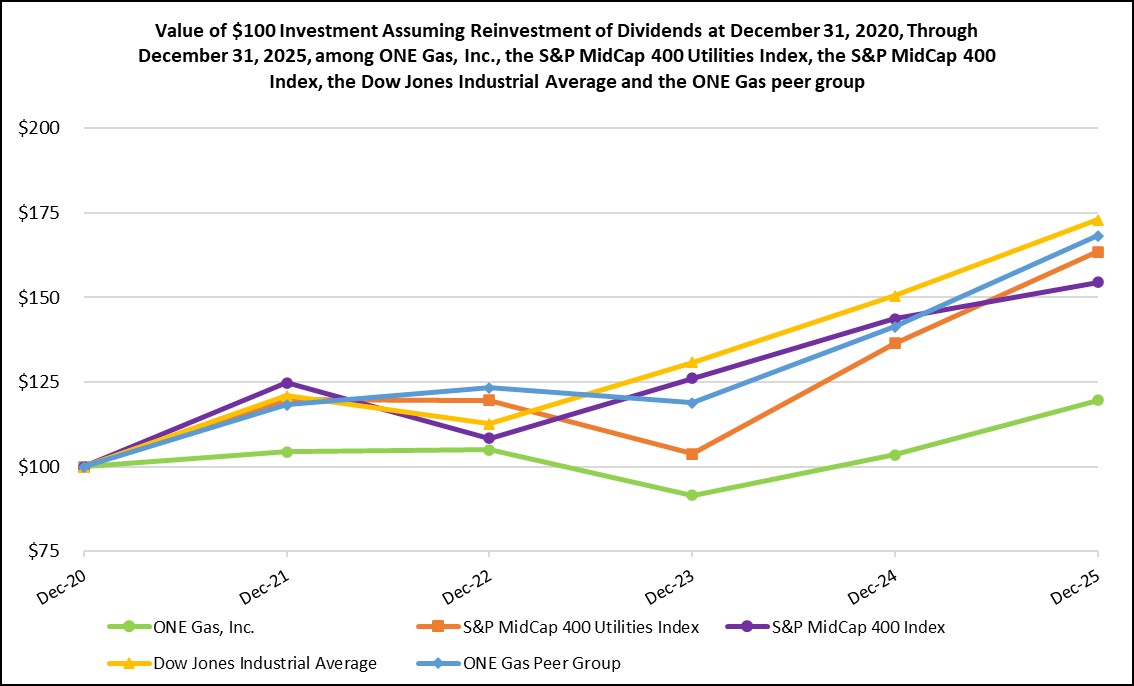
| Cumulative Total Return As of Each Year Ended | |||||||||||||||||
| December 31, | |||||||||||||||||
| 2021 | 2022 | 2023 | 2024 | 2025 | |||||||||||||
| ONE Gas, Inc. | $ | 104.36 | $ | 104.98 | $ | 91.54 | $ | 103.50 | $ | 119.59 | |||||||
| S&P MidCap 400 Utilities Index | $ | 119.75 | $ | 119.57 | $ | 103.77 | $ | 136.41 | $ | 163.55 | |||||||
| S&P MidCap 400 Index | $ | 124.73 | $ | 108.37 | $ | 126.13 | $ | 143.65 | $ | 154.40 | |||||||
| Dow Jones Industrial Average | $ | 120.95 | $ | 112.65 | $ | 130.87 | $ | 150.49 | $ | 172.95 | |||||||
ONE Gas Peer Group* | $ | 118.35 | $ | 123.37 | $ | 118.82 | $ | 141.32 | $ | 168.17 | |||||||
* The ONE Gas peer group used in this graph is the same peer group that will be used in determining our level of performance under our 2025 performance units at the end of the three-year performance period and is comprised of the following companies: Atmos Energy Corporation; Avista Corporation; Black Hills Corporation; CenterPoint Energy, Inc.; Chesapeake Utilities Corporation; CMS Energy Corporation; New Jersey Resources Corporation; NiSource Inc.; Northwest Natural Holding Company; NorthWestern Energy Group, Inc.; Southwest Gas Holdings, Inc.; and Spire Inc. | |||||||||||||||||
20
ITEM 6. [RESERVED]
ITEM 7. MANAGEMENT’S DISCUSSION AND ANALYSIS OF FINANCIAL CONDITION AND RESULTS OF OPERATIONS
The following discussion and analysis should be read in conjunction with our audited consolidated financial statements and the Notes to Consolidated Financial Statements in this Annual Report. We have disclosed non-GAAP financial measures of adjusted net income and adjusted net income per share. Management and the Board of Directors use these non-GAAP financial measures, in addition to GAAP financial measures, to evaluate financial performance, specifically impacts from certain regulatory mechanisms designed to mitigate regulatory lag, understand and compare operating results across accounting periods, and for planning and forecasting. These non-GAAP financial measures are additional information and should not be considered as alternatives to, or more meaningful than, the related GAAP financial measures or comparable to similar measures used by other companies.
EXECUTIVE SUMMARY
We are a 100-percent regulated natural gas distribution company. As such, our regulators determine the rates we are allowed to charge for our service based on the revenue requirements needed to achieve our authorized rates of return. We earn revenues from the delivery of natural gas, but do not earn a profit on the natural gas that we deliver, as those costs are passed through to our customers at cost. The primary components of our revenue requirements are the amount of capital invested in our business, which is also known as rate base, our allowed rate of return on our capital investments, and our recoverable operating expenses, including depreciation, interest expense, and income taxes. The variable component of our rates is dependent on the consumption of natural gas, which is impacted primarily by the weather and, to a lesser extent, economic activity. While we have WNA mechanisms that adjust customers’ bills when actual HDDs differ from normalized HDDs, these mechanisms are in place for only a portion of the year, except in Kansas, and do not offset all fluctuations in usage resulting from weather variability. Accordingly, the weather can have either a positive or negative impact on our financial performance.
Our financial performance is contingent on a number of factors, including: (1) our regulatory construct, including the rates we are allowed to charge for our service, and the authorized rates of return on our investments in rate base; (2) the consumption of natural gas, which impacts the amount of natural gas revenues derived from the variable component of our rates; (3) customer growth; (4) our operating performance; and (5) the perceived value of natural gas relative to other energy sources, particularly electricity, which influences our customers’ choice of natural gas to provide a portion of their energy needs.
We are subject to regulatory requirements for pipeline integrity, pipeline and cyber security, and environmental compliance. These requirements impact our operating expenses and the level of capital expenditures required for compliance. Historically, our regulators have allowed recovery of these expenditures. However, because integrity and environmental regulations are frequently changing, our capital and operating expenditures to comply are changing as well. Although we believe our regulators will continue to allow recovery of such expenditures in the future, we will continue to make these expenditures with no assurance about if, or over what period, we will be permitted to recover them.
RECENT DEVELOPMENTS
Infrastructure Initiative - On December 18, 2025, we announced an infrastructure initiative to support economic growth and enhance energy reliability in southeast Oklahoma. Once operational, the new pipeline will deliver over 100 Bcf of natural gas annually in southeast Oklahoma, including servicing Western Farmers Electric Cooperative’s natural gas-fueled generation at its Hugo plant. The project includes a 43-mile, natural gas pipeline connecting to the Bennington Natural Gas Hub. We will invest approximately $120 million and Oklahoma Natural Gas will install and operate the pipeline, which is expected to be completed by the third quarter of 2028.
Credit Facility - In October 2025, we amended and restated the ONE Gas Credit Agreement. During this process we increased the capacity to $1.5 billion from $1.35 billion with the addition of one new lender and reduction of three lenders. The term of the agreement was extended to October 30, 2030, from March 16, 2028. The expansion option in the revolver was set at an additional $750 million, and all other terms and conditions of the ONE Gas Credit Agreement are materially unchanged.
Commercial Paper - In December 2025, we increased the capacity of our commercial paper to $1.5 billion from $1.35 billion.
21
Equity issuances - On December 29, 2025, we settled forward sale agreements for 2,633,700 shares of our common stock for net proceeds of $205.0 million.
In May 2025, we entered into an underwriting agreement and a forward sale agreement for 2,500,000 shares of our common stock. The forward sale agreement provides for settlement on a date, or dates, to be specified at our discretion, but which will occur no later than December 31, 2026.
In February 2023, we entered into an at-the-market equity distribution agreement under which we may issue and sell shares of our common stock with an aggregate offering price up to $300 million. Sales of common stock are made by means of ordinary brokers’ transactions on the NYSE and the NYSE Texas, in block transactions, or as otherwise agreed to between us and the sales agent. We are under no obligation to offer and sell common stock under the program. At December 31, 2025, we had $225.5 million of equity available for issuance under the program.
The following table summarizes our outstanding forward sale agreement at December 31, 2025:
| Maturity | Original Shares | Remaining Shares | Forward Price | Net Proceeds Available | ||||||||||
| (Shares) | (Shares) | (Per share) | (Thousands of dollars) | |||||||||||
| December 31, 2026 | 2,500,000 | 269,300 | $78.45 | $21,217 | ||||||||||
See “Liquidity and Capital Resources” and Note 7 of the Notes to Consolidated Financial Statements in this Annual Report for additional discussion of our at-the-market equity program.
Dividend - In January 2026, we declared a dividend of $0.68 per share ($2.72 per share on an annualized basis) for shareholders of record as of February 20, 2026, payable on March 6, 2026.
Texas House Bill 4384 - In June 2025, Texas House Bill 4384 was signed into law, allowing gas utilities in Texas to defer, and later recover, specific costs related to property, plant and equipment placed in service, but not yet reflected in base rates, including depreciation, ad valorem taxes, and a carrying cost. The RRC is required to adopt rules to implement the new law within 270 days of the effective date. Texas Gas Service began applying the new provisions to property, plant and equipment placed in service but not yet reflected in rates in the third quarter of 2025.
Unsecured Term Loan - On February 11, 2026, the variable interest rate on our unsecured term loan reset for the new six‑month interest period to 6‑month Term SOFR of 3.58% plus a 90‑basis‑point spread, resulting in a 4.48% all‑in interest rate, a decrease from the prior period rate of 4.96%.
22
REGULATORY ACTIVITIES
Oklahoma - On February 27, 2025, Oklahoma Natural Gas filed its required PBRC application for the year ended December 31, 2024. The filed request included a $41.5 million base rate revenue increase, $2.4 million energy efficiency incentive, and $13.2 million of estimated EDIT to be credited to customers in 2026. The parties reached a settlement which included a $41.1 million base rate revenue increase, a $2.4 million energy efficiency incentive, and $17.9 million of estimated EDIT to be credited to customers in February 2026. On June 12, 2025, the administrative law judge recommended approval of the settlement. Rates were implemented on June 27, 2025, and the OCC issued an order approving the settlement on July 23, 2025.
Kansas - In April 2025, Kansas Gas Service submitted an application to the KCC requesting an increase of approximately $7.2 million related to its GSRS. In July 2025, the KCC approved a $7.2 million increase effective August 2025.
Texas - In June 2025, Texas Gas Service filed a rate case for all customers in the previously designated Central-Gulf, West-North, and Rio Grande Valley service areas requesting a $41.1 million revenue increase. The filing included a request to consolidate all service areas into a single division. The filing was based on a requested 10.4 percent return on equity and a 59.9 percent common equity ratio. In December 2025, the parties filed a non-unanimous partial settlement agreement for an increase of $15.0 million based on a 9.8 percent return on equity and 59.9 percent common equity ratio, which addressed all issues except consolidation. The consolidation issues were addressed at a hearing before an administrative law judge in November 2025. On December 23, 2025, the administrative law judge recommended a revenue increase of $14.5 million and consolidation of all service areas into a single statewide division. The RRC approved the administrative law judge’s proposed order and new rates and consolidation were effective on January 27, 2026.
West-North Service Area - In February 2025, Texas Gas Service made a GRIP filing for all customers in the previously designated West-North service area, requesting a $8.2 million increase to be effective in June 2025. In May 2025, the RRC approved an increase of $8.2 million, and new rates became effective in June 2025.
Central-Gulf Service Area - In February 2025, Texas Gas Service made a GRIP filing for all customers in the previously designated Central-Gulf service area, requesting a $15.4 million increase to be effective in June 2025. In May 2025, the RRC approved an increase of $15.4 million, and new rates became effective in June 2025.
Rio Grande Valley Service Area - In April 2025, Texas Gas Service made a GRIP filing for all customers in the previously designated Rio Grande Valley service area, requesting a $3.2 million increase to be effective in September 2025. In August 2025, the RRC approved an increase of $2.9 million, and new rates became effective in September 2025.
See “Regulatory Activities,” “Liquidity and Capital Resources,” and Notes 1 and 3 of the Notes to Consolidated Financial Statements in this Annual Report for additional discussion of the securitization transactions.
23
FINANCIAL RESULTS AND OPERATING INFORMATION
We operate in one reportable business segment: regulated public utilities that deliver natural gas to residential, commercial, and transportation customers. We evaluate our financial performance principally on net income.
Selected Financial Results - Net income was $264.2 million, or $4.37 per diluted share, $222.9 million, or $3.91 per diluted share, and $231.2, or $4.14 per diluted share, for the years ended December 31, 2025, 2024, and 2023, respectively.
The following table sets forth certain selected financial results for our operations for the periods indicated:
| Year Ended | Variances | Variances | |||||||||||||||||||||||||||||||||||||||
| December 31, | 2025 vs. 2024 | 2024 vs. 2023 | |||||||||||||||||||||||||||||||||||||||
| Financial Results | 2025 | 2024 | 2023 | Increase (Decrease) | Increase (Decrease) | ||||||||||||||||||||||||||||||||||||
| (Millions of dollars, except percentages) | |||||||||||||||||||||||||||||||||||||||||
| Natural gas sales | $ | 2,196.3 | $ | 1,864.1 | $ | 2,154.0 | $ | 332.2 | 18 | % | $ | (289.9) | (13) | % | |||||||||||||||||||||||||||
| Transportation revenues | 144.9 | 138.7 | 133.6 | 6.2 | 4 | % | 5.1 | 4 | % | ||||||||||||||||||||||||||||||||
| Securitization customer charges | 47.4 | 44.4 | 48.7 | 3.0 | 7 | % | (4.3) | (9) | % | ||||||||||||||||||||||||||||||||
| Other revenues | 38.8 | 36.4 | 35.7 | 2.4 | 7 | % | 0.7 | 2 | % | ||||||||||||||||||||||||||||||||
| Total revenues | 2,427.4 | 2,083.6 | 2,372.0 | 343.8 | 17 | % | (288.4) | (12) | % | ||||||||||||||||||||||||||||||||
| Cost of natural gas | 998.9 | 778.3 | 1,134.5 | 220.6 | 28 | % | (356.2) | (31) | % | ||||||||||||||||||||||||||||||||
| Operating costs | 653.8 | 609.6 | 580.1 | 44.2 | 7 | % | 29.5 | 5 | % | ||||||||||||||||||||||||||||||||
| Depreciation and amortization | 317.3 | 296.7 | 279.8 | 20.6 | 7 | % | 16.9 | 6 | % | ||||||||||||||||||||||||||||||||
| Operating income | $ | 457.4 | $ | 399.0 | $ | 377.6 | $ | 58.4 | 15 | % | $ | 21.4 | 6 | % | |||||||||||||||||||||||||||
| Net Income | $ | 264.2 | $ | 222.9 | $ | 231.2 | $ | 41.3 | 19 | % | $ | (8.3) | (4) | % | |||||||||||||||||||||||||||
| Capital expenditures and asset removal costs | $ | 759.5 | $ | 762.1 | $ | 728.7 | $ | (2.6) | — | % | $ | 33.4 | 5 | % | |||||||||||||||||||||||||||
Natural gas sales to customers represent revenue from contracts with customers through implied contracts established by our tariffs and rates approved by regulatory authorities, as well as revenues from regulatory mechanisms related to natural gas sales. Natural gas sales also include recovery of the cost of natural gas.
Our natural gas sales include fixed and variable charges related to the delivery of natural gas and gas costs that are passed through to our customers in accordance with our cost of natural gas regulatory mechanisms. Fixed charges reflect the portion of our natural gas sales attributable to the monthly fixed customer charge component of our rates, which does not fluctuate based on customer usage in each period. Variable charges reflect the portion of our natural gas sales that fluctuate with the volumes delivered and billed and the effects of weather normalization.
Transportation revenues represent revenue from contracts with customers through implied contracts established by our tariffs and rates approved by regulatory authorities, as well as tariff-based negotiated contracts.
Securitization customer charges represent revenue from contracts with customers through implied contracts established by the financing order approved by the KCC, related to the securitization of extraordinary costs incurred during Winter Storm Uri in the state of Kansas. See Note 17 of the Notes to Consolidated Financial Statements in this Annual Report for additional discussion of the securitization transaction in Kansas.
Other revenues include primarily miscellaneous service charges, which represent implied contracts with customers established by our tariffs and rates approved by regulatory authorities and other revenues from regulatory mechanisms.
Cost of natural gas includes commodity purchases, fuel, storage, transportation, hedging costs, and settlement proceeds for natural gas price volatility mitigation programs approved by our regulators and other gas purchase costs recovered through our cost of natural gas regulatory mechanisms. Cost of natural gas does not include an allocation of general operating costs or depreciation and amortization. These regulatory mechanisms provide a method of recovering natural gas costs on an ongoing basis without a profit. Therefore, although our revenues fluctuate with the cost of natural gas that we pass through to our customers, operating income is not affected by fluctuations in the cost of natural gas.
24
2025 vs. 2024 - Operating income increased $58.4 million due primarily to the following:
•an increase of $116.0 million from new rates; and
•an increase of $6.6 million in residential sales due to net customer growth in all three states.
These increases were offset partially by:
•an increase of $20.6 million in depreciation expense due to additional capital expenditures being placed in service;
•an increase of $17.0 million in employee-related costs;
•an increase of $14.7 million in ad-valorem taxes;
•an increase of $3.8 million in outside services;
•an increase of $2.9 million in insurance expense;
•an increase of $1.5 million in bad debt expense;
•an increase of $1.0 million in fleet expense; and
•a carrying charge of $2.9 million refunded to Oklahoma customers from the settlement of a disputed gas purchase invoice.
For the year ended December 31, 2025, revenues reflect an increase of $3.0 million and a decrease in interest expense, net, of $1.4 million associated with KGSS-I, which are offset by a $4.5 million increase in amortization and operating expense.
Other Factors Affecting Net Income - Other factors that affect net income for the year ended December 31, 2025, compared with 2024, include a decrease of $0.8 million in other income, net and a decrease of $4.4 million in interest expense, net. The decrease in other income, net is due primarily to a $2.4 million decrease in the credit for non-service costs associated with pension and other postemployment benefits, offset partially by a $1.0 million increase in the market value of investments associated with our nonqualified deferred compensation plans. The decrease in interest expense is due primarily to commercial paper borrowings at lower rates and the implementation of Texas House Bill 4384.
EDIT - The return of EDIT to our customers is not expected to have a material impact on earnings, as any reduction or credit in rates is offset by a reduction in income tax expense. During the years ended December 31, 2025 and 2024, we credited income tax expense $17.6 million and $25.7 million, respectively, for the amortization of the regulatory liability associated with EDIT that was embedded in base rates.
Capital Expenditures and Asset Removal Costs - Our capital expenditures program includes expenditures for pipeline integrity, extending service to new areas, reinforcing and increasing system capabilities, pipeline replacements, automated meter reading, government-mandated pipeline relocations, fleet, facilities, IT assets, and cybersecurity. It is our practice to maintain and upgrade our infrastructure, facilities, and systems to ensure safe, reliable, and efficient operations. Asset removal costs include expenditures associated with the replacement or retirement of long-lived assets that result from the construction, development, and/or normal use of our assets, primarily our pipeline assets.
Capital expenditures and asset removal costs decreased $2.6 million for 2025, compared with 2024. Our capital expenditures and asset removal costs are expected to be approximately $800 million for 2026. While we did not experience a significant impact to our capital expenditure program during the year ended December 31, 2025, our future capital expenditure activity is dependent on several factors, including economic conditions and our supply chains for contract labor, materials, and supplies.
25
Non-GAAP Financial Measures - Adjusted net income and adjusted net income per share are calculated as GAAP net income plus the deferral of an equity portion of a carrying cost attributable to shareholders’ investment capitalized for regulatory purposes but not for financial reporting purposes. These carrying costs relate to property, plant and equipment that has been placed in service, but not yet reflected in base rates. Adjusted net income and adjusted net income per share should not be considered in isolation or as a substitute for GAAP net income or GAAP EPS.
Management believes these non‑GAAP measures provide useful information because they offer a more complete view of our overall regulatory economics, reflect the period-specific effects of certain regulatory mechanisms designed to mitigate regulatory lag associated with property, plant and equipment placed in service prior to regulatory action, and reflect the impact of regulatory timing differences that arise under the Company’s rate-setting framework. These adjustments, net of applicable tax effects, are expected to recur as a result of the Company’s regulatory framework and are a consistent part of our earnings profile.
The following table contains a reconciliation of the Company’s GAAP net income and GAAP EPS to adjusted net income and adjusted net income per share:
| Year Ended December 31, | |||||||||||
| 2025 | 2024 | 2023 | |||||||||
| (Thousands, except per share amounts) | |||||||||||
| Net income - GAAP | $ | 264,224 | $ | 222,850 | $ | 231,232 | |||||
Other income - deferred carrying cost(a) | 6,745 | 1,986 | 1,796 | ||||||||
Income taxes(a) | — | — | — | ||||||||
| Adjusted net income - non-GAAP | $ | 270,969 | $ | 224,836 | $ | 233,028 | |||||
| Earnings per share - GAAP | |||||||||||
| Basic | $ | 4.39 | $ | 3.92 | $ | 4.16 | |||||
| Diluted | $ | 4.37 | $ | 3.91 | $ | 4.14 | |||||
| Adjusted net income per share - non-GAAP | |||||||||||
| Basic | $ | 4.50 | $ | 3.96 | $ | 4.19 | |||||
| Diluted | $ | 4.48 | $ | 3.94 | $ | 4.17 | |||||
Average shares (thousands) | |||||||||||
| Basic | 60,161 | 56,826 | 55,600 | ||||||||
| Diluted | 60,513 | 57,033 | 55,860 | ||||||||
| (a) The allowance for earnings on shareholders’ investment capitalized for regulatory purposes but not for financial reporting purposes applied to property, plant and equipment placed in service, but not yet reflected in base rates as authorized by our regulators or state law. This increases book income but is non-taxable, creating a permanent tax difference. | |||||||||||
Selected Operating Information - The following tables set forth certain selected operating information for the periods indicated:
| Year Ended | Variances | |||||||||||||||||||||||||||||||||||||
| December 31, | 2025 vs. 2024 | |||||||||||||||||||||||||||||||||||||
| (in thousands) | 2025 | 2024 | Increase (Decrease) | |||||||||||||||||||||||||||||||||||
| Average Number of Customers | OK | KS | TX | Total | OK | KS | TX | Total | OK | KS | TX | Total | ||||||||||||||||||||||||||
| Residential | 849 | 597 | 672 | 2,118 | 842 | 594 | 667 | 2,103 | 7 | 3 | 5 | 15 | ||||||||||||||||||||||||||
| Commercial and industrial | 77 | 51 | 35 | 163 | 77 | 51 | 35 | 163 | — | — | — | — | ||||||||||||||||||||||||||
| Other | — | — | 3 | 3 | — | — | 3 | 3 | — | — | — | — | ||||||||||||||||||||||||||
| Transportation | 5 | 5 | 1 | 11 | 5 | 6 | 1 | 12 | — | (1) | — | (1) | ||||||||||||||||||||||||||
| Total customers | 931 | 653 | 711 | 2,295 | 924 | 651 | 706 | 2,281 | 7 | 2 | 5 | 14 | ||||||||||||||||||||||||||
The increase in the average number of customers for 2025, compared with 2024, is due primarily to the connection of new customers resulting from the extension and expansion of our system in our service areas. For 2025 and 2024, our average customer count includes 23,000 new customer connections in each year.
26
The following table reflects total volumes delivered, excluding the effects of WNA mechanisms on sales volumes:
| Year Ended December 31, | ||||||||||||||
Volumes (MMcf) | 2025 | 2024 | 2023 | |||||||||||
| Natural gas sales | ||||||||||||||
| Residential | 114,057 | 104,112 | 114,239 | |||||||||||
| Commercial and industrial | 40,251 | 36,944 | 40,630 | |||||||||||
| Other | 3,022 | 2,108 | 1,737 | |||||||||||
| Total sales volumes delivered | 157,330 | 143,164 | 156,606 | |||||||||||
| Transportation | 216,955 | 221,032 | 227,875 | |||||||||||
| Total volumes delivered | 374,285 | 364,196 | 384,481 | |||||||||||
The impact of weather on residential and commercial natural gas sales is tempered by WNA mechanisms in all jurisdictions.
The following table sets forth the HDDs by state for the periods indicated:
| Year Ended December 31, | ||||||||||||||||||||||||||||||||||||||||||||
| 2025 | 2024 | 2025 vs. 2024 | 2025 | 2024 | ||||||||||||||||||||||||||||||||||||||||
| HDDs | Actual | Normal | Actual | Normal | Actual Variance | Actual as a percent of Normal | ||||||||||||||||||||||||||||||||||||||
| Oklahoma | 3,082 | 3,356 | 2,783 | 3,359 | 11 | % | 92 | % | 83 | % | ||||||||||||||||||||||||||||||||||
| Kansas | 4,463 | 4,728 | 3,863 | 4,690 | 16 | % | 94 | % | 82 | % | ||||||||||||||||||||||||||||||||||
| Texas | 1,450 | 1,646 | 1,345 | 1,679 | 8 | % | 88 | % | 80 | % | ||||||||||||||||||||||||||||||||||
Normal HDDs are established through rate proceedings in each of our jurisdictions for use primarily in weather normalization billing calculations. Normal HDDs disclosed above are based on:
•Oklahoma - A 10-year weighted average as of June 30, 2021, as calculated using 11 weather stations across Oklahoma and weighted on average customer count.
•Kansas - A 30-year rolling average for years 1994-2023 calculated using three weather stations across Kansas and weighted on HDDs by weather station and customers.
•Texas - An average of HDDs authorized in our most recent rate proceeding in each jurisdiction and weighted using a rolling 10-year average of actual natural gas distribution sales volumes.
Actual HDDs are based on the quarter-to-date weighted average of:
•11 weather stations and customers by month for Oklahoma;
•3 weather stations and customers by month for Kansas; and
•9 weather stations and natural gas distribution sales volumes for Texas.
CONTINGENCIES
We are a party to various litigation matters and claims that have arisen in the normal course of our operations. While the results of litigation and claims cannot be predicted with certainty, we believe the reasonably possible losses from such matters, individually and in the aggregate, are not material. Additionally, we believe the probable outcome of such matters will not have a material adverse effect on our results of operations, financial position, or cash flows. See Note 15 of the Notes to Consolidated Financial Statements in this Annual Report for information with respect to legal proceedings.
LIQUIDITY AND CAPITAL RESOURCES
General - We have relied primarily on operating cash flow, commercial paper, and equity forward agreements for our liquidity and capital resource requirements. We fund operating expenses, working capital requirements, including purchases of natural gas, and capital expenditures primarily with cash from operations, commercial paper, and settlements of equity forward agreements.
Our stable cash flow and earnings profile is due to the significant residential component of our customer base, the fixed-charge component of our natural gas sales revenues, and the rate mechanisms that we have in place. Additionally, we have rate
27
mechanisms in place in our jurisdictions that reduce the lag in earning a return on our capital expenditures and provide for recovery of certain changes in our cost of service by allowing for adjustments to rates between rate cases. We anticipate that our cash flow generated from operations and our expected short- and long-term financing arrangements will enable us to maintain our current and planned level of operations and provide us flexibility to finance our infrastructure investments. Our ability to access capital markets for debt and equity financing under reasonable terms depends on market conditions, our financial condition, and credit ratings.
Short-term Debt - The ONE Gas Credit Agreement contains certain financial, operational, and legal covenants. Among other things, these covenants include maintaining ONE Gas’ total debt-to-capital ratio, excluding the debt of KGSS-I, of no more than 70 percent at the end of any calendar quarter. At December 31, 2025, our total debt-to-capital ratio, excluding KGSS-I, was 47.6 percent and we were in compliance with all covenants under the ONE Gas Credit Agreement. We may reduce the unutilized portion of the ONE Gas Credit Agreement in whole or in part without premium or penalty. The ONE Gas Credit Agreement contains customary events of default. Upon the occurrence of certain events of default, the obligations under the ONE Gas Credit Agreement may be accelerated and the commitments may be terminated.
In October 2025, we amended and restated the ONE Gas Credit Agreement, increasing the aggregate committed capacity to $1.5 billion from $1.35 billion, with the addition of one new lender and the reduction of three existing lenders. The maturity date of the agreement was extended to October 30, 2030, from March 16, 2028. The agreement provides for a revolving unsecured credit facility, which includes a $20 million letter of credit subfacility and a $60 million swingline subfacility. Under the terms of the agreement, the Company may, subject to satisfaction of customary conditions and receipt of commitments from new or existing lenders, request an increase in total commitments of up to an additional $750 million. Proceeds from the agreement may be used for working capital, capital expenditures, acquisitions and mergers, the issuance of letters of credit, and other general corporate purposes.
At December 31, 2025, we had approximately $2.4 million in letters of credit issued and no borrowings under the ONE Gas Credit Agreement as in effect, with approximately $1.5 billion of remaining credit, which is available to repay our commercial paper borrowings and for other permitted purposes.
In December 2025, we increased the capacity of our commercial paper to $1.5 billion from $1.35 billion. Under our commercial paper program, we may issue unsecured commercial paper up to the maximum amount of $1.5 billion to fund short-term borrowing needs. The maturities of the commercial paper vary but may not exceed 270 days from the date of issue. Commercial paper is generally sold at par less a discount representing an interest factor. At December 31, 2025 and December 31, 2024, we had $737.4 million and $914.6 million of commercial paper outstanding with a weighted-average interest rate of 3.94 percent and 4.77 percent, respectively.
Senior Notes - At December 31, 2025, our long-term debt-to-capital ratio was 40.9 percent, exclusive of KGSS-I debt.
At December 31, 2025, we had outstanding $2.2 billion of Senior Notes with none due within the next year. The indenture governing our Senior Notes includes an event of default upon the acceleration of other indebtedness of $100 million or more. Such events of default would entitle the trustee or the holders of 25 percent in aggregate principal amount of the outstanding Senior Notes to declare those Senior Notes immediately due and payable in full.
Depending on the series, we may redeem our Senior Notes at par, plus accrued and unpaid interest to the redemption date, starting one month, three months, or six months, before their maturity dates. Prior to these dates, we may redeem these Senior Notes, in whole or in part, at a redemption price equal to the principal amount, plus accrued and unpaid interest and a make-whole premium. The redemption price will never be less than 100 percent of the principal amount of the respective Senior Note, plus accrued and unpaid interest to the redemption date. Our Senior Notes are senior unsecured obligations, ranking equally in right of payment with all of our existing and future unsecured senior indebtedness.
Unsecured Term Loan - In August 2025, we entered into a 13-month unsecured term loan agreement totaling $250 million. The loan bears interest at a variable rate based on Term SOFR, initially set using the 6-month Term SOFR at closing, plus a 90 bps spread as specified in the agreement. The interest rate resets automatically at months six and twelve, each based on the prevailing 6-month Term SOFR plus a spread of 90 bps, and 1-month Term SOFR plus a spread of 90 bps, respectively, until the term loan matures in September 2026. Interest is payable quarterly, and the loan includes customary covenants and default provisions. Proceeds of the term loan will be available for working capital, capital expenditures, acquisitions, mergers, and other general corporate purposes.
28
Credit Ratings - Our credit ratings at December 31, 2025, were:
| Rating Agency | Long-term Rating | Short-term Rating | Outlook | ||||||||
| Moody’s | A3 | Prime-2 | Stable | ||||||||
| S&P | A- | A-2 | Stable | ||||||||
We intend to maintain credit metrics at a level that supports our balanced approach to capital investment and a return of capital to shareholders via a dividend that we believe will be competitive with our peer group.
Securitized Utility Tariff Bonds - At December 31, 2025, we had outstanding $257.9 million of 5.486 percent KGSS-I Securitized Utility Tariff Bonds with $30.6 million due within the next year. The bonds are governed by an indenture between KGSS-I and the indenture trustee. The indenture contains certain covenants that restrict KGSS-I’s ability to sell, transfer, convey, exchange, or otherwise dispose of its assets.
Equity Issuances - On December 29, 2025, we settled forward sale agreements 2,633,700 shares of our common stock for net proceeds of $205.0 million.
In May 2025, we entered into an underwriting agreement and a forward sale agreement for 2,500,000 shares of our common stock and granted the underwriter an option to purchase up to 375,000 additional shares of our common stock, which was not exercised. The forward sale agreement provides for settlement on a date, or dates, to be specified at our discretion, but which will occur no later than December 31, 2026.
In December 2024, we amended the two forward sale agreements we entered into in September 2023 to extend the maturity date of 223,000 and 180,000 shares of our common stock, to December 31, 2025 from December 31, 2024. The amended forward sale agreements provided for settlement on a date, or dates, to be specified at our discretion but which will occur no later than December 31, 2025. The remaining shares under the two forward sale agreements were settled as part of the December 29, 2025, share settlement.
In February 2023, we entered into an at-the-market equity distribution agreement under which we may issue and sell shares of our common stock with an aggregate offering price up to $300 million. Sales of common stock are made by means of ordinary brokers’ transactions on the NYSE and the NYSE Texas, in block transactions or as otherwise agreed to between us and the sales agent. We are under no obligation to offer and sell common stock under the program. At December 31, 2025, we had $225.5 million of equity available for issuance under the program.
Pension and Other Postemployment Benefit Plans - For the year ended December 31, 2025, we contributed $6.4 million to our defined benefit pension plans, and no contributions were made to our other postemployment benefit plans. For the year ended December 31, 2024, we contributed $1.6 million to our defined benefit pension plans, and no contributions were made to our other postemployment benefit plans. Additional information about our pension and other postemployment benefit plans, including anticipated contributions, is included under “Critical Accounting Estimates - Pension and Other Postemployment Benefits” and under Note 11 of the Notes to Consolidated Financial Statements in this Annual Report.
CASH FLOW ANALYSIS
We use the indirect method to prepare our consolidated statements of cash flows. Under this method, we reconcile net income to cash flows provided by operating activities by adjusting net income for those items that impact net income but may not result in actual cash receipts or payments and changes in our assets and liabilities not classified as investing or financing activities during the period. Items that impact net income but may not result in actual cash receipts or payments include, but are not limited to, depreciation and amortization, deferred income taxes, share-based compensation expense, and provision for doubtful accounts.
29
The following table sets forth the changes in cash flows by operating, investing and financing activities for the periods indicated:
| Year Ended December 31, | Variance | Variance | |||||||||||||||
| 2025 | 2024 | 2023 | 2025 vs. 2024 | 2024 vs. 2023 | |||||||||||||
(Millions of dollars) | |||||||||||||||||
| Total cash provided by (used in): | |||||||||||||||||
| Operating activities | $ | 578.8 | $ | 368.4 | $ | 939.5 | $ | 210.4 | $ | (571.1) | |||||||
| Investing activities | (715.3) | (707.5) | (669.6) | (7.8) | (37.9) | ||||||||||||
| Financing activities | 91.7 | 378.2 | (248.6) | (286.5) | 626.8 | ||||||||||||
| Change in cash, cash equivalents, restricted cash and restricted cash equivalents | (44.8) | 39.1 | 21.3 | (83.9) | 17.8 | ||||||||||||
| Cash, cash equivalents, restricted cash and restricted cash equivalents at beginning of period | 78.5 | 39.4 | 18.1 | 39.1 | 21.3 | ||||||||||||
| Cash, cash equivalents, restricted cash and restricted cash equivalents at end of period | $ | 33.7 | $ | 78.5 | $ | 39.4 | $ | (44.8) | $ | 39.1 | |||||||
Operating Cash Flows - Changes in cash flows from operating activities are due primarily to changes in sales revenues, natural gas costs, and operating expenses discussed in “Financial Results and Operating Information,” and changes in working capital. Changes in natural gas prices and demand for our services or natural gas, whether because of general economic conditions, variations in weather not mitigated by WNA mechanisms, changes in supply, or increased competition from other service providers, could affect our earnings and operating cash flows. Typically, our cash flows from operations are greater in the first half of the year compared to the second half of the year.
Operating cash flows were higher for the year ended December 31, 2025, compared to 2024, due primarily to working capital changes related to the recovery of regulatory assets.
Investing Cash Flows - Cash used in investing activities increased for the year ended December 31, 2025, compared to 2024, due primarily to an increase in capital expenditures for system integrity and extension of service to new areas.
Financing Cash Flows - Cash used in financing activities increased for the year ended December 31, 2025, compared to 2024, due primarily to the repayment of notes payable, offset by lower repayment of long-term debt.
ENVIRONMENTAL, SAFETY, AND REGULATORY MATTERS
Environmental Matters - We are subject to multiple laws and regulations regarding protection of the environment and natural and cultural resources, which affect many aspects of our present and future operations. Regulated activities include, but are not limited to, those involving air emissions, storm water and wastewater discharges, handling and disposal of solid and hazardous wastes, wetland preservation, plant and wildlife protection, hazardous materials use, storage, and transportation, and pipeline and facility construction. These laws and regulations require us to obtain and/or comply with a wide variety of environmental clearances, registrations, licenses, permits, and other approvals. Failure to comply with these laws, regulations, licenses, and permits or the discovery of presently unknown environmental conditions may expose us to fines, penalties, and/or interruptions in our operations that could be material to our results of operations. In addition, emission controls and/or other regulatory or permitting mandates under the CAA and other similar federal and state laws could require unexpected capital expenditures. We cannot assure that existing environmental statutes and regulations will not be revised or that new regulations will not be adopted or become applicable to us. Revised or additional statutes or regulations that result in increased compliance costs or additional operating restrictions could have a material adverse effect on our business, financial condition, and results of operations. Our expenditures for environmental investigation and remediation compliance to date have not been significant in relation to our financial position, results of operations, or cash flows, and our expenditures related to environmental matters had no material effects on earnings or cash flows during 2025, 2024, and 2023.
We own or retain legal responsibility for certain environmental conditions at 12 former MGP sites in Kansas. These sites contain contaminants generally associated with MGP sites and are subject to control or remediation under various environmental laws and regulations. A consent agreement with the KDHE governs all environmental investigation and remediation work at these sites. The terms of the consent agreement require us to investigate these sites and set remediation activities based upon the results of the investigations and risk analysis. Remediation typically involves the management of contaminated soils and may involve removal of structures and monitoring and/or remediation of groundwater. We have completed or are addressing removal of the source of soil contamination at all 12 sites and continue to monitor groundwater at
30
seven of the 12 sites according to plans approved by the KDHE. Regulatory closure has been achieved at five of the 12 sites, but these sites remain subject to potential future requirements that may result in additional costs.
We have an AAO that allows Kansas Gas Service to defer and seek recovery of costs necessary for investigation and remediation at, and nearby, these 12 former MGP sites that are incurred after January 1, 2017. In January 2025, Kansas Gas Service requested to increase the cap on the AAO to $32.0 million from $15.0 million. The original $15.0 million cap approved in 2017 was the result of a unanimous settlement agreement and contained additional reporting requirements and obligations. In May 2025, Kansas Gas Service, the KCC staff, and the Citizens’ Utility Ratepayer Board filed a unanimous settlement agreement with the KCC agreeing to increase the cap to $32.0 million and to leave all of the other provisions of the 2017 settlement agreement in place. The KCC issued an order approving the settlement agreement in July 2025.
Pursuant to the AAO, costs approved for recovery in a future rate proceeding are to be amortized over a 15-year period. The unamortized amounts are not included in rate base or accumulate carrying charges. Following a determination that future investigation and remediation work approved by the KDHE exceeds $32.0 million, net of any related insurance recoveries, Kansas Gas Service is required to file an application with the KCC for approval to increase the $32.0 million cap. At December 31, 2025 and December 31, 2024, we have deferred $30.1 million and $31.1 million, respectively, for accrued investigation and remediation costs, net of insurance proceeds, pursuant to our AAO.
We also own or retain legal responsibility for certain environmental conditions at a former MGP site in Texas. At the request of the TCEQ, we began investigating the level and extent of contamination associated with the site under their Texas Risk Reduction Program. A preliminary site investigation revealed that this site contains contaminants generally associated with MGP sites and is subject to control or remediation under various environmental laws and regulations. At December 31, 2025, estimated costs associated with expected remediation activities for this site are not material.
Our expenditures for environmental evaluation, mitigation, remediation, and compliance to date have not been significant in relation to our financial position, results of operations, or cash flows, and our expenditures related to environmental matters had no material effects on earnings or cash flows during the years ended December 31, 2025, 2024, and 2023. The reserve for remediation of our MGP sites was $13.7 million and $14.3 million at December 31, 2025 and 2024, respectively.
Environmental issues may exist with respect to these MGP sites that are unknown to us. Accordingly, future costs are dependent on the final determination and regulatory approval of any remedial actions, the complexity of the site, level of remediation required, changing technology and governmental regulations, and to the extent not recovered by insurance or recoverable in rates from our customers, such costs could be material to our financial condition, results of operations, or cash flows.
We are subject to environmental regulation by federal, state, and local authorities. Due to the inherent uncertainties surrounding the development of federal and state environmental laws and regulations, we cannot determine with specificity the impact such laws and regulations may have on our existing and future facilities. With the trend toward stricter standards, greater regulation, and more extensive permit requirements for the types of assets operated by us, our environmental expenditures could increase in the future. Such expenditures may not be fully recovered by insurance or recoverable in rates from our customers, and those costs may adversely affect our financial condition, results of operations, and cash flows.
Environmental Footprint - We cannot assure that existing environmental statutes and regulations will not be revised or that new regulations will not be adopted or become applicable to us. Revised or additional regulations that result in increased compliance costs or additional operating restrictions could have a material adverse effect on our business, financial condition, and results of operations. Our expenditures for environmental investigation and remediation compliance to date have not been significant in relation to our financial position, results of operations, or cash flows, and our expenditures related to environmental matters had no material effects on earnings or cash flows for 2025, 2024, and 2023.
Pipeline Safety - We are subject to regulation under federal pipeline safety statutes and any analogous state regulations. These include safety requirements for the design, construction, operation, and maintenance of pipelines, including transmission and distribution pipelines. At the federal level, we are regulated by PHMSA. PHMSA regulations require the following for certain pipelines: inspection and maintenance plans; integrity management programs, including the determination of pipeline integrity risks and periodic assessments on certain pipeline segments; an operator qualification program, which includes certain trainings; a public awareness program that provides certain information; and a control room management plan.
31
PHMSA promulgates various regulations related to pipeline safety. As part of the Consolidated Appropriations Act, 2021, the PIPES Act reauthorized PHMSA through 2023 and directed the agency to move forward with several regulatory actions. Outstanding regulatory actions include the “Pipeline Safety: Class Location Change Requirements”, “Pipeline Safety: Safety of Gas Distribution Pipelines,” and “Pipeline Safety: Gas Pipeline Leak Detection” proposed rulemakings. The “Pipeline Safety: Gas Pipeline Leak Detection” proposed rule would require operators of new and existing transmission and distribution pipeline facilities to conduct certain leak detection and repair programs and require facility inspection and maintenance plans to align with those regulations. On January 20, 2025, an executive order began a regulatory freeze on all rulemakings that were not yet effective pending further review. To the extent such rulemakings impose more stringent requirements on our facilities, we may be required to incur expenditures that may be material.
Regulatory - Several regulatory initiatives impacted the earnings and future earnings potential of our business. See additional information regarding our regulatory initiatives in the “Regulatory Activities” section of Management’s Discussion and Analysis of Financial Condition and Results of Operations.
IMPACT OF NEW ACCOUNTING STANDARDS
Information about the impact of new accounting standards, if any, is included in Note 1 of the Notes to Consolidated Financial Statements in this Annual Report.
CRITICAL ACCOUNTING ESTIMATES
The preparation of our consolidated financial statements and related disclosures in accordance with GAAP requires us to make estimates and assumptions with respect to values or conditions that cannot be known with certainty that affect the reported amounts of assets and liabilities and the disclosure of contingent assets and liabilities at the date of the consolidated financial statements. These estimates and assumptions also affect the reported amounts of revenues and expenses during the reporting period. Although we believe these estimates and assumptions are reasonable, actual results could differ from our estimates.
The following summary sets forth what we consider to be our most critical estimates and accounting policies. Our critical accounting policies are defined as those estimates and policies most important to the portrayal of our financial condition and results of operations and that require management’s most difficult, subjective or complex judgment, particularly because of the need to make estimates concerning the impact of inherently uncertain matters.
Regulation - Our operations are subject to regulation with respect to rates, service, maintenance of pipeline and accounting records and various other matters by the respective regulatory authorities in the states in which we operate. We account for the financial effects of the ratemaking and accounting practices and policies of the various regulatory authorities in our consolidated financial statements. We record regulatory assets for costs that have been deferred for which future recovery through customer rates is considered probable and regulatory liabilities when it is probable that revenues will be reduced for amounts that will be returned to customers through the ratemaking process. As a result, certain costs that would normally be expensed under GAAP are capitalized or deferred on the balance sheet because it is probable they can be recovered through rates. Discontinuing the application of this method of accounting for regulatory assets and liabilities could significantly increase our operating expenses, as fewer costs would likely be capitalized or deferred on the balance sheet, which could reduce our net income. Further, regulation may impact the period in which revenues or expenses are recognized. The amounts to be recovered or recognized are based upon historical experience and our understanding of the regulations. The impact of regulation on our operations may be affected by decisions of the regulatory authorities or the issuance of new regulations.
For further discussion of regulatory assets and liabilities, see Note 3 of the Notes to Consolidated Financial Statements in this Annual Report.
Revenue Recognition - For regulated deliveries of natural gas, we read meters and bill customers on a monthly cycle. We recognize revenues upon the delivery of natural gas or services rendered to customers. The billing cycles for customers do not necessarily coincide with the accounting periods used for financial reporting purposes. We accrue unbilled revenues for natural gas that has been delivered but not yet billed at the end of an accounting period. Accrued unbilled revenue is based on a percentage estimate of amounts unbilled each month, which is dependent upon a number of factors, some of which require management’s judgment. These factors include customer consumption patterns and the impact of weather on usage. The accrued unbilled natural gas sales revenue at December 31, 2025 and 2024 was $216.4 million and $212.0 million, respectively, and is included in accounts receivable on our consolidated balance sheets.
We have determined the majority of our natural gas sales and transportation tariffs to be implied contracts with customers, which are settled over time, where our performance obligation is settled with our customer when natural gas is delivered and
32
simultaneously consumed by the customer. In addition, we use the invoice method practical expedient, where we recognize revenue for volumes delivered for which we have a right to invoice. For our other utility revenue, which are primarily one-time service fees that meet the requirements under ASC 606, the performance obligation is satisfied at a point in time when services are rendered to the customer. Certain revenues that do not meet the requirements under ASC 606 as revenues from contracts with customers are reflected as other revenues in determining total revenue. See Note 2 of the Notes to Consolidated Financial Statements in this Annual Report for additional information regarding our revenues.
Pension and Other Postemployment Benefits - We have defined benefit pension plans covering eligible retirees and eligible employees. We also sponsor welfare plans that provide other postemployment medical and life insurance benefits to eligible retirees and employees who retire with at least five years of service.
To calculate the expense and liabilities related to our plans, we utilize an outside actuarial consultant, which uses statistical and other factors to anticipate future events. These factors include assumptions about the discount rate, expected return on plan assets, rate of future compensation increases, age and mortality, and employment periods. We use tables issued by the Society of Actuaries to estimate mortality rates. In determining the projected benefit costs, assumptions can change from period to period and may result in material changes in the costs and liabilities we recognize.
For the year ended December 31, 2025, we contributed $6.4 million to our defined benefit pension plans and no contributions were made to our other postemployment benefit plans. For the year ended December 31, 2024, we contributed $1.6 million to our defined benefit pension plans and no contributions were made to our other postemployment benefit plans. In 2026, our contributions are expected to be $12.7 million to our defined benefit pension plans, and no contributions are expected to be made to our other postemployment benefit plans.
We recorded net periodic benefit costs for our defined benefit pension plans, prior to regulatory deferrals, of $5.7 million in 2025, and estimate that in 2026, we will record net periodic benefit cost of approximately $18.6 million. Net periodic benefits credits for our postemployment benefit plans, prior to regulatory deferrals, were $0.2 million in 2025, and we estimate that in 2026, we will record a credit of approximately $0.3 million, prior to regulatory deferrals.
The following table sets forth the significant assumptions used to determine our estimated 2026 net periodic benefit cost related to our defined benefit pension and other postemployment benefit plans and sensitivity to changes with respect to these assumptions:
| Rate Used | Cost Sensitivity (a) | Obligation Sensitivity (b) | ||||||||||||||||||
(Millions of dollars) | ||||||||||||||||||||
| Discount rate for pension | 5.65 | % | $ | 2.0 | $ | 17.9 | ||||||||||||||
| Discount rate for other postemployment benefits | 5.55 | % | (0.1) | 3.2 | ||||||||||||||||
| Expected long-term return on plan assets for pension | 5.75 | % | 1.8 | — | ||||||||||||||||
| Expected long-term return on plan assets for other postemployment benefits | 5.10 | % | 0.4 | — | ||||||||||||||||
(b) Approximate impact a quarter percentage point decrease in the assumed rate would have on defined benefit pension obligation.
See Note 11 of the Notes to Consolidated Financial Statements in this Annual Report for additional information regarding our pension and other postretirement benefit plans.
Contingencies - Our accounting for contingencies covers a variety of business activities, including contingencies for legal and environmental exposures. We accrue these contingencies when our assessments indicate that it is probable that a liability has been incurred or an asset will not be recovered and an amount can be reasonably estimated. We expense legal fees as incurred and base our legal liability estimates on currently available facts and our assessments of the ultimate outcome or resolution. Accruals for estimated losses from environmental remediation obligations generally are recognized no later than the completion of a remediation feasibility study. Recoveries of environmental remediation costs from other parties are recorded as assets when their receipt is deemed probable.
Our expenditures for environmental evaluation, mitigation, remediation, and compliance to date have not been significant in relation to our financial position, results of operations, or cash flows, and our expenditures related to environmental matters had no material effect on earnings or cash flows for the years ended December 31, 2025, 2024, and 2023. Environmental issues may exist with respect to these MGP sites that are unknown to us. Accordingly, future costs are dependent on the final determination and regulatory approval of any remedial actions, the complexity of the site, level of remediation required, changing technology
33
and governmental regulations, and to the extent not recovered by insurance or recoverable in rates from our customers, such costs could be material to our financial condition, results of operations, or cash flows.
See “Environmental Matters” and Note 15 of the Notes to Consolidated Financial Statements in this Annual Report for additional discussion of contingencies.
FORWARD-LOOKING STATEMENTS
Some of the statements contained and incorporated in this Annual Report are forward-looking statements within the meaning of Section 27A of the Securities Act and Section 21E of the Exchange Act. The forward-looking statements relate to our anticipated financial performance, liquidity, management’s plans and objectives for our future operations, our business prospects, the outcome of regulatory and legal proceedings, market conditions, and other matters. We make these forward-looking statements in reliance on the safe harbor protections provided under the Private Securities Litigation Reform Act of 1995. The following discussion is intended to identify important factors that could cause future outcomes to differ materially from those set forth in the forward-looking statements.
Forward-looking and other statements in this Annual Report regarding our environmental, social, and other sustainability plans and goals are not an indication that these statements are necessarily material to investors or required to be disclosed in our filings with the SEC. In addition, historical, current, and forward-looking environmental, social, and sustainability-related statements may be based on standards for measuring progress that are still developing, internal controls and processes that continue to evolve, and assumptions that are subject to change in the future.
Forward-looking statements include the items identified in the preceding paragraph, the information concerning possible or assumed future results of our operations and other statements contained or incorporated in this Annual Report identified by words such as “anticipate,” “estimate,” “expect,” “project,” “intend,” “plan,” “believe,” “should,” “goal,” “forecast,” “guidance,” “could,” “may,” “continue,” “might,” “potential,” “scheduled,” “likely,” and other words and terms of similar meaning.
One should not place undue reliance on forward-looking statements, which are applicable only as of the date of this Annual Report. Known and unknown risks, uncertainties, and other factors may cause our actual results, performance, or achievements to be materially different from any future results, performance, or achievements expressed or implied by forward-looking statements. Those factors may affect our operations, costs, liquidity, markets, products, services, and prices. In addition to any assumptions and other factors referred to specifically in connection with the forward-looking statements, factors that could cause our actual results to differ materially from those contemplated in any forward-looking statement include, among others, the following:
•our ability to recover costs, income taxes, and amounts equivalent to the cost of property, plant and equipment, regulatory assets, and our allowed rate of return in our regulated rates or other recovery mechanisms;
•cyber-attacks, which, continue to increase in volume and sophistication, or breaches of technology systems that could disrupt our operations or result in the loss or exposure of confidential or sensitive customer, employee, vendor, counterparty, or Company information; further, increased remote working arrangements have required enhancements and modifications to our IT infrastructure (e.g. Internet, Virtual Private Network, remote collaboration systems, etc.), and any failures of the technologies, including those provided by third-party service providers, that facilitate working remotely could limit our ability to conduct ordinary operations or expose us to increased risk or effect of an attack;
•our ability to manage our operations and maintenance costs;
•changes in regulation of natural gas distribution services, particularly those in Oklahoma, Kansas, and Texas;
•the economic climate and, particularly, its effect on the natural gas requirements of our residential and commercial customers;
•the length and severity of a pandemic or other health crisis which could significantly disrupt or prevent us from operating our business in the ordinary course for an extended period;
•competition from alternative forms of energy, including, but not limited to, electricity, solar power, wind power, geothermal energy, and biofuels;
•adverse weather conditions and variations in weather, including seasonal effects on demand and/or supply, the occurrence of severe storms in the territories in which we operate, climate change, and the related effects on supply, demand, and costs;
•indebtedness, which could make us more vulnerable to general adverse economic and industry conditions, limit our ability to borrow additional funds and/or place us at competitive disadvantage compared with competitors;
•our ability to secure reliable, competitively priced and flexible natural gas transportation, storage, and supply, including decisions by natural gas producers to reduce production or shut-in producing natural gas wells and expiration
34
of existing supply and transportation and storage arrangements that are not replaced with contracts with similar terms and pricing;
•our ability to complete necessary or desirable expansion or infrastructure development projects, which may delay or prevent us from serving our customers or expanding our business;
•operational and mechanical hazards or interruptions;
•adverse labor relations;
•the effectiveness of our strategies to reduce earnings lag, revenue protection strategies and risk mitigation strategies, which may be affected by risks beyond our control such as commodity price volatility, counterparty performance or creditworthiness, and interest rate risk;
•the capital-intensive nature of our business, and the availability of and access to, in general, funds to meet our debt obligations prior to or when they become due and to fund our operations and capital expenditures, either through (i) cash on hand, (ii) operating cash flow, or (iii) access to the capital markets and other sources of liquidity;
•our ability to obtain capital on commercially reasonable terms, or on terms acceptable to us, or at all;
•limitations on our operating flexibility, earnings, and cash flows due to restrictions in our financing arrangements;
•cross-default provisions in our borrowing arrangements, which may lead to our inability to satisfy all of our outstanding obligations in the event of a default on our part;
•changes in the financial markets during the periods covered by the forward-looking statements, particularly those affecting the availability of capital and our ability to refinance existing debt and fund investments and acquisitions to execute our business strategy;
•actions of rating agencies, including the ratings of debt, general corporate ratings, and changes in the rating agencies’ ratings criteria;
•changes in inflation and interest rates;
•our ability to recover the costs of upstream transportation, storage, and natural gas purchased for our customers and any related financing required to support our purchase of natural gas supply;
•impact of potential impairment charges;
•volatility and changes in markets for natural gas and our ability to secure additional and sufficient liquidity on reasonable commercial terms to cover costs associated with such volatility;
•possible loss of local distribution company franchises or other adverse effects caused by the actions of municipalities;
•payment and performance by counterparties and customers as contracted and when due, including our counterparties maintaining ordinary course terms of supply and payments;
•changes in existing or the addition of new environmental, safety, tax, cybersecurity, and other laws or regulations to which we and our subsidiaries are subject, including those that may require significant expenditures, significant increases in operating costs or, in the case of noncompliance, substantial fines or penalties;
•the effectiveness of our risk-management policies and procedures, and employees violating our risk-management policies;
•the uncertainty of estimates, including accruals and costs of environmental remediation;
•advances in technology, including technologies that increase efficiency or that improve electricity’s competitive position relative to natural gas;
•population growth rates and changes in the demographic patterns of the markets we serve in Oklahoma, Kansas, and Texas, and economic conditions in these areas;
•acts of nature and naturally occurring disasters;
•political unrest and the potential effects of threatened or actual terrorism and war;
•the sufficiency of insurance coverage to cover losses;
•the effects of our strategies to reduce tax payments;
•changes in accounting standards;
•changes in corporate governance standards;
•existence of material weaknesses in our internal controls;
•our ability to comply with all covenants in our indentures and our short and long term credit agreements, a violation of which, if not cured in a timely manner, could trigger a default of our obligations;
•our ability to attract and retain talented employees, management, and directors, and any shortage of skilled labor;
•unexpected increases in the costs of providing health care benefits, along with pension and postemployment health care benefits, as well as declines in the discount rates on, declines in the market value of the debt and equity securities of, and increases in funding requirements for, our defined benefit plans; and
•our ability to successfully complete merger, acquisition, or divestiture plans, regulatory or other limitations imposed as a result of a merger, acquisition, or divestiture, and the success of the business following a merger, acquisition, or divestiture.
These factors are not necessarily all of the important factors that could cause actual results to differ materially from those expressed in any of our forward-looking statements. Other factors could also have material adverse effects on our future results.
35
These and other risks are described in greater detail in Part 1, Item 1A, Risk Factors, in this Annual Report. All forward-looking statements attributable to us or persons acting on our behalf are expressly qualified in their entirety by these factors. Other than as required under securities laws, we undertake no obligation to update publicly any forward-looking statement whether as a result of new information, subsequent events or change in circumstances, expectations, or otherwise.
ITEM 7A. QUANTITATIVE AND QUALITATIVE DISCLOSURES ABOUT MARKET RISK
Our exposure to market risk discussed below includes forward-looking statements. Our views on market risk are not necessarily indicative of actual results that may occur and do not represent the maximum possible gains and losses that may occur since actual gains and losses will differ from those estimated based on actual fluctuations in commodity prices or interest rates and the timing of transactions.
Commodity Price Risk
Our commodity price risk, driven primarily by fluctuations in the price of natural gas, is mitigated by our purchased-gas cost adjustment mechanisms through which we pass-through natural gas costs to our customers without profit. We may use fixed-price natural gas contracts or derivative instruments to hedge the cost of a portion of our anticipated natural gas purchases during the winter heating months to reduce the impact on our customers of upward market price volatility of natural gas. Additionally, we inject natural gas into storage during the warmer months, when natural gas prices are typically lower, and withdraw the natural gas during the colder months of the year. Gains or losses associated with these derivative instruments and the costs of our fixed-price natural gas contracts and storage activities are included in, and recoverable through our purchased-gas cost adjustment mechanisms, which are subject to review by regulatory authorities.
Interest-Rate Risk
We are exposed to interest-rate risk primarily associated with commercial paper borrowings, borrowings under our short-and long-term credit agreements, and new debt financing needed to fund capital requirements, including future contractual obligations and maturities of long-term and short-term debt. We may manage interest-rate risk on future borrowings through the use of fixed-rate debt, floating-rate debt and, at times, interest-rate swaps. Fixed-rate swaps may be used to reduce our risk of increased interest costs during periods of rising interest rates. Floating-rate swaps may be used to convert the fixed rates of long-term borrowings into short-term variable rates.
Counterparty Credit Risk
We assess the creditworthiness of our customers. Those customers who do not meet minimum standards are required to provide security, including deposits or other forms of collateral, when appropriate and allowed by tariff. With approximately 2.3 million customers across three states, we are not exposed materially to a concentration of credit risk. We maintain a provision for doubtful accounts based upon factors surrounding the credit risk of customers, historical trends, consideration of the current credit environment, and other information. We recover the fuel-related portion of bad debts through our purchased-gas cost adjustment mechanisms.
36
ITEM 8. CONSOLIDATED FINANCIAL STATEMENTS AND SUPPLEMENTARY DATA
Report of Independent Registered Public Accounting Firm
To the Board of Directors and Shareholders of ONE Gas, Inc.
Opinions on the Financial Statements and Internal Control over Financial Reporting
We have audited the accompanying consolidated balance sheets of ONE Gas, Inc. and its subsidiaries (the “Company”) as of December 31, 2025 and 2024, and the related consolidated statements of income, of comprehensive income, of equity and of cash flows for each of the three years in the period ended December 31, 2025, including the related notes (collectively referred to as the “consolidated financial statements”). We also have audited the Company's internal control over financial reporting as of December 31, 2025, based on criteria established in Internal Control - Integrated Framework (2013) issued by the Committee of Sponsoring Organizations of the Treadway Commission (COSO).
In our opinion, the consolidated financial statements referred to above present fairly, in all material respects, the financial position of the Company as of December 31, 2025 and 2024, and the results of its operations and its cash flows for each of the three years in the period ended December 31, 2025 in conformity with accounting principles generally accepted in the United States of America. Also in our opinion, the Company maintained, in all material respects, effective internal control over financial reporting as of December 31, 2025, based on criteria established in Internal Control - Integrated Framework (2013) issued by the COSO.
Basis for Opinions
The Company's management is responsible for these consolidated financial statements, for maintaining effective internal control over financial reporting, and for its assessment of the effectiveness of internal control over financial reporting, included in Management’s Report on Internal Control over Financial Reporting appearing under Item 9A. Our responsibility is to express opinions on the Company’s consolidated financial statements and on the Company's internal control over financial reporting based on our audits. We are a public accounting firm registered with the Public Company Accounting Oversight Board (United States) (PCAOB) and are required to be independent with respect to the Company in accordance with the U.S. federal securities laws and the applicable rules and regulations of the Securities and Exchange Commission and the PCAOB.
We conducted our audits in accordance with the standards of the PCAOB. Those standards require that we plan and perform the audits to obtain reasonable assurance about whether the consolidated financial statements are free of material misstatement, whether due to error or fraud, and whether effective internal control over financial reporting was maintained in all material respects.
Our audits of the consolidated financial statements included performing procedures to assess the risks of material misstatement of the consolidated financial statements, whether due to error or fraud, and performing procedures that respond to those risks. Such procedures included examining, on a test basis, evidence regarding the amounts and disclosures in the consolidated financial statements. Our audits also included evaluating the accounting principles used and significant estimates made by management, as well as evaluating the overall presentation of the consolidated financial statements. Our audit of internal control over financial reporting included obtaining an understanding of internal control over financial reporting, assessing the risk that a material weakness exists, and testing and evaluating the design and operating effectiveness of internal control based on the assessed risk. Our audits also included performing such other procedures as we considered necessary in the circumstances. We believe that our audits provide a reasonable basis for our opinions.
Definition and Limitations of Internal Control over Financial Reporting
A company’s internal control over financial reporting is a process designed to provide reasonable assurance regarding the reliability of financial reporting and the preparation of financial statements for external purposes in accordance with generally accepted accounting principles. A company’s internal control over financial reporting includes those policies and procedures that (i) pertain to the maintenance of records that, in reasonable detail, accurately and fairly reflect the transactions and dispositions of the assets of the company; (ii) provide reasonable assurance that transactions are recorded as necessary to permit preparation of financial statements in accordance with generally accepted accounting principles, and that receipts and expenditures of the company are being made only in accordance with authorizations of management and directors of the company; and (iii) provide reasonable assurance regarding prevention or timely detection of unauthorized acquisition, use, or disposition of the company’s assets that could have a material effect on the financial statements.
37
Because of its inherent limitations, internal control over financial reporting may not prevent or detect misstatements. Also, projections of any evaluation of effectiveness to future periods are subject to the risk that controls may become inadequate because of changes in conditions, or that the degree of compliance with the policies or procedures may deteriorate.
Critical Audit Matters
The critical audit matter communicated below is a matter arising from the current period audit of the consolidated financial statements that was communicated or required to be communicated to the audit committee and that (i) relates to accounts or disclosures that are material to the consolidated financial statements and (ii) involved our especially challenging, subjective, or complex judgments. The communication of critical audit matters does not alter in any way our opinion on the consolidated financial statements, taken as a whole, and we are not, by communicating the critical audit matter below, providing a separate opinion on the critical audit matter or on the accounts or disclosures to which it relates.
Accounting for the Effects of Regulatory Matters
As described in Notes 1 and 3 to the consolidated financial statements, the Company is subject to rate regulation and accounting requirements of regulatory authorities in the states in which it operates, and it follows the accounting and reporting guidance for regulated operations, including evaluating regulatory decisions to determine appropriate revenue recognition, cost deferrals, recoverability for regulatory assets and refund requirements for regulatory liabilities. As disclosed by management, regulatory assets are recorded for costs that have been deferred for which future recovery through customer rates is considered probable and regulatory liabilities are recorded when it is probable that revenues will be reduced for amounts that will be credited to customers through the ratemaking process. As a result, certain costs that would normally be expensed under accounting principles generally accepted in the United States of America for non-regulated entities are capitalized or deferred on the balance sheet because it is probable they can be recovered through rates. The amounts to be recovered or recognized are based upon historical experience and management’s understanding of regulations and may be affected by decisions of the regulatory authorities or the issuance of new regulations. Should recovery cease due to regulatory actions, certain regulatory assets may no longer meet the criteria for recognition, and accordingly, the Company may be required to write off the regulatory assets at that time. As described in Note 3, as of December 31, 2025, there were $306 million of deferred costs included in regulatory assets and $509 million of regulatory liabilities awaiting cash outflow or potential refund.
The principal considerations for our determination that performing procedures relating to the Company’s accounting for the effects of regulatory matters is a critical audit matter are (i) the significant judgment by management in evaluating the impact of regulatory orders and accounting guidance on relevant transactions and (ii) a high degree of auditor judgment, subjectivity, and effort in performing procedures and evaluating audit evidence related to management’s evaluation of revenue recognition, cost deferrals, and recoverability of regulatory assets, including the securitization of the costs related to the winter weather event and the recovery of the related regulatory assets, and refund requirements for regulatory liabilities.
Addressing the matter involved performing procedures and evaluating audit evidence in connection with forming our overall opinion on the consolidated financial statements. These procedures included testing the effectiveness of controls relating to the impact of regulatory orders and accounting guidance on relevant transactions, including controls over management’s process for evaluating and recording (i) deferred costs, including the amounts to be deferred and the future recovery, resulting in regulatory assets or (ii) a reduction to revenues for amounts that will be credited to customers, resulting in regulatory liabilities. These procedures also included, among others, (i) evaluating management’s process for identifying relevant transactions which require application of regulatory accounting guidance; (ii) evaluating the reasonableness of management’s assessment regarding revenue recognition, probability of recovery and establishment of regulatory assets, including the securitization of the costs related to the winter weather event and the recovery of the related regulatory assets, and the establishment of regulatory liabilities; and (iii) testing the regulatory assets and regulatory liabilities considering the provisions and formulas outlined in rate orders and other regulatory correspondence.
/s/ PricewaterhouseCoopers LLP
February 19, 2026
We have served as the Company’s auditor since 2013.
38
This page intentionally left blank.
39
| ONE Gas, Inc. | |||||||||||||||||
| CONSOLIDATED STATEMENTS OF INCOME | |||||||||||||||||
| Year Ended December 31, | |||||||||||||||||
| 2025 | 2024 | 2023 | |||||||||||||||
(Thousands of dollars, except per share amounts) | |||||||||||||||||
| Total revenues | $ | $ | $ | ||||||||||||||
| Cost of natural gas | |||||||||||||||||
| Operating expenses | |||||||||||||||||
| Operations and maintenance | |||||||||||||||||
| Depreciation and amortization | |||||||||||||||||
| General taxes | |||||||||||||||||
| Total operating expenses | |||||||||||||||||
| Operating income | |||||||||||||||||
Other income, net | |||||||||||||||||
| Interest expense, net | ( | ( | ( | ||||||||||||||
| Income before income taxes | |||||||||||||||||
| Income taxes | ( | ( | ( | ||||||||||||||
Net income | $ | $ | $ | ||||||||||||||
| Earnings per share | |||||||||||||||||
| Basic | $ | $ | $ | ||||||||||||||
| Diluted | $ | $ | $ | ||||||||||||||
Average shares (thousands) | |||||||||||||||||
| Basic | |||||||||||||||||
| Diluted | |||||||||||||||||
| Dividends declared per share of stock | $ | $ | $ | ||||||||||||||
40
| ONE Gas, Inc. | |||||||||||
| CONSOLIDATED STATEMENTS OF COMPREHENSIVE INCOME | |||||||||||
| Year Ended December 31, | |||||||||||
| 2025 | 2024 | 2023 | |||||||||
(Thousands of dollars) | |||||||||||
Net income | $ | $ | $ | ||||||||
| Other comprehensive income, net of tax | |||||||||||
Change in pension and other postemployment benefit plan liability, net of tax of $ | ( | ( | |||||||||
Net unrealized holding gain on available-for-sale securities, net of tax of $( | |||||||||||
| Total other comprehensive income (loss), net of tax | ( | ||||||||||
| Comprehensive income | $ | $ | $ | ||||||||
See accompanying Notes to Consolidated Financial Statements.
41
| ONE Gas, Inc. | |||||||||||
| CONSOLIDATED BALANCE SHEETS | |||||||||||
| December 31, | December 31, | ||||||||||
| 2025 | 2024 | ||||||||||
| Assets | (Thousands of dollars) | ||||||||||
| Property, plant and equipment | |||||||||||
| Property, plant and equipment | $ | $ | |||||||||
| Accumulated depreciation and amortization | |||||||||||
| Net property, plant and equipment | |||||||||||
| Current assets | |||||||||||
| Cash and cash equivalents | |||||||||||
| Restricted cash and cash equivalents | |||||||||||
| Total cash, cash equivalents and restricted cash and cash equivalents | |||||||||||
| Accounts receivable, net | |||||||||||
| Materials and supplies | |||||||||||
| Income tax receivable | |||||||||||
| Natural gas in storage | |||||||||||
| Regulatory assets | |||||||||||
| Other current assets | |||||||||||
| Total current assets | |||||||||||
| Goodwill and other assets | |||||||||||
| Regulatory assets | |||||||||||
| Securitized intangible asset, net | |||||||||||
| Goodwill | |||||||||||
| Pension and other postemployment benefits | |||||||||||
| Other assets | |||||||||||
| Total goodwill and other assets | |||||||||||
| Total assets | $ | $ | |||||||||
See accompanying Notes to Consolidated Financial Statements.
42
| ONE Gas, Inc. | |||||||||||
| CONSOLIDATED BALANCE SHEETS | |||||||||||
| (Continued) | |||||||||||
| December 31, | December 31, | ||||||||||
| 2025 | 2024 | ||||||||||
| Equity and Liabilities | (Thousands of dollars) | ||||||||||
| Equity and long-term debt | |||||||||||
Common stock, $ authorized | $ | $ | |||||||||
| Paid-in capital | |||||||||||
| Retained earnings | |||||||||||
| Accumulated other comprehensive income (loss) | ( | ||||||||||
| Total equity | |||||||||||
| Other long-term debt, excluding current maturities, net of issuance costs | |||||||||||
| Securitized utility tariff bonds, excluding current maturities, net of issuance costs | |||||||||||
| Total long-term debt, excluding current maturities, net of issuance costs | |||||||||||
| Total equity and long-term debt | |||||||||||
| Current liabilities | |||||||||||
| Current maturities of other long-term debt, net of issuance costs | |||||||||||
| Current maturities of securitized utility tariff bonds, net of issuance costs | |||||||||||
| Notes payable | |||||||||||
| Accounts payable | |||||||||||
| Accrued taxes other than income | |||||||||||
| Regulatory liabilities | |||||||||||
| Customer deposits | |||||||||||
| Other current liabilities | |||||||||||
| Total current liabilities | |||||||||||
| Deferred credits and other liabilities | |||||||||||
| Deferred income taxes | |||||||||||
| Regulatory liabilities | |||||||||||
| Other deferred credits | |||||||||||
| Total deferred credits and other liabilities | |||||||||||
| Commitments and contingencies | |||||||||||
| Total liabilities and equity | $ | $ | |||||||||
See accompanying Notes to Consolidated Financial Statements.
43
| ONE Gas, Inc. | |||||||||||
| CONSOLIDATED STATEMENTS OF CASH FLOWS | Year Ended December 31, | ||||||||||
| 2025 | 2024 | 2023 | |||||||||
(Thousands of dollars) | |||||||||||
| Operating activities | |||||||||||
| Net income | $ | $ | $ | ||||||||
| Adjustments to reconcile net income to net cash provided by operating activities: | |||||||||||
| Depreciation and amortization | |||||||||||
| Deferred income taxes | |||||||||||
| Share-based compensation expense | |||||||||||
| Provision for doubtful accounts | |||||||||||
| Proceeds from government securitization of winter weather event costs | |||||||||||
| Changes in assets and liabilities: | |||||||||||
| Accounts receivable | ( | ( | |||||||||
| Materials and supplies | ( | ( | ( | ||||||||
| Income tax receivable | ( | ( | ( | ||||||||
| Natural gas in storage | ( | ||||||||||
| Asset removal costs | ( | ( | ( | ||||||||
| Accounts payable | ( | ( | ( | ||||||||
| Accrued taxes other than income | ( | ( | |||||||||
| Customer deposits | ( | ( | |||||||||
| Regulatory assets and liabilities - current | ( | ||||||||||
| Regulatory assets and liabilities - noncurrent | |||||||||||
| Other assets and liabilities - current | ( | ( | |||||||||
| Other assets and liabilities - noncurrent | ( | ( | ( | ||||||||
Cash provided by operating activities | |||||||||||
| Investing activities | |||||||||||
| Capital expenditures | ( | ( | ( | ||||||||
| Other investing expenditures | ( | ( | ( | ||||||||
| Other investing receipts | |||||||||||
Cash used in investing activities | ( | ( | ( | ||||||||
| Financing activities | |||||||||||
Borrowings (repayments) of notes payable, net | ( | ( | |||||||||
| Issuance of other long-term debt, net of premiums and discounts | |||||||||||
| Long-term debt financing costs | ( | ( | ( | ||||||||
| Repayment of other long-term debt | ( | ( | |||||||||
| Repayment of securitized utility tariff bonds | ( | ( | ( | ||||||||
| Issuance of common stock | |||||||||||
| Dividends paid | ( | ( | ( | ||||||||
| Tax withholdings related to net share settlements of stock compensation | ( | ( | ( | ||||||||
Cash provided by (used in) financing activities | ( | ||||||||||
| Change in cash, cash equivalents, restricted cash and restricted cash equivalents | ( | ||||||||||
| Cash, cash equivalents, restricted cash and restricted cash equivalents at beginning of period | |||||||||||
| Cash, cash equivalents, restricted cash and restricted cash equivalents at end of period | $ | $ | $ | ||||||||
| Supplemental cash flow information: | |||||||||||
| Cash paid for interest, net of amounts capitalized | $ | $ | $ | ||||||||
| Cash paid for other state income taxes | $ | $ | $ | ||||||||
| Cash paid (received) for state income taxes - Oklahoma | $ | ( | $ | ( | $ | ||||||
| Cash paid (received) for federal income taxes | $ | $ | ( | $ | |||||||
44
| ONE Gas, Inc. | ||||||||||||||||||||
| CONSOLIDATED STATEMENTS OF EQUITY | ||||||||||||||||||||
| Common Stock Issued | Common Stock | Paid-in Capital | Retained Earnings | Accumulated Other Comprehensive Income/(Loss) | Total Equity | |||||||||||||||
| (Shares) | (Thousands of dollars) | |||||||||||||||||||
| January 1, 2023 | $ | $ | $ | $ | ( | $ | ||||||||||||||
| Net income | — | |||||||||||||||||||
| Other comprehensive income (loss) | — | ( | ( | |||||||||||||||||
| Common stock issued and other | ||||||||||||||||||||
Common stock dividends - $ | — | ( | ( | |||||||||||||||||
| December 31, 2023 | ( | |||||||||||||||||||
| Net income | — | |||||||||||||||||||
| Other comprehensive income (loss) | — | |||||||||||||||||||
| Common stock issued and other | ||||||||||||||||||||
Common stock dividends - $ | — | ( | ( | |||||||||||||||||
| December 31, 2024 | ( | |||||||||||||||||||
| Net income | — | |||||||||||||||||||
| Other comprehensive income (loss) | — | |||||||||||||||||||
| Common stock issued and other | ||||||||||||||||||||
Common stock dividends - $ | — | ( | ( | |||||||||||||||||
| December 31, 2025 | $ | $ | $ | $ | $ | |||||||||||||||
See accompanying Notes to Consolidated Financial Statements.
45
ONE Gas, Inc.
NOTES TO CONSOLIDATED FINANCIAL STATEMENTS
1. SUMMARY OF SIGNIFICANT ACCOUNTING POLICIES
Basis of Presentation - The consolidated financial statements include the accounts of our natural gas distribution business as set forth in “Organization and Nature of Operations” below. All significant balances and transactions between our subsidiaries have been eliminated.
Organization and Nature of Operations - We provide natural gas distribution services to approximately 2.3 million customers in Oklahoma, Kansas, and Texas through our three divisions, Oklahoma Natural Gas, Kansas Gas Service, and Texas Gas Service, respectively. We primarily serve residential, commercial, and transportation customers in all three states. We are a corporation incorporated under the laws of the state of Oklahoma, and our common stock is listed on the NYSE and the NYSE Texas under the trading symbol “OGS.”
Segments - We operate in one reportable business segment: regulated public utilities that deliver natural gas primarily to residential, commercial, and transportation customers. Our CODM assesses our reportable segment’s financial performance by net income, which is reported in our Consolidated Statements of Income. We define reportable business segments as components of an organization for which discrete financial information is available and operating results are evaluated on a regular basis by the CODM in order to assess performance and allocate resources. Our CODM is our Chief Executive Officer. Characteristics of our organization that were relied upon in making this determination include the similar nature of services we provide, the functional alignment of our organizational structure, and the reports that are regularly reviewed by the CODM for the purpose of assessing performance and allocating resources. Our management is functionally aligned and centralized, with performance evaluated based upon results of the entire distribution business. Capital allocation decisions are driven by asset integrity management, operating efficiency, growth opportunities, and government-requested pipeline relocations, not geographic location or regulatory jurisdiction.
In 2025, 2024, and 2023, we had no
Revenues - We recognize revenue from contracts with customers to depict the transfers of goods and services to customers at an amount that we expect to be entitled to receive in exchange for these goods and services. Our sources of revenue are disaggregated by natural gas sales, transportation revenues, and miscellaneous revenues, which are primarily one-time service fees, that meet the requirements of ASC 606. Certain revenues that do not meet the requirements of ASC 606 are classified as other revenues in our Notes to Consolidated Financial Statements in this Annual Report.
Our natural gas sales to customers and transportation revenues represent revenues from contracts with customers through implied contracts established by our tariffs approved by regulatory authorities. Our customers receive the benefits of our performance when the commodity is delivered to the customer. The performance obligation is satisfied over time as the customer receives the natural gas.
For deliveries of natural gas, customers are billed on a monthly cycle. We recognize revenues upon the delivery of natural gas or services rendered to customers. The billing cycles for customers do not necessarily coincide with the accounting periods used for financial reporting purposes. We accrue unbilled revenues for natural gas that has been delivered but not yet billed at the end of an accounting period. We use the invoice method practical expedient, where we recognize revenue for volumes delivered for which we have a right to invoice. Our estimate of accrued unbilled revenue is based on a percentage estimate of amounts unbilled each month, which is dependent upon a number of factors, some of which require management’s judgment. These factors include customer consumption patterns and the impact of weather on usage. The accrued unbilled natural gas sales revenue is included in accounts receivable on our consolidated balance sheets.
Our miscellaneous revenues from contracts with customers represent implied contracts established by our tariff rates approved by the regulatory authorities and include miscellaneous utility services with the performance obligation satisfied at a point in time when services are rendered to the customer.
Total other revenues consist of revenues associated with regulatory mechanisms that do not meet the requirements of ASC 606 as revenue from contracts with customers, but authorize us to accrue revenues earned based on tariffs approved by regulatory authorities. Other revenues - natural gas sales primarily relate to the WNA mechanism in Kansas. This mechanism adjusts our revenues earned for the variance between actual and normal HDDs. This mechanism can have either positive
(warmer than normal) or negative (colder than normal) effects on revenues.
46
We collect and remit other taxes on behalf of governmental authorities, and we record these amounts in accrued taxes other than income in our consolidated balance sheets. See Note 2 for additional discussion of revenues.
Use of Estimates - The preparation of our consolidated financial statements and related disclosures in accordance with GAAP requires us to make estimates and assumptions with respect to values or conditions that cannot be known with certainty that affect the reported amount of assets and liabilities, and the disclosure of contingent assets and liabilities at the date of the consolidated financial statements. These estimates and assumptions also affect the reported amounts of revenue and expenses during the reporting period. Items that may be estimated include, but are not limited to, the economic useful life of assets, fair value of assets and liabilities, provisions for doubtful accounts receivable, unbilled revenues for natural gas delivered but for which meters have not been read, natural gas purchased but for which no invoice has been received, provision for income taxes, including any deferred income tax valuation allowances, the results of litigation, and various other recorded or disclosed amounts.
We evaluate these estimates on an ongoing basis using historical experience and other methods we consider reasonable based on the particular circumstances. Nevertheless, actual results may differ significantly from the estimates. Any effects on our financial position or results of operations from revisions to these estimates are recorded in the period when the facts that give rise to the revision become known.
Cost of Natural Gas - Cost of natural gas includes commodity purchases, fuel, storage, transportation, financial derivatives, and other gas purchase costs recovered through our cost of natural gas regulatory mechanisms and does not include an allocation of general operating costs or depreciation and amortization. These cost of natural gas regulatory mechanisms provide a method of recovering natural gas costs on an ongoing basis without a profit. See Note 3 for additional discussion of purchased gas cost recoveries.
Property, Plant and Equipment - Our properties are stated at cost, which includes direct construction costs such as direct labor, materials, burden, AFUDC and the incurred portion of carrying costs applied to property, plant and equipment placed in service, but not yet reflected in base rates as authorized by our regulators or state law. Generally, the cost of our property retired or sold, plus removal costs, less salvage, is charged to accumulated depreciation. Gains and losses from sales or retirement of an entire operating unit or system of our properties are recognized in income. Maintenance and repairs are charged directly to expense.
AFUDC represents the cost of borrowed funds used to finance construction activities. We capitalize interest costs during the construction or upgrade of qualifying assets. Capitalized interest is recorded as a reduction to interest expense, net.
Our properties are depreciated using the straight-line method over their estimated useful lives. Generally, we apply composite depreciation rates to functional groups of property having similar economic circumstances. We periodically conduct depreciation studies to assess the economic lives of our assets. These depreciation studies are completed as a part of our regulatory proceedings, and the changes in economic lives, if applicable, are implemented prospectively when the new rates are approved by our regulators and become effective. Changes in the estimated economic lives of our property, plant and equipment could have a material effect on our financial position, results of operations, or cash flows.
Property, plant and equipment on our consolidated balance sheets includes construction work in process for capital projects that have not yet been placed in service and therefore are not being depreciated. Assets are transferred out of construction work in process when they are substantially complete and ready for their intended use.
See Note 14 for additional information regarding our property, plant and equipment.
Accounts Receivable, Net - Accounts receivable represent valid claims against nonaffiliated customers for natural gas sold or services rendered. We assess the creditworthiness of our customers. Those customers who do not meet minimum standards may be required to provide security, including deposits and other forms of collateral, when appropriate and allowed by our tariffs. With approximately 2.3 million customers across three states, we are not exposed materially to a concentration of credit risk.
47
We maintain an allowance for doubtful accounts based upon factors surrounding the credit risk of customers, historical trends, consideration of the current environment, and other information. We recover natural gas costs related to accounts written off when they are deemed uncollectible through the purchased-gas cost adjustment mechanisms in each of our jurisdictions. At December 31, 2025 and 2024, our allowance for doubtful accounts was $12.7 million and $14.9 million, respectively.
Inventories - Natural gas in storage is accounted for on the basis of weighted-average cost. Materials and supplies inventories are stated at the lower of weighted-average cost or net realizable value.
Leases - We determine if an arrangement is a lease at inception if the contract conveys the right to control the use and obtain substantially all the economic benefits from the use of an identified asset for a period of time in exchange for consideration. We identify a lease as a finance lease if the agreement includes any of the following criteria: transfer of ownership by the end of the lease term; an option to purchase the underlying asset that the lessee is reasonably certain to exercise; a lease term that represents 75 percent or more of the remaining economic life of the underlying asset; a present value of lease payments and any residual value guaranteed by the lessee that equals or exceeds 90 percent of the fair value of the underlying asset; or an underlying asset that is so specialized in nature that there is no expected alternative use to the lessor at the end of the lease term. A lease that does not meet any of these criteria is considered an operating lease.
Lease right-of-use assets represent our right to use an underlying asset for the lease term and lease liabilities represent our obligation to make lease payments arising from the lease. Right-of-use assets and liabilities are recognized at the commencement date of a lease based on the present value of lease payments over the lease term. Our lease terms may include options to extend or terminate the lease. We include these extension or termination options in the determination of the lease term when it is reasonably certain that we will exercise that option. We have lease agreements with lease and non-lease components, which are accounted for separately. Additionally, for certain office equipment leases, we apply a portfolio approach to effectively account for the operating lease right-of-use assets and liabilities. We do not recognize leases having a term of less than one year in our consolidated balance sheets.
For purposes of determining the present value of the lease payments, we use a lease’s implicit interest rate when readily determinable. As most of our leases do not provide an implicit interest rate, we use an incremental borrowing rate based on available information at the commencement of the lease. Lease cost for operating leases is recognized on a straight-line basis over the lease term. See Note 6 for additional information regarding our leases.
Derivatives and Risk Management Activities - We record all derivative instruments at fair value, with the exception of certain commodity purchase contracts for which we have chosen the normal purchase normal sale election as they are expected to result in physical delivery. The accounting for changes in the fair value of a derivative instrument depends on whether it has been designated and qualifies as part of a hedging relationship and, if so, the reason for holding it, or if regulatory requirements impose a different accounting treatment.
If certain conditions are met, we may elect to designate a derivative instrument as a hedge of exposure to changes in fair values or cash flows. We have not elected to designate any of our derivative instruments as hedges.
The table below summarizes the various ways in which we account for our derivative instruments and the impact on our consolidated financial statements:
| Recognition and Measurement | ||||||||||||||
| Accounting Treatment | Balance Sheet | Income Statement | ||||||||||||
| Normal purchases and normal sales | - | Fair value not recorded | - | Change in fair value not recognized in earnings | ||||||||||
| Mark-to-market | - | Recorded at fair value | - | Change in fair value recognized in, and recoverable through, the purchased-gas cost adjustment mechanisms | ||||||||||
See Note 16 for additional information regarding our economic hedging activities using derivatives.
Fair Value Measurements - We define fair value as the price that would be received from the sale of an asset or the transfer of a liability in an orderly transaction between market participants at the measurement date. We use the market and income approaches to determine the fair value of our assets and liabilities and consider the markets in which the transactions are executed. We measure the fair value of a group of financial assets and liabilities consistent with how a market participant would price the net risk exposure at the measurement date.
48
Fair Value Hierarchy - At each balance sheet date, we utilize a fair value hierarchy to classify fair value amounts recognized or disclosed in our consolidated financial statements based on the observability of inputs used to estimate such fair value. The levels of the hierarchy are described below:
•Level 1 - Unadjusted quoted prices in active markets for identical assets or liabilities;
•Level 2 - Significant observable pricing inputs other than quoted prices included within Level 1 that are, either directly or indirectly, observable as of the reporting date. Essentially, this represents inputs that are derived principally from or corroborated by observable market data; and
•Level 3 - May include one or more unobservable inputs that are significant in establishing a fair value estimate. These unobservable inputs are developed based on the best information available and may include our own internal data.
We recognize transfers into and out of the levels as of the end of each reporting period.
Determining the appropriate classification of our fair value measurements within the fair value hierarchy requires management’s judgment regarding the degree to which market data is observable or corroborated by observable market data. We categorize derivatives for which fair value is determined using multiple inputs within a single level, based on the lowest level input that is significant to the fair value measurement in its entirety. See Note 16 for additional information regarding our fair value measurements.
Impairment of Goodwill and Long-Lived Assets - We assess our goodwill for impairment at least annually as of July 1, unless events or a change in circumstances indicate an impairment may have occurred before that time. As part of our goodwill impairment test, we first assess qualitative factors (including macroeconomic conditions, industry and market considerations, cost factors, and overall financial performance) to determine whether it is more likely than not that our fair value is less than the carrying amount of our net assets. If further testing is necessary or a quantitative test is elected to refresh our recurring qualitative assessment, we perform a quantitative impairment test for goodwill.
Our impairment assessment is performed by comparing our fair value with our book value, including goodwill. If the fair value is less than the book value, an impairment is measured by the amount of our carrying value that exceeds fair value, not to exceed the carrying amount of our goodwill.
To estimate fair value, we use a market approach, using assumptions consistent with a market participant’s perspective. Under the market approach, we apply acquisition multiples to forecasted cash flows. The acquisition multiples used are consistent with historical market transactions. The forecasted cash flows are based on average forecasted cash flows over a period of years.
Our goodwill impairment analysis performed in 2025 and 2024 utilized a qualitative assessment and did not result in any impairment indicators, nor did our analysis reflect our reporting unit at risk. Subsequent to July 1, 2025, no event has occurred indicating that it is more likely than not that our fair value is less than the carrying value of our net assets.
We assess our long-lived assets for impairment whenever events or changes in circumstances indicate that an asset’s carrying amount may not be recoverable. An impairment is indicated if the carrying amount of a long-lived asset exceeds the sum of the undiscounted future cash flows expected to result from the use and eventual disposition of the asset. If an impairment is indicated, we record an impairment loss equal to the difference between the carrying value and the fair value of the long-lived asset. We determined that there were no
Securitized Intangible Asset - On November 18, 2022, KGSS-I acquired the Securitized Utility Tariff Property from Kansas Gas Service for $327.4 million. The Securitized Utility Tariff Property is classified as a securitized intangible asset on our consolidated balance sheets. This securitized intangible asset will be amortized over 10 years, the estimated period needed to collect the required amounts from Kansas Gas Service’s customers to service the Securitized Utility Tariff Bonds. The amortization expense related to the securitized intangible asset will be included in depreciation and amortization expense in our consolidated statements of income. For the years ended December 31, 2025 and 2024, we recorded $32.2 million and $27.7 million, respectively, of amortization expense related to the securitized intangible asset. At the end of its life, this securitized intangible asset will have no residual value. See Note 5 for additional information about the Securitized Utility Tariff Bonds.
Finite-lived intangible assets are stated at cost, net of accumulated amortization, which is recorded on a straight-line or accelerated basis over the life of the asset. We review amortizable intangible assets for impairment whenever events or changes in circumstances indicate that the carrying amount of such assets may not be recoverable. If such a review should indicate that the carrying amount of amortizable intangible assets is not recoverable, we reduce the carrying amount of such assets to fair value.
49
Regulation - We are subject to the rate regulation and accounting requirements of the OCC, KCC, RRC, and various municipalities in Texas. We follow the accounting and reporting guidance for regulated operations, including evaluating regulatory decisions to determine appropriate revenue recognition, cost deferrals, and recoverability for regulatory assets and refund requirements for regulatory liabilities. During the ratemaking process, regulatory authorities set the framework for what we can charge customers for our services and establish the manner that our costs are accounted for, including allowing us to defer recognition of certain costs and permitting recovery of the amounts through rates over time, as opposed to expensing such costs as incurred. Examples include weather normalization, unrecovered purchased-gas costs, extraordinary costs associated with Winter Storm Uri, pension and postemployment benefit costs, and ad-valorem taxes. This allows us to stabilize rates over time rather than passing such costs on to the customer for immediate recovery. Actions by regulatory authorities could have an effect on the amount recovered from customers. Any difference in the amount recoverable and the amount deferred is recorded as income or expense at the time of the regulatory action. A write-off of regulatory assets and costs not recovered may be required if all or a portion of the regulated operations have rates that are no longer:
•established by independent regulators;
•designed to recover our costs of providing regulated services; and
•set at levels that will recover our costs when considering the demand and competition for our services.
Should recovery cease due to regulatory actions, certain of these assets may no longer meet the criteria for recognition and accordingly, a write-off of regulatory assets and stranded costs may be required. There were no write-offs of regulatory assets resulting from the failure to meet the criteria for capitalization during 2025, 2024, and 2023.
See Note 3 for additional information regarding our regulatory assets and liabilities.
Pension and Other Postemployment Employee Benefits - We have defined benefit pension plans covering eligible employees, all of which are closed to new participants. We also sponsor welfare plans that provide other postemployment medical and life insurance benefits to eligible employees who retire with at least five years of service. To calculate the costs and liabilities related to our plans, we utilize an outside actuarial consultant, which uses statistical and other factors to anticipate future events. These factors include assumptions about the discount rate, expected return on plan assets, rate of future compensation increases, age and mortality, and employment periods. We use tables issued by the Society of Actuaries to estimate mortality rates. In determining the projected benefit obligations and costs, assumptions can change from period to period and may result in material changes in the cost and liabilities we recognize.
Income Taxes - Deferred income taxes are recorded for the difference between the financial statement and income tax basis of assets and liabilities and carryforward items, based on income tax laws and rates existing at the time the temporary differences are expected to reverse. The effect on deferred income taxes of a change in tax rates is deferred and amortized for operations regulated by the OCC, KCC, RRC, and various municipalities in Texas, if, as a result of an action by a regulator, it is probable that the effect of the change in tax rates will be recovered from or returned to customers through future rates. We continue to amortize previously deferred investment tax credits for ratemaking purposes over the periods prescribed by our regulators.
A valuation allowance for deferred income tax assets is recognized when it is more likely than not that some or all of the benefit from the deferred income tax asset will not be realized. To assess that likelihood, we use estimates and judgment regarding our future taxable income, as well as the jurisdiction in which such taxable income is generated, to determine whether a valuation allowance is required. Such evidence can include our current financial position, our results of operations, both actual and forecasted, the reversal of deferred income tax liabilities, as well as the current and forecasted business economics of our industry. We had no
We utilize a more-likely-than-not recognition threshold and measurement attribute for the financial statement recognition and measurement of a tax position that is taken or expected to be taken in a tax return. We reflect penalties and interest as part of income tax expense as they become applicable for tax provisions that do not meet the more-likely-than-not recognition threshold and measurement attribute. There were no
Changes in tax laws or tax rates are recognized in the financial reporting period that includes the enactment date.
See Note 12 for additional information regarding income taxes.
Asset Retirement Obligations - Asset retirement obligations represent legal obligations associated with the retirement of long-lived assets that result from the acquisition, construction, development, and/or normal use of the asset. Certain long-lived assets that comprise our natural gas distribution systems, primarily our pipeline assets, are subject to agreements or regulations that
50
give rise to an asset retirement obligation for removal or other disposition costs associated with retiring the assets in place upon the discontinued use of the natural gas distribution system. We recognize the fair value of a liability for an asset retirement obligation in the period when it is incurred if a reasonable estimate of the fair value can be made. We are not able to estimate reasonably the fair value of the asset retirement obligations for portions of our assets because the settlement dates are indeterminable given our expected continued use of the assets with proper maintenance. We expect our natural gas distribution systems will continue in operation for the foreseeable future. Based on our proximity to significant natural gas reserves and infrastructure and the widespread use of natural gas for heating and cooking activities by residential and commercial customers in our service areas, we expect supply and demand to exist for the foreseeable future.
In accordance with long-standing regulatory treatment, we collect through rates the estimated costs of removal on certain regulated properties through depreciation expense as a portion of the net salvage value component of our composite deprecation rates, with a corresponding credit to accumulated depreciation and amortization. These removal costs collected through our rates include costs attributable to legal and nonlegal removal obligations. These costs are addressed prospectively in depreciation rates in each general rate order.
Contingencies - Our accounting for contingencies covers a variety of business activities, including contingencies for legal and environmental exposures. We accrue these contingencies when our assessments indicate that it is probable that a liability has been incurred or an asset will not be recovered and an amount can be estimated reasonably. We expense legal fees as incurred and base our legal liability estimates on currently available facts and our estimates of the ultimate outcome or resolution. Accruals for the estimated cost of environmental remediation obligations generally are recognized no later than the completion of a remediation feasibility study. Recoveries of environmental remediation costs from other parties are recorded as assets when their receipt is deemed probable. Actual results may differ from our estimates resulting in an impact, positive or negative, on earnings.
See Note 15 for additional information regarding contingencies.
Share-Based Payments - We expense the fair value of share-based payments net of estimated forfeitures. We estimate forfeiture rates based on historical forfeitures under our share-based payment plans.
Earnings Per Share - Basic EPS is calculated by dividing net income by the daily weighted-average number of common shares outstanding during the periods presented, which includes fully vested stock awards that have not yet been issued as common stock. Diluted EPS is based on shares outstanding for the calculation of basic EPS, plus unvested stock awards granted under our compensation plans and equity forward sale agreements, but only to the extent these instruments dilute earnings per share.
Reclassifications - Reclassifications have been made in the prior-year financial statements to conform to the current-year presentation. We have updated our consolidated balance sheet at December 31, 2023, to disaggregate the following line items from their previous presentation to conform to our current-year presentation: “income tax receivable” from “other current assets” and “pension and other postemployment benefits” from “other assets.” We have also updated our consolidated balance sheet at December 31, 2023, to include “employee benefit obligations” within “other deferred credits.”
Recently Issued Accounting Standards Update - In September 2025, the FASB issued ASU-2025-06, "Intangibles—Goodwill and Other—Internal-Use Software (Subtopic 350-40)." The amendments in this standard address requests from stakeholders to better align the guidance for capitalization of internal-use software costs with how software is developed. This ASU removes all references to the software developmental stages so that the guidance is neutral to different software development methods. The amendments in this update are effective for all entities for annual reporting periods beginning after December 15, 2027, and interim reporting periods within those annual reporting periods. Early adoption is permitted. We are currently assessing the timing and impacts of adopting this standard.
51
In November 2024, the FASB issued ASU-2024-03, “Disaggregation of Income Statement Expenses (Subtopic 220-40).” The amendments in this standard address requests from investors for more detailed information about the types of expenses commonly presented in income statements and will require a footnote disclosure to disaggregate, in a tabular presentation, each relevant expense category on the face of the income statement that includes any of the following natural expenses: purchases of inventory, employee compensation, depreciation, intangible asset amortization, and depreciation, depletion, and amortization recognized as part of oil- and gas-producing activities or other types of depletion expenses. The amendments in this update are effective for annual periods beginning after December 15, 2026 and interim periods within annual periods beginning after December 15, 2027. Early adoption is permitted. We are currently assessing the timing and impacts of adopting this standard.
2. REVENUE
The following table sets forth our revenues disaggregated by source for the periods indicated:
| Year Ended December 31, | |||||||||||||||||
| 2025 | 2024 | 2023 | |||||||||||||||
| (Thousands of dollars) | |||||||||||||||||
| Natural gas sales to customers | $ | $ | $ | ||||||||||||||
| Transportation revenues | |||||||||||||||||
Securitization customer charges (Note 17) | |||||||||||||||||
| Miscellaneous revenues | |||||||||||||||||
| Total revenues from contracts with customers | |||||||||||||||||
| Other revenues - natural gas sales related | |||||||||||||||||
| Other revenues | |||||||||||||||||
| Total other revenues | |||||||||||||||||
| Total revenues | $ | $ | $ | ||||||||||||||
52
3. REGULATORY ASSETS AND LIABILITIES
The tables below present a summary of regulatory assets and liabilities, net of amortization, for the periods indicated:
| December 31, 2025 | ||||||||||||||||||||
| Recovery Period | Current | Noncurrent | Total | |||||||||||||||||
(Thousands of dollars) | ||||||||||||||||||||
| Under-recovered purchased-gas costs | 1 year | $ | $ | $ | ||||||||||||||||
| Pension and postemployment benefit costs, net | See Note 11 | |||||||||||||||||||
| Reacquired debt costs | 3 years | |||||||||||||||||||
| MGP remediation costs | 15 years | |||||||||||||||||||
| WNA | 1 year | |||||||||||||||||||
| Customer credit deferrals | 1 to 30 years | |||||||||||||||||||
| Other, net | 1 to 25 years | |||||||||||||||||||
| Total regulatory assets | ||||||||||||||||||||
| Income tax rate changes | (a) | ( | ( | |||||||||||||||||
| Over-recovered purchased-gas costs | 1 year | ( | ( | |||||||||||||||||
| Ad-valorem tax | 1 year | ( | ( | |||||||||||||||||
| Other | 1 to 6 years | ( | ( | ( | ||||||||||||||||
| Total regulatory liabilities | ( | ( | ( | |||||||||||||||||
| Net regulatory assets and liabilities | $ | ( | $ | ( | $ | ( | ||||||||||||||
| (a) Recovery period varies by jurisdiction. See discussion below for additional information regarding our regulatory liabilities related to income tax rate changes. | ||||||||||||||||||||
| December 31, 2024 | ||||||||||||||||||||
| Recovery Period | Current | Noncurrent | Total | |||||||||||||||||
(Thousands of dollars) | ||||||||||||||||||||
| Winter weather event costs | (a) | $ | $ | $ | ||||||||||||||||
| Under-recovered purchased-gas costs | 1 year | |||||||||||||||||||
| Pension and postemployment benefit costs, net | See Note 11 | |||||||||||||||||||
| Reacquired debt costs | 4 years | |||||||||||||||||||
| MGP remediation costs | 15 years | |||||||||||||||||||
| Ad-valorem tax | 1 year | |||||||||||||||||||
| WNA | 1 year | |||||||||||||||||||
| Customer credit deferrals | 1 to 30 years | |||||||||||||||||||
| Other, net | 1 to 20 years | |||||||||||||||||||
| Total regulatory assets | ||||||||||||||||||||
| Income tax rate changes | (a) | ( | ( | |||||||||||||||||
| Over-recovered purchased-gas costs | 1 year | ( | ( | |||||||||||||||||
| Total regulatory liabilities | ( | ( | ( | |||||||||||||||||
| Net regulatory assets and liabilities | $ | $ | ( | $ | ( | |||||||||||||||
| (a) Recovery period varies by jurisdiction. See discussion below for additional information regarding our regulatory liabilities related to income tax rate changes. | ||||||||||||||||||||
Regulatory assets in our consolidated balance sheets, as authorized by various regulatory authorities, are probable of recovery. Base rates and certain riders are designed to provide a recovery of costs during the period such rates are in effect, but do not generally provide for a return on investment for amounts we have deferred as regulatory assets. All of our regulatory assets are subject to review by the respective regulatory authorities during future regulatory proceedings.
Other regulatory assets and liabilities - Purchased-gas costs represent the natural gas costs that have been over- or under-recovered from customers through the purchased-gas cost adjustment mechanisms, and includes natural gas utilized in our operations and premiums paid and any cash settlements received from our purchased natural gas call options or swap agreements.
The OCC, KCC, and regulatory authorities in Texas have approved the recovery of pension costs and other postemployment benefits costs through rates for Oklahoma Natural Gas, Kansas Gas Service, and Texas Gas Service, respectively. The costs
53
recovered through rates are based on the net periodic benefit cost for defined benefit pension and other postemployment costs. Differences, if any, between the net periodic benefit cost (credit), net of deferrals, and the amount recovered through rates are reflected in earnings. We historically have recovered defined benefit pension and other postemployment benefit costs through rates. We believe it is probable that regulators will continue to include the net periodic pension and other postemployment benefit costs in our cost of service.
We amortize reacquired debt costs in accordance with the accounting guidelines prescribed by the OCC and the KCC.
See Note 15 for additional information regarding our regulatory assets for MGP remediation costs.
Ad-valorem tax represents the difference in Kansas Gas Service’s taxes incurred each year above or below the amount approved in base rates. This difference is deferred as a regulatory asset or liability for a 12-month period. Kansas Gas Service then applies an adjustment to customers’ bills to refund the over-collected revenue or bill the under-collected revenue over the subsequent 12 months.
Weather normalization represents revenue over- or under-recovered through the WNA rider in Kansas. This amount is deferred as a regulatory asset or liability for a 12-month period. Kansas Gas Service then applies an adjustment to customers’ bills for 12 months to refund the over-collected revenue or bill the under-collected revenue.
The customer credit deferrals and the noncurrent regulatory liability for income tax rate changes represent deferral of the effects of enacted federal and state income tax rate changes on our ADIT and the effects of these changes on our rates.
Recovery through rates resulted in amortization of regulatory assets, net, of approximately $10.4 million, $14.4 million, and $14.7 million for the years ended December 31, 2025, 2024, and 2023, respectively.
4. CREDIT FACILITY AND SHORT-TERM DEBT
In October 2025, we amended and restated the ONE Gas Credit Agreement, increasing the aggregate committed capacity to $1.5 billion from $1.35 billion, with the addition of one new lender and the reduction of three existing lenders. The maturity date of the agreement was extended to October 30, 2030, from March 16, 2028. The agreement provides for a revolving unsecured credit facility, which includes a $20 million letter of credit subfacility and a $60 million swingline subfacility. Under the terms of the agreement, the Company may, subject to satisfaction of customary conditions and receipt of commitments from new or existing lenders, request an increase in total commitments of up to an additional $750 million. Proceeds from the agreement may be used for working capital, capital expenditures, acquisitions and mergers, the issuance of letters of credit, and other general corporate purposes.
At December 31, 2025, we had approximately $2.4 million in letters of credit issued and no borrowings under the ONE Gas Credit Agreement as in effect, with approximately $1.5 billion of remaining credit, which is available to repay our commercial paper borrowings and for other permitted purposes.
The ONE Gas Credit Agreement contains certain financial, operational, and legal covenants. Among other things, these covenants include maintaining ONE Gas’ total debt-to-capital ratio, excluding the debt of KGSS-I, of no more than 70 percent at the end of any calendar quarter. At December 31, 2025, our total debt-to-capital ratio, excluding KGSS-I, was 47.6 percent and we were in compliance with all covenants under the ONE Gas Credit Agreement. We may reduce the unutilized portion of the ONE Gas Credit Agreement in whole or in part without premium or penalty. The ONE Gas Credit Agreement contains customary events of default. Upon the occurrence of certain events of default, our obligations under the ONE Gas Credit Agreement may be accelerated and the commitments may be terminated.
In December 2025, we increased the capacity of our commercial paper to $1.5 billion from $1.35 billion. Under our commercial paper program, we may issue unsecured commercial paper up to the maximum amount of $1.5 billion to fund short-term borrowing needs. The maturities of the commercial paper vary but may not exceed 270 days from the date of issue. Commercial paper is generally sold at par less a discount representing an interest factor. At December 31, 2025 and December 31, 2024, we had $737.4 million and $914.6 million of commercial paper outstanding with a weighted-average interest rate of 3.94 percent and 4.77 percent, respectively.
54
5. LONG-TERM DEBT
The table below presents a summary of our long-term debt outstanding for the periods indicated:
| December 31, | |||||||||||
Interest Rate | 2025 | 2024 | |||||||||
(Thousands of dollars) | |||||||||||
| Senior Notes due: | |||||||||||
| April 2029 | $ | $ | |||||||||
| May 2030 | |||||||||||
| September 2032 | |||||||||||
| February 2044 | |||||||||||
| November 2048 | |||||||||||
| Total Senior Notes | |||||||||||
| Unsecured Term Loan (a) | |||||||||||
| KGSS-I Securitized Utility Tariff Bonds | |||||||||||
| Unamortized discounts, net of premiums, on long-term debt (b) | ( | ( | |||||||||
| Debt issuance costs (b) | ( | ( | |||||||||
| Other | |||||||||||
| Total long-term debt, net | |||||||||||
| Less: current maturities of KGSS-I securitized utility tariff bonds, net | |||||||||||
| Less: current maturities of other long-term debt, net | |||||||||||
| Noncurrent portion of long-term debt, net | $ | $ | |||||||||
(a) Bears interest at a variable rate based on Term SOFR, initially set using the 6-month SOFR at closing. The interest rate resets at months six and twelve, each based on the prevailing 6-month Term SOFR and the 1-month Term SOFR, respectively.
(b) Includes issuance costs and discounts for the KGSS-I Securitized Utility Tariff Bonds of $4.3 million and $4.8 million, at December 31, 2025 and December 31, 2024, respectively.
Senior Notes - The indenture governing our Senior Notes includes an event of default upon the acceleration of other indebtedness of $100 million or more. Such events of default would entitle the trustee or the holders of 25 percent in aggregate principal amount of the outstanding Senior Notes to declare those Senior Notes immediately due and payable in full.
Depending on the series, we may redeem our Senior Notes at par, plus accrued and unpaid interest to the redemption date, starting one month, three months, or six months before their maturity dates. Prior to these dates, we may redeem these Senior Notes, in whole or in part, at a redemption price equal to the principal amount, plus accrued and unpaid interest and a make-whole premium. The redemption price will never be less than 100 percent of the principal amount of the respective Senior Note plus accrued and unpaid interest to the redemption date. Senior Notes are senior unsecured obligations, ranking equally in right of payment with all of our existing and future unsecured senior indebtedness.
Unsecured Term Loan - In August 2025, we entered into a 13-month unsecured term loan agreement totaling $250 million. The loan bears interest at a variable rate based on Term SOFR, initially set using the 6-month Term SOFR at closing, plus a 90 bps spread as specified in the agreement. The interest rate resets automatically at months six and twelve, each based on the prevailing 6-month Term SOFR plus a spread of 90 bps, and 1-month Term SOFR plus a spread of 90 bps, respectively, until the term loan matures in September 2026. Interest is payable quarterly, and the loan includes customary covenants and default provisions. Proceeds of the term loan will be available for working capital, capital expenditures, acquisitions, mergers, and other general corporate purposes.
Securitized Utility Tariff Bonds - The KGSS-I Securitized Utility Tariff Bonds are governed by an indenture between KGSS-I and the indenture trustee. The indenture contains certain covenants that restrict KGSS-I’s ability to sell, transfer, convey, exchange, or otherwise dispose of its assets. KGSS-I’s assets cannot be used to settle ONE Gas’ obligations and the holders of the Securitized Utility Tariff Bonds have no recourse against ONE Gas. See Note 17 for additional discussion of the Kansas securitization transaction.
55
6. LEASES
We have operating leases for office facilities, gas storage facilities, IT equipment, and right-of-way contracts. Our leases have remaining lease terms of less than one year to four years , some of which include options to extend the leases for up to 10 years , and some of which include options to terminate the leases within specified time frames. We have not entered into any finance leases.
Our right-of-use asset is $13.3 million and $17.5 million as of December 31, 2025 and 2024, respectively, and is reported within other assets in our consolidated balance sheets. Operating lease liabilities are reported within our accounts payable and other liabilities in our consolidated balance sheets. Total operating lease cost including immaterial amounts attributable to short-term operating leases was $7.8 million, $7.7 million, and $7.7 million in 2025, 2024, and 2023, respectively.
In 2025, we reassessed certain operating leases for office facilities, and IT equipment which were extended or modified, resulting in an increase of $2.3 million in our right-of-use asset and operating lease liability.
| Year Ended December 31, | |||||||||||
| Other information related to operating leases | 2025 | 2024 | 2023 | ||||||||
| (Millions of dollars) | |||||||||||
| Weighted-average remaining lease term | |||||||||||
| Weighted-average discount rate | % | % | % | ||||||||
| Supplemental cash flows information | |||||||||||
| Lease payments | $ | ( | $ | ( | $ | ( | |||||
| Right-of-use assets obtained in exchange for lease obligations | |||||||||||
| December 31, | ||||||||
| Future minimum lease payments under non-cancellable operating leases | 2025 | |||||||
| (Millions of dollars) | ||||||||
| 2026 | $ | |||||||
| 2027 | ||||||||
| 2028 | ||||||||
| 2029 | ||||||||
| 2030 | ||||||||
| Thereafter | ||||||||
| Total future minimum lease payments | ||||||||
| Imputed interest | ( | |||||||
| Total operating lease liability | $ | |||||||
| December 31, | ||||||||
| Consolidated balance sheets | 2025 | 2024 | ||||||
| (Millions of dollars) | ||||||||
| Current operating lease liability | $ | $ | ||||||
| Long-term operating lease liability | ||||||||
| Total operating lease liability | $ | $ | ||||||
56
7. EQUITY
Preferred Stock - At December 31, 2025, we had 50 million, $0.01 par value, authorized shares of preferred stock available. We have not issued or established any classes or series of shares of preferred stock.
Common Stock - At December 31, 2025, we had approximately 187.3 million shares of authorized common stock available for issuance.
Equity Issuances - On December 29, 2025, we settled forward sale agreements 2,633,700 shares of our common stock for net proceeds of $205.0 million.
In May 2025, we entered into an underwriting agreement and a forward sale agreement for 2,500,000 shares of our common stock and granted the underwriter an option to purchase up to 375,000 additional shares of our common stock, which was not exercised. The forward sale agreement provides for settlement on a date, or dates, to be specified at our discretion, but which will occur no later than December 31, 2026.
In December 2024, we amended the two forward sale agreements we entered into in September 2023 to extend the maturity date of 223,000 and 180,000 shares of our common stock, to December 31, 2025 from December 31, 2024. The amended forward sale agreements provided for settlement on a date, or dates, to be specified at our discretion but which will occur no later than December 31, 2025. The remaining shares under the two forward sale agreements were settled as part of the December 29, 2025, share settlement.
In February 2023, we entered into an at-the-market equity distribution agreement under which we may issue and sell shares of our common stock with an aggregate offering price up to $300 million. Sales of common stock are made by means of ordinary brokers’ transactions on the NYSE and the NYSE Texas, in block transactions or as otherwise agreed to between us and the sales agent. We are under no obligation to offer and sell common stock under the program. At December 31, 2025, we had $225.5 million of equity available for issuance under the program.
The following table summarizes our outstanding forward sale agreement at December 31, 2025:
| Maturity | Original Shares | Remaining Shares | Forward Price | Net Proceeds Available | ||||||||||
| (Shares) | (Shares) | (Per share) | (Thousands of dollars) | |||||||||||
| December 31, 2026 | $ | $ | ||||||||||||
Dividends Declared - For the years ended December 31, 2025 and 2024, we declared and paid dividends of $2.68 per share ($0.67 per share quarterly) and $2.64 per share ($0.66 per share quarterly), respectively. In January 2026, we declared a dividend of $0.68 per share ($2.72 per share on an annualized basis) for shareholders of record as of February 20, 2026 , payable on March 6, 2026 .
57
8. ACCUMULATED OTHER COMPREHENSIVE INCOME (LOSS)
The following table sets forth the balance in accumulated other comprehensive income (loss) for the periods indicated:
| Accumulated Other Comprehensive Income (Loss) | ||||||||
| (Thousands of dollars) | ||||||||
January 1, 2024 | $ | ( | ||||||
| Pension plan obligation | ||||||||
Other comprehensive income (loss) before reclassification, net of tax of $( | ||||||||
Amounts reclassified from accumulated other comprehensive loss, net of tax of $ | ( | |||||||
| Available-for-sale securities | ||||||||
Other comprehensive income (loss) before reclassification, net of tax of $( | ||||||||
Amounts reclassified from accumulated other comprehensive loss, net of tax of $( | ||||||||
| Other comprehensive income (loss) | ||||||||
December 31, 2024 | ( | |||||||
| Pension plan obligation | ||||||||
Other comprehensive income (loss) before reclassification, net of tax of $ | ( | |||||||
Amounts reclassified from accumulated other comprehensive loss, net of tax of $ | ( | |||||||
| Available-for-sale securities | ||||||||
Other comprehensive income (loss) before reclassification, net of tax of $( | ||||||||
Amounts reclassified from accumulated other comprehensive loss, net of tax of $ | ( | |||||||
| Other comprehensive income (loss) | ||||||||
| December 31, 2025 | $ | |||||||
The following table sets forth the effect of reclassifications from accumulated other comprehensive income (loss) in our consolidated statements of income for the periods indicated:
| Affected Line Item in the | ||||||||||||||
| Details About Accumulated Other | Year Ended December 31, | Consolidated Statements | ||||||||||||
| Comprehensive Income (Loss) Components | 2025 | 2024 | 2023 | of Income | ||||||||||
(Thousands of dollars) | ||||||||||||||
Pension and other postemployment benefit plan obligations (a) | ||||||||||||||
| Amortization of net gain (loss) | $ | ( | $ | ( | $ | ( | ||||||||
| Amortization of unrecognized prior service credit (cost) | ( | ( | ( | |||||||||||
| ( | ( | ( | ||||||||||||
| Regulatory adjustments (b) | ||||||||||||||
| Amounts reclassified from accumulated other comprehensive income (loss) | Other income (expense), net | |||||||||||||
| Available-for-sale securities | ||||||||||||||
| Amounts reclassified from accumulated other comprehensive income (loss) | ( | Other income (expense), net | ||||||||||||
| Total reclassifications before tax | ( | Income before income taxes | ||||||||||||
| Tax effect of reclassifications | ( | Income tax expense | ||||||||||||
| Net reclassifications for the period | $ | $ | ( | $ | Net income | |||||||||
(a) These components of accumulated other comprehensive income (loss) are included in the computation of net periodic benefit cost (credit). See Note 11 for additional detail on our net periodic benefit cost (credit).
(b) Regulatory adjustments represent pension and other postemployment benefit credits or costs expected to be recovered through rates and are deferred as part of our regulatory assets. See Note 3 for additional disclosures of regulatory assets and liabilities.
58
9. EARNINGS PER SHARE
Basic EPS is calculated by dividing net income by the daily weighted-average number of common shares outstanding during the periods presented, which includes fully vested stock awards that have not yet been issued as common stock. Diluted EPS is based on shares outstanding for the calculation of basic EPS, plus unvested stock awards granted under our compensation plans and equity forward sale agreements, but only to the extent these instruments dilute earnings per share.
The following tables set forth the computation of basic and diluted EPS from continuing operations for the periods indicated:
| Year Ended December 31, 2025 | |||||||||||||||||
| Income | Shares | Per Share Amount | |||||||||||||||
(Thousands, except per share amounts) | |||||||||||||||||
| Basic EPS Calculation | |||||||||||||||||
Net income available for common stock | $ | $ | |||||||||||||||
| Diluted EPS Calculation | |||||||||||||||||
| Effect of dilutive securities | — | ||||||||||||||||
| Net income available for common stock and common stock equivalents | $ | $ | |||||||||||||||
| Year Ended December 31, 2024 | |||||||||||||||||
| Income | Shares | Per Share Amount | |||||||||||||||
(Thousands, except per share amounts) | |||||||||||||||||
| Basic EPS Calculation | |||||||||||||||||
Net income available for common stock | $ | ||||||||||||||||
| Diluted EPS Calculation | |||||||||||||||||
| Effect of dilutive securities | — | ||||||||||||||||
| Net income available for common stock and common stock equivalents | $ | $ | |||||||||||||||
| Year Ended December 31, 2023 | |||||||||||||||||
| Income | Shares | Per Share Amount | |||||||||||||||
(Thousands, except per share amounts) | |||||||||||||||||
| Basic EPS Calculation | |||||||||||||||||
Net income available for common stock | $ | $ | |||||||||||||||
| Diluted EPS Calculation | |||||||||||||||||
| Effect of dilutive securities | — | ||||||||||||||||
| Net income available for common stock and common stock equivalents | $ | $ | |||||||||||||||
10. SHARE-BASED PAYMENTS
The ECP provides for the granting of stock-based compensation, including incentive stock options, nonstatutory stock options, stock bonus awards, restricted stock awards, restricted stock unit awards, performance stock awards, and performance unit awards to eligible employees and the granting of stock awards to non-employee directors. At December 31, 2025, we have 4.3 million shares of common stock reserved for issuance under the ECP. At December 31, 2025, we had approximately 1.5 million shares available for issuance under the ECP, which reflect shares issued and estimated shares expected to be issued upon vesting of outstanding awards granted under the plan, less forfeitures. The plan allows for the deferral of awards granted in stock or cash, in accordance with the Code section 409A requirements.
Compensation expense for our ECP share-based payment plans was $9.4 million, net of tax benefits of $3.1 million, for 2025, $8.8 million, net of tax benefits of $2.9 million, for 2024, and $7.8 million, net of tax benefits of $2.6 million, for 2023.
59
Restricted Stock Unit Awards - We have granted restricted stock unit awards to key employees that vest over a service period of generally three years and entitle the grantee to receive shares of our common stock. Restricted stock unit awards granted accrue dividend equivalents in the form of additional restricted stock units prior to vesting. Restricted stock unit awards are measured at fair value as if they were vested and issued on the grant date and adjusted for estimated forfeitures. Compensation expense is recognized on a straight-line basis over the vesting period of the award. A forfeiture rate of 3 percent per year based on historical forfeitures under our share-based payment plans is used.
Performance Stock Unit Awards - We have granted performance stock unit awards to key employees. The shares of common stock underlying the performance stock units vest at the expiration of a service period of generally three years if certain performance criteria are met by us as determined by the Executive Compensation Committee of the Board of Directors. Upon vesting, a holder of performance stock units is entitled to receive a number of shares of common stock equal to a percentage (0 percent to 200 percent) of the performance stock units granted, based on our total shareholder return over the vesting period, compared with the total shareholder return of a peer group of other utilities over the same period.
If paid, the outstanding performance stock unit awards entitle the grantee to receive shares of our common stock. The outstanding performance stock unit awards are equity awards with a market-based condition, which results in the compensation expense for these awards being recognized on a straight-line basis over the requisite service period, provided that the requisite service period is fulfilled, regardless of when, if ever, the market condition is satisfied. The performance stock unit awards granted accrue dividend equivalents in the form of additional performance stock units prior to vesting. The fair value of these performance stock units was estimated on the grant date based on a Monte Carlo model. The compensation expense on these awards will only be adjusted for forfeitures. A forfeiture rate of 3 percent per year based on historical forfeitures under our share-based payment plans is used.
Restricted Stock Unit Award Activity
Total unrecognized compensation expense related to the nonvested restricted stock unit awards was $6.6 million and $4.2 million as of December 31, 2025 and 2024, respectively, which is expected to be recognized over a weighted-average period of 1.8 years. The following tables set forth activity and various statistics for restricted stock unit awards outstanding under the respective plans for the period indicated:
| Number of Units | Weighted- Average Grant Date Fair Value | |||||||||||||
Nonvested at December 31, 2024 | $ | |||||||||||||
| Granted | ||||||||||||||
| Vested | ( | |||||||||||||
| Forfeited | ( | |||||||||||||
Nonvested at December 31, 2025 | $ | |||||||||||||
| 2025 | 2024 | 2023 | ||||||||||||||||||
Weighted-average grant date fair value (per share) | $ | $ | $ | |||||||||||||||||
Fair value of shares granted (thousands of dollars) | $ | $ | $ | |||||||||||||||||
For the years ended December 31, 2025, 2024, and 2023, the fair value of restricted stock vested was $2.3 million, $3.2 million, and $2.8 million, respectively.
Performance Stock Unit Award Activity
Total unrecognized compensation expenses related to the nonvested performance stock unit awards was $8.3 million and $10.0 million as of December 31, 2025 and 2024, respectively, which is expected to be recognized over a weighted-average period of 1.6 years. The following tables set forth activity and various statistics related to our performance stock unit awards and the assumptions used by us in the valuations of the 2025, 2024, and 2023 grants at the grant date:
60
| Number of Units | Weighted- Average Grant Date Fair Value | |||||||||||||
Nonvested at December 31, 2024 | $ | |||||||||||||
| Granted | ||||||||||||||
| Vested | ( | |||||||||||||
| Forfeited | ( | |||||||||||||
Nonvested at December 31, 2025 | $ | |||||||||||||
| 2025 | 2024 | 2023 | ||||||||||||||||||
| Volatility (a) | ||||||||||||||||||||
| Dividend yield | ||||||||||||||||||||
| Risk-free interest rate (b) | ||||||||||||||||||||
(a) - Volatility based on historical volatility over three years using daily stock price observations of our peer utilities.
(b) - Using 3-year treasury rate.
| 2025 | 2024 | 2023 | ||||||||||||||||||
Weighted-average grant date fair value (per share) | $ | $ | $ | |||||||||||||||||
Fair value of shares granted (thousands of dollars) | $ | $ | $ | |||||||||||||||||
For the years ended December 31, 2025, 2024, and 2023, the fair value of performance stock vested was $2.2 million, $0 , and $3.7 million, respectively.
Employee Stock Purchase Plan
We have reserved a total of 1.25 million shares of common stock for issuance under our ESPP. Employees can choose to have up to 10 percent of their annual base pay withheld to purchase our common stock, subject to terms and limitations of the plan. The purchase price of the stock is 85 percent of the lower of the average market price of our common stock on the grant date or exercise date. Approximately 45 percent, 44 percent, and 45 percent of employees participated in the plan in 2025, 2024, and 2023, respectively. For the years ended December 31, 2025, 2024, and 2023, employees purchased 119,452 , 122,906 , and 108,875 shares, respectively, at an average price of $60.12 , $53.98 , and $58.98 , respectively.
Compensation expense related to our ESPP, before taxes, was $1.7 million, $1.5 million, and $1.2 million for the years ended December 31, 2025, 2024, and 2023, respectively.
61
11. EMPLOYEE BENEFIT PLANS
Defined Benefit Pension and Other Postemployment Benefit Plans
Defined Benefit Pension Plans - We have a defined benefit pension plan and a supplemental executive retirement plan for certain eligible employees, both of which are closed to new participants. Certain employees of the Texas Gas Service division are entitled to benefits under a frozen cash-balance pension plan. We fund our defined benefit pension costs at a level needed to maintain or exceed the minimum funding levels required by the Employee Retirement Income Security Act of 1974, as amended, and the Pension Protection Act of 2006.
Other Postemployment Benefit Plans - We sponsor health and welfare plans that provide postemployment medical and life insurance benefits to certain eligible employees who retire with at least five years of service. The postemployment medical plan is contributory based on hire date, age, and years of service, with retiree contributions adjusted periodically, and contains other cost-sharing features such as deductibles and coinsurance.
Actuarial Assumptions - The following table sets forth the weighted-average assumptions used to determine benefit obligations for pension and postemployment benefits for the periods indicated:
| December 31, | ||||||||||||||
| 2025 | 2024 | |||||||||||||
| Discount rate - pension plans | ||||||||||||||
| Discount rate - other postemployment plans | ||||||||||||||
| Compensation increase rate - pension plans | ||||||||||||||
The following table sets forth the weighted-average assumptions used by us to determine the periodic benefit costs for pension and postemployment benefits for the periods indicated:
| Year Ended December 31, | ||||||||||||||||||||
| 2025 | 2024 | 2023 | ||||||||||||||||||
| Discount rate - pension plans | ||||||||||||||||||||
| Discount rate - other postemployment plans | ||||||||||||||||||||
| Expected long-term return on plan assets - pension plans | ||||||||||||||||||||
| Expected long-term return on plan assets - other postemployment plans | ||||||||||||||||||||
| Compensation increase rate - pension plans | ||||||||||||||||||||
We determine our overall expected long-term rate of return on plan assets based on our review of historical returns and economic growth models. We update our assumed mortality rates to incorporate new tables issued by the Society of Actuaries as needed.
Regulatory Treatment - The OCC, KCC, and regulatory authorities in Texas have approved the recovery of pension and other postemployment benefits costs through rates for Oklahoma Natural Gas, Kansas Gas Service, and Texas Gas Service, respectively. The costs recovered through rates are based on current funding requirements and the net periodic benefit cost for defined benefit pension and other postemployment costs. Differences, if any, between the net periodic benefit cost (credit), net of deferrals, and the amount recovered through rates are reflected in earnings.
We historically have recovered defined benefit pension and other postemployment benefit costs (credit) through rates. We believe it is probable that regulators will continue to include the net periodic pension and other postemployment benefit costs (credit) in our cost of service.
62
We capitalize all eligible service cost and non-service credit components pursuant to the accounting requirements of ASC Topic 980 (Regulated Operations) for rate-regulated entities, as these components are authorized by our regulators to be included in capitalized costs. Noncurrent regulatory liabilities in our consolidated balance sheets reflect the capitalized non-service credit components of $6.8 million and $6.7 million as of December 31, 2025 and 2024, respectively. See Note 3 for additional information.
Obligations and Funded Status - The following table sets forth our defined benefit pension and other postemployment benefit plans, benefit obligations, and fair value of plan assets for the periods indicated:
| Pension Benefits | Other Postemployment Benefits | ||||||||||||||||||||||
| December 31, | December 31, | ||||||||||||||||||||||
| 2025 | 2024 | 2025 | 2024 | ||||||||||||||||||||
| Changes in Benefit Obligation | (Thousands of dollars) | ||||||||||||||||||||||
| Benefit obligation, beginning of period | $ | $ | $ | $ | |||||||||||||||||||
| Service cost | |||||||||||||||||||||||
| Interest cost | |||||||||||||||||||||||
| Plan participants’ contributions | |||||||||||||||||||||||
Actuarial loss (gain) | ( | ( | |||||||||||||||||||||
Benefits paid | ( | ( | ( | ( | |||||||||||||||||||
| Settlements | ( | ( | |||||||||||||||||||||
| Benefit obligation, end of period | $ | $ | $ | $ | |||||||||||||||||||
| Change in Plan Assets | |||||||||||||||||||||||
| Fair value of plan assets, beginning of period | $ | $ | $ | $ | |||||||||||||||||||
Actual return on plan assets | |||||||||||||||||||||||
| Employer contributions | |||||||||||||||||||||||
| Plan participants’ contributions | |||||||||||||||||||||||
Benefits paid | ( | ( | ( | ( | |||||||||||||||||||
| Settlements | ( | ( | |||||||||||||||||||||
| Fair value of assets, end of period | |||||||||||||||||||||||
Benefit asset (obligation), net | $ | $ | ( | $ | $ | ||||||||||||||||||
| Noncurrent assets | $ | $ | $ | $ | |||||||||||||||||||
| Current liabilities | ( | ( | |||||||||||||||||||||
| Noncurrent liabilities | ( | ( | |||||||||||||||||||||
| Benefit asset (obligation), net | $ | $ | ( | $ | $ | ||||||||||||||||||
The accumulated benefit obligation for our defined benefit pension plans was $670.7 million and $703.4 million at December 31, 2025 and 2024, respectively.
For the years ended December 31, 2025 and 2024, the pension benefit obligations experienced actuarial losses and (gains) of $14.7 million and $(27.0 ) million, respectively, primarily due to the impact of changes in the discount rates used to calculate the benefit obligations.
In 2026, our contributions are expected to be $12.7 million to our defined benefit pension plans, and no contributions are expected to be made to our other postemployment benefit plans. In August 2025 and October 2024, we purchased group annuity contracts and transferred approximately $41.6 million and $39.0 million, respectively, of the assets and liabilities related to certain participants in our defined benefit pension plan to a third-party insurance company. Also in August 2025, a $5 million contribution was made to the defined benefit pension plan for the 2024 plan year.
63
The following tables set forth the components of net periodic benefit cost (credit) for our pension, inclusive of our defined benefit pension plan, supplemental executive retirement plan, and other postemployment benefit plans for the periods indicated:
| Pension Benefits | ||||||||||||||
| Year Ended December 31, | ||||||||||||||
| 2025 | 2024 | 2023 | ||||||||||||
| (Thousands of dollars) | ||||||||||||||
Components of net periodic benefit cost (credit) | ||||||||||||||
| Service cost | $ | $ | $ | |||||||||||
Interest cost (a) | ||||||||||||||
Expected return on assets (a) | ( | ( | ( | |||||||||||
Amortization of unrecognized prior service cost (credit) (a) | ||||||||||||||
Amortization of net loss (gain) (a) | ||||||||||||||
Net periodic benefit cost (credit) | $ | $ | ( | $ | ( | |||||||||
(a) These amounts, net of any amounts capitalized as a regulatory asset, have been recognized as other (income) expense, net in the consolidated statement of income. See Note 13 for additional detail. | ||||||||||||||
| Other Postemployment Benefits | |||||||||||
| Year Ended December 31, | |||||||||||
| 2025 | 2024 | 2023 | |||||||||
(Thousands of dollars) | |||||||||||
Components of net periodic benefit cost (credit) | |||||||||||
| Service cost | $ | $ | $ | ||||||||
Interest cost (a) | |||||||||||
Expected return on assets (a) | ( | ( | ( | ||||||||
Amortization of unrecognized prior service cost (credit) (a) | |||||||||||
Amortization of net loss (gain) (a) | ( | ( | ( | ||||||||
Net periodic benefit cost (credit) | $ | ( | $ | ( | $ | ||||||
(a) These amounts, net of any amounts capitalized as a regulatory asset, have been recognized as other (income) expense, net in the consolidated statement of income. See Note 13 for additional detail. | |||||||||||
We use a December 31 measurement date for our plans.
Other Comprehensive Income (Loss) - The following table sets forth the amounts recognized in other comprehensive income (loss), net of regulatory deferrals, related to our defined benefit pension benefits for the period indicated:
| Pension Benefits | |||||||||||||||||
| Year Ended December 31, | |||||||||||||||||
| 2025 | 2024 | 2023 | |||||||||||||||
| (Thousands of dollars) | |||||||||||||||||
Net gain (loss) arising during the period | $ | ( | $ | $ | ( | ||||||||||||
| Amortization of net loss (gain) | ( | ( | |||||||||||||||
| Deferred income taxes | ( | ||||||||||||||||
Total recognized in other comprehensive income (loss) | $ | ( | $ | $ | ( | ||||||||||||
Due to our regulatory deferrals, there were no
64
The tables below set forth the amounts in accumulated other comprehensive income (loss) that had not yet been recognized as components of net periodic benefit credit for the periods indicated:
| Pension Benefits | |||||||||||
| December 31, | |||||||||||
| 2025 | 2024 | ||||||||||
| (Thousands of dollars) | |||||||||||
| Prior service credit (cost) | $ | ( | $ | ( | |||||||
| Accumulated gain (loss) | ( | ( | |||||||||
| Accumulated other comprehensive income (loss) before regulatory asset | ( | ( | |||||||||
| Regulatory asset for regulated entities | |||||||||||
| Accumulated other comprehensive income (loss) after regulatory asset | ( | ( | |||||||||
| Deferred income taxes | ( | ( | |||||||||
| Accumulated other comprehensive income (loss), net of tax | $ | ( | $ | ( | |||||||
| Other Postemployment Benefits | |||||||||||
| December 31, | |||||||||||
| 2025 | 2024 | ||||||||||
| (Thousands of dollars) | |||||||||||
| Prior service credit (cost) | $ | $ | |||||||||
| Accumulated gain (loss) | ( | ||||||||||
| Accumulated other comprehensive income (loss) before regulatory asset | ( | ||||||||||
| Regulatory asset for regulated entities | ( | ||||||||||
| Accumulated other comprehensive income (loss) after regulatory asset | $ | $ | |||||||||
Health Care Cost Trend Rates - The following table sets forth the assumed health care cost-trend rates for the periods indicated:
| 2025 | 2024 | ||||||||||
| Health care cost-trend rate assumed for next year | |||||||||||
| Rate to which the cost-trend rate is assumed to decline (the ultimate trend rate) | |||||||||||
| Year that the rate reaches the ultimate trend rate | |||||||||||
Plan Assets - Our investment strategy is to invest plan assets in accordance with sound investment practices that emphasize long-term fundamentals. The goal of this strategy is to maximize investment returns while managing risk in order to meet the plan’s current and projected financial obligations. To achieve this strategy, we have established a liability-driven investment strategy to change the allocations as the funded status of the defined benefit pension plan increases. The plan’s investments include a diverse blend of various domestic and international equities, investment-grade debt securities which mirror the cash flows of our liability, insurance contracts, and alternative investments. The current target allocation for the assets of our defined benefit pension plan is as follows:
| Investment-grade bonds | % | ||||
| U.S. large-cap equities | % | ||||
| Alternative investments | % | ||||
| Developed foreign equities | % | ||||
| Mid-cap equities | % | ||||
| Emerging markets equities | % | ||||
| Small-cap equities | % | ||||
| Total | % | ||||
As part of our risk management for the plans, minimums and maximums have been set for each of the asset classes listed above. All investment managers for the plan are subject to certain restrictions on the securities they purchase and, with the exception of indexing purposes, are prohibited from owning our stock.
65
The current target allocation for the assets of our other postemployment benefits plan is 90 percent fixed income securities and 10 percent equity securities.
The following tables set forth our pension and other postemployment benefits plan assets by fair value category as of the measurement date:
| Pension Benefits | ||||||||||||||
| December 31, 2025 | ||||||||||||||
| Asset Category | Level 1 | Level 2 | Level 3 | Total | ||||||||||
| (Thousands of dollars) | ||||||||||||||
| Investments: | ||||||||||||||
| Equity securities (a) | $ | $ | $ | $ | ||||||||||
| Government obligations | ||||||||||||||
| Corporate obligations (b) | ||||||||||||||
| Cash and money market funds (c) | ||||||||||||||
| Insurance contracts and group annuity contracts | ||||||||||||||
| Total investments in fair value hierarchy | ||||||||||||||
| Accrued interest | ||||||||||||||
| Other investments (d) | ||||||||||||||
| Total investments | $ | $ | $ | $ | ||||||||||
(a) - This category represents securities of the various market sectors from diverse industries.
(b) - This category represents bonds from diverse industries.
(c) - This category primarily represents money market funds.
(d) - This category represents alternative investments such as hedge funds and other financial instruments which are valued at net asset value.
| Pension Benefits | ||||||||||||||
| December 31, 2024 | ||||||||||||||
| Asset Category | Level 1 | Level 2 | Level 3 | Total | ||||||||||
| (Thousands of dollars) | ||||||||||||||
| Investments: | ||||||||||||||
| Equity securities (a) | $ | $ | $ | $ | ||||||||||
| Government obligations | ||||||||||||||
| Corporate obligations (b) | ||||||||||||||
| Cash and money market funds (c) | ||||||||||||||
| Insurance contracts and group annuity contracts | ||||||||||||||
| Total investments in fair value hierarchy | ||||||||||||||
| Accrued interest | ||||||||||||||
| Other investments (d) | ||||||||||||||
| Total investments | $ | $ | $ | $ | ||||||||||
(a) - This category represents securities of the various market sectors from diverse industries.
(b) - This category represents bonds from diverse industries.
(c) - This category primarily represents money market funds.
(d) - This category represents alternative investments such as hedge funds and other financial instruments which are valued at net asset value.
66
| Other Postemployment Benefits | ||||||||||||||
| December 31, 2025 | ||||||||||||||
| Asset Category | Level 1 | Level 2 | Level 3 | Total | ||||||||||
| (Thousands of dollars) | ||||||||||||||
| Investments: | ||||||||||||||
| Equity securities (a) | $ | $ | $ | $ | ||||||||||
| Government obligations | ||||||||||||||
| Corporate obligations (b) | ||||||||||||||
| Cash and money market funds (c) | ||||||||||||||
| Insurance contracts (d) | ||||||||||||||
| Total investments in fair value hierarchy | ||||||||||||||
| Accrued interest | ||||||||||||||
| Total investments | $ | $ | $ | $ | ||||||||||
(a) - This category represents securities of the various market sectors from diverse industries.
(b) - This category represents bonds from diverse industries.
(c) - This category primarily represents money market funds.
(d) - This category includes equity securities and bonds held in a captive insurance product.
| Other Postemployment Benefits | ||||||||||||||
| December 31, 2024 | ||||||||||||||
| Asset Category | Level 1 | Level 2 | Level 3 | Total | ||||||||||
| (Thousands of dollars) | ||||||||||||||
| Investments: | ||||||||||||||
| Equity securities (a) | $ | $ | $ | $ | ||||||||||
| Government obligations | ||||||||||||||
| Corporate obligations (b) | ||||||||||||||
| Cash and money market funds (c) | ||||||||||||||
| Insurance contracts (d) | ||||||||||||||
| Total investments in fair value hierarchy | ||||||||||||||
| Accrued interest | ||||||||||||||
| Total investments | $ | $ | $ | $ | ||||||||||
(a) - This category represents securities of the various market sectors from diverse industries.
(b) - This category represents bonds from diverse industries.
(c) - This category primarily represents money market funds.
(d) - This category includes equity securities and bonds held in a captive insurance product.
Insurance contracts and group annuity contracts include investments in the Immediate Participation Guarantee Fund (“IPG Fund”) with John Hancock are valued at fair value. John Hancock invests the IPG Fund in its general fund portfolio. The contract value of the IPG Fund at the end of the year, which approximates fair value, is estimated. The unobservable input used in the fair value measurement of the Plan’s IPG Fund investment contract is the interest rate of the investment contract. Generally, an increase or decrease in the difference between the contractual interest rate and the market interest rate is accompanied by a directionally opposed change in the fair value. The difference between this estimated balance and the actual balance, as subsequently determined by John Hancock, is charged or credited to the net assets of the plans.
Certain investments that are categorized as other investments in Level 3 represent alternative investments such as hedge funds and other financial instruments measured using the net asset value per share (or its equivalent) practical expedient.
67
The following tables set forth additional information regarding commitments and redemption limitations of these other investments at the periods indicated:
| December 31, 2025 | ||||||||||||||
| Fair Value | Unfunded Commitments | Redemption Frequency | Redemption Notice Period | |||||||||||
| (Thousands of dollars) | (Days) | |||||||||||||
| Grosvenor Registered Multi Limited Partnership | $ | $ | ||||||||||||
| K2 Institutional Investors II Limited Partnership | ||||||||||||||
| Total other investments | $ | $ | ||||||||||||
| December 31, 2024 | ||||||||||||||
| Fair Value | Unfunded Commitments | Redemption Frequency | Redemption Notice Period | |||||||||||
| (Thousands of dollars) | (Days) | |||||||||||||
| Grosvenor Registered Multi Limited Partnership | $ | $ | ||||||||||||
| K2 Institutional Investors II Limited Partnership | ||||||||||||||
| Total other investments | $ | $ | ||||||||||||
The following table sets forth the reconciliation of Level 3 fair value measurements of our pension plans for the periods indicated:
| Pension Benefits | |||||||||||||||||
| Insurance Contracts | Other Investments | Total | |||||||||||||||
| (Thousands of dollars) | |||||||||||||||||
| January 1, 2024 | $ | $ | $ | ||||||||||||||
| Unrealized gains | |||||||||||||||||
| Unrealized losses | ( | ( | |||||||||||||||
| Expense | ( | ( | |||||||||||||||
| Purchases | |||||||||||||||||
| Sales | ( | ( | |||||||||||||||
| Benefits paid | ( | ( | |||||||||||||||
| December 31, 2024 | $ | $ | $ | ||||||||||||||
| Unrealized gains | |||||||||||||||||
| Unrealized losses | ( | ( | |||||||||||||||
| Expense | ( | ( | |||||||||||||||
| Purchases | |||||||||||||||||
| Sales | ( | ( | |||||||||||||||
| Benefits paid | ( | ( | |||||||||||||||
| December 31, 2025 | $ | $ | $ | ||||||||||||||
Pension and Other Postemployment Benefit Payments - Benefit payments for our defined benefit pension and other postemployment benefit plans for the year ended December 31, 2025 were $50.7 million and $16.1 million, respectively. The following table sets forth the pension benefits and other postemployment benefits payments expected to be paid in 2026 - 2035:
| Pension Benefits | Other Postemployment Benefits | ||||||||||
| Benefits to be paid in: | (Thousands of dollars) | ||||||||||
| 2026 | $ | $ | |||||||||
| 2027 | |||||||||||
| 2028 | |||||||||||
| 2029 | |||||||||||
| 2030 | |||||||||||
| 2031 through 2035 | |||||||||||
68
The expected benefits to be paid are based on the same assumptions used to measure our benefit obligations at December 31, 2025, and include estimated future employee service.
Other Employee Benefit Plans
401(k) Plan - We have a 401(k) plan which covers all eligible employees. Employee contributions are discretionary and we match 100 percent of each participant’s eligible contribution up to 6 percent of eligible compensation, subject to certain limits. Our contributions to the plan were $18.8 million, $17.7 million, and $16.7 million in 2025, 2024, and 2023, respectively.
We plan to make a discretionary profit-sharing contribution to the 401(k) Plan each quarter equal to 1 percent of each eligible participant’s eligible compensation during the quarter. Additional discretionary profit-sharing contributions may be made after the end of each year. Our profit-sharing contributions made to the plan were $12.0 million, $10.9 million, and $12.6 million in 2025, 2024, and 2023, respectively.
Nonqualified Deferred Compensation Plan - We have a nonqualified deferred compensation plan with obligations of $21.9 million and $18.9 million at December 31, 2025 and 2024, respectively, which are reported within other deferred credits in our consolidated balance sheets. These obligations represent the amount owed to plan participants and are treated as if invested in specified deemed investment options. A significant portion of the obligation is indirectly funded with key-person corporate-owned life insurance policies to offset costs associated with our nonqualified deferred compensation plan and the supplemental executive retirement plan. These corporate-owned life insurance policies are measured at cash surrender value of $46.2 million and $41.5 million at December 31, 2025 and 2024, respectively, and are reported within other assets in our consolidated balance sheets.
Gains (losses) on the corporate-owned life insurance policies are recognized in other income (expense), net within our consolidated statements of income; see Note 13 for additional detail of our other income (expense), net. Deferred compensation expense (income) associated with the nonqualified deferred compensation plan is recognized in operations and maintenance expense within our consolidated statements of income and was $2.5 million, $2.4 million, and $2.3 million for the years ended December 31, 2025, 2024, and 2023, respectively.
69
12. INCOME TAXES
The following table sets forth our provision for income taxes for the periods indicated:
| Year Ended December 31, | |||||||||||||||||
| 2025 | 2024 | 2023 | |||||||||||||||
(Thousands of dollars) | |||||||||||||||||
| Current income tax provision (benefit) | |||||||||||||||||
| Federal | $ | $ | ( | $ | |||||||||||||
| State | ( | ( | ( | ||||||||||||||
| Total current income tax provision (benefit) | ( | ||||||||||||||||
| Deferred income tax provision (benefit) | |||||||||||||||||
| Federal | |||||||||||||||||
| State | ( | ||||||||||||||||
| Total deferred income tax provision (benefit) | |||||||||||||||||
| Total provision for income taxes | $ | $ | $ | ||||||||||||||
The following table is a reconciliation of our income tax provision for the periods indicated:
| Year Ended December 31, | ||||||||||||||||||||||||||
| 2025 | 2024 | 2023 | ||||||||||||||||||||||||
(Thousands of dollars, except percentages) | ||||||||||||||||||||||||||
| Income before income taxes | $ | $ | $ | |||||||||||||||||||||||
| Federal statutory income tax rate | % | % | % | |||||||||||||||||||||||
| Provision for federal income taxes | ||||||||||||||||||||||||||
| State income taxes, net of federal tax benefit | ||||||||||||||||||||||||||
| Tax effect of permanent differences | ||||||||||||||||||||||||||
| Tax effect of state income tax deduction | ( | ( | ( | ( | ( | ( | ||||||||||||||||||||
| Amortization of excess deferred federal income taxes | ( | ( | ( | ( | ( | ( | ||||||||||||||||||||
| Amortization of excess deferred state income taxes | ( | ( | ( | ( | ( | ( | ||||||||||||||||||||
| Tax (expense) benefit for employee share-based compensation | ( | ( | ||||||||||||||||||||||||
| Other, net | ( | ( | ||||||||||||||||||||||||
| Total provision for income taxes and effective income tax rate | $ | $ | $ | |||||||||||||||||||||||
As of December 31, 2025, we have no uncertain tax positions. Oklahoma continued to represent more than 50 percent of state income taxes, net of federal tax benefits and effect of state income taxes. Changes in tax laws or tax rates are recognized in the financial reporting period that includes the enactment date. On July 4, 2025, the One Big Beautiful Bill Act was signed into law, introducing several corporate tax changes. After evaluating the legislation, we do not expect it to have a material impact on our income taxes. We will continue to monitor developments and assess future implications as additional guidance becomes available.
Following Revenue Procedure 2024-15, we amended our 2022 federal tax return to request a refund of $55.6 million, which remains pending approval by the Joint Committee of Taxation. Additionally, we filed an amended Oklahoma corporate income tax return in the first quarter of 2025 and received a $1.5 million refund in October 2025.
Income tax expense reflects credits for the amortization of the regulatory liability associated with EDIT, embedded in base rates, of $17.6 million and $25.7 million for the years ending December 31, 2025, and 2024, respectively.
70
The following table sets forth the tax effects of temporary differences that gave rise to significant portions of the deferred tax assets and liabilities for the periods indicated:
| December 31, | |||||||||||
| 2025 | 2024 | ||||||||||
(Thousands of dollars) | |||||||||||
| Deferred tax assets | |||||||||||
| Regulatory adjustments for enacted tax rate changes | $ | $ | |||||||||
| Net operating loss | |||||||||||
| Lease obligation basis | |||||||||||
| Purchased-gas cost adjustment | |||||||||||
| Other | |||||||||||
| Total deferred tax assets | |||||||||||
| Deferred tax liabilities | |||||||||||
| Excess of tax over book depreciation | |||||||||||
| Winter weather event costs | |||||||||||
| Purchased-gas cost adjustment | |||||||||||
| Other regulatory assets and liabilities, net | |||||||||||
| Employee benefits and other accrued liabilities | |||||||||||
| Right-of-use asset basis | |||||||||||
| Other | |||||||||||
| Total deferred tax liabilities | |||||||||||
| Net deferred tax liabilities | $ | $ | |||||||||
At December 31, 2025, we had $338.4 million (tax effected) of federal net operating loss carryforwards and $24.1 million (tax effected) of state net operating loss carryforwards available to offset future taxable income.
We have filed our consolidated federal and state income tax returns for years 2022, 2023, and 2024. We are no longer subject to income tax examination for years prior to 2022.
13. OTHER INCOME AND OTHER EXPENSE
The following table sets forth the components of other income and other expense for the periods indicated:
| Year Ended December 31, | |||||||||||||||||
| 2025 | 2024 | 2023 | |||||||||||||||
(Thousands of dollars) | |||||||||||||||||
Net periodic benefit credit other than service cost | $ | $ | $ | ||||||||||||||
Gain (loss) on investments associated with nonqualified deferred compensation plans | |||||||||||||||||
| Unrealized gain (loss) on marketable equity securities | |||||||||||||||||
| Other income (expense), net | |||||||||||||||||
Total other income, net | $ | $ | $ | ||||||||||||||
71
14. PROPERTY, PLANT AND EQUIPMENT
The following table sets forth our property, plant and equipment by property type, for the periods indicated:
| December 31, | ||||||||||||||
| 2025 | 2024 | |||||||||||||
(Thousands of dollars) | ||||||||||||||
| Natural gas distribution pipelines and related equipment | $ | $ | ||||||||||||
| Natural gas transmission pipelines and related equipment | ||||||||||||||
| General plant and other | ||||||||||||||
| Construction work in process | ||||||||||||||
| Property, plant and equipment | ||||||||||||||
| Accumulated depreciation and amortization | ( | ( | ||||||||||||
| Net property, plant and equipment | $ | $ | ||||||||||||
We compute depreciation expense by applying composite, straight-line rates of approximately 2.7 percent to 3.2 percent as approved by various regulatory authorities.
We recorded capitalized interest of $11.8 million, $8.2 million, and $5.7 million for the years ended December 31, 2025, 2024, and 2023, respectively. We incurred liabilities for construction work in process and asset removal costs that had not been paid at December 31, 2025, 2024, and 2023 of $28.9 million, $33.7 million, and $36.2 million, respectively. Such amounts are not included in capital expenditures or in the change of working capital items on our consolidated statements of cash flows.
The allowance for earnings on shareholders’ investment capitalized for regulatory purposes but not recorded for financial reporting purposes is $24.2 million and $17.4 million at December 31, 2025 and December 31, 2024, respectively.
15. COMMITMENTS AND CONTINGENCIES
Leases - See Note 6 of the Notes to Consolidated Financial Statements in this Annual Report for discussion of operating leases.
Environmental Matters - We are subject to multiple laws and regulations regarding protection of the environment and natural and cultural resources, which affect many aspects of our present and future operations. Regulated activities include, but are not limited to, those involving air emissions, storm water and wastewater discharges, handling and disposal of solid and hazardous wastes, wetland preservation, plant and wildlife protection, hazardous materials use, storage and transportation, and pipeline and facility construction. These laws and regulations require us to obtain and/or comply with a wide variety of environmental clearances, registrations, licenses, permits, and other approvals. Failure to comply with these laws, regulations, licenses, and permits or the discovery of presently unknown environmental conditions may expose us to fines, penalties, and/or interruptions in our operations that could be material to our results of operations. In addition, emission controls and/or other regulatory or permitting mandates under the CAA and other similar federal and state laws could require unexpected capital expenditures. We cannot assure that existing environmental statutes and regulations will not be revised or that new regulations will not be adopted or become applicable to us. Revised or additional statutes or regulations that result in increased compliance costs or additional operating restrictions could have a material adverse effect on our business, financial condition, and results of operations. Our expenditures for environmental investigation and remediation compliance to date have not been significant in relation to our financial position, results of operations, or cash flows, and our expenditures related to environmental matters had no material effects on earnings or cash flows during 2025, 2024, and 2023.
We own or retain legal responsibility for certain environmental conditions at 12 former MGP sites in Kansas. These sites contain contaminants generally associated with MGP sites and are subject to control or remediation under various environmental laws and regulations. A consent agreement with the KDHE governs all environmental investigation and remediation work at these sites. The terms of the consent agreement require us to investigate these sites and set remediation activities based upon the results of the investigations and risk analysis. Remediation typically involves the management of contaminated soils and may involve removal of structures and monitoring and/or remediation of groundwater. We have completed or are addressing removal of the source of soil contamination at all 12 sites and continue to monitor groundwater at seven of the 12 sites according to plans approved by the KDHE. Regulatory closure has been achieved at five of the 12 sites, but these sites remain subject to potential future requirements that may result in additional costs.
We have an AAO that allows Kansas Gas Service to defer and seek recovery of costs necessary for investigation and remediation at, and nearby, these 12 former MGP sites that are incurred after January 1, 2017. In January 2025, Kansas Gas
72
Service requested to increase the cap on the AAO to $32.0 million from $15.0 million. The original $15.0 million cap approved in 2017 was the result of a unanimous settlement agreement and contained additional reporting requirements and obligations. In May 2025, Kansas Gas Service, the KCC staff, and the Citizens’ Utility Ratepayer Board filed a unanimous settlement agreement with the KCC agreeing to increase the cap to $32.0 million and to leave all of the other provisions of the 2017 settlement agreement in place. The KCC issued an order approving the settlement agreement in July 2025.
Pursuant to the AAO, costs approved for recovery in a future rate proceeding are to be amortized over a 15-year period. The unamortized amounts are not included in rate base or accumulate carrying charges. Following a determination that future investigation and remediation work approved by the KDHE exceeds $32.0 million, net of any related insurance recoveries, Kansas Gas Service is required to file an application with the KCC for approval to increase the $32.0 million cap. At December 31, 2025 and December 31, 2024, we have deferred $30.1 million and $31.1 million, respectively, for accrued investigation and remediation costs, net of insurance proceeds, pursuant to our AAO.
We also own or retain legal responsibility for certain environmental conditions at a former MGP site in Texas. At the request of the TCEQ, we began investigating the level and extent of contamination associated with the site under their Texas Risk Reduction Program. A preliminary site investigation revealed that this site contains contaminants generally associated with MGP sites and is subject to control or remediation under various environmental laws and regulations. At December 31, 2025, estimated costs associated with expected remediation activities for this site are not material.
Our expenditures for environmental evaluation, mitigation, remediation and compliance to date have not been significant in relation to our financial position, results of operations, or cash flows, and our expenditures related to environmental matters had no material effects on earnings or cash flows during the years ended December 31, 2025, 2024, and 2023. The reserve for remediation of our MGP sites was $13.7 million and $14.3 million at December 31, 2025 and December 31, 2024, respectively.
Environmental issues may exist with respect to these MGP sites that are unknown to us. Accordingly, future costs are dependent on the final determination and regulatory approval of any remedial actions, the complexity of the site, level of remediation required, changing technology and governmental regulations, and to the extent not recovered by insurance or recoverable in rates from our customers, such costs could be material to our financial condition, results of operations, or cash flows.
We are subject to environmental regulation by federal, state, and local authorities. Due to the inherent uncertainties surrounding the development of federal and state environmental laws and regulations, we cannot determine with specificity the impact such laws and regulations may have on our existing and future facilities. With the trend toward stricter standards, greater regulation, and more extensive permit requirements for the types of assets operated by us, our environmental expenditures could increase in the future. Such expenditures may not be fully recovered by insurance or recoverable in rates from our customers, and those costs may adversely affect our financial condition, results of operations, and cash flows.
Environmental Footprint - We cannot assure that existing environmental statutes and regulations will not be revised or that new regulations will not be adopted or become applicable to us. Revised or additional regulations that result in increased compliance costs or additional operating restrictions could have a material adverse effect on our business, financial condition, and results of operations. Our expenditures for environmental investigation and remediation compliance to-date have not been significant in relation to our financial position, results of operations, or cash flows, and our expenditures related to environmental matters had no material effects on earnings or cash flows for the years ended December 31, 2025, 2024, and 2023.
Pipeline Safety - We are subject to regulation under federal pipeline safety statutes and any analogous state regulations. These include safety requirements for the design, construction, operation, and maintenance of pipelines, including transmission and distribution pipelines. At the federal level, we are regulated by PHMSA. PHMSA regulations require the following for certain pipelines: inspection and maintenance plans; integrity management programs, including the determination of pipeline integrity risks and periodic assessments on certain pipeline segments; an operator qualification program, which includes certain trainings; a public awareness program that provides certain information; and a control room management plan.
73
PHMSA promulgates various regulations related to pipeline safety. As part of the Consolidated Appropriations Act, 2021, the PIPES Act reauthorized PHMSA through 2023 and directed the agency to move forward with several regulatory actions. Outstanding regulatory actions include the “Pipeline Safety: Class Location Change Requirements”, “Pipeline Safety: Safety of Gas Distribution Pipelines,” and “Pipeline Safety: Gas Pipeline Leak Detection” proposed rulemakings. The “Pipeline Safety: Gas Pipeline Leak Detection” proposed rule would require operators of new and existing transmission and distribution pipeline facilities to conduct certain leak detection and repair programs and require facility inspection and maintenance plans to align with those regulations. On January 20, 2025, an executive order began a regulatory freeze on all rulemakings that were not yet effective pending further review. To the extent such rulemakings impose more stringent requirements on our facilities, we may be required to incur expenditures that may be material.
Regulatory - Several regulatory initiatives impacted the earnings and future earnings potential of our business. See additional information regarding our regulatory initiatives in the “Regulatory Activities” section of Management’s Discussion and Analysis of Financial Condition and Results of Operations.
Legal Proceedings - We are a party to various litigation matters and claims that have arisen in the normal course of our operations. While the results of litigation and claims cannot be predicted with certainty, we believe the reasonably possible losses from such matters, individually and in the aggregate, are not material. Additionally, we believe the probable outcome of such matters will not have a material adverse effect on our results of operations, financial position, or cash flows.
16. DERIVATIVE FINANCIAL INSTRUMENTS AND FAIR VALUE MEASUREMENTS
Derivative Instruments - Our derivatives are comprised of over-the-counter natural gas fixed-price swaps and call options.
Swaps - At December 31, 2025, we held over-the-counter natural gas fixed-price swaps for the heating season ending March 2026 with a total notional amount of 5.02 Bcf. At December 31, 2024, we held over-the-counter natural gas fixed-price swaps for the heating season ending March 2025 with a total notional amount of 6.20 Bcf.
Options - At December 31, 2025, we held purchased natural gas call options for the heating season ending March 2026 with total notional amount of 0.50 Bcf, for which we paid premiums of $0.5 million. At December 31, 2024, we held purchased natural gas call options for the heating season ending March 2025 with total notional amount of 0.60 Bcf, for which we paid premiums of $0.6 million.
We have not designated any of our derivative instruments as accounting hedges. These contracts are included in, and recoverable through, our purchased-gas cost adjustment mechanisms. Additionally, premiums paid, changes in fair value and any settlements received associated with these contracts are deferred as part of our unrecovered purchased-gas costs in our consolidated balance sheets. There were no
Other Financial Instruments - The approximate fair value of cash and cash equivalents, restricted cash and cash equivalents, accounts receivable, and accounts payable is equal to book value, due to the short-term nature of these items. The fair value of our commercial paper was determined using quoted prices in an active market.
74
The following tables summarize, by level within the fair value hierarchy, our derivative and other assets and liabilities that were accounted for at fair value on a recurring basis at December 31, 2025 and 2024:
| December 31, 2025 | |||||||||||||||||||||||
| Level 1 | Level 2 | Netting (c) | Total | ||||||||||||||||||||
| (Thousands of dollars) | |||||||||||||||||||||||
| Assets: | |||||||||||||||||||||||
| United States treasury notes (b) | $ | $ | $ | $ | |||||||||||||||||||
| Corporate bonds (b) | |||||||||||||||||||||||
| Marketable equity securities (d) | |||||||||||||||||||||||
| Total assets | $ | $ | $ | $ | |||||||||||||||||||
| Liabilities: | |||||||||||||||||||||||
| Derivative instruments - swaps (a) | $ | $ | $ | $ | |||||||||||||||||||
(a) The fair value is included in other current assets and other current liabilities in our consolidated balance sheets.
(b) The fair value is included in other current and noncurrent assets in our consolidated balance sheets.
(c) Our over-the-counter natural gas fixed-price swaps are presented on a net basis when the right of offset exists.
(d) The fair value is included in other current assets in our consolidated balance sheets.
| December 31, 2024 | |||||||||||||||||||||||
| Level 1 | Level 2 | Netting (c) | Total | ||||||||||||||||||||
| (Thousands of dollars) | |||||||||||||||||||||||
| Assets: | |||||||||||||||||||||||
| Derivative instruments - swaps (a) | $ | $ | $ | ( | $ | ||||||||||||||||||
| United States treasury notes (b) | |||||||||||||||||||||||
| Corporate bonds (b) | |||||||||||||||||||||||
| Total assets | $ | $ | $ | ( | $ | ||||||||||||||||||
| Liabilities: | |||||||||||||||||||||||
| Derivative instruments - swaps (a) | $ | $ | $ | ( | $ | ||||||||||||||||||
(a) The fair value is included in other current assets and other current liabilities in our consolidated balance sheets.
(b) The fair value is included in other current and noncurrent assets in our consolidated balance sheets.
(c) Our over-the-counter natural gas fixed-price swaps are presented on a net basis when the right of offset exists.
The estimated fair value of our long-term debt, including current maturities, was $2.5 billion and $2.2 billion at December 31, 2025 and December 31, 2024, respectively. The estimated fair value of our long-term debt was determined using quoted market prices and is classified as Level 2.
17. VARIABLE INTEREST ENTITY
KGSS-I is a special-purpose, wholly owned subsidiary of ONE Gas that was formed for the purpose of issuing securitized bonds to recover extraordinary costs incurred by Kansas Gas Service resulting from Winter Storm Uri. KGSS-I’s assets cannot be used to settle ONE Gas’ obligations and the holders of the Securitized Utility Tariff Bonds have no recourse against ONE Gas. The Securitized Utility Tariff Bonds have a scheduled final payment date of August 1, 2032. See Note 5 for additional information about the securitization financing.
KGSS-I is considered to be a variable interest entity. As a result, KGSS-I is included in the consolidated financial statements of ONE Gas. No gain or loss was recognized upon initial consolidation.
75
The following table summarizes the impact of KGSS-I on our consolidated balance sheets:
| December 31, | |||||||||||
| 2025 | 2024 | ||||||||||
| (Thousands of dollars) | |||||||||||
| Restricted cash and cash equivalents | $ | $ | |||||||||
| Accounts receivable | |||||||||||
| Securitized intangible asset, net | |||||||||||
| Total assets | $ | $ | |||||||||
| Current maturities of securitized utility tariff bonds, net of issuance costs | |||||||||||
| Accounts payable | |||||||||||
| Accrued interest | |||||||||||
Securitized utility tariff bonds, excluding current maturities, net of discounts and issuance costs $ | |||||||||||
| Paid-in capital | |||||||||||
| Retained earnings | |||||||||||
| Total liabilities and equity | $ | $ | |||||||||
The following table summarizes the impact of KGSS-I on our consolidated statements of income:
| Year Ended December 31, | |||||||||||||||||
| 2025 | 2024 | 2023 | |||||||||||||||
| (Thousands of dollars) | |||||||||||||||||
| Operating revenues | $ | $ | $ | ||||||||||||||
| Operating expense | ( | ( | ( | ||||||||||||||
| Amortization expense | ( | ( | ( | ||||||||||||||
| Interest income | |||||||||||||||||
| Interest expense | ( | ( | ( | ||||||||||||||
| Income before income taxes | |||||||||||||||||
| Income taxes | ( | ||||||||||||||||
| Net income | $ | $ | $ | ||||||||||||||
The following table summarizes the amortization expense related to the securitized intangible asset expected to be recognized in our consolidated statements of income:
| December 31, | ||||||||
| Future amortization expense related to securitized intangible asset | 2025 | |||||||
| (Thousands of dollars) | ||||||||
| 2026 | $ | |||||||
| 2027 | ||||||||
| 2028 | ||||||||
| 2029 | ||||||||
| 2030 | ||||||||
| Thereafter | ||||||||
| Total amortization expense | $ | |||||||
76
ITEM 9. CHANGES IN AND DISAGREEMENTS WITH ACCOUNTANTS ON ACCOUNTING AND FINANCIAL DISCLOSURE
None.
ITEM 9A. CONTROLS AND PROCEDURES
Evaluation of Disclosure Controls and Procedures
We carried out an evaluation, under the supervision and with the participation of our management, including our Chief Executive Officer (Principal Executive Officer) and Chief Financial Officer (Principal Financial Officer), of the effectiveness of the Company’s disclosure controls and procedures, as such term is defined in Rule 13a-15(e) under the Exchange Act. Based on this evaluation, the Company’s Principal Executive Officer and Principal Financial Officer have concluded that our disclosure controls and procedures were effective as of the end of the period covered by this Annual Report based on the evaluation of the controls and procedures required by Rule 13a-15(b) of the Exchange Act.
Management’s Report on Internal Control Over Financial Reporting
Our management is responsible for establishing and maintaining adequate internal control over financial reporting, as such term is defined in Exchange Act Rule 13a-15(f). Under the supervision and with the participation of our management, including our Principal Executive Officer and Principal Financial Officer, we evaluated the effectiveness of our internal control over financial reporting based on the framework in Internal Control-Integrated Framework (2013) issued by the Committee of Sponsoring Organizations of the Treadway Commission. Because of inherent limitations, internal control over financial reporting may not prevent or detect misstatements. Also, projections of any evaluation of effectiveness to future periods are subject to the risk that controls may become inadequate because of changes in conditions, or that the degree of compliance with the policies or procedures may deteriorate. Based on our evaluation under that framework and applicable SEC rules, our management concluded that our internal control over financial reporting was effective as of December 31, 2025.
The effectiveness of our internal control over financial reporting as of December 31, 2025, has been audited by PricewaterhouseCoopers LLP, an independent registered public accounting firm, as stated in their report which is included herein (Item 8).
Changes in Internal Control Over Financial Reporting
There have been no changes in our internal control over financial reporting during the quarter ended December 31, 2025, that have materially affected, or are reasonably likely to materially affect, our internal control over financial reporting.
ITEM 9B. OTHER INFORMATION
During the quarter ended December 31, 2025, no director or Section 16 officer of the Company adopted or terminated any contract, instruction or written plan for the purchase or sale of securities of the Company intended to satisfy the affirmative defense conditions of Rule 10b5-1(c) of the Exchange Act or any “non-Rule 10b5-1 trading arrangement” (as defined in Item 408(a) of Regulation S-K).
ITEM 9C. DISCLOSURE REGARDING FOREIGN JURISDICTIONS THAT PREVENT INSPECTIONS
Not applicable.
PART III.
ITEM 10. DIRECTORS, EXECUTIVE OFFICERS AND CORPORATE GOVERNANCE
Directors of the Registrant
Information concerning our directors and nominees for directors is set forth in our 2026 definitive Proxy Statement under the heading “Proposal 1 – Election of Directors – Director Nominees” and is incorporated herein by this reference.
77
Executive Officers of the Registrant
Information concerning our executive officers is included in Part I, Item 1, Business, of this Annual Report.
Compliance with Section 16(a) of the Exchange Act
Information on compliance with Section 16(a) of the Exchange Act is set forth in our 2026 definitive Proxy Statement and is incorporated herein by this reference.
Code of Ethics
Information concerning the code of ethics, or code of business conduct, is set forth in our 2026 definitive Proxy Statement under the headings “Governance of the Company – Corporate Governance Guidelines” and “Governance of the Company – Code of Business Conduct and Ethics” and is incorporated herein by this reference
Nominating Procedures
Information concerning the nominating procedures is set forth in our 2026 definitive Proxy Statement under the heading “Governance of the Company – Director Nominations” and is incorporated herein by this reference.
The Audit Committee
Information concerning the Audit Committee is set forth in our 2026 definitive Proxy Statement under the heading “Governance of the Company – Board and Committee Membership” and is incorporated herein by this reference
The Audit Committee Financial Experts
Information concerning the Audit Committee Financial Experts is set forth in our 2026 definitive Proxy Statement under the heading “Governance of the Company – Board and Committee Membership” and is incorporated herein by this reference.
The Executive Compensation Committee
Information concerning the Executive Compensation Committee is set forth in our 2026 definitive Proxy Statement under the heading “Governance of the Company – Board and Committee Membership” and is incorporated herein by this reference.
The Corporate Governance Committee
Information concerning the Corporate Governance Committee is set forth in our 2026 definitive Proxy Statement under the heading “Governance of the Company – Board and Committee Membership” and is incorporated herein by this reference.
Committee Charters
The full text of our Audit Committee charter, Executive Compensation Committee charter, and Corporate Governance Committee charter are published on and may be printed from our website at www.onegas.com and are also available from our corporate secretary upon request.
Insider Trading Policies
Information concerning Insider Trading Policies is set forth in our 2026 definitive Proxy Statement under the heading “Governance of the Company - Insider Trading Policies” and is incorporated herein by this reference. A copy of the Company's Insider Trading Policy is filed as Exhibit 19.1 to this Form 10-K.
ITEM 11. EXECUTIVE COMPENSATION
Information on executive compensation is set forth in our 2026 definitive Proxy Statement under the headings “Compensation Discussion and Analysis” and “Named Executive Officer Compensation” (except for the subsection entitled “Pay Versus Performance”) and is incorporated herein by this reference.
78
ITEM 12. SECURITY OWNERSHIP OF CERTAIN BENEFICIAL OWNERS AND MANAGEMENT AND RELATED STOCKHOLDER MATTERS
Security Ownership of Certain Beneficial Owners
Information concerning the ownership of certain beneficial owners is set forth in our 2026 definitive Proxy Statement under the heading “Stock Ownership – Holdings of Major Shareholders” and is incorporated herein by this reference.
Security Ownership of Management
Information on security ownership of directors and officers is set forth in our 2026 definitive Proxy Statement under the heading “Stock Ownership – Holdings of Officers and Directors” and is incorporated herein by this reference.
Equity Compensation Plan Information
Information on equity compensation plans is set forth in our 2026 definitive Proxy Statement under the headings “Named Executive Officer Compensation – Grants of Plan-Based Awards for 2025,” “Named Executive Officer Compensation – Outstanding Equity Awards at Fiscal Year-End for 2025,” “Named Executive Officer Compensation—Option Exercises and Stock Vested for 2025,” and “Named Executive Officer Compensation – Equity Compensation Plan Information” and is incorporated herein by this reference.
ITEM 13. CERTAIN RELATIONSHIPS AND RELATED TRANSACTIONS, AND DIRECTOR INDEPENDENCE
Information on certain relationships and related transactions and director independence is set forth in our 2026 definitive Proxy Statement under the heading “Related-Person Transactions” and is incorporated herein by this reference.
ITEM 14. PRINCIPAL ACCOUNTANT FEES AND SERVICES
Information on the principal accountant’s fees and services is set forth in our 2026 definitive Proxy Statement under the headings “Proposal 2 – Ratify the Selection of PricewaterhouseCoopers LLP as our Independent Registered Public Accounting Firm for the Year ending December 31, 2026 – Audit and Non-Audit Fees” and “Proposal 2 – Ratify the Selection of PricewaterhouseCoopers LLP as our Independent Registered Public Accounting Firm for the Year ending December 31, 2026 – Audit Committee Policy on Services Provided by the Independent Registered Public Accounting Firm” and is incorporated herein by this reference.
79
PART IV.
ITEM 15. EXHIBITS, FINANCIAL STATEMENT SCHEDULES
| (1) Consolidated Financial Statements | Page No. | ||||||||||
(f) | |||||||||||
| (2) Consolidated Financial Statements Schedules | |||||||||||
| All schedules have been omitted because of the absence of conditions under which they are required. | |||||||||||
| (3) Exhibits | ||||||||
| 3.1 | ||||||||
| 3.2 | ||||||||
| 3.3 | ||||||||
| 4.1 | ||||||||
| 4.2 | ||||||||
| 4.3 | ||||||||
| 4.4 | ||||||||
| 4.5 | ||||||||
80
| 4.6 | ||||||||
| 4.7 | Supplemental Indenture No.5, dated as of March 11, 2021, between ONE Gas, Inc. and U.S. Bank National Association, as trustee, with respect to the Floating Rate Senior Notes due 2023 (incorporated by reference to Exhibit 4.3 to ONE Gas, Inc.’s Current Report on Form 8-K filed on March 11, 2021 (File No. 1-36108)). | |||||||
| 4.8 | Description of the Registrant’s securities registered pursuant to Section 12 of the Securities Act of 1934 (incorporated by reference to Exhibit 4.6 to ONE Gas, Inc.’s Annual Report on Form 10-K filed on February 26, 2021 (File No. 1-36108)). | |||||||
| 4.9 | Supplemental Indenture No. 6, dated as of August 8, 2022, between ONE Gas, Inc. and U.S. Bank Trust Company, National Association, as trustee, with respect to the 4.25% Notes due 2032 (incorporated by reference to Exhibit 4.2 of ONE Gas Inc.’s Current Report on Form 8-K filed on August 8, 2022 (File No. 1-36108)). | |||||||
| 4.10 | ||||||||
| 4.11 | ||||||||
| 4.12 | ||||||||
| 4.13 | ||||||||
| 10.1* | ||||||||
| 10.2* | ||||||||
| 10.3* | ||||||||
| 10.4* | ||||||||
| 10.5* | ||||||||
| 10.6* | ||||||||
81
| 10.7* | ||||||||
| 10.8* | ||||||||
| 10.9* | ||||||||
| 10.10* | ||||||||
| 10.11* | ||||||||
| 10.12* | ||||||||
| 10.13 | ||||||||
| 10.14* | ||||||||
| 10.15* | ||||||||
| 10.16 | ||||||||
| 10.17 | ||||||||
| 10.18* | ||||||||
| 10.19* | ||||||||
| 10.20* | ||||||||
| 10.21 | ||||||||
| 10.22* | ||||||||
| 10.23* | ||||||||
| 10.24* | ||||||||
82
| 10.25* | ||||||||
| 10.26* | ||||||||
| 10.27 | ||||||||
| 10.28* | ||||||||
| 10.29* | ||||||||
| 10.30 | ||||||||
| 10.31 | ||||||||
| 10.32 | ||||||||
| 10.33 | ||||||||
| 10.34 | ||||||||
| 10.35 | ||||||||
| 10.36 | ||||||||
| 10.37 | ||||||||
| 10.38 | ||||||||
| 19.1 | ||||||||
| 21.1 | ||||||||
| 23.1 | ||||||||
83
| 31.1 | ||||||||
| 31.2 | ||||||||
| 32.1 | ||||||||
| 32.2 | ||||||||
| 97.1 | ||||||||
| 101.INS | XBRL Instance Document - the instance document does not appear in the Interactive Data File because its XBRL tags are embedded within the Inline XBRL document. | |||||||
| 101.SCH | XBRL Schema Document. | |||||||
| 101.CAL | XBRL Calculation Linkbase Document. | |||||||
| 101.LAB | XBRL Label Linkbase Document. | |||||||
| 101. PRE | XBRL Presentation Linkbase Document. | |||||||
| 101.DEF | XBRL Extension Definition Linkbase Document. | |||||||
| 104 | Cover Page Interactive Data File (embedded within the Inline XBRL document and contained in Exhibit 101). | |||||||
* Management contract or compensatory plan or arrangement
Attached as Exhibit 101 to this Annual Report are the following XBRL-related documents: (i) Document and Entity Information; (ii) Consolidated Statements of Income for the years ended December 31, 2025, 2024, and 2023; (iii) Consolidated Statements of Comprehensive Income for the years ended December 31, 2025, 2024, and 2023; (iv) Consolidated Balance Sheets as of December 31, 2025 and 2024; (v) Consolidated Statements of Cash Flows for the years ended December 31, 2025, 2024, and 2023; (vi) Consolidated Statements of Equity for the years ended December 31, 2025, 2024, and 2023; and (vii) Notes to Consolidated Financial Statements.
We also make available on our website the Interactive Data Files submitted as Exhibit 101 to this Annual Report.
ITEM 16. FORM 10-K SUMMARY
None.
84
SIGNATURE
Pursuant to the requirements of the Exchange Act, the registrant has duly caused this report to be signed on its behalf by the undersigned, thereunto duly authorized.
Date: February 19, 2026 | ONE Gas, Inc. | |||||||
| Registrant | ||||||||
| By: | /s/ Christopher P. Sighinolfi | |||||||
| Christopher P. Sighinolfi | ||||||||
| Senior Vice President and | ||||||||
| Chief Financial Officer | ||||||||
| (Principal Financial Officer) | ||||||||
Pursuant to the requirements of the Exchange Act, this report has been signed below by the following persons on behalf of the registrant and in the capacities indicated on this 19th day of February 2026.
| /s/ John W. Gibson | /s/ Robert S. McAnnally | ||||||||||
| John W. Gibson | Robert S. McAnnally | ||||||||||
| Chairman of the Board | President, Chief Executive Officer | ||||||||||
| and Director | |||||||||||
| /s/ Christopher P. Sighinolfi | /s/ Brian F. Brumfield | ||||||||||
| Christopher P. Sighinolfi | Brian F. Brumfield | ||||||||||
| Senior Vice President and | Vice President, Chief Accounting Officer | ||||||||||
| Chief Financial Officer | and Controller | ||||||||||
| (Principal Accounting Officer) | |||||||||||
| /s/ Tracy E. Hart | /s/ Deborah A.P. Hersman | ||||||||||
| Tracy E. Hart | Deborah A.P. Hersman | ||||||||||
| Director | Director | ||||||||||
| /s/ Michael G. Hutchinson | /s/ Sanjay D. Meshri | ||||||||||
| Michael G. Hutchinson | Sanjay D. Meshri | ||||||||||
| Director | Director | ||||||||||
| /s/ Pattye L. Moore | /s/ Eduardo A. Rodriguez | ||||||||||
| Pattye L. Moore | Eduardo A. Rodriguez | ||||||||||
| Director | Director | ||||||||||
| /s/ Yves C. Siegel | |||||||||||
| Yves C. Siegel | |||||||||||
| Director | |||||||||||
85
2 ONE GAS, INC. RESTRICTED UNIT AWARD AGREEMENT This Restricted Unit Award Agreement (this “Agreement”) is made and entered into as of February 16, 2026 (the “Grant Date”) by and between ONE Gas, Inc., an Oklahoma corporation (the “Company”) and the “Participant” named below. Participant: #ParticipantName# WHEREAS, the Company has adopted the ONE Gas, Inc. Amended and Restated Equity Compensation Plan (2018), as amended from time to time (the “Plan”), pursuant to which Restricted Unit Awards may be granted; and WHEREAS, the Executive Compensation Committee of the Board of Directors (the “Committee”) has determined that it is in the best interests of the Company and its shareholders to grant the Restricted Unit Award provided for herein. NOW, THEREFORE, the parties hereto, intending to be legally bound, agree as follows: 1. Grant of Restricted Units. 1.1 The Company hereby grants to the Participant an award consisting of the number of Restricted Units specified below (“Restricted Units” or the “Award”) on the terms and conditions set forth in this Agreement and the Plan. Number of Restricted Units: #QuantityGranted# Each Restricted Unit represents the right to receive one share of the Company’s common stock (“Share”) or, at the Company’s option, an amount of cash as set forth in Section 6.3, in either case, at the times and subject to the conditions set forth herein. Capitalized terms that are used but not defined herein have the meanings set forth in the Plan. 1.2 The Restricted Units shall be credited to a separate account maintained for the Participant on the books and records of the Company (the “Account”). All amounts credited to the Account shall continue for all purposes to be part of the general assets of the Company. 2. Consideration. The Award is granted in consideration of the Participant’s continued employment with the Company. 3. Vesting. 3.1 General. Subject to Participant’s continuous employment with the Company during the period beginning on the Grant Date and ending on February 17, 2029 (the “Restricted Period”) and subject to the terms of this Agreement, the Participant will vest in such amounts and at such times as are set forth below: Exhibit 10.17
3 Vesting Date Percentage of Award That Vests February 17, 2029 100% For purposes of this Agreement, employment with any Subsidiary of the Company shall be treated as employment with the Company. Likewise, a termination of employment shall not be deemed to occur by reason of a transfer of employment between the Company and any Subsidiary. Restricted Units that vest pursuant to the terms of this Agreement, including Sections 3.2 and 3.3 below, are referred to as “Vested Units” and the date upon which the Restricted Units vest is referred to as a “Vesting Date.” Unless and until the Restricted Units have vested, Participant will have no right to receive any Shares subject thereto. Prior to the actual delivery of any Shares, the Award will represent an unsecured obligation of the Company, payable only from the Company’s general assets. 3.2 Termination of Employment. (a) If the Participant's employment with the Company is terminated prior to the end of the Restricted Period by the Company without Cause or on account of the Participant’s Retirement, Total Disability or death, the Participant will vest in a pro-rata portion of the Restricted Units as of the Participant’s termination date. The pro-rata portion of the Restricted Units that vest will be determined by multiplying the number of Restricted Units granted hereunder by a fraction, the numerator of such fraction shall be equal to the number of full calendar months which have elapsed under the Restricted Period at the time of such termination of employment and the denominator of such fraction shall be equal to the number of full calendar months in the Restricted Period. If the Participant’s employment with the Company terminates for any other reason, Participant shall immediately forfeit any and all Restricted Units that have not vested or do not vest on or prior to the Participant’s termination date and neither the Company nor any Subsidiary shall have any further obligations to the Participant under this Agreement. For purposes of this Agreement: (i) “Cause” will mean any of the following: (i) the Participant’s conviction in a court of law of a felony, or any crime or offense involving misuse or misappropriation of money or property, (ii) the Participant’s violation of any covenant, agreement or obligation not to disclose confidential information regarding the business of the Company (or Subsidiary), (iii) any violation by the Participant of any covenant not to compete with the Company (or Subsidiary), (iv) any act of dishonesty by the Participant which adversely affects the business of the Company (or Subsidiary), (v) any willful or intentional act of the Participant which adversely affects the business of, or reflects unfavorably on the reputation of the Company (or Subsidiary), (vi) the Participant’s use of alcohol or drugs Exhibit 10.17
4 which interferes with the Participant’s duties as an employee of the Company (or Subsidiary), or (vii) the Participant’s failure or refusal to perform the specific directives of the Company’s Board, or its officers which directives are consistent with the scope and nature of the Participant’s duties and responsibilities, with the existence and occurrence of all of such causes detailed in subsections (i) through (vii) to be determined by the Company, in its sole discretion; provided, that nothing contained in the foregoing provisions of this Section shall be deemed to interfere in any way with the right of the Company (or Subsidiary), which is hereby acknowledged, to terminate the Participant’s employment at any time with or without Cause. (ii) “Retirement” means a voluntary termination of employment of the Participant with the Company by the Participant if at the time of such termination of employment the Participant has both completed five (5) years of service with the Company and attained age fifty (50); provided that notwithstanding anything to the contrary herein, Retirement shall not include termination for Cause. (iii) “Total Disability” means that the Participant is permanently and totally disabled and unable to engage in any substantial gainful activity by reason of a medically determinable physical or mental impairment which can be expected to result in death or which has lasted or can be expected to last for a continuous period of not less than twelve (12) months, and the Participant has established such disability to the extent and in the manner and form as may be required by the Committee. 3.3 Change in Control. If a Change in Control occurs prior to the end of the Restricted Period and the Participant is employed by the Company at the time of the Change in Control, but subsequently terminates prior to the end of the Restricted Period based on an involuntary termination (without cause) or a voluntary termination with “good reason” within 24 months of the Change in Control date, then the Participant shall become one hundred percent (100%) vested in the Award upon the date of the termination due to the Change in Control. Good reason includes: • Demotion or material reduction of authority or responsibility; • Material reduction in base salary; • Material reduction in annual incentive or LTI targets; • Relocation of greater than 35 miles; or • Failure of a successor company to assume the change-in-control plan. Notwithstanding the foregoing, the provisions set forth in the Plan applicable to a Change in Control shall apply to the Award, and in the event of a Change in Control, the Committee, in its sole discretion and to the extent permitted by Section 409A, may take such actions as it deems appropriate pursuant to the Plan. For purposes of this Agreement, the term “Change in Control” Exhibit 10.17
5 shall have the same meaning as provided in the Plan unless the Award is or becomes subject to Section 409A, in which event “Change in Control” shall have the meaning provided in Section 409A and the related Treasury Regulations. 4. Transfer Restrictions. 4.1 Except as provided in Section 4.2, during the Restricted Period and until such time as the Shares underlying the Vested Units have been issued, the Restricted Units, related Shares or the rights relating thereto may not be sold, pledged, assigned, transferred or otherwise disposed of by the Participant in any manner other than by will or by laws of descent and distribution. Except as provided in Section 4.2, any attempt to sell, pledge, assign, transfer or otherwise dispose of the Restricted Units, related Shares or the rights relating thereto shall be wholly ineffective and, if any such attempt is made, the Restricted Units, related Shares or the rights relating thereto will be forfeited by the Participant and all of the Participant's rights to such units or related Shares shall immediately terminate without any payment or consideration by the Company. 4.2 Notwithstanding the foregoing, the Participant may transfer any part or all of the Participant’s rights in the Restricted Units to members of the Participant’s immediate family, or to one or more trusts for the benefit of such immediate family members, or partnerships in which such immediate family members are the only partners if the Participant does not receive any consideration for the transfer. In the event of any such transfer, Restricted Units shall continue to be subject to the same terms and conditions otherwise applicable hereunder and under the Plan immediately prior to transfer, except that such rights shall not be further transferable by the transferee inter vivos, except for transfer back to the Participant. For any such transfer to be effective, the Participant must provide prior written notice thereof to the Committee and the Participant shall furnish to the Committee such information as it may request with respect to the transferee and the terms and conditions of any such transfer. For purposes of this Agreement, “immediate family” shall mean the Participant’s spouse, children and grandchildren. 5. Dividend Equivalents. During the Restricted Period, the Participant's Account shall be credited with an amount equal to all ordinary cash dividends (“Dividend Equivalents”) that would have been paid to the Participant if one Share had been issued on the Grant Date for each Restricted Unit granted to the Participant as set forth in this Agreement. The Dividend Equivalents credited to the Participant’s Account will be deemed to be reinvested in additional Restricted Units (or fractional units) and will be subject to the same terms and conditions as the Restricted Units to which they are attributable and shall vest or be forfeited (if applicable) and settled at the same time as the Restricted Units to which they are attributable. Such additional Restricted Units shall also be credited with additional Dividend Equivalents as any further dividends are declared. 6. Settlement of Vested Units; Distribution or Payment. Exhibit 10.17
6 6.1 Vested Units shall be settled and distributed in Shares (either in book-entry form or otherwise) or, at the Company’s option, paid in an amount of cash as set forth in Section 6.3. All distributions in Shares shall be in the form of whole Shares, and any fractional Share shall be distributed in cash in an amount equal to the value of such fractional Share determined based on the Fair Market Value of a Share on the Vesting Date. 6.2 Subject to Section 9 and Section 22.2, the Company shall distribute to the Participant the number of Shares equal to the number of Vested Units within 75 days after the applicable Vesting Date. 6.3 If the Company elects to settle the Participant’s Vested Units in cash, the amount of cash payable with respect to each Vested Unit shall be equal to the Fair Market Value of a Share on the Vesting Date. 6.4 To the extent that the Participant does not vest in any Restricted Units on or before the end of the Restricted Period, all interest in such Restricted Units and any additional Restricted Units attributable to Dividend Equivalents shall be forfeited. The Participant has no right or interest in any Restricted Units that are forfeited. 7. Conditions to Issuance or Transfer of Shares. The issuance and transfer of Shares shall be subject to compliance by the Company and the Participant with all applicable laws, rules and regulations (“Applicable Laws”) and also to such approvals by governmental agencies as may be deemed appropriate to comply with relevant securities laws and regulations. No Shares shall be issued or transferred unless and until any then applicable requirements of Applicable Laws and regulatory agencies have been fully complied with to the satisfaction of the Company and its counsel. 8. Tax Withholding. Participant shall be required to pay to the Company, and the Company shall have the right to deduct from any compensation paid to the Participant pursuant to the Plan, the amount of any required federal, state and local taxes, domestic or foreign, including payroll taxes, in respect of the Award and to take all such other action as the Committee deems necessary to satisfy all obligations for the payment of such withholding taxes. The Company shall have no obligation to issue any Shares to any Participant unless and until the Participant has made arrangements, satisfactory to the Company in its sole discretion, to satisfy the Participant’s tax liability resulting from the vesting or settlement of the Vested Units. The amount of such withholding shall be determined by the Company. The Committee, in its sole discretion, may permit or require the Participant to satisfy any such tax withholding obligation by any of, or a combination of, the following means: 8.1 tendering a cash payment or check payable to the Company. 8.2 authorizing the Company to withhold an amount from any cash amounts otherwise due or to become due from the Company to the Participant. Exhibit 10.17
7 8.3 authorizing the Company to withhold Shares from the Shares otherwise issuable to the Participant as a result of the vesting of the Restricted Units; provided, however, that no Shares shall be withheld with a Fair Market Value exceeding the maximum amount of tax required to be withheld by Applicable law. 8.4 delivering to the Company previously owned and unencumbered Shares having a then current Fair Market Value not exceeding the maximum amount of tax required to be withheld by Applicable Law. 9. Rights as Shareholder. Except as otherwise provided in the Agreement, the Participant shall not have any of the rights or privileges of a shareholder with respect to the Shares underlying the Restricted Units unless and until the Restricted Units vest and certificates representing such Shares (which may be in book-entry form) have been issued and recorded on the Company’s records, and delivered to the Participant or to an escrow account for the Participant’s benefit. After such issuance, recordation and delivery, Participant will have the rights of a shareholder of the Company with respect to such Shares, including without limitation, voting rights and the right to receipt of dividends and distributions on such Shares. 10. No Right to Continued Service. Neither the Plan nor this Agreement shall confer upon the Participant any right to serve as an employee or other service provider of the Company or a Subsidiary. Further, nothing in the Plan or this Agreement shall be construed to limit the discretion of the Company or a Subsidiary to terminate the services of the Participant at any time, with or without cause. 11. Adjustments. In the event of a change in capitalization described in Section 13 of the Plan prior to the end of the Restricted Period, other than a dividend described in Section 5 above, the Restricted Units shall be equitably adjusted or terminated in any manner contemplated by the Plan to reflect the effect of such event or change in the Company’s capital structure in such a way as to preserve the value of the Award. 12. Required Participant Repayment/Reduction Provision. Notwithstanding anything in the Plan or this Agreement to the contrary, all or a portion of the Award made to the Participant under this Agreement is subject to being called for clawback and repayment to the Company or reduced in any situation required by law or as specified by any and all applicable Company policies, New York Stock Exchange (“NYSE”) rule, or Securities and Exchange Commission (“SEC”) rule in effect at the time the clawback and repayment or reduction occurs. In any event, even if not required by law, Company policy, NYSE rule, or SEC rule, in any situation where the Board or a committee thereof determines that fraud, negligence, or intentional misconduct by the Participant was a contributing factor to the Company having to restate all or a portion of its financial statement(s), the Committee may request clawback, repayment, and/or reduction. If the method of clawback, repayment, and/or reduction is not specified by applicable law, Company policies, NYSE rule, or SEC rule, the Committee may determine whether the Company shall effect any such clawback, repayment, and/or reduction: (i) by seeking repayment from the Participant, (ii) by reducing (subject to Applicable Law and the Plan’s terms and conditions or Exhibit 10.17
8 any other applicable plan, program, or arrangement) the amount that would otherwise be awarded or payable to the Participant under the Award, the Plan or any other compensatory plan, program, or arrangement maintained by the Company, (iii) by withholding payment of future increases in compensation (including the payment of any discretionary bonus amount) or grants of compensatory awards that would otherwise have been made in accordance with the Company's otherwise applicable compensation practices, or (iv) by any combination of the foregoing. The determination regarding the Participant’s conduct, and clawback, repayment and/or reduction under this provision shall be within the Committee’s sole discretion and shall be final and binding on the Participant and the Company. The Participant, in consideration of the grant of the Award, and by the Participant’s execution of this Agreement, acknowledges the Participant's understanding and agreement to this provision, and hereby agrees to make and allow an immediate and complete repayment or reduction in accordance with this provision in the event of a call for clawback, repayment, and/or other action by the Company or Committee to effect its terms with respect to the Participant, the Award and/or any other compensation described herein. 13. Company Policies. The Participant agrees that the Award will be subject to any applicable insider trading policies, retention policies and other policies that may be implemented by the Board, from time to time. 14. Participant Undertaking. The Participant agrees to take whatever additional actions and execute whatever additional documents the Company may in its reasonable judgment deem necessary or advisable in order to carry out or effect one or more of the obligations or restrictions imposed on the Participant pursuant to the terms of this Agreement. It is intended by the Company that the Plan and Shares covered by the Award are to be registered under the Securities Act of 1933, as amended, prior to the Grant Date; provided that in the event such registration is for any reason not effective for such Shares, the Participant agrees that all Shares acquired pursuant to the grant will be acquired for investment and will not be available for sale or tender to any third party. 15. Beneficiary. The Participant may designate a Beneficiary(ies) (in accordance with the beneficiary designation procedures of the applicable brokerage account where any Shares (or, as applicable, cash) of an Award’s Vested Units will be delivered in accordance with this Agreement upon vesting). Such Beneficiary(ies) will receive any rights of the Participant which may become vested in the event of the Participant’s death. If no Beneficiary is designated under such brokerage account, then upon a Participant’s death, any Vested Units, related Shares, cash, and vested rights of the Participant will be transferred and distributed from the brokerage account in accordance with such brokerage account’s procedures for instances in which no beneficiary is designated. 16. Notices. Any notice required to be delivered to the Company under this Agreement shall be in writing and addressed to the Senior Vice President, Chief Human Resources Officer, or his or her successor in charge of compensation and benefits in Human Resources, of the Company at the Company's principal corporate offices. Any notice required to be delivered to the Participant Exhibit 10.17
9 under this Agreement shall be in writing and addressed to the Participant at the Participant's address as shown in the records of the Company. Either party may designate another address in writing (or by such other methods approved by the Company) from time to time. 17. Incorporation of the Plan; Conflicts. The Restricted Units and the Shares issued to Participant hereunder are subject to the terms and conditions set forth in this Agreement and the Plan, which is incorporated herein by reference. In the event of any inconsistency between: (i) the Plan and this Agreement, the Plan will control, or (ii) the resolutions and records of the Board or Committee and this Agreement, the resolutions and records of the Board or Committee will control. 18. Successors and Assigns. The Company may assign any of its rights under this Agreement, and this Agreement will be binding upon and inure to the benefit of the Company’s successors and assigns. Subject to the restrictions on transfer set forth herein and the Plan, this Agreement will be binding upon and inure to the benefit of the heirs, legatees, legal representatives, successors and assigns of the parties hereto. 19. No Impact on Other Benefits. The Company does not intend for the value of the Award or any Vested Units to be included in the Participant’s normal or expected compensation for purposes of calculating any severance, retirement, welfare, insurance or similar employee benefit; provided, however, that if there is any inconsistency between this Agreement and the terms of another applicable benefit plan, the benefit plan document will control. 20. Discretionary Nature of Plan. The Plan is discretionary and may be amended, cancelled or terminated by the Board at any time, in its discretion. The grant of the Restricted Units in this Agreement does not create any contractual right or other right to receive any Restricted Units or other awards in the future. Future awards, if any, will be at the Committee’s sole discretion. Any amendment, modification, or termination of the Plan shall not constitute a change or impairment of the terms and conditions of the Participant's employment with the Company. 21. Amendment. In accordance with the Plan, the Committee may amend or otherwise modify, suspend, discontinue or terminate this Agreement at any time, prospectively or retroactively. 22. Section 409A. 22.1 This Award and Agreement is intended to comply with Section 409A or an exemption thereunder and shall be construed and interpreted in a manner that is consistent with the requirements for avoiding additional taxes or penalties under Section 409A. Notwithstanding any other provision of the Agreement, any distributions or payments due hereunder may only be made upon an event and in a manner that complies with Section 409A or an applicable exemption. Any distributions or payments due hereunder upon a termination of employment shall only be made upon a "separation from service" as defined in Section 409A. The right to a series of installment payments under this Agreement shall be treated as a right to a series of Exhibit 10.17
10 separate payments. In no event may the Participant, directly or indirectly, designate the calendar year of settlement, distribution or payment. 22.2 If an Award is subject to Section 409A and Participant becomes entitled to settlement of the Award on account of a separation from service and is a “specified employee” within the meaning of Section 409A on the date of the separation from service, then to the extent necessary to prevent any accelerated or additional tax under Section 409A, such settlement will be delayed until the earlier of: (i) the date that is six months following the Participant's separation from service, and (ii) the Participant’s death (the “Delayed Payment Date”) and the accumulated amounts shall be distributed or paid in a lump sum payment on the Delayed Payment Date. 22.3 The Company does not represent that the Award or this Agreement complies with Section 409A and in no event shall the Company be liable for all or any portion of any taxes, penalties, interest or other expenses that may be incurred by the Participant on account of non- compliance with Section 409A. 22.4 To the extent that any provision of the Agreement would cause a conflict with the requirements of Section 409A, or would cause the administration of the Agreement to fail to satisfy Section 409A, such provision shall be deemed null and void to the extent permitted by Applicable Law. 23. Entire Agreement. The Plan and this Agreement (including any exhibit hereto) constitute the entire agreement of the parties and supersede in their entirety all prior undertakings and agreements of the Company and the Participant with respect to the subject matter hereof. 24. Severability. The invalidity or unenforceability of any provision of the Plan or this Agreement shall not affect the validity or enforceability of any other provision of the Plan or this Agreement, and each provision of the Plan and this Agreement shall be severable and enforceable to the extent permitted by law. 25. Governing Law. This Agreement will be construed and interpreted in accordance with the laws of the State of Oklahoma without regard to the conflict of laws provisions thereof. 26. Counterparts. This Agreement may be executed in one or more counterparts, including by way of electronic signature, subject to Applicable Law, each of which shall be deemed an original and all of which together will constitute one instrument. 27. Administration of Award; Acceptance. As a condition of receiving this Award, the Participant agrees that the Committee shall have full and final authority to construe and interpret the Plan and this Agreement, and to make all other decisions and determinations as may be required under the Plan or this Agreement as they may deem necessary or advisable for administration of the Plan or this Agreement, and that all such interpretations, decisions and determinations shall be final and binding on the Participant, the Company and all other interested Exhibit 10.17
11 persons. Any dispute regarding the interpretation of this Agreement shall be submitted by the Participant or the Company to the Committee for review. The resolution of such dispute by the Committee shall be final and binding on the Participant and the Company. Day-to-day authority and responsibility has been delegated to the Company’s ONE Gas, Inc. Benefits Committee and its authorized representatives, and all actions taken thereby shall be entitled to the same deference as if taken by the Committee itself. The Participant hereby acknowledges receipt of this Agreement and a copy of the Plan. Participant agrees to be bound by all of the provisions set forth in this Agreement and the Plan and acknowledges that there may be adverse tax consequences upon the vesting or settlement of the Restricted Units or disposition of the underlying Shares and that Participant has been advised to consult a tax advisor prior to such vesting, settlement or disposition. Participant accepts the Award under the terms and conditions stated in this Agreement, subject to all terms and provisions of the Plan, by electronic acceptance of the grant. Exhibit 10.17
2 ONE GAS, INC. PERFORMANCE UNIT AWARD AGREEMENT This Performance Unit Award Agreement (this “Agreement”) is made and entered into as of February 16, 2026 (the “Grant Date”) by and between ONE Gas, Inc., an Oklahoma corporation (the “Company”) and the “Participant” named below. Participant: #ParticipantName# WHEREAS, the Company has adopted the ONE Gas, Inc. Amended and Restated Equity Compensation Plan (2018), as amended from time to time (the “Plan”), pursuant to which Performance Unit Awards may be granted; and WHEREAS, the Executive Compensation Committee of the Board of Directors (the “Committee”) has determined that it is in the best interests of the Company and its shareholders to grant the Performance Unit Award provided for herein. NOW, THEREFORE, the parties hereto, intending to be legally bound, agree as follows: 1. Grant of Performance Units. 1.1 The Company hereby grants to the Participant an award consisting of the number of Performance Units specified below (“Performance Units” or the “Award”) on the terms and conditions set forth in this Agreement and the Plan. Number of Performance Units: #QuantityGranted# The Performance Units are contingently awarded and will be earned if and only to the extent that the performance goal described on Exhibit A (the “Performance Goal”) is met and will be vested and distributable only if other conditions in this Agreement are met. Each Performance Unit represents the right to receive one share of the Company’s common stock (“Share”) or, at the Company’s option, an amount of cash as set forth in Section 6.2, in either case, at the times and subject to the conditions set forth herein. The number of Performance Units set forth above is equal to a target number of Shares that the Participant will earn for 100% achievement of the Performance Goal (the “Target Award”). Capitalized terms that are used but not defined herein have the meanings set forth in the Plan. 1.2 The Performance Units shall be credited to a separate account maintained for the Participant on the books and records of the Company (the “Account”). All amounts credited to the Account shall continue for all purposes to be part of the general assets of the Company. 1.3 For purposes of this Agreement, the term "Performance Period" shall be the period commencing on January 1, 2026 and ending on December 31, 2028. Exhibit 10.18
3 2. Consideration. The Award is granted in consideration of the Participant’s continued employment with the Company. 3. Vesting. 3.1 General. Except as provided in this Section 3, subject to Participant’s continuous employment with the Company during the period beginning on the Grant Date and ending on February 17, 2029 (the “Vesting Date”) and subject to the terms of this Agreement, the Participant shall vest on the Vesting Date in the number of Performance Units, if any, earned upon, and certified following, the attainment of the Performance Goal for the Performance Period. Any Performance Units that do not vest as of the Vesting Date shall be forfeited. Performance Units that vest pursuant to the terms of this Agreement, including Sections 3.2 and 3.3 below, are hereinafter referred to as “Vested Units.” Unless and until the Performance Units have vested, Participant will have no right to receive any Shares subject thereto. Prior to the actual delivery of any Shares, the Award will represent an unsecured obligation of the Company, payable only from the Company’s general assets. 3.2 Termination of Employment. If prior to the Vesting Date, the Participant ceases to be employed by the Company on account of the Participant’s Retirement, Total Disability or death, the Participant will vest in a pro-rata portion of the Performance Units as of the Vesting Date if the Performance Goal and requirements of this Agreement are met as of such date. The pro-rata portion of the Performance Units that vest will be determined by multiplying the maximum number of Performance Units in which the Participant could vest, based on the actual level at which the Performance Goal is attained and certified for the Performance Period, as if the Participant remained in the continuous employment of the Company until the Vesting Date, by a fraction – the numerator of such fraction shall be equal to the number of full calendar months which have elapsed since the Grant Date at the time of such termination of employment and the denominator of such fraction shall be equal to the number of full calendar months from the Grant Date through the Vesting Date. If the Participant’s employment with the Company terminates prior to the Vesting Date for any other reason, Participant shall immediately forfeit any and all Performance Units that have not vested or do not vest on or prior to the Participant’s termination date and neither the Company nor any Subsidiary shall have any further obligations to the Participant under this Agreement. For purposes of this Agreement, employment with any Subsidiary of the Company shall be treated as employment with the Company. Likewise, a termination of employment shall not be deemed to occur by reason of a transfer of employment between the Company and any Subsidiary. For purposes of this Agreement: (a) “Retirement” means a voluntary termination of employment of the Participant with the Company by the Participant if at the time of such termination of employment the Participant has both completed five (5) years of service with the Company and attained age fifty (50); provided that notwithstanding Exhibit 10.18
4 anything to the contrary herein, Retirement shall not include termination for Cause. The use of “Cause” in this Retirement definition, means any of the following: (i) the Participant’s conviction in a court of law of a felony, or any crime or offense involving misuse or misappropriation of money or property, (ii) the Participant’s violation of any covenant, agreement or obligation not to disclose confidential information regarding the business of the Company (or Subsidiary), (iii) any violation by the Participant of any covenant not to compete with the Company (or Subsidiary), (iv) any act of dishonesty by the Participant which adversely affects the business of the Company (or Subsidiary), (v) any willful or intentional act of the Participant which adversely affects the business of, or reflects unfavorably on the reputation of the Company (or Subsidiary), (vi) the Participant’s use of alcohol or drugs which interferes with the Participant’s duties as an employee of the Company (or Subsidiary), or (vii) the Participant’s failure or refusal to perform the specific directives of the Company’s Board, or its officers which directives are consistent with the scope and nature of the Participant’s duties and responsibilities, with the existence and occurrence of all of such causes detailed in subsections (i) through (vii) to be determined by the Company in its sole discretion; provided, that nothing contained in the foregoing provisions of this Section shall be deemed to interfere in any way with the right of the Company (or Subsidiary), which is hereby acknowledged, to terminate the Participant’s employment at any time with or without Cause. (b) “Total Disability” means that the Participant is permanently and totally disabled and unable to engage in any substantial gainful activity by reason of a medically determinable physical or mental impairment which can be expected to result in death or which has lasted or can be expected to last for a continuous period of not less than twelve (12) months, and the Participant has established such disability to the extent and in the manner and form as may be required by the Committee. 3.3 Change in Control. If a Change in Control occurs prior to the Vesting Date and the Participant is employed by the Company at the time of the Change in Control, but subsequently terminates prior to the Vesting Date based on an involuntary termination (without cause) or a voluntary termination with “good reason” within 24 months of the Change in Control date, then the Participant’s Performance Units will vest at the Target Award level on the date of such termination (the “Change in Control Vesting Date”). Good reason includes: • Demotion or material reduction of authority or responsibility; • Material reduction in base salary; • Material reduction in annual incentive or LTI targets; Exhibit 10.18
5 • Relocation of greater than 35 miles; or • Failure of the successor company to assume the change-in-control plan. Notwithstanding the foregoing, the provisions set forth in the Plan applicable to a Change in Control shall apply to the Award, and in the event of a Change in Control, the Committee, in its sole discretion and to the extent permitted by Section 409A, may take such actions as it deems appropriate pursuant to the Plan. For purposes of this Agreement, the term “Change in Control” shall have the same meaning as provided in the Plan unless the Award is or becomes subject to Section 409A, in which event “Change in Control” shall have the meaning provided in Section 409A and the related Treasury Regulations. 3.4 Certification. The Committee shall, within a reasonably practicable time following the end of the Performance Period, certify to the extent, if any, to which the Performance Goal has been achieved with respect to the Performance Period and the number of Performance Units, if any, earned upon attainment of the Performance Goal and subject to Section 3. Such certification shall be final, conclusive and binding on the Participant, and on all other persons, to the maximum extent permitted by law. 4. Transfer Restrictions. 4.1 Except as provided in Section 4.2, during the Performance Period and until such time as the Shares underlying the Vested Units have been issued, the Performance Units, related Shares or the rights relating thereto may not be sold, pledged, assigned, transferred or otherwise disposed of by the Participant in any manner other than by will or by laws of descent and distribution. Except as provided in Section 4.2, any attempt to sell, pledge, assign, transfer or otherwise dispose of the Performance Units, related Shares or the rights relating thereto shall be wholly ineffective and, if any such attempt is made, the Performance Units, related Shares or the rights relating thereto will be forfeited by the Participant and all of the Participant's rights to such units or related Shares shall immediately terminate without any payment or consideration by the Company. 4.2 Notwithstanding the foregoing, the Participant may transfer any part or all of the Participant’s rights in the Performance Units to members of the Participant’s immediate family, or to one or more trusts for the benefit of such immediate family members, or partnerships in which such immediate family members are the only partners if the Participant does not receive any consideration for the transfer. In the event of any such transfer, Performance Units shall continue to be subject to the same terms and conditions otherwise applicable hereunder and under the Plan immediately prior to transfer, except that such rights shall not be further transferable by the transferee inter vivos, except for transfer back to the Participant. For any such transfer to be effective, the Participant must provide prior written notice thereof to the Committee and the Participant shall furnish to the Committee such information as it may request Exhibit 10.18
6 with respect to the transferee and the terms and conditions of any such transfer. For purposes of this Agreement, “immediate family” shall mean the Participant’s spouse, children and grandchildren. 5. Dividend Equivalents. The Participant's Account shall be credited with an amount equal to all ordinary cash dividends (“Dividend Equivalents”) that would have been paid to the Participant if one Share had been issued on the Grant Date for each Performance Unit granted to the Participant as set forth in this Agreement. The Dividend Equivalents credited to the Participant’s Account will be deemed to be reinvested in additional Performance Units (or fractional units) and will be subject to the same terms and conditions as the Performance Units to which they are attributable and shall vest or be forfeited (if applicable) and settled at the same time as the Performance Units to which they are attributable. Such additional Performance Units shall also be credited with additional Dividend Equivalents as any further dividends are declared. No Dividend Equivalents shall be credited with respect to any Performance Units, which as of the record date, have either been settled or forfeited. 6. Time and Form of Payment with Respect to Vested Units. 6.1 Unless an election is made pursuant to Section 7 below and subject to Section 10 and Section 23.2 and subject to certification by the Committee that the Performance Goal has been achieved and other vesting conditions have been satisfied, the Participant will receive a distribution with respect to the Vested Units within 75 days following the earlier of: (i) the Vesting Date (the “Distribution Date”) or (ii) the Change in Control Vesting Date described in Section 3.3. The Vested Units will be settled and distributed in Shares (either in book-entry form or otherwise) or, at the Company’s option, paid in an amount of cash as set forth in Section 6.2. All distributions in Shares shall be in the form of whole Shares, and any fractional Share shall be distributed in cash in an amount equal to the value of such fractional Share determined based on the Fair Market Value of a Share on the Vesting Date or Change in Control Vesting Date, as applicable. 6.2 If the Company elects to settle the Participant’s Vested Units in cash, the amount of cash payable with respect to each Vested Unit shall be equal to the Fair Market Value of a Share on the Vesting Date or Change in Control Vesting Date, as applicable. 6.3 To the extent that the Participant does not vest in any Performance Units on or before the Vesting Date, all interest in such Performance Units and any additional Performance Units attributable to Dividend Equivalents shall be forfeited. The Participant has no right or interest in any Performance Units that are forfeited. Exhibit 10.18
7 7. Deferral Election for Officers. 7.1 If the Participant is an officer of the Company (or as applicable, is within any Company officer subset, to the extent the Committee has limited deferral elections to a subset of Company officers), the Participant may irrevocably elect to defer the Distribution Date of Performance Units, Shares and cash that the Participant becomes entitled to receive under this Agreement (the “Deferred Amounts”) to a later date, by filing with the Committee, on or before the deferral election date (the “Election Deadline”) described in Section 7.2 below, a signed written irrevocable election (the “Election”) which shall be in the form substantially the same as attached hereto as Exhibit D, or as otherwise approved by the Committee. 7.2 Any such Election shall be filed with the Committee on or before the Election Deadline, which shall be June 30, 2028, the date that is six (6) months before the end of the Performance Period and shall become effective and irrevocable on such date provided that the Participant performs services for the Company continuously from the later of the beginning of the Performance Period or the date the Performance Goal was established through the Election Deadline. Notwithstanding the foregoing, in no event shall the Participant’s Election become effective if any portion of the Deferred Amounts has become readily ascertainable (within the meaning of Section 409A) and is substantially certain to be paid the Participant as of the Election Deadline. To defer the Distribution Date, the Participant must elect to defer one-hundred percent (100%) of the Deferred Amounts. Subject to Section 23.2, the Deferred Amounts shall be distributed to Participant at the time and in the form set forth in the Election (the “Deferred Date”). Notwithstanding a Participant’s Election pursuant to this Section 7, if a Change in Ownership or Control (within the meaning of Section 409A) occurs prior to the Deferred Date, the Deferred Amounts will be distributed to the Participant on the date of the Change in Ownership or Control. 7.3 This Section 7 shall be applicable solely to the Award and shall not apply to any other compensation payable to the Participant under the Plan or otherwise. The right to make a deferral election under this Section 7 is expressly limited to officers of the Company or any subset thereof as determined by the Committee from time to time. This Agreement shall not permit a subsequent election to delay or modify the form of payment unless authorized and agreed upon in writing by the Company and Participant and such subsequent election complies with Section 409A. 8. Conditions to Issuance or Transfer of Shares. The issuance and transfer of Shares shall be subject to compliance by the Company and the Participant with all applicable laws, rules and regulations (“Applicable Laws”) and also to such approvals by governmental agencies as may be deemed appropriate to comply with relevant securities laws and regulations. No Shares shall be issued or transferred unless and until any then applicable requirements of Applicable Laws and Exhibit 10.18
8 regulatory agencies have been fully complied with to the satisfaction of the Company and its counsel. 9. Tax Withholding. Participant shall be required to pay to the Company, and the Company shall have the right to deduct from any compensation paid to the Participant pursuant to the Plan, the amount of any required federal, state and local taxes, domestic or foreign, including payroll taxes, in respect of the Award and to take all such other action as the Committee deems necessary to satisfy all obligations for the payment of such withholding taxes. The Company shall have no obligation to issue any Shares to any Participant unless and until the Participant has made arrangements, satisfactory to the Company in its sole discretion, to satisfy the Participant’s tax liability resulting from the vesting or settlement of the Vested Units. The amount of such withholding shall be determined by the Company. The Committee, in its sole discretion, may permit or require the Participant to satisfy any such tax withholding obligation by any of, or a combination of, the following means: 9.1 tendering a cash payment or check payable to the Company. 9.2 authorizing the Company to withhold an amount from any cash amounts otherwise due or to become due from the Company to the Participant. 9.3 authorizing the Company to withhold Shares from the Shares otherwise issuable to the Participant as a result of the vesting of the Performance Units; provided, however, that no Shares shall be withheld with a Fair Market Value exceeding the maximum amount of tax required to be withheld by Applicable law. 9.4 delivering to the Company previously owned and unencumbered Shares having a then current Fair Market Value not exceeding the maximum amount of tax required to be withheld by Applicable Law. 10. Rights as Shareholder. Except as otherwise provided in the Agreement, the Participant shall not have any of the rights or privileges of a shareholder with respect to the Shares underlying the Performance Units unless and until the Performance Units vest and certificates representing such Shares (which may be in book-entry form) have been issued and recorded on the Company’s records and delivered to the Participant or to an escrow account for the Participant’s benefit. After such issuance, recordation and delivery, Participant will have the rights of a shareholder of the Company with respect to such Shares, including without limitation, voting rights and the right to receipt of dividends and distributions on such Shares. 11. No Right to Continued Service. Neither the Plan nor this Agreement shall confer upon the Participant any right to serve as an employee or other service provider of the Company or a Subsidiary. Further, nothing in the Plan or this Agreement shall be construed to limit the Exhibit 10.18
9 discretion of the Company or a Subsidiary to terminate the services of the Participant at any time, with or without cause. 12. Adjustments. In the event of a change in capitalization described in Section 13 of the Plan prior to the Vesting Date, other than a dividend described in Section 5 above, the Performance Units shall be equitably adjusted or terminated in any manner contemplated by the Plan to reflect the effect of such event or change in the Company’s capital structure in such a way as to preserve the value of the Award. 13. Required Participant Repayment/Reduction Provision. Notwithstanding anything in the Plan or this Agreement to the contrary, all or a portion of the Award made to the Participant under this Agreement is subject to being called for clawback and repayment to the Company or reduced in any situation required by law or as specified by any and all applicable Company policies, New York Stock Exchange (“NYSE”) rule, or Securities and Exchange Commission (“SEC”) rule in effect at the time the clawback and repayment or reduction occurs. In any event, even if not required by law, Company policy, NYSE rule, or SEC rule, in any situation where the Board or a committee thereof determines that fraud, negligence, or intentional misconduct by the Participant was a contributing factor to the Company having to restate all or a portion of its financial statement(s), the Committee may request clawback, repayment, and/or reduction. If the method of clawback, repayment, and/or reduction is not specified by applicable law, Company policies, NYSE rule, or SEC rule, the Committee may determine whether the Company shall effect any such clawback, repayment, and/or reduction: (i) by seeking repayment from the Participant, (ii) by reducing (subject to Applicable Law and the Plan’s terms and conditions or any other applicable plan, program, or arrangement) the amount that would otherwise be awarded or payable to the Participant under the Award, the Plan or any other compensatory plan, program, or arrangement maintained by the Company, (iii) by withholding payment of future increases in compensation (including the payment of any discretionary bonus amount) or grants of compensatory awards that would otherwise have been made in accordance with the Company’s otherwise applicable compensation practices, or (iv) by any combination of the foregoing. The determination regarding the Participant’s conduct, and clawback, repayment, and/or reduction under this provision shall be within the Committee’s sole discretion and shall be final and binding on the Participant and the Company. The Participant, in consideration of the grant of the Award, and by the Participant's execution of this Agreement, acknowledges the Participant's understanding and agreement to this provision, and hereby agrees to make and allow an immediate and complete repayment or reduction in accordance with this provision in the event of a call for clawback, repayment, and/or other action by the Company or Committee to effect its terms with respect to the Participant, the Award and/or any other compensation described herein. Exhibit 10.18
10 14. Company Policies. The Participant agrees that the Award will be subject to any applicable insider trading policies, retention policies and other policies that may be implemented by the Board, from time to time. 15. Participant Undertaking. The Participant agrees to take whatever additional actions and execute whatever additional documents the Company may in its reasonable judgment deem necessary or advisable in order to carry out or effect one or more of the obligations or restrictions imposed on the Participant pursuant to the terms of this Agreement. It is intended by the Company that the Plan and Shares covered by the Award are to be registered under the Securities Act of 1933, as amended, prior to the Grant Date; provided that in the event such registration is for any reason not effective for such Shares, the Participant agrees that all Shares acquired pursuant to the grant will be acquired for investment and will not be available for sale or tender to any third party. 16. Beneficiary. The Participant may designate a Beneficiary(ies) (in accordance with the beneficiary designation procedures of the applicable brokerage account where any Shares (or, as applicable, cash) of an Award’s Vested Units will be delivered in accordance with this Agreement upon vesting). Such Beneficiary(ies) will receive any rights of the Participant which may become vested in the event of the Participant’s death. If no Beneficiary is designated under such brokerage account, then upon a Participant’s death, any Vested Units, related Shares, cash, and vested rights of the Participant will be transferred and distributed from the brokerage account in accordance with such brokerage account’s procedures for instances in which no beneficiary is designated. 17. Notices. Any notice required to be delivered to the Company under this Agreement shall be in writing and addressed to the Senior Vice President, Chief Human Resources Officer, or his or her successor in charge of compensation and benefits in Human Resources, of the Company at the Company's principal corporate offices. Any notice required to be delivered to the Participant under this Agreement shall be in writing and addressed to the Participant at the Participant's address as shown in the records of the Company. Either party may designate another address in writing (or by such other methods approved by the Company) from time to time. 18. Incorporation of the Plan; Conflicts. The Performance Units and the Shares issued to Participant hereunder are subject to the terms and conditions set forth in this Agreement and the Plan, which is incorporated herein by reference. In the event of any inconsistency between: (i) the Plan and this Agreement, the Plan will control, or (ii) the resolutions and records of the Board or Committee and this Agreement, the resolutions and records of the Board or Committee will control. 19. Successors and Assigns. The Company may assign any of its rights under this Agreement, and this Agreement will be binding upon and inure to the benefit of the Company’s successors and assigns. Subject to the restrictions on transfer set forth herein and the Plan, this Exhibit 10.18
11 Agreement will be binding upon and inure to the benefit of the heirs, legatees, legal representatives, successors and assigns of the parties hereto. 20. No Impact on Other Benefits. The Company does not intend for the value of the Award or any Vested Units to be included in the Participant’s normal or expected compensation for purposes of calculating any severance, retirement, welfare, insurance or similar employee benefit; provided, however, that if there is any inconsistency between this Agreement and the terms of another applicable benefit plan, the benefit plan document will control. 21. Discretionary Nature of Plan. The Plan is discretionary and may be amended, cancelled or terminated by the Board at any time, in its discretion. The grant of the Performance Units in this Agreement does not create any contractual right or other right to receive any Performance Units or other awards in the future. Future awards, if any, will be at the Committee’s sole discretion. Any amendment, modification, or termination of the Plan shall not constitute a change or impairment of the terms and conditions of the Participant's employment with the Company. 22. Amendment. In accordance with the Plan, the Committee may amend or otherwise modify, suspend, discontinue or terminate this Agreement at any time, prospectively or retroactively. 23. Section 409A. 23.1 This Award and Agreement is intended to comply with Section 409A or an exemption thereunder and shall be construed and interpreted in a manner that is consistent with the requirements for avoiding additional taxes or penalties under Section 409A. Notwithstanding any other provision of the Agreement, any distributions or payments due hereunder may only be made upon an event and in a manner that complies with Section 409A or an applicable exemption. Any distributions or payments due hereunder upon a termination of employment shall only be made upon a "separation from service" as defined in Section 409A. The right to a series of installment payments under this Agreement shall be treated as a right to a series of separate payments. Except as provided in Section 7, in no event may the Participant, directly or indirectly, designate the calendar year of settlement, distribution or payment. 23.2 If an Award is subject to Section 409A and Participant becomes entitled to settlement of the Award on account of a separation from service and is a “specified employee” within the meaning of Section 409A on the date of the separation from service, then to the extent necessary to prevent any accelerated or additional tax under Section 409A, such settlement will be delayed until the earlier of: (i) the date that is six months following the Participant's separation from service, and (ii) the Participant’s death (the “Delayed Payment Date”) and the accumulated amounts shall be distributed or paid in a lump sum payment on the Delayed Payment Date. Exhibit 10.18
12 23.3 The Company does not represent that the Award or this Agreement complies with Section 409A and in no event shall the Company be liable for all or any portion of any taxes, penalties, interest or other expenses that may be incurred by the Participant on account of non- compliance with Section 409A. 23.4 To the extent that any provision of the Agreement would cause a conflict with the requirements of Section 409A, or would cause the administration of the Agreement to fail to satisfy Section 409A, such provision shall be deemed null and void to the extent permitted by Applicable Law. 24. Entire Agreement. The Plan and this Agreement (including any exhibit hereto) constitute the entire agreement of the parties and supersede in their entirety all prior undertakings and agreements of the Company and the Participant with respect to the subject matter hereof. 25. Severability. The invalidity or unenforceability of any provision of the Plan or this Agreement shall not affect the validity or enforceability of any other provision of the Plan or this Agreement, and each provision of the Plan and this Agreement shall be severable and enforceable to the extent permitted by law. 26. Governing Law. This Agreement will be construed and interpreted in accordance with the laws of the State of Oklahoma without regard to the conflict of laws provisions thereof. 27. Counterparts. This Agreement may be executed in one or more counterparts, including by way of electronic signature, subject to Applicable Law, each of which shall be deemed an original and all of which together will constitute one instrument. 28. Administration of Award; Acceptance. As a condition of receiving this Award, the Participant agrees that the Committee shall have full and final authority to construe and interpret the Plan and this Agreement, and to make all other decisions and determinations as may be required under the Plan or this Agreement as they may deem necessary or advisable for administration of the Plan or this Agreement, and that all such interpretations, decisions and determinations shall be final and binding on the Participant, the Company and all other interested persons. Any dispute regarding the interpretation of this Agreement shall be submitted by the Participant or the Company to the Committee for review. The resolution of such dispute by the Committee shall be final and binding on the Participant and the Company. Day-to-day authority and responsibility has been delegated to the Company’s ONE Gas, Inc. Benefits Committee and its authorized representatives, and all actions taken thereby shall be entitled to the same deference as if taken by the Committee itself. The Participant hereby acknowledges receipt of this Agreement and a copy of the Plan. Participant agrees to be bound by all of the provisions set forth in this Agreement Exhibit 10.18

13 and the Plan and acknowledges that there may be adverse tax consequences upon the vesting or settlement of the Performance Units or disposition of the underlying Shares and that Participant has been advised to consult a tax advisor prior to such vesting, settlement or disposition. Participant accepts the Award under the terms and conditions stated in this Agreement, subject to all terms and provisions of the Plan, by electronic acceptance of the grant. Exhibit 10.18
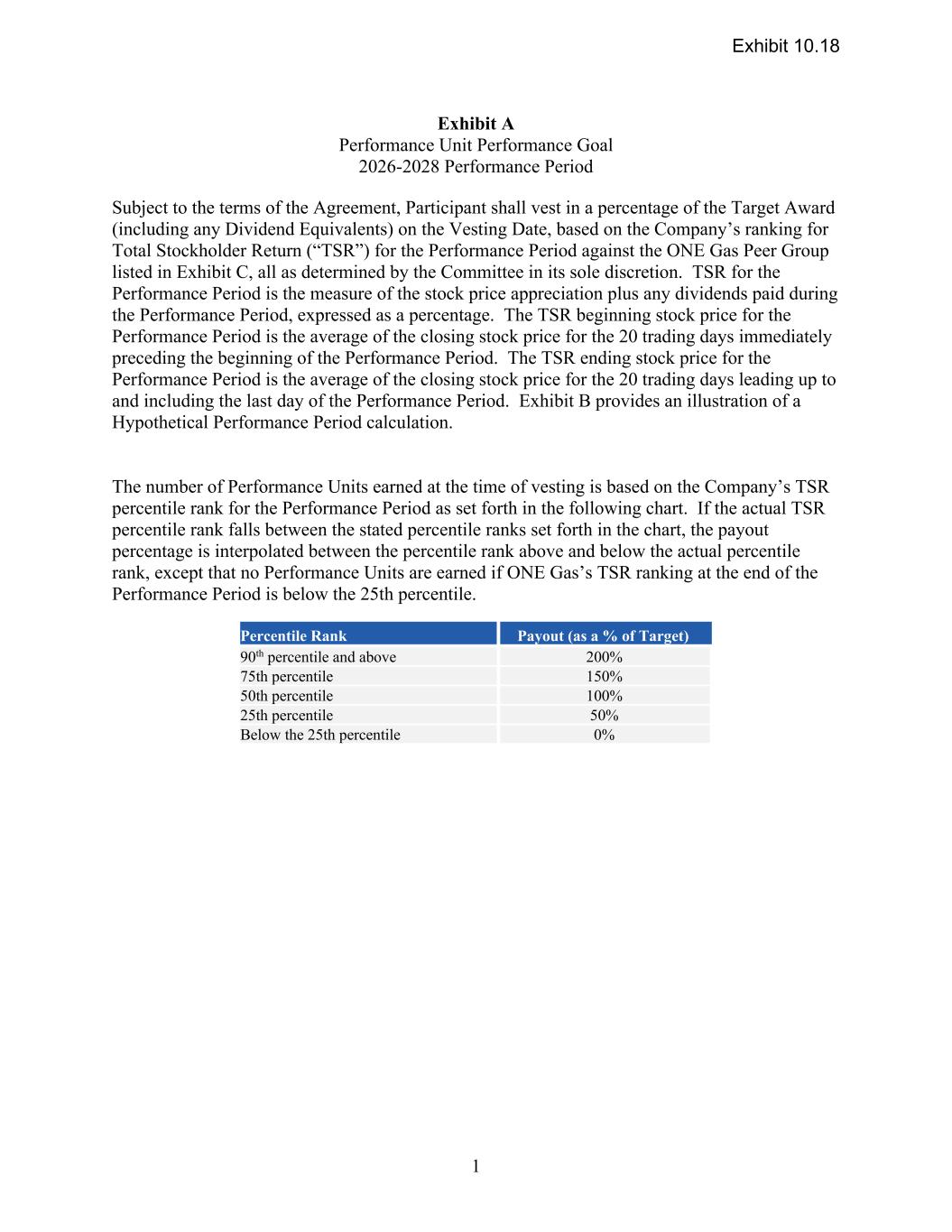
1 Exhibit A Performance Unit Performance Goal 2026-2028 Performance Period Subject to the terms of the Agreement, Participant shall vest in a percentage of the Target Award (including any Dividend Equivalents) on the Vesting Date, based on the Company’s ranking for Total Stockholder Return (“TSR”) for the Performance Period against the ONE Gas Peer Group listed in Exhibit C, all as determined by the Committee in its sole discretion. TSR for the Performance Period is the measure of the stock price appreciation plus any dividends paid during the Performance Period, expressed as a percentage. The TSR beginning stock price for the Performance Period is the average of the closing stock price for the 20 trading days immediately preceding the beginning of the Performance Period. The TSR ending stock price for the Performance Period is the average of the closing stock price for the 20 trading days leading up to and including the last day of the Performance Period. Exhibit B provides an illustration of a Hypothetical Performance Period calculation. The number of Performance Units earned at the time of vesting is based on the Company’s TSR percentile rank for the Performance Period as set forth in the following chart. If the actual TSR percentile rank falls between the stated percentile ranks set forth in the chart, the payout percentage is interpolated between the percentile rank above and below the actual percentile rank, except that no Performance Units are earned if ONE Gas’s TSR ranking at the end of the Performance Period is below the 25th percentile. Percentile Rank Payout (as a % of Target) 90th percentile and above 200% 75th percentile 150% 50th percentile 100% 25th percentile 50% Below the 25th percentile 0% Exhibit 10.18
2 Exhibit B Illustration of Hypothetical 2026-2028 Performance Period Performance Unit Award Calculation Illustration assumes 500 Performance Units Granted in February 2026 Total Stockholder Return (“TSR”) vs. ONE Gas Peer Group Hypothetical ONE Gas TSR Ranking = 40th percentile A 40th percentile TSR ranking earns 80% of Performance Units granted (i.e., 500 units) as interpolated between 50% and 100% from Exhibit A (see chart above) 400 Performance Units earned* Total Performance Units Earned 400 Performance Units 400* Performance Units earned out of 500 units granted = 80% “earn-out” [80% of 500 shares paid and distributed in the form of Shares] *In addition, applicable Dividend Equivalents will be added with an 80% “earn-out.” Exhibit 10.18
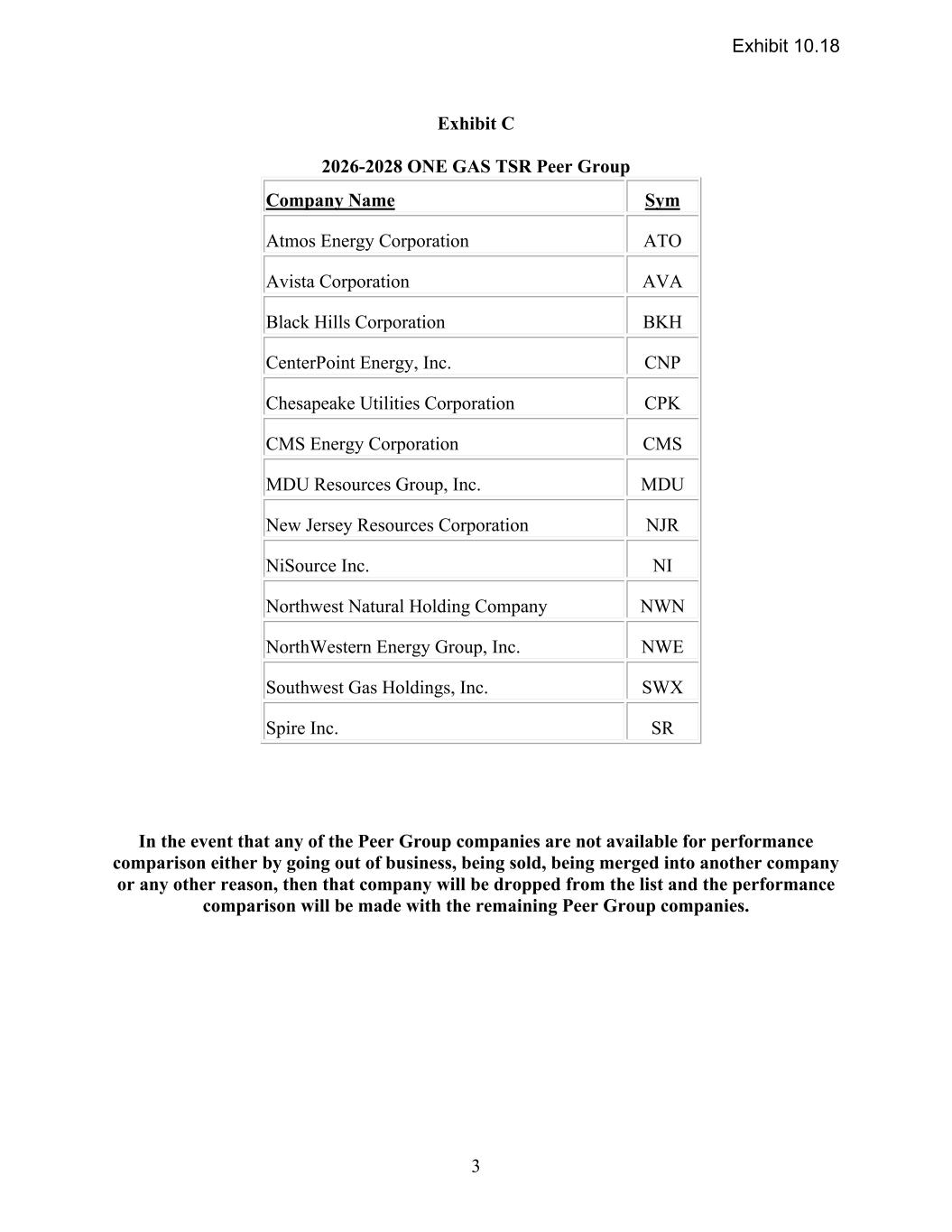
3 Exhibit C 2026-2028 ONE GAS TSR Peer Group Company Name Sym Atmos Energy Corporation ATO Avista Corporation AVA Black Hills Corporation BKH CenterPoint Energy, Inc. CNP Chesapeake Utilities Corporation CPK CMS Energy Corporation CMS MDU Resources Group, Inc. MDU New Jersey Resources Corporation NJR NiSource Inc. NI Northwest Natural Holding Company NWN NorthWestern Energy Group, Inc. NWE Southwest Gas Holdings, Inc. SWX Spire Inc. SR In the event that any of the Peer Group companies are not available for performance comparison either by going out of business, being sold, being merged into another company or any other reason, then that company will be dropped from the list and the performance comparison will be made with the remaining Peer Group companies. Exhibit 10.18
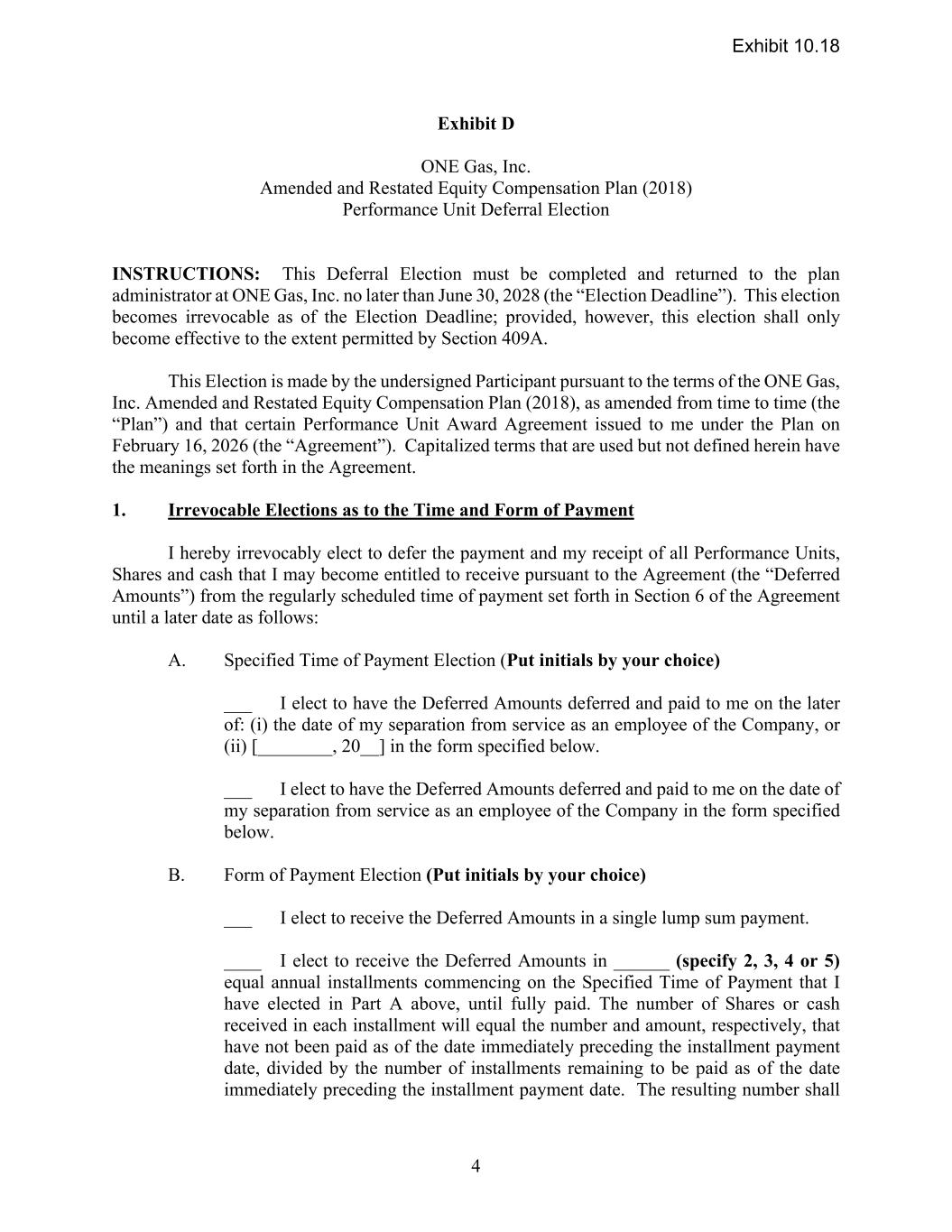
4 Exhibit D ONE Gas, Inc. Amended and Restated Equity Compensation Plan (2018) Performance Unit Deferral Election INSTRUCTIONS: This Deferral Election must be completed and returned to the plan administrator at ONE Gas, Inc. no later than June 30, 2028 (the “Election Deadline”). This election becomes irrevocable as of the Election Deadline; provided, however, this election shall only become effective to the extent permitted by Section 409A. This Election is made by the undersigned Participant pursuant to the terms of the ONE Gas, Inc. Amended and Restated Equity Compensation Plan (2018), as amended from time to time (the “Plan”) and that certain Performance Unit Award Agreement issued to me under the Plan on February 16, 2026 (the “Agreement”). Capitalized terms that are used but not defined herein have the meanings set forth in the Agreement. 1. Irrevocable Elections as to the Time and Form of Payment I hereby irrevocably elect to defer the payment and my receipt of all Performance Units, Shares and cash that I may become entitled to receive pursuant to the Agreement (the “Deferred Amounts”) from the regularly scheduled time of payment set forth in Section 6 of the Agreement until a later date as follows: A. Specified Time of Payment Election (Put initials by your choice) ___ I elect to have the Deferred Amounts deferred and paid to me on the later of: (i) the date of my separation from service as an employee of the Company, or (ii) [________, 20__] in the form specified below. ___ I elect to have the Deferred Amounts deferred and paid to me on the date of my separation from service as an employee of the Company in the form specified below. B. Form of Payment Election (Put initials by your choice) ___ I elect to receive the Deferred Amounts in a single lump sum payment. ____ I elect to receive the Deferred Amounts in ______ (specify 2, 3, 4 or 5) equal annual installments commencing on the Specified Time of Payment that I have elected in Part A above, until fully paid. The number of Shares or cash received in each installment will equal the number and amount, respectively, that have not been paid as of the date immediately preceding the installment payment date, divided by the number of installments remaining to be paid as of the date immediately preceding the installment payment date. The resulting number shall Exhibit 10.18
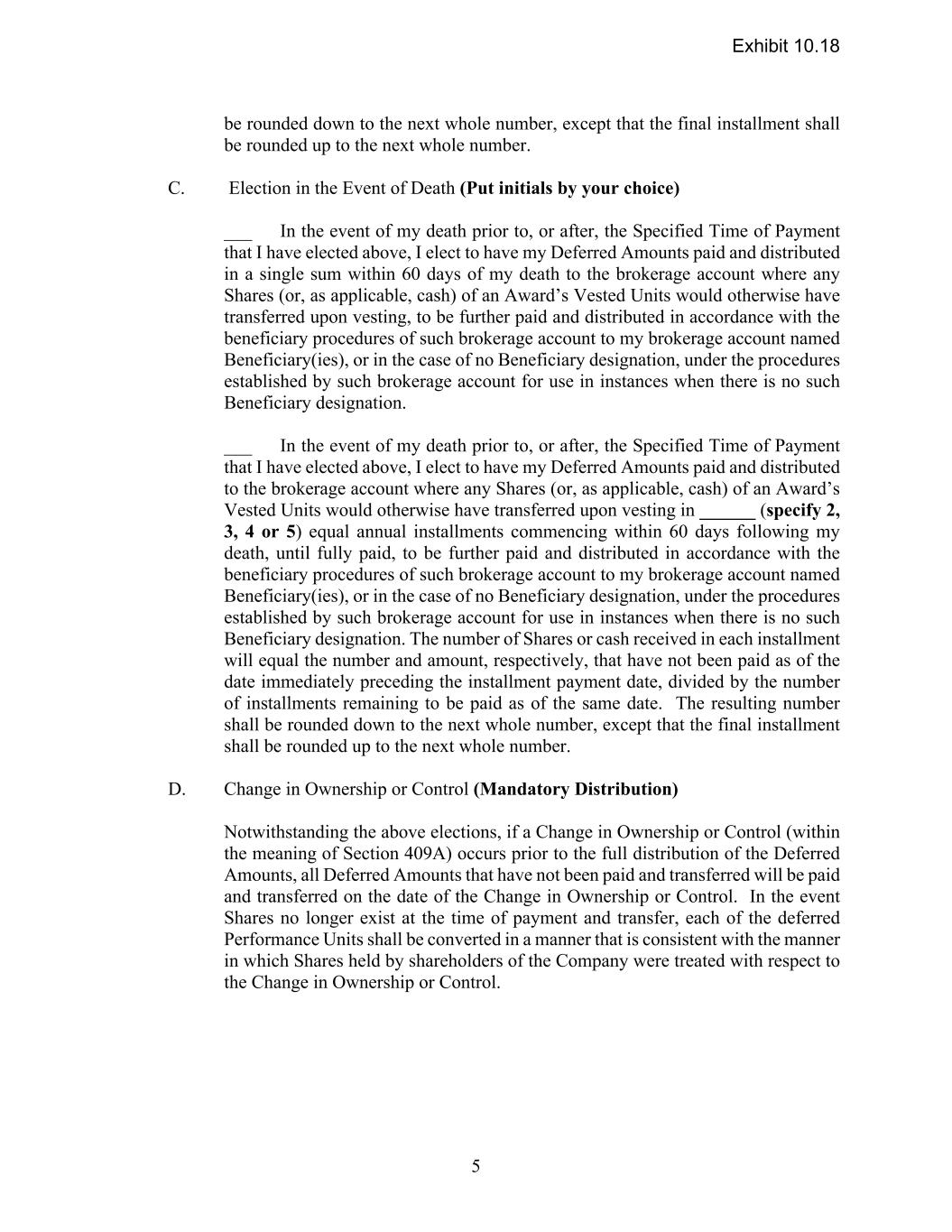
5 be rounded down to the next whole number, except that the final installment shall be rounded up to the next whole number. C. Election in the Event of Death (Put initials by your choice) ___ In the event of my death prior to, or after, the Specified Time of Payment that I have elected above, I elect to have my Deferred Amounts paid and distributed in a single sum within 60 days of my death to the brokerage account where any Shares (or, as applicable, cash) of an Award’s Vested Units would otherwise have transferred upon vesting, to be further paid and distributed in accordance with the beneficiary procedures of such brokerage account to my brokerage account named Beneficiary(ies), or in the case of no Beneficiary designation, under the procedures established by such brokerage account for use in instances when there is no such Beneficiary designation. ___ In the event of my death prior to, or after, the Specified Time of Payment that I have elected above, I elect to have my Deferred Amounts paid and distributed to the brokerage account where any Shares (or, as applicable, cash) of an Award’s Vested Units would otherwise have transferred upon vesting in ______ (specify 2, 3, 4 or 5) equal annual installments commencing within 60 days following my death, until fully paid, to be further paid and distributed in accordance with the beneficiary procedures of such brokerage account to my brokerage account named Beneficiary(ies), or in the case of no Beneficiary designation, under the procedures established by such brokerage account for use in instances when there is no such Beneficiary designation. The number of Shares or cash received in each installment will equal the number and amount, respectively, that have not been paid as of the date immediately preceding the installment payment date, divided by the number of installments remaining to be paid as of the same date. The resulting number shall be rounded down to the next whole number, except that the final installment shall be rounded up to the next whole number. D. Change in Ownership or Control (Mandatory Distribution) Notwithstanding the above elections, if a Change in Ownership or Control (within the meaning of Section 409A) occurs prior to the full distribution of the Deferred Amounts, all Deferred Amounts that have not been paid and transferred will be paid and transferred on the date of the Change in Ownership or Control. In the event Shares no longer exist at the time of payment and transfer, each of the deferred Performance Units shall be converted in a manner that is consistent with the manner in which Shares held by shareholders of the Company were treated with respect to the Change in Ownership or Control. Exhibit 10.18
6 2. Additional Terms A. Unforeseeable Emergency. You may request an accelerated payment of all or a portion of the Deferred Amounts if you experience an Unforeseeable Emergency (as defined in the Plan), subject to the requirements set forth in Plan Section 11.5. If approved, payment shall be made in a single lump sum within 90 days after the approval date. B. Specified Employee. If you become entitled to a distribution on account of a separation from service and you are “specified employee” (within the meaning of Section 409A) on the date of your separation from service, payment of all or a portion of your Deferred Amounts may be delayed in accordance with Plan Section 11.4. C. Re-deferrals and Changing the Form of Payment. You may, at the Committee’s discretion, be permitted to make a re-deferral election with respect to the amounts deferred hereunder in accordance with Plan Section 11.3. D. Withholding. You will be required to satisfy any tax withholding obligations relating to the Deferred Amounts, and delivery of the Shares or cash will be conditional upon your satisfaction of such obligations. 3. Acknowledgment By executing this Election, I acknowledge that: A. I have read the terms of the Plan, the Agreement and this Election and agree to all the terms and conditions. B. I understand that any amounts that I defer hereunder are unfunded and unsecured and subject to the claims of the Company’s creditors in the event of the Company’s insolvency. C. I understand that the Plan, the Agreement and this Election are intended to comply with Section 409A and that they will be interpreted accordingly. However, I understand that the Company will have no liability with respect to any failure to comply with Section 409A. D. I understand that this Election will become irrevocable as of the Election Deadline. E. I have consulted with my own legal, tax, and financial advisors regarding the legal, financial, and tax consequences of participating in the Plan and making this election. I hereby make this election as of this ___ day of ____, 20__. _____________________________________ Participant Signature _____________________________________ Print Participant’s Name Exhibit 10.18

7 _____________________________________ Employee ID Number Copy received this ____ day of ________, 20__, ______________________________________ For the Committee Exhibit 10.18
ONE GAS, INC. ANNUAL OFFICER INCENTIVE PLAN Amended and Restated Effective January 1, 2024 ARTICLE I PURPOSE 1.1 Purpose of the Plan. The ONE Gas, Inc. Annual Officer Incentive Plan (the “Plan”) is a performance-based annual bonus program. The purpose of the Plan is to provide cash-based incentive compensation to those officers who, in the opinion of ONE Gas, Inc. (the “Company”), contribute significantly to the growth and success of the Company; and to align the interests of those who hold positions of major responsibility in the Company with the interests of Company shareholders. ARTICLE II DEFINITIONS Unless context otherwise indicates, the following definitions shall be applicable: 2.1 “Award” shall mean a right granted to a Participant pursuant to Article IV of the Plan to receive a cash payment from the Company based upon achievement of Performance Goal(s) during the relevant Performance Period and subject to the Committee’s discretion pursuant to Section 6.2 of the Plan. 2.2 “Base Wages Earned” shall mean the Participant’s base salary earned for the Performance Period, before deductions for taxes or benefits and deferrals of compensation pursuant to any Company sponsored plans. Base Wages Earned does not include incentives, bonuses, benefits, or any other type of pay other than base salary. 2.3 “Board” shall mean the Board of Directors of the Company. 2.4 “Change of Control” shall mean the occurrence of any of the following: (a) An acquisition (other than directly from the Company) of any voting securities of the Company (the “Voting Securities”) by any “Person” (as the term person is used for purposes of Section 13(d) or 14(d) of the Exchange Act), immediately after which such Person has “Beneficial Ownership” (within the meaning of Rule 13d-3 promulgated under the Exchange Act) of twenty percent (20%) or more of the then outstanding Shares or the combined voting power of the Company’s then outstanding Voting Securities; provided, however, in determining whether a Change in Control has occurred pursuant to this Section 2.4(a), Shares or Voting Securities which are acquired in a “Non-Control Acquisition” (as hereinafter defined) shall not constitute an acquisition which would cause a Change in Control. A “Non-Control Acquisition” shall mean an acquisition by (i) an employee benefit plan (or a trust forming a part thereof) maintained by (A) the Company or (B) any company or other Person of which a majority of its voting power or its voting equity securities or equity interest is owned or controlled, directly or indirectly, by the Company (for purposes of this definition, a “Related Entity”), (ii) the Company or any Related Entity, or (iii) any Person in connection with a “Non-Control Transaction” (as hereinafter defined); (b) The individuals who, as of November 18, 2016, are members of the Board of Directors (the “Incumbent Board”), cease for any reason to constitute at least a majority of the members of the Board of Directors; or, following a Merger which results in a Parent Company, the board of directors of the ultimate Parent Company; provided, however, that if the election, or Exhibit 10.23
2 nomination for election by the Company’s common stockholders, of any new director was approved by a vote of at least two-thirds of the Incumbent Board, such new director shall, for purposes of this Plan, be considered as a member of the Incumbent Board; provided further, however, that no individual shall be considered a member of the Incumbent Board if such individual initially assumed office as a result of either an actual or threatened “Election Contest” (as described in Rule 14a-11 promulgated under the Exchange Act) or other actual or threatened solicitation of proxies or consents by or on behalf of a Person other than the Board of Directors (a “Proxy Contest”), including by reason of any agreement intended to avoid or settle any Election Contest or Proxy Contest; or (c) The consummation of: (1) A merger, consolidation or reorganization with or into the Company or in which securities of the Company are issued (a “Merger”), unless such Merger is a “Non-Control Transaction.” A “Non-Control Transaction” shall mean a Merger where: (A) the stockholders of the Company, immediately before such Merger, own directly or indirectly immediately following such Merger at least fifty percent (50%) of the combined voting power of the outstanding voting securities of (x) the company resulting from such Merger (the “Surviving Company”) if fifty percent (50%) or more of the combined voting power of the then outstanding voting securities of the Surviving Company is not Beneficially Owned, directly or indirectly by another Person (a “Parent Company”), or (y) if there is one or more Parent Companies, the ultimate Parent Company; (B) the individuals who were members of the Incumbent Board immediately prior to the execution of the agreement providing for such Merger constitute at least a majority of the members of the board of directors of (i) the Surviving Company, if there is no Parent Company, or (ii) if there is one or more Parent Companies, the ultimate Parent Company; and (C) no Person other than (1) the Company, (2) any Related Entity, (3) any employee benefit plan (or any trust forming a part thereof) that, immediately prior to such Merger was maintained by the Company or any Related Entity, or (4) any Person who, immediately prior to such Merger had Beneficial Ownership of thirty percent (30%) or more of the then outstanding Voting Securities or Shares, has Beneficial Ownership of thirty percent (30%) or more of the combined voting power of the outstanding voting securities or common stock of (i) the Surviving Company if there is no Parent Company, or (ii) if there is one or more Parent Companies, the ultimate Parent Company. (2) A complete liquidation or dissolution of the Company; or (3) The sale or other disposition of all or substantially all of the assets of the Company to any Person (other than a transfer to a Related Entity or under conditions that would constitute a Non-Control Transaction with the disposition of assets being regarded as a Merger for this purpose or the distribution to the Company’s stockholders of the stock of a Related Entity or any other assets). Notwithstanding the foregoing, a Change in Control shall not be deemed to occur solely because any Person (the “Subject Person”) acquired Beneficial Ownership of more than the permitted Exhibit 10.23
3 amount of the then outstanding Shares or Voting Securities if: (1) such acquisition occurs as a result of the acquisition of Shares or Voting Securities by the Company which, by reducing the number of Shares or Voting Securities then outstanding, increases the proportional number of shares Beneficially Owned by the Subject Person, provided that if a Change in Control would occur (but for the operation of this subparagraph) as a result of the acquisition of Shares or Voting Securities by the Company, and after such share acquisition by the Company, the Subject Person becomes the Beneficial Owner of any additional Shares or Voting Securities which increases the percentage of the then outstanding Shares or Voting Securities Beneficially Owned by the Subject Person, then a Change in Control shall occur, or (2) (A) within five business days after a Change in Control would have occurred (but for the operation of this subparagraph), or if the Subject Person acquired Beneficial Ownership of twenty percent (20%) or more of the then outstanding Shares or the combined voting power of the Company’s then outstanding Voting Securities inadvertently, then after the Subject Person discovers or is notified by the Company that such acquisition would have triggered a Change in Control (but for the operation of this subparagraph), the Subject Person notifies the Board of Directors that it did so inadvertently, and (B) within two business days after such notification, the Subject Person divests itself of a sufficient number of Shares or Voting Securities so that the Subject Person is the Beneficial Owner of less than twenty percent (20%) of the then outstanding Shares or the combined voting power of the Company’s then outstanding Voting Securities. Notwithstanding any provisions to the Plan to the contrary, with respect to an Award subject to Section 409A of the Code that provides for payment upon a Change in Control, then no Change in Control shall be deemed to have occurred upon an event described in this Section 2.4 unless the event would also constitute a “change in ownership” of the Company, a “change in effective control” of the Company, or a “change in ownership of a substantial portion of the Company’s assets” under Section 409A of the Code. 2.5 “Child(ren)” shall mean the Participant’s child(ren) including the Participant’s: (a) natural child(ren); (b) stepchild(ren); and (c) adopted child(ren) and child(ren) Placed for Adoption. 2.6 “Code” shall mean the Internal Revenue Code of 1986, as amended from time to time; references to particular sections of the Code include references to regulations and rulings thereunder and to successor provisions. 2.7 “Committee” shall mean the Executive Compensation Committee of the Board. 2.8 “Company” shall mean ONE Gas, Inc., its divisions and subsidiaries, or, any successor thereto by merger, consolidation, liquidation or other reorganization. 2.9 “Disability” shall mean a physical or mental infirmity which impairs the Participant's ability to perform substantially his or her duties for a period of one-hundred eighty (180) consecutive days. With respect to any Award that is subject to Section 409A of the Code that provides for payment due to a Participant’s Disability, the Committee may not find that a Disability exists with respect to such Participant unless, in the Committee’s opinion, such Participant is also “disabled” within the meaning of Code Section 409A. 2.10 “Domestic Partner” shall mean a person of the same or opposite sex with whom the Participant established a Domestic Partnership, and such Domestic Partnership was in place immediately prior to such Participant’s death. 2.11 “Domestic Partnership” shall mean a relationship between the Participant and one other person of the same or opposite sex to which all of the following requirements apply to both persons: (a) share a close and committed relationship and are not related to one another in a way that marriage would otherwise prohibit under the laws of the sate in which they reside; (b) are not legally married to, legally Exhibit 10.23
4 separated from, or the Domestic Partner of another individual under either statutory or common law; (c) are both at least eighteen (18) years old and mentally competent to enter into a contract according to state laws; (d) share the same regular, permanent residence and reside in the same household for at least the immediately preceding twelve (12) months; (e) are not in the relationship solely for the purpose of obtaining benefits; (f) are financially interdependent and are jointly responsible for each other’s common welfare and shared financial obligations; and (g) provide an Affidavit of Domestic Partnership and Certification of Tax Dependent Status. 2.12 “Employee” shall mean an active full-time employee of the Company, and shall exclude independent contractors, or leased or temporary employees. Employees included in other annual cash incentive plans (including but not limited to participants in the ONE Gas, Inc. Annual Employee Incentive Plan) shall not be considered as Employees for the purpose of this Plan. Except as otherwise specifically provided in this Plan, separated and retired employees shall not be considered as Employees for purposes of this Plan. 2.13 “Exchange Act” shall mean the Securities Exchange Act of 1934, as amended from time to time. 2.14 “GAAP” shall mean generally accepted accounting principles set forth in the opinions, statements and pronouncements of the Financial Accounting Standards Board (or predecessors or successors thereto or agencies with similar functions) or in such other statements by such other entity as may be in general use by significant segments of the accounting profession, which are applicable to the circumstances as of the date of determination and in any event applied in a manner consistent with the application thereof used in the preparation of the Company’s financial statements. 2.15 “Participant” shall mean an Employee of the Company who is eligible to participate in the Plan under the eligibility provisions of Article IV. 2.16 “Performance Goal” shall mean performance objectives established by the Committee for each Performance Period for the purpose of determining the extent to which a Participant will receive an Award for such Performance Period. Each Performance Goal selected for a particular Performance Period shall include any one or more of the following performance criteria, either individually or in any combination, applied to the Company as a whole, to a Subsidiary, to a business unit of the Company or any Subsidiary, to an affiliate of the Company or any Subsidiary or to any individual, measured either annually or cumulatively over a period of time, on an absolute basis or relative to an identified index or peer group, and, where applicable, may be measured on a pre-tax or post-tax basis, in the aggregate or on a per- share basis and on an absolute basis or as a percentage change over a period of time: (i) increased revenue; (ii) net income measures, including without limitation, income after capital costs, and income before or after taxes; (iii) stock price measures, including without limitation, growth measures and total stockholder return; (iv) market share; (v) earnings per share (actual or targeted growth); (vi) earnings before interest, taxes, depreciation, and amortization; Exhibit 10.23
5 (vii) economic value added; (viii) cash flow measures, including without limitation, net cash flow, and net cash flow before financing activities; (ix) return measures, including without limitation, return on equity, return on average assets, return on capital, risk adjusted return on capital, return on investors’ capital and return on average equity; (x) operating measures, including without limitation, operating income, funds from operations, cash from operations, after-tax operating income, sales volumes, production volumes, and production efficiency; (xi) expense measures, including but not limited to, finding and development costs, overhead costs, and general and administrative expense; (xii) margins; (xiii) shareholder value; (xiv) reserve addition; (xv) proceeds from dispositions; (xvi) total market value; and (xvii) corporate value criteria or standards including, without limitation, ethics, environmental and safety compliance. 2.17 “Performance Period” shall mean the period designated by the Committee and communicated to each Participant over which the attainment of the Performance Goal(s) will be measured for purposes of determining payment of an Award or, for an Employee who is first hired as an employee after the first day of such period and who becomes a Participant during such period, such portion of the period as determined by the Committee. 2.18 “Placed for Adoption” shall mean when an individual is lawfully placed with another individual for legal adoption. 2.19 “Plan” shall mean the ONE Gas, Inc. Annual Officer Incentive Plan. 2.20 “Retirement” shall mean a voluntary termination of employment of the Participant with the Company by the Participant if at the time of such termination of employment the Participant has completed both five (5) years of service with the Company and attained age fifty (50). For this purpose, “years of service” means the number of full years of service of a Participant, based on such Participant’s period of continuous employment with the Company. 2.21 “SEC Rule 16b-3” shall mean Rule 16b-3 of the Securities and Exchange Commission promulgated under the Exchange Act, as such rule or any successor rule may be in effect from time to time. 2.22 “Spouse” shall mean an individual to whom you are legally married. 2.23 “Subsidiary” shall mean any entity that is directly or indirectly controlled by the Company; as determined by the Committee. Exhibit 10.23
6 ARTICLE III PLAN ADMINISTRATION 3.1 The Committee. The Plan will be administered by a committee appointed by the Board consisting of two or more directors, each of whom is a “non-employee director” within the meaning of SEC Rule 16b-3(the “Committee”). The Committee may adopt rules and regulations for carrying out the Plan and may designate such other committee or committees, in its discretion, to administer the Plan with respect to Participants who are not subject to Section 16 of the Exchange Act. The interpretation and construction of any provision of the Plan by the Committee shall be final and conclusive. The Committee may consult with counsel, who may be counsel to the Company, and shall not incur any liability for any action taken in good faith in reliance upon the advice of counsel. In accordance with and subject to the provisions of the Plan, the Committee will have full authority and discretion with respect to Awards made under the Plan, including without limitation the following: (a) selecting the officers for participation in the Plan; (b) establishing the terms of each Award; (c) determining the time or times when Awards will be granted; and (d) establishing the restrictions and other conditions to which the payment of Awards may be subject. Each determination, interpretation, or other action made or taken by the Committee pursuant to the provisions of the Plan will be conclusive and binding for all purposes and on all persons. 3.2 Adjustments. The Committee may provide in any Award that any evaluation of performance may include or exclude the impact, if any, on reported financial results of any of the following events that occurs during a Performance Period: (a) asset write-downs, (b) litigation or claim judgments or settlements, (c) changes in tax laws, accounting principles or other laws or provisions, (d) reorganization or restructuring programs, (e) acquisitions or divestitures, (f) foreign exchange gains and losses or (g) gains and losses that are treated as unusual in nature or that occur infrequently under Accounting Standards Codification Topic 225. ARTICLE IV PARTICIPATION 4.1 Designation of Participants. The Participants for any Performance Period shall be those officers who are granted Awards by the Committee under the Plan for such Performance Period. On or before March 1 of each Performance Period, the Committee shall select the Participants and determine their Awards for that Performance Period. The Committee will notify or cause Participants to be notified of their eligibility to participate, and the terms thereof, in writing. 4.2 Partial Year Participation. If an Employee begins employment or is promoted to an eligible position after the beginning of a Performance Period, the Committee, in its discretion, may determine whether such Employee becomes a Participant in this Plan and if so, the terms of such participation, which will be based on the Participant’s Base Wages Earned in an incentive-eligible position during the applicable Performance Period, unless the Committee determines otherwise. 4.3 Demotions. If a Participant is demoted during the Performance Period, the Committee will determine whether participation in this Plan ends at that time, or is continued, potentially at a reduced level. ARTICLE V PERFORMANCE GOALS 5.1 General. Prior to the beginning of each Performance Period, or not later than ninety (90) days following the commencement of the relevant Performance Period (or, in the case of a Performance Period for a period of time of less than 12 months’ duration, no later than by the end of the first 25% of such period), the Committee shall establish and communicate in writing to each Participant the specific Performance Goals which must be achieved for each Participant to receive an Award payment for such Exhibit 10.23
7 Performance Period. For an Employee who is first hired as an employee and who becomes a Participant after the first day of the Performance Period, the Performance Goals and other criteria as set forth in this Article V shall be established by the Committee and communicated to the Participant upon their selection for participation in the Plan. 5.2 Establishment of Target Awards. The Committee will establish the percentage of each Participant’s Base Wages Earned that will be awarded to the Participant for a given Performance Period if the Performance Goals are achieved at the target level (the “Target Award”). Each Participant’s Target Award percentage will be communicated in writing to the Participant, and shall remain in effect for the Performance Period until any change thereto is communicated to the Participant in writing. The actual Award to a Participant may be greater or less than his or her Target Award, depending on the level of achievement of the Performance Goals and any other objective or subjective factors as the Committee shall deem relevant. ARTICLE VI PAYMENT OF AWARDS 6.1 Performance Period Payments. The Committee shall make a determination as soon as practicable after appropriate financial and other data respecting the Performance Goal(s) respecting the applicable Performance Period, or such portion of the applicable Performance Period as the Committee shall determine, whether the Performance Goal(s) have been achieved and the amount of the Award payment for each Participant. The Committee shall certify the foregoing determinations in writing. Payment of each Award in a cash lump sum, less applicable withholding taxes pursuant to Article IX of the Plan, shall be made as soon as practicable after certification by the Committee, provided, however, that any such payment shall be made no later than March 15 of the year immediately following the year in which the applicable Performance Period expires. 6.2 Discretionary Downward Adjustments. At any time after an Award has been granted but before the Award has been paid, the Committee, in its sole and absolute discretion, may reduce or eliminate the Award granted to any Participant for any reason or for no reason, including, without limitation, the Committee’s judgment that the Performance Goals have become an inappropriate measure of achievement, additional Performance Goals are necessary to measure achievement, change in the employment status, position or duties of the Participant, unsatisfactory performance of the Participant, or the Participant’s service for less than the entire Performance Period. ARTICLE VII TERMINATION OF EMPLOYMENT 7.1 Termination of Employment Due to Death, Disability, or Retirement. (a) Death, Disability, or Retirement. In the event a Participant’s employment with the Company and all Subsidiaries is terminated by reason of death, Disability, or Retirement prior to the payment date of an Award or during a Performance Period, the Participant (or for a deceased Participant, the Participant’s beneficiary (if any) as set forth in Section 7.1(b)) (subject to the Committee’s discretion as allowed by Sections 3.2 and 6.2 of the Plan) shall be entitled to a distribution of the Award on the payment date that would otherwise have been payable to the Participant pursuant to Article VI of the Plan after the completion of the Performance Period, based on the Participant’s Base Wages Earned in an incentive-eligible position during the applicable Performance Period, as determined by the Committee. In the event no Award is payable under Article VI upon completion of the Performance Period, no amount will be payable to a Participant (or to the deceased Participant’s beneficiary). Exhibit 10.23
8 (b) Beneficiary. To the extent any Award payment has been determined by the Committee to be payable for a deceased Participant, such Award payment shall (as applicable) be paid to the first of the following: (i) the designated beneficiary(ies) for such Participant’s basic life insurance benefit provided under the ONE Gas, Inc. Life Insurance Plan; (ii) the designated beneficiary(ies) for such Participant as provided under the ONE Gas, Inc. 401(k) Plan; provided that if no beneficiary has been designated by such Participant under the ONE Gas, Inc. 401(k) Plan, such Award shall not be paid to the Participant’s estate and shall be paid to the next applicable person(s) as set forth below in Section 7.1(b)(iii) or Section 7.1(b)(iv); (iii) the deceased Participant’s surviving Spouse or surviving Domestic Partner, as applicable; or (iv) the deceased Participant’s surviving Child(ren); provided however, that notwithstanding anything to the contrary herein, if Section 7.1(b)(i) through Section 7.1(b)(iv) is not applicable for a deceased Participant, the Participant’s Award (if any) shall be immediately forfeited, and no Award or amount shall be payable or due under this Plan with respect to such deceased Participant. 7.2 Termination for Reasons Other than Death, Disability, or Retirement. In the event a Participant’s employment is terminated with the Company and all Subsidiaries prior to the end of the Performance Period for any reason other than death, Disability, or Retirement, the Participant’s Award for such Performance Period shall be immediately forfeited and the Participant shall have no right to any payment thereafter; provided, however, that under such circumstances the Committee may, in its sole discretion, pay the Participant an amount not to exceed the amount earned according to the terms of the Award based on the Participant’s Base Wages Earned in an incentive-eligible position during the applicable Performance Period. In the event no Award is payable under Article VI upon completion of the Performance Period, no amount will be payable to a Participant. ARTICLE VIII CHANGE OF CONTROL If a Change of Control occurs, then notwithstanding any other provisions of the Plan, each outstanding Award shall be deemed to have achieved a level of performance equal to the actual performance level achieved as of the occurrence of such Change of Control as determined by the Committee. In determining whether a performance level is achieved in this circumstance, the Committee may make any adjustment in the Performance Goals by measuring such criteria over the period commencing on the first day of the Performance Period and ending on the date of the Change of Control, instead of over the entire Performance Period. In the event of a Change of Control, payment of an award shall be made as soon as practicable, but in no event later than 60 days following such Change of Control. ARTICLE IX PAYMENT OF WITHHOLDING TAXES All distributions under the Plan are subject to withholding of all applicable taxes. The Company may condition the delivery of benefits under the Plan on satisfaction of the applicable Exhibit 10.23
9 withholding obligations and is entitled to withhold and deduct from the payment made pursuant to an Award or from future wages of the Participant (or from other amounts that may be due and owing to the Participant from the Company), or make other arrangements for the collection of, all legally required amounts necessary to satisfy any and all federal, state, and local withholding and employment-related tax requirements attributable to any payment made pursuant to an Award. ARTICLE X AMENDMENT; MODIFICATION; TERMINATION The Committee or the Board may amend, suspend or terminate the Plan or any portion thereof at any time and for any reason in its sole discretion. Any amendment, suspension or termination of the Plan may adversely affect any outstanding Award without the consent of the affected Participant. Any payments pursuant to Awards outstanding upon termination of the Plan may continue to be made in accordance with the terms of the Awards, subject to the authority of the Committee pursuant to Articles III and IX of the Plan. ARTICLE XI NON-FUNDED, UNSECURED OBLIGATION Neither a Participant nor any other person shall, by reason of participation in the Plan, acquire any right in or title to any assets, funds or property of the Company whatsoever, including, without limitation, any specific funds, assets, or other property which the Company, in its sole discretion, may set aside in anticipation of a liability under the Plan. A Participant shall have only a contractual right to the cash, if any, payable under the Plan (subject to the authority of the Committee pursuant to Article III), unsecured by any assets of the Company, and nothing contained in the Plan shall constitute a guarantee that the assets of the Company shall be sufficient to pay any benefits to any person. To the extent that a Participant acquires a right to receive such a cash payment under the Plan, such right shall be no greater than the right of any unsecured, general creditor of the Company. No portion of any amount payable to Participants under the Plan shall be held by the Company in trust or escrow or any other form of asset segregation. ARTICLE XII EFFECTIVE DATE; DURATION OF THE PLAN The Plan was approved by the Board on November 18, 2016. The Plan became effective upon approval by the shareholders at the Company’s 2017 annual meeting of the shareholders on May 25, 2017. The Plan was subsequently amended and restated February 18, 2020 to be effective January 1, 2020 and is hereby subsequently amended and restated May 23, 2024 to be effective January 1, 2024. The Annual Officer Incentive Subplan adopted pursuant to this Plan was terminated effective January 1, 2020. The terms of the Plan as it existed on December 31, 2023 shall continue to apply to Awards granted prior to January 1, 2024. The terms of this amended and restated Plan shall apply to Awards granted on or after January 1, 2024. The Plan shall remain in effect until such time as the Plan is terminated as provided in Article X. ARTICLE XIII MISCELLANEOUS 13.1 Employment. The Plan does not constitute a contract of employment and nothing in the Plan will interfere with or limit in any way the right of the Company to terminate the employment or otherwise modify the terms and conditions of the employment of any Employee or Participant at any time, nor confer upon any Employee or Participant any right to continue in the employ of the Company. Exhibit 10.23
10 13.2 Restrictions or Transfer. Except as otherwise expressly permitted by the Plan, no right or interest of any Participant in an Award will be assignable or transferable, or subjected to any lien, during the lifetime of the Participant, either voluntarily or involuntarily, directly or indirectly, by operation of law or otherwise. 13.3 Governing Law. Except in connection with other matters of corporate governance and authority (all of which shall be governed by the laws of the Company’s jurisdiction of incorporation), the validity, construction, interpretation, administration, and effect of the Plan and any rules, regulations, and actions relating to the Plan will be governed by and construed exclusively in accordance with the internal, substantive laws of the State of Oklahoma, without regard to the conflict of law rules of the State of Oklahoma or any other jurisdiction. 13.4 Clawbacks. (a) Awards made pursuant to the Plan are subject to clawback and recovery pursuant to any and all of the Company’s applicable clawback and compensation recovery policy(ies) then in effect. To the extent required by applicable laws, rules, regulations, New York Stock Exchange (“NYSE”) rule, or Securities Exchange Commission (“SEC”) rule or requirements and any and all applicable Company clawback, repayment, and/or compensation recovery policy(ies) then in effect, the Company shall have the right, and shall take all actions necessary, to clawback and recover any amounts paid to any individual under this Plan. (b) In any event, even if the method of clawback, repayment, and/or reduction is not required or specified by applicable law, Company policies, NYSE rule, or SEC rule, in any situation where the Board or the Committee determines that fraud, negligence, or intentional misconduct by the Participant was a contributing factor to the Company having to restate all or a portion of its financial statement(s), the Committee may request clawback, repayment, and/or reduction of compensation. The Committee may determine whether the Company shall effect any such clawback, repayment, and/or reduction: (i) by seeking repayment from the Participant, (ii) by reducing (subject to applicable law and the terms and conditions of the Plan or any other applicable plan, program, or arrangement) the amount that would otherwise be awarded or payable to the Participant under the Award, the Plan or any other compensatory plan, program, or arrangement maintained by the Company, (iii) by withholding payment of future increases in compensation (including the payment of any discretionary bonus amount) or grants of compensatory awards that would otherwise have been made in accordance with the Company's otherwise applicable compensation practices, or (iv) by any combination of the foregoing. The determination regarding the Participant’s conduct, and clawback, repayment, and/or reduction under this provision shall be within the sole discretion of the Committee and shall be final and binding on the Participant and the Company. The Participant, in consideration of the grant of the Award, acknowledges the Participant's understanding and agreement to this provision, and hereby agrees to make and allow an immediate and complete repayment or reduction in accordance with this provision in the event of a call for clawback, repayment, and/or other action by the Company or Committee to effect its terms with respect to the Participant and the Award. 13.5 Code Section 409A. The Plan and all Awards granted hereunder are intended to comply with, or otherwise be exempt from, Code Section 409A. The Plan and all Awards shall be administered, interpreted, and construed in a manner consistent with Code Section 409A or an exemption therefrom. Should any provision of the Plan, any Award hereunder, or any other agreement or arrangement contemplated by the Plan be found not to comply with, or otherwise be exempt from, the provisions of the Code Section 409A, such provision shall be modified and given effect (retroactively if necessary), in the sole discretion of the Committee, and without the consent of the Participant, in such manner as Exhibit 10.23
11 the Committee determines to be necessary or appropriate to comply with, or to effectuate an exemption from, Code Section 409A. Without limiting the foregoing and notwithstanding anything contained herein to the contrary, to the extent required in order to avoid accelerated taxation or tax penalties under Section 409A, amounts that would otherwise be payable and benefits that would otherwise be provided pursuant to this Plan during the six-month period immediately following the Employee’s separation from service shall instead be paid on the first business day after the date that is six months following the Employee’s termination date (or death, if earlier), with interest from the date such amounts would otherwise have been paid at the short-term applicable federal rate, compounded semi-annually, as determined under Section 1274 of the Code, for the month in which payment would have been made but for the delay in payment required to avoid the imposition of an additional rate of tax on the Employee under Section 409A. Any payments to be made under this Plan upon a termination of employment shall only be made if such termination of employment constitutes a “separation from service” under Section 409A. Notwithstanding the foregoing, the Company makes no representations that the payments and benefits provided under this Plan comply with Section 409A and in no event shall the Company be liable for all or any portion of any taxes, penalties, interest or other expenses that may be incurred by the Employee on account of non-compliance with Section 409A. 13.6 Successors. The Plan will be binding upon and inure to the benefit of the successors of the Company and the Participants. Adopted by the Board of Directors May 23, 2024 to be effective January 1, 2024. Exhibit 10.23
ONE GAS, INC. AMENDED AND RESTATED EMPLOYEE STOCK PURCHASE PLAN 1. Establishment and Purpose The Board of Directors of the Company previously adopted this Plan for the purpose of providing eligible employees the opportunity to purchase Common Stock at a discount on terms prescribed by Section 423 of the Code. The Plan was previously amended and restated effective January 1, 2020 and subsequently again July 1, 2021. The Plan is hereby amended and restated effective September 1, 2023. 2. Definitions The following terms, when used in the Plan, shall have the following meanings: (a) Base Compensation means, with respect to any offering period: (i) in the case of an employee normally paid an hourly rate, the employee’s hourly rate at the inception of the offering period multiplied by 2,080, (ii) in the case of an employee normally paid at a weekly rate, the employee’s weekly rate at the inception of the offering period multiplied by 52, (iii) in the case of an employee normally paid at a bi-weekly rate, the employee’s bi-weekly rate at the inception of the offering period multiplied by 26, (iv) in the case of an employee normally paid at a monthly rate, the employee’s monthly rate at the inception of the offering period multiplied by 12; and (v) in the case of an employee normally paid at an annual rate, the employee’s annual rate at the inception of the offering period. Base compensation shall be determined by reference to the applicable rate before any deductions pursuant to a salary reduction agreement under any plan qualified under Section 401(k) of the Code or any cafeteria plan under Code Section 125 and shall exclude any bonuses, commissions, overtime pay, fringe benefits, stock options and other special compensation payable to an employee. (b) Board or Board of Directors means the Board of Directors of the Company, as constituted from time to time. (c) Code means the Internal Revenue Code of 1986, as amended from time to time. References to the Code or to a particular section of the Code shall include references to any related Treasury Regulations and rulings and to successor provisions. (d) Committee means the committee appointed by the Board of Directors to administer the Plan pursuant to the provisions of Section 3(a) below. (e) Common Stock means common stock, par value $0.01, of the Company. (f) Company means ONE Gas, Inc., an Oklahoma corporation, its successors and assigns. Exhibit 10.29
2 (g) Exchange Act means the Securities Exchange Act of 1934, as amended from time to time. (h) Fair Market Value on a particular date means the average of the high and low sale prices of the Common Stock in consolidated trading on the date in question as reported by The Wall Street Journal or another reputable source designated by the Committee; provided that if there were no sales on such date reported as provided above, the respective prices on the most recent prior day for which a sale was so reported. If the foregoing method of determining fair market value should be inconsistent with Section 423 of the Code, “Fair Market Value” shall be determined by the Committee in a manner consistent with such section of the Code and shall mean the value as so determined. (i) General Counsel means the General Counsel of the Company serving from time to time. (j) Plan means this ONE Gas, Inc. Employee Stock Purchase Plan set forth in these pages, as amended from time to time. (k) SEC Rule 16b-3 means Rule 16b-3 of the Securities and Exchange Commission promulgated under the Exchange Act, as such rule or any successor rule may be in effect from time to time. (l) Section 16 Person means a person subject to Section 16(b) of the Exchange Act with respect to transactions involving equity securities of the Company. (m) Subsidiary means a subsidiary as defined in Section 424(f) of the Code, including a corporation which becomes such a subsidiary in the future. 3. Administration (a) The Plan shall be administered by a committee of the Board consisting of two or more directors appointed from time to time by the Board. No person shall be appointed to or shall serve as a member of such committee unless at the time of such appointment and service he or she shall be a Non-Employee Director, as defined in SEC Rule 16b- 3. The Committee may delegate discretionary authority for day-to-day administration of the Plan to other entities or persons, including the Company and its employees, pursuant to a duly adopted resolution or a memorandum of action signed by all members of the Committee or approved via electronic transmission. All actions taken by any such delegate shall have the same legal effect and shall be entitled to the same deference as if taken by the Committee itself. (b) Subject to the provisions of the Plan, the powers of the Committee shall include having the authority, in its discretion, to: (i) define, prescribe, amend and rescind rules, regulations, procedures, terms and conditions relating to the Plan; Exhibit 10.29
3 (ii) make all other determinations necessary or advisable for the administration of the Plan, including but not limited to interpreting the Plan, correcting defects, reconciling inconsistencies, and resolving ambiguities; and (iii) approve any transaction involving a grant, award or other transaction from the Company to a Section 16 Person (other than a Discretionary Transaction, as defined in SEC Rule 16b-3), so as to exempt such transaction under SEC Rule 16b-3; provided, that any transaction under the Plan involving a Section 16 Person also may be approved by the Board of Directors, or may be approved or ratified by the stockholders of the Company, in the manner that exempts such transaction under SEC Rule 16b-3. (c) The interpretation by the Committee of the terms and provisions of the Plan, and its administration of the Plan, and all action taken by the Committee, shall be final, binding and conclusive on the Company, its stockholders, Subsidiaries, all participants and employees, and upon their respective successors and assigns, and upon all other persons claiming under or through any of them. (d) Members of the Board and members of the Committee acting under this Plan shall be fully protected in relying in good faith upon the advice of counsel and shall incur no liability except for gross or willful misconduct in the performance of their duties. 4. Stock Subject to the Plan (a) Subject to paragraph (c) below, the aggregate number of shares of Common Stock which may be sold under the Plan is 1,250,000. (b) If the number of shares of Common Stock that participating employees become entitled to purchase is greater than the number of shares of Common Stock that are offered in a particular offering or that remain available under the Plan, the available shares of Common Stock shall be allocated by the Committee among such participating employees in such manner as it deems fair and equitable. (c) In the event of any change in the Common Stock, through recapitalization, merger, consolidation, stock dividend or split, combination or exchange of shares, spinoff or otherwise, the Committee may make such equitable adjustments in the Plan and the then outstanding offerings as it deems necessary and appropriate including, but not limited to, changing the number of shares of Common Stock reserved under the Plan, and the price of the current offering; provided that any such adjustments shall be consistent with Sections 423 and 424 of the Code. (d) Shares of Common Stock which are to be delivered under the Plan may be obtained by the Company from its treasury, by purchases on the open market or from private sources, or by issuing authorized but unissued shares of its Common Stock. Shares of authorized but unissued Common Stock may not be delivered under the Plan if the purchase price thereof is less than the par value (if any) of the Common Stock at the time. The Committee may (but need not) provide at any time or from time to time (including without limitation upon or in contemplation of a change in control) for a Exhibit 10.29
4 number of shares of Common Stock equal in number to the number of shares then subject to options under this Plan, or expected to be subject to options under this Plan in the then pending offering(s), to be issued or transferred to, or acquired by, a trust (including but not limited to a grantor trust) for the purpose of satisfying the Company’s obligations under such options, and, unless prohibited by applicable law, such shares held in trust shall be considered authorized and issued shares with full dividend and voting rights, notwithstanding that the options to which such shares relate might not be exercisable at the time. No fractional shares of Common Stock shall be issued for delivery under the Plan. 5. Eligibility All employees of the Company and any Subsidiaries designated by the Committee from time to time will be eligible to participate in the Plan, in accordance with and subject to such rules and regulations as the Committee may prescribe; provided, however, that (a) such rules shall neither permit nor deny participation in the Plan contrary to the requirements of the Code (including but not limited to Section 423(b)(4)), (b) no employee shall be eligible to participate in the Plan if his or her customary employment is 20 hours or less per week or for not more than 5 months in any calendar year, unless the Committee determines otherwise on a uniform and non-discriminatory basis, (c) no employee may be granted an option under the Plan if such employee, immediately after the option is granted, owns stock possessing 5% or more of the total combined voting power or value of all classes of stock of his or her employer corporation or any parent or Subsidiary corporation (within the meaning of Section 423(b)(3) of the Code), and (d) all participating employees shall have the same rights and privileges except as otherwise permitted by Section 423(b)(5) of the Code. For purposes of the preceding sentence, the rules of Section 424(d) of the Code shall apply in determining the stock ownership of an employee, and stock which the employee may purchase under outstanding options (whether or not such options qualify for the special tax treatment afforded by Code Section 421(a)) shall be treated as stock owned by the employee. 6. Offerings; Participation. The Company may make offerings of up to 27 months’ duration each, to eligible employees to purchase Common Stock under the Plan, until all shares authorized to be delivered under the Plan have been exhausted or until the Plan is sooner terminated by the Board. Subject to the preceding sentence, the duration and commencement date of any offerings shall be determined by the Committee in its sole discretion; provided that, unless the Committee determines otherwise, a new offering shall commence on the first day of the Company’s first payroll period coinciding with or next following each January 1 and July 1 and shall extend through and include the payroll period immediately preceding the payroll period in which the next offering commences. Subject to such rules, procedures and forms as the Committee may prescribe, an eligible employee may participate in an offering at such time(s) as the Committee may permit by authorizing a payroll deduction for such purpose of at least 1 percent and up to a maximum of 10 percent of his or her Base Compensation earned during each payroll period in the offering period. An eligible employee may not make any separate contributions or payments to the Plan. Payroll deduction elections must be made during a Committee designated enrollment period before the start of the offering period. Eligible employees must make an affirmative payroll deduction election with respect to an offering period commencing on or after July 1, 2021, to participate in the Plan on or after July Exhibit 10.29
5 1, 2021. An eligible employee's payroll deduction election will remain in effect for successive offering periods unless the eligible employee (a) modifies their election by submitting a new election during a designated enrollment period, (b) withdraws from participation in the Plan in accordance with Section 7, or (c) has a termination of employment or otherwise becomes ineligible to participate in the Plan. The Committee may at any time suspend or accelerate the completion of an offering if required by law or deemed by the Committee to be in the best interests of the Company, including in the event of a change in ownership or control of the Company or any Subsidiary. The Company’s obligation to sell and deliver Common Stock under this Plan shall be subject to the approval of any governmental authority whose approval the General Counsel determines is necessary or advisable to obtain in connection with the authorization, issuance, or sale of such Common Stock. 7. Payroll Deductions (a) The Company will maintain payroll deduction accounts on its books for all participating employees. All employee contributions shall be credited to such accounts. Employee contributions credited to the payroll deduction accounts of participating employees need not be segregated from other corporate funds and may be used for any corporate purpose. (b) At such times as the Committee may permit and subject to such rules, procedures and forms as the Committee may prescribe, an employee may withdraw from participation in a particular offering period and the balance of his or her payroll deduction account for that offering period shall be refunded to the participant. Any such withdrawal shall be irrevocable with respect to such offering period. If a participant elects to withdrawal from a particular offering period, the participant may elect, in accordance with the terms of the Plan, to participate in any subsequent offering period for which the participant is eligible. (c) Any payroll deductions not applied to the purchase of shares of Common Stock by reason of the limitations in the Plan on the maximum number of shares that may be purchased shall be promptly refunded. To the extent permitted by the Committee’s rules and procedures, a participant may purchase fractional shares of Common Stock under the Plan during an offering period. To the extent applicable, in accordance with rules and procedures as the Committee may prescribe, any balance in an employee’s payroll deduction account at the end of an offering period not applied to the purchase of shares of Common Stock, will be carried forward into the employee’s payroll deduction account for the following offering period either in the form of partial shares of Common Stock or cash. In no event will the balance carried forward be equal to or greater than the purchase price of one share of Common Stock as determined under Section 8(c) below. Upon termination of the Plan, all amounts in the accounts of participating employees shall be carried forward into their payroll deduction accounts under a successor plan, if any, or refunded to them, as the Committee may decide. (d) Unless otherwise determined by the Committee, in the event a participating employee terminates employment for any reason or otherwise ceases to be eligible to participate in the Plan, his or her participation in any offering under the Plan shall cease, no Exhibit 10.29
6 further amounts shall be deducted pursuant to the Plan and the balance in the employee’s payroll deduction account shall be paid to the employee, or, in the event of the employee’s death, to the employee’s beneficiary under the Company’s basic group life insurance program. (e) No interest shall accrue on an employee’s payroll deductions unless otherwise required by applicable law. In addition, no interest shall be paid on any monies distributed under this Plan. 8. Purchase; Limitations (a) Within the limitations of Section 8(d) below, each employee participating in any offering under the Plan will be granted an option, upon the effective date of such offering, for as many shares, or if required by the Committee, full shares, of Common Stock as the amount of his or her payroll deduction account (including any contributions made by means other than payroll deductions in a prior offering period that remain in cash, if any, in the employee’s payroll deduction account pursuant to Section 7(c) above) at the end of the offering can purchase. (b) As of the last day of the offering period, the payroll deduction account of each participating employee shall be totaled. Subject to the provisions of Section 7(b) above and 8(d) below, the employee shall be deemed to have exercised an option to purchase the largest number of shares, or if required by the Committee, full shares of Common Stock at the price determined under Section 8(c) below that his or her payroll deduction account will permit; such employee’s account will be charged for the amount of the purchase and for all purposes under the Plan the employee will be deemed to have acquired the shares on that date; and either a stock certificate representing such shares will be issued to him or her, or the Company’s registrar will make an entry on its books and records evidencing that such shares have been duly issued or transferred as of that date, as the Committee may direct. (c) Unless the Committee determines before the effective date of an offering that a higher price that complies with Section 423 of the Code shall apply, the purchase price of the shares of Common Stock which are to be sold under the offering shall be the lesser of (i) an amount equal to 85 percent of the Fair Market Value of the Common Stock at the time such option is granted, or (ii) an amount equal to 85 percent of the Fair Market Value of the Common Stock at the time such option is exercised. (d) In addition to any other limitations set forth in the Plan, (i) no employee may purchase in any offering period more than the number of shares of Common Stock determined by dividing the employee’s annual Base Compensation as of the first day of the offering period, or $25,000, whichever is less, by the Fair Market Value of a share of Common Stock at such day, and (ii) no employee may be granted an option under the Plan which permits his or her rights to purchase stock under the Plan, and any other stock purchase plan of his or her employer corporation and its parent and subsidiary corporations that is qualified under Section 423 of the Code, to accrue at a rate which exceeds $25,000 of the Fair Market Value of such stock (determined at the time such option is granted) for each calendar year in which the option is Exhibit 10.29
7 outstanding at any time. The Committee may further limit the amount of Common Stock which may be purchased by any employee during an offering period in accordance with Section 423(b)(5) of the Code. 9. Holding Period and Transfer Restrictions (a) No option, right or benefit under the Plan (including any derivative security within the meaning of paragraph (a)(2) of SEC Rule 16b-3) may be transferred by a participating employee, whether by will, the laws of descent and distribution, or otherwise, and all options, rights and benefits under the Plan may be exercised during the participating employee’s lifetime only by such employee. (b) Shares of Common Stock acquired under the Plan from an offering period commencing on or after July 1, 2021 may not be sold, assigned, pledged or otherwise transferred (except in the event of a participant’s death) until the six (6) month anniversary of the date the shares were acquired by the participant. (c) The Company (or its delegate) will select the stock brokerage(s) or other financial services firm(s) (the “Designated Broker”) who will establish an account on behalf of each participant to hold shares of Common Stock acquired under the Plan. Shares of Common Stock acquired under the Plan from an offering period commencing on or after July 1, 2021 must remain in the participant’s account with the Designated Broker for a period of eighteen (18) months after the date the shares were acquired by the participant unless the shares are disposed of by the participant in a manner that complies with Section 9(b) above or due to the participant’s death. (d) The Committee will establish procedures and restrictions necessary to ensure compliance with the holding period and broker transfer restrictions. 10. Duration of Plan The Plan shall remain in effect until all shares authorized to be issued or transferred hereunder have been exhausted or until the Plan is sooner terminated by the Board of Directors, and may continue in effect thereafter with respect to any options outstanding at the time of such termination if the Board of Directors so provides. 11. Amendment and Termination of the Plan The Plan may be amended by the Board of Directors, without shareholder approval, at any time and in any respect, unless shareholder approval of the amendment in question is required under Oklahoma law, the Code (including without limitation Code Section 423 and Treasury Regulation Section 1.423-2(c)(4) thereunder), any exemption from Section 16 of the Exchange Act (including without limitation SEC Rule 16b-3) for which the Company intends Section 16 Persons to qualify, any national securities exchange or system on which the Common Stock is then listed or reported, by any regulatory body having jurisdiction with respect to the Plan, or under any other applicable laws, rules or regulations. The Plan provisions that determine the amount, price and timing of option grants to Section 16 Persons may not be amended more than once every six months, other than to comport with changes in the Code, or the rules thereunder, unless the General Counsel determines that such restriction on amendments is not necessary to secure or Exhibit 10.29
8 maintain any exemption from Section 16 of the Exchange Act for which the Company intends Section 16 Persons to qualify. The Plan may also be terminated at any time by the Board of Directors. 12. General Provisions (a) Nothing contained in this Plan shall be deemed to confer upon any person any right to continue as an employee of or to be associated in any other way with the Company for any period of time or at any particular rate of compensation. (b) At the time an option is exercised, or at the time some or all of the Common Stock that is issued under the Plan is disposed of, the Company may withhold from any amount payable to an eligible employee, or require such employee to remit to the Company (or make other arrangements satisfactory to the Company, in its discretion, regarding payment to the Company of), any amount necessary for the Company to satisfy any federal, state or local taxes required by law to be withheld. Whenever payments are to be made in cash under the Plan, such payments shall be made net of an amount sufficient to satisfy any federal, state, local tax or withholding obligations with respect to such payments. (c) No person shall have any rights as a stockholder of the Company with respect to any shares optioned under the Plan until such shares are issued or transferred to him or her. (d) The Committee’s rules and procedures may permit or restrict participants from selling, assigning, transferring, or pledging any fractional shares of Common Stock that participants acquire under the Plan. (e) All expenses of adopting and administering the Plan shall be borne by the Company, and none of such expenses shall be charged to any participant. (f) The laws of the State of Oklahoma shall govern all matters relating to the Plan except to the extent such law is superseded by the laws of the United States. (g) The Plan and each offering under the Plan is intended to qualify as an employee stock purchase plan within the meaning of Section 423 of the Code. Transactions under the Plan by or with respect to Section 16 Persons are also intended to qualify for exemption under SEC Rule 16b-3, unless the Committee specifically determines otherwise. Every provision of the Plan shall be administered, interpreted and construed to carry out those intentions, and any provision that cannot be so administered, interpreted and construed shall to that extent be disregarded. Any provision required for compliance with Section 423 of the Code that is omitted from this Plan shall be incorporated herein by reference and shall apply retroactively, if necessary, and be deemed a part of this Plan to the same extent as though expressly set forth herein. Exhibit 10.29
ONE Gas Securities/Insider Trading Policy Purpose Our employees have a reputation for integrity and high standards for ethical conduct. In order to protect and preserve that reputation, ONE Gas, Inc., its divisions and subsidiaries (collectively, “ONE Gas”) has adopted this Securities/Insider Trading Policy (“Policy”) to ensure compliance with the law and avoid even the appearance of improper conduct with respect to trading in ONE Gas Securities (defined below) on the basis of material, nonpublic information or the illegal tipping of such information to others for their use in the trading of any such securities. Statement of Policy It is the policy of ONE Gas that any director, officer or employee of ONE Gas who is aware of any material, nonpublic information about ONE Gas, regardless of how that information was obtained, shall not: i. purchase or sell any ONE Gas Securities; ii. disclose such information to other persons (including family members) except on a need-to-know basis; iii. permit any member of his or her immediate family, or anyone acting on his or her behalf, or any third party to whom he or she disclosed this information, to purchase or sell ONE Gas Securities; or iv. engage in any other action to take advantage of such information. It is also the policy of ONE Gas to comply with applicable securities laws concerning trading in ONE Gas securities on ONE Gas’ behalf. Administration and Application This Policy will be administered by the ONE Gas Compliance Officers (the General Counsel and the Secretary and Associate General Counsel). This Policy is applicable to the Board of Directors and all officers and employees of ONE Gas. The sections of this Policy entitled “Pre-Clearance of Trades,” “Trading Windows/Blackout Periods,” and “Hedging and Pledging Prohibition” apply only to ONE Gas Insiders (defined below). As a matter of policy, all other employees are not subject to the trading restrictions set forth in those sections. ONE Gas Insiders Defined “ONE Gas Insiders” means members of the ONE Gas Board of Directors, officers of ONE Gas, and those employees of ONE Gas who are part of a workgroup designated from time to time by the chief executive officer (“Designated Workgroups”). Employees in Designated Workgroups generally have access to material, nonpublic information in the normal course of completing their job responsibilities. Transactions by Related Persons and Entities The restrictions regarding buying or selling ONE Gas Securities or engaging in any other action to take advantage of, or pass on to others, material, nonpublic information also apply to all family members and others living in a director, officer or employee’s household. These restrictions also apply to entities that a director, officer or employee influences or controls, including any corporations, partnerships or trusts. Directors, officers and employees are expected to be responsible for the compliance of their immediate family, personal household and entities they control or influence. Exhibit 19.1
ONE Gas Securities/Insider Trading Policy 2 Background Directors, officers and employees of ONE Gas are prohibited by law from buying or selling ONE Gas Securities or any other company’s securities while in possession of material, nonpublic information with respect to those securities or companies. Directors, officers and employees of ONE Gas may become aware of material, nonpublic information concerning ONE Gas or an entity that has “significant relations” with ONE Gas, including customers, suppliers, vendors and others with whom ONE Gas has a contractual relationship or with whom ONE Gas is negotiating a transaction. This information may affect the market price of ONE Gas Securities or of the securities of the other entities concerned. Substantial criminal and civil penalties may be imposed on persons who participate in illegal insider trading activities. “Insider trading” occurs when a person improperly trades securities on the basis of material, nonpublic information used in breach of a duty owed by that person. The federal securities laws also prohibit persons in possession of material, nonpublic information from providing (or “tipping”) that information to any person who might trade or might advise another person to trade in the relevant securities on the basis of that information. Tipping is a violation of this Policy, regardless of whether the person or entity who receives the information (the “tippee”) is related to you and regardless of whether you receive any monetary benefit from the tippee. Information is “material” if its disclosure to the public would affect a reasonable investor’s decision to purchase or sell the securities or would likely affect the market price of a company’s securities.1 Information may be “material” even if it relates to future, speculative or contingent events and even if it is significant only when considered in combination with publicly available information. Information is “nonpublic” if it is not generally available to the ordinary investor in the marketplace. Information is not necessarily public merely because it has been discussed in the press or on social media, which will sometimes report rumors. Information should be presumed nonpublic until ONE Gas officially releases that information either in a publicly available filing with the United States Securities and Exchange Commission (“SEC”) or a press release via major newswire such as PR Newswire, Dow Jones or Reuters. You may not attempt to “beat the market” by trading simultaneously with, or shortly after, the official release of material information. Out of prudence, a person in possession of material, nonpublic information should refrain from any trading activity for two full trading days following the official release of such information by ONE Gas. In short, any information which is not available to the ordinary investor which could reasonably affect the price of securities may be material, nonpublic information. If any employee or insider has any doubt as to whether information in his or her possession is material or nonpublic, he or she must not disclose that information or trade in ONE Gas Securities without first discussing the situation with one of the ONE Gas Compliance Officers. Remember, if an employee or insider’s securities transactions become the subject of scrutiny, they will be reviewed after-the-fact with the benefit of hindsight. As a result, before engaging in any transaction, each employee or insider should carefully consider how the SEC and other law enforcement agencies might later view the transaction. 1 Information concerning a company’s sales; earnings; business potential; changes in a company’s management, board of directors, or certified accountants; dividends; significant acquisitions, dispositions or mergers; significant cybersecurity incidents; and major litigation are some typical examples of “material” information. Exhibit 19.1
ONE Gas Securities/Insider Trading Policy 3 Throughout this Policy, the term “securities” is used. The term “securities” includes common stock, preferred stock and debt, as well as “derivatives,” such as options, stock appreciation rights, exchange traded options, puts and calls and any other securities that relate to or derive their value from such stock or debt. Throughout this Policy any securities issued by ONE Gas, as well as related derivative securities, whether or not issued by ONE Gas, are referred to as “ONE Gas Securities.” Explanation of the Law Potential Consequences to an Employee Under federal law, an individual found to be a trader on inside information, or a tipper of such information, may be subject to criminal fines of up to $5,000,000 and a jail term of up to 20 years, as well as civil penalties of up to three times the profit gained or loss avoided by the trading. The government vigorously enforces insider trading laws against individuals and companies and, in recent years, has obtained a number of highly publicized criminal convictions. In addition to the potential civil and criminal penalties described above, each director, officer and employee of ONE Gas should be aware that any actions in violation of this Policy may be grounds for appropriate disciplinary action, including dismissal. Potential Consequences to an Employer Under federal law, ONE Gas, as the employer of a person who trades securities on the basis of inside information, or tips such information to others, could be subject to substantial civil and/or criminal penalties should it fail to take appropriate steps if it knew or recklessly disregarded the fact that an employee was likely to engage in insider trading. Pre-Clearance of Trades In order for ONE Gas to have reasonable assurance of compliance with this Policy, all ONE Gas Insiders desiring to engage in any transaction involving ONE Gas Securities must first receive written permission in accordance with the approvals as set forth on the ONE Gas Investment Inquiry and Approval Form. To request pre-clearance, a ONE Gas Insider must complete an Investment Inquiry and Approval Form and send it to one of the ONE Gas Compliance Officers. Please note that purchases or sales must be completed within five business days following the date of approval or the ONE Gas Insider must apply for, and receive, another pre-clearance. If a request for pre-clearance is denied, the fact of such denial must be kept confidential. In addition, any written trading plan pursuant to SEC Rule 10b5-1 adopted by a ONE Gas Insider must be approved in writing in advance by a ONE Gas Compliance Officer and the Chief Executive Officer. A Rule 10b5-1 Plan (defined below) may not be adopted by a ONE Gas Insider during a blackout period and may only be adopted when the ONE Gas Insider adopting the plan is not aware of material, nonpublic information. This pre-clearance procedure is intended to protect ONE Gas Insiders from any trade that might create the appearance of impropriety. Exhibit 19.1
ONE Gas Securities/Insider Trading Policy 4 10b5-1 Trading Plans SEC Rule 10b5-1 provides an affirmative defense against insider trading liability under Rule 10b-5. Persons subject to this Policy can rely on this defense and trade in ONE Gas Securities, regardless of their awareness of material, nonpublic information, if the transaction occurs pursuant to a pre- arranged written trading plan (“Rule 10b5-1 Plan”) that was entered into when the person was not in possession of material nonpublic information and that otherwise complies with the requirements of Rule 10b5-1. Directors and officers (“Section 16 Officers”) subject to Section 16 of the Securities Exchange Act of 1934, as amended (the “Exchange Act”), should be aware that ONE Gas, Inc. will be required to make quarterly disclosures regarding all Rule 10b5-1 Plans entered into, amended or terminated by these individuals and to include the material terms of such plans, other than pricing information. The following requirements apply to all Rule 10b5-1 Plans: • Prior Approval. Any proposed Rule 10b5-1 Plan must be approved in writing in advance by a ONE Gas Compliance Officer and the Chief Executive Officer. Prior approval is also required for any amendment or early termination of an effective Rule 10b5-1 Plan. • Entry into a Plan. A Rule 10b5-1 Plan may be adopted only at a time when the person adopting the plan is not in possession of material, nonpublic information regarding ONE Gas or its securities and, if subject to blackout periods, when a blackout period is not in effect under this Policy. Each plan must include a representation that, as of the date of adoption of the plan, the individual is not aware of any material nonpublic information about ONE Gas or its securities, and that the plan is being adopted in good faith and not as a part of a plan or scheme to evade the prohibitions of Rule 10b5-1. • Good Faith. A Rule 10b5-1 Plan must be entered into in good faith and not as part of a plan or scheme to evade the prohibitions of Rule 10b5-1, and the person who entered into the plan must continue to act in good faith with respect to the plan throughout its duration. • Waiting Period. No trade can be executed under a Rule 10b5-1 Plan until the end of the applicable waiting period. All Rule 10b5-1 Plans must include a waiting period that ends following the later of (i) 90 days after the adoption of the plan, or (ii) two business days following the disclosure of ONE Gas’ financial results in a Form 10-Q or Form 10-K for the completed fiscal quarter in which the plan was adopted (but in any event, this waiting period is subject to a maximum of 120 days after adoption of the plan). • Multiple Plans. An individual generally may have only one Rule 10b5-1 Plan in effect at any time. Exceptions to this restriction include the following: • Certain separate plans with different brokers that would be treated as a single “plan” such as when a person holds ONE Gas Securities in multiple brokerage accounts. • A second, later-commencing plan so that the waiting period of the later plan can begin to run while an existing plan is in place, provided that the individual does not early terminate the first plan, in which case a full waiting period from the time of such termination must occur. • A plan providing only for eligible sell-to-cover transactions, where the plan provides for sales of securities as are necessary to satisfy tax withholding obligations arising exclusively from the vesting of a compensatory stock award. Exhibit 19.1
ONE Gas Securities/Insider Trading Policy 5 • Single Transaction Plan. An individual may not enter into more than one Rule 10b5-1 Plan in any 12-month period that is designed to effect the sale of the total amount of securities subject to the plan as a single transaction (e.g., a plan that is reasonably expected to have all trading instructions executed on the same date). Single transaction plans are generally discouraged. • Amendments. Amendments to Rule 10b5-1 Plans will be permitted only at a time when: (i) the director, officer or employee is not in possession of material, nonpublic information and (ii) a blackout period is not in effect (if applicable) under this Policy. Any amendment relating to the amount, price or timing of the purchase or sale of securities will be subject to the same waiting periods as would be applicable to a new plan, as described above. • Termination. A Rule 10b5-1 Plan may be terminated early only upon advance approval of a ONE Gas Compliance Officer and the Chief Executive Officer at a time when the director, officer or employee is not in possession of material, nonpublic information and a blackout period is not in effect (if applicable) under this Policy. However, terminating a Rule 10b5-1 Plan is strongly discouraged because it may call into question whether the plan was entered into and operated in good faith and not as part of a plan or scheme to evade the insider trading rules, which could affect the availability of the Rule 10b5-1 affirmative defense. • Outside Trades. Directors, officers and employees may not enter into any transaction in ONE Gas Securities while a Rule 10b5-1 Plan is in effect. • Section 16. Each Section 16 Insider understands that the approval or adoption of a Rule 10b5-1 Plan in no way reduces or eliminates such person’s obligations under Section 16 of the Exchange Act, including such person’s disclosure and short-swing trading liabilities thereunder. If any questions arise, such person should consult with their own counsel in implementing a Rule 10b5-1 Plan. In addition, each Section 16 Insider must agree to cooperate with ONE Gas in any reporting of the Rule 10b5-1 Plan in the Company’s SEC filings. Trading Windows Because of their unique role in the business of ONE Gas and their potential access to material, nonpublic information, the following special trading rules apply to all ONE Gas Insiders. ONE Gas Insiders may not engage in any transaction involving ONE Gas Securities except during a specified “trading window.” A trading window will generally open on the third business day after the public announcement of ONE Gas quarterly and/or annual earnings and will remain open until the 15th day of the last month of the quarter. In some instances, an open trading window may have to be closed prior to its regularly scheduled closure. ONE Gas Insiders must always pre-clear their trades, even during an open trading window, and at no time may they trade if in possession of material, nonpublic information. Should any ONE Gas Insider determine that it is necessary or desirable to engage in a ONE Gas Securities transaction outside of an open trading window period, the ONE Gas Insider should contact one of the ONE Gas Compliance Officers. A ONE Gas Compliance Officer will determine, in consultation with the Chief Executive Officer and in light of the situation of ONE Gas and the ONE Gas Insider, whether the proposed transaction may take place. Exhibit 19.1
ONE Gas Securities/Insider Trading Policy 6 Blackout Periods For purposes of trading in ONE Gas Securities, those periods which are outside of an open trading window are referred to as “blackout periods.” Blackout periods are typically applicable only to ONE Gas Insiders. Event-specific blackout periods may be implemented at times when important developments or events have not yet been publicly disclosed and are known by only a few directors, officers and/or other employees. If an event-specific blackout period is implemented, its existence will not be announced to ONE Gas as a whole but a ONE Gas Compliance Officer will notify these persons that they should not trade in ONE Gas Securities until further notice, without disclosing the reason for the restriction. Knowledge of the existence of an event-specific blackout is itself material, nonpublic information and must be kept strictly confidential. Change of Insider Status Often, due to the nature of a particular work assignment, employees may be reassigned to a position that makes them a ONE Gas Insider or, they may temporarily become a ONE Gas Insider and therefore become subject to the additional trading restrictions applicable to ONE Gas Insiders set forth in this Policy. Officers, managers and supervisors of Designated Workgroups are required to monitor their workgroup’s assignments and access to material, nonpublic information. If at any time an employee’s work assignment changes so that he or she will become aware of (either on a regular or temporary basis) material, nonpublic information, the supervisor must complete an Insider Status Change Form and submit the form to one of the ONE Gas Compliance Officers. The affected employee will then be required to complete the ONE Gas Securities/Insider Trading Certification and will remain a ONE Gas Insider as defined until the officer, manager or supervisor completes another Insider Status Change Form indicating that the assignment, if temporary, has been completed. Exceptions All trades through blind trusts and approved Rule 10b5-1 Plans where the investment decision is made solely by an independent third party without input from the director, officer or employee, and the director, officer or employee has no subsequent influence over how, when or whether to effect purchases or sales are exempt from the requirements of this Policy. Acquisitions of shares pursuant to ONE Gas-sponsored compensation plans for which the timing and number of shares acquired are not within the discretion of the director, officer or employee are also exempt. The purchase of shares with dividends from stock is exempt. This Policy does, however, apply to any change to a ONE Gas Insider’s ONE Gas common stock holdings within the ONE Gas, Inc. 401(k) Plan and the profit sharing account therein, if applicable, (including, but not limited to an increase or decrease in contribution percentage or transfers into or out of ONE Gas common stock) and to voluntary cash payments made into the ONE Gas Direct Stock Purchase and Dividend Reinvestment Plan. Hedging and Pledging Prohibition ONE Gas Insiders may not engage in any hedging strategies involving ONE Gas Securities that allow a person to lock in much of the value of stockholdings, often in exchange for all or part of the potential upside appreciation in the stock, including, but not limited to: • Purchasing ONE Gas stock on margin; • Selling ONE Gas stock short; Exhibit 19.1
ONE Gas Securities/Insider Trading Policy 7 • Entering into zero cost collars, prepaid variable forward sale contracts, equity swaps or exchange funds; or • Buying or selling puts or calls or other derivative instruments. ONE Gas Insiders are prohibited from holding ONE Gas Securities in a margin account or otherwise pledging ONE Gas Securities as collateral for a loan. Gifts of Securities Gifts of securities may include gifts to trusts for estate planning purposes, as well as donations to a charitable organization. All gifts of ONE Gas Securities are transactions subject to this Policy and may not be made while the person making the gift is aware of material, nonpublic information, or when a blackout period is in effect (if applicable) under this Policy. ONE Gas Insiders are required to obtain pre-clearance for all gifts of ONE Gas Securities. Post-Termination Transactions This Policy continues to apply to transactions in ONE Gas Securities even after a person’s service with ONE Gas is terminated. If a person is in possession of material, nonpublic information when service as a director, officer or employee with ONE Gas terminates, that individual may not trade in ONE Gas Securities until that information has become public or is no longer material. Although the pre-clearance procedures specified in this Policy will cease to apply upon termination of service, individuals subject to a blackout period at the time of termination of service may not trade in ONE Gas Securities until after the end of the blackout period. Additional Limitations Directors and ONE Gas Section 16 Officers should promptly notify ONE Gas’ Corporate Secretary when they engage in any transaction in ONE Gas Securities (including a transaction that takes place in a trading window period). The purpose of such notice is to help assure that all required Section 16 reporting requirements are met. “Statutory Insiders” subject to Section 16 of the Securities Act should not sell any ONE Gas Securities within a minimum of six (6) months from the purchase date, unless the security is subject to forced sale, such as in the case of a merger or acquisition, or acquired under a ONE Gas-sponsored compensation plan under which the timing and number of ONE Gas Securities acquired are not within the discretion of the ONE Gas Insider. Additional Assistance Anyone who has any questions about a specific transaction may obtain additional guidance from the ONE Gas Compliance Officers. However, the ultimate responsibility for adhering to this Policy and avoiding improper transactions rests with each individual. Exhibit 19.1
ONE Gas Securities/Insider Trading Policy 8 Adopted: December 13, 2013, by written consent Amended: May 20, 2014 Amended: November 19, 2014 Amended: November 18, 2016 Amended: July 24, 2017 Amended: August 13, 2020 Amended: September 8, 2021 Amended: September 27, 2021 Amended: December 15, 2022 Amended: November 15, 2023 Amended: August 4, 2025 Exhibit 19.1
Exhibit 21.1
SUBSIDIARIES OF ONE Gas, Inc.
1.ONE Gas Properties, L.L.C., an Oklahoma limited liability company.
2.Utility Insurance Company, an Oklahoma company.
3.Kansas Gas Service Securitization I, L.L.C., a Delaware limited liability company.
Exhibit 23.1
CONSENT OF INDEPENDENT REGISTERED PUBLIC ACCOUNTING FIRM
We hereby consent to the incorporation by reference in the Registration Statement on Form S-3 (Nos. 333-269966 and 333-269962) and Form S-8 (Nos. 333-226394, 333-205099, 333-193690, and 333-256556) of ONE Gas, Inc. of our report dated February 19, 2026, relating to the financial statements and the effectiveness of internal control over financial reporting, which appears in this Form 10-K.
/s/ PricewaterhouseCoopers, LLP
Tulsa, Oklahoma
February 19, 2026
Exhibit 31.1
Certification
I, Robert S. McAnnally, certify that:
I have reviewed this annual report on Form 10-K of ONE Gas, Inc.;
Based on my knowledge, this report does not contain any untrue statement of a material fact or omit to state a material fact necessary to make the statements made, in light of the circumstances under which such statements were made, not misleading with respect to the period covered by this report;
Based on my knowledge, the financial statements, and other financial information included in this report, fairly present in all material respects the financial condition, results of operations and cash flows of the registrant as of, and for, the periods presented in this report;
The registrant’s other certifying officer and I are responsible for establishing and maintaining disclosure controls and procedures (as defined in Exchange Act Rules 13a-15(e) and 15d-15(e)) and internal control over financial reporting (as defined in Exchange Act Rules 13a-15(f) and 15d-15(f)) for the registrant and have:
a)Designed such disclosure controls and procedures, or caused such disclosure controls and procedures to be designed under our supervision, to ensure that material information relating to the registrant, including its consolidated subsidiaries, is made known to us by others within those entities, particularly during the period in which this report is being prepared;
b)Designed such internal control over financial reporting, or caused such internal control over financial reporting to be designed under our supervision, to provide reasonable assurance regarding the reliability of financial reporting and the preparation of financial statements for external purposes in accordance with generally accepted accounting principles;
c)Evaluated the effectiveness of the registrant’s disclosure controls and procedures and presented in this report our conclusions about the effectiveness of the disclosure controls and procedures, as of the end of the period covered by this report based on such evaluation; and
d)Disclosed in this report any change in the registrant’s internal control over financial reporting that occurred during the registrant’s most recent fiscal quarter (the registrant’s fourth fiscal quarter in the case of an annual report) that has materially affected, or is reasonably likely to materially affect, the registrant’s internal control over financial reporting; and
The registrant’s other certifying officer and I have disclosed, based on our most recent evaluation of internal control over financial reporting, to the registrant’s auditors and the audit committee of the registrant’s board of directors:
a)All significant deficiencies and material weaknesses in the design or operation of internal control over financial reporting which are reasonably likely to adversely affect the registrant’s ability to record, process, summarize and report financial information; and
b)Any fraud, whether or not material, that involves management or other employees who have a significant role in the registrant’s internal control over financial reporting.
Date: February 19, 2026
| /s/ Robert S. McAnnally | |||||
| Robert S. McAnnally | |||||
| Chief Executive Officer | |||||
Exhibit 31.2
Certification
I, Christopher P. Sighinolfi, certify that:
I have reviewed this annual report on Form 10-K of ONE Gas, Inc.;
Based on my knowledge, this report does not contain any untrue statement of a material fact or omit to state a material fact necessary to make the statements made, in light of the circumstances under which such statements were made, not misleading with respect to the period covered by this report;
Based on my knowledge, the financial statements, and other financial information included in this report, fairly present in all material respects the financial condition, results of operations and cash flows of the registrant as of, and for, the periods presented in this report;
The registrant’s other certifying officer and I are responsible for establishing and maintaining disclosure controls and procedures (as defined in Exchange Act Rules 13a-15(e) and 15d-15(e)) and internal control over financial reporting (as defined in Exchange Act Rules 13a-15(f) and 15d-15(f)) for the registrant and have:
a)Designed such disclosure controls and procedures, or caused such disclosure controls and procedures to be designed under our supervision, to ensure that material information relating to the registrant, including its consolidated subsidiaries, is made known to us by others within those entities, particularly during the period in which this report is being prepared;
b)Designed such internal control over financial reporting, or caused such internal control over financial reporting to be designed under our supervision, to provide reasonable assurance regarding the reliability of financial reporting and the preparation of financial statements for external purposes in accordance with generally accepted accounting principles;
c)Evaluated the effectiveness of the registrant’s disclosure controls and procedures and presented in this report our conclusions about the effectiveness of the disclosure controls and procedures, as of the end of the period covered by this report based on such evaluation; and
d)Disclosed in this report any change in the registrant’s internal control over financial reporting that occurred during the registrant’s most recent fiscal quarter (the registrant’s fourth fiscal quarter in the case of an annual report) that has materially affected, or is reasonably likely to materially affect, the registrant’s internal control over financial reporting; and
The registrant’s other certifying officer and I have disclosed, based on our most recent evaluation of internal control over financial reporting, to the registrant’s auditors and the audit committee of the registrant’s board of directors:
a)All significant deficiencies and material weaknesses in the design or operation of internal control over financial reporting which are reasonably likely to adversely affect the registrant’s ability to record, process, summarize and report financial information; and
b)Any fraud, whether or not material, that involves management or other employees who have a significant role in the registrant’s internal control over financial reporting.
Date: February 19, 2026
/s/ Christopher P. Sighinolfi | |||||
| Christopher P. Sighinolfi | |||||
| Chief Financial Officer | |||||
Exhibit 32.1
CERTIFICATION PURSUANT TO
18 U.S.C. SECTION 1350,
AS ADOPTED PURSUANT TO
SECTION 906 OF THE SARBANES-OXLEY ACT OF 2002
In connection with the Annual Report on Form 10-K of ONE Gas, Inc. (the “Registrant”) for the period ending December 31, 2025, as filed with the Securities and Exchange Commission on the date hereof (the “Report”), I, Robert S. McAnnally, Chief Executive Officer of the Registrant, certify, pursuant to 18 U.S.C. Section 1350, as adopted pursuant to Section 906 of the Sarbanes-Oxley Act of 2002, that:
(1)the Report fully complies with the requirements of section 13(a) or 15(d) of the Securities Exchange Act of 1934; and
(2)the information contained in the Report fairly presents, in all material respects, the financial condition of the Registrant and results of operations of the Registrant.
/s/ Robert S. McAnnally
Robert S. McAnnally
Chief Executive Officer
February 19, 2026
A signed original of this written statement required by Section 906, or other document authenticating, acknowledging or otherwise adopting the signature that appears in typed form within the electronic version of this written statement required by Section 906, has been provided to ONE Gas, Inc. and will be retained by ONE Gas, Inc. and furnished to the Securities and Exchange Commission or its staff upon request.
Exhibit 32.2
CERTIFICATION PURSUANT TO
18 U.S.C. SECTION 1350,
AS ADOPTED PURSUANT TO
SECTION 906 OF THE SARBANES-OXLEY ACT OF 2002
In connection with the Annual Report on Form 10-K of ONE Gas, Inc. (the “Registrant”) for the period ending December 31, 2025, as filed with the Securities and Exchange Commission on the date hereof (the “Report”), I, Christopher P. Sighinolfi, Chief Financial Officer of the Registrant, certify, pursuant to 18 U.S.C. Section 1350, as adopted pursuant to Section 906 of the Sarbanes-Oxley Act of 2002, that:
(1)the Report fully complies with the requirements of section 13(a) or 15(d) of the Securities Exchange Act of 1934; and
(2)the information contained in the Report fairly presents, in all material respects, the financial condition and the results of operations of the Registrant.
/s/ Christopher P. Sighinolfi
Christopher P. Sighinolfi
Chief Financial Officer
February 19, 2026
A signed original of this written statement required by Section 906, or other document authenticating, acknowledging or otherwise adopting the signature that appears in typed form within the electronic version of this written statement required by Section 906, has been provided to ONE Gas, Inc. and will be retained by ONE Gas, Inc. and furnished to the Securities and Exchange Commission or its staff upon request.