Operator
Good morning, and welcome to One Oak's first quarter 2026 earnings conference call. As a reminder, this call is being recorded. After the speaker's opening remarks, there will be a question and answer session. If you would like to ask a question during this time, simply press star, then the number one on your telephone keypad. If you would like to withdraw your question, please press star two on your telephone keypad. With that, it is my pleasure to turn the program over to Megan Patterson, Vice President, Investor Relations. You may now begin.
Thank you, Angela. Welcome to One Oaks' first quarter 2026 earnings call. We issued our earnings release and presentation after the markets closed yesterday, and those materials are available on our website. After our prepared remarks, management will be available to take your questions. Statements made during this call that might include One Oaks' expectations or predictions should be considered forward-looking statements and are covered by the Safe Harbor provision of the Securities Acts of 1933 and 1934. Actual results could differ materially from those projected and forward-looking statements. For a discussion of factors that could cause actual results to differ, please refer to our SEC filings. With that, I'll turn the call over to Pierce Norton, President and Chief Executive Officer.
Thank you, Megan, and good morning, everyone, and thank you for joining us today. Joining me on the call are Walt Hulse, Chief Financial Officer, Randy Lentz, Chief Operating Officer, and Sheridan Swartz, our Chief Commercial Officer. Yesterday, we reported first quarter earnings and raised our 2026 financial guidance, reflecting strong performance and building momentum. Before we get into the quarter, I'd like to take a step back and frame the environment we're operating in and how we think about One Oak's role within it. Energy markets remain dynamic, but long-term fundamentals are strong. It remains clear that the U.S. energy infrastructure is essential for economic growth, industrial competitiveness, power demand, and global energy security. Midstream's role is simple. We connect supply and demand safely and efficiently across cycles, not around them. That's where One Oak differentiates itself. We built a regionally diversified, integrated platform at scale across natural gas liquids, natural gas, crude oil, and refined products, anchored by an innovative employee base, the interconnectivity of our assets customer relationships and a predominantly fee-based model our systems sit in and around some of the most resilient basins and durable demand centers including power generation industrial demands and export markets as we look to the remainder of 2026 our high level priorities remain consistent, operate safely and reliably, execute our capital growth program with discipline, maintain balance sheet strength and financial flexibility, and leverage our integrated asset advantage and strong customer relationships to continue driving volume growth across all of our systems. These priorities are grounded in what we see across the U.S. energy landscape where long-term demand remains constructive both domestically and globally. U.S. natural gas demand is growing across power generation for emerging data center demand, industrial activity, and liquefied natural gas exports. LNG export capacity alone is projected to more than double over the next decade, reinforcing the durable global call on U.S. energy and natural gas infrastructure. 65 percent of U.S. natural gas production contains recoverable natural gas liquids. That means the infrastructure to handle natural gas liquids must be addressed alongside natural gas. This requires full value chain infrastructure and continued investments in natural gas, natural gas liquids, crude oil, and refined product assets by companies like one. At the same time, NGL demand remains strong globally, driven by petrochemical and international markets, with U.S. supply playing an increasingly critical role. And finally, the resilience and innovation of the U.S. energy industry continues to stand out through consistent efficiency gains and reliable results. Recent global events have only reinforced the importance of secure, resilient energy supply, and the critical role U.S. energy plays in providing it. The world has seen that the most expensive energy is the energy that does not show up. As global demand continues to grow, infrastructure, not supply, is the constraint, and that is exactly where One Oak is positioned, providing scalable, strategically located infrastructure with capacity and the ability TO RESPOND TO EVOLVING DEMAND DYNAMICS. I'LL NOW TURN THE CALL OVER TO WALT HULTS FOR OUR FINANCIAL UPDATE.
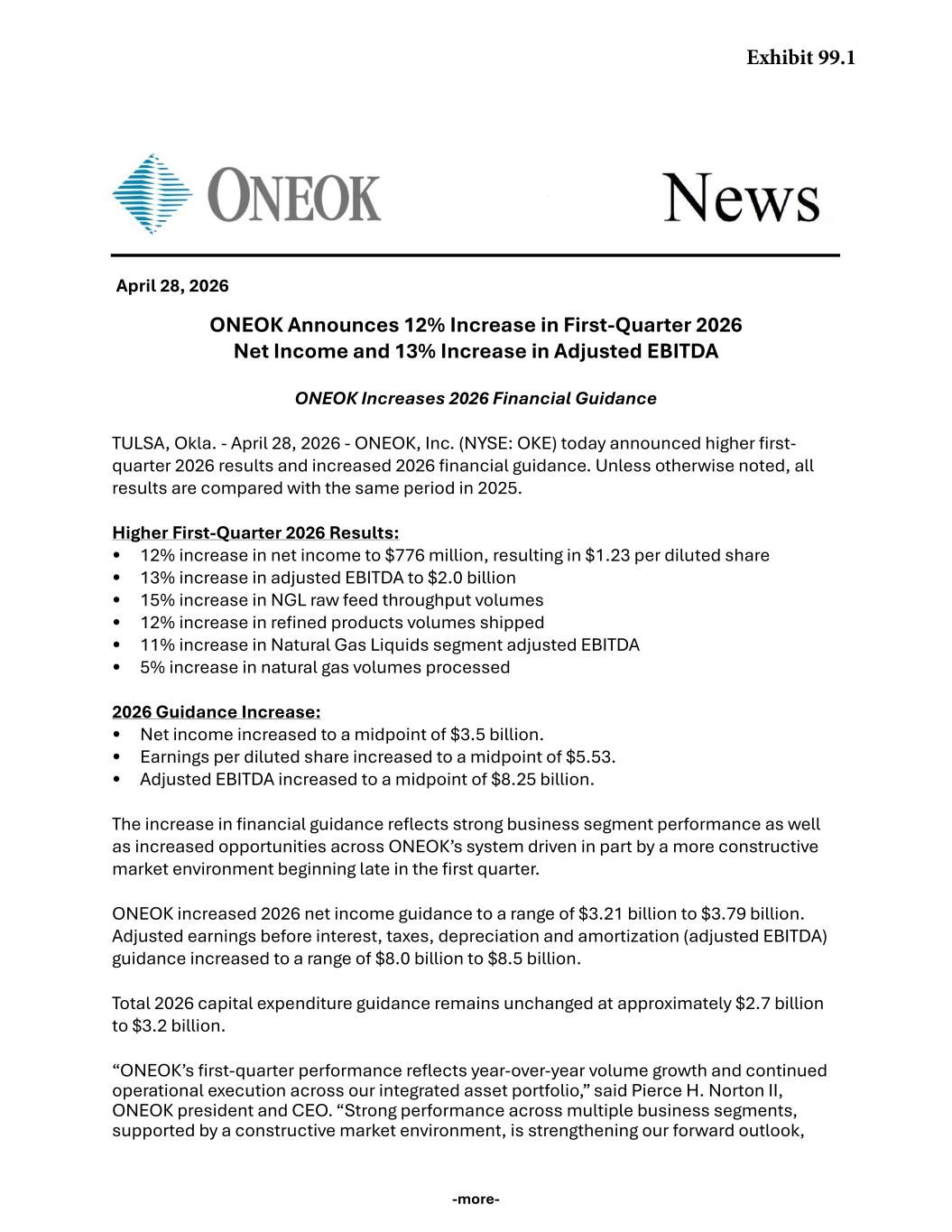
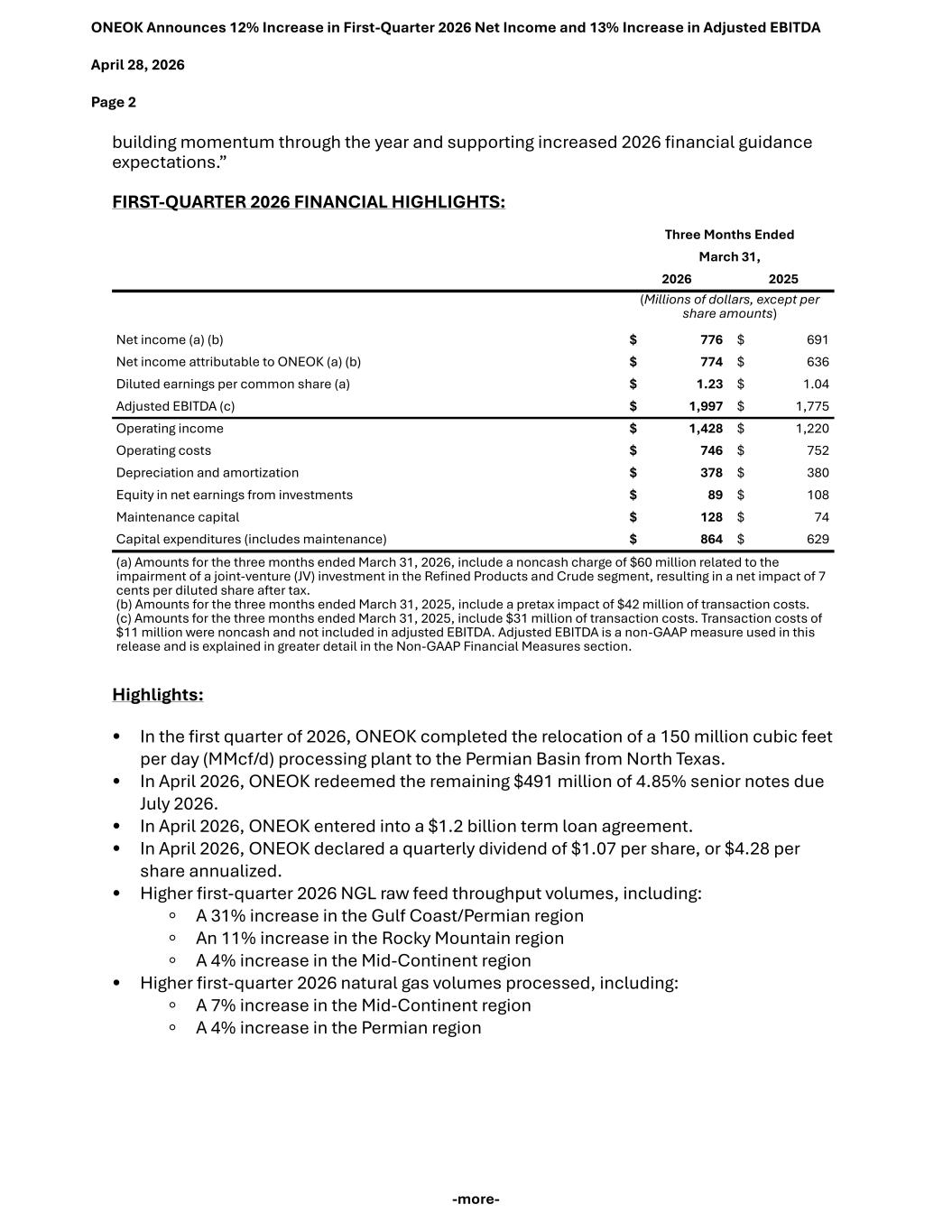
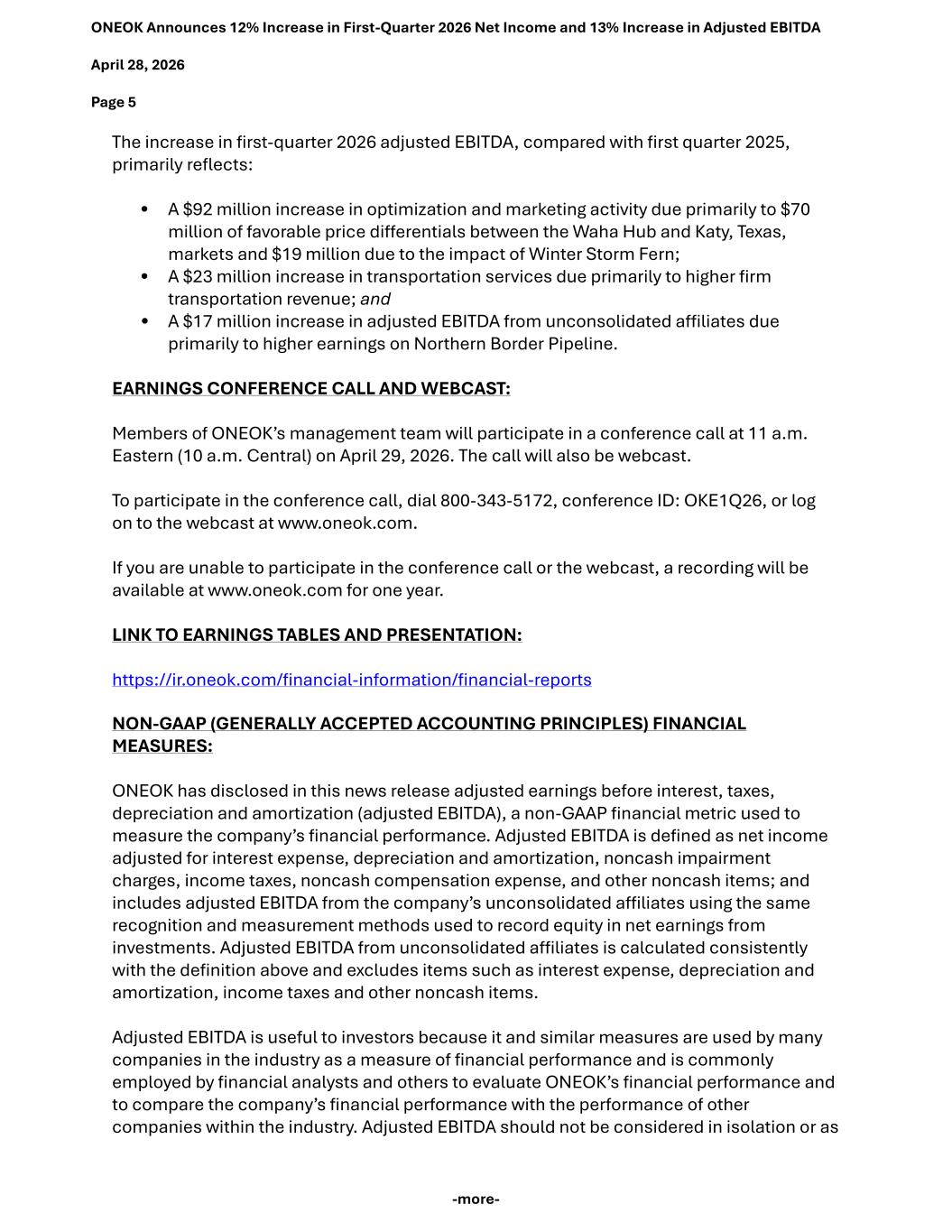
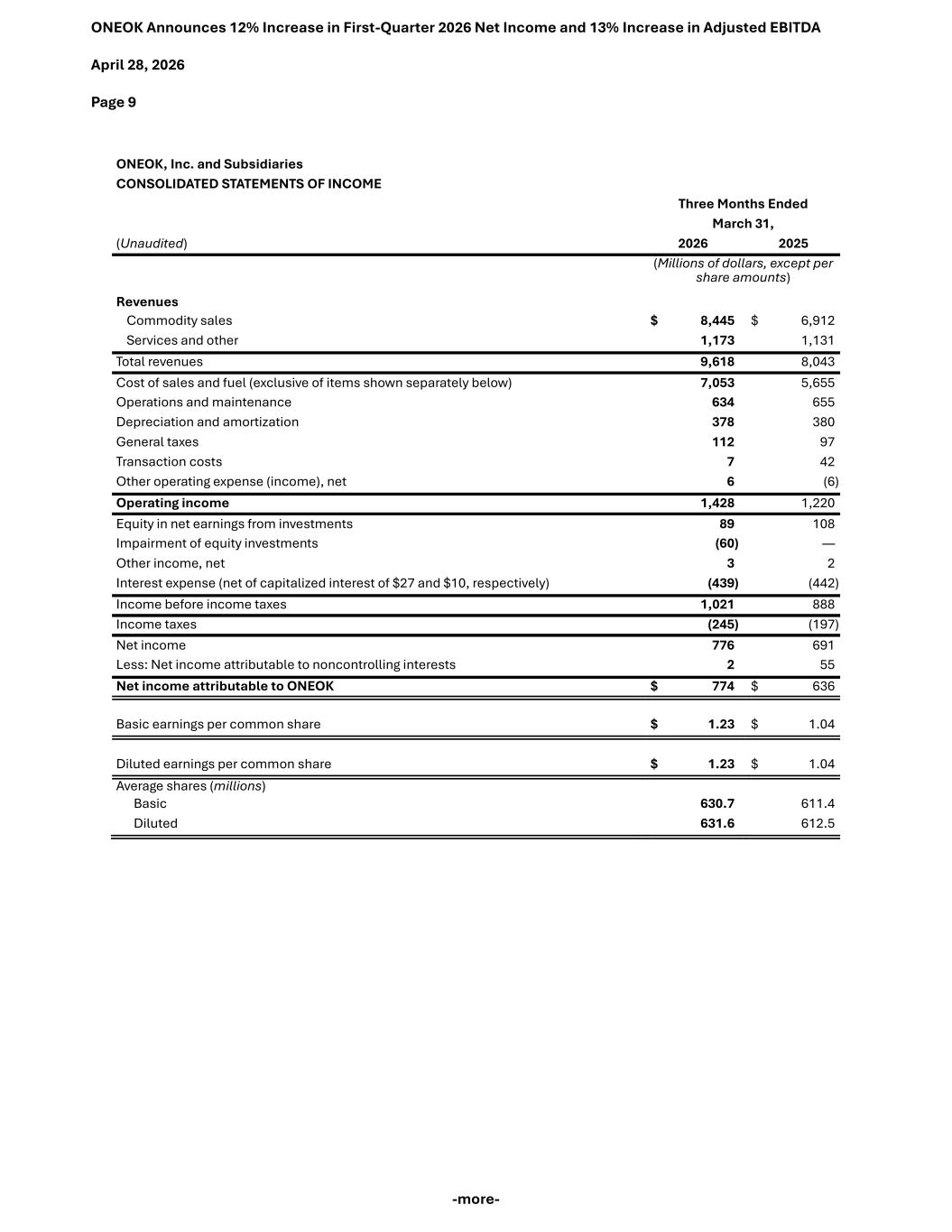
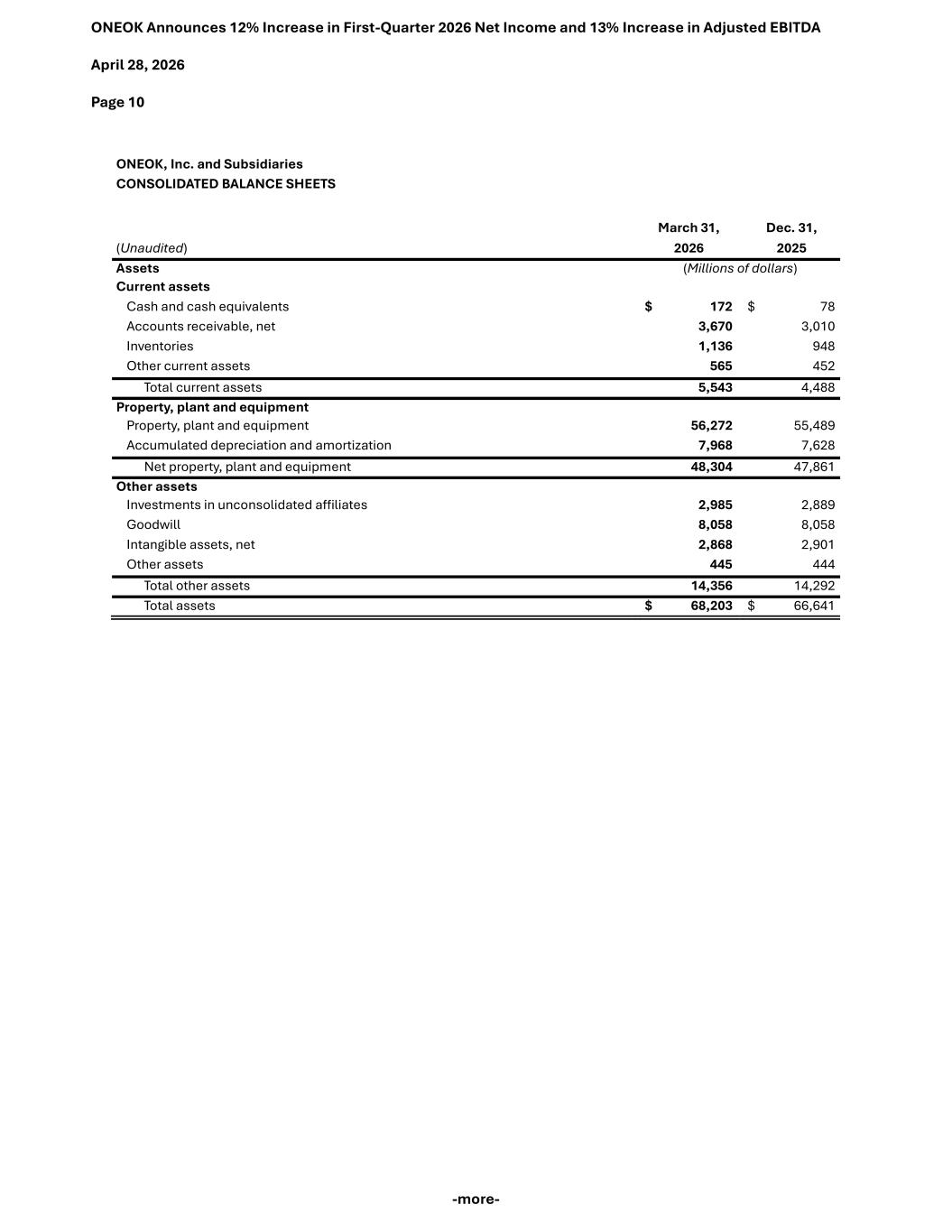
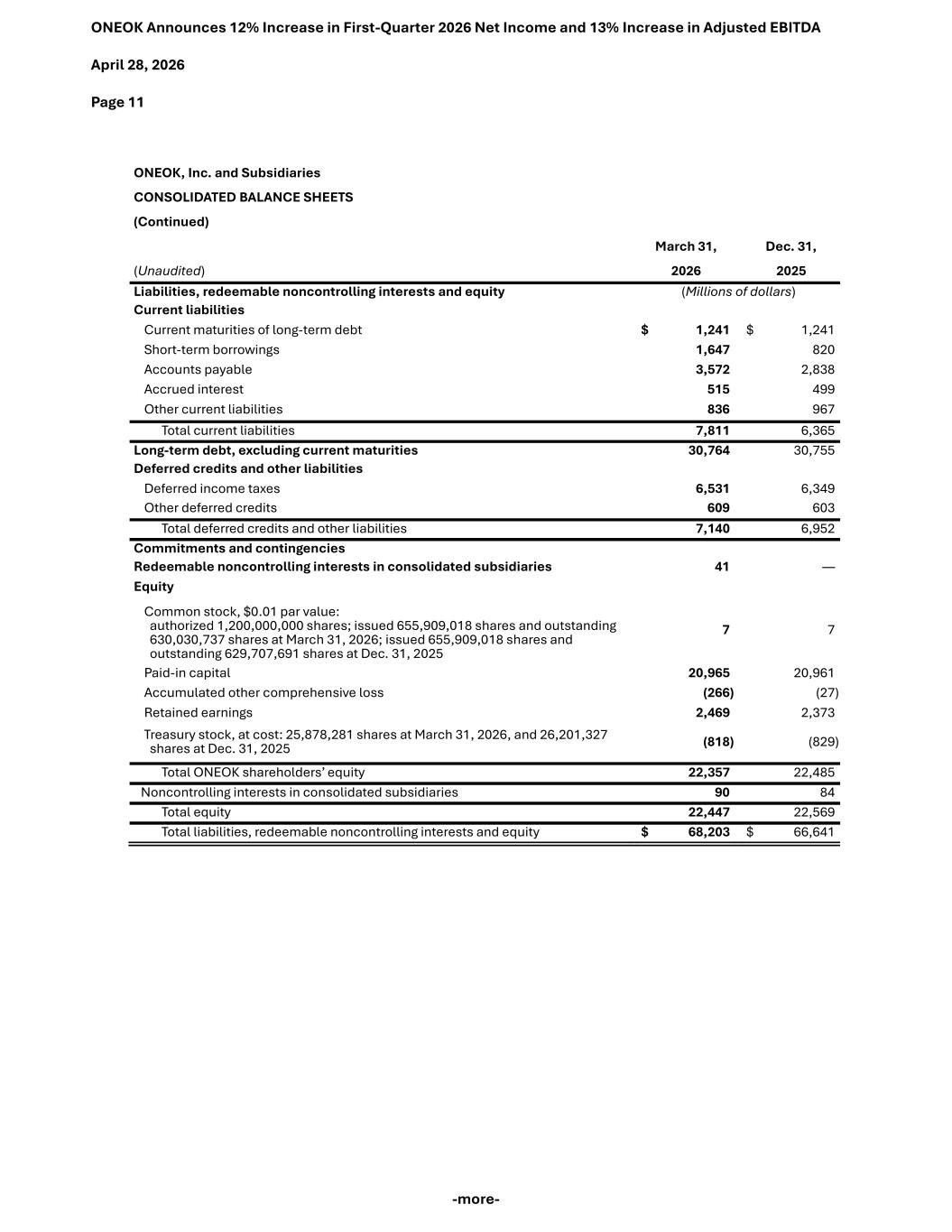
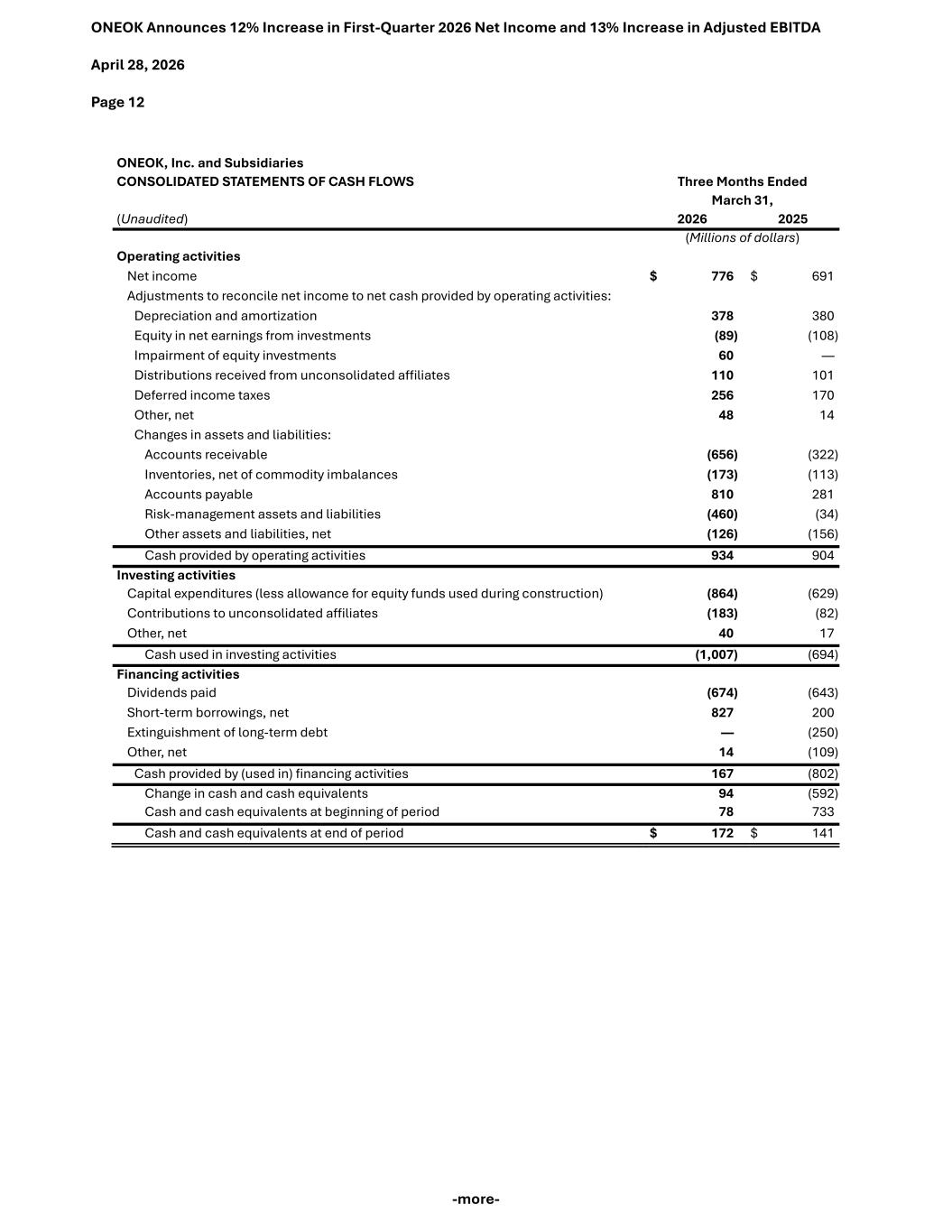
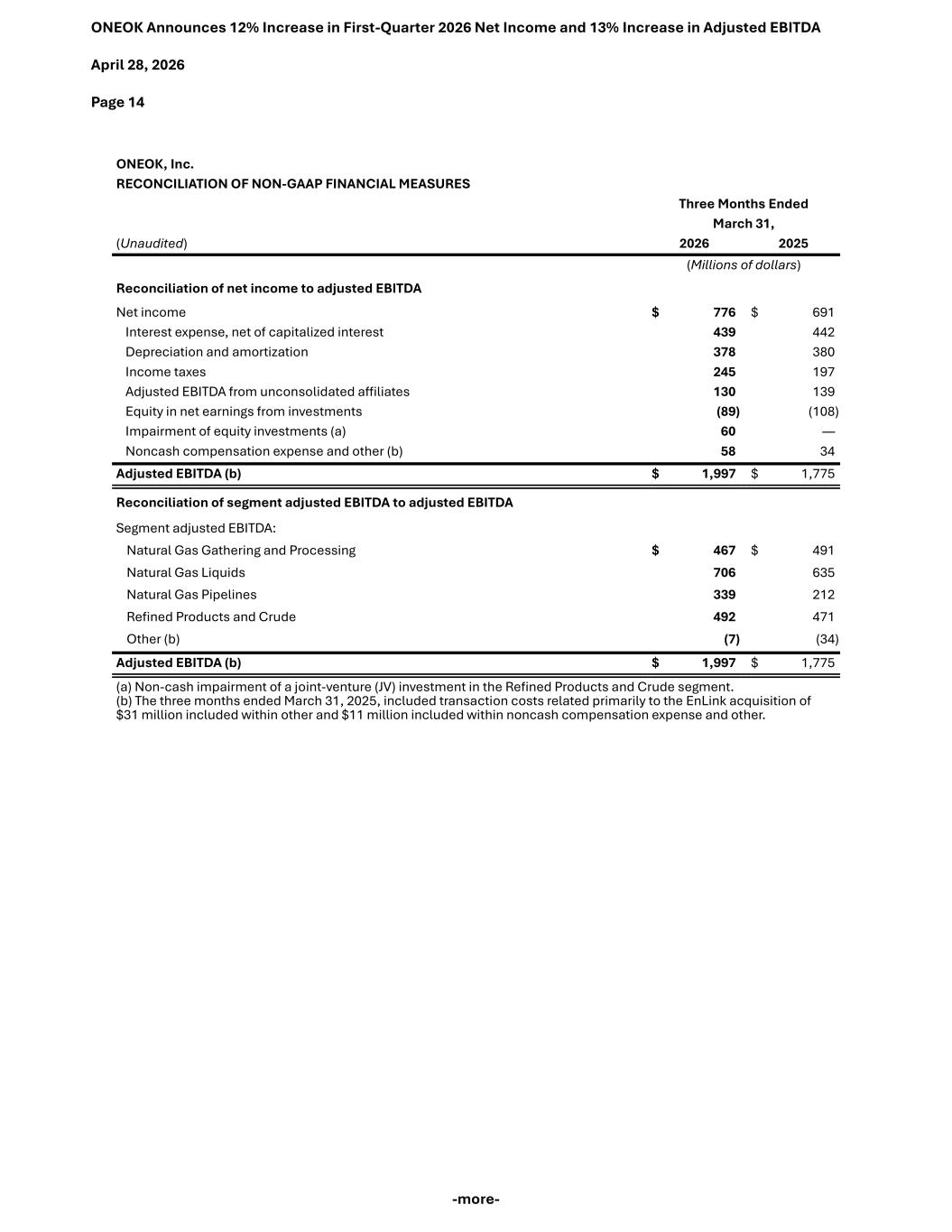
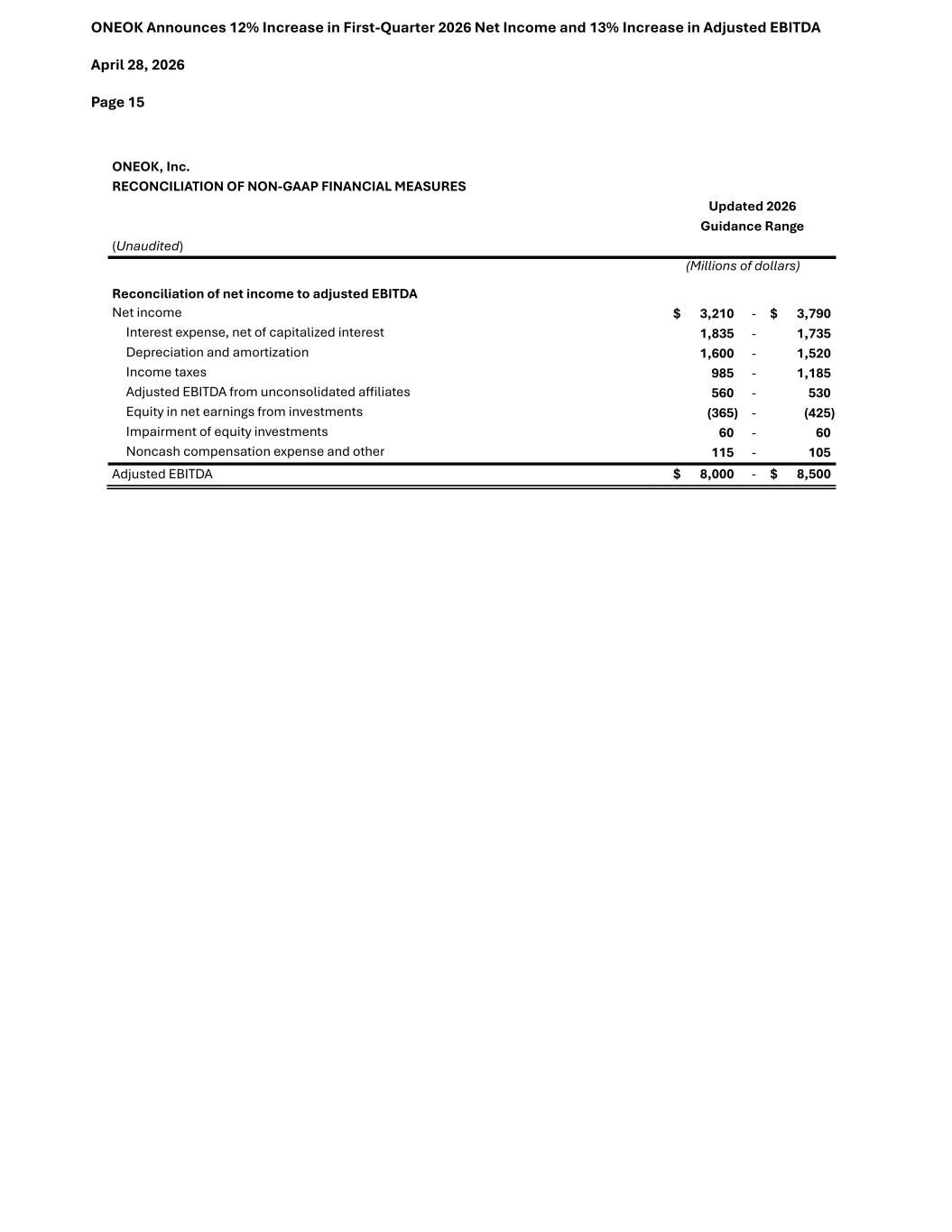
THANK YOU, PEARCE. AS PEARCE MENTIONED, WE ARE INCREASING OUR 2026 FINANCIAL GUIDANCE, REFLECTING THE STRONG PERFORMANCE WE DELIVERED IN THE FIRST QUARTER ACROSS ONE OAKS INTEGRATED SYSTEMS AND OUR HIGHER EXPECTATIONS FOR THE REMAINDER OF THE YEAR. WE NOW EXPECT 2026 NET income to increase to a midpoint of approximately $3.5 billion, with diluted earnings per share increasing to a midpoint of $5.53. We are also increasing our adjusted EBITDA guidance to a midpoint of $8.25 billion. These updates reflect strong underlying business segment performance, as well as increased opportunities across our system, driven in part by a more constructive market environment that developed late in the first quarter. As we move into the back half of the year, the combination of higher volumes, completed projects, and market tailwinds should be reflected more clearly in our results for the balance of this year and into 2027. Our total 2026 capital expenditure guidance remains unchanged at $2.7 billion to $3.2 billion. Turning to the first quarter performance, One Oak reported net income of $776 million, or $1.23 per diluted share, a 12% increase compared with the first quarter of 2025. Results included a non-cash impairment of $60 million or $0.07 per diluted share after tax related to our Powder Springs Logistic Joint Venture in the Refined Products and Crude segment. Adjusted EBITDA for the quarter totaled approximately $2 billion, a 13% year-over-year increase driven by higher volumes and strong segment-level performance. As market conditions strengthened toward the end of the quarter, we also saw additional opportunities across our system. We continue to expect the first quarter to be our lowest EBITDA quarter of the year, consistent with our typical annual cadence and seasonal dynamics. Importantly, our balance sheet and capital framework remains strong. We continue to prioritize financial flexibility while investing in the business and returning capital to shareholders. In April, we redeemed nearly $500 million of outstanding notes due July 2026, and we entered into a $1.2 billion term loan, further enhancing balance sheet flexibility in a rapidly changing market. Our results reflect the same themes that underpin our strategy, a high-quality, largely fee-based earnings mix, strong performance across our integrated systems, and discipline, cost, and capital management. And our increased financial guidance reflects both this consistent execution year-to-date and improving market dynamics. I'll turn it over to Randy for an operational and large capital projects update.
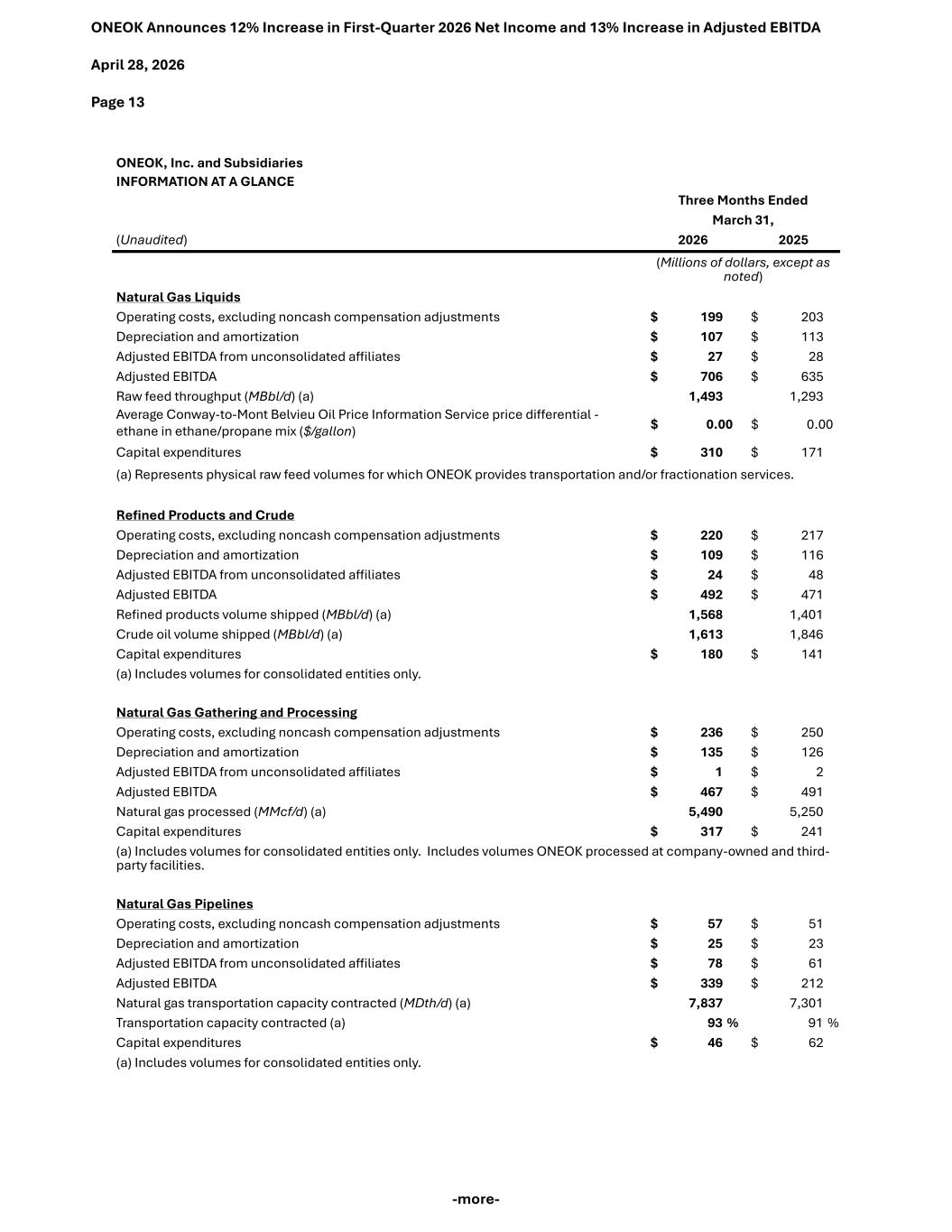
Thank you Walt. From an operational standpoint our focus remains on safe and reliable performance across our integrated assets. Our teams continue to execute well across all four business segments managing normal seasonality and weather related impacts. The scale and diversity of our systems allow us to absorb those seasonal dynamics while continuing to provide reliable service to our customers winter storm firm created temporary well head freeze-offs that briefly reduced throughput but as a reminder there were no material downtime on our assets on those uh related those impacts were already reflected in our original 2026 guidance turning to capital projects we've made strong progress so far this year in the first quarter we completed the relocation of 150 million cubic feet per day Shadowfax Natural Gas Processing Plant from North Texas to the Midland Basin. We expect a steady ramp up of volumes as producer activity remains solid in the area. We're also on track to complete expansions of our Delaware Basin processing assets in the third quarter, increasing our capacity in the basin by 110 million cubic feet per day, in addition to our 300 million cubic feet per day Bighorn Processing Plant that remains on schedule for completion in mid-2027. In the Powder River Basin, we're on track to complete construction of our 60 million cubic feet per day cutter plant in the fourth quarter of 2026. This plant will increase our processing capacity in the Powder River to more than 100 million cubic feet per day. We expect capacity to fill quickly from wells already drilled and expected to be drilled by our 15% JV partnering plant. Across other segments, our Denver Area Refined Products Pipeline Expansion will add 35,000 barrels per day of capacity when it enters service mid-year, and Phase I of our Medford NGL Fractionator will add 100,000 barrels per day of mid-continent fractionation capacity in the fourth quarter. These projects remain on schedule and are positioned to deliver meaningful near-term benefits by improving reliability expanding connectivity and increasing optionality by also creating long-term durable value across our footprint i'll now turn it over to sheridan for a commercial update thank you randy commercially we continue to see active engagement across our asset portfolio demand is supported by downstream pull particularly from power generation, industrial and petrochemical demand, and export linked markets.
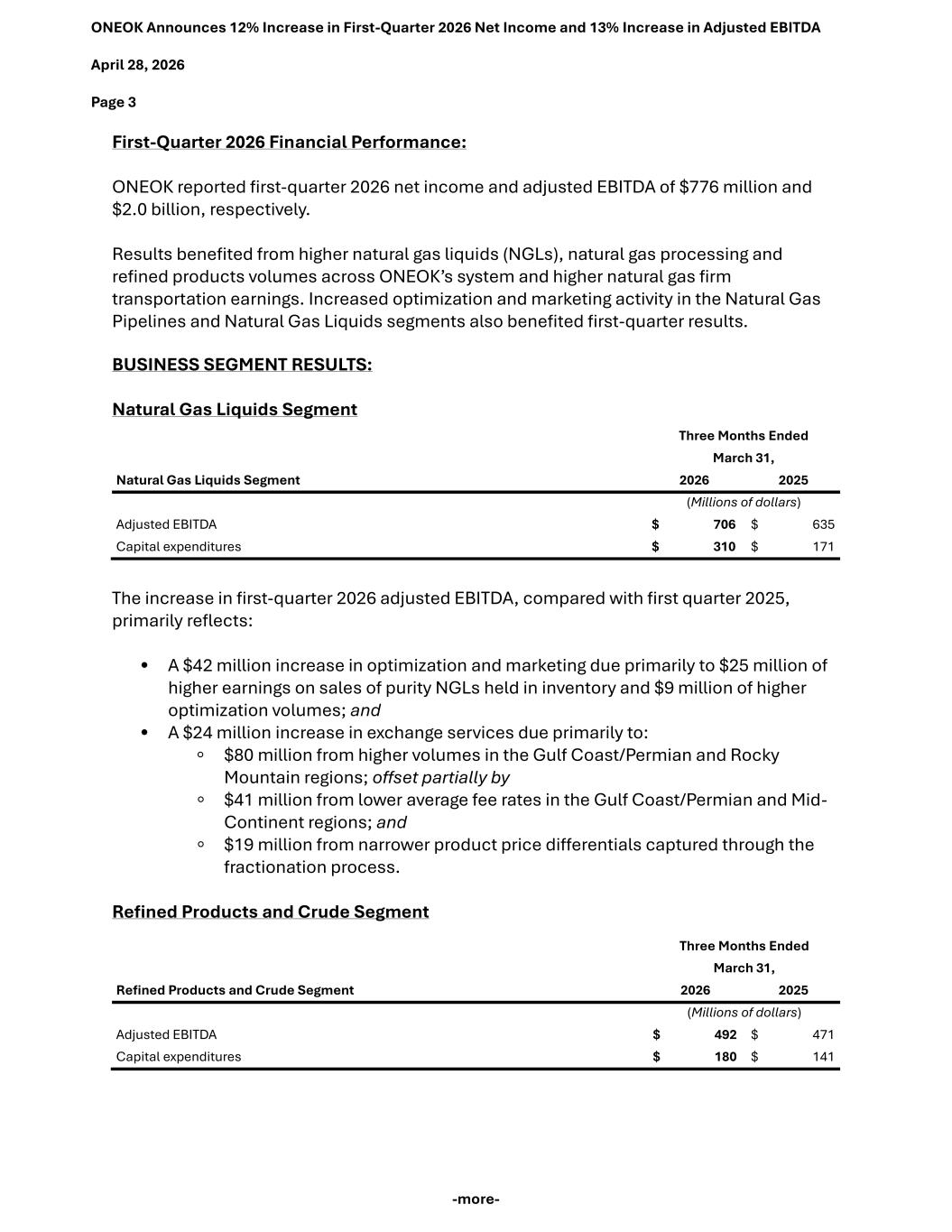
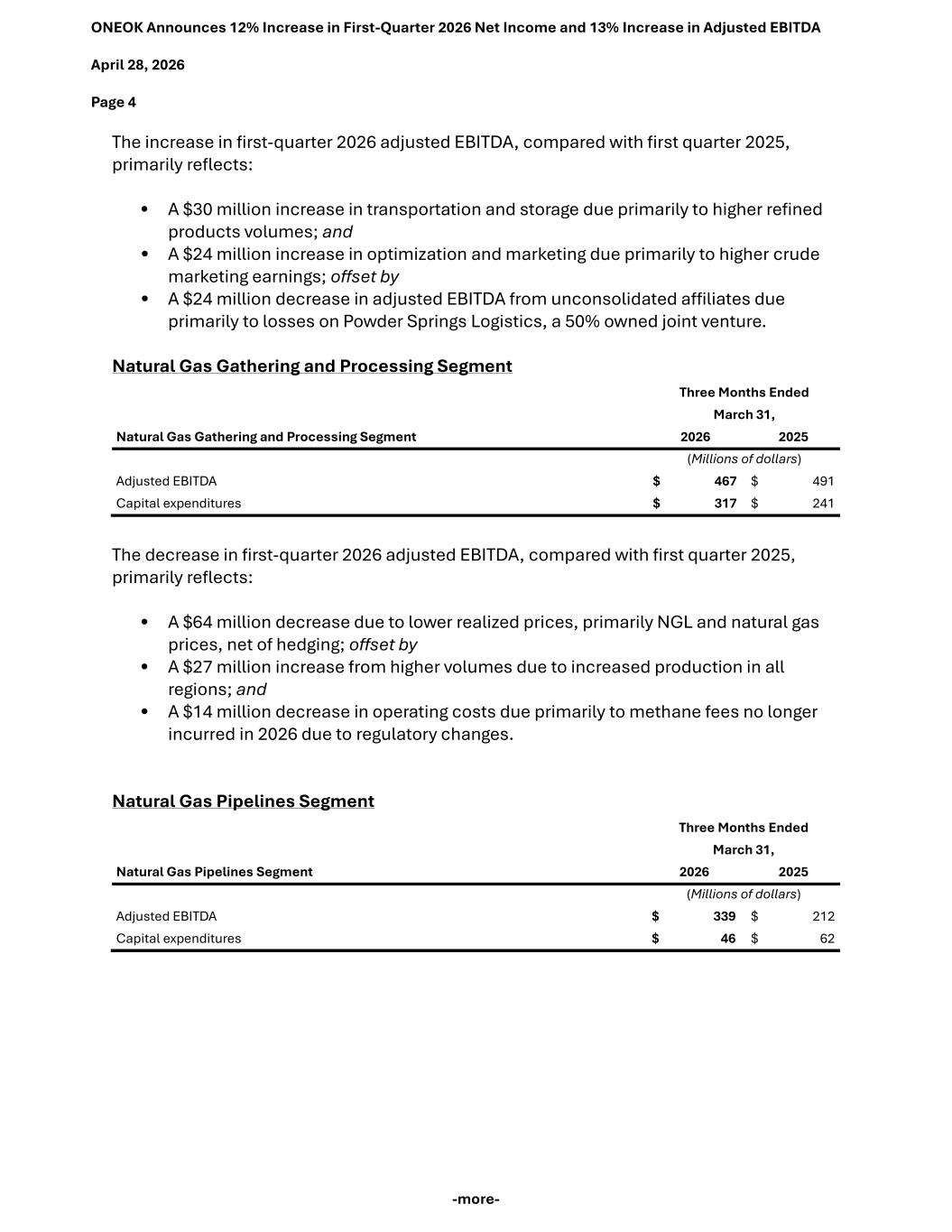
These dynamics reinforce the importance of strategically located infrastructure and long-term relationships. Looking at the first quarter, we delivered strong year-over-year volume performance across starting with the natural gas liquid segment. Performance was led by broad-based volume growth across all three of our core regions. In the Rocky Mountain region, NGL volumes increased 11% year-over-year, driven by a higher base volume and increased methane recovery. In the Mid-Continent, volumes increased 4% year-over-year, driven entirely by C3-plus volume, even as the region experienced some temporary impacts on winter storm fern earlier in the quarter. In the Gulf Coast Permian region, volumes increased more than 30% year-over-year, primarily reflecting base volume growth from newly connected third-party plants that were delayed last year's higher short-term volume opportunity. From a global perspective, NGL demand remains structurally strong, and recent geopolitical dynamics have further reinforced the attractiveness of U.S. supply. Refresh requests for capacity on our announced LPG export dock were already increasing and have accelerated more recently as customers look to diversify supply toward the U.S. Turning to the refined products and crude segment. Year-over-year refined products volumes increased 12%, supported by strong gasoline and diesel demand, refinery maintenance dynamics, favorable regional basis differentials, and wide crack spreads that drove strong refinery utilization. Blending volumes were also strong during the quarter. We entered the spring blending season significantly hedged, which limited our exposure to widening RBOB to butane spreads. Historically, wide basis differentials between New York Harbor, where we hedge, and the mid-continent, where we sell product, also impacted realized margins. Looking ahead, we've secured additional hedges on fall volumes at higher prices and extended new hedges into spring 2027. Importantly, blending volumes continue to be driven primarily by system throughput rather than EPA RVP waivers, which typically create only modest incremental opportunities and completed synergy projects provide a much greater benefit allowing us to optimize blending activity the reach and flexibility of refined product systems remain a key advantage we are the only refined products pipeline system with bi-directional access between the mid-continent and the gulf coast which allows us to attract incremental volume and respond to changing market conditions demand fundamentals remain strong we continue to see very strong diesel demand across our system which we expect to remain as we move into spring agricultural season we also intend to anticipate a robust summer travel season supported gasoline demand across our footprint additionally a jet fuel supply remains constrained for an extended period we could see incremental demand for gasoline refined products and crude exports have increased in recent months amid global supply tightness particularly rated related to diesel and we are well positioned with dock capacity or cost multiple gulf coast marine facilities crude dock utilization remain robust at our highly contracted zebra joint venture And we are in discussions to extend our contract expiring capacity at favorable rates. Finally, higher margin permeate crude oil gathering volumes increased compared with the fourth quarter, as activity in the basin remains favorable, moving to the natural gathering and processing segment. We delivered strong, led by the mid-continent, where volumes increased 7%. Mid-content producers continue to focus activity across both gas-focused and liquid-rich place, and we have 11 rigs currently operating across our more than 1 million dedicated acres in this region. In the Rocky Mountain region, process volumes increase year over year, even with winter weather and heater-treater impacts. As operating conditions normalize, we expect volumes to strengthen in the second and third quarters. There are currently 11 rigs on our dedicated acreage, with producers continuing to drive efficiency gains through longer levels. In the Permian Basin, process volumes increased 4% year over year, and we currently have 11 rigs operating across our footprint. As Randy mentioned earlier, our expanded capacity in the Permian enhances system flexibility and positions us well to support producers' development plans across both the Midland and Delaware Basins. Customer activity remains strong and we are increasingly encouraged by the depth of opportunities the Permian Basin brings to our portfolio. From a financial perspective, realized commodity prices were lower in the first quarter as a result of entering the year fully hedged. Importantly, underlying throughput bonds increased year-over-year across all regions, reinforcing the long-term earning capacity and resilience of our gathering and processing portfolio producer behavior remains disciplined and execution focused we are seeing some acceleration in completion activity which supports our confidence in the 2026 volume out that confidence is driven by direct visibility into producer plans rather than an expectation of higher commodity recent earnings commentary for oil field services companies that have noted early signs, particularly among private and single basin operators. Duck inventories can also provide an avenue for this acceleration. Our producer base across One Oaks approximately 7 BZF per day system is well-balanced among large public companies, private operators, and private equity-backed producers. That diversity provides both scale and durability while allowing activity to adjust incrementally. We close with our natural gas pipeline segment, where strong results continued in the first quarter with all regions outperforming expectations. Results benefited from wider-than-planned Waha to Katy location price differentials, as well as incremental marking opportunities created by Winter Storm Firm across our Louisiana Athens. Looking ahead, we expect Waha to Katy differentials to normalize as new pipeline egress comes online in the second half of the year. Firm transportation demand remains strong. With high contracted capacity and strong utilization, we also continue to see significant interest from data center-related opportunities in Oklahoma and Texas, and we remain in advanced discussion with several counties. Additionally, LNG-related demand remains strong, both near-term and long-term, reinforcing the durability of demand for natural gas pipeline assets. Pierce, that concludes my remarks.
Thank you, Sheridan, Randy, and Walt for those comments. To close, I'll come back to where I started. The energy landscape will continue to evolve, but the need for reliable, scalable U.S. energy infrastructure is not cyclical. It is driven by long-term demand fundamentals. OneOak is built for this environment, having an integrated platform with capacity, a strong balance sheet, and discipline execution. The results? Durable, long-term value creation. Most importantly, none of this happens without our people. I want to thank our employees for their continued focus on safety, operational excellence, innovation, and service. And thank you to our investors for your continued trust and support in one-up. With that, operator, we're now ready to take questions.
Operator
We will now begin the question and answer session. If you would like to ask a question, and press star one on your telephone keypad. To leave the queue at any time, press star two. We do ask that you limit yourself to one question and a follow-up to fit in as many of you as we can. Once again, that is star one to ask a question. And our first question will come from Spiro Dunas with Citi. Your line is now open, please go ahead.
Thanks, operator, my team. Maybe we'll just start with the improved outlook. I'm just looking for a little more granularity on how much that $150 million move is maybe already realized here in the first quarter, and I guess what level of visibility you have on the remaining forward component. You know, Sheridan, you mentioned sort of hedging out butane through 27. I'm just curious how much of that forward look is locked in.
It's Spiro, it's Walt. So first of all, I just want to clarify, make sure that it's clear that, you know, winter storm fern was already in our guidance. so we had zero impact from from that as it related to the increase. The increase was really a blend of stronger volume expectations driven by higher commodity prices, you know continued expected differential opportunities and then we of course really expect to realize some benefit from the higher commodity prices although we are we are hedged now typically we're hedged about 75 percent going into a year but with the higher volume expectations any volumes we receive going forward will enjoy the full benefit of these higher commodity prices. Well a second one maybe for you as well just pivoting to capital allocation so once again you're turning a little bit stronger than expected to just level set us I know you're thinking about the timing to sort of reach your leverage targets here and when you do free up that cash flow just just wear your heads on buybacks or any other uses of that that free catch sure well nothing's really changed uh from our capital expenditure uh uh plan as as you know and randy uh mentioned our projects are on time and uh right on budget so you know we expect to start completing those this year with the Denver project finishing up and Medford first phase finishing up as well as you know some of the smaller things as those wind down as we've stated in the past most of our capex will larger capex will be completed by mid-year of 2027 and that's when we'll really see the free cash flow kicking in you know So we're headed towards our leverage targets, clearly with increased EBITDA expectations as that denominator rises, we'll get there faster. But we continue to pay down debt and we'll be in a position to meet our targets and return capital to shareholders appropriately. But I want to make sure that everybody understands our first objective is always to get high return capital projects. So, you know, as we see those come in, we'll definitely try to prioritize those. But our expectation is free cash flow. There will be plenty for those, our dividend, our debt repayment, as well as other forms of return to shareholders.
Great. I'll leave that for today. Thank you, guys. Thank you.
Operator
Thank you. Our next question comes from Teresa Chin with Barclays. Your line is now open.
Good morning. Going back to your comments on the upstream outlook, though it's still early on, can you elaborate further on recent conversations with your producer customers? What are your near and medium-term expectations for upstream activity in your areas of service? And where do you think prices will need to stabilize in the outer years to stimulate a material uptick in production?
And how long would it take to see these volumes potentially materialize on your system this is Sheridan the first thing we're seeing with producers is is what we call kind of leaning in to production and that starts with the first one starts with is if there's anything that goes down they are quickly getting that back up quicker than they do in a much more lower price environment we also see them bringing on more completion crews so that's kind of impacting your ducts they go forward or bringing things on quicker that they've already drilled And the other thing, as I said in my remarks, we are starting to see some producers looking for additional rigs to bring online. And as we see the environment that we are today, where a lot of people see the back end of the curve coming up, people are getting more excited about what the price environment is going to be going forward. Obviously, when we bring on rigs, the rig volume is a little more delayed into the back half of 26 than earlier. But as I said earlier, bringing more completion crews on, and when they have any downtime, getting that back on will be the more near-term effect on.
Thank you. And the second question is related to your export infrastructure and your outlook there. Given the call on U.S. energy resources and export infrastructure in particular, within your existing liquids export docks on the heels of recently building out the connectivity between going in a park, East Houston and your Pasadena MVP joint venture, what kind of upside could you potentially service, whether it be an optimization on utilization or commercial spot cargos or even additional brownfield investment in Pasadena?
And then on the LPG front, can you just talk through the commercialization process at this point and have those conversations with potential counterparties accelerated it's starting with the one to our existing facilities you know we have as you mentioned we have two marine export facilities refined products on the houston ship channel glena park and nvp we have seen increased activity across those docks going forward we still have more room that we could expand forward and we are in conversations with customers uh around that so there could be a little bit of upside in that area the on our crew dock it is highly utilized right now we have a lot more interest in there what we're seeing is the opportunity to extend contracts or more turn at more favorable rates than we historically have seen so we see some tailwinds not only in 26 but beyond in both of our export facilities as it concerns our lpg dock um yeah we are seeing an acceleration of interest we are sawing interest before the Middle East conflict. We're seeing even more of that interest. And right now, we are not concerned at all about finishing the contracting of our targeted utilization of that dock here in the relative near future.
Teresa, this is Pierce. I want to add something to what Sheridan said, just to remind everybody on this call. Prior to the Iran war, the U.S. and the Middle East were the only ones, only two countries that were actually going to expand LNG facilities over the next five years. And then if you fast forward to today and you look at the damage that was done to Qatar's LNG facilities, more than likely the equipment that was ordered to do those expansions will probably go to rebuilding some of the damage that was done during these war efforts. So that means that the incremental capacity is going to really land back in the united states and with lng going from 18 bcf to 30 bcf basically by 2030 and i'd like to remind everybody 65 plus of all the u.s uh gas has recoverable ngos with it uh so that's really going to drive a lot of the ngo growth here in the united states and we're well positioned to that i think sharon did a great job explaining the uh the lpg exports but it's providing a very constructive backdrop uh for the future volume growth here at 1up thank you and if i could just squeeze in a final one your bond and state splitter in the gulf post
what utilization is that seeing currently and what's your recontracting timeline for that um it's highly utilized right now um especially the spreads that we're seeing and we have just recently um recontracted that for term so that will be contracted here um for the foreseeable future and will be running at high utilization rates.
Operator
Thank you. Our next question comes from Michael Bloom with Wells Fargo. Your line is now open.
Thanks. Good morning, everyone. I want to go back to your comment on hedges. You said you entered the year about 75% hedged.
I wonder if you can give us a sense specifically on butane blending, if that's the case as well if you're 75% hedge going into the year and then is there any kind of seasonality to those hedges are they sort of more back in weighted front end loaded or how that plays out yeah Michael this is Sheridan we came in highly hedged in for the first quarter on the butane to our Bob hedges we do have some had some space to hedge further out into the fourth quarter that We have done that at much higher prices after the Middle East conflict going forward. The thing we're really seeing on butane that's really exciting for us right now is that we're seeing, as I mentioned in my remarks, an increased gasoline volume across our system. That gives us even more opportunity to blend. And you couple that with the synergy projects that we brought online that we think we have some really good tailwinds behind our blending operation, both here in the first quarter, when you see a lot of blending and in the fourth quarter when we see the fall blending season come about.
Okay, great. I appreciate that. And then just wanted to ask the status of the potential Sunbelt Connector project. As I'm sure you're aware, Western Gateway appears close to moving forward. So wondering if there's a possibility that you could somehow join that project in some capacity if it does reach FID or if there's a path for both projects. Thanks.
Yeah, Michael. This is Sheridan again. As I've said before, we think there's only room for one project. And what we've said before is, if either one of these projects go forward, we think it will benefit from us being able to bring volume out of the Gulf Coast into the Midcontinent, as volume leaves that to go to Arizona on the B-66 project. And we also think that we have the ability to supply it coming out of the Gulf Coast with us being connected to all the refiners on the Gulf Coast and the ease of getting it into the El Paso area.
Operator
Thank you. Our next question comes from Jean-Ann Salisbury with Bank of America. Your line is now open. Good morning.
You touched on butane blending volumes driven by one of the systems. The butane blending volume could be physically possible in your system since 2025 and just...
We're breaking up quite badly there. It's very difficult to understand what you're saying. Could you try that again, maybe pick up your hands up?
Yeah, butane volumes and what it would take for one of to increase butane volume... all our volumes as you related to blending we've been increasing that for the last three years I think every season we've been able to blend more and more on our system as we continue to go forward especially as we brought these synergy projects online so to see a meaningful uptick in our system what we need is more volume across our system on gasoline and we are seeing that right now and and we can even see that grow as I mentioned in there the rest of the year into the fourth quarter if you see jet fuel continue to be fighting with prices continue to rise for people to be able to travel by airplane and move more to traveling by bring it up a little bit gene but I think you said is that the Waha to Katy spread was wider this year in the first quarter than we anticipated and we were able to capture that we see that continue through the
second quarter into the third quarter when additional pipeline capacity will come online and then it will go back to be more normalized okay thank you thank you and our next question comes from Jeremy Tonette with JP Morgan your line is now open hi good morning morning I just wanted to touch on I guess the the guide and thoughts on EBITDA for the year if I look at 1q results and granted there were items that might not repeat but if I annualize that that would pretty much get you to the bottom end of the guide. And if I look at last year, I look at the difference between 1Q and 4Q, it's a pretty big step up. And you talk about seasonality over the course of the year. I was wondering if you could just help us think about shaping of the year, EBITDA by quarter, if that's going to vary from your pattern before, or is there kind of conservatism built into your guidance expectations at this point?
Well, Jeremy, I just point you back to the earnings presentation, I think it's page five in there, you know, where we've tried to reflect the shape of that as well as, you know, demonstrate, you know, how the first quarter was the lowest. So we expect the shape of that curve to continue, you know, the only thing that might change a little bit might be an upward slope if we see some enhanced volume in the later part of the year. So, no change to the front end and hopefully a big change to the back end.
Got it. So, annualizing the first quarter would, you know, and there's that slope would put you over the top end, it seems like. So, it seems like a good year shaping up there. I was wondering, you know, as we think about the uplift in the 26 guide, how much of that do you see recurring in 27?
I think we're positioned very well to, you know, go into 27 with a great tailwind behind us and, you know, really have some nice volume, growth, and strength. And I'd remind you that we have a significant amount of operating leverage on our Bakken pipeline, on the West Texas LPG pipeline, out of the mid-continent. So as volumes pick up in the basins we serve, we don't have any incremental capex that needs to be spent all that's going to drop to the bottom line so we're you know we're looking pretty positively as we go into 27. clearly you know we've had some benefit from the differential on the KD on the Wahada KD that may not be there next year but you know our system is diverse and we you know we find differentials all the time you know as we bring on Medford, we might see a pickup in the north-south differentials as well. So we're there in a position to capture those across our integrated system whenever they present themselves.
Understood. I'll leave it there. Thank you.
Operator
Thank you. Our next question comes from Manav Gupta with UBS. Your line is now open.
Good morning. Chief, we wanted to dwell into spreads in terms of gas. There are a couple pipelines coming on with your involvement also, which obviously drive higher wire prices, which work for your permeate volumes, but not develop over there, and I'm trying to understand if that does happen in the South Texas part.
I think it's more volume. I think what you're asking about is, could there be a glut in natural gas as we see more volume come on, especially as we see more pipelines down into the Gulf Coast area? Obviously, we're seeing more LNG assets being brought online that will take that volume up. So, we don't think we're going to see an overall glut in the Katy area as these LNG projects come on and also as we see more AI projects coming online as well.
Operator
Thank you. And our next question comes from Julian Demoulin-Smith with Jeffries. Your line is now open.
Hi, good morning, everyone. this is Rob Mosca on for Julian. Looks like the final FERC oil pipeline index came in better than expected. Can you help contextualize maybe what this means for your RPC segment and a refresher on how much of that segment is actually exposed to those FERC indexed interstate oil pipeline rates? And does this outcome meaningfully change your earnings outlook for the next five years?
Yeah, this is Sheridan a little bit. Yeah, remember that the spread did come in better than expected which is is beneficial to us i remind you that 70 percent of our volume on the rpc system is market base rates not firk index so the impact in 2026 is going to be very marginal so we go in there but there's a compounding effect as we continue to go forward that that will build on it every year get a little bit more as we go forward but um it's a nice little tailwind but it's not a substantially change our outlook for the RPC segment.
Thanks for that, Sheridan. And then, you know, maybe just turning back to the guide, I'm just wondering if the current commodity and spread environment simply holds, and should we think about there being upside or something additive to guidance for the remainder of the year? I'm just trying to think through how much of that.
You know, I think that you hear quite a few, especially the larger producers talk about is that the back end of the curve right now probably isn't really reflecting the actual physical damage that's been done over in the Middle East so our expectations you know would be today that that curve we should strengthen throughout the year we have not factored any of that into our thinking when it comes to guidance so should that happen, we'll enjoy that benefit going forward. Clearly, if that results in more volume, that's a positive for us. You know, it takes time to bring on rig, so maybe we get a little impact in the fourth quarter, but that's going to send us into 27, you know, with a lot of momentum going forward.
Understood. Appreciate that. Thanks for the time, everyone.
Operator
Thank you. Our next question comes from Jackie Colettas with Goldman Sachs. Your line is now open.
Hi, thank you so much for the time today. Just going back to the guide, one more really quickly, you know, how would you frame up kind of the magnitude of the optimization upside that's now expected relative to that 150 million of year-over-year headwinds that was previously assumed?
Well, you know, clearly we knew going into our guidance that these pipes were going to be constrained throughout you know at least the first two quarters and into the third so that was factored into our into our guidance so you know as it relates to the Waha Nakedi spread a good portion of that it's been a little stronger than we had expected so we've gotten some incremental benefit but you know a good portion of that was already there you know when you looked at the the bridge last year from 25 into 26 you know there was a portion of that was really the uh the hedging that was done in 25 for 26 as it compared to 25 was at you know at some lower pricing so that was factored into our guidance as well so really the potential changes to the upside if we get more volume and enjoy these higher rates on all of that and then you know there's still 25% that is unhedged that will enjoy the higher benefits.
That's clear thank you and then just another you know can you touch on the incremental opportunities within the natural gas segment maybe longer term I mean while benefiting from price differentials today you know how are you thinking about your exposure to you know power demand and you know how those commercial discussions trended recently this is Sheridan we we have been in advance we are in advanced discussions with both AI and power demand right now we have some very nice projects that are in the queue and then we actually have projects behind that that we're even working on as well as they continue move forward so we are very excited about what we see um in the natural gas demand sector and where our assets sit especially in the
oklahoma texas region for the power and ai demand um going forward and we'll have these projects in 2026 and 27. so it is a good time to be in the natural gas segment for sure so what i would i had i know paul was about to say the same thing is uh when we first started talking about ai opportunities as related to power generation you know we originally saw those it's kind of short lays smaller volumes so not necessarily that much of a material impact as we've now gone through time and we're talking to more and more of these hyperscalers the volumes that they're requiring and it's going to require us to reach back further into our systems and lay larger pipelines. So I think that's the big change that I see from where I sit versus where we were maybe a year and a half.
Appreciate the color. Thanks.
Operator
Thank you. Our next question comes from Keith Stanley with Wolf Research. Your line is now open.
Good morning. Wanted to follow up on Western Gateway. As you assess what that project could do to the market, do you see it mainly as an opportunity for longer haul volumes on your system out of the Gulf Coast? Or do you think this could create constraints and meaningful new growth investments like the Denver project to expand pipeline capacity?
Yeah, I think it's a little bit of both. Obviously, if we start shipping volume out of the Gulf Coast up into the mid-continent to fulfill volume that's leaving the mid-continent to go on that Western Gateway project, that's going to mean we're going to get a longer tariff because we're moving the volume from a much longer distance away. Also, is the tariff from Gulf Coast out to El Paso. It's a very long tariff, one of our higher tariffs. If we increase that volume as well, that's going to have a very nice impact on wanting to continue to go forward. And obviously, as we get more demand, will we see more expansion of product on our system? Yeah, we will as people are going to shift out of the Gulf Coast more over to our system to be able to get it out to El Paso and to meet this access into the Phoenix and California markets.
Thanks for that. The second question, the Bakken volumes were only down two to three percent versus Q4. That seemed a lot better than the seasonal guidance that you had pointed to last quarter on what's typical in Q1. So would you say volumes in the Bakken surprised to the upside in Q1 versus what you were expecting?
A little bit. I mean, you know, the winter is always a little bit, and we try to try to average it out over the four months and everything else. So it can be a little bit surprising to us where, you know, where the winter actually hits and when we see the volume come online. So I would say outside of, you know, winter storm firm, we have seen, we've been pleasantly surprised with our volumes in the box.
Operator
Thank you. Our next question comes from Brandon Bingham with Scotiabank. Your line is now open.
Hey, good morning. Thanks for taking the questions here. I wanted to maybe talk about your Permian processing capacity portfolio and how you see that sort of evolving in light of all this resilient gas production and just seeing some other operators in the basin discuss a more optimistic outlook for run rate capacity additions on an annual basis how do you see that and being incorporated into your portfolio moving forward well i know i think randy had mentioned you already right now we just put in 150 million a day the shadowfax plant that we moved out of the barnett into the midland basin so we brought another 150 million a day on there that we see that ramping
at over time then right behind that we have some low cost capacity expansions in the delaware 110 million a day that will come up later this year and then we've already announced the 300 million a day plant that we'll be putting in the delaware beyond that those are what we have announced we continue to look forward we see a lot of opportunity in the permit basin we're in a lot of discussions on rfps from especially in the delaware that we would have the potential even expand that capacity see even more beyond what we see today. I think we see that and also expect that to happen as we get further into 27. We hope there's opportunities as well. So we are, as like everybody else, very optimistic on the growth out of the firm.
Okay, great. Thank you. And then just wanted to go back to some comments made earlier about better volumes expectations this year as part of the guidance increase. Could you help frame up how the new volumes expectations compare to maybe the various midpoints within the businesses? I noticed the ranges didn't necessarily change, but it sounds like within those ranges, the expectation is definitely better now.
You know, as I said, our increase in guidance was balanced across, you know, what we've seen in volumes. And Sheridan just mentioned that you know that we did have a little bit stronger first quarter volumes in some areas than we might have historically expected to you know given what the heater treater impact and that sort of thing would have been so as we go forward we hope that builds and you know we've taken that kind of projected it forward clearly i think it still is to be seen you know what these higher commodity prices are going to do from producer activity. Some of our smaller producers, private equity or smaller independents, seem to be a little bit quicker to think about rigs and getting them fired up so we can see some of that impact a little quicker. I think the larger exploration companies are waiting for that curve to reflect what they think the fundamentals are, and then they'll make their decisions. So, you know, we're not trying to get too far ahead of our volume expectations. We'll let that lay out. But we do think in this commodity environment and how it's going to look into 27 that we would expect to go into 27 with a really nice tailwind behind us.
Operator
Thank you. And our next question comes from Sunil Sabal with Seaport Global Securities. Your line is now open.
Yeah, hi, good morning, and hopefully you can hear me all right. So my first question was related to the hedging. I think you mentioned on the call that, you know, you put in some hedges for 27 also. Could you indicate, you know, how much of your total 2027 commodity price exposure is hedged now?
No, we're not going to get into specifics, but we've taken opportunities to make sure that we've captured at least a portion of what we see in 27. We clearly have been focused on the tail end of 26. So across our various businesses we've layered in some portion of 27 at this point. In the markets that we can, it's probably important to know that in many of the markets that we are serving. There's just not a lot of liquidity in 27 or the backwardation is just so significant that we wouldn't want to do that. So we've been opportunistic, but where we think it made sense, we've looked at it and we're going to continue to look at it throughout the year.
So, Neil, this is Pierce. The only thing I've added to that is that we have what we call a programmatic hedging program where we just automatically hedge a certain percentage as the year goes by. So it's not until we see some of these opportunistic opportunities that we go out and do anything like Walt just described. But there is a program. We don't try to time the market or sitting here waiting on something to happen and then move. We just methodically go through the year, and we do that because we're 90% volume times rate anyway, and so we just want to make sure we're not speculating, you know, too much on the edge of the curve.
Understood. And then one clarification on the potential projects that you're looking on, I think you mentioned in Texas and Oklahoma with the data center clients, should we think about those as significant capex opportunities with you know some midstream people midstream players undertaking or is it should we think about you know more like incremental capex or small incremental capex for those opportunities yeah i think as we've gone through and given you uh you know some thoughts about 27 and you know beyond 27 into 28 29 and a run rate.
We've looked at a run rate of around $600 million of maintenance, about a billion dollars, give or take, of what we call routine growth, and a portion of this would be in that routine growth. And then we left another $500 to $600 million to get you around that to a little bit over two billion dollars kind of run rate going forward basically unallocated so these types of projects while they're bigger than our expectation you know we originally thought they'd be 50 million dollar projects they're turning out to be four to seven hundred million dollar projects so they'll fit right in that window that we had left open and they're coming in at really nice returns got it thank you so much thank you our next question comes from gabe marine with mizuho your line is now open hey good morning everyone if i
could just ask about pet chem economics having improved quite a great deal here over the last month or two are you seeing any change in behavior on ethane extraction as it relates to either the Bakken or Cajun Sabone going into Louisiana I'm just curious if things have changed on that end at all well Gabe you're right I mean obviously what's going on in the world right now the ethane economics the United States are very strong and we're seeing you know or its chemical customers operating at very high utilization rate what it has had doing is we are seeing the ability for our discretionary ethane out of the Bakken and at times out of Oklahoma to be good be strong and that's that's right we see in volume so we mentioned I'm going into Cajun-Savone you know that's coming off of coming out of the mid-continent and out of the Bakken as we all feed over into our Louisiana or Louisiana fractionators that's really changed that that that amount on that piece but as I said before I think we will see some pretty good tailwinds on FN coming out of the Bakken and FN coming out of the Diffin on and through the rest of the year with the demand we're seeing.
Great, and then if I could just a quick follow-up. The PRB new plant there sounds like it's still pretty quickly. Any visibility to more capacity there? And then I think there was also a call-out for northern border performance during the quarter. Was that one-timey in nature or kind of a step up on rateable earnings there?
We'll see on the Powder River, you know, we've been working on that plant for a period of time it's a 60 million a day plant so we mentioned we have a JV partner that's a producer up in that area coming along with us we are getting more and more excited what we're seeing there that's going to feel fairly quickly do we see there's opportunity more volume yeah we hope so and discussions with them we'll continue to evaluate that but we do think there's possibility to put some more capacity up there so if you look forward northern border northern border is pretty steady out performance is a little bit frankly we see that kind of every year a little bit that they come in a little bit higher than what they had predicted we continue to see this
year and we continue we expect to see that throughout the year is the amount of area and dedication so there's plenty of plenty of running room up there to continue to drill there in the powder thank you our next question comes from Jason Gableman with TD Cowan.
Operator
Your line is now open.
Yeah, hey, thanks for taking my question. I wanted to go back to full year guidance. And I guess when I look at your slide deck from 4Q from last quarter, you show that at the time of your initial, I guess, 26 outlook was predicated at $75 oil. That was, you know, call it 8.7 billion-ish, maybe a little higher of EBITDA for 26 um oil moved down so your 26 EBITDA outlook moved lower but we've seen oil now move higher and i understand the hedging dynamics mean maybe you don't capture all of the upside this year but would you expect to kind of get back to capturing that upside next year based on where the commodity curves are right right now?
So what I would say there is you're absolutely right that you know clearly we've got a different realized price environment so that that is going to take some time to work its way through and also take some time for rigs to to get up and moving so when you didn't have quite as much reactivity as we expected you know that has a impact that you're starting from a different point as you exit 26 but we think we you know we are going to see that type of strength um i'm not going to give you an actual guide to a number but we're going to see that type of strength that we expected as as volumes pick up if these prices stay or go higher you know especially in the back end of the curve there's a pretty big difference between the prompt month and as you go out towards 27 so you know that that's going to be the story to tell as that plays out coming forward great thanks and just a quick follow-up on a comment you just made did I hear you right that these some of the data center related projects you're pursuing you thought they were going to be in the 50 million dollar range and they're coming in more like 400 to 700 million those are the right figures yeah yeah the thing is originally when we go back to that 50 that was you know a couple years ago when we first started seeing opportunities and people talked about uh citing these facilities they were dropping them right next to pipelines thinking that they could take the gas off those pipelines well when they were doing that um you know they were a lot of them were in the development stage you didn't have a lot of hyperscalers involved so some of the specs might not have been quite as realistic and the hyperscalers talk about five gigawatt facilities you can't just take that kind of gas off of a fully contracted pipe so what it's caused is pure silence for us to need to look at reaching back into our system where the gas is available and building bigger pipe and that's why the the size the projects have gone up but at the end of the day the value of getting these projects done to the hyperscalers is still well above their concern about price so they're they're very pleased to provide good economics to make sure that speed and reliability are there thank you And our final question comes from Gabe Daoud with Truist.
Operator
Your line is now open.
Thanks, operator. Good morning, everyone. Thanks for the time. Just quickly back to the upstream conversations, just curious if there's any notable difference in behavior or price that operators need to see on the screen as you talk to publics versus privates.
Just curious, especially, it looks like current rig activity is largely dominated by privates in the Bakken for your footprint yeah Gabe this is Sheridan we're definitely seeing more on the private sector more activity or talking about more activity that we're seeing on the public sector especially with the large integrated large integrated are still being very disciplined and looking at the price environment in front of it we are seeing especially on the private equity side starting to look more at rigs more completion trying to move you know production up that's where the majority of the activities happen I think as we as we've stated here as we continue to go throughout the year and everybody expects the back into this curve to move up as the papers not reflecting what we're seeing the physical world when that happens I think you could see start seeing something more of they integrated and and larger companies lean in more at that time or start bringing rigs on that time we still are seeing even with the larger. We are seeing them, you know, making sure they get, anytime they're down, they get things back up and looking to complete wells quicker than they had been in the past, but really concerning rig deployment, that is more into the private sector.
And there's one other element I think it's worth mentioning here is that they are really leaning into the efficiency of their drilling and how they're completing and the length of these laterals. So I don't think we need to get too hung up on, like, numbers of rigs, because the ones that are running, they're really putting a lot of emphasis on how efficient those rigs are to make them more profitable, you know, per well.
Operator
Thank you. That concludes our question and answer session. I would now like to turn the call back over to Megan Patterson for closing remarks.
Our quiet period for the second quarter starts when we close our books in early July and extends until we release earnings in early August. We'll provide details for that conference call at a later date. Our IR team will be available throughout the day for any follow-ups. Thank you for joining us and have a great day.
Operator
Thank you. That concludes today's call. You may now disconnect your lines at this time and have a wonderful day.