
QCOM 10-K
Qualcomm Inc/De (QCOM)
10-K
2025-11-05
For: 2025-09-28
View Original
Added on
April 02, 2026
UNITED STATES
SECURITIES AND EXCHANGE COMMISSION
WASHINGTON, D.C. 20549
FORM 10-K
(Mark one)
| ANNUAL REPORT PURSUANT TO SECTION 13 OR 15(d) OF THE SECURITIES EXCHANGE ACT OF 1934 | ||||||||
For the fiscal year ended September 28, 2025
OR
| TRANSITION REPORT PURSUANT TO SECTION 13 OR 15(d) OF THE SECURITIES EXCHANGE ACT OF 1934 | ||||||||
For the transition period from to .
Commission File Number 0-19528
QUALCOMM Incorporated
(Exact name of registrant as specified in its charter)
| (State or Other Jurisdiction of Incorporation or Organization) | (I.R.S. Employer Identification No.) | ||||||||||||||||
| (Address of Principal Executive Offices) | (Zip Code) | ||||||||||||||||
(858 ) 587-1121
(Registrant’s telephone number, including area code)
Securities registered pursuant to Section 12(b) of the Act:
| Title of Each Class | Trading Symbol(s) | Name of Each Exchange on Which Registered | ||||||
| | ||||||||
Securities registered pursuant to Section 12(g) of the Act:
None
Indicate by check mark if the registrant is a well-known seasoned issuer, as defined in Rule 405 of the Securities Act.
Indicate by check mark if the registrant is not required to file reports pursuant to Section 13 or Section 15(d) of the Act.
Yes ☐ No ☒
Indicate by check mark whether the registrant (1) has filed all reports required to be filed by Section 13 or 15(d) of the Securities Exchange Act of 1934 during the preceding 12 months (or for such shorter period that the registrant was required to file such reports), and (2) has been subject to such filing requirements for the past 90 days. Yes ☒ No ☐
Indicate by check mark whether the registrant has submitted electronically every Interactive Data File required to be submitted pursuant to Rule 405 of Regulation S-T (§232.405 of this chapter) during the preceding 12 months (or for such shorter period that the registrant was required to submit such files). Yes ☒ No ☐
Indicate by check mark whether the registrant is a large accelerated filer, an accelerated filer, a non-accelerated filer, a smaller reporting company or an emerging growth company. See the definitions of “large accelerated filer,” “accelerated filer,” “smaller reporting company,” and “emerging growth company” in Rule 12b-2 of the Exchange Act.
| ☒ | Accelerated filer | ☐ | Non-accelerated filer | ☐ | Smaller reporting company | Emerging growth company | |||||||||||||||||||||||
If an emerging growth company, indicate by check mark if the registrant has elected not to use the extended transition period for complying with any new or revised financial accounting standards provided pursuant to Section 13(a) of the Exchange Act. ☐
Indicate by check mark whether the registrant has filed a report on and attestation to its management’s assessment of the effectiveness of its internal control over financial reporting under Section 404(b) of the Sarbanes-Oxley Act (15 U.S.C.7262(b)) by the registered public accounting firm that prepared or issued its audit report. ☒
If securities are registered pursuant to Section 12(b) of the Act, indicate by check mark whether the financial statements of the registrant included in the filing reflect the correction of an error to previously issued financial statements. ☐
Indicate by check mark whether any of those error corrections are restatements that required a recovery analysis of incentive-based compensation received by any of the registrant’s executive officers during the relevant recovery period pursuant to §240.10D-1(b). ☐
Indicate by check mark whether the registrant is a shell company (as defined in Rule 12b-2 of the Act). Yes ☐ No ☒
The aggregate market value of the voting and non-voting common equity held by non-affiliates of the registrant at March 28, 2025 (the last business day of the registrant’s most recently completed second fiscal quarter) was $167.9 billion, based upon the closing price of the registrant’s common stock on that date as reported on the NASDAQ Global Select Market.
The number of shares outstanding of the registrant’s common stock was 1,071 million at November 3, 2025.
DOCUMENTS INCORPORATED BY REFERENCE
Portions of the registrant’s definitive Proxy Statement for its 2026 Annual Meeting of Stockholders, to be filed with the Commission subsequent to the date hereof, are incorporated by reference into Part III of this Annual Report where indicated.
| QUALCOMM Incorporated | |||||
| Form 10-K | |||||
| For the Fiscal Year Ended September 28, 2025 | |||||
| Index | |||||
| Page | ||||||||
3
In this Annual Report, the words “Qualcomm,” the “Company,” “we,” “our,” “ours” and “us” refer only to QUALCOMM Incorporated and its subsidiaries and not any other person or entity. This Annual Report (including but not limited to the section titled “Management’s Discussion and Analysis of Financial Condition and Results of Operations”) contains forward-looking statements. Words such as “expect,” “anticipate,” “intend,” “plan,” “believe,” “seek,” “estimate,” “may,” “will,” “would” and similar expressions or variations of such words are intended to identify forward-looking statements, but are not the exclusive means of identifying forward-looking statements in this Annual Report. Additionally, statements concerning future matters such as our future business, prospects, results of operations or financial condition; research and development or technology investments; new or enhanced products, services or technologies; emerging industries or business models; design wins or product launches; industry, market or technology trends, dynamics or transitions; our expectations regarding future demand or supply conditions; strategic investments or acquisitions, and the anticipated timing or benefits thereof; legal or regulatory matters; U.S./China trade or national security tensions; vertical integration by our customers; competition; and other statements regarding matters that are not historical are also forward-looking statements.
Although forward-looking statements in this Annual Report reflect our good faith judgment, such statements can only be based on facts and factors currently known by us. Consequently, forward-looking statements are inherently subject to risks and uncertainties, and actual results and outcomes may differ materially from the results and outcomes discussed in or anticipated by the forward-looking statements. Factors that could cause or contribute to such differences in results and outcomes include without limitation those discussed under “Part I, Item 1A. Risk Factors” below, as well as those discussed elsewhere in this Annual Report. Readers are urged not to place undue reliance on these forward-looking statements, which speak only as of the date of this Annual Report. We undertake no obligation to revise or update any forward-looking statements in order to reflect any event or circumstance that may arise after the date of this Annual Report. Readers are urged to carefully review and consider the various disclosures made in this Annual Report, which attempt to advise interested parties of the risks and factors that may affect our business, financial condition, results of operations and prospects.
PART I
Item 1. Business
We incorporated in California in 1985 and reincorporated in Delaware in 1991. We operate and report using a 52-53 week fiscal year ending on the last Sunday in September. Our 52-week fiscal years consist of four equal fiscal quarters of 13 weeks each, and our 53-week fiscal years consist of three 13-week fiscal quarters and one 14-week fiscal quarter. The financial results for our 53-week fiscal years and our 14-week fiscal quarters will not be exactly comparable to our 52-week fiscal years and our 13-week fiscal quarters. Our fiscal years for 2025, 2024 and 2023 included 52 weeks, 53 weeks and 52 weeks, respectively. Our fiscal year for 2026 will include 52 weeks.
Overview
We are a global technology leader, helping to bring intelligent computing everywhere through the development and commercialization of foundational technologies, including on-device artificial intelligence (AI), high-performance and low-power computing and advanced wireless connectivity. Our platforms help power intelligent devices that people and businesses rely on every day across industries and applications from handsets to other areas, including automotive and the internet of things (IoT). In automotive, our Snapdragon® Digital Chassis™ platforms, including connectivity, digital cockpit and advanced driver assistance and automated driving (ADAS/AD), are helping to connect the car to its environment and the cloud, creating unique in-cabin experiences and enabling a comprehensive assisted and automated driving solution. In IoT, our inventions have helped power technology advancements in industries and applications such as consumer (including personal computers (PCs), extended reality (XR) and other personal computing devices), edge networking (including mobile broadband and wireless access points) and industrial (including handhelds, retail, tracking and logistics and utilities). We derive revenues principally from sales of integrated circuit products, including our Snapdragon® and Qualcomm Dragonwing™ families of highly-integrated, system-based solutions, and licensing of our intellectual property, including patents and other rights.
The foundational technologies we invent help power modern digital experiences. We share these inventions broadly through our licensing programs enabling wide ecosystem access to technologies at the core of mobile innovation, and through the sale of our integrated circuit platforms (also known as integrated circuit products, chips, chipsets or modules) and other products. We innovate and collaborate across many ecosystems, including with manufacturers, operators, developers, system integrators, infrastructure vendors, cloud providers, test tool vendors, service providers, governments and industry standards organizations, to enable next-generation digital transformation. For 40 years, we have been a leader in helping set industry standards and creating era-defining technology breakthroughs, and we continue to play a leading role in developing system-level inventions that serve as the foundation for multiple generations of advanced wireless technologies.
We own significant intellectual property, including patents, patent applications and trade secrets, applicable to products that implement cellular technologies (including 4G (fourth generation) and/or 5G (fifth generation)), which are the primary digital technologies currently used to transmit voice and data over radio waves using a public or private cellular wireless network. We also develop and commercialize numerous other key technologies used in mobile and other devices and services, and we own substantial intellectual property related to these technologies. Some of these inventions are contributed to and commercialized as industry standards, such as for certain video and audio codecs, Wi-Fi, position location, UWB
4
(ultra-wideband), memory and component interconnect. We have also developed other technologies that are used by wireless and other devices that are not related to industry standards, such as user interfaces, graphics and image processing functionality, RF (radio frequency), RFFE (radio frequency front-end) and antenna designs, AI and machine learning techniques and application processor architectures, among other technologies.
We are organized on the basis of products and services and have three reportable segments. We conduct business primarily through our QCT (Qualcomm CDMA Technologies) semiconductor business and our QTL (Qualcomm Technology Licensing) licensing business. QCT develops and supplies integrated circuit platforms and system software with advanced connectivity and high-performance, low-power computing technologies for use in mobile devices; automotive systems for connectivity, digital cockpit and ADAS/AD; and IoT including consumer electronic devices, industrial devices and edge networking products. QTL grants licenses or otherwise provides rights to use portions of our intellectual property portfolio, which includes certain patent rights essential to and/or useful in the manufacture and sale of certain wireless products. Our QSI (Qualcomm Strategic Initiatives) reportable segment makes strategic investments. We also have nonreportable segments, including QGOV (Qualcomm Government Technologies) and our Data Center business (formerly referred to as our cloud computing processing initiative).
Industry Trends
As the largest technology platform in the world, mobile has transformed the way we connect, compute and communicate. Our breakthrough inventions and licensing programs have been integral to the demand and evolution of the mobile industry. On-device AI, high-performance, low-power computing and advanced wireless connectivity technologies are also impacting many industries beyond mobile, empowering new services, new business models and new ways to engage and interact with customers.
Artificial Intelligence. Advancements in processor technologies have enabled the distribution and coordination of complex workloads across the cloud and edge devices to provide enhanced performance and efficiency across use cases. Given the proximity to raw data, edge device computing allows for more context-aware processing, reducing response time, improving privacy and security, and enabling greater personalization. With increased processing power, smartphones and PCs are becoming pervasive AI platforms, with complex, large generative AI algorithms running on-device, enabling on-demand and contextual AI use cases at a fraction of the energy required by cloud-based applications. As wireless connectivity complements on-device generative AI, edge devices enable enhanced productivity use cases, while intelligently processing and sharing data with cloud-based applications as needed. Building on the smartphone and PC foundation, we envision AI becoming ubiquitous and evolving as the new user interface, as it continues to expand into industries and applications such as industrial IoT, XR and automotive. Industry momentum is driving the emergence of new personal AI devices, such as smart glasses, earbuds and other wearables, that allow new agentic AI and context-aware experiences. These personal AI devices are expected to evolve independently of the smartphone ecosystem. At the same time, physical and industrial AI are beginning to reshape industries and provide new opportunities from robotics to manufacturing, logistics and energy, through embedded intelligence and enabling automation, real-time insights, autonomous systems and adaptive decision-making at the edge.
Significant investment continues across many industries in the development of complex large language models (LLMs), more tailored small language models (SLMs), large vision models (LVMs), large multimodal models (LMMs) and other generative AI models, which are changing the landscape of the user experience. LLMs and SLMs (e.g., GPT-4o and Llama3) are used for text-based natural language processing applications such as answering queries, document summarization and creation; LVMs (e.g., Stable Diffusion and ControlNet) are used for image and video processing; and LMMs are used to understand and process multiple types of data inputs or modalities such as text, images, audio and video. They are disrupting traditional methods of search, content creation, recommendation systems and personalized digital assistants, offering significant enhancements in consumer utility and productivity, changing the human-computer interface and evolving agentic AI experiences. While these generative AI models are developed primarily for use in the cloud, we believe that the variety of innovative enterprise and consumer use cases that have emerged and will continue to emerge from generative AI must run on-device to maximize their utility, and bring the benefits of immediacy, privacy, security and personalization to consumers. We expect continued advancement in the generative AI capabilities of edge devices and increased adoption of generative AI capable technologies in handsets and other edge devices. We also expect companies and regulators will continue to focus on responsible AI, data privacy and security to ensure the responsible development and deployment of these technologies.
Advancing Connectivity. 3G (third generation) cellular technology introduced the world to the potential of the mobile internet, and the ability to access the internet virtually anytime and anywhere. 4G brought mobile broadband speeds that helped fuel the smartphone era, forever changing the way we work, live and connect with others, and has served as the technology foundation for many of the applications and services used today, including e-commerce, video streaming, video calling, social media and gaming.
Building on foundational innovations developed for 3G and 4G, the mobile industry continues to transition to 5G technology as 5G network deployments and device launches continue, particularly in emerging regions. 5G is designed to support multi-gigabit data rates, low latency and greater capacity than previous generations of mobile technology to enable enhanced mobile broadband experiences, including ultra-high definition (4K) video streaming and sharing, near-instantaneous access to cloud services, immersive cloud gaming and XR experiences, including augmented reality, virtual reality and mixed reality. 5G’s performance and capacity improvements are also enabling operators to offer new consumer
5
and enterprise services. 5G Advanced builds upon the initial 5G standards to enhance system capabilities and expand into new use cases. It introduces key improvements for continued 5G commercialization, supports a range of services beyond mobile broadband, and lays the groundwork for 6G (sixth generation). 5G Advanced is a transformative step, integrating AI-enabled device performance and network performance advancements, satellite communications and lower cost devices to drive innovation across the 5G ecosystem.
Consumer Demand for Smartphones. For calendar year 2025, we estimate that consumer demand for smartphones will remain approximately flat relative to calendar year 2024. This estimate includes expected mid single-digit percentage growth in 5G handsets.
AI use in smartphones is increasing, and as we look forward, we expect on-device and agentic AI use cases will continue to expand and reshape the mobile industry. Additionally, consumer demand for new experiences, combined with the needs of mobile operators and device manufacturers to provide differentiated features and services, is driving continued innovation within the smartphone across AI, connectivity, processing, multimedia, imaging, audio and more. As a result, the smartphone continues to be the go-to device for social networking, music and video streaming, photography and video capture, e-commerce, gaming, email, web browsing and more. We believe that the combination of AI and cellular technology (such as 5G) will increasingly enable these experiences to be more immersive, intuitive and interactive.
Automotive. Digitalization of the automotive cockpit, including wireless connectivity, continues to transform the in-vehicle experience, enabling greater personalization of content and settings for both drivers and passengers as automakers respond to growing interest from consumers to bring their digital lifestyles into the vehicle. Car-to-cloud platforms are designed to help automakers improve cost efficiencies, create new service opportunities throughout the lifecycle of a vehicle with over-the-air update capabilities and gather valuable vehicle and usage analytics. This is driving the development of a new architecture for the software-defined vehicle. According to analyst data, 68% of new vehicles produced in 2030 are projected to have embedded cellular connectivity, with 48% of new vehicles featuring 5G connectivity compared to 21% in 2025 (TechInsights, July 2025). Building on this foundation, AI is helping further transform the next generation of vehicles by embedding intelligence that enables vehicles to actively learn from their environments to support safety, optimize vehicle energy efficiency and provide features such as interactive in-vehicle assistance that personalize the driving and passenger experience. In addition, high-performance, low-power computing technologies, with added security and safety required for automotive products, are being used to improve vehicles with ADAS/AD features that we expect to scale across vehicle tiers and continue the progression toward higher levels of autonomy, safety and convenience. Analysts estimate that the share of new light duty vehicles sold globally with Level 2 (i.e., partial driving automation) or higher autonomy will grow from 24% in 2025 to 52% in 2030 (TechInsights, November 2024).
IoT. Industry demand for IoT devices is expected to remain strong across consumer, edge networking and industrial applications, in part due to expanded use cases enabled by 5G and AI technologies, including generative AI.
Consumer. Consumer IoT products, including PCs, XR and other personal computing devices, continue to adopt the latest mobile connectivity, processing and intelligence technologies including on-device AI capabilities. This enables new services, applications and experiences that can be run directly on the device, driving improvements in latency, cost and privacy. For example, AI-focused PCs, including those powered by our Snapdragon X Series platforms, allow for increased productivity and enhanced use cases enabled by on-device AI processing at low power. Additionally, smart glasses and wearables, such as smartwatches, earbuds and other form factors are being transformed into personal AI devices as they transition from simply extending smartphone experiences to providing new and unique personalized AI, connecting the user directly to the AI agent and model.
Edge Networking. Advances in wireless technology are helping to drive demand for edge networking products (including mobile, fiber broadband and wireless access points). Fiber and 5G technologies continue to grow, delivering not only high speed broadband and infrastructure but also providing the flexibility to support fixed, mobile and fixed wireless users with the delivery of high-performance, low-latency connections. Additionally, advancements in Wi-Fi are driving consumer and enterprise demand for the latest Wi-Fi 6, 6E and 7 access point technologies that leverage increased network speed, capacity and efficiency to support the increased number of connected devices at home and at work.
Industrial. The combination of IoT devices with connectivity, edge-computing, on-device AI and power-optimized and/or precise location tracking, along with cloud capabilities, is driving advancements in industries such as retail, transportation logistics, manufacturing, energy and utilities, smart home and video. These technologies allow companies to gain new knowledge and insights about their products and services, manufacturing and logistics processes, which can help to transform and optimize their businesses by improving safety, surveillance, efficiency and customer experiences. A key enabler of this shift is physical AI, which is reshaping industrial applications and creating new opportunities, particularly in areas like manufacturing and robotics.
6
Technology Overview
The worldwide demand for intelligent computing everywhere requires continuous innovation to improve user experiences, support new services, expand on-device processing and AI capabilities at low power, and increase wireless connectivity capacity and performance. To meet these requirements, different foundational technologies, including wireless communications, high-performance and low-power computing, AI, multimedia and location, continue to evolve. We have a long history of investing heavily in research and development and have developed many of these foundational technologies that help drive the continued evolution in mobile, automotive and IoT. We have also developed and acquired (and continue to develop and acquire) significant related intellectual property. This intellectual property has been incorporated into the most widely accepted and deployed cellular wireless communications technology standards, and we have licensed it to hundreds of companies.
Intelligent Computing. Our processors are purpose-built to elevate computing experiences across mobile, automotive and IoT. We have developed System-on-Chip (SoC) architecture with heterogeneous computing features, which uses our central processing unit (CPU) and different types of specialized engines (graphics processing unit (GPU) and neural processing unit (NPU)) to enable high-performance and low-power computing and other optimization techniques. Our Qualcomm Oryon™ and Qualcomm® Kryo™ CPU processors deliver enhanced security and AI solutions, designed to enable the next generation of high-tech devices and apps. Qualcomm Oryon CPU core technology is custom-designed to deliver a new level of performance and efficiency and developed to be integrated across a wide portfolio of Snapdragon powered products from certain PC and smartphone products to certain automotive platforms and IoT products. We also intend to leverage our custom-designed CPU cores as we create our data center products. Our Qualcomm® Adreno™ GPUs are designed to deliver high quality graphics performance for visually rich 3D gaming and user interfaces.
The Qualcomm® AI Engine, featured in our Snapdragon platforms and many of our other products, includes dedicated hardware capable of running complex AI use cases at high performance and low power on device, while also enhancing privacy and security. Our Qualcomm® Hexagon™ NPU is a key processor in our AI Engine and is designed for sustained, high-performance AI inference, enabling leading on-device AI capabilities with very low power consumption. In addition to our leading AI technology, we are simplifying the process for developers to build applications with AI features to work on our platforms. The Qualcomm® AI Stack is a unified AI software portfolio designed to help developers optimize and deploy AI models quickly using our chipset solutions by supporting AI frameworks and runtimes, developer libraries, system software and popular operating systems. We also offer certain resources, including the Qualcomm® AI Hub, that allow developers to access resources for quickly deploying models on devices powered by our platforms, whether their own or from a growing collection of pre-optimized, ready-to-use AI models.
Cellular Wireless Technologies. The majority of cellular connections today are OFDMA (Orthogonal Frequency Division Multiple Access)-based technologies. 5G heavily leverages OFDMA-based technologies, while most of the OFDMA-based technologies deployed prior to 2020 are classified as 4G technology, including LTE (Long-Term Evolution).
5G is designed to transform the role of wireless technologies and incorporates advancements on 3G/4G features, including device-to-device capabilities. 5G has the ability to target diverse services with very different technical requirements (from enhanced mobile broadband to massive IoT to mission-critical communications), utilize diverse types of spectrum (from low bands to millimeter wave (mmWave) bands) and support diverse types of deployment scenarios. Predominant technological components of 5G include ultra-reliable, low-latency communication, very wide channel bandwidth and new channel coding schemes to efficiently support large data blocks, MIMO (multiple input, multiple output) to increase coverage and network capacity and mobile mmWave to increase the data rate offered to users. As with previous cellular generations, 5G is designed to support seamless compatibility with 3G/4G technologies through multimode devices.
Many of our inventions at the core of 3G and 4G serve as the foundational technologies for 5G. We continue to play a significant role in driving advancements in 5G, including contributing to 3GPP (3rd Generation Partnership Project, a global organization that develops technical specifications) standardization activities that are defining the continued evolution of 5G through the specification of the radio component (NR) and the core network component (5G Core or 5GC) into 5G Advanced, as well as working to establish the requirements for 6G.
We envision 6G will integrate advanced capabilities including AI, sensing, digital twinning, and a variety of new system features enabling higher levels of efficiency and performance.
Additional Significant Technologies used in Mobile and Other Industries. We continue to play a leading role in developing (and/or have acquired) many other technologies used across mobile and other industries, including:
•automotive platform features such as digital cockpit and ADAS/AD, including intelligent navigation, obstacle detection and safety-focused decision making, to enable in-cabin experiences and assisted driving solutions;
•Bluetooth technology, which is a wireless personal area network that provides wireless connectivity between devices over short distances ranging from a few centimeters to approximately one hundred meters using the 2.4GHz industrial, scientific and medical spectrum band;
•data center technologies, including high-performance AI inference acceleration for data centers and edge clouds;
•fast charging features, enabling devices to charge quickly, safely and efficiently;
•multimedia technologies including video, audio and speech compression technologies and system-level solutions enabling feature-rich, high-quality experiences in imaging, audio and vision intelligence;
•operating system and user interface features;
7
•position location technologies such as the Assisted-Global Positioning System (A-GPS), Assisted Global Navigation Satellite System (A-GNSS) and wireless local area networks (WLAN) positioning technologies used in most cellular handsets today;
•power management systems for improved battery life and device charging;
•Qualcomm® Smart Transmit™ technology, a modem-to-antenna technology that optimizes data speeds while complying with RF transmit power limits;
•security and content protection systems for enhanced device security without compromising the user experience;
•vision intelligence platform features such as image processing and video analytics for consumer and enterprise camera solutions;
•volatile (LPDDR4, 5, 6) and non-volatile (eMMC & UFS) memory and related controllers;
•WLAN, such as Wi-Fi, which link two or more nearby devices wirelessly and usually provide connectivity through an access point; and
•XR platform features such as 6DoF (six-degrees of freedom) head tracking and controller capabilities, video pass-through and embedded cellular connectivity for new types of user experiences, and hybrid computing to distribute workloads across devices.
Acquisitions
We make strategic investments and acquisitions in order to open new opportunities for our technologies, support the design and introduction of new products and services (or enhance existing products or services), obtain resources with development and/or market expertise, grow our patent portfolio or pursue new businesses as part of our strategic plan. Additional information regarding acquisitions is provided in this Annual Report in “Notes to Consolidated Financial Statements, Note 9. Acquisitions.”
Operating Segments
We have three reportable segments. We conduct business primarily through QCT and QTL, while QSI makes strategic investments. Additional information regarding our operating segments is provided in this Annual Report in “Notes to Consolidated Financial Statements, Note 8. Segment Information.”
QCT Segment. QCT is a leading developer and supplier of integrated circuit products and system software with advanced connectivity and high-performance, low-power computing technologies, for use in mobile devices; automotive systems for connectivity, digital cockpit and ADAS/AD; and IoT products, including consumer electronic devices, industrial devices and edge networking products. QCT’s integrated circuit products are sold and its system software is licensed to manufacturers that use our products in a broad range of devices, from low-tier, entry-level devices primarily for emerging regions to premium-tier devices, including but not limited to mobile devices, wireless networks, devices used in IoT, broadband gateway equipment, consumer electronic devices and automotive systems. Our technology roadmap delivers the latest technologies across multiple product tiers, devices and industries. This roadmap is the result of extensive collaboration with manufacturers, operators, developers, system integrators, infrastructure vendors, cloud providers, test tool vendors, service providers, governments and industry standards organizations, as well as our years of research into emerging network standards and the development of integrated circuits. Our roadmap takes advantage of new standards, while maintaining backward compatibility with existing standards. We have leveraged and expect to continue to leverage the foundational technologies, such as our processor technologies, core baseband modem and our other wireless connectivity products including Wi-Fi, Bluetooth and precise positioning technologies, across our product categories, industries and applications including mobile handsets, automotive and IoT.
The Snapdragon and Dragonwing families of highly integrated, system-based solutions include the Snapdragon mobile (powering Android devices), compute, sound and automotive platforms, and Dragonwing industrial and edge networking IoT solutions. Each platform consists of application processors and wireless connectivity capabilities, including our cellular modem that provides core baseband modem functionality for voice and data communications, non-cellular wireless connectivity (such as Wi-Fi and Bluetooth) and global positioning functions. Our Snapdragon application processor functions include AI, security, graphics, display, audio, video, camera and other compute processing. Our Qualcomm Oryon and Kryo CPUs are designed to deliver high levels of compute performance with optimized power consumption. Our Hexagon NPUs are designed to support a variety of AI processing tasks for superior performance-per-watt, thermal efficiency and battery life. Our Qualcomm® Adreno™ GPUs are designed to deliver high quality graphics performance for visually rich 3D gaming and user interfaces. In addition to the highly integrated core SoC, we also design and supply supporting components, including the RF transceiver, PM (power management), audio codecs, speaker amps and additional wireless connectivity integrated circuits. These supporting components, in addition to our cellular modems and application processors comprising our core SoC, are also sold as individual components. The combination of the SoC, system software and supporting components provides an overall platform with optimized performance and efficiency, enabling manufacturers to design and deliver powerful, slim and power-efficient devices ready for integration with complex cellular networks worldwide.
Our portfolio of RF products includes Qualcomm® RFFE components that are designed to simplify the RF front-end design for 5G, including sub-6 GHz and mmWave, as well as, for 4G LTE multimode devices, to reduce power consumption and to improve radio performance. We provide comprehensive RFFE product offerings with system level performance from the modem and transceiver to the antenna that include complex 4G/5G transmit and receive modules, power tracking, tuning systems, multimode-multiband power amplification, low noise amplifiers and mmWave antenna solutions, in addition to
8
discrete filtering products, for devices and applications across the mobile handsets, automotive and IoT industries. We have also integrated our Snapdragon platform with our RFFE components to create our Snapdragon 5G modem-RF products, a modem-to-antenna platform integrating AI to maximize data speeds and performance, support superior call connectivity and coverage and extend battery life.
Our wireless connectivity products also consist of integrated circuits and system software for Wi-Fi, Bluetooth and frequency modulation, as well as technologies that support location data and services. Our wireless connectivity products provide additional connectivity across mobile handsets, automotive and IoT products. QCT also offers standalone Wi-Fi, Bluetooth, application processor and Ethernet products utilized within these devices and systems. Our networking products include Wi-Fi, Ethernet and passive optical network (PON) chips, network processors, wireless access points and routers, broadband gateway equipment and software. These products help enable home and business networks to support the growing number of connected devices, digital media and data services.
Other than for certain of our RFFE modules and RF filter products, QCT utilizes a fabless production model, which means that we do not own or operate foundries for the production of silicon wafers from which our integrated circuits are made. Therefore, we primarily rely on third parties to perform the manufacturing and assembly, and most of the testing, of our integrated circuits based primarily on our proprietary designs and test programs. Our suppliers also are responsible for the procurement of most of the raw materials used in the production of our integrated circuits. Integrated circuits are die cut from silicon wafers that have completed the package assembly and test manufacturing processes. The semiconductor package supports the electrical contacts that connect the integrated circuit to a circuit board. Die cut from silicon wafers are the essential components of all our integrated circuits and a significant portion of the total integrated circuit cost. We employ both turnkey and two-stage manufacturing models to purchase our integrated circuits. Under the turnkey model, our foundry suppliers are responsible for delivering fully assembled and tested integrated circuits. Under the two-stage manufacturing model, we purchase die in singular or wafer form from semiconductor manufacturing foundries and contract with separate third parties for manufacturing services such as wafer bump, probe, assembly and the majority of our final test requirements. The primary foundry suppliers for our various digital, analog/mixed-signal, RF and PM integrated circuits include Taiwan Semiconductor Manufacturing Company (TSMC), Samsung Electronics and Global Foundries. Our primary semiconductor assembly and test suppliers are Advanced Semiconductor Engineering, Amkor Technology, Siliconware Precision Industries and STATSChipPAC. The majority of our foundry and semiconductor assembly and test suppliers are located in the Asia-Pacific region.
QCT primarily uses internal fabrication facilities to manufacture certain RFFE modules and RF filter products, and our manufacturing operations consist of front-end and back-end processes. The front-end processes primarily take place at manufacturing facilities located in Germany and Singapore and involve the imprinting of substrate wafers with the structure and circuitry required for the products to function (also known as wafer fabrication). The back-end processes include the assembly, packaging and test of RFFE modules and RF filter products and their preparation for distribution. Our back-end manufacturing facilities are located in China and Singapore.
QCT's marketing strategy aims to promote Qualcomm as the leader of enabling intelligent computing everywhere, Snapdragon as the preferred platform powering premium experiences across handsets, automotive and consumer IoT, and Dragonwing as the leading-edge products for industrial and edge networking IoT. Through direct marketing efforts, partnerships and collaborations (including marketing programs with customers), products powered by Snapdragon and Dragonwing are marketed to expand the reach of these brands to drive awareness and preference.
QCT’s sales are primarily made through supply terms which implement a purchase order and order confirmation process for delivery of products. QCT generally allows customers to reschedule delivery dates within a defined time frame and to cancel orders prior to shipment with or without payment of a cancellation fee, depending on when the order is canceled.
The industries in which QCT operates are intensely competitive. QCT competes worldwide with a number of U.S. and international designers and manufacturers of semiconductors, ranging from multinational companies with integrated research and development, manufacturing, sales and marketing organizations across a broad spectrum of product lines, to companies that are focused on a single application, industry or standard product, including those that produce products for industries and applications including handsets, automotive or IoT, among others. Most of these competitors compete with us with respect to some, but not all, of our product lines. Companies that provide on-device AI, high-performance and low-power computing and wireless connectivity-based integrated circuit products and/or software are generally competitors or potential competitors. As a result of global expansion by foreign and domestic competitors, technological changes, device manufacturer concentrations, limited global supply capacity, vertical integration and the potential for further industry consolidation, we anticipate the industry to remain very competitive. We believe that the principal competitive factors for our products include performance, level of integration, quality, compliance with industry standards, price, time-to-market, system cost, design and engineering capabilities, new product innovation, growth and scaling of distribution channels, desire by certain customers to use multiple suppliers and customer support. QCT also competes in both single-mode and multimode environments against alternative communications technologies. Additional competitive factors exist for QCT product offerings that have expanded into industries and applications beyond mobile handsets, including automotive and IoT. The automotive industry is subject to long design-in time frames, long product life cycles and a high degree of regulatory and safety requirements, necessitating suppliers to the industry to comply with stringent qualification processes, very low defect rates and high reliability standards, all of which results in a significant barrier to entry and may result in increased costs.
9
QCT also faces competition, which may intensify in the future, from products internally developed by our customers, including some of our largest customers. Our competitors devote significant amounts of their financial, technical and other resources to develop and market competitive products and, in some cases, to develop and adopt competitive technologies, and those efforts may materially and adversely affect us. Although we have attained a significant position in the semiconductor industry, many of our current and potential competitors may have advantages over us. These and other risks related to competition are more fully described in the Risk Factors entitled “Our industry is subject to intense competition in an environment of rapid technological change. Our success depends in part on our ability to adapt to such change and compete effectively; and such change and competition could result in decreased demand for our products and technologies or declining average selling prices for our products or those of our customers or licensees” and “Our business, particularly our semiconductor business, may suffer as a result of our customers vertically integrating (i.e., developing their own integrated circuit products).”
QTL Segment. QTL grants licenses or otherwise provides rights to use portions of our intellectual property portfolio, which, among other rights, includes certain patent rights essential to and/or useful in the manufacture, sale and/or use of certain wireless products, including, without limitation, products implementing LTE and/or OFDMA-based 5G standards and their derivatives. We grant licenses or otherwise provide rights to use our cellular standard-essential patents (including 3G, 4G and 5G) for cellular devices on a worldwide basis. We also offer licenses to our cellular standard-essential patents together with other Qualcomm patents that may be useful to such licensed products for licensees that desire to obtain the commercial benefits of receiving such broad patent rights from us. While we offer license rights to patents that we do not have a duty or obligation to grant, those rights may be negotiated at our discretion. A significant portion of QTL’s licensing revenues is derived from licensees under Qualcomm’s cellular standard-essential patents. Our licensees manufacture wireless cellular products such as mobile devices (including handsets), other consumer devices (e.g., tablets and PCs), plug-in end user data modem cards and embedded modules for incorporation into machine-to-machine devices and certain other devices, connected vehicle units and connected vehicle modules used in automobiles, wireless access points and small cells.
Since our founding in 1985, we have focused heavily on technology development and innovation. These efforts have resulted in a leading intellectual property portfolio related to foundational, system level technologies for the wireless industry. We have an extensive portfolio of United States and foreign patents, and we continue to pursue patent applications around the world. Our patents have broad coverage in many countries, including Brazil, China, India, Japan, South Korea, Taiwan, the United States and countries in Europe (including European patents with unitary effect). A substantial portion of our patents and patent applications relate to digital wireless communications technologies, including patents that are essential or may be important to the commercial implementation of LTE and/or OFDMA-based 5G products. Our patent portfolio is the most widely and extensively licensed in the industry. Additionally, we have a substantial patent portfolio related to key technologies used in communications and other devices and/or related services, some of which are contributed to and commercialized as industry standards, such as for certain video and audio codecs, Wi-Fi, position location, UWB, memory and component interconnect. Our patents cover a wide range of technologies across connectivity (including wireless devices and network infrastructure equipment), computing and AI applications in diverse end-markets, not just the portion of such patented technologies incorporated into chipsets. Over the years, a number of companies have challenged our patent position, but the mobile communications industry generally recognizes that any company seeking to develop, manufacture and/or sell certain cellular products requires a license or other rights to use our patents.
We have licensed or otherwise provided rights to use our patents to hundreds of companies on industry-accepted terms. Our strategy to make our patented technologies broadly available has been a catalyst for industry growth, helping to enable a wide range of companies offering a broad array of wireless products and features while increasing the capabilities of and/or driving down average and low-end selling prices for handsets and other wireless devices. By licensing or otherwise providing rights to use our patents to a wide range of equipment manufacturers, encouraging innovative applications, supporting equipment manufacturers with integrated chipset and software products and focusing on improving the efficiency of the airlink for wireless operators, we have helped multimode device capabilities evolve, grow demand and reduce device pricing. 5G network deployments and commercial 5G device sales began in 2019 and have continued. By licensing or otherwise providing rights to use our patents to a wide range of equipment manufacturers, we are supporting the global rollout and availability of 5G technology. We believe that 5G will continue to encourage innovative applications through enhanced mobile broadband services with lower latency and multi-gigabit user data speeds and bring more capacity and efficiency to wireless networks.
Standards bodies have been informed that we hold patents and pending patent applications that might be essential for 3GPP standards. We have committed to such standards bodies that we will offer to license our essential patents for these standards consistent with our commitments to those bodies. We have made similar commitments with respect to certain other technologies implemented in industry standards.
QTL licensing revenues consist primarily of per-unit royalties. Licensees pay quarterly royalties based on their sales of products incorporating or using our licensed intellectual property. Per-unit royalties are generally based upon a percentage of the wholesale (i.e., licensee’s) selling price of complete licensed products, net of certain permissible deductions (including transportation, insurance, packing costs and other items), with certain products subject to per unit minimums and/or per unit caps. Certain products may also have a fixed royalty amount per unit.
The vast majority of QTL revenues have been generated through our licensees’ sales of OFDMA-based products (including 4G-enabled and 5G-enabled multimode devices), such as smartphones and other devices. We have invested in both
10
the acquisition and development of, and continue to invest in the development of, OFDMA technology and intellectual property and have generated the industry leading patent portfolio applicable to LTE, LTE Advanced, LTE Advanced Pro, 5G NR and 5G Advanced. Some of our inventions that serve as foundational technologies for 3G and 4G also serve as foundational technologies for 5G. We have invested and continue to invest in the development of 5G and continue to play a significant role in driving advancements of 5G. Nevertheless, we face competition in the development of intellectual property for future generations of digital wireless communications technologies and services.
Our license agreements also may provide us with rights to use certain of our licensees’ technology and intellectual property to manufacture, sell and/or use certain components (e.g., application-specific integrated circuits) and related software, cellular devices and/or infrastructure equipment.
We have been in the past, currently are and may in the future be subject to various governmental investigations and/or legal proceedings, including certain governmental investigations and legal proceedings challenging our patent licensing practices. Such governmental investigations and/or legal proceedings could require us to change our patent licensing practices, as described herein in “Part I, Item 1A. Risk Factors” under the heading “Changes in our patent licensing practices, whether due to governmental investigations, legal challenges or otherwise, could adversely impact our business and results of operations.”
QSI Segment. QSI makes strategic investments primarily through our Qualcomm Ventures arm that are focused on expanding or opening new opportunities for our technologies as well as supporting the design and introduction of new products and services (or enhancing existing products or services). Many of these strategic investments are in early-stage companies in a variety of industries and applications, including but not limited to 5G, AI, automotive, consumer, enterprise, cloud, IoT and XR. Our QSI investments primarily include non-marketable equity securities and, to a lesser extent, marketable equity securities and convertible debt instruments. As part of our strategic investment activities, we generally intend to pursue various exit strategies for each of our QSI investments in the foreseeable future.
Other Businesses. Nonreportable segments include our QGOV business and our Data Center business. QGOV provides development and other services and sells related products to U.S. government agencies and their contractors. Our Data Center business is developing and commercializing next-generation solutions for data centers.
Seasonality. Information regarding seasonality is provided in this Annual Report in “Part II, Item 7. Management’s Discussion and Analysis of Financial Condition and Results of Operations” in the “Our Business and Operating Segments” section under the heading “Seasonality.”
Corporate Structure
We operate our businesses through our parent company, QUALCOMM Incorporated, and multiple direct and indirect subsidiaries. We have developed our corporate structure in order to address various legal, regulatory, tax, contractual compliance, operational and other matters. Substantially all of our products and services businesses, including QCT, and substantially all of our engineering and research and development functions, are operated by Qualcomm Technologies, Inc. (QTI), a subsidiary of QUALCOMM Incorporated, and QTI’s subsidiaries. QTL is operated by QUALCOMM Incorporated, which owns the vast majority of our patent portfolio. Snapdragon and Qualcomm branded products are products of QTI and/or its subsidiaries. Qualcomm patents are licensed by QUALCOMM Incorporated. Neither QTI nor any of its subsidiaries has any right, power or authority to grant any licenses or other rights under or to any patents owned by QUALCOMM Incorporated.
Revenue Concentrations and Significant Customers
A small number of customers/licensees historically have accounted for a significant portion of our consolidated revenues. In fiscal 2025, revenues from Apple, Samsung and Xiaomi each comprised 10% or more of our consolidated revenues. Additional information regarding revenue concentrations is provided in this Annual Report in “Notes to Consolidated Financial Statements, Note 2. Composition of Certain Financial Statement Items” and “Notes to Consolidated Financial Statements, Note 8. Segment Information.”
Research and Development
We compete in industries that are characterized by rapid technological change, evolving industry standards and frequent new product introductions, requiring a continuous effort to enhance existing products and technologies and to develop new products and technologies. We have significant engineering resources, including engineers with substantial expertise in modem, radio-frequency integrated circuit, RFFE, multimedia (camera, video, display and computer vision), sensor perception and drive policy, advanced SoC (which includes specialized engines such as CPU, GPU and NPU to enable high-performance and low-power computing and other optimization techniques), AI, packaging and a broad range of other technologies. We expect to continue to invest in research and development in a variety of ways in an effort to extend the demand for our products and technologies and to utilize that research and development in industries and applications beyond mobile handsets (such as automotive and IoT), including continuing the development of new modem and multimedia technologies and other technologies (such as ADAS/AD and XR), developing alternative technologies for certain specialized applications, participating in the formulation of new voice and data communication standards and technologies and assisting in deploying digital voice and data communications networks around the world. We are focused on making it easier for
11
developers to design and deploy their applications on our platforms across multiple device categories and industries as part of our diversification strategy. We are also investing in research and development of data center products.
We conduct broad, leading research and development across AI, including generative AI, from fundamental research to platform and applied research, with the goal of advancing AI core capabilities to run on-device, and scaling them across industries and use cases. With investments made in AI for over a decade, our research is diverse, and we are focused on making AI seamless across our everyday experiences.
We also engage in acquisitions and other transactions to meet certain technology needs, to obtain development resources or open or expand opportunities for our technologies and to support the design and introduction of new products and services (or enhance existing products and services). We make investments to provide our integrated circuit customers with chipsets designed on leading-edge technology nodes that combine multiple technologies for use in mobile devices; automotive systems for connectivity, digital cockpit and ADAS/AD; and IoT including consumer products, industrial devices and edge networking products. We support Android, Windows, Linux and other client software environments in our chipsets.
We develop innovations that are integrated into our product portfolio to expand the opportunity for wireless communications and enhance the value of our products and services. These innovations are expected to enable our customers to improve the performance or value of their existing services, offer these services more affordably and introduce revenue-generating broadband data services ahead of their competition.
We have research and development centers in various locations throughout the world that support our global development activities. We continue to use our substantial engineering resources and expertise to develop new technologies, applications and services and make them available to licensees to help grow the wireless communications industry and generate new or expanded licensing opportunities.
Human Capital
At September 28, 2025, we had approximately 52,000 full-time, part-time and temporary workers, the overwhelming majority of which were full-time employees. Our employees work in over 200 locations in 38 different countries around the world. Our global workforce is highly educated, with the substantial majority of our employees working in engineering or technical roles. During fiscal 2025, our voluntary turnover rate was approximately 6%.
In order to continue to produce innovative, breakthrough technologies, it is crucial that we continue to attract and retain top talent. To facilitate talent attraction and retention, we strive to make Qualcomm a respectful and safe workplace, with opportunities for our employees to grow and develop in their careers, supported by strong compensation, benefits, health and wellness programs and by programs that build connections between our employees and their communities. Our Human Capital initiatives include:
Health, Safety and Wellness. The success of our business is fundamentally connected to the well-being of our people. Accordingly, we are committed to the health, safety and wellness of our employees. Through our Live+Well, Work+Well programs, we provide our employees and their families with access to a variety of innovative, flexible and convenient health and wellness programs, including benefits that provide protection and security related to events that may require time away from work or that impact their financial well-being; that support their physical and mental health by providing tools and resources to help them improve or maintain their health status and encourage engagement in healthy behaviors; and that offer choice where possible so they can customize their benefits to meet their needs and the needs of their families.
Compensation and Benefits. We provide robust compensation and benefits programs to help meet the needs of our employees. In addition to base pay, these programs may include (depending on country/region) annual bonuses, stock awards, an employee stock purchase plan, retirement and savings plans, healthcare and insurance benefits, health savings and flexible spending accounts, paid time off, family leave, family care resources, flexible work schedules, adoption and surrogacy assistance, employee assistance programs, tuition assistance, and on-site services such as health and fitness centers, among others. In addition to our broad-based equity award programs, we have used targeted equity awards with vesting conditions to facilitate retention of personnel, particularly those with critical engineering skills and experience.
Talent Development. We invest significant resources to develop the talent needed to remain a world-leading innovator in wireless technologies and high-performance and low-power computing, including AI. We deliver numerous training opportunities, provide rotational assignment opportunities, focus on continuous learning and development and have implemented what we believe are industry-leading methodologies to manage performance, provide feedback and develop talent. Our talent development programs are designed to provide employees with the resources they need to help achieve their career goals, build management skills and lead their organizations.
Building Connections - With Each Other and our Communities. We believe that building connections between our employees, their families and our communities creates a more meaningful, fulfilling and enjoyable workplace. Through our engagement programs, our employees can pursue their interests and hobbies, connect to volunteering and giving opportunities and enjoy unique recreational experiences with family members.
Since our employees are passionate about many causes, our corporate giving and volunteering programs support and encourage employees by engaging with those causes. In our offices around the world, our employee-led Giving Committees select local organizations to support, often in the form of grants that are primarily funded by the Qualcomm Foundation (which was established to support charitable giving and volunteerism). We also frequently collaborate with these
12
organizations on volunteer activities for our employees. Additionally, employees can enhance their contributions to qualified charitable organizations of their choice by utilizing our charitable match program.
Available Information
Our Internet address is www.qualcomm.com. There we make available, free of charge, our annual reports on Form 10-K, quarterly reports on Form 10-Q, current reports on Form 8-K, proxy statements and any amendments to those reports (among others), as soon as reasonably practicable after we electronically file such material with, or furnish it to, the Securities and Exchange Commission (SEC). We also make available on our website public financial information for which a report is not required to be filed with or furnished to the SEC. Our SEC reports and such other information can be accessed through the Investor Relations section of our website (https://investor.qualcomm.com). Our Investor Relations website contains a significant amount of information about us, including financial and other information for investors, and it is possible that this information could be deemed to be material information. Accordingly, investors and others interested in Qualcomm should review the information posted on our website in addition to following our press releases, SEC filings and public conference calls and webcasts.
We also publish on our website a variety of reports and resources related to our corporate responsibility policies, programs, goals and initiatives, including our most recent Qualcomm Corporate Responsibility Report and reports on sustainability, responsible sourcing, corporate citizenship and responsible AI, among others. Investors and other stakeholders interested in these topics can access such reports and resources through the Corporate Responsibility section of our website (https://www.qualcomm.com/company/corporate-responsibility).
Nothing on our website, including the aforementioned reports and documents, or sections thereof, shall be deemed incorporated by reference into this Annual Report.
Information about our Executive Officers
Our executive officers (and their ages as of November 1, 2025) are as follows:
Cristiano R. Amon, age 55, has served as President and Chief Executive Officer and as a member of the Board of Directors since June 2021. Mr. Amon served as President and Chief Executive Officer-elect from January 2021 to June 2021 and President from January 2018 to January 2021. He served as Executive Vice President, QTI and President, QCT, from November 2015 to January 2018. He served as Executive Vice President, QTI and Co-President, QCT from October 2012 to November 2015, Senior Vice President and Co-President, QCT from June 2012 to October 2012 and as Senior Vice President, QCT Product Management from October 2007 to June 2012, with responsibility for our product roadmap, including the Snapdragon platforms. Mr. Amon joined Qualcomm in 1995 as an engineer and throughout his tenure at Qualcomm has held several other technical and leadership positions. Mr. Amon has been a member of the board of directors of Adobe Inc. since October 2023. Mr. Amon holds a B.S. in Electrical Engineering and an honorary doctorate from UNICAMP, the State University of Campinas, Brazil.
Heather Ace, age 55, has served as Chief Human Resources Officer since March 2020. Prior to joining Qualcomm, Ms. Ace was Senior Vice President, Human Resources at DexCom, Inc., a provider of continuous glucose monitoring, from July 2016 to March 2020. Prior to DexCom, she was Executive Vice President, Human Resources at Orexigen Therapeutics, Inc., a developer of treatments for obesity, from January 2016 to July 2016. Ms. Ace was Integration Leader for Royal Philips, leading the cross-functional integration of Philips Healthcare’s acquisition of Volcano Corporation, from January 2015 to January 2016. She was Executive Vice President, Human Resources at Volcano Corporation from May 2012 to January 2015. Prior to May 2012, Ms. Ace served in various senior executive roles in human resources, post-acquisition/merger integration and employment law at Life Technologies Corporation. She began her career at Gray, Cary, Ware & Freidenrich (now DLA Piper) as a litigation and transactional employment attorney, specializing in mergers and acquisitions. Ms. Ace holds a B.A. in Law & Society from the University of California, Santa Barbara and a J.D. from Santa Clara School of Law.
Baaziz Achour, age 64, has served as Chief Technology Officer, QTI since February 2025. Dr. Achour served as Chief Technology Officer – Elect from December 2024 to February 2025, Deputy Chief Technology Officer from April 2023 to December 2024, and Senior Vice President, Engineering from July 2006 to April 2023. He joined Qualcomm as a Systems Engineer in 1993 and throughout his tenure at Qualcomm has held several other leadership roles within the engineering organization. Dr. Achour holds a B.S. in Physics from the University of Algiers, and master’s and doctorate degrees in Electrical Engineering from Tufts University.
Ann Chaplin, age 52, has served as General Counsel and Corporate Secretary since November 2021. Prior to joining Qualcomm, Ms. Chaplin served at General Motors Company as Corporate Secretary and Deputy General Counsel, U.S., Transformation Initiatives and Corporate Securities from February 2021 to November 2021, Deputy General Counsel and Chief Compliance Officer, North America, Transformation Projects and Compliance from April 2019 to February 2021, Deputy General Counsel, Commercial, Transportation as a Service, Litigation and Regulation from January 2018 to April 2019, Deputy General Counsel, Intellectual Property, Regulation and Litigation from June 2017 to January 2018 and Deputy General Counsel, Litigation from December 2015 to June 2017. Prior to General Motors, Ms. Chaplin was an attorney at Fish & Richardson P.C. from February 2001 to December 2015, last holding the position of Litigation Practice Group Leader/Litigation Equity Principal. She began her career as an intellectual property litigation attorney at the law firm of Robins,
13
Kaplan, Miller & Ciresi LLP. Ms. Chaplin holds a B.A in Sociology of Law from the University of Minnesota and a J.D. from Harvard Law School.
Akash Palkhiwala, age 50, has served as Chief Financial Officer since November 2019 and as Chief Operating Officer since January 2024. Mr. Palkhiwala served as Senior Vice President and Interim Chief Financial Officer from August 2019 to November 2019. He served as Senior Vice President, QCT Finance, QTI from December 2015 to August 2019 and Senior Vice President and Treasurer from October 2014 to December 2015. Mr. Palkhiwala served in various other finance and leadership roles since joining Qualcomm in March 2001. Prior to joining Qualcomm, he was an Analyst at KeyBank. Mr. Palkhiwala holds an undergraduate degree in Mechanical Engineering from L.D. College of Engineering in India and an M.B.A from the University of Maryland.
Alexander H. Rogers, age 68, has served as President, QTL and Global Affairs since June 2021. Mr. Rogers served as President, QTL from October 2016 to June 2021, Senior Vice President and President, QTL from September 2016 to October 2016, Senior Vice President, Deputy General Counsel and General Manager, QTL from March 2016 to September 2016, Senior Vice President and Deputy General Counsel from October 2015 to March 2016 and Senior Vice President and Legal Counsel from April 2007 to October 2015. Prior to QTL, he led Qualcomm’s litigation group. Mr. Rogers joined Qualcomm in January 2001 as an attorney. Prior to joining Qualcomm, he was a partner at the law firm of Gray, Cary, Ware & Freidenrich (now DLA Piper), specializing in intellectual property and commercial litigation. Mr. Rogers holds a B.A. and an M.A. in English Literature from Georgetown University and a J.D. from Georgetown University Law Center.
Item 1A. Risk Factors
You should consider each of the following factors in evaluating our business and our prospects, any of which could negatively impact our business, results of operations, cash flows and financial condition, and require significant management time and attention. Further, the risks and uncertainties described below are not the only ones we face. Additional risks and uncertainties not presently known to us or that we currently consider immaterial may also negatively impact our business, results of operations, cash flows and financial condition, and require significant management time and attention. In such cases, the trading price of our common stock could decline. You should also consider the other information set forth in this Annual Report in evaluating our business and our prospects, including but not limited to our financial statements and the related notes, and “Part II, Item 7. Management’s Discussion and Analysis of Financial Condition and Results of Operations.” References to “and,” “or” and “and/or” should be read to include the others, as appropriate.
Risk Factors Summary:
RISKS RELATED TO OUR OPERATING BUSINESSES
•We derive a significant portion of our revenues from a small number of customers and licensees, and particularly from their sale of premium-tier handset devices. If revenues derived from these customers or licensees decrease or the timing of such revenues fluctuates, our business and results of operations could be negatively affected.
•Our business, particularly our semiconductor business, may suffer as a result of our customers vertically integrating (i.e., developing their own integrated circuit products).
•A significant portion of our business is concentrated in China, and the risks of such concentration are exacerbated by U.S./China trade and national security tensions.
RISKS RELATED TO NEW INITIATIVES
•Our growth depends in part on our ability to extend our technologies and products into new and expanded product areas, and industries and applications beyond mobile handsets. Our research, development and other investments in these new and expanded product areas, industries and applications, and related technologies and products, as well as in our existing technologies and products, and new technologies, may not generate operating income or contribute to future results of operations that meet our expectations.
•We may engage in acquisitions and other strategic transactions or make investments, or be unable to consummate planned strategic acquisitions, which could adversely affect our results of operations or fail to enhance stockholder value.
RISKS RELATED TO SUPPLY AND MANUFACTURING
•We depend on a limited number of third-party suppliers for the procurement, manufacture, assembly and testing of our products manufactured in a fabless production model. If we fail to execute supply strategies that provide supply assurance, technology leadership and reasonable margins, our business and results of operations may be harmed. We are also subject to order and shipment uncertainties that could negatively impact our results of operations.
14
•There are numerous risks associated with the operation and control of our manufacturing facilities, including a higher portion of fixed costs relative to a fabless model; environmental compliance and liability; impacts related to climate change; exposure to natural disasters, health crises, geopolitical conflicts and cyber-attacks; timely supply of equipment and materials; and various manufacturing issues.
RISKS RELATED TO CYBERSECURITY OR MISAPPROPRIATION OF OUR CRITICAL INFORMATION
•Our business and operations could suffer in the event of security breaches of our IT systems, or other misappropriation of our technology, intellectual property or other proprietary or confidential information.
RISKS RELATED TO HUMAN CAPITAL MANAGEMENT
•We may not be able to attract or retain qualified employees.
RISKS SPECIFIC TO OUR LICENSING BUSINESS
•The continued and future success of our licensing programs requires us to continue to evolve our patent portfolio and to renew or renegotiate license agreements that are expiring.
•Efforts by some OEMs to avoid paying fair and reasonable royalties for the use of our intellectual property may require the investment of substantial management time and financial resources and may result in legal decisions or actions by governments, courts, regulators or agencies, Standards Development Organizations (SDOs) or other industry organizations that harm our business.
•Changes in our patent licensing practices, whether due to governmental investigations, legal challenges or otherwise, could adversely impact our business and results of operations.
RISKS RELATED TO REGULATORY AND LEGAL CHALLENGES
•Our business may suffer as a result of adverse rulings in governmental investigations or proceedings or other legal proceedings.
RISKS RELATED TO INDUSTRY DYNAMICS AND COMPETITION
•Our revenues depend on our customers’ and licensees’ sales of products and services based on cellular and other communications technologies, including 5G, and customer demand for our products based on these technologies.
•Our industry is subject to intense competition in an environment of rapid technological change. Our success depends in part on our ability to adapt to such change and compete effectively; and such change and competition could result in decreased demand for our products and technologies or declining average selling prices for our products or those of our customers or licensees.
RISKS RELATED TO PRODUCT DEFECTS OR SECURITY VULNERABILITIES
•Failures in our products, or in the products of our customers or licensees, including those resulting from security vulnerabilities, defects or errors, could harm our business.
RISKS RELATED TO INTELLECTUAL PROPERTY
•The enforcement and protection of our intellectual property may be expensive, could fail to prevent misappropriation or unauthorized use of our intellectual property, could result in the loss of our ability to enforce one or more patents, and could be adversely affected by changes in patent laws, by laws in certain foreign jurisdictions that may not effectively protect our intellectual property and by ineffective enforcement of laws in such jurisdictions.
•Claims by third parties that we infringe their intellectual property could adversely affect our business.
•Our use of open source software may harm our business.
GENERAL RISK FACTORS
•We operate in the highly cyclical semiconductor industry, which is subject to significant downturns. We are also susceptible to declines in global, regional and local economic conditions generally. Our stock price and financial results are subject to substantial quarterly and annual fluctuations due to these dynamics, among others.
•Geopolitical conflicts, natural disasters, pandemics and other health crises, and other factors outside of our control, could significantly disrupt our business.
15
•Our business may suffer due to the impact of, or our failure to comply with, the various existing, new or amended laws, regulations, policies or standards to which we are subject.
•There are risks associated with our debt.
•Tax liabilities could adversely affect our results of operations.
Risk Factors:
RISKS RELATED TO OUR OPERATING BUSINESSES
We derive a significant portion of our revenues from a small number of customers and licensees, and particularly from their sale of premium-tier handset devices. If revenues derived from these customers or licensees decrease or the timing of such revenues fluctuates, our business and results of operations could be negatively affected.
We derive a significant portion of our revenues from a small number of customers and licensees, and particularly from their sale of premium-tier handset devices, and we expect this trend to continue in the foreseeable future. The mobile industry is experiencing and may continue to experience concentration of device share among a few companies, particularly at the premium tier, contributing to this trend. Certain Chinese original equipment manufacturers (OEMs) have increased and may continue to increase their device share in China and in certain regions outside of China, and we derive a significant portion of our revenues from a small number of these OEMs as well. See also “Notes to Consolidated Financial Statements, Note 2. Composition of Certain Financial Statement Items - Concentrations.”
In addition, a number of our largest customers have developed, are developing or may develop their own integrated circuit products, or may choose our competitors’ integrated circuit products, which they have in the past utilized, currently utilize and may in the future utilize in some or all of their devices, rather than our products, which could significantly reduce the revenues we derive from these customers. See also the Risk Factor titled “Our business, particularly our semiconductor business, may suffer as a result of our customers vertically integrating (i.e., developing their own integrated circuit products).”
Further, political actions, including trade and/or national security protection policies (for example, tariffs and other controls on imports or exports), or other actions by governments, particularly the U.S. and Chinese governments, have in the past, currently are and could in the future limit or prevent us from transacting business with certain of our customers, limit, prevent or discourage those customers from transacting business with us, or make it more expensive to do so, any of which could also significantly reduce the revenues we derive from these customers. See also the Risk Factor titled “A significant portion of our business is concentrated in China, and the risks of such concentration are exacerbated by U.S./China trade and national security tensions.”
The loss of any one of our significant customers, a reduction in the purchases of our products by any of these customers or the cancellation of significant purchases by any of these customers, whether due to the use of their own integrated circuit products or our competitors’ integrated circuit products, government restrictions, a decline in global, regional or local economic conditions, a decline in consumer demand (or a shift in consumer demand away from new devices in favor of refurbished or secondhand devices) or otherwise, would reduce our revenues and could harm our ability to achieve or sustain expected results of operations. A delay of significant purchases, even if only temporary, would reduce our revenues in the period of the delay. Any such reduction in revenues would also impact our cash resources available for other purposes, such as research and development. In addition, the timing and size of purchases by our significant customers may be impacted by the timing of such customers’ new or next generation product introductions, over which we have no control, and the timing and success of such introductions may cause our revenues and results of operations to fluctuate. We spend a significant amount of engineering and development time, funds and resources in understanding our key customers’ feedback and/or specifications and attempt to incorporate such input into our product launches and technologies. These efforts may not require or result in purchase commitments from such customers or we may have lower purchases from such customers than expected, and consequently, we may not achieve the anticipated revenues from these efforts, or these efforts may result in non-recoverable costs. Further, the concentration of device share among a few companies, and the corresponding purchasing power of these companies, may result in lower prices for our products, which could have an adverse effect on our revenues and margins.
Apple purchases our MDM (or thin modem) products, which do not include our integrated application processor technology, and which have lower revenue and margin contributions than our combined modem and application processor products. Consequently, to the extent Apple devices using our MDM products take share from our customers who purchase our integrated modem and application processor products, our revenues and margins may be negatively impacted. Additionally, we expect that Apple will increasingly use its own modem products, rather than our products, in its future devices, which will have a significant negative impact on our QCT revenues, results of operations and cash flows.
The mobile industry has also from time to time experienced declines in sales or slowing growth in the premium-tier device segment. A reduction in sales of premium-tier devices, a reduction in sales of our premium-tier integrated circuit products (which have a higher revenue and margin contribution than our lower-tier integrated circuit products), a shift in share away from OEMs that utilize our premium-tier products, or a shift in consumer demand in favor of refurbished or secondhand devices, would reduce our revenues and margins and may harm our ability to achieve or sustain expected
16
financial results. Any such reduction in revenues would also impact our cash resources available for other purposes, such as research and development.
Further, while we derive a portion of our revenues from areas outside of mobile handsets, e.g., from industries such as automotive and IoT, certain product categories within those industries may in themselves be subject to high levels of customer concentration.
Although we have many licensees, we derive a significant portion of our licensing revenues from a limited number of such licensees, which includes a number of Chinese OEMs. In the event that one or more of our significant licensees fail to meet their reporting and payment obligations, or we are unable to renew or modify one or more of their license agreements under similar terms as their existing agreements, our revenues, results of operations and cash flows would be adversely impacted. Moreover, the success of our core licensing business depends in part on the ability of our licensees to continue to develop, introduce and deliver high-volume products that achieve and sustain customer acceptance. We do not have control over the product development, sales efforts or pricing of products by our licensees, and our licensees might not be successful in these efforts. Reductions in sales of our licensees’ products, or reductions in the average selling prices of such products without a sufficient increase in the volumes sold, would generally have an adverse effect on our licensing revenues.
Our business, particularly our semiconductor business, may suffer as a result of our customers vertically integrating (i.e., developing their own integrated circuit products).
Certain of our largest mobile handset customers (for example, Apple, Samsung and Xiaomi) develop their own integrated circuit products, which they have in the past utilized, and/or currently utilize, in certain of their devices. We expect such customers will in the future utilize their own integrated circuit products in some or all of their devices, rather than our products. In particular, we expect that Apple will increasingly use its own modem products, rather than our products, in its future devices, which will have a significant negative impact on our QCT revenues, results of operations and cash flows.
Similarly, we derive a significant portion of our revenues from Chinese OEMs. Certain of our customers in China have developed, and others may in the future develop, their own integrated circuit products and use such integrated circuit products in their devices rather than our products, including due to pressure from or policies of the Chinese government (which has prioritized semiconductor self-sufficiency), concerns over losing access to our products as a result of actual, threatened or potential U.S. or Chinese government actions or policies, including trade protection or national security policies, or other reasons. See also the Risk Factor titled “A significant portion of our business is concentrated in China, and the risks of such concentration are exacerbated by U.S./China trade and national security tensions.”
In addition, periodic supply/capacity constraints within the semiconductor industry may further incentivize our customers to vertically integrate in an effort to secure additional control over their supply chains.
If our customers begin using their own integrated circuit products rather than our products in some or all of their devices, or increase their use of their own integrated circuit products from current levels, our business, results of operations, cash flows and financial condition could be materially adversely impacted. See also the Risk Factor titled “We derive a significant portion of our revenues from a small number of customers and licensees, and particularly from their sale of premium-tier handset devices. If revenues derived from these customers or licensees decrease or the timing of such revenues fluctuates, our business and results of operations could be negatively affected.”
A significant portion of our business is concentrated in China, and the risks of such concentration are exacerbated by U.S./China trade and national security tensions.
We derive a significant portion of our revenues from Chinese OEMs, and from non-Chinese OEMs that utilize our products in devices they sell into China, which has the largest number of smartphone users in the world. We also source certain critical integrated circuit products from Chinese suppliers.
Due to various factors, including pressure, encouragement or incentives from, or policies of, the Chinese government (which has prioritized semiconductor self-sufficiency), concerns over losing access to our products as a result of actual, threatened or potential U.S. or Chinese government actions or policies, including trade protection or national security policies, or other reasons, some of our customers in China have developed, and others may in the future develop, their own integrated circuit products and use such integrated circuit products in their devices, or use our competitors’ integrated circuit products in their devices, rather than our products, which could materially harm our business, results of operations, cash flows and financial condition. See also the Risk Factor titled “Our business, particularly our semiconductor business, may suffer as a result of our customers vertically integrating (i.e., developing their own integrated circuit products).”
Political actions, including trade protection and national security policies of the U.S. and Chinese governments, such as tariffs, bans or placing companies on restricted entity lists, have in the past, currently are and could in the future limit or prevent us from transacting business with certain of our Chinese or Chinese-affiliated customers or suppliers, limit, prevent or discourage such customers or suppliers from transacting business with us, or make it more expensive to do so. Given our revenue concentration in China, if, due to actual, threatened or potential U.S. or Chinese government actions or policies: we were further limited in, or prohibited from, selling our integrated circuit products to Chinese or Chinese-affiliated customers; our non-Chinese OEM customers were limited in, or prohibited from, selling devices that incorporate our integrated circuit products into China; Chinese OEMs develop and use their own integrated circuit products or use our competitors’ integrated circuit products in some or all of their devices rather than our integrated circuit products; Chinese tariffs on our integrated
17
circuit products or on devices which incorporate our integrated circuit products made purchasing such products or devices more expensive to our Chinese customers or Chinese consumers; or our Chinese licensees delay or cease making payments of royalties they owe us, our business, results of operations, cash flows and financial condition could be materially harmed.
For example, in May 2024, the U.S. Department of Commerce revoked the export license under which we previously sold 4G and certain other integrated circuit products to Huawei, which is one of the largest smartphone OEMs in China. Accordingly, we do not expect to receive any further product revenues from Huawei, and to the extent that Huawei’s devices take share from OEMs that utilize our products (in China or elsewhere), our results of operations and cash flows could be further impacted. See also the Risk Factors titled “We derive a significant portion of our revenues from a small number of customers and licensees, and particularly from their sale of premium-tier handset devices. If revenues derived from these customers or licensees decrease or the timing of such revenues fluctuates, our business and results of operations could be negatively affected” and “Our business, particularly our semiconductor business, may suffer as a result of our customers vertically integrating (i.e., developing their own integrated circuit products).”
Similarly, if, due to U.S. or Chinese government actions or policies, we were limited in or prohibited from obtaining critical integrated circuit products or manufacturing, assembly or test services from Chinese or Chinese-affiliated suppliers, or we or our customers were limited in or prohibited from selling in the United States products containing technologies with Chinese-origin content, our business, results of operations, cash flows and financial condition could be materially harmed.
Finally, government policies in China that regulate the amount and timing of funds that may flow out of the country have impacted and may continue to impact the timing of our receipt of, and/or ability to receive, payments from our customers and licensees in China, which may negatively impact our cash flows.
RISKS RELATED TO NEW INITIATIVES
Our growth depends in part on our ability to extend our technologies and products into new and expanded product areas, and industries and applications beyond mobile handsets. Our research, development and other investments in these new and expanded product areas, industries and applications, and related technologies and products, as well as in our existing technologies and products, and new technologies, may not generate operating income or contribute to future results of operations that meet our expectations.
While we continue to invest significant resources toward advancements of foundational technologies, including wireless connectivity, high-performance and low-power computing and on-device AI, we also invest in new and expanded product areas, and industries and applications beyond mobile handsets, by utilizing our existing technical and business expertise and through acquisitions or other strategic transactions.
In particular, our future growth depends in part on our ability to succeed in new and expanded product areas, and industries and applications beyond mobile handsets, including in automotive, IoT and data center; our ability to develop leading and cost-effective technologies and products for these new and expanded product areas, industries and applications; and third parties incorporating our technologies and products into devices used in these product areas, industries and applications. Accordingly, we intend to continue to make substantial investments in these new and expanded product areas, industries and applications, and in developing related products and technologies.
However, our research, development and other investments in these new and expanded product areas, industries and applications, and corresponding technologies and products, as well as in our existing technologies and products and new technologies in mobile handsets, may not succeed because, among other reasons: we may not be issued patents on the technologies we develop; the technologies we develop may not be incorporated into relevant standards; new and expanded product areas, industries and applications beyond mobile handsets, and consumer demand therein, may not develop or grow as anticipated; we may be unable to attract or retain employees with the necessary skills in such new and expanded product areas, industries and applications; our strategies or the strategies of our customers, licensees or partners may not be successful; alternate technologies or products may be better or may reduce the advantages we anticipate from our investments; competitors’ technologies or products may be more cost effective, have more capabilities or fewer limitations or be brought to market faster than our new technologies or products; we may not be able to develop, or our competitors may have more established and/or stronger customer, vendor, distributor or other channel relationships; and competitors may have longer operating histories in industries and applications that are new to us. We may also underestimate the costs of, or overestimate the future revenues or margins that could result from, these investments, and these investments may not, or may take many years to, generate material returns.
For example, the automotive industry is subject to long design-in time frames, long product life cycles and a high degree of regulatory and safety requirements, necessitating suppliers to the industry to comply with stringent qualification processes, very low defect rates and high reliability standards, all of which results in significant barriers to entry and increased costs. Additionally, certain customers have adopted, and other customers may adopt, policies that require us to achieve certain sustainability, climate or other environmental, social and governance (ESG)-related targets, such as our 2040 net-zero global GHG emissions commitment and our interim GHG emissions reduction goals. If we fail to achieve ESG-related targets that meet our customers’ requirements or expectations, these customers may not purchase products or services from us.
If our products fail to perform to specifications, compete with the product quality of our competitors or meet quality or regulatory standards (including product safety and information security standards, which may differ by region, geography and industry, and which are particularly stringent in the automotive industry) or other standards (including sustainability or other
18
ESG-related standards) of a particular industry or application, we may be unable to successfully expand our business in that industry or application, and our growth could be limited.
In addition, in order to successfully extend our technologies and products into new and expanded product areas, and industries and applications beyond mobile handsets, we may need to transition to new business models or transform aspects of our organization, and we may not be successful in doing so.
If we are not successful in extending our technologies and products into new and expanded product areas, and industries and applications beyond mobile handsets, if our new technologies and products are not successful, or if we are not successful in the time frames we anticipate, we may incur significant costs and asset impairments, our business and revenues may not grow or grow as anticipated, our revenues and margins may be negatively impacted, our stock price may decline and our reputation may be harmed.
We may engage in acquisitions and other strategic transactions or make investments, or be unable to consummate planned strategic acquisitions, which could adversely affect our results of operations or fail to enhance stockholder value.
We engage in acquisitions and other strategic transactions that we believe are important to the future of our business. We routinely acquire businesses and other assets, including patents, technology and other intangible assets, enter into joint ventures or other strategic transactions, and purchase minority equity interests in or make loans to companies, including those that may be private and early-stage. Our strategic activities are generally focused on furthering our growth and diversification strategy in industries and applications beyond mobile handsets, opening or expanding opportunities for our products and technologies, and supporting the development and introduction of new products or services. Many of our strategic activities entail a high degree of risk and require the use of significant amounts of capital, and investments may not become liquid for several years after the date of the investment, if at all. Our strategic activities may not be successful, generate financial returns or result in increased adoption or continued use of our technologies or products. We may underestimate the costs or overestimate the benefits, including product, revenue, cost and other synergies and growth opportunities that we expect to realize, and we may not achieve those benefits. In some cases, we may be required to consolidate or record our share of the earnings or losses of companies in which we have acquired ownership or variable interests. In addition, we have in the past recorded, and may in the future record, impairment or other charges related to our strategic activities. Any losses or impairment charges that we incur related to strategic activities will have a negative impact on our results of operations and financial condition, and we may continue to incur new or additional losses related to strategic assets or investments that we have not fully impaired or exited.
Achieving the anticipated benefits of business acquisitions depends in part upon our ability to integrate the businesses in an efficient and effective manner and achieve anticipated synergies, and we may not be successful in these efforts. Such integration is complex and time consuming and involves significant challenges, including, among others: retaining key employees; successfully integrating new employees, facilities, technology, products, processes, operations (including supply and manufacturing operations), sales and distribution channels, business models and business systems; retaining customers and suppliers of the businesses; consolidating research and development operations; minimizing the diversion of management’s attention from ongoing business matters; consolidating corporate and administrative infrastructures; and managing the increased scale, complexity and globalization of our business, operations and employee base. We may not derive any commercial value from acquired technologies or products or from future technologies or products based on these technologies, and we may become subject to liabilities, including liabilities arising as a result of litigation, that are not covered by any indemnification protection that we may obtain. Additionally, we may not be successful in entering or expanding into new sales or distribution channels, business or operational models, geographic regions, industries and applications served by or adjacent to the associated businesses or in addressing potential new opportunities that may arise out of our strategic acquisitions.
Many of our acquisitions and other strategic investments require approval by the United States and/or foreign government agencies. Certain agencies in the past have, and may in the future, deny the transaction or fail to approve in a timely manner, resulting in us not realizing the anticipated benefits of the proposed transaction. Future acquisitions or other strategic investments may be more difficult, complex or expensive to the extent that our reputation for our ability to consummate acquisitions has been or is in the future harmed. Further, if U.S./China relations remain strained, our ability to consummate any transaction that would require approval from the relevant regulatory agency(ies) in China may be severely impacted. In addition, acquisitions that we have completed have been and may in the future be reviewed, investigated and/or challenged by government agencies following completion, which could result in fines, penalties or other liability, or requirements to divest all or a portion of an acquired business.
If we do not achieve the anticipated benefits of business acquisitions or other strategic activities, or if we are unable to consummate acquisitions or strategic investments that we consider important to the future of our business, our business and results of operations may be adversely affected, our growth and diversification strategy may not be successful, our stock price may decline and our reputation may be harmed.
19
RISKS RELATED TO SUPPLY AND MANUFACTURING
We depend on a limited number of third-party suppliers for the procurement, manufacture, assembly and testing of our products manufactured in a fabless production model. If we fail to execute supply strategies that provide supply assurance, technology leadership and reasonable margins, our business and results of operations may be harmed. We are also subject to order and shipment uncertainties that could negatively impact our results of operations.
We primarily utilize a fabless production model, which means that we do not own or operate foundries for the production of silicon wafers from which our integrated circuit products are made. Other than the facilities we own that manufacture certain of our RFFE modules and RF (radio frequency) filter products, we rely on third-party suppliers to perform the manufacturing and assembly, and most of the testing, of our integrated circuits. Our suppliers are also responsible for the procurement of most of the raw materials used in the production of our integrated circuits. There are a limited number of such third-party suppliers, and even fewer who are capable of manufacturing at the leading process technology nodes, or who are willing to operate at older process technology nodes necessary for certain of our products. The semiconductor manufacturing foundries that supply our products are primarily located in Asia, as are the primary warehouses where we store finished goods for fulfillment of customer orders.
The following issues related to our third-party suppliers could have an adverse effect on our ability to meet customer demand and negatively impact our revenues, business operations, profitability and cash flows:
•our suppliers’ failure or inability to react to shifts in product demand, including situations where demand for integrated circuits exceeds suppliers’ capacity to meet that demand;
•a failure or inability by our suppliers to procure raw materials or allocate adequate raw materials for our products, or an increase in prices for raw materials or components;
•an inability to procure or utilize raw materials, components or products from our suppliers due to government prohibitions or restrictions on transactions with certain countries and/or companies, and alternative suppliers, raw material sources or raw materials are not available or not available in acceptable time frames or upon acceptable terms;
•a failure by our suppliers to allocate adequate manufacturing, assembly or test capacity for our products;
•our suppliers’ failure or inability to develop or maintain, or a delay in developing or building out, manufacturing capacity for leading process technologies, including transitions to smaller geometry process technologies;
•the loss of a supplier or the failure or inability of a supplier to meet performance, quality or yield specifications or delivery schedules;
•additional expense or production delays as a result of qualifying a new supplier and commencing volume production or testing in the event of a loss of, or a decision to add or change, a supplier;
•natural disasters, the effects of climate change, acts of war or other geopolitical conflicts impacting the regions in which our suppliers and their manufacturing foundries or assembly, test or other facilities are located;
•health crises, including epidemics or pandemics, and government and business responses thereto, which impact our suppliers, including as a result of quarantines or closures;
•cyber-attacks on our suppliers’ information technology (IT) systems, including those related to their manufacturing foundries or assembly, test or other facilities;
•trade or national security protection policies, particularly U.S. or Chinese government policies, that limit or prevent us from transacting business with suppliers of critical integrated circuit products or manufacturing, assembly or test services, or that limit or prevent such suppliers from transacting business with us or from procuring materials, machinery or technology necessary to manufacture goods for us; and
•any other reduction, interruption, delay or limitation in our product supply sources.
We rely on sole- or limited-source suppliers for certain products, which may exacerbate the risks identified above, and subject us to other significant risks, including poor product performance and reduced control over delivery schedules, manufacturing capability and yields, quality assurance, quantity and costs. While we have established and may in the future establish alternate suppliers for certain products, these suppliers may require significant amounts of time and levels of support to bring such products to production, both of which may increase for complex or leading process technologies. As a result, we may invest a significant amount of effort and resources and incur higher costs to support and maintain such alternate suppliers. Further, the elimination or limitation of a foundry supplier’s ability to manufacture components or products for us due to trade or national security protection policies could increase our vulnerability to sole- or limited-source arrangements and limit or prevent us from procuring critical components or products from those suppliers. Future consolidation of foundry suppliers could also increase our vulnerability to sole- or limited-source arrangements and reduce our suppliers’ willingness to negotiate pricing, which could negatively impact our ability to achieve cost reductions, increase our manufacturing costs and limit the amount of capacity available to us. Our arrangements with our suppliers may obligate us to incur costs to manufacture, assemble and test our products that do not decrease at the same rate as decreases in pricing to our customers. Our ability, and that of our suppliers, to develop or maintain leading process technologies, including transitions to smaller
20
geometry process technologies (which adds risk to manufacturing yields and reliability), and to effectively compete with the manufacturing processes and performance of our competitors, could impact our ability to introduce new products and meet customer demand, could increase our costs (possibly decreasing our margins) and could subject us to the risk of excess inventories. Any of the above could negatively impact our business, results of operations and cash flows.
Although we have long-term contracts with our suppliers, some of these contracts do not provide for long-term capacity commitments. To the extent we do not have firm commitments from our suppliers over a specific time period or for any specific quantity, our suppliers may allocate, and in the past have allocated, capacity to the manufacture, assembly and testing of products for their other customers (including our competitors) while reducing or limiting capacity to manufacture, assemble or test our products, and such capacity may be limited based on our suppliers’ ability and willingness to invest in the capital required to manufacture in the leading process technologies. Our suppliers or potential alternate suppliers may also manufacture their own integrated circuits that compete with our products. Such suppliers have in the past allocated and may again allocate raw materials and manufacturing capacity to their own products and reduce or limit the production of our products. To the extent we do obtain long-term capacity commitments, we may incur additional costs related to those commitments or make non-refundable payments for capacity commitments that are not used. Further, certain of our suppliers have in the past attempted, and may in the future attempt, to unilaterally reduce their capacity commitments to us. Accordingly, capacity for our products may not be available when we need it. Finally, we may not receive reasonable pricing, manufacturing or delivery terms from our suppliers, and our ability to obtain favorable terms may be diminished during times of high demand and/or limited manufacturing capacity for integrated circuit products.
We cannot guarantee that the actions of our suppliers will not cause disruptions in our operations that could harm our ability to meet our delivery obligations to our customers or increase our cost of sales. To the extent we are unable to obtain adequate supply to meet our delivery obligations, we may be obligated to make payments to our customers for such shortfalls. From time to time, the global semiconductor industry experiences demand for integrated circuits that exceeds the industry’s capacity to meet that demand, whether globally, at certain suppliers or on certain process technology nodes. Our ability to meet increased demand for our products has been in the past and may in the future be limited due to the inability to obtain the additional manufacturing, assembly and test capacity necessary to fully meet such demand. If we are unable to fully meet customer demand, this could result in lost sales opportunities, reduced revenue growth and harm to our customer relationships, and could further incentivize our customers to use our competitors’ integrated circuit products, or their own integrated circuit products, rather than our products. Our customers have from time to time overstated their expected demand requirements, possibly in order to procure additional supply, and may do so in the future. This exacerbates the foregoing issues and can negatively impact our ability to forecast and to allocate supply appropriately among our customers. The above issues may also be exacerbated with respect to our platform solutions, which already entail a great deal of complexity due to differing lead-times, technologies and suppliers for each integrated circuit product included in such solutions. Additionally, our suppliers have in the past and may in the future increase their prices during periods of capacity constraints, or for other reasons, thus increasing our costs. We expect leading process technology nodes to continue to drive product cost increases from certain of our key semiconductor wafer suppliers, which may negatively impact our margins.
We place orders with our suppliers using our and our customers’ forecasts of demand for our products, which are based on a number of assumptions and estimates. As we move to smaller geometry process technologies, the manufacturing lead-time increases. As a result, the orders we place with our suppliers are generally only partially covered by commitments from our customers. If we, or our customers, overestimate demand, or if demand is impacted by factors outside of our or our customers’ control, and such demand is not covered by a binding commitment from our customers, we may experience increased excess or obsolete inventory or reserve charges, which would negatively impact our results of operations. Further, to the extent our customers procure supply of our products beyond their current needs (i.e., build up inventory of our products), whether due to concerns over supply, overestimating demand and/or a decline in macroeconomic conditions, or otherwise, they may not purchase expected quantities of our products in subsequent quarters, which may negatively impact our results of operations and cash flows in such quarters.
See also the Risk Factor below titled “There are numerous risks associated with the operation and control of our manufacturing facilities, including a higher portion of fixed costs relative to a fabless model; environmental compliance and liability; impacts related to climate change; exposure to natural disasters, health crises, geopolitical conflicts and cyber-attacks; timely supply of equipment and materials; and various manufacturing issues” as similar risks may be applicable to our third-party suppliers’ manufacturing facilities, which could result in disruptions to our business or additional costs to us, and negatively impact our results of operations.
There are numerous risks associated with the operation and control of our manufacturing facilities, including a higher portion of fixed costs relative to a fabless model; environmental compliance and liability; impacts related to climate change; exposure to natural disasters, health crises, geopolitical conflicts and cyber-attacks; timely supply of equipment and materials; and various manufacturing issues.
We operate various facilities that manufacture certain of our RFFE modules and RF filter products. Our manufacturing facilities are characterized by a higher portion of fixed costs relative to a fabless model. We may be faced with a decline in the utilization rates of our manufacturing facilities due to decreases in demand for our products, including in less favorable industry or macroeconomic environments, or due to our failure to win and/or retain designs with OEMs. As a result, from time to time our manufacturing facilities operate at lower capacity levels, while the fixed costs associated with such facilities continue to be incurred, resulting in lower gross profit.
21
We are subject to many complex environmental, health and safety laws, regulations and rules in each jurisdiction in which we operate our manufacturing and other facilities. The regulatory landscape in these areas continues to evolve, and we anticipate additional laws, regulations and rules in the future. In particular, new, or changes in, environmental and climate change laws, regulations or rules, including relating to greenhouse gas emissions, could lead to new or additional investments in production processes and could increase environmental compliance expenditures. In addition, certain environmental laws impose strict, and in certain circumstances joint and several, liability on current or previous owners or operators of real property, or parties who arranged for hazardous substances to be sent to disposal or treatment facilities, for the cost of investigation, removal or remediation of hazardous substances. As a result, we may incur clean-up costs in connection with any such removal or remediation efforts, as well as other third-party claims in connection with contaminated sites. In addition, we could be held liable for consequences arising out of human exposure to hazardous substances or other environmental damage. If we, or companies or facilities we acquire or have acquired, in the past failed or in the future fail to comply with any such laws and regulations, then we could incur regulatory penalties, fines and legal liabilities; suspension of production; significant compliance requirements; alteration of our manufacturing, assembly or test processes; restriction on our ability to modify or expand our facilities; damage to our reputation; and restrictions on our operations or sales. We are also required to obtain and maintain environmental permits from governmental authorities for certain of our operations. We cannot make assurances that we will at all times be in compliance with such laws, regulations, rules and permits. See also the risk factor titled “Our business may suffer due to the impact of, or our failure to comply with, the various existing, new or amended laws, regulations, policies or standards to which we are subject.”
Climate change concerns and the potential resulting environmental impact may result in new environmental, health and safety laws and regulations that may affect us, our suppliers and our customers. Such laws or regulations could cause us to incur additional direct costs for compliance, including costs associated with changes to manufacturing processes or the procurement of raw materials used in manufacturing processes, as well as increased indirect costs resulting from our customers, suppliers or both incurring additional compliance costs that are passed on to us. These costs may adversely impact our results of operations and financial condition. In addition, climate change could cause certain natural disasters, such as drought, wildfires, storms, flooding or rising sea levels, to occur more frequently or with greater intensity, which could pose physical risks to our manufacturing facilities or our suppliers’ facilities, could disrupt the availability of water necessary for the operation of such facilities, and could increase or decrease temperatures resulting in increased operating costs and/or business disruption.
We have manufacturing facilities in Asia and Europe, and the primary warehouses where we store finished goods are located in Asia. If tsunamis, flooding, earthquakes, volcanic eruptions, drought or other natural disasters, effects of climate change, acts of war or other geopolitical conflicts were to damage, destroy or disrupt any of these facilities, it could disrupt our operations, cease or delay production and shipments of inventory and result in costly repairs, replacements or other costs and lost business. In addition, natural disasters, effects of climate change, acts of war or other geopolitical conflicts may result in disruptions in transportation, distribution channels and supply chains and significant increases in the prices of raw materials. Further, health crises, including epidemics or pandemics, and government and business responses thereto, could affect our manufacturing facilities, including by resulting in quarantines and/or closures, which could result in disruptions to and potential closures of our manufacturing operations. Our manufacturing operations could also be disrupted by cyber-attacks on our IT systems, as described in the Risk Factor below titled “Our business and operations could suffer in the event of security breaches of our IT systems, or other misappropriation of our technology, intellectual property or other proprietary or confidential information.”
Our manufacturing operations depend on securing raw materials, equipment and other supplies in adequate quality and quantity in a timely manner from multiple suppliers, and in some cases, we rely on a limited number of suppliers, including in some cases sole suppliers, particularly in Asia. There may be cases where supplies of raw materials, equipment and other products are interrupted or limited by natural disaster, geopolitical conflict, accident or some other event affecting a supplier or source of raw materials; supply is suspended due to quality or other issues; there is a shortage of supply due to a rapid increase in demand; and/or we or our suppliers are prohibited from utilizing certain raw materials, or products or components that incorporate such raw materials, due to government restrictions related to the countries from which such raw materials originate, and acceptable alternative suppliers, raw materials or raw materials sources are not available or not available in acceptable time frames or upon acceptable terms, among others, which could impact production and prevent us from supplying our products to our customers. If the supply-demand balance is disrupted, it may considerably increase costs of manufacturing due to increased prices we pay for raw materials. From time to time, suppliers may extend lead times, limit amounts supplied to us or increase prices due to capacity constraints or other factors. Additionally, supply and costs of raw materials, equipment and other products may be negatively impacted by trade and/or national security protection policies, such as tariffs, or actions by governments that limit or prevent us from transacting business with certain countries or companies or that limit or prevent certain companies from transacting business with us, or trade tensions, particularly with countries in Asia. Further, it may be difficult or impossible to substitute one piece of equipment for another or replace one type of material with another. A failure by our suppliers to deliver our requirements could result in disruptions to our manufacturing operations.
Our manufacturing processes are highly complex, require advanced and costly equipment and must be continuously modified to improve yields and performance. Difficulties in the production process can reduce yields or interrupt production, and as a result, we may not be able to deliver our products or do so in a timely, cost-effective or competitive manner. Further, to remain competitive and meet customer demand, we may be required to improve our facilities and process technologies and
22
carry out extensive research and development, each of which may require investment of significant amounts of capital and may have a material adverse effect on our results of operations, cash flows and financial condition.
From time to time, we purchase equipment to meet expected customer demand in advance of any purchase orders or long-term purchase commitments. Further, we typically begin manufacturing our products using our or our customers’ forecasts of demand for our products, which are based on a number of assumptions and estimates and may not be covered by long-term purchase commitments. As a result, we may incur increased inventory and manufacturing costs and/or record impairment charges to the extent anticipated sales ultimately do not materialize or are lower than expected. If we or our customers overestimate demand, or if demand is impacted by factors outside of our or our customers’ control, and such demand is not covered by a binding commitment from our customers, we may experience higher inventory carrying and operating costs and/or increased excess or obsolete inventory or reserve charges, which would negatively impact our results of operations.
RISKS RELATED TO CYBERSECURITY OR MISAPPROPRIATION OF OUR CRITICAL INFORMATION
Our business and operations could suffer in the event of security breaches of our IT systems, or other misappropriation of our technology, intellectual property or other proprietary or confidential information.
The successful operation of various functions within our business, as well as the protection of our intellectual property and other proprietary or confidential information, depend in part on the security and functionality of our IT systems. Third parties regularly attempt to gain unauthorized access to our IT systems, and many such attacks are increasingly more sophisticated. These attacks, which might be related to industrial, corporate or other espionage, criminal hackers or state-sponsored intrusions, include trying to covertly introduce malware to our computers and networks, including those in our manufacturing operations, exploiting vulnerabilities in hardware, software or other IT infrastructure and impersonating authorized users, among others. We are also subject to ransom-style cyber-attacks, which could expose our confidential or proprietary information, demand payment of money and/or impact our IT systems and cause widespread disruption to our business, including our manufacturing operations. Third parties that store and/or process our confidential information, or that provide products, software or services used in our IT infrastructure, are subject to similar attacks, which could also result in malware being introduced into our IT infrastructure, e.g., through the third parties’ software and/or software updates. Such attacks could result in the misappropriation, theft, misuse, disclosure, loss or destruction of the technology, intellectual property, or the proprietary, confidential or personal information, of us or our employees, customers, licensees, suppliers or other third parties, as well as damage to or disruptions in our IT systems. Any damage to or disruptions in our IT systems as a result of cyber-attacks or for other reasons, such as issues related to third-party software or services used in our IT infrastructure, could significantly disrupt our business operations.
Although we maintain a cybersecurity program to manage cybersecurity risks, as described in the “Cybersecurity” section of this Annual Report, we cannot anticipate, detect, repel or guarantee the effectiveness of our preventative measures against all cybersecurity threats, particularly because the techniques used are increasingly sophisticated and constantly evolving. For example, as AI continues to evolve, cyber-attackers could also use AI to develop malicious code and increasingly sophisticated phishing attempts. Like many companies, we have encountered, and may continue to encounter, intrusions and attempts to gain unauthorized access to our IT systems or other attacks and incidents, and we have had third-party service providers who have encountered intrusions and may continue to encounter intrusions. In some cases, we might be unaware of an incident or its magnitude and effects. As part of our cybersecurity program, we seek to identify and remediate vulnerabilities in our IT systems and software (including third party software used in our IT systems) that could be exploited by hackers or other malicious actors. However, we may not be aware of all such vulnerabilities, and we may fail to identify and/or remediate such vulnerabilities before they are exploited.
In addition, employees and former employees, in particular former employees who become employees of our competitors, customers, licensees or other third parties, including state actors, have in the past and may in the future misappropriate, wrongfully use, publish or provide to our competitors, customers, licensees or other third parties, including state actors, our technology, intellectual property or other proprietary or confidential information. This risk is exacerbated as competitors for talent, particularly engineering talent, increasingly attempt to hire our employees. See also the Risk Factor titled “We may not be able to attract or retain qualified employees.” Similarly, we provide access to certain of our technology, intellectual property and other proprietary or confidential information to our direct and indirect customers and licensees and certain of our consultants, who have in the past and may in the future wrongfully use such technology, intellectual property or information, or wrongfully disclose such technology, intellectual property or information to third parties, including our competitors or state actors. We have also provided and may continue to provide access to certain of our technology, intellectual property and other proprietary or confidential information to certain joint venture partners, including those affiliated with state actors in foreign jurisdictions. Such joint venture partners may wrongfully use such technology, intellectual property or information, or wrongfully disclose such technology, intellectual property or information to third parties, including our competitors or state actors. Our technology, intellectual property and other proprietary or confidential information that we have provided to customers, licensees or other business partners could also be wrongfully obtained by third parties through cyber-attacks on such customers’, licensees’ or other business partners’ IT systems. Additionally, increasing use of AI by our employees and in our internal systems may create new attack surfaces or methods for malicious actors, and may increase the risk of unintended or inadvertent transmission of our proprietary or confidential information.
The misappropriation, theft, misuse, disclosure, loss or destruction of the technology, intellectual property, or the proprietary, confidential or personal information, of us or our employees, customers, licensees, suppliers or other third
23
parties, could harm our competitive position, reduce the value of our investment in research and development and other strategic initiatives, cause us to lose business, damage our reputation, subject us to legal or regulatory proceedings, cause us to incur other loss or liability and otherwise adversely affect our business. We expect to continue to devote resources to the security of our IT systems, and our technology, intellectual property and proprietary and confidential information.
Further, certain countries in which we operate have implemented, and other countries or regions may implement, cybersecurity laws that require our overall IT security environment to meet certain standards and/or be certified. Such laws may be complex, ambiguous and subject to interpretation, which may create uncertainty regarding compliance. As a result, our efforts to comply with such laws may be expensive and may fail, which could adversely affect our business, results of operations and cash flows. In addition, our contracts with certain of our customers require us to obtain cybersecurity certifications for our IT systems. Failure to obtain or maintain the necessary cybersecurity certifications could result in loss of future revenues, damage to our customer relationships and reputation, and a shift of business to our competitors.
RISKS RELATED TO HUMAN CAPITAL MANAGEMENT
We may not be able to attract or retain qualified employees.
Our future success depends upon the continued service of our executive officers and other key management and technical personnel, and on our ability to continue to identify, attract, retain and motivate them. Implementing our business strategy requires specialized engineering and other talent, as our revenues are highly dependent on technological and product innovations. In addition, in order to extend our business into certain new and expanded product areas and industries and applications beyond mobile handsets, we need to attract, retain and motivate engineering and other technical personnel with specialized skills in these areas, and these skills are in high demand among our competitors. The market for employees in our industry is extremely competitive, and competitors for talent, particularly engineering talent, increasingly attempt to hire, and to varying degrees have been successful in hiring, our employees or employment candidates, including by establishing or expanding local offices near our headquarters in San Diego, California. Further, the increased availability of remote working arrangements has expanded the pool of companies that can compete for our employees and employment candidates. A number of such competitors for talent are significantly larger than us and/or offer compensation in excess of what we offer or other benefits that we do not offer, including remote work policies that may be perceived as more favorable than ours. Further, existing immigration laws make it more difficult for us to recruit and retain highly skilled foreign national graduates of universities in the United States, making the pool of available talent even smaller. If we are unable to attract or retain qualified employees due to any of the factors described above or for other reasons, our business could be adversely impacted.
RISKS SPECIFIC TO OUR LICENSING BUSINESS
The continued and future success of our licensing programs requires us to continue to evolve our patent portfolio and to renew or renegotiate license agreements that are expiring.
We own a very strong portfolio of issued and pending patents related to cellular and other technologies. It is critical that we continue to evolve our patent portfolio, particularly in 5G and next-generation technologies. If we do not maintain a strong portfolio that is applicable to current and future standards, products and services, our future licensing revenues could be negatively impacted.
The patent license agreements that generate a significant portion of our licensing revenues are each effective for a specified term. To receive royalties after the expiration of the specified term, we will need to extend or modify the applicable license agreement or enter into a new license agreement with the applicable licensee. We might not be able to extend or modify such license agreements, or enter into new license agreements, without negatively affecting the material terms and conditions of our license agreements with such licensees, and such modifications or new agreements may negatively impact our revenues. In some circumstances, we may extend, modify or enter into new license agreements as a result of arbitration or litigation, and terms imposed by arbitrators or courts may be less favorable to us than existing terms and may impact the financial or other terms of license agreements not subject to the litigation or arbitration. If there is a delay in extending, modifying or entering into a new license agreement with a licensee, there would be a delay in our ability to recognize revenues related to that licensee’s product sales. Further, if we are unable to reach agreement on such modifications or new agreements, it could result in patent infringement and/or other litigation with such licensees. Finally, certain of our license agreements contain binding renewal provisions which provide that if the parties are unable to agree upon the terms and conditions of a new license agreement by a specified date, either party may initiate binding arbitration proceedings to establish such terms and conditions, which would become effective immediately after the expiration of the prior agreement. Nonetheless, in either event, we may not be able to recognize some or any revenues related to that licensee’s product sales until such new license agreement is finalized. See also the Risk Factor below titled “Efforts by some OEMs to avoid paying fair and reasonable royalties for the use of our intellectual property may require the investment of substantial management time and financial resources and may result in legal decisions or actions by governments, courts, regulators or agencies, Standards Development Organizations (SDOs) or other industry organizations that harm our business.”
24
Efforts by some OEMs to avoid paying fair and reasonable royalties for the use of our intellectual property may require the investment of substantial management time and financial resources and may result in legal decisions or actions by governments, courts, regulators or agencies, Standards Development Organizations (SDOs) or other industry organizations that harm our business.
From time to time, companies initiate various strategies to attempt to negotiate, renegotiate, reduce and/or eliminate their need to pay royalties to us for the use of our intellectual property. These strategies have included: (i) litigation, often alleging infringement of patents held by such companies, patent misuse, patent exhaustion, patent invalidity or unenforceability of our patents or licenses, alleging that we do not license our patents on fair, reasonable and nondiscriminatory (FRAND) terms, or alleging some form of unfair competition or competition law violation; (ii) taking positions contrary to our understanding (and/or the plain language) of their contracts with us; (iii) appeals to governmental authorities; (iv) collective action, including working with wireless operators, standards bodies, other like-minded companies and organizations, on both formal and informal bases, to adopt intellectual property policies and practices that could have the effect of limiting returns on intellectual property innovations; (v) lobbying governmental regulators and elected officials for the purpose of seeking the reduction of royalty rates or the base on which royalties are calculated, seeking to impose some form of compulsory licensing or weakening a patent holder’s ability to enforce its rights or obtain a fair return for such rights; and (vi) attempts by licensees to shift their royalty obligation to their suppliers in order to make royalty collection more difficult or reduce the amount of royalties collected.
In addition, certain licensees have disputed, underreported, underpaid, not reported or not paid royalties owed to us under their license agreements or reported to us in a manner that is not in compliance with their contractual obligations, and certain companies have yet to enter into or have delayed entering into or renewing license agreements with us for their use of our intellectual property, and they or others may engage in such behavior in the future. The fact that one or more licensees dispute, underreport, underpay, do not report or do not pay royalties owed to us may encourage other licensees to take similar actions or not renew their existing license agreements, and may encourage other licensees or unlicensed companies to delay entering into, or to not enter into, new license agreements. Further, to the extent such licensees and companies increase their device share, the negative impact of their underreporting, underpayment, non-payment or non-reporting on our business, results of operations, cash flows and financial condition will be exacerbated.
We have been in the past, currently are and may in the future be subject to various litigation and/or governmental investigations and proceedings, including certain governmental investigations and legal proceedings challenging our patent licensing practices. Additionally, certain of our direct and indirect customers and licensees have pursued, and others may in the future pursue, litigation or arbitration against us related to our business. Unfavorable resolutions of one or more of these matters have had and could in the future have a material adverse effect on our business, results of operations, cash flows and financial condition. See also the Risk Factors below titled “Changes in our patent licensing practices, whether due to governmental investigations, legal challenges or otherwise, could adversely impact our business and results of operations” and “Our business may suffer as a result of adverse rulings in governmental investigations or proceedings or other legal proceedings.”
In addition, in connection with our participation in SDOs, we, like other patent owners, generally have made contractual commitments to such organizations to license those of our patents that would necessarily be infringed by standard-compliant products as set forth in those commitments (referred to as standard-essential patents). Some manufacturers and users of standard-compliant products advance interpretations of these commitments that are adverse to our licensing business, including interpretations that would limit the amount of royalties that we could collect on the licensing of our standard-essential patent portfolio.
Further, some third parties have proposed significant changes to existing intellectual property policies for implementation by SDOs and other industry organizations with the goal of significantly devaluing standard-essential patents. For example, some have put forth proposals which would require a maximum aggregate intellectual property royalty rate for the use of all standard-essential patents owned by all of the member companies to be applied to the selling price of any product implementing the relevant standard. They have further proposed that such maximum aggregate royalty rate be apportioned to each member company with standard-essential patents based upon the number of standard-essential patents held by such company. Others have proposed that injunctions should not be an available remedy for infringement of standard-essential patents and have made proposals that could severely limit damage awards and other remedies by courts for patent infringement (e.g., by limiting the base upon which the royalty rate may be applied). A number of these strategies are purportedly based on interpretations of the policies of certain SDOs concerning the licensing of patents that are or may be essential to industry standards and on our (or other companies’) alleged failure to abide by these policies.
Some SDOs, courts and governmental agencies have adopted, and may in the future adopt, some or all of these interpretations or proposals in a manner adverse to our interests, including in litigation to which we may not be a party. Further, SDOs in certain countries may attempt to modify widely accepted standards and claim the resulting standard as their own. In addition, governments have in the past and may in the future propose and/or enact policies concerning standard-essential patents that may have various consequences, some of which may be detrimental, such as by devaluing standard-essential patents or disrupting worldwide technology standards.
We expect that such proposals, interpretations and strategies will continue in the future, and if successful, our business model would be harmed, either by limiting or eliminating our ability to collect royalties (or by reducing the royalties we can collect) on all or a portion of our standard-essential patent portfolio, limiting our return on investment with respect to new
25
technologies, limiting our ability to seek injunctions against infringers of our standard-essential patents, constraining our ability to make licensing commitments when submitting our technologies for inclusion in future standards (which could make our technologies less likely to be included in such standards) or forcing us to work outside of SDOs or other industry groups to promote our new technologies, and our business, results of operations, cash flows and financial condition could be negatively impacted. In addition, the legal and other costs associated with asserting or defending our positions have been and may in the future be significant. We expect that such challenges, regardless of their merits, will continue into the foreseeable future and will require the investment of substantial management time and financial resources.
Due to the higher margin contribution of our licensing business relative to our chipset business, any reduction in licensing revenues could have a disproportionate impact on the cash resources we have available for other purposes, such as research and development.
Changes in our patent licensing practices, whether due to governmental investigations, legal challenges or otherwise, could adversely impact our business and results of operations.
As described in the Risk Factor below titled “Our business may suffer as a result of adverse rulings in governmental investigations or proceedings or other legal proceedings,” we have been in the past, currently are and may in the future be subject to various governmental investigations and/or legal proceedings, including certain governmental investigations and legal proceedings challenging our patent licensing practices. We believe that one intent of certain of these governmental investigations and legal proceedings has been to reduce the amount of royalties that licensees are required to pay to us for their use of our intellectual property.
If we were required to reduce the royalty rates in our patent license agreements, our revenues, earnings and cash flows would be negatively impacted absent a sufficient increase in the volume of sales of devices upon which royalties are paid. Similarly, if we were required to reduce the base on which our royalties are calculated (e.g., license at the chipset level rather than at the device level), our revenues, earnings and cash flows would be negatively impacted unless there was a sufficient increase in the volume of sales of devices upon which royalties are paid or we were able to increase our royalty rates to offset the decrease in revenues resulting from such lower royalty base.
If we were required to grant patent licenses to chipset manufacturers or other component suppliers (which could lead to implementing a more complex, multi-level licensing structure in which we license certain portions of our patent portfolio to chipset manufacturers or other component suppliers and other portions to OEMs), we would incur additional transaction costs, which may be significant, and we could incur delays in recognizing revenues until license negotiations were completed. In addition, our licensing revenues and earnings would be negatively impacted if we were not able to obtain, in the aggregate, equivalent revenues under such a multi-level licensing structure.
If we were required to sell chipsets to OEMs that do not have a license to our patents, our licensing programs could be negatively impacted by patent exhaustion claims raised by such unlicensed OEMs (i.e., claims that our sale of chipsets to such OEMs forecloses us from asserting any patents substantially embodied by the chipsets against such OEMs). Such sales could provide OEMs with a defense in the event we asserted our patents against them to obtain licensing revenue for those patents. Moreover, such a requirement could negatively impact our ability to maintain our licensing program for products that do not use our chipsets. This could have a material adverse effect on our licensing programs and our results of operations, cash flows and financial condition.
To the extent that we were required to implement any of these licensing and/or business practices, including by modifying or renegotiating our existing license agreements or pursuing other commercial arrangements, we would incur additional transaction costs, which may be significant, we could incur delays in recognizing revenues until license negotiations were completed, and our business, results of operations, cash flows and financial condition could be harmed. The impact of any such changes to our licensing practices could vary widely and by jurisdiction, depending on the specific outcomes and the geographic scope of such outcomes. In addition, if we were required to make modifications to our licensing practices in one jurisdiction, licensees or governmental agencies in other jurisdictions may attempt to obtain similar outcomes for themselves or for such other jurisdictions, as applicable, which could result in increased legal costs and further harm to our business, results of operations, cash flows and financial condition.
RISKS RELATED TO REGULATORY AND LEGAL CHALLENGES
Our business may suffer as a result of adverse rulings in governmental investigations or proceedings or other legal proceedings.
We have been in the past and currently are subject to various governmental investigations and/or legal proceedings. Certain of these matters are described in this Annual Report in “Notes to Consolidated Financial Statements, Note 7. Commitments and Contingencies.” Key allegations or findings in such matters include or have in the past included, among others: that we violate FRAND licensing commitments by refusing to grant licenses to chipset manufacturers; that our royalty rates are too high; that the base on which our royalties are calculated should be something less than the wholesale (i.e., licensee’s) selling price of the applicable device (minus certain permitted deductions); that we unlawfully require customers to execute a patent license before we sell them cellular modem chipsets; that we have entered into exclusive agreements with chipset customers that foreclose competition; that we leverage our position in baseband chipsets in the RFFE space; and that we violate antitrust laws and engage in anticompetitive conduct and unfair methods of competition. We may become subject to other litigation or governmental investigations or proceedings in the future.
26
Unfavorable resolutions of such matters have had and could in the future have a material adverse effect on our business, results of operations, cash flows and financial condition. Depending on the matter, various remedies that could result from an unfavorable resolution include, among others: the loss of our ability to enforce one or more of our patents; injunctions; monetary damages, fines or other orders to pay money; the issuance of orders to cease certain conduct or modify our business practices, such as requiring us to reduce our royalty rates, reduce the base on which our royalties are calculated, grant patent licenses to chipset manufacturers or other component suppliers, sell chipsets to unlicensed OEMs or modify or renegotiate some or all of our existing license agreements; and determinations that some or all of our license agreements are invalid or unenforceable. In addition, a governmental body in a particular country or region may successfully assert and impose remedies with effects that extend beyond the borders of that country or region. If some or all of our license agreements are declared invalid or unenforceable and/or we are required to renegotiate these license agreements, we may not receive, or may not be able to recognize, some or any licensing or royalty revenues under the impacted license agreements unless and until we enter into new license agreements; and even licensees whose license agreements are not impacted may demand to renegotiate their agreements or invoke the dispute resolution provision in their agreements, and we may not be able to recognize some or any revenues under such agreements. The renegotiation of license agreements could result in terms that are less favorable to us than existing terms, or lead to arbitration or litigation to resolve the licensing terms, which could also be less favorable to us than existing terms, and each of which could take months or years. Licensees may underreport, underpay, not report or not pay royalties owed to us pending the conclusion of such negotiations, arbitration or litigation. In addition, we may be sued for alleged overpayments of past royalties paid to us, including private antitrust actions seeking treble damages under U.S. antitrust laws. The occurrence of any of the above could have a material adverse effect on our business, results of operations, cash flows and financial condition, and our stock price could decline, possibly significantly, in which case we may have to significantly cut costs and other uses of cash, including in research and development, significantly impairing our ability to maintain product and technology leadership and invest in next generation technologies. Further, depending on the breadth and severity of the circumstances above, we may have to reduce, suspend or eliminate our capital return programs, and our ability to timely pay our indebtedness may be impacted.
These challenges have required, and may in the future require, the investment of significant management time and attention and have resulted, and may in the future result, in significant legal costs.
RISKS RELATED TO INDUSTRY DYNAMICS AND COMPETITION
Our revenues depend on our customers’ and licensees’ sales of products and services based on cellular and other communications technologies, including 5G, and customer demand for our products based on these technologies.
We develop, patent and commercialize technology and products based on cellular and other communications technologies, which are primarily wireless. We depend on our customers and licensees to develop devices and services based on these technologies to drive consumer demand for such devices, and to establish the selling prices for such devices (which impact the amount of royalties we receive for certain devices). Further, the timing of our shipments of our products is dependent on the timing of our customers’ and licensees’ deployments of new devices and services based on these technologies. Increasingly, we also depend on operators of wireless networks, our customers and licensees and other third parties to incorporate these technologies into new device types and into industries and applications beyond mobile handsets, such as automotive and IoT, among others. Our growth also depends significantly on our ability to develop and patent 5G and next-generation wireless technologies, and to develop and commercialize products using these technologies.
Our revenues and growth in revenues could be negatively impacted, our business may be harmed and our substantial investments in these technologies may not provide us an adequate return, if: our customers’ and licensees’ sales of products, particularly premium-tier handset products, and services using these technologies, or average selling prices of such products, decline due to, for example, the maturity of smartphone penetration in developed regions, including China; we do not continue to maintain our intellectual property and technical leadership in 5G, including in ongoing 5G standardization efforts, or we fail to establish such leadership in future generations of wireless technology; we are unable to drive the adoption of our products into networks and devices, including devices beyond mobile handsets; consumers’ rates of replacement of smartphones and other devices decline; or there is a shift in consumer demand away from new devices in favor of refurbished or secondhand devices.
Our industry is subject to intense competition in an environment of rapid technological change. Our success depends in part on our ability to adapt to such change and compete effectively; and such change and competition could result in decreased demand for our products and technologies or declining average selling prices for our products or those of our customers or licensees.
Our products and technologies face significant competition. We expect this competition to intensify as our current competitors expand their product offerings, improve their products or reduce the prices of their products as part of a strategy to maintain existing business and customers or attract new business and customers, as new opportunities develop, and as new competitors enter the industry. Competition in the semiconductor industry is affected by various factors that include, among others: OEM concentrations; vertical integration; competition in certain geographic regions; government intervention or support of national industries or competitors; geopolitical tensions, which may drive customer preference toward local suppliers; the ability to maintain product differentiation in light of evolving industry standards and speed of technological change (including the transition to smaller geometry process technologies, the demand for always on, always connected capabilities, the increasing use of AI and machine learning technologies and the need to run complex AI-based applications
27
on devices); access to capacity in the supply chain; and value-added features that drive selling prices and consumer demand for new devices.
We anticipate that additional competitors will introduce products as a result of growth opportunities in the industries in which we operate, the trend toward global expansion by foreign and domestic competitors, and technological and public policy changes. Additionally, the semiconductor industry has experienced and may continue to experience consolidation, which could result in significant changes to the competitive landscape. For example, if any key supplier of technologies and intellectual property to the semiconductor industry was sold to one of our competitors, it could negatively affect our ability to procure or license such technologies and intellectual property in the future, at all or upon acceptable terms, which could have wide-ranging impacts on our business and operations.
We expect that our future success will depend on, among other factors, our ability to:
•differentiate our products with innovative technologies across multiple products and features (e.g., modem, on-device AI, graphics and other processors, camera and connectivity) and with smaller geometry process technologies that drive both performance and lower power consumption;
•develop and offer products at competitive cost and price points and to effectively cover all geographic regions and all device tiers;
•continue to be a leader in mobile, and drive the adoption of our technologies and products into the most popular device models and across a broad spectrum of devices in mobile, such as smartphones, tablets, PCs and other mobile computing devices;
•increase or accelerate adoption of our technologies and products in industries and applications outside of mobile handsets, including automotive and IoT;
•maintain or accelerate demand for our products at the premium device tier, while also driving the adoption of our products into high, mid- and low-tier devices across all regions;
•remain a leader in 5G and next-generation technology development, standardization, intellectual property creation and licensing, and develop, commercialize and remain a leading supplier of integrated circuit products based on such technologies, including RFFE products;
•maintain access to sufficient capacity in the supply chain relative to our competitors to meet customer demand;
•create standalone value and contribute to the success of our existing businesses through acquisitions, joint ventures and other strategic transactions, and by developing customer, licensee, vendor, distributor and other channel relationships in new industries and applications;
•identify potential acquisition targets that will grow or sustain our business or address strategic needs, reach agreement on terms acceptable to us, close the transactions and effectively integrate these new businesses, products, technologies and employees;
•provide leading products and technologies to OEMs, high level operating systems providers, operators, cloud providers and other industry participants as competitors, new industry entrants and other factors continue to affect the industry landscape;
•be a preferred partner and sustain preferred relationships providing integrated circuit products that support multiple operating system and infrastructure platforms to industry participants that effectively commercialize new devices using these platforms; and
•continue to develop brand recognition to effectively compete against better known companies in computing and other consumer driven segments and to deepen our presence in significant emerging regions.
We compete with many different semiconductor companies, ranging from multinational companies with integrated research and development, manufacturing, sales and marketing organizations across a broad spectrum of product lines, to companies that are focused on a single application, industry or standard product, including those that produce products for mobile handsets, automotive or IoT, among others. Most of these competitors compete with us with respect to some, but not all, of our businesses or product lines. Companies that provide on-device AI, high-performance and low-power computing and wireless connectivity-based integrated circuit products and/or software are generally competitors or potential competitors. Examples (some of which are strategic partners of ours in other areas) include Broadcom, HiSilicon, MediaTek, Mobileye, Nvidia, NXP Semiconductors, Qorvo, Samsung, Skyworks, Texas Instruments and UNISOC. Some of these current and potential competitors may have advantages over us that include, among others: motivation by our customers in certain circumstances to use our competitors’ integrated circuit products, to utilize their own internally-developed integrated circuit products and/or sell such products to others, or to utilize alternative technologies; lower cost structures or a willingness and ability to accept lower prices or lower margins for their products, particularly in China; foreign government support of other technologies, competitors or OEMs that sell devices that do not contain our products; better known brand names; ownership and control of manufacturing facilities and greater expertise in manufacturing processes; the development and sale of infrastructure equipment for wireless networks, which may enable such competitors to better optimize their integrated circuit products for performance on those networks; more extensive relationships with local distribution companies
28
and OEMs in certain geographic regions (such as China); longer operating histories in industries and applications beyond mobile handsets (such as automotive, IoT and data center), including more established and/or stronger customer, vendor, distributor or other channel relationships in such industries; and a more established presence in certain regions.
In addition, certain of our largest customers have in the past utilized, currently utilize and may in the future utilize our competitors’ integrated circuit products in some or all of their devices, rather than our products. Further, certain of those customers have developed, are developing or may develop their own integrated circuit products (effectively making them competitors), which they have in the past utilized, currently utilize or may in the future utilize in some or all of their devices, rather than our products. See also the Risk Factor titled “Our business, particularly our semiconductor business, may suffer as a result of our customers vertically integrating (i.e., developing their own integrated circuit products).”
Further, political actions, including trade and/or national security protection policies, or other actions by governments, particularly the U.S. and Chinese governments, have in the past, currently are and could in the future limit or prevent us from transacting business with certain of our customers or suppliers; limit, prevent or discourage certain of our customers or suppliers from transacting business with us; or make it more expensive to do so. This could advantage our competitors by enabling them with increased sales, economies of scale, operating income and/or cash flows, and/or enabling critical technology transfer, allowing them to increase their investments in technology development, research and development, and commercialization of products. See also the Risk Factor titled “A significant portion of our business is concentrated in China, and the risks of such concentration are exacerbated by U.S./China trade and national security tensions.”
Competition in any or all product areas or device tiers may result in the loss of business or customers, which would negatively impact our business, results of operations, cash flows and financial condition. Such competition may also reduce average selling prices for our chipset products or the products of our customers and licensees. Certain of these dynamics are particularly pronounced in emerging regions and China where competitors may have lower cost structures or may have a willingness and ability to accept lower prices or lower margins on their products. Reductions in the average selling prices of our chipset products, without a corresponding increase in volumes, would negatively impact our revenues, and without corresponding decreases in average unit costs, would negatively impact our margins. In addition, reductions in the average selling prices of our licensees’ products, unless offset by an increase in volumes, would generally decrease total royalties payable to us, negatively impacting our licensing revenues.
RISKS RELATED TO PRODUCT DEFECTS OR SECURITY VULNERABILITIES
Failures in our products, or in the products of our customers or licensees, including those resulting from security vulnerabilities, defects or errors, could harm our business.
Our products are complex and may contain defects, errors or security vulnerabilities, or experience failures or unsatisfactory performance, due to any number of issues, including issues in materials, design, fabrication, packaging and/or use within a system. Development of products in new domains of technology, and the transition to smaller geometry process technologies, increases complexity and adds risk to manufacturing yields and reliability, and increases the likelihood of product defects, errors or security vulnerabilities. Defects, errors, security vulnerabilities or other unintended functionality could also be introduced into our products by cyber-attacks or other actions by malicious actors, either directly or through third-party products or software used in our products or IT infrastructure. Further, because of the complexity of our products, defects, errors or security vulnerabilities might only be detected when the products are in use. Risks associated with product or technology defects, errors or security vulnerabilities are exacerbated by the fact that our customers typically integrate our products into consumer and other devices, including motor vehicles or motor vehicle systems. We routinely monitor for and assess security vulnerabilities in our products and offer remediation measures if appropriate. However, we may not be aware of all such vulnerabilities, and we may fail to identify and/or provide remediation measures for vulnerabilities (or our customers may fail to implement remediation measures) before they are exploited.
Our products may be used in devices that interact with untrusted systems or otherwise access untrusted content, which creates a risk of exposing the system hardware and software in those devices to malicious attacks. Further, security vulnerabilities in our products or the technologies we use could expose our customers, or end users of our customers’ products, to hackers or other unscrupulous third parties who develop and deploy malware that could attack our products or our customers’ products or IT infrastructure. Such attacks could result in the disruption of our customers’ businesses or the misappropriation, theft, misuse, disclosure, loss or destruction of the technology or intellectual property, or the proprietary, confidential or personal information, of our customers, their employees or the end users of our customers’ devices. While we continue to focus on this issue and take measures to safeguard our products from cybersecurity threats, device capabilities continue to evolve, enabling more elaborate functionality and applications, and increasing the risk of security failures, and techniques used to perpetrate cybersecurity attacks are increasingly sophisticated and constantly evolving. See also the Risk Factor titled “Our business and operations could suffer in the event of security breaches of our IT systems, or other misappropriation of our technology, intellectual property or other proprietary or confidential information.”
Our products may be responsible for critical functions in our customers’ products and networks. Failure of our products to perform to specifications, meet certain regulatory or industry standards (including product safety and information security standards, which may differ by region, geography and industry, and which are particularly stringent in the automotive industry), or other product defects, errors or security vulnerabilities, could lead to substantial damage to the products we sell to our customers, the devices into which our products are integrated and the end users of such devices, and potentially to our customers’ IT infrastructure. Such defects, errors or security vulnerabilities could give rise to significant costs, including
29
costs related to developing solutions, recalling products or participating in customer recalls (for example, in the automotive industry), repairing or replacing defective products, writing down defective inventory or indemnification obligations under our agreements, and could result in the loss of sales and divert the attention of our engineering personnel from our product development efforts. In addition, defects, errors or security vulnerabilities in our products could result in failure to achieve market acceptance, a loss of design wins, a shifting of business to our competitors, and litigation or regulatory actions against us, and could harm our reputation, our relationships with customers and partners and our ability to attract new customers, as well as the perceptions of our brand. Other potential adverse impacts of product defects, errors or security vulnerabilities include shipment delays, write-offs of property, plant and equipment and intangible assets, and losses on unfavorable purchase commitments. In addition, defects, errors or security vulnerabilities in the products of our customers or licensees could cause a delay or decrease in demand for the products into which our products are integrated, and thus for our products.
The occurrence of defects, errors or security vulnerabilities may also give rise to product liability or other commercial claims, particularly if such defects, errors or security vulnerabilities in our products or the technology we use, or the products into which they are integrated, result in personal injury or death, or customer field actions (for example, in the automotive industry, where such term means automotive product-related service actions or repairs for defects, whether safety-related or not). If a product liability or other commercial claim is brought against us, the cost of defending the claim could be significant, and could divert the attention of our technical and management personnel and harm our business, even if we are successful. We may be named in product liability claims even if there is no evidence that our products caused the damage in question, and even though we may have indemnity from our customers, and such claims could result in significant costs and expenses. We may also be required to indemnify and/or defend our customers from product liability claims relating to our products. Further, our business liability insurance may be inadequate or may not cover the claims, and future coverage may be unavailable on acceptable terms, which could adversely impact our financial results. The above is exacerbated by the fact that our products may be used, and perform critical functions, in various high-risk applications, including but not limited to: automobiles, including ADAS/AD functions; cameras and artificial intelligence, including home and enterprise security; home automation, including smoke and noxious gas detectors; medical condition monitoring; location and asset tracking and management, including wearables for child safety and elderly health; robotics, including public safety drones and autonomous municipality vehicles; and XR for treatment of phobias or PTSD, early detection of disorders or special needs, among others.
Accordingly, defects, errors or security vulnerabilities in our products or the technologies we use could have an adverse impact on us, on our customers and the end users of our customers’ products. If any of these risks materialize, there could be a material adverse effect on our business, results of operations and financial condition.
RISKS RELATED TO INTELLECTUAL PROPERTY
The enforcement and protection of our intellectual property may be expensive, could fail to prevent misappropriation or unauthorized use of our intellectual property, could result in the loss of our ability to enforce one or more patents, and could be adversely affected by changes in patent laws, by laws in certain foreign jurisdictions that may not effectively protect our intellectual property and by ineffective enforcement of laws in such jurisdictions.
We rely primarily on patent, copyright, trademark and trade secret laws, as well as nondisclosure and confidentiality agreements, international treaties and other methods, to protect our intellectual property, including our patent portfolio. Policing unauthorized use of our products, technologies and intellectual property is difficult and time consuming. The steps we have taken have not always prevented, and we cannot be certain the steps we take in the future will prevent, the misappropriation or unauthorized use of our products, technologies or intellectual property, particularly in foreign countries where the laws may not protect our rights as fully or as readily as U.S. laws or where the enforcement of such laws may be lacking or ineffective.
Some industry participants who have a vested interest in devaluing patents in general, or standard-essential patents in particular, have mounted attacks on certain patent systems, increasing the likelihood of changes to established patent laws. In the United States, Europe (including the United Kingdom), India, China and elsewhere, there is continued discussion regarding potential patent law changes, and there is current and potential future litigation regarding patents, the outcomes of which could be detrimental to our licensing business. Some proposed changes would apply to only standard-essential patents, and such changes may substantially alter the incentives to participate in standardization or develop standards-compliant products. We cannot be certain that the laws and policies of any country or the practices of any standards body, foreign or domestic, with respect to intellectual property enforcement or licensing or the adoption of standards, will not be changed in the future in ways that are detrimental to our licensing programs or to the sale or use of our products or technologies.
We have had and may in the future have difficulty in certain circumstances in protecting or enforcing our intellectual property and contracts, including collecting royalties for use of our patent portfolio due to, among others: refusal by certain licensees to report and pay all or a portion of the royalties they owe to us; policies or political actions of governments, including trade protection and national security policies; challenges to our licensing practices under competition laws; adoption of mandatory licensing provisions by foreign jurisdictions; failure of foreign courts to recognize and enforce judgments of contract breach and damages issued by courts in the United States; and challenges before competition agencies to our licensing business or the pricing and integration of additional features and functionality into our chipset products.
We have engaged in litigation and arbitration in the past and may need to further litigate or arbitrate in the future to enforce our contract and/or intellectual property rights, protect our trade secrets or determine the validity and scope of
30
proprietary rights of others. As a result of such litigation or arbitration, we could lose our ability to enforce one or more patents, portions of our license agreements could be determined to be invalid or unenforceable (which may in turn result in other licensees either not complying with their existing license agreements or initiating litigation or arbitration), license terms (including but not limited to royalty rates for the use of our intellectual property) could be imposed that are less favorable to us than existing terms, and we could incur substantial costs. Actions we take to enforce our contract or intellectual property rights could be costly and could absorb significant management time and attention, which, in turn, could negatively impact our results of operations and cash flows. Further, even a positive resolution to our enforcement efforts may take time to conclude, which may reduce our revenues and cash resources available for other purposes, such as research and development, in the periods prior to conclusion.
Additionally, although our license agreements generally provide us with the right to audit the books and records of licensees, audits can be expensive, time consuming, incomplete and subject to dispute. Further, certain licensees may not comply with the obligation to provide full access to their books and records. To the extent we do not aggressively enforce our rights under our license agreements, licensees may not comply with their existing license agreements, and to the extent we do not aggressively pursue unlicensed companies to enter into license agreements with us for their use of our intellectual property, other unlicensed companies may not enter into license agreements.
Finally, the intellectual property ownership and license rights, including copyrights and patents, surrounding AI technologies, which we are increasingly building into our product offerings, have not been fully addressed by U.S. or foreign courts, laws or regulations, and the use of AI in the development of our products and services could result in our loss of, or failure to obtain, intellectual property rights, as well as subject us to risks related to intellectual property infringement or misappropriation.
See also the Risk Factors titled “Our business and operations could suffer in the event of security breaches of our IT systems, or other misappropriation of our technology, intellectual property or other proprietary or confidential information,” “Efforts by some OEMs to avoid paying fair and reasonable royalties for the use of our intellectual property may require the investment of substantial management time and financial resources and may result in legal decisions or actions by governments, courts, regulators or agencies, Standards Development Organizations (SDOs) or other industry organizations that harm our business,” and “Our business may suffer as a result of adverse rulings in governmental investigations or proceedings or other legal proceedings.”
Claims by third parties that we infringe their intellectual property could adversely affect our business.
From time to time, third parties have asserted, and may again assert, patent, copyright, trademark or other intellectual property claims against us relating to our technologies or products, including those we have acquired from other companies. These claims have resulted and may again result in our involvement in litigation, and we are currently involved in such litigation, including certain matters described in this Annual Report in “Notes to Consolidated Financial Statements, Note 7. Commitments and Contingencies.” We may not prevail in such litigation given, among other factors, the complex technical issues and inherent uncertainties in intellectual property litigation. Additionally, our increasing use of AI technologies for productivity and in our products and services may expose us to copyright infringement or other intellectual property misappropriation claims. If any of our products were found to infringe another party’s intellectual property, we could be subject to an injunction or be required to redesign our products, or to license such intellectual property or pay damages or other compensation to such other party (any of which could be costly). If we are unable to redesign our products, license such intellectual property used in our products or otherwise distribute our products (e.g., through a licensed supplier), we could be prohibited from making and selling our products. Similarly, our suppliers could be found to infringe another party’s intellectual property, and such suppliers could then be enjoined from providing products or services to us.
In any potential dispute involving us and another party’s patents, copyrights, trademarks or other intellectual property, our chipset foundries, semiconductor assembly and test providers and customers could also become the targets of litigation. We are contingently liable under certain product sales, services, license and other agreements to indemnify certain customers, chipset foundries and semiconductor assembly and test service providers against certain types of liability and damages arising from qualifying claims of patent infringement by products sold by us, or by intellectual property provided by us to our chipset foundries and semiconductor assembly and test service providers. Reimbursements under indemnification arrangements could have an adverse effect on our results of operations and cash flows. Furthermore, litigation could severely disrupt the supply of our products and the businesses of our chipset customers and their customers, which in turn could harm our relationships with them and could result in a decline in our chipset sales or a reduction in our licensees’ sales, causing a corresponding decline in our chipset or licensing revenues. Any claims, regardless of their merit, could be time consuming to address, result in costly litigation, divert the efforts of our technical and management personnel, cause product release or shipment delays and/or cause damage to our customer relationships, any of which could have an adverse effect on our results of operations and cash flows.
We have been and may continue to be involved in litigation and/or be required to appear in front of administrative bodies (such as the United States International Trade Commission) to defend against patent assertions against our products by third parties, including companies attempting to gain competitive advantage or leverage in licensing negotiations. We may not be successful in such proceedings, and if we are not, the range of possible outcomes is very broad and may include, for example, monetary damages or fines or other orders to pay money, royalty payments, injunctions on the sale of certain of our products (or on the sale of our customers’ devices using such products) or the issuance of orders to cease certain conduct or modify our business practices. Further, a governmental body in a particular country or region may assert, and may be successful in
31
imposing, remedies with effects that extend beyond the borders of that country or region. In addition, a negative outcome in any such proceeding could severely disrupt the business of our customers, which in turn could harm our relationships with them and could result in a decline in our chipset sales or a reduction in our licensees’ sales, causing corresponding declines in our chipset or licensing revenues.
Our use of open source software may harm our business.
Certain of our software and our suppliers’ software may contain or may be derived from “open source” software, and we have seen, and believe that we will continue to see, customers request that we develop products, including software associated with our integrated circuit products, that use open source software elements and operate in an open source environment, which, under certain open source licenses, may offer accessibility to a portion of our products’ source code and may expose our related intellectual property to adverse licensing conditions. Licensing of such open source software may impose certain obligations on us if we were to distribute derivative works of that software. For example, these obligations may require us to make source code for the derivative works available to our customers in a manner that allows them to make such source code available to their customers, or to license such derivative works under a particular type of license that is different than what we customarily use to license our software. Furthermore, in the course of product development, we may make contributions to third-party open source projects that could subject our intellectual property to adverse licensing conditions. For example, to encourage the growth of a software ecosystem that is interoperable with our products, we may need to contribute certain implementations under the open source licensing terms that govern such projects, which may adversely impact our associated intellectual property. Developing open source products, while adequately protecting the intellectual property upon which our licensing programs depend, may prove burdensome and time-consuming under certain circumstances, thereby placing us at a competitive disadvantage, and we may not adequately protect our intellectual property.
GENERAL RISK FACTORS
We operate in the highly cyclical semiconductor industry, which is subject to significant downturns. We are also susceptible to declines in global, regional and local economic conditions generally. Our stock price and financial results are subject to substantial quarterly and annual fluctuations due to these dynamics, among others.
The semiconductor industry is highly cyclical, volatile, subject to downturns and characterized by constant and rapid technological change, price erosion, evolving technical standards, frequent new product introductions, short product life cycles and fluctuations in product supply and demand. Periods of downturns have been characterized by diminished demand for end-user products, high inventory levels, excess or obsolete inventory adjustments or reserves, underutilization of manufacturing capacity, changes in revenue mix and erosion of average selling prices. During such downturns, our revenues have declined, and our results of operations and financial condition have been adversely impacted. We expect our business to continue to be subject to such cyclical downturns.
In addition, recent changes in global trade policy, including tariffs and related trade actions announced by the U.S., China and other countries, have resulted in significant volatility in capital markets and increased economic uncertainty. The escalation of trade tensions and the implementation of additional trade barriers between the U.S. and its trading partners may have the effect of increasing prices and/or decreasing demand for end-user products incorporating our products (including wireless devices and connected vehicles, among others), and could result in a general economic slowdown or recession, any of which would have an adverse impact on our results of operations and financial condition. In addition, tariffs may increase the cost of certain supplies used in our business, which could result in increased operating expenses and reduced margins. Finally, continued uncertainty regarding global economic conditions and trade policy may make it harder for management to estimate the future performance of our business.
A decline in global, regional or local economic conditions, or a slow-down in economic growth, particularly in geographic regions with high concentrations of wireless device users or high concentrations of our customers or licensees, could also have adverse, wide-ranging effects on our business and financial results, including: a decrease in demand for our products and technologies; a decrease in demand for the products and services of our customers or licensees; the inability of our suppliers to deliver on their supply commitments to us, our inability to supply our products to our customers and/or the inability of our customers or licensees to supply their products to end users; the insolvency of key suppliers, customers or licensees; delays in reporting or payments from our customers or licensees; failures by counterparties; and/or negative effects on wireless device inventories. In addition, our customers’ and licensees’ ability to purchase or pay for our products and intellectual property and network operators’ ability to upgrade their wireless networks could be adversely affected, potentially leading to a reduction, cancellation or delay of orders for our products. Further, inflationary pressure may increase our costs, including employee compensation costs, reduce demand for our products or those of our customers or licensees due to increased prices of those products, or result in employee attrition to the extent our compensation does not keep up with inflation, particularly if our competitors’ compensation does.
Our stock price and financial results have fluctuated in the past and are likely to fluctuate in the future. Factors that may have a significant impact on the market price of our stock and our financial results include those identified above and throughout this Risk Factors section, as well as: volatility of the stock market in general and technology and semiconductor companies in particular; announcements concerning us, our suppliers, our competitors or our customers or licensees, including any announcement concerning the initiation of, or any developments in, any lawsuit or governmental investigation or proceeding against us, or any announcement concerning the implementation of tariffs or other trade restrictions affecting our products or those of our significant customers; and variations between our actual financial results or guidance and
32
expectations of securities analysts or investors, among others. In the past, securities class action litigation has been brought against companies following periods of volatility in the market price of their securities, among other reasons. We have been in the past and may in the future be the target of securities litigation, which could result in substantial uninsured costs and divert management’s attention and our resources.
Geopolitical conflicts, natural disasters, pandemics and other health crises, and other factors outside of our control, could significantly disrupt our business.
We have operations and facilities in the United States and many other countries throughout the world. We derive a significant portion of our revenues from Chinese OEMs and from non-Chinese OEMs that utilize our products in devices they sell into China (which has the largest number of smartphone users in the world); our key suppliers and their manufacturing foundries and assembly, test and other facilities are primarily located in Taiwan and Korea; our manufacturing facilities for RFFE and RF products are located in China, Germany and Singapore; the primary warehouses where we store finished goods for fulfillment of customer orders are located in Singapore; and a significant portion of our workforce (including engineering and other technical personnel) is based in India. Acts of war, terrorism, geopolitical conflicts, political instability or tensions (such as the current geopolitical tensions involving China and Taiwan), natural disasters, the effects of climate change, pandemics or other health crises affecting any of the regions in which we operate, and particularly those in which our customers, suppliers, manufacturing facilities and/or significant portions of our workforce are concentrated, could significantly disrupt our business by, among others: reducing demand for our products and services or end-user devices incorporating our products or intellectual property; impairing our customers’ or licensees’ ability to purchase or pay for our products, services or intellectual property; delaying or preventing our suppliers from providing us with critical components or raw materials; delaying or preventing our foundry or semiconductor assembly and test providers from manufacturing, assembling or testing our products; preventing us from manufacturing products or shipping finished products; damaging or destroying inventory; delaying or preventing network operators from upgrading their wireless networks to meet new technology standards; or preventing a significant number of our employees, or employees who perform critical functions, from performing their duties for us. For example, our business depends on our ability to receive consistent and reliable chipset supply from our foundry partners, particularly in Taiwan. Consequently, a significant or prolonged military or other geopolitical conflict involving China and Taiwan could severely limit or prevent us from receiving chipset supply from Taiwan, which would have a material adverse impact on our business (and likely on the semiconductor industry as a whole). In addition, acts of war, terrorism, geopolitical conflicts, political instability or tensions, natural disasters, the effects of climate change, pandemics or other health crises impacting any of these regions could also result in a decline in global, regional or local economic conditions generally, or increased volatility in financial markets, which could have adverse effects on our business and financial results. See also the Risk Factor titled “We operate in the highly cyclical semiconductor industry, which is subject to significant downturns. We are also susceptible to declines in global, regional and local economic conditions generally. Our stock price and financial results are subject to substantial quarterly and annual fluctuations due to these dynamics, among others.” Any such events may also have the effect of exacerbating the other risks discussed in this “Risk Factors” section.
Our business may suffer due to the impact of, or our failure to comply with, the various existing, new or amended laws, regulations, policies or standards to which we are subject.
Our business and products, and those of our customers and licensees, are subject to various laws, rules and regulations globally, as well as government policies and the specifications of international, national and regional communications standards bodies (collectively, Regulations). These include, among others, Regulations related to: patent licensing practices; antitrust, competition and competitive business practices; protection of intellectual property; cybersecurity; privacy and data protection; AI technologies; imports and exports, such as the U.S. Export Administration Regulations administered by the U.S. Department of Commerce; trade and trade protection including tariffs; foreign policy and national security; the flow of funds out of certain countries (e.g., China); automotive industry safety, security and quality standards; environmental protection (including climate change), health and safety; supply chain, responsible sourcing (including the use of conflict minerals) and human rights; spectrum availability and license issuance; adoption of standards; taxation; labor, employment and human capital; corporate governance; public disclosure and reporting (including reporting of sustainability-related data); and business conduct. Compliance with, or changes in the interpretation of, existing Regulations, the adoption of new Regulations, changes in the oversight of our activities by governments or standards bodies, or rulings in court, regulatory, administrative or other proceedings relating to such Regulations, among others, could have an adverse effect on our business and results of operations. See also the Risk Factors titled “Our business may suffer as a result of adverse rulings in governmental investigations or proceedings or other legal proceedings,” “Changes in our patent licensing practices, whether due to governmental investigations, legal challenges or otherwise, could adversely impact our business and results of operations,” “A significant portion of our business is concentrated in China, and the risks of such concentration are exacerbated by U.S./China trade and national security tensions,” “There are numerous risks associated with the operation and control of our manufacturing facilities, including a higher portion of fixed costs relative to a fabless model; environmental compliance and liability; impacts related to climate change; exposure to natural disasters, health crises, geopolitical conflicts and cyber-attacks; timely supply of equipment and materials; and various manufacturing issues,” and “Tax liabilities could adversely affect our results of operations.”
Regulations are complex and changing (which may create uncertainty regarding compliance), are subject to varying interpretations, and their application in practice may evolve over time. In addition, and especially in developing regulatory areas (for example, AI, privacy and data protection, and sustainability-related reporting), Regulations may differ by country
33
or by state within the United States and may be conflicting in certain cases. As a result, our efforts to comply with Regulations may fail, particularly if there is ambiguity as to how they should be applied in practice. Failure to comply with any Regulation may adversely affect our business, results of operations and cash flows. New Regulations, or evolving interpretations thereof, may cause us to incur higher costs as we revise current practices, policies or procedures; may divert management time and attention to compliance activities; and may negatively impact our ability to conduct business in certain jurisdictions.
There are risks associated with our debt.
Our outstanding debt and any additional debt we incur may have negative consequences on our business, including, among others: requiring us to use cash to pay the principal of and interest on our debt, thereby reducing the amount of cash available for other purposes; limiting our ability to obtain additional financing for working capital, capital expenditures, acquisitions, stock repurchases, dividends, general corporate or other purposes; and limiting our flexibility in planning for, or reacting to, changes in our business, industries or the market. Our ability to make payments of principal and interest on our debt depends upon our future performance, which is subject to economic and political conditions, industry cycles and financial, business and other factors, many of which are beyond our control. If we are unable to generate sufficient cash flow from operations to service our debt, we may be required to, among others: refinance or restructure all or a portion of our debt; reduce or delay planned capital or operating expenditures; reduce, suspend or eliminate our dividend payments and/or our stock repurchase program; or sell selected assets. Such measures might not be sufficient to enable us to service our debt. In addition, any such refinancing, restructuring or sale of assets might not be available on economically favorable terms or at all, and if prevailing interest rates at the time of any such refinancing or restructuring are higher than our current rates, interest expense related to such refinancing or restructuring would increase. Further, if there are adverse changes in the ratings assigned to our debt securities by credit rating agencies, our borrowing costs, our ability to access debt financing in the future and the terms of such debt could be adversely affected.
Tax liabilities could adversely affect our results of operations.
We are subject to income taxes in the United States and numerous foreign jurisdictions. Significant judgment is required in determining our provision for income taxes. We regularly are subject to examination of our tax returns and reports by taxing authorities in the United States federal jurisdiction and various state and foreign jurisdictions, most notably in countries where we earn a routine return and the tax authorities believe substantial value-add activities are performed, as well as countries where we own intellectual property. The final determination of tax audits and any related legal proceedings could materially differ from amounts reflected in our income tax provisions and accruals. In such case, our income tax provision, results of operations and cash flows in the period or periods in which that determination is made could be negatively affected.
Tax rules may change in a manner that adversely affects our future reported results of operations or the way we conduct our business. Most of our income is taxable in the United States with a significant portion qualifying for preferential treatment as foreign-derived deduction eligible income (FDDEI), formerly known as foreign-derived intangible income (FDII). If U.S. tax rates increase and/or the FDDEI deduction is eliminated or reduced in the future, our provision for income taxes, results of operations and cash flows would be adversely affected (potentially materially). Also, if our customers move manufacturing operations to the United States, our FDDEI deduction may be reduced.
Further changes in the tax laws of foreign jurisdictions could arise as a result of the base erosion and profit shifting (BEPS) project that was undertaken by the Organization for Economic Co-operation and Development (OECD). The OECD, representing a coalition of member countries, has made certain changes, including the Pillar Two framework, which imposes a minimum tax of 15% in each taxing jurisdiction. The OECD is contemplating additional changes to numerous long-standing tax principles. These changes, if and as adopted by countries, may increase tax uncertainty and may adversely affect our provision for income taxes, results of operations and cash flows.
Item 1B. Unresolved Staff Comments
None.
Item 1C. Cybersecurity
Risk Management and Strategy
Our Cybersecurity Program also includes an incident response process that is overseen by our Vice President of Cybersecurity and supported by an internal team of cybersecurity specialists, with involvement from business, legal and senior management as appropriate. In the event of a cybersecurity incident, a technical cybersecurity team investigates and
34
addresses the threat, while a cross-functional team assesses the incident to inform criticality determinations and response efforts, including escalations of the incident to senior management as appropriate.
We evaluate and update our cybersecurity risk profile through ongoing assessment of the cybersecurity threat landscape and security monitoring. Our cybersecurity risk profile is used as an input to identify, assess and update our Cybersecurity Program, and associated priorities are updated as new risk information becomes available. Information security, including cybersecurity, is also incorporated into our overall Enterprise Risk Management (ERM) program. Our ERM Operating Committee includes members in senior leadership positions across various functional areas that evaluate enterprise risks and develop and monitor associated mitigation plans. Cybersecurity related risks are included in the risk universe that the committee evaluates to assess top risks to the enterprise. As part of our ERM program, our executive leadership team receives annual updates on enterprise risks, including cybersecurity risks, as well as their potential impact, likelihood, potential mitigation plans and status.
Our supplier community (including suppliers of IT services and other third-party service providers) plays a large role in Qualcomm’s success, and we believe in engaging with our suppliers to help them protect against cybersecurity threats. We operate a supplier cybersecurity assurance program, which is integrated with our procurement processes and supported by the relevant groups within the legal organization, to assess and attempt to mitigate potential cybersecurity risks across our supplier community commensurate with their cybersecurity risk. Specifically, based on a risk classification of the supplier, our third-party risk management process includes steps such as the evaluation of a supplier’s security controls, posture and maturity as well as the identification and treatment of cybersecurity-related risks.
Notwithstanding our Cybersecurity Program as described above, we cannot anticipate, detect, repel or guarantee the effectiveness of our preventative measures against all cybersecurity threats, particularly because the techniques used are increasingly sophisticated and constantly evolving. Like many companies, we have encountered intrusions and attempts to gain unauthorized access to our IT systems or other attacks and incidents, and we have had third-party service providers who have encountered intrusions. However, during fiscal 2025, we did not identify any risks from cybersecurity threats that materially affected or are reasonably anticipated to materially affect our business strategy, results of operations or financial condition. For additional information about the cybersecurity risks we face, including how such risks could affect us in the future, see “Part I, Item 1A. Risk Factors” in this Annual Report, including the Risk Factors titled “Our business and operations could suffer in the event of security breaches of our IT systems, or other misappropriation of our technology, intellectual property or other proprietary or confidential information” and “Failures in our products, or in the products of our customers or licensees, including those resulting from security vulnerabilities, defects or errors, could harm our business.”
Governance
Our Board of Directors has primary responsibility for oversight of our risk management efforts, with support from its standing committees. In particular, the Audit Committee assists the Board of Directors in fulfilling its oversight responsibilities with respect to our Cybersecurity Program. As part of its oversight of IT security/cybersecurity matters, the Audit Committee receives cybersecurity updates on a quarterly basis and an IT security/cybersecurity briefing from management, typically including our Chief Information Officer (CIO) and Vice President of Cybersecurity, on at least a semi-annual basis. In addition to this regular reporting, significant cybersecurity threats or incidents may also be escalated on an as-needed basis through our organizational structure in accordance with our incident response process.
35
Item 2. Properties
At September 28, 2025, we occupied the following facilities (square footage in millions):
| United States | Other Countries | Total | |||||||||||||||
| Owned facilities | 4.5 | 1.4 | 5.9 | ||||||||||||||
| Leased facilities | 0.7 | 8.1 | 8.8 | ||||||||||||||
| Total | 5.2 | 9.5 | 14.7 | ||||||||||||||
Our headquarters and certain of our research and development operations are located in San Diego, California. We own and lease properties around the world for use as sales and administrative offices and research and development centers, primarily in the United States, India and China, and we also operate owned and leased manufacturing facilities in Singapore, Germany and China. We do not identify or allocate facilities by operating segment. We believe our existing facilities, including both leased and owned, are suitable and adequate for the conduct of our business.
Additional information on operating leases is provided in this Annual Report in “Notes to Consolidated Financial Statements, Note 7. Commitments and Contingencies.” Additional information on net property, plant and equipment by geography is provided in this Annual Report in “Notes to Consolidated Financial Statements, Note 8. Segment Information.”
Item 3. Legal Proceedings
Information regarding certain legal proceedings is provided in this Annual Report in “Notes to Consolidated Financial Statements, Note 7. Commitments and Contingencies.”
Item 4. Mine Safety Disclosures
Not applicable.
36
PART II
Item 5. Market for Registrant’s Common Equity, Related Stockholder Matters and Issuer Purchases of Equity Securities
Market Information and Dividends
Our common stock is traded on the NASDAQ Global Select Market (NASDAQ) under the symbol “QCOM.” At November 3, 2025, there were 5,564 holders of record of our common stock.
We currently intend to continue to pay quarterly cash dividends, subject to capital availability and our view that cash dividends are in the best interests of our stockholders. Future dividends may be affected by, among other items, our views on potential future capital availability and requirements, including those relating to research and development, creation and expansion of sales and distribution channels, investments and acquisitions, legal and regulatory risks, withholding of payments by one or more of our significant licensees and/or customers, fines and/or adverse rulings by government agencies, courts or arbitrators in legal or regulatory matters, stock repurchase programs, debt issuances, changes in federal, state or foreign income tax law, trade and/or national security protection policies, volatility in economies and financial markets or other macroeconomic conditions, and changes to our business model.
Issuer Purchases of Equity Securities
Our purchases of our common stock in the fourth quarter of fiscal 2025 were:
Total Number of Shares Purchased | Average Price Paid Per Share (1) | Total Number of Shares Purchased as Part of Publicly Announced Plans or Programs | Approximate Dollar Value of Shares that May Yet Be Purchased Under the Plans or Programs (2) | ||||||||||||||||||||
| (In thousands) | (In thousands) | (In millions) | |||||||||||||||||||||
June 30, 2025 to July 27, 2025 | 5,357 | $ | 157.75 | 5,357 | $ | 8,838 | |||||||||||||||||
July 28, 2025 to August 24, 2025 | 5,966 | 153.36 | 5,966 | 7,923 | |||||||||||||||||||
August 25, 2025 to September 28, 2025 | 4,297 | 158.93 | 4,297 | 7,240 | |||||||||||||||||||
| Total | 15,620 | 15,620 | |||||||||||||||||||||
(1) Average Price Paid Per Share excludes cash paid for commissions and excise taxes.
(2) On November 6, 2024, we announced a $15.0 billion stock repurchase program, which has no expiration date. Shares withheld to satisfy statutory tax withholding requirements related to the vesting of share-based awards are not issued or considered stock repurchases under our stock repurchase program and, therefore, are excluded from the table above.
Stock Performance Graph
The following graph compares the cumulative total stockholder return on our common stock, the Standard & Poor’s 500 Stock Index (S&P 500) and the NASDAQ-100 Index (NASDAQ-100) for the five years ended September 28, 2025. The S&P 500 tracks the aggregate price performance of the equity securities of 500 United States companies selected by Standard & Poor’s Index Committee to include companies in leading industries and to reflect the United States stock market. The NASDAQ-100 tracks the aggregate price performance of the 100 largest domestic and international non-financial securities listed on the NASDAQ Stock Market based on market capitalization. Our common stock is a component of each of the S&P 500 and the NASDAQ-100.
The total return for our stock and for each index assumes that $100 was invested at the market close on the last trading day for our fiscal year ended September 27, 2020 and that all dividends were reinvested. All returns are reported as of our fiscal year end, which is the last Sunday in September. Stockholder returns over the indicated period are based on historical data and should not be considered indicative of future stockholder returns.
37
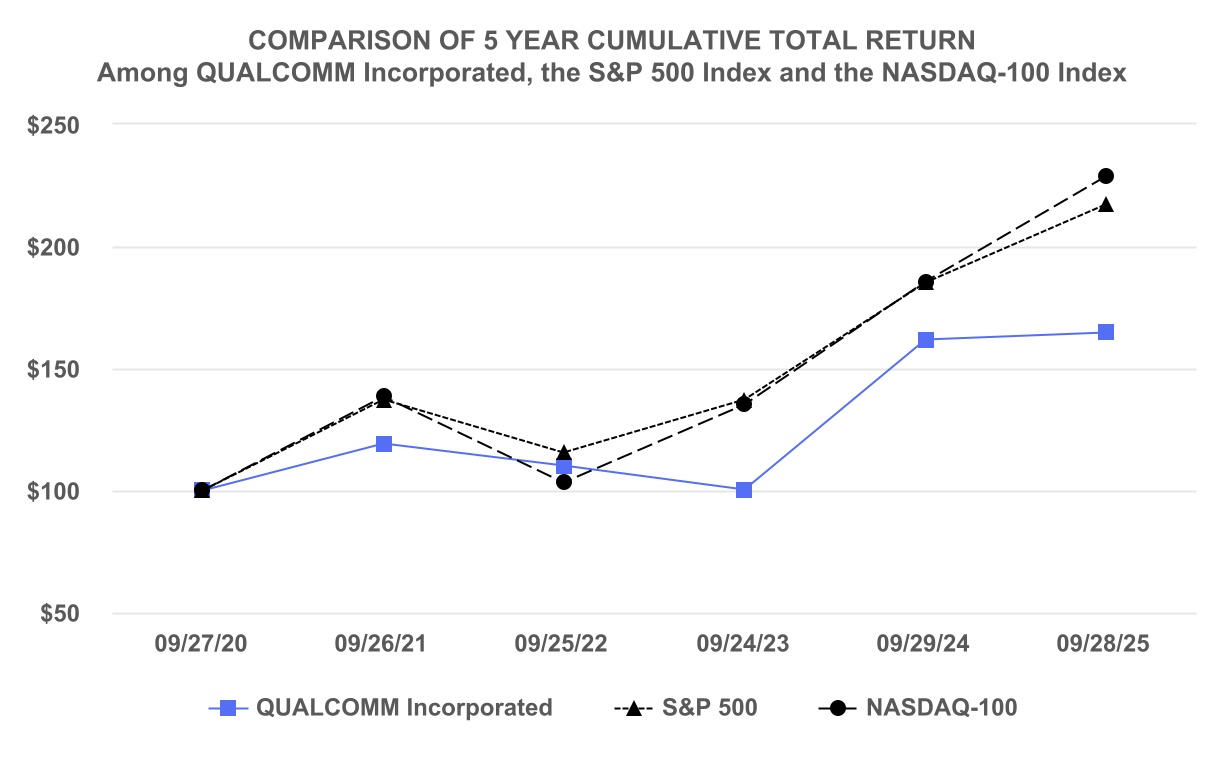
Item 6. (Reserved)
Item 7. Management’s Discussion and Analysis of Financial Condition and Results of Operations
The following discussion and analysis of our financial condition and results of operations should be read in conjunction with our consolidated financial statements and related notes included in “Part II, Item 8. Financial Statements and Supplementary Data” of this Annual Report.
The following section generally discusses fiscal 2025 and 2024 items and year-to-year comparisons between fiscal 2025 and 2024. Discussions of fiscal 2023 items and year-to-year comparisons between fiscal 2024 and 2023 that are not included in this Annual Report can be found in “Management’s Discussion and Analysis of Financial Condition and Results of Operations” in Part II, Item 7 of our Annual Report on Form 10-K for the fiscal year ended September 29, 2024.
Our Business and Operating Segments
We develop and commercialize foundational technologies and products used across industries and applications from mobile devices to other areas including automotive and the internet of things (IoT). We derive revenues principally from sales of integrated circuit products and licensing our intellectual property, including patents and other rights.
We are organized on the basis of products and services and have three reportable segments. We conduct business primarily through our QCT (Qualcomm CDMA Technologies) semiconductor business and our QTL (Qualcomm Technology Licensing) licensing business. Our QSI (Qualcomm Strategic Initiatives) reportable segment makes strategic investments. We also have nonreportable segments, including QGOV (Qualcomm Government Technologies) and our Data Center business (formerly referred to as our cloud computing processing initiative).
Further information regarding our business and operating segments is provided in “Part I, Item 1. Business” of this Annual Report.
Seasonality. Many of our products and much of our intellectual property are incorporated into consumer wireless devices, which are subject to seasonality and other fluctuations in demand. Our revenues have historically fluctuated based on consumer demand for devices, as well as on the timing of customer/licensee device launches and/or innovation cycles (such as the transition to the next generation of wireless technologies). This has resulted in fluctuations in QCT revenues in advance of and during device launches incorporating our products (for example, certain major handset OEMs accelerated their premium-tier device launches into the first quarter of fiscal 2025) and in QTL revenues when licensees’ sales occur. These trends may or may not continue in the future. Further, the trends for QTL have been, and may in the future be, impacted by disputes and/or resolutions with licensees and/or governmental investigations or proceedings.
38
Fiscal 2025 Overview
Revenues were $44.3 billion, an increase of 14% compared to revenues of $39.0 billion in fiscal 2024, with net income of $5.5 billion, a decrease of 45% compared to net income of $10.1 billion in fiscal 2024. Key items from fiscal 2025 included:
•QCT revenues increased by 16% in fiscal 2025 compared to the prior year, primarily due to higher handsets, IoT and automotive revenues.
•QTL revenues remained approximately flat in fiscal 2025 compared to the prior year.
•We recorded a charge of $5.7 billion to income tax expense to establish a valuation allowance in the fourth quarter of fiscal 2025 as we no longer expect to realize substantially all of our existing federal deferred tax assets as a result of the tax reform legislation included in the One Big Beautiful Bill Act (OBBB) enacted on July 4, 2025.
Results of Operations
| Revenues (in millions) | |||||||||||||||||
| 2025 | 2024 | Change | |||||||||||||||
| Equipment and services | $ | 37,869 | $ | 32,791 | $ | 5,078 | |||||||||||
| Licensing | 6,415 | 6,171 | 244 | ||||||||||||||
| $ | 44,284 | $ | 38,962 | $ | 5,322 | ||||||||||||
2025 vs. 2024
The increase in revenues in fiscal 2025 was primarily due to:
+ $5.1 billion in higher equipment and services revenue from our QCT segment
+ $143 million in licensing revenues resulting from a settlement of a licensing dispute in the second quarter of fiscal 2025, which was not allocated to our segment results
| Costs and Expenses (in millions, except percentages) | |||||||||||||||||
| 2025 | 2024 | Change | |||||||||||||||
| Cost of revenues | $ | 19,738 | $ | 17,060 | $ | 2,678 | |||||||||||
| Gross margin | 55 | % | 56 | % | |||||||||||||
2025 vs. 2024
Gross margin percentage decreased in fiscal 2025 primarily due to a decrease in the proportion of total revenues related to QTL licensing revenues (which have a higher margin percentage contribution).
| 2025 | 2024 | Change | |||||||||||||||
| Research and development | $ | 9,042 | $ | 8,893 | $ | 149 | |||||||||||
| % of revenues | 20 | % | 23 | % | |||||||||||||
2025 vs. 2024
The increase in research and development expenses in fiscal 2025 was primarily due to a $118 million increase in share-based compensation expense. Our costs related to the development of wireless and integrated circuit technologies (including investments in key growth and diversification initiatives) remained approximately flat, primarily driven by $314 million in higher non-recurring engineering cost reimbursements for product-related development work, partially offset by an increase in employee-related costs.
39
| 2025 | 2024 | Change | |||||||||||||||
| Selling, general and administrative | $ | 3,110 | $ | 2,759 | $ | 351 | |||||||||||
| % of revenues | 7 | % | 7 | % | |||||||||||||
2025 vs. 2024
The increase in selling, general and administrative expenses in fiscal 2025 was primarily due to:
+ $231 million increase in sales and marketing expenses (including investments in key growth and diversification initiatives)
+ $70 million increase in employee-related expenses
| 2025 | 2024 | Change | |||||||||||||||
Other expenses | $ | 39 | $ | 179 | $ | (140) | |||||||||||
2025 vs. 2024
Other expenses in fiscal 2025 consisted of restructuring and restructuring-related charges.
Other expenses in fiscal 2024 primarily consisted of $107 million in restructuring and restructuring-related charges (substantially all of which related to severance costs) and a $75 million charge related to the settlement of a securities class action lawsuit.
Interest Expense and Investment and Other Income, Net (in millions) | |||||||||||||||||
| 2025 | 2024 | Change | |||||||||||||||
| Interest expense | $ | 664 | $ | 697 | $ | (33) | |||||||||||
| Investment and other income, net | |||||||||||||||||
| Interest and dividend income | $ | 639 | $ | 675 | $ | (36) | |||||||||||
| Net gains on marketable securities | 254 | 14 | 240 | ||||||||||||||
| Net gains on other investments | 44 | 175 | (131) | ||||||||||||||
| Net gains on deferred compensation plan assets | 127 | 198 | (71) | ||||||||||||||
| Impairment losses on other investments | (113) | (79) | (34) | ||||||||||||||
| Other | 21 | (21) | 42 | ||||||||||||||
| $ | 972 | $ | 962 | $ | 10 | ||||||||||||
2025 vs. 2024
Net gains on marketable securities in fiscal 2025 was primarily driven by the initial public offerings of certain QSI equity investments.
Net gains on other investments in fiscal 2024 was primarily driven by observable price changes on certain of our QSI non-marketable equity investments.
40
Income Tax Expense (in millions, except percentages)
The following table summarizes the primary factors that caused our annual tax provision from continuing operations to differ from the expected income tax provision at the U.S. federal statutory rate. Substantially all of our income is taxed in the U.S., of which a significant portion qualifies for preferential treatment as foreign-derived intangible income (FDII) at a 13% effective tax rate for the periods presented. Additional information regarding our annual effective tax rate (including discussion related to the impact of the requirement to capitalize research and development expenditures for federal income tax purposes, and the benefit related to the transfer of intellectual property between foreign subsidiaries in fiscal 2024) is provided in this Annual Report in “Notes to Consolidated Financial Statements, Note 3. Income Taxes.”
| 2025 | 2024 | ||||||||||
| Expected income tax provision at federal statutory tax rate | $ | 2,659 | $ | 2,171 | |||||||
| Valuation allowance on federal deferred tax assets resulting from OBBB | 5,724 | — | |||||||||
| Benefit from FDII deduction, excluding the impact of capitalizing research and development expenditures | (735) | (596) | |||||||||
| Benefit from FDII deduction related to capitalizing research and development expenditures | (492) | (585) | |||||||||
| Benefit related to the research and development tax credit | (237) | (259) | |||||||||
| Excess tax benefit associated with share-based awards | (120) | (176) | |||||||||
| Foreign currency losses (gains) related to foreign withholding tax receivable | 98 | (21) | |||||||||
| Benefit related to the transfer of intellectual property between foreign subsidiaries | (8) | (317) | |||||||||
| Other | 233 | 9 | |||||||||
| Income tax expense | $ | 7,122 | $ | 226 | |||||||
| Effective tax rate | 56 | % | 2 | % | |||||||
On July 4, 2025, tax reform legislation included in the OBBB was enacted in the United States. The OBBB includes significant corporate tax reforms, including the permanent reinstatement of deducting domestic research and development expenditures as incurred beginning in fiscal 2026 (under prior law such expenditures were capitalized and amortized over five years). The legislation also modifies international tax provisions, including changes to the FDII regime. Specifically, it renames FDII as Foreign-Derived Deduction Eligible Income (FDDEI), maintains the current FDDEI effective tax rate of 13% through fiscal 2026 and adjusts the FDDEI effective tax rate to a permanent 14% rate in fiscal 2027 (compared to 16% under prior law). As a result of these changes, we expect to be subject to the corporate alternative minimum tax (CAMT) beginning in fiscal 2026. CAMT imposes a 15% federal minimum tax on adjusted financial statement income, reduced by general business credits, including research and development credits. As we expect to perpetually be subject to CAMT, we no longer expect to realize substantially all of our existing federal deferred tax assets and recognized a charge of $5.7 billion to income tax expense to establish a valuation allowance in the fourth quarter of fiscal 2025.
Beginning in fiscal 2023 and through fiscal 2025, for federal income tax purposes, we were required to capitalize and amortize domestic research and development expenditures over five years (such expenditures were previously deducted as incurred). Our cash flows from operations were adversely affected due to significantly higher cash tax payments. However, since the resulting deferred tax asset was established at the statutory rate of 21% (rather than the current effective tax rate of 13% after considering the FDII deduction), capitalization favorably affected our total provision for income taxes and results of operations. With the enactment of OBBB, such impacts on our cash flows and tax provision are not expected to continue beginning in fiscal 2026. Changes in future taxable income (including less of our income qualifying for preferential treatment as FDDEI), tax laws (including changes to the CAMT rules) and other factors may change our determination regarding whether we will be able to realize our deferred tax assets.
41
Segment Results
The following should be read in conjunction with the fiscal 2025 and 2024 results of operations for each reportable segment included in this Annual Report in “Notes to Consolidated Financial Statements, Note 8. Segment Information.”
QCT Segment (in millions, except percentages)
| 2025 | 2024 | Change | |||||||||||||||
| Revenues | |||||||||||||||||
| Handsets | $ | 27,793 | $ | 24,863 | $ | 2,930 | |||||||||||
| Automotive | 3,957 | 2,910 | 1,047 | ||||||||||||||
| IoT (internet of things) | 6,617 | 5,423 | 1,194 | ||||||||||||||
Total revenues (1) | $ | 38,367 | $ | 33,196 | $ | 5,171 | |||||||||||
EBT (2) | $ | 11,670 | $ | 9,527 | $ | 2,143 | |||||||||||
| EBT as a % of revenues | 30 | % | 29 | % | 1 point | ||||||||||||
(1) Descriptions of our three QCT revenue streams can be found in this Annual Report in “Notes to Consolidated Financial Statements, Note 2. Composition of Certain Financial Statement Items.”
(2) Earnings before income taxes.
Substantially all of QCT’s revenues consist of equipment and services revenues, which were $37.7 billion and $32.6 billion in fiscal 2025 and 2024, respectively. QCT revenues mostly relate to sales of our Snapdragon and Dragonwing platforms (which include processors and modems), stand-alone Mobile Data Modems, radio frequency transceiver, power management and wireless connectivity integrated chipsets as well as sales of 4G, 5G sub 6 and 5G millimeter wave RFFE products.
2025 vs. 2024
The increase in QCT revenues in fiscal 2025 was primarily due to:
+ higher handsets revenues, due to $2.5 billion in higher revenues per chipset primarily driven by higher average selling prices and favorable mix, and $423 million in higher chipset shipments by certain major OEMs, both of which benefited from an increase in demand for premium-tier Snapdragon platforms in Android devices
+ higher IoT revenues due to $1.5 billion in higher shipments across edge networking, consumer and industrial products, partially offset by unfavorable mix
+ higher automotive revenues, primarily driven by an increase in shipments from new vehicle launches with our Snapdragon digital cockpit products
QCT EBT as a percentage of revenues increased in fiscal 2025 primarily due to:
+ higher revenues
- higher operating expenses, primarily driven by higher selling, general and administrative expenses
Gross margin percentage remained approximately flat in fiscal 2025, primarily driven by higher product costs, partially offset by higher average selling prices.
QTL Segment (in millions, except percentages)
| 2025 | 2024 | Change | |||||||||||||||
| Licensing revenues | $ | 5,582 | $ | 5,572 | $ | 10 | |||||||||||
| EBT | 4,043 | 4,027 | 16 | ||||||||||||||
| EBT as a % of revenues | 72 | % | 72 | % | — | ||||||||||||
2025 vs. 2024
QTL licensing revenues and EBT remained approximately flat in fiscal 2025. During the second quarter of fiscal 2025, we executed final agreements for new long-term licenses with two key Chinese OEMs (for which the initial terms had expired) and entered into comprehensive 4G and 5G license agreements with Transsion (a growing, China-headquartered OEM that sells primarily in developing regions). As a result of our agreements with Transsion, all outstanding litigation between the parties has been dismissed. Beginning in the second quarter of fiscal 2025, QTL revenues did not include royalties from Huawei, whose license agreement has expired.
42
QSI Segment (in millions)
| 2025 | 2024 | Change | |||||||||||||||
| Equipment and services revenues | $ | — | $ | 18 | $ | (18) | |||||||||||
EBT | 180 | 104 | 76 | ||||||||||||||
2025 vs. 2024
QSI EBT increased in fiscal 2025 primarily due to higher net gains on marketable securities resulting from the initial public offerings of certain of our equity investments, partially offset by lower net gains from observable price changes on certain of our non-marketable equity investments.
Looking Forward
We believe that on-device AI and high-performance, low-power computing combined with cellular technology (such as 5G) will continue to drive adoption of certain technologies that are already commonly used in smartphones by industries and applications beyond mobile handsets, such as automotive and IoT. We believe it is important that we remain a leader in such technology development, standardization, intellectual property creation and licensing, and a leading developer and supplier of integrated circuit products in order to sustain and grow our business long-term.
As we look forward to the next several quarters:
•We continue to monitor the recent changes in global trade policy, including tariffs and related trade actions announced by the U.S., China and other countries. The degree to which such tariffs and other related actions impact our business, financial condition and results of operations will depend on future developments, which are uncertain. Changes to global trade policies may negatively impact demand, pricing and cost for our products and technologies, and contribute to the inherent uncertainties in estimating future customer demand, which may result in increased excess or obsolete inventory or reserve charges, negatively impacting our results of operations and cash flows. See “Part I, Item 1A. Risk Factors” in this Annual Report, including the Risk Factor titled “We operate in the highly cyclical semiconductor industry, which is subject to significant downturns. We are also susceptible to declines in global, regional and local economic conditions generally. Our stock price and financial results are subject to substantial quarterly and annual fluctuations due to these dynamics, among others.”
•We expect leading process technology nodes to continue to drive product cost increases from certain of our key semiconductor wafer suppliers.
•We expect continued intense competition, including from vertical integration by certain of our customers (for example, Apple and Samsung). In particular, Apple began utilizing its own modem (rather than our products) in its recently released smartphones and we expect that Apple will increasingly use its own modem products, rather than our products, in its future devices, which will have a significant negative impact on our QCT revenues, results of operations and cash flows.
•We expect to continue investing in key growth and diversification initiatives. We also expect our share-based compensation expense to increase as we have replaced our annual cash incentive awards for fiscal 2026 and 2027 with a two-year equity award for our broader non-executive leadership team. This approach is designed to motivate and retain our team to execute our long-term diversification strategy, while further aligning their compensation with the interests of our stockholders.
•U.S./China trade relations and/or national security protection policies may negatively impact our business, growth prospects and results of operations. See “Part I, Item 1A. Risk Factors” in this Annual Report, including the Risk Factor titled “A significant portion of our business is concentrated in China, and the risks of such concentration are exacerbated by U.S./China trade and national security tensions.”
We are also involved in certain legal proceedings, including those described in this Annual Report in “Notes to Consolidated Financial Statements, Note 7. Commitments and Contingencies.” Litigation is inherently uncertain, and, while we intend to continue to vigorously defend ourselves in such matters, the unfavorable resolution of one or more of these matters could have a material adverse effect on our business, results of operations, financial condition or cash flows.
In addition to the foregoing business and market-based matters, we continue to devote resources to working with and educating participants in the wireless industry and governments as to the benefits of our licensing programs and our extensive technology investments in promoting a highly competitive and innovative wireless industry. However, we expect that certain companies may be dissatisfied with the need to pay reasonable royalties for the use of our technologies and not welcome the success of our licensing programs in enabling new, highly cost-effective competitors to their products. Accordingly, such companies, and/or governments or regulators, may continue to challenge our business model in various forums throughout the world.
Further discussion of risks related to our business is provided in “Part I, Item 1A. Risk Factors” included in this Annual Report.
43
Liquidity and Capital Resources
Our principal sources of liquidity are our existing cash, cash equivalents and marketable securities (including restricted cash), cash generated from operations and cash provided by our debt programs, which we believe will satisfy our working and other capital requirements for at least the next 12 months based on our current business plans.
The following table presents selected financial information related to our liquidity as of and for the years ended September 28, 2025 and September 29, 2024 (in millions):
| September 28, 2025 | September 29, 2024 | Change | |||||||||||||||
Cash, cash equivalents and marketable securities (including restricted cash) | |||||||||||||||||
Cash and cash equivalents | $ | 5,520 | $ | 7,849 | $ | (2,329) | |||||||||||
Restricted cash (1) | 2,323 | — | 2,323 | ||||||||||||||
| Marketable securities | 4,635 | 5,451 | (816) | ||||||||||||||
| $ | 12,478 | $ | 13,300 | $ | (822) | ||||||||||||
Debt (2) | $ | 14,811 | $ | 14,634 | $ | 177 | |||||||||||
(1) In connection with our pending acquisition of Alphawave IP Group plc (Alphawave), we agreed to restrict the use of approximately $2.3 billion of cash to be held for purposes of satisfying payment of the consideration to effect the acquisition. Additional information regarding our pending acquisition of Alphawave is provided in this Annual Report in “Notes to Consolidated Financial Statements, Note 9. Acquisitions.”
(2) Includes our issued debt reported as long-term and short-term. At September 28, 2025, we had $15.1 billion of principal fixed-rate notes outstanding with maturity dates between 2027 and 2053.
| 2025 | 2024 | Change | |||||||||||||||
| Net cash provided by operating activities | $ | 14,012 | $ | 12,202 | $ | 1,810 | |||||||||||
Net cash used by investing activities | (800) | (3,623) | 2,823 | ||||||||||||||
| Net cash used by financing activities | (13,196) | (9,269) | (3,927) | ||||||||||||||
Cash, cash equivalents and marketable securities (including restricted cash). The net decrease in cash, cash equivalents and marketable securities (including restricted cash) in fiscal 2025 was primarily due to $8.8 billion in payments to repurchase shares of our common stock, $3.8 billion in cash dividends paid, $1.4 billion repayment of unsecured fixed-rate notes that matured in May 2025, $1.2 billion in capital expenditures, $1.1 billion in payments of tax withholdings related to the vesting of share-based awards and $743 million in cash paid for acquisitions and other investments. This was partially offset by cash provided by operating activities, proceeds from the issuance of $1.5 billion of unsecured fixed-rate notes in May 2025 and $404 million in proceeds from the issuance of common stock (primarily under our Employee Stock Purchase Plan).
During fiscal 2025, income taxes paid were less than our provision. This was driven primarily by the $5.7 billion charge to income tax expense to establish a valuation allowance in fiscal 2025 as a result of the tax reform legislation included in the OBBB. This was partially offset by our installment payment for a one-time U.S. repatriation tax accrued in fiscal 2018 of $530 million and the adverse impact of the requirement to capitalize and amortize research and development expenditures for federal income tax purposes. The enactment of the OBBB includes significant corporate tax reforms, including the permanent reinstatement of deducting domestic research and development expenditures as incurred beginning in fiscal 2026. We expect this change will have a favorable effect on our cash flows from operations due to lower cash tax payments compared to fiscal 2025 beginning in fiscal 2026.
Net changes in our operating assets and liabilities positively impacted our operating cash flows in fiscal 2025 primarily from a decrease in other assets driven by the utilization of prior advanced supply agreement payments, partially offset by an increase in accounts receivables primarily driven by higher revenues.
Debt. During the third quarter of fiscal 2025, we repaid $1.4 billion of unsecured fixed-rate notes that matured in May 2025. In May 2025, we also issued $1.5 billion of unsecured fixed-rate notes, consisting of $500 million of 4.50% notes, $400 million of 4.75% notes and $600 million of 5.00% notes (collectively, May 2025 Notes) that mature on May 20, 2030, May 20, 2032 and May 20, 2035, respectively. The net proceeds from the May 2025 Notes will be used for general corporate purposes. We also entered into interest rate swaps which are designated as fair value hedges and allow us to effectively convert all of our fixed-rate payments due under the May 2025 Notes into floating-rate payments.
We have an unsecured commercial paper program, which provides for the issuance of up to $4.5 billion of commercial paper. Net proceeds from this program are used for general corporate purposes. At September 28, 2025, we had no amounts of commercial paper outstanding. We also have a Revolving Credit Facility that provides for unsecured revolving facility loans, swing line loans and letters of credit in an aggregate amount of up to $4.0 billion, which expires on August 8, 2029. At September 28, 2025, no amounts were outstanding under the Revolving Credit Facility.
44
We expect to issue new debt in the future. The amount and timing of any such new debt will depend on a number of factors, including but not limited to maturities of our existing debt, acquisitions and strategic investments, favorable and/or acceptable interest rates and changes in corporate income tax law. Additional information regarding our debt is provided in this Annual Report in “Notes to Consolidated Financial Statements, Note 6. Debt.”
Capital Return Program. The following table summarizes stock repurchases (including excise taxes paid) and dividends paid during fiscal 2025 and 2024 (in millions, except per-share amounts):
| Stock Repurchase Program | Dividends | Total | ||||||||||||||||||||||||||||||||||||
| Shares | Average Price Paid Per Share | Amount | Per Share | Amount | Amount | |||||||||||||||||||||||||||||||||
| 2025 | 56 | $ | 155.43 | $ | 8,791 | $ | 3.48 | $ | 3,805 | $ | 12,596 | |||||||||||||||||||||||||||
| 2024 | 25 | 161.37 | 4,121 | 3.30 | 3,687 | 7,808 | ||||||||||||||||||||||||||||||||
At September 28, 2025, $7.2 billion remained authorized for repurchase under our stock repurchase program. Our stock repurchases were at an increased level in fiscal 2025 compared to fiscal 2024. The timing of future stock repurchases and the number of shares of common stock to be repurchased will depend upon prevailing market conditions and other factors. Repurchases may be made in the open market, through 10b5-1 programs, through accelerated share repurchase programs, in privately negotiated transactions or through the use of derivative instruments. Our stock repurchase programs are subject to periodic evaluations to determine when and if repurchases are in the best interests of our stockholders, and we may accelerate, suspend, delay or discontinue repurchases at any time.
We currently intend to continue to use cash dividends as a means of returning capital to stockholders, subject to capital availability and our view that cash dividends are in the best interests of our stockholders, among other factors. Additional information regarding our capital returns is provided in this Annual Report in “Notes to Consolidated Financial Statements, Note 4. Capital Stock.”
Additional Capital Requirements. Recent and expected working and other capital requirements, in addition to the above matters, also include the items described below:
•Our purchase obligations at September 28, 2025, which primarily relate to purchase commitments with certain suppliers of our integrated circuit products, including those under multi-year capacity commitments, totaled $15.1 billion, of which, $10.5 billion is expected to be paid in the next 12 months.
•Our research and development expenditures were $9.0 billion in fiscal 2025 and $8.9 billion in fiscal 2024.
•Cash outflows for capital expenditures were $1.2 billion in fiscal 2025 and $1.0 billion in fiscal 2024. We expect capital expenditures to increase from fiscal 2025 in the near term primarily to support the testing of our integrated circuits.
•Amounts related to future lease payments for operating lease obligations at September 28, 2025 totaled $1.1 billion, with $142 million expected to be paid within the next 12 months.
•On June 9, 2025, we announced that we reached an agreement to acquire Alphawave at an implied enterprise value of approximately $2.4 billion (as of the announcement date). The purchase price will be paid in cash or, if validly elected by eligible shareholders of Alphawave, in shares of our common stock or securities exchangeable for shares of our common stock. The acquisition is subject to certain closing conditions, including receipt of regulatory approvals. Subject to the satisfaction of these conditions, this acquisition is expected to complete during the first quarter of calendar 2026.
•We expect to continue making strategic investments and acquisitions, the amounts of which could vary significantly.
Further, regulatory authorities in certain jurisdictions have investigated our business practices and instituted proceedings against us, and they or other regulatory authorities may do so in the future. Additionally, certain of our direct and indirect customers and licensees have pursued, and they or others may in the future pursue, litigation, arbitration or other strategies against us related to our business. Unfavorable resolutions of one or more of these matters have had and could in the future have a material adverse effect on our business, results of operations, financial condition and cash flows. See “Notes to Consolidated Financial Statements, Note 7. Commitments and Contingencies” and “Part I, Item 1A. Risk Factors” in this Annual Report.
Critical Accounting Estimates
The preparation of our consolidated financial statements in accordance with accounting principles generally accepted in the United States requires us to make estimates and judgments that affect the reported amounts of assets, liabilities, revenues and expenses, and disclosure of contingent amounts. We base our estimates on historical and anticipated results and trends and on various other assumptions that we believe are reasonable under the circumstances, including assumptions as to future events. By their nature, estimates are inherently subject to a degree of uncertainty. Although we believe that our estimates and the assumptions supporting our assessments are reasonable, actual results could differ materially from our estimates and assumptions, and could be material to our consolidated financial statements.
45
In addition to our critical accounting estimates and policies below, refer to “Note 1. Significant Accounting Policies” and “Note 2. Composition of Certain Financial Statement Items” included in this Annual Report in “Notes to Consolidated Financial Statements” for further information. If the impact of changes in our critical accounting estimates is material or considered necessary to understand our results of operations for the periods presented, then such information is disclosed within this Annual Report in “Part II, Item 7. Management’s Discussion and Analysis of Financial Condition and Results of Operations.”
Revenue Recognition. We grant licenses or otherwise provide rights to use portions of our intellectual property portfolio, which, among other rights, includes certain patent rights essential to and/or useful in the manufacture, sale or use of certain wireless products. We estimate and recognize sales-based royalties on such licensed products in the period in which the licensees’ sales occur, which is based largely on preliminary royalty estimates provided by our licensees. For fiscal 2025 and 2024, actual amounts for sales-based royalties have been materially consistent with such estimates, and no significant reversals of revenues have been required as a result of adjustments to prior period royalty estimates.
Impairment of Non-marketable Equity Investments. We monitor our investments, many of which are in early-stage companies, for events or circumstances that could indicate impairment, including those that result from observable price adjustments. Key considerations in this assessment include the investee’s financial and liquidity position and business forecasts (including their ability to respond to any significant deterioration), industry performance, development and/or market acceptance of the investee’s products or technologies, as well as considering any appreciation in fair value that has not been recognized in the carrying values of such investments and other relevant events and factors. Measurement of any impairments may require the use of unobservable inputs. In fiscal 2025 and 2024, there were no significant impairment losses or adjustments to our previous judgments and estimates recorded.
Inventories. We measure inventory at the lower of cost or net realizable value considering judgments and estimates related to future customer demand and other market conditions, such as the impact of the macroeconomic environment and global trade policies. Although we believe these estimates are reasonable, any significant changes in customer demand that are less favorable than our previous estimates may require additional inventory write-downs and would be reflected in cost of sales resulting in a negative impact to our gross margin in that period. For fiscal 2025 and 2024, the net effect from changes in this estimate and related reserves was less than 1% of cost of revenues during each period.
Impairment of Goodwill, Other Indefinite-Lived Assets and Long-Lived Assets. We monitor our goodwill, other indefinite-lived assets and long-lived assets for the existence of impairment indicators and apply judgments in the valuation methods (generally income or market approach) and underlying inputs and assumptions utilized in such assessments, which are generally unobservable inputs. During fiscal 2025 and 2024, there were no material impairment charges for long-lived or indefinite-lived assets. Additionally, the estimated fair values of our QCT and QTL reporting units, based on our qualitative assessment, were substantially in excess of their respective carrying values at September 28, 2025.
Legal and Regulatory Proceedings. We are currently involved in certain legal and regulatory proceedings, the outcomes of which are inherently uncertain. If there is at least a reasonable possibility that a material loss may have been incurred associated with pending legal and regulatory proceedings, we disclose such fact. We record our best estimate of a loss related to pending legal and regulatory proceedings when the loss is considered probable and the amount can be reasonably estimated. We face difficulties in evaluating or estimating likely outcomes and/or the amount of possible loss in certain legal and regulatory proceedings. Until the final resolution of such matters, there may be an exposure to loss in excess of the amount recorded (or the possible loss disclosed), and such amounts could be material.
Income Taxes. We make significant judgments and estimates in determining our provision for income taxes, including our assessment of our income tax positions, both in the U.S. and foreign jurisdictions, given the uncertainties involved in the interpretation and application of complex tax laws and regulations in various taxing jurisdictions. While we believe we have appropriate support for the positions we have taken or plan to take on our tax returns, we regularly assess the potential outcomes of examinations by taxing authorities in determining the adequacy of our provision for income taxes based on the technical merits of the position. The actual liability for U.S. or foreign taxes may be materially different from our estimates, which could result in the need to record additional tax liabilities or potentially reverse previously recorded tax liabilities. Based on our results for fiscal 2025, an assumed one-percentage point increase to our annual effective tax rate would result in an increase in income tax expense of $127 million.
Deferred tax assets represent amounts available to reduce income taxes payable on taxable income in future years. Under the OBBB enacted in July 2025, we expect to be subject to CAMT beginning in fiscal 2026 and therefore, we no longer expect to realize substantially all of our existing federal deferred tax assets. As a result, we recorded a charge of $5.7 billion to income tax expense to establish a valuation allowance against such deferred tax assets in the fourth quarter of fiscal 2025. Factors considered in this determination included assessing the adequacy of future expected taxable income from all sources, including reversal of taxable temporary differences, forecasted operating earnings and available tax planning strategies, and considering that substantially all of our income is taxed in the U.S., of which a significant portion qualifies for preferential treatment as FDDEI. Changes in future taxable income (including less of our income qualifying for preferential treatment as FDDEI), tax laws (including changes to the CAMT rules) and other factors may change our determination regarding whether we will be able to realize our deferred tax assets.
46
Recent Accounting Pronouncements
Information regarding recent accounting pronouncements and the impact of those pronouncements, if any, on our consolidated financial statements is provided in this Annual Report in “Notes to Consolidated Financial Statements, Note 1. Significant Accounting Policies.”
Item 7A. Quantitative and Qualitative Disclosures about Market Risk
We are exposed to market risks, including changes to interest rates, equity price risk and foreign currency exchange rates.
Interest Rate Risk
We invest a portion of our cash in a number of diversified fixed- and floating-rate securities consisting of cash equivalents, marketable debt securities and time deposits that are subject to interest rate risk. At September 28, 2025 and September 29, 2024, a hypothetical increase in interest rates of 100 basis points across the entire yield curve on our holdings would have resulted in an immaterial decrease in the fair value of our holdings.
At September 28, 2025 and September 29, 2024, all of our issued debt was comprised of unsecured fixed-rate notes. From time to time, we issue commercial paper for which our exposure to interest rate risk is negligible based on the original maturities of approximately three months or less.
We manage our exposure to certain interest rate risks related to our long-term debt through the use of interest rate swaps. We enter into these agreements to manage interest rate risk associated with our cash equivalents and marketable securities, in addition to changes in the fair value of our outstanding debt. At September 28, 2025 and September 29, 2024, we had an aggregate notional amount of $3.6 billion and $2.1 billion, respectively, in interest rate swaps that are designated as fair value hedges to effectively convert certain fixed-rate interest payments into floating-rate payments on our outstanding debt. At September 28, 2025 and September 29, 2024, a hypothetical increase in interest rates of 100 basis points would not cause a material loss in earnings.
Equity Price Risk
We hold investments in non-marketable equity instruments in privately held companies that may be impacted by equity price risks. Volatility in the equity markets could negatively affect our investees’ ability to raise additional capital as well as our ability to realize value from our investments through initial public offerings, mergers or private sales. Consequently, we could incur impairment losses or realized losses on all or part of the values of our non-marketable equity investments. At September 28, 2025, our non-marketable equity investments (including those accounted for under the equity method) consisted of investments in over 150 companies with an aggregate carrying value included in other assets of $1.4 billion. Impairment losses on such investments were not material for any of the periods presented in this Annual Report.
Foreign Exchange Risk
As a global company, we face exposure to adverse movements in foreign currency exchange rates. Financial assets and liabilities held by consolidated subsidiaries that are not denominated in the functional currency of those entities are subject to the effects of currency fluctuations. We could experience gains or losses on foreign currency cash flows, as well as economic loss with respect to the recoverability of foreign investments.
We manage our exposure to foreign exchange market risks, when deemed appropriate, through the use of derivative and non-derivative financial instruments, including foreign currency forward and option contracts with financial counterparties and, from time to time, other financial instruments designated as net investment hedges. We utilize such financial instruments for hedging or risk management purposes rather than for speculative purposes. While we may hedge certain transactions with non-U.S. customers, declines in currency values in certain regions may, if not reversed, adversely affect future product sales because our products may become more expensive to purchase in the countries of the affected currencies.
Gains or losses on hedged foreign currency transactions and investments, including certain royalties earned from licensees, operating expenses and net investments in foreign subsidiaries, are generally offset by corresponding losses or gains on the related hedging instrument.
We have experienced fluctuations in our effective tax rate as a result of foreign currency gains or losses related to our Korean withholding tax receivable (which was $2.2 billion as of September 28, 2025), which is described further in this Annual Report in “Notes to Consolidated Financial Statements, Note 3. Income Taxes.” Based on the balance of such foreign withholding tax receivable, an assumed 10% adverse change to foreign exchange rates would result in losses of approximately $223 million and $222 million as of September 28, 2025 and September 29, 2024, respectively. Other gains and losses from foreign currency transactions were not material for any of the periods presented in this Annual Report.
Our analysis methods used to assess and mitigate the risks discussed above should not be considered projections of future risks. Additional information regarding the financial instruments mentioned above is provided in this Annual Report in “Notes to Consolidated Financial Statements, Note 1. Significant Accounting Policies,” “Notes to Consolidated Financial Statements, Note 2. Composition of Certain Financial Statement Items,” “Notes to Consolidated Financial Statements, Note 6. Debt” and “Notes to Consolidated Financial Statements, Note 10. Fair Value Measurements and Marketable Securities.”
47
Item 8. Financial Statements and Supplementary Data
The information required by this item is included in this Annual Report on pages F-1 through F-27.
Item 9. Changes in and Disagreements with Accountants on Accounting and Financial Disclosure
None.
Item 9A. Controls and Procedures
Conclusion Regarding the Effectiveness of Disclosure Controls and Procedures
Under the supervision and with the participation of our management, including our principal executive officer and our principal financial officer, we conducted an evaluation of our disclosure controls and procedures, as such terms are defined under Rule 13a-15(e) promulgated under the Securities Exchange Act of 1934, as amended (the Exchange Act). Based on this evaluation, our principal executive officer and our principal financial officer concluded that our disclosure controls and procedures were effective as of the end of the period covered by this Annual Report.
Management’s Report on Internal Control over Financial Reporting
Our management is responsible for establishing and maintaining adequate internal control over financial reporting, as such term is defined in Exchange Act Rule 13a-15(f). Under the supervision and with the participation of our management, including our principal executive officer and our principal financial officer, we conducted an evaluation of the effectiveness of our internal control over financial reporting based on the framework in Internal Control — Integrated Framework (2013) issued by the Committee of Sponsoring Organizations of the Treadway Commission. Based on our evaluation under this framework, our management concluded that our internal control over financial reporting was effective as of September 28, 2025.
PricewaterhouseCoopers LLP, the independent registered public accounting firm that audited our consolidated financial statements included in this Annual Report, has also audited the effectiveness of our internal control over financial reporting as of September 28, 2025, as stated in its report which appears on pages F-1 through F-2 in this Annual Report.
Inherent Limitations over Internal Controls
Our internal control over financial reporting is designed to provide reasonable assurance regarding the reliability of financial reporting and the preparation of consolidated financial statements for external purposes in accordance with generally accepted accounting principles. Our internal control over financial reporting includes those policies and procedures that:
i.pertain to the maintenance of records that, in reasonable detail, accurately and fairly reflect the transactions and dispositions of our assets;
ii.provide reasonable assurance that transactions are recorded as necessary to permit preparation of consolidated financial statements in accordance with generally accepted accounting principles, and that our receipts and expenditures are being made only in accordance with authorizations of our management and directors; and
iii.provide reasonable assurance regarding prevention or timely detection of unauthorized acquisition, use or disposition of our assets that could have a material effect on the consolidated financial statements.
Internal control over financial reporting cannot provide absolute assurance of achieving financial reporting objectives because of its inherent limitations, including the possibility of human error and circumvention by collusion or overriding of controls. Accordingly, even an effective internal control system may not prevent or detect material misstatements on a timely basis. Also, projections of any evaluation of effectiveness to future periods are subject to the risk that controls may become inadequate because of changes in conditions or that the degree of compliance with the policies or procedures may deteriorate.
Changes in Internal Control over Financial Reporting
There were no changes in our internal control over financial reporting during the fourth quarter of fiscal 2025 that have materially affected, or are reasonably likely to materially affect, our internal control over financial reporting.
Item 9B. Other Information
On September 11, 2025 , Heather Ace , our Chief Human Resources Officer , acting as trustee on behalf of her family trust, adopted a Rule 10b5-1 trading arrangement (as defined in Item 408 of Regulation S-K) providing for the sale of up to 12,800 shares of our common stock. The plan is scheduled to terminate on November 18, 2026.
Item 9C. Disclosure Regarding Foreign Jurisdictions that Prevent Inspections
Not applicable.
48
PART III
Item 10. Directors, Executive Officers and Corporate Governance
The information required by this item regarding directors will be included in our definitive Proxy Statement to be filed with the SEC in connection with our 2026 Annual Meeting of Stockholders (2026 Proxy Statement) and is incorporated herein by reference. Certain information required by this item regarding executive officers is set forth in Item 1 of Part I of this Annual Report under the heading “Information about our Executive Officers.” The information required by this item regarding corporate governance will be included in our 2026 Proxy Statement and is incorporated herein by reference.
Item 11. Executive Compensation
The information required by this item will be included in our 2026 Proxy Statement and is incorporated herein by reference.
Item 12. Security Ownership of Certain Beneficial Owners and Management and Related Stockholder Matters
The information required by this item will be included in our 2026 Proxy Statement and is incorporated herein by reference.
Item 13. Certain Relationships and Related Transactions, and Director Independence
The information required by this item will be included in our 2026 Proxy Statement and is incorporated herein by reference.
Item 14. Principal Accounting Fees and Services
The information required by this item will be included in our 2026 Proxy Statement and is incorporated herein by reference.
PART IV
Item 15. Exhibits and Financial Statement Schedules
The following documents are filed as part of this report:
(a) Financial Statements:
| Page | ||||||||||||||
| Number | ||||||||||||||
(1) Report of Independent Registered Public Accounting Firm (PCAOB ID: | ||||||||||||||
Consolidated Balance Sheets at September 28, 2025 and September 29, 2024 | F-3 | |||||||||||||
Consolidated Statements of Operations for Fiscal 2025, 2024 and 2023 | F-4 | |||||||||||||
Consolidated Statements of Comprehensive Income for Fiscal 2025, 2024 and 2023 | F-5 | |||||||||||||
Consolidated Statements of Cash Flows for Fiscal 2025, 2024 and 2023 | F-6 | |||||||||||||
Consolidated Statements of Stockholders’ Equity for Fiscal 2025, 2024 and 2023 | F-7 | |||||||||||||
| Notes to Consolidated Financial Statements | F-8 | |||||||||||||
(2) Schedule II - Valuation and Qualifying Accounts for Fiscal 2025, 2024 and 2023 | ||||||||||||||
Financial statement schedules other than those listed above have been omitted because they are either not required, not applicable or the information is otherwise included in the notes to the consolidated financial statements.
49
(b) Exhibits
| Exhibit Number | Exhibit Description | Form | Date of First Filing | Exhibit Number | Filed Herewith | |||||||||||||||||||||||||||
| 3.1 | 8-K | 3/7/2024 | 3.1 | |||||||||||||||||||||||||||||
| 3.2 | 8-K | 3/7/2024 | 3.2 | |||||||||||||||||||||||||||||
| 4.1 | 8-K | 5/21/2015 | 4.1 | |||||||||||||||||||||||||||||
| 4.2 | 8-K | 5/21/2015 | 4.2 | |||||||||||||||||||||||||||||
| 4.3 | 8-K | 5/21/2015 | 4.9 | |||||||||||||||||||||||||||||
| 4.4 | 8-K | 5/21/2015 | 4.10 | |||||||||||||||||||||||||||||
| 4.5 | 8-K | 5/31/2017 | 4.2 | |||||||||||||||||||||||||||||
| 4.6 | 8-K | 5/31/2017 | 4.10 | |||||||||||||||||||||||||||||
| 4.7 | 8-K | 5/31/2017 | 4.11 | |||||||||||||||||||||||||||||
| 4.8 | 8-K | 5/11/2020 | 4.2 | |||||||||||||||||||||||||||||
| 4.9 | 8-K | 5/11/2020 | 4.3 | |||||||||||||||||||||||||||||
| 4.10 | 8-K | 5/11/2020 | 4.4 | |||||||||||||||||||||||||||||
| 4.11 | 8-K | 8/18/2020 | 4.2 | |||||||||||||||||||||||||||||
| 4.12 | 8-K | 8/18/2020 | 4.3 | |||||||||||||||||||||||||||||
| 4.13 | 8-K | 8/18/2020 | 4.5 | |||||||||||||||||||||||||||||
| 4.14 | 10-Q | 2/3/2021 | 4.23 | |||||||||||||||||||||||||||||
| 4.15 | 10-Q | 2/3/2021 | 4.24 | |||||||||||||||||||||||||||||
| 4.16 | 10-Q | 2/3/2021 | 4.25 | |||||||||||||||||||||||||||||
| 4.17 | 8-K | 5/9/2022 | 4.2 | |||||||||||||||||||||||||||||
| 4.18 | 8-K | 5/9/2022 | 4.3 | |||||||||||||||||||||||||||||
| 4.19 | 8-K | 5/9/2022 | 4.4 | |||||||||||||||||||||||||||||
| 4.20 | 8-K | 11/9/2022 | 4.2 | |||||||||||||||||||||||||||||
| 4.21 | 8-K | 11/9/2022 | 4.3 | |||||||||||||||||||||||||||||
| 4.22 | 8-K | 11/9/2022 | 4.4 | |||||||||||||||||||||||||||||
50
| Exhibit Number | Exhibit Description | Form | Date of First Filing | Exhibit Number | Filed Herewith | |||||||||||||||||||||||||||
| 4.23 | 8-K | 5/22/2025 | 4.2 | |||||||||||||||||||||||||||||
| 4.24 | 8-K | 5/22/2025 | 4.3 | |||||||||||||||||||||||||||||
| 4.25 | 8-K | 5/22/2025 | 4.4 | |||||||||||||||||||||||||||||
| 4.26 | 8-K | 5/22/2025 | 4.5 | |||||||||||||||||||||||||||||
| 4.27 | 10-K | 11/6/2019 | 4.15 | |||||||||||||||||||||||||||||
| 10.1 | 8-K | 8/9/2024 | 10.1 | |||||||||||||||||||||||||||||
| 10.2 | 10-K | 11/4/2015 | 10.1 | |||||||||||||||||||||||||||||
| 10.3 | 10-Q | 4/29/2020 | 10.7 | |||||||||||||||||||||||||||||
| 10.4 | 10-Q | 4/25/2018 | 10.62 | |||||||||||||||||||||||||||||
| 10.5 | 10-Q | 4/30/2025 | 10.5 | |||||||||||||||||||||||||||||
| 10.6 | 10-Q | 2/2/2023 | 10.23 | |||||||||||||||||||||||||||||
| 10.7 | 10-Q | 2/2/2023 | 10.24 | |||||||||||||||||||||||||||||
| 10.8 | 10-Q | 1/31/2024 | 10.24 | |||||||||||||||||||||||||||||
| 10.9 | 10-Q | 1/31/2024 | 10.25 | |||||||||||||||||||||||||||||
| 10.10 | 10-K | 11/6/2024 | 10.12 | |||||||||||||||||||||||||||||
| 10.11 | 10-K | 11/6/2024 | 10.13 | |||||||||||||||||||||||||||||
| 10.12 | X | |||||||||||||||||||||||||||||||
| 10.13 | X | |||||||||||||||||||||||||||||||
| 10.14 | 10-Q | 2/5/2025 | 10.26 | |||||||||||||||||||||||||||||
| 10.15 | 10-Q | 5/3/2023 | 10.14 | |||||||||||||||||||||||||||||
| 10.16 | 10-Q | 5/3/2023 | 10.15 | |||||||||||||||||||||||||||||
51
| Exhibit Number | Exhibit Description | Form | Date of First Filing | Exhibit Number | Filed Herewith | |||||||||||||||||||||||||||
| 10.17 | 10-Q | 5/3/2023 | 10.16 | |||||||||||||||||||||||||||||
| 10.18 | X | |||||||||||||||||||||||||||||||
| 10.19 | 10-K | 11/6/2024 | 10.21 | |||||||||||||||||||||||||||||
| 10.20 | X | |||||||||||||||||||||||||||||||
| 10.21 | 10-Q | 4/25/2018 | 10.60 | |||||||||||||||||||||||||||||
| 10.22 | 10-Q | 4/28/2021 | 10.4 | |||||||||||||||||||||||||||||
| 10.23 | 10-Q | 5/3/2023 | 10.27 | |||||||||||||||||||||||||||||
| 10.24 | 10-Q | 5/3/2023 | 10.28 | |||||||||||||||||||||||||||||
| 19 | 10-K | 11/6/2024 | 19 | |||||||||||||||||||||||||||||
| 21 | X | |||||||||||||||||||||||||||||||
| 23.1 | X | |||||||||||||||||||||||||||||||
| 31.1 | X | |||||||||||||||||||||||||||||||
| 31.2 | X | |||||||||||||||||||||||||||||||
| 32.1 | X | |||||||||||||||||||||||||||||||
| 32.2 | X | |||||||||||||||||||||||||||||||
| 97 | 10-K | 11/1/2023 | 97 | |||||||||||||||||||||||||||||
| 101.INS | Inline XBRL Instance Document. | X | ||||||||||||||||||||||||||||||
| 101.SCH | Inline XBRL Taxonomy Extension Schema. | X | ||||||||||||||||||||||||||||||
| 101.CAL | Inline XBRL Taxonomy Extension Calculation Linkbase. | X | ||||||||||||||||||||||||||||||
| 101.LAB | Inline XBRL Taxonomy Extension Labels Linkbase. | X | ||||||||||||||||||||||||||||||
| 101.PRE | Inline XBRL Taxonomy Extension Presentation Linkbase. | X | ||||||||||||||||||||||||||||||
| 101.DEF | Inline XBRL Taxonomy Extension Definition Linkbase. | X | ||||||||||||||||||||||||||||||
| 104 | Cover Page Interactive Data File (formatted as Inline XBRL and contained in Exhibit 101). | |||||||||||||||||||||||||||||||
(1) Indicates management contract or compensatory plan or arrangement required to be identified pursuant to Item 15(a).
52
Item 16. Form 10-K Summary
None.
53
SIGNATURES
Pursuant to the requirements of Section 13 or 15(d) of the Securities Exchange Act of 1934, the registrant has duly caused this report to be signed on its behalf by the undersigned, thereunto duly authorized.
| QUALCOMM Incorporated | |||||||||||
November 5, 2025 | By | /s/ Cristiano R. Amon | |||||||||
| Cristiano R. Amon | |||||||||||
| President and Chief Executive Officer | |||||||||||
54
Pursuant to the requirements of the Securities Exchange Act of 1934, this Report has been signed below by the following persons on behalf of the registrant and in the capacities and on the dates indicated:
| Signature | Title | Date | ||||||||||||
| /s/ Cristiano R. Amon | President and Chief Executive Officer, and Director | November 5, 2025 | ||||||||||||
| Cristiano R. Amon | (Principal Executive Officer) | |||||||||||||
| /s/ Akash Palkhiwala | Chief Financial Officer and Chief Operating Officer | November 5, 2025 | ||||||||||||
| Akash Palkhiwala | (Principal Financial Officer) | |||||||||||||
/s/ Patricia Y. Grech | Senior Vice President and Chief Accounting Officer | November 5, 2025 | ||||||||||||
Patricia Y. Grech | (Principal Accounting Officer) | |||||||||||||
| /s/ Sylvia Acevedo | Director | November 5, 2025 | ||||||||||||
| Sylvia Acevedo | ||||||||||||||
| /s/ Mark Fields | Director | November 5, 2025 | ||||||||||||
| Mark Fields | ||||||||||||||
| /s/ Jeffrey W. Henderson | Director | November 5, 2025 | ||||||||||||
| Jeffrey W. Henderson | ||||||||||||||
/s/ Jeremy (Zico) Kolter | Director | November 5, 2025 | ||||||||||||
Jeremy (Zico) Kolter | ||||||||||||||
| /s/ Ann M. Livermore | Director | November 5, 2025 | ||||||||||||
| Ann M. Livermore | ||||||||||||||
| /s/ Mark D. McLaughlin | Chair of the Board | November 5, 2025 | ||||||||||||
| Mark D. McLaughlin | ||||||||||||||
| /s/ Jamie S. Miller | Director | November 5, 2025 | ||||||||||||
| Jamie S. Miller | ||||||||||||||
/s/ Marie Myers | Director | November 5, 2025 | ||||||||||||
Marie Myers | ||||||||||||||
| /s/ Irene B. Rosenfeld | Director | November 5, 2025 | ||||||||||||
| Irene B. Rosenfeld | ||||||||||||||
| /s/ Kornelis (Neil) Smit | Director | November 5, 2025 | ||||||||||||
| Kornelis (Neil) Smit | ||||||||||||||
| /s/ Jean-Pascal Tricoire | Director | November 5, 2025 | ||||||||||||
| Jean-Pascal Tricoire | ||||||||||||||
/s/ Christopher D. Young | Director | November 5, 2025 | ||||||||||||
Christopher D. Young | ||||||||||||||
55
Report of Independent Registered Public Accounting Firm
To the Board of Directors and Stockholders of QUALCOMM Incorporated
Opinions on the Financial Statements and Internal Control over Financial Reporting
We have audited the accompanying consolidated balance sheets of QUALCOMM Incorporated and its subsidiaries (the “Company”) as of September 28, 2025 and September 29, 2024, and the related consolidated statements of operations, comprehensive income, stockholders’ equity and cash flows for each of the three years in the period ended September 28, 2025, including the related notes and financial statement schedule listed in the index appearing under Item 15(a)(2) (collectively referred to as the “consolidated financial statements”). We also have audited the Company's internal control over financial reporting as of September 28, 2025, based on criteria established in Internal Control - Integrated Framework (2013) issued by the Committee of Sponsoring Organizations of the Treadway Commission (COSO).
In our opinion, the consolidated financial statements referred to above present fairly, in all material respects, the financial position of the Company as of September 28, 2025 and September 29, 2024, and the results of its operations and its cash flows for each of the three years in the period ended September 28, 2025 in conformity with accounting principles generally accepted in the United States of America. Also in our opinion, the Company maintained, in all material respects, effective internal control over financial reporting as of September 28, 2025, based on criteria established in Internal Control - Integrated Framework (2013) issued by the COSO.
Basis for Opinions
The Company's management is responsible for these consolidated financial statements, for maintaining effective internal control over financial reporting, and for its assessment of the effectiveness of internal control over financial reporting, included in Management’s Report on Internal Control over Financial Reporting appearing under Item 9A. Our responsibility is to express opinions on the Company’s consolidated financial statements and on the Company's internal control over financial reporting based on our audits. We are a public accounting firm registered with the Public Company Accounting Oversight Board (United States) (PCAOB) and are required to be independent with respect to the Company in accordance with the U.S. federal securities laws and the applicable rules and regulations of the Securities and Exchange Commission and the PCAOB.
We conducted our audits in accordance with the standards of the PCAOB. Those standards require that we plan and perform the audits to obtain reasonable assurance about whether the consolidated financial statements are free of material misstatement, whether due to error or fraud, and whether effective internal control over financial reporting was maintained in all material respects.
Our audits of the consolidated financial statements included performing procedures to assess the risks of material misstatement of the consolidated financial statements, whether due to error or fraud, and performing procedures that respond to those risks. Such procedures included examining, on a test basis, evidence regarding the amounts and disclosures in the consolidated financial statements. Our audits also included evaluating the accounting principles used and significant estimates made by management, as well as evaluating the overall presentation of the consolidated financial statements. Our audit of internal control over financial reporting included obtaining an understanding of internal control over financial reporting, assessing the risk that a material weakness exists, and testing and evaluating the design and operating effectiveness of internal control based on the assessed risk. Our audits also included performing such other procedures as we considered necessary in the circumstances. We believe that our audits provide a reasonable basis for our opinions.
Definition and Limitations of Internal Control over Financial Reporting
A company’s internal control over financial reporting is a process designed to provide reasonable assurance regarding the reliability of financial reporting and the preparation of financial statements for external purposes in accordance with generally accepted accounting principles. A company’s internal control over financial reporting includes those policies and procedures that (i) pertain to the maintenance of records that, in reasonable detail, accurately and fairly reflect the transactions and dispositions of the assets of the company; (ii) provide reasonable assurance that transactions are recorded as necessary to permit preparation of financial statements in accordance with generally accepted accounting principles, and that receipts and expenditures of the company are being made only in accordance with authorizations of management and directors of the company; and (iii) provide reasonable assurance regarding prevention or timely detection of unauthorized acquisition, use, or disposition of the company’s assets that could have a material effect on the financial statements.
Because of its inherent limitations, internal control over financial reporting may not prevent or detect misstatements. Also, projections of any evaluation of effectiveness to future periods are subject to the risk that controls may become inadequate because of changes in conditions, or that the degree of compliance with the policies or procedures may deteriorate.
Critical Audit Matters
The critical audit matter communicated below is a matter arising from the current period audit of the consolidated financial statements that was communicated or required to be communicated to the audit committee and that (i) relates to accounts or disclosures that are material to the consolidated financial statements and (ii) involved our especially challenging, subjective, or complex judgments. The communication of critical audit matters does not alter in any way our opinion on the consolidated
F-1
financial statements, taken as a whole, and we are not, by communicating the critical audit matter below, providing a separate opinion on the critical audit matter or on the accounts or disclosures to which it relates.
Revenue Recognition – Qualcomm CDMA Technologies (QCT) Segment
As described in Notes 1 and 2 to the consolidated financial statements, the Company’s total QCT revenues were $38.4 billion for the year ended September 28, 2025. The timing of revenue recognition and the amount of revenue actually recognized in each case depends upon a variety of factors, including the specific terms of each arrangement and the nature of the Company’s performance obligations. Revenues from sales of the Company’s products are recognized upon transfer of control to the customer, which is generally at the time of shipment. The Company measures revenues based on the amount of consideration the Company expects to receive in exchange for products or services. The Company records reductions to revenues for customer incentive arrangements, including volume-related and other pricing rebates and cost reimbursements for marketing and other activities involving certain of our products and technologies, in the period that the related revenues are earned. Certain amounts recorded as a reduction to revenues for customer incentive arrangements are considered variable consideration and are included in the transaction price primarily based on estimating the most likely amount expected to be provided to the customer/licensee.
The principal consideration for our determination that performing procedures relating to QCT revenue recognition is a critical audit matter is a high degree of auditor effort in performing procedures related to the Company’s revenue recognition.
Addressing the matter involved performing procedures and evaluating audit evidence in connection with forming our overall opinion on the consolidated financial statements. These procedures included testing the effectiveness of controls relating to the revenue recognition process, including controls over the recording of QCT revenue at the transaction price upon transfer of control to the customer. These procedures also included, among others (i) testing revenue recognized for a sample of revenue transactions by obtaining and inspecting source documents, such as purchase orders, invoices, proof of shipment, and contracts; (ii) testing a sample of customer incentive transactions by obtaining and inspecting source documents which included support for the nature of the incentive, amount, and agreement with the customer; and (iii) confirming a sample of outstanding customer invoice balances as of September 28, 2025 and, for confirmations not returned, obtaining and inspecting source documents, such as purchase orders, invoices, proof of shipment, and subsequent cash receipts.
/s/ PricewaterhouseCoopers LLP
November 5, 2025
We have served as the Company’s auditor since 1985.
F-2
QUALCOMM Incorporated
CONSOLIDATED BALANCE SHEETS
(In millions, except par value amounts)
| September 28, 2025 | September 29, 2024 | ||||||||||
| ASSETS | |||||||||||
| Current assets: | |||||||||||
| Cash and cash equivalents | $ | $ | |||||||||
Restricted cash | |||||||||||
| Marketable securities | |||||||||||
| Accounts receivable, net | |||||||||||
| Inventories | |||||||||||
| Other current assets | |||||||||||
| Total current assets | |||||||||||
| Deferred tax assets | |||||||||||
| Property, plant and equipment, net | |||||||||||
| Goodwill | |||||||||||
| Other intangible assets, net | |||||||||||
| Other assets | |||||||||||
| Total assets | $ | $ | |||||||||
| LIABILITIES AND STOCKHOLDERS’ EQUITY | |||||||||||
| Current liabilities: | |||||||||||
| Trade accounts payable | $ | $ | |||||||||
| Payroll and other benefits related liabilities | |||||||||||
| Unearned revenues | |||||||||||
| Short-term debt | |||||||||||
| Other current liabilities | |||||||||||
| Total current liabilities | |||||||||||
| Unearned revenues | |||||||||||
| Long-term debt | |||||||||||
| Other liabilities | |||||||||||
| Total liabilities | |||||||||||
| Commitments and contingencies (Note 7) | |||||||||||
| Stockholders’ equity: | |||||||||||
Preferred stock, $ | |||||||||||
Common stock and paid-in capital, $ | |||||||||||
| Retained earnings | |||||||||||
Accumulated other comprehensive income | |||||||||||
| Total stockholders’ equity | |||||||||||
| Total liabilities and stockholders’ equity | $ | $ | |||||||||
See accompanying notes.
F-3
QUALCOMM Incorporated
CONSOLIDATED STATEMENTS OF OPERATIONS
(In millions, except per share data)
| Year Ended | |||||||||||||||||
| September 28, 2025 | September 29, 2024 | September 24, 2023 | |||||||||||||||
| Revenues: | |||||||||||||||||
| Equipment and services | $ | $ | $ | ||||||||||||||
| Licensing | |||||||||||||||||
| Total revenues | |||||||||||||||||
| Costs and expenses: | |||||||||||||||||
| Cost of revenues | |||||||||||||||||
| Research and development | |||||||||||||||||
| Selling, general and administrative | |||||||||||||||||
Other (Note 2) | |||||||||||||||||
| Total costs and expenses | |||||||||||||||||
| Operating income | |||||||||||||||||
| Interest expense | ( | ( | ( | ||||||||||||||
Investment and other income, net | |||||||||||||||||
| Income from continuing operations before income taxes | |||||||||||||||||
| Income tax expense | ( | ( | ( | ||||||||||||||
| Income from continuing operations | |||||||||||||||||
| Discontinued operations, net of income taxes | ( | ||||||||||||||||
| Net income | $ | $ | $ | ||||||||||||||
Basic earnings (loss) per share: | |||||||||||||||||
| Continuing operations | $ | $ | $ | ||||||||||||||
| Discontinued operations | ( | ||||||||||||||||
| Net income | $ | $ | $ | ||||||||||||||
Diluted earnings (loss) per share: | |||||||||||||||||
| Continuing operations | $ | $ | $ | ||||||||||||||
| Discontinued operations | ( | ||||||||||||||||
| Net income | $ | $ | $ | ||||||||||||||
| Shares used in per share calculations: | |||||||||||||||||
| Basic | |||||||||||||||||
| Diluted | |||||||||||||||||
See accompanying notes.
F-4
QUALCOMM Incorporated
CONSOLIDATED STATEMENTS OF COMPREHENSIVE INCOME
(In millions)
| Year Ended | |||||||||||||||||
| September 28, 2025 | September 29, 2024 | September 24, 2023 | |||||||||||||||
| Net income | $ | $ | $ | ||||||||||||||
Other comprehensive (loss) income, net of income taxes: | |||||||||||||||||
Foreign currency translation gains | |||||||||||||||||
Net unrealized (losses) gains on certain available-for-sale debt securities | ( | ||||||||||||||||
Net unrealized (losses) gains on derivative instruments | ( | ||||||||||||||||
Other gains (losses) | ( | ||||||||||||||||
| Other reclassifications included in net income | ( | ( | |||||||||||||||
Total other comprehensive (loss) income | ( | ||||||||||||||||
| Comprehensive income | $ | $ | $ | ||||||||||||||
See accompanying notes.
F-5
QUALCOMM Incorporated
CONSOLIDATED STATEMENTS OF CASH FLOWS
(In millions)
| Year Ended | |||||||||||||||||
| September 28, 2025 | September 29, 2024 | September 24, 2023 | |||||||||||||||
| Operating Activities: | |||||||||||||||||
| Net income from continuing operations | $ | $ | $ | ||||||||||||||
| Adjustments to reconcile net income to net cash provided by operating activities: | |||||||||||||||||
| Depreciation and amortization expense | |||||||||||||||||
Indefinite and long-lived asset impairment charges | |||||||||||||||||
Income tax provision in excess of (less than) income tax payments | ( | ( | |||||||||||||||
| Share-based compensation expense | |||||||||||||||||
Net gains on marketable securities and other investments | ( | ( | ( | ||||||||||||||
Impairment losses on other investments | |||||||||||||||||
Other items | ( | ( | |||||||||||||||
| Changes in assets and liabilities: | |||||||||||||||||
| Accounts receivable, net | ( | ( | |||||||||||||||
| Inventories | ( | ||||||||||||||||
| Other assets | |||||||||||||||||
| Trade accounts payable | ( | ||||||||||||||||
| Payroll, benefits and other liabilities | ( | ||||||||||||||||
| Unearned revenues | ( | ||||||||||||||||
| Net cash used by operating activities from discontinued operations | ( | ( | |||||||||||||||
| Net cash provided by operating activities | |||||||||||||||||
| Investing Activities: | |||||||||||||||||
| Capital expenditures | ( | ( | ( | ||||||||||||||
| Purchases of debt and equity marketable securities | ( | ( | ( | ||||||||||||||
| Proceeds from sales and maturities of debt and equity marketable securities | |||||||||||||||||
| Acquisitions and other investments, net of cash acquired | ( | ( | ( | ||||||||||||||
Proceeds from sales of property, plant and equipment | |||||||||||||||||
| Proceeds from other investments | |||||||||||||||||
Other items | ( | ( | |||||||||||||||
Net cash provided by investing activities from discontinued operations | |||||||||||||||||
Net cash (used) provided by investing activities | ( | ( | |||||||||||||||
| Financing Activities: | |||||||||||||||||
| Proceeds from short-term debt | |||||||||||||||||
| Repayment of short-term debt | ( | ( | ( | ||||||||||||||
| Proceeds from long-term debt | |||||||||||||||||
| Repayment of long-term debt | ( | ( | ( | ||||||||||||||
| Proceeds from issuance of common stock | |||||||||||||||||
| Repurchases and retirements of common stock | ( | ( | ( | ||||||||||||||
| Dividends paid | ( | ( | ( | ||||||||||||||
| Payments of tax withholdings related to vesting of share-based awards | ( | ( | ( | ||||||||||||||
Other items | ( | ( | ( | ||||||||||||||
Net cash provided (used) by financing activities from discontinued operations | ( | ||||||||||||||||
| Net cash used by financing activities | ( | ( | ( | ||||||||||||||
| Effect of exchange rate changes on cash and cash equivalents | ( | ||||||||||||||||
Net (decrease) increase in total cash, cash equivalents and restricted cash | ( | ( | |||||||||||||||
Total cash and cash equivalents at beginning of period (including $ | |||||||||||||||||
Total cash and cash equivalents at end of period (including $ | $ | $ | $ | ||||||||||||||
See accompanying notes.
F-6
QUALCOMM Incorporated
CONSOLIDATED STATEMENTS OF STOCKHOLDERS’ EQUITY
(In millions, except per share data)
| Year Ended | |||||||||||||||||
| September 28, 2025 | September 29, 2024 | September 24, 2023 | |||||||||||||||
Total stockholders’ equity, beginning balance | $ | $ | $ | ||||||||||||||
Common stock and paid-in capital: | |||||||||||||||||
Balance at beginning of period | |||||||||||||||||
| Common stock issued under employee benefit plans | |||||||||||||||||
Repurchases and retirements of common stock | ( | ( | ( | ||||||||||||||
Share-based compensation | |||||||||||||||||
Tax withholdings related to vesting of share-based payments | ( | ( | ( | ||||||||||||||
Common stock issued in acquisition | |||||||||||||||||
Balance at end of period | |||||||||||||||||
Retained earnings: | |||||||||||||||||
Balance at beginning of period | |||||||||||||||||
| Net income | |||||||||||||||||
Repurchases and retirements of common stock | ( | ( | ( | ||||||||||||||
Dividends | ( | ( | ( | ||||||||||||||
Balance at end of period | |||||||||||||||||
Accumulated other comprehensive income (loss): | |||||||||||||||||
Balance at beginning of period | ( | ||||||||||||||||
Other comprehensive (loss) income | ( | ||||||||||||||||
Balance at end of period | |||||||||||||||||
Total stockholders’ equity, ending balance | $ | $ | $ | ||||||||||||||
Dividends per share announced | $ | $ | $ | ||||||||||||||
See accompanying notes.
F-7
QUALCOMM Incorporated
NOTES TO CONSOLIDATED FINANCIAL STATEMENTS
Note 1. Significant Accounting Policies
We are a global technology leader, helping to bring intelligent computing everywhere through the development and commercialization of foundational technologies, including on-device artificial intelligence (AI), high-performance and low-power computing and advanced wireless connectivity. Our platforms help power intelligent devices that people and businesses rely on every day across industries and applications from handsets to other areas, including automotive and the internet of things (IoT). We derive revenues principally from sales of integrated circuit products and through the licensing of our intellectual property, including patents and other rights.
Principles of Consolidation. The consolidated financial statements include the assets, liabilities and operating results of Qualcomm, its subsidiaries and any variable interest entities for which we are deemed to be the primary beneficiary (Note 2). Intercompany transactions and balances have been eliminated.
Financial Statement Preparation. The preparation of financial statements in conformity with accounting principles generally accepted in the United States of America (GAAP) requires management to make estimates and assumptions that affect the reported amounts and the disclosure of contingent amounts in our consolidated financial statements and the accompanying notes. Examples of our significant accounting estimates and policies that may involve a higher degree of judgment and complexity than others include: the estimation of sales-based royalty revenues; the impairment of non-marketable equity investments; the valuation of inventories; the impairment of goodwill, other indefinite-lived assets and long-lived assets; the recognition, measurement and disclosure of loss contingencies related to legal and regulatory proceedings; and the calculation of our income tax provision, including the recognition and measurement of uncertain tax positions. Actual results could differ from those estimates. Certain prior year amounts have been reclassified to conform to the current year presentation.
Fiscal Year. We operate and report using a 52-53 week fiscal year ending on the last Sunday in September. Our fiscal years for 2025, 2024 and 2023 included 52 weeks, 53 weeks and 52 weeks, respectively. Our fiscal year for 2026 will include 52 weeks.
Cash Equivalents and Restricted Cash. We consider all highly liquid investments with original maturities of 90 days or less to be cash equivalents. Cash equivalents may be comprised of money market funds, certificates of deposit, commercial paper, corporate bonds and notes and certain bank time deposits, U.S. Treasury securities and government-related securities. The carrying amounts approximate fair value due to the short maturities of these instruments. Restricted cash includes cash that is legally restricted as to withdrawal or usage (Note 9).
Marketable Securities. Marketable securities include marketable equity securities and available-for-sale debt securities. We classify marketable securities as current or noncurrent based on the nature of the securities and their availability for use in current operations. Marketable securities are stated at fair value with all realized and unrealized gains and losses on investments in marketable equity securities and realized gains and losses on available-for-sale debt securities recognized in investment and other income, net. Debt securities are classified as available-for-sale or held-to-maturity at the time of purchase and reevaluated at each balance sheet date. The realized and unrealized gains and losses on marketable securities are determined using the specific identification method.
If a debt security has an unrealized loss and we either intend to sell the security or it is more likely than not that we will be required to sell the security before its anticipated recovery, we record an impairment charge to investment and other income, net for the entire amount of the unrealized loss and adjust the amortized cost basis of the security. For the remaining debt securities, if an unrealized loss exists, we separate the impairment into the portion of the loss related to credit factors and the portion of the loss that is not related to credit factors. Unrealized gains or unrealized losses that are not related to credit factors on available-for-sale debt securities are recorded as a component of accumulated other comprehensive income, net of income taxes. Unrealized losses that are related to credit loss factors on available-for-sale debt securities and subsequent adjustments to the credit loss are recorded as an allowance for credit losses, which is included in investment and other income, net. In evaluating whether a credit loss exists, we consider a variety of factors, including the significance of the decline in value as compared to the cost basis; underlying factors contributing to a decline in the prices of securities in a single asset class; the security’s relative performance versus its peers, sector or asset class; the market and economy in general; views of external investment managers; news or financial information that has been released specific to the investee; and the outlook for the overall industry in which the investee operates.
Equity Method and Non-marketable Equity Investments. Equity investments in common stock or in-substance common stock for which we have significant influence, but not control, over the investee and are not the primary beneficiary of the investee’s activities are accounted for under the equity method. Our share of gains and losses in equity method investments are recorded in investment and other income, net. We eliminate unrealized profit or loss related to transactions with equity method investees in relation to our ownership interest in the investee, which is recorded as a component of investment and other income, net. Non-marketable equity investments that are not consolidated or accounted for under the equity method do not have a readily determinable fair value and are generally recorded based on initial cost minus impairment, if any, plus or minus adjustments resulting from observable price changes in orderly transactions for identical or similar securities, if any. All gains and losses on investments in non-marketable equity securities, realized and unrealized, are recognized in investment and other income, net. We monitor equity method and non-marketable equity investments for events or circumstances that
F-8
QUALCOMM Incorporated
NOTES TO CONSOLIDATED FINANCIAL STATEMENTS
could indicate the investments are impaired, such as a deterioration in the investee’s financial condition and business forecasts and lower valuations in recently completed or anticipated financings, and recognize a charge to investment and other income, net for the difference between the estimated fair value and the carrying value. For equity method investments, we record impairment losses in earnings only when impairments are considered other-than-temporary.
Derivatives. Our primary objectives for holding derivative instruments are to manage foreign exchange risk for certain foreign currency revenues, operating expenses, receivables and payables and to manage interest rate risk associated with our cash equivalents, marketable securities and long-term debt. Derivative instruments are recorded at fair value and included in other current or noncurrent assets or liabilities based on their maturity dates. Counterparties to these derivative instruments are all major banking institutions. At September 28, 2025, the aggregate fair value of our derivative instruments recorded in total assets and in total liabilities were $59 million and $163 million, respectively. At September 29, 2024, the aggregate fair value of our derivative instruments recorded in total assets and in total liabilities were $30 million and $138 million, respectively.
Foreign Currency Hedges: We manage our exposure to foreign exchange market risks, when deemed appropriate, through the use of derivative instruments, including foreign currency forward and option contracts with financial counterparties, that may or may not be designated as hedging instruments. These derivative instruments generally have maturity dates between and 24
The cash flows associated with such derivative instruments are classified as cash flows from operating activities in the consolidated statements of cash flows, which is the same category as the hedged transaction.
Interest Rate Swaps: From time to time, we enter into interest rate swap agreements that allow us to effectively convert fixed-rate payments into floating-rate payments on portions of our outstanding long-term debt. We enter into these agreements to manage interest rate risk associated with our cash equivalents and marketable securities, in addition to changes in the fair value of our outstanding debt. These transactions are designated as fair value hedges, and the gains and losses related to changes in the fair value of the interest rate swaps substantially offset changes in the fair value of the hedged portion of the underlying debt that are attributable to changes in the market interest rates. The net gains and losses on the interest rate swaps, as well as the offsetting gains or losses on the related fixed-rate debt attributable to the hedged risks, are recognized as interest expense in the current period. The interest settlement payments associated with the interest rate swap agreements are classified as cash flows from operating activities in the consolidated statements of cash flows.
From time to time, we also enter into forward-starting interest rate swaps to hedge the variability of forecasted interest payments on certain anticipated debt issuances. These swaps are designated as cash flow hedges of forecasted transactions. The gains and losses arising from such contracts are recorded as a component in accumulated other comprehensive income as gains and losses on derivative instruments. When the anticipated debt is issued, any associated swaps are terminated, and the hedging gains and losses in accumulated other comprehensive income are recorded to interest expense over the term of the hedged portions of the related debt issued.
Gross Notional Amounts: The gross notional amounts of our foreign currency and interest rate derivatives by instrument type were as follows (in millions):
| September 28, 2025 | September 29, 2024 | ||||||||||
| Forwards | $ | $ | |||||||||
| Options | |||||||||||
| Swaps | |||||||||||
| $ | $ | ||||||||||
The gross notional amounts of our derivatives by currency were as follows (in millions):
| September 28, 2025 | September 29, 2024 | ||||||||||
| Chinese renminbi | $ | $ | |||||||||
| Indian rupee | |||||||||||
| United States dollar | |||||||||||
| Other | |||||||||||
| $ | $ | ||||||||||
F-9
QUALCOMM Incorporated
NOTES TO CONSOLIDATED FINANCIAL STATEMENTS
Fair Value Measurements. Fair value is defined as the exchange price that would be received for an asset or paid to transfer a liability (an exit price) in the principal or most advantageous market for the asset or liability in an orderly transaction between market participants as of the measurement date. Applicable accounting guidance provides an established hierarchy for inputs used in measuring fair value that maximizes the use of observable inputs and minimizes the use of unobservable inputs by requiring that the most observable inputs be used when available. Observable inputs are inputs that market participants would use in valuing the asset or liability and are developed based on market data obtained from sources independent of us. Unobservable inputs are inputs that reflect our assumptions about the factors that market participants would use in valuing the asset or liability. There are three levels of input that may be used to measure fair value:
•Level 1: quoted market prices for identical assets or liabilities available in active markets.
•Level 2: observable inputs other than quoted prices included within Level 1.
•Level 3: one or more significant, unobservable inputs to derive fair value from valuation techniques.
Assets and liabilities measured at fair value are classified based on the lowest level of input that is significant to the fair value measurement. We review the fair value hierarchy classification on a quarterly basis. Changes in the observability of valuation inputs may result in a reclassification of levels for certain securities within the fair value hierarchy. We recognize transfers into and out of levels within the fair value hierarchy at the end of the fiscal month in which the actual event or change in circumstances that caused the transfer to occur.
Cash Equivalents and Marketable Securities: We obtain pricing information from quoted market prices, pricing vendors or quotes from brokers/dealers. We conduct reviews of our primary pricing vendors to determine whether the inputs used in the vendor’s pricing processes are deemed to be observable. Contractual sale restrictions are not considered in measuring the fair value of marketable equity securities. The fair value for interest-bearing securities includes accrued interest. The fair value of our marketable securities is generally determined using standard observable inputs, including reported trades, market based quotes, benchmark yields, broker/dealer quotes, issuer spreads, two-sided markets and/or benchmark securities.
Derivative Instruments: Derivative instruments that are traded on an exchange are valued using quoted market prices and are included in Level 1. Derivative instruments that are not traded on an exchange are valued using conventional calculations/models that are primarily based on observable inputs, such as foreign currency exchange rates, volatilities and interest rates, and therefore, such derivative instruments are included in Level 2.
Other Investments and Other Liabilities: Other investments and other liabilities included in Level 1 are comprised of our deferred compensation plan liabilities and related assets, which consist of mutual funds and are included in other current assets and other assets. Gains and losses on the revaluation of our deferred compensation plan assets are recorded in investment and other income, net. Corresponding offsetting amounts related to the revaluation of our deferred compensation plan liabilities are included in operating expenses.
Nonrecurring Fair Value Measurements: We measure certain assets and liabilities at fair value on a nonrecurring basis. These assets and liabilities include equity method and non-marketable equity investments, assets acquired and liabilities assumed in an acquisition, and property, plant and equipment and intangible assets that are written down to fair value when they are held for sale or determined to be impaired, all of which are generally measured based on unobservable inputs using an income or market approach.
Inventories. Inventories are valued at the lower of cost and net realizable value using the first-in, first-out method. Recoverability of inventories is assessed based on review of future customer demand that considers multiple factors, including committed purchase orders from customers as well as purchase commitment projections provided by customers and our own forecasts of customer demand, among other factors. This valuation also requires us to make judgments and assumptions based on information currently available about market conditions, including competition, anticipated technological changes, internal product life cycle and development plans, product pricing and other broader market conditions that may impact customer demand, such as the impact of the macroeconomic environment and global trade policies. We generally place binding purchase orders with our suppliers in advance of receiving contractually binding forecasts and/or purchase orders from our customers. The time period between placing purchase orders with our suppliers and receiving contractually binding forecasts and/or purchase orders from our customers has increased and may continue to increase as a result of extended manufacturing lead-times, driven in part by a continued transition to leading-edge technologies and/or increased complexity in the manufacturing process of our products. If we overestimate demand for our products, the amount of our loss will be impacted by our ability to reduce inventory purchases from our suppliers. Further, if our customers cancel purchase orders or alter forecasts this may result in excess inventory on hand. Our assumptions of future product demand are inherently uncertain, and changes in our estimates and assumptions may cause us to record additional write-downs in the future if demand forecasted for specific products is greater than actual demand.
Property, Plant and Equipment. Property, plant and equipment are recorded at cost and depreciated or amortized using the straight-line method over their estimated useful lives. Upon the retirement or disposition of property, plant and equipment, the related cost and accumulated depreciation or amortization are removed, and a gain or loss is recorded, when appropriate. Buildings on owned land are depreciated over 30 years, and building improvements are depreciated over 15 years. Leasehold improvements and buildings on leased land are amortized over the shorter of their estimated useful lives, not to exceed 15 years and 30 years, respectively, or the remaining term of the related lease. Other property, plant and equipment (which primarily relates to machinery and equipment) have useful lives ranging from 2 to 15 years. Maintenance, repairs and minor renewals or betterments are charged to expense as incurred.
F-10
QUALCOMM Incorporated
NOTES TO CONSOLIDATED FINANCIAL STATEMENTS
Operating Leases. Operating lease assets and liabilities are recognized for leases with lease terms greater than 12 months based on the present value of the future lease payments over the lease term at the commencement date. Operating leases are included in other assets, other current liabilities and other liabilities on our consolidated balance sheet. Our lease terms include options to extend or terminate the lease when it is reasonably certain that we will exercise such option. We account for substantially all lease and related non-lease components together as a single lease component. Operating lease expense is recognized on a straight-line basis over the lease term.
Goodwill and Other Intangible Assets. Goodwill represents the excess of purchase price over the value assigned to the net tangible and identifiable intangible assets of businesses acquired. Acquired intangible assets other than goodwill are amortized over their useful lives unless the lives are determined to be indefinite. For intangible assets purchased in a business combination, the estimated fair values of the assets acquired are used to establish their recorded values. Valuation techniques consistent with the market approach, income approach and/or cost approach are used to measure fair value. An estimate of fair value can be affected by many assumptions that require significant judgment. For example, the income approach generally requires us to use assumptions to estimate the present value of future cash flows, including those related to total addressable market, pricing and share forecasts, competition, technology obsolescence, future tax rates and discount rates. Our estimate of the fair value of certain assets may differ materially from that determined by others who use different assumptions or utilize different business models and from the future cash flows actually realized.
Impairment of Goodwill, Other Indefinite-Lived Assets and Long-Lived Assets. Goodwill and other indefinite-lived intangible assets are tested annually for impairment in the fourth fiscal quarter, and in interim periods if events or changes in circumstances indicate that the assets may be impaired. If a qualitative assessment is used and we determine that the fair value of a reporting unit or indefinite-lived intangible asset is more likely than not (i.e., a likelihood of more than 50%) less than its carrying amount, a quantitative impairment test will be performed. If goodwill is quantitatively assessed for impairment and a reporting unit’s carrying value exceeds its fair value, the difference is recorded as an impairment. Other indefinite-lived intangible assets are quantitatively assessed for impairment, if necessary, by comparing their estimated fair values to their carrying values. If the carrying value exceeds the fair value, the difference is recorded as an impairment. Our judgments regarding the existence of impairment indicators and future cash flows related to goodwill, other indefinite-lived assets and long-lived assets may be based on operational performance of our businesses, market conditions, expected selling price and/or other factors. Although there are inherent uncertainties in this assessment process, the estimates and assumptions we use, including estimates of future cash flows and discount rates, are consistent with our internal planning, when appropriate. If these estimates or their related assumptions change in the future, we may be required to record an impairment charge on a portion or all of such assets. Furthermore, we cannot predict the occurrence of future impairment-triggering events nor the impact such events might have on our reported asset values.
Long-lived assets, such as property, plant and equipment and intangible assets subject to amortization, are reviewed for impairment when there is evidence that events or changes in circumstances indicate that the carrying amount of an asset or asset group may not be recoverable. Recoverability of assets to be held and used is measured by comparing the carrying amount of an asset or asset group to estimated undiscounted future cash flows expected to be generated by the asset or asset group. If the carrying amount of an asset or asset group exceeds its estimated future cash flows, an impairment charge is recognized for the amount by which the carrying amount of the asset or asset group exceeds the estimated fair value of the asset or asset group. Long-lived assets to be disposed of by sale are reported at the lower of their carrying amounts or their estimated fair values less costs to sell and are not depreciated.
Revenue Recognition. We derive revenues principally from sales of integrated circuit products and licensing of our intellectual property. We also generate revenues from licensing system software and by performing development and other services and from other product sales. The timing of revenue recognition and the amount of revenue actually recognized in each case depends upon a variety of factors, including the specific terms of each arrangement and the nature of our performance obligations.
Revenues from sales of our products are recognized upon transfer of control to the customer, which is generally at the time of shipment. Revenues from providing services are typically recognized over time as our performance obligation is satisfied. Revenues from providing services and licensing system software were each less than 5
We grant licenses or otherwise provide rights to use portions of our intellectual property portfolio, which, among other rights, includes certain patent rights essential to and/or useful in the manufacture, sale or use of certain wireless products. License agreements contain a single performance obligation that represents ongoing access to a portfolio of intellectual property over the license term since such agreements provide the licensee the right to access a portfolio of intellectual property that exists at inception of the license agreement and to updates and new intellectual property that is added to the licensed portfolio during the term of the agreement that are highly interdependent or interrelated.
Licensees primarily pay per-unit royalties based on their sales of products incorporating or using our licensed intellectual property. Per-unit royalties are generally based upon a percentage of the wholesale (i.e., licensee’s) selling price of complete licensed products, net of certain permissible deductions (including transportation, insurance, packing costs and other items), with certain products subject to per unit minimums and/or per unit caps. Certain products may also have a fixed royalty amount per unit. We estimate and recognize sales-based royalties on such licensed products in the period in which the associated sales occur, considering all relevant information (historical, current and forecasted) that is reasonably available to us. Our estimates of sales-based royalties are based largely on preliminary royalty estimates provided by our licensees and, to
F-11
QUALCOMM Incorporated
NOTES TO CONSOLIDATED FINANCIAL STATEMENTS
a lesser extent, an assessment of the volume of devices supplied into the market that incorporate or use our licensed intellectual property, combined with an estimate of the mix of such sales on a licensee-by-licensee basis, as well as the licensees’ average wholesale prices of such products. We also consider in our estimates of sales-based royalties any changes in pricing we plan or expect to make and certain constraints on our ability to estimate such royalties. As a result of this estimation, adjustments to revenues are required in subsequent periods to reflect changes in estimates as new information becomes available. In the periods presented, such adjustments result primarily from immaterial differences between preliminary royalty estimates provided to us by licensees and actual amounts reported and paid by licensees, which are generally received the following quarter.
We account for a contract with a customer/licensee when it is legally enforceable, the parties are committed to perform their respective obligations, the rights of the parties regarding the goods and/or services to be transferred are identified, payment terms are identified, the contract has commercial substance and collectability of substantially all of the consideration is probable, which for product sales, is generally when a non-cancelable customer purchase order is executed and for licensing revenues, is generally upon execution of a license agreement. If all such conditions are not met, revenues and any associated receivables are generally not recognized until such time that the required conditions are met. Cash collected from customers prior to a contract existing is recorded to other customer-related liabilities in other current liabilities.
From time to time, companies initiate various strategies in an attempt to negotiate, renegotiate, reduce and/or eliminate their need to pay royalties to us for the use of our intellectual property, which may include disputing, underreporting, underpaying, not reporting and/or not paying royalties owed to us under their license agreements with us, or reporting to us in a manner that is not in compliance with their contractual obligations. In such cases, we estimate and recognize licensing revenues only when we have a contract, as defined in the revenue recognition guidance, which includes, among other items, evaluating whether our license agreements remain valid and enforceable and evaluating licensees’ conduct and whether they remain committed to perform their respective obligations. We also estimate and recognize licensing revenues only to the extent it is probable that a significant reversal of cumulative revenues recognized will not occur, which includes, among other items, determining the expected impact, if any, to revenues of any license agreements that may be renegotiated and/or are newly entered into. We analyze the risk of a significant revenue reversal considering both the likelihood and magnitude of the reversal and, if necessary, constrain the amount of estimated revenues recognized in order to mitigate this risk, which may result in recognizing revenues less than amounts contractually owed to us. These aforementioned estimates may require significant judgment.
We measure revenues (including our estimates of sales-based royalties) based on the amount of consideration we expect to receive in exchange for products or services. We record reductions to revenues for customer incentive arrangements, including volume-related and other pricing rebates and cost reimbursements for marketing and other activities involving certain of our products and technologies, in the period that the related revenues are earned. For certain QCT (Qualcomm CDMA Technologies) customer incentive arrangements, there is complexity in applying certain contractual terms to determine the amount recorded as a reduction to revenues. For the periods presented, no significant reversals of revenues have been made related to such amounts previously recorded. The amounts accrued for customer incentive arrangements are recorded as a reduction to accounts receivable, net or as other current liabilities based on whether we have the intent and enforceable right of offset. Certain amounts recorded as a reduction to revenues for customer incentive arrangements are considered variable consideration and are included in the transaction price primarily based on estimating the most likely amount expected to be provided to the customer/licensee.
Adjustments made to revenues in subsequent periods to reflect changes in estimates as new information becomes available are included in our disclosure of revenues recognized from previously satisfied performance obligations (Note 2).
Revenues recognized from sales of our products and sales-based royalties are generally included in accounts receivable, net (including unbilled receivables) based on our unconditional right to payment for satisfied or partially satisfied performance obligations. Our payment terms are generally short-term in duration, with payment due shortly after delivery for product sales and within the following quarter for QTL sales-based royalties.
Share-Based Compensation. Share-based compensation expense for equity-classified awards, principally related to restricted stock units (RSUs), is measured at the grant date, or at the acquisition date for awards assumed in business combinations, based on the estimated fair value of the award and is recognized over the employee’s requisite service period. The fair values of RSUs are estimated based on the fair market values of the underlying stock on the dates of grant or dates the RSUs are assumed. Share-based compensation expense is adjusted to exclude amounts related to share-based awards that are expected to be forfeited.
Legal and Regulatory Proceedings. We are currently involved in certain legal and regulatory proceedings. Litigation and investigations are inherently uncertain, and we face difficulties in evaluating or estimating likely outcomes or ranges of possible loss in antitrust and trade regulation investigations in particular. Investigations by antitrust and trade regulation agencies are not conducted in a consistent manner across jurisdictions. Further, each country and agency have different sets of laws, rules and regulations, both substantive and procedural, as well as different legal principles, theories and potential remedies, and some agencies may seek to use the investigation to advance domestic policy goals. Depending on the jurisdiction, these investigations can involve non-transparent procedures under which we may not receive access to evidence relied upon by the enforcement agency or that may be exculpatory and may not be informed of the specific legal theories or evidence considered or relied upon by the agency. Unlike in civil litigation in the United States, in foreign proceedings, we may not be entitled to discovery or depositions, allowed to cross-examine witnesses or confront our accusers. As a result, we
F-12
QUALCOMM Incorporated
NOTES TO CONSOLIDATED FINANCIAL STATEMENTS
may not be aware of, and may not be entitled to know, all allegations against us, or the information or documents provided to, or discovered or prepared by the agency. Accordingly, we may have little or no idea what an agency’s intent is with respect to liability, penalties or the timing of a decision. In many cases the agencies are given significant discretion, and any available precedent may have limited, if any, predictive value in their jurisdictions or other jurisdictions. Accordingly, we cannot predict the outcome of these matters. A broad range of remedies with respect to our business practices that are deemed to violate applicable laws are potentially available. These remedies may include, among others, injunctions, monetary damages or fines or other orders to pay money and the issuance of orders to cease certain conduct and/or to modify our business practices.
If there is at least a reasonable possibility that a material loss may have been incurred associated with pending legal and regulatory proceedings, we disclose such fact, and if reasonably estimable, we provide an estimate of the possible loss or range of possible loss. We record our best estimate of a loss related to pending legal and regulatory proceedings when the loss is considered probable and the amount can be reasonably estimated. Where a range of loss can be reasonably estimated with no best estimate in the range, we record the minimum estimated liability. As additional information becomes available, we assess the potential liability related to pending legal and regulatory proceedings and revise our estimates and update our disclosures accordingly. Significant judgment is required in both the determination of probability and the determination as to whether a loss is reasonably estimable. Our legal costs associated with defending ourselves are recorded to expense as incurred.
Foreign Currency. Certain foreign subsidiaries use a local currency as the functional currency. Resulting translation gains or losses are recorded as a component of accumulated other comprehensive income. Transaction gains or losses related to balances denominated in a currency other than the functional currency of the entity involved are recognized in the consolidated statements of operations.
Income Taxes. The asset and liability approach is used to recognize deferred tax assets and liabilities for the expected future tax consequences of temporary differences between the carrying amounts and the tax bases of assets and liabilities. Tax law and rate changes are reflected in income in the period such changes are enacted. We record a valuation allowance to reduce deferred tax assets to the amount that is more likely than not to be realized. We include interest and penalties related to income taxes, including unrecognized tax benefits, within income tax expense. We classify all deferred tax assets and liabilities as noncurrent in the consolidated balance sheets. We recognize excess tax benefits and shortfall tax detriments associated with share-based awards in the consolidated statements of operations, as a component of income tax expense, when realized.
Our income tax returns are based on calculations and assumptions that are subject to examination by the Internal Revenue Service (IRS) and other tax authorities. In addition, the calculation of our tax liabilities involves dealing with uncertainties in the application of complex tax regulations. We recognize liabilities for uncertain tax positions based on a two-step process. The first step is to evaluate the tax position for recognition by determining if the weight of available evidence indicates that it is more likely than not that the position will be sustained on audit, including resolution of related appeals or litigation processes, if any. The second step is to measure the tax benefit as the largest amount that is more than 50% likely of being realized upon settlement. We continually assess the likelihood and amount of potential adjustments and adjust the income tax provision, income taxes payable and deferred taxes in the period in which the facts that give rise to a revision become known. We account for accrued interest and penalties related to uncertain tax benefits as a component of income tax expense.
We are subject to income taxes in the United States and numerous foreign jurisdictions, and the assessment of our income tax positions involves dealing with uncertainties in the application of complex tax laws and regulations in various taxing jurisdictions. In addition, the application of tax laws and regulations is subject to legal and factual interpretation, judgment and uncertainty. Tax laws and regulations themselves are subject to change as a result of changes in fiscal policy, changes in legislation, the evolution of regulations and court rulings. Significant judgments and estimates are required in determining our provision for income taxes, including those related to special deductions such as FDDEI (foreign-derived deduction eligible income formerly known as foreign-derived intangible income or FDII), tax incentives, intercompany research and development cost-sharing arrangements, transfer pricing, tax credits and the realizability of deferred tax assets. While we believe we have appropriate support for the positions we have taken or that we plan to take on our tax returns, we regularly assess the potential outcomes of examinations by taxing authorities in determining the adequacy of our provision for income taxes. Therefore, the actual liability for U.S. or foreign taxes may be materially different from our estimates, which could result in the need to record additional tax liabilities or potentially reverse previously recorded tax liabilities.
As a result of certain provisions of the One Big Beautiful Bill Act (OBBB), which was enacted on July 4, 2025 (Note 3), we expect to be subject to the corporate alternative minimum tax (CAMT) beginning in fiscal 2026. Our policy is to consider the impact of future years’ CAMT when evaluating the realizability of deferred tax assets and the need for a valuation allowance.
Stock Repurchases. To reflect share repurchases in the consolidated balance sheet, we (i) reduce common stock for the par value of the shares, (ii) reduce paid-in capital for the amount in excess of par to zero during the quarter in which the shares are repurchased and (iii) record the residual amount, if any, to retained earnings.
F-13
QUALCOMM Incorporated
NOTES TO CONSOLIDATED FINANCIAL STATEMENTS
Earnings Per Share. Basic earnings per share is computed by dividing net income by the weighted-average number of common shares outstanding during the reporting period. Diluted earnings per share is computed by dividing net income by the combination of the weighted-average number of common shares outstanding and the weighted-average number of dilutive common share equivalents, primarily comprised of shares issuable under our equity compensation plans, during the reporting period, using the treasury stock method. The following table provides information about the diluted earnings per share calculation (in millions):
| 2025 | 2024 | 2023 | |||||||||||||||
| Dilutive common share equivalents included in diluted shares | |||||||||||||||||
| Shares of common stock equivalents not included because the effect would be anti-dilutive or certain performance conditions were not satisfied at the end of the period | |||||||||||||||||
Recently Adopted Accounting Pronouncement.
Segment Reporting Disclosures: In November 2023, the Financial Accounting Standards Board (FASB) issued new requirements to disclose certain incremental segment information on an annual and interim basis, including (among other items) additional disclosure about significant segment expenses. We adopted the new requirements in our annual reporting for fiscal 2025 on a retrospective basis (Note 8).
Recent Accounting Pronouncements Not Yet Adopted.
Income Tax Disclosures: In December 2023, the FASB issued new requirements to disclose annually certain additional detailed income tax information related to the effective tax rate reconciliation and income taxes paid, among other items. We will adopt the new requirements starting in fiscal 2026 on a retrospective basis.
Income Statement - Expense Disaggregation Disclosures: In November 2024, the FASB issued new requirements to disclose certain additional expense information on an annual and interim basis, including (among other items) the amounts of purchases of inventory, employee compensation, depreciation and intangible asset amortization included within each income statement expense caption, as applicable. We will adopt the new requirements starting in fiscal 2028 on a prospective basis.
Note 2. Composition of Certain Financial Statement Items
Accounts Receivable (in millions) | |||||||||||
| September 28, 2025 | September 29, 2024 | ||||||||||
| Trade, net of allowances for doubtful accounts | $ | $ | |||||||||
| Unbilled | |||||||||||
| Other | |||||||||||
| $ | $ | ||||||||||
Inventories (in millions) | |||||||||||
| September 28, 2025 | September 29, 2024 | ||||||||||
| Raw materials | $ | $ | |||||||||
| Work-in-process | |||||||||||
| Finished goods | |||||||||||
| $ | $ | ||||||||||
F-14
QUALCOMM Incorporated
NOTES TO CONSOLIDATED FINANCIAL STATEMENTS
| Property, Plant and Equipment (in millions) | |||||||||||
| September 28, 2025 | September 29, 2024 | ||||||||||
| Land | $ | $ | |||||||||
| Buildings and improvements | |||||||||||
| Computer equipment and software | |||||||||||
| Machinery and equipment | |||||||||||
| Furniture and office equipment | |||||||||||
| Leasehold improvements | |||||||||||
| Construction in progress | |||||||||||
| Less accumulated depreciation and amortization | ( | ( | |||||||||
| $ | $ | ||||||||||
Depreciation and amortization expense related to property, plant and equipment for fiscal 2025, 2024 and 2023 was $1.3 billion, $1.4 billion and $1.4 billion, respectively.
Goodwill and Other Intangible Assets. We allocate goodwill to our reporting units for impairment testing purposes. The following table presents the goodwill allocated to our segments, as described in Note 8, as well as the changes in the carrying amounts of goodwill during fiscal 2025 and 2024 (in millions):
| QCT | QTL | Total | |||||||||||||||
Balance at September 24, 2023 | $ | $ | $ | ||||||||||||||
| Acquisitions | |||||||||||||||||
| Foreign currency translation adjustments | |||||||||||||||||
Balance at September 29, 2024 (1) | |||||||||||||||||
| Acquisitions | |||||||||||||||||
| Foreign currency translation adjustments | |||||||||||||||||
Balance at September 28, 2025 (1) | $ | $ | $ | ||||||||||||||
(1) Cumulative goodwill impairments were $812
The components of other intangible assets, net were as follows (in millions):
| September 28, 2025 | September 29, 2024 | ||||||||||||||||||||||||||||||||||
| Gross Carrying Amount | Accumulated Amortization | Weighted-average amortization period (years) | Gross Carrying Amount | Accumulated Amortization | Weighted-average amortization period (years) | ||||||||||||||||||||||||||||||
| Technology-based | $ | $ | ( | $ | $ | ( | |||||||||||||||||||||||||||||
| Other | ( | ( | |||||||||||||||||||||||||||||||||
| $ | $ | ( | $ | $ | ( | ||||||||||||||||||||||||||||||
All of these intangible assets are subject to amortization, other than acquired in-process research and development which had no balance at September 28, 2025 and a carrying value of $188 million at September 29, 2024. Amortization expense related to these intangible assets was $321 million, $311 million and $418 million for fiscal 2025, 2024 and 2023, respectively. At September 28, 2025, amortization expense related to other intangible assets is expected to be $331 million, $241 million, $200 million, $155 million and $118 million for each of the five years from fiscal 2026 through 2030, respectively, and $103 million thereafter.
F-15
QUALCOMM Incorporated
NOTES TO CONSOLIDATED FINANCIAL STATEMENTS
Equity Method and Non-marketable Equity Investments. The carrying values of our equity method and non-marketable equity investments are recorded in other assets and were as follows (in millions):
| September 28, 2025 | September 29, 2024 | ||||||||||
| Equity method investments | $ | $ | |||||||||
Non-marketable equity investments (1) | |||||||||||
| $ | $ | ||||||||||
(1) Cumulative unrealized gains were $394 million and $370 million at September 28, 2025 and September 29, 2024, respectively. Cumulative unrealized losses, including impairments, were $457 million and $385 million at September 28, 2025 and September 29, 2024, respectively.
Other Current Liabilities (in millions) | |||||||||||
| September 28, 2025 | September 29, 2024 | ||||||||||
| Customer incentives and other customer-related liabilities | $ | $ | |||||||||
| Income taxes payable | |||||||||||
| Other | |||||||||||
| $ | $ | ||||||||||
Revenues. We disaggregate our revenues by segment (Note 8), by products and services (as presented on our consolidated statements of operations), and for our QCT segment, by revenue stream, which is based on the industry and application in which our products are sold (as presented below). In certain cases, the determination of QCT revenues by industry and application requires the use of certain assumptions. Substantially all of QCT’s revenues consist of equipment revenues that are recognized at a point in time, and substantially all of QTL’s revenues represent licensing revenues that are recognized over time and are principally from royalties generated through our licensees’ sales of mobile handsets.
QCT revenue streams were as follows (in millions):
| 2025 | 2024 | 2023 | |||||||||||||||
| Handsets (1) | $ | $ | $ | ||||||||||||||
| Automotive (2) | |||||||||||||||||
| IoT (internet of things) (3) | |||||||||||||||||
| Total QCT revenues | $ | $ | $ | ||||||||||||||
(1) Includes revenues from products sold for use in mobile handsets.
(2) Includes revenues from products sold for use in automobiles, including connectivity, digital cockpit and ADAS/AD.
(3) Primarily includes products sold for use in the following industries and applications: consumer (including PCs, XR and other personal computing devices), edge networking (including mobile broadband and wireless access points) and industrial (including handhelds, retail, tracking and logistics and utilities).
Revenues recognized from performance obligations satisfied (or partially satisfied) in previous periods generally include certain sales-based royalty revenues related to system software, certain amounts related to customer incentives and QTL royalty revenues recognized related to devices sold in prior periods (including revenues resulting from certain settlements and adjustments to prior period royalty estimates, which includes the impact of the reporting by our licensees of actual royalties due) and were as follows (in millions):
| 2025 | 2024 | 2023 | |||||||||||||||
Revenues recognized from previously satisfied performance obligations | $ | $ | $ | ||||||||||||||
Remaining performance obligations, which are primarily included in unearned revenues (as presented on our consolidated balance sheet), represent the aggregate amount of the transaction price of certain customer contracts yet to be recognized as revenues as of the end of the reporting period and exclude revenues related to (a) contracts that have an original expected duration of one year or less and (b) sales-based royalties (i.e., future royalty revenues) pursuant to our license agreements. Our patent license agreements with key OEMs are generally long-term, with terms expiring at varying dates between fiscal 2027 and 2031 . We generally seek to renew or renegotiate such license agreements prior to expiration.
Concentrations. A significant portion of our revenues are concentrated with a small number of customers/licensees of our QCT and QTL (Qualcomm Technology Licensing) segments. The comparability of customer/licensee concentrations for the periods presented are impacted by the timing of customer/licensee device launches and/or innovation cycles and other
F-16
QUALCOMM Incorporated
NOTES TO CONSOLIDATED FINANCIAL STATEMENTS
seasonal trends, among other fluctuations in demand. Revenues from each customer/licensee that were 10% or greater of total revenues were as follows:
| 2025 | 2024 | 2023 | |||||||||||||||
Customer/licensee (x) | % | % | % | ||||||||||||||
Customer/licensee (y) | |||||||||||||||||
Customer/licensee (z) | * | ||||||||||||||||
* Less than 10%
We rely on sole- or limited-source suppliers for some products, particularly products in our QCT segment, subjecting us to possible shortages of raw materials or manufacturing capacity. The loss of a supplier or the inability of a supplier to meet performance or quality specifications or delivery schedules could harm our ability to meet our delivery obligations and/or negatively impact our revenues, business operations and ability to compete for future business.
Other Income, Costs and Expenses. in fiscal 2025 consisted of $39 million in restructuring and restructuring-related charges.
Other expenses in fiscal 2024 consisted primarily of $107 million in restructuring and restructuring-related charges (substantially all of which related to severance costs) and a $75 million charge related to the settlement of a securities class action lawsuit.
Other expenses in fiscal 2023 consisted of $712 million in total restructuring and restructuring-related charges (substantially all of which related to severance costs, resulting from certain cost reduction actions committed to in fiscal 2023) and a $150 million intangible asset impairment charge related to in-process research and development.
Discontinued Operations. In fiscal 2022, we and SSW Partners, a New York-based investment partnership, entered into and closed a definitive agreement to acquire Veoneer, Inc. (Veoneer). Total cash consideration paid in the transaction was $4.7 billion. We acquired Veoneer’s Arriver business and SSW Partners retained Veoneer’s Tier-1 automotive supplier businesses, primarily consisting of the Active Safety and the Restraint Control Systems businesses (the Non-Arriver businesses), with the intent to sell such businesses in multiple transactions. In exchange for us funding substantially all of the cash consideration payable in the transaction, we obtained the right to receive a majority of the proceeds upon the sale of the Non-Arriver businesses by SSW Partners. On June 1, 2023, SSW Partners completed the sale of Veoneer’s Active Safety business to Magna International Inc. for net cash proceeds of $1.5 billion. On March 1, 2024, SSW Partners completed the sale of Veoneer’s Restraint Control Systems business to American Industrial Partners Capital Fund VII. Although we did not own or operate the Non-Arriver businesses, we were the primary beneficiary, within the meaning of the FASB accounting guidance related to consolidation (ASC 810), of these businesses under the variable interest model, until sold by SSW. Factors considered in reaching this conclusion included, among others: (i) our involvement in the design of and our funding of substantially all of the total cash consideration payable in the transaction and (ii) our obligation to absorb losses and rights to receive returns from the Non-Arriver businesses. Accordingly, through the date of disposition by SSW Partners, the results of operations (including the gain or loss on sale, the amounts of which were not material) and cash flows of the Non-Arriver businesses are presented as discontinued operations, with the cash proceeds from those sales presented as investing activities.
Investment and Other Income, Net (in millions) | |||||||||||||||||
| 2025 | 2024 | 2023 | |||||||||||||||
| Interest and dividend income | $ | $ | $ | ||||||||||||||
Net gains on marketable securities | |||||||||||||||||
| Net gains on other investments | |||||||||||||||||
Net gains on deferred compensation plan assets | |||||||||||||||||
| Impairment losses on other investments | ( | ( | ( | ||||||||||||||
| Other | ( | ( | |||||||||||||||
| $ | $ | $ | |||||||||||||||
F-17
QUALCOMM Incorporated
NOTES TO CONSOLIDATED FINANCIAL STATEMENTS
Note 3. Income Taxes
The components of the income tax provision from continuing operations were as follows (in millions):
| 2025 | 2024 | 2023 | |||||||||||||||
| Current provision: | |||||||||||||||||
| Federal | $ | $ | $ | ||||||||||||||
| State | |||||||||||||||||
| Foreign (1) | |||||||||||||||||
Deferred provision (benefit): | |||||||||||||||||
| Federal | ( | ( | |||||||||||||||
| State | ( | ( | ( | ||||||||||||||
| Foreign (1) | ( | ( | |||||||||||||||
| ( | ( | ||||||||||||||||
| $ | $ | $ | |||||||||||||||
The components of income from continuing operations before income taxes by U.S. and foreign jurisdictions were as follows (in millions):
| 2025 | 2024 | 2023 | |||||||||||||||
| United States | $ | $ | $ | ||||||||||||||
| Foreign | |||||||||||||||||
| $ | $ | $ | |||||||||||||||
The following is a reconciliation of the expected statutory federal income tax provision to our actual income tax provision from continuing operations (in millions, except percentages). A significant portion of our U.S. income qualifies for preferential treatment as FDII at a 13 % effective tax rate.
| 2025 | 2024 | 2023 | |||||||||||||||
| Expected income tax provision at federal statutory tax rate | $ | $ | $ | ||||||||||||||
Valuation allowance on federal deferred tax assets resulting from OBBB | |||||||||||||||||
| Benefit from FDII deduction, excluding the impact of capitalizing research and development expenditures | ( | ( | ( | ||||||||||||||
| Benefit from FDII deduction related to capitalizing research and development expenditures | ( | ( | ( | ||||||||||||||
| Benefit related to research and development tax credits | ( | ( | ( | ||||||||||||||
| Excess tax (benefit) deficiency associated with share-based awards | ( | ( | |||||||||||||||
| Foreign currency losses (gains) related to Korean withholding tax receivable | ( | ( | |||||||||||||||
Benefit related to the transfer of intellectual property between foreign subsidiaries | ( | ( | |||||||||||||||
| Benefit from fiscal 2021 and 2022 FDII deductions related to a change in sourcing of research and development expenditures | ( | ||||||||||||||||
| Benefit from releasing valuation allowance on unutilized foreign loss carryforwards | ( | ||||||||||||||||
| Other | |||||||||||||||||
| $ | $ | $ | |||||||||||||||
| Effective tax rate | % | % | % | ||||||||||||||
On July 4, 2025, tax reform legislation included in the OBBB was enacted in the United States. The OBBB includes significant corporate tax reforms, including the permanent reinstatement of deducting domestic research and development expenditures as incurred beginning in fiscal 2026 (under prior law such expenditures were capitalized and amortized over five years). The legislation also modifies international tax provisions, including changes to the FDII regime. Specifically, it renames FDII as FDDEI, maintains the current FDDEI effective tax rate of 13 % through fiscal 2026 and adjusts the FDDEI effective tax rate to a permanent 14 % rate in fiscal 2027 (compared to 16 % under prior law).
F-18
QUALCOMM Incorporated
NOTES TO CONSOLIDATED FINANCIAL STATEMENTS
As a result of these changes, we expect to be subject to CAMT beginning in fiscal 2026. CAMT imposes a 15 % federal minimum tax on adjusted financial statement income, reduced by general business credits, including research and development credits. As we expect to perpetually be subject to CAMT, we no longer expect to realize substantially all of our existing federal deferred tax assets and recognized a charge of $5.7 billion to income tax expense to establish a valuation allowance in the fourth quarter of fiscal 2025. Changes in future taxable income (including less of our income qualifying for preferential treatment as FDDEI), tax laws (including changes to the CAMT rules) and other factors may change our determination regarding whether we will be able to realize our deferred tax assets. Our policy is to consider the impact of future years’ CAMT in our valuation allowance assessment of deferred tax assets.
Beginning in fiscal 2023 and through fiscal 2025, for federal income tax purposes, we were required to capitalize and amortize domestic research and development expenditures over five years (such expenditures were previously deducted as incurred). Our cash flows from operations were adversely affected due to significantly higher cash tax payments. However, since the resulting deferred tax asset was established at the statutory rate of 21 % (rather than the current effective tax rate of 13 % after considering the FDII deduction), capitalization favorably affected our total provision for income taxes and results of operations. With the enactment of OBBB, such impacts on our cash flows and tax provision are not expected to continue beginning in fiscal 2026.
In the fourth quarter of fiscal 2024, we completed an intra-group transfer of intellectual property to better align certain intellectual property ownership within our QCT business, which resulted in the recognition of a tax benefit of $317 million during the fourth quarter of fiscal 2024 from the establishment of a deferred tax asset. Such tax benefit was based on the value of the intellectual property transferred, which was measured using an income approach based on significant unobservable inputs.
Beginning in fiscal 2019, we applied for partial refund claims for taxes previously withheld from licensees in Korea on payments due under their license agreements to which we have claimed a foreign tax credit in the United States. As a result, $2.2 2.6 billion and $2.5 billion were recorded as a noncurrent liability for uncertain tax benefits (included in other liabilities) at September 28, 2025 and September 29, 2024, respectively.
We had deferred tax assets and deferred tax liabilities as follows (in millions):
| September 28, 2025 | September 29, 2024 | ||||||||||
Capitalized research and development expenditures | $ | $ | |||||||||
| Unused tax credits | |||||||||||
| Customer incentives | |||||||||||
| Unused net operating losses | |||||||||||
| Accrued liabilities and reserves | |||||||||||
| Other | |||||||||||
| Total gross deferred tax assets | |||||||||||
| Valuation allowance | ( | ( | |||||||||
| Total net deferred tax assets | |||||||||||
| Intangible assets | ( | ( | |||||||||
| Operating lease assets | ( | ( | |||||||||
| Unrealized gains on other investments and marketable securities | ( | ( | |||||||||
| Other | ( | ( | |||||||||
| Total deferred tax liabilities | ( | ( | |||||||||
| Net deferred tax assets | $ | $ | |||||||||
| Reported as: | |||||||||||
| Non-current deferred tax assets | $ | $ | |||||||||
Non-current deferred tax liabilities (1) | ( | ( | |||||||||
| $ | $ | ||||||||||
(1) Non-current deferred tax liabilities were included in other liabilities in the consolidated balance sheets.
At September 28, 2025, we had unused foreign net operating loss carryforwards of $2.6 billion, of which substantially all may be carried forward indefinitely, unused state net operating loss carryforwards of $790 million expiring from 2026 through 2037 and unused federal net operating loss carryforwards of $90 million, of which substantially all expire from 2026 through 2037. At September 28, 2025, we had unused state tax credits of $2.1 billion, of which substantially all may be
F-19
QUALCOMM Incorporated
NOTES TO CONSOLIDATED FINANCIAL STATEMENTS
carried forward indefinitely, unused federal tax credits of $363 million expiring from 2028 through 2035 and unused tax credits of $64 million in foreign jurisdictions expiring from 2031 through 2045.
At September 28, 2025, in addition to the $5.7 billion valuation allowance on federal deferred tax assets as a result of the enactment of OBBB, we have provided valuation allowances on certain state tax credits, foreign deferred tax assets and state net operating losses of $2.1 billion, $133 million and $38 million, respectively. The valuation allowances reflect our current expectations regarding our ability to generate sufficient future taxable income in certain tax jurisdictions to utilize our net deferred tax assets. We believe, more likely than not, that we will have sufficient taxable income to utilize our remaining deferred tax assets.
A summary of the changes in the amount of unrecognized tax benefits for fiscal 2025, 2024 and 2023 follows (in millions):
| 2025 | 2024 | 2023 | |||||||||||||||
| Beginning balance of unrecognized tax benefits | $ | $ | $ | ||||||||||||||
| Additions based on prior year tax positions | |||||||||||||||||
| Reductions for prior year tax positions and lapse in statute of limitations | ( | ( | ( | ||||||||||||||
| Additions for current year tax positions | |||||||||||||||||
| Ending balance of unrecognized tax benefits | $ | $ | $ | ||||||||||||||
Of the $2.7 billion of unrecognized tax benefits, $2.3 billion has been recorded to other liabilities. We believe that it is reasonably possible that our unrecognized tax benefits will change in fiscal 2026 and also certain amounts of which may result in cash payment in fiscal 2026. Unrecognized tax benefits at September 28, 2025 included $168 million for tax positions that, if recognized, would impact the effective tax rate. The unrecognized tax benefits differ from the amount that would affect our effective tax rate primarily because the unrecognized tax benefits were included on a gross basis and did not reflect related receivables or secondary impacts, such as the federal deduction for state taxes, adjustments to deferred tax assets and the valuation allowance that might be required if our tax positions are sustained. The increase in unrecognized tax benefits on prior year tax positions in fiscal 2025 relates primarily to transfer pricing positions taken in a foreign jurisdiction. The increase in unrecognized tax benefits for current year tax positions for the periods presented was primarily due to expected refunds of Korean withholding tax previously paid (which such increase had an insignificant impact to our income tax provision). If successful, the refund will result in a corresponding reduction in U.S. foreign tax credits. At September 28, 2025, total interest and penalties related to unrecognized tax benefits accrued in other current liabilities and other liabilities was $384 million, with a corresponding noncurrent income taxes receivable of $269 million recorded in other assets for expected refunds of certain tax benefits.
We file income tax returns in the U.S. federal jurisdiction and various state and foreign jurisdictions. We are no longer subject to U.S. federal income tax examinations for years prior to fiscal 2018. We are also subject to examination in other taxing jurisdictions in the U.S. and numerous foreign jurisdictions. These examinations are at various stages with respect to assessments, claims, deficiencies and refunds, many of which are open for periods after fiscal 2001.
Cash amounts paid for income taxes, net of refunds received, were $3.1 billion, $3.3 billion and $1.4 billion for fiscal 2025, 2024 and 2023, respectively.
Note 4. Capital Stock
Stock Repurchase Program. During the first quarter of fiscal 2025, we utilized the remaining repurchase authority under the $10.0 billion stock repurchase program announced on October 12, 2021 and we began repurchases under the $15.0 billion stock repurchase program announced on November 6, 2024, which has no expiration date. At September 28, 2025, $7.2 billion remained authorized for repurchase under our stock repurchase program.
Shares Outstanding. Shares of common stock outstanding at September 28, 2025 were as follows (in millions):
Balance at September 29, 2024 | |||||
Issued | |||||
Repurchased | ( | ||||
Balance at September 28, 2025 | |||||
F-20
QUALCOMM Incorporated
NOTES TO CONSOLIDATED FINANCIAL STATEMENTS
Note 5. Employee Benefit Plans
Equity Compensation Plans. On March 18, 2025, our stockholders approved the Amended and Restated Qualcomm Incorporated 2023 Long-Term Incentive Plan (the 2023 Plan), including an increase in the share reserve by 23 million shares. The 2023 Plan provides for the grant of RSUs and other stock-based awards. The RSUs generally include dividend-equivalent rights and vest over three years from the date of grant. The Board of Directors may amend or terminate the 2023 Plan at any time. Certain amendments, including an increase in the share reserve, require stockholder approval. At September 28, 2025, approximately 69 million shares were available for future grant under the 2023 Plan.
The following is a summary of employee RSU transactions that contain only service requirements to vest:
| Number of Shares (in millions) | Weighted-Average Grant Date Fair Value | ||||||||||
| RSUs outstanding at September 29, 2024 | $ | ||||||||||
| RSUs granted | |||||||||||
| RSUs canceled/forfeited | ( | ||||||||||
| RSUs vested | ( | ||||||||||
| RSUs outstanding at September 28, 2025 | |||||||||||
The weighted-average estimated grant date fair values of employee RSUs that contain only service requirements to vest granted during fiscal 2024 and 2023 were $134.31 and $116.80 per share, respectively. Upon vesting, we issue new shares of common stock. For the majority of RSUs, shares are issued on the vesting dates net of the amount of shares needed to satisfy statutory tax withholding requirements to be paid by us on behalf of the employees. As a result, the actual number of shares issued will be fewer than the number of RSUs outstanding. The annual pre-vest forfeiture rate for RSUs was estimated to be approximately 6 %, 6 % and 7 % in fiscal 2025, 2024 and 2023, respectively.
At September 28, 2025, total unrecognized compensation expense related to such non-vested RSUs granted prior to that date was $3.6 billion, which is expected to be recognized over a weighted-average period of 1.8 years. The total vest-date fair value of such RSUs that vested during fiscal 2025, 2024 and 2023 was $3.3 billion, $4.0 billion and $2.1 billion, respectively. The total shares withheld to satisfy statutory tax withholding requirements related to all share-based awards were 7 million, 6 million and 4 million in fiscal 2025, 2024 and 2023, respectively and were based on the value of the awards on their vesting dates as determined by our closing stock price.
The total tax benefits realized, including the excess tax benefits, related to share-based awards during fiscal 2025, 2024 and 2023 were $683 million, $840 million and $435 million, respectively.
Employee Stock Purchase Plan. We have an employee stock purchase plan that allows eligible employees to purchase shares of common stock at 85 % of the value of our common stock on specific dates through periodic payroll deductions. The shares reserved for future issuance under the employee stock purchase plan were 12 million at September 28, 2025. We recorded cash received from the exercise of purchase rights of $402 million, $379 million and $395 million during fiscal 2025, 2024 and 2023, respectively.
Share-based Compensation Expense. Total share-based compensation expense, related to all of our share-based awards, was comprised as follows (in millions):
| 2025 | 2024 | 2023 | |||||||||||||||
| Cost of revenues | $ | $ | $ | ||||||||||||||
| Research and development | |||||||||||||||||
| Selling, general and administrative | |||||||||||||||||
| Share-based compensation expense before income taxes | |||||||||||||||||
| Related income tax benefit | ( | ( | ( | ||||||||||||||
| $ | $ | $ | |||||||||||||||
F-21
QUALCOMM Incorporated
NOTES TO CONSOLIDATED FINANCIAL STATEMENTS
Note 6. Debt
Long-term Debt. During the third quarter of fiscal 2025, we repaid $1.4 billion of unsecured fixed-rate notes that matured in May 2025. In May 2025, we also issued $1.5 billion of unsecured fixed-rate notes, consisting of $500 million of 4.50 % notes, $400 million of 4.75 % notes and $600 million of 5.00 % notes (collectively, May 2025 Notes) that mature on May 20, 2030, May 20, 2032 and May 20, 2035, respectively. The net proceeds from the May 2025 Notes will be used for general corporate purposes.
The following table provides a summary of our long-term debt:
| September 28, 2025 | September 29, 2024 | ||||||||||||||||||||||||||||||||||
| Maturities | Amount (in millions) | Effective Rate | Maturities | Amount (in millions) | Effective Rate | ||||||||||||||||||||||||||||||
Fixed-rate notes | $ | $ | |||||||||||||||||||||||||||||||||
| Total principal | |||||||||||||||||||||||||||||||||||
| Unamortized discount, including debt issuance costs | ( | ( | |||||||||||||||||||||||||||||||||
| Hedge accounting adjustments | ( | ( | |||||||||||||||||||||||||||||||||
| Total long-term debt | $ | $ | |||||||||||||||||||||||||||||||||
| Reported as: | |||||||||||||||||||||||||||||||||||
| Short-term debt | $ | $ | |||||||||||||||||||||||||||||||||
| Long-term debt | |||||||||||||||||||||||||||||||||||
Total | $ | $ | |||||||||||||||||||||||||||||||||
At September 28, 2025, future principal payments of our long-term debt were as follows (in millions):
| 2026 | $ | ||||
2027 | |||||
2028 | |||||
2029 | |||||
2030 | |||||
| Thereafter | |||||
Total | $ | ||||
At September 28, 2025, the aggregate fair value of the notes, based on Level 2 inputs, was approximately $14.2 billion.
At September 28, 2025, all of our outstanding long-term debt is comprised of unsecured fixed-rate notes. We may redeem the outstanding fixed-rate notes at any time in whole, or from time to time in part, at specified make-whole premiums as defined in the applicable form of note. The obligations under the notes rank equally in right of payment with all of our other senior unsecured indebtedness and will effectively rank junior to all liabilities of our subsidiaries.
The effective interest rates for the notes include the interest on the notes, amortization of the discount, which includes debt issuance costs, and if applicable, adjustments related to hedging. Interest is payable in arrears semi-annually for the notes. Cash interest paid related to our commercial paper program and long-term debt was $614 million, $656 million and $614 million during fiscal 2025, 2024 and 2023, respectively.
Interest Rate Swaps. At September 28, 2025 and September 29, 2024, we had outstanding interest rate swaps with an aggregate notional amount of $3.6 billion and $2.1 billion, respectively, that are designated as fair value hedges and allow us to effectively convert fixed-rate payments into floating-rate payments on a portion of our outstanding long-term debt.
Commercial Paper Program. We have an unsecured commercial paper program, which provides for the issuance of up to $4.5 billion. Net proceeds from this program are for general corporate purposes. Maturities of commercial paper can range from 1 to up to 397 days. At September 28, 2025 and September 29, 2024, we had no
Revolving Credit Facility. We have a Revolving Credit Facility that provides for unsecured revolving facility loans, swing line loans and letters of credit in an aggregate amount of up to $4.0 billion, which expires on August 8, 2029. At September 28, 2025 and September 29, 2024, no amounts were outstanding under the Revolving Credit Facility.
Debt Covenants. The Revolving Credit Facility requires that we comply with certain covenants, including that we maintain an interest coverage ratio as defined in the agreement. We are not subject to any financial covenants under the notes nor any covenants that would prohibit us from incurring additional indebtedness ranking equal to the notes, paying dividends
F-22
QUALCOMM Incorporated
NOTES TO CONSOLIDATED FINANCIAL STATEMENTS
or issuing securities or repurchasing securities issued by us or our subsidiaries. At September 28, 2025, we were in compliance with the applicable covenants under the Revolving Credit Facility.
Note 7. Commitments and Contingencies
Legal and Regulatory Proceedings.
ParkerVision, Inc. v. QUALCOMM Incorporated: On May 1, 2014, ParkerVision, Inc. (ParkerVision) filed a complaint against us in the United States District Court for the Middle District of Florida alleging that certain of our products infringed seven ParkerVision patents. ParkerVision subsequently reduced the number of patents asserted to three. The asserted patents are now expired, and injunctive relief is no longer available. ParkerVision continues to seek damages related to the sale of many of our radio frequency (RF) products sold between 2008 and 2018. On March 23, 2022, the district court entered judgment in our favor on all claims and closed the case. ParkerVision appealed to the United States Court of Appeals for the Federal Circuit (Federal Circuit), and on September 6, 2024, the Federal Circuit reversed the judgment of the district court, citing certain substantive and procedural issues, and remanded the case to the district court for further proceedings. Following a claim construction ruling by the district court, the parties agreed to a stipulated judgment of non-infringement with respect to certain of ParkerVision’s claims (Receiver Claims). On October 2, 2025, the court entered a final judgment in our favor with respect to the Receiver Claims and severed and stayed ParkerVision’s remaining claims (Transmitter Claims), pending appeal of the court’s claim construction ruling and resulting determination of non-infringement of the Receiver Claims. On October 6, 2025, ParkerVision filed a notice of appeal to the Federal Circuit. We have moved to dismiss ParkerVision’s appeal as procedurally improper. We intend to continue to vigorously defend ourselves in this matter.
Arm Ltd. v. QUALCOMM Incorporated: On August 31, 2022, Arm Ltd. (Arm) filed a complaint against us in the United States District Court for the District of Delaware. Our subsidiaries Qualcomm Technologies, Inc. and NuVia, Inc. (Nuvia) are also named in the complaint. The complaint alleges that following our acquisition of Nuvia, we and Nuvia breached Nuvia’s Architecture License Agreement with Arm (the Nuvia ALA) by failing to comply with the termination obligations under the Nuvia ALA. Arm is seeking specific performance, including that we cease all use of and destroy any technology that was developed under the Nuvia ALA, including processor core technology (which Arm alleges includes our custom Qualcomm Oryon CPU cores). On September 30, 2022, we filed our Answer and Counterclaim in response to Arm’s complaint denying Arm’s claims. Our counterclaim seeks a declaratory judgment that we did not breach the Nuvia ALA or the Technology License Agreement between Nuvia and Arm, and that, following the acquisition of Nuvia, our architected cores (including all further developments, iterations or instantiations of the technology we acquired from Nuvia) and System-on-Chip (SoC) products incorporating such cores are fully licensed under our existing Architecture License Agreement with Arm (the Qualcomm ALA) and Technology License Agreement with Arm (the Qualcomm TLA). A trial was held beginning on December 16, 2024, and on December 20, 2024, the jury found that (i) Qualcomm did not breach the Nuvia ALA and (ii) Qualcomm CPUs that include designs acquired in the Nuvia acquisition are licensed under the Qualcomm ALA. The jury was unable to reach a verdict with respect to Arm’s claim as to whether Nuvia breached the Nuvia ALA. The parties filed various post-trial motions, including motions for judgment as a matter of law. On September 30, 2025, the court entered a final judgment upholding the jury’s verdict in favor of Qualcomm, granting judgment to Nuvia, and dismissing Arm’s remaining claims. On October 1, 2025, Arm filed a notice of appeal to the United States Court of Appeals for the Third Circuit. We intend to continue to vigorously defend ourselves against Arm’s claims in this matter.
On April 18, 2024, we filed a separate complaint (captioned QUALCOMM Incorporated v. Arm Ltd.) against Arm in the United States District Court for the District of Delaware. The complaint alleges that Arm has breached the Qualcomm ALA by failing to provide certain deliverables that Arm is obligated to provide. The complaint seeks an order that Arm comply with its contractual obligations, damages, and additional relief. On December 16, 2024, we filed a First Amended Complaint alleging additional causes of action based on Arm improperly seeking to terminate the Qualcomm ALA and improperly publicizing that it was seeking to terminate the Qualcomm ALA. On June 3, 2025, we filed a Second Amended Complaint to add a claim that Arm has breached the Qualcomm TLA by failing to provide license offers at commercially reasonable prices and terms. Arm has moved to dismiss our amended complaint. Trial is scheduled to begin on March 9, 2026.
On October 22, 2024, Arm provided us with a notice alleging that we have breached the Qualcomm ALA by marketing products that contain CPUs that Arm alleges use designs, technology and code created by Nuvia employees prior to our acquisition of Nuvia; by seeking support and verification from Arm for additional products that use such alleged designs, technology and code; and by suing Arm for breach of the Qualcomm ALA. Arm’s notice asserts that it will have the right to terminate the Qualcomm ALA if such alleged breaches are not cured within 60 days of such notice. We disagree with Arm’s allegations, including that we are, or have been, in breach of the Qualcomm ALA. On January 8, 2025, Arm notified us that it was withdrawing its October 22, 2024 notice of breach and indicated that it has no current plan to terminate the Qualcomm ALA, while reserving its rights pending the outcome of the ongoing litigation.
Contingent Losses and Other Considerations: Litigation and investigations are inherently uncertain, and we face difficulties in evaluating or estimating likely outcomes or ranges of possible loss, particularly in antitrust and trade regulation investigations. We have no t recorded any accrual at September 28, 2025 for contingent losses associated with the matters described above based on our belief that losses, while reasonably possible, are not probable. Further, any possible amount or range of loss cannot be reasonably estimated at this time. The unfavorable resolution of one or more of these matters could have a material adverse effect on our business, results of operations, financial condition or cash flows. We are engaged in numerous other legal actions not described above (including matters arising in the ordinary course of our business, such as
F-23
QUALCOMM Incorporated
NOTES TO CONSOLIDATED FINANCIAL STATEMENTS
those relating to employment matters or the initiation or defense of proceedings relating to intellectual property rights, among others) and, while there can be no assurance, we believe that the ultimate outcome of these other legal actions will not have a material adverse effect on our business, results of operations, financial condition or cash flows.
Indemnifications. We generally do not indemnify our customers, licensees and suppliers for losses sustained from infringement of third-party intellectual property rights. However, we are contingently liable under certain agreements to defend and/or indemnify certain customers, licensees, and suppliers against certain types of liability and/or damages arising from the infringement of third-party intellectual property rights and to indemnify certain companies that purchased businesses we previously consolidated against certain contingent losses. Our obligations under these agreements may be limited in terms of time and/or amounts, and in some instances, we may have recourse against third parties for certain payments made by us. Claims and reimbursements under indemnification arrangements have not been material to our consolidated financial statements. We have not recorded accruals for certain claims under indemnification arrangements based on our belief that additional liabilities, while possible, are not probable. Further, any possible range of loss cannot be reasonably estimated at this time.
Purchase Obligations. We have agreements with suppliers and other parties to purchase inventory, other goods and services and long-lived assets. Such agreements include multi-year capacity purchase commitments with certain suppliers of our integrated circuit products. Total advance payments related to multi-year capacity purchase commitments recorded on the consolidated balance sheets at September 28, 2025 and September 29, 2024 were $1.9 billion and $3.0 billion, respectively, of which $1.5 billion and $765 million were recorded in other current assets, respectively, and $357 million and $2.2 billion were recorded in other assets, respectively. Integrated circuit product inventory obligations represent purchase commitments (including those under multi-year capacity purchase commitments to the extent such minimum amounts are both fixed and determinable) for raw materials, semiconductor die, finished goods and manufacturing services, such as wafer bump, probe, assembly and final test. Under our manufacturing relationships with our foundry suppliers and assembly and test service providers, cancellation of outstanding purchase commitments is generally allowed but would require payment of costs incurred through the date of cancellation. Also, in some cases, we may be subject to incremental fees and/or the loss of amounts paid in advance due to capacity underutilization and/or the failure to meet minimum purchase volumes under multi-year capacity purchase commitments. Obligations under our purchase agreements, which primarily relate to integrated circuit product inventory obligations, at September 28, 2025 totaled $15.1 billion of which, $10.5 billion is expected to be paid in the next 12 months.
Operating Leases. We lease certain of our land, facilities and equipment under operating leases, with terms ranging from less than one year to 20 years, some of which include options to extend for up to 20 years. At September 28, 2025 and September 29, 2024, the weighted-average remaining lease term for operating leases was eight years and nine years , respectively. Operating lease expense was $184 204 million for fiscal 2023. At September 28, 2025, included $735 million of operating lease assets, with corresponding lease liabilities of $102 million recorded in and $730 million recorded in . At September 29, 2024, other assets included $719 million of operating lease assets, with corresponding lease liabilities of $98 million recorded in other current liabilities and $708 million recorded in other liabilities.
At September 28, 2025, future lease payments under our operating leases were as follows (in millions):
| 2026 | $ | ||||
2027 | |||||
2028 | |||||
2029 | |||||
2030 | |||||
| Thereafter | |||||
| Total future lease payments | |||||
| Imputed interest | ( | ||||
| Total lease liability balance | $ | ||||
Note 8. Segment Information
F-24
QUALCOMM Incorporated
NOTES TO CONSOLIDATED FINANCIAL STATEMENTS
cockpit and ADAS/AD; and IoT including consumer electronic devices, industrial devices and edge networking products. QTL grants licenses or otherwise provides rights to use portions of our intellectual property portfolio, which includes certain patent rights essential to and/or useful in the manufacture and sale of certain wireless products. Our QSI (Qualcomm Strategic Initiatives) reportable segment makes strategic investments. We also have nonreportable segments, including QGOV (Qualcomm Government Technologies) and our Data Center business (formerly referred to as our cloud computing processing initiative).
Our CODM uses revenues and earnings (loss) before income taxes (EBT) to evaluate performance and allocate resources for our segments primarily through our budget and forecasting process. Our CODM primarily uses these metrics by comparing actual results to forecasted and prior period results. Segment EBT includes the allocation of certain corporate expenses to the segments, including depreciation and amortization expense (the majority of which is allocated to QCT). Certain income and charges are not allocated to segments in our management reports because they are not considered in evaluating the segments’ operating performance. Unallocated income and charges include certain interest expense, certain net investment income, share-based compensation, gains and losses on our deferred compensation plan liabilities and related assets and certain research and development (R&D) expenses, certain selling, general and administrative (SG&A) expenses and other expenses or income that were deemed to be not directly related to the businesses of the segments. Additionally, unallocated charges include amortization of certain intangible assets and certain other acquisition-related charges, third-party acquisition and integration services costs and certain other items, which may include major restructuring and restructuring-related costs, asset impairment charges and awards, settlements and/or damages arising from legal or regulatory matters and recognition of the step-up of inventories and property, plant and equipment to fair value. Our CODM does not evaluate our operating segments using discrete asset information.
The table below presents revenues, EBT and significant expense categories regularly provided to the CODM for reportable segments (in millions):
| 2025 | 2024 | 2023 | |||||||||||||||
QCT: | |||||||||||||||||
Revenues | $ | $ | $ | ||||||||||||||
Cost of revenues | |||||||||||||||||
Operating expenses (R&D and SG&A) | |||||||||||||||||
EBT | $ | $ | $ | ||||||||||||||
QTL: | |||||||||||||||||
Revenues | $ | $ | $ | ||||||||||||||
Costs and expenses (1) | |||||||||||||||||
EBT | $ | $ | $ | ||||||||||||||
QSI: | |||||||||||||||||
Revenues | $ | $ | $ | ||||||||||||||
Cost of revenues | |||||||||||||||||
Operating expenses | |||||||||||||||||
Investment and other income (expense), net | ( | ||||||||||||||||
EBT | $ | $ | $ | ( | |||||||||||||
(1) Substantially all of QTL’s costs and expenses are comprised of operating expenses .
F-25
QUALCOMM Incorporated
NOTES TO CONSOLIDATED FINANCIAL STATEMENTS
Consolidated revenues and EBT include the following reconciling items (in millions):
| 2025 | 2024 | 2023 | |||||||||||||||
| Revenues: | |||||||||||||||||
Reportable segments | $ | $ | $ | ||||||||||||||
| Nonreportable segments | |||||||||||||||||
Unallocated revenues | ( | ||||||||||||||||
| $ | $ | $ | |||||||||||||||
| EBT: | |||||||||||||||||
Reportable segments | $ | $ | $ | ||||||||||||||
| Nonreportable segments | ( | ( | ( | ||||||||||||||
Unallocated revenues | ( | ||||||||||||||||
| Unallocated cost of revenues | ( | ( | ( | ||||||||||||||
| Unallocated research and development expenses | ( | ( | ( | ||||||||||||||
| Unallocated selling, general and administrative expenses | ( | ( | ( | ||||||||||||||
Unallocated other expense (Note 2) | ( | ( | ( | ||||||||||||||
| Unallocated interest expense | ( | ( | ( | ||||||||||||||
Unallocated investment and other income, net | |||||||||||||||||
| $ | $ | $ | |||||||||||||||
Certain revenues were not allocated to our segments in our management reports because they were not considered in evaluating segment results. Unallocated revenues in fiscal 2025 were comprised of licensing revenues resulting from a recent settlement of a licensing dispute.
The net book value of long-lived tangible assets located outside of the U.S. (the majority of which is located in Taiwan and the rest of the Asia-Pacific region) was $3.4 billion and $3.5 billion at September 28, 2025 and September 29, 2024, respectively. The net book value of long-lived tangible assets located in the U.S. was $2.0 billion and $1.9 billion at September 28, 2025 and September 29, 2024, respectively.
We report revenues by country based on our customer’s/licensee’s headquarters. As a result, the revenues by country presented herein are not necessarily indicative of the country in which the device containing our products and/or intellectual property are ultimately sold to consumers. Revenues by country were as follows (in millions, except percentages):
| 2025 | 2024 | 2023 | |||||||||||||||||||||||||||||||||
| China (including Hong Kong) | $ | % | $ | % | $ | % | |||||||||||||||||||||||||||||
| United States | |||||||||||||||||||||||||||||||||||
| South Korea | |||||||||||||||||||||||||||||||||||
| Other foreign | |||||||||||||||||||||||||||||||||||
| $ | % | $ | % | $ | % | ||||||||||||||||||||||||||||||
Note 9. Acquisitions
Pending. On June 9, 2025, we announced that we reached an agreement to acquire Alphawave IP Group plc (Alphawave) at an implied enterprise value of approximately $2.4 billion (as of the announcement date). The purchase price will be paid in cash or, if validly elected by eligible shareholders of Alphawave, in shares of our common stock or securities exchangeable for shares of our common stock (Stock Consideration). The accounting purchase price we record for the transaction could differ significantly from the aforementioned amount due to movements in the price of our common stock and the number of Alphawave shareholders that elect for Stock Consideration, among other factors. Alphawave is a developer of high-speed wired connectivity and compute technologies delivering IP, custom silicon, connectivity products and chiplets. The acquisition aims to further accelerate, and provide key assets for, our expansion into data centers. The acquisition was approved by the requisite majority of Alphawave’s shareholders on August 5, 2025. The acquisition is subject to certain other closing conditions, including receipt of regulatory approvals. Subject to the satisfaction of these conditions, this acquisition is expected to complete during the first quarter of calendar 2026. In connection with the pending acquisition, we agreed to restrict the use of $2.3 billion in cash, which is presented as restricted cash on our consolidated balance sheet, for the purpose of satisfying payment of the consideration to effect the acquisition.
F-26
QUALCOMM Incorporated
NOTES TO CONSOLIDATED FINANCIAL STATEMENTS
Completed. During fiscal 2025, we acquired seven businesses for a total accounting purchase price of $668 million. These acquisitions were primarily for the purpose of executing on certain products and technology that support our diversification strategy in QCT industrial IoT and automotive. The acquired assets primarily consisted of $122 million of intangible assets and $526 million of goodwill, which was allocated to our QCT segment and which is primarily attributable to assembled workforce and certain synergies expected to arise after the acquisition.
Note 10. Fair Value Measurements and Marketable Securities
The following table presents our fair value hierarchy for assets and liabilities measured at fair value on a recurring basis at September 28, 2025 (in millions):
| Level 1 | Level 2 | Total | |||||||||||||||
| Assets: | |||||||||||||||||
| Cash equivalents | $ | $ | $ | ||||||||||||||
| Marketable securities: | |||||||||||||||||
| Corporate bonds and notes | $ | $ | $ | ||||||||||||||
| Mortgage- and asset-backed securities | |||||||||||||||||
| U.S. Treasury securities and government-related securities | |||||||||||||||||
| Equity securities | |||||||||||||||||
| Total marketable securities | |||||||||||||||||
| Derivative instruments | |||||||||||||||||
Other investments (1) | |||||||||||||||||
| Total assets measured at fair value | $ | $ | $ | ||||||||||||||
| Liabilities: | |||||||||||||||||
| Derivative instruments | $ | $ | $ | ||||||||||||||
Other liabilities (1) | |||||||||||||||||
| Total liabilities measured at fair value | $ | $ | $ | ||||||||||||||
(1) Other investments and other liabilities included in Level 1 are comprised of our deferred compensation plan assets and liabilities.
At September 28, 2025 and September 29, 2024, our marketable securities were all classified as current and were primarily comprised of available-for-sale debt securities (the vast majority of which were corporate bonds and notes).
The contractual maturities of available-for-sale debt securities were as follows (in millions):
| September 28, 2025 | |||||
| Years to Maturity: | |||||
| Less than one year | $ | ||||
| One to five years | |||||
| Five to ten years | |||||
| No single maturity date | |||||
| Total | $ | ||||
Debt securities with no single maturity date included mortgage- and asset-backed securities.
F-27
SCHEDULE II
QUALCOMM Incorporated
VALUATION AND QUALIFYING ACCOUNTS
The table below details the activity of the valuation allowance on deferred tax assets for fiscal 2025, 2024 and 2023 (in millions):
| Balance at Beginning of Period | Charged (Credited) to Costs and Expenses | Other | Balance at End of Period | ||||||||||||||||||||
| Year ended September 28, 2025 | $ | $ | $ | $ | |||||||||||||||||||
| Year ended September 29, 2024 | |||||||||||||||||||||||
| Year ended September 24, 2023 | ( | ||||||||||||||||||||||
S-1
EXHIBIT 10.12
QUALCOMM INCORPORATED
2023 Long-Term Incentive Plan
Executive Performance Stock Unit Award
RTSR Shares Grant Notice
Qualcomm Incorporated (the “Company”), pursuant to its 2023 Long-Term Incentive Plan (the “Plan”), hereby grants to you, the Participant named below, a Performance Stock Unit Award (the “Award”) subject to all of the terms and conditions as set forth in this Executive Performance Stock Unit Award RTSR Shares Grant Notice and the Executive Performance Stock Unit EPS Shares Grant Notice (together, the “Grant Notice”), the Executive Performance Stock Unit Award Agreement (the “Agreement”), which is attached hereto, and the Plan,1 all of which are incorporated herein in their entirety.
Please read this Grant Notice, the Plan and the Agreement (collectively, the “Grant Documents”) carefully. If you do not wish to receive this Performance Stock Unit Award and/or you do not consent and agree to the terms and conditions on which this Award is offered, as set forth in the Grant Documents, then you must reject the Performance Stock Unit Award by notifying the Company at ****@qualcomm.com no later than 4 months after the Date of Grant, in which case the Award will be cancelled. Your failure to notify the Company of your rejection of the Performance Stock Unit Award within this specified period will constitute your acceptance of the Award and your agreement with all terms and conditions of the Award, as set forth in the Grant Documents.
| Participant: | |||||
| Employee #: | |||||
Grant No.: | |||||
| Date of Grant: | |||||
| Target Relative Total Shareholder Return (“RTSR”) Shares: | |||||
| Maximum RTSR Shares: | 200% of Target RTSR Shares | ||||
Performance Period: [______________], or such shorter period provided in the Agreement
Service Vesting Date:
Additional Terms/Acknowledgments: By accepting this Performance Stock Unit Award, you acknowledge receipt of, and represent that you have read, understand, accept and agree to the terms and conditions of, this Grant Notice, the Agreement including the Exclusive Consulting Agreement attached to the Agreement and the Plan (including, but not limited to, the binding arbitration provision in Section 3.6 of the Plan).
1 A copy of the Plan can be obtained at go/MyQ.
G-1
| Qualcomm Incorporated: | ||
| By: | ||
| Cristiano Amon | ||
| Chief Executive Officer | ||
| Dated: | ||
Attachment: Executive Performance Stock Unit Award Agreement
G-1
QUALCOMM INCORPORATED
2023 Long-Term Incentive Plan
Executive Performance Stock Unit Award
EPS Shares Grant Notice
Qualcomm Incorporated (the “Company”), pursuant to its 2023 Long-Term Incentive Plan (the “Plan”), hereby grants to you, the Participant named below, a Performance Stock Unit Award (the “Award”) subject to all of the terms and conditions as set forth in this Executive Performance Stock Unit Award EPS Shares Grant Notice and the Executive Performance Stock Unit Award RTSR Shares Grant Notice (together, the “Grant Notice”), the Executive Performance Stock Unit Award Agreement (the “Agreement”), which is attached hereto, and the Plan,2 all of which are incorporated herein in their entirety.
Please read this Grant Notice, the Plan and the Agreement (collectively, the “Grant Documents”) carefully. If you do not wish to receive this Performance Stock Unit Award and/or you do not consent and agree to the terms and conditions on which this Award is offered, as set forth in the Grant Documents, then you must reject the Performance Stock Unit Award by notifying the Company at ****@qualcomm.com no later than 4 months after the Date of Grant, in which case the Award will be cancelled. Your failure to notify the Company of your rejection of the Performance Stock Unit Award within this specified period will constitute your acceptance of the Award and your agreement with all terms and conditions of the Award, as set forth in the Grant Documents.
Participant: | |||||
Employee #: | |||||
Grant No.: | |||||
Date of Grant: | |||||
Target Earnings Per Share (“EPS”) Shares: | |||||
Maximum EPS Shares: | 200% Target EPS Shares | ||||
Performance Period: [______________], or such shorter period provided in the Agreement
Service Vesting Date:
Additional Terms/Acknowledgments: By accepting this Performance Stock Unit Award, you acknowledge receipt of, and represent that you have read, understand, accept and agree to the terms and conditions of, this Grant Notice, the Agreement including the Exclusive Consulting Agreement attached to the Agreement and the Plan (including, but not limited to, the binding arbitration provision in Section 3.6 of the Plan).
2 A copy of the Plan can be obtained at go/MyQ.
G-2
| Qualcomm Incorporated: | ||
| By: | ||
| Cristiano Amon | ||
| Chief Executive Officer | ||
| Dated: | ||
Attachment: Executive Performance Stock Unit Award Agreement
G-2
Qualcomm Incorporated
2023 Long-Term Incentive Plan
Executive Performance Stock Unit Award
2023 Long-Term Incentive Plan
Executive Performance Stock Unit Award
Agreement
Qualcomm Incorporated (the “Company”) has granted this Performance Stock Unit Award (this “Award”) to you, the Participant named in the Executive Performance Stock Unit Award RTSR Shares Grant Notice and the Executive Performance Stock Unit EPS Shares Grant Notice (together, the “Grant Notice”) pursuant to the terms and conditions set forth in the Grant Notice, this Executive Performance Stock Unit Award Agreement and the attachments hereto (together with the Grant Notice, the “Agreement”) and the 2023 Long-Term Incentive Plan (the “Plan”). Capitalized terms that are not explicitly defined in the Grant Notice or this Agreement but are defined in the Plan shall have the same definitions as in the Plan.
The details of this Award are as follows:
1.VESTING. In order for the Award to vest each of two vesting conditions must be satisfied: (i) a continued services and/or qualified termination condition as set forth in this Section 1 (the “Service Vesting Condition”) and (ii) the performance-based vesting conditions set forth on Attachment 1.
1.1SERVICE VESTING CONDITION. Except to the extent provided in the remainder of this Section 1 and Section 6, the Service Vesting Condition for this Award will be satisfied on the Service Vesting Date specified in the Grant Notice if and to the extent that you continue in Service through that Service Vesting Date. If your Service terminates (or is deemed to have terminated) before the Service Vesting Date for any reason other than as specified in the remainder of this Section 1, this Award is not eligible to vest and shall be forfeited.
1.2TERMINATION OF SERVICE. You will be eligible to vest in this Award if prior to the Service Vesting Date specified in the Grant Notice your Service terminates due to your death, Disability, Qualified Termination (as defined below) or CIC Qualified Termination (as defined below) or in connection with your attainment of Normal Retirement Age (as defined below), if and to the extent that you continue in employment with the Participating Companies through the date you have attained Normal Retirement Age. If your Service terminates for any reason other than due to death or Disability, or your employment terminates for any reason other than a Qualified Termination (as defined below), a CIC Qualified Termination (as defined below), or prior to the date on which you have attained Normal Retirement Age, this Award is not eligible to vest and shall be forfeited.
1.3QUALIFIED TERMINATION. If your employment terminates as a result of a Qualified Termination before you attain Normal Retirement Age, then effective as of your Qualified Termination, subject to your execution and delivery of a Separation Agreement (as defined in the Severance Plan) and non-revocation so that it becomes effective before the 60th day following your Qualified Termination and continued compliance with the Confidentiality Agreement (as defined in the Severance Plan) and the Separation Agreement (the “Qualified Termination Conditions”), you will have satisfied the Service Vesting Condition and will be eligible to vest in this Award as described in Section 2.5.
1
1.4CIC QUALIFIED TERMINATION. If your employment terminates due to a CIC Qualified Termination before you attain Normal Retirement Age, you will have satisfied the Service Vesting Condition and will be eligible to vest in this Award upon your CIC Qualified Termination as described in Section 2.6, subject to the Release (as described in the CIC Severance Plan) becoming non-revocable (the “CIC Qualified Termination Conditions”).
1.5DEFINITIONS. For purposes of this Agreement, the following capitalized terms are defined as follows:
“Cause” has the meaning given such term in the Severance Plan before a Change in Control and the meaning given such term in the CIC Severance Plan on or after a Change in Control. Whether a termination of employment was for Cause or a termination of employment could have been implemented for Cause shall be determined by the Committee.
“CIC Qualified Termination” means a Qualified Termination as defined in the CIC Severance Plan.
“CIC Severance Plan” means the Qualcomm Incorporated Executive Officer Change in Control Severance Plan, as may be amended from time to time.
“Disability” has the meaning given such term in the Severance Plan and CIC Severance Plan.
“Modified Performance Period” means the period beginning on the Performance Period Start Date and ending on the earlier of: (i) the last day of the Company’s fiscal year in which your Service terminates, or (ii) ten (10) days prior to the date of any Change in Control that occurs prior to the end of the Performance Period where the Acquiring Corporation elects not to assume or continue the Award; provided, however, that if your termination of Service occurs on the last day of any Company fiscal year then the Modified Performance Period will end on the same date as the date of your termination of Service.
“Normal Retirement Age” shall be the later of: (a) the date which is three (3) months after the Grant Date or (b) the earlier of (1) the date on which you have attained age fifty-five (55) and completed at least ten (10) years of consecutive employment (as measured from your most recent date of hire), or (2) the date on which the sum of all of your years of employment (with aggregation of any partial years of employment) and attained age equals 70.
“Performance Period Start Date” means the first date of the Performance Period specified in the Grant Notice.
“Qualified Termination” means a Qualified Termination as defined in the Severance Plan.
“Severance Plan” means the Qualcomm Incorporated Executive Officer Severance Plan, as may be amended from time to time.
1.6 SUSPENSION OF VESTING. Notwithstanding any other provision of the Plan or this Agreement, the Company reserves the right, in its sole discretion, to suspend or
2
reduce vesting of this Award in the event of any leave of absence or part-time Service applicable to you which occurs prior to the Service Vesting Date.
2.SETTLEMENT OF THE AWARD.
2.1AMOUNT, FORM AND TIMING OF PAYMENT OF AWARD - CONTINUED SERVICE THROUGH SERVICE VESTING DATE SPECIFIED IN THE GRANT NOTICE. If you continue in Service through the Service Vesting Date specified in the Grant Notice, you will have satisfied the Service Vesting Condition and shall be eligible to be paid in a number of shares of Stock equal to the total number of Shares Earned (if any) determined pursuant to Attachment 1, which is attached hereto and made a part hereof. Such shares of Stock shall be issued in payment within the thirty (30) days after the later of (a) the Service Vesting Date specified in the Grant Notice or (b) the date on which the HR & Compensation Committee (the “Committee”) determines and certifies in writing the number of shares (if any) that are payable, which determination and certification shall be made by the Committee no later than the December 31st that next follows the end of the Performance Period. Notwithstanding the foregoing, in the event that either (i) your employment is terminated for Cause at any time prior to the date you are issued the shares of Stock, or (ii) the Committee determines that the occurrence of circumstances constituting Cause for your termination occurred at any time prior to the date you are issued the shares of Stock (and regardless of whether or not your employment is terminated for Cause or if you were employed on the date of such occurrence), you will not have satisfied the Service Vesting Condition and you will immediately forfeit your right to payment under this Section 2.1.
2.2 AMOUNT, FORM AND TIMING OF PAYMENT OF AWARD – QUALIFYING RETIREMENT TERMINATION AFTER ATTAINMENT OF NORMAL RETIREMENT AGE. If you terminate employment with the Participating Companies after attaining Normal Retirement Age, subject to your satisfaction of the conditions set forth in this Section 2.2, you will have satisfied the Service Vesting Condition and you shall be eligible to vest in and be paid in a number of shares of Stock equal to the total number of Shares Earned (if any) determined pursuant to Attachment 1, which is attached hereto and made a part hereof. Such shares of Stock shall be issued in payment within the thirty (30) days after the later of (a) the Service Vesting Date specified in the Grant Notice or (b) the date on which the Committee determines and certifies in writing the number of shares (if any) that are payable, which determination and certification shall be made by the Committee no later than the December 31st that next follows the end of the Performance Period; provided, however, that you will be deemed to have satisfied the Service Vesting Condition and accordingly vesting and payment shall be made pursuant to this Section 2.2 following your termination of employment with the Participating Company only if such termination was not for Cause and you (A) execute a general release of claims in a form satisfactory to the Company and that general release becomes irrevocable before the 60th day following your termination of employment, and (B) comply with all the requirements of the Exclusive Consulting Agreement attached hereto as Attachment 2 (the “Consulting Agreement”). Notwithstanding the foregoing, in the event you violate any of the provisions contained in the Consulting Agreement at any time, you will not have satisfied the Service Vesting Condition and all rights to vesting and payment under this Section 2.2 shall be immediately forfeited without consideration. In the event that either (i) your employment is terminated for Cause at any time prior to the date you are issued the shares of Stock, or (ii) the Committee determines that the occurrence of circumstances constituting Cause for your termination occurred at any time prior to the date you are issued the shares of Stock (and regardless of whether or not your employment is terminated for Cause or if you were employed on the date of such occurrence), you will not have satisfied the Service Vesting Condition and you will immediately forfeit your right to payment under this Section 2.2. You acknowledge and agree that your provision of services in compliance with the terms of the Consulting Agreement
3
shall be taken into consideration solely for purposes of your eligibility to continue to vest in the Award shall not be deemed continued Service with the Participating Companies for purposes of your eligibility to vest in any other equity awards. Notwithstanding the foregoing, if there is any earlier Change in Control where the Acquiring Corporation elects not to assume or substitute for this Award, then the number of Shares Earned will be determined in the same manner as provided in Section 6.1 and will be issued to you immediately prior to such Change in Control.
2.3AMOUNT, FORM AND TIMING OF PAYMENT OF AWARD - TERMINATION OF SERVICE BEFORE THE SERVICE VESTING DATE SPECIFIED IN THE GRANT NOTICE DUE TO DEATH OR DISABILITY. If your Service terminates before the Service Vesting Date specified in the Grant Notice due to your death or Disability, you (or in the event of death, your estate, personal representative, or beneficiary to whom this Award may be transferred by will or by the laws of descent and distribution), will be paid a number of shares of Stock equal to the product of (1) the sum of (a) the RTSR Shares Earned (if any) and (b) the EPS Shares Earned (if any) determined pursuant to Attachment 1 hereto, except that the Performance Period used for this determination will be the Modified Performance Period, multiplied by (2) a fraction the numerator of which is the number of whole and partial months (rounded up to the next whole month) from the beginning of the Performance Period until the date your Service terminates, and the denominator of which is 36. Shares of Stock payable pursuant to this Section 2.3 shall be issued in payment within the thirty (30) days after the date on which the Committee determines and certifies in writing the number of shares of Stock (if any) that are payable pursuant to this Section 2.3, which determination and certification shall be made by the Committee no later than the December 31st that next follows the end of the Company’s fiscal year in which such termination of Service occurred or immediately prior to any earlier Change in Control where the Acquiring Corporation elects not to assume or substitute for this Award.
2.4AMOUNT, FORM AND TIMING OF PAYMENT UPON DEATH FOLLOWING TERMINATION OF SERVICE DUE TO DISABILITY. If your Service with the Company and/or the Participating Company that employs you (the “Employer”) terminates because of your Disability and you are entitled to receive or have received a payment of Stock pursuant to Section 2.3, and you later die during the Performance Period specified in the Grant Agreement or your death occurs following the expiration of such Performance Period and on or prior to the date that the Committee determines and certifies in writing the number of shares (if any) that are payable to other Participants who remained in Service through the Service Vesting Date, your estate, personal representative, or beneficiary to whom this Award may be transferred by will or by the laws of descent and distribution will be paid an additional number of shares of Stock equal to the difference (if any) between (1) the shares of Stock you would have received under Section 2.3 had you remained in Service until the date of your death, reduced by (2) any shares of Stock you are entitled to receive or have received pursuant to Section 2.3 as a result of termination of your Service due to your Disability. Shares of Stock payable pursuant to this Section 2.4 shall be issued in payment as soon as practicable after the date on which the Committee determines and certifies in writing the number of shares of Stock (if any) that are payable pursuant to this Section 2.4and in all cases no later than the December 31st of the applicable calendar year following the date of your death or immediately prior to any earlier Change in Control where the Acquiring Corporation elects not to assume or substitute for this Award.
2.5 AMOUNT, FORM AND TIMING OF PAYMENT UPON A QUALIFIED TERMINATION. If your employment terminates before the Service Vesting Date specified in the Grant Notice due to a Qualified Termination before you attain Normal Retirement Age and you satisfy the Qualified Termination Conditions, you will be paid a number of shares of Stock equal to the product of (1) the sum of (a) the RTSR Shares Earned (if any) and (b) the EPS Shares Earned (if any) determined pursuant to Attachment 1 hereto, except that the
4
Performance Period used for this determination will be the Modified Performance Period, multiplied by (2) a fraction the numerator of which is the number of whole and partial months (rounded up to the next whole month) from the beginning of the Performance Period until the Qualified Termination and the denominator of which is 36. Shares of Stock payable pursuant to this Section 2.5 shall be issued in payment within the thirty (30) days after the date on which the Committee determines and certifies the number of shares of Stock (if any) that are payable pursuant to this Section 2.5, which determination and certification shall be made by the Committee no later than the December 31st that next follows the end of the Company’s fiscal year in which such Qualified Termination occurs or immediately prior to any earlier Change in Control where the Acquiring Corporation elects not to assume or substitute for this Award.
2.6AMOUNT, FORM AND TIMING OF PAYMENT UPON A CIC QUALIFIED TERMINATION. If your employment terminates before the Vesting Date specified in the Grant Notice due to a CIC Qualified Termination before you attain Normal Retirement Age and you satisfy the CIC Qualified Termination Conditions, you will be paid a number of shares of Stock equal to the sum of (a) the number of RTSR Shares Earned (if any) determined pursuant to Attachment 1 hereto (except that the Performance Period for this determination will be the Modified Performance Period) and (b) the number of Target EPS Shares specified in the Grant Notice. Shares of Stock payable pursuant to this Section 2.6 shall be issued in payment within the thirty (30) days after the date on which the Committee determines and certifies in writing the number of shares of Stock (if any) that are payable pursuant to this Section 2.6, which determination and certification shall be made by the Committee no later than the December 31st that next follows the end of the Company’s fiscal year in which such CIC Qualified Termination occurs or immediately prior to any earlier Change in Control where the Acquiring Corporation elects not to assume or substitute for this Award.
2.7TAX WITHHOLDING. You acknowledge that the Employer may be subject to withholding tax obligations arising by reason of the vesting and/or payment of this Award. You authorize your Employer to satisfy the withholding tax obligations by one or a combination of the following methods, as selected by the Company in its sole discretion: (a) withholding from your pay and any other amounts payable to you; (b) withholding of Stock and/or cash from the payment of this Award, with the number of shares of Stock to be withheld to be calculated by reference to the Fair Market Value (as defined below in this Section 2.7) of such Stock; (c) arranging for the sale of shares of Stock payable in connection with this Award (on your behalf and at your direction which you authorize by accepting this Award); or (d) any other method allowed by the Plan or applicable law. Notwithstanding the foregoing, you may elect in the manner specified by the Company to make a cash payment to the Company or your Employer to satisfy the withholding tax obligations with respect to this Award, provided such election is made during an open trading window under the Qualcomm Insider Trading Policy and you are not in possession of any material nonpublic information at the time of such election. If your Employer satisfies the withholding obligations by withholding a number of whole shares of Stock as described in subsection (b) herein, for tax purposes you will be deemed to have been issued the full number of shares of Stock subject to this Award, notwithstanding that a number of shares is held back in order to satisfy the withholding obligations. The “Fair Market Value” of any Stock withheld pursuant to this Section 2.7 shall be determined by reference to an amount equal to the closing price of a share of Stock as quoted on any national or regional securities exchange or market system constituting the primary market for the Stock on the date of determination (or, if there is no closing price on that day, the last trading day prior to that day) or, if the Stock is not listed on a national or regional securities exchange or market system, the value of a share of Stock as determined by the Committee in good faith without regard to any restriction other than a restriction which, by its terms, will never lapse. The Company shall not be required to issue any shares of Stock pursuant to this Agreement unless and until the withholding obligations are satisfied.
5
3.TAX ADVICE. You represent, warrant and acknowledge that the Company and, if different, your Employer, has made no warranties or representations to you with respect to the income tax consequences of the transactions contemplated by this Award, and you are in no manner relying on the Company, your Employer or their representatives for an assessment of such tax consequences. YOU UNDERSTAND THAT THE TAX LAWS AND REGULATIONS ARE SUBJECT TO CHANGE. YOU SHOULD CONSULT YOUR OWN TAX ADVISOR REGARDING THE TAX TREATMENT OF THIS OR ANY OTHER AWARD. NOTHING STATED HEREIN IS INTENDED OR WRITTEN TO BE USED, AND CANNOT BE USED, FOR THE PURPOSE OF AVOIDING TAXPAYER PENALTIES.
4.DIVIDEND EQUIVALENTS. If the Board declares a cash dividend on the Company’s Stock, you will be entitled to Dividend Equivalents in the form, payable on the terms and at such times as provided in Section 10.3 of the Plan.
5.SECURITIES LAW COMPLIANCE. Notwithstanding anything to the contrary contained herein, no shares of Stock will be issued to you upon vesting of this Award unless the Stock is then registered under the Securities Act or, if such Stock is not then so registered, the Company has determined that such vesting and issuance would be exempt from the registration requirements of the Securities Act. By accepting this Award, you agree not to sell any of the shares of Stock received under this Award at a time when applicable laws or Company policies prohibit a sale.
6.CHANGE IN CONTROL. In the event of a Change in Control, the surviving, continuing, successor, or purchasing corporation or other business entity or parent thereof, as the case may be (the “Acquiring Corporation”), may, without your consent, either assume the Company’s rights and obligations under this Award or substitute for this Award a substantially equivalent award for the Acquiring Corporation’s stock.
6.1PAYOUT PURSUANT TO A CHANGE IN CONTROL. In the event the Acquiring Corporation elects not to assume or substitute for this Award in connection with a Change in Control, the vesting of this Award, so long as your Service has not terminated prior to the date of the Change in Control, shall be accelerated, effective as of the date ten (10) days prior to the date of the Change in Control, and immediately prior to the closing of the Change in Control, you will be paid a number of shares of Stock equal to the sum of (a) the RTSR Shares Earned determined pursuant to Attachment 1 based on a Performance Period ending ten (10) days before the Change in Control, plus (b) the number of Target EPS Shares specified in the Grant Notice; provided, however that if the Performance Period ended prior to the closing of such Change in Control, then the number of RTSR Shares Earned and EPS Shares Earned will instead be determined based upon actual performance during the Performance Period.
6.2VESTING CONTINGENT UPON CONSUMMATION. The vesting of this Award and payment of any shares of Stock by reason of this Section 6 shall be conditioned upon the consummation of the Change in Control.
6.3APPLICABILITY OF AGREEMENT. Notwithstanding the foregoing, shares of Stock acquired upon settlement of this Award prior to the Change in Control and any consideration received pursuant to the Change in Control with respect to such shares shall continue to be subject to all applicable provisions of this Agreement except as otherwise provided in this Agreement.
6.4CONTINUATION OF AWARD. Notwithstanding the foregoing, if the corporation the stock of which is subject to this Award immediately prior to an Ownership Change Event constituting a Change in Control is the surviving or continuing corporation and immediately after such Ownership Change Event, less than fifty percent (50%) of the total
6
combined voting power of its voting stock is held by another corporation or by other corporations that are members of an affiliated group within the meaning of Section 1504(a) of the Code, without regard to the provisions of Section 1504(b) of the Code, this Award shall be assumed, substituted or continued and shall not terminate (and the vesting of such award shall not accelerate as provided in Section 6.1) unless the Committee otherwise provides in its discretion.
7.TRANSFERABILITY. Prior to the issuance of shares of Stock in settlement of this Award, the Award shall not be subject in any manner to anticipation, alienation, sale, exchange, transfer, assignment, pledge, encumbrance, or garnishment by your creditors or by your beneficiary (if any), except (i) transfer by will or by the laws of descent and distribution or (ii) to the extent permitted by the Company, transfer by written designation of a beneficiary, in a form acceptable to the Company, with such designation taking effect upon your death. All rights with respect to the Performance Stock Units shall be exercisable during your lifetime only by you or your guardian or legal representative. Prior to actual payment of any shares of Stock pursuant to this Award, this Award will represent an unsecured obligation of the Company, payable (if at all) only from the general assets of the Company.
8.AWARD NOT AN EMPLOYMENT OR SERVICE CONTRACT. This Award is not an employment or service contract and nothing in this Agreement, the Grant Notice or the Plan shall be deemed to create in any way whatsoever any obligation on your part to continue in the employment or Service of a Participating Company, or of a Participating Company to continue your employment or Service with the Participating Company. In addition, nothing in your Award shall obligate the Company, its stockholders, Board, Officers or Employees to continue any relationship which you might have as an Employee, Director or Consultant for the Company.
9.RESTRICTIVE LEGEND. Stock issued pursuant to the vesting and payment of this Award may be subject to such restrictions upon the sale, pledge or other transfer of the Stock as the Company and the Company’s counsel deem necessary under applicable law or pursuant to this Agreement.
10.REPRESENTATIONS, WARRANTIES, COVENANTS, AND ACKNOWLEDGMENTS. You hereby agree that in the event the Company and the Company’s counsel deem it necessary or advisable in the exercise of their discretion, the transfer or issuance of the shares of Stock issued pursuant to the vesting and payment of this Award may be conditioned upon you making certain representations, warranties, and acknowledgments relating to compliance with applicable securities laws.
11.VOTING AND OTHER RIGHTS. Subject to the terms of this Agreement, you shall not have any voting rights or any other rights and privileges of a shareholder of the Company unless and until shares of Stock are issued upon payment of this Award.
12.CODE SECTION 409A. It is the intent that the terms relating to the vesting and the payment of the Award as set forth in this Agreement shall qualify for exemption from or comply with the requirements of Section 409A of the Code, and any ambiguities herein will be interpreted to so qualify or comply. Notwithstanding the foregoing or anything herein to the contrary, if it is determined that this Award fails to satisfy the requirements of the “short-term deferral” exemption and is otherwise deferred compensation subject to Section 409A of the Code, and if you are a “specified employee” (as defined under Section 409A(a)(2)(B)(i) of the Code) as of the date of your “separation from service” (as defined under Treasury Regulation Section 1.409A-1(h)), then the issuance of any shares of Stock that would otherwise be made upon the date of the separation from service or within the first six (6) months thereafter will not be made on the originally scheduled date and will instead be issued in a lump sum on the date
7
that is six (6) months and one day after the date of the separation from service, but only if such delay in the issuance of the shares is necessary to avoid the imposition of additional taxation on you in respect of the shares under Section 409A of the Code. The Company reserves the right, to the extent the Company deems appropriate or advisable in its sole discretion, to unilaterally amend or modify this Agreement as may be necessary to ensure that all vesting or payments provided for under this Agreement are made in a manner that qualifies for exemption from or complies with the requirements of Section 409A of the Code; provided, however, that the Company makes no representation that the vesting or payments pursuant to this Award will be exempt from or comply with the requirements of Section 409A of the Code and makes no undertaking to preclude Section 409A of the Code from applying to the vesting or payments of this Award or require that any vesting or payments pursuant to this Award comply with the requirements of Section 409A of the Code. The Company will have no liability to you or any other party if the Award, the delivery of shares of Stock upon payment of the Award or other payment hereunder that is intended to be exempt from, or compliant with, Section 409A of the Code, is not so exempt or compliant or for any action taken by the Company with respect thereto.
13.NOTICES. Any notices provided for in this Agreement, the Grant Notice or the Plan shall be given in writing and shall be deemed effectively given upon receipt or, in the case of notices delivered by the Company to you, five (5) days after deposit in the United States mail, postage prepaid, addressed to you at the last address you provided to the Company.
14.NATURE OF GRANT. In accepting the Award, you acknowledge and agree that:
(a) the Plan is established voluntarily by the Company, it is discretionary in nature and it may be modified, amended, suspended or terminated by the Company at any time, (subject to any limitations set forth in the Plan);
(b) the Award is voluntary and occasional and does not create any contractual or other right to receive future awards or benefits in lieu of awards, even if other awards have been awarded repeatedly in the past;
(c) all decisions with respect to future awards, if any, will be at the sole discretion of the Company;
(d) your participation in the Plan is voluntary;
(e) the Award and the shares of Stock subject to the Award are extraordinary items that do not constitute compensation of any kind for Services of any kind rendered to the Company or the Employer, and which are outside the scope of your employment or service contract, if any;
(f) the Award and the shares of Stock subject to the Award are not intended to replace any pension rights or compensation;
(g) the Award and the shares of Stock subject to the Award are not part of normal or expected compensation or salary for any purposes, including, but not limited to, calculating any severance, resignation, termination, redundancy, dismissal, end of service payments, bonuses, long-service awards, pension or retirement or welfare benefits or similar payments and in no event should be considered as compensation for, or relating in any way to, past services for the Company, the Employer or any Participating Company;
8
(h) the future value of the underlying shares of Stock is unknown and cannot be predicted with any certainty;
(i) no claim or entitlement to compensation or damages shall arise from forfeiture of your Award resulting from termination of your employment or Service or your breach of any terms hereof (for any reason whatsoever and whether or not in breach of local labor laws or later found invalid), and in consideration of the grant of the Award to which you are otherwise not entitled, you irrevocably agree never to institute any claim against the Company, waive your ability, if any, to bring any such claim, and release the Company from any such claim; if, notwithstanding the foregoing, any such claim is allowed by a court of competent jurisdiction, then, by participating in the Plan, you shall be deemed irrevocably to have agreed not to pursue such claim and agree to execute any and all documents necessary to request dismissal or withdrawal of such claim;
(j) the Award and the benefits evidenced by this Agreement do not create any entitlement, not otherwise specifically provided for in the Plan or provided by the Company in its discretion, to have the Award or any such benefits transferred to, or assumed by, another company, nor to be exchanged, cashed out or substituted for, in connection with any corporate transaction affecting the Company’s Stock; and
(k) the Company is not providing any tax, legal or financial advice, nor is the Company making any recommendations regarding your participation in the Plan, or your acquisition or sale of the underlying shares of Stock; you are hereby advised to consult with your own personal tax, legal and financial advisors regarding your participation in the Plan before taking any action related to the Plan.
15.APPLICABLE LAW. This Agreement shall be governed by the laws of the State of California as if the Agreement were between California residents and as if it were entered into and to be performed entirely within the State of California.
16.ARBITRATION. Any dispute or claim concerning any Performance Stock Units granted (or not granted) pursuant to the Plan and any other disputes or claims relating to or arising out of this Agreement or the Plan shall be fully, finally and exclusively resolved by binding arbitration conducted by the American Arbitration Association pursuant to the commercial arbitration rules in San Diego, California. By accepting this Award, you and the Company waive your respective rights to have any such disputes or claims tried by a judge or jury.
17.AMENDMENT. Your Award may be amended as provided in the Plan at any time, provided no such amendment may adversely affect this Award without your consent unless such amendment is necessary to comply with any applicable law or government regulation, or is contemplated in Section 12 hereof. No amendment or addition to this Agreement shall be effective unless in writing or in such electronic form as may be designated by the Company.
18.GOVERNING PLAN DOCUMENT. Your Award is subject to this Agreement, the Grant Notice and all the provisions of the Plan, the provisions of which are hereby made a part of this Agreement, and is further subject to all interpretations, amendments, rules and regulations which may from time to time be promulgated and adopted pursuant to the Plan. In the event of any conflict between the provisions of this Agreement, the Grant Notice and those of the Plan, the provisions of the Plan shall control.
9
19.SEVERABILITY. If any provision of this Agreement is held to be unenforceable for any reason, it shall be adjusted rather than voided, if possible, in order to achieve the intent of the parties to the extent possible. In any event, all other provisions of this Agreement shall be deemed valid and enforceable to the full extent possible.
20.DESCRIPTION OF ELECTRONIC DELIVERY. The Plan documents, which may include but do not necessarily include: the Plan, the Grant Notice, this Agreement, and any reports of the Company provided generally to the Company’s stockholders, may be delivered to you electronically. In addition, if permitted by the Company, you may electronically accept and acknowledge the Grant Notice and/or this Agreement and/or deliver such documents to the Company or to such third party involved in administering the Plan as the Company may designate from time to time. Such means of electronic acknowledgement, acceptance and/or delivery may include but do not necessarily include use of a link to a Company intranet or the internet site of a third party involved in administering the Plan, the delivery of the document via electronic mail (“e-mail”) or such other means specified by the Company. You hereby consent to receive the above-listed documents by electronic delivery and, if permitted by the Company, agree to participate in the Plan through an on-line or electronic system established and maintained by the Company or a third party designated by the Company, as set forth herein.
21.WAIVER. The waiver by the Company with respect to your (or any other Participant’s) compliance of any provision of this Agreement shall not operate or be construed as a waiver of any other provision of this Agreement, or of any subsequent breach of such party of a provision of this Agreement.
22.REPAYMENT/FORFEITURE. Any benefits you may receive hereunder shall be subject to repayment or forfeiture as required to comply with (a) any applicable listing standards of a national securities exchange on which the Company’s securities are listed or as otherwise required by Section 954 of the Dodd-Frank Wall Street Reform and Consumer Protection Act (regarding recovery of erroneously awarded compensation) and any implementing rules and regulations of the U.S. Securities and Exchange Commission adopted thereunder, including Rule 10D-1 of the Exchange Act, (b) other applicable U.S. laws and the applicable laws of any other jurisdiction, (c) the Qualcomm Incorporated Incentive Compensation Repayment Policy, a copy of which is attached hereto as Attachment 3, or (d) any policies adopted by the Company, each to the extent determined by the Company in its discretion to be applicable to you.
10
ATTACHMENT 1
For purposes of Section 2.1 of this Agreement, “Shares Earned” means the sum of (1) the RTSR Shares Earned and (2) the EPS Shares Earned, as determined pursuant to this Attachment 1.
“RTSR Shares Earned” means the number of Shares determined by multiplying the Target RTSR Shares specified in the Grant Notice by the TSR Payout Percentage, rounding up to the nearest whole share. For purposes of determining the RTSR Shares Earned:
“Beginning Period Average Price” means the average official closing price per share of the issuer over the 40-consecutive-trading days ending with and including the first day of the Performance Period (or, if the applicable day is not a trading day, the immediately preceding trading day).
“Ending Period Average Price” means the average official closing price per share of the issuer over the 40-consecutive-trading days ending with and including the last day of the Performance Period (or, if the applicable day is not a trading day, the immediately preceding trading day).
“Nasdaq-100 Companies” means the companies that are included in the NASDAQ-100 Index (published by The NASDAQ Stock Market, or its successor) continuously from the beginning through the end of the Performance Period. The Committee shall have the authority to make appropriate adjustments to the extent necessary to account for extraordinary, unusual and infrequently occurring events and transactions involving the Nasdaq-100 Companies.
“Performance Period” means the period specified in the Grant Notice.
“TSR” means total shareholder return as determined by dividing (i) the sum of (A) the Ending Period Average Price minus the Beginning Period Average Price plus (B) all dividends and other distributions paid on the issuer’s shares during the Performance Period by (ii) the Beginning Period Average Price. In calculating TSR, all dividends are assumed to have been reinvested in shares when paid. The Committee shall have the authority to make appropriate equitable adjustments to account for extraordinary items affecting the TSR.
“TSR Payout Percentage” means the percentage that corresponds to the TSR Percentile Rank specified below:
A-1
TSR Percentile Rank | Payout Percentage | ||||
90th percentile and above | 200% | ||||
55th percentile | 100% (Target) | ||||
25th percentile | 25% | ||||
Below 25th percentile | 0% | ||||
Between the levels specified above, the Payout Percentage is interpolated linearly, rounded up to the nearest decimal point.
“TSR Percentile Rank” means the Company’s percentile ranking relative to the Nasdaq-100 Companies, based on TSR. TSR Percentile Rank is determined by ordering the Nasdaq-100 Companies (plus the Company if the Company is not one of the Nasdaq-100 Companies) from highest to lowest based on TSR for the Performance Period and counting down from the company with the highest TSR (ranked first) to the Company’s position on the list. If two companies are ranked equally, the ranking of the next company shall account for the tie, so that if one company is ranked first, and two companies are tied for second, the next company is ranked fourth. After this ranking, the TSR Percentile Rank will be calculated using the following formula, rounded to the nearest whole percentile by application of regular rounding:
| TSR Percentile Rank = | (N – R) | * 100 | ||||||
| N | ||||||||
“N” represents the number of Nasdaq-100 Companies for the Performance Period (plus the Company if the Company is not one of the Nasdaq-100 Companies for the Performance Period).
“R” represents the Company’s ranking among the Nasdaq-100 Companies (plus the Company if the Company is not one of the Nasdaq-100 Companies for the Performance Period).
For example, if there are 100 Nasdaq-100 Companies (including the Company), and the Company ranked 40th, the TSR Percentile Rank would be at the 60th percentile:
60 = (100 – 40)/100 * 100.
60 = (100 – 40)/100 * 100.
Limitation on Amount of Payment. Notwithstanding anything in this Agreement to the contrary, if the Company’s TSR is negative for the Performance Period, then the RTSR Shares Earned will be equal to the lesser of (a) the number of RTSR Shares (if any) determined without regard to this Limitation on Amount of Payment, or (b) the Target RTSR Shares specified in the Grant Notice.
A-2
“EPS Shares Earned” means the number of shares determined by multiplying the Target EPS Shares specified in the Grant Notice by the EPS Payout Percentage, rounding up to the nearest whole share. For purposes of determining the EPS Shares Earned:
“Adjusted GAAP Earnings Before Tax” means income before tax from continuing operations determined in accordance with GAAP, adjusted to exclude the before-tax impact of the following items:
(1) Income before tax from continuing operations from the Qualcomm Strategic Initiative (“QSI”) segment as defined in the Company’s fiscal 2023 Form 10-K.
(2) Acquisition-related items, which includes: (a) recognition of the step-up of inventories to fair value, (b) purchase accounting effects on property, plant and equipment for acquisitions completed in or after the second quarter of fiscal 2017, (c) amortization of acquisition-related intangible assets, (d) purchase accounting effects on acquired or assumed debt, (e) third-party acquisition and integration services costs, (f) break-up fees, (g) costs related to temporary debt facilities and letters of credit executed prior to the close of an acquisition, (h) expenses related to the termination of contracts that limit the use of acquired intellectual property and (i) other costs incurred in connection with acquisitions that are to be expensed upon the close of the acquisition under GAAP. These adjustments shall apply only with respect to applicable items acquired or incurred in transactions that qualify as business combinations pursuant to GAAP.
(3) The following items for which each event individually equals or exceeds $25 million on a pre-tax basis, except as expressly provided in (e) below:
(a) Restructuring and restructuring-related costs (in the aggregate by restructuring event), which consist of the following costs: (i) severance and benefits (including COBRA and outplacement expenses); (ii) third-party consulting and legal costs; (iii) increased security costs; (iv) acceleration of depreciation and/or amortization expense; (v) facilities and lease termination or abandonment charges; (vi) asset impairment charges and/or contract terminations; (vii) third-party business separation costs; and (viii) relocation costs as a result of an office or facility closure. Adjusted GAAP Earnings Before Tax shall not be adjusted for any such item that cannot specifically be tied to the restructuring event;
(b) Asset impairments;
(c) Gains/losses on divestitures or non-revenue generating asset sales and associated third-party costs (e.g. bankers’ fees for the sale of a business);
(d) Impact of (i) any fine or award arising from a legal or regulatory matter and (ii) any award, settlement, arbitration and/or judgment arising from a legal or contract dispute to the extent that the profit or loss arising from such award,
A-3
settlement, arbitration or judgement is clearly attributable to one or more fiscal years ending before the beginning of the Performance Period; and
(e) Gains and losses driven by the revaluation of the Nonqualified Deferred Compensation Plan liabilities recognized in operating expense and the offsetting gains and losses on the related assets recognized in investments and other income.
(4) In the event of an acquisition during any fiscal year in the Performance Period with a purchase price determined in accordance with GAAP that is greater than $5 billion, for a period of four (4) fiscal quarters (including the quarter in which the acquisition occurs), (i) the impact on earnings before tax from continuing operations from such acquisition; (ii) the impact of expense (e.g. interest expense) or amortization of premiums or discounts related to debt issued or assumed by the Company or any of its subsidiaries in connection with or related to such acquisition; and (iii) the impact on investment income as a result of usage of such funds in the purchase of such acquisition.
(5) Share-based compensation expenses.
(6) Contract disputes in excess of $50 million for any fiscal year in the Performance Period (including but not limited to disputes resulting in litigation or arbitration) in which (a) a licensee withholds or fails to make royalty payments or disputes royalty payments paid, (b) attributable revenue is not recorded in GAAP revenue for the fiscal year, (c) such dispute is not resolved during the Performance Period, and (d) projected revenue from such licensee was included in determining the EPS Target for that fiscal year, in which event revenue for such fiscal year will be adjusted to include the amount of revenue the licensee withholds, fails to pay or disputes, or to the extent that the licensee fails to report information sufficient to determine for such fiscal year the actual impact on revenue of the withholding, failure to make royalty payments or dispute of payment amounts, such adjustment for such fiscal year shall be the specific amount for such licensee that was used for such fiscal year in the determination of the EPS Target. It is the intent of this provision to remove the impact of revenue disputes or the double counting of revenues, subject to the conditions set out herein.
“Adjusted GAAP Tax Rate” means thirteen and one-half percent (13.5%).
“Average EPS” means the sum of the EPS for each Company fiscal year in the Performance Period divided by the number of Company fiscal years in the Performance Period.
“EPS” means the quotient obtained by dividing (1) the product of Adjusted GAAP Earnings Before Tax multiplied by the difference between one (1) and the Adjusted GAAP Tax Rate by (2) the weighted average diluted shares for the Company’s fiscal year determined in accordance with GAAP but excluding share count impact of share buybacks, if any, that results in a full year weighted-average diluted share count lower than the diluted share count at the beginning of the Performance Period and the share count impact of shares issued in connection with any acquisition to the extent provided in paragraph 4 (of the definition of Adjusted GAAP
A-4
Earnings Before Tax above) and equity awards assumed or granted to individuals who become employees of the Company or any of its subsidiaries as a result of such acquisition.
“EPS Payout Percentage” means the EPS Payout Percentage that corresponds to the Average EPS specified below:
| Average EPS | EPS Payout Percentage | ||||
| 140% or higher of EPS Target | 200% Payout | ||||
| EPS Target | 100% Payout | ||||
| 60% of EPS Target | 33% Payout | ||||
| Below 60% of EPS Target | 0% Payout | ||||
Between the levels specified above, the EPS Payout Percentage is interpolated linearly.
“EPS Target” means $[____].
A-5
ATTACHMENT 2
QUALCOMM INCORPORATED
EXCLUSIVE CONSULTING AGREEMENT
EXCLUSIVE CONSULTING AGREEMENT
1.Consulting Services Following Normal Retirement Age. In the event you terminate your employment with the Participating Companies and receive or are entitled to receive additional vesting, payments or other rights or benefits under the Award Agreement to which this Exclusive Consulting Agreement is attached as a result of having previously attained Normal Retirement Age and your satisfaction of the other conditions set forth in Section 2.2 of such Award Agreement, including your compliance with all the terms of this Exclusive Consulting Agreement (a “Qualifying Retirement Termination”), you will provide the Company consulting services related to the subject matter of that employment as provided in this Exclusive Consulting Agreement. Such consulting services will not exceed five (5) hours per month, and there will be no separate compensation for such services beyond that provided in the Award. Should the Company request services in excess of five (5) hours per month, you and the Company will negotiate appropriate compensation for such additional services before they are undertaken. You represent, warrant and covenant that you will perform any services under this Exclusive Consulting Agreement in a timely, professional and workmanlike manner and that all services, materials, information and deliverables provided by you hereunder will comply with (i) the requirements communicated by the Company, (ii) the Company’s policies and procedures; and (iii) any other agreements between you and the Company, including but not limited to any severance, confidentiality or proprietary agreements. All capitalized terms in this Exclusive Consulting Agreement not otherwise defined herein shall have the meaning prescribed by the Qualcomm Incorporated 2023 Long-Term Incentive Plan (the “Plan”) or the Award Agreement thereunder to which this Exclusive Consulting Agreement is attached.
2.The Award. You are a former high-level executive who is terminating employment with the Participating Companies after attaining Normal Retirement Age with respect to the Award and as such you are eligible for additional vesting, payments or other rights or benefits under the Award. Your agreement to the terms and conditions of this Exclusive Consulting Agreement is an express condition of the Award and the additional provisions of the Award Agreement applicable to you following your Qualifying Retirement Termination with respect to the Award. You acknowledge and agree that your provision of services in compliance with the terms of this Exclusive Consulting Agreement shall be taken into consideration solely for purposes of your eligibility to vest in the Award in connection with a Qualifying Retirement Termination and shall not be deemed continued Service with the Participating Companies for purposes of your eligibility to vest in any other equity awards that may have been granted to you and with respect to which you did not attain Normal Retirement Age prior to your termination of employment.
3.Independent Contractor Relationship. Your relationship with the Company under this Exclusive Consulting Agreement is that of an independent contractor, and nothing herein is intended to, or shall be construed to, create a partnership, agency, joint venture, employment, or similar relationship. You will not be entitled to any of the benefits that the Company may make available to its employees, including, but not limited to, group health or life insurance, profit-
B-1
sharing benefits, or retirement benefits, or awards under the Plan unless expressly provided in writing otherwise. You agree that providing services under this Exclusive Consulting Agreement shall not be treated as Service for purposes of the Plan or the Award. You are not authorized to make any representation, contract, or commitment on behalf of the Company unless specifically requested or authorized in writing to do so by a Company officer. You are solely responsible for, and will file, on a timely basis, all tax returns and payments required to be filed with, or made to, any federal, state, or local tax authority. You will indemnify and hold harmless the Company from and against any and all tax liability related to this Exclusive Consulting Agreement as well as any claims, actions, or charges arising out of or caused by your classification as an independent contractor.
4.Exclusivity.
4.1The consultancy arrangement contemplated by this Exclusive Consulting Agreement shall be on an exclusive basis. You shall not, during the Term, without the prior written consent of the Committee, engage in any work, services, or other activities for any person or entity which directly or indirectly competes with the Company in any way. This includes, but is not limited to acting as an employee, officer, director, contractor, owner, consultant, or agent of any such person or entity. The determination of whether a person or entity is competitive with the Company shall be subject to the sole and exclusive discretion of the Committee. You shall act in the best interest of the Company while providing the Exclusive Consulting Services to the Company.
5.Term and Termination.
5.1Term. This Exclusive Consulting Agreement is effective as of the date of your termination of employment with the Company following Normal Retirement Age and will terminate on the two-year anniversary thereof unless terminated earlier as set forth below (the “Term”).
5.2Termination by the Company. The Company may terminate this Exclusive Consulting Agreement before the end of the Term for any breach of Section 4 hereof by you or any material breach by you of any other provision hereof. Should the Company believe that you breached this Exclusive Consulting Agreement in a manner that allows a termination pursuant to this Section 5.2, the Company will notify you in writing and allow you to cure any breach (if such breach is curable) within ten (10) days after the date of the Company’s written notice of breach. You understand that if the Company terminates this Exclusive Consulting Agreement pursuant to this Section 5.2, you will forfeit all additional vesting, payments or other rights or benefits under the Award because your termination will not be a Qualifying Retirement Termination and you will be subject to the Equity Clawback provisions of Section 6, below.
5.3Termination by You. You may not terminate this Exclusive Consulting Agreement during the Term except or unless the Company materially breaches this Exclusive Consulting Agreement. Should you believe that the Company materially breached this Exclusive Consulting Agreement, you will notify the Company in writing and allow the Company to cure
B-2
any breach (if such breach is curable) within ten (10) days after the date of your written notice of breach.
6.Equity Clawback. In the event of any breach by you of Section 4 hereof or any material breach by you of any other provision hereof, then any additional vesting, payments or other rights or benefits you may otherwise been eligible to receive under this Exclusive Consulting Agreement and Section 2.2 of the Award Agreement shall automatically and immediately terminate and be forfeited. In addition, you shall, within thirty (30) days following notice from Company, pay to the Company an amount equal to the aggregate benefit, value or gain you realized or obtained as a result of any additional vesting, payments or other rights or benefits you previously received under the Award pursuant to this Exclusive Consulting Agreement and Section 2.2 of the Award Agreement.
B-3
ATTACHMENT 3
QUALCOMM INCORPORATED
Incentive Compensation Repayment Policy
(Effective October 2, 2023)
1. INTRODUCTION
QUALCOMM Incorporated (the “Company”) is adopting this Incentive Compensation Repayment Policy (this “Policy”) to provide for the Company’s criteria and process for recovering certain Incentive Compensation (as defined below) erroneously awarded to or earned or received by Affected Officers (as defined below) under certain circumstances. This Policy is adopted effective as of the date set forth above (the “Effective Date”). As of the Effective Date, this Policy is the successor to and restates the Company’s Incentive Compensation Repayment Policy that was adopted effective September 23, 2020.
This Policy is administered by the HR and Compensation Committee (the “Committee”) of the Company’s Board of Directors (the “Board”). The Committee shall have full and final authority to make any and all determinations required under this Policy. Any determination by the Committee with respect to this Policy shall be final, conclusive and binding on all parties. The Committee may amend or terminate this Policy at any time.
This Policy is intended to comply with Section 10D of the Securities and Exchange Act of 1934, as amended (the “Exchange Act”), Rule 10D-1 thereunder, and the applicable rules of the Nasdaq Stock Market, including Rule 5608, or any other national securities exchange on which the Company’s securities are then listed (the “Exchange”) and will be interpreted and administered consistent with that intent.
2. EFFECTIVE DATE
This Policy shall apply to all Incentive Compensation received by an Affected Officer on or after the Effective Date to the extent permitted or required by applicable law or the rules of the Exchange.
3. DEFINITIONS
For purposes of this Policy, the following terms shall have the meanings set forth below:
“Affected Officer” means any current or former “officer” as defined in Exchange Act Rule 16a-1 and includes the Company’s president, principal financial officer, principal accounting officer (or if there is no such accounting officer, the controller), any vice-president of the Company in charge of a principal business unit, division, or function (such as sales, administration, or finance), any other officer who performs a (significant) policy-making function, or any other person who performs similar policymaking functions for the Company. The Board makes a determination, at least annually, of the individuals who are the Company’s “officers” as defined in Exchange Act Rule 16a-1.
“Erroneously Awarded Compensation” means the amount of Incentive Compensation received that exceeds the amount of Incentive Compensation that otherwise would have been received had it been
C-1
determined based on the Restatement, computed without regard to any taxes paid. In the case of Incentive Compensation based on stock price or total shareholder return, where the amount of Erroneously Awarded Compensation is not subject to mathematical recalculation directly from the information in the Restatement, the amount shall reflect a reasonable estimate of the effect of the Restatement on the stock price or total shareholder return upon which the Incentive Compensation was received, as determined by the Committee in its sole discretion. The Company shall maintain documentation of the determination of such reasonable estimate and provide such documentation to the Exchange as required by such Exchange.
“Financial Reporting Measure” means any measure that is determined and presented in accordance with the accounting principles used in preparing the Company’s financial statements, and any measures that are derived wholly or in part from such measures, whether or not such measure is presented within the financial statements or included in a filing with the Securities and Exchange Commission (“SEC”). Stock price and total shareholder return are also Financial Reporting Measures.
“Incentive Compensation” means any compensation that is awarded, earned or vested based in whole or in part on the attainment of a Financial Reporting Measure. For purposes of clarity, base salaries, bonuses or equity awards paid solely upon satisfying one or more subjective standards, strategic or operational measures, or continued employment are not considered Incentive Compensation, unless such awards were granted, paid or vested based in part on a Financial Reporting Measure.
“Restatement” means an accounting restatement due to the material noncompliance of the Company with any financial reporting requirement under the securities laws, including any required accounting restatement to correct an error in previously issued financial statements that is material to the previously issued financial statements (i.e., a “Big R” restatement), or that would result in a material misstatement if the error was corrected in the current period or left uncorrected in the current period (i.e., a “little r” restatement).
4. RECOVERY
If the Company is required to prepare a Restatement, the Company shall seek to recover and claw back reasonably promptly all Erroneously Awarded Compensation that is received by an Affected Officer:
(i)on and after the Effective Date;
(ii)after beginning service as an Affected Officer;
(iii)who served as an Affected Officer at any time during the performance period for that Incentive Compensation;
(iv)while the Company has a class of securities listed on the Exchange; and
(v)during the three completed fiscal years immediately preceding the date on which the Company was required to prepare the Restatement (including any transition period within or immediately following those years that results from a change in the Company’s fiscal year, provided that a transition period of nine to 12 months will be deemed to be a completed fiscal year).
C-2
For purposes of this Policy:
•Erroneously Awarded Compensation is deemed to be received in the Company’s fiscal year during which the Financial Reporting Measure specified in the Incentive Compensation is attained, even if the payment or grant of the Incentive Compensation occurs after the end of that period; and
•the date the Company is required to prepare a Restatement is the earlier of (x) the date the Board, the Committee or any officer of the Company authorized to take such action concludes, or reasonably should have concluded, that the Company is required to prepare the Restatement, or (y) the date a court, regulator, or other legally authorized body directs the Company to prepare the Restatement.
For purposes of clarity, in no event shall the Company be required to award any Affected Officers an additional payment or other compensation if the Restatement would have resulted in the grant, payment or vesting of Incentive Compensation that is greater than the Incentive Compensation actually received by the Affected Officer. The recovery of Erroneously Awarded Compensation is not dependent on if or when the Restatement is filed.
To the extent required by applicable law or the rules of the Exchange any profits realized from the sale of securities of the Company are subject to recoupment under this Policy.
5. SOURCES OF RECOUPMENT
In seeking recoupment of Erroneously Awarded Compensation under this Policy, to the extent permitted by applicable law, the Committee may, in its discretion, seek recoupment from the Affected Officer(s) from any of the following sources: (i) prior Incentive Compensation payments; (ii) future payments of Incentive Compensation; (iii) cancellation of outstanding Incentive Compensation; and (iv) direct repayment. To the extent permitted by applicable law, the Company may offset such amount against any compensation or other amounts owed by the Company to the Affected Officer.
To the extent that an Affected Officer fails to repay all Erroneously Awarded Compensation to the Company when due, the Company shall, or shall cause one or more of its subsidiaries to, take all actions reasonable and appropriate to recover such Erroneously Awarded Compensation from the Affected Officer; provided that the Affected Officer shall be required to reimburse the Company and its subsidiaries for any and all expenses reasonably incurred (including legal fees) by the Company or any of its subsidiaries in recovering such Erroneously Awarded Compensation.
6. LIMITED EXCEPTIONS TO RECOVERY
Notwithstanding the foregoing, the Committee, in its discretion, may choose to forgo recovery of Erroneously Awarded Compensation under the following circumstances, provided that the Committee (or a majority of the independent members of the Board) has made a determination that recovery would be impracticable because:
(i) The direct expense paid to a third party to assist in enforcing this Policy would exceed the recoverable amounts; provided that the Company has made a reasonable attempt to
C-3
recover such Erroneously Awarded Compensation, has documented such attempt and has (to the extent required) provided that documentation to the Exchange;
(ii) Recovery would violate home country law where the law was adopted prior to November 28, 2022, and the Company provides an opinion of home country counsel to that effect to the Exchange that is acceptable to the Exchange; or
(iii) Recovery would likely cause an otherwise tax-qualified retirement plan, under which benefits are broadly available to employees of the Company, to fail to meet the requirements of the Internal Revenue Code of 1986, as amended.
7. INDEMNIFICATION AND INSURANCE
Neither the Company nor any of its subsidiaries is permitted to indemnify or reimburse any Affected Officer against the recovery of Erroneously Awarded Compensation. In addition, the Company and its subsidiaries are prohibited from paying the premiums on an insurance policy that would cover an Affected Officer’s potential clawback obligations, or entering into any agreement that exempts any Incentive Compensation from this Policy or that waives the Company or any of its subsidiary’s rights to recover Erroneously Awarded Compensation in accordance with this Policy, and this Policy shall supersede any such agreement.
8. SEVERABILITY
If any provision of this Policy or the application of any such provision to any Affected Officer shall be adjudicated to be invalid, illegal or unenforceable in any respect, such invalidity, illegality or unenforceability shall not affect any other provisions of this Policy, and the invalid, illegal or unenforceable provisions shall be deemed amended to the minimum extent necessary to render any such provision or application enforceable.
9. NO IMPAIRMENT OF OTHER REMEDIES
This Policy does not preclude the Company from taking any other action to enforce an Affected Officer’s obligations to the Company or limit any other remedies that the Company may have available to it and any other actions that the Company may take, including termination of employment, institution of civil proceedings, or reporting of any misconduct to appropriate government authorities. The Company will comply with the disclosure, documentation and records requirements related to this Policy under Section 10D of the Exchange Act, applicable listing rules of the Exchange and applicable SEC filings. This Policy is in addition to the requirements of Section 304 of the Sarbanes-Oxley Act of 2002 that are applicable to the Company’s Chief Executive Officer and Chief Financial Officer. Any right of recoupment under this Policy is in addition to, and not in lieu of, any other remedies or rights of recoupment that may be available to the Company and any of its subsidiaries under applicable law, regulation or rule or pursuant to the terms of any similar policy in any employment agreement, offer letter, compensation plan, equity award agreement, or similar agreement, and any other legal remedies available to the Company or any of its subsidiaries. The Committee may require that any employment agreement, offer letter, compensation plan, equity award agreement, or any other agreement entered into on or after the Effective Date shall, as a condition to the grant of any benefit thereunder, require an Affected Officer to agree to abide by the terms of this Policy.
C-4
EXHIBIT 10.13
QUALCOMM INCORPORATED
2023 LONG-TERM INCENTIVE PLAN
EXECUTIVE RESTRICTED STOCK UNIT GRANT NOTICE
Qualcomm Incorporated (the “Company”), pursuant to its 2023 Long-Term Incentive Plan (the “Plan”), hereby grants to you, the Participant named below, the number of Restricted Stock Units set forth below, each of which represents the right to receive one (1) share of the Company’s common stock, subject to all of the terms and conditions as set forth in this Executive Restricted Stock Unit Grant Notice (the “Grant Notice”) and the Executive Restricted Stock Unit Agreement (attached hereto) and the Plan1 which are incorporated herein in their entirety. Capitalized terms not otherwise defined in this Grant Notice or the Executive Restricted Stock Unit Agreement (the “Agreement”) shall have the meaning set forth in the Plan.
Please read this Grant Notice, the Plan and the Agreement (collectively, the “Grant Documents”) carefully. If you do not wish to receive this Restricted Stock Unit Award and/or you do not consent and agree to the terms and conditions on which this Award is offered, as set forth in the Grant Documents, then you must reject the Restricted Stock Unit Award by notifying the Company at ****@qualcomm.com no later than 4 months after the Date of Grant, in which case the Award will be cancelled. Your failure to notify the Company of your rejection of the Restricted Stock Unit Award within this specified period will constitute your acceptance of the Award and your agreement with all terms and conditions of the Award, as set forth in the Grant Documents.
| Participant: | |||||
| Employee #: | |||||
Grant No.: | |||||
| Date of Grant: | |||||
| Number of Restricted Stock Units: | |||||
Vesting Dates:
Restricted Stock Units Vested | Vesting Date | ||||
Additional Terms/Acknowledgments: By accepting this Restricted Stock Unit Award, you acknowledge receipt of, and represent that you have read, understand, accept and agree to the terms and conditions of, this Grant Notice, the Agreement including the Exclusive Consulting
1 A copy of the Plan can be obtained at go/MyQ.
Agreement attached to the Agreement and the Plan (including, but not limited to, the binding arbitration provision in Section 3.6 of the Plan).
| Qualcomm Incorporated: | ||
| By: | ||
| Cristiano Amon | ||
| Chief Executive Officer | ||
| Dated: | ||
Attachment: Executive Restricted Stock Unit Agreement
QUALCOMM INCORPORATED
2023 LONG-TERM INCENTIVE PLAN
EXECUTIVE RESTRICTED STOCK UNIT AGREEMENT
2023 LONG-TERM INCENTIVE PLAN
EXECUTIVE RESTRICTED STOCK UNIT AGREEMENT
Qualcomm Incorporated (the “Company”) has granted a number of Restricted Stock Units (this “Award”) with respect to the number of shares of the Company’s common stock (“Stock”) specified in the Executive Restricted Stock Unit Grant Notice (the “Grant Notice”) to you, the Participant named in the Grant Notice pursuant to the terms and conditions set forth in the Grant Notice, this Executive Restricted Stock Unit Agreement and the attachments hereto (together with the Grant Notice, the “Agreement”) and the 2023 Long-Term Incentive Plan (the “Plan”). Capitalized terms that are not explicitly defined in the Grant Notice or this Agreement but are defined in the Plan shall have the same definitions as in the Plan.
The terms and conditions of this Award are as follows:
1.VESTING.
1.1SERVICE VESTING. Except to the extent that your Restricted Stock Units may vest earlier as provided in the Sections below, your Restricted Stock Units will vest to the extent you are in Service on the applicable Vesting Date(s) specified in the Grant Notice. If your Service terminates (or is deemed to have terminated) before the applicable Vesting Date(s) for any reason other than as specified in the remainder of this Section 1, your Restricted Stock Units otherwise scheduled to vest on such applicable Vesting Date(s) are not eligible to vest and shall be forfeited.
1.2QUALIFYING RETIREMENT TERMINATION AFTER NORMAL RETIREMENT AGE. Your Restricted Stock Units are eligible to continue to vest in connection with your termination of employment following your attainment of Normal Retirement Age (as defined below), subject to your satisfaction of the conditions set forth in Section 2.1(b) below. If your employment terminates for any reason prior to your attainment of Normal Retirement Age, your Restricted Stock Units are not eligible to continue to vest pursuant to this Section 1.2.
1.3DEATH. If your Service terminates because of your death, the vesting of your Restricted Stock Units shall be accelerated in full effective upon your death.
1.4DISABILITY. If your Service terminates because of your Disability, the vesting of your Restricted Stock Units shall be accelerated in full effective as of the date on which your Service terminates due to your Disability.
1.5QUALIFIED TERMINATION. If your employment terminates as a result of a Qualified Termination (as defined below) before you attain Normal Retirement Age, then effective as of your Qualified Termination, subject to your execution, delivery and non-revocation of a Separation Agreement (as defined in the Severance Plan) so that it becomes effective before the 60th day following your Qualified Termination and continued compliance with the Confidentiality Agreement (as defined in the Severance Plan) and the Separation Agreement (the “Qualified Termination Conditions”), the vesting of your Restricted Stock Units shall be accelerated effective as of the Qualified Termination with respect to a number of shares of Stock (rounded up to the nearest whole share) equal to the excess of (x) the number of Restricted Stock Units granted herein multiplied by a fraction, the numerator of which is equal to the number of months that have elapsed between the Date of Grant and the earlier of (1) the first anniversary of the Qualified Termination and (2) the final vesting date of the Restricted Stock
1
Units and the denominator of which is the full number of months from the Date of Grant until the final vesting date of the Restricted Stock Units, over (y) the number of Restricted Stock Units (if any) that had vested prior to the Qualified Termination.
1.6CIC QUALIFIED TERMINATION. If your employment terminates as a result of a CIC Qualified Termination (as defined below) before you attain Normal Retirement Age, then the vesting of your remaining unvested Restricted Stock Units shall be accelerated in full effective as of the date of your CIC Qualified Termination subject to the Release (as described in the CIC Severance Plan) becoming non-revocable (the “CIC Qualified Termination Conditions”).
1.7SUSPENSION OF VESTING. Notwithstanding any other provision of the Plan or this Agreement, the Company reserves the right, in its sole discretion, to suspend or reduce vesting of this Award in the event of any leave of absence or part-time Service applicable to you which occurs prior to the applicable Vesting Date.
1.8CHANGE IN CONTROL.
(a)In the event of a Change in Control, the surviving, continuing, successor, or purchasing corporation or other business entity or parent thereof, as the case may be (the “Acquiring Corporation”), may, without your consent, either assume the Company’s rights and obligations under this Award or substitute for this Award a substantially equivalent award for the Acquiring Corporation’s stock.
(b)In the event the Acquiring Corporation elects not to assume or substitute for this Award in connection with a Change in Control, the vesting of this Award, so long as your Service has not terminated prior to the date of the Change in Control, shall be accelerated, effective as of immediately prior to the closing of the Change in Control. The vesting of this Award and payment of any shares of Stock by reason of this Section 1.8(b) shall be conditioned upon the consummation of the Change in Control.
(c)Notwithstanding the foregoing, shares of Stock acquired upon settlement of this Award prior to the Change in Control and any consideration received pursuant to the Change in Control with respect to such shares shall continue to be subject to all applicable provisions of this Agreement except as otherwise provided in this Agreement.
(d)Notwithstanding the foregoing, if the corporation the stock of which is subject to this Award immediately prior to an Ownership Change Event constituting a Change in Control is the surviving or continuing corporation and immediately after such Ownership Change Event, less than fifty percent (50%) of the total combined voting power of its voting stock is held by another corporation or by other corporations that are members of an affiliated group within the meaning of Section 1504(a) of the Code, without regard to the provisions of Section 1504(b) of the Code, this Award shall be assumed, substituted or continued and shall not terminate (and the vesting of such award shall not accelerate as provided in Section 1.8(b) unless the Committee otherwise provides in its discretion.
1.9DEFINITIONS. For purposes of this Agreement, the following capitalized terms are defined as follows:
“Cause” has the meaning given such term in the Severance Plan before a Change in Control and the meaning given such term in the CIC Severance Plan on or after a Change in Control. Whether a termination of employment was for Cause or a termination of employment could have been implemented for Cause shall be determined by the Committee.
2
“CIC Qualified Termination” means a Qualified Termination as defined in the CIC Severance Plan.
“CIC Severance Plan” means the Qualcomm Incorporated Executive Officer Change in Control Severance Plan, as may be amended from time to time.
“Disability” has the meaning given such term in the Severance Plan and CIC Severance Plan.
“Normal Retirement Age” shall be the later of: (a) the date which is three (3) months after the Grant Date or (b) the earlier of (1) the date on which you have attained age fifty-five (55) and completed at least ten (10) years of consecutive employment (as measured from your most recent date of hire), or (2) the date on which the sum of all of your years of employment (with aggregation of any partial years of employment) and attained age equals 70.
“Qualified Termination” means a Qualified Termination as defined in the Severance Plan.
“Severance Plan” means the Qualcomm Incorporated Executive Officer Severance Plan, as may be amended from time to time.
2.PAYMENT OF YOUR RESTRICTED STOCK UNITS.
2.1TIMING OF PAYMENT.
(a)Subject to the other terms of the Plan and this Agreement, any Restricted Stock Units that vest in accordance with Section 1.1 will be paid to you via an issuance of shares no later than thirty (30) days after the applicable Vesting Date specified in the Grant Notice.
(b)Subject to the other terms of the Plan and this Agreement, any Restricted Stock Units that are eligible to continue to vest in accordance with Section 1.2 in connection with your attainment of Normal Retirement Age prior to termination of employment will be paid to you via an issuance of shares no later than thirty (30) days after the applicable Vesting Date specified in the Grant Notice (or if later, no later than ten (10) days after the effective date of any required release as specified below); provided, however, that payments shall be made pursuant to this Section 2.1(b) following termination of your employment with the Participating Company only if such termination was not for Cause and you (A) execute a general release of claims in a form satisfactory to the Company and that general release becomes irrevocable before the 60th day following your termination of employment, and (B) comply with all the requirements contained in the Exclusive Consulting Agreement attached hereto as Attachment 1 (the “Consulting Agreement”). Notwithstanding the foregoing, in the event you violate any of the provisions contained in the Consulting Agreement, any Restricted Stock Units that were otherwise eligible to vest pursuant to Section 1.2 shall be immediately forfeited without consideration. Additionally, in the event that either (i) your employment is terminated for Cause at any time prior to the date you are issued the shares of Stock, or (ii) the Committee determines that the occurrence of circumstances constituting Cause for your termination occurred at any time prior to the date you are issued the shares of Stock (and regardless of whether or not your employment is terminated for Cause or if you were employed on the date of such occurrence), your Restricted Stock Units are not eligible to continue to vest and you shall immediately forfeit your right to payment with respect to any Restricted Stock Units following the date of such termination under this Section 2.1(b). You acknowledge and agree that your provision of services
3
in compliance with the terms of the Consulting Agreement shall be taken into consideration solely for purposes of your eligibility to continue to vest in the Award and shall not be deemed continued Service with the Participating Companies for purposes of your eligibility to vest in any other equity awards. Notwithstanding the foregoing, if there is any earlier Change in Control where the Acquiring Corporation elects not to assume or substitute for this Award, then the vesting and issuance of all shares otherwise eligible to continue to vest pursuant to Section 1.2 will be accelerated to immediately prior to such Change in Control.
(c)Subject to the other terms of the Plan and this Agreement, any Restricted Stock Units that vest and become nonforfeitable in accordance with Sections 1.3 or 1.4 will be paid to you no later than thirty (30) days after the date your Service terminates.
(d)Subject to the other terms of the Plan and this Agreement, any Restricted Stock Units that vest and become nonforfeitable in accordance with Section 1.5 will be paid to you no later than 60 days after the date of your Qualified Termination, subject to your timely satisfaction of the Qualified Termination Conditions.
(e)Subject to the other terms of the Plan and this Agreement, any Restricted Stock Units that vest and become nonforfeitable in accordance with Section 1.6 will be paid to you no later than 60 days after the date of your CIC Qualified Termination, subject to your timely satisfaction of the CIC Qualified Termination Conditions.
2.2FORM OF PAYMENT. Your vested Restricted Stock Units shall be paid in an issuance of whole shares of Stock except as otherwise provided in Section 10.3 of the Plan regarding fractional shares attributable to Dividend Equivalents.
2.3TAX WITHHOLDING. You acknowledge that the Company and/or the Participating Company that employs you (the “Employer”) may be subject to withholding tax obligations arising by reason of the vesting and/or payment of this Award. You authorize your Employer to satisfy the withholding tax obligations by one or a combination of the following methods, as selected by the Company in its sole discretion: (a) withholding from your pay and any other amounts payable to you; (b) withholding of Stock and/or cash from the payment of this Award with the number of shares of Stock to be withheld to be calculated by reference to the Fair Market Value (as defined below in this Section 2.3) of such Stock; (c) arranging for the sale of shares of Stock payable in connection with this Award (on your behalf and at your direction which you authorize by accepting this Award); or (d) any other method allowed by the Plan or applicable law. Notwithstanding the foregoing, you may elect in the manner specified by the Company to make a cash payment to the Company or your Employer to satisfy the withholding tax obligations with respect to this Award, provided such election is made during an open trading window under the Qualcomm Insider Trading Policy and you are not in possession of any material nonpublic information at the time of such election. If your Employer satisfies the withholding obligations by withholding a number of whole shares of Stock as described in subsection (b) herein, for tax purposes you will be deemed to have been issued the full number of shares of Stock subject to this Award, notwithstanding that a number of shares is held back in order to satisfy the withholding obligations. The “Fair Market Value” of any Stock withheld pursuant to this Section 2.3 shall be determined by reference to an amount equal to the closing price of a share of Stock as quoted on any national or regional securities exchange or market system constituting the primary market for the Stock on the date of determination (or, if there is no closing price on that day, the last trading day prior to that day) or, if the Stock is not listed on a national or regional securities exchange or market system, the value of a share of Stock as determined by the Committee in good faith without regard to any restriction other than a restriction which, by its terms, will never lapse. The Company shall not be required to issue any shares of Stock pursuant to this Agreement unless and until the withholding obligations are satisfied.
4
3.TAX ADVICE. You represent, warrant and acknowledge that the Company and, if different, your Employer, has made no warranties or representations to you with respect to the income tax consequences of the transactions contemplated by this Award, and you are in no manner relying on the Company, your Employer or their representatives for an assessment of such tax consequences. YOU UNDERSTAND THAT THE TAX LAWS AND REGULATIONS ARE SUBJECT TO CHANGE. YOU SHOULD CONSULT YOUR OWN TAX ADVISOR REGARDING THE TAX TREATMENT OF THIS OR ANY OTHER AWARD. NOTHING STATED HEREIN IS INTENDED OR WRITTEN TO BE USED, AND CANNOT BE USED, FOR THE PURPOSE OF AVOIDING TAXPAYER PENALTIES.
4.DIVIDEND EQUIVALENTS. If the Board declares a cash dividend on the Company’s Stock, you will be entitled to Dividend Equivalents in the form, payable on the terms and at such times as provided in Section 10.3 of the Plan.
5.SECURITIES LAW COMPLIANCE. Notwithstanding anything to the contrary contained herein, no shares of Stock will be issued to you upon vesting of this Award unless the Stock is then registered under the Securities Act or, if such Stock is not then so registered, the Company has determined that such vesting and issuance would be exempt from the registration requirements of the Securities Act. By accepting this Award, you agree not to sell any of the shares of Stock received under this Award at a time when applicable laws or Company policies prohibit a sale.
6.TRANSFERABILITY. Prior to the issuance of shares of Stock in settlement of this Award, the Award shall not be subject in any manner to anticipation, alienation, sale, exchange, transfer, assignment, pledge, encumbrance, or garnishment by your creditors or by your beneficiary (if any), except (a) transfer by will or by the laws of descent and distribution or (b) to the extent permitted by the Company, transfer by written designation of a beneficiary, in a form acceptable to the Company, with such designation taking effect upon your death. All rights with respect to your Restricted Stock Units shall be exercisable during your lifetime only by you or your guardian or legal representative. Prior to actual payment any shares of Stock pursuant to this Award, this Award will represent an unsecured obligation of the Company, payable (if at all) only from the general assets of the Company.
7.AWARD NOT AN EMPLOYMENT OR SERVICE CONTRACT. This Award is not an employment or service contract and nothing in this Agreement, the Grant Notice or the Plan shall be deemed to create in any way whatsoever any obligation on your part to continue in the employment or Service of a Participating Company, or of a Participating Company to continue your employment or Service with the Participating Company. In addition, nothing in your Award shall obligate the Company, its stockholders, Board, Officers or Employees to continue any relationship which you might have as an Employee, Director or Consultant for the Company.
8.RESTRICTIVE LEGEND. Stock issued pursuant to the vesting and payment of this Award may be subject to such restrictions upon the sale, pledge or other transfer of the Stock as the Company and the Company’s counsel deem necessary under applicable law or pursuant to this Agreement.
9.REPRESENTATIONS, WARRANTIES, COVENANTS, AND ACKNOWLEDGMENTS. You hereby agree that in the event the Company and the Company’s counsel deem it necessary or advisable in the exercise of their discretion, the transfer or issuance of the shares of Stock issued pursuant to this Award may be conditioned upon you making certain representations, warranties, and acknowledgments relating to compliance with applicable securities laws.
5
10.VOTING AND OTHER RIGHTS. Subject to the terms of this Agreement, you shall not have any voting rights or any other rights and privileges of a shareholder of the Company unless and until shares of Stock are issued upon payment of this Award.
11.CODE SECTION 409A. It is the intent that the terms relating to the vesting and payment of the Award as set forth in this Agreement shall qualify for exemption from or comply with the requirements of Section 409A of the Code, and any ambiguities herein will be interpreted to so qualify or comply. Notwithstanding the foregoing or anything herein to the contrary, if it is determined that this Award fails to satisfy the requirements of the “short-term deferral” exemption and is otherwise deferred compensation subject to Section 409A of the Code, and if you are a “specified employee” (as defined under Section 409A(a)(2)(B)(i) of the Code) as of the date of your “separation from service” (as defined under Treasury Regulation Section 1.409A-1(h)), then the issuance of any shares of Stock that would otherwise be made upon the date of the separation from service or within the first six (6) months thereafter will not be made on the originally scheduled date and will instead be issued in a lump sum on the date that is six (6) months and one day after the date of the separation from service, but only if such delay in the issuance of the shares is necessary to avoid the imposition of additional taxation on you in respect of the shares under Section 409A of the Code. The Company reserves the right, to the extent the Company deems necessary or advisable in its sole discretion, to unilaterally amend or modify this Agreement as may be necessary to ensure that all payments provided for under this Agreement are made in a manner that qualifies for exemption from or complies with Section 409A of the Code; provided, however, that the Company makes no representation that the vesting or payments pursuant to this Award provided for under this Agreement will be exempt from or comply with Section 409A of the Code and makes no undertaking to preclude Section 409A of the Code from applying to the vesting or payments pursuant to this Award or require that any vesting or payments pursuant to this Award comply with the require Section of 409A of the Code. The Company will have no liability to you or any other party if the Award, the delivery of shares of Stock upon payment of the Award or other payment hereunder that is intended to be exempt from, or compliant with, Code Section 409A, is not so exempt or compliant or for any action taken by the Company with respect thereto.
12.NOTICES. Any notices provided for in this Agreement, the Grant Notice or the Plan shall be given in writing and shall be deemed effectively given upon receipt or, in the case of notices delivered by the Company to you, five (5) days after deposit in the United States mail, postage prepaid, addressed to you at the last address you provided to the Company.
13.NATURE OF GRANT. In accepting the Award, you acknowledge and agree that:
(a)the Plan is established voluntarily by the Company, it is discretionary in nature and it may be modified, amended, suspended or terminated by the Company at any time, (subject to any limitations set forth in the Plan);
(b)the Award is voluntary and occasional and does not create any contractual or other right to receive future awards, or benefits in lieu of awards, even if other awards have been awarded repeatedly in the past;
(c)all decisions with respect to future Awards, if any, will be at the sole discretion of the Company;
(d)your participation in the Plan is voluntary;
(e)the Award and the shares of Stock subject to the Award are extraordinary items that do not constitute compensation of any kind for Services of any kind rendered to the
6
Company or the Employer, and which are outside the scope of your employment or service contract, if any;
(f)the Award and the shares of Stock subject to the Award are not intended to replace any pension rights or compensation;
(g)the Award and the shares of Stock subject to the Award are not part of normal or expected compensation or salary for any purposes, including, but not limited to, calculating any severance, resignation, termination, redundancy, dismissal, end of service payments, bonuses, long-service awards, pension or retirement or welfare benefits or similar payments and in no event should be considered as compensation for, or relating in any way to, past services for the Company, the Employer or any Participating Company;
(h)the future value of the underlying shares of Stock is unknown and cannot be predicted with any certainty;
(i)no claim or entitlement to compensation or damages shall arise from forfeiture of your Award resulting from termination of your employment or Service or your breach of any terms hereof (for any reason whatsoever and whether or not in breach of local labor laws or later found invalid), and in consideration of the grant of the Award to which you are otherwise not entitled, you irrevocably agree never to institute any claim against the Company, waive your ability, if any, to bring any such claim, and release the Company from any such claim; if, notwithstanding the foregoing, any such claim is allowed by a court of competent jurisdiction, then, by participating in the Plan, you shall be deemed irrevocably to have agreed not to pursue such claim and agree to execute any and all documents necessary to request dismissal or withdrawal of such claim;
(j)the Award and the benefits evidenced by this Agreement do not create any entitlement, not otherwise specifically provided for in the Plan or provided by the Company in its discretion, to have the Award or any such benefits transferred to, or assumed by, another company, nor to be exchanged, cashed out or substituted for, in connection with any corporate transaction affecting the Company’s Stock; and
(k)the Company is not providing any tax, legal or financial advice, nor is the Company making any recommendations regarding your participation in the Plan, or your acquisition or sale of the underlying shares of Stock; you are hereby advised to consult with your own personal tax, legal and financial advisors regarding your participation in the Plan before taking any action related to the Plan.
14.APPLICABLE LAW. This Agreement shall be governed by the laws of the State of California as if the Agreement were between California residents and as if it were entered into and to be performed entirely within the State of California.
15.ARBITRATION. Any dispute or claim concerning any Restricted Stock Units granted (or not granted) pursuant to the Plan and any other disputes or claims relating to or arising out of this Agreement or the Plan shall be fully, finally and exclusively resolved by binding arbitration conducted by the American Arbitration Association pursuant to the commercial arbitration rules in San Diego, California. By accepting this Award, you and the Company waive your respective rights to have any such disputes or claims tried by a judge or jury.
16.AMENDMENT. Your Award may be amended as provided in the Plan at any time, provided no such amendment may adversely affect this Award without your consent unless such amendment is necessary to comply with any applicable law or government regulation, or is
7
contemplated in Section 11 hereof. No amendment or addition to this Agreement shall be effective unless in writing or in such electronic form as may be designated by the Company.
17.GOVERNING PLAN DOCUMENT. This Award is subject to this Agreement, the Grant Notice and all the provisions of the Plan, the provisions of which are hereby made a part of this Agreement, and is further subject to all interpretations, amendments, rules and regulations which may from time to time be promulgated and adopted pursuant to the Plan. In the event of any conflict between the provisions of this Agreement, the Grant Notice and those of the Plan, the provisions of the Plan shall control.
18.SEVERABILITY. If any provision of this Agreement is held to be unenforceable for any reason, it shall be adjusted rather than voided, if possible, in order to achieve the intent of the parties to the extent possible. In any event, all other provisions of this Agreement shall be deemed valid and enforceable to the full extent possible.
19.DESCRIPTION OF ELECTRONIC DELIVERY. The Plan documents, which may include but do not necessarily include: the Plan, the Grant Notice, this Agreement, and any reports of the Company provided generally to the Company’s stockholders, may be delivered to you electronically. In addition, if permitted by the Company, you may electronically accept and acknowledge the Grant Notice and/or this Agreement and/or deliver such documents to the Company or to such third party involved in administering the Plan as the Company may designate from time to time. Such means of electronic acknowledgement, acceptance and/or delivery may include but do not necessarily include use of a link to a Company intranet or the internet site of a third party involved in administering the Plan, the delivery of the document via electronic mail (“e-mail”) or such other means specified by the Company. You hereby consent to receive the above-listed documents by electronic delivery and, if permitted by the Company, agree to participate in the Plan through an on-line or electronic system established and maintained by the Company or a third party designated by the Company, as set forth herein.
20.WAIVER. The waiver by the Company with respect to your (or any other Participant’s) compliance of any provision of this Agreement shall not operate or be construed as a waiver of any other provision of this Agreement, or of any subsequent breach of such party of a provision of this Agreement.
21.REPAYMENT/FORFEITURE. Any benefits you may receive hereunder shall be subject to repayment or forfeiture as required to comply with (a) any applicable listing standards of a national securities exchange on which the Company’s securities are listed or as otherwise required by Section 954 of the Dodd-Frank Wall Street Reform and Consumer Protection Act (regarding recovery of erroneously awarded compensation) and any implementing rules and regulations of the U.S. Securities and Exchange Commission adopted thereunder, including Rule 10D-1 of the Exchange Act, (b) other applicable U.S. laws, and the applicable laws of any other jurisdiction, (c) the Qualcomm Incorporated Incentive Compensation Repayment Policy, a copy of which is attached hereto as Attachment 2, or (d) any other repayment or forfeiture policies adopted by the Company, each to the extent determined by the Company in its discretion to be applicable to you.
8
Attachment 1
QUALCOMM INCORPORATED
EXCLUSIVE CONSULTING AGREEMENT
EXCLUSIVE CONSULTING AGREEMENT
1.Consulting Services Following Normal Retirement Age. In the event you terminate your employment with the Participating Companies and receive or are entitled to receive additional vesting, payments or other rights or benefits under the Award Agreement to which this Exclusive Consulting Agreement is attached as a result of having previously attained Normal Retirement Age and your satisfaction of the other conditions set forth in Section 2.1(b) of such Award Agreement, including your compliance with all the terms of this Exclusive Consulting Agreement (a “Qualifying Retirement Termination”), you will provide the Company consulting services related to the subject matter of that employment as provided in this Exclusive Consulting Agreement. Such consulting services will not exceed five (5) hours per month, and there will be no separate compensation for such services beyond that provided in the Award. Should the Company request services in excess of five (5) hours per month, you and the Company will negotiate appropriate compensation for such additional services before they are undertaken. You represent, warrant and covenant that you will perform any services under this Exclusive Consulting Agreement in a timely, professional and workmanlike manner and that all services, materials, information and deliverables provided by you hereunder will comply with (i) the requirements communicated by the Company, (ii) the Company’s policies and procedures; and (iii) any other agreements between you and the Company, including but not limited to any severance, confidentiality or proprietary agreements. All capitalized terms in this Exclusive Consulting Agreement not otherwise defined herein shall have the meaning prescribed by the Qualcomm Incorporated 2023 Long-Term Incentive Plan (the “Plan”) or the Award Agreement thereunder to which this Exclusive Consulting Agreement is attached.
2.The Award. You are a former high-level executive who is terminating employment with the Participating Companies after attaining Normal Retirement Age with respect to the Award and as such you are eligible for additional vesting, payments or other rights or benefits under the Award. Your agreement to the terms and conditions of this Exclusive Consulting Agreement is an express condition of the Award and the additional provisions of the Award Agreement applicable to you following your Qualifying Retirement Termination with respect to the Award. You acknowledge and agree that your provision of services in compliance with the terms of this Exclusive Consulting Agreement shall be taken into consideration solely for purposes of your eligibility to vest in the Award in connection with a Qualifying Retirement Termination and shall not be deemed continued Service with the Participating Companies for purposes of your eligibility to vest in any other equity awards that may have been granted to you and with respect to which you did not attain Normal Retirement Age prior to your termination of employment.
3.Independent Contractor Relationship. Your relationship with the Company under this Exclusive Consulting Agreement is that of an independent contractor, and nothing herein is intended to, or shall be construed to, create a partnership, agency, joint venture, employment, or similar relationship. You will not be entitled to any of the benefits that the Company may make available to its employees, including, but not limited to, group health or life insurance, profit-
A-1
sharing benefits, or retirement benefits, or awards under the Plan unless expressly provided in writing otherwise. You agree that providing services under this Exclusive Consulting Agreement shall not be treated as Service for purposes of the Plan or the Award. You are not authorized to make any representation, contract, or commitment on behalf of the Company unless specifically requested or authorized in writing to do so by a Company officer. You are solely responsible for, and will file, on a timely basis, all tax returns and payments required to be filed with, or made to, any federal, state, or local tax authority. You will indemnify and hold harmless the Company from and against any and all tax liability related to this Exclusive Consulting Agreement as well as any claims, actions, or charges arising out of or caused by your classification as an independent contractor.
4.Exclusivity.
4.1The consultancy arrangement contemplated by this Exclusive Consulting Agreement shall be on an exclusive basis. You shall not, during the Term, without the prior written consent of the Committee, engage in any work, services, or other activities for any person or entity which directly or indirectly competes with the Company in any way. This includes, but is not limited to acting as an employee, officer, director, contractor, owner, consultant, or agent of any such person or entity. The determination of whether a person or entity is competitive with the Company shall be subject to the sole and exclusive discretion of the Committee. You shall act in the best interest of the Company while providing the Exclusive Consulting Services to the Company.
5.Term and Termination.
5.1Term. This Exclusive Consulting Agreement is effective as of the date of your termination of employment with the Company following Normal Retirement Age and will terminate on the two-year anniversary thereof unless terminated earlier as set forth below (the “Term”).
5.2Termination by the Company. The Company may terminate this Exclusive Consulting Agreement before the end of the Term for any breach of Section 4 hereof by you or any material breach by you of any other provision hereof. Should the Company believe that you breached this Exclusive Consulting Agreement in a manner that allows a termination pursuant to this Section 5.2, the Company will notify you in writing and allow you to cure any breach (if such breach is curable) within ten (10) days after the date of the Company’s written notice of breach. You understand that if the Company terminates this Exclusive Consulting Agreement pursuant to this Section 5.2, you will forfeit all additional vesting, payments or other rights or benefits under the Award because your termination will not be a Qualifying Retirement Termination and you will be subject to the Equity Clawback provisions of Section 6, below.
5.3Termination by You. You may not terminate this Exclusive Consulting Agreement during the Term except or unless the Company materially breaches this Exclusive Consulting Agreement. Should you believe that the Company materially breached this Exclusive Consulting Agreement, you will notify the Company in writing and allow the Company to cure
A-2
any breach (if such breach is curable) within ten (10) days after the date of your written notice of breach.
6.Equity Clawback. In the event of any breach by you of Section 4 hereof or any material breach by you of any other provision hereof, then any additional vesting, payments or other rights or benefits you may otherwise been eligible to receive under this Exclusive Consulting Agreement and Section 2.1(b) of the Award Agreement shall automatically and immediately terminate and be forfeited. In addition, you shall, within thirty (30) days following notice from Company, pay to the Company an amount equal to the aggregate benefit, value or gain you realized or obtained as a result of any additional vesting, payments or other rights or benefits you previously received under the Award pursuant to this Exclusive Consulting Agreement and Section 2.1(b) of the Award Agreement.
A-3
Attachment 2
QUALCOMM INCORPORATED
Incentive Compensation Repayment Policy
(Effective October 2, 2023)
1. INTRODUCTION
QUALCOMM Incorporated (the “Company”) is adopting this Incentive Compensation Repayment Policy (this “Policy”) to provide for the Company’s criteria and process for recovering certain Incentive Compensation (as defined below) erroneously awarded to or earned or received by Affected Officers (as defined below) under certain circumstances. This Policy is adopted effective as of the date set forth above (the “Effective Date”). As of the Effective Date, this Policy is the successor to and restates the Company’s Incentive Compensation Repayment Policy that was adopted effective September 23, 2020.
This Policy is administered by the HR and Compensation Committee (the “Committee”) of the Company’s Board of Directors (the “Board”). The Committee shall have full and final authority to make any and all determinations required under this Policy. Any determination by the Committee with respect to this Policy shall be final, conclusive and binding on all parties. The Committee may amend or terminate this Policy at any time.
This Policy is intended to comply with Section 10D of the Securities and Exchange Act of 1934, as amended (the “Exchange Act”), Rule 10D-1 thereunder, and the applicable rules of the Nasdaq Stock Market, including Rule 5608, or any other national securities exchange on which the Company’s securities are then listed (the “Exchange”) and will be interpreted and administered consistent with that intent.
2. EFFECTIVE DATE
This Policy shall apply to all Incentive Compensation received by an Affected Officer on or after the Effective Date to the extent permitted or required by applicable law or the rules of the Exchange.
3. DEFINITIONS
For purposes of this Policy, the following terms shall have the meanings set forth below:
“Affected Officer” means any current or former “officer” as defined in Exchange Act Rule 16a-1 and includes the Company’s president, principal financial officer, principal accounting officer (or if there is no such accounting officer, the controller), any vice-president of the Company in charge of a principal business unit, division, or function (such as sales, administration, or finance), any other officer who performs a (significant) policy-making function, or any other person who performs similar policymaking functions for the Company. The Board makes a determination, at least annually, of the individuals who are the Company’s “officers” as defined in Exchange Act Rule 16a-1.
A-4
“Erroneously Awarded Compensation” means the amount of Incentive Compensation received that exceeds the amount of Incentive Compensation that otherwise would have been received had it been determined based on the Restatement, computed without regard to any taxes paid. In the case of Incentive Compensation based on stock price or total shareholder return, where the amount of Erroneously Awarded Compensation is not subject to mathematical recalculation directly from the information in the Restatement, the amount shall reflect a reasonable estimate of the effect of the Restatement on the stock price or total shareholder return upon which the Incentive Compensation was received, as determined by the Committee in its sole discretion. The Company shall maintain documentation of the determination of such reasonable estimate and provide such documentation to the Exchange as required by such Exchange.
“Financial Reporting Measure” means any measure that is determined and presented in accordance with the accounting principles used in preparing the Company’s financial statements, and any measures that are derived wholly or in part from such measures, whether or not such measure is presented within the financial statements or included in a filing with the Securities and Exchange Commission (“SEC”). Stock price and total shareholder return are also Financial Reporting Measures.
“Incentive Compensation” means any compensation that is awarded, earned or vested based in whole or in part on the attainment of a Financial Reporting Measure. For purposes of clarity, base salaries, bonuses or equity awards paid solely upon satisfying one or more subjective standards, strategic or operational measures, or continued employment are not considered Incentive Compensation, unless such awards were granted, paid or vested based in part on a Financial Reporting Measure.
“Restatement” means an accounting restatement due to the material noncompliance of the Company with any financial reporting requirement under the securities laws, including any required accounting restatement to correct an error in previously issued financial statements that is material to the previously issued financial statements (i.e., a “Big R” restatement), or that would result in a material misstatement if the error was corrected in the current period or left uncorrected in the current period (i.e., a “little r” restatement).
4. RECOVERY
If the Company is required to prepare a Restatement, the Company shall seek to recover and claw back reasonably promptly all Erroneously Awarded Compensation that is received by an Affected Officer:
(i)on and after the Effective Date;
(ii)after beginning service as an Affected Officer;
(iii)who served as an Affected Officer at any time during the performance period for that Incentive Compensation;
(iv)while the Company has a class of securities listed on the Exchange; and
(v)during the three completed fiscal years immediately preceding the date on which the Company was required to prepare the Restatement (including any transition period within or immediately following those years that results from a change in the Company’s fiscal year, provided that a transition period of nine to 12 months will be deemed to be a completed fiscal year).
A-5
For purposes of this Policy:
•Erroneously Awarded Compensation is deemed to be received in the Company’s fiscal year during which the Financial Reporting Measure specified in the Incentive Compensation is attained, even if the payment or grant of the Incentive Compensation occurs after the end of that period; and
•the date the Company is required to prepare a Restatement is the earlier of (x) the date the Board, the Committee or any officer of the Company authorized to take such action concludes, or reasonably should have concluded, that the Company is required to prepare the Restatement, or (y) the date a court, regulator, or other legally authorized body directs the Company to prepare the Restatement.
For purposes of clarity, in no event shall the Company be required to award any Affected Officers an additional payment or other compensation if the Restatement would have resulted in the grant, payment or vesting of Incentive Compensation that is greater than the Incentive Compensation actually received by the Affected Officer. The recovery of Erroneously Awarded Compensation is not dependent on if or when the Restatement is filed.
To the extent required by applicable law or the rules of the Exchange any profits realized from the sale of securities of the Company are subject to recoupment under this Policy.
5. SOURCES OF RECOUPMENT
In seeking recoupment of Erroneously Awarded Compensation under this Policy, to the extent permitted by applicable law, the Committee may, in its discretion, seek recoupment from the Affected Officer(s) from any of the following sources: (i) prior Incentive Compensation payments; (ii) future payments of Incentive Compensation; (iii) cancellation of outstanding Incentive Compensation; and (iv) direct repayment. To the extent permitted by applicable law, the Company may offset such amount against any compensation or other amounts owed by the Company to the Affected Officer.
To the extent that an Affected Officer fails to repay all Erroneously Awarded Compensation to the Company when due, the Company shall, or shall cause one or more of its subsidiaries to, take all actions reasonable and appropriate to recover such Erroneously Awarded Compensation from the Affected Officer; provided that the Affected Officer shall be required to reimburse the Company and its subsidiaries for any and all expenses reasonably incurred (including legal fees) by the Company or any of its subsidiaries in recovering such Erroneously Awarded Compensation.
6. LIMITED EXCEPTIONS TO RECOVERY
Notwithstanding the foregoing, the Committee, in its discretion, may choose to forgo recovery of Erroneously Awarded Compensation under the following circumstances, provided that the Committee (or a majority of the independent members of the Board) has made a determination that recovery would be impracticable because:
(i) The direct expense paid to a third party to assist in enforcing this Policy would exceed the recoverable amounts; provided that the Company has made a reasonable attempt to recover such Erroneously Awarded Compensation, has documented such attempt and has (to the extent required) provided that documentation to the Exchange;
A-6
(ii) Recovery would violate home country law where the law was adopted prior to November 28, 2022, and the Company provides an opinion of home country counsel to that effect to the Exchange that is acceptable to the Exchange; or
(iii) Recovery would likely cause an otherwise tax-qualified retirement plan, under which benefits are broadly available to employees of the Company, to fail to meet the requirements of the Internal Revenue Code of 1986, as amended.
7. INDEMNIFICATION AND INSURANCE
Neither the Company nor any of its subsidiaries is permitted to indemnify or reimburse any Affected Officer against the recovery of Erroneously Awarded Compensation. In addition, the Company and its subsidiaries are prohibited from paying the premiums on an insurance policy that would cover an Affected Officer’s potential clawback obligations, or entering into any agreement that exempts any Incentive Compensation from this Policy or that waives the Company or any of its subsidiary’s rights to recover Erroneously Awarded Compensation in accordance with this Policy, and this Policy shall supersede any such agreement.
8. SEVERABILITY
If any provision of this Policy or the application of any such provision to any Affected Officer shall be adjudicated to be invalid, illegal or unenforceable in any respect, such invalidity, illegality or unenforceability shall not affect any other provisions of this Policy, and the invalid, illegal or unenforceable provisions shall be deemed amended to the minimum extent necessary to render any such provision or application enforceable.
9. NO IMPAIRMENT OF OTHER REMEDIES
This Policy does not preclude the Company from taking any other action to enforce an Affected Officer’s obligations to the Company or limit any other remedies that the Company may have available to it and any other actions that the Company may take, including termination of employment, institution of civil proceedings, or reporting of any misconduct to appropriate government authorities. The Company will comply with the disclosure, documentation and records requirements related to this Policy under Section 10D of the Exchange Act, applicable listing rules of the Exchange and applicable SEC filings. This Policy is in addition to the requirements of Section 304 of the Sarbanes-Oxley Act of 2002 that are applicable to the Company’s Chief Executive Officer and Chief Financial Officer. Any right of recoupment under this Policy is in addition to, and not in lieu of, any other remedies or rights of recoupment that may be available to the Company and any of its subsidiaries under applicable law, regulation or rule or pursuant to the terms of any similar policy in any employment agreement, offer letter, compensation plan, equity award agreement, or similar agreement, and any other legal remedies available to the Company or any of its subsidiaries. The Committee may require that any employment agreement, offer letter, compensation plan, equity award agreement, or any other agreement entered into on or after the Effective Date shall, as a condition to the grant of any benefit thereunder, require an Affected Officer to agree to abide by the terms of this Policy.
A-7
EXHIBIT 10.18
QUALCOMM INCORPORATED
NON-QUALIFIED DEFERRED COMPENSATION PLAN
TABLE OF CONTENTS
| Page | ||||||||||||||
| ARTICLE I INTRODUCTION | 1 | |||||||||||||
| ARTICLE II DEFINITIONS | 1 | |||||||||||||
| ARTICLE III ELIGIBILITY AND PARTICIPATION | 6 | |||||||||||||
| ARTICLE IV DEFERRALS AND CONTRIBUTIONS | 6 | |||||||||||||
| ARTICLE V ACCOUNTS | 10 | |||||||||||||
| ARTICLE VI PLAN INVESTMENTS AND EARNINGS ON PARTICIPANTS’ ACCOUNTS | 10 | |||||||||||||
| ARTICLE VII BENEFICIARIES | 11 | |||||||||||||
| ARTICLE VIII VESTING | 11 | |||||||||||||
| ARTICLE IX BENEFIT DISTRIBUTIONS | 12 | |||||||||||||
| ARTICLE X ADMINISTRATION | 15 | |||||||||||||
| ARTICLE XI AMENDMENT AND TERMINATION | 17 | |||||||||||||
| ARTICLE XII PLAN TRANSFERS | 18 | |||||||||||||
| ARTICLE XIII MISCELLANEOUS | 19 | |||||||||||||
Article I
INTRODUCTION
1.1History. Qualcomm Incorporated (the “Company”) previously established the Qualcomm Incorporated Voluntary Executive Retirement Contribution Plan (the “ERC”) and the Qualcomm Incorporated Executive Retirement Matching Contribution Plan (the “ERMCP”), both non-qualified deferred compensation plans for a select group of management or highly compensated employees of the Employer, and both originally effective as of December 1, 1995. The Company consolidated the ERC with and into the ERMCP effective as of October 1, 2008, and has amended and restated the ERMCP in its entirety effective as of December 30, 2008, April 1, 2009, and January 1, 2011. The ERMCP was amended and restated effective September 30, 2013, and the name of the ERMCP was changed to the Qualcomm Incorporated Non-Qualified Deferred Compensation Plan effective as of such date. Thereafter, the Plan was previously amended and restated effective September 29, 2014, September 25, 2015, February 13, 2019, and January 1, 2021. This amendment and restatement of the Plan is effective September 1, 2025.
Article II
DEFINITIONS
2.1“Account(s)” means the book entry account(s) established under the Plan for each Participant to which are credited the Participant’s Basic Deferrals, Bonus Deferrals, Performance-Based Compensation Deferrals, Matching Contributions, Discretionary Company Contributions and any Investment Returns with respect thereto. Account balances shall be reduced by any distributions made to the Participant or the Participant’s Beneficiary(ies) from the Plan and any charges that may be imposed on such Account(s) pursuant to the terms of the Plan. Separate Subaccounts may be established under the Plan as set forth herein. As the context may require, “Account” shall also refer to such Subaccounts.
2.2“Affiliate” means any entity which controls, is controlled by or is under common control with the Company.
2.3“Base Salary” means the annual base salary to be paid by the Employer, including taxable family time off payments and taxable disability payments, without regard to Basic Deferrals hereunder. Base Salary shall not include, unless specifically authorized by the Company, bonuses, overtime, distributions from this Plan, commissions, the value of any proceeds from the exercise of any qualified or non-qualified stock option, stock appreciation right, restricted stock award, restricted stock unit, performance share, performance unit, deferred compensation award, or other stock-based award, the proceeds from any stock purchase right under the Company’s employee stock purchase plans, incentive payments, non-monetary awards, auto allowances or any other form of compensation, whether taxable or non-taxable.
2.4“Basic Deferral(s)” means the percentage of a Participant’s Base Salary and/or Director Fees which the Participant elects to defer pursuant to Section 4.1 of the Plan.
2.5“Benchmark Fund(s)” means one or more of the mutual funds or contracts selected by the Committee pursuant to Article 6 of the Plan.
2.6“Beneficiary(ies)” means the beneficiary(ies) designated by the Participant who are entitled to receive any distributions from the Plan payable upon the death of the Participant.
2.7“Benefit(s)” means the total of the vested amount(s) credited to a Participant’s Account or Subaccount(s), as applicable.
1
2.8“Board of Directors” or “Board” means the Company’s Board of Directors.
2.9“Bonus” means any cash bonus payable to an Eligible Employee under a bonus program maintained by the Employer which the Company determines may be subject to an Election, determined without regard to any Bonus Deferral.
2.10“Bonus Deferral” means the percentage of a Participant’s Bonus which the Participant defers pursuant to Section 4.2 of the Plan.
2.11“Cause” for a Participant’s termination of employment shall have occurred where a Participant’s employment is terminated because of: (i) theft, dishonesty, or falsification of any documents or records of the Company or any of its Subsidiaries; (ii) improper use or disclosure of the confidential or proprietary information of the Company or any of its Subsidiaries; (iii) any action which, in the sole discretion of the Committee, has a detrimental effect on the reputation or business of the Company and its Subsidiaries; (iv) failure or inability (other than by reason of mental or physical incapacity) to perform any reasonable assigned duties after written notice from the Company of, and a reasonable opportunity to cure, such failure or inability; (v) any material breach of any employment or service agreement between the Participant and the Company or any of its Subsidiaries, which breach is not cured pursuant to the terms of such agreement; (vi) conviction (including any plea of guilty or nolo contendere) of any criminal act which impairs the Participant’s ability to perform his or her duties; or (vii) violation of a material policy of the Company or any of its Subsidiaries.
2.12“Change in Control” shall have the meaning set forth in the Company’s 2016 Long-Term Incentive Plan.
2.13“Code” means the Internal Revenue Code of 1986, as amended.
2.14“Committee” means the U.S. Retirement Committee composed of such individuals as shall be determined by the Company’s Executive Vice President, Human Resources, or such other officer serving in that capacity.
2.15“Common Stock” means the common stock of the Company, par value $0.0001 per share.
2.16“Company” means Qualcomm Incorporated, a Delaware corporation, and any successor thereto.
2.17“Compensation Committee” means the HR & Compensation Committee of the Company’s Board of Directors.
2.18“Deferrals” means, as applicable to a Participant, Basic Deferrals, Bonus Deferrals and/or Performance-Based Compensation Deferrals made pursuant to the terms of the Plan.
2.19“Deferral Subaccount” means a Subaccount under the Participant's Account to which Deferrals are credited for a given Plan Year.
2.20“Director Fees” shall mean all fees and retainers, including meeting fees, paid in cash to Non-Employee Directors of the Company, and specifically excludes any annual board retainer paid in stock units.
2.21“Disability” means, to the extent applicable and determined in accordance with Code Section 409A, a determination that the Participant, (a) by reason of any medically
2
determinable physical or mental impairment that can be expected to result in death or can be expected to last for a continuous period of no less than twelve months, is receiving income replacement benefits for a period of not less than three months under the Company’s long-term disability insurance policy covering the Participant, or, (b) is unable to engage in any substantial gainful activity by reason of any medically determinable physical or mental impairment that can be expected to result in death or can be expected to last for a continuous period of not less than twelve months.
2.22“Discretionary Company Contribution” means a Company contribution awarded to an Eligible Employee pursuant to Section 4.6 of the Plan.
2.23“Distribution Date” means the earliest of (i) the date of the Participant’s Separation from Service or, if later, the date determined pursuant to Section 9.3.2, (ii) an applicable In-Service Distribution Date, (iii) the date of the Participant’s death or Disability, or (iv) the date of a Change in Control, as applicable. Notwithstanding the foregoing, in the event a distribution to a Specified Employee is subject to the six-month delay of payment described in Section 9.6, the Distribution Date shall be the date that is six (6) months and ten (10) days after the date of Separation from Service. With respect to distributions made in installments, the Distribution Date with respect to any installment following the initial installment shall be the applicable monthly, quarterly or annual date corresponding in each of the following months, quarters or years in which an installment payment is to be made.
2.24“Effective Date” means September 29, 2014, except as otherwise provided herein.
2.25“Election(s)” means the form or forms on which a Participant: (i) elects to make Deferrals, (ii) elects a Distribution Date for all or a portion of his or her Plan Benefits, (iii) elects the method by which all or a portion of his or her Benefits will be distributed; and (iv) specifies his or her Beneficiary(ies) under the Plan. Elections shall include changes made pursuant to Sections 9.3.2 and 9.4.2. An Election shall be in such form or forms as may be prescribed by the Company, including specifically an electronic form.
2.26“Eligible Employee” means an employee of the Employer who is a member of a select group of management or highly compensated employees and who has been designated as eligible to participate in the Plan in accordance with Article 3 of the Plan.
2.27“Eligible RSUs” means any Company restricted stock unit award that is granted to a Participant in respect of an Eligible Target Bonus Amount.
2.28“Eligible Target Bonus Amount” means the applicable fiscal year target cash bonus amount that would have otherwise been eligible to be paid in cash that the Company elects to instead award in the form of Eligible RSUs.
2.29“Employer” means the Company and any other Affiliate of the Company that makes the Plan available for participation by its Eligible Employees.
2.30“Fair Market Value” shall have the same meaning given such term in the LTIP.
2.31“In-Service Distribution Date” means the date prior to a Separation from Service chosen by the Participant pursuant to an Election made under Article 9 of the Plan, as the same may be modified pursuant to Section 9.3.2 or Section 9.4.2. With respect to distributions made in installments, the In-Service Distribution Date with respect to any installment following the initial installment shall be the applicable monthly, quarterly or annual date corresponding in each of the following months, quarters or years in which an installment payment is to be made.
3
2.32“Investment Return” means the investment return or loss determined in accordance with Article 6 of the Plan, which shall be credited to Participants’ applicable Subaccounts pursuant to the terms of the Plan.
2.33“Involuntary Termination” means any termination of a Participant’s employment that is initiated by the Company or a Subsidiary for reasons other than for Cause and which is not due to the Participant’s death or Disability. An Involuntary Termination does not include a termination of a Participant’s employment due to the Participant’s resignation for any reason. For the avoidance of doubt, an Involuntary Termination shall not occur solely as a result of (i) a transfer of employment in which the Participant remains employed by the Company or one if its Subsidiaries, or (ii) the sale, transfer or other disaffiliation of one or more Subsidiaries in which the Participant remains employed by the Company or the Subsidiary, or the transfer of employment by a Participant to a third party in connection with a sale, transfer or other disaffiliation of the assets or business of the Company or any of its Subsidiaries.
2.34“LTIP” shall mean the Qualcomm Incorporated 2006 Long-Term Incentive Plan, as amended, the Qualcomm Incorporated 2016 Long-Term Incentive Plan, as amended, or any successor thereto, as applicable.
2.35“Matching Contributions” means the Company’s matching contributions to the Plan on behalf of an Eligible Employee who is a Participant, as determined in accordance with Section 4.5 of the Plan.
2.36“Non-Employee Director” means a director who is not an Employee.
2.37“Open Enrollment Period” means such period as the Company may specify for Participants to submit an Election to make Deferrals under the Plan. The Open Enrollment Period shall begin on the date selected by the Company and end no later than (i) with respect to Basic Deferrals for any Plan Year, the December 31 before the first day of such Plan Year; (ii) with respect to Bonus Deferrals, the day before the first day of the period for which the Bonus may be earned; (iii) with respect to Performance-Based Compensation Deferrals, the date that is six months before the end of the applicable performance period, provided the Participant performs services continuously from the later of the beginning of the performance period or the date the performance criteria are established through the date the Deferral Election is made and, provided, further that in no event may a Performance-Based Compensation Deferral Election be made after such Performance Based Compensation has become readily ascertainable within the meaning of Section 1.409A-2(a)(8) of the Treasury Regulations; and (iv) with respect to an Eligible Employee or Non-Employee Director who first becomes eligible to participate in the Plan, the date that is no later than thirty (30) days after first becoming an Eligible Employee or Non-Employee Director, provided that an Election may be made only with respect to Base Salary or Director Fees (as applicable) paid for services performed in and after the first payroll period beginning after the thirty (30) -day period in which such Election may be made and, provided further, that no Bonus Deferral may be made with respect to any Bonus after the first day of the period for which such Bonus may be earned.
2.38“Participant” means an Eligible Employee or Non-Employee Director who becomes a Participant in the Plan as provided in Article 3.
2.39“Performance-Based Compensation” means any cash compensation paid to an Eligible Employee which is contingent on the satisfaction of pre-established organizational or individual performance criteria relating to a performance period of at least 12 consecutive months, determined without regard to any Performance-Based Compensation Deferral and in accordance with Code Section 409A.
4
2.40“Performance-Based Compensation Deferral” means the percentage of a Participant’s Performance-Based Compensation which the Participant defers pursuant to Section 4.2 of the Plan.
2.41“Plan” means this Qualcomm Incorporated Non-Qualified Deferred Compensation Plan as set forth herein.
2.42“Plan Year” means the 12 consecutive month period beginning on each January 1 and ending on the following December 31.
2.43“Retirement” means the Participant’s Separation from Service with the Employer after attaining the earlier of: (i) age sixty-five (65) or (ii) age sixty-two and one-half (62 1/2) with at least ten (10) Years of Service.
2.44“Separation from Service” means separation from service as defined in Section 409A of the Code and the regulations issued thereunder for any reason other than death. A Participant will be presumed to have had a Separation from Service where the level of bona fide services performed by such individual decreases to a level that is less than or equal to 20% of the average level of bona fide services performed in the 36-month period immediately preceding the Separation from Service. Subject to the foregoing and the requirements of Section 409A of the Code and the regulations issued thereunder, the Company, in its discretion, shall determine whether a Participant has had a Separation from Service and the effects thereof.
2.45“Specified Employee” means any Participant who, as of the date of Separation from Service, is a key employee of the Employer by reason of meeting the requirements of Section 416(i)(1)(A)(i), (ii) or (iii) of the Code (applied in accordance with the regulations thereunder and disregarding Section 416(i)(5)) at any time during the 12-month period ending on the last day of the Plan Year, or such other date as may be established by the Company in a separate document applicable to all deferred compensation plans sponsored by the Company.
2.46“Subaccount(s)” means the subaccount(s) established within a Participant’s Account with respect to the various types of Deferrals and Company contributions and Elections made under the Plan.
2.47“Subsidiary” means any company (including, for the avoidance of doubt and without limitation, any joint venture), which is at least 50 percent owned, directly or indirectly, by the Company.
2.48“Total Adjusted Compensation” for a Plan Year means the sum of the Total Compensation plus the Eligible Target Bonus Amount for such Plan Year.
2.49“Total Compensation” for a Plan Year means wages as defined in Section 3401(a) of the Code, any annual cash incentive bonus which is normally paid by the Employer to an Eligible Employee after the end of the fiscal year, and all other payments of compensation to an Eligible Employee by the Employer (in the course of the Employer’s trade or business) for which the Employer is required to furnish the Eligible Employee a written statement under Section 6041(d) or Section 6051(a)(3) of the Code for such Plan Year, excluding the following items: any bonus other than an annual cash incentive bonus which is normally paid by the Employer to an Eligible Employee after the end of the fiscal year, commissions, the value of a qualified, incentive or non-qualified stock option, stock appreciation right, restricted stock award, restricted stock unit, performance share, performance unit, deferred compensation award, or other stock-based award, granted to the Eligible Employee by the Company to the extent such value is includable in the Eligible Employee’s taxable income, reimbursements or other expense allowances, fringe benefits (cash and non-cash), moving expenses, deferred compensation and
5
welfare benefits (which for this purpose do not include taxable family time off payments and taxable short term disability payments), but including amounts that are not includable in the gross income of the Eligible Employee under a salary reduction agreement by reason of the application of Section 125, 402(e)(3), 402(h), or 403(b) of the Code or by reason of an election of the Eligible Employee to defer amounts of Base Salary under this Plan. Total Compensation must be determined without regard to any rules under Section 3401(a) of the Code that limit the remuneration included in wages based on the nature or location of the employment or the services performed (such as the exception for agricultural labor in Section 3401(a)(2) of the Code).
2.50“Trust” means the legal entity created by the Trust Agreement(s).
2.51“Trust Agreement” means the trust agreement entered into between the Company and the Trustee(s) to hold assets with respect to this Plan.
2.52“Trustee(s)” means the person(s) or entity named as Trustee(s) in the Trust Agreement established to hold assets with respect to this Plan and any duly appointed and acting successor Trustee(s) appointed pursuant to the terms of the Trust Agreement.
2.53“Year of Service” means each 12 consecutive month period of completed service with the Employer in the capacity of an employee or a member of the Board.
Article III
ELIGIBILITY AND PARTICIPATION
3.1Eligibility to Participate. Participation in the Plan shall be limited to Non-Employee Directors and those Eligible Employees selected by the Executive Vice President, Human Resources of the Company and notified as to their eligibility to participate in the Plan.
3.2Commencement of Participation. Participation in the Plan is voluntary. An Eligible Employee or Non-Employee Director may begin participation in the Plan upon the execution and submission of an Election during the applicable Open Enrollment Period.
Article IV
DEFERRALS AND CONTRIBUTIONS
4.1Basic Deferrals.
4.1.1An Eligible Employee or Non-Employee Director may elect to reduce his or her Base Salary or Director Fees, as applicable, by the percentage of Base Salary or Director Fees, as applicable, set forth in an Election filed in the manner prescribed by the Company, subject to the provisions of this Article 4. Basic Deferrals shall not be paid to the Participant, but shall be withheld from amounts otherwise payable to the Participant, and an amount equal to the Basic Deferrals for the Plan Year shall be credited to the Participant’s Basic Deferral Subaccount under the Plan.
4.1.2The Election to make Basic Deferrals must be filed in the manner prescribed by the Company during the Open Enrollment Period for the Plan Year to which such Election applies. A Participant’s Election with respect to Basic Deferrals shall remain in effect until changed by the Participant during a subsequent Open Enrollment Period. Each Election to make Basic Deferrals shall apply only to Base Salary or Director Fees, as applicable, earned after
6
the effective date of such Election. Elections with respect to Basic Deferrals, once made, shall be irrevocable for the Plan Year.
4.2Bonus Deferrals and Performance-Based Compensation Deferrals.
4.2.1An Eligible Employee may elect to defer a percentage of any Bonus and/or Performance-Based Compensation as set forth in an Election filed in the manner prescribed by the Company, subject to the provisions of this Article 4. Such Bonus Deferrals and/or Performance-Based Compensation Deferrals shall not be paid to the Participant, but shall be withheld from the amounts otherwise payable to the Participant and credited to the Participant’s applicable Deferral Subaccount under the Plan.
4.2.2The Bonus Deferral Election and/or Performance-Based Compensation Deferral Election must be filed in the manner prescribed by the Company during the applicable Open Enrollment Period. A Bonus and/or Performance-Based Compensation Deferral Election shall remain in effect until changed by the Participant during a subsequent Open Enrollment Period. Elections with respect to Bonus Deferrals and Performance-Based Compensation Deferrals, once made, shall be irrevocable for the applicable fiscal year or performance period.
4.3Maximum Deferrals; Cash Deferrals Only. Subject to such further limits as the Company may establish in its sole discretion:
(a)For Plan Years commencing prior to January 1, 2026, an Eligible Employee may not defer Base Salary in an amount that exceeds 60% of Base Salary determined prior to any reductions for tax withholding amounts (including, but not limited to, FICA and FUTA taxes), contributions to the Company’s 401(k) Plan, employee stock purchase plan(s), or Code Section 125 plan or other amounts that may reduce or be subtracted from Base Salary. For Plan Years commencing on and after January 1, 2026, an Eligible Employee may not defer Base Salary in an amount that exceeds 85% of Base Salary determined prior to any reductions for tax withholding amounts (including, but not limited to, FICA and FUTA taxes), contributions to the Company’s 401(k) Plan, employee stock purchase plan(s), or Code Section 125 plan or other amounts that may reduce or be subtracted from Base Salary.
(b)An Eligible Employee may not defer Bonus and/or Performance-Based Compensation in an amount that exceeds 85% of Bonus and/or Performance-Based Compensation determined prior to any reductions for tax withholding amounts (including, but not limited to, FICA and FUTA taxes), contributions to the Company’s 401(k) Plan, employee stock purchase plan(s), or Code Section 125 plan or other amounts that may reduce or be subtracted from Bonus and/or Performance-Based Compensation.
(c)A Director may elect to defer up to 100% of his or her cash Director Fees.
(d)Notwithstanding anything herein to the contrary, no Participant shall be permitted to defer stock-based compensation under the Plan.
4.4No Withdrawal. Except as otherwise set forth herein, amounts credited to a Participant’s Account may not be withdrawn by a Participant and shall be paid only in accordance with the provisions of this Plan.
4.5Matching Contributions. The Company will credit Matching Contributions to the Matching Contribution Subaccount of an Eligible Employee for a Plan Year if (a) the Company has determined that the Eligible Employee is among those designated as eligible to receive a Matching Contribution; and either (b) the Eligible Employee is actively employed by the
7
Employer on the first day following the end of such Plan Year, or (c) the Eligible Employee’s employment with the Employer is terminated during the Plan Year by the Employer without Cause. The Matching Contribution shall be equal to fifty percent (50%) of the Eligible Employee’s Deferrals credited to his or her Account for the Plan Year; provided, however, that the total Matching Contribution credited to the Matching Contribution Subaccount of any Eligible Employee for any Plan Year shall not exceed 8% of such Eligible Employee’s Total Compensation for the applicable Plan Year. Notwithstanding the foregoing, effective for Plan Years beginning on and after January 1, 2016, the Matching Contribution shall be equal to twenty-five percent (25%) of the Eligible Employee’s Deferrals credited to his or her Account for the Plan Year; provided, however, that: (i) for such Plan Years beginning on and after January 1, 2016 and ending on or before December 31, 2025, the total Matching Contributions credited to the Matching Contribution Subaccount of any Eligible Employee for the Plan Year shall not exceed 4% of such Eligible Employee’s Total Compensation for that Plan Year, and (ii) for such Plan Years beginning on and after January 1, 2026, the total Matching Contributions credited to the Matching Contribution Subaccount of any Eligible Employee for the Plan Year shall not exceed 4% of such Eligible Employee’s Total Adjusted Compensation for that Plan Year.
All Matching Contributions to the Plan with respect to Plan Years beginning before January 1, 2014, shall be credited to an Eligible Employee’s Matching Contribution Subaccount solely in the form of shares of the Company’s Common Stock. All Matching Contributions to the Plan with respect to Plan Years beginning on and after January 1, 2014, shall be credited to an Eligible Employee’s Matching Contribution Subaccount in the form of cash unless the Compensation Committee, in its sole discretion, determines that Matching Contributions shall be credited in the form of shares of the Company’s Common Stock. To the extent the Compensation Committee determines that Matching Contributions will be credited in shares of the Company’s Common Stock, for purposes of converting a Company Matching Contribution from a dollar value to a number of shares of the Company’s Common Stock, the Fair Market Value of the Company’s Common Stock shall be the average of the Fair Market Value of the Company’s Common Stock over the two hundred (200) trading days immediately preceding the last day of the applicable calendar year or, with respect to an Eligible Employee whose employment is terminated by the Employer without Cause during the Plan Year, the average of the Fair Market Value of the Company’s Common Stock over the two hundred (200) trading days immediately preceding the last day of his or her employment.
4.6Discretionary Company Contributions.
4.6.1From time to time the Company may, as recommended by the Compensation Committee in its complete discretion, credit to an Eligible Employee’s Account a Discretionary Company Contribution, in such amounts and at such times as the Compensation Committee may determine. Such Discretionary Company Contributions may be denominated in cash or shares of Company Common Stock, as determined by the Compensation Committee. The Company shall be under no obligation to continue to make Discretionary Company Contributions and may discontinue such contributions at any time.
4.6.2Continuing until such time as the Compensation Committee may determine in its discretion that such Discretionary Company Contributions shall thereafter cease, the Company shall make Discretionary Company Contributions to the Plan with the following terms (the “Approved Discretionary Contributions”):
4.6.2.1The Company will credit Approved Discretionary Contributions to the Discretionary Company Contributions Subaccount of an Eligible Employee for a Plan Year if with respect to such Plan Year: (i) the Company has determined that the Eligible Employee is among those designated as eligible to receive Matching Contributions; (ii) the Eligible Employee
8
has made a Bonus Deferral for such Plan Year; (iii) the Eligible Employee received Eligible RSUs in lieu of an Eligible Target Bonus Amount for such Plan Year, and either (iv) the Eligible Employee is actively employed by the Employer on the first day following the end of such Plan Year, or (v) the Eligible Employee’s employment with the Employer is terminated during the Plan Year by the Employer without Cause (making such termination a “Qualifying Termination”).
4.6.2.2If the Eligible Employee is actively employed by the Employer on the first day following the end of the Plan Year, the Approved Discretionary Contribution for the Eligible Employee for such Plan Year shall be equal to twenty-five percent (25%) of the Eligible Employee’s Bonus Deferrals that would have otherwise been credited to his or her Account pursuant to such Eligible Employee’s Bonus Deferral for the Plan Year if the Eligible Employee had received his or her Eligible Target Bonus Amount in a cash payment during such Plan Year that was eligible for such Bonus Deferral; provided, however that the amount of such Approved Discretionary Contribution is subject to adjustment pursuant to Sections 4.6.2.4 and 4.6.2.5.
4.6.2.3 If the Eligible Employee’s employment with the Employer is terminated during the Plan Year due to a Qualifying Termination, the Approved Discretionary Contribution for the Eligible Employee for such Plan Year shall be equal to the amount obtained by multiplying: (i) twenty-five percent (25%) of the Eligible Employee’s Bonus Deferrals that would have otherwise been credited to his or her Account pursuant to the Bonus Deferral for the Plan Year if the Eligible Employee had remained employed by the Employer on the first day following the end of the Plan Year and received his or her total Eligible Target Bonus Amount in a cash payment during such Plan Year, by (ii) the applicable percentage of the Eligible RSU that was eligible to vest solely during such Plan Year and which had vested during such Plan Year prior to such Qualifying Termination, if any; provided, however that the amount of such Approved Discretionary Contribution is subject to adjustment pursuant to Sections 4.6.2.4 and 4.6.2.5.
4.6.2.4In all cases, the total Approved Discretionary Contribution credited to the Discretionary Contribution Subaccount of any Eligible Employee for such Plan Year combined with the sum of the Matching Contributions for such Eligible Employee for such Plan Year shall not exceed 4% of the sum of such Eligible Employee’s Total Adjusted Compensation for that Plan Year. If the Eligible Employee is actively employed by the Employer on the first day following the end of the Plan Year, the Approved Discretionary Contributions for such Eligible Employee shall be credited to the Eligible Employee’s account in the January first following the end of the applicable Plan Year. If the Eligible Employee is terminated in a Qualifying Termination during the Plan Year, any Approved Discretionary Contributions for such Eligible Employee shall be made within thirty (30) days following the date of the Qualifying Termination.
4.6.2.5To the extent an Eligible Employee is eligible for Matching Contributions and Approved Discretionary Contributions for a Plan Year and is terminated in a Qualifying Termination during the Plan Year, the Eligible Employee’s Matching Contributions and Approved Discretionary Contributions shall be calculated in such manner that maximizes their applicable aggregate combined amounts, subject to the limitations of 4.6.2.4.
4.6.2.6All Approved Discretionary Contributions to the Plan shall be credited to an Eligible Employee’s Discretionary Contribution Subaccount in the form of cash unless the Compensation Committee, in its sole discretion, determines that the Approved Discretionary Contributions shall be credited in the form of shares of the Company’s Common Stock. To the extent the Compensation Committee determines that Approved Discretionary Contributions will be credited in shares of the Company’s Common Stock, for purposes of converting Approved Discretionary Contributions from a dollar value to a number of shares of
9
the Company’s Common Stock, the Fair Market Value of the Company’s Common Stock shall be the average of the Fair Market Value of the Company’s Common Stock over the two hundred (200) trading days immediately preceding the last day of the applicable calendar year or, with respect to an Eligible Employee whose employment is terminated by the Employer without Cause during the Plan Year, the average of the Fair Market Value of the Company’s Common Stock over the two hundred (200) trading days immediately preceding the last day of his or her employment.
4.6.3From time to time the Company may, as recommended by the Compensation Committee in its complete discretion, credit to an Eligible Employee’s Account a Discretionary Company Contribution, in such amounts and at such times as the Compensation Committee may determine. Such Discretionary Company Contributions may be denominated in cash or shares of Company Common Stock, as determined by the Compensation Committee. The Company shall be under no obligation to continue to make Discretionary Company Contributions and may discontinue such contributions at any time.
4.7Adjustments. Shares to be issued under the Plan are reserved for issuance under the LTIP, and shall be subject to adjustment in the event of a change in the Company’s capital structure, in accordance with Section 4.2 of the LTIP.
Article V
ACCOUNTS
Accounts; Subaccounts. Separate Accounts and Subaccounts shall be established and maintained for each Participant in accordance with the terms of the Plan. Each Participant’s applicable Subaccounts shall be credited with the Participant’s Basic Deferrals, Bonus and/or Performance-Based Compensation Deferrals, Matching Contributions and Discretionary Company Contributions, if any. Participants’ Accounts shall be credited (or debited) with the applicable Investment Return as set forth in Article 6. Participants’ Accounts shall be reduced by losses, distributions and any other charges which may be imposed on the Accounts pursuant to the terms of the Plan.
Article VI
PLAN INVESTMENTS AND EARNINGS ON PARTICIPANTS’ ACCOUNTS
6.1Investment of Matching Contributions and Discretionary Company Contributions Credited in Stock.
6.1.1As set forth in Article 4, each Participant’s Matching Contributions and Discretionary Company Contributions Subaccount (to the extent a contribution is denominated in Company Common Stock) shall be credited to the Participant’s Account in shares of the Company’s Common Stock, and shall be accounted for and reported in terms of shares of the Company’s Common Stock.
6.1.2Effective September 27, 2010, if the Board declares a cash dividend on the shares of the Company’s Common Stock, as of the first business day following the dividend payment date with respect to such cash dividend, the Company shall credit a cash amount equal to such per-share cash dividend with respect to each share of Company Common Stock credited to a Participant’s Matching Contributions and/or Discretionary Contributions Subaccount as of the dividend declaration date for such cash dividend. All such cash amounts shall be credited to the Subaccount and be subject to the same terms and conditions relating to vesting and payment as the corresponding shares of Company Common Stock credited to that Subaccount and be
10
deemed to be invested in a money market fund or similar investment as of the first trading day after the dividend payment date with respect to such cash dividend, provided, however, that a Participant may at any time elect to reinvest any such amounts deemed invested in a money market fund or similar investment in any other Benchmark Fund specified under Section 6.2.2, but only after the fund is added to the recordkeeping system.
6.2Investment of Deferrals, Matching Contributions and Discretionary Company Contributions Denominated in Cash.
6.2.1The Committee may designate the particular funds or contracts which shall constitute the Benchmark Funds with respect to Basic Deferrals, Bonus and/or Performance-Based Compensation Deferrals, Matching Contributions and Discretionary Company Contributions awarded in cash, and the Committee may, in its sole discretion, change or add to the Benchmark Funds; provided, however, that the Company shall notify Participants of any such change prior to the effective date of the change.
6.2.2Each Participant may select among the Benchmark Funds and specify the manner in which each of his or her applicable Subaccounts shall be deemed to be invested, solely for purposes of determining the Participant’s Investment Return. The Company shall establish and communicate the rules, procedures and deadlines for making and changing Benchmark Fund selections. The Company shall have no obligation to acquire investments corresponding to the Participant’s Benchmark Fund selections.
6.2.3The Investment Return is based on the asset unit value, net of administrative fees and investment management fees and other applicable fees or charges, of the Benchmark Fund(s) designated by the Committee. The Investment Return may be negative if the applicable Benchmark Fund(s) sustain a loss. The Investment Return shall be credited (or debited) monthly, or more frequently as the Company may specify.
Article VII
BENEFICIARIES
A Participant shall have the right to designate on an Election prescribed by the Company one or more Beneficiaries to receive any Benefits due under the Plan in the event of the Participant’s death.
If the Participant has not properly designated a Beneficiary, or if for any reason such designation shall not be legally effective, or if said designated Beneficiary shall predecease the Participant, then the Participant’s Beneficiary shall be the Participant’s surviving spouse. In the event there is no surviving spouse, the Participant’s Beneficiary shall be the Participant’s estate.
The Participant shall have the right at any time to revoke a previous Beneficiary designation and to substitute one or more other Beneficiary(ies); provided, however, that the most recent Beneficiary Designation received prior to a Participant’s death shall supersede all prior Beneficiary designations made under the Plan.
Article VIII
VESTING
8.1Vesting of Deferrals. All Deferrals credited to a Participant’s Account shall always be 100% vested.
11
8.2Vesting of Matching and Discretionary Company Contributions. A Participant’s Matching and Discretionary Company Contribution Subaccounts shall vest in accordance with whichever one of the following vesting schedules results in the largest vested balance in the Participant’s Account.
8.2.1One hundred percent (100%) shall be vested upon the Participant’s death, Disability, Involuntary Termination or completion of two (2) Years of Service.
8.2.2A Participant shall be partially or fully vested in the discretion of the Compensation Committee, so long as no acceleration of vesting results in an acceleration of payment prohibited under Section 409A of the Code.
8.2.3A Participant shall be one hundred percent (100%) vested upon a termination of employment which constitutes a Qualified Termination under either the Qualcomm Incorporated Non-Executive Officer Change in Control Severance Plan or the Qualcomm Incorporated Executive Officer Change in Control Severance Plan, as applicable to the Participant.
8.3Amounts credited to a Participant which are not vested at the time that the Participant has a Separation from Service with the Employer shall be forfeited. A Participant who forfeits any such amounts shall have no rights to the restoration of such amounts in the event that he or she once again becomes eligible to participate in the Plan.
Article IX
BENEFIT DISTRIBUTIONS
9.1Benefit Amount. The value of the Participant’s Benefit to be distributed pursuant to the Plan shall be based on the vested value of the Participant’s Subaccount(s) on the applicable Distribution Date, subject to valuation adjustments between such date and the payment date as provided in Section 9.2. Distributions from a Participant’s Matching Contributions or Discretionary Company Contributions Subaccount credited as shares of Company Common Stock shall be paid in whole shares of the Company’s Common Stock.
9.2Timing of Distributions. Benefits shall be paid within sixty (60) days following the applicable Distribution Date. Notwithstanding the foregoing, distributions may be delayed to the extent permitted by Section 409A of the Code and the regulations issued thereunder.
9.3Methods of Distribution.
9.3.1Distribution Methods – Initial Elections.
(a)Effective for Basic Deferrals for Plan Years beginning before the Effective Date, Bonus Deferrals for fiscal years beginning before the Effective Date, the Matching Contributions credited with respect to such Deferrals, and any earnings thereon, a Participant’s Benefit relating to such amounts shall be paid in a single lump sum payment, unless the Participant specifies in an initial Election that (1) a distribution of Deferrals made pursuant to such Election and any Matching Contributions credited with respect to such Election in the event of Retirement or Disability or (2) a distribution of Deferrals made pursuant to such Election (but not any Matching Contributions credited with respect to such Election) upon an In-Service Distribution Date shall be paid in quarterly or annual installment payments of substantially equal amounts over a period as provided below:
12
Reason for Distribution | Installment Period | ||||||||||
| Retirement | 1 to 10 Years | ||||||||||
| Disability | 1 to 10 Years | ||||||||||
| In-Service Distribution Date(s) | 2/3/4/5 Years | ||||||||||
Notwithstanding the foregoing, with respect to Elections made on or after January 1, 2013, only annual installments shall be available.
(b)Effective for Basic Deferrals for Plan Years beginning after the Effective Date, Bonus Deferrals for fiscal years beginning on or after the Effective Date, the Matching Contributions credited with respect to such Deferrals, and any earnings thereon, a Participant’s Benefit relating to such amounts shall be paid in a single lump sum payment, unless the Participant specifies in an initial Election that (1) a distribution of Deferrals made pursuant to such Election (and any Matching Contributions credited with respect to such Election) in the event of Separation from Service (including Separation from Service due to Retirement) or Disability or (2) a distribution of Deferrals made pursuant to such Election (but not any Matching Contributions credited with respect to such Election) upon an In-Service Distribution Date shall be paid in annual installment payments of substantially equal amounts over a period as provided below:
Reason for Distribution | Installment Period | ||||||||||
| Separation from Service | 1 to 10 Years | ||||||||||
| Disability | 1 to 10 Years | ||||||||||
| In-Service Distribution Date(s) | 2/3/4/5 Years | ||||||||||
(c)Notwithstanding anything herein to the contrary, Participants shall not be entitled to elect an In-Service Distribution Date with respect to their Matching Contribution and Discretionary Company Contribution Subaccounts. Any Matching Contribution or Discretionary Company Contribution that vests pursuant to Section 8.2.3 of the Plan after the date of a Change in Control shall be distributed upon the Participant’s subsequent Separation from Service.
(d)The Participant’s method of distribution selected in an initial Election made during an Open Enrollment Period shall remain in effect for all future similar Deferrals until changed by the Participant during a subsequent Open Enrollment Period. Effective for Basic Deferrals for Plan Years beginning on and after January 1, 2013, and Bonus Deferrals for fiscal years beginning on and after October 1, 2012, the Participant may make a separate annual distribution Election for each such Deferral amount.
(e)If, at the time of his or her Distribution Date, a Participant has failed to elect a method of distribution or a Participant who elects an installment distribution does not satisfy the requirements for the installment distribution, then such Participant’s Benefits shall be distributed in a single lump sum payment.
13
(f)Notwithstanding anything in the Plan to the contrary, if a Participant’s Account balance is less than $50,000 at the time elected to begin installment distributions, the Participant’s Benefit will automatically be distributed in a single lump sum.
(g)All Approved Discretionary Contributions for a Plan Year shall be distributed at the same time and in the same manner as the Matching Contributions for that Plan Year.
9.3.2Distribution Methods – Changing Method of Distribution. A Participant may change the method of distribution previously elected for Benefits by filing a new Election reflecting that change, provided that (i) the new Election must be made at least twelve (12) months in advance of the Distribution Date in effect prior to such new Election, and (ii) other than with respect to a distribution due to Disability, the initial Distribution Date applicable with respect to such new Election shall be no earlier than the fifth anniversary of the date on which such payment would otherwise have been made or begun without regard to such new Election. Subject to these requirements and the requirements of Treas. Reg. Section 1.409A-2(b), the Participant may change the method of distribution from a lump sum to installments, from installments to a lump sum, and from one term of installments to a different term of installments that is available for the reason for distribution. No Election may accelerate the date that any distribution would be made from the Plan.
9.3.3Reemployed After Installments Begin. If a former Participant is reemployed after having begun to receive installment distributions from the Plan, then such former Participant, upon once again becoming an Eligible Employee, may begin a new period of participation in the Plan; provided, however, that the installment distributions previously commenced will continue to be paid to the Participant over the specified installment period.
9.4Special Rules for Election of In-Service Distribution Date.
9.4.1Initial Election. Upon filing an Election to make Deferrals for any Plan Year during Open Enrollment, a Participant may specify In-Service Distribution Date(s) for all of a portion of the Subaccount to which such Deferrals are credited, subject to the following:
9.4.1.1A Participant may elect one or more In-Service Distribution Date(s) for all or a portion of the Deferrals credited to such Subaccounts for the Plan Year.
9.4.1.2Any In-Service Distribution Date must be at least two (2) years after the end of the Plan Year for which the initial Election specifying such In-Service Distribution Date is made.
9.4.1.3Benefits shall be paid on the elected In-Service Distribution Date elected for such Deferrals.
9.4.2Revocation or Amendment of In-Service Distribution Election. A Participant who has elected In-Service Distribution Date(s) may revoke and/or amend the In-Service Distribution Date Election by filing a revocation or an amended Election at least twelve (12) months in advance of the initial In-Service Distribution Date specified in the Election being revoked or amended. Any amended In-Service Distribution Date must be at least five (5) years after the first scheduled In-Service Distribution Date in effect prior to such amendment. If a Participant revokes the In-Service Distribution Date Election with respect to Deferrals, the Deferrals will be paid in accordance with the distribution Election in effect with respect to those Deferrals or in a default lump sum if no distribution Election was made with respect to those Deferrals.
14
9.4.3Separation from Service Before First In-Service Distribution Date. If the Participant has a Separation from Service with the Employer before his or her first In-Service Distribution Date for any reason, Deferrals will be paid in accordance with the distribution Election in effect with respect to those Deferrals determined without regard to such In-Service election, or in a default lump sum if no such distribution Election was made with respect to those Deferrals.
9.4.4Separation from Service After Commencement of Installment In-Service Distributions. If the Participant has a Separation from Service with the Employer for any reason while receiving In-Service Distributions in the form of installments, the In-Service distributions shall cease and distribution of the Participant’s remaining installments will be paid in accordance with the distribution Election in effect with respect to those Deferrals determined without regard to such In-Service election, or in a default lump sum if no such distribution Election was made with respect to those Deferrals.
9.5Distribution Upon Death of Participant. If a Participant dies before his or her Benefit payments have commenced, then such Participant’s Benefits shall be paid to his or her designated Beneficiary in a single lump sum payment. If a Participant dies after installment payments have commenced, his or her remaining Account balance shall be paid to the Beneficiary in a single lump sum payment.
9.6Specified Employees. In the event of a distribution to a Specified Employee based upon such individual’s Separation from Service, to the extent necessary to comply with Code Section 409A, distributions will not commence or be made prior to the date which is six (6) months and ten (10) days after the date of Separation from Service, or if earlier, the date of death of the Specified Employee.
9.7Limitation on Distributions to Covered Employees. Notwithstanding any other provision of this Article 9, and subject to the requirements of Code Section 409A, a distribution may be delayed to the extent that the Company reasonably anticipates that if the distribution were made as scheduled, the Company’s deduction with respect to such distribution would not be permitted due to the application of Code Section 162(m). Any amount which is not distributed to the Participant as a result of the foregoing shall be distributed during the Participant’s first taxable year in which the Company reasonably anticipates that if the distribution is made during such year, the deduction of such distribution will not be barred by application of Code Section 162(m).
9.8Tax Withholding. Distributions under this Article 9 shall be subject to all applicable withholding requirements for federal, state and local income or other taxes. Amounts required to be withheld pursuant to this Section 9.8 shall be taken first from distributions of cash and second, to the extent necessary to satisfy the minimum tax withholding requirements, from the proceeds of the sale of shares of Company Common Stock distributed to the Participant, which sale the Participant authorizes as a condition of participation in the Plan.
9.9Section 280G Parachute Payment. In the event that any distribution from the Plan or vesting of benefits hereunder would constitute a “parachute payment” within the meaning of Section 280G of the Code, then such distribution or vesting of benefits shall constitute a “Payment” subject to Section 5 of the Qualcomm Incorporated Non-Executive Officer Change in Control Severance Plan or the Qualcomm Incorporated Executive Officer Change in Control Severance Plan, as applicable to the Participant.
Article X
ADMINISTRATION
15
10.1Company Powers and Responsibilities. The Company, by action of the Company’s Executive Vice President, Human Resources or such person as he or she shall designate, shall have the power, discretion and authority to:
10.1.1Construe the Plan and any Trust Agreement(s) to determine all questions that shall arise as to interpretations of the Plan’s provisions, including determinations of which individuals are Eligible Employees and the extent of their eligibility to participate in the Plan, which individuals are Specified Employees, and determinations related to the amounts credited to a Participant’s Account and the appropriate timing and method of Benefit payments;
10.1.2Establish reasonable rules and procedures which shall be applied to Elections, the establishment of Accounts and Subaccounts, and all other discretionary provisions of the Plan;
10.1.3Establish rules, procedures and formats for the electronic administration of the Plan, including specifically the distribution of Participant communications, Elections and tax information;
10.1.4Establish the rules and procedures by which the Plan will operate that are consistent with the terms of the Plan documents and Code Section 409A;
10.1.5Compile and maintain all records it determines to be necessary, appropriate or convenient in connection with the administration of the Plan; and
10.1.6Take any other action required by the Company pursuant to the terms of the Plan.
10.2Committee Powers and Responsibilities. The Committee shall have the power, discretion and authority to:
10.2.1Employ such persons or organizations to perform services with respect to the responsibilities of the Committee under the Plan as the Committee determines to be necessary and appropriate, including, but not limited to, attorneys, accountants, and benefit, financial and administrative consultants;
10.2.2Select, review and retain or change the Benchmark Funds which are used for determining the Investment Return under the Plan;
10.2.3Direct the investment of the assets of the Trust(s);
10.2.4Review the performance of the Trustee(s) with respect to the Trustee’s duties, responsibilities and obligations under the Plan and the Trust Agreement(s); and
10.2.5Take such other actions as may be necessary or appropriate to the management and investment of the assets held with respect to this Plan.
10.3Decisions of the Company or Committee. Decisions of the Company or the Committee made in good faith upon any matter within the scope of their respective authority shall be final, conclusive and binding upon all persons, including Participants and their legal representatives or Beneficiaries. Any discretion granted to the Company or Committee shall be exercised in accordance with rules and policies as they may establish.
10.4Indemnification. To the extent permitted by law, the Company shall indemnify each member of the Committee, and any other Employee with duties under the Plan, against
16
losses and expenses (including any amount paid in settlement) reasonably incurred by such person in connection with any claims against such person by reason of such person’s conduct in the performance of his or her duties under the Plan, except in relation to matters as to which such person has acted fraudulently or in bad faith in the performance of his or her duties. Notwithstanding the foregoing, the Company shall not indemnify any person for any expense incurred through any settlement or compromise of any action unless the Company consents in writing to the settlement or compromise.
10.5Claims Procedure. Benefits shall be provided from this Plan through procedures initiated by the Company, and the Participant need not file a claim. However, if a Participant or Beneficiary believes he or she is entitled to a Benefit different from the one received, then the Participant or Beneficiary may file a claim for the Benefit with the Company. A claim for Benefits shall be submitted on the prescribed form and shall be signed by the Participant or, in the case of Benefits payable after his or her death, by his or her Beneficiary.
10.5.1If any claim for Benefits under the Plan is wholly or partially denied, the claimant shall be given notice in writing of such denial within 90 days of the date the claim is received by the Company. If special circumstances require an extension of time, written notice of the extension shall be furnished to the claimant within the initial 90-day period.
10.5.2Notice of the denial shall set forth the following information: (a) the specific reason or reasons for the denial; (b) specific references to pertinent Plan provisions on which the denial is based; (c) a description of any additional material or information necessary for the claimant to perfect the claim and an explanation of why such material or information is necessary; (d) an explanation that a full review of the decision denying the claim may be requested by the claimant or his or her authorized representative by filing with the Company’s Executive Vice President, Human Resources, within 60 days after such notice has been received, a written request for such review; and (e) if such request is so filed, the claimant or his or her authorized representative may review pertinent documents and submit issues and comments in writing within the same 60 day period.
10.5.3The review shall be conducted by a review committee appointed by the Company’s Executive Vice President, Human Resources. The decision of the review committee shall be made promptly, and not later than 60 days after receipt of the request for review, unless special circumstances require an extension of time for processing, in which case the claimant shall be so notified and a decision shall be rendered as soon as possible, but not later than 120 days after receipt of the request for review. If the claim is denied wholly or in part upon review, the claimant shall be promptly given a copy of the decision. The decision shall be in writing and shall include specific reasons for the denial, specific references to the pertinent Plan provisions on which the denial is based and shall be written in a manner calculated to be understood by the claimant. No further legal action may be initiated claiming Benefits under this Plan until the Claims Procedure set forth in this Article 10 is complete.
10.6Plan Expenses. All expenses of administering the Plan shall be paid out of the Trust unless those expenses are paid by the Company. The Company may allocate expenses to Participant Accounts in its reasonable discretion and may charge Plan expenses to the Accounts of separated Participants without regard to whether the Accounts of active Participants are charged such expenses.
Article XI
AMENDMENT AND TERMINATION
17
11.1Right to Amend. The Committee may amend any or all of the provisions of the Plan at any time, except in a manner that would materially increase the cost of the Plan to the Company, substantially change the nature and design of the Plan, change the matching contribution formula under Section 4.5 of the Plan, change the Approved Discretionary Contribution formula in Section 4.6.2 of the Plan or otherwise require the Company to make any contributions to the Plan, or cause the Plan to terminate. Members of the Committee holding the position of Committee Chair or Committee Secretary may adopt any amendment that the Committee is permitted to adopt provided such amendment or any single provision does not increase the Company’s annual cost under the Plan by more than $100,000. Notwithstanding anything herein to the contrary, only the Compensation Committee shall have the authority to adopt amendments that would materially increase the cost of the Plan to the Company, substantially change the nature and design of the Plan, change the matching contribution formula under Section 4.5 of the Plan, change the Approved Discretionary Contribution formula in Section 4.6.2 of the Plan or otherwise require the Company to make any contributions to the Plan, or cause the Plan to terminate. All parties claiming any interest under the Plan shall be bound by any amendment adopted hereunder; provided, however, that no such amendment shall deprive a Participant of a right accrued under the Plan prior to the date of the amendment, unless such an amendment is required by applicable law or deemed necessary to preserve the preferred tax treatment of the Plan.
11.2Plan Termination or Plan Suspension. The Company reserves the right, by action of the Compensation Committee, to terminate the Plan at any time, to suspend the operation of the Plan for a fixed or indeterminate period of time, or to terminate the Plan and provide for all amounts to be distributed in a lump sum, to the extent permitted under Section 409A of the Code and the regulations issued thereunder.
11.3Successor to Company. Any corporation or other business organization which is a successor to the Company by reason of a consolidation, merger or purchase of all or substantially all of the assets of the Company, or any other Change in Control, shall have the right to become a party to the Plan by means of a resolution of the entity's board of directors or other appropriate governing body.
Article XII
PLAN TRANSFERS
12.1Transfers to Other Plans. In the event that a Participant becomes employed by any affiliated company, subsidiary corporation, parent corporation or unrelated corporation with which the Company enters into a transaction to acquire the assets or stock of such unrelated corporation, the Company shall have the right, but not the obligation, to direct the Trustee to transfer funds in an amount equal to the amount credited to such Participant’s Account (the “Transferred Account”) to a trust established under a Transferee Plan. The Company shall determine, in its sole discretion, whether such transfer shall be made and the timing of such transfer. Such transfer shall be made if, and only to the extent that, approval of such transfer is obtained from the Trustee.
12.1.1Transferee Plan. For purposes of this Section 12.1, “Transferee Plan” shall mean an unfunded, nonqualified deferred compensation plan described in Sections 201(2), 301(a)(3) and 401(a)(l) of ERISA maintained by any of the Company’s affiliated entities, subsidiary corporations, parent corporations or any corporation unrelated to the Company with which the Company has successfully closed a transaction in which the Company acquired the assets or the outstanding stock of such unrelated corporation.
18
12.2Transfers in from Other Plans. There may be transferred directly from the trustee of another nonqualified, funded, deferred compensation plan (an “Other Plan”) to the Trustee, subject to the approval of the transferor corporation maintaining the Other Plan and the Company, funds in an amount not to exceed the amounts credited to the Other Plan accounts maintained for the benefit of that Eligible Employee. Amounts transferred pursuant to this Section 12.2, and any gains or losses allocable thereto, (i) shall be accounted for separately (“Transfer Account”) from amounts otherwise allocable to the Eligible Employee under this Plan, and (ii) the Transfer Account shall be distributed in accordance with the Eligible Employee’s deferral election under the Other Plan, as such election may be amended pursuant to the terms of the Other Plan. Subsequent earnings on the amount in the Transfer Account shall be credited to a separate Account for the Eligible Employee established pursuant to this Plan and shall be determined under the Plan’s investment procedures in Article 6.
12.3Effect of Section. This Section 12 shall only be operable to the extent the Company determines and in its sole and absolute discretion at the time of any proposed transfer that such transfer will not impact the Plan and any deferred amounts in a tax disadvantageous manner under Section 409A of the Code.
Article XIII
MISCELLANEOUS
13.1No Assignment. The right of any Participant, any Beneficiary or any other person to the payment of any benefits under this Plan shall not be assigned, transferred, pledged or encumbered, including pursuant to domestic relations orders.
13.2No Secured Interest. The obligations of the Company to Participants under this Plan shall not be funded or otherwise secured, and shall be paid out of the general assets of the Company. Participants are general unsecured creditors of the Company with respect to the Company’s contributions hereunder and shall have no legal or equitable interest in the assets of the Company, including any assets the Company may set aside or reserve against its obligations under this Plan.
13.3Successors. This Plan shall be binding upon and inure to the benefit of the Employer, its successors and assigns and the Participant and his or her heirs, executors, administrators and legal representatives.
13.4No Employment Agreement. Nothing contained herein shall be construed as conferring upon any Participant the right to continue in the service of the Company or any Affiliate.
13.5Attorneys’ Fees. If the Employer, the Participant, any Beneficiary and/or successor in interest to any of the foregoing, brings legal action to enforce any of the provisions of this Plan, the prevailing party in such legal action shall be reimbursed by the other party for the prevailing party’s legal costs, including, without limitation, reasonable fees of attorneys, accountants and similar advisors and expert witnesses.
13.6Entire Agreement. This Plan constitutes the entire understanding and agreement with respect to the subject matter contained herein, and supersedes any and all agreements, understandings, restrictions, representations or warranties among any Participant and the Employer other than those set forth or provided for in this Plan.
19
13.7Severability. If any provision of this Plan is held to be invalid, illegal or unenforceable, such invalidity, illegality, or unenforceability shall not affect any other provision of this Plan, and the Plan shall be construed and enforced as if such provision had not been included. In addition, if such provision is invalid, illegal or unenforceable due to changes in applicable law or accounting requirements, the Company may amend the Plan, without the consent and without providing any advance notice to any Participant, as may be necessary or desirable to comply with changes in the applicable law or financial accounting of deferred compensation plans.
13.8Governing Law. This Plan shall be construed under the laws of the State of California, except to the extent preempted by federal law.
20
EXHIBIT 10.20
QUALCOMM INCORPORATED
2026 DIRECTOR COMPENSATION PLAN
ARTICLE 1
ADOPTION
1.1 Adoption. The HR and Compensation Committee (the “Compensation Committee”) of the Board of Directors of Qualcomm Incorporated (the “Company”) adopted and approved this 2026 Director Compensation Plan (the “Plan”) by resolutions adopted on October 22, 2025. The Plan was adopted to establish the compensation to be paid to the Company’s nonemployee directors (“Directors”), based on the Compensation Committee’s annual review of nonemployee director compensation, including an analysis prepared by the Compensation Committee’s independent compensation analyst of reported nonemployee director compensation practices at the same peer companies used in the Compensation Committee’s evaluation of compensation for the Company’s named executive officers. This Plan is effective on January 1, 2026.
1.2 Issuance of Deferred Stock Units. The Plan constitutes a sub-plan under Section 3.5(j) of the 2023 Long-Term Incentive Plan, as amended (the “2023 LTIP”) and the corresponding section of any successor equity incentive plan to the 2023 LTIP which is adopted by the Company (the “Successor LTIP”). Either the 2023 LTIP or any Successor LTIP as then in effect are referred to herein as the “Company LTIP” with respect to the grant of Deferred Stock Units as set forth herein. By approval of this Plan, the Compensation Committee has authorized and approved the grant, issuance and settlement of the Deferred Stock Units pursuant to the Company LTIP as provided herein and subject to the terms and conditions of the forms of award agreements for such Deferred Stock Units that have been authorized and approved by the Compensation Committee as provided in the Company LTIP.
1.3 Retainers. All cash retainer fees specified in Sections 2.1, 2.2 and 2.3 below are referred to herein collectively as the “Retainers” for purposes of this Plan.
ARTICLE 2
DIRECTOR COMPENSATION
2.1 Annual Retainer. Directors who are U.S. residents receive an Annual Retainer of $100,000 per calendar year. In consideration of the increased travel time, Directors who are non-U.S. residents receive an Annual Retainer of $120,000 per calendar year. The Annual Retainer is earned and paid quarterly in arrears, in equal one-fourth installments as soon as practicable after the end of each calendar quarter, with proration as specified in Section 2.6 for service that commences or ceases other than on the first day of any calendar quarter.
1
2.2 Board Committee Retainers: The Chair and the other members of the following Board committees (“Board Committees”) receive annual Board Committee Retainers as follows:
(a)Audit Committee Retainer: $40,000 per calendar year for the Chair and $15,000 per calendar year for each other committee member;
(b)Compensation Committee Retainer: $40,000 per calendar year for the Chair and $15,000 per calendar year for each other committee member; and
(c)Governance Committee Retainer: $30,000 per calendar year for the Chair and $15,000 per calendar year for each other committee member.
All Board Committee Retainers are earned and paid quarterly in arrears, in equal one-fourth installments as soon as practicable after the end of each calendar quarter, with proration as specified in Section 2.6 for service that commences or ceases other than on the first day of any calendar quarter.
2.3 Lead Independent Director and Nonexecutive Chair Retainers.
(a) Lead Independent Director (if appointed) Retainer: $35,000 per calendar year, which is earned and paid quarterly in arrears, in equal one-fourth installments as soon as practicable after the end of each calendar quarter, with proration as specified in Section 2.6 for service that commences or ceases other than on the first day of any calendar quarter.
(b) Nonexecutive Chair Retainer: $175,000 per calendar year, which is earned and paid quarterly in arrears, in equal one-fourth installments as soon as practicable after the end of each calendar quarter, with proration as specified in Section 2.6 for service that commences or ceases other than on the first day of any calendar quarter.
The Board may appoint special committees from time-to-time and the applicable retainers, if any, for the chairs and members of such special committees are determined by the Compensation Committee in its discretion. If applicable, such special committee retainers will be earned and paid quarterly in arrears, in equal one-fourth installments as soon as practicable after the end of each calendar quarter with proration as specified in Section 2.6 for service that commences or ceases other than on the first day of any calendar quarter.
2.4 Meeting Fees. No fees are paid for attending Board meetings. No meeting fees are paid for attending in person or by telephone up to ten (10) meetings of a Board Committee in a calendar year; each Director will receive $1,500 for attending in person or by telephone with respect to each additional meeting which is more than ten (10) meetings of a Board Committee in a calendar year. The Board may appoint special committees from time-to-time and the Meeting Fees, if any, for such special committees are determined by the Compensation Committee in its discretion. Meeting Fees, if any, will be paid on a quarterly basis as soon as practicable after the end of each calendar quarter.
2
2.5 Annual Deferred Stock Units. On the date of the 2026 annual meeting of stockholders of the Company, each Director will receive an automatic grant of a number of Annual Deferred Stock Units (“Annual DSUs”) determined by dividing (1) $275,000, by (2) the fair value of each such unit on such date, as determined by Aon (or another third-party designated by the Company) in accordance with FASB ASC Topic 718, with the result rounded up to the next whole unit. Annual DSUs are fully vested on the grant date and paid via an issuance of shares on the third anniversary of the grant date (subject to an election made pursuant to Section 3.1(b) of this Plan), or earlier upon death, Disability or a Change in Control, as set forth in the Annual DSU agreements approved by the Compensation Committee.
2.6 Proration of Retainers and Annual Deferred Stock Units. An individual who becomes or ceases to be a Director other than on the first day of any calendar quarter, or with respect to any committee retainer, joins such committee on a date other than on the first day of any calendar quarter, will receive prorated amount of the applicable Retainers for that quarter based on the number of days in such calendar quarter in which he or she served as a Director and/or as a Chair or committee member, as applicable. An individual commencing service as a Director between annual meetings of the stockholders, will receive an automatic grant on the date services commence of a number of Annual DSUs equal to the product (rounded up to the nearest whole number) of (1) the number of Annual DSUs granted to each Director pursuant to Section 2.5 at the most recent annual meeting of stockholders of the Company, multiplied by (2) a fraction, (a) the numerator of which shall be the number of complete or partial calendar months from and including the month he or she commences service as a Director through the end of the calendar month immediately preceding the month in which the next annual meeting is scheduled to be held (or, if the next annual meeting has not been scheduled as of the grant date, it will be assumed to be scheduled for the next-following March for this purpose), and (b) the denominator of which shall be 12.
ARTICLE 3
ELECTIONS TO DEFER PAYMENT OF COMPENSATION
3.1 Allowable Deferrals.
(a)Elective Deferred Stock Units. Directors may elect to convert all or a portion (in 25% increments) of their Retainers into Elective Deferred Stock Units (“Elective DSUs”), which are fully vested on the grant date and payable via an issuance of shares upon the earliest of (1) a date elected by the Director that is at least three years following the grant date, (2) separation from service, (3) death, (4) Disability, or (5) a Change in Control, as set forth in the Elective DSU agreements approved by the Compensation Committee. A Director who has made such an election shall, on the last day of the calendar quarter for which the Retainer would otherwise be paid but for such election, automatically receive a grant pursuant to this Plan of a number of Elective DSUs equal to (i) the amount of the Retainer to which such election applies, divided by (ii) the Fair Market Value (as defined in the Company LTIP) of a share of the Company’s Common Stock on the last date of that quarter (or the next trading date following the close of the quarter with respect to any quarter that does not end on a trading date), with the result rounded up to the next whole unit.
3
(b)Deferral of Payment Date for Annual Deferred Stock Units. A Director may elect to defer the payment of the Annual DSUs to a date that is later than three years from the grant date as set forth in the Annual DSU agreements approved by the Compensation Committee.
(c)Deferrals into the Nonqualified Deferred Compensation Plan. Directors may elect to defer all or a portion (in whole percentages) of their Retainers and/or any Meeting Fees into the Company’s Nonqualified Deferred Compensation Plan (“NQDCP”), which gives Directors several investment options and allows them to select the timing and form of distributions.
3.2 Timing and Manner of Elections.
(a)Annual Elections. Generally, any election referenced in Section 3.1 must be made by a Director in writing on the form provided by the Company before the beginning of the calendar year in which the Retainer or Meeting Fees are earned or the Annual DSU is granted.
(b)First Year Elections for New Directors. Directors who join the Board between annual meetings may make an election referenced in Section 3.1 (a) or (c) no later than thirty (30) days following the date he or she joins the Board, although that election will apply only to Retainers or Meeting Fees earned after the end of the calendar quarter in which such election is made and becomes irrevocable.
(c)Effect of Elections. Elections are intended to comply with Section 409A of the Internal Revenue Code of 1986, as amended, and the final regulations and guidance thereunder, as may be amended from time to time (“Section 409A”) and are irrevocable and continue from year to year unless changed or terminated effective as of the beginning of a subsequent calendar year.
ARTICLE 4
EXPENSE REIMBURSEMENT
4.1 Expense Reimbursement. Each Director will be reimbursed by the Company for up to $7,500 per calendar year for fees actually incurred for membership in associations, seminars and courses integrally and directly related to such Director’s service to the Board or its committees. Reasonable costs for corresponding travel, lodging and meals are reimbursable and do not count toward the $7,500 limit. Any amount reimbursed hereunder shall be substantiated within a reasonable time period.
4.2 409A Compliance. For purposes of compliance with Section 409A, (i) all reimbursements hereunder shall be made on or prior to the last day of the calendar year following the calendar year in which such fees were paid by the Director, (ii) any right to reimbursement is not subject to liquidation or exchange for another benefit, and (iii) no reimbursement provided in any calendar year shall in any way affect the expenses eligible for reimbursement in any other calendar year.
4
ARTICLE 5
AMENDMENT AND TERMINATION
5.1 Amendment and Termination. The Committee may at any time amend, suspend, discontinue or terminate this Plan; provided, however, that no such amendment, suspension, discontinuance or termination shall materially and adversely affect the rights of any Director with respect to amounts earned or Deferred Stock Units granted prior to the amendment, suspension, discontinuance or termination.
5
EXHIBIT 21
SUBSIDIARIES OF REGISTRANT
| Subsidiaries of Qualcomm Incorporated | State or Other Jurisdiction of Incorporation | ||||
| Arriver US, Inc. | Delaware | ||||
NuVia, Inc. | Delaware | ||||
| Qualcomm Auto Limited | United Kingdom | ||||
| QUALCOMM CDMA Technologies Asia-Pacific Pte. Ltd. | Singapore | ||||
| Qualcomm Global Trading Pte. Ltd | Singapore | ||||
| QUALCOMM India Private Limited | India | ||||
| Qualcomm Technologies International, Ltd. | United Kingdom | ||||
| Qualcomm Technologies, Inc. | Delaware | ||||
| RF360 Europe GmbH | Germany | ||||
| RF360 Singapore Pte. Ltd. | Singapore | ||||
| RF360 Technology (Wuxi) Co., Ltd. | China | ||||
The names of other subsidiaries are omitted. Such subsidiaries would not, if considered in the aggregate as a single subsidiary, constitute a significant subsidiary within the meaning of Item 601(b)(21)(ii) of Regulation S-K.
EXHIBIT 23.1
CONSENT OF INDEPENDENT REGISTERED PUBLIC ACCOUNTING FIRM
We hereby consent to the incorporation by reference in the Registration Statements on Form S-3 (No. 333-283035) and Form S-8 (No. 333-150423, No. 333-173184, No. 333-203575, No. 333-226336, No. 333-237910, No. 333-254868, No. 333-270358, No. 333-277824 and No. 333-285956) of QUALCOMM Incorporated of our report dated November 5, 2025 relating to the financial statements, financial statement schedule and the effectiveness of internal control over financial reporting, which appears in this Form 10-K.
/s/ PricewaterhouseCoopers LLP
San Diego, California
November 5, 2025
EXHIBIT 31.1
CERTIFICATION PURSUANT TO SECTION 302 OF THE SARBANES-OXLEY ACT OF 2002
I, Cristiano R. Amon, certify that:
1.I have reviewed this Annual Report on Form 10-K of QUALCOMM Incorporated;
2.Based on my knowledge, this report does not contain any untrue statement of a material fact or omit to state a material fact necessary to make the statements made, in light of the circumstances under which such statements were made, not misleading with respect to the period covered by this report;
3.Based on my knowledge, the financial statements, and other financial information included in this report, fairly present in all material respects the financial condition, results of operations and cash flows of the registrant as of, and for, the periods presented in this report;
4.The registrant’s other certifying officer and I are responsible for establishing and maintaining disclosure controls and procedures (as defined in Exchange Act Rules 13a-15(e) and 15d-15(e)) and internal control over financial reporting (as defined in Exchange Act Rules 13a-15(f) and 15d-15(f)) for the registrant and have:
a)Designed such disclosure controls and procedures, or caused such disclosure controls and procedures to be designed under our supervision, to ensure that material information relating to the registrant, including its consolidated subsidiaries, is made known to us by others within those entities, particularly during the period in which this report is being prepared;
b)Designed such internal control over financial reporting, or caused such internal control over financial reporting to be designed under our supervision, to provide reasonable assurance regarding the reliability of financial reporting and the preparation of financial statements for external purposes in accordance with generally accepted accounting principles;
c)Evaluated the effectiveness of the registrant’s disclosure controls and procedures and presented in this report our conclusions about the effectiveness of the disclosure controls and procedures, as of the end of the period covered by this report based on such evaluation; and
d)Disclosed in this report any change in the registrant’s internal control over financial reporting that occurred during the registrant’s most recent fiscal quarter (the registrant’s fourth fiscal quarter in the case of an annual report) that has materially affected, or is reasonably likely to materially affect, the registrant’s internal control over financial reporting; and
5.The registrant’s other certifying officer and I have disclosed, based on our most recent evaluation of internal control over financial reporting, to the registrant’s auditors and the audit committee of the registrant’s board of directors (or persons performing the equivalent functions):
a)All significant deficiencies and material weaknesses in the design or operation of internal control over financial reporting which are reasonably likely to adversely affect the registrant’s ability to record, process, summarize and report financial information; and
b)Any fraud, whether or not material, that involves management or other employees who have a significant role in the registrant’s internal control over financial reporting.
Dated: November 5, 2025
| /s/ Cristiano R. Amon | |||||
| Cristiano R. Amon | |||||
| President and Chief Executive Officer | |||||
EXHIBIT 31.2
CERTIFICATION PURSUANT TO SECTION 302 OF THE SARBANES-OXLEY ACT OF 2002
I, Akash Palkhiwala, certify that:
1.I have reviewed this Annual Report on Form 10-K of QUALCOMM Incorporated;
2.Based on my knowledge, this report does not contain any untrue statement of a material fact or omit to state a material fact necessary to make the statements made, in light of the circumstances under which such statements were made, not misleading with respect to the period covered by this report;
3.Based on my knowledge, the financial statements, and other financial information included in this report, fairly present in all material respects the financial condition, results of operations and cash flows of the registrant as of, and for, the periods presented in this report;
4.The registrant’s other certifying officer and I are responsible for establishing and maintaining disclosure controls and procedures (as defined in Exchange Act Rules 13a-15(e) and 15d-15(e)) and internal control over financial reporting (as defined in Exchange Act Rules 13a-15(f) and 15d-15(f)) for the registrant and have:
a)Designed such disclosure controls and procedures, or caused such disclosure controls and procedures to be designed under our supervision, to ensure that material information relating to the registrant, including its consolidated subsidiaries, is made known to us by others within those entities, particularly during the period in which this report is being prepared;
b)Designed such internal control over financial reporting, or caused such internal control over financial reporting to be designed under our supervision, to provide reasonable assurance regarding the reliability of financial reporting and the preparation of financial statements for external purposes in accordance with generally accepted accounting principles;
c)Evaluated the effectiveness of the registrant’s disclosure controls and procedures and presented in this report our conclusions about the effectiveness of the disclosure controls and procedures, as of the end of the period covered by this report based on such evaluation; and
d)Disclosed in this report any change in the registrant’s internal control over financial reporting that occurred during the registrant’s most recent fiscal quarter (the registrant’s fourth fiscal quarter in the case of an annual report) that has materially affected, or is reasonably likely to materially affect, the registrant’s internal control over financial reporting; and
5.The registrant’s other certifying officer and I have disclosed, based on our most recent evaluation of internal control over financial reporting, to the registrant’s auditors and the audit committee of the registrant’s board of directors (or persons performing the equivalent functions):
a)All significant deficiencies and material weaknesses in the design or operation of internal control over financial reporting which are reasonably likely to adversely affect the registrant’s ability to record, process, summarize and report financial information; and
b)Any fraud, whether or not material, that involves management or other employees who have a significant role in the registrant’s internal control over financial reporting.
Dated: November 5, 2025
| /s/ Akash Palkhiwala | |||||
| Akash Palkhiwala | |||||
| Chief Financial Officer and Chief Operating Officer | |||||
EXHIBIT 32.1
CERTIFICATION PURSUANT TO SECTION 906 OF THE SARBANES-OXLEY ACT OF 2002
(18 U.S.C. SECTION 1350)
In connection with the accompanying Annual Report of QUALCOMM Incorporated (the “Company”) on Form 10-K for the fiscal year ended September 28, 2025 (the “Report”), I, Cristiano R. Amon, President and Chief Executive Officer of the Company, certify, pursuant to 18 U.S.C. §1350, as adopted pursuant to §906 of the Sarbanes-Oxley Act of 2002, that:
1.The Report fully complies with the requirements of Section 13(a) of the Securities Exchange Act of 1934; and
2.The information contained in the Report fairly presents, in all material respects, the financial condition and results of operations of the Company.
Dated: November 5, 2025
| /s/ Cristiano R. Amon | |||||
| Cristiano R. Amon | |||||
| President and Chief Executive Officer | |||||
EXHIBIT 32.2
CERTIFICATION PURSUANT TO SECTION 906 OF THE SARBANES-OXLEY ACT OF 2002
(18 U.S.C. SECTION 1350)
In connection with the accompanying Annual Report of QUALCOMM Incorporated (the “Company”) on Form 10-K for the fiscal year ended September 28, 2025 (the “Report”), I, Akash Palkhiwala, Chief Financial Officer and Chief Operating Officer of the Company, certify, pursuant to 18 U.S.C. §1350, as adopted pursuant to §906 of the Sarbanes-Oxley Act of 2002, that:
1.The Report fully complies with the requirements of Section 13(a) of the Securities Exchange Act of 1934; and
2.The information contained in the Report fairly presents, in all material respects, the financial condition and results of operations of the Company.
Dated: November 5, 2025
| /s/ Akash Palkhiwala | |||||
| Akash Palkhiwala | |||||
| Chief Financial Officer and Chief Operating Officer | |||||