
QSEP 10-Q
QS Energy, Inc. (QSEP)
UNITED STATES
SECURITIES AND EXCHANGE COMMISSION
Washington, D.C. 20549
FORM
For the quarterly period ended
or
For the transition period from __________ to __________
Commission File Number
(Exact name of registrant as specified in its charter)
|
(State or other jurisdiction of incorporation or organization) |
(I.R.S. Employer Identification No.) |
(Address, including zip code, of principal executive offices)
(
(Registrant’s telephone number, including area code)
Securities registered pursuant to Section 12(b) of the Act:
| Title of each class | Name of each exchange on which registered |
| None | N/A |
Check whether the Registrant (1) filed all reports
required to be filed by Section 13 or 15(d) of the Securities Exchange Act of 1934 during the preceding 12 months (or for such
shorter period that the registrant was required to file such reports), and (2) has been subject to such filing requirements for the
past 90 days.
Indicate by check mark whether the registrant has
submitted electronically every Interactive Data File required to be submitted pursuant to Rule 405 of Regulation S-T (§232.405 of
this chapter) during the preceding 12 months (or for such shorter period that the registrant was required to submit such files).
Indicate by check mark whether the registrant is a large accelerated filer, an accelerated filer, a non-accelerated filer, smaller reporting company, or an emerging growth company. See the definitions of “large accelerated filer,” “accelerated filer”, “smaller reporting company”, and “emerging growth company” in Rule 12b-2 of the Exchange Act.
| Large accelerated filer ☐ | Accelerated filer ☐ | |
| Smaller reporting company | ||
| Emerging growth company |
If an emerging growth company, indicate by check mark if the registrant has elected not to use the extended transition period for complying with any new or revised financial accounting standards provided pursuant to Section 13(a) of the Exchange Act. ☐
Indicate by check mark whether the registrant is a
shell company (as defined in Rule 12b-2 of the Exchange Act). Yes ☐ No
The number of shares of the Registrant’s Common Stock outstanding as of November 7, 2025 was .
Forward-Looking Statements
This Quarterly Report on Form 10-Q contains forward-looking statements. These forward-looking statements include predictions and statements regarding our future:
| · | revenues and profits; | |
| · | customers; | |
| · | research and development expenses and efforts; | |
| · | scientific and other third-party test results; | |
| · | sales and marketing expenses and efforts; | |
| · | liquidity and sufficiency of existing cash; | |
| · | technology and products; and | |
| · | the effect of recent accounting pronouncements on our financial condition and results of operations. |
You can identify these and other forward-looking statements by the use of words such as “may,” “will,” “expects,” “anticipates,” “believes,” “estimates,” “intends,” “project,” “potential,” “forecast” “continues,” “strategies,” or the negative of such terms, or other comparable terminology, and also include statements concerning plans, objectives, goals, strategies and future events or performance.
Our actual results could differ materially from those anticipated in these forward-looking statements as a result of various factors, including those set forth below under the heading “Risk Factors.” We cannot assure you that we will achieve or accomplish our expectations, beliefs or projections. All forward-looking statements included in this document are based on information available to us on the date hereof. We assume no obligation to update any forward-looking statements.
| 2 |
QS ENERGY, INC.
FORM 10-Q
INDEX
| 3 |
PART I – FINANCIAL INFORMATION
Item 1. Unaudited Condensed Consolidated Financial Statements
QS ENERGY, INC.
Condensed Consolidated Balance Sheets
September 30, 2025 (unaudited) | December 31, 2024 | |||||||
| ASSETS | ||||||||
| Current assets: | ||||||||
| Cash | $ | $ | ||||||
| Prepaid expenses | ||||||||
| Total current assets | ||||||||
| Property and equipment, net | ||||||||
| Total assets | $ | $ | ||||||
| LIABILITIES AND STOCKHOLDERS’ DEFICIT | ||||||||
| Current liabilities: | ||||||||
| Accounts payable-license agreements - past due | $ | $ | ||||||
| Accounts payable and accrued expenses | ||||||||
| Convertible notes payable, net of discounts of $ | ||||||||
| PPP loan payable | ||||||||
| Total current liabilities | ||||||||
| Total liabilities | ||||||||
| Commitments and contingencies | ||||||||
| Stockholders’ deficit | ||||||||
| Common stock, $ par value: shares authorized, and shares issued and outstanding at September 30, 2025 and December 31, 2024, respectively | ||||||||
| Additional paid-in capital | ||||||||
| Accumulated deficit | ( | ) | ( | ) | ||||
| Total stockholders’ deficit | ( | ) | ( | ) | ||||
| Total liabilities and stockholders’ deficit | $ | $ | ||||||
See notes to condensed consolidated financial statements.
| 4 |
QS ENERGY, INC.
Condensed Consolidated Statements of Operations, Unaudited
| Three months ended | Nine months ended | |||||||||||||||
| September 30, | September 30, | |||||||||||||||
| 2025 | 2024 | 2025 | 2024 | |||||||||||||
| Revenues | $ | $ | $ | $ | ||||||||||||
| Costs and Expenses | ||||||||||||||||
| Operating expenses | ||||||||||||||||
| Research and development expenses | ||||||||||||||||
| Loss from operations | ( | ) | ( | ) | ( | ) | ( | ) | ||||||||
| Other income (expense) | ||||||||||||||||
| Interest expense | ( | ) | ( | ) | ( | ) | ( | ) | ||||||||
| Net Loss | $ | ( | ) | $ | ( | ) | $ | ( | ) | $ | ( | ) | ||||
| Net loss per common share, basic and diluted | $ | ) | $ | ) | $ | ) | $ | ) | ||||||||
| Weighted average common shares outstanding, basic and diluted | ||||||||||||||||
See notes to condensed consolidated financial statements.
| 5 |
QS ENERGY, INC.
Condensed Consolidated Statement of Stockholders’ Deficit, Unaudited
For the three and NINE months Ended September 30, 2025
| Common Stock | Additional Paid-in | Accumulated | Total Stockholders’ | |||||||||||||||||
| Shares | Amount | Capital | Deficit | Deficit | ||||||||||||||||
| Balance, July 1, 2025 | $ | $ | $ | ( | ) | $ | ( | ) | ||||||||||||
| Common stock issued upon conversion of convertible notes | ||||||||||||||||||||
| Common stock issued upon exercise of stock options and warrants | ||||||||||||||||||||
| Common stock issued upon cashless exercise of warrants to settle vendor payables | ||||||||||||||||||||
| Fair value of vested stock options and warrants | – | |||||||||||||||||||
| Net loss | – | ( | ) | ( | ) | |||||||||||||||
| Balance, September 30, 2025 | $ | $ | $ | ( | ) | $ | ( | ) | ||||||||||||
| Common Stock | Additional Paid-in | Accumulated | Total Stockholders’ | |||||||||||||||||
| Shares | Amount | Capital | Deficit | Deficit | ||||||||||||||||
| Balance, January 1, 2025 | $ | $ | $ | ( | ) | $ | ( | ) | ||||||||||||
| Common stock issued on conversion of notes payable | ||||||||||||||||||||
| Relative fair value of warrants issued with convertible notes | – | |||||||||||||||||||
| Common stock issued upon exercise of stock options and warrants | ||||||||||||||||||||
| Common stock issued upon cashless exercise of warrants to settle vendor payables | ||||||||||||||||||||
| Fair value of vested stock options and warrants | – | |||||||||||||||||||
| Stock-based compensation expense – warrant modification | – | |||||||||||||||||||
| Fair value of common stock issued for services | ||||||||||||||||||||
| Fair value of common stock issued as compensation | ||||||||||||||||||||
| Net loss | – | ( | ) | ( | ) | |||||||||||||||
| Balance, September 30, 2025 | $ | $ | $ | ( | ) | $ | ( | ) | ||||||||||||
See notes to condensed consolidated financial statements.
| 6 |
QS ENERGY, INC.
Condensed Consolidated Statement of Stockholders’ Deficit, Unaudited
For the THREE and NINE months Ended September 30, 2024
| Common Stock | Additional Paid-in | Accumulated | Total Stockholders’ | |||||||||||||||||
| Shares | Amount | Capital | Deficit | Deficit | ||||||||||||||||
| Balance, July 1, 2024 | $ | $ | $ | ( | ) | $ | ( | ) | ||||||||||||
| Common stock issued upon conversion of convertible notes | ||||||||||||||||||||
| Warrants issued with convertible notes | – | |||||||||||||||||||
| Common stock issued for settlement of accounts payable | – | |||||||||||||||||||
| Fair value of warrants issued as compensation | – | |||||||||||||||||||
| Net loss | – | ( | ) | ( | ) | |||||||||||||||
| Balance, September 30, 2024 | $ | $ | $ | ( | ) | $ | ( | ) | ||||||||||||
| Common Stock | Additional Paid-in | Accumulated | Total Stockholders’ | |||||||||||||||||
| Shares | Amount | Capital | Deficit | Deficit | ||||||||||||||||
| Balance, January 1, 2024 | $ | $ | $ | ( | ) | $ | ( | ) | ||||||||||||
| Common stock issued upon conversion of convertible notes | ||||||||||||||||||||
| Warrants issued with convertible notes | – | |||||||||||||||||||
| Common stock issued for settlement of accounts payable | ||||||||||||||||||||
| Fair value of warrants issued as compensation | – | |||||||||||||||||||
| Fair value of common stock issued for services | ||||||||||||||||||||
| Net loss | – | ( | ) | ( | ) | |||||||||||||||
| Balance, September 30, 2024 | $ | $ | $ | ( | ) | $ | ( | ) | ||||||||||||
See notes to condensed consolidated financial statements.
| 7 |
QS ENERGY, INC.
Condensed Consolidated Statements of Cash Flows, Unaudited
| Nine months ended | ||||||||
| September 30, | ||||||||
| 2025 | 2024 | |||||||
| Cash flows from Operating Activities | ||||||||
| Net loss | $ | ( | ) | $ | ( | ) | ||
| Adjustments to reconcile net loss to net cash used in operating activities: | ||||||||
| Fair value of options and warrants issued as compensation | ||||||||
| Stock-based compensation expense – warrant modification | ||||||||
| Fair value of common stock issued as compensation | ||||||||
| Fair value of common stock for services | ||||||||
| Amortization of debt discount | ||||||||
| Accrued interest expense | ||||||||
| Depreciation and amortization | ||||||||
| Changes in operating assets and liabilities: | ||||||||
| Prepaid expenses and other assets | ( | ) | ||||||
| Accounts payable – license agreements | ||||||||
| Accounts payable and accrued expenses | ( | ) | ||||||
| Net cash used in operating activities | ( | ) | ( | ) | ||||
| Cash flows from financing activities | ||||||||
| Net proceeds from exercise of warrants and options | ||||||||
| Net proceeds from issuance of convertible notes and warrants | ||||||||
| Principal payment on PPP loan payable | ( | ) | ( | ) | ||||
| Net cash provided by financing activities | ||||||||
| Net increase (decrease) in cash | ( | ) | ||||||
| Cash, beginning of period | ||||||||
| Cash, end of period | $ | $ | ||||||
| Supplemental disclosures of cash flow information | ||||||||
| Cash paid during the year for: | ||||||||
| Interest | $ | $ | ||||||
| Income Taxes | $ | $ | ||||||
| Non-cash investing and financing activities | ||||||||
| Conversion of convertible notes and accrued interest to common stock | $ | $ | ||||||
| Cashless exercise of warrants applied to settlement of accounts payable | $ | $ | ||||||
| Relative fair value of warrants issued with convertible notes | $ | $ | ||||||
See notes to condensed consolidated financial statements.
| 8 |
QS ENERGY, INC.
Notes to Condensed Consolidated Financial Statements, Unaudited
THREE AND NINE MONTHS ENDED SEPTEMBER 30, 2025 AND 2024
| 1. | Description of Business |
QS Energy, Inc. (“QS Energy”, “Company”) was incorporated on February 18, 1998, as a Nevada Corporation under the name Mandalay Capital Corporation. The Company changed its name to Save the World Air, Inc. on February 11, 1999 and to QS Energy, Inc. on August 11, 2015. The Company’s common stock is quoted under the symbol “QSEP” on the Over-the-Counter Bulletin Board (Pink Sheets). More information including the Company’s fact sheet, logos, media articles, and update information are available at our corporate website, www.qsenergy.com.
QS Energy develops and is seeking to commercialize energy efficiency technologies that assist in meeting increasing global energy demands, improving the economics of oil extraction and transport, and reducing greenhouse gas emissions. The Company's intellectual properties include a portfolio of domestic and international patents and patents pending, a substantial portion of which have been developed in conjunction with and exclusively licensed from Temple University of Philadelphia, PA (“Temple”). QS Energy's primary technology is called Applied Oil Technology (AOT), a commercial-grade crude oil pipeline transportation flow-assurance product. AOT is engineered specifically to reduce pipeline pressure loss, increase pipeline flow rate and capacity, and reduce shippers’ reliance on diluents and drag reducing agents to meet pipeline maximum viscosity requirements. AOT is a 100% solid-state system that has shown to reduce crude oil viscosity by applying a high intensity electrical field to crude oil feedstock while in transit. The AOT product is seeking to transition from the testing, research and development stage to initial production for continued testing in advance of our goal of seeking acceptance and adoption by the midstream pipeline marketplace.
| 2. | Summary of Significant Accounting Policies |
Going Concern
The accompanying consolidated
financial statements have been prepared on a going concern basis, which contemplates the realization of assets and the settlement of liabilities
and commitments in the normal course of business. As reflected in the accompanying consolidated financial statements, during the nine-months
ended September 30, 2025, the Company incurred a net loss of $
At September 30, 2025, the Company had cash on hand in the amount of $49,000. Management estimates that the current funds on hand will be sufficient to continue operations through October 2025. Management is currently seeking additional funds, primarily through the issuance of debt and equity securities for cash to operate our business, including without limitation the expenses it will incur in connection with the license agreements with Temple and costs associated with amendments to our licensing agreements with Temple; costs associated with product development and commercialization of the AOT technologies; costs to manufacture and ship the products; costs to design and implement an effective system of internal controls and disclosure controls and procedures; costs of maintaining our status as a public company, including, without limitation, legal and accounting fees and costs associated therewith, by filing periodic reports with the SEC and fees and costs required to protect our intellectual property. In addition, as discussed below, the Company has substantial contractual commitments, including without limitation salaries to our executive officers pursuant to employment agreements, certain payments to a former officer and consulting fees, during the remainder of 2025 and beyond.
| 9 |
No assurance can be given that any future financing will be available or, if available, that it will be on terms that are satisfactory to the Company. Even if the Company is able to obtain additional financing, it may contain undue restrictions on our operations, in the case of debt financing or cause substantial dilution for our stockholders in case of equity financing. Management’s plans do not alleviate the substantial doubt about the Company’s ability to continue as a going concern.
Basis of Presentation
The accompanying condensed consolidated financial statements are unaudited. These unaudited interim condensed consolidated financial statements have been prepared in accordance with accounting principles generally accepted in the United States of America (“GAAP”) and applicable rules and regulations of the Securities and Exchange Commission (“SEC”) regarding interim financial reporting. Certain information and note disclosures normally included in the financial statements prepared in accordance with GAAP have been condensed or omitted pursuant to such rules and regulations. Accordingly, these interim condensed consolidated financial statements should be read in conjunction with the consolidated financial statements and notes thereto contained in the Company’s Annual Report on Form 10-K for the fiscal year ended December 31, 2024, filed with the SEC on March 28, 2025. The condensed consolidated balance sheet as of December 31, 2024, included herein was derived from the audited consolidated financial statements as of that date, but does not include all disclosures, including notes, required by GAAP.
In the opinion of management, the accompanying unaudited condensed consolidated financial statements contain all adjustments necessary to fairly present the Company’s financial position and results of operations for the interim periods reflected. Except as noted, all adjustments contained herein are of a normal recurring nature. Results of operations for the fiscal periods presented herein are not necessarily indicative of the full fiscal year-end results.
The accompanying consolidated financial statements of QS Energy Inc. include the accounts of QS Energy Inc. (the Parent) and its wholly owned subsidiaries, QS Energy Pool, Inc. and STWA Asia Pte. Limited. Intercompany transactions and balances have been eliminated in consolidation.
Estimates
The preparation of financial statements in conformity with generally accepted accounting principles requires management to make estimates and assumptions that affect the reported amounts of assets and liabilities and disclosure of contingent assets and liabilities at the date of the financial statements and the reported amounts of revenues and expenses during the reporting period. Significant estimates include those related to accruals for potential liabilities, assumptions used in valuing equity instruments issued for financing and services and valuation allowance for deferred tax assets, among others. Actual results could differ from those estimates.
Our computation of earnings per share (“EPS”) includes basic and diluted EPS. Basic EPS is measured as the income (loss) available to common stockholders divided by the weighted average common shares outstanding for the period. Diluted income (loss) per share reflects the potential dilution, using the treasury stock method, that could occur if securities or other contracts to issue common stock were exercised or converted into common stock or resulted in the issuance of common stock that then shared in the income (loss) of the Company as if they had been converted at the beginning of the periods presented, or issuance date, if later.
At September 30, 2025 and 2024, we excluded the following dilutive shares as their effect would have been anti-dilutive.
| September 30, 2025 | September 30, 2024 | |||||||
| Options | ||||||||
| Warrants | ||||||||
| Common stock issuable upon conversion of notes payable | ||||||||
| Total | ||||||||
| 10 |
Stock-Based Compensation
The Company periodically issues stock options and restricted stock awards to employees and non-employees in non-capital raising transactions for services and for financing costs. Stock option grants, which are generally time or performance vested, are measured at the grant date fair value and depending on the conditions associated with the vesting of the award, compensation cost is recognized on a straight-line or graded basis over the vesting period. Recognition of compensation expense for non-employees is in the same period and manner as if the Company had paid cash for the services. The fair value of stock options granted is estimated using the Black-Scholes option-pricing model, which uses certain assumptions related to risk-free interest rates, expected volatility, expected life, and future dividends. The assumptions used in the Black-Scholes option pricing model could materially affect compensation expense recorded in future periods.
Research and Development Costs
Research and development costs are expensed as incurred and consist primarily of fees paid to consultants and outside service providers, and other expenses relating to the acquisition, design, development and testing of the Company’s products. Certain research and development activities are incurred under contract. In those instances, research and development costs are charged to operations ratably over the life of the underlying contracts, unless the achievement of milestones, the completion of contracted work, or other information indicates that a different expensing schedule is more appropriate. Payments made pursuant to research and development contracts are initially recorded as advances on research and development contract services in the Company’s consolidated balance sheet and then charged to research and development costs in the Company’s consolidated statement of operations as those contract services are performed.
For the nine-month periods ended
September 30, 2025 and 2024 research and development costs were $
Patent Costs
Patent costs consist of patent-related
legal and filing fees. Due to the uncertainty associated with the successful development of our AOT and other products, all patent costs
are expensed as incurred. During the nine-month periods ended September 30, 2025 and 2024, patent costs were $
Fair Value of Financial Instruments
Accounting standards require certain assets and liabilities to be reported at fair value in the financial statements and provide a framework for establishing that fair value. Fair value is defined as the price that would be received upon the sale of an asset or paid to transfer a liability in an orderly transaction between market participants at the measurement date. When determining fair value, the Company considers the principal or most advantageous market in which it transacts and considers assumptions that market participants would use when pricing the asset or liability. The framework for determining fair value is based on a hierarchy that prioritizes the inputs and valuation techniques used to measure fair value:
Level 1—Quoted prices in active markets for identical assets or liabilities.
Level 2—Inputs, other than the quoted prices in active markets, are observable either directly or indirectly.
Level 3—Unobservable inputs based on the Company’s assumptions.
The Company is required to use observable market data if such data is available without undue cost and effort.
The carrying amounts for cash, accounts payable, accrued expenses and convertible notes payable approximate their fair value due to the short-term nature of such instruments.
| 11 |
Warrants
The Company accounts for warrants as either equity-classified or liability-classified instruments based on an assessment of the warrant’s specific terms and applicable authoritative guidance in Financial Accounting Standards Board (“FASB”) Accounting Standards Codification (“ASC”) 480, Distinguishing Liabilities from Equity (“ASC 480”), and ASC 815, Derivatives and Hedging (“ASC 815”). The assessment considers whether the warrants are freestanding financial instruments pursuant to ASC 480, meet the definition of a liability pursuant to ASC 480, and whether the warrants meet all of the requirements for equity classification under ASC 815, including whether the warrants are indexed to the Company’s own common stock and whether the warrant holders could potentially require “net cash settlement” in a circumstance outside of the Company’s control, among other conditions for equity classification. At September 30, 2025 and December 31, 2024, the Company has determined that the warrants issued and outstanding meet the requirements for equity classification. This assessment, which requires the use of professional judgment, is conducted when the warrants are issued and at the end each subsequent quarterly period while the warrants are outstanding. For issued or modified warrants that meet all of the criteria for equity classification, the warrants are required to be recorded as a component of additional paid-in capital at the time of issuance. For issued or modified warrants that do not meet all of the criteria for equity classification, the warrants are required to be liability-classified and recorded at their initial fair value on the date of issuance and remeasured at fair value at each balance sheet date thereafter. Changes in the estimated fair value of the warrants that are liability-classified are recognized as a non-cash gain or loss in the statement of operations at each balance sheet date. At September 30, 2025 and December 31, 2024, the Company did not have any liability-classified warrants.
Recent Accounting Pronouncements
In November 2024, the FASB issued ASU No. 2024-03 “Income Statement – Reporting Comprehensive Income – Expense Disaggregation Disclosures (Subtopic 220-40): Disaggregation of Income Statement Expenses.” This ASU requires public business entities to disclose, for interim and annual reporting periods, additional information about certain income statement expense categories. The requirements are effective for fiscal years beginning after December 15, 2026, and for interim periods beginning after December 15, 2027. Entities are permitted to apply either the prospective or retrospective transition methods. The Company is currently evaluating the impact that the adoption of this ASU will have on its consolidated financial statements.
The Company’s management has evaluated all other the recently issued, but not yet effective, accounting standards and guidance that have been issued or proposed by the FASB, including its Emerging Issues Task Force, the American Institute of Certified Public Accountants, and the Securities and Exchange Commission through the filing date of these financial statements and does not believe the future adoption of any such pronouncements will have a material effect on the Company’s financial position and results of operations.
| 3. | Accounts Payable and Accrued Expenses |
As of September 30, 2025 and December
31, 2024, the Company owed $
| 12 |
| 4. | Convertible Notes Payable |
September 30, (unaudited) | December 31, 2024 | |||||||
| Convertible notes | $ | $ | ||||||
| Accrued interest | ||||||||
| Subtotal, including $ | ||||||||
| Convertible note discount | ( | ) | ( | ) | ||||
| Balance on convertible notes, net of note discounts | $ | $ | ||||||
Convertible notes payable
At December 31, 2024, total outstanding
notes payable totaled $
In addition, the Company granted the note holders warrants to purchase shares of the Company’s common stock with a relative value of $. The warrants are fully vested, and expire one year from the date of issuance. The Company determined the fair value of the warrants by using a Black-Scholes option pricing model, with the following assumptions: expected term of 1.0 year, stock price of $0.16 to $0.20, exercise price of $0.10, volatility of 136% to 160%, risk-free rate of 3.96% to 4.03%, and no forfeiture rate.
Also, during the period ended
September 30, 2025, convertible notes of $
Accrued interest
At December 31, 2024, accrued
interest on convertible notes payable totaled $
Debt discount
At December 31, 2024, the unamortized
debt discount was $
| 13 |
| 5. | PPP loan payable |
In June 2020, the Company was
granted a loan (the “PPP loan”) from Cadence Bank in the aggregate amount of $
At December 31, 2024, the balance
of the PPP loan was $
| 6. | Research and Development |
The Company constructs, develops and tests the AOT technologies with internal resources and through the assistance of various third-party entities. Costs incurred and expensed include fees such as license fees, purchase of test equipment, pipeline pumping equipment, crude oil tank batteries, viscometers, SCADA systems, computer equipment, payroll and other related equipment and various logistical expenses for the purposes of evaluating and testing the Company’s AOT prototypes.
Costs incurred for research and development are expensed as incurred. Purchased materials that do not have an alternative future use are also expensed. Furthermore, costs incurred in the construction of prototypes with no certainty of any alternative future use and established commercial uses are also expensed.
For the nine-month periods ended
September 30, 2025 and 2024 research and development costs were $
AOT Prototypes
During the periods ended September
30, 2025 and 2024, the Company incurred total expenses of $
Temple University Licensing Agreements
On August 1, 2011, QS Energy, Inc. (the “Company”) (formerly “Save The World Air, Inc.”) entered into two Exclusive License Agreements with Temple University (“Temple”). One license agreement covered technology associated with an electric and/or magnetic field assisted fuel injector system (referred to as the “AOT-2 Agreement”) and one license agreement covered technology to reduce crude oil viscosity (referred to as the “AOT-1 Agreement,” and together, the “License Agreements”). The License Agreements provide the Company with exclusive, worldwide rights to Temple’s patents, patent applications, and technical information related to the respective technologies. Pursuant to the original terms of the License Agreements, the Company paid Temple a non-refundable license maintenance fee of $300,000 and agreed to pay (i) annual maintenance fees of $187,500, (ii) royalty fees ranging from 4% to 7% on net sales and extended term net sales, and (iii) 25% of all revenues generated from sublicenses.
| 14 |
Effective as of September
26, 2025, the parties executed Amendment No. 1 to the AOT-2 Agreement and Amendment No. 2 to the AOT-1 Agreement, under which they
agreed that total outstanding fees due to Temple through July 31, 2025, were $
The amended agreements also clarified that the Company shall retain exclusive rights to any improvements developed solely by the Company during or after the Extended Term, and Temple shall have no ownership interest in such improvements. Notwithstanding this, the Company remains obligated to pay royalties on such sales during the Extended Term.
For the nine-month periods ended
September 30, 2025 and 2024, total expenses recognized under the License Agreements amounted to $
| 7. | Common Stock |
During the nine months ended September 30, 2025, the Company issued shares of its common stock as follows:
| · | The Company issued
shares of its common stock upon the conversion of $ | |
| · | The Company issued shares of its common stock upon the exercise of stock options and warrants of $ | |
| · | The Company issued shares of its common stock for services of $ | |
| · | The Company issued shares of its common stock to its corporate secretary as compensation of $ valued at $ per share. | |
| · | The Company issued shares of its common stock upon the cashless exercise of warrants at $ |
| 15 |
| 8. | Stock Options and Warrants |
The Company periodically issues stock options and warrants to employees and non-employees in capital raising transactions, for services, and for financing costs.
Options
Options vest according to the terms of the specific grant and expire from 2 to 10 years from date of grant. The weighted-average, remaining contractual life of employee and non-employee options outstanding at September 30, 2025 was 6.9 years. Stock option activity for the period January 1, 2025 up to September 30, 2025, was as follows:
| Options | Weighted Avg. Exercise Price | |||||||
| January 1, 2025 | $ | |||||||
| Granted | ||||||||
| Exercised | ( | ) | ||||||
| Expired | ( | ) | ||||||
| September 30, 2025 | $ | |||||||
The weighted average exercise prices, remaining contractual lives for options granted, exercisable, and expected to vest as of September 30, 2025 were as follows:
| Outstanding Options | Exercisable Options | |||||||||||||||||
|
Option Exercise Price Per Share |
Shares | Life (Years) |
Weighted Average Exercise Price |
Shares | Weighted Average Exercise Price |
|||||||||||||
| $0.02 - $0.24 | $ | $ | ||||||||||||||||
| $0.25 - $0.49 | $ | $ | ||||||||||||||||
| $ | $ | |||||||||||||||||
In the nine-month period ending September 30, 2025, the Company issued options to purchase shares of common stock to members of the Board of Directors, including options issued to the Company’s CEO/CFO (see Note 9, below), upon reinstatement of the Director Compensation Policy. options are exercisable at $ per share, options are exercisable at $ per share, options are exercisable at $ per share, options are exercisable at $ per share, and options are exercisable at $ per share. of the options were fully vested at the date of grant and of the options vest over one year. Total fair value of these options at grant date was $ using the Black-Scholes Option Pricing model with the following assumptions: expected life of ; risk free interest rate of ; volatility of % and dividend yield of %. During the nine-month period ended September 30, 2025, the Company recognized compensation costs based on the fair value of options that vested of $.
| 16 |
In the nine-month period ending September 30, 2025, the Company issued options to purchase shares of common stock upon execution of an employment agreement with Cecil Bond Kyte, the Company’s CEO and CFO (see Note 9, below). The options are exercisable at a price of $, fully vested at the date of grant, and expire years from the date of grant. Total fair value of these options at grant date was $ using the Black-Scholes Option Pricing model with the following assumptions: expected life of years; risk free interest rate of %; volatility of % and dividend yield of %. During the nine-month period ended September 30, 2025, the Company recognized compensation costs based on the fair value of options that vested of $.
In the nine-month period ending September 30, 2025, the Company issued options to purchase shares of common stock to its corporate secretary as compensation. The options are exercisable at a price of $, one third vested at the date of grant, and the balance will vest two years from the date of grant, and expire years from the date of grant. Total fair value of these options at grant date was $ using the Black-Scholes Option Pricing model with the following assumptions: expected life of years; risk free interest rate of %; volatility of % and dividend yield of %. During the nine-month period ended September 30, 2025, the Company recognized compensation costs based on the fair value of options that vested of $.
In the nine-month period ending September 30, 2025, the Company issued options to purchase shares of common stock in exchange for services. The options are exercisable at a price of $, vest up to two years from the date of grant, and expire to years from the date of grant. Total fair value of these options at grant date was $ using the Black-Scholes Option Pricing model with the following assumptions: life of to years; risk free interest rate of % to %; volatility of % to % and dividend yield of %. During the nine-month period ended September 30, 2025, the Company recognized compensation costs based on the fair value of options that vested of $.
As of September 30, 2025, based on the market price of the Company’s stock of $0.26 per share, the aggregate intrinsic value of the options outstanding at September 30, 2025 was $.
Warrants
The following table summarizes certain information about the Company’s stock purchase warrants activity for the period starting January 1, 2025 up to September 30, 2025.
| Warrants | Weighted Avg. Exercise Price | |||||||
| January 1, 2025 | $ | |||||||
| Granted | ||||||||
| Exercised | ( | ) | ||||||
| Expired | ( | ) | ||||||
| September 30, 2025 | $ | |||||||
The weighted average exercise prices, remaining contractual lives for warrants granted, exercisable, and expected to vest as of September 30, 2025, were as follows:
| Outstanding Warrants | Exercisable Warrants | |||||||||||||||
| Warrant Exercise Price Per Share | Shares | Life (Years) | Weighted Average Exercise Price | Shares | Weighted Average Exercise Price | |||||||||||
| $0.04 - $0.24 | $ | $ | ||||||||||||||
| $0.25 - $0.48 | $ | $ | ||||||||||||||
| $ | $ | |||||||||||||||
| 17 |
In the nine-month period ending
September 30, 2025, the Company issued warrants to purchase shares of common stock in exchange for services. The warrants are
exercisable at a price range of $ to $, vesting one month from the date of grant, and expiring two years from the date of grant.
Total fair value of these warrants at grant date was $
In
the nine-month period ending September 30, 2025, the Company extended the expiration date of warrants to purchase shares of
common stock. The warrants had been issued to certain consultants and certain investors, and the modifications were executed to compensate
the warrant holders for services provided. The Company measured the fair value of the modified warrants as of the modification date and
compared it to the fair value of the warrants immediately before modification. The incremental fair value resulting from the modification
was determined to be $
At September 30, 2025, the Company’s common stock was $ per share. At September 30, 2025, the aggregate intrinsic value of warrants outstanding was $.
In the nine-month period ending
September 30, 2024, the Company issued warrants to purchase shares of common stock in exchange for services. The warrants are
exercisable at a price range of $ to $, vesting up to one month from the date of grant, and expiring one to two years from the
date of grant. Total fair value of these warrants at grant date was $
| 9. | Related party transactions |
Employment Agreement with CEO/CFO
Effective April 15, 2021, Cecil
Bond Kyte was appointed to serve as the Company’s Chief Executive Officer and Chief Financial Officer upon mutually acceptable terms
and conditions to be determined at a later date subject to the Company’s financial condition. From April 15, 2021 through July 7,
2024, Mr. Kyte served as the Company’s CEO and CFO without compensation. For the period July 7, 2024, through December 31, 2024,
the Company paid Mr. Kyte $
On February 19, 2025,
effective January 1, 2025, the Company entered into an employment agreement (“Agreement”) with Mr. Kyte to serve as the
Company’s CEO and CFO, with an annual base salary of $
As part of the employment agreement, Mr. Kyte was also issued a stock option exercisable into shares of the Company’s restricted common stock at an exercise price of $ per share, and a stock option exercisable into shares of the Company’s restricted common stock at an exercise price of $ per share. (See Note 8, above.) The stock options vested immediately and expire in ten years. Mr. Kyte was also issued stock options exercisable into shares of the Company’s restricted stock in his capacity as a member of the Board of Directors and as a Chairman of the Board who oversees financial and audit functions, which vest up to one year, and have an exercise price of $0.02 to $0.15 per share.
| 18 |
During the nine months ended September
30, 2025, the Company paid $
The second installment of Mr.
Kyte’s Bonus as noted above was paid as follows: $
Reimbursements for Rent
The Company reimburses Mr. Kyte
in rent expenses for a home office and partial storage space in Carson City, Nevada at a rate of $
Other
During the nine months ended September
30, 2025, the Company issued to its corporate secretary shares of restricted common stock with a fair value of $
| 10. | Commitments and Contingencies |
We may be involved in certain legal proceedings that arise from time to time in the ordinary course of our business. Except for income tax contingencies, we record accruals for contingencies to the extent that our management concludes that the occurrence is probable and that the related amounts of loss can be reasonably estimated. Legal expenses associated with the contingency are expensed as incurred. There is no current or pending litigation of any significance with the exception of the matters that have arisen under, and are being handled in, the normal course of business.
| 11. | Segment Information |
The Company operates and manages its business as one reportable and operating segment dedicated to the oil and gas industry. The measure of segment assets is reported on the balance sheet as total consolidated assets. In addition, the Company manages the business activities on a consolidated basis.
The Company’s CODM reviews financial information presented on a consolidated basis and decides how to allocate resources based on consolidated net income (loss).
| 19 |
Significant segment expenses include research and development, salaries, insurance, and stock-based compensation. Operating expenses include all remaining costs necessary to operate our business, which primarily include external services and other administrative expenses. The following table presents the significant segment expenses and other segment items regularly reviewed by our CODM:
| Period ended September 30, | ||||||||
| 2025 | 2024 | |||||||
| Revenue | $ | $ | ||||||
| Less: | ||||||||
| Research and development | ( | ) | ( | ) | ||||
| Payroll and related | ( | ) | ( | ) | ||||
| Share-based compensation | ( | ) | ( | ) | ||||
| Consulting related to intellectual property | ( | ) | ( | ) | ||||
| Insurance | ( | ) | ( | ) | ||||
| Operating expenses | ( | ) | ( | ) | ||||
| Interest expense | ( | ) | ( | ) | ||||
| Net loss | $ | ( | ) | $ | ( | ) | ||
| 12. | Subsequent Events |
During October and November 2025, the Company issued 8,254,684 shares of its common stock upon the exercise of stock warrants of $330,000 with conversion prices of $0.04 per share.
See Temple University Licensing Agreements in note 6, above. Payments in accordance with amendments to the Temple University Licensing Agreements were due on October 11, 2025, but were not made on that date nor as the date of this filing.
| 20 |
Item 2. Management’s Discussion and Analysis of Financial Condition and Results of Operations
The following discussion and analysis of our financial condition and results of operations should be read in conjunction with the Consolidated Financial Statements and supplementary data referred to in this Form 10-Q.
This discussion contains forward-looking statements that involve risks and uncertainties. Such statements, which include statements concerning future revenue sources and concentration, selling, general and administrative expenses, research and development expenses, capital resources, additional financings and additional losses, are subject to risks and uncertainties, including, but not limited to, those discussed elsewhere in this Form 10-Q, and in the “Risk Factors” that could cause actual results to differ materially from those projected. Unless otherwise expressly indicated, the information set forth in this Form 10-Q is as of September 30, 2024, and we undertake no duty to update this information.
Overview
QS Energy, Inc. (“QS Energy” or “Company” or “we” or “us” or “our”) develops and seeks to commercialize energy efficiency technologies that assist in meeting increasing global energy demands, improving the economics of oil transport, and reducing greenhouse gas emissions. The Company's intellectual properties include a portfolio of domestic and international patents, a substantial portion of which have been developed in conjunction with and exclusively licensed by us from Temple University of Philadelphia, PA (“Temple”). QS Energy's primary technology (and for now only technology) is called Applied Oil Technology (AOT), a commercial-grade crude oil pipeline transportation flow-assurance product. Engineered specifically to reduce pipeline pressure loss, increase pipeline flow rate and capacity, and reduce shippers’ reliance on diluents and drag reducing agents to meet pipeline maximum viscosity requirements, AOT is a 100% solid-state system that in lab and other tests has shown to reduce crude oil viscosity by applying a high intensity electrical field to crude oil while in transit. AOT technology has shown to deliver reductions in crude oil viscosity and pipeline pressure loss as demonstrated in independent third-party tests performed by the U.S. Department of Energy, the PetroChina Pipeline R&D Center, and ATS RheoSystems, a division of CANNON™, at full-scale test facilities in the U.S. and China, and under commercial operating conditions on one of North America’s largest high-volume crude oil pipelines. Prior testing on a commercial crude oil condensate pipeline demonstrated high correlation between laboratory analysis and full-scale AOT operations under commercial operating conditions with onsite measurements and data collected by the pipeline operator on its supervisory control and data acquisition (“SCADA”) system. The AOT product is still in development and testing and has transitioned from laboratory testing to initial demonstration and continued testing in advance of our goal of seeking commercial acceptance and adoption by the upstream and midstream pipeline marketplace. Such commercial acceptance and adoption have not been achieved. We continue to devote the bulk of our efforts to the promotion, design, testing and the commercial manufacturing and test operations of our crude oil AOT pipeline product in the upstream and midstream energy sector. Our efforts in the foregoing regard have been substantially hampered by our lack of capital. We should be able to continue our efforts to commercialize our AOT product during 2025 only if we are able to raise sufficient capital to do so. We can provide no assurances that we will be able to raise the capital we need to continue our efforts in 2025, or that any such capital will be available to us on acceptable terms and conditions.
Our Company was incorporated on February 18, 1998, as a Nevada Corporation under the name Mandalay Capital Corporation. The Company changed its name to Save the World Air, Inc. on February 11, 1999. Effective August 11, 2015, the Company changed its name to QS Energy, Inc. The name change was affected through a short-form merger pursuant to Section 92A.180 of the Nevada Revised Statutes. Additionally, QS Energy Pool, Inc., a California corporation, was formed as a wholly owned subsidiary of the Company on July 6, 2015 to serve as a vehicle for the Company to explore, review and consider acquisition opportunities. To date, QS Energy Pool has not entered into any acquisition transaction. However, the Company will still consider, if appropriate to do so, and subject to the availability of adequate and acceptable capital and financing, entering into potential beneficial acquisitions. The Company is considering dissolving QS Energy Pool to reduce costs associated with operating this subsidiary. The Company’s common stock is quoted under the symbol “QSEP” on the Over-the-Counter Bulletin Board (Pink Sheets).
| 21 |
A history of important events associated with our efforts to develop and commercialize our AOT technology is as follows:
Since 2011, the Company transitioned from prototype testing of its AOT technology at the U.S. Department of Energy Rocky Mountain Oilfield Testing Center, Midwest, Wyoming (“RMOTC”), to the design and production of full-scale commercial prototype units. The Company worked in a collaborative engineering environment with multiple energy industry companies to refine the AOT Midstream commercial design to comply with the stringent standards and qualification processes as dictated by independent engineering audit groups and North American industry regulatory bodies. In May 2013, the Company’s first commercial prototype unit known as AOT Midstream, was completed.
In 2013, the Company entered into an Equipment Lease/Option to Purchase Agreement (“TransCanada Lease”) with TransCanada Keystone Pipeline, L.P. by its agent TC Oil Pipeline Operations, Inc. ("TransCanada") which agreed to lease and test the effectiveness of the Company’s AOT technology and equipment on one of TransCanada’s operating pipelines. As previously reported in our 10-K report filed with the SEC on March 16, 2015, in June 2014, the equipment was accepted by TransCanada and the lease commenced and the first full test of the AOT equipment on the Keystone pipeline was performed in July 2014 by Dr. Rongjia Tao of Temple University, with subsequent testing performed by an independent laboratory, ATS RheoSystems, a division of CANNON™ (“ATS”) in September 2014. Upon review of the July 2014 test results and preliminary report by Dr. Tao, QS Energy and TransCanada mutually agreed that this initial test was flawed due to, among other factors, the short-term nature of the test, the inability to isolate certain independent pipeline operating factors such as fluctuations in upstream pump station pressures, and limitations of the AOT device to produce a sufficient electric field to optimize viscosity reduction. Subsequent testing by ATS in September 2014 demonstrated viscosity reductions of 8% to 23% depending on flow rates and crude oil types in transit. In its summary report, ATS concluded that i) data indicated a decrease in viscosity of crude oil flowing through the TransCanada pipeline due to AOT treatment of the crude oil; and ii) the power supply installed on our equipment would need to be increased to maximize reduction in viscosity and take full advantage of the AOT technology. We determined more testing would be required to establish the commercial efficacy of our AOT technology. The TransCanada Lease was terminated by TransCanada, effective October 15, 2014. Upon termination of the TransCanada Lease, all equipment was uninstalled, returned, inspected and configured for re-deployment.
On July 15, 2014, the Company entered into an Equipment Lease/Option to Purchase Agreement (“Kinder Morgan Lease”) with Kinder Morgan Crude & Condensate, LLC (“Kinder Morgan”) under which Kinder Morgan agreed to lease and test the effectiveness of the Company’s AOT technology and equipment on one of Kinder Morgan’s operating crude oil condensate pipelines. Equipment provided under the Lease included a single AOT Midstream pressure vessel with a maximum flow capacity of 5,000 gallons per minute. The equipment was delivered to Kinder Morgan in December 2014 and installed in March 2015. In April 2015, during pre-start testing, low electrical impedance was measured in the unit, indicating an electrical short. A replacement unit was installed in May 2015. The second unit also presented with low impedance when flooded with crude condensate from Kinder Morgan’s pipeline. Subsequent to design modifications, a remanufactured AOT unit was installed and tested at Kinder Morgan’s pipeline facility in August 2015. Initial results were promising, with the unit operating generally as expected. However, voltage dropped as preliminary tests continued, indicating decreased impedance within the AOT pressure vessel. QS Energy personnel and outside consultants performed a series of troubleshooting assessments and determined that, despite modifications made to the AOT, conductive materials present in the crude oil condensate appeared to be the root cause of the decreased impedance. Based on these results, QS Energy and Kinder Morgan personnel mutually agreed to put a hold on final acceptance of equipment under the lease and suspended in-field testing to provide time to re-test crude oil condensate in a laboratory setting, and thoroughly review and test selected AOT component design and fabrication. Subsequent analysis and testing led to changes in electrical insulation, inlet flow improvements and other component modifications. These design changes were implemented and tested by Industrial Screen and Maintenance (ISM), one of QS Energy's supply chain partners in Casper, Wyoming. Tests performed by ISM at its Wyoming facility indicated significant improvements to system impedance and efficiency of electric field generation.
| 22 |
In February 2016, the modified AOT equipment was installed at Kinder Morgan’s facility. Pre-acceptance testing was performed in April 2016, culminating in more than 24 hours of continuous operations. In-field viscosity measurements and pipeline data collected during this test indicated the AOT equipment operated as expected, demonstrating viscosity reductions equivalent to those measured under laboratory conditions. Supervisory Control and Data Acquisition (“SCADA”) pipeline operating data collected by Kinder Morgan during this test indicated a pipeline pressure drop reduction consistent with expectations. Results of this test were promising; however, due to the short duration of the test and limited data collection, definitive conclusions regarding the AOT performance and its impact on pipeline operations could not be reached. Based on final analysis of in-field test results, SCADA operating data and subsequent analysis of crude oil condensate samples at Temple University, it became unlikely Kinder Morgan would use the AOT at the original test location or other condensate pipeline. Kinder Morgan expressed interest in AOT operations at one of their heavy crude pipeline locations subject to results of other AOT demonstration projects and provided the Company with additional crude oil samples which have been tested at Temple University for future test correlation and operational planning purposes. The Kinder Morgan Lease is currently in suspension and there are no current plans to resume the lease or reinstall an AOT device at a Kinder Morgan facility.
Southern Research Institute (SRI) was engaged by QS Energy in 2015 to investigate the root cause of the crude oil condensate impedance issue by replicating conditions experienced in the field utilizing a laboratory-scaled version of the AOT and crude oil condensate samples provided by Kinder Morgan. In addition, QS Energy retained an industry expert petroleum pipeline engineer to review the AOT design and suggest design modifications to resolve the crude oil condensate impedance issue. This engineer has studied design details, staff reports and forensic photographs of each relevant AOT installation and test. Based on these investigations, specific modifications were proposed to resolve the impedance issue, and improve the overall efficiency of the AOT device, resulting in a new value-engineered design of certain AOT internal components.
During the third quarter of 2016, the Company developed an onsite testing program to demonstrate AOT viscosity reduction at prospective customer sites. This program utilized a laboratory-scale AOT device designed and developed by the Company and tested at the Southern Research Institute. Under this program, Company engineers set up a temporary lab at the customer’s site to test a full range of crude oils. Fees charged for providing this service were dependent on scope of services, crude oil sample to be tested, and onsite time requirements. In the fourth quarter 2016, the Company entered a contract to provide these onsite testing services to a North American oil producer and pipeline operator over a one-week period in early 2017 at a fixed price of $50,000. This test was performed in January 2017; data analysis and a final report were completed in March 2017. Test results demonstrated viscosity reduction under limited laboratory conditions. The oil producer requested access to observe a full-scale demonstration facility and view operating data when they become available.
Separately, in 2014, the Company began development of a new suite of products based around the new electrical heat system which reduces oil viscosity through a process known as joule heat (“Joule Heat”). The Company built and tested its first Joule Heat prototype in June 2015. The system was operational; however, changes to the prototype configuration would be required to determine commercial effectiveness of this unit. In December 2015, we suspended Joule Heat development activities to focus Company resources on finalizing commercial development of the AOT. We may resume Joule Heat development in the future depending on the availability of sufficient capital and other resources.
Also, in July 2017, the Company filed for trademark protection for the word “eDiluent” in advance of rolling out a new marketing and revenue strategy based on the concept of using AOT to reduce pipeline dependence upon diluent to reduce viscosity of crude oils. A primary function of AOT is to reduce viscosity by means of its solid-state electronics technology, in essence providing an electronic form of diluent, or “eDiluent”. Subject to successful testing of our AOT technology and sufficient availability of operating capital, the Company plans to market and sell a value-added service under the name eDiluent, designed to be upsold by the Company’s midstream pipeline customers in an effort to provide the Company with long-term recurring revenues.
During the third quarter 2017, the Company built a dedicated laboratory space at its then Tomball, Texas facility, providing onsite testing utilizing our laboratory-scale AOT device, among other equipment. Development of an AOT unit for use in crude oil upstream and gathering operations was restarted in September 2017, utilizing resources at the Tomball, Texas facility. Also, during the third quarter 2017, the Company built an outdoor facility at the Tomball, Texas site for onsite storage of AOT inventory and other large equipment.
| 23 |
Throughout 2018 our primary strategic goal was focused on installing and operating a demonstration AOT project on a commercial crude oil pipeline. Much of our time was spent meeting with industry executives and engineers in North and South America and working with local representatives in the Asian and the Middle Eastern markets. In December 2018, we reached mutual agreement with a major U.S.-based pipeline operator on a demonstration project under which we would install and operate our AOT equipment on a crude oil pipeline located in the Southern United States. We believed at the time that the selected project site would be ideal for demonstration purposes, delivering heavy crudes which, based on samples tested at Temple University, and, subject to the discussion below, would experience significant viscosity reduction when treated with our AOT technology.
While management focused on finding a partner and finalizing terms of the demonstration project, and in our continuing efforts to commercialize our AOT technology, our engineering team worked throughout 2018 to prepare one of our inventoried AOT units for deployment. All system upgrade, inspections and testing protocols were completed in December 2018. The pipeline operator finalized site selection and began site design and engineering in January 2019, completing site preparation and equipment installation in June 2019. The project was installed within budget, quality compliant, and without safety incidents. The system passed the pre-start safety review, data acquisition signal verifications, and mechanical inspections. Under full crude oil flow, the system was confirmed to have no leaks and no environmental issues were noted. Data collected during the full-flow startup phase confirmed internal differential pressures to be negligible and consistent with design specifications. However, when the system was energized, and the unit was run-up to high-voltage operations, the primary power supply began to operate erratically and had to be taken offline. Subsequent inspection determined the primary power supply had failed.
After removing the primary power supply, our engineers reconfigured the system to run off a smaller secondary power supply. Although this unit was not capable of achieving target treatment voltage, we performed limited testing and troubleshooting measures, after which the damaged power supply was shipped to the manufacturer for expedited repair and reconditioning. Inspections performed during the repair process indicated internal power supply components had been physically damaged. Though not definitive, it appears that damage may have occurred during transit prior to initial installation at the demonstration site. While the demonstration project was offline for power supply repairs, our engineering team worked with oil samples pulled from the operating pipeline for testing at our then Tomball laboratory facility. These tests were designed to confirm our target power requirements as accurately as possible and help us fine-tune enhancements planned for a new optimized AOT internal grid pack design we had planned to test at the demonstration site as part of our continuing value engineering effort.
During initial testing with the small power supply, current draw was greater than prior field deployments. While it was expected that the small power supply would not achieve treatment voltage, as voltage was increased, actual current draw experienced under test conditions exceeded the operating limit of the power supply. Subsequent laboratory and in-field testing performed at our then Tomball facility showed the electrical conductivity of the oil to be quite high and in line with field observations. Although these tests indicated the unit was generally functioning properly, results further indicated the damaged power supply, once repaired, would not be capable of providing sufficient power to fully treat the crude oil due to the oil’s high electrical conductivity. In anticipation of this result, the Company initiated in advance of testing parallel tasks of: i) installation of the repaired power supply to perform limited testing to confirm laboratory and in-field test results; and ii) procurement of a new power supply capable of providing significantly more power and a modified AOT grid pack assembly reconfigured and generally optimized based on the latest laboratory and in-field test results.
When the repaired power supply was installed in late August 2019, the system operated as expected, and limited testing was performed at that time. Results of this limited testing were consistent with laboratory tests performed to date. But, as expected, the repaired power supply was not capable of providing sufficient power to fully treat the crude oil under commercial operating conditions. Based on results of this limited testing, Company engineers completed designs and began implementation of modifications to the AOT internal grid pack assembly.
The new high capacity power supply and modified grid pack were installed in December 2019. However, prior to flooding the system with crude oil, early-phase startup testing indicated an electrical short circuit. Subsequent inspection revealed damage to the internal grid pack which likely occurred during installation. The grid pack was shipped offsite for repairs with reinstallation scheduled for January 2020.
| 24 |
The AOT demonstration project continued to experience setbacks during the first quarter of 2020. After repairing and re-installing the modified grid pack, the system shut down again during commissioning presenting with error conditions similar to the December 2019 failure. At that time, based on external inspections and on-site testing, our engineers suspected the grid pack had again been damaged during re-installation and that such suspected damage was the most likely cause of the electrical short circuit. It was determined at that time the best course of action would be to remove the modified grid pack and re-install the original grid pack which had previously been installed multiple times without sustaining damage, and perform a detailed inspection of the modified grid pack in an effort to determine the cause of the electrical short circuit.
Executing this plan, our team removed the modified grid pack and re-installed the original grid pack assembly in the AOT in January 2020. After removal, our engineers performed a detailed inspection of the modified grid pack. Inconsistent with expectations, no damage to the modified grid pack was found during this inspection, leaving the cause of the electrical short circuit undiagnosed.
In January and February 2020, our engineers tested and attempted to operate the AOT under a variety of conditions. In these tests, the system could be run at high voltage, but not high enough for treatment with the installed grid pack, under static “shut-in” conditions; however, the system continued to shut down due to an electrical short circuit when operated under pressure. In simple terms, this means the system could be flooded with crude oil and powered up in excess of 10,000 volts when the system was shut-in by closing the intake and outtake valves which isolates the system from the pipeline’s operating pressure. However, once the valves were opened and the system was subjected to the pipeline’s operating pressure, the system developed an electrical short circuit and shut down.
As the presence of high pressure appears to trigger the short circuit, it was the belief of our engineers that it is unlikely the fault is in the grid pack assembly as this component is fully submerged in crude oil and is generally subjected to equal pressure on all components. The electrical short is more likely developing in the electrical connection assembly built into the blind flange at the top of the pressure vessel, which is subjected to high pressure under normal operating conditions. Unfortunately, this electrical connection assembly could not be inspected without destroying the assembly itself. Instead, our engineers developed a plan to replace the installed blind flange and electrical connection assembly with components from inventory which would be rebuilt prior to installation.
As part of an ongoing reliability-engineering effort, our engineers at that time worked on incremental modifications to improve electrical isolation within the blind flange and electrical connection assembly. These previously developed plans allowed us to move quickly with vendors and present an expedited plan to the pipeline operator. In March 2020, our engineers designed modifications to the blind flange, electrical connections and related housing intended to minimize the effects of high pressure and likelihood of internal electrical short circuits. Concurrently, a blind flange with high voltage assembly was shipped from inventory to a shop with specialized equipment used to strip the flange of all electrical insulation materials. Once the stripping process was complete, castings were made to complete the internal assembly. Our engineers believed at the time that this modification could solve the electrical short issue we have experienced in prior tests.
While the blind flange assembly was being remanufactured, we took the opportunity to implement a number of relatively minor modifications to other system configurations which had been planned for future units based on results of our engineering team’s reliability engineering work over the past two years. These modifications were designed to improve the reliability of internal electrical connections, increase the structural support of the internal grid pack, and maintain higher quality control over internal component positioning and alignment during vertical installation.
| 25 |
Notwithstanding our efforts, the AOT system at that time continued to be non-operational under normal operating conditions. As reported in previous updates on our website at https://www.qsenergy.com/index.php/qs-updates/ and in our Form 8-K filed with the SEC on March 4, 2020, the AOT system experienced shutdowns during the commissioning process. In December 2019, after installing a modified grid pack and new high-capacity power supply, the system shut down presenting with an electrical short which was determined to be due to damage to the system’s internal grid pack likely incurred during installation. After repairing and re-installing the modified grid pack in January 2020, the system shut down again during commissioning presenting with error conditions similar to the December 2019 failure. At that time, based on external inspections and on-site testing, our engineers suspected the grid pack had again been damaged during re-installation and that such suspected damage was the most likely cause of the electrical short circuit. As reported in our January 24, 2020 website update page, it was determined at that time the best course of action would be to remove the modified grid pack and re-install the original grid pack which had previously been installed multiple times without sustaining damage, and perform a detailed inspection of the modified grid pack in an effort to determine the cause of the electrical short circuit.
Executing on this plan, our team removed the modified grid pack and re-installed the original grid pack assembly in the AOT. After removal, our engineers performed a detailed inspection of the modified grid pack. Inconsistent with our expectations, no damage to the modified grid pack was found during this inspection, leaving the cause of the most recent electrical short circuit undiagnosed.
We have tested and attempted to operate the AOT under a variety of conditions. We have been able to bring the system up to high voltage under static “shut-in” conditions; however, as reported above, the system continued to shut down due to an electrical short circuit when operated under pressure. In simple terms, as also reported above, this means we can flood the system with crude oil, shut-in the system by closing the intake and outtake valves isolating the system from the pipeline’s operating pressure, and power up the system in excess of 10,000 volts. Once the valves are opened and the system is subjected to the pipeline’s operating pressure, the system develops an electrical short circuit and shuts down. Because of our inability to fully diagnose the cause of our current electrical problems, we can provide no assurances that we will not face other operational issues after completing a full diagnosis and evaluation of our technology.
As previously reported, in December 2018, we entered into an agreement with a major U.S.-based pipeline operator under which the Company installed its AOT equipment on a crude oil pipeline located in the Southern United States for testing and demonstration purposes. Based on laboratory tests and operations of prototype equipment at other locations, we had a reasonable expectation that the equipment would operate successfully and that test results would demonstrate quantifiable benefits to pipeline operators. This has not occurred.
As reported in the Company’s Form 10-K and Form 10-Q filed with the SEC on March 31, 2020 and June 29, 2020, respectively, and in website updates published on the Company’s website at https://www.qsenergy.com/index.php/qs-updates/, the Company experienced a number of difficulties and delays at the demonstration site. Despite identifying and implementing numerous design modifications over several months, the Company was unable to successfully operate its AOT equipment.
In late June 2020, equipment modifications intended to mitigate electrical short circuit issues identified in earlier tests were completed. During startup testing, the system experienced a new failure mode in which the system could be operated at a baseline high voltage (well below operational voltage required to treat heavy crude), but after a period of time, the system would drop to very low voltage indicating a reduction in electrical resistance in the AOT. This voltage drop was both dynamic, developing over time as electrical current was applied; and transient, in that the power supply could be shut-down and re-started with this voltage drop characteristic repeating. After reviewing these results and running subsequent in-field tests at the direction of the power supply manufacturer, they recommended a configuration modification to the control module of the system’s high-voltage power supply which, in their experience, could resolve the system’s ability to maintain constant voltage under our unique operating conditions in which the AOT essentially acts as a very large capacitor. During the first week of July 2020, we modified the power supply control module at the direction of the power supply manufacturer. Though this modification did appear to solve the voltage drop issue, the AOT could not achieve operational voltage as the system control module indicated arc-faults when high voltage was applied above the baseline voltage levels. After many attempts to bring the system up to operating voltage, arc-faults continued until the AOT demonstrated symptoms of what appeared to be a dead short (electrical short-to-ground; voltage dropped to zero) and the system could no longer be re-started.
| 26 |
After discussions with our demonstration pipeline partner, it was mutually agreed that the best course of action was to move the equipment from the demonstration site to another location where our engineers could disassemble and inspect the equipment. Our AOT equipment was moved to storage, inspection, and testing site in the state of Mississippi. Our former demonstration partner indicated their continued interest in our AOT technology and may consider installation and operation of a new AOT demonstration project if our operational issues can be resolved.
We shut down all testing of our AOT product in July 2020, due to a lack of operating capital; we received limited capital in 2021, allowing us to commence some additional testing of our AOT product.
In 2021, following our receipt of limited capital, our engineer commenced re-testing and completed a troubleshooting sequence. Lab test fixtures were designed and built, and testing results supported the redesign of the AOT internals. The results of the electrical testing of the insulating material showed that the material of constructions was functioning as designed. However, during the testing it was discovered that the material swells when exposed to crude oil. The current design does not accommodate a change in size of the parts.
We validated a new design concept for the grid pack will reduce arcing and allowed us to apply full voltage during a recent test. A 3rd party engineering firm with proper experience and three-dimensional modeling software was engaged. A design review was completed, final drawings were sent to our vendors, and prototype parts, for fit and electrical testing, were ordered.
In August 2022 we completed the testing of the new components. The assembly did not suffer the arcing problems we saw when testing an assembly made from parts of the full size AOT. It appeared that we accomplished the goal of eliminating the sources of arcing that prevented us from achieving treatment voltages with this new design.
The lessons learned during the stack assembly test have been applied and the results incorporated into the designs for the spacer rings and the screens. This change to the isolator ring design resulted in some iterative designs to optimize the casting tooling or molds. The time spent on this redesign created a delay in our goal for testing in September 2022.
Since reporting our findings on October 7, 2021, we have been able to positively confirm and correct approximately 80% of what we have determined thus far to be the necessary improvements for a reliable and field worthy AOT. Based on the results of the recent component testing, we were able to rework the original grid pack, achieve high voltage in air and oil to verify that the individual components worked when assembled.
Once all the parts were delivered for a full AOT, we assembled the stack and installed the stack into the vessel. The vessel was filled with oil and tested. We were able to apply full voltage of 40.1kV to the AOT. We believed at the time that the AOT would be ready to test with customer oil and be deployed back into the field. No testing or deployment has yet to occur.
We reopened discussions with our original development partner as well as reaching out to others. While we have tested with a representative oil sample, we have not yet reached an agreement with a development partner allowing us to test a development partner's pipeline oil as a prelude to another field test. Our efforts continue to reach agreement with a suitable development partner as our next step to develop and commercialize our AOT technology.
Our team has diligently pursued the formalization of a new initiative, aligning it with the strategic priorities of potential development partners. As we endeavor to seamlessly incorporate state-of-the-art technologies into a novel operational framework, we acknowledge that comprehensive planning and meticulous execution invariably require more time than initially anticipated.
A noteworthy milestone has been achieved, demonstrating significant viscosity reduction for the specified oil target. Our collaboration with Temple University continues as we define the operational parameters of the AOT system, essential for effective field deployment. Concurrently, we are actively exploring commercial opportunities for our AOT product.
| 27 |
In our ongoing effort to commercialize our AOT technology, as announced in our press release of June 12, 2024, we entered into a letter of intent on June 11, 2024, with VIPS Petroleum, LLC (“VIPS”) to collaborate on and outline preliminary terms of a memorandum of understanding (“MOU”) regarding the commercial deployment of our AOT technology on one or more pipeline networks owned and operated by VIPS’ customer/clients. The MOU was completed and signed with VIPS on September 25, 2024, as reported in our press release of September 26, 2024. We have now entered into a Collaboration Agreement with VIPS as of August 1, 2024 to collaborate with them in facilitating the deployment of our AOT technology and products to VIPS’ customers. We hope to finalize a definitive agreement with a VIPS customer or customers to demonstrate the efficacy of our AOT product within the operating goals and requirements of the customer. If those customers’ goals and requirements are satisfied, we hope next to deploy our AOT product on the customer’s pipeline networks. As of the date of this filing, we have not entered into any agreement with any of VIPS’ customers for the deployment of our AOT technology and products. While we believe we have an opportunity to seek deployment of our AOT product on a VIPS customer’s pipeline network, we can offer no assurances that agreements will be signed with VIPS' customers or that such customers, if any, will approve or seek installation of our AOT product.
We believe the partnership between VIPS and QS Energy has significantly strengthened. This collaboration has advanced to the signing of a Memorandum of Understanding (MOU) with the Australia Asia India Business Organization (AAIBO), as disclosed in our December 10, 2024, update, “QS Energy Achieves Phase 4 Milestone with Southeast Asia’s Leading Energy Producer.” Engagements with AAIBO and stakeholders in Malaysia have led to progress toward formalizing a contract. Still, no contract has been entered into between them and the Company.
As reported in our form 8-K, filed with the SEC on June 25, 2025, we entered into a Distributor Agreement with VIPS, providing for VIPS to serve as our exclusive distributor to promote, sell, and lease our AOT product in the territories of Malaysia, Ghana, and India, among other territories. To date, we have not received any purchase orders under the Distributor Agreement, nor has our AOT product been placed with, nor currently being used by, any of VIPS’ customers or anyone else.
Section 3.2 (Additional Revenue), Section 3.3 (Order Process & Payment Terms), and Section 3.5 (Additional Consideration) of the Distributor Agreement was amended, effective September 3, 2025 (“Amended Distributor Agreement”).
Amendment No. 1 referenced in Section 3.3 of the Amended Distributor Agreement now provides for, among other things and conditions, an initial pre-phase purchase order of two (2) AOT units for a total purchase price of ten million dollars ($10,000,000), payment of which has not been made. Thereafter, Amendment No.1 of Section 3.3 provides for five (5) purchase order phases, the first of which (Phase 1) provides for an order of ten (10) AOT units for a total purchase price of $50,000,000 ($5,000,000 per unit), payable with a down payment of $25,000,000 followed by two payments of $12,500,000 each. These orders and payments are subject to satisfaction of several conditions including, without limitation, compliance and verification with SBLC and FAT conditions (defined and discussed in the paragraph below). Amendment No. 1 of Section 3.3 also provides for phase 2 through phase 5 order, payment, and funding conditions, as well as approval conditions and compliance. Sample purchase orders for pre-phase and phases 1 through 5 are, attached to the Amended Distribution Agreement, together with other sample invoices and sample orders. The samples do not represent actual orders or payments but establish only the form pursuant to which future orders and payments may be made. We can provide no assurances that conditions will be satisfied triggering any purchase or payment under the Amended Distributor Agreement or its attachments.
QS Energy, in coordination with VIPS, VIPS’ customer counterparties, and associated financial institutions, is engaged in negotiations seeking execution of an initial commercial deployment plan for the 3.0 generation AOT Units. The parties maintain active alignment on the master schedule, which incorporates a five-point Standby Letter of Credit (SBLC) trigger framework tied to Factory Acceptance Testing (FAT), completion of manufacturing by specified dates, scheduled delivery to destination countries, and defined installation windows coordinated with crude oil operators. Activities to date have resulted in measurable progress across all workstreams associated with the 3.0 deployment plan, but no revenue has been realized nor AOT purchases have been made under such deployment plan.
Amendment No. 3 referenced in Section 3.5 of the Amended Distributor Agreement now provides that upon the Company’s receipt of payment of ten million dollars ($10,000,000) for the purchase of two (2) AOT Units, the Company shall issue VIPS/Stephen Bosco a Stock Purchase Warrant (“Warrant”) providing VIPS the right to purchase 25,000,000 million restricted shares of common stock of the Company, at a price of $0.07 cents per share (“Exercise Price”). The Warrant will vest on issuance and expire three (3) years from the date of issuance. VIPS’ payment of the Exercise Price of $1,750,000 for all 25,000,000 shares shall be rebate-based, meaning, as previously reported in the Company’s Form 8-K filing on June 25, 2025, for every AOT Unit sold by the Company to VIPS for a purchase price per unit of $5,000,000, the Company will process a post-sale rebate of 15% of the purchase price, or $750,000, to VIPS. Post-sale rebates due VIPS, up to a maximum of $1,750,000, will be applied to, and be deemed payment of, the Exercise Price.
| 28 |
Amendment No.2 referenced in Section 3.2 of the Amended Distributor Agreement now provides a formula for the sharing of additional revenue between the Company and VIPS based on incremental barrels and carbon credits achieved through the use of the Company’s AOT Units.
A copy of the Amended Distributor Agreement, together with amendments and samples attached thereto are attached to this Form 10-Q filing as Exhibit 10.1. The above summary of the Amended Distributor Agreement provides selected information only and is qualified in its entirety by the Amended Distributor Agreement. The Amended Distributor Agreement and attachments thereto should be carefully read in their entirety.
To date, we have not received any purchase orders, nor generated any revenue, under the Amended Distributor Agreement, nor has our AOT product been placed with, nor is it currently being used by, any of VIPS’ customers or anyone else, and we can provide no assurances that our AOT product will be accepted or purchased by VIPS, or any of its customers, or anyone else.
QS Energy has collaborated with its manufacturing partners to ensure readiness for anticipated production demands. This proactive approach positions us to efficiently scale operations and support anticipated growth, if we are able to secure contacts for the deployment and use of our AOT products and technology.
We believe the supply chain is ready for production of our AOT product, if we are able to secure a contract for its deployment. We also believe investments are being made by potential third-party users of our AOT product in technology and data analysis, which we hope will lead to contracts for the deployment and use of our AOT product and technology.
As part of our ongoing commitment to advancing QS Energy’s strategic objectives, we have initiated preparations to deploy an AOT™ Midstream Viscosity Reduction Unit in Corpus Christi, Texas in collaboration with ReadyFlo Systems. Final engineering and design work was performed for a 300-meter flow loop, which will enable us to conduct operational trials of the AOT™ under live-flow conditions utilizing customer crude oil streams.
The development of this flow loop marks a significant milestone in enhancing our customer support infrastructure and demonstrates our continued investment in operational excellence. We plan to repurpose the vessel from the demonstration site and integrate it with an upgraded stack, ensuring alignment with current customer project requirements. Importantly, this flow loop will serve not only as a resource for customer-driven projects but also as a platform for ongoing product improvement and innovation initiatives. This proactive approach supports our objective to deliver robust, value-added solutions to our clients and stakeholders.
The design and implementation of the flow loop have been successfully completed. The system is operational and has delivered positive initial results, validating its utility for future testing and qualification efforts.
We have initiated consultations with the Environmental Protection Agency (EPA) and other relevant stakeholders to evaluate the requirements for operating the loop with crude oil. These discussions have been constructive, and as anticipated, only minor system modifications are necessary to accommodate crude oil safely and compliantly.
It is important to note that the decision to construct the flow loop was a strategic initiative—not a requirement. Our team identified the loop as a proactive investment to improve testing fidelity, accelerate development timelines, and strengthen stakeholder confidence. To mark this milestone, we invited key stakeholders to participate in a christening event on September 8, 2025, reinforcing our commitment to transparency, collaboration, and continuous improvement.
Our expenses to date have been funded through the sale of shares of common stock and convertible debt, as well as proceeds from the exercise of stock purchase warrants and options. We will need to raise substantial additional capital through 2025, and beyond, to fund work on our AOT, our sales and marketing efforts, continuing research and development, and certain other expenses, including without limitation, legal and accounting expenses, until we are able to achieve a revenue base. We can provide no assurances that additional capital will be available to us, or if it is, that such additional capital will be offered at acceptable terms.
| 29 |
There are significant risks associated with our business, our Company and our stock. See “Risk Factors,” below.
We are dedicated to the crude oil production and transportation marketplace, with a specifically targeted product offering for enhancing the flow-assurance parameters of new and existing pipeline gathering and transmission systems.
Our primary goal is to provide the oil industry with a cost-effective method by which to increase the number of barrels of oil able to be transported per day through the industry’s existing and newly built pipelines. The greatest impact on oil transport volume may be realized through reductions in pipeline operator reliance on diluent for viscosity reduction utilizing AOT technology; a process the Company refers to as electronic diluent, or “eDiluent”. The Company filed for trademark protection of the term eDiluent in 2017. We also seek to provide the oil industry with a way to reduce emissions from operating equipment. We believe our goals may be realizable via viscosity reduction using our AOT product line.
We believe QS Energy’s technologies will enable the petroleum industry to gain key value advantages boosting profit, while satisfying the needs of regulatory bodies at the same time. Key players in the pipeline industry continue to demonstrate interest in our technologies.
Our manufacturing strategy is to contract with third-party vendors and suppliers, each with a strong reputation and proven track record in the pipeline industry. These vendors are broken up by product component subcategory, enabling multiple manufacturing capacity redundancies and safeguards to be utilized. In addition, this strategy allows the Company to eliminate the prohibitively high capital expenditures such as costs of building, operating and maintaining its own manufacturing facilities, ratings, personnel and licenses, thereby eliminating unnecessary capital intensity and risk.
Three months ended September 30, 2025 and 2024
| Three months ended | ||||||||||||
| September 30, | ||||||||||||
| 2025 | 2024 | Change | ||||||||||
| Revenues | $ | – | $ | – | $ | – | ||||||
| Costs and expenses | ||||||||||||
| Operating expenses | 646,000 | 231,000 | 415,000 | |||||||||
| Research and development expenses | 1,244,000 | 48,000 | 1,196,000 | |||||||||
| Loss from operations | (1,890,000 | ) | (279,000 | ) | (1,611,000 | ) | ||||||
| Other income (expense) | ||||||||||||
| Interest and financing expense | (74,000 | ) | (86,000 | ) | (12,000 | ) | ||||||
| Net Loss | $ | (1,964,000 | ) | $ | (365,000 | ) | $ | (1,599,000 | ) | |||
The Company had no revenues in the three month-periods ended September 30, 2025 and 2024.
Operating expenses were $646,000 for the three-month period ended September 30, 2025, compared to $231,000 for the three-month period ended September 30, 2024, an increase of $415,000. This is due to increases in non-cash expenses of $135,000 and in cash expenses of $280,000. Specifically, the increase in non-cash expenses is attributable to increases in stock compensation expenses attributable to the fair value of vested options issued for compensation of $83,000 and reinstatement of the Company’s Director Compensation Policy of $56,000, offset by a decrease in the fair value of warrants issued as compensation for services of $4,000. The increase in cash expenses is attributable to increases in consulting fees of $113,000, salaries of $83,000, legal and accounting of $35,000, insurance of $22,000, travel expenses of $10,000, corporate expenses of $7,000, meals and entertainment of 5,000, auto expense of $3,000, bank fees of $3,000, office expenses of $2,000, and other expenses of $2,000, offset by decreases in public and investor relations of $3,000, and rent and utilities of $2,000.
| 30 |
Research and development expenses were $1,773,000 for the three-month period ended September 30, 2025, compared to $48,000 for the three-month period ended September 30, 2024, an increase of $1,196,000. This increase is attributable to increases in prototype product development costs of $1,494,000.
Other expenses were $74,000 expense for the three-month period ended September 30, 2025, compared to $86,000 expense for the three-month period ended September 30, 2024, a net decrease in other expenses of $12,000. This decrease is attributable to a decrease in non-cash other expenses of $12,000. The decrease in non-cash other expense is due to a decrease in expense attributable to interest, beneficial conversion factors and warrants associated with convertible notes issued in the amount of $12,000.
The Company had a net loss of $1,964,000, or $0.00 per share, for the three-month period ended September 30, 2025, compared to a net loss of $320,000, or $0.00 per share, for the three-month period ended September 30, 2024.
Nine months ended September 30, 2025 and 2024
Results of Operations for nine months ended September 30, 2025 and 2024
| Nine months ended | ||||||||||||
| September 30, | ||||||||||||
| 2025 | 2024 | Change | ||||||||||
| Revenues | $ | – | $ | – | $ | – | ||||||
| Costs and Expenses | ||||||||||||
| Operating expenses | 12,050,000 | 758,000 | 11,292,000 | |||||||||
| Research and development expenses | 1,395,000 | 143,000 | 1,252,000 | |||||||||
| Loss from operations | (13,445,000 | ) | (901,000 | ) | (12,544,000 | ) | ||||||
| Other income (expense) | ||||||||||||
| Interest and financing expense | (332,000 | ) | (246,000 | ) | (86,000 | ) | ||||||
| Net Loss | $ | (13,777,000 | ) | $ | (1,147,000 | ) | $ | (12,630,000 | ) | |||
| 31 |
Operating expenses were $12,050,000 for the nine-month period ended September 30, 2025, compared to $758,000 for the nine-month period ended September 30, 2024, an increase of $11,292,000. This is due to increases in non-cash expenses of $8,928,000 and in cash expenses of $2,364,000. Specifically, the increase in non-cash expenses is attributable to an increase in stock compensation expense attributable to common stock and warrants issued as compensation for services of $4,810,000, options issued for reinstatement of the Company’s Director Compensation Policy of $2,567,000, and common stock issued for services of $1,551,000. The increase in cash expense is attributable increases in salaries of $1,525,000, consulting fees of $561,000, legal and accounting of $120,000, corporate expenses of $98,000, insurance of $27,000, travel expenses of $20,000, office expenses of $20,000, auto expenses of $6,000, bank fees of $5,000, market fees of $5,000, meals and entertainment of $4,000, computer expenses of $2,000, and other expenses of $2,000, offset by decreases in patent expenses of $27,000, and rent and utilities of $4,000.
Research and development expenses were $1,395,000 for the nine-month period ended September 30, 2025, compared to $143,000 for the nine-month period ended September 30, 2024, an increase of $1,252,000. This increase is attributable to an increase in prototype product development costs of $1,395,000.
Other expenses were $332,000 expense for the nine-month period ended September 30, 2025, compared to $246,000 expense for the nine-month period ended September 30, 2025, a net increase in other expenses of $86,000. This increase is attributable to an increase in non-cash other expenses of $86,000. The increase in non-cash other expense is due to increases in expense attributable to interest, beneficial conversion factors and warrants associated with convertible notes issued in the amount of $83,000.
The Company had a net loss of $13,777,000 or $0.03 per share, for the nine-month period ended September 30, 2025, compared to a net loss of $1,147,000, or $0.00 per share, for the nine-month period ended September 30, 2024.
Liquidity and Capital Resources
General
As reflected in the accompanying condensed consolidated financial statements, the Company has not yet generated significant revenues and has incurred recurring net losses. We have incurred negative cash flow from operations since our inception in 1998 and a stockholders’ deficit of $5,439,000 as of September 30, 2025. Our negative operating cash flow for the periods ended September 30, 2025 was funded primarily through issuance of convertible notes and execution of options and warrants to purchase common stock.
The accompanying condensed consolidated financial statements have been prepared on a going concern basis, which contemplates the realization of assets and the settlement of liabilities and commitments in the normal course of business. As reflected in the accompanying condensed consolidated financial statements, the Company had a net loss of $13,777,000 and a negative cash flow from operations of $3,378,000 for the nine-month period ended September 30, 2025. In addition, as of September 30, 2025, 42 notes payable with an aggregate balance of $1,070,000 and certain obligations to a former officer are past due. These factors raise substantial doubt about our ability to continue as a going concern. In addition, the Company’s independent registered public accounting firm, in its report on the Company’s December 31, 2024 financial statements, has raised substantial doubt about the Company’s ability to continue as a going concern.
Our ability to continue as a going concern is dependent upon our ability to raise additional funds and implement our business plan. The consolidated financial statements do not include any adjustments that might be necessary if we are unable to continue as a going concern.
| 32 |
Summary
At September 30, 2025, we had cash on hand in the amount of $49,000. We will need additional funds to operate our business, including without limitation the expenses we will incur in connection with the license agreements, and the amendments thereto, with Temple University; costs associated with product development and commercialization of the AOT and related technologies; costs to manufacture and ship our products; costs to design and implement an effective system of internal controls and disclosure controls and procedures; costs of maintaining our status as a public company by filing periodic reports with the SEC and costs required to protect our intellectual property. In addition, as discussed above, we have substantial contractual commitments, including without limitation salaries to our executive officers pursuant to employment agreements, certain severance payments to a former officer and consulting fees, during the remainder of 2025 and beyond.
No assurance can be given that any future financing will be available or, if available, that it will be on terms that are satisfactory to the Company.
Licensing Fees to Temple University
For details of the licensing agreements, and amendments thereto, with Temple University, see Financial Statements included herewith, Note 6 (Research and Development-Temple University Licensing Agreements).
Critical Accounting Policies and Estimates
Our discussion and analysis of financial condition and results of operations is based upon our consolidated financial statements, which have been prepared in accordance with accounting principles generally accepted in the United States of America. The preparation of these consolidated financial statements and related disclosures requires us to make estimates and judgments that affect the reported amounts of assets, liabilities, expenses, and related disclosure of contingent assets and liabilities. We evaluate, on an on-going basis, our estimates and judgments, including those related to the useful life of the assets. We base our estimates on historical experience and assumptions that we believe to be reasonable under the circumstances, the results of which form the basis for making judgments about the carrying values of assets and liabilities that are not readily apparent from other sources. Actual results may differ from these estimates.
The methods, estimates and judgments we use in applying our most critical accounting policies have a significant impact on the results that we report in our consolidated financial statements. The SEC considers an entity’s most critical accounting policies to be those policies that are both most important to the portrayal of a company’s financial condition and results of operations and those that require management’s most difficult, subjective or complex judgments, often as a result of the need to make estimates about matters that are inherently uncertain at the time of estimation. For a more detailed discussion of the accounting policies of the Company, see Note 2 of the Notes to the Consolidated Financial Statements, “Summary of Significant Accounting Policies”.
We believe the following critical accounting policies, among others, require significant judgments and estimates used in the preparation of our consolidated financial statements.
Estimates
The preparation of consolidated financial statements in conformity with generally accepted accounting principles requires management to make estimates and assumptions that affect the reported amounts of assets and liabilities and disclosure of contingent assets and liabilities at the date of the consolidated financial statements and the reported amounts of revenues and expenses during the reporting period. Certain significant estimates were made in connection with preparing our consolidated financial statements as described in Note 2 to Notes to the Condensed Consolidated Financial Statements. Actual results could differ from those estimates.
| 33 |
Stock-Based Compensation
The Company periodically issues stock options and warrants to employees and non-employees in non-capital raising transactions for services and for financing costs. The Company accounts for stock option and warrant grants issued and vesting to employees based on the authoritative guidance provided by the Financial Accounting Standards Board whereas the value of the award is measured on the date of grant and recognized over the vesting period. The Company accounts for stock option and warrant grants issued and vesting to non-employees in accordance with the authoritative guidance of the Financial Accounting Standards Board whereas the value of the stock compensation is based upon the measurement date as determined at either a) the date at which a performance commitment is reached, or b) at the date at which the necessary performance to earn the equity instruments is complete. Non-employee stock-based compensation charges generally are amortized over the vesting period on a straight-line basis. In certain circumstances where there are no future performance requirements by the non-employee, option grants are immediately vested and the total stock-based compensation charge is recorded in the period of the measurement date.
The fair value of the Company's common stock option grants is estimated using the Black-Scholes Option Pricing model, which uses certain assumptions related to risk-free interest rates, expected volatility, expected life of the common stock options, and future dividends. Compensation expense is recorded based upon the value derived from the Black-Scholes Option Pricing model, and based on actual experience. The assumptions used in the Black-Scholes Option Pricing model could materially affect compensation expense recorded in future periods.
Going Concern
The accompanying consolidated financial statements have been prepared on a going concern basis, which contemplates the realization of assets and the settlement of liabilities and commitments in the normal course of business. As reflected in the accompanying consolidated financial statements, during the nine-months ended September 30, 2025, the Company incurred a net loss of $13,777,000, used cash in operations of $3,378,000 and had a stockholders’ deficit of $5,439,000 as of that date. In addition, as of September 30, 2025, 42 notes payable with an aggregate balance of $1,070,000 and certain obligations to a former officer are past due. These factors raise substantial doubt about the Company’s ability to continue as a going concern. In addition, the Company’s independent registered public accounting firm, in its ability of the Company to continue as a going concern is dependent upon the Company’s ability to raise additional funds and implement its business plan. The financial statements do not include any adjustments that might be necessary if the Company is unable to continue as a going concern.
At September 30, 2025, the Company had cash on hand in the amount of $49,000. Management estimates that the current funds on hand will be sufficient to continue operations through December 2025. Management is currently seeking additional funds, primarily through the issuance of debt and equity securities for cash to operate our business, including without limitation the expenses it will incur in connection with the license agreements with Temple; costs associated with product development and commercialization of the AOT technologies; costs to manufacture and ship the products; costs to design and implement an effective system of internal controls and disclosure controls and procedures; costs of maintaining our status as a public company by filing periodic reports with the SEC and costs required to protect our intellectual property. In addition, the Company has substantial contractual commitments, including without limitation salaries to our executive officers pursuant to employment agreements, certain payments to a former officer and consulting fees, during the remainder of 2025 and beyond.
No assurance can be given that any future financing will be available or, if available, that it will be on terms that are satisfactory to the Company. Even if the Company is able to obtain additional financing, it may contain undue restrictions on our operations, in the case of debt financing or cause substantial dilution for our stockholders in case of equity financing.
Recent Accounting Polices
See Footnote 2 in the accompanying financial statements for a discussion of recent accounting policies.
| 34 |
Item 3. Quantitative and Qualitative Disclosure about Market Risk
We are a smaller reporting company and are not required to provide information under this Item 3.
Item 4. Controls and Procedures
| 1. | Disclosure Controls and Procedures |
Evaluation of Disclosure Controls and Procedures
The Company's management, with the participation of the Company's Chief Executive and Financial Officer, evaluated, as of March 31, 2025, the effectiveness of the Company's disclosure controls and procedures, as such term is defined under Securities and Exchange Act of 1934 Rules 13a-15(f), which were designed to be effective at the reasonable assurance level. Based on this evaluation, the Company’s Chief Executive and Financial Officer concluded that the Company’s disclosure controls and procedures were not effective as of September 30, 2025. As of September 30, 2025, management’s assessment identified the material weaknesses in the Company’s internal control over financial reporting:
We continue to have a material weakness in our internal control over financial reporting as disclosed in our 2024 Form 10-K, in that the Company has (i) inadequate segregation of duties consistent with control objectives; and (ii) the Company has an insufficient number of personnel with an appropriate level of U.S. GAAP knowledge and experience and ongoing training in the application of U.S. GAAP and SEC disclosure requirements commensurate with the Company’s financial reporting requirements.
(a) Changes in Internal Control over Financial Reporting
No change in the Company's internal control over financial reporting (as defined in Rules 13a-15(f) and 15d-15(f) under the Exchange Act) occurred during the nine-month period ended September 30, 2025 that has materially affected, or is reasonably likely to materially affect, the Company's internal control over financial reporting.
| 35 |
PART II – OTHER INFORMATION
Item 1. Legal Proceedings
There is no litigation of any significance with the exception of the matters that have arisen under, and are being handled in, the normal course of business.
Item 1A. Risk Factors
There have been no material changes in the risk factors previously disclosed in Form 10-K for the period ended December 31, 2024, which we filed with the SEC on March 28, 2025.
Item 2. Unregistered Sales of Equity Securities and Use of Proceeds
Issuances
In private offerings exempt from registration, during the nine months ended September 30, 2025, the Company issued 65,523,469 shares of its common stock upon the conversion of $3,344,000 in convertible notes and $607,000 of accrued interest, net of unamortized discount of $1,572,000, pursuant to convertible notes conversion prices of $0.02 to $0.15 per share. In connection with the issuances of the foregoing securities, the Company relied on the exemption from registration provided by Section 4(a)(2) of the Securities Act of 1933, as amended (“Securities Act”), and other exemptions including the exemption under Regulation S promulgated under the Securities Act, for transactions not involving a public offering.
The proceeds received by the Company in connection with the above issuances of shares were used and continue to be used for general corporate purposes including the payment of salaries and bonuses to our CEO and CFO.
Item 3. Defaults Upon Senior Securities
None
Item 4. Mine Safety Disclosures
None
Item 5. Other Information
The Company provides regular updates on its website in a section thereunder labeled “Recent Updates” at https://www.qsenergy.com/index.php/qs-updates/.
During
the quarter ended September 30, 2025,
| 36 |
Item 6. Exhibits
| Exhibit No. | Description | |
| 10.1 | Amended Distributor Agreement dated September 3, 2025 | |
| 31.1 | Certification of Chief Executive Officer of Quarterly Report Pursuant to Rule 13(a)-15(e) or Rule 15(d)-15(e) | |
| 31.2 | Certification of Chief Financial Officer of Quarterly Report pursuant to Rule 13(a)-15(e) or Rule 15(d)-15(e) | |
| 32 | Certification of Chief Executive Officer and Chief Financial Officer of Quarterly Report Pursuant to 18 U.S.C. Section 1350 | |
| 101.INS | Inline XBRL Instance Document (the instance document does not appear in the Interactive Data File because its XBRL tags are embedded within the Inline XBRL document) | |
| 101.SCH | Inline XBRL Taxonomy Extension Schema Document | |
| 101.CAL | Inline XBRL Taxonomy Extension Calculation Linkbase Document | |
| 101.DEF | Inline XBRL Taxonomy Extension Definition Linkbase Document | |
| 101.LAB | Inline XBRL Taxonomy Extension Label Linkbase Document | |
| 101.PRE | Inline XBRL Taxonomy Extension Presentation Linkbase Document | |
| 104 | Cover Page Interactive Data File (formatted in IXBRL, and included in exhibit 101). |
| 37 |
SIGNATURES
Pursuant to the requirements of the Securities Exchange Act of 1934, the Registrant has caused this Report to be signed on its behalf by the undersigned, hereunto duly authorized.
| QS ENERGY, INC. | |||
| Date: November 14, 2025 | By: | /s/ Cecil Bond Kyte | |
| Cecil Bond Kyte | |||
| Chief Executive Officer, Chief Financial Officer, and Chairman of the Board of Directors | |||
| 38 |
EXHIBIT 10.1
DISTRIBUTOR AGREEMENT This Distributor Agreement (the "Agreement") was made and entered into as of this 19 day of June, 2025 (the "Effective Date"), by and between and now amended by the parties on September 3rd 2025 , listed in the “Amendment 1”, “Amendment 2”, and “Amendment 3” located in the Amendment sections below. 1. QS Energy, Inc. ("Manufacturer"), a corporation organized under the laws of the State of Nevada, listed on the OTC Markets under ticker symbol [QSEP], with its principal executive offices located at 23902 FM 2978, Tomball, TX 77375 . 2. VIPS Petroleum ("Distributor"), a corporation organized under the laws of England and Wales, with principal offices located at Ofsec, Salt Lane, Salisbury, Wiltshire, England, SP1 1DU . For each country that is onboarded, VIPS Petroleum will be setting up a separate distribution company for each order. 1. APPOINTMENT AND SCOPE 1. Exclusive Distributor : Manufacturer hereby appoints Distributor as its exclusive distributor for the promotion, sale, and lease of QS Energy’s Applied Oil Technology (AOT) Units within its assigned territories, subject to the terms and conditions herein . 2. Products Covered : This Agreement applies to all AOT Units and related services , including but not limited to installation, maintenance, and performance testing services . 3. Territorial Exclusivity : VIPS shall have exclusive distribution rights for AOT units in Indonesia, Ghana, Nigeria , Malaysia, Singapore, Vietnam, Laos, Philippines, Australia, Bahrain, and Thailand for a period of twelve ( 12 ) months from the Effective Date, in alignment with the Collaboration Agreement . 4. No Right to Modify : Distributor shall not modify, alter, or reverse engineer the AOT Units without prior written consent of the Manufacturer. Improvements will be memorialized via an engineering services agreement between QS Energy and VIPS. 5. Improvements : Distributor will work closely with the manufacturer to improve AOT units and these improvements will be co - credited to both the manufacturer and distributor via a separate new or continuation in part patent. These improvements will be memorialized via an engineering services agreement between QS Energy and VIPS. 6. Supply Chain: Distributor will work closely with the manufacturer to improve, expand, and enhance all aspects of the AOT supply chain, including but not limited to AOT components. Improvements will be memorialized via an engineering services agreement between QS Energy and VIPS. 7. Systems & Technology: Distributor will co - develop all aspects of the AOT technology stack, system, communications, data and all other various IT requirements. Improvements will be memorialized via an engineering services agreement between QS Energy and VIPS. 2. TERM AND TERMINATION 1. Term : This Agreement shall commence on the Effective Date and remain in effect for ten (10) years , unless terminated earlier under Section 2.2. 2. Termination for Cause : ● Either party may terminate this Agreement upon thirty (30) days’ written notice if the other party materially breaches any provision and fails to cure within the notice period. ● Manufacturer may terminate immediately if Distributor engages in non - payment, fraud, misrepresentation, or non - compliance with U.S. SEC and FCPA regulations . Docusign Envelope ID: A9CEF0F4 - 8326 - 4143 - A25B - 2F8BD925450F
3. Effect of Termination : Upon termination, Distributor shall cease marketing and sales activities and return all confidential information, marketing materials, and unused inventory to the Manufacturer. 4. Additional Revenue : The ten ( 10 ) year term on this agreement has no impact on any and all incremental revenue which is governed by the details of the “additional revenue agreement/addendum” which is defined in Amendment 2 . 5. Auto Renewal : The ten (10) year term on this agreement auto renews for ten (10) years unless either party provides notice of contract termination one (1) year prior to the initial ten (10) contract end date. 3. REVENUE SHARING & PAYMENT TERMS & OTHER CONSIDERATIONS 1. Revenue Model Options: Distributor may choose between the following revenue models on a per - contract basis: Commission Model ● 10% Commission Model: Distributor may opt to receive a 10% commission on gross revenue from specific contracts in alignment with the Collaboration Agreement. OR MSRP + Rebate Model: ● Manufacturer shall invoice the Distributor at the full Manufacturer Suggested Retail Price (MSRP) of $5,000,000 USD per unit. Distributor shall remit full payment of $5,000,000 per unit. Upon confirmation of cleared funds, QS Energy will process a post - sale rebate 15% of the MSRP ($750,000 per unit) to Distributor within one (1) business day. The rebate shall be treated as a marketing rebate or contra - revenue transaction for financial reporting purposes, in compliance with GAAP. The gross revenue recognized per unit will remain $5,000,000. A portion of these rebates will be used for the warrant purchase outlined in Amendment 3. 2. Additional Revenue (Amendment 2) The parties shall share additional revenue generated from sales above and beyond unit sales, i.e., incremental barrels, etc. Each agreement and order with each region will have a custom arrangement between the Distributor and the Manufacturer for additional revenue. These terms will be negotiated and memorialized by executing an “Additional Revenue” addendum to this agreement which is listed as Amendment 2. 3. Order Process & Payment Terms : Exhibit B – Orders ● Order Placement. All purchase orders (“Orders”) shall be submitted by Distributor (VIPS) to Manufacturer (QS Energy) either: a. by written purchase order transmitted via electronic mail or other secure electronic message system, or b. by telephone, provided that telephonic orders must be confirmed in writing within forty - eight (48) hours. ● Confirmation & Invoicing. Upon receipt of an Order, the Manufacturer shall issue an invoice (“Invoice”) to the Distributor via electronic mail. The Invoice shall set forth the purchase price, shipping terms, and any other applicable charges. Distributor shall review and approve the Invoice prior to remitting payment. Docusign Envelope ID: A9CEF0F4 - 8326 - 4143 - A25B - 2F8BD925450F
● Commencement of Order Processing. The manufacturer shall commence processing of an Order only upon receipt of full cleared payment in accordance with Section [Payments] below. Exhibit A (Amendment 1) – Payments ● Payment Terms. Unless otherwise agreed in writing, the standard payment terms are Net Zero (i.e., full payment due upon Order submission, prior to processing or delivery). ● Requests for Deferred Terms. Distributors may request deferred payment terms (e.g., Net 30) on a per - order basis. Approval of such requests shall be at the sole discretion of Manufacturer and shall be subject to Distributor’s delivery of satisfactory proof of funds and other financial documentation reasonably requested by Manufacturer. ● Initial Purchase Order. This Agreement incorporates Purchase Order No. 1 (“PO#1”) for two (2) AOT units totaling Ten Million U.S. Dollars (USD $10,000,000). ● This Order is deemed approved, subject to completion of the standby letter of credit (“SBLC”) process described herein. ● Distributor represents that its partner bank has approved the outbound wire transfer, which remains subject to (i) know - your - customer (“KYC”) compliance, and (ii) final SBLC verification. ● Special Conditions for PO#1. Due to the developmental stage of the AOT units, the status of the wire transfer and SBLC verification may be adjusted as required. Notwithstanding such adjustments, PO#1 shall remain upon both Parties and recognized as “in process.” Amendment 1 – Approvals & Funding Conditions ● Final Authority. No Order shall be deemed fully authorized unless and until it has been approved and executed via DocuSign by John McCleod Jr., or his duly authorized designee. ● Funding Release. Release of Distributor’s funding shall be contingent on: a. DocuSign execution by John McCleod Jr., b. Confirmation by the Manufacturer that the criteria for the applicable SBLC have been satisfied. ● International Transactions. The Parties acknowledge and agree that Orders fulfilled in different jurisdictions may require separate payment and banking arrangements. Each country or territory shall be treated as a separate business unit of Distributor (e.g., VIPS Malaysia, Inc., or equivalent local entity). Distributors shall remain responsible for ensuring compliance with all local banking, currency control, and regulatory requirements. 3.4 Currency & Exchange Rates : ● All transactions shall be conducted in U.S. Dollars (USD) . ● The distributor assumes all currency exchange risks related to foreign transactions. 3.5 Additional Consideration (Amendment 3) ● VIPS/Stephen Bosco will be issued 25 Million shares of QSEP after QSEP receives a payment for an order of (2) units at $5 Million USD per unit. ● VIPS/Stephen Bosco will provide the proper information to QSEP to receive the shares. ● Details require additional agreements as outlined in the collaboration agreement below via section 4. “Consideration & Rights”. 4. COMPLIANCE & REGULATORY REQUIREMENTS Docusign Envelope ID: A9CEF0F4 - 8326 - 4143 - A25B - 2F8BD925450F
1. SEC Compliance : Manufacturer, as a publicly traded entity , shall ensure compliance with: ● Securities Act of 1933 and Securities Exchange Act of 1934 . ● GAAP/IFRS financial reporting . ● Full and fair disclosure of material business terms. 2. FCPA & Anti - Corruption : ● Distributors shall not offer or accept bribes or unlawful incentives . ● The distributor shall maintain accurate records of all transactions related to this Agreement. 3. Export Control : Manufacturer and Distributor shall comply with U.S. Export Administration Regulations (EAR) and Office of Foreign Assets Control (OFAC) sanctions . 5. PERFORMANCE & SUPPORT 1. Manufacturer’s Obligations : ● Provide Distributor with marketing materials, technical training, and installation support . ● Confirm AOT Units meet minimum performance standards . ● Travel to distributor and end user as needed. 2. Distributor’s Obligations : ● Actively market, sell, and lease AOT Units. ● Provide post - sale customer and installation support and performance monitoring (wholesale model only) ● Maintain proper sales documentation and reporting to the Manufacturer. ● Travel to customers as needed. 6. WARRANTIES & LIABILITY 1. Manufacturer Warranty : ● Manufacturer warrants that the AOT Units are free from material and workmanship defects for twelve (12) months from installation or ( 18) months from shipment whichever is shorter . ● Warranty claims must be reported within 30 days of defective discovery and submitted via email to QS Energy. ● To process warranty claims equipment must be sent to a QS Energy approved site for evaluation. ● QS Energy has (10) days to approve or deny the warranty claim. ● If equipment qualifies for a warranty, the manufacturer will elect to repair or replace the equipment at their sole option. 1. Limitation of Liability : ● Manufacturer’s liability is limited to direct damages , not exceeding total payments received under this Agreement . ● Neither party shall be liable for consequential, incidental, special, or punitive damages . 5. DISPUTE RESOLUTION & GOVERNING LAW 1. Arbitration : Docusign Envelope ID: A9CEF0F4 - 8326 - 4143 - A25B - 2F8BD925450F
● Any disputes shall be resolved through binding arbitration under the United States of America's rules . The arbitration shall take place in Tomball, TX , and be conducted in English . 7.2 Governing Law : ● This Agreement shall be governed by the laws of the State of TX, USA , in alignment with the Collaboration Agreement. 8. MISCELLANEOUS 1. Confidentiality : Both parties shall maintain strict confidentiality of all proprietary business information. 2. Non - Assignment : Neither party may assign this Agreement without prior written consent . 3. Entire Agreement : This Agreement supersedes all prior agreements and constitutes the entire understanding between the parties. Company Primary Contact Information Email/Phone Address Name Entity [email protected] 6919 West Broward Blvd #261 Plantation FL 33317 John McCleod Jr. CEO VIPS Petroleum [email protected] 23902 FM 2978 Tomball, TX 77375 Todd Dunphy Head of Global Sales QS Energy Inc IN WITNESS WHEREOF, the parties have executed this Agreement with the new Amendments as of the Effective Date. QS Energy, Inc. By: Cecil Bond Kyte Name: 9/4/2025 Date: Title: Chief Executive Officer VIPS Petroleum By: John A McCleod Jr Name: ________________ Date: Title: Chief Executive Officer Docusign Envelope ID: A9CEF0F4 - 8326 - 4143 - A25B - 2F8BD925450F 9/4/2025
Amendment No. 1 This Amendment No. 1 ("Amendment") to the Distributor Agreement dated June 19, 2025, by and between QS Energy, Inc. ("Manufacturer") and VIPS Petroleum ("Distributor") are entered into as of September 4th 2025 , to further define SBLC language, triggers, and the ordering schedule for AOT units. SBLC LANGUAGE FOR QSEP - VIP AOT ORDERS IRREVOCABLE STANDBY LETTER OF CREDIT NO: Date of Issue: Applicant: VIPS Petroleum Sdn Bhd Beneficiary: QS Energy, Inc., 23902 FM 2978, Tomball, TX 77375, USA Amount: 2,000,000,000 USD, [Two Billion US Dollars] 1. AVAILABILITY This irrevocable, cash - backed, non - transferable standby letter of credit ("SBLC") is available by demand payment against presentation by the Beneficiary of the documents specified below, up to an aggregate amount not to exceed USD [2,000,000,000]. The schedule as outlined below may change from time as the project changes with respect to manufacturing, shipping, maintenance windows and installation. The schedule below is considered version 1 and it will change. 2. DRAW DOCUMENTS For each draw, the Beneficiary must present the following: Pre - phase: 2 Units - 10,000,000 USD (Ten Million US Dollars) ● Documentary Demand Documents : Purchase orders signed by Applicant for pre - phase and phases 1 - 5 signed by Applicant . ● Proof of Loop and AOT Version 2 . 99 Developments : to ensure that 3 . 0 units are on track to execute the delivery of the master schedule . Video session planned for the week of September 8 th, 2025 followed by a live demonstration on or after the week of September 15 th 2025 . Phase 1: 10 Units - $50,000,000 USD (Fifty Million US Dollars) ● Documentary Demand Documents for 50% payment or $25,000,000 USD (Twenty Five Million US Dollars) : A signed Certificate of Successful Test , substantially in the form attached hereto as Annex A, signed by authorized representatives of both: ○ The Beneficiary (QS Energy, Inc.) AND ○ The Applicant confirming that, for the equipment or units covered by this draw: ■ successful prototype and integration testing has been completed; ■ system functionality and technical reporting have been achieved and documented; ■ maintenance manual delivered and real - time data verification have been completed; ■ all observation rights by Applicant and the bank have been maintained. ● Documentary Demand Documents for 25% payment or $12,500,000 USD (Twelve Million Five Hundred Thousand US Dollars) : A signed letter from the Beneficiary that units have passed factory acceptance testing. ● Documentary Demand Documents for 25% payment or $12,500,000 USD (Twelve Million Five Hundred Thousand US Dollars) : Copies of commercial invoice and bill of lading (B/L) evidencing shipment of goods. Docusign Envelope ID: A9CEF0F4 - 8326 - 4143 - A25B - 2F8BD925450F
Phase 2: 30 Units – 150,000,000 USD (One Hundred Fifty Million US Dollars) ● Documentary Demand Documents for 50% payment or $75,000,000 USD (Seventy Five Million US Dollars) : A letter signed by the Beneficiary stating that they are ready to begin manufacturing the 30 units for phase 2 dated no earlier than October 13, 2025. ● Documentary Demand Documents for 25% payment or $37,500,000 USD (Thirty Seven Million Five Hundred Thousand US Dollars) : A signed letter from the Beneficiary indicating the total number of units that have passed factory acceptance testing and the amount due. Amount due will be 25% of the purchase price of the number of units specified in the letter. For example, if 10 units have passed factory acceptance testing the letter would state that 10 units have passed and demand payment for 12,500,000 USD (Twelve Million Five Hundred Thousand US Dollars). ● Documentary Demand Documents for 25% payment or $37,500,000 USD (Thirty Seven Million Five Hundred Thousand US Dollars) : Copies of commercial invoice and bill of lading (B/L) evidencing shipment of goods and the amount due. Amount due will be 25% of the purchase price of the number of units specified in the commercial invoice. For example, if 10 units have shipped the letter would state that 10 units have shipped and demand payment for 12,500,000 USD (Twelve Million Five Hundred Thousand US Dollars). Phase 3: 90 Units – 450,000,000 USD (Four Hundred Fifty Million US Dollars) ● Documentary Demand Documents for 50% payment or $255,000,000 USD (Two Hundred Fifty Five Million US Dollars) : A letter signed by the Beneficiary stating that they are ready to begin manufacturing the 90 units for phase 3 dated no earlier than December 8, 2025. ● Documentary Demand Documents for 25% payment or $112,500,000 USD (One Hundred Twelve Million Five Hundred Thousand US Dollars) : A signed letter from the Beneficiary indicating the total number of units that have passed factory acceptance testing and the amount due. Amount due will be 25% of the purchase price of the number of units specified in the letter. For example, if 10 units have passed factory acceptance testing the letter would state that 10 units have shipped and demand payment for 12,500,000 USD (Twelve Million Five Hundred Thousand US Dollars). ● Documentary Demand Documents for 25% payment or $112,500,000 USD (One Hundred Twelve Million Five Hundred Thousand US Dollars) : Copies of commercial invoice and bill of lading (B/L) evidencing shipment of goods and the amount due. Amount due will be 25% of the purchase price of the number of units specified in the commercial invoice. For example, if 10 units have shipped the letter would state that 10 units have shipped and demand payment for 12,500,000 USD (Twelve Million Five Hundred Thousand US Dollars). Phase 4: 90 Units – 450,000,000 USD (Four Hundred Fifty Million US Dollars) ● Documentary Demand Documents for 50% payment or $255,000,000 USD (Two Hundred Fifty Five Million US Dollars) : A letter signed by the Beneficiary stating that they are ready to begin manufacturing the 90 units for phase 4 dated no earlier than April 13, 2025. ● Documentary Demand Documents for 25% payment or $112,500,000 USD (One Hundred Twelve Million Five Hundred Thousand US Dollars) : A signed letter from the Beneficiary indicating the total number of units that have passed factory acceptance testing and the amount due. Amount due will be 25% of the purchase price of the number of units specified in the letter. For example, if 10 units have passed factory acceptance testing the letter would state that 10 units have shipped and demand payment for 12,500,000 USD (Twelve Million Five Hundred Thousand US Dollars). ● Documentary Demand Documents for 25% payment or $112,500,000 USD (One Hundred Twelve Million Five Hundred Thousand US Dollars) : Copies of commercial invoice and bill of lading (B/L) evidencing shipment of goods and the amount due. Amount due will be 25% of the purchase price of the number of units specified in the commercial invoice. For example, if 10 units have shipped the letter would state that 10 units have shipped and demand payment for 12,500,000 USD (Twelve Million Five Hundred Thousand US Dollars). Phase 5: 178 Units – 890,000,000 USD (Four Hundred Fifty Million US Dollars) ● Documentary Demand Documents for 50% payment or $445,000,000 USD (Four Hundred Fort Fifty Five Million US Dollars) : A letter signed by the Beneficiary stating that they are ready to begin manufacturing the 178 units for phase 5 dated no earlier than July 6, 2025. ● Documentary Demand Documents for 25% payment or $222,500,000 USD (Two Hundred Twenty Two Million Five Hundred Thousand US Dollars) : A signed letter from the Beneficiary indicating the total Docusign Envelope ID: A9CEF0F4 - 8326 - 4143 - A25B - 2F8BD925450F
number of units that have passed factory acceptance testing and the amount due. Amount due will be 25% of the purchase price of the number of units specified in the letter. For example, if 10 units have passed factory acceptance testing the letter would state that 10 units have shipped and demand payment for 12,500,000 USD (Twelve Million Five Hundred Thousand US Dollars). ● Documentary Demand Documents for 25% payment or $222,500,000 USD (Two Hundred Twenty Two Million Five Hundred Thousand US Dollars) : Copies of commercial invoice and bill of lading (B/L) evidencing shipment of goods and the amount due. Amount due will be 25% of the purchase price of the number of units specified in the commercial invoice. For example, if 10 units have shipped the letter would state that 10 units have shipped and demand payment for 12,500,000 USD (Twelve Million Five Hundred Thousand US Dollars). 3. SPECIAL TERMS ● Partial drawings under this SBLC are expressly permitted , provided that each partial draw complies with the milestone and documentation process described above. During Phases 1 - 5 it is anticipated that demand documents will be presented based on factory acceptance testing completion in groups of 10 units. Demands for shipping will be based on the number of units available when a ship is ready to load and likely to be multiples of 10 units. ● Observation Rights: The Applicant and its bank retain the right to observe and verify each milestone event in person or virtually, as described in the underlying contract and associated POs. ● Documents may be presented in original or legible copy; originals available upon request. ● Governing Rules: This SBLC is subject to ISP98 ● Independent Undertaking: Payment under this SBLC is subject solely to presentation of the documents required above and shall not be subject to any other dispute or set - off. 4. ANNEX A — FORM OF JOINT CERTIFICATE JOINT CERTIFICATE OF SUCCESSFUL TEST QSEP - VIP AOT Purchase Order We, the undersigned, certify that for the goods/shipment referenced above: ● All contractually defined technical and commercial milestones, including successful prototype delivery and loop integration, and data collection and cloud based data storage are functioning, have been demonstrated in accordance with the contract and referenced purchase order. ● All such milestones were observed as contractually required by the Purchaser and/or their authorized representatives either in person or virtually at their option. Sincerely, John McCleod Jr. Chief Executive Officer VIPS Petroleum [email protected] (571) 575 - 6050 https://vipspetroleum.com/ General Provisions Except as expressly modified by this Amendment, all terms and conditions of the original Distributor Agreement and prior amendments shall remain in full force and effect. Docusign Envelope ID: A9CEF0F4 - 8326 - 4143 - A25B - 2F8BD925450F
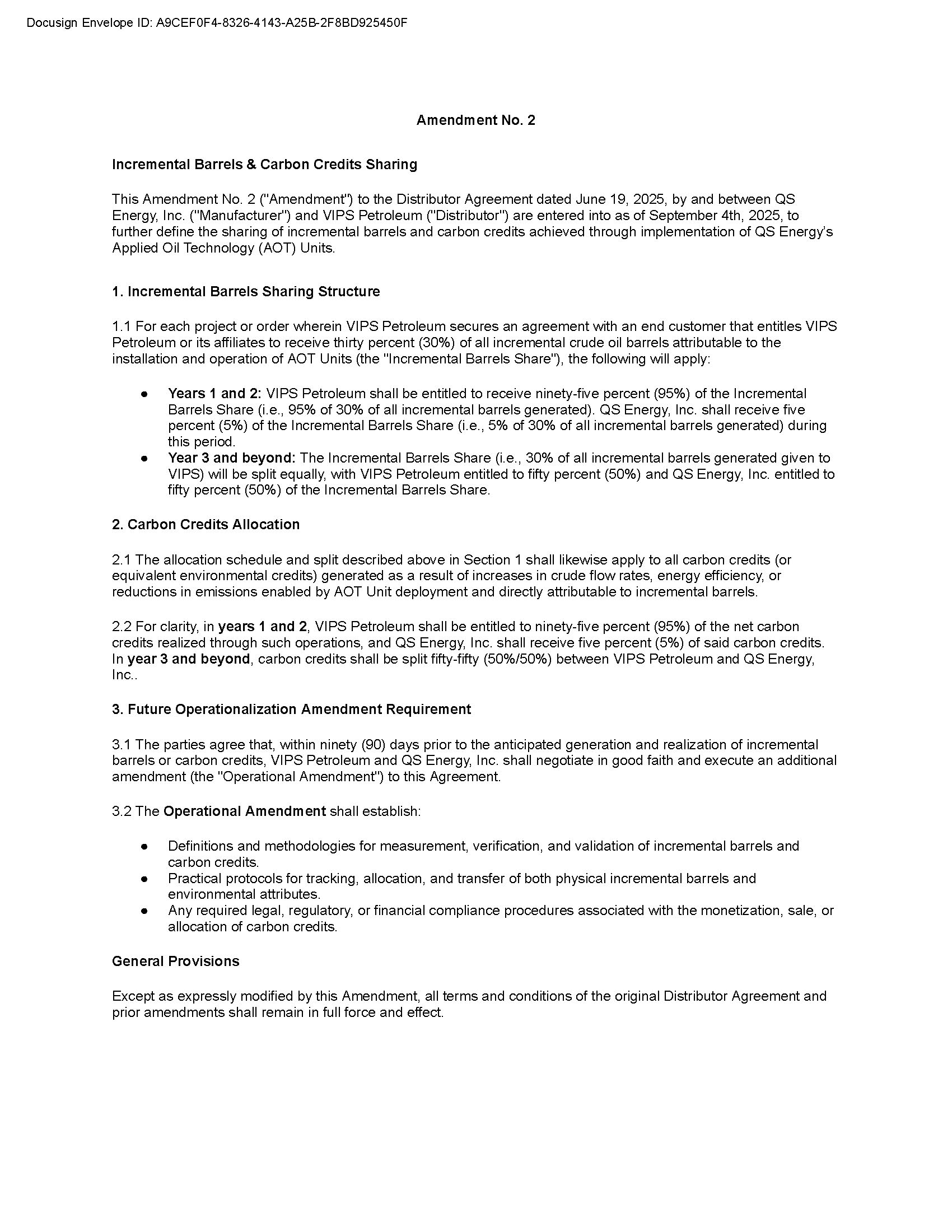
Amendment No. 2 Incremental Barrels & Carbon Credits Sharing This Amendment No. 2 ("Amendment") to the Distributor Agreement dated June 19, 2025, by and between QS Energy, Inc. ("Manufacturer") and VIPS Petroleum ("Distributor") are entered into as of September 4th, 2025, to further define the sharing of incremental barrels and carbon credits achieved through implementation of QS Energy’s Applied Oil Technology (AOT) Units. 1. Incremental Barrels Sharing Structure 1. For each project or order wherein VIPS Petroleum secures an agreement with an end customer that entitles VIPS Petroleum or its affiliates to receive thirty percent (30%) of all incremental crude oil barrels attributable to the installation and operation of AOT Units (the "Incremental Barrels Share"), the following will apply: ● Years 1 and 2: VIPS Petroleum shall be entitled to receive ninety - five percent (95%) of the Incremental Barrels Share (i.e., 95% of 30% of all incremental barrels generated). QS Energy, Inc. shall receive five percent (5%) of the Incremental Barrels Share (i.e., 5% of 30% of all incremental barrels generated) during this period. ● Year 3 and beyond: The Incremental Barrels Share (i.e., 30% of all incremental barrels generated given to VIPS) will be split equally, with VIPS Petroleum entitled to fifty percent (50%) and QS Energy, Inc. entitled to fifty percent (50%) of the Incremental Barrels Share. 2. Carbon Credits Allocation 1. The allocation schedule and split described above in Section 1 shall likewise apply to all carbon credits (or equivalent environmental credits) generated as a result of increases in crude flow rates, energy efficiency, or reductions in emissions enabled by AOT Unit deployment and directly attributable to incremental barrels. 2. For clarity, in years 1 and 2 , VIPS Petroleum shall be entitled to ninety - five percent (95%) of the net carbon credits realized through such operations, and QS Energy, Inc. shall receive five percent (5%) of said carbon credits. In year 3 and beyond , carbon credits shall be split fifty - fifty (50%/50%) between VIPS Petroleum and QS Energy, Inc.. 3. Future Operationalization Amendment Requirement 1. The parties agree that, within ninety (90) days prior to the anticipated generation and realization of incremental barrels or carbon credits, VIPS Petroleum and QS Energy, Inc. shall negotiate in good faith and execute an additional amendment (the "Operational Amendment") to this Agreement. 2. The Operational Amendment shall establish: ● Definitions and methodologies for measurement, verification, and validation of incremental barrels and carbon credits. ● Practical protocols for tracking, allocation, and transfer of both physical incremental barrels and environmental attributes. ● Any required legal, regulatory, or financial compliance procedures associated with the monetization, sale, or allocation of carbon credits. General Provisions Except as expressly modified by this Amendment, all terms and conditions of the original Distributor Agreement and prior amendments shall remain in full force and effect. Docusign Envelope ID: A9CEF0F4 - 8326 - 4143 - A25B - 2F8BD925450F
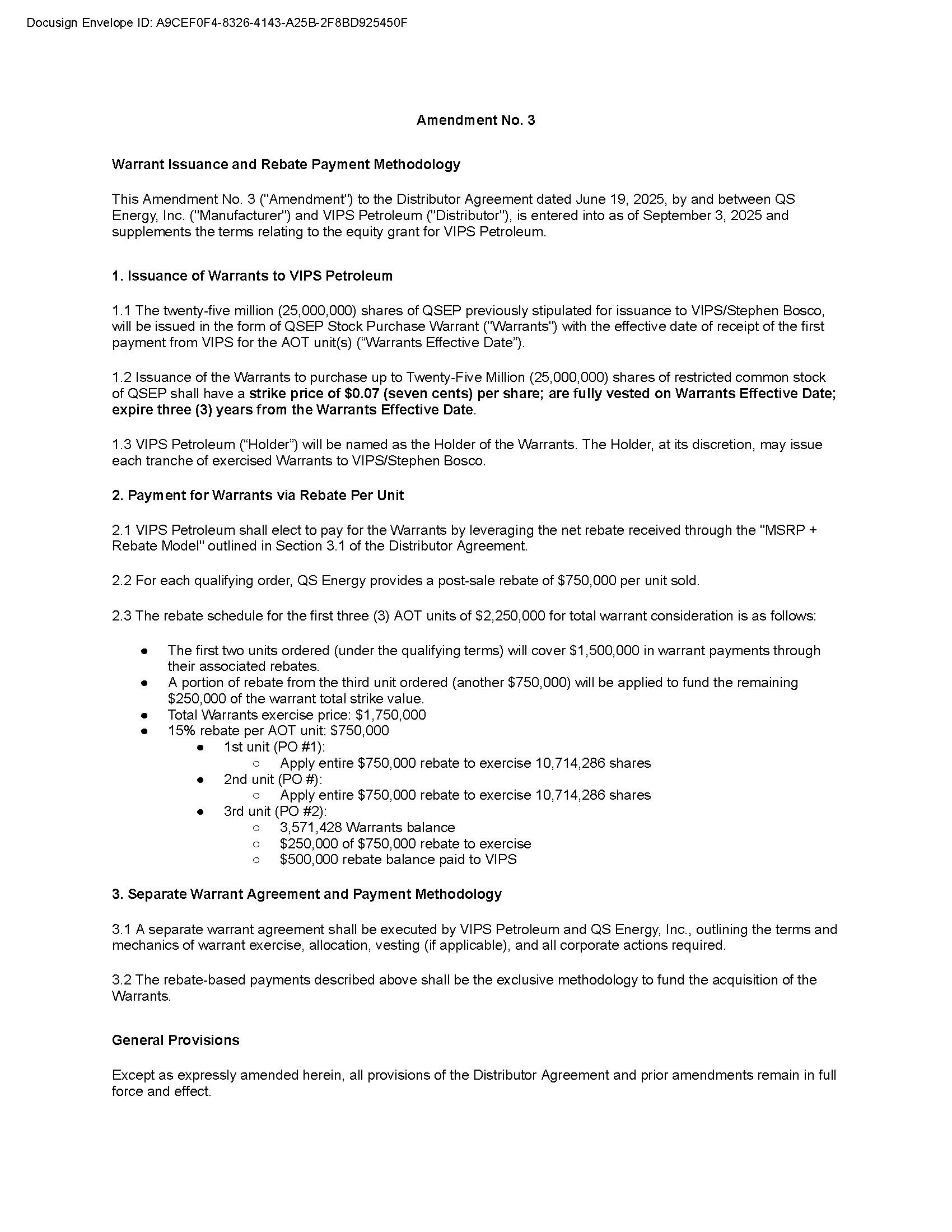
Amendment No. 3 Warrant Issuance and Rebate Payment Methodology This Amendment No. 3 ("Amendment") to the Distributor Agreement dated June 19, 2025, by and between QS Energy, Inc. ("Manufacturer") and VIPS Petroleum ("Distributor"), is entered into as of September 3, 2025 and supplements the terms relating to the equity grant for VIPS Petroleum. 1. Issuance of Warrants to VIPS Petroleum 1. The twenty - five million ( 25 , 000 , 000 ) shares of QSEP previously stipulated for issuance to VIPS/Stephen Bosco, will be issued in the form of QSEP Stock Purchase Warrant ("Warrants") with the effective date of receipt of the first payment from VIPS for the AOT unit(s) (“Warrants Effective Date”) . 2. Issuance of the Warrants to purchase up to Twenty - Five Million (25,000,000) shares of restricted common stock of QSEP shall have a strike price of $0.07 (seven cents) per share; are fully vested on Warrants Effective Date; expire three (3) years from the Warrants Effective Date . 3. VIPS Petroleum (“Holder”) will be named as the Holder of the Warrants. The Holder, at its discretion, may issue each tranche of exercised Warrants to VIPS/Stephen Bosco. 2. Payment for Warrants via Rebate Per Unit 1. VIPS Petroleum shall elect to pay for the Warrants by leveraging the net rebate received through the "MSRP + Rebate Model" outlined in Section 3.1 of the Distributor Agreement. 2. For each qualifying order, QS Energy provides a post - sale rebate of $750,000 per unit sold. 3. The rebate schedule for the first three (3) AOT units of $2,250,000 for total warrant consideration is as follows: ● The first two units ordered (under the qualifying terms) will cover $1,500,000 in warrant payments through their associated rebates. ● A portion of rebate from the third unit ordered (another $750,000) will be applied to fund the remaining $250,000 of the warrant total strike value. ● Total Warrants exercise price: $1,750,000 ● 15% rebate per AOT unit: $750,000 ● 1st unit (PO #1): ○ Apply entire $750,000 rebate to exercise 10,714,286 shares ● 2nd unit (PO #): ○ Apply entire $750,000 rebate to exercise 10,714,286 shares ● 3rd unit (PO #2): ○ 3,571,428 Warrants balance ○ $250,000 of $750,000 rebate to exercise ○ $500,000 rebate balance paid to VIPS 2. Separate Warrant Agreement and Payment Methodology 1. A separate warrant agreement shall be executed by VIPS Petroleum and QS Energy, Inc., outlining the terms and mechanics of warrant exercise, allocation, vesting (if applicable), and all corporate actions required. 2. The rebate - based payments described above shall be the exclusive methodology to fund the acquisition of the Warrants. General Provisions Except as expressly amended herein, all provisions of the Distributor Agreement and prior amendments remain in full force and effect. Docusign Envelope ID: A9CEF0F4 - 8326 - 4143 - A25B - 2F8BD925450F
Exhibit A Sample Invoice Docusign Envelope ID: A9CEF0F4 - 8326 - 4143 - A25B - 2F8BD925450F
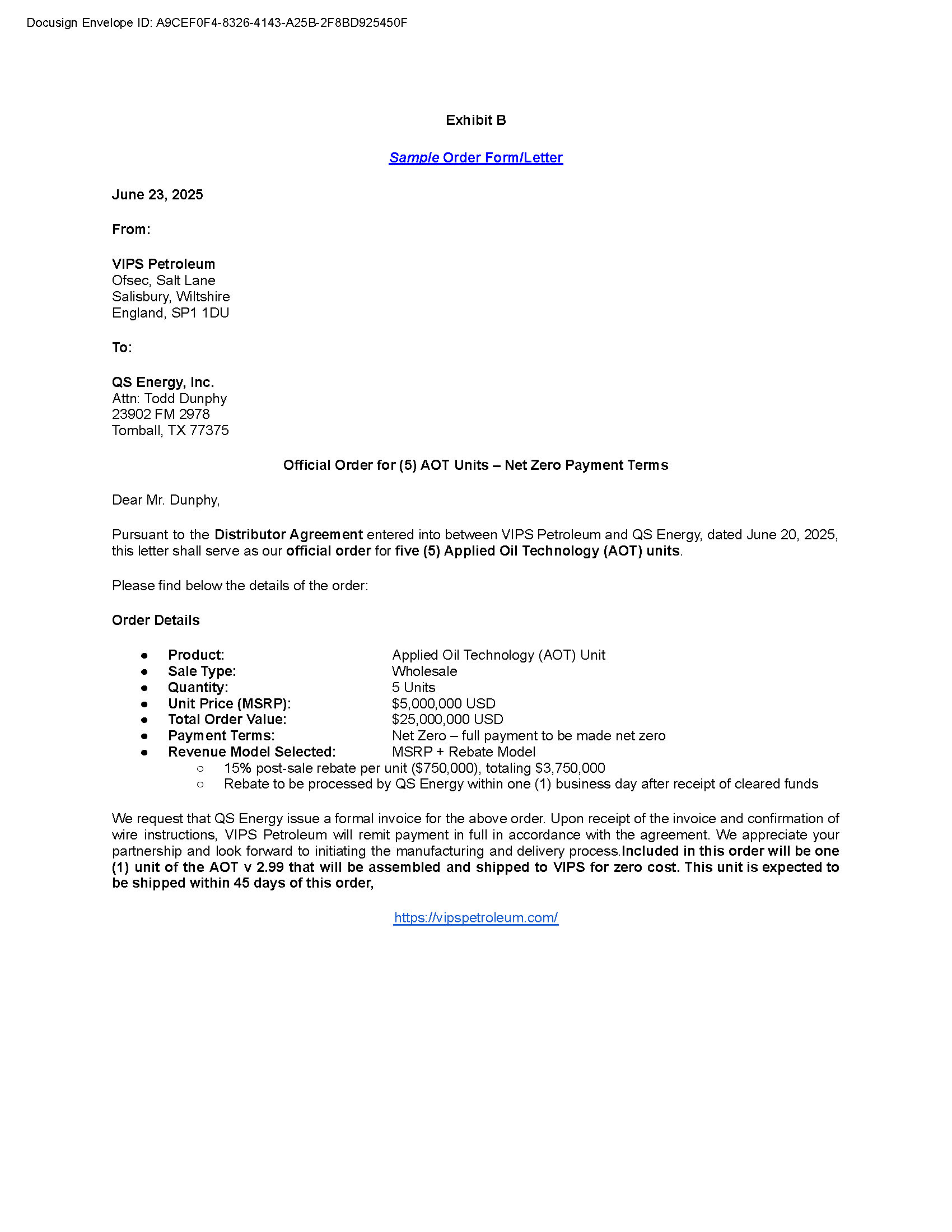
Exhibit B Sample Order Form/Letter June 23, 2025 From: VIPS Petroleum Ofsec, Salt Lane Salisbury, Wiltshire England, SP1 1DU To: QS Energy, Inc. Attn: Todd Dunphy 23902 FM 2978 Tomball, TX 77375 Official Order for (5) AOT Units – Net Zero Payment Terms Dear Mr. Dunphy, Pursuant to the Distributor Agreement entered into between VIPS Petroleum and QS Energy, dated June 20, 2025, this letter shall serve as our official order for five (5) Applied Oil Technology (AOT) units . Please find below the details of the order: Order Details ● Product: ● Sale Type: ● Quantity: ● Unit Price (MSRP): ● Total Order Value: ● Payment Terms: ● Revenue Model Selected: Applied Oil Technology (AOT) Unit Wholesale 5 Units $5,000,000 USD $25,000,000 USD Net Zero – full payment to be made net zero MSRP + Rebate Model ○ 15% post - sale rebate per unit ($750,000), totaling $3,750,000 ○ Rebate to be processed by QS Energy within one (1) business day after receipt of cleared funds We request that QS Energy issue a formal invoice for the above order . Upon receipt of the invoice and confirmation of wire instructions, VIPS Petroleum will remit payment in full in accordance with the agreement . We appreciate your partnership and look forward to initiating the manufacturing and delivery process . Included in this order will be one ( 1 ) unit of the AOT v 2 . 99 that will be assembled and shipped to VIPS for zero cost . This unit is expected to be shipped within 45 days of this order, https://vipspetroleum.com/ Docusign Envelope ID: A9CEF0F4 - 8326 - 4143 - A25B - 2F8BD925450F
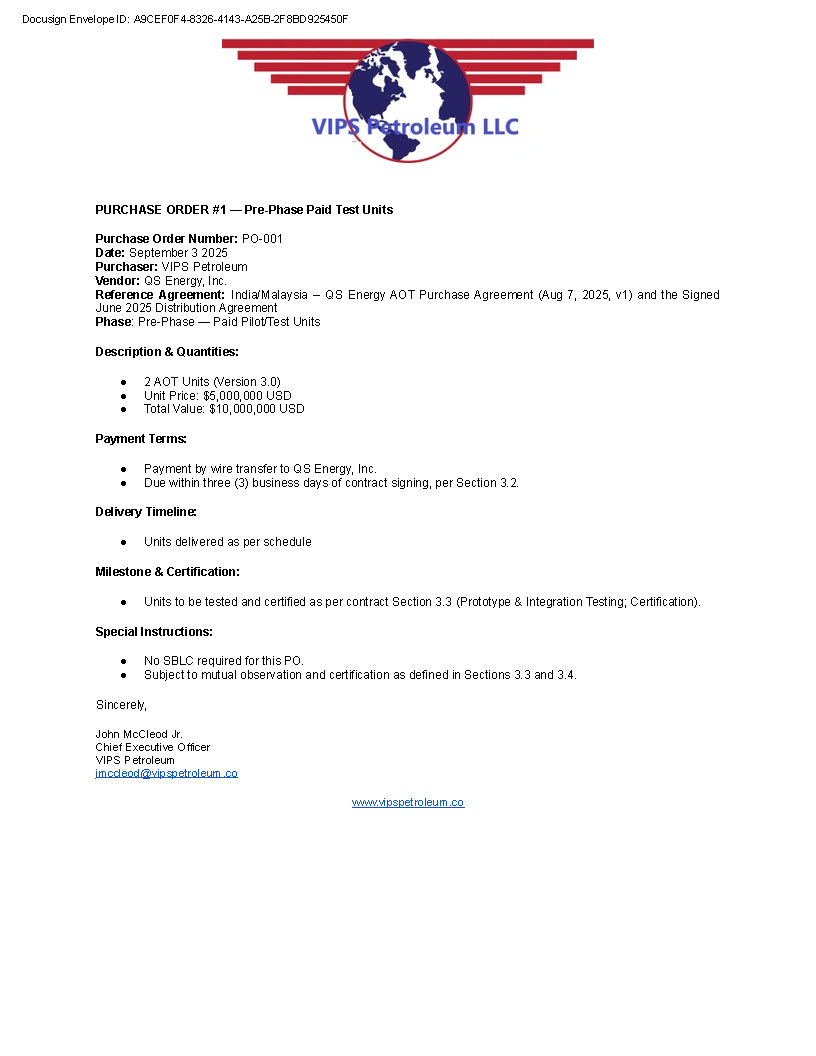
PURCHASE ORDER #1 — Pre - Phase Paid Test Units Purchase Order Number: PO - 001 Date: September 3 2025 Purchaser: VIPS Petroleum Vendor: QS Energy, Inc. Reference Agreement: India/Malaysia – QS Energy AOT Purchase Agreement (Aug 7, 2025, v1) and the Signed June 2025 Distribution Agreement Phase : Pre - Phase — Paid Pilot/Test Units Description & Quantities: ● 2 AOT Units (Version 3.0) ● Unit Price: $5,000,000 USD ● Total Value: $10,000,000 USD Payment Terms: ● Payment by wire transfer to QS Energy, Inc. ● Due within three (3) business days of contract signing, per Section 3.2. Delivery Timeline: ● Units delivered as per schedule Milestone & Certification: ● Units to be tested and certified as per contract Section 3.3 (Prototype & Integration Testing; Certification). Special Instructions: ● No SBLC required for this PO. ● Subject to mutual observation and certification as defined in Sections 3.3 and 3.4. Sincerely, John McCleod Jr. Chief Executive Officer VIPS Petroleum [email protected] www.vipspetroleum.co Docusign Envelope ID: A9CEF0F4 - 8326 - 4143 - A25B - 2F8BD925450F
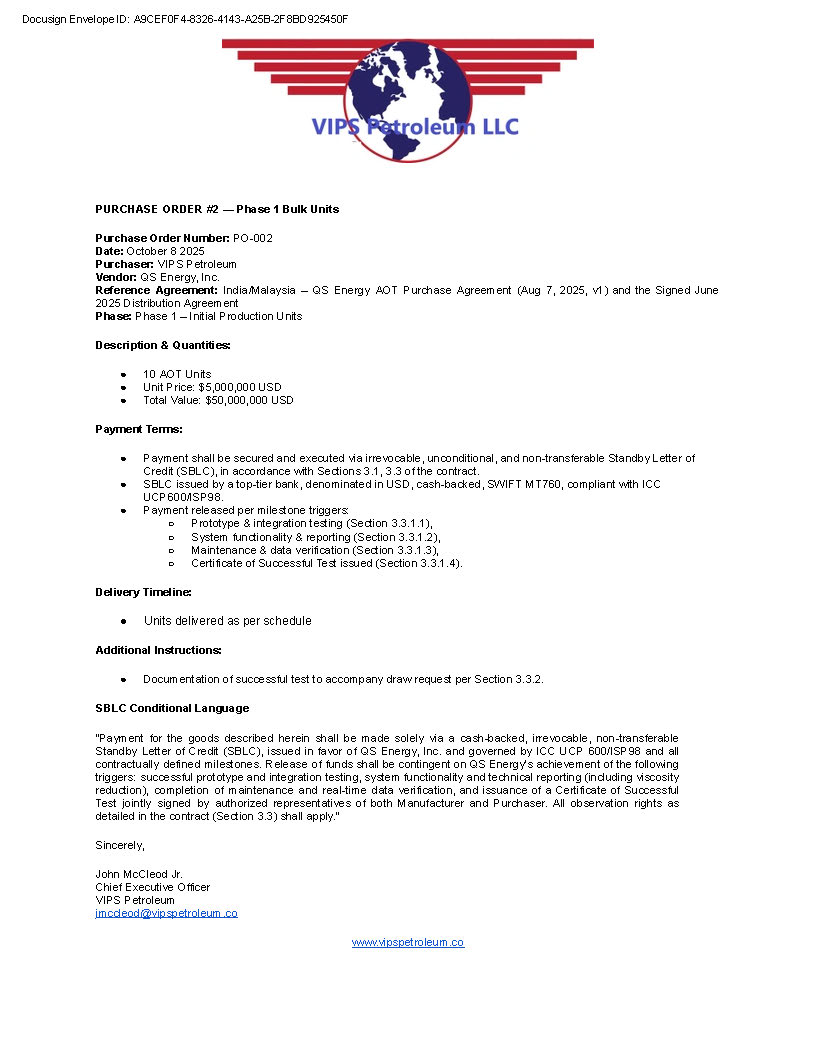
PURCHASE ORDER #2 — Phase 1 Bulk Units Purchase Order Number: PO - 002 Date: October 8 2025 Purchaser: VIPS Petroleum Vendor: QS Energy, Inc. Reference Agreement: India/Malaysia – QS Energy AOT Purchase Agreement (Aug 7, 2025, v1) and the Signed June 2025 Distribution Agreement Phase: Phase 1 – Initial Production Units Description & Quantities: ● 10 AOT Units ● Unit Price: $5,000,000 USD ● Total Value: $50,000,000 USD Payment Terms: ● Payment shall be secured and executed via irrevocable, unconditional, and non - transferable Standby Letter of Credit (SBLC), in accordance with Sections 3.1, 3.3 of the contract. ● SBLC issued by a top - tier bank, denominated in USD, cash - backed, SWIFT MT760, compliant with ICC UCP600/ISP98. ● Payment released per milestone triggers: ○ Prototype & integration testing (Section 3.3.1.1), ○ System functionality & reporting (Section 3.3.1.2), ○ Maintenance & data verification (Section 3.3.1.3), ○ Certificate of Successful Test issued (Section 3.3.1.4). Delivery Timeline: ● Units delivered as per schedule Additional Instructions: ● Documentation of successful test to accompany draw request per Section 3.3.2. SBLC Conditional Language “Payment for the goods described herein shall be made solely via a cash - backed, irrevocable, non - transferable Standby Letter of Credit (SBLC), issued in favor of QS Energy, Inc . and governed by ICC UCP 600 /ISP 98 and all contractually defined milestones . Release of funds shall be contingent on QS Energy’s achievement of the following triggers : successful prototype and integration testing, system functionality and technical reporting (including viscosity reduction), completion of maintenance and real - time data verification, and issuance of a Certificate of Successful Test jointly signed by authorized representatives of both Manufacturer and Purchaser . All observation rights as detailed in the contract (Section 3 . 3 ) shall apply . ” Sincerely, John McCleod Jr. Chief Executive Officer VIPS Petroleum [email protected] www.vipspetroleum.co Docusign Envelope ID: A9CEF0F4 - 8326 - 4143 - A25B - 2F8BD925450F
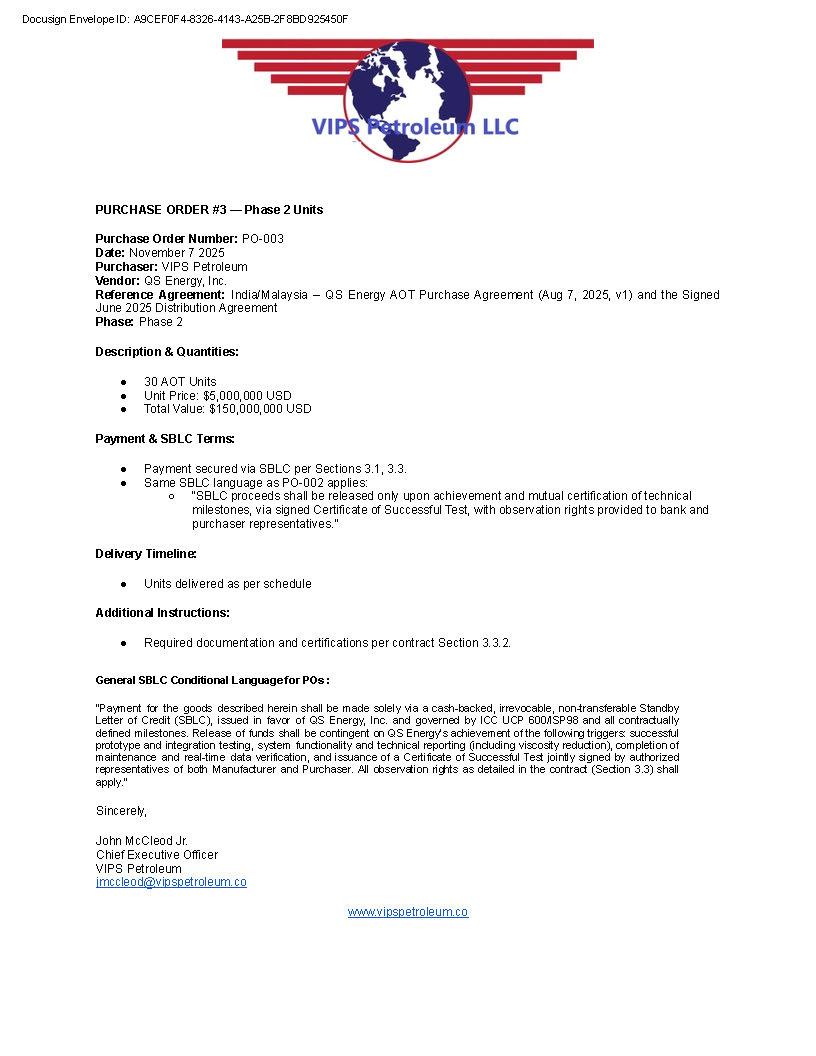
PURCHASE ORDER #3 — Phase 2 Units Purchase Order Number: PO - 003 Date: November 7 2025 Purchaser: VIPS Petroleum Vendor: QS Energy, Inc. Reference Agreement: India/Malaysia – QS Energy AOT Purchase Agreement (Aug 7, 2025, v1) and the Signed June 2025 Distribution Agreement Phase: Phase 2 Description & Quantities: ● 30 AOT Units ● Unit Price: $5,000,000 USD ● Total Value: $150,000,000 USD Payment & SBLC Terms: ● Payment secured via SBLC per Sections 3.1, 3.3. ● Same SBLC language as PO - 002 applies: ○ “SBLC proceeds shall be released only upon achievement and mutual certification of technical milestones, via signed Certificate of Successful Test, with observation rights provided to bank and purchaser representatives.” Delivery Timeline: ● Units delivered as per schedule Additional Instructions: ● Required documentation and certifications per contract Section 3.3.2. General SBLC Conditional Language for POs : “Payment for the goods described herein shall be made solely via a cash - backed, irrevocable, non - transferable Standby Letter of Credit (SBLC), issued in favor of QS Energy, Inc . and governed by ICC UCP 600 /ISP 98 and all contractually defined milestones . Release of funds shall be contingent on QS Energy’s achievement of the following triggers : successful prototype and integration testing, system functionality and technical reporting (including viscosity reduction), completion of maintenance and real - time data verification, and issuance of a Certificate of Successful Test jointly signed by authorized representatives of both Manufacturer and Purchaser . All observation rights as detailed in the contract (Section 3 . 3 ) shall apply . ” Sincerely, John McCleod Jr. Chief Executive Officer VIPS Petroleum [email protected] www.vipspetroleum.co Docusign Envelope ID: A9CEF0F4 - 8326 - 4143 - A25B - 2F8BD925450F
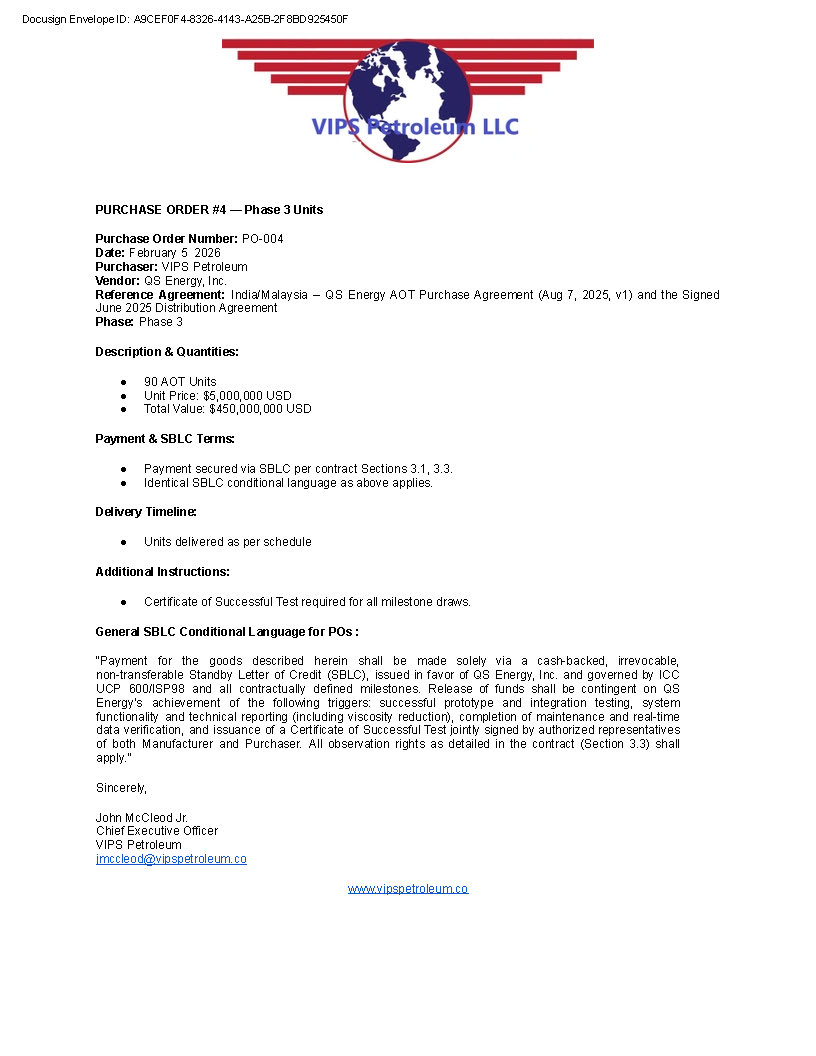
PURCHASE ORDER #4 — Phase 3 Units Purchase Order Number: PO - 004 Date: February 5 2026 Purchaser: VIPS Petroleum Vendor: QS Energy, Inc. Reference Agreement: India/Malaysia – QS Energy AOT Purchase Agreement (Aug 7, 2025, v1) and the Signed June 2025 Distribution Agreement Phase: Phase 3 Description & Quantities: ● 90 AOT Units ● Unit Price: $5,000,000 USD ● Total Value: $450,000,000 USD Payment & SBLC Terms: ● Payment secured via SBLC per contract Sections 3.1, 3.3. ● Identical SBLC conditional language as above applies. Delivery Timeline: ● Units delivered as per schedule Additional Instructions: ● Certificate of Successful Test required for all milestone draws. General SBLC Conditional Language for POs : “Payment for the goods described herein shall be made solely via a cash - backed, irrevocable, non - transferable Standby Letter of Credit (SBLC), issued in favor of QS Energy, Inc . and governed by ICC UCP 600 /ISP 98 and all contractually defined milestones . Release of funds shall be contingent on QS Energy’s achievement of the following triggers : successful prototype and integration testing, system functionality and technical reporting (including viscosity reduction), completion of maintenance and real - time data verification, and issuance of a Certificate of Successful Test jointly signed by authorized representatives of both Manufacturer and Purchaser . All observation rights as detailed in the contract (Section 3 . 3 ) shall apply . ” Sincerely, John McCleod Jr. Chief Executive Officer VIPS Petroleum [email protected] www.vipspetroleum.co Docusign Envelope ID: A9CEF0F4 - 8326 - 4143 - A25B - 2F8BD925450F
PURCHASE ORDER #5 — Phase 4 Units Purchase Order Number: PO - 005 Date: July 21 2026 Purchaser: VIPS Petroleum Vendor: QS Energy, Inc. Reference Agreement: Malaysia – QS Energy AOT Purchase Agreement (Aug 7, 2025, v1) Phase: Phase 4 Description & Quantities: ● 90 AOT Units ● Unit Price: $5,000,000 USD ● Total Value: $450,000,000 USD Payment & SBLC Terms: ● Payment via SBLC, as per Sections 3.1, 3.3, with standard trigger and certification language. Delivery Timeline: ● Units delivered as per schedule Additional Instructions: General SBLC Conditional Language for POs : “Payment for the goods described herein shall be made solely via a cash - backed, irrevocable, non - transferable Standby Letter of Credit (SBLC), issued in favor of QS Energy, Inc . and governed by ICC UCP 600 /ISP 98 and all contractually defined milestones . Release of funds shall be contingent on QS Energy’s achievement of the following triggers : successful prototype and integration testing, system functionality and technical reporting (including viscosity reduction), completion of maintenance and real - time data verification, and issuance of a Certificate of Successful Test jointly signed by authorized representatives of both Manufacturer and Purchaser . All observation rights as detailed in the contract (Section 3 . 3 ) shall apply . ” Sincerely, John McCleod Jr. Chief Executive Officer VIPS Petroleum [email protected] ww.vipspetroleum.co Docusign Envelope ID: A9CEF0F4 - 8326 - 4143 - A25B - 2F8BD925450F
PURCHASE ORDER #6 — Phase 5 Units Purchase Order Number: PO - 006 Date: December 2 2026 Purchaser: VIPS Petroleum Vendor: QS Energy, Inc. Reference Agreement: Malaysia – QS Energy AOT Purchase Agreement (Aug 7, 2025, v1) Phase: Phase 5 (Final Batch) Description & Quantities: ● 178 AOT Units (final balance to reach 400) ● Unit Price: $5,000,000 USD ● Total Value: $890,000,000 USD Payment & SBLC Terms: ● Payment via SBLC, per Sections 3.1, 3.3. ● All SBLC triggers, certification, and observation rights as above. Delivery Timeline: ● Units delivered as per schedule Additional Instructions: ● Completion certificate and all contract documentation required per draw. General SBLC Conditional Language for POs : “Payment for the goods described herein shall be made solely via a cash - backed, irrevocable, non - transferable Standby Letter of Credit (SBLC), issued in favor of QS Energy, Inc . and governed by ICC UCP 600 /ISP 98 and all contractually defined milestones . Release of funds shall be contingent on QS Energy’s achievement of the following triggers : successful prototype and integration testing, system functionality and technical reporting (including viscosity reduction), completion of maintenance and real - time data verification, and issuance of a Certificate of Successful Test jointly signed by authorized representatives of both Manufacturer and Purchaser . All observation rights as detailed in the contract (Section 3 . 3 ) shall apply . Sincerely, John McCleod Jr. Chief Executive Officer VIPS Petroleum [email protected] www.vipspetroleum.co Docusign Envelope ID: A9CEF0F4 - 8326 - 4143 - A25B - 2F8BD925450F
EXHIBIT 31.1
CERTIFICATION OF CHIEF EXECUTIVE OFFICER
PURSUANT TO SECTION 302 OF THE SARBANES-OXLEY ACT OF 2002
AND RULES 13A-14 AND 15D-14 UNDER THE SECURITIES EXCHANGE ACT OF 1934
I, Cecil Bond Kyte, certify that:
1. I have reviewed this Quarterly Report on Form 10-Q of QS Energy, Inc.;
2. Based on my knowledge, this report does not contain any untrue statement of a material fact or omit to state a material fact necessary to make the statements made, in light of the circumstances under which such statements were made, not misleading with respect to the period covered by this report;
3. Based on my knowledge, the financial statements, and other financial information included in this report, fairly present in all material respects the financial condition, results of operations and cash flows of the registrant as of, and for, the periods presented in this report;
4. The registrant’s other certifying officer and I are responsible for establishing and maintaining disclosure controls and procedures (as defined in Exchange Act Rules 13a-15(e) or 15d-15(e) and internal control over financial reporting (as defined in Exchange Act Rules 13a-15(d)-15(f) for the registrant and have:
(a) Designed such disclosure controls and procedures, or caused such disclosure controls and procedures to be designed under our supervision, to ensure that material information relating to the registrant, including its condensed consolidated subsidiaries, is made known to us by others within those entities, particularly during the period in which this report is being prepared;
(b) Designed such internal control over financial reporting, or caused such internal control over financial reporting to be designed under our supervision, to provide reasonable assurance regarding the reliability of financial reporting and the preparation of financial statements for external purposes in accordance with generally accepted accounting principles;
(c) Evaluated the effectiveness of the registrant’s disclosure controls and procedures and presented in this report our conclusions about the effectiveness of the disclosure controls and procedures, as of the end of the period covered by this report based on such evaluation; and
(d) Disclosed in this report any change in the registrant’s internal control over financial reporting that occurred during the registrant’s most recent fiscal quarter (the registrant’s fourth fiscal quarter in the case of an annual report) that has materially affected, or is reasonably likely to materially affect, the registrant’s internal control over financial reporting; and
5. The registrant’s other certifying officer and I have disclosed, based on our most recent evaluation of internal control over financial reporting, to the registrant’s auditors and the audit committee of the registrant’s board of directors (or persons performing the equivalent functions):
(a) All significant deficiencies and material weaknesses in the design or operation of internal control over financial reporting which are reasonably likely to adversely affect the registrant’s ability to record, process, summarize and report financial information; and
(b) Any fraud, whether or not material, that involves management or other employees who have a significant role in the registrant’s internal control over financial reporting.
| Date: November 14, 2025 | /s/ CECIL BOND KYTE | |
| Cecil Bond Kyte | ||
| Chief Executive Officer |
EXHIBIT 31.2
CERTIFICATION OF CHIEF FINANCIAL OFFICER
PURSUANT TO SECTION 302 OF THE SARBANES-OXLEY ACT OF 2002
AND RULES 13A-14 AND 15D-14 UNDER THE SECURITIES EXCHANGE ACT OF 1934
I, Cecil Bond Kyte, certify that:
1. I have reviewed this Quarterly Report on Form 10-Q of QS Energy, Inc.;
2. Based on my knowledge, this report does not contain any untrue statement of a material fact or omit to state a material fact necessary to make the statements made, in light of the circumstances under which such statements were made, not misleading with respect to the period covered by this report;
3. Based on my knowledge, the financial statements, and other financial information included in this report, fairly present in all material respects the financial condition, results of operations and cash flows of the registrant as of, and for, the periods presented in this report;
4. The registrant’s other certifying officer and I are responsible for establishing and maintaining disclosure controls and procedures (as defined in Exchange Act Rules 13a-15(e) or 15d-15(e) and internal control over financial reporting (as defined in Exchange Act Rules 13a-15(d)-15(f) for the registrant and have:
(a) Designed such disclosure controls and procedures, or caused such disclosure controls and procedures to be designed under our supervision, to ensure that material information relating to the registrant, including its condensed consolidated subsidiaries, is made known to us by others within those entities, particularly during the period in which this report is being prepared;
(b) Designed such internal control over financial reporting, or caused such internal control over financial reporting to be designed under our supervision, to provide reasonable assurance regarding the reliability of financial reporting and the preparation of financial statements for external purposes in accordance with generally accepted accounting principles;
(c) Evaluated the effectiveness of the registrant’s disclosure controls and procedures and presented in this report our conclusions about the effectiveness of the disclosure controls and procedures, as of the end of the period covered by this report based on such evaluation; and
(d) Disclosed in this report any change in the registrant’s internal control over financial reporting that occurred during the registrant’s most recent fiscal quarter (the registrant’s fourth fiscal quarter in the case of an annual report) that has materially affected, or is reasonably likely to materially affect, the registrant’s internal control over financial reporting; and
5. The registrant’s other certifying officer and I have disclosed, based on our most recent evaluation of internal control over financial reporting, to the registrant’s auditors and the audit committee of the registrant’s board of directors (or persons performing the equivalent functions):
(a) All significant deficiencies and material weaknesses in the design or operation of internal control over financial reporting which are reasonably likely to adversely affect the registrant’s ability to record, process, summarize and report financial information; and
(b) Any fraud, whether or not material, that involves management or other employees who have a significant role in the registrant’s internal control over financial reporting.
| Date: November 14, 2025 | /s/ CECIL BOND KYTE | |
| Cecil Bond Kyte | ||
| Chief Financial Officer |
EXHIBIT 32
CERTIFICATION OF PERIODIC FINANCIAL REPORT BY THE
CHIEF EXECUTIVE OFFICER AND CHIEF FINANCIAL OFFICER
PURSUANT TO SECTION 906 OF THE SARBANES-OXLEY ACT OF 2002
Solely for the purposes of complying with 18 U.S.C. Section 1350, as adopted pursuant to Section 906 of the Sarbanes-Oxley Act of 2002, we, the undersigned Chief Executive Officer and the Chief Financial Officer of QS Energy, Inc. (the “Company”), hereby certify, based on our knowledge, that the Quarterly Report on Form 10-Q of the Company for the quarter ended September 30, 2025 (the “Report”) fully complies with the requirements of Section 13(a) of the Securities Exchange Act of 1934 and that the information contained in the Report fairly presents, in all material respects, the financial condition and results of operations of the Company.
| Date: November 14, 2025 | /s/ CECIL BOND KYTE |
| Cecil Bond Kyte | |
| Chief Executive Officer | |
| Date: November 14, 2025 | /s/ CECIL BOND KYTE |
| Cecil Bond Kyte | |
| Chief Financial Officer | |