
RWT 8-K
Redwood Trust Inc (RWT)
8-K
2025-10-29
For: 2025-10-29
View Original
Added on
April 05, 2026
UNITED STATES
SECURITIES AND EXCHANGE COMMISSION
Washington, D.C. 20549
FORM 8-K
CURRENT REPORT
Pursuant to Section 13 OR 15(d) of The Securities Exchange Act of 1934
Date of Report (Date of earliest event reported): October 29, 2025
(Exact name of registrant as specified in its charter)
(State or other jurisdiction of incorporation) | (Commission File Number) | (I.R.S. Employer Identification No.) | ||||||||||||
(Address of principal executive offices and Zip Code)
(415 ) 389-7373
(Registrant’s telephone number, including area code)
Not Applicable
(Former name or former address, if changed since last report)
Check the appropriate box below if the Form 8-K filing is intended to simultaneously satisfy the filing obligation of the registrant under any of the following provisions (see General Instruction A.2. below):
| Written communications pursuant to Rule 425 under the Securities Act (17 CFR 230.425) | |||||
| Soliciting material pursuant to Rule 14a-12 under the Exchange Act (17 CFR 240.14a-12) | |||||
| Pre-commencement communications pursuant to Rule 14d-2(b) under the Exchange Act (17 CFR 240.14d-2(b)) | |||||
| Pre-commencement communications pursuant to Rule 13e-4(c) under the Exchange Act (17 CFR 240.13e-4(c)) | |||||
Indicate by check mark whether the registrant is an emerging growth company as defined in Rule 405 of the Securities Act of 1933 or Rule 12b-2 of the Securities Exchange Act of 1934.
Emerging growth company ☐
If an emerging growth company, indicate by check mark if the registrant has elected not to use the extended transition period for complying with any new or revised financial accounting standards provided pursuant to Section 13(a) of the Exchange Act. ☐
Securities registered pursuant to Section 12(b) of the Act:
| Title of each class | Trading symbol(s) | Name of each exchange on which registered | ||||||
| Item 2.02. | Results of Operations and Financial Condition; | ||||
| Item 7.01. | Regulation FD Disclosure. | ||||
On October 29, 2025, Redwood Trust, Inc. (the "Company") issued a press release announcing its financial results for the quarter ended September 30, 2025, the Redwood Trust Shareholder Letter – 3rd Quarter 2025, and The Redwood Review – 3rd Quarter 2025, copies of which are attached as Exhibit 99.1, Exhibit 99.2, and Exhibit 99.3, respectively, to this current report on Form 8-K.
In addition, on October 29, 2025, the Company made available Supplemental Financial Tables presenting certain financial results for the quarter ended September 30, 2025. A link to the Supplemental Financial Tables is available at the Company’s website at http://www.redwoodtrust.com, in the Investor Relations section of the website under “Financials.”
The information contained in this Item 2.02 and Item 7.01 and the attached Exhibits 99.1, 99.2, and 99.3 is furnished to and not filed with the SEC, and shall not be incorporated by reference into any registration statement or other document filed under the Securities Act of 1933, as amended, or the Securities Exchange Act of 1934, as amended, except as shall be expressly set forth by specific reference in such filing.
| Item 9.01. | Financial Statements and Exhibits. | ||||
| (d) | Exhibits | |||||||
| Exhibit 99.1 | ||||||||
| Exhibit 99.2 | ||||||||
| Exhibit 99.3 | ||||||||
| Exhibit 104 | Cover Page Interactive Data File (embedded within the inline XBRL document) | |||||||
SIGNATURES
Pursuant to the requirements of the Securities Exchange Act of 1934, the registrant has duly caused this report to be signed on its behalf by the undersigned thereunto duly authorized.
| Date: October 29, 2025 | REDWOOD TRUST, INC. | ||||||||||||||||
| By: | /s/ BROOKE E. CARILLO | ||||||||||||||||
| Name: Brooke E. Carillo | |||||||||||||||||
Title: Chief Financial Officer | |||||||||||||||||
Exhibit 99.1

REDWOOD TRUST REPORTS THIRD QUARTER 2025 FINANCIAL RESULTS; RECORD PRODUCTION VOLUMES ADVANCE TRANSITION TO CORE OPERATING MODEL
MILL VALLEY, CA – Redwood Trust, Inc. (NYSE:RWT; "Redwood", the "Company"), a leader in expanding access to housing for homebuyers and renters, today reported its financial results for the quarter ended September 30, 2025.
Mortgage Banking Platforms Continue to Profitably Scale
•Record $6.8 billion of cumulative loan production across operating platforms; capital allocated to mortgage banking up 84% since the second quarter 2024
•Delivered highest mortgage banking revenues since the third quarter of 2021
Executed on Capital Management Initiatives
•Transferred approximately $1 billion of Legacy Investments segment holdings(1), inclusive of activity through October 29, 2025, unlocking $150 million of capital for deployment towards mortgage banking platform growth
•Repurchased approximately five million shares of common stock for approximately $29 million
•Subsequent to quarter-end, expanded partnership with CPP Investments to support ongoing platform growth, including extension of secured financing facility and joint venture commitment period (each to September 2028) and upsize of secured financing facility to $400 million
Key Financial Results and Metrics
•GAAP book value per common share was $7.35 at September 30, 2025, compared to $7.49 per share at June 30, 2025
◦Economic return on book value of 0.5% for the third quarter(2)
•GAAP net loss of $(9.5) million or $(0.08) per basic and diluted common share, primarily driven by one-time expenses associated with the transfer or resolution of certain Legacy Investments
•Non-GAAP Core Segments EAD of $27.1 million or $0.20 per basic common share (refer to non-GAAP reconciliation under the section titled "Non-GAAP Disclosures")(3)
“The third quarter was extremely productive at Redwood,” said Christopher Abate, Chief Executive Officer. “We achieved record mortgage banking production of nearly $7 billion, underscoring the strength of our operating model and ability to significantly grow market share. We meaningfully reduced legacy portfolio holdings as we reposition our balance sheet for increased transaction activity as rates begin to fall. Together, these accomplishments demonstrate strong momentum and our continued focus on delivering returns for shareholders.”
| ($ in millions, except per share data) | Three Months Ended | ||||||||||
| 9/30/2025 | 6/30/2025 | ||||||||||
| Financial Performance | |||||||||||
| Book Value per Common Share | $ | 7.35 | $ | 7.49 | |||||||
Economic Return on Book Value (2) | 0.5 | % | (8.6) | % | |||||||
| Net (Loss) Income per Basic Common Share | $ | (0.08) | $ | (0.76) | |||||||
Non-GAAP Core Segments EAD per Basic Common Share (3) | $ | 0.20 | $ | 0.18 | |||||||
| Dividends per Common Share | $ | 0.18 | $ | 0.18 | |||||||
1
Q3 2025 Segment Highlights
| GAAP Segment Net (Loss) Income Results Summary | |||||||||||
| ($ in millions) | |||||||||||
| Three Months Ended | |||||||||||
| 9/30/2025 | 6/30/2025 | ||||||||||
| Core Segments: | |||||||||||
| Sequoia Mortgage Banking | $ | 34.3 | $ | 22.2 | |||||||
| CoreVest Mortgage Banking | 3.5 | 6.1 | |||||||||
| Redwood Investments | 10.3 | 11.9 | |||||||||
| Total Core Segments | $ | 48.2 | $ | 40.2 | |||||||
| Total Legacy Investments Segment | $ | (22.2) | $ | (104.0) | |||||||
| Total Corporate/Other | $ | (35.4) | $ | (36.4) | |||||||
| GAAP Net (Loss) Income | $ | (9.5) | $ | (100.2) | |||||||
Sequoia Mortgage Banking
•Segment GAAP net income of $34.3 million
•Generated 29% annualized Return on Equity ("ROE") and non-GAAP EAD ROE(4)
•Gain on sale margin of 93 basis points, within target range of 75 to 100 basis points
•Locked $6.3 billion of loans(5), up 75% from $3.6 billion in the second quarter 2025 and up 183% from $2.2 billion in the third quarter 2024
◦Sequoia lock volume of $5.1 billion, driven by ongoing strength across bulk and flow channels
◦Aspire lock volume of $1.2 billion represented a 277% increase from the second quarter of 2025(6)
•Distributed $2.7 billion of loans through a combination of securitizations ($1.9 billion) and whole loan sales ($0.9 billion)
CoreVest Mortgage Banking
•Segment GAAP net income of $3.5 million
•Generated 21% and 30% annualized ROE and non-GAAP EAD ROE, respectively(4)
•Funded $521 million of loans (56% bridge and 44% term), a 2% increase from $509 million in the second quarter 2025 and a 14% increase from $458 million in the third quarter 2024
◦Achieved highest quarterly funding volume since mid-2022 with origination mix now emphasizing smaller-balance residential transition, DSCR and term loans
•Distributed $386 million of loans through whole loan sales, securitizations and sales to joint ventures ("JVs")
Redwood Investments(8)
•Segment GAAP net income of $10.3 million
•Redwood Investments recourse leverage ratio remained low at 1.1x at September 30, 2025(8), unchanged from June 30, 2025
2
Legacy Investments(9)
•Segment GAAP net loss of $(22.2) million
◦Loss primarily attributable to one-time expenses and reduced net interest income related to third quarter transfer and resolution activity
•Segment capital allocation decreased to 25% of total invested capital at October 29, 2025, compared to 33% at June 30, 2025
•Legacy Investments recourse leverage ratio of 0.6x at September 30, 2025, down from 1.2x at June 30, 2025(10)
Capital and Financing
•Unrestricted cash and cash equivalents of $226 million at September 30, 2025
•Recourse debt of $3.8 billion at September 30, 2025 compared to $3.3 billion at June 30, 2025(11)
◦Increase in recourse debt driven by higher utilization of Sequoia mortgage banking warehouse facilities where loans are typically held an average of approximately one month before borrowings are repaid
◦Reduced portfolio recourse debt by 30% during the quarter, linked to reduction in Legacy Investments exposure
•Completed an opportunistic $50 million reopening of our 7.75% convertible notes due 2027
•Subsequent to quarter end, retired outstanding convertible debt maturing October 2025; next unsecured corporate debt maturity in June 2027(12)
3
_____________________
1.Includes $0.7 billion of legacy asset dispositions as of September 30, 2025 and $0.3 billion of fourth quarter 2025 legacy asset disposition activity through October 28, 2025. Capital redeployment of $150 million reflects activity through October 28, 2025.
2.Economic return on book value is based on the period change in GAAP book value per common share plus dividends declared per common share in the period.
3.Core Segments Earnings Available for Distribution ("Core Segments EAD") was a non-GAAP measure established in the second quarter of 2025 and is used to present management’s non-GAAP analysis of the combined performance of the Company’s mortgage banking platforms and related investments (which consist of the Company’s Sequoia Mortgage Banking, CoreVest Mortgage Banking and Redwood Investments segments), inclusive of an allocated portion of the Company’s Corporate segment relating to those Core Segments. Core Segments EAD excludes the Company’s Legacy Investments segment and excludes an allocated portion of the Company’s Corporate segment relating to the Legacy Investments segment. Core Segments EAD per basic common share and Core Segments EAD ROE were also non-GAAP measures established in the second quarter 2025 and are calculated using Core Segments EAD. See Non-GAAP Disclosures section that follows for additional information on these measures.
4.Annualized ROE by segment is net income (loss) for the segment divided by average segment capital utilized for the period. Earnings Available for Distribution (“EAD”) and EAD ROE are non-GAAP measures that the Company has historically reported and continue to be used to present management’s non-GAAP analysis of the performance of the Company’s different business segments, exclusive of any allocation of the Company’s Corporate segment. See Non-GAAP Disclosures section that follows for additional information on these measures.
5.Lock volume represents loans identified for purchase from loan sellers. Lock volume does not account for potential fallout from pipeline that typically occurs through the lending process.
6.Aspire lock volume is included in the Sequoia Mortgage Banking business segment results.
7.Redwood Investments consists of retained operating investments sourced through our Sequoia securitizations and CoreVest term and bridge loan securitizations, some of which we consolidate for GAAP purposes, investments in joint ventures, and other third-party investments.
8.Redwood Investments recourse leverage ratio is defined as recourse debt at Redwood Investments divided by capital invested. At September 30, 2025 recourse debt excludes $15.8 billion of consolidated securitization debt (ABS issued and servicer advance financing), other liabilities and other debt that is non-recourse to Redwood at Redwood Investments. Capital invested in our Redwood Investments segment at September 30, 2025 was $441 million.
9.Legacy Investments consists of certain unsecuritized residential investor bridge loans (including multifamily loans), certain REO investments and other third-party originated investments.
10.Legacy Investments recourse leverage ratio is defined as recourse debt at Legacy Investments divided by capital invested. At September 30, 2025 recourse debt excludes $1.3 billion of consolidated securitization debt (ABS issued), other liabilities and other debt that is non-recourse to Redwood at Legacy Investments. Capital invested in our Legacy Investments segment at September 30, 2025 was $459 million.
11.Recourse leverage ratio is defined as recourse debt at Redwood divided by tangible stockholders' equity. At September 30, 2025, and June 30, 2025, recourse debt excluded $17.7 billion and $16.9 billion, respectively, of consolidated securitization debt (ABS issued and servicer advance financing), other liabilities and other debt that is non-recourse to Redwood, and tangible stockholders' equity excluded $36 million and $38 million, respectively, of goodwill and intangible assets.
12.Excludes $11 million of promissory notes payable on demand after 90-day notice.
4
Third Quarter 2025 Redwood Review and Supplemental Tables Available Online
A further discussion of Redwood's business and financial results is included in the third quarter 2025 Shareholder Letter and Redwood Review which are available under "Financial Info" within the Investor Relations section of the Company’s website at redwoodtrust.com/investor-relations. Additional supplemental financial tables can also be found within this section of the Company's website.
Conference Call and Webcast
Redwood will host an earnings call today, October 29, 2025, at 5:00 p.m. Eastern Time / 2:00 p.m. Pacific Time to discuss its third quarter 2025 financial results. The number to dial in order to listen to the conference call is 1-877-423-9813 in the U.S. and Canada. International callers must dial 1-201-689-8573. A replay of the call will be available through midnight on Wednesday, November 12, 2025, and can be accessed by dialing 1-844-512-2921 in the U.S. and Canada or 1-412-317-6671 internationally and entering access code #13755968.
The conference call will be webcast live in listen-only mode through the News & Events section of Redwood’s Investor Relations website at https://www.redwoodtrust.com/investor-relations/news-events/events. To listen to the webcast, please go to Redwood's website at least 15 minutes before the call to register and to download and install any audio software needed. An audio replay of the call will also be available on Redwood's website following the call. Redwood plans to file its Quarterly Report on Form 10-Q with the Securities and Exchange Commission by Monday, November 10, 2025, and also make it available on Redwood’s website.
5
REDWOOD TRUST, INC.
Consolidated Income Statements (1) | Three Months Ended | |||||||||||||
| ($ in millions, except share and per share data) | 9/30/25 | 6/30/25 | ||||||||||||
| Net Interest Income from: | ||||||||||||||
| Sequoia mortgage banking | $ | 21.2 | $ | 15.5 | ||||||||||
| CoreVest mortgage banking | 1.5 | 1.8 | ||||||||||||
| Redwood investments | 17.6 | 22.1 | ||||||||||||
| Legacy investments | (9.1) | (9.4) | ||||||||||||
| Corporate/other | (16.3) | (16.2) | ||||||||||||
| Net Interest Income | $ | 15.0 | $ | 13.8 | ||||||||||
| Non-interest income | ||||||||||||||
| Sequoia mortgage banking activities, net | 28.7 | 24.4 | ||||||||||||
| CoreVest mortgage banking activities, net | 11.4 | 16.5 | ||||||||||||
| Investment fair value changes, net | (7.0) | (84.7) | ||||||||||||
| HEI income (loss), net | 0.5 | (12.9) | ||||||||||||
| Servicing income, net | 1.4 | 1.6 | ||||||||||||
| Fee income, net | 4.6 | 2.2 | ||||||||||||
| Other (loss) income, net | (0.2) | 0.4 | ||||||||||||
| Realized gains, net | — | 0.6 | ||||||||||||
| Total non-interest income (loss), net | $ | 39.4 | $ | (51.9) | ||||||||||
| General and administrative expenses | (38.7) | (37.0) | ||||||||||||
| Portfolio management costs | (7.0) | (10.0) | ||||||||||||
| Loan acquisition costs | (4.4) | (4.8) | ||||||||||||
| Other expenses | (5.7) | (4.0) | ||||||||||||
| (Provision for) income taxes | (6.4) | (4.6) | ||||||||||||
| Net (loss) income | $ | (7.7) | $ | (98.5) | ||||||||||
| Dividends on preferred stock | (1.8) | (1.8) | ||||||||||||
| Net (loss) income (related) available to common stockholders | $ | (9.5) | $ | (100.2) | ||||||||||
| Weighted average basic common shares (thousands) | 129,018 | 133,006 | ||||||||||||
Weighted average diluted common shares (thousands) (2) | 129,018 | 133,006 | ||||||||||||
| (Loss) earnings per basic common share | $ | (0.08) | $ | (0.76) | ||||||||||
| (Loss) earnings per diluted common share | $ | (0.08) | $ | (0.76) | ||||||||||
| Regular dividends declared per common share | $ | 0.18 | $ | 0.18 | ||||||||||
(1)Certain totals may not foot due to rounding.
(2)Actual shares outstanding (in thousands) at September 30, 2025 and June 30, 2025 were 126,753 and 131,680, respectively.
6
REDWOOD TRUST, INC.
Consolidated Balance Sheets (1) | ||||||||||||||
| ($ in millions, except share and per share data) | 9/30/25 | 6/30/25 | ||||||||||||
| Residential consumer loans | $ | 16,783 | $ | 14,202 | ||||||||||
| Residential investor loans | 3,858 | 4,339 | ||||||||||||
| Consolidated agency multifamily loans | — | 423 | ||||||||||||
| Real estate securities | 419 | 265 | ||||||||||||
| Home equity investments (HEI) | 326 | 588 | ||||||||||||
| Servicing investments | 282 | 298 | ||||||||||||
| Strategic investments | 82 | 78 | ||||||||||||
| Cash and cash equivalents | 226 | 302 | ||||||||||||
| Other assets | 624 | 838 | ||||||||||||
| Total assets | $ | 22,601 | $ | 21,333 | ||||||||||
| Asset-backed securities issued, net | $ | 16,825 | $ | 15,985 | ||||||||||
| Debt obligations, net | 4,357 | 3,745 | ||||||||||||
| Other liabilities | 420 | 549 | ||||||||||||
| Total liabilities | $ | 21,602 | $ | 20,279 | ||||||||||
| Stockholders' equity | 999 | 1,053 | ||||||||||||
| Total liabilities and equity | $ | 22,601 | $ | 21,333 | ||||||||||
| Common shares outstanding at period end (thousands) | 126,753 | 131,680 | ||||||||||||
| GAAP book value per common share | $ | 7.35 | $ | 7.49 | ||||||||||
(1)Certain totals may not foot due to rounding.
7
Segment Financial Information (1) | ||||||||||||||||||||||||||||||||||||||
| Three Months Ended September 30, 2025 | ||||||||||||||||||||||||||||||||||||||
| (In Millions) | Sequoia Mortgage Banking | CoreVest Mortgage Banking | Redwood Investments | Legacy Investments | Corporate/ Other | Total | ||||||||||||||||||||||||||||||||
| Interest income | $ | 47.9 | $ | 4.1 | $ | 225.5 | $ | 21.5 | $ | 0.6 | $ | 299.5 | ||||||||||||||||||||||||||
| Interest expense | (26.7) | (2.6) | (207.9) | (30.5) | (16.9) | (284.5) | ||||||||||||||||||||||||||||||||
| Net interest income (expense) | 21.2 | 1.5 | 17.6 | (9.1) | (16.3) | 15.0 | ||||||||||||||||||||||||||||||||
| Non-interest income (loss) | ||||||||||||||||||||||||||||||||||||||
| Mortgage banking activities, net | 28.7 | 11.4 | — | — | — | 40.1 | ||||||||||||||||||||||||||||||||
| Investment fair value changes, net | — | — | (1.7) | (6.7) | 1.5 | (7.0) | ||||||||||||||||||||||||||||||||
| HEI income, net | — | — | 0.7 | (0.3) | — | 0.5 | ||||||||||||||||||||||||||||||||
| Servicing Income, net | — | — | 1.4 | — | — | 1.4 | ||||||||||||||||||||||||||||||||
| Fee Income, net | — | 5.2 | 0.3 | (0.9) | — | 4.6 | ||||||||||||||||||||||||||||||||
| Other income, net | — | (0.9) | 0.4 | (0.5) | 0.9 | (0.2) | ||||||||||||||||||||||||||||||||
| Realized gains, net | — | — | — | — | — | — | ||||||||||||||||||||||||||||||||
| Total non-interest income (loss), net | 28.7 | 15.7 | 1.1 | (8.5) | 2.3 | 39.4 | ||||||||||||||||||||||||||||||||
| General and administrative expenses | (7.8) | (10.0) | (1.6) | — | (19.3) | (38.7) | ||||||||||||||||||||||||||||||||
| Portfolio management costs | — | — | (3.5) | (3.4) | — | (7.0) | ||||||||||||||||||||||||||||||||
| Loan acquisition costs | (2.4) | (1.8) | — | (0.2) | — | (4.4) | ||||||||||||||||||||||||||||||||
| Other expenses | — | (2.0) | (3.2) | (0.5) | — | (5.7) | ||||||||||||||||||||||||||||||||
| Provision for income taxes | (5.5) | — | — | (0.6) | (0.3) | (6.4) | ||||||||||||||||||||||||||||||||
Net Income (Loss) (2) | $ | 34.3 | $ | 3.5 | $ | 10.3 | $ | (22.2) | $ | (33.6) | $ | (7.7) | ||||||||||||||||||||||||||
| Total Assets | $ | 2,659.3 | $ | 393.8 | $ | 16,906.8 | $ | 2,305.2 | $ | 335.8 | $ | 22,600.8 | ||||||||||||||||||||||||||
(1)Certain totals may not foot due to rounding.
(2)Net Income (Loss) by segment is also referred to as Segment Net Income (Loss).
8
Segment Financial Information (continued) (1) | ||||||||||||||||||||||||||||||||||||||
| Three Months Ended June 30, 2025 | ||||||||||||||||||||||||||||||||||||||
| (In Millions) | Sequoia Mortgage Banking | CoreVest Mortgage Banking | Redwood Investments | Legacy Investments | Corporate/ Other | Total | ||||||||||||||||||||||||||||||||
| Interest income | $ | 37.0 | $ | 3.7 | $ | 219.7 | $ | 23.4 | $ | 0.4 | $ | 284.3 | ||||||||||||||||||||||||||
| Interest expense | (21.5) | (1.9) | (197.6) | (32.9) | (16.6) | (270.5) | ||||||||||||||||||||||||||||||||
| Net interest income (expense) | 15.5 | 1.8 | 22.1 | (9.4) | (16.2) | 13.8 | ||||||||||||||||||||||||||||||||
| Non-interest income (loss) | ||||||||||||||||||||||||||||||||||||||
| Mortgage banking activities, net | 24.4 | 16.5 | — | — | — | 40.9 | ||||||||||||||||||||||||||||||||
| Investment fair value changes, net | — | — | (9.0) | (75.6) | (0.1) | (84.7) | ||||||||||||||||||||||||||||||||
| HEI income, net | — | — | 0.1 | (13.0) | — | (12.9) | ||||||||||||||||||||||||||||||||
| Servicing Income, net | — | — | 1.6 | — | — | 1.6 | ||||||||||||||||||||||||||||||||
| Fee Income, net | — | 2.8 | 0.4 | (1.0) | — | 2.2 | ||||||||||||||||||||||||||||||||
| Other income, net | — | 0.7 | 0.4 | — | (0.8) | 0.3 | ||||||||||||||||||||||||||||||||
| Realized gains, net | — | — | 0.6 | — | — | 0.6 | ||||||||||||||||||||||||||||||||
| Total non-interest income (loss), net | 24.4 | 20.0 | (5.8) | (89.6) | (0.9) | (51.9) | ||||||||||||||||||||||||||||||||
| General and administrative expenses | (7.2) | (10.2) | (1.5) | (0.1) | (18.0) | (37.0) | ||||||||||||||||||||||||||||||||
| Portfolio management costs | — | — | (2.6) | (7.4) | — | (10.0) | ||||||||||||||||||||||||||||||||
| Loan acquisition costs | (1.3) | (3.5) | — | — | — | (4.8) | ||||||||||||||||||||||||||||||||
| Other expenses | — | (2.2) | (1.8) | — | — | (4.0) | ||||||||||||||||||||||||||||||||
| (Provision for) benefit from income taxes | (9.3) | 0.3 | 1.6 | 2.5 | 0.3 | (4.6) | ||||||||||||||||||||||||||||||||
Net Income (Loss) (2) | $ | 22.1 | $ | 6.2 | $ | 11.9 | $ | (104.0) | $ | (34.7) | $ | (98.5) | ||||||||||||||||||||||||||
| Total Assets | $ | 1,689.1 | $ | 338.0 | $ | 15,982.4 | $ | 2,917.4 | $ | 406.2 | $ | 21,333.1 | ||||||||||||||||||||||||||
(1)Certain totals may not foot due to rounding.
(2)Net Income (Loss) by segment is also referred to as Segment Net Income (Loss).
9
Non-GAAP Disclosures
To supplement consolidated and segment financial information prepared and presented in accordance with U.S. generally accepted accounting principles ("GAAP"), the Company also provides the following non-GAAP measures:
•Core Segments Earnings Available for Distribution (“Core Segments EAD”)
•Earnings Available for Distribution (“EAD”)
Management believes these non-GAAP measures provide supplemental information to assist management and investors in analyzing the Company’s results of operations and help facilitate comparisons to industry peers. Management also believes that these non-GAAP measures are metrics that can supplement its analysis of the Company’s ability to pay dividends, by providing an indication of the current income generating capacity of the Company's operating platforms as of the quarter being presented. In addition, management believes its non-GAAP Core Segments EAD measure provides supplemental information to assist management and investors in analyzing the Company’s in progress transition to a more scalable and simplified business model, which includes a wind-down of legacy portfolio holdings within its recently-established Legacy Investments segment.
These non-GAAP measures should not be utilized in isolation, nor should they be considered as an alternative to GAAP net income (loss) available (related) to common stockholders, GAAP ROE or other measurements of results of operations computed in accordance with GAAP or for federal income tax purposes.
Core Segments EAD. Core Segments EAD and Core Segments EAD ROE are non-GAAP measures established in the second quarter 2025 and are used to present management’s non-GAAP analysis (based on its non-GAAP Earnings Available for Distribution (“EAD”) measure further described below) of the combined performance the Company’s mortgage banking platforms and related investments (which consist of the Company’s Sequoia Mortgage Banking, CoreVest Mortgage Banking and Redwood Investments segments and are defined as the Company’s “Core Segments”, inclusive of an allocated portion of the Company’s Corporate segment relating to those segments).
•Core Segments EAD excludes the Company’s Legacy Investments segment and excludes an allocated portion of the Company’s Corporate segment relating to the Legacy Investments segment.
•Core Segments EAD per basic common share and Core Segments EAD ROE are also non-GAAP measures established in the second quarter 2025 and are calculated using Core Segments EAD.
•Core Segments EAD ROE is defined as Core Segments EAD divided by average capital attributable to Core Segments.
A further discussion of Core Segments EAD and a reconciliation of our non-GAAP Core Segments EAD measures to comparable GAAP measures is set forth below under the heading “Reconciliation of GAAP to non-GAAP Core Segments EAD”.
EAD. Earnings Available for Distribution (“EAD”) and EAD ROE are non-GAAP measures that the Company has historically reported and continue to be used to present management’s non-GAAP analysis of the performance of the Company’s different business segments, and that continue to be calculated exclusive of any allocation of the Company’s Corporate segment.
•Consistent with prior quarter disclosures, EAD and EAD ROE are non-GAAP measures derived from GAAP Net income (loss) available (related) to common stockholders and GAAP Return on common equity ("GAAP ROE" or "ROE"), respectively.
•Consistent with prior quarter disclosures, EAD is defined as: GAAP net income (loss) available (related) to common stockholders adjusted to (i) exclude investment fair value changes, net; (ii) exclude realized gains and losses; (iii) exclude acquisition related expenses; (iv) exclude certain organizational restructuring charges (as applicable); and (v) adjust for the hypothetical income taxes associated with these adjustments.
10
•Consistent with prior quarter disclosures, EAD ROE is defined as EAD divided by average capital utilized for each respective period.
A further discussion of EAD and a reconciliation of our non-GAAP EAD measures to comparable GAAP measures is set forth below under the heading “Reconciliation of GAAP to non-GAAP EAD”.
Supplemental Non-GAAP Table - Illustrating EAD With Allocated Corporate Segment.
Management is also presenting a supplemental non-GAAP table in this section under the heading “Supplemental Table - EAD With Allocated Corporate Segment” to clearly illustrate a key distinction between the methodology for calculating the two non-GAAP measures described above – namely, Core Segments EAD and EAD. That key distinction relates to whether or not the non-GAAP measure allocates the Company’s Corporate segment across its other reporting segments for purposes of calculating the non-GAAP measure of performance. Management believes this supplemental table assists management and investors in comparing the Company’s two distinct non-GAAP measures described above.
11
Non-GAAP Disclosures (continued)
Reconciliation of GAAP to non-GAAP Core Segments EAD (1)(2) | |||||||||||||||||
| Three Months Ended | |||||||||||||||||
| ($ in millions, except per share data) | 9/30/2025 | 6/30/25 | |||||||||||||||
| GAAP Net (loss) income (related) available to common stockholders | $ | (9.5) | $ | (100.2) | |||||||||||||
| Adjustments to exclude Legacy Investments Segment: | |||||||||||||||||
| GAAP net loss from Legacy Investments Segment | 22.2 | 104.0 | |||||||||||||||
Allocation of Corporate Segment relating to Legacy Investments Segment (3) | 12.0 | 13.4 | |||||||||||||||
| EAD adjustments relating to Core Segments and Corporate Segment: | |||||||||||||||||
Investment fair value changes, net (4) | 0.2 | 9.0 | |||||||||||||||
Realized (gains)/losses, net (5) | — | (0.6) | |||||||||||||||
Acquisition related expenses (6) | 2.0 | 2.2 | |||||||||||||||
Tax effect of adjustments (7) | — | (2.8) | |||||||||||||||
| Non-GAAP Core Segments EAD | $ | 27.1 | $ | 25.0 | |||||||||||||
| Net (Loss) Income per Basic Common Share (GAAP) | $ | (0.08) | $ | (0.76) | |||||||||||||
Non-GAAP Core Segments EAD per Basic Common Share (8) | $ | 0.20 | $ | 0.18 | |||||||||||||
| GAAP Return on Equity ("ROE") (annualized) | (3.9) | % | (36.6) | % | |||||||||||||
Non-GAAP Core Segments EAD Return on Equity (annualized) ("Core Segments EAD ROE") (9) | 16.8 | % | 14.5 | % | |||||||||||||
1.Certain totals may not foot due to rounding.
2.Core Segments EAD and Core Segments EAD ROE are non-GAAP measures established in the second quarter 2025 and are used to present management’s non-GAAP analysis of the combined performance the Company’s mortgage banking platforms and related investments (which are defined as "Core Segments" and which consist of the Company’s Sequoia Mortgage Banking, CoreVest Mortgage Banking and Redwood Investments segments), inclusive of an allocated portion of the Company’s Corporate segment relating to those Core Segments. Core Segments EAD excludes the Company’s Legacy Investments segment and excludes an allocated portion of the Company’s Corporate segment relating to the Legacy Investments segment.
Core Segments EAD is defined as: GAAP net income (loss) available (related) to common stockholders adjusted to (i) exclude GAAP net loss from the Legacy Investments Segment, (ii) exclude the portion of the Corporate Segment allocation relating to the Legacy Investments segment, (iii) exclude investment fair value changes, net; (iv) exclude realized gains and losses; (v) exclude acquisition related expenses; (vi) exclude certain organizational restructuring charges (as applicable); and (vii) adjust for the hypothetical income taxes associated with these adjustments.
Refer to footnote 9 below for the definition of Core Segments EAD ROE.
3.Allocation of Corporate Segment relating to the Legacy Investments Segment is a non-GAAP adjustment based on average capital utilized by the Legacy Investments Segment of $498 million and $576 million for the three months ended September 30, 2025 and June 30, 2025, respectively.
4.Investment fair value changes, net includes all amounts within that same line item in our consolidated statements of (loss) income that are attributable to our Core Segments and Corporate segment, which primarily represents both realized and unrealized gains and losses on our investments held in our Core Segments and Corporate Segment and associated hedges. Realized and unrealized gains and losses on our HEI investments are reflected in a separate line item on our consolidated income statements titled "HEI income, net".
5.Realized (gains)/losses, net includes all amounts within that line item on our consolidated statements of (loss) income that are attributable to our Core Segments.
6.Acquisition related expenses include transaction costs paid to third parties, as applicable, and the ongoing amortization of intangible assets related to the Riverbend and CoreVest acquisitions.
7.Tax effect of adjustments represents the hypothetical income taxes associated with EAD adjustments used to calculate Core Segments EAD.
8.Core Segments EAD per basic common share is a non-GAAP measure established in the second quarter 2025 and is defined as Core Segments EAD divided by basic weighted average common shares outstanding at the end of the period.
9.Core Segments EAD ROE is a non-GAAP measure established in the second quarter 2025 and is defined as Core Segments EAD divided by average capital attributable to Core Segments of $643 million and $689 million for the three months ended September 30, 2025 and June 30, 2025, respectively.
12
Non-GAAP Disclosures (continued)
Reconciliation of GAAP to non-GAAP EAD - Third Quarter 2025 (1)(2) | ||||||||||||||||||||
| Three Months Ended September 30, 2025 | ||||||||||||||||||||
| ($ in millions) | Sequoia Mortgage Banking | CoreVest Mortgage Banking | Redwood Investments | Legacy Investments | Corporate/ Other | Total | ||||||||||||||
| GAAP Net Income (Loss) | $ | 34.3 | $ | 3.5 | $ | 10.3 | $ | (22.2) | $ | (35.4) | $ | (9.5) | ||||||||
| EAD Adjustments: | ||||||||||||||||||||
Investment fair value changes, net (3) | — | — | 1.7 | 6.7 | (1.5) | 7.0 | ||||||||||||||
Realized (gains)/losses, net (4) | — | — | — | — | 0.1 | 0.1 | ||||||||||||||
Acquisition related expenses (5) | — | 2.0 | — | — | — | 2.0 | ||||||||||||||
Tax effect of adjustments(6) | — | (0.5) | 0.1 | 0.7 | 0.4 | 0.6 | ||||||||||||||
| Non-GAAP EAD | $ | 34.3 | $ | 5.0 | $ | 12.2 | $ | (14.8) | $ | (36.4) | $ | 0.2 | ||||||||
| Capital utilized (average for period) | $ | 476 | $ | 66 | $ | 466 | $ | 498 | $ | (543) | $ | 964 | ||||||||
| Return on Equity ("ROE") (annualized) | 28.8 | % | 21.0 | % | 8.9 | % | (17.9) | % | N/A | (3.9) | % | |||||||||
Non-GAAP EAD Return on Equity ("EAD ROE") (annualized) (7) | 28.8 | % | 30.0 | % | 10.4 | % | (11.9) | % | N/A | 0.1 | % | |||||||||
See footnotes to table on next page
13
Non-GAAP Disclosures (continued)
Reconciliation of GAAP to non-GAAP EAD - Second Quarter 2025 (1)(2) | ||||||||||||||||||||
| Three Months Ended June 30, 2025 | ||||||||||||||||||||
| ($ in millions) | Sequoia Mortgage Banking | CoreVest Mortgage Banking | Redwood Investments | Legacy Investments | Corporate/ Other | Total | ||||||||||||||
| GAAP Net Income (Loss) | $ | 22.2 | $ | 6.1 | $ | 11.9 | $ | (104.0) | $ | (36.4) | $ | (100.2) | ||||||||
| EAD Adjustments: | ||||||||||||||||||||
Investment fair value changes, net (3) | — | — | 9.0 | 75.6 | 0.1 | 84.7 | ||||||||||||||
Realized (gains)/losses, net (4) | — | — | (0.6) | — | — | (0.6) | ||||||||||||||
Acquisition related expenses (5) | — | 2.2 | — | — | — | 2.2 | ||||||||||||||
Tax effect of adjustments(6) | — | (0.6) | (2.2) | (2.6) | — | (5.4) | ||||||||||||||
| Non-GAAP EAD | $ | 22.2 | $ | 7.7 | $ | 18.1 | $ | (31.1) | $ | (36.3) | $ | (19.4) | ||||||||
| Capital utilized (average for period) | $ | 457 | $ | 90 | $ | 441 | $ | 576 | $ | (469) | $ | 1,095 | ||||||||
| Return on Equity ("ROE") (annualized) | 19.4 | % | 27.2 | % | 10.8 | % | (72.2) | % | N/A | (36.6) | % | |||||||||
Non-GAAP EAD Return on Equity ("EAD ROE") (annualized) (7) | 19.4 | % | 34.2 | % | 16.4 | % | (21.6) | % | N/A | (7.1) | % | |||||||||
1.Certain totals may not foot due to rounding.
2.Consistent with prior quarter disclosures, EAD and EAD ROE are non-GAAP measures derived from GAAP net income (loss) available (related) to common stockholders and Return on Equity ("ROE"), respectively.
Consistent with prior quarter disclosures, EAD is defined as: GAAP net income (loss) available (related) to common stockholders adjusted to (i) exclude investment fair value changes, net; (ii) exclude realized gains and losses; (iii) exclude acquisition related expenses; (iv) exclude certain organizational restructuring charges (as applicable); and (v) adjust for the hypothetical income taxes associated with these adjustments.
Refer to footnote 7 below for the definition of EAD ROE.
3.Investment fair value changes, net includes all amounts within that same line item in our consolidated statements of (loss) income, which primarily represents both realized and unrealized gains and losses on our investments (excluding HEI) and associated hedges. Realized and unrealized gains and losses on our HEI investments are reflected in a separate line item on our consolidated income statements titled "HEI income, net".
4.Realized (gains)/losses, net includes all amounts within that line item on our consolidated statements of income.
5.Acquisition related expenses include transaction costs paid to third parties, as applicable, and the ongoing amortization of intangible assets related to the Riverbend and CoreVest acquisitions.
6.Tax effect of adjustments represents the hypothetical income taxes associated with all adjustments used to calculate EAD.
7.Consistent with prior quarter disclosures, EAD ROE is defined as EAD divided by average capital utilized for each respective period.
14
Non-GAAP Disclosures (continued)
Supplemental Table - Non-GAAP EAD with Allocated Corporate Segment - Third Quarter 2025 (1)(2) | |||||||||||||||||||||||
| Three Months Ended September 30, 2025 | |||||||||||||||||||||||
| ($ in millions) | Sequoia Mortgage Banking | CoreVest Mortgage Banking | Redwood Investments | Total Core Segments | Legacy Investments | Corporate/Other | Total | ||||||||||||||||
| GAAP Net Income (Loss) | $ | 34.3 | $ | 3.5 | $ | 10.3 | $ | 48.1 | $ | (22.2) | $ | (35.4) | $ | (9.5) | |||||||||
Adjustment for allocation of Corporate segment (3) | (11.5) | (1.6) | (11.3) | (24.4) | (12.0) | 36.4 | — | ||||||||||||||||
| Net Income (Loss) After Allocation | $ | 22.8 | $ | 1.9 | $ | (1.0) | $ | 23.7 | $ | (34.2) | $ | 1.0 | $ | (9.5) | |||||||||
| EAD Adjustments: | |||||||||||||||||||||||
Investment fair value changes, net (4) | — | — | 1.7 | 1.7 | 6.7 | (1.5) | 7.0 | ||||||||||||||||
Realized (gains)/losses, net (5) | — | — | — | — | — | 0.1 | 0.1 | ||||||||||||||||
Acquisition related expenses (6) | — | 2.0 | — | 2.0 | — | — | 2.0 | ||||||||||||||||
Tax effect of adjustments(7) | — | (0.5) | 0.1 | (0.4) | 0.7 | 0.4 | 0.6 | ||||||||||||||||
| Non-GAAP EAD with Allocated Corporate Segment | $ | 22.8 | $ | 3.4 | $ | 0.8 | $ | 27.1 | $ | (26.8) | $ | — | $ | 0.2 | |||||||||
| Capital utilized (average for period) | $ | 476 | $ | 66 | $ | 466 | $ | 1,008 | $ | 498 | $ | (543) | $ | 964 | |||||||||
See footnotes to table on next page
15
Non-GAAP Disclosures (continued)
Supplemental Table - Non-GAAP EAD with Allocated Corporate Segment - Second Quarter 2025 (1)(2) | |||||||||||||||||||||||
| Three Months Ended June 30, 2025 | |||||||||||||||||||||||
| ($ in millions) | Sequoia Mortgage Banking | CoreVest Mortgage Banking | Redwood Investments | Total Core Segments | Legacy Investments | Corporate/Other | Total | ||||||||||||||||
| GAAP Net Income (Loss) | $ | 22.2 | $ | 6.1 | $ | 11.9 | $ | 40.2 | $ | (104.0) | $ | (36.4) | $ | (100.2) | |||||||||
Adjustment for allocation of Corporate segment (3) | (10.6) | (2.1) | (10.2) | (22.9) | (13.4) | 36.3 | — | ||||||||||||||||
| Net Income (Loss) After Allocation | $ | 11.6 | $ | 4.0 | $ | 1.7 | $ | 17.3 | $ | (117.4) | $ | (0.1) | $ | (100.2) | |||||||||
| EAD Adjustments: | |||||||||||||||||||||||
Investment fair value changes, net (4) | — | — | 9.0 | 9.0 | 75.6 | 0.1 | 84.7 | ||||||||||||||||
Realized (gains)/losses, net (5) | — | — | (0.6) | (0.6) | — | — | (0.6) | ||||||||||||||||
Acquisition related expenses (6) | — | 2.2 | — | 2.2 | — | — | 2.2 | ||||||||||||||||
Tax effect of adjustments(7) | — | (0.6) | (2.2) | (2.8) | (2.6) | — | (5.4) | ||||||||||||||||
| Non-GAAP EAD with Allocated Corporate Segment | $ | 11.6 | $ | 5.6 | $ | 7.9 | $ | 25.1 | $ | (44.5) | $ | — | $ | (19.4) | |||||||||
| Capital utilized (average for period) | $ | 457 | $ | 90 | $ | 441 | $ | 988 | $ | 576 | $ | (469) | $ | 1,095 | |||||||||
1.Certain totals may not foot due to rounding.
2.This supplemental measure is presented to clearly illustrate a key distinction between the methodology for calculating the two non-GAAP measures discussed in this earnings press release and detailed in the preceding tables - namely, Core Segments EAD and EAD. That key distinction relates to whether or not the non-GAAP measure allocates the Company’s Corporate segment across its other reporting segments for purposes of calculating the non-GAAP measure of performance.
In this supplemental non-GAAP table, GAAP Net Income by segment is adjusted to (i) include allocations of the Corporate Segment to each of our Mortgage Banking segments, as well as to our Redwood Investments and Legacy Investments segments, (ii) exclude investment fair value changes, net (as applicable); (iii) exclude realized gains and losses (as applicable); (iv) exclude acquisition related expenses; (v) exclude certain organizational restructuring charges (as applicable); and (vi) adjust for the hypothetical income taxes associated with these adjustments.
3.Allocation of Corporate Segment is a non-GAAP adjustment based on average capital utilized by each segment for the respective periods.
4.Investment fair value changes, net includes all amounts within that same line item in our consolidated statements of (loss) income, which primarily represents both realized and unrealized gains and losses on our investments (excluding HEI) and associated hedges. Realized and unrealized gains and losses on our HEI investments are reflected in a separate line item on our consolidated income statements titled "HEI income, net".
5.Realized (gains)/losses, net includes all amounts within that line item on our consolidated statements of income.
6.Acquisition related expenses include transaction costs paid to third parties, as applicable, and the ongoing amortization of intangible assets related to the Riverbend and CoreVest acquisitions.
7.Tax effect of adjustments represents the hypothetical income taxes associated with all adjustments used to calculate EAD.
16
About Redwood
Redwood Trust, Inc. (NYSE: RWT) is a specialty finance company focused on several distinct areas of housing credit where we provide liquidity to growing segments of the U.S. housing market not well served by government programs. We deliver customized housing credit investments to a diverse mix of investors, through our best-in-class securitization platforms, whole-loan distribution activities, joint ventures and our publicly traded shares. We operate through three core residential housing-focused operating platforms — Sequoia, Aspire, and CoreVest — alongside our complementary Redwood Investments portfolio which is primarily composed of assets we source through these platforms. In addition, through RWT Horizons®, our venture investing initiative, we invest in early-stage companies that have a direct nexus to our operating platforms. Our goal is to provide attractive returns to shareholders through a stable and growing stream of earnings and dividends, capital appreciation, and a commitment to technological innovation that facilitates risk-minded scale. Redwood Trust is internally managed and structured as a real estate investment trust ("REIT") for tax purposes. For more information about Redwood, please visit our website at www.redwoodtrust.com or connect with us on LinkedIn.
Cautionary Statement; Forward-Looking Statements:
This press release and the related conference call contain forward-looking statements within the meaning of the safe harbor provisions of the Private Securities Litigation Reform Act of 1995, including statements regarding the expected timing for the filing of Redwood's Quarterly Report on Form 10-Q. Forward-looking statements involve numerous risks and uncertainties. Redwood's actual results may differ from Redwood's beliefs, expectations, estimates, and projections and, consequently, you should not rely on these forward-looking statements as predictions of future events. Forward-looking statements are not historical in nature and can be identified by words such as “anticipate,” “estimate,” “will,” “should,” “expect,” “believe,” “intend,” “seek,” “plan” and similar expressions or their negative forms, or by references to strategy, plans, opportunities, or intentions. These forward-looking statements are subject to risks and uncertainties, including, among other things, those described in our Annual Report on Form 10-K for the year ended December 31, 2024 under the caption “Risk Factors”. Other risks, uncertainties, and factors that could cause actual results to differ materially from those projected may be described from time to time in reports we file with the Securities and Exchange Commission, including reports on Forms 10-K, 10-Q and 8-K. We undertake no obligation to update or revise any forward-looking statements, whether as a result of new information, future events, or otherwise.
17
| CONTACTS | ||
| Investor Relations | ||
| Kaitlyn Mauritz | ||
| Head of Investor Relations | ||
| Phone: 866-269-4976 | ||
| Email: [email protected] | ||
18
| Exhibit 99.2 | ||||||||||||||
S H A R E H O L D E R L E T T E R T H I R D Q U A R T E R 2 0 2 5 | ||||||||||||||
R E D W O O D T R U S T | ||||||||||||||
 |  |  | ||||||||||||

Dear Fellow Shareholders,
In late July, we announced the acceleration of our strategic transition to a more scalable, simplified operating model—one designed to capitalize on the transformative opportunities we see emerging for our business. We committed to proactively repositioning our balance sheet, freeing up capital from legacy assets and redeploying it into our highly profitable operating platforms. We set a target of reducing our legacy exposure from 33% of our capital at July 30, 2025, to 20% by year-end, and in support of this transition, repurchase common shares.
We can now look back on the third quarter of 2025 as one of the most productive in our Company’s 31-year history. Across our businesses we locked or originated nearly $7 billion of loans – a new quarterly record for Redwood. This was despite an otherwise subdued housing market where industry volumes were roughly flat quarter over quarter. Our production included a record $5.1 billion of loans locked at Sequoia, $1.2 billion of loans locked at Aspire (which, in leveraging our existing seller network, has rapidly ascended to become a market-leading non-QM loan aggregator), and $521 million of loans funded at CoreVest across residential investor products. Volume drivers for the quarter included record contributions from bank sellers, and a host of new distribution partners across our platforms that have enabled us to turn our capital over quickly and speak for more production.
On the heels of this impressive growth, and in recognition of the success of our partnership, we announced today that we have expanded our relationship with CPP Investments (“CPPI”) by extending the commitment period of our joint venture and increasing our secured borrowing facility to $400 million concurrent with an 18-month maturity extension. We look forward to building on this foundational momentum with CPPI in making further progress in our capital light strategy, with an emphasis on our flagship Sequoia platform, where growth prospects underscore the opportunity for additional institutional capital.
At the same time, our efforts to wind down legacy holdings have advanced on schedule. Through late October, we have reduced our legacy exposure to 25% of total capital, completing nearly $1 billion of dispositions, including outright sales and other structured solutions. Transactions included a $500 million legacy bridge-loan partnership capitalized with multi-year, non-recourse borrowings. We also sold our $250 million reperforming loan portfolio and close to half of our HEI portfolio at accretive levels—all of which reduced portfolio leverage, improved our net interest income profile, and freed up capital for mortgage banking growth.
While the noise of the legacy transition continues to play a part in our consolidated results, Redwood’s mortgage banking segments delivered the highest mortgage banking revenues since the third quarter of 2021, and we expect our consolidated earnings results to converge towards our Core performance as the Legacy Investments segment continues to wind down. GAAP earnings were $(0.08) per share for the third quarter of 2025, as compared to $(0.76) for the second quarter, and our non-GAAP Core Segments Earnings Available for Distribution (“Core Segments EAD”) was $0.20 per share for the third quarter, as compared to $0.18 per share for the second quarter. Our GAAP book value was $7.35 per share at September 30, 2025, as compared to $7.49 per share at June 30, 2025. Additionally, we repurchased nearly five million common shares during the third quarter and paid a common dividend of $0.18 per share, delivering meaningful current value to shareholders as we execute on our long-term goals.
______________________
This Shareholder Letter contains time-sensitive information and may contain forward-looking statements. The information contained herein is only accurate as of October 28, 2025. We undertake no obligation to update or revise the information contained herein, including forward-looking statements, whether as a result of new information, future events, or otherwise. Additional detail regarding the forward-looking statements in this Shareholder Letter and the important factors that may affect our actual results in 2025 are described at the end of this Shareholder Letter under the heading “Forward-Looking Statements.”
1
Early in the fourth quarter, we retired our maturing 2025 convertible debt. The upsize of our CPPI borrowing facility mentioned above further strengthens our funding profile ahead of our next unsecured corporate debt maturity, which does not occur until June 2027. It also represents important progress in sourcing accretive funding while shifting capital to our fee-generating businesses. As of today, 60% of our recourse debt supports mortgage banking activities, where debt is typically incurred and repaid very quickly as new loans are sold or securitized, as opposed to alternative strategies where collateral is held with recourse debt for extended periods.
Zooming out on the broader markets, we are closely watching developments across the credit landscape and U.S. economy. Recent bankruptcies affecting clients of several large banks underscore growing pressure in certain consumer asset-backed sectors. While these events may appear isolated, they echo earlier chapters of the credit cycle—reminiscent of conditions that preceded the mortgage reforms implemented after the global financial crisis. By contrast, today’s residential mortgage market benefits from more rigorous underwriting standards, enhanced transparency, and stronger data integrity – principles deeply embedded in Redwood’s credit culture and capital-markets practices.
We will also continue to keep an eye on the sea changes at play that could impact critical areas of housing finance. In Washington, the federal government is said to be considering a “National Housing Emergency” themed executive order that could signal federal initiatives to jumpstart housing market activity either through a greater supply of homes for sale – potentially through more homebuilding and incentives for local governments to streamline the permitting process – or lower mortgage rates to spur purchase activity of existing housing stock. Talks of an initial public offering of Fannie Mae and Freddie Mac also continue apace, with the U.S. Department of Treasury holding a series of roundtables in September with constituents that included Redwood, to help inform their thinking on how best to proceed with the government’s investment in the GSEs after seventeen years under conservatorship.
With respect to monetary policy, the Fed’s signal that it will end the runoff of its balance sheet is an early indication of a potential pivot toward monetary expansion. We would expect several tailwinds to benefit our business directly: front-end rates should continue to decline, steepening the yield curve and buoying both our net interest income and refinance activity, particularly hybrid adjustable-rate mortgage (“ARM”) production. Furthermore, an end of balance-sheet runoff should support tighter mortgage spreads and improved liquidity – both of which would be positive for our capital markets execution and overall earnings profile. While tariff and deficit-related inflation pressures remain, upward pressure on home prices has eased meaningfully, and a more accommodative policy stance could further stimulate home purchase and renovation activity.
The recent pickup in bank M&A activity - a full 60% of this year’s M&A activity has taken place since the beginning of the third quarter - reflects a regulatory loosening that, when paired with a more secular shift in thinking at many banks regarding funding long-duration credit assets with deposits, may emerge as another meaningful tailwind for our business. While the prospect of a more accommodative Basel III endgame capital framework stands to benefit most banks with risk capital increases less than originally contemplated, we continue to expect many banks to prioritize partnerships with capital providers such as Redwood. This includes leveraging Redwood as a preferred outlet for both new mortgage production, and seasoned loan pools brought to market ahead of M&A activity - a trend we expect to accelerate.
In addition, recent growth in the private-label securitization market – where volumes have already surpassed all of 2024 - has renewed federal attention on ways to make capital flows into non-Agency securitization more efficient. This includes SEC Chair Atkins launching a concept release in September on how to reform non-Agency RMBS
disclosures, a key point of advocacy for us in recent years with the potential to bring significant new capital into the sector and deepen demand for the assets we create.
As we progress through the final quarter of the year, we’re encouraged by the momentum building across our business. As we continue to capture share in what has been a very subdued housing finance market, the opportunity for the entire market to resume strong growth on the back of lower interest rates has become a very plausible scenario for 2026. Our focus remains on executing on our goals to scale our platform and deliver strong returns for our shareholders.
We thank you for your continued support.
 |  |  | ||||||
| Christopher J. Abate | Dashiell I. Robinson | Brooke E. Carillo | ||||||
| Chief Executive Officer | President | Chief Financial Officer | ||||||
Note to Readers
We file annual reports (on Form 10-K) and quarterly reports (on Form 10-Q) with the Securities and Exchange Commission. These filings, our Redwood Review presentation and our earnings press releases provide information about Redwood and our financial results in accordance with generally accepted accounting principles (GAAP). These documents, as well as information about our business and a glossary of terms we use in this and other publications, are available through our website, www.redwoodtrust.com. We encourage you to review these documents. Within this document, in addition to our GAAP results, we may also present certain non-GAAP measures. When we present a non-GAAP measure, we provide a description of that measure and a reconciliation to the comparable GAAP measure within the Non-GAAP Measures section of the Endnotes to the Redwood Review, which can be found on our website, www.redwoodtrust.com, under “Financials” within the “Investor Relations” section. References herein to “Redwood,” the “company,” “we,” “us,” and “our” include Redwood Trust, Inc., and its consolidated subsidiaries. Note that because we generally round numbers in the tables to millions, except per share amounts, some numbers may not foot due to rounding. References to the “second quarter” refer to the quarter ended June 30, 2025, and references to the “third quarter” refer to the quarter ended September 30, 2025, unless otherwise specified.
Cautionary Statement; Forward-Looking Statements
This shareholder letter may contain forward-looking statements within the meaning of the safe harbor provisions of the Private Securities Litigation Reform Act of 1995. Forward-looking statements involve numerous risks and uncertainties. Our actual results may differ from our expectations, estimates, and projections and, consequently, you should not rely on these forward-looking statements as predictions of future events. Forward-looking statements are not historical in nature and can be identified by words such as “anticipate,” “estimate,” “will,” “should,” “expect,” “believe,” “intend,” “seek,” “plan,” "could" and similar expressions or their negative forms, or by references to strategy, plans, goals, or intentions. These forward-looking statements are subject to risks and uncertainties, including, among other things, those described in our Annual Report on Form 10-K under the caption “Risk Factors.” Other risks, uncertainties, and factors that could cause actual results to differ materially from those projected are described below and may be described from time to time in reports we file with the Securities and Exchange Commission, including reports on Forms 10-K, 10-Q, and 8-K. We undertake no obligation to update or revise forward-looking statements, whether as a result of new information, future events, or otherwise.
Statements regarding the following subjects, among others, are forward-looking by their nature: statements we make regarding Redwood's business strategy and strategic focus, statements related to our financial outlook and expectations for 2025 and future years, statements regarding our target to reduce exposure to Legacy Investments to 20% of total capital by year-end 2025, statements regarding expected tailwinds to benefit our business associated with potential expansion of monetary policy and regulatory loosening. Additional detail regarding the forward-looking statements in this shareholder letter and the important factors that may affect our actual results in 2025 are described in the Redwood Review under the heading “Forward-Looking Statements,” which can be found on our website, www.redwoodtrust.com, under “Financials” within the “Investor Relations” section.

R E D W O O D T R U S T . C O M Q3 2025 Redwood Review October 29, 2025 Exhibit 99.3
2 This presentation contains forward-looking statements, including statements regarding our 2025 forward outlook and strategic priorities, key drivers to increase earnings, book value, mortgage banking volumes, and target capital allocations between our Core and Legacy Investments Segments. Forward-looking statements involve numerous risks and uncertainties. Our actual results may differ from our beliefs, expectations, estimates, and projections and, consequently, you should not rely on these forward-looking statements as predictions of future events. Forward-looking statements are not historical in nature and can be identified by words such as “anticipate,” “estimate,” “will,” “should,” “expect,” “believe,” “intend,” “seek,” “plan” and similar expressions or their negative forms, or by references to strategy, plans, opportunities, or intentions. Cautionary Statement; Forward-Looking Statements These forward-looking statements are subject to risks and uncertainties, including, among other things, those described in the Company’s Annual Report on Form 10-K for the year ended December 31, 2024 and any subsequent Quarterly Reports on Form 10-K, Form 10-Q and Form 8-K under the caption “Risk Factors.” Other risks, uncertainties, and factors that could cause actual results to differ materially from those projected may be described from time to time in reports the Company files with the Securities and Exchange Commission, including Current Reports on Form 8-K. Additionally, this presentation contains estimates and information concerning our industry, including market size and growth rates of the markets in which we participate, that are based on industry publications and reports. This information involves many assumptions and limitations, and you are cautioned not to give undue weight to these estimates. We have not independently verified the accuracy or completeness of the data contained in these industry publications and reports. The industry in which we operate is subject to a high degree of uncertainty and risk due to a variety of factors, including those referred to above, that could cause results to differ materially from those expressed in these publications and reports.
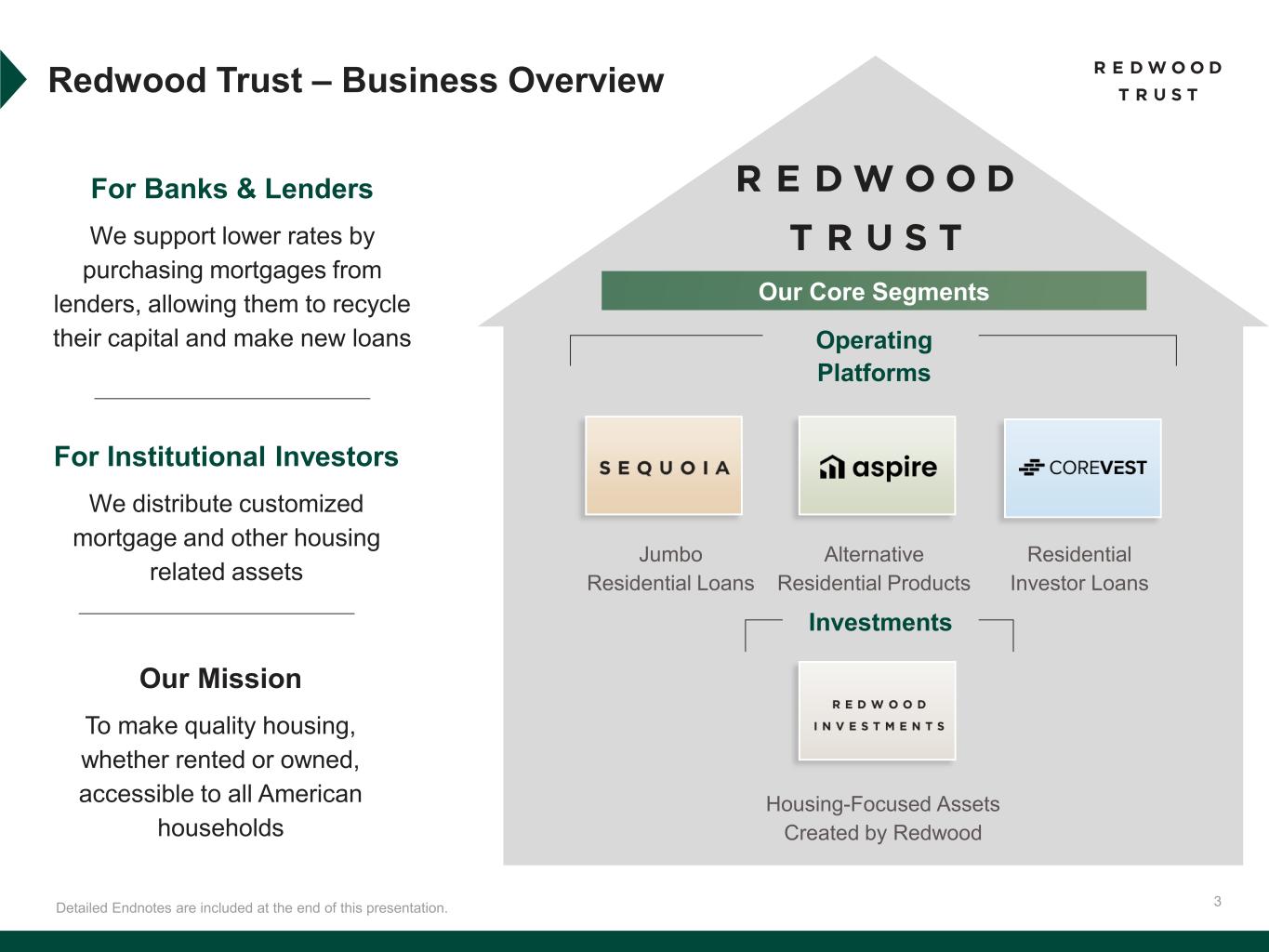
3 Redwood Trust – Business Overview Detailed Endnotes are included at the end of this presentation. For Banks & Lenders We support lower rates by purchasing mortgages from lenders, allowing them to recycle their capital and make new loans For Institutional Investors We distribute customized mortgage and other housing related assets Our Mission To make quality housing, whether rented or owned, accessible to all American households Our Core Segments Jumbo Residential Loans Residential Investor Loans Alternative Residential Products Housing-Focused Assets Created by Redwood Investments Operating Platforms
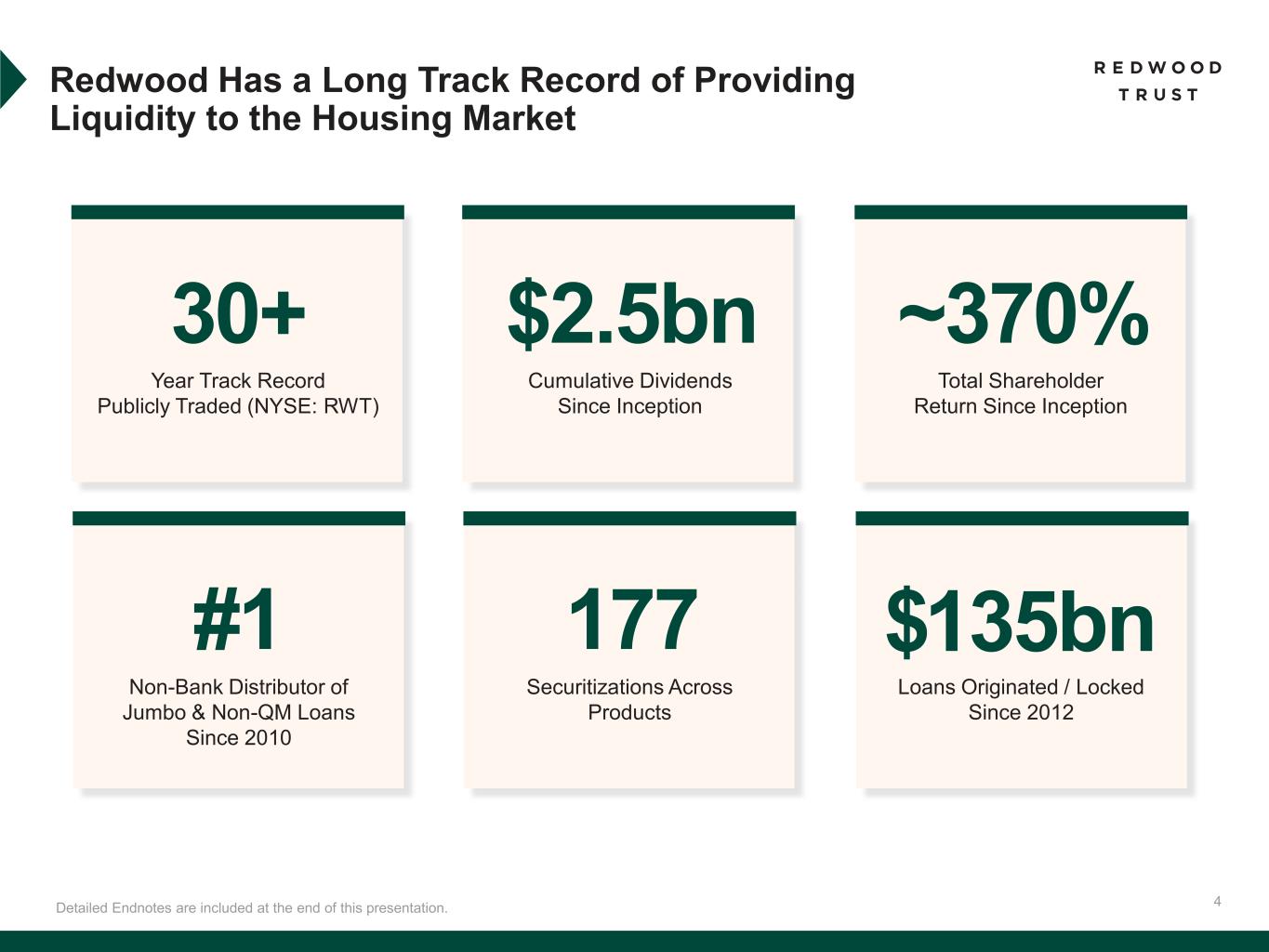
4Detailed Endnotes are included at the end of this presentation. 30+ Year Track Record Publicly Traded (NYSE: RWT) $2.5bn Cumulative Dividends Since Inception ~370% Total Shareholder Return Since Inception #1 Non-Bank Distributor of Jumbo & Non-QM Loans Since 2010 177 Securitizations Across Products Loans Originated / Locked Since 2012 Redwood Has a Long Track Record of Providing Liquidity to the Housing Market 135bn$
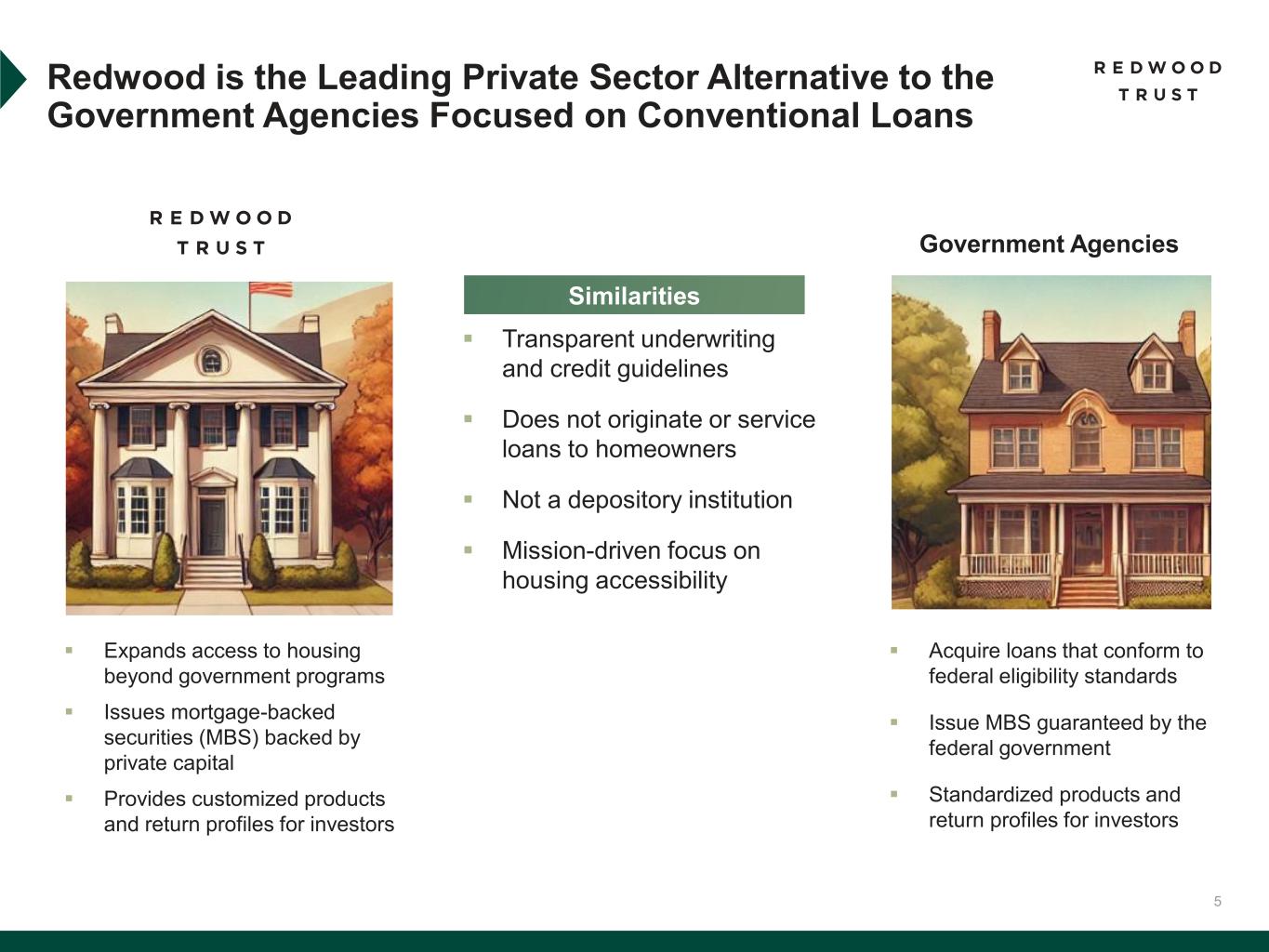
5 Redwood is the Leading Private Sector Alternative to the Government Agencies Focused on Conventional Loans ▪ Transparent underwriting and credit guidelines ▪ Does not originate or service loans to homeowners ▪ Not a depository institution ▪ Mission-driven focus on housing accessibility ▪ Acquire loans that conform to federal eligibility standards ▪ Issue MBS guaranteed by the federal government ▪ Standardized products and return profiles for investors ▪ Expands access to housing beyond government programs ▪ Issues mortgage-backed securities (MBS) backed by private capital ▪ Provides customized products and return profiles for investors Similarities Government Agencies
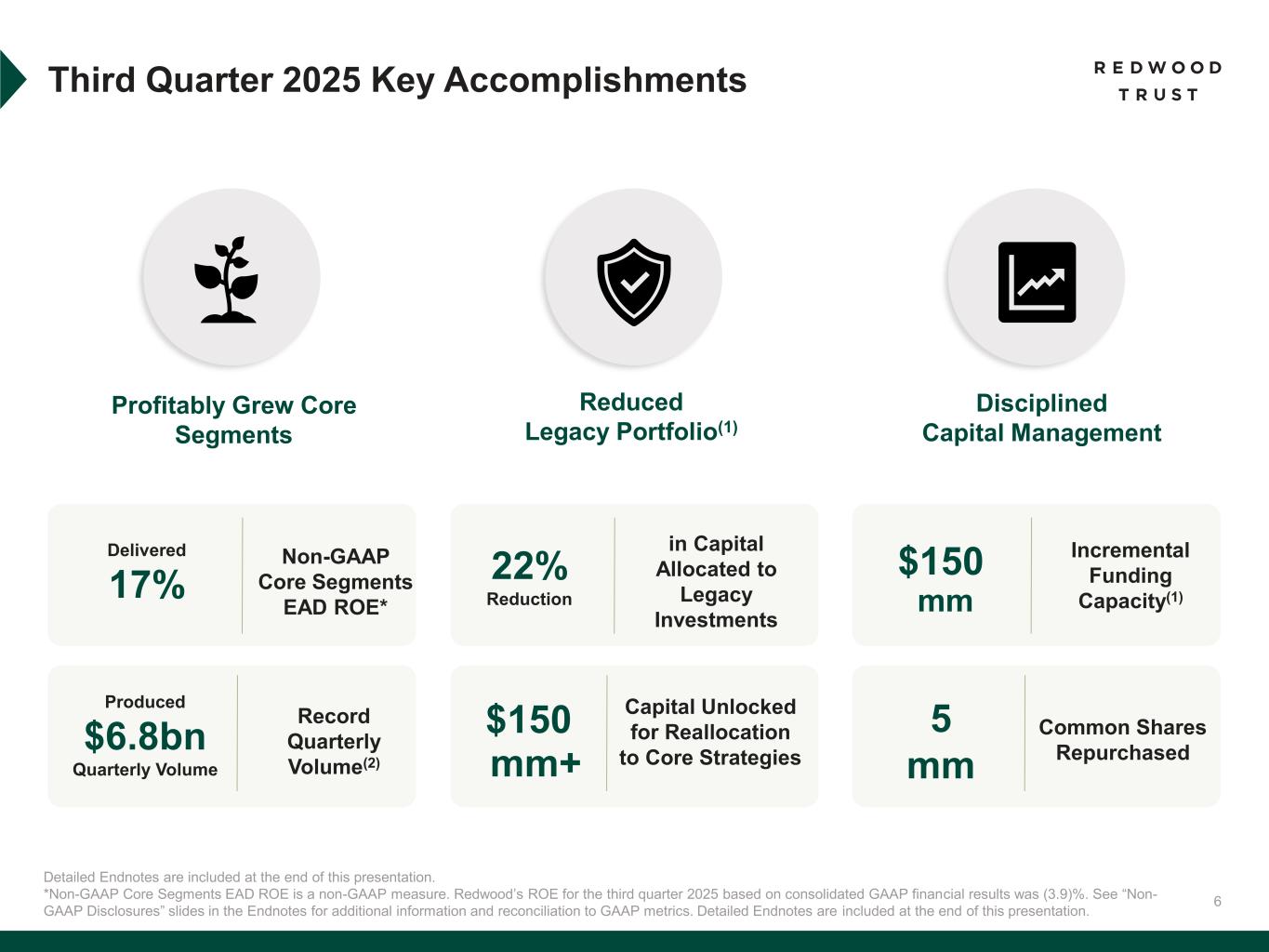
6 Third Quarter 2025 Key Accomplishments Detailed Endnotes are included at the end of this presentation. *Non-GAAP Core Segments EAD ROE is a non-GAAP measure. Redwood’s ROE for the third quarter 2025 based on consolidated GAAP financial results was (3.9)%. See “Non- GAAP Disclosures” slides in the Endnotes for additional information and reconciliation to GAAP metrics. Detailed Endnotes are included at the end of this presentation. Reduced Legacy Portfolio(1) Profitably Grew Core Segments Disciplined Capital Management Non-GAAP Core Segments EAD ROE* Delivered 17% Record Quarterly Volume(2) Produced $6.8bn Quarterly Volume Incremental Funding Capacity(1) Common Shares Repurchased 5 mm 22% Reduction in Capital Allocated to Legacy Investments Capital Unlocked for Reallocation to Core Strategies $150 mm+ $150 mm
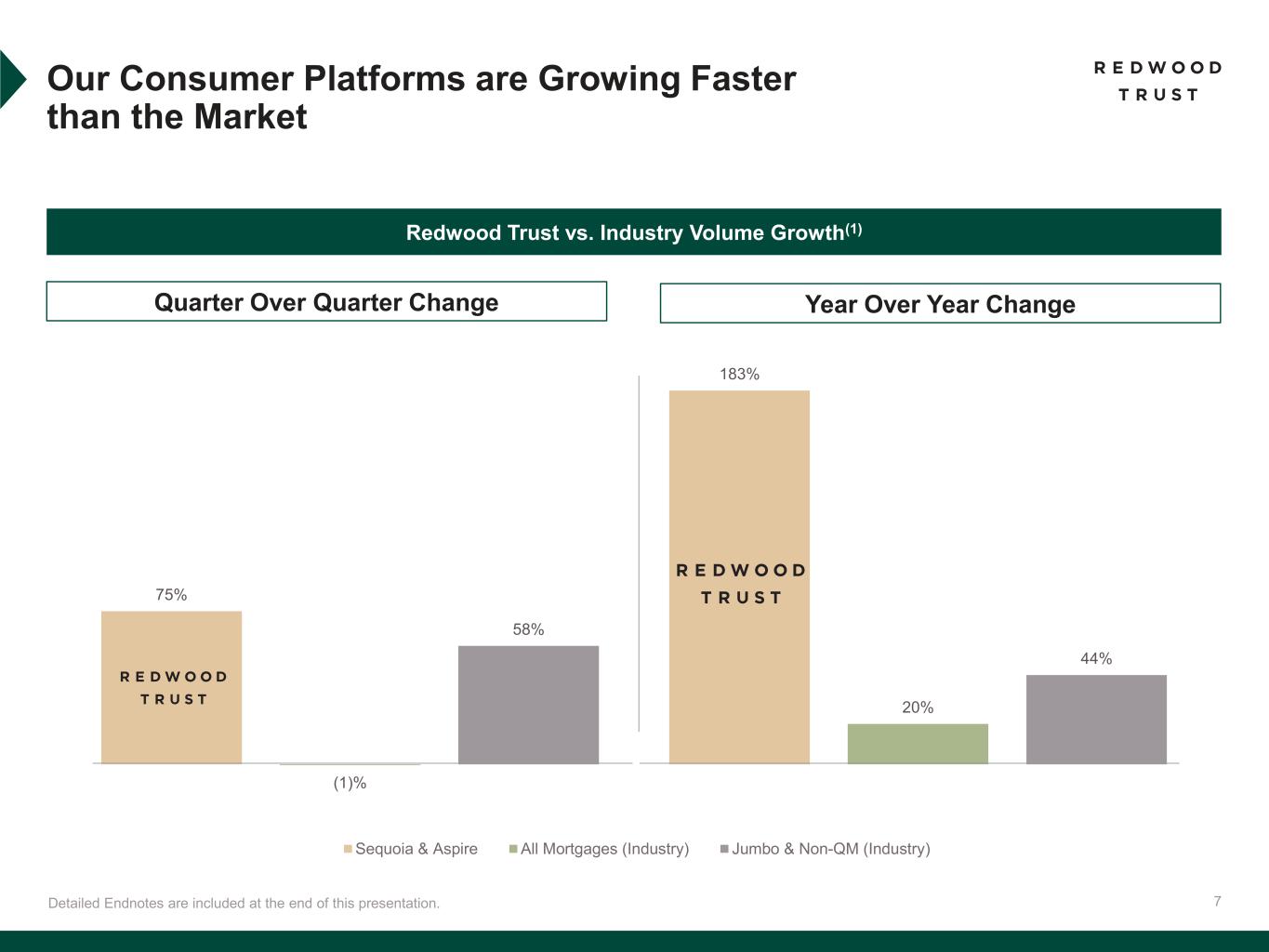
7 75% 183% (1)% 20% 58% 44% Sequoia & Aspire All Mortgages (Industry) Jumbo & Non-QM (Industry) Detailed Endnotes are included at the end of this presentation. Redwood Trust vs. Industry Volume Growth(1) Our Consumer Platforms are Growing Faster than the Market Quarter Over Quarter Change Year Over Year Change
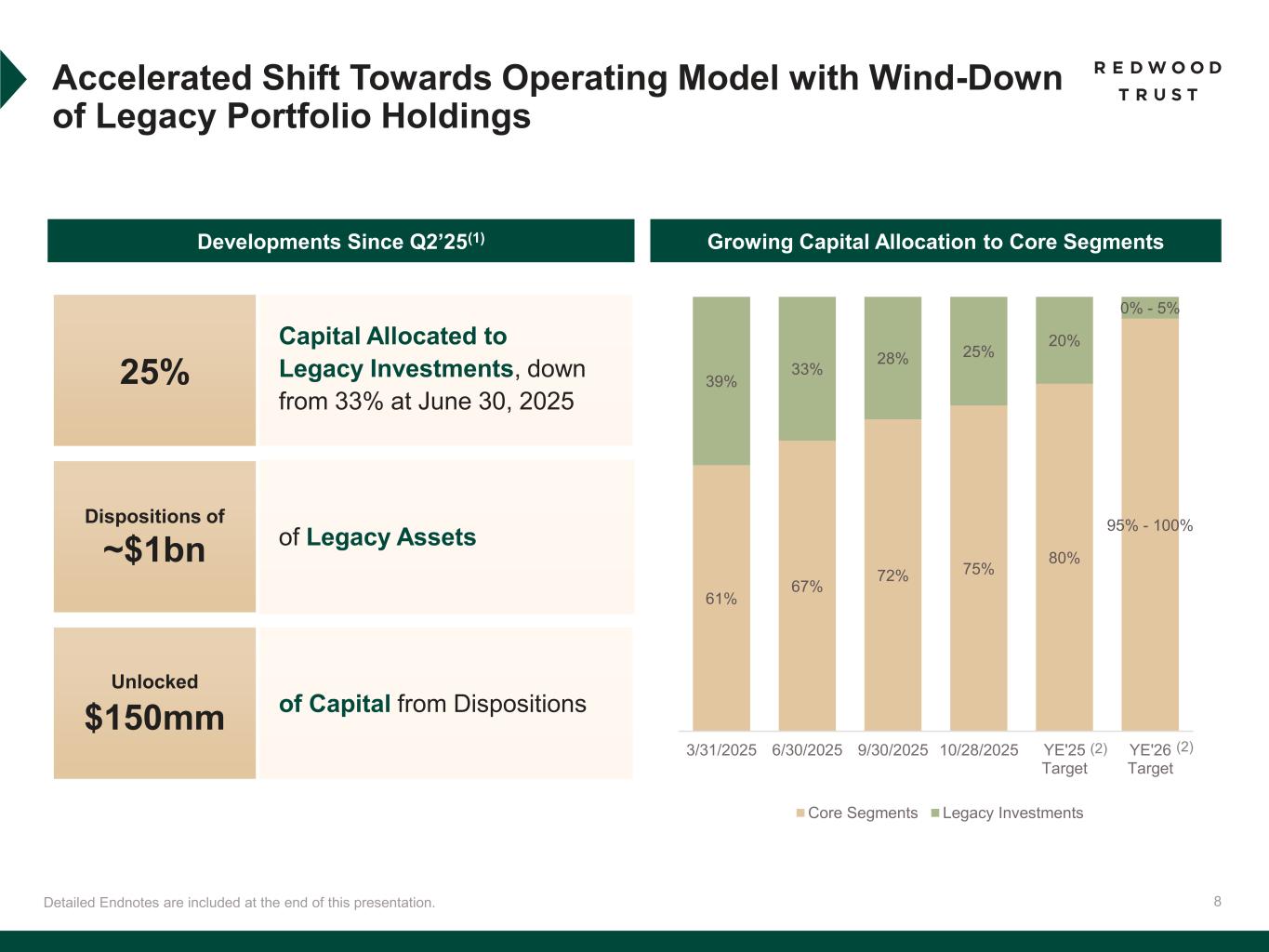
8 Accelerated Shift Towards Operating Model with Wind-Down of Legacy Portfolio Holdings Detailed Endnotes are included at the end of this presentation. t of Capital from Dispositions Growing Capital Allocation to Core SegmentsDevelopments Since Q2’25(1) 25% Dispositions of ~$1bn Capital Allocated to Legacy Investments, down from 33% at June 30, 2025 of Legacy Assets Unlocked $150mm 61% 67% 72% 75% 80% 95% - 100% 39% 33% 28% 25% 20% 0% - 5% 3/31/2025 6/30/2025 9/30/2025 10/28/2025 YE'25 Target YE'26 Target Core Segments Legacy Investments (2) (2)
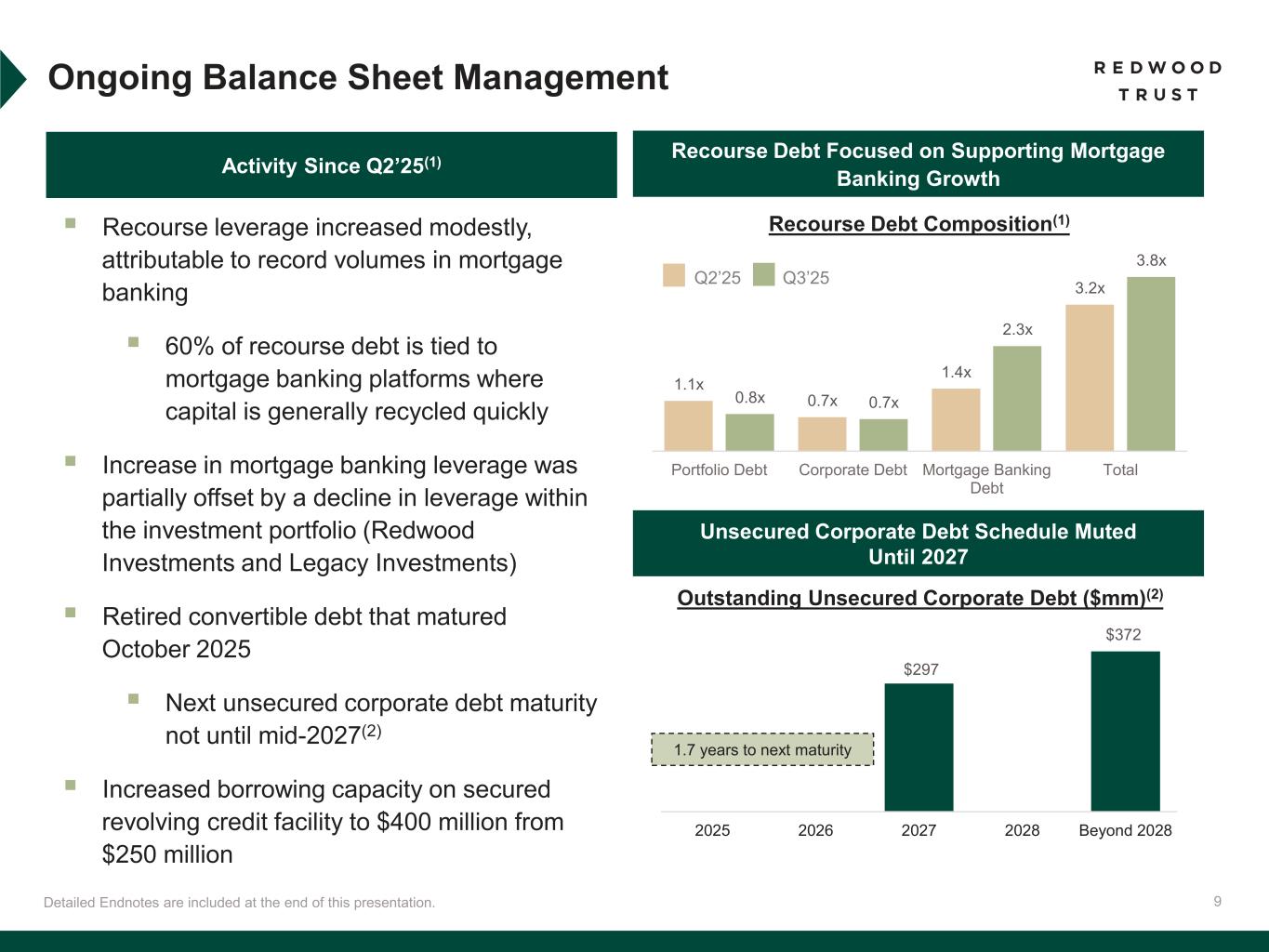
9 Ongoing Balance Sheet Management Detailed Endnotes are included at the end of this presentation. Activity Since Q2’25(1) ▪ Recourse leverage increased modestly, attributable to record volumes in mortgage banking ▪ 60% of recourse debt is tied to mortgage banking platforms where capital is generally recycled quickly ▪ Increase in mortgage banking leverage was partially offset by a decline in leverage within the investment portfolio (Redwood Investments and Legacy Investments) ▪ Retired convertible debt that matured October 2025 ▪ Next unsecured corporate debt maturity not until mid-2027(2) ▪ Increased borrowing capacity on secured revolving credit facility to $400 million from $250 million $297 $372 2025 2026 2027 2028 Beyond 2028 1.7 years to next maturity Recourse Debt Focused on Supporting Mortgage Banking Growth Unsecured Corporate Debt Schedule Muted Until 2027 Outstanding Unsecured Corporate Debt ($mm)(2) Recourse Debt Composition(1) Q3’25Q2’25 1.1x 0.7x 1.4x 3.2x 0.8x 0.7x 2.3x 3.8x Portfolio Debt Corporate Debt Mortgage Banking Debt Total
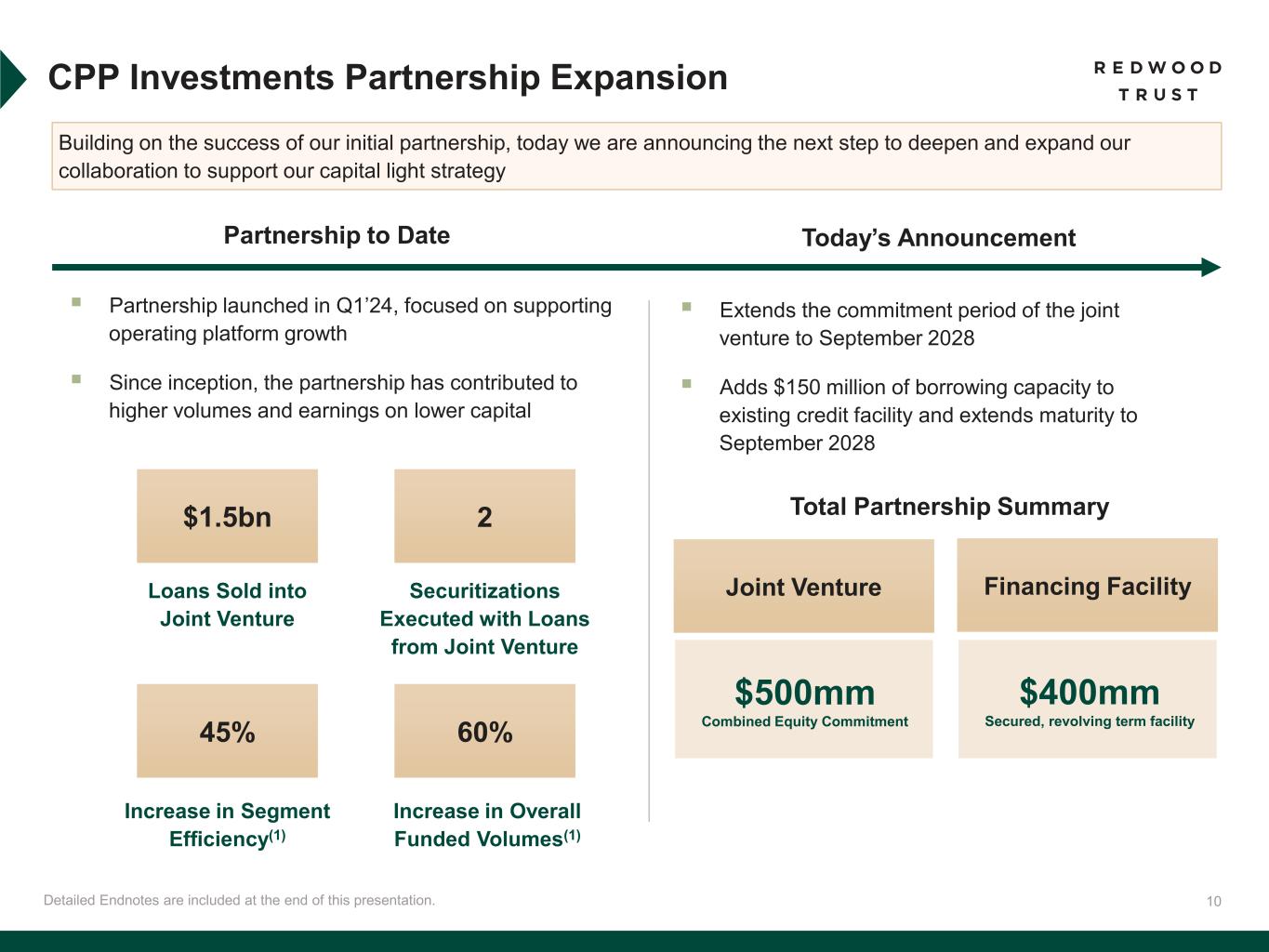
10 CPP Investments Partnership Expansion Detailed Endnotes are included at the end of this presentation. Building on the success of our initial partnership, today we are announcing the next step to deepen and expand our collaboration to support our capital light strategy Partnership to Date Today’s Announcement $1.5bn Loans Sold into Joint Venture 2 Securitizations Executed with Loans from Joint Venture 45% Increase in Segment Efficiency(1) 60% Increase in Overall Funded Volumes(1) $500mm Combined Equity Commitment ▪ Partnership launched in Q1’24, focused on supporting operating platform growth ▪ Since inception, the partnership has contributed to higher volumes and earnings on lower capital ▪ Extends the commitment period of the joint venture to September 2028 ▪ Adds $150 million of borrowing capacity to existing credit facility and extends maturity to September 2028 Total Partnership Summary Joint Venture Financing Facility $400mm Secured, revolving term facility
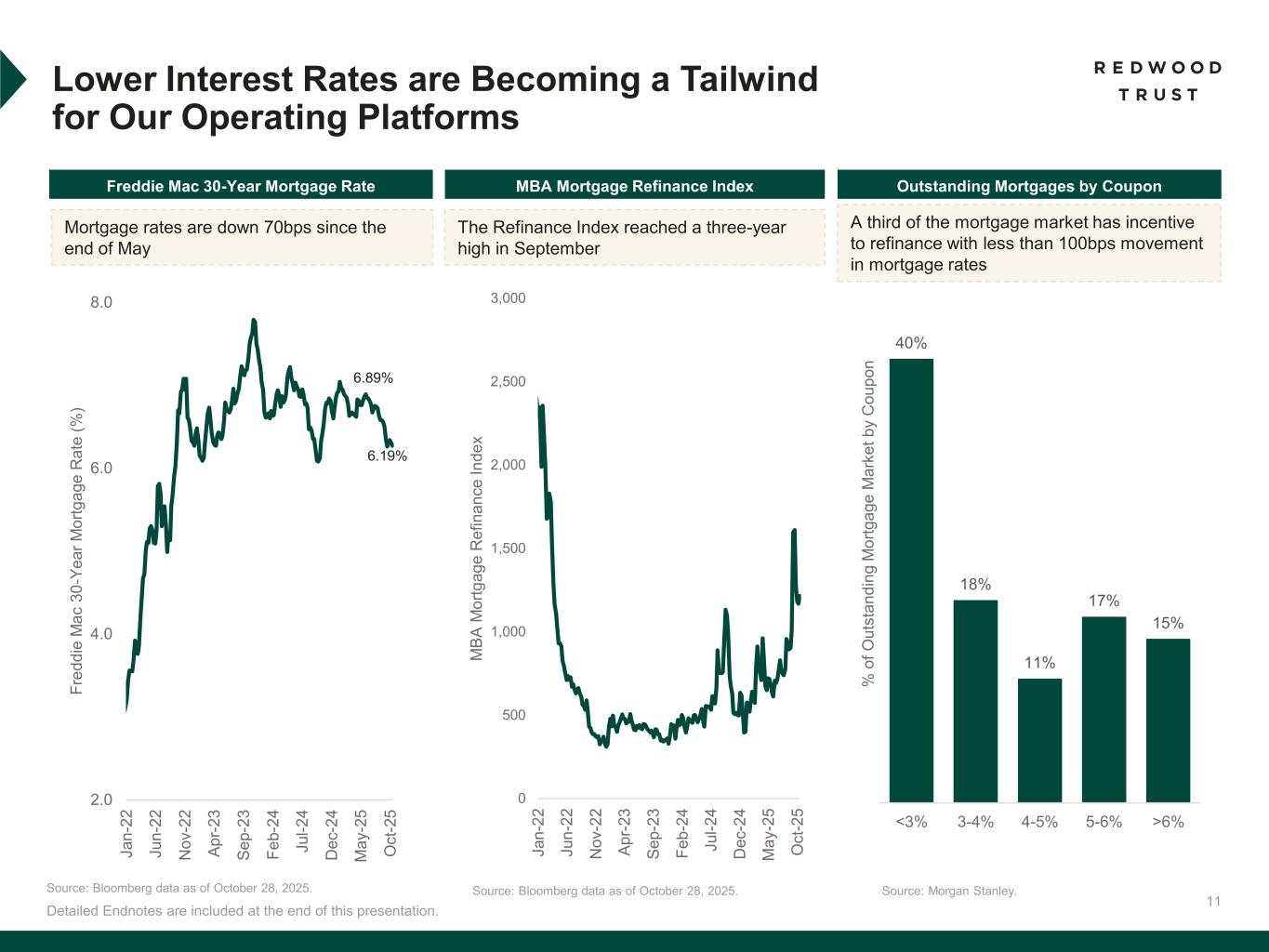
11 Lower Interest Rates are Becoming a Tailwind for Our Operating Platforms Detailed Endnotes are included at the end of this presentation. MBA Mortgage Refinance Index 40% 18% 11% 17% 15% <3% 3-4% 4-5% 5-6% >6% % o f O u ts ta n d in g M o rt g a g e M a rk e t b y C o u p o n The Refinance Index reached a three-year high in September A third of the mortgage market has incentive to refinance with less than 100bps movement in mortgage rates Freddie Mac 30-Year Mortgage Rate Mortgage rates are down 70bps since the end of May Source: Bloomberg data as of October 28, 2025. Source: Bloomberg data as of October 28, 2025. Source: Morgan Stanley. Outstanding Mortgages by Coupon 6.89% 6.19% 0 500 1,000 1,500 2,000 2,500 3,000 J a n -2 2 J u n -2 2 N o v -2 2 A p r- 2 3 S e p -2 3 F e b -2 4 J u l- 2 4 D e c -2 4 M a y -2 5 O c t- 2 5 M B A M o rt g a g e R e fi n a n c e I n d e x 2.0 4.0 6.0 8.0 J a n -2 2 J u n -2 2 N o v -2 2 A p r- 2 3 S e p -2 3 F e b -2 4 J u l- 2 4 D e c -2 4 M a y -2 5 O c t- 2 5 F re d d ie M a c 3 0 -Y e a r M o rt g a g e R a te ( % )

12 Third Quarter 2025 Earnings & Segment Results
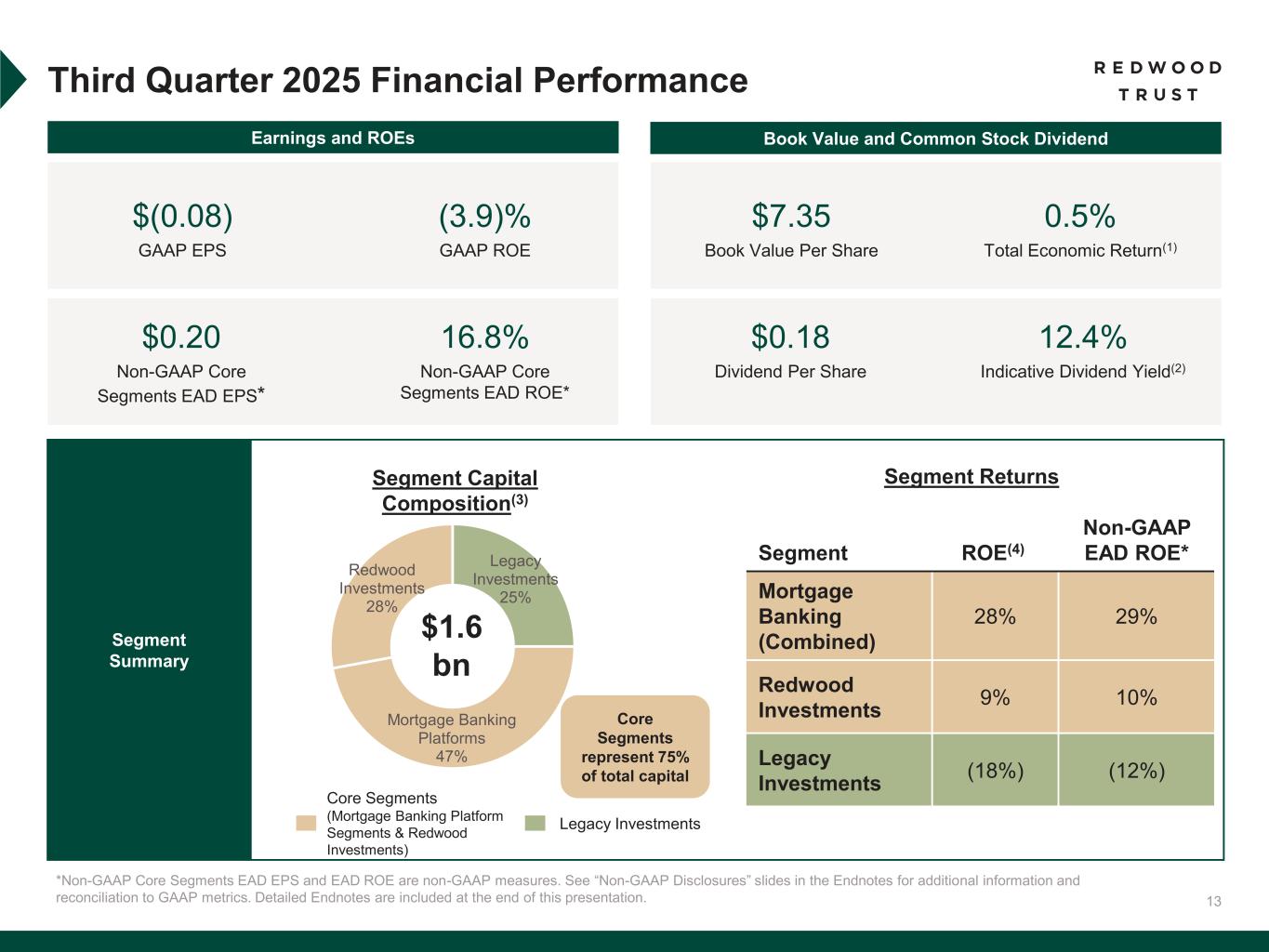
13 Third Quarter 2025 Financial Performance *Non-GAAP Core Segments EAD EPS and EAD ROE are non-GAAP measures. See “Non-GAAP Disclosures” slides in the Endnotes for additional information and reconciliation to GAAP metrics. Detailed Endnotes are included at the end of this presentation. Earnings and ROEs Book Value and Common Stock Dividend $(0.08) GAAP EPS $0.18 Dividend Per Share 12.4% Indicative Dividend Yield(2) (3.9)% GAAP ROE Segment Summary $7.35 Book Value Per Share 0.5% Total Economic Return(1) $1.6 bn Core Segments represent 75% of total capital $0.20 Non-GAAP Core Segments EAD EPS* 16.8% Non-GAAP Core Segments EAD ROE* Segment ROE(4)) Non-GAAP EAD ROE* Mortgage Banking (Combined) 28% 29% Redwood Investments 9% 10% Legacy Investments (18%) (12%) Core Segments (Mortgage Banking Platform Segments & Redwood Investments) Legacy Investments Legacy Investments 25% Mortgage Banking Platforms 47% Redwood Investments 28% Segment Capital Composition(3) Segment Returns
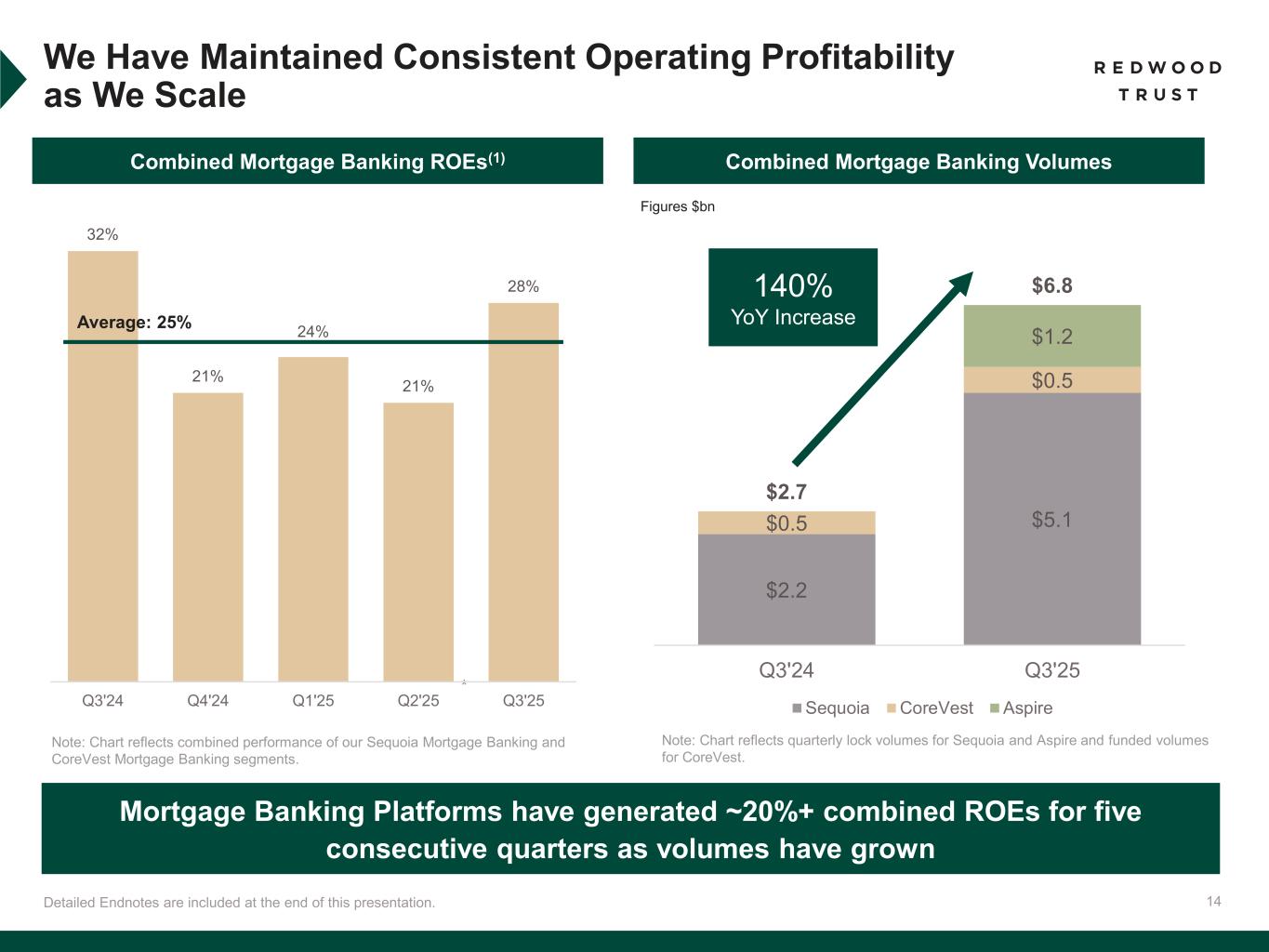
14 $2.2 $5.1$0.5 $0.5 $1.2 $2.7 $6.8 Q3'24 Q3'25 Sequoia CoreVest Aspire We Have Maintained Consistent Operating Profitability as We Scale Detailed Endnotes are included at the end of this presentation. Combined Mortgage Banking ROEs(1) Combined Mortgage Banking Volumes Figures $bn Mortgage Banking Platforms have generated ~20%+ combined ROEs for five consecutive quarters as volumes have grown 140% YoY Increase Note: Chart reflects quarterly lock volumes for Sequoia and Aspire and funded volumes for CoreVest. * 32% 21% 24% 21% 28% Q3'24 Q4'24 Q1'25 Q2'25 Q3'25 Note: Chart reflects combined performance of our Sequoia Mortgage Banking and CoreVest Mortgage Banking segments. Average: 25%
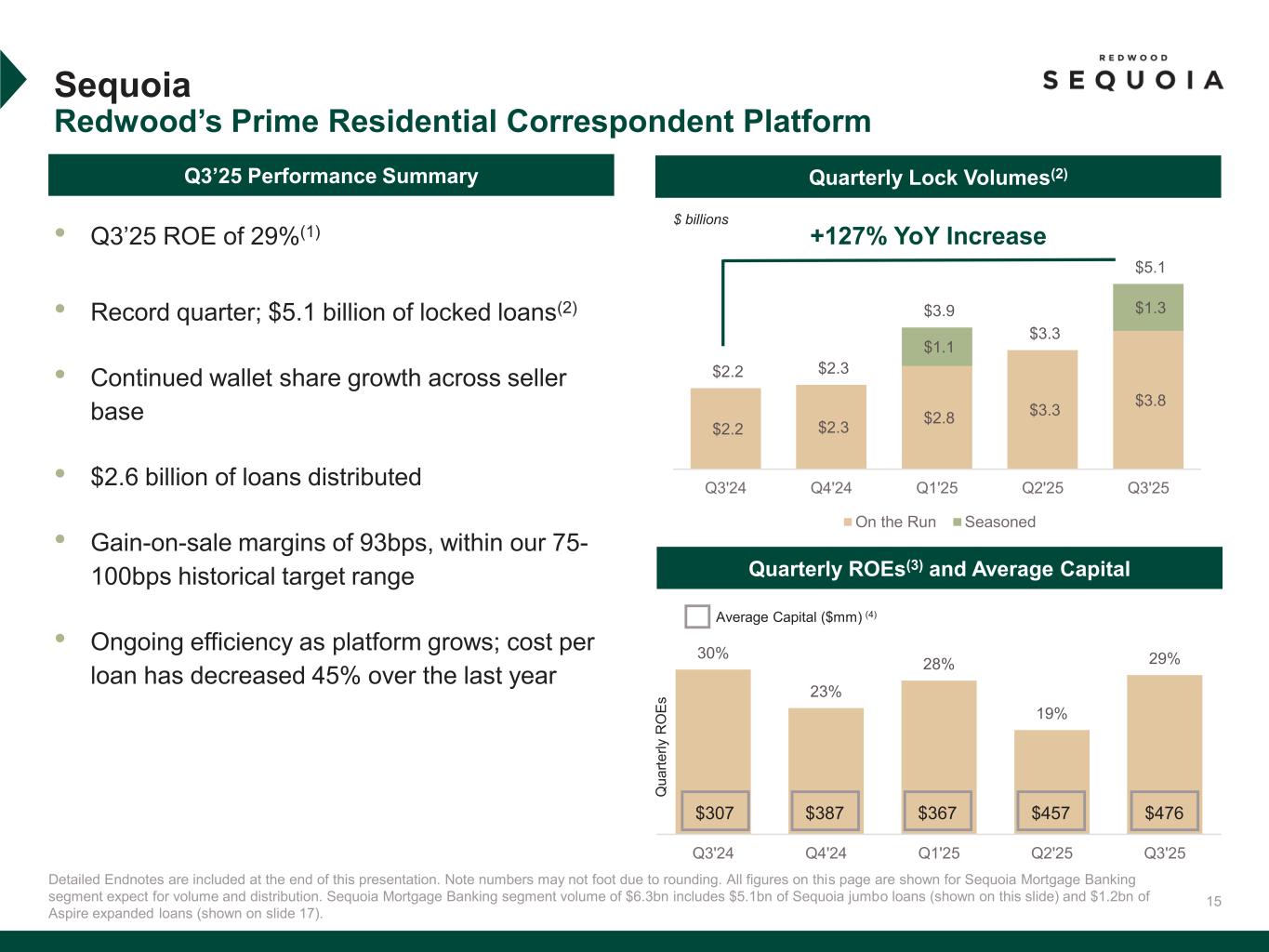
15 30% 23% 28% 19% 29% Q3'24 Q4'24 Q1'25 Q2'25 Q3'25 Detailed Endnotes are included at the end of this presentation. Note numbers may not foot due to rounding. All figures on this page are shown for Sequoia Mortgage Banking segment expect for volume and distribution. Sequoia Mortgage Banking segment volume of $6.3bn includes $5.1bn of Sequoia jumbo loans (shown on this slide) and $1.2bn of Aspire expanded loans (shown on slide 17). Sequoia Redwood’s Prime Residential Correspondent Platform Quarterly Lock Volumes(2) $ billions +127% YoY Increase Quarterly ROEs(3) and Average Capital Average Capital ($mm) (4) • Q3’25 ROE of 29%(1) • Record quarter; $5.1 billion of locked loans(2) • Continued wallet share growth across seller base • $2.6 billion of loans distributed • Gain-on-sale margins of 93bps, within our 75- 100bps historical target range • Ongoing efficiency as platform grows; cost per loan has decreased 45% over the last year $307 $387 $367 $457 $476 Q u a rt e rl y R O E s Q3’25 Performance Summary $2.2 $2.3 $2.8 $3.3 $3.8 $1.1 $1.3 $2.2 $2.3 $3.9 $3.3 $5.1 Q3'24 Q4'24 Q1'25 Q2'25 Q3'25 On the Run Seasoned
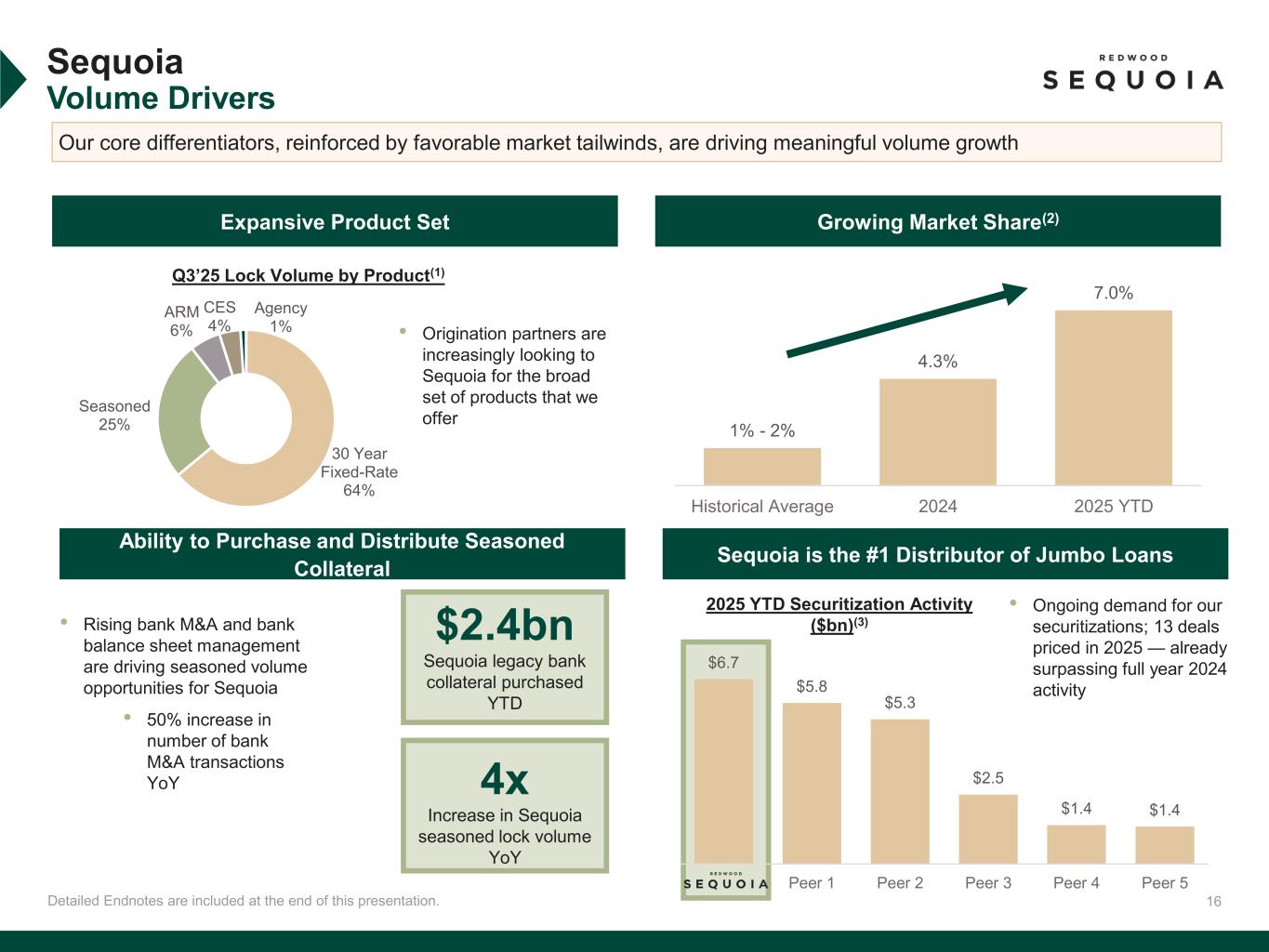
16 1% - 2% 4.3% 7.0% Historical Average 2024 2025 YTD Detailed Endnotes are included at the end of this presentation. Sequoia Volume Drivers Our core differentiators, reinforced by favorable market tailwinds, are driving meaningful volume growth Growing Market Share(2)Expansive Product Set Sequoia is the #1 Distributor of Jumbo Loans Ability to Purchase and Distribute Seasoned Collateral • Rising bank M&A and bank balance sheet management are driving seasoned volume opportunities for Sequoia • 50% increase in number of bank M&A transactions YoY $2.4bn Sequoia legacy bank collateral purchased YTD • Ongoing demand for our securitizations; 13 deals priced in 2025 — already surpassing full year 2024 activity 2025 YTD Securitization Activity ($bn)(3) Q3’25 Lock Volume by Product(1) • Origination partners are increasingly looking to Sequoia for the broad set of products that we offer 30 Year Fixed-Rate 64% Seasoned 25% ARM 6% CES 4% Agency 1% 4x Increase in Sequoia seasoned lock volume YoY $6.7 $5.8 $5.3 $2.5 $1.4 $1.4 Peer 1 Peer 2 Peer 3 Peer 4 Peer 5
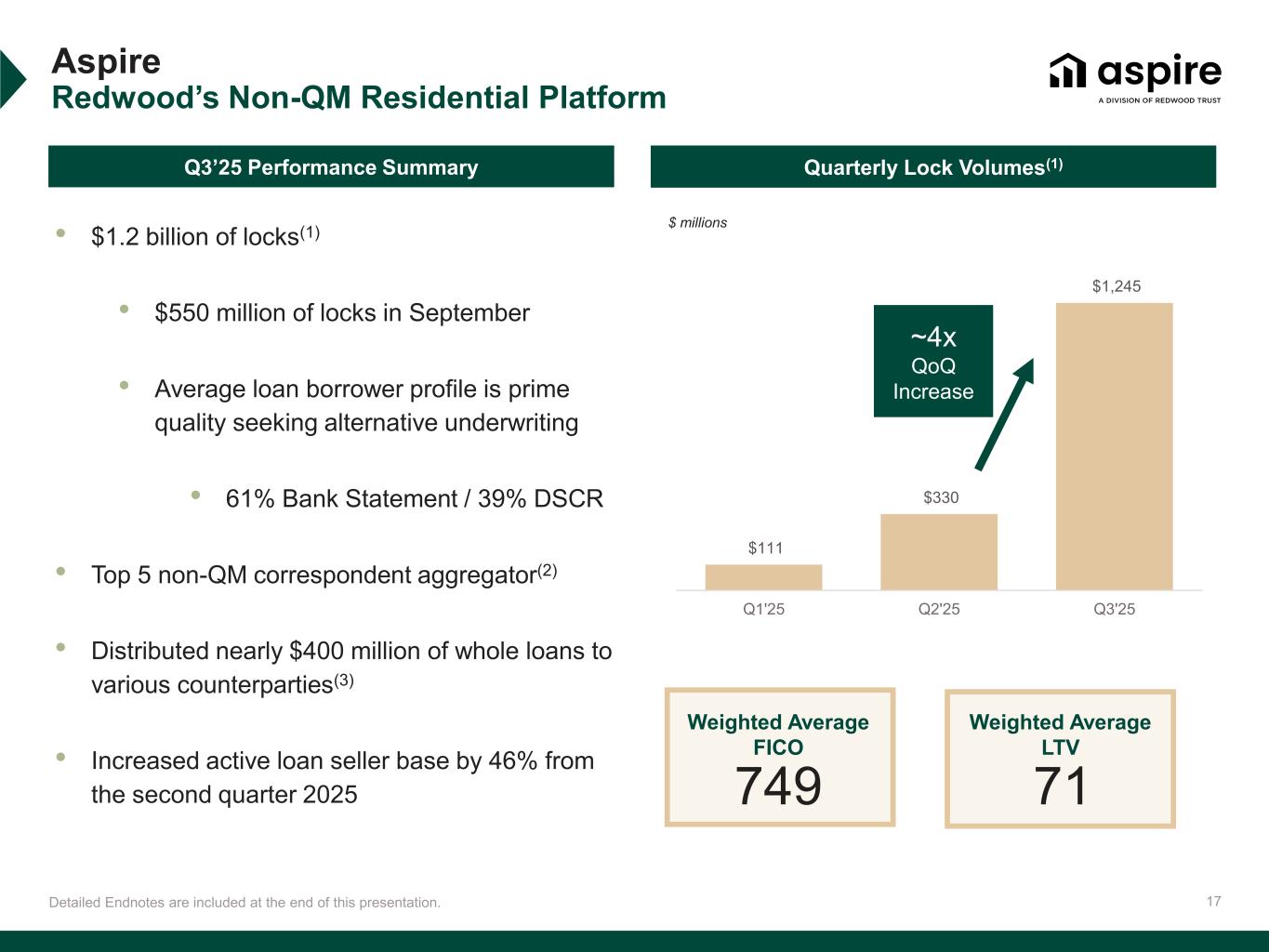
17 $111 $330 $1,245 Q1'25 Q2'25 Q3'25 Aspire Redwood’s Non-QM Residential Platform Detailed Endnotes are included at the end of this presentation. Quarterly Lock Volumes(1) ~4x QoQ Increase Weighted Average LTV 71 Weighted Average FICO 749 $ millions Q3’25 Performance Summary • $1.2 billion of locks(1) • $550 million of locks in September • Average loan borrower profile is prime quality seeking alternative underwriting • 61% Bank Statement / 39% DSCR • Top 5 non-QM correspondent aggregator(2) • Distributed nearly $400 million of whole loans to various counterparties(3) • Increased active loan seller base by 46% from the second quarter 2025
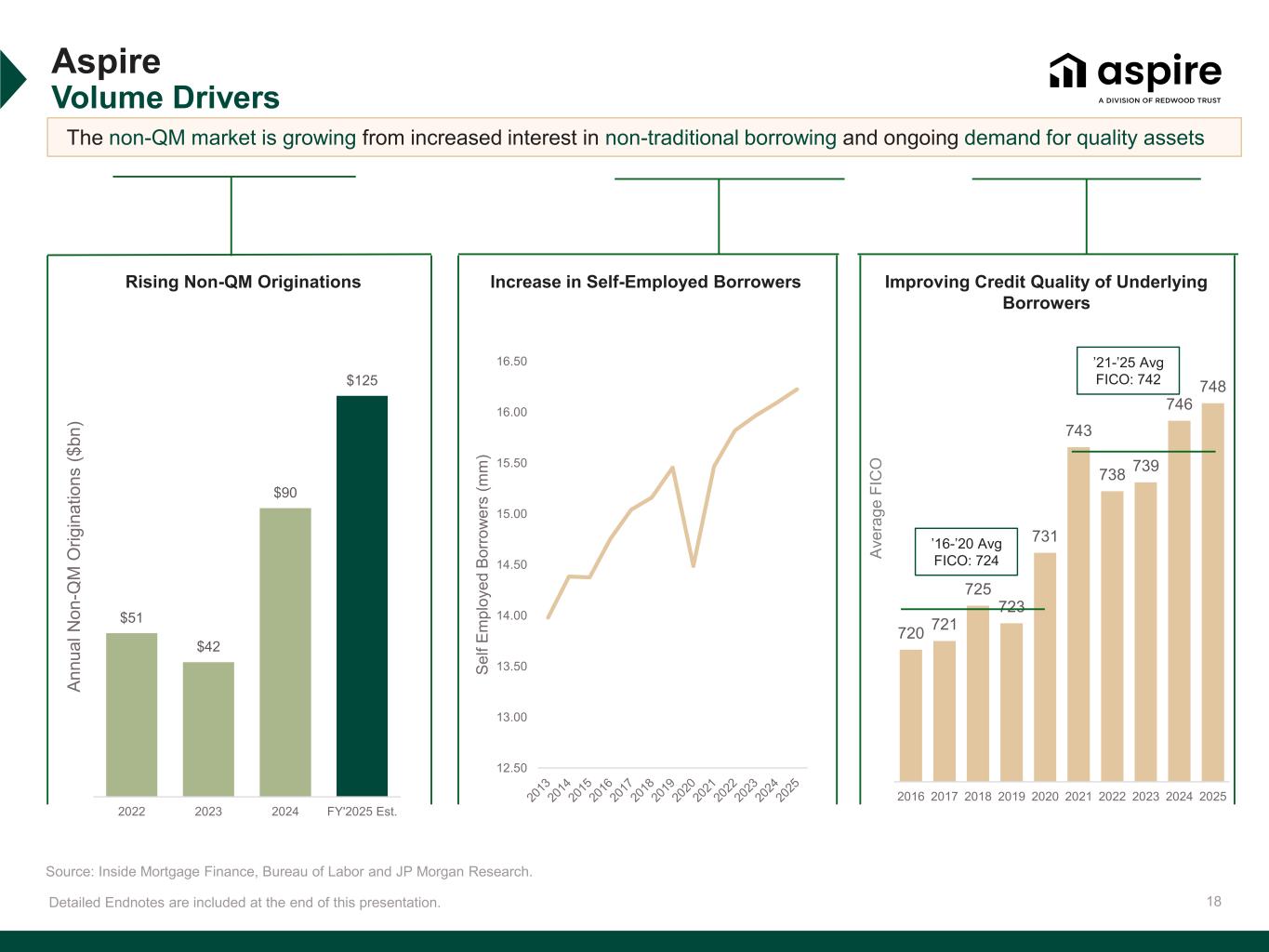
18 Aspire Volume Drivers Detailed Endnotes are included at the end of this presentation. Increase in Self-Employed BorrowersRising Non-QM Originations Improving Credit Quality of Underlying Borrowers $51 $42 $90 $125 2022 2023 2024 FY'2025 Est. A n n u a l N o n -Q M O ri g in a ti o n s ( $ b n ) The non-QM market is growing from increased interest in non-traditional borrowing and ongoing demand for quality assets Source: Inside Mortgage Finance, Bureau of Labor and JP Morgan Research. 12.50 13.00 13.50 14.00 14.50 15.00 15.50 16.00 16.50 S e lf E m p lo y e d B o rr o w e rs ( m m ) 720 721 725 723 731 743 738 739 746 748 2016 2017 2018 2019 2020 2021 2022 2023 2024 2025 ’16-’20 Avg FICO: 724 ’21-’25 Avg FICO: 742 A v e ra g e F IC O
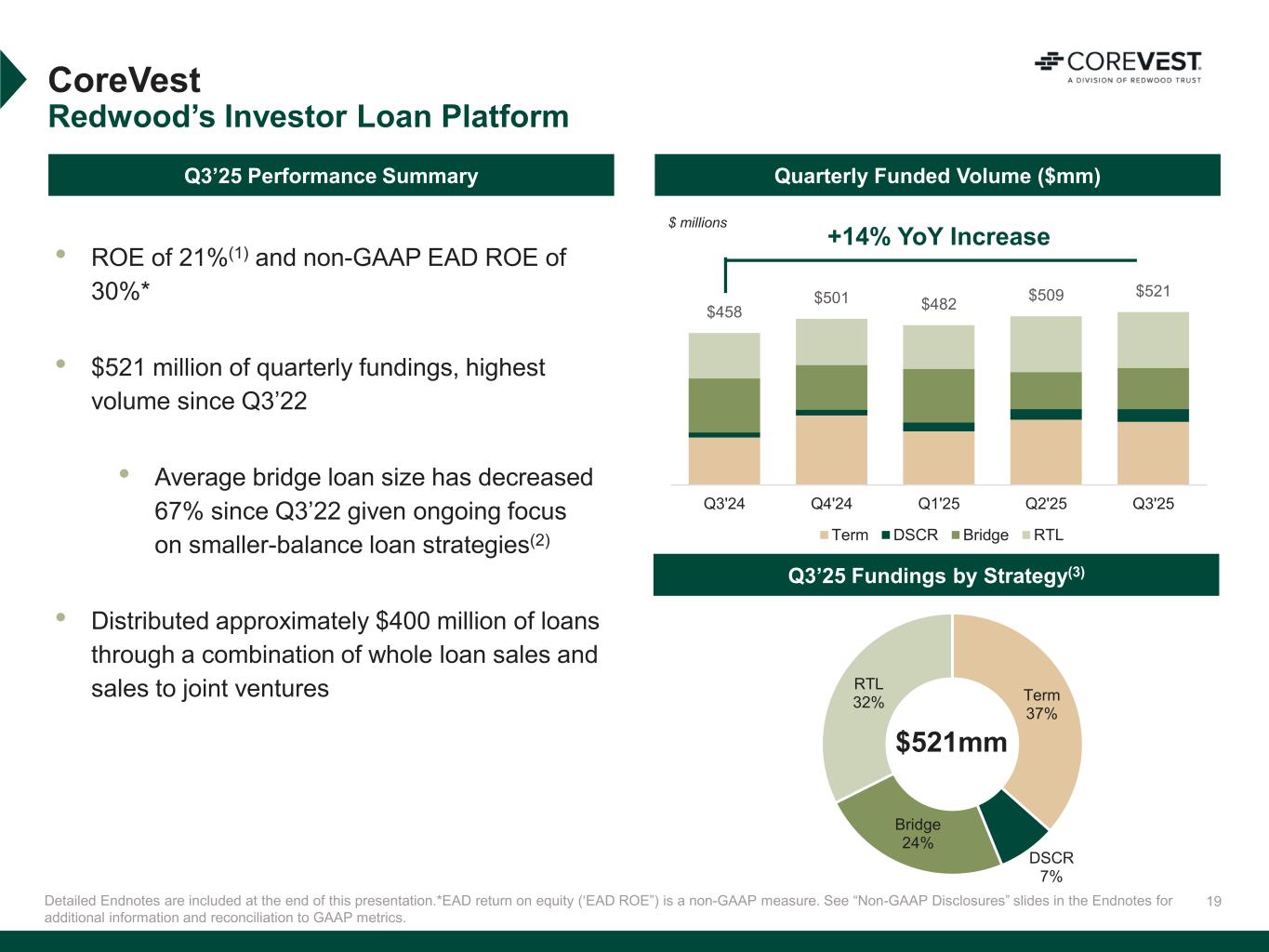
19 $458 $501 $482 $509 $521 Q3'24 Q4'24 Q1'25 Q2'25 Q3'25 Term DSCR Bridge RTL Term 37% DSCR 7% Bridge 24% RTL 32% CoreVest Redwood’s Investor Loan Platform Quarterly Funded Volume ($mm) Detailed Endnotes are included at the end of this presentation.*EAD return on equity (‘EAD ROE”) is a non-GAAP measure. See “Non-GAAP Disclosures” slides in the Endnotes for additional information and reconciliation to GAAP metrics. +14% YoY Increase $ millions Q3’25 Fundings by Strategy(3) $521mm • ROE of 21%(1) and non-GAAP EAD ROE of 30%* • $521 million of quarterly fundings, highest volume since Q3’22 • Average bridge loan size has decreased 67% since Q3’22 given ongoing focus on smaller-balance loan strategies(2) • Distributed approximately $400 million of loans through a combination of whole loan sales and sales to joint ventures Q3’25 Performance Summary
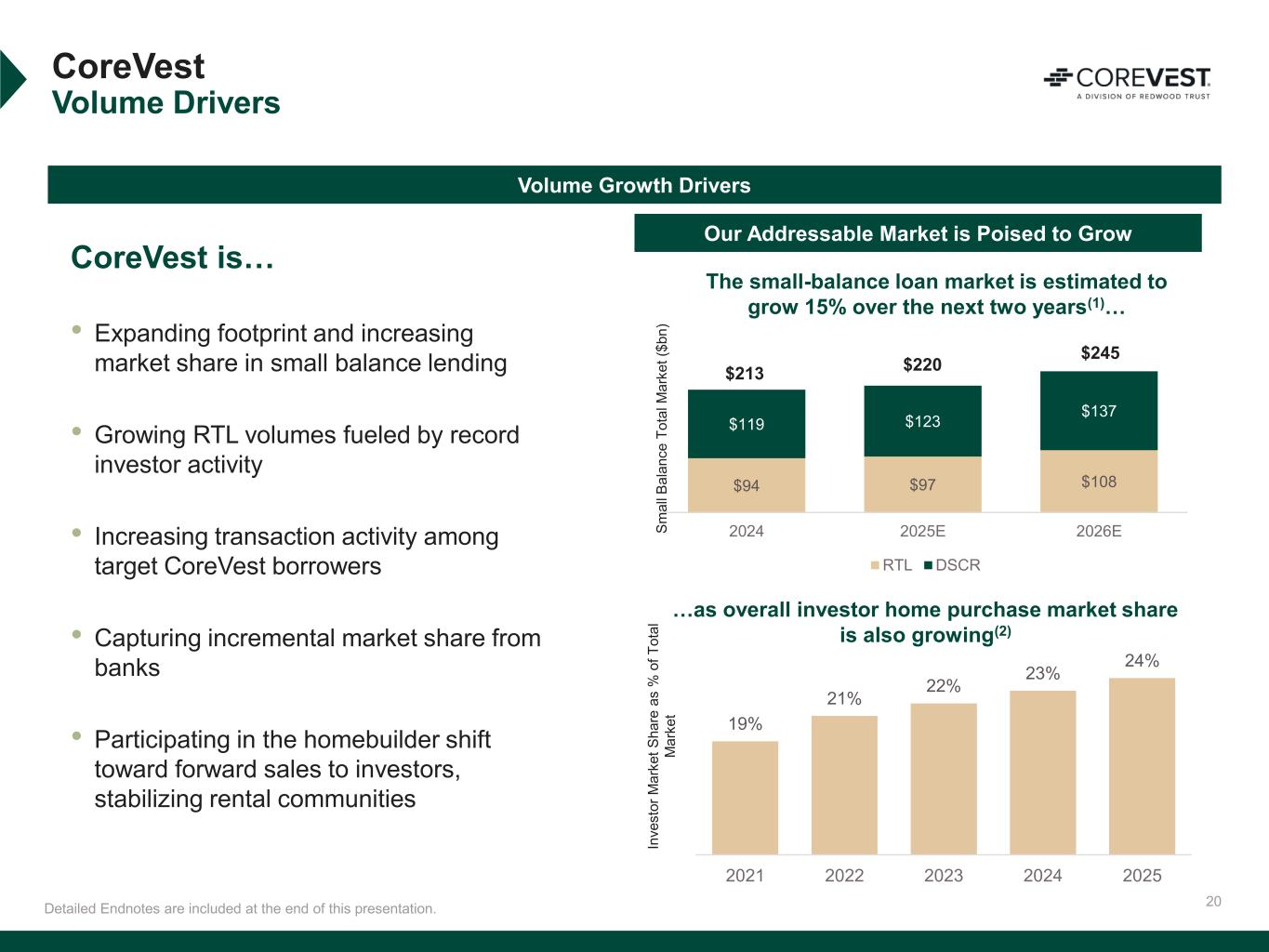
20 CoreVest Volume Drivers Detailed Endnotes are included at the end of this presentation. Volume Growth Drivers The small-balance loan market is estimated to grow 15% over the next two years(1)… $94 $97 $108 $119 $123 $137 2024 2025E 2026E RTL DSCR $213 $220 $245 CoreVest is… • Expanding footprint and increasing market share in small balance lending • Growing RTL volumes fueled by record investor activity • Increasing transaction activity among target CoreVest borrowers • Capturing incremental market share from banks • Participating in the homebuilder shift toward forward sales to investors, stabilizing rental communities Our Addressable Market is Poised to Grow 19% 21% 22% 23% 24% 2021 2022 2023 2024 2025 …as overall investor home purchase market share is also growing(2) S m a ll B a la n c e T o ta l M a rk e t ($ b n ) In v e s to r M a rk e t S h a re a s % o f T o ta l M a rk e t
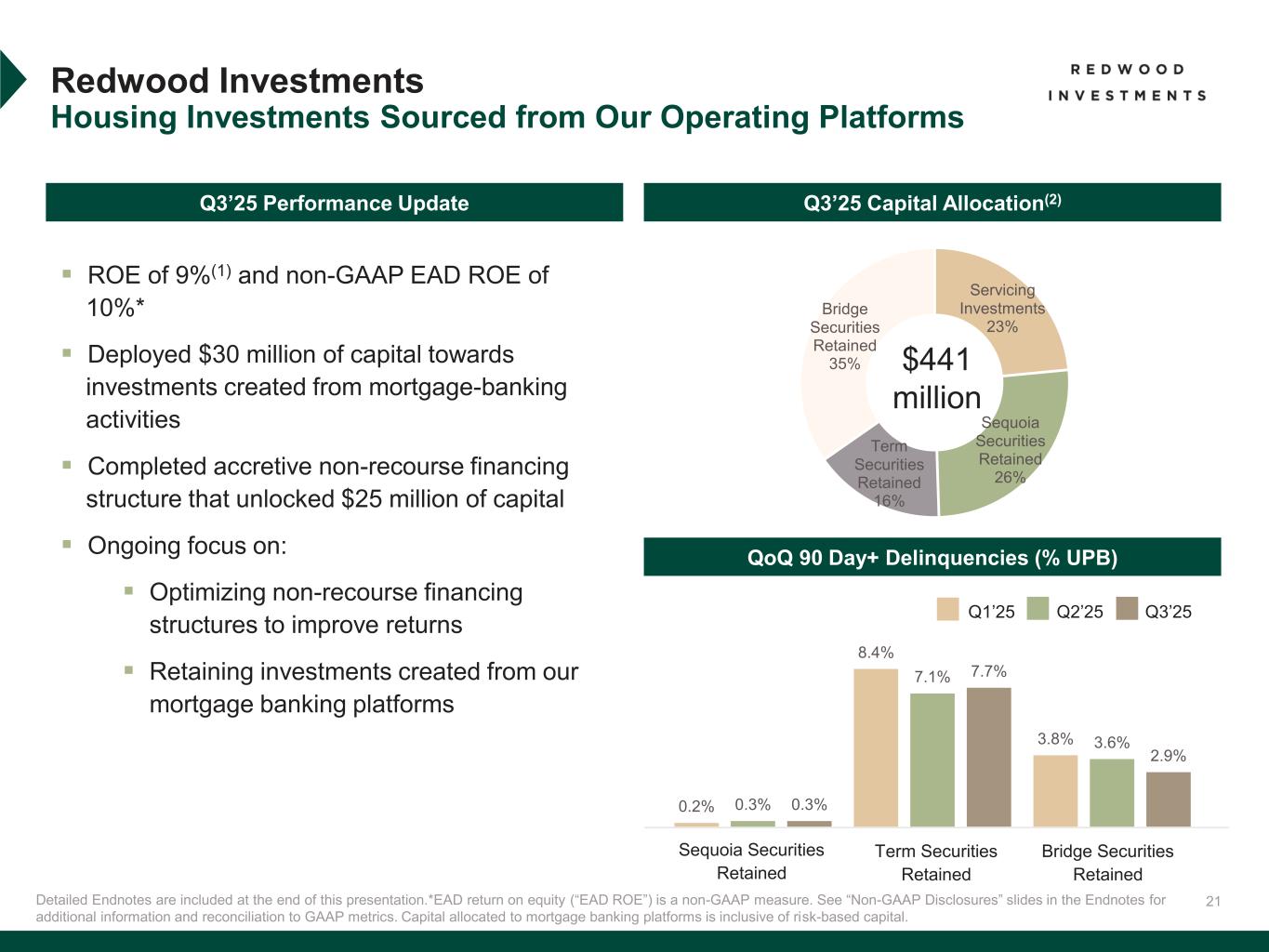
21 Redwood Investments Housing Investments Sourced from Our Operating Platforms Q3’25 Performance Update ▪ ROE of 9%(1) and non-GAAP EAD ROE of 10%* ▪ Deployed $30 million of capital towards investments created from mortgage-banking activities ▪ Completed accretive non-recourse financing structure that unlocked $25 million of capital ▪ Ongoing focus on: ▪ Optimizing non-recourse financing structures to improve returns ▪ Retaining investments created from our mortgage banking platforms $441 million Q3’25 Capital Allocation(2) Q2’25 QoQ 90 Day+ Delinquencies (% UPB) Q3’25 Detailed Endnotes are included at the end of this presentation.*EAD return on equity (“EAD ROE”) is a non-GAAP measure. See “Non-GAAP Disclosures” slides in the Endnotes for additional information and reconciliation to GAAP metrics. Capital allocated to mortgage banking platforms is inclusive of risk-based capital. Q1’25 Servicing Investments 23% Sequoia Securities Retained 26% Term Securities Retained 16% Bridge Securities Retained 35% 0.2% 8.4% 3.8% 0.3% 7.1% 3.6% 0.3% 7.7% 2.9% Sequoia Securities Retained Term Securities Retained Bridge Securities Retained
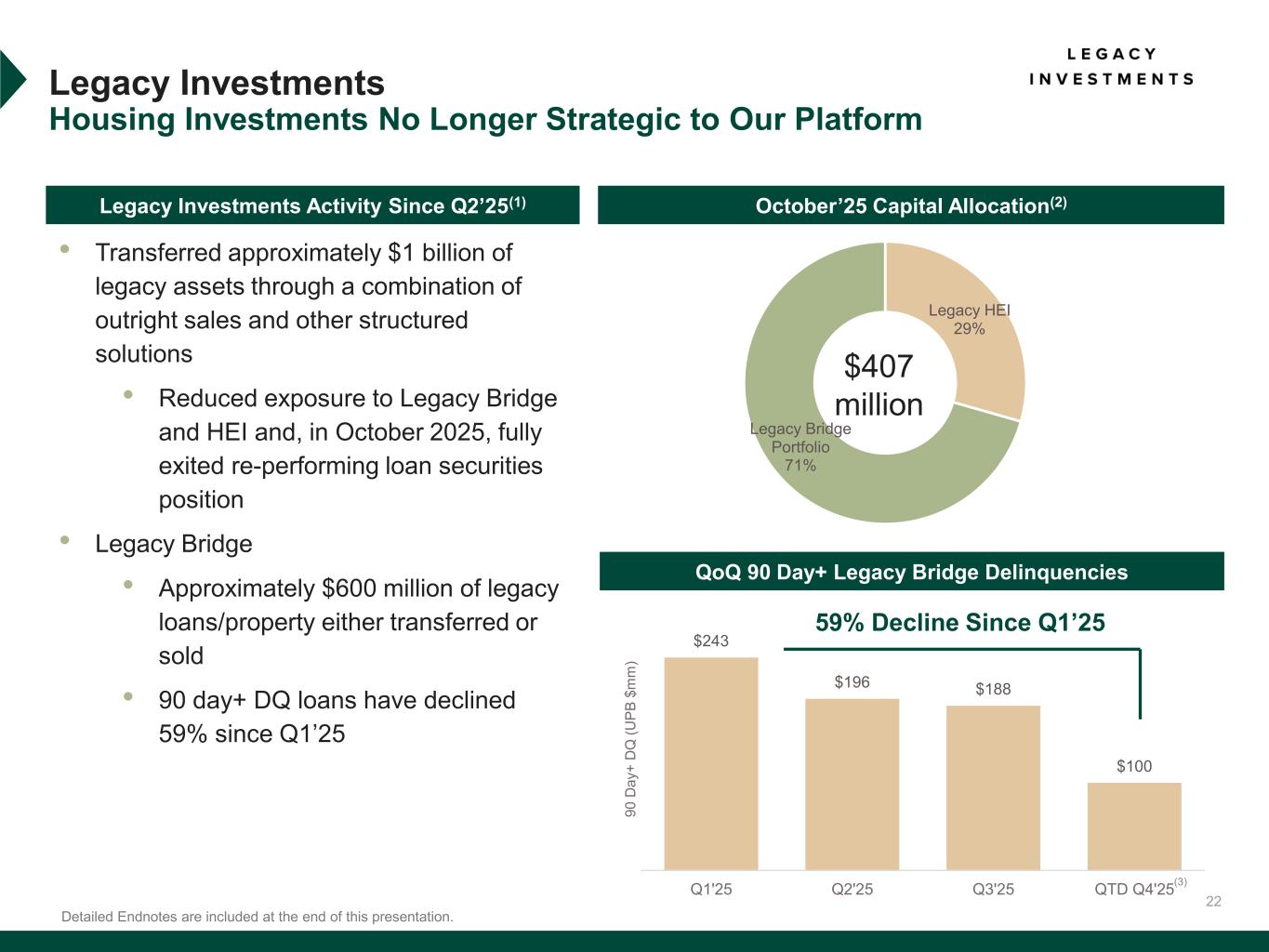
22 Legacy Investments Housing Investments No Longer Strategic to Our Platform Detailed Endnotes are included at the end of this presentation. Legacy Investments Activity Since Q2’25(1) QoQ 90 Day+ Legacy Bridge Delinquencies • Transferred approximately $1 billion of legacy assets through a combination of outright sales and other structured solutions • Reduced exposure to Legacy Bridge and HEI and, in October 2025, fully exited re-performing loan securities position • Legacy Bridge • Approximately $600 million of legacy loans/property either transferred or sold • 90 day+ DQ loans have declined 59% since Q1’25 $407 million October’25 Capital Allocation(2) Legacy HEI 29% Legacy Bridge Portfolio 71% 59% Decline Since Q1’25 $243 $196 $188 $100 Q1'25 Q2'25 Q3'25 QTD Q4'25 9 0 D a y + D Q ( U P B $ m m ) (3)

23 Financial Results
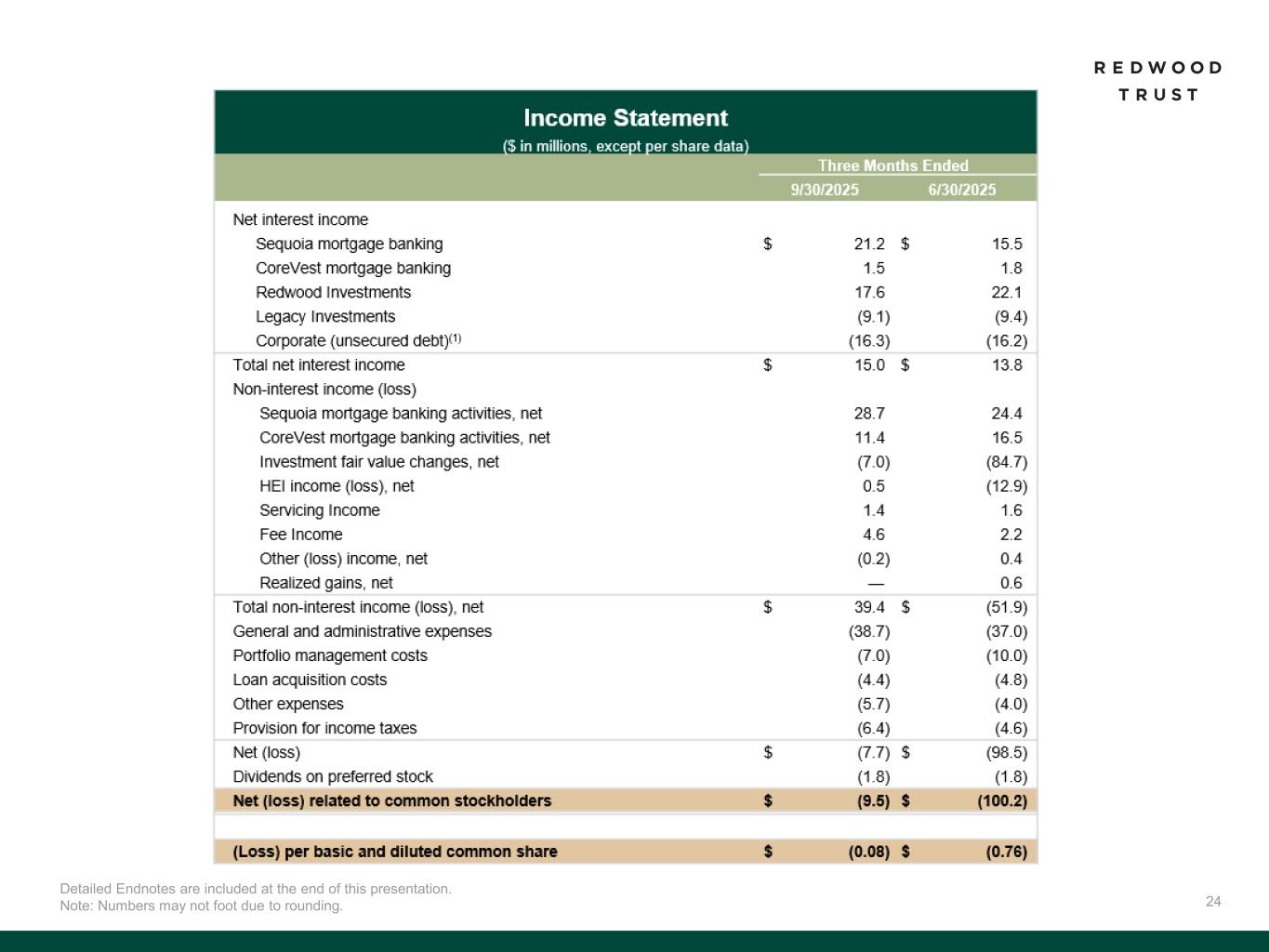
24 Detailed Endnotes are included at the end of this presentation. Note: Numbers may not foot due to rounding.
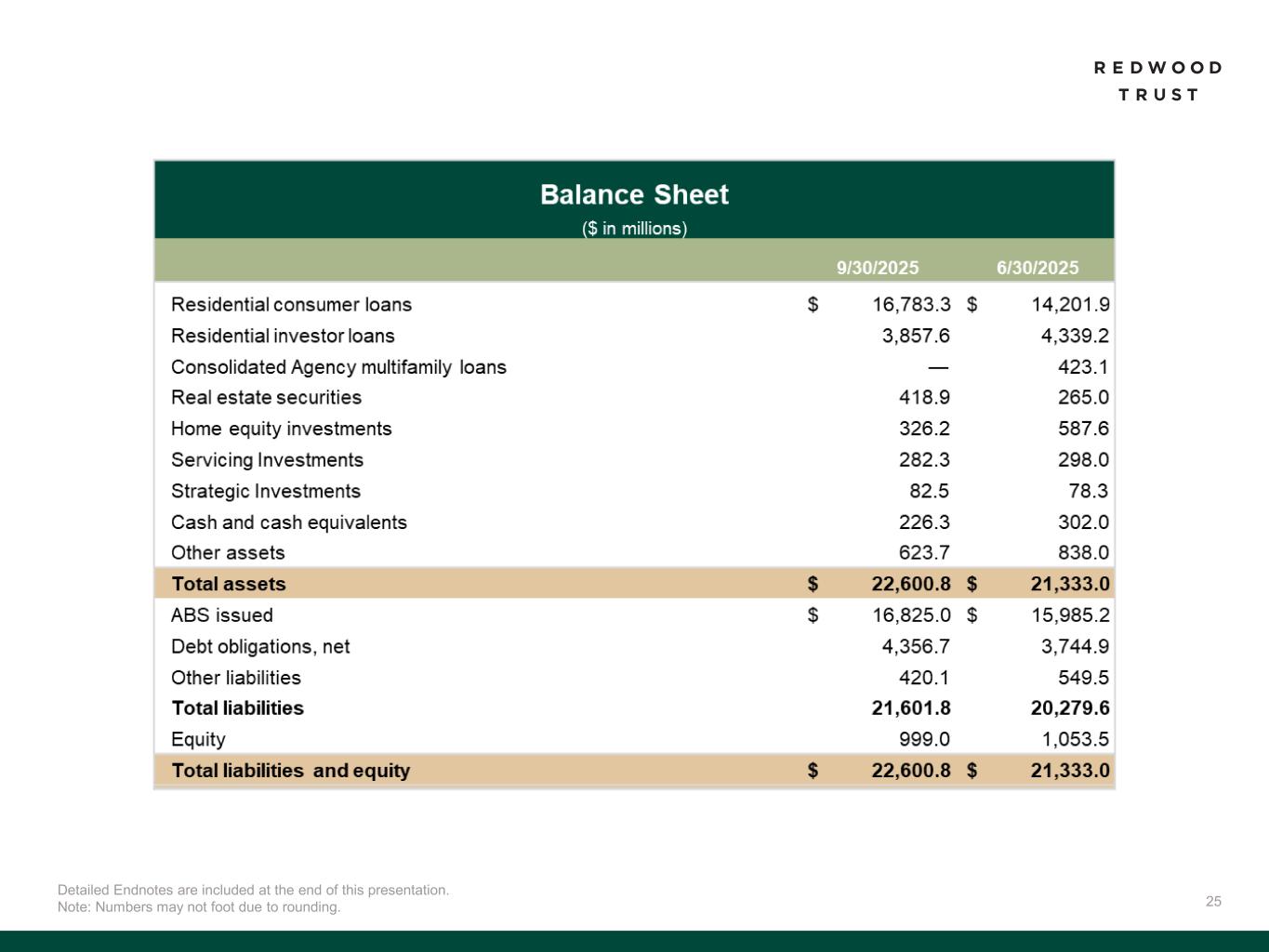
25 Detailed Endnotes are included at the end of this presentation. Note: Numbers may not foot due to rounding.
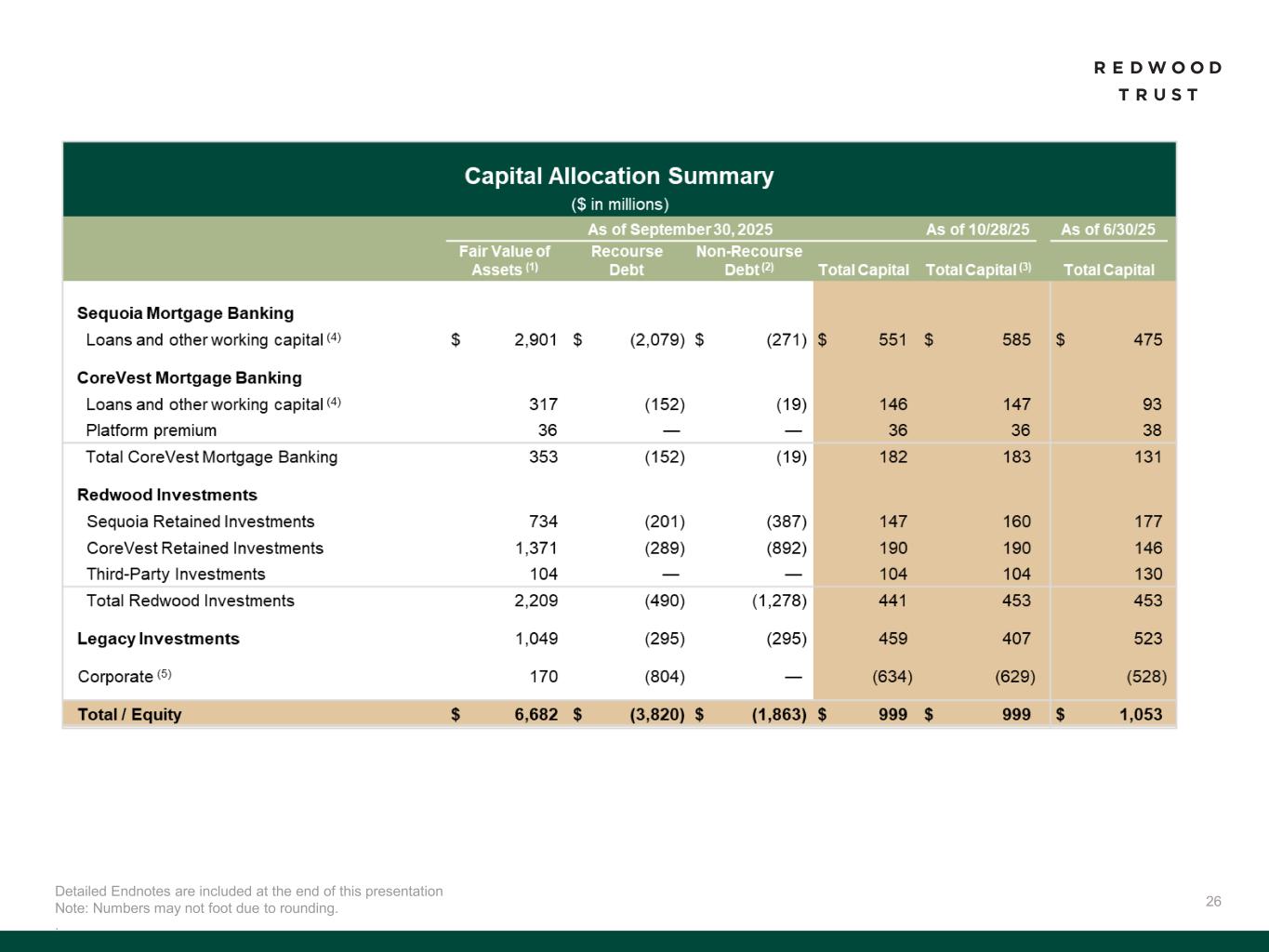
26 Detailed Endnotes are included at the end of this presentation Note: Numbers may not foot due to rounding. .
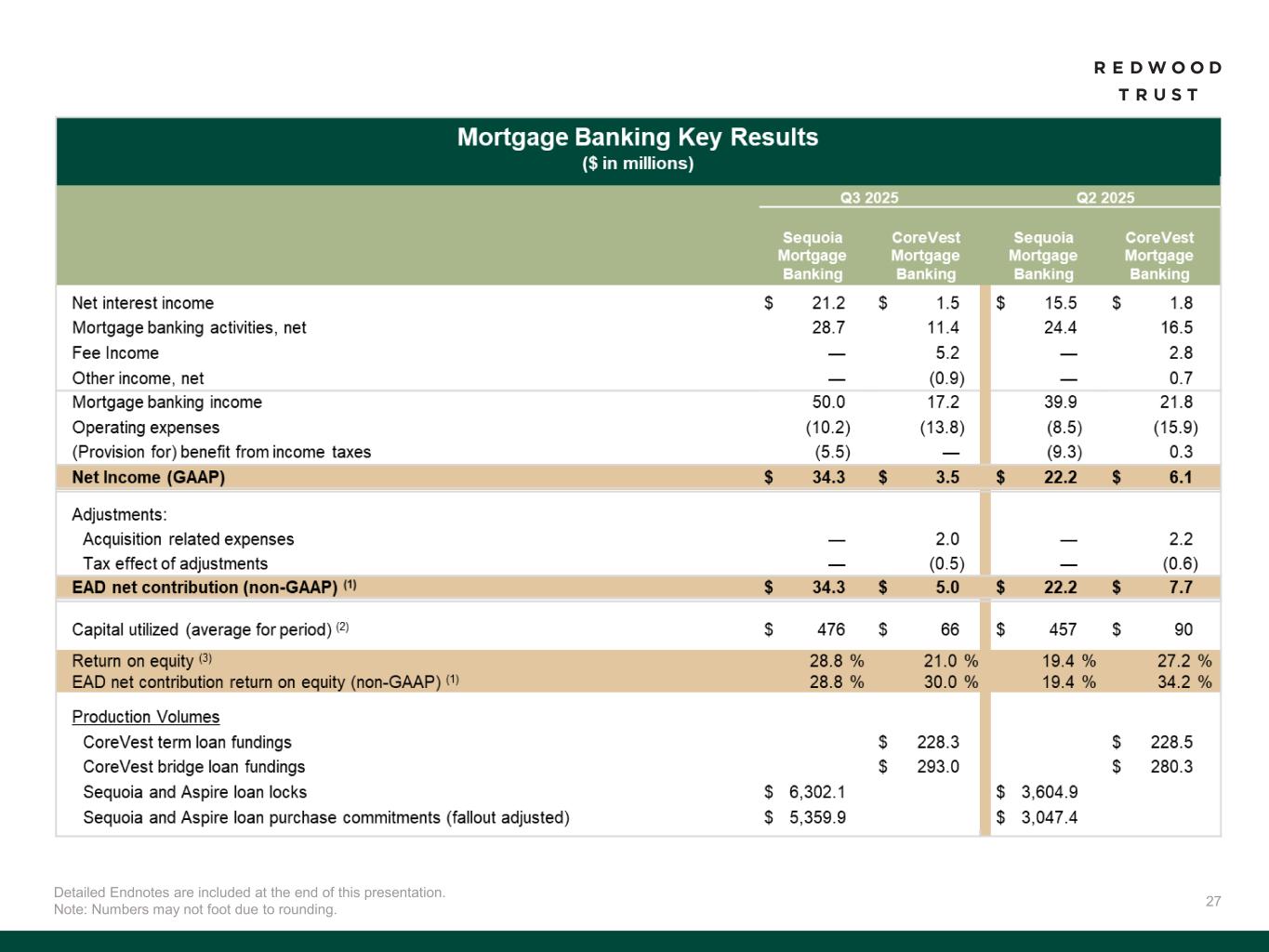
27 Detailed Endnotes are included at the end of this presentation. Note: Numbers may not foot due to rounding.
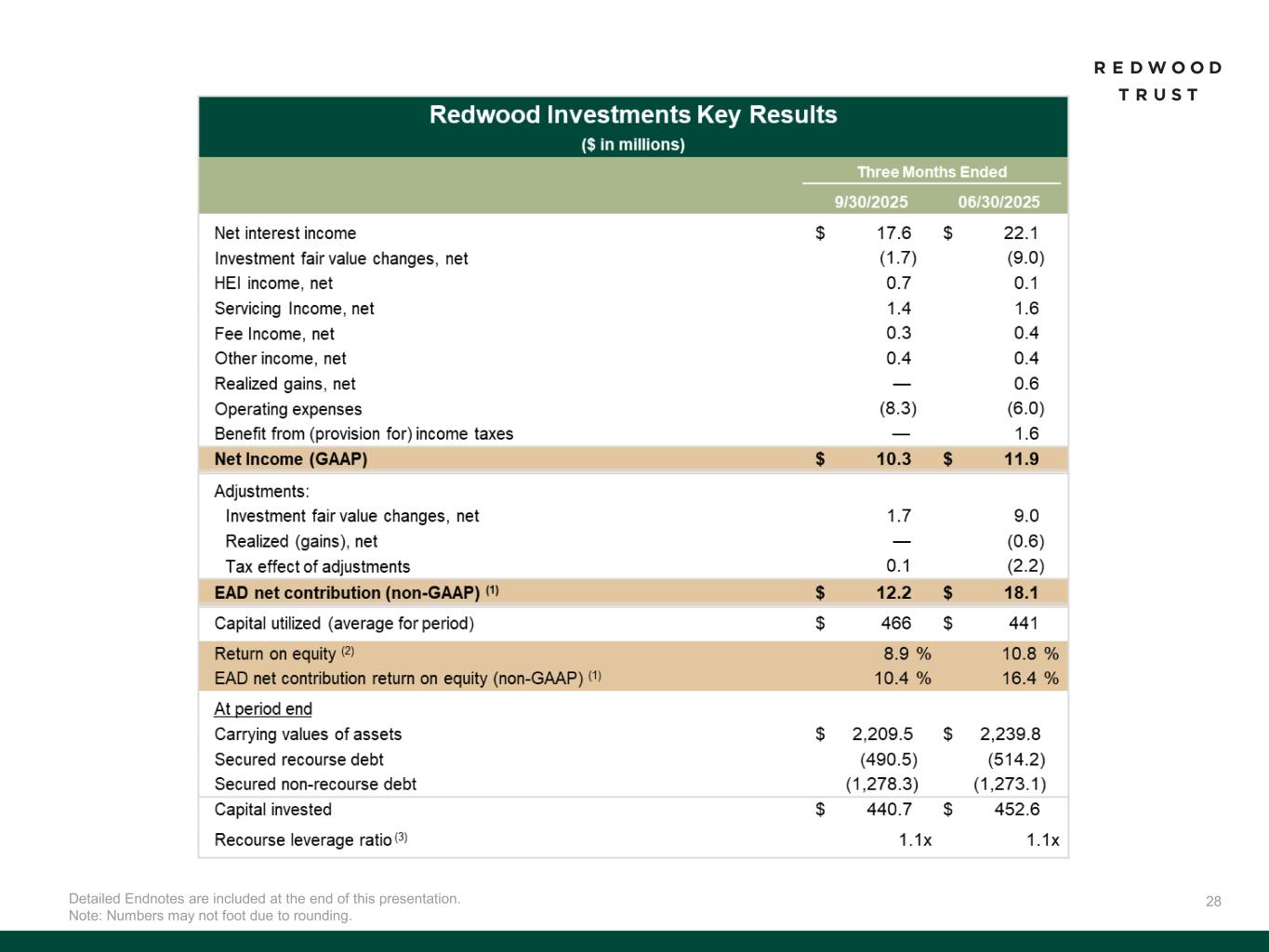
28Detailed Endnotes are included at the end of this presentation. Note: Numbers may not foot due to rounding.
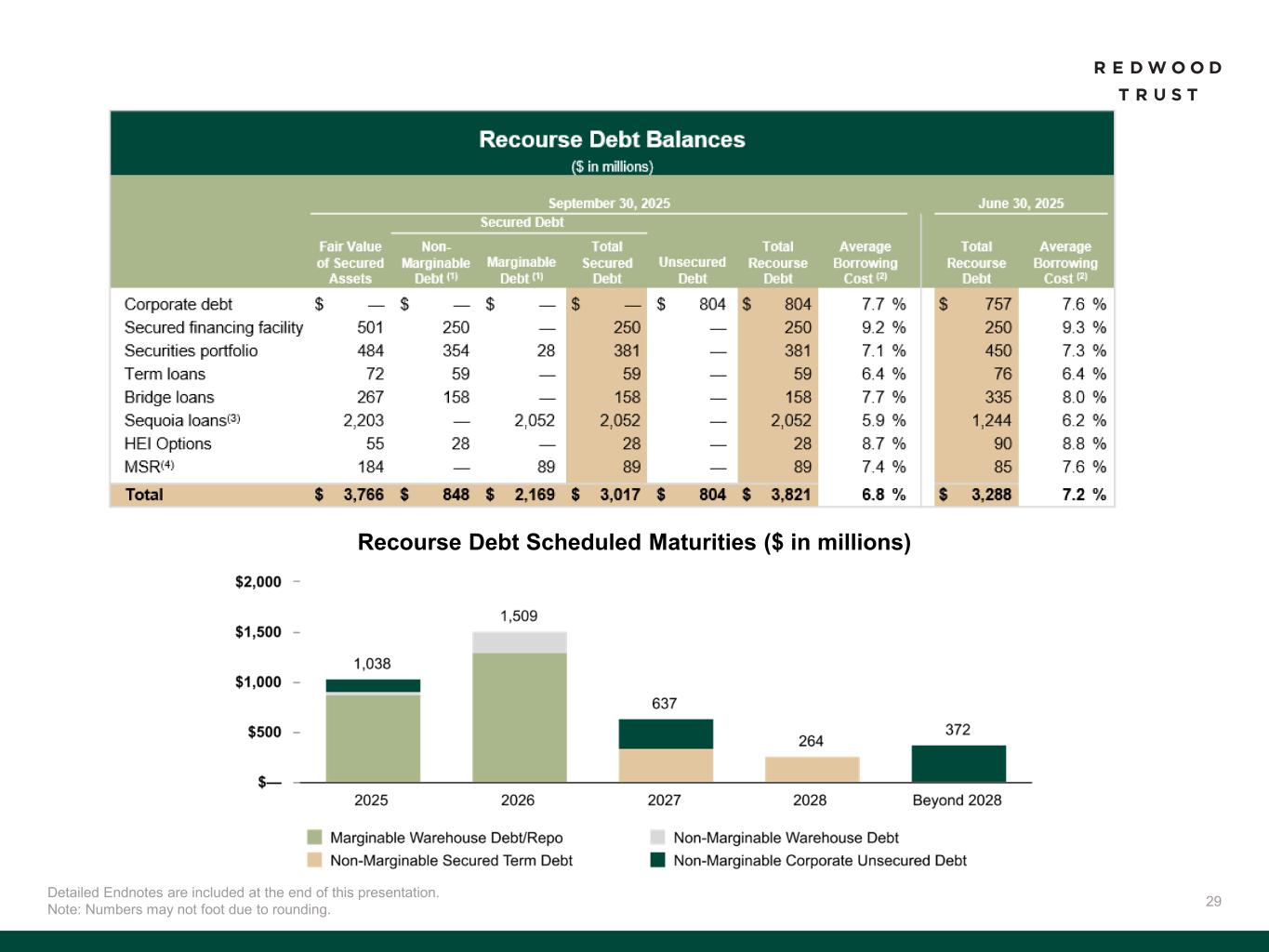
29 Detailed Endnotes are included at the end of this presentation. Note: Numbers may not foot due to rounding. Recourse Debt Scheduled Maturities ($ in millions)

30 Non-GAAP Disclosures
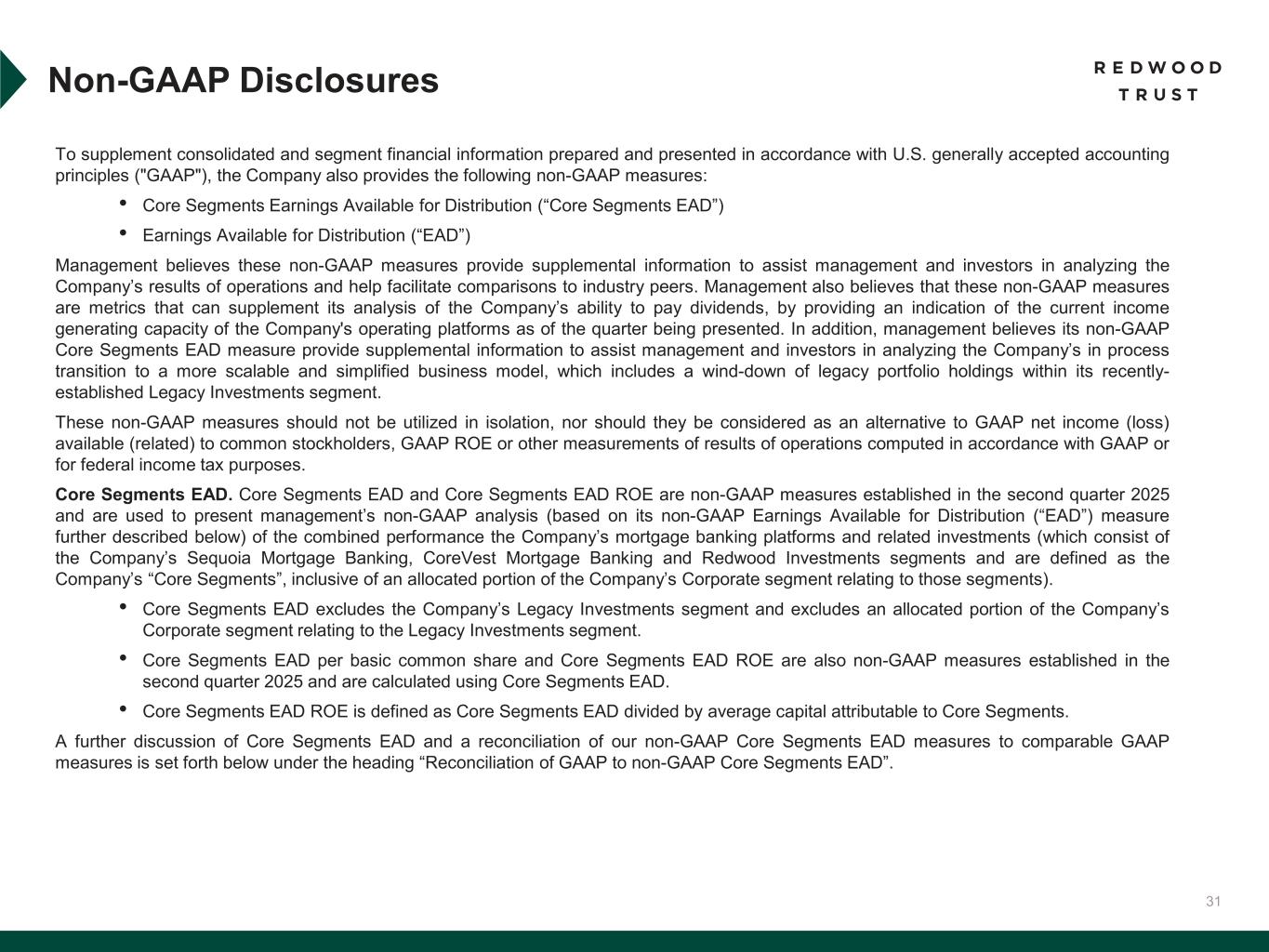
31 To supplement consolidated and segment financial information prepared and presented in accordance with U.S. generally accepted accounting principles ("GAAP"), the Company also provides the following non-GAAP measures: • Core Segments Earnings Available for Distribution (“Core Segments EAD”) • Earnings Available for Distribution (“EAD”) Management believes these non-GAAP measures provide supplemental information to assist management and investors in analyzing the Company’s results of operations and help facilitate comparisons to industry peers. Management also believes that these non-GAAP measures are metrics that can supplement its analysis of the Company’s ability to pay dividends, by providing an indication of the current income generating capacity of the Company's operating platforms as of the quarter being presented. In addition, management believes its non-GAAP Core Segments EAD measure provide supplemental information to assist management and investors in analyzing the Company’s in process transition to a more scalable and simplified business model, which includes a wind-down of legacy portfolio holdings within its recently- established Legacy Investments segment. These non-GAAP measures should not be utilized in isolation, nor should they be considered as an alternative to GAAP net income (loss) available (related) to common stockholders, GAAP ROE or other measurements of results of operations computed in accordance with GAAP or for federal income tax purposes. Core Segments EAD. Core Segments EAD and Core Segments EAD ROE are non-GAAP measures established in the second quarter 2025 and are used to present management’s non-GAAP analysis (based on its non-GAAP Earnings Available for Distribution (“EAD”) measure further described below) of the combined performance the Company’s mortgage banking platforms and related investments (which consist of the Company’s Sequoia Mortgage Banking, CoreVest Mortgage Banking and Redwood Investments segments and are defined as the Company’s “Core Segments”, inclusive of an allocated portion of the Company’s Corporate segment relating to those segments). • Core Segments EAD excludes the Company’s Legacy Investments segment and excludes an allocated portion of the Company’s Corporate segment relating to the Legacy Investments segment. • Core Segments EAD per basic common share and Core Segments EAD ROE are also non-GAAP measures established in the second quarter 2025 and are calculated using Core Segments EAD. • Core Segments EAD ROE is defined as Core Segments EAD divided by average capital attributable to Core Segments. A further discussion of Core Segments EAD and a reconciliation of our non-GAAP Core Segments EAD measures to comparable GAAP measures is set forth below under the heading “Reconciliation of GAAP to non-GAAP Core Segments EAD”. Non-GAAP Disclosures
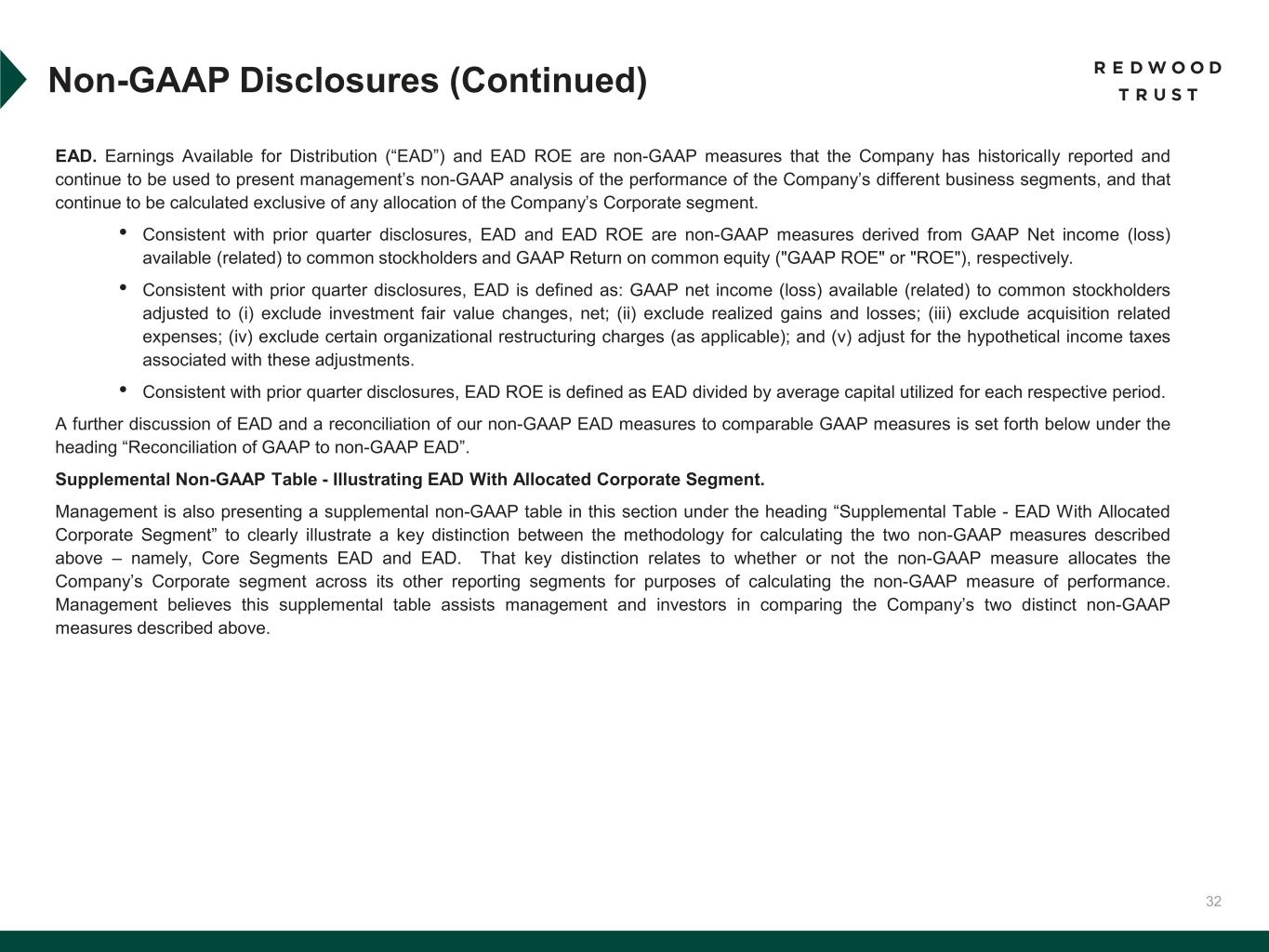
32 EAD. Earnings Available for Distribution (“EAD”) and EAD ROE are non-GAAP measures that the Company has historically reported and continue to be used to present management’s non-GAAP analysis of the performance of the Company’s different business segments, and that continue to be calculated exclusive of any allocation of the Company’s Corporate segment. • Consistent with prior quarter disclosures, EAD and EAD ROE are non-GAAP measures derived from GAAP Net income (loss) available (related) to common stockholders and GAAP Return on common equity ("GAAP ROE" or "ROE"), respectively. • Consistent with prior quarter disclosures, EAD is defined as: GAAP net income (loss) available (related) to common stockholders adjusted to (i) exclude investment fair value changes, net; (ii) exclude realized gains and losses; (iii) exclude acquisition related expenses; (iv) exclude certain organizational restructuring charges (as applicable); and (v) adjust for the hypothetical income taxes associated with these adjustments. • Consistent with prior quarter disclosures, EAD ROE is defined as EAD divided by average capital utilized for each respective period. A further discussion of EAD and a reconciliation of our non-GAAP EAD measures to comparable GAAP measures is set forth below under the heading “Reconciliation of GAAP to non-GAAP EAD”. Supplemental Non-GAAP Table - Illustrating EAD With Allocated Corporate Segment. Management is also presenting a supplemental non-GAAP table in this section under the heading “Supplemental Table - EAD With Allocated Corporate Segment” to clearly illustrate a key distinction between the methodology for calculating the two non-GAAP measures described above – namely, Core Segments EAD and EAD. That key distinction relates to whether or not the non-GAAP measure allocates the Company’s Corporate segment across its other reporting segments for purposes of calculating the non-GAAP measure of performance. Management believes this supplemental table assists management and investors in comparing the Company’s two distinct non-GAAP measures described above. Non-GAAP Disclosures (Continued)
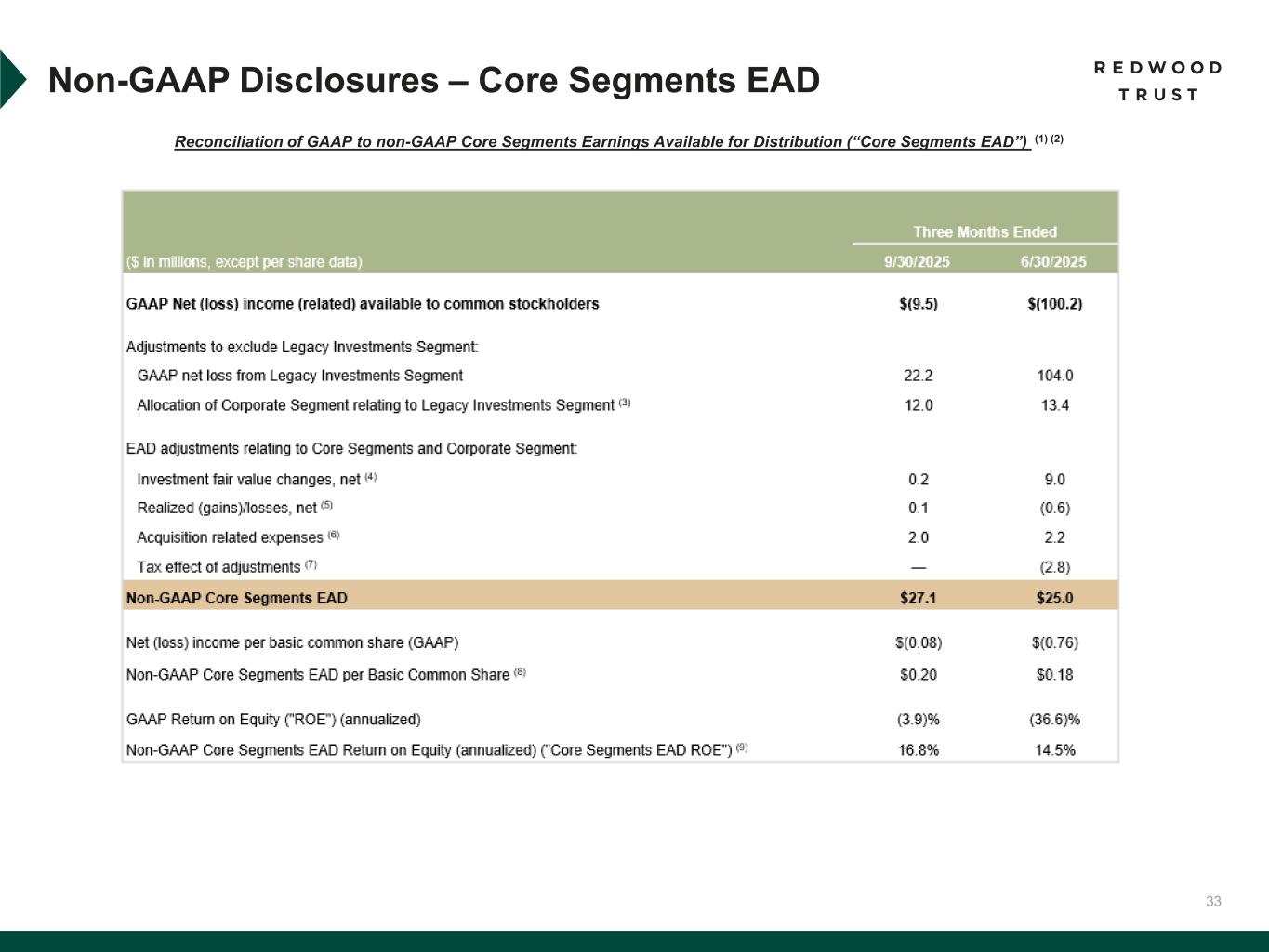
33 Reconciliation of GAAP to non-GAAP Core Segments Earnings Available for Distribution (“Core Segments EAD”) (1) (2) Non-GAAP Disclosures – Core Segments EAD See footnotes on next page
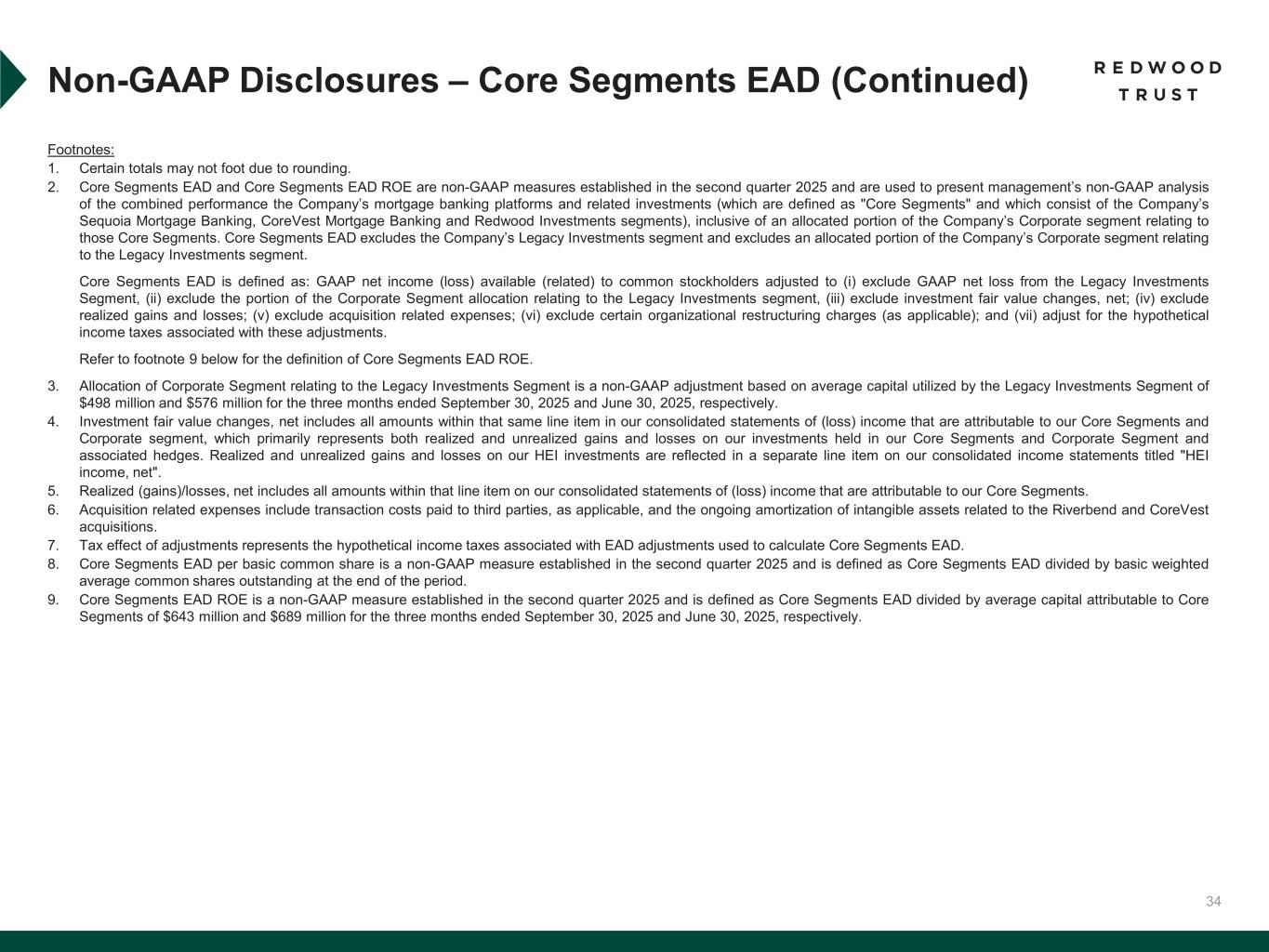
34 Non-GAAP Disclosures – Core Segments EAD (Continued) Footnotes: 1. Certain totals may not foot due to rounding. 2. Core Segments EAD and Core Segments EAD ROE are non-GAAP measures established in the second quarter 2025 and are used to present management’s non-GAAP analysis of the combined performance the Company’s mortgage banking platforms and related investments (which are defined as "Core Segments" and which consist of the Company’s Sequoia Mortgage Banking, CoreVest Mortgage Banking and Redwood Investments segments), inclusive of an allocated portion of the Company’s Corporate segment relating to those Core Segments. Core Segments EAD excludes the Company’s Legacy Investments segment and excludes an allocated portion of the Company’s Corporate segment relating to the Legacy Investments segment. Core Segments EAD is defined as: GAAP net income (loss) available (related) to common stockholders adjusted to (i) exclude GAAP net loss from the Legacy Investments Segment, (ii) exclude the portion of the Corporate Segment allocation relating to the Legacy Investments segment, (iii) exclude investment fair value changes, net; (iv) exclude realized gains and losses; (v) exclude acquisition related expenses; (vi) exclude certain organizational restructuring charges (as applicable); and (vii) adjust for the hypothetical income taxes associated with these adjustments. Refer to footnote 9 below for the definition of Core Segments EAD ROE. 3. Allocation of Corporate Segment relating to the Legacy Investments Segment is a non-GAAP adjustment based on average capital utilized by the Legacy Investments Segment of $498 million and $576 million for the three months ended September 30, 2025 and June 30, 2025, respectively. 4. Investment fair value changes, net includes all amounts within that same line item in our consolidated statements of (loss) income that are attributable to our Core Segments and Corporate segment, which primarily represents both realized and unrealized gains and losses on our investments held in our Core Segments and Corporate Segment and associated hedges. Realized and unrealized gains and losses on our HEI investments are reflected in a separate line item on our consolidated income statements titled "HEI income, net". 5. Realized (gains)/losses, net includes all amounts within that line item on our consolidated statements of (loss) income that are attributable to our Core Segments. 6. Acquisition related expenses include transaction costs paid to third parties, as applicable, and the ongoing amortization of intangible assets related to the Riverbend and CoreVest acquisitions. 7. Tax effect of adjustments represents the hypothetical income taxes associated with EAD adjustments used to calculate Core Segments EAD. 8. Core Segments EAD per basic common share is a non-GAAP measure established in the second quarter 2025 and is defined as Core Segments EAD divided by basic weighted average common shares outstanding at the end of the period. 9. Core Segments EAD ROE is a non-GAAP measure established in the second quarter 2025 and is defined as Core Segments EAD divided by average capital attributable to Core Segments of $643 million and $689 million for the three months ended September 30, 2025 and June 30, 2025, respectively.
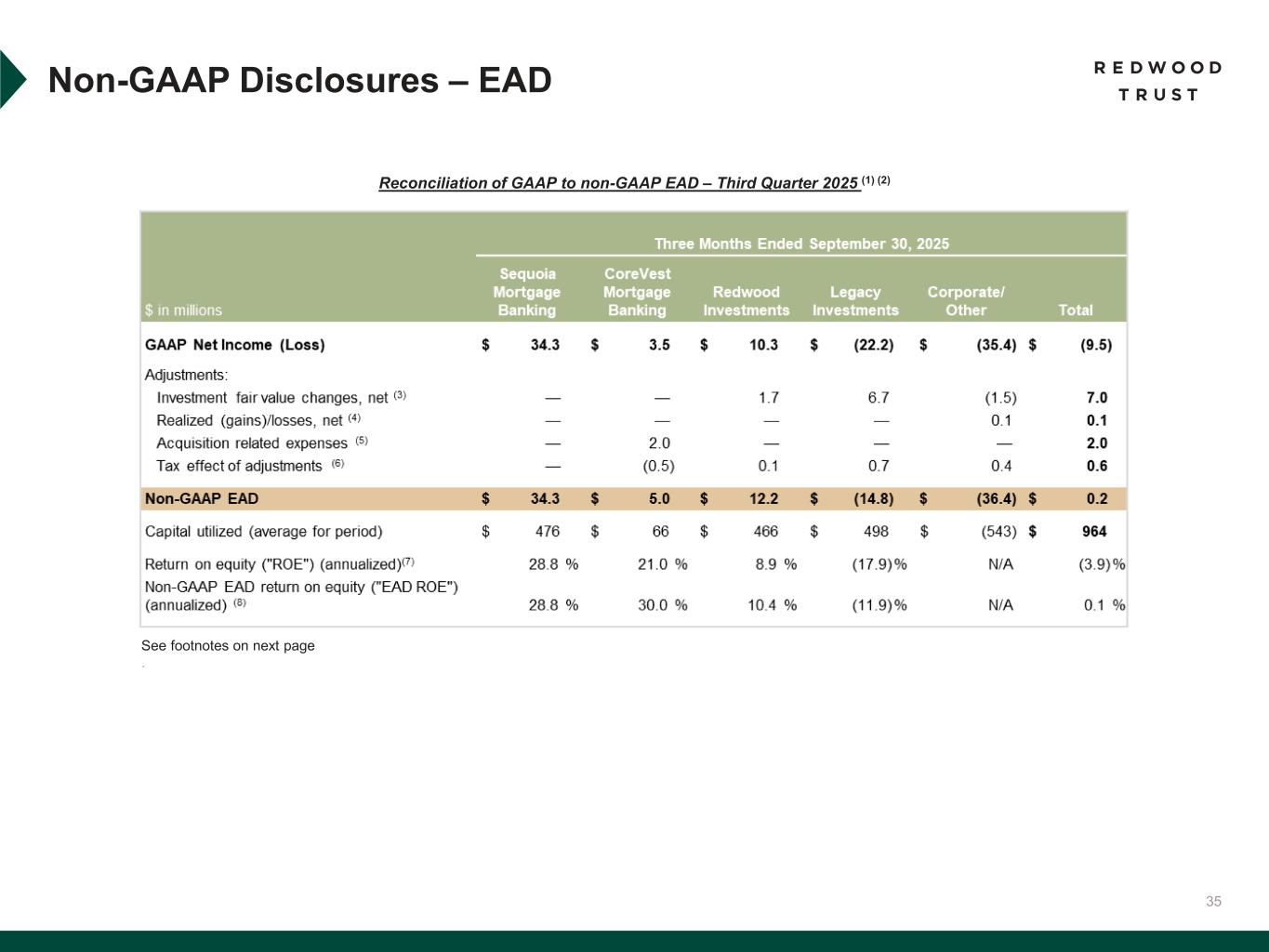
35 Reconciliation of GAAP to non-GAAP EAD – Third Quarter 2025 (1) (2) Non-GAAP Disclosures – EAD See footnotes on next page .
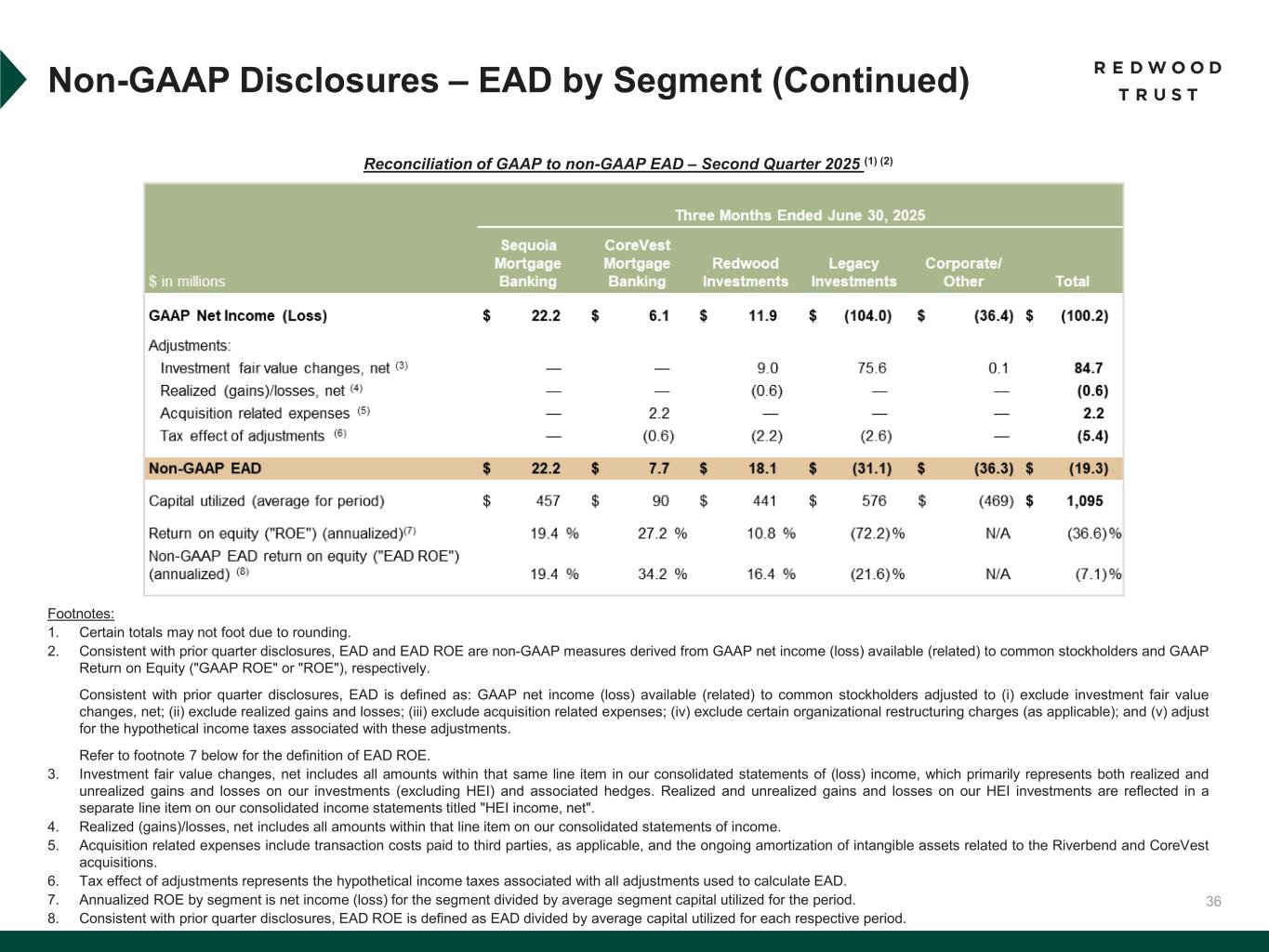
36 Reconciliation of GAAP to non-GAAP EAD – Second Quarter 2025 (1) (2) Non-GAAP Disclosures – EAD by Segment (Continued) Footnotes: 1. Certain totals may not foot due to rounding. 2. Consistent with prior quarter disclosures, EAD and EAD ROE are non-GAAP measures derived from GAAP net income (loss) available (related) to common stockholders and GAAP Return on Equity ("GAAP ROE" or "ROE"), respectively. Consistent with prior quarter disclosures, EAD is defined as: GAAP net income (loss) available (related) to common stockholders adjusted to (i) exclude investment fair value changes, net; (ii) exclude realized gains and losses; (iii) exclude acquisition related expenses; (iv) exclude certain organizational restructuring charges (as applicable); and (v) adjust for the hypothetical income taxes associated with these adjustments. Refer to footnote 7 below for the definition of EAD ROE. 3. Investment fair value changes, net includes all amounts within that same line item in our consolidated statements of (loss) income, which primarily represents both realized and unrealized gains and losses on our investments (excluding HEI) and associated hedges. Realized and unrealized gains and losses on our HEI investments are reflected in a separate line item on our consolidated income statements titled "HEI income, net". 4. Realized (gains)/losses, net includes all amounts within that line item on our consolidated statements of income. 5. Acquisition related expenses include transaction costs paid to third parties, as applicable, and the ongoing amortization of intangible assets related to the Riverbend and CoreVest acquisitions. 6. Tax effect of adjustments represents the hypothetical income taxes associated with all adjustments used to calculate EAD. 7. Annualized ROE by segment is net income (loss) for the segment divided by average segment capital utilized for the period. 8. Consistent with prior quarter disclosures, EAD ROE is defined as EAD divided by average capital utilized for each respective period.
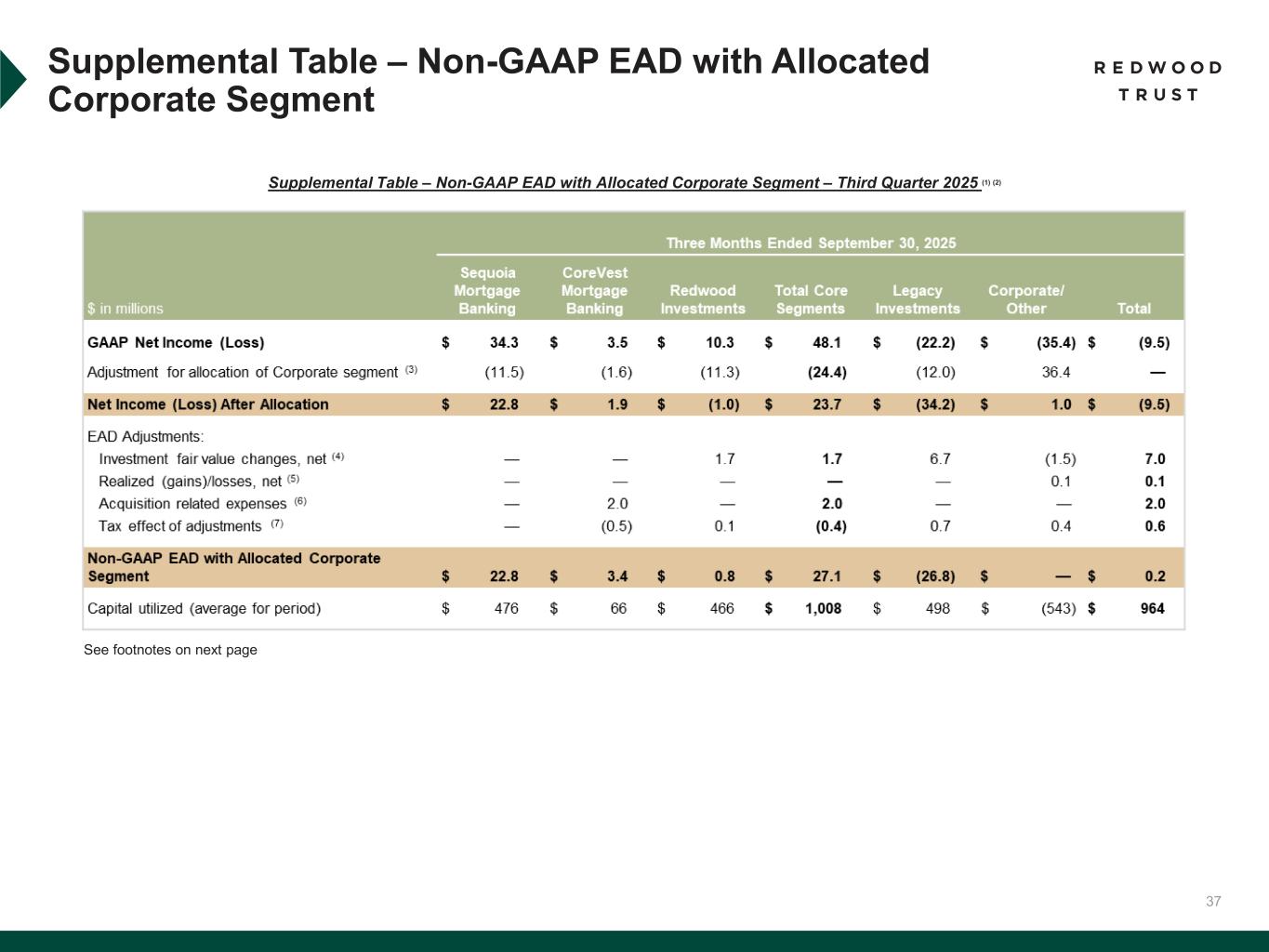
37 Supplemental Table – Non-GAAP EAD with Allocated Corporate Segment – Third Quarter 2025 (1) (2) See footnotes on next page Supplemental Table – Non-GAAP EAD with Allocated Corporate Segment
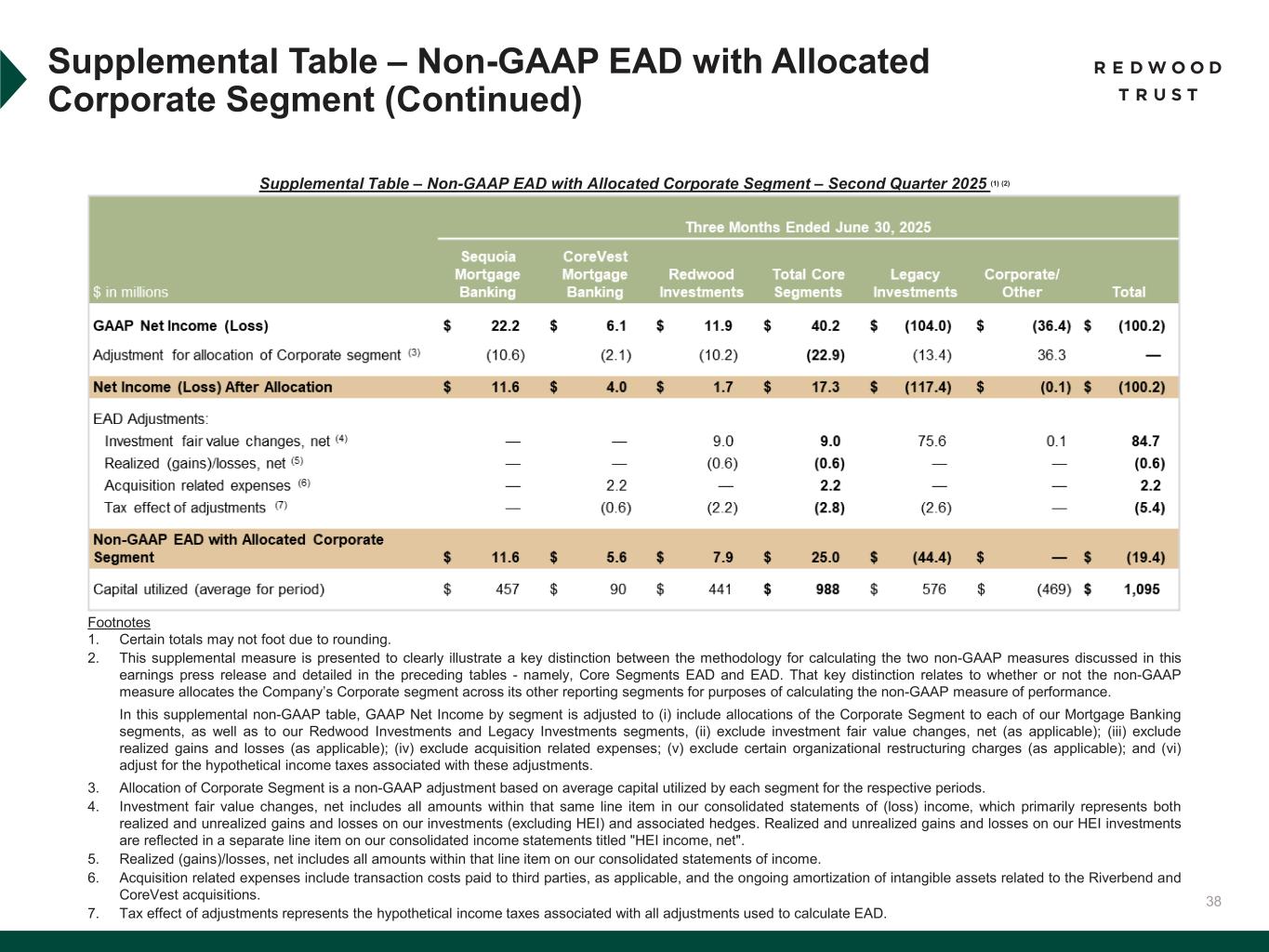
38 Supplemental Table – Non-GAAP EAD with Allocated Corporate Segment – Second Quarter 2025 (1) (2) Supplemental Table – Non-GAAP EAD with Allocated Corporate Segment (Continued) Footnotes 1. Certain totals may not foot due to rounding. 2. This supplemental measure is presented to clearly illustrate a key distinction between the methodology for calculating the two non-GAAP measures discussed in this earnings press release and detailed in the preceding tables - namely, Core Segments EAD and EAD. That key distinction relates to whether or not the non-GAAP measure allocates the Company’s Corporate segment across its other reporting segments for purposes of calculating the non-GAAP measure of performance. In this supplemental non-GAAP table, GAAP Net Income by segment is adjusted to (i) include allocations of the Corporate Segment to each of our Mortgage Banking segments, as well as to our Redwood Investments and Legacy Investments segments, (ii) exclude investment fair value changes, net (as applicable); (iii) exclude realized gains and losses (as applicable); (iv) exclude acquisition related expenses; (v) exclude certain organizational restructuring charges (as applicable); and (vi) adjust for the hypothetical income taxes associated with these adjustments. 3. Allocation of Corporate Segment is a non-GAAP adjustment based on average capital utilized by each segment for the respective periods. 4. Investment fair value changes, net includes all amounts within that same line item in our consolidated statements of (loss) income, which primarily represents both realized and unrealized gains and losses on our investments (excluding HEI) and associated hedges. Realized and unrealized gains and losses on our HEI investments are reflected in a separate line item on our consolidated income statements titled "HEI income, net". 5. Realized (gains)/losses, net includes all amounts within that line item on our consolidated statements of income. 6. Acquisition related expenses include transaction costs paid to third parties, as applicable, and the ongoing amortization of intangible assets related to the Riverbend and CoreVest acquisitions. 7. Tax effect of adjustments represents the hypothetical income taxes associated with all adjustments used to calculate EAD.

39 Endnotes
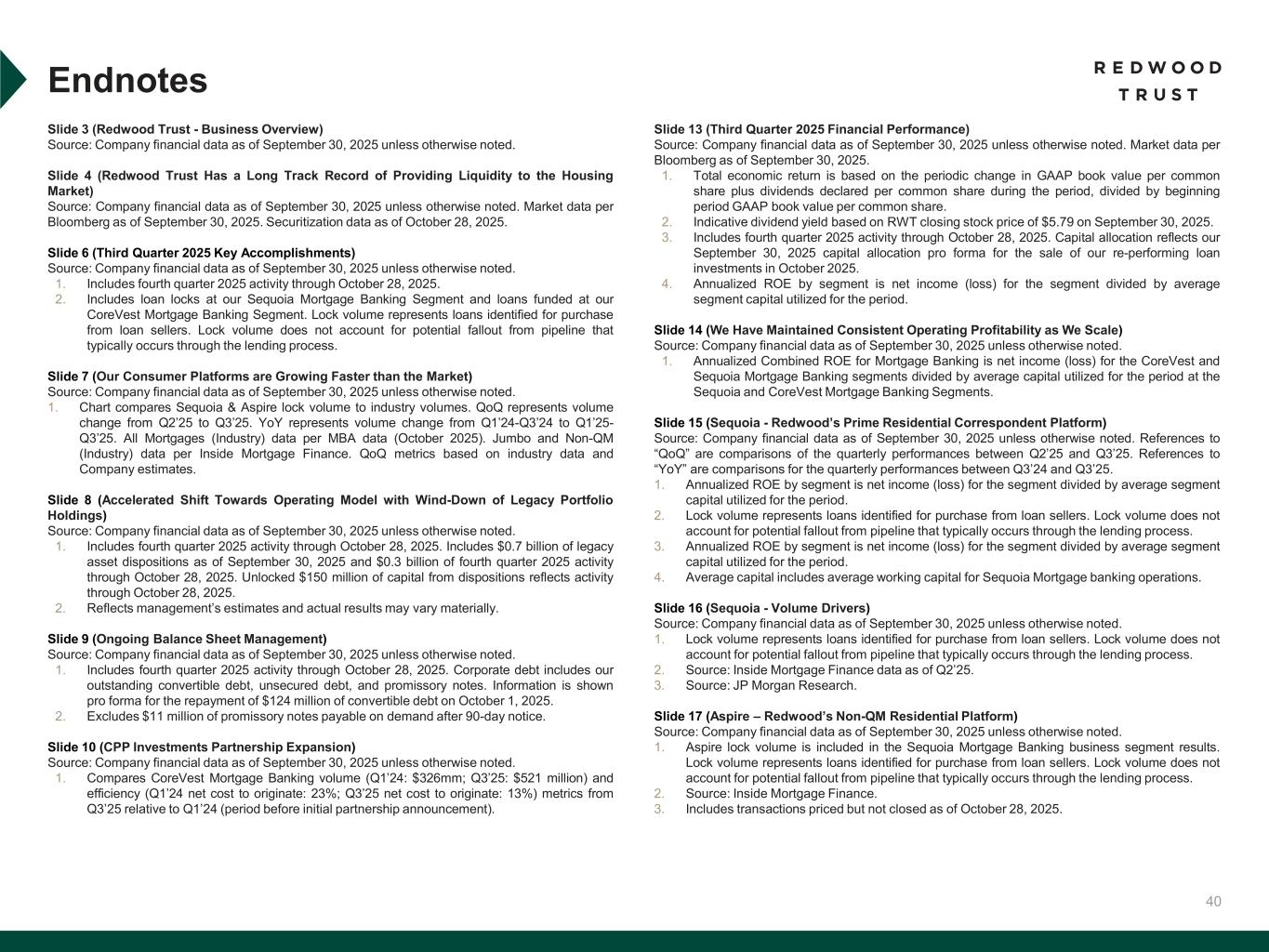
40 Slide 3 (Redwood Trust - Business Overview) Source: Company financial data as of September 30, 2025 unless otherwise noted. Slide 4 (Redwood Trust Has a Long Track Record of Providing Liquidity to the Housing Market) Source: Company financial data as of September 30, 2025 unless otherwise noted. Market data per Bloomberg as of September 30, 2025. Securitization data as of October 28, 2025. Slide 6 (Third Quarter 2025 Key Accomplishments) Source: Company financial data as of September 30, 2025 unless otherwise noted. 1. Includes fourth quarter 2025 activity through October 28, 2025. 2. Includes loan locks at our Sequoia Mortgage Banking Segment and loans funded at our CoreVest Mortgage Banking Segment. Lock volume represents loans identified for purchase from loan sellers. Lock volume does not account for potential fallout from pipeline that typically occurs through the lending process. Slide 7 (Our Consumer Platforms are Growing Faster than the Market) Source: Company financial data as of September 30, 2025 unless otherwise noted. 1. Chart compares Sequoia & Aspire lock volume to industry volumes. QoQ represents volume change from Q2’25 to Q3’25. YoY represents volume change from Q1’24-Q3’24 to Q1’25- Q3’25. All Mortgages (Industry) data per MBA data (October 2025). Jumbo and Non-QM (Industry) data per Inside Mortgage Finance. QoQ metrics based on industry data and Company estimates. Slide 8 (Accelerated Shift Towards Operating Model with Wind-Down of Legacy Portfolio Holdings) Source: Company financial data as of September 30, 2025 unless otherwise noted. 1. Includes fourth quarter 2025 activity through October 28, 2025. Includes $0.7 billion of legacy asset dispositions as of September 30, 2025 and $0.3 billion of fourth quarter 2025 activity through October 28, 2025. Unlocked $150 million of capital from dispositions reflects activity through October 28, 2025. 2. Reflects management’s estimates and actual results may vary materially. Slide 9 (Ongoing Balance Sheet Management) Source: Company financial data as of September 30, 2025 unless otherwise noted. 1. Includes fourth quarter 2025 activity through October 28, 2025. Corporate debt includes our outstanding convertible debt, unsecured debt, and promissory notes. Information is shown pro forma for the repayment of $124 million of convertible debt on October 1, 2025. 2. Excludes $11 million of promissory notes payable on demand after 90-day notice. Slide 10 (CPP Investments Partnership Expansion) Source: Company financial data as of September 30, 2025 unless otherwise noted. 1. Compares CoreVest Mortgage Banking volume (Q1’24: $326mm; Q3’25: $521 million) and efficiency (Q1’24 net cost to originate: 23%; Q3’25 net cost to originate: 13%) metrics from Q3’25 relative to Q1’24 (period before initial partnership announcement). Endnotes Slide 13 (Third Quarter 2025 Financial Performance) Source: Company financial data as of September 30, 2025 unless otherwise noted. Market data per Bloomberg as of September 30, 2025. 1. Total economic return is based on the periodic change in GAAP book value per common share plus dividends declared per common share during the period, divided by beginning period GAAP book value per common share. 2. Indicative dividend yield based on RWT closing stock price of $5.79 on September 30, 2025. 3. Includes fourth quarter 2025 activity through October 28, 2025. Capital allocation reflects our September 30, 2025 capital allocation pro forma for the sale of our re-performing loan investments in October 2025. 4. Annualized ROE by segment is net income (loss) for the segment divided by average segment capital utilized for the period. Slide 14 (We Have Maintained Consistent Operating Profitability as We Scale) Source: Company financial data as of September 30, 2025 unless otherwise noted. 1. Annualized Combined ROE for Mortgage Banking is net income (loss) for the CoreVest and Sequoia Mortgage Banking segments divided by average capital utilized for the period at the Sequoia and CoreVest Mortgage Banking Segments. Slide 15 (Sequoia - Redwood’s Prime Residential Correspondent Platform) Source: Company financial data as of September 30, 2025 unless otherwise noted. References to “QoQ” are comparisons of the quarterly performances between Q2’25 and Q3’25. References to “YoY” are comparisons for the quarterly performances between Q3’24 and Q3’25. 1. Annualized ROE by segment is net income (loss) for the segment divided by average segment capital utilized for the period. 2. Lock volume represents loans identified for purchase from loan sellers. Lock volume does not account for potential fallout from pipeline that typically occurs through the lending process. 3. Annualized ROE by segment is net income (loss) for the segment divided by average segment capital utilized for the period. 4. Average capital includes average working capital for Sequoia Mortgage banking operations. Slide 16 (Sequoia - Volume Drivers) Source: Company financial data as of September 30, 2025 unless otherwise noted. 1. Lock volume represents loans identified for purchase from loan sellers. Lock volume does not account for potential fallout from pipeline that typically occurs through the lending process. 2. Source: Inside Mortgage Finance data as of Q2’25. 3. Source: JP Morgan Research. Slide 17 (Aspire – Redwood’s Non-QM Residential Platform) Source: Company financial data as of September 30, 2025 unless otherwise noted. 1. Aspire lock volume is included in the Sequoia Mortgage Banking business segment results. Lock volume represents loans identified for purchase from loan sellers. Lock volume does not account for potential fallout from pipeline that typically occurs through the lending process. 2. Source: Inside Mortgage Finance. 3. Includes transactions priced but not closed as of October 28, 2025.
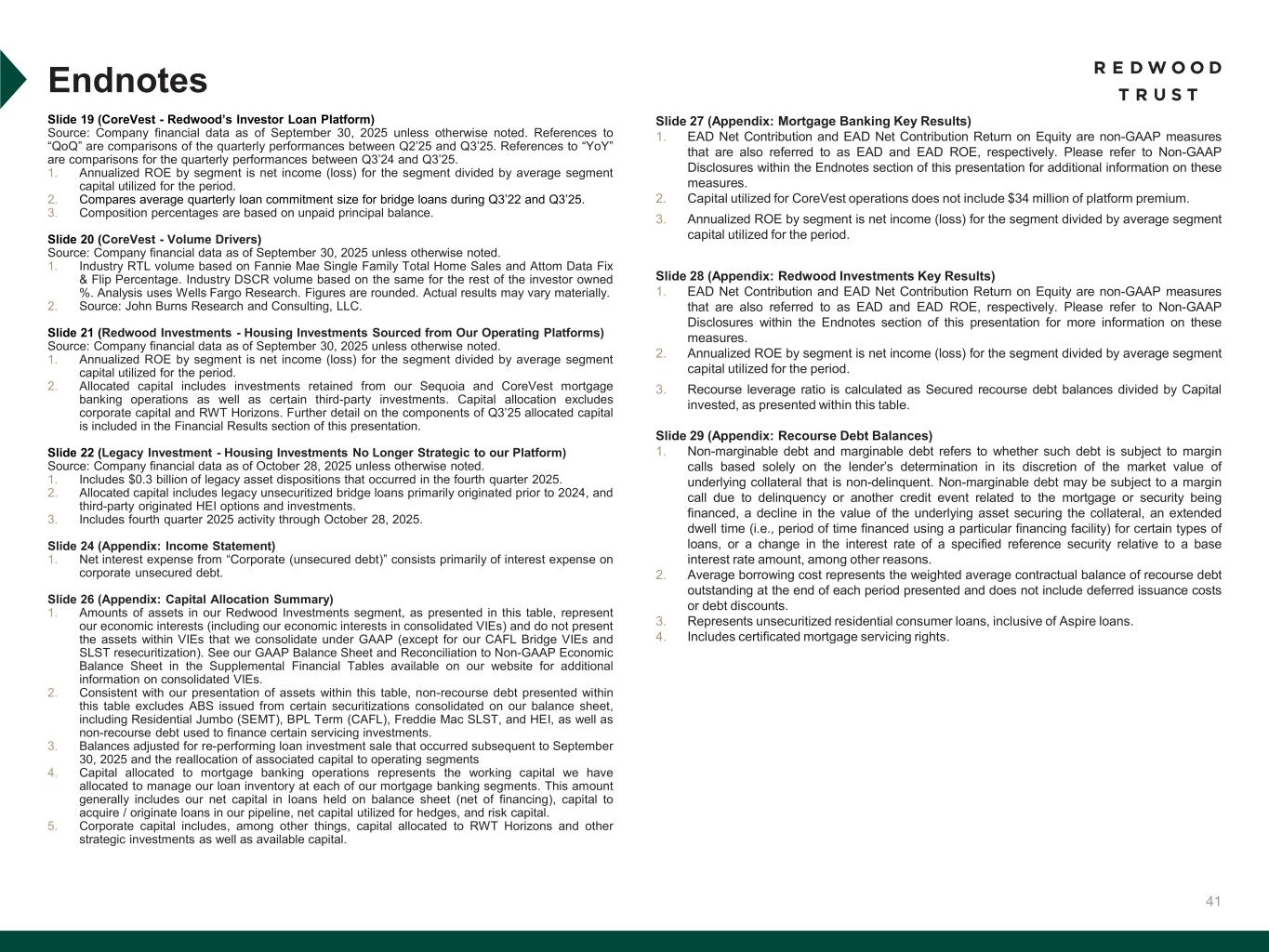
41 Endnotes Slide 27 (Appendix: Mortgage Banking Key Results) 1. EAD Net Contribution and EAD Net Contribution Return on Equity are non-GAAP measures that are also referred to as EAD and EAD ROE, respectively. Please refer to Non-GAAP Disclosures within the Endnotes section of this presentation for additional information on these measures. 2. Capital utilized for CoreVest operations does not include $34 million of platform premium. 3. Annualized ROE by segment is net income (loss) for the segment divided by average segment capital utilized for the period. Slide 28 (Appendix: Redwood Investments Key Results) 1. EAD Net Contribution and EAD Net Contribution Return on Equity are non-GAAP measures that are also referred to as EAD and EAD ROE, respectively. Please refer to Non-GAAP Disclosures within the Endnotes section of this presentation for more information on these measures. 2. Annualized ROE by segment is net income (loss) for the segment divided by average segment capital utilized for the period. 3. Recourse leverage ratio is calculated as Secured recourse debt balances divided by Capital invested, as presented within this table. Slide 29 (Appendix: Recourse Debt Balances) 1. Non-marginable debt and marginable debt refers to whether such debt is subject to margin calls based solely on the lender’s determination in its discretion of the market value of underlying collateral that is non-delinquent. Non-marginable debt may be subject to a margin call due to delinquency or another credit event related to the mortgage or security being financed, a decline in the value of the underlying asset securing the collateral, an extended dwell time (i.e., period of time financed using a particular financing facility) for certain types of loans, or a change in the interest rate of a specified reference security relative to a base interest rate amount, among other reasons. 2. Average borrowing cost represents the weighted average contractual balance of recourse debt outstanding at the end of each period presented and does not include deferred issuance costs or debt discounts. 3. Represents unsecuritized residential consumer loans, inclusive of Aspire loans. 4. Includes certificated mortgage servicing rights. Slide 19 (CoreVest - Redwood’s Investor Loan Platform) Source: Company financial data as of September 30, 2025 unless otherwise noted. References to “QoQ” are comparisons of the quarterly performances between Q2’25 and Q3’25. References to “YoY” are comparisons for the quarterly performances between Q3’24 and Q3’25. 1. Annualized ROE by segment is net income (loss) for the segment divided by average segment capital utilized for the period. 2. Compares average quarterly loan commitment size for bridge loans during Q3’22 and Q3’25. 3. Composition percentages are based on unpaid principal balance. Slide 20 (CoreVest - Volume Drivers) Source: Company financial data as of September 30, 2025 unless otherwise noted. 1. Industry RTL volume based on Fannie Mae Single Family Total Home Sales and Attom Data Fix & Flip Percentage. Industry DSCR volume based on the same for the rest of the investor owned %. Analysis uses Wells Fargo Research. Figures are rounded. Actual results may vary materially. 2. Source: John Burns Research and Consulting, LLC. Slide 21 (Redwood Investments - Housing Investments Sourced from Our Operating Platforms) Source: Company financial data as of September 30, 2025 unless otherwise noted. 1. Annualized ROE by segment is net income (loss) for the segment divided by average segment capital utilized for the period. 2. Allocated capital includes investments retained from our Sequoia and CoreVest mortgage banking operations as well as certain third-party investments. Capital allocation excludes corporate capital and RWT Horizons. Further detail on the components of Q3’25 allocated capital is included in the Financial Results section of this presentation. Slide 22 (Legacy Investment - Housing Investments No Longer Strategic to our Platform) Source: Company financial data as of October 28, 2025 unless otherwise noted. 1. Includes $0.3 billion of legacy asset dispositions that occurred in the fourth quarter 2025. 2. Allocated capital includes legacy unsecuritized bridge loans primarily originated prior to 2024, and third-party originated HEI options and investments. 3. Includes fourth quarter 2025 activity through October 28, 2025. Slide 24 (Appendix: Income Statement) 1. Net interest expense from “Corporate (unsecured debt)” consists primarily of interest expense on corporate unsecured debt. Slide 26 (Appendix: Capital Allocation Summary) 1. Amounts of assets in our Redwood Investments segment, as presented in this table, represent our economic interests (including our economic interests in consolidated VIEs) and do not present the assets within VIEs that we consolidate under GAAP (except for our CAFL Bridge VIEs and SLST resecuritization). See our GAAP Balance Sheet and Reconciliation to Non-GAAP Economic Balance Sheet in the Supplemental Financial Tables available on our website for additional information on consolidated VIEs. 2. Consistent with our presentation of assets within this table, non-recourse debt presented within this table excludes ABS issued from certain securitizations consolidated on our balance sheet, including Residential Jumbo (SEMT), BPL Term (CAFL), Freddie Mac SLST, and HEI, as well as non-recourse debt used to finance certain servicing investments. 3. Balances adjusted for re-performing loan investment sale that occurred subsequent to September 30, 2025 and the reallocation of associated capital to operating segments 4. Capital allocated to mortgage banking operations represents the working capital we have allocated to manage our loan inventory at each of our mortgage banking segments. This amount generally includes our net capital in loans held on balance sheet (net of financing), capital to acquire / originate loans in our pipeline, net capital utilized for hedges, and risk capital. 5. Corporate capital includes, among other things, capital allocated to RWT Horizons and other strategic investments as well as available capital.
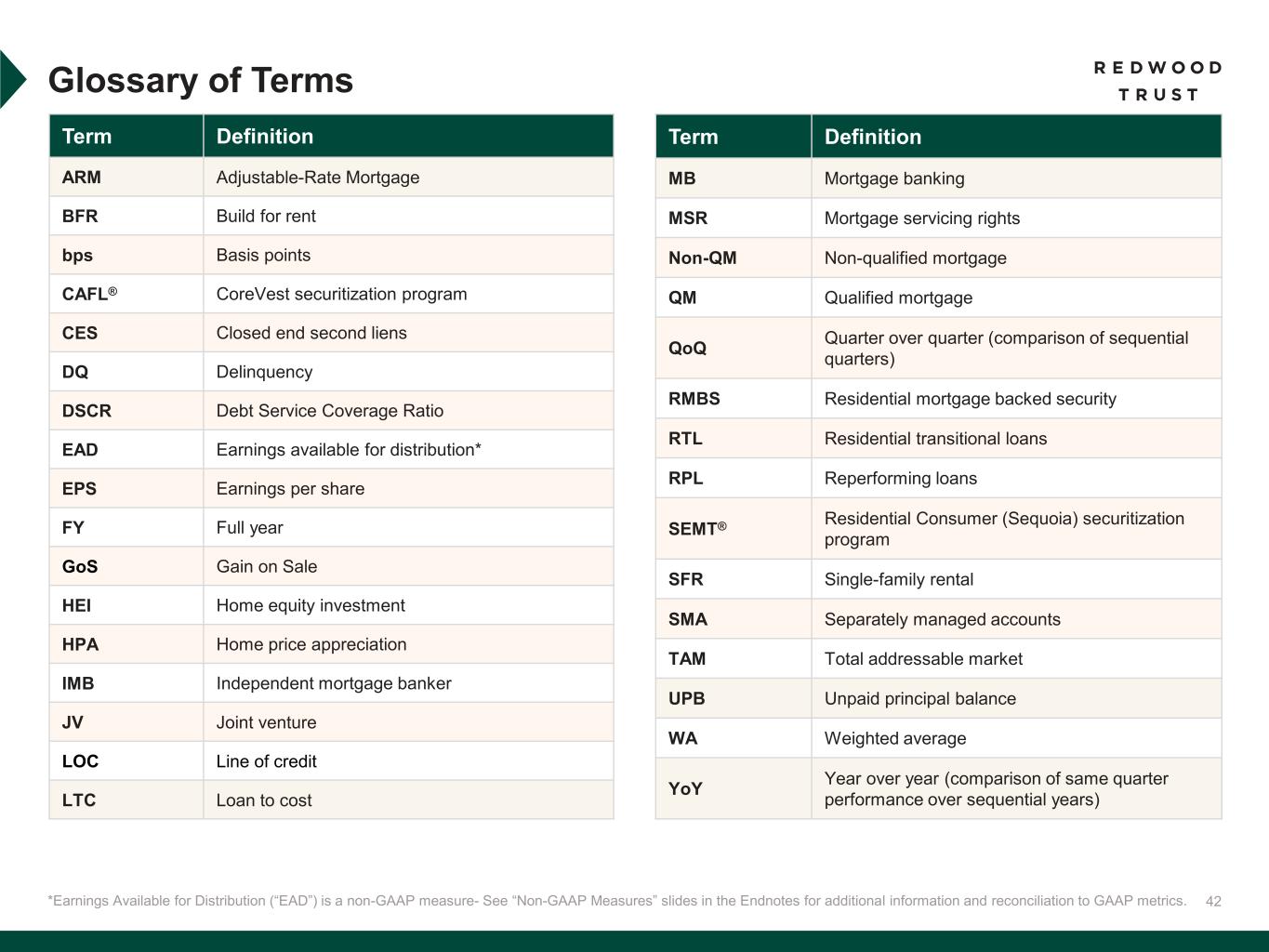
42*Earnings Available for Distribution (“EAD”) is a non-GAAP measure- See “Non-GAAP Measures” slides in the Endnotes for additional information and reconciliation to GAAP metrics. Glossary of Terms Term Definition ARM Adjustable-Rate Mortgage BFR Build for rent bps Basis points CAFL® CoreVest securitization program CES Closed end second liens DQ Delinquency DSCR Debt Service Coverage Ratio EAD Earnings available for distribution* EPS Earnings per share FY Full year GoS Gain on Sale HEI Home equity investment HPA Home price appreciation IMB Independent mortgage banker JV Joint venture LOC Line of credit LTC Loan to cost Term Definition MB Mortgage banking MSR Mortgage servicing rights Non-QM Non-qualified mortgage QM Qualified mortgage QoQ Quarter over quarter (comparison of sequential quarters) RMBS Residential mortgage backed security RTL Residential transitional loans RPL Reperforming loans SEMT® Residential Consumer (Sequoia) securitization program SFR Single-family rental SMA Separately managed accounts TAM Total addressable market UPB Unpaid principal balance WA Weighted average YoY Year over year (comparison of same quarter performance over sequential years)