
SHAK 8-K
Shake Shack Inc. (SHAK)
8-K
2020-10-29
For: 2020-10-29
View Original
Added on
April 12, 2026
UNITED STATES
SECURITIES AND EXCHANGE COMMISSION
Washington, D.C. 20549
FORM 8-K
CURRENT REPORT
Pursuant to Section 13 OR 15(d) of The Securities Exchange Act of 1934
Date of Report (Date of earliest event reported)

(Exact name of registrant as specified in its charter)
| (State or other jurisdiction of incorporation or organization) | (Commission File Number) | (IRS Employer Identification No.) | ||||||
| (Address of principal executive offices) | (Zip Code) | ||||||||||
(646 ) 747-7200
(Registrant's telephone number, including area code)
Not applicable
(Former name or former address, if changed since last report)
Check the appropriate box below if the Form 8-K filing is intended to simultaneously satisfy the filing obligation of the registrant under any of the following provisions:
| Written communications pursuant to Rule 425 under the Securities Act (17 CFR 230.425) | |||||
| Soliciting material pursuant to Rule 14a-12 under the Exchange Act (17 CFR 240.14a-12) | |||||
| Pre-commencement communications pursuant to Rule 14d-2(b) under the Exchange Act (17 CFR 240.14d-2(b)) | |||||
| Pre-commencement communications pursuant to Rule 13e-4(c) under the Exchange Act (17 CFR 240.13e-4(c)) | |||||
Securities registered pursuant to Section 12(b) of the Act
| Title of each class | Trading symbol(s) | Name of each exchange on which registered | ||||||
Indicate by check mark whether the registrant is an emerging growth company as defined in Rule 405 of the Securities Act of 1933 (17 CFR §230.405) or Rule 12b-2 of the Securities Exchange Act of 1934 (17 CFR §240.12b-2).
Emerging growth company ☐
If an emerging growth company, indicate by check mark if the registrant has elected not to use the extended transition period for complying with any new or revised financial accounting standards provided pursuant to Section 13(a) of the Exchange Act. ☐
Securities registered pursuant to Section 12(b) of the Act
Item 2.02 Results of Operations and Financial Condition.
On October 29, 2020, Shake Shack Inc. (the “Company”) issued a press release announcing its financial results for the fiscal third quarter ended September 23, 2020.
The full text of the press release is furnished as Exhibit 99.1 to this Current Report on Form 8-K and shall not be deemed “filed” for purposes of Section 18 of the Securities Exchange Act of 1934, as amended, or incorporated by reference in any filing under the Securities Act of 1933, as amended, except as shall be expressly set forth by specific reference in such a filing.
Item 7.01 Regulation FD Disclosure.
On October 29, 2020, the Company provided supplemental financial information to be used in its earnings presentation for the fiscal third quarter ended September 23, 2020 on its website at investor.shakeshack.com. The supplemental financial information is furnished as Exhibit 99.2 to this Current Report on Form 8-K and shall not be deemed “filed” for purposes of Section 18 of the Securities Exchange Act of 1934, as amended, or incorporated by reference in any filing under the Securities Act of 1933, as amended, except as shall be expressly set forth by specific reference in such a filing.
Item 9.01 Financial Statements and Exhibits.
(d) Exhibits.
| Exhibit Number | Exhibit Description | |||||||
| Shake Shack Inc. press release dated October 29, 2020 announcing its financial results for the fiscal third quarter ended September 23, 2020. (furnished only) | ||||||||
| Supplemental Financial Information dated October 29, 2020 provided by Shake Shack Inc. (furnished only) | ||||||||
SIGNATURES
Pursuant to the requirements of the Securities Exchange Act of 1934, the registrant has duly caused this report to be signed on its behalf by the undersigned hereunto duly authorized.
Shake Shack Inc. | ||||||||
| (Registrant) | ||||||||
| By: | /s/ Tara Comonte | |||||||
| Tara Comonte | ||||||||
| Date: October 29, 2020 | President and Chief Financial Officer | |||||||
| Exhibit Number | Exhibit Description | |||||||
| 99.1 | Shake Shack Inc. press release dated October 29, 2020 announcing its financial results for the fiscal second quarter ended September 23, 2020. (furnished only) | |||||||
| 99.2 | Supplemental Financial Information dated October 29, 2020 provided by Shake Shack Inc. (furnished only) | |||||||
| 104 | Cover Page Interactive Data File - the cover page XBRL tags are embedded within the Inline XBRL document | |||||||
Exhibit 99.1

Shake Shack Announces Third Quarter 2020 Financial Results
–Average Weekly Sales and Same-Shack Sales Show Significant Sequential Improvement in both Urban and Suburban Shacks
–Sales in Company-Owned Digital Channels Tripled Compared to Prior Year
–Shack-level Operating Profit Improves to 14.8% Compared to 2.2% in Second Quarter 2020
NEW YORK, NY (Business Wire) — October 29, 2020 — Shake Shack Inc. (“Shake Shack” or the “Company”) (NYSE: SHAK) today reported its financial results for the third quarter ended September 23, 2020, a period that included 13 weeks.
Randy Garutti, Chief Executive Officer of Shake Shack, stated, “Our business during this most recent quarter showed steady recovery, thanks to the hard work and dedication of our team, their agility in adapting new Shack protocols and models and an increasingly strong suite of digital capabilities. As a result, guests have been able to enjoy their Shack the way they want it, with a choice of convenient and safe ordering and pick-up options, as we continue to expand and elevate the Shake Shack experience."
Garutti concluded, “Since our last update at the end of July, forward momentum has continued and we're encouraged to see significant improvement in both sales and profitability, with many Shacks returning to or exceeding last year's results. Total year-over-year company-operated Shack sales declined 17% in the third quarter, compared to a decline of 39% during the second quarter, and further improved to a decline of just 5% in fiscal October. Same-Shack sales have also improved sequentially in every single one of the last six months, with the third quarter down 31.7% compared to the same period last year, versus down 49.0% in the second quarter, and improving to down 21% in fiscal October. Importantly, our improving top line performance, the normalization of beef costs, and disciplined expense management led to a significant recovery in Shack-level profitability with third quarter Shack-level operating profit margin improving to 14.8%, compared to 2.2% in the second quarter. We believe we are uniquely positioned to exit this challenging period stronger, and with greater opportunity than when we entered, as we double down on multi-format expansion and accelerate our strategic digital investments. As of the end of fiscal October, we are back to a full development schedule, having opened 33 Shacks so far in this challenging year, including 15 domestic company-operated Shacks, and expect to complete the year with 18 to 20 total new company-operated Shacks. Our pipeline for 2021 is strong, and we expect to open between 35 and 40 new company-operated Shacks, many of which will incorporate our new Shack Track and Drive Thru designs centered on the hospitality and experience Shake Shack has been known for, with an added focus on speed, convenience and the integration of our pre-ordering digital capabilities.”
Financial Highlights for the Third Quarter 2020:
▪Total revenue in the third quarter 2020 decreased 17.3% to $130.4 million versus the same period last year, showing sequential improvement when compared to a decline of 39.9% in the prior quarter. Further improvement carried through October 21 ("fiscal October"), with a decline of 5.7% versus the same period last year.
▪Shack sales in the third quarter 2020 decreased 17.1% to $126.3 million versus the same period last year, showing sequential improvement when compared to a decline of 39.5% in the prior quarter. Total Shack sales improved further in fiscal October with a decline of 5.3% versus the same period last year.
▪Same-Shack sales sequentially improved every fiscal month since fiscal April, down 31.7% in the third quarter 2020 versus the same period last year, compared to down 49.0% in the prior quarter. In fiscal October, Same-Shack sales continued to recover, with a decline of 21% versus the same period last year. Within same-Shack sales:
◦Suburban same-Shack sales were down 16% during the third quarter 2020 versus the same period last year, compared to down 38% in the prior quarter, and improving to down 4% in fiscal October.
◦Urban same-Shack sales were down 43% during the third quarter 2020 versus the same period last year, compared to down 57% in the prior quarter, and improving to down 33% in fiscal October.
▪Licensed revenue in the third quarter decreased 23.8% to $4.1 million versus the same period last year, showing sequential improvement when compared to a decline of 53.1% in the prior quarter.
▪Shack system-wide sales in the third quarter decreased 18.4% to $195.1 million, versus the same period last year, showing sequential improvement when compared to down 45.2% in the prior quarter, and improving to down 7.1% in fiscal October.
▪Operating loss in the third quarter was $6.8 million, compared to operating income of $8.2 million versus the same period last year, showing improvement when compared to an operating loss of $24.1 million in the prior quarter.
▪Shack-level operating profit*, a non-GAAP measure, decreased 46.9% to $18.7 million, or 14.8% of Shack sales in the third quarter 2020, versus a Shack-level operating profit of $1.9 million, or 2.2% of Shack sales in the prior quarter.
▪Net loss was $6.1 million and adjusted EBITDA*, a non-GAAP measure, was $8.2 million in the third quarter 2020, compared to net income of $11.4 million and adjusted EBITDA of $23.3 million in the same period last year.
Exhibit 99.1
▪Net loss attributable to Shake Shack Inc. was $5.6 million and adjusted pro forma net loss*, a non-GAAP measure, was $4.4 million, or a loss of $0.11 per fully exchanged and diluted share in the third quarter 2020, compared to net income attributable to Shake Shack Inc. of $10.3 million, adjusted pro forma net income of $10.0 million, or $0.26 per fully exchanged and diluted share, in the same period last year.
▪Six system-wide Shack openings, comprised of four domestic Company-operated Shacks and two net licensed Shacks.
▪Cash and marketable securities on hand was $191.8 million as of September 23, 2020.
* Shack-level operating profit, adjusted EBITDA and adjusted pro forma net income (loss) are non-GAAP measures. Reconciliations of Shack-level operating profit to operating income (loss) and adjusted EBITDA to net income (loss), the most directly comparable financial measures presented in accordance with GAAP, are set forth in the schedules accompanying this release. See “Non-GAAP Financial Measures.”
Third Quarter 2020 Review
Total revenue, which includes Shack sales and licensing revenue, decreased 17.3% versus the third quarter 2019, to $130.4 million in the third quarter of 2020, due to lost sales related to the impact from the COVID-19 pandemic. Total revenue has, however, shown steady and significant improvement when compared to a decline of 39.9% during the second quarter. Further improvement carried through fiscal October, with a year-over-year decline of 5.7%. Shack sales for the third quarter of 2020 were $126.3 million compared to $152.4 million in the third quarter 2019, a decrease of $26.1 million, or 17.1%, primarily due to a decline in same-Shack sales, partially offset by the opening of 24 new domestic company-operated Shacks between September 25, 2019 and September 23, 2020. Shack sales have also, notably improved from a decline of 39.5% during the second quarter, and also subsequent to the third quarter with fiscal October declining just 5.3% year-over-year.
Same-Shack sales improved across all regions on a sequential basis, with performance driven by increases in in-Shack dining in both urban and suburban Shacks, combined with high levels of retention of digital sales since fiscal May. Most notably, same-Shack sales have improved sequentially over each of the last six months. During the third quarter of 2020, same-Shack sales were down 31.7% compared to the same period last year, with the Company's urban Shacks down 43% and suburban Shacks down 16% compared to the same period last year. The decrease in same-Shack sales for the quarter was driven by a 42.0% decrease in traffic partially offset by an increase in price mix of 10.3%. This increase in price mix was driven by a significant increase in average check, primarily from a higher digital sales mix combined with an overall increase in check, due to higher items per order since the start of the pandemic. The Company's third quarter 2020 same-Shack sales reflect sequential improvement from the prior quarter, in which same-Shack sales were down 49.0%, with urban Shacks down 57% and suburban Shacks down 38%. Subsequent to the third quarter of 2020, in fiscal October 2020, same-Shack sales were down 21%, with the Company's urban Shacks down 33% and suburban Shacks down 4% compared to the same period last year. Urban Shacks represent approximately half the Shacks in the comparable base, yet accounted for approximately 60% of its same-Shack sales prior to the COVID-19 outbreak. As expected, urban locations are still acutely impacted by the pandemic and suburban locations continue to recover at a faster pace. New York City, particularly Manhattan, continues to lag other regions and the Company expects this to be an ongoing trend until the city fully recovers. New York City same-Shack sales have however, shown continued sequential improvement, being down 49% in the third quarter 2020 compared to down 64% in the second quarter, and now down 40% in fiscal October, versus the same periods last year. Manhattan will continue to have a material and outweighed impact on New York City’s results and those of the Company overall, with Manhattan still down 60% in same-Shack sales during the third quarter 2020, versus down 69% in the second quarter, and now down 51% in fiscal October.
Nearly all domestic company-operated Shacks were open as of the end of the third quarter 2020 and through fiscal October. As of the end of fiscal October, approximately 80% of the Company's domestic company-operated Shacks had open dining rooms with varying capacity restrictions, with the majority of Shacks also utilizing outdoor patio space, whenever possible.
During the third quarter of 2020, total digital sales, including orders placed on the Shake Shack app, website and third party delivery platforms, represented 60% of total Shack sales. As in-Shack sales improved throughout the period, the Company also maintained a high level of digital retention, with more than 90% of digital sales retained in fiscal October compared to the high point in fiscal May. During the third quarter and similar to second quarter trends, Shake Shack's native web and app channels, when combined, continued to be the fastest growing channel on a year-on-year basis, with sales more than three times the prior year levels. In the second quarter 2020, the Company added over 800,000 first-time purchasers to the app and web channels between early March and the end of July. This trend has continued through fiscal October, increasing to over 1.4 million first-time purchasers on those channels since early March.
The following table presents fiscal monthly information about the Company's current trends in Shack sales.
| First Quarter | Second Quarter | Third Quarter | Fourth Quarter | ||||||||||||||||||||||||||||||||||||||||||||
| (dollar amounts in thousands) | March 25 | April 22 | May 20 | June 24 | July 22 | August 19 | September 23 | October 21 | |||||||||||||||||||||||||||||||||||||||
| Average weekly sales | $ | 56 | $ | 32 | $ | 50 | $ | 52 | $ | 56 | $ | 59 | $ | 61 | $ | 62 | |||||||||||||||||||||||||||||||
| Total year-over-year sales growth (decline) | (11) | % | (56) | % | (32) | % | (32) | % | (23) | % | (20) | % | (10) | % | (5) | % | |||||||||||||||||||||||||||||||
| Same-Shack sales % | (29) | % | (64) | % | (42) | % | (42) | % | (39) | % | (34) | % | (23) | % | (21) | % | |||||||||||||||||||||||||||||||
Licensing revenue for the third quarter of 2020 was $4.1 million, a decrease of 23.8% from $5.4 million in the third quarter 2019, due to reduced sales related to the COVID-19 pandemic, partially offset by a net increase of 20 Shacks opening between September 25, 2019 and September 23, 2020. The Company's licensed business has shown gradual improvement, as noted in the table below. The Company's licensed airport and stadium business, however, continues to be deeply impacted, with only nine of the 22 domestic licensed Shacks open as of the end of fiscal October. The following table presents fiscal monthly information about the Company's licensed sales trends.
| First Quarter | Second Quarter | Third Quarter | Fourth Quarter | ||||||||||||||||||||||||||||||||||||||||||||
| (dollar amounts in millions) | March 25 | April 22 | May 20 | June 24 | July 22 | August 19 | September 23 | October 21 | |||||||||||||||||||||||||||||||||||||||
Weekly licensed sales(1) | $ | 4.6 | $ | 2.0 | $ | 2.4 | $ | 3.5 | $ | 4.6 | $ | 5.4 | $ | 5.7 | $ | 5.9 | |||||||||||||||||||||||||||||||
| Total year-over-year licensed sales growth (decline) | 13 | % | (65) | % | (58) | % | (47) | % | (32) | % | (23) | % | (9) | % | (10) | % | |||||||||||||||||||||||||||||||
| Number of open licensed Shacks | 96 | 56 | 59 | 91 | 98 | 104 | 105 | 107 | |||||||||||||||||||||||||||||||||||||||
(1) Weekly licensed sales is an operating measure and consists of sales from domestic licensed Shacks and international licensed Shacks. The Company does not recognize the sales from licensed Shacks as revenue. Of these amounts, revenue is limited to licensing revenue based on a percentage of sales from domestic and international licensed Shacks, as well as certain up-front fees such as territory fees and opening fees.
During the third quarter of 2020, the Company opened four new domestic company-operated Shacks, five new international licensed Shacks, and one domestic licensed Shack. These openings were partially offset by the COVID-related closure of three international licensed Shacks and one domestic licensed Shack, including the Shack located in Terminal 3 of the LAX airport.
| Location | Type | Opening Date | ||||||||||||
| Shanghai, China — Grand Gateway | International Licensed | 6/28/2020 | ||||||||||||
| Palm Beach Gardens, FL — Gardens Mall | Domestic Company-Operated | 7/7/2020 | ||||||||||||
| Dubai, United Arab Emirates — Deira City Centre | International Licensed | 7/8/2020 | ||||||||||||
| Daegu, South Korea — Daegu Dongseongro | International Licensed | 7/10/2020 | ||||||||||||
| Singapore — Orchard Road | International Licensed | 8/5/2020 | ||||||||||||
| Beijing, China — Taikoo Li Sanlitum | International Licensed | 8/12/2020 | ||||||||||||
| Salt Lake City, UT — Salt Lake City International Airport | Domestic Licensed | 9/15/2020 | ||||||||||||
| Seattle, WA — University Village | Domestic Company-Operated | 9/17/2020 | ||||||||||||
| Roseville, CA — Galleria at Roseville | Domestic Company-Operated | 9/21/2020 | ||||||||||||
| Santa Clara, CA — Valley Fair | Domestic Company-Operated | 9/22/2020 | ||||||||||||
Operating loss for the third quarter of 2020 was $6.8 million, a negative operating margin of 5.2%, compared to operating income of $8.2 million, or an operating margin of 5.2% for the third quarter 2019. For the third quarter of 2020, Shack-level operating profit, a non-GAAP measure, was $18.7 million, or 14.8% as a percentage of Shack sales, compared to Shack-level operating profit of $1.9 million, or 2.2% of Shack sales in the second quarter 2020. Shack-level operating profit performance improved sequentially throughout the third quarter, with fiscal July margin of 12%, fiscal August margin of 14% and the five-week fiscal September margin of 17%. The year-over-year decrease in Shack-level operating profit was primarily due to sales deleverage resulting from the impact of COVID-19. In addition this decrease was also driven by increased paper and packaging costs as a result of packaging all orders as 'to go' orders, a number of incremental payroll costs to support Shack employees and higher delivery commissions as a result of digital growth. A reconciliation of Shack-level operating profit to operating income (loss), the most directly comparable GAAP financial measure, is set forth in the schedules accompanying this release. See “Non-GAAP Financial Measures.”
General and administrative expenses decreased to $15.0 million for the third quarter of 2020 from $17.1 million in the third quarter 2019. This was primarily due to disciplined cost reduction across the majority of discretionary spend categories and reduced home office compensation expense, partially offset by increased expenses across marketing and technology to support digital initiatives. As a percentage of total revenue, general and administrative expenses increased to 11.5% for the third quarter of 2020 from 10.8% in the third quarter 2019, primarily due to sales deleverage associated with the impact of COVID-19.
Net loss for the third quarter of 2020 was $6.1 million, or 4.7% of total revenue, compared to net income of $11.4 million, or 7.2% of total revenue, for the third quarter 2019. Net loss attributable to Shake Shack Inc. for the third quarter of 2020 was $5.6 million, or 4.3% of total revenue, compared to net income attributable to Shake Shack Inc. of $10.3 million, or 6.6% of total revenue, for the third quarter 2019. Loss per diluted share for the third quarter of 2020 was $0.15 compared to earnings per diluted share of $0.31 for the third quarter 2019.
Updated 2020 Outlook
Given the substantial uncertainty and resulting material economic impact caused by the COVID-19 pandemic, the Company is not providing full guidance for the fiscal year ending December 30, 2020. While the Company is confident in a full, long term recovery, the timing of that return to pre-COVID levels is highly dependent upon the return of the high traffic areas that contributed to many of the strongest Shack sales, including those most reliant on travel, schools, offices and major gatherings, as well as ultimately, fully open dining rooms. The timing of that recovery remains unknown today. With the colder weather and the increasing number of reported COVID cases, it is expected that sales over the coming months will be pressured. The Company has the benefit of a 53rd week in this fiscal year which will be accretive on an absolute dollar basis, but the underlying business continues to face a very challenging and volatile operating environment certainly through the end of this year.
The Company expects to reach a total of 18 to 20 new company-operated Shacks by the end of fiscal 2020. Furthermore, the Company expects to open five to six new licensed Shacks in the fourth quarter 2020, ending the year with 12 to 14, net licensed Shacks in total for fiscal 2020. Looking to the next fiscal year, the Company expects to open between 35 and 40 new company-operated Shacks in fiscal 2021, a number of which should open in the first half of fiscal 2021. Additionally, the Company expects to open 15 to 20 new licensed Shacks in fiscal 2021.
With the continued recovery of Shack-level operating profit highly correlated to sales performance in terms of leverage on fixed costs, combined with the continuation of certain elevated costs specific to the pandemic, the Company expects any ongoing improvement in Shack-level operating margin in the fourth quarter to face pressure.
The Company expects fourth quarter 2020 general and administrative expenses to approach the same level of spend as the fourth quarter 2019.
Pre-opening expense for the third quarter 2020 was $1.8 million, however, now that development is back to a full opening schedule, this spend will increase meaningfully, and is expected to more than double sequentially through the fourth quarter 2020 as the Company completes this year's opening schedule.
Excluding the tax impact of stock based compensation, the adjusted pro forma tax rate in the third quarter 2020 was 29.3%, slightly higher than guidance given earlier in the year. The year-to-date adjusted pro forma tax rate was 28.1%, and is in line with full fiscal year expectations at this time. A reconciliation of the Company's tax rates is included in the appendix of our supplemental materials.
Earnings Conference Call
As previously announced, the Company will host a conference call to discuss its third quarter 2020 financial results today at 5:00 p.m. ET.
The conference call can be accessed live over the phone by dialing (877) 407-0792, or for international callers by dialing (201) 689-8263. A replay of the call will be available until November 5, 2020 by dialing (844) 512-2921 or for international callers by dialing (412) 317-6671; the passcode is 13710062.
The live audio webcast of the conference call will be accessible in the Events & Presentations section of the Company's Investor Relations website at investor.shakeshack.com. An archived replay of the webcast will also be available shortly after the live event has concluded.
Definitions
The following definitions apply to these terms as used in this release:
"Shack sales" is defined as the aggregate sales of food, beverages and Shake Shack branded merchandise at domestic company-operated Shacks and excludes sales from licensed Shacks.
"Same-Shack sales" represents Shack sales for the comparable Shack base, which is defined as the number of domestic company-operated Shacks open for 24 full fiscal months or longer. For days that Shacks were temporarily closed, the comparative 2019 period was also adjusted.
"Average weekly sales" is calculated by dividing total Shack sales by the number of operating weeks for all Shacks in operation during the period. For Shacks that are not open for the entire period, fractional adjustments are made to the number of operating weeks open such that it corresponds to the period of associated sales.
"Weekly licensed sales” is calculated by dividing the total sales for the period for all licensed Shacks by the number of weeks in the period.
"Shack-level operating profit," a non-GAAP measure, is defined as Shack sales less Shack-level operating expenses including food and paper costs, labor and related expenses, other operating expenses and occupancy and related expenses.
"Shack-level operating profit margin," a non-GAAP measure, is defined as Shack sales less Shack-level operating expenses including food and paper costs, labor and related expenses, other operating expenses and occupancy and related expenses as a percentage of Shack sales.
“EBITDA,” a non-GAAP measure, is defined as net income (loss) before interest expense (net of interest income), income tax expense (benefit), and depreciation and amortization expense.
“Adjusted EBITDA,” a non-GAAP measure, is defined as EBITDA (as defined above), excluding equity-based compensation expense, deferred lease costs, impairment and loss on disposal of assets, amortization of cloud-based software implementation costs, as well as certain non-recurring items that the Company does not believe directly reflect its core operations and may not be indicative of the Company's recurring business operations.
“Adjusted EBITDA margin,” a non-GAAP measure, is defined as net income (loss) before net interest, taxes, depreciation and amortization, which also excludes equity-based compensation expense, deferred lease costs, impairment and loss on disposal of assets, amortization of cloud-based software implementation costs, as well as certain non-recurring and other items that the Company does not believe directly reflect its core operations, as a percentage of revenue.
"Adjusted pro forma net income (loss)," a non-GAAP measure, represents net income (loss) attributable to Shake Shack Inc. assuming the full exchange of all outstanding SSE Holdings, LLC membership interests ("LLC Interests") for shares of Class A common stock, adjusted for certain non-recurring and other items that the Company does not believe directly reflect its core operations.
About Shake Shack
Shake Shack is a modern day “roadside” burger stand known for its 100% all-natural Angus beef burgers, chicken sandwiches and flat-top Vienna beef dogs (no hormones or antibiotics - ever), spun-fresh frozen custard, crinkle cut fries, craft beer and wine and more. With its fresh, simple, high-quality food at a great value, Shake Shack is a fun and lively community gathering place with widespread appeal. Shake Shack’s mission is to Stand for Something Good®, from its premium ingredients and caring hiring practices to its inspiring designs and deep community investment. Since the original Shack opened in 2004 in NYC’s Madison Square Park, the company has expanded to approximately 300 locations in 30 U.S. States and the District of Columbia, including more than 100 international locations including London, Hong Kong, Shanghai, Singapore, Philippines, Mexico, Istanbul, Dubai, Tokyo, Moscow, Seoul and more.
Media:
Kristyn Clark, Shake Shack
(646) 747-8776
Investor Relations:
Melissa Calandruccio, ICR
Michelle Michalski, ICR
(844) SHACK-04 (844-742-2504)
Forward-Looking Statements
This press release contains forward-looking statements, within the meaning of the Private Securities Litigation Reform Act of 1995 ("PSLRA"), which are subject to known and unknown risks, uncertainties and other important factors that may cause actual results to be materially different from the statements made herein. All statements other than statements of historical fact included in this press release are forward-looking statements, including, but not limited to, expected financial outlook for fiscal 2020, expected operating performance for fiscal 2020, expected Shack construction and openings, expected same-Shack sales growth and trends in the Company’s operations, including statements relating to the effects of COVID-19 and the Company’s mitigation efforts. You can identify forward-looking statements by the fact that they do not relate strictly to historical or current facts. These statements may include words such as "aim," "anticipate," "believe," "estimate," "expect," "forecast," "future," "intend," "outlook," "potential," "project," "projection," "plan," "seek," "may," "could," "would," "will," "should," "can," "can have," "likely," the negatives thereof and other similar expressions. All forward-looking statements are expressly qualified in their entirety by these cautionary statements. You should evaluate all forward-looking statements made in this press release in the context of the risks and uncertainties disclosed in the Company’s Annual Report on Form 10-K for the fiscal year ended December 25, 2019 and Quarterly Report on Form 10-Q for the quarterly period ended June 24, 2020 as filed with the Securities and Exchange Commission ("SEC"). All of the Company's SEC filings are available online at www.sec.gov, www.shakeshack.com or upon request from Shake Shack Inc. The forward-looking statements included in this press release are made only as of the date hereof. The Company undertakes no obligation to publicly update or revise any forward-looking statement as a result of new information, future events or otherwise, except as otherwise required by law.
SHAKE SHACK INC.
CONSOLIDATED STATEMENTS OF INCOME (LOSS)
(UNAUDITED)
(in thousands, except per share amounts)
| Thirteen Weeks Ended | Thirty-Nine Weeks Ended | ||||||||||||||||||||||||||||||||||||||||
| September 23 2020 | September 25 2019 | September 23 2020 | September 25 2019 | ||||||||||||||||||||||||||||||||||||||
| Shack sales | $ | 126,288 | 96.8 | % | $ | 152,366 | 96.6 | % | $ | 353,855 | 96.9 | % | $ | 428,811 | 96.8 | % | |||||||||||||||||||||||||
| Licensing revenue | 4,113 | 3.2 | % | 5,396 | 3.4 | % | 11,502 | 3.1 | % | 14,273 | 3.2 | % | |||||||||||||||||||||||||||||
| TOTAL REVENUE | 130,401 | 100.0 | % | 157,762 | 100.0 | % | 365,357 | 100.0 | % | 443,084 | 100.0 | % | |||||||||||||||||||||||||||||
Shack-level operating expenses(1): | |||||||||||||||||||||||||||||||||||||||||
| Food and paper costs | 37,903 | 30.0 | % | 44,159 | 29.0 | % | 107,494 | 30.4 | % | 125,049 | 29.2 | % | |||||||||||||||||||||||||||||
| Labor and related expenses | 37,898 | 30.0 | % | 41,601 | 27.3 | % | 110,597 | 31.3 | % | 118,891 | 27.7 | % | |||||||||||||||||||||||||||||
| Other operating expenses | 18,743 | 14.8 | % | 18,947 | 12.4 | % | 50,826 | 14.4 | % | 51,270 | 12.0 | % | |||||||||||||||||||||||||||||
| Occupancy and related expenses | 13,093 | 10.4 | % | 12,537 | 8.2 | % | 37,974 | 10.7 | % | 35,309 | 8.2 | % | |||||||||||||||||||||||||||||
| General and administrative expenses | 14,962 | 11.5 | % | 17,090 | 10.8 | % | 45,170 | 12.4 | % | 46,420 | 10.5 | % | |||||||||||||||||||||||||||||
| Depreciation expense | 12,376 | 9.5 | % | 10,474 | 6.6 | % | 36,233 | 9.9 | % | 29,239 | 6.6 | % | |||||||||||||||||||||||||||||
| Pre-opening costs | 1,822 | 1.4 | % | 4,487 | 2.8 | % | 5,799 | 1.6 | % | 10,678 | 2.4 | % | |||||||||||||||||||||||||||||
| Impairment and loss on disposal of assets | 402 | 0.3 | % | 303 | 0.2 | % | 2,924 | 0.8 | % | 1,031 | 0.2 | % | |||||||||||||||||||||||||||||
| TOTAL EXPENSES | 137,199 | 105.2 | % | 149,598 | 94.8 | % | 397,017 | 108.7 | % | 417,887 | 94.3 | % | |||||||||||||||||||||||||||||
| OPERATING INCOME (LOSS) | (6,798) | (5.2) | % | 8,164 | 5.2 | % | (31,660) | (8.7) | % | 25,197 | 5.7 | % | |||||||||||||||||||||||||||||
| Other income, net | 34 | — | % | 248 | 0.2 | % | 335 | 0.1 | % | 1,259 | 0.3 | % | |||||||||||||||||||||||||||||
| Interest expense | (143) | (0.1) | % | (133) | (0.1) | % | (697) | (0.2) | % | (302) | (0.1) | % | |||||||||||||||||||||||||||||
| INCOME (LOSS) BEFORE INCOME TAXES | (6,907) | (5.3) | % | 8,279 | 5.2 | % | (32,022) | (8.8) | % | 26,154 | 5.9 | % | |||||||||||||||||||||||||||||
| Benefit from income taxes | (797) | (0.6) | % | (3,144) | (2.0) | % | (6,802) | (1.9) | % | (47) | — | % | |||||||||||||||||||||||||||||
| NET INCOME (LOSS) | (6,110) | (4.7) | % | 11,423 | 7.2 | % | (25,220) | (6.9) | % | 26,201 | 5.9 | % | |||||||||||||||||||||||||||||
| Less: net income (loss) attributable to non-controlling interests | (551) | (0.4) | % | 1,079 | 0.7 | % | (2,490) | (0.7) | % | 4,281 | 1.0 | % | |||||||||||||||||||||||||||||
| NET INCOME (LOSS) ATTRIBUTABLE TO SHAKE SHACK INC. | $ | (5,559) | (4.3) | % | $ | 10,344 | 6.6 | % | $ | (22,730) | (6.2) | % | $ | 21,920 | 4.9 | % | |||||||||||||||||||||||||
| Earnings (loss) per share of Class A common stock: | |||||||||||||||||||||||||||||||||||||||||
| Basic | $ | (0.15) | $ | 0.32 | $ | (0.62) | $ | 0.72 | |||||||||||||||||||||||||||||||||
| Diluted | $ | (0.15) | $ | 0.31 | $ | (0.62) | $ | 0.70 | |||||||||||||||||||||||||||||||||
| Weighted-average shares of Class A common stock outstanding: | |||||||||||||||||||||||||||||||||||||||||
| Basic | 38,251 | 31,961 | 36,668 | 30,549 | |||||||||||||||||||||||||||||||||||||
| Diluted | 38,251 | 32,916 | 36,668 | 31,441 | |||||||||||||||||||||||||||||||||||||
(1) As a percentage of Shack sales.
SHAKE SHACK INC.
SELECTED BALANCE SHEET DATA AND OPERATING DATA
(UNAUDITED)
| (in thousands) | September 23 2020 | December 25 2019 | ||||||||||||
| SELECTED BALANCE SHEET DATA: | ||||||||||||||
| Cash and cash equivalents | $ | 174,883 | $ | 37,099 | ||||||||||
| Marketable securities | $ | 16,879 | $ | 36,508 | ||||||||||
| Total assets | $ | 1,137,202 | $ | 968,268 | ||||||||||
| Total liabilities | $ | 690,440 | $ | 646,283 | ||||||||||
| Total equity | $ | 446,762 | $ | 321,985 | ||||||||||
| Thirteen Weeks Ended | Thirty-Nine Weeks Ended | |||||||||||||||||||||||||
| (dollar amounts in thousands) | September 23 2020 | September 25 2019 | September 23 2020 | September 25 2019 | ||||||||||||||||||||||
| SELECTED OPERATING DATA: | ||||||||||||||||||||||||||
| Same-Shack sales growth (decline) | (31.7) | % | 2.0 | % | (31.5) | % | 3.0 | % | ||||||||||||||||||
| Shacks in the comparable base | 102 | 79 | 102 | 79 | ||||||||||||||||||||||
Shack system-wide sales(1) | $ | 195,075 | $ | 239,069 | $ | 540,445 | $ | 660,199 | ||||||||||||||||||
| Average weekly sales | ||||||||||||||||||||||||||
| Domestic company-operated | $ | 58 | $ | 80 | $ | 56 | $ | 81 | ||||||||||||||||||
Shack-level operating profit(2) | $ | 18,651 | $ | 35,122 | $ | 46,964 | $ | 98,292 | ||||||||||||||||||
Shack-level operating profit margin(2) | 14.8 | % | 23.1 | % | 13.3 | % | 22.9 | % | ||||||||||||||||||
Adjusted EBITDA(2) | $ | 8,159 | $ | 23,282 | $ | 13,589 | $ | 67,042 | ||||||||||||||||||
Adjusted EBITDA margin(2) | 6.3 | % | 14.8 | % | 3.7 | % | 15.1 | % | ||||||||||||||||||
| Capital expenditures | $ | 9,365 | $ | 24,906 | $ | 47,002 | $ | 80,904 | ||||||||||||||||||
| Shack counts (at end of period): | ||||||||||||||||||||||||||
| System-wide | 298 | 254 | 298 | 254 | ||||||||||||||||||||||
| Domestic company-operated | 175 | 151 | 175 | 151 | ||||||||||||||||||||||
| Domestic licensed | 22 | 17 | 22 | 17 | ||||||||||||||||||||||
| International licensed | 101 | 86 | 101 | 86 | ||||||||||||||||||||||
(1) Shack system-wide sales is an operating measure and consists of sales from domestic company-operated Shacks, domestic licensed Shacks and international licensed Shacks. The Company does not recognize the sales from licensed Shacks as revenue. Of these amounts, revenue is limited to Shack sales from domestic company-operated Shacks and licensing revenue based on a percentage of sales from domestic and international licensed Shacks, as well as certain up-front fees such as territory fees and opening fees.
(2) Shack-level operating profit and adjusted EBITDA are non-GAAP measures. Reconciliations of Shack-level operating profit to operating income (loss) and adjusted EBITDA to net income (loss), the most directly comparable financial measures presented in accordance with GAAP, are set forth in the schedules accompanying this release. See “Non-GAAP Financial Measures.”
SHAKE SHACK INC.
NON-GAAP FINANCIAL MEASURES
(UNAUDITED)
To supplement the consolidated financial statements, which are prepared and presented in accordance with U.S. generally accepted accounting principles (“GAAP”), the Company uses the following non-GAAP financial measures: Shack-level operating profit, Shack-level operating profit margin, EBITDA, adjusted EBITDA, adjusted EBITDA margin, adjusted pro forma net income (loss) and adjusted pro forma earnings (loss) per fully exchanged and diluted share (collectively the "non-GAAP financial measures").
Shack-Level Operating Profit
Shack-level operating profit is defined as Shack sales less Shack-level operating expenses including food and paper costs, labor and related expenses, other operating expenses and occupancy and related expenses.
How This Measure Is Useful
When used in conjunction with GAAP financial measures, Shack-level operating profit and Shack-level operating profit margin are supplemental measures of operating performance that the Company believes are useful measures to evaluate the performance and profitability of its Shacks. Additionally, Shack-level operating profit and Shack-level operating profit margin are key metrics used internally by management to develop internal budgets and forecasts, as well as assess the performance of its Shacks relative to budget and against prior periods. It is also used to evaluate employee compensation as it serves as a metric in certain performance-based employee bonus arrangements. The Company believes presentation of Shack-level operating profit and Shack-level operating profit margin provides investors with a supplemental view of its operating performance that can provide meaningful insights to the underlying operating performance of the Shacks, as these measures depict the operating results that are directly impacted by the Shacks and exclude items that may not be indicative of, or are unrelated to, the ongoing operations of the Shacks. It may also assist investors to evaluate the Company's performance relative to peers of various sizes and maturities and provides greater transparency with respect to how management evaluates the business, as well as the financial and operational decision-making.
Limitations of the Usefulness of this Measure
Shack-level operating profit and Shack-level operating profit margin may differ from similarly titled measures used by other companies due to different methods of calculation. Presentation of Shack-level operating profit and Shack-level operating profit margin is not intended to be considered in isolation or as a substitute for, or superior to, the financial information prepared and presented in accordance with GAAP. Shack-level operating profit excludes certain costs, such as general and administrative expenses and pre-opening costs, which are considered normal, recurring cash operating expenses and are essential to support the operation and development of the Company's Shacks. Therefore, this measure may not provide a complete understanding of the Company's operating results as a whole and Shack-level operating profit and Shack-level operating profit margin should be reviewed in conjunction with the Company's GAAP financial results. A reconciliation of Shack-level operating profit to operating income (loss), the most directly comparable GAAP financial measure, is set forth below.
| Thirteen Weeks Ended | Thirty-Nine Weeks Ended | |||||||||||||||||||||||||
| (dollar amounts in thousands) | September 23 2020 | September 25 2019 | September 23 2020 | September 25 2019 | ||||||||||||||||||||||
| Operating income (loss) | $ | (6,798) | $ | 8,164 | $ | (31,660) | $ | 25,197 | ||||||||||||||||||
| Less: | ||||||||||||||||||||||||||
| Licensing revenue | 4,113 | 5,396 | 11,502 | 14,273 | ||||||||||||||||||||||
| Add: | ||||||||||||||||||||||||||
| General and administrative expenses | 14,962 | 17,090 | 45,170 | 46,420 | ||||||||||||||||||||||
| Depreciation expense | 12,376 | 10,474 | 36,233 | 29,239 | ||||||||||||||||||||||
| Pre-opening costs | 1,822 | 4,487 | 5,799 | 10,678 | ||||||||||||||||||||||
| Impairment and loss on disposal of assets | 402 | 303 | 2,924 | 1,031 | ||||||||||||||||||||||
| Shack-level operating profit | $ | 18,651 | $ | 35,122 | $ | 46,964 | $ | 98,292 | ||||||||||||||||||
| Total revenue | $ | 130,401 | $ | 157,762 | $ | 365,357 | $ | 443,084 | ||||||||||||||||||
| Less: licensing revenue | 4,113 | 5,396 | 11,502 | 14,273 | ||||||||||||||||||||||
| Shack sales | $ | 126,288 | $ | 152,366 | $ | 353,855 | $ | 428,811 | ||||||||||||||||||
| Shack-level operating profit margin | 14.8 | % | 23.1 | % | 13.3 | % | 22.9 | % | ||||||||||||||||||
SHAKE SHACK INC.
NON-GAAP FINANCIAL MEASURES
(UNAUDITED)
EBITDA and Adjusted EBITDA
EBITDA is defined as net income (loss) before interest expense (net of interest income), income tax expense (benefit) and depreciation and amortization expense. Adjusted EBITDA is defined as EBITDA (as defined above) excluding equity-based compensation expense, deferred lease costs, impairment and loss on the disposal of assets, amortization of cloud-based software implementation costs, as well as certain non-recurring items that the Company does not believe directly reflect its core operations and may not be indicative of the Company's recurring business operations.
How These Measures Are Useful
When used in conjunction with GAAP financial measures, EBITDA and adjusted EBITDA are supplemental measures of operating performance that the Company believes are useful measures to facilitate comparisons to historical performance and competitors' operating results. Adjusted EBITDA is a key metric used internally by management to develop internal budgets and forecasts and also serves as a metric in its performance-based equity incentive programs and certain bonus arrangements. The Company believes presentation of EBITDA and adjusted EBITDA provides investors with a supplemental view of the Company's operating performance that facilitates analysis and comparisons of its ongoing business operations because they exclude items that may not be indicative of the Company's ongoing operating performance.
Limitations of the Usefulness of These Measures
EBITDA and adjusted EBITDA may differ from similarly titled measures used by other companies due to different methods of calculation. Presentation of EBITDA and adjusted EBITDA is not intended to be considered in isolation or as a substitute for, or superior to, the financial information prepared and presented in accordance with GAAP. EBITDA and adjusted EBITDA exclude certain normal recurring expenses. Therefore, these measures may not provide a complete understanding of the Company's performance and should be reviewed in conjunction with the GAAP financial measures. A reconciliation of EBITDA and adjusted EBITDA to net income (loss), the most directly comparable GAAP measure, is set forth below.
| Thirteen Weeks Ended | Thirty-Nine Weeks Ended | |||||||||||||||||||||||||
| (in thousands) | September 23 2020 | September 25 2019 | September 23 2020 | September 25 2019 | ||||||||||||||||||||||
| Net income (loss) | $ | (6,110) | $ | 11,423 | $ | (25,220) | $ | 26,201 | ||||||||||||||||||
| Depreciation expense | 12,376 | 10,474 | 36,233 | 29,239 | ||||||||||||||||||||||
| Interest expense, net | 143 | 133 | 697 | 302 | ||||||||||||||||||||||
| Income tax benefit | (797) | (3,144) | (6,802) | (47) | ||||||||||||||||||||||
| EBITDA | 5,612 | 18,886 | 4,908 | 55,695 | ||||||||||||||||||||||
| Equity-based compensation | 1,339 | 1,884 | 4,058 | 5,839 | ||||||||||||||||||||||
Amortization of cloud-based software implementation costs(1) | 458 | 107 | 1,086 | 107 | ||||||||||||||||||||||
Deferred lease costs(2) | 258 | 743 | 407 | 2,043 | ||||||||||||||||||||||
Impairment and loss on disposal of assets(3) | 402 | 303 | 2,924 | 1,031 | ||||||||||||||||||||||
| Other income related to adjustment of liabilities under tax receivable agreement | — | — | — | (14) | ||||||||||||||||||||||
Executive transition costs(4) | 82 | — | 150 | 126 | ||||||||||||||||||||||
Project Concrete(5) | 8 | 1,346 | (229) | 2,031 | ||||||||||||||||||||||
Hong Kong office(6) | — | 13 | — | 184 | ||||||||||||||||||||||
Other(7) | — | — | 285 | — | ||||||||||||||||||||||
| ADJUSTED EBITDA | $ | 8,159 | $ | 23,282 | $ | 13,589 | $ | 67,042 | ||||||||||||||||||
Adjusted EBITDA margin(8) | 6.3 | % | 14.8 | % | 3.7 | % | 15.1 | % | ||||||||||||||||||
(1) Represents amortization of capitalized implementation costs related to cloud-based software arrangements that are included within General and Administrative expenses.
(2) Reflects the extent to which lease expense is greater than or less than contractual fixed base rent.
(3) For the thirty-nine weeks ended September 23, 2020, this amount includes a non-cash impairment charge of $1.1 million related to one Shack.
(4) Represents fees paid in connection with the search and hiring of certain executive and key management positions.
(5) Represents consulting and advisory fees related to the Company's enterprise-wide system upgrade initiative called Project Concrete.
(6) Represents costs associated with establishing the Company's first international office in Hong Kong.
(7) Represents incremental expenses incurred related to an inventory adjustment and certain employee-related expenses.
(8) Calculated as a percentage of total revenue, which was $130,401 and $365,357 for the thirteen and thirty-nine weeks ended September 23, 2020, respectively, and $157,762 and $443,084 for the thirteen and thirty-nine weeks ended September 25, 2019, respectively.
Adjusted Pro Forma Net Income (Loss) and Adjusted Pro Forma Earnings (Loss) Per Fully Exchanged and Diluted Share
Adjusted pro forma net income (loss) represents net income (loss) attributable to Shake Shack Inc. assuming the full exchange of all outstanding SSE Holdings, LLC membership interests ("LLC Interests") for shares of Class A common stock, adjusted for certain non-recurring items that the Company does not believe are directly related to its core operations and may not be indicative of recurring business operations. Adjusted pro forma earnings (loss) per fully exchanged and diluted share is calculated by dividing adjusted pro forma net income (loss) by the weighted-average shares of Class A common stock outstanding, assuming the full exchange of all outstanding LLC Interests, after giving effect to the dilutive effect of outstanding equity-based awards.
How These Measures Are Useful
When used in conjunction with GAAP financial measures, adjusted pro forma net income (loss) and adjusted pro forma earnings (loss) per fully exchanged and diluted share are supplemental measures of operating performance that the Company believes are useful measures to evaluate performance period over period and relative to its competitors. By assuming the full exchange of all outstanding LLC Interests, the Company believes these measures facilitate comparisons with other companies that have different organizational and tax structures, as well as comparisons period over period because it eliminates the effect of any changes in net income (loss) attributable to Shake Shack Inc. driven by increases in its ownership of SSE Holdings, which are unrelated to the Company's operating performance, and excludes items that are non-recurring or may not be indicative of ongoing operating performance.
Limitations of the Usefulness of These Measures
Adjusted pro forma net income (loss) and adjusted pro forma earnings (loss) per fully exchanged and diluted share may differ from similarly titled measures used by other companies due to different methods of calculation. Presentation of adjusted pro forma net income (loss) and adjusted pro forma earnings (loss) per fully exchanged and diluted share should not be considered alternatives to net income (loss) and earnings (loss) per share, as determined under GAAP. While these measures are useful in evaluating the Company's performance, it does not account for the earnings attributable to the non-controlling interest holders and therefore does not provide a complete understanding of the net income (loss) attributable to Shake Shack Inc. Adjusted pro forma net income (loss) and adjusted pro forma earnings (loss) per fully exchanged and diluted share should be evaluated in conjunction with GAAP financial results. A reconciliation of adjusted pro forma net income (loss) to net income (loss) attributable to Shake Shack Inc., the most directly comparable GAAP measure, and the computation of adjusted pro forma earnings (loss) per fully exchanged and diluted share are set forth below.
| Thirteen Weeks Ended | Thirty-Nine Weeks Ended | ||||||||||||||||||||||||||||
| (in thousands, except per share amounts) | September 23 2020 | September 25 2019 | September 23 2020 | September 25 2019 | |||||||||||||||||||||||||
| Numerator: | |||||||||||||||||||||||||||||
| Net income (loss) attributable to Shake Shack Inc. | $ | (5,559) | $ | 10,344 | $ | (22,730) | $ | 21,920 | |||||||||||||||||||||
| Adjustments: | |||||||||||||||||||||||||||||
Reallocation of net income (loss) attributable to non-controlling interests from the assumed exchange of LLC Interests(1) | (551) | 1,079 | (2,490) | 4,281 | |||||||||||||||||||||||||
Executive transition costs(2) | 82 | — | 150 | 126 | |||||||||||||||||||||||||
Project Concrete(3) | 8 | 1,346 | (229) | 2,031 | |||||||||||||||||||||||||
Hong Kong office(4) | — | 13 | — | 184 | |||||||||||||||||||||||||
Other(5) | — | — | 285 | — | |||||||||||||||||||||||||
| Other income related to adjustment of liabilities under tax receivable agreement | — | — | — | (14) | |||||||||||||||||||||||||
Tax effect of change in tax basis related to the adoption of new accounting standards(6) | — | — | — | 1,161 | |||||||||||||||||||||||||
Income tax (expense) benefit (7) | 1,608 | (2,765) | 3,141 | (4,478) | |||||||||||||||||||||||||
| Adjusted pro forma net income (loss) | $ | (4,412) | $ | 10,017 | $ | (21,873) | $ | 25,211 | |||||||||||||||||||||
| Denominator: | |||||||||||||||||||||||||||||
| Weighted-average shares of Class A common stock outstanding—diluted | 38,251 | 32,916 | 36,668 | 31,441 | |||||||||||||||||||||||||
| Adjustments: | |||||||||||||||||||||||||||||
Assumed exchange of LLC Interests for shares of Class A common stock(1) | 3,114 | 5,393 | 3,125 | 6,674 | |||||||||||||||||||||||||
| Adjusted pro forma fully exchanged weighted-average shares of Class A common stock outstanding—diluted | 41,365 | 38,309 | 39,793 | 38,115 | |||||||||||||||||||||||||
| Adjusted pro forma earnings (loss) per fully exchanged share—diluted | $ | (0.11) | $ | 0.26 | $ | (0.55) | $ | 0.66 | |||||||||||||||||||||
| Thirteen Weeks Ended | Thirty-Nine Weeks Ended | ||||||||||||||||||||||||||||
| September 23 2020 | September 25 2019 | September 23 2020 | September 25 2019 | ||||||||||||||||||||||||||
| Earnings (loss) per share of Class A common stock - diluted | $ | (0.15) | $ | 0.31 | $ | (0.62) | $ | 0.70 | |||||||||||||||||||||
Assumed exchange of LLC Interests for shares of Class A common stock(1) | — | (0.02) | (0.01) | (0.01) | |||||||||||||||||||||||||
Non-GAAP adjustments(8) | 0.04 | (0.03) | 0.08 | (0.03) | |||||||||||||||||||||||||
| Adjusted pro forma earnings (loss) per fully exchanged share—diluted | $ | (0.11) | $ | 0.26 | $ | (0.55) | $ | 0.66 | |||||||||||||||||||||
(1) Assumes the exchange of all outstanding LLC Interests for shares of Class A common stock, resulting in the elimination of the non-controlling interest and recognition of the net income (loss) attributable to non-controlling interests.
(2) Represents costs incurred in connection with the Company's executive search, including fees paid to an executive recruiting firm.
(3) Represents consulting and advisory fees related to the Company's enterprise-wide system upgrade initiative called Project Concrete.
(4) Represents costs associated with establishing the Company's first international office in Hong Kong.
(5) Represents incremental expenses incurred related to an inventory adjustment and certain employee-related expenses.
(6) Represents tax effect of change in tax basis related to the adoption of the new lease accounting standard for the thirteen and thirty-nine weeks ended September 25, 2019.
(7) Represents the tax effect of the aforementioned adjustments and pro forma adjustments to reflect corporate income taxes at assumed effective tax rates of 35.3% and 31.3% for the thirteen and thirty-nine weeks ended September 23, 2020, respectively, and (3.9)% and 11.5% for the thirteen and thirty-nine weeks ended September 25, 2019, respectively.
(8) Represents the per share impact of non-GAAP adjustments for each period. Refer to the reconciliation of Adjusted Pro Forma Net Income (Loss) above for further details.
THIRD QUARTER 2020 EARNINGS SUPPLEMENTAL OCTOBER 29, 2020 Strategic Plan Update Board of Directors Meeting| Q1 2020
CAUTIONARY NOTE ON FORWARD-LOOKING STATEMENTS This presentation contains forward-looking Forward-looking statements discuss the Company's current expectations and projections relating to its financial position, results of operations, plans, objectives, statements, within the meaning of the Private future performance and business. You can identify forward-looking statements by the Securities Litigation Reform Act of 1995, which are fact that they do not relate strictly to historical or current facts. These statements may include words such as "aim," "anticipate," "believe," "estimate," "expect," "forecast,“ subject to known and unknown risks, uncertainties ”future,” “intend,” "outlook," "potential," "project," "projection," "plan," "seek," "may," and other important factors that may cause actual "could," "would," "will," "should," "can," "can have," "likely," the negatives thereof and results to be materially different. other similar expressions. All forward-looking statements are expressly qualified in their entirety by these All statements other than statements of historical fact included in this cautionary statements. You should evaluate all forward-looking statements made presentation are forward-looking statements, including, but not limited to, in this presentation in the context of the risks and uncertainties disclosed in expected financial outlook for fiscal 2020, expected operating performance for the Company’s Annual Report on Form 10-K for the fiscal year ended December fiscal 2020, expected Shack construction and openings, expected same-Shack 25, 2019 and Quarterly Report on Form 10-Q for the period ended June 24, 2020 as sales growth and trends in Shake Shack Inc.’s (the "Company's") filed with the Securities and Exchange Commission ("SEC"). All of the Company's operations including statements relating to the effects of COVID-19 and the SEC filings are available online at www.sec.gov, www.shakeshack.com or upon Company’s mitigation efforts. request from Shake Shack Inc. The forward-looking statements included in this presentation are made only as of the date hereof. The Company undertakes no obligation to publicly update or revise any forward-looking statement as a result of new information, future events or otherwise, except as otherwise required by law. Strategic Plan Update Board of Directors Meeting| Q1 2020 2
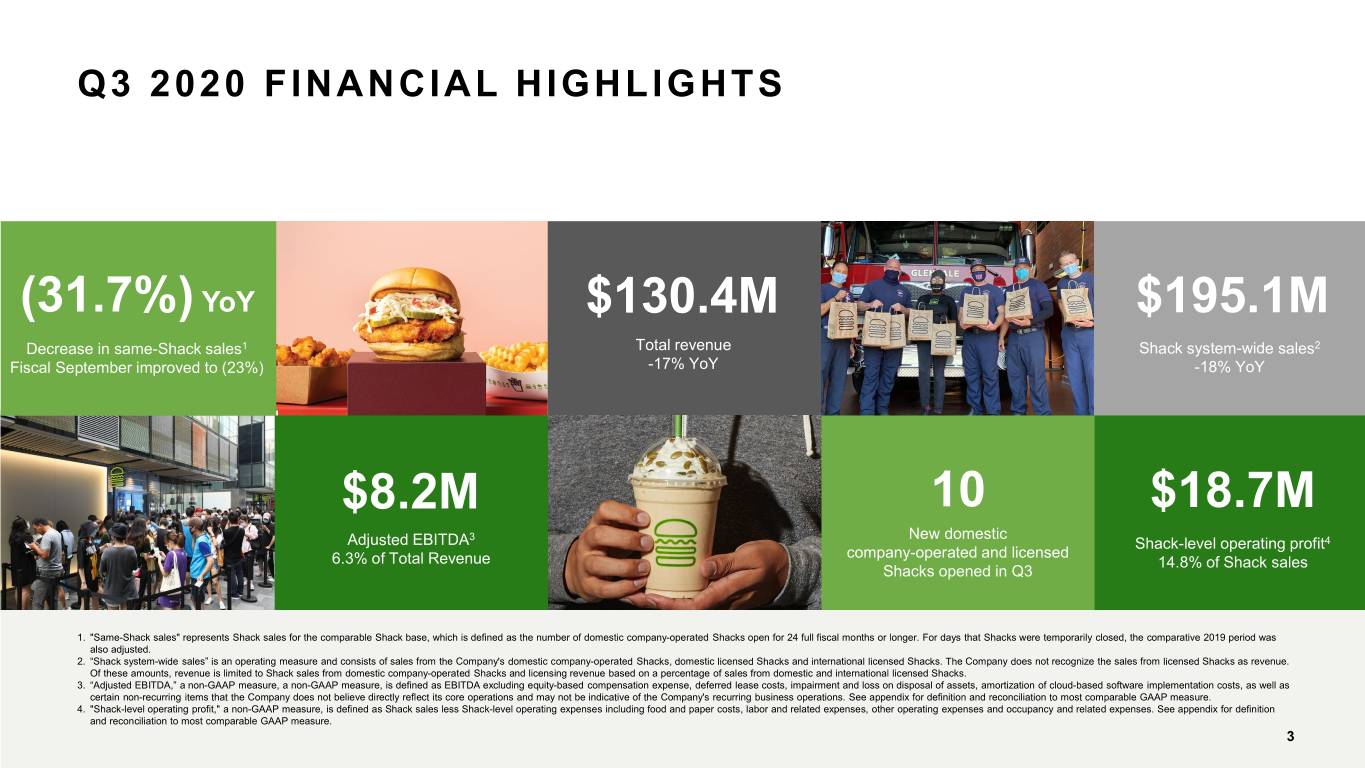
Q3 2020 FINANCIAL HIGHLIGHTS (31.7%) YoY $130.4M $195.1M Decrease in same-Shack sales1 Total revenue Shack system-wide sales2 Fiscal September improved to (23%) -17% YoY -18% YoY $8.2M 10 $18.7M 3 New domestic Adjusted EBITDA Shack-level operating profit4 company-operated and licensed 6.3% of Total Revenue 14.8% of Shack sales Shacks opened in Q3 1. "Same-Shack sales" represents Shack sales for the comparable Shack base, which is defined as the number of domestic company-operated Shacks open for 24 full fiscal months or longer. For days that Shacks were temporarily closed, the comparative 2019 period was also adjusted. 2. “Shack system-wide sales” is an operating measure and consists of sales from the Company's domestic company-operated Shacks, domestic licensed Shacks and international licensed Shacks. The Company does not recognize the sales from licensed Shacks as revenue. Of these amounts, revenue is limited to Shack sales from domestic company-operated Shacks and licensing revenue based on a percentage of sales from domestic and international licensed Shacks. 3. “Adjusted EBITDA,” a non-GAAP measure, a non-GAAP measure, is defined as EBITDA excluding equity-based compensation expense, deferred lease costs, impairment and loss on disposal of assets, amortization of cloud-based software implementation costs, as well as certain non-recurring items that the Company does not believe directly reflect its core operations and may not be indicative of the Company's recurring business operations. See appendix for definition and reconciliation to most comparable GAAP measure. 4. "Shack-level operating profit," a non-GAAP measure, is defined as Shack sales less Shack-level operating expenses including food and paper costs, labor and related expenses, other operating expenses and occupancy and related expenses. See appendix for definition and reconciliation to most comparable GAAP measure. Strategic Plan Update Board of Directors Meeting| Q1 2020 3
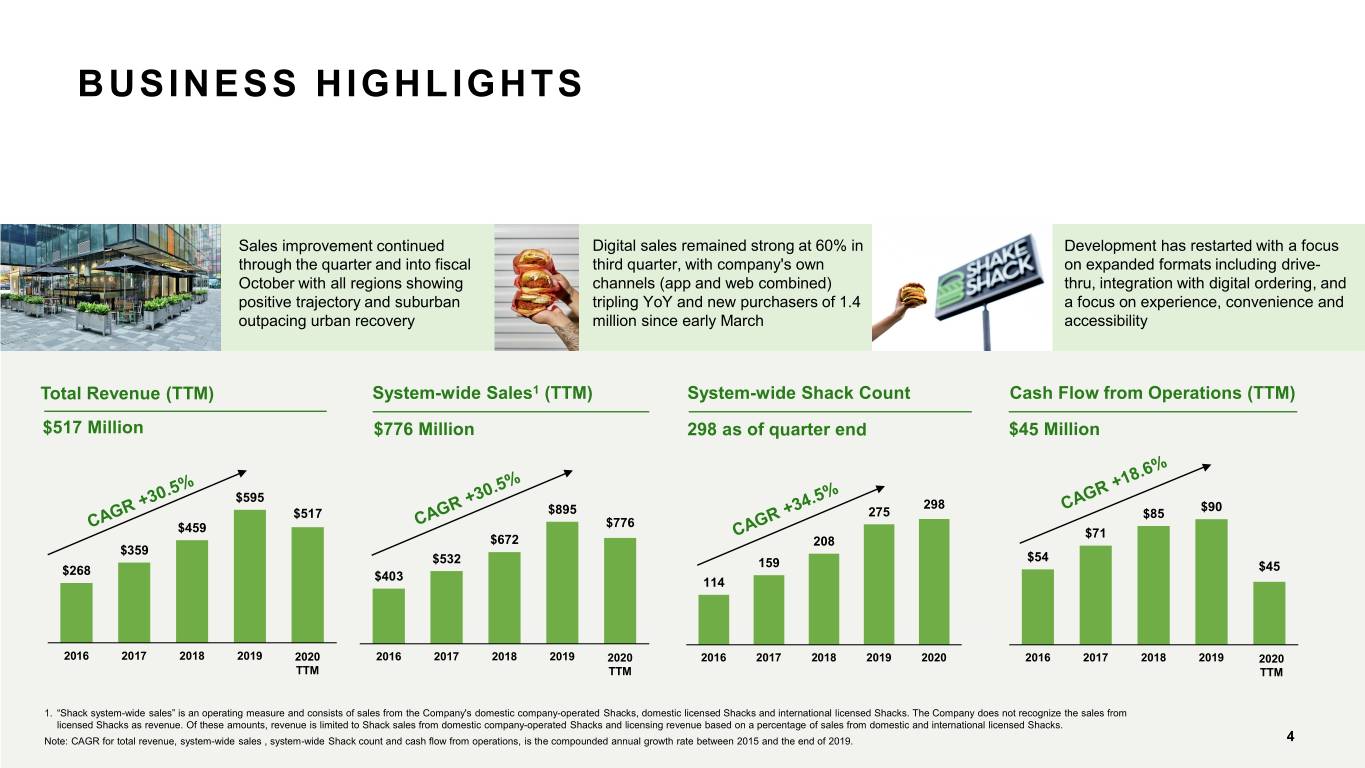
BUSINESS HIGHLIGHTS Sales improvement continued Digital sales remained strong at 60% in Development has restarted with a focus through the quarter and into fiscal third quarter, with company's own on expanded formats including drive- October with all regions showing channels (app and web combined) thru, integration with digital ordering, and positive trajectory and suburban tripling YoY and new purchasers of 1.4 a focus on experience, convenience and outpacing urban recovery million since early March accessibility Total Revenue (TTM) System-wide Sales1 (TTM) System-wide Shack Count Cash Flow from Operations (TTM) $517 Million $776 Million 298 as of quarter end $45 Million $595 298 $90 $517 $895 275 $85 $776 $459 $71 $672 208 $359 $532 159 $54 $268 $45 $403 114 2016 2017 2018 2019 2020 2016 2017 2018 2019 2020 2016 2017 2018 2019 2020 2016 2017 2018 2019 2020 TTM TTM TTM 1. “Shack system-wide sales” is an operating measure and consists of sales from the Company's domestic company-operated Shacks, domestic licensed Shacks and international licensed Shacks. The Company does not recognize the sales from licensed Shacks as revenue. Of these amounts, revenue is limited to Shack sales from domestic company-operated Shacks and licensing revenue based on a percentage of sales from domestic and international licensed Shacks. Strategic Plan Update Note: CAGR for total revenue, system-wide sales , system-wide Shack count and cash flow from operations, is the compounded annual growth rate between 2015 and the end of 2019. Board of Directors Meeting| Q1 2020 4

FISCAL OCTOBER 2020 SNAPSHOT (21%) YoY (4%) $62K Decrease in Decrease in suburban same-Shack Average weekly sales same-Shack sales1, showing sales with suburban locations representing sixth month of continued improvement from Q3 recovering faster than urban 2 sequential improvement +1.4 Million 300 First time app & web purchasers Total system-wide Shacks since early March milestone reached in fiscal October 1. "Same-Shack sales" represents Shack sales for the comparable Shack base, which is defined as the number of domestic company-operated Shacks open for 24 full fiscal months or longer. For days that Shacks were temporarily closed, the comparative 2019 period was also adjusted. Strategic Plan Update 2. Urban refers to a Shack that is located in a very densely populated city area. These locations tend to be very walkable, close to lots of traffic, shopping, tourism and/or office buildings. Suburban is any Shack that’s not classified as Urban. Board of Directors Meeting| Q1 2020 5
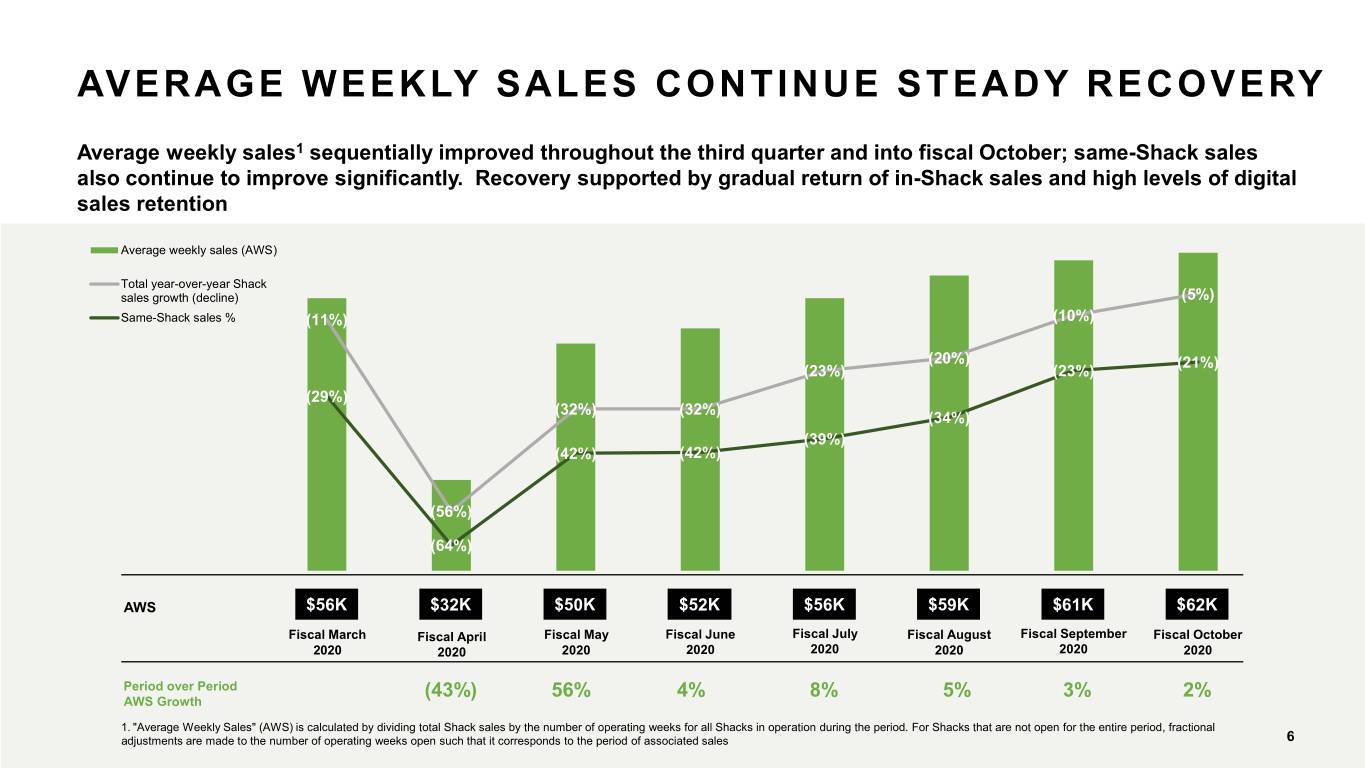
AVERAGE WEEKLY SALES CONTINUE STEADY RECOVERY Average weekly sales1 sequentially improved throughout the third quarter and into fiscal October; same-Shack sales also continue to improve significantly. Recovery supported by gradual return of in-Shack sales and high levels of digital sales retention Average weekly sales (AWS) Total year-over-year Shack sales growth (decline) (5%) Same-Shack sales % (11%) (10%) (20%) (21%) (23%) (23%) (29%) (32%) (32%) (34%) (39%) (42%) (42%) (56%) (64%) AWS $56K $32K $50K $52K $56K $59K $61K $62K Fiscal March Fiscal April Fiscal May Fiscal June Fiscal July Fiscal August Fiscal September Fiscal October 2020 2020 2020 2020 2020 2020 2020 2020 Period over Period (43%) 56% 4% 8% 5% 3% 2% AWS Growth 1. "Average Weekly Sales" (AWS) is calculated by dividing total Shack sales by the number of operating weeks for all Shacks in operation during the period. For Shacks that are not open forStrategic the entire period, Plan fractional Update adjustments are made to the number of operating weeks open such that it corresponds to the period of associated sales Board of Directors Meeting| Q1 2020 6
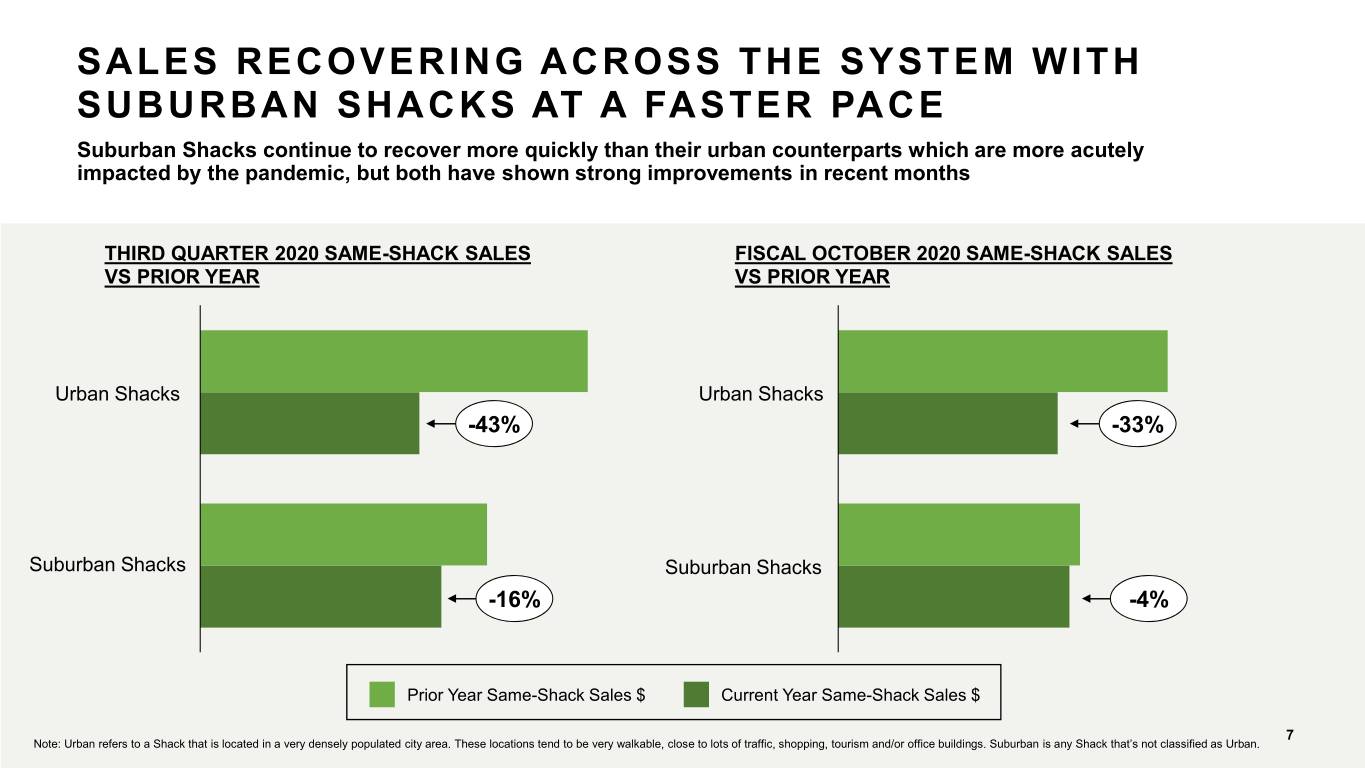
SALES RECOVERING ACROSS THE SYSTEM WITH SUBURBAN SHACKS AT A FASTER PACE Suburban Shacks continue to recover more quickly than their urban counterparts which are more acutely impacted by the pandemic, but both have shown strong improvements in recent months THIRD QUARTER 2020 SAME-SHACK SALES FISCAL OCTOBER 2020 SAME-SHACK SALES VS PRIOR YEAR VS PRIOR YEAR Urban Shacks Urban Shacks -43% -33% Suburban Shacks Suburban Shacks -16% -4% Prior Year Same-Shack Sales $ Current Year Same-Shack Sales $ Strategic Plan Update 7 Note: Urban refers to a Shack that is located in a very densely populated city area. These locations tend to be very walkable, close to lots of traffic, shopping, tourism and/or office buildings.Board Suburban of Directors is any Shack Meeting that’s not classified| Q1 as2020 Urban.
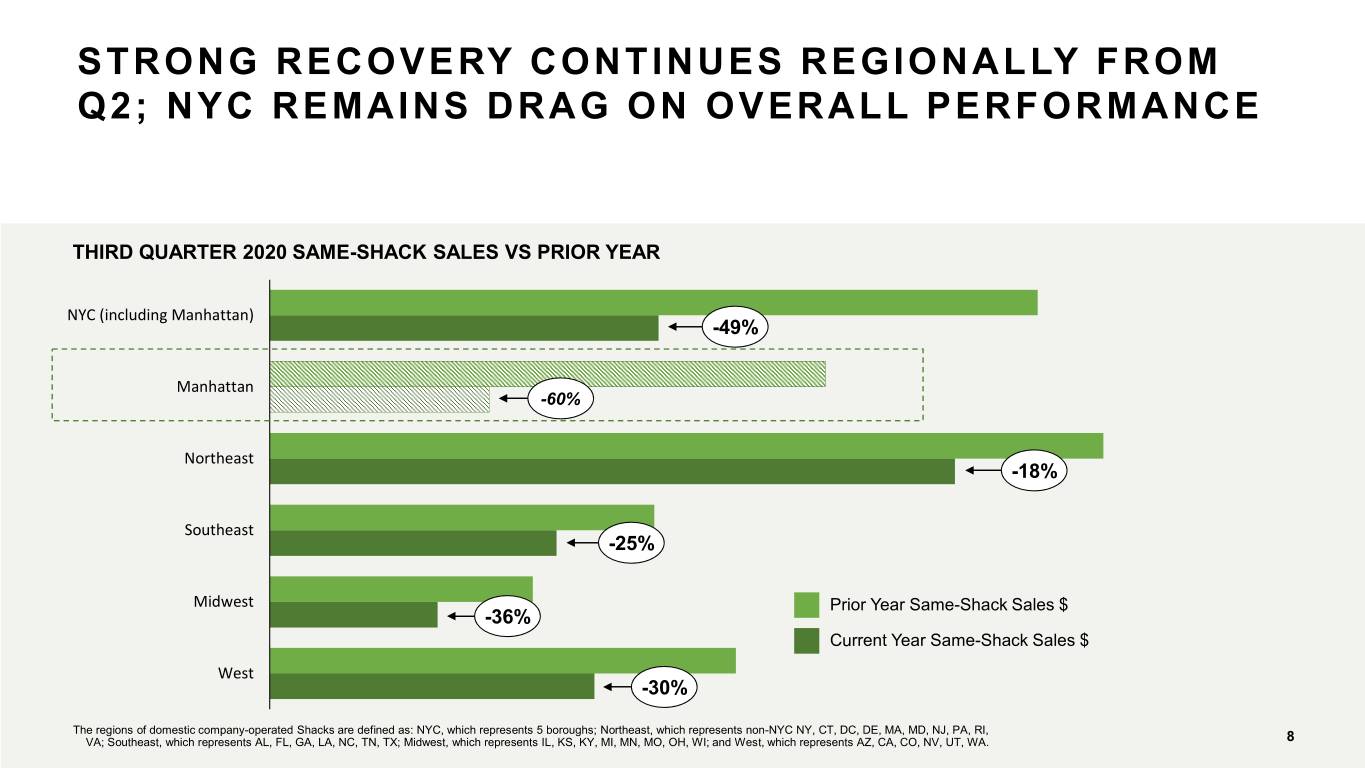
STRONG RECOVERY CONTINUES REGIONALLY FROM Q2; NYC REMAINS DRAG ON OVERALL PERFORMANCE THIRD QUARTER 2020 SAME-SHACK SALES VS PRIOR YEAR NYC (including Manhattan) -49% Manhattan -60% Northeast -18% Southeast -25% Midwest Prior Year Same-Shack Sales $ -36% Current Year Same-Shack Sales $ West -30% Strategic Plan Update The regions of domestic company-operated Shacks are defined as: NYC, which represents 5 boroughs; Northeast, which represents non-NYC NY, CT, DC, DE, MA, MD, NJ, PA, RI, VA; Southeast, which represents AL, FL, GA, LA, NC, TN, TX; Midwest, which represents IL, KS, KY, MI, MN, MO, OH, WI; and West, which represents AZ, CA, CO, NV, UT,Board WA. of Directors Meeting| Q1 2020 8
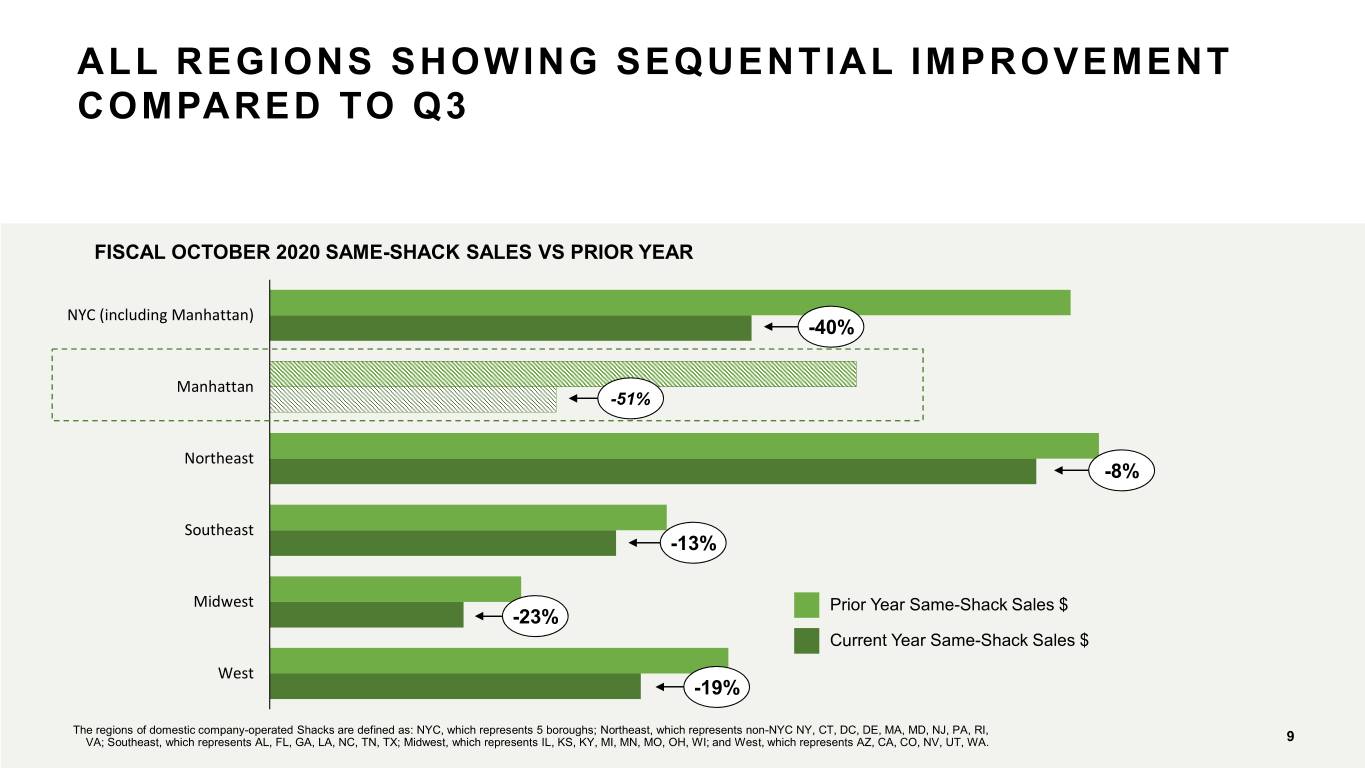
ALL REGIONS SHOWING SEQUENTIAL IMPROVEMENT COMPARED TO Q3 FISCAL OCTOBER 2020 SAME-SHACK SALES VS PRIOR YEAR NYC (including Manhattan) -40% Manhattan -51% Northeast -8% Southeast -13% Midwest Prior Year Same-Shack Sales $ -23% Current Year Same-Shack Sales $ West -19% Strategic Plan Update The regions of domestic company-operated Shacks are defined as: NYC, which represents 5 boroughs; Northeast, which represents non-NYC NY, CT, DC, DE, MA, MD, NJ, PA, RI, VA; Southeast, which represents AL, FL, GA, LA, NC, TN, TX; Midwest, which represents IL, KS, KY, MI, MN, MO, OH, WI; and West, which represents AZ, CA, CO, NV, UT,Board WA. of Directors Meeting| Q1 2020 9
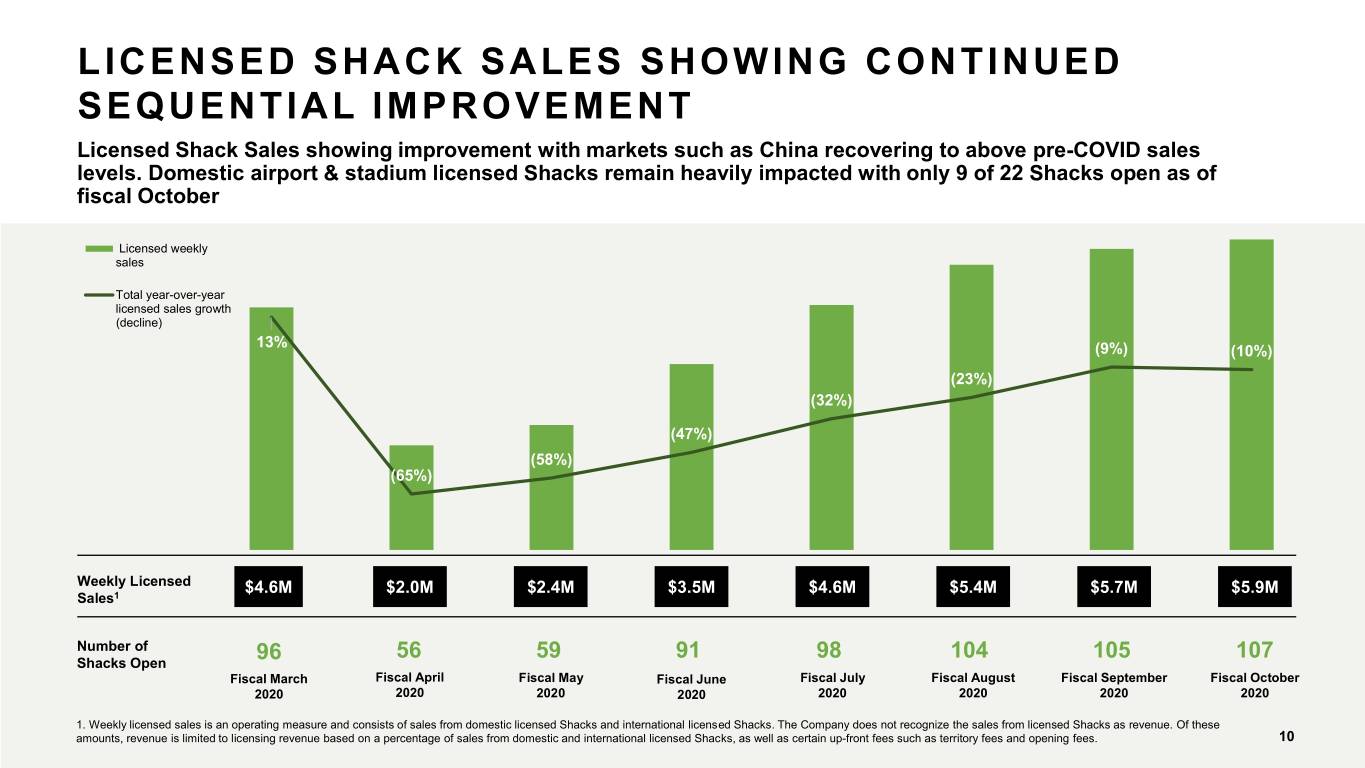
LICENSED SHACK SALES SHOWING CONTINUED SEQUENTIAL IMPROVEMENT Licensed Shack Sales showing improvement with markets such as China recovering to above pre-COVID sales levels. Domestic airport & stadium licensed Shacks remain heavily impacted with only 9 of 22 Shacks open as of fiscal October Licensed weekly sales Total year-over-year licensed sales growth (decline) 13% (9%) (10%) (23%) (32%) (47%) (58%) (65%) Weekly Licensed $4.6M $2.0M $2.4M $3.5M $4.6M $5.4M $5.7M $5.9M Sales1 Number of 56 59 91 98 104 105 107 Shacks Open 96 Fiscal March Fiscal April Fiscal May Fiscal June Fiscal July Fiscal August Fiscal September Fiscal October 2020 2020 2020 2020 2020 2020 2020 2020 1. Weekly licensed sales is an operating measure and consists of sales from domestic licensed Shacks and international licensed Shacks. The Company does not recognize the sales from licensed StrategicShacks as revenue. Plan Of Updatethese amounts, revenue is limited to licensing revenue based on a percentage of sales from domestic and international licensed Shacks, as well as certain up-front fees such as territoryBoard fees of and Directors opening fees. Meeting| Q1 2020 10
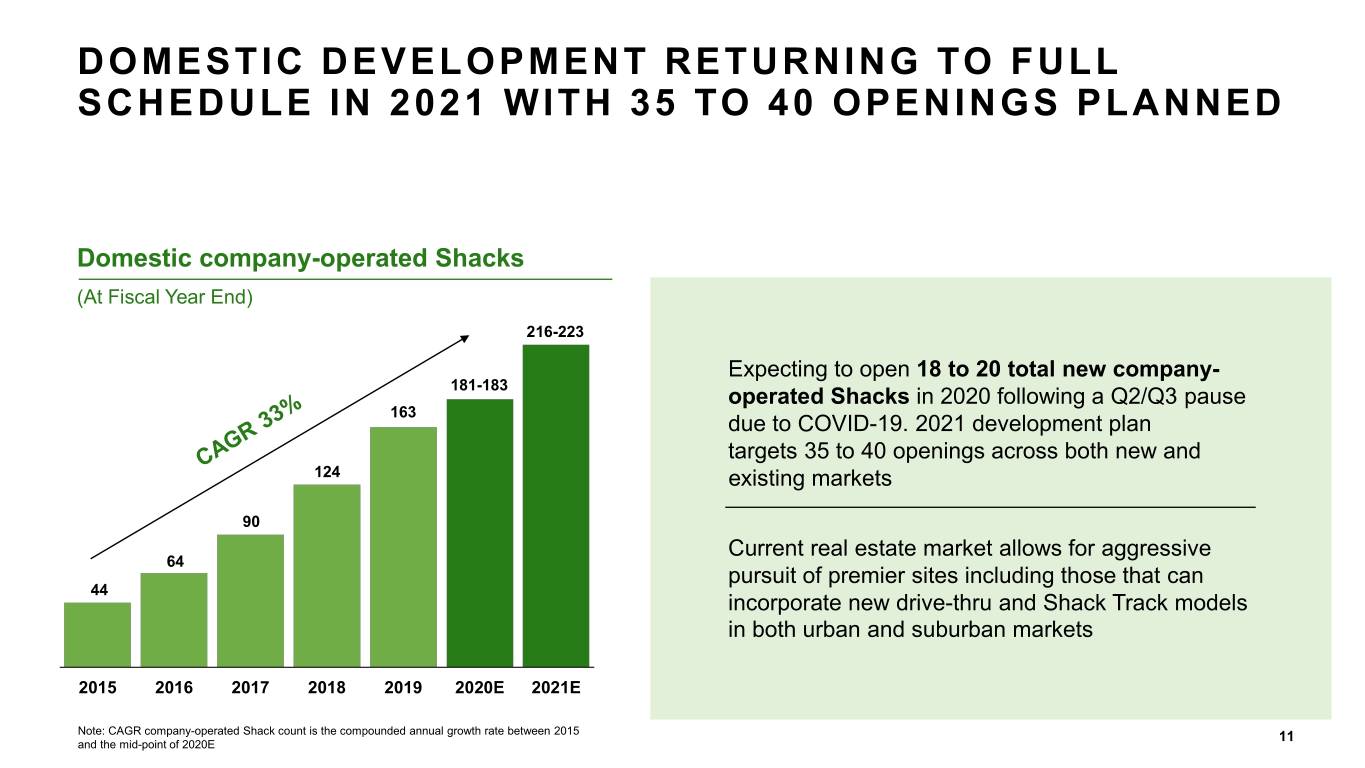
DOMESTIC DEVELOPMENT RETURNING TO FULL SCHEDULE IN 2021 WITH 35 TO 40 OPENINGS PLANNED Domestic company-operated Shacks (At Fiscal Year End) 216-223 Expecting to open 18 to 20 total new company- 181-183 operated Shacks in 2020 following a Q2/Q3 pause 163 due to COVID-19. 2021 development plan targets 35 to 40 openings across both new and 124 existing markets 90 Current real estate market allows for aggressive 64 pursuit of premier sites including those that can 44 incorporate new drive-thru and Shack Track models in both urban and suburban markets 2015 2016 2017 2018 2019 2020E 2021E Note: CAGR company-operated Shack count is the compounded annual growth rate between 2015 and the mid-point of 2020E 11
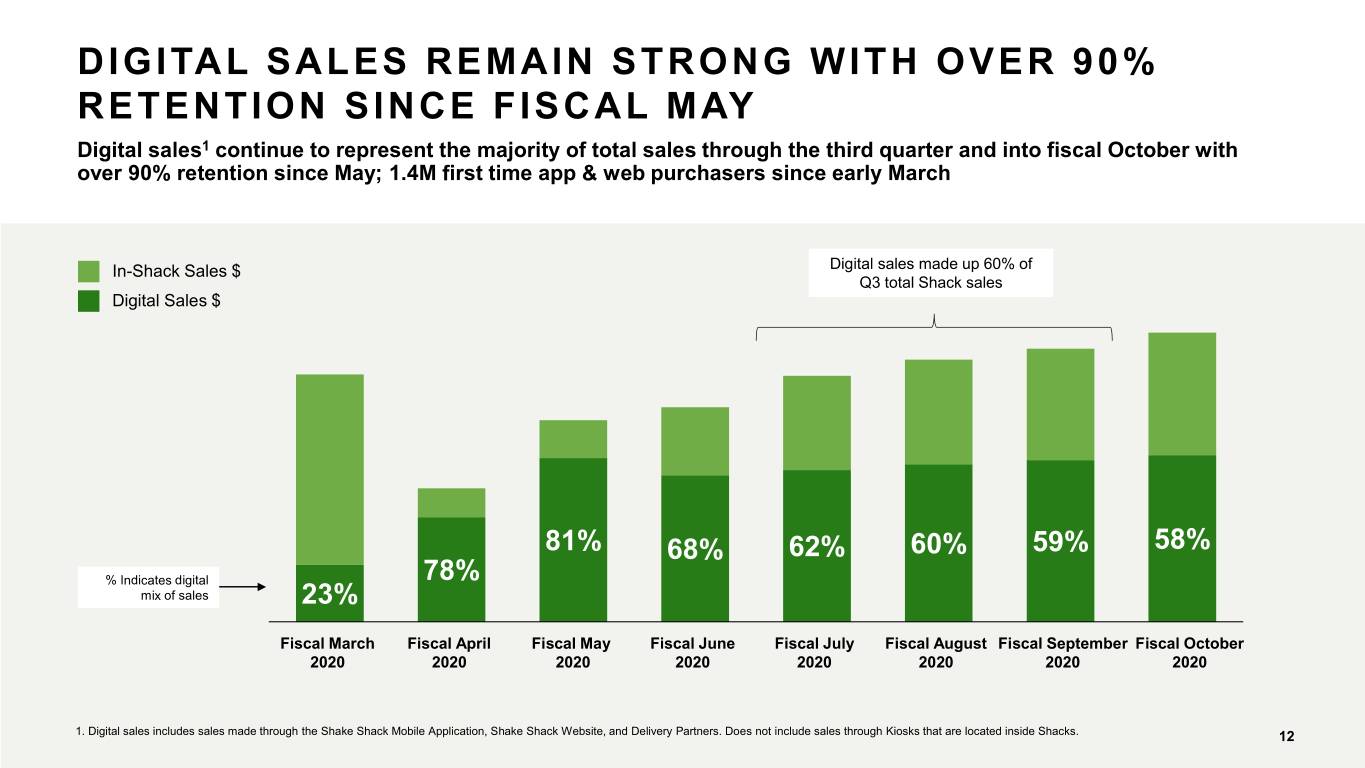
DIGITAL SALES REMAIN STRONG WITH OVER 90% RETENTION SINCE FISCAL MAY Digital sales1 continue to represent the majority of total sales through the third quarter and into fiscal October with over 90% retention since May; 1.4M first time app & web purchasers since early March In-Shack Sales $ Digital sales made up 60% of Q3 total Shack sales Digital Sales $ 81% 68% 62% 60% 59% 58% % Indicates digital 78% mix of sales 23% Fiscal March Fiscal April Fiscal May Fiscal June Fiscal July Fiscal August Fiscal September Fiscal October 2020 2020 2020 2020 2020 2020 2020 2020 Strategic Plan Update 1. Digital sales includes sales made through the Shake Shack Mobile Application, Shake Shack Website, and Delivery Partners. Does not include sales through Kiosks that are located inside Shacks. Board of Directors Meeting| Q1 2020 12
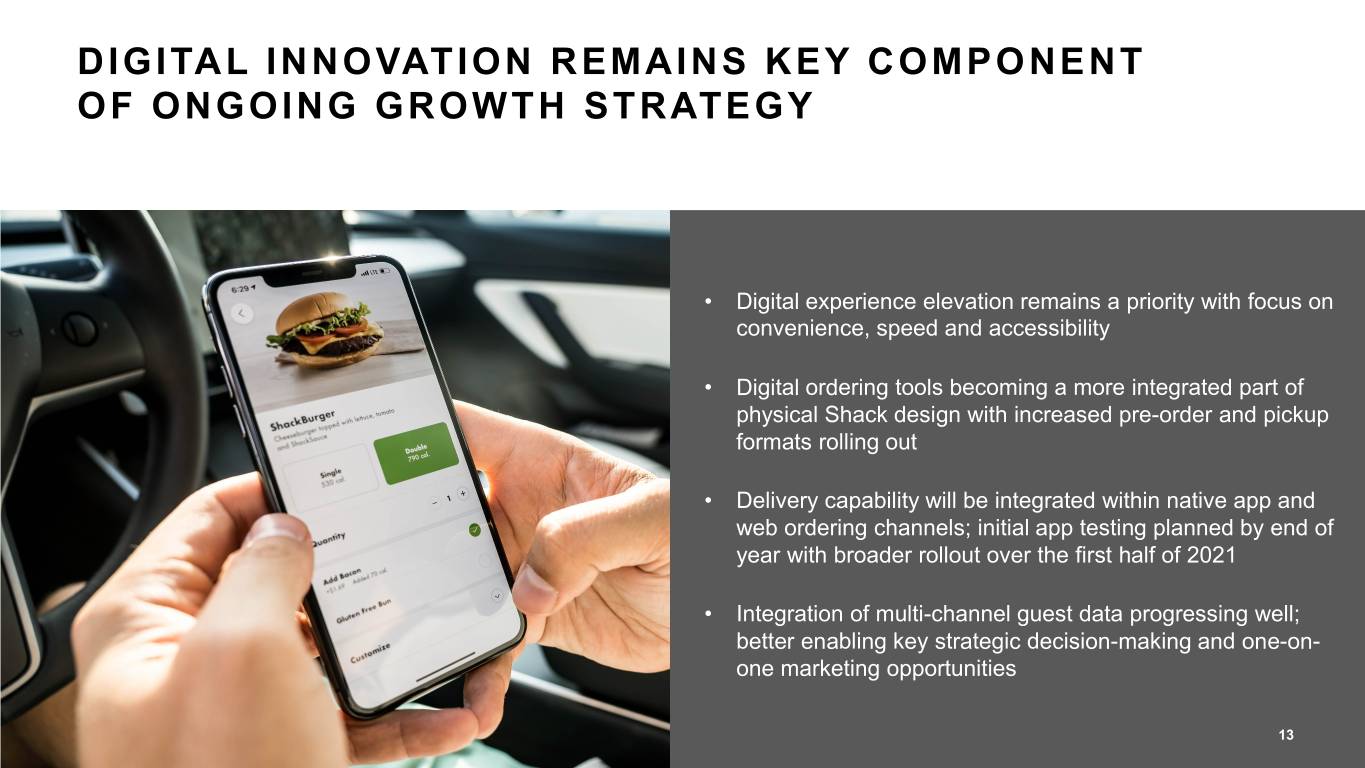
DIGITAL INNOVATION REMAINS KEY COMPONENT OF ONGOING GROWTH STRATEGY • Digital experience elevation remains a priority with focus on convenience, speed and accessibility • Digital ordering tools becoming a more integrated part of physical Shack design with increased pre-order and pickup formats rolling out • Delivery capability will be integrated within native app and web ordering channels; initial app testing planned by end of year with broader rollout over the first half of 2021 • Integration of multi-channel guest data progressing well; better enabling key strategic decision-making and one-on- one marketing opportunities Strategic Plan Update Board of Directors Meeting| Q1 2020 13
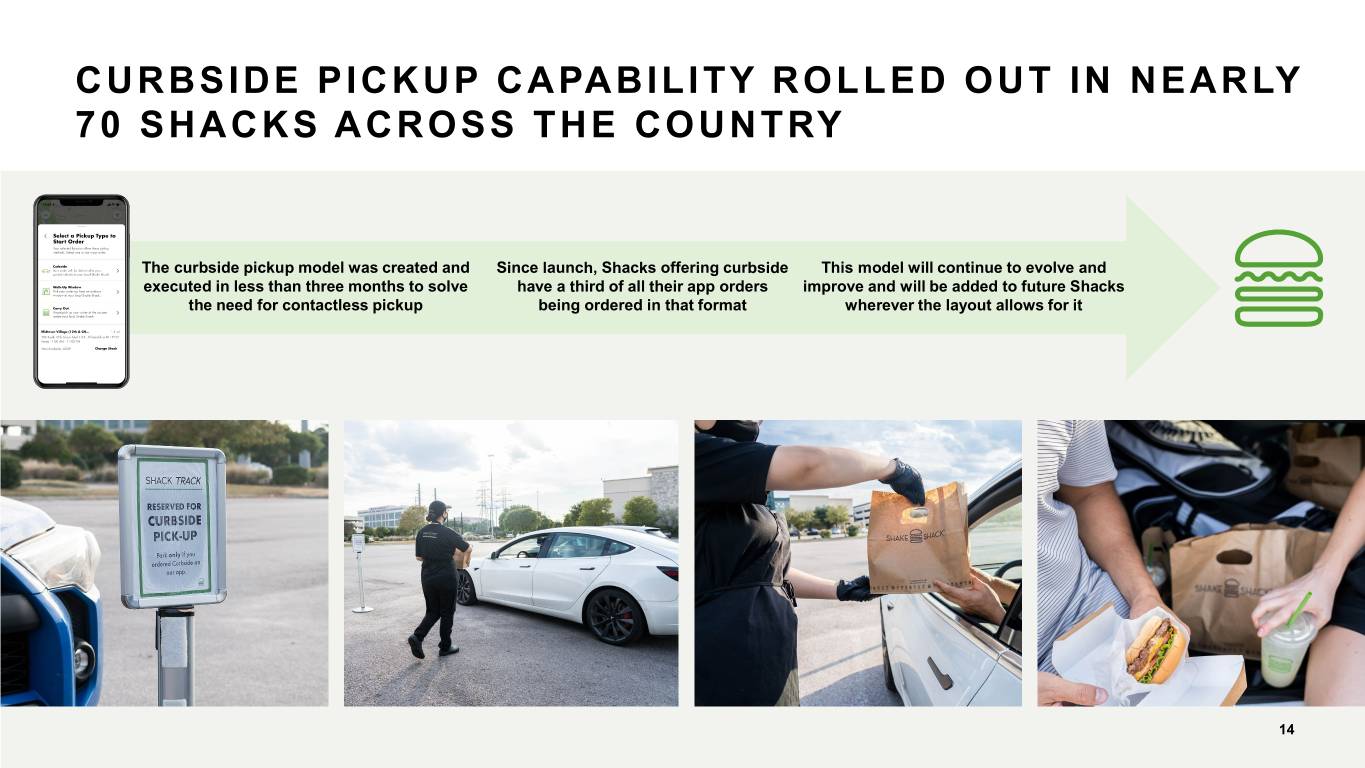
CURBSIDE PICKUP CAPABILITY ROLLED OUT IN NEARLY 70 SHACKS ACROSS THE COUNTRY The curbside pickup model was created and Since launch, Shacks offering curbside This model will continue to evolve and executed in less than three months to solve have a third of all their app orders improve and will be added to future Shacks the need for contactless pickup being ordered in that format wherever the layout allows for it Strategic Plan Update 14 Board of Directors Meeting| Q1 2020
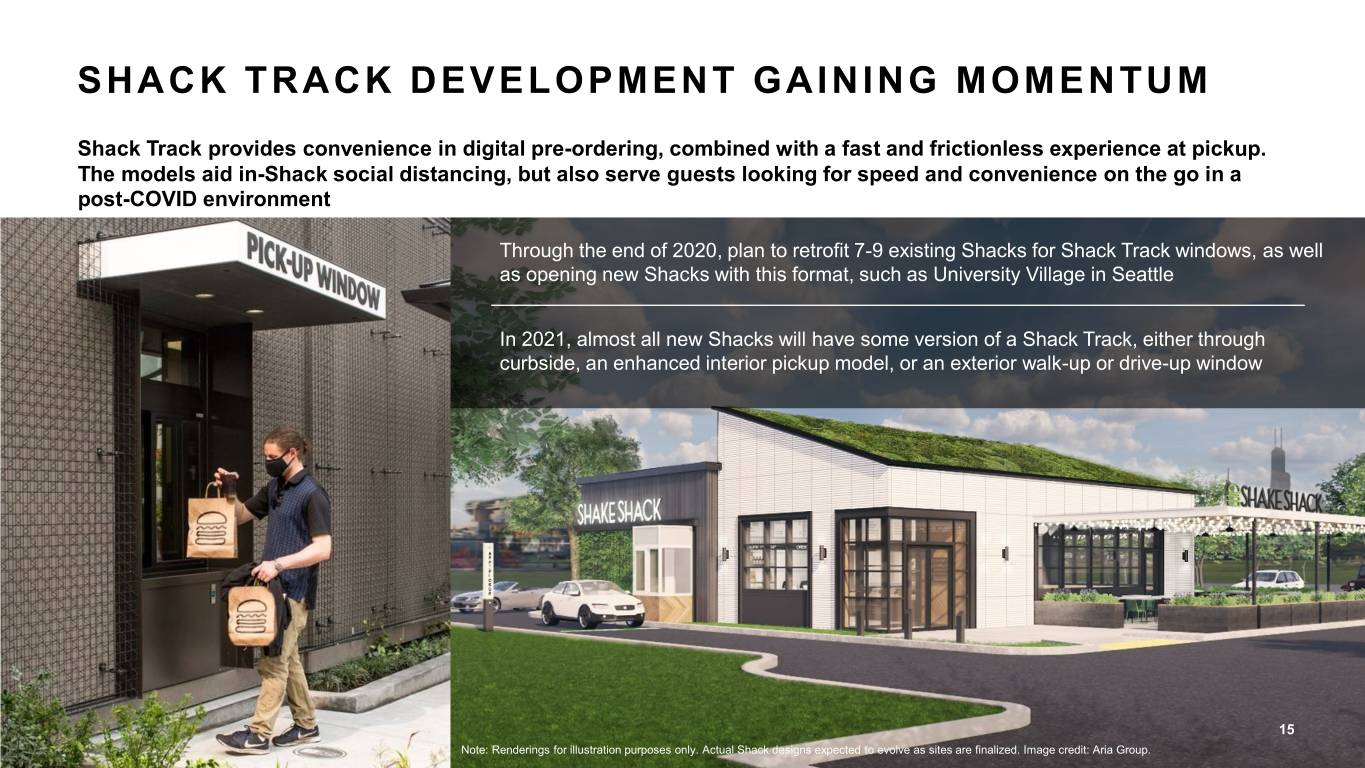
SHACK TRACK DEVELOPMENT GAINING MOMENTUM Shack Track provides convenience in digital pre-ordering, combined with a fast and frictionless experience at pickup. The models aid in-Shack social distancing, but also serve guests looking for speed and convenience on the go in a post-COVID environment Through the end of 2020, plan to retrofit 7-9 existing Shacks for Shack Track windows, as well as opening new Shacks with this format, such as University Village in Seattle In 2021, almost all new Shacks will have some version of a Shack Track, either through curbside, an enhanced interior pickup model, or an exterior walk-up or drive-up window Strategic Plan Update 15 Note: Renderings for illustration purposes only. Actual Shack designs expected to evolve as sitesBoard are finalized. of DirectorsImage credit: Aria Meeting Group. | Q1 2020
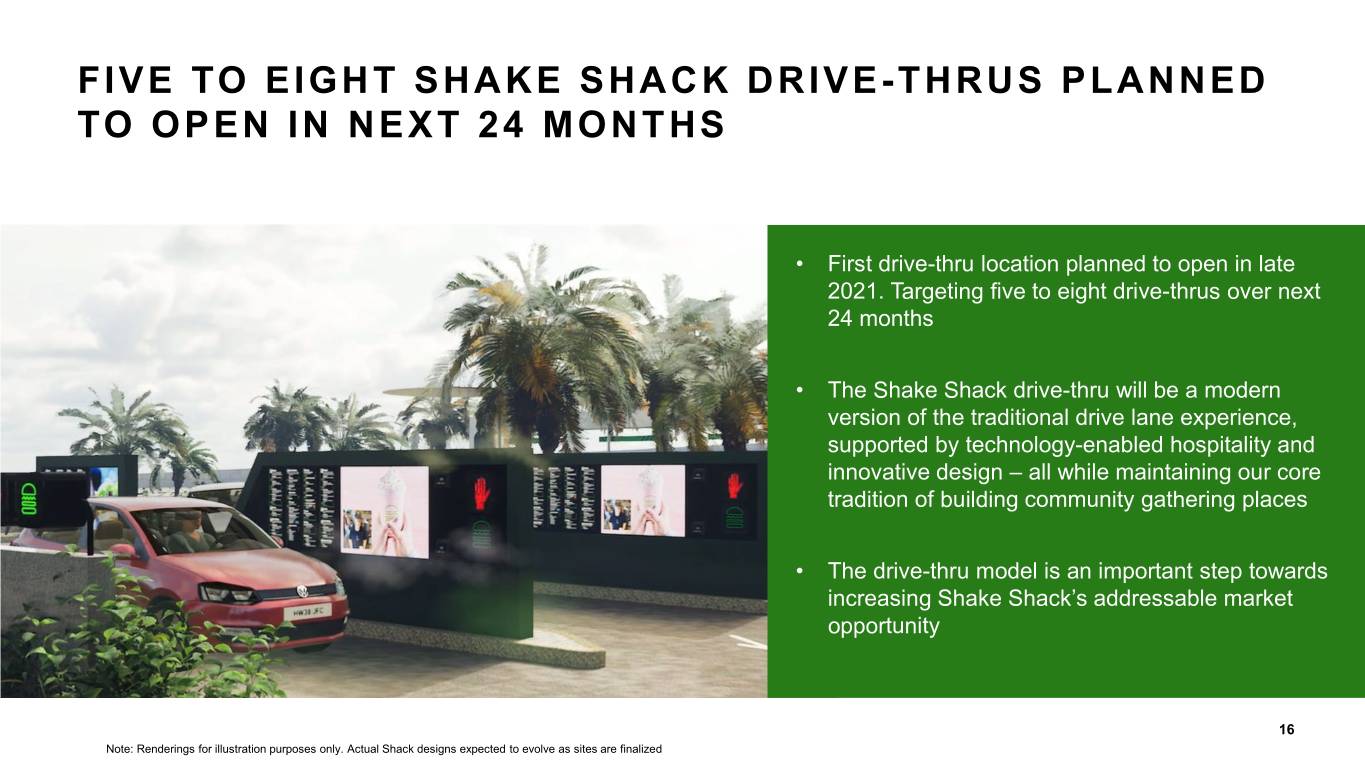
FIVE TO EIGHT SHAKE SHACK DRIVE-THRUS PLANNED TO OPEN IN NEXT 24 MONTHS • First drive-thru location planned to open in late 2021. Targeting five to eight drive-thrus over next 24 months • The Shake Shack drive-thru will be a modern version of the traditional drive lane experience, supported by technology-enabled hospitality and innovative design – all while maintaining our core tradition of building community gathering places • The drive-thru model is an important step towards increasing Shake Shack’s addressable market opportunity Strategic Plan Update 16 Note: Renderings for illustration purposes only. Actual Shack designs expected to evolve as sites are finalized Board of Directors Meeting| Q1 2020
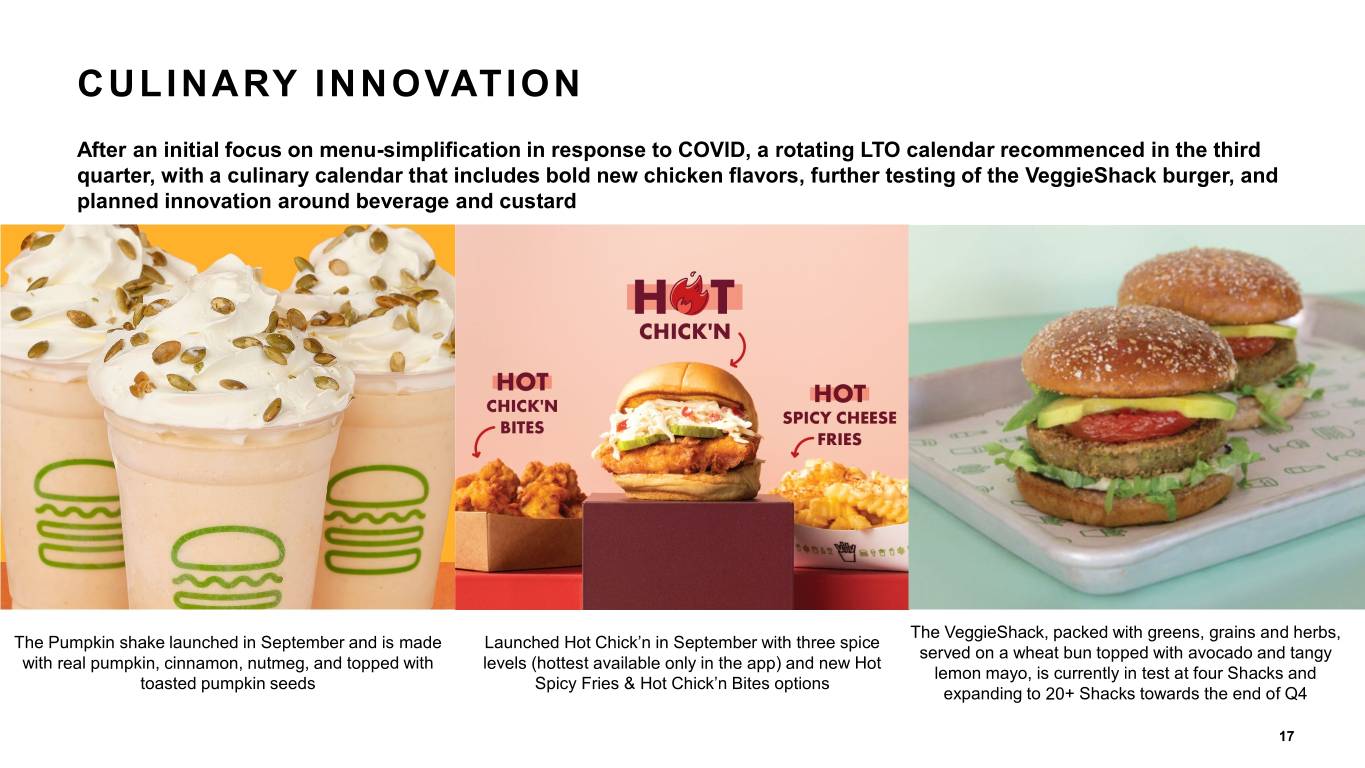
CULINARY INNOVATION After an initial focus on menu-simplification in response to COVID, a rotating LTO calendar recommenced in the third quarter, with a culinary calendar that includes bold new chicken flavors, further testing of the VeggieShack burger, and planned innovation around beverage and custard The VeggieShack, packed with greens, grains and herbs, The Pumpkin shake launched in September and is made Launched Hot Chick’n in September with three spice served on a wheat bun topped with avocado and tangy with real pumpkin, cinnamon, nutmeg, and topped with levels (hottest available only in the app) and new Hot lemon mayo, is currently in test at four Shacks and toasted pumpkin seeds Spicy Fries & Hot Chick’n Bites options expanding to 20+ Shacks towards the end of Q4 Strategic Plan Update Board of Directors Meeting| Q1 2020 17

FINANCIAL DETAILS Strategic Plan Update Board of Directors Meeting| Q1 2020
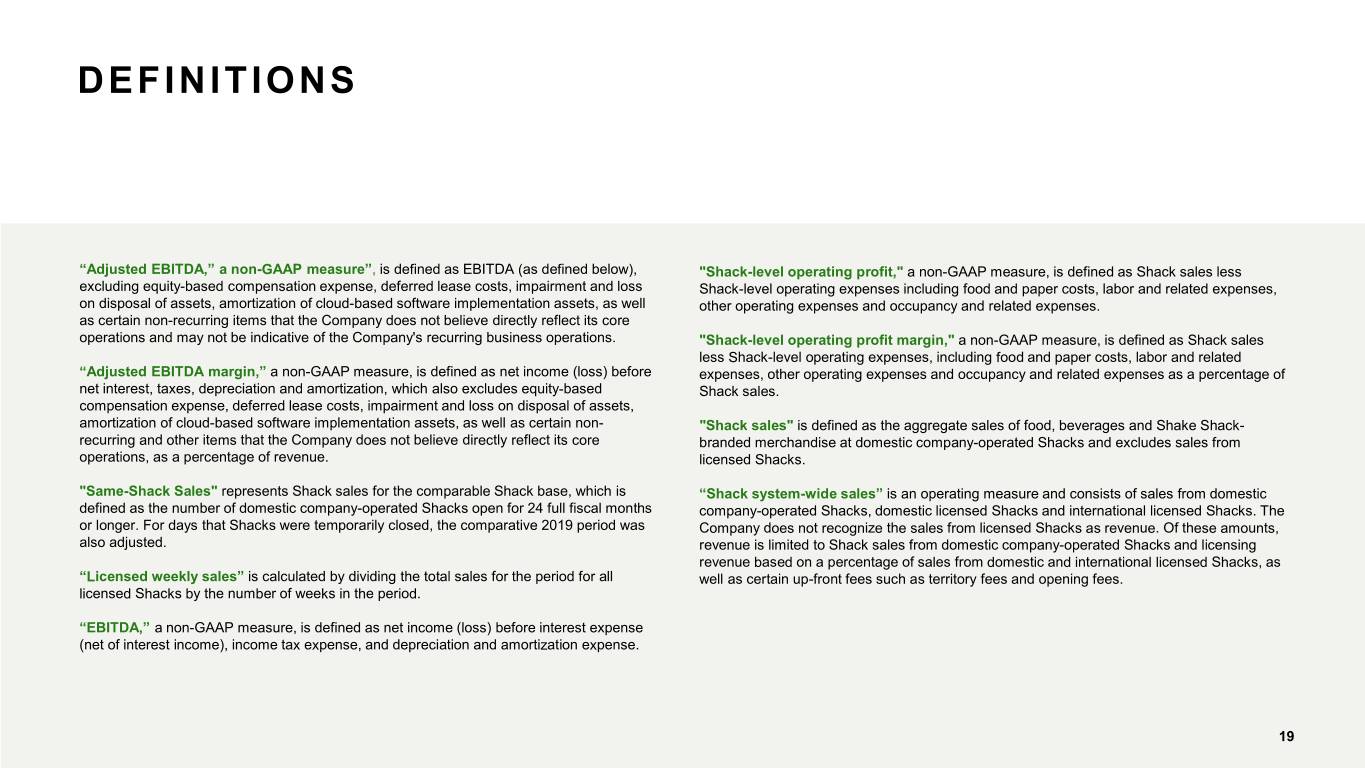
DEFINITIONS “Adjusted EBITDA,” a non-GAAP measure”, is defined as EBITDA (as defined below), "Shack-level operating profit," a non-GAAP measure, is defined as Shack sales less excluding equity-based compensation expense, deferred lease costs, impairment and loss Shack-level operating expenses including food and paper costs, labor and related expenses, on disposal of assets, amortization of cloud-based software implementation assets, as well other operating expenses and occupancy and related expenses. as certain non-recurring items that the Company does not believe directly reflect its core operations and may not be indicative of the Company's recurring business operations. "Shack-level operating profit margin," a non-GAAP measure, is defined as Shack sales less Shack-level operating expenses, including food and paper costs, labor and related “Adjusted EBITDA margin,” a non-GAAP measure, is defined as net income (loss) before expenses, other operating expenses and occupancy and related expenses as a percentage of net interest, taxes, depreciation and amortization, which also excludes equity-based Shack sales. compensation expense, deferred lease costs, impairment and loss on disposal of assets, amortization of cloud-based software implementation assets, as well as certain non- "Shack sales" is defined as the aggregate sales of food, beverages and Shake Shack- recurring and other items that the Company does not believe directly reflect its core branded merchandise at domestic company-operated Shacks and excludes sales from operations, as a percentage of revenue. licensed Shacks. "Same-Shack Sales" represents Shack sales for the comparable Shack base, which is “Shack system-wide sales” is an operating measure and consists of sales from domestic defined as the number of domestic company-operated Shacks open for 24 full fiscal months company-operated Shacks, domestic licensed Shacks and international licensed Shacks. The or longer. For days that Shacks were temporarily closed, the comparative 2019 period was Company does not recognize the sales from licensed Shacks as revenue. Of these amounts, also adjusted. revenue is limited to Shack sales from domestic company-operated Shacks and licensing revenue based on a percentage of sales from domestic and international licensed Shacks, as “Licensed weekly sales” is calculated by dividing the total sales for the period for all well as certain up-front fees such as territory fees and opening fees. licensed Shacks by the number of weeks in the period. “EBITDA,” a non-GAAP measure, is defined as net income (loss) before interest expense (net of interest income), income tax expense, and depreciation and amortization expense. Strategic Plan Update Board of Directors Meeting| Q1 2020 19
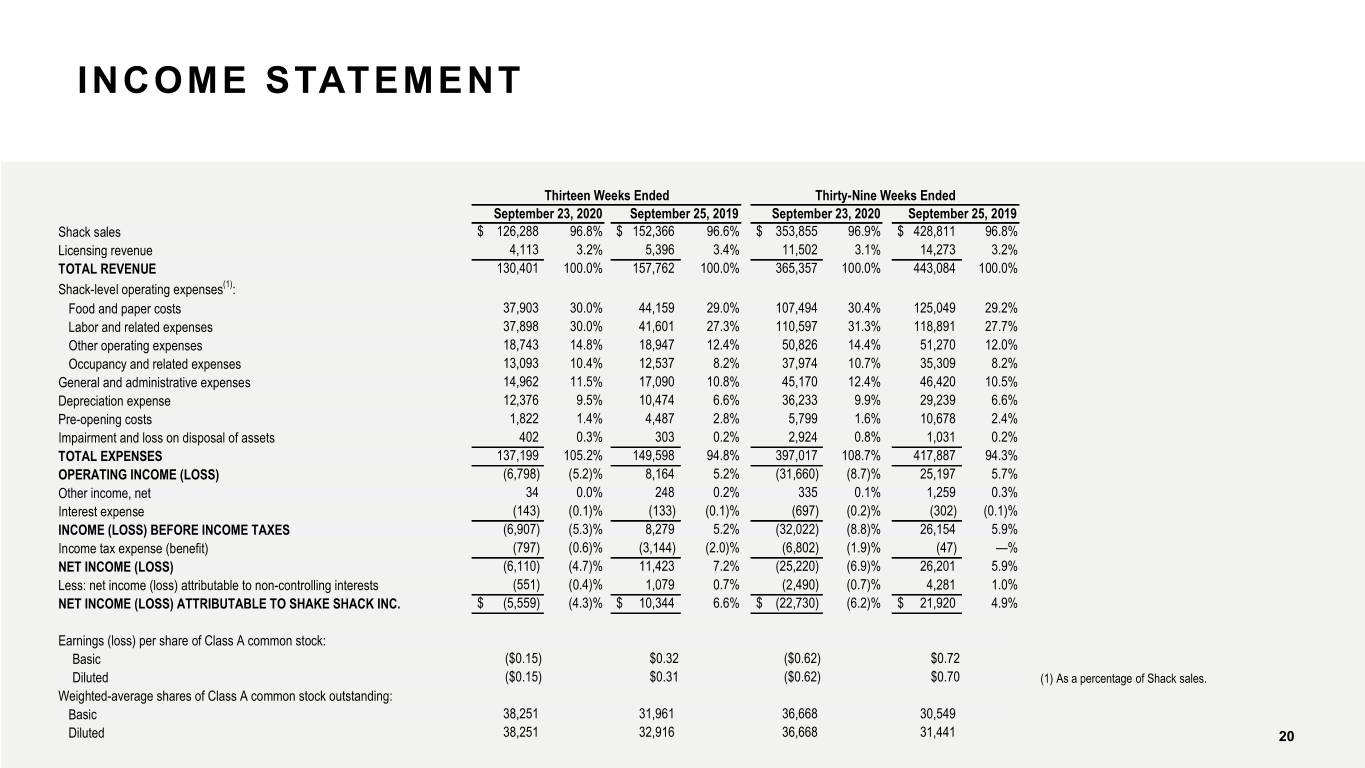
INCOME STATEMENT Thirteen Weeks Ended Thirty-Nine Weeks Ended September 23, 2020 September 25, 2019 September 23, 2020 September 25, 2019 Shack sales $ 126,288 96.8% $ 152,366 96.6% $ 353,855 96.9% $ 428,811 96.8% Licensing revenue 4,113 3.2% 5,396 3.4% 11,502 3.1% 14,273 3.2% TOTAL REVENUE 130,401 100.0% 157,762 100.0% 365,357 100.0% 443,084 100.0% Shack-level operating expenses(1): Food and paper costs 37,903 30.0% 44,159 29.0% 107,494 30.4% 125,049 29.2% Labor and related expenses 37,898 30.0% 41,601 27.3% 110,597 31.3% 118,891 27.7% Other operating expenses 18,743 14.8% 18,947 12.4% 50,826 14.4% 51,270 12.0% Occupancy and related expenses 13,093 10.4% 12,537 8.2% 37,974 10.7% 35,309 8.2% General and administrative expenses 14,962 11.5% 17,090 10.8% 45,170 12.4% 46,420 10.5% Depreciation expense 12,376 9.5% 10,474 6.6% 36,233 9.9% 29,239 6.6% Pre-opening costs 1,822 1.4% 4,487 2.8% 5,799 1.6% 10,678 2.4% Impairment and loss on disposal of assets 402 0.3% 303 0.2% 2,924 0.8% 1,031 0.2% TOTAL EXPENSES 137,199 105.2% 149,598 94.8% 397,017 108.7% 417,887 94.3% OPERATING INCOME (LOSS) (6,798) (5.2)% 8,164 5.2% (31,660) (8.7)% 25,197 5.7% Other income, net 34 0.0% 248 0.2% 335 0.1% 1,259 0.3% Interest expense (143) (0.1)% (133) (0.1)% (697) (0.2)% (302) (0.1)% INCOME (LOSS) BEFORE INCOME TAXES (6,907) (5.3)% 8,279 5.2% (32,022) (8.8)% 26,154 5.9% Income tax expense (benefit) (797) (0.6)% (3,144) (2.0)% (6,802) (1.9)% (47) —% NET INCOME (LOSS) (6,110) (4.7)% 11,423 7.2% (25,220) (6.9)% 26,201 5.9% Less: net income (loss) attributable to non-controlling interests (551) (0.4)% 1,079 0.7% (2,490) (0.7)% 4,281 1.0% NET INCOME (LOSS) ATTRIBUTABLE TO SHAKE SHACK INC. $ (5,559) (4.3)% $ 10,344 6.6% $ (22,730) (6.2)% $ 21,920 4.9% Earnings (loss) per share of Class A common stock: Basic ($0.15) $0.32 ($0.62) $0.72 Diluted ($0.15) $0.31 ($0.62) $0.70 (1) As a percentage of Shack sales. Weighted-average shares of Class A common stock outstanding: Basic 38,251 31,961 36,668 30,549 Strategic Plan Update Diluted 38,251 32,916 36,668 31,441 Board of Directors Meeting| Q1 2020 20
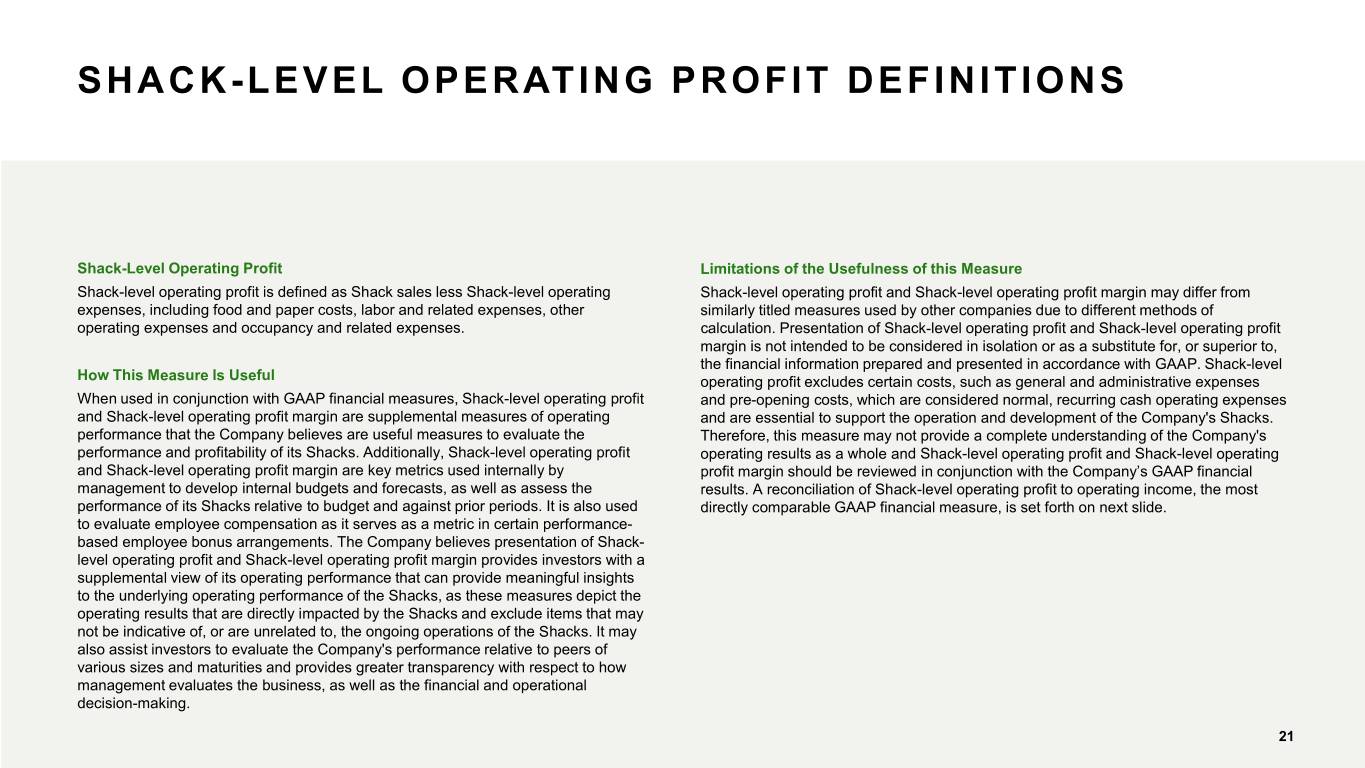
SHACK-LEVEL OPERATING PROFIT DEFINITIONS Shack-Level Operating Profit Limitations of the Usefulness of this Measure Shack-level operating profit is defined as Shack sales less Shack-level operating Shack-level operating profit and Shack-level operating profit margin may differ from expenses, including food and paper costs, labor and related expenses, other similarly titled measures used by other companies due to different methods of operating expenses and occupancy and related expenses. calculation. Presentation of Shack-level operating profit and Shack-level operating profit margin is not intended to be considered in isolation or as a substitute for, or superior to, the financial information prepared and presented in accordance with GAAP. Shack-level How This Measure Is Useful operating profit excludes certain costs, such as general and administrative expenses When used in conjunction with GAAP financial measures, Shack-level operating profit and pre-opening costs, which are considered normal, recurring cash operating expenses and Shack-level operating profit margin are supplemental measures of operating and are essential to support the operation and development of the Company's Shacks. performance that the Company believes are useful measures to evaluate the Therefore, this measure may not provide a complete understanding of the Company's performance and profitability of its Shacks. Additionally, Shack-level operating profit operating results as a whole and Shack-level operating profit and Shack-level operating and Shack-level operating profit margin are key metrics used internally by profit margin should be reviewed in conjunction with the Company’s GAAP financial management to develop internal budgets and forecasts, as well as assess the results. A reconciliation of Shack-level operating profit to operating income, the most performance of its Shacks relative to budget and against prior periods. It is also used directly comparable GAAP financial measure, is set forth on next slide. to evaluate employee compensation as it serves as a metric in certain performance- based employee bonus arrangements. The Company believes presentation of Shack- level operating profit and Shack-level operating profit margin provides investors with a supplemental view of its operating performance that can provide meaningful insights to the underlying operating performance of the Shacks, as these measures depict the operating results that are directly impacted by the Shacks and exclude items that may not be indicative of, or are unrelated to, the ongoing operations of the Shacks. It may also assist investors to evaluate the Company's performance relative to peers of various sizes and maturities and provides greater transparency with respect to how management evaluates the business, as well as the financial and operational decision-making. Strategic Plan Update Board of Directors Meeting| Q1 2020 21
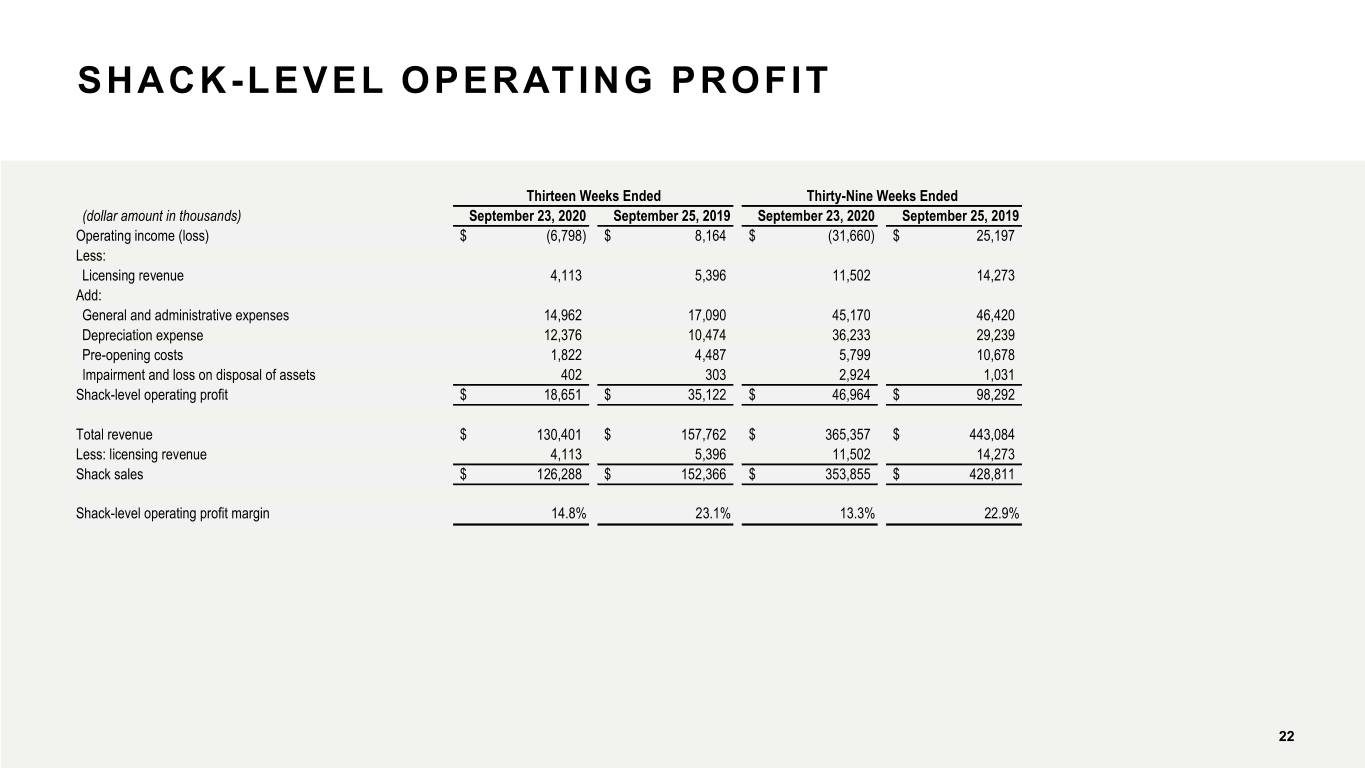
SHACK-LEVEL OPERATING PROFIT Thirteen Weeks Ended Thirty-Nine Weeks Ended (dollar amount in thousands) September 23, 2020 September 25, 2019 September 23, 2020 September 25, 2019 Operating income (loss) $ (6,798) $ 8,164 $ (31,660) $ 25,197 Less: Licensing revenue 4,113 5,396 11,502 14,273 Add: General and administrative expenses 14,962 17,090 45,170 46,420 Depreciation expense 12,376 10,474 36,233 29,239 Pre-opening costs 1,822 4,487 5,799 10,678 Impairment and loss on disposal of assets 402 303 2,924 1,031 Shack-level operating profit $ 18,651 $ 35,122 $ 46,964 $ 98,292 Total revenue $ 130,401 $ 157,762 $ 365,357 $ 443,084 Less: licensing revenue 4,113 5,396 11,502 14,273 Shack sales $ 126,288 $ 152,366 $ 353,855 $ 428,811 Shack-level operating profit margin 14.8% 23.1% 13.3% 22.9% Strategic Plan Update Board of Directors Meeting| Q1 2020 22
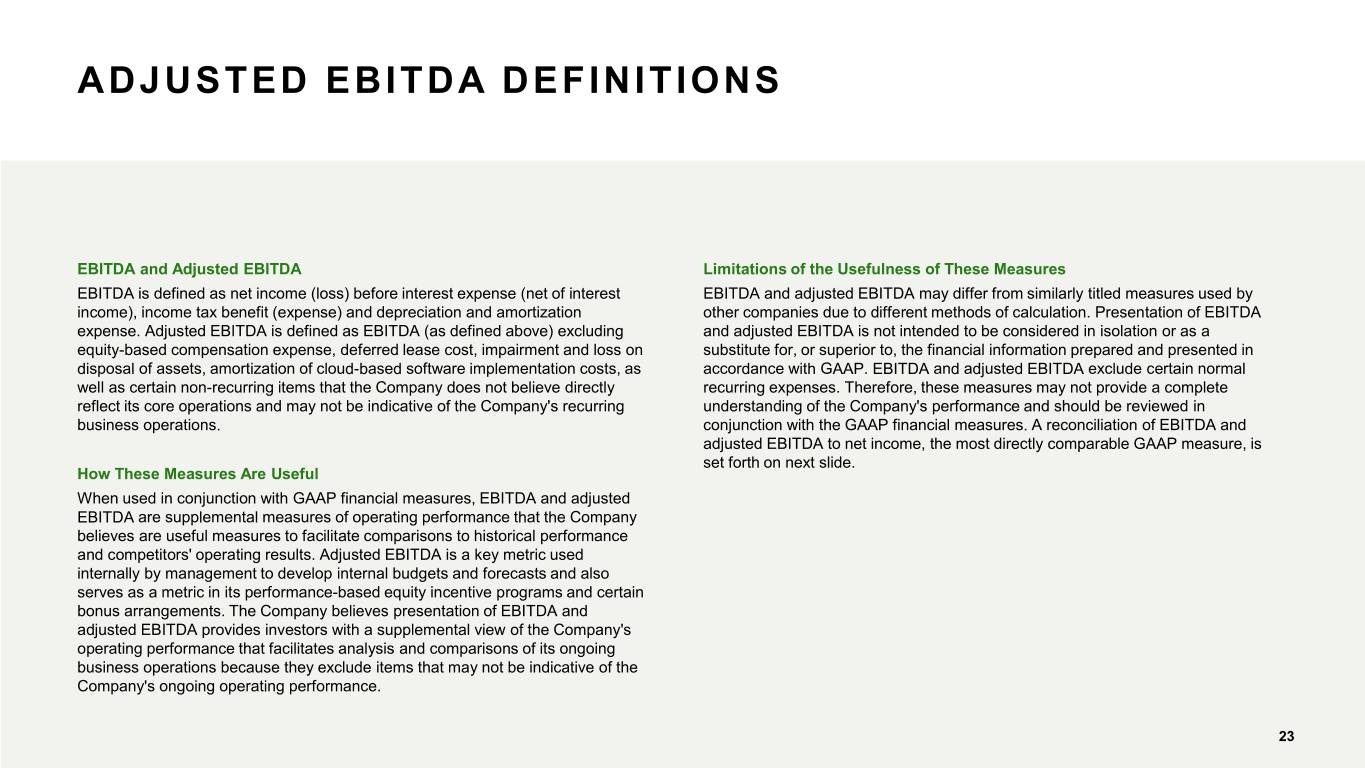
ADJUSTED EBITDA DEFINITIONS EBITDA and Adjusted EBITDA Limitations of the Usefulness of These Measures EBITDA is defined as net income (loss) before interest expense (net of interest EBITDA and adjusted EBITDA may differ from similarly titled measures used by income), income tax benefit (expense) and depreciation and amortization other companies due to different methods of calculation. Presentation of EBITDA expense. Adjusted EBITDA is defined as EBITDA (as defined above) excluding and adjusted EBITDA is not intended to be considered in isolation or as a equity-based compensation expense, deferred lease cost, impairment and loss on substitute for, or superior to, the financial information prepared and presented in disposal of assets, amortization of cloud-based software implementation costs, as accordance with GAAP. EBITDA and adjusted EBITDA exclude certain normal well as certain non-recurring items that the Company does not believe directly recurring expenses. Therefore, these measures may not provide a complete reflect its core operations and may not be indicative of the Company's recurring understanding of the Company's performance and should be reviewed in business operations. conjunction with the GAAP financial measures. A reconciliation of EBITDA and adjusted EBITDA to net income, the most directly comparable GAAP measure, is set forth on next slide. How These Measures Are Useful When used in conjunction with GAAP financial measures, EBITDA and adjusted EBITDA are supplemental measures of operating performance that the Company believes are useful measures to facilitate comparisons to historical performance and competitors' operating results. Adjusted EBITDA is a key metric used internally by management to develop internal budgets and forecasts and also serves as a metric in its performance-based equity incentive programs and certain bonus arrangements. The Company believes presentation of EBITDA and adjusted EBITDA provides investors with a supplemental view of the Company's operating performance that facilitates analysis and comparisons of its ongoing business operations because they exclude items that may not be indicative of the Company's ongoing operating performance. Strategic Plan Update Board of Directors Meeting| Q1 2020 23

ADJUSTED EBITDA Thirteen Weeks Ended Thirty-Nine Weeks Ended (1) Represents amortization of capitalized implementation (dollar amounts in thousands) September 23, 2020 September 25, 2019 September 23, 2020 September 25, 2019 costs related to cloud-based software arrangements Net income (loss) $ (6,110) $ 11,423 $ (25,220) $ 26,201 that are included within General and Administrative Depreciation expense 12,376 10,474 36,233 29,239 expenses. Interest expense, net 143 133 697 302 (2) Reflects the extent to which lease expense is greater Income tax benefit (797) (3,144) (6,802) (47) than or less than contractual fixed base rent. EBITDA 5,612 18,886 4,908 55,695 (3) For the thirty-nine weeks ended September 23, 2020, this amount includes a non-cash impairment charge of Equity-based compensation 1,339 1,884 4,058 5,839 $1.1 million related to one Shack. (1) Amortization of cloud-based software implementation costs 458 107 1,086 107 (4) Represents fees paid in connection with the search Deferred lease costs(2) 258 743 407 2,043 and hiring of certain executive and key management Impairment and loss on disposal of assets(3) 402 303 2,924 1,031 positions. Other income related to adjustment of liabilities under tax receivable agreement — — — (14) (5) Represents consulting and advisory fees related to Executive transition costs(4) 82 — 150 126 the Company's enterprise-wide system upgrade initiative called Project Concrete. Project Concrete(5) 8 1,346 (229) 2,031 (6) (6) Represents costs associated with establishing the Hong Kong Office — 13 — 184 Company's first international office in Hong Kong. (7) Other — — 285 — (7) Represents incremental expenses incurred related to Adjusted EBITDA $ 8,159 $ 23,282 $ 13,589 $ 67,042 an inventory adjustment and certain employee-related expenses. (8) Adjusted EBITDA margin 6.3% 14.8% 3.7% 15.1% (8) Calculated as a percentage of total revenue, which was $130,401 and $365,357 for the thirteen and thirty- nine weeks ended September 23, 2020, respectively, and $157,762 and $443,084 for the thirteen and thirty- nine weeks ended September 25, 2019, respectively. Strategic Plan Update Board of Directors Meeting| Q1 2020 24
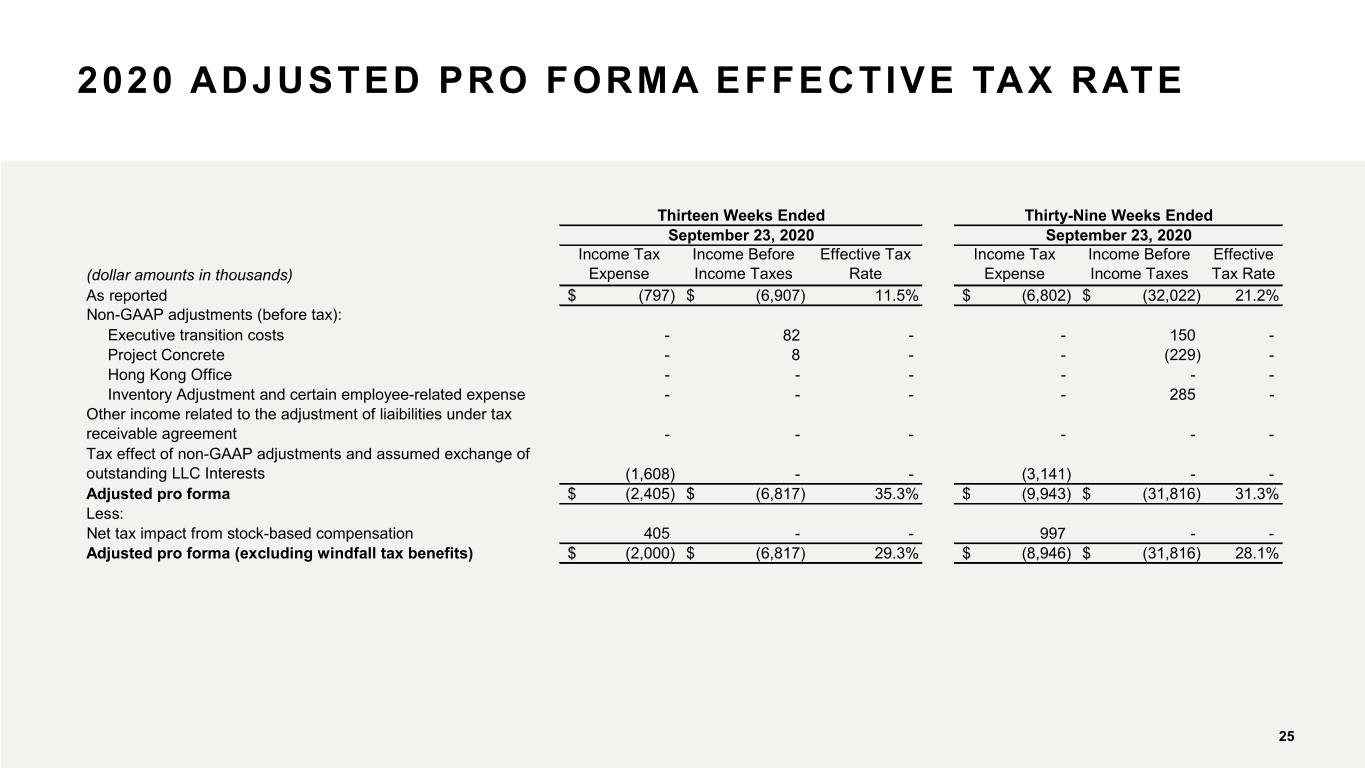
2020 ADJUSTED PRO FORMA EFFECTIVE TAX RATE Thirteen Weeks Ended Thirty-Nine Weeks Ended September 23, 2020 September 23, 2020 Income Tax Income Before Effective Tax Income Tax Income Before Effective (dollar amounts in thousands) Expense Income Taxes Rate Expense Income Taxes Tax Rate As reported $ (797) $ (6,907) 11.5% $ (6,802) $ (32,022) 21.2% Non-GAAP adjustments (before tax): Executive transition costs - 82 - - 150 - Project Concrete - 8 - - (229) - Hong Kong Office - - - - - - Inventory Adjustment and certain employee-related expense - - - - 285 - Other income related to the adjustment of liaibilities under tax receivable agreement - - - - - - Tax effect of non-GAAP adjustments and assumed exchange of outstanding LLC Interests (1,608) - - (3,141) - - Adjusted pro forma $ (2,405) $ (6,817) 35.3% $ (9,943) $ (31,816) 31.3% Less: Net tax impact from stock-based compensation 405 - - 997 - - Adjusted pro forma (excluding windfall tax benefits) $ (2,000) $ (6,817) 29.3% $ (8,946) $ (31,816) 28.1% Strategic Plan Update Board of Directors Meeting| Q1 2020 25
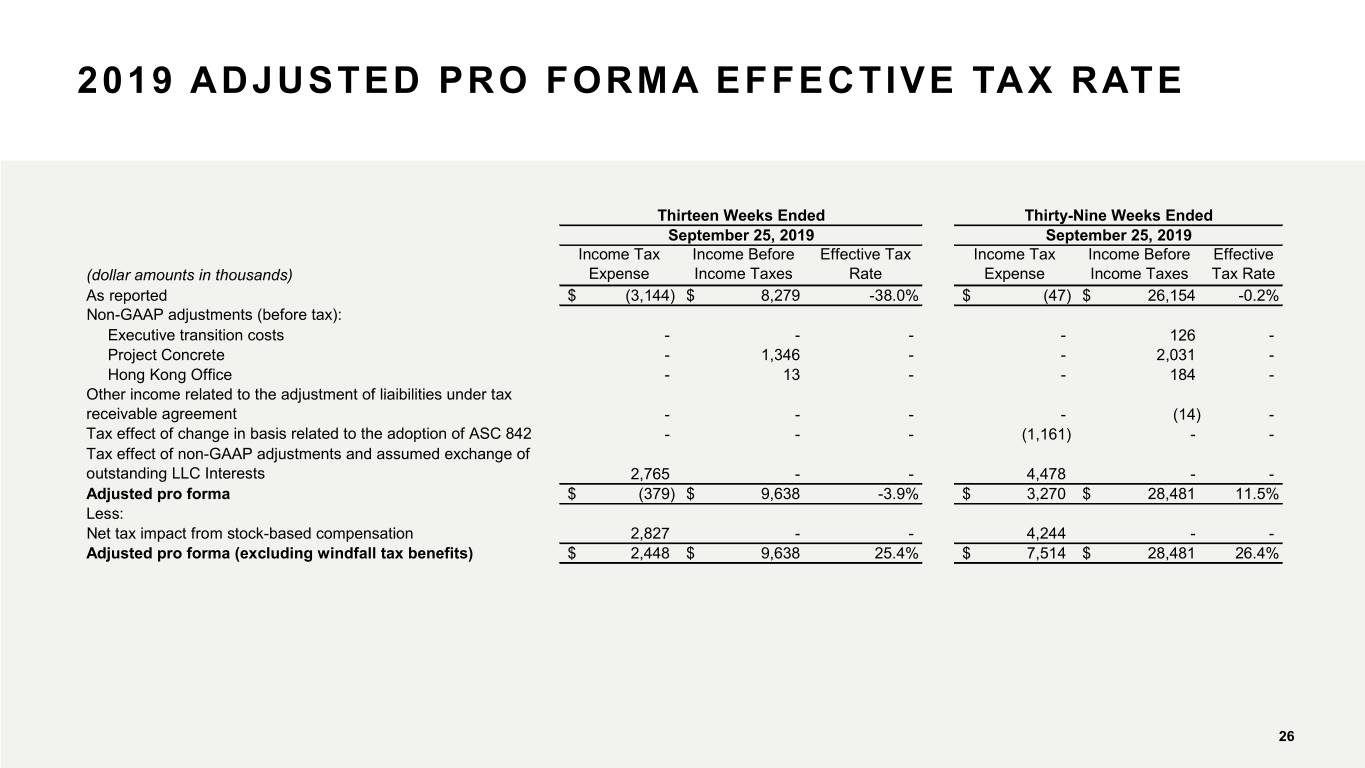
2019 ADJUSTED PRO FORMA EFFECTIVE TAX RATE Thirteen Weeks Ended Thirty-Nine Weeks Ended September 25, 2019 September 25, 2019 Income Tax Income Before Effective Tax Income Tax Income Before Effective (dollar amounts in thousands) Expense Income Taxes Rate Expense Income Taxes Tax Rate As reported $ (3,144) $ 8,279 -38.0% $ (47) $ 26,154 -0.2% Non-GAAP adjustments (before tax): Executive transition costs - - - - 126 - Project Concrete - 1,346 - - 2,031 - Hong Kong Office - 13 - - 184 - Other income related to the adjustment of liaibilities under tax receivable agreement - - - - (14) - Tax effect of change in basis related to the adoption of ASC 842 - - - (1,161) - - Tax effect of non-GAAP adjustments and assumed exchange of outstanding LLC Interests 2,765 - - 4,478 - - Adjusted pro forma $ (379) $ 9,638 -3.9% $ 3,270 $ 28,481 11.5% Less: Net tax impact from stock-based compensation 2,827 - - 4,244 - - Adjusted pro forma (excluding windfall tax benefits) $ 2,448 $ 9,638 25.4% $ 7,514 $ 28,481 26.4% Strategic Plan Update Board of Directors Meeting| Q1 2020 26

CONTACT INFORMATION INVESTOR CONTACT Melissa Calandruccio, ICR Michelle Michalski, ICR (844) Shack-04 (844-742-2504) [email protected] MEDIA CONTACT Kristyn Clark, Shake Shack 646-747-8776 [email protected] Strategic Plan Update Board of Directors Meeting| Q1 2020 27