
SPG 8-K
Simon Property Group Inc. (SPG)
UNITED STATES
SECURITIES AND EXCHANGE COMMISSION
Washington, D.C. 20549
FORM
CURRENT REPORT
Pursuant to Section 13 or 15(d) of the
Securities Exchange Act of 1934
Date of Report (Date of earliest event
reported):
(Exact name of registrant as specified in its charter)
(Simon Property Group, Inc.) (Simon Property Group, L.P.) |
(Simon Property Group, Inc.) (Simon Property Group, L.P.) |
(Simon Property Group, Inc.) (Simon Property Group, L.P.) |
| (State
or other jurisdiction of incorporation) |
(Commission File Number) | (I.R.S.
Employer Identification No.) |
|
|
| (Address of principal executive offices) |
(
(Registrant’s telephone number, including area code)
Not Applicable
(Former name or former address, if changed since last report)
Check the appropriate box below if the Form 8-K filing is intended to simultaneously satisfy the filing obligation of the registrant under any of the following provisions:
| Written communications pursuant to Rule 425 under the Securities Act (17 CFR 230.425) |
| Soliciting material pursuant to Rule 14a-12 under the Exchange Act (17 CFR 240.14a-12) |
| Pre-commencement communications pursuant to Rule 14d-2(b) under the Exchange Act (17 CFR 240.14d-2(b)) |
| Pre-commencement communications pursuant to Rule 13e-4(c) under the Exchange Act (17 CFR 240.13e-4(c)) |
Securities registered pursuant to Section 12(b) of the Act:
| Title of each class | Trading
Symbols |
Name
of each exchange on which registered | ||||
| Simon Property Group, Inc. | ||||||
| Simon Property Group, Inc. |
Indicate by check mark whether the registrant is an emerging growth company as defined in Rule 405 of the Securities Act of 1933 (§ 230.405 of this chapter) or Rule 12b-2 of the Securities Exchange Act of 1934 (§ 240.12b-2 of this chapter).
| Simon Property Group, Inc.: | Emerging growth company |
| Simon Property Group, L.P.: | Emerging growth company |
If an emerging growth company, indicate by check mark if the registrant has elected not to use the extended transition period for complying with any new or revised financial accounting standards provided pursuant to Section 13(a) of the Exchange Act.
Simon Property Group, Inc.: ¨
Simon Property Group, L.P.: ¨
ITEM 5.07 Submission of Matters to a Vote of Security Holders
The 2025 Annual Meeting of shareholders of Simon Property Group, Inc. (the “Company”) was held on May 14, 2025 (the “Meeting”).
The vote tabulation for each proposal considered at the Meeting is as follows:
Proposal 1 - Election of Directors
The Company’s shareholders elected each of the following directors to serve until the Company’s 2026 annual meeting of shareholders and until their successors have been duly elected and qualified by the following votes:
| FOR | AGAINST | ABSTAIN | BROKER NON-VOTE | |||||||||
| Glyn F. Aeppel | 168,979,926 | 99,638,396 | 653,214 | 19,824,019 | ||||||||
| Larry C. Glasscock | 188,765,004 | 79,836,461 | 670,071 | 19,824,019 | ||||||||
| Nina P. Jones | 266,224,173 | 2,394,999 | 652,364 | 19,824,019 | ||||||||
| Reuben S. Leibowitz | 251,299,209 | 17,313,890 | 658,437 | 19,824,019 | ||||||||
| Randall J. Lewis | 266,201,670 | 2,414,449 | 655,417 | 19,824,019 | ||||||||
| Gary M. Rodkin | 195,837,444 | 72,775,501 | 658,591 | 19,824,019 | ||||||||
| Peggy Fang Roe | 197,206,581 | 71,342,248 | 722,707 | 19,824,019 | ||||||||
| Stefan M. Selig | 263,816,823 | 4,793,599 | 661,114 | 19,824,019 | ||||||||
| Daniel C. Smith, Ph.D. | 254,176,483 | 14,434,974 | 660,079 | 19,824,019 | ||||||||
| Marta R. Stewart | 264,816,536 | 3,798,741 | 656,259 | 19,824,019 |
The voting trustees who vote the Company’s Class B common stock voted all 8,000 outstanding Class B shares for the election of the following three (3) persons as directors:
| FOR | AGAINST | ABSTAIN | BROKER NON-VOTE | |||||||||
| David Simon | 8,000 | 0 | 0 | 0 | ||||||||
| Eli Simon | 8,000 | 0 | 0 | 0 | ||||||||
| Richard S. Sokolov | 8,000 | 0 | 0 | 0 |
Proposal 2 - Advisory Vote to Approve the Compensation of our Named Executive Officers
| FOR | AGAINST | ABSTAIN | BROKER
NON-VOTE | |||||||||||
| 127,540,074 | 140,882,310 | 849,152 | 19,824,019 | |||||||||||
Proposal 3 - Ratification of Independent Registered Public Accounting Firm
The Company’s shareholders ratified the appointment of Ernst & Young LLP as the Company’s independent registered public accounting firm for 2025 by the following votes:
| FOR | AGAINST | ABSTAIN | ||||||||
| 273,603,743 | 15,294,929 | 196,883 | ||||||||
Proposal 4 – Approval of the Redomestication of the Company to the State of Indiana by Conversion
The Company’s shareholders approved the redomestication of the Company to the state of its headquarters, Indiana, by conversion by the following votes:
| FOR | AGAINST | ABSTAIN | NON-VOTE | |||||||||||
| 174,001,954 | 94,879,715 | 389,867 | 19,824,019 | |||||||||||
ITEM 8.01 Other Events
At the Meeting, the Company’s shareholders approved a proposal to redomesticate, by conversion, the Company from a corporation organized under the laws of the State of Delaware (the “Delaware Corporation”) to a corporation organized under the laws of the State of Indiana (the “Indiana Corporation”) by means of a plan of conversion (the “Plan of Conversion”, and such redomestication, the “Redomestication”), as described in the Company’s Definitive Proxy Statement for the Meeting (as supplemented by certain additional materials filed with the SEC on May 5, 2025, the “Proxy Statement”). Additionally, the limited partners of the Company’s operating partnership, Simon Property Group, L.P. (the “Operating Partnership”), separately approved a redomestication by conversion from a limited partnership formed under the laws of the State of Delaware (the “Delaware OP”) to a limited partnership formed under the laws of the State of Indiana (the “Indiana OP”) by means of a plan of conversion (the “OP Plan of Conversion”, and such redomestication, the “OP Redomestication”).
On May 14, 2025, the Company filed (i) a certificate of conversion with the Secretary of State of the State of Delaware and (ii) articles of domestication with the Secretary of State of the State of Indiana, pursuant to which the Redomestication became effective on May 15, 2025, at 12:01 a.m. Eastern Time (the “Effective Time”). At the Effective Time:
| · | the Company’s domicile changed from the State of Delaware to the State of Indiana; and |
| · | the affairs of the Company ceased to be governed by the laws of the State of Delaware and the Company’s existing amended and restated certificate of incorporation and amended and restated bylaws, and instead became governed by the laws of the State of Indiana and the articles of incorporation filed with the Secretary of State of the State of Indiana (the “Indiana Charter”) and the bylaws approved by the Company’s board of directors at the Meeting (the “Indiana Bylaws”). |
Additionally, on May 14, 2025, the Operating Partnership filed (i) a certificate of conversion with the Secretary of State of the State of Delaware and (ii) articles of domestication with the Secretary of State of the State of Indiana, pursuant to which the OP Redomestication became effective on May 15, 2025, at 12:02 a.m. Eastern Time (the “OP Effective Time”). At the OP Effective Time:
| · | the Operating Partnership’s domicile changed from the State of Delaware to the State of Indiana; and |
| · | the affairs of the Operating Partnership ceased to be governed by the laws of the State of Delaware and the Operating Partnership’s existing amended and restated certificate of limited partnership and eighth amended and restated limited partnership agreement, and instead became governed by the laws of the State of Indiana and the certificate of limited partnership filed with the Secretary of State of the State of Indiana (the “Indiana Certificate of Limited Partnership”) and the ninth amended and restated limited partnership agreement approved by the Company, as general partner of the Operating Partnership, and the Operating Partnership’s limited partners (the “Ninth Amended and Restated Partnership Agreement”). |
Neither the Redomestication nor the OP Redomestication resulted in any change in the headquarters, business, jobs, management, properties, location of any of our offices or facilities, number of employees, obligations, assets, liabilities, or net worth (other than as a result of the costs related to the Redomestication and OP Redomestication). Neither the Redomestication nor the OP Redomestication materially affected any of the Company’s or the Operating Partnership’s material contracts with any third parties, and the Company’s or the Operating Partnership’s, as applicable, rights and obligations under those material contractual arrangements continue to be the rights and obligations of the Company and the Operating Partnership, as applicable, after the Redomestication and OP Redomestication.
At the Effective Time, (i) each outstanding share of common stock, par value $0.0001 per share, of the Delaware Corporation (the “Delaware Common Stock”) automatically converted into one outstanding share of common stock, par value $0.0001 per share, of the Indiana Corporation (the “Indiana Common Stock”), (ii) each outstanding share of Class B common stock, par value $0.0001 per share, of the Delaware Corporation automatically converted into one outstanding share of Class B common stock, par value $0.0001 per share, of the Indiana Corporation, and (iii) each outstanding share of 8 3/8% Series J Cumulative Redeemable Preferred Stock, par value $0.0001 per share, of the Delaware Corporation automatically converted into one outstanding share of 8 3/8% Series J Cumulative Redeemable Preferred Stock, par value $0.0001 per share, of the Indiana Corporation (the “Indiana Series J Preferred Stock”). Shareholders do not have to exchange their existing stock certificates for new stock certificates. At the Effective Time, each outstanding restricted stock unit or right to acquire shares of Delaware Common Stock will continue in existence and automatically become a restricted stock unit or right to acquire an equal number of shares of Indiana Common Stock under the same terms and conditions. The Indiana Common Stock continues to be traded on the New York Stock Exchange (the “NYSE”) under the symbol “SPG”, and the Indiana Series J Preferred Stock continues to be traded on the NYSE under the symbol “SPGJ”.
At the OP Effective Time, (i) each outstanding unit of limited partnership interest of the Delaware OP automatically converted into one outstanding unit of limited partnership interest of the Indiana OP, and (ii) each outstanding long-term incentive plan interest of the Delaware OP automatically converted into one outstanding long-term incentive plan interest of the Indiana OP.
Certain rights of the Company’s shareholders were changed as a result of the Redomestication. A more detailed description of the Plan of Conversion, Indiana Charter, Indiana Bylaws, and the effects of the Redomestication is set forth in the Proxy Statement under “Proposal 4: Approval of the Redomestication of the Company to the State of Indiana by Conversion”, which description is incorporated herein by reference.
Copies of the (i) Plan of Conversion, (ii) OP Plan of Conversion, (iii) Indiana Charter, (iv) Indiana Bylaws, (v) Indiana Certificate of Limited Partnership, and (vi) Ninth Amended and Restated Partnership Agreement are filed as Exhibits 2.1, 2.2, 3.1, 3.2, 3.3, and 3.4, respectively, to this Current Report on Form 8-K and are incorporated herein by reference.
ITEM 9.01 Financial Statements and Exhibits
SIGNATURES
Pursuant to the requirements of the Securities Exchange Act of 1934, the Registrant has duly caused this report to be signed on its behalf by the undersigned thereunto duly authorized.
Date:
| SIMON PROPERTY GROUP, L.P. | ||
| By: Simon Property Group, Inc., its sole General Partner | ||
| By: | /s/ Steven E. Fivel | |
| Steven E. Fivel | ||
| Secretary and General Counsel | ||
| SIMON PROPERTY GROUP, INC. | ||
| By: | /s/ Steven E. Fivel | |
| Steven E. Fivel | ||
| Secretary and General Counsel | ||
Exhibit 2.1
PLAN OF CONVERSION
OF
SIMON PROPERTY GROUP, INC.
This Plan of Conversion (this “Plan of Conversion”) is adopted as of May 14, 2025 to convert Simon Property Group, Inc., a Delaware corporation (the “Converting Entity”), to an Indiana corporation to be known as “Simon Property Group, Inc.” (the “Converted Entity”).
1. Converting Entity. The Converting Entity is a corporation organized under the General Corporation Law of the State of Delaware (the “DGCL”).
2. Converted Entity. The Converted Entity shall be a corporation organized under Title 23, Article 1 of the Indiana Code, as amended (the “Indiana Code”). The name of the Converted Entity shall be Simon Property Group, Inc.
3. The Conversion. The Converting Entity shall be converted to the Converted Entity (the “Conversion”) pursuant to Sections 23-0.6-5-1 to -6 of the Indiana Code and Section 266 of the DGCL.
4. Filing of Conversion Documents; Effective Time. As soon as practicable following the satisfaction of the conditions set forth in Section 11, if this Plan of Conversion shall not have been terminated prior thereto as provided in Section 15, the Converting Entity shall cause (i) articles of domestication meeting the requirements of Section 23-0.6-5-5 of the Indiana Code (the “Articles of Domestication”) to be properly executed and filed in accordance with such section; and (ii) a certificate of conversion meeting the requirements of Section 266 of the DGCL (the “Certificate of Conversion”) to be properly executed and filed in accordance with such section, and otherwise make all other filings or recordings as required by the Indiana Code or DGCL in connection with the Conversion. The Conversion shall become effective at the time designated in the Articles of Domestication and Certificate of Conversion as the effective time of the Conversion (the “Effective Time”).
5. Governance of Converted Entity. On and after the Effective Time, the affairs of the Converted Entity shall be governed in accordance with the Indiana Business Corporation Law, Indiana Code Section 23-1-17-1, et seq., and the Articles of Incorporation and Bylaws of the Converted Entity, substantially in the forms attached hereto as Exhibit A and Exhibit B, respectively, as the same may be amended in accordance with their respective terms and applicable law.
6. Directors and Officers. From and after the Effective Time, by virtue of the Conversion and without any further action on the part of the Converting Entity or Converted Entity, or their respective stockholders, (i) the Board of Directors of the Converted Entity will consist of the same directors of the Converting Entity as of immediately prior to the Effective Time, having the same director classes and the same terms, until their successors have been duly elected or appointed and qualified or until their earlier death, resignation, or removal; (ii) each committee of the Board of Directors of the Converting Entity as of immediately prior to the Effective Time shall be, from and after the Effective Time, constituted as a committee of the Board of Directors of the Converted Entity on the same terms and with the same powers and authority of the Board of Directors of the Converting Entity as of immediately prior to the Effective Time, and the members of each committee of the Board of Directors of the Converting Entity as of immediately prior to the Effective Time shall be, from and after the Effective Time, the members of each such committee of the Board of Directors of the Converted Entity, to serve until their successors have been duly elected or appointed and qualified or until their earlier death, resignation, or removal; and (iii) the officers of the Converted Entity shall be the same officers of the Converting Entity as of immediately prior to the Effective Time (and any designation as an “executive officer” under Rule 3b-7 of the Securities Exchange Act of 1934, as amended (the “Exchange Act”), or “officer” for purposes of Section 16 of the Exchange Act shall remain in effect), to serve until their successors have been duly elected or appointed and qualified or until their earlier death, resignation, or removal.
1
7. Effect on Capital Stock of Converting Entity. At the Effective Time, by virtue of the Conversion and without any further action on the part of any holder thereof, the Converting Entity, the Converted Entity, or any other person, (i) each share of Common Stock, par value $0.0001 per share (“Common Stock”), of the Converting Entity issued and outstanding or held in treasury immediately prior to the Effective Time shall be automatically converted into one (1) share of Common Stock, par value $0.0001 per share, of the Converted Entity; (ii) each share of Class B Common Stock, par value $0.0001 per share (“Class B Common Stock”), of the Converting Entity issued and outstanding or held in treasury immediately prior to the Effective Time shall be automatically converted into one (1) share of Class B Common Stock, par value $0.0001 per share, of the Converted Entity; and (iii) each share of 83/8% Series J Cumulative Redeemable Preferred Stock, par value $0.0001 per share (“Series J Preferred Stock”), of the Converting Entity issued and outstanding or held in treasury immediately prior to the Effective Time shall be automatically converted into one (1) share of 83/8% Series J Cumulative Redeemable Preferred Stock, par value $0.0001 per share, of the Converted Entity. At and after the Effective Time: (x) all of the outstanding certificates that immediately prior thereto represented issued and outstanding shares of Common Stock, Class B Common Stock, and Series J Preferred Stock of the Converting Entity shall be deemed for all purposes to evidence ownership of and to represent shares of Common Stock, Class B Common Stock, and Series J Preferred Stock, respectively, of the Converted Entity into which the shares represented by such certificates have been converted as herein provided and shall be so registered on the books and records of the Converted Entity and its transfer agent; and (y) all of the issued and outstanding shares of Common Stock, Class B Common Stock, and Series J Preferred Stock of the Converting Entity that are in uncertificated book-entry form shall automatically become the number and class of shares of the Converted Entity into which such shares of the Converting Entity have been converted as herein provided in accordance with the customary procedures of the Converting Entity’s transfer agent.
8. Effect on Other Securities of Converting Entity. At the Effective Time, all outstanding and unexercised portions of each option, warrant, and security exercisable or convertible by its terms into the Common Stock, Class B Common Stock, or Series J Preferred Stock of the Converting Entity (including convertible promissory notes), whether vested or unvested, which are outstanding immediately prior to the Effective Time (each, a “Convertible Security”), shall constitute an option, warrant, or convertible security, as the case may be, to acquire the same number of shares of the Common Stock, Class B Common Stock, or Series J Preferred Stock, as applicable, of the Converted Entity as the holder of such Convertible Security would have been entitled to receive had such holder exercised or converted such Convertible Security in full immediately prior to the Effective Time (not taking into account whether such Convertible Security was in fact exercisable or convertible at such time), at the same exercise/conversion price per share, and shall, to the extent permitted by applicable law and otherwise reasonably practicable, have the same term, exercisability, vesting schedule, status, and all other terms and conditions. In addition, at the Effective Time, any share of restricted stock, restricted stock unit, equity or equity-based award, or any other right to acquire any, or of any instrument to convert into or based on the value of, Common Stock, Class B Common Stock, or Series J Preferred Stock or other equity security of the Converting Entity shall, from and after the Effective Time, be a share of restricted stock, restricted stock unit, equity or equity-based award, or other right to acquire any, or of any instrument to convert into or based on the value of, the same amount of Common Stock, Class B Common Stock, Series J Preferred Stock, or other equity securities of the Converted Entity, and shall, to the extent permitted by applicable law and otherwise reasonably practicable, have the same term, exercisability, vesting schedule, status, and all other terms and conditions.
2
9. Effect on Employment Agreements, Benefit Plans, and Incentive Plans. As of the Effective Time, automatically by virtue of the Conversion and without any further action on the part of any person, each employment letter or agreement, employee benefit plan or agreement, incentive compensation plan or agreement, or other similar plan or agreement to which the Converting Entity is a party, or otherwise maintains, sponsors, or contributes, shall continue to be a plan or agreement of the Converted Entity on the same terms and conditions and any references to the Converting Entity thereunder shall mean the Converted Entity on and after the Effective Time. To the extent that any such plan, letter, or agreement provides for the issuance, or is otherwise based on the value, of Common Stock, Class B Common Stock, Series J Preferred Stock, or other equity securities of the Converting Entity, as of the Effective Time, automatically by virtue of the Conversion and without any further action on the part of any person, such plan or agreement shall be deemed to provide for the issuance, or be based on the value, of Common Stock, Class B Common Stock, Series J Preferred Stock, or other equity securities of the Converted Entity, respectively.
10. Effect on Other Agreements. As of the Effective Time, automatically by virtue of the Conversion and without any further action on the part of any person, each agreement to which the Converting Entity is a party, shall continue to be an agreement of the Converted Entity on the same terms and conditions and any references to the Converting Entity thereunder shall, on and after the Effective Time, mean the Converted Entity.
11. Conditions Precedent. Completion of the Conversion is subject to the following conditions:
(a) the resolution of the Board of Directors of the Converting Entity (the “Board of Directors”) approving the conversion of the Converting Entity to the Converted Entity pursuant to and in accordance with applicable law and this Plan of Conversion shall have been adopted and approved by the affirmative vote of a majority of the aggregate voting power of the shares of the Common Stock and Class B Common Stock of the Converting Entity outstanding and entitled to vote thereon, voting together as a single class; and
3
(b) other than the filing of the Articles of Domestication and the Certificate of Conversion provided for under Section 4, any other regulatory or contractual approvals that the Board of Directors (in its sole discretion) determines to obtain shall have been so obtained and be in full force and effect.
All of the foregoing conditions are non-waivable, except that the condition set forth in Section 11(b) may be waived by the Board of Directors, and any determination by the Board of Directors prior to the Effective Time concerning the satisfaction or waiver of any condition set forth in this Section 11 shall be final and conclusive.
12. Effect of Conversion. From and after the Effective Time, the Conversion shall, for all purposes of the laws of the State of Delaware, have the effects set forth in Section 266(h) of the DGCL and shall, for all purposes of the laws of the State of Indiana, have the effects set forth in Indiana Code Section 23-0.6-5-6.
13. Record of Conversion. A copy of this Plan of Conversion will be kept at the principal place of business of the Converted Entity and, upon the request of any stockholder of the Converting Entity, a copy of this Plan of Conversion shall promptly be delivered to such stockholder.
14. Foreign Qualifications of Converted Entity. For the purpose of authorizing the Converted Entity to do business in any state, territory, or dependency of the United States, including, but not limited to, Delaware, or of any foreign country in which it is necessary or expedient for the Converted Entity to transact business, the officers of the Converted Entity are hereby authorized and empowered to appoint and substitute all necessary agents or attorneys for service of process, to designate and to prepare, execute, and file, for and on behalf of the Converted Entity, all necessary certificates, reports, powers of attorney, and other instruments as may be required by the laws of such state, territory, dependency, or country to authorize the Converted Entity to transact business therein, and whenever it is expedient for the Converted Entity to cease doing business therein and withdraw therefrom, to revoke any appointment of agent or attorney for service of process, and to file such certificates, reports, revocation of appointment, or surrender of authority as may be necessary to terminate the authority of the Converted Entity to do business in any such state, territory, dependency, or country, and all actions taken by the officers of the Converted Entity prior to the Effective Time in furtherance of this Section 14 shall be, and each of them hereby is, approved, ratified, and confirmed in all respects as the proper acts and deeds of the Converted Entity.
15. Termination; Abandonment. At any time before the Effective Time, whether before or after approval of the Conversion by the requisite stockholders of the Converting Entity as described above, this Plan of Conversion may be terminated and the Conversion may be abandoned, or the consummation of the Conversion may be deferred for a reasonable period of time if, in the opinion of the Board of Directors, such action would be in the best interests of the Converting Entity. In the event of termination of this Plan of Conversion, this Plan of Conversion shall become void and of no effect.
4
16. Plan of Reorganization. It is intended that the Conversion qualify as a “reorganization” within the meaning of Section 368(a)(1)(F) of the Internal Revenue Code of 1986, as amended (the “Code”) (and any similar provision of state or local law). This Plan of Conversion shall constitute, and is adopted as, a “plan of reorganization” within the meaning of Sections 1.368-2(g) and 1.368-3(a) of the U.S. Treasury Regulations promulgated under the Code.
17. Third Party Beneficiaries. This Plan of Conversion shall not confer any rights or remedies upon any person or entity other than as expressly provided herein. It being understood that, notwithstanding anything to the contrary in this Plan of Conversion, no provision of this Plan of Conversion is intended to, or does, confer any rights or remedies on any current or former employee or other service provider of the Converting Entity (nor any other individual associated therewith) and none of such individuals shall be regarded for any purpose as a third party beneficiary to this Plan.
18. Severability. Whenever possible, each term and provision of this Plan of Conversion will be interpreted in such manner as to be effective and valid under applicable law, but if any term or provision of this Plan of Conversion is held to be prohibited by or invalid under applicable law or in any jurisdiction, such term or provision will be ineffective only to the extent, of such prohibition or invalidity, without invalidating the remainder of this Plan of Conversion. Upon the determination that any term or provision of this Plan of Conversion is invalid, illegal, or unenforceable, such term or provision shall be deemed amended in such jurisdiction, without further action on the part of any person or entity, to the limited extent necessary to render the same valid, legal, or enforceable.
[Remainder of Page Intentionally Left Blank]
5
This Plan of Conversion has been adopted by the Board of Directors as of the date set forth above.
| Simon Property Group, Inc. | ||
| By: | /s/ Steven E. Fivel . | |
| Name: Steven E. Fivel | ||
| Title: Secretary and General Counsel | ||
6
EXHIBIT A
ARTICLES OF INCORPORATION
EXHIBIT B
BYLAWS
Exhibit 2.2
PLAN OF CONVERSION
OF
SIMON PROPERTY GROUP, L.P.
This Plan of Conversion (this “Plan of Conversion”) is adopted as of May 14, 2025 to convert Simon Property Group, L.P., a Delaware limited partnership (the “Converting Entity”), to an Indiana limited partnership to be known as “Simon Property Group, L.P.” (the “Converted Entity”).
1. Defined Terms. Capitalized terms not otherwise defined herein shall have the meanings set forth in the Eighth Amended and Restated Limited Partnership Agreement of Simon Property Group, L.P. dated May 8, 2008 (as amended, restated, supplemented or otherwise modified from time to time prior to the Effective Time (as defined below), the “Current Partnership Agreement”).
2. Converting Entity. The Converting Entity is a limited partnership organized under the Revised Uniform Limited Partnership Act of the State of Delaware (the “DRULPA”).
3. Converted Entity. The Converted Entity shall be a limited partnership organized under Title 23, Article 16 of the Indiana Code, as amended (the “Indiana Code”). The name of the Converted Entity shall be Simon Property Group, L.P.
4. The Conversion. The Converting Entity shall be converted to the Converted Entity (the “Conversion”) pursuant to Sections 23-0.6-5-1 to -6 of the Indiana Code and Section 17-219 of the DRULPA.
5. Filing of Conversion Documents; Effective Time. As soon as practicable following the satisfaction of the conditions precedent set forth in Section 12, if this Plan of Conversion shall not have been terminated prior thereto as provided in Section 16, the Converting Entity shall cause (i) articles of domestication meeting the requirements of Section 23-0.6-5-5 of the Indiana Code (the “Articles of Domestication”) to be properly executed and filed in accordance with such section; and (ii) a certificate of conversion meeting the requirements of Section 17-219 of the DRULPA (the “Certificate of Conversion”) to be properly executed and filed in accordance with such section, and otherwise make all other filings or recordings as required by the Indiana Code or DRULPA, as applicable, in connection with the Conversion. The Conversion shall become effective at the time designated in the Articles of Domestication and Certificate of Conversion as the effective time of the Conversion (the “Effective Time”).
6. Governance of Converted Entity. On and after the Effective Time, the affairs of the Converted Entity shall be governed in accordance with Indiana Code Section 23-16-1-1, et seq., and the Certificate of Limited Partnership (as amended, restated, supplemented or otherwise modified from time to time, the “Certificate of Limited Partnership”) and the Ninth Amended and Restated Limited Partnership Agreement (as amended, restated, supplemented or otherwise modified from time to time, the “Amended and Restated Partnership Agreement”) of the Converted Entity, substantially in the forms attached hereto as Exhibit A and Exhibit B, respectively, as the same may be amended in accordance with their respective terms and applicable law.
7. General Partner and Officers. From and after the Effective Time, by virtue of the Conversion and without any further action on the part of the Converting Entity or Converted Entity, their respective partners, or any other person, (i) the general partner of the Converting Entity serving as of immediately prior to the Effective Time (the “General Partner”) shall continue to be the general partner of the Converted Entity immediately following the Effective Time and shall serve in accordance with the Certificate of Limited Partnership and the Amended and Restated Partnership Agreement; and (ii) the officers of the Converted Entity shall be the same officers of the Converting Entity as of immediately prior to the Effective Time (and any designation as an “executive officer” under Rule 3b-7 of the Securities Exchange Act of 1934, as amended (the “Exchange Act”), or “officer” for purposes of Section 16 of the Exchange Act shall remain in effect), to serve until their successors have been duly elected or appointed and qualified or until their earlier death, resignation, or removal.
8. Effect on Partnership Interests of Converting Entity. At the Effective Time, by virtue of the Conversion and without any further action on the part of any holder thereof, the Converting Entity, the Converted Entity, their respective partners, or any other person, (i) each of the general partnership interests (“GP Interests”) of the Converting Entity issued and outstanding immediately prior to the Effective Time shall be automatically and by operation of law converted, on a 1:1 basis, into general partnership interests of the Converted Entity; (ii) each of the GP Preferred Units (as defined in the Current Partnership Agreement) of the Converting Entity issued and outstanding immediately prior to the Effective Time shall be automatically and by operation of law converted, on a 1:1 basis, into GP Preferred Units (as defined in the Amended and Restated Partnership Agreement) of the Converted Entity; (iii) each of the Limited Partnership Units (as defined in the Current Partnership Agreement) of the Converting Entity issued and outstanding immediately prior to the Effective Time shall be automatically and by operation of law converted, on a 1:1 basis, into Limited Partnership Units (as defined in the Amended and Restated Partnership Agreement) of the Converted Entity; (iv) each of the LP Preferred Units (as defined in the Current Partnership Agreement) of the Converting Entity issued and outstanding immediately prior to the Effective Time shall be automatically and by operation of law converted, on a 1:1 basis, into LP Preferred Units (as defined in the Amended and Restated Partnership Agreement) of the Converted Entity; and (v) each of the LTIP Units (as defined in the Current Partnership Agreement) of the Converting Entity issued and outstanding immediately prior to the Effective Time shall be automatically and by operation of law converted, on a 1:1 basis, into LTIP Units (as defined in the Amended and Restated Partnership Agreement) of the Converted Entity. At and after the Effective Time: (x) all of the outstanding certificates or other written evidences of ownership that immediately prior thereto represented issued and outstanding GP Interests, GP Preferred Units, Limited Partnership Units, LP Preferred Units, and LTIP Units of the Converting Entity shall be deemed for all purposes to evidence ownership of and to represent GP Interests, GP Preferred Units, Limited Partnership Units, LP Preferred Units, and LTIP Units, respectively, of the Converted Entity into which the partnership interests represented by such certificates or other written evidences of ownership have been converted as herein provided and shall be so registered on the books and records of the Converted Entity and its transfer agent; and (y) all of the issued and outstanding GP Interests, GP Preferred Units, Limited Partnership Units, LP Preferred Units, and LTIP Units of the Converting Entity that are in uncertificated book-entry form shall automatically become the number and type of partnership interests of the Converted Entity into which such partnership interests of the Converting Entity have been converted as herein provided in accordance with the customary procedures of the Converting Entity’s transfer agent.
2
9. Effect on Other Securities of Converting Entity. At the Effective Time, all outstanding and unexercised portions of each option, warrant, and security exercisable or convertible by its terms into the GP Interests, GP Preferred Units, Limited Partnership Units, LP Preferred Units, or LTIP Units of the Converting Entity (including convertible promissory notes), whether vested or unvested, which are outstanding immediately prior to the Effective Time (each, a “Convertible Security”), shall constitute an option, warrant, or convertible security, as the case may be, to acquire the same number of GP Interests, GP Preferred Units, Limited Partnership Units, LP Preferred Units, or LTIP Units, as applicable, of the Converted Entity as the holder of such Convertible Security would have been entitled to receive had such holder exercised or converted such Convertible Security in full immediately prior to the Effective Time (not taking into account whether such Convertible Security was in fact exercisable or convertible at such time), at the same exercise/conversion price per unit or interest, and shall, to the extent permitted by applicable law and otherwise reasonably practicable, have the same term, exercisability, vesting schedule, status, and all other terms and conditions. In addition, at the Effective Time, any restricted partnership interest or unit, equity or equity-based award, or any other right to acquire any, or of any instrument to convert into or based on the value of, a GP Interest, GP Preferred Unit, Limited Partnership Unit, LP Preferred Unit, or LTIP Unit or other equity security of the Converting Entity shall, from and after the Effective Time, be a restricted partnership interest or unit, equity or equity-based award, or other right to acquire any, or of any instrument to convert into or based on the value of, the same amount of GP Interests, GP Preferred Units, Limited Partnership Units, LP Preferred Units, LTIP Units, or other equity securities of the Converted Entity, and shall, to the extent permitted by applicable law and otherwise reasonably practicable, have the same term, exercisability, vesting schedule, status, and all other terms and conditions.
10. Effect on Employment Agreements, Benefit Plans, and Incentive Plans. As of the Effective Time, automatically by virtue of the Conversion and without any further action on the part of the Converting Entity, the Converted Entity, their respective partners, or any other person, each employment letter or agreement, employee benefit plan or agreement, incentive compensation plan or agreement, or other similar plan or agreement to which the Converting Entity is a party, or otherwise maintains, sponsors, or contributes, shall continue to be a plan or agreement of the Converted Entity on the same terms and conditions and any references to the Converting Entity thereunder shall mean the Converted Entity on and after the Effective Time. To the extent that any such plan, letter, or agreement provides for the issuance, or is otherwise based on the value, of GP Interests, GP Preferred Units, Limited Partnership Units, LP Preferred Units, LTIP Units, or other equity securities of the Converting Entity, as of the Effective Time, automatically by virtue of the Conversion and without any further action on the part of the Converting Entity, the Converted Entity, their respective partners, or any other person, such plan or agreement shall be deemed to provide for the issuance, or be based on the value, of GP Interests, GP Preferred Units, Limited Partnership Units, LP Preferred Units, LTIP Units, or other equity securities of the Converted Entity, respectively.
3
11. Effect on Other Agreements. As of the Effective Time, automatically by virtue of the Conversion and without any further action on the part of the Converting Entity, the Converted Entity, their respective partners, or any other person, each agreement to which the Converting Entity is a party, shall continue to be an agreement of the Converted Entity on the same terms and conditions and any references to the Converting Entity thereunder shall, on and after the Effective Time, mean the Converted Entity.
12. Conditions Precedent. Completion of the Conversion is subject to the satisfaction of the following conditions:
(a) the Conversion shall have been adopted and approved by the written consent of Limited Partners who hold in the aggregate more than 50% of the Partnership Units held by all the Limited Partners, considered as a class (excluding any Partnership Units held by the General Partner, any entity controlled by the General Partner, or any person holding as a nominee for the General Partner, and also excluding holders of LP Preferred Units or LTIP Units); and
(b) other than the filing of the Articles of Domestication and the Certificate of Conversion provided for under Section 5, any other regulatory or contractual approvals that the Board of Directors of the General Partner (in its sole discretion) determines to obtain shall have been so obtained and be in full force and effect.
All of the foregoing conditions are non-waivable, except that the condition set forth in Section 12(b) may be waived by the Board of Directors of the General Partner, and any determination by the Board of Directors of the General Partner prior to the Effective Time concerning the satisfaction or waiver of any condition set forth in this Section 12 shall be final and conclusive.
13. Effect of Conversion. From and after the Effective Time, the Conversion shall, for all purposes of the laws of the State of Delaware, have the effects set forth in Section 17-219(h) of the DRULPA and shall, for all purposes of the laws of the State of Indiana, have the effects set forth in Indiana Code Section 23-0.6-5-6.
14. Record of Conversion. A copy of this Plan of Conversion will be kept at the principal place of business of the Converted Entity and, upon the request of any partner of the Converting Entity, a copy of this Plan of Conversion shall promptly be delivered to such partner.
15. Foreign Qualifications of Converted Entity. For the purpose of authorizing the Converted Entity to do business in any state, territory, or dependency of the United States, including, but not limited to, Delaware, or of any foreign country in which it is necessary or expedient for the Converted Entity to transact business, the General Partner or the officers of the Converted Entity are hereby authorized and empowered to appoint and substitute all necessary agents or attorneys for service of process, to designate and to prepare, execute, and file, for and on behalf of the Converted Entity, all necessary certificates, reports, powers of attorney, and other instruments as may be required by the laws of such state, territory, dependency, or country to authorize the Converted Entity to transact business therein, and whenever it is expedient for the Converted Entity to cease doing business therein and withdraw therefrom, to revoke any appointment of agent or attorney for service of process, and to file such certificates, reports, revocation of appointment, or surrender of authority as may be necessary to terminate the authority of the Converted Entity to do business in any such state, territory, dependency, or country, and all actions taken by the officers of the Converted Entity prior to the Effective Time in furtherance of this Section 15 shall be, and each of them hereby is, approved, ratified, and confirmed in all respects as the proper acts and deeds of the Converted Entity.
4
16. Termination; Abandonment. At any time before the Effective Time, whether before or after approval of the Conversion by the requisite Limited Partners of the Converting Entity as described above, this Plan of Conversion may be terminated and the Conversion may be abandoned, or the consummation of the Conversion may be deferred for a reasonable period of time if, in the opinion of the Board of Directors of the General Partner, such action would be in the best interests of the Converting Entity. In the event of termination of this Plan of Conversion, this Plan of Conversion shall become void and of no effect.
17. Third Party Beneficiaries. This Plan of Conversion shall not confer any rights or remedies upon any person or entity other than as expressly provided herein. It being understood that, notwithstanding anything to the contrary in this Plan of Conversion, no provision of this Plan of Conversion is intended to, or does, confer any rights or remedies on any current or former employee or other service provider of the Converting Entity (nor any other individual associated therewith) and none of such individuals shall be regarded for any purpose as a third party beneficiary to this Plan.
18. Severability. Whenever possible, each term and provision of this Plan of Conversion will be interpreted in such manner as to be effective and valid under applicable law, but if any term or provision of this Plan of Conversion is held to be prohibited by or invalid under applicable law or in any jurisdiction, such term or provision will be ineffective only to the extent, of such prohibition or invalidity, without invalidating the remainder of this Plan of Conversion. Upon the determination that any term or provision of this Plan of Conversion is invalid, illegal, or unenforceable, such term or provision shall be deemed amended in such jurisdiction, without further action on the part of any person or entity, to the limited extent necessary to render the same valid, legal, or enforceable.
[Remainder of Page Intentionally Left Blank]
5
This Plan of Conversion has been adopted by the Board of Directors of the General Partner as of the date set forth above.
| Simon Property Group, L.P. | ||
| By: | Simon Property Group, Inc., its General Partner | |
| By: | /s/ Steven E. Fivel | |
| Name: Steven E. Fivel | ||
| Title: Secretary and General Counsel | ||
6
EXHIBIT A
CERTIFICATE OF LIMITED PARTNERSHIP
EXHIBIT B
NINTH AMENDED AND RESTATED LIMITED PARTNERSHIP AGREEMENT
Exhibit 3.1
Articles of INCORPORATION
of
Simon Property Group, Inc.
The undersigned incorporator, desiring to form a for-profit corporation (hereinafter referred to as the “Corporation”), pursuant to the provisions of the Indiana Business Corporation Law (hereinafter referred to as the “IBCL”), executes the following Articles of Incorporation:
ARTICLE I
NAME AND PRINCIPAL OFFICE
Section 1.1. Name. The name of the Corporation is Simon Property Group, Inc.
Section 1.2. Principal Office. The principal office of the Corporation is located at 225 West Washington Street, Indianapolis, Indiana 46204.
ARTICLE II
PURPOSES AND POWERS
Section 2.1. Purposes of the Corporation. The purposes for which and any of which the Corporation is formed and the business and objects to be carried on and promoted by it are:
(a) To engage in the business of a real estate investment trust, as that phrase is defined in the Internal Revenue Code of 1986, as amended (the “Code”); and
(b) To engage in any lawful act or activity for which corporations may be organized under the IBCL.
Section 2.2. Powers of the Corporation. The Corporation shall have (i) all powers now or hereafter authorized by or vested in corporations pursuant to the provisions of the IBCL; (ii) all powers now or hereafter vested in corporations by common law or any other statute or act; and (iii) all powers authorized by or vested in the Corporation by the provisions of these Articles of Incorporation or by the provisions of its Bylaws as from time to time in effect.
ARTICLE III
TERM OF EXISTENCE
The period during which the Corporation shall continue is perpetual.
ARTICLE IV
REGISTERED AGENT
The Corporation’s commercial registered agent is CT Corporation System. The undersigned Incorporator of the Corporation hereby represents that the registered agent named herein has consented to the appointment of registered agent.
1
ARTICLE V
AUTHORIZED SHARES
Section 5.1. Authorized Classes and Number of Shares. The total number of shares of stock of all classes which the Corporation has authority to issue is 850,000,000 shares of capital stock, of which 511,990,000 shares are classified as Common Stock, par value $.0001 per share (“Common Stock”), 10,000 shares are classified as Class B Common Stock, par value $.0001 per share (“Class B Common Stock”), 100,000,000 shares are classified as Preferred Stock, par value $.0001 per share, (“Preferred Stock”), and 238,000,000 shares are classified as Excess Common Stock, par value $.0001 per share (“Excess Common Stock”).
Section 5.2. General Terms of All Shares. The Corporation shall have the power to acquire (by purchase, redemption, or otherwise), hold, own, pledge, sell, transfer, assign, reissue, cancel, or otherwise dispose of the shares of the Corporation in the manner and to the extent now or hereafter permitted by the laws of the State of Indiana, including the power to purchase, redeem, or otherwise acquire the Corporation’s own shares, directly or indirectly, and without pro rata treatment of the owners or holders of any class or series of shares, unless, after giving effect thereto, the Corporation would not be able to pay its debts as they become due in the usual course of business or the Corporation’s total assets would be less than its total liabilities (calculated without regard to any amounts that would be needed, if the Corporation were to be dissolved at the time of the purchase, redemption, or other acquisition, to satisfy the preferential rights upon dissolution of shareholders whose preferential rights are superior to those of the holders of the shares of the Corporation being purchased, redeemed, or otherwise acquired, unless otherwise expressly provided with respect to any series of Preferred Stock or any series of Preferred Stock hereafter created in the provisions of these Articles of Incorporation adopted by the Board of Directors pursuant to Section 5.5 hereof describing the terms of such series (the “Dissolution Calculation Conditions”). Shares of the Corporation purchased, redeemed, or otherwise acquired by it shall constitute authorized but unissued shares, unless prior to any such purchase, redemption, or other acquisition, or within thirty (30) days thereafter, the Board of Directors adopts a resolution providing that such shares constitute authorized and issued, but not outstanding, shares.
The Board of Directors of the Corporation may dispose of, issue, and sell shares of its stock of any class, whether now or hereafter authorized, or securities convertible into shares of its stock of any class or classes, whether now or hereafter authorized, in accordance with, and in such amounts as may be permitted by, the laws of the State of Indiana and the provisions of these Articles of Incorporation and for such consideration, at such price or prices, at such time or times, and upon such terms and conditions (including the privilege of selectively repurchasing the same) as the Board of Directors of the Corporation shall determine, without the authorization or approval by any shareholders of the Corporation. No holder of any stock or any other securities of the Corporation, whether now or hereafter authorized, shall have any preemptive right to subscribe for or purchase any stock or any other securities of the Corporation; and any stock or other securities which the Board of Directors may determine to offer for subscription may, as the Board of Directors in its sole discretion shall determine, be offered to the holders of any class, series, or type of stock or other securities at the time outstanding to the exclusion of the holders of any or all other classes, series, or types of stock or other securities at the time outstanding.
2
When the Corporation receives the consideration specified in a subscription agreement entered into before incorporation, or for which the Board of Directors authorized the issuance of shares, as the case may be, the shares issued therefor shall be fully paid and nonassessable.
The Corporation shall have the power to declare and pay dividends or other distributions upon the issued and outstanding shares of the Corporation, subject to the limitation that a dividend or other distribution may not be made if, after giving it effect, the Corporation would not be able to pay its debts as they become due in the usual course of business or the Corporation’s total assets would be less than its total liabilities (calculated in accordance with the Dissolution Calculation Conditions). The Corporation shall have the power to issue shares of one class or series as a share dividend or other distribution in respect of that class or series or one or more other classes or series.
Section 5.3. Rights, Privileges, Limitations, and Restrictions of Common Stock. The following is a description of the preferences, conversion, and other rights, voting powers, restrictions, limitations as to dividends, qualifications, and terms and conditions of redemption of the Common Stock of the Corporation:
(a) Voting Rights. Each share of Common Stock shall have one vote, and, except as otherwise provided in respect of any series of Preferred Stock and any series of Preferred Stock hereafter created, and except as otherwise provided with respect to directors elected by the holders of the Class B Common Stock, voting as a separate class, the exclusive voting power for all purposes shall be vested in the holders of the Common Stock, the Class B Common Stock, and the Excess Common Stock, voting together as a single class. Shares of Common Stock shall not have cumulative voting rights.
(b) Dividends. Subject to the provisions of law and any preferences of any series of Preferred Stock and any series of Preferred Stock hereafter created, dividends or other distributions, including dividends or other distributions payable in shares of another class of the Corporation’s stock, may be paid ratably on the Common Stock at such time and in such amounts as the Board of Directors may deem advisable, but only if at the same time, dividends are paid on outstanding shares of Class B Common Stock in accordance with Section 5.3(b) of this Article V.
(c) Liquidation. Subject to the provisions of law and the preferences of any series of Preferred Stock and any series of Preferred Stock hereafter created, in the event of any liquidation, dissolution, or winding up of the Corporation, whether voluntary or involuntary, the holders of the Common Stock shall be entitled, together with the holders of Class B Common Stock, Excess Common Stock, and any other series of Preferred Stock hereafter created not having a preference on distributions in the liquidation, dissolution, or winding up of the Corporation, to share ratably in the net assets of the Corporation remaining, after payment or provision for payment of the debts and other liabilities of the Corporation and the amount to which the holders of any series of Preferred Stock and any series of Preferred Stock hereafter created having a preference on distributions in the liquidation, dissolution, or winding up of the Corporation shall be entitled.
(d) Conversion. Each share of Common Stock is convertible into Excess Common Stock, as provided in Article VIII hereof.
3
Section 5.4. Rights, Privileges, Limitations, and Restrictions of Class B Common Stock. The following is a description of the preferences, conversion, and other rights, voting powers, restrictions, limitations as to dividends, qualifications, and terms and conditions of redemption of the Class B Common Stock of the Corporation:
(a) Voting Rights. Each share of Class B Common Stock shall have one vote, and, except as otherwise provided in respect of any series of Preferred Stock and any series of Preferred Stock hereafter created and except as otherwise provided in this Section 5.4, the exclusive voting power for all purposes shall be vested in the holders of the Class B Common Stock, the Common Stock, and the Excess Common Stock, voting together as a single class. Shares of Class B Common Stock shall not have cumulative voting rights. The holders of the shares of Class B Common Stock shall have the right, voting as a separate class, to elect four directors of the Corporation and shall vote with the holders of the Common Stock (voting together as a single class) to elect the remaining directors; provided, however, if the Simon Family Group (as defined in Article VIII) shall sell or transfer a portion of their Common Stock, Class B Common Stock, and Units (as defined in Article VIII) so as to reduce their Aggregate Assumed Equity Interest in the Corporation (as defined in Article VIII) to less than 50% of the Simon Family Group Initial Aggregate Assumed Equity Interest (as defined in Article VIII) in the Corporation, from and after the date of such reduction the holders of the shares of Class B Common Stock shall have the right, voting as a separate class, to elect two directors of the Corporation. The right of the holders of Class B Common Stock to elect directors may be exercised by written consent of such holders. For purposes of this subparagraph, shares held in a voting trust shall be deemed owned by the beneficiaries of the voting trust.
(b) Dividends. Subject to the provisions of law and the preferences of the Preferred Stock and of any series of Preferred Stock hereafter created, dividends or other distributions, including dividends or other distributions payable in shares of another class of the Corporation’s stock, may be paid ratably on the Class B Common Stock at such time and in such amounts as the Board of Directors may deem advisable; provided, however, cash dividends or other distributions shall be paid on each share of Class B Common Stock at the same time as cash dividends or other distributions are paid on Common Stock and in an amount equal to the amount payable on the number of shares of Common Stock into which each share of Class B Common Stock is then convertible; provided, further, that, non-cash dividends or other non-cash distributions (including the issuance of warrants or rights to acquire securities of the Corporation) shall be distributed on each share of Class B Common Stock at the same time as such non-cash dividends or other non-cash distributions are distributed on Common Stock and in an amount equal to the amount distributable on the number of shares of Common Stock into which each share of Class B Common Stock is then convertible; provided, further, that, any dividends or other distributions payable otherwise on the Class B Common Stock shall be paid in shares of Common Stock or securities convertible or exchangeable into Common Stock (or warrants or rights issued to acquire Common Stock or securities convertible or exchangeable into Common Stock).
(c) Liquidation. Subject to the provisions of law and the preferences of the Preferred Stock and of any series of Preferred Stock hereafter created, in the event of any liquidation, dissolution, or winding up of the Corporation, whether voluntary or involuntary, the holders of Class B Common Stock shall be entitled, together with the holders of Common Stock, Excess Common Stock, and any other series of Preferred Stock hereafter created not having a preference on distributions in the liquidation, dissolution, or winding up of the Corporation, to share ratably in the net assets of the Corporation remaining, after payment or provision for payment of the debts and other liabilities of the Corporation and the amount to which the holders of the Preferred Stock and of any series of Preferred Stock hereafter created having a preference on distributions in the liquidation, dissolution, or winding up of the Corporation shall be entitled.
4
(d) Conversion.
(1) Each share of Class B Common Stock is convertible into Excess Common Stock, as provided in Article VIII hereof. Each share of Class B Common Stock may be converted at the option of the holder thereof into one share of Common Stock. Immediately and automatically each share of Class B Common Stock shall be converted into one share of Common Stock (i) if the Aggregate Assumed Equity Interest in the Corporation of the Simon Family Group is for any reason reduced to less than 5% of the Aggregate Assumed Equity Interest in the Corporation; or (ii) if such share of Class B Common Stock is otherwise sold or otherwise transferred to or is otherwise held by anyone other than a member of the Simon Family Group. For purposes of this subparagraph, shares held in a voting trust shall be deemed owned by the beneficiaries of the voting trust.
(2) The Corporation may not subdivide its outstanding shares of Common Stock, combine its outstanding shares of Common Stock into a smaller number of shares, or issue by reclassification of its shares of Common Stock any shares of capital stock of the Corporation without making the same adjustment to the Class B Common Stock. The Corporation shall not distribute to all holders of its Common Stock evidences of its indebtedness or assets (excluding cash dividends or other distributions to the extent permitted by Section 5.4(b) of this Article V) or rights or warrants to subscribe for or purchase securities issued by the Corporation or property of the Corporation (excluding those referred to in Section 5.4(b) of this Article V), without making the same distribution to all holders of its Class B Common Stock. No adjustment of the conversion rate shall be made as a result of or in connection with the issuance of Common Stock of the Corporation pursuant to options or share purchase agreements now or hereafter granted or entered into with officers or employees of the Corporation or its subsidiaries in connection with their employment, whether entered into at the beginning of the employment or at any time thereafter. In case of any capital reorganization of the Corporation, or the consolidation or merger of the Corporation with or into another corporation, or a statutory share exchange, or the sale, transfer, or other disposition of all or substantially all of the property, assets, or business of the Corporation, in each case in which any cash, stock, debt or other instrument, security, or right of any kind or nature (collectively, “consideration”) is to be received by the holders of shares of Common Stock or the holders of shares of Class B Common Stock, the holders of shares of Common Stock and the holders of shares of Class B Common Stock shall receive the same consideration on a per share basis; provided, however, if such consideration shall consist in any part of voting securities (or of options or warrants to purchase, or of securities convertible into or exchangeable for, voting securities), the holders of shares of Common Stock and Class B Common Stock may, so long as they receive the same per share amount of voting securities as contemplated and required by the foregoing, receive different classes of voting securities that differ, with respect to voting and other rights, to the extent and only to the extent that the Common Stock and the Class B Common Stock differ in such respect (or options or warrants to purchase, or securities convertible into or exchangeable for, the same per share amount of voting securities, but in different classes of voting securities that differ, with respect to voting and other rights, to the extent and only to the extent that the Common Stock and the Class B Common Stock differ in such respect), unless the transaction is approved by the affirmative vote of a majority of the holders of the class of common stock adversely affected (with respect to the other) by such transaction.
5
(3) Upon conversion of any shares of Class B Common Stock, no payment or adjustment shall be made on account of dividends accrued, whether or not in arrears, on such shares or on account of dividends declared and payable to holders of Common Stock of record on a date prior to the date of conversion.
(4) Except with respect to shares of Class B Common Stock which have been deemed to have been automatically converted into Common Stock pursuant to Section 5.4(d)(1) of this Article V, in order to convert shares of Class B Common Stock into Common Stock the holder thereof shall surrender at the office of the registrar and transfer agent of the Corporation the certificate or certificates therefor, duly endorsed to the Corporation or in blank, and give written notice to the Corporation at said office that he elects to convert such shares and shall state in writing therein the name or names (with addresses) in which he wishes the certificate or certificates for Common Stock to be issued. Shares of Class B Common Stock shall be deemed to have been converted on the date of the surrender of such certificate or certificates for shares for conversion as provided above, and the person or persons entitled to receive the Common Stock issuable upon such conversion shall be treated for all purposes as the record holder or holders of such Common Stock on such date. As soon as practicable on or after the date of conversion as aforesaid, the Corporation will issue and deliver at said office a certificate or certificates for the number of full shares of Common Stock issuable upon such conversion, together with cash for any fraction of a share, as provided in Section 5.4(d)(6) of this Article V, to the person or persons entitled to receive the same. The Corporation will pay any and all federal original issue taxes that may be payable in respect of the issue or delivery of shares of Common Stock on conversion of shares of Class B Common Stock pursuant hereto. The Corporation shall not, however, be required to pay any tax which may be payable in respect of any transfer involved in the issue and delivery of shares of Common Stock in a name other than that in which the shares of Class B Common Stock so converted were registered, and no issue or delivery shall be made unless and until the person requesting such issue has paid to the Corporation the amount of any such tax, or has established to the satisfaction of the Corporation either that such tax has been paid or that no such tax is payable.
(5) All shares of Class B Common Stock converted into Common Stock shall be retired and cancelled and shall not be reissued.
(6) The Corporation shall not issue fractional shares of Common Stock upon any conversion of shares of Class B Common Stock. As to any final fraction of a share which the holder of one or more shares of Class B Common Stock would be entitled to receive upon exercise of such holder’s conversion right, the Corporation shall pay a cash adjustment in an amount equal to the same fraction of the Market Price (as defined in Article VIII) for the date of exercise.
6
(7) The Corporation shall at all times have authorized and unissued a number of shares of Common Stock sufficient for the conversion of all shares of Class B Common Stock at the time outstanding. If any shares of Common Stock require registration with or approval of any governmental authority under any Federal or State law, before such shares may be validly issued upon conversion, then the Corporation will in good faith and as expeditiously as possible endeavor to secure such registration or approval as the case may be. The Corporation warrants that all Common Stock issued upon conversion of shares of Class B Common Stock will upon issue be fully paid and nonassessable by the Corporation and free from original issue taxes.
Section 5.5. Rights, Privileges, Limitations, and Restrictions of Preferred Stock. Subject in all cases to the provisions of Article VIII with respect to Excess Stock (as defined in this paragraph), the Preferred Stock may be issued from time to time in one or more series, each of which series shall have such distinctive designation or title as shall be fixed by the Board of Directors prior to the issuance of any shares thereof. Each such series of Preferred Stock shall have such voting powers, full or limited, or no voting powers, and such preferences and relative, participating, optional, or other special rights and such qualifications, limitations, or restrictions thereof, as shall be stated in such resolution providing for the issue of such series of Preferred Stock as may be adopted from time to time by the Board of Directors prior to the issuance of any shares thereof pursuant to the authority hereby expressly vested in it, all in accordance with the laws of the State of Indiana; provided, however, no shares of any series of Preferred Stock may be authorized or issued unless (i) the certificates of designations relating to such series contains restrictions on ownership and transfer and conversion provisions applicable to such series comparable to those set forth in Article VIII, and (ii) a corresponding series of Preferred Stock (“Excess Preferred Stock,” and together with Excess Common Stock, unless the context otherwise requires, “Excess Stock”), to be issued in accordance with any such conversion provisions upon a violation of such restrictions on ownership and transfer, is simultaneously authorized by filing of a certificate of designations. The Board of Directors is further authorized to increase or decrease (but not below the number of such shares of series then outstanding) the shares of any series subsequent to the issuance of shares of that series. The 8.375% Series J Cumulative Redeemable Preferred Stock, shall have the designation, powers, preferences, and rights and the qualifications, limitations, and restrictions as set forth in Exhibit A.
ARTICLE VI
DIRECTORS
Section 6.1. Powers and Duties; Number. The powers and duties conferred and imposed upon the board of directors by the IBCL shall be exercised and performed, in accordance with Sections 23-1-33-1 through 23-1-35-5 thereof governing the action of directors, by a board of directors (the “Board of Directors”); provided, however, pursuant to Section 23-1-33-1(b) of the IBCL: (i) certain of such powers and duties of the Board of Directors set forth herein shall be exercised and performed only by the Independent Directors (as defined in Article VIII hereof); and (ii) certain of such powers and duties of the Board of Directors as described herein may be exercised and performed by one or more committees consisting of one or more members of the Board of Directors and one or more other persons to the extent such powers and duties are delegated thereto by the Board of Directors. The number of directors of the Corporation shall never be more than fifteen (15) nor less than the minimum number permitted by the IBCL now or hereafter in force and, subject to such limitations, shall be fixed from time to time in the Bylaws or by resolution of the Board of Directors. At least a majority of the directors shall be Independent Directors (as defined in Article VIII).
7
Section 6.2. Vacancies. Subject to the rights of the holders of any class of Preferred Stock then outstanding, newly created directorships resulting from any increase in the authorized number of directors shall be filled by a vote of the shareholders or a majority of the entire Board of Directors, and any vacancies on the Board of Directors resulting from death, disability (“disability,” which for purposes of this Section 6.2 shall mean illness, physical or mental disability, or other incapacity), resignation, retirement, disqualification, removal from office, or other cause shall be filled by a vote of the shareholders or a majority of the directors then in office; provided, however:
(a) Any vacancies on the Board of Directors resulting from death, disability, resignation, retirement, disqualification, removal from office, or other cause of a director elected by the holders of Class B Common Stock shall be filled only by a vote of the holders of Class B Common Stock; and
(b) A special meeting of holders of the Class B Common Stock shall be called by the President in the event a vacancy occurs on the Board of Directors from any cause among the directors entitled to be elected by the holders of the Class B Common Stock, and a special meeting of holders of the Common Stock and the Class B Common Stock shall be called by the President in the event a vacancy occurs on the Board of Directors from any cause among the directors elected by the holders of the Common Stock and the Class B Common Stock (voting together as a single class) and is not filled by the directors within 30 days after the vacancy occurs. The holders of Class B Common Stock may exercise their rights to elect directors by written consent without a meeting.
Notwithstanding the foregoing, any decrease in the number of directors constituting the Board of Directors shall not affect the tenure of office of any director.
Section 6.3. Election of Directors by Holders of Preferred Stock. Whenever the holders of any one or more series of Preferred Stock of the Corporation shall have the right, voting separately as a class, to elect one or more directors of the Corporation, the Board of Directors shall consist of said directors so elected in addition to the number of directors fixed as provided in Section 6.1 of this Article VI or in the Bylaws; provided, however, if any shares of Class B Common Stock are outstanding, the election of one or more directors by such holders of Preferred Stock will eliminate the corresponding number of directors to be elected by the combined holders of the Common Stock and the Class B Common Stock, voting together as a single class, and will neither increase the size of the Board of Directors nor eliminate the seat or seats of directors elected by the holders of the Class B Common Stock, voting as a separate class. Notwithstanding the foregoing, and except as otherwise may be required by law, whenever the holders of any one or more series of Preferred Stock of the Corporation shall have the right, voting separately as a class, to elect one or more directors of the Corporation, the terms of the director or directors elected by such holders shall expire at the next succeeding annual meeting of shareholders.
8
Section 6.4. Liability of Directors. A director’s responsibility to the Corporation shall be limited to discharging his or her duties as a director, including his or her duties as a member of any committee of the Board of Directors upon which he or she may serve, in good faith, with the care an ordinarily prudent person in a like position would exercise under similar circumstances, and in a manner the director reasonably believes to be in the best interests of the Corporation, all based on the facts then known to the director.
In discharging his or her duties, a director is entitled to rely on information, opinions, reports, or statements, including financial statements and other financial data, if prepared or presented by:
(a) One or more officers or employees of the Corporation whom the director reasonably believes to be reliable and competent in the matters presented;
(b) Legal counsel, public accountants, or other persons as to matters the director reasonably believes are within such person’s professional or expert competence; or
(c) A committee of the Board of Directors of which the director is not a member if the director reasonably believes the committee merits confidence;
but a director is not acting in good faith if the director has knowledge concerning the matter in question that makes reliance otherwise permitted by this Section 6.4 unwarranted.
A director shall not be liable for any action taken as a director, or any failure to take any action, unless (i) the director has breached or failed to perform the duties of the director’s office in compliance with this Section 6.4; and (ii) the breach or failure to perform constitutes willful misconduct or recklessness.
Section 6.5. Factors to be Considered by Board of Directors. In determining whether to take or refrain from taking any action with respect to any matter, including making or declining to make any recommendation to shareholders of the Corporation, the Board of Directors may, in its discretion, consider both the short term and long-term best interests of the Corporation (including the possibility that these interests may be best served by the continued independence of the Corporation), taking into account, and weighing as the directors deem appropriate, the social and economic effects thereof on the Corporation’s present and future employees, suppliers, and customers of the Corporation and its subsidiaries, the communities in which offices or other facilities of the Corporation are located, and any other factors the directors consider pertinent.
Section 6.6. Removal. Subject to Section 23-1-33-8 of the IBCL, directors may be removed from office at any time, with or without cause, by the affirmative vote of the holders of at least a majority of the combined voting power of all classes of shares of capital stock entitled to vote in the election for directors voting together as a single class; provided, however, any director elected by the holders of the Class B Common Stock may only be removed from office, and only for cause, by a majority of the voting power of the holders of the Class B Common Stock, voting as a separate class.
9
Section 6.7. Approval of Certain Transactions. Pursuant to Section 23-1-33-1(b) of the IBCL, any action by the Corporation relating to transactions involving the Corporation, individually or in its capacity as general partner (whether directly or indirectly through another entity) of Simon Property Group, L.P., in which the Simon Family Group or any member or affiliate of any member of the Simon Family Group has an interest (other than through ownership interests in the Corporation or Simon Property Group, L.P.), shall, in addition to such other vote that may be required, require the prior approval of a majority of the Independent Directors.
Section 6.8. No Written Ballots Required. Elections of directors need not be by written ballot.
Section 6.9. Committees. Pursuant to Section 23-1-34-6 of the IBCL, the Board of Directors may appoint an Executive Committee, a Compensation Committee, an Audit Committee, a Nominating and Governance Committee, and other committees composed of one or more directors or one or more other persons delegated such powers and duties by the Board of Directors. Each committee, except the Compensation Committee, the Audit Committee, and the Nominating and Governance Committee, shall have as a member at least one director elected by the Class B Common Stock. All the members of each of the Audit Committee, Compensation Committee, and Nominating and Governance Committee shall be Independent Directors.
ARTICLE VII
PROVISIONS FOR REGULATION OF BUSINESS
AND CONDUCT OF AFFAIRS OF CORPORATION
Section 7.1. Provisions for Regulation of Business and Conduct of Affairs of Corporation. The following provisions are hereby adopted for the purpose of defining, limiting, and regulating the powers of the Corporation and of the directors and the shareholders:
(a) General. The Board of Directors of the Corporation shall, consistent with applicable law, have power in its sole discretion to determine from time to time in accordance with sound accounting practice or other reasonable valuation methods what constitutes annual or other net profits, earnings, surplus, or net assets in excess of capital; to fix and vary from time to time the amount to be reserved as working capital, or determine that retained earnings or surplus shall remain in the hands of the Corporation; to set apart out of any funds of the Corporation such reserve or reserves in such amount or amounts and for such proper purpose or purposes as it shall determine and to abolish any such reserve or any part thereof; to redeem or purchase its stock or to distribute and pay distributions or dividends in stock, cash, or other securities or property, out of surplus or any other funds or amounts legally available therefor, at such times and to the shareholders of record on such dates as it may, from time to time, determine; to determine the amount, purpose, time of creation, increase or decrease, alteration or cancellation of any reserves or charges and the propriety thereof (whether or not any obligation or liability for which such reserves or charges shall have been created shall have been paid or discharged); to determine the fair value and any matters relating to the acquisition, holding, and disposition of any assets by the Corporation; and to determine whether and to what extent and at what times and places and under what conditions and regulations the books, accounts, and documents of the Corporation, or any of them, shall be open to the inspection of shareholders, except as otherwise provided by statute or by the Bylaws, and, except as so provided, no shareholder shall have any right to inspect any book, account, or document of the Corporation unless authorized so to do by resolution of the Board of Directors.
10
(b) Indemnification of Officers, Directors, and Other Eligible Persons.
(1) The Corporation shall indemnify every Eligible Person against all Liability and Expense that may be incurred by him or her in connection with or resulting from any Claim to the fullest extent authorized or permitted by the IBCL, as the same exists or may hereafter be amended (but in the case of any such amendment, only to the extent that such amendment permits the Corporation to provide broader indemnification rights than such law permitted the Corporation to provide prior to such amendment), or otherwise consistent with the public policy of the State of Indiana. In furtherance of the foregoing, and not by way of limitation, every Eligible Person shall be indemnified by the Corporation against all Liability and reasonable Expense that may be incurred by him or her in connection with or resulting from any Claim, (i) if such Eligible Person is Wholly Successful with respect to the Claim, or (ii) if not Wholly Successful, then if such Eligible Person is determined, as provided in either Section 7.1(b)(7) or 7.1(b)(8), to have acted in good faith, in what he or she reasonably believed to be the best interests of the Corporation or at least not opposed to its best interests and, in addition, with respect to any criminal claim is determined to have had reasonable cause to believe that his or her conduct was lawful or had no reasonable cause to believe that his or her conduct was unlawful. The termination of any Claim, by judgment, order, settlement (whether with or without court approval), or conviction or upon a plea of guilty or of nolo contendere, or its equivalent, shall not create a presumption that an Eligible Person did not meet the standards of conduct set forth in clause (ii) of this subsection (b)(1). The actions of an Eligible Person with respect to an employee benefit plan subject to the Employee Retirement Income Security Act of 1974 shall be deemed to have been taken in what the Eligible Person reasonably believed to be the best interests of the Corporation or at least not opposed to its best interests if the Eligible Person reasonably believed he or she was acting in conformity with the requirements of such Act or he or she reasonably believed his or her actions to be in the interests of the participants in or beneficiaries of the plan.
(2) The term “Claim” as used in this Section 7.1(b) shall include every pending, threatened, or completed claim, action, suit, or proceeding and all appeals thereof (whether brought by or in the right of this Corporation or any other corporation or otherwise), civil, criminal, administrative, or investigative, formal or informal, in which an Eligible Person may become involved, as a party or otherwise:
(A) by reason of his or her being or having been an Eligible Person; or
(B) by reason of any action taken or not taken by him or her in his or her capacity as an Eligible Person, whether or not he or she continued in such capacity at the time such Liability or Expense shall have been incurred.
(3) The term “Eligible Person” as used in this Section 7.1(b) shall mean every person (and the estate, heirs, and personal representatives of such person) who is or was a director, officer, employee, or agent of the Corporation or is or was serving at the request of the Corporation as a director, officer, employee, partner, trustee, member, manager, agent, or fiduciary of another foreign or domestic corporation, partnership, joint venture, trust, employee benefit plan, or other organization or entity, whether for profit or not. An Eligible Person shall also be considered to have been serving an employee benefit plan at the request of the Corporation if his or her duties to the Corporation also imposed duties on, or otherwise involved services by, him or her to the plan or to participants in or beneficiaries of the plan.
11
(4) The terms “Liability” and “Expense” as used in this Section 7.1(b) shall include, but shall not be limited to, counsel fees and disbursements and amounts of judgments, fines, or penalties against (including excise taxes assessed with respect to an employee benefit plan), and amounts paid in settlement by or on behalf of an Eligible Person.
(5) The term “Wholly Successful” as used in this Section 7.1(b) shall mean (i) termination of any Claim, whether on the merits or otherwise, against the Eligible Person in question without any finding of liability or guilt against him or her; (ii) approval by a court, with knowledge of the indemnity herein provided, of a settlement of any Claim; or (iii) the expiration of a reasonable period of time after the making or threatened making of any Claim without the institution of the same, without any payment or promise made to induce a settlement.
(6) As used in this Section 7.1(b), the term “Corporation” includes all constituent entities in a consolidation or merger and the new or surviving corporation of such consolidation or merger, so that any Eligible Person who is or was a director, officer, employee, or agent of such a constituent entity, or is or was serving at the request of such constituent entity as a director, officer, employee, partner, trustee, member, manager, agent, or fiduciary of any other corporation, partnership, joint venture, trust, employee benefit plan, limited liability company, or other organization or entity, whether for profit or not, shall stand in the same position under this Section 7.1(b) with respect to the new or surviving corporation as he or she would if he or she had served the new or surviving corporation in the same capacity.
(7) Unless ordered by a court, any indemnification of any Eligible Person under Section 7.1(b)(1) shall be made by the Corporation only as authorized in the specific case upon a determination that indemnification of such person is proper in the circumstances because such person met the applicable standards of conduct. Such determination shall be made (i) by the Board of Directors, by a majority vote of a quorum consisting of directors who are not at the time parties to the Claim involved (“Parties”); or (ii) if a quorum cannot be obtained under (i), by a majority vote of a committee duly designated by the Board of Directors (in which designation directors who are Parties may participate), consisting solely of two or more directors who are not at the time Parties; or (iii) by written opinion of special legal counsel (1) selected by the Board of Directors or its committee in the manner prescribed in clauses (i) and (ii) of this subparagraph, respectively, or (2) if a quorum of the Board of Directors cannot be obtained and a committee cannot be designated under clauses (i) and (ii) of this subparagraph, respectively, selected by a majority of the full Board of Directors, in which selection directors who are Parties may participate; or (iv) by the shareholders of the Corporation, voting together as a single class, provided, however shares owned by or voted under the control of persons who are at the time Parties may not be voted on the determination. Authorization of indemnification and evaluation as to the reasonableness of Expenses shall be made in the same manner as the determination that indemnification is permissible, except that if the determination is made by special legal counsel, authorization of indemnification and evaluation as to reasonableness of Expenses shall be made by those entitled under clause (iii) of this subparagraph to select counsel.
12
(8) If an Eligible Person claiming indemnification pursuant to Section 7.1(b)(7) is found not to be entitled thereto, or if the determination for indemnification is not made by the Board of Directors, committee, special legal counsel, or shareholders identified in Section 7.1(b)(7) within a reasonable amount of time following a written request of an Eligible Person for a determination of indemnification in accordance therewith, the Eligible Person may apply for indemnification with respect to a Claim to a court of competent jurisdiction, including a court in which the Claim is pending against the Eligible Person. On receipt of an application, the court, after giving notice to the Corporation and giving the Corporation ample opportunity to present to the court any information or evidence relating to the claim for indemnification that the Corporation deems appropriate, may order indemnification if it determines that the Eligible Person is entitled to indemnification with respect to the Claim because such Eligible Person met the standards of conduct set forth in Section 7.1(b)(1)(ii). If the court determines that the Eligible Person is entitled to indemnification, the court shall also determine the reasonableness of the Eligible Person’s Expenses.
(9) Expenses reasonably incurred in connection with any Claim by any Eligible Person may be paid or reimbursed by the Corporation in advance of the final disposition of such Claim as authorized in the specific case in the same manner described in Section 7.1(b)(7) upon receipt of a written affirmation of such director’s or officer’s good faith belief that he or she has met the standards of conduct described in Section 7.1(b)(1)(ii) and upon receipt of a written undertaking by or on behalf of such director or officer to repay such amount if it shall ultimately be determined that he or she did not meet the applicable standards of conduct and a determination is made under the procedure set forth in Section 7.1(b)(7) that the facts then known to those making the determination would not preclude indemnification under this Section 7.1(b). Such an undertaking must be an unlimited general obligation of the person making it, but need not be secured and may be accepted by the Corporation without reference to such person’s financial ability to make repayment.
(10) The rights of indemnification and advancement of Expenses provided in this Section 7.1(b) shall be in addition to any rights to which any Eligible Person may otherwise be entitled. Irrespective of the provisions of this Section 7.1(b), the Board of Directors may, at any time and from time to time, (i) approve indemnification of any Eligible Person to the fullest extent permitted by the provisions of applicable law at the time in effect, whether on account of past or future transactions; and (ii) authorize the Corporation to purchase and maintain insurance on behalf of any Eligible Person against any Liability or Expense asserted against him or her and incurred by him or her in any such capacity, or arising out of his or her status as such, whether or not the Corporation would have the power to indemnify him or her against such Liability or Expense.
13
(11) The provisions of this Section 7.1(b) shall be deemed to be a contract between the Corporation and each Eligible Person, and an Eligible Person’s rights hereunder shall not be diminished or otherwise adversely affected by any repeal, amendment, or modification of this Section 7.1(b) that occurs subsequent to such person becoming an Eligible Person. Notwithstanding the foregoing, the indemnification afforded under this Section 7.1(b) shall be applicable to all alleged prior acts or omissions of any Eligible Person seeking indemnification hereunder, regardless of the fact that such alleged prior acts or omissions may have occurred prior to the adoption of this Section 7.1(b), to the extent such prior acts or omissions cannot be deemed to be covered by this Section 7.1(b), the right of any individual to indemnification shall be governed by the indemnification provisions in effect at the time of such prior acts or omissions.
(12) If this Section 7.1(b) or any portion hereof shall be invalidated on any ground by any court of competent jurisdiction, then the Corporation shall nevertheless indemnify each director or officer and may indemnify each employee or agent of the Corporation as to costs, charges, and expenses (including attorneys’ fees), judgments, fines, and amounts paid in settlement with respect to any action, suit, or proceeding, whether civil, criminal, administrative, or investigative, including an action by or in the right of the Corporation, to the fullest extent permitted by any applicable portion of this Section 7.1(b) that shall not have been invalidated and to the fullest extent permitted by applicable law.
(c) Meetings of Shareholders. Meetings of the shareholders of the Corporation shall be held at such time and at such place, either within or without the State of Indiana, as may be stated in or fixed in accordance with the Bylaws of the Corporation and specified in the respective notices or waivers of notice of any such meetings.
(d) Calling of Special Shareholder Meetings. Except as otherwise provided in these Articles of Incorporation, special meetings of the holders of any class of stock of the Corporation may be called as provided in the Bylaws of the Corporation.
(e) Shareholder Nomination of Director Candidates and Introduction of Business. For any shareholder proposal to be presented in connection with an annual meeting of shareholders of the Corporation, including any proposal relating to the nomination of a director to be elected to the Board of Directors of the Corporation, the shareholders must have given timely written notice thereof in writing to the Secretary of the Corporation in the manner and containing the information required by the Bylaws. Shareholder proposals to be presented in connection with a special meeting of shareholders will be presented by the Corporation only to the extent required by the IBCL.
(f) Meetings of Directors. Meetings of the Board of Directors of the Corporation shall be held at such place, either within or without the State of Indiana, as may be authorized by the Bylaws and specified in the respective notices or waivers of notice of any such meetings or otherwise specified by the Board of Directors. Unless the Bylaws provide otherwise (i) regular meetings of the Board of Directors may be held without notice of the date, time, place, or purpose of the meeting; and (ii) the notice for a special meeting need not describe the purpose or purposes of the special meeting.
14
(g) Action Without Meeting. Any action required or permitted to be taken at any meeting of the Board of Directors or shareholders, or of any committee of the Board of Directors, may be taken without a meeting if the action is taken by all members of the Board of Directors or all shareholders entitled to vote on the action, or by all members of such committee, as the case may be. The action must be evidenced by one or more written consents describing the action taken, signed by each director, or all the shareholders entitled to vote on the action, or by each member of such committee, as the case may be, and, in the case of action by the Board of Directors or a committee thereof, included in the minutes or filed with the corporate records reflecting the action taken or, in the case of action by the shareholders, delivered to the Corporation for inclusion in the minutes or filing with the corporate records. Action taken under this Section 7.1(g) is effective when the last director, shareholder, or committee member, as the case may be, signs the consent, unless the consent specifies a different prior or subsequent effective date, in which case the action is effective on or as of the specified date. Such consent shall have the same effect as a unanimous vote of all members of the Board of Directors, or all shareholders, or all members of the committee, as the case may be, and may be described as such in any document.
(h) Bylaws. All provisions for the regulation of the business and management of the affairs of the Corporation not stated in these Articles of Incorporation shall be stated in the Bylaws.
(i) Interest of Directors.
(1) A conflict of interest transaction is a transaction with the Corporation in which a director of the Corporation has a direct or indirect interest. A conflict of interest transaction is not voidable by the Corporation solely because of the director’s interest in the transaction if any one of the following is true:
(A) The material facts of the transaction and the director’s interest were disclosed or known to the Board of Directors or a committee of the Board of Directors and the Board of Directors or committee authorized, approved, or ratified the transaction;
(B) The material facts of the transaction and the director’s interest were disclosed or known to the shareholders entitled to vote and they authorized, approved, or ratified the transaction; or
(C) The transaction was fair to the Corporation.
(2) For purposes of this Section 7.1(i), a director of the Corporation has an indirect interest in a transaction if:
(A) Another entity in which the director has a material financial interest or in which the director is a general partner is a party to the transaction; or
(B) Another entity of which the director is a director, officer, or trustee is a party to the transaction and the transaction is, or is required to be, considered by the Board of Directors of the Corporation.
15
(3) For purposes of Section 7.1(i)(1)(A), a conflict of interest transaction is authorized, approved, or ratified if it receives the affirmative vote of a majority of the directors on the Board of Directors (or on the committee) who have no direct or indirect interest in the transaction, but a transaction may not be authorized, approved, or ratified under this section by a single director. If a majority of the Directors who have no direct or indirect interest in the transaction vote to authorize, approve, or ratify the transaction, a quorum shall be deemed present for the purpose of taking action under this Section 7.1(i). The presence of, or a vote cast by, a director with a direct or indirect interest in the transaction does not affect the validity of any action taken under Section 7.1(i)(1)(A), if the transaction is otherwise authorized, approved, or ratified as provided in such subsection.
(4) For purposes of Section 7.1(i)(1)(B), a conflict of interest transaction is authorized, approved, or ratified if it receives the affirmative vote of the holders of shares representing a majority of the votes entitled to be cast. Shares owned by or voted under the control of a director who has a direct or indirect interest in the transaction, and shares owned by or voted under the control of an entity described in Section 7.1(i)(2), may be counted in such a vote of shareholders.
(j) Nonliability of Shareholders. Shareholders of the Corporation are not personally liable for the acts or debts of the Corporation, nor is private property of shareholders subject to the payment of corporate debts.
Section 7.2. Sale of Partnership Property. Pursuant to Section 23-1-33-1(b) of the IBCL, the affirmative vote of least three-fourths (¾) of the Independent Directors is necessary to cause any partnership in which the Corporation acts, directly or indirectly, as a general partner to sell any property owned by such partnership in accordance with the terms of the partnership agreement of such partnership.
Section 7.3. No Limitation of Other Powers. The enumeration and definition of particular powers of the Board of Directors included in the foregoing shall in no way be limited or restricted by reference to or inference from the terms of any other clause of this or any other Article of these Articles of Incorporation, or construed as or deemed by inference or otherwise in any manner to exclude or limit any powers conferred upon the Board of Directors under the IBCL now or hereafter in force.
ARTICLE VIII
RESTRICTIONS ON OWNERSHIP AND TRANSFER OF STOCK
Section 8.1. Restrictions on Ownership and Transfer.
(a) Definitions. The following terms shall have the following meanings:
“Aggregate Assumed Equity Interest in the Corporation” shall mean the aggregate equity interest in the Corporation represented by the Common Stock, the Class B Common Stock and the Units on the assumption that all shares of Class B Common Stock and all such Units are exchanged for Common Stock.
“Articles of Incorporation” shall mean the Articles of Incorporation of the Corporation, as the same may be amended from time to time.
16
“Beneficial Ownership” shall mean ownership of Capital Stock by a Person who would be treated as an owner of such shares of Capital Stock either directly or indirectly through the application of Section 544 of the Code, as modified by Section 856(h)(1)(B) of the Code, and any comparable successor provisions thereto. The terms “Beneficial Owner,” “Beneficially Owns” and “Beneficially Owned” shall have correlative meanings.
“Beneficiary” shall mean any Qualified Charitable Organization which, from time to time, is designated by the Corporation to be a beneficiary of the Trust.
“Board of Directors” shall mean the Board of Directors of the Corporation as defined in Section 6.1.
“Bylaws” shall mean the Bylaws of the Corporation.
“Capital Stock” shall mean any share that is a share of Common Stock, Class B Common Stock, Excess Stock, or Preferred Stock.
“Closing Price” shall mean the last sale price for a such security as shown on the New York Stock Exchange Composite Transactions Tape, or if no such sale has taken place on such day, then the average of the closing bid and ask prices for such security on the New York Stock Exchange, or if such security is not listed or admitted to trading on the New York Stock Exchange, then on the principal national securities exchange on which such security is listed or admitted to trading, or, if such security is not listed or admitted to trading on any national securities exchange, then on the Nasdaq National Market, or, if such security is not quoted on the Nasdaq National Market, then the average of the closing bid and ask prices as furnished by any New York Stock Exchange member firm selected from time to time by the Board of Directors of the Corporation for such purposes.
“Code” shall mean the Internal Revenue Code of 1986, as amended from time to time.
“Constructive Ownership” shall mean ownership of Capital Stock by a Person who would be treated as an owner of such shares of Capital Stock either directly or indirectly through the application of Section 318 of the Code, and any comparable successor provisions thereto, as modified by Section 856(d)(5) of the Code. The terms “Constructive Owner,” “Constructively Owns” and “Constructively Owned” shall have correlative meanings.
“Exchange Rights” shall mean any rights granted to limited partners of Simon Property Group, L.P., a Delaware limited partnership (including pursuant to an Exchange Rights Agreement) to exchange (subject to the Ownership Limit) limited partnership interests in such Partnership for shares of Capital Stock or cash at the option of the Corporation.
“Independent Director” shall mean a director of the Corporation who is neither an employee of the Corporation nor a member (or an affiliate of a member) of the Simon Family Group.
“Market Price” of any class of Capital Stock on any date shall mean the average Closing Price of such security for the twenty consecutive Trading Days ending on the Trading Day immediately preceding the day in question;
17
“Option” shall mean any options, rights, warrants or convertible or exchangeable securities containing the right to subscribe for, purchase or receive upon exchange or conversion shares of Capital Stock.
“Ownership Limit” shall mean (x) in the case of any member of the Simon Family Group, 18.0%, and (y) in the case of any other Person, 8.0%, in each case, of any class of Capital Stock, or any combination thereof, determined by (i) number of shares outstanding, (ii) voting power, or (iii) value (as determined by the Board of Directors), whichever produces the smallest holding of Capital Stock under the three methods, computed with regard to all outstanding shares of Capital Stock and, to the extent provided by the Code, all shares of Capital Stock issuable under outstanding Options and Exchange Rights that have not been exercised.
“Person” shall mean an individual, corporation, partnership, estate, trust (including a trust qualified under Section 401(a) or 501(c)(17) of the Code), a portion of a trust permanently set aside for or to be used exclusively for the purposes described in Section 642(c) of the Code, association, private foundation within the meaning of Section 509(a) of the Code, joint stock company or other entity and also includes a group as the term is used for purposes of Section 13(d)(3) of the Securities Exchange Act of 1934, as amended.
“Purported Beneficial Holder” shall mean, with respect to any event (other than a purported Transfer) which results in Excess Stock, the Person for whom the Purported Record Holder held shares that were, pursuant to Section 8.1(c) of this Article VIII, automatically converted into Excess Stock upon the occurrence of such event.
“Purported Beneficial Transferee” shall mean, with respect to any purported Transfer which results in Excess Stock, the purported beneficial transferee for whom the Purported Record Transferee would have acquired shares of Common Stock or Preferred Stock if such Transfer had been valid under Section 8.1(b) of this Article VIII.
“Purported Record Holder” shall mean, with respect to any event (other than a purported Transfer) which results in Excess Stock, the record holder of the shares that were, pursuant to Section 8.1(c) of this Article VIII, automatically converted into Excess Stock upon the occurrence of such event.
“Purported Record Transferee” shall mean, with respect to any purported Transfer which results in Excess Stock, the record holder of the Common Stock or the Preferred Stock if such Transfer had been valid under Section 8.1(b) of this Article VIII.
“Qualified Charitable Organization” shall mean (i) any entity which would be exempt from federal income under Section 501(c)(3) of the Code and to which contributions are deductible under Section 170 of the Code or (ii) any federal, state or local government entity.
“REIT” shall mean a real estate investment trust under Section 856 of the Code.
“Restriction Termination Date” shall mean the first day after Corporation’s status as a REIT shall have been terminated by the Board of Directors and the shareholders of the Corporation.
18
“Simon Family Group” shall mean Melvin Simon, Herbert Simon and David Simon, other members of the immediate family of any of the foregoing, any other lineal descendants of any of the foregoing, any estates of any of the foregoing, any trust established for the benefit of any of the foregoing, and any other entity controlled by any of the foregoing.
“Simon Family Group Initial Aggregate Assumed Equity Interest in the Corporation” shall mean the portion of the Aggregate Assumed Equity Interest in the Corporation owned by the Simon Family Group on August 9, 1996.
“Trading Day” shall mean, with respect to any class of Capital Stock, a day on which the principal national securities exchange on which such class of Capital Stock is listed or admitted to trading is open for the transaction of business or, if such class of Capital Stock is not listed or admitted to trading on any national securities exchange, shall mean any day other than a Saturday, a Sunday or a day on which banking institutions in the State of New York are authorized or obligated by law or executive order to close.
“Transfer” shall mean any sale, transfer, gift, hypothecation, pledge, assignment, devise or other disposition of Capital Stock (including (i) the granting of any option (including an option to acquire an Option or any series of such options) or entering into any agreement for the sale, transfer or other disposition of Capital Stock or (ii) the sale, transfer, assignment or other disposition of any securities or rights convertible into or exchangeable for Capital Stock), whether voluntary or involuntary, whether of record, constructively or beneficially and whether by operation of law or otherwise.
“Trust” shall mean the trust created pursuant to Section 8.2(a) of this Article VIII.
“Trustee” shall mean any trustee for the Trust (or any successor trustee) appointed from time to time by the Corporation; provided, however, during any period in which Excess Stock is issued and outstanding the Corporation shall undertake to appoint trustees of the Trust which trustees are unaffiliated with the Corporation.
“Undesignated Excess Stock” shall have the meaning set forth in Section 8.2(c) of this Article VIII.
“Units” shall mean units representing limited partnership interests in Simon Property Group, L.P.
(b) Beneficial Ownership Limits; Prohibited Transfers.
(1) Except as provided in Section 8.1(i) of this Article VIII, prior to the Restriction Termination Date, no Person shall Beneficially Own or Constructively Own shares of the outstanding Capital Stock in excess of the Ownership Limit.
(2) Except as provided in Section 8.1(i) of this Article VIII, prior to the Restriction Termination Date, any Transfer that, if effective, would result in any Person Beneficially Owning or Constructively Owning Capital Stock in excess of the Ownership Limit shall be void ab initio as to the Transfer of that number of shares of Capital Stock which would be otherwise Beneficially or Constructively Owned by such Person in excess of the Ownership Limit; and the intended transferee shall acquire no rights in such shares of Common Stock or Preferred Stock in excess of the Ownership Limit.
19
(3) Except as provided in Section 8.1(i) of this Article VIII, prior to the Restriction Termination Date, any Transfer that, if effective, would result in the Capital Stock being Beneficially Owned by fewer than 100 Persons (determined without reference to any rules of attribution) shall be void ab initio; and the intended transferee shall acquire no rights in such shares of Common Stock or Preferred Stock.
(4) Except as provided in Section 8.1(i) of this Article VIII, prior to the Restriction Termination Date, any Transfer of shares or other event or transaction involving Capital Stock that, if effective, would result in the Corporation being “closely held’ within the meaning of Section 856(h) of the Code shall be void ab initio as to the Transfer of that number of shares or other event or transaction of Capital Stock which would cause the Corporation to be “closely held” within the meaning of Section 856(h) of the Code; and the intended transferee shall acquire no rights in such shares of Common Stock or Preferred Stock in excess of the Ownership Limit.
(c) Conversion into Excess Stock.
(1) If, notwithstanding the other provisions contained in this Article VIII, at any time prior to the Restriction Termination Date, there is a purported Transfer or other event such that any Person would Beneficially Own or Constructively Own Capital Stock in excess of the Ownership Limit, then, except as otherwise provided in Section 8.1(i), each such share of Common Stock or Preferred Stock which, when taken together with all other Capital Stock, would be in excess of the Ownership Limit (rounded up to the nearest whole share), shall automatically be converted into one share of Excess Stock, as further described in Section 8.1(c)(3) below and such shares of Excess Stock shall be automatically transferred to the Trustee as trustee for the Trust. The Corporation shall issue fractional shares of Excess Stock if required by such conversion ratio. Such conversion shall be effective as of the close of business on the business day prior to the date of the Transfer or other event.
(2) If, notwithstanding the other provisions contained in this Article VIII, at any time prior to the Restriction Termination Date, there is a purported Transfer or other event which, if effective, would cause the Corporation to become “closely held” within the meaning of Section 856(h) of the Code, then each share of Common Stock or Preferred Stock being Transferred or which are otherwise affected by such event and which, in either case, would cause, when taken together with all other Capital Stock, the Corporation to be “closely held” within the meaning of Section 856(h) of the Code (rounded up to the nearest whole share) shall automatically be converted into one share of Excess Stock, as further described in Section 8.1(c)(3) of this Article VIII, and such shares of Excess Stock shall be automatically transferred to the Trustee as trustee for the Trust. The Corporation shall issue fractional shares of Excess Stock if required by such conversion ratio. Such conversion shall be effective as of the close of business on the business day prior to the date of the Transfer or other event.
20
(3) Upon conversion of Common Stock or Preferred Stock into Excess Stock pursuant to this Section 8.1(c) of this Article VIII, Common Stock shall be converted into Excess Common Stock and Preferred Stock shall be converted into Excess Preferred Stock.
(d) Board of Directors Action. If the Board of Directors or its designees shall at any time determine in good faith that a Transfer or other event has taken place in violation of Section 8.1(b) of this Article VIII or that a Person intends to acquire or has attempted to acquire Beneficial Ownership or Constructive Ownership of any shares of Capital Stock in violation of Section 8.1(b)(2) of this Article VIII, the Board of Directors or its designees may take such action as it or they deem advisable to refuse to give effect to or to prevent such Transfer or other event, including, but not limited to, refusing to give effect to such Transfer or other event on the books of the Corporation or instituting proceedings to enjoin such Transfer or other event or transaction; provided, however, that any Transfers or attempted Transfers (or, in the case of events other than a Transfer, Beneficial ownership or Constructive Ownership) in violation of Sections 8.1(b)(1), (2), (3), and (4) of this Article VIII shall be void ab initio and any Transfers or attempted Transfers (or, in the case of events other than a Transfer, Beneficial Ownership or Constructive ownership) in violation of Sections 8.1(b)(1), (2), and (4) shall automatically result in the conversion described in Section 8.1(c), irrespective of any action (or non-action) by the Board of Directors or its designees.
(e) Notice to Corporation. Any Person who acquires or attempts to acquire shares of Capital Stock in violation of Section 8.1(b) of this Article VIII, or any Person who is a transferee such that Excess Stock results under Section 8.1(c) of this Article VIII, shall immediately give written notice to the Corporation of such event and shall provide to the Corporation such other information as the Corporation may request in order to determine the effect, if any, of such Transfer or attempted Transfer or other event on the Corporation’s status as a REIT.
(f) Beneficial Owner Information. Prior to the Restriction Termination Date:
(1) Every Beneficial Owner or Constructive Owner of more than 5%, or such lower percentages as required pursuant to regulations under the Code, of the outstanding Capital Stock of the Corporation shall, before January 30 of each year, give written notice to the Corporation stating the name and address of such Beneficial Owner or Constructive Owner, the general ownership structure of such Beneficial Owner or Constructive Owner, the number of shares of each class of Capital Stock Beneficially Owned or Constructively Owned, and a description of how such shares are held.
(2) Each Person who is a Beneficial Owner or Constructive Owner of Capital Stock and each Person (including the shareholder of record) who is holding Capital Stock for a Beneficial Owner or Constructive Owner shall provide on demand to the Corporation such information as the Corporation may request from time to time in order to determine the Corporation’s status as a REIT and to ensure compliance with the Ownership Limit.
21
(g) Authority of the Board of Directors to Take Action. Subject to Section 8.1(l) of this Article VIII, nothing contained in this Article VIII shall limit the authority of the Board of Directors to take such other action as it deems necessary or advisable to protect the Corporation and the interests of its shareholders by preservation of the Corporation’s status as a REIT and to ensure compliance with the Ownership Limit.
(h) Resolving Ambiguities. In the case of an ambiguity in the application of any of the provisions of Section 8.1 of this Article VIII, including any definition contained in Section 8.1(a), the Board of Directors shall have the power to determine the application of the provisions of this Section 8.1 with respect to any situation based on the facts known to it.
(i) Exemption from Ownership Limit. The Board of Directors upon receipt of a ruling from the Internal Revenue Service or an opinion of tax counsel in each case to the effect that the restrictions contained in Sections 8.1(b)(1), (2), (3), and (4) of this Article VIII will not be violated, may exempt a Person from the Ownership Limit:
(1) (i) if such Person is not an individual for purposes of Section 542(a)(2) of the Code, or (ii) if such Person is an underwriter which participates in a public offering of Common Stock or Preferred Stock for a period of 90 days following the purchase by such underwriter of the Common Stock or Preferred Stock, or (iii) in such other circumstances which the Board of Directors determines are appropriately excepted from the Ownership Limit; and
(2) the Board of Directors obtains such representations and undertakings from such Person as are reasonably necessary to ascertain that no individual’s Beneficial Ownership and Constructive Ownership of Capital Stock will violate the Ownership Limit and agrees that any violation or attempted violation will result in such Common Stock or Preferred Stock being converted into shares of Excess Stock in accordance with Section 8.1(c) of this Article VIII.
22
(j) Legend. Until the Restriction Termination Date, each certificate for the respective class of Capital Stock shall bear the following legend:
The securities represented by this certificate are subject to restrictions on transfer for the purpose of the Corporation’s maintenance of its status as a real estate investment trust under the Internal Revenue Code of 1986, as amended from time to time (the “Code”). Transfers in contravention of such restrictions shall be void ab initio. Except as otherwise determined by the Board of Directors of the Corporation, no Person may (1) Beneficially Own or Constructively Own shares of Capital Stock in excess of 8.0% (other than members of the Simon Family Group), whose relevant percentage is 18.0%) of the value of any class of outstanding Capital Stock of the Corporation, or any combination thereof, determined as provided in the Corporation’s Articles of Incorporation, as the same may be amended from time to time (the “Articles of Incorporation”), and computed with regard to all outstanding Shares of Capital Stock, and, to the extent provided by the Code, all shares of Capital Stock issuable under existing Options and Exchange Rights that have not been exercised; or (2) Beneficially Own Capital Stock which would result in the Corporation being “closely held” under Section 856(h) of the Code. Unless so excepted, any acquisition of Capital Stock and continued holding of ownership constitutes a continuous representation of compliance with the above limitations, and any Person who attempts to Beneficially Own or Constructively Own shares of Capital Stock in excess of the above limitations has an affirmative obligation to notify the Corporation immediately upon such attempt. If the restrictions on transfer are violated, the transfer will be void ab initio and the shares of Capital Stock represented hereby will be automatically converted into shares of Excess Stock and will be transferred to the Trustee to be held in trust for the benefit of one or more Qualified Charitable Organizations, whereupon such Person shall forfeit all rights and interests in such Excess Stock. In addition, certain Beneficial Owners or Constructive Owners must give written notice as to certain information on demand and on an annual basis. All capitalized terms in this legend have the meanings defined in the Articles of Incorporation. The Corporation will mail without charge to any requesting shareholder a copy of the Articles of Incorporation, including the express terms of each class and series of the authorized capital shares of the Corporation, within five days after receipt of a written request therefor.
(k) Validity. If any provision of this Article VIII or any application of any such provision is determined to be invalid by any federal or state court having jurisdiction over the issues, the validity of the remaining provisions shall not be affected, and other applications of such provision shall be affected only to the extent necessary to comply with the determination of such court.
(l) Exchange Settlements. Nothing in this Article VIII shall preclude the settlement of any transaction entered into through the facilities of the New York Stock Exchange.
Section 8.2. Excess Stock; Rights.
(a) Transfers Resulting in Excess Stock. Upon any purported Transfer or other event that results in Excess Stock pursuant to Section 8.1(c) of this Article VIII, such Excess Stock shall be deemed to have been transferred to the Trustee as trustee of the Trust for the exclusive benefit of one or more Qualifying Charitable Organizations as are designated from time to time by the Board of Directors with respect to such Excess Stock. Shares of Excess Stock held in trust shall be issued and outstanding shares of the Corporation. The Purported Record Transferee or Purported Record Holder and the Purported Beneficial Transferee or Purported Beneficial Holder shall have no rights in such Excess Stock, except such rights to certain proceeds upon Transfer of shares of Excess Stock or upon any voluntary or involuntary liquidation, dissolution or winding up of, or any distribution of the assets of, the Corporation as are expressly set forth herein.
23
(b) Dividends. Excess Common Stock shall be entitled to dividends in an amount equal to any dividends which are declared and paid with respect to shares of Common Stock from which such shares of Excess Common Stock were converted. Excess Preferred Stock shall be entitled to dividends in an amount equal to any dividends which are declared and paid with respect to shares of Preferred Stock from which such shares of Excess Preferred Stock were converted. Any dividend or distribution paid prior to discovery by the Corporation that shares of Common Stock or Preferred Stock have been converted into Excess Common Stock or Excess Preferred Stock, as the case may be, shall be repaid to the Corporation upon demand for delivery to the Trustee. The recipient of such dividend shall be personally liable to the Trust for such dividend. Any dividend or distribution declared but unpaid shall be rescinded as void ab initio with respect to such shares of Common Stock or Preferred Stock and shall automatically be deemed to have been declared and paid with respect to the shares of Excess Common Stock or Excess Preferred Stock, as the case may be, into which such shares of Common Stock or Preferred Stock shall have been converted.
(c) Liquidation. In the event of any voluntary or involuntary liquidation, dissolution or winding up of, or any distribution of the assets of, the Corporation, (i) subject to the preferential rights of the Preferred Stock, if any, as may be determined by the Board of Directors and the preferential rights of the Excess Preferred Stock, if any, each holder of shares of Excess Common Stock shall be entitled to receive, ratably with each other holder of Common Stock and Excess Common Stock that portion of the assets of the Corporation available for distribution to the holders of Common Stock or Excess Common Stock as the number of shares of the Excess Common Stock held by such holder bears to the total number of shares of Common Stock and the number of shares of Excess Common Stock then outstanding; and (ii) each holder of shares of Excess Preferred Stock. shall be entitled to receive that portion of the assets of the Corporation which a holder of the shares of Preferred Stock that were converted into such shares of Excess Preferred Stock would have been entitled to receive had such shares of Preferred Stock remained outstanding. Notwithstanding the foregoing, distributions shall not be made to holders of Excess Stock except in accordance with the following sentence. The Corporation shall distribute to the Trustee, as holder of the Excess Stock in trust, on behalf of the Beneficiaries any such assets received in respect of the Excess Stock in any liquidation, dissolution or winding up of, or any distribution of the assets of the Corporation. Following any such distribution, the Trustee shall distribute such proceeds between the Purported Record Transferee or Purported Record Holder, as appropriate, and the Qualified Charitable organizations which are Beneficiaries in accordance with procedure for distribution of proceeds upon Transfer of Excess Stock set forth in Section 8.2(e) of this Article VIII; provided, however, that with respect to any Excess Stock as to which no Beneficiary shall have been determined within 10 days following the date upon which the Corporation is prepared to distribute assets (“Undesignated Excess Stock”), any assets that would have been distributed on account of such Undesignated Excess Stock had a Beneficiary been determined shall be distributed to the holders of Common Stock and the Beneficiaries of the Trust designated with respect to shares of Excess Common Stock, or to the holders of Preferred Stock and the Beneficiaries of the Trust designated with respect to shares of Excess Preferred Stock as determined in the sole discretion of the Board of Directors.
(d) Voting Rights. Excess Common Stock shall be entitled to such voting rights as are ascribed to shares of Common Stock from which such shares of Excess Common Stock were converted. Excess Preferred Stock shall be entitled to such voting rights as are ascribed to shares of Preferred Stock from which such shares of Excess Preferred Stock were converted. Any voting rights exercised prior to discovery by the Corporation that shares of Common Stock or Preferred Stock have been converted into Excess Common Stock or Excess Preferred Stock, as the case may be, shall be rescinded and recast as determined by the Trustee.
24
(e) Permitted Transfers.
(1) Following the expiration of the ninety day period referred to in Section 8.2(f) of this Article VIII, Excess Stock shall be transferable by the Trustee to any Person whose Beneficial Ownership or Constructive Ownership of shares of Capital Stock outstanding, after giving effect to such Transfer, would not result in the shares of Excess Stock proposed to be transferred constituting Excess Stock in the hands of the proposed transferee. A Purported Record Transferee or, in the case of Excess Stock resulting from any event other than a purported Transfer, the Purported Record Holder shall have no rights whatsoever in such Excess Stock, except that such Purported Record Transferee or, in the case of Excess Stock resulting from any event other than a purported Transfer, the Purported Record Holder, upon completion of such Transfer, shall be entitled to receive the lesser of a price per share for such Excess Stock not in excess (based on the information provided to the Corporation in the notice given pursuant to this Section 8.2(e)(1)) of (x) the price per share such Purported Beneficial Transferee paid for the Common Stock or Preferred Stock in the purported Transfer that resulted in the Excess Stock, or (y) if the Purported Beneficial Transferee did not give value for such shares of Excess Stock (through a gift, devise or other transaction), a price per share of Excess Stock equal to the Market Price of the Common Stock or Preferred Stock on the date of the purported Transfer that resulted in the Excess Stock. Upon such transfer of any interest in Excess Stock held by the Trust, the corresponding shares of Excess Stock in the Trust shall be automatically converted into such number of shares of Common Stock or Preferred Stock (of the same class as the shares that were converted into such Excess Stock) as is equal to the number of shares of Excess Stock, and such shares of Common Stock or Preferred Stock (of the same class as the shares that were converted into such Excess Stock) as is equal to the number of shares of Excess Stock, and such shares of Common Stock or Preferred Stock shall be transferred of record to the proposed transferee of the Excess Stock. If, notwithstanding the provisions of this Article VIII, under any circumstances, a Purported Transferee receives an amount for shares of Excess Stock that exceeds the amount provided by the formula set forth above, the Purported Transferee must pay the excess to the Trust. Prior to any transfer resulting in Common Stock or Preferred Stock being converted into Excess Stock, the Purported Record Transferee and Purported Beneficial Transferee, jointly, or Purported Record Holder and Purported Beneficial Holder, jointly, must give written notice to the Corporation of the date and sale price of the purported Transfer that resulted in Excess Stock or the Market Price on the date of the other event that resulted in Excess Stock. Prior to a Transfer by the Trustee of any shares of Excess Stock, the intended transferee must give advance notice to the Corporation of the information (after giving effect to the intended Transfer) required under Section 8.1(f), and the Corporation must have waived in writing its purchase rights, if any, under Section 8.2(f) of this Article VIII. The Board of Directors may waive the notice requirements of this subparagraph in such circumstances as it deems appropriate.
(2) Notwithstanding the foregoing, if the provisions of Section 8.2(e) of this Article VIII are determined to be void or invalid by virtue of any legal decision, statute, rule or regulation, then the Purported Beneficial Transferee or Purported Beneficial Holder of any shares of Excess Stock may be deemed, at the option of the Corporation, to have acted as an agent on behalf of the Trust, in acquiring or holding such shares of Excess Stock and to hold such shares of Excess Stock in trust on behalf of the Trust.
25
(f) Purchase Rights of Corporation. Shares of Excess Stock shall be deemed to have been offered for sale by the Trust to the Corporation, or its designee, at a price per share of Excess Stock equal to the lesser of:
(1) (i) in the case of Excess Stock resulting from a purported Transfer, (x) the price per share of the Common Stock or Preferred Stock in the transaction that created such Excess Stock (or, in the case of devise or gift, the Market Price of the Common Stock or Preferred Stock at the time of such devise or gift), or (y) in the absence of a notice from the Purported Record Transferee or Purported Record Holder and Purported Beneficial Transferee to the Corporation within ten days after request therefor, such price as may be determined by the Board of Directors in its sole discretion, which price per share of Excess Stock shall be equal to the lowest Market Price of Common Stock or Preferred Stock (whichever resulted in Excess Stock) at any time prior to the date the Corporation, or its designee, accepts such offer; or (ii) in the case of Excess Stock resulting from an event other than a Purported Transfer, (x) the Market Price of the Common Stock or Preferred Stock on the date of such event, or (y) in the absence of a notice from the Purported Record Holder and Purported Beneficial Holder to the Corporation within ten days after request therefor, such price as may be determined, by the Board of Directors in its sole discretion, which price shall be the lowest Market Price for shares of Common Stock or Preferred Stock (whichever resulted in Excess Stock) at any time from the date of the event resulting in Excess Stock and prior to the date the Corporation, or its designee, accepts such offer; and
(2) the Market Price of the Common Stock or Preferred Stock on the date the Corporation, or its designee, accepts such offer. The Corporation shall have the right to accept such offer for a period of ninety days after the later of (i) the date of the Transfer which resulted in such shares of Excess Stock, and (ii) the date the Board of Directors determines in good faith that a Transfer or other event resulting in shares of Excess Stock has occurred, if the Corporation does not receive a notice of such Transfer or other event pursuant to Section 8.1(e) of this Article VIII.
ARTICLE IX
PURCHASE OF UNITS
Whenever the Corporation shall have the obligation to purchase Units and shall have the right to choose to satisfy such obligation by purchasing such Units either with cash or with Common Stock, the determination whether to utilize cash or Common Stock to effect such purchase shall be made by majority vote of the Independent Directors, pursuant to Sections 23-1-33-1(b).
ARTICLE X
INCORPORATOR
The name and address of the incorporator of the Corporation are David Simon, 225 West Washington Street, Indianapolis, Indiana 46204.
26
ARTICLE XI
MISCELLANEOUS
Section 11.1. Amendment or Repeal.
(a) Articles of Incorporation. The Corporation reserves the right to amend, alter, change or repeal any provision contained in the Articles of Incorporation, including any amendments changing the terms or contract rights, as expressly set forth in the Articles of Incorporation, of any of its outstanding shares by reclassification or otherwise, by a majority of the directors (including a majority of the Independent Directors and a majority of the directors elected by the holders of the Class B Common Stock, if such Class B Common Stock has at that time elected directors) adopting a resolution setting forth the proposed change, declaring its advisability, and either calling a special meeting of the shareholders certified to vote on the proposed change, or directing the proposed change to be considered at the next annual shareholders meeting; provided however, that any amendment to, repeal of or adoption of any provision inconsistent with Section 5.4 of Article V will be effective only if it is adopted upon (i) the affirmative vote of not less than 80% of the aggregate votes entitled to be cast thereon (considered for this purpose as a single class), and (ii) approved by the affirmative vote of not less than a majority of the aggregate votes entitled to be cast by the holders of the Class B Common Stock, if such Class B Common Stock is outstanding at that time.
(b) Bylaws. The Bylaws of the Corporation may be repealed, altered or amended or new Bylaws adopted at any meeting of the shareholders, either annual or special, by the affirmative vote of a majority of all the votes entitled to be cast generally in the election of directors. The Board of Directors shall also have the authority to repeal, alter or amend the Bylaws or adopt new Bylaws (including, without limitation, the amendment of any Bylaws setting forth the number of directors who shall constitute the whole Board of Directors) by unanimous written consent or at any annual, regular, or special meeting by the affirmative vote of a majority of the whole number of directors, subject to the power of the shareholders to change or repeal such Bylaws.
Section 11.2. Validity of Articles of Incorporation. In the event any term, provision, sentence or paragraph of the Articles of Incorporation of the Corporation is declared by a court of competent jurisdiction to be invalid or unenforceable, such term, provision, sentence or paragraph shall be deemed severed from the remainder of the Articles of Incorporation, and the balance of the Articles of Incorporation shall remain in effect and be enforced to the fullest extent permitted by law and shall be construed to preserve the intent and purposes of the Articles of Incorporation. Any such invalidity or unenforceability in any jurisdiction shall not invalidate or render unenforceable such term, provision, sentence or paragraph of the Articles of Incorporation in any other jurisdiction.
27
Section 11.3. Forum for Disputes. Unless the Corporation consents in writing to the selection of an alternative forum, the Commercial Court as organized and administered under the authority of the Circuit Court in Marion County, Indiana, or if such court is not in existence or the selection of such forum is not effective under applicable law, the Circuit Court in Marion County, Indiana (or, if such courts lack jurisdiction, the United States District Court for the Southern District of Indiana), shall have sole and exclusive jurisdiction for (i) any derivative action brought on behalf of, or in the name of, the Corporation; (ii) any action asserting a claim for breach of fiduciary duty owed by any director, officer, employee, or agent of the Corporation to the Corporation or to any of the Corporation’s constituents identified in Section 23-1-35-1(d) of the IBCL; (iii) any action asserting a claim arising under any provision of the IBCL, these Articles of Incorporation, or the Bylaws of the Corporation; or (iv) any actions otherwise relating to the internal affairs of the Corporation. If any provision of this Section 11.3 shall be held to be invalid, illegal, or unenforceable as applied to any person or entity or circumstance for any reason whatsoever, then, to the fullest extent permitted by applicable law, the validity, legality, and enforceability of such provision in any other circumstance and of the remaining provisions of this Section 11.3 (including without limitation, each portion of any sentence of this Section 11.3 containing any such provision held to be invalid, illegal, or unenforceable that is not itself held to be invalid, illegal, or unenforceable) and the application of such provision to other persons or entities and circumstances shall not in any way be affected or impaired thereby.
Section 11.4. No Staggered Board; Election Not to Be Governed by IBCL Section 23-1-33-6(c). The Corporation shall not be governed by any of the provisions set forth in Section 23-1-33-6(c) of the IBCL.
Section 11.5. Election to Opt-out of Control Share Acquisitions Statute. The provisions of Chapter 42 of the IBCL, Ind. Code § 23-1-42-1, et seq., shall not apply to control share acquisitions of shares of the Corporation.
28
EXHIBIT A
TO ARTICLES OF INCORPORATION
CERTIFICATE OF DESIGNATIONS
OF 8⅜% SERIES J CUMULATIVE REDEEMABLE PREFERRED STOCK
OF
SIMON PROPERTY GROUP, INC.
The following resolutions were duly adopted by the Board of Directors (the “Board of Directors”) of Simon Property Group, Inc., an Indiana corporation (the “Corporation”), pursuant to the provisions of Section 23-1-25-2 of the Indiana Business Corporation Law:
WHEREAS, the Board of Directors of the Corporation is authorized, within the limitations and restrictions stated in the Articles of Incorporation of the Corporation, as amended from time to time (the “Charter”), to provide by resolution or resolutions for the issuance of shares of preferred stock of the Corporation, in one or more series with such voting powers, full or limited, or no voting powers, and such preferences and relative, participating, optional or other special rights and such qualifications, limitations or restrictions thereof, as shall be stated in such resolution or resolutions providing for the issue of such series of preferred stock as may be adopted from time to time by the Board of Directors; and
WHEREAS, the Board of Directors of the Corporation has determined that it is in the best interests of the Corporation and its shareholders to designate a series of preferred stock of the Corporation as set forth herein; and
WHEREAS, it is the desire of the Board of Directors of the Corporation, pursuant to its authority as aforesaid, to authorize and fix the terms of a series of preferred stock and the number of shares constituting such series;
NOW, THEREFORE, BE IT RESOLVED, that, pursuant to Article Five, Section 5.1 of the Charter of the Corporation (which authorizes 100,000,000 shares of Preferred Stock, par value $0.0001 per share (the “Preferred Stock”)) and the authority conferred on the Board of Directors, the Board of Directors hereby fixes the powers, designations, preferences and relative, participating, optional and other special rights, and the qualifications, limitations and restrictions, of a series of Preferred Stock as further set forth herein; and be it further
RESOLVED, that each share of such series of Preferred Stock shall rank equally in all respects and shall be subject to the following provisions:
Section 1. Designation. The series of Preferred Stock is hereby designated as the “8⅜% Series J Cumulative Redeemable Preferred Stock” (the “Series J Preferred Stock”).
Section 2. Number. The total number of authorized shares of the Series J Preferred Stock shall be 1,000,000.
A-1
Section 3. Relative Seniority. In respect of rights to receive dividends and to participate in distributions of payments in the event of any liquidation, dissolution or winding up of the Corporation, the Series J Preferred Stock shall rank (i) senior to the Common Stock, the Class B Common Stock and the Class C Common Stock and any other class or series of shares of the Corporation which, by their terms rank junior to the Series J Preferred Stock (collectively, “Junior Shares”), (ii) on a parity with all other shares of Preferred Stock of the Corporation which are not by their terms Junior Shares or Senior Shares, and (iii) junior to any shares of Preferred Stock which by their terms rank senior to the Series J Preferred Stock (collectively, “Senior Shares”) and were issued in accordance with Section 7 below.
Section 4. Dividends.
(a) The holders of the then outstanding Series J Preferred Stock shall be entitled to receive, when and as declared by the Board of Directors out of any funds legally available therefor, cumulative dividends at the rate of $4.1875 per share per year, payable in arrears in equal amounts of $1.046875 per share quarterly in cash on the last day of each March, June, September and December or, if not a Business Day (as hereinafter defined), the next succeeding Business Day (each such day being hereafter called a “Quarterly Dividend Date” and each period ending on the calendar day preceding a Quarterly Dividend Date being hereinafter called a “Dividend Period”). Dividends shall accumulate from October 14, 2004, with the first dividends to be paid on December 31, 2004. Dividends shall be payable to holders of record as they appear in the share records of the Corporation at the close of business on the applicable record date (a “Record Date”), which shall be the 15th day of the calendar month in which the applicable Quarterly Dividend Date falls on or such other date designated by the Board of Directors of the Corporation for the payment of dividends that is not more than 30 nor less than 10 days prior to such Quarterly Dividend Date. The amount of any dividend payable for any Dividend Period shorter than a full Dividend Period shall be computed on the basis of a 360-day year of twelve 30-day months. “Business Day” shall mean any day, other than a Saturday or Sunday, that is neither a legal holiday nor a day on which banking institutions in The City of New York are authorized or required by law, regulation or executive order to close.
(b) The amount of any dividends accumulated on any Series J Preferred Stock at any Quarterly Dividend Date shall be the amount of any unpaid dividends accumulated thereon to but excluding such Quarterly Dividend Date and the amount of dividends accumulated on any shares of Series J Preferred Stock at any date other than a Quarterly Dividend Date shall be equal to the sum of the amount of any unpaid dividends accumulated thereon to but excluding the last preceding Quarterly Dividend Date, plus an amount calculated on the basis of the annual dividend rate of $4.1875 per share for the period after such last preceding Quarterly Dividend Date to and including the date as of which the calculation is made based on a 360-day year of twelve 30-day months. Dividends on the Series J Preferred Stock will accumulate whether or not the Corporation has earnings, whether or not there are funds legally available for the payment of such dividends and whether or not such dividends are authorized or declared.
(c) Except as otherwise expressly provided herein, the Series J Preferred Stock will not be entitled to any dividends in excess of full cumulative dividends as described above and shall not be entitled to participate in the earnings or assets of the Corporation, and no interest, or sum of money in lieu of interest, shall be payable in respect of any dividend payment or payments on the Series J Preferred Stock which may be in arrears.
A-2
(d) Any dividend payment made on the Series J Preferred Stock shall first be credited against the earliest accumulated but unpaid dividend due with respect to such shares which remains payable.
(e) If, for any taxable year, the Corporation elects to designate as “capital gains dividends” (as defined in and permitted pursuant to Section 857 of the Internal Revenue Code of 1986, as amended (the “Code”)), any portion (the “Capital Gains Amount”) of the dividends paid or made available for the year to holders of all classes of shares (the “Total Dividends”), then the portion of the Capital Gains Amount that shall be allocated to the holders of the Series J Preferred Stock shall equal (i) the Capital Gains Amount multiplied by (ii) a fraction that is equal to (A) the total dividends paid or made available to the holders of the Series J Preferred Stock for the year over (B) the Total Dividends.
(f) No dividends on the Series J Preferred Stock shall be authorized by the Board of Directors of the Corporation or be paid or set apart for payment by the Corporation at such time as the terms and provisions of any agreement of the Corporation, including any agreement relating to its indebtedness, prohibits such authorization, payment or setting apart for payment or provides that such authorization, payment or setting apart for payment would constitute a breach thereof or a default thereunder, or if such authorization or payment shall be restricted or prohibited by law.
(g) No dividends will be declared or paid or set apart for payment on any capital stock of the Corporation ranking, as to dividends, on a parity with or junior to the Series J Preferred Stock for any period unless full cumulative dividends have been or contemporaneously are declared and paid or declared and a sum sufficient for the payment therefor set apart for such payment on the Series J Preferred Stock for all past Dividend Periods and the then current Dividend Period. When dividends are not paid in full (or a sum sufficient for such full payment is not so set apart) upon the Series J Preferred Stock and the shares of any other series of Preferred Stock ranking on a parity as to dividends with the Series J Preferred Stock, all dividends declared on the Series J Preferred Stock and any other series of Preferred Stock ranking on a parity as to dividends with the Series J Preferred Stock shall be declared pro rata so that the amount of dividends declared per share of Series J Preferred Stock and such other series of Preferred Stock shall in all cases bear to each other the same ratio that accumulated dividends per Series J Preferred Stock and such other series of Preferred Stock bear to each other.
(h) Except as provided in subparagraph (g), unless full cumulative dividends on the Series J Preferred Stock have been or contemporaneously are declared and paid or declared and a sum sufficient for the payment therefor set apart for such payment on the Series J Preferred Stock for all past Dividend Periods and the then current Dividend Period, no dividends (other than in Junior Shares) shall be declared or paid or set aside for payment nor shall any other distribution be declared or made upon the Junior Shares or any other capital stock of the Corporation ranking on a parity with the Series J Preferred Stock as to dividends or upon liquidation, nor shall any Junior Shares or any other capital stock of the Corporation ranking on a parity with the Series J Preferred Stock as to dividends or upon liquidation be redeemed, purchased or otherwise acquired for any consideration (or any moneys be paid or made available for a sinking fund for the redemption of such shares) by the Corporation (except by conversion into or exchange for other Junior Shares).
A-3
Section 5. Liquidation Rights.
(a) Upon the voluntary or involuntary dissolution, liquidation or winding up of the Corporation (a “liquidation”), the holders of the Series J Preferred Stock then outstanding shall be entitled to receive in cash or property (at its fair market value determined by the Corporation’s Board of Directors) and to be paid out of the assets of the Corporation legally available for distribution to its shareholders, before any payment or distribution shall be made on any Junior Shares, the amount of $50.00 per share, plus accumulated and unpaid dividends, if any, thereon to and including the date of liquidation.
(b) After the payment to the holders of the Series J Preferred Stock of the full liquidation amounts provided for in paragraph (a), the holders of the Series J Preferred Stock, as such, shall have no right or claim to any of the remaining assets of the Corporation.
(c) If, upon any voluntary or involuntary dissolution, liquidation, or winding up of the Corporation, the amounts payable with respect to the preference distributions on the Series J Preferred Stock and the shares of each other series of Preferred Stock of the Corporation ranking, as to liquidation rights, on a parity with the Series J Preferred Stock are not paid in full, the holders of the Series J Preferred Stock and any other shares of Preferred Stock of the Corporation ranking, as to liquidation rights, on a parity with the Series J Preferred Stock shall share ratably in any such distribution of assets of the Corporation in proportion to the full respective preference amounts to which they would otherwise be respectively entitled.
(d) Neither the sale, lease, transfer or conveyance of all or substantially all of the property or business of the Corporation, nor the merger or consolidation of the Corporation into or with any other entity or the merger or consolidation of any other entity into or with the Corporation, shall be deemed to be a dissolution, liquidation or winding up, voluntary or involuntary, for the purposes of this Section 5.
Section 6. Redemption.
(a) Optional Redemption. On and after October 15, 2027, the Corporation may, at its option (subject to the provisions of this Section 6), redeem at any time all or, from time to time, part of the Series J Preferred Stock at a price per share (the “Redemption Price”), payable in cash, of $50.00 per share, together with all accumulated and unpaid dividends, if any, to and including the date fixed for redemption (the “Redemption Date”), without interest, to the extent the Corporation has funds legally available therefor. The Series J Preferred Stock have no stated maturity and will not be subject to any sinking fund or mandatory redemption provisions, except as provided for in Section 9 below.
A-4
(b) Procedures for Redemption.
(1) Notice of redemption will be given by publication in a newspaper of general circulation in The City of New York, such publication to be made once a week for two successive weeks commencing not less than 30 nor more than 60 days prior to the Redemption Date. Notice of any redemption furnished by the Corporation will also be mailed by the registrar, postage prepaid, not less than 30 nor more than 60 days prior to the Redemption Date, addressed to each holder of record of the Series J Preferred Stock to be redeemed at the address set forth in the share transfer records of the registrar. No failure to give such notice or any defect therein or in the mailing thereof shall affect the validity of the proceedings for the redemption of any Series J Preferred Stock except as to the holder to whom the Corporation has failed to give notice or except as to the holder to whom notice was defective. In addition to any information required by law or by the applicable rules of any exchange upon which Series J Preferred Stock may be listed or admitted to trading, such notice shall state: (A) the Redemption Date; (B) the Redemption Price; (C) the number of Series J Preferred Stock to be redeemed; (D) the place or places where certificates for the Series J Preferred Stock to be redeemed are to be surrendered for payment of the Redemption Price; and (E) that dividends on the Series J Preferred Stock to be redeemed will cease to accumulate on the Redemption Date.
(2) If notice has been mailed in accordance with Section 6(b)(1) above and provided that on or before the Redemption Date specified in such notice all funds necessary for such redemption shall have been irrevocably set aside by the Corporation, separate and apart from its other funds, in trust for the pro rata benefit of the holders of the Series J Preferred Stock so called for redemption, so as to be, and to continue to be available therefor, then, from and after the Redemption Date, dividends on the Series J Preferred Stock so called for redemption shall cease to accumulate, and said shares shall no longer be deemed to be outstanding and shall not have the status of Series J Preferred Stock and all rights of the holders thereof as shareholders of the Corporation (except the right to receive the Redemption Price) shall cease. Upon surrender, in accordance with such notice, of the certificates for any Series J Preferred Stock so redeemed (properly endorsed or assigned for transfer, if the Corporation shall so require and the notice shall so state), such Series J Preferred Stock shall be redeemed by the Corporation at the Redemption Price. In case fewer than all the Series J Preferred Stock represented by any such certificate are redeemed, a new certificate or certificates shall be issued representing the unredeemed Series J Preferred Stock without cost to the holder thereof.
(3) Any funds deposited with a bank or trust company for the purpose of redeeming Series J Preferred Stock shall be irrevocable except that:
(A) the Corporation shall be entitled to receive from such bank or trust company the interest or other earnings, if any, earned on any money so deposited in trust, and the holders of any Series J Preferred Stock redeemed shall have no claim to such interest or other earnings; and
A-5
(B) any balance of monies so deposited by the Corporation and unclaimed by the holders of the Series J Preferred Stock entitled thereto at the expiration of two years from the applicable Redemption Date shall be repaid, together with any interest or other earnings earned thereon, to the Corporation, and after any such repayment, the holders of the Series J Preferred Stock entitled to the funds so repaid to the Corporation shall look only to the Corporation for payment without interest or other earnings.
(4) No Series J Preferred Stock may be redeemed except from proceeds from the sale of other capital stock of the Corporation (consisting of common stock, preferred stock, depositary shares, interests, participations or other ownership interests (however designated) and any rights (other than debt securities convertible into or exchangeable for equity securities) or options to purchase any of the foregoing) and not from any other source.
(5) Unless full accumulated dividends on all Series J Preferred Stock shall have been or contemporaneously are declared and paid or declared and a sum sufficient for the payment thereof set apart for payment on the Series J Preferred Stock for all past Dividend Periods and the then current Dividend Period, no Series J Preferred Stock shall be redeemed, purchased or otherwise acquired directly or indirectly on the Series J Preferred Stock; provided, however, that the foregoing shall not prevent the redemption, purchase or acquisition of Series J Preferred Stock to preserve the Corporation’s REIT status or the purchase or acquisition of Series J Preferred Stock pursuant to a purchase or exchange offer made on the same terms to holders of all outstanding Series J Preferred Stock.
(6) If the Redemption Date is after a Record Date and before the related Quarterly Dividend Date, the dividend payable on such Quarterly Dividend Date shall be paid to the holder in whose name the Series J Preferred Stock to be redeemed are registered at the close of business on such Record Date notwithstanding the redemption thereof between such Record Date and the related Quarterly Dividend Date or the Corporation’s default in the payment of the dividend due. Except as provided in this Section 6, the Corporation will make no payment or allowance for unpaid dividends, whether or not in arrears, on Series J Preferred Stock to be redeemed.
(7) In case of redemption of less than all Series J Preferred Stock at the time outstanding, the Series J Preferred Stock to be redeemed shall be selected pro rata from the holders of record of such Series J Preferred Stock in proportion to the number of Series J Preferred Stock held by such holders (with adjustments to avoid redemption of fractional shares) or by any other equitable method determined by the Corporation.
Section 7. Voting Rights. Except as required by law, and as set forth below, the holders of the Series J Preferred Stock shall not be entitled to vote at any meeting of the shareholders for election of Directors or for any other purpose or otherwise to participate in any action taken by the Corporation or the shareholders thereof, or to receive notice of any meeting of shareholders.
A-6
(a) Whenever dividends on any Series J Preferred Stock shall be in arrears for six or more quarterly periods, whether or not such quarterly periods are consecutive, the holders of such Series J Preferred Stock (voting separately as a class with all other series of Preferred Stock of the Corporation upon which like voting rights have been conferred and are exercisable) will be entitled to vote for the election of two additional Directors of the Corporation at a special meeting called by the holders of record of at least ten percent (10%) of the Series J Preferred Stock (unless such request is received less than 90 days before the date fixed for the next annual or special meeting of the shareholders) or at the next annual meeting of shareholders, and at each subsequent annual meeting until all dividends accumulated on such Series J Preferred Stock for the past Dividend Periods and the then current Dividend Period shall have been fully paid or declared and a sum sufficient for the payment thereof set aside for payment. In such case, the entire Board of Directors of the Corporation will be increased by two Directors.
(b) So long as any Series J Preferred Stock remain outstanding, the Corporation will not, without the affirmative vote or consent of the holders of at least two-thirds of the Series J Preferred Stock outstanding at the time, given in person or by proxy, either in writing or at a meeting (voting separately as a class), (i) authorize or create, or increase the authorized or issued amount of, any class or series of shares of capital stock ranking senior to the Series J Preferred Stock with respect to the payment of dividends or the distribution of assets upon liquidation, dissolution or winding up of the Corporation or reclassify any authorized capital stock of the Corporation into such capital stock, or create, authorize or issue any obligation or security convertible into or evidencing the right to purchase any such capital stock; or (ii) amend, alter or repeal the provisions of the Charter of the Corporation, including this Certificate of Designations, whether by merger, consolidation or otherwise (an “Event”), so as to materially and adversely affect any right, preference, privilege or voting power of the Series J Preferred Stock or the holders thereof; provided, however, with respect to the occurrence of any of the Events set forth in (ii) above, so long as the Series J Preferred Stock remain outstanding with the terms thereof materially unchanged, taking into account that upon the occurrence of an Event the Corporation may not be the surviving entity, the occurrence of any such Event shall not be deemed to materially and adversely affect such rights, preferences, privileges or voting power of holders of Series J Preferred Stock; and provided, further, that (x) any increase in the amount of the authorized Preferred Stock or the creation or issuance of any other series of Preferred Stock, or (y) any increase in the amount of authorized Series J Preferred Stock, in each case ranking on a parity with or junior to the Series J Preferred Stock with respect to payment of dividends and the distribution of assets upon liquidation, dissolution or winding up, shall not be deemed to materially and adversely affect such rights, preferences, privileges or voting powers.
The foregoing voting provisions will not apply if, at or prior to the time when the act with respect to which such vote or consent would otherwise be required shall be effected, all outstanding Series J Preferred Stock shall have been redeemed or called for redemption and sufficient funds shall have been deposited in trust to effect such redemption.
(c) On each matter submitted to a vote of the holders of Series J Preferred Stock in accordance with this Section 7, or as otherwise required by law, each Series J Preferred Share shall be entitled to one vote. With respect to each Series J Preferred Share, the holder thereof may designate a proxy, with each such proxy having the right to vote on behalf of the holder.
A-7
Section 8. Conversion. The Series J Preferred Stock is not convertible into or exchangeable for any other property or securities of the Corporation.
Section 9. Restrictions On Ownership. The shares of Series J Preferred Stock shall be subject to the restrictions on transfer set forth in Article VIII of the Charter of the Corporation. Any transfer or attempted transfer in violation of the provisions of this Section 9 shall be null and void.
A-8
IN WITNESS WHEREOF, Simon Property Group, Inc. has caused this Certificate of Designations to be signed this 15th day of May, 2025.
| SIMON PROPERTY GROUP, INC. | |||
| By: | /s/ Steven E. Fivel | ||
| Name: | Steven E. Fivel | ||
| Title: | Secretary and General Counsel | ||
A-9
Exhibit 3.2
BYLAWS
OF
SIMON PROPERTY GROUP, INC.
(Effective as of May 15, 2025)
ARTICLE I
SHAREHOLDERS
Section 1.1. Annual Meetings. Simon Property Group, Inc. (the “Corporation”) shall hold an annual meeting of its shareholders to elect directors and transact any other business within its powers, at such place, on such date, and at such time as shall be set by the Board of Directors. Except as the Articles of Incorporation of the Corporation (the “Articles of Incorporation”), these Bylaws, or statute provides otherwise, any business may be considered at an annual meeting without the purpose of the meeting having been specified in the notice. Failure to hold an annual meeting does not invalidate the Corporation’s existence or affect any otherwise valid corporate acts.
Section 1.2. Special Meetings. At any time in the interval between annual meetings, a special meeting of the shareholders may be called by the Chairman of the Board or the President or by a majority of the Board of Directors by vote at a meeting or in writing (addressed to the Secretary of the Corporation) with or without a meeting.
Section 1.3. Place and Conduct of Meetings. Meetings of shareholders shall be held at such place in the United States, within or without the State of Indiana, as is set from time to time by the Board of Directors. The Board of Directors may, in its sole discretion, determine that any such meeting shall, in addition to or instead of a physical meeting, be held by means of remote communication (including virtually). The Board of Directors may adopt such rules and regulations for the conduct of any meeting of the shareholders as it shall deem appropriate. Except to the extent inconsistent with these Bylaws or such rules and regulations as adopted by the Board of Directors, the chair of the meeting of shareholders shall have the right and authority to convene and to adjourn the meeting (whether or not a quorum is present), to prescribe such rules, regulations and procedures, to decide questions relating to the conduct of the meeting, and to do all such acts as, in the judgment of such chair, are appropriate for the proper conduct of the meeting. Such rules, regulations, or procedures, whether adopted by the Board of Directors or prescribed by the chair of the meeting of shareholders, may include, without limitation, the following: (i) the establishment of an agenda or order of business for the meeting; (ii) rules and procedures for maintaining order at the meeting and the safety of those present; (iii) limitations on attendance at or participation in the meeting to shareholders of record of the Corporation, their duly authorized and constituted proxies, or such other persons as the chair of the meeting shall determine; (iv) restrictions on entry to the meeting after the time fixed for the commencement thereof; (v) limitations on the time allotted to questions or comments by participants; and (vi) restrictions on the use of cell phones, audio, or video recording devices, and similar devices at the meeting. Unless and to the extent determined by the Board of Directors or the chair of the meeting of shareholders, meetings of shareholders shall not be required to be held in accordance with the rules of parliamentary procedure or any other rules of procedure or conduct.
1
Section 1.4. Notice of Meetings; Waiver of Notice. Not less than ten nor more than sixty (60) days before each shareholders meeting, the Secretary shall give written notice of the meeting to each stockholder entitled to vote at the meeting and each other shareholder entitled to notice of the meeting. The notice shall state the time and place of the meeting, if any, the means of remote communication, if any, by which shareholders may be deemed to be present in person and vote at such meeting, and, if the meeting is a special meeting, the purpose or purposes of the meeting. Notice is given to a shareholder when it is personally delivered to the shareholder, left at the shareholder’s residence or usual place of business, or mailed to the shareholder at the shareholder’s address as it appears on the records of the Corporation. Notwithstanding the foregoing provisions, a shareholder or his, her, or its proxy may at any time waive notice of a meeting if the waiver is in writing and is delivered to the Corporation for inclusion in the minutes or filing with the Corporation’s records. A shareholder’s attendance at a meeting, whether in person or by proxy, (a) waives objection to lack of notice or defective notice of the meeting, unless the shareholder or his, her, or its proxy at the beginning of the meeting objects to holding the meeting or transacting business at the meeting, and (b) waives objection to consideration of a particular matter at the meeting that is not within the purpose or purposes described in the meeting notice, unless the shareholder or his, her, or its proxy objects to considering the matter when it is presented. Each shareholder who has, in the manner above provided, waived notice or objection to notice of a shareholders’ meeting shall be conclusively presumed to have been given due notice of such meeting, including the purpose or purposes thereof.
Section 1.5. Quorum; Voting. Unless any statute or the Articles of Incorporation provides otherwise, at a meeting of shareholders the presence in person or by proxy of shareholders entitled to cast a majority of all the votes entitled to be cast at the meeting constitutes a quorum, and the affirmative vote of a majority of all the votes cast at a meeting at which a quorum is present is sufficient to approve any matter which properly comes before the meeting, except that a plurality of all the votes cast at a meeting at which a quorum is present shall be sufficient to elect a director under those circumstances described in Section 2.2 of these Bylaws.
Section 1.6. Adjournments. Whether or not a quorum is present, a meeting of shareholders convened on the date for which it was called may be adjourned from time to time by a majority vote of the shareholders present in person or by proxy entitled to vote without notice other than by announcement at the meeting. Any business which might have been transacted at the meeting as originally notified may be deferred and transacted at any such adjourned meeting at which a quorum shall be present.
Section 1.7. General Right to Vote; Proxies. Unless the Articles of Incorporation provide otherwise, each outstanding share of stock, regardless of class, is entitled to one vote on each matter submitted to a vote at a meeting of shareholders. In all elections for directors, each share of stock entitled to vote may be voted for as many individuals as there are directors to be elected and for whose election the share is entitled to be voted. A shareholder may vote his, her, or its shares either in person or by proxy. A shareholder may appoint a proxy to vote or otherwise act for the shareholder (including authorizing the proxy to receive, or to waive, notice of any shareholders’ meeting within the effective period of such proxy) by signing an appointment form, either personally or by the shareholder’s attorney-in-fact. The shareholder also may transmit, or authorize the transmission of, an electronic submission to the holder of the proxy, a proxy solicitation firm, or a proxy support service organization or similar agency authorized by the person who will be the holder of the proxy to receive the electronic submission. Such electronic submission shall be accompanied by or contain information from which it can be determined that the electronic submission was transmitted or authorized by the shareholder. An appointment of a proxy is effective when received by the Secretary or other officer or agent of the Corporation authorized to tabulate votes and is effective for 11 months unless a longer period is expressly provided in the appointment form. The proxy’s authority may be limited to a particular meeting or may be general and authorize the proxy to represent the shareholder at any meeting of shareholders held within the time provided in the appointment form. Subject to the Indiana Business Corporation Law, as the same may be amended from time to time (the “IBCL”), and to any express limitation on the proxy’s authority appearing on the face of the appointment form, the Corporation is entitled to accept the proxy’s vote or other action as that of the shareholder making the appointment. Any shareholder directly or indirectly soliciting proxies from other shareholders must use a proxy card color other than white, which shall be reserved for the exclusive use of the Board of Directors.
2
Section 1.8. Shareholders List. After the record date for, and more than five (5) business days before, each shareholders’ meeting, the Secretary of the Corporation shall make, or cause to be made, an alphabetical list of the names of the shareholders entitled to notice of the meeting, arranged by voting group (and within each voting group by class or series of shares) and showing the address of and the number of shares held by each shareholder. The list shall be available for inspection and copying to the extent provided in the IBCL.
Section 1.9. Business of Shareholders’ Meetings. At each annual meeting, the shareholders shall conduct only such business as shall have been properly brought before the meeting. The proposal of business to be considered by the shareholders at an annual meeting may be made only (a) pursuant to the Corporation’s notice of meeting pursuant to Section 1.4 of these Bylaws, (b) by, or at the direction of the Board of Directors, or (c) by any shareholder of the Corporation who gives notice in accordance with notice procedures set forth in this Section 1.9 on a timely basis and who is entitled to vote at the meeting.
To be timely, a shareholder’s notice must be in writing and delivered to or mailed to the Secretary of the Corporation and received at the principal executive offices of the Corporation not less than one hundred twenty (120) calendar days in advance of the first anniversary of the previous year’s annual meeting of shareholders of the Corporation; provided, however, that in the event that no annual meeting was held in the previous year or the date of the annual meeting has been changed by more than thirty (30) days from the date of the previous year’s meeting, to be timely, notice by the shareholder must be received not later than 5:00 p.m. Eastern Time on the later of one hundred twenty (120) calendar days in advance of such annual meeting or ten (10) calendar days following the date on which public announcement of the date of the meeting is first made. In no event shall the public announcement of an adjournment or postponement of an annual meeting commence a new time period (or extend any time period) for the giving of a shareholder’s notice as described above.
3
Such shareholder’s notice shall set forth (a) as to any business that the shareholder proposes to bring before the meeting, (i) a brief description of the business desired to be brought before the meeting and the reasons for conducting such business at the meeting, (ii) any material interest that such shareholder and any Shareholder Associated Person (as defined below) has in such business, and (iii) if the proposal or business is to be included in the Corporation’s proxy statement, the text of the proposal or business (including the language of any proposed amendment to the Articles of Incorporation or these Bylaws); (b) as to the shareholder giving the notice and each Shareholder Associated Person of such shareholder, (i) the name and address of such shareholder and any Shareholder Associated Person, (ii) the class and number of shares of stock of the Corporation which are owned beneficially and of record by such shareholder and any Shareholder Associated Person as of the date such notice is given, (iii) any derivative positions held or beneficially held by the shareholder and any Shareholder Associated Person and whether and the extent to which any hedging or other transaction or series of transactions has been entered into by or on behalf of, or any other agreement, arrangement, or understanding (including any short position or any borrowing or lending of shares of stock) has been made, the effect or intent of which is to mitigate loss or to manage risk of stock price changes for, or to increase or decrease the voting power of, such shareholder or any Shareholder Associated Person with respect to the shares of stock of the Corporation, and (iv) a representation that such shareholder intends to appear in person or by proxy at the meeting to propose such business; and (c) if the shareholder or any Shareholder Associated Person intends, or is part of a group that intends, to solicit proxies in support of such proposal, a representation to that effect.
Notwithstanding anything in these Bylaws, the Articles of Incorporation, or any applicable law to the contrary, the chairman of the meeting shall have the power and duty to determine whether any business proposed to be brought before the meeting was made in accordance with the procedures set forth in this Section 1.9 and to declare that any defective proposal be disregarded.
For purposes of these Bylaws, “public announcement” shall mean disclosure in a press release reported by the Dow Jones News Service, Associated Press, or comparable national news service or in a document publicly filed by the Corporation with the Securities and Exchange Commission (the “SEC”) pursuant to Sections 13, 14, or 15(d) of the Securities Exchange Act of 1934, as amended (the “Exchange Act”). “Shareholder Associated Person” of any shareholder means (i) any person controlling, controlled by, or under common control with, directly or indirectly, or acting in concert with, such shareholder, (ii) any beneficial owner of shares of stock of the Corporation owned of record or beneficially by such shareholder, and (iii) any person controlling, controlled by, or under common control with a Shareholder Associated Person as defined in the foregoing clauses (i) and (ii).
Notwithstanding the foregoing, a shareholder must also comply with all applicable requirements of the Exchange Act and the rules and regulations thereunder with the respect to the matters set forth in this Section 1.9.
Section 1.10. Notice of Shareholder Nominations. This Section 1.10 sets forth certain procedures required for shareholders to nominate persons for election to the Board of Directors at the annual meeting if the shareholder does not wish the nomination to be included in the Corporation’s proxy statement. Any Eligible Shareholder (as defined in Section 1.11 of these Bylaws) who wishes to include nominations of persons for election to the Board of Directors in the Corporation’s proxy statement for an annual meeting of shareholders must comply with Section 1.11 of these Bylaws.
4
Nominations of persons for election to the Board of Directors may be made only (a) pursuant to the Corporation’s notice of meeting pursuant to Section 1.4 of these Bylaws, (b) by, or at the direction of, the Board of Directors, (c) by any shareholder of the Corporation who complies with the notice procedures set forth in this Section 1.10 and who is entitled to vote at the meeting, or (d) by any Eligible Shareholder (as defined in Section 1.11 of these Bylaws) who complies with the procedures set forth in Section 1.11 of these Bylaws.
To be timely, a shareholder’s notice must be delivered to or mailed to the Secretary of the Corporation and received at the principal executive offices of the Corporation not less than one hundred twenty (120) calendar days in advance of the first anniversary of the previous year’s annual meeting of shareholders of the Corporation; provided, however, that in the event that no annual meeting was held in the previous year or the date of the annual meeting has been changed by more than thirty (30) days from the date of the previous year’s meeting, to be timely, notice by the shareholder must be received not later than 5 p.m. Eastern Time on the later of one hundred twenty (120) calendar days in advance of such annual meeting or ten (10) calendar days following the date on which public announcement of the date of the meeting is first made. In no event shall the public announcement of an adjournment or postponement of an annual meeting commence a new time period (or extend any time period) for the giving of a shareholder’s notice as described above.
Such shareholder’s notice shall set forth (a) as to each person whom the shareholder proposes to nominate for election or reelection as a director all information relating to such person that is required to be disclosed in solicitations of proxies for election of directors, or is otherwise required, in each case pursuant to Regulation 14A under the Exchange Act (including such person’s written consent to being named in the proxy statement as a nominee and to serving as a director if elected); and (b) as to the shareholder giving the notice and any Shareholder Associated Person (as defined in Section 1.9 of these Bylaws) of such shareholder, (i) the name and address of such shareholder and any Shareholder Associated Person, (ii) the class and number of shares of stock of the Corporation which are owned beneficially and of record by such shareholder and any Shareholder Associated Person as of the date such notice is given, and (iii) any derivative positions held or beneficially held by the shareholder and any Shareholder Associated Person and whether and the extent to which any hedging or other transaction or series of transactions has been entered into by or on behalf of, or any other agreement, arrangement or understanding (including any short position or any borrowing or lending of shares of stock) has been made, the effect or intent of which is to mitigate loss or to manage risk of stock price changes for, or to increase or decrease the voting power of, such shareholder or any Shareholder Associated Person with respect to the shares of stock of the Corporation; and (c) if the shareholder or any Shareholder Associated Person intends, or is part of a group that intends, to solicit proxies in support of such nominees, a representation to that effect.
5
To be eligible to be a nominee for election as a director of the Corporation, the person proposed to be nominated must also deliver or mail to the Secretary of the Corporation: (x) an executed questionnaire (which form of questionnaire shall be provided by the Secretary of the Corporation upon written request) within ten (10) days after the date on which the Secretary of the Corporation provides the form of questionnaire, with respect to the background and qualifications of such person to serve as a director of the Corporation and the background of any other person or entity on whose behalf the nomination is being made; and (y) an executed representation and agreement (which form of representation and agreement shall be provided by the Secretary of the Corporation upon written request) within ten (10) days after the date on which the Secretary of the Corporation provides the form of representation and agreement, that such person (A) is not and will not become a party to (1) any agreement, arrangement or understanding with, and has not given any commitment or assurance to, any person or entity as to how such person, if elected as a director of the Corporation, will act or vote on any issue or question (a “Voting Commitment”) that has not been disclosed to the Corporation, or (2) any Voting Commitment that could limit or interfere with such person’s ability to comply, if elected as a director of the Corporation, with such person’s fiduciary duties under applicable law, (B) is not and will not become a party to any direct or indirect compensatory payment or other financial agreement, arrangement, or understanding with any person or entity other than the Corporation, including, without limitation, any agreement, arrangement, or understanding with respect to any direct or indirect compensation, reimbursement, or indemnification in connection with candidacy, nomination, service, or action as a nominee or as a director of the Corporation (a “Compensation Arrangement”) that has not been disclosed in the representation and agreement, and (C) if elected as a director of the Corporation, would comply with the Corporation’s requirements for ownership of its shares of stock within ninety (90) days after being elected and will comply with all other applicable publicly disclosed corporate governance, conflict of interest, confidentiality, and trading policies and guidelines of the Corporation.
No person nominated by any shareholder shall be qualified to serve as a director unless the nomination is made in accordance with the procedures set forth in this Section 1.10 or Section 1.11 of these Bylaws, as applicable. Notwithstanding anything in these Bylaws, the Articles of Incorporation, or any applicable law to the contrary, the chairman of the meeting shall have the power and duty to determine whether a director was nominated in accordance with the procedures set forth herein and to declare that any defective nomination be disregarded.
Section 1.11. Proxy Statement Access for Shareholder Director Nominees.
(a) Definitions. For purposes of this Section 1.11, the following terms shall have the following meanings:
(1) “Authorized Group Member” shall mean, with respect to any nomination by a Nominator Group (as defined below), the member of that Nominator Group that is authorized to act on behalf of all members of that Nominator Group with respect to matters relating to the nomination, including withdrawal of the nomination.
(2) “Eligible Shareholder” shall mean a person who has either (A) been a record holder of shares of Common Stock (as defined in the Articles of Incorporation) of the Corporation used to satisfy the eligibility requirements in Section 1.11(d) continuously for the required three-year period, or (B) provides to the Secretary of the Corporation, within the time period referred to in Section 1.11(e), evidence of continuous Ownership of such shares for such three-year period from one or more securities intermediaries; provided, however, that any holder of Class B Common Stock or Excess Common Stock (as defined in the Articles of Incorporation) or any affiliate of such holder shall not qualify as an Eligible Shareholder.
6
(3) “Maximum Number” shall mean that number of directors constituting the greater of (A) two, or (B) 20% of the number of directors of the Corporation which, at such time, the holders of the Common Stock are entitled to elect, on the last day on which a Nomination Notice may be submitted pursuant to this Section 1.11 (rounded down to the nearest whole number), which number shall be reduced as set forth in Section 1.11(c)(i).
(4) “Minimum Percentage” shall mean 3% of the number of outstanding shares of the Common Stock of the Corporation as provided in the most recent Exchange Act filing made by the Corporation with the SEC immediately prior to the submission of the Nomination Notice.
(5) “Nominating Shareholder” shall mean any Eligible Shareholder or group of up to and including twenty (20) shareholders (a “Nominator Group”) that, individually and collectively as a group, satisfy the requirements to qualify as an Eligible Shareholder, and that (A) has (individually and collectively, in the case of a Nominator Group) satisfied all applicable conditions and complied with all applicable procedures set forth in this Section 1.11 (including, without limitation, the timely submission of a Nomination Notice that meets the requirements set forth in this Section 1.11), and (B) has nominated a Shareholder Nominee.
(6) “Nomination Notice” shall mean all information and documents that a Nominating Shareholder is required to submit to the Secretary of the Corporation pursuant to Section 1.11(f).
(7) “Own” shall mean possession, with respect to those outstanding shares of Common Stock of the Corporation entitled to vote generally for the election of directors of the Corporation, of both: (A) the full voting and investment rights pertaining to such shares; and (B) the full economic and financial interest in (including but not limited to the full and complete opportunity for profit and risk of loss on) such shares; provided, that the number of shares calculated in accordance with clauses (A) and (B) shall not include any shares: (1) sold by such shareholder or any of its affiliates in any transaction that has not been settled or closed, including any short sale; (2) borrowed by such shareholder or any of its affiliates for any purposes or purchased by such shareholder or any of its affiliates pursuant to an agreement to resell; or (3) subject to any option, warrant, forward contract, swap, contract of sale, or other derivative or similar agreement entered into by such shareholder or any of its affiliates, whether any such instrument or agreement is to be settled with shares or with cash based on the notional amount or value of outstanding shares of stock of the Corporation, in any such case which instrument or agreement has, or is intended to have, or if exercised by either party thereto would have, the purpose or effect of reducing in any manner, to any extent or at any time in the future, such shareholder’s or affiliate’s full right to vote or direct the voting of any such shares, and/or hedging, offsetting or altering to any degree any gain or loss arising from the full economic Ownership of such shares by such shareholder or affiliate, other than any such arrangements solely involving a national or multi-national multi-industry market index. A shareholder shall “Own” shares held in the name of a nominee or other intermediary so long as the shareholder retains the right to instruct how the shares are voted with respect to the election of directors and the right to direct the disposition thereof and possesses the full economic interest in the shares. A shareholder’s Ownership of shares shall be deemed to continue during any period in which (A) the shareholder has loaned such shares, provided that the shareholder has the power to recall such loaned shares on five business days’ notice, or (B) the shareholder has delegated any voting power over such shares by means of a proxy, power of attorney or other instrument or arrangement which is revocable at any time by the shareholder. The terms “Owned,” “Owning,” “Ownership” and other variations of the word “Own” shall have correlative meanings.
7
(8) “Stock Exchange Rules” shall mean the rules of any stock exchange on which the Corporation’s securities are traded.
(9) “Shareholder Nominee” shall mean any person nominated for election pursuant to this Section 1.11.
(b) Proxy Access at Annual Meetings. Subject to the satisfaction of the requirements of this Section 1.11, if expressly requested in the relevant Nomination Notice, the Corporation shall include in its proxy statement for any annual meeting of shareholders:
(1) the name of any Shareholder Nominee, which shall also be included on the Corporation’s form of proxy and ballot;
(2) disclosure about the Shareholder Nominee and the Nominating Shareholder required under the rules of the SEC or other applicable law, rule, or regulation to be included in the proxy statement; and
(3) a statement included by the Nominating Shareholder in the Nomination Notice for inclusion in the proxy statement in support of the Shareholder Nominee’s election to the Board of Directors (subject, without limitation, to Section 1.11(g)(iii)), but only if such statement does not exceed five hundred (500) words.
For the avoidance of doubt, the provisions of this Section 1.11 shall not apply to a special meeting of shareholders.
(c) Maximum Number of Stockholder Nominees.
(1) The Corporation shall not be required to include in the proxy statement for an annual meeting of shareholders more Shareholder Nominees than the Maximum Number. The Maximum Number for a particular annual meeting shall be reduced by:
(A) Shareholder Nominees whose nominations for election at such annual meeting are subsequently withdrawn;
8
(B) Shareholder Nominees whom the Board of Directors itself decides to nominate for election at such annual meeting;
(C) the number of incumbent directors or director candidates (including, without limitation, candidates who are not Shareholder Nominees) that in either case will be included in the Corporation’s proxy materials for an annual meeting of shareholders as unopposed (by the Corporation) nominees pursuant to any agreement, arrangement, or other understanding with any shareholder or group of shareholders; and
(D) the number of incumbent directors who had been Shareholder Nominees at any of the preceding two annual meetings of shareholders and whose reelection at the upcoming annual meeting is being recommended by the Board of Directors.
(2) Any Nominating Shareholder submitting more than one Shareholder Nominee for inclusion in the Corporation’s proxy materials pursuant to this Section 1.11 shall rank such Shareholder Nominees based on the order that the Nominating Shareholder desires such Shareholder Nominees to be selected for inclusion in the Corporation’s proxy materials. In the event that the number of Shareholder Nominees submitted by Nominating Shareholders pursuant to this Section 1.11 exceeds the Maximum Number, the highest ranking Shareholder Nominee who meets the requirements of this Section 1.11 from each Nominating Shareholder will be selected for inclusion in the Corporation’s proxy materials until the Maximum Number is reached, going in order of the amount (largest to smallest) of the shares that each Nominating Shareholder disclosed as Owned in its respective Nomination Notice submitted to the Corporation. This selection process will continue with the next highest ranking nominees as many times as necessary, following the same order each time, until the Maximum Number is reached.
(d) Eligible Shareholders.
(1) An Eligible Shareholder or Nominator Group may submit a nomination in accordance with this Section 1.11 only if the person or group (in the aggregate) has continuously Owned at least the Minimum Percentage (as adjusted for any stock splits, stock dividends, subdivisions, combinations, reclassifications, recapitalizations, or similar events) of shares throughout the three-year period preceding and including the date of submission of the Nomination Notice, and continues to Own at least the Minimum Percentage of shares through the date of the annual meeting. No shares may be attributed to more than one Eligible Shareholder. The following shall be treated as one Eligible Shareholder or one member of a Nominator Group if such Eligible Shareholder or member of a Nominator Group shall provide together with the Nomination Notice documentation that demonstrates compliance with the following criteria: (A) funds under common management and investment control; (B) funds under common management and funded primarily by the same employer; or (C) a “family of investment companies” or a “group of investment companies” (each as defined in or under the Investment Company Act of 1940, as amended).
9
(2) For the avoidance of doubt, in the event of a nomination by a Nominator Group, any and all requirements and obligations for a given Eligible Shareholder (including, without limitation, each and every fund or company that comprises the Nominator Group) that are set forth in this Section 1.11, including the minimum holding period, shall apply to each member of such Nominator Group; provided, however, that the Minimum Percentage of shares shall apply to the Ownership of the Nominator Group in the aggregate. Should any shareholder withdraw from a Nominator Group at any time prior to the annual meeting of shareholders, the Nominator Group shall only be deemed to Own the shares held by the remaining members of that Nominator Group. No shareholder shall be permitted to be in more than one Nominator Group.
(e) Timely Nomination Notice. To be timely, a Nomination Notice must be delivered to or mailed to the Secretary of the Corporation and received at the principal executive offices of the Corporation not later than 5 p.m. Eastern Time on the one hundred and twentieth (120th) day nor earlier than 5 p.m. Eastern Time on the one hundred and fiftieth (150th) day prior to the first anniversary of the date (as stated in the Corporation’s proxy materials relating to that annual meeting) that the Corporation first mailed its proxy statement for the previous year’s annual meeting of shareholders of the Corporation, except where information or documents are required to be provided after the date the Nomination Notice is first submitted, as set forth in this Section 1.11; provided, however, that, in the event that no annual meeting was held in the previous year or the date of the annual meeting has been changed by more than thirty (30) days from the date of the previous year’s meeting, to be timely, the Nomination Notice must be received not later than 5 p.m. Eastern Time on the tenth (10th) day following the day on which public announcement of the date of the annual meeting is first made. In no event shall the public announcement of an adjournment or postponement of an annual meeting commence a new time period (or extend any time period) for the giving of a Nomination Notice.
(f) Nomination Notice. The Nomination Notice shall consist of, collectively, the following information, documents and agreements which shall, for avoidance of doubt, be compiled, completed, and submitted by the Nominating Shareholder or its representatives at its own cost:
(1) with respect to the Nominating Shareholder or, in the case of a Nominator Group, each member of the Nominator Group, documentary evidence in the form of one or more written statements from the record holder of the Common Stock (and from each intermediary through which the shares are or have been held during the requisite three-year holding period, provided that each such intermediary must be a participant in the Depository Trust Company or an affiliate of a participant in the Depository Trust Company) and a representation from the Nominating Shareholder (or the Authorized Group Member on behalf of each member of a Nominator Group) verifying and certifying that, as of a date within seven calendar days prior to the date of the Nomination Notice, the Nominating Shareholder (individually or collectively, in the case of a Nominator Group) Owns, and has continuously Owned for the preceding three years, the Minimum Percentage of shares, and the Nominating Shareholder’s agreement to provide, within five business days after the record date for the annual meeting, documentary evidence in the form of written statements from each record holder and intermediary and a representation from the Nominating Shareholder (or the Authorized Group Member on behalf of each member of a Nominator Group) verifying and certifying the Nominating Shareholder’s continuous Ownership (individually or collectively, in the case of a Nominator Group) of the Minimum Percentage of shares through the record date;
10
(2) an undertaking to provide immediate notice if the Nominating Shareholder ceases to Own the Minimum Percentage of shares prior to the date of the annual meeting;
(3) a copy of the Schedule 14N (or any successor form) relating to the Shareholder Nominee, completed and filed with the SEC by the Nominating Shareholder as applicable, in accordance with SEC rules;
(4) the written consent of each Shareholder Nominee to being named in the Corporation’s proxy statement, form of proxy and ballot as a nominee and to serving as a director if elected;
(5) a written notice of the nomination of such Shareholder Nominee that includes the following additional information, agreements, representations, and warranties by the Nominating Shareholder (including, for the avoidance of doubt, each member of a Nominator Group):
(A) the information and other deliverables that would be required to be set forth in a shareholder’s notice of nomination pursuant to Section 1.10 of these Bylaws, as if the Nominating Shareholder were the proposing shareholder under that section;
(B) to the extent not included in the response to paragraph (A) above, a detailed description of all material relationships, between or among the Nominating Shareholder, on the one hand, and each Shareholder Nominee, on the other hand, including, without limitation, all information that would be required to be disclosed pursuant to Item 404 of Regulation S-K (or its successor Item) if the Nominating Shareholder were the “registrant” for purposes of such item and the Shareholder Nominee was a director or executive officer of such registrant;
(C) the details of any relationship that existed within the past three years and that would have been described pursuant to Item 6(e) of Schedule 14N (or any successor item) if it existed on the date of submission of the Schedule 14N;
(D) a representation and warranty that the Nominating Shareholder did not acquire, and is not holding, securities of the Corporation for the purpose or with the effect of influencing or changing control of the Corporation;
(E) a representation and warranty that the Nominating Shareholder has not nominated and a covenant that it will not nominate for election to the Board of Directors at the annual meeting any person other than such Nominating Shareholder’s Shareholder Nominee(s);
11
(F) a representation and warranty that the Nominating Shareholder has not engaged in and a covenant that it will not engage in a “solicitation” within the meaning of Rule 14a-1(l) under the Exchange Act with respect to the annual meeting, other than with respect to such Nominating Shareholder’s Shareholder Nominee(s) or any nominee of the Board of Directors;
(G) a covenant that the Nominating Shareholder will not use or distribute any proxy card other than the Corporation’s proxy card in soliciting shareholders in connection with the election of a Shareholder Nominee at the annual meeting;
(H) a representation and warranty that the Shareholder Nominee’s candidacy or, if elected, membership on the Board of Directors would not violate applicable state or federal law or Stock Exchange Rules;
(I) a representation and warranty that the Shareholder Nominee: (i) qualifies as independent under the Stock Exchange Rules and any publicly disclosed standards used by the Board of Directors in determining and disclosing the independence of the directors; and (ii) is not and has not been subject to any event specified in Rule 506(d)(1) of Regulation D (or any successor rule) under the Securities Act of 1933, as amended, or Item 401(f) of Regulation S-K (or any successor rule), without reference to whether the event is material to an evaluation of the ability or integrity of the Shareholder Nominee;
(J) a representation and warranty that the Nominating Shareholder satisfies the eligibility requirements set forth in Section 1.11(d);
(K) a covenant that the Nominating Shareholder will continue to satisfy the eligibility requirements described in Section 1.11(d) through the date of the annual meeting;
(L) if desired by the Nominating Shareholder and subject to Section 1.11(g)(2), a statement for inclusion in the proxy statement in support of the Shareholder Nominee’s election to the Board of Directors. Any such statement shall not exceed five hundred (500) words and shall fully comply with Section 14 of the Exchange Act and the rules and regulations thereunder; and
(M) in the case of a nomination by a Nominator Group, the designation by all group members of one Authorized Group Member.
(6) an executed agreement (which form of agreement shall be provided by the Secretary of the Corporation upon written request), which must be submitted within ten (10) days after the date on which the Secretary of the Corporation provides the form of agreement, pursuant to which the Nominating Shareholder (including each member of a Nominator Group) agrees:
(A) to comply with all applicable laws, rules and regulations in connection with the nomination, solicitation, and election;
12
(B) to file any written solicitation or other communication with the Corporation’s shareholders relating to one or more of the Corporation’s directors or director nominees or any Shareholder Nominee with the SEC, regardless of whether any such filing is required under any rule or regulation or whether any exemption from filing is available for such materials under any rule or regulation;
(C) to assume all liability stemming from any action, suit, or proceeding concerning any actual or alleged legal or regulatory violation arising out of any communication by the Nominating Shareholder or the Shareholder Nominee nominated by such Nominating Shareholder with the Corporation, its shareholders or any other person, including, without limitation, the Nomination Notice;
(D) to indemnify and hold harmless (jointly with all other members of a Nominator Group, if applicable) the Corporation and each of its directors, officers and employees individually against any liability, loss, damages, expenses, or other costs (including attorneys’ fees) incurred in connection with any action, suit, or proceeding (whether threatened, pending, or completed), whether legal, judicial, administrative, or investigative, against the Corporation or any of its directors, officers, or employees arising out of or relating to a failure or alleged failure of the Nominating Shareholder or Shareholder Nominee to comply with, or any breach or alleged breach of, its, or his or her, as applicable, obligations, agreements, or representations under or pursuant to this Section 1.11 of the Bylaws;
(E) to promptly (and in any event within forty-eight (48) hours of discovering such misstatement or omission) notify the Corporation of any misstatement or omission of information included in the Nomination Notice, or any other communication by the Nominating Shareholder (including with respect to any member of a Nominator Group) with the Corporation, its shareholders or any other person in connection with the nomination or election ceases to be true and accurate in all material respects (or omits a material fact necessary to make the statements made not misleading), and promptly notify the Corporation of the information that is required to correct the misstatement or omission; and
(F) in the event that the Nominating Shareholder (including any member of a Nominator Group) has failed to continue to satisfy the eligibility requirements described in Section 1.11(d), to promptly notify the Corporation.
(7) an executed questionnaire, representation, and agreement pursuant to Section 1.11(h) (which forms of questionnaire, representation, and agreement shall be provided by the Secretary of the Corporation upon written request), which must be submitted within ten (10) days after the date on which the Secretary of the Corporation provides the forms of questionnaire, representation and agreement.
13
The information and documents required by this Section 1.11(f) shall be provided with respect to and executed by the Nominating Shareholder (and each member of a Nominator Group), and provided with respect to the persons specified in Instructions 1 and 2 to Items 6(c) and (d) of Schedule 14N (or any successor item). The Nomination Notice shall be deemed submitted on the date on which all the information and documents referred to in this Section 1.11(f) (other than such information and documents required to be provided after the date the Nomination Notice is first submitted) have been delivered to or, if sent by mail, received by the Secretary of the Corporation.
(g) Exclusion or Disqualification of Stockholder Nominees.
(1) If, after the deadline for submitting a Nomination Notice as set forth in Section 1.11(e), a Nominating Shareholder becomes ineligible or withdraws its nomination or a Shareholder Nominee becomes ineligible or unwilling to serve on the Board of Directors, whether before or after the mailing of the definitive proxy statement, the Corporation shall not be required to include in its proxy statement or on any ballot or form of proxy the Shareholder Nominee or any successor or replacement nominee proposed by the Nominating Shareholder or by any other Nominating Shareholder.
(2) Notwithstanding anything to the contrary contained in this Section 1.11, the Corporation may omit from its proxy materials any Shareholder Nominee, and any information concerning such Shareholder Nominee (including a Nominating Shareholder’s statement in support), and/or communicate to its shareholders that such Shareholder Nominee will not be eligible for election at the annual meeting and/or that no vote will be held or occur as to such Shareholder Nominee, if:
(A) the Corporation receives a notice (whether or not subsequently withdrawn) that a shareholder intends to nominate any candidate for election to the Board of Directors at the annual meeting pursuant to the advance notice requirements for shareholder nominees set forth in Section 1.10 of these By-Laws;
(B) the Nominating Shareholder has engaged in a “solicitation” within the meaning of Rule 14a-1(l) under the Exchange Act with respect to the annual meeting, other than with respect to such Nominating Shareholder’s Shareholder Nominee(s) or any nominee of the Board of Directors;
(C) the Nominating Shareholder or the Authorized Group Member, as applicable, or any qualified representative thereof, does not appear at the annual meeting to present the nomination submitted in accordance with this Section 1.11;
(D) the Board of Directors, acting in good faith, determines that such Shareholder Nominee’s nomination or election to the Board of Directors would result in the Corporation violating or failing to be in compliance with these Bylaws or the Articles of Incorporation or any applicable law, rule, or regulation to which the Corporation is subject, including the Stock Exchange Rules;
14
(E) the Shareholder Nominee was nominated for election to the Board of Directors pursuant to this Section 1.11 at one of the Corporation’s two preceding annual meetings of shareholders and either withdrew from or became ineligible or unavailable for election at such annual meeting or received a vote of less than 20% of the shares of common stock entitled to vote for such Shareholder Nominee;
(F) the Shareholder Nominee has been, within the past three years, an officer or director of a competitor, as defined for purposes of Section 8 of the Clayton Antitrust Act of 1914, as amended; and
(G) the Nominating Shareholder has failed to continue to satisfy the eligibility requirements described in Section 1.11(d), any of the representations and warranties made in the Nomination Notice ceases to be true and accurate in all material respects (or omits a material fact necessary to make the statement made not misleading), the Shareholder Nominee becomes unwilling or unable to serve on the Board of Directors or any violation or breach occurs of any of the obligations, agreements, representations or warranties of the Nominating Shareholder or the Shareholder Nominee under or pursuant to this Section 1.11;
and in such case such nomination shall be disregarded and no vote on such Shareholder Nominee will occur (notwithstanding that proxies in respect of such vote may have been received by the Corporation), and the Nominating Shareholder may not, after the last day on which a Nomination Notice would be timely, cure in any way any defect preventing the nomination of the Shareholder Nominee.
(3) Notwithstanding anything to the contrary contained in this Section 1.11, the Corporation may omit from its proxy statement, or may supplement or correct, any information, including all or any portion of the statement in support of the Shareholder Nominee included in the Nomination Notice, if:
(A) such information is not true in all material respects or omits a material statement necessary to make the statements made not misleading;
(B) such information directly or indirectly impugns the character, integrity or personal reputation of, or directly or indirectly makes charges concerning improper, illegal or immoral conduct or associations, without factual foundation, with respect to, any individual, corporation, partnership, association or other entity, organization or governmental authority; or
(C) the inclusion of such information in the proxy statement would otherwise violate the SEC proxy rules or any other applicable law, rule or regulation.
(4) The Corporation may solicit against, and include in the proxy statement its own statement in opposition to the nomination of the Shareholder Nominee and any other statement or information that the Corporation or the Board of Directors determines in its discretion to include in the proxy statement relating to the Shareholder Nominee.
15
(h) Submission of Questionnaire, Representation, and Agreement. To be eligible to be a nominee for election as a director of the Corporation, the person proposed to be nominated must deliver or mail (in accordance with the time periods prescribed for delivery of notice under this Section 1.11) to the Secretary an executed questionnaire (in the form available from the Secretary) with respect to the background and qualification of such person to serve as a director of the Corporation and the background of any other person or entity on whose behalf the nomination is being made and an executed representation and agreement (in the form available from the Secretary) that such person:
(1) is not and will not become a party to:
(A) any Voting Commitment that has not been disclosed to the Corporation; or
(B) any Voting Commitment that could limit or interfere with such person’s ability to comply, if elected as a director of the Corporation, with such person’s fiduciary duties under applicable law;
(2) is not and will not become a party to any Compensation Arrangement that has not been disclosed to the Corporation;
(3) will comply with all informational and similar requirements of applicable insurance policies and laws and regulations;
(4) if elected as a director of the Corporation, would comply with the Corporation’s requirements for ownership of its shares of stock within ninety (90) days after being elected and will comply with all other applicable publicly disclosed corporate governance, conflict of interest, confidentiality and trading policies and guidelines of the Corporation;
(5) if elected as a director of the Corporation, will act in the best interests of the Corporation and its shareholders and not in the interests of individual constituencies;
(6) if elected as a director of the Corporation, will not take or approve any action that is inconsistent with the Corporation’s qualification as a real estate investment trust unless the Board of Directors determines that it is no longer in the Corporation’s best interests to so qualify as a real estate investment trust; and
(7) will promptly provide to the Corporation such other information as it may reasonably request.
Section 1.12. Conduct of Voting. At all meetings of shareholders, unless the voting is conducted by inspectors, the proxies and ballots shall be received, and all questions touching the qualification of voters and the validity of proxies, the acceptance or rejection of votes and procedures for the conduct of business not otherwise specified by these Bylaws, the Articles of Incorporation, or law, shall be decided or determined by the chairman of the meeting. Unless required by law, no vote need be by ballot and voting need not be conducted by an inspector. No candidate for election as a director at a meeting shall serve as an inspector thereat.
16
ARTICLE II
BOARD OF DIRECTORS
Section 2.1. Function of Directors. The business and affairs of the Corporation shall be managed under the direction of its Board of Directors. All powers of the Corporation may be exercised by or under authority of the Board of Directors, except as conferred on or reserved to the shareholders by the IBCL, the Articles of Incorporation, or these Bylaws.
Section 2.2. Number and Election of Directors and Term of Office. The number of directors which shall constitute the whole Board of Directors shall be fixed from time to time by a duly adopted resolution of the Board of Directors, but shall in no event exceed the maximum number of Directors provided in the Articles of Incorporation. Subject to the rights of the holders of any class of stock to elect any directors voting separately as a class or series, at each annual meeting of shareholders, the directors to be elected at the meeting shall be chosen by the majority of the votes cast by the holders of shares entitled to vote in the election at the meeting, provided a quorum is present; provided, however, that if the number of nominees exceeds the number of directors to be elected, then directors shall be elected by the vote of a plurality of the votes cast by the holders of shares entitled to vote, provided a quorum is present. For purposes of this Section 2.2, a “majority of votes cast” shall mean that the number of votes cast “for” a director’s election exceeds the number of votes cast “against” that director’s election. If a nominee fails to receive the required vote and is an incumbent director, the director shall promptly tender his or her resignation to the Board of Directors, subject to acceptance by the Board of Directors. The Governance and Nominating Committee will make a recommendation to the Board of Directors whether to accept or reject the tendered resignation, or whether other action should be taken. The Board of Directors will act on the tendered resignation, taking into account the Governance and Nominating Committee’s recommendation, and publicly disclose (by a press release, a filing with the SEC or other broadly disseminated means of communication) its decision regarding the tendered resignation and the rationale behind the decision within ninety (90) days from the date of the certification of the election results. The Governance and Nominating Committee in making its recommendation and the Board of Directors in making its decision may each consider any factors or other information that they consider appropriate and relevant. The director who tenders his or her resignation will not participate in the recommendation of the Governance and Nominating Committee or the decision of the Board of Directors with respect to his or her resignation. If an incumbent director’s resignation is not accepted by the Board of Directors, such director shall continue to serve until the next annual meeting of shareholders and until his or her successor is duly elected, or his or her earlier resignation or removal. If a director’s resignation is accepted by the Board of Directors, or if a nominee fails to receive the required vote and the nominee is not an incumbent director, then the Board of Directors may fill the resulting vacancy pursuant to the provisions of Section 6.2 of the Articles of Incorporation or may decrease the size of the Board of Directors pursuant to the provisions of this Section 2.2.
17
The election of directors by the shareholders shall be by written ballot if directed by the chairman of the meeting or if the number of nominees exceeds the number of directors to be elected.
If the holders of preferred stock are entitled to elect any directors voting separately as a class or series, those directors shall be elected by a plurality of the votes cast by the holders of shares of preferred stock entitled to vote in the election at the meeting, provided a quorum of the holders of shares of preferred stock is present.
Section 2.3. Removal of Director. Any director or the entire Board of Directors may be removed only in accordance with the provisions of the Articles of Incorporation and the IBCL.
Section 2.4. Vacancy on Board. Subject to the rights of the holders of any class of preferred stock then outstanding, newly created directorships resulting from any increase in the authorized number of directors shall be filled by a vote of the shareholders or a majority of the directors in office on the Board of Directors. Notwithstanding the foregoing, any vacancies on the Board of Directors resulting from death, resignation, retirement, disqualification, removal from office, or other cause, and any vacancy on the Board of Directors resulting from any cause among the directors entitled to be elected by the holders of the Class B Common Stock, shall be filled in accordance with Section 6.2 of the Articles of Incorporation.
Section 2.5. Regular Meetings. After each meeting of shareholders at which directors shall have been elected, the Board of Directors shall meet as soon as practicable for the purpose of organization and the transaction of other business. In the event that no other time and place are specified by resolution of the Board of Directors, the President, the Chairman of the Board, with notice in accordance with Section 2.7 of these Bylaws, the Board of Directors shall meet immediately following the close of such shareholders’ meeting. Any other regular meeting of the Board of Directors shall be held on such date and at any place as may be designated from time to time by the Board of Directors.
Section 2.6. Special Meetings. Special meetings of the Board of Directors may be called by the Chairman of the Board, or the President or by a majority of the Board of Directors by vote at a meeting, or in writing with or without a meeting. A special meeting of the Board of Directors shall be held on such date and at any place as may be designated from time to time by the Board of Directors. In the absence of designation such meeting shall be held at such place as may be designated in the call.
Section 2.7. Notice of Meeting. Except as provided in Section 2.5 of these Bylaws, the Secretary shall give notice to each director of each regular and special meeting of the Board of Directors. The notice shall state the time and place of the meeting. Notice is given to a director when it is delivered personally to the director, left at the director’s residence or usual place of business, or sent by telegraph, facsimile transmission, electronic mail or telephone, at least 24 hours before the time of the meeting or, in the alternative by mail to the director’s address as it shall appear on the records of the Corporation, at least 72 hours before the time of the meeting. Unless the Bylaws or a resolution of the Board of Directors provides otherwise, the notice need not state the business to be transacted at or the purposes of any regular or special meeting of the Board of Directors. No notice of any meeting of the Board of Directors need be given to any director who attends except where a director attends a meeting for the express purpose of objecting to the transaction of any business because the meeting is not lawfully called or convened, or to any director who, in writing executed and filed with the records of the meeting either before or after the holding thereof, waives such notice. Any meeting of the Board of Directors, regular or special, may adjourn from time to time to reconvene at the same or some other place, and no notice need be given of any such adjourned meeting other than by announcement.
18
Section 2.8. Action by Directors. Unless the IBCL, the Articles of Incorporation, or these Bylaws requires a greater proportion, the action of a majority of the directors present at a meeting at which a quorum is present is the act of the Board of Directors. A majority of the entire Board of Directors shall constitute a quorum for the transaction of business. In the absence of a quorum, the directors present by majority vote and without notice other than by announcement may adjourn the meeting from time to time until a quorum shall attend. At any such adjourned meeting at which a quorum shall be present, any business may be transacted which might have been transacted at the meeting as originally notified. Any action required or permitted to be taken at a meeting of the Board of Directors may be taken without a meeting, if a unanimous written consent which sets forth the action is signed by each member of the Board and filed with the minutes of proceedings of the Board.
Section 2.9. Participation Other Than in Person. The Board of Directors may permit any or all directors to participate in a regular or special meeting by, or through the use of, any means of communication, such as video conference applications or conference telephone, by which all directors participating may simultaneously hear each other during the meeting. A director participating in a meeting by such means shall be deemed to be present in person at the meeting.
Section 2.10. Compensation. By resolution of the Board of Directors, a fixed sum and expenses, if any, for attendance at each regular or special meeting of the Board of Directors or of committees thereof, and other compensation for their services as such or on committees of the Board of Directors, may be paid to directors. Directors who are employees of the Corporation need not be paid for attendance at meetings of the board or committees thereof for which fees are paid to other directors. A director who serves the Corporation in any other capacity also may receive compensation for such other services, pursuant to a resolution of the directors.
Section 2.11. Advisory Directors. The Board of Directors may by resolution appoint advisory directors to the Board, who may also serve as directors emeriti, and shall have such authority and receive such compensation and reimbursement as the Board of Directors shall provide. Advisory directors or directors emeriti shall not have the authority to participate by vote in the transaction of business.
Section 2.12. Surety Bonds. Unless required by law, no director shall be obligated to give any bond or surety or other security for the performance of any of his or her duties.
19
ARTICLE III
COMMITTEES
Section 3.1. Committees. In accordance with the Articles of Incorporation, the Board of Directors may appoint an Executive Committee, an Audit Committee, a Compensation Committee, a Governance and Nominating Committee, and other committees composed of one or more directors and delegate to these committees any of the powers of the Board of Directors; provided, however, that a committee may not:
(a) authorize dividends or other distributions, except a committee may authorize or approve a reacquisition of shares if done according to a formula or method, or within a range, prescribed by the Board of Directors;
(b) approve or propose to shareholders action that is required by the IBCL, the Articles of Incorporation, or these Bylaws to be approved by shareholders;
(c) fill vacancies on the Board of Directors or on any of its committees;
(d) except to the extent permitted by subsection (g) of this Section 3.1, amend the Articles of Incorporation under Section 23-1-38-2 of the IBCL;
(e) adopt, amend, or repeal provisions of these Bylaws;
(f) approve a plan of merger not requiring shareholder approval; or
(g) authorize or approve the issuance or sale or a contract for sale of shares of the Corporation, or determine the designation and relative rights, preferences, and limitations of a class or series of shares of the Corporation, except the Board of Directors may authorize a committee to take action described in this subsection (g) within limits prescribed by the Board of Directors.
Section 3.2. Committee Procedure. Each committee may fix rules of procedure for its business. A majority of the members of a committee shall constitute a quorum for the transaction of business and the act of a majority of those present at a meeting at which a quorum is present shall be the act of the committee. Any action required or permitted to be taken at a meeting of a committee may be taken without a meeting, if a unanimous written consent which sets forth the action is signed by each committee member and filed with the minutes of the committee. The members of a committee may conduct any meeting thereof by means of remote communication accordance with the provisions of Section 2.9 of these Bylaws.
ARTICLE IV
OFFICERS
Section 4.1. Executive and Other Officers. The Corporation shall have a President, a Secretary, and a Treasurer. The Corporation may also have a Chairman, a Vice Chairman of the Board, a Chief Executive Officer, a Chief Operating Officer, one or more Vice-Presidents, assistant officers, and subordinate officers as may be established by the Board of Directors. A person may hold more than one office in the Corporation except that no person may serve concurrently as both President and Vice-President of the Corporation. The Chairman of the Board and the Vice Chairman of the Board, shall be a director; the other officers may be directors.
20
Section 4.2. Chairman of the Board. The Chairman of the Board shall preside at all meetings of the Board of Directors and of the shareholders at which he or she shall be present. In general, the Chairman of the Board shall perform all such duties as are from time to time assigned to him or her by the Board of Directors.
Section 4.3. Vice Chairman. The Vice Chairman of the Board, if one be elected by the Board of Directors, shall be an officer of the Corporation. In general, the Vice Chairman of the Board shall perform all such duties as are from time to time assigned to him or her by the Board of Directors.
Section 4.4. Chief Executive Officer. The Chief Executive Officer shall be the principal executive officer of the Corporation and, subject to the control of the Board of Directors and with the President, shall in general supervise and control all of the business and affairs of the Corporation. In general, he or she shall perform such other duties usually performed by a chief executive officer of a corporation and such other duties as are from time to time assigned to him or her by the Board of Directors of the Corporation. Unless otherwise provided by resolution of the Board of Directors, the Chief Executive Officer, if one be elected, in the absence of the Chairman of the Board, shall preside at all meetings of the Board of Directors and of the shareholders at which he or she shall be present.
Section 4.5. President. Unless otherwise specified by the Board of Directors, the President shall be the principal operating officer of the Corporation and perform the duties customarily performed by a principal operating officer of a corporation. If no Chief Executive Officer is appointed, he or she shall also serve as the Chief Executive Officer of the Corporation. The President may sign and execute, in the name of the Corporation, all authorized deeds, mortgages, bonds, contracts or other instruments, except in cases in which the signing and execution thereof shall have been expressly delegated to some other officer or agent of the Corporation. In general, he or she shall perform such other duties usually performed by a president of a corporation and such other duties as are from time to time assigned to him or her by the Board of Directors or the Chief Executive Officer of the Corporation. Unless otherwise provided by resolution of the Board of Directors, the President, in the absence of the Chairman of the Board and the Chief Executive Officer, shall preside at all meetings of the Board of Directors and of the shareholders at which he or she shall be present.
Section 4.6. Chief Operating Officer. The Chief Operating Officer, at the request of the Chief Executive Officer or the President, or in the President’s absence or during his or her inability to act, shall perform the duties and exercise the functions of the President, and when so acting shall have the powers of the President. Unless otherwise specified by the Board of Directors, he or she shall perform such other duties usually performed by a chief operating officer of a corporation and such other duties as are from time to time assigned to him or her by the Board of Directors, the Chief Executive Officer or the President of the Corporation.
21
Section 4.7. Vice-Presidents. The Vice-President or Vice-Presidents, at the request of the Chief Executive Officer or the President or the Chief Operating Officer, or in the Chief Operating Officer’s absence or during his inability to act, shall perform the duties and exercise the functions of the Chief Operating Officer, and when so acting shall have the powers of the Chief Operating Officer. If there be more than one Vice-President, the Board of Directors may determine which one or more of the Vice-Presidents shall perform any of such duties or exercise any of such functions, or if such determination is not made by the Board of Directors, the Chief Executive Officer, or the President may make such determination; otherwise any of the Vice-Presidents may perform any of such duties or exercise any of such functions. The Vice-President or Vice-Presidents shall have such other powers and perform such other duties, and have such additional descriptive designations in their titles (if any), as are from time to time assigned to them by the Board of Directors, the Chief Executive Officer, or the President of the Corporation.
Section 4.8. Secretary. The Secretary shall keep the minutes of the meetings of the shareholders, of the Board of Directors and of any committees, in books provided for the purpose; he or she shall see that all notices are duly given in accordance with the provisions of the Bylaws or as required by law; he or she shall be custodian of the records of the Corporation; he or she may witness any document on behalf of the Corporation, the execution of which is duly authorized, see that the corporate seal is affixed where such document is required or desired to be under its seal, and, when so affixed, may attest the same; and, in general, the Secretary shall perform all duties incident to the office of a secretary of a corporation, and such other duties as are from time to time assigned to him or her by the Board of Directors, the Chief Executive Officer, or the President of the Corporation.
Section 4.9. Treasurer. The Treasurer shall have charge of and be responsible for all funds, securities, receipts and disbursements of the Corporation, and shall deposit, or cause to be deposited, in the name of the Corporation, all moneys or other valuable effects in such banks, trust companies or other depositories as shall, from time to time, be selected by the Board of Directors; he or she shall render to the Chief Executive Officer, the President and to the Board of Directors, whenever requested, an account of the financial condition of the Corporation; and, in general, the Treasurer shall perform all the duties incident to the office of a treasurer of a corporation, and such other duties as are from time to time assigned to him or her by the Board of Directors, the Chief Executive officer, or the President of the Corporation.
Section 4.10. Assistant and Subordinate Officers. The assistant and subordinate officers of the Corporation are all officers below the office of Vice-President, Secretary, or Treasurer. The assistant or subordinate officers shall have such duties as are from time to time assigned to them by the Board of Directors, the Chief Executive Officer, or the President of the Corporation.
Section 4.11. Election, Tenure, and Removal of Officers. The Board of Directors shall elect the officers. The Board of Directors may from time to time authorize any committee or officer to appoint assistant and subordinate officers. Election or appointment of an officer, employee, or agent shall not of itself create contract rights. All officers shall be appointed to hold their offices, respectively, at the pleasure of the Board of Directors. The Board of Directors (or, as to any assistant or subordinate officer, any committee or officer authorized by the Board) may remove an officer at any time, with or without cause. The removal of an officer does not prejudice any of his or her contract rights. The Board of Directors (or, as to any assistant or subordinate officer, any committee or officer authorized by the Board) may fill a vacancy which occurs in any office for the unexpired portion of the term.
22
Section 4.12. Compensation. The Board of Directors, or its Compensation Committee, shall have the power to fix the salaries and other compensation and remuneration, of whatever kind, of all officers of the Corporation. No officer shall be prevented from receiving such salary by reason of the fact that he or she is also a director of the Corporation. The Board of Directors may authorize any committee or officer, upon whom the power of appointing assistant and subordinate officers may have been conferred, to fix the salaries, compensation, and remuneration of such assistant and subordinate officers.
ARTICLE V
DIVISIONAL TITLES
Section 5.1. Conferring Divisional Titles. The Board of Directors may from time to time confer upon any employee of a division of the Corporation the title of President, Vice President, Treasurer or Controller of such division or any other title or titles deemed appropriate, or may authorize the Chairman of the Board, the Chief Executive Officer or the President to do so. Any such titles so conferred may be discontinued and withdrawn at any time by the Board of Directors, or by the Chairman of the Board, or the President if so authorized by the Board of Directors. Any employee of a division designated by such a divisional title shall have the powers and duties with respect to such division as shall be prescribed by the Board of Directors, the Chairman of the Board, or the President.
Section 5.2. Effect of Divisional Titles. The conferring of divisional titles, as described in Section 5.1 of these Bylaws, shall not create an officer of the Corporation under Article IV unless specifically designated as such by the Board of Directors; but any person who is an officer of the Corporation may also have a divisional title.
ARTICLE VI
STOCK
Section 6.1. Certificates for Stock; Uncertificated Shares. The shares of capital stock of the Corporation may be represented by certificates, or may be represented in uncertificated form by a book-entry system maintained by the registrar or other transfer agent of such stock for the purpose of, among other things, allowing such shares to be transferred, traded, or otherwise delivered pursuant to the Depository Trust Company’s direct registration system and to otherwise be “DRS eligible.” Every holder of stock represented by certificates shall be entitled to have a certificate signed by the Chairman of the Board, the Chief Executive Officer, the President, or a Vice-President, and countersigned by the Secretary, an Assistant Secretary, the Treasurer, or an Assistant Treasurer. Each stock certificate shall include on its face the name of the Corporation, the name of the shareholder or other person to whom it is issued, and the class of stock and number of shares it represents. It shall be in such form, not inconsistent with law or with the Articles of Incorporation, as shall be approved by the Board of Directors or any officer or officers designated for such purpose by resolution of the Board of Directors. Each certificate may be sealed with the actual corporate seal or a facsimile of it or in any other form and the signatures may be either manual or facsimile signatures. A certificate is valid and may be issued whether or not an officer who signed it is still an officer when it is issued. A certificate may not be issued until the stock represented by it is fully paid. Notwithstanding the above, the issuance of uncertificated shares shall not affect shares already represented by a certificate until such certificate is surrendered to the Corporation.
23
Section 6.2. Transfers. The Board of Directors shall have power and authority to make such rules and regulations as it may deem expedient concerning the issue, transfer, and registration of certificates of stock or uncertificated shares; and may appoint transfer agents and registrars thereof. The duties of transfer agent and registrar may be combined.
Section 6.3. Record Dates. The Board of Directors may set a record date for the purpose of making any proper determination with respect to shareholders, including which shareholders are entitled to notice of a meeting, vote at a meeting, receive a dividend, or be allotted other rights. The record date may not be prior to 5 p.m. Eastern Time on the day the record date is fixed nor, subject to Section 1.6 of these Bylaws, more than seventy (70) days before the date on which the action requiring the determination will be taken; and, in the case of a meeting of shareholders, the record date shall be at least ten (10) days before the date of the meeting.
Section 6.4. Stock Ledger. The Corporation shall maintain a stock ledger which contains the name and address of each shareholder and the number of shares of stock of each class which the shareholder holds. The stock ledger may be in written form or in any other form which can be converted within a reasonable time into written form for visual inspection. The original or a duplicate of the stock ledger shall be kept at the offices of a transfer agent for the particular class of stock, or, if none, at the principal office in the State of Indiana or the principal executive offices of the Corporation.
Section 6.5. Lost Stock Certificates. The Board of Directors of the Corporation may determine the conditions for issuing a new stock certificate or uncertificated share in place of a stock certificate which is alleged to have been lost, stolen, or destroyed, or the Board of Directors may delegate such power to any officer or officers of the Corporation. In their discretion, the Board of Directors or such officer or officers may refuse to issue such new certificate or uncertificated share save upon the order of some court having jurisdiction in the premises.
ARTICLE VII
FINANCE
Section 7.1. Checks, Drafts, Etc. All checks, drafts, and orders for the payment of money, notes, and other evidences of indebtedness, issued in the name of the Corporation, shall, unless otherwise provided by resolution of the Board of Directors, be signed by the Chief Executive Officer, the President, a Vice-President or an Assistant Vice-President, the Treasurer, an Assistant Treasurer, the Secretary or an Assistant Secretary.
24
Section 7.2. Fiscal Year. The fiscal year of the Corporation shall be the twelve calendar months period ending December 31 in each year, unless otherwise provided by the Board of Directors.
Section 7.3. Dividends. If declared by the Board of Directors at any meeting thereof, the Corporation may pay dividends on its shares in cash, property, or in shares of the capital stock of the Corporation, unless such dividend is contrary to law or to a restriction contained in the Articles of Incorporation.
Section 7.4. Contracts. To the extent permitted by applicable law, and except as otherwise prescribed by the Articles of Incorporation or these Bylaws with respect to certificates for shares, the Board of Directors may authorize any officer, employee, or agent of the Corporation to enter into any contract or execute and deliver any instrument in the name of and on behalf of the Corporation. Such authority may be general or confined to specific instances.
ARTICLE VIII
INDEMNIFICATION
Section 8.1. Procedure. Any indemnification, or payment of expenses, for which mandatory payments must be made under the Articles of Incorporation, in advance of the final disposition of any proceeding, shall be made promptly, and in any event within sixty (60) days, upon the written request of the director or officer entitled to seek indemnification (the “Indemnified Party”). The right to indemnification and advances hereunder shall be enforceable by the Indemnified Party in any court of competent jurisdiction, if (i) the Corporation denies such request, in whole or in part, or (ii) no disposition thereof is made within sixty (60) days. The Indemnified Party’s costs and expenses incurred in connection with successfully establishing his or her right to indemnification, in whole or in part, in any such action shall also be reimbursed by the Corporation. It shall be a defense to any action for advance for expenses that (a) a determination has been made that the facts then known to those making the determination would preclude indemnification, or (b) the Corporation has not received both (i) an undertaking as required by law or the Articles of Incorporation to repay such advances in the event it shall ultimately be determined that the standard of conduct has not been met, and (ii) a written affirmation by the Indemnified Party of such Indemnified Party’s good faith belief that the standard of conduct necessary for indemnification by the Corporation has been met.
Section 8.2. Exclusivity, Etc. The indemnification and advance of expenses provided by the Articles of Incorporation and these Bylaws shall not be deemed exclusive of any other rights to which a person seeking indemnification or advance of expenses may be entitled under any law (common or statutory), or any agreement, vote of shareholders or disinterested directors, or other provision that is consistent with law, both as to action in his or her official capacity and as to action in another capacity while holding office or while employed by or acting as agent for the Corporation, shall continue in respect of all events occurring while a person was a director or officer after such person has ceased to be a director or officer, and shall inure to the benefit of the estate, heirs, executors, and administrators of such person. All rights to indemnification and advance of expenses under the Articles of Incorporation of the Corporation and hereunder shall be deemed to be a contract between the Corporation and each director or officer of the Corporation who serves or served in such capacity at any time while this Bylaw is in effect. Nothing herein shall prevent the amendment of this Bylaw, provided that no such amendment shall diminish the rights of any person hereunder with respect to events occurring or claims made before its adoption or as to claims made after its adoption in respect of events occurring before its adoption. Any repeal or modification of this Bylaw shall not in any way diminish any rights to indemnification or advance of expenses of such director or officer or the obligations of the Corporation arising hereunder with respect to events occurring, or claims made, while this Bylaw or any provision hereof is in force.
25
Section 8.3. Severability; Definitions. The invalidity or unenforceability of any provision of this Article VIII shall not affect the validity or enforceability of any other provision hereof. The phrase “this Bylaw” in this Article VIII means this Article VIII in its entirety.
ARTICLE IX
MISCELLANEOUS
Section 9.1. Indiana Business Corporation Law. The provisions of the IBCL, as amended, applicable to all matters relevant to, but not specifically covered by, these Bylaws are hereby, by reference, incorporated in and made a part of these Bylaws.
Section 9.2. Books and Records. The Corporation shall keep correct and complete books and records of its accounts and transactions and minutes of the proceedings of its shareholders and Board of Directors and of any executive or other committee when exercising any of the powers of the Board of Directors. The books and records of a Corporation may be in written form or in any other form which can be converted within a reasonable time into written form for visual inspection. Minutes shall be recorded in written form but may be maintained in the form of a reproduction. The original or a certified copy of the Bylaws shall be kept at the principal office of the Corporation.
Section 9.3. Corporate Seal. The Board of Directors shall provide a suitable seal, bearing the name of the Corporation, which shall be in the charge of the Secretary. The Board of Directors may authorize one or more duplicate seals and provide for the custody thereof. If the Corporation is required to place its corporate seal to a document, it is sufficient to meet the requirement of any law, rule, or regulation relating to a corporate seal to place the word “Seal” adjacent to the signature of the person authorized to sign the document on behalf of the Corporation.
Section 9.4. Bonds. The Board of Directors may require any officer, agent, or employee of the Corporation to give a bond to the Corporation, conditioned upon the faithful discharge of his or her duties, with one or more sureties and in such amount as may be satisfactory to the Board of Directors.
Section 9.5. Voting Upon Shares in Other Corporations. Stock of other corporations or associations, registered in the name of the Corporation, may be voted by the Chief Executive Officer, the President, a Vice-President, or a proxy appointed by any of them. The Board of Directors, however, may by resolution appoint some other person to vote such shares, in which case such person shall be entitled to vote such shares upon the production of a certified copy of such resolution.
26
Section 9.6. Notices.
(a) Whenever, under any provisions of these Bylaws, notice is required to be given to any shareholder, the same shall be given in writing, either (i) deposited in the United States Mail, postage prepaid, and addressed to the shareholder’s last known post office address as shown by the stock records of the Corporation or its transfer agent, or (ii) by a form of electronic transmission as permitted pursuant to Section 23-1-20-29 of the IBCL.
(b) Any notice required to be given to any director may be given by the method stated in (a) above. Any such notice, other than one which is delivered personally, shall be sent to such post office address, facsimile number, or electronic mail address as such director shall have provided to the Secretary of the Corporation. It shall not be necessary that the same method of giving notice be employed for all directors.
(c) If there is no post office address of a shareholder or director, such notice may be sent to the office of the Corporation.
(d) All notices given by mail shall be deemed to have been given at the time of mailing. All notices given to shareholders by a form of electronic transmission shall be deemed to have been given: (i) if by facsimile, when directed to a number which the shareholder has provided to the Secretary of the Corporation to receive notice; (b) if by electronic mail, when directed to an electronic mail address which the shareholder has provided to the Secretary of the Corporation to receive notice; (iii) if by a posting on an electronic network together with separate notice to the shareholder of such specific posting, upon the later of (A) such posting, and (B) the giving of such separate notice; and (iv) if by any other form of electronic transmission, when directed to the shareholder. All notices given to directors by a form of electronic transmission shall be deemed to have been given when directed to the electronic mail address, facsimile number, or other location filed in writing by the director with the Secretary of the Corporation.
(e) Whenever notice is to be given to the Corporation by a shareholder under any provision of law or of the Articles of Incorporation or these Bylaws, such notice shall be delivered to the Secretary at the principal executive offices of the Corporation. If delivered by electronic mail or facsimile, the shareholder’s notice shall be directed to the Secretary at the electronic mail address or facsimile number, as the case may be, specified in the Corporation’s most recent proxy statement.
(f) When used in these Bylaws, the terms “written” and “in writing” shall include any “electronic transmission,” as defined in Section 23-1-20-8.5 of the IBCL, including without limitation any telegram, cablegram, facsimile transmission, and communication by electronic mail.
Section 9.7. Execution of Documents. A person who holds more than one office in the Corporation may not act in more than one capacity to execute, acknowledge, or verify an instrument required by law to be executed, acknowledged, or verified by more than one officer.
27
Section 9.8. Reliance. Each director, officer, employee, and agent of the Corporation shall, in the performance of his or her duties with respect to the Corporation, be fully justified and protected with regard to any act or failure to act in reliance in good faith upon the books of account or other records of the Corporation, upon an opinion of counsel or upon reports made to the Corporation by any of its officers or employees or by the adviser, accountants, appraisers, or other experts or consultants selected by the Board of Directors or officers of the Corporation, regardless of whether such counsel or expert may also be a director.
Section 9.9. Certain Rights of Directors, Officers, Employees, and Agents. The directors shall have no responsibility to devote their full time to the affairs of the Corporation. Any director or officer, employee, or agent of the Corporation, in his or her personal capacity or in a capacity as an affiliate, employee, or agent of any other person, or otherwise, may have business interests and engage in business activities similar to or in addition to those of or relating to the Corporation.
Section 9.10. Amendments. Unless otherwise provided in the Articles of Incorporation, these Bylaws may be repealed, altered, or amended or new Bylaws adopted at any meeting of the shareholders, either annual or special, by the affirmative vote of a majority of all the votes entitled to be cast generally in the election of directors. The Board of Directors shall also have the authority to repeal, alter, or amend these Bylaws or adopt new Bylaws (including, without limitation, the amendment of any Bylaws setting forth the number of directors who shall constitute the whole Board of Directors) by unanimous written consent or at any annual, regular, or special meeting by the affirmative vote of a majority of the whole number of directors, subject to the power of the shareholders to change or repeal such Bylaws.
28
|
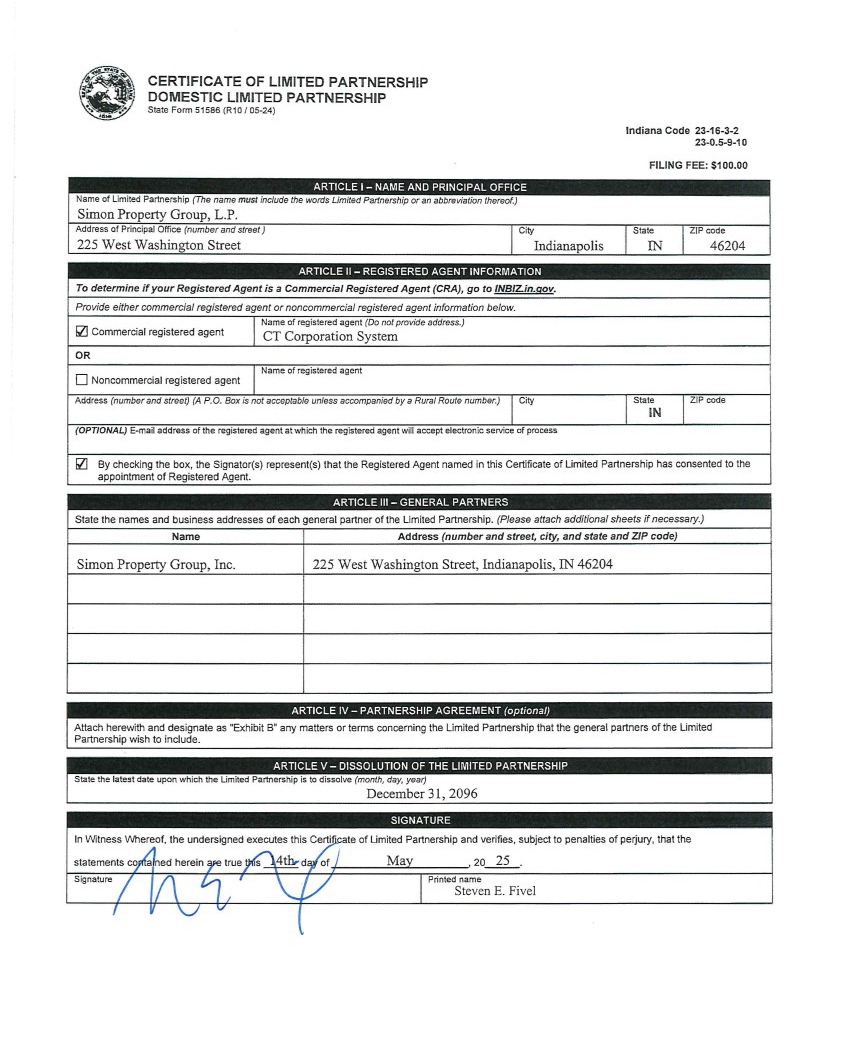
Exhibit 3.4
NINTH AMENDED AND RESTATED LIMITED
PARTNERSHIP AGREEMENT
OF
SIMON PROPERTY GROUP, L.P.
May 15, 2025
TABLE OF CONTENTS
| ARTICLE I Definitions; Etc. | 1 | ||
| 1.1 | Definitions | 1 | |
| 1.2 | Exhibit; Etc. | 11 | |
| ARTICLE II Continuation of Partnership 12 | |||
| 2.1 | Continuation | 12 | |
| 2.2 | Name | 12 | |
| 2.3 | Character of the Business | 12 | |
| 2.4 | Location of the Principal Place of Business | 12 | |
| 2.5 | Registered Agent and Registered Office | 12 | |
| ARTICLE III Term | 13 | ||
| 3.1 | Commencement | 13 | |
| 3.2 | Dissolution | 13 | |
| ARTICLE IV Contributions to Capital | 13 | ||
| 4.1 | General Partner Capital Contributions | 13 | |
| 4.2 | Limited Partner Capital Contributions | 13 | |
| 4.3 | Additional Funds | 13 | |
| 4.4 | Redemption; Change in Number of Shares Outstanding | 15 | |
| 4.5 | Stock Option Plan; Dividend Reinvestment Plan; LTIP Units | 15 | |
| 4.6 | No Third Party Beneficiary | 16 | |
| 4.7 | No Interest; No Return | 16 | |
| 4.8 | Capital Accounts | 16 | |
| ARTICLE V Representations, Warranties and Acknowledgment | 18 | ||
| 5.1 | Representations and Warranties by the General Partner | 18 | |
| 5.2 | Representations and Warranties by the Limited Partners | 18 | |
| 5.3 | Acknowledgment by Each Partner | 18 | |
| ARTICLE VI Allocations, Distributions and Other Tax and Accounting Matters | 19 | ||
| 6.1 | Allocations | 19 | |
| 6.2 | Distributions | 23 | |
| 6.3 | Books of Account; Segregation of Funds | 24 | |
| 6.4 | Reports | 25 | |
| 6.5 | Audits | 25 | |
| 6.6 | Tax Returns | 25 | |
| 6.7 | Partnership Representative | 26 | |
| 6.8 | Withholding | 26 | |
| ARTICLE VII Rights, Duties and Restrictions of the General Partner | 27 | ||
| 7.1 | Expenditures by Partnership | 27 | |
| 7.2 | Powers and Duties of the General Partner | 27 | |
| 7.3 | Major Decisions | 29 | |
| 7.4 | General Partner Participation | 31 | |
| 7.5 | Proscriptions | 31 | |
| 7.6 | Additional Partners | 31 | |
| 7.7 | Title Holder | 31 | |
| 7.8 | Waiver and Indemnification | 32 | |
i
| 7.9 | Limitation of Liability of Directors, Shareholders and Officers of the General Partner | 32 | |
| ARTICLE VIII Dissolution, Liquidation and Winding-Up | 32 | ||
| 8.1 | Accounting | 32 | |
| 8.2 | Distribution on Dissolution | 33 | |
| 8.3 | Sale of Partnership Assets | 33 | |
| 8.4 | Distributions in Kind | 33 | |
| 8.5 | Documentation of Liquidation | 34 | |
| 8.6 | Liability of the Liquidation Agent | 34 | |
| ARTICLE IX Transfer of Partnership Interests and Related Matters | 34 | ||
| 9.1 | General Partner Transfers and Deemed Transfers | 34 | |
| 9.2 | Transfers by Limited Partners | 34 | |
| 9.3 | Issuance of Additional Partnership Units, LP Preferred Units and LTIP Units | 36 | |
| 9.4 | Restrictions on Transfer | 37 | |
| 9.5 | Shelf Registration Rights | 37 | |
| ARTICLE X Rights and Obligations of the Limited Partners | 39 | ||
| 10.1 | No Participation in Management | 39 | |
| 10.2 | Bankruptcy of a Limited Partner | 39 | |
| 10.3 | No Withdrawal | 39 | |
| 10.4 | Duties and Conflicts | 39 | |
| 10.5 | Guaranty and Indemnification Agreements | 40 | |
| ARTICLE XI Grant of Rights to the Limited Partners | 40 | ||
| 11.1 | Grant of Rights | 40 | |
| 11.2 | Limitation on Exercise of Rights | 41 | |
| 11.3 | Computation of Purchase Price/Form of Payment | 41 | |
| 11.4 | Closing | 41 | |
| 11.5 | Closing Deliveries | 41 | |
| 11.6 | Term of Rights | 41 | |
| 11.7 | Covenants of the General Partner | 42 | |
| 11.8 | Limited Partners’ Covenant | 42 | |
| 11.9 | Dividends | 42 | |
| ARTICLE XII General Provisions | 42 | ||
| 12.1 | Investment Representations | 42 | |
| 12.2 | Notices | 43 | |
| 12.3 | Successors | 43 | |
| 12.4 | Liability of Limited Partners | 43 | |
| 12.5 | Effect and Interpretation | 43 | |
| 12.6 | Counterparts | 43 | |
| 12.7 | Partners Not Agents | 43 | |
| 12.8 | Entire Understanding; Etc. | 43 | |
| 12.9 | Severability | 44 | |
| 12.10 | Trust Provision | 44 | |
| 12.11 | Pronouns and Headings | 44 | |
| 12.12 | Assumption of Liabilities | 44 | |
| 12.13 | Assurances | 44 | |
ii
EXHIBITS
| EXHIBIT A | Names, Addresses and Ownership Information for Holders of Partnership Units | |
| EXHIBIT B | GP Preferred Unit Designations | |
| EXHIBIT C | LP Preferred Unit Designations | |
| EXHIBIT D | LTIP Unit Designations [RESERVED] | |
| EXHIBIT E | Registration Rights Agreements | |
| EXHIBIT F | Form of Exercise Notice |
iii
NINTH AMENDED AND RESTATED LIMITED PARTNERSHIP
AGREEMENT
OF
SIMON PROPERTY GROUP, L.P.
THIS NINTH AMENDED AND RESTATED LIMITED PARTNERSHIP AGREEMENT, dated as of May 15, 2025, is entered into by and among SIMON PROPERTY GROUP, INC., an Indiana corporation, as general partner (the “General Partner”), and those persons whose names and addresses are set forth on Exhibit A hereto, as limited partners (the “Limited Partners”). This Agreement shall supersede and replace any and all prior limited partnership agreements of the Partnership, including without limitation the Prior Agreement (defined below).
WITNESSETH:
WHEREAS, the Agreement of Limited Partnership of Simon Property Group, L.P. (the “Partnership”) was last amended and restated in its entirety by the Eighth Amended and Restated Limited Partnership Agreement, dated May 8, 2008; and
WHEREAS, on May 15, 2025, the General Partner redomesticated from the State of Delaware to the State of Indiana by conversion of the General Partner from a corporation organized under the laws of the State of Delaware to a corporation organized under the laws of the State of Indiana; and
WHEREAS, in connection with the General Partner’s redomestication, on May 15, 2025, the Partnership redomesticated from the State of Delaware to the State of Indiana by the conversion of the Partnership from a limited partnership organized under the laws of the State of Delaware to a limited partnership organized under the laws of the State of Indiana (the “Redomestication”); and
WHEREAS, the parties hereto wish to provide for the further amendment and restatement of the Agreement of Limited Partnership to reflect the Redomestication and the fact that this Agreement shall be governed by the Act (as defined below); and
WHEREAS, the General Partner has obtained the Consent of the Limited Partners (as defined herein) to the amendment and restatement of this Agreement.
NOW, THEREFORE, in consideration of the mutual covenants and agreements herein contained and other good and valuable consideration, the receipt, adequacy and sufficiency of which are hereby acknowledged, the parties hereto, intending legally to be bound, hereby agree that the Eighth Amended and Restated Agreement of Limited Partnership of the Partnership, as heretofore amended and restated, is hereby further amended and restated in its entirety to read as follows:
ARTICLE I
Definitions; Etc.
1.1 Definitions. Except as otherwise herein expressly provided the following terms and phrases shall have the meanings set forth below:
“Accountants” shall mean the independent registered public accounting firm or firms selected by the General Partner from time to time on behalf of the Partnership to audit the books and records of the Partnership and to prepare and certify statements and reports in connection therewith.
1
“Act” shall mean the Revised Uniform Limited Partnership Act as enacted in the State of Indiana, Indiana Code § 23-16-1-1, et seq., as the same may hereafter be amended from time to time.
“Additional Units” shall have the meaning set forth in Section 9.3(a) hereof.
“Adjusted Capital Account Balance” shall have the meaning set forth in Section 6.1(b)(1) hereof.
“Adjustment Date” shall have the meaning set forth in Section 4.3(b) hereof.
“Administrative Expenses” shall mean (i) all administrative and operating costs and expenses incurred by the Partnership, and (ii) those administrative costs and expenses and accounting and legal expenses incurred by the General Partner on behalf or for the benefit of the Partnership.
“Affected Gain” shall have the meaning set forth in Section 6.1(g) hereof.
“Affiliate” shall mean, with respect to any Partner (or as to any other Person the affiliates of which are relevant for purposes of any of the provisions of this Agreement): (i) any member of the Immediate Family of such Partner or Person; (ii) any partner, trustee, beneficiary, member or stockholder of such Partner or Person; (iii) any legal representative, successor or assignee of such Partner or any Person referred to in the preceding clauses (i) and (ii); (iv) any trustee or trust for the benefit of such Partner or any Person referred to in the preceding clauses (i) through (iii); or (v) any Entity which, directly or indirectly through one or more intermediaries, Controls, is Controlled by or is under common Control with such Partner or any Person referred to in the preceding clauses (i) through (iv).
“Affiliate Financing” shall mean financing or refinancing obtained from a Partner or an Affiliate of a Partner by the Partnership.
“Agreement” shall mean this Ninth Amended and Restated Limited Partnership Agreement, as originally executed and as amended, modified, supplemented or restated from time to time, as the context requires.
“Bankruptcy” shall mean, with respect to any Partner, (i) the commencement by such Partner of any proceeding seeking relief under any provision or chapter of the federal Bankruptcy Code or any other federal or state law relating to insolvency, bankruptcy or reorganization, (ii) an adjudication that such Partner is insolvent or bankrupt, (iii) the entry of an order for relief under the federal Bankruptcy Code with respect to such Partner, (iv) the filing of any petition or the commencement of any case or proceeding against such Partner under the federal Bankruptcy Code unless such petition and the case or proceeding initiated thereby are dismissed within ninety (90) days from the date of such filing or commencement, (v) the filing of an answer by such Partner admitting the allegations of any such petition, (vi) the appointment of a trustee, receiver or custodian for all or substantially all of the assets of such Partner unless such appointment is vacated or dismissed within ninety (90) days from the date of such appointment but not less than five (5) days before the proposed sale of any assets of such Partner, (vii) the execution by such Partner of a general assignment for the benefit of creditors, (viii) the convening by such Partner of a meeting of its creditors, or any class thereof, for purposes of effecting a moratorium upon or extension or composition of its debts, (ix) the failure of such Partner to pay its debts as they mature, (x) the levy, attachment, execution or other seizure of substantially all of the assets of such Partner where such seizure is not discharged within thirty (30) days thereafter, or (xi) the admission by such Partner in writing of its inability to pay its debts as they mature or that it is generally not paying its debts as they become due.
“Capital Account” shall have the meaning set forth in Section 4.8(a) hereof.
2
“Capital Contribution” shall mean, with respect to any Partner, the amount of money and the initial Gross Asset Value of any property other than money contributed to the Partnership with respect to the Partnership Units held by such Partner (net of liabilities secured by such property which the Partnership assumes or takes subject to).
“Certificate” shall mean the Certificate of Limited Partnership establishing the Partnership as an Indiana limited partnership, as filed with the office of the Indiana Secretary of State on May 15, 2025, as it has or may hereafter be amended from time to time in accordance with the terms of this Agreement and the Act.
“Charter” shall mean the articles of incorporation of the General Partner and all amendments, supplements and restatements thereof.
“Closing Price” on any date shall mean the last sale price per share, regular way, of the Shares or, in case no such sale takes place on such day, the average of the closing bid and asked prices, regular way, of the Shares in either case as reported in the principal consolidated transaction reporting system with respect to securities listed or admitted to trading on the New York Stock Exchange or, if the Shares are not listed or admitted to trading on the New York Stock Exchange, as reported in the principal consolidated transaction reporting system with respect to securities listed on the principal national securities exchange on which the Shares are listed or admitted to trading or, if the Shares are not listed or admitted to trading on any national securities exchange, the last quoted price, or if not so quoted, the average of the high bid and low asked prices in the over-the-counter market, as reported by the OTC Markets Group, Inc. for the Shares or, if such system is no longer in use, the principal other automated quotations system that may then be in use or, if the Shares are not quoted by any such organization, the average of the closing bid and asked prices as furnished by a professional market maker making a market in the Shares selected from time to time by the Board of Directors of the General Partner.
“Code” shall mean the Internal Revenue Code of 1986, as amended, or any corresponding provisions of succeeding law.
“Computation Date” shall have the meaning set forth in Section 11.3 hereof.
“Consent of the DeBartolos” shall mean consent of those Limited Partners who are “DeBartolos” as defined herein. NID Corporation (in such capacity the “DeBartolo Designee”) is hereby granted authority by those Limited Partners who are DeBartolos to grant or withhold consent on behalf of the DeBartolos whenever the Consent of the DeBartolos is required hereunder. The DeBartolos shall have the right, from time to time, by written notice to the Partnership signed by DeBartolos who hold in the aggregate more than fifty percent (50%) of the Partnership Units then held by the DeBartolos, to substitute a new Person as the DeBartolo Designee for the Person who is then acting as such. The Partnership, the Partners and all Persons dealing with the Partnership shall be fully protected in relying on any written consent of the DeBartolos which is executed by the Person who is then acting as the DeBartolo Designee. In the event that at any time there is no DeBartolo Designee, the consent of the DeBartolos shall be given by those DeBartolos who hold in the aggregate more than fifty percent (50%) of the Partnership Units then held by the DeBartolos.
“Consent of the Limited Partners” shall mean the written consent of a Majority-In-Interest of the Limited Partners (which for this purpose shall not include holders of LP Preferred Units or LTIP Units), which consent shall be obtained prior to the taking of any action for which it is required by this Agreement and may be given or withheld by a Majority-In-Interest of the Limited Partners, unless otherwise expressly provided herein, in their sole and absolute discretion. Whenever the Consent of the Limited Partners is sought by the General Partner, the request for such consent, outlining in reasonable detail the matter or matters for which such consent is being requested, shall be submitted to all of the Limited Partners, and each Limited Partner shall have at least 15 days to act upon such request.
3
“Consent of the Simons” shall mean consent of those Limited Partners who are “Simons” as defined herein. David Simon (the “Simon Designee”) is hereby granted authority by those Limited Partners who are Simons to grant or withhold consent on behalf of the Simons whenever the Consent of the Simons is required hereunder. The Simons shall have the right from time to time, by written notice to the Partnership signed by Simons who hold in the aggregate more than fifty percent (50%) of the Partnership Units then held by the Simons, to substitute a new Person as the Simon Designee for the Person who is then acting as such. The Partnership, the Partners and all Persons dealing with the Partnership shall be fully protected in relying on any written consent of the Simons which is executed by the Person who is then acting as the Simon Designee. In the event that at any time there is no Simon Designee, the Consent of the Simons shall be given by those Simons who hold in the aggregate more than fifty percent (50%) of the Partnership Units then held by the Simons.
“Contributed Funds” shall have the meaning set forth in Section 4.3(b) hereof.
“Contribution Current Per Share Market Price” on any date shall mean the average of the Closing Prices for a period of not less than five consecutive Trading Days nor more than thirty consecutive Trading Days ending on such date, such period determined in the sole and absolute discretion of the General Partner.
“Contribution Date” shall have the meaning set forth in Section 9.3 hereof.
“Contribution Deemed Partnership Unit Value” as of any date shall mean the Contribution Current Per Share Market Price as of the Trading Day immediately preceding such date; provided, however, that Contribution Deemed Partnership Unit Value shall be adjusted as described in Section 11.7(d) hereof in the event of any stock dividend, stock split, stock distribution or similar transaction.
“Control” shall mean the ability, whether by the direct or indirect ownership of shares or other equity interests, by contract or otherwise, to elect a majority of the directors of a corporation, to select the managing partner of a partnership or otherwise to select, or have the power to remove and then select, a majority of those Persons exercising governing authority over an Entity. In the case of a limited partnership, the sole general partner, all of the general partners to the extent each has equal management control and authority, or the managing general partner or managing general partners thereof shall be deemed to have control of such partnership and, in the case of a trust, any trustee thereof or any Person having the right to select or remove any such trustee shall be deemed to have control of such trust.
“Covered Sale” shall have the meaning set forth in Section 6.2(d) hereof.
“Current Per Share Market Price” on any date shall mean the average of the Closing Prices for the five consecutive Trading Days ending on such date.
“DeBartolos” shall mean (i) the Estate of Edward J. DeBartolo, (ii) Edward J. DeBartolo, Jr., Marie Denise DeBartolo York, members of the Immediate Family of either of the foregoing, any other members of the Immediate Family of Edward J. DeBartolo, any other lineal descendants of any of the foregoing and any trusts established for the benefit of any of the foregoing, and (iii) NID Corporation and any other Entity Controlled by any one or more of the Persons listed or specified in clauses (i) and (ii) above.
“Deemed Partnership Unit Value” as of any date shall mean the Current Per Share Market Price as of the Trading Day immediately preceding such date; provided, however, that Deemed Partnership Unit Value shall be adjusted as described in Section 11.7(d) hereof in the event of any stock dividend, stock split, stock distribution or similar transaction.
4
“Depreciation” shall mean for each Partnership Fiscal Year or other period, an amount equal to the depreciation, amortization, or other cost recovery deduction allowable under the Code with respect to a Partnership asset for such year or other period, except that if the Gross Asset Value of a Partnership asset differs from its adjusted basis for federal income tax purposes at the beginning of such year or other period, Depreciation shall be an amount which bears the same ratio to such beginning Gross Asset Value as the federal income tax depreciation, amortization or other cost recovery deduction for such year or other period bears to such beginning adjusted tax basis; provided, however, that if the federal income tax depreciation, amortization or other cost recovery deduction for such year is zero, Depreciation shall be determined with reference to such beginning Gross Asset Value using any reasonable method selected by the General Partner.
“Development Land” shall mean any vacant land suitable for development as a Project.
“Directors” shall mean the Board of Directors of the General Partner.
“Entity” shall mean any general partnership, limited partnership, limited liability company, limited liability partnership, corporation, joint venture, trust, business trust, cooperative or association.
“ERISA” shall mean the Employee Retirement Income Security Act of 1974, as amended from time to time (or any corresponding provisions of succeeding laws).
“Exercise Notice” shall have the meaning set forth in Section 11.1 hereof.
“GAAP” shall mean generally accepted accounting principles consistently applied.
“General Partner” shall mean Simon Property Group, Inc., an Indiana corporation.
“GP Preferred Contributed Funds” shall have the meaning set forth in Section 4.3(c) hereof.
“GP Preferred Distribution Requirement” shall have the meaning set forth in Section 4.3(c) hereof.
“GP Preferred Redemption Amount” shall mean, with respect to any class or series of GP Preferred Units, the sum of (i) the amount of any accumulated Preferred Distribution Shortfall with respect to such class or series of GP Preferred Units, (ii) the Preferred Distribution Requirement with respect to such class or series of GP Preferred Units to the date of redemption and (iii) the GP Preferred Redemption Price indicated in the GP Preferred Unit Designation with respect to such class or series of GP Preferred Units.
“GP Preferred Redemption Price” shall have the meaning set forth in Section 4.3(c) hereof.
“GP Preferred Unit Designation” shall have the meaning set forth in Section 4.3(c) hereof.
“GP Preferred Units” means the preferred interests in the Partnership issued to the General Partner pursuant to Section 4.3(c) hereof and having the economic rights, including dividend, redemption and conversion rights and sinking fund provisions, set forth in a GP Preferred Unit Designation.
“Gross Asset Value” shall have the meaning set forth in Section 4.8(b) hereof.
“Gross Income” shall mean the income of the Partnership determined pursuant to Section 61 of the Code before deduction of items of expense or deduction.
5
“Immediate Family” shall mean, with respect to any Person, such Person’s spouse, parents, parents-in-law, descendants by blood or adoption, nephews, nieces, brothers, sisters, brothers-in-law, sisters-in-law and children-in-law (in each case by whole or half-blood).
“Incurrence” shall have the meaning set forth in Section 10.5(a) hereof.
“Independent Directors” shall mean those Directors who are not employed by the General Partner, a member of the Simons or any Affiliate of such Persons.
“Institutional Investors” shall have the meaning set forth in Rule 501(a)(1)-(3), (7)-(9) of Regulation D promulgated under the Securities Act.
“Institutional Lender” shall mean a commercial bank or trust company, a savings and loan association or an insurance company.
“JCP” shall mean JCP Realty, Inc., a Delaware corporation, or any of its Affiliates that becomes a Limited Partner hereunder and that is an “accredited investor” as defined in Regulation D under the Securities Act.
“JCP Limited Partner” shall mean JCP, in its capacity as a Limited Partner or Partners hereunder.
“JCP Property Liabilities” means any liabilities encumbering the assets of Treasure Coast-JCP Associates, Ltd., Melbourne-JCP Associates, Ltd., Boynton-JCP Associates, Ltd., Chesapeake-JCP Associates, Ltd., Mall of the Mainland Associates, L.P., Port Charlotte-JCP Associates and Northfield Center Limited Partnership, and any liability of the Partnership or any Subsidiary Partnership with respect to which JCP has incurred the “economic risk of loss” within the meaning of Treasury Regulation § 1.752-2.
“Lien” shall mean any liens, security interests, mortgages, deeds of trust, charges, claims, encumbrances, restrictions, pledges, options, rights of first offer or first refusal and any other rights or interests of others of any kind or nature, actual or contingent, or other similar encumbrances of any nature whatsoever.
“Limited Partners” unless the context expressly provides otherwise, shall mean those Persons whose names are set forth on Exhibit A, their permitted successors or assigns as limited partners hereof, and/or any Person who, at the time of reference thereto, is a limited partner of the Partnership.
“Limited Partnership Unit” shall mean each Partnership Unit (other than LTIP Units) held by a Limited Partner.
“Liquidation Agent” shall mean such Person as is selected as the Liquidation Agent hereunder by the General Partner, which Person may be the General Partner or an Affiliate of the General Partner, provided such Liquidation Agent agrees in writing to be bound by the terms of this Agreement. The Liquidation Agent shall be empowered to give and receive notices, reports and payments in connection with the dissolution, liquidation and/or winding-up of the Partnership and shall hold and exercise such other rights and powers as are necessary or required to permit all parties to deal with the Liquidation Agent in connection with the dissolution, liquidation and/or winding-up of the Partnership.
“Liquidation Transaction” shall mean any sale of assets of the Partnership in contemplation of, or in connection with, the liquidation of the Partnership.
6
“Losses” shall have the meaning set forth in Section 6.1(a) hereof.
“LP Preferred Distribution Requirement” means the dividends or distributions required to be made at the time such dividend or distribution is required to be made on a class or series of LP Preferred Units as set forth in the related LP Preferred Unit Designation.
“LP Preferred Unit Designation” shall have the meaning set forth in Section 9.3(b) hereof.
“LP Preferred Units” means the preferred interests in the Partnership issued to a Limited Partner pursuant to Section 9.3(a) hereof and having the economic rights, including distribution, redemption, conversion and exchange rights and sinking fund provisions, set forth in the related LP Preferred Unit Designation. The number of LP Preferred Units for each outstanding class or series of LP Preferred Units held by each Limited Partner at the date of this Agreement is as set forth on Exhibit A attached hereto.
“LTIP Unit Designation” shall have the meaning set forth in Section 9.3(c) hereof.
“LTIP Units” means long-term incentive plan interests in the Partnership issued hereafter pursuant to Section 9.3(a). The LTIP Units shall be convertible into Limited Partnership Units under the terms and conditions set forth in a related LTIP Unit Designation. There are no LTIP Units outstanding as of the date of this Agreement.
“Major Decisions” shall have the meaning set forth in Section 7.3(b) hereof.
“Majority-In-Interest of the Limited Partners” shall mean Limited Partner(s) who hold in the aggregate more than fifty percent (50%) of the Partnership Units then held by all the Limited Partners, as a class (excluding any Partnership Units held by the General Partner, any Person Controlled by the General Partner or any Person holding as nominee for the General Partner).
“Minimum Gain” shall have the meaning set forth in Section 6.1(d)(l) hereof.
“Minimum Gain Chargeback” shall have the meaning set forth in Section 6.1(d)(l) hereof.
“Net Financing Proceeds” shall mean the cash proceeds received by the Partnership in connection with any borrowing by or on behalf of the Partnership (whether or not secured), or distributed to the Partnership in respect of any such borrowing by any Subsidiary Entity, after deduction of all costs and expenses incurred by the Partnership in connection with such borrowing, and after deduction of that portion of such proceeds used to repay any other indebtedness of the Partnership, or any interest or premium thereon.
“Net Operating Cash Flow” shall mean, with respect to any fiscal period of the Partnership, the aggregate amount of all cash received by the Partnership from any source for such fiscal period (including Net Sale Proceeds and Net Financing Proceeds but excluding Contributed Funds), less the aggregate amount of all expenses or other amounts paid with respect to such period and such additional cash reserves as of the last day of such period as the General Partner deems necessary for any capital or operating expenditure permitted hereunder.
“Net Sale Proceeds” shall mean the cash proceeds received by the Partnership in connection with a sale or other disposition of any asset by or on behalf of the Partnership or a sale or other disposition of any asset by or on behalf of any Subsidiary Entity, after deduction of any costs or expenses incurred by the Partnership, or payable specifically out of the proceeds of such sale or other disposition (including, without limitation, any repayment of any indebtedness required to be repaid as a result of such sale or other disposition or which the General Partner elects to repay out of the proceeds of such sale or other disposition, together with accrued interest and premium, if any, thereon and any sales commissions or other costs and expenses due and payable to any Person), in connection with such sale or other disposition.
7
“NID Corporation” shall mean NID Corporation, an Ohio corporation formerly known as The Edward J. DeBartolo Corporation.
“Nonrecourse Liabilities” shall have the meaning set forth in Section 6.l(d)(l) hereof.
“Offered Units” shall have the meaning set forth in Section 11.1 hereof.
“Ownership Limit” shall have the meaning set forth in Article VIII, Section 8.1(a), of the Charter.
“Partner Nonrecourse Debt” shall have the meaning set forth in Section 6.1(d)(2) hereof.
“Partner Nonrecourse Debt Minimum Gain” shall have the meaning set forth in Section 6.1(d)(2) hereof.
“Partner Nonrecourse Deduction” shall have the meaning set forth in Section 6.1(d)(2) hereof.
“Partners” shall mean the General Partner and the Limited Partners (including, unless the context expressly indicates otherwise, the holders of LP Preferred Units and LTIP Units), their duly admitted successors or assigns or any Person who is a partner of the Partnership at the time of reference thereto.
“Partnership” shall mean Simon Property Group, L.P., an Indiana limited partnership, as such limited partnership may from time to time be constituted.
“Partnership Fiscal Year” shall mean the calendar year.
“Partnership Interest” shall mean the interest of a Partner in the Partnership.
“Partnership Minimum Gain” shall have the meaning set forth in Section 1.704-2(b)(2) of the Regulations.
“Partnership Record Date” shall mean the record date established by the General Partner for a distribution of Net Operating Cash Flow pursuant to Section 6.2 hereof, which record date shall be the same as the record date established by the General Partner for distribution to its shareholders of some or all of its share of such distribution.
“Partnership Representative” shall have the meaning set forth in Section 6.7 hereof.
“Partnership Units” or “Units” shall mean the interest in the Partnership of any Partner which entitles a Partner to the allocations (and each item thereof) specified in Section 6.1(b) hereof and all distributions from the Partnership, and its rights of management, consent, approval, or participation, if any, as provided in this Agreement. Partnership Units do not include Preferred Units and include LTIP Units only to the extent provided in the applicable LTIP Unit Designation. Each Partner’s percentage ownership interest in the Partnership shall be determined by dividing the number of Partnership Units then owned by each Partner by the total number of Partnership Units then outstanding. The number of Partnership Units held by the General Partner and by each Limited Partner at the date of this Agreement is as set forth on Exhibit A attached hereto.
8
“Person” shall mean any individual or Entity.
“Pledge” shall mean granting of a Lien on a Partnership Interest.
“Post-Exchange Distribution” shall have the meaning set forth in Section 6.2(a) hereof.
“Preferred Distribution Requirement” shall mean the GP Preferred Distribution Requirement and the LP Preferred Distribution Requirement.
“Preferred Distribution Shortfall” shall have the meaning set forth in Section 6.2(b)(i) hereof.
“Preferred Shares” shall mean any class of equity securities of the General Partner now or hereafter authorized or reclassified having dividend rights that are superior or prior to dividends payable on the Shares or any other shares of common stock of the General Partner.
“Preferred Units” shall mean GP Preferred Units issued to the General Partner pursuant to Section 4.3(c) hereof and LP Preferred Units issued to a Limited Partner pursuant to Section 9.3(a) hereof. Unless otherwise specified in the Preferred Unit Designations, as the case may be, the holders of any class or series of Preferred Units shall have such rights to the allocations of Profits and Losses as specified in Section 6.1 hereof and to distributions pursuant to Section 6.2 hereof, but shall not, by reason of their ownership of such Preferred Units, be entitled to participate in the management of the Partnership or to consent to or approve any action which is required by the Act or this Agreement to be approved by any or all of the Partners.
“Preferred Unit Designation” means the GP Preferred Unit Designations and the LP Preferred Unit Designations, collectively.
“Preferred Unit Issue Price” shall mean (i) with respect to GP Preferred Units, (a) the amount of the Required Funds contributed or deemed to have been contributed by the General Partner in exchange for a GP Preferred Unit or (b) in the case of GP Preferred Units issued in respect of a Related Issue issued upon conversion of or in exchange for any LP Preferred Units, the liquidation preference of such GP Preferred Unit upon issuance, and (ii) with respect to LP Preferred Units, the liquidation preference of such LP Preferred Unit upon issuance.
“Profits” shall have the meaning set forth in Section 6.1(a) hereof.
“Project” shall mean any property that is or is planned to be used primarily for retail purposes, and shall include, but is not limited to, a regional mall, a community shopping center, a specialty retail center and a mixed-use property which contains a major retail component.
“Property or Properties” shall mean any Development Land or Project in which the Partnership acquires ownership of (a) the fee or leasehold interest or (b) an indirect fee or leasehold interest through an interest in any other Entity.
“Purchase Price” shall have the meaning set forth in Section 11.3 hereof.
“Qualified REIT Subsidiaries” shall have the meaning set forth in Section 856(i)(2) of the Code.
“Registrable Securities” shall have the mean set forth in Section 9.5(a) hereof.
9
“Registration Rights Agreements” shall mean the agreements, in effect as of September 24, 1998, among the General Partner, certain of its stockholders and certain holders of Units.
“Regulations” shall mean the final, temporary or proposed income tax regulations promulgated under the Code, as such regulations may be amended from time to time (including corresponding provisions of succeeding regulations).
“Regulatory Allocations” shall have the meaning set forth in Section 6.1(d)(5) hereof.
“REIT” shall mean a real estate investment trust as defined in Section 856 of the Code.
“REIT Expenses” shall mean (i) costs and expenses relating to the continuity of existence of the General Partner and its respective subsidiaries, including taxes, fees and assessments associated therewith, and any and all costs, expenses or fees payable to any director or trustee of the General Partner or such subsidiaries, (ii) costs and expenses relating to any offer or registration of securities by the General Partner or its respective subsidiaries and all statements, reports, fees and expenses incidental thereto, including underwriting discounts, selling commissions and placement fees applicable to any such offer of securities; provided, however, that in the case of any such registration of securities on behalf of one or more of the security holders of the General Partner or its respective subsidiaries, REIT Expenses shall not include underwriting discounts or selling commissions), (iii) costs and expenses associated with the preparation and filing of any periodic reports by the General Partner or its respective subsidiaries under federal, state or local laws or regulations, including tax returns and filings with the SEC and any stock exchanges on which the Shares are listed, (iv) costs and expenses associated with compliance by the General Partner or its respective subsidiaries with laws, rules and regulations promulgated by any regulatory body, including the SEC, (v) costs and expenses associated with any 401(k) Plan, incentive plan, bonus plan or other plan providing for compensation for the employees of the General Partner or its respective subsidiaries, and (vi) all operating, administrative and other costs incurred by the General Partner or its respective subsidiaries (including attorney’s and accountant’s fees, income and franchise taxes and salaries paid to officers of the General Partner or its respective subsidiaries, but excluding costs of any repurchase by the General Partner of any of its securities and excluding costs associated with activities and business operations not conducted directly or indirectly through the Partnership or any Subsidiary Partnership); provided, however that amounts described herein shall be considered REIT Expenses hereunder only if and to the extent during the fiscal year in question the aggregate amount of such expenses for such fiscal year and all prior fiscal years exceeds the aggregate of (a) all amounts theretofore distributed or distributable to the General Partner by any wholly-owned subsidiary thereof and (b) all amounts theretofore paid to the General Partner pursuant to Section 7.1 hereof.
“REIT Requirements” shall mean all actions or omissions as may be necessary (including making appropriate distributions from time to time) to permit the General Partner and, where applicable, each of its respective subsidiaries and, where applicable, each Subsidiary Entity, to qualify or continue to qualify as a real estate investment trust within the meaning of Section 856 et seq. of the Code, as such provisions may be amended from time to time, or the corresponding provisions of succeeding law.
“Related Issue” shall mean, with respect to a class or series of GP Preferred Units, (a) the class or series of Preferred Shares the sale of which provided the General Partner with the proceeds to contribute to the Partnership in exchange for such GP Preferred Units and (b) the class or series of Preferred Shares issued upon conversion of or in exchange for any LP Preferred Units.
“Required Funds” shall have the meaning set forth in Section 4.3(a) hereof.
“Rights” shall have the meaning set forth in Section 11.1 hereof.
10
“SEC” shall mean the United States Securities and Exchange Commission.
“Securities Act” shall mean the Securities Act of 1933, as amended.
“Shares” shall mean the shares of Common Stock, par value $0.0001 per share, of the General Partner.
“Shelf Rights Holder” shall have the meaning set forth in Section 9.5 hereof.
“Shelf Registration” shall have the meaning set forth in Section 9.5 hereof.
“Simons” shall mean Melvin Simon, Herbert Simon and David Simon, other members of the Immediate Family of any of the foregoing, any other lineal descendants of any of the foregoing, any trusts established for the benefit of any of the foregoing, and any Entity Controlled by any one or more of the foregoing.
“Subsidiary Entity” shall mean any Entity in which the Partnership owns a direct or indirect equity interest.
“Subsidiary Partnership” shall mean any partnership or limited liability company in which the Partnership owns a direct or indirect equity interest.
“Substituted Limited Partner” means a Person who is admitted as a Limited Partner to the Partnership pursuant to Section 9.2 in place of and with all the rights of a Limited Partner and who is shown as a Limited Partner on the books and records of the Partnership.
“Third Party Financing” shall mean financing or refinancing obtained from a Third Party by the Partnership.
“Third Party” or “Third Parties” shall mean a Person or Persons who is or are neither a Partner or Partners nor an Affiliate or Affiliates of a Partner or Partners.
“Trading Day” shall mean a day on which the principal national securities exchange on which the Shares are listed or admitted to trading is open for the transaction of business or, if the Shares are not listed or admitted to trading on any national securities exchange, shall mean any day other than a Saturday, a Sunday or a day on which banking institutions in the State of New York are authorized or obligated by law or executive order to close.
“Transfer” shall mean any assignment, sale, transfer, conveyance or other disposition or act of alienation (other than a Pledge), whether voluntary or involuntary or by operation of law.
1.2 Exhibit; Etc. References in this Agreement to an “Exhibit” are, unless otherwise specified, to one of the Exhibits attached to this Agreement, and references in this Agreement to an “Article” or a “Section” are, unless otherwise specified, to one of the Articles or Sections of this Agreement. Each Exhibit attached hereto and referred to herein is hereby incorporated herein by reference.
11
ARTICLE II
Continuation of Partnership
2.1 Continuation. The parties hereto do hereby agree to continue the Partnership as a limited partnership pursuant to the provisions of the Act, and all other pertinent laws of the State of Indiana, for the purposes and upon the terms and conditions hereinafter set forth. The Partners agree that the rights and liabilities of the Partners shall be as provided in the Act except as otherwise herein expressly provided. Promptly upon the execution and delivery of this Agreement, the General Partner shall cause each notice, instrument, document or certificate as may be required by applicable law, and which may be necessary to enable the Partnership to continue to conduct its business, and to own its properties, under the Partnership name to be filed or recorded in all appropriate public offices. Upon request of the General Partner, the Partners shall execute any assumed or fictitious name certificate or certificates required by law to be filed in connection with the Partnership. The General Partner shall properly cause the execution and delivery of such additional documents and shall perform such additional acts consistent with the terms of this Agreement as may be necessary to comply with the requirements of law for the continued operation of a limited partnership under the laws of the State of Indiana (it being understood that the General Partner shall be required to provide the Limited Partners with copies of any amendment to the Certificate required to be filed under such laws only upon request) and for the continued operation of a limited partnership in each other jurisdiction in which the Partnership shall conduct business.
2.2 Name. The name of the Partnership is Simon Property Group, L.P., and all business of the Partnership shall be conducted under the name of Simon Property Group, L.P. or such other name as the General Partner may select; provided, however, that the General Partner may not choose the name (or any derivative thereof) of any Limited Partner (other than the names “DeBartolo” or “Simon”) without the prior written consent of such Limited Partner. All transactions of the Partnership, to the extent permitted by applicable law, shall be carried on and completed in such name (it being understood that the Partnership may adopt assumed or fictitious names in certain jurisdictions).
2.3 Character of the Business. The purpose of the Partnership is and shall be to acquire, hold, own, develop, redevelop, construct, reconstruct, alter, improve, maintain, operate, sell, lease, Transfer, encumber, convey, exchange and otherwise dispose of or deal with the Properties and any other real and personal property of all kinds; to undertake such other activities as may be necessary, advisable, desirable or convenient to the business of the Partnership; and to engage in such other ancillary activities as shall be necessary or desirable to effectuate the foregoing purposes. The Partnership shall have all powers necessary or desirable to accomplish the purposes enumerated. In connection with the foregoing, but subject to all of the terms, covenants, conditions and limitations contained in this Agreement and any other agreement entered into by the Partnership, the Partnership shall have full power and authority to enter into, perform and carry out contracts of any kind, to borrow or lend money and to issue evidences of indebtedness, whether or not secured by mortgage, trust deed, pledge or other Lien and, directly or indirectly, to acquire and construct additional Properties necessary or useful in connection with its business.
2.4 Location of the Principal Place of Business. The location of the principal place of business of the Partnership shall be at 225 West Washington Street, Indianapolis, Indiana 46204 or such other location as shall be selected from time to time by the General Partner in its sole discretion; provided, however, that the General Partner shall promptly notify the Limited Partners of any change in the location of the principal place of business of the Partnership.
2.5 Registered Agent and Registered Office. The Registered Agent of the Partnership shall be CT Corporation System, or such other Person as the General Partner may select in its sole discretion. The Registered Office of the Partnership in the State of Indiana shall be c/o CT Corporation System, 334 North Senate Avenue, Indianapolis, IN 46204-1708, or such other location as the General Partner may select in its sole and absolute discretion. The General Partner shall promptly notify the Limited Partners of any change in the Registered Agent or Registered Office of the Partnership.
12
ARTICLE III
Term
3.1 Commencement. The Partnership commenced business as a limited partnership on November 18, 1993 upon the filing of a Certificate of Limited Partnership with the Secretary of State of the State of Delaware. Subsequently, on May 15, 2025, the Partnership redomesticated to the State of Indiana by filing a Certificate of Conversion with the Secretary of State of the State of Delaware and Articles of Domestication with the Secretary of State of the State of Indiana.
3.2 Dissolution. The Partnership shall continue until dissolved and terminated upon the earlier of (i) December 31, 2096, or (ii) the earliest to occur of the following events:
(a) the dissolution, termination, withdrawal, retirement or Bankruptcy of the General Partner unless the Partnership is continued as provided in Section 9.1 hereof;
(b) the election to dissolve the Partnership made in writing by the General Partner, but only if the consent required by Section 7.3 is obtained;
(c) the sale or other disposition of all or substantially all the assets of the Partnership; or
(d) dissolution required by operation of law.
ARTICLE IV
Contributions to Capital
4.1 General Partner Capital Contributions.
(a) The General Partner shall contribute to the capital of the Partnership, in exchange for Units as provided in Section 4.3(b) hereof, the proceeds of the sale of any Shares.
(b) All transfer, stamp or similar taxes payable upon any contribution provided for in this Section 4.1 shall be paid by the Partnership.
4.2 Limited Partner Capital Contributions. Except as expressly provided in Sections 4.3, 4.4, 4.5 and 4.8 below, no Partner may make, and no Partner shall have the obligation to make, additional contributions to the capital of the Partnership without the consent of the General Partner.
4.3 Additional Funds.
(a) The Partnership may obtain funds (“Required Funds”) which it considers necessary to meet the needs, obligations and requirements of the Partnership, or to maintain adequate working capital or to repay Partnership indebtedness, and to carry out the Partnership’s purposes, from the proceeds of Third Party Financing or Affiliate Financing, in each case pursuant to such terms, provisions and conditions and in such manner (including the engagement of brokers and/or investment bankers to assist in providing such financing) and amounts as the General Partner shall determine to be in the best interests of the Partnership, subject to the terms and conditions of this Agreement. Any and all funds required or expended, directly or indirectly, by the Partnership for capital expenditures may be obtained or replenished through Partnership borrowings. Any Third Party Financing or Affiliate Financing obtained by the General Partner for and on behalf of the Partnership may be convertible in whole or in part into Additional Units (to be issued in accordance with Section 9.3 hereof), may be unsecured, may be secured by mortgage(s) or deed(s) of trust and/or assignments on or in respect of all or any portion of the assets of the Partnership or any other security made available by the Partnership, may include or be obtained through the public or private placement of debt and/or other instruments, domestic and foreign, may include provision for the option to acquire Additional Units (to be issued in accordance with Section 9.3 hereof), and may include the acquisition of or provision for interest rate swaps, credit enhancers and/or other transactions or items in respect of such Third Party Financing or Affiliate Financing; provided, however, that in no event may the Partnership obtain any Affiliate Financing or Third Party Financing that is recourse to any Partner or any Affiliate, partner, stockholder, beneficiary, principal officer or director of any Partner without the consent of the affected Partner and any other Person or Persons to whom such recourse may be had.
13
(b) To the extent the Partnership does not borrow all of the Required Funds (and whether or not the Partnership is able to borrow all or part of the Required Funds), the General Partner (or an Affiliate thereof) (i) may itself borrow such Required Funds, in which case the General Partner or its Affiliate shall lend such Required Funds to the Partnership on the same economic terms and otherwise on substantially identical terms, or (ii) may raise such Required Funds in any other manner, in which case, unless such Required Funds are raised by the General Partner through the sale of Preferred Shares, the General Partner shall contribute to the Partnership as an additional Capital Contribution the amount of the Required Funds so raised (“Contributed Funds”) (hereinafter, each date on which the General Partner so contributes Contributed Funds pursuant to this Section 4.3(b) is referred to as an “Adjustment Date”). Any Required Funds raised from the sale of Preferred Shares shall either be contributed to the Partnership as Contributed Funds or loaned to the Partnership pursuant to Section 4.3(c) below. In the event the General Partner advances Required Funds to the Partnership pursuant to this Section 4.3(b) as Contributed Funds, then the Partnership shall assume and pay (or reflect on its books as additional Contributed Funds) the expenses (including any applicable underwriting discounts) incurred by the General Partner (or such Affiliate) in connection with raising such Required Funds through a public offering of its securities or otherwise. If the General Partner advances Required Funds to the Partnership as Contributed Funds pursuant to this Section 4.3(b) from any offering or sale of Shares (including, without limitation, any issuance of Shares pursuant to the exercise of options, warrants, convertible securities or similar rights to acquire Shares), the Partnership shall issue additional Partnership Units to the General Partner to reflect its contribution of the Contributed Funds equal in number to such number of Shares issued in such offering or sale.
(c) In the event the General Partner contributes to the Partnership any Required Funds obtained from the sale of Preferred Shares (“GP Preferred Contributed Funds”), then the Partnership shall assume and pay the expenses (including any applicable underwriter discounts) incurred by the General Partner in connection with raising such Required Funds. In addition, the General Partner shall be issued GP Preferred Units of a designated class or series (a) to reflect its contribution of GP Preferred Contributed Funds and (b) to reflect its issuance of a Related Issue upon conversion of or in exchange for any LP Preferred Units. Each class or series of GP Preferred Units so issued shall be designated by the General Partner to identify such class or series with the class or series of Preferred Shares which constitutes the Related Issue. Each class or series of GP Preferred Units shall be described in a written document (the “GP Preferred Unit Designation”) that shall set forth, in sufficient detail, the economic rights, including dividend, redemption and conversion rights and sinking fund provisions, of the class or series of GP Preferred Units and the Related Issue. The GP Preferred Unit Designations for each class or series of GP Preferred Units authorized and outstanding as of the date of this Agreement are attached as Exhibit B. The number of GP Preferred Units of a class or series shall be equal to the number of shares of the Related Issue sold. The GP Preferred Unit Designation shall provide for such terms for the class or series of GP Preferred Units that shall entitle the General Partner to substantially the same economic rights as the holders of the Related Issue. Specifically, the General Partner shall receive distributions on the class or series of GP Preferred Units pursuant to Section 6.2 equal to the aggregate dividends payable on the Related Issue at the times such dividends are paid (the “GP Preferred Distribution Requirement”). The Partnership shall redeem the class or series of GP Preferred Units for a redemption price per GP Preferred Unit equal to the redemption price per share of the Related Issue, exclusive of any accrued unpaid dividends (the “GP Preferred Redemption Price”) upon the redemption of any shares of the Related Issue. Each class or series of GP Preferred Units shall also be converted into additional Partnership Units at the time and on such economic terms and conditions as the Related Issue is converted into Shares. Upon the issuance of any class or series of GP Preferred Units pursuant to this Section 4.3(c), the General Partner shall, upon request, provide the Limited Partners with a copy of the GP Preferred Unit Designation relating to such class or series and shall supplement Exhibit B with any such GP Preferred Unit Designation. The General Partner shall have the right, in lieu of contributing to the Partnership proceeds from the sale of Preferred Shares as GP Preferred Contributed Funds, to lend such proceeds to the Partnership. Any such loan shall be on the same terms and conditions as the Related Issue except that dividends payable on the Related Issue shall be payable by the Partnership to the General Partner as interest, any mandatory redemptions shall take the form of principal payments and no GP Preferred Units shall be issued to the General Partner. If any such loan is made, the Partnership shall promptly reimburse the General Partner for all expenses (including any applicable underwriter discounts) incurred by the General Partner in connection with raising the Required Funds. Any such loan made by the General Partner to the Partnership may at any time be contributed to the Partnership as GP Preferred Contributed Funds in exchange for GP Preferred Units as above provided; and if the Related Issue is by its terms convertible into Shares, such loan shall be so contributed to the Partnership prior to the effectuation of such conversion.
14
4.4 Redemption; Change in Number of Shares Outstanding.
(a) If the General Partner shall redeem any of its outstanding Shares, the Partnership shall concurrently therewith redeem an equal number of Units held by the General Partner for the same price (as determined in good faith by the Board of Directors of the General Partner) as paid by the General Partner for the redemption of such Shares.
(b) In the event of any change in the outstanding number of Shares by reason of any share dividend, split, reverse split, recapitalization, merger, consolidation or combination, the number of Units held by each Partner (or assignee) shall be proportionately adjusted such that, to the extent possible, one Unit remains the equivalent of one Share without dilution.
4.5 Stock Option Plan; Dividend Reinvestment Plan; LTIP Units.
(a) If at any time a stock option granted by the Partnership in connection with a stock option plan is exercised in accordance with its terms, and the Partnership chooses not to acquire any or all of the stock required to satisfy such option through open market purchases, the General Partner shall, as soon as practicable after such exercise, sell to the Partnership for use in satisfying such stock option, at a purchase price equal to the Current Per Share Market Price on the date such stock option is exercised, the number of newly issued Shares for which such option is exercised (or, if such stock option is to be satisfied in part through open market purchases, the remaining number of newly issued Shares) and the General Partner shall contribute to the capital of the Partnership, in exchange for additional Partnership Units, an amount equal to the price paid to the General Partner by the Partnership in connection with the Partnership’s purchase of newly issued Shares upon exercise of such stock option. The number of Partnership Units to be so issued shall be determined by dividing the amount of such capital contribution by the Deemed Partnership Unit Value as of the date of such capital contribution. The General Partner shall promptly give each Limited Partner written notice of the number of Partnership Units so issued. The Partnership shall retain the exercise or purchase price paid by the holder of such option for the Shares such holder is entitled to receive upon such exercise.
15
(b) All amounts received by the General Partner in respect of its dividend reinvestment plan, if any, either (a) shall be utilized by the General Partner to effect open market purchases of Shares, or (b) if the General Partner elects instead to issue new Shares with respect to such amounts, shall be contributed by the General Partner to the Partnership in exchange for additional Partnership Units. The number of Partnership Units so issued shall be determined by dividing the amount of funds so contributed by the Deemed Partnership Unit Value, computed as of the date such funds are contributed. The General Partner shall promptly give each Limited Partner written notice of the number of Partnership Units so issued.
(c) Each Person who is issued an LTIP Unit pursuant to Section 9.3(a) shall make a capital contribution in an amount required by the General Partner.
4.6 No Third Party Beneficiary. No creditor or other Third Party having dealings with the Partnership shall have the right to enforce the right or obligation of any Partner to make Capital Contributions or to pursue any other right or remedy hereunder or at law or in equity, it being understood and agreed that the provisions of this Agreement shall be solely for the benefit of, and may be enforced solely by, the parties hereto and their respective successors and assigns. None of the rights or obligations of the Partners herein set forth to make Capital Contributions to the Partnership shall be deemed an asset of the Partnership for any purpose by any creditor or other third party, nor may such rights or obligations be sold, transferred or assigned by the Partnership or pledged or encumbered by the Partnership to secure any debt or other obligation of the Partnership or of any of the Partners.
4.7 No Interest; No Return. No Partner shall be entitled to interest on its Capital Contribution or on such Partner’s Capital Account. Except as provided herein or by law, no Partner shall have any right to withdraw any part of its Capital Account or to demand or receive the return of its Capital Contribution from the Partnership.
4.8 Capital Accounts.
(a) The Partnership shall establish and maintain a separate capital account (“Capital Account”) for each Partner, including a Partner who shall pursuant to the provisions hereof acquire a Partnership Interest, which Capital Account shall be:
(1) credited with the amount of cash contributed by such Partner to the capital of the Partnership; the initial Gross Asset Value (net of liabilities secured by such contributed property that the Partnership assumes or takes subject to) of any other property contributed by such Partner to the capital of the Partnership; such Partner’s distributive share of Profits; and any other items in the nature of income or gain that are allocated to such Partner pursuant to Section 6.1 hereof, but excluding tax items described in Regulations Section 1.704-1(b)(4)(i); and
(2) debited with the amount of cash distributed to such Partner pursuant to the provisions of this Agreement; the Gross Asset Value (net of liabilities secured by such distributed property that such Partner assumes or takes subject to) of any Partnership property distributed to such Partner pursuant to any provision of this Agreement; the amount of unsecured liabilities of such Partner assumed by the Partnership; such Partner’s distributive share of Losses; in the case of the General Partner, payments of REIT Expenses by the Partnership; and any other items in the nature of expenses or losses that are allocated to such Partner pursuant to Section 6.1 hereof, but excluding tax items described in Regulations Section 1.704-1(b)(4)(i).
16
In the event that any or all of a Partner’s Partnership Units or Preferred Units are transferred within the meaning of Regulations Section 1.704-l(b)(2)(iv)(l), the transferee shall succeed to the Capital Account of the transferor to the extent that it relates to the Partnership Units or Preferred Units so transferred.
In the event that the Gross Asset Values of Partnership assets are adjusted pursuant to Section 4.8(b)(ii) hereof, the Capital Accounts of the Partners shall be adjusted to reflect the aggregate net adjustments as if the Partnership sold all of its properties for their fair market values and recognized gain or loss for federal income tax purposes equal to the amount of such aggregate net adjustment.
A Limited Partner shall be liable unconditionally to the Partnership for all or a portion of any deficit in its Capital Account if it so elects to be liable for such deficit or portion thereof. Such election may be for either a limited or unlimited amount and may be amended or withdrawn at any time. The election, and any amendment thereof, shall be made by written notice to the General Partner (and the General Partner shall promptly upon receipt deliver copies thereof to the other Partners) stating that the Limited Partner elects to be liable, and specifying the limitations, if any, on the maximum amount or duration of such liability. Said election, or amendment thereof, shall be effective only from the date 25 days after written notice thereof is received by the General Partner, and shall terminate upon the date, if any, specified therein as a termination date or upon delivery to the General Partner of a subsequent written notice terminating such election. A termination of any such election, or an amendment reducing the Limited Partner’s maximum liability thereunder or the duration thereof, shall not be effective to avoid responsibility for any loss incurred prior to such termination or the effective date of such amendment. Except as provided in this Section 4.8 or as required by law, no Limited Partner shall be liable for any deficit in its Capital Account or be obligated to return any distributions of any kind received from the Partnership.
The foregoing provisions and the other provisions of this Agreement relating to the maintenance of Capital Accounts are intended to comply with Section 1.704-1(b) of the Regulations, and shall be interpreted and applied as provided in the Regulations.
(b) The term “Gross Asset Value” or “Gross Asset Values” means, with respect to any asset of the Partnership, such asset’s adjusted basis for federal income tax purposes, except as follows:
(1) the initial Gross Asset Value of any asset contributed by a Partner to the Partnership shall be the gross fair market value of such asset as reasonably determined by the General Partner;
(2) the Gross Asset Values of all Partnership assets shall be adjusted to equal their respective gross fair market values, as reasonably determined by the General Partner, immediately prior to the following events:
(A) a Capital Contribution (other than a de minimis Capital Contribution, within the meaning of Section l.704-l(b)(2)(iv)(f)(5)(i) of the Regulations) to the Partnership by a new or existing Partner as consideration for Partnership Units;
(B) the distribution by the Partnership to a Partner of more than a de minimis amount (within the meaning of Section 1.704-1(b)(2)(iv)(f)(5)(ii) of the Regulations) of Partnership property as consideration for the redemption of Partnership Units;
(C) the liquidation of the Partnership within the meaning of Section 1.704-1(b)(2)(ii)(g) of the Regulations;
17
(D) in the sole discretion of the General Partner, any transaction involving LP Preferred Units;
(E) in the sole discretion of the General Partner, with respect to the issuance of LTIP Units; and
(F) in the sole discretion of the General Partner, as otherwise authorized by the Regulations; and
(3) the Gross Asset Values of Partnership assets distributed to any Partner shall be the gross fair market values of such assets as reasonably determined by the General Partner as of the date of distribution. At all times, Gross Asset Values shall be adjusted by any Depreciation taken into account with respect to the Partnership’s assets for purposes of computing Profits and Losses. Any adjustment to the Gross Asset Values of Partnership property shall require an adjustment to the Partners’ Capital Accounts as described in Section 4.8(a) above.
ARTICLE V
Representations, Warranties and Acknowledgment
5.1 Representations and Warranties by the General Partner. The General Partner represents and warrants to the Limited Partners and to the Partnership that (i) it is a corporation duly formed and validly existing under the laws of the State of Indiana, with full right, corporate power and authority to fulfill all of its obligations hereunder or as contemplated herein; (ii) all transactions contemplated by this Agreement to be performed by it have been duly authorized by all necessary action; (iii) this Agreement has been duly executed and delivered by and is the legal, valid and binding obligation of the General Partner and is enforceable against it in accordance with its terms, except as such enforcement may be limited by (a) bankruptcy, insolvency, reorganization, moratorium, fraudulent conveyance or transfer or other laws of general application affecting the rights and remedies of creditors and (b) general principles of equity (regardless of whether such enforcement is considered in a proceeding in equity or at law); (iv) no authorization, approval, consent or order of any court or governmental authority or agency or any other Entity is required in connection with the execution and delivery of this Agreement by the General Partner, except as may have been received prior to the date of this Agreement; (v) the execution and delivery of this Agreement by the General Partner and the consummation of the transactions contemplated hereby will not conflict with or constitute a breach or violation of, or a default under, any contract, indenture, mortgage, loan agreement, note, lease, joint venture or partnership agreement or other instrument or agreement to which either the General Partner or the Partnership is a party; and (vi) the Partnership Units, upon payment of the consideration therefore pursuant to this Agreement, will be validly issued, fully paid and, except as otherwise provided in accordance with applicable law, non-assessable.
5.2 Representations and Warranties by the Limited Partners. Each Limited Partner, for itself only, represents and warrants to the General Partner, the other Limited Partners and the Partnership that (i) all transactions contemplated by this Agreement to be performed by such Limited Partner have been duly authorized by all necessary action; and (ii) this Agreement is binding upon, and enforceable against, such Limited Partner in accordance with its terms, except as such enforcement may be limited by (a) bankruptcy, insolvency, reorganization, moratorium, fraudulent conveyance or transfer or other laws of general application affecting the rights and remedies of creditors and (b) general principles of equity (regardless of whether such enforcement is considered in a proceeding in equity or at law).
5.3 Acknowledgment by Each Partner. Each Partner hereby acknowledges that no representations as to potential profit, cash flows or yield, if any, in respect of the Partnership or any one or more or all of the Projects owned, directly or indirectly, by the Partnership have been made to it by any other Partner or its Affiliates or any employee or representative of any other Partner or its Affiliates, and that projections and any other information, including, without limitation, financial and descriptive information and documentation, which may have been in any manner submitted to such Partner shall not constitute a representation or warranty, express or implied.
18
ARTICLE VI
Allocations, Distributions and Other Tax and Accounting Matters
6.1 Allocations.
(a) For the purpose of this Agreement, the terms “Profits” and “Losses” mean, respectively, for each Partnership Fiscal Year or other period, the Partnership’s taxable income or loss for such Partnership Fiscal Year or other period, determined in accordance with Section 703(a) of the Code (for this purpose, all items of income, gain, loss or deduction required to be stated separately pursuant to Section 703(a)(l) of the Code shall be included in taxable income or loss), adjusted as follows:
(1) any income of the Partnership that is exempt from federal income tax and not otherwise taken into account in computing Profits or Losses pursuant to this Section 6.1(a) shall be added to such taxable income or loss;
(2) in lieu of the depreciation, amortization and other cost recovery deductions taken into account in computing such taxable income or loss, there shall be taken into account Depreciation for such Partnership Fiscal Year or other period;
(3) any items that are specially allocated pursuant to Section 6.1(d) hereof shall not be taken into account in computing Profits or Losses; and
(4) any expenditures of the Partnership described in Section 705(a)(2)(B) of the Code (or treated as such under Regulation Section 1.704-l(b)(2)(iv)(i)) and not otherwise taken into account in computing Profits or Losses pursuant to this Section 6.1(a) shall be deducted in calculating such taxable income or loss.
(b) Except as otherwise provided in Section 6.1(d) hereof and this Section 6.1(b), the Profits and Losses of the Partnership (and each item thereof) for each Partnership Fiscal Year shall be allocated among the Partners in the following order of priority, unless otherwise specified in a Preferred Unit Designation:
(1) First, Profits shall be allocated to the holders of Preferred Units so as to cause the Adjusted Capital Account Balance attributable to the Preferred Units to equal the amount that would be distributed with respect to the Preferred Units, determined without regard to any redemption premium to which such Preferred Units may be entitled assuming for this purpose that the Partnership was liquidated, as of the end of the period for which such allocation is being made. For purposes of this Section, the term “Adjusted Capital Account Balance” means the Capital Account computed to reflect adjustments made in accordance with Regulation Section 1.704-1(b)(2)(ii)(d) (including adjustments for Partnership Minimum Gain and Partner Minimum Gain).
(2) Second, for any Partnership Fiscal Year ending on or after a date on which Preferred Units are redeemed, Profits (or Losses) shall be allocated to the holders of such Preferred Units in an amount equal to the excess (or deficit) of the sum of the applicable Preferred Redemption Amounts for the Preferred Units that have been or are being redeemed during such Partnership Fiscal Year over the Preferred Unit Issue Price of such GP Preferred Units. In addition, in the event that the Partnership is liquidated pursuant to Article VIII, the allocation described above shall be made to the holders of Preferred Units with respect to all GP Preferred Units then outstanding.
19
(3) Third, except as otherwise required by the Regulations, any remaining Profits and Losses shall be allocated among the Partners in accordance with their proportionate ownership of Partnership Units, including LTIP Units to the extent provided in the applicable LTIP Unit Designation.
(4) Notwithstanding subparagraphs (1), (2) and (3), Profits and Losses from a Liquidation Transaction shall be allocated as follows unless otherwise specified in a Preferred Unit Designation:
First, Profits (or Losses) shall be allocated to the holders of Preferred Units in an amount equal to the excess (or deficit) of the sum of the applicable Preferred Redemption Amounts of the Preferred Units which have been or will be redeemed with the proceeds of the Liquidation Transaction over the Preferred Unit Issue Price of such Preferred Units;
Second, Profits (or Losses) shall be allocated among the Partners so that the Capital Accounts of the Partners (excluding from the Capital Account of any Partner the amount attributable to its Preferred Units) are proportional to the number of Partnership Units held by each Partner; and
Third, any remaining Profits and Losses shall be allocated among the Partners in accordance with their proportionate ownership of Partnership Units.
(c) For the purpose of Section 6.1(b) hereof, gain or loss resulting from any disposition of Partnership property shall be computed by reference to the Gross Asset Value of the property disposed of, notwithstanding that the adjusted tax basis of such property for federal income tax purposes differs from its Gross Asset Value.
(d) Notwithstanding the foregoing provisions of this Section 6.1, the following provisions shall apply:
(1) A Partner shall not receive an allocation of any Partnership deduction that would result in total loss allocations attributable to “Nonrecourse Liabilities” (as defined in Regulations Section 1.704-2(b)(3)) in excess of such Partner’s share of Minimum Gain (as determined under Regulations Section 1.704-2(g)). The term “Minimum Gain” means an amount determined in accordance with Regulations Section 1.704-2(d) by computing, with respect to each Nonrecourse Liability of the Partnership, the amount of gain, if any, that the Partnership would realize if it disposed of the property subject to such liability for no consideration other than full satisfaction thereof, and by then aggregating the amounts so computed. If the Partnership makes a distribution allocable to the proceeds of a Nonrecourse Liability, in accordance with Regulation Section 1.704-2(h), the distribution will be treated as allocable to an increase in Partnership Minimum Gain to the extent the increase results from encumbering Partnership property with aggregate Nonrecourse Liabilities that exceeds the property’s adjusted tax basis. If there is a net decrease in Partnership Minimum Gain for a Partnership Fiscal Year, in accordance with Regulations Section 1 .704-2(f) and the exceptions contained therein, the Partners shall be allocated items of Partnership income and gain for such Partnership Fiscal Year (and, if necessary, for subsequent Partnership Fiscal Years) equal to the Partners’ respective shares of the net decrease in Minimum Gain within the meaning of Regulations Section l.704-2(g)(2) (the “Minimum Gain Chargeback”). The items to be allocated pursuant to this Section 6.1(d)(1) shall be determined in accordance with Regulations Section 1.704-2(f) and (j).
20
(2) Any item of “Partner Nonrecourse Deduction” (as defined in Regulations Section 1.704-2(i)) with respect to a “Partner Nonrecourse Debt” (as defined in Regulations Section l.704-2(b)(4)) shall be allocated to the Partner or Partners who bear the economic risk of loss for such Partner Nonrecourse Debt in accordance with Regulations Section l.704-2(i)(l). If the Partnership makes a distribution allocable to the proceeds of a Partner Nonrecourse Debt, in accordance with Regulation Section l.704-2(i)(6) the distribution will be treated as allocable to an increase in Partner Minimum Gain to the extent the increase results from encumbering Partnership property with aggregate Partner Nonrecourse Debt that exceeds the property’s adjusted tax basis. Subject to Section 6.1(d)(1) hereof, but notwithstanding any other provision of this Agreement, in the event that there is a net decrease in Minimum Gain attributable to a Partner Nonrecourse Debt (such Minimum Gain being hereinafter referred to as “Partner Nonrecourse Debt Minimum Gain”) for a Partnership Fiscal Year, then after taking into account allocations pursuant to Section 6.1(d)(1) hereof, but before any other allocations are made for such taxable year, and subject to the exceptions set forth in Regulations Section 1.704-2(i)(4), each Partner with a share of Partner Non-recourse Debt Minimum Gain at the beginning of such Partnership Fiscal Year shall be allocated items of income and gain for such Partnership Fiscal Year (and, if necessary, for subsequent Partnership Fiscal Years) equal to such Partner’s share of the net decrease in Partner Nonrecourse Debt Minimum Gain as determined in a manner consistent with the provisions of Regulations Section l.704-2(g)(2). The items to be allocated pursuant to this Section 6.1(d)(2) shall be determined in accordance with Regulations Section 1.704-2(i)(4) and (j).
(3) Pursuant to Regulations Section 1.752-3(a)(3), for the purpose of determining each Partner’s share of excess nonrecourse liabilities of the Partnership, and solely for such purpose, each Partner’s interest in Partnership profits shall be determined by any reasonable method chosen by the General Partner including, without limitation, the principles set forth in Rev. Rul. 95-41, 1995-1 C.B. 132.
(4) No Limited Partner shall be allocated any item of deduction or loss of the Partnership if such allocation would cause such Limited Partner’s Capital Account to become negative by more than the sum of (i) any amount such Limited Partner is obligated to restore upon liquidation of the Partnership, plus (ii) such Limited Partner’s share of the Partnership’s Minimum Gain and Partner Nonrecourse Debt Minimum Gain. An item of deduction or loss that cannot be allocated to a Limited Partner pursuant to this Section 6.1(d)(4) shall be allocated to the General Partner. For this purpose, in determining the Capital Account balance of such Limited Partner, the items described in Regulations Section 1.704-1(b)(2)(ii)(d)(4), (5) and (6) shall be taken into account. In the event that (A) any Limited Partner unexpectedly receives any adjustment, allocation, or distribution described in Regulations Sections 1.704-l(b)(2)(ii)(d)(4), (5), or (6), and (B) such adjustment, allocation, or distribution causes or increases a deficit balance (net of amounts which such Limited Partner is obligated to restore or deemed obligated to restore under Regulations Section 1.704-2(g)(l) and l.704-2(i)(5) and determined after taking into account any adjustments, allocations, or distributions described in Regulations Sections 1.704-l(b)(2)(ii)(d)(4), (5), or (6) that, as of the end of the Partnership Fiscal Year, reasonably are expected to be made to such Limited Partner) in such Limited Partner’s Capital Account as of the end of the Partnership Fiscal Year to which such adjustment, allocation, or distribution relates, then items of Gross Income (consisting of a pro rata portion of each item of Gross Income) for such Partnership Fiscal Year and each subsequent Partnership Fiscal Year shall be allocated to such Limited Partner until such deficit balance or increase in such deficit balance, as the case may be, has been eliminated. In the event that this Section 6.1(d)(4) and Section 6.1(d)(1) and/or (2) hereof apply, Section 6.1(d)(1) and/or (2) hereof shall be applied prior to this Section 6.l(d)(4).
21
(5) The Regulatory Allocations shall be taken into account in allocating other items of income, gain, loss, and deduction among the Partners so that, to the extent possible, the cumulative net amount of allocations of Partnership items under this Section 6.1 shall be equal to the net amount that would have been allocated to each Partner if the Regulatory Allocations had not been made. This Section 6.1(d)(5) is intended to minimize to the extent possible and to the extent necessary any economic distortions which may result from application of the Regulatory Allocations and shall be interpreted in a manner consistent therewith. For purposes hereof, “Regulatory Allocations” shall mean the allocations provided under this Section 6.1(d) (other than this Section 6.l(d)(5)).
(e) In accordance with Sections 704(b) and 704(c) of the Code and the Regulations thereunder, income, gain, loss and deduction with respect to any property contributed to the capital of the Partnership shall, solely for federal income tax purposes, be allocated among the Partners on a property by property basis so as to take account of any variation between the adjusted basis of such property to the Partnership for federal income tax purposes and the initial Gross Asset Value of such property. If the Gross Asset Value of any Partnership property is adjusted as described in the definition of Gross Asset Value, subsequent allocations of income, gains or losses from taxable sales or other dispositions and deductions with respect to such asset shall take account of any variation between the adjusted basis of such asset for federal income tax purposes and the Gross Asset Value of such asset in the manner prescribed under Sections 704(b) and 704(c) of the Code and the Regulations thereunder. In furtherance of the foregoing, the Partnership shall employ the method prescribed in Regulations Section 1.704-3(b) (the “traditional method”) or the equivalent successor provision(s) of proposed, temporary or final Regulations. The Partnership shall allocate items of income, gain, loss and deduction allocated to it by a Subsidiary Entity to the Partner or Partners contributing the interest or interests in such subsidiary Entity, so that, to the greatest extent possible and consistent with the foregoing, such contributing Partner or Partners are allocated the same amount and character of items of income, gain, loss and deduction with respect to such Subsidiary Entity that they would have been allocated had they contributed undivided interests in the assets owned by such Subsidiary Entity to the Partnership in lieu of contributing the interest or interests in the Subsidiary Entity to the Partnership.
(f) Notwithstanding anything to the contrary contained in this Section 6.1, the allocation of Profits and Losses for any Partnership Fiscal Year during which a Person acquires a Partnership Interest (other than upon formation of the Partnership) pursuant to Section 4.3(b) or otherwise, shall take into account the Partners’ varying interests for such Partnership Fiscal Year pursuant to any method permissible under Section 706 of the Code that is selected by the General Partner (notwithstanding any agreement between the assignor and assignee of such Partnership Interest although the General Partner may recognize any such agreement), which method may take into account the date on which the Transfer or an agreement to Transfer becomes irrevocable pursuant to its terms, as determined by the General Partner; provided, that the allocation of Profits and Losses with respect to a Partnership Unit acquired during a fiscal quarter of the Partnership shall be appropriately adjusted in accordance with Section 6.2(c)(ii) below.
(g) If any portion of gain from the sale of property is treated as gain which is ordinary income by virtue of the application of Code Sections 1245 or 1250 (“Affected Gain”), then (A) such Affected Gain shall be allocated among the Partners in the same proportion that the depreciation and amortization deductions giving rise to the Affected Gain were allocated and (B) other tax items of gain of the same character that would have been recognized, but for the application of Code Sections 1245 and/or 1250, shall be allocated away from those Partners who are allocated Affected Gain pursuant to clause (A) so that, to the extent possible, the other Partners are allocated the same amount, and type, of capital gain that would have been allocated to them had Code Sections 1245 and/or 1250 not applied. For purposes hereof, in order to determine the proportionate allocations of depreciation and amortization deductions for each Fiscal Year or other applicable period, such deductions shall be deemed allocated on the same basis as Profits or Losses for such respective period.
22
(h) The Profits, Losses, gains, deductions and credits of the Partnership (and all items thereof) for each Partnership Fiscal Year shall be determined in accordance with the accounting method followed by the Partnership for federal income tax purposes.
(i) Except as provided in Sections 6.1(e) and 6.1(g) hereof, for federal income tax purposes, each item of income, gain, loss, or deduction shall be allocated among the Partners in the same manner as its correlative item of “book” income, gain, loss or deduction has been allocated pursuant to this Section 6.1.
(j) To the extent permitted by Regulations Sections 1.704-2(h)(3) and 1.704-2(i)(6), the General Partner shall endeavor to treat distributions as having been made from the proceeds of Nonrecourse Liabilities or Partner Nonrecourse Debt only to the extent that such distributions would cause or increase a deficit balance in any Partner’s Capital Account that exceeds the amount such Partner is otherwise obligated to restore (within the meaning of Regulations Section 1.704-l(b)(2)(ii)(c)) as of the end of the Partnership’s taxable year in which the distribution occurs.
(k) If any Partner sells or otherwise disposes of any property, directly or indirectly, to the Partnership, and as a result thereof, gain on a subsequent disposition of such property by the Partnership is reduced pursuant to Section 267(d) of the Code, then, to the extent permitted by applicable law, gain for federal income tax purposes attributable to such subsequent disposition shall first be allocated among the Partners other than the selling Partner in an amount equal to such Partners’ allocations of “book” gain on the property pursuant to this Section 6.1, and any remaining gain for federal income tax purposes shall be allocated to the selling Partner.
6.2 Distributions.
(a) Except with respect to the liquidation of the Partnership and subject to the priority set forth in Sections 6.2(b) and (c) and in any Preferred Unit Designation, the General Partner shall cause the Partnership to distribute all or a portion of Net Operating Cash Flow to the Partners who are such on the relevant Partnership Record Date from time to time as determined by the General Partner, but in any event not less frequently than quarterly, in such amounts as the General Partner shall determine in its sole discretion; provided, however, that, except as provided in Sections 6.2(b) and (c) all such distributions shall be made pro rata in accordance with the outstanding Partnership Units on the relevant Partnership Record Date. In no event may a Limited Partner receive a distribution of Net Operating Cash Flow with respect to a Partnership Unit that such Partner has exchanged on or prior to the relevant Partnership Record Date for a Share, pursuant to the Rights granted under Section 11.1 (a “Post-Exchange Distribution”); rather, all such Post-Exchange Distributions shall be distributed to the General Partner.
(b) Except to the extent Net Operating Cash Flow is distributed pursuant to Section 6.2(c), and except with respect to the liquidation of the Partnership, distributions of Net Operating Cash Flow shall be made in the following order of priority unless otherwise specified in the Preferred Unit Designations, in which case the provisions of the Preferred Unit Designations shall control:
(i) First, to the extent that the amount of Net Operating Cash Flow distributed to the holders of any class or series of Preferred Units for any prior quarter was less than the Preferred Distribution Requirement for such class or series for such quarter, and has not been subsequently distributed pursuant to this Section 6.2(b)(i) or otherwise in accordance with the related Preferred Unit Designation (a “Preferred Distribution Shortfall”), Net Operating Cash Flow shall be distributed to the holders of Preferred Units (in accordance with their respective priority as set forth in the Preferred Unit Designations) in an amount necessary to satisfy such Preferred Distribution Shortfall for each such class or series for the current and all prior Partnership Fiscal Years. In the event that the Net Operating Cash Flow distributed for a particular quarter is less than the Preferred Distribution Shortfall for all classes or series of Preferred Units, then all Net Operating Cash Flow for the current quarter shall be distributed to the holders of Preferred Units in accordance with their respective priority as set forth in the Preferred Unit Designations.
23
(ii) Second, Net Operating Cash Flow shall be distributed to the holders of Preferred Units in an amount equal to the Preferred Distribution Requirement for the then current quarter for each outstanding Preferred Unit. In the event that the amount of Net Operating Cash Flow distributed for a particular quarter pursuant to this subparagraph (b)(ii) is less than the Preferred Distribution Requirement for such quarter, then all such Net Operating Cash Flow for such quarter shall be distributed to the holders of Preferred Units in accordance with their respective priority as set forth in the Preferred Unit Designations.
(iii) Unless otherwise specified in any LTIP Unit Designation, the balance of the Net Operating Cash Flow to be distributed, if any, shall be distributed to holders of Partnership Units.
(c) (i) If in any quarter the Partnership redeems any outstanding GP Preferred Units, unless and except to the extent that such redemption is effected out of borrowed funds, Capital Contributions or other sources, Net Operating Cash Flow shall be distributed to the General Partner in an amount equal to the applicable GP Preferred Redemption Amount for the GP Preferred Units being redeemed before being distributed pursuant to Section 6.2(b).
(ii) Notwithstanding anything to the contrary contained in this Section 6.2, unless expressly waived in writing by the General Partner, the distribution of Net Operating Cash Flow with respect to a Partnership Unit acquired during a fiscal quarter of the Partnership shall be an amount equal to the product of (i) the amount of Net Operating Cash Flow otherwise distributable to a Partnership Unit held during such fiscal quarter and (ii) (a) the number of days remaining in such fiscal quarter, determined as of the date such Partnership Unit was acquired, divided by (b) the total number of days in such fiscal quarter.
(d) Notwithstanding the provision of the first sentence of Section 6.2(a), the General Partner shall use its best efforts to cause the Partnership to distribute sufficient amounts, in accordance with Section 6.2(a) above, to enable the General Partner to pay stockholder dividends that will (i) satisfy the REIT Requirements, and (ii) avoid any federal income or excise tax liability of the General Partner.
6.3 Books of Account; Segregation of Funds.
(a) At all times during the continuance of the Partnership, the General Partner shall maintain or cause to be maintained full, true, complete and correct books of account in accordance with GAAP wherein shall be entered particulars of all monies, goods or effects belonging to or owing to or by the Partnership, or paid, received, sold or purchased in the course of the Partnership’s business, and all of such other transactions, matters and things relating to the business of the Partnership as are usually entered in books of account kept by Persons engaged in a business of a like kind and character. In addition, the Partnership shall keep all records as required to be kept pursuant to the Act. The books and records of account shall be kept at the principal office of the Partnership, and each Partner and its representatives shall at all reasonable times have access to such books and records and the right to inspect and copy the same.
24
(b) The Partnership shall not commingle its funds with those of any other Person or Entity; funds and other assets of the Partnership shall be separately identified and segregated; all of the Partnership’s assets shall at all times be held by or on behalf of the Partnership and, if held on behalf of the Partnership by another Entity, shall at all times be kept identifiable (in accordance with customary usages) as assets owned by the Partnership; and the Partnership shall maintain its own separate bank accounts, payroll and books of account. The foregoing provisions of this Section 6.3(b) shall not apply with respect to funds or assets of any Subsidiary Entities of the Partnership.
6.4 Reports. Within ninety (90) days after the end of each Partnership Fiscal Year, the Partnership shall cause to be prepared and transmitted to each Partner an annual report of the Partnership relating to the previous Partnership Fiscal Year containing a balance sheet as of the year then ended, a statement of financial condition as of the year then ended, and statements of operations, cash flow and Partnership equity for the year then ended, which annual statements shall be prepared in accordance with GAAP and shall be audited by the Accountants. The Partnership shall also cause to be prepared and transmitted to each Partner within forty-five (45) days after the end of each of the first three (3) quarters of each Partnership Fiscal Year a quarterly unaudited report containing a balance sheet, a statement of the Partnership’s financial condition and statements of operations, cash flow and Partnership equity, in each case relating to the fiscal quarter then just ended, and prepared in accordance with GAAP. The Partnership shall further cause to be prepared and transmitted to the General Partner (i) such reports and/or information as are necessary for it to fulfill its obligations under the Securities Act, the Securities Exchange Act of 1934 and the applicable stock exchange rules, and under any other regulations to which such Partner or the Partnership may be subject, and (ii) such other reports and/or information as are necessary for the General Partner to determine and maintain its qualification as a REIT under the REIT Requirements, its earnings and profits derived from the Partnership, its liability for a tax as a consequence of its Partnership Interest and distributive share of taxable income or loss and items thereof, in each case in a manner that will permit the General Partner to comply with its respective obligations to file federal, state and local tax returns and information returns and to provide its stockholders with tax information. The General Partner shall provide to each Partner copies of all reports it provides to its stockholders at the same time such reports are distributed to such stockholders. The General Partner shall also promptly notify the Partners of all actions taken by the General Partner for which it has obtained the Consent of the Limited Partners.
6.5 Audits. Not less frequently than annually, the books and records of the Partnership shall be audited by the Accountants.
6.6 Tax Returns.
(a) Consistent with all other provisions of this Agreement, the General Partner shall determine the methods to be used in the preparation of federal, state, and local income and other tax returns for the Partnership in connection with all items of income and expense, including, but not limited to, valuation of assets, the methods of Depreciation and cost recovery, credits and tax accounting methods and procedures, and all tax elections.
(b) The General Partner shall, at least 30 days prior to the due dates (as extended) for such returns, but in no event later than July 5 of each year, cause the Accountants to prepare and submit to the DeBartolo Designee, the Simon Designee and the JCP Limited Partner for their review, drafts of all federal and state income tax returns of the Partnership for the preceding year, and the General Partner shall consult in good faith with the DeBartolo Designee, the Simon Designee and the JCP Limited Partner regarding any proposed modifications to such tax returns of the Partnership.
25
(c) The Partnership shall timely cause to be prepared and transmitted to the Partners, federal and appropriate state and local Partnership Income Tax Schedules “K-l” or any substitute therefor, with respect to each Partnership Fiscal Year on appropriate forms prescribed. The Partnership shall make reasonable efforts to prepare and submit such forms before the due date for filing federal income tax returns for the fiscal year in question (determined without extensions), and shall in any event prepare and submit such forms on or before July 15 of the year following the fiscal year in question.
6.7 Partnership Representative. The General Partner is hereby designated as the “Partnership Representative” within the meaning of Section 6223(a) of the Code (as amended by the Bipartisan Budget Act of 2015) and, in each case, any similar provisions under any state, local, or foreign tax law, for the Partnership; provided, however, that (i) in exercising its authority as Partnership Representative it shall be limited by the provisions of this Agreement affecting tax aspects of the Partnership; (ii) the General Partner shall give prompt notice to the Partners of the receipt of any written notice that the Internal Revenue Service or any state or local taxing authority intends to examine Partnership income tax returns for any year, receipt of written notice of the beginning of an administrative proceeding at the Partnership level relating to the Partnership under Section 6223 of the Code, receipt of written notice of the final Partnership administrative adjustment relating to the Partnership pursuant to Section 6223 of the Code, and receipt of any request from the Internal Revenue Service for waiver of any applicable statute of limitations with respect to the filing of any tax return by the Partnership; (iii) the General Partner shall promptly notify the Partners if it does not intend to file for judicial review with respect to the Partnership; and (iv) as Partnership Representative, the General Partner shall not be entitled to bind a Partner by any settlement agreement (within the meaning of Section 6224 of the Code) unless such Partner consents thereto in writing and shall notify the Partners in a manner and at such time as is sufficient to allow the Partners to exercise their rights pursuant to Section 224(c)(3) of the Code; (v) the General Partner shall consult in good faith with the Simon Designee, the DeBartolo Designee and the JCP Limited Partner regarding the filing of a Code Section 6227(b) administrative adjustment request with respect to the Partnership or a Property before filing such request, it being understood, however, that the provisions hereof shall not be construed to limit the ability of any Partner, including the General Partner, to file an administrative adjustment request on its own behalf pursuant to Section 6227(a) of the Code; and (vi) the General Partner shall consult in good faith with the Simon Designee, the DeBartolo Designee and the JCP Limited Partner regarding the filing of a petition for judicial review of an administrative adjustment request under Section 6228 of the Code, or a petition for judicial review of a final partnership administrative judgment under Section 6226 of the Code relating to the Partnership before filing such petition.
6.8 Withholding. Each Partner hereby authorizes the Partnership to withhold or pay on behalf of or with respect to such Partner any amount of federal, state, local or foreign taxes that the General Partner determines the Partnership is required to withhold or pay with respect to any amount distributable or allocable to such Partner pursuant to this Agreement, including, without limitation, any taxes required to be withheld or paid by the Partnership pursuant to Code Sections 1441, 1442, 1445, or 1446. Any amount paid on behalf of or with respect to a Partner shall constitute a loan by the Partnership to such Partner, which loan shall be due within fifteen (15) days after repayment is demanded of the Partner in question, and shall be repaid through withholding of subsequent distributions to such Partner. Nothing in this Section 6.8 shall create any obligation on the General Partner to advance funds to the Partnership or to borrow funds from Third Parties in order to make payments on account of any liability of the Partnership under a withholding tax act. Any amounts payable by a Limited Partner hereunder shall bear interest at the lesser of (i) the base rate on corporate loans at large United States money center commercial banks, as published from time to time in The Wall Street Journal, or (ii) the maximum lawful rate of interest on such obligation, such interest to accrue from the date such amount is due (i.e., fifteen (15) days after demand) until such amount is paid in full. To the extent the payment or accrual of withholding tax results in a federal, state or local tax credit to the Partnership, such credit shall be allocated to the Partner to whose distribution the tax is attributable.
26
ARTICLE VII
Rights, Duties and Restrictions of the General Partner
7.1 Expenditures by Partnership. The General Partner is hereby authorized to pay compensation for accounting, administrative, legal, technical, management and other services rendered to the Partnership. All of the aforesaid expenditures shall be made on behalf of the Partnership and the General Partner shall be entitled to reimbursement by the Partnership for any expenditures incurred by it on behalf of the Partnership which shall have been made other than out of the funds of the Partnership. The Partnership shall also assume, and pay when due, the Administrative Expenses and such portion of the General Partner’s and its respective subsidiaries’ REIT Expenses as shall be appropriately allocated to the Partnership by the General Partner in the exercise of its reasonable business judgment.
7.2 Powers and Duties of the General Partner. The General Partner shall be responsible for the management of the Partnership’s business and affairs. Except as otherwise herein expressly provided, and subject to the limitations contained in Section 7.3 hereof with respect to Major Decisions, the General Partner shall have, and is hereby granted, full and complete power, authority and discretion to take such action for and on behalf of the Partnership and in its name as the General Partner shall, in its sole and absolute discretion, deem necessary or appropriate to carry out the purposes for which the Partnership was organized. Any action by the General Partner relating to any transactions involving the Partnership or a Subsidiary Entity in which the Simons, the DeBartolos or any Affiliate of the Simons or the DeBartolos has an interest (other than a non-controlling minority equity interest, which has no management or veto powers, in a Person, other than the Partnership or a Subsidiary Entity, which is engaged in such transaction) other than through ownership of Partnership Units, shall require the prior approval of a majority of the Independent Directors. Except as otherwise expressly provided herein and subject to Section 7.3 hereof, the General Partner shall have, for and on behalf of the Partnership, the right, power and authority:
(a) To manage, control, hold, invest, lend, reinvest, acquire by purchase, lease, sell, contract to purchase or sell, grant, obtain, or exercise options to purchase, options to sell or conversion rights, assign, transfer, convey, deliver, endorse, exchange, pledge, mortgage or otherwise encumber, abandon, improve, repair, construct, maintain, operate, insure, lease for any term and otherwise deal with any and all property of whatsoever kind and nature, and wheresoever situated, in furtherance of the purposes of the Partnership, and in addition, without limiting the foregoing, upon the affirmative vote of no fewer than three (3) of the Independent Directors of the General Partner who are not Affiliates of the DeBartolos, the General Partner shall authorize and require the sale of any property owned by the Partnership or a Subsidiary Entity;
(b) To acquire, directly or indirectly, interests in real or personal property (collectively, “property”) of any kind and of any type, and any and all kinds of interests therein, and to determine the manner in which title thereto is to be held; to manage, insure against loss, protect and subdivide any property, interests therein or parts thereof; to improve, develop or redevelop any property; to participate in the ownership and development of any property; to dedicate for public use, to vacate any subdivisions or parts thereof, to resubdivide, to contract to sell, to grant options to purchase or lease and to sell on any terms; to convey, to mortgage, pledge or otherwise encumber any property, or any part thereof; to lease any property or any part thereof from time to time, upon any terms and for any period of time, and to renew or extend leases, to amend, change or modify the terms and provisions of any leases and to grant options to lease and options to renew leases and options to purchase; to partition or to exchange any property, or any part thereof, for other property; to grant easements or charges of any kind; to release, convey or assign any right, title or interest in or about or easement appurtenant to any property or any part thereof; to construct and reconstruct, remodel, alter, repair, add to or take from buildings on any property; to insure any Person having an interest in or responsibility for the care, management or repair of any property; to direct the trustee of any land trust to mortgage, lease, convey or contract to convey any property held in such land trust or to execute and deliver deeds, mortgages, notes and any and all documents pertaining to the property subject to such land trust or in any matter regarding such trust; and to execute assignments of all or any part of the beneficial interest in such land trust;
27
(c) To employ, engage or contract with or dismiss from employment or engagement Persons to the extent deemed necessary by the General Partner for the operation and management of the Partnership business, including but not limited to, employees, contractors, subcontractors, engineers, architects, surveyors, mechanics, consultants, accountants, attorneys, insurance brokers, real estate brokers and others;
(d) To enter into contracts on behalf of the Partnership;
(e) To borrow or lend money, procure loans and advances from any Person for Partnership purposes, and to apply for and secure from any Person credit or accommodations; to contract liabilities and obligations, direct or contingent and of every kind and nature with or without security; and to repay, discharge, settle, adjust, compromise or liquidate any such loan, advance, credit, obligation or liability (including by deeding property to a lender in lieu of foreclosure);
(f) To pledge, hypothecate, mortgage, assign, deposit, deliver, enter into sale and leaseback arrangements or otherwise give as security or as additional or substitute security or for sale or other disposition any and all Partnership property, tangible or intangible, including, but not limited to, real estate and beneficial interests in land trusts, and to make substitutions thereof, and to receive any proceeds thereof upon the release or surrender thereof; to sign, execute and deliver any and all assignments, deeds and other contracts and instruments in writing; to authorize, give, make, procure, accept and receive moneys, payments, property, notices, demands, vouchers, receipts, releases, compromises and adjustments; to waive notices, demands, protests and authorize and execute waivers of every kind and nature; to enter into, make, execute, deliver and receive written agreements, undertakings and instruments of every kind and nature; to give oral instructions and make oral agreements; and generally to do any and all other acts and things incidental to any of the foregoing or with reference to any dealings or transactions which any attorney for the Partnership may deem necessary, proper or advisable;
(g) To acquire and enter into any contract of insurance which the General Partner deems necessary or appropriate for the protection of the Partnership or any Affiliate thereof, for the conservation of the Partnership’s assets (or the assets of any Affiliate thereof) or for any purpose convenient or beneficial to the Partnership or any Affiliate thereof;
(h) To conduct any and all banking transactions on behalf of the Partnership; to adjust and settle checking, savings and other accounts with such institutions as the General Partner shall deem appropriate; to draw, sign, execute, accept, endorse, guarantee, deliver, receive and pay any checks, drafts, bills of exchange, acceptances, notes, obligations, undertakings and other instruments for or relating to the payment of money in, into or from any account in the Partnership’s name; to execute, procure, consent to and authorize extensions and renewals of the same; to make deposits and withdraw the same and to negotiate or discount commercial paper, acceptances, negotiable instruments, bills of exchange and dollar drafts;
(i) To demand, sue for, receive, and otherwise take steps to collect or recover all debts, rents, proceeds, interests, dividends, goods, chattels, income from property, damages and all other property to which the Partnership may be entitled or which are or may become due the Partnership from any Person; to commence, prosecute or enforce, or to defend, answer or oppose, contest and abandon all legal proceedings in which the Partnership is or may hereafter be interested; and to settle, compromise or submit to arbitration any accounts, debts, claims, disputes and matters which may arise between the Partnership and any other Person and to grant an extension of time for the payment or satisfaction thereof on any terms, with or without security;
28
(j) To make arrangements for financing, including the taking of all action deemed necessary or appropriate by the General Partner to cause any approved loans to be closed;
(k) To take all reasonable measures necessary to insure compliance by the Partnership with contractual obligations and other arrangements entered into by the Partnership from time to time in accordance with the provisions of this Agreement, including periodic reports as required to lenders and using all due diligence to insure that the Partnership is in compliance with its contractual obligations;
(l) To maintain the Partnership’s books and records;
(m) To create or maintain Affiliates engaged in activities that the Partnership could itself undertake; and
(n) To prepare and deliver, or cause to be prepared and delivered by the Accountants, all financial and other reports with respect to the operations of the Partnership, and preparation and filing of all federal, state and local tax returns and reports.
Except as otherwise provided herein, to the extent the duties of the General Partner require expenditures of funds to be paid to Third Parties, the General Partner shall not have any obligations hereunder except to the extent that Partnership funds are reasonably available to it for the performance of such duties, and nothing herein contained shall be deemed to authorize or require the General Partner, in its capacity as such, to expend its individual funds for payment to Third Parties or to undertake any individual liability or obligation on behalf of the Partnership.
Notwithstanding any other provisions of this Agreement or the Act, any action of the General Partner on behalf of the Partnership or any decision of the General Partner to refrain from acting on behalf of the Partnership, undertaken in the good faith belief that such action or omission is necessary or advisable in order (i) to protect or further the ability of the General Partner and its respective Subsidiary Entities, as applicable, to continue to qualify as REITs or (ii) to avoid the General Partner’s incurring any taxes under Section 857 or Section 4981 of the Code, is expressly authorized under this Agreement and is deemed approved by all of the Limited Partners. Nothing, however, in this Agreement shall be deemed to give rise to any liability on the part of a Limited Partner for the General Partner’s or any of its applicable Subsidiary Entity’s failure to qualify or continue to qualify as a REIT or a failure to avoid incurring any taxes under the foregoing sections of the Code, unless such failure or failures result from an act of the Limited Partner which constitutes a breach of this Agreement (including, without limitation, Section 10.4(b)).
7.3 Major Decisions.
(a) The General Partner shall not, without the Consent of the Limited Partners, (y) on behalf of the Partnership, amend, modify or terminate this Agreement other than to reflect (A) the admission of Additional Limited Partners pursuant to Section 9.3, (B) the making of additional Capital Contributions and the issuance of additional Partnership Units by reason thereof, all in accordance with the terms of this Agreement, (C) the issuance of LTIP Units pursuant to Section 9.3(a), (D) the withdrawal or assignment of the interest of any Partner in accordance with the terms of this Agreement, or (E) any changes necessary to satisfy the REIT Requirements, or (z) permit the Partnership, on behalf of any Subsidiary Partnership, to amend, modify or terminate the organizing agreement pursuant to which such Subsidiary Partnership operates other than to reflect (A) the admission of additional limited partners therein pursuant to the terms thereof, (B) the making of additional capital contributions thereto pursuant to the terms thereof, (C) the withdrawal or assignment of the interest of any partner thereof pursuant to the terms thereof, (D) any changes necessary to satisfy the REIT Requirements, or (E) any amendment, modification or termination which the General Partner reasonably determines will not adversely affect any Partner. Notwithstanding the foregoing, this Agreement shall not be modified or amended without the prior written consent of each Partner adversely affected if such modification or acquisition would (i) convert a Limited Partner’s interest in the Partnership to a general partnership interest, (ii) modify the limited liability of a Limited Partner, (iii) reduce the interest of any Partner in the Partnership, (iv) reduce any Partner’s share of distributions made by the Partnership, (v) amend this Section 7.3 or Section 7.5 or (vi) create any obligations for any Limited Partner or deprive any Limited Partner of (or otherwise impair) any other rights it may have under this Agreement (including in respect of tax allocations, rights to indemnification under Section 7.8, rights of the Limited Partner or a Secured Creditor of a Limited Partner under Section 9.2 (which rights are subject to the restrictions set forth in Section 9.4), rights of a Limited Partner under Section 9.5 or Article XI, or the rights of a Limited Partner under Section 10.4(a) or 10.5); provided, however, that an amendment that reduces the percentage ownership interest of any Partner in the Partnership or reduces any Partner’s share of distributions made by the Partnership shall not require the consent of any Partner if such change is made on a uniform or pro-rata basis with respect to all Partners.
29
(b) For all periods during which the Simons hold at least ten percent of the Partnership Units then outstanding, the General Partner shall not, without the prior Consent of the Simons, and for all periods during which the DeBartolos hold at least ten percent of the Partnership Units then outstanding, the General Partner shall not, without the prior Consent of the DeBartolos, on behalf of the Partnership, undertake any of the following actions (together with any act described in paragraph (a) hereof, the “Major Decisions”):
(i) Make a general assignment for the benefit of creditors (or cause or permit (if permission of the Partnership or any Subsidiary Partnership is required) such an assignment to be made on behalf of a Subsidiary Partnership) or appoint or acquiesce in the appointment of a custodian, receiver or trustee for all or any part of the assets of the Partnership (or any Subsidiary Partnership);
(ii) take title to any personal or real property, other than in the name of the Partnership or a Subsidiary Entity or pursuant to Section 7.7 hereof;
(iii) institute any proceeding for Bankruptcy on behalf of the Partnership, or cause or permit (if permission of the Partnership or any Subsidiary Partnership is required) the institution of any such proceeding on behalf of any Subsidiary Partnership;
(iv) act or cause the taking or refraining of any action with respect to the dissolution and winding up of the Partnership (or any Subsidiary Partnership) or an election to continue the Partnership (or any Subsidiary Partnership) or to continue the business of the Partnership (or any Subsidiary Partnership); or
(v) sell, exchange, Transfer or otherwise dispose of all or substantially all of the Partnership’s assets.
(c) The General Partner shall not, without the prior Consent of the Limited Partners:
(i) amend the Charter of the General Partner to increase or decrease the Ownership Limit or alter any other provision of said Charter or of any of the definitions of defined terms contained in such Charter which would have the effect of changing the Ownership Limit in any way;
30
(ii) except in connection with the dissolution and winding-up of the Partnership by the Liquidation Agent, agree to or consummate the merger or consolidation of the Partnership or the voluntary sale or other Transfer of all or substantially all of the Partnership’s assets in a single transaction or related series of transactions (without limiting the transactions which will not be deemed to be a voluntary sale or Transfer, the foreclosure of a mortgage lien on any Property or the grant by the Partnership of a deed in lieu of foreclosure for such Property shall not be deemed to be such a voluntary sale or other Transfer ); or
(iii) dissolve the Partnership.
Without the consent of all the Limited Partners, the General Partner shall have no power to do any act in contravention of this Agreement or applicable law.
7.4 General Partner Participation. The General Partner agrees that (a) substantially all activities and business operations of the General Partner, including but not limited to, activities pertaining to the acquisition, development, redevelopment and ownership of properties, shall be conducted directly or indirectly through the Partnership or any Subsidiary Partnership or Subsidiary Entity, (b) except for a property acquisition authorized by the General Partner with the Consent of the Limited Partners, all property acquisitions shall henceforth be made through the Partnership or any Subsidiary Partnership or Subsidiary Entity, and (c) except as provided below any funds raised by the General Partner whether by issuance of stock, borrowing or otherwise, will be made available to the Partnership whether as capital contributions, loans or otherwise, as appropriate. Notwithstanding the provisions of the preceding sentence, the General Partner shall have the right to form Qualified REIT Subsidiaries to act as general partners of Subsidiary Partnerships of the Partnership. The General Partner agrees to conduct its affairs, to the extent it is so able to do, in a manner which will preserve the equivalence in value between a Share and a Partnership Unit.
7.5 Proscriptions. The General Partner shall not have the authority to:
(a) Do any act in contravention of this Agreement;
(b) Possess any Partnership property or assign rights in specific Partnership property for other than Partnership purposes; or
(c) Do any act in contravention of applicable law.
Nothing herein contained shall impose any obligation on any Person doing business with the Partnership to inquire as to whether or not the General Partner has properly exercised its authority in executing any contract, lease, mortgage, deed or any other instrument or document on behalf of the Partnership, and any such Person shall be fully protected in relying upon such authority.
7.6 Additional Partners. Additional Partners may be admitted to the Partnership only as provided in Section 9.3 hereof.
7.7 Title Holder. To the extent allowable under applicable law, title to all or any part of the Properties of the Partnership may be held in the name of the Partnership or any other individual, corporation, partnership, limited liability company, trust or otherwise, the beneficial interest in which shall at all times be vested in the Partnership. Any such title holder shall perform any and all of its respective functions to the extent and upon such terms and conditions as may be determined from time to time by the General Partner.
31
7.8 Waiver and Indemnification. Neither the General Partner, nor any of its Affiliates, directors, trust managers, officers, stockholders, nor any Person acting on their behalf pursuant hereto, shall be liable, responsible or accountable in damages or otherwise to the Partnership or to any Partner for any acts or omissions performed or omitted to be performed by them within the scope of the authority conferred upon the General Partner by this Agreement and the Act, provided that the General Partner’s, or such other Person’s conduct or omission to act was taken in good faith and in the belief that such conduct or omission was in the best interests of the Partnership and, provided further, that the General Partner or such other Person shall not be guilty of fraud, willful misconduct or gross negligence. The General Partner acknowledges that it owes fiduciary duties both to its shareholders and to the Limited Partners and it shall use its reasonable efforts to discharge such duties to each; provided, however, that in the event of a conflict between the interests of the shareholders of the General Partner and the interests of the Limited Partners, the Limited Partners agree that the General Partner shall discharge its fiduciary duties to the Limited Partners by acting in the best interests of the General Partner’s shareholders. Nothing contained in the preceding sentence shall be construed as entitling the General Partner to realize any profit or gain from any transaction between the General Partner and the Partnership (except as may be required by law upon a distribution to the General Partner ), including from the lending of money by the General Partner to the Partnership or the contribution of property by the General Partner to the Partnership, it being understood that in any such transaction the General Partner shall be entitled to cost recovery only. The Partnership shall, and hereby does, indemnify and hold harmless each of the General Partner and its Affiliates, their respective directors, officers, shareholders and any other individual acting on its or their behalf to the extent such Persons would be indemnified by the General Partner pursuant to the Charter of the General Partner if such Persons were directors, officers, agents or employees of the General Partner; provided, however, that no Partner shall have any personal liability with respect to the foregoing indemnification, any such indemnification to be satisfied solely out of the assets of the Partnership. The Partnership shall, and hereby does, indemnify each Limited Partner and its Affiliates, their respective directors, officers, shareholders and any other individual acting on its or their behalf, from and against any costs (including costs of defense) incurred by it as a result of any litigation or other proceeding in which any Limited Partner is named as a defendant or any claim threatened or asserted against any Limited Partner, in either case which relates to the operations of the Partnership or any obligation assumed by the Partnership, unless such costs are the result of misconduct on the part of, or a breach of this Agreement by, such Limited Partner; provided, however, no Partner shall have any personal liability with respect to the foregoing indemnification, any such indemnification to be satisfied solely out of the assets of the Partnership.
7.9 Limitation of Liability of Directors, Shareholders and Officers of the General Partner. Any obligation or liability whatsoever of the General Partner which may arise at any time under this Agreement or any other instrument, transaction, or undertaking contemplated hereby shall be satisfied, if at all, out of the assets of the General Partner or the Partnership only. No such obligation or liability shall be personally binding upon, nor shall resort for the enforcement thereof be had to, any of the General Partner’s directors, shareholders, officers, employees, or agents, regardless of whether such obligation or liability is in the nature of contract, tort or otherwise.
ARTICLE VIII
Dissolution, Liquidation and Winding-Up
8.1 Accounting. In the event of the dissolution, liquidation and winding-up of the Partnership, a proper accounting (which shall be certified by the Accountants) shall be made of the Capital Account of each Partner and of the Profits or Losses of the Partnership from the date of the last previous accounting to the date of dissolution. Financial statements presenting such accounting shall include a report of the Accountants.
32
8.2 Distribution on Dissolution. In the event of the dissolution and liquidation of the Partnership for any reason, the assets of the Partnership shall be liquidated for distribution in the following rank and order:
(a) Payment of creditors of the Partnership (other than Partners) in the order of priority as provided by law;
(b) Establishment of reserves as determined by the General Partner to provide for contingent liabilities, if any;
(c) Payment of debts of the Partnership to Partners, if any, in the order of priority provided by law;
(d) To the Partners in accordance with the positive balances in their Capital Accounts after giving effect to all contributions, distributions and allocations for all periods, including the period in which such distribution occurs (other than those distributions made pursuant to this Section 8.2(d), Section 8.3 or Section 8.4 hereof).
If upon dissolution and termination of the Partnership the Capital Account of any Partner is less than zero, then such Partner shall have no obligation to restore the negative balance in its Capital Account unless and except to the extent that such Partner has so elected under Section 4.8. Whenever the Liquidation Agent reasonably determines that any reserves established pursuant to paragraph (b) above are in excess of the reasonable requirements of the Partnership, the amount determined to be excess shall be distributed to the Partners in accordance with the above provisions.
8.3 Sale of Partnership Assets. In the event of the liquidation of the Partnership in accordance with the terms of this Agreement, the Liquidation Agent may sell Partnership property; provided, however, that all sales, leases, encumbrances or transfers of Partnership assets shall be made by the Liquidation Agent solely on an “arm’s length” basis, at the best price and on the best terms and conditions as the Liquidation Agent in good faith believes are reasonably available at the time and under the circumstances and on a non-recourse basis to the Limited Partners. The liquidation of the Partnership shall not be deemed finally terminated until the Partnership shall have received cash payments in full with respect to obligations such as notes, purchase money mortgages, installment sale contracts or other similar receivables received by the Partnership in connection with the sale of Partnership assets and all obligations of the Partnership have been satisfied or assumed by the General Partner. The Liquidation Agent shall continue to act to enforce all of the rights of the Partnership pursuant to any such obligations until paid in full or otherwise discharged or settled.
8.4 Distributions in Kind. In the event that it becomes necessary to make a distribution of Partnership property in kind in connection with the liquidation of the Partnership, the General Partner may, if it determines that to do so would be in the best interest of the Partners and obtains the Consent of the Limited Partners, transfer and convey such property to the distributees as tenants in common, subject to any liabilities attached thereto, so as to vest in them undivided interests in the whole of such property in proportion to their respective rights to share in the proceeds of the sale of such property (other than as a creditor) in accordance with the provisions of Section 8.2 hereof. Immediately prior to the distribution of Partnership property in kind, the Capital Account of each Partner shall be increased or decreased, as the case may be, to reflect the manner in which the unrealized income, gain, loss and deduction inherent in such property (to the extent not previously reflected in the Capital Accounts) would be allocated among the Partners if there were a taxable disposition of such property for its fair market value as of the date of the distribution.
33
8.5 Documentation of Liquidation. Upon the completion of the dissolution and liquidation of the Partnership, the Partnership shall terminate and the Liquidation Agent shall have the authority to execute and record any and all documents or instruments required to effect the dissolution, liquidation and termination of the Partnership.
8.6 Liability of the Liquidation Agent. The Liquidation Agent shall be indemnified and held harmless by the Partnership from and against any and all claims, demands, liabilities, costs, damages and causes of action of any nature whatsoever arising out of or incidental to the Liquidation Agent’s taking of any action authorized under or within the scope of this Agreement; and provided, however, that no Partner shall have any personal liability with respect to the foregoing indemnification, any such indemnification to be satisfied solely out of the assets of the Partnership; and provided further, however, that the Liquidation Agent shall not be entitled to indemnification, and shall not be held harmless, where the claim, demand, liability, cost, damage or cause of action at issue arose out of:
(a) A matter entirely unrelated to the Liquidation Agent’s action or conduct pursuant to the provisions of this Agreement; or
(b) The proven misconduct or gross negligence of the Liquidation Agent.
ARTICLE IX
Transfer of Partnership Interests and Related Matters
9.1 General Partner Transfers and Deemed Transfers. The General Partner shall not (i) withdraw from the Partnership, (ii) merge, consolidate or engage in any combination with another Person, (iii) sell all or substantially all of its assets or (iv) sell, assign, pledge, encumber or otherwise dispose of all or any portion of its Partnership Units or Preferred Units (except to the Partnership), in each case without the Consent of the Limited Partners. In the event of the withdrawal by the General Partner from the Partnership, in violation of this Agreement or otherwise, or the dissolution, termination or Bankruptcy of the General Partner, within 90 days after the occurrence of any such event, a majority in interest of the Limited Partners may elect in writing to continue the Partnership business and shall thereupon select a substitute general partner effective as of the date of the occurrence of any such event. Upon any transfer of any Partnership Units (not Preferred Units) in accordance with the provisions of this Section 9.1, the transferee shall become vested with the powers and rights of the transferor General Partner with respect to the Partnership Units transferred, and shall be liable for all obligations and responsible for all duties of the transferor General Partner, once such transferee has executed such instruments as may be necessary to effectuate such admission and to confirm the agreement of such transferee to be bound by all the terms and provisions of this Agreement with respect to the Partnership Units so acquired. It is a condition to any transfer otherwise permitted hereunder that the transferee assumes by operation of law or express agreement all of the obligations of the transferor General Partner under this Agreement with respect to such transferred Partnership Units and no such transfer (other than pursuant to a statutory merger or consolidation wherein all obligations and liabilities of the transferor General Partner are assumed by a successor corporation by operation of law) shall relieve the transferor General Partner of its obligations under this Agreement accruing prior to the date of such transfer.
9.2 Transfers by Limited Partners. Except as otherwise provided in this Section 9.2, the Limited Partners shall not Transfer all or any portion of their Partnership Units, LP Preferred Units or LTIP Units to any transferee without the consent of the General Partner, which consent may be withheld in its sole and absolute discretion; provided, however, that the foregoing shall not be considered a limitation on the ability of the Limited Partners to exercise their Rights pursuant to Article XI hereof.
34
(a) Notwithstanding the foregoing, but subject to the provisions of Section 9.4 hereof, any Limited Partner may at any time, without the consent of the General Partner, (i) Transfer all or a portion of its Partnership Units or LP Preferred Units to an Affiliate of such Limited Partner, or (ii) Pledge some or all of its Partnership Units or LP Preferred Units to any Institutional Lender. Any Transfer to an Affiliate pursuant to clause (i) and any Transfer to a pledgee of Partnership Units or LP Preferred Units Pledged pursuant to clause (ii) may be made without the consent of the General Partner but, except as provided in subsequent provisions of this Section 9.2, such transferee or such pledgee shall hold the Units or LP Preferred Units so transferred to it (and shall be admitted to the Partnership as a Substitute Limited Partner) subject to all the restrictions set forth in this Section 9.2. It is a condition to any Transfer otherwise permitted under any provision of this Section 9.2 that the transferee assumes by operation of law or express agreement all of the obligations of the transferor Limited Partner under this Agreement with respect to such transferred Partnership Units or LP Preferred Units, as the case may be, arising after the effective date of the Transfer and no such Transfer (other than pursuant to a statutory merger or consolidation wherein all obligations and liabilities of the transferor Partner are assumed by a successor corporation by operation of law, and other than pursuant to an exercise of the Rights pursuant to Article XI wherein all obligations and liabilities of the transferor Partner arising from and after the date of such Transfer shall be assumed by the General Partner) shall relieve the transferor Limited Partner of its obligations under this Agreement prior to the effective date of such Transfer. Upon any such Transfer or Pledge permitted under this Section 9.2, the transferee or, upon foreclosure on the Pledged Partnership Units or LP Preferred Units, as the case may be, each Institutional Lender which is the pledgee shall be admitted as a Substituted Limited Partner as such term is defined in the Act and shall succeed to all of the rights, including rights with respect to the Rights, of the transferor Limited Partner under this Agreement in the place and stead of such transferor Limited Partner; provided, however, that notwithstanding the foregoing, any transferee of any transferred Partnership Unit or LP Preferred Units, as the case may be, shall, unless the Ownership Limit is waived in writing by the General Partner, be subject to the Ownership Limit applicable to Persons other than the Limited Partners and/or their Affiliates which may limit or restrict such transferee’s ability to exercise the Limited Partner’s Rights, if any. Any transferee, whether or not admitted as a Substituted Limited Partner, shall take subject to the obligations of the transferor hereunder. No transferee pursuant to a Transfer which is not expressly permitted under this Section 9.2 and is not consented to by the General Partner, whether by a voluntary Transfer, by operation of law or otherwise, shall have any rights hereunder, other than the right to receive such portion of the distributions and allocations of Profits and Losses made by the Partnership as are allocable to the Partnership Units or LP Preferred Units, as the case may be, so transferred.
(b) In addition to the Rights granted to the JCP Limited Partner and any other Transfers permitted under this Article IX, the JCP Limited Partner shall have the right to transfer all of its Partnership Units to a single accredited investor, as defined in Rule 501 promulgated under the Securities Act, subject to the provisions of Section 9.4, and such transferee shall be admitted to the Partnership as a Substitute Limited Partner. Any transferee of the Partnership Units owned by the JCP Limited Partner shall be subject to all of the restrictions set forth in Section 9.2(a) above; provided, however, that if the JCP Limited Partner hereafter Pledges its Partnership Units pursuant to Section 9.2(a), then provided that the JCP Limited Partner has not previously exercised the right provided for above in this Section 9.2(b), the Institutional Lender or Lenders which are the pledgee(s) may exercise such right, whether by taking title to the JCP Limited Partner’s Partnership Units and then transferring the same or by effecting such transfer upon foreclosure of the Pledge.
(c) The Limited Partners acknowledge that the Partnership Units and LP Preferred Units have not been registered under any federal or state securities laws and, as a result thereof, they may not be sold or otherwise transferred, except in accordance with Article XI or otherwise in compliance with such laws. Notwithstanding anything to the contrary contained in this Agreement, no Partnership Units or LP Preferred Units may be sold or otherwise transferred except pursuant to Article XI unless such Transfer is exempt from registration under any applicable securities laws or such Transfer is registered under such laws, it being acknowledged that the Partnership has no obligation to take any action which would cause any such interests to be registered.
35
9.3 Issuance of Additional Partnership Units, LP Preferred Units and LTIP Units.
(a) At any time after the date hereof, subject to the provisions of Section 9.4 hereof, the General Partner may, upon its determination that the issuance of additional Partnership Units, LP Preferred Units or LTIP Units (collectively, “Additional Units”) is in the best interests of the Partnership, cause the Partnership to issue Additional Units to any existing Partner or issue Additional Units to and admit as a partner in the Partnership any Person in exchange for the contribution by such Person of cash and/or property which the General Partner determines is desirable to further the purposes of the Partnership under Section 2.3 hereof and which the General Partner determines has a value that justifies the issuance of such Additional Units. In the event that Additional Units are issued by the Partnership pursuant to this Section 9.3(a), (i) in the case of the issuance of Partnership Units, the number of Partnership Units issued shall be determined by dividing the Gross Asset Value of the property contributed (reduced by the amount of any indebtedness assumed by the Partnership or to which such property is subject) as of the date of contribution to the Partnership (the “Contribution Date”) by the Contribution Deemed Partnership Unit Value, computed as of the Trading Day immediately preceding the Contribution Date, (ii) in the case of the issuance of LP Preferred Units, the aggregate liquidation preference of LP Preferred Units so issued shall equal the Gross Asset Value of the property contributed (reduced by the amount of any indebtedness assumed by the Partnership or to which such property is subject) as of the Contribution Date, and (iii) in the case of the issuance of LTIP Units, the number of LTIP Units outstanding at any time shall not exceed the number of Shares reserved and available for issuance at such time under any equity-based incentive plan of the Partnership or the General Partner that has been approved by the stockholders of the General Partner.
In addition, the General Partner may, upon its determination that the issuance of GP Preferred Units is in the best interests of the Partnership, issue GP Preferred Units in accordance with Section 4.3(c) hereof.
(b) Each class or series of LP Preferred Units issued in accordance with Section 9.3(a) shall be described in a written document (the “LP Preferred Unit Designation”) that shall set forth, in sufficient detail, the economic rights, including distribution, redemption and conversion rights and sinking fund provisions, of the class or series of LP Preferred Units. The LP Unit Designations for each class or series of LP Preferred Units authorized and outstanding as of the date of this Agreement are attached as Exhibit C. Upon the issuance of any series or class of LP Preferred Units, the General Partner shall, upon request, provide the Limited Partners with a copy of the LP Preferred Unit Designation and shall supplement Exhibit C with any such LP Preferred Unit Designation.
(c) Each class or series of LTIP Units issued in accordance with Section 9.3(a) shall be described in a written document (the “LTIP Unit Designation”) that shall set forth, in sufficient detail, any performance conditions and the economic rights, including distribution and conversion rights, of the class or series of LTIP Units. The General Partner shall, upon request, provide the Limited Partners with a copy of the LTIP Unit Designations and shall supplement Exhibit D with any such LTIP Unit Designation.
(d) The General Partner shall be authorized on behalf of each of the Partners to amend this Agreement to reflect the admission of any Partner, any increase in the Partnership Units or issuance of Preferred Units or LTIP Units in accordance with the provisions of this Section 9.3, and the General Partner shall promptly deliver a copy of such amendment to each Limited Partner. The Limited Partners hereby irrevocably appoint the General Partner as their attorney-in-fact, coupled with an interest, solely for the purpose of executing and delivering such documents, and taking such actions, as shall be reasonably necessary in connection with the provisions of this Section 9.3 or making any modification to this Agreement permitted by Section 7.3 (including, without limitation, any modification which, under Section 7.3 hereof, requires the Consent of the Limited Partners where such consent has been obtained). Nothing contained in this Section 9.3 shall be construed as authorizing the General Partner to grant any consent on behalf of the Limited Partners, or any of them.
36
9.4 Restrictions on Transfer.
(a) In addition to any other restrictions on Transfer herein contained, in no event may any Transfer or assignment of a Partnership Unit, Preferred Unit or LTIP Unit by any Partner be made nor may any new Partnership Unit, Preferred Unit or LTIP Unit be issued by the Partnership (i) to any Person which lacks the legal right, power or capacity to own a Partnership Unit, Preferred Unit or LTIP Unit; (ii) in violation of applicable law; (iii) if such Transfer would immediately or with the passage of time cause the General Partner to fail to comply with the REIT Requirements, such determination to be made assuming that the General Partner does comply with the REIT Requirements immediately prior to the proposed Transfer; (iv) if such Transfer would cause the Partnership to become, with respect to any employee benefit plan subject to Title I of ERISA, a “party-in-interest” (as defined in Section 3(14) of ERISA) or a “disqualified person” (as defined in Section 4975(e) of the Code); (v) if such Transfer would, in the opinion of counsel to the Partnership, cause any portion of the underlying assets of the Partnership to constitute assets of any employee benefit plan pursuant to Department of Labor Regulations Section 2510.3-101; (vi) if such Transfer would result in a deemed distribution to any Partner attributable to a failure to meet the requirements of Regulations Section l.752-2(d)(l), unless such Partner consents thereto, (vii) if such Transfer would cause any lender to the Partnership to hold in excess of ten (10) percent of the Partnership Interest that would, pursuant to the regulations under Section 752 of the Code or any successor provision, cause a loan by such a lender to constitute Partner Nonrecourse Debt, (viii) if such Transfer, other than to an Affiliate, is of a Partnership Interest the value of which would have been less than $20,000 when issued, (ix) if such Transfer would, in the opinion of counsel to the Partnership, cause the Partnership to cease to be classified as a Partnership for federal income tax purposes or (x) if such Transfer is effectuated through an “established securities market” or a “secondary market (or the substantial equivalent thereof)” within the meaning of Section 7704(b) of the Code.
(b) No GP Preferred Unit may be Transferred by the General Partner to any Person who is not then a general partner of the Partnership.
9.5 Shelf Registration Rights. The General Partner agrees that, upon the request of any Limited Partner that has not entered into a Registration Rights Agreement with the General Partner substantially in the form of Exhibit E hereto (each, a “Shelf Rights Holder”), made at any time following delivery of an Exercise Notice (as defined in Section 11.1), the General Partner will, if it has not already done so, within 60 days thereafter file a “shelf” registration statement (the “Shelf Registration”), on an appropriate form pursuant to Rule 415 under the Securities Act or any similar rule that may be adopted by the SEC, with respect to the sale of Registrable Securities (as defined below) by the Shelf Rights Holders in ordinary course brokerage or dealer transactions not involving an underwritten public offering. The General Partner shall use all reasonable efforts to have the Shelf Registration declared effective as soon as practicable after such filing and to keep such Shelf Registration continuously effective following the date on which such Shelf Registration is declared effective for so long as any Registrable Securities are outstanding. The General Partner further agrees, if necessary, to supplement or make amendments to the Shelf Registration, if required by the registration form used by the General Partner for the Shelf Registration or by the instructions applicable to such registration form or by the Securities Act or the rules and regulations thereunder, and the General Partner agrees to furnish to each Shelf Rights Holder copies of any such supplement or amendment at least three days prior to its being used and/or filed with the SEC. Notwithstanding the foregoing, if the General Partner shall furnish to the Unit holder a certificate signed by the Chief Executive Officer of the General Partner stating that in the good faith judgment of the Directors it would be significantly disadvantageous to the General Partner and its stockholders for any such Shelf Registration to be amended or supplemented, the General Partner may defer such amending or supplementing of such Shelf Registration for not more than 45 days and in such event the Unit holder shall be required to discontinue disposition of any Registrable Securities covered by such Shelf Registration during such period. Notwithstanding the foregoing, if the General Partner irrevocably elects, or the Partnership is so required under Section 11.3, prior to the filing of any Shelf Registration to issue all cash in lieu of Shares upon the exchange of Units by the holder requesting the filing of such Shelf Registration, the General Partner shall not be obligated to file such Shelf Registration Statement. The General Partner shall make available to its security holders, as soon as reasonably practicable, a statement of operations covering a period of twelve (12) months, commencing on the first day of the fiscal quarter next succeeding each sale of any Registrable Securities pursuant to the Shelf Registration, in a manner which shall satisfy the provisions of Section 11(a) of the Securities Act.
37
(a) Securities Subject to this Section 9.5. The securities entitled to the benefits of this Section 9.5 are the Shares that have been or may be issued from time to time upon the exchange of Units pursuant to Article XI hereof and any other securities issued by the General Partner in accordance with the terms of this Agreement in exchange for any of the Shares (collectively, the “Registrable Securities”) but, with respect to any particular Registrable Security, only so long as it continues to be a Registrable Security. Registrable Securities shall include any securities issued in accordance with the terms of this Agreement as a dividend or distribution on account of Registrable Securities or resulting from a subdivision of the outstanding Shares of Registrable Securities into a greater number of shares (by reclassification, stock split or otherwise). For the purposes of this Agreement, a security that was at one time a Registrable Security shall cease to be a Registrable Security when (i) such security has been effectively registered under the Securities Act, and either (A) the registration statement with respect thereto has remained continuously effective for 150 days or (B) such security has been disposed of pursuant to such registration statement, (ii) such security is or can be immediately sold to the public in reliance on Rule 144 (or any similar provision then in force) under the Securities Act, (iii) such security has been otherwise transferred and (a) the General Partner has delivered a new certificate or other evidence of ownership not bearing the legend set forth on the Shares upon the initial issuance thereof (or other legend of similar import) and (b) in the opinion of counsel to the General Partner, the subsequent disposition of such security would not require the registration or qualification under the Securities Act or any similar state law then in force, or (iv) such security has ceased to be outstanding.
(b) Registration Expenses. The General Partner shall pay, as REIT Expenses, all expenses incident to the Shelf Registration, including, without limitation, (i) all SEC, stock exchange and National Association of Securities Dealers, Inc. registration, filing and listing fees, (ii) all fees and expenses incurred in complying with securities or “blue sky” laws (including reasonable fees and disbursements of counsel in connection with “blue sky” qualifications of the Registrable Securities), (iii) all printing, messenger and delivery expenses, (iv) all fees and disbursements of the General Partner’s independent public accountants and counsel and (v) all fees and expenses of any special experts retained by the General Partner in connection with the Shelf Registration pursuant to the terms of this Section 9.5, regardless of whether such Shelf Registration becomes effective, unless such Shelf Registration fails to become effective as a result of the fault of the Shelf Rights Holders; provided, however, that the General Partner shall not pay the costs and expenses of any Shelf Rights Holder relating to brokerage or dealer fees, transfer taxes or the fees or expenses of any counsel’s accountants or other representatives retained by the Shelf Rights Holders, individually or in the aggregate.
38
ARTICLE X
Rights and Obligations of the Limited Partners
10.1 No Participation in Management. Except as expressly permitted hereunder, the Limited Partners shall not take part in the management of the Partnership’s business, transact any business in the Partnership’s name or have the power to sign documents for or otherwise bind the Partnership; provided, that the foregoing shall not be deemed to limit the ability of a Limited Partner (or any officer or director thereof) who is an officer, director or employee of the Partnership, the General Partner or any Affiliate thereof, to act in such capacity.
10.2 Bankruptcy of a Limited Partner. The Bankruptcy of any Limited Partner shall not cause a dissolution of the Partnership, but the rights of such Limited Partner to share in the Profits or Losses of the Partnership and to receive distributions of Partnership funds shall, on the happening of such event, devolve to its successors or assigns, subject to the terms and conditions of this Agreement, and the Partnership shall continue as a limited partnership. However, in no event shall such assignee(s) become a Substituted Limited Partner except in accordance with Article IX.
10.3 No Withdrawal. No Limited Partner may withdraw from the Partnership without the prior written consent of the General Partner, other than as expressly provided in this Agreement.
10.4 Duties and Conflicts.
(a) The Partners recognize that each of the other Partners and their Affiliates have or may have other business interests, activities and investments, some of which may be in conflict or competition with the business of the Partnership, and that such Persons are entitled to carry on such other business interests, activities and investments. In addition, the Partners recognize that certain of the Limited Partners and their Affiliates are and may in the future be tenants of the Partnership, Subsidiary Entities or other Persons or own anchor or other stores in the Properties of the Partnership, or Subsidiary Entities or other properties and in connection therewith may have interests that conflict with those of the Partnership or Subsidiary Entities. In deciding whether to take any actions in such capacity, such Limited Partners and their Affiliates shall be under no obligation to consider the separate interests of the Partnership or Subsidiary Entities and shall have no fiduciary obligations to the Partnership or Subsidiary Entities and shall not be liable for monetary damages for losses sustained, liabilities incurred or benefits not derived by the other Partners in connection with such acts; nor shall the Partnership, the General Partner or any Subsidiary Entities be under any obligation to consider the separate interests of the Limited Partners and their Affiliates in such Limited Partners’ independent capacities or have any fiduciary obligations to the Limited Partners and their Affiliates in such capacity or be liable for monetary damages for losses sustained, liabilities incurred or benefits not derived by the Limited Partners and their Affiliates in such independent capacities arising from actions or omissions taken by the Partnership or Subsidiary Entities. The Limited Partners and their Affiliates may engage in or possess an interest in any other business or venture of any kind, independently or with others, on their own behalf or on behalf of other Entities with which they are affiliated or associated, and such Persons may engage in any activities, whether or not competitive with the Partnership or Subsidiary Entities, without any obligation to offer any interest in such activities to the Partnership or Subsidiary Entities or to any Partner or otherwise. Neither the Partnership nor any Partner shall have any right, by virtue of this Agreement, in or to such activities, or the income or profits derived therefrom, and the pursuit of such activities, even if competitive with the business of the Partnership or Subsidiary Entities, shall not be deemed wrongful or improper.
(b) Notwithstanding the foregoing, without the prior consent of the General Partner, no Limited Partner shall knowingly take any action, including acquiring, directly or indirectly, an interest in any tenant of a Property which would have, through the actual or constructive ownership of any tenant of any Property, the effect of causing the percentage of the gross income of the General Partner that fails to be treated as “rents from real property” within the meaning of Section 856(d) of the Code to exceed such percentage on the date hereof. Each Limited Partner shall have a duty to notify the General Partner on a timely basis of any potential acquisition or change in ownership that could reasonably be expected to have such effect.
39
10.5 Guaranty and Indemnification Agreements.
(a) The Partnership shall notify the Limited Partners no less than 45 days (or, if the Partnership itself has less than 45 days’ prior notice, as promptly as practicable) prior to the occurrence of any event that the Partnership reasonably expects will reduce the amount of Partnership liabilities (including liabilities of any Subsidiary Partnership) that the Limited Partners may include in their individual tax bases of their respective Partnership Interests pursuant to Treasury Regulation § 1.752-2 and Treasury Regulation §§ 1.752-3(a)(2) and (3). Upon receipt of such notice, each Limited Partner shall inform the Partnership of any action it desires to take in its sole and absolute discretion in order to increase the “economic risk of loss” (within the meaning of Treasury Regulation § 1.752-2) (the “Incurrence”) that it has with respect to liabilities of the Partnership or any other Subsidiary Partnerships. The Partnership shall cooperate with each Limited Partner to facilitate the Incurrence by such Limited Partner with respect to Partnership Liabilities or liabilities of any Subsidiary Partnerships in such a way that the Incurrence has the least amount of real economic risk to such Limited Partner and provided that the Incurrence does not have a material adverse impact on any other Partner in the Partnership or any such Partner’s Affiliates.
No direct or indirect Partner in the Partnership or any partnership which is the obligor on a JCP Property Liability shall incur the “economic risk of loss” (within the meaning of Treasury Regulation § 752-2) with respect to any JCP Property Liability without the prior written consent of the JCP Limited Partner.
(b) Notwithstanding the provisions of Section 10.5(a) above, no Limited Partners shall have any right to negotiate directly with any lender of the Partnership or any other Subsidiary Partnership, any such negotiation to be undertaken in good faith by the General Partner on behalf of, and at the request of, all affected Limited Partners.
ARTICLE XI
Grant of Rights to the Limited Partners
11.1 Grant of Rights. The General Partner does hereby grant to each of the Limited Partners (other than The Retail Property Trust) and each of the Limited Partners does hereby accept the right, but not the obligation (hereinafter such right sometimes referred to as the “Rights”), to convert all or a portion of such Limited Partner’s Limited Partnership Units into Shares or cash, as selected by the General Partner, at any time or from time to time, on the terms and subject to the conditions and restrictions contained in this Article XI. The Rights granted hereunder may be exercised by a Limited Partner, on the terms and subject to the conditions and restrictions contained in this Article XI, upon delivery to the General Partner of a notice in the form of Exhibit F (an “Exercise Notice”), which notice shall specify the number of such Limited Partner’s Limited Partnership Units to be converted by such Limited Partner (the “Offered Units”). Once delivered, the Exercise Notice shall be irrevocable, subject to payment by the General Partner or the Partnership of the Purchase Price for the Offered Units in accordance with the terms hereof and subject to Section 1 of the Registration Rights Agreements. In the event the General Partner elects to cause the Offered Units to be converted into cash, the General Partner shall effect such conversion by causing the Partnership to redeem the Offered Units for cash.
40
11.2 Limitation on Exercise of Rights. If an Exercise Notice is delivered to the General Partner but, as a result of the Ownership Limit or as a result of other restrictions contained in the Charter of the General Partner, the Rights cannot be exercised in full for Shares, the Exercise Notice, if the Purchase Price is to be payable in Shares, shall be deemed to be modified such that the Rights shall be exercised only to the extent permitted under the Ownership Limit or under other restrictions in the Charter of the General Partner. Notwithstanding the foregoing, any Person shall be permitted to exercise its Rights hereunder during the first half of a taxable year of the General Partner even if upon conversion of the Offered Units into Shares, the Shares held by such Person will exceed the Ownership Limit, so long as such Person shall immediately following such conversion sell so many of such Shares as shall cause the Ownership Limit not to be exceeded upon consummation of such sale. The General Partner hereby agrees to exercise its right pursuant to its Charter to permit the Ownership Limit to be exceeded in the circumstances described in the preceding sentence.
11.3 Computation of Purchase Price/Form of Payment. The purchase price (“Purchase Price”) payable to a tendering Limited Partner shall be equal to the Deemed Partnership Unit Value multiplied by the number of Offered Units computed as of the date on which the Exercise Notice was delivered to the General Partner (the “Computation Date”). Subject to the following paragraph, the Purchase Price for the Offered Units shall be payable, at the option of the General Partner, by causing the Partnership to redeem the Offered Units for cash in the amount of the Purchase Price, or by the issuance by the General Partner of the number of Shares equal to the number of Offered Units (adjusted as appropriate to account for stock splits, stock dividends or other similar transactions between the Computation Date and the closing of the purchase and sale of the Offered Units in the manner specified in Section 11.7(d) below).
11.4 Closing. The closing of the acquisition or redemption of Offered Units shall, unless otherwise mutually agreed, be held at the principal offices of the General Partner, on the date agreed to by the General Partner and the relevant Limited Partner, which date (the “Settlement Date”) shall in no event be on a date which is later than the later of (i) ten (10) days after the date of the Exercise Notice and (ii) five (5) days after the expiration or termination of the waiting period applicable to the Limited Partner, if any, under the Hart-Scott-Rodino Act (the “HSR Act”). The General Partner agrees to use its best efforts to obtain an early termination of the waiting period applicable to any such acquisition, if any, under the HSR Act. Until the Settlement Date, each tendering Partner shall continue to own his Offered Units, and will continue to be treated as the holder of such Offered Units for all purposes of this Agreement, including, without limitation, for purposes of voting, consent, allocations and distributions. Offered Units will be transferred to the General Partner only upon receipt by the tendering Partner of Shares or cash in payment in full therefor.
11.5 Closing Deliveries. At the closing of the purchase and sale or redemption of Offered Units, payment of the Purchase Price shall be accompanied by proper instruments of transfer and assignment and by the delivery of (i) representations and warranties of (A) the tendering Limited Partner with respect to its due authority to sell all of the right, title and interest in and to such Offered Units to the General Partner or the Partnership, as applicable, and with respect to the ownership by the Limited Partner of such Units, free and clear of all Liens, and (B) the General Partner with respect to its due authority to acquire such Units for Shares or to cause the Partnership to redeem such Units for cash and, in the case of payment by Shares, (ii) (A) an opinion of counsel for the General Partner, reasonably satisfactory to such Limited Partner, to the effect that such Shares have been duly authorized, are validly issued, fully-paid and non-assessable, and (B) a stock certificate or certificates evidencing the Shares to be issued and registered in the name of the Limited Partner or its designee.
11.6 Term of Rights. The rights of the parties with respect to the Rights shall remain in effect, subject to the terms hereof, throughout the existence of the Partnership.
41
11.7 Covenants of the General Partner. To facilitate the General Partner’s ability fully to perform its obligations hereunder, the General Partner covenants and agrees as follows:
(a) At all times while the Rights are in existence, the General Partner shall reserve for issuance such number of Shares as may be necessary to enable the General Partner to issue such Shares in full payment of the Purchase Price in regard to all Partnership Units which are from time to time outstanding and held by the Limited Partners.
(b) As long as the General Partner shall be obligated to file periodic reports under the Securities Exchange Act of 1934, the General Partner will timely file such reports in such manner as shall enable any recipient of Shares issued to a Limited Partner hereunder in reliance upon an exemption from registration under the Securities Act to continue to be eligible to utilize Rule 144 promulgated by the SEC pursuant to the Securities Act, or any successor rule or regulation or statute thereunder, for the resale thereof.
(c) During the pendency of the Rights, the Limited Partners shall receive in a timely manner all reports filed by the General Partner with the SEC and all other communications transmitted from time to time by the General Partner to the owners of its Shares.
(d) Under no circumstances shall the General Partner declare any stock dividend, stock split, stock distribution or the like, unless fair and equitable arrangements are provided, to the extent necessary, fully to adjust, and to avoid any dilution in, the Rights of any Limited Partner under this Agreement.
11.8 Limited Partners’ Covenant. Each of the Limited Partners covenants and agrees with the General Partner that all Offered Units tendered to the General Partner or the Partnership, as the case may be, in accordance with the exercise of Rights herein provided shall be delivered free and clear of all Liens and should any Liens exist or arise with respect to such Offered Units, the General Partner or the Partnership, as the case may be, shall be under no obligation to acquire the same unless, in connection with such acquisition, the General Partner has elected to cause the Partnership to pay such portion of the Purchase Price in the form of cash consideration in circumstances where such consideration will be sufficient to cause such existing Lien to be discharged in full upon application of all or a part of such consideration and the Partnership is expressly authorized to apply such portion of the Purchase Price as may be necessary to satisfy any indebtedness in full and to discharge such Lien in full. In the event any transfer tax is payable by the Limited Partner as a result of a transfer of Partnership Units pursuant to the exercise by a Limited Partner of the Rights, the Limited Partner shall pay such transfer tax.
11.9 Dividends. If a Limited Partner shall exchange any Partnership Units for Shares pursuant to this Article XI on or prior to the Partnership Record Date for any distribution to be made on such Partnership Units, in accordance with the Charter of the General Partner such Limited Partner will be entitled to receive the corresponding distribution to be paid on such Shares and shall not be entitled to receive the distribution made by the Partnership in respect of the exchanged Partnership Units.
ARTICLE XII
General Provisions
12.1 Investment Representations.
(a) Each Limited Partner acknowledges that it (i) has been given full and complete access to the Partnership and those persons who will manage the Partnership in connection with this Agreement and the transactions contemplated hereby, (ii) has had the opportunity to review all documents relevant to its decision to enter into this Agreement, and (iii) has had the opportunity to ask questions of the Partnership and those persons who will manage the Partnership concerning its investment in the Partnership and the transactions contemplated hereby.
42
(b) Each Limited Partner acknowledges that it understands that the Partnership Units to be purchased or otherwise acquired by it hereunder will not be registered under the Securities Act in reliance upon the exemption afforded by Section 4(2) thereof for transactions by an issuer not involving any public offering, and will not be registered or qualified under any applicable state securities laws. Each Limited Partner represents that (i) it is acquiring such Partnership Units for investment only and without any view toward distribution thereof, and it will not sell or otherwise dispose of such Partnership Units except pursuant to the exercise of the Rights or otherwise in accordance with the terms hereof and in compliance with the registration requirements or exemption provisions of any applicable state securities laws, (ii) its economic circumstances are such that it is able to bear all risks of the investment in the Partnership Units for an indefinite period of time including the risk of a complete loss of its investment in the Units and (iii) it has knowledge and experience in financial and business matters sufficient to evaluate the risks of investment in the Partnership Units. Each Limited Partner further acknowledges and represents that it has made its own independent investigation of the Partnership and the business conducted and proposed to be conducted by the Partnership, and that any information relating thereto furnished to the Limited Partner was supplied by or on behalf of the Partnership.
12.2 Notices. All notices, offers or other communications required or permitted to be given pursuant to this Agreement shall be in writing and may be personally delivered or sent by United States mail or by reputable overnight delivery service and shall be deemed to have been given when delivered in person, upon receipt when delivered by overnight delivery service or three business days after deposit in United States mail, registered or certified, postage prepaid, and properly addressed, by or to the appropriate party. For purposes of this Section 12.2, the addresses of the parties hereto shall be as set forth on Exhibit A hereof. The address of any party hereto may be changed by a notice in writing given in accordance with the provisions hereof.
12.3 Successors. This Agreement and all the terms and provisions hereof shall be binding upon and shall inure to the benefit of all Partners, and their legal representatives, heirs, successors and permitted assigns, except as expressly herein otherwise provided.
12.4 Liability of Limited Partners. The liability of the Limited Partners for their obligations, covenants representations and warranties under this Agreement shall be several and not joint.
12.5 Effect and Interpretation. THIS AGREEMENT SHALL BE GOVERNED BY AND CONSTRUED IN CONFORMITY WITH THE LAWS OF THE STATE OF INDIANA.
12.6 Counterparts. This Agreement may be executed in counterparts, each of which shall be an original, but all of which shall constitute one and the same instrument.
12.7 Partners Not Agents. Nothing contained herein shall be construed to constitute any Partner the agent of another Partner, except as specifically provided herein, or in any manner to limit the Partners in the carrying on of their own respective businesses or activities.
12.8 Entire Understanding; Etc. This Agreement and the other agreements referenced herein or therein or to which the signatories hereto or thereto are parties constitute the entire agreement and understanding among the Partners and supersede any prior understandings and/or written or oral agreements among them respecting the subject matter within.
43
12.9 Severability. If any provision of this Agreement, or the application of such provision to any Person or circumstance, shall be held invalid by a court of competent jurisdiction, the remainder of this Agreement, or the application of such provision to Persons or circumstances other than those to which it is held invalid by such court, shall not be affected thereby.
12.10 Trust Provision. This Agreement, to the extent executed by the trustee of a trust, is executed by such trustee solely as trustee and not in a separate capacity. Nothing herein contained shall create any liability on, or require the performance of any covenant by, any such trustee individually, nor shall anything contained herein subject the individual property of any trustee to any liability.
12.11 Pronouns and Headings. As used herein, all pronouns shall include the masculine, feminine and neuter, and all defined terms shall include the singular and plural thereof wherever the context and facts require such construction. The headings, titles and subtitles herein are inserted for convenience of reference only and are to be ignored in any construction of the provisions hereof. Any references in this Agreement to “including” shall be deemed to mean “including without limitation.”
12.12 Assumption of Liabilities. Nothing contained in this Agreement shall have the effect of terminating, negating or modifying in any respect the assumption of liabilities by the Partnership set forth in Section 10.8 of the Fourth Amended and Restated Limited Partnership Agreement of the Partnership dated as of April 21, 1994 and the Partnership reaffirms its obligations thereunder.
12.13 Assurances. Each of the Partners shall hereafter execute and deliver such further instruments (provided such instruments are in form and substance reasonably satisfactory to the executing Partner) and do such further acts and things as may be reasonably required or useful to carry out the intent and purpose of this Agreement and as are not inconsistent with the terms hereof.
[Remainder of Page Intentionally Left Blank]
44
IN WITNESS WHEREOF, the parties hereto have executed this Agreement or caused this Agreement to be executed effective as of the date and year first above written.
| GENERAL PARTNER: | ||
| SIMON PROPERTY GROUP, INC., an Indiana corporation | ||
| By: | /s/ Steven E. Fivel | |
|
Steven E. Fivel, Secretary and General Counsel | |
| LIMITED PARTNERS: | ||
By: |
Simon Property Group, Inc., as attorney-in-fact for the Persons whose names are set forth in the books and records of the Partnership as Limited Partners | |
By: |
/s/ Steven E. Fivel | |
| Steven E. Fivel, Secretary and General Counsel | ||
45
EXHIBIT A – LIST OF LIMITED PARTNERS
A-1
EXHIBIT B – GP PREFERRED UNIT DESIGNATIONS
CERTIFICATE OF DESIGNATION
OF
8 3/8% SERIES J CUMULATIVE REDEEMABLE PREFERRED UNITS
OF
SIMON PROPERTY GROUP, L.P.
Pursuant to Article 4.3(c) of the Ninth Amended and Restated Limited Partnership Agreement of Simon Property Group, L.P. (the “Operating Partnership”):
WHEREAS, pursuant to the Agreement and Plan of Merger, dated June 20, 2004, (the “Agreement of Merger”) between Simon Property Group, Inc. (the “Corporation”), the Operating Partnership, Simon Acquisition I, LLC, (“Merger Sub”), an indirect wholly owned subsidiary of the Corporation, Simon Acquisition II, LLC (“L.P. Merger Sub”), an indirect wholly owned subsidiary of the Corporation, Chelsea Property Group, Inc., (“Chelsea”), and CPG Partners, L.P., (“Chelsea L.P.”), each holder of 8 3/8% Series A Cumulative Redeemable Preferred Stock of Chelsea received one share of 8 3/8% Series J Cumulative Redeemable Preferred Stock of the Corporation (the “Series J Preferred Stock”);
WHEREAS, the Corporation, in its capacity as the managing general partner of the Operating Partnership (in such capacity, the “Managing General Partner”), has determined that it is in the best interests of the Operating Partnership and its partners to designate a series of preferred units of the Operating Partnership having substantially the same powers, preferences and relative, participating, optional or other special rights and such qualifications, limitations or restrictions thereof, as the Series J Preferred Stock, as set forth herein;
NOW, THEREFORE, in accordance with the terms of the Ninth Amended and Restated Limited Partnership Agreement of the Operating Partnership, dated as of May 15, 2025, by and among the Corporation, as managing general partner, and the limited partners named therein (as amended, the “Partnership Agreement”), the Managing General Partner hereby designates a series of preferred units and fixes the designations, preferences and relative, participating, optional and other special rights, and the qualifications, limitations and restrictions, of a new series of preferred units as follows:
SECTION. 1. Designation. The series of preferred units are hereby designated as the “8 3/8% Series J Cumulative Redeemable Preferred Units” (the “Series J Preferred Units”). Each share of Series J Preferred Stock, as it relates to a single Series J Preferred Unit, shall be deemed the “Related Issue” hereunder.
SECTION. 2. Number. The maximum number of authorized units of the Series J Preferred Units shall be 1,000,000.
SECTION. 3. Relative Seniority. In respect of rights to receive distributions and to participate in distributions of payments in the event of any liquidation, dissolution or winding up of the Operating Partnership, the Series J Preferred Units shall rank (i) senior to the Partnership Units (the “Common Units”) and any other class or series of units of the Operating Partnership which, by their terms rank junior to the Series J Preferred Units (collectively, “Junior Units”), (ii) on a parity with all other Preferred Units of the Operating Partnership which are not by their terms Junior Units or Senior Units, and (iii) junior to any Preferred Units which by their terms rank senior to the Series J Preferred Units (collectively, “Senior Units”) and were issued in accordance with Section 7 below.
B-1
SECTION. 4. Distributions.
(a) The holders of the then outstanding Series J Preferred Units shall be entitled to receive an amount equal to the dividends payable per share on the Related Issue at the times such dividends are paid.
(b) Except as otherwise expressly provided herein, the Series J Preferred Units will not be entitled to any distributions in excess of the distributions as described above and shall not be entitled to participate in the earnings or assets of the Operating Partnership, and no interest, or sum of money in lieu of interest, shall be payable in respect of any distribution payment or payments on the Series J Preferred Units which may be in arrears.
(c) Any distribution made on the Series J Preferred Units shall first be credited against the earliest accumulated but unpaid distribution due with respect to such units which remains payable.
(d) No distributions on the Series J Preferred Units shall be authorized, paid or set apart for payment by the Operating Partnership at such time as the terms and provisions of any agreement of the Operating Partnership, including any agreement relating to its indebtedness, prohibits such authorization, payment or setting apart for payment or provides that such authorization, payment or setting apart for payment would constitute a breach thereof or a default thereunder, or if such authorization or payment shall be restricted or prohibited by law.
(e) No distributions shall be declared or paid or set apart for payment on any equity interests of the Operating Partnership ranking, as to distributions, on a parity with or junior to the Series J Preferred Units for any period unless full cumulative distributions pursuant to Section 3(a) hereof have been or contemporaneously are declared and paid or declared and a sum sufficient for the payment therefor set apart for such payment on the Series J Preferred Units for all past Dividend Periods (as defined in the Certificate of Designation of the Related Issue) and the then current Dividend Period. When distributions are not paid in full (or a sum sufficient for such full payment is not so set apart) upon the Series J Preferred Units and any other Preferred Units ranking on a parity as to distributions with the Series J Preferred Units, all distributions declared on the Series J Preferred Units and any Preferred Units ranking on a parity as to distributions with the Series J Preferred Units shall be declared pro rata so that the amount of distributions declared per Series J Preferred Unit and such other Preferred Units shall in all cases bear to each other the same ratio that accumulated distributions per Series J Preferred Units and such other Preferred Units bear to each other.
(f) Except as provided in subparagraph (e), unless full cumulative distributions on the Series J Preferred Units have been or contemporaneously are declared and paid or declared and a sum sufficient for the payment therefor set apart for such payment on the Series J Preferred Units for all past Dividend Periods and the then current Dividend Period, no distributions (other than in Junior Units) shall be declared or paid or set aside for payment nor shall any other distribution be declared or made upon the Junior Units or any other equity interest of the Operating Partnership ranking on a parity with the Series J Preferred Units as to distributions or upon liquidation, nor shall any Junior Units or any other capital stock of the Operating Partnership ranking on a parity with the Series J Preferred Units as to distributions or upon liquidation be redeemed, purchased or otherwise acquired for any consideration (or any moneys be paid or made available for a sinking fund for the redemption of such units) by the Operating Partnership (except by conversion into or exchange for other Junior Units).
B-2
SECTION. 5. Liquidation Rights.
(a) Upon the voluntary or involuntary dissolution, liquidation or winding up of the Corporation or the Operating Partnership (a “liquidation”), the holders of the Series J Preferred Units then outstanding shall be entitled to receive in cash or property (at its fair market value determined by the Managing General Partner of the Operating Partnership) and to be paid out of the assets of the Operating Partnership legally available for distribution to its partners, before any payment or distribution shall be made on any Junior Units, the amount of $50.00 per unit, plus accumulated and unpaid distributions, if any, thereon to and including the date of liquidation.
(b) After the payment to the holders of the Series J Preferred Units of the full liquidation amounts provided for in paragraph (a), the holders of the Series J Preferred Units, as such, shall have no right or claim to any of the remaining assets of the Operating Partnership.
(c) If, upon any voluntary or involuntary dissolution, liquidation, or winding up of the Operating Partnership, the amounts payable with respect to the preference distributions on the Series J Preferred Units and each other series of Preferred Units of the Operating Partnership ranking, as to liquidation rights, on a parity with the Series J Preferred Units are not paid in full, the holders of the Series J Preferred Units and any other Preferred Units of the Operating Partnership ranking, as to liquidation rights, on a parity with the Series J Preferred Units shall share ratably in any such distribution of assets of the Operating Partnership in proportion to the full respective preference amounts to which they would otherwise be respectively entitled.
(d) Neither the sale, lease, transfer or conveyance of all or substantially all of the property or business of the Operating Partnership, nor the merger or consolidation of the Operating Partnership into or with any other entity or the merger or consolidation of any other entity into or with the Operating Partnership, shall be deemed to be a dissolution, liquidation or winding up, voluntary or involuntary, for the purposes of this Section 5.
SECTION. 6. Redemption. Upon the redemption of any shares of the Related Issue, the Operating Partnership shall redeem an equal number of Series J Preferred Units for a redemption price per unit equal to the redemption price per share of the Related Issue, exclusive of any accrued unpaid dividends. The Series J Preferred Units have no stated maturity and will not be subject to any sinking fund or mandatory redemption provisions, except as provided for in Section 9 below.
SECTION. 7. Voting Rights.
(a) The holders of record the Series J Preferred Units shall not be entitled to any voting rights except as hereinafter provided in this Section 7, as otherwise provided in the Partnership Agreement, or as otherwise provided by law.
(b) So long as any Series J Preferred Units remain outstanding, the Operating Partnership will not, without the affirmative vote or consent of the holders of at least two-thirds of the Series J Preferred Units outstanding at the time, given in person or by proxy, either in writing or at a meeting (voting separately as a class), (i) authorize or create, or increase the authorized or issued amount of, any class or series of units ranking senior to the Series J Preferred Units with respect to the payment of distributions or the distribution of assets upon liquidation, dissolution or winding up of the Operating Partnership or reclassify any authorized units of the Operating Partnership into such units, or create, authorize or issue any obligation or security convertible into or evidencing the right to purchase any such units; or (ii) amend, alter or repeal the provisions of the Partnership Agreement, including this Certificate of Designation, whether by merger, consolidation or otherwise (an “Event”), so as to materially and adversely affect any right, preference, privilege or voting power of the Series J Preferred Units or the holders thereof; provided, however, with respect to the occurrence of any of the Events set forth in (ii) above, so long as the Series J Preferred Units remain outstanding with the terms thereof materially unchanged, taking into account that upon the occurrence of an Event the Operating Partnership may not be the surviving entity, the occurrence of any such Event shall not be deemed to materially and adversely affect such rights, preferences, privileges or voting power of holders of Series J Preferred Units; and provided, further, that (x) any increase in the amount of the authorized Preferred Units or the creation or issuance of any other series of Preferred Units, or (y) any increase in the amount of authorized Series J Preferred Units, in each case ranking on a parity with or junior to the Series J Preferred Units with respect to payment of distributions and the distribution of assets upon liquidation, dissolution or winding up, shall not be deemed to materially and adversely affect such rights, preferences, privileges or voting powers.
B-3
(c) The foregoing voting provisions will not apply if, at or prior to the time when the act with respect to which such vote or consent would otherwise be required shall be effected, all outstanding Series J Preferred Units shall have been redeemed or called for redemption and sufficient funds shall have been deposited in trust to effect such redemption.
(d) On each matter submitted to a vote of the holders of Series J Preferred Units in accordance with this Section 7, or as otherwise required by law, each Series J Preferred Unit shall be entitled to one vote. With respect to each Series J Preferred Unit, the holder thereof may designate a proxy, with each such proxy having the right to vote on behalf of the holder.
SECTION. 8. Conversion. The Series J Preferred Units are not convertible into or exchangeable for any other property or securities of the Operating Partnership.
SECTION. 9. Restrictions On Ownership. The Series J Preferred Units shall be subject to the restrictions on transfer set forth in Sections 9.3 and 9.5 of the Partnership Agreement as if such units were “Partnership Units”. Any transfer or attempted transfer (direct or indirect) in violation of the provisions of this Section 9 shall be null and void.
B-4
EXHIBIT C – LP PREFERRED UNIT DESIGNATIONS
CERTIFICATE OF DESIGNATION
OF
7.50% CUMULATIVE REDEEMABLE PREFERRED UNITS
OF
SIMON PROPERTY GROUP, L.P.
WHEREAS, Simon Property Group, L.P. (the “Operating Partnership”) has agreed to designate a series of preferred units having the powers, preferences and relative, participating, optional or other special rights set forth herein and to issue the units so designated solely as consideration for certain partnership interests which have been or may be transferred to the Operating Partnership pursuant to a Contribution Agreement dated as of November 10, 2003, among the Operating Partnership and the contributors described therein (the “Contribution Agreement”); and
WHEREAS, the designation of the preferred units of the Operating Partnership hereby is permitted by the terms of the Ninth Amended and Restated Limited Partnership Agreement of the Operating Partnership dated as of May 15, 2025 (the “Partnership Agreement”);
NOW THEREFORE, Simon Property Group, Inc. (the “Corporation”), the general partner of the Operating Partnership (in such capacity, the “General Partner”), hereby designates a series of preferred units and fixes the designations, powers, preferences and relative, participating, optional or other special rights, and the qualifications, limitations or restrictions thereof, of such preferred units, as follows:
SECTION 1. Designation and Number. The units of such series shall be designated “7.50% Cumulative Redeemable Preferred Units” (the “7.50% Cumulative Redeemable Preferred Units”). The authorized number of 7.50% Cumulative Redeemable Preferred Units shall be 260,000 but such 7.50% Cumulative Redeemable Preferred Units shall only be issuable pursuant to the Contribution Agreement.
SECTION 2. Ranking. The 7.50% Cumulative Redeemable Preferred Units shall, with respect to the payment of distributions pursuant to Section 6.2 of the Partnership Agreement or rights upon the dissolution, liquidation or winding-up of the Operating Partnership, rank: (i) senior to the holders of Partnership Units as defined in Section 10 (the “Common Units”) and any other equity securities of the Operating Partnership which by their terms rank junior to the 7.50% Cumulative Redeemable Preferred Units as to distributions pursuant to Section 6.2 of the Partnership Agreement or rights upon the dissolution, liquidation or winding-up of the Operating Partnership (such Common Units and such other equity securities, collectively, the “Junior Units”), (ii) pari passu with any other preferred units which are not by their terms junior or, subject to Section 9 hereof, senior to the 7.50% Cumulative Redeemable Preferred Units as to distributions pursuant to Section 6.2 of the Partnership Agreement or rights upon the dissolution, liquidation or winding-up of the Operating Partnership, and in all respects shall rank pari passu with the 6.50% Series B Convertible Preferred Units, 8.00% Series E Cumulative Redeemable Preferred Units, 8-3/4% Series F Cumulative Redeemable Preferred Units, 7.89% Series G Cumulative Step-Up Premium Rate Preferred Units, 7.00% Cumulative Convertible Preferred Units and 8.00% Cumulative Redeemable Preferred Units, which are the only preferred units of the Operating Partnership authorized as of the date hereof (“Parity Units”) and (iii) subject to Section 9 hereof, junior to any other preferred units which by their terms are senior to the 7.50% Cumulative Redeemable Preferred Units as to distributions pursuant to Section 6.2 of the Partnership Agreement or rights upon the dissolution, liquidation or winding-up of the Operating Partnership (“Senior Units”).
C-1
SECTION 3. Distributions. (a) Distributions on the 7.50% Cumulative Redeemable Preferred Units are cumulative from the date of issuance and are payable quarterly on or about the last day of March, June, September and December of each year in an amount in cash equal to 7.50% of the Liquidation Preference (as defined herein) per annum.
(b) Distributions on the 7.50% Cumulative Redeemable Preferred Units, without any additional return on unpaid distributions, will accrue, whether or not the Operating Partnership has earnings, whether or not there are funds legally available for the payment of such distributions and whether or not such distributions are declared or paid when due. All such distributions accumulate from the first date of issuance of any such 7.50% Cumulative Redeemable Preferred Units. Distributions on the 7.50% Cumulative Redeemable Preferred Units shall cease to accumulate on such units on the date of their redemption.
(c) In allocating items of income, gain, loss and deductions which could have an effect upon the determination of the federal income tax liability of any holder of the 7.50% Cumulative Redeemable Preferred Units, except as otherwise required by Section 704(c) of the Internal Revenue Code of 1986, as amended, or any other applicable provisions thereof, the Operating Partnership shall allocate each such item proportionately, based on the distributive share of profits or losses, as the case may be, of the Operating Partnership allocated to holders of the 7.50% Cumulative Redeemable Preferred Units as compared to the total of the distributive shares of such profits and losses, as the case may be, allocated to all partners of the Operating Partnership.
(d) If any 7.50% Cumulative Redeemable Preferred Units are outstanding, then, except as provided in the following sentence, no distributions shall be declared or paid or set apart for payment on any Parity Units or Junior Units for any period unless full cumulative distributions have been or contemporaneously are declared and paid or declared and a sum sufficient for the payment thereof set apart for such payments on the 7.50% Cumulative Redeemable Preferred Units for all past distribution periods and the then current distribution period. When distributions are not paid in full (or a sum sufficient for such full payment is not set apart) upon the 7.50% Cumulative Redeemable Preferred Units and any Parity Units, all distributions declared upon the 7.50% Cumulative Redeemable Preferred Units and any other Parity Units shall be declared pro rata so that the amount of distributions declared upon the 7.50% Cumulative Redeemable Preferred Units and such other Parity Units shall in all cases bear to each other the same ratio that accrued distributions per 7.50% Cumulative Redeemable Preferred Unit and such other series of Parity Units bear to each other.
(e) Except as provided in subparagraph (d) above, unless full cumulative distributions on the 7.50% Cumulative Redeemable Preferred Units have been or contemporaneously are declared and paid or declared and a sum sufficient for the payment thereof set apart for payment for all past distribution periods and the then current distribution period, no distributions (other than in Junior Units) shall be declared, set aside for payment or paid and no other distribution shall be declared or made upon any Junior Units, nor shall any Junior Units be redeemed, purchased or otherwise acquired for any consideration (or any moneys be paid to or made available for a sinking fund for the redemption of any such Junior Units) by the Operating Partnership (except by conversion into or exchange for Junior Units).
SECTION 4. Liquidation Preference. (a) Each 7.50% Cumulative Redeemable Preferred Unit shall be entitled to a liquidation preference of $100.00 per 7.50% Cumulative Redeemable Preferred Unit (“Liquidation Preference”).
C-2
(b) In the event of any voluntary or involuntary liquidation, dissolution or winding up of the Operating Partnership pursuant to Article VIII of the Partnership Agreement, the holders of 7.50% Cumulative Redeemable Preferred Units then outstanding shall be entitled to be paid out of the assets of the Operating Partnership available for distribution, after and subject to the payment in full of all amounts required to be distributed to the holders of Senior Units, but before any payment shall be made to the holders of Junior Units, an amount equal to the aggregate Liquidation Preference of the 7.50% Cumulative Redeemable Preferred Units held by such holder, plus an amount equal to accrued and unpaid distributions thereon, if any. If upon any such liquidation, dissolution or winding up of the Operating Partnership the remaining assets of the Operating Partnership available for the distribution after payment in full of amounts required to be paid or distributed to holders of Senior Units shall be insufficient to pay the holders of the 7.50% Cumulative Redeemable Preferred Units the full amount to which they shall be entitled, the holders of the 7.50% Cumulative Redeemable Preferred Units, and the holders of any series of Parity Units, shall share ratably with other holders of Parity Units in any distribution of the remaining assets and funds of the Operating Partnership in proportion to the respective amounts which would otherwise be payable in respect to the Parity Units held by each of the said holders upon such distribution if all amounts payable on or with respect to said Parity Units were paid in full. After payment in full of the Liquidation Preference and accumulated and unpaid distributions to which they are entitled, the holders of 7.50% Cumulative Redeemable Preferred Units shall not be entitled to any further participation in any distribution of the assets of the Operating Partnership.
SECTION 5. Redemption. (a) General. The 7.50% Cumulative Redeemable Preferred Units are not redeemable prior to November 10, 2006, except as otherwise expressly permitted under this Section 5 or Section 6 herein.
(b) Optional Redemption. (i) The Operating Partnership may, at its option, redeem the 7.50% Cumulative Redeemable Preferred Units, in whole or in part, at the Liquidation Preference, plus accrued and unpaid distributions thereon, if any, to and including the date of redemption (the “Redemption Price”) upon the occurrence of any of the following events: (A) the death of an Actual Taxpayer (as defined in the Tax Protection Agreement (as defined in Section 10)) holding directly or indirectly 7.50% Cumulative Redeemable Preferred Units, but only the 7.50% Cumulative Redeemable Preferred Units held by such holder; (B) the transfer of any 7.50% Cumulative Redeemable Preferred Units to any person or entity other than the persons or entities entitled to the benefits and rights of a Contributor (as defined in the Tax Protection Agreement), but only the 7.50% Cumulative Redeemable Preferred Units so transferred; and (C) on or after November 10, 2013. Notwithstanding the foregoing, the Operating Partnership may not redeem any 7.50% Cumulative Redeemable Preferred Units held by Harold or Adele Schaeffer during the period commencing November 10, 2003 and ending on the death of the survivor of Harold and Adele Schaeffer.
(ii) The Redemption Price (other than the portion thereof consisting of accrued and unpaid distributions, which shall be payable in cash) is payable, at the option of the Operating Partnership, in any combination of (i) cash, or (ii) whole Shares valued at the Current Per Share Market Price as of the Redemption Date (as defined below); provided, however, that any such Shares shall be covered by an effective registration statement under the Securities Act of 1933, as amended (the “Securities Act”), permitting the resale without restriction of such Shares in the public trading market. If the Operating Partnership intends to pay a portion of the Redemption Price in Shares or if the redemption is pursuant to Section 5(b)(i)(D) above, the Operating Partnership shall give the affected holders of the 7.50% Cumulative Redeemable Preferred Units written notice specifying the maximum portion, if any, of the Redemption Price to be paid in Shares (“Share Payment Notice”) not more than 75 nor less than 45 calendar days prior to the Redemption Date. If the event giving rise to the redemption is the event specified in Section 5(b)(i)(D), the affected holders may within fifteen (15) business days of the receipt of the Share Payment Notice, require the Operating Partnership to pay the affected holders Common Units in lieu of cash or Shares at the Deemed Partnership Unit Value as of the Redemption Date. In addition, any affected holder of the 7.50% Cumulative Redeemable Preferred Units may within fifteen (15) business days of the receipt of the Share Payment Notice, require the Operating Partnership to pay in cash a greater portion of the Redemption Price than proposed to be paid in cash by the Operating Partnership, up to the entire Redemption Price. The sending of a Share Payment Notice shall not be deemed to require the Operating Partnership to pay any portion of the Redemption Price in Shares and the Operating Partnership may pay any portion of the Redemption Price in cash on the Redemption Date, subject, if the event giving rise to the redemption is the event specified in Section 5(b)(i)(D), to the holder’s right to elect to receive Common Units in lieu of cash or Shares with respect to all or any portion of the Redemption Price. If the registration statement permitting the resale of the Shares is not effective on the scheduled Redemption Date, then the scheduled Redemption Date shall be deferred to the date the registration statement is declared effective; provided, however, if more than sixty (60) days elapse after the scheduled Redemption Date, then the affected holders may within ten (10) business days after the expiration of such sixty (60) day period, require the Operating Partnership to pay the Redemption Price entirely in cash.
C-3
(iii) Provided that no later than the Redemption Date the Operating Partnership shall have (A) set apart the funds necessary to pay the Redemption Price on all the 7.50% Cumulative Redeemable Preferred Units then called for redemption and (B) reserved for issuance a sufficient number of authorized Shares and/or Common Units, the Operating Partnership may give the holders of the 7.50% Cumulative Redeemable Preferred Units written notice (“Redemption Notice”) of a redemption pursuant to Section 5(b) (a “Redemption”) not more than 70 nor less than 40 calendar days prior to the date fixed for redemption (the “Redemption Date”) at the address of such holders on the books of the Operating Partnership (provided that failure to give such notice or any defect therein shall not affect the validity of the proceeding for a Redemption except as to the holder to whom the Operating Partnership has failed to give such notice or whose notice was defective). The 7.50% Cumulative Redeemable Preferred Units for which the Redemption Price has been paid shall no longer be deemed outstanding from and after the date of payment and all rights with respect to such units shall forthwith cease and terminate. In case fewer than all of the outstanding 7.50% Cumulative Redeemable Preferred Units are called for redemption, such units shall be redeemed pro rata, as nearly as practicable, among all holders of 7.50% Cumulative Redeemable Preferred Units, provided that, if within 20 business days of the Redemption Notice the Contributor Representative (as such term is defined in the Tax Protection Agreement) notifies the Operating Partnership of an alternative allocation (“Allocation Notice”), then the redemption of the 7.50% Cumulative Redeemable Preferred Units shall be allocated in accordance with such Allocation Notice.
SECTION 6. Put Right. (a) In the event of (i) the election of the holder on and after November 10, 2006, (ii) the death of an Actual Taxpayer (as defined in the Tax Protection Agreement) holding directly or indirectly 7.50% Cumulative Redeemable Preferred Units, or (iii) a Tax Triggering Event (as defined below) with respect to an Actual Taxpayer holding directly or indirectly 7.50% Cumulative Redeemable Preferred Units, then in any such event such holder of such 7.50% Cumulative Redeemable Preferred Units or such holder’s estate or personal representative, as the case may be, may require the Operating Partnership to repurchase such 7.50% Cumulative Redeemable Preferred Units, in accordance with Section 6(b) below, at the Liquidation Preference, plus accrued and unpaid distributions thereon, if any, to and including the repurchase date (the “Repurchase Price”). As used in this Section 6(a), “Tax Triggering Event” means, with respect to any Actual Taxpayer holding directly or indirectly 7.50% Cumulative Redeemable Preferred Units, any transaction by the Operating Partnership (x) involving a Contributed Property and (y) constituting a Taxable Sale. The terms Contributed Property and Taxable Sale shall have the meanings specified in the Tax Protection Agreement.
(b) The Repurchase Price (other than the portion thereof consisting of accrued and unpaid distributions, which shall be payable in cash) is payable, at the option of the Operating Partnership, in any combination of (i) cash, or (ii) whole Shares valued at the Current Per Share Market Price as of the date of closing the repurchase; provided, however, that any such Shares shall be covered by an effective registration statement under the Securities Act, permitting the resale without restriction of such Shares in the public trading market. If the Operating Partnership intends to pay a portion of the Repurchase Price in Shares, the Operating Partnership shall give the affected holders of the 7.50% Cumulative Redeemable Preferred Units written notice specifying the maximum portion of the Repurchase Price to be paid in Shares (“Repurchase Payment Notice”) within twenty (20) business days after the exercise of the rights described in Section 6(a). Any affected holder of the 7.50% Cumulative Redeemable Units may within fifteen (15) business days of the receipt of the Repurchase Payment Notice, require the Operating Partnership to pay in cash a greater portion of the Repurchase Price than proposed to be paid in cash by the Operating Partnership, up to the entire Repurchase Price. The sending of a Repurchase Payment Notice shall not be deemed to require the Operating Partnership to pay any portion of the Repurchase Price in Shares and the Operating Partnership may pay any portion of the Repurchase Price in cash on the date of the closing of the repurchase.
C-4
(c) The closing of any repurchase contemplated by this Section 6 shall occur within ninety (90) days of the exercise of the right described in Section 6(a) above.
SECTION 7. No Right to Certain Distributions. Any holder of 7.50% Cumulative Redeemable Preferred Units whose units are redeemed pursuant to Section 5 hereto or caused to be repurchased pursuant to Section 6 hereto, prior to being entitled to receive any cash or other securities upon the occurrence of any such event, will be required to execute and deliver to the Operating Partnership and the Corporation a Distribution Return Agreement substantially in the form of Annex I hereto.
SECTION 8. Status of Redeemed 7.50% Cumulative Redeemable Preferred Units. Upon any redemption, repurchase or other acquisition by the Operating Partnership of 7.50% Cumulative Redeemable Preferred Units, the 7.50% Cumulative Redeemable Preferred Units so redeemed, repurchased or acquired shall be retired and canceled.
SECTION 9. Voting. The Operating Partnership shall not, without the affirmative consent or approval of the holders of at least a majority of the 7.50% Cumulative Redeemable Preferred Units then outstanding, voting separately as a class, (i) authorize any Senior Units; (ii) amend, alter or modify any of the provisions of this Certificate of Designation so as to adversely affect the holders of 7.50% Cumulative Redeemable Preferred Units; or (iii) issue to any holder of Common Units any Parity Units by way of exchange, distribution or similar transaction in respect of such Common Units, unless such exchange, distribution or similar transaction is for fair value (as determined in good faith by the General Partner).
SECTION 10. Definitions. Except as otherwise herein expressly provided, the following terms and phrases shall have the meanings set forth below:
“Closing Price” on any date shall mean the last sale price per share, regular way, of the Shares or, in case no such sale takes place on such day, the average of the closing bid and asked prices, regular way, of the Shares in either case as reported in the principal consolidated transaction reporting system with respect to securities listed or admitted to trading on the New York Stock Exchange or, if the Shares are not listed or admitted to trading on the New York Stock Exchange, as reported in the principal consolidated transaction reporting system with respect to securities listed on the principal national securities exchange on which the Shares are listed or admitted to trading, of if the Shares are not listed or admitted to trading on any national securities exchange, the last quoted price, or if not so quoted, the average of the high bid and low asked prices in the over-the-counter market, as reported by the National Association of Securities Dealers, Inc. Automated Quotations System for the Shares or, if such system is no longer in use, the principal other automated quotations system that may then be in use or, if the Shares are not quoted by any such organization, the average of the closing bid and asked prices as furnished by a professional market maker making a market in the Shares selected from time to time by the Board of Directors of the General Partner.
C-5
“Current Per Share Market Price” on any date shall mean the average of the Closing Prices for the twenty (20) consecutive Trading Days ending on such date.
“Deemed Partnership Unit Value” as to any date shall mean the Current Per Share Market Price as of the Trading Day immediately preceding such date, provided, however, that in the event of a stock dividend, stock split, stock distribution or the like, the Deemed Partnership Unit Value shall be adjusted by the General Partner to provide fair and equitable arrangements, to the extent necessary, to fully adjust and avoid any dilution in the rights of the holders of the 7.50% Cumulative Redeemable Preferred Units.
“Entity” shall mean any general partnership, limited partnership, limited liability company, limited liability partnership, corporation, joint venture, trust, business trust, cooperative or association.
“General Partner” shall mean Simon Property Group, Inc., a Delaware corporation.
“Limited Partners” shall mean those Persons whose names are set forth on Exhibit A to the Partnership Agreement as Limited Partners, their permitted successors or assigns as limited partners, and/or any Person who, at the time of reference thereto, is a limited partner of the Operating Partnership.
“Partners” shall mean the General Partner and the Limited Partners, their duly admitted successors or assigns or any Person who is a partner of the Operating Partnership at the time of reference thereto.
“Partnership Units” shall mean the interest in the Operating Partnership of any Partner which entitles a Partner to the allocations (and each item thereof) specified in the Partnership Agreement and all distributions from the Operating Partnership, and its rights of management, consent, approval, or participation, if any, as provided in the Partnership Agreement. Partnership Units do not include preferred units. Each Partner’s percentage ownership interest in the Operating Partnership shall be determined by dividing the number of Partnership Units then owned by each Partner by the total number of Partnership Units then outstanding.
“Person” shall mean any individual or Entity.
“Shares” shall mean the shares of common stock, par value $0.0001 per share, of the Corporation.
“Tax Protection Agreement” shall mean the agreement dated as of November , 2003, among the Partnership and the holders of certain of the 7.50% Cumulative Redeemable Preferred Units.
“Trading Day” shall mean a day on which the principal national securities exchange on which the Shares are listed or admitted to trading is open for the transaction of business or, if the Shares are not listed or admitted to trading on any national securities exchange, shall mean any day other than a Saturday, a Sunday or a day on which banking institutions in the State of New York are authorized or obligated by law or executive order to close.
C-6
Annex I
DISTRIBUTION RETURN AGREEMENT
Date: , 20
Simon Property Group, L.P.
225 West Washington Street
Indianapolis, Indiana 46204
Dear Sirs:
The undersigned is a holder of 7.50% Cumulative Redeemable Preferred Units (“Preferred Units”) of Simon Property Group, L.P., a Delaware limited partnership (the “Operating Partnership”). On the date hereof, the undersigned has presented to the Operating Partnership (number) Preferred Units (the “Tendered Units”) for redemption (the “Redemption”); or (b) repurchase (the “Repurchase”) pursuant to their terms. This letter agreement is being given in satisfaction of a condition to the Redemption or Repurchase, as applicable, of the Tendered Units.
The undersigned hereby agrees with the Operating Partnership that, in the event the undersigned receives any payment or distribution with respect to Tendered Units after their Redemption or Repurchase, as applicable, other than a payment or distribution required to be made in connection therewith, the undersigned will promptly remit such payment or distribution back to the Operating Partnership.
In furtherance of the foregoing, the undersigned further grants to the Operating Partnership the right to set off against any unpaid amount due to the Operating Partnership under this letter agreement any debt or other obligation of the Operating Partnership owing to the undersigned, including, without limitation, any dividend or other distribution payable to the undersigned by reason of its ownership of Preferred Units or any other securities of the Operating Partnership.
This letter agreement shall be construed in accordance with, and governed by, the laws of the State of Delaware, without regard to conflicts of laws principles.
| Very truly yours, | ||
| (Name of Holder of Preferred Units) | ||
| By: | ||
| Name: | ||
| Title: | ||
AGREED:
SIMON PROPERTY GROUP, L.P.
| By: | SIMON PROPERTY GROUP, INC., | |
| General Partner | ||
| By: | ||
| Name: | ||
| Title: | ||
C-7
EXHIBIT D – LTIP UNIT DESIGNATION
[RESERVED]
D-1
EXHIBIT E – REGISTRATION RIGHTS AGREEMENT
Execution Version
REGISTRATION RIGHTS AGREEMENT
REGISTRATION RIGHTS AGREEMENT, dated as of September 24, 1998 (the “Agreement”), by and among Simon Property Group, Inc. (the “Company”) and the persons set forth on Schedule A (the “Rights Holders”). The Rights Holders and their respective successors-in-interest and permitted assigns are hereinafter sometimes referred to as the “Holders.”
Upon execution of the Sixth Amended and Restated Agreement of Limited Partnership (the “Partnership Agreement”) of Simon Property Group, L.P., a Delaware limited partnership (the “Operating Partnership”), dated as of the date hereof, among the Company, SPG Properties, Inc., SD Property Group, Inc. and its limited partners (the “Limited Partners”), the Limited Partners have the right at any time to exchange all or any portion of their units of partnership interest (“Units”) in the Operating Partnership and in SPG Realty Consultants, L.P., a Delaware limited partnership (together with the Operating Partnerships the “Operating Partnerships”), for shares (“Shares”) of the Company’s common stock, par value $.0001 per share (including beneficial interest in shares of common stock, par value $.0001 per share, of SPG Realty Consultants, Inc. (“SPG Realty”) the “Common Stock”), or cash, at the election of the Company and SPG Realty, and, except as provided herein, any Shares issued upon such exchange will not be registered under the Securities Act of 1933, as amended (the “Securities Act”). The Company has agreed to provide certain registration rights with respect to the Shares held or to be held by certain Limited Partners.
Upon execution of this Agreement and upon consummation of the transactions contemplated by the Agreement and Plan of Merger, dated as of February 18, 1998 (the “Merger Agreement”), by and among Simon DeBartolo Group, Inc. (the predecessor to SPG Properties, Inc.), Corporate Property Investors (the predecessor to the Company) and Corporate Realty Consultants, Inc., the Company has agreed to provide certain registration rights with respect to the Shares held or to be held by certain former stockholders of Corporate Property Investors, Inc., which stockholders shall constitute “Holders” for purposes of this Agreement.
In consideration of the mutual covenants and agreements set forth herein and for good and valuable consideration, the receipt of which is hereby acknowledged, the parties hereto agree as follows:
1. Securities Subject to this Agreement. The securities entitled to the benefits of this Agreement are (a) the Shares issued by the Company to the Holders, (b) the Shares issued by the Company to the Holders upon conversion of the Series A Convertible Preferred Stock, par value $.0001 per share (“Series A Preferred Stock”), of the Company and the Shares issued by the Company to the Holders upon conversion of the Series B Convertible Preferred Stock, par value $.0001 per share (“Series B Preferred Stock”), of the Company, and (c) the Shares issued by the Company to the Holders upon exchange of the Units pursuant to the Partnership Agreements (collectively, the “Registrable Securities”) but, with respect to any particular Registrable Security, only so long as it continues to be a Registrable Security. Registrable Securities shall include any securities issued as a dividend or distribution on account of Registrable Securities or resulting from a subdivision of the outstanding shares of Registrable Securities into a greater number of shares (by reclassification, stock split or otherwise). For the purposes of this Agreement, a security that was at one time a Registrable Security shall cease to be a Registrable Security when (a) such security has been effectively registered under the Securities Act, other than pursuant to Section 4 of this Agreement, and either (i) the registration statement with respect thereto has remained continuously effective for 150 days or (ii) such security has been disposed of pursuant to such registration statement, (b) such security is sold to the public in reliance on Rule 144 (or any similar provision then in force) under the Securities Act, (c) such security has been otherwise transferred, and (i) the Company has delivered a new certificate or other evidence of ownership not bearing the legend set forth on the Shares upon the initial issuance thereof (or other legend of similar import) and (ii) in the opinion of counsel to the Company reasonably acceptable to the Holders and addressed to the Company and the holder of such security, the subsequent disposition of such security shall not require the registration or qualification under the Securities Act, or (d) such security has ceased to be outstanding.
E-1
Notwithstanding anything to the contrary herein, any Holder may exercise any of its rights hereunder prior to its receipt of Shares, provided that such Holder, simultaneously with the delivery of any notice requesting registration hereunder, shall deliver an Exercise Notice to the Company requesting (i) exchange of Units exchangeable into such number of Shares as such Limited Partner has requested to be registered, or (ii) conversion of the Series A Preferred Stock or Series B Preferred Stock into such number of Shares as such Holder has requested to be registered. Any such Exercise Notice so delivered shall be (a) conditioned on the effectiveness of the requested registration in connection with which it was delivered and (b) deemed to cover only such number of Units, Series A Preferred Stock or Series B Preferred Stock as are exchangeable or convertible into the number of Shares actually sold pursuant to the requested registration. Any Shares to be issued in connection with any such Exercise Notice shall be issued upon the closing of the requested registration. In the event that the Company elects to issue all cash in lieu of Shares upon the exchange of the Units covered by any such Exercise Notice, the registration requested by the Limited Partner that delivered such Exercise Notice, if a Demand Registration, shall not constitute a Demand Registration under Section 2.1 hereof.
In the event a Holder holding shares of Series B Preferred Stock exercises its rights to have Registrable Securities included in a registration statement pursuant to Section 2, 3 or 4 of this Agreement, it may also request that shares of Series B Preferred Stock be included therein, subject in all respects to the terms and conditions of this Agreement, except that, notwithstanding any provision to the contrary contained in this Agreement, (a) in the event that the number of Registrable Securities requested to be included in a registration statement pursuant to Section 2 or 3 is reduced as provided therein, the shares of Series B Preferred Stock requested to be included shall be reduced, to zero if so requested by the managing underwriters, before the number of Registrable Securities is reduced and (b) in no event shall the Company be required to maintain or extend the effectiveness of a registration statement solely as a result of the fact that shares of Series B Preferred Stock covered by such registration statement remain unsold.
Nothing contained herein shall create any obligation on the part of the Company to issue Shares, rather than cash, upon the exchange of any Units.
2. Demand Registration.
2.1. Request for Registration. At any time, each Holder (or, with respect to each Holder that is a member of the DeBartolo entities listed on Schedule B (the “DeBartolo Group”), EJDC LLC) may make a written request per 12-month period (specifying the intended method of disposition) for registration under the Securities Act (each, a “Demand Registration”) of all or part of such Holder’s Registrable Securities (but such part, together with the number of securities requested by other Holders to be included in such Demand Registration pursuant to this Section 2.1, shall have an estimated market value at the time of such request (based upon the then market price of a share of Common Stock of the Company) of at least $10,000,000). Notwithstanding the foregoing, the Company shall not be required to file any registration statement on behalf of any Holder within six months after the effective date of any earlier registration statement so long as the Holder requesting the Demand Registration was given a notice offering it the opportunity to sell Registrable Securities under the earlier registration statement and such Holder did not request that all of its Registrable Securities be included; provided, however, that if a Holder requested that all of its Registrable Securities be included in the earlier registration statement but not all were so included through no fault of the Holder, such Holder may, but shall not be obligated to, require the Company to file another registration statement pursuant to a Demand Registration (subject, in the event of a Demand Registration for less than all such remaining Registrable Securities, to the same $10,000,000 limitation set forth above) exercised by such Holder within six months of the effective date of such earlier registration statement. Within ten days after receipt of a request for a Demand Registration, the Company shall give written notice (the “Notice”) of such request to all other Holders and shall include in such registration all Registrable Securities that the Company has received written requests for inclusion therein within 15 days after the Notice is given (the “Requested Securities”). Thereafter, the Company may elect to include in such registration additional Shares to be issued by the Company. In such event for purposes only of Section 2.3 (other than the first sentence thereof) and not for purposes of any other provision or Section hereof (including, without limitation, Section 3), (a) such shares to be issued by the Company in connection with a Demand Registration shall be deemed to be Registrable Securities and (b) the Company shall be deemed to be a Holder thereof. All requests made pursuant to this Section 2.1 shall specify the aggregate number of Registrable Securities to be registered.
E-2
2.2. Effective Registration and Expenses. A registration shall not constitute a Demand Registration under Section 2.1 hereof until it has become effective. In any registration initiated as a Demand Registration, the Company shall pay all Registration Expenses (as defined in Section 8) incurred in connection therewith, whether or not such Demand Registration becomes effective, unless such Demand Registration fails to become effective as a result of the fault of one or more Holders other than the Company, in which case the Company will not be required to pay the Registration Expenses incurred with respect to the offering of such Holder or Holders’ Registrable Securities. The Registration Expenses incurred with respect to the offering of such Holder or Holders’ Registrable Securities shall be the product of (a) the aggregate amount of all Registration Expenses incurred in connection with such registration and (b) the ratio that the number of such Registrable Securities bears to the total number of Registrable Securities included in the registration.
2.3. Priority on Demand Registrations. The Holder making the Demand Registration may elect whether the offering of such Registrable Securities pursuant to such Demand Registration shall be in the form of a firm commitment underwritten offering or otherwise; provided, however, that such Holder may not elect that such offering be made on a delayed or continuous basis pursuant to Rule 415 under the Securities Act. In any case in which an offering is in the form of a firm commitment underwritten offering, if the managing underwriter or underwriters of such offering advise the Company in writing that in its or their opinion the number of Registrable Securities proposed to be sold in such offering exceeds the number of Registrable Securities that can be sold in such offering without adversely affecting the market for the Company’s common stock, the Company will include in such registration the number of Registrable Securities that in the opinion of such managing underwriter or underwriters can be sold without adversely affecting the market for the Company’s common stock. In such event, the number of Registrable Securities, if any, to be offered for the accounts of Holders (including the Holder making the Demand Registration) shall be reduced pro rata on the basis of the relative number of any Registrable Securities requested by each such Holder to be included in such registration to the extent necessary to reduce the total number of Registrable Securities to be included in such offering to the number recommended by such managing underwriter or underwriters. In the event the Holder making the Demand shall receive notice pursuant to this Section 2.3 that the amount of Registrable Securities to be offered for the account of such Holder shall be reduced, such Holder shall be entitled to withdraw the Demand by written notice to the Company within seven (7) days after receipt of such notice, with the effect that such Demand shall be deemed not to have been made.
2.4. Selection of Underwriters. If any of the Registrable Securities covered by a Demand Registration are to be sold in an underwritten offering, the Holders, in the aggregate, that own or will own a majority of the Registrable Securities that the Company has been requested to register (including the Requested Securities but excluding any securities to be issued by the Company), shall have the right to select the investment banker or investment bankers and manager or managers that will underwrite the offering; provided, however, that such investment bankers and managers must be reasonably satisfactory to the Company.
E-3
3. Piggyback Registration. Whenever the Company proposes to file a registration statement under the Securities Act with respect to an underwritten public offering of Common Stock by the Company for its own account or for the account of any stockholders of the Company (other than a registration statement filed pursuant to either Section 2 or 4 hereof), the Company shall give written notice (the “Offering Notice”) of such proposed filing to each of the Holders at least 30 days before the anticipated filing date. Such Offering Notice shall offer all such Holders the opportunity to register such number of Registrable Securities as each such Holder may request in writing, which request for registration (each, a “Piggyback Registration”) must be received by the Company within 15 days after the Offering Notice is given. The Company shall use all reasonable efforts to cause the managing underwriter or underwriters of a proposed underwritten offering, if any, to permit the holders of the Registrable Securities requested to be included in the registration for such offering to include such Registrable Securities in such offering on the same terms and conditions as the common stock of the Company or, if such offering is for the account of other stockholders, the common stock of such stockholders included therein. Notwithstanding the foregoing, if the managing underwriter or underwriters of a proposed underwritten offering advise the Company in writing that in its or their opinion the number of Registrable Securities proposed to be sold in such offering exceeds the number of Registrable Securities that can be sold in such offering without adversely affecting the market for the Common Stock, the Company will include in such registration the number of Registrable Securities that in the opinion of such managing underwriter or underwriters can be sold without adversely affecting the market for the Common Stock. In such event, the number of Registrable Securities, if any, to be offered for the accounts of Holders shall be reduced pro rata on the basis of the relative number of any Registrable Securities requested by each such Holder to be included in such registration to the extent necessary to reduce the total number of Registrable Securities to be included in such offering to the number recommended by such managing underwriter or underwriters. The Company shall pay all Registration Expenses incurred in connection with any Piggyback Registration.
4. Shelf Registration. Following the Effective Time, the Company shall use reasonable efforts to qualify for registration on Form S-3 for secondary sales. The Company agrees that, upon the request of any Holder, the Company shall promptly after receipt of such request notify each other Holder of receipt of such request and shall cause to be filed on or as soon as practicable thereafter, but not sooner than 35 days after the receipt of such notice from such Holder, a registration statement (a “Shelf Registration Statement”) on Form S-l, Form S-3 or any other appropriate form under the Securities Act for an offering to be made on a delayed or continuous basis pursuant to Rule 415 thereunder or any similar rule that may be adopted by the Securities and Exchange Commission (the “Commission”) and permitting sales in any manner not involving an underwritten public offering (and shall register or qualify the shares to be sold in such offering under such other securities or “blue sky” laws as would be required pursuant to Section 7 (g) hereof) covering up to the aggregate number of (a) Shares to be issued to such Holder and all other Holders who request that the Shares to be issued to them upon the exchange of Units held by them be included in the Shelf Registration Statement upon the exchange of Units so that the Shares issuable upon the exchange of such Units will be registered pursuant to the Securities Act and (b) the Shares to be issued to them upon the conversion of Series A Preferred Stock or Series B Preferred Stock held by them be included in the Shelf Registration Statement upon the conversion of Series A Preferred Stock or Series B Preferred Stock so that the Shares issuable upon the conversion will be registered pursuant to the Securities Act, and (c) Registrable Securities held by such Holders. The Company shall use its best efforts to cause the Shelf Registration Statement to be declared effective by the Commission within three months after the filing thereof. The Company shall use its reasonable efforts to keep the Shelf Registration Statement continuously effective (and to register or qualify the shares to be sold in such offering under such other securities or “blue sky” laws as would be required pursuant to Section 7(g) hereof) for so long as any Holder holds any Shares, Units that may be exchanged for Shares under the Partnership Agreement, Series A Preferred Stock or Series B Preferred Stock that may be converted into Shares or until the Company has caused to be delivered to each Holder an opinion of counsel, which counsel must be reasonably acceptable to such Holders, stating that such Shares or Shares issued upon such exchange or conversion may be sold by the Holders pursuant to Rule 144 promulgated under the Securities Act without regard to any volume limitations and that the Company has satisfied the informational requirements of Rule 144. The Company shall file any necessary listing applications or amendments to existing applications to cause the Shares issuable upon exchange of Units or conversion of Series A Preferred Stock or Series B Preferred Stock to be listed on the primary exchange on which the Common Stock is then listed, if any. Notwithstanding the foregoing, if the Company determines that it is necessary to amend or supplement such Shelf Registration Statement and if the Company shall furnish to the Holders a certificate signed by the Chief Executive Officer of the Company stating that in the good faith judgment of the Board of Directors of the Company it would be significantly disadvantageous to the Company and its stockholders for any such Shelf Registration Statement to be amended or supplemented, the Company may defer such amending or supplementing of such Shelf Registration Statement for not more than 45 days and in such event the Holders shall be required to discontinue disposition of any Registrable Securities covered by such Shelf Registration Statement during such period. Notwithstanding the foregoing, if the Company irrevocably elects prior to the filing of any Shelf Registration Statement to issue all cash in lieu of Shares upon the exchange of Units by the Holder requesting the filing of such Shelf Registration Statement, the Company shall not be obligated to file such Shelf Registration Statement.
E-4
5. Rights of Other Stockholders. The Company shall not grant any person, for so long as any securities convertible into or exchangeable for Registrable Securities are outstanding, any rights to have their securities included in any registration statement to be filed by the Company if such rights are greater than the rights of the Holders granted herein without extending such greater rights to the Holders. Subject to the penultimate sentence of Section 2.3 and the last sentence of Section 3, to the extent the securities of such other stockholders are entitled to be included in any such registration statement and the managing underwriter or underwriters believe that the number of securities proposed to be sold in such offering exceeds the number of securities that can be sold in such offering without adversely affecting the market for the Company’s common stock, the number of securities to be offered for the accounts of such other stockholders shall be reduced to zero before the number of securities to be offered for the accounts of the Holders is reduced.
6. Holdback Agreements.
6.1. Restrictions on Public Sale by Holders of Registrable Securities. Each Holder (a) participating in an underwritten offering covered by any Demand Registration or Piggyback Registration or (b) in the event the Company is issuing shares of its capital stock to the public in an underwritten offering, agrees, if requested by the managing underwriter or underwriters for such underwritten offering, not to effect (except as part of such underwritten offering or pursuant to Article XII of the Partnership Agreement) any public sale or distribution of Registrable Securities or any securities convertible into or exchangeable or exercisable for such Registrable Securities, including a sale pursuant to Rule 144 (or any similar provision then in force) under the Securities Act, during the period (a “Lock-Out Period”) commencing 14 days prior to and ending no more than 90 days subsequent to the date (an “Execution Date”) specified in the Lock-Out Notice (as defined below) as the anticipated date of the execution and delivery of the underwriting agreement (or, if later, a pricing or terms agreement signed pursuant to such underwriting agreement) to be entered into in connection with such Demand Registration or Piggyback Registration or other underwritten offering. The Execution Date shall be no fewer than 21 days subsequent to the date of delivery of written notice (a “Lock-Out Notice”) by the Company to each Holder of the anticipated execution of an underwriting agreement (or pricing or terms agreement), and the Execution Date shall be specified in the Lock-Out Notice. The Company may not deliver a Lock-Out Notice unless it is making a good faith effort to effect the offering with respect to which such Lock-Out Notice has been delivered. Notwithstanding the foregoing, the Company may not (a) establish Lock-Out Periods in effect for more than 208 days in the aggregate within any of the consecutive fifteen-month periods commencing on August 7, 1997 and (b) cause any Lock-Out Period to commence (i) during the 45-day period immediately following the expiration of any Lock-Out Period, such 45-day period to be extended by one day for each day of delay pursuant to Section 7 (a); provided, however that in no event shall such extension exceed 90 days; provided, further, however, that such 90-day limit on extensions shall terminate on December 31, 1998; or (ii) if the Company shall have been requested to file a Registration Statement pursuant to Section 2 during such 45-day period (as extended), until the earlier of (x) the date on which all Registrable Securities thereunder shall have been sold and (y) 45 days after the effective date of such Registration Statement. Notwithstanding the foregoing, any Lock-Out Period may be shortened at the Company’s sole discretion by written notice to the Holders, and the applicable Lock-Out Period shall be deemed to have ended on the date such notice is received by the Holders. For the purposes of this Section 6.1, a Lock-Out Period shall be deemed to not have occurred, and a Lock-Out Notice shall be deemed to not have been delivered, if, within 30 days of the delivery of a Lock-Out Notice, the Company delivers a written notice (the “Revocation Notice”) to the Holders stating that the offering (the “Aborted Offering”) with respect to which such Lock-Out Notice was delivered has not been, or shall not be, consummated; provided, however, that any Lock-Out Period that the Company causes to commence within 45 days of the delivery of such Revocation Notice shall be reduced by the number of days pursuant to which the Holders were subject to restrictions on transfer pursuant to this Section 6.1 with respect to such Aborted Offering.
E-5
6.2. Restrictions on Public Sale by the Company. If, but only if, the managing underwriter or underwriters for any underwritten offering of Registrable Securities made pursuant to a Demand Registration so request, the Company agrees not to effect any public sale or distribution of any of its securities similar to those being registered, or any securities convertible into or exchangeable or exercisable for such securities (except pursuant to registrations on Form S-4 or S-8 or any successor or similar forms thereto) during the 14 days prior to, and during the 180-day period beginning on, the effective date of such Demand Registration.
7. Registration Procedures. Whenever the Holders have requested that any Registrable Securities be registered pursuant to Section 2, 3 or 4, the Company shall use its best efforts to effect the registration of Registrable Securities in accordance with the intended method of disposition thereof as expeditiously as practicable, and in connection with any such request, the Company shall as expeditiously as possible:
(a) in connection with a request pursuant to Section 2, prepare and file with the Commission, not later than 40 days (or such longer period as may be required in order for the Company to comply with the provisions of Regulation S-X under the Securities Act) after receipt of a request to file a registration statement with respect to Registrable Securities, a registration statement on any form for which the Company then qualifies or which counsel for the Company shall deem appropriate and which form shall be available for the sale of such Registrable Securities in accordance with the intended method of distribution thereof and, if the offering is an underwritten offering, shall be reasonably satisfactory to the managing underwriter or underwriters, and use its best efforts to cause such registration statement to become effective; provided, however, that if the Company shall within five (5) Business Days after receipt of such request furnish to the Holders making such a request a certificate signed by the Chief Executive Officer of the Company stating that in the good faith judgment of the Board of Directors of the Company it would be significantly disadvantageous to the Company and its stockholders for such a registration statement to be filed on or before the date filing would be required, the Company shall have an additional period of not more than 45 days within which to file such registration statement (provided that only one such notice may be given during any 12 month period); and provided, further, that before filing a registration statement or prospectus or any amendments or supplements thereto, the Company shall (a) furnish to the counsel selected by the Holder making the demand, or if no demand, then, by the Holders, in the aggregate, that own or will own a majority of the Registrable Securities covered by such registration statement, copies of all such documents proposed to be filed, which documents will be subject to the review of such counsel, and (b) notify each seller or prospective seller of Registrable Securities of any stop order issued or threatened by the Commission or withdrawal of any state qualification and take all reasonable actions required to prevent such withdrawal or the entry of such stop order or to remove it if entered;
E-6
(b) in connection with a registration pursuant to Section 2, prepare and file with the Commission such amendments and supplements to such registration statement and the prospectus used in connection therewith as may be necessary to keep such registration statement effective for a period of not less than 150 days (or such shorter period that will terminate when all Registrable Securities covered by such registration statement have been sold, but not before the expiration of the applicable period referred to in Section 4(3) of the Securities Act and Rule 174 thereunder, if applicable), and comply with the provisions of the Securities Act applicable to it with respect to the disposition of all securities covered by such registration statement during such period in accordance with the intended method of disposition by the sellers thereof set forth in such registration statement;
(c) notify each seller of Registrable Securities and the managing underwriter, if any, promptly, and (if requested by any such Person) confirm such advice in writing,
(i) when the prospectus or any supplement thereto or amendment or post-effective amendment to the registration statement has been filed, and, with respect to the registration statement or any post-effective amendment, when the same has become effective,
(ii) of any request by the Commission for amendments or post-effective amendments to the registration statement or supplements to the prospectus or for additional information,
(iii) of the issuance by the Commission of any stop order suspending the effectiveness of the registration statement or the initiation or threatening of any proceedings for that purpose,
(iv) if at any time during the distribution of securities by the managing underwriter the representations and warranties of the Company to be contained in the underwriting agreement cease to be true and correct in all material respects, and
(v) of the receipt by the Company of any notification with respect to the suspension of the qualification of the Registrable Securities for sale in any jurisdiction or the initiation or threatening of any proceeding for such purpose;
(d) use its best efforts to prevent the issuance of any stop order suspending the effectiveness of the registration statement or any state qualification or any order preventing or suspending the use of any preliminary prospectus, and use its best efforts to obtain the withdrawal of any order suspending the effectiveness of the registration statement or any state qualification or of any order preventing or suspending the use of any preliminary prospectus at the earliest possible moment;
(e) if requested by the managing underwriter or a seller of Registrable Securities, promptly incorporate in a prospectus supplement or post-effective amendment to the registration statement such information as the managing underwriter or a seller of Registrable Securities reasonably request to have included therein relating to the plan of distribution with respect to the Registrable Securities, including, without limitation, information with respect to the amount of Registrable Securities being sold to such underwriters, the purchase price being paid therefor by such underwriters and with respect to any other terms of the underwritten offering of the Registrable Securities to be sold in such offering; and make all required filings of such prospectus supplement or post-effective amendment promptly after being notified of the matters to be incorporated in such prospectus supplement or post- effective amendment;
E-7
(f) furnish to each seller of Registrable Securities and the managing underwriter one signed copy of the registration statement and each amendment thereto as filed with the Commission, and such number of copies of such registration statement, each amendment (including post-effective amendments) and supplement thereto (in each case including all documents incorporated by reference and all exhibits thereto whether or not incorporated by reference), the prospectus included in such registration statement (including each preliminary prospectus) and such other documents as each seller may reasonably request in order to facilitate the disposition of the Registrable Securities owned by such seller;
(g) use reasonable efforts to register or qualify such Registrable Securities under such other securities or “blue sky” laws of such jurisdictions as any seller or underwriter reasonably requests in writing and to do any and all other acts and things that may be reasonably necessary or advisable to register or qualify for sale in such jurisdictions the Registrable Securities owned by such seller; provided, however, that the Company shall not be required to (a) qualify generally to do business in any jurisdiction where it is not then so qualified, (b) subject itself to taxation in any such jurisdiction, (c) consent to general service of process in any such jurisdiction or (d) provide any undertaking required by such other securities or “blue sky” laws or make any change in its charter or bylaws that the Board of Directors determines in good faith to be contrary to the best interest of the Company and its stockholders;
(h) use reasonable efforts to cause the Registrable Securities covered by such registration statement to be registered with or approved by such other governmental agencies or authorities as may be necessary by virtue of the business and operations of the Company to enable the seller or sellers thereof or the underwriters, if any, to consummate the disposition of such Registrable Securities;
(i) notify each seller of such Registrable Securities at any time when a prospectus relating thereto is required to be delivered under the Securities Act of the happening of any event as a result of which the prospectus included in such registration statement contains an untrue statement of a material fact or omits to state any material fact required to be stated therein or necessary to make the statements therein, in light of the circumstances under which they were made, not misleading, and prepare and file with the Commission a supplement or amendment to such prospectus so that, as thereafter delivered to the purchasers of such Registrable Securities, such prospectus will not contain an untrue statement of a material fact or omit to state any material fact required to be stated therein or necessary to make the statements therein, in light of the circumstances under which they were made, not misleading;
(j) enter into customary agreements (including an underwriting agreement in customary form, if the offering is an underwritten offering) and take such other actions as are reasonably required in order to expedite or facilitate the disposition of such Registrable Securities and in such connection:
(i) make such representations and warranties to the underwriters in form, substance and scope, reasonably satisfactory to the managing underwriter, as are customarily made by issuers to underwriters in primary underwritten offerings on the form of registration statement used in such offering;
(ii) obtain opinions and updates thereof of counsel, which counsel and opinions to the Company (in form, scope and substance) shall be reasonably satisfactory to the managing underwriter, addressed to the managing underwriter, covering the matters customarily covered in opinions requested in primary underwritten offerings on the form, of registration statement used in such offering and such other matters as may be reasonably requested by the managing underwriter;
E-8
(iii) obtain so-called “cold comfort” letters and updates thereof from the Company’s independent public accountants addressed to the managing underwriter in customary form and covering matters of the type customarily covered in “cold comfort” letters to underwriters in connection with primary underwritten offerings and such other matters as may be reasonably requested by the managing underwriter;
(iv) cause the underwriting agreements to set forth in full the indemnification provisions and procedures of Section 9 (or such other substantially similar provisions and procedures as the managing underwriter shall reasonably request) with respect to all parties to be indemnified pursuant to said Section; and
(v) deliver such documents and certificates as may be reasonably requested by the Participating Holder or Holders to evidence compliance with the provisions of this Section 7(j) and with any customary conditions contained in the underwriting agreement or other agreement entered into by the Company.
The above shall be done at the effectiveness of such registration statement (when consistent with customary industry practice), each closing under any underwriting or similar agreement as and to the extent required thereunder and from time to time as may reasonably be requested by the sellers of Registrable Securities, all in a manner consistent with customary industry practice.
(k) make available for inspection by any seller of Registrable Securities, any underwriter participating in any disposition pursuant to such registration statement, the counsel referred to in clause (a) of Section 7(a) and any attorney, accountant or other agent retained by any such seller or underwriter (collectively, the “Inspectors”), all financial and other records, pertinent corporate documents and properties of the Company (collectively, the “Records”) as shall be reasonably necessary to enable them to exercise their due diligence responsibility, and cause the Company’s officers, directors, employees and agents to supply all information reasonably requested by any such Inspector in connection with such registration statement. Records that the Company determines, in good faith, to be confidential and that it notifies the Inspectors are confidential shall not be disclosed by the Inspectors unless (a) the disclosure of such Records is, in the reasonable judgment of any Inspector, necessary to avoid or correct a misstatement or omission of a material fact in the registration statement or (b) the release of such Records is ordered pursuant to a subpoena or other order from a court or governmental agency of competent jurisdiction or required (in the written opinion of counsel to such seller or underwriter, which counsel shall be reasonably acceptable to the Company) pursuant to applicable state or federal law. Each seller of Registrable Securities agrees that it will, upon learning that disclosure of such Records are sought by a court or governmental agency, give notice to the Company and allow the Company, at the Company’s expense, to undertake appropriate action to prevent disclosure of the Records deemed confidential;
(l) if such sale is pursuant to an under-written offering, use reasonable efforts to obtain a “cold comfort” letter and updates thereof from the Company’s independent public accountants in customary form and covering such matters of the type customarily covered by “cold comfort” letters as the holders, in the aggregate, of a majority of the Registrable Securities being sold and the managing underwriter or underwriters reasonably request;
(m) otherwise use reasonable efforts to comply with the Securities Act, the Exchange Act, all applicable rules and regulations of the Commission and all applicable state securities and real estate syndication laws, and make generally available to its security holders, as soon as reasonably practicable, an earnings statement covering a period of 12 months, beginning within three months after the effective date of the registration statement, which earnings statement shall satisfy the provisions of Section 11 (a) of the Securities Act;
E-9
(n) use reasonable efforts to cause all Registrable Securities covered by the registration statement to be listed on each securities exchange, if any, on which similar securities issued by the Company are then listed, provided that the applicable listing requirements are satisfied;
(o) cooperate with the sellers of Registrable Securities and the managing underwriter to facilitate the timely preparation and delivery of certificates representing Registrable Securities to be sold and not bearing any restrictive legends; and enable such Registrable Securities to be in such denominations and registered in such names as the managing underwriter may reasonably request at least 2 business days prior to any sale of Registrable Securities to the underwriters;
(p) cooperate and assist in any filings required to be made with the NASD and in the performance of any due diligence investigation by any underwriter;
(q) prior to the filing of any document which is to be incorporated by reference into the registration statement or the prospectus (after the initial filing of the registration statement) provide copies of such document to the sellers of Registrable Securities, the underwriters and their respective counsel, make the Company representatives available for discussion of such document with such persons and, to the extent changes may be made to such document without the consent of a third party (other than the Company’s accountants or any affiliate of the Company), make such changes in such document prior to the filing thereof as any such persons may reasonably request to the extent and only to the extent that such changes relate to a description of a DeBartolo Group Holder or the Plan or Distribution being effected by a DeBartolo Group Holder; and
(r) participate, if so requested, in a “road show” in connection with the sale of the Registrable Securities but only to the extent reasonably requested by the managing underwriter, if such sale is pursuant to an underwritten offering.
The Company may require each seller or prospective seller of Registrable Securities as to which any registration is being effected to furnish to the Company such information regarding the distribution of such securities and other matters as may be required to be included in the registration statement.
Each holder of Registrable Securities agrees that, upon receipt of any notice from the Company of the happening of any event of the kind described in Paragraph (i) of this Section 7, such holder shall forthwith discontinue disposition of Registrable Securities pursuant to the registration statement covering such Registrable Securities until such holder’s receipt of the copies of the supplemented or amended prospectus contemplated by Paragraph (i) of this Section 7, and, if so directed by the Company, such holder shall deliver to the Company (at the Company’s expense) all copies, other than permanent file copies then in such holder’s possession, of the prospectus covering such Registrable Securities current at the time of receipt of such notice. If the Company shall give any such notice, the Company shall extend the period during which such registration statement shall be maintained effective pursuant to this Agreement (including the period referred to in Paragraph (b) of this Section 7) by the number of days during the period from and including the date of the giving of such notice pursuant to Paragraph (i) of this Section 7 to and including the date when each seller of Registrable Securities covered by such registration statement shall have received the copies of the supplemented or amended prospectus contemplated by Paragraph (i) of this Section 7.
E-10
The Company shall keep the sellers of Registrable Securities to be offered in a given registration advised of the status of any registration in which they are participating. In addition, the Company and each such seller of Registrable Securities may enter into understandings in writing whereby such seller of Registrable Securities will agree in advance as to the acceptability of the price or range of prices per share at which the Registrable Securities included in such registration are to be offered to the public. Furthermore, the Company shall establish pricing notification procedures reasonably acceptable to each such seller of Registrable Securities and shall, as promptly as practicable after learning the same from the managing underwriter, use reasonable efforts to give oral notice to each such seller of Registrable Securities of the anticipated date on which the Company expects to receive a notification from the managing underwriter (and any changes in such anticipated date) of the price per share at which the Registrable Securities included in such registration are to be offered to the public.
8. Registration Expenses. The Company shall pay all expenses incident to its performance of or compliance with this Agreement, including, without limitation, (a) all Commission, stock exchange and National Association of Securities Dealers, Inc. registration, filing and listing fees, (b) all fees and expenses incurred in complying with securities or “blue sky” laws (including reasonable fees and disbursements of counsel in connection with “blue sky” qualifications of the Registrable Securities), (c) all printing, messenger and delivery expenses, (d) all fees and disbursements of the Company’s independent public accountants and counsel and (e) all fees and expenses of any special experts retained by the Company in connection with any Demand Registration or Piggyback Registration pursuant to the terms of this Agreement, regardless of whether such registration becomes effective; provided, however, that the Company shall not pay the costs and expenses of any Holder relating to underwriters’ commissions and discounts relating to Registrable Securities to be sold by such Holder (but such costs and expenses shall be paid by the Holders on a pro rata basis), brokerage fees, transfer taxes, or the fees or expenses of any counsel, accountants or other representatives retained by the Holders, individually or in the aggregate. All of the expenses described in this Section 8 that are to be paid by the Company are herein called “Registration Expenses.”
9. Indemnification; Contribution.
9.1. Indemnification by the Company. The Company agrees to indemnify, to the fullest extent permitted by law, each Holder and each secured creditor referred to in Section 12.4(c)(ii) hereof (a “Secured Creditor”), each of their respective officers, directors, agents, advisors, employees and trustees, and each person, if any, who controls such Holder or Secured Creditor (within the meaning of the Securities Act), against any and all losses, claims, damages, liabilities and expenses caused by any untrue or alleged untrue statement of material fact contained in any registration statement, prospectus or preliminary prospectus or any amendment thereof or supplement thereto or any omission or alleged omission to state therein a material fact required to be stated therein or necessary to make the statements therein (in the case of a prospectus, in light of the circumstances under which they were made) not misleading, except insofar as the same are caused by or contained in any information with respect to such Holder or Secured Creditor furnished in writing to the Company by such Holder or Secured Creditor expressly for use therein or by such Holder’s or Secured Creditor’s failure to deliver a copy of the prospectus or any supplements thereto after the Company has furnished such Holder or Secured Creditor with a sufficient number of copies of the same or by the delivery of prospectuses by such Holder or Secured Creditor after the Company notified such Holder or Secured Creditor in writing to discontinue delivery of prospectuses. The Company also shall indemnify any underwriters of the Registrable Securities, their officers and directors and each person who controls such underwriters (within the meaning of the Securities Act) to the same extent as provided above with respect to the indemnification of the Holders.
9.2. Indemnification by Holders. In connection with any registration statement in which a Holder is participating, each such Holder shall furnish to the Company in writing such information and affidavits with respect to such Holder as the Company reasonably requests for use in connection with any such registration statement or prospectus and agrees to indemnify, severally and not jointly, to the fullest extent permitted by law, the Company, its officers, directors and agents and each person, if any, who controls the Company (within the meaning of the Securities Act) against any and all losses, claims, damages, liabilities and expenses resulting from any untrue or alleged untrue statement of a material fact or any omission or alleged omission of a material fact required to be stated in any registration statement, prospectus or preliminary prospectus or any amendment thereof or supplement thereto or necessary to make the statements therein (in the case of a prospectus, in light of the circumstances under which they were made) not misleading, to the extent, but only to the extent, that such untrue or alleged untrue statement or omission is contained in or omitted from, as the case may be, any information or affidavit with respect to such Holder so furnished in writing by such Holder specifically for use in the Registration Statement. Each Holder also shall indemnify any underwriters of the Registrable Securities, their officers and directors and each person who controls such underwriters (within the meaning of the Securities Act) to the same extent as provided above with respect to the indemnification of the Company.
E-11
9.3. Conduct of Indemnification Proceedings. Any party that proposes to assert the right to be indemnified under this Section 9 shall, promptly after receipt of notice of commencement of any action against such party in respect of which a claim is to be made against an indemnifying party or parties under this Section 9, notify each such indemnifying party of the commencement of such action, enclosing a copy of all papers served, but the omission so to notify such indemnifying party will not relieve it from any liability that it may have to any indemnified party under the foregoing provisions of this Section 9 unless, and only to the extent that, such omission results in the forfeiture of substantive rights or defenses by the indemnifying party. If any such action is brought against any indemnified party and it notifies the indemnifying party of its commencement, the indemnifying party will be entitled to participate in and, to the extent that it elects by delivering written notice to the indemnified party promptly after receiving notice of the commencement of the action from the indemnified party, jointly with any other indemnifying party similarly notified, to assume the defense of the action, with counsel reasonably satisfactory to the indemnified party, and after notice from the indemnifying party to the indemnified party of its election to assume the defense, the indemnifying party will not be liable to the indemnified party for any legal or other expenses except as provided below and except for the reasonable costs of investigation subsequently incurred by the indemnified party in connection with the defense. If the indemnifying party assumes the defense, the indemnifying party shall have the right to settle such action without the consent of the indemnified party; provided, however, that the indemnifying party shall be required to obtain such consent (which consent shall not be unreasonably withheld) if the settlement includes any admission of wrongdoing on the part of the indemnified party or any decree or restriction on the indemnified party or its officers or directors; provided, further, that no indemnifying party, in the defense of any such action, shall, except with the consent of the indemnified party (which consent shall not be unreasonably withheld), consent to entry of any judgment or enter into any settlement that does not include as an unconditional term thereof the giving by the claimant or plaintiff to such indemnified party of a release from all liability with respect to such action. The indemnified party will have the right to employ its own counsel in any such action, but the fees, expenses and other charges of such counsel will be at the expense of such indemnified party unless (a) the employment of counsel by the indemnified party has been authorized in writing by the indemnifying party, (b) the indemnified party has reasonably concluded (based on advice of counsel) that there may be legal defenses available to it or other indemnified parties that are different from or in addition to those available in the indemnifying party, (c) a conflict or potential conflict exists (based on advice of counsel to the indemnified party) between the indemnified party and the indemnifying party (in which case the indemnifying party will not have the right to direct the defense of such action on behalf of the indemnified party) or (d) the indemnifying party has not in fact employed counsel to assume the defense of such action within a reasonable time after receiving notice of the commencement of the action, in each of which cases the reasonable fees, disbursements and other charges of counsel will be at the expense of the indemnifying party or parties. It is understood that the indemnifying party or parties shall not, in connection with any proceeding or related proceedings in the same jurisdiction, be liable for the reasonable fees, disbursements and other charges of more than one separate firm admitted to practice in such jurisdiction at any one time from all such indemnified party or parties unless (a) the employment of more than one counsel has been authorized in writing by the indemnifying party or parties, (b) an indemnified party has reasonably concluded (based on advice of counsel) that there may be legal defenses available to it that are different from or in addition to those available to the other indemnified parties or (c) a conflict or potential conflict exists (based on advice of counsel to an indemnified party) between such indemnified party and the other indemnified parties, in each of which cases the indemnifying party shall be obligated to pay the reasonable fees and expenses of such additional counsel or counsels. An indemnifying party will not be liable for any settlement of any action or claim effected without its written consent (which consent shall not be unreasonably withheld).
E-12
9.4. Contribution. If the indemnification provided for in this Section 9 from the indemnifying party is unavailable to an indemnified party hereunder in respect of any losses, claims, damages, liabilities or expenses referred to herein, then the indemnifying party, to the extent such indemnification is unavailable, in lieu of indemnifying such indemnified party, shall contribute to the amount paid or payable by such indemnified party as a result of such losses, claims, damages, liabilities or expenses in such proportion as is appropriate to reflect the relative fault of the indemnifying party and indemnified parties in connection with the actions that resulted in such losses, claims, damages, liabilities or expenses. The relative fault of such indemnifying party and indemnified parties shall be determined by reference to, among other things, whether any action in question, including any untrue or alleged untrue statement of a material fact or omission or alleged omission to state a material fact, has been made by, or relates to information supplied by, such indemnifying party or indemnified parties, and the parties’ relative intent, knowledge, access to information and opportunity to correct or prevent such action. The amount paid or payable by a party as a result of the losses, claims, damages, liabilities and expenses referred to above shall be deemed to include, subject to the limitations set forth in Section 9.3, any legal or other fees or expenses reasonably incurred by such party in connection with any investigation or proceeding.
The parties hereto agree that it would not be just and equitable if contribution pursuant to this Section 9.4 were determined by pro rata allocation or by any other method of allocation that does not take account of the equitable considerations referred to in the immediately preceding paragraph. No person guilty of fraudulent misrepresentation (within the meaning of Section 11(f) of the Securities Act) shall be entitled to contribution from any person.
If indemnification is available under this Section 9, the indemnifying parties shall indemnify each indemnified party to the full extent provided in Section 9.1 and 9.2 without regard to the relative fault of said indemnifying parties or indemnified party.
10. Participation in Underwritten Registrations. No person may participate in any underwritten registration hereunder unless such person (i) agrees to sell such person’s securities on the basis provided in any underwriting agreements approved by the persons entitled hereunder to approve such arrangements and (ii) completes and executes all questionnaires, powers of attorney, indemnities, underwriting agreements and other documents reasonably required under the terms of such underwriting arrangements.
11. Rule 144. The Company covenants that it shall use its best efforts to file the reports required to be filed by it under the Securities Exchange Act of 1934, as amended, and the rules and regulations of the Commission thereunder if and when the Company becomes obligated to file such reports (or, if the Company ceases to be required to file such reports, it shall, upon the request of any Holder, make publicly available other information), and it shall, if feasible, take such further action as any Holder may reasonably request, all to the extent required from time to time to enable such Holder to sell Registrable Securities without registration under the Securities Act within the limitation of the exemptions provided by (i) Rule 144 under the Securities Act, as such Rule may be amended from time to time or (ii) any similar rules or regulations hereafter adopted by the Commission. Upon the written request of any Holder, the Company shall deliver to such Holder a written statement as to whether it has complied with such requirements.
E-13
12. Miscellaneous.
12.1. Remedies. Each Holder, in addition to being entitled to exercise all rights granted by law, including recovery of damages, will be entitled to specific performance of its rights under this Agreement. The Company agrees that monetary damages would not be adequate compensation for any loss incurred by reason of a breach by it of the provisions of this Agreement and hereby agrees to waive the defense in any action for specific performance that a remedy at law would be adequate.
12.2. Amendments and Waivers. Except as otherwise provided herein, the provisions of this Agreement may not be amended, modified or supplemented, and waivers or consents to departures from the provisions hereof may not be given unless the Company has obtained the written consent of all Holders.
12.3. Notices. Any notice or other communication required or permitted hereunder shall be in writing and shall be delivered personally, or sent by certified or registered or express mail, postage prepaid. Any such notice shall be deemed given when so delivered personally, or, if mailed, five days (or, in the case of express mail, one day) after the date of deposit in the United States mail, as follows:
(i) if to the Company, to:
| Simon Property Group, Inc. | |
| Merchants Plaza | |
| 115 West Washington Street | |
| Suite 15 East | |
| Indianapolis, Indiana 46204 | |
| Attention: | David Simon |
| James M. Barkley, Esq. | |
| Facsimile No.: | (317) 685-7221 |
| with a copy to: | |
| Willkie Farr & Gallagher | |
| 787 Seventh Avenue | |
| New York, New York 10019 | |
| Attention: | Richard L. Posen, Esq. |
| Facsimile: | (212) 728-8111 |
(ii) if to any Holder, to the most current address of such Holder given by such Holder to the Company in writing.
Any party may by notice given in accordance with this Section 12.3 to the other parties designate another address or person for receipt of notice hereunder.
E-14
12.4. Successors and Assigns.
(a) This Agreement shall inure to the benefit of and be binding upon the Holders and their respective successors and assigns and the successors and assigns of the Company; provided, however, that, except as otherwise provided in Sections 12.4(b) and (c) hereof, no Limited Partner Holder may assign its rights hereunder to any person who is not a permitted transferee of such Holder pursuant to the terms of the Partnership Agreement; provided further, that, except as otherwise provided in Section 12.4 (b) or (c) hereof, no Holder may assign its rights hereunder to any person who does not acquire all or substantially all of such Holder’s Registrable Securities or Units, as the case may be, or, (i) in the case of the Simon Family Entities, to any person who does not acquire at least $10,000,000 worth of the Simon Family Entities’ Registrable Securities or Units and (ii) in the case of the DeBartolo Group to any person who does not acquire at least $10,000,000 worth of DeBartolo Group’s Registrable Securities or Units, (iii) in the case of State Street Bank and Trust Company (the “TREET Trustee”), not individually but solely in its capacity as trustee of the Telephone Real Estate Equity Trust (“TREET”), to any person who does not acquire at least $10,000,000 worth of TREET’s Registrable Securities, (iv) in the case of Stichting Pensioen fonds Voor de Gezondheid Geestelijke en Maatschappelijke Belangan (“PGGM”), to any person who does not acquire at least $10,000,000 worth of PGGM’s Registrable Securities, and (v) in the case of Kuwait Investment Authority, as agent for the government of Kuwait (“Kuwait”), to any person who does not acquire at least $10,000,000 worth of Kuwait’s Registrable Securities. Notwithstanding the foregoing, it is understood and agreed that the TREET Trustee shall have the right to assign its rights hereunder to the beneficial owners of TREET in connection with any distribution of TREET’s Registrable Securities to such beneficial owners.
(b) Affiliates. It is understood that JCP Realty, Inc. (“JCP”) and Brandywine Realty, Inc. (“Brandywine”) are affiliates and that under the terms of the Partnership Agreement, Limited Partners have the right to assign their partnership interests, in whole or in part, to their affiliates. The provisions of this Agreement shall inure to the benefit of all such affiliates and, for all purposes of this Agreement, a party to this Agreement (other than the Company) and all of its affiliates which at the time in question are Limited Partners of the Operating Partnership shall be deemed to be one party, with the consequence that (i) they may aggregate their Units for the purpose of exercising their rights under this Agreement and (ii) to assign the benefits of this Agreement to a third party which is not an affiliate of them, except as otherwise provided with respect to the Simon Family Entities in Section 12.4(a) above, they must together assign to such third party all or substantially all of the aggregate amount of Units held by all of them.
(c) Transfer of Exchange and Registration Rights. (i) The rights of each DeBartolo Group Holder to make a request and to cause the Company to register Registrable Securities owned by such Holder under Section 2 hereof and the right to cause the Company to include Registrable Securities in a registration for the account of the Company under Section 3 hereof (the “Rights”) may be assigned, from time to time and reassigned, in whole or in part, to a transferee or assignee receiving (except as provided in Section 12.4 (c) (ii) below) at least three percent (3%) of the outstanding shares of Common Stock or Units exchangeable into at least such number of shares of Common Stock (the “Three Percent Requirement”) in connection with a transfer or assignment of shares of Common Stock received upon exchange of Units in connection with a substantially contemporaneous resale of all such Units or Units which is not prohibited under any other agreement to which the transferor or assignor is a party or any pledge of Units or Common Stock which is not prohibited under any other agreement to which the transferor or assignor is a party, provided that (x) such transfer may otherwise be effected in accordance with applicable securities law, (y) the Company is given written notice of such assignment prior to such assignment or promptly thereafter, and (z) the transferee or assignee by written agreement acknowledges that he is bound by the terms of this Agreement. From and after the occurrence of any such transfer, the defined term “Holder” shall include such transferees or assignees.
E-15
(ii) The Rights granted to each member of the DeBartolo Group hereunder may be assigned pursuant to this Section 12.4(c) to a secured creditor to whom such Holder has pledged Units (or other securities exchangeable or convertible into Registrable Securities) or Registrable Securities prior to the date hereof, which pledge shall be permitted hereunder, and the Three Percent Requirement shall not apply to any such assignment. Such rights may, to the extent provided in the pledge, security or other agreement or instrument pursuant to which such rights have been assigned and to the extent permitted by the Securities Act and the rules and regulations thereunder, be exercised by any such secured creditor even though it does not become an assignee of the pledged Units of such Holder pursuant to Section 12.4(c) (i) hereof. The Company acknowledges and consents to the pledge by each of Rues Properties LLC, Great Lakes Mall LLC, NIDC LLC, EJDC LLC and DeBartolo LLC (the “DeBartolo Pledgors”) of the rights, as described in the two preceding sentences, to Bank One, N.A., or such other institution serving as indenture trustee under the Indenture dated as of July 8, 1998 among the DeBartolo Pledgors and Bank One, N.A., as indenture trustee, as such indenture may be supplemented or amended from time to time (the “Indenture” and Bank One, N.A. or such other institution, the “Trustee”) with respect to the Units pledged to the Trustee pursuant to the Indenture, and that the Trustee shall be deemed to be a Secured Creditor as such term is used herein. Upon notice to the Company by any such secured creditor that it has become authorized to exercise such Rights, no further written instrument shall be required under this Agreement; provided that such secured creditor provides the Company at the time it exercises any rights with such indemnification and certifications as are reasonably satisfactory to the Company in form and substance as to its authorization to exercise such rights. It is further expressly understood and agreed that (i) the Company shall not be required in any way to determine the validity or sufficiency, whether in form or in substance, of any certification from a secured creditor that it is authorized to exercise Rights so transferred to it, (ii) the Company shall have no liability to any Holder for acting in accordance with any such certification and (iii) no further indemnification to the Company shall be required pursuant to this Section 12.4(c). The Company shall not be required in any way to determine the validity or sufficiency, whether in form or in substance, of any written instrument referred to in the second sentence of this Section 12.4(c) (ii), and it shall be sufficient if any writing purporting to be such an instrument is delivered to the Company and purports on its face to be correct in form and signed or otherwise executed by such Holder. The Company may continue to rely on such written instrument until such time, if any, that it receives a written instrument from the secured creditor named therein (or its successor) revoking, or acknowledging the revocation or other termination of, the authority granted by such written instrument.
(iii) The rights of each of JCP and Brandywine to make a request and cause the Company to register Registrable Securities owned by such Holder under Section 2 hereof and the right of such Holder to cause the Company to include Registrable Securities in a registration for the account of the Company under Section 3 hereof (the “JCP Rights”) may be assigned (i) to a secured creditor to whom such Holder has pledged Units or, if such Holder has not previously exercised the right provided for in the first sentence of Section 9.3 (c) of the Operating Partnership Agreement, to any Person to whom the secured creditor has transferred the pledged Units pursuant to Section 9.3 (c) of the Operating Partnership Agreement (such secured creditor or such transferee being referred to as the “Assignee”), in each case subject to the further terms and provision of this Section 12.4(c) (iii). The JCP Rights may be exercised by the Assignee after the Assignee has become a substitute Limited Partner of the Operating Partnership and only if the Assignee provides the Company at the time it exercises the JCP Rights with such indemnification and certifications as are reasonably satisfactory to the Company in form and substance as to its authorization to exercise such JCP Rights. It is further expressly understood and agreed that (i) the Company shall not be required in any way to determine the validity or sufficiency, whether in form or in substance, of any certification from the Assignee that it is authorized to exercise the JCP Rights so transferred to it, (ii) the Company shall have no liability to such Holder for acting in accordance with any such certification and (iii) except as set forth above in this paragraph, no further indemnification to the Company shall be required pursuant to this Section 12.4 (c).
E-16
12.5. Mergers, Etc. In addition to any other restriction on mergers, consolidations and reorganizations contained in the articles of incorporation, by-laws, code of regulations or agreements of the Company, the Company covenants and agrees that it shall not, directly or indirectly, enter into any merger, consolidation or reorganization in which the Company shall not be the surviving corporation unless all the Registrable Securities and all of the outstanding shares of Common Stock of the Company and Units are exchanged or purchased upon substantially equivalent economic terms for cash or freely marketable securities of the surviving corporation unless the surviving corporation shall, prior to such merger, consolidation or reorganization, agree in a writing to assume in full and without modification other than conforming changes necessary to reflect the new issuer of the Registrable Securities all of the obligations of the Company under this Agreement, and for that purpose references hereunder to “Registrable Securities” shall be deemed to include the securities which holders of Common Stock would be entitled to receive in exchange for Registrable Securities pursuant to any such merger, consolidation, sale of all or substantially all of its assets or business, liquidation, dissolution or reorganization.
12.6. Intentionally Omitted.
12.7. Intentionally Omitted.
12.8. Counterparts. This Agreement may be executed in any number of counterparts and by the parties hereto in separate counterparts, each of which when so executed shall be deemed to be an original and all of which taken together shall constitute one and the same agreement.
12.9. Headings. The headings in this Agreement are for convenience of reference only and shall not limit or otherwise affect the meaning hereof.
12.10. GOVERNING LAW. THIS AGREEMENT SHALL BE GOVERNED BY, AND CONSTRUED IN ACCORDANCE WITH, THE LAWS OF THE STATE OF NEW YORK.
12.11. Severability. If any one or more of the provisions contained herein, or the application thereof in any circumstances, is held invalid, illegal or unenforceable in any respect for any reason, the validity, legality and enforceability of any such provision in every other respect and of the remaining provisions hereof shall not be in any way impaired, it being intended that all of the rights of the Holders shall be enforceable to the full extent permitted by law.
12.12. Entire Agreement. This Agreement is intended by the parties as a final expression of their agreement and intended to be a complete and exclusive statement of the agreement and understanding of the parties hereto in respect of the subject matter contained herein. Upon execution by any of the parties hereto, such party irrevocably waives (i) all of its rights under the Registration Rights Agreement, dated as of August 9, 1996, by and among certain of the parties hereto and/or (ii) any registration rights (including demand, piggy back and shelf registration rights) it may hold relating to the Company (including any predecessor such as Corporate Property Investors). There are no restrictions, promises, warranties or undertakings other than those set forth or referred to herein. This Agreement supersedes all prior agreements and understandings between the parties with respect to such subject matter.
IN WITNESS WHEREOF, the parties have caused this Agreement to be executed as of the date first written above.
| SIMON PROPERTY GROUP, INC. | |||
| By: | /s/ David Simon | ||
| Name: | David Simon | ||
| Title: | Chief Executive Officer | ||
E-17
| MELVIN SIMON & ASSOCIATES, INC. | |||
| By: | /s/ David Simon | ||
| Name: | David Simon | ||
| Title: | Chief Executive Officer | ||
| JCP REALTY, INC. | |||
| By: | /s/ Jack Garvey | ||
| Name: | Jack Garvey | ||
| Title: | Executive Vice President | ||
| BRANDYWINE REALTY, INC. | |||
| By: | /s/ Jack Garvey | ||
| Name: | Jack Garvey | ||
| Title: | Executive Vice President | ||
| /s/ Melvin Simon | |||
| MELVIN SIMON | |||
| /s/ Herbert Simon | |||
| HERBERT SIMON | |||
| /s/ David Simon | |||
| DAVID SIMON | |||
| /s/ Deborah J. Simon | |||
| DEBORAH J. SIMON | |||
| /s/ Cynthia A. Simon Skjodt | |||
| CYNTHIA A. SIMON SKJODT | |||
E-18
| IRWIN KATZ, as Successor Trustee Under Declaration of Trust and Trust Agreement Dated August 4, 1970 | ||||
| IRWIN KATZ, as Trustee of the Melvin Simon Trust No. 1, the Melvin Simon Trust No. 6, the Melvin Simon Trust No. 7 and the Herbert Simon Trust No. 3 | ||||
| NORTHEAST PROPERTIES, LLC | ||||
| By: | /s/ Herbert Simon | |||
| Name: | Herbert Simon, Member | |||
| S.F.G. COMPANY, L.L.C. | ||||
| By: | MELVIN SIMON & ASSOCIATES, | |||
| INC., its manager | ||||
| By: | /s/ David Simon | |||
| Name: | David Simon | |||
| Title: | Vice President | |||
[INTENTIONALLY LEFT BLANK]
E-19
| MELVIN SIMON, HERBERT SIMON AND DAVID SIMON, NOT INDIVIDUALLY BUT AS VOTING TRUSTEES UNDER THAT CERTAIN VOTING TRUST AGREEMENT, VOTING AGREEMENT AND PROXY DATED AS OF DECEMBER 1, 1993, BETWEEN MELVIN SIMON & ASSOCIATES, INC., AND MELVIN SIMON, HERBERT SIMON AND DAVID SIMON: | |||
| /s/ Melvin Simon | |||
| Melvin Simon | |||
| /s/ Herbert Simon | |||
| Herbert Simon | |||
| /s/ David Simon | |||
| David Simon | |||
| ESTATE OF EDWARD J. DeBARTOLO, SR. | |||
| By: | /s/ Marie Denise DeBartolo York | ||
| Name: | Marie Denise DeBartolo York | ||
| Title: | Co-Executor | ||
| By: | /s/ Edward J. DeBartolo, Jr. | ||
| Name: | Edward J. DeBartolo, Jr. | ||
| Title: | Co-Executor | ||
| /s/ Edward J. DeBartolo, Jr. | |||
| Edward J. DeBartolo, Jr., individually, and in his capacity as Trustee under (1) the Lisa M. DeBartolo Revocable Trust-successor by assignment from Edward J. DeBartolo Trust No. 5, (ii) the Tiffanie L. DeBartolo Revocable Trust-successor by assignment from Edward J. DeBartolo Trust No. 6 and (iii) Edward J. DeBartolo Trust No. 7 for the Benefit of Nicole A. DeBartolo | |||
E-20
| /s/ Cynthia R. DeBartolo | |||
| Cynthia R. DeBartolo | |||
| /s/ Marie Denise DeBartolo York | |||
| Marie Denise DeBartolo York, individually, and in his/her capacity as Trustee under (i) Edward J. DeBartolo Trust No. 8 for the benefit of John Edward York, (ii) Edward J. DeBartolo Trust No. 9 for the benefit of Anthony John York, (iii) Edward J. DeBartolo Trust No. 10 for the benefit of Mara Denise York and (iv) Edward J. DeBartolo Trust No. 11 for the benefit of Jenna Marie York | |||
| EJDG LLC | |||
| By: | /s/ Lynn E. Davenport | ||
| Name: | Lynn E. Davenport | ||
| Title: | |||
| DeBARTOLO LLC | |||
| By: | /s/ Lynn E. Davenport | ||
| Name: | Lynn E. Davenport | ||
| Title: | |||
| NIDC LLC | |||
| By: | /s/ Lynn E. Davenport | ||
| Name: | Lynn E. Davenport | ||
| Title: | |||
E-21
| GREAT LAKES MALL LLC | |||
| By: | /s/ Lynn E. Davenport | ||
| Name: | Lynn E. Davenport | ||
| Title: | |||
| RUES PROPERTIES LLC | |||
| By: | /s/ Lynn E. Davenport | ||
| Name: | Lynn E. Davenport | ||
| Title: | |||
| RUES PROPERTIES INC | |||
| By: | /s/ Lynn E. Davenport | ||
| Name: | Lynn E. Davenport | ||
| Title: | |||
| CHELTENHAM SHOPPING CENTER ASSOCIATES | |||
| By: | /s/ Lynn E. Davenport | ||
| Name: | Lynn E. Davenport | ||
| Title: | |||
| STICHTING PENSIOENFONDS VOOR DE GEZONDHEID GEESTELIJKE EN MAATSCHAPPELIJKE BELANGEN | |||
| By: | /s/ D.J. de Beus | ||
| Name: | D.J. de Beus | ||
| Title: | Chairman, Board of Managing Directors | ||
| By: | /s/ E.A. Brassem | ||
| Name: | E.A. Brassem | ||
| Title: | Tax Adviser | ||
E-22
| KUWAIT FUND FOR ARAB ECONOMIC DEVELOPMENT | |||
| By: | /s/ Bader Al-Humaidhi | ||
| Name: | Bader Al-Humaidhi | ||
| Title: | Director-General | ||
| ARAB FUND FOR ECONOMIC AND SOCIAL DEVELOPMENT | |||
| By: | /s/ Abdlatif Al-Hamad | ||
| Name: | Abdlatif Al-Hamad | ||
| Title: | Chairman/D.A. | ||
| KUWAIT INVESTMENT AUTHORITY AS AGENT FOR GOVERNMENT OF KUWAIT | |||
| By: | /s/ Dr. Adnan Al-Sultan | ||
| Name: | Dr. Adnan Al-Sultan | ||
| Title: | Chief Investment Manager Direct Investments Dept. | ||
| STATE STREET BANK AND TRUST COMPANY, not individually but solely in its capacity as Trustee of the Telephone Real Estate Equity Trust, | |||
| By: | /s/ Kathy Rohan | ||
| Name: | Kathy Rohan | ||
| Title: | Vice President | ||
E-23
REGISTRATION RIGHTS AGREEMENT
REGISTRATION RIGHTS AGREEMENT, dated as of (the “Agreement”), is by and among Simon Property Group, Inc. (the “Company”) and the persons set forth on Schedule A (the “Rights Holders”). The Rights Holders and their respective successors-in-interest and permitted assigns are hereinafter sometimes referred to as the “Holders.”
R E C I T A L S :
On September 24, 1998, the Company and certain holders of Partnership Units (as defined below in Section 11.4) (the “Priority Holders”) of Simon Property Group, L.P., a Delaware limited partnership (the “Operating Partnership”), entered into a Registration Rights Agreement.
The Operating Partnership has issued to the Rights Holders units in the Operating Partnership consisting of common units (“‘Common Units”), 7.00% Cumulative Convertible Preferred Units (“7% Preferred Units”) and 8.00% Cumulative Redeemable Preferred Units (“8% Preferred Units” and, together with the 7% Preferred Units and New 8% Preferred Units, as defined below, the “Preferred Units”, and the Common Units, together with Preferred Units, the “Units”).
Under the Sixth Amended and Restated Agreement of Limited Partnership of the Operating Partnership dated as of September 24, 1998, as amended and supplemented to date (the “Partnership Agreement”), the Holders have the right to exchange all or any portion of their 7% Preferred Units (i) at any time after [ ], 2004 [FIFTH ANNIVERSARY OF INITIAL CLOSING DATE], for shares (“7% Preferred Shares”) of the Company’s 7.00% Cumulative Convertible Preferred Stock (the “7% Preferred Stock”), (ii) under certain circumstances after [ ], 2004 [FIFTH ANNIVERSARY OF INITIAL CLOSING DATE], for Common Units. In addition, under certain circumstances the Holders (or the successor holders, as the case may be) may require the Operating Partnership to repurchase such Holders’ 7% Preferred Units, with the purchase price to be paid in cash and/or Common Shares (as defined below), all as set forth in the Partnership Agreement.
Under the Partnership Agreement the Holders have the right to exchange all or any portion of their 8% Preferred Units at any time after [ ], 2004 [FIFTH ANNIVERSARY OF INITIAL CLOSING DATE], for shares (“8% Preferred Shares” and, together with the 7% Preferred Shares, “Preferred Shares”) of the Company’s 8.00% Cumulative Redeemable Preferred Stock (the “8% Preferred Stock”). At any time after [ ], 2009 [TENTH ANNIVERSARY OF INITIAL CLOSING DATE] the Operating Partnership has the right to redeem the 8% Preferred Units with payment of a redemption price consisting (other than the portion thereof consisting of accrued and unpaid distributions, which is payable in cash) of new preferred units (“New 8% Preferred Units”) or Common Units, at the election of the Operating Partnership. In addition, under certain circumstances the Holders (or the successor holders, as the case may be) may require the Operating Partnership to repurchase such Holders’ 8% Preferred Units, with the purchase price to be paid in cash and/or Common Shares, all as set forth in the Partnership Agreement.
Under the Partnership Agreement holders of Common Units have the right to exchange all or any portion of their Common Units for shares (“Common Shares” and together with Preferred Shares, “Shares”) of the Company’s common stock, par value $.0001 per share (which are paired with a beneficial interest in shares of common stock, par value $.0001 per share, of SPG Realty Consultants, Inc. (“SPG. Realty”)) (the “Common Stock”), or cash, at the election of the Company and SPG Realty.
E-24
Except as provided herein, any Shares issued upon such exchange of Preferred Units for Preferred Shares or Common Units for Common Shares will not be registered under the Securities Act of 1933, as amended (the “Securities Act”).
The Company has agreed to provide certain registration rights with respect to the Shares held or to be held by the Holders.
In consideration of the mutual covenants and agreements set forth herein and for good and valuable consideration, the receipt of which is hereby acknowledged, the parties hereto agree as follows:
1. Securities Subject to this Agreement. The securities entitled to the benefits of this Agreement are (a) the Preferred Shares or Common Shares issued upon exchange or repurchase of the Preferred Units, (b) the Common Shares issued by the Company to the Holders upon exchange of the Common Units and (c) the Common Shares issued upon conversion of the Preferred Shares (collectively, the “Registrable Securities”) but, with respect to any particular Registrable Security, only so long as it continues to be a Registrable Security. Registrable Securities shall include any securities issued as a dividend or distribution on account of Registrable Securities or resulting from a subdivision of the outstanding shares of Registrable Securities into a greater number of shares (by reclassification, stock split or otherwise). For the purposes of this Agreement, a security that was at one time a Registrable Security shall cease to be a Registrable Security when (a) such security has been effectively registered under the Securities Act, other than pursuant to Section 4 of this Agreement, and either (i) the registration statement with respect thereto has remained continuously effective for 150 days or (ii) such security has been disposed of pursuant to such registration statement, (b) such security is sold to the public in reliance on Rule 144 (or any similar provision then in force) under the Securities Act, (c) such security has been otherwise transferred, and (i) the Company has delivered a new certificate or other evidence of ownership not bearing the legend set forth on the Shares upon the initial issuance thereof (or other legend of similar import) and (ii) in the opinion of counsel to the Company reasonably acceptable to the Holders and addressed to the Company and the holder of such security, the subsequent disposition of such security shall not require the registration or qualification under the Securities Act, or (d) such security has ceased to be outstanding.
Notwithstanding anything to the contrary herein, any Holder may exercise any of its rights hereunder prior to its receipt of Shares, provided that such Holder, simultaneously with the delivery of any notice requesting registration hereunder, shall deliver an Exercise Notice to the Company requesting (i) exchange, or repurchase, of Units exchangeable into, or with a repurchase price equal to, such number of Shares as such Holder has requested to be registered or (ii) conversion of 7% Preferred Shares into such number of Common Shares as such Holder has requested to be registered. Any such Exercise Notice so delivered shall be (a) conditioned on the effectiveness of the requested registration in connection with which it was delivered and (b) deemed to cover only such number of Units or Preferred Shares as are exchangeable or convertible into the number of Shares actually sold pursuant to the requested registration. Any Shares to be issued in connection with any such Exercise Notice shall be issued upon the closing of the sale of such Shares pursuant to the requested registration. In the event that the Company elects to issue all cash in lieu of Shares upon the exchange of Units covered by any such Exercise Notice, the registration requested by the Holder that delivered such Exercise Notice, if a Demand Registration, shall not constitute a Demand Registration under Section 2.1 hereof.
Nothing contained herein shall create any obligation on the part of the Company to issue Shares, rather than cash, upon the exchange of any Units.
E-25
2. Demand Registration.
2.1. Request for Registration. At any time, each Holder may make a written request per 12-month period (specifying the intended method of disposition) for registration under the Securities Act (each, a “Demand Registration”) of all or part of such Holder’s Registrable Securities (but such part, together with the number of securities requested by other Holders to be included in such Demand Registration pursuant to this Section 2.1, shall have an estimated market value at the time of such request (based upon the then market price of a share of Common Stock of the Company) of at least $10,000,000). Notwithstanding the foregoing, the Company shall not be required to file any registration statement on behalf of any Holder within six months after the effective date of any earlier registration statement so long as the Holder requesting the Demand Registration was given a notice offering it the opportunity to sell Registrable Securities under the earlier registration statement and such Holder did not request that all of its Registrable Securities be included; provided, however, that if a Holder requested that all of its Registrable Securities be included in the earlier registration statement but not all were so included through no fault of the Holder, such Holder may, but shall not be obligated to, require the Company to file another registration statement pursuant to a Demand Registration (subject, in the event of a Demand Registration for less than all such remaining Registrable Securities, to the same $10,000,000 limitation set forth above) exercised by such Holder within six months of the effective date of such earlier registration statement. Within ten days after receipt of a request for a Demand Registration, the Company shall give written notice (the “Notice”) of such request to all other Holders and shall include in such registration all Registrable Securities that the Company has received written requests for inclusion therein within 15 days after the Notice is given (the “Requested Securities”). Thereafter, the Company may elect to include in such registration additional Shares to be issued by the Company. In such event for purposes only of Section 2.3 (other than the first sentence thereof) and not for purposes of any other provision or Section hereof (including, without limitation, Section 3), (a) such shares to be issued by the Company in connection with a Demand Registration shall be deemed to be Registrable Securities and (b) the Company shall be deemed to be a Holder thereof. All requests made pursuant to this Section 2.1 shall specify the aggregate number of Registrable Securities to be registered.
2.2. Effective Registration and Expenses. A registration shall not constitute a Demand Registration under Section 2.1 hereof until it has become effective. In any registration initiated as a Demand Registration, the Company shall pay all Registration Expenses (as defined in Section 8) incurred in connection therewith, whether or not such Demand Registration becomes effective, unless such Demand Registration fails to become effective as a result of the fault of one or more Holders other than the Company, in which case the Company will not be required to pay the Registration Expenses incurred with respect to the offering of such Holder or Holders’ Registrable Securities. The Registration Expenses incurred with respect to the offering of such Holder or Holders’ Registrable Securities shall be the product of (a) the aggregate amount of all Registration Expenses incurred in connection with such registration and (b) the ratio that the number of such Registrable Securities bears to the total number of Registrable Securities included in the registration.
2.3. Priority on Demand Registrations. The Holder making the Demand Registration may elect whether the offering of such Registrable Securities pursuant to such Demand Registration shall be in the form of a firm commitment underwritten offering or otherwise; provided, however, that such Holder may not elect that such offering be made on a delayed or continuous basis pursuant to Rule 415 under the Securities Act. In any case in which an offering is in the form of a firm commitment underwritten offering, if the managing underwriter or underwriters of such offering advise the Company in writing that in its or their opinion the number of Registrable Securities proposed to be sold in such offering exceeds the number of Registrable Securities that can be sold in such offering without adversely affecting the market for the Company’s common stock, the Company will include in such registration the number of Registrable Securities that in the opinion of such managing underwriter or underwriters can be sold without adversely affecting the market for the Company’s common stock. In such event, the number of Registrable Securities, if any, to be offered for the accounts of Holders (including the Holder making the Demand Registration) shall be reduced pro rata on the basis of the relative number of any Registrable Securities requested by each such Holder to be included in such registration to the extent necessary to reduce the total number of Registrable Securities to be included in such offering to the number recommended by such managing underwriter or underwriters. In the event the Holder making the Demand shall receive notice pursuant to this Section 2.3 that the amount of Registrable Securities to be offered for the account of such Holder shall be reduced, such Holder shall be entitled to withdraw the Demand by written notice to the Company within seven (7) days after receipt of such notice, with the effect that such Demand shall be deemed not to have been made.
E-26
2.4. Selection of Underwriters. If any of the Registrable Securities covered by a Demand Registration are to be sold in an underwritten offering, the Holders, in the aggregate, that own or will own a majority of the Registrable Securities that the Company has been requested to register (including the Requested Securities but excluding any securities to be issued by the Company), shall have the right to select the investment banker or investment bankers and manager or managers that will underwrite the offering; provided, however, that such investment bankers and managers must be reasonably satisfactory to the Company.
3. Piggyback Registration. Whenever the Company proposes to file a registration statement under the Securities Act with respect to an underwritten public offering of Common Stock by the Company for its own account or for the account of any stockholders of the Company (other than a registration statement filed pursuant to either Section 2 or 4 hereof), the Company shall give written notice (the “Offering Notice”) of such proposed filing to each of the Holders at least 30 days before the anticipated filing date. Such Offering Notice shall offer all such Holders the opportunity to register such number of Registrable Securities as each such Holder may request in writing, which request for registration (each, a “Piggyback Registration”) must be received by the Company within 15 days after the Offering Notice is given. The Company shall use all reasonable efforts to cause the managing underwriter or underwriters of a proposed underwritten offering, if any, to permit the holders of the Registrable Securities requested to be included in the registration for such offering to include such Registrable Securities in such offering on the same terms and conditions as the common stock of the Company or, if such offering is for the account of other stockholders, the common stock of such stockholders included therein. Notwithstanding the foregoing, if the managing underwriter or underwriters of a proposed underwritten offering advise the Company in writing that in its or their opinion the number of Registrable Securities proposed to be sold in such offering exceeds the number of Registrable Securities that can be sold in such offering without adversely affecting the market for the Common Stock, the Company will include in such registration the number of Registrable Securities that in the opinion of such managing underwriter or underwriters can be sold without adversely affecting the market for the Common Stock. In such event, the number of Registrable Securities, if any, to be offered for the accounts of Holders shall be reduced pro rata on the basis of the relative number of any Registrable Securities requested by each such Holder to be included in such registration to the extent necessary to reduce the total number of Registrable Securities to be included in such offering to the number recommended by such managing underwriter or underwriters. The number of securities to be offered for the accounts of the Holders shall be reduced to zero before the number of securities to be offered for the accounts of the Priority Holders is reduced. The Company shall pay all Registration Expenses incurred in connection with any Piggyback Registration.
E-27
4. Shelf Registration. Following the Effective Time, the Company shall use reasonable efforts to qualify for registration on Form S-3 for secondary sales. The Company agrees that, upon the request of any Holder, the Company shall promptly after receipt of such request notify each other Holder of receipt of such request and shall cause to be filed on or as soon as practicable thereafter, but not sooner than 35 days after the receipt of such notice from such Holder, a registration statement (a “Shelf Registration Statement”) on Form S-l, Form S-3 or any other appropriate form under the Securities Act for an offering to be made on a delayed or continuous basis pursuant to Rule 415 thereunder or any similar rule that may be adopted by the Securities and Exchange Commission (the “Commission”) and permitting sales in any manner not involving an underwritten public offering (and shall register or qualify the shares to be sold in such offering under such other securities or “blue sky” laws as would be required pursuant to Section 7(g) hereof) covering up to the aggregate number of (a) Shares to be issued to such Holder and all other Holders who request that the Shares to be issued to them upon the exchange or repurchase of Units held by them be included in the Shelf Registration Statement upon the exchange or repurchase of Units so that the Shares issuable upon the exchange or repurchase of such Units will be registered pursuant to the Securities Act, (b) Common Shares to be issued to such Holder and all other Holders who request that the Common Shares to be issued to them upon the conversion of 7% Preferred Shares held by them be included in the Shelf Registration Statement upon the conversion of 7% Preferred Shares so that the Common Shares issuable upon the conversion of such 7% Preferred Shares will be registered for sale by such Holders pursuant to the Securities Act and (c) Registrable Securities held by such Holders. The Company shall use its best efforts to cause the Shelf Registration Statement to be declared effective by the Commission within three months after the filing thereof. The Company shall use its reasonable efforts to keep the Shelf Registration Statement continuously effective (and to register or qualify the shares to be sold in such offering under such other securities or “blue sky” laws as would be required pursuant to Section 7(g) hereof) for so long as any Holder holds any Shares or Units that may be exchanged for Shares under the Partnership Agreement or until the Company has caused to be delivered to each Holder an opinion of counsel, which counsel must be reasonably acceptable to such Holders, stating that such Shares or Shares issued upon such exchange or conversion may be sold by the Holders pursuant to Rule 144 promulgated under the Securities Act without regard to any volume limitations and that the Company has satisfied the informational requirements of Rule 144. The Company shall file any necessary listing applications or amendments to existing applications to cause the Common Shares issuable upon exchange or repurchase of Units or upon conversion of 7% Preferred Shares to be listed on the primary exchange on which the Common Stock is then listed, if any. Notwithstanding the foregoing, if the Company determines that it is necessary to amend or supplement such Shelf Registration Statement and if the Company shall furnish to the Holders a certificate signed by the Chief Executive Officer of the Company stating that in the good faith judgment of the Board of Directors of the Company it would be significantly disadvantageous to the Company and its stockholders for any such Shelf Registration Statement to be amended or supplemented, the Company may defer such amending or supplementing of such Shelf Registration Statement for not more than 45 days and in such event the Holders shall be required to discontinue disposition of any Registrable Securities covered by such Shelf Registration Statement during such period. Notwithstanding the foregoing, if the Company irrevocably elects prior to the filing of any Shelf Registration Statement to issue all cash in lieu of Shares upon the exchange of Units by the Holder requesting the filing of such Shelf Registration Statement, the Company shall not be obligated to file such Shelf Registration Statement.
5. Rights of Other Stockholders. Except for the rights granted previously to the Priority Holders pursuant to the Registration Rights Agreement referred to in the first recital to this Agreement, the Company shall not grant any person (a “Subsequent Holder”), for so long as any securities convertible into or exchangeable for Registrable Securities are outstanding, any rights to have their securities included in any registration statement to be filed by the Company if such rights are greater than the rights of the Holders granted herein without extending such greater rights to the Holders. To the extent the securities of a Subsequent Holder are entitled to be included in any registration statement and the managing underwriter or underwriters believe that the number of securities proposed to be sold in such offering exceeds the number of securities that can be sold in such offering without adversely affecting the market for the Company’s common stock, the number of securities to be offered for the accounts of such Subsequent Holders shall be reduced to zero before the number of securities to be offered for the accounts of the Holders is reduced. Notwithstanding the foregoing, it is understood that in any case in which the securities to be offered for the accounts of the Holders is reduced, such securities will be reduced pro rata with any securities offered for the accounts of holders of registration rights granted pursuant to that certain Registration Rights Agreement among the Company and [JP Morgan, et. al] to be entered into in connection with the issuance of the Units to the Holders.
E-28
6. Holdback Agreements.
6.1. Restrictions on Public Sale by Holders of Registrable Securities. Each Holder (a) participating in an underwritten offering covered by any Demand Registration or Piggyback Registration or (b) in the event the Company is issuing shares of its capital stock to the public in an underwritten offering, agrees, if requested by the managing underwriter or underwriters for such underwritten offering, not to effect (except as part of such underwritten offering or pursuant to Article XI of the Partnership Agreement) any public sale or distribution of Registrable Securities or any securities convertible into or exchangeable or exercisable for such Registrable Securities, including a sale pursuant to Rule 144 (or any similar provision then in force) under the Securities Act, during the period (a “Lock-Out Period”) commencing 14 days prior to and ending no more than 90 days subsequent to the date (an “Execution Date”) specified in the Lock-Out Notice (as defined below) as the anticipated date of the execution and delivery of the underwriting agreement (or, if later, a pricing or terms agreement signed pursuant to such underwriting agreement) to be entered into in connection with such Demand Registration or Piggyback Registration or other underwritten offering. The Execution Date shall be no fewer than 21 days subsequent to the date of delivery of written notice (a “Lock-Out Notice”) by the Company to each Holder of the anticipated execution of an underwriting agreement (or pricing or terms agreement), and the Execution Date shall be specified in the Lock-Out Notice. The Company may not deliver a Lock-Out Notice unless it is making a good faith effort to effect the offering with respect to which such Lock-Out Notice has been delivered. Notwithstanding the foregoing, the Company may not (a) establish Lock-Out Periods in effect for more than 208 days in the aggregate within any of the consecutive fifteen-month periods commencing on the date of this Agreement and (b) cause any Lock-Out Period to commence (i) during the 45-day period immediately following the expiration of any Lock-Out Period, such 45-day period to be extended by one day for each day of delay pursuant to Section 7(a); or (ii) if the Company shall have been requested to file a Registration Statement pursuant to Section 2 during such 45-day period (as extended), until the earlier of (x) the date on which all Registrable Securities thereunder shall have been sold and (y) 45 days after the effective date of such Registration Statement. Notwithstanding the foregoing, any Lock-Out Period may be shortened at the Company’s sole discretion by written notice to the Holders, and the applicable Lock-Out Period shall be deemed to have ended on the date such notice is received by the Holders. For the purposes of this Section 6.1, a Lock-Out Period shall be deemed to not have occurred, and a Lock-Out Notice shall be deemed to not have been delivered, if, within 30 days of the delivery of a Lock-Out Notice, the Company delivers a written notice (the “Revocation Notice”) to the Holders stating that the offering (the “Aborted Offering”) with respect to which such Lock-Out Notice was delivered has not been, or shall not be, consummated; provided, however, that any Lock-Out Period that the Company causes to commence within 45 days of the delivery of such Revocation Notice shall be reduced by the number of days pursuant to which the Holders were subject to restrictions on transfer pursuant to this Section 6.1 with respect to such Aborted Offering.
6.2. Restrictions on Public Sale by the Company. If, but only if, the managing underwriter or underwriters for any underwritten offering of Registrable Securities made pursuant to a Demand Registration so request, the Company agrees not to effect any public sale or distribution of any of its securities similar to those being registered, or any securities convertible into or exchangeable or exercisable for such securities (except pursuant to registrations on Form S-4 or S-8 or any successor or similar forms thereto) during the 14 days prior to, and during the 180-day period beginning on, the effective date of such Demand Registration.
E-29
7. Registration Procedures. Whenever the Holders have requested that any Registrable Securities be registered pursuant to Section 2, 3 or 4, the Company shall use its best efforts to effect the registration of Registrable Securities in accordance with the intended method of disposition thereof as expeditiously as practicable, and in connection with any such request, the Company shall as expeditiously as possible:
(a) in connection with a request pursuant to Section 2, prepare and file with the Commission, not later than 40 days (or such longer period as may be required in order for the Company to comply with the provisions of Regulation S-X under the Securities Act) after receipt of a request to file a registration statement with respect to Registrable Securities, a registration statement on any form for which the Company then qualifies or which counsel for the Company shall deem appropriate and which form shall be available for the sale of such Registrable Securities in accordance with the intended method of distribution thereof and, if the offering is an underwritten offering, shall be reasonably satisfactory to the managing underwriter or underwriters, and use its best efforts to cause such registration statement to become effective; provided, however, that if the Company shall within five (5) Business Days after receipt of such request furnish to the Holders making such a request a certificate signed by the Chief Executive Officer of the Company stating that in the good faith judgment of the Board of Directors of the Company it would be significantly disadvantageous to the Company and its stockholders for such a registration statement to be filed on or before the date filing would be required, the Company shall have an additional period of not more than 45 days within which to file such registration statement (provided that only one such notice may be given during any 12 month period); and provided, further, that before filing a registration statement or prospectus or any amendments or supplements thereto, the Company shall (a) furnish to the counsel selected by the Holder making the demand, or if no demand, then, by the Holders, in the aggregate, that own or will own a majority of the Registrable Securities covered by such registration statement, copies of all such documents proposed to be filed, which documents will be subject to the review of such counsel, and (b) notify each seller or prospective seller of Registrable Securities of any stop order issued or threatened by the Commission or withdrawal of any state qualification and take all reasonable actions required to prevent such withdrawal or the entry of such stop order or to remove it if entered;
(b) in connection with a registration pursuant to Section 2, prepare and file with the Commission such amendments and supplements to such registration statement and the prospectus used in connection therewith as may be necessary to keep such registration statement effective for a period of not less than 150 days (or such shorter period that will terminate when all Registrable Securities covered by such registration statement have been sold, but not before the expiration of the applicable period referred to in Section 4(3) of the Securities Act and Rule 174 thereunder, if applicable), and comply with the provisions of the Securities Act applicable to it with respect to the disposition of all securities covered by such registration statement during such period in accordance with the intended method of disposition by the sellers thereof set forth in such registration statement;
(c) notify each seller of Registrable Securities and the managing underwriter, if any, promptly, and (if requested by any such Person) confirm such advice in writing,
(i) when the prospectus or any supplement thereto or amendment or post-effective amendment to the registration statement has been filed, and, with respect to the registration statement or any post-effective amendment, when the same has become effective,
(ii) of any request by the Commission for amendments or post-effective amendments to the registration statement or supplements to the prospectus or for additional information,
(iii) of the issuance by the Commission of any stop order suspending the effectiveness of the registration statement or the initiation or threatening of any proceedings for that purpose,
E-30
(iv) if at any time during the distribution of securities by the managing underwriter the representations and warranties of the Company to be contained in the underwriting agreement cease to be true and correct in all material respects, and
(v) of the receipt by the Company of any notification with respect to the suspension of the qualification of the Registrable Securities for sale in any jurisdiction or the initiation or threatening of any proceeding for such purpose;
(d) use its best efforts to prevent the issuance of any stop order suspending the effectiveness of the registration statement or any state qualification or any order preventing or suspending the use of any preliminary prospectus, and use its best efforts to obtain the withdrawal of any order suspending the effectiveness of the registration statement or any state qualification or of any order preventing or suspending the use of any preliminary prospectus at the earliest possible moment;
(e) if requested by the managing underwriter or a seller of Registrable Securities, promptly incorporate in a prospectus supplement or post-effective amendment to the registration statement such information as the managing underwriter or a seller of Registrable Securities reasonably request to have included therein relating to the plan of distribution with respect to the Registrable Securities, including, without limitation, information with respect to the amount of Registrable Securities being sold to such underwriters, the purchase price being paid therefor by such underwriters and with respect to any other terms of the underwritten offering of the Registrable Securities to be sold in such offering; and make all required filings of such prospectus supplement or post-effective amendment promptly after being notified of the matters to be incorporated in such prospectus supplement or post-effective amendment;
(f) furnish to each seller of Registrable Securities and the managing underwriter one signed copy of the registration statement and each amendment thereto as filed with the Commission, and such number of copies of such registration statement, each amendment (including post-effective amendments) and supplement thereto (in each case including all documents incorporated by reference and all exhibits thereto whether or not incorporated by reference), the prospectus included in such registration statement (including each preliminary prospectus) and such other documents as each seller may reasonably request in order to facilitate the disposition of the Registrable Securities owned by such seller;
(g) use reasonable efforts to register or qualify such Registrable Securities under such other securities or “blue sky” laws of such jurisdictions as any seller or underwriter reasonably requests in writing and to do any and all other acts and things that may be reasonably necessary or advisable to register or qualify for sale in such jurisdictions the Registrable Securities owned by such seller; provided, however, that the Company shall not be required to (a) qualify generally to do business in any jurisdiction where it is not then so qualified, (b) subject itself to taxation in any such jurisdiction, (c) consent to general service of process in any such jurisdiction or (d) provide any undertaking required by such other securities or “blue sky” laws or make any change in its charter or bylaws that the Board of Directors determines in good faith to be contrary to the best interest of the Company and its stockholders;
(h) use reasonable efforts to cause the Registrable Securities covered by such registration statement to be registered with or approved by such other governmental agencies or authorities as may be necessary by virtue of the business and operations of the Company to enable the seller or sellers thereof or the underwriters, if any, to consummate the disposition of such Registrable Securities;
(i) notify each seller of such Registrable Securities at any time when a prospectus relating thereto is required to be delivered under the Securities Act of the happening of any event as a result of which the prospectus included in such registration statement contains an untrue statement of a material fact or omits to state any material fact required to be stated therein or necessary to make the statements therein, in light of the circumstances under which they were made, not misleading, and prepare and file with the Commission a supplement or amendment to such prospectus so that, as thereafter delivered to the purchasers of such Registrable Securities, such prospectus will not contain an untrue statement of a material fact or omit to state any material fact required to be stated therein or necessary to make the statements therein, in light of the circumstances under which they were made, not misleading;
E-31
(j) enter into customary agreements (including an underwriting agreement in customary form, if the offering is an underwritten offering) and take such other actions as are reasonably required in order to expedite or facilitate the disposition of such Registrable Securities and in such connection:
(i) make such representations and warranties to the underwriters in form, substance and scope, reasonably satisfactory to the managing underwriter, as are customarily made by issuers to underwriters in primary underwritten offerings on the form of registration statement used in such offering;
(ii) obtain opinions and updates thereof of counsel, which counsel and opinions to the Company (in form, scope and substance) shall be reasonably satisfactory to the managing underwriter, addressed to the managing underwriter, covering the matters customarily covered in opinions requested in primary underwritten offerings on the form of registration statement used in such offering and such other matters as may be reasonably requested by the managing underwriter;
(iii) obtain so-called “cold comfort” letters and updates thereof from the Company’s independent public accountants addressed to the managing underwriter in customary form and covering matters of the type customarily covered in “cold comfort” letters to underwriters in connection with primary underwritten offerings and such other matters as may be reasonably requested by the managing underwriter;
(iv) cause the underwriting agreements to set forth in full the indemnification provisions and procedures of Section 9 (or such other substantially similar provisions and procedures as the managing underwriter shall reasonably request) with respect to all parties to be indemnified pursuant to said Section; and
(v) deliver such documents and certificates as may be reasonably requested by the Participating Holder or Holders to evidence compliance with the provisions of this Section 7(j) and with any customary conditions contained in the underwriting agreement or other agreement entered into by the Company.
The above shall be done at the effectiveness of such registration statement (when consistent with customary industry practice), each closing under any underwriting or similar agreement as and to the extent required thereunder and from time to time as may reasonably be requested by the sellers of Registrable Securities, all in a manner consistent with customary industry practice.
(k) make available for inspection by any seller of Registrable Securities, any underwriter participating in any disposition pursuant to such registration statement, the counsel referred to in clause (a) of Section 7(a) and any attorney, accountant or other agent retained by any such seller or underwriter (collectively, the “Inspectors”), all financial and other records, pertinent corporate documents and properties of the Company (collectively, the “Records”) as shall be reasonably necessary to enable them to exercise their due diligence responsibility, and cause the Company’s officers, directors, employees and agents to supply all information reasonably requested by any such Inspector in connection with such registration statement. Records that the Company determines, in good faith, to be confidential and that it notifies the Inspectors are confidential shall not be disclosed by the Inspectors unless (a) the disclosure of such Records is, in the reasonable judgment of any Inspector, necessary to avoid or correct a misstatement or omission of a material fact in the registration statement or (b) the release of such Records is ordered pursuant to a subpoena or other order from a court or governmental agency of competent jurisdiction or required (in the written opinion of counsel to such seller or underwriter, which counsel shall be reasonably acceptable to the Company) pursuant to applicable state or federal law. Each seller of Registrable Securities agrees that it will, upon learning that disclosure of such Records are sought by a court or governmental agency, give notice to the Company and allow the Company, at the Company’s expense, to undertake appropriate action to prevent disclosure of the Records deemed confidential;
E-32
(l) if such sale is pursuant to an under-written offering, use reasonable efforts to obtain a “cold comfort” letter and updates thereof from the Company’s independent public accountants in customary form and covering such matters of the type customarily covered by “cold comfort” letters as the holders, in the aggregate, of a majority of the Registrable Securities being sold and the managing underwriter or underwriters reasonably request;
(m) otherwise use reasonable efforts to comply with the Securities Act, the Exchange Act, all applicable rules and regulations of the Commission and all applicable state securities and real estate syndication laws, and make generally available to its security holders, as soon as reasonably practicable, an earnings statement covering a period of 12 months, beginning within three months after the effective date of the registration statement, which earnings statement shall satisfy the provisions of Section 11 (a) of the Securities Act;
(n) use reasonable efforts to cause all Registrable Securities covered by the registration statement to be listed on each securities exchange, if any, on which similar securities issued by the Company are then listed, provided that the applicable listing requirements are satisfied;
(o) cooperate with the sellers of Registrable Securities and the managing underwriter to facilitate the timely preparation and delivery of certificates representing Registrable Securities to be sold and not bearing any restrictive legends; and enable such Registrable Securities to be in such denominations and registered in such names as the managing underwriter may reasonably request at least 2 business days prior to any sale of Registrable Securities to the underwriters;
(p) cooperate and assist in any filings required to be made with the NASD and in the performance of any due diligence investigation by any underwriter;
(q) prior to the filing of any document which is to be incorporated by reference into the registration statement or the prospectus (after the initial filing of the registration statement) provide copies of such document to the sellers of Registrable Securities, the underwriters and their respective counsel and make the Company representatives available for discussion of such document with such persons; and
(r) participate, if so requested, in a “road show” in connection with the sale of the Registrable Securities but only to the extent reasonably requested by the managing underwriter, if such sale is pursuant to an underwritten offering.
The Company may require each seller or prospective seller of Registrable Securities as to which any registration is being effected to furnish to the Company such information regarding the distribution of such securities and other matters as may be required to be included in the registration statement.
E-33
Each holder of Registrable Securities agrees that, upon receipt of any notice from the Company of the happening of any event of the kind described in Paragraph (i) of this Section 7, such holder shall forthwith discontinue disposition of Registrable Securities pursuant to the registration statement covering such Registrable Securities until such holder’s receipt of the copies of the supplemented or amended prospectus contemplated by Paragraph (i) of this Section 7, and, if so directed by the Company, such holder shall deliver to the Company (at the Company’s expense) all copies, other than permanent file copies then in such holder’s possession, of the prospectus covering such Registrable Securities current at the time of receipt of such notice. If the Company shall give any such notice, the Company shall extend the period during which such registration statement shall be maintained effective pursuant to this Agreement (including the period referred to in Paragraph (b) of this Section 7) by the number of days during the period from and including the date of the giving of such notice pursuant to Paragraph (i) of this Section 7 to and including the date when each seller of Registrable Securities covered by such registration statement shall have received the copies of the supplemented or amended prospectus contemplated by Paragraph (i) of this Section 7.
The Company shall keep the sellers of Registrable Securities to be offered in a given registration advised of the status of any registration in which they are participating. In addition, the Company and each such seller of Registrable Securities may enter into understandings in writing whereby such seller of Registrable Securities will agree in advance as to the acceptability of the price or range of prices per share at which the Registrable Securities included in such registration are to be offered to the public. Furthermore, the Company shall establish pricing notification procedures reasonably acceptable to each such seller of Registrable Securities and shall, as promptly as practicable after learning the same from the managing underwriter, use reasonable efforts to give oral notice to each such seller of Registrable Securities of the anticipated date on which the Company expects to receive a notification from the managing underwriter (and any changes in such anticipated date) of the price per share at which the Registrable Securities included in such registration are to be offered to the public.
8. Registration Expenses. The Company shall pay all expenses incident to its performance of or compliance with this Agreement, including, without limitation, (a) all Commission, stock exchange and National Association of Securities Dealers, Inc. registration, filing and listing fees, (b) all fees and expenses incurred in complying with securities or “blue sky” laws (including reasonable fees and disbursements of counsel in connection with “blue sky” qualifications of the Registrable Securities), (c) all printing, messenger and delivery expenses, (d) all fees and disbursements of the Company’s independent public accountants and counsel and (e) all fees and expenses of any special experts retained by the Company in connection with any Demand Registration or Piggyback Registration pursuant to the terms of this Agreement, regardless of whether such registration becomes effective; provided, however, that the Company shall not pay the costs and expenses of any Holder relating to underwriters’ commissions and discounts relating to Registrable Securities to be sold by such Holder (but such costs and expenses shall be paid by the Holders on a pro rata basis), brokerage fees, transfer taxes, or the fees or expenses of any counsel, accountants or other representatives retained by the Holders, individually or in the aggregate. All of the expenses described in this Section 8 that are to be paid by the Company are herein called “Registration Expenses.”
9. Indemnification; Contribution.
9.1. Indemnification by the Company. The Company agrees to indemnify, to the fullest extent permitted by law, each Holder, each Holder’s respective officers, directors, agents, advisors, employees and trustees, and each person, if any, who controls such Holder (within the meaning of the Securities Act), against any and all losses, claims, damages, liabilities and expenses caused by any untrue or alleged untrue statement of material fact contained in any registration statement, prospectus or preliminary prospectus or any amendment thereof or supplement thereto or any omission or alleged omission to state therein a material fact required to be stated therein or necessary to make the statements therein (in the case of a prospectus, in light of the circumstances under which they were made) not misleading, except insofar as the same are caused by or contained in any information with respect to such Holder furnished in writing to the Company by such Holder expressly for use therein or by such Holder’s failure to deliver a copy of the prospectus or any supplements thereto after the Company has furnished such Holder with a sufficient number of copies of the same or by the delivery of prospectuses by such Holder after the Company notified such Holder in writing to discontinue delivery of prospectuses. The Company also shall indemnify any underwriters of the Registrable Securities, their officers and directors and each person who controls such underwriters (within the meaning of the Securities Act) to the same extent as provided above with respect to the indemnification of the Holders.
E-34
9.2. Indemnification by Holders. In connection with any registration statement in which a Holder is participating, each such Holder shall furnish to the Company in writing such information and affidavits with respect to such Holder as the Company reasonably requests for use in connection with any such registration statement or prospectus and agrees to indemnify, severally and not jointly, to the fullest extent permitted by law, the Company, its officers, directors and agents and each person, if any, who controls the Company (within the meaning of the Securities Act) against any and all losses, claims, damages, liabilities and expenses resulting from any untrue or alleged untrue statement of a material fact or any omission or alleged omission of a material fact required to be stated in any registration statement, prospectus or preliminary prospectus or any amendment thereof or supplement thereto or necessary to make the statements therein (in the case of a prospectus, in light of the circumstances under which they were made) not misleading, to the extent, but only to the extent, that such untrue or alleged untrue statement or omission is contained in or omitted from, as the case may be, any information or affidavit with respect to such Holder so furnished in writing by such Holder specifically for use in the Registration Statement. Each Holder also shall indemnify any underwriters of the Registrable Securities, their officers and directors and each person who controls such underwriters (within the meaning of the Securities Act) to the same extent as provided above with respect to the indemnification of the Company.
9.3. Conduct of Indemnification Proceedings. Any party that proposes to assert the right to be indemnified under this Section 9 shall, promptly after receipt of notice of commencement of any action against such party in respect of which a claim is to be made against an indemnifying party or parties under this Section 9, notify each such indemnifying party of the commencement of such action, enclosing a copy of all papers served, but the omission so to notify such indemnifying party will not relieve it from any liability that it may have to any indemnified party under the foregoing provisions of this Section 9 unless, and only to the extent that, such omission results in the forfeiture of substantive rights or defenses by the indemnifying party. If any such action is brought against any indemnified party and it notifies the indemnifying party of its commencement, the indemnifying party will be entitled to participate in and, to the extent that it elects by delivering written notice to the indemnified party promptly after receiving notice of the commencement of the action from the indemnified party, jointly with any other indemnifying party similarly notified, to assume the defense of the action, with counsel reasonably satisfactory to the indemnified party, and after notice from the indemnifying party to the indemnified party of its election to assume the defense, the indemnifying party will not be liable to the indemnified party for any legal or other expenses except as provided below and except for the reasonable costs of investigation subsequently incurred by the indemnified party in connection with the defense. If the indemnifying party assumes the defense, the indemnifying party shall have the right to settle such action without the consent of the indemnified party; provided, however, that the indemnifying party shall be required to obtain such consent (which consent shall not be unreasonably withheld) if the settlement includes any admission of wrongdoing on the part of the indemnified party or any decree or restriction on the indemnified party or its officers or directors; provided, further, that no indemnifying party, in the defense of any such action, shall, except with the consent of the indemnified party (which consent shall not be unreasonably withheld), consent to entry of any judgment or enter into any settlement that does not include as an unconditional term thereof the giving by the claimant or plaintiff to such indemnified party of a release from all liability with respect to such action. The indemnified party will have the right to employ its own counsel in any such action, but the fees, expenses and other charges of such counsel will be at the expense of such indemnified party unless (a) the employment of counsel by the indemnified party has been authorized in writing by the indemnifying party, (b) the indemnified party has reasonably concluded (based on advice of counsel) that there may be legal defenses available to it or other indemnified parties that are different from or in addition to those available in the indemnifying party, (c) a conflict or potential conflict exists (based on advice of counsel to the indemnified party) between the indemnified party and the indemnifying party (in which case the indemnifying party will not have the right to direct the defense of such action on behalf of the indemnified party) or (d) the indemnifying party has not in fact employed counsel to assume the defense of such action within a reasonable time after receiving notice of the commencement of the action, in each of which cases the reasonable fees, disbursements and other charges of counsel will be at the expense of the indemnifying party or parties. It is understood that the indemnifying party or parties shall not, in connection with any proceeding or related proceedings in the same jurisdiction, be liable for the reasonable fees, disbursements and other charges of more than one separate firm admitted to practice in such jurisdiction at any one time from all such indemnified party or parties unless (a) the employment of more than one counsel has been authorized in writing by the indemnifying party or parties, (b) an indemnified party has reasonably concluded (based on advice of counsel) that there may be legal defenses available to it that are different from or in addition to those available to the other indemnified parties or (c) a conflict or potential conflict exists (based on advice of counsel to an indemnified party) between such indemnified party and the other indemnified parties, in each of which cases the indemnifying party shall be obligated to pay the reasonable fees and expenses of such additional counsel or counsels. An indemnifying party will not be liable for any settlement of any action or claim effected without its written consent (which consent shall not be unreasonably withheld).
E-35
9.4. Contribution. If the indemnification provided for in this Section 9 from the indemnifying party is unavailable to an indemnified party hereunder in respect of any losses, claims, damages, liabilities or expenses referred to herein, then the indemnifying party, to the extent such indemnification is unavailable, in lieu of indemnifying such indemnified party, shall contribute to the amount paid or payable by such indemnified party as a result of such losses, claims, damages, liabilities or expenses in such proportion as is appropriate to reflect the relative fault of the indemnifying party and indemnified parties in connection with the actions that resulted in such losses, claims, damages, liabilities or expenses. The relative fault of such indemnifying party and indemnified parties shall be determined by reference to, among other things, whether any action in question, including any untrue or alleged untrue statement of a material fact or omission or alleged omission to state a material fact, has been made by, or relates to information supplied by, such indemnifying party or indemnified parties, and the parties’ relative intent, knowledge, access to information and opportunity to correct or prevent such action. The amount paid or payable by a party as a result of the losses, claims, damages, liabilities and expenses referred to above shall be deemed to include, subject to the limitations set forth in Section 9.3, any legal or other fees or expenses reasonably incurred by such party in connection with any investigation or proceeding.
The parties hereto agree that it would not be just and equitable if contribution pursuant to this Section 9.4 were determined by pro rata allocation or by any other method of allocation that does not take account of the equitable considerations referred to in the immediately preceding paragraph. No person guilty of fraudulent misrepresentation (within the meaning of Section 1l(f) of the Securities Act) shall be entitled to contribution from any person.
If indemnification is available under this Section 9, the indemnifying parties shall indemnify each indemnified party to the full extent provided in Section 9.1 and 9.2 without regard to the relative fault of said indemnifying parties or indemnified party.
10. Participation in Underwritten Registrations. No person may participate in any underwritten registration hereunder unless such person (i) agrees
to sell such person’s securities on the basis provided in any underwriting agreements approved by the persons entitled hereunder to approve such arrangements and (ii) completes and executes all questionnaires, powers of attorney, indemnities, underwriting agreements and other documents reasonably required under the terms of such underwriting arrangements.
E-36
11. Rule 144. The Company covenants that it shall use its best efforts to file the reports required to be filed by it under the Securities Exchange Act of 1934, as amended, and the rules and regulations of the Commission thereunder if and when the Company becomes obligated to file such reports (or, if the Company ceases to be required to file such reports, it shall, upon the request of any Holder, make publicly available other information), and it shall, if feasible, take such further action as any Holder may reasonably request, all to the extent required from time to time to enable such Holder to sell Registrable Securities without registration under the Securities Act within the limitation of the exemptions provided by (i) Rule 144 under the Securities Act, as such Rule may be amended from time to time or (ii) any similar rules or regulations hereafter adopted by the Commission. Upon the written request of any Holder, the Company shall deliver to such Holder a written statement as to whether it has complied with such requirements.
12. Miscellaneous.
12.1. Remedies. Each Holder, in addition to being entitled to exercise all rights granted by law, including recovery of damages, will be entitled to specific performance of its rights under this Agreement. The Company agrees that monetary damages would not be adequate compensation for any loss incurred by reason of a breach by it of the provisions of this Agreement and hereby agrees to waive the defense in any action for specific performance that a remedy at law would be adequate.
12.2. Amendments and Waivers. Except as otherwise provided herein, the provisions of this Agreement may not be amended, modified or supplemented, and waivers or consents to departures from the provisions hereof may not be given unless the Company has obtained the written consent of all Holders; provided that, without the consent of any Holders, the Operating Partnership may amend the provisions of this Agreement solely to include additional Holders as parties hereto as contemplated by the Contribution Agreements pursuant to which the Units were, and additional Units may be, originally issued.
12.3. Notices. Any notice or other communication required or permitted hereunder shall be in writing and shall be delivered personally, or sent by certified or registered or express mail, postage prepaid. Any such notice shall be deemed given when so delivered personally, or, if mailed, five days (or, in the case of express mail, one day) after the date of deposit in the United States mail, as follows:
(i) if to the Company, to:
Simon Property Group, Inc.
Merchants Plaza
115 West Washington Street
Suite 15 East
Indianapolis, Indiana 46204
Attention: David Simon
James M. Barkley, Esq.
Facsimile No.: (317)685-7221
with a copy to:
Willkie Farr & Gallagher
787 Seventh Avenue
New York, New York 10019
Attention: Richard L. Posen, Esq.
Facsimile: (212)728-8111
E-37
(ii) if to any Holder, to the most current address of such Holder given by such Holder to the Company in writing.
Any party may by notice given in accordance with this Section 12.3 to the other parties designate another address or person for receipt of notice hereunder.
12.4. Successors and Assigns.
(a) This Agreement shall inure to the benefit of and be binding upon the Holders and their respective successors and assigns and the successors and assigns of the Company; provided, however, that no Holder may assign its rights hereunder to any person who is not a permitted transferee of such Holder pursuant to the terms of the Partnership Agreement; provided further, that, except as otherwise provided in Section 12.4(b) hereof, no Holder may assign its rights hereunder to any person who does not acquire either (i) all or substantially all of such Holder’s Registrable Securities or Securities, as the case may be or (ii) a number of Units or Registrable Securities which as of the date the Operating Partnership issued such Units or Registrable Securities to the Holder were worth at least $10,000,000 (measured, in the case of Units or Registrable Securities issued upon conversion, exchange or redemption of other Units, by reference to the Units which were exchanged, repurchased or converted for or into such Units or Registrable Securities).
(b) Affiliates. It is understood under the terms of the Partnership Agreement, Holders have the right to assign their partnership interests, in whole or in part, to their Affiliates (as defined in the Partnership Agreement). The provisions of this Agreement shall inure to the benefit of all such Affiliates and, for all purposes of this Agreement, a party to this Agreement (other than the Company) and all of its affiliates which at the time in question are Limited Partners of the Operating Partnership shall be deemed to be one party, with the consequence that (i) they may aggregate their Units for the purpose of exercising their rights under this Agreement and (ii) to assign the benefits of this Agreement to a third party which is not an Affiliate of them, they must together assign to such third party all or substantially all of the aggregate amount of Units held by all of them.
12.5. Mergers, Etc. In addition to any other restriction on mergers, consolidations and reorganizations contained in the articles of incorporation, by-laws, code of regulations or agreements of the Company, the Company covenants and agrees that it shall not, directly or indirectly, enter into any merger, consolidation or reorganization in which the Company shall not be the surviving corporation unless all the Registrable Securities and all of the outstanding shares of Common Stock of the Company and Units are exchanged or purchased upon substantially equivalent economic terms for cash or freely marketable securities of the surviving corporation unless the surviving corporation shall, prior to such merger, consolidation or reorganization, agree in a writing to assume in full and without modification other than conforming changes necessary to reflect the new issuer of the Registrable Securities all of the obligations of the Company under this Agreement, and for that purpose references hereunder to “Registrable Securities” shall be deemed to include the securities which holders of Common Stock would be entitled to receive in exchange for Registrable Securities pursuant to any such merger, consolidation, sale of all or substantially all of its assets or business, liquidation, dissolution or reorganization.
12.6. Counterparts. This Agreement may be executed in any number of counterparts and by the parties hereto in separate counterparts, each of which when so executed shall be deemed to be an original and all of which taken together shall constitute one and the same agreement.
E-38
12.7. Headings. The headings in this Agreement are for convenience of reference only and shall not limit or otherwise affect the meaning hereof.
12.8. GOVERNING LAW. THIS AGREEMENT SHALL BE GOVERNED BY, AND CONSTRUED IN ACCORDANCE WITH, THE LAWS OF THE STATE OF NEW YORK.
12.9. Severability. If any one or more of the provisions contained herein, or the application thereof in any circumstances, is held invalid, illegal or unenforceable in any respect for any reason, the validity, legality and enforceability of any such provision in every other respect and of the remaining provisions hereof shall not be in any way impaired, it being intended that all of the rights of the Holders shall be enforceable to the full extent permitted by law.
12.10. Entire Agreement. This Agreement is intended by the parties as a final expression of their agreement and intended to be a complete and exclusive statement of the agreement and understanding of the parties hereto in respect of the subject matter contained herein. There are no restrictions, promises, warranties or undertakings other than those set forth or referred to herein. This Agreement supersedes all prior agreements and understandings between the parties with respect to such subject matter.
[This page intentionally ends here]
E-39
IN WITNESS WHEREOF, the parties have caused this Agreement to be executed as of the date first written above.
| COMPANY: | ||
| SIMON PROPERTY GROUP, INC. | ||
| By: | ||
| Name: Title: Hereunto duly authorized | ||
[Signatures continue on next page]
E-40
[Signature Page to Registration Rights Agreement]
| HOLDERS: | |||
| APPLE BLOSSOM MALL LLC, a Delaware limited liability company | |||
| By: | |||
| Stephen R. Karp, its Manager | |||
| Hereunto duly authorized | |||
| ATRIUM ASSOCIATES JOINT VENTURE, a Massachusetts general partnership | |||
| By: | CHESTNUT HILL ATRIUM LIMITED PARTNERSHIP, a Delaware limited partnership, its General Partner | ||
| By: | KARP ATRIUM, INC., a Delaware corporation, its General Partner | ||
| By: | |||
| Stephen R. Karp | |||
| Its Chairman and Chief Executive Officer | |||
| Hereunto duly authorized |
| CAPE COD MALL LLC, a Massachusetts limited liability company | |||
| By: | ALL CAPE CENTER LLC, a Massachusetts limited liability company, its Manager | ||
| By: | |||
| Stephen R. Karp, its Manager | |||
| Hereunto duly authorized | |||
[Signatures continue on next page]
[Signature Page to Registration Rights Agreement]
E-41
| GREENDALE ASSOCIATES LIMITED PARTNERSHIP, a Delaware limited partnership | ||
| By: | ||
| Stephen R. Karp, its General Partner Hereunto duly authorized | ||
[Signatures continue on next page]
E-42
[Signature Page to Registration Rights Agreement]
| Stephen R. Karp | |||
| FISCHMAN MNH PARTNERS, a Massachusetts general partnership | |||
| By: | |||
| Steven S. Fischman Its general partner Hereunto duly authorized | |||
| THE WILLIAM A. DEDRICK REVOCABLE TRUST OF 1992 | |||
| By: | |||
| William A. Dedrick, as Trustee | |||
| MANCHESTER SPE CORPORATION, a New Hampshire corporation | |||
| By: | |||
| Steven S. Fischman, its President Hereunto duly authorized | |||
| STEPHEN R. KARP 1999 TRUST – VI u/d/t dated as of January 4, 1999 | |||
| By: | |||
| Stephen R. Karp, as Trustee and not individually | |||
[Signatures continue on next page]
E-43
[Signature Page to Registration Rights Agreement]
| STEPHEN R. KARP 1999 TRUST – X u/d/t dated as of January 4, 1999 | ||
| By: | ||
| Stephen R. Karp, as Trustee and not individually | ||
| Steven S. Fischman | ||
| THE STEVEN S. FISCHMAN 1992 NSM TRUST | ||
| By: | ||
| Stephen R. Karp, as Trustee and not individually | ||
| By: | ||
| Alan W. Rottenberg, as Trustee and not individually | ||
[Signatures continue on next page]
E-44
[Signature Page to Registration Rights Agreement]
| Dawn K. Neher | |||
| SQUARE ONE MALL LIMITED PARTNERSHIP, a Delaware limited partnership | |||
| By: | NED Square One Limited Partnership, a Delaware limited partnership, its general partner | ||
| By: | NED Square One, Inc., a Delaware corporation, its general partner | ||
| By: | ||
| Steven S. Fischman, Its President Hereunto duly authorized |
E-45
SCHEDULE A
Rights Holders
Apple Blossom Mall LLC
c/o New England Development
One Wells Avenue
Newton, MA 02459
Attn: Steven S. Fischman
Atrium Associates Joint Venture
c/o New England Development
One Wells Avenue
Newton, MA 02459
Attn: Steven S. Fischman
Cape Cod Mall LLC
c/o New England Development
One Wells Avenue
Newton, MA 02459
Attn: Steven S. Fischman
Greendale Associates Limited Partnership
c/o New England Development
One Wells Avenue
Newton, MA 02459
Attn: Steven S. Fischman
Stephen R. Karp
c/o New England Development
One Wells Avenue
Newton, MA 02459
Fischman MNH Partners
c/o Steven S. Fischman
c/o New England Development
One Wells Avenue
Newton, MA 02459
The William A. Dedrick Revocable Trust of 1992
c/o William A. Dedrick, Trustee
33 Riverfront Drive
Manchester, NH 03102
Manchester SPE Corporation
c/o New England Development
One Wells Avenue
Newton, MA 02459
E-46
Stephen R. Karp 1999 Trust – VI u/d/t dated as of January 4, 1999
c/o Stephen R. Karp
New England Development
One Wells Avenue
Newton, MA 02459
Stephen R. Karp 1999 Trust – X u/d/t dated as of January 4, 1999
c/o Stephen R. Karp
New England Development
One Wells Avenue
Newton, MA 02459
Steven S. Fischman
c/o New England Development
One Wells Avenue
Newton, MA 02459
The Steven S. Fischman 1992 NSM Trust
c/o Steven S. Fischman
New England Development
One Wells Avenue
Newton, MA 02459
Dawn K. Neher
c/o New England Development
One Wells Avenue
Newton, MA 02459
Square One Mall Limited Partnership
c/o New England Development
One Wells Avenue
Newton, MA 02459
Attn: Steven S. Fischman
E-47
REGISTRATION RIGHTS AGREEMENT
REGISTRATION RIGHTS AGREEMENT, dated as of August , 1999 (the “Agreement”), is by and among Simon Property Group, Inc. (the “Company”) and the persons set forth on Schedule A (the “Rights Holders”). The Rights Holders and their respective successors-in-interest and permitted assigns are hereinafter sometimes referred to as the “Holders.”
R E C I T A L S:
On September 24, 1998, the Company and certain holders of partnership units (the “Priority Holders”) of Simon Property Group, L.P., a Delaware limited partnership (the “Operating Partnership”), entered into a Registration Rights Agreement.
Concurrent with the execution hereof, Teachers Mayflower, LLC, Mayflower Member LLC, New York State Teachers’ Retirement System and SPG Mayflower, LLC entered into that certain Limited Liability Company Agreement of Mayflower Realty LLC (the “Mayflower Agreement”).
Pursuant to the Mayflower Agreement, the Company has agreed to grant to the Holders registration rights with respect to shares (“Shares”) of the Company’s common stock, par value $.0001 per share (which are paired with a beneficial interest in shares of common stock, par value $.0001 per share, of SPG Realty Consultants, Inc.), that may be issued to the Holders pursuant to Sections 8.4 or 8.6 of the Mayflower Agreement.
Except as provided herein, any Shares issued as aforesaid will not be registered under the Securities Act of 1933, as amended (the “Securities Act”).
The Company has agreed to provide certain registration rights with respect to the Shares held or to be held by the Holders.
In consideration of the mutual covenants and agreements set forth herein and for good and valuable consideration, the receipt of which is hereby acknowledged, the parties hereto agree as follows:
1. Securities Subject to this Agreement. The securities entitled to the benefits of this Agreement are the Shares that may be issued to the Holders pursuant to Sections 8.4 or 8.6 of the Mayflower Agreement (collectively, the “Registrable Securities”) but, with respect to any particular Registrable Security, only so long as it continues to be a Registrable Security. Registrable Securities shall include any securities issued as a dividend or distribution on account of Registrable Securities or resulting from a subdivision of the outstanding shares of Registrable Securities into a greater number of shares (by reclassification, stock split or otherwise). For the purposes of this Agreement, a security that was at one time a Registrable Security shall cease to be a Registrable Security when (a) such security has been effectively registered under the Securities Act, other than pursuant to Section 4 of this Agreement, and either (i) the registration statement with respect thereto has remained continuously effective for 150 days or (ii) such security has been disposed of pursuant to such registration statement, (b) such security is sold to the public in reliance on Rule 144 (or any similar provision then in force) under the Securities Act, (c) such security has been otherwise transferred, and (i) the Company has delivered a new certificate or other evidence of ownership not bearing the legend set forth on the Shares upon the initial issuance thereof (or other legend of similar import) and (ii) in the opinion of counsel to the Company reasonably acceptable to the Holders and addressed to the Company and the holder of such security, the subsequent disposition of such security shall not require the registration or qualification under the Securities Act, or (d) such security has ceased to be outstanding.
E-48
2. Demand Registration.
2.1. Request for Registration. At any time, each Holder may make a written request per 12-month period (specifying the intended method of disposition) for registration under the Securities Act (each, a “Demand Registration”) of all or part of such Holder’s Registrable Securities (if less than all, then such part, together with the number of securities requested by other Holders to be included in such Demand Registration pursuant to this Section 2.1, shall have an estimated market value at the time of such request (based upon the then market price of a share of common stock of the Company) of at least $10,000,000) or, subject to such $10,000,000 limitation, any Registrable Securities which SPG Mayflower LLC has elected to pay to such Holder under Section 8.4 or 8.6 of the Mayflower Agreement. Notwithstanding the foregoing, the Company shall not be required to file any registration statement on behalf of any Holder within six months after the effective date of any earlier registration statement so long as the Holder requesting the Demand Registration was given a notice offering it the opportunity to sell Registrable Securities under the earlier registration statement and such Holder did not request that all of its Registrable Securities be included; provided, however, that if a Holder requested that all of its Registrable Securities be included in the earlier registration statement but not all were so included through no fault of the Holder, such Holder may, but shall not be obligated to, require the Company to file another registration statement pursuant to a Demand Registration (subject, in the event of a Demand Registration for less than all of such Holder’s remaining Registrable Securities, to the same $10,000,000 limitation set forth above) exercised by such Holder within six months of the effective date of such earlier registration statement. Within ten days after receipt of a request for a Demand Registration from any Holder or any Priority Holder, the Company shall give written notice (the “Notice”) of such request to all other Holders and shall include in such registration all Registrable Securities that the Company has received written requests for inclusion therein within 15 days after the Notice is given (the “Requested Securities”). Thereafter, the Company may elect to include in such registration additional Shares to be issued by the Company. In such event for purposes only of Section 2.3 (other than the first sentence thereof) and not for purposes of any other provision or Section hereof (including, without limitation, Section 3), (a) such shares to be issued by the Company in connection with a Demand Registration shall be deemed to be Registrable Securities and (b) the Company shall be deemed to be a Holder thereof. All requests made pursuant to this Section 2.1 shall specify the aggregate number of Registrable Securities to be registered.
2.2. Effective Registration and Expenses. A registration shall not constitute a Demand Registration under Section 2.1 hereof until it has become effective. In any registration initiated as a Demand Registration, the Company shall pay all Registration Expenses (as defined in Section 8) incurred in connection therewith, whether or not such Demand Registration becomes effective, unless such Demand Registration fails to become effective as a result of the fault of one or more Holders other than the Company, in which case the Company will not be required to pay the Registration Expenses incurred with respect to the offering of such Holder or Holders’ Registrable Securities. The Registration Expenses incurred with respect to the offering of such Holder or Holders’ Registrable Securities shall be the product of (a) the aggregate amount of all Registration Expenses incurred in connection with such registration and (b) the ratio that the number of such Registrable Securities bears to the total number of Registrable Securities included in the registration.
2.3. Priority on Demand Registrations. The Holder making the Demand Registration may elect whether the offering of such Registrable Securities pursuant to such Demand Registration shall be in the form of a firm commitment underwritten offering or otherwise; provided, however, that such Holder may not elect that such offering be made on a delayed or continuous basis pursuant to Rule 415 under the Securities Act. In any case in which an offering is in the form of a firm commitment underwritten offering, if the managing underwriter or underwriters of such offering advise the Company in writing that in its or their opinion the number of Registrable Securities proposed to be sold in such offering exceeds the number of Registrable Securities that can be sold in such offering without adversely affecting the market for the Company’s common stock, the Company will include in such registration the number of Registrable Securities that in the opinion of such managing underwriter or underwriters can be sold without adversely affecting the market for the Company’s common stock. In such event, the number of Registrable Securities, if any, to be offered for the accounts of Holders (including the Holder making the Demand Registration) shall be reduced pro rata on the basis of the relative number of any Registrable Securities requested by each such Holder to be included in such registration to the extent necessary to reduce the total number of Registrable Securities to be included in such offering to the number recommended by such managing underwriter or underwriters. In the event the Holder making the Demand shall receive notice pursuant to this Section 2.3 that the amount of Registrable Securities to be offered for the account of such Holder shall be reduced, such Holder shall be entitled to withdraw the Demand by written notice to the Company within seven (7) days after receipt of such notice, with the effect that such Demand shall be deemed not to have been made.
E-49
2.4. Selection of Underwriters. If any of the Registrable Securities covered by a Demand Registration are to be sold in an underwritten offering, the Holders, in the aggregate, that own or will own a majority of the Registrable Securities that the Company has been requested to register (including the Requested Securities but excluding any securities to be issued by the Company), shall have the right to select the investment banker or investment bankers and manager or managers that will underwrite the offering; provided, however, that such investment bankers and managers must be reasonably satisfactory to the Company.
3. Piggyback Registration. Whenever the Company proposes to file a registration statement under the Securities Act with respect to an underwritten public offering of common stock by the Company for its own account or for the account of any stockholders of the Company (other than a registration statement filed pursuant to either Section 2 or 4 hereof), the Company shall give written notice (the “Offering Notice”) of such proposed filing to each of the Holders at least 30 days before the anticipated filing date. Such Offering Notice shall offer all such Holders the opportunity to register such number of Registrable Securities as each such Holder may request in writing, which request for registration (each, a “Piggyback Registration”) must be received by the Company within 15 days after the Offering Notice is given. The Company shall use all reasonable efforts to cause the managing underwriter or underwriters of a proposed underwritten offering, if any, to permit the holders of the Registrable Securities requested to be included in the registration for such offering to include such Registrable Securities in such offering on the same terms and conditions as the common stock of the Company or, if such offering is for the account of other stockholders, the common stock of such stockholders included therein. Notwithstanding the foregoing, if the managing underwriter or underwriters of a proposed underwritten offering advise the Company in writing that in its or their opinion the number of Registrable Securities proposed to be sold in such offering exceeds the number of Registrable Securities that can be sold in such offering without adversely affecting the market for the Company’s common stock, the Company will include in such registration the number of Registrable Securities that in the opinion of such managing underwriter or underwriters can be sold without adversely affecting the market for the Company’s common stock. In such event, the number of Registrable Securities, if any, to be offered for the accounts of Holders shall be reduced pro rata on the basis of the relative number of any Registrable Securities requested by each such Holder to be included in such registration to the extent necessary to reduce the total number of Registrable Securities to be included in such offering to the number recommended by such managing underwriter or underwriters. The number of securities to be offered for the accounts of the Holders shall be reduced to zero before the number of securities to be offered for the accounts of the Priority Holders is reduced. The Company shall pay all Registration Expenses incurred in connection with any Piggyback Registration.
E-50
4. Shelf Registration. The Company agrees that, upon the request of any Holder, the Company shall promptly after receipt of such request notify each other Holder of receipt of such request and shall cause to be filed on or as soon as practicable thereafter, but not sooner than 35 days nor later than 60 days after the receipt of such notice from such Holder, a registration statement (a “Shelf Registration Statement”) on Form S-1, Form S-3 or any other appropriate form under the Securities Act for an offering to be made on a delayed or continuous basis pursuant to Rule 415 thereunder or any similar rule that may be adopted by the Securities and Exchange Commission (the “Commission”) and permitting sales in any manner not involving an underwritten public offering (and shall register or qualify the shares to be sold in such offering under such other securities or “blue sky” laws as would be required pursuant to Section 7(g) hereof) covering up to the aggregate number of Registrable Securities held by such Holders or to be issued to such Holders pursuant to Sections 8.4 or 8.6 of the Mayflower Agreement. The Company shall use its best efforts to cause the Shelf Registration Statement to be declared effective by the Commission promptly and in any event within three months after the filing thereof. The Company shall use its reasonable efforts to keep the Shelf Registration Statement continuously effective (and to register or qualify the shares to be sold in such offering under such other securities or “blue sky” laws as would be required pursuant to Section 7(g) hereof) for so long as any Holder holds any Shares or until the Company has caused to be delivered to each Holder an opinion of counsel, which counsel must be reasonably acceptable to such Holders, stating that such Shares may be sold by the Holders pursuant to Rule 144 promulgated under the Securities Act without regard to any volume limitations and that the Company has satisfied the informational requirements of Rule 144. The Company shall file any necessary listing applications or amendments to existing applications to cause the Shares to be listed on the primary exchange on which the Company’s common stock is then listed, if any. Notwithstanding the foregoing, if the Company determines that it is necessary to amend or supplement such Shelf Registration Statement and if the Company shall furnish to the Holders a certificate signed by the Chief Executive Officer of the Company stating that in the good faith judgment of the Board of Directors of the Company it would be significantly disadvantageous to the Company and its stockholders for any such Shelf Registration Statement to be amended or supplemented, the Company may defer such amending or supplementing of such Shelf Registration Statement for not more than 45 days and in such event the Holders shall be required to discontinue disposition of any Registrable Securities covered by such Shelf Registration Statement during such period.
5. Rights of Other Stockholders. Except for the rights granted previously to the Priority Holders pursuant to the registration rights agreement referred to in the first recital to this Agreement, the Company shall not grant any person (a “Subsequent Holder”), for so long as any securities convertible into or exchangeable for Registrable Securities are outstanding, any rights to have their securities included in any registration statement to be filed by the Company if such rights are greater than the rights of the Holders granted herein without extending such greater rights to the Holders. To the extent the securities of a Subsequent Holder are entitled to be included in any registration statement and the managing underwriter or underwriters believe that the number of securities proposed to be sold in such offering exceeds the number of securities that can be sold in such offering without adversely affecting the market for the Company’s common stock, the number of securities to be offered for the accounts of such Subsequent Holders shall be reduced to zero before the number of securities to be offered for the accounts of the Holders is reduced. Notwithstanding the foregoing, it is understood that in any case in which the securities to be offered for the accounts of the Holders is reduced, such securities will be reduced pro rata with any securities offered for the accounts of holders of registration rights granted pursuant to that certain Registration Rights Agreement among the Company and [Karp, et. al] to be entered into in connection with execution and delivery of the Mayflower Agreement.
E-51
6. Holdback Agreements.
6.1. Restrictions on Public Sale by Holders of Registrable Securities. Each Holder (a) participating in an underwritten offering covered by any Demand Registration or Piggyback Registration or (b) in the event the Company is issuing shares of its capital stock to the public in an underwritten offering, agrees, if requested by the managing underwriter or underwriters for such underwritten offering, not to effect (except as part of such underwritten offering) any public sale or distribution of Registrable Securities or any securities convertible into or exchangeable or exercisable for such Registrable Securities, including a sale pursuant to Rule 144 (or any similar provision then in force) under the Securities Act, during the period (a “Lock-Out Period”) commencing no more than 14 days prior to and ending no more than 90 days subsequent to the date (an “Execution Date”) specified in the Lock-Out Notice (as defined below) as the anticipated date of the execution and delivery of the underwriting agreement (or, if later, a pricing or terms agreement signed pursuant to such underwriting agreement) to be entered into in connection with such Demand Registration or Piggyback Registration or other underwritten offering. The Execution Date shall be no fewer than 21 days subsequent to the date of delivery of written notice (a “Lock-Out Notice”) by the Company to each Holder of the anticipated execution of an underwriting agreement (or pricing or terms agreement), and the Execution Date shall be specified in the Lock-Out Notice. The Company may not deliver a Lock-Out Notice unless it is making a good faith effort to effect the offering with respect to which such Lock-Out Notice has been delivered. Notwithstanding the foregoing, the Company may not (a) establish Lock-Out Periods in effect for more than 208 days in the aggregate within any of the consecutive fifteen-month periods commencing on the date of this Agreement and (b) cause any Lock-Out Period to commence (i) during the 45-day period immediately following the expiration of any Lock-Out Period, such 45-day period to be extended by one day for each day of delay pursuant to Section 7(a); or (ii) if the Company shall have been requested to file a registration statement pursuant to Section 2 during such 45-day period (as extended), until the earlier of (x) the date on which all Registrable Securities thereunder shall have been sold and (y) 45 days after the effective date of such registration statement. Notwithstanding the foregoing, any Lockout Period may be shortened at the Company’s sole discretion by-written notice to the Holders, and the applicable Lock-Out Period shall be deemed to have ended on the date such notice is received by the Holders. For the purposes of this Section 6.1, a Lock-Out Period shall be deemed to not have occurred, and a Lock-Out Notice shall be deemed to not have been delivered, if, within 30 days of the delivery of a Lock-Out Notice, the Company delivers a written notice (the “Revocation Notice”) to the Holders stating that the offering (the “Aborted Offering”) with respect to which such Lock-Out Notice was delivered has not been, or shall not be, consummated; provided, however, that any Lock-Out Period that the Company causes to commence within 45 days of the delivery of such Revocation Notice shall be reduced by the number of days pursuant to which the Holders were subject to restrictions on transfer pursuant to this Section 6.1 with respect to such Aborted Offering.
6.2. Restrictions on Public Sale by the Company. If, but only if, the managing underwriter or underwriters for any underwritten offering of Registrable Securities made pursuant to a Demand Registration so request, the Company agrees not to effect any public sale or distribution of any of its securities similar to those being registered, or any securities convertible into or exchangeable or exercisable for such securities (except pursuant to registrations on Form S-4 or S-8 or any successor or similar forms thereto) during the 14 days prior to, and during the 180-day period beginning on, the effective date of the registration statement filed pursuant to such Demand Registration.
7. Registration Procedures. Whenever the Holders have requested that any Registrable Securities be registered pursuant to Sections 2, 3 or 4, the Company shall use its best efforts to effect the registration of Registrable Securities in accordance with the intended method of disposition thereof as expeditiously as practicable, and in connection with any such request, the Company shall as expeditiously as possible:
(a) in connection with a request pursuant to Section 2, prepare and file with the Commission, not later than 40 days (or such longer period as may be required in order for the Company to comply with the provisions of Regulation S-X under the Securities Act) after receipt of a request to file a registration statement with respect to Registrable Securities, a registration statement on any form for which the Company then qualifies or which counsel for the Company shall deem appropriate and which form shall be available for the sale of such Registrable Securities in accordance with the intended method of distribution thereof and, if the offering is an underwritten offering, shall be reasonably satisfactory to the managing underwriter or underwriters, and use its best efforts to cause such registration statement to become effective; provided, however, that if the Company shall within five (5) business days after receipt of such request furnish to the Holders making such a request a certificate signed by the Chief Executive Officer of the Company stating that in the good faith judgment of the Board of Directors of the Company it would be significantly disadvantageous to the Company and its stockholders for such a registration statement to be filed on or before the date filing would be required, the Company shall have an additional period of not more than 45 days within which to file such registration statement (provided that only one such notice may be given during any 12 month period); and provided, further, that before filing a registration statement or prospectus or any amendments or supplements thereto, the Company shall (a) furnish to the counsel selected by the Holder making the demand, or if no demand, then, by the Holders, in the aggregate, that own or will own a majority of the Registrable Securities covered by such registration statement, copies of all such documents proposed to be filed, which documents will be subject to the review of such counsel, and (b) notify each seller or prospective seller of Registrable Securities of any stop order issued or threatened by the Commission or withdrawal of any state qualification and take all reasonable actions required to prevent such withdrawal or the entry of such stop order or to remove it if entered;
E-52
(b) in connection with a registration pursuant to Section 2, prepare and file with the Commission such amendments and supplements to such registration statement and the prospectus used in connection therewith as may be necessary to keep such registration statement effective for a period of not less than 150 days (or such shorter period that will terminate when all Registrable Securities covered by such registration statement have been sold, but not before the expiration of the applicable period referred to in Section 4(3) of the Securities Act and Rule 174 thereunder, if applicable), and comply with the provisions of the Securities Act applicable to it with respect to the disposition of all securities covered by such registration statement during such period in accordance with the intended method of disposition by the sellers thereof set forth in such registration statement;
(c) notify each seller of Registrable Securities and any managing underwriter, if any, promptly, and (if requested by any such person) confirm such advice in writing,
(i) when the prospectus or any supplement thereto or amendment or post-effective amendment to the registration statement has been filed, and, with respect to the registration statement or any post-effective amendment, when the same has become effective,
(ii) of any request by the Commission for amendments or post-effective amendments to the registration statement or supplements to the prospectus or for additional information,
(iii) of the issuance by the Commission of any stop order suspending the effectiveness of the registration statement or the initiation or threatening of any proceedings for that purpose,
(iv) if at any time during an underwritten distribution of securities any of the representations and warranties of the Company to be contained in the underwriting agreement cease to be true and correct in all material respects, and
(v) of the receipt by the Company of any notification with respect to the suspension of the qualification of the Registrable Securities for sale in any jurisdiction or the initiation or threatening of any proceeding for such purpose;
(d) use its best efforts to prevent the issuance of any stop order suspending the effectiveness of the registration statement or any state qualification or any order preventing or suspending the use of any preliminary prospectus, and use its best efforts to obtain the withdrawal of any order suspending the effectiveness of the registration statement or any state qualification or of any order preventing or suspending the use of any preliminary prospectus at the earliest possible moment;
E-53
(e) if requested by a managing underwriter or a seller of Registrable Securities, promptly incorporate in a prospectus supplement or post-effective amendment to the registration statement such information as the managing underwriter or the seller of Registrable Securities reasonably request to have included therein relating to the plan of distribution with respect to the Registrable Securities, including, without limitation, information with respect to the amount of Registrable Securities being sold to such underwriters, the purchase price being paid therefor by such underwriters and with respect to any other terms of the underwritten offering of the Registrable Securities to be sold in such offering; and make all required filings of such prospectus supplement or post-effective amendment promptly after being notified of the matters to be incorporated in such prospectus supplement or post-effective amendment;
(f) furnish to each seller of Registrable Securities and any managing underwriter one signed copy of the registration statement and each amendment thereto as filed with the Commission, and such number of copies of such registration statement, each amendment (including post-effective amendments) and supplement thereto (in each case including all documents incorporated by reference and all exhibits thereto whether or not incorporated by reference), the prospectus included in such registration statement (including each preliminary prospectus) and such other documents as each seller may reasonably request in order to facilitate the disposition of the Registrable Securities owned by such seller;
(g) use reasonable efforts to register or qualify such Registrable Securities under such other securities or “blue sky” laws of such jurisdictions as any seller or underwriter reasonably requests in writing and to do any and all other acts and things that may be reasonably necessary or advisable to register or qualify for sale in such jurisdictions the Registrable Securities owned by such seller; provided, however, that the Company shall not be required to (a) qualify generally to do business in any jurisdiction where it is not then so qualified, (b) subject itself to taxation in any such jurisdiction, (c) consent to general service of process in any such jurisdiction or (d) provide any undertaking required by such other securities or “blue sky” laws or make any change in its charter or bylaws that the Board of Directors determines in good faith to be contrary to the best interest of the Company and its stockholders;
(h) use reasonable efforts to cause the Registrable Securities covered by such registration statement to be registered with or approved by such other governmental agencies or authorities as may be necessary by virtue of the business and operations of the Company to enable the seller or sellers thereof or the underwriters, if any, to consummate the disposition of such Registrable Securities;
(i) notify each seller of such Registrable Securities at any time when a prospectus relating thereto is required to be delivered under the Securities Act of the happening of any event as a result of which the prospectus included in such registration statement contains an untrue statement of a material fact or omits to state any material fact required to be stated therein or necessary to make the statements therein, in light of the circumstances under which they were made, not misleading, and prepare and file with the Commission a supplement or amendment to such prospectus so that, as thereafter delivered to the purchasers of such Registrable Securities, such prospectus will not contain an untrue statement of a material fact or omit to state any material fact required to be stated therein or necessary to make the statements therein, in light of the circumstances under which they were made, not misleading;
E-54
(j) enter into customary agreements (including an underwriting agreement in customary form, if the offering is an underwritten offering) and take such other actions as are reasonably required in order to expedite or facilitate the disposition of such Registrable Securities and in such connection:
(i) make such representations and warranties to the underwriters and the Holder or Holders participating in such offering (but only if requested by the participating Holder or Holders) in form, substance and scope, reasonably satisfactory to the managing underwriter, as are customarily made by issuers to underwriters in primary underwritten offerings on the form of registration statement used in such offering;
(ii) obtain opinions and updates thereof of counsel, which counsel and opinions to the Company (in form, scope and substance) shall be reasonably satisfactory to the managing underwriter and the Holder or Holders participating in such offering, addressed to the managing underwriter and the Holder or Holders participating in such offering (but only if requested by the participating Holder or Holders), covering the matters customarily covered in opinions requested in primary underwritten offerings on the form of registration statement used in such offering and such other matters as may be reasonably requested by the managing underwriter and the Holder or Holders participating in such offering;
(iii) obtain so-called “cold comfort” letters and updates thereof from the Company’s independent public accountants addressed to the managing underwriter and the Holder or Holders participating in such offering (but only if requested by the participating Holder or Holders), in customary form and covering matters of the type customarily covered in “cold comfort” letters to underwriters in connection with primary underwritten offerings and such other matters as may be reasonably requested by the managing underwriter;
(iv) cause the underwriting agreements to set forth in full the indemnification provisions and procedures of Section 9 (or such other substantially similar provisions and procedures as the managing underwriter shall reasonably request) with respect to all parties to be indemnified pursuant to said Section; and
(v) deliver such documents and certificates as may be reasonably requested by the Holder or Holders participating in such offering to evidence compliance with the provisions of this Section 7(j) and with any customary conditions contained in the underwriting agreement or other agreement entered into by the Company.
The above shall be done at the effectiveness of such registration statement (when consistent with customary industry practice), at each closing under any underwriting or similar agreement as and to the extent required thereunder, and from time to time as may reasonably be requested by the sellers of Registrable Securities, all in a manner consistent with customary industry practice.
(k) make available for inspection by any seller of Registrable Securities, any underwriter participating in any disposition pursuant to such registration statement, the counsel referred to in clause (a) of Section 7(a) and any attorney, accountant or other agent retained by any such seller or underwriter (collectively, the “Inspectors”), all financial and other records, pertinent corporate documents and properties of the Company (collectively, the “Records”) as shall be reasonably necessary to enable them to exercise their due diligence responsibility, and cause the Company’s officers, directors, employees and agents to supply all information reasonably requested by any such Inspector in connection with such registration statement. Records that the Company determines, in good faith, to be confidential and that it notifies the Inspectors are confidential shall not be disclosed by the Inspectors unless (a) the disclosure of such Records is, in the reasonable judgment of any Inspector, necessary to avoid or correct a misstatement or omission of a material fact in the registration statement or (b) the release of such Records is ordered pursuant to a subpoena or other order from a court or governmental agency of competent jurisdiction or required (in the written opinion of counsel to such seller or underwriter, which counsel shall be reasonably acceptable to the Company) pursuant to applicable state or federal law. Each seller of Registrable Securities agrees that it will, upon learning that disclosure of such Records are sought by a court or governmental agency, give notice to the Company and allow the Company, at the Company’s expense, to undertake appropriate action to prevent disclosure of the Records deemed confidential;
E-55
(l) if such sale is pursuant to an under-written offering, use reasonable efforts to obtain a “cold comfort” letter and updates thereof from the Company’s independent public accountants in customary form and covering such matters of the type customarily covered by “cold comfort” letters as the holders, in the aggregate, of a majority of the Registrable Securities being sold and the managing underwriter or underwriters reasonably request;
(m) otherwise use reasonable efforts to comply with the Securities Act, the Securities Exchange Act of 1934, as amended (the “Exchange Act”), all applicable rules and regulations of the Commission and all applicable state securities and real estate syndication laws, and make generally available to its security holders, as soon as reasonably practicable, an earnings statement covering a period of 12 months, beginning within three months after the effective date of the registration statement, which earnings statement shall satisfy the provisions of Section 11 (a) of the Securities Act;
(n) use reasonable efforts to cause all Registrable Securities covered by the registration statement to be listed on each securities exchange, if any, on which similar securities issued by the Company are then listed, provided that the applicable listing requirements are satisfied;
(o) cooperate with the sellers of Registrable Securities and the managing underwriter to facilitate the timely preparation and delivery of certificates representing Registrable Securities to be sold and not bearing any restrictive legends; and enable such Registrable Securities to be in such denominations and registered in such names as the managing underwriter may reasonably request at least 2 business days prior to any sale of Registrable Securities to the underwriters;
(p) cooperate and assist in any filings required to be made with any “self-regulatory organization” (as defined in Section 3(a)(26) of the Exchange Act)(“SRO”) and in the performance of any due diligence investigation by any underwriter;
(q) prior to the filing of any document which is to be incorporated by reference into the registration statement or the prospectus (after the initial filing of the registration statement) provide copies of such document to the sellers of Registrable Securities, the underwriters and their respective counsel and make Company representatives available for discussion of such document with such persons; and
(r) participate, if so requested, in a “road show” in connection with the sale of the Registrable Securities but only to the extent reasonably requested by the managing underwriter, if such sale is pursuant to an underwritten offering.
The Company may require each seller or prospective seller of Registrable Securities as to which any registration is being effected to furnish to the Company such information regarding the distribution of such securities and other matters as may be required to be included in the registration statement.
Each holder of Registrable Securities agrees that, upon receipt of any notice from the Company of the happening of any event of the kind described in Paragraph (i) of this Section 7, such holder shall forthwith discontinue disposition of Registrable Securities pursuant to the registration statement covering such Registrable Securities until such holder’s receipt of the copies of the supplemented or amended prospectus contemplated by Paragraph (i) of this Section 7, and, if so directed by the Company, such holder shall deliver to the Company (at the Company’s expense) all copies, other than permanent file copies then in such holder’s possession, of the prospectus covering such Registrable Securities current at the time of receipt of such notice. If the Company shall give any such notice, the Company shall extend the period during which such registration statement shall be maintained effective pursuant to this Agreement (including the period referred to in Paragraph (b) of this Section 7) by the number of days during the period from and including the date of the giving of such notice pursuant to Paragraph (i) of this Section 7 to and including the date when each seller of Registrable Securities covered by such registration statement shall have received the copies of the supplemented or amended prospectus contemplated by Paragraph (i) of this Section 7.
E-56
The Company shall keep the sellers of Registrable Securities to be offered pursuant to a given registration statement advised of the status of any registration in which they are participating. In addition, the Company and each such seller of Registrable Securities may enter into understandings in writing whereby such seller of Registrable Securities will agree in advance as to the acceptability of the price or range of prices per share at which the Registrable Securities included in such registration are to be offered to the public. Furthermore, the Company shall establish pricing notification procedures reasonably acceptable to each such seller of Registrable Securities and shall, as promptly as practicable after learning the same from the managing underwriter, use reasonable efforts to give oral notice to each such seller of Registrable Securities of the anticipated date on which the Company expects to receive a notification from the managing underwriter (and any changes in such anticipated date) of the price per share at which the Registrable Securities included in such registration are to be offered to the public.
8. Registration Expenses. The Company shall pay all expenses incident to its performance of or compliance with this Agreement, including, without limitation, (a) all Commission, stock exchange and SRO registration, filing and listing fees, (b) all fees and expenses incurred in complying with securities or “blue sky” laws (including reasonable fees and disbursements of counsel in connection with “blue sky” qualifications of the Registrable Securities), (c) all printing, messenger and delivery expenses, (d) all fees and disbursements of the Company’s independent public accountants and counsel and (e) all fees and expenses of any special experts retained by the Company in connection with any Demand Registration or Piggyback Registration pursuant to the terms of this Agreement, regardless of whether such registration becomes effective; provided, however, that the Company shall not pay the costs and expenses of any Holder relating to underwriters’ commissions and discounts relating to Registrable Securities to be sold by such Holder (but such costs and expenses shall be paid by the Holders on a pro rata basis), brokerage fees, transfer taxes, or the fees or expenses of any counsel, accountants or other representatives retained by the Holders, individually or in the aggregate. All of the expenses described in this Section 8 that are to be paid by the Company are herein called “Registration Expenses.”
9. Indemnification; Contribution.
9.1. Indemnification by the Company. The Company agrees to indemnify, to the fullest extent permitted by law, each Holder, each Holder’s respective officers, directors, agents, advisors, employees and trustees, and each person, if any, who controls such Holder (within the meaning of the Securities Act), against any and all losses, claims, damages, liabilities and expenses caused by any untrue or alleged untrue statement of material fact contained in any registration statement, prospectus or preliminary prospectus or any amendment thereof or supplement thereto or any omission or alleged omission to state therein a material fact required to be stated therein or necessary to make the statements therein (in the case of a prospectus, in light of the circumstances under which they were made) not misleading, except insofar as the same are caused by or contained in any information with respect to such Holder furnished in writing to the Company by such Holder expressly for use therein or by such Holder’s failure to deliver a copy of the prospectus or any supplements thereto after the Company has furnished such Holder with a sufficient number of copies of the same or by the delivery of prospectuses by such Holder after the Company notified such Holder in writing to discontinue delivery of prospectuses. The Company also shall indemnify any underwriters of the Registrable Securities, their officers and directors and each person who controls such underwriters (within the meaning of the Securities Act) to the same extent as provided above with respect to the indemnification of the Holders.
E-57
9.2. Indemnification by Holders. In connection with any registration statement in which a Holder is participating, each such Holder shall furnish to the Company in writing such information and affidavits with respect to such Holder as the Company reasonably requests for use in connection with any such registration statement or prospectus and agrees to indemnify, severally and not jointly, to the fullest extent permitted by law, the Company, its officers, directors and agents and each person, if any, who controls the Company (within the meaning of the Securities Act) against any and all losses, claims, damages, liabilities and expenses resulting from any untrue or alleged untrue statement of a material fact or any omission or alleged omission of a material fact required to be stated in any registration statement, prospectus or preliminary prospectus or any amendment thereof or supplement thereto or necessary to make the statements therein (in the case of a prospectus, in light of the circumstances under which they were made) not misleading, to the extent, but only to the extent, that such untrue or alleged untrue statement or omission is contained in or omitted from, as the case may be, any information or affidavit with respect to such Holder so furnished in writing by such Holder specifically for use in the Registration Statement. Each Holder also shall indemnify any underwriters of the Registrable Securities, their officers and directors and each person who controls such underwriters (within the meaning of the Securities Act) to the same extent as provided above with respect to the indemnification of the Company.
9.3. Conduct of Indemnification Proceedings. Any party that proposes to assert the right to be indemnified under this Section 9 shall, promptly after receipt of notice of commencement of any action against such party in respect of which a claim is to be made against an indemnifying party or parties under this Section 9, notify each such indemnifying party of the commencement of such action, enclosing a copy of all papers served, but the omission so to notify such indemnifying party will not relieve it from any liability that it may have to any indemnified party under the foregoing provisions of this Section 9 unless, and only to the extent that, such omission results in the forfeiture of substantive rights or defenses by the indemnifying party. If any such action is brought against any indemnified party and it notifies the indemnifying party of its commencement, the indemnifying party will be entitled to participate in and, to the extent that it elects by delivering written notice to the indemnified party promptly after receiving notice of the commencement of the action from the indemnified party, jointly with any other indemnifying party similarly notified, to assume the defense of the action, with counsel reasonably satisfactory to the indemnified party, and after notice from the indemnifying party to the indemnified party of its election to assume the defense, the indemnifying party will not be liable to the indemnified party for any legal or other expenses except as provided below and except for the reasonable costs of investigation subsequently incurred by the indemnified party in connection with the defense. If the indemnifying party assumes the defense, the indemnifying party shall have the right to settle such action without the consent of the indemnified party; provided, however, that the indemnifying party shall be required to obtain such consent (which consent shall not be unreasonably withheld) if the settlement includes any admission of wrongdoing on the part of the indemnified party or any decree or restriction on the indemnified party or its officers or directors; provided, further, that no indemnifying party, in the defense of any such action, shall, except with the consent of the indemnified party (which consent shall not be unreasonably withheld), consent to entry of any judgment or enter into any settlement that does not include as an unconditional term thereof the giving by the claimant or plaintiff to such indemnified party of a release from all liability with respect to such action. The indemnified party will have the right to employ its own counsel in any such action, but the fees, expenses and other charges of such counsel will be at the expense of such indemnified party unless (a) the employment of counsel by the indemnified party has been authorized in writing by the indemnifying party, (b) the indemnified party has reasonably concluded (based on advice of counsel) that there may be legal defenses available to it or other indemnified parties that are different from or in addition to those available in the indemnifying party, (c) a conflict or potential conflict exists (based on advice of counsel to the indemnified party) between the indemnified party and the indemnifying party (in which case the indemnifying party will not have the right to direct the defense of such action on behalf of the indemnified party) or (d) the indemnifying party has not in fact employed counsel to assume the defense of such action within a reasonable time after receiving notice of the commencement of the action, in each of which cases the reasonable fees, disbursements and other charges of counsel will be at the expense of the indemnifying party or parties. It is understood that the indemnifying party or parties shall not, in connection with any proceeding or related proceedings in the same jurisdiction, be liable for the reasonable fees, disbursements and other charges of more than one separate firm admitted to practice in such jurisdiction at any one time employed by all such indemnified party or parties unless (a) the employment of more than one counsel has been authorized in writing by the indemnifying party or parties, (b) an indemnified party has reasonably concluded (based on advice of counsel) that there may be legal defenses available to it that are different from or in addition to those available to the other indemnified parties or (c) a conflict or potential conflict exists (based on advice of counsel to an indemnified party) between such indemnified party and the other indemnified parties, in each of which cases the indemnifying party shall be obligated to pay the reasonable fees and expenses of such additional counsel or counsels. An indemnifying party will not be liable for any settlement of any action or claim effected without its written consent (which consent shall not be unreasonably withheld).
E-58
9.4. Contribution. If the indemnification provided for in this Section 9 from the indemnifying party is unavailable to an indemnified party hereunder in respect of any losses, claims, damages, liabilities or expenses referred to herein, then the indemnifying party, to the extent such indemnification is unavailable, in lieu of indemnifying such indemnified party, shall contribute to the amount paid or payable by such indemnified party as a result of such losses, claims, damages, liabilities or expenses in such proportion as is appropriate to reflect the relative fault of the indemnifying party and indemnified parties in connection with the actions that resulted in such losses, claims, damages, liabilities or expenses. The relative fault of such indemnifying party and indemnified parties shall be determined by reference to, among other things, whether any action in question, including any untrue or alleged untrue statement of a material fact or omission or alleged omission to state a material fact, has been made by, or relates to information supplied by, such indemnifying party or indemnified parties, and the parties’ relative intent, knowledge, access to information and opportunity to correct or prevent such action. The amount paid or payable by a party as a result of the losses, claims, damages, liabilities and expenses referred to above shall be deemed to include, subject to the limitations set forth in Section 9.3, any legal or other fees or expenses reasonably incurred by such party in connection with any investigation or proceeding.
The parties hereto agree that it would not be just and equitable if contribution pursuant to this Section 9.4 were determined by pro rata allocation or by any other method of allocation that does not take account of the equitable considerations referred to in the immediately preceding paragraph. No person guilty of fraudulent misrepresentation (within the meaning of Section 11(f)(1) of the Securities Act) shall be entitled to contribution from any person.
If indemnification is available under this Section 9, the indemnifying parties shall indemnify each indemnified party to the full extent provided in Section 9.1 and 9.2 without regard to the relative fault of said indemnifying parties or indemnified party.
10. Participation in Underwritten Registrations. No person may participate in any underwritten offering pursuant to a registration hereunder unless such person (i) agrees to sell such person’s securities on the basis provided in any underwriting agreements approved by the persons entitled hereunder to approve such arrangements and (ii) completes and executes all questionnaires, powers of attorney, indemnities, underwriting agreements and other documents reasonably required under the terms of such underwriting arrangements.
E-59
11. Rule 144. The Company covenants that it shall use its best efforts to file the reports required to be filed by it under the Exchange Act, and the rules and regulations of the Commission thereunder if and when the Company becomes obligated to file such reports (or, if the Company ceases to be required to file such reports, it shall, upon the request of any Holder, make publicly available other information), and it shall, if feasible, take such further action as any Holder may reasonably request, all to the extent required from time to time to enable such Holder to sell Registrable Securities without registration under the Securities Act within the limitation of the exemptions provided by (i) Rule 144 under the Securities Act, as such Rule may be amended from time to time or (ii) any similar rules or regulations hereafter adopted by the Commission. Upon the written request of any Holder, the Company shall deliver to such Holder a written statement as to whether it has complied with such requirements.
12. Miscellaneous.
12.1. Remedies. Each Holder, in addition to being entitled to exercise all rights granted by law, including recovery of damages, will be entitled to specific performance of its rights under this Agreement. The Company agrees that monetary damages would not be adequate compensation for any loss incurred by reason of a breach by it of the provisions of this Agreement and hereby agrees to waive the defense in any action for specific performance that a remedy at law would be adequate.
12.2. Amendments and Waivers. Except as otherwise provided herein, the provisions of this Agreement may not be amended, modified or supplemented, and waivers of or consents to departures from the provisions hereof may not be given unless the Company has obtained the written consent of all Holders.
12.3. Notices. Any notice or other communication required or permitted hereunder shall be in writing and shall be delivered personally, or sent by certified or registered or express mail, postage prepaid. Any such notice shall be deemed given when so delivered personally, or, if mailed, five days (or, in the case of express mail, one day) after the date of deposit in the United States mail, as follows:
(i) if to the Company, to:
Simon Property Group, Inc.
Merchants Plaza
115 West Washington Street
Suite 15 East
Indianapolis, Indiana 46204
Attention: David Simon
James M. Barkley, Esq.
Facsimile No.: (317) 685-7221
with a copy to:
Willkie Farr & Gallagher
787 Seventh Avenue
New York, New York 10019
Attention: Richard L. Posen, Esq.
Facsimile: (212) 728-8111
(ii) if to any Holder, to the address of such Holder for notices set forth in Section 11.3 of the Mayflower Agreement, or such other address given by such Holder to the Company in writing.
Any party may by notice given in accordance with this Section 12.3 to the other parties designate another address or person for receipt of notice hereunder.
E-60
12.4. Successors and Assigns.
(a) This Agreement shall inure to the benefit of and be binding upon the Holders and their respective successors and assigns and the successors and assigns of the Company; provided, however, that, except as otherwise provided in Section 12.4(b) hereof, no Holder may assign its rights hereunder to any person who does not acquire either (i) all or substantially all of such Holder’s Registrable Securities or (ii) an amount of Registrable Securities worth at least $10,000,000.
(b) Affiliates. Each Holder may assign its rights hereunder to any Affiliate who acquires Registrable Securities from such Holder. For purposes of the foregoing, “Affiliate” means any person or entity which, directly or indirectly through one or more intermediaries, Controls, is Controlled by or is under common Control with such Holder, and “Control” shall mean the ability, whether by the direct or indirect ownership of shares or other equity interests, by contract or otherwise, to elect a majority of the directors of a corporation, to select the managing partner of a partnership or otherwise to select, or have the power to remove and then select, a majority of those persons exercising governing authority over a limited liability company or any other entity. In the case of a limited partnership, the sole general partner, all of the general partners to the extent each has equal management control and authority, or the managing general partner or managing general partners thereof shall be deemed to have control of such partnership and, in the case of a trust, any trustee thereof or any person having the right to select or remove any such trustee shall be deemed to have control of such trust.
12.5. Mergers, Etc. In addition to any other restriction on mergers, consolidations and reorganizations contained in the articles of incorporation, by-laws, code of regulations or agreements of the Company, the Company covenants and agrees that it shall not, directly or indirectly, enter into any merger, consolidation or reorganization in which the Company shall not be the surviving corporation unless the surviving corporation shall, prior to such merger, consolidation or reorganization, agree in a writing to assume in full and without modification other than conforming changes necessary to reflect the new issuer of the Registrable Securities all of the obligations of the Company under this Agreement, and for that purpose references hereunder to “Registrable Securities” shall be deemed to include the securities which holders of the Company’s common stock would be entitled to receive in exchange for Registrable Securities pursuant to any such merger, consolidation, sale of all or substantially all of its assets or business, liquidation, dissolution or reorganization.
12.6. Counterparts. This Agreement may be executed in any number of counterparts and by the parties hereto in separate counterparts, each of which when so executed shall be deemed to be an original and all of which taken together shall constitute one and the same agreement.
12.7. Headings. The headings in this Agreement are for convenience of reference only and shall not limit or otherwise affect the meaning hereof.
12.8. GOVERNING LAW. THIS AGREEMENT SHALL BE GOVERNED BY, AND CONSTRUED IN ACCORDANCE WITH, THE LAWS OF THE STATE OF NEW YORK.
12.9. Severability. If any one or more of the provisions contained herein, or the application thereof in any circumstance, is held invalid, illegal or unenforceable in any respect for any reason, the validity, legality and enforceability of any such provision in every other respect and of the remaining provisions hereof shall not be in any way impaired, it being intended that all of the rights of the Holders shall be enforceable to the full extent permitted by law.
12.10. Entire Agreement. This Agreement is intended by the parties as a final expression of their agreement and intended to be a complete and exclusive statement of the agreement and understanding of the parties hereto in respect of the subject matter contained herein. There are no restrictions, promises, warranties or undertakings other than those set forth or referred to herein. This Agreement supersedes all prior agreements and understandings between the parties with respect to such subject matter.
E-61
IN WITNESS WHEREOF, the parties have caused this Agreement to be executed as of the date first written above.
| SIMON PROPERTY GROUP, INC. | ||
| By: | ||
| Name: | ||
| Title: | ||
| MAYFLOWER MEMBER LLC, A Delaware limited liability company | |||
| By: | COMMINGLED PENSION TRUST FUND (STRATEGIC PROPERTY) OF MORGAN GUARANTY TRUST COMPANY OF NEW YORK | ||
| By: | MORGAN GUARANTY TRUST COMPANY OF NEW YORK, its Trustee | ||
| By | |||
| Peter J. Nicoletti | |||
| Vice President | |||
| By: | |||
| Frederick N. Sheppard | |||
| Vice President | |||
| NEW YORK STATE TEACHERS’ RETIREMENT SYSTEM, a public pension system created and existing pursuant to Article 11 of the Education Law of the State of New York and having powers and privileges of a corporation pursuant to Section 502 thereof | |||
| By: | |||
| James D. Campbell | |||
| Real Estate Investment Officer | |||
| By: | |||
| Name: | |||
| Title: | |||
E-62
| TEACHERS MAYFLOWER, LLC | ||
| By: | TEACHERS INSURANCE AND ANNUITY ASSOCIATION OF AMERICA, its sole member | |
| By: | ||
| Name: | ||
| Title: | ||
E-63
EXHIBIT F – FORM OF EXERCISE OF NOTICE
FORM OF EXERCISE NOTICE
[Limited Partner], as of [date of exercise], hereby irrevocably (except as set forth in the Agreement referred to below) elects, pursuant to the rights granted to it in Section 11.1 of the Agreement of Limited Partnership of Simon Property Group, L.P. (the “Agreement”) to convert of its Partnership units (as such term is defined in the Agreement) into shares of common stock of Simon Property Group, Inc. or cash, as selected by Simon Property Group, Inc.
| Limited Partner: | ||
| By: | ||
| (Printed Name) | ||
F-1