
Total Return Securities Fund 8-K, filed Sep 11, 2020
Total Return Securities Fund (SWZ)
8-K
2020-09-11
For: 2020-09-11
View Original
Added on
April 09, 2026
About this 8-K
Total Return Securities Fund filed this 8-K on September 11, 2020.
Items reported
- Item 7.01: Regulation FD disclosure
- Item 9.01: Financial statements and exhibits
UNITED STATES
SECURITIES AND EXCHANGE COMMISSION
Washington, DC 20549
FORM 8-K
CURRENT REPORT
PURSUANT TO SECTION 13 OR 15(d) OF THE
SECURITIES EXCHANGE ACT OF 1934
Date of Report (Date of earliest event reported):
September 11, 2020
THE SWISS HELVETIA FUND, INC.
(Exact Name of Registrant as Specified in Charter)
|
Delaware
|
No. 005-53317
|
No. 13 341 0232
_______________________________
|
||
|
(State or Other
Jurisdiction of Incorporation)
|
(Commission
File Number)
|
(IRS Employer
Identification No.)
|
|
615 EAST MICHIGAN STREET, MILWAUKEE WI
|
53202
|
|
|
Address of Principal Executive offices)
|
(Zip Code)
|
Registrant’s telephone number, including area code: (800) 730-2932
Former name or former address, if changed since last report: N/A
Check the appropriate box below if the Form 8-K filing is intended to simultaneously satisfy the filing obligation of the registrant under any of the following provisions (see General Instructions
A.2.):
|
□
|
Written communications pursuant to Rule 425 under the Securities Act (17 CFR 230.425)
|
|
□
|
Soliciting material pursuant to Rule 14a-12 under the Exchange Act (17 CFR 240.14a-12)
|
|
□
|
Pre-commencement communications pursuant to Rule 14d-2(b) under the Exchange Act (17 CFR 240.14d-2(b))
|
|
□
|
Pre-commencement communications pursuant to Rule 13e-4(c) under the Exchange Act (17 CFR 240.13e-4(c))
|
Indicate by check mark whether the registrant is an emerging growth company as defined in Rule 405 of the Securities Act of 1933 (§230.405 of this chapter) or Rule 12b-2 of the Securities Exchange
Act of 1934 (§240.12b-2 of this chapter).
Emerging growth company □
If an emerging growth company, indicate by check mark if the registrant has elected not to use the extended transition period for complying with any new or revised financial accounting standards provided pursuant to
Section 13(a) of the Exchange Act. □
Securities registered pursuant to Section 12(b) of the Act:
|
Registrant
|
|
Title of each class
|
|
Trading Symbol(s)
|
|
Name of each exchange on which registered
|
|
|
The Swiss Helvetia Fund, Inc.
|
|
Common Stock, $.001 par value per share
|
|
SWZ
|
|
New York Stock Exchange
|
|
|
|
|
|
|
|
|
||
|
Item 7.01.
|
Regulation FD Disclosure.
|
The Swiss Helvetia Fund, Inc. (the “Fund”) will hold its Annual Meeting of Stockholders on September 11, 2020. Attached are the presentation slides that the Fund intends to use at the Annual
Meeting, a copy of which also will be available on the Fund’s website (www.swzfund.com). The Fund is furnishing the information in this Current Report on Form 8-K and in Exhibit 99.1 to comply with Regulation FD.
In accordance with General Instruction B.2 of Form 8-K, the information set forth in this Item 7.01, including Exhibit 99.1, is furnished pursuant to Item 7.01 and shall not be deemed “filed” for
purposes of Section 18 of the Securities Exchange Act of 1934, as amended (the “Exchange Act”), or otherwise subject to the liabilities under that section, nor shall such information be deemed incorporated by reference in any filing under
the Securities Act of 1933, as amended (the “Securities Act”), or the Exchange Act, except as shall be expressly set forth by specific reference in such a filing. The information set forth in this Item 7.01 shall not be deemed an admission
as to the materiality of any information in this report on Form 8-K that is required to be disclosed solely to satisfy the requirements of Regulation FD.
Caution Concerning Forward-Looking Statements
Statements included in this Current Report on Form 8-K (including information incorporated by reference herein) and other statements that the Fund may make may contain forward-looking statements
within the meaning of Section 27A of the Securities Act and Section 21E of the Exchange Act, which reflect the Fund’s current views with respect to, among other things, its operations and financial performance. You can identify these
forward-looking statements by the use of words such as “outlook,” “believes,” “expects,” “potential,” “continues,” “may,” “will,” “should,” “seeks,” “approximately,” “predicts,” “intends,” “plans,” “estimates,” “anticipates” or the negative
versions of these words or other comparable words. Such forward-looking statements are subject to various risks, uncertainties and assumptions. Should one or more of these risks or uncertainties materialize, or should the underlying assumptions
prove incorrect, actual results may differ significantly from the results expressed or implied in any forward-looking statements made by the Fund in these communications. These and other risks, uncertainties and assumptions are detailed in
documents filed by the Fund with the Securities and Exchange Commission. Accordingly, there are or will be important factors that could cause actual outcomes or results to differ materially from those indicated in these statements. The Fund
undertakes no obligation to publicly update or review any forward-looking statement, whether as a result of new information, future developments or otherwise.
|
Item 9.01.
|
Exhibits.
|
|
|
(d) Exhibit.
|
99.1— Investor Presentation
SIGNATURE
Pursuant to the requirements of the Securities Exchange Act of 1934, the registrant has duly caused this report to be signed on its behalf by the undersigned hereunto duly authorized.
|
THE SWISS HELVETIA FUND, INC.
|
|||
|
(Registrant)
|
|||
|
By:
|
/s/ Thomas Antonucci
|
||
|
Name:
|
Thomas Antonucci
|
||
|
Title:
|
Chief Financial Officer (duly
authorized officer and principal financial and accounting officer)
|
||
Date: September 11, 2020
Exhibit 99.1
Presentation to the Annual General MeetingStefan Frischknecht, Fund Manager Portfolio and Performance
ReviewThe Swiss Helvetia Fund, Inc. September 11, 2020
Agenda 1 01 Performance 02 Portfolio positioning 03 Outlook 04 Case
for Swiss equities

Performance
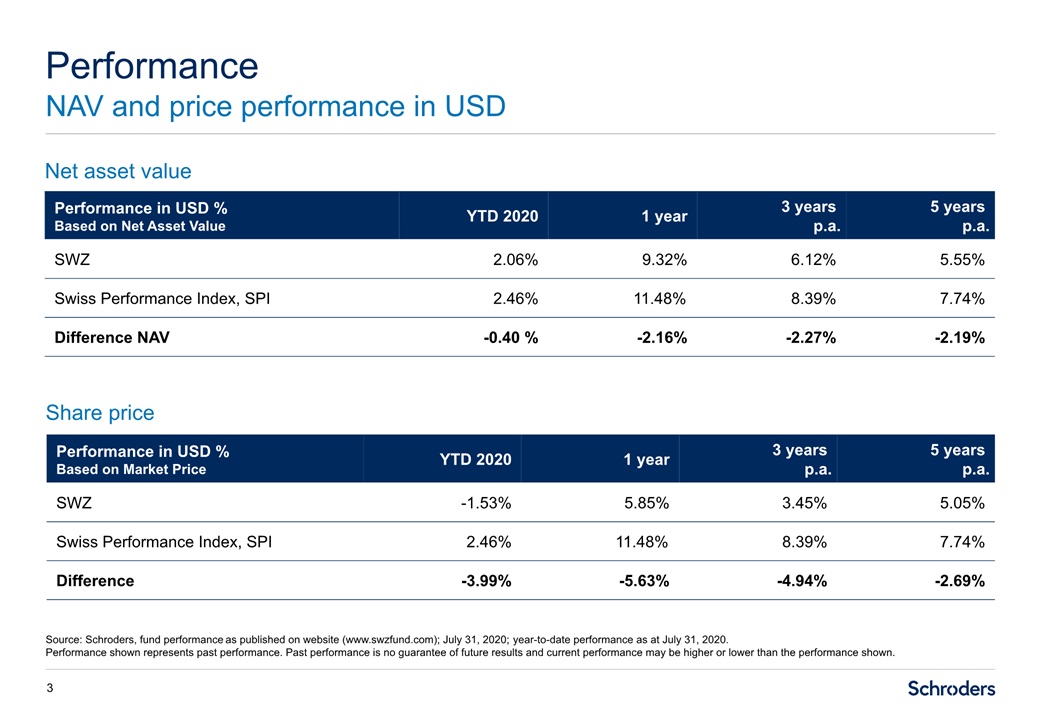
Performance NAV and price performance in USD 3 Source: Schroders, fund performance as published on
website (www.swzfund.com); July 31, 2020; year-to-date performance as at July 31, 2020. Performance shown represents past performance. Past performance is no guarantee of future results and current performance may be higher or lower than the
performance shown. Performance in USD %Based on Net Asset Value YTD 2020 1 year 3 yearsp.a. 5 yearsp.a. SWZ 2.06% 9.32% 6.12% 5.55% Swiss Performance Index, SPI 2.46% 11.48% 8.39% 7.74% Difference NAV -0.40
% -2.16% -2.27% -2.19% Performance in USD %Based on Market Price YTD 2020 1 year 3 years p.a. 5 yearsp.a. SWZ -1.53% 5.85% 3.45% 5.05% Swiss Performance Index,
SPI 2.46% 11.48% 8.39% 7.74% Difference -3.99% -5.63% -4.94% -2.69% Net asset value Share price
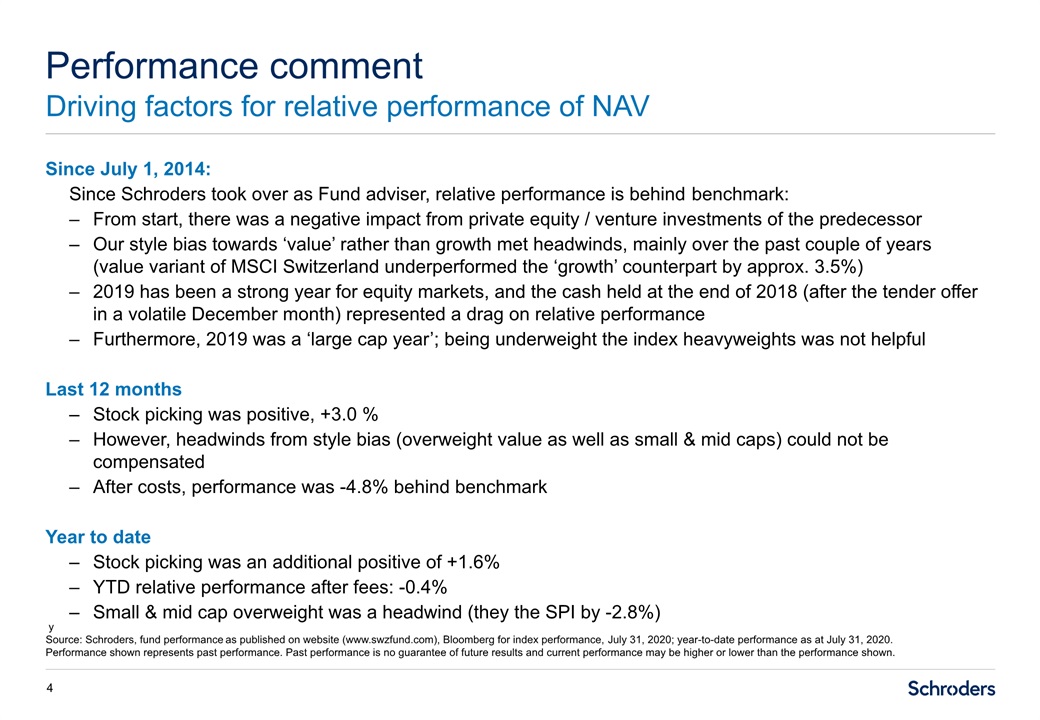
Since July 1, 2014:Since Schroders took over as Fund adviser, relative performance is behind
benchmark:From start, there was a negative impact from private equity / venture investments of the predecessorOur style bias towards ‘value’ rather than growth met headwinds, mainly over the past couple of years(value variant of MSCI
Switzerland underperformed the ‘growth’ counterpart by approx. 3.5%)2019 has been a strong year for equity markets, and the cash held at the end of 2018 (after the tender offer in a volatile December month) represented a drag on relative
performanceFurthermore, 2019 was a ‘large cap year’; being underweight the index heavyweights was not helpfulLast 12 monthsStock picking was positive, +3.0 %However, headwinds from style bias (overweight value as well as small & mid caps)
could not be compensatedAfter costs, performance was -4.8% behind benchmarkYear to dateStock picking was an additional positive of +1.6%YTD relative performance after fees: -0.4%Small & mid cap overweight was a headwind (they the SPI by
-2.8%) Performance comment Driving factors for relative performance of NAV 4 ySource: Schroders, fund performance as published on website (www.swzfund.com), Bloomberg for index performance, July 31, 2020; year-to-date performance as at
July 31, 2020.Performance shown represents past performance. Past performance is no guarantee of future results and current performance may be higher or lower than the performance shown.
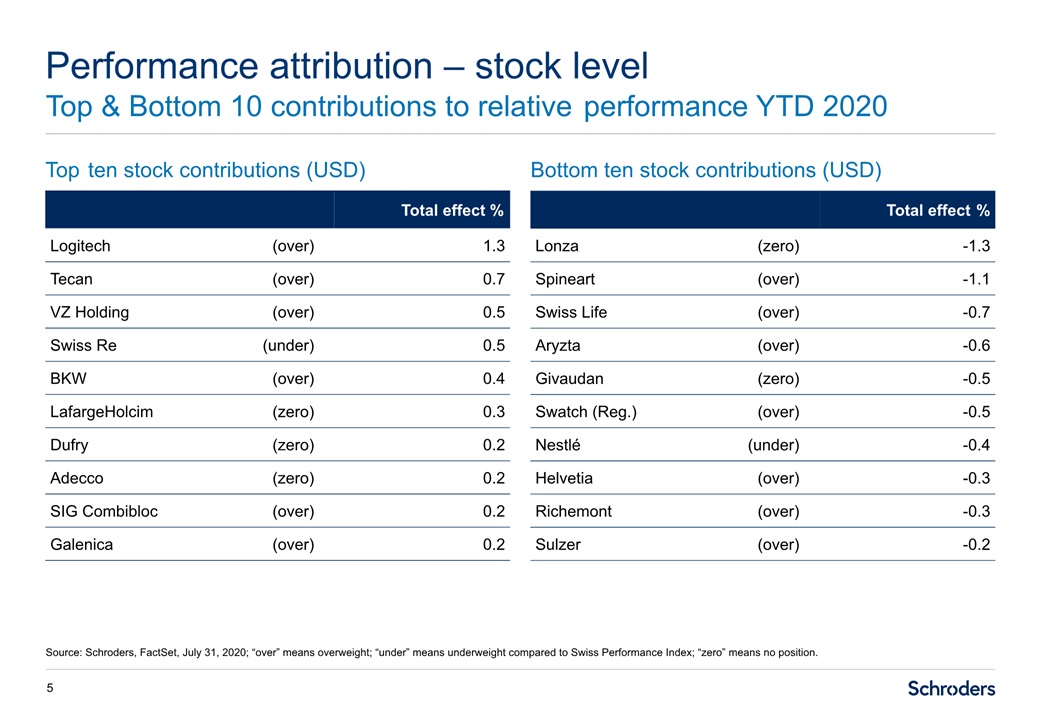
Performance attribution – stock level Top & Bottom 10 contributions to relative performance YTD
2020 5 Source: Schroders, FactSet, July 31, 2020; “over” means overweight; “under” means underweight compared to Swiss Performance Index; “zero” means no position. Top ten stock contributions (USD) Bottom ten stock contributions
(USD) Total effect % Logitech (over) 1.3 Tecan (over) 0.7 VZ Holding (over) 0.5 Swiss Re (under) 0.5 BKW (over) 0.4 LafargeHolcim (zero) 0.3 Dufry (zero) 0.2 Adecco (zero) 0.2 SIG Combibloc (over) 0.2 Galenica
(over) 0.2 Total effect % Lonza (zero) -1.3 Spineart (over) -1.1 Swiss Life (over) -0.7 Aryzta (over) -0.6 Givaudan (zero) -0.5 Swatch (Reg.) (over) -0.5 Nestlé (under) -0.4 Helvetia (over) -0.3 Richemont
(over) -0.3 Sulzer (over) -0.2

Performance attribution – stock level Top & Bottom 10 contributions to relative performance 1
year 6 Source: Schroders, FactSet, July 31, 2020; “over” means overweight; “under” means underweight compared to Swiss Performance Index; “zero” means no position. Top ten stock contributions (USD) Bottom ten stock contributions
(USD) Total effect % Logitech (over) 1.5 Tecan (over) 0.7 VZ Holding (over) 0.6 SIG Combibloc (over) 0.4 BKW (over) 0.4 Swiss Re (under) 0.3 Implenia (over) 0.3 ams (under) 0.2 Novartis (under) 0.2 Swatch (Bearer)
(zero) 0.2 Total effect % Lonza (zero) -1.2 Spineart (over) -1.1 Swatch (Reg.) (over) -0.8 Swiss Life (over) -0.8 Givaudan (zero) -0.6 Aryzta (over) -0.4 Roche (under) -0.4 Sika (under) -0.3 Richemont (over) -0.3 Helvetia
(over) -0.3

Portfolio positioning
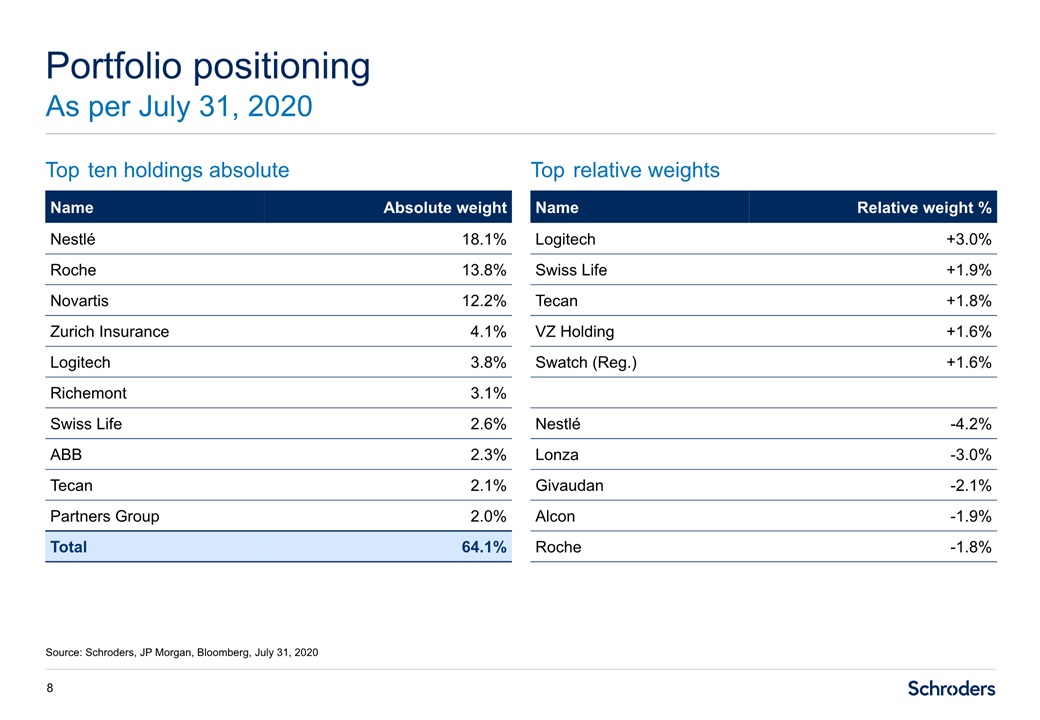
Top ten holdings absolute Top relative weights Portfolio positioning As per July 31, 2020 8 Source:
Schroders, JP Morgan, Bloomberg, July 31, 2020 Name Absolute weight Nestlé 18.1% Roche 13.8% Novartis 12.2% Zurich Insurance 4.1% Logitech 3.8% Richemont 3.1% Swiss Life 2.6% ABB 2.3% Tecan 2.1% Partners
Group 2.0% Total 64.1% Name Relative weight % Logitech +3.0% Swiss Life +1.9% Tecan +1.8% VZ Holding +1.6% Swatch (Reg.) +1.6% Nestlé -4.2% Lonza -3.0% Givaudan -2.1% Alcon -1.9% Roche -1.8%
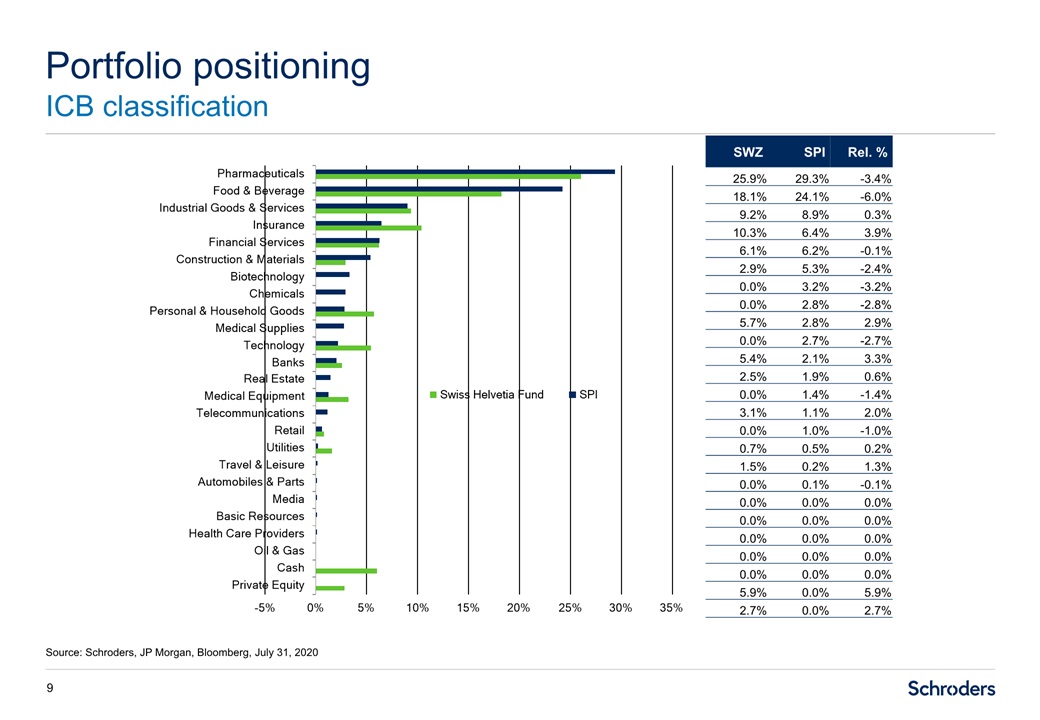
Portfolio positioning ICB classification 9 Source: Schroders, JP Morgan, Bloomberg, July 31,
2020 SWZ SPI Rel.
% 25.9% 29.3% -3.4% 18.1% 24.1% -6.0% 9.2% 8.9% 0.3% 10.3% 6.4% 3.9% 6.1% 6.2% -0.1% 2.9% 5.3% -2.4% 0.0% 3.2% -3.2% 0.0% 2.8% -2.8% 5.7% 2.8% 2.9% 0.0% 2.7% -2.7% 5.4% 2.1% 3.3% 2.5% 1.9% 0.6% 0.0% 1.4% -1.4% 3.1% 1.1% 2.0% 0.0% 1.0% -1.0% 0.7% 0.5% 0.2% 1.5% 0.2% 1.3% 0.0% 0.1% -0.1% 0.0% 0.0% 0.0% 0.0% 0.0% 0.0% 0.0% 0.0% 0.0% 0.0% 0.0% 0.0% 0.0% 0.0% 0.0% 5.9% 0.0% 5.9% 2.7% 0.0% 2.7%
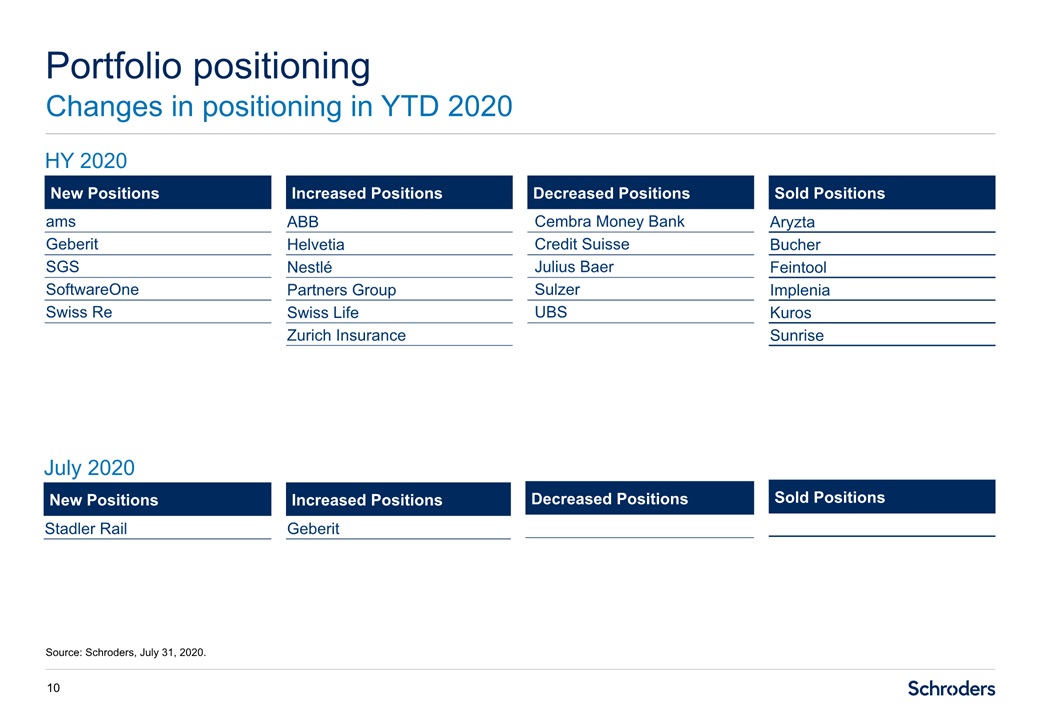
Portfolio positioning Changes in positioning in YTD 2020 10 Source: Schroders, July 31, 2020. New
Positions ams Geberit SGS SoftwareOne Swiss Re Increased Positions ABB Helvetia Nestlé Partners Group Swiss Life Zurich Insurance Sold Positions Aryzta Bucher Feintool Implenia Kuros Sunrise HY 2020 Decreased
Positions Cembra Money Bank Credit Suisse Julius Baer Sulzer UBS New Positions Stadler Rail Increased Positions Geberit July 2020 Decreased Positions Sold Positions
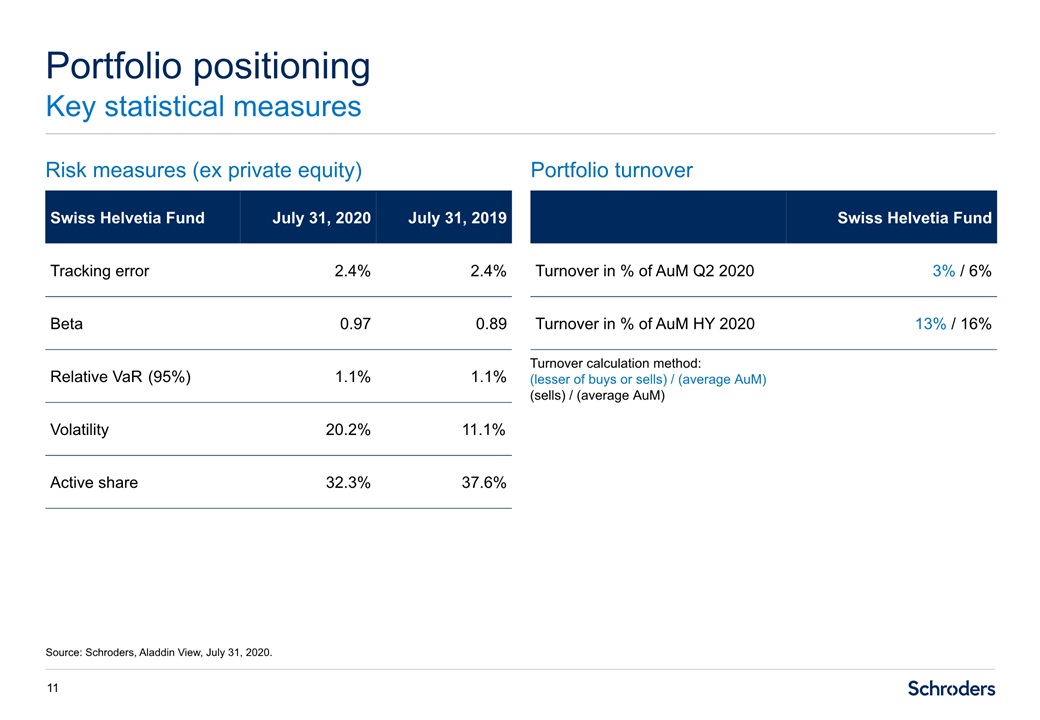
Risk measures (ex private equity) Portfolio turnover Portfolio positioning Key statistical
measures 11 Source: Schroders, Aladdin View, July 31, 2020. Swiss Helvetia Fund July 31, 2020 July 31, 2019 Tracking error 2.4% 2.4% Beta 0.97 0.89 Relative VaR (95%) 1.1% 1.1% Volatility 20.2% 11.1% Active
share 32.3% 37.6% Swiss Helvetia Fund Turnover in % of AuM Q2 2020 3% / 6% Turnover in % of AuM HY 2020 13% / 16% Turnover calculation method:(lesser of buys or sells) / (average AuM)(sells) / (average AuM)

Outlook
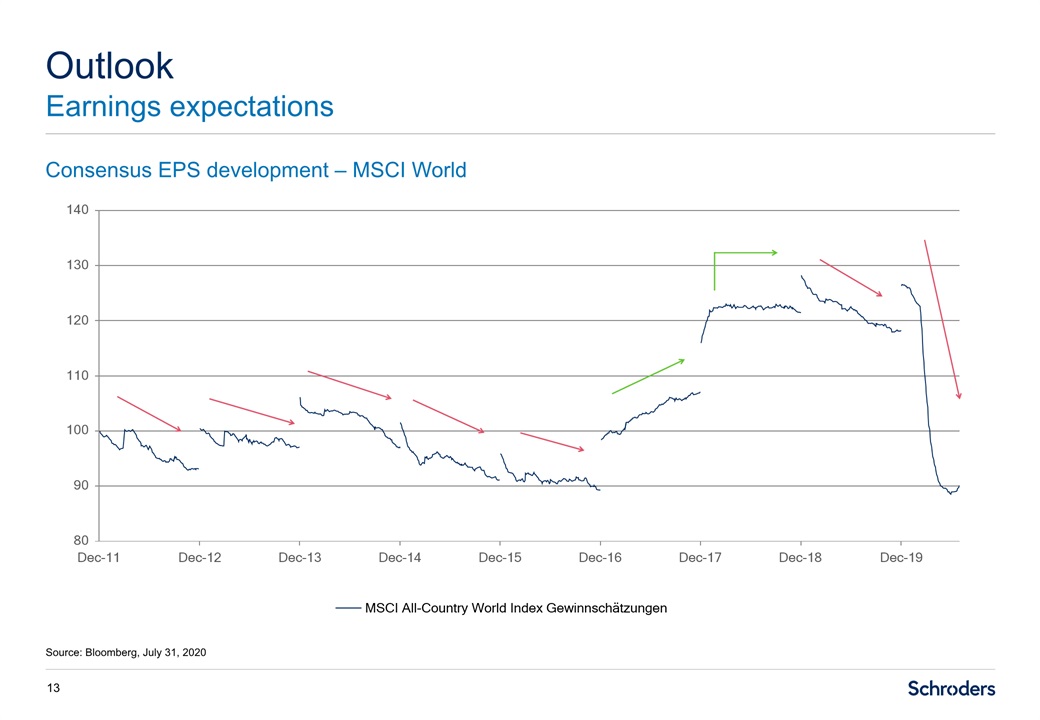
Outlook Earnings expectations 13 Source: Bloomberg, July 31, 2020 Consensus EPS development – MSCI
World
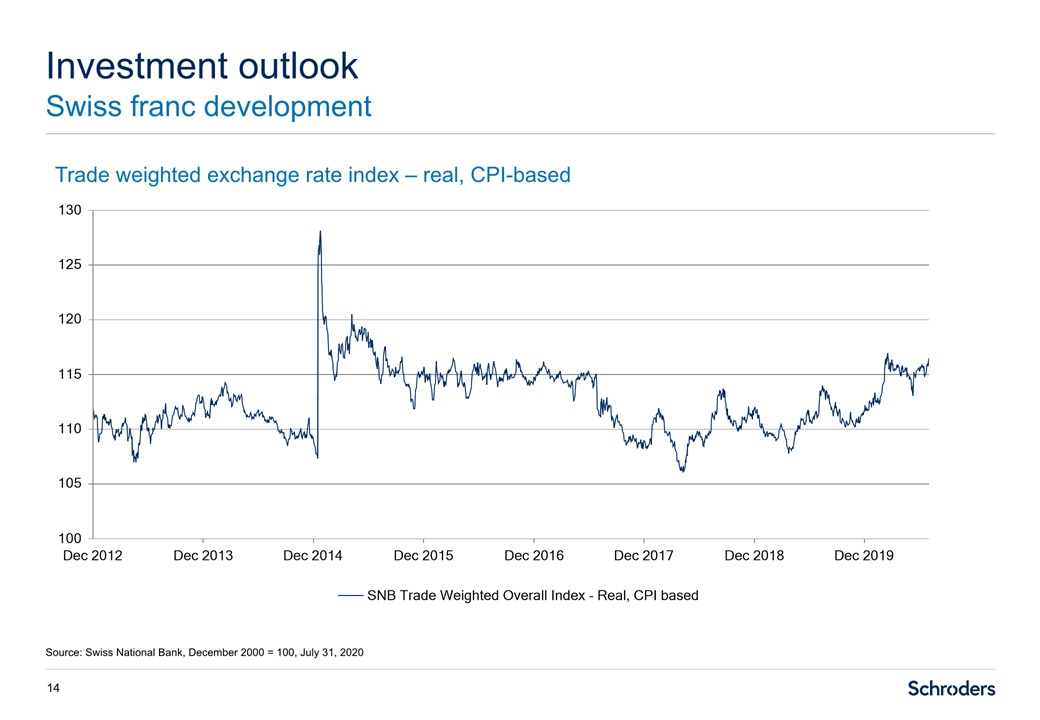
Investment outlook Swiss franc development 14 Source: Swiss National Bank, December 2000 = 100, July
31, 2020 Trade weighted exchange rate index – real, CPI-based
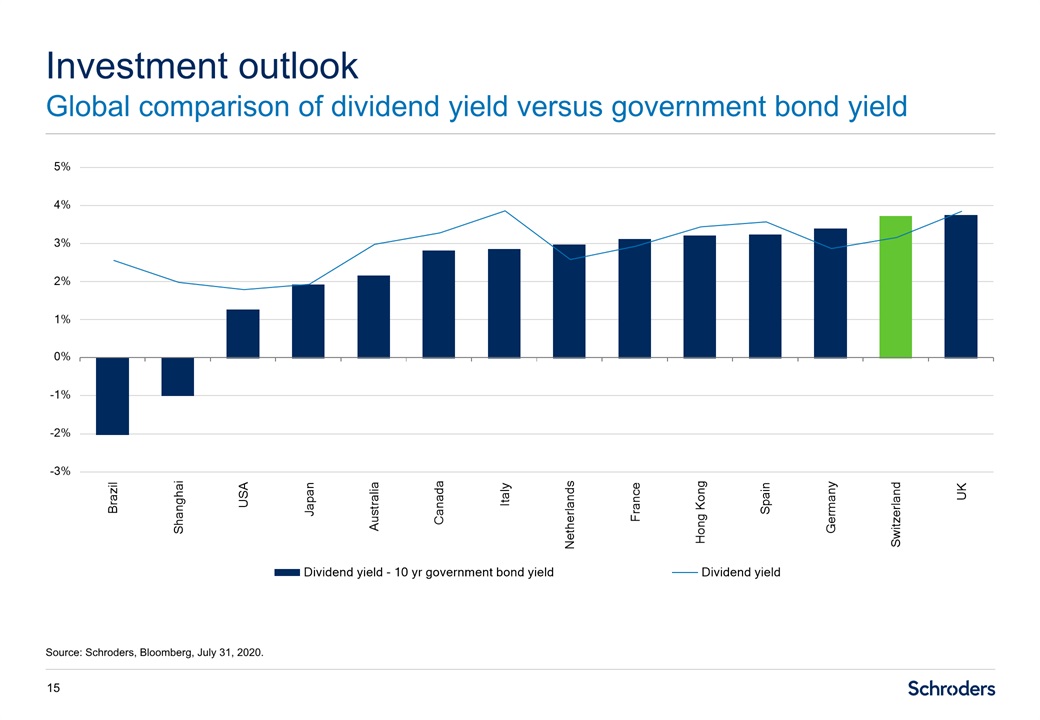
Investment outlook Global comparison of dividend yield versus government bond yield 15 Source:
Schroders, Bloomberg, July 31, 2020.
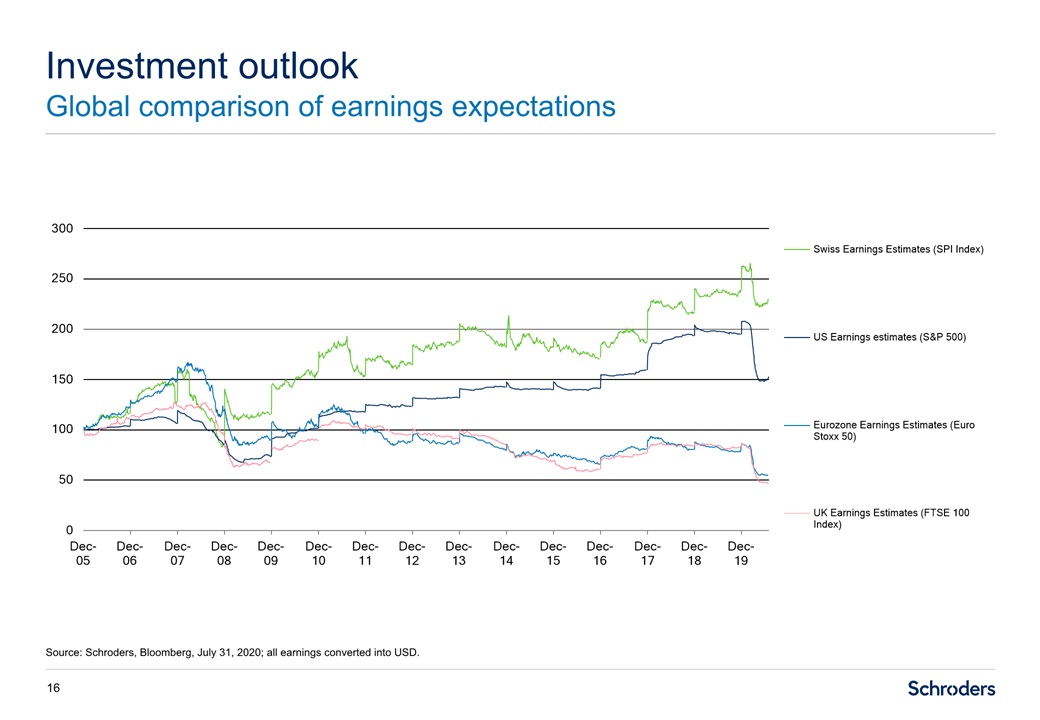
Investment outlook Global comparison of earnings expectations Source: Schroders, Bloomberg, July 31,
2020; all earnings converted into USD. 16
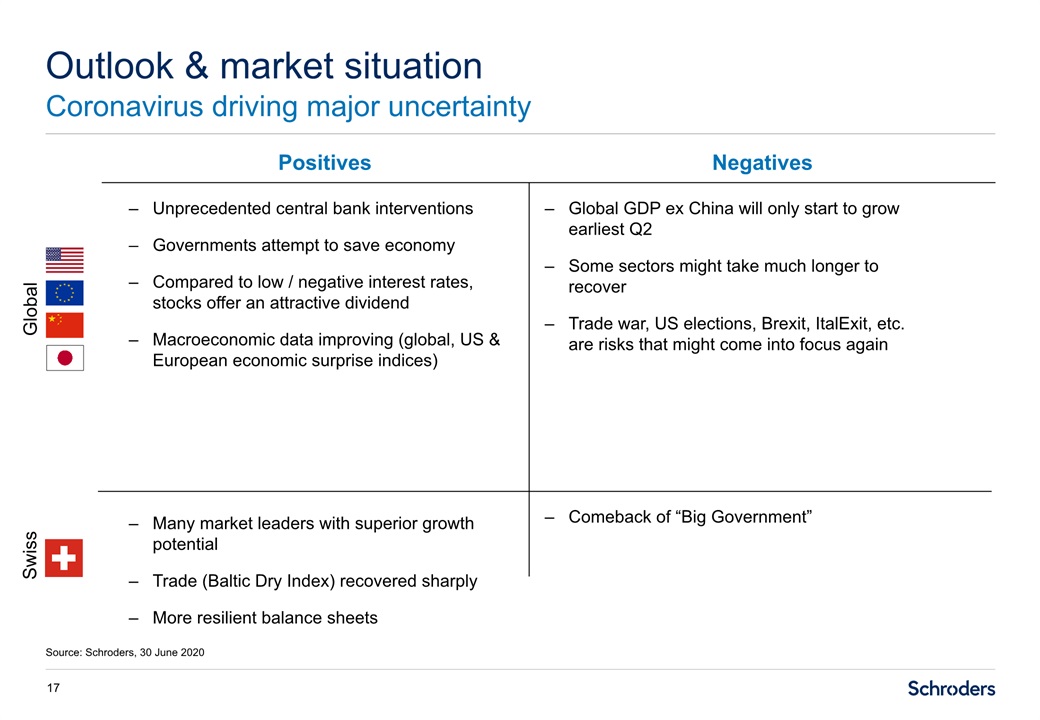
Unprecedented central bank interventionsGovernments attempt to save economyCompared to low / negative
interest rates, stocks offer an attractive dividendMacroeconomic data improving (global, US & European economic surprise indices) Global GDP ex China will only start to grow earliest Q2Some sectors might take much longer to recoverTrade
war, US elections, Brexit, ItalExit, etc. are risks that might come into focus again Outlook & market situation Coronavirus driving major uncertainty 17 Source: Schroders, 30 June 2020 Positives Negatives Global Swiss Many market
leaders with superior growth potentialTrade (Baltic Dry Index) recovered sharplyMore resilient balance sheets Comeback of “Big Government”

Case for Switzerland
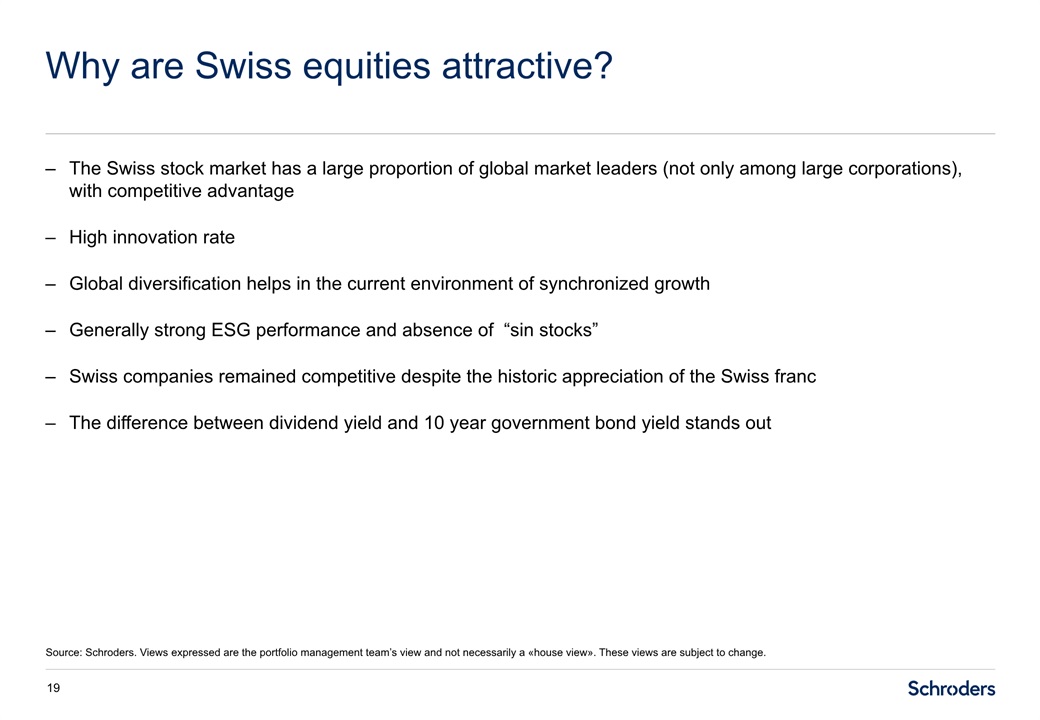
The Swiss stock market has a large proportion of global market leaders (not only among large
corporations), with competitive advantageHigh innovation rateGlobal diversification helps in the current environment of synchronized growthGenerally strong ESG performance and absence of “sin stocks”Swiss companies remained competitive despite
the historic appreciation of the Swiss francThe difference between dividend yield and 10 year government bond yield stands out Why are Swiss equities attractive? Source: Schroders. Views expressed are the portfolio management team’s view
and not necessarily a «house view». These views are subject to change. 19
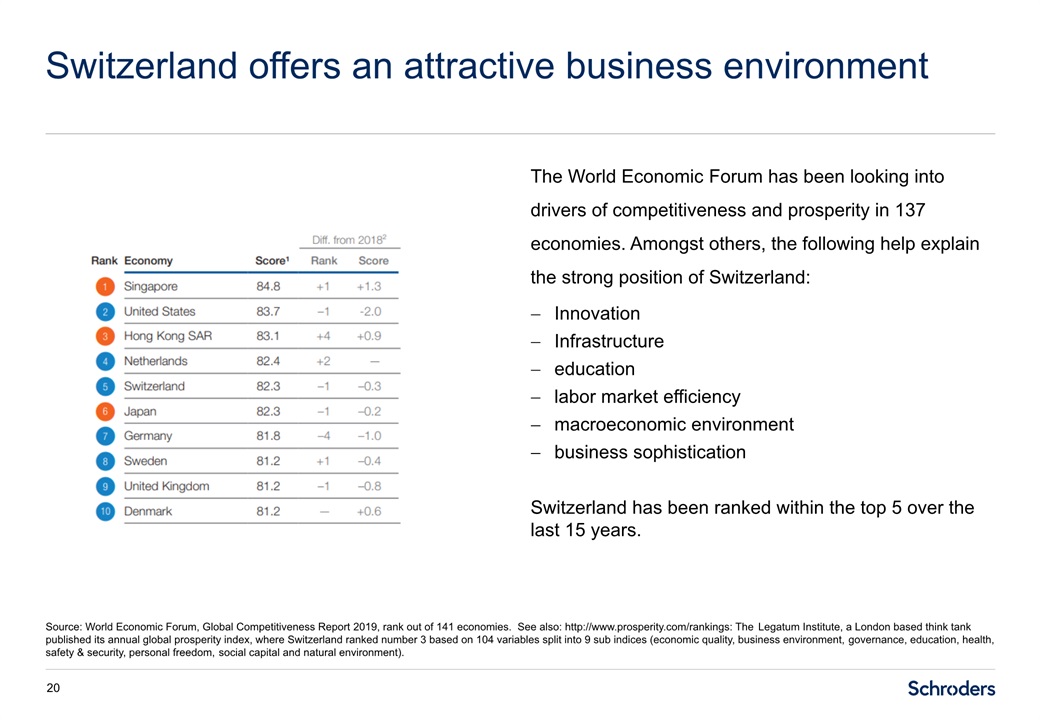
The World Economic Forum has been looking into drivers of competitiveness and prosperity in 137
economies. Amongst others, the following help explain the strong position of Switzerland:InnovationInfrastructureeducationlabor market efficiencymacroeconomic environmentbusiness sophisticationSwitzerland has been ranked within the top 5 over
the last 15 years. Switzerland offers an attractive business environment 20 Source: World Economic Forum, Global Competitiveness Report 2019, rank out of 141 economies. See also: http://www.prosperity.com/rankings: The Legatum Institute,
a London based think tank published its annual global prosperity index, where Switzerland ranked number 3 based on 104 variables split into 9 sub indices (economic quality, business environment, governance, education, health, safety
& security, personal freedom, social capital and natural environment).

Switzerland is an innovation leader 21 Source: European Innovation Scoreboard 2020 Modest
Innovators Moderate Innovators Strong Innovators Innovation Leaders
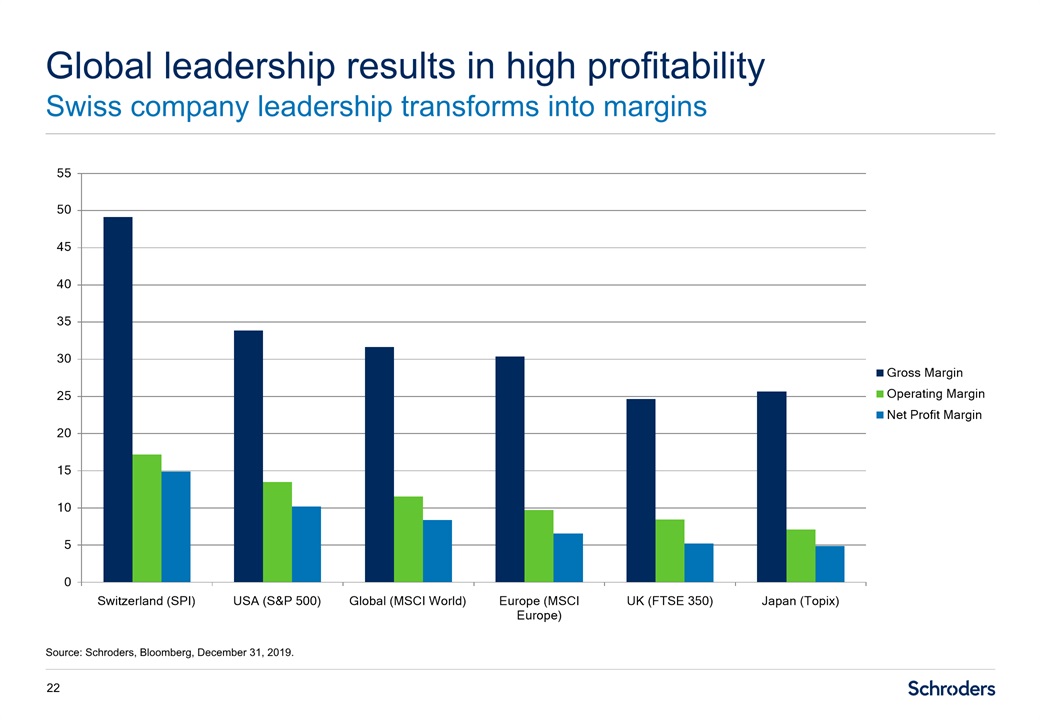
Global leadership results in high profitability Swiss company leadership transforms into
margins 22 Source: Schroders, Bloomberg, December 31, 2019.
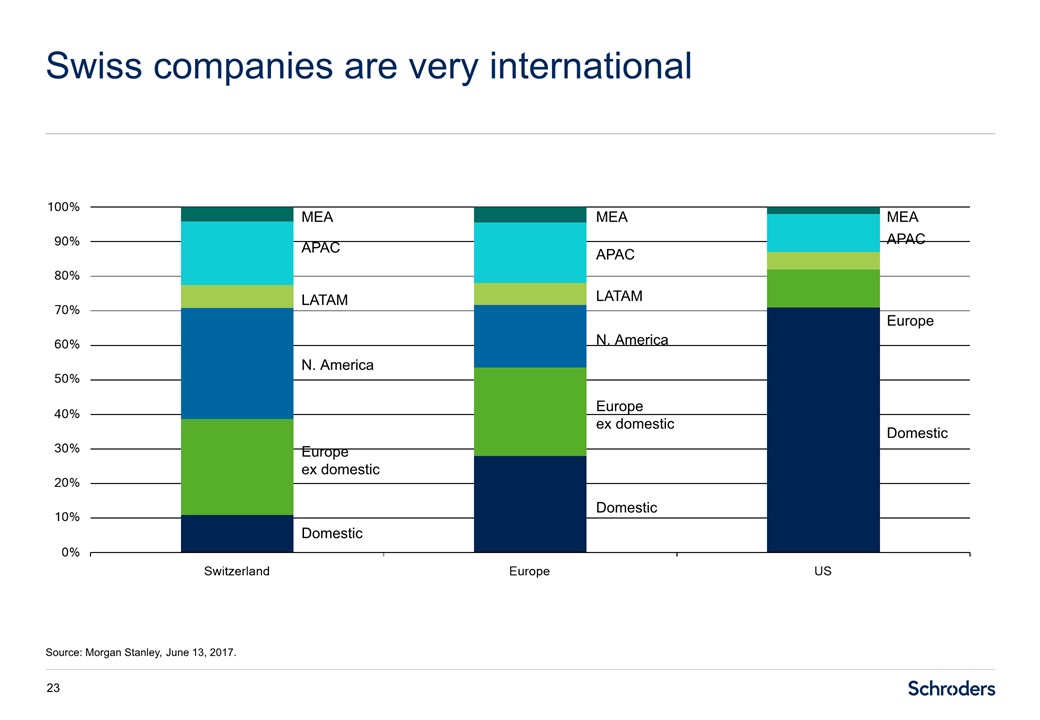
Swiss companies are very international Source: Morgan Stanley, June 13, 2017. 23 Europeex
domestic APAC MEA LATAM N. America Domestic Europeex domestic APAC MEA LATAM N. America Domestic Europe MEA APAC Domestic
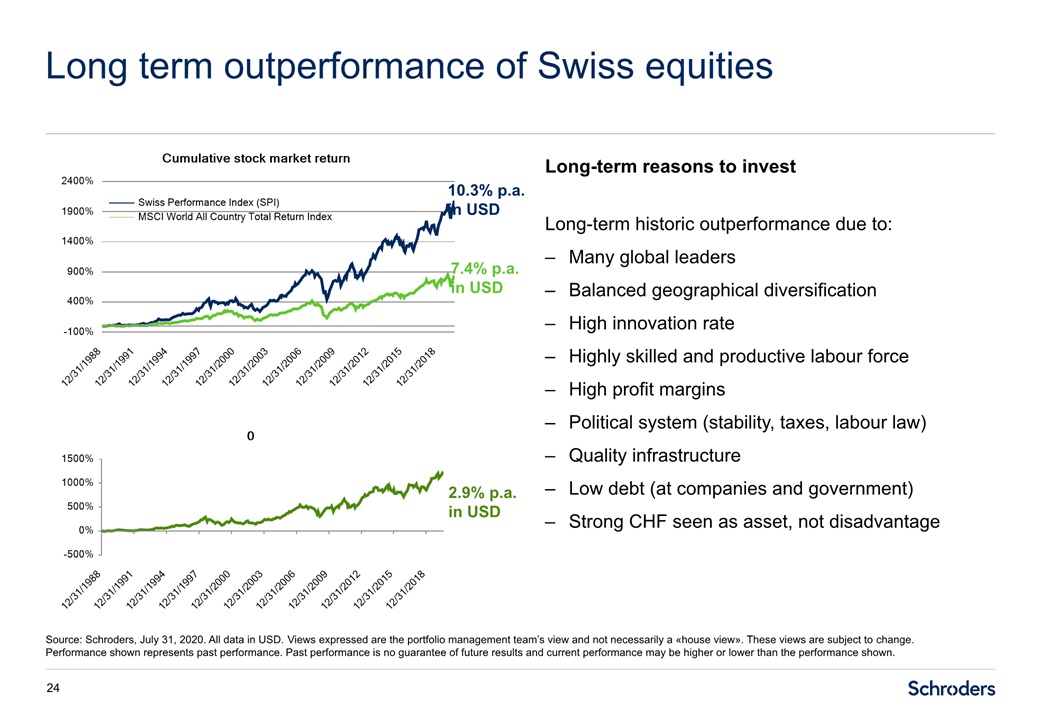
Long term outperformance of Swiss equities 24 Source: Schroders, July 31, 2020. All data in USD.
Views expressed are the portfolio management team’s view and not necessarily a «house view». These views are subject to change.Performance shown represents past performance. Past performance is no guarantee of future results and current
performance may be higher or lower than the performance shown. Long-term reasons to investLong-term historic outperformance due to:Many global leadersBalanced geographical diversificationHigh innovation rateHighly skilled and productive labour
forceHigh profit marginsPolitical system (stability, taxes, labour law)Quality infrastructureLow debt (at companies and government)Strong CHF seen as asset, not disadvantage 2.9% p.a. in USD 10.3% p.a. in USD 7.4% p.a. in USD
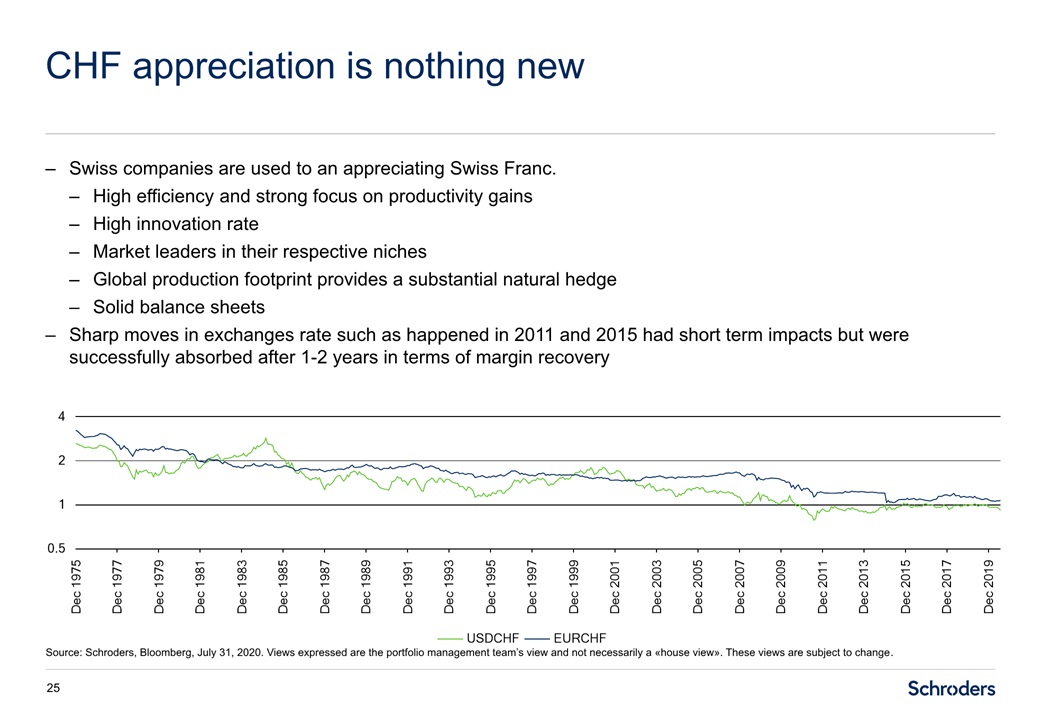
Swiss companies are used to an appreciating Swiss Franc. High efficiency and strong focus on productivity
gainsHigh innovation rateMarket leaders in their respective nichesGlobal production footprint provides a substantial natural hedgeSolid balance sheetsSharp moves in exchanges rate such as happened in 2011 and 2015 had short term impacts but
were successfully absorbed after 1-2 years in terms of margin recovery CHF appreciation is nothing new Source: Schroders, Bloomberg, July 31, 2020. Views expressed are the portfolio management team’s view and not necessarily a «house view».
These views are subject to change. 25
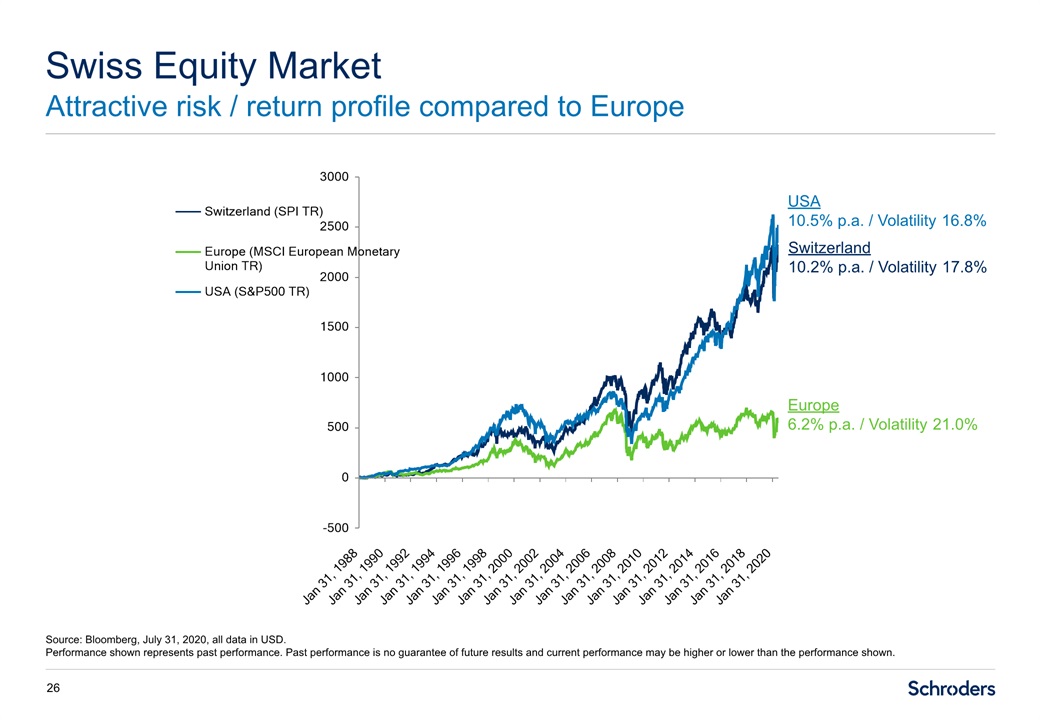
Swiss Equity Market Attractive risk / return profile compared to Europe 26 Source: Bloomberg, July 31,
2020, all data in USD.Performance shown represents past performance. Past performance is no guarantee of future results and current performance may be higher or lower than the performance shown. Switzerland10.2% p.a. / Volatility
17.8% Europe6.2% p.a. / Volatility 21.0% USA10.5% p.a. / Volatility 16.8%
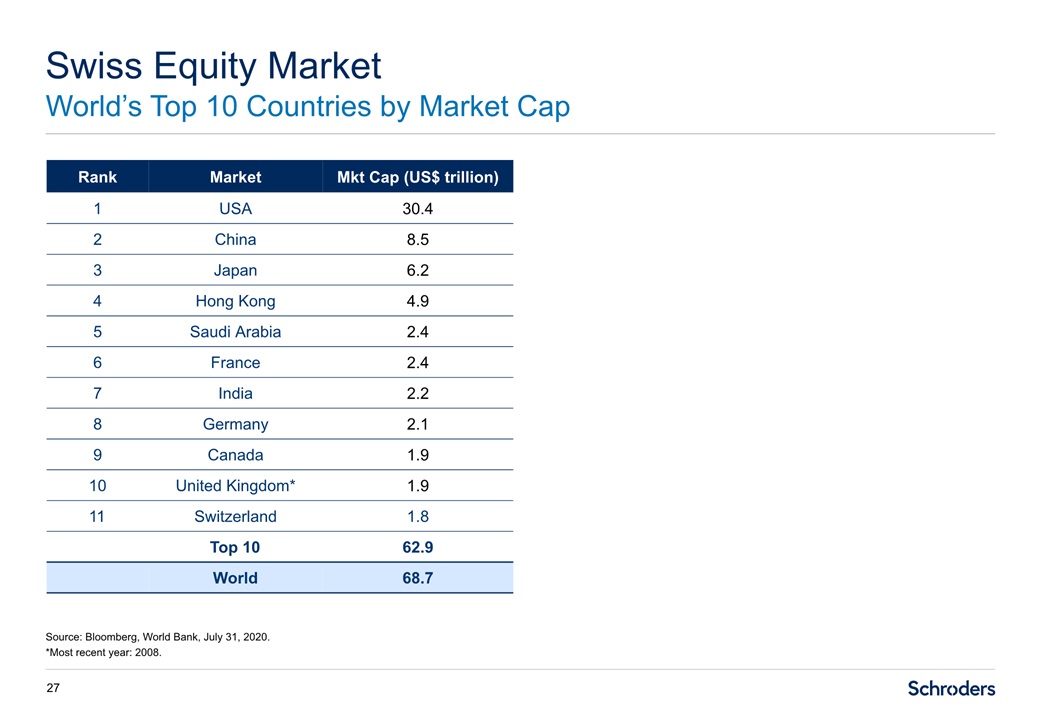
Swiss Equity Market World’s Top 10 Countries by Market Cap 27 Source: Bloomberg, World Bank, July 31,
2020.*Most recent year: 2008. Rank Market Mkt Cap (US$ trillion) 1 USA 30.4 2 China 8.5 3 Japan 6.2 4 Hong Kong 4.9 5 Saudi Arabia 2.4 6 France 2.4 7 India 2.2 8 Germany 2.1 9 Canada 1.9 10 United
Kingdom* 1.9 11 Switzerland 1.8 Top 10 62.9 World 68.7
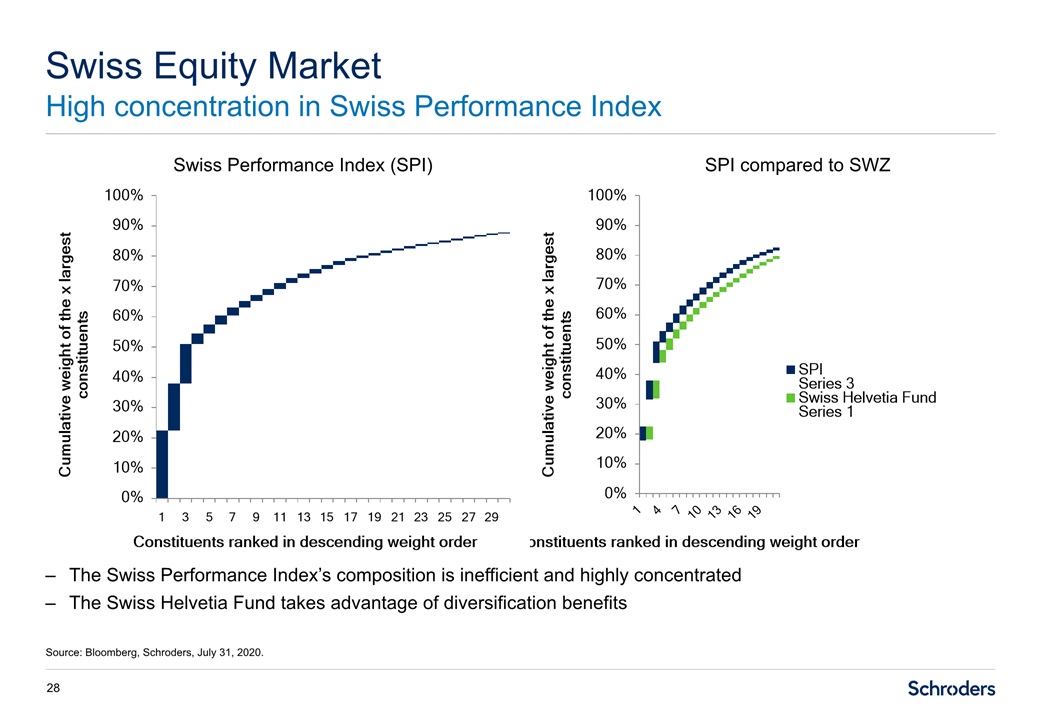
Swiss Equity Market High concentration in Swiss Performance Index 28 Source: Bloomberg, Schroders,
July 31, 2020. Swiss Performance Index (SPI) SPI compared to SWZ The Swiss Performance Index’s composition is inefficient and highly concentratedThe Swiss Helvetia Fund takes advantage of diversification benefits
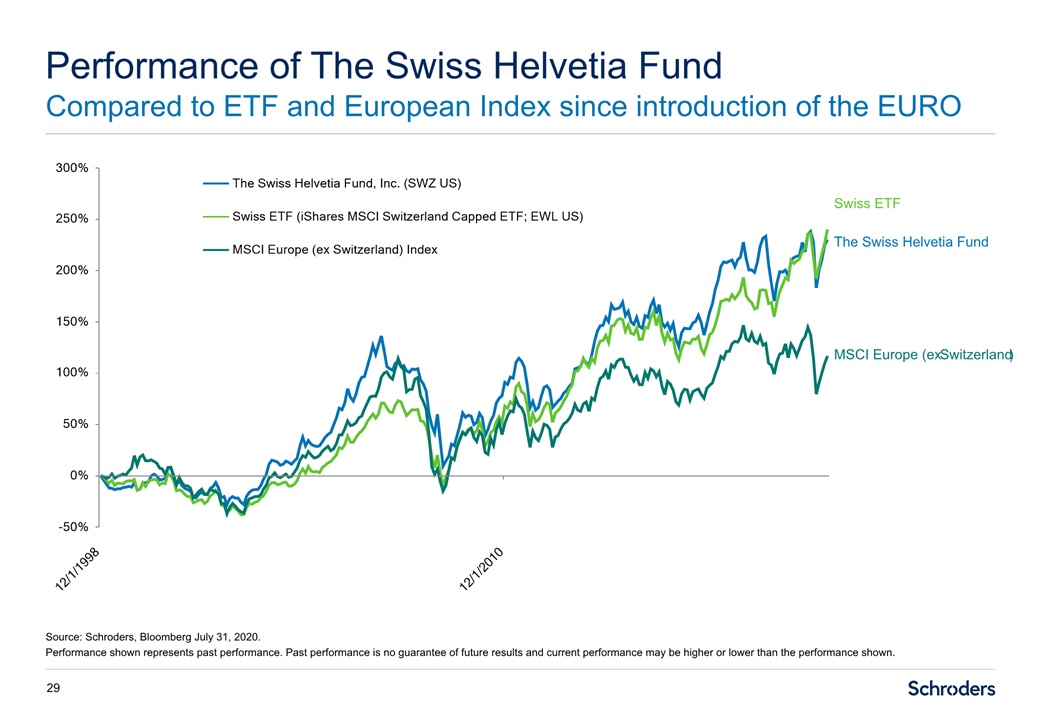
Performance of The Swiss Helvetia Fund Compared to ETF and European Index since introduction of the
EURO 29 Source: Schroders, Bloomberg July 31, 2020.Performance shown represents past performance. Past performance is no guarantee of future results and current performance may be higher or lower than the performance shown. Swiss ETF The
Swiss Helvetia Fund MSCI Europe (ex Switzerland)
Important information 30 The Fund is a closed-end investment product. Common stock of the Fund is
only available for purchase/sale on the NYSE at the then current market price. An investment in the Fund is not a deposit of a bank and is not insured or guaranteed by the Federal Deposit Insurance Corporation or any other government
agency.This presentation is intended to be for information purposes only and it is not intended as promotional material in any respect. The material is not intended as an offer or solicitation for the purchase or sale of the Fund’s shares or
any other financial instrument. The material is not intended to provide, and should not be relied on for, accounting, legal or tax advice, or investment recommendations. Information herein is believed to be reliable but Schroder Investment
Management North America Inc. does not warrant its completeness or accuracy.The returns presented represent past performance and are not necessarily representative of future returns, which may vary. The value of investments can fall as well as
rise as a result of market or currency movements.All investments, domestic and foreign, involve risks, including the risk of possible loss of principal. The market value of a fund’s portfolio may decline as a result of a number of factors,
including adverse economic and market conditions, prospects of stocks in the portfolio, changing interest rates, and real or perceived adverse competitive industry conditions. Investing overseas involves special risks including among others
risks related to political or economic instability, foreign currency (such as exchange, valuation, and fluctuation) risk, market entry or exit restrictions, illiquidity, and taxation. The Swiss securities markets have substantially less
trading volume than the U.S. securities markets. Additionally, the capitalization of the Swiss securities markets is highly concentrated. Securities of some companies located in Switzerland will be less liquid and more volatile than securities
of comparable U.S. companies. This combination of lower volume and greater concentration in the Swiss securities markets may create a risk of greater price volatility than in the U.S. securities markets. The views and forecasts contained herein
are those of the Schroders Swiss Equities team and are subject to change. The information and opinions contained in this document have been obtained from sources we consider to be reliable. No responsibility can be accepted for errors of facts
obtained from third parties. Reliance should not be placed on the views and information in the document when taking individual investment and/or strategic decisions.Definitions: Active share represents the proportion of stock holdings in the
Fund that is different from the properties found in the benchmark. Beta measures the sensitivity of the Fund to the movements of its benchmark. Volatility is measured by Standard deviation, which is the risk or volatility of an investment’s
return over a particular time period; the greater the number, the greater the risk or volatility. Tracking error is the difference between the price behavior of a position or a portfolio and the price behavior of a benchmark. VaR is Value at
Risk, a widely used risk measure of the risk of loss on a specific portfolio of financial exposures.For more information, visit www.swzfund.com