
THO 8-K
Thor Industries Inc (THO)
8-K
2025-12-03
For: 2025-12-03
View Original
Added on
April 10, 2026
UNITED STATES
SECURITIES AND EXCHANGE COMMISSION
Washington, D.C. 20549
FORM 8-K
CURRENT REPORT
Pursuant to Section 13 or 15(d) of the
Securities Exchange Act of 1934
Date of Report (Date of earliest event reported): December 3, 2025

| (Exact Name of Registrant as Specified in Charter) | |||||||||||||||||
| (State or Other Jurisdiction of incorporation) | (Commission File Number) | (IRS Employee Identification No.) | |||||||||||||||
| (Address of Principal Executive Office) | (Zip Code) | ||||||||||||||||
Registrant’s Telephone Number, Including Area Code: | |||||||||||||||||
| (Former Name or Former Address, if Changed Since Last Report) | |||||||||||||||||
| Check the appropriate box below if the Form 8-K filing is intended to satisfy the filing obligation of the registrant under any of the following provisions: | |||||||||||||||||
| Written communications pursuant to Rule 425 under the Securities Act (17 CFR 230.425) | |||||||||||||||||
| Soliciting material pursuant to Rule 14a-12 under the Exchange Act (17 CFR 240.14a-12) | |||||||||||||||||
| Pre-commencement communications pursuant to Rule 14d-2(b) under the Exchange Act (17 CFR 240.14d-2(b)) | |||||||||||||||||
| Pre-commencement communications pursuant to Rule 13e-4(c) under the Exchange Act (17 CFR 240.13e-4(c)) | |||||||||||||||||
| Securities registered pursuant to Section 12(b) of the Act: | |||||||||||||||||
| Title of each class | Ticker symbol(s) | Name of each exchange on which registered | |||||||||||||||
| Indicate by check mark whether the registrant is in an emerging growth company as defined in Rule 405 of the Securities Act of 1933 or Rule 12b-2 of the Securities Exchange Act of 1934. | |||||||||||||||||
| Emerging Growth Company | |||||||||||||||||
| If an emerging growth company, indicate by check if the registrant has elected not to use this extended transition period of complying with any new or revised financial accounting standards provided pursuant to Section 13(a) of the Exchange Act. ☐ | |||||||||||||||||
Item 2.02 Results of Operations and Financial Condition
On December 3, 2025, THOR Industries, Inc. (the “Company”) issued a press release announcing certain financial results for the first quarter ended October 31, 2025. A copy of the Company’s press release is attached hereto as Exhibit 99.1 and is incorporated by reference herein. The Company also posted an updated investor slide presentation and a list of investor questions and answers to the “Investors” section of its website. A copy of the Company’s slide presentation and investor questions and answers are attached hereto as Exhibit 99.2 and 99.3, respectively, and are incorporated by reference herein. Exhibits 99.1, 99.2, and 99.3 include non-GAAP financial measures related to our operations along with a reconciliation of these GAAP to non-GAAP measures and an explanation of why these non-GAAP measures provide useful information to investors and how management uses these non-GAAP measures. These non-GAAP measures should not be considered a substitute for, or superior to, financial measures calculated in accordance with GAAP, and the financial results calculated in accordance with GAAP and reconciliations from our results should be carefully evaluated.
Item 7.01 Regulation FD Disclosure
The press release attached hereto as Exhibit 99.1 provides earnings guidance for the Company’s fiscal year 2026 along with updated industry information. The slide presentation attached hereto as Exhibit 99.2, and incorporated by reference herein, also provides earnings guidance as well as updated information on industry wholesale shipments and retail market share. The Company also posted an updated list of investor questions and answers to the “Investors” section of its website. A copy of the Company's investor questions and answers is attached hereto as Exhibit 99.3 and is incorporated by reference herein.
In accordance with general instruction B.2 to Form 8-K, the information set forth in Items 2.02 and 7.01 of this Form 8-K (including Exhibits 99.1, 99.2, and 99.3) shall be deemed “furnished” and not “filed” with the Securities and Exchange Commission for purposes of Section 18 of the Securities Exchange Act of 1934, as amended, and shall not be incorporated by reference into any filing thereunder or under the Securities Act of 1933, as amended.
Item 9.01 Financial Statements and Exhibits
| (d) | Exhibits | ||||||||||||||||
| Exhibit Number | Description | ||||||||||||||||
| 104 | Cover Page Interactive Data File (embedded within the Inline XBRL document) | ||||||||||||||||
SIGNATURE
Pursuant to the requirements of the Securities Exchange Act of 1934, the registrant has duly caused this report to be signed on its behalf by the undersigned hereunto duly authorized.
| THOR Industries, Inc. | |||||||||||||||||
| Date: | December 3, 2025 | By: | /s/ Colleen Zuhl | ||||||||||||||
| Name: | Colleen Zuhl | ||||||||||||||||
| Title: | Senior Vice President and Chief Financial Officer | ||||||||||||||||

52700 Independence Court, Elkhart, Indiana 46514
THOR INDUSTRIES ANNOUNCES FISCAL 2026 FIRST QUARTER RESULTS
REPORTS STRONG RESULTS, IMPROVING MARKET SHARE AMIDST CHALLENGING BACKDROP
| Financial Highlights | ||||||||||||||||||||
| ($ in thousands, except for per share data) | Three Months Ended October 31, | Change | ||||||||||||||||||
| 2025 | 2024 | |||||||||||||||||||
| Net Sales | $ | 2,389,123 | $ | 2,142,784 | 11.5 | % | ||||||||||||||
| Gross Profit | $ | 320,974 | $ | 281,442 | 14.0 | % | ||||||||||||||
| Gross Profit Margin % | 13.4% | 13.1% | +30 bps | |||||||||||||||||
| Net Income (Loss) Attributable to THOR | $ | 21,669 | $ | (1,832) | n/m | |||||||||||||||
| Diluted Earnings (Loss) Per Share | $ | 0.41 | $ | (0.03) | n/m | |||||||||||||||
| Cash Flows Provided by (Used in) Operations | $ | (44,867) | $ | 30,740 | (246.0) | % | ||||||||||||||
EBITDA (1) | $ | 107,540 | $ | 81,733 | 31.6 | % | ||||||||||||||
Adjusted EBITDA (1) | $ | 131,005 | $ | 107,782 | 21.5 | % | ||||||||||||||
(1) See reconciliation of non-GAAP measures to the most directly comparable GAAP financial measures included at the end of this release
Fiscal 2026 First Quarter
•Revenue of $2.39 billion, Net income attributable to THOR of $21.7 million and Adjusted EBITDA of $131.0 million in the quarter. Adjusted EBITDA excludes nonrecurring costs or benefits associated with strategic reorganization initiatives and the impact of real estate transactions
•North American market share improved for the second consecutive fiscal quarter as retail outperformed expectations during the period
•Dealer inventory turns remain at an appropriate level heading into the winter months and the Company is positioned advantageously should a market uptick occur
•Consolidated gross profit margin expanded 30 basis points despite a challenging environment, highlighting the strategic actions the Company has taken to streamline the business
Elkhart, Indiana, December 3, 2025 – THOR Industries, Inc. (NYSE: THO) today announced financial results for its fiscal 2026 first quarter ended October 31, 2025.
“The quarter finished stronger than we expected, and we are excited about the impact of the actions we are taking to improve the strength of our business and control what we can control so that when the market rebounds we will bounce back stronger than ever. Our 2025 Open House event in September was another success and represented a marked improvement versus last year as I heard great dealer feedback on the new products on display, in particular the new Keystone Montana and Heartland Bighorn products,” stated Bob Martin, President and Chief Executive Officer of THOR Industries. “In addition, I just spent time with our customers at the RVDA Expo in Las Vegas in November and, while they have a near-term cautious tone around the state of the consumer, I have never felt more confident about the long-term health of the industry and our Company.”
Todd Woelfer, Senior Vice President and Chief Operating Officer, added, “The strong results across our North American operations were supported by key data initiatives that continue to empower our operating companies, enabling them to quickly respond to the market and meet consumer demand. At the 2025 Open House we announced the RV Partfinder platform and received strong support from our dealer partners. Our goal is to help address a point of friction in RV ownership, and we are confident that RV Partfinder is an important piece of the answer to that long-standing issue. In North America, we benefitted from the impact of a number of strategic initiatives as our Towable segment experienced improved margins on relatively flat sales while our Motorized segment and supply companies drove improvements on both the top and bottom lines. In Europe, EHG’s quarter was impacted by the typical August shutdown and a price aggressive marketplace. Additionally, EHG’s results included restructuring costs that will have a long-term benefit to EHG’s operating results. From an internal expectation standpoint, EHG’s profitability aligned to plan for the quarter and we expect a similar cadence for the remainder of our fiscal year as we saw last year from EHG,” added Woelfer.
“We are vigilantly monitoring the health of our business so that we can effectively manage risk and protect profitability in light of the fact that numerous indicators suggest that the consumer may be retrenching. We feel confident in our operating plan and our balance sheet, and we will not hesitate to queue up stock repurchases if the stock sells off on broader consumer concerns,” added Colleen Zuhl, Senior Vice President and Chief Financial Officer.
First Quarter Financial Results
THOR’s consolidated results were primarily driven by the results of its individual reportable segments as noted below.
Segment Results
North American Towable RVs
| ($ in thousands) | Three Months Ended October 31, | Change | |||||||||||||||
| 2025 | 2024 | ||||||||||||||||
| Net Sales | $ | 897,090 | $ | 898,778 | (0.2) | % | |||||||||||
| Unit Shipments | 25,807 | 30,018 | (14.0) | % | |||||||||||||
| Gross Profit | $ | 118,995 | $ | 112,437 | 5.8 | % | |||||||||||
| Gross Profit Margin % | 13.3% | 12.5% | +80 bps | ||||||||||||||
| Income Before Income Taxes | $ | 46,471 | $ | 46,821 | (0.7) | % | |||||||||||
As of October 31, | Change | ||||||||||||||||
| ($ in thousands) | 2025 | 2024 | |||||||||||||||
| Order Backlog | $ | 656,002 | $ | 933,051 | (29.7) | % | |||||||||||
•Net sales were flat as a favorable product mix offset a 14.0% decline in unit shipments as we aggressively managed channel inventory entering the winter months. The gross profit margin percentage in the first quarter of fiscal 2026 improved 80 basis points compared to the prior-year period, driven by lower warranty costs, lower overhead associated with the Heartland realignment and reduced promotional expenses, partially offset by higher material costs.
2
North American Motorized RVs
| ($ in thousands) | Three Months Ended October 31, | Change | |||||||||||||||
| 2025 | 2024 | ||||||||||||||||
| Net Sales | $ | 661,096 | $ | 505,208 | 30.9 | % | |||||||||||
| Unit Shipments | 4,950 | 3,741 | 32.3 | % | |||||||||||||
| Gross Profit | $ | 71,622 | $ | 42,727 | 67.6 | % | |||||||||||
| Gross Profit Margin % | 10.8% | 8.5% | +230 bps | ||||||||||||||
| Income Before Income Taxes | $ | 33,149 | $ | 9,081 | 265.0 | % | |||||||||||
As of October 31, | Change | ||||||||||||||||
| ($ in thousands) | 2025 | 2024 | |||||||||||||||
| Order Backlog | $ | 1,276,523 | $ | 963,141 | 32.5 | % | |||||||||||
•Net sales for the North American Motorized segment increased 30.9% in the first quarter of fiscal 2026 compared to the prior-year period, impacted by a 32.3% increase in unit shipments driven by a combination of new products in the premium segment of the market as well as an ongoing emphasis on targeting critical retail price points where consumer demand is currently concentrated, with the expectation that this will lead to market share gains. Dealer inventory is at an appropriate level heading into the winter months despite significant load-in of new products, which we anticipate will precede a stronger relative retail performance in the remainder of fiscal 2026. The gross profit margin percentage expanded 230 basis points compared to the prior-year period due to volume leverage, reduced promotional activity and lower warranty costs, which more than offset higher material costs.
European RVs
| ($ in thousands) | Three Months Ended October 31, | Change | |||||||||||||||
| 2025 | 2024 | ||||||||||||||||
| Net Sales | $ | 655,479 | $ | 604,903 | 8.4 | % | |||||||||||
| Unit Shipments | 8,723 | 8,635 | 1.0 | % | |||||||||||||
| Gross Profit | $ | 77,814 | $ | 92,648 | (16.0) | % | |||||||||||
| Gross Profit Margin % | 11.9% | 15.3% | (340) bps | ||||||||||||||
| Income Before Income Taxes | $ | (26,638) | $ | 1,177 | n/m | ||||||||||||
As of October 31, | Change | ||||||||||||||||
| ($ in thousands) | 2025 | 2024 | |||||||||||||||
| Order Backlog | $ | 1,930,463 | $ | 2,043,636 | (5.5) | % | |||||||||||
•European RV net sales for the first quarter of fiscal 2026 increased 8.4% compared to the prior-year period, driven by the combined impact of a 1.0% increase in unit shipments and a 7.4% increase in the overall net price per unit, which benefited from an increase in foreign exchange rates. The gross profit margin percentage fell 340 basis points compared to the prior-year period due to a higher mix of lower-margin special-edition motorcaravan products as well as increased promotional activity and warranty costs.
3
Fiscal 2026 Guidance
“The first quarter was better than expected, though we continue to see the balance of the year playing out the way we originally envisioned. Looking ahead, we are incrementally more convinced that our company-specific initiatives will gain traction throughout the fiscal year but acknowledge that there is a wide range of outcomes related to the health of the consumer as evidenced by consumer sentiment results. While the fiscal year has gotten off to a strong start, we are not going to get overly excited about offseason sell-in during such an uncertain time. Accordingly, if appropriate, we will update our outlook when we report second quarter results in March after we have more information to interpret.” commented Seth Woolf, Head of Corporate Development & Investor Relations.
For fiscal 2026, the Company’s full-year financial guidance includes:
•Consolidated net sales in the range of $9.0 billion to $9.5 billion
•Stable gross margin at midpoint, with upside in a stronger market
•Diluted earnings per share in the range of $3.75 to $4.25
•Guidance assumes a low- to mid-single digit retail decline in North America with stable market share
•Does not incorporate a meaningful financial impact related to the Heartland realignment, Keystone model refresh or other restructuring initiatives
•Assumes a normalized tax rate
Mr. Martin concluded by saying, “Year-to-date retail trends are running at the high end of our fiscal plan despite the fact that we are contending with unprecedented consumer uncertainty. There is no doubt that the government shutdown and constant tariff headlines have weighed on consumer confidence, but our products are dialed in and if we can get a modicum of macro stability, then I expect to see a strong show season.”
4
Supplemental Earnings Release Materials
THOR Industries has provided a comprehensive question and answer document, as well as a PowerPoint presentation, relating to its quarterly results and other topics.
To view these materials, go to http://ir.thorindustries.com.
About THOR Industries, Inc.
THOR Industries is the sole owner of operating subsidiaries which, combined, represent the world’s largest manufacturer of recreational vehicles.
For more information on the Company and its products, please go to www.thorindustries.com.
5
Forward-Looking Statements
This release includes certain statements that are “forward-looking” statements within the meaning of the U.S. Private Securities Litigation Reform Act of 1995, Section 27A of the Securities Act of 1933, as amended, and Section 21E of the Securities Exchange Act of 1934, as amended. These forward-looking statements are made based on management’s current expectations and beliefs regarding future and anticipated developments and their effects upon THOR, and inherently involve uncertainties and risks. These forward-looking statements are not a guarantee of future performance. We cannot assure you that actual results will not differ materially from our expectations. Factors which could cause materially different results include, among others: the impact of inflation on the cost of our products as well as on general consumer demand; the effect of raw material and commodity price fluctuations, including the impact of tariffs, and/or raw material, commodity or chassis supply constraints; the impact of war, military conflict, terrorism and/or cyber-attacks, including state-sponsored or ransom attacks; the impact of sudden or significant adverse changes in the cost and/or availability of energy or fuel, including those caused by geopolitical events, on our costs of operation, on raw material prices, on our suppliers, on our independent dealers or on retail customers; the dependence on a small group of suppliers for certain components used in production, including chassis; interest rates and interest rate fluctuations and their potential impact on the general economy and, specifically, on our independent dealers and consumers and our profitability; the ability to ramp production up or down quickly in response to rapid changes in demand or market share while also managing associated costs, including labor-related costs and production capacity costs; the level and magnitude of warranty and recall claims incurred; the ability of our suppliers to financially support any defects in their products; the financial health of our independent dealers and their ability to successfully manage through various economic conditions; legislative, trade, regulatory and tax law and/or policy developments including their potential impact on our independent dealers, retail customers or on our suppliers; the costs of compliance with governmental regulation; the impact of an adverse outcome or conclusion related to current or future litigation or regulatory audits or investigations; public perception of and the costs related to environmental, social and governance matters; legal and compliance issues including those that may arise in conjunction with recently completed transactions; the ability to realize anticipated benefits of strategic realignments or other reorganizational actions; the level of consumer confidence and the level of discretionary consumer spending; the impact of exchange rate fluctuations; restrictive lending practices which could negatively impact our independent dealers and/or retail consumers; management changes; the success of new and existing products and services; the ability to maintain strong brands and develop innovative products that meet consumer demands; changes in consumer preferences; the risks associated with acquisitions, including: the pace and successful closing of an acquisition, the integration and financial impact thereof, the level of achievement of anticipated operating synergies from acquisitions, the potential for unknown or understated liabilities related to acquisitions, the potential loss of existing customers of acquisitions and our ability to retain key management personnel of acquired companies; a shortage of necessary personnel for production and increasing labor costs and related employee benefits to attract and retain production personnel in times of high demand; the loss or reduction of sales to key independent dealers, and stocking level decisions of our independent dealers; disruption of the delivery of units to independent dealers or the disruption of delivery of raw materials, including chassis, to our facilities; increasing costs for freight and transportation; the ability to protect our information technology systems, including confidential and personal information, from data breaches, cyber-attacks and/or network disruptions; asset impairment charges; competition; the impact of losses under repurchase agreements; the impact of the strength of the U.S. dollar on international demand for products priced in U.S. dollars; general economic, market, public health and political conditions in the various countries in which our products are produced and/or sold; the impact of adverse weather conditions and/or weather-related events; the impact of changing emissions and other related climate change regulations in the various jurisdictions in which our products are produced, used and/or sold; changes to our investment and capital allocation strategies or other facets of our strategic plan; and changes in market liquidity conditions, credit ratings and other factors that may impact our access to future funding and the cost of debt.
These and other risks and uncertainties are discussed more fully in Item 1A of our Annual Report on Form 10-K for the year ended July 31, 2025.
We disclaim any obligation or undertaking to disseminate any updates or revisions to any forward-looking statements contained in this release or to reflect any change in our expectations after the date hereof or any change in events, conditions or circumstances on which any statement is based, except as required by law.
6
| THOR INDUSTRIES, INC. AND SUBSIDIARIES | ||||||||||||||||||||
| CONDENSED CONSOLIDATED STATEMENTS OF INCOME | ||||||||||||||||||||
| FOR THE THREE MONTHS ENDED OCTOBER 31, 2025 AND 2024 | ||||||||||||||||||||
($000’s except share and per share data) (Unaudited) | ||||||||||||||||||||
Three Months Ended October 31, | ||||||||||||||||||||
| 2025 | % Net Sales (1) | 2024 | % Net Sales (1) | |||||||||||||||||
| Net sales | $ | 2,389,123 | $ | 2,142,784 | ||||||||||||||||
| Gross profit | $ | 320,974 | 13.4% | $ | 281,442 | 13.1% | ||||||||||||||
| Selling, general and administrative expenses | 254,030 | 10.6% | 240,197 | 11.2% | ||||||||||||||||
| Amortization of intangible assets | 27,928 | 1.2% | 29,822 | 1.4% | ||||||||||||||||
| Interest expense, net | 9,017 | 0.4% | 15,228 | 0.7% | ||||||||||||||||
| Other income, net | 2,489 | 0.1% | 2,649 | 0.1% | ||||||||||||||||
| Income (loss) before income taxes | 32,488 | 1.4% | (1,156) | (0.1)% | ||||||||||||||||
| Income tax provision (benefit) | 9,319 | 0.4% | (283) | —% | ||||||||||||||||
| Net income (loss) | 23,169 | 1.0% | (873) | —% | ||||||||||||||||
| Less: Net income (loss) attributable to non-controlling interests | 1,500 | 0.1% | 959 | —% | ||||||||||||||||
| Net income (loss) attributable to THOR Industries, Inc. | $ | 21,669 | 0.9% | $ | (1,832) | (0.1)% | ||||||||||||||
| Earnings (loss) per common share: | ||||||||||||||||||||
| Basic | $ | 0.41 | $ | (0.03) | ||||||||||||||||
| Diluted | $ | 0.41 | $ | (0.03) | ||||||||||||||||
| Weighted-average common shares outstanding: | ||||||||||||||||||||
| Basic | 52,690,083 | 52,974,603 | ||||||||||||||||||
| Diluted | 52,975,577 | 52,974,603 | (2) | |||||||||||||||||
(1) Percentages may not add due to rounding differences | ||||||||||||||||||||
(2) Due to a loss for the three months ended October 31, 2024, zero incremental shares are included because the effect would have been antidilutive | ||||||||||||||||||||
SUMMARY CONDENSED CONSOLIDATED BALANCE SHEETS ($000’s) (Unaudited) | ||||||||||||||||||||||||||||||||
| October 31, 2025 | July 31, 2025 | October 31, 2025 | July 31, 2025 | |||||||||||||||||||||||||||||
| Cash and equivalents | $ | 509,878 | $ | 586,596 | Current liabilities | $ | 1,505,291 | $ | 1,584,696 | |||||||||||||||||||||||
| Accounts receivable, net | 655,642 | 707,363 | Long-term debt, net | 913,129 | 919,612 | |||||||||||||||||||||||||||
| Inventories, net | 1,464,085 | 1,351,796 | Other long-term liabilities | 273,693 | 271,424 | |||||||||||||||||||||||||||
| Prepaid income taxes, expenses and other | 90,332 | 132,220 | Stockholders’ equity | 4,299,273 | 4,289,552 | |||||||||||||||||||||||||||
| Total current assets | 2,719,937 | 2,777,975 | ||||||||||||||||||||||||||||||
| Property, plant & equipment, net | 1,313,354 | 1,315,728 | ||||||||||||||||||||||||||||||
| Goodwill | 1,850,580 | 1,841,118 | ||||||||||||||||||||||||||||||
| Amortizable intangible assets, net | 734,049 | 758,758 | ||||||||||||||||||||||||||||||
| Equity investments and other, net | 373,466 | 371,705 | ||||||||||||||||||||||||||||||
| Total | $ | 6,991,386 | $ | 7,065,284 | $ | 6,991,386 | $ | 7,065,284 | ||||||||||||||||||||||||
7
Non-GAAP Reconciliations
The following table reconciles consolidated net income to consolidated EBITDA and Adjusted EBITDA:
| EBITDA Reconciliations | ||||||||||||||
| ($ in thousands) | ||||||||||||||
| Three Months Ended October 31, | ||||||||||||||
| 2025 | 2024 | |||||||||||||
| Net income (loss) (GAAP) | $ | 23,169 | $ | (873) | ||||||||||
| Add back: | ||||||||||||||
| Interest expense, net | 9,017 | 15,228 | ||||||||||||
| Income tax provision (benefit) | 9,319 | (283) | ||||||||||||
| Depreciation and amortization of intangible assets | 66,035 | 67,661 | ||||||||||||
| EBITDA (Non-GAAP) | $ | 107,540 | $ | 81,733 | ||||||||||
| Add back: | ||||||||||||||
| Stock-based compensation expense | 10,950 | 10,537 | ||||||||||||
| Non-cash foreign currency loss (gain) | 3,510 | 3,392 | ||||||||||||
| Investment-related loss (gain) | 425 | 2,642 | ||||||||||||
| Strategic initiatives | 15,050 | 15,459 | ||||||||||||
| Other loss (gain), including sales of PP&E | (6,470) | (5,981) | ||||||||||||
| Adjusted EBITDA (Non-GAAP) | $ | 131,005 | $ | 107,782 | ||||||||||
EBITDA and Adjusted EBITDA are non-GAAP performance measures included to illustrate and improve comparability of the Company's results from period to period, particularly in periods with unusual or one-time items. EBITDA is defined as net income (loss) before net interest expense (income), income tax provision (benefit) and depreciation and amortization. Adjusted EBITDA reflects adjustments to EBITDA to identify items that, in management’s judgment, significantly affect the assessment of earnings results between periods. The Company considers these non-GAAP measures in evaluating and managing the Company's operations and believes that discussion of results adjusted for these items is meaningful to investors because it provides a useful analysis of ongoing underlying operating trends. The adjusted measures are not in accordance with, nor are they a substitute for, GAAP measures, and they may not be comparable to similarly titled measures used by other companies.
8
THOR Investor Relations Contact:
Seth Woolf
Head of Corporate Development & Investor Relations
(574) 294-7718
9

First Quarter Fiscal 2026 Financial Results
2 Forward-Looking Statements This presentation includes certain statements that are “forward-looking” statements within the meaning of the U.S. Private Securities Litigation Reform Act of 1995, Section 27A of the Securities Act of 1933, as amended, and Section 21E of the Securities Exchange Act of 1934, as amended. These forward-looking statements are made based on management’s current expectations and beliefs regarding future and anticipated developments and their effects upon THOR, and inherently involve uncertainties and risks. These forward-looking statements are not a guarantee of future performance. We cannot assure you that actual results will not differ materially from our expectations. Factors which could cause materially different results include, among others: the impact of inflation on the cost of our products as well as on general consumer demand; the effect of raw material and commodity price fluctuations, including the impact of tariffs, and/or raw material, commodity or chassis supply constraints; the impact of war, military conflict, terrorism and/or cyber-attacks, including state-sponsored or ransom attacks; the impact of sudden or significant adverse changes in the cost and/or availability of energy or fuel, including those caused by geopolitical events, on our costs of operation, on raw material prices, on our suppliers, on our independent dealers or on retail customers; the dependence on a small group of suppliers for certain components used in production, including chassis; interest rates and interest rate fluctuations and their potential impact on the general economy and, specifically, on our independent dealers and consumers and our profitability; the ability to ramp production up or down quickly in response to rapid changes in demand or market share while also managing associated costs, including labor-related costs and production capacity costs; the level and magnitude of warranty and recall claims incurred; the ability of our suppliers to financially support any defects in their products; the financial health of our independent dealers and their ability to successfully manage through various economic conditions; legislative, trade, regulatory and tax law and/or policy developments including their potential impact on our independent dealers, retail customers or on our suppliers; the costs of compliance with governmental regulation; the impact of an adverse outcome or conclusion related to current or future litigation or regulatory audits or investigations; public perception of and the costs related to environmental, social and governance matters; legal and compliance issues including those that may arise in conjunction with recently completed transactions; the ability to realize anticipated benefits of strategic realignments or other reorganizational actions; the level of consumer confidence and the level of discretionary consumer spending; the impact of exchange rate fluctuations; restrictive lending practices which could negatively impact our independent dealers and/or retail consumers; management changes; the success of new and existing products and services; the ability to maintain strong brands and develop innovative products that meet consumer demands; changes in consumer preferences; the risks associated with acquisitions, including: the pace and successful closing of an acquisition, the integration and financial impact thereof, the level of achievement of anticipated operating synergies from acquisitions, the potential for unknown or understated liabilities related to acquisitions, the potential loss of existing customers of acquisitions and our ability to retain key management personnel of acquired companies; a shortage of necessary personnel for production and increasing labor costs and related employee benefits to attract and retain production personnel in times of high demand; the loss or reduction of sales to key independent dealers, and stocking level decisions of our independent dealers; disruption of the delivery of units to independent dealers or the disruption of delivery of raw materials, including chassis, to our facilities; increasing costs for freight and transportation; the ability to protect our information technology systems, including confidential and personal information, from data breaches, cyber-attacks and/or network disruptions; asset impairment charges; competition; the impact of losses under repurchase agreements; the impact of the strength of the U.S. dollar on international demand for products priced in U.S. dollars; general economic, market, public health and political conditions in the various countries in which our products are produced and/or sold; the impact of adverse weather conditions and/or weather-related events; the impact of changing emissions and other related climate change regulations in the various jurisdictions in which our products are produced, used and/or sold; changes to our investment and capital allocation strategies or other facets of our strategic plan; and changes in market liquidity conditions, credit ratings and other factors that may impact our access to future funding and the cost of debt. These and other risks and uncertainties are discussed more fully in Item 1A of our Annual Report on Form 10-K for the year ended July 31, 2025. We disclaim any obligation or undertaking to disseminate any updates or revisions to any forward-looking statements contained in this presentation or to reflect any change in our expectations after the date hereof or any change in events, conditions or circumstances on which any statement is based, except as required by law.
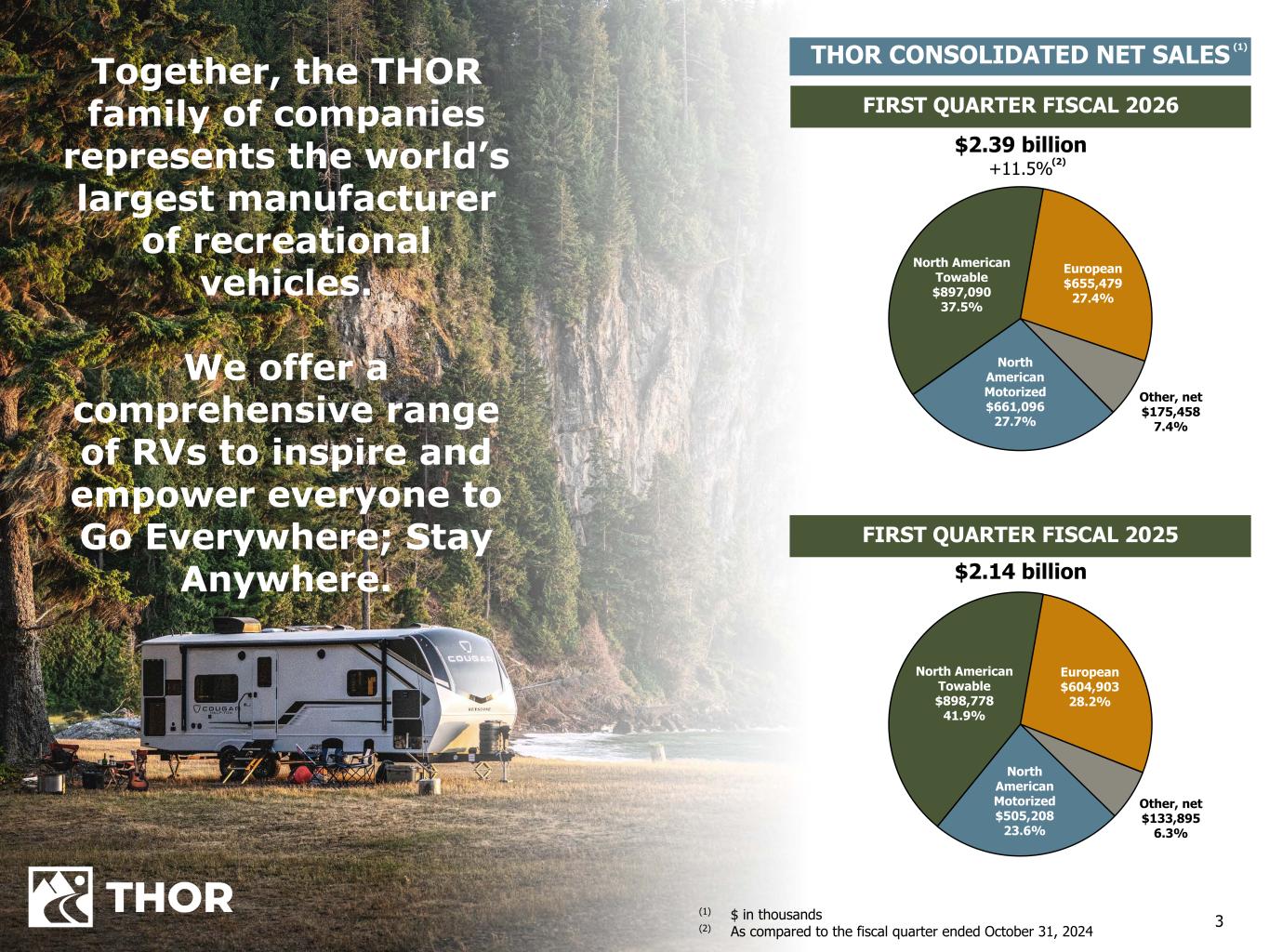
3 Together, the THOR family of companies represents the world’s largest manufacturer of recreational vehicles. We offer a comprehensive range of RVs to inspire and empower everyone to Go Everywhere; Stay Anywhere. (1) $ in thousands (2) As compared to the fiscal quarter ended October 31, 2024 Other, net $175,458 7.4% North American Motorized $661,096 27.7% North American Towable $897,090 37.5% European $655,479 27.4% FIRST QUARTER FISCAL 2026 $2.39 billion +11.5%(2) Other, net $133,895 6.3% North American Motorized $505,208 23.6% North American Towable $898,778 41.9% European $604,903 28.2% FIRST QUARTER FISCAL 2025 $2.14 billion THOR CONSOLIDATED NET SALES (1)
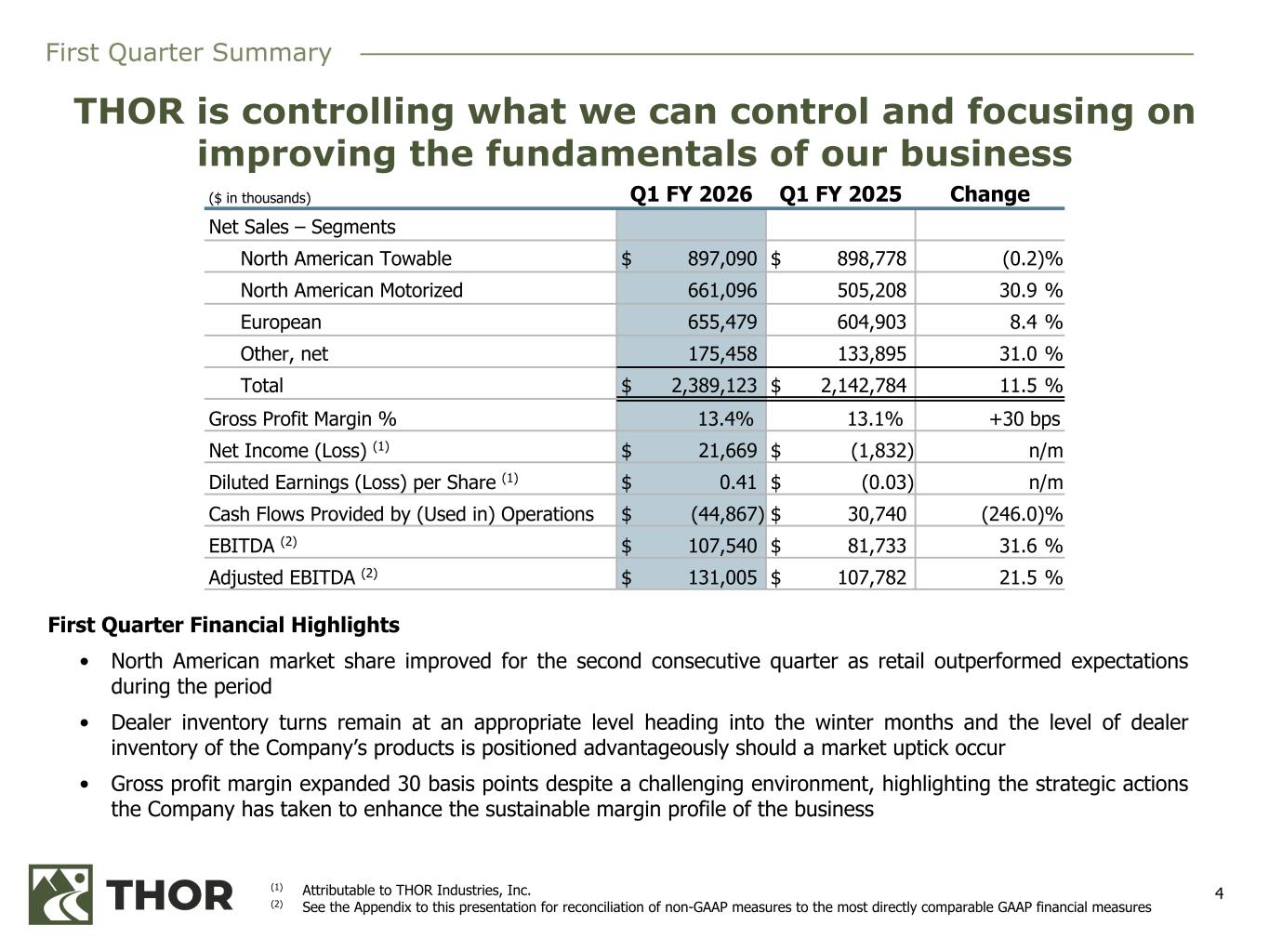
4 First Quarter Financial Highlights • North American market share improved for the second consecutive quarter as retail outperformed expectations during the period • Dealer inventory turns remain at an appropriate level heading into the winter months and the level of dealer inventory of the Company’s products is positioned advantageously should a market uptick occur • Gross profit margin expanded 30 basis points despite a challenging environment, highlighting the strategic actions the Company has taken to enhance the sustainable margin profile of the business ($ in thousands) Q1 FY 2026 Q1 FY 2025 Change Net Sales – Segments North American Towable $ 897,090 $ 898,778 (0.2) % North American Motorized 661,096 505,208 30.9 % European 655,479 604,903 8.4 % Other, net 175,458 133,895 31.0 % Total $ 2,389,123 $ 2,142,784 11.5 % Gross Profit Margin % 13.4 % 13.1 % +30 bps Net Income (Loss) (1) $ 21,669 $ (1,832) n/m Diluted Earnings (Loss) per Share (1) $ 0.41 $ (0.03) n/m Cash Flows Provided by (Used in) Operations $ (44,867) $ 30,740 (246.0) % EBITDA (2) $ 107,540 $ 81,733 31.6 % Adjusted EBITDA (2) $ 131,005 $ 107,782 21.5 % THOR is controlling what we can control and focusing on improving the fundamentals of our business (1) Attributable to THOR Industries, Inc. (2) See the Appendix to this presentation for reconciliation of non-GAAP measures to the most directly comparable GAAP financial measures First Quarter Summary
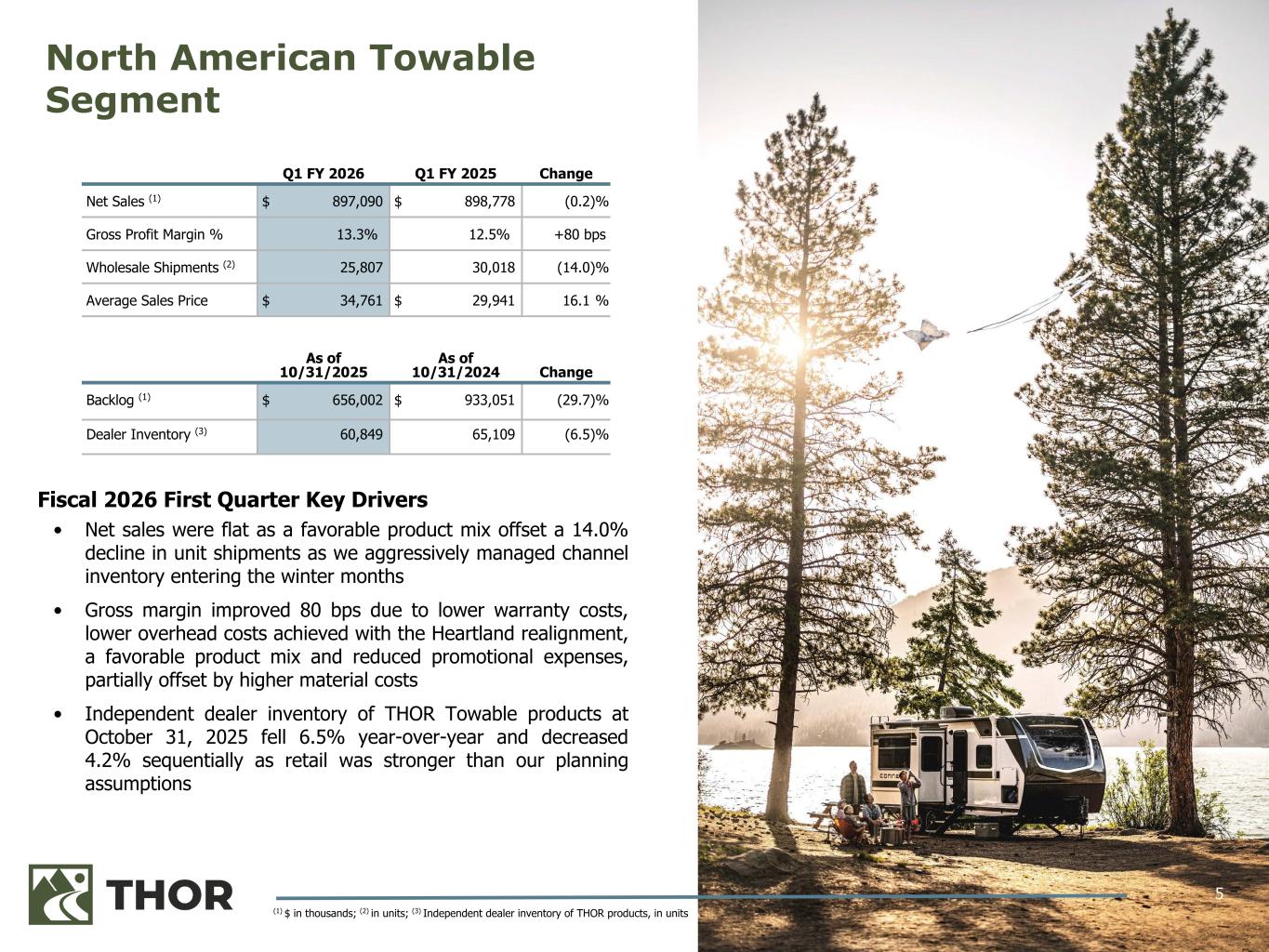
5 Fiscal 2026 First Quarter Key Drivers • Net sales were flat as a favorable product mix offset a 14.0% decline in unit shipments as we aggressively managed channel inventory entering the winter months • Gross margin improved 80 bps due to lower warranty costs, lower overhead costs achieved with the Heartland realignment, a favorable product mix and reduced promotional expenses, partially offset by higher material costs • Independent dealer inventory of THOR Towable products at October 31, 2025 fell 6.5% year-over-year and decreased 4.2% sequentially as retail was stronger than our planning assumptions North American Towable Segment Q1 FY 2026 Q1 FY 2025 Change Net Sales (1) $ 897,090 $ 898,778 (0.2) % Gross Profit Margin % 13.3 % 12.5 % +80 bps Wholesale Shipments (2) 25,807 30,018 (14.0) % Average Sales Price $ 34,761 $ 29,941 16.1 % As of 10/31/2025 As of 10/31/2024 Change Backlog (1) $ 656,002 $ 933,051 (29.7) % Dealer Inventory (3) 60,849 65,109 (6.5) % (1) $ in thousands; (2) in units; (3) Independent dealer inventory of THOR products, in units
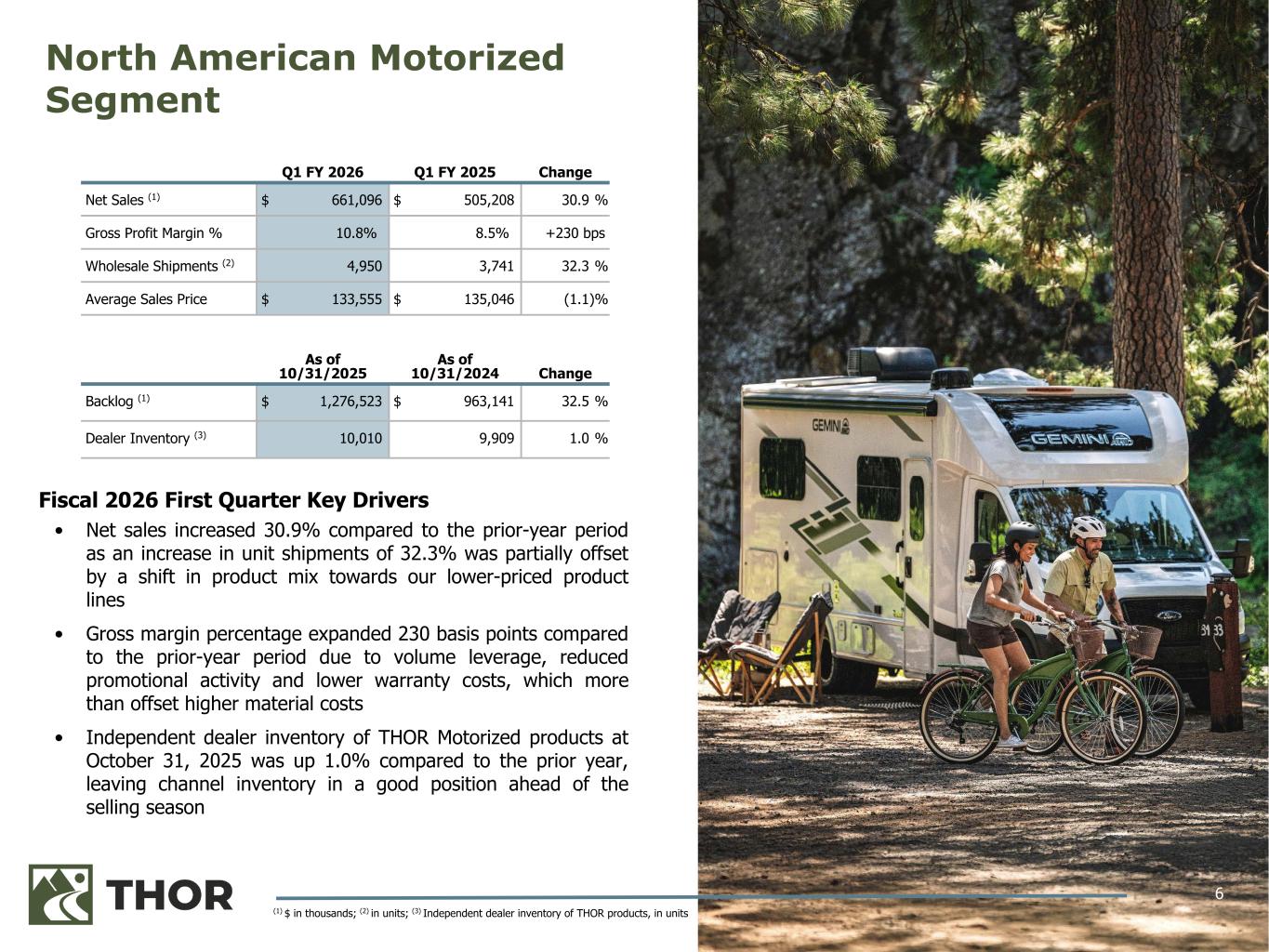
6 Fiscal 2026 First Quarter Key Drivers • Net sales increased 30.9% compared to the prior-year period as an increase in unit shipments of 32.3% was partially offset by a shift in product mix towards our lower-priced product lines • Gross margin percentage expanded 230 basis points compared to the prior-year period due to volume leverage, reduced promotional activity and lower warranty costs, which more than offset higher material costs • Independent dealer inventory of THOR Motorized products at October 31, 2025 was up 1.0% compared to the prior year, leaving channel inventory in a good position ahead of the selling season Q1 FY 2026 Q1 FY 2025 Change Net Sales (1) $ 661,096 $ 505,208 30.9 % Gross Profit Margin % 10.8 % 8.5 % +230 bps Wholesale Shipments (2) 4,950 3,741 32.3 % Average Sales Price $ 133,555 $ 135,046 (1.1) % As of 10/31/2025 As of 10/31/2024 Change Backlog (1) $ 1,276,523 $ 963,141 32.5 % Dealer Inventory (3) 10,010 9,909 1.0 % North American Motorized Segment (1) $ in thousands; (2) in units; (3) Independent dealer inventory of THOR products, in units
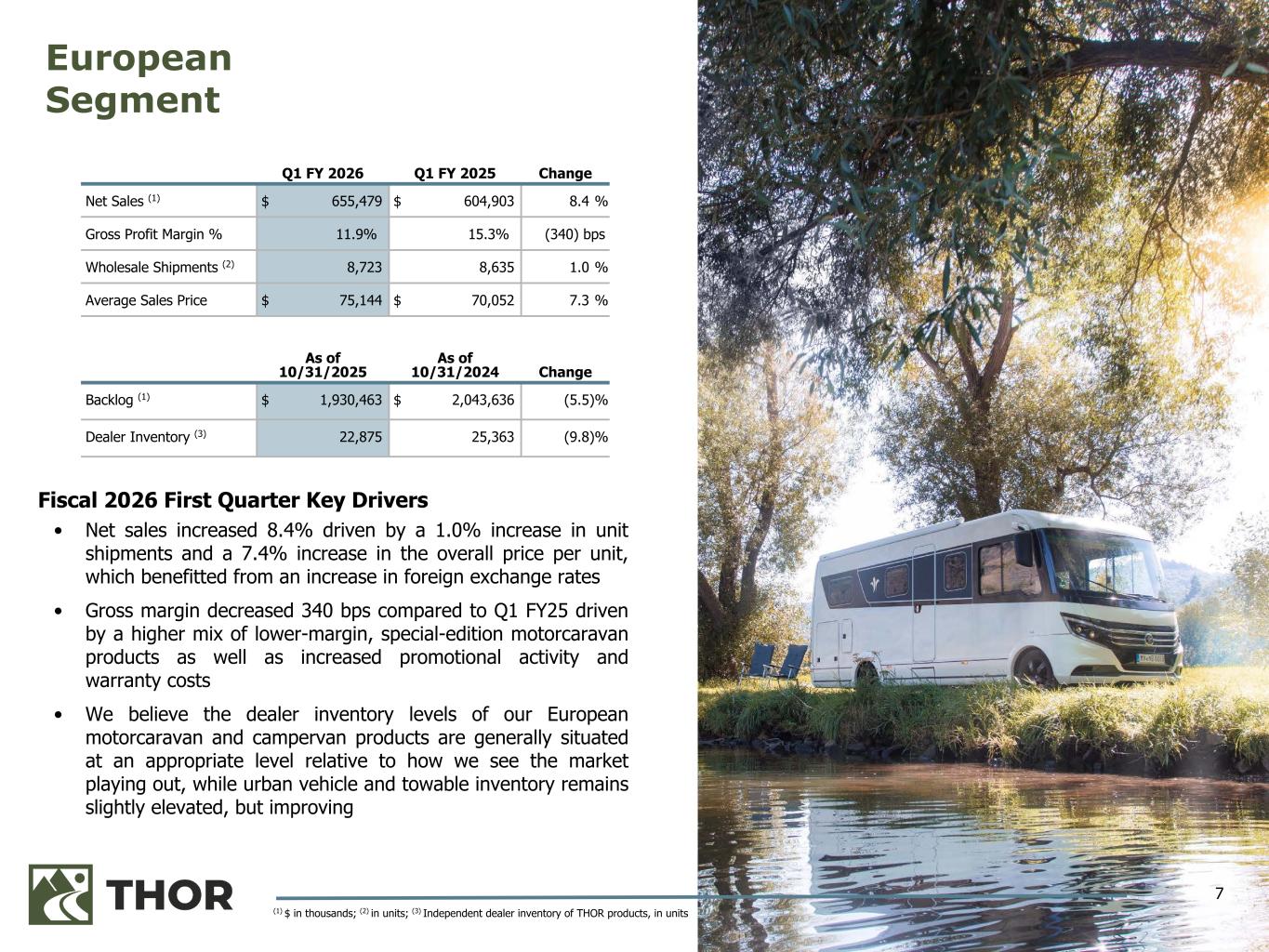
7 Fiscal 2026 First Quarter Key Drivers • Net sales increased 8.4% driven by a 1.0% increase in unit shipments and a 7.4% increase in the overall price per unit, which benefitted from an increase in foreign exchange rates • Gross margin decreased 340 bps compared to Q1 FY25 driven by a higher mix of lower-margin, special-edition motorcaravan products as well as increased promotional activity and warranty costs • We believe the dealer inventory levels of our European motorcaravan and campervan products are generally situated at an appropriate level relative to how we see the market playing out, while urban vehicle and towable inventory remains slightly elevated, but improving Q1 FY 2026 Q1 FY 2025 Change Net Sales (1) $ 655,479 $ 604,903 8.4 % Gross Profit Margin % 11.9 % 15.3 % (340) bps Wholesale Shipments (2) 8,723 8,635 1.0 % Average Sales Price $ 75,144 $ 70,052 7.3 % As of 10/31/2025 As of 10/31/2024 Change Backlog (1) $ 1,930,463 $ 2,043,636 (5.5) % Dealer Inventory (3) 22,875 25,363 (9.8) % European Segment (1) $ in thousands; (2) in units; (3) Independent dealer inventory of THOR products, in units
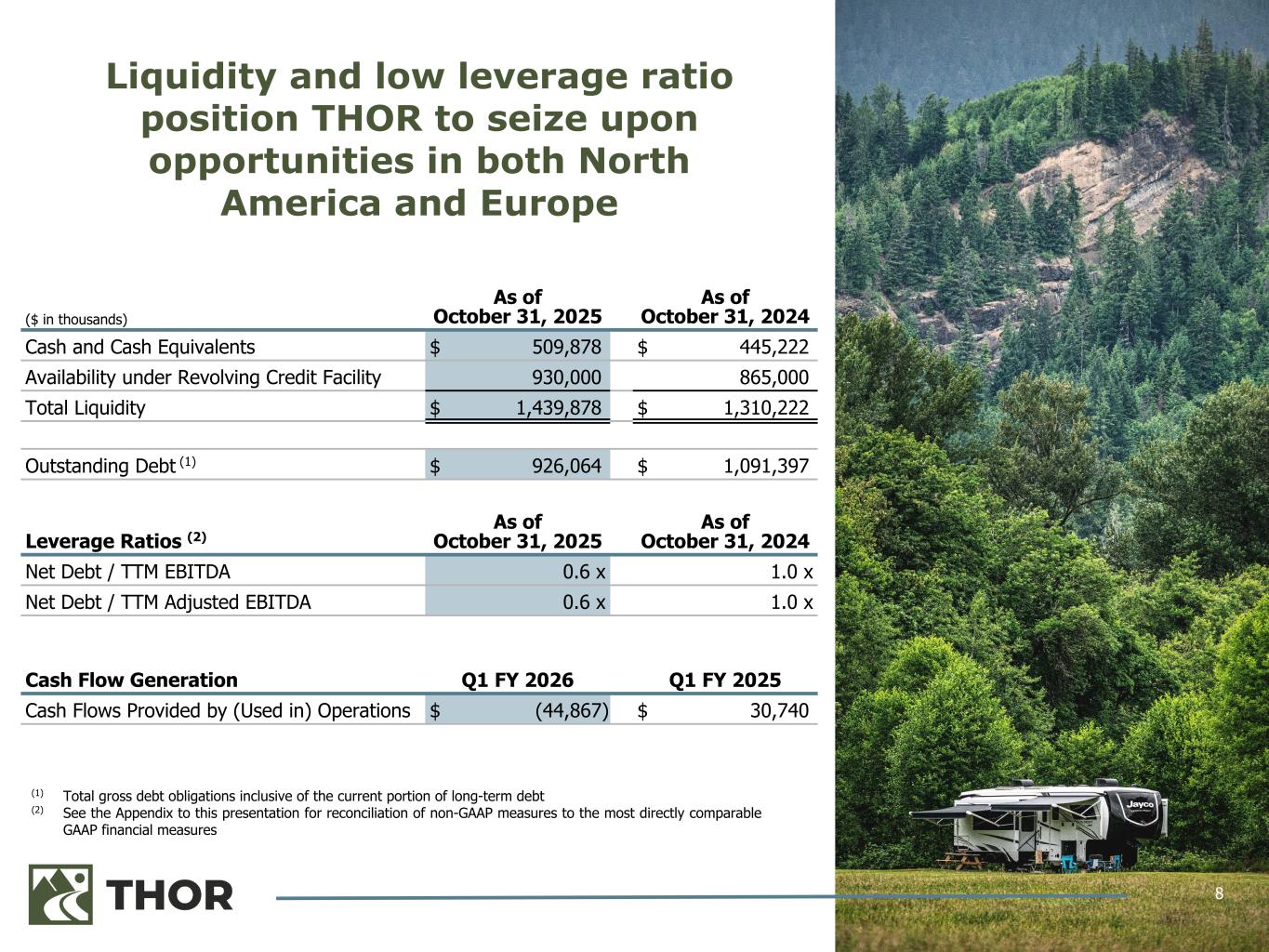
8 ($ in thousands) As of October 31, 2025 As of October 31, 2024 Cash and Cash Equivalents $ 509,878 $ 445,222 Availability under Revolving Credit Facility 930,000 865,000 Total Liquidity $ 1,439,878 $ 1,310,222 Outstanding Debt (1) $ 926,064 $ 1,091,397 Leverage Ratios (2) As of October 31, 2025 As of October 31, 2024 Net Debt / TTM EBITDA 0.6 x 1.0 x Net Debt / TTM Adjusted EBITDA 0.6 x 1.0 x Cash Flow Generation Q1 FY 2026 Q1 FY 2025 Cash Flows Provided by (Used in) Operations $ (44,867) $ 30,740 (1) Total gross debt obligations inclusive of the current portion of long-term debt (2) See the Appendix to this presentation for reconciliation of non-GAAP measures to the most directly comparable GAAP financial measures Liquidity and low leverage ratio position THOR to seize upon opportunities in both North America and Europe
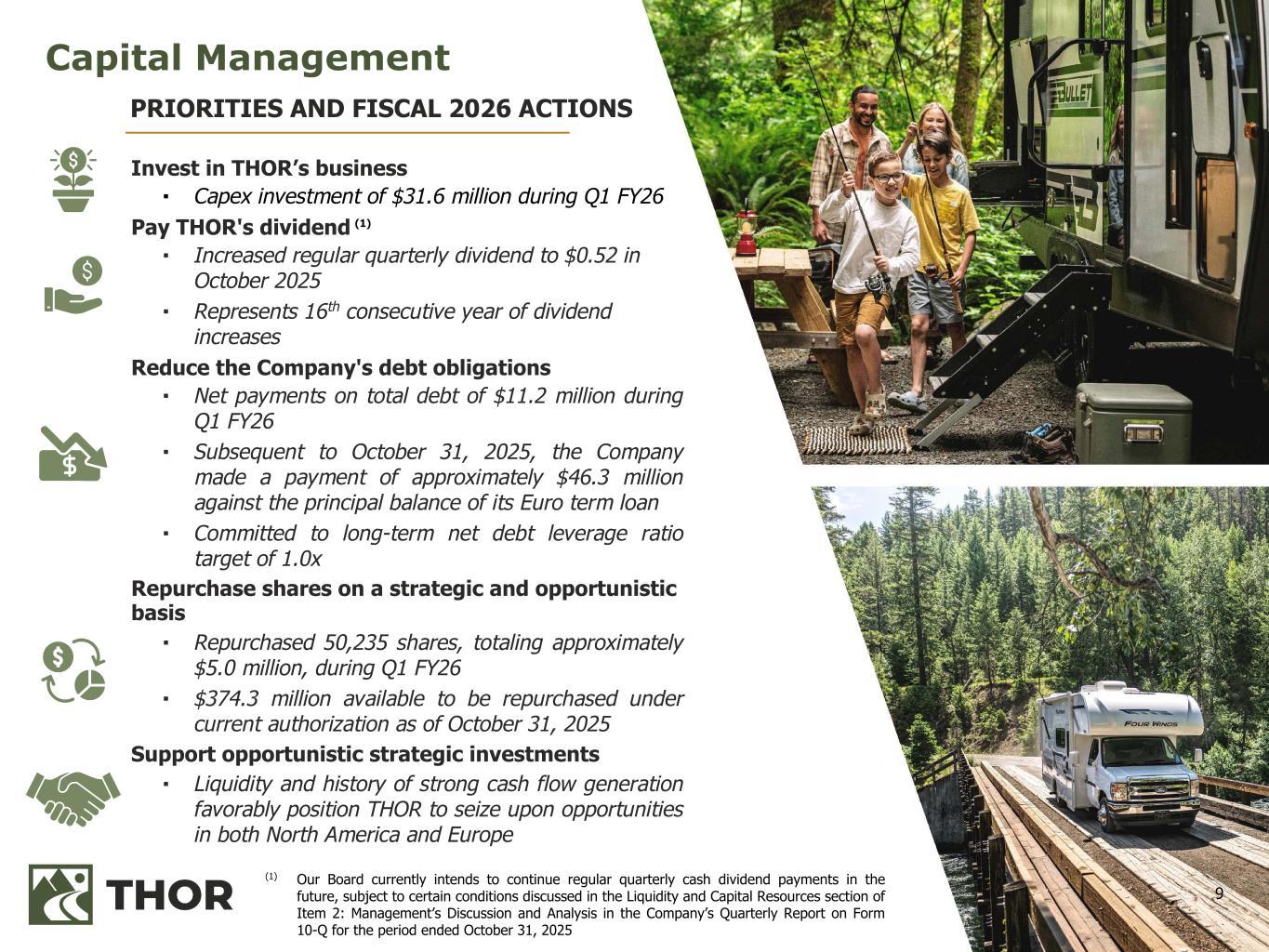
9 Capital Management PRIORITIES AND FISCAL 2026 ACTIONS Invest in THOR’s business ▪ Capex investment of $31.6 million during Q1 FY26 Pay THOR's dividend ▪ Increased regular quarterly dividend to $0.52 in October 2025 ▪ Represents 16th consecutive year of dividend increases Reduce the Company's debt obligations ▪ Net payments on total debt of $11.2 million during Q1 FY26 ▪ Subsequent to October 31, 2025, the Company made a payment of approximately $46.3 million against the principal balance of its Euro term loan ▪ Committed to long-term net debt leverage ratio target of 1.0x Repurchase shares on a strategic and opportunistic basis ▪ Repurchased 50,235 shares, totaling approximately $5.0 million, during Q1 FY26 ▪ $374.3 million available to be repurchased under current authorization as of October 31, 2025 Support opportunistic strategic investments ▪ Liquidity and history of strong cash flow generation favorably position THOR to seize upon opportunities in both North America and Europe (1) (1) Our Board currently intends to continue regular quarterly cash dividend payments in the future, subject to certain conditions discussed in the Liquidity and Capital Resources section of Item 2: Management’s Discussion and Analysis in the Company’s Quarterly Report on Form 10-Q for the period ended October 31, 2025
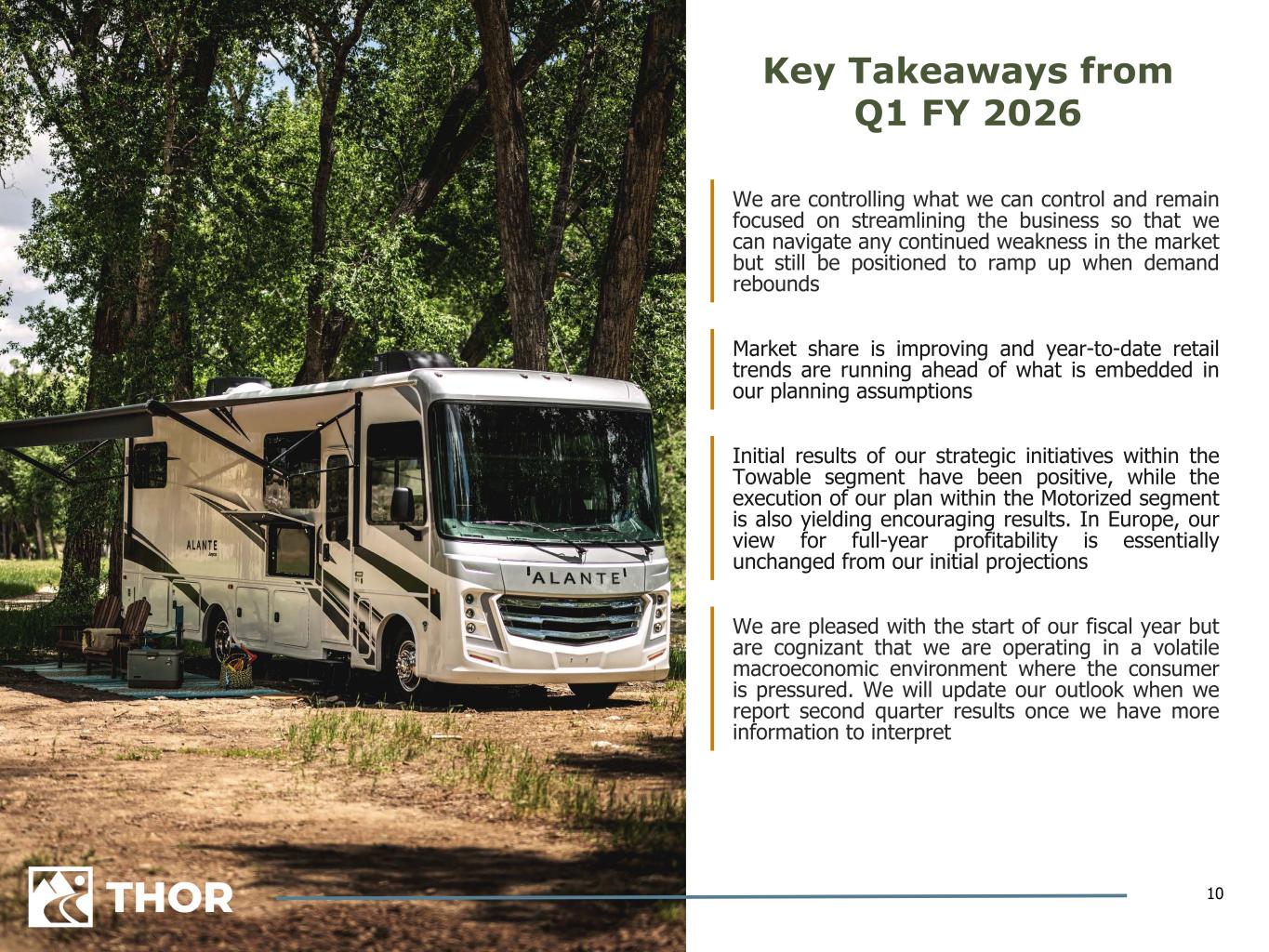
10 Key Takeaways from Q1 FY 2026 We are controlling what we can control and remain focused on streamlining the business so that we can navigate any continued weakness in the market but still be positioned to ramp up when demand rebounds Market share is improving and year-to-date retail trends are running ahead of what is embedded in our planning assumptions Initial results of our strategic initiatives within the Towable segment have been positive, while the execution of our plan within the Motorized segment is also yielding encouraging results. In Europe, our view for full-year profitability is essentially unchanged from our initial projections We are pleased with the start of our fiscal year but are cognizant that we are operating in a volatile macroeconomic environment where the consumer is pressured. We will update our outlook when we report second quarter results once we have more information to interpret
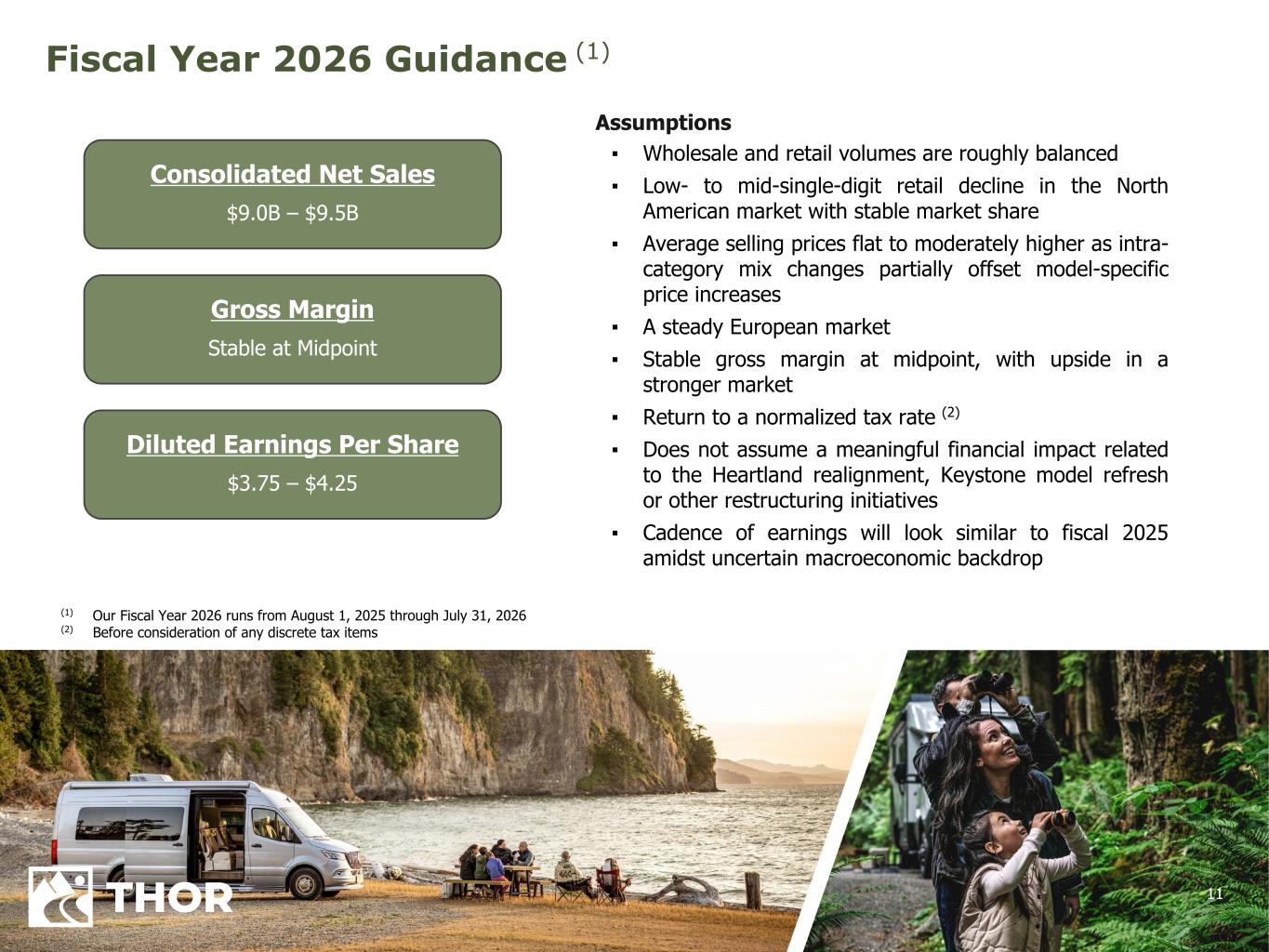
11 Fiscal Year 2026 Guidance (1) (1) Our Fiscal Year 2026 runs from August 1, 2025 through July 31, 2026 (2) Before consideration of any discrete tax items Consolidated Net Sales $9.0B – $9.5B Gross Margin Stable at Midpoint Assumptions ▪ Wholesale and retail volumes are roughly balanced ▪ Low- to mid-single-digit retail decline in the North American market with stable market share ▪ Average selling prices flat to moderately higher as intra- category mix changes partially offset model-specific price increases ▪ A steady European market ▪ Stable gross margin at midpoint, with upside in a stronger market ▪ Return to a normalized tax rate (2) ▪ Does not assume a meaningful financial impact related to the Heartland realignment, Keystone model refresh or other restructuring initiatives ▪ Cadence of earnings will look similar to fiscal 2025 amidst uncertain macroeconomic backdrop Diluted Earnings Per Share $3.75 – $4.25

12 Appendix
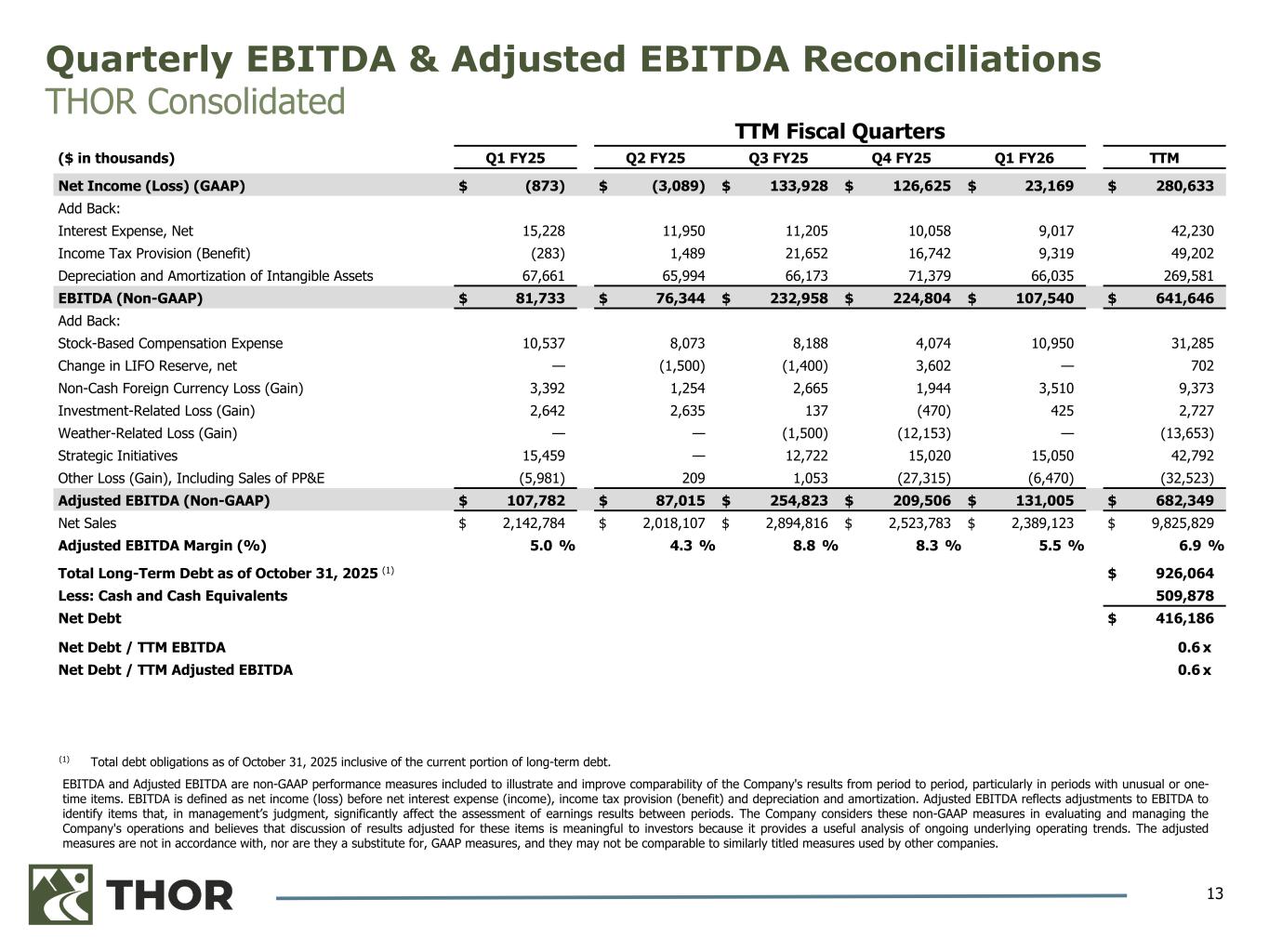
13 Quarterly EBITDA & Adjusted EBITDA Reconciliations THOR Consolidated TTM Fiscal Quarters ($ in thousands) Q1 FY25 Q2 FY25 Q3 FY25 Q4 FY25 Q1 FY26 TTM Net Income (Loss) (GAAP) $ (873) $ (3,089) $ 133,928 $ 126,625 $ 23,169 $ 280,633 Add Back: Interest Expense, Net 15,228 11,950 11,205 10,058 9,017 42,230 Income Tax Provision (Benefit) (283) 1,489 21,652 16,742 9,319 49,202 Depreciation and Amortization of Intangible Assets 67,661 65,994 66,173 71,379 66,035 269,581 EBITDA (Non-GAAP) $ 81,733 $ 76,344 $ 232,958 $ 224,804 $ 107,540 $ 641,646 Add Back: Stock-Based Compensation Expense 10,537 8,073 8,188 4,074 10,950 31,285 Change in LIFO Reserve, net — (1,500) (1,400) 3,602 — 702 Non-Cash Foreign Currency Loss (Gain) 3,392 1,254 2,665 1,944 3,510 9,373 Investment-Related Loss (Gain) 2,642 2,635 137 (470) 425 2,727 Weather-Related Loss (Gain) — — (1,500) (12,153) — (13,653) Strategic Initiatives 15,459 — 12,722 15,020 15,050 42,792 Other Loss (Gain), Including Sales of PP&E (5,981) 209 1,053 (27,315) (6,470) (32,523) Adjusted EBITDA (Non-GAAP) $ 107,782 $ 87,015 $ 254,823 $ 209,506 $ 131,005 $ 682,349 Net Sales $ 2,142,784 $ 2,018,107 $ 2,894,816 $ 2,523,783 $ 2,389,123 $ 9,825,829 Adjusted EBITDA Margin (%) 5.0 % 4.3 % 8.8 % 8.3 % 5.5 % 6.9 % Total Long-Term Debt as of October 31, 2025 (1) $ 926,064 Less: Cash and Cash Equivalents 509,878 Net Debt $ 416,186 Net Debt / TTM EBITDA 0.6 Net Debt / TTM Adjusted EBITDA 0.6 EBITDA and Adjusted EBITDA are non-GAAP performance measures included to illustrate and improve comparability of the Company's results from period to period, particularly in periods with unusual or one- time items. EBITDA is defined as net income (loss) before net interest expense (income), income tax provision (benefit) and depreciation and amortization. Adjusted EBITDA reflects adjustments to EBITDA to identify items that, in management’s judgment, significantly affect the assessment of earnings results between periods. The Company considers these non-GAAP measures in evaluating and managing the Company's operations and believes that discussion of results adjusted for these items is meaningful to investors because it provides a useful analysis of ongoing underlying operating trends. The adjusted measures are not in accordance with, nor are they a substitute for, GAAP measures, and they may not be comparable to similarly titled measures used by other companies. x x (1) Total debt obligations as of October 31, 2025 inclusive of the current portion of long-term debt.
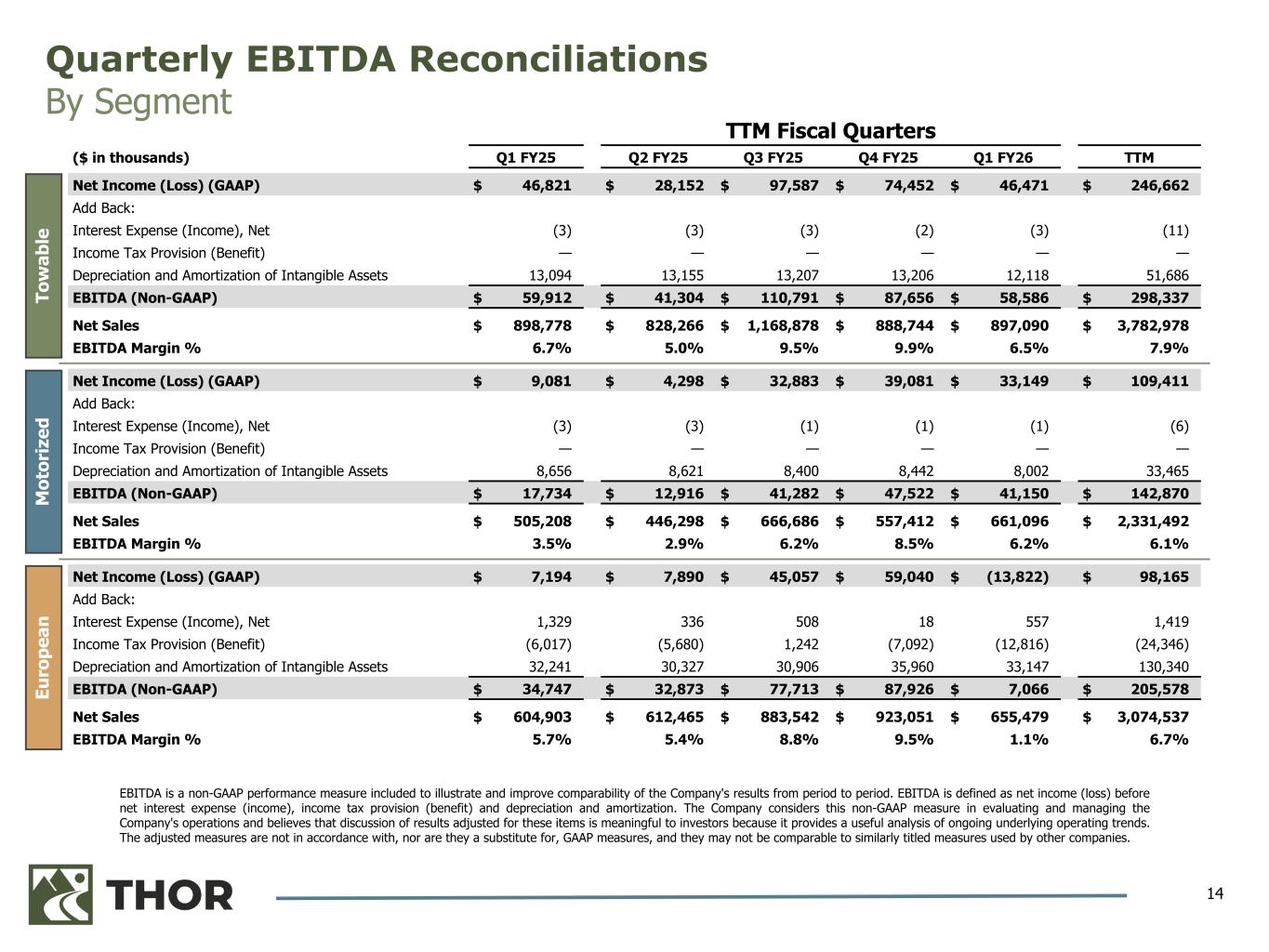
14 Quarterly EBITDA Reconciliations By Segment TTM Fiscal Quarters ($ in thousands) Q1 FY25 Q2 FY25 Q3 FY25 Q4 FY25 Q1 FY26 TTM Net Income (Loss) (GAAP) $ 46,821 $ 28,152 $ 97,587 $ 74,452 $ 46,471 $ 246,662 Add Back: Interest Expense (Income), Net (3) (3) (3) (2) (3) (11) Income Tax Provision (Benefit) — — — — — — Depreciation and Amortization of Intangible Assets 13,094 13,155 13,207 13,206 12,118 51,686 EBITDA (Non-GAAP) $ 59,912 $ 41,304 $ 110,791 $ 87,656 $ 58,586 $ 298,337 Net Sales $ 898,778 $ 828,266 $ 1,168,878 $ 888,744 $ 897,090 $ 3,782,978 EBITDA Margin % 6.7 % 5.0 % 9.5 % 9.9 % 6.5 % 7.9 % Net Income (Loss) (GAAP) $ 9,081 $ 4,298 $ 32,883 $ 39,081 $ 33,149 $ 109,411 Add Back: Interest Expense (Income), Net (3) (3) (1) (1) (1) (6) Income Tax Provision (Benefit) — — — — — — Depreciation and Amortization of Intangible Assets 8,656 8,621 8,400 8,442 8,002 33,465 EBITDA (Non-GAAP) $ 17,734 $ 12,916 $ 41,282 $ 47,522 $ 41,150 $ 142,870 Net Sales $ 505,208 $ 446,298 $ 666,686 $ 557,412 $ 661,096 $ 2,331,492 EBITDA Margin % 3.5 % 2.9 % 6.2 % 8.5 % 6.2 % 6.1 % Net Income (Loss) (GAAP) $ 7,194 $ 7,890 $ 45,057 $ 59,040 $ (13,822) $ 98,165 Add Back: Interest Expense (Income), Net 1,329 336 508 18 557 1,419 Income Tax Provision (Benefit) (6,017) (5,680) 1,242 (7,092) (12,816) (24,346) Depreciation and Amortization of Intangible Assets 32,241 30,327 30,906 35,960 33,147 130,340 EBITDA (Non-GAAP) $ 34,747 $ 32,873 $ 77,713 $ 87,926 $ 7,066 $ 205,578 Net Sales $ 604,903 $ 612,465 $ 883,542 $ 923,051 $ 655,479 $ 3,074,537 EBITDA Margin % 5.7 % 5.4 % 8.8 % 9.5 % 1.1 % 6.7 % EBITDA is a non-GAAP performance measure included to illustrate and improve comparability of the Company's results from period to period. EBITDA is defined as net income (loss) before net interest expense (income), income tax provision (benefit) and depreciation and amortization. The Company considers this non-GAAP measure in evaluating and managing the Company's operations and believes that discussion of results adjusted for these items is meaningful to investors because it provides a useful analysis of ongoing underlying operating trends. The adjusted measures are not in accordance with, nor are they a substitute for, GAAP measures, and they may not be comparable to similarly titled measures used by other companies. To w ab le M ot or iz ed Eu ro pe an
15 EUROPEAN SEGMENT NORTH AMERICAN MOTORIZED SEGMENT NORTH AMERICAN TOWABLE SEGMENT We consist of a trusted family of brands that are loved by RV consumers
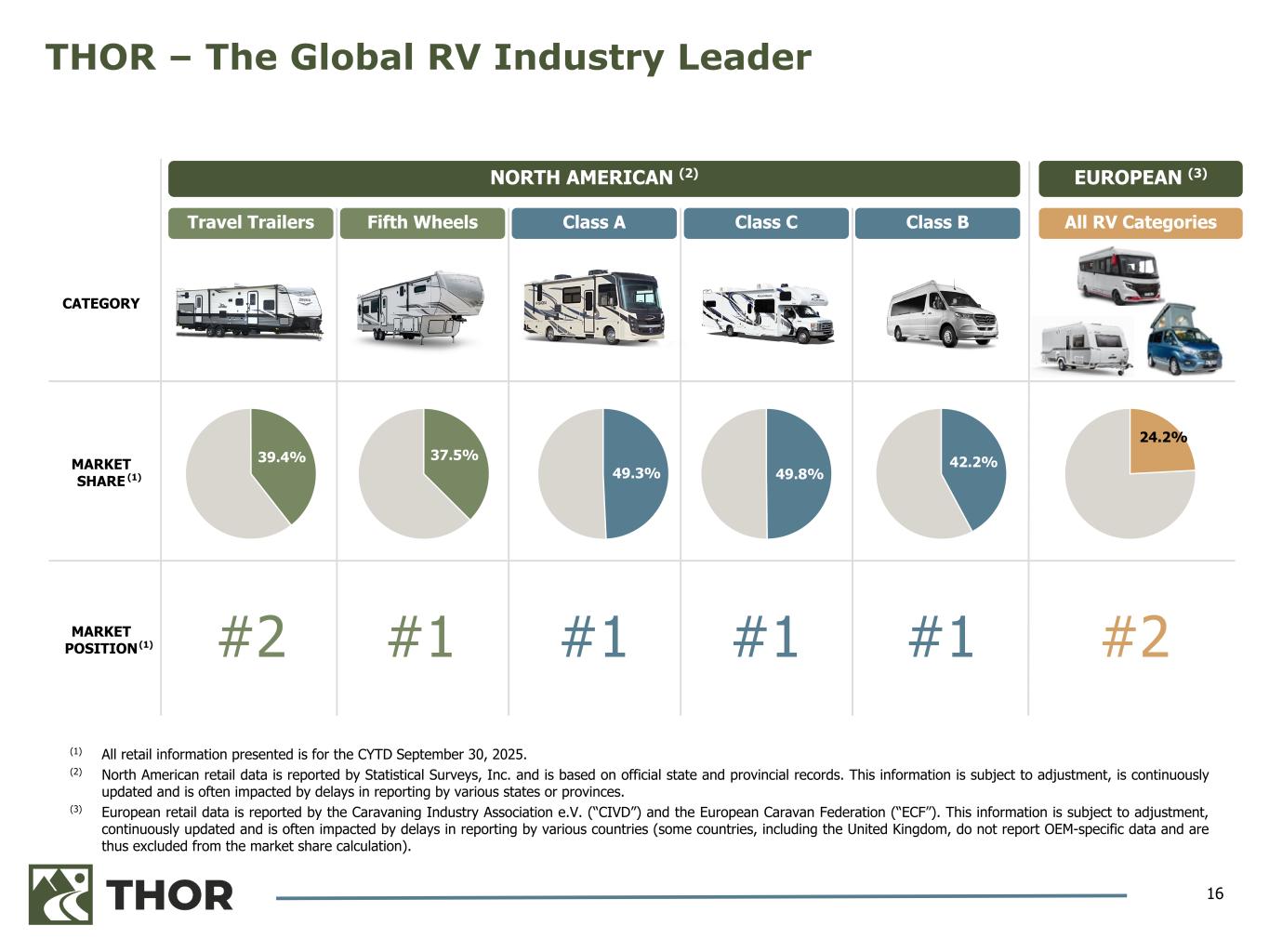
16 (1) All retail information presented is for the CYTD September 30, 2025. (2) North American retail data is reported by Statistical Surveys, Inc. and is based on official state and provincial records. This information is subject to adjustment, is continuously updated and is often impacted by delays in reporting by various states or provinces. (3) European retail data is reported by the Caravaning Industry Association e.V. (“CIVD”) and the European Caravan Federation (“ECF”). This information is subject to adjustment, continuously updated and is often impacted by delays in reporting by various countries (some countries, including the United Kingdom, do not report OEM-specific data and are thus excluded from the market share calculation). NORTH AMERICAN (2) EUROPEAN (3) Travel Trailers Class A Class CFifth Wheels Class B All RV Categories CATEGORY MARKET SHARE MARKET POSITION 39.4% 37.5% 49.3% 49.8% 42.2% 24.2% #2 #1 #1 #1 #1 #2 THOR – The Global RV Industry Leader (1) (1)
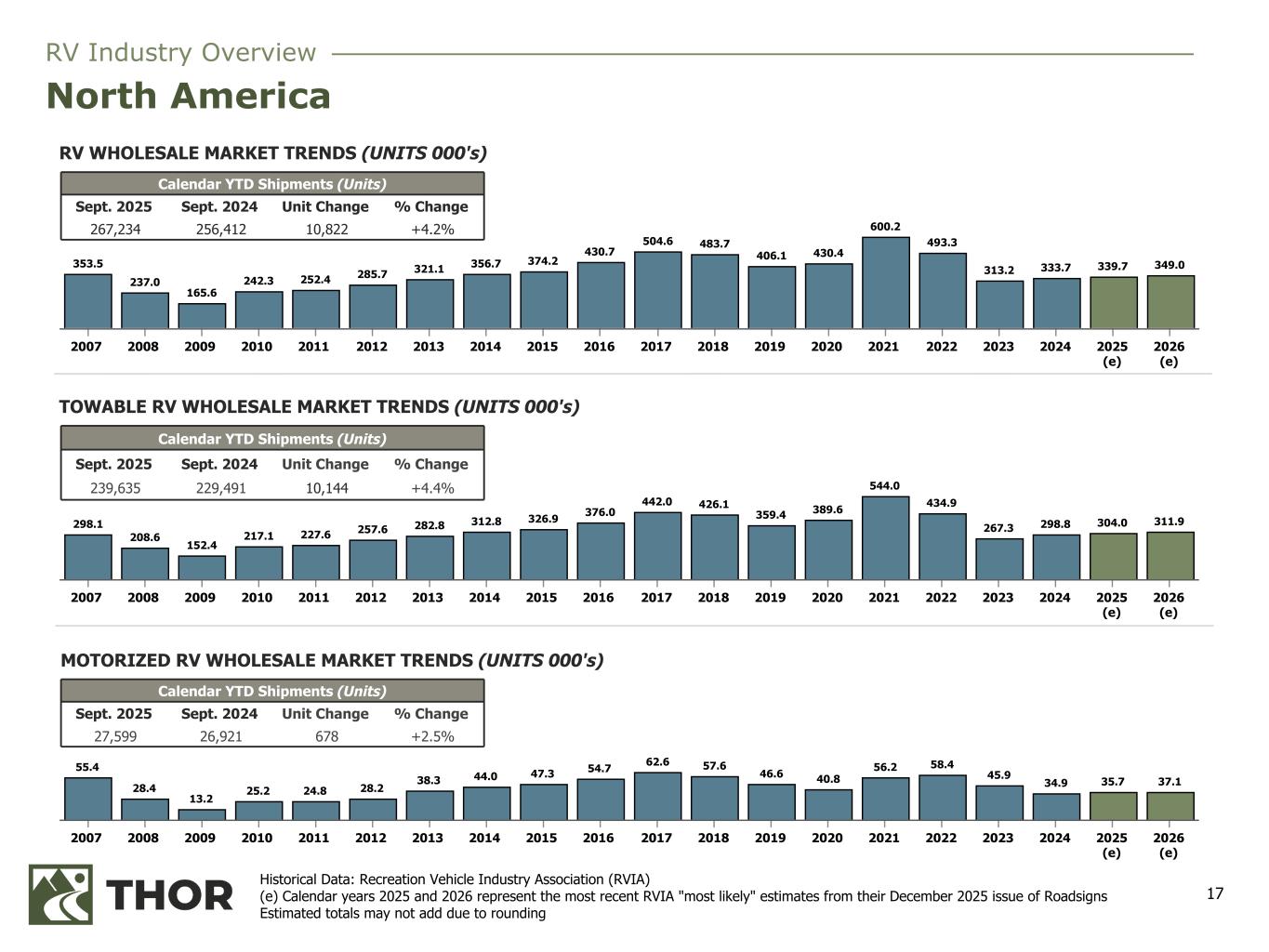
17 55.4 28.4 13.2 25.2 24.8 28.2 38.3 44.0 47.3 54.7 62.6 57.6 46.6 40.8 56.2 58.4 45.9 34.9 35.7 37.1 2007 2008 2009 2010 2011 2012 2013 2014 2015 2016 2017 2018 2019 2020 2021 2022 2023 2024 2025 (e) 2026 (e) 298.1 208.6 152.4 217.1 227.6 257.6 282.8 312.8 326.9 376.0 442.0 426.1 359.4 389.6 544.0 434.9 267.3 298.8 304.0 311.9 2007 2008 2009 2010 2011 2012 2013 2014 2015 2016 2017 2018 2019 2020 2021 2022 2023 2024 2025 (e) 2026 (e) 353.5 237.0 165.6 242.3 252.4 285.7 321.1 356.7 374.2 430.7 504.6 483.7 406.1 430.4 600.2 493.3 313.2 333.7 339.7 349.0 2007 2008 2009 2010 2011 2012 2013 2014 2015 2016 2017 2018 2019 2020 2021 2022 2023 2024 2025 (e) 2026 (e) TOWABLE RV WHOLESALE MARKET TRENDS (UNITS 000's) Calendar YTD Shipments (Units) Sept. 2025 Sept. 2024 Unit Change % Change 267,234 256,412 10,822 +4.2% Calendar YTD Shipments (Units) Sept. 2025 Sept. 2024 Unit Change % Change 239,635 229,491 10,144 +4.4% Calendar YTD Shipments (Units) Sept. 2025 Sept. 2024 Unit Change % Change 27,599 26,921 678 +2.5% Historical Data: Recreation Vehicle Industry Association (RVIA) (e) Calendar years 2025 and 2026 represent the most recent RVIA "most likely" estimates from their December 2025 issue of Roadsigns Estimated totals may not add due to rounding North America RV WHOLESALE MARKET TRENDS (UNITS 000's) MOTORIZED RV WHOLESALE MARKET TRENDS (UNITS 000's) RV Industry Overview
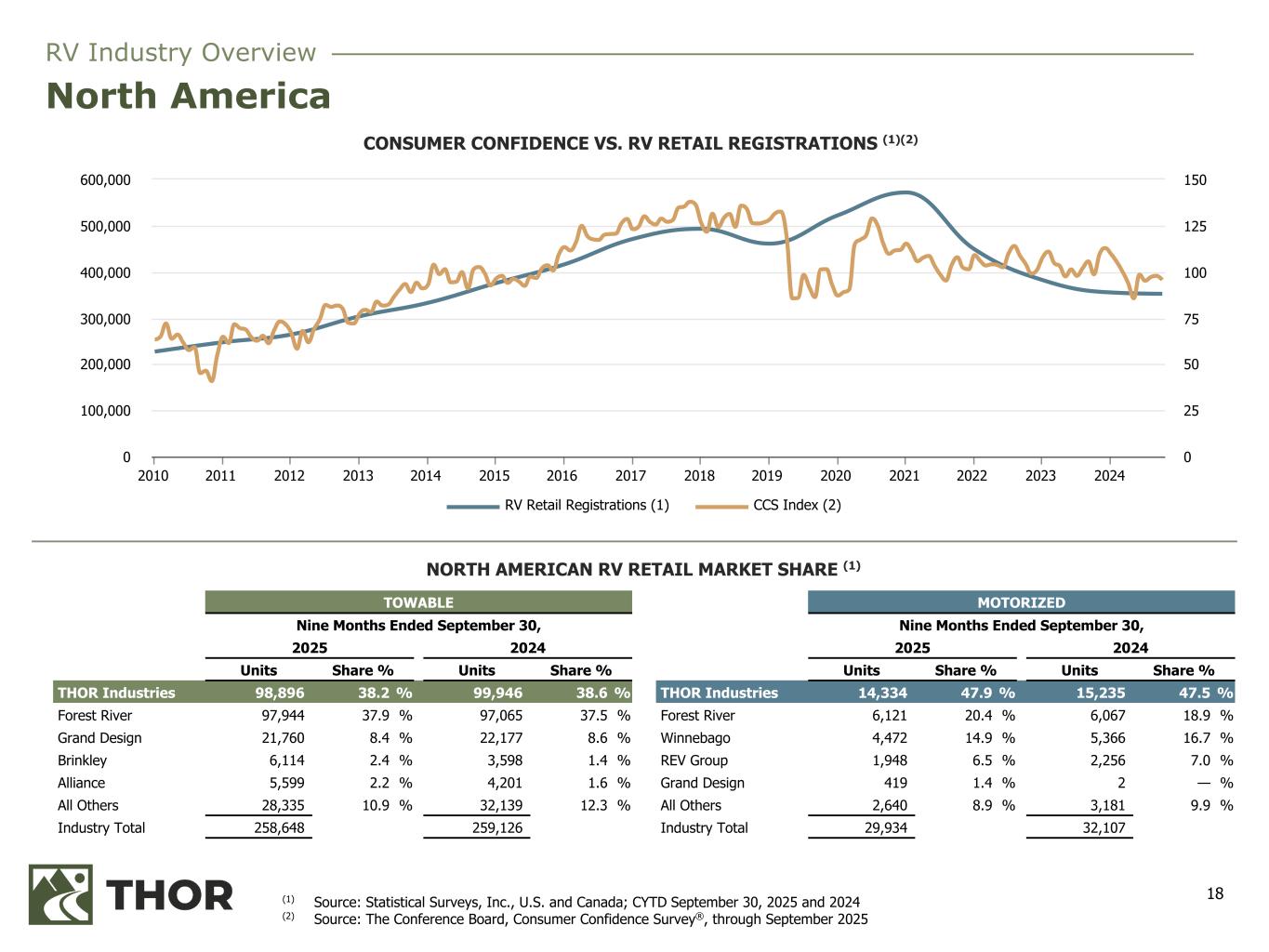
18 NORTH AMERICAN RV RETAIL MARKET SHARE (1) RV Retail Registrations (1) CCS Index (2) 2010 2011 2012 2013 2014 2015 2016 2017 2018 2019 2020 2021 2022 2023 2024 0 100,000 200,000 300,000 400,000 500,000 600,000 0 25 50 75 100 125 150 (1) Source: Statistical Surveys, Inc., U.S. and Canada; CYTD September 30, 2025 and 2024 (2) Source: The Conference Board, Consumer Confidence Survey®, through September 2025 CONSUMER CONFIDENCE VS. RV RETAIL REGISTRATIONS (1)(2) TOWABLE Nine Months Ended September 30, 2025 2024 Units Share % Units Share % THOR Industries 98,896 38.2 % 99,946 38.6 % Forest River 97,944 37.9 % 97,065 37.5 % Grand Design 21,760 8.4 % 22,177 8.6 % Brinkley 6,114 2.4 % 3,598 1.4 % Alliance 5,599 2.2 % 4,201 1.6 % All Others 28,335 10.9 % 32,139 12.3 % Industry Total 258,648 259,126 MOTORIZED Nine Months Ended September 30, 2025 2024 Units Share % Units Share % THOR Industries 14,334 47.9 % 15,235 47.5 % Forest River 6,121 20.4 % 6,067 18.9 % Winnebago 4,472 14.9 % 5,366 16.7 % REV Group 1,948 6.5 % 2,256 7.0 % Grand Design 419 1.4 % 2 — % All Others 2,640 8.9 % 3,181 9.9 % Industry Total 29,934 32,107 North America RV Industry Overview
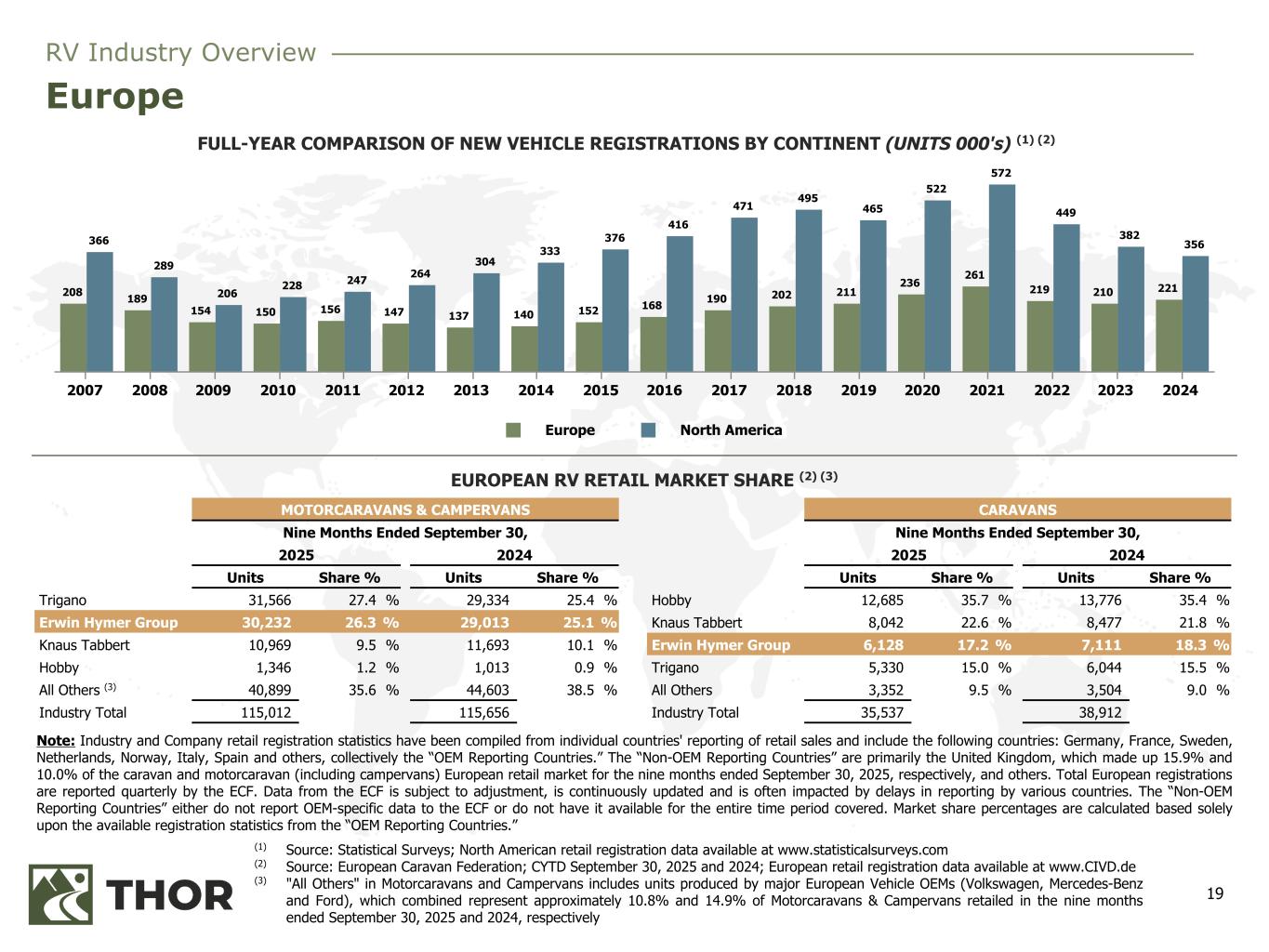
19 EUROPEAN RV RETAIL MARKET SHARE (2) (3) 208 189 154 150 156 147 137 140 152 168 190 202 211 236 261 219 210 221 366 289 206 228 247 264 304 333 376 416 471 495 465 522 572 449 382 356 Europe North America 2007 2008 2009 2010 2011 2012 2013 2014 2015 2016 2017 2018 2019 2020 2021 2022 2023 2024 FULL-YEAR COMPARISON OF NEW VEHICLE REGISTRATIONS BY CONTINENT (UNITS 000's) (1) (2) (1) Source: Statistical Surveys; North American retail registration data available at www.statisticalsurveys.com (2) Source: European Caravan Federation; CYTD September 30, 2025 and 2024; European retail registration data available at www.CIVD.de (3) "All Others" in Motorcaravans and Campervans includes units produced by major European Vehicle OEMs (Volkswagen, Mercedes-Benz and Ford), which combined represent approximately 10.8% and 14.9% of Motorcaravans & Campervans retailed in the nine months ended September 30, 2025 and 2024, respectively CARAVANS Nine Months Ended September 30, 2025 2024 Units Share % Units Share % Hobby 12,685 35.7 % 13,776 35.4 % Knaus Tabbert 8,042 22.6 % 8,477 21.8 % Erwin Hymer Group 6,128 17.2 % 7,111 18.3 % Trigano 5,330 15.0 % 6,044 15.5 % All Others 3,352 9.5 % 3,504 9.0 % Industry Total 35,537 38,912 MOTORCARAVANS & CAMPERVANS Nine Months Ended September 30, 2025 2024 Units Share % Units Share % Trigano 31,566 27.4 % 29,334 25.4 % Erwin Hymer Group 30,232 26.3 % 29,013 25.1 % Knaus Tabbert 10,969 9.5 % 11,693 10.1 % Hobby 1,346 1.2 % 1,013 0.9 % All Others (3) 40,899 35.6 % 44,603 38.5 % Industry Total 115,012 115,656 Note: Industry and Company retail registration statistics have been compiled from individual countries' reporting of retail sales and include the following countries: Germany, France, Sweden, Netherlands, Norway, Italy, Spain and others, collectively the “OEM Reporting Countries.” The “Non-OEM Reporting Countries” are primarily the United Kingdom, which made up 15.9% and 10.0% of the caravan and motorcaravan (including campervans) European retail market for the nine months ended September 30, 2025, respectively, and others. Total European registrations are reported quarterly by the ECF. Data from the ECF is subject to adjustment, is continuously updated and is often impacted by delays in reporting by various countries. The “Non-OEM Reporting Countries” either do not report OEM-specific data to the ECF or do not have it available for the entire time period covered. Market share percentages are calculated based solely upon the available registration statistics from the “OEM Reporting Countries.” Europe RV Industry Overview
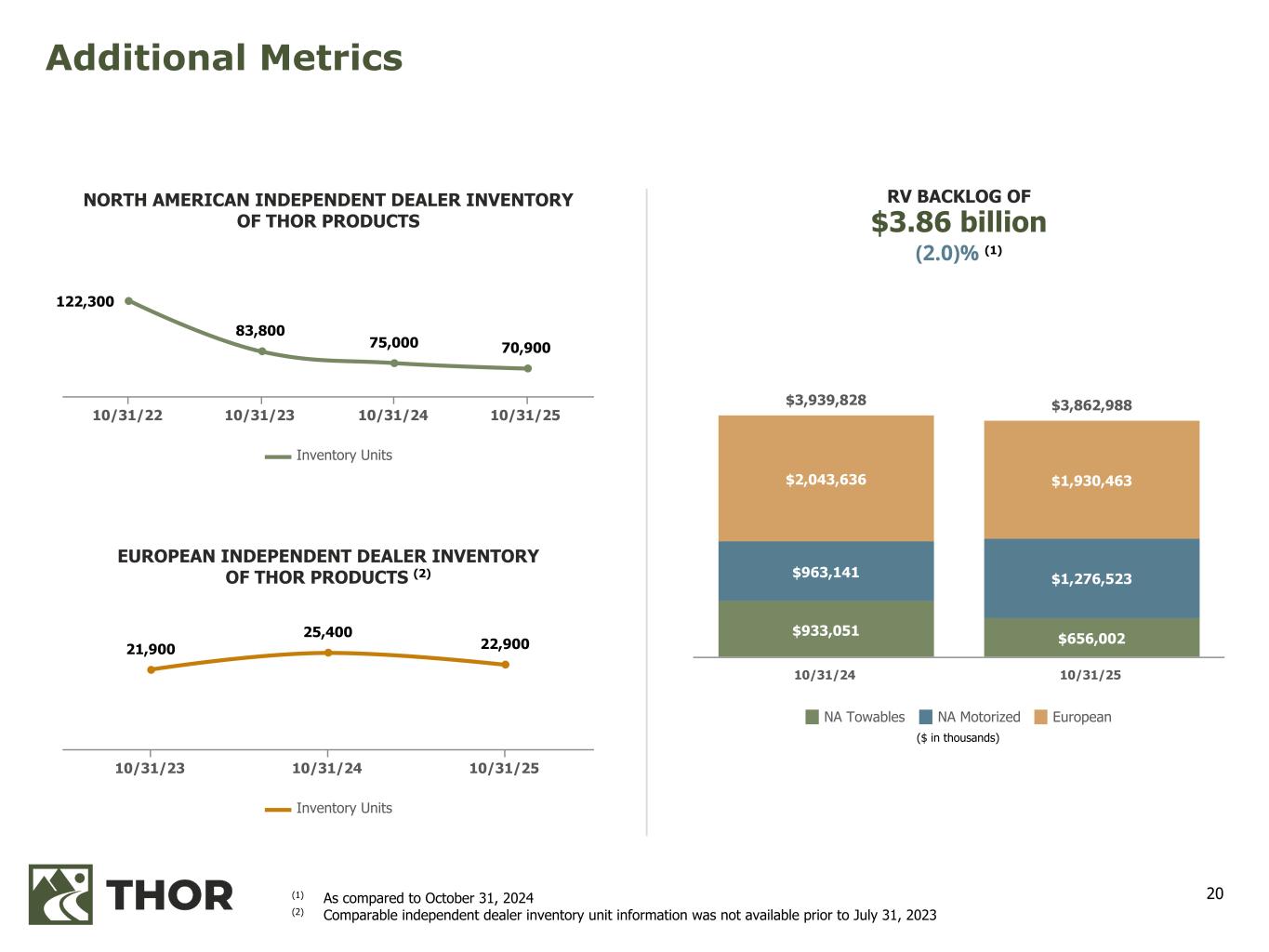
20 Additional Metrics $3,939,828 $3,862,988 $933,051 $656,002 $963,141 $1,276,523 $2,043,636 $1,930,463 NA Towables NA Motorized European 10/31/24 10/31/25 122,300 83,800 75,000 70,900 Inventory Units 10/31/22 10/31/23 10/31/24 10/31/25 NORTH AMERICAN INDEPENDENT DEALER INVENTORY OF THOR PRODUCTS RV BACKLOG OF $3.86 billion (2.0)% (1) (1) As compared to October 31, 2024 (2) Comparable independent dealer inventory unit information was not available prior to July 31, 2023 21,900 25,400 22,900 Inventory Units 10/31/23 10/31/24 10/31/25 EUROPEAN INDEPENDENT DEALER INVENTORY OF THOR PRODUCTS (2) ($ in thousands)

www.thorindustries.com THOR INVESTOR RELATIONS CONTACT: Seth Woolf Head of Corporate Development & Investor Relations [email protected] (574) 294-7718

FIRST QUARTER FISCAL 2026
INVESTOR QUESTIONS & ANSWERS
December 3, 2025
Forward-Looking Statements
Reference is made to the forward-looking statements disclosure provided at the end of this document.
| Financial Highlights | ||||||||||||||||||||
| ($ in thousands, except for per share data) | Three Months Ended October 31, | Change | ||||||||||||||||||
| 2025 | 2024 | |||||||||||||||||||
| Net Sales | $ | 2,389,123 | $ | 2,142,784 | 11.5 | % | ||||||||||||||
| Gross Profit | $ | 320,974 | $ | 281,442 | 14.0 | % | ||||||||||||||
| Gross Profit Margin % | 13.4% | 13.1% | +30 bps | |||||||||||||||||
| Net Income (Loss) Attributable to THOR | $ | 21,669 | $ | (1,832) | n/m | |||||||||||||||
| Diluted Earnings (Loss) Per Share | $ | 0.41 | $ | (0.03) | n/m | |||||||||||||||
| Cash Flows Provided by (Used in) Operations | $ | (44,867) | $ | 30,740 | (246.0) | % | ||||||||||||||
EBITDA (1) | $ | 107,540 | $ | 81,733 | 31.6 | % | ||||||||||||||
Adjusted EBITDA (1) | $ | 131,005 | $ | 107,782 | 21.5 | % | ||||||||||||||
(1) See reconciliation of non-GAAP measures to the most directly comparable GAAP financial measures included in this release
Quick Reference to Contents
| Q&A | |||||||||||
| Market Update & Outlook | |||||||||||
| Operations Update | |||||||||||
| Strategic Update | |||||||||||
| Financial Update | |||||||||||
| Segment Data | |||||||||||
| Summary of Key Quarterly Segment Data – North American Towable RVs | |||||||||||
| Summary of Key Quarterly Segment Data – North American Motorized RVs | |||||||||||
| Summary of Key Quarterly Segment Data – European RVs | |||||||||||
| Non-GAAP Reconciliations | |||||||||||
| Forward-Looking Statements | |||||||||||
Q&A
MARKET UPDATE & OUTLOOK
1.What is the current pulse of North American independent dealers and how does this compare to your industry outlook for fiscal 2026?
a.Many of our independent dealers continue to express cautious optimism regarding potential industry and macroeconomic outcomes as we look forward to the spring of 2026. Key factors that will impact retail outlook over the remainder of our fiscal year include the potential for the COVID-19 cohort of buyers to consider trade-in activity that has otherwise been delayed due to macroeconomic conditions, consumer confidence and uncertainty and the net impact of falling interest rates and continued tariff pressures, which at the moment, appear to have stabilized and could marginally improve affordability. Many factors, including the recent government shutdown, have contributed to the pressure on consumer confidence. This dynamic is expressed in the recent pullback in the University of Michigan’s consumer sentiment survey, which has historically been an important barometer for how our customers feel about their economic situation. Due to these macroeconomic factors and influences on consumer sentiment, we believe dealers will continue to place orders closer to need and maintain a conservative inventory stance in the offseason.
2.How would you describe current trends within North American retail demand?
a.Given that we are still in a slow period of market seasonality, it is difficult to have a substantively variant view versus what we communicated in September. Accordingly, our guidance for fiscal 2026, that assumes North American retail will experience a low- to mid-single digit decline during our current fiscal year compared to our prior fiscal year, is unchanged. Based on what we have seen in the first fiscal quarter, we are incrementally more positive about how our products are being received by dealers and are encouraged by the retail performance thus far. We believe this early relative retail strength reflects the work that our operating teams have done to enhance our product, combined with a more effective enterprise sales strategy and use of data tools that have collectively contributed to dealer lot and retail share gains.
3.What is influencing the recent strength of industry-wide fifth wheel wholesale shipments and when will this be reflected in retail registrations?
a.Calendar year-to-date industry wholesale shipments of fifth wheel products are up approximately 21% through September 2025 compared to a retail registration environment during the same period that is largely unchanged. In our view, this is primarily a function of a dealer mix that has been skewed too heavily towards travel trailers within the towable category, and we are seeing a modest normalization of the fifth wheel mix. Our business has experienced similar improvements in wholesale shipments for our fifth wheel products, which we would attribute to load-in tied to some of the sales initiatives that we have discussed over the last couple of quarters. While we believe that there is a longer-term opportunity for product mix to continue to shift towards fifth wheel products as the first cohort of COVID-19 buyers trade in and up, the reality is that fifth wheel wholesale growth from this point will be more dependent on retail.
2
4.North American retail trends within the new unit category have been soft for three straight years. Does this signify that the long-term fundamentals of the RV market have changed?
a.While this has been an inordinately long trough, we continue to believe that this is an industry that is poised to experience a higher ceiling and higher floor, absent the COVID-related surge caused by a heightened interest in outdoor activities and the lack of safe travel alternatives. In our view, the combination of pandemic related purchases, heightened inflation and an uncertain macroeconomic backdrop have all contributed to the malaise that we have seen in the market since 2022. Despite these challenges, there are a number of factors that reinforce our conviction that there is still a longer-term tailwind, in particular as we compete for share of wallet with other outdoor leisure offerings. These factors include: (1) the buyers that came into the industry during the COVID-19 pandemic are approaching the trade-in cycle; (2) surveys that show high usage rates of existing units and robust repurchase intentions from current RVers; and (3) strong sales growth of single-axle travel trailers, which we view as a good proxy for first-time buyers. We believe that the largest headwinds to demand have been consumer confidence and the affordability dynamic, which has been problematic for consumers across many parts of the economy. It is for this reason that our companies are working tirelessly to mitigate incremental costs from being passed on to the consumer.
5.Does the current European retail environment still align with your fiscal 2026 outlook for the European market?
a.Yes, the industry retail and market trends we have seen in Europe since the start of our fiscal 2026 still align with our initial outlook, which called for a relatively flat retail environment when compared to fiscal 2025. According to the European Caravan Federation (“ECF”), total retail registrations in Europe for the first nine months of calendar year 2025 decreased 3.3% in comparison with the prior-year period. This change was driven by a 0.6% decrease in registrations of motorcaravans and campervans, as well as a 10.6% decrease in registrations of caravans during the period. While the industry overall continues to be price aggressive, we believe there are opportunities for us to recapture shipment share and, in turn, grow our retail market share as we approach the spring selling season.
6.How would you describe the current state of the North American consumer?
a.The strength of the consumer in North America is debatable, as evidenced by a softening of various data points that investors believe provide insights into discretionary spending. These data points emerged in conjunction with the government shutdown and some highly publicized layoff announcements. Nowhere is this dynamic more apparent than with the recent soft consumer sentiment readings. Matters have been further complicated by the volatility surrounding the Federal Reserve’s intentions with respect to further interest rate reductions and the impact that it has had on the volatility of the ten-year treasury. The fact that our industry is currently in the offseason inherently limits the impact that a pullback in consumer confidence can have. In fact, our retail performance has been better than our planning assumptions thus far in the fiscal year, which we attribute to the idiosyncratic business initiatives that we have discussed in recent quarters. Amidst this backdrop, our focus is on managing enterprise risk and executing against our internal plans in order to deliver strong results relative to the given market conditions while also being in a position to ramp up production if the longer-term tailwinds begin to play out this fiscal year. With the recent resolution of the government shutdown, we feel even more optimistic that the longer-term tailwinds will be realized.
7.What is your view on the stimulative elements of the One Big Beautiful Bill (OBBB)?
a.There have been estimates suggesting that the incremental tax benefits associated with the OBBB could be as significant as $150 billion plus, with the bulk of the impact hitting the economy in the first half of calendar year 2026. While we are cautious about the prospect of another shutdown with the current round of funding set to expire on January 30, 2026, we are confident that any incremental tax relief for the consumer would likely be a positive development for our industry.
3
OPERATIONS UPDATE
1.How do you feel about the level of channel inventory heading into the winter months?
a.We believe North American dealer inventory levels of THOR products is in very good shape on both an absolute and relative basis with roughly 70,900 units in dealer inventory as of October 31, 2025 compared to approximately 75,000 units as of October 31, 2024. Moreover, data from flooring institutions suggests that the aging of dealer inventory of THOR products is meaningfully lower year-over-year. With dealer turns at 1.9x, which includes a level of load-in of some of the exciting new products that were displayed at the 2025 Open House, we feel optimistic about our ability to navigate any risk associated with a weakening consumer while still being positioned to capture share if the market shows seasonal strength in the spring.
In Europe, dealer inventory levels of THOR products approximated 22,900 units at the end of our fiscal 2026 first quarter, which represents a meaningful decline from the approximately 25,400 units in the field at the same time in the prior-year period. Overall, we believe our European dealer inventory levels are generally situated at an appropriate level relative to the anticipated market trajectory, though there are pockets of products that remain slightly elevated.
2.There has been recent interest in the sustainability of the sourcing for certain raw materials within your products, in particular lauan plywood. Can you outline your current efforts towards sustainable sourcing?
a.While recent tariff changes are naturally shifting the market away from lauan plywood, we take supplier compliance for naturally sourced materials very seriously. We have terminated relationships with suppliers that failed to meet our requirements and declined to contract with those unwilling to adhere to our policies. All wood suppliers must follow our purchasing policies, including strict compliance with U.S. laws such as the Lacey Act. Each supplier certifies compliance, and foreign suppliers undergo additional diligence checks. We are also partnering with a supplier diligence firm to strengthen our environmental compliance and ESG programs, including outreach to confirm sourcing practices. Our commitment extends across our entire organization. Ethics and compliance policies are led by senior leadership, reviewed twice annually and reinforced through training and quarterly certifications at our subsidiaries. In addition to our ethics policies, we provide a 24/7 whistleblower hotline so that all concerns are heard. Beyond sourcing, we are proud of our partnership with the National Forest Foundation. As a large corporate funder, we have helped more than double their conservation impact since 2019. Our initiatives include planting 500,000 trees by the end of calendar year 2025, restoring habitats, modernizing recreation sites and supporting youth conservation programs—efforts that underscore our commitment to environmental stewardship and carbon sequestration. We recognize that supply chain traceability is complex and, while we do not disclose granular sourcing details, we remain committed to transparency where possible, advancing sustainable practices and engaging with shareholders to find the best path forward for our enterprise.
4
STRATEGIC UPDATE
1.What is your assessment of THOR’s North American market share?
a.The trajectory of THOR’s North American market share has improved in recent months as initiatives to gain lot share with key independent dealer partners have proven effective. We believe this is directly related to our strategic initiatives to strengthen our relationships with independent dealers as well as CEO Bob Martin’s detailed re-engagement with the North American operations. As part of his increased involvement and the Company’s streamlined operational structure, our sales force has been rationalized and more enterprise-level arrangements are being put in place, a portion of which has been facilitated by the presence of our private label products on the lots of dealer roll ups. The available registration data through September 2025 highlights a modest market share increase, which was essentially in line with our planning assumptions for stable market share in fiscal year 2026. The revamped Heartland products produced by Jayco are only now being loaded into the channel. All else equal, we would anticipate that, as the newer products that we introduced for model year 2026 make their way into the channel, we will be in a better position to grow market share. Despite the improved positioning, there remain inherent uncertainties surrounding the timing of new model shipments, particularly where there has been a meaningful revamp of the product. Accordingly, our guidance embeds stable market share to attempt to account for this variability.
5
FINANCIAL UPDATE
1.What factors allowed for the North American Towable gross profit margin percentage to increase from 12.5% in the first quarter of fiscal 2025 to 13.3% in the first quarter of fiscal 2026 despite flat sales?
a.The 80 basis point gross profit margin percentage expansion in the first quarter of fiscal 2026 was a function of lower overhead costs achieved with the Heartland realignment, a favorable product mix, lower warranty costs and reduced promotional expenses, partially offset by higher material costs. The margin results illustrate that the Company is using the down market conditions to evaluate all operations and streamline the business so that it emerges in a stronger position longer term. As we look ahead towards selling season, we would anticipate stronger orders, especially for the revamped Heartland product and the new Keystone offerings. Conversely, we are monitoring the health of the consumer and managing the business prudently, as evidenced by a modest sequential uptick in inventory turns in the period.
2.What is driving the strength of the financial performance of THOR’s Motorized segment?
a.During the three months ended October 31, 2025, net sales for our North American Motorized segment increased 30.9% compared to the prior-year period, driven by a 32.3% increase in unit shipments led by our Class B and Class C product lines, which saw year-over-year improvements in unit shipments of 26.0% and 41.0%, respectively. This increase in shipment volume for the segment was partially offset by a 1.4% decrease in the overall net price per unit, primarily resulting from the shift in product mix towards our more moderately priced Class B and Class C categories as noted above.
The volume increase is driven by two factors: (1) the team at Thor Motor Coach has been leveraging data to hit strategic price points that are resonating with value-conscious consumers; and (2) in spring 2025, Tiffin hosted its first dealer event since before the COVID-19 pandemic and had a chance to connect with key customers and showcase their new product portfolio, which includes a greater emphasis on their expansion beyond the Class A market that has historically been their hallmark.
The North American Motorized gross profit margin percentage in the first quarter of fiscal 2026 increased to 10.8% compared to 8.5% in the prior-year period. The 230 basis point increase was largely a function of volume leverage, reduced promotional activity and a lower warranty expense, which more than offset higher material costs. While we generally anticipate that dealer orders will remain suppressed until we are closer to selling season, the 32.5% year-over-year increase in backlog speaks to the hard work of our teams and represents a potential source of upside relative to what is currently embedded in our plan.
6
3.The gross profit margin percentage for THOR’s European segment in the first quarter of fiscal 2026 declined 340 basis points compared to the prior-year period despite net sales increasing 8.4% for the same comparative periods. What factors are pressuring profitability and do you see relief from these factors in the near term?
a.Profitability for our European segment continues to be impacted by various market headwinds as well as key internal initiatives to strengthen the segment going forward. On a macro level, our European segment has been heavily impacted by a more price aggressive market as European RV OEMs strive to maintain market share and production levels. While we have significantly improved the margin profile of our European segment in recent years and have worked tirelessly to protect our margin position against the current pressures, we have nevertheless experienced margin headwinds due to these industry dynamics. We believe the level of industry channel inventory will be improved in the first half of calendar 2026, and that this will present notable upside opportunities for our European segment as a preferred partner for our independent dealers as those dealers look to replenish their lot stocks with a more optimal product mix.
The European segment has also continued to grapple with shifting consumer trends, with consumer preferences focused on premium and entry-level brands while mainstream products have seen lower demand. This has led to a higher concentration of lower-margin sales due to elevated entry-level brand sales as well as a high number of special-edition motorcaravan products at desirable price points introduced ahead of a product refresh. While we have received extremely positive feedback and strong order entry for the mainstream products that are currently being refreshed, we still identified a need to restructure certain operations to address the long-lasting pressures experienced by some of our European brands. In the first quarter of fiscal 2026, the European segment incurred $7.2 million in employee separation costs related to strategic plant reorganization initiatives that reduced profitability within the quarter.
We are optimistic that these restructuring initiatives will improve our cost structure going forward and drive meaningful long-term results. Overall, our view of the earnings power of the European segment is relatively unchanged from what it was three months ago, though we now believe that the magnitude of the second half ramp will be more meaningful than we previously anticipated.
7
4.What factors and assumptions are embedded in THOR’s fiscal 2026 guidance?
a.We remain cautious in our outlook due to the macroeconomic backdrop and its associated impacts on consumer demand, in particular the appetite of consumers for big-ticket discretionary purchases like RVs. This cautious outlook has been reinforced in recent weeks following a number of weak data points surrounding the government shutdown. The assumptions embedded in our fiscal 2026 guidance are: wholesale and retail volumes are roughly balanced, a low- to mid-single digit North American retail decline, stable retail market share, modestly higher average selling prices, a relatively steady European market, stable gross margin with upside in a stronger market and a normalized tax rate before consideration of any discrete tax items. As an organization, we are focused on controlling what is controllable, producing great products that resonate with consumers and managing enterprise risk in the event that consumer and market conditions deteriorate.
Our guidance does not assume a meaningful net financial impact related to the Heartland realignment, Keystone model refresh or other restructuring initiatives going forward. We continue to see the balance of the year playing out the way we originally envisioned. We are leaving our full-year outlook unchanged due to the numerous data points that suggest consumer sentiment is weakening. When we report our fiscal 2026 second quarter results in March 2026, we will have seen how the consumer reacts to the start of the show season and we will have a better idea of the traction we are gaining with certain company initiatives and products.
Given our expectations surrounding overall market volumes in both North America and Europe, the Company is reconfirming its initial guidance for fiscal 2026.
For fiscal 2026, the Company’s full-year guidance includes:
•Consolidated net sales in the range of $9.0 billion to $9.5 billion
•Stable gross margin at midpoint, with upside in a stronger market
•Diluted earnings per share in the range of $3.75 to $4.25
8
Summary of Key Quarterly Segment Data – North American Towable RVs
Dollars are in thousands
| NET SALES: | Three Months Ended October 31, | Change | |||||||||||||||
| 2025 | 2024 | ||||||||||||||||
| North American Towable | |||||||||||||||||
| Travel Trailers | $ | 506,001 | $ | 602,695 | (16.0) | % | |||||||||||
| Fifth Wheels | 391,089 | 296,083 | 32.1 | % | |||||||||||||
| Total North American Towable | $ | 897,090 | $ | 898,778 | (0.2) | % | |||||||||||
| # OF UNITS: | Three Months Ended October 31, | Change | |||||||||||||||
| 2025 | 2024 | ||||||||||||||||
| North American Towable | |||||||||||||||||
| Travel Trailers | 19,908 | 25,458 | (21.8) | % | |||||||||||||
| Fifth Wheels | 5,899 | 4,560 | 29.4 | % | |||||||||||||
| Total North American Towable | 25,807 | 30,018 | (14.0) | % | |||||||||||||
| ORDER BACKLOG: | As of October 31, | Change | |||||||||||||||
| 2025 | 2024 | ||||||||||||||||
| North American Towable | $ | 656,002 | $ | 933,051 | (29.7) | % | |||||||||||
TOWABLE RV MARKET SHARE SUMMARY: (1) | Calendar Years to Date September 30, | ||||||||||||||||
| 2025 | 2024 | ||||||||||||||||
| U.S. Market | 38.3 | % | 38.5 | % | |||||||||||||
| Canadian Market | 37.4 | % | 38.9 | % | |||||||||||||
| Combined North American Market | 38.2 | % | 38.6 | % | |||||||||||||
(1) Source: Statistical Surveys, Inc., CYTD September 30, 2025 and 2024.
Note: Data reported by Stat Surveys is based on official state and provincial records. This information is subject to adjustment, is continuously updated, and is often impacted by delays in reporting by various states or provinces.
9
Summary of Key Quarterly Segment Data – North American Motorized RVs
Dollars are in thousands
| NET SALES: | Three Months Ended October 31, | Change | |||||||||||||||
| 2025 | 2024 | ||||||||||||||||
| North American Motorized | |||||||||||||||||
| Class A | $ | 189,146 | $ | 156,576 | 20.8 | % | |||||||||||
| Class C | 329,190 | 234,227 | 40.5 | % | |||||||||||||
| Class B | 142,760 | 114,405 | 24.8 | % | |||||||||||||
| Total North American Motorized | $ | 661,096 | $ | 505,208 | 30.9 | % | |||||||||||
| # OF UNITS: | Three Months Ended October 31, | Change | |||||||||||||||
| 2025 | 2024 | ||||||||||||||||
| North American Motorized | |||||||||||||||||
| Class A | 882 | 756 | 16.7 | % | |||||||||||||
| Class C | 2,884 | 2,045 | 41.0 | % | |||||||||||||
| Class B | 1,184 | 940 | 26.0 | % | |||||||||||||
| Total North American Motorized | 4,950 | 3,741 | 32.3 | % | |||||||||||||
| ORDER BACKLOG: | As of October 31, | Change | |||||||||||||||
| 2025 | 2024 | ||||||||||||||||
| North American Motorized | $ | 1,276,523 | $ | 963,141 | 32.5 | % | |||||||||||
MOTORIZED RV MARKET SHARE SUMMARY: (1) | Calendar Years to Date September 30, | ||||||||||||||||
| 2025 | 2024 | ||||||||||||||||
| U.S. Market | 48.1 | % | 47.2 | % | |||||||||||||
| Canadian Market | 45.2 | % | 50.5 | % | |||||||||||||
| Combined North American Market | 47.9 | % | 47.5 | % | |||||||||||||
(1) Source: Statistical Surveys, Inc., CYTD September 30, 2025 and 2024.
Note: Data reported by Stat Surveys is based on official state and provincial records. This information is subject to adjustment, is continuously updated and is often impacted by delays in reporting by various states or provinces.
10
Summary of Key Quarterly Segment Data – European RVs
Dollars are in thousands
| NET SALES: | Three Months Ended October 31, | Change | |||||||||||||||
| 2025 | 2024 | ||||||||||||||||
| European | |||||||||||||||||
| Motorcaravan | $ | 355,307 | $ | 318,216 | 11.7 | % | |||||||||||
| Campervan | 182,310 | 173,216 | 5.3 | % | |||||||||||||
| Caravan | 27,703 | 33,071 | (16.2) | % | |||||||||||||
| Other | 90,159 | 80,400 | 12.1 | % | |||||||||||||
| Total European | $ | 655,479 | $ | 604,903 | 8.4 | % | |||||||||||
| # OF UNITS: | Three Months Ended October 31, | Change | |||||||||||||||
| 2025 | 2024 | ||||||||||||||||
| European | |||||||||||||||||
| Motorcaravan | 4,379 | 4,133 | 6.0 | % | |||||||||||||
| Campervan | 3,233 | 3,178 | 1.7 | % | |||||||||||||
| Caravan | 1,111 | 1,324 | (16.1) | % | |||||||||||||
| Total European | 8,723 | 8,635 | 1.0 | % | |||||||||||||
| ORDER BACKLOG: | As of October 31, | Change | |||||||||||||||
| 2025 | 2024 | ||||||||||||||||
| European | $ | 1,930,463 | $ | 2,043,636 | (5.5) | % | |||||||||||
EUROPEAN RV MARKET SHARE SUMMARY: (1) | Calendar Years to Date September 30, | ||||||||||||||||
| 2025 | 2024 | ||||||||||||||||
Motorcaravan and Campervan (2) | 26.3 | % | 25.1 | % | |||||||||||||
| Caravan | 17.2 | % | 18.3 | % | |||||||||||||
(1) Sources: Caravaning Industry Association e.V. (“CIVD”) and European Caravan Federation (“ECF”), CYTD September 30, 2025 and 2024. Data from the ECF is subject to adjustment, continuously updated and is often impacted by delays in reporting by various countries (some countries, including the United Kingdom, do not report OEM-specific data and are thus excluded from the market share calculation).
(2) The CIVD and ECF report motorcaravans and campervans together.
Note: Industry wholesale shipment data for the European RV market is not available.
11
Non-GAAP Reconciliations
The following table reconciles consolidated net income to consolidated EBITDA and Adjusted EBITDA:
| EBITDA Reconciliations | ||||||||||||||
| ($ in thousands) | ||||||||||||||
| Three Months Ended October 31, | ||||||||||||||
| 2025 | 2024 | |||||||||||||
| Net income (loss) (GAAP) | $ | 23,169 | $ | (873) | ||||||||||
| Add back: | ||||||||||||||
| Interest expense, net | 9,017 | 15,228 | ||||||||||||
| Income tax provision (benefit) | 9,319 | (283) | ||||||||||||
| Depreciation and amortization of intangible assets | 66,035 | 67,661 | ||||||||||||
| EBITDA (Non-GAAP) | $ | 107,540 | $ | 81,733 | ||||||||||
| Add back: | ||||||||||||||
| Stock-based compensation expense | 10,950 | 10,537 | ||||||||||||
| Non-cash foreign currency loss (gain) | 3,510 | 3,392 | ||||||||||||
| Investment-related loss (gain) | 425 | 2,642 | ||||||||||||
| Strategic initiatives | 15,050 | 15,459 | ||||||||||||
| Other loss (gain), including sales of PP&E | (6,470) | (5,981) | ||||||||||||
| Adjusted EBITDA (Non-GAAP) | $ | 131,005 | $ | 107,782 | ||||||||||
EBITDA and Adjusted EBITDA are non-GAAP performance measures included to illustrate and improve comparability of the Company's results from period to period, particularly in periods with unusual or one-time items. EBITDA is defined as net income (loss) before net interest expense (income), income tax provision (benefit) and depreciation and amortization. Adjusted EBITDA reflects adjustments to EBITDA to identify items that, in management’s judgment, significantly affect the assessment of earnings results between periods. The Company considers these non-GAAP measures in evaluating and managing the Company's operations and believes that discussion of results adjusted for these items is meaningful to investors because it provides a useful analysis of ongoing underlying operating trends. The adjusted measures are not in accordance with, nor are they a substitute for, GAAP measures, and they may not be comparable to similarly titled measures used by other companies.
12
Forward-Looking Statements
This release includes certain statements that are “forward-looking” statements within the meaning of the U.S. Private Securities Litigation Reform Act of 1995, Section 27A of the Securities Act of 1933, as amended, and Section 21E of the Securities Exchange Act of 1934, as amended. These forward-looking statements are made based on management’s current expectations and beliefs regarding future and anticipated developments and their effects upon THOR, and inherently involve uncertainties and risks. These forward-looking statements are not a guarantee of future performance. We cannot assure you that actual results will not differ materially from our expectations. Factors which could cause materially different results include, among others: the impact of inflation on the cost of our products as well as on general consumer demand; the effect of raw material and commodity price fluctuations, including the impact of tariffs, and/or raw material, commodity or chassis supply constraints; the impact of war, military conflict, terrorism and/or cyber-attacks, including state-sponsored or ransom attacks; the impact of sudden or significant adverse changes in the cost and/or availability of energy or fuel, including those caused by geopolitical events, on our costs of operation, on raw material prices, on our suppliers, on our independent dealers or on retail customers; the dependence on a small group of suppliers for certain components used in production, including chassis; interest rates and interest rate fluctuations and their potential impact on the general economy and, specifically, on our independent dealers and consumers and our profitability; the ability to ramp production up or down quickly in response to rapid changes in demand or market share while also managing associated costs, including labor-related costs and production capacity costs; the level and magnitude of warranty and recall claims incurred; the ability of our suppliers to financially support any defects in their products; the financial health of our independent dealers and their ability to successfully manage through various economic conditions; legislative, trade, regulatory and tax law and/or policy developments including their potential impact on our independent dealers, retail customers or on our suppliers; the costs of compliance with governmental regulation; the impact of an adverse outcome or conclusion related to current or future litigation or regulatory audits or investigations; public perception of and the costs related to environmental, social and governance matters; legal and compliance issues including those that may arise in conjunction with recently completed transactions; the ability to realize anticipated benefits of strategic realignments or other reorganizational actions; the level of consumer confidence and the level of discretionary consumer spending; the impact of exchange rate fluctuations; restrictive lending practices which could negatively impact our independent dealers and/or retail consumers; management changes; the success of new and existing products and services; the ability to maintain strong brands and develop innovative products that meet consumer demands; changes in consumer preferences; the risks associated with acquisitions, including: the pace and successful closing of an acquisition, the integration and financial impact thereof, the level of achievement of anticipated operating synergies from acquisitions, the potential for unknown or understated liabilities related to acquisitions, the potential loss of existing customers of acquisitions and our ability to retain key management personnel of acquired companies; a shortage of necessary personnel for production and increasing labor costs and related employee benefits to attract and retain production personnel in times of high demand; the loss or reduction of sales to key independent dealers, and stocking level decisions of our independent dealers; disruption of the delivery of units to independent dealers or the disruption of delivery of raw materials, including chassis, to our facilities; increasing costs for freight and transportation; the ability to protect our information technology systems, including confidential and personal information, from data breaches, cyber-attacks and/or network disruptions; asset impairment charges; competition; the impact of losses under repurchase agreements; the impact of the strength of the U.S. dollar on international demand for products priced in U.S. dollars; general economic, market, public health and political conditions in the various countries in which our products are produced and/or sold; the impact of adverse weather conditions and/or weather-related events; the impact of changing emissions and other related climate change regulations in the various jurisdictions in which our products are produced, used and/or sold; changes to our investment and capital allocation strategies or other facets of our strategic plan; and changes in market liquidity conditions, credit ratings and other factors that may impact our access to future funding and the cost of debt.
These and other risks and uncertainties are discussed more fully in Item 1A of our Annual Report on Form 10-K for the year ended July 31, 2025.
We disclaim any obligation or undertaking to disseminate any updates or revisions to any forward-looking statements contained in this release or to reflect any change in our expectations after the date hereof or any change in events, conditions or circumstances on which any statement is based, except as required by law.
13