
Bloomia Holdings, Inc 8-K, filed Aug 9, 2023
Bloomia Holdings, Inc. (TULP)
About this 8-K
Bloomia Holdings, Inc filed this 8-K on August 9, 2023, reporting on events of August 3, 2023.
Items reported
- Item 2.01: Completed an acquisition or sale of assets
- Item 3.03: Change to shareholders' rights
- Item 5.02: Director or officer change, or executive pay
- Item 5.03: Charter or bylaw amendment, or fiscal year change
- Item 7.01: Regulation FD disclosure
- Item 9.01: Financial statements and exhibits
UNITED STATES
SECURITIES AND EXCHANGE COMMISSION
WASHINGTON D.C. 20549
FORM
CURRENT REPORT
PURSUANT TO SECTION 13 OR 15(d) OF THE SECURITIES EXCHANGE ACT OF 1934
Date of Report (Date of Earliest Event Reported)
(Exact Name of Registrant as Specified in its Charter) |
|
| |||
(State of Incorporation) |
| (Commission File Number) |
| (I.R.S. Employer Identification No.) |
| ||
(Address of Principal Executive Offices) |
| (Zip Code) |
( |
(Registrant’s Telephone Number, Including Area Code) |
|
Insignia Systems, Inc. 212 Third Avenue N, Suite 356 Minneapolis, Minnesota 55401 |
(Former name or former address, if changed since last report.) |
Check the appropriate box below if the Form 8-K filing is intended to simultaneously satisfy the filing obligation of the registrant under any of the following provisions (see General Instruction A.2):
Written communications pursuant to Rule 425 under the Securities Act (17 CFR 230.425) | |
|
|
Soliciting material pursuant to Rule 14a-12 under the Exchange Act (17 CFR 240.14a-12) | |
|
|
Pre-commencement communications pursuant to Rule 14d-2(b) under the Exchange Act (17 CFR 240.14d-2(b)) | |
|
|
Pre-commencement communications pursuant to Rule 13e-4(c) under the Exchange Act (17 CFR 240.13e-4(c)) |
Securities registered pursuant to Section 12(b) of the Act:
Title of each class |
| Trading Symbol |
| Name of each exchange on which registered |
|
| The |
Indicate by check mark whether the registrant is an emerging growth company as defined in Rule 405 of the Securities Act of 1933 (§ 230.405 of this chapter) or Rule 12b-2 of the Securities Exchange Act of 1934 (§ 240.12b-2 of this chapter):
If an emerging growth company, indicate by check mark if the registrant has elected not to use the extended transition period for complying with any new or revised financial accounting standards provided pursuant to Section 13(a) of the Exchange Act. ☐
Item 2.01. Completion of Acquisition or Disposition of Assets.
On August 3, 2023, Lendway, Inc. (the “Company”) completed the sale of its business of providing in-store advertising solutions to brands, retailers, shopper marketing agencies and brokerages (the “Asset Sale”) to TIMIBO LLC, an affiliate of Park Printing, Inc., pursuant to the previously announced Asset Purchase Agreement dated May 24, 2023 (the “Purchase Agreement”). Consideration for the Asset Sale consisted of a cash purchase price of $3.5 million, subject to an initial escrow of $364,379, payoff of specified transaction costs and certain post-closing adjustments to reflect final unexecuted programs.
The foregoing description of the material terms of the Purchase Agreement does not purport to be complete and is subject to, and qualified by, the full text of the Purchase Agreement, a copy of which was filed with the Securities and Exchange Commission (the “SEC”) as Exhibit 2.1 to the Company’s Current Report on Form 8-K filed with the SEC on May 25, 2023 and is incorporated herein by reference.
Item 3.03. Material Modification to Rights of Security Holders.
Effective August 4, 2023, the Company changed its state of incorporation from the State of Minnesota to the State of Delaware (the “Reincorporation”) by means of a Plan of Conversion, effective August 4, 2023 (the “Plan of Conversion”). The Reincorporation, including the principal terms of the Plan of Conversion, was submitted to a vote of, and approved by, the Company’s shareholders at the Company’s Annual Meeting of Shareholders held on July 27, 2023 (the “2023 Annual Meeting”), as set forth in the Company’s definitive proxy statement on Schedule 14A filed with the SEC on June 26, 2023 (as supplemented, the “Definitive Proxy Statement”).
The Reincorporation was accomplished by filing: (i) Articles of Conversion with the Secretary of State of the State of Minnesota (the “Minnesota Articles of Conversion”); (ii) a Certificate of Conversion with the Secretary of State of the State of Delaware (the “Delaware Certificate of Conversion”); and (iii) a Certificate of Incorporation with the Secretary of State of the State of Delaware (the “Certificate of Incorporation”). In connection with the Reincorporation, the Company’s board of directors also adopted new bylaws (the “Bylaws”).
Upon the effectiveness of the Reincorporation:
| · | The Company’s affairs ceased to be governed by the Minnesota Business Corporation Act and the Company’s Minnesota articles of incorporation and bylaws, in each case as in effect immediately prior to the Reincorporation, and the Company’s affairs became governed by the Delaware General Corporation Law (the “DGCL”), the Certificate of Incorporation, and the Bylaws; |
|
|
|
| · | The Company changed its name from “Insignia Systems, Inc.” to “Lendway, Inc.”; |
|
|
|
| · | The Company, as the resulting Delaware corporation (i) is deemed to be the same entity was previously incorporated in Minnesota (the “Minnesota Corporation”) for all purposes under Minnesota and Delaware law, (ii) continues to have all of the rights, privileges, and powers of the Minnesota Corporation, (iii) continues to possess all of the properties of the Minnesota Corporation after giving effect to the Asset Sale, and (iv) continues to have all of the debts, liabilities, and duties of the Minnesota Corporation; |
|
|
|
| · | Each (i) issued and outstanding share of common stock, par value $0.01 per share, of the Minnesota Corporation automatically became an issued and outstanding share of common stock, par value $0.01 per share, of the Company, (ii) options exercisable for common stock of the Minnesota Corporation automatically became equivalent options exercisable for shares of common stock of the Company, (iii) warrants or other rights to acquire shares of common stock of the Minnesota Corporation automatically became equivalent warrants or other rights to acquire shares of common stock of the Company, and (iv) any outstanding certificates representing shares of the Minnesota Corporation’s common stock are deemed equivalent certificates representing shares of the Company’s common stock; |
|
|
|
| · | All employee benefit, stock option plans and incentive plans of the Minnesota Corporation continue to be employee benefit, stock option plans and incentive plans of the Company; and |
|
|
|
| · | Each director and officer of the Minnesota Corporation continues to hold his or her respective office with the Company. |
Certain rights of the Company’s stockholders changed as a result of the Reincorporation, and such changes are summarized in the Definitive Proxy Statement under the section titled “Proposal Eight - Reincorporation Proposal,” and more specifically, the heading thereunder titled, “Comparison of Shareholder Rights Before and After the Reincorporation,” and such description is incorporated by reference in this Item 3.03. Additionally, a more detailed description of the Plan of Conversion and the effects of the Reincorporation is set forth in the Definitive Proxy Statement under the section entitled “Proposal Eight - Reincorporation Proposal,” which description is incorporated by reference in this Item 3.03. The foregoing description of the material terms of the Certificate of Incorporation, and the Bylaws, is only a summary and is qualified by reference to the full text of the Certificate of Incorporation and the Bylaws, which are filed as Exhibits 3.1 and 3.2, respectively, to this Current Report on Form 8-K and incorporated herein by reference.
2 |
The Reincorporation does not affect the trading of the Company’s shares of common stock on the Nasdaq Capital Market, except that the Company’s ticker symbol changed from “ISIG” to “LDWY” effective August 4, 2023. The Company, as a Delaware corporation, will continue to file periodic reports and other documents as and when required by the rules and regulations of the SEC.
Stockholders who hold their shares of common stock of the Company in electronic form at the Company’s transfer agent or through brokerage firms do not have to take any action as a result of the Reincorporation. Stockholders who hold paper certificates representing outstanding shares of common stock of the Company also do not need to take any action as a result of the Reincorporation because each stock certificate continues to represent the same number of shares of common stock of the Company as a Delaware corporation. Do not destroy your certificates or other instrument representing securities issued by the Minnesota Corporation as these now evidence securities issued by the Company.
The Company believes that the Reincorporation will not affect any of the Company’s material contracts with any third parties, and the Company’s rights and obligations under such material contractual arrangements will continue to be rights and obligations of the Company after the Reincorporation. The Reincorporation did not result in any change in headquarters, business, jobs, management, location of any of the offices or facilities, number of employees, assets, liabilities, or net worth (other than as a result of the costs incident to the Reincorporation) of the Company.
Item 5.02. Departure of Directors or Certain Officers; Election of Directors; Appointment of Certain Officers; Compensatory Arrangement of Certain Officers.
Following the completion of the Asset Sale and in connection with the Company’s focus on building its non-bank lending business, the Company’s board of directors appointed Randy D. Uglem, the Company’s Senior Vice President of Lending, to succeed Kristine A. Glancy as President and Chief Executive Officer, effective August 4, 2023. As previously reported, Ms. Glancy’s employment with the Company is expected to terminate effective August 31, 2023.
Mr. Uglem, age 45, most recently served as Senior Vice President of Lending since joining the Company in March 2023. He has over twenty years of experience in credit and lending, most recently as Ag Credit and Lending Director at Air T, Inc. from February 2019 to March 2023. Mr. Uglem spent nearly 13 years at CHS Inc., serving most recently as Credit Director from 2014 to January 2019. Early in his career, he held positions at AgCountry Farm Credit Services and Affinity Plus Credit Union, as well as being involved in his family’s farming operation in North Dakota. Mr. Uglem holds a Bachelor of Science in Agricultural Economics from North Dakota State University.
There are no family relationships between Mr. Uglem and any of the Company’s directors or executive officers. There are no other arrangements or understandings between Mr. Uglem and any other person pursuant to which Mr. Uglem was selected as an officer of the Company. Mr. Uglem is not a party to any transaction requiring disclosure under Item 404(a) of Regulation S-K.
Also effective August 4, 2023, the Company entered into a letter agreement (the “Letter Agreement”) with Zackery A. Weber, Vice President of Finance, amending certain terms of Mr. Weber’s employment agreement, dated September 10, 2021 (the “Employment Agreement”), and retention letter agreement, dated January 10, 2023 (the “Retention Agreement”), as follows: (1) Notwithstanding any language in the Employment Agreement, Mr. Weber will have the opportunity to provide notice of the existence of a Good Reason (as defined in the Employment Agreement) condition that has resulted or results primarily from the Asset Sale until April 15, 2024; (2) Notwithstanding any language in the Retention Agreement, the Retention Bonus (as defined in the Retention Agreement) will be paid to Mr. Weber no later than August 7, 2023, with the payment of this Retention Bonus amount ($48,000, less applicable withholdings) satisfying all of the Company’s obligations under the Retention Agreement; and (3) Subject to satisfaction of the conditions identified below, Mr. Weber is eligible to earn an additional retention bonus of $150,000, less applicable withholdings (the “2024 Retention Bonus”).
Mr. Weber will earn the 2024 Retention Bonus if (1) the Company timely files its annual report on Form 10-K for the fiscal year ending December 31, 2023 (the “Annual Report”) and (2) Mr. Weber remains employed by the Company through the later of: (a) March 31, 2024 or (b) the date the Company files the Annual Report (the “2024 Retention Date”); provided, however, if the Company terminates Mr. Weber’s employment without Cause (as defined in the Letter Agreement) before the 2024 Retention Date, then he will receive the 2024 Retention Bonus, subject to his signing and not rescinding a release of claims.
The foregoing description of the Letter Agreement is qualified by reference to the text of the Letter Agreement, which is filed as Exhibit 10.1 to this Current Report on Form 8-K and incorporated by reference as if fully set forth herein.
3 |
Item 5.03. Amendments to Articles of Incorporation or Bylaws; Change in Fiscal Year.
The information set forth in Item 3.03 of this Current Report on Form 8-K is incorporated by reference into this Item 5.03.
Item 7.01 Regulation FD Disclosure.
On August 4, 2023, the Company issued a press release announcing the completion of the Asset Sale and Mr. Uglem’s promotion, the text of which is furnished as Exhibit 99.1 to this Current Report.
The information in this Item 7.01 and Exhibit 99.1 shall not be deemed “filed” for purposes of Section 18 of the Securities Exchange Act of 1934, as amended (the “Exchange Act”), or otherwise subject to the liabilities of that section. This information shall not be deemed to be incorporated by reference in any filing under the Securities Act of 1933, as amended, or the Exchange Act, except as shall be expressly set forth by specific reference to such disclosure in this Form 8-K in such a filing.
Item 9.01. Financial Statements and Exhibits.
(b) Pro Forma Financial Information
The Company’s unaudited pro forma condensed combined statement of operations for the three months ended March 31, 2023 and for the fiscal years ended December 31, 2022 and 2021, the unaudited pro forma condensed combined balance sheet as of March 31, 2023, and the notes related thereto, are filed as Exhibit 99.2 to this Current Report on Form 8-K and incorporated herein by reference.
(d) Exhibits.
Exhibit No. |
| Description |
| Method of Filing |
|
| Incorporated by Reference | ||
| Certificate of Incorporation of Lendway, Inc., a Delaware corporation |
| Filed Electronically | |
|
| Filed Electronically | ||
|
| Filed Electronically | ||
| Furnished Electronically | |||
|
| Filed Electronically | ||
104 |
| Cover Page Interactive Data File |
| Filed Electronically |
* Schedules have been omitted pursuant to Item 601(a)(5) of Regulation S-K. A copy of any omitted schedule will be furnished to the SEC upon request; provided, however, that the parties may request confidential treatment pursuant to Rule 24b-2 of the Securities Exchange Act of 1934, as amended, for any document so furnished.
Cautionary Statement for the Purpose of Safe Harbor Provisions of the Private Securities Litigation Reform Act of 1995
Statements in this report that are not statements of historical or current facts are considered forward-looking statements within the meaning of the safe harbor provisions of the Private Securities Litigation Reform Act of 1995, as amended. The words “anticipate,” “believe,” “continue,” “expect,” “intend,” “opportunity,” “plan,” “remain,” “seek,” “will” and similar expressions identify forward-looking statements. Readers are cautioned not to place undue reliance on these or any forward-looking statements, which speak only as of the date of this press release. Statements made in this report regarding, for instance, the Company’s ongoing exploration of strategic alternatives, and its plans with respect to the further development of the non-bank lending platform, are forward-looking statements. These forward-looking statements are based on current information, which the Company has assessed and which by its nature is dynamic and subject to rapid and even abrupt changes. As such, the Company’s actual results may differ materially from the results or performance expressed or implied by such forward-looking statements. Forward-looking statements involve known and unknown risks, uncertainties and other factors, including (1) the availability of strategic alternatives on acceptable terms, if at all, (2) the limited history of our new lending platform, (3) the substantial risk of loss associated with lending generally, (4) market conditions that may restrict or delay appropriate or desirable non-bank lending opportunities, (5) our ability to develop and maintain necessary processes and controls relating to our non-bank lending platform (6) reliance on one or a small number of employees, (7) potential adverse classifications of our Company if we are unsuccessful in executing our business plan, and (8) those other factors set forth in the Company’s Annual Report on Form 10-K, as amended, for the year ended December 31, 2022 and additional risks, if any, identified in our subsequent Quarterly Reports on Form 10-Q and our Current Reports on Form 8-K filed with the SEC. Such forward-looking statements should be read in conjunction with the Company’s filings with the SEC. The Company assumes no responsibility to update the forward-looking statements contained in this report or the reasons why actual results would differ from those anticipated in any such forward-looking statement, other than as required by law.
4 |
SIGNATURES
Pursuant to the requirements of the Securities Exchange Act of 1934, the Registrant has duly caused this Current Report to be signed on its behalf by the undersigned hereunto duly authorized.
| LENDWAY, INC. | ||
|
|
|
|
Date: August 9, 2023 | By: | /s/ Zackery A. Weber | |
|
| Zackery A. Weber |
|
| Vice President of Finance |
| |
5 |
EXHIBIT 3.1
Certificate of Incorporation
of
Lendway, Inc.
ARTICLE I
NAME AND PURPOSE
The name of the corporation is Lendway, Inc. (hereinafter the “Corporation”). The purpose of the Corporation is to engage in any lawful act or activity for which corporations may be organized under the General Corporation Law of the State of Delaware, as amended (the “DGCL”).
ARTICLE II
REGISTERED OFFICE
The address of the corporation’s registered office in the State of Delaware is Corporation Trust Center, 1209 Orange Street, Wilmington, New Castle County, Delaware 19801. The name of its registered agent at such address is The Corporation Trust Company.
ARTICLE III
EFFECTIVENESS
The Certificate of Incorporation shall become effective in the State of Delaware at 1:01 a.m. Eastern Time on August 4, 2023.
ARTICLE IV
INCORPORATOR
The name and address of the incorporator are:
|
| Name | Mailing Address |
|
| Zackery A. Weber | 5000 West 36th Street, Suite 220 Minneapolis, MN 55416 |
The powers of the incorporator shall terminate upon the filing of this Certificate of Incorporation and the names and mailing addresses of the persons who are to serve as directors until their successors are elected and qualify are attached as Exhibit A hereto.
ARTICLE V
CAPITAL
The aggregate number of shares of stock the Corporation is authorized to issue is 5,714,285 shares of common stock, par value of $.01 per share (the “Common Stock”).
All shares of Common Stock shall be voting shares and shall be entitled to one vote per share. Holders of Common Stock shall be entitled to receive their pro rata shares, based upon the number of shares of Common Stock held by them, of such dividends or other distributions as may be declared by the Board of Directors from time to time and of any distribution of the assets of the Corporation upon its liquidation, dissolution or winding up, whether voluntary or involuntary.
| 1 |
ARTICLE VI
WRITTEN ACTION WITHOUT MEETING
Any action required or permitted to be taken at any meeting of the Board of Directors may be taken without a meeting by written action signed by all of the members of the Board of Directors then in office.
Any action required or permitted to be taken at a meeting of the stockholders of the Corporation may be taken without a meeting by written action signed by all of the stockholders entitled to vote on that action. The written action is effective when it has been signed by all of those stockholders, unless a different effective time is provided in the written action.
ARTICLE VII
CUMULATIVE VOTING DENIED
No holder of stock of the Corporation shall be entitled to any cumulative voting rights.
ARTICLE VIII
PRE-EMPTIVE RIGHTS DENIED
No holder of stock of the Corporation shall have any preferential, pre-emptive, or other rights of subscription to any shares of any class or series of stock of the Corporation allotted or sold or to be allotted or sold and now or hereafter authorized, or to any obligations or securities convertible into any class or series of stock of the Corporation, nor any right of subscription to any part thereof.
ARTICLE IX
THE BOARD OF DIRECTORS
The business and affairs of the Corporation shall be managed by or under the direction of a Board of Directors. The Board of Directors shall consist of not less than two nor more than nine persons, who need not be stockholders.
Any vacancy on the Board of Directors that results from an increase in the number of directors shall be filled by a majority of the Board of Directors then in office, and any other vacancy occurring in the Board of Directors shall be filled by a majority of the directors then in office, although less than a quorum, or by a sole remaining director. Any director elected to fill a vacancy not resulting from an increase in the number of directors shall have the same remaining term as that of such director’s predecessor.
| 2 |
ARTICLE X
LIMITATION ON LIABILITY OF DIRECTORS
To the fullest extent permitted by the DGCL and any other applicable law currently or hereafter in effect, no director of the Corporation shall be personally liable to the Corporation or its stockholders for or with respect to any breach of fiduciary duty as a director or other act or omission as a director of the Corporation. No amendment to or repeal of this Article X shall apply to or have any effect on the liability or alleged liability of any director of the Corporation for or with respect to any acts or omissions of such director occurring prior to such amendment or repeal. If the DGCL is hereafter amended to authorize any further limitations of the liability of a director, then the liability of a director of the Corporation shall be eliminated or limited to the fullest extent permitted by the DGCL, as amended.
ARTICLE XI
ELECTION OF DIRECTORS
Each director shall be elected at a meeting of stockholders by the vote of the majority of the votes cast with respect to the director, provided that directors shall be elected by a plurality of the votes present and entitled to vote on the election of directors if the number of nominees exceeds the number of directors to be elected. For purposes of this Article XI, action at a meeting shall mean action at a meeting which satisfies the notice and quorum requirements imposed by the bylaws of the Corporation, except as otherwise provided by law, and a majority of the votes cast means that the votes entitled to be cast by the holders of all then outstanding shares of voting stock of the Corporation that are voted “for” a director must exceed the votes entitled to be cast by the holders of all then outstanding shares of voting stock of the Corporation that are voted “against” that director.
ARTICLE XII AMENDMENTS
Any bylaw of the Corporation may be amended or repealed by the Board of Directors, provided that, after adoption of the initial bylaws, the Board of Directors shall not adopt, amend, or repeal a bylaw fixing a quorum for meetings of stockholders, prescribing procedures for removing directors or filling vacancies in the Board of Directors, or fixing the number of directors or their classifications, qualifications, or terms of office. The Board of Directors may adopt or amend a bylaw to increase the number of directors.
IN WITNESS WHEREOF, the undersigned has duly executed this Certificate of Incorporation on the 2nd day of August, 2023.
| By: | /s/ Zackery A. Weber | |
| Name: | Zackery A. Weber | |
| Title: | Sole Incorporator | |
| 3 |
Exhibit A
| Name | Mailing Address |
| Mary H. Herfurth | 5000 West 36th Street, Suite 220 Minneapolis, MN 55416
|
| Chad B. Johnson | |
| Mark R. Jundt | |
| Matthew R. Kelly | |
| Daniel C. Philp | |
| Nicholas J. Swenson | |
| Loren A. Unterseher |
| 4 |
EXHIBIT 3.2
BYLAWS
OF
LENDWAY, INC.
(the “Corporation”)
ARTICLE I MEETINGS OF STOCKHOLDERS
Section 1.01 Place of Meetings. Each meeting of the stockholders shall be held at the principal place of business of the Corporation or at such other place as may be designated by the Board of Directors of the Corporation (the “Board of Directors” or the “Board”) or the Chief Executive Officer; provided, however, that any meeting called by or at the demand of a stockholder or stockholders shall be held in the county where the principal place of business of the Corporation is located. The Board of Directors may determine that stockholders not physically present in person or by proxy at a stockholder meeting may, by means of remote communication, participate in a stockholder meeting held at a designated place. The Board of Directors also may determine that a meeting of the stockholders shall not be held at a physical place, but instead solely by means of remote communication. Participation by remote communication constitutes presence at the meeting.
Section 1.02 Regular Meetings. Regular meetings of the stockholders may be held on an annual basis on a date and at a time as determined by the Board of Directors; provided, however, that if a regular meeting has not been held during the immediately preceding 13 months, the Court of Chancery may summarily order a meeting to be held upon the application of any stockholder or director. At each regular meeting the stockholders shall elect qualified successors for directors whose terms have expired or are due to expire within six months after the date of the meeting and may transact any other business as may properly come before them, provided, however, that no business with respect to which special notice is required by law shall be transacted unless such notice shall have been given.
Section 1.03 Special Meetings. A special meeting of the stockholders may be called for any purpose or purposes at any time by the Chief Executive Officer; by the Chief Financial Officer; by the Board of Directors or any two or more members thereof; by the Chairman; or by one or more stockholders holding not less than ten percent (10%) of the voting power of all shares of the Corporation entitled to vote, who shall demand such special meeting by written notice given to the Chief Executive Officer or the Chief Financial Officer of the Corporation specifying the purposes of such meeting (a “Stockholder Special Meeting Notice”), except that a special meeting for the purpose of considering any action to directly or indirectly facilitate or effect a business combination, including any action to change or otherwise affect the composition of the Board of Directors for that purpose, must be called by twenty-five percent (25%) or more of the voting power of all shares entitled to vote.
Section 1.04 Meetings Held Upon Stockholder Demand. Within 30 days after receipt of a demand by the Chief Executive Officer or the Chief Financial Officer from any stockholder or stockholders entitled to call a meeting of the stockholders, it shall be the duty of the Board of Directors of the Corporation to cause a special or regular meeting of stockholders, as the case may be, to be duly called and held on notice no later than 90 days after receipt of such demand. If the Board of Directors fails to cause such a meeting to be called and held as required by this Section 1.04, the stockholder or stockholders making the demand may call the meeting by giving notice as provided in Section 1.06 hereof at the expense of the Corporation.
Section 1.05 Adjournments. Any meeting of the stockholders may be adjourned from time to time to another date, time and place. If any meeting of the stockholders is so adjourned, no notice as to such adjourned meeting need be given if the date, time and place at which the meeting will be reconvened are announced at the time of adjournment and the adjourned meeting is held not more than 120 days after the date fixed for the original meeting. At any adjourned meeting at which a quorum is present, any business may be transacted which may have been transacted at the meeting as originally noticed.
| 1 |
Section 1.06 Notice of Meetings. Unless otherwise required by law, written notice of each meeting of the stockholders, stating the date, time and place and, in the case of a special meeting, the purpose or purposes, shall be given at least ten days and not more than 60 days prior to the meeting to every holder of shares entitled to vote at such meeting except as specified in Section 1.05 or as otherwise permitted by law. Notice may be given to a stockholder by means of electronic communication if the requirements of Section 222 of the General Corporation Law of the State of Delaware, as amended from time to time (the “DGCL”), are met. Notice to a stockholder is also effectively given if the notice is addressed to the stockholder or a group of stockholders in a manner permitted by the rules and regulations under the Securities Exchange Act of 1934 (the “Exchange Act”), so long as the Corporation has first received the written or implied consent required by those rules and regulations. The business transacted at a special meeting of stockholders is limited to the purposes stated in the notice of the meeting.
Section 1.07 Waiver of Notice. A stockholder may waive notice of the date, time, place and purpose or purposes of a meeting of stockholders. A waiver of notice by a stockholder entitled to notice is effective whether given before, at or after the meeting, and whether given in writing, orally, by authenticated electronic communication or by attendance. Attendance by a stockholder at a meeting, including attendance by remote communication, is a waiver of notice of that meeting, unless the stockholder objects at the beginning of the meeting to the transaction of business because the meeting is not lawfully called or convened, or objects before a vote on an item of business because the item may not lawfully be considered at that meeting and does not participate in the consideration of the item at that meeting.
Section 1.08 Voting Rights.
Subdivision 1. A stockholder shall have one vote for each share held which is entitled to vote. Except as otherwise required by law, a holder of shares entitled to vote may vote any portion of the shares in any way the stockholder chooses. If a stockholder votes without designating the proportion or number of shares voted in a particular way, the stockholder is deemed to have voted all of the shares in that way.
Subdivision 2. The Board of Directors (or an officer of the Corporation, if authorized by the Board) may fix a date not more than 60 days nor less than 10 days before the date of a meeting of stockholders as the record date for the determination of the holders of shares entitled to notice of and entitled to vote at the meeting. When a record date is so fixed, only stockholders on that date are entitled to notice of and permitted to vote at that meeting of stockholders notwithstanding any transfer of shares on the books of the Corporation after any record date so fixed. If the Board of Directors fails to fix a record date for determination of the stockholders entitled to notice of and to vote at, any meeting of stockholders, the record date shall be the 20th day preceding the date of such meeting.
Section 1.09 Proxies. A stockholder may cast or authorize the casting of a vote (a) by filing a written appointment of a proxy, signed by the stockholder, with an officer of the Corporation at or before the meeting at which the appointment is to be effective, or (b) by telephonic transmission or authenticated electronic communication, whether or not accompanied by written instructions of the stockholder, of an appointment of a proxy with the Corporation or the Corporation’s duly appointed agent at or before the meeting at which the appointment is to be effective. The telephonic transmission or authenticated electronic communication must set forth or be submitted with information sufficient to determine that the stockholder authorized such transmission. Any copy, facsimile, telecommunication or other reproduction of the original of either the writing or transmission may be used in lieu of the original, provided that it is a complete and legible reproduction of the entire original. Any stockholder directly or indirectly soliciting proxies from other stockholders must use a proxy card color other than white, which shall be reserved for exclusive use by the Board of Directors.
Section 1.10 Quorum. The holders of a majority of the voting power of the shares entitled to vote at a stockholder’s meeting are a quorum for the transaction of business at a regular or special meeting. If a quorum is present when a duly called or held meeting is convened, the stockholders present may continue to transact business until adjournment, even though the withdrawal of a number of the stockholders originally present leaves less than the proportion or number otherwise required for a quorum.
Section 1.11 Acts of Stockholders.
Subdivision 1. Except as otherwise required by law or specified in the Certificate of Incorporation of the Corporation, the stockholders shall take action by the affirmative vote of the holders of the greater of (a) a majority of the voting power of the shares present and entitled to vote on that item of business or (b) a majority of the voting power of the minimum number of shares entitled to vote that would constitute a quorum for the transaction of business at a duly held meeting of stockholders.
Subdivision 2. A stockholder voting by proxy authorized to vote on less than all items of business considered at the meeting shall be considered to be present and entitled to vote only with respect to those items of business for which the proxy has authority to vote. A proxy who is given authority by a stockholder who abstains with respect to an item of business shall be considered to have authority to vote on that item of business.
| 2 |
Section 1.12Order of Business. The Chairman, or an officer of the Corporation designated from time to time by a majority of the Board of Directors, will call meetings of stockholders to order and will act as presiding officer thereof. Unless otherwise determined by the Board of Directors prior to the meeting, the Chairman or other presiding officer of any meeting of stockholders will also determine the order of business and have the authority in his or her sole discretion to determine the rules of procedure and regulate the conduct of the meeting, including, without limitation, by: (a) imposing restrictions on the persons (other than stockholders of the Corporation or their duly appointed proxy holders) that may attend the meeting; (b) ascertaining whether any stockholder or his or her proxy holder may be excluded from the meeting based upon any determination by the Chairman or other presiding officer, in his or her sole discretion, that any such person has disrupted or is likely to disrupt the proceedings thereat; (c) determining the circumstances in which any person may make a statement or ask questions at the meeting; (d) ruling on all procedural questions that may arise during or in connection with the meeting; (e) determining whether any nomination or business proposed to be brought before the meeting has been properly brought before the meeting; (f) determining the time or times at which the polls for voting at the meeting will be opened and closed; and (g) making the determinations set forth in Subdivision 12 of Section 1.13 and Subdivision 11 of Section 2.14.
Section 1.13 Proposals Regarding Business Other Than Director Nominations.
Subdivision 1. The proposal of business (other than the nomination and election of directors to the Board of Directors, which is subject to Section 2.14) to be considered by the stockholders at a regular meeting of stockholders may be made (a) pursuant to the Corporation’s notice of meeting, (b) by or at the direction of the Board of Directors, or (c) by any stockholder of the Corporation who complies with this Section 1.13. For business to be properly brought before a regular meeting by a stockholder, the stockholder must, in addition to any other applicable requirements, provide timely notice thereof in writing to the Secretary of the Corporation in proper form and in accordance with this Section 1.13.
Subdivision 2. The business transacted at any special meeting of stockholders is limited to the purpose or purposes stated in the notice of the meeting given pursuant to Section 1.06. For business to be properly brought before a special meeting by a stockholder, the stockholder must, in addition to any other applicable requirements, provide timely notice thereof in writing to the Secretary of the Corporation in proper form in accordance with this Section 1.13.
Subdivision 3. To be timely, a stockholder’s notice to the Corporation of business to be considered by the stockholders at a regular meeting must be received by the Secretary not less than 60 days nor more than 90 days prior to the first anniversary of the preceding year’s regular meeting. If, however, the date of the regular meeting is more than 30 days before or 60 days after such anniversary date, notice by a stockholder is timely only if so received not less than 90 days before the regular meeting or, if later, within 10 days after the first public announcement of the date of the regular meeting. To be timely, a stockholder’s notice to the Corporation of business to be considered by the stockholders at a special meeting must be received by the Secretary not more than five business days after delivery to the Corporation of a Stockholder Special Meeting Notice. Except to the extent otherwise required by law, the adjournment of a meeting will not commence a new time period for the giving of a stockholder’s notice as required above.
Subdivision 4. To be in proper form, a stockholder’s notice to the Secretary of the Corporation of business to be brought before a meeting must set forth in writing as to each matter the stockholder proposes to bring before a regular or special meeting:
A. a reasonably detailed description of the business desired to be brought before the meeting, the reasons for conducting such business at the meeting and the reasons why such stockholder or any other Proposing Person believes that the taking of the action or actions proposed to be taken would be in the best interests of the Corporation and its stockholders;
B. a reasonably detailed description of any material interest of any Proposing Person in such business and a reasonably detailed description of all agreements, arrangements and understandings among the Proposing Persons or between any Proposing Person and any other person or entity (including their names) in connection with the proposal;
C. in the case of a special meeting called by stockholders entitled to call a special meeting in accordance with Sections 1.03 and 1.04, an agreement by the Proposing Persons to notify the Secretary of the Corporation immediately in the case of any disposition prior to the record date for the meeting of shares of the Corporation owned of record and an acknowledgement that any such disposition shall be deemed a revocation of such demand to the extent of such disposition, such that the number of shares disposed of shall not be included in determining whether the required percentage of voting power of all shares of the Corporation entitled to vote has been reached; and
| 3 |
D. the text of the proposal or business (including the text of any resolutions proposed for consideration).
Subdivision 5. To be in proper form, a stockholder’s notice to the Secretary of the Corporation of any business to be brought before a regular or special meeting must set forth in writing as to each Proposing Person (as such term is defined in Subdivision 14 of this Section 1.13):
A. the name and address of the stockholder providing notice, as they appear on the Corporation’s books, and each other Proposing Person;
B. the class or series (if any) and number of shares of the Corporation that are directly or indirectly beneficially owned or held of record by such Proposing Person (including any shares of any class or series of the Corporation as to which such Proposing Person has a right to acquire beneficial ownership, whether such right is exercisable immediately or only after the passage of time);
C. a description of any (a) option, warrant, convertible security, stock appreciation right or similar right or interest (including any derivative securities, as defined under Rule 16a-1 under the Exchange Act or other synthetic arrangement having characteristics of a long position), assuming for purposes of these Bylaws presently exercisable, with an exercise or conversion privilege or a settlement or payment mechanism at a price related to any class or series of securities of the Corporation or with a value derived in whole or in part from the value of any class or series of securities of the Corporation, whether or not such instrument or right is subject to settlement in whole or in part in the underlying class or series of securities of the Corporation or otherwise, directly or indirectly held of record or owned beneficially by such Proposing Person and whether or not such Proposing Person may have entered into transactions that hedge or mitigate the economic effects of such security or instrument and (b) each other direct or indirect right or interest that may enable such Proposing Person to profit or share in any profit derived from, or to manage the risk or benefit from, any increase or decrease in the value of shares of the Corporation or the Corporation’s other securities, in each case regardless of whether (x) such right or interest conveys any voting rights in such security to such Proposing Person, (y) such right or interest is required to be, or is capable of being, settled through delivery of such security, or (z) such Proposing Person may have entered into other transactions that hedge the economic effect of any such right or interest (any such right or interest referred to in this clause (C) being a “Derivative Instrument”);
D. any proxy, contract, arrangement, understanding or relationship pursuant to which such Proposing Person has a right to vote any shares of the Corporation or which has the effect of increasing or decreasing the voting power of such Proposing Person;
E. any short interest of such Proposing Person in any security of the Corporation, including, without limitation, any repurchase or similar so called “stock borrowing” agreement or other contract, arrangement, understanding or relationship or other agreement the purpose or effect of which is to mitigate loss or which provides any party, directly or indirectly, the opportunity to profit from or share in any profit derived from any decrease in the price or value of the subject security;
F. any rights directly or indirectly held of record or beneficially by the Proposing Person to dividends on the shares of the Corporation that are separated or separable from the underlying shares of the Corporation;
G. any proportionate interest in securities of the Corporation or Derivative Instruments held, directly or indirectly, by a general or limited partnership in which such Proposing Person is a general partner or, directly or indirectly, beneficially owns an interest in a general partner;
H. any performance related fees (other than an asset-based fee) to which the Proposing Person may be entitled to based on any increase or decrease in the value of shares of the Corporation or Derivative Instruments, including, without limitation, any such interests held by members of such Proposing Person’s immediate family sharing the same household or any affiliates of such Proposing Person;
| 4 |
I. any equity interests, including any Derivative Instruments or short interests, in any competitor (as defined in Section 8 of the Clayton Antitrust Act of 1914, as amended) of the Corporation;
J. any material pending or threatened legal proceeding involving the Corporation, any affiliate of the Corporation or any of their respective directors or officers, to which such Proposing Person or its affiliates is a party;
K. any other information relating to such Proposing Person that would be required to be disclosed in a proxy statement or other filing required pursuant to Section 14(a) of the Exchange Act to be made in connection with a general solicitation of proxies or consents by such Proposing Person in support of the business proposed to be brought before the meeting;
L. a representation (a) that the stockholder giving notice is a holder of record of shares entitled to vote at the meeting, will continue to be a holder of record of shares entitled to vote at the meeting through the date of the meeting and intends to appear at the meeting to make the proposal; (b) as to whether any Proposing Person intends, or is part of a group that intends, to deliver a proxy statement and form of proxy to holders of at least the percentage of shares of the Corporation entitled to vote and required to approve the proposal and, if so, identifying such Proposing Person; and (c) as to whether any Proposing Person intends to engage in or be a participant in a solicitation (within the meaning of Rule 14a-1(l) under the Exchange Act) with respect to the proposal and, if so, the name of each participant (as defined in Item 4 of Schedule 14A under the Exchange Act) in such solicitation; and
M. a representation that the stockholder will update and supplement the notice to the Secretary of the Corporation in writing, so that the notice is true and correct as of the record date for the meeting and as of the date that is 10 days prior to the meeting or any recess, adjournment or postponement thereof (which update must be received by the Secretary of the Corporation not later than 10 days after the record date and five days before the meeting or any recess, adjournment or postponement thereof, respectively).
Subdivision 6. In addition, the stockholder providing notice shall, from time to time, update and supplement any of the foregoing information to reflect any change so that such information is true and correct as of the record date and as of the date that is 10 days prior to the meeting or any recess, adjournment or postponement thereof by delivering, as promptly as practicable, but, in any event, no later than 10 days after the record date and five days prior to the meeting or any recess, adjournment or postponement thereof, respectively, a notice in writing of such updated and supplemented information to the Secretary of the Corporation. For the avoidance of doubt, any information provided pursuant to this Subdivision 6 of this Section 1.13 shall not, and shall not be deemed to, cure any deficiencies in any Proposing Person’s notice, extend any applicable deadlines under these Bylaws or enable or be deemed to permit such Proposing Person to amend any proposal or to submit any new or amended proposal, including by changing or adding matters, business or resolutions proposed to be brought before a meeting, except as otherwise set forth in these Bylaws.
Subdivision 7. A stockholder is not entitled to have its proposal included in the Corporation’s proxy statement or form of proxy solely as a result of such stockholder’s compliance with the foregoing provisions of this Section 1.13.
Subdivision 8. If a stockholder does not appear at the meeting to present its proposal, such proposal will be disregarded (notwithstanding that proxies in respect of such proposal may have been solicited, obtained or delivered).
Subdivision 9. The Corporation may require any Proposing Person to furnish such other information as may be reasonably required by the Corporation to verify such Proposing Person’s compliance with these Bylaws and applicable laws. Such Proposing Person shall provide such other information within 10 calendar days after the Corporation has requested such other information.
Subdivision 10. With respect to this Section 1.13, a stockholder must also comply with all applicable requirements of Delaware law and the Exchange Act and the rules and regulations thereunder with respect to the matters set forth in this Section 1.13.
| 5 |
Subdivision 11. The Chairman or other presiding officer at any meeting shall, if the facts warrant, determine and declare to the meeting that business was not properly brought before the meeting in accordance with the procedures prescribed in this Section 1.13 and, if the Chairman or other presiding officer so determines, any such business not properly brought before the meeting shall not be transacted. Notwithstanding anything in these Bylaws to the contrary: (i) no business shall be conducted at any meeting except in accordance with the procedures set forth in this Section 1.13, and (ii) unless otherwise required by law, if a Proposing Person intending to propose business at a meeting pursuant to this Section 1.13 does not provide the information required under this Section 1.13 to the Secretary of the Corporation in accordance with the applicable timing or other requirements set forth in these Bylaws, or the Proposing Person does not appear at the meeting to present the proposed business, such business shall not be considered, notwithstanding that proxies in respect of such business may have been received by the Corporation.
Subdivision 12. Notwithstanding anything to the contrary in this Section 1.13, this Section 1.13 does not apply to any stockholder proposal made pursuant to Rule 14a-8 promulgated under the Exchange Act. The requirements, procedures and notice deadlines of Rule 14a-8 shall govern any proposal made pursuant thereto.
Subdivision 13. For purposes of Section 1.13 and Section 2.14:
A. “public announcement” means disclosure (a) when made in a press release reported by Dow Jones News Service, Associated Press or comparable national news service, (b) when contained in a document publicly filed by the Corporation with the Securities and Exchange Commission pursuant to Sections 13, 14 or 15(d) of the Exchange Act, or (c) when given as the notice of the meeting pursuant to Section 1.06; and
B. “Proposing Person” means (a) the stockholder providing the notice of business proposed to be brought before a meeting, (b) the beneficial owner or beneficial owners, if different, on whose behalf the notice of the business proposed to be brought before a meeting is given, and (c) any Affiliate or Associate (each within the meaning of Rule 12b-2 under the Exchange Act) of such stockholder or beneficial owner.
ARTICLE II DIRECTORS
Section 2.01 Number. The number of directors of the Corporation shall be no less than two (2) and no more than nine (9) as determined from time to time by the Board of Directors. Except as otherwise required in the Certificate of Incorporation and as provided by Section 2.02 of this Article II, directors shall be elected by a plurality of the votes cast at annual meetings of stockholders, and each director as elected shall hold office as provided in Article X of the Certificate of Incorporation.
Section 2.02 Vacancies. Vacancies on the Board of Directors resulting from the death, resignation, removal or disqualification of a director may be filled by the affirmative vote of a majority of the remaining members of the Board, though less than a quorum. Vacancies on the Board resulting from newly created directorships may be filled by the affirmative vote of a majority of the directors serving at the time such directorships are created. Each person elected to fill a vacancy shall hold office until a qualified successor is elected by the stockholders at the next regular meeting or at any special meeting duly called for that purpose, except that any director elected to fill a vacancy not resulting from an increase in the number of directors shall have the same remaining term as that of such director’s predecessor.
Section 2.03 Place of Meetings. Each meeting of the Board of Directors shall be held at the principal place of business of the Corporation or at such other place as may be designated from time to time by a majority of the members of the Board of Directors or by the Chief Executive Officer. A meeting may be held by conference among the directors using any means of communication through which the directors may simultaneously hear each other during the conference.
Section 2.04 Regular Meetings. Regular meetings of the Board of Directors for the election of officers and the transaction of any other business shall be held without notice at the place of and immediately after each regular meeting of the stockholders.
Section 2.05 Special Meetings. A special meeting of the Board of Directors may be called for any purpose or purposes at any time by (a) the Chairman or other presiding officer or (b) a majority of the directors constituting the whole Board of Directors, giving not less than two days’ notice to all directors of the date, time and place of the meeting, provided that when notice is mailed, at least four days’ notice shall be given. The notice need not state the purpose of the meeting.
| 6 |
Section 2.06 Waiver of Notice; Previously Scheduled Meetings.
Subdivision 1. A director of the Corporation may waive notice of the date, time and place of a meeting of the Board of Directors. A waiver of notice by a director entitled to notice is effective whether given before, at or after the meeting, and whether given in writing, orally, by authenticated electronic communication or by attendance. Attendance by a director at a meeting is a waiver of notice of that meeting, unless the director objects at the beginning of the meeting to the transaction of business because the meeting is not lawfully called or convened and thereafter does not participate in the meeting.
Subdivision 2. If the day or date, time and place of a meeting of the Board of Directors have been provided herein or announced at a previous meeting of the Board of Directors, no notice is required. Notice of an adjourned meeting need not be given other than by announcement at the meeting at which adjournment is taken of the date, time and place at which the meeting will be reconvened.
Section 2.07 Quorum. The presence of a majority of the directors consisting of the whole Board of Directors shall be necessary to constitute a quorum for the transaction of business. In the absence of a quorum, a majority of the directors present may adjourn a meeting from time to time without further notice until a quorum is present. If a quorum is present when a duly called or held meeting is convened, the directors present may continue to transact business until adjournment, even though the withdrawal of a number of the directors originally present leaves less than the proportion or number otherwise required for a quorum.
Section 2.08 Acts of Board. Except as otherwise required by law or specified in the Certificate of Incorporation of the Corporation, the Board of Directors shall take action by the affirmative vote of a majority of the directors present at a duly held meeting.
Section 2.09 Participation by Electronic Communications. A director may participate in a meeting of the Board of Directors by any means of communication through which the director, other directors so participating and all directors physically present at the meeting may simultaneously hear each other during the meeting. A director so participating shall be deemed present in person at the meeting.
Section 2.10 Absent Directors. A director of the Corporation may give advance written consent or opposition to a proposal to be acted on at a meeting of the Board of Directors. If the director is not present at the meeting, consent or opposition to a proposal does not constitute presence for purposes of determining the existence of a quorum, but consent or opposition shall be counted as a vote in favor of or against the proposal and shall be entered in the minutes or other record of action at the meeting, if the proposal acted on at the meeting is substantially the same or has substantially the same effect as the proposal to which the director has consented or objected.
Section 2.11 Action Without a Meeting. An action required or permitted to be taken at a meeting of the Board of Directors, or any committee of the Board of Directors, may be taken without a meeting by written action signed, or consented to by authenticated electronic communication, by all of the directors. The written action is effective when signed, or consented to by authenticated electronic communication, by all directors, unless a different effective time is provided in the written action.
Section 2.12 Committees. A resolution approved by the affirmative vote of a majority of the Board of Directors may establish committees having the authority of the Board of Directors in the management of the business of the Corporation only to the extent provided in the resolution. Committees may include a special litigation committee consisting of one or more independent directors or other independent persons to consider legal rights or remedies of the Corporation and whether those rights and remedies should be pursued. Committees, other than special litigation committees, shall be subject at all times to the direction and control of the Board of Directors. A committee shall consist of one or more directors, appointed by affirmative vote of a majority of the directors present at a duly held meeting of the Board of Directors. Section 2.03 and Sections 2.05 and 2.11 hereof shall apply to committees and members of committees to the same extent as those sections apply to the Board of Directors and directors. Minutes, if any, of committee meetings shall be made available upon request to members of the committee and to any director. Unless otherwise provided in the Certificate of Incorporation of the Corporation or the resolution of the Board of Directors establishing the committee, a committee may create one or more subcommittees, each consisting of one or more members of the committee, and may delegate to a subcommittee any or all of the authority of the committee. In these Bylaws, unless the language or context clearly indicates that a different meaning is intended, any reference to a committee is deemed to include a subcommittee, and any reference to a committee member is deemed to include a subcommittee member.
| 7 |
Section 2.13 Compensation. The Board of Directors may fix the compensation, if any, of directors.
Section 2.14 Director Nominations.
Subdivision 1. Only persons who are nominated in accordance with the procedures set forth in this Section 2.14 are eligible for election to the Board of Directors at a regular or special meeting of stockholders, unless otherwise provided in the Certificate of Incorporation of the Corporation. Nominations of persons for election to the Board of Directors may be made at a regular or special meeting of stockholders and only (a) by or at the direction of the Board of Directors or (b) by any stockholder who (i) has complied with all applicable requirements of this Section 2.14 in relation to such nomination, (ii) was a stockholder of record of the Corporation at the time of giving the notice required by Subdivision 2 of this Section 2.14 and is a stockholder of record of the Corporation at the time of the meeting, (iii) is entitled to vote at the meeting and (iv) subject to this Section 2.14, has nominated a number of nominees that does not exceed the number of directors that will be elected at such meeting.
Subdivision 2. For a nominee for election to the Board of Directors to be properly brought before a meeting by a stockholder, the stockholder must, in addition to any other applicable requirements, provide timely notice thereof in writing to the Secretary of the Corporation in proper form and in accordance with this Section 2.14.
Subdivision 3. To be timely, a stockholder’s notice to the Corporation of nominations for election to the Board of Directors to be made at a regular meeting must be received by the Secretary of the Corporation not less than 60 nor more than 90 days prior to the first anniversary of the preceding year’s regular meeting. If, however, the date of the regular meeting is more than 30 days before or 60 days after such anniversary date, notice by a stockholder is timely only if so received not less than 90 days before the regular meeting or, if later, within 10 days after the first public announcement of the date of the regular meeting. To be timely, a stockholder’s notice to the Corporation of nominations for election to the Board of Directors to be made at a special meeting must be received by the Secretary not more than five business days after delivery to the Corporation of a Stockholder Special Meeting Notice. Except to the extent otherwise required by law, the adjournment of a meeting will not commence a new time period for the giving of a stockholder’s notice as described above.
Subdivision 4. To be in proper form, a stockholder’s notice to the Corporation of nominations for election to the Board of Directors must set forth in writing the information required by Subdivisions 5 and 6 of this Section 2.14.
Subdivision 5. A stockholder’s notice to the Corporation of nominations for election to the Board of Directors must set forth in writing as to each Nominating Person (as such term is defined in Subdivision 13 of this Section 2.14):
A. the information set forth in Subdivision 5 of Section 1.13 (except that for purposes of this Section 2.14, the term “Nominating Person” will be substituted for the term “Proposing Person” in all places where it appears in Subdivision 5 of Section 1.13, the term “elect” will be substituted for the term “approval,” and any reference to “business” or “proposal” therein will be deemed to be a reference to the “nomination” contemplated by this Section 2.14);
B. a written representation as to whether such Nominating Person intends, or is part of a group that intends, to solicit proxies in support of director nominees other than the nominees of the Board of Directors or a duly authorized committee thereof in accordance with Rule 14a-19 under the Exchange Act; and
C. for any Nominating Person that the stockholder’s notice indicates intends, or is part of a group that intends, to solicit proxies in support of director nominees other than the nominees of the Board of Directors or a duly authorized committee thereof in accordance with Rule 14a-19 under the Exchange Act, a written agreement (in substantially the form provided by the Secretary of the Corporation upon written request), on behalf of such Nominating Person and any group of which it is a member, pursuant to which such Nominating Person acknowledges and agrees that (a) the Corporation shall disregard any proxies or votes solicited for the Nominating Person’s nominees if such Nominating Person (i) notifies the Corporation that such Nominating Person no longer intends, or is part of a group that no longer intends, to solicit proxies in support of director nominees other than the nominees of the Board of Directors or a duly authorized committee thereof in accordance with Rule 14a-19 under the Exchange Act or (ii) fails to comply with Rules 14a-19(a)(2) and (3) under the Exchange Act, and (b) if any Nominating Person provides notice pursuant to Rule 14a-19(a)(1) under the Exchange Act, such Nominating Person shall deliver to the Secretary of the Corporation, no later than five business days prior to the applicable meeting, reasonable documentary evidence (as determined by the Corporation or one of its representatives in good faith) that the requirements of Rule 14a-19(a)(3) under the Exchange Act have been satisfied.
| 8 |
Subdivision 6. A stockholder’s notice to the Corporation of nominations for election to the Board of Directors must set forth in writing as to each person whom the stockholder giving notice proposes to nominate for election to the Board of Directors:
A. all information with respect to such proposed nominee that would be required to be set forth in a stockholder’s notice pursuant to Subdivision 5 of this Section 2.14 if such proposed nominee were a Nominating Person;
B. all information relating to such proposed nominee that would be required to be disclosed in a proxy statement or other filing required pursuant to Section 14(a) of the Exchange Act to be made in connection with a general solicitation of proxies for an election of directors in a contested election (including such proposed nominee’s written consent to be named in the proxy statement and other proxy materials as a nominee and to serve as a director if elected);
C. a reasonably detailed description of all direct and indirect compensation and other material monetary agreements, arrangements or understandings during the past three years, and any other material relationships, between or among such Nominating Person and its affiliates and associates, or others acting in concert therewith, on the one hand, and each proposed nominee and his or her affiliates, associates or others acting in concert therewith, on the other hand, including all information that would be required to be disclosed pursuant to Items 403 and 404 under Regulation S-K if the stockholder giving the notice or any other Nominating Person were the “registrant” for purposes of such rule and the proposed nominee were a director or executive officer of such registrant;
D. a completed questionnaire (in the form provided by the Secretary of the Corporation upon written request) with respect to the identity, background and qualification of the proposed nominee and the background of any other person or entity on whose behalf the nomination is being made; and
E. a written representation and agreement (in the form provided by the Secretary of the Corporation upon written request) that the proposed nominee (a) is qualified and if elected intends to serve as a director of the Corporation for the entire term for which such proposed nominee is standing for election, (b) is not and will not become a party to (i) any agreement, arrangement or understanding with, and has not given any commitment or assurance to, any person or entity as to how the proposed nominee, if elected as a director of the Corporation, will act or vote on any issue or question (a “Voting Commitment”) that has not been disclosed to the Corporation or (ii) any Voting Commitment that could limit or interfere with the proposed nominee’s ability to comply, if elected as a director of the Corporation, with the proposed nominee’s fiduciary duties under applicable law, (c) is not and will not become a party to any agreement, arrangement or understanding with any person or entity other than the Corporation with respect to any direct or indirect compensation, reimbursement or indemnification in connection with service or action as a director that has not been disclosed therein, (d) if elected as a director of the Corporation, the proposed nominee would be in compliance, and will comply, with all applicable publicly disclosed corporate governance, ethics, conflict of interest, confidentiality and stock ownership and trading policies and guidelines of the Corporation, and (e) will sit for an interview (which may be conducted via virtual meeting) with the Corporation’s Corporate Governance and Nominating Committee within ten business days following the Corporation’s request for such an interview. The Corporation may require any proposed nominee to furnish, and such proposed nominee must furnish as promptly as practicable, such other information as may be reasonably required by the Corporation to determine the qualifications and eligibility of such proposed nominee to serve as a director.
Subdivision 7. If any (a) Nominating Person provides notice pursuant to Rule 14a-19(a)(1) under the Exchange Act and (b) such Nominating Person subsequently either (i) notifies the Corporation that such Nominating Person no longer intends to, or is part of a group that no longer intends to, solicit proxies in support of director nominees other than the nominees of the Board of Directors or a duly authorized committee thereof in accordance with Rule 14a-19 under the Exchange Act or (ii) fails to comply with the requirements of Rules 14a-19(a)(2) and (3) under the Exchange Act, then the Corporation shall disregard any proxies or votes solicited for the Nominating Person’s nominees, notwithstanding that proxies or votes in favor thereof may have been received by the Corporation. If any Nominating Person provides notice pursuant to Rule 14a-19(a)(1) under the Exchange Act, such Nominating Person shall deliver to the Secretary, no later than five business days prior to the applicable meeting, reasonable documentary evidence (as determined by the Corporation or one of its representatives in good faith) that the requirements of Rule 14a-19(a)(3) under the Exchange Act have been satisfied.
| 9 |
Subdivision 8. In addition, the stockholder providing notice shall, from time to time, update and supplement any of the foregoing information to reflect any change so that such information is true and correct as of the record date and as of the date that is 10 days prior to the meeting or any recess, adjournment or postponement thereof by delivering, as promptly as practicable, but, in any event, no later than 10 days after the record date and five days prior to the meeting or any recess, adjournment or postponement thereof, respectively, a notice in writing of such updated and supplemented information to the Secretary of the Corporation. For the avoidance of doubt, any information provided pursuant to this Subdivision 8 of this Section 2.14 shall not, and shall not be deemed to, cure any deficiencies in any Nominating Person’s notice, extend any applicable deadlines under these Bylaws or enable or be deemed to permit such Nominating Person to amend any nomination or to submit any new or change or add nominees proposed to be brought before a meeting, except as otherwise set forth in these Bylaws.
Subdivision 9. A stockholder is not entitled to have its nominees included in the Corporation’s proxy statement solely as a result of such stockholders compliance with the foregoing provisions of this Section 2.14.
Subdivision 10. If a stockholder does not appear at the meeting to present its nomination, such nomination will be disregarded (notwithstanding that proxies in respect of such nomination may have been solicited, obtained or delivered).
Subdivision 11. The Corporation may require any Nominating Person or its nominees to furnish such other information as may be reasonably required by the Corporation to (a) verify such Nominating Person’s, or such Nominating Person’s nominees’, compliance with these Bylaws and applicable laws or (b) verify such Nominating Person’s nominees’ qualifications and eligibility to serve as a director. Such Nominating Person, or nominee, as applicable, shall provide such other information within 10 calendar days after the Corporation has requested such other information.
Subdivision 12. With respect to this Section 2.14, a stockholder must also comply with all applicable requirements of Delaware law and the Exchange Act and the rules and regulations thereunder (including, without limitation, Rule 14a-19 of the Exchange Act) with respect to the matters set forth in this Section 2.14.
Subdivision 13. The Chairman or other presiding officer at any meeting shall, if the facts warrant, determine and declare to the meeting that a nomination was not made in accordance with the procedures prescribed in this Section 2.14, and if the Chairman or other presiding officer so determines, the defective nomination will be disregarded. Notwithstanding anything in these Bylaws to the contrary: (a) no nominations shall be made at any meeting except in accordance with the procedures set forth in this Section 2.14, and (b) unless otherwise required by law, if a Nominating Person intending to make nominations at a meeting pursuant to Section 2.14 does not provide the information required under Section 2.14 to the Secretary of the Corporation in accordance with the applicable timing or other requirements set forth in these Bylaws, or Nominating Person (or a qualified representative thereof) does not appear at the meeting to present the nominations, such nominations shall not be considered, notwithstanding that proxies in respect of such nominations may have been received by the Corporation.
Subdivision 14. For purposes of Section 1.13 and Section 2.14, “Nominating Person” means (a) the stockholder providing the notice of the nomination proposed to be made at a meeting, (b) the beneficial owner or beneficial owners, if different, on whose behalf the notice of nomination proposed to be made at a meeting is given, and (c) any Affiliate or Associate (each within the meaning of Rule 12b-2 under the Exchange Act) of such stockholder or beneficial owner.
Section 2.15 Chairman. The Board of Directors, by a majority vote of the whole Board of Directors, shall elect a Chairman from among the members of the Board of Directors. The Chairman shall not be considered an officer of the Corporation in his or her capacity as such. The Chairman may be removed from that capacity by a majority vote of the directors comprising the whole Board of Directors. The Chairman shall preside at meetings of the Board of Directors and of the stockholders of the Corporation and exercise and perform such other powers and duties as may from time to time be assigned to him or her by the Board of Directors or as may be prescribed by these Bylaws. In the absence of the Chairman, such other director of the Corporation designated by the Chairman or by the majority vote of the directors comprising the whole Board of Directors shall act as chairman of any such meeting. The Chairman or the Board of Directors may appoint a Vice Chairman of the Board of Directors to exercise and perform such other powers and duties as may from time to time be assigned to him or her by the Chairman or by the Board of Directors.
| 10 |
ARTICLE III OFFICERS
Section 3.01 Number and Designation. The Corporation shall have one or more natural persons exercising the functions of the offices of Chief Executive Officer and Chief Financial Officer. The Board of Directors may elect or appoint such other officers as it deems necessary for the operation and management of the Corporation, with such powers, rights, duties and responsibilities as may be determined by the Board of Director, including, without limitation, a President, one or more Vice Presidents, a Secretary and a Treasurer, each of whom shall have the powers, rights, duties and responsibilities set forth in these Bylaws unless otherwise determined by the Board of Director. Any of the offices or functions of those offices may be held by the same person.
Section 3.02 Chief Executive Officer. Unless provided otherwise by a resolution adopted by the Board of Directors, the Chief Executive Officer (a) shall have the general active management of the business of the Corporation; (b) shall, when present, preside at all meetings of the stockholders and Board of Directors; (c) shall see that all orders and resolutions of the Board of Directors are carried into effect; (d) may maintain records of and certify proceedings of the Board of Directors and stockholders; and (e) shall perform such other duties as may from time to time be assigned by the Board of Directors.
Section 3.03 Chief Financial Officer. Unless provided otherwise by a resolution adopted by the Board of Directors, the Chief Financial Officer (a) shall keep accurate financial records for the Corporation; (b) shall deposit all monies, drafts and checks in the name of and to the credit of the Corporation in such banks and depositories as the Board of Directors shall designate from time to time; (c) shall endorse for deposit all notes, checks and drafts received by the Corporation as ordered by the Board of Directors, making proper vouchers therefor; (d) shall disburse corporate funds and issue checks and drafts in the name of the Corporation, as ordered by the Board of Directors; (e) shall render to the Chief Executive Officer and the Board of Directors, whenever requested, an account of all of such officer’s transactions as Chief Financial Officer and of the financial condition of the Corporation; and (f) shall perform such other duties as may be prescribed by the Board of Directors or the Chief Executive Officer from time to time.
Section 3.04 President. Unless otherwise determined by the Board of Directors, the President shall be the Chief Executive Officer of the Corporation. If an officer other than the President is designated Chief Executive Officer, the President shall perform such duties as may from time to time be assigned by the Board of Directors.
Section 3.05 Vice Presidents. Any one or more Vice Presidents, if any, may be designated by the Board of Directors as Executive Vice Presidents or Senior Vice Presidents. During the absence or disability of the President, it shall be the duty of the highest ranking Executive Vice President, and, in the absence of any such Vice President, it shall be the duty of the highest ranking Senior Vice President or other Vice President, who shall be present at the time and able to act, to perform the duties of the President. The determination of who is the highest ranking of two or more persons holding the same office shall, in the absence of specific designation of order of rank by the Board of Directors, be made on the basis of the earliest date of appointment or election, or in the event of simultaneous appointment or election, on the basis of the longest continuous employment by the Corporation.
Section 3.06 Secretary. The Secretary, unless otherwise determined by the Board of Directors, shall attend all meetings of the stockholders and all meetings of the Board, shall record or cause to be recorded all proceedings thereof in a book to be kept for that purpose, and may certify such proceedings. Except as otherwise required or permitted by law or by these Bylaws, the Secretary shall give or cause to be given notice of all meetings of the stockholders and all meetings of the Board of Directors.
Section 3.07 Treasurer. Unless otherwise determined by the Board of Directors, the Treasurer shall be the Chief Financial Officer of the Corporation. If an officer other than the Treasurer is designated Chief Financial Officer, the Treasurer shall perform such duties as may from time to time be assigned by the Board of Directors.
Section 3.08 Authority and Duties. In addition to the foregoing authority and duties, all officers of the Corporation shall respectively have such authority and perform such duties in the management of the business of the Corporation as may be designated from time to time by the Board of Directors. Unless prohibited by a resolution approved by the affirmative vote of a majority of the directors present, an officer elected or appointed by the Board of Directors may, without the approval of the Board of Directors, delegate some or all of the duties and powers of an office to other persons.
| 11 |
Section 3.09 Term.
Subdivision 1. All officers of the Corporation shall hold office until their respective successors are chosen and have qualified or until their earlier death, resignation or removal.
Subdivision 2. An officer may resign at any time by giving written notice to the Corporation. The resignation is effective without acceptance when the notice is given to the Corporation, unless a later effective date is specified in the notice.
Subdivision 3. An officer may be removed at any time, with or without cause, by a resolution approved by the affirmative vote of a majority of the directors present at a duly held meeting of the Board of Directors.
Subdivision 4. A vacancy in an office because of death, resignation, removal, disqualification or other cause may, or in the case of a vacancy in the office of Chief Executive Officer or Chief Financial Officer shall, be filled for the unexpired portion of the term by the Board of Directors.
Section 3.10 Salaries. The salaries of all officers of the Corporation shall be fixed by the Board of Directors or by the Chief Executive Officer if authorized by the Board of Directors.
ARTICLE IV CERTIFICATE OF SHARES
Section 4.01 Certificated and Uncertificated Shares.
Subdivision 1. The shares of the Corporation shall be either certificated shares or uncertificated shares.
Subdivision 2. Each certificate of shares of the Corporation shall be signed by any two authorized officers of the Corporation, but when a certificate is signed by a transfer agent or a registrar, the signature of any such officer and the corporate seal upon such certificate may be facsimiles, engraved or printed. If a person signs or has a facsimile signature placed upon a certificate while an officer, transfer agent or registrar of the Corporation, the certificate may be issued by the Corporation, even if the person has ceased to serve in that capacity before the certificate is issued, with the same effect as if the person had that capacity at the date of its issue.
Subdivision 3. A certificate representing shares issued by the Corporation shall, if the Corporation is authorized to issue shares of more than one class or series, set forth upon the face or back of the certificate, or shall state that the Corporation will furnish to any stockholder upon request and without charge, a full statement of the designations, preferences, limitations and relative rights of the shares of each class or series authorized to be issued, so far as they have been determined, and the authority of the Board of Director to determine the relative rights and preferences of subsequent classes or series.
Section 4.02 Declaration of Dividends and Other Distributions. The Board of Directors shall have the authority to declare dividends and other distributions upon the shares of the Corporation to the extent permitted by law.
Section 4.03 Transfer of Shares. Shares of the Corporation may be transferred only on the books of the Corporation by the holder thereof, in person or by such person’s attorney. In the case of certificated shares, shares shall be transferred only upon surrender and cancellation of certificates for a like number of shares. The Board of Directors, however, may appoint one or more transfer agents and registrars to maintain the share records of the Corporation and to effect transfers of shares.
Section 4.04 Record Date. In order that the Corporation may determine the stockholders entitled to receive payment of any dividend or other distribution or allotment of any rights or the stockholders entitled to exercise any rights in respect of any change, conversion or exchange of stock, or for the purpose of any other lawful action, the Board of Directors may fix a record date, which record date shall not precede the date upon which the resolution fixing the record date is adopted, and which record date shall be not more than 60 days prior to such action and in such case only stockholders of record on the date so fixed shall be entitled to receive payment of such dividend or other distribution, notwithstanding any transfer of any shares on the books of the Corporation after any record date so fixed. If no record date is fixed, the record date for determining stockholders for any such purpose will be at the close of business on the calendar day on which the Board adopts the resolution relating thereto.
| 12 |
ARTICLE V MISCELLANEOUS
Section 5.01 Execution of Instruments. All deeds, mortgages, bonds, checks, contracts and other instruments pertaining to the business and affairs of the Corporation shall be signed on behalf of the Corporation by the Chief Executive Officer, or the President, or any Vice President, or by such other person or persons as may be designated from time to time by the Board of Directors. If a document must be executed by persons holding different offices or functions and one person holds such offices or exercises such functions, that person may execute the document in more than one capacity if the document indicates each such capacity.
Section 5.02 Advances. The Corporation may, without a vote of the directors, advance money to its directors, officers or employees to cover expenses that can reasonably be anticipated to be incurred by them in the performance of their duties and for which they would be entitled to reimbursement in the absence of an advance.
Section 5.03 Fiscal Year. The fiscal year of the Corporation shall be determined by the Board of Directors.
Section 5.04 Corporate Seal. The Corporation shall have no corporate seal.
Section 5.05 Inspection of Books and Records. Pursuant to and in accordance with Section 220 of the DGCL a stockholder of the Corporation is entitled to inspect and copy, during regular business hours at a reasonable location specified by the Corporation and in a manner so as not to unreasonably interfere with the normal operation of the business of the corporation, books and records of the Corporation. The stockholder may inspect and copy such records only if the stockholder’s demand is made in good faith and for a proper purpose; the stockholder describes with reasonable particularity the stockholder’s purpose and the records the stockholder desires to inspect; and the records are directly connected with the stockholder’s purpose.
ARTICLE VI INDEMNIFICATION
Section 6.01 Right to Indemnification. Each person who was or is made a party or is threatened to be made a party to or is otherwise subject to or involved in any claim, demand, action, suit or proceeding, whether civil, criminal, administrative or investigative (a “Proceeding”), by reason of the fact that he or she is or was a director or an officer of the Corporation or is or was serving at the request of the Corporation as a director, officer, employee or agent of another company or of a partnership, joint venture, trust or other enterprise, including service with respect to an employee benefit plan (an “Indemnitee”), whether the basis of such Proceeding is alleged action in an official capacity as a director, officer, employee or agent or in any other capacity while serving as a director, officer, employee or agent, shall be indemnified by the Corporation to the fullest extent permitted or required by the DGCL and any other applicable law (but, in the case of any such amendment, only to the extent that such amendment permits the Corporation to provide broader indemnification rights than such law permitted the Corporation to provide prior to such amendment), against all expense, liability and loss (including attorneys’ fees, judgments, fines, ERISA excise taxes or penalties and amounts paid in settlement) reasonably incurred or suffered by such Indemnitee in connection therewith (“Indemnifiable Losses”); provided, however, that, except as provided in Section 6.04 with respect to Proceedings to enforce rights to indemnification, the Corporation shall indemnify any such Indemnitee pursuant to this Section 1 in connection with a Proceeding (or part thereof) initiated by such Indemnitee only if such Proceeding (or part thereof) was authorized by the Board.
Section 6.02 Right to Advancement of Expenses. The right to indemnification conferred in Section 6.01 shall include the right to advancement by the Corporation of any and all expenses (including, without limitation, attorneys’ fees and expenses) incurred in defending any such Proceeding in advance of its final disposition (an “Advancement of Expenses”); provided, however, that, if the DGCL so requires, an Advancement of Expenses incurred by an Indemnitee in his or her capacity as a director or officer (and not in any other capacity in which service was or is rendered by such Indemnitee, including without limitation service to an employee benefit plan) shall be made pursuant to this Section 6.02 only upon delivery to the Corporation of an undertaking (an “Undertaking”), by or on behalf of such Indemnitee, to repay, without interest, all amounts so advanced if it shall ultimately be determined by final judicial decision from which there is no further right to appeal (a “Final Adjudication”) that such Indemnitee is not entitled to be indemnified for such expenses under this Section 6.02. An Indemnitee’s right to an Advancement of Expenses pursuant to this Section 6.02 is not subject to the satisfaction of any standard of conduct and is not conditioned upon any prior determination that Indemnitee is entitled to indemnification under Section 6.01 with respect to the related Proceeding or the absence of any prior determination to the contrary.
| 13 |
Section 6.03 Contract Rights. The rights to indemnification and to the Advancement of Expenses conferred in Sections 6.01 and 6.02 shall be contract rights and such rights shall continue as to an Indemnitee who has ceased to be a director, officer, employee or agent and shall inure to the benefit of the Indemnitee’s heirs, executors and administrators.
Section 6.04 Right of Indemnitee to Bring Suit. If a claim under Sections 6.01 or 6.02 is not paid in full by the Corporation within 60 calendar days after a written claim has been received by the Corporation, except in the case of a claim for an Advancement of Expenses, in which case the applicable period shall be 20 calendar days, the Indemnitee may at any time thereafter bring suit against the Corporation to recover the unpaid amount of the claim. If successful in whole or in part in any such suit, or in a suit brought by the Corporation to recover an Advancement of Expenses pursuant to the terms of an Undertaking, the Indemnitee shall be entitled to the fullest extent permitted or required by the DGCL (but, in the case of any such amendment, only to the extent that such amendment permits the Corporation to provide broader reimbursements of prosecution or defense expenses than such law permitted the Corporation to provide prior to such amendment), to be paid also the expense of prosecuting or defending such suit. In (i) any suit brought by the Indemnitee to enforce a right to indemnification hereunder (but not in a suit brought by the Indemnitee to enforce a right to an Advancement of Expenses) it shall be a defense that, and (ii) any suit brought by the Corporation to recover an Advancement of Expenses pursuant to the terms of an Undertaking, the Corporation shall be entitled to recover such expenses, without interest, upon a Final Adjudication that, the Indemnitee has not met any applicable standard for indemnification set forth in the DGCL. Neither the failure of the Corporation (including its Board of Directors or a committee thereof, its stockholders or independent legal counsel) to have made a determination prior to the commencement of such suit that indemnification of the Indemnitee is proper in the circumstances because the Indemnitee has met the applicable standard of conduct set forth in the DGCL, nor an actual determination by the Corporation (including its Board of Directors or a committee thereof, its stockholders or independent legal counsel) that the Indemnitee has not met such applicable standard of conduct, shall create a presumption that the Indemnitee has not met the applicable standard of conduct or, in the case of such a suit brought by the Indemnitee, be a defense to such suit. In any suit brought by an Indemnitee to enforce a right to indemnification or to an Advancement of Expenses hereunder, or brought by the Corporation to recover an Advancement of Expenses hereunder pursuant to the terms of an Undertaking, the burden of proving that the Indemnitee is not entitled to be indemnified, or to such Advancement of Expenses, shall be on the Corporation.
Section 6.05 Non-Exclusivity of Rights. The rights to indemnification and to the Advancement of Expenses conferred in this Article VI shall not be exclusive of any other right which any person may have or hereafter acquire under any statute, the Corporation’s Certificate of Incorporation, these Bylaws, agreement, vote of stockholders or disinterested directors or otherwise. Nothing contained in this Article VI shall limit or otherwise affect any such other right or the Corporation’s power to confer any such other right.
Section 6.06 Insurance. The Corporation may maintain insurance, at its expense, to protect itself and any director, officer, employee or agent of the Corporation or another corporation, partnership, joint venture, trust or other enterprise against any expense, liability or loss, whether or not the Corporation would have the power to indemnify such person against such expense, liability or loss under the DGCL.
Section 6.07 No Duplication of Payments. The Corporation shall not be liable under this Article VI to make any payment to an Indemnitee in respect of any Indemnifiable Losses to the extent that the Indemnitee has otherwise actually received payment (net of any expenses incurred in connection therewith and any repayment by the Indemnitee made with respect thereto) under any insurance policy or from any other source in respect of such Indemnifiable Losses.
ARTICLE VII SECURITIES OF OTHER CORPORATIONS
Section 7.01 Voting Securities Held by the Corporation. Unless otherwise ordered by the Board of Directors, the Chief Executive Officer shall have full power and authority on behalf of the Corporation (a) to attend any meeting of security holders of other corporations in which the Corporation may hold securities and vote such securities on behalf of the Corporation; (b) to execute any proxy for such meeting on behalf of the Corporation; or (c) to execute a written action in lieu of a meeting of such other corporation on behalf of the Corporation. At such meeting, the Chief Executive Officer shall possess and may exercise any and all rights and powers incident to the ownership of such securities that the Corporation possesses. The board of directors may, from time to time, grant such power and authority to one or more other persons and may remove such power and authority from the Chief Executive Officer or any other person or persons.
| 14 |
Section 7.02 Purchase and Sale of Securities. Unless otherwise ordered by the Board of Directors, the Chief Executive Officer shall have full power and authority on behalf of the Corporation to purchase, sell, transfer or encumber any and all securities of any other corporation owned by the Corporation, and may execute and deliver such documents as may be necessary to effectuate such purchase, sale, transfer or encumbrance. The Board of Directors may, from time to time, confer like powers upon other person or persons.
ARTICLE VIII AMENDMENTS
Section 8.01 Amendments. Any Bylaw may be amended or repealed by the Board of Directors, provided that, after adoption of the initial Bylaws, the Board of Directors shall not adopt, amend, or repeal a Bylaw fixing a quorum for meetings of stockholders, prescribing procedures for removing directors or filling vacancies in the Board of Directors, or fixing the number of directors or their classifications, qualifications, or terms of office. The Board of Directors may adopt or amend a Bylaw to increase the number of directors.
| 15 |
EXHIBIT 10.1

August 4, 2023
Dear Zack:
Lendway, Inc. (f/k/a Insignia Systems, Inc.) (the “Company”) continues to appreciate your ongoing service to the Company.
The purpose of this letter is to amend the employment agreement entered into by and between you and the Company dated September 10, 2021 (the “Employment Agreement”) and the retention letter agreement entered into by and between you and the Company dated January 10, 2023 (the “Retention Agreement”) and to provide additional incentive for you to remain employed with the Company.
In appreciation of your past contributions, and as an inducement for you to continue your employment with the Company through at least March 31, 2024, the Company is agreeing to the following terms:
|
| · | Notwithstanding any language in the Employment Agreement, you will have the opportunity to provide notice of the existence of a Good Reason condition that has resulted or results primarily from the sale of the Company’s in-store marketing business until April 15, 2024; |
|
|
|
|
|
| · | Notwithstanding any language in the Retention Agreement, the Retention Bonus (as defined in the Retention Agreement) will be paid to you no later than August 7, 2023, with the payment of this Retention Bonus amount ($48,000, less applicable withholdings) satisfying all of the Company’s obligations under the Retention Agreement; and |
|
|
|
|
|
| · | Subject to satisfaction of the conditions identified below, you are eligible to earn an additional retention bonus of $150,000, less applicable withholdings (the “2024 Retention Bonus”). |
Your eligibility to earn and receive the 2024 Retention Bonus is in addition to payment of the Retention Bonus as identified above, your ordinary base salary, incentive compensation and benefits, and subject to all terms and conditions identified in this letter agreement.
In order to earn the 2024 Retention Bonus, (1) the Company must timely file (taking into account any extension of time available under Rule 12b-25 under the Securities Exchange Act of 1934) its annual report on Form 10-K for the fiscal year ending December 31, 2023 (the “Annual Report”) and (2) you must remain employed by the Company from the date of this letter agreement through the later of: (a) March 31, 2024 or (b) the date the Company files the Annual Report (the “2024 Retention Date”); provided, however, if the Company terminates your employment without Cause (as defined below) before the 2024 Retention Date, then you will receive the 2024 Retention Bonus, subject to you signing and not rescinding a release of claims.
If earned, the 2024 Retention Bonus will be paid to you in one lump sum cash payment on the first regularly scheduled pay date after the 2024 Retention Date or within sixty (60) calendar days after the Company terminates your employment without Cause (as applicable). If your employment with the Company is terminated by you for any reason or by the Company for Cause (as defined below), and your employment separation date is on or before the 2024 Retention Date, then you will forfeit the 2024 Retention Bonus in its entirety. For purposes of this letter agreement, “Cause” has the meaning set forth in the Employment Agreement.
This letter agreement does not modify the at-will employment relationship between you and the Company. The Company and you each retain the right to terminate your employment with the Company, with or without notice, at any time and for any or no reason.
| 1 |
All matters relating to the interpretation and enforcement of this letter agreement will be governed by the laws of the State of Minnesota. This letter agreement may not be assigned by you. The Company may assign this letter agreement to any successor, parent or affiliate of the Company without further consent by you.
This letter agreement contains the entire agreement and understanding between the Company and you with respect to your eligibility for any retention payments or any other form of retention-based compensation, including the payment of the Retention Bonus and your eligibility for the 2024 Retention Bonus. This letter agreement may not be modified or amended except in a written amendment signed by you and an authorized representative of the Company.
Thank you again for your past and continued service to Lendway!
On behalf of the Board of Directors,
| /s/ Mark R. Jundt | |
|
|
|
| Mark R. Jundt Chairman |
Acknowledgment and Acceptance:
By signing below, I accept and agree to the terms and conditions of this letter agreement as set forth above.
| /s/ Zackery A. Weber |
| Date: | August 4, 2023 |
|
| Zackery A. Weber |
|
|
|
| 2 |
EXHIBIT 99.1
| FOR IMMEDIATE RELEASE |
|

INSIGNIA SYSTEMS, INC. CLOSES ASSET SALE OF
IN-STORE MARKETING BUSINESS TO PARK PRINTING AFFILIATE
Randy Uglem Appointed CEO of Lendway Inc. in Connection with Pivot to Non-Bank Lending
MINNEAPOLIS, MN – August 4, 2023 – Lendway, Inc. (formerly, Insignia Systems, Inc.) (Nasdaq: LDWY) (the “Company”) has closed the previously announced sale of its in-store marketing business to an affiliate of Park Printing for an aggregate cash purchase price of $3.5 million, subject to an escrow and certain post-closing adjustments. Effective August 4, 2023, the Company has changed its name to Lendway, Inc. and the new ticker symbol “LDWY” as it focuses on building a scalable non-bank lending platform. As previously disclosed, the company’s mission will be to create exceptional financing solutions and connect borrowers with competitive funding choices.
“This transaction is a significant milestone for our organization that we have been diligently working on as the Company explores strategic alternatives,” the Company’s outgoing President and CEO, Kristine Glancy commented. “Our priority has been to deliver value to our shareholders. Selling our in-store marketing assets for cash and pivoting to our new non-bank lending platform allows us to continue to do so. I am excited that most of our employees will make the transition over to the Park Printing family, making this a seamless transaction for the affected employees, vendors, and clients. I am proud of what we accomplished together and wish all of our team the best in their future endeavors.”
“Park Printing is thrilled to join forces with the Insignia Systems in-store marketing business to solidify our longstanding partnership and further continued growth together. Combining best practices and capitalizing on synergies is just the beginning of what we believe to be a very successful, well-rounded organization. Both businesses have shared similar values and goals which creates an ideal path forward and one that will bring value to clients, vendors, and employees,” Park Printing Co-Owner Tim Koloski commented.
Reflecting the Company’s transition to non-bank lending, Randy Uglem was promoted to President and CEO effective August 4, 2023. “I'm thrilled about my new leadership role at Lendway, where we're dedicated to responsible lending," says Mr. Uglem. "With our lending experience, we take pride in crafting customized financing solutions to support our clients' aspirations. Our approach involves fostering long-term collaborative relationships with clients, ensuring our vested interests in their success. Initially, our target geography is Minnesota and nearby states.”
The newly elected Chair of the Company’s Board of Directors, Mark Jundt, commented: "Closing the chapter on our in-store marketing business is not the end, but the beginning of Lendway, ushering in a new journey towards a world of significant non-bank lending possibilities for the Company. Our heartfelt thanks to Kristine for her stewardship and invaluable contributions over the years. With Randy as our new CEO, we look forward to propelling the business forward and delivering enhanced stockholder value."
| 1 |
About Lendway, Inc.
The Company is focused on building a scalable non-bank lending platform to purchase existing loans and/or originate and fund new loans.
The Company adopted the name “Lendway, Inc.” effective today, August 4, 2023, and its common stock is expected to begin trading under the symbol “LDWY” as of the commencement of trading today.
For additional information, contact (800) 874-4648, or visit the Company’s website at www.lendway.com.
Investor inquiries can be submitted to info@lendway.com.
About Park Printing
Park Printing is a family-owned commercial printing, packaging company located in Northeast Minneapolis providing industry leading quality and service since 1960.
Cautionary Statement for the Purpose of Safe Harbor Provisions of the Private Securities Litigation Reform Act of 1995
Statements in this press release that are not statements of historical or current facts are considered forward-looking statements within the meaning of the safe harbor provisions of the Private Securities Litigation Reform Act of 1995, as amended. The words “anticipate,” “believe,” “continue,” “expect,” “intend,” “opportunity,” “plan,” “remain,” “seek,” “will” and similar expressions identify forward-looking statements. Readers are cautioned not to place undue reliance on these or any forward-looking statements, which speak only as of the date of this press release. Statements made in this press release regarding, for instance, the Company’s ongoing exploration of strategic alternatives, and its plans with respect to the further development of the non-bank lending platform, are forward-looking statements. These forward-looking statements are based on current information, which the Company has assessed and which by its nature is dynamic and subject to rapid and even abrupt changes. As such, the Company’s actual results may differ materially from the results or performance expressed or implied by such forward-looking statements. Forward-looking statements involve known and unknown risks, uncertainties and other factors, including (1) the availability of strategic alternatives on acceptable terms, if at all, (2) the limited history of our new lending platform, (3) the substantial risk of loss associated with lending generally, (4) market conditions that may restrict or delay appropriate or desirable non-bank lending opportunities, (5) our ability to develop and maintain necessary processes and controls relating to our non-bank lending platform (6) reliance on one or a small number of employees, (7) potential adverse classifications of our Company if we are unsuccessful in executing our business plan, and (8) those other factors set forth in the Company’s Annual Report on Form 10-K, as amended, for the year ended December 31, 2022 and additional risks, if any, identified in our subsequent Quarterly Reports on Form 10-Q and our Current Reports on Form 8-K filed with the SEC. Such forward-looking statements should be read in conjunction with the Company’s filings with the SEC. The Company assumes no responsibility to update the forward-looking statements contained in this press release or the reasons why actual results would differ from those anticipated in any such forward-looking statement, other than as required by law.
| 2 |
###
Contact:
Lendway, Inc.
info@lendway.com
800-874-4648
Park Printing
Tim Koloski
timk@parkprint.com
612-789-4333
| 3 |
EXHIBIT 99.2
LENDWAY, INC.
UNAUDITED PRO FORMA CONDENSED FINANCIAL STATEMENTS
Effective August 4, 2023 we changed our name from “Insignia Systems, Inc.” and reincorporated from Minnesota to Delaware. As part of the name change, our common stock now trades under the symbol “LDWY” on The Nasdaq Stock Market LLC.
The following unaudited pro forma condensed financial statements are based upon the historical financial statements of Lendway, Inc., formerly Insignia Systems, Inc. (the “Company”), adjusted to give effect to the sale of its business of providing in-store advertising solutions to brands, retailers, shopper marketing agencies and brokerages (the “Business”) through an asset sale pursuant to the Asset Purchase Agreement dated May 24, 2023 between the Company and TIMIBO LLC, an affiliate of Park Printing, Inc., which was completed on August 3, 2023. These unaudited pro forma condensed financial statements are derived from, and should be read in conjunction with, the financial statements contained in the Company’s Annual Report on Form 10-K, as amended, for the year ended December 31, 2022 filed with the United States Securities and Exchange Commission (the “SEC”) on April 28, 2023 and the Quarterly Report on Form 10-Q for the interim period ended March 31, 2023, filed with the SEC on May 11, 2023.
The unaudited pro forma condensed balance sheet gives effect to the sale of the Business as if it had occurred on March 31, 2023. The unaudited pro forma condensed statements of operations for the three months ended March 31, 2023 and the year ended December 31, 2022 give effect to the sale of the Business as if it had occurred on January 1, 2022, the beginning of the most recent annual presented. The unaudited pro forma condensed statement of operations for the year ended December 31 2021, give effect to the elimination of the operations of the Business that was sold. The sale of the Business had not met the criteria as of June 30, 2023 to be presented as a discontinued operation since at that date the sale was subject to shareholder approval. Therefore, the unaudited pro forma condensed financial statements do not present the Business as a discontinued operation. The financial statements for the three months ended September 30, 2023 will present the Business as a discontinued operation.
The transaction accounting adjustments for the sale of the Business remove the assets, liabilities and results of operations of the Business. The adjustments also give effect to the cash proceeds from the sale of the Business, less related transaction costs, and to reflect severance and other separation benefits in connection with the termination from the Company of certain officers and employees. Certain of the most significant assumptions are set forth under the Notes to Unaudited Pro Forma Condensed Financial Statements.
We have included the following unaudited pro forma condensed financial information for illustrative and informational purposes. The unaudited pro forma condensed financial information is not intended to reflect what the Company’s financial position and results of operations would have been had the sale of the Business occurred on the dates indicated above; and is not necessarily indicative of the results of operations or financial position that may occur in the future. The pro forma condensed information does not reflect the realization of any expected cost savings, or any impact of the non-bank lending business, which the Company launched in April 2023.
| 1 |
| LENDWAY, INC. | ||||||||||||||
| UNAUDITED PRO FORMA CONDENSED BALANCE SHEET | ||||||||||||||
| March 31, 2023 | ||||||||||||||
|
|
|
|
|
|
|
|
| |||||||
|
|
| Historical |
|
| Transaction Accounting |
|
| Notes |
| Pro Forma |
| |||
| ASSETS |
|
|
|
|
|
|
|
|
|
|
| |||
| Current Assets: |
|
|
|
|
|
|
|
|
|
|
| |||
| Cash and cash equivalents |
| $ | 10,595,000 |
|
| $ | 1,729,000 |
|
| (a) |
| $ | 10,480,000 |
|
|
|
|
|
|
|
|
| (1,844,000 | ) |
| (k) |
|
|
|
|
| Restricted cash |
|
| 85,000 |
|
|
| - |
|
|
|
|
| 85,000 |
|
| Accounts receivable, net |
|
| 9,307,000 |
|
|
| - |
|
|
|
|
| 9,307,000 |
|
| Inventories |
|
| 24,000 |
|
|
| (24,000 | ) |
| (b) |
|
| - |
|
| Income tax receivable |
|
| 26,000 |
|
|
| - |
|
|
|
|
| 26,000 |
|
| Prepaid production costs |
|
| 1,390,000 |
|
|
| (1,390,000 | ) |
| (b) |
|
| - |
|
| Other prepaid expense |
|
| 309,000 |
|
|
| (44,000 | ) |
| (c) |
|
| 265,000 |
|
| Total Current Assets |
|
| 21,736,000 |
|
|
| (1,573,000 | ) |
|
|
|
| 20,163,000 |
|
|
|
|
|
|
|
|
|
|
|
|
|
|
|
|
|
| Other Assets: |
|
|
|
|
|
|
|
|
|
|
|
|
|
|
| Property and equipment, net |
|
| 64,000 |
|
|
| (64,000 | ) |
| (b) |
|
| - |
|
| Operating lease right-of-use assets |
|
| 131,000 |
|
|
| (131,000 | ) |
| (b) |
|
| - |
|
|
|
|
|
|
|
|
|
|
|
|
|
|
|
|
|
| Total Assets |
| $ | 21,931,000 |
|
| $ | (1,768,000 | ) |
|
|
| $ | 20,163,000 |
|
|
|
|
|
|
|
|
|
|
|
|
|
|
|
|
|
| LIABILITIES AND SHAREHOLDERS' EQUITY |
|
|
|
|
|
|
|
|
|
|
|
|
|
|
| Current Liabilities: |
|
|
|
|
|
|
|
|
|
|
|
|
|
|
| Accounts payable |
|
| 2,214,000 |
|
|
| (201,000 | ) |
| (d) |
|
| 2,013,000 |
|
| Accrued liabilities |
|
| 2,147,000 |
|
|
| - |
|
|
|
|
| 2,147,000 |
|
| Income taxes payable |
|
| - |
|
|
| 43,000 |
|
| (l) |
|
| 43,000 |
|
| Current portion of operating lease liabilities |
|
| 3,000 |
|
|
| (3,000 | ) |
| (e) |
|
| - |
|
| Deferred revenue |
|
| 2,301,000 |
|
|
| (2,301,000 | ) |
| (f) |
|
| - |
|
| Total Current Liabilities |
|
| 6,665,000 |
|
|
| (2,462,000 | ) |
|
|
|
| 4,203,000 |
|
|
|
|
|
|
|
|
|
|
|
|
|
|
|
|
|
| Long-Term Liabilities: |
|
|
|
|
|
|
|
|
|
|
|
|
|
|
| Accrued income taxes |
|
| 54,000 |
|
|
| - |
|
|
|
|
| 54,000 |
|
| Operating lease liabilities |
|
| 133,000 |
|
|
| (133,000 | ) |
| (e) |
|
| - |
|
| Total Long-Term Liabilities |
|
| 187,000 |
|
|
| (133,000 | ) |
|
|
|
| 54,000 |
|
|
|
|
|
|
|
|
|
|
|
|
|
|
|
|
|
| Commitments and Contingencies |
|
| - |
|
|
| - |
|
|
|
|
| - |
|
|
|
|
|
|
|
|
|
|
|
|
|
|
|
|
|
| Shareholders' Equity: |
|
|
|
|
|
|
|
|
|
|
|
|
|
|
| Common stock, par value $.01: |
|
|
|
|
|
|
|
|
|
|
|
|
|
|
| Authorized shares - 5,714,000 |
|
|
|
|
|
|
|
|
|
|
|
|
|
|
| Issued and outstanding shares - 1,798,000 at March 31, 2023 |
|
| 18,000 |
|
|
| - |
|
|
|
|
| 18,000 |
|
| Additional paid-in capital |
|
| 16,488,000 |
|
|
| - |
|
|
|
|
| 16,488,000 |
|
| Accumulated (deficit) equity |
|
| (1,427,000 | ) |
|
| 827,000 |
|
| (g) |
|
| (600,000 | ) |
| Total Shareholders' Equity |
|
| 15,079,000 |
|
|
| 827,000 |
|
|
|
|
| 15,906,000 |
|
|
|
|
|
|
|
|
|
|
|
|
|
|
|
|
|
| Total Liabilities and Shareholders' Equity |
| $ | 21,931,000 |
|
| $ | (1,768,000 | ) |
|
|
| $ | 20,163,000 |
|
|
|
|
|
|
|
|
|
|
|
|
|
|
|
|
|
| See accompanying notes to unaudited pro forma condensed financial statements. | ||||||||||||||
| 2 |
| LENDWAY, INC. | ||||||||||||||
| UNAUDITED PRO FORMA CONDENSED STATEMENTS OF OPERATIONS | ||||||||||||||
| For the three months ended March 31, 2023 | ||||||||||||||
|
|
|
|
|
|
|
|
| |||||||
|
|
| Historical |
|
| Transaction Accounting |
|
| Notes |
| Pro Forma |
| |||
| Net services revenues |
| $ | 12,831,000 |
|
| $ | (12,831,000 | ) |
| (h) |
| $ | - |
|
|
|
|
|
|
|
|
|
|
|
|
|
|
|
|
|
| Cost of services |
|
| 9,911,000 |
|
|
| (9,911,000 | ) |
| (h) |
|
| - |
|
| Gross Profit |
|
| 2,920,000 |
|
|
| (2,920,000 | ) |
|
|
|
| - |
|
|
|
|
|
|
|
|
|
|
|
|
|
|
|
|
|
| Operating Expenses: |
|
|
|
|
|
|
|
|
|
|
|
|
|
|
| Selling |
|
| 364,000 |
|
|
| (364,000 | ) |
| (h) |
|
| - |
|
| Marketing |
|
| 296,000 |
|
|
| (296,000 | ) |
| (h) |
|
| - |
|
| General and administrative |
|
| 721,000 |
|
|
| (102,000 | ) |
| (i) |
|
| 619,000 |
|
| Total Operating Expenses |
|
| 1,381,000 |
|
|
| (762,000 | ) |
|
|
|
| 619,000 |
|
| Operating Income (Loss) |
|
| 1,539,000 |
|
|
| (2,158,000 | ) |
|
|
|
| (619,000 | ) |
|
|
|
|
|
|
|
|
|
|
|
|
|
|
|
|
| Other Income |
|
|
|
|
|
|
|
|
|
|
|
|
|
|
| Other income |
|
| 112,000 |
|
|
| - |
|
|
|
|
| 112,000 |
|
| Total Other Income |
|
| 112,000 |
|
|
| - |
|
|
|
|
| 112,000 |
|
| Income (Loss) Before Taxes |
|
| 1,651,000 |
|
|
| (2,158,000 | ) |
|
|
|
| (507,000 | ) |
|
|
|
|
|
|
|
|
|
|
|
|
|
|
|
|
| Income tax expense |
|
| 3,000 |
|
|
| - |
|
|
|
|
| 3,000 |
|
| Net Income (Loss) |
| $ | 1,648,000 |
|
| $ | (2,158,000 | ) |
|
|
| $ | (510,000 | ) |
|
|
|
|
|
|
|
|
|
|
|
|
|
|
|
|
| Net income (loss) per share: |
|
|
|
|
|
|
|
|
|
|
|
|
|
|
| Basic |
| $ | 0.92 |
|
|
|
|
|
|
|
| $ | (0.28 | ) |
| Diluted |
| $ | 0.91 |
|
|
|
|
|
|
|
| $ | (0.28 | ) |
|
|
|
|
|
|
|
|
|
|
|
|
|
|
|
|
| Shares used in calculation of net income (loss) per share: |
|
|
|
|
|
|
|
|
|
|
|
|
|
|
| Basic |
|
| 1,798,000 |
|
|
|
|
|
|
|
|
| 1,798,000 |
|
| Diluted |
|
| 1,802,000 |
|
|
|
|
|
|
|
|
| 1,798,000 |
|
|
|
|
|
|
|
|
|
|
|
|
|
|
|
|
|
| See accompanying notes to unaudited pro forma condensed financial statements. | ||||||||||||||
| 3 |
| LENDWAY, INC. | ||||||||||||||
| UNAUDITED PRO FORMA CONDENSED STATEMENTS OF OPERATIONS | ||||||||||||||
| For the year ended December 31, 2022 | ||||||||||||||
|
|
|
|
|
|
|
|
| |||||||
|
|
| Historical |
|
| Transaction Accounting |
|
| Notes |
| Pro Forma |
| |||
| Net services revenues |
| $ | 18,800,000 |
|
| $ | (18,800,000 | ) |
| (h) |
| $ | - |
|
|
|
|
|
|
|
|
|
|
|
|
|
|
|
|
|
| Cost of services |
|
| 15,499,000 |
|
|
| (15,499,000 | ) |
| (h) |
|
| - |
|
| Gross Profit |
|
| 3,301,000 |
|
|
| (3,301,000 | ) |
|
|
|
| - |
|
|
|
|
|
|
|
|
|
|
|
|
|
|
|
|
|
| Operating Expenses: |
|
|
|
|
|
|
|
|
|
|
|
|
|
|
| Selling |
|
| 1,325,000 |
|
|
| (1,325,000 | ) |
| (h) |
|
| - |
|
| Marketing |
|
| 1,050,000 |
|
|
| (1,050,000 | ) |
| (h) |
|
| - |
|
| General and administrative |
|
| 3,320,000 |
|
|
| (1,007,000 | ) |
| (i) |
|
| 2,313,000 |
|
| Gain on sale of business |
|
| - |
|
|
| (2,713,000 | ) |
| (j) |
|
| (2,713,000 | ) |
| Seperation benefits |
|
| - |
|
|
| 1,844,000 |
|
| (k) |
|
| 1,844,000 |
|
| Total Operating Expenses |
|
| 5,695,000 |
|
|
| (4,251,000 | ) |
|
|
|
| 1,444,000 |
|
|
|
|
|
|
|
|
|
|
|
|
|
|
|
|
|
| Gain from litigation settlement, net |
|
| 12,000,000 |
|
|
| - |
|
|
|
|
| 12,000,000 |
|
|
|
|
|
|
|
|
|
|
|
|
|
|
|
|
|
| Operating Income |
|
| 9,606,000 |
|
|
| 950,000 |
|
|
|
|
| 10,556,000 |
|
|
|
|
|
|
|
|
|
|
|
|
|
|
|
|
|
| Other Income |
|
|
|
|
|
|
|
|
|
|
|
|
|
|
| Other income |
|
| 222,000 |
|
|
| - |
|
|
|
|
| 222,000 |
|
| Total Other Income |
|
| 222,000 |
|
|
| - |
|
|
|
|
| 222,000 |
|
| Income Before Taxes |
|
| 9,828,000 |
|
|
| 950,000 |
|
|
|
|
| 10,778,000 |
|
|
|
|
|
|
|
|
|
|
|
|
|
|
|
|
|
| Income tax (benefit) expense |
|
| (218,000 | ) |
|
| 48,000 |
|
| (l) |
|
| (170,000 | ) |
| Net Income |
| $ | 10,046,000 |
|
| $ | 902,000 |
|
|
|
| $ | 10,948,000 |
|
|
|
|
|
|
|
|
|
|
|
|
|
|
|
|
|
| Net income per share: |
|
|
|
|
|
|
|
|
|
|
|
|
|
|
| Basic |
| $ | 5.61 |
|
|
|
|
|
|
|
| $ | 6.11 |
|
| Diluted |
| $ | 5.59 |
|
|
|
|
|
|
|
| $ | 6.10 |
|
|
|
|
|
|
|
|
|
|
|
|
|
|
|
|
|
| Shares used in calculation of net income per share: |
|
|
|
|
|
|
|
|
|
|
|
|
|
|
| Basic |
|
| 1,791,000 |
|
|
|
|
|
|
|
|
| 1,791,000 |
|
| Diluted |
|
| 1,796,000 |
|
|
|
|
|
|
|
|
| 1,796,000 |
|
|
|
|
|
|
|
|
|
|
|
|
|
|
|
|
|
| See accompanying notes to unaudited pro forma condensed financial statements. | ||||||||||||||
| 4 |
| LENDWAY, INC. | ||||||||||||||
| UNAUDITED PRO FORMA CONDENSED STATEMENTS OF OPERATIONS | ||||||||||||||
| For the year ended December 31, 2021 | ||||||||||||||
|
|
|
|
|
|
|
|
| |||||||
|
|
| Historical |
|
| Transaction Accounting |
|
| Notes |
| Pro Forma |
| |||
| Net services revenues |
| $ | 19,503,000 |
|
| $ | (19,503,000 | ) |
| (h) |
| $ | - |
|
|
|
|
|
|
|
|
|
|
|
|
|
|
|
|
|
| Cost of services |
|
| 16,273,000 |
|
|
| (16,273,000 | ) |
| (h) |
|
| - |
|
| Gross Profit |
|
| 3,230,000 |
|
|
| (3,230,000 | ) |
|
|
|
| - |
|
|
|
|
|
|
|
|
|
|
|
|
|
|
|
|
|
| Operating Expenses: |
|
|
|
|
|
|
|
|
|
|
|
|
|
|
| Selling |
|
| 1,931,000 |
|
|
| (1,931,000 | ) |
| (h) |
|
| - |
|
| Marketing |
|
| 1,032,000 |
|
|
| (1,032,000 | ) |
| (h) |
|
| - |
|
| General and administrative |
|
| 5,058,000 |
|
|
| (650,000 | ) |
| (i) |
|
| 4,408,000 |
|
| Total Operating Expenses |
|
| 8,021,000 |
|
|
| (3,613,000 | ) |
|
|
|
| 4,408,000 |
|
| Operating Loss |
|
| (4,791,000 | ) |
|
| 383,000 |
|
|
|
|
| (4,408,000 | ) |
|
|
|
|
|
|
|
|
|
|
|
|
|
|
|
|
| Other Income (Expense) |
|
|
|
|
|
|
|
|
|
|
|
|
|
|
| Gain on forgiveness of debt and accrued interest |
|
| 1,062,000 |
|
|
| - |
|
|
|
|
| 1,062,000 |
|
| Benefit from Employee Retention Credit |
|
| 273,000 |
|
|
| - |
|
|
|
|
| 273,000 |
|
| Interest expense, net |
|
| (36,000 | ) |
|
| - |
|
|
|
|
| (36,000 | ) |
| Other income |
|
| 1,299,000 |
|
|
| - |
|
|
|
|
| 1,299,000 |
|
| Loss Before Taxes |
|
| (3,492,000 | ) |
|
| 383,000 |
|
|
|
|
| (3,109,000 | ) |
|
|
|
|
|
|
|
|
|
|
|
|
|
|
|
|
| Income tax expense (benefit) |
|
| 42,000 |
|
|
| - |
|
|
|
|
| 42,000 |
|
| Net Loss |
| $ | (3,534,000 | ) |
| $ | 383,000 |
|
|
|
| $ | (3,151,000 | ) |
|
|
|
|
|
|
|
|
|
|
|
|
|
|
|
|
| Net loss per share: |
|
|
|
|
|
|
|
|
|
|
|
|
|
|
| Basic |
| $ | (2.01 | ) |
|
|
|
|
|
|
| $ | (1.79 | ) |
| Diluted |
| $ | (2.01 | ) |
|
|
|
|
|
|
| $ | (1.79 | ) |
|
|
|
|
|
|
|
|
|
|
|
|
|
|
|
|
| Shares used in calculation of net loss per share: |
|
|
|
|
|
|
|
|
|
|
|
|
|
|
| Basic |
|
| 1,760,000 |
|
|
|
|
|
|
|
|
| 1,760,000 |
|
| Diluted |
|
| 1,760,000 |
|
|
|
|
|
|
|
|
| 1,760,000 |
|
|
|
|
|
|
|
|
|
|
|
|
|
|
|
|
|
| See accompanying notes to unaudited pro forma condensed financial statements. | ||||||||||||||
| 5 |
LENDWAY, INC.
(f/k/a INSIGNIA SYSTEMS, INC.)
NOTES TO UNAUDITED PRO FORMA CONDENSED FINANCIAL STATEMENTS
| 1. | Asset Sale |
On August 3, 2023, Lendway, Inc., formerly known as Insignia Systems, Inc. (the “Company”), completed the sale of its business of providing in-store advertising solutions to brands, retailers, shopper marketing agencies and brokerages (the “Business”) through an asset sale pursuant to an Asset Purchase Agreement (the “Asset Purchase Agreement”) with TIMIBO LLC, an affiliate of Park Printing, Inc. (the “Buyer”). The sale of the Business was an all-cash transaction with a gross purchase price of $3,500,000, which was subject to escrows and a post-closing adjustment related to unexecuted programs, as set forth in the Asset Purchase Agreement (the “Business Sale”).
| 2. | Unaudited Pro Forma Adjustments and Assumptions |
The following pro forma adjustments, related to the Business Sale, are included in the unaudited pro forma condensed balance sheet and/or the unaudited pro forma condensed statements of operations.
|
| (a) | Represents proceeds under the terms of the Asset Purchase Agreement of $3.5 million, net of transaction related expenses of $659,000. Transaction related expenses are summarized as follows: |
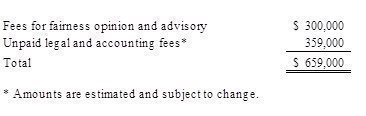
Also includes a negative adjustment of $1,112,000 for cash and accounts receivable to be retained by the Company for unexecuted programs under the terms of the Asset Purchase Agreement.
|
| (b) | Represents transfer of all inventories, prepaid production costs, property and equipment, and operating right-of-use assets relating to the Business to the Buyer under the terms of the Asset Purchase Agreement. |
|
|
|
|
|
| (c) | Represents transfer of certain prepaid expenses relating to the Business to the Buyer under the terms of the Asset Purchase Agreement. |
|
|
|
|
|
| (d) | Represents assumption by the Buyer of certain accounts payable related to unexecuted programs of the Business under the terms of the Asset Purchase Agreement. |
|
|
|
|
|
| (e) | Represents assumption by the Buyer of the operating lease liabilities for a specified lease relating primarily to the Business. |
|
|
|
|
|
| (f) | Represents assumption by the Buyer of deferred revenue obligations relating to the Business. |
|
|
|
|
|
| (g) | The overall adjustment to accumulated deficit includes the net gain on the sale of the Business of $2.7 million, which is calculated as follows: |
| 6 |
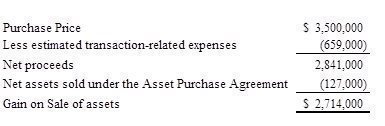
The adjustment to accumulated deficit also includes a non-recurring post-combination expense of $1,844,000 consisting of severance and other separation benefits in connection with the termination of certain officers and employees of the Company, as well as additional income tax expense of $43,000.
|
| (h) | Represents the elimination of net services revenues, cost of services, and selling and marketing expenses related to the sale of the Business for the periods presented. |
|
|
|
|
|
| (i) | Represents the elimination of general and administrative expenses directly related to the Business sold for the periods presented. |
|
|
|
|
|
| (j) | Represents the gain on sale of the Business. No adjustment has been made to the sale proceeds to give effect to any potential post-closing adjustments under the terms of the Asset Purchase Agreement. |
|
|
|
|
|
| (k) | The Company expects to record a one-time post-transaction expense of $1,537,000 consisting of severance and other separation benefits in connection with the termination of certain officers and employees of the Company. These separation benefits resulted from change of control and employment agreements, as well as from severance policies, that require the Company to provide these benefits upon termination. In addition, reflects the incremental expense of $164,000 contributed to an escrow for potential payment by the Buyer to transferred employees of bonuses for the second half of 2023 as required in the Asset Purchase Agreement, as well as retention award payouts totaling $143,000. |
|
|
|
|
|
| (l) | Represents estimated impact of transaction accounting adjustments, with utilization of the Company’s net operating loss carryforward limited to 80% of taxable income; and using an estimated combined Federal and state rate of 25%. |
|
|
|
|
| 7 |