
VMNT 8-K/A
Vemanti Group, Inc. (VMNT)
UNITED STATES
SECURITIES AND EXCHANGE COMMISSION
Washington, D.C. 20549
FORM
(Amendment No. 1)
CURRENT REPORT
Pursuant to Section 13 or 15(d) of The Securities Exchange Act of 1934
Date of Report (Date of earliest event reported):
(Exact name of registrant as specified in its charter) |
|
| |||
(State or other jurisdiction of incorporation) |
| (Commission File Number) |
| (IRS Employer Identification No.) |
| ||
(Address of principal executive offices) |
| (Zip Code) |
Registrant’s telephone number, including area code: (
_____________________________________________
(Former name or former address, if changed since last report)
Check the appropriate box below if the Form 8-K filing is intended to simultaneously satisfy the filing obligation of the registrant under any of the following provisions (see General Instruction A.2. below):
Written communications pursuant to Rule 425 under the Securities Act (17 CFR 230.425) | |
|
|
Soliciting material pursuant to Rule 14a-12 under the Exchange Act (17 CFR 240.14a-12) | |
|
|
Pre-commencement communications pursuant to Rule 14d-2(b) under the Exchange Act (17 CFR 240.14d-2(b)) | |
|
|
Pre-commencement communications pursuant to Rule 13e-4(c) under the Exchange Act (17 CFR 240.13e-4(c)) |
Securities registered pursuant to Section 12(b) of the Act:
Title of each class |
| Trading Symbol(s) |
| Name of each exchange on which registered |
None |
| N/A |
| N/A |
Indicate by check mark whether the registrant is an emerging growth company as defined in Rule 405 of the Securities Act of 1933 (§230.405 of this chapter) or Rule 12b-2 of the Securities Exchange Act of 1934 (§240.12b-2 of this chapter).
Emerging growth company
If an emerging growth company, indicate by check mark if the registrant has elected not to use the extended transition period for complying with any new or revised financial accounting standards provided pursuant to Section 13(a) of the Exchange Act.
EXPLANATORY NOTE
On April 5, 2024, Vemanti Group, Inc., a Nevada corporation (the “Company”), ) filed a Current Report on Form 8-K with the U.S. Securities and Exchange Commission (the “SEC”) in connection with the consummation of the transactions contemplated by that certain Share Exchange Agreement (the “Share Exchange Agreement”), dated April 1, 2024, by and among the Company, Mr. Tan Tran, as the sole holder of the Company’s Series A Preferred Stock, par value $0.0001 (the “Series A Preferred Stock”), VinHMS Pte. Ltd., a Singapore private company limited by shares (“VinHMS”), and Mr. Hoang Van Nguyen and Asian Star Trading & Investment Pte. Ltd. (“Asian Star”), the sole shareholders of VinHMS (the “Shareholders”). Pursuant to the Share Exchange Agreement, on the Closing Date Mr. Tran contributed all of his shares of Series A Preferred Stock to the Company in exchange for eight hundred thousand (800,000) newly issued shares of the Company’s Series B Convertible Preferred Stock, par value $0.0001 per share (the “Series B Preferred Stock”) and the Shareholders transferred all the issued and outstanding shares of VinHMS to the Company in exchange for (i) the issuance of nine million two hundred thousand (9,200,000) newly issued shares of Series B Preferred Stock, which shares were issued pro rata to each Shareholder based on their VinHMS shareholdings, and (ii) the issuance to the Shareholders of all forty million (40,000,000) authorized shares of Series A Preferred Stock, which shares were issued pro rata to each Shareholder based on their VinHMS shareholdings. As a result of these transactions, VinHMS is now a wholly-owned subsidiary of the Company and, due to the Shareholders’ collective ownership of (i) all of the issued and outstanding Series A Preferred Stock, each share of which carries ten (10) votes for each share of Common Stock outstanding, and (i) 92% of the issued and outstanding Series B Preferred Stock, each share of which carries twenty-six (26) votes for each share of Common Stock outstanding, the Shareholders now have beneficial control of the Company and have voting control over any shareholder vote.
This Current Report on Form 8-K/A is being filed to amend the Form 8-K filed by the Company with the SEC on April 5, 2024, to provide the financial statements and pro forma financial information described below, in accordance with the requirements of Item 9.01 of Form 8-K.
Item 9.01 | Financial Statements and Exhibits. |
(a) | Financial Statements of Business Acquired. |
In accordance with Item 9.01(a), VinHMS’s (i) audited balance sheets, inclusive of VinHMS’s predecessor entity, as of December 31, 2023 and 2022 and statement of operations, statement of changes in members’ equity and statement of cash flows for the years ended December 31, 2023 and 2022 are filed with this Report as Exhibit 99.2 and (ii) balance sheet as of March 31, 2024 (unaudited) and statement of operations, statement of changes in members’ equity and statement of cash flows for the three months ended March 31, 2024 are filed with this Report as Exhibit 99.3 and incorporated herein by reference.
(b) | Pro Forma Financial Information. |
In accordance with Item 9.01(b), the Company’s pro forma unaudited condensed combined financial statements for the fiscal year ended December 31, 2023 and for the three months ended March 31, 2024 are filed with this Report as Exhibit 99.4 and incorporated herein by reference.
| 2 |
(d) | Exhibits. |
Exhibit No. |
| Description |
|
|
|
| ||
|
|
|
| ||
|
|
|
| ||
|
|
|
104 | Inline XBRL for the cover page of this Current Report on Form 8-K |
| 3 |
SIGNATURES
Pursuant to the requirements of the Securities Exchange Act of 1934, the Registrant has duly caused this report to be signed on its behalf by the undersigned thereunto duly authorized.
| VEMANTI GROUP, INC. |
| |
|
|
|
|
Dated: June 10, 2024 | By: | /s/ Tan Tran | |
|
| Name: Tan Tran |
|
|
| Title: Chief Strategy Officer |
|
| 4 |
EXHIBIT 99.2
VINHMS PTE. LTD.
(Incorporated in Singapore)
AUDITED FINANCIAL STATEMENTS
For the period from 01 November 2023 (Incorporation date) to 31 December 2023
May 2024
| VINHMS PTE. LTD. 8 Burn Road, # 05-02 Trivex, Singapore (369977) |
|
|
|
| |
|
|
|
|
|
| CONTENTS |
| Page(s) |
|
|
|
|
|
|
|
| 1 - 2 |
| |
|
|
|
|
|
|
| 3 - 4 |
| |
|
|
|
|
|
|
| 5 |
| |
|
|
|
|
|
|
| 6 |
| |
|
|
|
|
|
|
| 7 |
| |
|
|
|
|
|
|
| 8 |
| |
|
|
|
|
|
|
| 9 - 18 |
|
| Table of Contents |
| VINHMS PTE. LTD. 8 Burn Road, # 05-02 Trivex, Singapore (369977) |
The Board of Directors of VinHMS Pte. Ltd. present this report together with audited financial statements for the period from 01 November 2023 (Incorporation date) to 31 December 2023.
Board of Directors
The directors in office at the date of this statement are:
Mr. Nguyen Van Hoang
Mr. Koh Hsien Loong, Mark Greory
SUBSEQUENT EVENTS
According to Board of Directors, in all material respects, there have been no other significant events occurring after the balance sheet date affecting the financial position and operation of the Company which would require adjustments to or disclosures to be made in the financial statements for the period from 01 November 2023 (Incorporation date) to 31 December 2023.
AUDITOR
The accompanying financial statements for the period from 01 November 2023 (Incorporation date) to 31 December 2023 have been audited by Parker Russell Vietnam Company Limited (Parker Russell Vietnam).
BOARD OF DIRECTORS’ STATEMENT OF RESPONSIBILITY
Board of Directors of the Company are responsible for preparing the financial statements of each year, which give a true and fair view of the financial position of the Company and of its results and cash flows for the period.
In preparing those financial statements, Board of Directors are required to:
| · | Select suitable accounting policies and then apply them consistently; |
| · | Make judgments and estimates that are reasonable and prudent; |
| · | State whether applicable accounting principles have been complied with, material differences are disclosed and explained in the financial statements; |
| · | Design, execute and maintain an effective internal control related to the appropriate preparation and presentation of financial statements so as to obtain reasonable assurance that the financial statements are free of material misstatements caused by even frauds and errors; and |
| · | Prepare the financial statements on the going concern basis unless it is inappropriate to presume that the Company will continue in business. |
| 1 |
| Table of Contents |
| VINHMS PTE. LTD. 8 Burn Road, # 05-02 Trivex, Singapore (369977) |
REPORT OF BOARD OF DIRECTORS (CONTINUED)
BOARD OF DIRECTORS’ STATEMENT OF RESPONSIBILITY (CONTINUED)
Board of Directors confirm that the Company has complied with the above requirements in preparing these financial statements.
Board of Directors are responsible for ensuring that proper accounting records are kept, which disclose, with reasonable accuracy at any time, the financial position of the Company and to ensure that the financial statements comply with International Financial Reporting Standards. It is also responsible for safeguarding the assets of the Company and hence for taking reasonable steps for the prevention and detection of frauds and other irregularities.
For and on behalf of Board of Directors,
| /s/ Nguyen Van Hoang |
|
Director
10 May 2024
| 2 |
| Table of Contents |
No.: /2024/AUD/PRV
| To: | Board of Directors |
|
| VinHMS Pte. Ltd. |
Opinion
We have audited the accompanying financial statements of VinHMS Pte. Ltd., prepared on 10 May 2024 as set out from page 5 to page 18, which comprise Statement of financial position as at 31 December 2023, Statement of profit and loss, Statement of changes in equity and Statement of cash flows for the period from 01 November 2023 (Incorporation date) to, and a summary of significant accounting policies and other explanatory information.
In our opinion, the accompanying financial statements give a true and fair view of, in all material respects, the financial position of the Company as at 31 December 2023 and the results of its operations and its cash flows for the period from 01 November 2023 (Incorporation date) to 31 December 2023, in accordance with International Financial Reporting Standards.
Basis for Opinion
We conducted our audit in accordance with International Standards on Auditing (ISAs). Our responsibilities under those standards are further described in the Auditor’s Responsibilities for the Audit of the Financial Statements section of our report. We are independent of the Company and have fulfilled our other responsibilities under those relevant ethical requirements. We believe that the audit evidence we have obtained is sufficient and appropriate to provide a basis for our opinion.
Going Concern
The Company’s financial statements have been prepared using the going concern basis of accounting. The use of this basis of accounting is appropriate unless management either intends to liquidate the Company or to cease operations, or has no realistic alternative but to do so. As part of our audit of the financial statements, we have concluded that management’s use of the going concern basis of accounting in the preparation of the Company’s financial statements is appropriate. Management has not identified a material uncertainty that may cast significant doubt on the entity’s ability to continue as a going concern, and accordingly none is disclosed in the financial statements. Based on our audit of the financial statements, we also have not identified such a material uncertainty. However, neither management nor the auditor can guarantee the Company’s ability to continue as a going concern.
| 3 |
| Table of Contents |
INDEPENDENT AUDITORS’ REPORT (CONTINUED)
Responsibilities of Management for the Financial Statements
Management is responsible for the preparation and fair presentation of these financial statements in accordance with IFRSs and for such internal control as management determines is necessary to enable the preparation of financial statements that are free from material misstatement, whether due to fraud or error. Management are responsible for overseeing the Company’s financial reporting process.
Auditor’s Responsibilities for the Audit of the Financial Statements
The objectives of our audit are to obtain reasonable assurance about whether the financial statements as a whole are free from material misstatement, whether due to fraud or error, and to issue an auditor’s report that includes our opinion. Reasonable assurance is a high level of assurance, but is not a guarantee that an audit conducted in accordance with ISAs will always detect a material misstatement when it exists. Misstatements can arise from fraud or error and are considered material if, individually or in the aggregate, they could reasonably be expected to influence the economic decisions of users taken on the basis of these financial statements.
As part of an audit in accordance with ISAs, we exercise professional judgment and maintain professional skepticism throughout the planning and performance of the audit. We also:
| · | Identify and assess the risks of material misstatement of the financial statements, whether due to fraud or error, design and perform audit procedures responsive to those risks, and obtain audit evidence that is sufficient and appropriate to provide a basis for our opinion. The risk of not detecting a material misstatement resulting from fraud is higher than for one resulting from error, as fraud may involve collusion, forgery, intentional omissions, misrepresentations, or the override of internal control. |
|
|
|
| · | Obtain an understanding of internal control relevant to the audit in order to design audit procedures that are appropriate in the circumstances, but not for the purpose of expressing an opinion on the effectiveness of the entity’s internal control. |
|
|
|
| · | Evaluate the appropriateness of accounting policies used and the reasonableness of accounting estimates and related disclosures made by management. |
|
|
|
| · | Evaluate the overall presentation, structure and content of the financial statements, including the disclosures, and whether the financial statements represent the underlying transactions and events in a manner that achieves fair presentation. |
We are required to communicate with management regarding, among other matters, the planned scope and timing of the audit and significant audit findings, including any significant deficiencies in internal control that we identify during our audit. We are also required to provide management with a statement that we have complied with relevant ethical requirements regarding independence, and to communicate with them all relationships and other matters that may reasonably be thought to bear on our independence, and where applicable, related safeguards.
| /s/ Nguyen Song Toan |
|
Partner
Audit Practising Registration Certificate
No. 1551-2023-238-1
For and on behalf of
Parker Russell Vietnam Company Limited (Parker Russell Vietnam)
10 May 2024
Ho Chi Minh City, S.R. Vietnam
| 4 |
| Table of Contents |
| VINHMS PTE. LTD. 8 Burn Road, # 05-02 Trivex, Singapore (369977) |
For the period from 01 November 2023 (Incorporation date) to 31 December 2023
|
|
| Notes |
|
| From 01 November 2023 to 31 December 2023 |
| ||
|
|
|
|
|
| SGD |
| ||
|
|
|
|
|
|
|
| ||
| Revenue |
|
|
|
|
| – |
| |
| Cost of service |
|
|
|
|
| – |
| |
| Gross loss |
|
|
|
|
| - |
| |
|
|
|
|
|
|
|
|
| |
| Finance income |
|
|
|
|
| - |
| |
| Finance costs |
|
|
|
|
| - |
| |
| Other gains and losses |
|
| 5 |
|
|
| 18 |
|
| Selling expenses |
|
|
|
|
|
| - |
|
| Administration expenses |
|
| 6 |
|
|
| (2,915 | ) |
| Other income and expenses |
|
|
|
|
|
| - |
|
| Loss before tax |
|
|
|
|
|
| (2,897 | ) |
| Income tax expense |
|
| 7 |
|
|
| - |
|
| Deferred tax income and expenses |
|
|
|
|
|
| - |
|
| Loss for the year |
|
|
|
|
|
| (2,897 | ) |
| 5 |
| Table of Contents |
| VINHMS PTE. LTD. 8 Burn Road, # 05-02 Trivex, Singapore (369977) |
STATEMENT OF FINANCIAL POSITION
As at 31 December 2023
|
|
| Notes |
|
| Closing balance |
| ||
|
|
|
|
|
| SGD |
| ||
|
|
|
|
|
|
|
| ||
| ASSETS |
|
|
|
|
|
| ||
| Non-current assets |
|
|
|
|
| - |
| |
| Total non-current assets |
|
|
|
|
| - |
| |
|
|
|
|
|
|
|
|
| |
| Current assets |
|
|
|
|
|
|
| |
| Unpaid share capital |
|
|
|
|
| 13,676 |
| |
| Other current assets |
|
| 8 |
|
|
| 233 |
|
| Total current assets |
|
|
|
|
|
| 13,909 |
|
|
|
|
|
|
|
|
|
|
|
| TOTAL ASSETS |
|
|
|
|
|
| 13,909 |
|
|
|
|
|
|
|
|
|
|
|
| EQUITY AND LIABILITIES |
|
|
|
|
|
|
|
|
| Capital and reserves |
|
|
|
|
|
|
|
|
| Issued capital |
|
|
|
|
|
| 13,676 |
|
| Retained earnings |
|
|
|
|
|
| (2,897 | ) |
| Total equity |
|
|
|
|
|
| 10,779 |
|
|
|
|
|
|
|
|
|
|
|
| Non-current liabilities |
|
|
|
|
|
| - |
|
|
|
|
|
|
|
|
|
|
|
| Current liabilities |
|
|
|
|
|
|
|
|
| Trade and other payables |
|
| 9 |
|
|
| 3,131 |
|
| Total liabilities |
|
|
|
|
|
| 3,131 |
|
|
|
|
|
|
|
|
|
|
|
| TOTAL EQUITY AND LIABILITIES |
|
|
|
|
|
| 13,909 |
|
| 6 |
| Table of Contents |
| VINHMS PTE. LTD. 8 Burn Road, # 05-02 Trivex, Singapore (369977) |
STATEMENT OF CHANGES IN EQUITY
For the period from 01 November 2023 (Incorporation date) to 31 December 2023
|
|
| Owners' contributed capital |
|
| Retained earnings |
|
| Total |
| |||
|
|
| SGD |
|
| SGD |
|
| SGD |
| |||
| Current year’s opening balance |
|
| - |
|
|
| - |
|
|
| - |
|
| Unpaid capital |
|
| 13,676 |
|
|
| - |
|
|
| 13,676 |
|
| Loss for the period |
|
| - |
|
|
| (2,897 | ) |
|
| (2,897 | ) |
| Current year’s closing balance |
|
| 13,676 |
|
|
| (2,897 | ) |
|
| 10,779 |
|
Charter capital
According to the Company’s Enterprise Registration Certificate, the Company’s charter capital is USD 10,000. The charter capital has not been fully contributed by the shareholders as at 31 December 2023. In February 2024, the charter capital was contributed by the shareholders.
Detail of charter capital
|
|
| As at 31 December 2023 |
| |||||
|
|
| Enterprise Registration |
| |||||
|
|
| USD |
|
| % |
| ||
| Asian Star Trading & Investment Pte. Ltd. |
|
| 6,500 |
|
|
| 65 | % |
| Mr. Nguyen Van Hoang |
|
| 3,500 |
|
|
| 35 | % |
| Total |
|
| 10,000 |
|
|
| 100 | % |
| 7 |
| Table of Contents |
| VINHMS PTE. LTD. 8 Burn Road, # 05-02 Trivex, Singapore (369977) |
For the period from 01 November 2023 (Incorporation date) to 31 December 2023
|
|
| From 01 November 2023 to |
| |
|
|
| 31-Dec-23 |
| |
|
|
| SGD |
| |
| Cash flows from operating activities |
|
|
| |
| Loss for the period |
|
| (2,897 | ) |
| Movements in working capital: |
|
|
|
|
| Decrease in other assets |
|
| (233 | ) |
| Decrease in trade and other payables |
|
| 3,131 |
|
| Cash generated by operations |
|
| - |
|
| Income taxes paid |
|
| - |
|
| Net cash generated by operating activities |
|
| - |
|
|
|
|
|
|
|
| Cash flows from investing activities |
|
|
|
|
| Net cash used in by investing activities |
|
| - |
|
|
|
|
|
|
|
| Cash flows from financing activities |
|
|
|
|
| Net cash used in financing activities |
|
| - |
|
|
|
|
|
|
|
| Net increase in cash and cash equivalents |
|
| - |
|
| Cash and cash equivalents at the beginning of the year |
|
| - |
|
| Effects of exchange rate changes on the balance of cash held in foreign currencies |
|
| - |
|
|
|
|
|
|
|
| Cash and cash equivalents at the end of the year |
|
| - |
|
| 8 |
| Table of Contents |
| 8 Burn Road, # 05-02 Trivex, Singapore (369977) |
NOTES TO THE FINANCIAL STATEMENTS (CONTINUED)
These accompanying notes are an integral part of and should be read in conjunction with the financial statements
1. GENERAL INFORMATION
1.1. Structure of ownership
VinHMS Pte. Ltd. (“the Company”) is incorporated in Singapore, as a private company limited under the Enterprise Registration Certificate No. dated 01 November 2023. The charter capital of the Company is USD 10,000.
The Company’s office is located at 8 Burn Road, #05-02, Trivex, Singapore (369977).
1.2. Principal activities
The principal activity of the Company is publishing of software/applications (Non-games) (58202)
1.3. Financial year
The Company’s financial year begins on 01 January and ends on 31 December.
2. APPLICATION OF NEW AND REVISED INTERNATIONAL FINANCIAL REPORTING STANDARDS (IFRSs)
|
| New and amended IFRSs that are effective for the current year | ||
|
|
|
|
|
|
| Amendments to IAS 1 Presentation of Financial Statements and IFRS Practice Statement 2 Making Materiality Judgements – Disclosure of Accounting Policies |
| The Company has adopted the amendments to IAS 1 for the first time in the current year. The amendments change the requirements in IAS 1 with regard to disclosure of accounting policies. The amendments replace all instances of the term ‘’significant accounting policies” with “material accounting policy information’’. Accounting policy information is material if, when considered together with other information included in an entity’s financial statements, it can reasonably be expected to influence decisions that the primary users of general purpose financial statements make on the basis of those financial statements.
The supporting paragraphs in IAS 1 are also amended to clarify that accounting policy information that relates to immaterial transactions, other events or conditions is immaterial and need not be disclosed. Accounting policy information may be material because of the nature of the related transactions, other events or conditions, even if the amounts are immaterial. However, not all accounting policy information relating to material transactions, other events or conditions is itself material.
|
|
|
|
|
|
|
| Amendments to IAS 8 Accounting Policies, Changes in Accounting Estimates and Errors – Definition of Accounting Estimates |
| The Company has adopted the amendments to IAS 8 for the first time in the current year. The amendments replace the definition of accounting estimates. Under the new definition, accounting estimates are “monetary amounts in financial statements that are subject to measurement uncertainty”. The definition of a change in accounting estimates was deleted.
|
| 9 |
| Table of Contents |
| VINHMS PTE. LTD. 8 Burn Road, # 05-02 Trivex, Singapore (369977) |
NOTES TO THE FINANCIAL STATEMENTS (CONTINUED)
These accompanying notes are an integral part of and should be read in conjunction with the financial statements
2. APPLICATION OF NEW AND REVISED INTERNATIONAL FINANCIAL REPORTING STANDARDS (IFRSs) (CONTINUED)
|
| New and revised IFRSs in issue but not yet effective | ||
|
|
|
|
|
|
| Amendments to IAS 1 Classification of Liabilities as Current or Non-Current |
| The amendments to IAS 1 affect only the presentation of liabilities as current or non-current in the statement of financial position and not the amount or timing of recognition of any asset, liability, income or expenses, or the information disclosed about those items.
The amendments clarify that the classification of liabilities as current or non-current is based on rights that are in existence at the end of the reporting period, specify that classification is unaffected by expectations about whether an entity will exercise its right to defer settlement of a liability, explain that rights are in existence if covenants are complied with at the end of the reporting period, and introduce a definition of ‘settlement’ to make clear that settlement refers to the transfer to the counterparty of cash, equity instruments, other assets or services.
The amendments are applied retrospectively for annual periods beginning on or after 1 January 2024, with early application permitted. The IASB has aligned the effective date with the 2022 amendments to IAS 1. If an entity applies the 2020 amendments for an earlier period, it is also required to apply the 2022 amendments early. |
The Board of Directors anticipates that the adoption of those Standards listed above will have no material impact on the financial statements of the Company in future period.
| 10 |
| Table of Contents |
| VINHMS PTE. LTD. 8 Burn Road, # 05-02 Trivex, Singapore (369977) |
NOTES TO THE FINANCIAL STATEMENTS (CONTINUED)
These accompanying notes are an integral part of and should be read in conjunction with the financial statements
3. MATERIAL ACCOUNTING POLICIES
3.1 Statement of compliance
The financial statements have been prepared in accordance with International Financial Reporting Standards.
3.2 Basis of preparation
The financial statements have been prepared on the historical cost basis except for certain properties and financial instruments that are measured at fair values at the end of each reporting period, as explained in the accounting policies below. Historical cost is generally based on the fair value of the consideration given in exchange for goods and services.
Fair value is the price that would be received to sell an asset or paid to transfer a liability in an orderly transaction between market participants at the measurement date, regardless of whether that price is directly observable or estimated using another valuation technique. In estimating the fair value of an asset or a liability, the Company takes into account the characteristics of the asset or liability if market participants would take those characteristics into account when pricing the asset or liability at the measurement date. Fair value for measurement and/or disclosure purposes in these financial statements is determined on such a basis, except for share-based payment transactions that are within the scope of IFRS 2 Share-based Payment, leasing transactions that are within the scope of IFRS 16 Leases, and measurements that have some similarities to fair value but are not fair value, such as net realizable value in IAS 2 Inventories or value in use in IAS 36 Impairment of Assets.
3.3 Going concern
The Board of Directors has, at the time of approving the financial statements, a reasonable expectation that the Company has adequate resources to continue in operational existence for foreseeable future. Thus they continue to adopt the going concern basis of accounting n preparing the financial statements.
3.4 Foreign currencies
In preparing the financial statements of the individual entities, transactions in currencies other than the Company’s functional currency (SGD) are recorded at the rates of exchange prevailing at the dates of the transactions. At end of each reporting period, monetary items denominated in foreign currencies are retranslated at the rates prevailing at the end of the reporting period. Non- monetary items that are measured in terms of historical cost in a foreign currency are not retranslated.
3.5 Taxation
Income tax expense represents the sum of the tax currently payable and deferred tax.
Current tax
The tax currently payable is based on taxable profit for the year. Taxable profit differs from 'profit before tax' as reported in the statement of profit or loss because of items of income or expense that are taxable or deductible in other years and items that are never taxable or deductible. The Company's current tax is calculated using tax rates that have been enacted or substantively enacted by the end of the reporting period. Current tax are recognized in profit or loss.
| 11 |
| Table of Contents |
| VINHMS PTE. LTD. 8 Burn Road, # 05-02 Trivex, Singapore (369977) |
NOTES TO THE FINANCIAL STATEMENTS (CONTINUED)
These accompanying notes are an integral part of and should be read in conjunction with the financial statements
3. MATERIAL ACCOUNTING POLICIES (CONTINUED)
Deferred tax
Deferred tax is recognized on temporary differences between the carrying amounts of assets and liabilities in the consolidated financial statements and the corresponding tax bases used in the computation of taxable profit. Deferred tax liabilities are generally recognized for all taxable temporary differences. Deferred tax assets are generally recognized for all deductible temporary differences to the extent that it is probable that taxable profits will be available against which those deductible temporary differences can be utilized. Such deferred tax assets and liabilities are not recognized if the temporary difference arises from the initial recognition (other than in a business combination) of assets and liabilities in a transaction that affects neither the taxable profit nor the accounting profit. In addition, deferred tax liabilities are not recognized if the temporary difference arises from the initial recognition of goodwill.
The carrying amount of deferred tax assets is reviewed at the end of each reporting period and reduced to the extent that it is no longer probable that sufficient taxable profits will be available to allow all or part of the asset to be recovered.
Deferred tax liabilities and assets are measured at the tax rates that are expected to apply in the period in which the liability is settled or the asset realized, based on tax rates (and tax laws) that have been enacted or substantively enacted by the end of the reporting period.
The measurement of deferred tax liabilities and assets reflects the tax consequences that would follow from the manner in which the Company expects, at the end of the reporting period, to recover or settle the carrying amount of its assets and liabilities.
3.6 Provisions
Provisions are recognized when the Company has a present obligation (legal or constructive) as a result of a past event, it is probable that the Company will be required to settle the obligation, and a reliable estimate can be made of the amount of the obligation.
The amount recognized as a provision is the best estimate of the consideration required to settle the present obligation at the end of the reporting period, taking into account the risks and uncertainties surrounding the obligation. When a provision is measured using the cash flows estimated to settle the present obligation, its carrying amount is the present value of those cash flows (when the effect of the time value of money is material).
When some or all of the economic benefits required to settle, a provision are expected to be recovered from a third party, a receivable is recognized as an asset if it is virtually certain that reimbursement will be received and the amount of the receivable can be measured reliably.
| 12 |
| Table of Contents |
| VINHMS PTE. LTD. 8 Burn Road, # 05-02 Trivex, Singapore (369977) |
NOTES TO THE FINANCIAL STATEMENTS (CONTINUED)
These accompanying notes are an integral part of and should be read in conjunction with the financial statements
3. MATERIAL ACCOUNTING POLICIES (CONTINUED)
3.7 Financial instruments
Financial assets and financial liabilities are recognized when the Company becomes a party to the contractual provisions of the instruments. Financial assets and financial liabilities are initially measured at fair value. Transaction costs directly attributable to the acquisition of financial assets or financial liabilities at fair value through profit or loss are recognized immediately in profit or loss.
3.8 Financial assets
All regular way purchases or sales of financial assets are recognized and derecognized on a trade date basis. Regular way purchases or sales are purchases or sales of financial assets that require delivery of assets within the time frame established by regulation or convention in the marketplace.
All recognised financial assets are measured subsequently in their entirety at either amortised cost or fair value, depending on the classification of the financial assets.
Classification of financial assets
|
| Debt instruments that meet the following conditions are measured subsequently at amortised cost: | ||
|
|
|
|
|
|
|
| · | The financial asset is held within a business model whose objective is to hold financial assets in order to collect contractual cash flows |
|
|
| · | The contractual terms of the financial asset give rise on specified dates to cash flows that are solely payments of principal and interest on the principal amount outstanding. |
|
|
|
|
|
|
| Debt instruments that meet the following conditions are measured subsequently at fair value through other comprehensive income (FVTOCI): | ||
|
|
|
|
|
|
|
| · | The financial asset is held within a business model whose objective is achieved by both collecting contractual cash flows and selling the financial assets. |
|
|
| · | The contractual terms of the financial asset give rise on specified dates to cash flows that are solely payments of principal and interest on the principal amount outstanding. |
By default, all other financial assets are measured subsequently at fair value through profit or loss (FVTPL).
Effective interest method
The effective interest method is a method of calculating the amortized cost of a financial asset and of allocating interest income over the relevant period. The effective interest rate is the rate that exactly discounts estimated future cash receipts (including all fees and points paid or received that form an integral part of the effective interest rate, transaction costs and other premiums or discounts) through the expected life of the financial asset, or, where appropriate, a shorter period, to the net carrying amount on initial recognition.
Loans and receivables
Loans and receivables are non-derivative financial assets with fixed or determinable payments that are not quoted in an active market. Loans and receivables (including trade and other receivables, bank balances and cash, and deposits) are measured at amortized cost using the effective interest method, less any impairment.
Interest income is recognized by applying the effective interest rate, except for short-term receivables when the effect of discounting is immaterial.
| 13 |
| Table of Contents |
NOTES TO THE FINANCIAL STATEMENTS (CONTINUED)
These accompanying notes are an integral part of and should be read in conjunction with the financial statements
3. MATERIAL ACCOUNTING POLICIES (CONTINUED)
3.12 Financial assets (Continued)
Impairment of financial assets
The Company recognises a loss allowance for expected credit losses on investments in debt instruments that are measured at amortised cost or at FVTOCI, lease receivables, trade receivables and contract assets, as well as on financial guarantee contracts. The amount of expected credit losses is updated at each reporting date to reflect changes in credit risk since initial recognition of the respective financial instrument.
The Company always recognises lifetime expected credit losses (ECL) for trade receivables, contract assets and lease receivables. The expected credit losses on these financial assets are estimated using a provision matrix based on the Company’s historical credit loss experience, adjusted for factors that are specific to the debtors, general economic conditions and an assessment of both the current as well as the forecast direction of conditions at the reporting date, including time value of money where appropriate.
For all other financial instruments, the Group recognises lifetime ECL when there has been a significant increase in credit risk since initial recognition. However, if the credit risk on the financial instrument has not increased significantly since initial recognition, the Group measures the loss allowance for that financial instrument at an amount equal to 12-month ECL.
Lifetime ECL represents the expected credit losses that will result from all possible default events over the expected life of a financial instrument. In contrast, 12-month ECL represents the portion of lifetime ECL that is expected to result from default events on a financial instrument that are possible within 12 months after the reporting date.
There is no objective evidence of impairment for trade receivable, because trade receivable is only from related party. There is no past experience of bad collecting payments and no delayed payment.
Derecognition of financial assets
The Company derecognizes a financial asset when the contractual rights to the cash flows from the asset expire, or when it transfers the financial asset and substantially all the risks and rewards of ownership of the asset to another party. If the Company neither transfers nor retains substantially all the risks and rewards of ownership and continues to control the transferred asset, the Company recognizes its retained interest in the asset and an associated liability for amounts it may have to pay. If the Company retains substantially all the risks and rewards of ownership of a transferred financial asset, the Company continues to recognize the financial asset and also recognizes a collateralized borrowing for the proceeds received.
3.9 Financial liabilities and equity instruments
Classification as debt or equity
Debt and equity instruments issued by the Company are classified as either financial liabilities or as equity in accordance with the substance of the contractual arrangements and the definitions of a financial liability and an equity instrument.
| 14 |
| Table of Contents |
| VINHMS PTE. LTD. 8 Burn Road, # 05-02 Trivex, Singapore (369977) |
NOTES TO THE FINANCIAL STATEMENTS (CONTINUED)
These accompanying notes are an integral part of and should be read in conjunction with the financial statements
3. MATERIAL ACCOUNTING POLICIES (CONTINUED)
3.13 Financial liabilities and equity instruments (continued)
Equity instruments
An equity instrument is any contract that evidences a residual interest in the assets of an entity after deducting all of its liabilities. Equity instruments issued by the Company are recognized at the proceeds received, net of direct issue costs.
Financial liabilities
Financial liabilities are classified 'other financial liabilities'.
Other financial liabilities
Other financial liabilities (including Trade and other payables) are initially measured at fair value, net of transaction costs, and are subsequently measured at amortized cost, using the effective interest method, with interest expense recognized on an effective yield basis.
The effective interest method is a method of calculating the amortized cost of a financial liability and of allocating interest expense over the relevant period. The effective interest rate is the rate that exactly discounts estimated future cash payments (including all fees and points paid or received that form an integral part of the effective interest rate, transaction costs and other premiums or discounts) through the expected life of the financial liability, or (where appropriate) a shorter period, to the net carrying amount on initial recognition.
Derecognition of financial liabilities
The Company derecognizes financial liabilities when, and only when, the Company's obligations are discharged, cancelled or they expire. The difference between the carrying amount of the financial liability derecognized and the consideration paid and payable is recognized in profit or loss.
4. CRITICAL ACCOUNTING JUDGMENTS
In the application of the Company’s accounting policies, which are described in note 3, management is required to make judgments, estimates and assumptions about the carrying amounts of assets and liabilities that are not readily apparent from other sources. The estimates and associated assumptions are based on historical experience and other factors that are considered to be relevant. Actual results may differ from these estimates.
The estimates and underlying assumptions are reviewed on an ongoing basis. Revisions to accounting estimates are recognized in the year in which the estimate is revised if the revision affects only that year, or in the year of the revision and future periods if the revision affects both current and future periods.
| 15 |
| Table of Contents |
| VINHMS PTE. LTD. 8 Burn Road, # 05-02 Trivex, Singapore (369977) |
NOTES TO THE FINANCIAL STATEMENTS (CONTINUED)
These accompanying notes are an integral part of and should be read in conjunction with the financial statements
5. OTHER GAINS AND LOSSES
|
|
| From 01 November 2023 to 31 December 2023 |
| |
|
|
| SGD |
| |
|
|
|
|
| |
| Net foreign exchange gain |
|
| 18 |
|
| Total |
|
| 18 |
|
6. ADMINISTRATIVE EXPENSES
|
|
| From 01 November 2023 to 31 December 2023 |
| |
|
|
| SGD |
| |
| Consulting & Accounting |
|
| 2,460 |
|
| Office Expenses |
|
| 455 |
|
| Total |
|
| 2,915 |
|
7. INCOME TAX EXPENSE
There is no corporate income tax in the year as the Company made loss.
8. OTHER ASSETS
|
|
| Closing balance |
| |
|
|
| VND |
| |
| GST |
|
| 233 |
|
| Total |
|
| 233 |
|
9. TRADE AND OTHER PAYABLES
TRADE PAYABLES
|
|
| Closing balance |
| |
|
|
| SGD |
| |
| Imin Technology Pte Ltd |
|
| 491 |
|
| Mark Koh |
|
| 2,639 |
|
| Total |
|
| 3,131 |
|
The Company has financial risk management policies in place to ensure that all payables are paid within the pre-agreed credit terms.
| 16 |
| Table of Contents |
| VINHMS PTE. LTD. 8 Burn Road, # 05-02 Trivex, Singapore (369977) |
NOTES TO THE FINANCIAL STATEMENTS (CONTINUED)
These accompanying notes are an integral part of and should be read in conjunction with the financial statements
10. FINANCIAL INSTRUMENTS
Capital risk management
The Company manages its capital to ensure that the Company will be able to continue as a going concern while maximizing the return to stakeholders through the optimization of the debt and equity balance. The Company's overall strategy remains unchanged from prior year. The capital structure of the Company consists of net debt (borrowings offset by cash and cash equivalents)
and equity attributable to equity holders of the Company (comprising capital and retained earnings).
Categories of financial instruments
|
|
| Carrying amounts |
| |
|
|
| Closing balance |
| |
|
|
| SGD |
| |
| Financial assets |
|
|
| |
| Unpaid share capital |
|
| 13,676 |
|
| Total |
|
| 13,676 |
|
|
|
|
|
|
|
| Financial liabilities |
|
|
|
|
| Trade and other payables |
|
| 3,131 |
|
| Total |
|
| 3,131 |
|
Loans and receivables designated as at FVTPL
At the end of the reporting period, there are no significant concentrations of credit risk for loans and receivables designated at FVTPL. The carrying amount reflected above represents the Company's maximum exposure to credit risk for such loans and receivables.
Financial risk management objectives
These risks include market risk (including currency risk and interest rate risk), credit risk and liquidity risk.
The Company seeks to minimize the effects of these risks by using financial risk structures instructed by the Group. It should be governed by the Group's policies approved by the Board of General Directors, which provide principles on foreign exchange risk, interest rate risk, credit risk and liquidity risk. Compliance with policies and exposure limits is reviewed by the Group’s internal auditors on a continuous basis. The Company does not enter into or trade financial instruments, including derivative financial instruments, for speculative purposes.
Market risk
The Company’s activities expose it primarily to the financial risks of changes in foreign currency exchange rates and interest rates. The Company does not perform protection solution for market risk due to lack of purchasing market of the financial instrument.
Interest rate risk management
The Company has no interest rate risks because the Company has not arranged any loans and borrowings during the year.
| 17 |
| Table of Contents |
| VINHMS PTE. LTD. 8 Burn Road, # 05-02 Trivex, Singapore (369977) |
NOTES TO THE FINANCIAL STATEMENTS (CONTINUED)
These accompanying notes are an integral part of and should be read in conjunction with the financial statements
24. FINANCIAL INSTRUMENTS (CONTINUED)
Credit risk
Credit risk refers to the risk that counterparty will default on its contractual obligations resulting in financial loss to the Company. The Company has a credit policy in place and the exposure to credit risk is monitored on an ongoing basis. At the balance sheet date there is no significant concentration of credit risk.
Liquidity risk management
The purpose of liquidity risk management is to ensure the availability of funds to meet present and future financial obligations. Liquidity is also managed by ensuring that the excess of maturing liabilities over maturing assets in any year is kept to manageable levels relative to the amount of funds that the Company believes can generate within that period. The Company policy is to regularly monitor current and expected liquidity requirements to ensure that the Company maintains sufficient reserves of cash, borrowings and adequate committed funding from its owner to meet its liquidity requirements in the short and longer term.
The below table illustrates current and future net liquidity risk management as follow:
| Financial assets |
| Under 1 year |
|
| From 1 to 5 years |
|
| Total |
| |||
|
|
| SGD |
|
| SGD |
|
| SGD |
| |||
| Closing balance |
|
|
|
|
|
|
|
|
| |||
| Unpaid share capital |
|
| 13,676 |
|
|
| - |
|
|
| 13,676 |
|
| Total |
|
| 13,676 |
|
|
| - |
|
|
| 13,676 |
|
|
|
|
|
|
|
|
|
|
|
|
|
|
|
| Financial liabilities |
| Under 1 year |
|
| From 1 to 5 years |
|
| Total |
| |||
|
|
| SGD |
|
| SGD |
|
| SGD |
| |||
| Closing balance |
|
|
|
|
|
|
|
|
|
|
|
|
| Trade and other payables |
|
| 3,131 |
|
|
| - |
|
|
| 3,131 |
|
| Total |
|
| 3,131 |
|
|
| - |
|
|
| 3,131 |
|
|
|
|
|
|
|
|
|
|
|
|
|
|
|
| Net liquidity |
| Under 1 year |
|
| From 1 to 5 years |
|
| Total |
| |||
|
|
| SGD |
|
| SGD |
|
| SGD |
| |||
| Closing balance |
|
| 10,545 |
|
|
| - |
|
|
| 10,545 |
|
The management assessed the liquidity risk concentration at low level. The Management believes that the Company will be able to generate sufficient funds to meet its financial obligations as and when they fall due.
11. APPROVAL OF FINANCIAL STATEMENTS
The Company’s financial statements were approved by Mr. Nguyen Van Hoang - Director and authorized for issue on 10 May 2024.
12. COMPARATIVE FIGURES
These financial statements cover the period from the inception of the Company on 01 November 2023 (incorporation date) to 31 December 2023, This is the first set of financial statements; hence, no comparative figures are presented.
| 18 |
| Table of Contents |
| VINHMS SOFTWARE PRODUCTION AND TRADING JOINT STOCK COMPANY (Incorporated in the Socialist Republic of Vietnam)
AUDITED FINANCIAL STATEMENTS For the year ended as at 31 December 2023 |
Ho Chi Minh City, April 2024
| VINHMS SOFTWARE PRODUCTION AND TRADING JOINT STOCK COMPANY No. 7, Bang Lang 1 Street, Vinhomes Riverside Urban Area, Viet Hung Ward, Long Bien District, Ha Noi City, Vietnam |
| CONTENTS | Page(s) |
|
|
|
| 1 - 2 | |
|
|
|
| 3 - 4 | |
|
|
|
| 5 | |
|
|
|
| 6 | |
|
|
|
| 8 | |
|
|
|
| 9 | |
|
|
|
| 10 - 33 |
| Table of Contents |
| VINHMS SOFTWARE PRODUCTION AND TRADING JOINT STOCK COMPANY No. 7, Bang Lang 1 Street, Vinhomes Riverside Urban Area, Viet Hung Ward, Long Bien District, Ha Noi City, Vietnam |
REPORT OF BOARD OF MANAGEMENT AND GENERAL DIRECTOR
Board of Management and General Director of VinHMS Software Production and Trading Joint Stock Company present this report together with audited financial statements for the year ended 31 December 2023.
Board of MANAGEMENT AND GENERAL DIRECTOR
Board of Management of the Company who held office during the year and at the date of this report are as follows:
| Ms. Nguyen Mai Hoa | Chairwoman |
| Mr. Nguyen Van Hoang | Member |
| Ms. Doan Le Thanh Xuan | Member |
General Director of the Company who held the office during the year and at the date of this report is as follows:
| Mr. Nguyen Van Hoang | General Director |
LEGAL REPRESENTATIVE
The legal representative of the Company who approved the financial statement for the year ended 31 Decmber 2023 and at the date of this report is Mr. Nguyen Van Hoang – General Director
SUBSEQUENT EVENTS
According to Board of Management and General Director, in all material respects, there have been no other significant events occurring after the balance sheet date affecting the financial position and operation of the Company which would require adjustments to or disclosures to be made in the financial statements for the year ended 31 December 2023.
AUDITOR
The accompanying financial statements for the year ended 31 December 2023 have been audited by Parker Russell Vietnam Company Limited (Parker Russell Vietnam).
BOARD OF MANAGEMENT AND GENERAL DIRECTOR’ STATEMENT OF RESPONSIBILITY
Board of Management and General Director of the Company are responsible for preparing the financial statements of each year, which give a true and fair view of the financial position of the Company and of its results and cash flows for the period.
In preparing those financial statements, Board of Management and General Director are required to:
| · | Select suitable accounting policies and then apply them consistently; |
| · | Make judgments and estimates that are reasonable and prudent; |
| · | State whether applicable accounting principles have been complied with, material differences are disclosed and explained in the financial statements; |
| · | Design, execute and maintain an effective internal control related to the appropriate preparation and presentation of financial statements so as to obtain reasonable assurance that the financial statements are free of material misstatements caused by even frauds and errors; and |
| · | Prepare the financial statements on the going concern basis unless it is inappropriate to presume that the Company will continue in business. |
| 1 |
| Table of Contents |
| VINHMS SOFTWARE PRODUCTION AND TRADING JOINT STOCK COMPANY No. 7, Bang Lang 1 Street, Vinhomes Riverside Urban Area, Viet Hung Ward, Long Bien District, Ha Noi City, Vietnam |
REPORT OF BOARD OF MANAGEMENT AND GENERAL DIRECTOR (CONTINUED)
BOARD OF MANAGEMENT AND GENERAL DIRECTOR’ STATEMENT OF RESPONSIBILITY (CONTINUED)
Board of Management and General Director confirm that the Company has complied with the above requirements in preparing these financial statements.
Board of Management and General Director are responsible for ensuring that proper accounting records are kept, which disclose, with reasonable accuracy at any time, the financial position of the Company and to ensure that the financial statements comply with International Financial Reporting Standards. It is also responsible for safeguarding the assets of the Company and hence for taking reasonable steps for the prevention and detection of frauds and other irregularities.
For and on behalf of Board of Management,
| /s/ Nguyen Van Hoang |
|
| Nguyen Van Hoang General Director Ho Chi Minh City, 24 April 2024 |
|
| 2 |
| Table of Contents |
No.: /2024/AUD/PRV
| To: | Board of Management and General Director |
|
| VinHMS Software Production and Trading Joint Stock Company |
Opinion
We have audited the accompanying financial statements of VinHMS Software Production and Trading Joint Stock Company, prepared on 24 April 2024 as set out from page 5 to page 32, which comprise Statement of financial position as at 31 December 2023, Statement of profit and loss, Statement of changes in equity and Statement of cash flows for the year then ended, and a summary of significant accounting policies and other explanatory information.
In our opinion, the accompanying financial statements give a true and fair view of, in all material respects, the financial position of the Company as at 31 December 2023 and the results of its operations and its cash flows for the year ended 31 December 2023, in accordance with International Financial Reporting Standards.
Basis for Opinion
We conducted our audit in accordance with International Standards on Auditing (ISAs). Our responsibilities under those standards are further described in the Auditor’s Responsibilities for the Audit of the Financial Statements section of our report. We are independent of the Company and have fulfilled our other responsibilities under those relevant ethical requirements. We believe that the audit evidence we have obtained is sufficient and appropriate to provide a basis for our opinion.
Going Concern
The Company’s financial statements have been prepared using the going concern basis of accounting. The use of this basis of accounting is appropriate unless management either intends to liquidate the Company or to cease operations, or has no realistic alternative but to do so. As part of our audit of the financial statements, we have concluded that management’s use of the going concern basis of accounting in the preparation of the Company’s financial statements is appropriate. Management has not identified a material uncertainty that may cast significant doubt on the entity’s ability to continue as a going concern, and accordingly none is disclosed in the financial statements. Based on our audit of the financial statements, we also have not identified such a material uncertainty. However, neither management nor the auditor can guarantee the Company’s ability to continue as a going concern.
| 3 |
| Table of Contents |
INDEPENDENT AUDITORS’ REPORT (CONTINUED)
Responsibilities of Management for the Financial Statements
Management is responsible for the preparation and fair presentation of these financial statements in accordance with IFRSs and for such internal control as management determines is necessary to enable the preparation of financial statements that are free from material misstatement, whether due to fraud or error. Management are responsible for overseeing the Company’s financial reporting process.
Auditor’s Responsibilities for the Audit of the Financial Statements
The objectives of our audit are to obtain reasonable assurance about whether the financial statements as a whole are free from material misstatement, whether due to fraud or error, and to issue an auditor’s report that includes our opinion. Reasonable assurance is a high level of assurance, but is not a guarantee that an audit conducted in accordance with ISAs will always detect a material misstatement when it exists. Misstatements can arise from fraud or error and are considered material if, individually or in the aggregate, they could reasonably be expected to influence the economic decisions of users taken on the basis of these financial statements.
As part of an audit in accordance with ISAs, we exercise professional judgment and maintain professional skepticism throughout the planning and performance of the audit. We also:
| · | Identify and assess the risks of material misstatement of the financial statements, whether due to fraud or error, design and perform audit procedures responsive to those risks, and obtain audit evidence that is sufficient and appropriate to provide a basis for our opinion. The risk of not detecting a material misstatement resulting from fraud is higher than for one resulting from error, as fraud may involve collusion, forgery, intentional omissions, misrepresentations, or the override of internal control. |
|
|
|
| · | Obtain an understanding of internal control relevant to the audit in order to design audit procedures that are appropriate in the circumstances, but not for the purpose of expressing an opinion on the effectiveness of the entity’s internal control. |
|
|
|
| · | Evaluate the appropriateness of accounting policies used and the reasonableness of accounting estimates and related disclosures made by management. |
|
|
|
| · | Evaluate the overall presentation, structure and content of the financial statements, including the disclosures, and whether the financial statements represent the underlying transactions and events in a manner that achieves fair presentation. |
We are required to communicate with management regarding, among other matters, the planned scope and timing of the audit and significant audit findings, including any significant deficiencies in internal control that we identify during our audit. We are also required to provide management with a statement that we have complied with relevant ethical requirements regarding independence, and to communicate with them all relationships and other matters that may reasonably be thought to bear on our independence, and where applicable, related safeguards.
| /s/ Nguyen Song Toan |
|
|
| Nguyen Song Toan Partner Audit Practising Registration Certificate No. 1551-2023-238-1 |
|
|
| For and on behalf of Parker Russell Vietnam Company Limited (Parker Russell Vietnam) 24 April 2024 Ho Chi Minh City, S.R. Vietnam | ||
| 4 |
| Table of Contents |
| VINHMS SOFTWARE PRODUCTION AND TRADING JOINT STOCK COMPANY No. 7, Bang Lang 1 Street, Vinhomes Riverside Urban Area, Viet Hung Ward, Long Bien District, Ha Noi City, Vietnam |
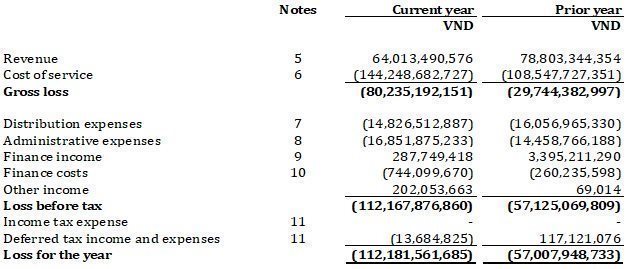
STATEMENT OF PROFIT AND LOSS
For the year ended 31 December 2023
| Preparer | Chief Accountant | General Director |
|
|
|
|
|
|
|
|
| Dang Thi Thu Hong | Dang Thi Thu Hong | Nguyen Van Hoang |
| 5 |
| Table of Contents |
| VINHMS SOFTWARE PRODUCTION AND TRADING JOINT STOCK COMPANY No. 7, Bang Lang 1 Street, Vinhomes Riverside Urban Area, Viet Hung Ward, Long Bien District, Ha Noi City, Vietnam |
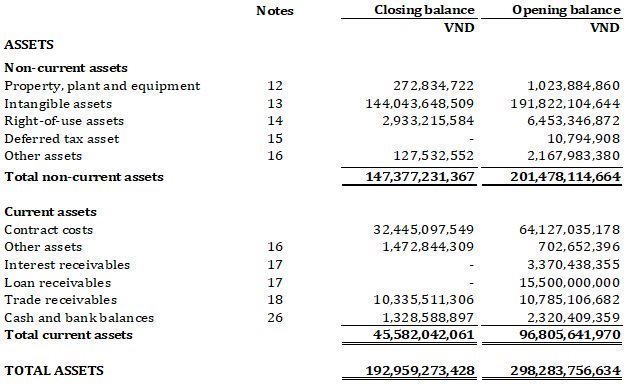
STATEMENT OF FINANCIAL POSITION
As at 31 December 2023
| 6 |
| Table of Contents |
| VINHMS SOFTWARE PRODUCTION AND TRADING JOINT STOCK COMPANY No. 7, Bang Lang 1 Street, Vinhomes Riverside Urban Area, Viet Hung Ward, Long Bien District, Ha Noi City, Vietnam |
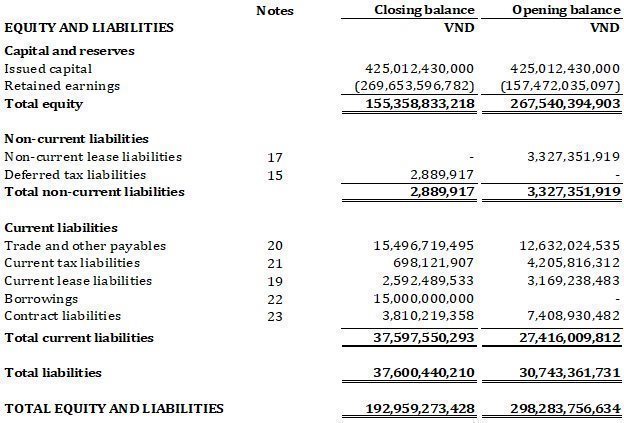
STATEMENT OF FINANCIAL POSITION (CONTINUED)
As at 31 December 2023
|
Preparer |
Chief Accountant |
General Director |
|
|
|
|
|
Dang Thi Thu Hong |
Dang Thi Thu Hong |
Nguyen Van Hoang |
| 7 |
| Table of Contents |
| VINHMS SOFTWARE PRODUCTION AND TRADING JOINT STOCK COMPANY No. 7, Bang Lang 1 Street, Vinhomes Riverside Urban Area, Viet Hung Ward, Long Bien District, Ha Noi City, Vietnam |
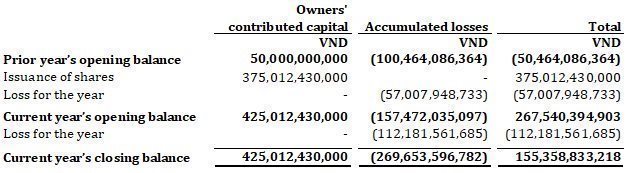
STATEMENT OF CHANGES IN EQUITY
For the year ended 31 December 2023
Charter capital
According to the Company’s Enterprise Registration Certificate and the amendment, the Company’s charter capital is VND 425,012,430,000. The charter capital has been fully contributed by the shareholders as at 31 December 2023.
Detail of charter capital
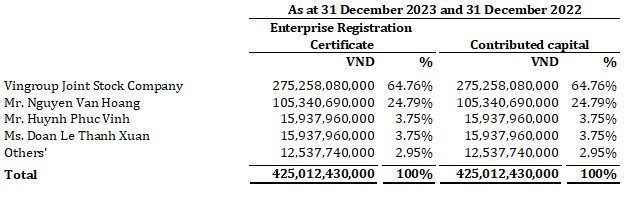
|
Preparer |
Chief Accountant |
General Director |
|
|
|
|
|
Dang Thi Thu Hong |
Dang Thi Thu Hong |
Nguyen Van Hoang |
| 8 |
| Table of Contents |
| VINHMS SOFTWARE PRODUCTION AND TRADING JOINT STOCK COMPANY No. 7, Bang Lang 1 Street, Vinhomes Riverside Urban Area, Viet Hung Ward, Long Bien District, Ha Noi City, Vietnam |
For the year ended 31 December 2023
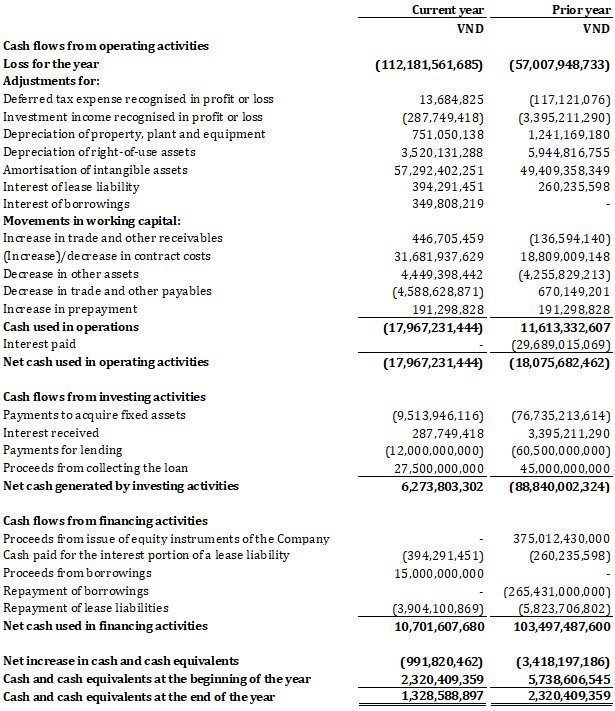
|
Preparer |
Chief Accountant |
General Director |
|
|
|
|
|
Dang Thi Thu Hong |
Dang Thi Thu Hong |
Nguyen Van Hoang |
| 9 |
| Table of Contents |
| VINHMS SOFTWARE PRODUCTION AND TRADING JOINT STOCK COMPANY No. 7, Bang Lang 1 Street, Vinhomes Riverside Urban Area, Viet Hung Ward, Long Bien District, Ha Noi City, Vietnam |
| NOTES TO THE FINANCIAL STATEMENTS These accompanying notes are an integral part of and should be read in conjunction with the financial statements |
1. GENERAL INFORMATION
1.1. Structure of ownership
VinHMS Software Production and Trading Joint Stock Company (“the Company”) is incorporated in Vietnam, as a joint stock company under the Enterprise Registration Certificate No. 0315396330 issued by Department of Planning and Investment of Ha Noi City dated 21 November 2018, and the latest amendment dated 18 December 2023. The charter capital of the Company is VND 425,012,430,000.
The Company’s office is located at No. 7, Bang Lang 1 Street, Vinhomes Riverside Urban Area City, Viet Hung Ward, Long Bien District, Ha Noi City, Vietnam.
Number of employees as at 31 December 2023 was 73 (As at 31 December 2022: 79).
1.2. Principal activities
The principal activities of the Company are software production and rendering of software solutions.
1.3. Financial year
The Company’s financial year begins on 01 January and ends on 31 December.
2. APPLICATION OF NEW AND REVISED INTERNATIONAL FINANCIAL REPORTING STANDARDS (IFRSs)
New and amended IFRSs that are effective for the current year
|
| Amendments to IAS 1 Presentation of Financial Statements and IFRS Practice Statement 2 Making Materiality Judgements – Disclosure of Accounting Policies |
| The Company has adopted the amendments to IAS 1 for the first time in the current year. The amendments change the requirements in IAS 1 with regard to disclosure of accounting policies. The admendments replace all instances of the term ‘’significant accounting policies” with “material accounting policy information’’. Accounting policy information is material if, when considered together with other information included in an entity’s financial statements, it can reasonably be expected to influence decisions that the primary users of general purpose financial statements make on the basis of those financial statements.
The supporting paragraphs in IAS 1 are also amended to clarify that accounting policy information that relates to immaterial transactions, other events or conditions is immaterial and need not be disclosed. Accounting policy information may be material because of the nature of the related transactions, other events or conditions, even if the amounts are immaterial. However, not all accounting policy information relating to material transactions, other events or conditions is itself material. |
|
| Amendments to IAS 8 Accounting Policies, Changes in Accounting Estimates and Errors – Definition of Accounting Estimates |
| The Company has adopted the amendments to IAS 8 for the first time in the current year. The amendments replace the definition of accounting estimates. Under the new definition, accounting estimates are “monetary amounts in financial statements that are subject to measurement uncertainty”. The definition of a change in accounting estimates was deleted. |
| 10 |
| Table of Contents |
| VINHMS SOFTWARE PRODUCTION AND TRADING JOINT STOCK COMPANY No. 7, Bang Lang 1 Street, Vinhomes Riverside Urban Area, Viet Hung Ward, Long Bien District, Ha Noi City, Vietnam |
| NOTES TO THE FINANCIAL STATEMENTS (CONTINUED) These accompanying notes are an integral part of and should be read in conjunction with the financial statements |
2. APPLICATION OF NEW AND REVISED INTERNATIONAL FINANCIAL REPORTING STANDARDS (IFRSs) (CONTINUED)
New and revised IFRSs in issue but not yet effective
|
| Amendments to IAS 1 Classification of Liabilities as Current or Non-Current |
| The amendments to IAS 1 affect only the presentation of liabilities as current or non-current in the statement of financial position and not the amount or timing of recognition of any asset, liability, income or expenses, or the information disclosed about those items.
The amendments clarify that the classification of liabilities as current or non-current is based on rights that are in existence at the end of the reporting period, specify that classification is unaffected by expectations about whether an entity will exercise its right to defer settlement of a liability, explain that rights are in existence if covenants are complied with at the end of the reporting period, and introduce a definition of ‘settlement’ to make clear that settlement refers to the transfer to the counterparty of cash, equity instruments, other assets or services.
The amendments are applied retrospectively for annual periods beginning on or after 1 January 2024, with early application permitted. The IASB has aligned the effective date with the 2022 amendments to IAS 1. If an entity applies the 2020 amendments for an earlier period, it is also required to apply the 2022 amendments early. |
The Board of General Directors anticipates that the adoption of those Standards listed above will have no material impact on the financial statements of the Company in future period.
| 11 |
| Table of Contents |
| VINHMS SOFTWARE PRODUCTION AND TRADING JOINT STOCK COMPANY No. 7, Bang Lang 1 Street, Vinhomes Riverside Urban Area, Viet Hung Ward, Long Bien District, Ha Noi City, Vietnam |
| NOTES TO THE FINANCIAL STATEMENTS (CONTINUED) These accompanying notes are an integral part of and should be read in conjunction with the financial statements |
3. MATERIAL ACCOUNTING POLICIES
3.1 Statement of compliance
The financial statements have been prepared in accordance with International Financial Reporting Standards.
3.2 Basis of preparation
The financial statements have been prepared on the historical cost basis except for certain properties and financial instruments that are measured at fair values at the end of each reporting period, as explained in the accounting policies below. Historical cost is generally based on the fair value of the consideration given in exchange for goods and services.
Fair value is the price that would be received to sell an asset or paid to transfer a liability in an orderly transaction between market participants at the measurement date, regardless of whether that price is directly observable or estimated using another valuation technique. In estimating the fair value of an asset or a liability, the Company takes into account the characteristics of the asset or liability if market participants would take those characteristics into account when pricing the asset or liability at the measurement date. Fair value for measurement and/or disclosure purposes in these financial statements is determined on such a basis, except for share-based payment transactions that are within the scope of IFRS 2 Share-based Payment, leasing transactions that are within the scope of IFRS 16 Leases, and measurements that have some similarities to fair value but are not fair value, such as net realizable value in IAS 2 Inventories or value in use in IAS 36 Impairment of Assets.
3.3 Going concern
The General Director has, at the time of approving the financial statements, a reasonable expectation that the Company has adequate resources to continue in operational existence for foreseable future. Thus they continue to adopt the going concern basis of accounting n preparing the financial statements.
3.4 Revenue
Revenue is measured based on the consideration to which the Company expects to be entitled in a contract with a customer and excludes amounts collected on behalf of third parties. The Company recognises revenue when it transfers control of a product or service to a customer.
Revenue recognition
The Company recognises revenue from the following major sources:
|
| · | Sale from production of software |
|
| · | Sale from renderring of software solutions |
Production of software
The Company produces software based on the customers’requests. The software will be produces for specialised business operations of the customers. Such services are recognised as a performance obligation satisfied either over the time or point in time. For over the time, revenue is recognised for the services based on the stage of completion of the contract. For point in time, revenue is recognised when control of the software has transferred to customers.
| 12 |
| Table of Contents |
| VINHMS SOFTWARE PRODUCTION AND TRADING JOINT STOCK COMPANY No. 7, Bang Lang 1 Street, Vinhomes Riverside Urban Area, Viet Hung Ward, Long Bien District, Ha Noi City, Vietnam |
| NOTES TO THE FINANCIAL STATEMENTS (CONTINUED) These accompanying notes are an integral part of and should be read in conjunction with the financial statements |
3. MATERIAL ACCOUNTING POLICIES (CONTINUED)
3.4 Revenue (continued)
Renderring of software solutions
The Company renderred of software solutions by providing license of the software. Such services are recognised as a performance obligation satisfied over the time. Revenue is recognised for the services when the license is transferred to the customers and customers can use the software.
Interest income
Interest income from a financial asset is recognized when it is probable that the economic benefits will flow to the Company and the amount of income can be measured reliably. Interest income is accrued on a time basis, by reference to the principal outstanding and at the effective interest rate applicable, which is the rate that exactly discounts estimated future cash receipts through the expected life of the financial asset to that asset's net carrying amount on initial recognition.
3.5 Leasing
The Company assesses whether a contract is or contains a lease, at inception of the contract. The Company recognises a right-of-use asset and a corresponding lease liability with respect to all lease arrangements in which it is the lessee, except for short-term leases (defined as leases with a lease term of 12 months or less) and leases of low value assets (such as tablets and personal computers, small items of office furniture and telephones). For these leases, the Company recognises the lease payments as an operating expense on a straight-line basis over the term of the lease unless another systematic basis is more representative of the time pattern in which economic benefits from the leased assets are consumed.
The lease liability is initially measured at the present value of the lease payments that are not paid at the commencement date, discounted by using the rate implicit in the lease. If this rate cannot be readily determined, the Company uses average incremental borrowing rate in market.
Lease payments included in the measurement of the lease liability comprise:
|
| · | Fixed lease payments (including in-substance fixed payments), less any lease incentives receivable; |
|
| · | Variable lease payments that depend on an index or rate, initially measured using the index or rate at the commencement date; |
|
| · | The amount expected to be payable by the lessee under residual value guarantees; |
|
| · | The exercise price of purchase options, if the lessee is reasonably certain to exercise the options; and |
|
| · | Payments of penalties for terminating the lease, if the lease term reflects the exercise of an option to terminate the lease. |
The lease liability is presented as a separate line in the statement of financial position.
The lease liability is subsequently measured by increasing the carrying amount to reflect interest on the lease liability (using the effective interest method) and by reducing the carrying amount to reflect the lease payments made.
| 13 |
| Table of Contents |
| VINHMS SOFTWARE PRODUCTION AND TRADING JOINT STOCK COMPANY No. 7, Bang Lang 1 Street, Vinhomes Riverside Urban Area, Viet Hung Ward, Long Bien District, Ha Noi City, Vietnam |
| NOTES TO THE FINANCIAL STATEMENTS (CONTINUED) These accompanying notes are an integral part of and should be read in conjunction with the financial statements |
3. MATERIAL ACCOUNTING POLICIES (CONTINUED)
3.4 Leasing (continued)
The Company remeasures the lease liability (and makes a corresponding adjustment to the related right-of-use asset) whenever:
|
| · | The lease term has changed or there is a significant event or change in circumstances resulting in a change in the assessment of exercise of a purchase option, in which case the lease liability is remeasured by discounting the revised lease payments using a revised discount rate. |
|
| · | The lease payments change due to changes in an index or rate or a change in expected payment under a guaranteed residual value, in which cases the lease liability is remeasured by discounting the revised lease payments using an unchanged discount rate (unless the lease payments change is due to a change in a floating interest rate, in which case a revised discount rate is used). |
|
| · | A lease contract is modified and the lease modification is not accounted for as a separate lease, in which case the lease liability is remeasured based on the lease term of the modified lease by discounting the revised lease payments using a revised discount rate at the effective date of the modification. |
The Company did not make any such adjustments during the periods presented.
The right-of-use assets comprise the initial measurement of the corresponding lease liability, lease payments made at or before the commencement day, less any lease incentives received and any initial direct costs. They are subsequently measured at cost less accumulated depreciation and impairment losses.
Right-of-use assets are depreciated over the shorter period of lease term and useful life of the underlying asset. If a lease transfers ownership of the underlying asset or the cost of the right-of-use asset reflects that the Company expects to exercise a purchase option, the related right-of-use asset is depreciated over the useful life of the underlying asset. The depreciation starts at the commencement date of the lease.
The right-of-use assets are presented as a separate line in the statement of financial position.
The Company applies IAS 36 to determine whether a right-of-use asset is impaired and accounts for any identified impairment loss.
3.6 Foreign currencies
In preparing the financial statements of the individual entities, transactions in currencies other than the Company’s functional currency (VND) are recorded at the rates of exchange prevailing at the dates of the transactions. At end of each reporting period, monetary items denominated in foreign currencies are retranslated at the rates prevailing at the end of the reporting period. Non-monetary items that are measured in terms of historical cost in a foreign currency are not retranslated.
3.7 Taxation
Income tax expense represents the sum of the tax currently payable and deferred tax.
Current tax
The tax currently payable is based on taxable profit for the year. Taxable profit differs from 'profit before tax' as reported in the statement of profit or loss because of items of income or expense that are taxable or deductible in other years and items that are never taxable or deductible. The Company's current tax is calculated using tax rates that have been enacted or substantively enacted by the end of the reporting period. Current tax are recognized in profit or loss.
| 14 |
| Table of Contents |
| VINHMS SOFTWARE PRODUCTION AND TRADING JOINT STOCK COMPANY No. 7, Bang Lang 1 Street, Vinhomes Riverside Urban Area, Viet Hung Ward, Long Bien District, Ha Noi City, Vietnam |
| NOTES TO THE FINANCIAL STATEMENTS (CONTINUED) These accompanying notes are an integral part of and should be read in conjunction with the financial statements |
3. MATERIAL ACCOUNTING POLICIES (CONTINUED)
Deferred tax
Deferred tax is recognized on temporary differences between the carrying amounts of assets and liabilities in the consolidated financial statements and the corresponding tax bases used in the computation of taxable profit. Deferred tax liabilities are generally recognized for all taxable temporary differences. Deferred tax assets are generally recognized for all deductible temporary differences to the extent that it is probable that taxable profits will be available against which those deductible temporary differences can be utilized. Such deferred tax assets and liabilities are not recognized if the temporary difference arises from the initial recognition (other than in a business combination) of assets and liabilities in a transaction that affects neither the taxable profit nor the accounting profit. In addition, deferred tax liabilities are not recognized if the temporary difference arises from the initial recognition of goodwill.
The carrying amount of deferred tax assets is reviewed at the end of each reporting period and reduced to the extent that it is no longer probable that sufficient taxable profits will be available to allow all or part of the asset to be recovered.
Deferred tax liabilities and assets are measured at the tax rates that are expected to apply in the period in which the liability is settled or the asset realized, based on tax rates (and tax laws) that have been enacted or substantively enacted by the end of the reporting period.
The measurement of deferred tax liabilities and assets reflects the tax consequences that would follow from the manner in which the Company expects, at the end of the reporting period, to recover or settle the carrying amount of its assets and liabilities.
3.8 Property, plant and equipment
Fixtures and equipment are stated at cost less accumulated depreciation and accumulated impairment losses.
Depreciation is recognized so as to write off the cost or valuation of assets (other than freehold land and properties under construction) less their residual values over their useful lives, using the straight--line method. The estimated useful lives and depreciation method are reviewed at the end of each reporting period, with the effect of any changes in estimate accounted for on a prospective basis.
An item of property, plant and equipment is derecognized upon disposal or when no future economic benefits are expected to arise from the continued use of the asset. Any gain or loss arising on the disposal or retirement of an item of property, plant and equipment is determined as the difference between the sales proceeds and the carrying amount of the asset and is recognized in profit or loss.
3.9 Intangible assets
Acquired computer software licenses
Acquired computer software licenses are initially capitalized at cost, which includes the purchase price (net of any discounts and rebates) and other directly attributable cost of preparing the asset for its intended use. Direct expenditure including employee costs, which enhances or extends the performance of computer software beyond its specifications and which can be reliably measured, is added to the original cost of the software. Costs associated with maintaining the computer software are recognized as an expense when incurred.
| 15 |
| Table of Contents |
| VINHMS SOFTWARE PRODUCTION AND TRADING JOINT STOCK COMPANY No. 7, Bang Lang 1 Street, Vinhomes Riverside Urban Area, Viet Hung Ward, Long Bien District, Ha Noi City, Vietnam |
| NOTES TO THE FINANCIAL STATEMENTS (CONTINUED) These accompanying notes are an integral part of and should be read in conjunction with the financial statements |
3. MATERIAL ACCOUNTING POLICIES (CONTINUED)
3.9 Intangible assets (continued)
Computer software licenses are subsequently carried at cost less accumulated amortization and accumulated impairment losses. These costs are amortized to profit or loss using the straight-line method over their estimated useful lives of three years.
Internally-generated intangible assets – research and development expenditure
Expenditure on research activities is recognised as an expense in the period in which it incurred.
An internally-generated intagible asset arising from development (or from the development phase of an internal project) is recognised if, and only if, all of the following conditions have been demonstrated:
|
| · | The technical feasibility of completing the intangible asset so that it will be available for use or sale |
|
| · | The intention to complete the intangible asset and use or sell it |
|
| · | The ability to use or sell the intangible asset |
|
| · | How the intangible asset will generate probable future economic benefits |
|
| · | The availability of adequate technical, financial and other resoures to complete the development and to use or sell the intangible asset |
|
| · | The ability to measure reliably the expenditure attributable to the intangible asset during its development |
The amount initially recognised for internally-generated intangible assets is the sum of expenditure incurred from the date when the intangible asset first meets the recognition criteria listed above. Where no internally-generated intangible asset can be recognised, development expenditure is recognised in profit or loss in the period in which it incurred.
Subsequent to initial recognition, internally-generated intnagible assets are reported at cost less accumulated amortisation and accumulated impairment losses, on the same basis as intangible assets that are acquired seperately.
Derecognition of intangible assets
An intangible asset is derecognized on disposal, or when no future economic benefits are expected from use or disposal. Gains or losses arising from derecognition of an intangible asset, measured as the difference between the net disposal proceeds and the carrying amount of the asset, are recognized in profit or loss when the asset is derecognized.
| 16 |
| Table of Contents |
| VINHMS SOFTWARE PRODUCTION AND TRADING JOINT STOCK COMPANY No. 7, Bang Lang 1 Street, Vinhomes Riverside Urban Area, Viet Hung Ward, Long Bien District, Ha Noi City, Vietnam |
| NOTES TO THE FINANCIAL STATEMENTS (CONTINUED) These accompanying notes are an integral part of and should be read in conjunction with the financial statements |
3. MATERIAL ACCOUNTING POLICIES (CONTINUED)
3.8 Intangible assets (Continued)
Impairment of tangible and intangible assets
At the end of each reporting period, the Company reviews the carrying amounts of its tangible and intangible assets to determine whether there is any indication that those assets have suffered an impairment loss. If any such indication exists, the recoverable amount of the asset is estimated in order to determine the extent of the impairment loss (if any). When it is not possible to estimate the recoverable amount of an individual asset, the Group estimates the recoverable amount of the cash -generating unit to which the asset belongs. When a reasonable and consistent basis of allocation can be identified, corporate assets are also allocated to individual cash-generating units, or otherwise they are allocated to the smallest group of cash-generating units for which a reasonable and consistent allocation basis can be identified.
Recoverable amount is the higher of fair value less costs of disposal and value in use. In assessing value in use, the estimated future cash flows are discounted to their present value using a pre-tax discount rate that reflects current market assessments of the time value of money and the risks specific to the asset for which the estimates of future cash flows have not been adjusted.
If the recoverable amount of an asset (or cash-generating unit) is estimated to be less than its carrying amount, the carrying amount of the asset (or cash-generating unit) is reduced to its recoverable amount. An impairment loss is recognized immediately in profit or loss, unless the relevant asset is carried at a revalued amount, in which case the impairment loss is treated as a revaluation decrease.
When an impairment loss subsequently reverses, the carrying amount of the asset (or a cash- generating unit) is increased to the revised estimate of its recoverable amount, but so that the increased carrying amount does not exceed the carrying amount that would have been determined had no impairment loss been recognized for the asset (or cash-generating unit) in prior years. A reversal of an impairment loss is recognized immediately in profit or loss, unless the relevant asset is carried at a revalued amount, in which case the reversal of the impairment loss is treated as a revaluation increase.
3.10 Provisions
Provisions are recognized when the Company has a present obligation (legal or constructive) as a result of a past event, it is probable that the Company will be required to settle the obligation, and a reliable estimate can be made of the amount of the obligation.
The amount recognized as a provision is the best estimate of the consideration required to settle the present obligation at the end of the reporting period, taking into account the risks and uncertainties surrounding the obligation. When a provision is measured using the cash flows estimated to settle the present obligation, its carrying amount is the present value of those cash flows (when the effect of the time value of money is material).
When some or all of the economic benefits required to settle, a provision are expected to be recovered from a third party, a receivable is recognized as an asset if it is virtually certain that reimbursement will be received and the amount of the receivable can be measured reliably.
| 17 |
| Table of Contents |
| VINHMS SOFTWARE PRODUCTION AND TRADING JOINT STOCK COMPANY No. 7, Bang Lang 1 Street, Vinhomes Riverside Urban Area, Viet Hung Ward, Long Bien District, Ha Noi City, Vietnam |
| NOTES TO THE FINANCIAL STATEMENTS (CONTINUED) These accompanying notes are an integral part of and should be read in conjunction with the financial statements |
3. MATERIAL ACCOUNTING POLICIES (CONTINUED)
3.11 Financial instruments
Financial assets and financial liabilities are recognized when the Company becomes a party to the contractual provisions of the instruments. Financial assets and financial liabilities are initially measured at fair value. Transaction costs directly attributable to the acquisition of financial assets or financial liabilities at fair value through profit or loss are recognized immediately in profit or loss.
3.12 Financial assets
All regular way purchases or sales of financial assets are recognized and derecognized on a trade date basis. Regular way purchases or sales are purchases or sales of financial assets that require delivery of assets within the time frame established by regulation or convention in the marketplace.
All recognised financial assets are measured subsequently in their entirety at either amortised cost or fair value, depending on the classifiation of the financial assets.
Classification of financial assets
Debt instruments that meet the following conditions are measured subsequently at amortised cost:
|
| · | The financial asset is held within a business model whose objective is to hold fiancial assets in order to collect contractual cash flows |
|
| · | The contractual terms of the financial asset give rise on specified dates to cash flows that are solely payments of principal and interest on the principal amount outstanding. |
Debt instruments that meet the following conditions are measured subsequently at fair value through other comprehensive income (FVTOCI):
|
| · | The financial asset is held within a business model whose objective is achieved by both collecting contractual cash flows and selling the financial assets. |
|
| · | The contractual terms of the financial asset give rise on specified dates to cash flows that are solely payments of principal and interest on the principal amount outstanding. |
By default, all other financial assets are measured subsequently at fair value through profit or loss (FVTPL).
Effective interest method
The effective interest method is a method of calculating the amortized cost of a financial asset and of allocating interest income over the relevant period. The effective interest rate is the rate that exactly discounts estimated future cash receipts (including all fees and points paid or received that form an integral part of the effective interest rate, transaction costs and other premiums or discounts) through the expected life of the financial asset, or, where appropriate, a shorter period, to the net carrying amount on initial recognition.
Loans and receivables
Loans and receivables are non-derivative financial assets with fixed or determinable payments that are not quoted in an active market. Loans and receivables (including trade and other receivables, bank balances and cash, and deposits) are measured at amortized cost using the effective interest method, less any impairment.
Interest income is recognized by applying the effective interest rate, except for short-term receivables when the effect of discounting is immaterial.
| 18 |
| Table of Contents |
| VINHMS SOFTWARE PRODUCTION AND TRADING JOINT STOCK COMPANY No. 7, Bang Lang 1 Street, Vinhomes Riverside Urban Area, Viet Hung Ward, Long Bien District, Ha Noi City, Vietnam |
| NOTES TO THE FINANCIAL STATEMENTS (CONTINUED) These accompanying notes are an integral part of and should be read in conjunction with the financial statements |
3. MATERIAL ACCOUNTING POLICIES (CONTINUED)
3.12 Financial assets (Continued)
Impairment of financial assets
The Company recognises a loss allowance for expected credit losses on investments in debt instruments that are measured at amortised cost or at FVTOCI, lease receivables, trade receivables and contract assets, as well as on financial guarantee contracts. The amount of expected credit losses is updated at each reporting date to reflect changes in credit risk since initial recognition of the respective financial instrument.
The Company always recognises lifetime expected credit losses (ECL) for trade receivables, contract assets and lease receivables. The expected credit losses on these financial assets are estimated using a provision matrix based on the Company’s historical credit loss experience, adjusted for factors that are specific to the debtors, general economic conditions and an assessment of both the current as well as the forecast direction of conditions at the reporting date, including time value of money where appropriate.
For all other financial instruments, the Group recognises lifetime ECL when there has been a significant increase in credit risk since initial recognition. However, if the credit risk on the financial instrument has not increased significantly since initial recognition, the Group measures the loss allowance for that financial instrument at an amount equal to 12-month ECL.
Lifetime ECL represents the expected credit losses that will result from all possible default events over the expected life of a financial instrument. In contrast, 12-month ECL represents the portion of lifetime ECL that is expected to result from default events on a financial instrument that are possible within 12 months after the reporting date.
There is no objective evidence of impairment for trade receivable, because trade receivable is only from related party. There is no past experience of bad collecting payments and no delayed payment.
Derecognition of financial assets
The Company derecognizes a financial asset when the contractual rights to the cash flows from the asset expire, or when it transfers the financial asset and substantially all the risks and rewards of ownership of the asset to another party. If the Company neither transfers nor retains substantially all the risks and rewards of ownership and continues to control the transferred asset, the Company recognizes its retained interest in the asset and an associated liability for amounts it may have to pay. If the Company retains substantially all the risks and rewards of ownership of a transferred financial asset, the Company continues to recognize the financial asset and also recognizes a collateralized borrowing for the proceeds received.
3.13 Financial liabilities and equity instruments
Classification as debt or equity
Debt and equity instruments issued by the Company are classified as either financial liabilities or as equity in accordance with the substance of the contractual arrangements and the definitions of a financial liability and an equity instrument.
| 19 |
| Table of Contents |
| VINHMS SOFTWARE PRODUCTION AND TRADING JOINT STOCK COMPANY No. 7, Bang Lang 1 Street, Vinhomes Riverside Urban Area, Viet Hung Ward, Long Bien District, Ha Noi City, Vietnam |
| NOTES TO THE FINANCIAL STATEMENTS (CONTINUED) These accompanying notes are an integral part of and should be read in conjunction with the financial statements |
3. MATERIAL ACCOUNTING POLICIES (CONTINUED)
3.13 Financial liabilities and equity instruments (continued)
Equity instruments
An equity instrument is any contract that evidences a residual interest in the assets of an entity after deducting all of its liabilities. Equity instruments issued by the Company are recognized at the proceeds received, net of direct issue costs.
Financial liabilities
Financial liabilities are classified 'other financial liabilities'.
Other financial liabilities
Other financial liabilities (including Trade and other payables) are initially measured at fair value, net of transaction costs, and are subsequently measured at amortized cost, using the effective interest method, with interest expense recognized on an effective yield basis.
The effective interest method is a method of calculating the amortized cost of a financial liability and of allocating interest expense over the relevant period. The effective interest rate is the rate that exactly discounts estimated future cash payments (including all fees and points paid or received that form an integral part of the effective interest rate, transaction costs and other premiums or discounts) through the expected life of the financial liability, or (where appropriate) a shorter period, to the net carrying amount on initial recognition.
Derecognition of financial liabilities
The Company derecognizes financial liabilities when, and only when, the Company's obligations are discharged, cancelled or they expire. The difference between the carrying amount of the financial liability derecognized and the consideration paid and payable is recognized in profit or loss.
4. CRITICAL ACCOUNTING JUDGMENTS
In the application of the Company’s accounting policies, which are described in note 3, management is required to make judgments, estimates and assumptions about the carrying amounts of assets and liabilities that are not readily apparent from other sources. The estimates and associated assumptions are based on historical experience and other factors that are considered to be relevant. Actual results may differ from these estimates.
The estimates and underlying assumptions are reviewed on an ongoing basis. Revisions to accounting estimates are recognized in the year in which the estimate is revised if the revision affects only that year, or in the year of the revision and future periods if the revision affects both current and future periods.
| 20 |
| Table of Contents |
| VINHMS SOFTWARE PRODUCTION AND TRADING JOINT STOCK COMPANY No. 7, Bang Lang 1 Street, Vinhomes Riverside Urban Area, Viet Hung Ward, Long Bien District, Ha Noi City, Vietnam |
| NOTES TO THE FINANCIAL STATEMENTS (CONTINUED) These accompanying notes are an integral part of and should be read in conjunction with the financial statements |
5. REVENUE
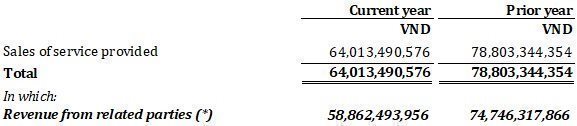
(*) Please refer to Note 25 - “Related party transactions” for more information.
6. COST OF SERVICE

7. DISTRIBUTION EXPENSES
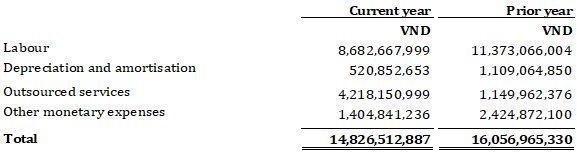
8. ADMINISTRATIVE EXPENSES
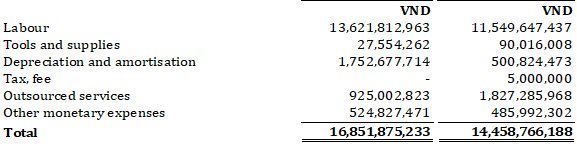
9. FINANCE INCOME

| 21 |
| Table of Contents |
| VINHMS SOFTWARE PRODUCTION AND TRADING JOINT STOCK COMPANY No. 7, Bang Lang 1 Street, Vinhomes Riverside Urban Area, Viet Hung Ward, Long Bien District, Ha Noi City, Vietnam |
| NOTES TO THE FINANCIAL STATEMENTS (CONTINUED) These accompanying notes are an integral part of and should be read in conjunction with the financial statements |
10. FINANCE COST
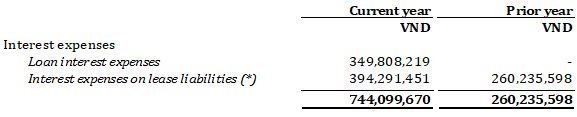
(*) Interest expenses on lease liabilities represent the interest portion of lease liabilities due to the office rental charges in the future. The discount factor rate is 9% per annum. Please refer to Note 14 - “Right-of-use assets” to the financial statements for more information.
11. INCOME TAX EXPENSE
For income from software production activities: The CIT rate is 10% of assessable income for 15 years from the commencement of the Company’s business operations.
For income from other activities: The CIT rate is 20% of assessable income.
The total charge for the year can be reconciled to the accounting profit as follows:
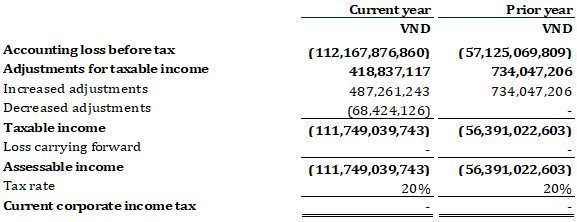
There is no corporate income tax in the year as the Company made loss. As at 31 December 2023, the Company has unused tax losses of VND 238,873,175,277 available for offset against future profits. No deferred tax asset has been recognized due to the uncertainty of additional future profits. Tax loss is fully carried forward for 5 years right after the year making loss.
| 22 |
| Table of Contents |
| VINHMS SOFTWARE PRODUCTION AND TRADING JOINT STOCK COMPANY No. 7, Bang Lang 1 Street, Vinhomes Riverside Urban Area, Viet Hung Ward, Long Bien District, Ha Noi City, Vietnam |
| NOTES TO THE FINANCIAL STATEMENTS (CONTINUED) These accompanying notes are an integral part of and should be read in conjunction with the financial statements |
12. PROPERTY, PLANT AND EQUIPMENT
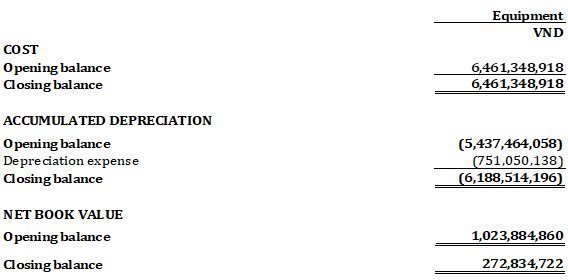
Tangible fixed assets are depreciated using the straight-line method over their estimated useful lives as follows:
| Items | Years |
|
|
|
| Fixtures and equipment | 02 - 05 |
As at year ended, Board of General Directors reviewed and confirmed there are no decline in market value and no physical damage to assets. Therefore, no impairment for PPE is provided.
The cost of the Company’s tangible fixed assets as at 31 December 2023 includes VND 4,722,878,526 which has been fully depreciated but is still in use.
| 23 |
| Table of Contents |
| VINHMS SOFTWARE PRODUCTION AND TRADING JOINT STOCK COMPANY No. 7, Bang Lang 1 Street, Vinhomes Riverside Urban Area, Viet Hung Ward, Long Bien District, Ha Noi City, Vietnam |
| NOTES TO THE FINANCIAL STATEMENTS (CONTINUED) These accompanying notes are an integral part of and should be read in conjunction with the financial statements |
13. INTANGIBLE ASSETS
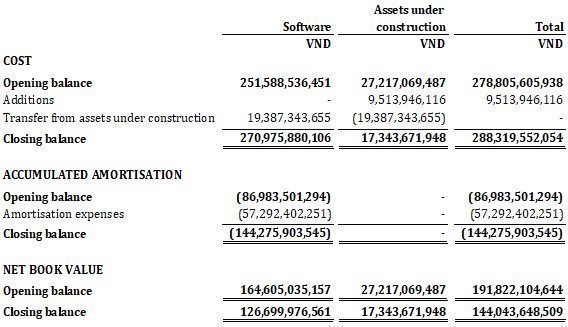
| 24 |
| Table of Contents |
| VINHMS SOFTWARE PRODUCTION AND TRADING JOINT STOCK COMPANY No. 7, Bang Lang 1 Street, Vinhomes Riverside Urban Area, Viet Hung Ward, Long Bien District, Ha Noi City, Vietnam |
| NOTES TO THE FINANCIAL STATEMENTS (CONTINUED) These accompanying notes are an integral part of and should be read in conjunction with the financial statements |
13. INTANGIBLE ASSETS (CONTINUED)
The net book value of the software includes VND 56,960,954,678 of software awaiting disposal.
The cost of the Company’s intangible fixed assets as at 31 December 2023 includes VND 65,000,000 which has been fully depreciated but is still in use.
Software is amortized using the straight-line method over their estimated useful lives of 2-4 years.
As at year ended, General Director reviewed and confirmed there is no decline in market value. Therefore, no impairment for software is provided.
14. RIGHT-OF-USE ASSETS
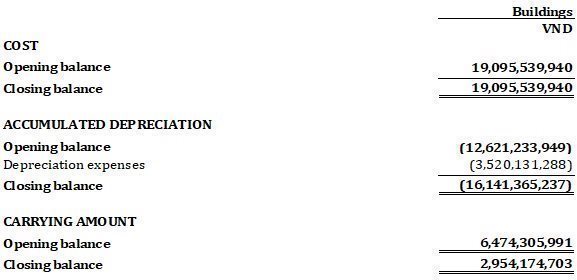
Right-of-use assets represent:
|
| - | Lease contract with The Open House JSC No. ST-VTS-01012/HĐV dated 15 Sep 2020. The lease contract was signed for the period from Sep 2020 to Dec 2022. |
|
| - | Lease contract with MPro Invesment JSC No. 11-12-33/NPS-2022 dated 10 May 2022. The lease contract was signed for the period from 12 May 2022 to 11 May 2024. The rental fee is VND 50,000,000 per month (included VAT). |
|
| - | Lease contract with Work Charming JSC No. KRS01_221201_01_STU dated 21 Nov 2022. The lease contract was signed for the period from 01 Dec 2022 to 31Nov 2024. The rental fee is VND 267,000,000 per month (included VAT). |
The maturity analysis of lease liabilities is presented in note 19 "Lease liabilities".
15. DEFERRED TAX ASSET
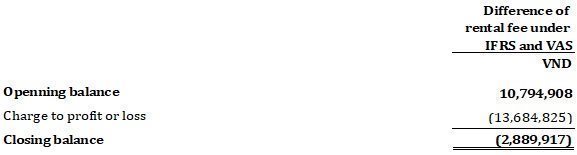
| 25 |
| Table of Contents |
| VINHMS SOFTWARE PRODUCTION AND TRADING JOINT STOCK COMPANY No. 7, Bang Lang 1 Street, Vinhomes Riverside Urban Area, Viet Hung Ward, Long Bien District, Ha Noi City, Vietnam |
| NOTES TO THE FINANCIAL STATEMENTS (CONTINUED) These accompanying notes are an integral part of and should be read in conjunction with the financial statements |
15. DEFERRED TAX ASSET (CONTINUED)
Deferred tax assets and liabilities are offset when there is a legally enforceable right to offset current tax assets against current tax liabilities and when they relate to income taxes levied by the same tax authority and the Company intends to settle its current tax assets and liabilities on a net basis.
The gross fluctuation in the deferred income tax, excluding the offset balances related to the same tax authority during the year, is as follows:

16. OTHER ASSETS
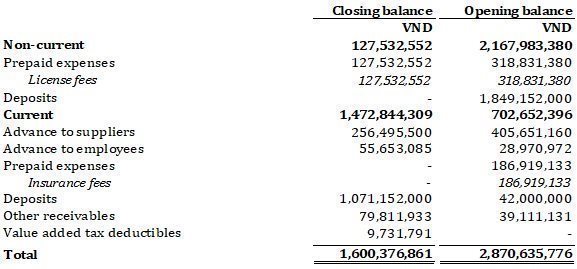
17. INTEREST AND LOAN RECEIVABLES
Interest and loan receivables represent unsecured loan to Vingroup Joint Stock Company - the parent company with the maturity date 17 Jan 2023 and interest of 9% per annum. The loan was repaid in 2023.
18. TRADE RECEIVABLES
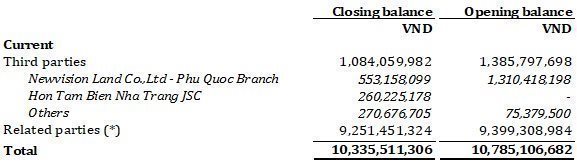
(*) Please refer to Note 25 - “Related party transactions” for more information.
| 26 |
| Table of Contents |
| VINHMS SOFTWARE PRODUCTION AND TRADING JOINT STOCK COMPANY No. 7, Bang Lang 1 Street, Vinhomes Riverside Urban Area, Viet Hung Ward, Long Bien District, Ha Noi City, Vietnam |
| NOTES TO THE FINANCIAL STATEMENTS (CONTINUED) These accompanying notes are an integral part of and should be read in conjunction with the financial statements |
18. TRADE RECEIVABLES (CONTINUED)
Age of receivables not impaired
The average credit period on sales of services is 30 to 90 days. No interest is charged on trade receivables. The Company has recognition policy for an allowance for doubtful debts in accordance with guidance of Vietnam Ministry of Finance that receivables that are overdue for six months or more or when the debtor is in dissolution, in bankruptcy, or is experiencing similar difficulties and so may be unable to repay the debt. No allowances for doubtful debts were recognized for the year as trade receivable is not overdue.
19. LEASE LIABILITIES
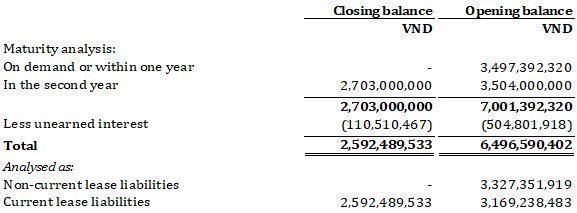
The Company does not face a significant liquidity risk with regard to its lease liabilities. Lease liabilities are monitored within the Company’s treasury function.
20. TRADE AND OTHER PAYABLES
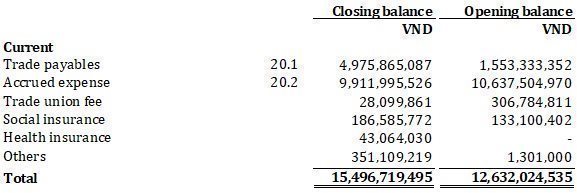
The average credit period on purchases of certain goods or services is 60 days. No interest is charged on the trade payables. The Company has financial risk management policies in place to ensure that all payables are paid within the pre-agreed credit terms.
| 27 |
| Table of Contents |
| VINHMS SOFTWARE PRODUCTION AND TRADING JOINT STOCK COMPANY No. 7, Bang Lang 1 Street, Vinhomes Riverside Urban Area, Viet Hung Ward, Long Bien District, Ha Noi City, Vietnam |
| NOTES TO THE FINANCIAL STATEMENTS (CONTINUED) These accompanying notes are an integral part of and should be read in conjunction with the financial statements |
20.1 TRADE PAYABLES
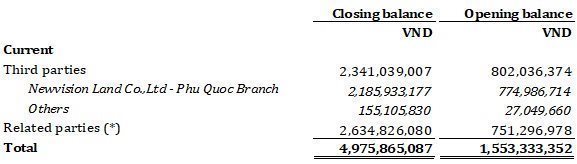
(*) Please refer to Note 25 - “Related party transactions” for more information.
20.2 ACCRUED EXPENSES

21. CURRENT TAX LIABILITIES
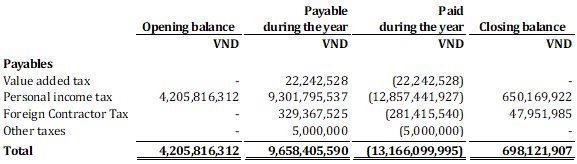
22. BORROWINGS

This is an unsecured loan from Related party (Note 25) with interest rate of 12% per annum and expiry date from 09 August 2023 to 12 December 2024.
| 28 |
| Table of Contents |
| VINHMS SOFTWARE PRODUCTION AND TRADING JOINT STOCK COMPANY No. 7, Bang Lang 1 Street, Vinhomes Riverside Urban Area, Viet Hung Ward, Long Bien District, Ha Noi City, Vietnam |
| NOTES TO THE FINANCIAL STATEMENTS (CONTINUED) These accompanying notes are an integral part of and should be read in conjunction with the financial statements |
23. CONTRACT LIABILITIES

(*) Please refer to Note 25 - “Related party transactions” for more information
24. FINANCIAL INSTRUMENTS
Capital risk management
The Company manages its capital to ensure that the Company will be able to continue as a going concern while maximizing the return to stakeholders through the optimization of the debt and equity balance. The Company's overall strategy remains unchanged from prior year. The capital structure of the Company consists of net debt (borrowings offset by cash and cash equivalents) and equity attributable to equity holders of the Company (comprising capital and retained earnings).
Categories of financial instruments
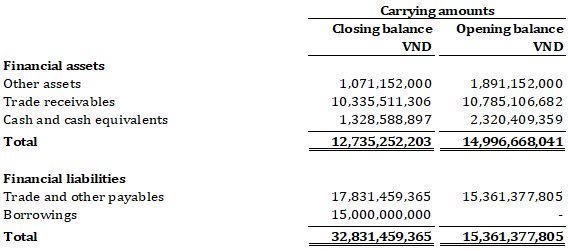
Loans and receivables designated as at FVTPL
At the end of the reporting period, there are no significant concentrations of credit risk for loans and receivables designated at FVTPL. The carrying amount reflected above represents the Company's maximum exposure to credit risk for such loans and receivables.
Financial risk management objectives
These risks include market risk (including currency risk and interest rate risk), credit risk and liquidity risk.
The Company seeks to minimize the effects of these risks by using financial risk structures instructed by the Group. It should be governed by the Group's policies approved by the Board of General Directors, which provide principles on foreign exchange risk, interest rate risk, credit risk and liquidity risk. Compliance with policies and exposure limits is reviewed by the Group’s internal auditors on a continuous basis. The Company does not enter into or trade financial instruments, including derivative financial instruments, for speculative purposes.
Market risk
The Company’s activities expose it primarily to the financial risks of changes in foreign currency exchange rates and interest rates. The Company does not perform protection solution for market risk due to lack of purchasing market of the financial instrument.
Interest rate risk management
The Company has no interest rate risks because the Company has not arranged any loans and borrowings during the year.
| 29 |
| Table of Contents |
| VINHMS SOFTWARE PRODUCTION AND TRADING JOINT STOCK COMPANY No. 7, Bang Lang 1 Street, Vinhomes Riverside Urban Area, Viet Hung Ward, Long Bien District, Ha Noi City, Vietnam |
| NOTES TO THE FINANCIAL STATEMENTS (CONTINUED) These accompanying notes are an integral part of and should be read in conjunction with the financial statements |
24. FINANCIAL INSTRUMENTS (CONTINUED)
Credit risk
Credit risk refers to the risk that counterparty will default on its contractual obligations resulting in financial loss to the Company. The Company has a credit policy in place and the exposure to credit risk is monitored on an ongoing basis. At the balance sheet date there is no significant concentration of credit risk.
Liquidity risk management
The purpose of liquidity risk management is to ensure the availability of funds to meet present and future financial obligations. Liquidity is also managed by ensuring that the excess of maturing liabilities over maturing assets in any year is kept to manageable levels relative to the amount of funds that the Company believes can generate within that period. The Company policy is to regularly monitor current and expected liquidity requirements to ensure that the Company maintains sufficient reserves of cash, borrowings and adequate committed funding from its owner to meet its liquidity requirements in the short and longer term.
The below table illustrates current and future net liquidity risk management as follow:
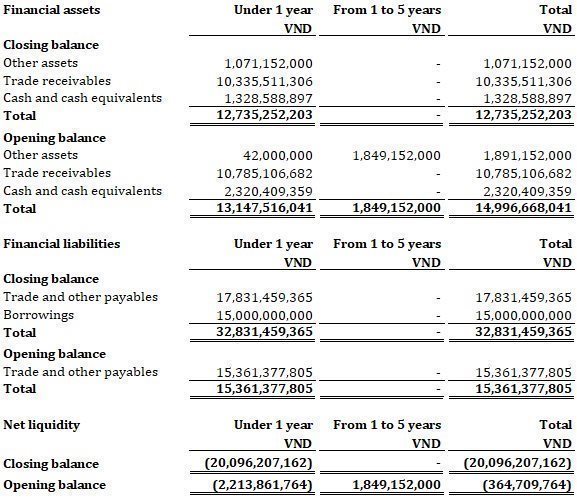
The management assessed the liquidity risk concentration at low level. The Management believes that the Company will be able to generate sufficient funds to meet its financial obligations as and when they fall due.
| 30 |
| Table of Contents |
| VINHMS SOFTWARE PRODUCTION AND TRADING JOINT STOCK COMPANY No. 7, Bang Lang 1 Street, Vinhomes Riverside Urban Area, Viet Hung Ward, Long Bien District, Ha Noi City, Vietnam |
| NOTES TO THE FINANCIAL STATEMENTS (CONTINUED) These accompanying notes are an integral part of and should be read in conjunction with the financial statements |
25. RELATED PARTIES TRANSACTIONS
List of related parties:
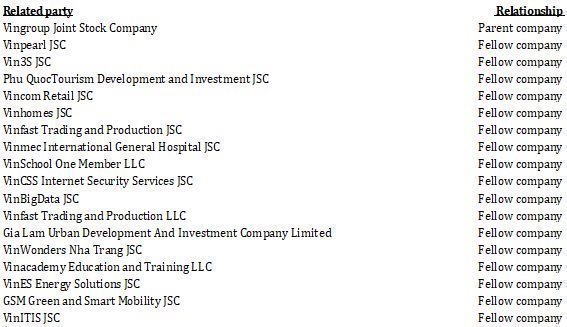
Significant transactions with related parties:
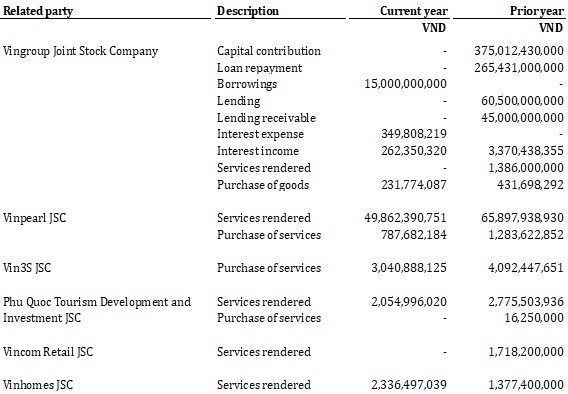
| 31 |
| Table of Contents |
| VINHMS SOFTWARE PRODUCTION AND TRADING JOINT STOCK COMPANY No. 7, Bang Lang 1 Street, Vinhomes Riverside Urban Area, Viet Hung Ward, Long Bien District, Ha Noi City, Vietnam |
| NOTES TO THE FINANCIAL STATEMENTS (CONTINUED) These accompanying notes are an integral part of and should be read in conjunction with the financial statements |
25. RELATED PARTIES TRANSACTIONS (CONTINUED)
Significant transactions with related parties (continued):
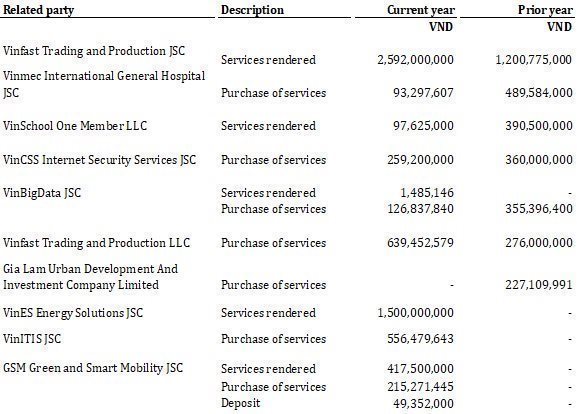
Significant related party balances:
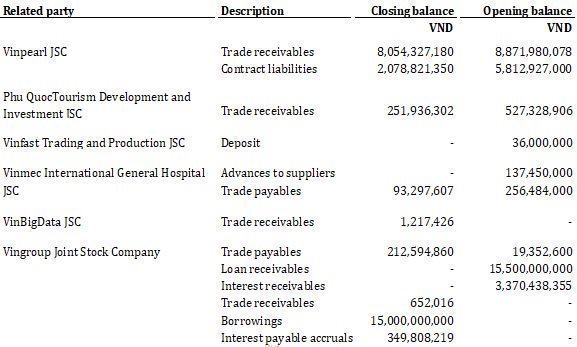
| 32 |
| Table of Contents |
| VINHMS SOFTWARE PRODUCTION AND TRADING JOINT STOCK COMPANY No. 7, Bang Lang 1 Street, Vinhomes Riverside Urban Area, Viet Hung Ward, Long Bien District, Ha Noi City, Vietnam |
| NOTES TO THE FINANCIAL STATEMENTS (CONTINUED) These accompanying notes are an integral part of and should be read in conjunction with the financial statements |
25. RELATED PARTIES TRANSACTIONS (CONTINUED)
Significant related party balances (continued):
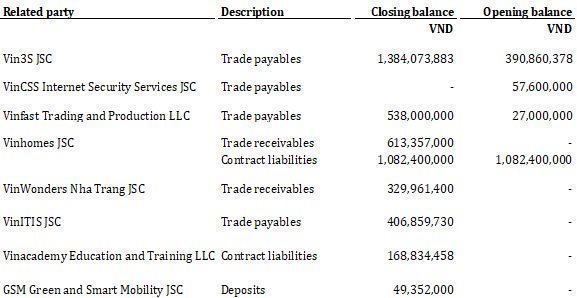
26. CASH AND BANK BALANCES
For the purposes of the statement of financial position and statement of cash flow, cash and cash equivalents include cash on hand and in banks. Cash and cash equivalents at the end of the financial year as shown in the cash flow statement can be reconciled to the related items in the statement of financial position as follows:

27. APPROVAL OF FINANCIAL STATEMENTS
The Company’s financial statements were approved by Mr. Nguyen Van Hoang - General Director and authorized for issue on 24 April 2024.
28. COMPARATIVE FIGURES
Comparative figure represents the Company’s financial statements for the year ended 31 December 2022 which were audited under IFRSs.
|
Preparer
|
Chief Accountant
|
General Director
|
|
|
|
|
|
Dang Thi Thu Hong |
Dang Thi Thu Hong |
Nguyen Van Hoang |
| 33 |
| Table of Contents |
| VINHMS SOFTWARE PRODUCTION AND TRADING JOINT STOCK COMPANY (Incorporated in the Socialist Republic of Vietnam)
AUDITED FINANCIAL STATEMENTS For the year ended as at 31 December 2022
|
Ho Chi Minh City, April 2024
| VINHMS SOFTWARE PRODUCTION AND TRADING JOINT STOCK COMPANY No. 7, Bang Lang 1 Street, Vinhomes Riverside Urban Area, Viet Hung Ward, Long Bien District, Ha Noi City, Vietnam |
| CONTENTS | Page(s) |
|
|
|
| 1 - 2 | |
|
|
|
| 3 - 4 | |
|
|
|
| 5 | |
|
|
|
| 6 | |
|
|
|
| 8 | |
|
|
|
| 9 | |
|
|
|
| 10 - 37 |
| Table of Contents |
| VINHMS SOFTWARE PRODUCTION AND TRADING JOINT STOCK COMPANY No. 7, Bang Lang 1 Street, Vinhomes Riverside Urban Area, Viet Hung Ward, Long Bien District, Ha Noi City, Vietnam |
REPORT OF BOARD OF MANAGEMENT AND GENERAL DIRECTOR
Board of Management and General Director of VinHMS Software Production and Trading Joint Stock Company present this report together with audited financial statements for the year ended 31 December 2022.
BOARD OF MANAGEMENT AND GENERAL DIRECTOR
Board of Management of the Company who held office during the year and at the date of this report are as follows:
| Ms. Nguyen Mai Hoa | Chairwoman |
| Mr. Nguyen Van Hoang | Member |
| Ms. Doan Le Thanh Xuan | Member |
General Director of the Company who held the office during the year and at the date of this report is as follows:
| Mr. Nguyen Van Hoang | General Director |
LEGAL REPRESENTATIVE
The legal representative of the Company who approved the financial statement for the year ended 31 Decmber 2022 and at the date of this report is Mr. Nguyen Van Hoang – General Director
SUBSEQUENT EVENTS
According to Board of Management and General Director, in all material respects, there have been no other significant events occurring after the balance sheet date affecting the financial position and operation of the Company which would require adjustments to or disclosures to be made in the financial statements for the year ended 31 December 2022.
AUDITOR
The accompanying financial statements for the year ended 31 December 2022 have been audited by Parker Russell Vietnam Company Limited (Parker Russell Vietnam).
BOARD OF MANAGEMENT AND GENERAL DIRECTOR’ STATEMENT OF RESPONSIBILITY
Board of Management and General Director of the Company are responsible for preparing the financial statements of each year, which give a true and fair view of the financial position of the Company and of its results and cash flows for the period.
In preparing those financial statements, Board of Management and General Director are required to:
| · | Select suitable accounting policies and then apply them consistently; |
| · | Make judgments and estimates that are reasonable and prudent; |
| · | State whether applicable accounting principles have been complied with, material differences are disclosed and explained in the financial statements; |
| · | Design, execute and maintain an effective internal control related to the appropriate preparation and presentation of financial statements so as to obtain reasonable assurance that the financial statements are free of material misstatements caused by even frauds and errors; and |
| · | Prepare the financial statements on the going concern basis unless it is inappropriate to presume that the Company will continue in business. |
| 1 |
| Table of Contents |
| VINHMS SOFTWARE PRODUCTION AND TRADING JOINT STOCK COMPANY No. 7, Bang Lang 1 Street, Vinhomes Riverside Urban Area, Viet Hung Ward, Long Bien District, Ha Noi City, Vietnam |
REPORT OF BOARD OF MANAGEMENT AND GENERAL DIRECTOR (CONTINUED)
BOARD OF MANAGEMENT AND GENERAL DIRECTOR’ STATEMENT OF RESPONSIBILITY (CONTINUED)
Board of Management and General Director confirm that the Company has complied with the above requirements in preparing these financial statements.
Board of Management and General Director are responsible for ensuring that proper accounting records are kept, which disclose, with reasonable accuracy at any time, the financial position of the Company and to ensure that the financial statements comply with International Financial Reporting Standards. It is also responsible for safeguarding the assets of the Company and hence for taking reasonable steps for the prevention and detection of frauds and other irregularities.
For and on behalf of Board of Management,
| /s/ Nguyen Van Hoang |
|
| Nguyen Van Hoang General Director Ho Chi Minh City, 12 April 2024 |
|
| 2 |
| Table of Contents |
No.: /2024/AUD/PRV
| To: | Board of Management and General Director |
|
| VinHMS Software Production and Trading Joint Stock Company |
Opinion
We have audited the accompanying financial statements of VinHMS Software Production and Trading Joint Stock Company, prepared on 12 April 2024 as set out from page 5 to page 35, which comprise Statement of financial position as at 31 December 2022, Statement of profit and loss, Statement of changes in equity and Statement of cash flows for the year then ended, and a summary of significant accounting policies and other explanatory information.
In our opinion, the accompanying financial statements give a true and fair view of, in all material respects, the financial position of the Company as at 31 December 2022 and the results of its operations and its cash flows for the year ended 31 December 2022, in accordance with International Financial Reporting Standards.
Basis for Opinion
We conducted our audit in accordance with International Standards on Auditing (ISAs). Our responsibilities under those standards are further described in the Auditor’s Responsibilities for the Audit of the Financial Statements section of our report. We are independent of the Company and have fulfilled our other responsibilities under those relevant ethical requirements. We believe that the audit evidence we have obtained is sufficient and appropriate to provide a basis for our opinion.
Going Concern
The Company’s financial statements have been prepared using the going concern basis of accounting. The use of this basis of accounting is appropriate unless management either intends to liquidate the Company or to cease operations, or has no realistic alternative but to do so. As part of our audit of the financial statements, we have concluded that management’s use of the going concern basis of accounting in the preparation of the Company’s financial statements is appropriate. Management has not identified a material uncertainty that may cast significant doubt on the entity’s ability to continue as a going concern, and accordingly none is disclosed in the financial statements. Based on our audit of the financial statements, we also have not identified such a material uncertainty. However, neither management nor the auditor can guarantee the Company’s ability to continue as a going concern.
| 3 |
| Table of Contents |
INDEPENDENT AUDITORS’ REPORT (CONTINUED)
Responsibilities of Management for the Financial Statements
Management is responsible for the preparation and fair presentation of these financial statements in accordance with IFRSs and for such internal control as management determines is necessary to enable the preparation of financial statements that are free from material misstatement, whether due to fraud or error. Management are responsible for overseeing the Company’s financial reporting process.
Auditor’s Responsibilities for the Audit of the Financial Statements
The objectives of our audit are to obtain reasonable assurance about whether the financial statements as a whole are free from material misstatement, whether due to fraud or error, and to issue an auditor’s report that includes our opinion. Reasonable assurance is a high level of assurance, but is not a guarantee that an audit conducted in accordance with ISAs will always detect a material misstatement when it exists. Misstatements can arise from fraud or error and are considered material if, individually or in the aggregate, they could reasonably be expected to influence the economic decisions of users taken on the basis of these financial statements.
As part of an audit in accordance with ISAs, we exercise professional judgment and maintain professional skepticism throughout the planning and performance of the audit. We also:
| · | Identify and assess the risks of material misstatement of the financial statements, whether due to fraud or error, design and perform audit procedures responsive to those risks, and obtain audit evidence that is sufficient and appropriate to provide a basis for our opinion. The risk of not detecting a material misstatement resulting from fraud is higher than for one resulting from error, as fraud may involve collusion, forgery, intentional omissions, misrepresentations, or the override of internal control. |
|
|
|
| · | Obtain an understanding of internal control relevant to the audit in order to design audit procedures that are appropriate in the circumstances, but not for the purpose of expressing an opinion on the effectiveness of the entity’s internal control. |
|
|
|
| · | Evaluate the appropriateness of accounting policies used and the reasonableness of accounting estimates and related disclosures made by management. |
|
|
|
| · | Evaluate the overall presentation, structure and content of the financial statements, including the disclosures, and whether the financial statements represent the underlying transactions and events in a manner that achieves fair presentation. |
We are required to communicate with management regarding, among other matters, the planned scope and timing of the audit and significant audit findings, including any significant deficiencies in internal control that we identify during our audit. We are also required to provide management with a statement that we have complied with relevant ethical requirements regarding independence, and to communicate with them all relationships and other matters that may reasonably be thought to bear on our independence, and where applicable, related safeguards.
| /s/ Nguyen Song Toan |
|
|
| Nguyen Song Toan Partner Audit Practising Registration Certificate No. 1551-2023-238-1 |
|
|
| For and on behalf of Parker Russell Vietnam Company Limited (Parker Russell Vietnam) 12 April 2024 Ho Chi Minh City, S.R. Vietnam | ||
| 4 |
| Table of Contents |
| VINHMS SOFTWARE PRODUCTION AND TRADING JOINT STOCK COMPANY No. 7, Bang Lang 1 Street, Vinhomes Riverside Urban Area, Viet Hung Ward, Long Bien District, Ha Noi City, Vietnam |
STATEMENT OF PROFIT AND LOSS
For the year ended 31 December 2022
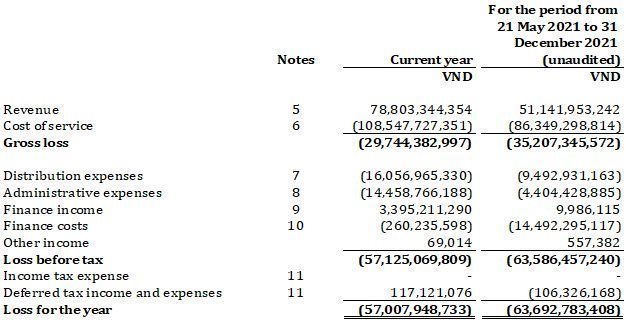
| Preparer
| Chief Accountant | General Director |
| Dang Thi Thu Hong | Dang Thi Thu Hong | Nguyen Van Hoang |
| 5 |
| Table of Contents |
| VINHMS SOFTWARE PRODUCTION AND TRADING JOINT STOCK COMPANY No. 7, Bang Lang 1 Street, Vinhomes Riverside Urban Area, Viet Hung Ward, Long Bien District, Ha Noi City, Vietnam |
STATEMENT OF FINANCIAL POSITION
As at 31 December 2022
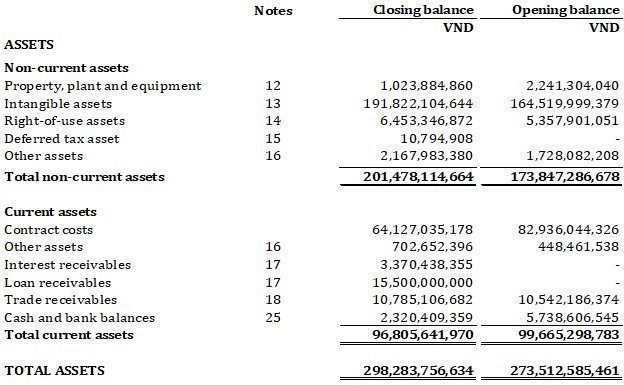
| 6 |
| Table of Contents |
| VINHMS SOFTWARE PRODUCTION AND TRADING JOINT STOCK COMPANY No. 7, Bang Lang 1 Street, Vinhomes Riverside Urban Area, Viet Hung Ward, Long Bien District, Ha Noi City, Vietnam |
STATEMENT OF FINANCIAL POSITION (CONTINUED)
As at 31 December 2022
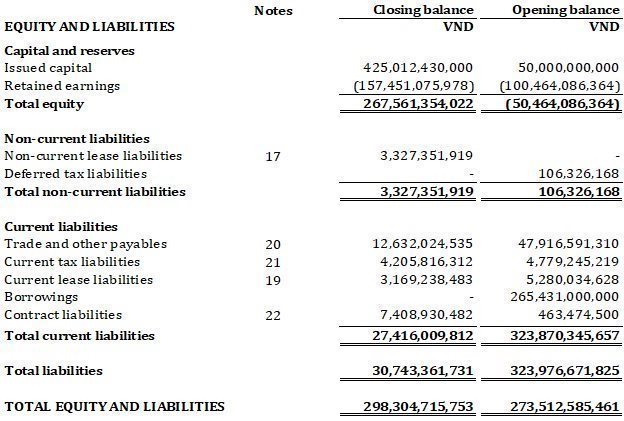
| Preparer | Chief Accountant
| General Director |
|
Dang Thi Thu Hong |
Dang Thi Thu Hong |
Nguyen Van Hoang |
| 7 |
| Table of Contents |
| VINHMS SOFTWARE PRODUCTION AND TRADING JOINT STOCK COMPANY No. 7, Bang Lang 1 Street, Vinhomes Riverside Urban Area, Viet Hung Ward, Long Bien District, Ha Noi City, Vietnam |
STATEMENT OF CHANGES IN EQUITY
For the year ended 31 December 2022
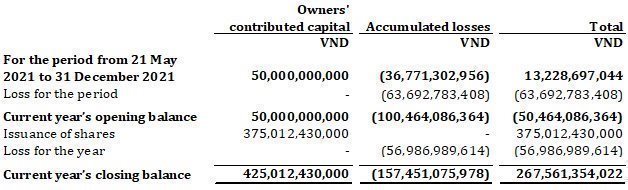
Charter capital
On 22 January 2022, the Shareholders’ General Meeting approved the increase in the Charter of the Company from VND 50,000,000,000 to VND 425,012,430,000 according to the General Meeting Resolution No. 01/2022/NQ-ĐHĐCĐ-VINHMS. The change of capital was approved by Department of Planing and Investment of Ha Noi city according to issuance 5th Enterprise Registration Certificate. The charter capital has been fully contributed by the owner as at 31 December 2022.
Detail of charter capital
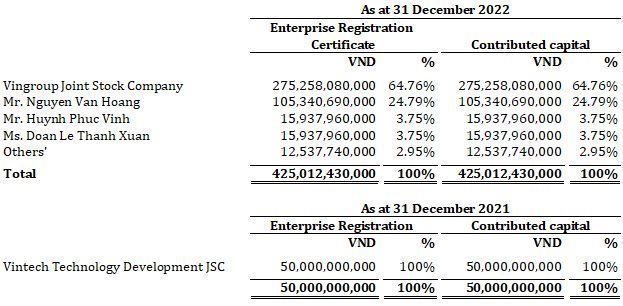
| Preparer
| Chief Accountant | General Director |
|
Dang Thi Thu Hong |
Dang Thi Thu Hong |
Nguyen Van Hoang |
| 8 |
| Table of Contents |
| VINHMS SOFTWARE PRODUCTION AND TRADING JOINT STOCK COMPANY No. 7, Bang Lang 1 Street, Vinhomes Riverside Urban Area, Viet Hung Ward, Long Bien District, Ha Noi City, Vietnam |
For the year ended 31 December 2022
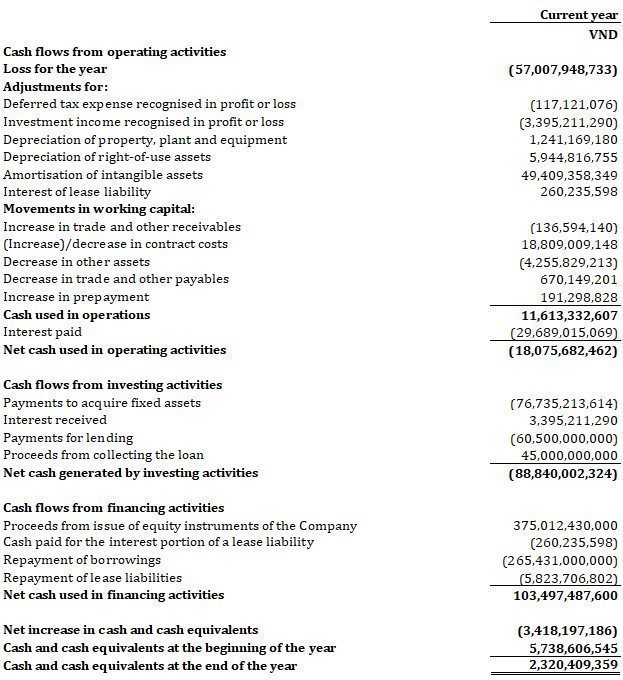
| Preparer
| Chief Accountant | General Director |
|
Dang Thi Thu Hong |
Dang Thi Thu Hong |
Nguyen Van Hoang |
| 9 |
| Table of Contents |
| VINHMS SOFTWARE PRODUCTION AND TRADING JOINT STOCK COMPANY No. 7, Bang Lang 1 Street, Vinhomes Riverside Urban Area, Viet Hung Ward, Long Bien District, Ha Noi City, Vietnam |
| NOTES TO THE FINANCIAL STATEMENTS These accompanying notes are an integral part of and should be read in conjunction with the financial statements |
1. GENERAL INFORMATION
1.1. Structure of ownership
VinHMS Software Production and Trading Joint Stock Company (“the Company”) is incorporated in Vietnam, as a joint stock company under the Enterprise Registration Certificate No. 0315396330 issued by Department of Planning and Investment of Ha Noi City dated 21 November 2018, and the latest amendment dated 18 December 2023. The charter capital of the Company is VND 425,012,430,000.
In accordance with Resolution of the Board of Management No. 02/2021/NQ-HDQT-VINTECH dated 12 May 2021, the parent Company has approved for the plan of transforming ownership form of VinHMS Software Production and Trading Limited Liability Company.
According to the 4th amended ERC issued by the Department of Planning and Investment of Ha Noi City on 21 May 2021, the Company has been transformed its ownership form from a limited liability company to a shareholding company and changed its name to VinHMS Software Production and Trading Joint Stock Company.
The Company’s office is located at No. 7, Bang Lang 1 Street, Vinhomes Riverside Urban Area City, Viet Hung Ward, Long Bien District, Ha Noi City, Vietnam.
Number of employees as at 31 December 2022 was 79 (As at 31 December 2021: 131).
1.2. Principal activities
The principal activities of the Company are software production and rendering of software solutions.
1.3. Financial year
The Company’s financial year begins on 01 January and ends on 31 December.
| 10 |
| Table of Contents |
| VINHMS SOFTWARE PRODUCTION AND TRADING JOINT STOCK COMPANY No. 7, Bang Lang 1 Street, Vinhomes Riverside Urban Area, Viet Hung Ward, Long Bien District, Ha Noi City, Vietnam |
| NOTES TO THE FINANCIAL STATEMENTS (CONTINUED) These accompanying notes are an integral part of and should be read in conjunction with the financial statements |
2. APPLICATION OF NEW AND REVISED INTERNATIONAL FINANCIAL REPORTING STANDARDS (IFRSs)
New and amended IFRSs that are effective for the current year
|
| Amendments to IAS 16 – Property, Plant and Equipment – Proceeds before Intended use |
| The amendments prohibit deducting from the cost of an item of property, plant and equipment any proceeds from selling items produced before that asset is available for use, i.e. proceeds while bringing the asset to the location and condition necessary for it to be capable of operating in the manner intended by management. Consequently, an entity recognises such sales proceeds and related costs in profit or loss. The entity measures the cost of those items in accordance with IAS 2 Inventories.
The amendments also clarify the meaning of ‘testing whether an asset is functioning properly’. IAS 16 now specifies this as assessing whether the technical and physical performance of the asset is such that it is capable of being used in the production or supply of goods or services, for rental to others, or for administrative purposes.
If not presented separately in the statement of comprehensive income, the financial statements shall disclose the amounts of proceeds and cost included in profit or loss that relate to items produced that are not an output of the entity’s ordinary activities, and which line item(s) in the statement of comprehensive income include(s) such proceeds and cost.
The amendments are applied retrospectively, but only to items of property, plant and equipment that are brought to the location and condition necessary for them to be capable of operating in the manner intended by management on or after the beginning of the earliest period presented in the financial statements in which the entity first applies the amendments.
The entity shall recognise the cumulative effect of initially applying the amendments as an adjustment to the opening balance of retained earnings (or other component of equity, as appropriate) at the beginning of that earliest period presented.
The amendments are effective for annual periods beginning on or after 1 January 2022, with early application permitted.
|
| 11 |
| Table of Contents |
| VINHMS SOFTWARE PRODUCTION AND TRADING JOINT STOCK COMPANY No. 7, Bang Lang 1 Street, Vinhomes Riverside Urban Area, Viet Hung Ward, Long Bien District, Ha Noi City, Vietnam |
| NOTES TO THE FINANCIAL STATEMENTS (CONTINUED) These accompanying notes are an integral part of and should be read in conjunction with the financial statements |
2. APPLICATION OF NEW AND REVISED INTERNATIONAL FINANCIAL REPORTING STANDARDS (IFRSs) (CONTINUED)
New and revised IFRSs that are effective for the current year (continued)
|
| Amendments to IAS 37 – Onerous contract – Cost of fulfilling a Contract |
| The amendments specify that the ‘cost of fulfilling’ a contract comprises the ‘costs that relate directly to the contract’. Costs that relate directly to a contract consist of both the incremental costs of fulfilling that contract (examples would be direct labour or materials) and an allocation of other costs that relate directly to fulfilling contracts (an example would be the allocation of the depreciation charge for an item of property, plant and equipment used in fulfilling the contract).
The amendments apply to contracts for which the entity has not yet fulfilled all its obligations at the beginning of the annual reporting period in which the entity fist applies the amendments. Comparatives are not restated. Instead, the entity shall recognise the cumulative effect of initially applying the amendments as an adjustment to the opening balance of retained earnings or other component of equity, as appropriate, at the date of initial application.
The amendments are effective for annual periods beginning on or after 1 January 2022, with early application permitted. |
| 12 |
| Table of Contents |
| VINHMS SOFTWARE PRODUCTION AND TRADING JOINT STOCK COMPANY No. 7, Bang Lang 1 Street, Vinhomes Riverside Urban Area, Viet Hung Ward, Long Bien District, Ha Noi City, Vietnam |
| NOTES TO THE FINANCIAL STATEMENTS (CONTINUED) These accompanying notes are an integral part of and should be read in conjunction with the financial statements |
2. APPLICATION OF NEW AND REVISED INTERNATIONAL FINANCIAL REPORTING STANDARDS (IFRSs) (CONTINUED)
New and revised IFRSs in issue but not yet effective
|
| Amendments to IAS 1 Classification of Liabilities as Current or Non-Current |
| The amendments to IAS 1 affect only the presentation of liabilities as current or non-current in the statement of financial position and not the amount or timing of recognition of any asset, liability, income or expenses, or the information disclosed about those items.
The amendments clarify that the classification of liabilities as current or non-current is based on rights that are in existence at the end of the reporting period, specify that classification is unaffected by expectations about whether an entity will exercise its right to defer settlement of a liability, explain that rights are in existence if covenants are complied with at the end of the reporting period, and introduce a definition of ‘settlement’ to make clear that settlement refers to the transfer to the counterparty of cash, equity instruments, other assets or services.
The amendments are applied retrospectively for annual periods beginning on or after 1 January 2023, with early application permitted.
|
|
| Amendments to IAS 1 Presentation of Financial Statements and IFRS Practice Statement 2 Making Materiality Judgements – Disclosure of Accounting Policies
|
| The amendments change the requirements in IAS 1 with regard to disclosure of accounting policies. The admendments replace all instances of the term ‘’significant accounting policies” with “material accounting policy information’’. Accounting policy information is material if, when considered together with other information included in an entity’s financial statements, it can reasonably be expected to influence decisions that the primary users of general purpose financial statements make on the basis of those financial statements.
The amendments change the requirements in IAS 1 with regard to disclosure of accounting policies. The amendments replace all instances of the term ‘significant accounting policies’ with ‘material accounting policy information’. Accounting policy information is material if, when considered together with other information included in an entity’s financial statements, it can reasonably be expected to inflence decisions that the primary users of general purpose financial statements make on the basis of those financial statements.
The supporting paragraphs in IAS 1 are also amended to clarify that accounting policy information that relates to immaterial transactions, other events or conditions is immaterial and need not be disclosed. Accounting policy information may be material because of the nature of the related transactions, other events or conditions, even if the amounts are immaterial. However, not all accounting policy information relating to material transactions, other events or conditions is itself material. |
| 13 |
| Table of Contents |
| VINHMS SOFTWARE PRODUCTION AND TRADING JOINT STOCK COMPANY No. 7, Bang Lang 1 Street, Vinhomes Riverside Urban Area, Viet Hung Ward, Long Bien District, Ha Noi City, Vietnam |
| NOTES TO THE FINANCIAL STATEMENTS (CONTINUED) These accompanying notes are an integral part of and should be read in conjunction with the financial statements |
2. APPLICATION OF NEW AND REVISED INTERNATIONAL FINANCIAL REPORTING STANDARDS (IFRSs) (CONTINUED)
New and revised IFRSs in issue but not yet effective (continued)
|
| Amendments to IAS 8 Accounting Policies, Changes in Accounting Estimates and Errors—Definition of Accounting Estimates |
| The amendments replace the definition of a change in accounting estimates with a definition of accounting estimates. Under the new definition, accounting estimates are “monetary amounts in financial statements that are subject to measurement uncertainty”. The definition of a change in accounting estimates was deleted. However, the IASB retained the concept of changes in accounting estimates in the Standard with the following clarifications:
|
|
|
|
|
| · | A change in accounting estimate that results from new information or new developments is not the correction of an error. |
|
|
|
|
| · | The effects of a change in an input or a measurement technique used to develop an accounting estimate are changes in accounting estimates if they do not result from the correction of prior period errors. |
|
|
|
| The amendments are effective for annual periods beginning on or after 1 January 2023 to changes in accounting policies and changes in accounting estimates that occur on or after the beginning of that period, with earlier application permitted. |
|
|
|
|
|
|
| Amendments to IAS 12 Income Taxes—Deferred Tax related to Assets and Liabilities arising from a Single Transaction
|
| The amendments introduce a further exception from the initial recognition exemption. Under the amendments, an entity does not apply the initial recognition exemption for transactions that give rise to equal taxable and deductible temporary differences.
Depending on the applicable tax law, equal taxable and deductible temporary differences may arise on initial recognition of an asset and liability in a transaction that is not a business combination and affects neither accounting nor taxable profit. For example, this may arise upon recognition of a lease liability and the corresponding right-of-use asset applying IFRS 16 at the commencement date of a lease.
Following the amendments to IAS 12, an entity is required to recognise the related deferred tax asset and liability, with the recognition of any deferred tax asset being subject to the recoverability criteria in IAS 12.
The amendments are effective for annual reporting periods beginning on or after 1 January 2023, with earlier application permitted. |
The Board of General Directors anticipates that the adoption of those Standards listed above will have no material impact on the financial statements of the Company in future period.
| 14 |
| Table of Contents |
| VINHMS SOFTWARE PRODUCTION AND TRADING JOINT STOCK COMPANY No. 7, Bang Lang 1 Street, Vinhomes Riverside Urban Area, Viet Hung Ward, Long Bien District, Ha Noi City, Vietnam |
| NOTES TO THE FINANCIAL STATEMENTS (CONTINUED) These accompanying notes are an integral part of and should be read in conjunction with the financial statements |
3. SIGNIFICANT ACCOUNTING POLICIES
3.1 Statement of compliance
The financial statements have been prepared in accordance with International Financial Reporting Standards.
3.2 Basis of preparation
The financial statements have been prepared on the historical cost basis except for certain properties and financial instruments that are measured at fair values at the end of each reporting period, as explained in the accounting policies below. Historical cost is generally based on the fair value of the consideration given in exchange for goods and services.
Fair value is the price that would be received to sell an asset or paid to transfer a liability in an orderly transaction between market participants at the measurement date, regardless of whether that price is directly observable or estimated using another valuation technique. In estimating the fair value of an asset or a liability, the Company takes into account the characteristics of the asset or liability if market participants would take those characteristics into account when pricing the asset or liability at the measurement date. Fair value for measurement and/or disclosure purposes in these financial statements is determined on such a basis, except for share-based payment transactions that are within the scope of IFRS 2 Share-based Payment, leasing transactions that are within the scope of IFRS 16 Leases, and measurements that have some similarities to fair value but are not fair value, such as net realizable value in IAS 2 Inventories or value in use in IAS 36 Impairment of Assets.
3.3 Going concern
The General Director has, at the time of approving the financial statements, a reasonable expectation that the Company has adequate resources to continue in operational existence for foreseable future. Thus they continue to adopt the going concern basis of accounting n preparing the financial statements.
3.4 Revenue
Revenue is measured based on the consideration to which the Company expects to be entitled in a contract with a customer and excludes amounts collected on behalf of third parties. The Company recognises revenue when it transfers control of a product or service to a customer.
Revenue recognition
The Company recognises revenue from the following major sources:
|
| · | Sale from production of software |
|
| · | Sale from renderring of software solutions |
Production of software
The Company produces software based on the customers’requests. The software will be produces for specialised business operations of the customers. Such services are recognised as a performance obligation satisfied either over the time or point in time. For over the time, revenue is recognised for the services based on the stage of completion of the contract. For point in time, revenue is recognised when control of the software has transferred to customers.
| 15 |
| Table of Contents |
| VINHMS SOFTWARE PRODUCTION AND TRADING JOINT STOCK COMPANY No. 7, Bang Lang 1 Street, Vinhomes Riverside Urban Area, Viet Hung Ward, Long Bien District, Ha Noi City, Vietnam |
| NOTES TO THE FINANCIAL STATEMENTS (CONTINUED) These accompanying notes are an integral part of and should be read in conjunction with the financial statements |
3. SIGNIFICANT ACCOUNTING POLICIES (CONTINUED)
3.4 Revenue (continued)
Renderring of software solutions
The Company renderred of software solutions by providing license of the software. Such services are recognised as a performance obligation satisfied over the time. Revenue is recognised for the services when the license is transferred to the customers and customers can use the software.
Interest income
Interest income from a financial asset is recognized when it is probable that the economic benefits will flow to the Company and the amount of income can be measured reliably. Interest income is accrued on a time basis, by reference to the principal outstanding and at the effective interest rate applicable, which is the rate that exactly discounts estimated future cash receipts through the expected life of the financial asset to that asset's net carrying amount on initial recognition.
3.5 Leasing
The Company assesses whether a contract is or contains a lease, at inception of the contract. The Company recognises a right-of-use asset and a corresponding lease liability with respect to all lease arrangements in which it is the lessee, except for short-term leases (defined as leases with a lease term of 12 months or less) and leases of low value assets (such as tablets and personal computers, small items of office furniture and telephones). For these leases, the Company recognises the lease payments as an operating expense on a straight-line basis over the term of the lease unless another systematic basis is more representative of the time pattern in which economic benefits from the leased assets are consumed.
The lease liability is initially measured at the present value of the lease payments that are not paid at the commencement date, discounted by using the rate implicit in the lease. If this rate cannot be readily determined, the Company uses average incremental borrowing rate in market.
Lease payments included in the measurement of the lease liability comprise:
|
| · | Fixed lease payments (including in-substance fixed payments), less any lease incentives receivable; |
|
| · | Variable lease payments that depend on an index or rate, initially measured using the index or rate at the commencement date; |
|
| · | The amount expected to be payable by the lessee under residual value guarantees; |
|
| · | The exercise price of purchase options, if the lessee is reasonably certain to exercise the options; and |
|
| · | Payments of penalties for terminating the lease, if the lease term reflects the exercise of an option to terminate the lease. |
The lease liability is presented as a separate line in the statement of financial position.
The lease liability is subsequently measured by increasing the carrying amount to reflect interest on the lease liability (using the effective interest method) and by reducing the carrying amount to reflect the lease payments made.
| 16 |
| Table of Contents |
| VINHMS SOFTWARE PRODUCTION AND TRADING JOINT STOCK COMPANY No. 7, Bang Lang 1 Street, Vinhomes Riverside Urban Area, Viet Hung Ward, Long Bien District, Ha Noi City, Vietnam |
| NOTES TO THE FINANCIAL STATEMENTS (CONTINUED) These accompanying notes are an integral part of and should be read in conjunction with the financial statements |
3. SIGNIFICANT ACCOUNTING POLICIES (CONTINUED)
3.4 Leasing (continued)
The Company remeasures the lease liability (and makes a corresponding adjustment to the related right-of-use asset) whenever:
|
| · | The lease term has changed or there is a significant event or change in circumstances resulting in a change in the assessment of exercise of a purchase option, in which case the lease liability is remeasured by discounting the revised lease payments using a revised discount rate. |
|
| · | The lease payments change due to changes in an index or rate or a change in expected payment under a guaranteed residual value, in which cases the lease liability is remeasured by discounting the revised lease payments using an unchanged discount rate (unless the lease payments change is due to a change in a floating interest rate, in which case a revised discount rate is used). |
|
| · | A lease contract is modified and the lease modification is not accounted for as a separate lease, in which case the lease liability is remeasured based on the lease term of the modified lease by discounting the revised lease payments using a revised discount rate at the effective date of the modification. |
The Company did not make any such adjustments during the periods presented.
The right-of-use assets comprise the initial measurement of the corresponding lease liability, lease payments made at or before the commencement day, less any lease incentives received and any initial direct costs. They are subsequently measured at cost less accumulated depreciation and impairment losses.
Right-of-use assets are depreciated over the shorter period of lease term and useful life of the underlying asset. If a lease transfers ownership of the underlying asset or the cost of the right-of-use asset reflects that the Company expects to exercise a purchase option, the related right-of-use asset is depreciated over the useful life of the underlying asset. The depreciation starts at the commencement date of the lease.
The right-of-use assets are presented as a separate line in the statement of financial position.
The Company applies IAS 36 to determine whether a right-of-use asset is impaired and accounts for any identified impairment loss.
3.6 Foreign currencies
In preparing the financial statements of the individual entities, transactions in currencies other than the Company’s functional currency (VND) are recorded at the rates of exchange prevailing at the dates of the transactions. At end of each reporting period, monetary items denominated in foreign currencies are retranslated at the rates prevailing at the end of the reporting period. Non-monetary items that are measured in terms of historical cost in a foreign currency are not retranslated.
| 17 |
| Table of Contents |
| VINHMS SOFTWARE PRODUCTION AND TRADING JOINT STOCK COMPANY No. 7, Bang Lang 1 Street, Vinhomes Riverside Urban Area, Viet Hung Ward, Long Bien District, Ha Noi City, Vietnam |
| NOTES TO THE FINANCIAL STATEMENTS (CONTINUED) These accompanying notes are an integral part of and should be read in conjunction with the financial statements |
3. SIGNIFICANT ACCOUNTING POLICIES (CONTINUED)
3.7 Taxation
Income tax expense represents the sum of the tax currently payable and deferred tax.
Current tax
The tax currently payable is based on taxable profit for the year. Taxable profit differs from 'profit before tax' as reported in the statement of profit or loss because of items of income or expense that are taxable or deductible in other years and items that are never taxable or deductible. The Company's current tax is calculated using tax rates that have been enacted or substantively enacted by the end of the reporting period.
Current tax are recognized in profit or loss.
Deferred tax
Deferred tax is recognized on temporary differences between the carrying amounts of assets and liabilities in the consolidated financial statements and the corresponding tax bases used in the computation of taxable profit. Deferred tax liabilities are generally recognized for all taxable temporary differences. Deferred tax assets are generally recognized for all deductible temporary differences to the extent that it is probable that taxable profits will be available against which those deductible temporary differences can be utilized. Such deferred tax assets and liabilities are not recognized if the temporary difference arises from the initial recognition (other than in a business combination) of assets and liabilities in a transaction that affects neither the taxable profit nor the accounting profit. In addition, deferred tax liabilities are not recognized if the temporary difference arises from the initial recognition of goodwill.
The carrying amount of deferred tax assets is reviewed at the end of each reporting period and reduced to the extent that it is no longer probable that sufficient taxable profits will be available to allow all or part of the asset to be recovered.
Deferred tax liabilities and assets are measured at the tax rates that are expected to apply in the period in which the liability is settled or the asset realized, based on tax rates (and tax laws) that have been enacted or substantively enacted by the end of the reporting period.
The measurement of deferred tax liabilities and assets reflects the tax consequences that would follow from the manner in which the Company expects, at the end of the reporting period, to recover or settle the carrying amount of its assets and liabilities.
3.8 Property, plant and equipment
Fixtures and equipment are stated at cost less accumulated depreciation and accumulated impairment losses.
Depreciation is recognized so as to write off the cost or valuation of assets (other than freehold land and properties under construction) less their residual values over their useful lives, using the straight--line method. The estimated useful lives and depreciation method are reviewed at the end of each reporting period, with the effect of any changes in estimate accounted for on a prospective basis.
An item of property, plant and equipment is derecognized upon disposal or when no future economic benefits are expected to arise from the continued use of the asset. Any gain or loss arising on the disposal or retirement of an item of property, plant and equipment is determined as the difference between the sales proceeds and the carrying amount of the asset and is recognized in profit or loss.
| 18 |
| Table of Contents |
| VINHMS SOFTWARE PRODUCTION AND TRADING JOINT STOCK COMPANY No. 7, Bang Lang 1 Street, Vinhomes Riverside Urban Area, Viet Hung Ward, Long Bien District, Ha Noi City, Vietnam |
| NOTES TO THE FINANCIAL STATEMENTS (CONTINUED) These accompanying notes are an integral part of and should be read in conjunction with the financial statements |
3. SIGNIFICANT ACCOUNTING POLICIES (CONTINUED)
3.9 Intangible assets
Acquired computer software licenses
Acquired computer software licenses are initially capitalized at cost, which includes the purchase price (net of any discounts and rebates) and other directly attributable cost of preparing the asset for its intended use. Direct expenditure including employee costs, which enhances or extends the performance of computer software beyond its specifications and which can be reliably measured, is added to the original cost of the software. Costs associated with maintaining the computer software are recognized as an expense when incurred.
Computer software licenses are subsequently carried at cost less accumulated amortization and accumulated impairment losses. These costs are amortized to profit or loss using the straight-line method over their estimated useful lives of three years.
Internally-generated intangible assets – research and development expenditure
Expenditure on research activities is recognised as an expense in the period in which it incurred.
An internally-generated intagible asset arising from development (or from the development phase of an internal project) is recognised if, and only if, all of the following conditions have been demonstrated:
|
| · | The technical feasibility of completing the intangible asset so that it will be available for use or sale |
|
| · | The intention to complete the intangible asset and use or sell it |
|
| · | The ability to use or sell the intangible asset |
|
| · | How the intangible asset will generate probable future economic benefits |
|
| · | The availability of adequate technical, financial and other resoures to complete the development and to use or sell the intangible asset |
|
| · | The ability to measure reliably the expenditure attributable to the intangible asset during its development |
The amount initially recognised for internally-generated intangible assets is the sum of expenditure incurred from the date when the intangible asset first meets the recognition criteria listed above. Where no internally-generated intangible asset can be recognised, development expenditure is recognised in profit or loss in the period in which it incurred.
Subsequent to initial recognition, internally-generated intnagible assets are reported at cost less accumulated amortisation and accumulated impairment losses, on the same basis as intangible assets that are acquired seperately.
Derecognition of intangible assets
An intangible asset is derecognized on disposal, or when no future economic benefits are expected from use or disposal. Gains or losses arising from derecognition of an intangible asset, measured as the difference between the net disposal proceeds and the carrying amount of the asset, are recognized in profit or loss when the asset is derecognized.
| 19 |
| Table of Contents |
| VINHMS SOFTWARE PRODUCTION AND TRADING JOINT STOCK COMPANY No. 7, Bang Lang 1 Street, Vinhomes Riverside Urban Area, Viet Hung Ward, Long Bien District, Ha Noi City, Vietnam |
| NOTES TO THE FINANCIAL STATEMENTS (CONTINUED) These accompanying notes are an integral part of and should be read in conjunction with the financial statements |
3. SIGNIFICANT ACCOUNTING POLICIES (CONTINUED)
3.8 Intangible assets (Continued)
Impairment of tangible and intangible assets
At the end of each reporting period, the Company reviews the carrying amounts of its tangible and intangible assets to determine whether there is any indication that those assets have suffered an impairment loss. If any such indication exists, the recoverable amount of the asset is estimated in order to determine the extent of the impairment loss (if any). When it is not possible to estimate the recoverable amount of an individual asset, the Group estimates the recoverable amount of the cash -generating unit to which the asset belongs. When a reasonable and consistent basis of allocation can be identified, corporate assets are also allocated to individual cash-generating units, or otherwise they are allocated to the smallest group of cash-generating units for which a reasonable and consistent allocation basis can be identified.
Recoverable amount is the higher of fair value less costs of disposal and value in use. In assessing value in use, the estimated future cash flows are discounted to their present value using a pre-tax discount rate that reflects current market assessments of the time value of money and the risks specific to the asset for which the estimates of future cash flows have not been adjusted.
If the recoverable amount of an asset (or cash-generating unit) is estimated to be less than its carrying amount, the carrying amount of the asset (or cash-generating unit) is reduced to its recoverable amount. An impairment loss is recognized immediately in profit or loss, unless the relevant asset is carried at a revalued amount, in which case the impairment loss is treated as a revaluation decrease.
When an impairment loss subsequently reverses, the carrying amount of the asset (or a cash- generating unit) is increased to the revised estimate of its recoverable amount, but so that the increased carrying amount does not exceed the carrying amount that would have been determined had no impairment loss been recognized for the asset (or cash-generating unit) in prior years. A reversal of an impairment loss is recognized immediately in profit or loss, unless the relevant asset is carried at a revalued amount, in which case the reversal of the impairment loss is treated as a revaluation increase.
3.10 Provisions
Provisions are recognized when the Company has a present obligation (legal or constructive) as a result of a past event, it is probable that the Company will be required to settle the obligation, and a reliable estimate can be made of the amount of the obligation.
The amount recognized as a provision is the best estimate of the consideration required to settle the present obligation at the end of the reporting period, taking into account the risks and uncertainties surrounding the obligation. When a provision is measured using the cash flows estimated to settle the present obligation, its carrying amount is the present value of those cash flows (when the effect of the time value of money is material).
When some or all of the economic benefits required to settle, a provision are expected to be recovered from a third party, a receivable is recognized as an asset if it is virtually certain that reimbursement will be received and the amount of the receivable can be measured reliably.
| 20 |
| Table of Contents |
| VINHMS SOFTWARE PRODUCTION AND TRADING JOINT STOCK COMPANY No. 7, Bang Lang 1 Street, Vinhomes Riverside Urban Area, Viet Hung Ward, Long Bien District, Ha Noi City, Vietnam |
| NOTES TO THE FINANCIAL STATEMENTS (CONTINUED) These accompanying notes are an integral part of and should be read in conjunction with the financial statements |
3. SIGNIFICANT ACCOUNTING POLICIES (CONTINUED)
3.11 Financial instruments
Financial assets and financial liabilities are recognized when the Company becomes a party to the contractual provisions of the instruments. Financial assets and financial liabilities are initially measured at fair value. Transaction costs directly attributable to the acquisition of financial assets or financial liabilities at fair value through profit or loss are recognized immediately in profit or loss.
3.12 Financial assets
All regular way purchases or sales of financial assets are recognized and derecognized on a trade date basis. Regular way purchases or sales are purchases or sales of financial assets that require delivery of assets within the time frame established by regulation or convention in the marketplace.
All recognised financial assets are measured subsequently in their entirety at either amortised cost or fair value, depending on the classifiation of the financial assets.
Classification of financial assets
Debt instruments that meet the following conditions are measured subsequently at amortised cost:
|
| · | The financial asset is held within a business model whose objective is to hold fiancial assets in order to collect contractual cash flows |
|
| · | The contractual terms of the financial asset give rise on specified dates to cash flows that are solely payments of principal and interest on the principal amount outstanding. |
Debt instruments that meet the following conditions are measured subsequently at fair value through other comprehensive income (FVTOCI):
|
| · | The financial asset is held within a business model whose objective is achieved by both collecting contractual cash flows and selling the financial assets. |
|
| · | The contractual terms of the financial asset give rise on specified dates to cash flows that are solely payments of principal and interest on the principal amount outstanding. |
By default, all other financial assets are measured subsequently at fair value through profit or loss (FVTPL).
Effective interest method
The effective interest method is a method of calculating the amortized cost of a financial asset and of allocating interest income over the relevant period. The effective interest rate is the rate that exactly discounts estimated future cash receipts (including all fees and points paid or received that form an integral part of the effective interest rate, transaction costs and other premiums or discounts) through the expected life of the financial asset, or, where appropriate, a shorter period, to the net carrying amount on initial recognition.
Loans and receivables
Loans and receivables are non-derivative financial assets with fixed or determinable payments that are not quoted in an active market. Loans and receivables (including trade and other receivables, bank balances and cash, and deposits) are measured at amortized cost using the effective interest method, less any impairment.
Interest income is recognized by applying the effective interest rate, except for short-term receivables when the effect of discounting is immaterial.
| 21 |
| Table of Contents |
| VINHMS SOFTWARE PRODUCTION AND TRADING JOINT STOCK COMPANY No. 7, Bang Lang 1 Street, Vinhomes Riverside Urban Area, Viet Hung Ward, Long Bien District, Ha Noi City, Vietnam |
| NOTES TO THE FINANCIAL STATEMENTS (CONTINUED) These accompanying notes are an integral part of and should be read in conjunction with the financial statements |
3. SIGNIFICANT ACCOUNTING POLICIES (CONTINUED)
3.12 Financial assets (Continued)
Impairment of financial assets
The Company recognises a loss allowance for expected credit losses on investments in debt instruments that are measured at amortised cost or at FVTOCI, lease receivables, trade receivables and contract assets, as well as on financial guarantee contracts. The amount of expected credit losses is updated at each reporting date to reflect changes in credit risk since initial recognition of the respective financial instrument.
The Company always recognises lifetime expected credit losses (ECL) for trade receivables, contract assets and lease receivables. The expected credit losses on these financial assets are estimated using a provision matrix based on the Company’s historical credit loss experience, adjusted for factors that are specific to the debtors, general economic conditions and an assessment of both the current as well as the forecast direction of conditions at the reporting
date, including time value of money where appropriate.
For all other financial instruments, the Group recognises lifetime ECL when there has been a significant increase in credit risk since initial recognition. However, if the credit risk on the financial instrument has not increased significantly since initial recognition, the Group measures the loss allowance for that financial instrument at an amount equal to 12-month ECL.
Lifetime ECL represents the expected credit losses that will result from all possible default events over the expected life of a financial instrument. In contrast, 12-month ECL represents the portion of lifetime ECL that is expected to result from default events on a financial instrument that are possible within 12 months after the reporting date.
There is no objective evidence of impairment for trade receivable, because trade receivable is only from related party. There is no past experience of bad collecting payments and no delayed payment.
Derecognition of financial assets
The Company derecognizes a financial asset when the contractual rights to the cash flows from the asset expire, or when it transfers the financial asset and substantially all the risks and rewards of ownership of the asset to another party. If the Company neither transfers nor retains substantially all the risks and rewards of ownership and continues to control the transferred asset, the Company recognizes its retained interest in the asset and an associated liability for amounts it may have to pay. If the Company retains substantially all the risks and rewards of ownership of a transferred financial asset, the Company continues to recognize the financial asset and also recognizes a collateralized borrowing for the proceeds received.
3.13 Financial liabilities and equity instruments
Classification as debt or equity
Debt and equity instruments issued by the Company are classified as either financial liabilities or as equity in accordance with the substance of the contractual arrangements and the definitions of a financial liability and an equity instrument.
| 22 |
| Table of Contents |
| VINHMS SOFTWARE PRODUCTION AND TRADING JOINT STOCK COMPANY No. 7, Bang Lang 1 Street, Vinhomes Riverside Urban Area, Viet Hung Ward, Long Bien District, Ha Noi City, Vietnam |
| NOTES TO THE FINANCIAL STATEMENTS (CONTINUED) These accompanying notes are an integral part of and should be read in conjunction with the financial statements |
3. SIGNIFICANT ACCOUNTING POLICIES (CONTINUED)
3.13 Financial liabilities and equity instruments (continued)
Equity instruments
An equity instrument is any contract that evidences a residual interest in the assets of an entity after deducting all of its liabilities. Equity instruments issued by the Company are recognized at the proceeds received, net of direct issue costs.
Financial liabilities
Financial liabilities are classified 'other financial liabilities'.
Other financial liabilities
Other financial liabilities (including Trade and other payables) are initially measured at fair value, net of transaction costs, and are subsequently measured at amortized cost, using the effective interest method, with interest expense recognized on an effective yield basis.
The effective interest method is a method of calculating the amortized cost of a financial liability and of allocating interest expense over the relevant period. The effective interest rate is the rate that exactly discounts estimated future cash payments (including all fees and points paid or received that form an integral part of the effective interest rate, transaction costs and other premiums or discounts) through the expected life of the financial liability, or (where appropriate) a shorter period, to the net carrying amount on initial recognition.
Derecognition of financial liabilities
The Company derecognizes financial liabilities when, and only when, the Company's obligations are discharged, cancelled or they expire. The difference between the carrying amount of the financial liability derecognized and the consideration paid and payable is recognized in profit or loss.
4. CRITICAL ACCOUNTING JUDGMENTS
In the application of the Company’s accounting policies, which are described in note 3, management is required to make judgments, estimates and assumptions about the carrying amounts of assets and liabilities that are not readily apparent from other sources. The estimates and associated assumptions are based on historical experience and other factors that are considered to be relevant. Actual results may differ from these estimates.
The estimates and underlying assumptions are reviewed on an ongoing basis. Revisions to accounting estimates are recognized in the year in which the estimate is revised if the revision affects only that year, or in the year of the revision and future periods if the revision affects both current and future periods.
| 23 |
| Table of Contents |
| VINHMS SOFTWARE PRODUCTION AND TRADING JOINT STOCK COMPANY No. 7, Bang Lang 1 Street, Vinhomes Riverside Urban Area, Viet Hung Ward, Long Bien District, Ha Noi City, Vietnam |
| NOTES TO THE FINANCIAL STATEMENTS (CONTINUED) These accompanying notes are an integral part of and should be read in conjunction with the financial statements |
5. REVENUE
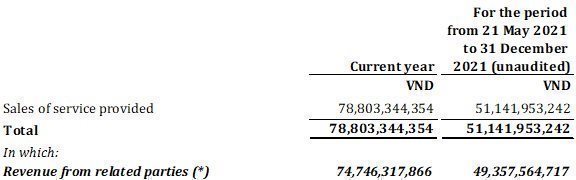
(*) Please refer to Note 24 - “Related party transactions” for more information.
6. COST OF SERVICE
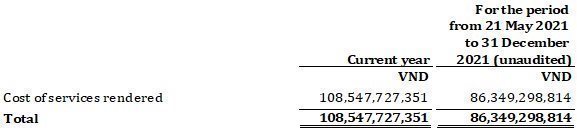
7. DISTRIBUTION EXPENSES
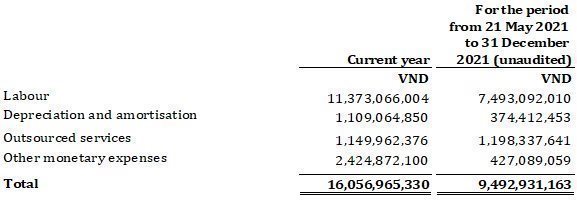
| 24 |
| Table of Contents |
| VINHMS SOFTWARE PRODUCTION AND TRADING JOINT STOCK COMPANY No. 7, Bang Lang 1 Street, Vinhomes Riverside Urban Area, Viet Hung Ward, Long Bien District, Ha Noi City, Vietnam |
| NOTES TO THE FINANCIAL STATEMENTS (CONTINUED) These accompanying notes are an integral part of and should be read in conjunction with the financial statements |
8. ADMINISTRATIVE EXPENSES
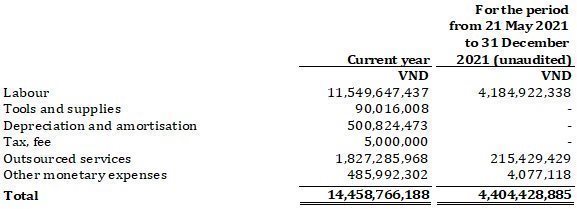
9. FINANCE INCOME
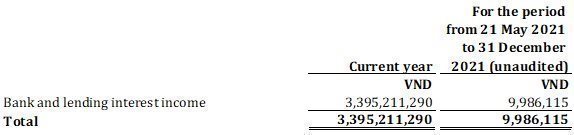
10. FINANCE COST
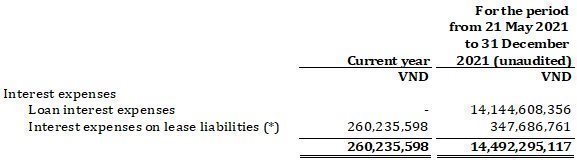
(*) Interest expenses on lease liabilities represent the interest portion of lease liabilities due to the office rental charges in the future. The discount factor rate is 9% per annum. Please refer to Note 14 - “Right-of-use assets” to the financial statements for more information.
| 25 |
| Table of Contents |
| VINHMS SOFTWARE PRODUCTION AND TRADING JOINT STOCK COMPANY No. 7, Bang Lang 1 Street, Vinhomes Riverside Urban Area, Viet Hung Ward, Long Bien District, Ha Noi City, Vietnam |
| NOTES TO THE FINANCIAL STATEMENTS (CONTINUED) These accompanying notes are an integral part of and should be read in conjunction with the financial statements |
11. INCOME TAX EXPENSE
For income from software production activities: The CIT rate is 10% of assessable income for 15 years from the commencement of the Company’s business operations.
For income from other activities: The CIT rate is 20% of assessable income.
The total charge for the year can be reconciled to the accounting profit as follows:
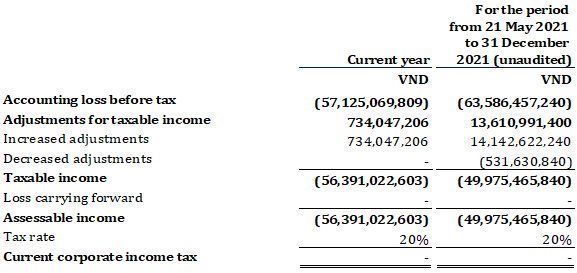
There is no corporate income tax in the year as the Company made loss. As at 31 December 2022, the Company has unused tax losses of VND 127,124,135,534 available for offset against future profits. No deferred tax asset has been recognized due to the uncertainty of additional future profits. Tax loss is fully carried forward for 5 years right after the year making loss.
12. PROPERTY, PLANT AND EQUIPMENT
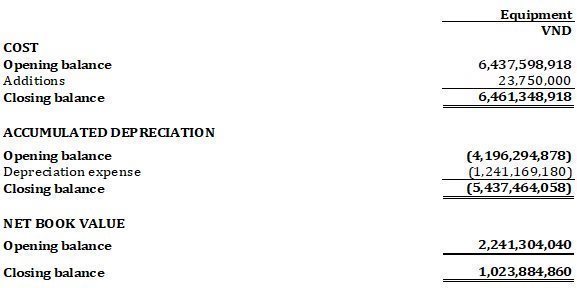
Tangible fixed assets are depreciated using the straight-line method over their estimated useful lives as follows:
| Items | Years |
|
|
|
| Fixtures and equipment | 02 - 05 |
As at year ended, Board of General Directors reviewed and confirmed there are no decline in market value and no physical damage to assets. Therefore, no impairment for PPE is provided.
The cost of the Company’s tangible fixed assets as at 31 December 2022 includes VND 3,695,008,373 which has been fully depreciated but is still in use.
| 26 |
| Table of Contents |
| VINHMS SOFTWARE PRODUCTION AND TRADING JOINT STOCK COMPANY No. 7, Bang Lang 1 Street, Vinhomes Riverside Urban Area, Viet Hung Ward, Long Bien District, Ha Noi City, Vietnam |
| NOTES TO THE FINANCIAL STATEMENTS (CONTINUED) These accompanying notes are an integral part of and should be read in conjunction with the financial statements |
13. INTANGIBLE ASSETS
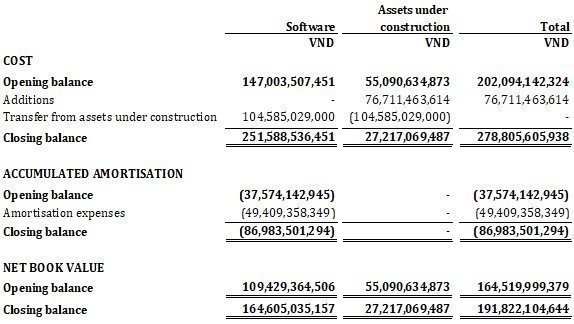
| 27 |
| Table of Contents |
| VINHMS SOFTWARE PRODUCTION AND TRADING JOINT STOCK COMPANY No. 7, Bang Lang 1 Street, Vinhomes Riverside Urban Area, Viet Hung Ward, Long Bien District, Ha Noi City, Vietnam |
| NOTES TO THE FINANCIAL STATEMENTS (CONTINUED) These accompanying notes are an integral part of and should be read in conjunction with the financial statements |
13. INTANGIBLE ASSETS (CONTINUED)
Software is amortized using the straight-line method over their estimated useful lives of 2-4 years.
As at year ended, General Director reviewed and confirmed there is no decline in market value. Therefore, no impairment for software is provided.
14. RIGHT-OF-USE ASSETS
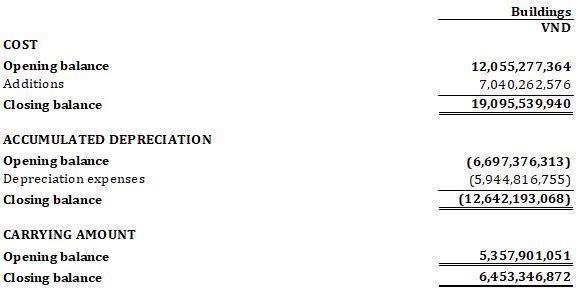
Right-of-use assets represent:
|
| - | Lease contract with The Open House JSC No. ST-VTS-01012/HĐV dated 15 Sep 2020. The lease contract was signed for the period from Sep 2020 to Dec 2022. |
|
| - | Lease contract with MPro Invesment JSC No. 11-12-33/NPS-2022 dated 10 May 2022. The lease contract was signed for the period from 12 May 2022 to 11 May 2024. The rental fee is VND 50,000,000 per month (included VAT). |
|
| - | Lease contract with Work Charming JSC No. KRS01_221201_01_STU dated 21 Nov 2022. The lease contract was signed for the period from 01 Dec 2022 to 31Nov 2024. The rental fee is VND 267,000,000 per month (included VAT). |
The maturity analysis of lease liabilities is presented in note 19 "Lease liabilities".
15. DEFERRED TAX ASSET
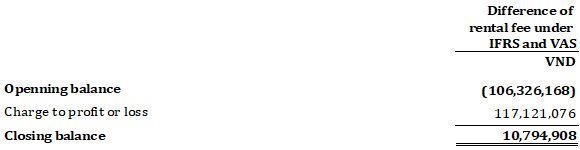
| 28 |
| Table of Contents |
| VINHMS SOFTWARE PRODUCTION AND TRADING JOINT STOCK COMPANY No. 7, Bang Lang 1 Street, Vinhomes Riverside Urban Area, Viet Hung Ward, Long Bien District, Ha Noi City, Vietnam |
| NOTES TO THE FINANCIAL STATEMENTS (CONTINUED) These accompanying notes are an integral part of and should be read in conjunction with the financial statements |
15. DEFERRED TAX ASSET (CONTINUED)
Deferred tax assets and liabilities are offset when there is a legally enforceable right to offset current tax assets against current tax liabilities and when they relate to income taxes levied by the same tax authority and the Company intends to settle its current tax assets and liabilities on a net basis.
The gross fluctuation in the deferred income tax, excluding the offset balances related to the same tax authority during the year, is as follows:

16. OTHER ASSETS
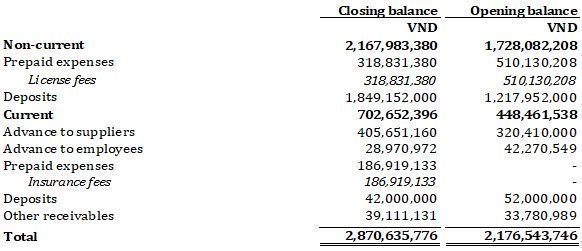
17. INTEREST AND LOAN RECEIVABLES
Interest and loan receivables represent unsecured loan to Vingroup Joint Stock Company - the parent company with the maturity date 17 Jan 2023 and interest of 9% per annum.
18. TRADE RECEIVABLES
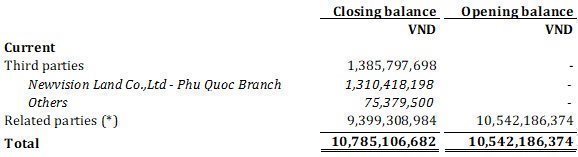
(*) Please refer to Note 24 - “Related party transactions” for more information.
| 29 |
| Table of Contents |
| VINHMS SOFTWARE PRODUCTION AND TRADING JOINT STOCK COMPANY No. 7, Bang Lang 1 Street, Vinhomes Riverside Urban Area, Viet Hung Ward, Long Bien District, Ha Noi City, Vietnam |
| NOTES TO THE FINANCIAL STATEMENTS (CONTINUED) These accompanying notes are an integral part of and should be read in conjunction with the financial statements |
18. TRADE RECEIVABLES (CONTINUED)
Age of receivables not impaired
The average credit period on sales of services is 30 to 90 days. No interest is charged on trade receivables. The Company has recognition policy for an allowance for doubtful debts in accordance with guidance of Vietnam Ministry of Finance that receivables that are overdue for six months or more or when the debtor is in dissolution, in bankruptcy, or is experiencing similar difficulties and so may be unable to repay the debt. No allowances for doubtful debts were recognized for the year as trade receivable is not overdue.
19. LEASE LIABILITIES
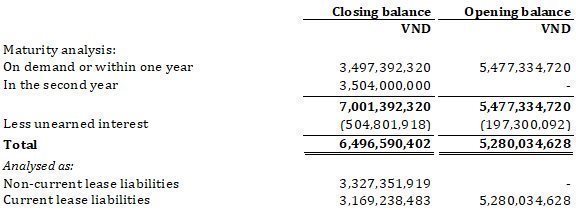
The Company does not face a significant liquidity risk with regard to its lease liabilities. Lease liabilities are monitored within the Company’s treasury function.
20. TRADE AND OTHER PAYABLES
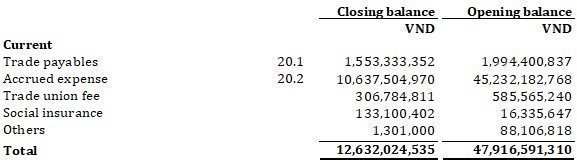
The average credit period on purchases of certain goods or services is 60 days. No interest is charged on the trade payables. The Company has financial risk management policies in place to ensure that all payables are paid within the pre-agreed credit terms.
| 30 |
| Table of Contents |
| VINHMS SOFTWARE PRODUCTION AND TRADING JOINT STOCK COMPANY No. 7, Bang Lang 1 Street, Vinhomes Riverside Urban Area, Viet Hung Ward, Long Bien District, Ha Noi City, Vietnam |
| NOTES TO THE FINANCIAL STATEMENTS (CONTINUED) These accompanying notes are an integral part of and should be read in conjunction with the financial statements |
20.1 TRADE PAYABLES
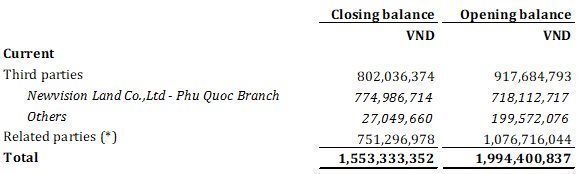
(*) Please refer to Note 24 - “Related party transactions” for more information.
20.2 ACCRUED EXPENSES
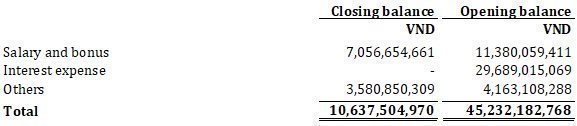
21. CURRENT TAX LIABILITIES
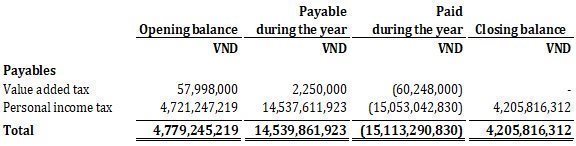
22. CONTRACT LIABILITIES

(*) Please refer to Note 24 - “Related party transactions” for more information
23. FINANCIAL INSTRUMENTS
Capital risk management
The Company manages its capital to ensure that the Company will be able to continue as a going concern while maximizing the return to stakeholders through the optimization of the debt and equity balance. The Company's overall strategy remains unchanged from prior year. The capital structure of the Company consists of net debt (borrowings offset by cash and cash equivalents) and equity attributable to equity holders of the Company (comprising capital and retained earnings).
| 31 |
| Table of Contents |
| VINHMS SOFTWARE PRODUCTION AND TRADING JOINT STOCK COMPANY No. 7, Bang Lang 1 Street, Vinhomes Riverside Urban Area, Viet Hung Ward, Long Bien District, Ha Noi City, Vietnam |
| NOTES TO THE FINANCIAL STATEMENTS (CONTINUED) These accompanying notes are an integral part of and should be read in conjunction with the financial statements |
23. FINANCIAL INSTRUMENTS (CONTINUED)
Categories of financial instruments
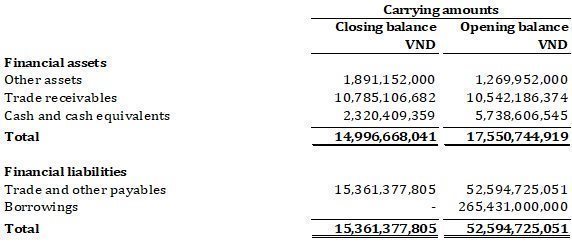
Loans and receivables designated as at FVTPL
At the end of the reporting period, there are no significant concentrations of credit risk for loans and receivables designated at FVTPL. The carrying amount reflected above represents the Company's maximum exposure to credit risk for such loans and receivables.
Financial risk management objectives
These risks include market risk (including currency risk and interest rate risk), credit risk and liquidity risk.
The Company seeks to minimize the effects of these risks by using financial risk structures instructed by the Group. It should be governed by the Group's policies approved by the Board of General Directors, which provide principles on foreign exchange risk, interest rate risk, credit risk and liquidity risk. Compliance with policies and exposure limits is reviewed by the Group’s internal auditors on a continuous basis. The Company does not enter into or trade financial instruments, including derivative financial instruments, for speculative purposes.
Market risk
The Company’s activities expose it primarily to the financial risks of changes in foreign currency exchange rates and interest rates. The Company does not perform protection solution for market risk due to lack of purchasing market of the financial instrument.
Interest rate risk management
The Company has no interest rate risks because the Company has not arranged any loans and borrowings during the year.
Credit risk
Credit risk refers to the risk that counterparty will default on its contractual obligations resulting in financial loss to the Company. The Company has a credit policy in place and the exposure to credit risk is monitored on an ongoing basis. At the balance sheet date there is no significant concentration of credit risk.
| 32 |
| Table of Contents |
| VINHMS SOFTWARE PRODUCTION AND TRADING JOINT STOCK COMPANY No. 7, Bang Lang 1 Street, Vinhomes Riverside Urban Area, Viet Hung Ward, Long Bien District, Ha Noi City, Vietnam |
| NOTES TO THE FINANCIAL STATEMENTS (CONTINUED) These accompanying notes are an integral part of and should be read in conjunction with the financial statements |
23. FINANCIAL INSTRUMENTS (CONTINUED)
Liquidity risk management
The purpose of liquidity risk management is to ensure the availability of funds to meet present and future financial obligations. Liquidity is also managed by ensuring that the excess of maturing liabilities over maturing assets in any year is kept to manageable levels relative to the amount of funds that the Company believes can generate within that period. The Company policy is to regularly monitor current and expected liquidity requirements to ensure that the Company maintains sufficient reserves of cash, borrowings and adequate committed funding from its owner to meet its liquidity requirements in the short and longer term.
The below table illustrates current and future net liquidity risk management as follow:
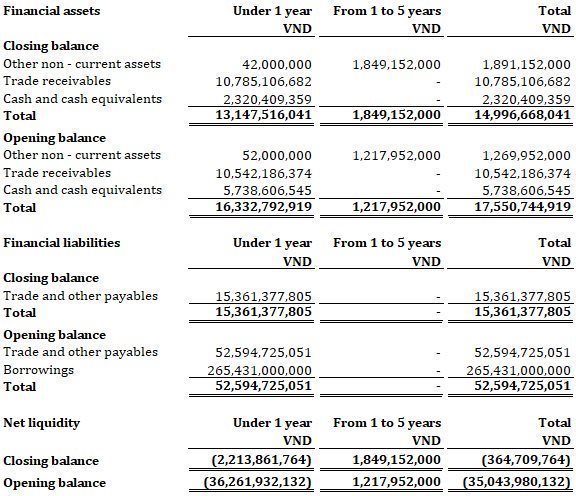
The management assessed the liquidity risk concentration at low level. The Management believes that the Company will be able to generate sufficient funds to meet its financial obligations as and when they fall due.
| 33 |
| Table of Contents |
| VINHMS SOFTWARE PRODUCTION AND TRADING JOINT STOCK COMPANY No. 7, Bang Lang 1 Street, Vinhomes Riverside Urban Area, Viet Hung Ward, Long Bien District, Ha Noi City, Vietnam |
| NOTES TO THE FINANCIAL STATEMENTS (CONTINUED) These accompanying notes are an integral part of and should be read in conjunction with the financial statements |
24. RELATED PARTIES TRANSACTIONS
List of related parties:
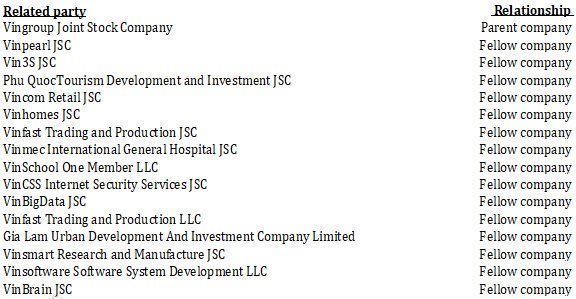
Significant transactions with related parties:
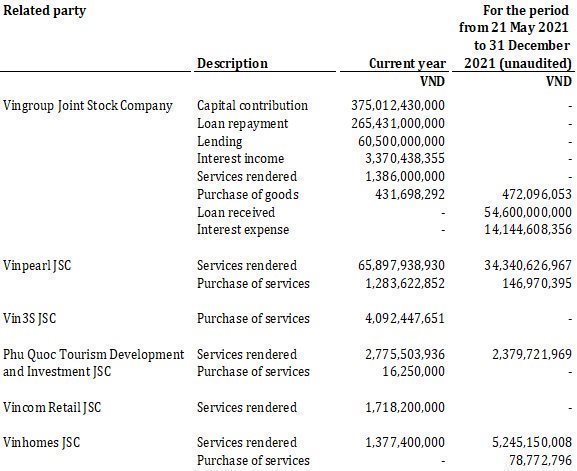
| 34 |
| Table of Contents |
| VINHMS SOFTWARE PRODUCTION AND TRADING JOINT STOCK COMPANY No. 7, Bang Lang 1 Street, Vinhomes Riverside Urban Area, Viet Hung Ward, Long Bien District, Ha Noi City, Vietnam |
| NOTES TO THE FINANCIAL STATEMENTS (CONTINUED) These accompanying notes are an integral part of and should be read in conjunction with the financial statements |
24. RELATED PARTIES TRANSACTIONS (CONTINUED)
Significant transactions with related parties (continued):
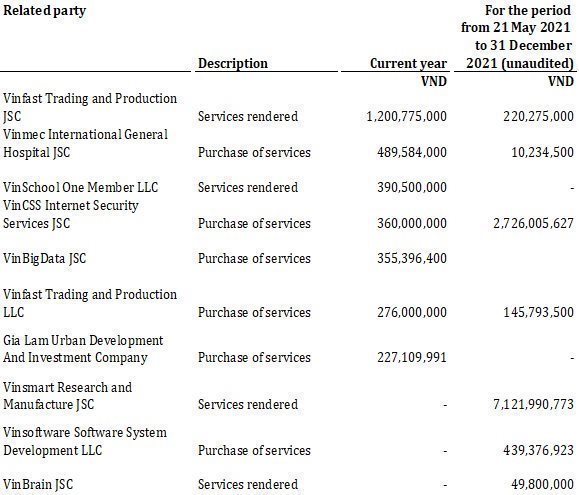
Significant related party balances:
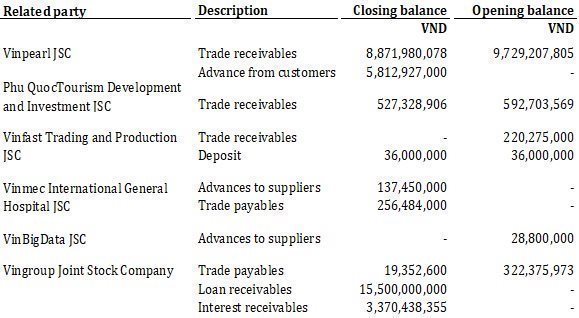
| 35 |
| Table of Contents |
| VINHMS SOFTWARE PRODUCTION AND TRADING JOINT STOCK COMPANY No. 7, Bang Lang 1 Street, Vinhomes Riverside Urban Area, Viet Hung Ward, Long Bien District, Ha Noi City, Vietnam |
| NOTES TO THE FINANCIAL STATEMENTS (CONTINUED) These accompanying notes are an integral part of and should be read in conjunction with the financial statements |
24. RELATED PARTIES TRANSACTIONS (CONTINUED)
Significant related party balances (continued):
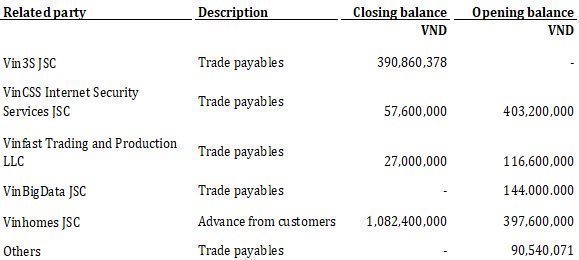
25. CASH AND BANK BALANCES
For the purposes of the statement of financial position and statement of cash flow, cash and cash equivalents include cash on hand and in banks. Cash and cash equivalents at the end of the financial year as shown in the cash flow statement can be reconciled to the related items in the statement of financial position as follows:

| 36 |
| Table of Contents |
| VINHMS SOFTWARE PRODUCTION AND TRADING JOINT STOCK COMPANY No. 7, Bang Lang 1 Street, Vinhomes Riverside Urban Area, Viet Hung Ward, Long Bien District, Ha Noi City, Vietnam |
| NOTES TO THE FINANCIAL STATEMENTS (CONTINUED) These accompanying notes are an integral part of and should be read in conjunction with the financial statements |
26. APPROVAL OF FINANCIAL STATEMENTS
The Company’s financial statements were approved by Mr. Nguyen Van Hoang - General Director and authorized for issue on 12 April 2024.
27. COMPARATIVE FIGURES
Comparative figure represents the Company’s financial statements for the period from 21 May 2021 to 31 December 2021 which were not audited under IFRSs. Hence, they were not comparable.
| Preparer
| Chief Accountant | General Director |
| Dang Thi Thu Hong | Dang Thi Thu Hong | Nguyen Van Hoang |
| 37 |
EXHIBIT 99.3
| VinHMS Pte. Ltd. | Financial Statements |
STATEMENT OF PROFIT AND LOSS
For the period from 1 January 2024 to 31 March 2024
|
|
| From 1 Jan 2024 |
| |
|
|
| to 31 Mar 2024 |
| |
|
|
|
|
| |
| Sales |
| $ | 300,675 |
|
| Cost of Sales |
|
| 45,101 |
|
| Gross Margin |
|
| 255,574 |
|
|
|
|
|
|
|
| Operating Expenses: |
|
|
|
|
| General and Administrative |
|
| 76,405 |
|
| Amortization & Depreciation |
|
| 468,706 |
|
| Total Operating Expenses |
|
| 545,112 |
|
|
|
|
|
|
|
| Loss before Provision for Income Taxes |
|
| (289,538 | ) |
|
|
|
|
|
|
| Provision for Income Taxes |
|
| - |
|
|
|
|
|
|
|
| Net Loss |
| $ | (289,538 | ) |
| - 1 - |
STATEMENT OF FINANCIAL POSITION
As at 31 March 2024
|
|
| Closing Balance |
| |
|
|
|
|
| |
| ASSETS |
|
|
| |
| Current Assets: |
|
|
| |
| Cash |
| $ | 38,323 |
|
| Accounts Receivable, net |
|
| 197,183 |
|
| Other Assets |
|
| 784 |
|
| Total Current Assets |
|
| 236,290 |
|
|
|
|
|
|
|
| Non-Current Assets: |
|
|
|
|
| Intangible Assets, net |
|
| 12,727,174 |
|
| Total Non-Current Assets |
|
| 12,727,174 |
|
|
|
|
|
|
|
| TOTAL ASSETS |
|
| 12,963,464 |
|
|
|
|
|
|
|
| LIABILITIES AND STOCKHOLDERS' EQUITY |
|
|
|
|
| Current Liabilities: |
|
|
|
|
| Accounts Payable |
|
| 46,343 |
|
| Other Current Liabilities |
|
| 4,398,627 |
|
| Total Current Liabilities |
|
| 4,444,970 |
|
|
|
|
|
|
|
| Non-Current Liabilities |
|
|
|
|
| Other Non-Current Liabilities |
|
| 8,797,253 |
|
| Total Non-Current Liabilities |
|
| 8,797,253 |
|
|
|
|
|
|
|
| TOTAL LIABILITIES |
|
| 13,242,223 |
|
|
|
|
|
|
|
| STOCKHOLDERS' EQUITY |
|
|
|
|
| Ordinary Share Capital |
|
| 13,676 |
|
| Accumulated Deficit |
|
| (292,435 | ) |
| Total Stockholders' Equity |
|
| (278,759 | ) |
|
|
|
|
|
|
| TOTAL LIABILITIES AND STOCKHOLDERS' EQUITY |
| $ | 12,963,464 |
|
| - 2 - |
| VinHMS Pte. Ltd. | Financial Statements |
STATEMENT OF CHANGES IN EQUITY
For the period from 1 January 2024 to 31 March 2024
|
|
| Owners' |
|
|
|
|
|
|
| |||
|
|
| Contributed |
|
| Retained |
|
|
|
| |||
|
|
| Capital |
|
| Earnings |
|
| Total |
| |||
| Current period's opening balance |
| $ | 13,676 |
|
| $ | (2,897 | ) |
| $ | 10,779 |
|
|
|
|
|
|
|
|
|
|
|
|
|
|
|
| Unpaid capital |
|
| (13,676 | ) |
|
| - |
|
|
| (13,676 | ) |
| Paid capital |
|
| 13,676 |
|
|
| - |
|
|
| 13,676 |
|
| Loss for the period |
|
|
|
|
|
| (289,538 | ) |
|
| (289,538 | ) |
|
|
|
|
|
|
|
|
|
|
|
|
|
|
| Current period’s closing balance |
| $ | 13,676 |
|
| $ | (292,435 | ) |
| $ | (278,759 | ) |
Charter capital
According to the Company’s Enterprise Registration Certificate, the Company’s charter capital is USD 10,000. The charter capital has been fully contributed by the shareholders as at 31 December 2023.
| - 3 - |
STATEMENT OF CASH FLOWS
For the period from 1 January 2024 to 31 March 2024
|
|
| From 1 Jan 2024 |
| |
|
|
| to 31 Mar 2024 |
| |
|
|
|
|
| |
| Cash Flows from Operating Activities: |
|
|
| |
|
|
|
|
| |
| Loss for the Period |
| $ | (289,538 | ) |
| Adjustments to Reconcile Net Loss to Net Cash Used in Operating Activities: |
|
|
|
|
| Amortization |
|
| 468,706 |
|
|
|
|
|
|
|
| Changes in Assets and Liabilities: |
|
|
|
|
| Accounts Receivable |
|
| (197,183 | ) |
| Other Assets |
|
| (551 | ) |
|
|
|
|
|
|
| Net Cash Provided by (Used in) Operating Activities |
|
| 24,647 |
|
|
|
|
|
|
|
| Cash Flows from Investing Activities: |
|
|
|
|
|
|
|
|
|
|
| Acquisition of CIHMS Software |
|
| (13,195,880 | ) |
| Payment for Unpaid Share Capital |
|
| 13,676 |
|
|
|
|
|
|
|
| Net Cash provided by (used in) Investing Activities |
|
| (13,182,204 | ) |
|
|
|
|
|
|
| Cash Flows from Financing Activities: |
|
|
|
|
|
|
|
|
|
|
| Other Payable |
|
| 13,195,880 |
|
|
|
|
|
|
|
| Net Cash provided by Financing Activities |
|
| 13,195,880 |
|
|
|
|
|
|
|
| Net Increase (Decrease) in Cash |
|
| 38,323 |
|
|
|
|
|
|
|
| Cash, Beginning of the Period |
|
| - |
|
| Cash, End of the Period |
| $ | 38,323 |
|
| - 4 - |
| VinHMS Pte. Ltd. | Financial Statements |
NOTES TO THE FINANCIAL STATEMENTS
These accompanying notes are an integral part of and should be read in conjunction with the financial statements
1. GENERAL INFORMATION
1.1. Structure of ownership
VinHMS Pte. Ltd. (“the Company”) is incorporated in Singapore, as a private company limited under the Enterprise Registration Certificate No. dated 01 November 2023. The charter capital of the Company is USD 10,000.
The Company’s office is located at 8 Burn Road, #05-02, Trivex, Singapore (369977).
1.2. Principal activities
The principal activity of the Company is publishing of software/applications (Non-games) (58202)
1.3. Financial year
The Company’s financial year begins on 01 January and ends on 31 December.
2. APPLICATION OF NEW AND REVISED INTERNATIONAL FINANCIAL REPORTING STANDARDS (IFRSs)
New and amended IFRSs that are effective for the current year
Amendments to IAS 1 Presentation of Financial Statements and IFRS Practice Statement 2 Making Materiality Judgements – Disclosure of Accounting Policies
The Company has adopted the amendments to IAS 1 for the first time in the current year. The amendments change the requirements in IAS 1 with regard to disclosure of accounting policies. The amendments replace all instances of the term ‘’significant accounting policies” with “material accounting policy information’’. Accounting policy information is material if, when considered together with other information included in an entity’s financial statements, it can reasonably be expected to influence decisions that the primary users of general purpose financial statements make on the basis of those financial statements.
The supporting paragraphs in IAS 1 are also amended to clarify that accounting policy information that relates to immaterial transactions, other events or conditions is immaterial and need not be disclosed. Accounting policy information may be material because of the nature of the related transactions, other events or conditions, even if the amounts are immaterial. However, not all accounting policy information relating to material transactions, other events or conditions is itself material.
Amendments to IAS 8 Accounting Policies, Changes in Accounting Estimates and Errors – Definition of Accounting Estimates
The Company has adopted the amendments to IAS 8 for the first time in the current year. The amendments replace the definition of accounting estimates. Under the new definition, accounting estimates are “monetary amounts in financial statements that are subject to measurement uncertainty”. The definition of a change in accounting estimates was deleted.
| - 5 - |
| VinHMS Pte. Ltd. | Financial Statements |
New and revised IFRSs in issue but not yet effective
Amendments to IAS 1 Classification of Liabilities as Current or Non-Current
The amendments to IAS 1 affect only the presentation of liabilities as current or non-current in the statement of financial position and not the amount or timing of recognition of any asset, liability, income or expenses, or the information disclosed about those items.
The amendments clarify that the classification of liabilities as current or non-current is based on rights that are in existence at the end of the reporting period, specify that classification is unaffected by expectations about whether an entity will exercise its right to defer settlement of a liability, explain that rights are in existence if covenants are complied with at the end of the reporting period, and introduce a definition of ‘settlement’ to make clear that settlement refers to the transfer to the counterparty of cash, equity instruments, other assets or services.
The amendments are applied retrospectively for annual periods beginning on or after 1 January 2024, with early application permitted. The IASB has aligned the effective date with the 2022 amendments to IAS 1. If an entity applies the 2020 amendments for an earlier period, it is also required to apply the 2022 amendments early.
The Board of Directors anticipates that the adoption of those Standards listed above will have no material impact on the financial statements of the Company in future period.
3. MATERIAL ACCOUNTING POLICIES
3.1 Statement of compliance
The financial statements have been prepared in accordance with International Financial Reporting Standards.
3.2 Basis of preparation
The financial statements have been prepared on the historical cost basis except for certain properties and financial instruments that are measured at fair values at the end of each reporting period, as explained in the accounting policies below. Historical cost is generally based on the fair value of the consideration given in exchange for goods and services.
Fair value is the price that would be received to sell an asset or paid to transfer a liability in an orderly transaction between market participants at the measurement date, regardless of whether that price is directly observable or estimated using another valuation technique. In estimating the fair value of an asset or a liability, the Company takes into account the characteristics of the asset or liability if market participants would take those characteristics into account when pricing the asset or liability at the measurement date. Fair value for measurement and/or disclosure purposes in these financial statements is determined on such a basis, except for share-based payment transactions that are within the scope of IFRS 2 Share-based Payment, leasing transactions that are within the scope of IFRS 16 Leases, and measurements that have some similarities to fair value but are not fair value, such as net realizable value in IAS 2 Inventories or value in use in IAS 36 Impairment of Assets.
3.3 Going concern
The Board of Directors has, at the time of approving the financial statements, a reasonable expectation that the Company has adequate resources to continue in operational existence for foreseable future. Thus they continue to adopt the going concern basis of accounting n preparing the financial statements.
3.4 Foreign currencies
In preparing the financial statements of the individual entities, transactions in currencies other than the Company’s functional currency (SGD) are recorded at the rates of exchange prevailing at the dates of the transactions. At end of each reporting period, monetary items denominated in foreign currencies are retranslated at the rates prevailing at the end of the reporting period. Non- monetary items that are measured in terms of historical cost in a foreign currency are not retranslated.
| - 6 - |
| VinHMS Pte. Ltd. | Financial Statements |
3.5 Taxation
Income tax expense represents the sum of the tax currently payable and deferred tax.
Current tax
The tax currently payable is based on taxable profit for the year. Taxable profit differs from 'profit before tax' as reported in the statement of profit or loss because of items of income or expense that are taxable or deductible in other years and items that are never taxable or deductible. The Company's current tax is calculated using tax rates that have been enacted or substantively enacted by the end of the reporting
Deferred tax
Deferred tax is recognized on temporary differences between the carrying amounts of assets and liabilities in the consolidated financial statements and the corresponding tax bases used in the computation of taxable profit. Deferred tax liabilities are generally recognized for all taxable temporary differences. Deferred tax assets are generally recognized for all deductible temporary differences to the extent that it is probable that taxable profits will be available against which those deductible temporary differences can be utilized. Such deferred tax assets and liabilities are not recognized if the temporary difference arises from the initial recognition (other than in a business combination) of assets and liabilities in a transaction that affects neither the taxable profit nor the accounting profit. In addition, deferred tax liabilities are not recognized if the temporary difference arises from the initial recognition of goodwill.
The carrying amount of deferred tax assets is reviewed at the end of each reporting period and reduced to the extent that it is no longer probable that sufficient taxable profits will be available to allow all or part of the asset to be recovered.
Deferred tax liabilities and assets are measured at the tax rates that are expected to apply in the period in which the liability is settled or the asset realized, based on tax rates (and tax laws) that have been enacted or substantively enacted by the end of the reporting period.
The measurement of deferred tax liabilities and assets reflects the tax consequences that would follow from the manner in which the Company expects, at the end of the reporting period, to recover or settle the carrying amount of its assets and liabilities.
3.6 Provisions
Provisions are recognized when the Company has a present obligation (legal or constructive) as a result of a past event, it is probable that the Company will be required to settle the obligation, and a reliable estimate can be made of the amount of the obligation.
The amount recognized as a provision is the best estimate of the consideration required to settle the present obligation at the end of the reporting period, taking into account the risks and uncertainties surrounding the obligation. When a provision is measured using the cash flows estimated to settle the present obligation, its carrying amount is the present value of those cash flows (when the effect of the time value of money is material).
When some or all of the economic benefits required to settle, a provision are expected to be recovered from a third party, a receivable is recognized as an asset if it is virtually certain that reimbursement will be received and the amount of the receivable can be measured reliably.
3.7 Financial Instruments
Financial assets and financial liabilities are recognized when the Company becomes a party to the contractual provisions of the instruments. Financial assets and financial liabilities are initially measured at fair value. Transaction costs directly attributable to the acquisition of financial assets or financial liabilities at fair value through profit or loss are recognized immediately in profit or loss.
| - 7 - |
| VinHMS Pte. Ltd. | Financial Statements |
3.8. Financial assets
All regular way purchases or sales of financial assets are recognized and derecognized on a trade date basis. Regular way purchases or sales are purchases or sales of financial assets that require delivery of assets within the time frame established by regulation or convention in the marketplace.
All recognised financial assets are measured subsequently in their entirety at either amortised cost or fair value, depending on the classifiation of the financial assets.
Classification of financial assets
Debt instruments that meet the following conditions are measured subsequently at amortised cost:
|
| · | The financial asset is held within a business model whose objective is to hold fiancial assets in order to collect contractual cash flows |
|
|
|
|
|
| · | The contractual terms of the financial asset give rise on specified dates to cash flows that are solely payments of principal and interest on the principal amount outstanding. |
Debt instruments that meet the following conditions are measured subsequently at fair value through other comprehensive income (FVTOCI):
|
| · | The financial asset is held within a business model whose objective is achieved by both collecting contractual cash flows and selling the financial assets. |
|
|
|
|
|
| · | The contractual terms of the financial asset give rise on specified dates to cash flows that are solely payments of principal and interest on the principal amount outstanding. |
By default, all other financial assets are measured subsequently at fair value through profit or loss (FVTPL).
Effective interest method
The effective interest method is a method of calculating the amortized cost of a financial asset and of allocating interest income over the relevant period. The effective interest rate is the rate that exactly discounts estimated future cash receipts (including all fees and points paid or received that form an integral part of the effective interest rate, transaction costs and other premiums or discounts) through the expected life of the financial asset, or, where appropriate, a shorter period, to the net carrying amount on initial recognition.
Loans and receivables
Loans and receivables are non-derivative financial assets with fixed or determinable payments that are not quoted in an active market. Loans and receivables (including trade and other receivables, bank balances and cash, and deposits) are measured at amortized cost using the effective interest method, less any impairment.
Interest income is recognized by applying the effective interest rate, except for short-term receivables when the effect of discounting is immaterial.
Impairment of financial assets
The Company recognises a loss allowance for expected credit losses on investments in debt instruments that are measured at amortised cost or at FVTOCI, lease receivables, trade receivables and contract assets, as well as on financial guarantee contracts. The amount of expected credit losses is updated at each reporting date to reflect changes in credit risk since initial recognition of the respective financial instrument.
The Company always recognises lifetime expected credit losses (ECL) for trade receivables, contract assets and lease receivables. The expected credit losses on these financial assets are estimated using a provision matrix based on the Company’s historical credit loss experience, adjusted for factors that are specific to the debtors, general economic conditions and an assessment of both the current as well as the forecast direction of conditions at the reporting date, including time value of money where appropriate.
| - 8 - |
| VinHMS Pte. Ltd. | Financial Statements |
For all other financial instruments, the Group recognises lifetime ECL when there has been a significant increase in credit risk since initial recognition. However, if the credit risk on the financial instrument has not increased significantly since initial recognition, the Group measures the loss allowance for that financial instrument at an amount equal to 12-month ECL.
Lifetime ECL represents the expected credit losses that will result from all possible default events over the expected life of a financial instrument. In contrast, 12-month ECL represents the portion of lifetime ECL that is expected to result from default events on a financial instrument that are possible within 12 months after the reporting date.
There is no objective evidence of impairment for trade receivable, because trade receivable is only from related party. There is no past experience of bad collecting payments and no delayed payment.
Derecognition of financial assets
The Company derecognizes a financial asset when the contractual rights to the cash flows from the asset expire, or when it transfers the financial asset and substantially all the risks and rewards of ownership of the asset to another party. If the Company neither transfers nor retains substantially all the risks and rewards of ownership and continues to control the transferred asset, the Company recognizes its retained interest in the asset and an associated liability for amounts it may have to pay. If the Company retains substantially all the risks and rewards of ownership of a transferred financial asset, the Company continues to recognize the financial asset and also recognizes a collateralized borrowing for the proceeds received.
3.9 Financial liabilities and equity instruments
Classification as debt or equity
Debt and equity instruments issued by the Company are classified as either financial liabilities or as equity in accordance with the substance of the contractual arrangements and the definitions of a financial liability and an equity instrument.
Equity instruments
An equity instrument is any contract that evidences a residual interest in the assets of an entity after deducting all of its liabilities. Equity instruments issued by the Company are recognized at the proceeds received, net of direct issue costs.
Financial liabilities
Financial liabilities are classified 'other financial liabilities'.
Other financial liabilities
Other financial liabilities (including Trade and other payables) are initially measured at fair value, net of transaction costs, and are subsequently measured at amortized cost, using the effective interest method, with interest expense recognized on an effective yield basis.
The effective interest method is a method of calculating the amortized cost of a financial liability and of allocating interest expense over the relevant period. The effective interest rate is the rate that exactly discounts estimated future cash payments (including all fees and points paid or received that form an integral part of the effective interest rate, transaction costs and other premiums or discounts) through the expected life of the financial liability, or (where appropriate) a shorter period, to the net carrying amount on initial recognition.
| - 9 - |
| VinHMS Pte. Ltd. | Financial Statements |
Derecognition of financial liabilities
The Company derecognizes financial liabilities when, and only when, the Company's obligations are discharged, cancelled or they expire. The difference between the carrying amount of the financial liability derecognized and the consideration paid and payable is recognized in profit or loss.
4. CRITICAL ACCOUNTING JUDGMENTS
In the application of the Company’s accounting policies, which are described in note 3, management is required to make judgments, estimates and assumptions about the carrying amounts of assets and liabilities that are not readily apparent from other sources. The estimates and associated assumptions are based on historical experience and other factors that are considered to be relevant. Actual results may differ from these estimates.
The estimates and underlying assumptions are reviewed on an ongoing basis. Revisions to accounting estimates are recognized in the year in which the estimate is revised if the revision affects only that year, or in the year of the revision and future periods if the revision affects both current and future periods.
5. OTHER GAINS AND LOSSES
|
|
| From 1 Jan 2024 |
| |
|
|
| to 31 Mar 2024 |
| |
|
|
|
|
| |
| Net foreign exchange loss |
| $ | (1,178 | ) |
| Total |
| $ | (1,178 | ) |
6. ADMINISTRATIVE EXPENSES
|
|
| From 1 Jan 2024 |
| |
|
|
| to 31 Mar 2024 |
| |
|
|
|
|
| |
| Consulting |
| $ | 71,230 |
|
| Office Expenses |
|
| 6,415 |
|
| Total |
| $ | 77,645 |
|
7. INCOME TAX EXPENSE
There is no corporate income tax in the year as the Company made loss.
8. INTANGIBLE ASSETS
|
|
| Closing Balance |
| |
|
|
|
|
| |
| Intangible Asset |
| $ | 13,195,880 |
|
| less Accumulated Amortization |
|
| (468,706 | ) |
| Intangible Asset, net |
| $ | 12,727,174 |
|
9. OTHER ASSETS
|
|
| Closing Balance |
| |
|
|
|
|
| |
| GST |
| $ | 784 |
|
| Total |
| $ | 784 |
|
| - 10 - |
| VinHMS Pte. Ltd. | Financial Statements |
10. TRADE AND OTHER PAYABLES
|
|
| Closing Balance |
| |
|
|
|
|
| |
| Accounts Payable |
| $ | 1,242 |
|
| Other Payable for Intellectual Property |
|
| 13,195,880 |
|
| Total |
| $ | 13,197,122 |
|
The Company has financial risk management policies in place to ensure that all payables are paid within the pre-agreed credit terms.
11. FINANCIAL INSTRUMENTS
Capital risk management
The Company manages its capital to ensure that the Company will be able to continue as a going concern while maximizing the return to stakeholders through the optimization of the debt and equity balance. The capital structure of the Company consists of net debt (borrowings offset by cash and cash equivalents) and equity attributable to equity holders of the Company (comprising capital and retained earnings).
Categories of financial instruments
|
|
| Carrying Amounts |
| |
|
|
| Closing Balance |
| |
| Financial Assets |
|
|
| |
| Accounts Receivable |
| $ | 120,362 |
|
| Intangible Assets |
|
| 13,195,880 |
|
| Total |
| $ | 13,316,242 |
|
|
|
|
|
|
|
| Financial Liabilities |
|
|
|
|
| Trade & Other Payables |
| $ | 13,197,122 |
|
| Total |
| $ | 13,197,122 |
|
Loans and receivables designated as at FVTPL
At the end of the reporting period, there are no significant concentrations of credit risk for loans and receivables designated at FVTPL. The carrying amount reflected above represents the Company's maximum exposure to credit risk for such loans and receivables.
Financial risk management objectives
These risks include market risk (including currency risk and interest rate risk), credit risk and liquidity risk.
The Company seeks to minimize the effects of these risks by using financial risk structures instructed by the Group. It should be governed by the Group's policies approved by the Board of General Directors, which provide principles on foreign exchange risk, interest rate risk, credit risk and liquidity risk. Compliance with policies and exposure limits is reviewed by the Group’s internal auditors on a continuous basis. The Company does not enter into or trade financial instruments, including derivative financial instruments, for speculative purposes.
Market risk
The Company’s activities expose it primarily to the financial risks of changes in foreign currency exchange rates and interest rates. The Company does not perform protection solution for market risk due to lack of purchasing market of the financial instrument.
| - 11 - |
| VinHMS Pte. Ltd. | Financial Statements |
Interest rate risk management
The Company has no interest rate risks because the Company has not arranged any loans and borrowings during the year.
Credit risk
Credit risk refers to the risk that counterparty will default on its contractual obligations resulting in financial loss to the Company. The Company has a credit policy in place and the exposure to credit risk is monitored on an ongoing basis. At the balance sheet date there is no significant concentration of credit risk.
Liquidity risk management
The purpose of liquidity risk management is to ensure the availability of funds to meet present and future financial obligations. Liquidity is also managed by ensuring that the excess of maturing liabilities over maturing assets in any year is kept to manageable levels relative to the amount of funds that the Company believes can generate within that period. The Company policy is to regularly monitor current and expected liquidity requirements to ensure that the Company maintains sufficient reserves of cash, borrowings and adequate committed funding from its owner to meet its liquidity requirements in the short and longer term.
The below table illustrates current and future net liquidity risk management as follow:
| Financial Assets |
| Under 1 Year |
|
| 1 to 5 Years |
|
| Total |
| |||
|
|
|
|
|
|
|
|
|
|
| |||
| Closing Balance |
|
|
|
|
|
|
|
|
| |||
| Accounts Receivable |
| $ | 120,362 |
|
| $ | - |
|
| $ | 120,362 |
|
| Intangible Assets |
|
| - |
|
|
| 13,195,880 |
|
|
| 13,195,880 |
|
| Total |
| $ | 120,362 |
|
| $ | 13,195,880 |
|
| $ | 13,316,242 |
|
|
|
|
|
|
|
|
|
|
|
|
|
|
|
| Financial Liabilities |
|
|
|
|
|
|
|
|
|
|
|
|
|
|
|
|
|
|
|
|
|
|
|
|
|
|
| Closing Balance |
|
|
|
|
|
|
|
|
|
|
|
|
| Trade & Other Payables |
| $ | 4,399,869 |
|
| $ | 8,797,253 |
|
| $ | 13,197,122 |
|
| Total |
| $ | 4,399,869 |
|
| $ | 8,797,253 |
|
| $ | 13,197,122 |
|
|
|
|
|
|
|
|
|
|
|
|
|
|
|
| Net Liquidity |
|
|
|
|
|
|
|
|
|
|
|
|
|
|
|
|
|
|
|
|
|
|
|
|
|
|
| Closing Balance |
| $ | (4,279,507 | ) |
| $ | 4,398,627 |
|
| $ | 119,120 |
|
The management assessed the liquidity risk concentration at low level. The Management believes that the Company will be able to generate sufficient funds to meet its financial obligations as and when they fall due.
12. APPROVAL OF FINANCIAL STATEMENTS
The Company’s financial statements were approved by Mr. Nguyen Van Hoang - Director and authorized for issue on 31 May 2024.
13. COMPARATIVE FIGURES
These financial statements cover the period from 1 January 2024 to 31 March 2024. This is the first year of financial statements; hence, no comparative figures are presented.
| - 12 - |
EXHIBIT 99.4
UNAUDITED PRO FORMA COMBINED CONDENSED FINANCIAL INFORMATION
Basis of Presentation and Principles of Consolidation
On January 1, 2024, VinHMS Pte. Ltd. acquired all the intellectual property and hotel management software of VinHMS Software Production and Trading Joint Stock Company (“VinHMS IP Transaction”). The VinHMS IP Transaction enabled Vemanti to acquire a next-generation cloud-based hotel management system with the goal of expanding throughout Southeast Asia. On April 1, 2024, Vemanti Group Inc. (“Vemanti” or “Company”) acquired VinHMS Pte. Ltd., a Singapore company (“Merger”).
For the purposes of the proforma combined financial statements, periods before January 1, 2024 reflect the financial position, results of operations and cash flows of the Company and its consolidated subsidiaries prior to the VinHMS IP Transaction, referred to herein as the Predecessor, and periods beginning on or after January 1, 2024 reflect the financial position, results of operations and cash flows of the Company and its consolidated subsidiaries as a result of the VinHMS IP Transaction, referred to herein as the Successor. As a result of the VinHMS IP Transaction, the results of operations and financial position of the Predecessor and Successor are not directly comparable.
Business Combination
The following unaudited pro forma combined condensed consolidated financial statements are based on the separate historical financial statements of Vemanti Group Inc. (“Vemanti” or “Company”) and VinHMS Pte Ltd. (“VinHMS”) and give effect to the Merger, including pro forma assumptions and adjustments related to the Merger, as described in the accompanying notes to the unaudited pro forma combined condensed financial statements.
The Unaudited Pro Forma Condensed Combined Balance Sheet as of March 31, 2024, is presented as if the Merger had occurred on January 1, 2024. The Unaudited Pro Forma Condensed Combined Statement of Operations for the year ended December 31, 2023 and for the three months ended March 31, 2024 gives effect to the Merger, as if it had been completed on January 1, 2023 and 2024, respectively. The historical financial information has been adjusted on a pro forma basis to reflect factually supportable items that are directly attributable to the Merger and, with respect to the Condensed Combined Statement of Operations only, expected to have a continuing impact on consolidated results of operations.
The Company allocates the purchase price of the acquisition to the tangible assets, liabilities and identifiable intangible assets acquired based on their estimated fair values. The excess of the purchase price over those fair values is recorded as goodwill. Acquisition related expenses and integration costs are expensed as incurred.
The Unaudited Pro Forma Condensed Combined Statement of Operations does not include the effects of the costs associated with any integration or restructuring activities resulting from the Merger, as they are nonrecurring in nature. However, the Unaudited Pro Forma Condensed Condensed Consolidated Balance Sheet includes a pro forma adjustment to reduce cash and stockholders’ equity to reflect the payment of certain anticipated Merger costs.
The following unaudited pro forma condensed combined financial information presents the combination of the financial information of Vemant and VinHMS, adjusted to give effect to the Merger and other events contemplated by the Merger Agreement.
Management has made significant estimates and assumptions in its determination of the pro forma adjustments. As the unaudited pro forma condensed combined financial information has been prepared based on these preliminary estimates, the final amounts recorded may differ materially from the information presented.
The pro forma adjustments reflecting the consummation of the Business Combination are based on certain currently available information and certain assumptions and methodologies that Vemanti believes are reasonable under the circumstances. The unaudited condensed combined pro forma adjustments, which are described in the accompanying notes, may be revised as additional information becomes available and is evaluated. Therefore, it is likely that the actual adjustments will differ from the pro forma adjustments, and it is possible the difference may be material. Vemanti believes that its assumptions and methodologies provide a reasonable basis for presenting all the significant effects of the Business Combination based on information available to management at this time and that the pro forma adjustments give appropriate effect to those assumptions and are properly applied in the unaudited pro forma condensed combined financial information.
The unaudited pro forma condensed combined financial information is not necessarily indicative of what the actual results of operations and financial position would have been had the Business Combination taken place on the dates indicated, nor are they indicative of the future consolidated results of operations or financial position of the Combined Company. The unaudited pro forma condensed combined financial information should be read in conjunction with the historical financial statements and notes thereto of Vemanti and VinHMS.
Vemanti Group Inc. and VinHMS Pte Ltd.
Unaudited Pro Forma Condensed Combined Balance Sheet
at March 31, 2024
|
|
| Vemanti |
|
| VinHMS |
|
| Proforma |
|
| Combined |
| ||||
|
|
| Group Inc. |
|
| Pte. Ltd. |
|
| Adjustments |
|
| Pro Forma |
| ||||
|
|
| Mar 31, 2024 |
|
| Mar 31, 2024 |
|
| (see Notes) |
|
| Mar 31, 2024 |
| ||||
|
|
|
|
|
|
|
|
|
|
|
|
|
| ||||
| ASSETS |
|
|
|
|
|
|
|
|
|
|
|
| ||||
| Current Assets: |
|
|
|
|
|
|
|
|
|
|
|
| ||||
| Cash |
| $ | 57,115 |
|
| $ | 28,406 |
|
| $ | - |
|
| $ | 85,521 |
|
| Prepaid Expenses |
|
| - |
|
|
| - |
|
|
| - |
|
|
| - |
|
| Accounts Receivable, net |
|
| - |
|
|
| 146,158 |
|
|
| - |
|
|
| 146,158 |
|
| Other Assets |
|
| - |
|
|
| 581 |
|
|
| - |
|
|
| 581 |
|
| Assets from discontinued operations |
|
| 97,138 |
|
|
| - |
|
|
| - |
|
|
| 97,138 |
|
| Total Current Assets |
|
| 154,253 |
|
|
| 175,146 |
|
|
| - |
|
|
| 329,399 |
|
|
|
|
|
|
|
|
|
|
|
|
|
|
|
|
|
|
|
| Non-Current Assets: |
|
|
|
|
|
|
|
|
|
|
|
|
|
|
|
|
| Equipment, net |
|
| - |
|
|
| - |
|
|
| - |
|
|
| - |
|
| Intangible Assets, net |
|
| - |
|
|
| 9,433,750 |
|
|
| - |
|
|
| 9,433,750 |
|
| Goodwill |
|
| - |
|
|
| - |
|
|
| 20,206,624 | b |
|
| 20,206,624 |
|
| Investments |
|
| - |
|
|
| - |
|
|
| - |
|
|
| - |
|
| Other Assets |
|
| - |
|
|
| - |
|
|
| - |
|
|
| - |
|
| Total Non-Current Assets |
|
| - |
|
|
| 9,433,750 |
|
|
| 20,206,624 |
|
|
| 29,640,374 |
|
|
|
|
|
|
|
|
|
|
|
|
|
|
|
|
|
|
|
| TOTAL ASSETS |
| $ | 154,253 |
|
| $ | 9,608,896 |
|
| $ | 20,206,624 |
|
| $ | 29,969,773 |
|
|
|
|
|
|
|
|
|
|
|
|
|
|
|
|
|
|
|
| LIABILITIES AND STOCKHOLDERS' EQUITY |
|
|
|
|
|
|
|
|
|
|
|
|
|
|
|
|
| Current Liabilities: |
|
|
|
|
|
|
|
|
|
|
|
|
|
|
|
|
| Accounts Payable |
| $ | 25,760 |
|
| $ | 34,351 |
|
| $ | - |
|
| $ | 60,111 |
|
| Accrued Interest Payable |
|
| 16,391 |
|
|
| - |
|
|
| - |
|
|
| 16,391 |
|
| Accrued Expenses |
|
| - |
|
|
| - |
|
|
| - |
|
|
| - |
|
| Note Payable |
|
| 161,458 |
|
|
| - |
|
|
| - |
|
|
| 161,458 |
|
| Loan from Stockholder |
|
| 125,000 |
|
|
| - |
|
|
| - |
|
|
| 125,000 |
|
| Other Current Liabilities |
|
| - |
|
|
| 3,260,390 |
|
|
| - |
|
|
| 3,260,390 |
|
| Liabilities from Discontinued Operations |
|
| 5,958 |
|
|
| - |
|
|
| - |
|
|
| 5,958 |
|
| Total Current Liabilities |
|
| 334,567 |
|
|
| 3,294,741 |
|
|
| - |
|
|
| 3,629,308 |
|
|
|
|
|
|
|
|
|
|
|
|
|
|
|
|
|
|
|
| Non-Current Liabilities |
|
|
|
|
|
|
|
|
|
|
|
|
|
|
|
|
| Other Non-Current Liabilities |
|
| - |
|
|
| 6,520,779 |
|
|
| - |
|
|
| 6,520,779 |
|
| Total Non-Current Liabilities |
|
| - |
|
|
| 6,520,779 |
|
|
| - |
|
|
| 6,520,779 |
|
|
|
|
|
|
|
|
|
|
|
|
|
|
|
|
|
|
|
| TOTAL LIABILITIES |
|
| 334,567 |
|
|
| 9,815,520 |
|
|
| - |
|
|
| 10,150,087 |
|
|
|
|
|
|
|
|
|
|
|
|
|
|
|
|
|
|
|
| STOCKHOLDERS' EQUITY |
|
|
|
|
|
|
|
|
|
|
|
|
|
|
|
|
| Preferred Stock A, $0.0001 par value, 50,000,000 shares authorized; 40,000,000 shares issued and outstanding. |
|
| 4,000 |
|
|
| - |
|
|
| - |
|
|
| 4,000 |
|
| Preferred Stock B, $0.0001 par value, 10,000,000 shares authorized; 10,000,000 shares issued and outstanding. |
|
| - |
|
|
| - |
|
|
| 20,000,000 | b |
|
| 20,000,000 |
|
| Common Stock, $0.0001 par value, 500,000,000 shares authorized; 72,465,503 shares issued and outstanding. |
|
| 7,247 |
|
|
| 10,137 |
|
|
| (10,137 | )a |
|
| 7,247 |
|
| Stock Payable |
|
| 89,245 |
|
|
| - |
|
|
| - |
|
|
| 89,245 |
|
| Additional Paid-in-Capital |
|
| 5,637,569 |
|
|
| - |
|
|
| - |
|
|
| 5,637,569 |
|
| Accumulated Deficit |
|
| (5,918,375 | ) |
|
| (216,761 | ) |
|
| 216,761 | a |
|
| (5,918,375 | ) |
| Total Stockholders' Equity |
|
| (180,314 | ) |
|
| (206,624 | ) |
|
| 20,206,624 |
|
|
| 19,819,686 |
|
|
|
|
|
|
|
|
|
|
|
|
|
|
|
|
|
|
|
| TOTAL LIABILITIES AND STOCKHOLDERS' EQUITY |
| $ | 154,253 |
|
| $ | 9,608,896 |
|
| $ | 20,206,624 |
|
| $ | 29,969,773 |
|
Adjustments to Unaudited Pro Forma Condensed Combined Balance Sheet
The unaudited pro forma combined balance sheet reflects the effect of the following pro forma adjustments:
a) Elimination of assets and liabilities associated with the acquired business.
b) Estimated Fair Value of common shares issued in the merger.
| 2 |
Vemanti Group Inc. and VinHMS Pte Ltd.
Unaudited Pro Forma Condensed Combined Statement of Operations
For the three months ended March 31, 2024
|
|
| Vemanti |
|
| VinHMS |
|
| Proforma |
|
| Combined |
| ||||
|
|
| Group Inc. |
|
| Pte. Ltd. |
|
| Adjustments |
|
| Pro Forma |
| ||||
|
|
| Mar 31, 2024 |
|
| Mar 31, 2024 |
|
| (see Notes) |
|
| Mar 31, 2024 |
| ||||
|
|
|
|
|
|
|
|
|
|
|
|
|
| ||||
| Sales |
| $ | - |
|
| $ | 222,869 |
|
| $ | - |
|
| $ | 222,869 |
|
| Cost of Sales |
|
| - |
|
|
| 33,430 |
|
|
| - |
|
|
| 33,430 |
|
| Gross Margin |
|
| - |
|
|
| 189,439 |
|
|
| - |
|
|
| 189,439 |
|
|
|
|
|
|
|
|
|
|
|
|
|
|
|
|
|
|
|
| Operating Expenses: |
|
|
|
|
|
|
|
|
|
|
|
|
|
|
|
|
| General and Administrative |
|
| 100,977 |
|
|
| 56,634 |
|
|
| - |
|
|
| 157,611 |
|
| Amortization & Depreciation |
|
| - |
|
|
| 347,418 |
|
|
| - |
|
|
| 347,418 |
|
| Total Operating Expenses |
|
| 100,977 |
|
|
| 404,053 |
|
|
| - |
|
|
| 505,030 |
|
|
|
|
|
|
|
|
|
|
|
|
|
|
|
|
|
|
|
| Loss from Operations |
|
| (100,977 | ) |
|
| (214,614 | ) |
|
| - |
|
|
| (315,591 | ) |
|
|
|
|
|
|
|
|
|
|
|
|
|
|
|
|
|
|
| Other Income (Expense): |
|
|
|
|
|
|
|
|
|
|
|
|
|
|
|
|
| Other Income (Expense) |
|
| 691 |
|
|
| - |
|
|
| - |
|
|
| 691 |
|
| Interest Income (Expense) |
|
| (7,144 | ) |
|
| - |
|
|
| - |
|
|
| (7,144 | ) |
| Total Other Expense |
|
| (6,453 | ) |
|
| - |
|
|
| - |
|
|
| (6,453 | ) |
|
|
|
|
|
|
|
|
|
|
|
|
|
|
|
|
|
|
| Loss before Provision for Income Taxes |
|
| (107,430 | ) |
|
| (214,614 | ) |
|
| - |
|
|
| (322,044 | ) |
|
|
|
|
|
|
|
|
|
|
|
|
|
|
|
|
|
|
| Provision for Income Taxes |
|
| - |
|
|
| - |
|
|
| - |
|
|
| - |
|
|
|
|
|
|
|
|
|
|
|
|
|
|
|
|
|
|
|
| Net Loss from Continuing Operations |
|
| (107,430 | ) |
|
| (214,614 | ) |
|
| - |
|
|
| (322,044 | ) |
|
|
|
|
|
|
|
|
|
|
|
|
|
|
|
|
|
|
| Net Profit from Discontinued Operations before Income Taxes |
|
| 10,241 |
|
|
| - |
|
|
| - |
|
|
| 10,241 |
|
| Provision for Income Taxes from Discontinued Operations |
|
| - |
|
|
| - |
|
|
| - |
|
|
| - |
|
| Net Profit from Discontinued Operations |
|
| 10,241 |
|
|
| - |
|
|
| - |
|
|
| 10,241 |
|
|
|
|
|
|
|
|
|
|
|
|
|
|
|
|
|
|
|
| Net Loss |
| $ | (97,189 | ) |
| $ | (214,614 | ) |
| $ | - |
|
| $ | (311,803 | ) |
|
|
|
|
|
|
|
|
|
|
|
|
|
|
|
|
|
|
| Earnings (Loss) per Share (Basic and Diluted): |
|
|
|
|
|
|
|
|
|
|
|
|
|
|
|
|
| Loss per Share from Continuing Operations |
|
|
|
|
|
|
|
|
|
|
|
|
| $ | (0.00 | ) |
| Earnings per Share from Discontinued Operations |
|
|
|
|
|
|
|
|
|
|
|
|
| $ | 0.00 |
|
| Loss per Share, Total |
|
|
|
|
|
|
|
|
|
|
|
|
| $ | (0.00 | ) |
|
|
|
|
|
|
|
|
|
|
|
|
|
|
|
|
|
|
| Weighted Average Shares Outstanding (Basic and Diluted) |
|
|
|
|
|
|
|
|
|
|
|
|
|
| 72,445,723 |
|
Adjustments to Unaudited Pro Forma Condensed Combined Statements of Operations
The were no material pro forma adjustments included in the Unaudited Pro Forma Condensed Combined Statement of Operations for the three months ended March 31, 2024.
| 3 |
Vemanti Group Inc. and VinHMS Software Production and Trading Joint Stock Company (“VinHMS JSC”).
Unaudited Pro Forma Condensed Combined Statement of Operations
For the year ended December 31, 2023
|
|
| Vemanti |
|
| VinHMS |
|
| Pro Forma |
|
| Combined |
| ||||
|
|
| Group Inc. |
|
| JSC |
|
| Adjustments |
|
| Pro Forma |
| ||||
|
|
| Dec 31, 2023 |
|
| Dec 31, 2023 |
|
| (see Notes) |
|
| Dec 31, 2023 |
| ||||
|
|
|
|
|
|
|
|
|
|
|
|
|
| ||||
| Sales |
| $ | 123,056 |
|
| $ | 2,533,382 |
|
| $ | - |
|
| $ | 2,656,438 |
|
| Cost of Sales |
|
| 22,883 |
|
|
| 5,708,750 |
|
|
| - |
|
|
| 5,731,633 |
|
| Gross Margin |
|
| 100,173 |
|
|
| (3,175,368 | ) |
|
| - |
|
|
| (3,075,195 | ) |
|
|
|
|
|
|
|
|
|
|
|
|
|
|
|
|
|
|
| Operating Expenses: |
|
|
|
|
|
|
|
|
|
|
|
|
|
|
|
|
| General and Administrative |
|
| 1,264,794 |
|
|
| 1,163,719 |
|
|
| - |
|
|
| 2,428,513 |
|
| Amortization & Depreciation |
|
| 32,156 |
|
|
| 89,977 |
|
|
| - |
|
|
| 122,133 |
|
| Impairment of intangible assets |
|
| 273,313 |
|
|
| - |
|
|
| - |
|
|
| 273,313 |
|
| Total Operating Expenses |
|
| 1,570,263 |
|
|
| 1,253,696 |
|
|
| - |
|
|
| 2,823,959 |
|
|
|
|
|
|
|
|
|
|
|
|
|
|
|
|
|
|
|
| Loss from Operations |
|
| (1,470,090 | ) |
|
| (4,429,064 | ) |
|
| - |
|
|
| (5,899,154 | ) |
|
|
|
|
|
|
|
|
|
|
|
|
|
|
|
|
|
|
| Other Income (Expense): |
|
|
|
|
|
|
|
|
|
|
|
|
|
|
|
|
| Other Income (Expense) |
|
| 1,104 |
|
|
| 7,996 |
|
|
| - |
|
|
| 9,100 |
|
| Interest Income (Expense) |
|
| (29,048 | ) |
|
| (18,060 | ) |
|
| - |
|
|
| (47,108 | ) |
| Total Other Expense |
|
| (27,944 | ) |
|
| (10,064 | ) |
|
| - |
|
|
| (38,008 | ) |
|
|
|
|
|
|
|
|
|
|
|
|
|
|
|
|
|
|
| Loss before Provision for Income Taxes |
|
| (1,498,034 | ) |
|
| (4,439,128 | ) |
|
| - |
|
|
| (5,937,162 | ) |
|
|
|
|
|
|
|
|
|
|
|
|
|
|
|
|
|
|
| Provision for Income Taxes |
|
| 844 |
|
|
| 542 |
|
|
| - |
|
|
| 1,386 |
|
|
|
|
|
|
|
|
|
|
|
|
|
|
|
|
|
|
|
| Net Loss |
| $ | (1,498,878 | ) |
| $ | (4,439,669 | ) |
| $ | - |
|
| $ | (5,938,547 | ) |
|
|
|
|
|
|
|
|
|
|
|
|
|
|
|
|
|
|
| Loss per Share (Basic and Diluted) |
|
|
|
|
|
|
|
|
|
|
|
|
| $ | (0.08 | ) |
|
|
|
|
|
|
|
|
|
|
|
|
|
|
|
|
|
|
| Weighted Average Shares Outstanding (Basic and Diluted) |
|
|
|
|
|
|
|
|
|
|
|
|
|
| 71,463,550 |
|
Adjustments to Unaudited Pro Forma Condensed Combined Statements of Operations
The were no material pro forma adjustments included in the Unaudited Pro Forma Condensed Combined Statement of Operations for the year ended December 31, 2023.
| 4 |
NOTES TO UNAUDITED PRO FORMA CONDENSED COMBINED FINANCIAL STATEMENTS
1. Basis of Presentation and Accounting Policies
The Merger has been accounted for as a business combination under ASC 805, Business Combinations, as the assets acquired do meet the definition of a business. Hence, the Company allocates the purchase price of the acquisition to the tangible assets, liabilities and identifiable intangible assets acquired based on their estimated fair values. The excess of the purchase price over those fair values is recorded as goodwill. Acquisition related expenses and integration costs are expensed as incurred.
2. Adjustments to Unaudited Pro Forma Condensed Combined Financial Information
The unaudited pro forma condensed combined financial information has been prepared in accordance with Article 11 of Regulation S-X. The adjustments in the unaudited pro forma condensed combined financial information have been identified and presented to provide relevant information necessary for an illustrative understanding of Vemanti upon consummation of the Merger in accordance with GAAP. Assumptions and estimates underlying the unaudited pro forma adjustments set forth in the unaudited pro forma condensed combined financial information are described in the accompanying notes.
The unaudited pro forma condensed combined financial information has been presented for illustrative purposes only and is not necessarily indicative of the operating results and financial position that would have been achieved had the Merger occurred on the dates indicated, and does not reflect adjustments for any anticipated synergies, operating efficiencies, tax savings or cost savings. Any cash proceeds remaining after the consummation of the Merger and the other related events contemplated by the Merger Agreement are expected to be used for general corporate purposes. The unaudited pro forma condensed combined financial information does not purport to project the future operating results or financial position of Vemanti following the completion of the Merger. The unaudited pro forma adjustments represent management’s estimates based on information available as of the date of these unaudited pro forma condensed combined financial information and are subject to change as additional information becomes available and analyses are performed. Vemanti and VinHMS have not had any historical relationship prior to the transactions. Accordingly, no pro forma adjustments were required to eliminate activities between the companies.
Assumptions and estimates underlying the unaudited pro forma adjustments set forth in the unaudited pro forma condensed combined financial statements are described in the accompanying notes. The unaudited pro forma condensed combined financial statements have been presented for illustrative purposes only and are not necessarily indicative of the operating results and financial position that would have been achieved had the Merger occurred on the dates indicated. Further, the unaudited pro forma condensed combined financial statements do not purport to project the future operating results or financial position of Vemanti following the completion of the Merger. The unaudited pro forma adjustments represent Vemanti management’s estimates based on information available as of the dates of these unaudited pro forma condensed combined financial statements and are subject to change as additional information becomes available and analyses are performed.
The pro forma basic and diluted income per share amounts presented in the Unaudited Pro Forma Condensed Combined Statement of Operations are based upon the number of the Combined Company’s shares outstanding, assuming the Business Combination occurred on January 1, 2023 for the December 31, 2023 pro forma and January 1, 2024 for the March 31, 2024 pro forma.
3. Loss per share
Loss per share represents the income per share calculated using the historical weighted average shares outstanding, and the issuance of additional shares in connection with the Business Combination, assuming the shares were outstanding since January 1, 2023 for the December 31, 2023 loss per share and January 1, 2024 for the March 31, 2024 loss per share. As the Business Combination and related equity transactions are being reflected as if they had occurred at the beginning of the periods presented, the calculation of weighted average shares outstanding for basic and diluted net income per share assumes that any shares issuable relating to the Business Combination have been outstanding for the entirety of all periods presented.
4. Preferred Stock B Price per Share
The Preferred Stock B price per share was determined based upon the market price of the Vemanti Common Stock. The price of the Preferred Stock B was determined by taking the $20,000,000 purchase price for VinHMS divided by the closing price for the Vemanti Common Stock on the last trading day prior to the signing which was Thursday March 28, 2024. This resulted in an exchange ratio of 26 shares of Common Stock to one (1) share of Series B Preferred Stock. Based upon this exchange ratio, Vemanti issued 10,000,000 shares of Series B Preferred Stock at $2.00 per share.
The reason for using the closing price for the Vemanti Common Stock on March 28, 2024 was due to the fact that the signing occurred on April 1, 2024 in Vietnam; however, the date in the U.S. was March 31, 2024. Therefore, the closing price on March 28, 2024 was used as March 31, 2024 was a Sunday.
| 5 |
5. Preliminary Purchase Price Allocations
The preliminary purchase price for VinHMS has been allocated to the assets acquired and liabilities assumed for purposes of this pro forma financial information based on their estimated relative fair values. The purchase price allocations are preliminary. The final purchase price allocations for VinHMS will be determined after completion of a thorough analysis to determine the fair value of all assets acquired and liabilities assumed but in no event later than one year following completion of the Merger. Accordingly, the final merger accounting adjustments could differ materially from the accounting adjustments included in the pro forma financial statements presented here. Any increase or decrease in the fair value of the assets acquired and liabilities assumed, as compared to the information shown, could also change the portion of purchase price allocable to goodwill and could impact the operating results of the Company following the merger due to differences in purchase price allocation, depreciation and amortization related to some of these assets and liabilities.
Preliminary Purchase Price Allocation
The merger with VinHMS is being accounted for as a business combination under Financial Accounting Standards Board Accounting Standards Codification (ASC) 805. The following information summarizes the provisional purchase consideration and preliminary allocation of the fair values assigned to the assets at the purchase date:
| Preliminary Purchase Price: |
|
|
| |
|
|
|
|
| |
| 10,000,000 Preferred B shares @ $2.00 per share: |
| $ | 20,000,000 |
|
| Total preliminary purchase consideration |
| $ | 20,000,000 |
|
|
|
|
|
|
|
| Preliminary Purchase Price Allocation: |
|
|
|
|
| Cash |
| $ | 28,406 |
|
| Accounts Receivable |
|
| 146,158 |
|
| Other Assets |
|
| 581 |
|
| Intangible Assets |
|
| 9,433,750 |
|
| Liabilities Assumed |
|
| (9,815,520 | ) |
| Goodwill |
|
| 20,206,624 |
|
| Net Assets Acquired |
| $ | (206,624 | ) |
| 6 |