Operator
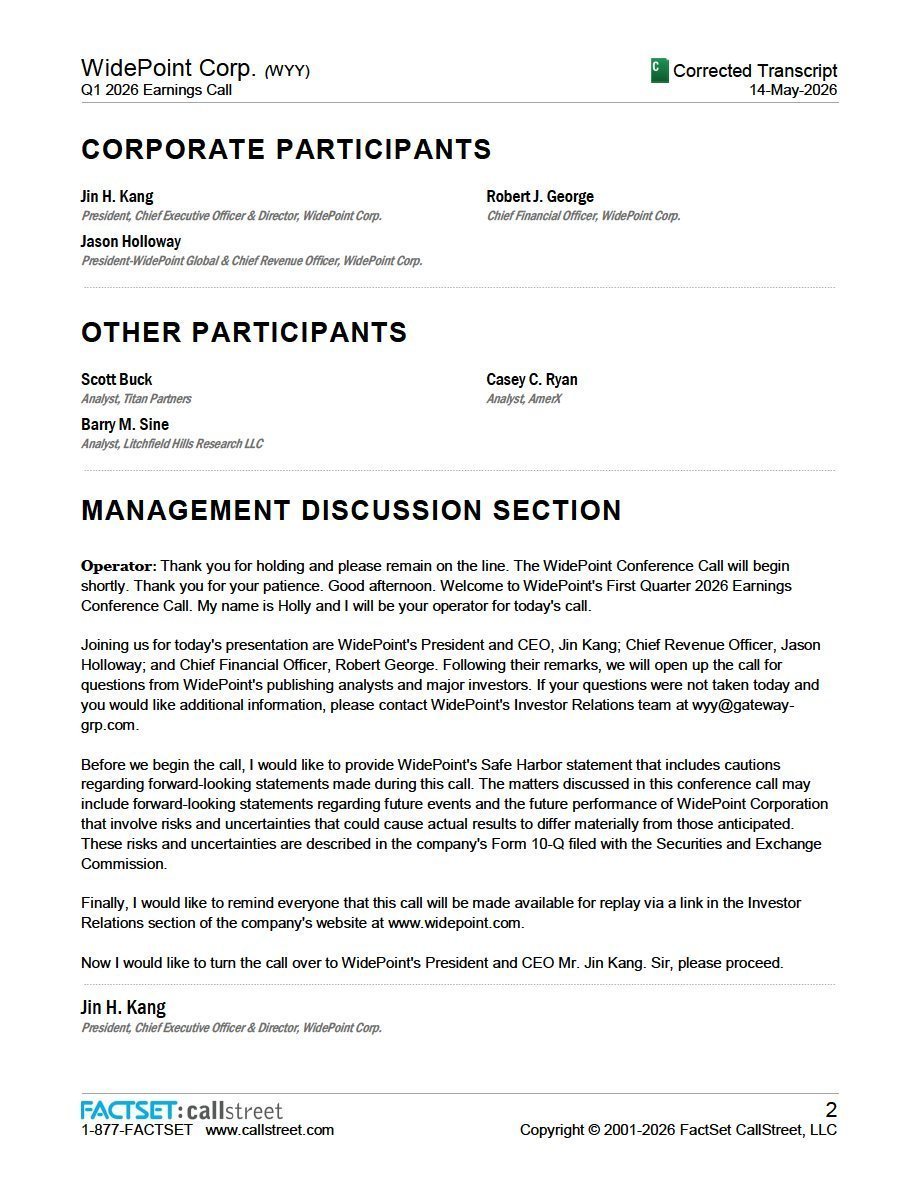
Good afternoon. Welcome to WidePoint's First Quarter 2026 Earnings Conference Call. My name is Holly, and I will be your operator for today's call. Joining us for today's presentation are WidePoint's President and CEO, Jin Kang, Chief Revenue Officer, Jason Holloway, and Chief Financial Officer, Robert George. Following their remarks, we will open up the call for questions from WidePoint's publishing analysts and major investors. If your questions were not taken today and you would like additional information, please contact WidePoint's Investor Relations team at wyy at gateway-grp.com. Before we begin the call, I would like to provide WidePoint's safe harbor statement that includes cautions regarding forward-looking statements made during this call. The matters discussed in this conference call may include forward-looking statements regarding future events and the future performance of WidePoint Corporation that involve risks and uncertainties that could cause actual results to differ materially from those anticipated. These risks and uncertainties are described in the company's Form 10-Q filed with the Securities and Exchange Commission. Finally, I would like to remind everyone that this call will be made available for replay via a link in the investor relations section of the company's website at www.widepoint.com. Now I would like to turn the call over to WidePoint's President and CEO, Mr. Jin Kang. Sir, please proceed.
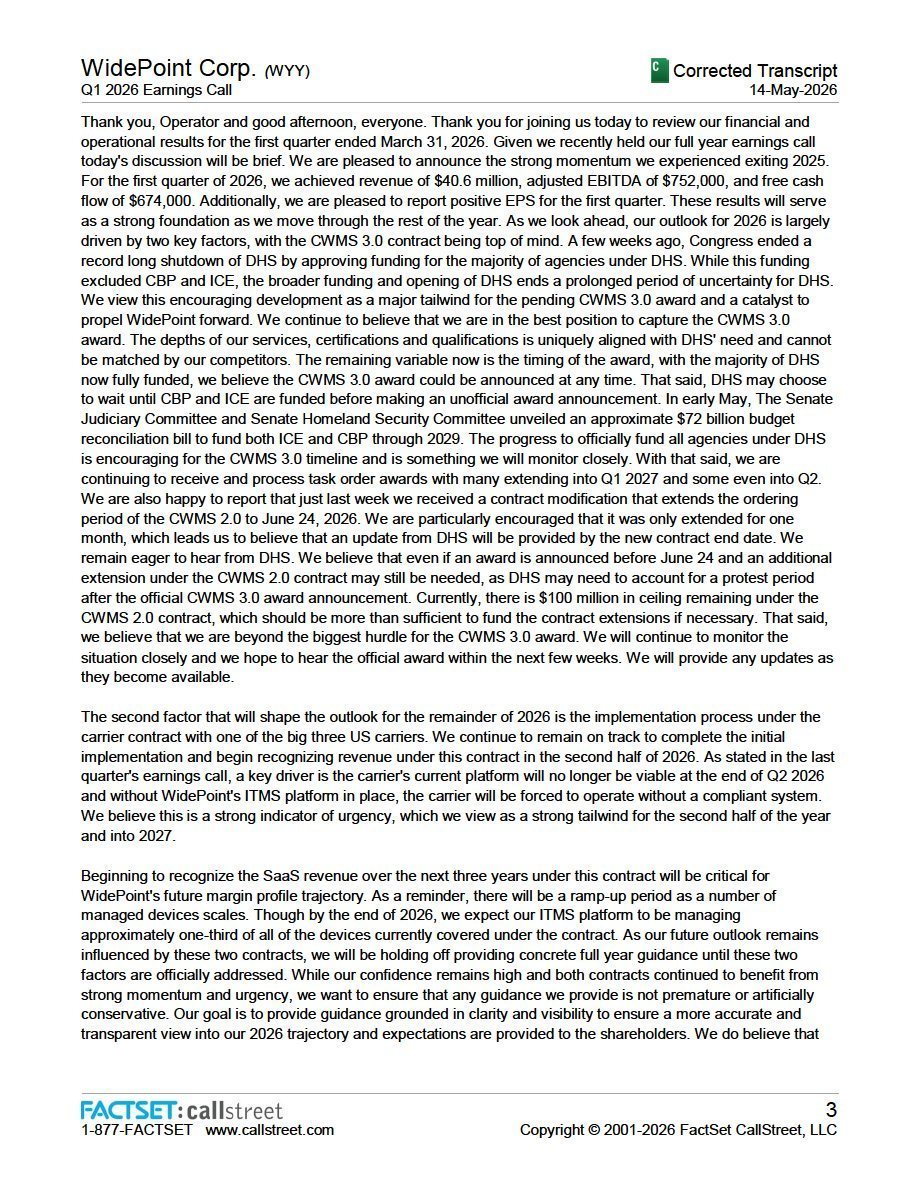
Thank you, Operator, and good afternoon, everyone. Thank you for joining us today to review our financial and operational results for the first quarter ended March 31, 2026. Given we recently held our full year earnings call, today's discussion will be brief. We are pleased to announce the strong momentum we experienced exiting 2025. For the first quarter of 2026, we achieved revenue of $40.6 million, adjusted EBITDA of $752,000 and free cash flow of $674,000. Additionally, we are pleased to report positive EPS for the first quarter. These results will serve as a strong foundation as we move through the rest of the year. As we look ahead, our outlook for 2026 is largely driven by two key factors with the CWMS 3.0 contract being top of mind. A few weeks ago, Congress ended a record long shutdown of DHS by approving funding for the majority of agencies under DHS. While this funding excluded CBP and ICE, the broader funding and opening of DHS ends a prolonged period of uncertainty for DHS. We view this encouraging development as a major tailwind for the pending CWMS 3.0 award and a catalyst to propel WidePoint forward. We continue to believe that we are in the best position to capture the CWMS 3.0 award. The depths of our services, certifications, and qualifications is uniquely aligned with DHS's need and cannot be matched by our competitors. The remaining variable now is the timing of the award. With the majority of DHS now fully funded, we believe the CWMS 3.0 award could be announced at any time. That said, DHS may choose to wait until CBP and ICE are funded before making an official award announcement. In early May, the Senate Judiciary Committee and Senate Homeland Security Committee unveiled an approximate $72 billion budget reconciliation bill to fund both ICE and CBP through 2029. The progress to officially fund all agencies under DHS is encouraging for the CWMS 3.0 timeline and is something we will monitor closely. With that said, we are continuing to receive and process task order awards, with many extending into Q1, 2027, and some even into Q2. We are also happy to report that just last week we received a contract modification that extends the ordering period of the CWMS 2.0 to June 24, 2026. We are particularly encouraged that it was only extended for one month, which leads us to believe that an update from DHS will be provided by the new contract end date. We remain eager to hear from DHS soon. We believe that even if an award is announced before June 24th, an additional extension under the 2.0 contract may still be needed, as DHS may need to account for a protest period after the official 3.0 award announcement. Currently, there is $100 million in ceiling remaining under the 2.0 contract, which should be more than sufficient to fund the contract extensions if necessary. That said, we believe that we are beyond the biggest hurdle for the CWMS 3.0 award. We will continue to monitor this situation closely, and we hope to hear the official award within the next few weeks. We will provide any updates as they become available. The second factor that will shape the outlook for the remainder of 2026 is the implementation process under the carrier contract with one of the big three U.S. carriers. We continue to remain on track to complete the initial implementation and begin recognizing revenue under this contract in the second half of 2026, as stated in the last quarter's earnings call. A key driver is the carrier's current platform will no longer be viable at the end of Q2 2026. And without YPoint's ITMS platform in place, the carrier will be forced to operate without a compliant system. We believe this is a strong indicator of urgency. which we view as a strong tailwind for the second half of the year and into 2027. Beginning to recognize the SaaS revenue over the next three years under this contract will be critical for YPoint's future margin profile trajectory. As a reminder, there will be a ramp-up period as the number of managed devices scales, though by the end of 2026, we expect our ITMS platform to be managing approximately one-third of all of the devices currently covered under the contract. As our future outlook remains influenced by these two contracts, we will be holding off providing concrete full-year guidance until these two factors are officially addressed. While our confidence remains high and both contracts continue to benefit from strong momentum and urgency, we want to ensure that any guidance we provide is not premature or artificially conservative. Our goal is to provide guidance grounded in clarity and visibility to ensure a more accurate and transparent view into our 2026 trajectory and expectations are provided to the shareholders. We do believe that White Point is well positioned to achieve double digit percentage growth from 2025 results and continue to maintain positive adjusted EBITDA and free cash flow throughout 2026. While CWMS 3.0 and carrier contract will remain our foundation, we want to reiterate the robust nature of the DAS pipeline we hold. We believe that landing one of these Fortune 100 commercial opportunities could materially impact our growth trajectory as well. These conversations are still ongoing, and we hope to provide more concrete developments later this year. Much of the work and strategic investments WidePoint has made over these past several years are now beginning to come together and bear fruit. We remain highly confident and optimistic about the breadth of opportunities developing in our pipeline and look forward to sharing additional details as these initiatives continue to materialize. I will now hand the call over to Jason, who will provide additional insight into our sales and marketing initiatives. Jason?
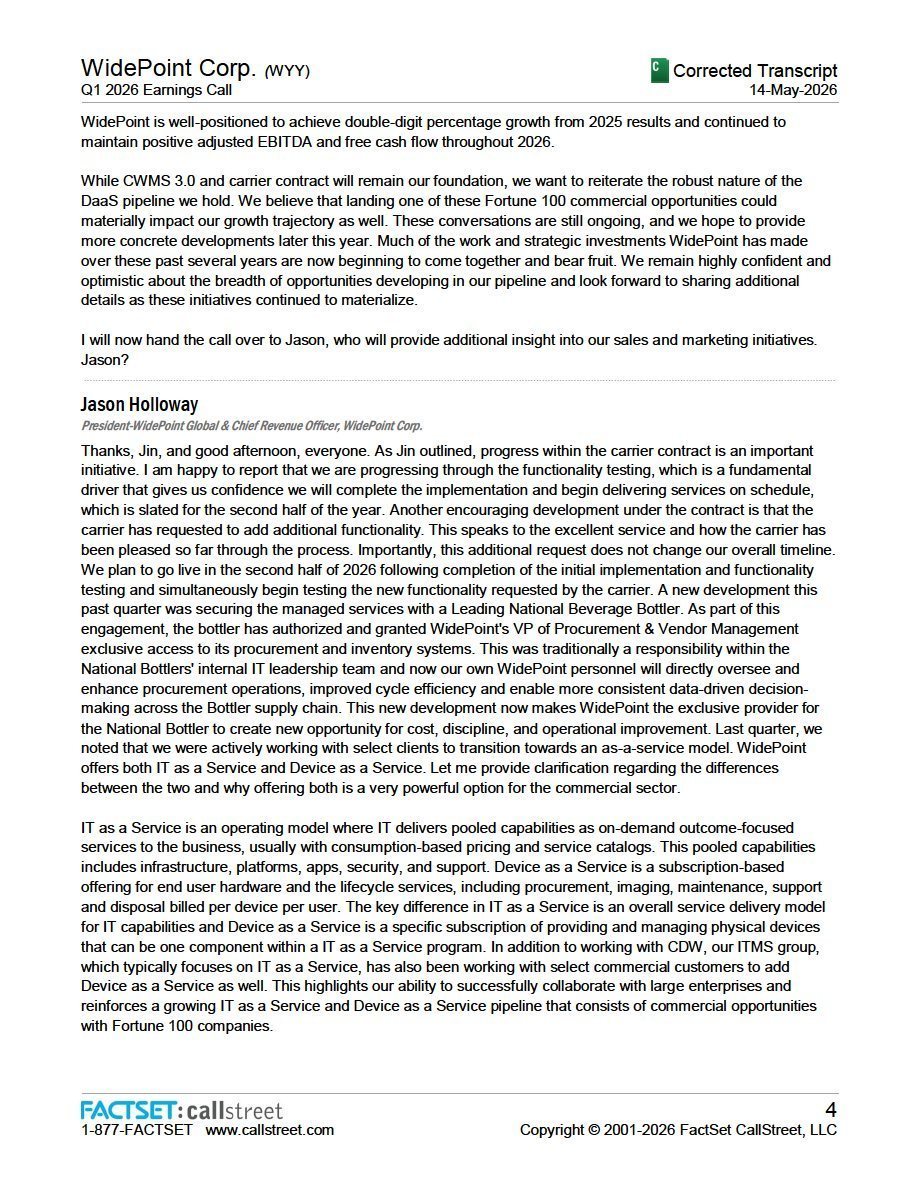
Thanks, Jen, and good afternoon, everyone. As Jen outlined, progress within the carrier contract is an important initiative. I am happy to report that we are progressing through the functionality testing, which is a fundamental driver that gives us confidence we will complete the implementation and begin delivering services on schedule, which is slated for the second half of the year. Another encouraging development under the contract is that the carrier has requested to add additional functionality. This speaks to the excellent service and how the carrier has been pleased so far through the process. Importantly, this additional request does not change our overall timeline. We plan to go live in the second half of 2026 following completion of the initial implementation and functionality testing and simultaneously begin testing the new functionality requested by the carrier. A new development this past quarter was securing the managed services with a leading national beverage bottler. As part of this engagement, the bottler has authorized and granted YPoint's VP of Procurement and Vendor Management exclusive access to its procurement and inventory systems. This was traditionally a responsibility within the National Bottler's internal IT leadership team. And now our own WidePoint personnel will directly oversee and enhance procurement operations, improve cycle efficiency, and enable more consistent data-driven decision-making across the Bottler's supply chain. This new development now makes WidePoint the exclusive provider for the National Bottler to create new opportunities for cost, discipline, and operational improvement. Last quarter, we noted that we were actively working with select clients to transition towards an as-a-service model. WidePoint offers both IT as a service and device as a service. Let me provide clarification regarding the differences between the two and why offering both is a very powerful option for the commercial sector. IT as a service is an operating model where IT delivers pooled capabilities as on-demand, outcome-focused services to the business, usually with consumption-based pricing and service catalogs. This pooled capabilities includes infrastructure, platforms, apps, security, and support. Device as a Service is a subscription-based offering for end-user hardware and lifecycle services, including procurement, imaging, maintenance, support, and disposal, billed per device, per user. The key difference in IT as a service is an overall service delivery model for IT capabilities, and device as a service is a specific subscription of providing and managing physical devices that can be one component within an IT as a service program. In addition to working with CDW, our IT MSP group, which typically focuses on IT as a service, has also been working with select commercial customers to add device as a service as well. This highlights our ability to successfully collaborate with large enterprises and reinforces a growing IT-as-a-service and device-as-a-service pipeline that consists of commercial opportunities with Fortune 100 companies. Our device-as-a-service progress is still ongoing and interest from target customers continues to remain high. On to Mobile Anchor. We continue to make progress with our derived credentials on the mobile devices. As we've previously reported, Mobile Anchor is being deployed under a number of agencies, including the FAA, DOJ, and HUD-OIG. Conversation is ongoing with the Department of Energy and the Department of Treasury as well. HUD-OIG entered its second year and FAA is progressing, with the rest in early or pilot stages. We are encouraged with the traction Mobile Anchor is seeing amongst different agencies and remain optimistic in the product's long-term potential. With that, I will now turn the call over to Bob to discuss our financial results. Bob?
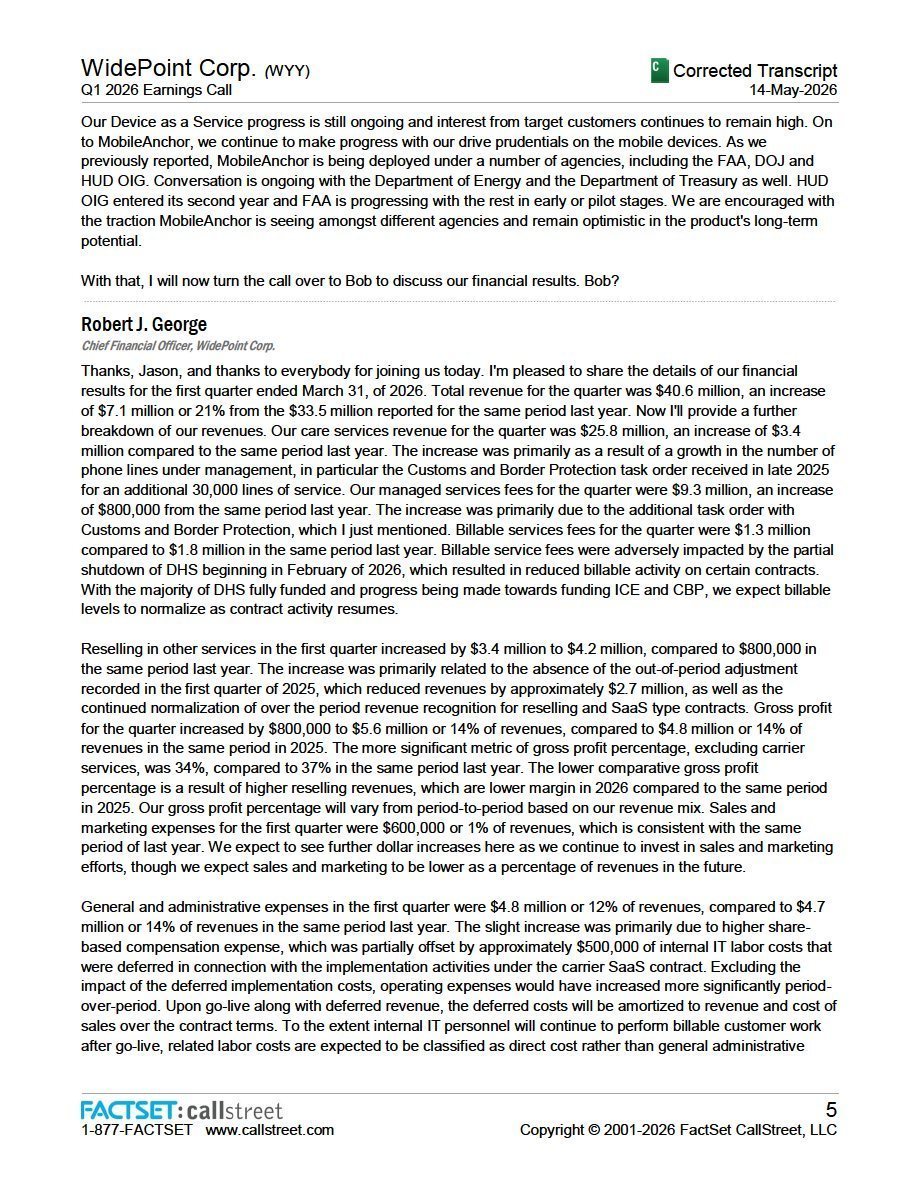
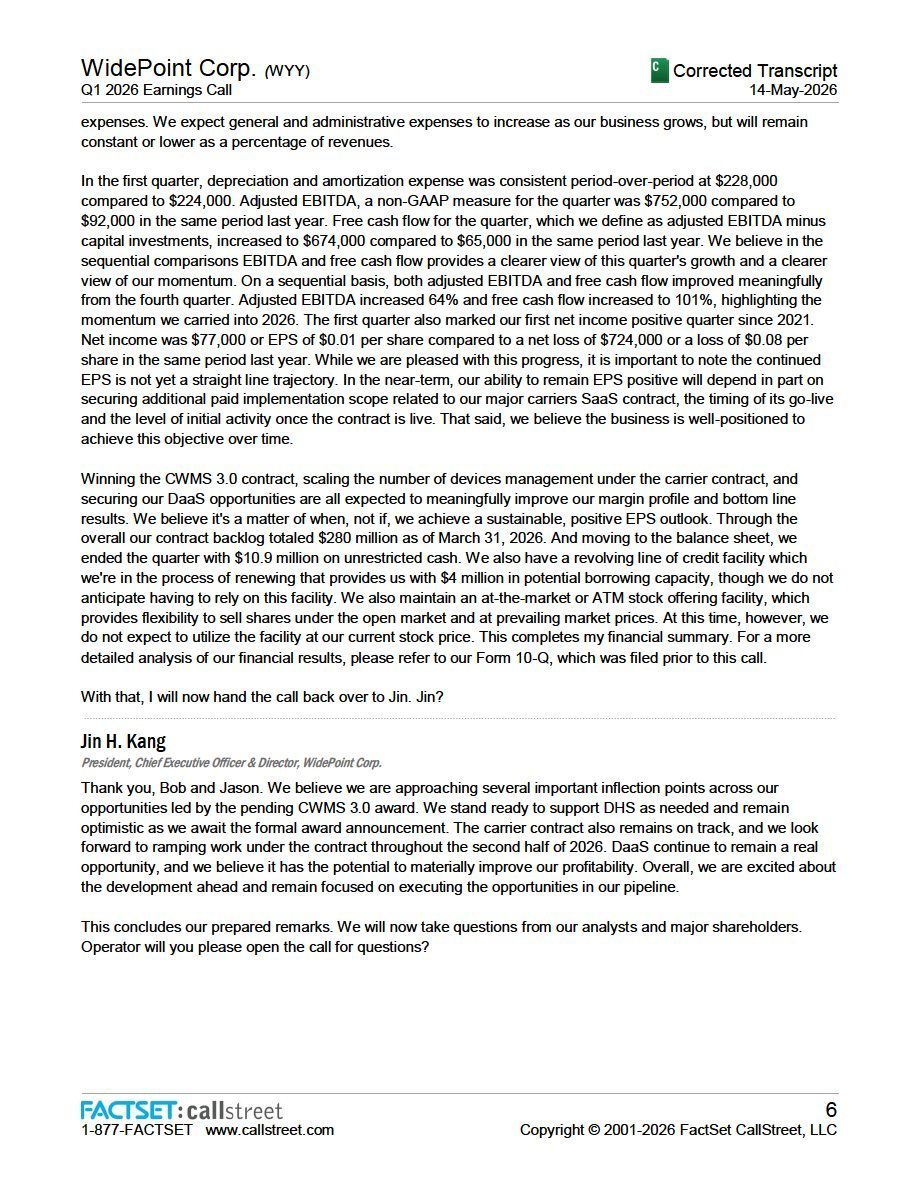
Thanks, Jason, and thanks to everybody for joining us today. I'm pleased to share the details of our financial results for the first quarter ended March 31, 2026. Total revenue for the quarter was $40.6 million, an increase of $7.1 million, or 21%, from the $33.5 million reported for the same period last year. Now I'll provide a further breakdown of our revenues. Our care services revenue for the quarter was $25.8 million, an increase of $3.4 million compared to the same period last year. The increase was primarily as a result of the growth in the number of phone lines under management. In particular, the Customs and Border Protection Task Order received in late 2025 for an additional 30,000 lines of service. Our managed services fees for the quarter were $9.3 million, an increase of $800,000 from the same period last year. The increase was primarily due to the additional task order with Customs and Border Protection, which I just mentioned. Billable services fees for the quarter were $1.3 million compared to $1.8 million in the same period last year. Billable service fees were adversely impacted by the partial shutdown of DHS beginning in February of 2026, which resulted in reduced billable activity on certain contracts. With the majority of DHS fully funded and progress being made towards funding ICE and CBP, we expect billable levels to normalize as contract activity resumes. Reselling and other services in the first quarter increased by $3.4 million to $4.2 million compared to $800,000 in the same period last year. The increase was primarily related to the absence of the out-of-period adjustment recorded in the first quarter of 2025, which reduced revenues by approximately $2.7 million, as well as the continued normalization of over-the-period revenue recognition for reselling and SAS-type contracts. Gross profit for the quarter increased by $800,000 to $5.6 million, or 14% of revenues, compared to $4.8 million, or 14% of revenues, in the same period in 2025. The more significant metric of gross profit percentage, excluding carrier services, was 34% compared to 37% in the same period last year. The lower comparative gross profit percentage is a result of higher reselling revenues, which are lower margin in 2026 compared to the same period in 2025. Our gross profit percentage will vary from period to period based on our revenue mix. Sales and marketing expenses for the first quarter were $600,000, or 1% of revenues, which is consistent with the same period last year. We expect to see further dollar increases here as we continue to invest in sales and marketing efforts, though we expect sales and marketing to be lower as a percentage of revenues in the future. General and administrative expenses in the first quarter were $4.8 million, or 12% of revenues, compared to $4.7 million, or 14% of revenues, in the same period last year. The slight increase was primarily due to higher share-based compensation expense, which was partially offset by approximately 500,000 of internal IT labor costs that were deferred in connection with the implementation activities under the carrier SAS contract. Excluding the impact of the deferred implementation cost, operating expenses would have increased more significantly period over period. Upon go-live, along with deferred revenue, the deferred costs will be amortized to revenue and cost of sales over the contract terms. To the extent internal IT personnel continue to perform billable customer work after go-live, related labor costs are expected to be classified as direct costs rather than general administrative expenses. We expect general and administrative expenses to increase as our business grows, but to remain constant or lower as a percentage of revenues. In the first quarter, depreciation and amortization expense was consistent period over period at $228,000 compared to $224,000. Adjusted EBITDA, a non-GAAP measure, for the quarter was $752,000 compared to $92,000 in the same period last year. Free cash flow for the quarter, which we define as adjusted EBITDA minus capital investments, increased to $674,000 compared to $65,000 in the same period last year. We believe a sequential comparison of EBITDA and free cash flow provides a clearer view of this quarter's growth and a clearer view of our momentum. On a sequential basis, both adjusted EBITDA and free cash flow improved meaningfully from the fourth quarter. Adjusted EBITDA increased 64% and free cash flow increased 101%, 1%, highlighting the momentum we carried into 2026. The first quarter also marked our first net income positive quarter since 2021. Net income was $77,000, or EPS, of one cent per share, compared to a net loss of $724,000, or a loss of eight cents per share in the same period last year. While we are pleased with this progress, it is important to note that continued EPS is not yet a straight-line trajectory. In the near term, our ability to remain EPS positive will depend in part on securing additional paid implementation scope related to our major carrier SaaS contract, the timing of its go-live, and the level of initial activity once the contract is live. That said, we believe the business is well-positioned to achieve this objective over time. Winning the CWMS 3.0 contract, scaling the number of devices management under the carrier contract, and securing our DASC opportunities are all expected to meaningfully improve our margin profile and bottom-line results. We believe it is a matter of when, not if, we achieve a sustainable, positive EPS outlook. Federal contract backlog totaled $218 million as of March 31, 2026. and moving to the balance sheet, we ended the quarter with $10.9 million in unrestricted cash. We also have a revolving line of credit facility, which we're in the process of renewing, that provides us with $4 million in potential borrowing capacity, though we do not anticipate having to rely on this facility. We also maintain an at-the-market or ATM stock offering facility, which provides flexibility to sell shares under the open market and prevailing market prices. At this time, however, we do not expect to utilize the facility at our current stock price. This completes my financial summary. For a more detailed analysis of our financial results, please refer to our Form 10-Q, which was filed prior to this call. With that, I will now hand the call back over to Jen.
Jen? Thank you, Bob and Jason. We believe we are approaching several important inflection points across our opportunities, led by the pending CWMS 3.0 award. We stand ready to support DHS as needed and remain optimistic as we await the formal award announcement. The carrier contract also remains on track, and we look forward to ramping work under the contract throughout the second half of 2026. DAS continue to remain a real opportunity, and we believe it has the potential to materially improve our profitability. Overall, we are excited about the development ahead and remain focused on executing the opportunities in our pipeline. This concludes our prepared remarks. We will now take questions from our analysts and major shareholders. Operator, will you please open the call for questions?
Operator
Certainly. At this time, we will be conducting a question and answer session. If you would like to ask a question please press star 1 on your telephone keypad. A confirmation tone will indicate your line is in the question queue. You may press star 2 if you would like to remove your question from the queue. For participants using speaker equipment it may be necessary to pick up your handset before pressing the star keys. One moment please while we poll for questions.
Scott
Analyst — Roth and KM
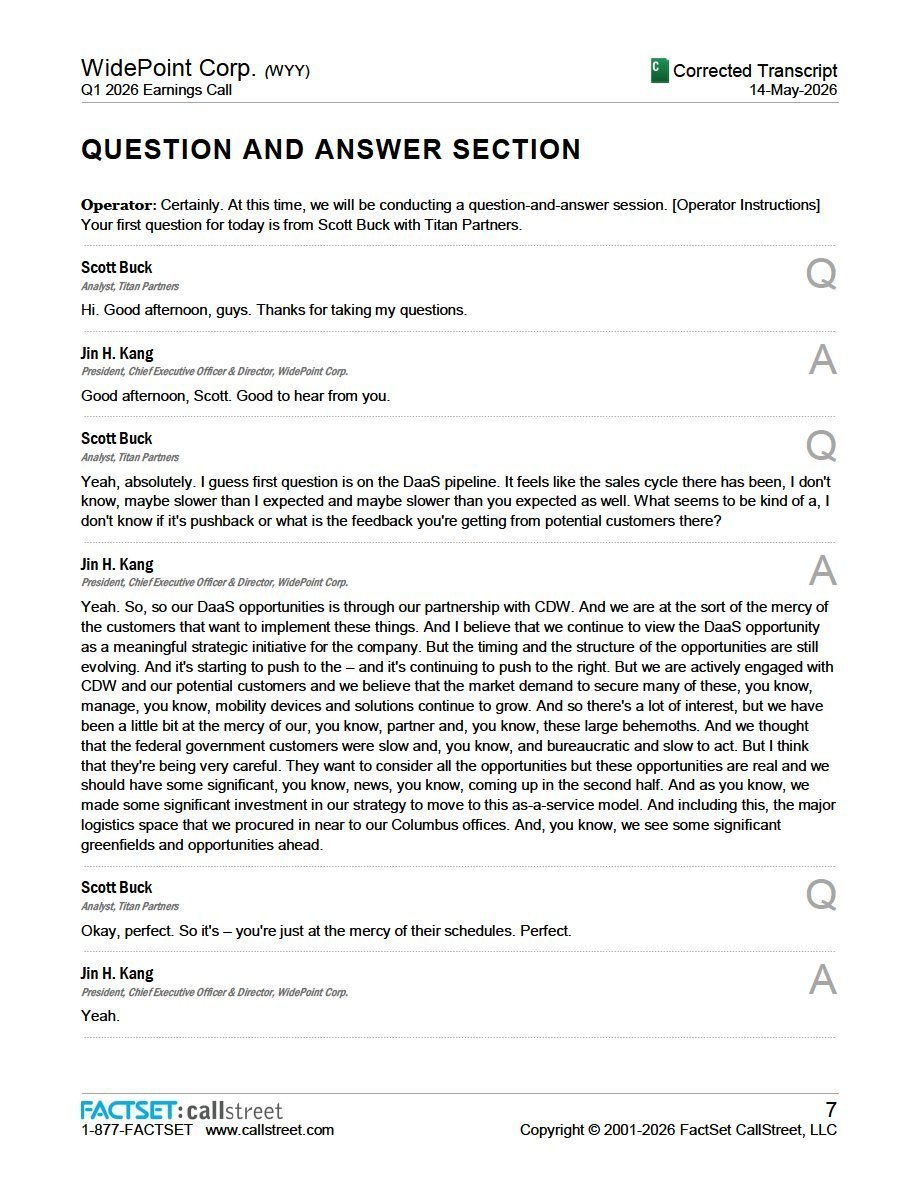
Your Hi, good afternoon, guys. Thanks for taking my questions. Good afternoon, Scott. Good to hear from you. Yeah, absolutely. I guess first question is on the DAS pipeline. It feels like the sales cycle there has been, I don't know, maybe slower than I expected and maybe slower than you expected as well. So what seems to be kind of a, I don't know if it's pushback, or what is the feedback you're getting from potential customers there?
Yeah, so our DAS opportunities is through our partnership with CDW, and, you know, we are at the sort of the mercy of the customers that want to implement these things. I believe that we continue to view the DAS opportunities as a meaningful strategic initiative for the company, but the timing and the structure of the opportunities are still evolving, and it's continuing to push to the right. But we are actively engaged with CDW and our potential customers, and we believe that the market demands to secure many of these managed mobility devices and solutions continue to grow. And so there's a lot of interest, but we have been a little bit at the mercy of our partner and these large behemoths, and we thought that the federal government customers were slow and bureaucratic and slow to act. But I think that they're being very careful. They want to consider all the opportunities. But these opportunities are real, and we should have some significant news coming up in the second half. And as you know, we made some significant investment in our strategy to move to this as-a-service model, including a major logistics space that we procured near our Columbus offices. And, you know, we see some significant green fields and opportunities ahead.
Scott
Analyst — Roth and KM
Okay, perfect.
So you're just at the mercy of their schedules.
Scott
Analyst — Roth and KM
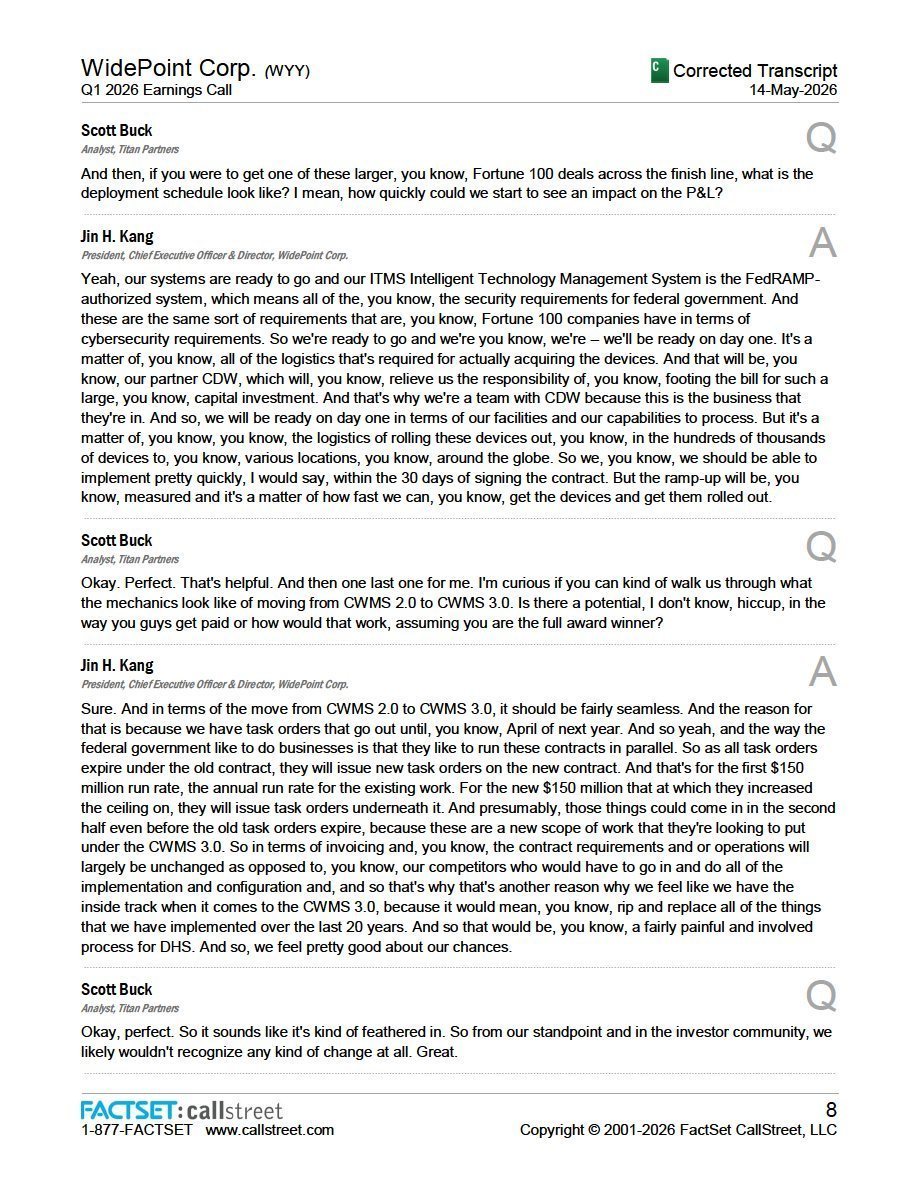
Perfect. And then if you were to get one of these larger, you know, Fortune 100 deals across the finish line, what does the deployment schedule look like? I mean, how quickly could we start to see an impact on the P&L?
Yeah, our systems are ready to go, and our ITMS, Intelligent Technology Management System, is the FedRAMP authorized system, which meets all of the, you know, the security requirements for federal government. And these are the same sort of requirements that our, you know, Fortune 100 companies have in terms of cybersecurity requirements. So we're ready to go, and we're, you know, we'll be ready on day one. It's a matter of, you know, all of the logistics that's required for actually acquiring the devices. And that will be, you know, our partner CDW, which will, you know, relieve us the responsibility of, you know, footing the bill for such a large, you know, capital investment. And that's why we're team with CDW because this is the business that they're in. And so we'll be ready on day one in terms of our facilities and our capabilities to process. But it's a matter of, you know, the logistics of rolling these devices out, you know, in the hundreds of thousands of devices to, you know, various locations, you know, around the globe. So, you know, we should be able to implement pretty quickly, I would say, within the 30 days of signing the contract. but the ramp up will be, you know, measured. It's a matter of how fast we can, you know, get the devices and get them rolled out.
Scott
Analyst — Roth and KM
Okay, perfect. That's helpful. And then one last one for me. I'm curious if you can kind of walk us through what the mechanics look like of moving from 2.0 to 3.0. Is there a potential, I don't know, hiccup in the way you guys get paid Or how would that work, assuming you are the full award winner?
Sure. In terms of the move from 2.0 to 3.0, it should be fairly seamless. And the reason for that is because we have task orders that go out until, you know, April of next year. And so, you know, and the way the federal government like to do business is that they like to run, you know, these contracts in parallel. So as old task orders expire under the old contract, they will issue new task orders on the new contract. And that's for the first $150 million run rate, annual run rate, for the existing work. For the new $150 million, which they increased the ceiling on, they will issue task orders underneath it. And presumably, those things could come in in the second half, even before the old task orders expire, because these are a new scope of work that they're looking to put under the CWMS 3L. So in terms of invoicing and, you know, contract requirements and our operations will largely be unchanged as opposed to, you know, competitors who would have to go in and do all of the implementation and configuration. And so that's another reason why we feel like we have the inside track when it comes to the 3-0, because it would mean, you know, rip and replace all of the things that we have implemented over the last 20 years. And so that would be, you know, a fairly painful and involved process for DHS. And so we feel pretty good about our chances.
Scott
Analyst — Roth and KM
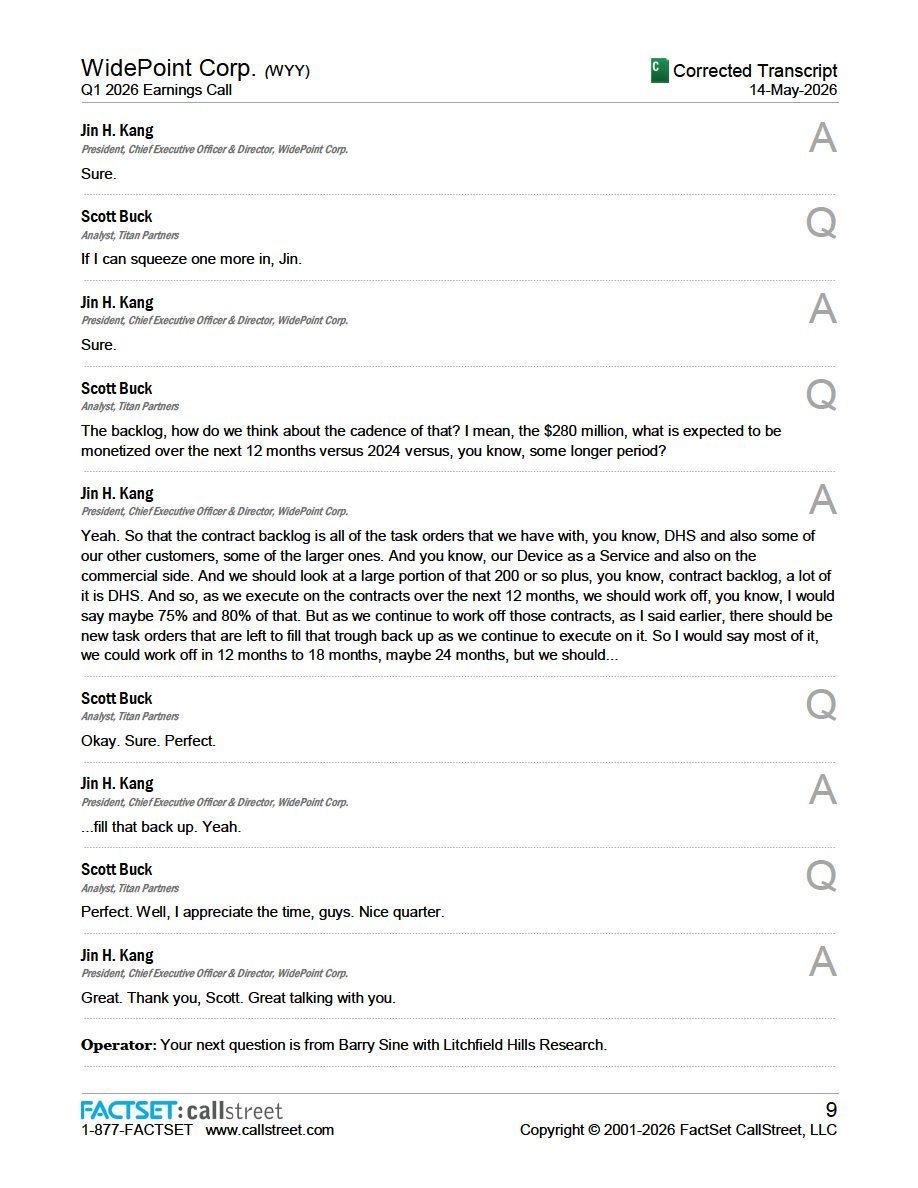
Okay, perfect. So it sounds like it's kind of feathered in. So, from our standpoint in the investor community, we likely wouldn't recognize any kind of change at all. That's right. If I can squeeze one more in, Jim. The backlog, how do we think about the cadence of that? I mean, with the $218 million, what is expected to be monetized over the next 12 months versus 24 versus, you know, some longer period?
Yeah, so the contract backlog is all of the task orders that we have with, you know, DHS and also some of our other customers, some of the larger ones in, you know, our device as a service and also on the commercial side. And we should look at a large portion of that 200 or so plus, you know, contract backlog. You know, a lot of it is DHS, and so as we execute on the contracts over the next 12 months, we should work off, you know, I would say maybe 75%, 80% of that. But as we continue to work off those contracts, as I said earlier, there should be new task orders that are left to fill that trough back up as we continue to execute on it so I would say most of it we could work off in 12 to 18 maybe 24 months but we should go back up yeah perfect why I appreciate the time guys a nice quarter great thank you Scott great talking with you your next question is from Barry Sein with Litchfield Hill Research.
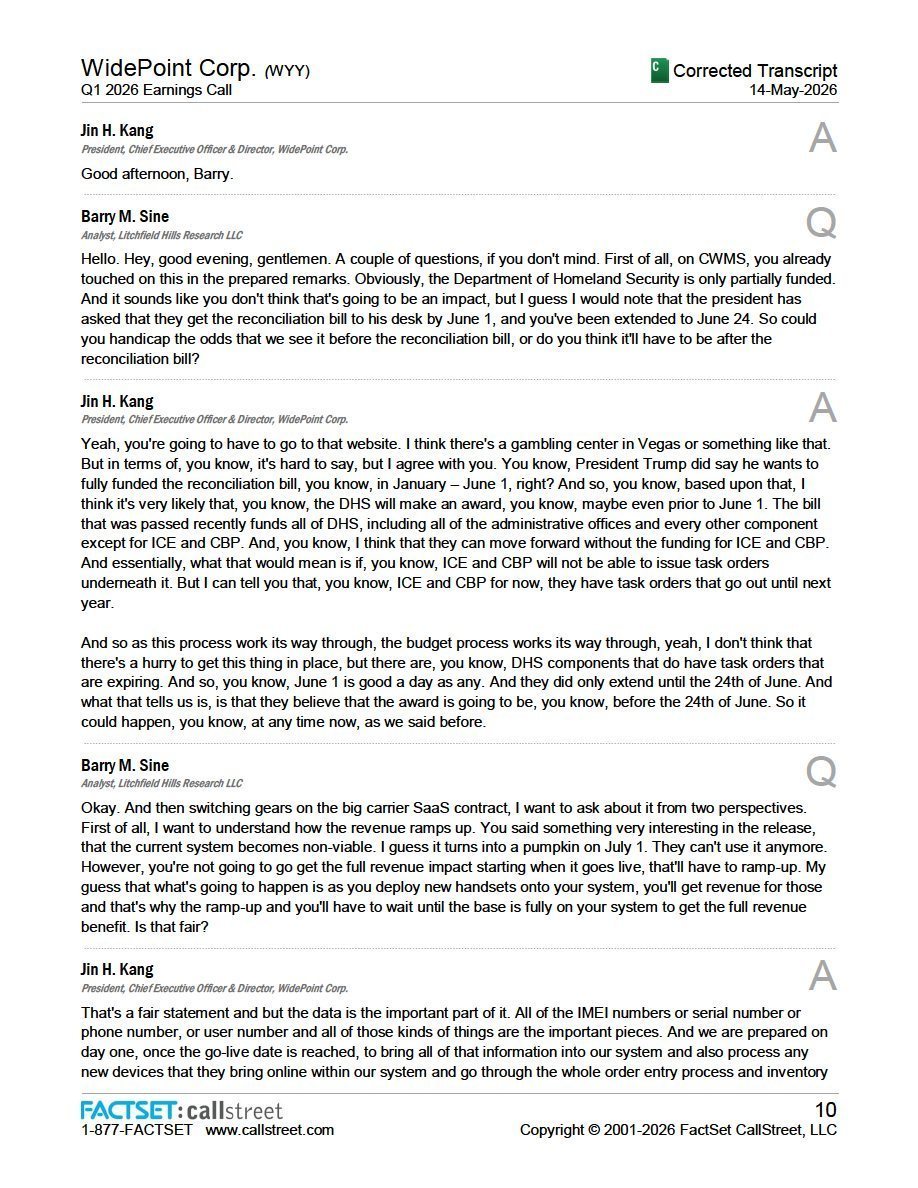
Good afternoon, Barry. Hello. Hey, good evening, gentlemen. A couple questions, if you don't mind. First of all, on CWMS, you already touched on this in the prepared remarks. Obviously, the Department of Homeland Security is only partially funded, and it sounds like you don't think that's going to be an impact. But I guess I would note that the president has asked that they get the reconciliation bill to his desk by June 1st, and you've been extended to June 24th. So could you handicap the odds that we see it before the reconciliation bill, or do you think it'll have to be after the reconciliation bill?
Yeah, you're going to have to go to that website. I think there's a gambling site on Vegas or something like that. But in terms of, you know, it's hard to say, but I agree with you. You know, President Trump did say he wants to fully funded the reconciliation bill, you know, on June 1, right? And so, you know, based upon that, I think it's very likely that, you know, the DHS will make an award, you know, maybe even prior to June 1. But the bill that was passed recently funds all of DHS, including all of the administrative offices and every other component except for ICE and CBP. And, you know, I think that they can move forward without the funding for ICE and CBP. And essentially what that would mean is if, you know, ICE and CBP will not be able to issue task orders underneath it. But I can tell you that ICE and CBP, for now, they have task orders that go out until next year. And so as this process works its way through, the budget process works its way through, I don't think that there's a hurry to get this thing in place, but there are DHS components that do have task orders that are expiring. And so June 1 is as good a day as any. and they did only extend until the 24th of June. And what that tells us is that they believe that the award is going to be, you know, before the 24th of June. So it could happen, you know, at any time now, as we said before.
Okay. And then switching gears on the big carrier SaaS contract, I want to ask about it from two perspectives. First of all, I want to understand how the revenue ramps up. You said something very interesting in the release, that the current system becomes non-viable. I guess it turns into a pumpkin on July 1st. They can't use it anymore. However, you're not going to get the full revenue impact starting when it goes live. That will have to ramp up. It's my guess that what's going to happen is as you deploy new handsets onto your system, you'll get revenue for those. And that's why the ramp up and you'll have to wait until the base is fully on your system to get the full revenue benefit. Is that fair?
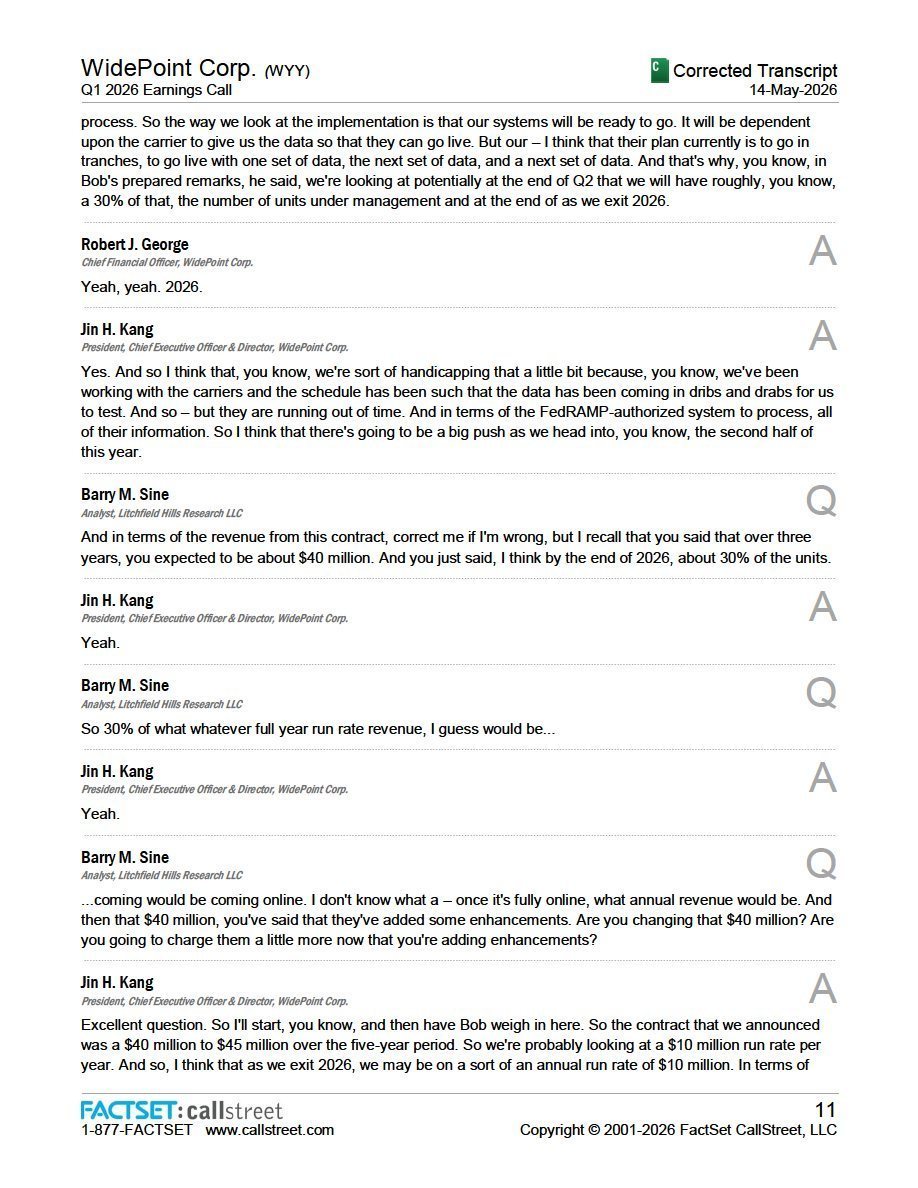
That's a fair statement. But the data is the important part of it. All of the IMEI numbers, the serial number, phone number, user number, and all of those kinds of things are the important pieces. And we are prepared on day one, once the go-live data is reached, to bring all of that information into our system. and also process any new devices that they bring online within our system and go through the whole order entry process and inventory process. So the way we look at the implementation is that our systems will be ready to go. It will be dependent upon the carrier to give us the data so that they can go live. But I think that their plan currently is to go in tranches, to go live with one set of data, the next set of data, and the next set of data. And that's why, you know, in Bob's prepared remarks, he said we're looking at potentially at the end of Q2 that we will have roughly, you know, 30% of that, the number of units under management. at the end of, as we exit 2026.
Yes, and so I think that, you know, we're sort of handicapping that a little bit because, you know, we've been working with the carriers and the schedule has been such that the data has been coming in, dribs and drafts for us to test. And so, but they are running out of time in terms of the FedRAMP authorized system to process all of their information. So I think that there's going to be a big push as we head into, you know, the second half of this year.
And in terms of the revenue from this contract, correct me if I'm wrong, but I recall that you said that over three years you expect it to be about $40 million. And you just said by the end of 2026 about 30% of the units, So 30% of whatever full-year run rate revenue, I guess, would be coming online. I don't know once it's fully online what annual revenue would be. And then that $40 million, you've said that they've added some enhancements. Are you changing that $40 million? Are you going to charge them a little more now that you're adding enhancements?
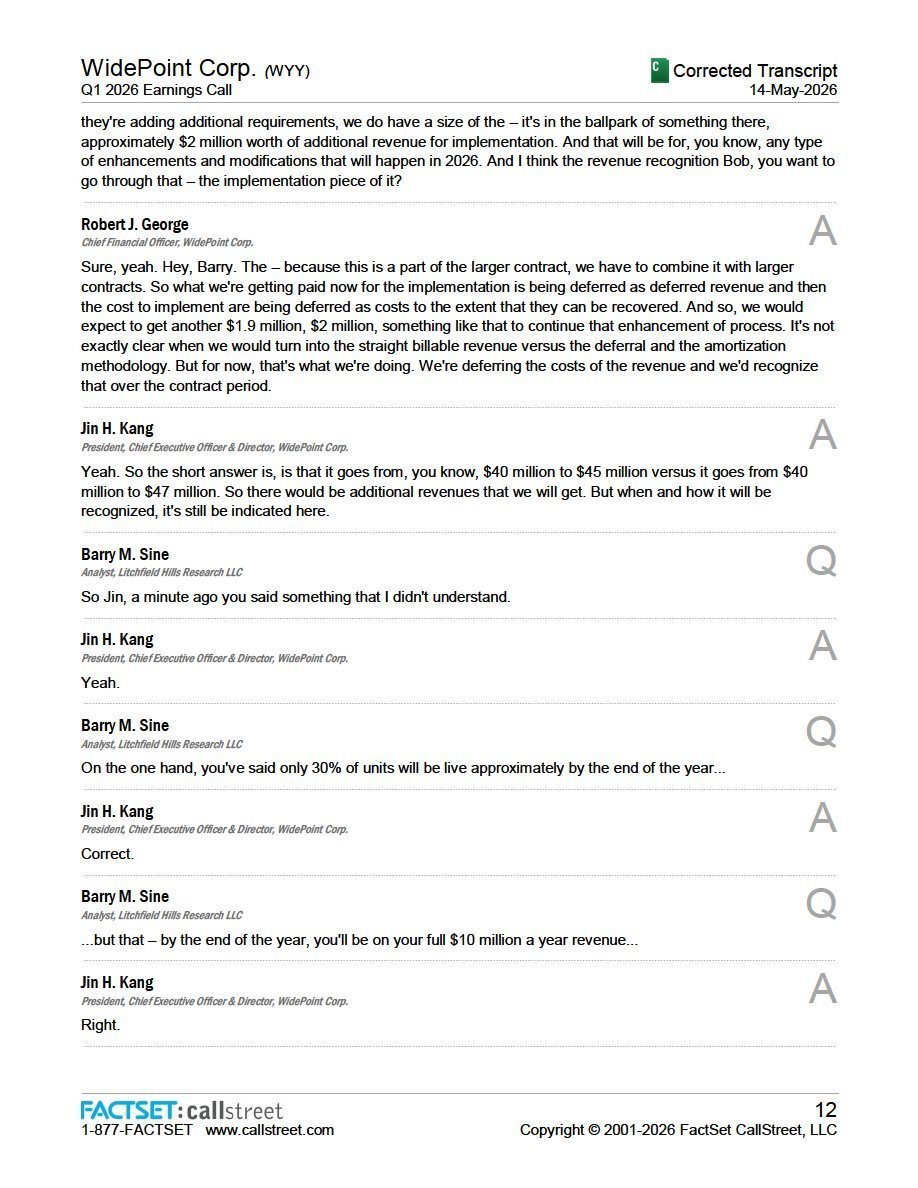
Excellent question. So I'll start and then have Bob weigh in here. So the contract that we announced was $40 to $45 million over the five-year period. So we're probably looking at a $10 million run rate per year. And so I think that as we exit 2026, we may be on a sort of an annual run rate of $10 million. In terms of they're adding additional requirements, we do have a size of the, you know, So it's in the ballpark of approximately $2 million worth of additional revenue for implementation. And that will be for any type of enhancements and modifications that will happen in 2026. And I think the revenue recognition, Bob, you want to go through the implementation piece of it?
Sure. Hey, Barry. Because this is a part of the larger contract, we have to combine it with the larger contract. So what we're getting paid now for the implementation is being deferred as deferred revenue, and then the costs to implement are being deferred as cost to the extent that it can be recovered. And so we would expect to get another $1.9 million, $2 million, something like that, to continue that enhancement process. It's not exactly clear when we would turn into just straight billable revenue versus the deferral and amortization methodology. But for now, that's what we're doing. We're deferring the cost and the revenue, and we'd recognize that over the contract period.
So the short answer is that it goes from, you know, 40 to 45 versus it goes from 40 to 47. So there would be additional revenues that we will get. But when and, you know, how it will be recognized, you know, is still, you know, being debated here.
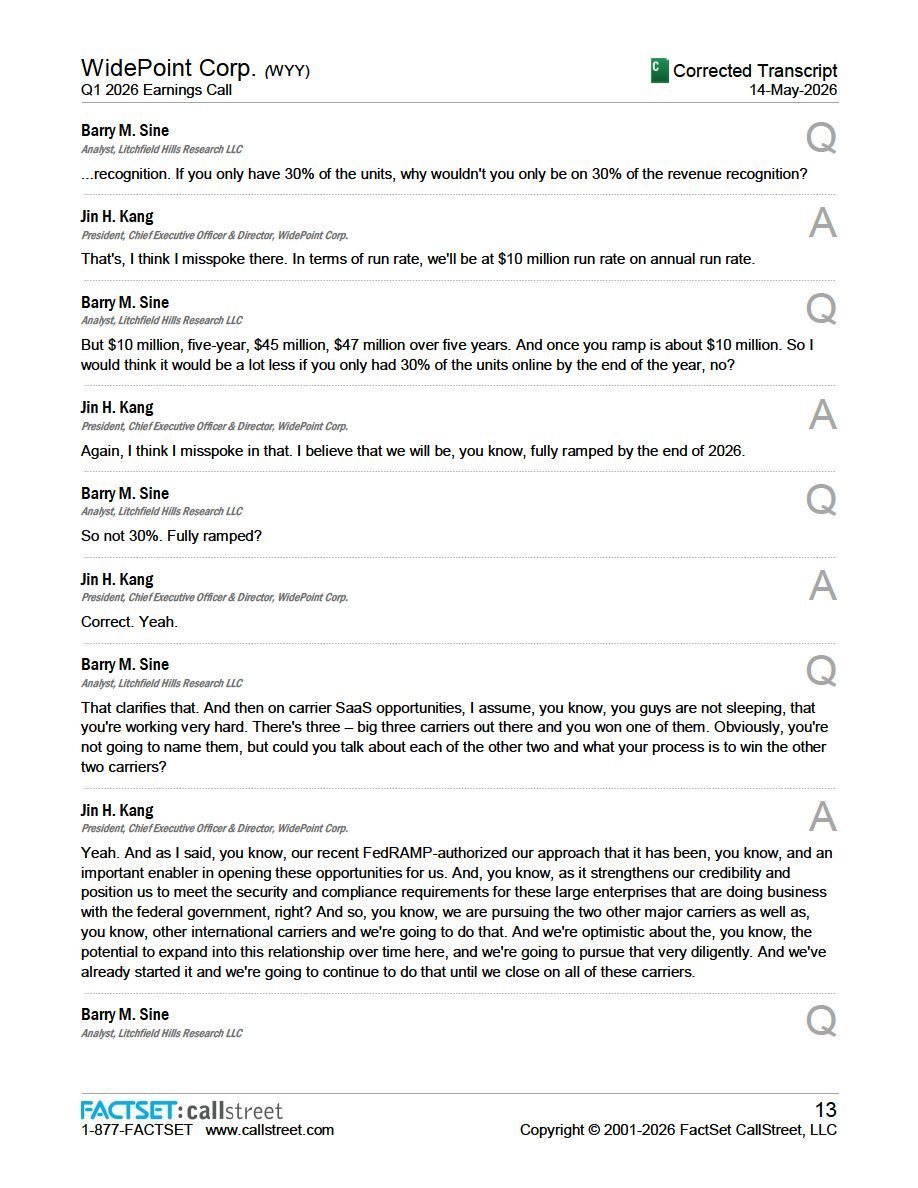
So, Jen, a minute ago you said something that I didn't understand. On the one hand, you've said only 30% of units will be live approximately by the end of the year. but that by the end of the year, you'll be on your full $10 million a year revenue recognition. If you only have 30% of the units, why wouldn't you only be on 30% of the revenue recognition?
I think I misspoke there. In terms of run rate, we'll be at $10 million run rate, an annual run rate.
But $10 million, five years, $47 million over five years, once your ramp is about 10. So I would think it would be a lot less if you only had 30% of the units online by the end of the year.
You know, again, I think I misspoke in that, you know, I believe that we will be, you know, fully ramped by the end of 2026. Oh, not 30% fully ramped.
Correct. Ah, that clarifies that. And then on carrier SAS opportunities, I assume, you know, you guys are not sleeping. that you're working very hard, there's three big three carriers out there, and you won one of them. Obviously, you're not going to name them, but could you talk about each of the other two and what your process is to win the other two carriers?
Yeah, and as I said, you know, our recent FedRAMP authorized status has been, you know, an important enabler in opening these opportunities for us. And, you know, as it strengthens our credibility and position us to meet the security and compliance requirements for these large enterprises that are doing business with the federal government, right? And so, you know, we are pursuing the two other major carriers as well as, you know, other international carriers, and we're going to do that. And we're optimistic about the, you know, the potential to expand into this relationship, you know, over time here, and we're going to pursue that very diligently. You know, we've already started it, and we're going to continue to do that until we close on all of these carriers.
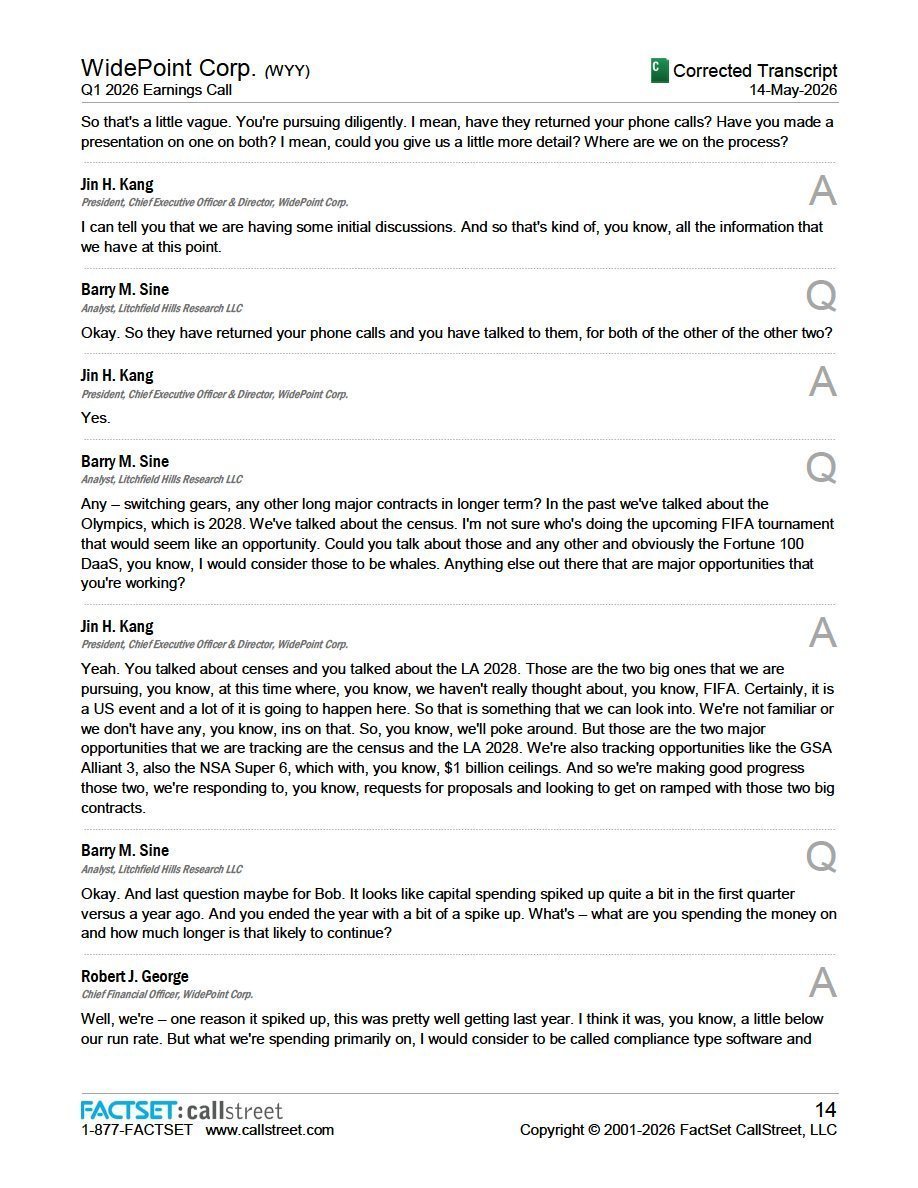
So that's a little vague. You're pursuing diligently. I mean, have they returned your phone calls? Have you made a presentation on one, on both? I mean, could you give us a little more detail? Where are we on the process?
I can tell you that we are having some initial discussions, and so that's kind of, you know, all the information that we have at this point.
So they have returned your phone calls. and you have talked to them for both of the other two.
Switching gears, any other major contracts, longer term? In the past, we've talked about the Olympics, which is 28. We've talked about the census. I'm not sure who's doing the upcoming FIFA tournament. That would seem like an opportunity. Could you talk about those and any other, and obviously the Fortune 100 deaths, you know, I would consider those to be whales. Anything else out there that are major opportunities that you're working?
Yeah, you know, you talked about census and you talked about the LA-28. Those are the two, you know, big ones that we are pursuing. You know, at this time, you know, we haven't really thought about, you know, FIFA. Certainly it is a U.S. event. A lot of it is going to happen here. So that is something that we can look into. We're not familiar or we don't have any ins on that, so we'll poke around, but the two major opportunities that we are tracking are the census and the LA-28. We're also tracking opportunities like the GSA Alliant-3, also the NASA SUP-6 with billion dollar ceilings, and so we're making good progress on those two. We're responding to requests for proposals and looking to get on ramped with those two big contracts.
Okay, and last question, maybe for Bob. It looks like capital spending spiked up quite a bit in the first quarter versus a year ago, and you ended the year with a bit of a spike up. What are you spending the money on, and how much longer is that likely to continue?
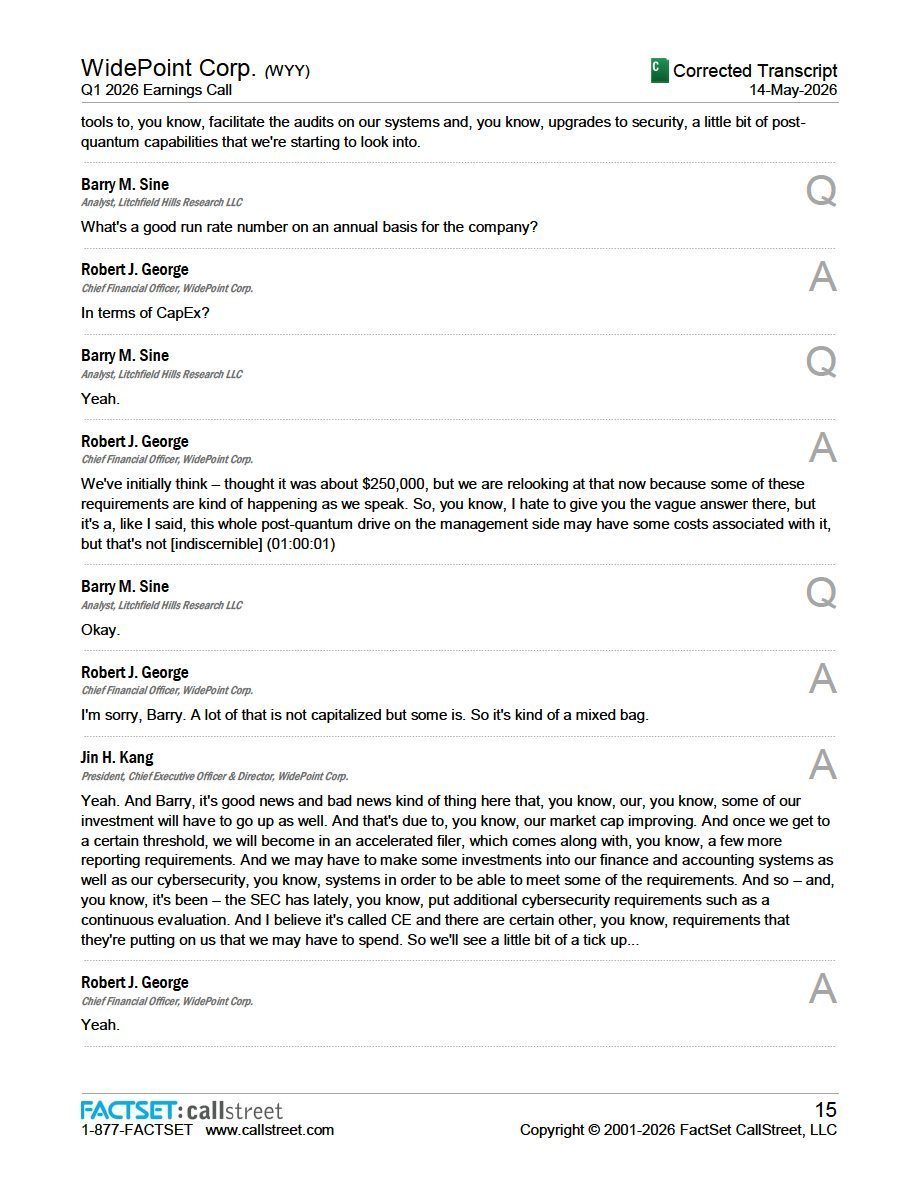
Well, one reason it spiked up is it was pretty low at the beginning of last year. I think it was a little below our run rate. But we're spending primarily on what I would consider to be called compliance-type software and tools to facilitate the audits on our systems and upgrades to security, a little bit of post-quantum capabilities that we're starting to look into.
What's a good run rate number on an annual basis for the company?
We initially thought it was about $250,000, but we are re-looking at that now because some of these requirements are kind of happening as we speak. So I hate to give you the vague answer there, But it's, like I said, this whole post-quantum computing drive, the identity management side, you know, may have some costs associated with it. A lot of that's not capitalized. I'm sorry, Barry. A lot of that is not capitalized, but some is. So, you know, it's kind of a mixed bag.
Yeah. And, Barry, you know, it's good news and bad news kind of thing here. You know, some of our investment will have to go up as well, and that's due to, you know, our market cap improving, and once we get to a certain threshold, we will become an accelerated filer, which comes along with, you know, a few more reporting requirements, and we may have to make some investments into our finance and accounting systems as well as our cybersecurity, you know, systems in order to be able to meet some of the requirements. And so, and, you know, it's been – the SEC has lately, you know, put additional cybersecurity requirements such as a continuous evaluation. I believe it's called CE, and there are certain other requirements that they're putting on us that we may have to spend. So we'll see a little bit of a tick up, but I don't think it's going to be a material amount.
Okay, those are my questions. Thank you for taking them all. Thank you, Barry.
Thank you for those questions.
Operator
Once again, if you would like to ask a question, please press star 1. Your next question for today is from Casey Ryan with AmeriX.
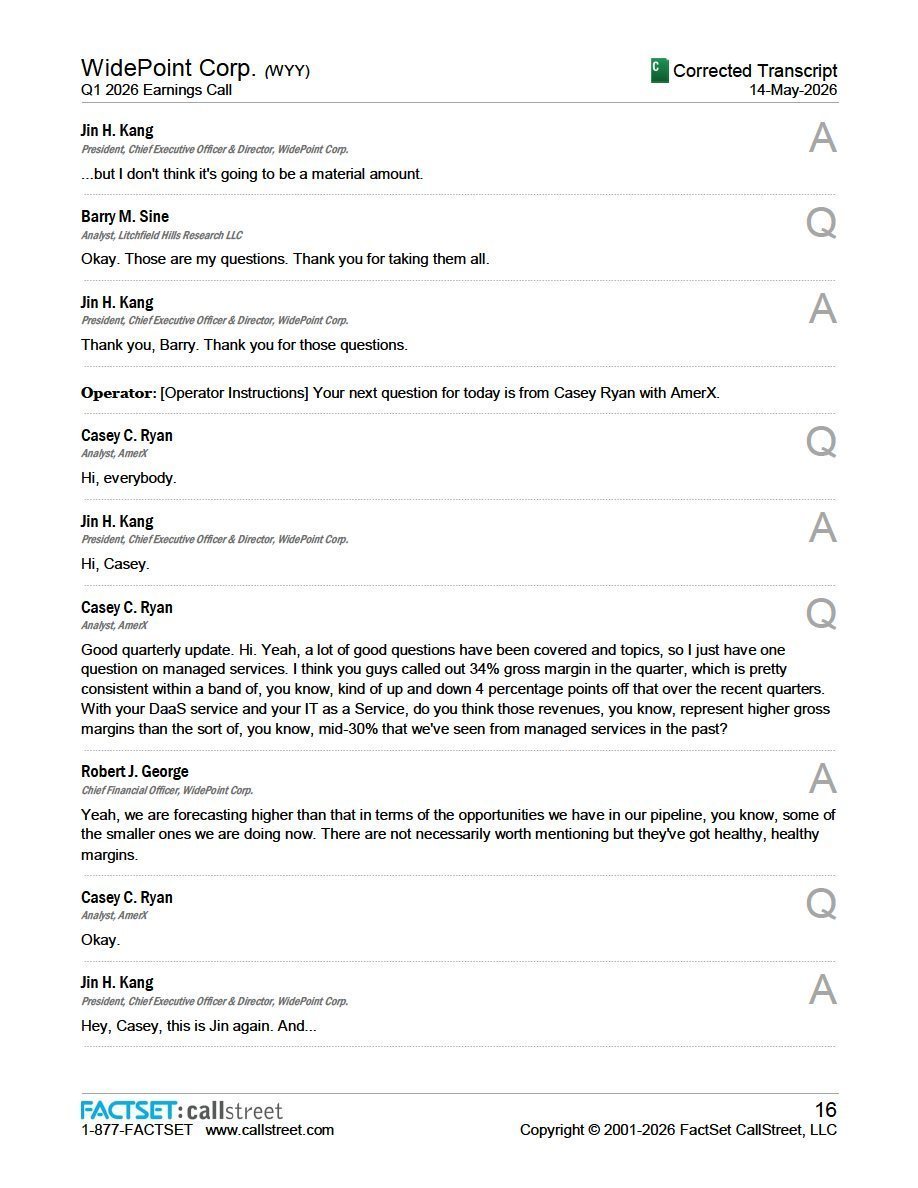
Hi, everybody. Good quarterly update. Hi. Yeah, a lot of good questions have been covered in topics. So I just have one question about managed services. I think you guys called out 34% gross margin in the quarter, which is pretty consistent, you know, within a band of, you know, kind of up and down four percentage points off that over the recent quarters. With your DAS service and your IT as a service, do you think those revenues, you know, represent higher gross margins than the sort of, you know, mid-30% that we've seen from managed services in the past?
Yeah, we are forecasting higher than that in terms of the opportunities we have in our pipeline. Some of the smaller ones we're doing now, they're not necessarily worth mentioning, but they've got healthy margins.
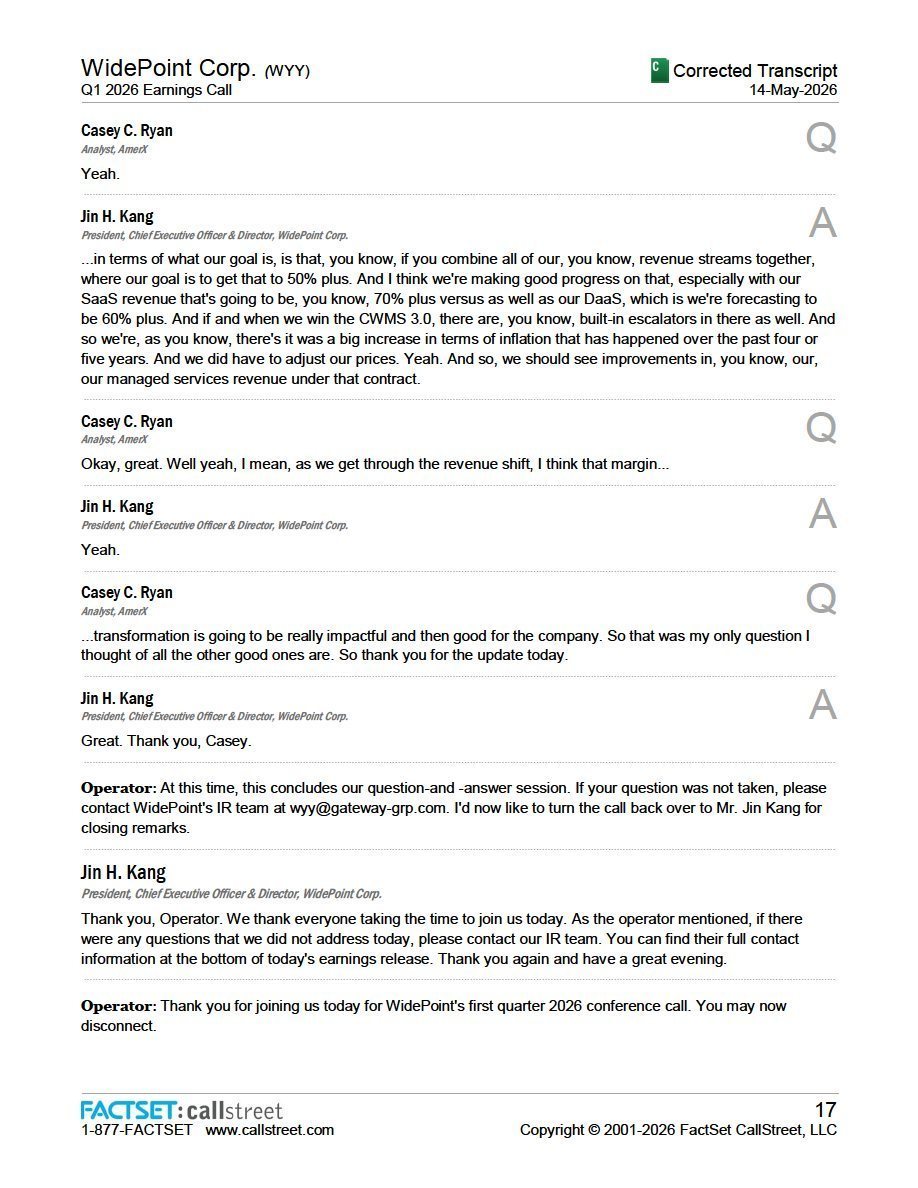
Casey, this is Jim again. In terms of what our goal is, if you combine all of our revenue streams together, our goal is to get that to 50% plus, and I think we're making good progress on that, especially with our SAS revenue that's going to be, you know, 70% plus versus as well as our DAS, which is we're forecasting to be 60% plus. And, you know, if and when we win the CWM STREO, there are, you know, built-in escalators there as well. And so, as you know, there was a big increase in terms of inflation that has happened over the past four or five years. And we did have to adjust our prices. And so, we should see improvements in, you know, our managed services revenue under that contract.
Okay, great. Well, yeah, I mean, as we go through the revenue shift, I think that margin transformation is going to be really impactful and good for the company. So that was my only question outside of all the other good ones that were asked. So thank you for the update today. Great. Thank you, Casey.
Operator
At this time, this concludes our question and answer session. If your question was not taken, please contact WidePoint's IR team at wyy at gateway-grp.com. I'd now like to turn the call back over to Mr. Jin Kang for closing remarks.
Thank you, Operator. We thank everyone taking the time to join us today. As the operator mentioned, if there were any questions that we did not address today, please contact our IR team. You can find their full contact information at the bottom of today's earnings release. Thank you again, and have a great evening.
Operator
Thank you for joining us today for WidePoint's first quarter 2026 conference call. You may now disconnect.