
YDDL 6-K
One & one Green Technologies. INC (YDDL)
UNITED STATES
SECURITIES AND EXCHANGE COMMISSION
Washington, D.C. 20549
Form 6-K
REPORT OF FOREIGN PRIVATE ISSUER PURSUANT TO
RULE 13a-16 OR 15d-16
UNDER THE SECURITIES EXCHANGE ACT OF 1934
For the month of November 2025
Commission File Number: 001-42898
One and one Green Technologies. INC
(Translation of registrant’s name into English)
1st Diliman
San Rafael Bulacan, Philippines, 3008
(Address of principal executive office)
Indicate by check mark whether the registrant files or will file annual reports under cover of Form 20-F or Form 40-F.
Form 20-F ☒ Form 40-F ☐
One and one Green Technologies. INC, a Cayman Islands company (the “Company”) is hereby furnishing this report on Form 6-K (the “Report”) to provide the Unaudited Interim Condensed Consolidated Financial Statements of the Company as of and for the six months ended June 30, 2025 and 2024, included as Exhibit 99.1 of this Report, and the Management’s Discussion and Analysis of Financial Condition and Results of Operations as of and for the six months ended June 30, 2025 and 2024, included as Exhibit 99.2 of this Report.
EXHIBIT INDEX
1
SIGNATURES
Pursuant to the requirements of the Securities Exchange Act of 1934, the registrant has duly caused this report to be signed on its behalf by the undersigned, thereunto duly authorized.
Date: November 17, 2025 |
||
| One and one Green Technologies. INC | ||
| By: | /s/ Caifen Yan | |
| Name: | Caifen Yan | |
| Title: | Chief Executive Officer, Chair of the Board and Director | |
2
Exhibit 99.1
ONE AND ONE GREEN TECHNOLOGIES. INC
UNAUDITED INTERIM CONDENSED CONSOLIDATED BALANCE SHEETS
(In U.S. dollar except for share and per share data)
| June 30, 2025 (Unaudited) | December 31, 2024 | |||||||
| ASSETS | ||||||||
| Current Assets | ||||||||
| Cash and cash equivalents | $ | 122,567 | $ | 1,847,634 | ||||
| Accounts receivable, net | 17,270,873 | 17,401,756 | ||||||
| Inventories, net | 20,633,450 | 5,227,164 | ||||||
| Deferred offering costs | 304,086 | 269,752 | ||||||
| Other receivables and current assets | 4,815 | 4,347 | ||||||
| Total Current Assets | 38,335,791 | 24,750,653 | ||||||
| Non-Current Assets | ||||||||
| Property, plant and equipment, net | 11,184,167 | 11,292,764 | ||||||
| Deferred tax assets, net | 102,098 | 160,672 | ||||||
| Operating lease right of use assets, net | 242,913 | 314,028 | ||||||
| Total Non-Current Assets | 11,529,178 | 11,767,464 | ||||||
| Total Assets | 49,864,969 | 36,518,117 | ||||||
| LIABILITIES AND SHAREHOLDERS’ EQUITY | ||||||||
| Current Liabilities | ||||||||
| Accounts payable | 13,180,592 | 5,752,015 | ||||||
| Other payables and accrued expenses | 992,567 | 425,335 | ||||||
| Due to a related party | 982,507 | 980,833 | ||||||
| Taxes payable | 9,070,965 | 7,733,816 | ||||||
| Operating lease liabilities - current | 337,379 | 785,070 | ||||||
| Total Current Liabilities | 24,564,010 | 15,677,069 | ||||||
| Non-Current Liabilities | ||||||||
| Deferred tax liabilities | - | 62,806 | ||||||
| Other non-current liabilities | 22,177 | 29,091 | ||||||
| Total Non-Current Liabilities | 22,177 | 91,897 | ||||||
| Total Liabilities | 24,586,187 | 15,768,966 | ||||||
| Commitments and Contingencies | ||||||||
| Shareholders’ Equity | ||||||||
| Class A Ordinary Shares, par value $0.0001 per share; 489,796,040 shares authorized; 41,796,040 shares issued and outstanding as of June 30, 2025 and December 31, 2024* | 4,180 | 4,180 | ||||||
| Class B Ordinary Shares, par value $0.0001 per share; 10,203,960 shares authorized; 10,203,960 shares issued and outstanding as of June 30, 2025 and December 31, 2024* | 1,020 | 1,020 | ||||||
| Shares subscription receivable | (5,200 | ) | (5,200 | ) | ||||
| Additional paid-in capital | 392,356 | 392,356 | ||||||
| Retained earnings | 25,681,365 | 21,855,065 | ||||||
| Accumulated other comprehensive loss | (794,939 | ) | (1,498,270 | ) | ||||
| Total Shareholders’ Equity | 25,278,782 | 20,749,151 | ||||||
| Total Liabilities and Shareholders’ Equity | $ | 49,864,969 | $ | 36,518,117 | ||||
| * | The shares and per share information are presented on a retroactive basis to reflect the Reorganization (Note 1) and the additional share issuance on pro rata basis (Note 12). |
The accompanying notes are an integral part of these unaudited interim condensed consolidated financial statements.
F-1
ONE AND ONE GREEN TECHNOLOGIES. INC
UNAUDITED INTERIM CONDENSED CONSOLIDATED STATEMENTS OF INCOME AND COMPREHENSIVE INCOME
| For the Six months ended June 30, | ||||||||
| 2025 | 2024 | |||||||
| (Unaudited) | (Unaudited) | |||||||
| Revenues | $ | 28,129,714 | $ | 18,670,799 | ||||
| Cost of revenues | 21,008,170 | 14,580,835 | ||||||
| Gross profit | 7,121,544 | 4,089,964 | ||||||
| Operating expenses: | ||||||||
| Selling and marketing expenses | 249,558 | 162,891 | ||||||
| General and administrative expenses | 1,167,954 | 961,536 | ||||||
| Total operating expenses | 1,417,512 | 1,124,427 | ||||||
| Income from operations | 5,704,032 | 2,965,537 | ||||||
| Other (expenses) income: | ||||||||
| Interest income | 307 | 39 | ||||||
| Other (expenses) income, net | (790,420 | ) | 151,997 | |||||
| Interest expenses | (3,013 | ) | - | |||||
| Total other (expenses) income | (793,126 | ) | 152,036 | |||||
| Income before income tax expenses | 4,910,906 | 3,117,573 | ||||||
| Income tax expenses | 1,084,606 | 718,732 | ||||||
| Net income | $ | 3,826,300 | $ | 2,398,841 | ||||
| Weighted average shares outstanding | ||||||||
| Basic and diluted* | 52,000,000 | 52,000,000 | ||||||
| Earnings per share | ||||||||
| Basic and diluted* | $ | 0.0736 | $ | 0.0461 | ||||
| Comprehensive income (loss): | ||||||||
| Net income | $ | 3,826,300 | $ | 2,398,841 | ||||
| Other comprehensive income (loss): | ||||||||
| Foreign currency translation adjustment | 703,331 | (923,742 | ) | |||||
| Total comprehensive income | $ | 4,529,631 | $ | 1,475,099 | ||||
| * | The shares and per share information are presented on a retroactive basis to reflect the Reorganization (Note 1) and the additional share issuance on pro rata basis (Note 12). |
The accompanying notes are an integral part of these unaudited interim condensed consolidated financial statements.
F-2
ONE AND ONE GREEN TECHNOLOGIES. INC
UNAUDITED INTERIM CONDENSED CONSOLIDATED STATEMENTS OF CHANGES IN SHAREHOLDERS’ EQUITY
(In U.S. dollar except for share and per share data)
| Ordinary shares * | Class A Ordinary Shares * | Class B Ordinary Shares * | Shares | Additional | Accumulated other | |||||||||||||||||||||||||||||||||||||||
| Number of | Number of | Receivables | Subscription | Paid-in | Retained | Comprehensive | ||||||||||||||||||||||||||||||||||||||
| Shares | Amount | Shares | Amount | Shares | Amount | Receivables | Capital | Earnings | Loss | Total | ||||||||||||||||||||||||||||||||||
| Balance at December 31, 2023 | 52,000,000 | $ | 5,200 | - | $ | - | - | $ | - | $ | (5,200 | ) | $ | 392,356 | $ | 15,378,293 | $ | (714,330 | ) | $ | 15,056,319 | |||||||||||||||||||||||
| Net income | - | - | - | - | - | - | - | - | 2,398,841 | - | 2,398,841 | |||||||||||||||||||||||||||||||||
| Foreign currency translation adjustment | - | - | - | - | - | - | - | - | - | (923,742 | ) | (923,742 | ) | |||||||||||||||||||||||||||||||
| Balance at June 30, 2024 (Unaudited) | 52,000,000 | 5,200 | - | - | - | - | (5,200 | ) | 392,356 | 17,777,134 | (1,638,072 | ) | 16,531,418 | |||||||||||||||||||||||||||||||
| Balance at December 31, 2024 | - | - | 41,796,040 | 4,180 | 10,203,960 | 1,020 | (5,200 | ) | 392,356 | 21,855,065 | (1,498,270 | ) | 20,749,151 | |||||||||||||||||||||||||||||||
| Net income | - | - | - | - | - | - | - | - | 3,826,300 | - | 3,826,300 | |||||||||||||||||||||||||||||||||
| Foreign currency translation adjustment | - | - | - | - | - | - | - | - | - | 703,331 | 703,331 | |||||||||||||||||||||||||||||||||
| Balance at June 30, 2025 (Unaudited) | - | - | 41,796,040 | 4,180 | 10,203,960 | 1,020 | (5,200 | ) | 392,356 | 25,681,365 | (794,939 | ) | 25,278,782 | |||||||||||||||||||||||||||||||
| * | The shares and per share information are presented on a retroactive basis to reflect the Reorganization (Note 1) and the additional share issuance on pro rata basis (Note 12). |
The accompanying notes are an integral part of these unaudited interim condensed consolidated financial statements.
F-3
ONE AND ONE GREEN TECHNOLOGIES. INC
UNAUDITED INTERIM CONDENSED CONSOLIDATED STATEMENTS OF CASH FLOWS
(In U.S. dollar except for share and per share data)
| For the Six months ended June 30, | ||||||||
| 2025 | 2024 | |||||||
| (Unaudited) | (Unaudited) | |||||||
| Cash flows from operating activities | ||||||||
| Net income | $ | 3,826,300 | $ | 2,398,841 | ||||
| Adjustments to reconcile net income to net cash (used in) provided by operating activities: | ||||||||
| Depreciation expenses | 456,709 | 452,674 | ||||||
| Amortization of operating lease right-of-use assets | 79,867 | 108,661 | ||||||
| Deferred income taxes | (1,145 | ) | (15,783 | ) | ||||
| Changes in assets and liabilities | ||||||||
| Accounts receivable | 667,809 | (7,855,754 | ) | |||||
| Inventories | (15,034,423 | ) | 2,439,990 | |||||
| Advances to suppliers | - | 632,297 | ||||||
| Other receivables and current assets | (327 | ) | (3,388 | ) | ||||
| Customer advances | - | (595,870 | ) | |||||
| Accounts payable | 7,149,232 | 1,396,375 | ||||||
| Other payables and accrued expenses | 538,611 | 96,100 | ||||||
| Taxes payable | 1,079,500 | 1,331,055 | ||||||
| Due to a related party | (28,714 | ) | (472 | ) | ||||
| Operating lease liabilities | (465,891 | ) | (29,482 | ) | ||||
| Net cash (used in) provided by operating activities | (1,732,472 | ) | 355,244 | |||||
| Cash flows from financing activities | ||||||||
| Payment of deferred offering costs | (25,516 | ) | (231,737 | ) | ||||
| Net cash used in financing activities | (25,516 | ) | (231,737 | ) | ||||
| Net (decrease) increase of cash and cash equivalents | (1,757,988 | ) | 123,507 | |||||
| Effect of foreign currency translation on cash and cash equivalents | 32,921 | (39,563 | ) | |||||
| Cash and cash equivalents – beginning | 1,847,634 | 136,479 | ||||||
| Cash and cash equivalents – ending | $ | 122,567 | $ | 220,423 | ||||
| Supplementary cash flow information: | ||||||||
| Interest paid | $ | 3,013 | $ | - | ||||
| Income taxes paid | $ | 978 | $ | - | ||||
The accompanying notes are an integral part of these unaudited interim condensed consolidated financial statements.
F-4
ONE AND ONE GREEN TECHNOLOGIES. INC
NOTES TO UNAUDITED INTEIRM CONDENSED CONSOLIDATED FINANCIAL STATEMENTS
| 1. | Organization and Business |
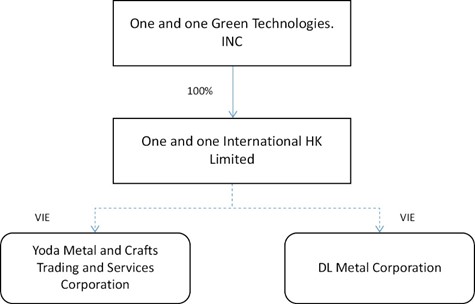
One and one Green Technologies. INC (“One and one Cayman”) was incorporated in the Cayman Islands on April 17, 2024. On May 29, 2024, One and one Cayman established One and one International HK Limited (“One and One HK”), a wholly-owned subsidiary, as an investment holding company. One and one Cayman, through its subsidiary and two variable interest entities (“VIE”) (collectively, the “Company”), is primarily engaged in recycling, production, and trading of recycled scrap metals in the Republic of Philippines (the “Philippines”).
Reorganization
In preparation for its listing, a reorganization of the Company’s legal structure (the “Reorganization”) was completed on June 10, 2024. The Reorganization involved formation of One and one Cayman and One and one HK; and execution of a series of Contractual Arrangements between One and one HK and each of the shareholders of Yoda Metal and Crafts Trading and Services Corp. (“Yoda Metal”) and DL Metal Corporation (“DL Metal”), thereby establishing a VIE structure (Refer to Note 3 for details).
As a result of the Reorganization, One and one Cayman became the ultimate holding company of Yoda Metal and DL Metal through contractual agreements, rather than direct ownership. This Reorganization is considered a recapitalization under common control of the same group of shareholders before and after the reorganization. Therefore, the consolidation of One and one Cayman, its subsidiary, and the VIEs has been accounted for at historical cost and presented as if the aforementioned transactions had become effective as of the beginning of the first period presented in the accompanying consolidated financial statements.
Information of One and one Cayman’s consolidated subsidiary and the VIEs are summarized as follows:
| Name of entity | Date of incorporation | Ownership | Place of incorporation | Principle business activities | ||||||
| One and one HK | May 29, 2024 | 100% | Hong Kong, SAC | Investment Holding | ||||||
| Yoda Metal | March 20, 2014 | Contractual Arrangement | Republic of the Philippines | Manufacturing and trading | ||||||
| DL Metal | March 3, 2022 | Contractual Arrangement | Republic of the Philippines | Manufacturing and trading | ||||||
F-5
ONE AND ONE GREEN TECHNOLOGIES. INC
NOTES TO UNAUDITED INTEIRM CONDENSED CONSOLIDATED FINANCIAL STATEMENTS
| 2. | Summary of Significant Accounting Policies |
| a) | Basis of presentation |
The accompanying unaudited consolidated financial statements are prepared in accordance with accounting principles generally accepted in the United States of America (“U.S. GAAP”). Certain information and footnote disclosures normally included in the annual financial statements prepared in conformity with U.S. GAAP have been or omitted pursuant to such rules and regulations. Accordingly, these statements should be read in conjunction with the Company’s audited consolidated financial statements for the year ended December 31, 2024.
In the opinion of the management, the accompanying unaudited consolidated financial statements reflect all normal recurring adjustments, which are necessary for a fair statement of financial results for the interim periods presented. The Company believes that the disclosures are adequate to make the information presented not misleading. The accompanying unaudited consolidated financial statements have been prepared using the same accounting policies as used in the preparation of the Company’s consolidated financial statements for the year ended December 31, 2024. The results of operations for the six months ended June 30, 2025 are not necessarily indicative of the results for the full year.
| b) | Principles of consolidation |
The Company’s consolidated financial statements include the financial statements of the Company, its subsidiary and the VIEs. All inter-company transactions and balances among the Company, its subsidiary and the VIEs have been eliminated upon consolidation.
| c) | Use of estimates |
The preparation of consolidated financial statements in conformity with U.S. GAAP requires management to make estimates and assumptions that affect the reported amounts of assets and liabilities and the related disclosure of contingent assets and liabilities at the date of these consolidated financial statements, and the reported amounts of revenue and expenses during the reporting period. The Company continually evaluates these estimates and assumptions based on the most recently available information, historical experience and various other assumptions that the Company believes to be reasonable under the circumstances. Significant accounting estimates reflected in the Company’s consolidated financial statements include but are not limited to estimates and judgments applied in determination of allowance for doubtful receivables arising from expected credit losses, economic lives and impairment losses for long-lived assets, discount rate used to measure present value of lease liabilities, estimate of the lease terms and valuation allowance for deferred tax assets. Since the use of estimates is an integral component of the financial reporting process, actual results could differ from those estimates.
| d) | Foreign currency translation and transactions |
The Company’s reporting currency is US dollars (“US$”). The Company’s operations are principally conducted through the VIEs located in the Philippines where Philippine peso (“PHP”) is the functional currency, and its subsidiary located in Hong Kong where Hong Kong dollar (“HKD”) is the functional currency.
Transactions denominated in foreign currencies are re-measured into the functional currency at the exchange rates at the beginning of the month. Monetary assets and liabilities denominated in foreign currencies are re-measured at the exchange rates prevailing at the balance sheet date. Non-monetary items that are measured in terms of historical cost in foreign currency are re-measured using the exchange rates at the dates of the initial transactions. Exchange gains and losses are included in the consolidated statements of income and comprehensive income.
For entities which are located in the Philippines and have the functional currency as PHP, the financial statements are translated from their respective functional currencies into US$. Assets and liabilities are translated using the exchange rate at each balance sheet date’s period end rate. Revenue and expenses are translated using average rates prevailing during each reporting period, and shareholders’ equity is translated at historical exchange rates. Adjustments resulting from the translation are recorded as a separate component of accumulated other comprehensive loss in shareholders’ equity.
F-6
ONE AND ONE GREEN TECHNOLOGIES. INC
NOTES TO UNAUDITED INTEIRM CONDENSED CONSOLIDATED FINANCIAL STATEMENTS
| 2. | Summary of Significant Accounting Policies (cont.) |
Exchange rate used for the translation as follows:
| US$ to PHP | Period End | Average Rate | ||||||
| June 30, 2025 | 56.31650 | 57.09491 | ||||||
| December 31, 2024 | 58.08400 | N/A | ||||||
| June 30, 2024 | 58.60300 | 56.83297 | ||||||
No representation is intended to imply that the PHP amounts could have been, or could be, converted, realized or settled into US$ at that rate on June 30, 2025, or at any other rate.
| e) | Cash and cash equivalents |
Cash and cash equivalents consist of bank deposits and cash on hand, which are unrestricted as to withdrawal and use. The Company considers all highly liquid investments with original maturities of three months or less at the time of purchase to be cash equivalents.
| f) | Accounts receivable |
The Company records accounts receivable at net realizable value consisting of the carrying amount less an allowance for credit losses. An estimate for the allowance for credit losses is discussed below in “Credit Losses on Financial Instruments”. Account balances are charged off against the allowance after all means of collection have been exhausted and the potential for recovery is considered remote.
| g) | Credit losses on financial instruments |
The Company early adopted ASU 2016-13, Financial Instruments — Credit Losses effective January 1, 2021. The Company uses the Current Expected Credit Losses (CECL) model to estimate credit losses on financial assets measured at amortized cost, as well as certain off-balance sheet credit exposures. When similar risk characteristics exist, the Company assesses collectability and measures expected credit losses on a collective basis for a pool of assets, whereas if similar risk characteristics do not exist, the Company assesses collectability and measures expected credit losses on an individual asset basis.
Under the CECL model, the estimation of credit losses involves significant judgment and estimation uncertainty. Management exercises its judgment based on historical loss experience, the age of the accounts receivable, current economic conditions, and reasonable and supportable forecasts that may affect the customer’s ability to pay. Changes in these factors could have a material impact on the estimated credit losses.
| h) | Inventories |
Inventories are stated at the lower of cost or net realizable value, with net realized value represented by estimated selling prices in the ordinary course of business, less reasonably predictable costs of disposal and transportation. Cost of inventory is determined using the weighted average cost method. No inventory write-down was recorded for the six months ended June 30, 2025 and 2024.
| i) | Property, plant and equipment |
The Company’s property, plant and equipment are recorded at cost less accumulated depreciation and impairment loss, if any. Depreciation is calculated on the straight-line method after taking into account their respective estimated residual values over the following estimated useful lives:
| Category | Useful life | |
| Land | Indefinite | |
| Real property and buildings | 20 years | |
| Vehicle | 5 years | |
| Machinery and equipment | 10 years |
F-7
ONE AND ONE GREEN TECHNOLOGIES. INC
NOTES TO UNAUDITED INTEIRM CONDENSED CONSOLIDATED FINANCIAL STATEMENTS
| 2. | Summary of Significant Accounting Policies (cont.) |
When property, plant and equipment are retired or otherwise disposed of, resulting gain or loss is included in net income in the period of disposition.
Expenditures for repairs and maintenance are expensed as incurred, whereas the costs of betterments that extend the useful life of property, plant and equipment are capitalized as additions to the related assets. Gain or loss on disposal of property, plant and equipment, if any, is recognized in the consolidated statements of income and comprehensive income as the difference between the net sales proceeds and the carrying amount of the underlying asset.
The Company recognizes construction in progress (“CIP”) at cost, which includes all expenditures directly attributable to the construction or acquisition of the related property, plant, and equipment. These costs may include materials, labor, and applicable overhead costs, which are indirect costs associated with the construction. CIP is not depreciated until the asset is placed in service and is both physically and functionally complete.
| j) | Impairment of long-lived assets |
All long-lived assets, which include tangible long-lived assets and right-of-use assets, are reviewed for impairment whenever events or changes in circumstances indicate that the carrying amount of an asset may not be recoverable. Recoverability of long-lived assets to be held and used is measured by a comparison of the carrying amount of the asset to the estimated undiscounted future cash flows expected to be generated by the assets. If the carrying amount of an asset exceeds its estimated future undiscounted cash flows, an impairment loss is recognized for the difference between the carrying amount of the asset and its fair value.
For the six months ended June 30, 2025 and 2024, the Company did not recognize any impairment loss on long-lived assets.
| k) | Deferred offering costs |
Deferred offering costs represent legal, accounting, and other direct costs related to the Company’s initial public offering (IPO). These costs are capitalized as incurred and are included in the accompanying balance sheet as Deferred offering costs. As of June 30, 2025 and December 31, 2024, the Company recorded $304,086 and $269,752 of deferred offering costs, respectively.
Upon completion of the IPO, these deferred offering costs, along with the underwriters’ fees paid, will be reclassified to additional paid-in capital and netted against the IPO proceeds received. If the IPO is not completed, such costs will be expensed.
| l) | Fair value of financial instruments |
The Company’s financial instruments primarily consist of cash and cash equivalents, accounts receivable, other receivables, accounts payable, other payables and accrued expenses, vehicle loan payable, and due to a related party. The carrying values of these financial instruments’ approximate fair values due to their short maturities.
Fair value is defined as the exchange price that would be received for an asset or paid to transfer a liability (an exit price) in the principal or most advantageous market for the asset or liability in an orderly transaction between market participants on the measurement date. This note also establishes a fair value hierarchy which requires classification based on observable and unobservable inputs when measuring fair value. There are three levels of inputs that may be used to measure fair value:
| Level 1 — | Quoted prices in active markets for identical assets or liabilities. | |
| Level 2 — | Observable inputs other than Level 1 prices such as quoted prices for similar assets or liabilities; quoted prices in markets that are not active; or other inputs that are observable or can be corroborated by observable market data for substantially the full term of the assets or liabilities. | |
| Level 3 — | Unobservable inputs that are supported by little or no market activity and that are significant to the fair value of the assets or liabilities. |
Determining which category an asset or liability falls within the hierarchy requires significant judgment. The Company evaluates its hierarchy disclosures on a recurring basis which involves reassessing the appropriateness of the chosen hierarchy level as new information or market conditions become available.
F-8
ONE AND ONE GREEN TECHNOLOGIES. INC
NOTES TO UNAUDITED INTEIRM CONDENSED CONSOLIDATED FINANCIAL STATEMENTS
| 2. | Summary of Significant Accounting Policies (cont.) |
| m) | Revenue recognition |
In accordance with ASC Topic 606, revenues are recognized when control of the contracted goods or services is transferred to the Company’s customers, in an amount that reflects the consideration the Company expects to be entitled to in exchange for those goods or services. In determining when and how much revenue is recognized from contracts with customers, the Company performs the following five-step analysis: (1) identify the contract(s) with a customer; (2) identify the performance obligations in the contract; (3) determine the transaction price; (4) allocate the transaction price to the performance obligations in the contract; (5) recognize revenue when (or as) the entity satisfies a performance obligation. The Company assesses its revenue arrangements against specific criteria in order to determine if it is acting as principal or agent. Revenue is recognized upon the transfer of control of contracted goods to a customer.
Trading of recycled scrap metals
Revenues are generated from trading of recycled scrap metals.
The Company is the principal party in fulfilling the identified performance obligation as it controls the finished goods prior to the transfer to the customer, assumes the risks and rewards associated with the transactions, including bearing any associated costs and risks, bearing the risk of loss or damage to inventory, and bearing the credit risk associated with customers’ ability to pay for the goods. The revenue is recognized at a point in time concurrent with the transfer of control, which usually occurs, depending on shipping terms, upon shipment, issuance of bill of lading or customer receipt. In addition, revenue is deferred when cash payments are received or due in advance of performance.
Payment terms and conditions vary by contract type, although the Company generally requires customers to pay 30 days after the Company satisfies the performance obligations. In instances where the timing of revenue recognition differs from the timing of invoicing, the Company has determined the contracts do not include a significant financing component.
Revenues are measured as the amount of consideration the Company expects to receive in exchange for transferring the finished goods to customers, which generally reflects current market prices at the time the contract is entered into. Consideration is recorded net of value-added tax, and there is no variable consideration exists in the trading of the goods.
The Company did not have contract assets and liabilities as of June 30, 2025 and December 31, 2024. Contract liabilities are primarily related to deferred revenue resulting from cash payments received in advance from customers to protect against credit risk. The amounts of revenue recognized for the six months ended June 30, 2025 and 2024, that were included in the contract liabilities were $nil and $611,283, respectively.
| n) | Cost of revenues |
Cost of revenues primarily consists of cost of goods sold which are manufactured by the Company.
F-9
ONE AND ONE GREEN TECHNOLOGIES. INC
NOTES TO UNAUDITED INTEIRM CONDENSED CONSOLIDATED FINANCIAL STATEMENTS
| 2. | Summary of Significant Accounting Policies (cont.) |
| o) | Income taxes |
The Company follows the guidance of ASC Topic 740 “Income taxes” and uses liability method to account for income taxes. Under this method, deferred tax assets and liabilities are determined based on the difference between the financial reporting and tax bases of assets and liabilities using enacted tax rates that will be in effect in the period in which the differences are expected to reverse. The Company records a valuation allowance to offset deferred tax assets, if based on the weight of available evidence, it is more-likely-than-not that some portion, or all, of the deferred tax assets will not be realized. The effect on deferred taxes of a change in tax rates is recognized in statement of income and comprehensive income in the period that includes the enactment date.
The Company uses a more likely than not threshold for financial statement recognition and measurement of a tax position taken or expected to be taken in a tax return. As a result, the impact of an uncertain income tax position is recognized at the largest amount that is more-likely-than-not to be sustained upon audit by the relevant tax authority. An uncertain income tax position will not be recognized if it has less than a 50% likelihood of being sustained.
| p) | Value added tax (“VAT”) |
The Company is subject to VAT on revenue generated from production and trading of scrap metals. The Company records revenue net of VAT. This VAT may be offset by qualified input VAT paid by the Company to suppliers. As of June 30, 2025 and December 31, 2024, the Company did not have net VAT recoverable balance. When applicable, such balances are presented under “Other receivables and current assets” on the consolidated balance sheets. The tax is equivalent to a uniform rate of 12%, based on the gross selling price of goods or properties sold, or gross receipts from the sale of services. The Company has a VAT exemption on importation and export sales as VAT-registered persons are zero-rated.
| q) | Segment reporting |
The Company operates and manages its business as a single segment and has one operating and reportable segment, trading of recycled scrap metals.
The accounting policies of the segment are the same as those described in the summary of significant accounting policies. The chief operating decision maker assesses performance for the segment and decides how to allocate resources based on net income that also is reported on the income statement as consolidated net income. The measure of segment assets is reported on the balance sheet as total consolidated assets.
The Company’s Chief Executive Officer is the chief operating decision-maker (“CODM”). When making decisions about allocating resources and assessing the performance of the Company as a whole, the CODM review operating metrics and consolidated financial statements.
Consequently, the Company has determined that it has only one reportable operating segment.
| r) | Comprehensive income |
Comprehensive income includes all changes in equity from transactions and other events and circumstances excluding transactions resulting from investments from owners and distributions to owners. For the years presented, total comprehensive income included foreign currency translation adjustments.
| s) | Earnings per share |
Earnings per share are computed in accordance with ASC 260. As of June 30, 2025 and December 31, 2024, the Company had 41,796,040 Class A ordinary shares and 10,203,960 Class B ordinary shares issued and outstanding at par value, respectively.
F-10
ONE AND ONE GREEN TECHNOLOGIES. INC
NOTES TO UNAUDITED INTEIRM CONDENSED CONSOLIDATED FINANCIAL STATEMENTS
| 2. | Summary of Significant Accounting Policies (cont.) |
Holders of Class A ordinary shares and Class B ordinary shares have the same rights, except for voting and conversion rights. Each Class A ordinary share is entitled to one vote; and each Class B ordinary share is entitled to twenty votes and is convertible into one Class A ordinary share at any time by the holder thereof. Class A ordinary shares are not convertible into Class B ordinary shares under any circumstances.
As the liquidation and dividend rights are identical, the undistributed earnings are allocated on a proportionate basis. The earnings per share are the same for Class A and Class B ordinary shares because the holders of each class are entitled to equal per share dividends or distributions in liquidation.
Basic earnings per ordinary share is computed by dividing net income attributable to holders of ordinary shares by the weighted average number of ordinary Shares outstanding during the year. Diluted earnings per share is calculated by dividing net income attributable to ordinary shareholders by the weighted average number of ordinary and dilutive ordinary equivalent shares outstanding during the year. Ordinary equivalent shares are not included in the denominator of the diluted earnings per share calculation when inclusion of such shares would be anti-dilutive or in the case of contingently issuable shares that all necessary conditions for issuance have not been satisfied. For the six months ended June 30, 2025 and 2024, there was no dilution impact.
| t) | Commitments and contingencies |
The Company accrues estimated losses from loss contingencies by a charge to income when information available before financial statements are issued or are available to be issued indicates that it is probable that an asset had been impaired, or a liability had been incurred at the date of the financial statements and the amount of the loss can be reasonably estimated. Legal expenses associated with the contingency are expensed as incurred. If a loss contingency is not probable or reasonably estimable, disclosure of the loss contingency is made in the financial statements when it is at least reasonably possible that a material loss could be incurred.
As of June 30, 2025 and December 31, 2024, there were no contingent liabilities relating to litigations against the Company.
| u) | Lease |
In February 2016, the FASB issued ASU No. 2016-02, “Leases (Topic 842)”. The amendments in this ASU require that a lessee recognize the assets and liabilities that arise from operating leases. A lessee should recognize in the statement of financial position a liability to make lease payments (the lease liability) and a right-of-use asset representing its right to use the underlying asset for the lease term. For leases with a term of 12 months or less, a lessee is permitted to make an accounting policy election by class of underlying asset not to recognize lease assets and lease liabilities. In November 2019, the FASB issued ASU No. 2019-10, Financial Instruments — Credit losses (Topic 326), Derivative and Hedging (Topic 815), and Lease (Topic 842): Effective Date. ASU2019-10 amends the effective dates for ASU No. 2016-02. The Company has early adopted ASU2016-02 effective January 1, 2021. The Company has adopted the ASU with changes to the Company’s balance sheet to recognize right-of-use assets and related lease liabilities for operating leases.
The Company evaluates whether agreements constitute leases by reviewing the contractual terms to determine which party obtains both the economic benefits and control of the assets at the inception of the contract. Leases with contractual terms longer than twelve months are categorized as operating or finance leases at the commencement date.
The Company recognizes a lease liability for future lease payments and a right-of-use (ROU) asset representing the right to use the underlying asset for the lease term. The lease term is based on the non-cancellable term of the lease and may contain options to extend the lease when it is reasonably certain that the Company will exercise the option. Lease liabilities are recognized at the commencement date based on the present value of lease payments over the lease term using the rate implicit in the lease, if available, or the Company’s incremental borrowing rate. Leases with an initial term of 12 months or less were short-term leases and not recognized as right-of-use assets and lease liabilities on the consolidated balance sheets.
ROU assets are measured at the amount of the lease liabilities with adjustments for lease prepayments made prior to or at lease commencement, initial direct costs incurred by the Company, deferred rent and lease incentives, and any off-market terms present in the lease. ROU assets are depreciated over their useful life, considering the lease term and any residual value under straight line basis. The Company evaluates the carrying value of ROU assets if there are indicators of impairment and reviews the recoverability of the related asset.
The Company reassesses if a contract is or contains a leasing arrangement and re-measures ROU assets and liabilities upon modification of the contract. Differences are recognized in the consolidated statement of income on contract termination.
F-11
ONE AND ONE GREEN TECHNOLOGIES. INC
NOTES TO UNAUDITED INTEIRM CONDENSED CONSOLIDATED FINANCIAL STATEMENTS
| 2. | Summary of Significant Accounting Policies (cont.) |
| v) | Recent issued or adopted accounting standards |
The Company is an “emerging growth company” (“EGC”) as defined in the Jumpstart Our Business Startups Act of 2012 (the “JOBS Act”). Under the JOBS Act, EGC can delay adopting new or revised accounting standards issued subsequent to the enactment of the JOBS Act until such time as those standards apply to private companies. The Company does not opt out of extended transition period for complying with any new or revised financial accounting standards. Therefore, the Company’s financial statements may not be comparable to companies that comply with public company effective dates.
In September 2025, the FASB issued ASU 2025-07, Derivatives and Hedging (Topic 815) and Revenue from Contracts with Customers (Topic 606): Scope Refinements and Clarification for Share-Based Noncash Consideration from a Customer. This ASU clarifies the application of derivative guidance to contracts whose underlying is based on one party’s operations or activities and provides interpretive guidance on share-based noncash consideration in revenue arrangements. The amendments are effective for fiscal years beginning after December 15, 2026, including interim periods within those fiscal years, with early adoption permitted. The Company does not expect adoption of this ASU to have a material impact on its consolidated financial statements.
In July 2025, the FASB issued ASU 2025-05, Financial Instruments — Credit Losses (Topic 326): Measurement of Credit Losses for Accounts Receivable and Contract Assets. The ASU provides a practical expedient and accounting policy election for measuring expected credit losses on certain trade receivables and contract assets arising under ASC 606. The amendments are effective for fiscal years beginning after December 15, 2025, and interim periods within those fiscal years, with early adoption permitted. The Company is currently evaluating the impact of this ASU on its measurement of expected credit losses, particularly with respect to contract assets related to revenue recognized under the cost-to-cost input method.
In May 2025, the FASB issued ASU 2025-03, Business Combinations (Topic 805) and Consolidation (Topic 810): Determining the Accounting Acquirer in the Acquisition of a Variable Interest Entity. This ASU updates guidance for determining the accounting acquirer when the acquiree is a variable interest entity (“VIE”) and the transaction is effected primarily through an exchange of equity interests. Under the new guidance, entities are required to apply the general business combination criteria in ASC 805-10-55-12 through 55-15 (such as relative voting rights, governance, and size of the combining entities) rather than automatically identifying the primary beneficiary of the VIE as the accounting acquirer. The amendments are effective for fiscal years beginning after December 15, 2026, including interim periods within those fiscal years. Early adoption is permitted. The Company is currently evaluating the impact of this ASU on its consolidated financial statements, including potential implications for transactions involving entities determined to be VIEs.
In November 2023, the FASB issued ASU 2023-07, Segment Reporting (Topic 280), Improvements to Reportable Segment Disclosures to improve reportable segment disclosure requirements through enhanced disclosures about significant segment expenses. ASU 2023-07 expands public entities’ segment disclosures by requiring disclosure of significant segment expenses that are regularly provided to the CODM and included within each reported measure of segment profit or loss, an amount and description of its composition for other segment items and interim disclosures of a reportable segment’s profit or loss and assets. All disclosure requirements of ASU 2023-07 are required for entities with a single reportable segment. ASU 2023-07 is effective for fiscal years beginning after December 15, 2023, and interim periods for fiscal years beginning after December 15, 2024, and should be applied on a retrospective basis to all periods presented. Early adoption is permitted. The Company adopted ASU 2023-07 for the year ended December 31, 2024.
In December 2023, the FASB issued 2023-09, Income Taxes (Topic 740), Improvements to Income Tax Disclosures to enhance income tax information primarily through changes in the rate reconciliation and income taxes paid information. ASU 2023-09 is effective for annual periods beginning after December 15, 2024 on a prospective basis. Early adoption is permitted. The Company is currently evaluating the impact of this standard on our statements and related disclosures.
Other accounting pronouncements that have been issued or proposed by the FASB or other standards-setting bodies that do not require adoption until a future date are not expected to have a material impact on the Company’s consolidated financial position and results of operations upon adoption.
F-12
ONE AND ONE GREEN TECHNOLOGIES. INC
NOTES TO UNAUDITED INTEIRM CONDENSED CONSOLIDATED FINANCIAL STATEMENTS
| 3. | Variable Interest Entities |
On June 10, 2024, the directors of Yoda Metal and DL Metal approved and adopted board resolutions whereby they irrevocably designated Hua Jun Yan as the authorized legal representative to sign and process any transaction for and on behalf of Yoda Metal and DL Metal. This authorization includes the use of electronic signatures for all directors as deemed necessary for any transactions.
On June 10, 2024, the Company’s wholly owned subsidiary, One and One HK, executed a series of Contractual Arrangement with each of the shareholders of Yoda Metal and DL Metal, establishing a variable interest entity (“VIE”) structure. These Contractual Arrangements include:
Exclusive Business Cooperation Agreements
Pursuant to the Exclusive Business Cooperation Agreement between (i) Yoda Metal and One and one HK, (ii) DL Metal and One and one HK, to provide Yoda Metal and DL Metal with technical support, consulting services and other management services relating to its day-to-day business operations and management, on an exclusive basis, utilizing its advantages in technology, business management and information. For services rendered to Yoda Metal and DL Metal by One and one HK under these agreement, One and one HK is entitled to collect a service fee that shall be calculated based upon service hours and multiple hourly rates provided by One and one HK. The service fee should approximately equal to Yoda Metal and DL Metal’s net profit.
The Exclusive Business Cooperation Agreement shall remain in effect for ten years unless earlier terminated upon written confirmation from both (i) One and one HK and Yoda Metal, and (ii) One and one HK and DL Metal before expiration. Otherwise, these agreements can only be extended by (i) One and one HK and Yoda Metal, and (ii) One and one HK and DL Metal, and the agreement cannot be terminated unilaterally.
Exclusive Share Pledge Agreements
Under the Share Pledge Agreement between (i) One and one HK and each of the shareholders of Yoda Metal, and (ii) One and one HK and each of the shareholders of DL Metal, together holding 100% of the equity interests, of each Yoda Metal and DL Metal (“Yoda Metal and DL Metal Shareholders”), the Yoda Metal and DL Metal Shareholders pledged all of their equity interests in Yoda Metal and DL Metal to One and one HK to guarantee the performance of Yoda Metal and DL Metal’s obligations under the Exclusive Business Cooperation Agreement.
Under the terms of the Share Pledge Agreement, in the event that Yoda Metal and DL Metal breaches its contractual obligations under the Exclusive Business Cooperation Agreement, One and one HK, as pledgee, will be entitled to certain rights, including, but not limited to, the right to dispose of dividends generated by the pledged equity interests. The Yoda Metal and DL Metal Shareholders also agreed that upon occurrence of any event of default, as set forth in the Share Pledge Agreement, One and one HK is entitled to dispose of the pledged equity interest in accordance with applicable laws. The Yoda Metal and DL Metal Shareholders further agree not to dispose of the pledged equity interests or take any actions that would prejudice One and one HK’s interest.
The Share Pledge Agreement shall be effective until the full payment of the service fees under the Business Cooperation Agreement has been made and upon termination of Yoda Metal and DL Metal’s obligations under the Business Cooperation Agreement.
The purposes of the Share Pledge Agreement are to (1) guarantee the performance of Yoda Metal and DL Metal’s obligations under the Exclusive Business Cooperation Agreement, (2) ensure the shareholders of Yoda Metal and DL Metal do not transfer or assign the pledged equity interests, or create or allow any encumbrance that would prejudice One and one HK’s interests without One and one HK’s prior written consent and (3) provide One and one HK control over Yoda Metal and DL Metal.
F-13
ONE AND ONE GREEN TECHNOLOGIES. INC
NOTES TO UNAUDITED INTEIRM CONDENSED CONSOLIDATED FINANCIAL STATEMENTS
| 3. | Variable Interest Entities (cont.) |
Exclusive Option Agreement
Under the Exclusive Option Agreement, the shareholders of Yoda Metal and DL Metal irrevocably granted One and one HK (or its designee) an exclusive right to purchase, to the extent permitted under Philippines law, once or at multiple times, at any time, a portion or whole of the equity interests or assets in Yoda Metal and DL Metal held by the each of the entities’ shareholders. The purchase price is equal to the capital paid in by the Shareholders, adjusted pro rata for purchase of less than all of the Equity Interest and subject to any appraisal or restrictions required by applicable Philippine laws and regulations. The agreement takes effect upon parties signing the agreement, and remains effective for 10 years, extendable at One and one HK or its designee’s discretion.
As a result of these board resolutions and agreements, One and one HK has the power to direct the activities of Yoda Metal and DL Metal that most significantly impact their economic performance. Additionally, One and one HK has the right to receive benefits from Yoda Metal and DL Metal that could potentially be significant to Yoda Metal and DL Metal. Therefore, One and one HK is considered the primary beneficiary of Yoda Metal and DL Metal. Consequently, the financial results of Yoda Metal and DL Metal are consolidated into the financial statements of One and one HK in accordance with U.S. GAAP.
While the VIE structure allows for the consolidation of Yoda Metal and DL Metal, it also brings certain risks and uncertainties, and it is subject to significant scrutiny and could be impacted by regulatory changes including but not limited to:
| ● | Enforceability of the Contractual Arrangements under the applicable local laws |
| ● | Potential changes in laws and regulations that could affect the enforceability of these arrangements |
| ● | The ability of One and one HK to exercise control over Yoda Metal and DL Metal as anticipated |
Management regularly assesses the VIE arrangements to ensure compliance with existing laws and regulations and to evaluate any potential changes in circumstances that could affect the consolidation of the VIE entities.
The following financial statement amounts and balances of the VIEs were included in the accompanying consolidated financial statements after elimination of intercompany transactions and balances:
| June 30, | December 31, | |||||||
| 2025 | 2024 | |||||||
| (Unaudited) | ||||||||
| Current assets | $ | 38,335,791 | $ | 24,750,653 | ||||
| Non-current assets | 11,529,178 | 11,767,464 | ||||||
| Total assets | 49,864,969 | 36,518,117 | ||||||
| Current liabilities | 24,564,010 | 15,677,069 | ||||||
| Non-current liabilities | 22,177 | 91,897 | ||||||
| Total Liabilities | 24,586,187 | 15,768,966 | ||||||
| Net assets | $ | 25,278,782 | $ | 20,749,151 | ||||
| Six Months Ended | ||||||||
| June 30, | ||||||||
| 2025 | 2024 | |||||||
| (Unaudited) | (Unaudited) | |||||||
| Revenues | $ | 28,129,714 | $ | 18,670,799 | ||||
| Gross profit | 7,121,544 | 4,089,964 | ||||||
| Income before income tax expenses | 4,910,906 | 3,117,573 | ||||||
| Net income | $ | 3,826,300 | $ | 2,398,841 | ||||
F-14
ONE AND ONE GREEN TECHNOLOGIES. INC
NOTES TO UNAUDITED INTEIRM CONDENSED CONSOLIDATED FINANCIAL STATEMENTS
| 3. | Variable Interest Entities (cont.) |
| Six Months Ended | ||||||||
| June 30, | ||||||||
| 2025 | 2024 | |||||||
| (Unaudited) | (Unaudited) | |||||||
| Net cash (used in) provided by operating activities | $ | (1,732,472 | ) | $ | 355,244 | |||
| Net cash used in investing activities | - | - | ||||||
| Net cash provided by (used in) financing activities | (25,516 | ) | (231,737 | ) | ||||
The assets of the VIEs have not been pledged or used as collateral for other obligations and are solely for the VIEs’ own use and to settle their own obligations. The creditors of the VIEs can only claim against the assets of the VIEs and do not have the right to seek repayment from the Company’s assets.
| 4. | Accounts Receivables |
Accounts receivables consist of the following:
| June 30, | December 31, | |||||||
| 2025 | 2024 | |||||||
| (Unaudited) | ||||||||
| Accounts receivable | $ | 17,270,873 | $ | 17,401,756 | ||||
| Less: allowance for expected credit loss | - | - | ||||||
| Total, net | $ | 17,270,873 | $ | 17,401,756 | ||||
For the six months ended June 30, 2025 and 2024, no allowance for credit losses expense was recognized against its accounts receivable, respectively.
| 5. | Inventories |
Inventories consisted of the following:
| June 30, | December 31, | |||||||
| 2025 | 2024 | |||||||
| (Unaudited) | ||||||||
| Raw materials | $ | 12,287,406 | $ | 3,161,517 | ||||
| Materials in transit | 5,354,110 | 1,869,241 | ||||||
| Finished goods | 2,991,934 | 196,406 | ||||||
| Less: write-down inventory | - | - | ||||||
| Total, net | $ | 20,633,450 | $ | 5,227,164 | ||||
For the six months ended June 30, 2025 and 2024, no write-down on inventory was recognized against its inventory, respectively.
Raw materials represent the materials purchased readily for production and held by the Company in its warehouse.
Materials in transit represent the materials shipping on the road but not yet arrived at the warehouse of the Company. Under the shipment terms of FOB (Free on Board), the risk of loss and damage was transferred from the seller to the buyer when materials were loaded onto the vessel and are a trigger for the purchaser’s legal obligation to pay for the goods, which correspondingly brought the balance of materials in transit recorded under inventories.
| 6. | Deferred Offering Costs |
Deferred offering costs consist of the following:
| June 30, | December 31, | |||||||
| 2025 | 2024 | |||||||
| (Unaudited) | ||||||||
| Deferred offering costs | $ | 304,086 | $ | 269,752 | ||||
F-15
ONE AND ONE GREEN TECHNOLOGIES. INC
NOTES TO UNAUDITED INTEIRM CONDENSED CONSOLIDATED FINANCIAL STATEMENTS
| 7. | Other Receivables and Current Assets |
Other receivables and current assets consist of the following:
| June 30, | December 31, | |||||||
| 2025 | 2024 | |||||||
| (Unaudited) | ||||||||
| Prepaid social insurance | $ | 576 | $ | 237 | ||||
| Other receivables | 4,239 | 4,110 | ||||||
| Total | $ | 4,815 | $ | 4,347 | ||||
| 8. | Property, Plant, and Equipment |
Property, plant, and equipment consist of the following:
| June 30, | December 31, | |||||||
| 2025 | 2024 | |||||||
| (Unaudited) | ||||||||
| At Cost: | ||||||||
| Land | $ | 75,607 | $ | 73,306 | ||||
| Buildings | 9,007,362 | 8,733,267 | ||||||
| Machinery and equipment | 5,113,857 | 4,958,242 | ||||||
| Vehicle | 58,704 | 56,918 | ||||||
| Subtotal | 14,255,530 | 13,821,733 | ||||||
| Less: Accumulated depreciation | (3,071,363 | ) | (2,528,969 | ) | ||||
| Total, net | $ | 11,184,167 | $ | 11,292,764 | ||||
Depreciation expenses for the six months ended June 30, 2025 and 2024 were $456,709 and $452,674, respectively as follows:
| Six Months Ended | ||||||||
| June 30, | ||||||||
| 2025 | 2024 | |||||||
| (Unaudited) | (Unaudited) | |||||||
| Depreciation expenses-General and administrative expenses | $ | 159,492 | $ | 213,764 | ||||
| Depreciation expenses-Manufacturing costs | 297,217 | 238,910 | ||||||
| Total | $ | 456,709 | $ | 452,674 | ||||
For the six months ended June 30, 2025 and 2024, no impairment loss was recognized for the Company’s property, plant and equipment.
| 9. | Related Party Transactions |
The following is a list of the related party with whom the Company conducted transactions during the six months ended June 30, 2025 and 2024, and their relationship and nature with the Company:
| Name | Relationship | Purpose/Nature | ||
| HuaJun Yan | Chief Operating Officer and Director | Working capital advances |
Due to the related party represents amount owed to Mr. Huajun Yan for advances he made on behalf of the Company. From time to time, Mr. Yan advances money to the Company to pay staff salaries and the fees to service providers. These advances are non-interest bearing and will be paid upon request.
| June 30, | December 31, | |||||||
| Names | 2025 | 2024 | ||||||
| (Unaudited) | ||||||||
| HuaJun Yan | $ | 982,507 | $ | 980,833 | ||||
| Total | $ | 982,507 | $ | 980,833 | ||||
F-16
ONE AND ONE GREEN TECHNOLOGIES. INC
NOTES TO UNAUDITED INTEIRM CONDENSED CONSOLIDATED FINANCIAL STATEMENTS
| 10. | Income Taxes |
The statutory income tax rate for Yoda Metal is 22% for the six months ended June 30, 2025 and 23% for the six months ended June 30, 2024; and for DL Metal is 20% for the six months ended June 30, 2025 and 2024, respectively. The effective income tax rate for the six months ended June 30, 2025 and 2024 were 22.09% and 23.05%, respectively. The Company did not identify any material unrecognized tax benefits for each of the periods presented.
| 11. | Employee Contribution Plan |
The Company operates in the Philippines, where Philippine law mandates employee and employer contributions to the Social Security System (“SSS”), the Home Development Mutual Fund (“Pag-IBIG Fund”), and the Philippines Health Insurance Corporation (“PhilHealth”) for private sector employees and certain self-employed individuals. Contributions to these plans are reflected as employee benefit expense in the Company’s consolidated financial statements. The specific amounts expensed depend on the applicable contribution rates and employee salaries.
Employees and employers contribute jointly to the SSS. The contribution rates are determined by a prescribed table, with the current rate set at 14% of the employee’s monthly salary credit, subject to a maximum salary credit base. The SSS offers social security benefits including sickness, maternity, disability, retirement, and death benefits.
Similarly, contributions to the Pag-IBIG Fund are mandatory and shared between employees and employers. The current contribution rate for employees is 2% of their monthly compensation, which is matched by the employer. The Pag-IBIG Fund provides its members with access to housing and short-term loans, savings programs, and dividend earnings.
In addition, both employees and employers are required to contribute to PhilHealth, the national health insurance program. The contribution rate is 5% of the employee’s monthly salary, subject to a minimum salary base of PHP 10,000 and a maximum salary base of PHP 100,000. PhilHealth provides employees with access to healthcare benefits, including inpatient and outpatient services, surgeries, and other medical reimbursements.
The total expenses incurred for the plan were $5,454 and $25,393 for the six months ended June 30, 2025 and 2024, respectively.
| 12. | Shareholders’ Equity |
Ordinary shares
The authorized share capital of the Company was US$50,000, divided into 500,000,000 ordinary shares with par value of $0.0001 each. On April 17, 2024, the Company issued 20,000,000 shares to shareholders at par value of $0.0001 per share.
On December 27, 2024, the board of directors approved additional issuance of 32,000,000 ordinary shares to existing shareholders at par value of $0.0001 per share on pro rata basis and redesignation of all the 10,203,960 issued and outstanding ordinary shares held by One and one International Limited into 10,203,960 Class B ordinary shares of a par value of US$0.0001 each; 41,796,040 issued and outstanding ordinary shares held by shareholders of the Company other than One and one International Limited and all the 448,000,000 unissued ordinary shares into 489,796,040 Class A ordinary shares of a par value of US$0.0001 each.
Holders of Class A ordinary shares and Class B ordinary shares have the same rights, except for voting and conversion rights. Each Class A ordinary share is entitled to one vote; and each Class B ordinary share is entitled to twenty votes and is convertible into one Class A ordinary share at any time by the holder thereof. Class A ordinary shares are not convertible into Class B ordinary shares under any circumstances.
F-17
ONE AND ONE GREEN TECHNOLOGIES. INC
NOTES TO UNAUDITED INTEIRM CONDENSED CONSOLIDATED FINANCIAL STATEMENTS
| 12. | Shareholders’ Equity (cont.) |
As of June 30, 2025 and December 31, 2024, there are 41,796,040 Class A ordinary shares and 10,203,960 Class B ordinary shares issued and outstanding.
Restricted net assets
The Company’s ability to pay dividends is contingent on receiving distributions from the VIEs. According to Philippine statutory laws and regulations, dividends can only be declared from the Company’s unrestricted retained earnings, if any, as determined by Philippine accounting standards. Consequently, the financial results presented in the Company’s consolidated financial statements prepared under U.S. GAAP might differ from the financial results presented in the VIEs’ statutory financial statements.
Accumulated income represents the Company’s accumulated profits not distributed as dividends and not designated for specific purposes. While there is no statutory reserve requirement to allocate specific reserve funds, the Company cannot declare dividends if such action would render it insolvent or impair its capital. The board of directors has discretion to allocate profits to various reserves, such as contingency funds, expansion funds, or employee benefit funds.
The aforementioned restrictions do not necessarily prohibit the VIEs from transferring its net assets to the Company, and the agreements with the VIEs do not include clauses that restrict such distributions.
| 13. | Concentration of Risk |
Currency Convertibility Risk
The VIEs in the Philippines primarily conducts business in Philippine Peso (PHP). While PHP is generally considered a convertible currency, there is a level of risk associated with its convertibility into other currencies. This risk arises from potential limitations on exchanging PHP, particularly for less common currencies or during periods of economic or political instability. Any future limitations could impact the Company’s ability to repatriate funds or settle obligations denominated in foreign currencies which could affect the Company’s operation. The Company continues to monitor the convertibility of PHP and assesses potential risks.
Foreign Currency Exchange Rate Risk
The VIEs in the Philippines principally transacts in Philippine Peso (PHP) for its revenues, expenses, assets, and liabilities. The exchange rate of the PHP can fluctuate due to changes in Philippine central bank policies, international economic conditions, and political developments. These fluctuations can impact the consolidated financial statements through translation adjustments, which arise from translating the VIEs’ financial statements prepared in PHP into the Company’s reporting currency using the current exchange rate. Transaction gains (losses) may also occur due to the settlement of PHP-denominated transactions at exchange rates different from the rates used at the transaction date. The Company has not engaged in any foreign currency hedging strategies to hedge for foreign currency risk.
Credit risk
Financial instruments that potentially subject the Company to significant concentrations of credit risk consist primarily of cash and cash equivalents, and accounts receivable.
The Company’s cash and cash equivalents were held by major financial institutions located in the Philippines.
The Company believes these institutions to be of high credit quality. While deposits in these institutions are insured by the Philippine Deposit Insurance Corporation (PDIC) up to PHP 500,000 per depositor (not each individual account), this insurance coverage may not be sufficient to fully protect the Company’s cash balance in the event of a bank failure. The Company acknowledges this limitation and considers the credit quality of the financial institutions a primary factor in mitigating the risk of loss.
For accounts receivable, the Company extends credit based on an evaluation of the customer’s or other parties’ financial condition, generally without requiring collateral or other security. In order to minimize the credit risk, the Company delegated a team responsible for credit approvals and other monitoring procedures to ensure that follow-up action is taken to recover overdue debts. Further, the Company reviews the recoverable amount of each individual receivable at each balance sheet date to ensure that adequate allowances are made for doubtful accounts. In this regard, the Company considers that the Company’s credit risk for accounts receivable is significantly reduced.
F-18
ONE AND ONE GREEN TECHNOLOGIES. INC
NOTES TO UNAUDITED INTEIRM CONDENSED CONSOLIDATED FINANCIAL STATEMENTS
| 13. | Concentration of Risk (cont.) |
Concentration of customers consist of the following:
| Six Months Ended | As of | Six Months Ended | As of | |||||||||||||
| June 30, | June 30, | June 30, | December 31, | |||||||||||||
| 2025 | 2025 | 2024 | 2024 | |||||||||||||
| Revenues | Receivables | Revenues | Receivables | |||||||||||||
| % of total | % of total | % of total | % of total | |||||||||||||
| Customer A | 27.55 | % | 33.40 | % | 31.39 | % | 13.10 | % | ||||||||
| Customer B | 42.68 | % | 66.60 | % | 41.90 | % | 86.90 | % | ||||||||
| Customer C | 29.77 | % | - | % | 21.69 | % | - | % | ||||||||
For the six months ended June 30, 2025, Customer A, Customer B, and Customer C accounted for 27. 55%, 42.68% and 29.77% of the Company’s revenues, respectively.
As of June 30, 2025, Customer A and Customer B accounted for 33.40% and 66.60% of the Company’s accounts receivable, respectively.
For the six months ended June 30, 2024, Customer A, Customer B, and Customer C accounted for 31.39%, 41.90%, and 21.69% of the Company’s revenues, respectively.
As of December 31, 2024, Customer A, and Customer B, accounted for 13.10%, and 86.90% of the Company’s accounts receivable, respectively.
Concentration of suppliers consist of the following:
| Six Months Ended | As of | Six Months Ended | As of | |||||||||||||
| June 30, | June 30, | June 30, | December 31, | |||||||||||||
| 2025 | 2025 | 2024 | 2024 | |||||||||||||
| Purchases | Payables | Purchases | Payables | |||||||||||||
| % of total | % of total | % of total | % of total | |||||||||||||
| Supplier A | 41.37 | % | 18.58 | % | 41.31 | % | 48.21 | % | ||||||||
| Supplier B | 17.25 | % | 42.54 | % | - | - | ||||||||||
| Supplier C | 10.74 | % | * | 19.05 | % | 10.55 | % | |||||||||
| Supplier D | * | 10.75 | % | - | - | |||||||||||
| Supplier E | * | 10.42 | % | - | 10.47 | % | ||||||||||
| Supplier F | * | * | 14.17 | % | - | |||||||||||
| Supplier G | * | * | 11.36 | % | - | |||||||||||
| Supplier H | * | * | * | 17.22 | % | |||||||||||
| * | Indicates below 10%. |
For the six months ended June 30, 2025, Supplier A, Supplier B, Supplier C accounted for 41.37%, 17.25% and 10.74% of the Company’s total purchase amount, respectively.
As of June 30, 2025, Supplier A, Supplier B, Supplier D and Supplier E accounted for 18.58%, 42.54%, 10.75% and 10.42% of the Company’s accounts payable, respectively.
For the six months ended June 30, 2024, Supplier A, supplier C, supplier F and supplier G for 41.31%, 19.05%, 14.17% and 11.36% of the Company’s total purchase amount, respectively.
As of December 31, 2024, Supplier A, Supplier C, Supplier E, and Supplier H accounted for 48.21%, 10.55%, 10.47% and 17.22% of the Company’s accounts payable, respectively.
F-19
ONE AND ONE GREEN TECHNOLOGIES. INC
NOTES TO UNAUDITED INTEIRM CONDENSED CONSOLIDATED FINANCIAL STATEMENTS
| 14. | Commitments and Contingencies |
Litigations and claims
To the best of the Company’s knowledge and based on information available as of June 30, 2025 and December 31, 2024, the Company is not involved in any material claims or legal actions arising from the ordinary course of business. However, the Company is exposed to various risks and uncertainties that could potentially result in litigation or claims in the future. The Company continuously evaluates these contingencies and will adjust its disclosures as necessary.
Environmental matters
The Company is subject to various environmental laws and regulations. While the Company has implemented policies and procedures to comply with these regulations, there may be instances of non-compliance that could result in potential environmental liabilities. As of June 30, 2025 and December 31, 2024, the Company is not involved in any liabilities for environmental remediation costs. However, the identification of environmental issues in the future, such as contamination or waste disposal could result in significant costs, which may have a material adverse effect on the Company’s financial condition.
Insurance coverage
The Company does not maintain insurance coverage for certain risks, including general liability, property damage, and employee-related claims. As a result, the Company may be exposed to significant financial losses in the event of such risks materializing. The absence of insurance coverage may have a material adverse effect on the Company’s financial condition and results of operations.
The Company continuously evaluates these contingencies based on the available information and will adjust its estimates and accruals as necessary.
| 15. | Disaggregation of Revenue |
The Company disaggregates its revenue by product types, as the Company believes this disaggregation best depicts how the nature, amount, timing and uncertainty of the revenue and cash flows are affected by economic factors.
Revenues by product types consist of the following:
| Six Months Ended | ||||||||
| June 30, | ||||||||
| 2025 | 2024 | |||||||
| (Unaudited) | (Unaudited) | |||||||
| Aluminum alloy | $ | 8,608,800 | $ | 8,162,560 | ||||
| Copper alloy ingots | 18,510,036 | 8,242,906 | ||||||
| Brass alloy ingots | 1,000,960 | 1,437,413 | ||||||
| Slag | 9,918 | 827,920 | ||||||
| Total | $ | 28,129,714 | $ | 18,670,799 | ||||
Revenues by geographic areas consist of the following:
| Six Months Ended | ||||||||
| June 30, | ||||||||
| 2025 | 2024 | |||||||
| (Unaudited) | (Unaudited) | |||||||
| Philippines | $ | 8,381,298 | $ | 4,978,810 | ||||
| China | 19,748,416 | 13,691,989 | ||||||
| Total | $ | 28,129,714 | $ | 18,670,799 | ||||
F-20
ONE AND ONE GREEN TECHNOLOGIES. INC
NOTES TO UNAUDITED INTEIRM CONDENSED CONSOLIDATED FINANCIAL STATEMENTS
| 16. | Leases |
Components of lease cost, weighted average remaining lease terms and discount rates of operating lease consist of the following:
June 30, (Unaudited) | December 31, 2024 | |||||||
| Lease assets and liabilities | ||||||||
| Operating lease right-of-use assets, net | $ | 242,913 | $ | 314,028 | ||||
| Operating lease liabilities - current | 337,379 | 785,070 | ||||||
| Operating lease liabilities - non current | — | — | ||||||
| Operating lease liabilities - total | 337,379 | 785,070 | ||||||
| For the Six Months Ended June 30, | ||||||||
| 2025 (Unaudited) | 2024 (Unaudited) | |||||||
| Lease expenses | ||||||||
| Operating lease expenses-General and administrative expenses | $ | 8,765 | $ | 11,589 | ||||
| Operating lease expenses-Manufacturing costs | 71,102 | 116,154 | ||||||
| Total | $ | 79,867 | $ | 127,743 | ||||
| Other Information | ||||||||
| Cash paid for amounts included in the measurement of lease liabilities | ||||||||
| Operating cash flows - operating leases | $ | (465,891 | ) | $ | 94,193 | |||
| Weighted average remaining lease term (in years) | ||||||||
| Operating leases | 1.50 | 2.28 | ||||||
| Average discount rate | ||||||||
| Operating leases | 5.99 | % | 6.00 | % | ||||
| Operating | ||||
| Leases | ||||
| Future minimum lease payments as of June 30, 2025 | ||||
| Twelve months ended June 30, | ||||
| 2025 | $ | 337,379 | ||
| Thereafter | - | |||
| Total | 337,379 | |||
| Less: interest | - | |||
| Present value of lease liabilities | $ | 337,379 | ||
F-21
ONE AND ONE GREEN TECHNOLOGIES. INC
NOTES TO UNAUDITED INTEIRM CONDENSED CONSOLIDATED FINANCIAL STATEMENTS
| 17. | Subsequent Events |
The Company has evaluated subsequent events through the date of issuance of these consolidated financial statements; there were no other subsequent events occurred that would require recognition or disclosure in the Company’s consolidated financial statements except the following:
Completion of initial public offering (the “IPO”) on Nasdaq Capital Market
On October 10, 2025, the Company closed its IPO on the Nasdaq Capital Market where 2,000,000 ordinary shares were newly issued at a price of $5.00 per share for gross proceeds of $10 million.
On October 28, 2025, Cathay Securities, Inc., as representative of the underwriters (the “Representative”), relating to the IPO of the Company, fully exercised its option (the “Over-allotment Option”) to purchase 300,000 additional Class A ordinary shares of the Company, par value $0.001 per share, at a price of $5.00 per share (the “Over-allotment Shares”). The closing of the sale of the Over-allotment Shares took place on October 28, 2025 for gross proceeds of $1.5 million.
F-22
Exhibit 99.2
MANAGEMENT’S
DISCUSSION AND ANALYSIS OF
FINANCIAL CONDITION AND RESULTS OF OPERATIONS
Overview
One and one Cayman was incorporated in the Cayman Islands on April 17, 2024. We conduct our business through the VIEs, Yoda Metal and DL Metal in the Philippines. We primarily engage in recycling, production and trading of recycled scrap metals in the Philippines.
We are a waste materials and scrap metal recycling company in the Philippines. Our capabilities are underscored by our permitted capacity for metal recycling, measured in tons per year, and by the government-issued license that enables us to import hazardous waste (as raw materials) into the Philippines. We process raw materials and generate final products that include copper alloy ingot, aluminum scrapes, plastic beads, and others. We provide economical and flexible solutions to the challenges of electronic waste, metal scrap and industrial recycling. By providing lower-cost alternatives for processing recycled materials, we not only contribute to environmental sustainability but also highlight our role as a modern and specialized recycling company.
We have established an environmentally friendly technology that we believe sets us apart from competitors. Our exhaust gas recirculation system and exhaust emissions have been examined and approved annually by the Environmental Management Bureau (“EMB”) in the Philippines. Our exhaust gas recirculation system enhances process efficiency while minimizing and, in some cases, eliminating contamination. Through this system, we capture the ash and slag contained in the emissions for further metal recovery ad smelting, ensuring the exhaust we ultimately release meets all applicable standards. In contrast, competing technologies, such as table concentrators, cannot prevent pollution during the final stages of processing.
Due to our sustainable, environmentally friendly processes, we believe we are well-positioned to comply with heightened regulations across the globe.
We benefit from being fully authorized by the government to process hazardous wastes under the framework of The Basel Convention: A Global Solution for Controlling Hazardous Wastes.
We have a full suite of environmentally friendly devices and have complied with all governmental documentary requirements, including ECC, Permit to Operate, Discharge Permit, Import and Export Permit. As of June 30, 2025, our workforce consisted of 91 employees, including 7 engineers. Electronic waste and metal scraps from local and abroad (Korea, Japan, Southeast Asia, Europe, USA etc.) are carefully segregated and processed in compliance with the existing environmental laws, rules and regulations. Our annual processing capacity is estimated to be around 300,000 tons.
In 2025, the Company’s growth strategies will concentrate on geographically expanding into Southeast Asia and other international markets, establishing stable sources of raw materials from Japan and South Korea. We also expect to recruit an international business development team with well-rounded language skills and cultural expertise to strengthen our capabilities across Europe, America, and Asia.
Results of Operations
Comparison of the Six Months Ended June 30, 2025 and 2024
The following table sets forth key components of our results of operations during the six months ended June 30, 2025 and 2024, both in dollars.
One and one Green
Technologies. INC
Consolidated Statements of Income and Comprehensive Income
For the Six Months Ended June 30, 2025 and 2024
| For the Six months ended June 30, | ||||||||
2025 (Unaudited) | 2024 (Unaudited) | |||||||
| Revenues | $ | 28,129,714 | $ | 18,670,799 | ||||
| Cost of revenues | 21,008,170 | 14,580,835 | ||||||
| Gross profit | 7,121,544 | 4,089,964 | ||||||
| Operating expenses: | ||||||||
| Selling and marketing expenses | 249,558 | 162,891 | ||||||
| General and administrative expenses | 1,167,954 | 961,536 | ||||||
| Total operating expenses | 1,417,512 | 1,124,427 | ||||||
| Income from operations | 5,704,032 | 2,965,537 | ||||||
| Other (expenses) income: | ||||||||
| Interest income | 307 | 3939 | ||||||
| Other (expenses) income, net | (790,420 | ) | 151,997 | |||||
| Interest expenses | (3,013 | ) | — | |||||
| Total other (expenses) income | (793,126 | ) | 152,036 | |||||
| Income before income tax expenses | 4,910,906 | 3,117,573 | ||||||
| Income tax expenses | 1,084,606 | 718,732 | ||||||
| Net income | $ | 3,826,300 | $ | 2,398,841 | ||||
| Weighted average shares outstanding | ||||||||
| Basic and diluted* | 52,000,000 | 52,000,000 | ||||||
| Earnings per share | ||||||||
| Basic and diluted* | $ | 0.0736 | $ | 0.0461 | ||||
| Other comprehensive income (loss): | ||||||||
| Net income | $ | 3,826,300 | $ | 2,398,841 | ||||
| Other comprehensive income (loss): | ||||||||
| Foreign currency translation adjustment | 703,331 | (923,742 | ) | |||||
| Total comprehensive income | $ | 4,529,631 | $ | 1,475,099 | ||||
| * | The shares and per share information are presented on a retroactive basis to reflect the Reorganization (Note 1 to the consolidated financial statements) and the additional share issuance on pro rata basis (Note 12 to the consolidated financial statements). |
Revenue
Our net revenue was $28,129,714 for the six months ended June 30, 2025 as compared to $18,670,799 for the six months ended June 30, 2024, representing an increase of $9,458,915 or 50.66%. The Company has three main product categories, brass ingot, copper ingot and aluminum. The Company achieved sales of brass ingot for $1,000,960 and $1,437,413 for the six months ended June 30, 2025 and 2024, respectively. The revenue of copper ingot are $18,510,036 and $8,242,906 for the six months ended June 30, 2025 and 2024, respectively. For aluminum alloy, the figures are $8,608,800 and $8,162,560 for the six months ended June 30, 2025 and 2024, respectively. In 2025, the Company experienced a notable increase in sales volume for its copper-based, primarily driven by stronger demand across key end markets in Asian-pacific region. In contrast, the sales volume of brass alloy and aluminum alloy declined during the same period, reflecting shifting demand within specific segments.
2
Cost of revenue
Our cost of revenue was $21,008,170 and $ 14,580,835 for the six months ended June 30, 2025 and 2024, respectively. The increase in cost of revenue was primarily driven by higher sales volume for the six months ended June 30, 2025, compared to the same period in 2024, resulting in a corresponding increase in costs.
Gross profit and gross margin
| For the Six months ended June 30, | ||||||||||||||||||||||||
| 2025 | 2024 | |||||||||||||||||||||||
Revenue (Unaudited) | Sales Quantity (kg) | Cost (Unaudited) | Revenue (Unaudited) | Sales Quantity (kg) | Cost (Unaudited) | |||||||||||||||||||
| Brass alloy ingots | 1,000,960 | 176,700 | 811,016 | 1,437,413 | 238,320 | 1,168,882 | ||||||||||||||||||
| Aluminum alloy | 8,608,800 | 3,559,143 | 6,493,338 | 8,162,560 | 3,654,666 | 7,294,131 | ||||||||||||||||||
| Copper alloy ingots | 18,510,036 | 2,141,245 | 13,703,816 | 8,242,906 | 898,602 | 6,117,822 | ||||||||||||||||||
| Slag | 9,918 | 65,000 | - | 827,920 | 6,000 | - | ||||||||||||||||||
| Total | 28,129,714 | 5,942,088 | 21,008,170 | 18,670,799 | 4,797,588 | 14,580,835 | ||||||||||||||||||
Our gross profit was $7,121,544 for the six months ended June 30, 2025, as compared to gross profit of $4,089,964 for the six months ended June 30, 2024. Our gross margin was 25.32% for the six months ended June 30, 2025, as compared to gross margin of 21.91% for the six months ended June 30, 2024. The increase in margin for the six months ended June 30, 2025 was mainly due to the lower purchase price of copper alloy and aluminum alloy.
Operating expenses
Total operating expenses increased by $293,085 or 26.07% to $1,417,512 for the six months ended June 30, 2025 from $1,124,427 for the six months ended June 30, 2024.
Our selling expenses for the six months ended June 30, 2025 , increased by $86,667 compared to the corresponding period of the prior year. The increase in selling expenses was primarily driven by the increase in freight forwarding service fees, which resulted from a shift in product mix. While sales revenue increased due to higher prices and higher sales volumes of copper and brass alloy ingots, the overall shipment volume decreased as a result of lower aluminum alloy sales.
General and administrative expenses for the six months ended June 30, 2025, increased by $206,418 compared to the same period in 2024. The increase was primarily attributable to: (1) additional indirect listing-related expenses of approximately $354,000 were incurred in preparation for the planned IPO, including audit fees and consulting services; which were partly offset by (2) the reduction of the depreciation expenses and office expenses included in general and administrative expenses of approximately $102,000 in aggregate for the six months ended June 30, 2025.
Other (expenses) income
Our other expense was $790,420 for the six months ended June 30, 2025 as compared to other income of $151,997 for the six months ended June 30, 2024. The other (expenses) income, net, mainly consisted of currency exchange differences that arise from transactions denominated in currencies other than Philippine peso.
Net income
As a result of the cumulative effect of the factors described above, our net income for the six months ended June 30, 2025 and 2024 were $3,826,300 and $2,398,841, respectively.
3
Liquidity and Capital Resources
Comparison of the Six Months Ended June 30, 2025 and 2024
The following table sets forth a summary of our cash flows for the periods indicated:
| For the six months ended June 30, | ||||||||
2025 (Unaudited) | 2024 (Unaudited) | |||||||
| Net cash (used in) provided by operating activities | $ | (1,732,472 | ) | $ | 355,244 | |||
| Net cash used in financing activities | (25,516 | ) | (231,737 | ) | ||||
| Effect of exchange rate changes on cash and cash equivalents | 32,921 | (39,563 | ) | |||||
| Net change in cash and cash equivalents | (1,757,988 | ) | 123,507 | |||||
| Cash and cash equivalents at the beginning of period | 1,847,634 | 136,479 | ||||||
| Cash and cash equivalents at the end of period | $ | 122,567 | $ | 220,423 | ||||
As of June 30, 2025 we had cash and cash equivalents of $122,567. To date, we have financed our operations primarily through our operation.
Company has no material cash requirement as of June 30, 2025. No capital expenditures were incurred for the six months ended June 30, 2025 and our operating cash flows are sufficient to support ongoing business operations. The Company currently has no interest-bearing debt. Should material investments or capital needs arise in the future, any such expenditures would be subject to the Board’s approval and, if necessary, supported by appropriately structured bank financing.
Operating Activities
Our net cash used in operating activities was $1,732,472 for the six months ended June 30, 2025, compared to $355,244 provided by operating activities for the same period in 2024. The decrease in net cash from operating activities was mainly attributable to the increase of inventories in the six months ended June 30, 2025 as compared to the six months ended June 30, 2024.
Financing Activities
Our net cash used in financing activities was $25,516 for the six months ended June 30, 2025, compared to $231,737 for the six months ended June 30, 2024. The net cash used in financing activities for the six months ended June 30, 2025 was mainly due to the payment of deferred offering costs.
Leases
Components of lease cost, weighted average remaining lease terms and discount rates of operating lease consist of the following:
June 30, (Unaudited) | December 31, 2024 | |||||||
| Lease assets and liabilities | ||||||||
| Operating lease right-of-use assets, net | $ | 242,913 | $ | 314,028 | ||||
| Operating lease liabilities - current | 337,379 | 785,070 | ||||||
| Operating lease liabilities - non current | — | — | ||||||
| Operating lease liabilities - total | 337,379 | 785,070 | ||||||
| For the Six Months Ended June 30, | ||||||||
| 2025 (Unaudited) | 2024 (Unaudited) | |||||||
| Lease expenses | ||||||||
| Operating lease expenses-General and administrative expenses | 8,765 | 11,589 | ||||||
| Operating lease expenses-Manufacturing costs | $ | 71,102 | $ | 116,154 | ||||
| Total | $ | 79,867 | $ | 127,743 | ||||
| Other Information | ||||||||
| Cash paid for amounts included in the measurement of lease liabilities | ||||||||
| Operating cash flows - operating leases | $ | (465,891 | ) | $ | 94,193 | |||
| Weighted average remaining lease term (in years) | ||||||||
| Operating leases | 1.50 | 2.28 | ||||||
| Average discount rate | ||||||||
| Operating leases | 5.99 | % | 6.00 | % | ||||
4
| Operating Leases | ||||
| Future minimum lease payments | ||||
| Twelve months ended June 30, | ||||
| 2025 | $ | 337,379 | ||
| Thereafter | — | |||
| Total | 337,379 | |||
| Less: interest | — | |||
| Present value of lease liabilities | $ | 337,379 | ||
Trend Information
Other than as disclosed elsewhere in this prospectus, we are not aware of any trends, uncertainties, demands, commitments, or events that are reasonably likely to have a material effect on our net revenue, income from continuing operations, profitability, liquidity, or capital resources, or that would cause reported financial information not necessarily to be indicative of future operating results or financial condition.
Off-Balance Sheet Arrangements
We have not entered into any financial guarantees or other commitments to guarantee the payment obligations of any third parties. In addition, we have not entered into any derivative contracts that are indexed to our own shares and classified as shareholders’ equity, or that are not reflected in our financial statements. Furthermore, we do not have any retained or contingent interest in assets transferred to an unconsolidated entity that serves as credit, liquidity or market risk support to such entity. Moreover, we do not have any variable interest in an unconsolidated entity that provides financing, liquidity, market risk or credit support to us or engages in leasing, hedging or research and development services with us.
Critical Accounting Policies and Management Estimates
| a) | Use of Estimates |
The preparation of consolidated financial statements in conformity with U.S. GAAP requires management to make estimates and assumptions that affect the reported amounts of assets and liabilities and the related disclosure of contingent assets and liabilities at the date of these consolidated financial statements, and the reported amounts of revenue and expenses during the reporting period. The Company continually evaluates these estimates and assumptions based on the most recently available information, historical experience and various other assumptions that the Company believes to be reasonable under the circumstances. Significant accounting estimates reflected in the Company’s consolidated financial statements include but are not limited to estimates and judgments applied in determination of allowance for doubtful receivables arising from expected credit losses, economic lives and impairment losses for long-lived assets, discount rate used to measure present value of lease liabilities, estimate of the lease terms and valuation allowance for deferred tax assets. Since the use of estimates is an integral component of the financial reporting process, actual results could differ from those estimates.
| b) | Revenue Recognition |
In accordance with ASC Topic 606, revenues are recognized when control of the contracted goods or services is transferred to the Company’s customers, in an amount that reflects the consideration the Company expects to be entitled to in exchange for those goods or services. In determining when and how much revenue is recognized from contracts with customers, the Company performs the following five-step analysis: (1) identify the contract(s) with a customer; (2) identify the performance obligations in the contract; (3) determine the transaction price; (4) allocate the transaction price to the performance obligations in the contract; (5) recognize revenue when (or as) the entity satisfies a performance obligation. The Company assesses its revenue arrangements against specific criteria in order to determine if it is acting as principal or agent. Revenue is recognized upon the transfer of control of contracted goods or services to a customer.
5
Trading of recycled scrap metals and related
Revenues are generated from trading of recycled scrap metals and related.
The Company is the principal party in fulfilling the identified performance obligation as it controls the finished goods prior to the transfer to the customer, assumes the risks and rewards associated with the transactions, including bearing any associated costs and risks, bearing the risk of loss or damage to inventory, and bearing the credit risk associated with customers’ ability to pay for the goods. The revenue is recognized at a point in time which the Company delivers the finished goods to the customers for acceptance, which represents the performance obligation is satisfied and when the control is transferred to the customer.
Revenues are measured as the amount of consideration the Company expects to receive in exchange for transferring the finished goods to customers. Consideration is recorded net of value-added tax, and there is no variable consideration exists in the trading of the goods.
The Company did not have contract assets and liabilities as of June 30, 2025 and December 31, 2024. Contract liabilities are primarily related to deferred revenue resulting from cash payments received in advance from customers to protect against credit risk. The amounts of revenue recognized in the six months ended June 30, 2025 and 2024, that were included in the contract liabilities were $nil and $611,283, respectively.
| c) | Cost of Revenues |
Cost of revenues primarily consist of cost of goods sold which are manufactured by the Company.
| d) | Income Taxes |
The Company follows the guidance of ASC Topic 740 “Income taxes” and uses liability method to account for income taxes. Under this method, deferred tax assets and liabilities are determined based on the difference between the financial reporting and tax bases of assets and liabilities using enacted tax rates that will be in effect in the period in which the differences are expected to reverse. The Company records a valuation allowance to offset deferred tax assets, if based on the weight of available evidence, it is more-likely-than-not that some portion, or all, of the deferred tax assets will not be realized. The effect on deferred taxes of a change in tax rates is recognized in statement of income and comprehensive income in the period that includes the enactment date.
The Company uses a more likely than not threshold for financial statement recognition and measurement of a tax position taken or expected to be taken in a tax return. As a result, the impact of an uncertain income tax position is recognized at the largest amount that is more-likely-than-not to be sustained upon audit by the relevant tax authority. An uncertain income tax position will not be recognized if it has less than a 50% likelihood of being sustained.
6