
CISO 10-K
CISO Global, Inc. (CISO)
UNITED STATES
SECURITIES AND EXCHANGE COMMISSION
WASHINGTON, D.C. 20549
FORM
(Mark One)
For
the fiscal year ended
or
For the transition period from _______________ to ________________
Commission
file number
(Exact name of registrant as specified in its charter)
| State or Other Jurisdiction of | (I.R.S. Employer | |
| Incorporation or Organization | Identification No.) |
(Address of Principal Executive Offices) (Zip Code)
Registrant’s
telephone number, including area code:
Securities registered pursuant to Section 12(b) of the Act:
| Title of each class | Trading Symbol(s) | Name of each exchange on which registered | ||
| The
|
Securities registered pursuant to Section 12(g) of the Act: Common Stock, par value $0.00001
Indicate
by check mark if the registrant is a well-known seasoned issuer, as defined in Rule 405 of the Securities Act. Yes ☐
Indicate
by check mark if the registrant is not required to file reports pursuant to Section 13 or Section 15(d) of the Act. Yes ☐
Indicate
by check mark whether the registrant (1) has filed all reports required to be filed by Section 13 or 15(d) of the Securities Exchange
Act of 1934 during the preceding 12 months (or for such shorter period that the registrant was required to file such reports), and (2)
has been subject to such filing requirements for the past 90 days.
Indicate
by check mark whether the registrant has submitted electronically every Interactive Data File required to be submitted pursuant to Rule
405 of Regulation S-T (§ 232.405 of this chapter) during the preceding 12 months (or for such shorter period that the registrant
was required to submit such files).
Indicate by check mark whether the registrant is a large accelerated filer, an accelerated filer, a non-accelerated filer, a smaller reporting company, or an emerging growth company. See the definitions of “large accelerated filer,” “accelerated filer” “smaller reporting company,” and “emerging growth company” in Rule 12b-2 of the Exchange Act.
| Large accelerated filer | ☐ | Accelerated filer | ☐ | |
| ☒ | Smaller reporting company | |||
| Emerging growth company |
If
an emerging growth company, indicate by checkmark if the registrant has elected not to use the extended transition period for complying
with any new or revised financial accounting standards provided pursuant to Section 13(a) of the Exchange Act.
Indicate
by check mark whether the Registrant has filed a report on and attestation to its management’s assessment of the effectiveness
of its internal control over financial reporting under Section 404(b) of the Sarbanes-Oxley Act (15 U.S.C. 7262(b)) by the registered
public accounting firm that prepared or issued its audit report.
If
securities are registered pursuant to Section 12(b) of the Act, indicate by check mark whether the financial statements of the registrant
included in the filing reflect the correction of an error to previously issued financial statements.
Indicate by check mark whether any of those error corrections are restatements that required a recovery analysis of incentive-based compensation received by any of the registrant’s executive officers during the relevant recovery period pursuant to §240.10D-1(b). ☐
Indicate
by check mark whether the registrant is a shell company (as defined in Rule 12b-2 of the Act). Yes ☐ No
The
aggregate market value of the common stock held by non-affiliates of the registrant as of the last business day of the registrant’s
most recently completed second fiscal quarter (June 30, 2025) was $
As of March 20, 2026, there were shares of the registrant’s common stock outstanding.
CISO GLOBAL, INC.
2025 FORM 10-K ANNUAL REPORT
TABLE OF CONTENTS
| -2- |
FORWARD-LOOKING STATEMENTS
The information contained in this report should be read in conjunction with the financial statements and related notes contained elsewhere in this Annual Report on Form 10-K. Certain statements made in this report are “forward-looking statements” within the meaning of Section 27A of the Securities Act of 1933, as amended (the “Securities Act”), and Section 21E of the Securities Exchange Act of 1934, as amended (the “Exchange Act”). These statements are based upon beliefs of, and information currently available to, us as of the date hereof, as well as estimates and assumptions made by us. Readers are cautioned not to place undue reliance on these forward-looking statements, which are only predictions and speak only as of the date hereof. When used herein, the words “anticipate,” “believe,” “estimate,” “expect,” “forecast,” “future,” “intend,” “plan,” “predict,” “project,” “target,” “potential,” “will,” “would,” “could,” “should,” “continue” or the negative of these terms and similar expressions identify forward-looking statements. Such statements reflect our current view with respect to future events and are subject to risks, uncertainties, assumptions, and other factors, including the risks relating to our business, industry, and our operations and results of operations. Should one or more of these risks or uncertainties materialize, or should the underlying assumptions prove incorrect, actual results may differ significantly from those anticipated, believed, estimated, expected, intended, or planned.
Although we believe that the expectations reflected in the forward-looking statements are reasonable, we cannot guarantee future results, levels of activity, performance, or achievements. Except as required by applicable law, including the securities laws of the United States, we do not intend to update any of the forward-looking statements to conform these statements to actual results.
Forward-looking statements made in this Annual Report on Form 10-K include statements about:
| ● | our aim, by emphasizing a security-aware workforce culture, to become trusted advisors, providing tailored, product-agnostic cybersecurity solutions that align with our clients’ security needs, financial realities, and strategic goals; | |
| ● | our belief that culture forms the foundation of successful cybersecurity programs; | |
| ● | our ability to differentiate ourselves through a technology-agnostic approach and a relentless focus on acquiring high-demand cybersecurity talent, expanding both service capabilities and global reach; | |
| ● | our belief that our proprietary software further enhances Managed Compliance & Cybersecurity Provider + Culture offering by streamlining compliance management, threat detection, and response capabilities, ensuring a faster and more effective security posture for our clients; | |
| ● | our goal to deliver unparalleled value to clients — surpassing competitors and traditional in-house security models; | |
| ● | our aim to drive scalable growth, strengthen recurring revenue streams, and position us as a leader in a market facing a critical cybersecurity talent shortage; | |
| ● | our belief that clients benefit from streamlined engagements with a single provider addressing a broad range of needs, leading to faster problem resolution and superior outcomes compared to multi-vendor approaches, and that this fosters long-term client partnerships; | |
| ● | our aim to further differentiate ourselves through our staffing model: our employees are dedicated partners, not consultants, available under recurring monthly contracts; | |
| ● | our belief that our staffing model helps mitigate the challenges associated with hiring experienced cybersecurity professionals; | |
| ● | our belief that our technology-agnostic stance allows us to work compatibly with almost any business, regardless of existing systems or tools; |
| -3- |
| ● | our ability to continue acquiring top cybersecurity talent to expand our services and geographical footprint, reinforcing our ability to deliver exceptional results for clients; | |
| ● | our belief that our proprietary software serves as a vital tool to support ongoing security, compliance, and operational excellence, supports our goal to stay ahead of emerging threats and regulatory changes, ensuring our clients’ safety, compliance, and success; | |
| ● | our belief that we are uniquely positioned to capitalize on this rapidly expanding market, offering end-to-end cybersecurity services with substantial opportunities for sustained growth and value creation; | |
| ● | our belief that we have cultivated an extensive network of partners, supported by comprehensive training, enablement resources, and marketing content; | |
| ● | our belief that, serving more than 437 clients across diverse sectors, we are strategically positioned to drive revenue growth through cross-selling and upselling high-value services; | |
| ● | our belief that our proprietary technologies and intellectual property provide a competitive edge, enabling deeper penetration into existing accounts, expansion into new markets, and enhanced partner collaboration opportunities; | |
| ● | our belief that our proven mergers and acquisitions track record, expansive client base, channel-first approach, and intellectual property-driven innovation uniquely position us for scalable growth and market leadership; | |
| ● | our aim of our Security Managed Services to deliver proactive, scalable, and resilient cybersecurity solutions tailored to meet evolving threat landscapes and regulatory requirements; | |
| ● | our ability of our services to support comprehensive threat visibility, rapid incident response, and continuous improvement of clients’ security postures, helping to minimize downtime and reduce the potential impact of cyberattacks; | |
| ● | our aim to empower organizations to enhance their cybersecurity measures, protect critical assets, and maintain compliance in an ever-evolving threat landscape through innovative software solutions; | |
| ● | our ability to execute our phased growth strategy designed to position our company as a leading provider of end-to-end cybersecurity solutions; | |
| ● | our aim to leverage our expertise and advanced technology offerings to drive both organic growth and market expansion, thereby creating value for our investors; | |
| ● | our belief that despite having only penetrated approximately 20% of our 437 clients for multiple services, we see significant opportunities for cross-selling and upselling, which presents a substantial revenue growth opportunity as we expand our service offerings across our client base; | |
| ● | our growing network of partnerships enhances our ability to acquire new clients while fostering long-term relationships with existing ones; | |
| ● | our belief that AI and ML technologies will be foundational to our offerings, providing differentiated solutions that drive effectiveness, resilience, and advanced threat mitigation for our clients; | |
| ● | our plan in Phase III to shift focus toward fueling organic growth through the commercialization and scaling of our proprietary intellectual property; | |
| ● | our plan to accelerate growth through product-led strategies, optimizing the user experience and enabling hands-free purchasing via digital interfaces; | |
| ● | our belief that this approach will allow us to expand our client base while reducing the demand on our services team, driving efficiency and scalability; | |
| ● | our anticipation that as we expand our technology offerings we will increase revenue and operating margins concurrently; | |
| ● | our belief that the scalability of our intellectual property-driven solutions positions us to capture a larger share of the cybersecurity market while maintaining high levels of profitability; | |
| ● | our aim to deliver sustainable, long-term growth while continuing to provide our clients with best-in-class cybersecurity solutions; | |
| ● | our belief that we have positioned ourselves for scalable, long-term success; | |
| ● | the evolving cybersecurity landscape presents a dynamic, high-growth market ripe with opportunity; | |
| ● | our belief that our continued investment in intellectual property and innovative technologies will be key drivers of value creation for our investors as we scale our business and expand our market presence; | |
| ● | our anticipation to encounter new competitors as we strategically expand into adjacent markets, thereby increasing our total addressable market, while competition in traditional endpoint and IT operations markets remains significant; |
| -4- |
| ● | our belief that our competitive positioning is strengthened by several key differentiators; | |
| ● | Our belief that our frontline intelligence and expertise knowledge directly informs and enhances our solutions, providing customers with proactive, resilient cybersecurity strategies; | |
| ● | our belief that our streamlined approach helps reduce complexity and operational overhead compared to competitors that rely on disjointed point solutions; | |
| ● | our belief that our flexibility ensures accelerated time-to-value for clients and minimizes disruption during deployment; | |
| ● | our belief that our globally recognized consulting organization enhances our market credibility; | |
| ● | our belief that our track record of successful mergers and acquisitions has enabled us to broaden our service portfolio, extend market reach, and capture operational efficiencies, positioning us as a leading force in market consolidation; | |
| ● | our belief that our success is more significantly driven by the expertise and ingenuity of our workforce, alongside the functionality and continuous innovation embedded in our solutions; | |
| ● | our intention to pursue additional intellectual property protections to enhance our market position and safeguard our technology where appropriate and financially prudent; | |
| ● | our anticipation that, as we continue to grow and achieve greater market visibility, increased competition and the potential for third parties to develop solutions that may attempt to replicate or infringe upon our proprietary technologies; | |
| ● | our belief that our intellectual property portfolio is a critical component of our competitive advantage and long-term business strategy; | |
| ● | our intention to vigorously protect and enforce our intellectual property rights where necessary to preserve our competitive position and long-term financial performance; | |
| ● | our belief that our future success relies on our ability to continually attract, hire, and retain top-tier talent, particularly within our senior management, engineering, and technical teams; | |
| ● | our belief that that a combination of diverse team members and an inclusive culture contribute to our success; | |
| ● | our belief that We are not dependent on any independent contractor, and that adequate replacements would be available in the event any such independent contractor becomes unavailable to us; | |
| ● | our belief that our relations with our employees is good; | |
| ● | our expectation not to pay cash dividends in the foreseeable future; | |
| ● | our plan to retain all earnings to provide funds for the operations of our company; | |
| ● | our belief that with a comprehensive portfolio of scalable intellectual property solutions, proprietary software stack, and an end-to-end team of experts, we are well-positioned for organic growth; | |
| ● | our belief that, by optimizing the user experience and leveraging digital interfaces, we can expand our client base without overburdening our service team. This scalability will enable us to drive increased revenue and profit margins concurrently; | |
| ● | our belief that this scalability will enable us to drive increased revenue and profit margins concurrently; and | |
| ● | the substantial doubt about our company’s ability to continue as a going concern. |
These statements are only predictions and involve known and unknown risks, uncertainties and other factors, including the risks in the section entitled “Risk Factors” set forth in this Annual Report on Form 10-K for the year ended December 31, 2025, any of which may cause our or our industry’s actual results, levels of activity, performance, or achievements to be materially different from any future results, levels of activity, performance, or achievements expressed or implied by these forward-looking statements. These risks may cause our or our industry’s actual results, levels of activity, or performance to be materially different from any future results, levels of activity, or performance expressed or implied by these forward-looking statements.
Our financial statements are prepared in accordance with accounting principles generally accepted in the United States. These accounting principles require us to make certain estimates, judgments, and assumptions. We believe that the estimates, judgments, and assumptions upon which we rely are reasonable based upon information available to us at the time they are made. These estimates, judgments, and assumptions can affect the reported amounts of assets and liabilities as of the date of the financial statements as well as the reported amounts of revenue and expenses during the periods presented. Our financial statements would be affected to the extent there are material differences between these estimates and actual results.
| -5- |
PART I
ITEM 1. BUSINESS
Unless otherwise indicated or the context requires otherwise, the terms “we,” “us,” “our,” and “our company” refer to CISO Global, Inc., a Delaware corporation, and our wholly owned subsidiaries. Unless otherwise specified, all dollar amounts are expressed in United States dollars.
Our Business
General
Our company is a leading cybersecurity, compliance, and software firm composed of highly trained and seasoned security professionals. We collaborate with clients to enhance or establish a stronger cybersecurity posture within their organizations. Cybersecurity, also referred to as computer or information technology security, protects computer systems and networks from data breaches, hardware damage, software compromise, and service disruptions.
The cybersecurity industry faces a significant supply and demand imbalance, with greater demand for services than the market can supply in terms of expert, seasoned compliance and cybersecurity professionals. To address this, we prioritize identifying, attracting, and retaining top cybersecurity and compliance talent. Our strategy includes acquisitions, direct hiring, and employee incentivization through stock options to ensure retention. We continuously seek culturally aligned cyber talent. We have invested in enterprise solutions, executive leadership, and our proprietary software to integrate our acquisitions into a unified ecosystem. This ecosystem is designed to foster cross-pollination of solutions, promote additional revenue opportunities and enhance recurring revenue. By emphasizing a security-aware workforce culture, we aim to become trusted advisors, providing tailored, product-agnostic cybersecurity solutions that align with our clients’ security needs, financial realities, and strategic goals. Our comprehensive cybersecurity services span compliance, cybersecurity, and culture. These services include compliance consulting, secured managed services, Security Operations Center (SOC) services, virtual Chief Information Security Officer (vCISO) services, incident response, certified forensics, technical assessments, and cybersecurity training. We believe culture forms the foundation of successful cybersecurity programs. To support this, we have developed MCCP+ (“Managed Compliance & Cybersecurity Provider + Culture”), a holistic solution combining all four pillars under one roof, delivered by a dedicated team of subject matter experts. Our proprietary software further enhances this offering by streamlining compliance management, threat detection, and response capabilities, ensuring a faster and more effective security posture for our clients. We differentiate ourselves through a technology-agnostic approach and a relentless focus on acquiring high-demand cybersecurity talent, expanding both service capabilities and global reach. Paired with our proprietary CISO software, which enhances threat visibility and accelerates incident response, we strive to deliver unparalleled value to clients. This strategy aims to drive scalable growth, strengthen recurring revenue streams, and position us as a leader in a market facing a critical cybersecurity talent shortage. Our integrated service model enhances our ability for revenue capture and operational efficiency, which has the ability to result in improved profitability and stronger client retention. Clients benefit from streamlined engagements with a single provider addressing a broad range of needs, leading to faster problem resolution and superior outcomes compared to multi-vendor approaches. We believe this fosters long-term client partnerships.
| -6- |
We aim to further differentiate ourselves through our staffing model: our employees are dedicated partners, not consultants, available under recurring monthly contracts. This structure helps mitigate the challenges associated with hiring experienced cybersecurity professionals. By integrating our team of industry and subject matter experts into clients’ operations — supported by our proprietary software — we offer a robust, embedded cybersecurity solution that continuously adapts to evolving threats.
Our technology-agnostic stance allows us to work compatibly with almost any business, regardless of existing systems or tools. Clients retain the flexibility to select the best technologies for their needs without impacting their relationship with us.
Building a world-class technology team with industry-specific expertise remains a cornerstone of our strategy. We will continue acquiring top cybersecurity talent to expand our services and geographical footprint, reinforcing our ability to deliver exceptional results for clients. Our goal remains to stay ahead of emerging threats and regulatory changes, ensuring our clients’ safety, compliance, and success — with our proprietary software serving as a vital tool to support ongoing security, compliance, and operational excellence.
Cybersecurity Landscape: A Market Poised for Growth
As global connectivity accelerates, cyberattacks have emerged as one of the most pressing threats to enterprise and personal data, driving unprecedented economic losses. Cybersecurity Ventures projected global damages from cybercrime will propel global spending on cybersecurity products and services to $1 trillion (USD) annually by 2031. Ransomware remains one of the fastest-growing attack types, with incidents expected to occur every two seconds, inflicting an estimated $265 billion in annual damages by 2031 — a dramatic rise from $20 billion and an attack every 11 seconds in 2021. In parallel, an Accenture survey reports that 68% of business leaders perceive increasing cybersecurity risks. Reflecting this urgency, global cybersecurity spending is forecasted to surpass $520 billion annually (USD) by 2026, up from $260 billion in 2021. Despite this investment surge, the talent gap remains a critical constraint. According to The New York Times and Cybersecurity Ventures, 3.5 million cybersecurity roles remain unfilled — a disparity expected to have persisted through 2025.
Market Drivers: Regulation and Cyber Insurance
Heightened cyber risks have triggered a wave of regulatory reforms and tighter cyber insurance standards. Governments worldwide are enforcing more rigorous cybersecurity mandates, while insurers have raised premium costs and minimum underwriting criteria. This evolving landscape compels organizations to prioritize cybersecurity investments to maintain compliance, secure coverage, and safeguard their operations.
Strategic Market Leadership and Growth Potential
We are uniquely positioned to capitalize on this rapidly expanding market, offering end-to-end cybersecurity services with substantial opportunities for sustained growth and value creation. Key differentiators include:
| ● | Proven Acquisition Strategy: Through numerous strategic acquisitions, we have integrated top-tier talent and broadened our capabilities, creating a comprehensive service portfolio aligned with market demands. | |
| ● | Expansive Client Portfolio: Serving more than 437 clients across diverse sectors, we are strategically positioned to drive revenue growth through cross-selling and upselling high-value services. | |
| ● | Robust Channel and Partnership Ecosystem: We have cultivated an extensive network of partners, supported by comprehensive training, enablement resources, and marketing content | |
| ● | Innovation and Intellectual Property Development: Our proprietary technologies and intellectual property provide a competitive edge, enabling deeper penetration into existing accounts, expansion into new markets, and enhanced partner collaboration opportunities. |
Investor Value Proposition: Positioned for Scalable, Long-Term Success
The evolving cybersecurity landscape presents a dynamic, high-growth market ripe with opportunity. As threats intensify and regulatory pressures mount, businesses require an agile, trusted cybersecurity partner. Our proven mergers and acquisitions track record, expansive client base, channel-first approach, and intellectual property-driven innovation uniquely position us for scalable growth and market leadership.
We remain steadfast in our commitment to innovation and operational excellence — empowering organizations to stay resilient and secure in an increasingly complex digital ecosystem.
Cybersecurity Offerings
We offer a comprehensive suite of cybersecurity services designed to safeguard our clients’ digital assets and ensure compliance with applicable industry standards and regulations. Our offerings fall into three main categories: Security Managed Services, Professional Services, and Cybersecurity Software.
| -7- |
Security Managed Services
Our Security Managed Services aims to deliver proactive, scalable, and resilient cybersecurity solutions tailored to meet evolving threat landscapes and regulatory requirements.
Compliance Services
We assist clients in implementing and maintaining appropriate security controls, prioritizing risk mitigation strategies, and help ensure continuous compliance with key industry frameworks and regulations, including the following:
| ● | Cybersecurity Maturity Model Certification (“CMMC”); | |
| ● | Federal Risk and Authorization Management Program; | |
| ● | Federal Information Security Modernization Act (“FISMA”); | |
| ● | Health Insurance Portability and Accountability Act of 1996 (“HIPAA”); | |
| ● | Health Information Trust Alliance; | |
| ● | Import Export Code; | |
| ● | International Organization for Standardization; and | |
| ● | National Institute of Standards and Technology. |
Our team of certified experts provides ongoing monitoring, assessment, and advisory services to help clients navigate the complexities of regulatory compliance and mitigate operational risks.
Cyber Defense Operation
Our U.S.-based, 24/7 SOC leverages advanced technology and expert analysis to provide real-time threat detection, response, and mitigation. Core capabilities include the following:
| ● | Managed Detection and Response (“MDR”); | |
| ● | Extended Detection and Response (“XDR”); | |
| ● | Security Information and Event Management (“SIEM”); and | |
| ● | Patch and Vulnerability Management. |
These services support comprehensive threat visibility, rapid incident response, and continuous improvement of clients’ security postures, helping to minimize downtime and reduce the potential impact of cyberattacks.
Secured Managed Services
Our integrated Secured Managed Services offering combines a robust portfolio of cybersecurity capabilities, including the following:
| ● | Secure network architecture design and management; | |
| ● | Proprietary cybersecurity software solutions; | |
| ● | SOC-driven monitoring and response services; | |
| ● | Regulatory compliance support; | |
| ● | Incident remediation and recovery teams; and | |
| ● | Advanced firewall and perimeter security management. |
Our experienced engineers and cybersecurity architects support clients with secure cloud migrations, infrastructure modernization, and tailored risk mitigation strategies — helping enable operational resilience and business continuity.
| -8- |
Professional Services
Our Professional Services division helps deliver comprehensive cybersecurity solutions designed to mitigate risk, enhance resilience, and protect organizational value.
Incident Response and Digital Forensics
Leveraging advanced threat intelligence and real-world adversarial techniques, our elite cybersecurity team specializes in swiftly identifying, containing, and eradicating cyberattacks. We conduct discreet, environment-wide investigations to assess breach scope, minimize operational disruption, and remediate persistent threats — positioning us as the trusted partner when others fail.
Security Testing and Training
We empower organizations to proactively strengthen their cyber defenses through rigorous security assessments, including red team and purple team penetration testing, simulated attack exercises, and specialized cybersecurity training. Our programs include industry-recognized certifications such as CMMC, CompTIA, and ISC2, driving measurable improvements in cybersecurity posture and regulatory readiness.
Cybersecurity Software
We offer a comprehensive suite of proactive cybersecurity software solutions designed to protect organizations from evolving cyber threats. Our offerings encompass advanced threat detection, proactive monitoring, and robust risk management to help ensure enterprise security and compliance.
CISO Edge
CISO Edge is an artificial intelligence (“AI”)-driven cloud security solution that provides comprehensive protection across cloud-first, hybrid, and remote environments. Purpose-built for large enterprises, government entities, and high-value networks, CISO Edge is designed to defend against sophisticated cyber threats, including ransomware and AI-powered exploits
CHECKLIGHT® Security Monitoring
CHECKLIGHT® is a proactive security monitoring software that is designed to detect potential threats to endpoints and alerts users before attacks can take hold, thereby reducing the impact of breaches. It identifies malicious software such as phishing attacks, malware, ransomware, and viruses. Since its inception, CHECKLIGHT® has maintained a record of detecting all breaches, providing organizations with confidence in their endpoint security, and is backed by a financial warranty.
Argo Security Management
Argo is a security management platform that aggregates and curates all security data across various services, including SIEM, MDR, XDR, governance, risk, compliance, and more. This centralized approach is designed to enhance the effectiveness of security teams by providing environment-wide cybersecurity visibility through a customizable dashboard, enabling better-informed decisions.
Through these innovative software solutions, we aim to empower organizations to enhance their cybersecurity measures, protect critical assets, and maintain compliance in an ever-evolving threat landscape.
| -9- |
Growth Strategy
We are executing a phased growth strategy designed to position our company as a leading provider of end-to-end cybersecurity solutions. Our strategy is built upon strategic acquisitions, development of proprietary intellectual property, and a focus on scalable growth. We aim to leverage our expertise and advanced technology offerings to drive both organic growth and market expansion, thereby creating value for our investors.
Phase I: Foundation of Expertise through Strategic Acquisitions
In Phase I, we established a solid foundation of cybersecurity expertise by acquiring niche companies with unparalleled capabilities in various cybersecurity domains. These acquisitions have significantly expanded our talent pool and technical expertise, positioning us as a leading cybersecurity provider. The acquired talent spans across the United States, with deep domain knowledge in key cybersecurity areas including the following:
| ● | Risk and Compliance; | |
| ● | Cyber Defense Operations; | |
| ● | Security Testing and Training; and | |
| ● | Secure IT and Architecture. |
This diverse expertise, coupled with leadership from seasoned industry executives, has enabled us to address the complex and rapidly evolving cybersecurity needs of organizations across various sectors.
Phase II: Expanding Service Offerings and Capitalizing on Cross-Selling Opportunities
Phase II of our growth strategy focused on leveraging the synergies from our numerous historical acquisitions to expand service offerings to existing clients. Despite having only penetrated approximately 20% of our 437 clients for multiple services, we saw significant opportunities for cross-selling and upselling. This presented a substantial revenue growth opportunity as we expanded our service offerings across our client base.
Additionally, we have been building and expanding a strong channel and partnership ecosystem. This ecosystem provides value-added training, support, and partner marketing content. Our growing network of partnerships enhances our ability to acquire new clients while fostering long-term relationships with existing ones.
Intellectual Property Development and Innovation
A key element of Phase II was the development of proprietary intellectual property that addresses the evolving cybersecurity challenges facing enterprises. We invested heavily in the development of software-first technologies, leveraging cutting-edge advancements such as machine learning (“ML”), AI, deep learning, neural networks, and proprietary DarkNet threat intelligence. These technologies are foundational to our offerings, providing differentiated solutions that drive effectiveness, resilience, and advanced threat mitigation for our clients.
Phase III: Scaling Through Product-Led Growth and Scalable Technology Solutions
In Phase III, in 2026, our primary focus will shift toward fueling organic growth through the commercialization and scaling of our proprietary intellectual property. We plan to accelerate growth through product-led strategies, optimizing the user experience and enabling hands-free purchasing via digital interfaces. We believe this approach will allow us to expand our client base while reducing the demand on our services team, driving efficiency and scalability.
As we expand our technology offerings, we anticipate increasing revenue and operating margins concurrently. The scalability of our intellectual property-driven solutions positions us to capture a larger share of the cybersecurity market while maintaining high levels of profitability.
| -10- |
Intellectual Property Suite and Future Growth
At the heart of our strategy is a comprehensive suite of proprietary software solutions, incorporating AI, neural networks, and the latest algorithms. These technologies are designed to address the most pressing cybersecurity challenges facing enterprises today, positioning us at the forefront of the cybersecurity industry.
Through these efforts, we aim to deliver sustainable, long-term growth while continuing to provide our clients with best-in-class cybersecurity solutions. Our continued investment in intellectual property and innovative technologies are key drivers of value creation for our investors as we scale our business and expand our market presence.
Our intellectual property suite includes the following:
ARGO Security Management – A security management platform that is able to aggregate, then curate security data in real time from a client’s entire environment, including network asset information, currently deployed cyber tools, SOC, vulnerability management, secure managed IT and penetration testing data.
CISO Edge Cloud Security Platform – A cloud-first security solution designed to protect users from untrusted and malicious online threats. CISO Edge uses advanced AI deep learning as well as artificial neural networks to provide advanced threat detection and monitoring.
CHECKLIGHT® Security Monitoring – A powerful, proactive security monitoring software that detects potential threats to networks and provides advance alerts so attacks can’t take hold. Relying on the same cybersecurity software engine used by several federal agencies, it identifies unauthorized processes associated with fraudulent phishing attacks, hacking, imposter scams, malware, ransomware, and viruses, and provides a financial warranty
DISC Next Gen VPN – A token exchange-protected remote access solution that replaces traditional VPN connections with enhanced security and access verification.
Skanda Breach Assessment Tool – A next-generation, analysis tool that applies AI-based automation and ML technologies, which looks beyond vulnerabilities identified by most other technology to deliver continuous security assessments.
Our Corporate and Acquisition History
We were formed on March 5, 2019, as a Delaware corporation. Our principal offices are located at 6900 East Camelback Road, Suite 900, Scottsdale, Arizona 85251.
On October 2, 2019, we filed a registration statement on Form 10-12G with the Securities and Exchange Commission (“SEC”) to effect registration of our common stock, par value $0.00001 per share, under the Exchange Act. The registration statement became effective on December 1, 2019.
On February 29, 2024, our board of directors approved a 1-for-15 reverse stock split of our common stock. The record date for the reverse stock split was the close of business on March 7, 2024, with share distribution occurring on March 8, 2024. As a result of the reverse stock split, stockholders received one share of CISO Global, Inc. common stock, par value $0.00001, for each 15 shares they held as of the record date. All share and per share amounts have been retroactively restated for the effects of this reverse stock split. Common stock underlying our outstanding warrants, convertible notes, and options have also been adjusted, and the conversion and exercise prices have also been adjusted.
We have substantially expanded our business in recent years through a number of acquisitions that enhanced our product offerings.
| -11- |
The following table sets forth certain information regarding such acquisitions:
| Acquired Company, Location | Type of Acquisition | Date | Services Provided by Acquired Company | |||
GenResults, LLC (“GenResults”) Arizona(1) |
Stock | April 12, 2019 | Cybersecurity services. | |||
VCAB Six Corporation (“VCAB”) Texas |
Merger | April 12, 2019 | N/A(2) | |||
TalaTek, LLC (“TalaTek”) Virginia |
Merger | October 1, 2019 | Integrated risk management services, including risk assessments, IT audits, cybersecurity services, and managed compliance services. | |||
Technologyville, Inc. Illinois |
Stock | May 25, 2020 | Managed IT services. | |||
Clear Skies Security, LLC Georgia |
Stock | August 1, 2020 | Security assessment and penetration testing. | |||
Alpine Security, LLC Missouri |
Merger | December 16, 2020 | Integrated risk management services. | |||
Catapult Acquisition Corporation (“VelocIT”) New Jersey |
Merger | August 12, 2021 | Integrated risk management services. | |||
Atlantic Technology Systems, Inc., and Atlantic Technology Enterprises, Inc. (collectively, “Atlantic”) New Jersey |
Stock | October 1, 2021 | Integrated risk management services. | |||
RED74 LLC (“RED74”) New Jersey |
Merger | November 9, 2021 | Integrated risk management services. | |||
Ocean Point Equities, Inc. (“Arkavia”) Santiago, Chile(3) |
Stock | December 1, 2021 | Cybersecurity services. | |||
True Digital Security, Inc. (“True Digital”) New York Florida Oklahoma |
Stock | January 19, 2022 | Cybersecurity and compliance. | |||
Creatrix, Inc. Tennessee Maryland |
Stock | June 1, 2022 | Identity management, systems integration and software engineering, biometrics, vetting, credentialing, and case management. | |||
CyberViking, LLC Georgia Oregon |
Stock | July 1, 2022 | Application security services, incident response, threat hunting, and creation and management of security operation centers. | |||
Servicios Informaticos CUATROi, S.P.A., Comercializadora CUATROi S.P.A., CUATROi Peru, S.A.C., and CUATROi S.A.S. Santiago, Chile Bogota, Columbia, and Lima, Peru(3) |
Stock | August 25, 2022 | Managed services and cybersecurity. | |||
NLT Networks, S.P.A., NLT Technologias, Limitada, NLT Servicios Profesionales, S.P.A., and White and Blue Solutions, LLC Providencia, Chile Florida(3) |
Stock | September 1, 2022 | Security solutions and managed services. | |||
SB Cyber Technologies, LLC Virginia |
Stock | July 14, 2023 | Managed services and compliance. |
| (1) | Prior to our acquisition of GenResults, GenResults was wholly owned by an entity affiliated with David G. Jemmett, our Chief Executive Officer and a director of our company. Due to the companies being under common control, we accounted for the acquisition as a reorganization. |
| -12- |
| (2) | At the time of the VCAB Merger, VCAB was subject to a bankruptcy proceeding and had minimal assets, no equity owners, and no liabilities, except for approximately 1,500 holders of Class 5 Allowed General Unsecured Claims and a holder of allowed administrative expenses (collectively the “Claim Holders”). Pursuant to the terms of the VCAB Merger, and in accordance with the bankruptcy plan, we issued an aggregate of 133,334 shares of our common stock (the “Plan Shares”) to the Claim Holders as full settlement and satisfaction of their respective claims. As provided in the bankruptcy plan, the Plan Shares were issued pursuant to Section 1145 of the United States Bankruptcy Code. We entered into the VCAB Merger to increase our stockholder base to, among other things, assist us in satisfying the listing standards of a national securities exchange. | |
| (3) | Entities were disposed of on July 1, 2024. See Note 4 to our consolidated financial statements appearing elsewhere in this Annual Report on Form 10-K. |
While acquisitions have contributed to our growth in prior years, we did not complete any acquisitions during the years ended December 31, 2025 and 2024.
Customers
Our past acquisitions have resulted in expansion of our customer base and increased usage within existing customers. For the year ended December 31, 2025, one customer represented approximately 10% of our total revenue as presented in the consolidated statements of operations and comprehensive loss. For the year ended December 31, 2024, there were no customers that represented 10% or more of our total revenue as presented in the consolidated statements of operations and comprehensive loss.
As of December 31, 2025, the same customer that represented approximately 10% of total revenue accounted for approximately 17% of our accounts receivable balance. As of December 31, 2024, two customers represented approximately 13% and 11%, respectively, of our accounts receivable balance.
Cybersecurity Market Analysis
The cybersecurity market is highly fragmented, characterized by a diverse landscape of established industry leaders and emerging security product vendors. While competition within traditional endpoint and IT operations markets remains significant, we anticipate encountering new competitors as we strategically expand into adjacent markets, thereby increasing our total addressable market.
We believe our competitive positioning is strengthened by several key differentiators, including:
| ● | Frontline Intelligence and Expertise: Our extensive experience in investigating and remediating complex cyber incidents, equips us with real-time threat intelligence and practical insights. This knowledge directly informs and enhances our solutions, providing customers with proactive, resilient cybersecurity strategies. | |
| ● | Comprehensive, Integrated Solutions: Our platform integrates a broad suite of SaaS offerings, helping enable clients to seamlessly unify threat detection, incident response, and cybersecurity validation. This streamlined approach helps reduce complexity and operational overhead compared to competitors that rely on disjointed point solutions. | |
| ● | Ease of Deployment and Versatility: Our solutions are designed to integrate into diverse IT environments, supporting hybrid, on-premises, and cloud architectures. This flexibility ensures accelerated time-to-value for clients and minimizes disruption during deployment. | |
| ● | Reputation and Consulting Expertise: Our globally recognized consulting organization enhances our market credibility. By leveraging insights derived from high-profile incident response engagements, we continuously refine our services, positioning us to deliver superior outcomes for customers. | |
| ● | Strategic Acquisition Strategy: As a cybersecurity consolidator, we prioritize identifying and acquiring strategic targets that align with our commitment to service quality, technological innovation, and geographical expansion. Our track record of successful mergers and acquisitions has enabled us to broaden our service portfolio, extend market reach, and capture operational efficiencies, positioning us as a leading force in market consolidation. |
Despite these advantages, many of our competitors maintain substantially greater financial, technical, and operational resources, along with broader brand recognition, larger sales and marketing infrastructures, deeper customer relationships, more extensive distribution channels, and mature intellectual property portfolios. Additionally, cloud-based service providers introduce increased competition, transcending geographic limitations.
We remain committed to leveraging our core strengths, including frontline expertise, integrated solutions, and a disciplined acquisition strategy — to expand our market presence, drive sustainable growth, and create long-term value for our stockholders.
Intellectual Property
Our intellectual property portfolio is a critical component of our competitive advantage and long-term business strategy. We rely on a combination of trademarks, patents, copyrights, trade secrets, license agreements, intellectual property assignment agreements, confidentiality procedures, non-disclosure agreements, and employee non-disclosure and invention assignment agreements to secure and enforce our proprietary rights. While these legal protections are important, we believe our success is more significantly driven by the expertise and ingenuity of our workforce, alongside the functionality and continuous innovation embedded in our solutions. We are committed to expanding and strengthening our intellectual property portfolio to support our products, services, research and development efforts, and other strategic initiatives. Where appropriate and financially prudent, we intend to pursue additional intellectual property protections to enhance our market position and safeguard our technology.
As we continue to grow and achieve greater market visibility, we anticipate increased competition and the potential for third parties to develop solutions that may attempt to replicate or infringe upon our proprietary technologies. Additionally, large and established companies within the cybersecurity sector maintain extensive patent portfolios and are frequently involved in both offensive and defensive intellectual property litigation. From time to time, we may face allegations of intellectual property infringement from such companies or from non-practicing entities. These claims may target us directly, or indirectly affect our business by targeting our channel partners, cloud service providers, or customers — parties to whom we have contractual indemnification obligations. If a third party successfully asserts an intellectual property infringement claim against us, we could face significant financial and operational consequences, including the inability to market or deliver certain products or services, the necessity to allocate resources toward developing non-infringing alternatives, or the obligation to pay substantial damages, including enhanced damages for willful infringement in the United States. Additionally, we could be required to enter into costly licensing agreements or settlement arrangements. We cannot guarantee that our current or future products and services will not be found to infringe upon third-party intellectual property rights. Defending against intellectual property-related claims, regardless of merit, can be time-consuming, expensive, and disruptive to our business. We intend to vigorously protect and enforce our intellectual property rights where necessary to preserve our competitive position and long-term financial performance. However, there can be no assurance that we will succeed in these efforts or that our intellectual property protections will be sufficient to prevent competitors from developing similar technologies or services that may diminish our market share or revenue potential.
| -13- |
Government Regulation
We are not aware of any specific regulations that govern cybersecurity firms or the areas in which we operate. While there are a few federal cybersecurity regulations, they govern industries that we serve and exist to focus on specific industries.
Three of the main cybersecurity regulations are HIPAA, the Cybersecurity Maturity Model Certification (CMMC) program, and the 2002 Homeland Security Act, which included FISMA. These regulations mandate that healthcare organizations, financial institutions, federal contractors, and federal agencies, should protect their systems and information. FISMA, which applies to every government agency, requires the development and implementation of mandatory policies, principles, standards, and guidelines on information security. However, the regulations do not address numerous computer related industries, such as Internet Service Providers and software companies. Furthermore, the regulations do not specify what cybersecurity measures must be implemented and require only a “reasonable” level of security. In addition, the National Cybersecurity Division is another regulatory body that is a division of the Office of Cybersecurity & Communications within the U.S. Department of Homeland Security’s Cybersecurity and Infrastructure Security Agency.
Human Capital Management
Our future success relies on our ability to continually attract, hire, and retain top-tier talent, particularly within our senior management, engineering, and technical teams. As a leader in the highly competitive cybersecurity industry, securing skilled personnel is essential to maintaining our position at the forefront of innovation and incident response.
Competing for Top Talent
We recognize that the cybersecurity landscape is evolving rapidly, and the demand for specialized expertise continues to grow. To remain competitive, we have designed comprehensive compensation and benefits programs that address the diverse needs of our global workforce. In addition to competitive salaries, our offerings include performance-based incentive plans, pensions, healthcare and insurance coverage, paid time off, and family leave. These benefits are tailored to meet regional requirements and employment classifications, ensuring flexibility and relevance.
Retention Through Recognition and Rewards
To retain our most valuable contributors — particularly senior leaders and key technical personnel — we strategically deploy equity-based grants with thoughtful vesting schedules. This approach aligns employee success with company performance, fostering long-term commitment and engagement.
Prioritizing Employee Well-being
The success of our business is inherently tied to the well-being of our people. We are steadfast in our commitment to fostering a healthy, safe, and supportive work environment. Our people are our greatest asset. By cultivating an environment where talent thrives, supported by competitive rewards, opportunities for growth, and a commitment to well-being, we help ensure our continued leadership in cybersecurity and incident response.
Environmental, Social, and Governance Efforts
Environmental Commitment
We are committed to protecting the environment and attempt to mitigate any negative impact of our operations. We monitor resource use, improve efficiency, and at the same time reduce our emissions and waste.
Social Responsibility
We are a trusted cybersecurity expert providing safe, efficient, and sustainable services to our existing and new communities. Our success is the direct result of the dedication and strength of our team and promotes diversity, integrity, inclusion, reliability, and accountability. We believe that a combination of diverse team members and an inclusive culture contributes to our success. Each member is a valued part of our team bringing a diverse perspective to help grow business and achieve our goals. Our tradition of serving employees, customers, and investors is at the core of our culture. For third-party vendor selection and oversight, we have standard operating procedures that apply to employees and subcontractors who, on our behalf, oversee and conduct technical protocols.
| -14- |
Employees
As of December 31, 2025, we had approximately 125 full-time-equivalent employees. In addition, we utilize independent contractors for projects of short duration or where specialized knowledge or experience is needed for a complex project. We are not dependent on any independent contractor, and we believe adequate replacements would be available in the event any such independent contractor becomes unavailable to us. We believe our relations with our employees is good.
Available Information
Our Annual Report on Form 10-K, Quarterly Reports on Form 10-Q, Current Reports on Form 8-K, our proxy and information statements and all amendments to those reports will be available free of charge through our website at www.ciso.inc as soon as practicable after such material is electronically filed with, or furnished to, the SEC. Except as otherwise stated in these documents, the information contained on our website or available by hyperlink from our website is not incorporated by reference into this report or any other documents we file, with or furnish to, the SEC.
Implications of Being an Emerging Growth Company
We qualify as an “emerging growth company” as the term is used in The Jumpstart Our Business Startups Act of 2012 (the “JOBS Act”), and therefore, we may take advantage of certain exemptions from various public company reporting requirements, including:
| ● | a requirement to only have two years of audited financial statements and only two years of related selected financial data and management’s discussion and analysis; | |
| ● | exemption from the auditor attestation requirement on the effectiveness of our internal controls over financial reporting; | |
| ● | reduced disclosure obligations regarding executive compensation; and | |
| ● | exemptions from the requirements of holding a nonbinding advisory stockholder vote on executive compensation and any golden parachute payments. |
We may take advantage of these provisions for up to five years after our first public equity sale or such earlier time that we are no longer an emerging growth company. We would cease to be an emerging growth company if we have more than $1.07 billion in annual revenue, issue more than $1.0 billion of non-convertible debt over a three-year period, or become a large accelerated filer. So long as we remain an emerging growth company, we may choose to take advantage of some, but not all, of the available benefits of the JOBS Act. We have taken advantage of some of the reduced reporting requirements in our filings. Accordingly, the information contained herein may be different than the information you receive from other public companies in which you hold stock. In addition, the JOBS Act provides that an emerging growth company can delay adopting new or revised accounting standards until such time as those standards apply to private companies. We have elected to avail ourselves of this exemption from new or revised accounting standards and, therefore, we will not be subject to the same new or revised accounting standards as other public companies that are not emerging growth companies.
ITEM 1A. RISK FACTORS
An investment in our common stock involves a number of very significant risks. Readers of this Annual Report on Form 10-K should carefully consider the following risks and uncertainties in addition to other information in this Annual Report on Form 10-K in evaluating our company and its business before purchasing shares of our common stock. Our business, operating results and financial condition could be seriously harmed due to any of the following risks. An investor in our common stock could lose all or part of their investment due to any, or a combination of these risks.
Risk Factor Summary
Risks Related to Our Business and Industry
| ● | We will need to raise capital to realize our business plan and growth strategy, the failure of which could adversely impact our operations. |
| -15- |
| ● | We incurred significant operating losses during the years ended December 31, 2025 and December 31, 2024, and we have limited cash flow. Unless we increase revenue and cash flow or raise additional capital, we may be unable to take advantage of any acquisition opportunities that arise or expand our business, all of which could adversely impact us. | |
| ● | We will need to improve the size and capabilities of our organization, and we may experience difficulties in managing this growth. | |
| ● | We depend on key personnel who would be difficult to replace, and our business plans will likely be harmed if we lose their services or cannot hire additional qualified personnel. | |
| ● | We operate in an industry that is experiencing a shortage of qualified compliance and cybersecurity professionals. If we are unable to recruit and retain key management and technical and sales personnel, our business would be negatively affected. | |
| ● | We depend on independent contractors to provide certain services for which we do not have the expertise internally. Any compromise in the service quality may delay our business processes and cause economic loss. | |
| ● | We have acquired multiple businesses. Our growth strategy is driven by successful acquisitions and integration of additional businesses that provide comparable or complementary services. | |
| ● | Our business strategy may impose limitations in our ability to accurately forecast future revenue and operating results. | |
| ● | Our sales cycles can be long and unpredictable, and our sale efforts require considerable time and expense. | |
| ● | Because we recognize revenue from subscriptions to our solutions over the term of the subscription, downturns or upturns in new business will not be immediately reflected in our operating results. | |
| ● | Our dependence on a significant customer for a material portion of our revenue and accounts receivable exposes us to risks that could have a material adverse effect on our business, financial condition, and results of operations. | |
| ● | We provide service level commitments under some of our customer contracts. If we fail to meet these contractual commitments, we could be obligated to provide partial refunds, or our customers could be entitled to terminate their contracts and our business would suffer. | |
| ● | Our future results may be affected by various legal and regulatory proceedings and legal compliance risks, including those involving intellectual property, governmental regulations, the U.S. Foreign Corrupt Practices Act, and other anti-bribery, anti-corruption, or other matters. | |
| ● | We may be subject to risks from operating internationally. | |
| ● | Our operations in certain emerging markets expose us to political, economic and regulatory risks. | |
| ● | Adverse economic conditions in the United States may adversely impact our business and operating results. | |
| ● | We may not be successful in our artificial intelligence initiatives, which could adversely affect our business, reputation, or financial results. | |
| ● | The use of AI technology in our IT infrastructure could improve internal process but poses security and privacy risks. | |
| ● | Breaches of network or information technology security could have an adverse effect on our business. | |
| ● | If we fail to meet our service level obligations under our service level agreements, we may be subject to certain penalties and could lose clients. | |
| ● | The nature of our business involves significant risks and uncertainties that may not be covered by insurance or indemnification. | |
| ● | We indemnify our officers and directors against liability to us and our security holders, and such indemnification could increase our operating costs. | |
| ● | Our industry is highly competitive, and there is no assurance that we will compete successfully. | |
| ● | Our success depends on our ability to protect our intellectual property and our proprietary technologies. | |
| ● | Increasingly complex cybersecurity regulations and standards may have significant impact on our business, and it may require us to substantially invest in our development capabilities to meet compliance requirements and may negatively impact our ability to offer certain services and remain profitable. | |
| ● | We may become subject to disputes, including litigation, that could negatively impact our business, profitability, and financial condition. | |
| ● | If we incur additional debt, we will be subject to restrictive covenants and debt service obligations that could negatively impact our operations. | |
| ● | The requirements of being a public company, including compliance with the reporting requirements of the Exchange Act and the requirements of the Sarbanes-Oxley Act and Nasdaq, may strain our resources, increase our costs and divert management’s attention, and we may be unable to comply with these requirements in a timely or cost-effective manner. | |
| ● | The preparation of our financial statements involves use of estimates, judgments, and assumptions, and our financial statements may be materially affected if our estimates prove to be inaccurate. | |
| ● | The auditor’s opinion on our audited consolidated financial statements for the year ended December 31, 2025, included in this annual report on Form 10-K, contain an explanatory paragraph relating to our ability to continue as a going concern. |
Risks Related to Our Common Stock
| ● | The market price of our common stock is volatile and may fluctuate in a way that is disproportionate to our operating performance. | |
| ● | Future sales of shares of our common stock by existing stockholders could depress the market price of our common stock. |
| -16- |
| ● | Provisions in our amended and restated certificate of incorporation, as amended (our ‘certificate of incorporation”), our second amended and restated by-laws (our “by-laws”) and Delaware law might discourage, delay, or prevent a change in control of our company or changes in our management and, therefore, depress the trading price of our common stock. | |
| ● | Our ability to access the full amount available under the purchase agreement with B. Riley is not guaranteed, and our broad discretion over the use of any proceeds we receive may not result in improved financial performance or stockholder value. | |
| ● | The issuance and potential conversion of Series B Preferred Stock may adversely affect our common stockholders and the market price of our common stock, and our obligation to redeem shares of Series B Preferred Stock upon certain triggering events could materially harm our liquidity and financial condition. | |
| ● | FINRA sales practice requirements may limit a stockholder’s ability to buy and sell our stock. | |
| ● | If we issue additional shares in the future, it will result in a dilution of our existing stockholders. | |
| ● | We are eligible to be treated as an “emerging growth company,” as defined in the JOBS Act, and we cannot be certain if the reduced disclosure requirements applicable to emerging growth companies will make our common stock less attractive to investors. | |
| ● | Our directors, a former director, a consultant, and an executive officer beneficially own a substantial majority of our outstanding capital stock and will have the ability to control our affairs. | |
| ● | Our failure to meet the continued listing requirements of Nasdaq could result in a delisting of our common stock. | |
| ● | We do not intend to pay dividends on our common stock. | |
| ● | Our business could be negatively impacted by stockholder activism. | |
| ● | Our share price may be volatile, and you may be unable to sell your shares. |
Risks Related to Our Business and Industry
We will need to raise capital to realize our business plan and growth strategy, the failure of which could adversely impact our operations.
Our growth strategy focuses on expanding our client base and increasing consolidated revenue through strategic acquisitions and seamless integration of businesses offering complementary cybersecurity services. As of December 31, 2025, our business has not yet achieved profitability. To reach profitability and sustain long-term growth, we require adequate funding, significant revenue growth, and continued successful integration of our acquisitions. As of March 27, 2026, we maintained cash resources of approximately $1,013,225.
We plan to fund operations through a combination of available net operating cash flows and future capital raises, which may include issuing equity or other securities. This approach may result in dilution for existing stockholders. Any newly issued securities may carry rights, preferences, or privileges that differ from those of our existing common stock.
We incurred significant operating losses during the years ended December 31, 2025 and December 31, 2024, and we have limited cash flow. Unless we increase revenue and cash flow or raise additional capital, we may be unable to take advantage of any acquisition opportunities that arise or expand our business, all of which could adversely impact us.
We incurred losses from operations of $8,785,052 and $14,589,635 for the years ended December 31, 2025 and December 31, 2024, respectively, and net losses of $8,073,930 and $24,243,919 for those same periods. As of December 31, 2025, we had cash and cash equivalents of $1,695,994, current assets of $3,264,224, and current liabilities of $7,738,489, resulting in a working capital deficit of $4,474,265. Our limited cash position and working capital deficit present meaningful constraints on our ability to fund operations, pursue strategic opportunities, or respond to unanticipated adverse business developments. We cannot predict with certainty when, or whether, we will achieve sustained positive cash flow from operations or profitability. Our strategy to address these losses includes strengthening revenue and improving operational efficiencies across the business, but there can be no assurance these measures will be sufficient or successful. Our cash balance of $1,695,994 may be insufficient to fund operations for an extended period, particularly if revenue growth does not materialize as anticipated or if unexpected expenses arise. Any future financing may involve significant dilution to existing stockholders or impose restrictive covenants that limit our operational flexibility. Our constrained liquidity position could also prevent us from pursuing strategic opportunities or retaining key personnel critical to executing our business plan.
We will need to improve the size and capabilities of our organization, and we may experience difficulties in managing this growth.
As we shift our growth strategy from acquisition-driven expansion to a focus on organic growth, we recognize the importance of effectively integrating and scaling our operations. This transition requires the careful alignment of managerial, operational, sales, marketing, financial, and other key functions across the organization. Successfully managing these dynamics is critical to sustaining our growth trajectory and enhancing long-term stockholder value.
Our ability to achieve future growth will depend on the following factors:
| ● | Attracting, integrating, developing, and retaining skilled personnel across all functions, with a particular focus on building a strong, high-performing salesforce and expanding our cybersecurity expertise. | |
| ● | Executing efficient post-acquisition integration processes where applicable, while maintaining cost discipline and optimizing operational performance. | |
| ● | Strengthening our operational, financial, and management systems to support scalability, ensure transparency, and improve overall business performance. |
| -17- |
We anticipate that these growth initiatives will place increasing demands on our management team, including the need to balance day-to-day operational responsibilities with the strategic oversight required to guide expansion. As our leadership team continues to evolve, limited long-term experience working together may present challenges to operational cohesion.
We depend on key personnel who would be difficult to replace, and our business plans will likely be harmed if we lose their services or cannot hire additional qualified personnel.
Our business is significantly dependent on the continued efforts and abilities of our senior management and executive officers. The loss of services of one or more of these key individuals, or our inability to attract, train, and retain key personnel, could materially disrupt our operations, delay strategic initiatives, and hinder our ability to execute our business plan.
At present, we do not maintain key man insurance for any members of our senior management or key personnel. The competition for qualified management and personnel, particularly those with specialized expertise in the cybersecurity industry, is intense. If we were to lose the services of any of our key executives, or if we are unable to successfully recruit, retain, and develop personnel with the necessary skills and industry knowledge, our ability to continue executing on our acquisition strategy and service program development could be adversely impacted. Furthermore, such a loss could have a significant effect on our ability to maintain and grow client relationships, which may negatively impact our financial performance and long-term prospects. We recognize the critical importance of having a strong and capable leadership team to execute our business strategy. As such, we continue to explore options for mitigating these risks, including potential investments in succession planning and talent development. However, there can be no assurance that we will be successful in securing or retaining the right talent, and any failure to do so may materially affect our ability to achieve our objectives.
We operate in an industry that is experiencing a shortage of qualified compliance and cybersecurity professionals. If we are unable to recruit and retain key management and technical and sales personnel, our business would be negatively affected.
To execute our growth strategy, attracting and retaining highly skilled compliance and cybersecurity experts remains critical. The demand for these professionals is intense, particularly given the global shortage of talent with the technical and strategic expertise required to deliver exceptional services to our clients.
Our competitors, many with greater resources, also seek to recruit skilled professionals, and compensation packages—particularly stock options and other equity incentives—often play a significant role in attracting candidates. We are mindful of the importance of offering competitive compensation, but recognize that fluctuations in stock value can impact this dynamic. We continually evaluate our compensation strategies to ensure they align with market trends and support our long-term growth objectives.
We depend on independent contractors to provide certain services for which we do not have the expertise internally. Any compromise in the service quality may delay our business processes and cause economic loss.
While we are not dependent on any one contractor, we currently rely, and for the foreseeable future will continue to rely, on certain independent organizations, advisors, and consultants to provide certain services. There can be no assurance that the services of these independent organizations, advisors, and consultants will continue to be available to us on a timely basis when needed, or that we can find qualified replacements. In addition, if we are unable to effectively manage our outsourced activities or if the quality or accuracy of the services provided by consultants is compromised for any reason, some of our business activities may be delayed or terminated, and we may not be able to mitigate negative impacts or otherwise advance our business. There can be no assurance that we will be able to manage our existing consultants or find other competent outside contractors and consultants on economically reasonable terms, if at all. If we are not able to effectively expand our organization by hiring new employees and expanding our groups of consultants and contractors, we may not be able to successfully implement the tasks necessary to further expand and, accordingly, may not achieve our business goals.
| -18- |
We have acquired multiple businesses. Our growth strategy is driven by successful acquisitions and integration of additional businesses that provide comparable or complementary services.
We have completed the acquisition and integration of several complementary businesses, and we intend to consider opportune additional potential strategic transactions that enhance stockholder value, which could involve acquisitions of businesses or assets, joint ventures, or investments in businesses or technologies that expand, complement, or otherwise relate to our business. We may also consider, from time to time, opportunities to engage in joint ventures or other business collaborations with third parties. Should our relationships fail to materialize into significant agreements, or should we fail to work efficiently with these companies, we may lose sales and marketing opportunities and our business, results of operations, and financial condition could be adversely affected.
Any business acquisition creates risks such as, among others: (i) the need to integrate and manage the businesses acquired with our own business; (ii) additional demands on our resources, systems, procedures, and controls; (iii) disruption of our ongoing business; and (iv) diversion of management’s attention from other business concerns. Moreover, these transactions could involve: (a) substantial investment of funds or financings by issuance of debt or equity securities; (b) substantial investment with respect to technology transfers and operational integration; or (c) the acquisition or disposition of lines of businesses. Also, such activities could result in one-time charges and expenses and have the potential to either dilute the interests of our existing stockholders or result in the issuance of, or assumption of debt. Such acquisitions, investments, joint ventures, or other business collaborations may involve significant commitments of financial and other resources. Any such activities may not be successful in generating revenue, income, or other returns, and any resources we committed to such activities will not be available to us for other purposes. Moreover, if we are unable to access the capital markets on acceptable terms or at all, we may not be able to consummate acquisitions, or may have to do so on the basis of a less than optimal capital structure. Our inability to take advantage of growth opportunities or address risks associated with acquisitions or investments in businesses may negatively affect our operating results. Additionally, any impairment of goodwill or other intangible assets acquired in an acquisition or in an investment, or charges to earnings associated with any acquisition or investment activity, may materially reduce our earnings. Future acquisitions or joint ventures may not result in their anticipated benefits and we may not be able to properly integrate acquired technologies or businesses with our existing operations or successfully combine personnel and cultures. Failure to do so could deprive us of the intended benefits of those acquisitions.
Our business strategy may impose limitations on our ability to accurately forecast future revenue and operating results.
Our operating results are subject to a variety of factors that could cause our financial performance to fluctuate significantly. These factors include, but are not limited to, fluctuations in client demand, competitive pricing pressures, debt servicing obligations, and general economic conditions. Our ability to achieve consistent revenue growth is highly dependent on several key elements, including:
| ● | Client Demand and Sales Targets: We may experience variability in our sales performance, which could affect our ability to meet financial targets. This is especially true if new service offerings receive a poor response from clients or if client acquisition costs rise due to increased competition in the market. | |
| ● | Competition and Market Positioning: Intense competition within the cybersecurity and managed IT services sector can lead to downward pressure on pricing, potentially affecting our profitability. If we are unable to maintain or grow our market share through innovation or service differentiation, our financial performance could be negatively impacted. | |
| ● | Organic Growth Strategy: Our growth is largely dependent on our ability to expand our client base and increase revenue from existing clients through organic growth. We face risks associated with the execution of this strategy, including the challenge of effectively scaling our operations to meet increasing demand and the potential for higher-than-expected client acquisition costs. | |
| ● | Economic Trends: General economic conditions, including changes in client spending patterns or economic downturns, may adversely impact demand for our services, which could result in lower revenue growth or even a decline in revenue. | |
| ● | Operational and Execution Risks: We may encounter unexpected operational or execution challenges, such as the inability to hire and retain top talent or issues related to service delivery, which could disrupt our growth trajectory. Additionally, changes in regulatory requirements or industry standards could affect our operations and increase compliance costs. | |
| ● | Debt Servicing: As we grow, we may incur additional debt to fund our operations or invest in new capabilities. This could result in increased interest expenses and the need to meet debt covenants, which may limit our financial flexibility and affect our ability to pursue growth initiatives. |
While we have a robust strategy in place to manage and mitigate these risks, there can be no assurance that we will successfully navigate the challenges associated with organic growth. We cannot guarantee that our efforts will result in sustainable revenue growth, improved profitability, or the achievement of long-term financial objectives.
| -19- |
Our sales cycles can be long and unpredictable, and our sales efforts require considerable time and expense.
Our sales cycles are often long and unpredictable, and our sales efforts require significant time, resources, and investment. These factors introduce considerable uncertainty into our ability to forecast revenue and operating results. Specifically:
| ● | Length and Unpredictability of the Sales Cycle: The sales cycle for our solutions, particularly with large enterprises and government entities, can be extended due to the complex nature of the solutions we provide. These customers typically require a significant amount of time to evaluate, test, and qualify our solutions before committing to a purchase or expansion of the relationship. In light of current macroeconomic conditions, we have observed an increase in the length of the sales cycle, primarily driven by heightened cost-consciousness around IT budgets. As a result, prospective customers may delay or prolong their decision-making process, making it challenging to predict when, or if, a sale will be finalized. | |
| ● | Challenges in Securing Sales: Our sales efforts, which are carried out by both our direct sales team and channel partners, involve substantial time and expense. We invest considerable resources in developing relationships with customers, coordinating account penetration, and driving overall market development. However, there is no guarantee that these efforts will result in a sale. The purchasing decisions for security solutions are often subject to budget constraints, multiple levels of approval, and unanticipated delays in administrative and processing steps, all of which contribute to the difficulty in predicting the timing of sales. | |
| ● | Impact on Financial Performance: Given the length and unpredictability of our sales cycles, we may face challenges in accurately forecasting revenue, particularly for large and government accounts. The failure to close sales after investing significant resources in a lengthy sales process could have a material adverse effect on our business, operating results, and financial condition. |
Considering these factors, we cannot guarantee that we will successfully close sales in the anticipated timeframes, and the uncertainty surrounding our sales cycle may affect our ability to achieve our revenue and financial objectives.
Our dependence on a significant customer for a material portion of our revenue and accounts receivable exposes us to risks that could have a material adverse effect on our business, financial condition, and results of operations.
For the year ended December 31, 2025, one customer accounted for approximately 10% of our total revenue as reflected in our consolidated statements of operations and comprehensive loss, and that same customer represented approximately 17% of our accounts receivable balance as of December 31, 2025. We may be unable to retain a significant customer if it determines to switch to a competitor offering lower prices or more favorable terms, elects to bring in-house the products or services we currently provide, or experiences a deterioration in its own financial condition or business operations that reduces its demand for our offerings. A significant customer may also seek to renegotiate its contractual arrangements with us on terms less favorable to us, including seeking price reductions or extended payment terms, which could adversely affect our revenue and margins. If a significant customer were acquired by, or merged with, another company, the acquiring entity may have existing vendor relationships that displace ours, further reducing or eliminating revenue from that customer. A loss of or significant reduction in business from a significant customer would likely cause an immediate and material decline in our revenue and operating results, and we may be unable to replace that revenue in a timely manner or at all given the lead time typically required to onboard new customers of comparable size. The concentration of accounts receivable from a single customer further increases our exposure to credit risk, as any failure by that customer to pay amounts owed to us could materially adversely affect our cash flow and liquidity.
Because we recognize revenue from subscriptions to our solutions over the term of the subscription, downturns or upturns in new business will not be immediately reflected in our operating results.
We recognize revenue from customer subscriptions ratably over the term of their agreement, which generally span one to three years. As a result, a significant portion of the revenue we report in any given period is derived from the recognition of deferred revenue related to agreements entered into in prior periods. This model presents the following risks:
| ● | Delayed Impact of Sales Fluctuations: Any increase or decrease in new sales or renewals in a given period will not be immediately reflected in our revenue for that period. Instead, the financial impact of these changes will be realized in future periods as the associated deferred revenue is recognized. Consequently, fluctuations in sales or renewals, particularly during periods of economic uncertainty, may not be fully captured in our reported revenue until later, making it more difficult to assess our immediate financial performance. | |
| ● | Renewal Rates and Sales Cycles: Our revenue is also influenced by the rate of renewals, which can be unpredictable. A decline in renewals or a decrease in new sales would not immediately impact our reported revenue but could affect future revenue recognition. Conversely, an increase in sales or renewals will positively impact our future revenue but may not be reflected immediately in the current period’s results. | |
| ● | Operational Adjustments and Cost Structure: The delayed recognition of revenue can also affect our ability to quickly adjust our cost structure. In the event of a significant downturn in sales or renewals, we may be unable to immediately reduce costs in line with revenue reductions, which could negatively affect our profitability and financial condition. |
As a result of these factors, our ability to manage and adjust our operations in response to changes in sales or renewals may be hindered, potentially leading to variability in our financial results from period to period. We may also face challenges in maintaining profitability if revenue trends do not align with our cost structure adjustments.
| -20- |
We provide service level commitments under some of our customer contracts. If we fail to meet these contractual commitments, we could be obligated to provide partial refunds, or our customers could be entitled to terminate their contracts and our business would suffer.
Certain of our customer agreements include service level commitments, which specify the availability and performance of our solutions and support services. Failure to meet these commitments could have a material adverse effect on our business. The following outlines key risks associated with our service level commitments:
| ● | Failure to Meet Service Level Commitments: Our infrastructure, or that of our third-party hosting service providers, could experience disruptions, impacting the performance and availability of our solutions. If we fail to meet the agreed-upon service levels, we may be required to provide affected customers with credits, partial refunds, or even allow them to terminate their contracts. Although we have not experienced any material failures to meet our service level commitments to date, any significant downtime or poor performance beyond agreed-upon service levels could negatively impact our reputation, customer retention, and financial results. | |
| ● | Adverse Business Impact: Any failure to meet service levels could result in substantial operational challenges, including loss of customer trust, which would adversely affect our business, operating results, and financial condition. We may also face increased costs related to crediting or refunding customers or managing customer contract terminations. |
Our business is subject to the risks of warranty claims from real or perceived defects in our solutions or their misused by our customers or third parties and provisions in certain agreements potentially expose us to substantial liability and other losses.
Our solutions are subject to warranty claims arising from real or perceived defects or misuse by our customers or third parties. The following risks are associated with potential liability claims:
| ● | Product Liability and Warranty Claims: We are subject to risks of liability for errors, defects, or failures in our solutions. While we generally have limitations of liability provisions in our contracts, they may not fully shield us from claims under federal, state, or local laws, or unfavorable judicial decisions. We may also be exposed to product liability claims, especially if our solutions are found to be defective or cause harm to customers. | |
| ● | Indemnification and Legal Risks: We provide limited indemnification to customers, partners, and other third parties for losses arising from third-party intellectual property claims related to our solutions. We also offer limited liability for certain breaches of confidentiality and limited liability for breaches of our master service agreements. While we have not incurred any material costs due to such indemnification claims to date, as we continue to expand, the frequency and cost of indemnity claims may increase, leading to significant legal expenses, damages, or licensing fees. We may also be required to stop using technology found to infringe upon third-party rights, which could disrupt our business operations. | |
| ● | Intellectual Property Infringement: If we are found to be infringing on a third party’s intellectual property rights, we could face substantial damages and legal costs. Additionally, we may need to obtain licenses for certain technologies, which may not be available on favorable terms or at all. The inability to secure necessary licenses could limit our ability to deliver solutions or features to our customers and harm our competitive position. | |
| ● | Unauthorized Use of Solutions: Our solutions may be misused by customers or third parties for purposes other than what they were intended for, which could expose us to liability claims. Although we maintain insurance to mitigate certain risks, our coverage may not fully protect us from the claims asserted against us. Even unsuccessful claims could result in significant litigation costs, diversion of management resources, and reputational harm. | |
| ● | Impact of Warranty and Insurance Coverage: We offer limited warranties to some customers, which are subject to certain conditions. If our insurance providers fail to fulfill their obligations, or if we cease offering warranties, we may face significant expenses or lose customer trust. This could negatively impact our ability to attract and retain customers, and harm our business, operating results, and financial condition. |
We continue to monitor and manage these risks, but there can be no assurance that our efforts will prevent material adverse impacts on our business.
Additionally, our solutions may be used by our customers and other third parties who obtain access to our solutions for purposes other than for which our solutions was intended. We maintain insurance to protect against claims associated with our products and services, but our insurance coverage may not adequately cover the claims asserted against us. In addition, even claims that ultimately are unsuccessful could result in our expenditure of funds in litigation, divert management’s time and other resources, and harm our business and reputation. We have offered our customers of CHECKLIGHT® a limited financial warranty, subject to certain conditions. Any failure or refusal of our insurance providers to provide the expected insurance benefits to us after we have remediated warranty claims would cause us to incur significant expense or cause us to cease offering warranties which could damage our reputation, cause us to lose customers, expose us to liability claims by our customers, negatively impact our sales and marketing efforts, and have an adverse effect on our business, operating results, and financial condition. Further, although the terms of the warranty do not allow those customers to use warranty claim payments to fund payments to persons on the U.S. Treasury Department’s Office of Foreign Assets Control (OFAC), list of Specially Designated Nationals and Blocked Persons or who are otherwise subject to U.S. sanctions, we cannot assure you that all of our customers will comply with our warranty terms or refrain from taking actions, in violation of our warranty and applicable law.
| -21- |
Our future results may be affected by various legal and regulatory proceedings and legal compliance risks, including those involving intellectual property, governmental regulations, the U.S. Foreign Corrupt Practices Act, and other anti-bribery, anti-corruption, or other matters.
Our business is subject to various legal and regulatory proceedings, and we face compliance risks in multiple areas, including intellectual property, governmental regulations, and international anti-bribery and anti-corruption laws. These risks may adversely impact our business and financial results. Specifically:
| ● | Legal and Compliance Risks: We may be involved in legal or regulatory proceedings related to intellectual property disputes, compliance with the U.S. Foreign Corrupt Practices Act, anti-bribery, anti-corruption laws, and other regulatory matters. Due to the inherently unpredictable nature of litigation and regulatory actions, the outcomes of these proceedings may differ from our expectations. Developments such as significant rulings, settlements, or changes in laws may lead us to revise our estimates of liabilities and insurance requirements. An adverse ruling or unfavorable regulatory development could result in significant charges that would materially impact our results of operations and cash flows. | |
| ● | Regulatory Uncertainty: As regulations evolve, particularly in relation to intellectual property and international compliance standards, we could face additional legal challenges or expenses related to these matters. The resolution of any significant legal dispute or regulatory matter could have a substantial impact on our financial position and operations. |
We may be subject to risks from operating internationally.
We may seek to expand our operations in international markets, which may expose us to a variety of risks. Our international business growth is subject to numerous challenges, including:
| ● | Compliance with Foreign Regulations: Operating in foreign markets requires compliance with a complex and constantly changing landscape of tax, legal, accounting, and regulatory requirements. These challenges could result in increased costs and operational difficulties as we navigate diverse legal systems and business practices across multiple jurisdictions. | |
| ● | Geopolitical and Economic Risks: International operations expose us to political, social, and economic instability, including risks arising from war, terrorism, or conflicts such as the ongoing military tensions between Russia and Ukraine, and in the Middle East. These geopolitical risks could disrupt our operations, harm our ability to conduct business, and negatively impact market conditions for our services. | |
| ● | Changes in Trade Policies: Modifications in trade policies, tariffs, and taxes in the United States or other national governments could disrupt market access and increase the cost of doing business in certain regions. We must continuously monitor and adapt to these regulatory shifts to maintain our competitiveness in foreign markets. | |
| ● | Market Acceptance and Expansion: Expanding into foreign markets requires the development of superior products and services that meet local demand. We must gain market acceptance while also expanding our offerings efficiently. Failures in product adaptation or local market penetration could impede our international growth. | |
| ● | Non-Compliance with International Laws: Operating in multiple countries exposes us to the risk of non-compliance with a broad range of laws, including anti-corruption, export control, and anti-boycott regulations. Non-compliance could lead to significant legal penalties and reputational damage. | |
| ● | Sovereign Risk: We face increased sovereign risk, particularly in emerging markets where there is a greater risk of government defaults, economic deterioration, or downgrades in credit ratings. These factors could destabilize markets in which we operate, affecting our operations and financial performance. | |
| ● | Logistical and Communication Challenges: Operating internationally involves logistical complexities, such as managing supply chains, communication across time zones, and coordinating activities in diverse business environments. These challenges can disrupt our operations and delay service delivery. | |
| ● | Contractual and Currency Risks: International contracts are subject to interpretation under foreign laws, which can create risks in the event of a dispute. Additionally, fluctuations in currency exchange rates, devaluations, or conversion restrictions could impact the value of our revenues and costs, potentially resulting in financial losses. |
Any of these factors could have a material adverse effect on our reputation, financial condition, results of operations, and stock price. The risks associated with operating internationally are inherent and may increase as we expand into new markets.
| -22- |
Our operations in certain emerging markets expose us to political, economic, and regulatory risks.
Our growth strategy includes expanding operations in emerging markets. While these markets present significant growth opportunities, they also introduce a variety of risks that could adversely affect our business and financial results. The key risks associated with our expansion in emerging markets include:
| ● | Political and Economic Volatility: Emerging markets often experience greater political and economic instability compared to more established markets. This volatility can lead to unpredictable changes in market conditions, regulatory environments, and business operations. Political upheaval, economic downturns, or social unrest could disrupt our ability to operate efficiently in these regions, adversely impacting sales, revenues, and overall business performance. | |
| ● | Currency Fluctuations and Infrastructure Risks: Emerging markets may be more susceptible to currency fluctuations and devaluations, which could affect the value of our revenue and expenses in these regions. Additionally, these markets often have less developed infrastructure, increasing the risk of operational disruptions, such as supply chain delays or labor shortages, which could negatively affect our ability to deliver services effectively. | |
| ● | Compliance with Anti-Corruption Laws: In many emerging markets, business practices that may not be permissible in more established markets, such as improper payments or bribes to government officials, can be more prevalent. We are subject to stringent anti-corruption laws, including the U.S. Foreign Corrupt Practices Act, the U.K. Bribery Act, and local anti-bribery laws in the countries where we operate. These laws prohibit improper payments to government officials, including in relation to obtaining permits or conducting other business activities. Non-compliance with these laws could result in severe civil and criminal penalties, which could damage our reputation and adversely impact our financial condition, operating results, and stock price. | |
| ● | Legal and Regulatory Risks: The legal and regulatory environments in emerging markets can be unpredictable and subject to rapid changes. Non-compliance with local laws or failure to navigate these complex legal systems effectively could lead to regulatory fines, penalties, or reputational harm. These risks are heightened in countries with weak rule of law or inconsistent enforcement of regulations. |
Failure to manage political, economic, and regulatory risks in emerging markets could have a material adverse impact on our ability to achieve sales targets, grow our business, and maintain profitability in these regions. The risks associated with expanding into emerging markets may result in unanticipated costs, operational disruptions, or financial losses, which could negatively affect our financial condition, results of operations, cash flows, and stock price.
Adverse economic conditions in the United States may adversely impact our business and operating results.
Our operations, demand for services, and overall business performance are subject to general macroeconomic conditions, which can fluctuate and present significant risks to our financial performance. Key macroeconomic factors such as higher interest rates, inflation, recessions, or economic slowdowns—whether in the United States or globally—could adversely affect our business operations, customer demand, and financial results. The key risks include the following:
| ● | Inflationary Pressures: The United States and global markets have experienced volatility due to rising interest rates and inflationary pressures. Inflation rates in the United States have remained above the Federal Reserve’s inflation target since the second half of 2021, contributing to increased costs for goods, services, and labor. While our business has not yet been materially impacted by these inflationary pressures, we cannot predict the future impact on our operations. If inflation continues or worsens, it may lead to higher operational costs, which could reduce our profitability and adversely affect our business. | |
| ● | Geopolitical Instability: The escalation of geopolitical tensions, including the conflicts between Russia and Ukraine and in the Middle East, has created ongoing instability in global markets. These factors may disrupt supply chains, elevate costs, and reduce consumer and business confidence, which could negatively affect demand for our products and services. | |
| ● | Economic Slowdowns and Recession: A slowdown in economic activity or a recession, whether domestic or global, could lead to reduced spending by businesses and consumers. If our customers face decreased consumer demand, higher operational costs, or increased regulatory burdens, they may choose to reduce or postpone their spending on our products and services. Certain discretionary services may be deprioritized, leading to a decline in sales and potentially adversely affecting our operating results. | |
| ● | Credit Availability: Adverse economic conditions may impact the availability of credit for our customers. If customers experience difficulty accessing credit, they may be unable or unwilling to invest in our products and services, potentially leading to delayed or lost sales opportunities. This could affect our revenue and growth prospects. | |
| ● | Impact on Business Relationships: Economic downturns could also affect the third parties with whom we have business relationships, including suppliers, service providers, and partners. If these third parties experience financial difficulties or operational disruptions, it could impede our ability to execute on business opportunities and growth initiatives, adversely affecting our operations and long-term strategic goals. |
The unpredictability of macroeconomic conditions makes it difficult to accurately forecast and plan for future business activities. Adverse economic conditions may lead to changes in customer behavior, demand patterns, and spending priorities, all of which could have a negative effect on our ability to achieve growth and maintain profitability. In the event of future economic slowdowns or disruptions, we may face challenges in sustaining growth or expanding our business in the manner anticipated.
| -23- |
We may not be successful in our artificial intelligence initiatives, which could adversely affect our business, reputation, or financial results.
AI presents new risks and challenges that may affect our business. We have made, and expect to continue to make, investments to integrate AI and ML technology into our solutions. AI presents risks, challenges, and potentially unintended consequences that could impact our ability to effectively use AI successfully in our business. Given the nature of AI technology, we face an evolving regulatory landscape and significant competition from other companies. Our AI efforts may not be successful, and our competitors may incorporate AI into their products more quickly or more successfully than us, which could impair our ability to compete effectively, reduce demand for our products and services and adversely affect our financial results. Increased competition from other companies implementing AI more effectively or rapidly could impact customer preferences and reduce demand for our products or services. Data practices by us or others, AI governance, AI development and validation practices that result in controversy could also impair the acceptance of AI solutions. This in turn could undermine confidence in the decisions, predictions, analysis, and effectiveness of our AI-related initiatives. In addition, vulnerabilities within our AI systems or solutions may be identified by competitors, researchers, or malicious actors before we detect or remediate them, which could result in security incidents, reputational damage, or loss of customer confidence.
The rapid evolution of AI, including potential government regulation of AI, may require significant additional resources related to AI in our solutions. Our AI-related initiatives may result in new or enhanced governmental or regulatory scrutiny, including regarding the use of AI in our solutions and the marketing of products using AI, litigation, customer reporting or documentation requirements, ethical or social concerns, or other complications The use of AI also brings ethical issues related to privacy, surveillance and consent of use, as well as potential for bias and discrimination. Any of the foregoing could adversely affect our business, reputation, or financial results.
The use of AI technology in our IT infrastructure could improve internal process but poses security and privacy risks.
The adoption of AI in internal processes presents an opportunity to bolster decision making, productivity and customer satisfaction, but the new technology poses risks. AI can be exploited by hackers and malicious actors to develop advanced cyberattacks, bypass security measures, and exploit system vulnerabilities including potentially identifying weaknesses in our systems before we become aware of or can remediate them. The use of AI involves handling large amounts of data. If the security measures around the usage of AI are insufficient, there’s risk of data breaches, leading to unauthorized access to sensitive information. Failure to comply with data protection regulations can result in legal consequences. The intellectual property risks associated with AI include uncertainties around the ownership of AI-generated works, potential infringement of existing patents and copyrights, unauthorized use of third-party data, and exposure of proprietary algorithms or trade secrets. Dependence on AI systems or AI vendors means that any downtime or outages can disrupt business operations. Usage of our confidential data to train AI models by us or our vendors could result in legal risk, especially if it involves customer data. Other risks that have been observed in AI models and documentation, include risks related to bias, discrimination, job displacements and violating human rights.
Breaches of network or information technology security could have an adverse effect on our business.
Cybersecurity threats, including cyber-attacks or breaches of our network or IT security, could have a material adverse effect on our operations, financial condition, and reputation. The nature of our business exposes us to various risks related to network security breaches, which could disrupt both our own operations and the operations of our clients. Key risks include the following:
| ● | Cybersecurity Threats and Liabilities: Cyber-attacks or other breaches of network or IT security could result in significant disruptions to our systems, causing equipment failures, service interruptions, or damage to systems and data. If our security measures are compromised, it could lead to misappropriation of proprietary information or sensitive customer and employee data. Such incidents could expose us to substantial liabilities, potentially exceeding the coverage provided by our insurance policies, and cause financial losses or operational setbacks. | |
| ● | Damage to Reputation and Market Share Loss: A security breach could also damage our brand and reputation, particularly given the nature of our industry, where security is a critical competitive factor. Even short periods of operational downtime could result in a loss of market share to competitors, as clients may lose confidence in our ability to protect their data and systems. | |
| ● | Indirect Effects on Clients: Our IT infrastructure’s security threats could also affect our clients indirectly. A compromise of our systems may impact their operations or lead to the unauthorized access to their proprietary or personal information. This could damage our clients’ trust in our services, which could have a cascading effect on our relationships and business performance. | |
| ● | Ongoing Security Challenges: As cybersecurity threats evolve rapidly, new methods of breach may emerge that we are not able to anticipate or defend against immediately, especially now with state and foreign governments that are adversaries and employ hackers or bad actors. We may be unable to implement timely security measures to mitigate these risks, and in some cases, we may not be able to fully determine the extent to which new threats can bypass our defenses. This presents a significant challenge in maintaining the integrity of our security systems. | |
| ● | Legal and Regulatory Risks: If we fail to adequately protect sensitive information, we could face legal consequences, including lawsuits, regulatory penalties, or damage claims, particularly if our clients or relevant authorities question the effectiveness of our threat detection and mitigation measures. These legal proceedings could expose us to significant financial and reputational risks. | |
| ● | Potential Lawsuits and Liability: Our services are designed to protect clients from cyber-attacks and other security breaches. However, if our clients experience losses from cyber-attacks, including lost profits or other indirect damages, they may seek to hold us liable through lawsuits. While our service agreements typically include liability limitations, these provisions may not be enforceable in all cases. In the event of litigation, we could face substantial damage awards, which may exceed our insurance coverage and significantly impact our financial position. |
A security breach, failure to protect sensitive information, or liability arising from a breach could have a material adverse effect on our business, operating results, financial condition, and prospects. We may incur significant legal, remediation, and security costs, and any reputational damage could undermine our business relationships and market position.
| -24- |
If we fail to meet our service level obligations under our service level agreements, we may be subject to certain penalties and could lose clients.
We have entered into service level agreements (“SLAs”) with many of our managed services clients, under which we guarantee specified levels of service availability. These arrangements require us to estimate and meet service delivery standards, including uptime and system performance, to ensure client satisfaction. The following risks are associated with the SLAs:
| ● | Penalties and Cost Overruns: If we fail to meet our service level obligations, we may be subject to financial penalties, which could result in higher-than-expected costs. These penalties, along with any potential requirements for remediation, may negatively affect our profitability and operating margins. | |
| ● | Client Loss and Revenue Impact: Failure to meet SLAs could result in client dissatisfaction, potentially leading to the termination of contracts or a reduction in client spending. The loss of clients due to unmet service expectations could significantly reduce our revenue and impact the stability of our future cash flows. | |
| ● | Reputational Damage: Our ability to deliver on service level commitments is central to maintaining strong relationships with our clients. If we fail to meet our SLAs, our reputation may suffer, potentially leading to a loss of future business, difficulty attracting new clients, and challenges in retaining existing ones. | |
| ● | Operational and Financial Risks: The financial and operational consequences of failing to meet service level commitments could lead to a deterioration in our gross and operating margins. Additionally, the resources required to address service failures and mitigate customer dissatisfaction could divert attention from other key business priorities, further impacting our overall performance. |
If we fail to fulfill our SLAs, it could result in material financial costs, including penalties, client churn, and reputational damage, which would adversely affect our business, operating results, financial condition, and prospects.
The nature of our business involves significant risks and uncertainties that may not be covered by insurance or indemnification.
We provide services in circumstances where insurance or indemnification may not be available or may be insufficient to cover operational risks and other uncertainties that we face. Our existing insurance coverages may not fully protect us against the risks associated with the delivery of our services, and additional insurance may not be available on favorable terms, or at all. The following risks are associated with our insurance coverage:
| ● | Liabilities in Excess of Coverage: Liabilities or claims arising from our services in excess of available indemnity or insurance coverage could materially harm our financial condition, cash flows, and operating results. If we are unable to obtain sufficient coverage for potential claims, the financial impact could be significant. | |
| ● | Reputational Damage: Even if a claim is fully covered or insured, it could still harm our reputation in the marketplace. A negative perception resulting from claims, regardless of the outcome, could undermine client confidence and make it more difficult for us to compete effectively. | |
| ● | Cost and Management Distraction: The defense of claims, even if ultimately unsuccessful, can be costly and time-consuming. It could divert management’s attention away from key business operations and strategic initiatives, which could affect our ability to execute on our business plan and impact overall operational performance. |
The occurrence of claims or liabilities for which we do not have adequate insurance or indemnification could have a material adverse effect on our business, operating results, financial condition, and prospects. Furthermore, the associated reputational risks and management distraction could hinder our ability to maintain growth and profitability.
| -25- |
We indemnify our officers and directors against liability to us and our security holders, and such indemnification could increase our operating costs.
Our certificate of incorporation and bylaws allow us to indemnify our officers and directors against claims associated with carrying out the duties of their offices. Our bylaws also allow us to reimburse them for the costs of certain legal defenses. Insofar as indemnification for liabilities arising under the Securities Act may be permitted to our officers, directors, or control persons, the SEC has advised that such indemnification is against public policy and is therefore unenforceable.
Our industry is highly competitive, and there is no assurance that we will compete successfully.
Our business operates in a highly competitive landscape, and our current and potential competitors vary significantly by size, service offerings, and geographic location. Our competitors include technology companies, consulting firms, telecommunication companies, technology resellers, hardware and software providers, and other entities. Many of these competitors have established relationships within specific industries or have developed a reputation for expertise in particular sectors of the cybersecurity market, including services, software, and hardware.
Primary factors influencing competition in our market include security, reliability, and functionality; customer service and technical expertise; reputation and brand recognition; financial strength; the breadth of products and services offered; price; and scalability. However, many of our competitors possess substantial advantages in these areas, including the following:
| ● | Financial and Operational Resources: Many of our competitors have greater financial, technical, and marketing resources. They may be able to deploy more significant resources in research and development, marketing, and sales, which could allow them to adapt more rapidly to emerging technologies or shifts in customer demands. | |
| ● | Market Positioning: Competitors may have entrenched relationships within specific industries or have gained extensive reputation and brand recognition, positioning them as leaders in the market. | |
| ● | Pricing and Product Bundling: Some of our competitors may be able to offer more favorable pricing or bundle products and services in ways that provide them with a competitive price advantage. Additionally, they may be able to maintain a lower cost structure, making it difficult for us to compete on price. | |
| ● | Mergers, Acquisitions, and Alliances: Competitors may also benefit from strategic acquisitions, partnerships, or other alliances, allowing them to offer complementary products and services or achieve greater operational efficiencies. |
Some of our competitors are better positioned to:
| ● | Rapidly develop and deploy new products and services. | |
| ● | Offer lower prices or more attractive pricing packages. | |
| ● | Devote greater resources to sales and marketing efforts, including providing more incentives to channel partners. |
As a result, competition in our industry could lead to several adverse outcomes for our business, including a loss of customers, reduced revenue, increased expenses, or pressure on our margins. These factors could adversely affect our business, financial condition, operating results, and long-term growth prospects.
Our success depends on our ability to protect our intellectual property and our proprietary technologies.
We rely on trade secrets to protect our intellectual property, proprietary technology, and processes, which we have developed or may develop in the future. However, there can be no assurance that confidentiality obligations will always be honored or that others will not independently develop similar or superior technology. The protection of intellectual property and proprietary technology through trade secret claims has become increasingly contentious, with more companies pursuing litigation to protect their rights or for competitive reasons, even when the claims may be unsubstantiated. The prosecution or defense of intellectual property claims can be costly and unpredictable, particularly given the evolving legal landscape. We may also face claims from other parties alleging infringement on their intellectual property or technology, which could adversely affect our business.
| -26- |
Increasingly complex cybersecurity regulations and standards may have significant impact on our business, and it may require us to substantially invest in our development capabilities to meet compliance requirements and may negatively impact our ability to offer certain services and remain profitable.
Cybersecurity legislation at the federal and state levels continues to evolve as lawmakers respond to the growing threat landscape. Multiple bills and resolutions are currently being considered, which may lead to new regulations, including cybersecurity standards and compliance requirements. Our expansion strategy, which includes acquisitions of other cybersecurity service providers, may be impacted by these regulations. We may be required to dedicate significant resources to ensure our services comply with diverse state-level requirements, potentially delaying service launches or limiting the scope of certain offerings. Non-compliance with these regulations could result in legal actions, increased costs, and operational disruptions, which would negatively impact our financial results.
We may become subject to disputes, including litigation, that could negatively impact our business, profitability, and financial condition.
We may become involved in disputes with third parties, which could result in litigation. Whether or not a dispute leads to litigation, significant resources—both management time and financial—may be required to resolve the issue. This could detract from our ability to focus on business operations. Any resolution could involve the payment of damages or other significant costs, and may involve restrictive terms that limit our operational flexibility. Prolonged or unfavorable legal disputes could materially harm our financial condition, profitability, and overall business performance.
If we incur additional debt, we will be subject to restrictive covenants and debt service obligations that could negatively impact our operations.
If we incur additional debt to fund operations or acquisitions, we will be subject to debt service obligations, including interest and principal payments. Debt agreements often contain restrictive covenants that may limit our operational flexibility and impose financial constraints. A default under any debt agreement could accelerate repayment and result in a judgment against us, potentially leading to the foreclosure of assets, which would materially adversely affect our business, financial condition, or results of operations.
The requirements of being a public company, including compliance with the reporting requirements of the Exchange Act and the requirements of the Sarbanes-Oxley Act and Nasdaq, may strain our resources, increase our costs, and divert management’s attention, and we may be unable to comply with these requirements in a timely or cost-effective manner.
As a public company, we are subject to the reporting requirements of the Exchange Act, and the corporate governance standards of the Sarbanes-Oxley Act and Nasdaq. We have a limited operating history as a public company, and these requirements may place a strain on our management, systems, and resources. In addition, we have incurred, and expect to continue to incur, significant legal, accounting, insurance, and other expenses. The Exchange Act requires us to file annual, quarterly, and current reports with respect to our business and financial condition within specified time periods and to prepare a proxy statement with respect to our annual meeting of stockholders. The Sarbanes-Oxley Act requires that we maintain effective disclosure controls and procedures and internal control over financial reporting. Nasdaq requires that we comply with various corporate governance requirements. To maintain and improve the effectiveness of our disclosure controls and procedures and internal control over financial reporting and comply with the Exchange Act and Nasdaq requirements, significant resources and management oversight are required. This may divert management’s attention from other business concerns and lead to significant costs associated with compliance, which could have a material adverse effect on us and the market price of our common stock. The expenses incurred by public companies generally for reporting and corporate governance purposes have been increasing. We expect these rules and regulations to continue to increase our legal and financial compliance costs and to make some activities more time-consuming and costly. These laws and regulations could also make it more difficult or costly for us to obtain certain types of insurance, including director and officer liability insurance, and we may be forced to accept reduced policy limits and coverage or incur substantially higher costs to obtain the same or similar coverage. These laws and regulations could also make it more difficult for us to attract and retain qualified persons to serve on our Board of Directors or its committees or as our executive officers. Advocacy efforts by stockholders and third parties may also prompt even more changes in governance and reporting requirements. We cannot predict or estimate the amount of additional costs we may incur or the timing of these costs. Furthermore, if we are unable to satisfy our obligations as a public company, we could be subject to delisting of our common stock, fines, sanctions, other regulatory action, and potentially civil litigation.
| -27- |
The preparation of our financial statements involves the use of estimates, judgments, and assumptions, and our financial statements may be materially affected if our estimates prove to be inaccurate.
Financial statements prepared in accordance with accounting principles generally accepted in the United States require the use of estimates, judgments, and assumptions that affect the reported amounts. Different estimates, judgments, and assumptions reasonably could be used that would have a material effect on the financial statements, and changes in these estimates, judgments, and assumptions are likely to occur from period to period in the future. These estimates, judgments, and assumptions are inherently uncertain, and, if they prove to be wrong, then we face the risk that charges to income will be required.
The auditor’s opinion on our audited consolidated financial statements for the year ended December 31, 2025, included in this annual report on Form 10-K, contain an explanatory paragraph relating to our ability to continue as a going concern.
The auditor’s opinion on our audited consolidated financial statements for the year ended December 31, 2025 includes an explanatory paragraph stating that our losses and negative cash flows from operations and uncertainty in generating sufficient cash to meet our operating obligations raise substantial doubt about our ability to continue as a going concern. While we are pursuing a variety of funding sources and transactions that could raise capital, there can be no assurances that we will be successful in these efforts or will be able to resolve our liquidity issues or eliminate our operating losses. If we are unable to obtain sufficient funding, we would need to significantly reduce our operating plans and curtail some or all of our strategic plans. Accordingly, our business, prospects, financial condition, and results of operations will be materially and adversely affected, and we may be unable to continue as a going concern. If we are unable to continue as a going concern, we may have to liquidate our assets and may receive less than the value at which those assets are carried on our audited consolidated financial statements, and it is likely that investors will lose all or a part of their investment. If we seek additional financing to fund our business activities in the future and there remains substantial doubt about our ability to continue as a going concern, investors or other financing sources may be unwilling to provide additional funding on commercially reasonable terms or at all.
Risks Related to our Common Stock
The market price of our common stock is volatile and may fluctuate in a way that is disproportionate to our operating performance.
The market price of our common stock may experience significant volatility due to a variety of factors, including, but not limited to:
| ● | sales or potential sales of substantial amounts of our common stock; | |
| ● | announcements about us or about our competitors or new product introductions; | |
| ● | the loss or unanticipated underperformance of our global distribution channels; | |
| ● | litigation and other developments relating to our patents or other proprietary rights or those of our competitors; | |
| ● | conditions in the cybersecurity and IT services industries; | |
| ● | governmental regulation and legislation; | |
| ● | variations in our anticipated or actual operating results; | |
| ● | changes in securities analysts’ estimates of our performance, or our failure to meet analysts’ expectations; | |
| ● | foreign currency values and fluctuations; and | |
| ● | overall political and economic conditions, including internation developments. |
Many of these factors are beyond our control. In addition to recent events, the stock markets have historically experienced substantial price and volume fluctuations. These fluctuations often have been unrelated or disproportionate to the operating performance of these companies. These broad market and industry factors could reduce the market price of our common stock, regardless of our actual operating performance.
| -28- |
Future sales of shares of our common stock by existing stockholders could depress the market price of our common stock.
We had an aggregate of 44,671,637 issued and outstanding shares of common stock as of December 31, 2025. Approximately 29,099,985 shares were held in street name. The remainder of the outstanding shares may be sold, subject to certain volume limitations, pursuant to Rule 144 or other available exemptions. Also, in the future, we may issue additional securities in connection with financings and acquisitions. The amount of our common stock issued in connection with an investment or acquisition could constitute a material portion of our then outstanding stock. Due to these factors, sales of a substantial number of shares of our common stock in the public market could occur at any time. These sales, or the perception in the market that the holders of a large number of shares intend to sell shares, could reduce the market price of our common stock.
Provisions in our certificate of incorporation, our by-laws, and Delaware law might discourage, delay, or prevent a change in control of our company or changes in our management and, therefore, depress the trading price of our common stock.
Provisions of our certificate of incorporation, our by-laws, and Delaware law may have the effect of deterring unsolicited takeovers or delaying or preventing a change in control of our company or changes in our management, including transactions in which our stockholders might otherwise receive a premium for their shares over then current market prices. In addition, these provisions may limit the ability of stockholders to approve transactions that they may deem to be in their best interests. These provisions include the ability of our Board of Directors to designate the terms of and issue new series of preferred stock without stockholder approval, which could include the right to approve an acquisition or other change in our control or could be used to institute a rights plan, also known as a poison pill, that would work to dilute the stock ownership of a potential hostile acquirer, likely preventing acquisitions that have not been approved by our Board of Directors. The existence of the forgoing provisions and anti-takeover measures could limit the price that investors might be willing to pay in the future for shares of our common stock. They could also deter potential acquirers of our company, thereby reducing the likelihood that an investor in our company could receive a premium for their common stock in an acquisition.
Our Board of Directors is expressly authorized to make, alter, or repeal our by-laws by majority vote, while such action by stockholders would require a super majority vote.
These anti-takeover provisions and other provisions under Delaware law could discourage, delay, or prevent a transaction involving a change in control of our company, including actions that our stockholders may deem advantageous, or negatively affect the trading price of our stock. These provisions could also discourage proxy contests and make it more difficult for stockholders to elect directors of their choosing and cause us to take other corporate actions they desire.
Our ability to access the full amount available under the purchase agreement with B. Riley is not guaranteed, and our broad discretion over the use of any proceeds we receive may not result in improved financial performance or stockholder value.
On September 24, 2025, we entered into a purchase agreement with B. Riley Principal Capital, LLC (“B. Riley”), pursuant to which we have the right to sell up to $15.0 million of our Series B Preferred Stock over an eighteen-month period. Our ability to sell shares of Series B Preferred Stock under the purchase agreement is subject to a number of conditions and limitations, and there can be no assurance that we will be able to satisfy such conditions or that such limitations will not prevent us from accessing all or a meaningful portion of the $15.0 million available. As of March 20, 2026, we have sold to B. Riley 2,396 shares of Series B Preferred Stock, or $2.3 million. If we are unable to continue accessing capital under the purchase agreement, we may be required to seek alternative financing arrangements, curtail or delay our operations, or otherwise be unable to execute our business plan, any of which could have a material adverse effect on our business, financial condition, and results of operations.
The issuance and potential conversion of Series B Preferred Stock may adversely affect our common stockholders and the market price of our common stock, and our obligation to redeem shares of Series B Preferred Stock upon certain triggering events could materially harm our liquidity and financial condition.
The Series B Preferred Stock issued under the purchase agreement to B. Riley carries rights, preferences, and privileges senior to those of our common stock, including with respect to dividends, liquidation, and other matters, which may adversely affect the rights and economic interests of our common stockholders. The ongoing potential for conversion of Series B Preferred Stock into common stock may create downward pressure on the market price of our common stock, and anti-dilution or other protective provisions associated with the Series B Preferred Stock could further dilute the holdings of existing common stockholders. Potential investors may perceive the overhang of shares issuable upon conversion as a negative factor, which could reduce demand for and depress the trading price of our common stock. Under the terms of our Series B Certificate of Designations, we are required to redeem all or a portion of the outstanding shares of Series B Preferred Stock upon the occurrence of certain triggering events, including if our common stock is delisted or suspended from Nasdaq, if the holder is prohibited from converting any portion of the Series B Preferred Stock for eighteen months following issuance due to the Exchange Cap (as defined in the purchase agreement), or if the market price of our common stock falls and remains below $0.40, the minimum conversion price, for ten consecutive trading days. Our obligation to make such redemptions could require us to use a substantial portion of our available cash or to seek additional sources of financing on potentially unfavorable terms. If we do not have sufficient cash on hand or are unable to obtain adequate financing, we may be unable to meet our redemption obligations, which could result in a default under the Series B Certificate of Designations and may have other material adverse consequences. The requirement to redeem shares of Series B Preferred Stock may also limit our ability to deploy cash for other purposes, such as funding operations, investing in our business, or pursuing strategic opportunities, and could negatively impact our financial condition, results of operations, and the market value of our common stock.
FINRA sales practice requirements may limit a stockholder’s ability to buy and sell our stock.
The Financial Industry Regulatory Authority, Inc. (“FINRA”) has adopted rules that require that, in recommending an investment to a client, a broker-dealer must have reasonable grounds for believing that the investment is suitable for that customer. Prior to recommending speculative low-priced securities to their non-institutional customers, broker-dealers must make reasonable efforts to obtain information about the customer’s financial status, tax status, investment objectives, and other information. Under interpretations of these rules, FINRA believes that there is a high probability that speculative low-priced securities will not be suitable for certain customers. FINRA requirements will likely make it more difficult for broker-dealers to recommend that their customers buy our common stock, which may have the effect of reducing the level of trading activity in the shares, resulting in fewer broker-dealers may be willing to make a market in our shares, potentially reducing a stockholder’s ability to resell shares of our common stock.
| -29- |
If we issue additional shares in the future, it will result in a dilution of our existing stockholders.
On January 12, 2026, we filed a certificate of amendment with the Secretary of State of the State of Delaware to amend our certificate of incorporation to increase the number of authorized shares of common stock from 300,000 to 1,300,000,000. We have also authorized the issuance of up to 50,000,000 shares of preferred stock. Our Board of Directors may choose to issue some or all of such shares to acquire one or more companies and to fund our overhead and general operating requirements. The issuance of any such shares will reduce the book value per share and may contribute to a reduction in the market price of the outstanding shares of our common stock. If we issue any such additional shares, such issuance will reduce the proportionate ownership and voting power of all current stockholders. Further, such issuance may result in a change of control of our company.
We are eligible to be treated as an “emerging growth company,” as defined in the JOBS Act, and we cannot be certain if the reduced disclosure requirements applicable to emerging growth companies will make our common stock less attractive to investors.
We are an “emerging growth company,” as defined in the JOBS Act. For as long as we continue to be an emerging growth company, we may take advantage of exemptions from various reporting and other requirements that are applicable to other public companies that are not emerging growth companies, including (i) not being required to comply with the auditor attestation requirements of Section 404(b) of the Sarbanes-Oxley Act, (ii) reduced disclosure obligations regarding executive compensation in our periodic reports and proxy statements, and (iii) exemptions from the requirements of holding a nonbinding advisory vote on executive compensation and stockholder approval of any golden parachute payments not previously approved. We could be an emerging growth company for up to five years, although circumstances could cause us to lose that status earlier. In addition, Section 107 of the JOBS Act provides that an emerging growth company can take advantage of the extended transition period provided in Section 7(a)(2)(B) of the Securities Act for complying with new or revised accounting standards that have different effective dates for public and private companies until those standards apply to private companies. We have elected to take advantage of the extended transition period for complying with the revised accounting standards. As a result, our financial statements may not be comparable to companies that comply with effective dates generally applicable to public companies. Investors may find our common stock less attractive because we may rely on these exemptions, reduced reporting requirements, and extended transition periods. If investors find our common stock less attractive as a result of any of the foregoing, there may be a less active trading market for our common stock and our stock price may be more volatile or may decrease.
Our directors, a former director, a consultant and an executive officer beneficially own a substantial majority of our outstanding capital stock and will have the ability to control our affairs.
Our directors, a former director, a consultant, and an executive officer, beneficially own approximately 34.47% of our outstanding capital stock. By virtue of these holdings, they effectively control the election of the members of our Board of Directors, our management, and our affairs and may prevent us from consummating corporate transactions such as mergers, consolidations, or the sale of all or substantially all of our assets that may be favorable from our standpoint or that of our other stockholders.
Our failure to meet the continued listing requirements of Nasdaq could result in a delisting of our common stock.
On December 30, 2025, we received a letter from the listing qualifications staff of Nasdaq providing notification that the bid price of our common stock had closed below $1.00 per share for the previous 33 consecutive business days and our common stock no longer meets the minimum bid price requirement for continued listing under Nasdaq Listing Rule 5550(a)(2). In accordance with Nasdaq Listing Rule 5810(c)(3)(A), we have 180 calendar days or until June 29, 2026, to regain compliance. To regain compliance, the closing bid price of our common stock must be $1.00 per share or more for a minimum of 10 consecutive business days at any time before June 29, 2026.
If we do not regain compliance with Rule 5550(a)(2) by June 29, 2026, we may be eligible for an additional 180 calendar day compliance period. To qualify, we would need to meet the continued listing requirement for market value of publicly held shares and all other initial listing standards for the Nasdaq Capital Market, with the exception of the minimum bid price requirement, and would need to provide written notice of our intention to cure the deficiency during the second compliance period, by effecting a reverse stock split, if necessary. However, if it appears to the Staff that we will not be able to cure the deficiency, or if we are otherwise not eligible, Nasdaq would notify us that our securities would be subject to delisting. In the event of such notification, we may appeal the staff’s determination to delist our securities, but there can be no assurance the staff would grant our request for continued listing.
The Nasdaq notification has no immediate effect on the listing of our common stock on the Nasdaq Capital Market. We intend to actively monitor the bid price of our common stock and our minimum market value of listed securities and will consider options available to us to achieve compliance with the Nasdaq listing rules. There can be no assurance that we will be able to regain compliance with the minimum bid price requirement or will otherwise be in compliance with the other listing standards for the Nasdaq Capital Market.
| -30- |
In the event that we again become non-compliant with Rule 5550(a)(2) and cannot re-establish compliance within the required timeframe, or we otherwise cannot comply with the continued listing standards of Nasdaq, our common stock could be delisted from Nasdaq, which could have a material adverse effect on our financial condition, and which would cause the value of our common stock to decline. If our common stock is not eligible for listing or quotation on another market or exchange, trading of our common stock could be conducted in the over-the-counter market or on an electronic bulletin board established for unlisted securities such as the Pink Sheets or the OTC Bulletin Board. In such event, it would become more difficult to dispose of, or obtain accurate price quotations for, our common stock, and there would likely be a reduction in our coverage by security analysts and the news media, which could cause the price of our common stock to decline further. In addition, it may be difficult for us to raise additional capital if we are not listed on a national securities exchange.
We do not intend to pay dividends on our common stock.
We have never paid any cash dividends, and currently do not intend to pay any dividends on our common stock for the foreseeable future. We intend to retain any future earnings to the extent necessary to develop and expand our business. Payment of cash dividends, if any, will depend, among other factors, on our earnings, capital requirements, and the general operating and financial condition, and will be subject to legal limitations on the payment of dividends out of paid-in capital. Because we do not intend to declare dividends, any gain on an investment in our company will need to come through an increase in the stock price. This may never happen, and investors may lose all of their investment.
Our business could be negatively impacted by stockholder activism.
In recent years, stockholder activists have become involved in numerous public companies. Stockholder activists frequently propose to involve themselves in the governance, strategic direction, and operations of companies. Stockholder activists have also become increasingly concerned with companies’ efforts with respect to environmental, sustainability and governance standards. Responding to actions by activist stockholder, such as requests for special meetings, potential nominations of candidates for election to our Board of Directors, requests to pursue a strategic combination or other transaction, or other special requests may disrupt our business and divert the attention of management and employees. In addition, any perceived uncertainties as to our future direction resulting from such a situation could result in the loss of potential business opportunities, be exploited by our competitors, cause concern to our current or potential customers, and make it more difficult to attract and retain qualified personnel and business partners, all of which could negatively impact our business. Stockholder activism could result in substantial costs. In addition, actions of activist stockholder may cause significant fluctuations in our stock price based on temporary or speculative market perceptions or other factors that do not necessarily reflect the underlying fundamentals of our business.
| -31- |
Our share price may be volatile, and you may be unable to sell your shares.
The trading price of our common stock is likely to be highly volatile and these fluctuations could cause you to lose all or part of your investment in our common stock. Since shares of our common stock were sold in our initial public offering in January 2022 at a price of $75.00 per share, the reported high and low sales prices of our common stock ranged from $0.26 to $138.15 per share through March 20, 2026. Factors that may cause the market price of our common stock to fluctuate include:
| ● | price and volume fluctuations in the overall stock market from time to time; | |
| ● | significant volatility in the market price and trading volume of technology companies in general, and of companies in our industry; | |
| ● | actual or anticipated changes in our results of operations or fluctuations in our operating results; | |
| ● | whether our operating results meet the expectations of securities analysts or investors; | |
| ● | failure of securities analysts to initiate or maintain coverage of our company, changes in financial estimates or ratings by any securities analysts who follow our company, or our failure to meet the estimates or the expectations of investors; | |
| ● | announcements of new products or technologies, commercial relationships, acquisitions, or other events by us or our competitors; | |
| ● | actual or anticipated developments in our competitors’ businesses or the competitive landscape generally; | |
| ● | actual or perceived privacy or data security incidents; | |
| ● | litigation involving us, our industry or both; | |
| ● | regulatory developments in the United States, foreign countries, or both; | |
| ● | general economic conditions and trends; | |
| ● | the commencement or termination of any share repurchase program; | |
| ● | new laws or regulations or new interpretations of existing laws or regulations applicable to our business; | |
| ● | the availability of our services, security breaches or perceived security breaches, and vulnerabilities; | |
| ● | changes in accounting standards, policies, guidelines, interpretations, or principles; | |
| ● | actions instituted by activist stockholder or others; | |
| ● | major catastrophic events, including those resulting from war, incidents of terrorism, outbreaks of pandemic diseases, such as COVID-19, or responses to these events; | |
| ● | sales of large blocks of our stock; or | |
| ● | departures of key personnel. |
In addition, if the market for technology stocks or the stock market in general experiences a loss of investor confidence, the trading price of our common stock could decline for reasons unrelated to our business, operating results or financial condition. The trading price of our common stock might also decline in reaction to events affecting other companies in our industry even if these events do not directly affect us.
In the past, following periods of volatility in the market price of a company’s securities, securities class action litigation has often been brought against that company. If our stock price is volatile, we may become the target of securities litigation, which could result in substantial costs and a diversion of management’s attention and resources.
ITEM 1B. UNRESOLVED STAFF COMMENTS
None.
| -32- |
As
part of our cybersecurity risk management system, our incident management teams track and log security incidents across our company and
our customers to remediate and resolve any such incidents. Significant incidents are reviewed by a cross-functional working group to
determine whether further escalation is appropriate. Any incident assessed as potentially being or potentially becoming material is immediately
escalated for further assessment and then reported to designated members of our senior management. We consult with outside counsel as
appropriate, including on materiality analysis and disclosure matters, and our senior management makes the final materiality determinations
and disclosure and other compliance decisions. Our management apprises our independent registered public accounting firm of matters and
any relevant developments.
Our
Chief Information Security Officer is accountable for our overall cybersecurity program in partnership with other business leaders. Our
Chief Information Security Officer has extensive experience leading global technology and IT organizations. Team members and outside
experts supporting our program have relevant education and information, including security for larger multi-national, publicly traded
companies. Our Chief Information Security Officer has leading security certifications, including Certified Information Systems Security
Professional (CISSP), memberships in professional associations in the International Information System Security Certification Consortium
and Information Systems Security Association, an MBA in Management of Technology, and expertise in private, public and governmental entities.
Our information security team remains abreast of the latest cybersecurity advancements, staying informed about potential threats and
emerging risk management strategies. This continuous learning is vital for proactively preventing, detecting, mitigating, and remediating
cybersecurity incidents. Our information security team is responsible for implementing and supervising processes for ongoing monitoring
of our information systems, incorporating advanced security measures and regular system audits to pinpoint vulnerabilities. In the event
of a cybersecurity incident, our information security team employs a well-defined incident response plan, comprising immediate actions
to minimize impact and long-term strategies for remediation and prevention of future incidents. Our business strategy, results of operations
and financial condition have
ITEM 2. PROPERTIES
Our corporate headquarters is in Scottsdale, Arizona where we currently lease approximately 3,300 square feet of office space. We lease one additional office, which we believe is not material to our operations.
We believe our existing facilities are sufficient for our current needs. Although we have recently closed or consolidated certain of our facilities, in the future, we may need to add new facilities or expand our existing facilities to meet our evolving business needs.
ITEM 3. LEGAL PROCEEDINGS
We are currently not a party to any material legal proceedings.
ITEM 4. MINE SAFETY DISCLOSURES
Not applicable.
| -33- |
PART II
ITEM 5. MARKET FOR REGISTRANT’S COMMON EQUITY, RELATED STOCKHOLDER MATTERS AND ISSUER PURCHASES OF EQUITY SECURITIES
Market Information
Our common stock is listed for trading on The Nasdaq Stock Market LLC under the symbol “CISO”.
As of March 20, 2025, there were 750 holders of record of our common stock, and the last reported sale price of our common stock on The Nasdaq Stock Market LLC on March 20, 2026 was $0.39. A significant number of shares of our common stock are held in either nominee name or street name brokerage accounts, and consequently, we are unable to determine the total number of beneficial owners of our common stock.
As of March 20, 2025, there was one holder of our Series B Preferred Stock.
Dividend Policy
To date, we have paid no dividends on our common stock and do not expect to pay cash dividends in the foreseeable future. We plan to retain all earnings to provide funds for the operations of our company. In the future, our Board of Directors will decide whether to declare and pay dividends based upon our earnings, financial condition, capital requirements, and other factors that our Board of Directors may consider relevant. We are not under any contractual restriction as to present or future ability to pay dividends.
Series A Preferred Stock
On August 4, 2025, we filed with the Secretary of State of the State of Delaware a Certificate of Designations, Preferences and Rights of Series A Preferred Stock of CISO Global, Inc. (the “Series A Certificate of Designations”). The Series A Certificate of Designations sets forth the rights, preferences, privileges, and restrictions of the shares of Series A Preferred Stock.
On August 4, 2025, we entered into Exchange Agreements (each, an “Exchange Agreement,” and collectively, the “Exchange Agreements”) with each of Hensley & Company, d/b/a Hensley Beverage Company (“Hensley”), an entity affiliated with Andrew K. McCain, a director of our company, and JC Associates, Inc. (“J C Associates,” and collectively with Hensley, the “Holders”). Pursuant to the Exchange Agreements, in reliance on the exemption from registration provided by Section 3(a)(9) of the Securities Act and Rule 506(b) of Regulation D as promulgated by the SEC, the Holders exchanged certain outstanding convertible notes, as amended from time to time, with aggregate principal and accrued interest of approximately $9,297,894.54 for an aggregate of 9,297,894 newly authorized shares of Series A Preferred Stock. Upon the closing of the transactions contemplated by the Exchange Agreements, the Exchange Notes were cancelled, and the Holders relinquished all rights, powers, privileges, remedies, or interest under such securities.
As a result of this transaction, for the year ended December 31, 2025, the Company recognized a gain on troubled debt restructuring of $5,296,103, which reflects the difference between the carrying value of the Exchange Notes and the estimated fair value of the Series A Preferred Stock issued.
Shares of Series A Preferred Stock are convertible into shares of our common stock at any time by our Board of Directors in accordance with the Series A Certificate of Designations. Each share of Series A Preferred Stock convert into shares of common stock, without the payment of additional consideration by the Holder, into such whole number of fully paid and non-assessable shares of common stock, as is determined by (i) multiplying the number of shares of Series A Preferred Stock to be converted by the issuance price ($1.00), (ii) adding to the result all accrued and accumulated and unpaid dividends on such shares of Series A Preferred Stock to be converted, and then (iii) dividing the result by the liquidation value (100% of the issuance price). On November 6, 2025, we converted all 9,297,894 outstanding shares of Series A Preferred Stock, together with $222,815 in accrued and unpaid dividends to 9,520,709 shares of common stock. As a result, as of March 27, 2026, there were no shares of Series A Preferred Stock outstanding.
| -34- |
Series B Preferred Stock
On September 25, 2025, we filed with the Secretary of State of the State of Delaware a Certificate of Designations, Preferences and Rights of Series B Preferred Stock of CISO Global, Inc. (the “Series B Certificate of Designations”). The Series B Certificate of Designations sets forth the rights, preferences, privileges, and restrictions of the shares of Series B Preferred Stock.
On September 24, 2025, we entered a purchase agreement with B. Riley, pursuant to which we will have the right to issue and sell to B. Riley, and B. Riley must purchase from us, up to $15.0 million of shares of our newly authorized Series B Preferred Stock. Such sales of Series B Preferred Stock by us to B. Riley, if any, will be subject to certain limitations and conditions set forth in the purchase agreement, and may occur from time to time, at our sole discretion, over the 18-month period commencing September 24, 2025 and terminating on the earliest of (i) March 24, 2027, (ii) the date on which B. Riley shall have made payment of the aggregate purchase price equal to $15.0 million. In no event may we issue or sell to B. Riley under the Purchase Agreement shares of our Series B Preferred Stock that are convertible into an aggregate number of shares of common stock exceeding a customary 9.99% beneficial ownership limitation.
Shares of Series B Preferred Stock are convertible into shares of our common stock at any time by B. Riley in accordance with the Series B Certificate of Designations. The initial conversion price for the Series B Preferred Stock is determined by dividing the initial stated value of $1,000 per share (the “Stated Value”) by the applicable conversion price for the Series B Preferred Stock then being converted as of each conversion date (the “Conversion Price”). The Conversion Price equals (a) with respect to the first $500,000 of Stated Value of shares of Series B Preferred Stock being converted, the greater of (x) one hundred and five percent (105%) of the lowest volume weighted average price, as reported by Bloomberg Financial Markets, during the five (5) trading day period immediately preceding and ending on the trading day immediately preceding such conversion date and (y) the minimum conversion price (initially, $0.40), and (b) with respect to all additional shares of Series B Preferred Stock being converted thereafter, the greater of (x) ninety-five percent (95%) of the lowest volume weighted average price during the five (5) trading day period immediately preceding and ending on the trading day immediately preceding such conversion date and (y) the minimum conversion price.
During the year ended December 31, 2025, the Company issued 2,396 shares of Series B Preferred Stock to B. Riley pursuant to the Purchase Agreement for cash proceeds of $1,774,935 (net of $525,065 of offering costs). As of December 31, 2025, 315 shares of Series B Preferred Stock had been converted into 624,794 shares of common stock, with 2,081 shares remaining outstanding. For the year ended December 31, 2025, the Company recognized $699,445 of accretion of the carrying value of Series B Preferred Stock to its redemption value with a corresponding decrease to additional paid-in capital.
Additional Unregistered Sales of Equity Securities
On March 17, 2025, we issued 100,000 shares of our common stock to TraDigital Marketing Group as compensation for investor relations services provided to our company. The shares were privately placed in reliance on the exemption from registration provided by Section 4(a)(2) of the Securities Act and Rule 506(b) of Regulation D.
On September 4, 2025, we issued 310,000 shares of our common stock to FMW Media Works LLC as compensation for marking services provided to our company. The shares were privately placed in reliance on the exemption from registration provided by Section 4(a)(2) of the Securities Act and Rule 506(b) of Regulation D.
On September 19, 2025, we issued 72,927 shares of our common stock to the former equityholders of SB Cyber Technologies, LLC, as additional consideration pursuant to the Equity Purchase Agreement dated as of July 14, 2023. The shares were privately placed in reliance on the exemption from registration provided by Section 4(a)(2) of the Securities Act and Rule 506(b) of Regulation D.
| -35- |
ITEM 6. [RESERVED]
ITEM 7. MANAGEMENT’S DISCUSSION AND ANALYSIS OF FINANCIAL CONDITION AND RESULTS OF OPERATIONS
The following Management’s Discussion and Analysis of Financial Condition and Results of Operations should be read in conjunction with our consolidated financial statements and the related notes contained elsewhere in this Annual Report and is intended to provide information necessary to understand our audited consolidated financial statements for the year ended December 31, 2025 compared to the year ended December 31, 2024 and highlight certain other information which will enhance a reader’s understanding of our financial condition, changes in financial condition, and results of operations. In particular, the discussion is intended to provide an analysis of significant trends and material changes in our financial position and the operating results of our business during the year ended December 31, 2025 compared to the year ended December 31, 2024. These historical consolidated financial statements may not be indicative of our future performance. This Management’s Discussion and Analysis of Financial Condition and Results of Operations contains numerous forward-looking statements, all of which are based on our current expectations and could be affected by the uncertainties and risks described throughout this filing, particularly in “Item 1A. Risk Factors.”
Our Business
We provide a comprehensive suite of cybersecurity consulting and related services built on four critical pillars: Proprietary Software Stack, Compliance, Cybersecurity, and Organizational Culture.
Our services include managed security, compliance assessments, Security Operations Center (SOC) support, virtual Chief Information Security Officer (vCISO) services, incident response, digital forensics, technical assessments, and cybersecurity training. We have developed a unique offering called MCCP+, which integrates all four pillars through a dedicated team of subject matter experts.
Unlike many cybersecurity firms focused on specific technologies or services, we remain technology-agnostic. Our approach is centered around building a world-class team of cybersecurity and compliance experts with diverse skill sets, enabling us to provide truly holistic solutions that address the chronic shortage of highly skilled cybersecurity professionals.
The Proprietary Software Stack is foundational to our approach. We have developed a comprehensive suite of proprietary software solutions powered by machine learning, artificial intelligence (AI), and dark web threat intelligence. These multilayered technologies enhance our cybersecurity effectiveness, improve organizational resilience, and offer real-time insights to our clients, enabling them to stay ahead of evolving threats.
We also emphasize Compliance, working with clients to ensure they meet industry regulations and standards. Compliance assessments, audits, and adherence to best practices are integrated into our services, helping organizations safeguard sensitive information and minimize risk.
The Cybersecurity pillar includes advanced threat detection, incident response, and ongoing risk assessments to protect client systems, networks, and data from evolving cyber threats. Our team applies cutting-edge tools and methodologies to proactively defend against potential breaches, minimizing downtime and mitigating damage.
Finally, we focus on Organizational Culture, recognizing that a strong security-first mindset is essential for resilience. By working with clients to cultivate a culture of security, we help them make security an integral part of their operations, improving both their overall security posture and return on cybersecurity investments.
With a comprehensive portfolio of scalable intellectual property solutions, proprietary software stack, and an end-to-end team of experts, we are well-positioned for organic growth. By optimizing the user experience and leveraging digital interfaces, we can expand our client base without overburdening our service team. This scalability will enable us to drive increased revenue and profit margins concurrently.
| -36- |
Financial Highlights
Our operating results for the year ended December 31, 2025 included the following:
| ● | Total current liabilities reduced by $17,217,158 to $7,738,489 as compared to December 31, 2024 of $24,955,647. | |
| ● | Total gross profit increased to $6,819,977 for the year ended December 31, 2025 as compared to $4,507,645 for the year ended December 31, 2024. | |
| ● | Reduced our loss from operations to $8,785,052 for the year ended December 31, 2025, as compared to $14,589,635 for the year ended December 31, 2024. |
Results of Operations
Comparison of the Year Ended December 31, 2025, to the Year Ended December 31, 2024
Our financial results for the year ended December 31, 2025 are summarized as follows in comparison to the year ended December 31, 2024:
| For the Year Ended | ||||||||||||
| December 31, 2025 | December 31, 2024 | Variance | ||||||||||
| Revenue: | ||||||||||||
| Security managed services | $ | 23,773,050 | $ | 27,759,209 | $ | (3,986,159 | ) | |||||
| Professional services | 2,240,719 | 2,550,677 | (309,958 | ) | ||||||||
| Cybersecurity software | 592,229 | 440,809 | 151,420 | |||||||||
| Total revenue | 26,605,998 | 30,750,695 | (4,144,697 | ) | ||||||||
| Cost of revenue: | ||||||||||||
| Security managed services | 7,322,440 | 9,296,185 | (1,973,745 | ) | ||||||||
| Professional services | 231,154 | 465,952 | (234,798 | ) | ||||||||
| Cybersecurity software | 202,720 | 119,900 | 82,820 | |||||||||
| Cost of payroll | 10,432,447 | 12,023,206 | (1,590,759 | ) | ||||||||
| Stock-based compensation | 1,597,260 | 4,337,807 | (2,740,547 | ) | ||||||||
| Total cost of revenue | 19,786,021 | 26,243,050 | (6,457,029 | ) | ||||||||
| Total gross profit | 6,819,977 | 4,507,645 | 2,312,332 | |||||||||
| Operating expenses: | ||||||||||||
| Professional fees | 1,650,621 | 1,339,010 | 311,611 | |||||||||
| Advertising and marketing | 1,012,140 | - | 1,012,140 | |||||||||
| Selling, general and administrative | 10,592,957 | 13,081,606 | (2,488,649 | ) | ||||||||
| Stock-based compensation | 2,349,311 | 4,676,664 | (2,327,353 | ) | ||||||||
| Total operating expenses | 15,605,029 | 19,097,280 | (3,492,251 | ) | ||||||||
| Loss from operations | (8,785,052 | ) | (14,589,635 | ) | 5,804,583 | |||||||
| Other income (expense): | ||||||||||||
| Gain on extinguishment of convertible notes, net | 4,432,434 | - | 4,432,434 | |||||||||
| Loss on issuance of convertible notes | - | (1,022,650 | ) | 1,022,650 | ||||||||
| Change in fair value of derivative liability | 5,467,610 | (593,083 | ) | 6,060,693 | ||||||||
| Interest expense, net | (9,200,794 | ) | (3,584,172 | ) | (5,616,622 | ) | ||||||
| Other income (expense) | 11,872 | (116,061 | ) | 127,933 | ||||||||
| Total other income (expense) | 711,122 | (5,315,966 | ) | 6,027,088 | ||||||||
| Loss before income taxes | $ | (8,073,930 | ) | $ | (19,905,601 | ) | $ | 11,831,671 | ||||
| -37- |
Revenue
Security managed services revenue decreased by $3,986,159, or 14%, for the year ended December 31, 2025, as compared to the year ended December 31, 2025, primarily due to loss of several higher-revenue customers, partially offset by newly acquired customers.
Professional services revenue decreased by $309,958, or 12%, for the year ended December 31, 2025, as compared to the year ended December 31, 2024, primarily due to fewer customer projects.
Cybersecurity software revenue increased by $151,420, or 34%, for the year ended December 31, 2025, as compared to the year ended December 31, 2024, primarily due to the initial launch of our suite of internally developed cybersecurity software products.
Expenses
Cost of Revenue
Security managed services cost of revenue decreased by $1,973,745, or 21%, for the year ended December 31, 2025, as compared to the year ended December 31, 2024, primarily due to lower personnel related costs resulting from a reduction in headcount, as well as reduced costs related to the management of service vendors associated with our existing client base.
Professional services cost of revenue decreased by $234,798, or 50%, for the year ended December 31, 2025, as compared to the year ended December 31, 2024, due to decreased use of consultants.
Cybersecurity software cost of revenue increased by $82,820, or 69%, for the year ended December 31, 2025, as compared to the year ended December 31, 2024, primarily due to the initial launch of our suite of internally developed cybersecurity software products.
Cost of payroll decreased by $1,590,759, or 13%, for the year ended December 31, 2025, as compared to the year ended December 31, 2024, due to headcount reductions.
Stock-based compensation decreased by $2,740,547, or 63%, for the year ended December 31, 2025, as compared to the year ended December 31, 2024, primarily due to significantly lower grant date fair values on equity awards issued during the year, despite a higher number of grants. The decrease also reflects the impact of forfeitures of options by terminated employees, which reduced recognized expense.
Operating Expenses
Professional fees increased by $311,611, or 23%, for the year ended December 31, 2025, as compared to the year ended December 31, 2024, due to an increase in legal and accounting fees.
Advertising and marketing expenses increased by $1,012,140, or 100%, for the year ended December 31, 2025, as compared to December 31, 2024, due to marketing efforts initiated in 2025.
Selling, general, and administrative expenses decreased $2,488,649, or 19%, for the year ended December 31, 2025, as compared to the year ended December 31, 2024, primarily due to reductions in headcount during 2024 resulting in lower costs for compensation and leases in 2025.
Stock-based compensation expenses decreased by $2,327,353, or 50%, for the year ended December 31, 2025, as compared to the year ended December 31, 2024, primarily due to significantly lower grant date fair values on equity awards issued during the year, despite a higher number of grants. The decrease also reflects the impact of forfeitures of options by terminated employees, which reduced recognized expense.
| -38- |
Other Income (Expense)
The gain on extinguishment of convertible notes was $4,432,434 for the year ended December 31, 2025 due to the conversion of certain convertible notes into shares of our common stock and Series A Preferred Stock during 2025.
The loss on issuance of convertible notes was $1,022,650 during the year ended December 31, 2024 due to our costs associated with issuing the convertible notes exceeding the fair value of such convertible notes.
The change in fair value of derivative liability increased by $6,060,693 during the year ended December 31, 2025, as compared to the year ended December 31, 2024. This increase was primarily due to changes in significant valuation inputs—such as the market price of CISO common stock—used in estimating the fair value of the derivative liability following the issuance of the related convertible notes payable in December 2024 and January 2025, as well as the subsequent conversion of certain convertible notes into shares of our common stock in 2025. The estimated fair value of the conversion feature of the derivative liability is based on Monte Carlo simulations, a valuation model.
Interest expense increased by $5,616,622 for the year ended December 31, 2025, as compared to the year December 31, 2024, primarily due to the accretion of convertible notes payable and the amortization of debt issuance costs associated with the issuance of certain convertible notes payable during December 2024 and January 2025.
Working Capital
Our working capital as of December 31, 2025, as compared to our working capital as of December 31, 2024, is summarized as follows:
| As of | ||||||||
| December 31, 2025 | December 31, 2024 | |||||||
| Current assets | $ | 3,264,224 | $ | 3,481,071 | ||||
| Current liabilities | 7,738,489 | 24,955,647 | ||||||
| Working capital deficit | $ | (4,474,265 | ) | $ | (21,474,576 | ) | ||
The decrease in current assets is primarily due to the $67,272 increase in prepaid expenses and other current assets being more than offset by decreases in accounts receivable and prepaid cost of revenue of $636,460 and $263,927, respectively. Accounts receivable and prepaid cost of revenue decreased due to collection efforts and lower revenue in 2025. Prepaid expenses increased due to increased prepaid marketing expenses.
The decrease in current liabilities is primarily due to decreases in accounts payable, accrued expenses and other current liabilities, debt obligations, and the derivative liability of $5,359,450, $9,425,380, and $2,102,927, respectively. During the year ended December 31, 2025, we paid down accounts payable, accrued expenses, other current liabilities and loans payable outstanding, certain convertible notes payable were converted into shares of our common stock and Series A Preferred Stock, and the derivative liability was derecognized as a result of the conversion of the notes payable.
Cash Flows
Our cash flows for the year ended December 31, 2025, as compared to our cash flows for the year ended December 31, 2024, can be summarized as follows:
| Year Ended December 31, | ||||||||
| 2025 | 2024 | |||||||
| Net cash used in operating activities | $ | (7,971,902 | ) | $ | (3,841,706 | ) | ||
| Net cash used in investing activities | (7,491 | ) | (83,095 | ) | ||||
| Net cash provided by financing activities | 8,682,798 | 3,914,162 | ||||||
| Effect of exchange rates on cash and cash equivalents | - | (59,214 | ) | |||||
| Increase (decrease) in cash | $ | 703,405 | $ | (69,853 | ) | |||
Operating Activities
Net cash used in operating activities was $7,971,902 for the year ended December 31, 2025 and was primarily due to cash used to fund a net loss of $8,073,930, adjusted for non-cash expenses in the aggregate of $5,070,143 and additional cash decreases from changes in the levels of operating assets and liabilities in the aggregate of $4,968,115, primarily as a result of a decrease in accounts payable, accrued expenses, and other current liabilities. Net cash used in operating activities was $3,841,706 for the year ended December 31, 2024 and was primarily due to cash used to fund a net loss of $24,243,919, adjusted for non-cash expenses in the aggregate of $17,100,898 and additional cash increases from changes in the levels of operating assets and liabilities in the aggregate of $3,301,315, primarily as a result of an increase in accounts receivable, accounts payable and accrued expenses, and deferred revenue.
Investing Activities
Net cash used in investing activities were $7,491 and $83,095 for the years ended December 31, 2025 and 2024, respectively, which were due to cash paid to purchase property and equipment.
| -39- |
Financing Activities
Net cash provided by financing activities for the year ended December 31, 2025 was $8,682,798, which was primarily due to $2,816,075 cash received from the sale of our common stock, $1,774,935 cash received from the sale of our Series B Preferred Stock, $1,949,999 from the exercise of warrants, cash received from borrowings on our convertible loans payable and line of credit (net of debt issuance costs) of $23,072,983, offset by $20,934,296 in repayments of our loans payable and line of credit.
Net cash provided by financing activities for the year ended December 31, 2024 was $3,914,162, which was primarily due to $154,947 cash received from the sale of our common stock, cash received from borrowings on our loans, line of credit, and convertible notes payable (net of debt issuance costs) of $10,984,412, offset by $7,225,197 in repayment of our loans payable and line of credit.
Liquidity and Capital Resources
The accompanying consolidated financial statements have been prepared on a going concern basis, which contemplates the realization of assets and satisfaction of liabilities in the normal course of business. For the year ended December 31, 2025, we incurred a net loss of $8,073,930, reported cash used in operations of $7,971,902, and expect to incur further losses through the end of 2026. Further, we have a working capital deficit of $4,474,265 as of December 31, 2025. As a result, substantial doubt about our ability to continue as a going concern exists. The Company’s ability to fund ongoing operations is highly dependent upon raising additional capital through the issuance of equity securities and issuing debt or other financing vehicles. We are evaluating strategies to obtain the required additional funding for future operations. These strategies may include obtaining equity financing, issuing debt or entering into other financing arrangements, and restructuring operations to grow revenues and decrease expenses.
Series A Preferred Stock
On August 4, 2025, we entered into Exchange Agreements with each of the Holders. Pursuant to the Exchange Agreements, the Holders exchange certain outstanding convertible notes payable with aggregate principal and accrued interest of approximately $9,297,894 (collectively, the “Exchange Notes”) for an aggregate of 9,297,894 newly authorized shares of Series A Preferred Stock. Upon the closing of the transactions contemplated by the Exchange Agreements, the Exchange Notes were cancelled, and the Holders relinquished all rights, powers, privileges, remedies, or interest under such securities. On November 6, 2025, we converted all 9,297,894 outstanding shares of Series A Preferred Stock, together with $222,815 in accrued and unpaid dividends to 9,520,709 shares of common stock.
Series B Preferred Stock
On September 24, 2025, we entered into a Preferred Equity Purchase Agreement (the “Purchase Agreement”) with B. Riley Principal Capital I (“B. Riley”), an affiliate of B.Riley Securities, Inc. (“BRS”), pursuant to which we will have the right to issue and sell to B. Riley, and B. Riley must purchase from us, up to $15.0 million of shares of our newly authorized Series B Convertible Preferred Stock, par value $0.00001 per share (the “Series B Preferred Stock”). As of the issuance of these consolidated financial statements, B. Riley has purchased $2.3 million of the $15.0 million of shares of Series B Preferred Stock. Such sales of Series B Preferred Stock by us to B. Riley, if any, will be subject to certain limitations and conditions set forth in the Purchase Agreement, and may occur from time to time, at our sole discretion, over the 18-month period commencing September 24, 2025 and terminating on the earliest of (i) March 24, 2027, (ii) the date on which B. Riley shall have made payment of the aggregate purchase price equal to $15.0 million. In no event may we issue or sell to B. Riley under the Purchase Agreement shares of our Series B Preferred Stock that are convertible into an aggregate number of shares of common stock exceeding a customary 9.99% beneficial ownership limitation.
July 2025 Prospectus
On June 26, 2025, we filed a replacement shelf registration statement on Form S-3 (that was deemed effective on July 7, 2025) (“July 2025 Prospectus”) that contains two prospectuses:
| 1) | a base prospectus that covers the potential offering, issuance, and sale from time to time of our common stock, preferred stock, warrants, debt securities, and units in one or more offerings with total proceeds of up to $100,000,000; and | |
| 2) | a sales agreement prospectus covering the potential offering, issuance, and sale from time to time of shares of our common stock having aggregate gross sales proceeds of up to $10,380,600 pursuant to our At-the-Market (“ATM”) sales agreement, dated June 14, 2022, with BRS, Stifel, Nicolaus & Company, Incorporated and Boustead Securities, LLC. |
In no event will we sell securities under this registration statement with a value exceeding more than one-third of our “public float” (the aggregate market value of our common stock and any other equity securities that we may issue in the future that are held by non-affiliates) in any 12-calendar month period so long as our public float remains below $75 million.
There can be no assurance that we will be able to obtain additional liquidity when needed or under acceptable terms, if at all. As such, we may be unable to access further equity or debt financing when needed. The ability for us to continue as a going concern is dependent upon our ability to successfully implement our strategies and eventually attain profitable operations. The accompanying consolidated financial statements do not include any adjustments to the carrying amounts or classification of assets, liabilities, and reported expenses that may be necessary if we are unable to continue as a going concern.
On December 30, 2025, we received a letter from the listing qualifications staff of Nasdaq providing notification that the bid price of our common stock had closed below $1.00 per share for the previous 33 consecutive business days and our common stock no longer meets the minimum bid price requirement for continued listing under Nasdaq Listing Rule 5550(a)(2). In accordance with Nasdaq Listing Rule 5810(c)(3)(A), we have 180 calendar days or until June 29, 2026, to regain compliance. To regain compliance, the closing bid price of our common stock must be $1.00 per share or more for a minimum of 10 consecutive business days at any time before June 29, 2026.
If we do not regain compliance with Rule 5550(a)(2) by June 29, 2026, we may be eligible for an additional 180 calendar day compliance period. To qualify, we would need to meet the continued listing requirement for market value of publicly held shares and all other initial listing standards for the Nasdaq Capital Market, with the exception of the minimum bid price requirement, and would need to provide written notice of our intention to cure the deficiency during the second compliance period, by effecting a reverse stock split, if necessary. However, if it appears to the Staff that we will not be able to cure the deficiency, or if we are otherwise not eligible, Nasdaq would notify us that our securities would be subject to delisting. In the event of such notification, we may appeal the staff’s determination to delist our securities, but there can be no assurance the Staff would grant our request for continued listing.
The Nasdaq notification has no immediate effect on the listing of our common stock on the Nasdaq Capital Market. We intend to actively monitor the bid price of our common stock and our minimum market value of listed securities and will consider options available to us to achieve compliance with the Nasdaq listing rules. There can be no assurance that we will be able to regain compliance with the minimum bid price requirement or will otherwise be in compliance with the other listing standards for the Nasdaq Capital Market.
Recently Issued Accounting Pronouncements
See Note 3 to our consolidated financial statements for the years ended December 31, 2025 and 2024 included elsewhere in this Annual Report.
| -40- |
Critical Accounting Estimates
Fair Value Measurements
The fair value measurement guidance clarifies that fair value is an exit price, representing the amount that would be received to sell an asset or paid to transfer a liability in an orderly transaction between market participants. As such, fair value is a market-based measurement that should be determined based on assumptions that market participants would use in the valuation of an asset or liability. It establishes a fair value hierarchy that prioritizes the inputs to valuation techniques used to measure fair value. The hierarchy gives the highest priority to unadjusted quoted prices in active markets for identical assets or liabilities (Level 1 measurements) and the lowest priority to unobservable inputs (Level 3 measurements). The three levels of the fair value hierarchy under the fair value measurement guidance are described below:
Level 1 - Unadjusted quoted prices in active markets that are accessible at the measurement date for identical assets or liabilities;
Level 2 - Quoted prices in markets that are not active, or inputs that are observable, either directly or indirectly, for substantially the full term of the asset or liability; or
Level 3 - Prices or valuation techniques that require inputs that are both significant to the fair value measurement and unobservable (supported by little or no market activity).
The automatic discounted share-settlement feature of our convertible notes issued in December 2024 was an embedded derivative requiring bifurcation accounting as (1) the feature was not clearly and closely related to the debt host and (2) the feature met the definition of a derivative under ASC 815, Derivatives and Hedging.
The bifurcated embedded features were initially recorded on the balance sheet at their fair value on the date of issuance. After the initial recognition, the fair value of the embedded derivative liability changed over time due to changes in the share price of our common stock. The change in fair value has been included in our statement of operations. The embedded derivative liability and related convertible notes payable were extinguished during the year ended December 31, 2025.
Business Combinations
We allocate the purchase price of an acquired business to the tangible and intangible assets acquired and liabilities assumed based upon their estimated fair values on the acquisition date. Any excess of the purchase price over the fair value of the net assets acquired is recorded as goodwill. The purchase price allocation process requires management to make significant estimates and assumptions, especially at the acquisition date with respect to intangible assets. Direct transaction costs associated with the business combination are expensed as incurred. The allocation of the consideration transferred in certain cases may be subject to revision based on the final determination of fair values during the measurement period, which may be up to one year from the acquisition date. We include the results of operations of the business that it has acquired in its consolidated results prospectively from the date of acquisition.
If the business combination is achieved in stages, the acquisition date carrying value of the acquirer’s previously held equity interest in the acquiree is re-measured to fair value at the acquisition date; any gains or losses arising from such re-measurement are recognized in profit or loss.
Goodwill
Goodwill is assessed for impairment annually, or more frequently, if events occur that would indicate a potential reduction in the fair value of a reporting unit below its carrying value. We perform our annual impairment review of goodwill at the reporting unit level. If we determine the fair value of the reporting unit’s goodwill is less than their carrying value as a result of an annual or interim test, an impairment loss is recognized and reflected in operating income or loss in the consolidated statements of operations during the period incurred. We perform our impairment assessment based on a quantitative analysis performed for our reporting unit.
We performed our annual impairment assessment of goodwill as of December 31, 2025 and concluded that no impairment of goodwill was indicated. As of December 31, 2025, we believe such assets are recoverable, however, there can be no assurance that these assets will not be impaired in future periods. Any future impairment charges could adversely impact our results of operations.
| -41- |
Impairment of Long-lived Assets
We review finite-lived intangible assets for impairment whenever an event occurs or circumstances change that indicate that the carrying amount of an asset group may not be fully recoverable. Recoverability is determined based on an estimate of undiscounted future cash flows resulting from the use of an asset group and its eventual disposition. Should an asset group not be recoverable, an impairment loss is measured by comparing the fair value of the asset group to its carrying value. If we determine the fair value of an asset group is less than the carrying value, an impairment loss is recognized in operating income or loss in the consolidated statements of operations during the period incurred.
Stock-based Compensation
We measure and recognize compensation expense for equity-based awards based on the grant date fair values of the awards. For options with service or performance-based vesting conditions, the grant date fair value is estimated using the Black-Scholes option-pricing model, which requires management to make assumptions and apply judgment in determining the grant date fair value.
The most significant assumptions and judgments include estimating the expected option term, the expected stock price volatility and the risk-free interest rates. The assumptions used in our option pricing model represent management’s best estimates. If factors change and different assumptions are used, our equity-based compensation expense could be materially different in the future. We record forfeitures when they occur
We will continue to use judgment in evaluating the assumptions related to our equity-based awards on a prospective basis. As we continue to accumulate additional data related to our awards, we may refine our estimates, which could materially impact our future equity-based compensation expense.
Revenue Recognition
Our agreements with clients are primarily service contracts that range in duration from a few months to three years. We recognize revenue when control of these services is transferred to the client for an amount, referred to as the transaction price, which reflects the consideration to which we are expected to be entitled in exchange for those goods or services.
A contract with a client exists only when:
| ● | the parties to the contract have approved it and are committed to perform their respective obligations; | |
| ● | we can identify each party’s rights regarding the distinct services to be transferred (“performance obligations”); | |
| ● | we can determine the transaction price for the services to be transferred; and | |
| ● | the contract has commercial substance, and it is probable that we will collect the consideration to which it will be entitled in exchange for the goods or services that will be transferred to the client. |
We do not adjust the promised amount of consideration for the effects of a significant financing component since we expect, at contract inception, that the period between the time of transfer of the promised goods or services to the client and the time the client pays for these goods or services to be generally one year or less. Our credit terms to clients generally average thirty days, although in some cases payments are required in 15 days.
See Note 3 to our consolidated financial statements for the years ended December 31, 2025 and 2024 included elsewhere in this Annual Report for additional information regarding revenue recognition and deferred revenue.
Off-Balance Sheet Arrangements
We have no off-balance sheet arrangements that have or are reasonably likely to have a material current or future effect on our financial condition, changes in financial condition, revenue or expenses, results of operations, liquidity, capital expenditures, or capital resources.
ITEM 7A. QUANTITATIVE AND QUALITATIVE DISCLOSURES ABOUT MARKET RISK
Because we are a smaller reporting company, we are not required to provide the information called for by this Item.
ITEM 8. FINANCIAL STATEMENTS AND SUPPLEMENTARY DATA
The information called for by Item 8 is included beginning on page F-1 contained in this Annual Report on Form 10-K.
ITEM 9. CHANGES IN AND DISAGREEMENTS WITH ACCOUNTANTS ON ACCOUNTING AND FINANCIAL DISCLOSURE
None.
ITEM 9A. CONTROLS AND PROCEDURES
Evaluation of Disclosure Controls and Procedures
We maintain disclosure controls and procedures (as that term is defined in Rules 13a-15(e) and 15d-15(e) under the Exchange Act) that are designed to ensure that information required to be disclosed in our reports under the Exchange Act is recorded, processed, summarized, and reported within the time periods specified in the SEC’s rules and forms, and that such information is accumulated and communicated to our management, including Chief Executive Officer and Chief Financial Officer, as appropriate, to allow timely decisions regarding required disclosures. In designing disclosure controls and procedures, our management necessarily was required to apply its judgment in evaluating the cost-benefit relationship of possible disclosure controls and procedures. The design of any disclosure controls and procedures also is based in part upon certain assumptions about the likelihood of future events, and there can be no assurance that any design will succeed in achieving its stated goals under all potential future conditions. Any controls and procedures, no matter how well designed and operated, can provide only reasonable, not absolute, assurance of achieving the desired control objectives.
| -42- |
Our management, with the participation of our Chief Executive Officer and Chief Financial Officer, has evaluated the effectiveness of the design and operation of our disclosure controls and procedures as of the end of the period covered by this report. Based on this evaluation, our CEO and CFO concluded that, as of December 31, 2025, our disclosure controls and procedures are designed at a reasonable assurance level and are effective to provide reasonable assurance that information we are required to disclose in reports we file or submit under the Exchange Act is recorded, processed, summarized and reported within the time periods specified in the SEC’s rules and forms, and that such information is accumulated and communicated to our management, including our CEO and CFO, as appropriate, to allow timely decisions regarding required disclosure.
Limitations on Effectiveness of Controls and Procedures
Because of its inherent limitations, internal control over financial reporting may not prevent or detect misstatements. In addition, projections of any evaluation of effectiveness to future periods are subject to the risk that controls may become inadequate because of changes in conditions or that the degree of compliance with the policies or procedures may deteriorate.
Changes in Internal Control Over Financial Reporting
There were no changes in our internal control over financial reporting during the year ended December 31, 2025 that materially affected, or are reasonably likely to materially affect, our internal control over financial reporting.
Management’s Report on Internal Control over Financial Reporting
Our management is responsible for establishing and maintaining adequate internal control over financial reporting based on the framework established in Internal Control—Integrated Framework (2013) issued by the Committee of Sponsoring Organizations of the Treadway Commission. Our internal control over financial reporting is a process designed under the supervision of its principal executive and principal financial officers and effected by our Board of Directors, management and other personnel, to provide reasonable assurance regarding the reliability of financial reporting and the preparation of its consolidated financial statements for external reporting purposes in accordance with United States generally accepted accounting principles. Based on our assessment under this framework, our management concluded that our internal control over financial reporting was effective as of December 31, 2025.
Our independent registered public accounting firm will not be required to report on the effectiveness of our internal control over financial reporting pursuant to Section 404 until we are no longer an “emerging growth company” nor a non-accelerated filer.
ITEM 9B. OTHER INFORMATION
ITEM 9C. DISCLOSURE REGARDING FOREIGN JURISDICTIONS THAT PREVENT INSPECTIONS
Not applicable.
| -43- |
PART III
ITEM 10. DIRECTORS, EXECUTIVE OFFICERS AND CORPORATE GOVERNANCE
The following table sets forth certain information regarding our Directors and Executive Officers. The age of each Director and Executive Officer listed below is given as of March 20, 2026.
| Name | Age | Position | ||
| David G. Jemmett | 59 | Chief Executive Officer and Director | ||
| Debra L. Smith | 55 | Chief Financial Officer | ||
| Kyle J. Young (4) | 43 | Interim Chief Operating Officer | ||
| Andrew K. McCain (1) (2) | 63 | Director | ||
| Phillip Balatsos (1) (3) | 48 | Director | ||
| Mohsen (Michael) Khorassani (2)(3) | 60 | Director | ||
| Andrew Hancox (1) (2) (3) | 55 | Director |
| (1) | Member of the Audit Committee |
| (2) | Member of the Compensation Committee |
| (3) | Member of the Governance and Nominating Committee |
| (4) | On December 22, 2025, Kyle J. Young tendered his resignation from his position as Interim Chief Operating Officer of our company. His resignation became effective on January 2, 2026. |
Our Executive Officers
David G. Jemmett – Chief Executive Officer and Director
Mr. Jemmett has served as our Chief Executive Officer and a director since the company’s formation in March 2019. He founded GenResults in June 2015, which was acquired by our company in April 2019. Prior to this, he served as Chief Executive Officer of NantCloud, LLC in 2014, a provider of secure cloud-hosted applications for healthcare, and as Chief Technology Officer of NantWorks, LLC, the parent company of the “Nant” family of companies. From 2005 to 2013, Mr. Jemmett was the founder and Chief Executive Officer of ClearDATA Networks Corporation, a leading HIPAA-compliant hosting company specializing in healthcare.
Mr. Jemmett has deep expertise in both technology and business, having led innovation in the cybersecurity and healthcare technology sectors. He is a recognized leader, having appeared on CBS, CNN, MSNBC, and CSPAN, and testified before the U.S. Senate Subcommittee on Telecommunications and Internet Security in 1998. Mr. Jemmett is also a published author and today sits on the Forbes technology counsel. With extensive leadership experience, a strong technical background, and significant equity ownership, Mr. Jemmett is well-positioned to lead our company and serve as a director.
Debra L. Smith – Chief Financial Officer
Ms. Smith has served as our Chief Financial Officer since June 2021. Ms. Smith previously served as a director on our Board of Directors from May 2023 to January 2025. Ms. Smith served as our Executive Vice President of Finance and Accounting from February 2021 to June 2021. Prior to joining our company, Ms. Smith served as Executive Vice President of Finance at Arrivia Inc. from January 2020 to February 2021 and Controller, Chief Accounting Officer, and, subsequently, Chief Financial Officer at BeyondTrust from October 2016 to January 2020. Ms. Smith received a Bachelor of Science degree in Accounting, Summa Cum Laude, from DeVry University and a Master’s degree in Counseling with Honors from Argosy University.
Kyle J. Young – Interim Chief Operating Officer
Mr. Young has served as our Interim Chief Operating Officer since March 2023. Previously Mr. Young served as our Executive Vice President, Operations from January 2022 to March 2023 and as our Vice President, Operations from February 2021 to January 2022. Mr. Young served in various roles at BeyondTrust Software, a U.S.-based cybersecurity vendor, from December 2007 to February 2022, most recently serving as its Vice President, Business and Sales Operations. Mr. Young holds a bachelor’s degree in Speech Communications & Rhetoric from the University of Illinois Urbana-Champaign. On December 22, 2025, Kyle J. Young tendered his resignation from his position as Interim Chief Operating Officer of our company. His resignation became effective on January 2, 2026.
Our Directors
Mr. Jemmet is also a member of our Board of Directors and information regarding his business experience is described above under the heading “Directors, Executive Officers, and Corporate Governance – Our Executive Officers”.
Phillip Balatsos – Director
Mr. Balatsos has served as a director of our company since January 2025. As Vice President at XP Investments US LLC, he has significantly expanded the firm’s presence in North America and Europe, achieving a 300% increase in FX revenue. Previously, Mr. Balatsos was Director at Barclays Capital, where he managed high-value institutional relationships and led joint ventures that boosted annual revenues by millions. He began his career at Credit Suisse, rapidly advancing to Vice President supporting hedge fund sales. His entrepreneurial ventures include owning Thomas-Mackey Veterinarian Service, SeaPath Advisory LLC, and TwoMacks Properties LLC, which demonstrate his diverse expertise. He also served on the Board of Directors for Sadot Group Inc., contributing to the company’s strategic growth. Mr. Balatsos holds a Bachelor of Science in Business Administration from Skidmore College and has received leadership recognition in various roles.
We believe Mr. Balatsos is qualified for service as a director of our company due to his significant experience with financial markets and his executive and board experience at other companies.
Andrew Hancox – Director
Mr. Hancox has served as a director since January 2025. As the Founder and Managing Member of Block 8 Ventures, he has successfully invested in over 25 blockchain projects and provided strategic consulting to high-growth companies. Previously, he co-founded Katapult (NASDAQ: KPLTW) and served as COO, raising over $250M in capital and expanding the team to 100+ members. Andrew’s experience includes a role as an analyst at Permian Investment Partners, where he evaluated and recommended equity investments, and as the Co-Founder and CEO of Anderson Audio Visual, growing the company to $40M in sales. His educational background includes studies in Law and Mathematics from Victoria University (New Zealand) and a Private Equity and Investment Banking Program from the Institute of Banking and Finance (New York). Mr. Hancox is also a lead mentor at Entrepreneurs Roundtable Accelerator and Parallel 18, an accomplished skier, marathon runner, and avid traveler, having visited 107 countries. Originally from New Zealand, he currently splits his time between New York, NY and San Juan, PR.
We believe Mr. Hancox is qualified for service as a director of our company due to his significant experience in investment analysis and leadership positions with other companies.
| -44- |
Mohsen (Michael) Khorassani – Director
Mr. Khorassani has served as a director since January 2025. He has served as founder and CEO of Orion 4, a corporate advisory firm, since March of 2019 where he has served as capital markets, business development and marketing advisor for many public and private companies. Before founding Orion, he spent nineteen years at Oppenheimer Private Client Division as Director of Investments focused on building and developing a successful wealth management practice. He was responsible for advising both high net-worth and institutional clients. Prior to joining Oppenheimer, he served as a Vice President at Oscar Gruss & Son, an institutional NYSE member firm where he was responsible for helping build the firm’s retail division. His responsibilities included recruiting advisors, managing teams, and sales and trading. Prior to Oscar Gruss and Son, he spent four years at Gruntal and Co. as V.P of Investments. He started his financial services career at Lehman Brothers two years earlier. Mr. Khorassani has demonstrated extensive understanding of the capital markets over his thirty years of Wall Street experience and brings with him a wealth of knowledge and a deep bench of personal relationships.
We believe Mr. Khorassani is qualified for service as a director of our company due to his significant experience in financial markets and leadership experience with publicly traded companies.
Andrew K. McCain – Director
Mr. McCain has served as a director of our company since May 2019. He has served as the President and Chief Executive Officer for Hensley Beverage Company since January 2024, and previously served as President and Chief Operating Officer from 2014 through January 2024. He is Chairman of Hensley Employee Foundation, a board member of the Barrow Neurological Foundation, the Episcopal School of Jacksonville, and the Phoenix local organizing committee for the Women’s Final Four. He is past Chairman of the Board of the Fiesta Bowl, past Chairman of the Anheuser-Busch National Wholesaler Advisory Panel, past Chairman of the Greater Phoenix Chamber of Commerce, past board member of the Arizona Super Bowl Host Committee, past board member of the Arizona 2016 College Football Championship Local Organizing Committee, and a past board member of the 2024 Men’s Final Four local organizing committee. Mr. McCain received his Bachelor of Arts in Mathematics in 1984 and an MBA in 1986 from Vanderbilt University.
We believe Mr. McCain is qualified for service as a director of our company due to his significant business experience and leadership.
Pursuant to that certain Securities Purchase Agreement, dated December 10, 2024, by and among the company and certain investors (as defined therein), Messrs. Baltsos, Khorassani, and Hancox were appointed to the Board of Directors.
Board Constitution
Our Board of Directors currently consists of five members. All directors hold office until the next annual meeting of stockholders. At each annual meeting of stockholders, the successors to directors whose terms then expire are elected to serve from the time of election and qualification until the next annual meeting following election.
Director Independence
Our Board of Directors is comprised of a majority of independent directors, as “independence,” is defined by the listing standards of The Nasdaq Stock Market and by the SEC. Our Board of Directors has concluded that each of Messrs. Balatsos, Hancox, Khorassani and McCain are “independent”, having concluded that any relationship between such director and our company, in its opinion, does not interfere with the exercise of independent judgment in carrying out the responsibilities of a director. Mr. Jemmett is an employee director.
Board Committees
Our Board of Directors has three standing committees: the Audit Committee, the Compensation Committee, and Governance and Nominating Committee.
| -45- |
Audit Committee
The Audit Committee of our Board of Directors was established in accordance with Rule 10A-3 promulgated under the Exchange Act. The current members of our Audit Committee are Messrs. Balatsos, Hancox, and Khorassani, with Mr. Khorassani serving as the chair. Each member of the Audit Committee meets the independence and other requirements to serve on our Audit Committee under The Nasdaq Stock Market Rules and the rules of the SEC. In addition, our Board of Directors determined that each of Messrs. Balatsos, Hancox, and Khorassani is financially literate and considered an “audit committee financial expert” as defined in the rules of the SEC.
Former directors Reid S. Holbrook and Ernest M. (Kiki) VanDeWeghe, III, served on the Audit Committee during fiscal year 2024 until their resignation in January 2025. Mr. McCain served as chair of the Audit Committee during fiscal 2025.
The Audit Committee was formed in 2021. Our Board of Directors has adopted a written charter for the Audit Committee, a copy of which is posted in the Investor Resources and Corporate Governance section of our website at www.ciso.inc/investor-relations/charter-of-the-audit-committee. The principal functions of the Audit Committee are to oversee our accounting and financial reporting processes and the audits of our consolidated financial statements; oversee our relationship with our independent auditors, including selecting, evaluating, and setting the compensation of, and approving all audit and non-audit services to be performed by the independent auditors; and facilitate communication among our independent registered public accounting firm and our financial and senior management.
Additionally, the Audit Committee reviews related party transactions, manages complaints regarding accounting matters, and reports its findings and recommendations to the Board of Directors.
Compensation Committee
We have a standing Compensation Committee of our Board of Directors. The members of our Compensation Committee are Messrs. Balatsos, Hancox, and Khorassani, with Mr. Hancox serving as the chair. Each member of the Compensation Committee meets the independence and other requirements to serve on our Compensation Committee under The Nasdaq Stock Market Rules and the rules of the SEC.
Former directors Reid S. Holbrook and Ernest M. (Kiki) VanDeWeghe, III, served on the Compensation Committee during fiscal year 2024 until their resignation in January 2025. During fiscal 2025, Mr. McCain served on the Compensation Committee and Mr. Khorassani served as chair of the Compensation Committee.
The Compensation Committee was formed in 2021. Our Board of Directors has adopted a written charter for the Compensation Committee, a copy of which is posted in the Investor Resources and Corporate Governance section of our website at www.ciso.inc/investor-relations/charter-of-the-compensation-committee. The Compensation Committee has responsibilities relating to the performance evaluation and the compensation of our Chief Executive Officer; the compensation of our executive officers and directors; and our significant compensation arrangements, plans, policies, and programs, including our stock compensation plans. Certain of our executive officers, our outside counsel, and consultants may occasionally attend the meetings of the Compensation Committee. However, no officer of our company is present during discussions or deliberations regarding that officer’s own compensation.
| -46- |
Governance and Nominating Committee
We have a standing Governance and Nominating Committee of our Board of Directors. The current members of our Governance and Nominating Committee are Messrs. Balatsos, Hancox, and Khorassani, with Mr. Khorassani serving as the chair. Each of Messrs. Balatsos, Hancox and Khorassani meets the independence and other requirements to serve on our Governance and Nominating Committee under The Nasdaq Stock Market Rules and the rules of the SEC.
Former directors Reid S. Holbrook, Ret. General Robert C. Oaks, and Ernest M. (Kiki) VanDeWeghe, III, served on the Governance and Nominating Committee during fiscal year 2024 until their resignation in January 2025. Mr. Hancox served as chair of the Governance and Nominating Committee during fiscal 2025.
The Governance and Nominating Committee was formed in 2021. Our Board of Directors has adopted a written charter for the Governance and Nominating Committee, a copy of which is posted in the Investor Resources and Corporate Governance section of our website at www.ciso.inc/investor-relations/charter-of-the-nominating-and-corporate-governance-committee. The Governance and Nominating Committee considers the performance of the members of our Board of Directors and nominees for director positions and evaluates and oversees corporate governance and related issues.
The goal of the Governance and Nominating Committee is to ensure that our directors possess a variety of perspectives and skills derived from high-quality business and professional experience. The Governance and Nominating Committee seeks to achieve a balance of knowledge, experience, and capability on our Board of Directors. To this end, the Governance and Nominating Committee seeks nominees with the highest professional and personal ethics and values, an understanding of our business and industry, diversity of business experience and expertise, a high level of education, broad-based business acumen, and the ability to think strategically. Although the Governance and Nominating Committee uses these and other criteria to evaluate potential nominees to our Board of Directors, it has no stated minimum criteria for such nominees. The Governance and Nominating Committee does not use different standards to evaluate nominees depending on whether they are proposed by our directors and management or by our stockholders. To date, we have not paid any third parties to assist us in this process.
Code of Ethics
We have adopted a Code of Ethics and Business Conduct (“Code of Ethics”) that sets forth various policies and procedures to promote ethical behavior and that applies to all our directors, officers and employees. The Code of Ethics is publicly available in the Investor Resources and Corporate Governance section of our website at https://www.ciso.inc/investor-relations/code-of-ethics-and-business-conduct. Amendments to the Code of Ethics and any grant of a waiver from a provision of the Code of Ethics requiring disclosure under applicable SEC rules will be disclosed on our website.
Delinquent Section 16(a) Reports
Section 16(a) of the Exchange Act, requires officers and directors of our company and persons who beneficially own more than 10% of a registered class of our company’s equity securities to file initial statements of beneficial ownership of common stock (Form 3) and statements of changes in beneficial ownership of common stock (Forms 4 or 5) with the SEC. Officers, directors, and greater than 10% stockholders are required by SEC regulations to furnish us with copies of all such forms they file.
Based solely on our review of such reports and certain representations from each reporting person, we believe that during 2025, the following Section 16(a) filing requirements were not satisfied on a timely basis: Form 3 filed by Mohsen Khorassani on December 30, 2025, Form 3 filed by Andrew K McCain on December 30, 2025, Form 4 filed by Andrew K McCain on December 30, 2025, Form 4 filed by David Grant Jemmet on December 30, 2025, and Form 4/A filed Debra Lou Smith on December 30, 2025.
Inside Trading Policy Disclosure
We have adopted an Insider Trading Policy governing the purchase, sale, and/or other disposition of our securities by our directors, officers, and employees. We believe that our Insider Trading Policy is reasonably designed to promote compliance with insider trading laws, rules, and regulations and the exchange listing standards applicable to us. A copy of our Insider Trading Policy is filed as Exhibit 19.1 to this Annual Report on Form 10-K.
| -47- |
ITEM 11. EXECUTIVE COMPENSATION
Fiscal 2025 Summary Compensation Table
The following table shows the total compensation paid or accrued during the years ended December 31, 2025 and 2024 to our Chief Executive Officer, and our next two most highly compensated executive officers who were serving as executive officers on December 31, 2025, (collectively, our “named executive officers”).
| Name and Principal Position | Year | Salary ($) |
Bonus ($) |
Stock Awards ($) |
Option Awards ($) (1) |
Non-Equity Incentive Plan Compensation ($) |
Non-qualified Deferred Compensation Earnings ($) |
All Other Compensation ($)(2) |
Total ($) |
|||||||||||||||||||||||||||
| David G. Jemmett | 2025 | 390,394 | - | - | - | - | - | 900 | 391,294 | |||||||||||||||||||||||||||
| Chief Executive Officer | 2024 | 339,295 | - | - | - | - | - | 825 | 340,120 | |||||||||||||||||||||||||||
| Debra L. Smith | 2025 | 385,783 | - | 384,000 | 447,683 | - | - | 900 | 1,218,366 | |||||||||||||||||||||||||||
| Chief Financial Officer | 2024 | 295,255 | - | - | - | - | - | 825 | 296,080 | |||||||||||||||||||||||||||
| Kyle J. Young | 2025 | 385,783 | - | 384,000 | 447,683 | - | - | 900 | 1,218,366 | |||||||||||||||||||||||||||
| Interim Chief Operating Officer (3) | 2024 | 295,255 | - | - | - | - | - | 825 | 296,080 | |||||||||||||||||||||||||||
| (1) | The amounts in this column reflect the fair value on the grant date of the option awards granted to the named executive officer, calculated in accordance with ASC Topic 718. Stock options were valued using the Black-Scholes model. The grant-date fair value does not necessarily reflect the value of shares which may be received in the future with respect to these awards. The grant-date fair value of the stock options in this column is a non-cash expense that reflects the fair value of the stock options on the grant date and therefore does not affect our cash balance. The fair value of the stock options will likely vary from the actual value the holder receives because the actual value depends on the number of options exercised and the market price of our common stock on the date of exercise. For a discussion of the assumptions made in the valuation of the stock options, see Note 11 to our consolidated financial statements included in our Annual Report on Form 10-K for the year ended December 31, 2025. |
| (2) | The amounts in the “All Other Compensation” column consist of certain benefits provided to our NEOs, which are generally available to our similarly situated employees. For Mr. Jemmett, Ms. Smith, and Mr. Young the amounts in this column consist of a technology stipend. |
| (3) | Mr. Young was appointed to serve as our Interim Chief Operating Officer on March 31, 2023. On December 22, 2025, Kyle J. Young tendered his resignation from his position as Interim Chief Operating Officer of our company. His resignation became effective on January 2, 2026. |
| -48- |
Outstanding Equity Awards as of December 31, 2025
The following table summarizes the outstanding equity awards held by each named executive officer as of December 31, 2025.
| Name | Award Type | Grant Date | Number of Shares Underlying Unexercised Options (#) Exercisable | Number of Shares Underlying Unexercised Options (#) Unexercisable | Option Exercise Price ($) | Options Expiration Date | RSUs Outstanding (#) | Vesting Date | |||||||||||||||||||
| David G. Jemmett | Restricted stock units | June 13, 2025 | (4) | - | - | - | - | 750,000 | June 13, 2029 | ||||||||||||||||||
| Debra L. Smith | Stock options | February 1, 2021 | (1) | 33,332 | - | 30.00 | February 1, 2026 | ||||||||||||||||||||
| Stock options | December 31, 2021 | (2) | 332 | - | 75.00 | December 31, 2031 | |||||||||||||||||||||
| Stock options | January 14, 2022 | (1)(3) | 33,333 | - | 45.30 | January 14, 2032 | |||||||||||||||||||||
| Stock options | June 13, 2025 | (2) | 500,000 | 0.96 | June 13, 2035 | ||||||||||||||||||||||
| Restricted stock units | June 13, 2025 | (4) | - | - | - | - | 400,000 | June 13, 2029 | |||||||||||||||||||
| Kyle J. Young | Stock options | February 1, 2021 | (1)(5) | 33,332 | - | 30.00 | February 1, 2026 | ||||||||||||||||||||
| Stock options | December 31, 2021 | (2)(5) | 332 | - | 75.00 | December 31, 2031 | |||||||||||||||||||||
| Stock options | January 14, 2022 | (1)(3)(5) | 33,333 | - | 45.30 | January 14, 2032 | |||||||||||||||||||||
| Stock options | June 13, 2025 | (2)(5) | 500,000 | 0.96 | June 13, 2035 | ||||||||||||||||||||||
| Restricted stock units | June 13, 2025 | (4)(5) | - | - | - | - | 400,000 | June 13, 2029 | |||||||||||||||||||
| (1) | 30% of the shares underlying this option vested on the one-year anniversary of the grant date with the remainder vesting month over the subsequent 24-month period. |
| (2) | 25% of the shares underlying this option vested on the one-year anniversary of the grant date with the remainder vesting monthly over the subsequent 36-month period. |
| (3) | On August 22, 2022, we repriced these option grants to reflect an exercise price equal to the fair value of our common stock. Vesting provisions of these option grant remained on the same terms as the original option grant. |
(4) |
On June 13, 2025, we granted an aggregate of 1,550,000 RSUs to the executive officers listed above, with a weighted-average grant date fair value of $0.96 per unit. |
| (5) | On December 22, 2025, Kyle J. Young voluntarily tendered his resignation from his position as Interim Chief Operating Officer of the Company, effective January 2, 2026. As of the effective date of his resignation, Mr. Young’s outstanding equity awards granted in 2021 and 2022 were fully vested and remain exercisable through their respective expiration dates. The equity award granted to Mr. Young in 2025 did not vest and was forfeited upon his resignation. |
Policies and Practices Related to the Grant of Certain Equity Awards
We do not have any formal policies or practices regarding the timing of awards of options in relation to the disclosure of material nonpublic information. Our Board of Directors and Compensation Committee do not take material nonpublic information into account when determining the timing and terms of such awards, and we do not time the disclosure of material nonpublic information for the purpose of affecting the value of executive compensation. The timing of any awards of options to executive officers in connection with new hires, promotions, or other non-routine grants is generally tied to the event giving rise to the award, such as an executive officer’s commencement of employment or promotion effective date. As a result, the timing of the award of options occurs independent of the release of any material nonpublic information. During the last fiscal year, we have not awarded options to a named executive officer in the period beginning four business days before the filing of a periodic report on Form 10-Q or annual report on Form 10-K, or the filing or furnishing of a current report on Form 8-K that discloses material nonpublic information, and ending one business day after the filing or furnishing of such report.
Retirement Plans
We maintain a tax-qualified Section 401(k) retirement savings plan for our executive officers and other employees who satisfy the eligibility requirements. Under this plan, participants may elect to make pre-tax or Roth contributions of up to a certain portion of their current compensation, not to exceed the applicable statutory income tax limitation. We intend for the plan to qualify under Section 401(a) of the U.S. Internal Revenue Code of 1986, as amended (the “Code”), enabling contributions by participants to the plan, and income earned on plan contributions, to not be taxable to participants until withdrawn from the plan.
Employment Agreements with our Named Executive Officers
David G. Jemmett
On September 30, 2019, we entered into an employment agreement with Mr. Jemmett to serve as our Chief Executive Officer (the “Jemmett Employment Agreement”). The Jemmett Employment Agreement is evergreen and can be terminated by either party. Pursuant to the Jemmett Employment Agreement, the Board of Directors approved an increase to Mr. Jemmett’s annual base salary from $250,000 to $375,000 and may be increased hereafter from time to time at the discretion of the Board of Directors. Mr. Jemmett’s base salary may be increased in accordance with our normal compensation and performance review policies. He is entitled to receive a discretionary annual bonus of up to 100% of his annual base salary, at the discretion of our Board of Directors, based on performance and our objectives. Subject to approval by our Board of Directors, Mr. Jemmett is entitled to stock options under our 2019 Equity Incentive Plan. The stock options will vest at 33% on the one-year anniversary of the Jemmett Employment Agreement and the remaining 66% of the options will vest monthly over the next 12 months. As of December 31, 2025, the Board of Directors approved and granted 750,000 restricted stock units to Mr. Jemmett. On December 31, 2024, $34,142 of base salary was accrued and unpaid to Mr. Jemmett. As of December 31, 2025, there was no accrued or unpaid base salary. Mr. Jemmett is also eligible to participate in our standard benefit plans.
| -49- |
Debra L. Smith
On December 31, 2020, we entered into an employment agreement with Ms. Smith to serve as our Executive Vice President of Finance, effective as of February 1, 2021 (the “Smith Employment Agreement”). Pursuant to the Smith Employment Agreement, the Board of Directors approved an increase to Ms. Smith’s annual base salary from $200,000 to $350,000 and may be increased hereafter from time to time at the discretion of the Board of Directors. Ms. Smith also earns a guaranteed bonus of $60,000 to be paid quarterly, and an additional $60,000 at the end of each fiscal year at the discretion of our Board of Directors. As of December 31, 2025, the Board of Directors approved and granted 500,000 stock options and 400,000 restricted stock units to Ms. Smith. On December 31, 2024, $53,285 of base salary was accrued and unpaid to Ms. Smith. As of December 31, 2025, there was no accrued or unpaid base salary. Ms. Smith is also eligible to participate in our standard benefit plans. On June 18, 2021, we appointed Ms. Smith to serve as Chief Financial Officer. The terms of the original Smith Employment Agreement remained in force.
Kyle J. Young
On March 31, 2023, we entered into an employment agreement with Mr. Young to serve as our Chief Operating Officer (the “Young Employment Agreement”). The Young Employment Agreement was evergreen and could be terminated by either party. Pursuant to the Young Employment Agreement, the Board of Directors approved an increase to Mr. Young’s annual base salary from $200,000 to $350,000, and an annual bonus between 20% and 100% of base annual salary at the discretion of our Board of Directors. As of December 31, 2025, the Board of Directors approved and granted 500,000 stock options and 400,000 restricted stock units to Mr. Young. On December 31, 2024, $53,285 of base salary was accrued and unpaid to Mr. Young. As of December 31, 2025, there was no accrued or unpaid base salary. Mr. Young is also eligible to participate in our standard benefit plans. On December 22, 2025, Kyle J. Young tendered his resignation from his position as Interim Chief Operating Officer of our company. His resignation became effective on January 2, 2026.
Director Compensation
The following table sets forth for each non-employee director certain information concerning their compensation for the year ended December 31, 2025:
| Name (1) | Fees
Earned or Paid in Cash ($)(2) | Stock Awards ($) | Option Awards ($) (2) (3) | Non-equity Incentive Plan Compensation ($) | Nonqualified
Deferred Compensation Earnings ($) | All Other Compensation ($) | Total ($) | |||||||||||||||||||||
| Phillip Balatsos | - | - | 119,593 | - | - | - | 119,593 | |||||||||||||||||||||
| Andrew Hancox | - | - | 119,593 | - | - | - | 119,593 | |||||||||||||||||||||
| Mohsen Khorassani | - | - | 119,593 | - | - | - | 119,593 | |||||||||||||||||||||
| Andrew K. McCain | - | - | 239,187 | - | - | - | 239,187 | |||||||||||||||||||||
Notes:
| (1) | The compensation of our Chief Executive Officer, David G. Jemmett, has been omitted from this table because he received no special compensation for serving on our Board of Directors. |
| (2) | All directors receive reimbursement for reasonable out-of-pocket expenses in attending Board meetings and for participating in our business. |
| (3) | The amounts in this column reflect the fair value on the grant date of the option awards granted to the named executive, calculated in accordance with ASC Topic 718. Stock options were valued using the Black-Scholes model. The grant-date fair value does not necessarily reflect the value of shares which may be received in the future with respect to these awards. The grant-date fair value of the stock options in this column is a non-cash expense that reflects the fair value of the stock options on the grant date and therefore does not affect our cash balance. The fair value of the stock options will likely vary from the actual value the holder receives because the actual value depends on the number of options exercised and the market price of our common stock on the date of exercise. For a discussion of the assumptions made in the valuation of the stock options, see Note 11 to our consolidated financial statements, which are included in our Annual Report on Form 10-K for the year ended December 31, 2025. |
| -50- |
ITEM 12. SECURITY OWNERSHIP OF CERTAIN BENEFICIAL OWNERS AND MANAGEMENT AND RELATED STOCKHOLDER MATTERS
The following table sets forth certain information with respect to the beneficial ownership of our common stock as of March 20, 2026 for (a) the named executive officers, (b) each of our directors, (c) all of our current directors and executive officers as a group and (d) each stockholder known by us to own beneficially more than 5% of our common stock. Beneficial ownership is determined in accordance with the rules of the SEC and includes voting or investment power with respect to the securities. We deem shares of common stock that may be acquired by an individual or group within 60 days of March 20, 2026 pursuant to the exercise of options or warrants to be outstanding for the purpose of computing the percentage ownership of such individual or group but are not deemed to be outstanding for the purpose of computing the percentage ownership of any other person shown in the table. Except as indicated in footnotes to this table, we believe that the stockholders named in this table have sole voting and investment power with respect to all shares of common stock shown to be beneficially owned by them based on information provided to us by these stockholders. Percentage of ownership is based on 45,313,337 shares of common stock outstanding on March 20, 2026.
Security Ownership of Certain Beneficial Holders
Name and Address of Beneficial Owner (1) | Amount and Nature of Beneficial Ownership | Percent | ||||||
| Hensley & Company | 6,528,666 | (2) | 14.41 | % | ||||
| Jemmett Enterprises, LLC | 4,429,000 | (3) | 9.77 | % | ||||
| J C Associates, Inc | 3,238,712 | (4) | 7.15 | % | ||||
Security Ownership of Directors and Executive Officers
Name and Address of Beneficial Owner (1) | Amount and Nature of Beneficial Ownership | Percent | ||||||
| David G. Jemmett | 4,629,001 | (5) | 10.22 | % | ||||
| Debra L. Smith | 66,997 | (6) | * | |||||
| Kyle J. Young | 66,997 | (6) | * | |||||
| Phillip Balatsos | — | — | ||||||
| Andrew Hancox | — | — | ||||||
| Mohsen (Michael) Khorassani | — | — | ||||||
| Andrew K. McCain | 6,567,000 | (7) | 14.49 | % | ||||
| Directors & Executive Officers as a Group (7 persons) | 11,329,995 | (8) | 24.71 | % | ||||
Notes:
| * | Less than 1% of the outstanding shares of common stock. |
| (1) | Unless otherwise indicated, the address of record is c/o CISO Global, Inc., 6900 E. Camelback Road, Suite 900, Scottsdale, Arizona 85251. |
| (2) | This information is based on Schedule 13D filed with the SEC on December 31, 2025. Hensley & Co. reported sole voting and dispositive power with respect to 6,528,666 shares of common stock. Hensley & Co.’s principal address is 4201 N. 45th Street, Phoenix, AZ 85031. |
| (3) | Mr. Jemmett is the managing member of Jemmett Enterprises, LLC and has voting and dispositive power over such shares. |
| (4) | This information is based on Schedule 13G, Amendment No.1, filed with the SEC on December 29, 2025. J C Associates, Inc. reported aggregate beneficial ownership of 3,238,712 shares of common stock, with sole voting and dispositive power with respect to 3,192,044 shares, and shared voting and dispositive power with respect to 3,238,712 shares of common stock. J C Associates, Inc.’s principal address is 8111 Preston Road, Ste 420 Dallas, TX 75225. |
| (5) | Consists of (i) 4,429,000 shares held by Jemmett Enterprises, LLC, of which Mr. Jemmett is the managing member and has voting and dispositive power over such shares; (ii) 133,334 shares held by Xander LLC, of which Mr. Jemmett and his wife are the sole members and have voting and dispositive power over such shares; and (iii) 66,667 shares held by Dana Borgman Trust. |
| (6) | Consists of 66,997 shares issuable upon exercise of options exercisable within 60 days after March 20, 2026. |
| (7) | Consists of (i) 25,001 shares held indirectly as executor of the Andrew and Lucy McCain Family Trust, for which Mr. McCain has voting and dispositive power; (ii) 6,528,666 shares held by Hensley & Company, for which Mr. McCain has voting and dispositive power; and (iii) 13,333 shares issuable upon the exercise of options exercisable within 60 days after March 20, 2026. Director Andrew K. McCain is President of Hensley & Co. but disclaims beneficial ownership of the shares owned by Hensley & Co. |
| (8) | Includes 147,327 shares issuable upon the exercise of stock options. |
| -51- |
The following table sets forth information with respect to our common stock that may be issued upon the exercise of stock options under our equity compensation plans as of December 31, 2025:
| Plan Category | Number of Securities to be Issued Upon Exercise of Outstanding Options | Weighted-Average Exercise Price of Outstanding Options | Number of Securities Remaining Available for Future Issuance Under Equity Compensation Plans (Excluding Securities Reflected in Column (a)) | |||||||||
| (a) | (b) | (c) | ||||||||||
| Equity compensation plans approved by security holders | 1,189,714 | $ | 30.69 | 735,841 | ||||||||
| Equity compensation plans not approved by security holders | — | — | — | |||||||||
| Total | 1,189,714 | $ | 30.69 | 735,841 | ||||||||
ITEM 13. CERTAIN RELATIONSHIPS AND RELATED TRANSACTIONS, AND DIRECTOR INDEPENDENCE
Transactions with Related Persons
Except as set out below, during the year ended December 31, 2025, there were no transactions, or currently proposed transactions, in which we were or are to be a participant and the amount involved exceeds the lesser of $120,000 or one percent of the average of our total assets at year-end for the last two completed fiscal years, and in which any of the following persons had or will have a direct or indirect material interest:
| ● | any director or executive officer of our company; | |
| ● | any person who beneficially owns, directly or indirectly, shares carrying more than 5% of the voting rights attached to our outstanding shares of common stock; | |
| ● | any promoters and control persons; and | |
| ● | any member of the immediate family (including spouse, parents, children, siblings and in laws) of any of the foregoing persons. |
Independent Consulting Agreement with Stephen Scott
In August 2020, we entered into an Independent Consulting Agreement with Stephen Scott, a significant stockholder due to his beneficial ownership, with respect to advisory and consulting services relating to our strategic and business development, and sales and marketing. Mr. Scott received a consulting fee of $11,500 per month for such services until July 2023.
In July 2023, we entered into an Independent Consulting Agreement with Mr. Scott, as amended in June 2024, to provide, on a non-exclusive basis, advisory and consulting services relating to our strategic and business development, intellectual property development, banking relationships, and strategic mergers and acquisitions for a period of one year. Mr. Scott will receive a consulting fee of $15,000 per month for such services under the terms of this agreement. During the year ended December 31, 2024, we paid consulting fees to Mr. Scott in the amounts of $180,000. After the first quarter of 2025, Mr. Scott was no longer considered a related party of our company.
Managed Services Agreement with Hensley Beverage Company
In July 2021, we entered into a 1-year Managed Services Agreement with Hensley Beverage Company to provide secured managed services. We also may be engaged by Hensley Beverage Company from time to time to provide other related services outside the scope of the Managed Services Agreement. While the agreement provided for an original term through December 31, 2021, the agreement will continue until terminated by either party. For years ended December 31, 2025 and 2024, we received $1,019,567 and $2,283,995, respectively, from Hensley Beverage Company for contracted services, and had an outstanding receivable balance of $125,215 and $0 as of December 31, 2025 and 2024, respectively. Andy McCain, a director of our company, is President and Chief Executive Officer of Hensley & Company, the parent company of Hensley Beverage Company.
Convertible Note Payable with Hensley Beverage Company
In March 2023, we issued an unsecured convertible note to Hensley & Company in the principal amount of $5,000,000 bearing an interest rate of 10.00% per annum. The principal amount, together with accrued and unpaid interest was due on March 20, 2025. On March 25, 2025, we entered into Amendment #1 to this convertible note, which extended the maturity date of the convertible note to March 20, 2026. At any time prior to or on the maturity date, Hensley & Company was permitted to convert all or any portion of the outstanding principal amount and all accrued and unpaid interest thereon into shares of our common stock at a conversion price of $18.00 per share. During the years ended December 31, 2025 and 2024, we recorded interest expense of $291,666 and $500,000, respectively, and as of December 31, 2025 and 2024, we had accrued interest of $0 and $888,888, respectively. On August 5, 2025, the principal amount of $5,000,000 together with $1,180,554 of accrued and unpaid interest payable under the convertible note were converted into Series A Preferred Stock and the convertible note was fully extinguished. On November 6, 2025, we converted all outstanding shares of Series A Preferred Stock held by Hensley & Company, together with $148,111 in accrued and unpaid dividends to 6,328,665 shares of common stock. Refer to Note 10, “Stockholders’ Equity and Temporary Equity,” and Note 13, “Debt,” for further discussion. Andy McCain, a director of our company, is President and Chief Executive Officer of Hensley & Company.
Director Independence
See “Directors, Executive Officers and Corporate Governance – Director Independence” and “Directors, Executive Officers and Corporate Governance – Board Committees” in Item 10 above.
| -52- |
ITEM 14. PRINCIPAL ACCOUNTANT FEES AND SERVICES
Our Audit Committee has appointed Semple, Marchal & Cooper, LLP (“SMC”) to audit the consolidated financial statements of our company for the fiscal year ending December 31, 2025. The following table sets forth the fees billed to our company for professional services rendered by SMC for the years ended December 31, 2025 and 2024:
| Services | 2025 | 2024 | ||||||
| Audit fees (1) | $ | 583,561 | $ | 506,078 | ||||
| Audit-related fees (2) | 12,138 | 30,571 | ||||||
| Tax fees (3) | 50,490 | 90,600 | ||||||
| Total fees | $ | 646,189 | $ | 627,249 | ||||
| (1) | Audit fees consisted of billing for professional services normally provided in connection with statutory and regulatory filings, including (i) fees associated with the audits of our financial statements for the years ended December 31, 2025 and 2024 and, (ii) fees associated with quarterly reviews for the quarters ended March 31, 2025 and 2024, June 30, 2025 and 2024, and September 30, 2025 and 2024. |
| (2) | Audit related fees consisted of billings for professional services for reviews of our periodic filings under form 10-K and 10-Q and employee benefit plan audit for the years ended December 31, 2025 and 2024. |
| (3) | Tax fees consisted primarily of tax related advisory and preparation services. |
Audit Committee Pre-Approval Policies
The charter of our Audit Committee provides that the authority and responsibilities of our Audit Committee include the pre-approval of all audit and permitted non-audit and tax services that may be provided by our independent auditors or other registered public accounting firms, and the establishment of policies and procedures for the Audit Committee’s pre-approval of permitted services by our independent auditors or other registered public accounting firms on an on-going basis.
For audit services, each year our independent auditor provides our Audit Committee with an engagement letter outlining the scope of the audit services proposed to be performed during the year, which must be formally accepted by our Audit Committee before the audit commences prior to engagement of an independent auditor for next year’s audit, management will submit an aggregate of services expected to be rendered during that year for each of three categories of services to our Audit Committee for approval.
All of the services provided by SMC described above under the caption “Audit-Related Fees” were approved by our Audit Committee pursuant to our Audit Committee’s pre-approval policies.
| -53- |
PART IV
ITEM 15. EXHIBITS AND FINANCIAL STATEMENT SCHEDULES
| (a) | The following documents are filed as a part of the report: |
| (1) | For a list of the financial statements included herein, see the index to the financial statements beginning on page F-1 of this Annual Report on Form 10-K, incorporated into this Item by reference. |
| (2) | Financial statement schedules have been omitted because they are either not required or not applicable or the information is included in the consolidated financial statements or the notes thereto. |
| (b) | Exhibits. |
| -54- |
| -55- |
*Filed/furnished herewith.
**Certain exhibits, annexes, and/or schedules have been omitted from this filing pursuant to Item 601(b)(2) of Regulation S-K. We agree to furnish supplementally a copy of any omitted exhibit, annex, or schedule to the Securities and Exchange Commission upon request.
# Management contracts and compensatory plans and arrangements.
ITEM 16. FORM 10-K SUMMARY
Not applicable.
| -56- |
SIGNATURES
Pursuant to the requirements of Section 13 or 15(d) of the Securities Exchange Act of 1934, the registrant has duly caused this report to be signed on its behalf by the undersigned, thereunto duly authorized.
| CISO GLOBAL, INC. | ||
| By: | /s/ David G. Jemmett | |
| Name: | David G. Jemmett | |
| Title: | Chief Executive Officer (Principal Executive Officer) | |
| Date: | March 27, 2026 | |
Pursuant to the requirements of the Securities Exchange Act of 1934, this report has been signed below by the following persons on behalf of the registrant and in the capacities and on the dates indicated.
| By: | /s/ David G. Jemmett | |
| Name: | David G. Jemmett | |
| Title: | Chief Executive Officer and Director (Principal Executive Officer) | |
| Date: | March 27, 2026 | |
| By: | /s/ Debra L. Smith | |
| Name: | Debra L. Smith | |
| Title: | Chief Financial Officer (Principal Financial Officer and Principal Accounting Officer) | |
| Date: | March 27, 2026 | |
| By: | /s/ Andrew K. McCain | |
| Name: | Andrew K. McCain | |
| Title: | Director | |
| Date: | March 27, 2026 | |
| By: | /s/ Phillip Balatsos | |
| Name: | Phillip Balatsos | |
| Title: | Director | |
| Date: | March 27, 2026 | |
| By: | /s/ Mohsen (Michael) Khorassani | |
| Name: | Mohsen (Michael) Khorassani | |
| Title: | Director | |
| Date: | March 27, 2026 | |
| By: | /s/ Andrew Hancox | |
| Name: | Andrew Hancox | |
| Title: | Director | |
| Date: | March 27, 2026 |
| -57- |
CISO GLOBAL, INC.
CONSOLIDATED FINANCIAL STATEMENTS AS OF DECEMBER 31, 2025 AND 2024
TABLE OF CONTENTS
| F-1 |

Report of Independent Registered Public Accounting Firm
Board of Directors and Stockholders of
CISO Global, Inc. and Subsidiaries
Scottsdale, Arizona
Opinion on the Consolidated Financial Statements
We did not audit the combined financial statements of the Company’s wholly-owned “South American Subsidiaries,” which include the consolidated statements of operations, stockholders’ equity, and cash flows of Arkavia Networks SpA. and its wholly-owned subsidiaries Arkavia Networks Limitada and Arkavia Networks, for the 6 months ended July 1, 2024 (the date of disposition); the combined statements of operations, stockholders’ equity, and cash flows of Servicios Informaticos CUATROi, S.P.A., Comercializadora CUATROi S.P.A., CUATROi Peru S.A.C., and CUATROi S.A.S. (entities under common ownership and management) for the 6 months ended July 1, 2024 (the date of disposition); and the combined statements of operations, stockholders’ equity, and cash flows of NLT Networks, S.P.A., NLT Tecnologias, Limitada, NLT Servicios Profesionales, S.P.A. and White and Blue Solutions, LLC (entities under common ownership and management) for the 6 months ended July 1, 2024 (the date of disposition); and the related notes (collectively “combined financial statements”). The combined financial statements of the South American Subsidiaries reflect total revenues of $8.4 million for the 6 months ended July 1, 2024 (the date of disposition). Those statements were audited by another auditor whose report has been furnished to us, and our opinion, insofar as it relates to the amounts included for the South American Subsidiaries, is based solely on the report of the other auditors.
Going Concern Uncertainty
The accompanying consolidated financial statements have been prepared assuming that the Company will continue as a going concern. As discussed in Note 2 to the consolidated financial statements, the Company has suffered recurring losses from operations, negative cash flows from operations and has a net capital deficiency that raise substantial doubt about its ability to continue as a going concern. Management’s plans in regard to these matters are also described in Note 2. The consolidated financial statements do not include any adjustments that might result from the outcome of this uncertainty.
Basis for Opinion
These consolidated financial statements are the responsibility of the Company’s management. Our responsibility is to express an opinion on the Company’s consolidated financial statements based on our audits. We are a public accounting firm registered with the Public Company Accounting Oversight Board (United States) (“PCAOB”) and are required to be independent with respect to the Company in accordance with the U.S. federal securities laws and the applicable rules and regulations of the Securities and Exchange Commission and the PCAOB.
We conducted our audits in accordance with the standards of the PCAOB. Those standards require that we plan and perform the audit to obtain reasonable assurance about whether the consolidated financial statements are free of material misstatement, whether due to error or fraud. The Company is not required to have, nor were we engaged to perform, an audit of its internal control over financial reporting. As part of our audits we are required to obtain an understanding of internal control over financial reporting but not for the purpose of expressing an opinion on the effectiveness of the Company’s internal control over financial reporting. Accordingly, we express no such opinion.
Our audits included performing procedures to assess the risks of material misstatement of the consolidated financial statements, whether due to error or fraud, and performing procedures that respond to those risks. Such procedures included examining, on a test basis, evidence regarding the amounts and disclosures in the consolidated financial statements. Our audits also included evaluating the accounting principles used and significant estimates made by management, as well as evaluating the overall presentation of the consolidated financial statements. We believe that our audits provide a reasonable basis for our opinion.

Certified Public Accountants
We have served as the Company’s auditor since 2019.
March 27, 2026
| F-2 |
CISO GLOBAL, INC.
CONSOLIDATED BALANCE SHEETS
| December 31, | December 31, | |||||||
| 2025 | 2024 | |||||||
| ASSETS | ||||||||
| Current Assets: | ||||||||
| Cash and cash equivalents | $ | $ | ||||||
| Accounts receivable, net
of allowance for credit losses of $ | ||||||||
| Prepaid cost of revenue | ||||||||
| Prepaid expenses and other current assets | ||||||||
| Contract assets | ||||||||
| Total Current Assets | ||||||||
| Property and equipment, net | ||||||||
| Operating lease right-of-use assets, net | ||||||||
| Intangible assets, net | ||||||||
| Goodwill | ||||||||
| Prepaid cost of revenue, net of current portion | ||||||||
| Other assets | ||||||||
| Total Assets | $ | $ | ||||||
| LIABILITIES AND STOCKHOLDERS’ EQUITY | ||||||||
| Current Liabilities: | ||||||||
| Accounts payable | $ | $ | ||||||
| Accrued expenses and other current liabilities | ||||||||
| Deferred revenue | ||||||||
| Lease liabilities | ||||||||
| Loans payable | ||||||||
| Line of credit | ||||||||
| Derivative liability | ||||||||
| Convertible notes payable | ||||||||
| Convertible notes payable, related party | ||||||||
| Total Current Liabilities | ||||||||
| Deferred revenue, net of current portion | ||||||||
| Loans payable, net of current portion | ||||||||
| Lease liabilities, net of current portion | ||||||||
| Total Liabilities | ||||||||
| Commitments and Contingencies (Note 12) | ||||||||
| Temporary Equity: Series B Preferred Stock; and shares issued at December 31, 2025 and 2024, respectively; and shares outstanding at December 31, 2025 and 2024, respectively | ||||||||
| Stockholders’ Equity: | ||||||||
| Common Stock, $ par value; shares authorized; and shares issued at December 31, 2025 and 2024, respectively; and outstanding at December 31, 2025 and 2024, respectively | ||||||||
| Preferred Stock, $ par value; shares authorized: Series A Preferred Stock, shares issued and outstanding at December 31, 2025 and 2024, respectively | ||||||||
| Additional paid-in capital | ||||||||
| Treasury stock, at cost ( shares) | ( | ) | ( | ) | ||||
| Accumulated other comprehensive loss | ( | ) | ( | ) | ||||
| Accumulated deficit | ( | ) | ( | ) | ||||
| Total Stockholders’ Equity | ||||||||
| Total Liabilities and Stockholders’ Equity | $ | $ | ||||||
The accompanying notes are an integral part of these consolidated financial statements.
| F-3 |
CISO GLOBAL, INC.
CONSOLIDATED STATEMENTS OF OPERATIONS AND COMPREHENSIVE LOSS
| Year Ended | ||||||||
| December 31, 2025 | December 31, 2024 | |||||||
| Revenue: | ||||||||
| Security managed services | $ | $ | ||||||
| Professional services | ||||||||
| Cybersecurity software | ||||||||
| Total revenue | ||||||||
| Cost of revenue: | ||||||||
| Security managed services | ||||||||
| Professional services | ||||||||
| Cybersecurity software | ||||||||
| Cost of payroll | ||||||||
| Stock-based compensation | ||||||||
| Total cost of revenue | ||||||||
| Total gross profit | ||||||||
| Operating expenses: | ||||||||
| Professional fees | ||||||||
| Advertising and marketing | ||||||||
| Selling, general and administrative | ||||||||
| Stock-based compensation | ||||||||
| Total operating expenses | ||||||||
| Loss from operations | ( | ) | ( | ) | ||||
| Gain on extinguishment of convertible notes, net | ||||||||
| Loss on issuance of convertible notes | ( | ) | ||||||
| Change in fair value of derivative liability | ( | ) | ||||||
| Interest expense, net | ( | ) | ( | ) | ||||
| Other income (expense) | ( | ) | ||||||
| Total other income (expense) | ( | ) | ||||||
| Loss from continuing operations before income taxes | ( | ) | ( | ) | ||||
| Benefit from income taxes | ||||||||
| Loss from continuing operations | ( | ) | ( | ) | ||||
| Loss from discontinued operations, net of income taxes(1) | ( | ) | ||||||
| Net loss | $ | ( | ) | $ | ( | ) | ||
| Basic net loss per common share: | ||||||||
| Continuing operations | $ | ( | ) | $ | ( | ) | ||
| Discontinued operations | ( | ) | ||||||
| Net loss per share | $ | ( | ) | $ | ( | ) | ||
| Diluted net loss per common share: | ||||||||
| Continuing operations | $ | ( | ) | $ | ( | ) | ||
| Discontinued operations | ( | ) | ||||||
| Net loss per share | $ | ( | ) | $ | ( | ) | ||
| Weighted-average shares used in computing net loss per share: | ||||||||
| Basic | ||||||||
| Diluted | ||||||||
| Other comprehensive loss: | ||||||||
| Foreign currency translation adjustments | $ | ( | ) | $ | ( | ) | ||
| Other comprehensive loss | ( | ) | ( | ) | ||||
| Comprehensive loss | $ | ( | ) | $ | ( | ) | ||
| (1) |
The accompanying notes are an integral part of these consolidated financial statements.
| F-4 |
CISO GLOBAL, INC.
CONSOLIDATED STATEMENTS OF CHANGES IN STOCKHOLDERS’ EQUITY AND TEMPORARY EQUITY
| Temporary Equity | Permanent Equity | |||||||||||||||||||||||||||||||||||||||||||||||
| Accumulated | ||||||||||||||||||||||||||||||||||||||||||||||||
Series B Preferred Stock | Common Stock | Series A Preferred Stock | Treasury Stock | Additional Paid-in | Other Comprehensive | Accumulated | ||||||||||||||||||||||||||||||||||||||||||
| Shares | Amount | Shares | Amount | Shares | Amount | Shares | Amount | Capital | Loss | Deficit | Total | |||||||||||||||||||||||||||||||||||||
| Balance at January 1, 2025 | $ | $ | $ | ( | ) | $ | ( | ) | $ | $ | ( | ) | $ | ( | ) | $ | ||||||||||||||||||||||||||||||||
| Stock-based compensation - stock options | - | - | - | - | - | |||||||||||||||||||||||||||||||||||||||||||
| Issuance of common stock for services | - | - | - | - | ||||||||||||||||||||||||||||||||||||||||||||
| Issuance of common stock | - | - | - | - | ||||||||||||||||||||||||||||||||||||||||||||
| Issuance of Series B Preferred Stock, net of offering costs | - | - | ||||||||||||||||||||||||||||||||||||||||||||||
| Conversion of convertible notes into common stock | - | - | - | - | ||||||||||||||||||||||||||||||||||||||||||||
| Conversion of convertible notes into Series A Preferred Stock | - | - | - | - | ||||||||||||||||||||||||||||||||||||||||||||
| Conversion of Series A Preferred Stock to common stock | - | - | ( | ) | ( | ) | ( | ) | ||||||||||||||||||||||||||||||||||||||||
| Conversion of Series B Preferred Stock to common stock | ( | ) | ( | ) | - | |||||||||||||||||||||||||||||||||||||||||||
| Accretion of Series B Preferred Stock to redemption value | - | - | - | ( | ) | ( | ) | |||||||||||||||||||||||||||||||||||||||||
| Issuance of warrants | - | - | - | - | - | |||||||||||||||||||||||||||||||||||||||||||
| Exercise of warrants | - | - | - | - | ( | ) | ||||||||||||||||||||||||||||||||||||||||||
| Exercise of stock options | - | - | - | - | ||||||||||||||||||||||||||||||||||||||||||||
| Other comprehensive income | - | - | - | - | - | ( | ) | ( | ) | |||||||||||||||||||||||||||||||||||||||
| Net loss | - | - | - | - | - | ( | ) | ( | ) | |||||||||||||||||||||||||||||||||||||||
| Balance at December 31, 2025 | $ | $ | $ | ( | ) | $ | ( | ) | $ | $ | ( | ) | $ | ( | ) | $ | ||||||||||||||||||||||||||||||||
| Temporary Equity | Permanent Equity | |||||||||||||||||||||||||||||||||||||||||||||||
| Accumulated | ||||||||||||||||||||||||||||||||||||||||||||||||
Series B Preferred Stock | Common Stock | Series A Preferred Stock | Treasury Stock | Additional Paid-in | Other Comprehensive | Accumulated | ||||||||||||||||||||||||||||||||||||||||||
| Shares | Amount | Shares | Amount | Shares | Amount | Shares | Amount | Capital | Loss | Deficit | Total | |||||||||||||||||||||||||||||||||||||
| Balance at January 1, 2024 | $ | $ | $ | $ | $ | $ | $ | ( | ) | $ | ||||||||||||||||||||||||||||||||||||||
| Stock based compensation - stock options | - | - | - | - | - | |||||||||||||||||||||||||||||||||||||||||||
| Issuance of common stock for services | - | - | - | - | ||||||||||||||||||||||||||||||||||||||||||||
| Issuance of common stock | - | - | - | - | ||||||||||||||||||||||||||||||||||||||||||||
| Stock issued as lending discount | - | - | - | - | ||||||||||||||||||||||||||||||||||||||||||||
| Stock adjustment after reverse stock split | - | - | - | - | ||||||||||||||||||||||||||||||||||||||||||||
| Relative fair value of warrants issued with convertible notes | - | - | - | - | - | |||||||||||||||||||||||||||||||||||||||||||
| Warrants issued to convertible notes placement agent | - | - | - | - | - | |||||||||||||||||||||||||||||||||||||||||||
| Repurchase of treasury stock related to disposition of assets | - | - | - | - | ( | ) | ( | ) | ( | ) | ||||||||||||||||||||||||||||||||||||||
| Other comprehensive loss | - | - | - | - | - | ( | ) | ( | ) | |||||||||||||||||||||||||||||||||||||||
| Reclassification of foreign currency translation to net loss | - | - | - | - | - | ( | ) | ( | ) | |||||||||||||||||||||||||||||||||||||||
| Net loss | - | - | - | - | - | ( | ) | ( | ) | |||||||||||||||||||||||||||||||||||||||
| Balance at December 31, 2024 | $ | $ | $ | ( | ) | $ | ( | ) | $ | $ | ( | ) | $ | ( | ) | $ | ||||||||||||||||||||||||||||||||
The accompanying notes are an integral part of these consolidated financial statements.
| F-5 |
CISO GLOBAL, INC.
CONSOLIDATED STATEMENTS OF CASH FLOWS
| December 31, 2025 | December 31, 2024 | |||||||
| Cash flows from operating activities: | ||||||||
| Net loss | $ | ( | ) | $ | ( | ) | ||
| Adjustments to reconcile net loss to net cash used in operating activities: | ||||||||
| Stock-based compensation - stock options | ||||||||
| Stock-based compensation - stock issued for services | ||||||||
| Non-cash interest expense | ||||||||
| Depreciation and amortization | ||||||||
| Non-cash operating lease costs | ||||||||
| Bad debt expense | ||||||||
| Loss on assets held for sale | ||||||||
| Change in fair value of derivative liability | ( | ) | ||||||
| Gain on extinguishment of convertible notes, net | ( | ) | ||||||
| Loss on issuance of convertible notes | ||||||||
| Other | ||||||||
| Changes in operating assets and liabilities: | ||||||||
| Accounts receivable | ||||||||
| Inventory | ||||||||
| Contract assets | ||||||||
| Prepaid expenses and other assets | ||||||||
| Accounts payable | ( | ) | ( | ) | ||||
| Accrued expenses and other current liabilities | ( | ) | ||||||
| Lease liabilities | ( | ) | ( | ) | ||||
| Deferred revenue | ( | ) | ||||||
| Net cash used in operating activities | ( | ) | ( | ) | ||||
| Cash flows from investing activities: | ||||||||
| Purchases of property and equipment | ( | ) | ( | ) | ||||
| Net cash used in investing activities | ( | ) | ( | ) | ||||
| Cash flows from financing activities: | ||||||||
| Proceeds from sales of common stock, net of offering costs | ||||||||
| Proceeds from stock option exercises | ||||||||
| Proceeds from issuance of Series B Preferred Stock, net of offering costs | ||||||||
| Proceeds from exercises of warrants | ||||||||
| Proceeds from loans payable | ||||||||
| Proceeds from convertible notes payable | ||||||||
| Proceeds from line of credit | ||||||||
| Payments on line of credit | ( | ) | ( | ) | ||||
| Payments on loans payable | ( | ) | ( | ) | ||||
| Payments on convertible notes payable | ||||||||
| Payments of debt issuance costs | ( | ) | ( | ) | ||||
| Net cash provided by financing activities | ||||||||
| Effect of exchange rates on cash and cash equivalents | ( | ) | ||||||
| Net increase (decrease) in cash and cash equivalents | ( | ) | ||||||
| Cash and cash equivalents - beginning of the period | ||||||||
| Cash and cash equivalents - end of the period | $ | $ | ||||||
| Supplemental cash flow information: | ||||||||
| Cash paid for: | ||||||||
| Interest | $ | $ | ||||||
| Income taxes | $ | $ | ||||||
| Supplemental disclosures of non-cash investing and financing activities: | ||||||||
| Operating lease assets obtained in exchange for operating lease liabilities | $ | $ | ||||||
| Common stock issued as a lending discount | $ | $ | ||||||
| Common stock issued in exchange for services | $ | $ | ||||||
| Debt conversion to equity - common stock | $ | $ | ||||||
| Debt conversion to equity - Series A Preferred Stock | $ | $ | ||||||
| Conversion of Series A Preferred Stock to common stock | $ | $ | ||||||
| Conversion of Series B Preferred Stock to common stock | $ | $ | ||||||
| Accretion of Series B Preferred Stock to redemption value | $ | $ | ||||||
The accompanying notes are an integral part of these consolidated financial statements.
| F-6 |
CISO GLOBAL, INC.
NOTES TO CONSOLIDATED FINANCIAL STATEMENTS
NOTE 1 – NATURE OF THE ORGANIZATION AND BUSINESS
Unless otherwise indicated or the context requires otherwise, the terms ““we,” “us,” “our,” and “the Company” refer to CISO Global, Inc., a Delaware corporation (“CISO Global”), and our wholly owned subsidiaries. All dollar amounts are expressed in United States dollars.
Nature of the Business
We are a leading cybersecurity, compliance, and software company comprised of highly trained and seasoned security professionals who work with clients to enhance or create a better cyber posture in their organization. We provide a full range of cybersecurity consulting, related services, and cybersecurity software, encompassing all four pillars of proprietary software stack, compliance, cybersecurity, and organizational culture. Our comprehensive cybersecurity services include managed security, compliance services, security operations center (“SOC”) services, virtual Chief Information Security Officer (“vCISO”) services, incident response, certified forensics, technical assessments, and cybersecurity training. We believe that culture is the foundation of every successful cybersecurity and compliance program. To deliver that outcome, we developed our unique offering of MCCP+ (“Managed Compliance & Cybersecurity Provider + Culture”), which is a holistic solution that provides all four of these pillars under one roof from a dedicated team of subject matter experts. In contrast to the majority of cybersecurity firms that are focused on a specific technology or service, we seek to differentiate ourselves by remaining technology agnostic, focusing on accumulating highly sought-after topic experts. We continually seek to identify and acquire cybersecurity talent to expand our service scope and geographical coverage to provide the best possible service for our clients. We believe that bringing together a world-class team of technological experts with multi-faceted expertise in the critical aspects of cybersecurity is key to providing technology-agnostic solutions to our clients in a business environment that has suffered from a chronic lack of highly skilled professionals, thereby setting us apart from competitors and in-house security teams. Our goal is to create a culture of security and to help quantify, define, and capture a return on investment from information technology and cybersecurity spending.
NOTE 2 – LIQUIDITY AND GOING CONCERN CONSIDERATIONS
The accompanying consolidated financial statements have been prepared on a going concern basis, which contemplates the realization of assets and satisfaction of liabilities in the normal course of business. However, due to losses incurred, historical cash used in operations and the existence of a working capital deficit, substantial doubt about our ability to continue as a going concern exists. The Company’s ability to fund ongoing operations is highly dependent upon raising additional capital through the issuance of equity securities and issuing debt or other financing vehicles. We are evaluating strategies to obtain the required additional funding for future operations. These strategies may include obtaining equity financing, issuing debt or entering into other financing arrangements, and restructuring operations to grow revenues and decrease expenses.
| F-7 |
On
August 4, 2025, we entered into Exchange Agreements (each, an “Exchange Agreement,” and collectively, the “Exchange
Agreements”) with each of Hensley & Company, d/b/a Hensley Beverage Company (“Hensley”), an entity affiliated with
Andrew K. McCain, a director of the Company, and JC Associates, Inc. (“J C Associates,” and collectively with Hensley, the
“Holders”). Pursuant to the Exchange Agreements, the Holders exchange certain outstanding convertible notes payable with
aggregate principal and accrued interest of approximately $
On
September 24, 2025, we entered into a Preferred Equity Purchase Agreement (the “Purchase Agreement”) with B. Riley Principal
Capital I (“B. Riley”), an affiliate of B. Riley Securities, Inc. (“BRS”), pursuant to which we will have the
right to issue and sell to B. Riley, and B. Riley must purchase from us, up to $
On June 26, 2025, we renewed our expiring shelf registration statement on Form S-3 (that was deemed effective on July 7, 2025) (“July 2025 Prospectus”) that contains two prospectuses:
| 1) | a
base prospectus that covers the potential offering, issuance, and sale from time to time of our Common Stock, preferred stock, warrants,
debt securities, and units in one or more offerings with total proceeds of up to $ | |
| 2) | a
sales agreement prospectus covering the potential offering, issuance, and sale from time to time of shares of our common stock having
aggregate gross sales proceeds of up to $ |
In no event will we sell securities under this registration statement with a value exceeding more than one-third of our “public float”(the aggregate market value of our Common Stock and any other equity securities that we may issue in the future that are held by non-affiliates)in any 12-calendar month period so long as our public float remains below $75 million.
There can be no assurance that we will be able to obtain additional liquidity when needed or under acceptable terms, if at all. As such, we may be unable to access further equity or debt financing when needed. The ability for us to continue as a going concern is dependent upon our ability to successfully implement our strategies and eventually attain profitable operations. The accompanying consolidated financial statements do not include any adjustments to the carrying amounts or classification of assets, liabilities, and reported expenses that may be necessary if we are unable to continue as a going concern.
On
December 30, 2025, we received a letter from the listing qualifications staff (the “Staff”) of Nasdaq providing notification
that the bid price of our Common Stock had closed below $
If we do not regain compliance with Rule 5550(a)(2) by June 29, 2026, we may be eligible for an additional 180 calendar day compliance period. To qualify, we would need to meet the continued listing requirement for market value of publicly held shares and all other initial listing standards for the Nasdaq Capital Market, with the exception of the minimum bid price requirement, and would need to provide written notice of our intention to cure the deficiency during the second compliance period, by effecting a reverse stock split, if necessary. However, if it appears to the Staff that we will not be able to cure the deficiency, or if we are otherwise not eligible, Nasdaq would notify us that our securities would be subject to delisting. In the event of such notification, we may appeal the Staff’s determination to delist our securities, but there can be no assurance the Staff would grant our request for continued listing.
The Nasdaq notification has no immediate effect on the listing of our Common Stock on the Nasdaq Capital Market. We intend to actively monitor the bid price of our Common Stock and our minimum market value of listed securities and will consider options available to us to achieve compliance with the Nasdaq listing rules. There can be no assurance that we will be able to regain compliance with the minimum bid price requirement or will otherwise be in compliance with the other listing standards for the Nasdaq Capital Market.
| F-8 |
NOTE 3 – SUMMARY OF SIGNIFICANT ACCOUNTING POLICIES
Basis of Presentation
The accompanying consolidated financial statements have been prepared in accordance with accounting principles generally accepted in the United States of America (“GAAP”) and have been consistently applied in the presentation of the consolidated financial statements.
Reverse Stock Split
On
February 29, 2024, our board of directors approved a
Consolidation
The accompanying consolidated financial statements present the financial position, results of operations and cash flows of CISO and its wholly owned subsidiaries. All significant intercompany accounts and transactions have been eliminated in consolidation.
Prior Period Reclassifications
Reclassification of certain immaterial prior period amounts have been made to conform to the current period presentation.
Use of Estimates
Preparing financial statements in conformity with GAAP requires management to make estimates and assumptions that affect the reported amounts of assets and liabilities and disclosure of contingent assets and liabilities at the date of the financial statements and the reported amounts of expenses during the reporting period. Actual results could differ from those estimates. Material estimates include the allowance for credit losses, the carrying value of intangible assets and goodwill, our deferred tax assets and valuation allowance, the valuation of our convertible notes payable, Series A and Series B Preferred Stock, the adequacy of insurance reserves, and assumptions used in the Black-Scholes option pricing model, such as expected term, stock price volatility and risk-free interest rate.
Segment Information
The Company operates and manages its business as one reportable and operating segment. Our chief operating decision maker (“CODM”) is our Chief Executive Officer. The CODM is regularly provided with financial information on a consolidated basis for purposes of allocating resources and evaluating financial performance. Our CODM uses consolidated net loss, as reported in our consolidated statements of operations and comprehensive loss, to facilitate analysis of our financial trends, review budgeted versus actual results and for planning purposes. Significant segment expenses are presented in our consolidated statements of operations and comprehensive loss.
| F-9 |
Geographic Information
All of our revenue and long-lived assets are located within the United States.
Revenue
The Company recognizes revenue in accordance with FASB Accounting Standards Codification Topic 606, Revenue from Contracts with Customers (“ASC 606”). Under ASC 606, revenue is recognized when control of the promised goods or services is transferred to the customer, in an amount that reflects the consideration the Company expects to be entitled to in exchange for those goods or services.
ASC 606 requires the Company to apply a five-step model to all customer arrangements (i) identify the contract(s) with the customer; (ii) identify the performance obligation(s) in the contract; (iii) determine the transaction price; (iv) allocate the transaction price to the performance obligation(s); and (v) recognize revenue when (or as) a performance obligation is satisfied. The Company applies this framework when a substantive contract exists and the collectability of the related consideration is deemed probable.
The Company applies significant judgment in determining the appropriate accounting for contracts with customers. These judgments include identifying performance obligations in contracts, determining whether promised goods and services are distinct, determining whether revenue should be recognized over time or at a point in time, and assessing whether the Company acts as principal or agent in transactions involving third-party hardware or software solutions.
The transaction price is determined based on the consideration to which the Company is expected to be entitled in exchange for transferring services to the customer. The Company’s contracts generally contain a single performance obligation, and the entire transaction price is allocated to that obligation. The Company’s contracts generally do not include variable considerations such as discounts, rebates, refunds, credits, price concessions (explicit or implicit), incentives, performance bonuses, or penalties.
Our revenue is derived from and disaggregated in our consolidated statements of operations and comprehensive loss into, the following three major types of products and services: security managed services, professional services, and cybersecurity software.
Security Managed Services
Security managed services revenue primarily consists of risk compliance, cyber defense operations, and secured managed services. We consider these services to be a single performance obligation, and revenue is recognized as services and materials are provided to the customer.
Professional Services
Professional services revenue primarily consists of security testing and training, and incident response and digital forensics. We consider these services to be a single performance obligation, and revenue is recognized in the period in which the performance obligations are satisfied.
Cybersecurity Software
Cybersecurity software revenue primarily consists of our internally developed cybersecurity software designed to provide a security management platform, protect users from untrusted and malicious online threats, provide proactive security monitoring, and deliver continuous security assessments. We consider these services to be a single performance obligation, and revenue is recognized in the period in which the performance obligations are satisfied.
| F-10 |
Contract Assets and Liabilities
Contract
assets represent revenue recognized in advance of the Company’s right to invoice. As of December 31, 2025 and 2024, the contract
asset balance was $
The Company’s contracts generally do not contain a significant financing component.
Contract liabilities consist of deferred revenue and primarily include amounts billed or payments received in advance of revenue recognition. These amounts relate to services not yet performed or annual software licenses for which revenue will be recognized as the services are delivered or ratably over the license term. The Company generally invoices customers in advance or in milestone-based installments.
The
Company recognized revenue of $
Changes in deferred revenue were as follows:
| Year Ended | Year Ended | |||||||
| December 31, 2025 | December 31, 2024 | |||||||
| Beginning balance | $ | $ | ||||||
| Additions to deferred revenue | ||||||||
| Recognition of deferred revenue | ( | ) | ( | ) | ||||
| Ending balance | $ | $ | ||||||
Contract Acquisition Costs
The Company pays sales commissions to obtain contracts with its customers. However, because the Company’s contracts generally have original terms of one year or less, the Company has elected the practical expedient to expense sales commissions as incurred, which are recorded as selling expenses.
Remaining Performance Obligations
The Company’s contracts generally have original terms of one year or less, and the Company has elected the practical expedient to exclude disclosures about remaining performance obligations for contracts with an original expected duration of one year or less.
Cash and Cash Equivalents
We consider all highly liquid investments with original maturities of three months or less at the time of purchase to be cash equivalents.
Accounts Receivable
Accounts receivable are generally unsecured, non-interest bearing and reported at their outstanding unpaid principal balances, net of allowances for credit losses. We provide for allowances for credit losses based on our estimate of uncollectible amounts considering age, collection history, and any other factors considered appropriate. Payments are generally due within 30 days of invoice. We write off accounts receivable against the allowance for credit losses when a balance is determined to be uncollectible.
| F-11 |
Changes in the allowance for credit losses were as follows:
| Year
Ended December 31, 2025 | Year
Ended December 31, 2024 | |||||||
| Allowance for credit losses, beginning of the period | $ | $ | ||||||
| Bad debt expense | ||||||||
| Write-offs | ( | ) | ( | ) | ||||
| Allowance for credit losses, end of the period | $ | $ | ||||||
Prepaid Cost of Revenue
Prepaid cost of revenue represents amounts charged by our vendors for licenses that we resell to our customers. These amounts are amortized to cost of revenue over the same period revenue is recognized for the related contract with our customers.
Property and Equipment
Property and equipment are recorded at cost, net of accumulated depreciation. Depreciation is computed using the straight-line method over the estimated useful lives of the related assets, generally between three and five years. Expenditures that enhance the useful lives of the assets are capitalized and depreciated.
Property and equipment are depreciated over the following estimated useful lives using the straight-line method as follows:
| Computer Equipment | ||
| Leasehold Improvements | ||
| Furniture & Fixtures | ||
| Software |
Maintenance and repairs are charged to expense as incurred. At the time of retirement or other disposition of property and equipment, the cost and accumulated depreciation will be removed from the accounts and the resulting gain or loss, if any, will be reflected in operations.
Intangible Assets
Intangible assets are amortized over the following estimated useful lives:
| Tradenames – trademarks | ||
| Customer base | ||
| Non-compete agreements | ||
| Intellectual property/technology |
Our intangible assets are amortized on a straight-line basis. We annually evaluate the estimated remaining useful lives of our intangible assets to determine whether events or changes in circumstances warrant a revision to the remaining period of amortization.
We
review long-lived assets, including finite-lived intangible assets, for impairment whenever events or changes in circumstances indicate
that the carrying amount of such assets may not be recoverable. Recoverability of these assets is determined by comparing the forecasted
undiscounted cash flows of the asset group to which the assets relate to the carrying amount. If the undiscounted cash flows are less
than the carrying amount, the impairment to be recognized is measured by the amount by which the carrying amount of such assets exceeds
their fair value. Fair value is determined based on discounted cash flows or appraised values, depending on the nature of the assets.
If we determine the fair value of an asset is less than the carrying value, an impairment loss is recognized in operating income or loss
in the consolidated statements of operations during the period incurred. During the years ended December 31, 2025 and 2024, we did
| F-12 |
Goodwill
Goodwill is not amortized but is assessed for impairment annually in the fourth quarter, or more frequently, if events occur that would indicate a potential reduction in the fair value of a reporting unit below its carrying value. We perform our annual impairment review of goodwill at the reporting unit level. If we determine the fair value of the reporting unit’s goodwill is less than their carrying value as a result of an annual or interim test, an impairment loss is recognized and reflected in operating income or loss in the consolidated statements of operations during the period incurred. We perform our impairment assessment based on a quantitative analysis performed for our reporting unit.
During
the years ended December 31, 2025 and 2024, we recognized
Advertising and Marketing Costs
We
expense advertising and marketing costs as they are incurred. Advertising and marketing expenses were $
Fair Value Measurements
As defined in ASC 820, Fair Value Measurements and Disclosures, fair value is the price that would be received to sell an asset or paid to transfer a liability in an orderly transaction between market participants at the measurement date (exit price). We utilize market data or assumptions that market participants would use in pricing the asset or liability, including assumptions about risk and the risks inherent in the inputs to the valuation technique. These inputs can be readily observable, market corroborated, or generally unobservable. ASC 820 establishes a fair value hierarchy that prioritizes the inputs used to measure fair value. The hierarchy gives the highest priority to unadjusted quoted prices in active markets for identical assets or liabilities (Level 1 measurement) and the lowest priority to unobservable inputs (Level 3 measurement). This fair value measurement framework applies at both initial and subsequent measurement.
| Level 1: | Quoted prices are available in active markets for identical assets or liabilities as of the reporting date. Active markets are those in which transactions for the asset or liability occur in sufficient frequency and volume to provide pricing information on an ongoing basis. | |
| Level 2: | Pricing inputs are other than quoted prices in active markets included in Level 1, which are either directly or indirectly observable as of the reported date. Level 2 includes those financial instruments that are valued using models or other valuation methodologies. These models are primarily industry-standard models that consider various assumptions, including quoted forward prices for commodities, time value, volatility factors, and current market and contractual prices for the underlying instruments, as well as other relevant economic measures. Substantially all of these assumptions are observable in the marketplace throughout the full term of the instrument, can be derived from observable data, or are supported by observable levels at which transactions are executed in the marketplace. | |
| Level 3: | Pricing inputs include significant inputs that are generally less observable from objective sources. These inputs may be used with internally developed methodologies that result in management’s best estimate of fair value. The significant unobservable inputs used in the fair value measurement for nonrecurring fair value measurements of long-lived assets include pricing models, discounted cash flow methodologies, and similar techniques. |
| F-13 |
Fair Value of Financial Instruments
The carrying value of cash, accounts receivable, accounts payable and accrued expenses and other current liabilities approximate their fair values, based on the short-term maturity of these instruments. The carrying amount of loans and notes payable approximate the estimated fair value for this financial instrument as management believes that interest payable on the notes approximates our incremental borrowing rate.
Basic net loss per common share is computed by dividing the net loss by the weighted average number of common shares outstanding during the period. Diluted net loss per share is computed by dividing net loss by the weighted-average number of shares of Common Stock and potentially dilutive shares of Common Stock outstanding during the period.
For dilutive securities, all outstanding stock options, restricted stock units, warrants, convertible notes payable, and Series B Preferred Stock are considered potentially outstanding Common Stock. The dilutive effect, if any, of stock options, restricted stock units, and warrants is calculated using the treasury stock method. All outstanding convertible notes payable and Series B Preferred Stock are considered Common Stock at the beginning of the period or at the time of issuance, if later, pursuant to the if-converted method.
Year Ended December 31, 2025 | Year Ended December 31, 2024 | |||||||
| Numerator: | ||||||||
| Loss from continuing operations | $ | ( | ) | $ | ( | ) | ||
| Less: Deemed dividend on Series B Preferred Stock | ( | ) | ||||||
| Less: Series A Preferred Stock dividend | ( | ) | ||||||
| Add: Deemed contribution related to Series B Preferred Stock | ||||||||
| Loss from discontinued operations | ( | ) | ||||||
| Net loss attributable to common stockholders | $ | ( | ) | $ | ( | ) | ||
| Denominator: | ||||||||
| Weighted-average shares outstanding - basic | ||||||||
| Basic loss per share: | ||||||||
| Loss from continuing operations | $ | ( | ) | $ | ( | ) | ||
| Loss from discontinued operations | ( | ) | ||||||
| Net loss | $ | ( | ) | $ | ( | ) | ||
The following is a reconciliation of the numerators and denominators of the diluted net loss per share computations for the periods presented:
Year Ended December 31, 2025 | Year Ended December 31, 2024 | |||||||
| Numerator: | ||||||||
| Net loss attributable to common stockholders | $ | ( | ) | $ | ( | ) | ||
| Less: Gain on extinguishment of convertible notes payable | ( | ) | ||||||
| Add: Convertible notes payable - interest expense | ||||||||
| Loss from discontinued operations | ( | ) | ||||||
| Net loss attributable to common stockholders for diluted net loss per share computation | $ | ( | ) | $ | ( | ) | ||
| Denominator: | ||||||||
| Weighted-average shares outstanding - basic | ||||||||
| Convertible notes payable | ||||||||
| Diluted weighted average shares outstanding
| ||||||||
| Diluted loss per share: | ||||||||
| Loss from continuing operations | $ | ( | ) | $ | ( | ) | ||
| Loss from discontinued operations | ( | ) | ||||||
| Net loss | $ | ( | ) | $ | ( | ) | ||
| F-14 |
| December 31, 2025 | December 31, 2024 | |||||||
| Stock options | ||||||||
| Restricted stock units | ||||||||
| Warrants | ||||||||
| Series B Preferred Stock | ||||||||
| Convertible notes payable | ||||||||
| Total | ||||||||
Stock-Based Compensation
We apply the provisions of ASC 718, Compensation – Stock Compensation, which requires the measurement and recognition of compensation expense for all stock-based awards made to employees and nonemployees in the consolidated statements of operations.
For stock options issued to employees and members of our Board of Directors for their services, we estimate the grant date fair value of each option using the Black-Scholes-Merton option pricing model. The use of the Black-Scholes-Merton option pricing model requires management to make assumptions with respect to the expected term of the option, the expected volatility of our Common Stock consistent with the expected life of the option, risk-free interest rates, and expected dividend yields of the Common Stock. For awards subject to service-based vesting conditions, including those with a graded vesting schedule, we recognize stock-based compensation expense equal to the grant date fair value of stock options on a straight-line basis over the requisite service period, which is generally the vesting term. Forfeitures are recorded as they are incurred. We used the average of historical share prices of our Common Stock to calculate volatility for use in the Black-Scholes-Merton option pricing model. New shares are issued upon the exercise of stock options.
We issued shares of our stock to vendors and nonemployee for services provided. We recognize the accounting grant date fair value of the stock award as compensation expense over the required service period of each award. Shares issued for services are measured based on the fair market value of the underlying Common Stock on their respective accounting grant dates.
Derivatives
We evaluate our financial instruments to determine if such instruments are derivatives or contain features that qualify as embedded derivatives in accordance with ASC Topic 815, Derivatives and Hedging. Derivative instruments are initially recorded at fair value on the grant date and re-valued at each reporting date, with changes in the fair value reported in the statements of operations. Derivative assets and liabilities are classified in the balance sheets as current or non-current based on whether or not net-cash settlement or conversion of the instrument could be required within 12 months of the balance sheet date.
Foreign Currency
Our functional and reporting currency is the U.S. dollar. For certain of our former foreign subsidiaries whose functional currency were other than the U.S. dollar, we translated revenue and expense transactions at average exchange rates. We translated assets and liabilities at period-end exchange rates and include foreign currency translation gains and losses as a component of accumulated other comprehensive loss.
| F-15 |
Leases
We determine if an arrangement contains a lease at inception. We exclude leases with an original term of one year or less at the commencement date from our consolidated balance sheets. Leases in which our company is the lessee are comprised of our corporate office and one additional office, which is immaterial to our operations. All of the leases are classified as operating leases.
Right-of-use (“ROU”) assets include any prepaid lease payments and exclude any lease incentives and initial direct costs incurred. Lease expense for minimum lease payments is recognized on a straight-line basis over the lease term. The lease terms may include options to extend or terminate the lease if it is reasonably certain that we will exercise that option. Our leases do not provide an implicit rate; therefore, we use our incremental borrowing rate based on information available at the lease commencement date to determine the present value of the future lease payments.
In accordance with ASC 842, Leases, we recognized a ROU asset and corresponding lease liability on our consolidated balance sheet for long-term office leases and a vehicle operating lease agreement. See Note 14, “Leases,” for further discussion, including the impact on our consolidated financial statements and related disclosures.
Income Taxes
Deferred tax assets and liabilities are recognized for the future tax consequences attributable to differences between the financial statement carrying amounts of existing assets and liabilities and their respective tax bases. Deferred tax assets and liabilities, including tax loss and credit carry forwards, are measured using enacted tax rates expected to apply to taxable income in the years in which those temporary differences are expected to be recovered or settled. The effect on deferred tax assets and liabilities of a change in tax rates is recognized in income in the period that includes the enactment date.
We utilize Accounting Standards Codification Topic 740 (ASC 740), which requires the recognition of deferred tax assets and liabilities for the expected future tax consequences of events that have been included in the consolidated financial statements or tax returns. We account for income taxes using the asset and liability method to compute the differences between the tax basis of assets and liabilities and the related financial amounts, using currently enacted tax rates. A valuation allowance is recorded when it is “more likely than not” that a deferred tax asset will not be realized. As of December 31, 2025 and 2024, our net deferred tax asset has been fully reserved.
| F-16 |
For uncertain tax positions that meet a “more likely than not” threshold, we recognize the benefit of uncertain tax positions in the consolidated financial statements. Our practice is to recognize interest and penalties, if any, related to uncertain tax positions in income tax expense in the consolidated statements of operations when a determination is made that such expense is likely.
Emerging Growth Company Status
We are an emerging growth company, as defined in the Jumpstart Our Business Startups Act of 2012 (the “JOBS Act”). Under the JOBS Act, emerging growth companies can delay adopting new or revised accounting standards issued subsequent to the enactment of the JOBS Act until those standards apply to private companies. We have elected to use this extended transition period for complying with new or revised accounting standards that have different effective dates for public and private companies until the earlier of the date that it is (i) no longer an emerging growth company or (ii) affirmatively and irrevocably opts out of the extended transition period provided in the JOBS Act. As a result, these consolidated financial statements may not be comparable to companies that comply with the new or revised accounting pronouncements as of public company effective dates. The JOBS Act does not preclude an emerging growth company from early adopting new or revised accounting standards. We expect to use the extended transition period for any new or revised accounting standards during the period which we remain an emerging growth company.
Recently Issued Accounting Standards
In December 2023, the Financial Accounting Standards Board (“FASB”) issued Accounting Standards Update (“ASU”) 2023-09 “Income Taxes (Topic 740): Improvements to Income Tax Disclosures.” ASU 2023-09 requires additional disaggregated disclosures on an entity’s effective tax rate reconciliation and additional details on income taxes paid. ASU 2023-09 is effective on a prospective basis, with the option for retrospective application, for annual periods beginning after December 15, 2024 and early adoption is permitted. As an emerging growth company (EGC), the Company has elected to adopt the standard based on the effective dates applicable to non-public business entities. Accordingly, the Company will adopt ASU 2023-09 for annual periods beginning after December 15, 2025. We expect this to result in additional disclosures in our consolidated financial statements.
In November 2024, the FASB issued ASU 2024-03, Income Statement (Subtopic 220-40): Disaggregation of Income Statement Expenses.” ASU 2024-03 requires public entities to provide disaggregated disclosure of expenses included within relevant income statement expense captions, as well as additional disclosures about selling expenses. This update is effective for annual periods beginning after December 15, 2026, and interim periods within fiscal years beginning after December 15, 2027, with early adoption permitted. The amendments in this ASU should be applied either (1) prospectively to financial statements issued for reporting periods after the effective date of the ASU or (2) retrospectively to any or all prior periods presented in the financial statements. The adoption of ASU 2024-03 is expected to result in additional disclosures in our consolidated financial statements.
In November 2024, the FASB issued ASU 2024-04, “Debt (Subtopic 470-20): Debt with Conversion and Other Options.” ASU 2024-04 clarifies the assessment of whether a transaction should be accounted for as an induced conversion or extinguishment of convertible debt when changes are made to conversion features as part of an offer to settle the instrument. ASU 2024-04 is effective for reporting periods beginning after December 15, 2025, and interim periods within those annual reporting periods. Early adoption is permitted for entities that have adopted ASU 2020-06. We adopted ASU 2024-04 during the year ended December 31, 2025 (with an effective date of January 1, 2025), which did not have a material impact on our consolidated financial statements.
In September 2025, the FASB issued ASU 2025-06, “Intangibles – Goodwill and Other – Internal-Use Software (Subtopic 350-40): Targeted Improvements to the Accounting for Internal-Use Software.” The purpose of this ASU is to modernize the accounting guidance for the costs to develop software for internal use by removing all references to prescriptive and sequential software development project stages and providing further guidance on when an entity is required to start capitalizing eligible costs. ASU 2025-06 is effective for annual reporting periods beginning after December 15, 2027. Early adoption is permitted and the new guidance should be applied either on a prospective transition, a modified transition or a retrospective transition approach. The company is currently evaluating the impact of this standard on its consolidated financial statements and disclosures.
| F-17 |
NOTE 4 – DISPOSITIONS
Latin America
On
July 1, 2024, we entered into a Stock Purchase Agreement with Southford Equities, Inc. (the “Arkavia SPA”) to sell
On
July 1, 2024, we entered into a Stock Purchase Agreement with CT Group, LP, Datadeck LP, Woodface, LP, VMT Technologies, LP and Quijote
Ventures,LP (the “CUATROi SPA”) to sell
On
July 1, 2024, we entered into a Stock Purchase Agreement with Itada Equities, Inc. (the “NLT SPA”) to sell
We
committed to a formal plan to sell our former Latin America subsidiaries to focus on our U.S.-based operations and development and marketing
of our internally developed cybersecurity software. The operating results of our former Latin America subsidiaries are reported within
discontinued operations on our consolidated statements of operation through July 1, 2024. As a result of the sale, we recorded loss from
discontinued operations of $
The table below provides the total revenue and loss of the discontinued operations presented in our statements of operations.
| Year
Ended December 31, | ||||
| 2024 | ||||
| Revenue | $ | |||
| Cost of revenue | ||||
| Operating expenses | ||||
| Other expense | ||||
| Loss from discontinued operations before income taxes | ( | ) | ||
| Benefit from income taxes | ||||
| Loss on disposal, net of tax | ( | ) | ||
| Loss from discontinued operations | $ | ( | ) | |
Net
cash provided by operating activities of discontinued operations was $
vCISO
In
September 2024, we entered into an Intellectual Property Purchase Agreement in which we sold our wholly-owned subsidiary vCISO, LLC.(“vCISO”),
for cash proceeds of $
We
also retained the right to buy back the intellectual property at a price of $
| F-18 |
In
November 2024, certain prospective investors required us, as a condition of securing their investment, to have direct and full ownership
of the intellectual property disposed of when we sold vCISO. As a result, we entered into an Intellectual Property Buy-Back Purchase
Agreement in which we reacquired vCISO and all intellectual property we previously owned, in exchange for a Promissory Note with a principal
amount of $
vCISO
did not hold any assets or liabilities reported in our consolidated financial statements, as a result, we initially recorded a $
NOTE 5 – PREPAID EXPENSES AND OTHER CURRENT ASSETS
Prepaid expenses and other current assets consisted of the following:
| December 31, 2025 | December 31, 2024 | |||||||
| Prepaid expenses | $ | $ | ||||||
| Prepaid insurance | ||||||||
| Total prepaid expenses and other current assets | $ | $ | ||||||
NOTE 6 – PROPERTY AND EQUIPMENT
Property and equipment, net consisted of the following:
| December 31, 2025 | December 31, 2024 | |||||||
| Computer equipment | $ | $ | ||||||
| Leasehold improvements | ||||||||
| Furniture and fixtures | ||||||||
| Software | ||||||||
| Less: accumulated depreciation | ( | ) | ( | ) | ||||
| Total property and equipment, net | $ | $ | ||||||
Total
depreciation expense was $
NOTE 7 – INTANGIBLE ASSETS AND GOODWILL
Goodwill
The following table presents the goodwill balance and accumulated impairment losses as of December 31, 2025 and 2024:
| Balance at December 31, 2025 and 2024 | ||||
| Gross goodwill | $ | |||
| Accumulated impairment losses | ( | ) | ||
| Goodwill, net of accumulated impairment losses | $ | |||
| F-19 |
Intangible Assets
Intangible assets, net are summarized as follows:
| December 31, 2025 | ||||||||||||
| Gross Carrying Amount | Accumulated Amortization | Net Carrying Amount | ||||||||||
| Tradenames – trademarks | $ | $ | ( | ) | $ | |||||||
| Customer base | ( | ) | ||||||||||
| Non-compete agreements | ( | ) | ||||||||||
| Intellectual property/technology | ( | ) | ||||||||||
| $ | $ | ( | ) | $ | ||||||||
| December 31, 2024 | ||||||||||||
| Gross Carrying Amount | Accumulated Amortization | Net Carrying Amount | ||||||||||
| Tradenames – trademarks | $ | $ | ( | ) | $ | |||||||
| Customer base | ( | ) | ||||||||||
| Non-compete agreements | ( | ) | ||||||||||
| Intellectual property/technology | ( | ) | ||||||||||
| $ | $ | ( | ) | $ | ||||||||
Amortization
expense of identifiable intangible assets was $
Based on the balance of intangibles assets at December 31, 2025, expected future amortization expense is as follows:
| 2026 | $ | |||
| 2027 | ||||
| 2028 | ||||
| 2029 | ||||
| 2030 | ||||
| $ |
NOTE 8 – ACCRUED EXPENSES AND OTHER CURRENT LIABILITIES
Accrued expenses and other current liabilities consisted of the following:
| December 31, 2025 | December 31, 2024 | |||||||
| Accrued expenses | $ | $ | ||||||
| Accrued payroll and bonuses | ||||||||
| Accrued commissions | ||||||||
| Indirect taxes payable | ||||||||
| Accrued interest | ||||||||
| Total accrued expenses and other current liabilities | $ | $ | ||||||
| F-20 |
Note 9 - RELATED PARTY TRANSACTIONS
Independent Consulting Agreement with Stephen Scott
In
July 2023, we entered into an Independent Consulting Agreement with Stephen Scott, as amended in July 2024, to provide, on a non-exclusive
basis, advisory and consulting services relating to our strategic and business development, intellectual property development, banking
relationships, and strategic mergers and acquisitions for a period of one year. Mr. Scott received a consulting fee of $
Convertible Note Payable with Hensley & Company
In
March 2023, we issued an unsecured convertible note payable to Hensley & Company in the principal amount of $
Managed Services Agreement with Hensley Beverage Company – Related Party
In
July 2021, we entered into a 1-year Managed Services Agreement with Hensley Beverage Company to provide secured managed services. We
also may be engaged by Hensley Beverage Company from time to time to provide other related services outside the scope of the Managed
Services Agreement. While the agreement provided for an original term through December 31, 2021, the agreement will continue until terminated
by either party. For years ended December 31, 2025 and 2024, we received $
Note 10 - STOCKHOLDERS’ EQUITY AND TEMPORARY EQUITY
Equity Transactions
For
the year ended December 31, 2025, we sold shares of our Common Stock for proceeds of $
For
the year ended December 31, 2025, we sold shares of our Common Stock for proceeds of $
For
the year ended December 31, 2024, we sold shares of our Common Stock for proceeds of $
| F-21 |
Series A Preferred Stock
On August 4, 2025, we filed a Certificate of Designations, Preferences and Rights of Series A Preferred Stock of CISO (the “Series A Certificate of Designations”). A summary of the Series A Certificate of Designations of Series A Preferred Stock is as follows:
| ● | Number of Shares – shares of preferred stock are designated as Series A Preferred Stock. | |
| ● | Voting – No voting rights. | |
| ● | Dividends
– Cumulative dividends will accrue, whether or not declared by our Board of Directors and whether or not there are funds
legally available for the payment of dividends, on a daily basis in arrears at the rate of |
| ○ | All accrued dividends will be paid in cash or our capital stock (as determined in our sole discretion) when, and if declared by our Board of Directors or upon liquidation, conversion or redemption of the Series A Preferred Stock | |
| ○ | Not entitled to participate in dividends or distributions of any nature paid on or in respect of the Common Stock (i.e., non-participating). |
| ● | Liquidation Rights – In the event of any voluntary or involuntary liquidation, dissolution or winding up of the Company, each holder will be entitled to receive liquidating distributions out of our assets legally available for distribution to our stockholders, before any payment or distribution is made to holders of any junior securities (including our Comon Stock), in an amount equal to the issuance price of $ per share. | |
| ● | Optional Redemption – The Company has the right, at any time or from time to time, to redeem any or all of the issued and outstanding shares of Series A Preferred Stock for cash at the issuance price of $ per share. | |
| ● | Conversion Rights – As determined in the sole discretion of our Board of Directors, and at our option, the Company may convert the Series A Preferred Stock into shares of Common Stock. Conversion is determined by (i) multiplying the number of shares of Series A Preferred Stock to be converted by the issuance price of $ per share, (ii) adding to the result all accrued and accumulated and unpaid dividends on such shares of Series A Preferred Stock to be converted, and then (iii) dividing the result by the issuance price of $ per share. |
On
August 4, 2025, we entered into the Exchange Agreements with Hensley & Company, an entity affiliated with Andrew K. McCain, a director
of the Company, and JC Associates, Inc.. Pursuant to the Exchange Agreements, the Holders exchanged certain outstanding convertible notes,
as amended from time to time, with aggregate principal and accrued interest of approximately $
As
a result of this transaction, for the year ended December 31, 2025, the Company recognized a gain on troubled debt restructuring of $
On
November 6, 2025, we converted all outstanding shares of Series A Preferred Stock, together with $
Series B Preferred Stock
On September 25, 2025, we filed with the Secretary of State of the State of Delaware a Certificate of Designations, Preferences and Rights of Series B Preferred Stock of CISO (the “Series B Certificate of Designations”). The Series B Certificate of Designations sets forth the rights, preferences, privileges, and restrictions of the shares of Series B Preferred Stock. Following is a summary of the terms of the Series B Preferred Stock.
| ● | Number of Shares – shares of preferred stock are designated as Series B Preferred Stock. | |
| ● | Voting – No voting rights. |
| F-22 |
| ● | Rank – The Series B Preferred Stock rank senior and prior to the common stock and junior to the Series A Preferred Stock. | |||
| ● | Dividend Rights – The holders of Series B Preferred Stock are entitled to receive, concurrently with any dividends or distributions, such dividends or distributions paid to the holders of common stock to the same extent as if such holders had converted the Series B Preferred Stock into common stock (without regard to any limitations on conversion) and had held such shares of common stock on such record date. | |||
| ● | Liquidation Rights – In the event of any Liquidation (as defined in the Certificate of Designations), each holder will be entitled to receive liquidating distributions out of our assets legally available for distribution to our stockholders, before any payment or distribution of any of our assets shall be made or set apart for holders of any junior securities, including, without limitation, the common stock in an amount equal to the greater of (i) $ per share and (ii) the amount that would have been received had such Series B Preferred Stock and accrued and unpaid dividends thereon, if any, been converted immediately prior to such Liquidation at the Conversion Price then in effect. | |||
| ● | Redemption Right – The Series B Preferred Stock is subject to redemption by us in certain circumstances where our common stock is not listed on or is otherwise suspended from Nasdaq, the holder becomes prohibited from converting any portion of the Series B Preferred Stock for eighteen (18) months following the issuance of such Series B Preferred Stock due to the Exchange Cap, or the market price of our common stock falls and remains below the Minimum Conversion Price for ten (10) consecutive trading days (each as described in the Series B Certificate of Designations). | |||
| ● | Conversion
Rights – Each share of Series B Preferred Stock will be convertible at the option of the holder into the number of shares
of common stock determined by dividing the initial stated value of $ per share (the “Stated Value”) by the applicable
conversion price for the Series B Preferred Stock then being converted as of each conversion date (the “Conversion Price”).
The Conversion Price equals (a) with respect to the first $ | |||
| ● | Redemption Right During VWAP Condition – If the Volume Weighted Average Price (“VWAP”) for any trading day falls below the Minimum Conversion Price and then remains below the Minimum Conversion Price for ten (10) consecutive trading days after the Series B Preferred Stock become convertible (“VWAP Condition”) then: | |||
| ○ | If
the holder delivers a notice of conversion while a VWAP Condition exists, the company must redeem such preferred stock. The company
must pay to the holder, on a monthly basis beginning on the first (1st) day of the first (1st) month following the conversion date
in respect of such notice of conversion and for continuing for the eleven (11) consecutive months thereafter, an amount equal to
one-twelfth (1/12th) of one hundred five percent ( | |||
| ○ | If
the holder does not deliver a notice of conversion while a VWAP Condition exists and the
VWAP Condition continues for each trading day through the date that is eighteen (18) months
following issuance of such preferred stock, (or, if earlier, the date that is thirty-six
(36) months following the commitment date), the company must redeem all remaining preferred
stock in cash within 10 trading days. The redemption price will be the greater of: (a) the
conversion price on the 10th day the VWAP fell below the Minimum Conversion Price, multiplied
by the number of shares of Common Stock the preferred stock is convertible into, and (b)
| |||
| ○ | If the VWAP subsequently increases above the Minimum Conversion Price for ten (10) consecutive trading days before the 18-month or 36-month deadline, the VWAP Condition and the related redemption right no longer exists. | |||
| ○ | Regardless of the VWAP Condition or subsequent recovery, the holder maintains the right to convert the Series B Preferred Stock into Common Stock at the Minimum Conversion Price at any time and forego their cash redemption right related to the existence of a VWAP Condition. | |||
| F-23 |
| ● | Redemption Right Upon Trading Failure – Within five (5) trading days of the holder’s receipt of a trading failure notice, the holder may require the company to redeem in cash all or any portion of such holder’s Series B Preferred Stock at the redemption price. | |||
| ○ | Redemption Price – The greater of (i) the Stated Value and (ii) the product of (x) the lowest conversion price in effect during the period beginning on the date immediately preceding the trading failure and ending on the date of the redemption notice and (y) the number of shares of Common Stock into which such Series B Preferred Stock is convertible at the conversion price then in effect. | |||
| ● | Trading Failure: (A) The suspension of the Common Stock from trading on the Nasdaq for a period of ten (10) consecutive Trading Days or for more than an aggregate of twenty (20) trading days in any 365-day period or (B) the failure of the Common Stock to be listed on the Nasdaq. | |||
| ● | Subsequent
Rights Offerings. If at any time the we grant, issue, or sell any Common Stock or Common Stock equivalents or rights to purchase
stock, warrants, securities or other property pro rata to the record holders of any class of shares of Common Stock, then the holders
of Series B Preferred Stock will be entitled to acquire the same as if the holder had held the number of shares of Common Stock acquirable
upon complete conversion of such holder’s Series B Preferred Stock immediately before the date on which a record is taken for
the grant, issuance, and sale, so long as such holder’s ownership would not exceed | |||
| ● | Beneficial
Ownership Limitation. The Company will not affect any conversion of the Series B Preferred Stock and the holder may not convert any portion
of the Series B Preferred Stock, such that, after giving effect to the conversion, the holder would own in excess of | |||
On
September 24, 2025, we entered into the Purchase Agreement with B. Riley Principal Capital, LLC (“B. Riley”), pursuant to
which we will have the right to issue and sell to B. Riley, and B. Riley must purchase from us, up to $
During
the year ended December 31, 2025, the Company issued
shares of Series B Preferred Stock to B. Riley pursuant to the Purchase Agreement for cash proceeds of $
Warrants
During
the years ended December 31, 2025 and 2024, we issued warrants to the Purchasers and the Placement Agent of the Securities Purchase
Agreement to purchase
| F-24 |
The following table summarizes warrant activity for the years ended December 31, 2025 and 2024:
| Shares | Weighted Average Exercise Price | Weighted Average Remaining Contractual Life (in years) | Aggregate Intrinsic Value | |||||||||||||
| Outstanding at December 31, 2023 | $ | |||||||||||||||
| Granted | - | |||||||||||||||
| Exercised | - | - | ||||||||||||||
| Expired or cancelled | - | - | ||||||||||||||
| Outstanding at December 31, 2024 | $ | $ | ||||||||||||||
| Granted | - | - | ||||||||||||||
| Exercised | ( | ) | - | - | ||||||||||||
| Expired or cancelled | - | - | ||||||||||||||
| Outstanding at December 31, 2025 | $ | $ | ||||||||||||||
| Exercisable at December 31, 2025 | $ | $ | ||||||||||||||
Note 11 – STOCK-BASED COMPENSATION
2023 Equity Incentive Plan
Our 2023 Equity Incentive Plan (the “2023 Plan”), which replaced our 2019 Equity Incentive Plan (the “2019 Plan”), became effective on September 13, 2023. On December 10, 2025, our stockholders approved an amendment to our 2023 Plan to increase the number of shares of our Common Stock, par value $ per share, available for issuance under the 2023 Plan by ten million () shares (the “Plan Amendment”). The Plan Amendment was previously adopted by our Board of Directors on October 31, 2025. As of December 31, 2025, shares were available for issuance under the 2023 Plan. The additional shares approved under the Plan Amendment are not reflected as of December 31, 2025, as the related Form S-8 was filed on February 13, 2026.
Stock Options
We grant stock options vesting solely upon the continued service of the recipient. We recognize the accounting grant date fair value of equity-based awards as compensation expense over the required service period of each award, which is generally to years. Stock options expire years from the date of grant.
| Year Ended | Year Ended | |||||||
| December 31, 2025 | December 31, 2024 | |||||||
| Risk-free interest rate | % - | % | % - | % | ||||
| Expected term (years) | – | |||||||
| Expected volatility | % – | % | % – | % | ||||
| Expected dividend yield | % | % | ||||||
| F-25 |
| Shares | Weighted Average Exercise Price | Weighted Average Remaining Contractual Life (in years) | Aggregate Intrinsic Value | |||||||||||||
| Outstanding at December 31, 2024 | $ | $ | ||||||||||||||
| Granted | - | - | ||||||||||||||
| Exercised | ( | ) | - | |||||||||||||
| Expired or cancelled | ( | ) | - | - | ||||||||||||
| Outstanding at December 31, 2025 | $ | $ | ||||||||||||||
| Exercisable at December 31, 2025 | $ | $ | ||||||||||||||
The aggregate intrinsic value for stock options outstanding and exercisable is defined as the positive difference between the fair market value of our Common Stock and the exercise price of the stock options.
Total stock-based compensation expense related to the stock options was $ and $ for the years ended December 31, 2025 and 2024, respectively. As of December 31, 2025, there was unrecognized compensation expense of $ with a weighted average recognition period of years related to the stock options. The total intrinsic value of options exercised during the years ended December 31, 2025 and 2024, was $ and , respectively.
The weighted-average grant-date fair value of stock options granted during the years ended December 31, 2025 and 2024 was $ and $, respectively. During the year-ended December 31, 2025, options vested, net of forfeitures.
Restricted Stock Units
We granted restricted stock units (“RSUs”) that only contain a service-based vesting condition that is typically satisfied over four years. We recognize the accounting grant date fair value of equity-based awards as compensation expense over the requisite service period. The fair value of RSUs is determined by the closing price of the Company’s Common Stock on the grant date. On June 13, 2025, we granted RSUs with a weighted-average grant date fair value of $. Total stock-based compensation expense related to the RSUs was $ for the year ended December 31, 2025. As of December 31, 2025, there was unrecognized compensation expense of $ with a weighted average recognition period of years related to the RSUs.
NOTE 12 – COMMITMENTS AND CONTINGENCIES
Legal Claims
From time-to-time, we are a party to litigation and subject to claims, suits, regulatory and government investigation, other proceedings, and consent decrees in the ordinary course of business. We investigate claims as they arise and accrue estimates for resolutions of legal and other contingencies when losses are probable and reasonably estimable.
There
are no material pending legal proceedings in which we or any of our subsidiaries is a party or in which any of our directors, officers
or affiliates, any owner of record or
| F-26 |
Indirect Taxes
We are subject to indirect taxation in some, but not all, of the various states and foreign jurisdictions in which we conduct business. Laws and regulations attempting to subject commerce conducted over the Internet to various indirect taxes are becoming more prevalent, both in the United States and internationally, and may impose additional burdens on us in the future. Increased regulation could negatively affect our business directly, as well as the business of our customers. Taxing authorities may impose indirect taxes on the Internet-related revenue we generated based on regulations currently being applied to similar, but not directly comparable industries. There are many transactions and calculations where the ultimate indirect tax determination is uncertain. In addition, domestic and international indirect taxation laws are complex and subject to change. We may be audited in the future, which could result in changes to our indirect tax estimates. We continually evaluate those jurisdictions in which nexus exists and believe we maintain adequate indirect tax accruals.
As
of December 31, 2025 and 2024, our accrual for estimated indirect tax liabilities was $
Warranties
Our services are generally warranted to deliver and operate in a manner consistent with general industry standards that are reasonably applicable and materially conform with our documentation under normal use and circumstances.
We offer a limited warranty to certain customers, subject to certain conditions, to cover certain costs incurred by the customer in case of a security breach. We have entered into an insurance policy to cover our potential liability arising from this limited warranty arrangement. We have not incurred any material costs related to such obligations and have not accrued any liabilities related to such obligations in the consolidated financial statements as of December 31, 2025 and 2024.
In addition, we also indemnify certain of our directors and executive officers against certain liabilities that may arise while they are serving in good faith in their company capacities. We maintain director and officer liability insurance coverage that would generally enable us to recover a portion of any future amounts paid.
NOTE 13 – DEBT
Term Loans
In
November 2023, we entered into a business loan and security agreement, pursuant to which we obtained a loan with a principal amount of
$
| F-27 |
In
June 2024, we entered into a Subordinated Business Loan and Security Agreement (“Subordinated Business Loan Agreement”) with
Agile Capital Funding, LLC (“Agile”), pursuant to which we obtained a loan with a principal amount of $
In
November 2024, we entered into a Note Purchase Agreement, pursuant to which we obtained a loan with a principal amount of $
In
November 2024, we entered into an Intellectual Property Buy-Back Purchase Agreement, pursuant to which we reacquired vCISO, LLC in exchange
for a Promissory Note with a face value of $
As of December 31, 2025 and 2024, term loans were comprised of the following:
Effective Interest Rate | Maturities | December 31, 2025 | December 31, 2024 | |||||||||||
| Term loans | % | | $ | $ | ||||||||||
| Less: current portion | ( | ) | ( | ) | ||||||||||
| Loans payable, net of current portion | $ | $ | ||||||||||||
Line of Credit
On
January 31, 2024, we entered into a Loan and Security Agreement (the “2024 Loan and Security Agreement”) with Aion, pursuant
to which we may borrow up to $
On
April 14, 2025, we entered into a Loan and Security Agreement (the “2025 Loan and Security Agreement”) with Aion to replace
the 2024 Loan and Security Agreement, pursuant to which we may borrow up to $
In
relation to the Loan and Security Agreements, we recorded interest expense of $
| F-28 |
Convertible Notes Payable
Hensley & Company Convertible Note
In
March 2023, we issued an unsecured convertible note payable to Hensley & Company in the principal amount of $
JC Associates Convertible Notes
In
June 2023, we issued an unsecured convertible note payable in the principal amount of $
In
June 2024, we entered into Amendment #1 to extend the maturity date of the $
In
December 2024, we entered into Amendment #2 to extend the maturity date of the $
In
October 2023, we issued an unsecured convertible note payable in the principal amount of $
In
June 2024, we entered into Amendment #1 to extend the maturity date of the $
In
December 2024, we entered into Amendment #2 to extend the maturity date of the $
| F-29 |
Convertible Notes Payable and Warrants
In
December 2024, we entered into a Securities Purchase Agreement (the “Agreement”) with several purchasers (the “Purchasers”).
Pursuant to the Agreement, the Purchasers agreed to purchase an aggregate of up to $
The
Agreement initially funded us with gross proceeds (prior to the
We recorded these convertible notes payable at fair value and recognized the fair value of the conversion feature as a derivative liability upon each tranche of funding. The allocation of fair value to the convertible notes and warrants was made on a relative fair value basis as the free-standing warrants are equity classified.
The conversion feature of the notes payable was determined to be an embedded derivative requiring bifurcation accounting as (1) the feature is not clearly and closely related to the debt host and (2) the feature meets the definition of a derivative under ASC 815. Changes in the fair value of the embedded derivative were recognized in the consolidated statements of operations and comprehensive loss in change in fair value of derivative liability.
During
the year ended December 31, 2025, $
At December 31, 2025, the principal payments due under the above term loans and line of credit were as follows:
| 2026 | $ | |||
| 2027 | ||||
| Total future principal payments | ||||
| Less: current portion of debt | ( | ) | ||
| Debt, net of current portion | $ |
| F-30 |
NOTE 14 – LEASES
During
the years ended December 31, 2025 and 2024, we recognized additional ROU assets and lease liabilities of $
The following table presents net lease cost and other supplemental lease information:
| Year
Ended December 31, 2025 | Year
Ended December 31, 2024 | |||||||
| Lease cost | ||||||||
| Operating lease cost (cost resulting from lease payments) | $ | $ | ||||||
| Short-term lease cost | ||||||||
| Total lease cost | $ | $ | ||||||
| Cash paid for amounts included in the measurement of lease liabilities | $ | $ | ||||||
Future minimum payments under non-cancelable leases for operating leases for the remaining terms of the leases following the year ended December 31, 2025, are as follows:
| Fiscal Year | Operating Leases | |||
| 2026 | $ | |||
| 2027 | ||||
| 2028 | ||||
| Total future minimum lease payments | ||||
| Amount representing interest | ( | ) | ||
| Present value of net future minimum lease payments | $ | |||
NOTE 15 – FAIR VALUE MEASUREMENT
The estimated fair value of the conversion feature of the derivative liability was based on Monte Carlo simulations, a valuation model. The derivative liability component of the convertible notes was classified as Level 3 due to significant unobservable inputs.
During the year ended December 31, 2025, the derivative liability was derecognized following the conversion of the convertible notes into shares of Common Stock.
The following table sets forth as of December 31, 2024 the carrying value of the derivative liability that was measured and recorded at fair value on a recurring basis:
| December 31, 2024 | ||||||||||||
| Quoted
prices in active markets for identical assets (Level 1) | Significant
other observable inputs (Level 2) | Significant
unobservable inputs (Level 3) | ||||||||||
| Current liabilities | ||||||||||||
| Derivative liability | $ | $ | $ | |||||||||
| Total liabilities measured at fair value | $ | $ | $ | |||||||||
| F-31 |
NOTE 16 – INCOME TAXES
A reconciliation of the statutory federal income tax benefit to actual tax benefit for the years ended December 31, 2025 and 2024 is as follows:
| Year Ended December 31, | ||||||||
| 2025 | 2024 | |||||||
| Computed tax benefit at statutory rate | % | % | ||||||
| Stock-based compensation | ( | )% | ( | )% | ||||
| Other permanent adjustments | ( | )% | ||||||
| State taxes | ( | )% | ||||||
| Change in valuation allowance | % | ( | )% | |||||
| Return to provision adjustments | % | ( | )% | |||||
| Effective tax rate | % | % | ||||||
The tax effects of temporary differences that give rise to significant portions of the deferred tax assets and liabilities were as follows as of December 31, 2025 and 2024:
| Year Ended December 31, | ||||||||
| 2025 | 2024 | |||||||
| Deferred tax assets: | ||||||||
| Intangible assets | $ | $ | ||||||
| Allowance for credit losses | ||||||||
| Net operating loss carryforwards | ||||||||
| Stock-based compensation | ||||||||
| Accounts payable and accrued liabilities | ||||||||
| Goodwill impairment | ||||||||
| Other | ||||||||
| Leases | ||||||||
| Total deferred tax assets | $ | $ | ||||||
| Valuation allowance | ( | ) | ( | ) | ||||
| Net deferred income taxes | $ | $ | ||||||
| Deferred tax liabilities | ||||||||
| Property and equipment | $ | ( | ) | $ | ( | ) | ||
| Prepaid expenses | ( | ) | ( | ) | ||||
| Right-of-use assets | ( | ) | ||||||
| Other | ( | ) | ||||||
| Total deferred tax liabilities | ( | ) | ( | ) | ||||
| Net deferred tax liabilities | $ | $ | ||||||
We account for deferred taxes under ASC 740, Income Taxes, which requires a reduction of the carrying amounts of deferred tax assets by a valuation allowance if, based on available evidence, it is more likely than not that such assets will not be realized. Accordingly, the need to establish valuation allowances for deferred tax assets is assessed periodically based on the ASC 740 more-likely-than-not realization threshold criterion. This assessment considers matters such as future reversals of existing taxable temporary differences, projected future taxable income, tax-planning strategies, legislative developments, and results of recent operations. The evaluation of the recoverability of the deferred tax assets requires that we weigh all positive and negative evidence to reach a conclusion that it is more likely than not that all or some portion of the deferred tax assets will not be realized. The weight given to the evidence is commensurate with the extent to which it can be objectively verified.
| F-32 |
We
have provided a valuation allowance for our net deferred tax assets at December 31, 2025 and 2024, due to the uncertainty surrounding
the future realization of such assets and the cumulative losses we have generated. Therefore, no benefit has been recognized in the financial
statements for the net operating loss carryforwards and other deferred tax assets. During the years ended December 31, 2025 and 2024,
respectively, the valuation allowance decreased by $
As
of December 31, 2025, we had approximately $
Utilization of net operating loss carryforwards and credits may be subject to a substantial annual limitation due to the ownership change limitations provided by the Internal Revenue Code of 1986, as amended (“IRC”), and similar state provisions. We have not performed a detailed analysis to determine whether an ownership change under Section 382 of the IRC has occurred or will occur. We will perform an analysis as soon as is practicable to determine the extent of limitations. It is possible that additional limitations may arise in future years, even after an analysis is completed, due to future changes in the ownership of our Company.
We file federal and state income tax returns in jurisdictions with varying statutes of limitations. With few exceptions, we are no longer subject to federal or state income tax examinations by tax authorities for tax years prior to 2023 and 2022, respectively. We believe our income tax filing positions and deductions are more likely than not to be sustained on audit. Therefore, no liabilities for uncertain tax positions have been recorded.
As of the date of this filing, we have not filed our 2025 federal and state income tax returns. We expect to file these documents as soon as practicable.
NOTE 17 – DEFINED CONTRIBUTION PLAN
We
sponsor a defined contribution 401(k) plans covering eligible U.S. employees, who may contribute up to
NOTE 18 – CONCENTRATION OF CREDIT RISK AND SIGNIFICANT CUSTOMERS
Cash Deposits
Our financial instruments exposed to concentrations of credit risk consist primarily of cash and cash equivalents. Although we deposit cash with multiple banks, these deposits may exceed the amount of insurance provided on such deposits. These deposits may generally be redeemed upon demand and bear minimal risk.
Revenue and Accounts Receivable
For
the year ended December 31, 2025, the Company had one customer that represented approximately
As
of December 31, 2025, the Company had one customer that represented approximately
NOTE 19 – ACCUMULATED OTHER COMPREHENSIVE LOSS
| Foreign Currency Translation Adjustments | Total AOCL | |||||||
| Balance as of December 31, 2023 | $ | $ | ||||||
| Other comprehensive income | ( | ) | ( | ) | ||||
| Amounts reclassified from AOCL | ( | ) | ( | ) | ||||
| Balance as of December 31, 2024 | $ | ( | ) | $ | ( | ) | ||
NOTE 20 – SUBSEQUENT EVENTS
On January 12, 2026, we filed a Certificate of Amendment with the Secretary of State of the State of Delaware to our Amended and Restated Certificate of Incorporation, as amended (the “Certificate of Amendment”), to increase the number of authorized shares of our Common Stock, par value $ per share, from to . The Certificate of Amendment was approved by our stockholders at the 2025 Annual Meeting of Stockholders held on December 10, 2025, as reported on the Current Report on Form 8-K, filed with the Securities and Exchange Commission on December 16, 2025.
On February 13, 2026, we filed a Form S-8 Registration Statement with the SEC to register an aggregate of additional shares of our common stock available for issuance under our 2023 Equity Incentive Plan, as amended (the “Plan”). The additional shares are being registered in addition to our common stock previously registered for issuance under the Plan pursuant to our Registration Statement on Form S-8 filed with the Commission on October 31, 2023.
| F-33 |
Exhibit 10.7(a)
Exhibit 19.1

Exhibit 21.1
LIST OF SUBSIDIARIES OF THE REGISTRANT
| Name | State or Jurisdiction of Incorporation or Organization | ||
| ● | GenResults, LLC | Arizona | |
| ● | TalaTek, LLC | Virginia | |
| ● | Technologyville, Inc. | Illinois | |
| ● | Clear Skies Security, LLC | Georgia | |
| ● | Alpine Security, LLC | Illinois | |
| ● | Catapult Acquisition Corporation dba VelocIT | New Jersey | |
| ● | Ocean Point Equities, Inc. | British Virgin Islands | |
| ● | RED74 LLC | New Jersey | |
| ● | Atlantic Technology Systems, Inc. | New Jersey | |
| ● | Atlantic Technology Enterprises, Inc. | New Jersey | |
| ● | True Digital Security, Inc. | Delaware | |
| ● | Creatrix, Inc. | Maryland | |
| ● | CyberViking, LLC | Oregon | |
| ● | vCISO, LLC | Delaware | |
| ● | CISO Global Chile, S.P.A. | Chile | |
| ● | CISO Cybersecurity Limited | Ireland | |
| ● | CISO Cybersecurity Global Holdings Limited | Ireland |
Exhibit 23.1

Consent of Independent Registered Public Accounting Firm
CISO Global, Inc.
Scottsdale, Arizona
We hereby consent to the incorporation by reference in the Prospectus constituting a part of this Form S-3 Registration Statement of our report dated March 27, 2026, relating to the consolidated financial statements of CISO Global, Inc. appearing in the Company’s Annual Report on Form 10-K for the year ended December 31, 2025.
We also consent to the reference to us under the caption “Experts” in the Prospectus.
Certified Public Accountants

Phoenix, Arizona
March 27, 2026

Exhibit 23.2
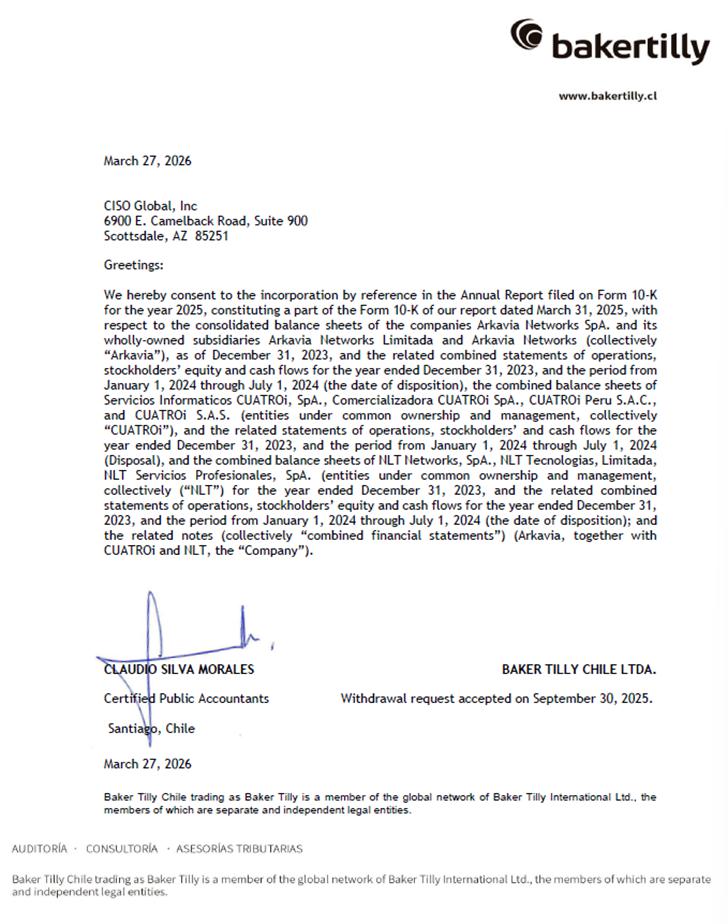
Exhibit 31.1
CISO GLOBAL, INC.
CERTIFICATE
PURSUANT TO SECTION 302
I, David G. Jemmett, certify that:
| 1. | I have reviewed this Annual Report on Form 10-K for the year ended December 31, 2025 for CISO Global, Inc.; |
| 2. | Based on my knowledge, this report does not contain any untrue statement of a material fact or omit to state a material fact necessary to make the statements made, in light of the circumstances under which such statements were made, not misleading with respect to the period covered by this report; |
| 3. | Based on my knowledge, the financial statements, and other financial information included in this report, fairly present in all material respects the financial condition, results of operations and cash flows of the Registrant as of, and for, the periods presented in this report; |
| 4. | The Registrant’s other certifying officer and I are responsible for establishing and maintaining disclosure controls and procedures (as defined in Exchange Act Rules 13a-15(e) and 15d-15(e)) and internal control over financial reporting (as defined in Exchange Act Rules 13a-15(f) and 15d-15(f)) for the Registrant and have: |
| a. | Designed such disclosure controls and procedures, or caused such disclosure controls and procedures to be designed under our supervision, to ensure that material information relating to the Registrant, including its consolidated subsidiaries, is made known to us by others within those entities, particularly during the period in which this report is being prepared; | |
| b. | Designed such internal control over financial reporting, or caused such internal control over financial reporting to be designed under our supervision, to provide reasonable assurance regarding the reliability of financial reporting and the preparation of financial statements for external purposes in accordance with generally accepted accounting principles; | |
| c. | Evaluated the effectiveness of the Registrant’s disclosure controls and procedures and presented in this report our conclusions about the effectiveness of the disclosure controls and procedures, as of the end of the period covered by this report based on such evaluation; and | |
| d. | Disclosed in this report any change in the Registrant’s internal control over financial reporting that occurred during the Registrant’s most recent fiscal quarter (the Registrant’s fourth fiscal quarter in the case of an annual report) that has materially affected, or is reasonably likely to materially affect, the Registrant’s internal control over financial reporting; and |
| 5. | The Registrant’s other certifying officer and I have disclosed, based on our most recent evaluation of internal control over financial reporting, to the Registrant’s auditors and the audit committee of the Registrant’s board of directors (or persons performing the equivalent functions): |
| a. | All significant deficiencies and material weaknesses in the design or operation of internal control over financial reporting which are reasonably likely to adversely affect the Registrant’s ability to record, process, summarize and report financial information; and | |
| b. | Any fraud, whether or not material, that involves management or other employees who have a significant role in the Registrant’s internal control over financial reporting. |
| Date: | March 27, 2026 | |
| By: | /s/ David G. Jemmett | |
| Name: | David G. Jemmett | |
| Title: | Chief Executive Officer (Principal Executive Officer) |
Exhibit 31.2
CISO GLOBAL, INC.
CERTIFICATE
PURSUANT TO SECTION 302
I, Debra L. Smith, certify that:
| 1. | I have reviewed this Annual Report on Form 10-K for the year ended December 31, 2025 for CISO Global, Inc.; |
| 2. | Based on my knowledge, this report does not contain any untrue statement of a material fact or omit to state a material fact necessary to make the statements made, in light of the circumstances under which such statements were made, not misleading with respect to the period covered by this report; |
| 3. | Based on my knowledge, the financial statements, and other financial information included in this report, fairly present in all material respects the financial condition, results of operations and cash flows of the Registrant as of, and for, the periods presented in this report; |
| 4. | The Registrant’s other certifying officer and I are responsible for establishing and maintaining disclosure controls and procedures (as defined in Exchange Act Rules 13a-15(e) and 15d-15(e)) and internal control over financial reporting (as defined in Exchange Act Rules 13a-15(f) and 15d-15(f)) for the Registrant and have: |
| a. | Designed such disclosure controls and procedures, or caused such disclosure controls and procedures to be designed under our supervision, to ensure that material information relating to the Registrant, including its consolidated subsidiaries, is made known to us by others within those entities, particularly during the period in which this report is being prepared; | |
| b. | Designed such internal control over financial reporting, or caused such internal control over financial reporting to be designed under our supervision, to provide reasonable assurance regarding the reliability of financial reporting and the preparation of financial statements for external purposes in accordance with generally accepted accounting principles; | |
| c. | Evaluated the effectiveness of the Registrant’s disclosure controls and procedures and presented in this report our conclusions about the effectiveness of the disclosure controls and procedures, as of the end of the period covered by this report based on such evaluation; and | |
| d. | Disclosed in this report any change in the Registrant’s internal control over financial reporting that occurred during the Registrant’s most recent fiscal quarter (the Registrant’s fourth fiscal quarter in the case of an annual report) that has materially affected, or is reasonably likely to materially affect, the Registrant’s internal control over financial reporting; and |
| 5. | The Registrant’s other certifying officer and I have disclosed, based on our most recent evaluation of internal control over financial reporting, to the Registrant’s auditors and the audit committee of the Registrant’s board of directors (or persons performing the equivalent functions): |
| a. | All significant deficiencies and material weaknesses in the design or operation of internal control over financial reporting which are reasonably likely to adversely affect the Registrant’s ability to record, process, summarize and report financial information; and | |
| b. | Any fraud, whether or not material, that involves management or other employees who have a significant role in the Registrant’s internal control over financial reporting. |
| Date: | March 27, 2026 | |
| By: | /s/ Debra L. Smith | |
| Name: | Debra L. Smith | |
| Title: | Chief Financial Officer (Principal Financial Officer and Principal Accounting Officer) |
Exhibit 32.1
CISO GLOBAL, INC.
CERTIFICATION PURSUANT TO
18 U.S.C. SECTION 1350
AS ADOPTED PURSUANT TO
SECTION 906 OF THE SARBANES-OXLEY ACT OF 2002
In connection with this Annual Report on Form 10-K of CISO Global, Inc. for the year ended December 31, 2025 as filed with the Securities and Exchange Commission on the date hereof (the “Report”), the undersigned, in the capacity and on the date indicated below, hereby certifies pursuant to 18 U.S.C. Section 1350, as adopted pursuant to Section 906 of the Sarbanes-Oxley Act of 2002, that to his knowledge:
| 1. | The Report fully complies with the requirements of Section 13(a) or 15(d) of the Securities Exchange Act of 1934; and |
| 2. | The information contained in the Report fairly presents, in all material respects, the financial condition and results of operation of the Registrant. |
| Date: | March 27, 2026 | |
| By: | /s/ David G. Jemmett | |
| Name: | David G. Jemmett | |
| Title: | Chief Executive Officer (Principal Executive Officer) |
This certification accompanies the Annual Report on Form 10-K to which it relates, is not deemed filed with the Securities and Exchange Commission and is not to be incorporated by reference into any filing of CISO Global, Inc. under the Securities Act of 1933, as amended, or the Securities Exchange Act of 1934, as amended (whether made before or after the date of the Annual Report on Form 10-K), irrespective of any general incorporation language contained in such filing.
Exhibit 32.2
CISO GLOBAL, INC.
CERTIFICATION PURSUANT TO
18 U.S.C. SECTION 1350
AS ADOPTED PURSUANT TO
SECTION 906 OF THE SARBANES-OXLEY ACT OF 2002
In connection with this Annual Report on Form 10-K of CISO Global, Inc. for the year ended December 31, 2025 as filed with the Securities and Exchange Commission on the date hereof (the “Report”), the undersigned, in the capacity and on the date indicated below, hereby certifies pursuant to 18 U.S.C. Section 1350, as adopted pursuant to Section 906 of the Sarbanes-Oxley Act of 2002, that to her knowledge:
| 1. | The Report fully complies with the requirements of Section 13(a) or 15(d) of the Securities Exchange Act of 1934; and |
| 2. | The information contained in the Report fairly presents, in all material respects, the financial condition and results of operation of the Registrant. |
| Date: | March 27, 2026 | |
| By: | /s/ Debra L. Smith | |
| Name: | Debra L. Smith | |
| Title: | Chief Financial Officer (Principal Financial Officer and Principal Accounting Officer) |
This certification accompanies the Annual Report on Form 10-K to which it relates, is not deemed filed with the Securities and Exchange Commission and is not to be incorporated by reference into any filing of CISO Global, Inc. under the Securities Act of 1933, as amended, or the Securities Exchange Act of 1934, as amended (whether made before or after the date of the Annual Report on Form 10-K), irrespective of any general incorporation language contained in such filing.