
LSTR 10-K
Landstar System Inc (LSTR)
Table of Contents
| ANNUAL REPORT PURSUANT TO SECTION 13 OR 15(d) OF THE SECURITIES EXCHANGE ACT OF 1934 |
| TRANSITION REPORT PURSUANT TO SECTION 13 OR 15(d) OF THE SECURITIES EXCHANGE ACT OF 1934 |

| (State or other jurisdiction of incorporation or organization) |
(I.R.S. Employer Identification No.) | |
| |
||
(Address of principal executive offices) |
(Zip Code) | |
| Title of each class |
Trading Symbol(s) |
Name of each exchange on which registered | ||
| ☒ | Accelerated filer | ☐ | ||||
Non-accelerated filer |
☐ | Smaller reporting company | ||||
| Emerging growth company | ||||||
| Document |
Part of 10-K Into Which Incorporated | |
| Proxy Statement relating to Landstar System, Inc.’s Annual Meeting of Stockholders scheduled to be held on May 5, 2026 |
Part III |
Table of Contents
LANDSTAR SYSTEM, INC.
2025 ANNUAL REPORT ON FORM 10-K
TABLE OF CONTENTS
| EX – 31.1 Section 302 CEO Certification | ||||
| EX – 31.2 Section 302 CFO Certification | ||||
| EX – 32.1 Section 906 CEO Certification | ||||
| EX – 32.2 Section 906 CFO Certification | ||||
2
Table of Contents
PART I
Item 1. Business
Introduction
Landstar System, Inc. was incorporated in January 1991 under the laws of the State of Delaware and has been a publicly held company since its initial public offering in March 1993. The principal executive offices of Landstar System, Inc. (collectively with its subsidiaries and other affiliated companies referred to herein as “Landstar” or the “Company,” unless the context otherwise requires) is located at 13410 Sutton Park Drive South, Jacksonville, Florida 32224 and its telephone number is (904) 398-9400. The Company makes available free of charge through its website its annual report on Form 10-K, quarterly reports on Form 10-Q, current reports on Form 8-K, proxy statements on Schedule 14A and any amendments to those reports filed or furnished pursuant to Section 13(a) and 15(d) of the Exchange Act as soon as reasonably practicable after such material is electronically filed with the Securities and Exchange Commission (“SEC”). The Company’s website is www.landstar.com. The SEC maintains a website at http://www.sec.gov that contains the Company’s current and periodic reports, proxy and information statements and other information filed electronically with the SEC.
Description of Business
Landstar, is a technology-enabled, asset-light provider of integrated transportation management solutions delivering safe, specialized transportation services to a broad range of customers utilizing a network of agents, third party capacity providers and employees. The Company offers services to its customers across multiple transportation modes, with the ability to arrange for individual shipments of freight to comprehensive third party logistics solutions to meet all of a customer’s transportation needs. Landstar provides services principally throughout the United States and to a lesser extent in Canada and Mexico, and between the United States and Canada, Mexico and other countries around the world. The Company’s services emphasize safety, cargo security, information coordination and customer service and are delivered through a network of approximately 960 independent commission sales agents and over 70,000 third party capacity providers, primarily truck capacity providers, linked together by a series of digital technologies which are provided and coordinated by the Company. The nature of the Company’s business is such that a significant portion of its operating costs varies directly with revenue.
Landstar markets its integrated transportation management solutions primarily through independent commission sales agents and exclusively utilizes third party capacity providers to transport customers’ freight. Landstar’s independent commission sales agents enter into contractual arrangements with the Company and are responsible for locating freight, making that freight available to Landstar’s capacity providers and coordinating the transportation of the freight with customers and capacity providers. The Company’s third party capacity providers consist of independent contractors who provide truck capacity to the Company under exclusive lease arrangements (the “BCO Independent Contractors”), unrelated trucking companies who provide truck capacity to the Company under non-exclusive contractual arrangements (the “Truck Brokerage Carriers”), air cargo carriers, ocean cargo carriers and railroads. Through this network of agents and capacity providers linked together by Landstar’s ecosystem of digital technologies, Landstar operates an integrated transportation management solutions business primarily throughout North America with revenue of $4.7 billion during the most recently completed fiscal year. The Company reports the results of two operating segments: the transportation logistics segment and the insurance segment.
Transportation Logistics Segment
The transportation logistics segment provides a wide range of integrated transportation management solutions. Transportation services are provided by Landstar’s “Operating Subsidiaries”: Landstar Ranger, Inc., Landstar Inway, Inc., Landstar Ligon, Inc., Landstar Gemini, Inc., Landstar Transportation Logistics, Inc., Landstar Global Logistics, Inc., Landstar Express America, Inc., Landstar Canada, Inc., Landstar Metro, S.A.P.I. de C.V., and Landstar Blue, LLC. Transportation services offered by the Company include truckload, less-than-truckload and other truck transportation, rail intermodal, air cargo, ocean cargo, expedited ground and air delivery of time-critical freight, heavy-haul/specialized, hazardous materials (“haz-mat”), cold chain/temperature-controlled, U.S.-Canada and U.S.-Mexico cross-border, intra-Mexico, intra-Canada, project cargo and customs brokerage. Examples of the industries serviced by the transportation logistics segment include automotive parts and assemblies, consumer durables, building products, metals, chemicals, foodstuffs, heavy machinery, retail, electronics, military equipment and general commodities. In addition, the transportation logistics segment provides transportation services to other transportation companies, including third party logistics and less-than-truckload service providers. The independent commission sales agents market services provided by the transportation logistics segment. Billings for freight transportation services are typically charged to customers on a per shipment basis for the physical transportation of freight and are referred to as transportation revenue. See “Notes to Consolidated Financial Statements” for the amount of revenue from external customers and measure of profit attributable to the transportation logistics segment for the last three fiscal years.
3
Table of Contents
Truck Transportation Services. The transportation logistics segment’s truck transportation services include a full array of truckload transportation for a wide range of commodities and, to a lesser degree, less-than-truckload and other truck transportation services. A significant portion of the Company’s truckload services is priced in the spot market and delivered over irregular or non-repetitive routes, while approximately 24% of the Company’s fiscal year 2025 truck transportation revenue was generated by BCO Independent Contractors utilizing Landstar provided trailing equipment, which frequently is used on more routine, regular routes. The Company utilizes a broad assortment of equipment, including dry and specialty vans of various sizes, unsided/platform trailers (including flatbeds, drop decks and specialty trailers) and temperature-controlled vans. Available truck transportation services also include short-to-long haul movement of containers by truck and expedited ground and dedicated power-only truck capacity. During fiscal year 2025, revenue generated by BCO Independent Contractors and Truck Brokerage Carriers was 38% and 53%, respectively, of consolidated revenue. Also, during fiscal year 2025, truck transportation revenue generated via van equipment and unsided/platform trailing equipment was 54% and 35%, respectively, of truck transportation revenue and less-than-truckload and other truck transportation revenue was 2% and 9%, respectively, of truck transportation revenue. The Company’s truck transportation services contributed 91% of consolidated revenue in fiscal year 2025, 90% of consolidated revenue in fiscal year 2024 and 91% of consolidated revenue in fiscal year 2023.
As previously disclosed by the Company in a Current Report on Form 8-K filed with the SEC on August 13, 2025, the Company entered into an arrangement with a financial advisor to actively market its Mexican subsidiary, Landstar Metro, S.A.P.I. de C.V. (“Landstar Metro”) and to consider other strategic alternatives for this subsidiary, which may involve a sale or other disposition in whole or in part of Landstar Metro during the Company’s 2026 fiscal year. It is not anticipated that a sale or other disposition of Landstar Metro will adversely affect the Company’s ability to provide U.S.-Mexico cross-border services, given that Landstar Metro is principally engaged in intra-Mexico truck transportation services. In connection with the decision to actively market Landstar Metro, the Company recorded a non-cash impairment charge of $7,530,000 to goodwill within the transportation logistics segment. Further, based on the expected fair value of Landstar Metro, net of costs to sell, the Company recognized an impairment on assets held for sale of $10,678,000. Both impairments are included in impairment of intangible and other assets within the Company’s consolidated statements of income.
Rail Intermodal Services. The transportation logistics segment’s rail intermodal services operate with contracts with Class 1 domestic and Canadian railroads, certain short-line railroads and most major asset-based intermodal equipment providers, including agreements with stacktrain operators and container and trailing equipment companies. In addition, the transportation logistics segment’s rail intermodal services operate with contracts with a vast network of local trucking companies that handle pick-up and delivery of rail freight. These contracts provide the transportation logistics segment the ability to transport freight via rail throughout the United States, Canada and Mexico. The transportation logistics segment’s rail intermodal service capabilities include trailer on flat car, container on flat car, box car and railcar. The transportation logistics segment’s rail intermodal services contributed 2% of consolidated revenue in each of fiscal years 2025, 2024 and 2023.
Air and Ocean Services. The transportation logistics segment provides domestic and international air services and ocean services to its customers. The Company executes international air freight transportation as an International Air Transport Association (“IATA”) certified Indirect Air Carrier (“IAC”) and international ocean freight transportation as an Ocean Transportation Intermediary (“OTI”) licensed by the Federal Maritime Commission (“FMC”) as a non-vessel operating common carrier (“NVOCC”) and ocean freight forwarder. Through its network of independent commission sales agents, relationships within a global network of foreign transportation intermediaries and contracts with a number of airlines and ocean lines, the transportation logistics segment provides efficient and cost effective door-to-door transportation to most points in the world for a vast array of cargo types such as over-sized break bulk, consolidations, full container loads, less-than container loads and refrigerated freight. The transportation logistics segment’s air and ocean services contributed 5% of consolidated revenue in fiscal year 2025, 6% of consolidated revenue in fiscal year 2024 and 5% of consolidated revenue in fiscal year 2023.
Insurance Segment
The insurance segment is comprised of Signature Insurance Company (“Signature”), a wholly owned offshore insurance subsidiary, and Risk Management Claim Services, Inc. (“RMCS”). The insurance segment provides risk and claims management services to certain of Landstar’s Operating Subsidiaries. In addition, it reinsures certain risks of the Company’s BCO Independent Contractors and provides certain property and casualty insurance and reinsurance to certain of Landstar’s Operating Subsidiaries.
4
Table of Contents
Revenue at the insurance segment represents reinsurance premiums from third party insurance companies that provide insurance programs to BCO Independent Contractors where all or a portion of the risk of loss is ultimately borne by Signature. Revenue at the insurance segment represented approximately 1% of the Company’s consolidated revenue in each of fiscal years 2025, 2024 and 2023. See “Notes to Consolidated Financial Statements” for the amount of revenue from external customers and measure of profit attributable to the insurance segment for the last three fiscal years.
Factors Significant to the Company’s Operations
Management believes the following factors are particularly significant to the Company’s operations:
Agent Network
The Company’s primary day-to-day contact with its customers is through its network of independent commission sales agents and, to a lesser extent, through employees of the Company. The typical Landstar independent commission sales agent maintains a relationship with a number of shippers and services these shippers utilizing the Company’s digital technologies and extensive network of third party capacity that provides various modes of transportation services to the Company. The Company provides assistance to the agents in developing additional relationships with shippers and enhancing agent and Company relationships with larger shippers through the Company’s field employees, located throughout the United States and Canada. The Operating Subsidiaries provide programs to support the agents’ operations and tools and data to assist agents in establishing pricing for freight hauled by the various modes of transportation available to the agents. It is important to note that the Operating Subsidiaries, and not the Company’s agents, contract directly with customers and generally assume the related credit risk and potential liability for freight losses or damages when the Company is providing transportation services as a motor carrier.
Management believes the Company has more independent commission sales agents than any other asset-light integrated transportation management solutions company in the United States. Landstar’s vast network of independent commission sales agent locations provides the Company regular contact with shippers at the local level and the capability to be highly responsive to shippers’ changing needs. The Company’s large network of available capacity provides independent commission sales agents with the resources needed to service both large and small shippers. Through its agent network, the Company offers smaller shippers a level of service comparable to that typically enjoyed only by larger customers. Examples include the ability to provide transportation services on short notice, multiple pick-up and delivery points, automated information flow, access to specialized equipment, spotted van trailers and drop-and-hook operations. While the majority of the agents in the Company’s network arrange truck transportation services for shippers, a number of the Company’s agents specialize in certain types of freight and transportation services (such as oversized or heavy loads and/or rail, air and international freight transportation). Each independent commission sales agent has the opportunity to market all of the services provided by the transportation logistics segment.
The independent commission sales agents use a variety of digital technologies provided by the Company to service the requirements of shippers. For truckload services, the Company’s independent commission sales agents primarily use a Landstar cloud-based platform to enter available freight, dispatch capacity and process most administrative tasks and then communicate that information to Landstar and its capacity providers. The Company’s cloud-based available truck platform provides a listing of available truck capacity to the Company’s independent commission sales agents. The Company also offers independent commission sales agents a variety of proprietary pricing, operational and financial tools via web or mobile applications. For modes of transportation other than truckload, the independent commission sales agents utilize both proprietary and third party information technology applications provided by the Company.
Commissions to agents are based on contractually agreed-upon percentages of (i) revenue, (ii) revenue less the cost of purchased transportation, or (iii) revenue less a contractually agreed upon percentage of revenue retained by Landstar and the cost of purchased transportation (the “retention contracts”). Commissions to agents as a percentage of consolidated revenue vary directly with fluctuations in the percentage of consolidated revenue generated by the various modes of transportation and reinsurance premiums and, in general, vary inversely with changes in the amount of purchased transportation as a percentage of revenue on services provided by Truck Brokerage Carriers, railroads, air cargo carriers and ocean cargo carriers. Commissions to agents are recognized over the freight transit period as the performance obligation to the customer is completed.
The Company had 457 and 485 agents that each generated at least $1 million in Landstar revenue (the “Million Dollar Agents”) during fiscal years 2025 and 2024, respectively. Landstar revenue from the Million Dollar Agents in the aggregate represented 95% and 94% of consolidated revenue in 2025 and 2024, respectively. Included among the Company’s Million Dollar Agents, the Company had 77 independent sales agencies that generated at least $10 million in Landstar revenue during the 2025
5
Table of Contents
fiscal year, which in aggregate comprised approximately 68% of Landstar’s consolidated revenue. Management believes that the majority of the Million Dollar Agents represent the Company exclusively. Historically, the Company has experienced very few terminations of its Million Dollar Agents, whether such terminations are initiated by the agent or the Company. Annual terminations of Million Dollar Agents have typically been less than 3% of the total number of Million Dollar Agents.
Third Party Capacity
The Company relies exclusively on independent third parties for its hauling capacity other than for trailing equipment owned or leased by the Company and utilized primarily by the BCO Independent Contractors. These third party transportation capacity providers consist of BCO Independent Contractors, Truck Brokerage Carriers, air and ocean cargo carriers and railroads. Landstar’s use of capacity provided by third parties allows it to maintain a lower level of capital investment, resulting in lower fixed costs and a higher return on invested capital. During fiscal year 2025, revenue generated by BCO Independent Contractors, Truck Brokerage Carriers and railroads represented approximately 38%, 53% and 2%, respectively, of the Company’s consolidated revenue. Collectively, revenue generated by air and ocean cargo carriers represented approximately 5% of the Company’s consolidated revenue during fiscal year 2025. Historically, variable contribution margin (defined as variable contribution, which is defined as revenue less variable costs of revenue, divided by revenue) generated from freight hauled by BCO Independent Contractors has been greater than that from freight hauled by other third party capacity providers. However, the Company’s insurance and claims costs, depreciation costs and other operating costs are incurred primarily in support of BCO Independent Contractor capacity. In addition, as further described in the “Corporate Services” section that follows, the Company incurs significantly higher selling, general and administrative costs in support of BCO Independent Contractor capacity as compared to the other modes of transportation. Purchased transportation costs are recognized over the freight transit period as the performance obligation to the customer is completed.
BCO Independent Contractors. Management believes the Company has the largest fleet of truckload BCO Independent Contractors in the United States. BCO Independent Contractors provide truck capacity to the Company under exclusive lease arrangements. Each BCO Independent Contractor operates under the motor carrier operating authority issued by the U.S. Department of Transportation (“DOT”) to Landstar’s Operating Subsidiary to which such BCO Independent Contractor provides services and has leased his or her equipment. The Company’s network of BCO Independent Contractors provides marketing, operating, customer service, safety, freight security, recruiting and retention advantages to the Company.
The Company’s BCO Independent Contractors are compensated primarily based on a contractually agreed-upon percentage of revenue generated by loads they haul. This percentage generally ranges from 62% to 70% where the BCO Independent Contractor provides only a tractor and 73% to 77% where the BCO Independent Contractor provides both a tractor and trailing equipment. The BCO Independent Contractor must pay substantially all of the expenses of operating his/her equipment, including driver wages and benefits, fuel, physical damage insurance, maintenance, highway use taxes and debt service, if applicable. The Company passes 100% of fuel surcharges billed to customers for freight hauled by BCO Independent Contractors to its BCO Independent Contractors. During fiscal year 2025, the Company billed customers $229 million in fuel surcharges and passed 100% of such fuel surcharges to the BCO Independent Contractors. These fuel surcharges are excluded from revenue and the cost of purchased transportation.
The Company maintains an ecosystem of digital technologies and applications through which BCO Independent Contractors can view a comprehensive listing of the Company’s available freight, allowing them to consider rate, size, origin and destination when planning trips. The Company’s LandstarOne™ mobile application provides BCO Independent Contractors information on loading opportunities as well as fueling station locations, retail fuel prices, fuel prices net of Landstar-arranged discounts and applicable state fuel tax credits, and equipment inspection site locations. The Landstar Contractors’ Advantage Purchasing Program (“LCAPP”) leverages Landstar’s purchasing power to provide discounts to eligible BCO Independent Contractors when they purchase equipment, fuel, tires and other items. In addition, Landstar Contractor Financing, Inc. provides a source of funds at competitive interest rates to the BCO Independent Contractors to purchase trailing equipment.
The number of trucks provided to the Company by BCO Independent Contractors was 8,514 at December 27, 2025, compared to 8,843 at December 28, 2024. At December 27, 2025, approximately 96% of the trucks provided by BCO Independent Contractors were provided by BCO Independent Contractors who provided five or fewer trucks to the Company. The number of trucks provided by BCO Independent Contractors fluctuates daily as a result of truck recruiting and truck terminations. The Company recruited more trucks in fiscal year 2025 than in fiscal year 2024 and terminated less trucks in fiscal year 2025 than in fiscal year 2024. However, the number of trucks recruited was less than the number of trucks terminated, resulting in an overall net
6
Table of Contents
decrease of 329 trucks during fiscal year 2025. Landstar’s BCO Independent Contractor truck turnover was approximately 31% in fiscal year 2025, compared to 35% in fiscal year 2024. Approximately 33% of 2025 turnover was attributable to BCO Independent Contractors who had been with the Company for less than one year. Management believes the factors that have historically favorably impacted turnover include the Company’s extensive agent network, the quantity and quality of available freight, the proprietary technology-based tools the Company makes available to BCO Independent Contractors to empower them to manage their businesses, the Company’s programs to reduce the operating costs of its BCO Independent Contractors and Landstar’s reputation for quality, safety, cargo security, service, reliability and financial strength. Sequential strengthening or weakening of revenue per load historically has also had a significant impact on BCO Independent Contractor turnover.
Truck Brokerage Carriers. At December 27, 2025, the Company maintained a database of over 62,000 approved Truck Brokerage Carriers who provide truck capacity to the Company. Truck Brokerage Carriers provide truck capacity to the Company under non-exclusive contractual arrangements and each operates under its own DOT-issued motor carrier operating authority. Truck Brokerage Carriers are paid either a negotiated rate for each load hauled or, to a lesser extent, a contractually agreed-upon fixed rate per load. The Company recruits, approves, establishes contracts with and tracks safety ratings and service records of these third party trucking companies. In addition to providing additional capacity to the Company, the use of Truck Brokerage Carriers enables the Company to pursue different types and quality of freight such as short-haul traffic, less-than-truckload and, in certain instances, lower-priced freight that generally would not be desirable to the Company’s BCO Independent Contractors.
The Company maintains an ecosystem of digital technologies and applications through which Truck Brokerage Carriers can view a listing of the Company’s freight that is available to them. The Landstar Savings Plus Program leverages Landstar’s purchasing power to provide discounts to eligible Truck Brokerage Carriers when they purchase fuel and equipment and provides the Truck Brokerage Carriers with an electronic payment option.
Railroads and Air and Ocean Cargo Carriers. The Company has contracts with Class 1 domestic and Canadian railroads, certain short-line railroads and domestic and international airlines and ocean lines. These relationships allow the Company to pursue the freight best serviced by these forms of transportation capacity. Railroads and ocean cargo carriers are paid either a negotiated rate for each load hauled or a contractually agreed-upon fixed rate per load. Air cargo carriers are generally paid a negotiated rate for each load hauled. The Company also contracts with other third party capacity providers, such as air charter service providers, when required by specific customer needs.
Trailing Equipment
The Company offers its customers a large and diverse fleet of trailing equipment. The following table illustrates the mix of the trailing equipment as of December 27, 2025, either provided by the BCO Independent Contractors or owned or leased by the Company and made available primarily to BCO Independent Contractors. The Company also provides power-only services, as reported in other truck transportation revenue, utilizing trailing equipment generally provided by the shipper or other third party. In general, Truck Brokerage Carriers utilize their own trailing equipment when providing transportation services on behalf of Landstar. Power-only and Truck Brokerage Carrier trailing equipment is not included in the following table:
| Trailers by Type |
||||
| Van |
14,523 | |||
| Unsided/platform, including flatbeds, step decks, drop decks and low boys |
2,751 | |||
| Temperature-controlled |
152 | |||
|
|
|
|||
| Total |
17,426 | |||
|
|
|
|||
Specialized services offered by the Company include those provided by a large fleet of platform trailers and multi-axle trailers capable of hauling extremely heavy or oversized loads. Management believes the Company, along with its network of capacity providers, offers one of the largest fleets of for-hire heavy/specialized trailing equipment in North America.
At December 27, 2025, 13,784 of the trailers available to the BCO Independent Contractors were owned by the Company and 601 were rented. In addition, at December 27, 2025, 3,041 trailers were provided by the BCO Independent Contractors. Approximately 24% of Landstar’s truck transportation revenue was generated on Landstar-provided trailing equipment during fiscal year 2025.
7
Table of Contents
Customers
The Company’s customer base is highly diversified and dispersed across many industries, commodities and geographic regions. The Company’s top 100 customers accounted for approximately 46% of consolidated revenue during both fiscal years 2025 and 2024. Management believes that the Company’s overall size, ecosystem of digital technologies and applications, geographic coverage, access to equipment and diverse service capability offer the Company significant competitive marketing and operating advantages. These advantages allow the Company to meet the needs of even the largest shippers. Larger shippers often consider reducing the number of authorized carriers they use in favor of a small number of “core carriers,” such as the Company, whose size and diverse service capabilities enable these core carriers to satisfy most of the shippers’ transportation needs. The Company’s national account customers include the United States Department of Defense and many of the companies included in the Fortune 500. Large shippers also use third party logistics providers (“3PLs”) to outsource the management and coordination of their transportation needs. 3PLs and other transportation companies also utilize the Company’s available transportation capacity to satisfy their obligations to their shippers. There were eight transportation service providers, including 3PLs, included in the Company’s top 25 customers for fiscal year 2025. Management believes the Company’s network of agents and third party capacity providers allows it to efficiently attract and service smaller shippers which may not be as desirable to other large transportation providers (see above under “Agent Network”). No customer accounted for more than 8% of the Company’s 2025 revenue.
Technology and Artificial Intelligence (“AI”)
Landstar provides integrated transportation management solutions which emphasize customer service and information coordination among its independent commission sales agents, customers, capacity providers and employees. The Company is focused on identifying, purchasing or developing and implementing software applications and tools which integrate AI and are designed to: (i) assist Landstar independent commission sales agents in efficiently sourcing capacity, pricing transportation services and managing and analyzing the performance of their independent businesses, (ii) assist customers in meeting their transportation needs with an emphasis on safety, security and service, (iii) assist third party capacity providers in identifying desirable freight opportunities and operating their independent businesses, and (iv) improve operational and administrative efficiency throughout the Company.
Since 2016, Landstar has been executing a digital transformation strategy to ensure our network of agents, BCOs and other third party capacity providers remains highly competitive in an increasingly technology-driven freight environment. Our goal is enablement—delivering tools that help to automate the agent office, simplify the experience of operating as a Landstar business capacity owner or third-party carrier, and scale the efficiency and effectiveness of our entrepreneurs.
Those earlier efforts, branded as “Landstar 2020,” serve as the foundation of a long-term commitment to building and deploying industry-leading technology across our entire ecosystem. Landstar 2020 included the rollout of the following tools to participants within our network:
| • | Landstar TMS: A cloud-based platform for truckload freight agent workflow. |
| • | Analytics: A suite of business intelligence applications powered by Microsoft Power BI for independent sales agents and BCO Independent Contractors to access information and identify trends in their businesses. |
| • | Pricing Tools: Landstar-proprietary pricing application developed with data scientists using historical Company information and third party pricing data to provide independent commission sales agents with near real time market data. |
| • | BCO Retention Tool: Landstar-proprietary application developed with data scientists using a variety of data inputs to help predict when the contractual relationship between a BCO Independent Contractor and Landstar may be at risk. |
| • | LandstarOne™: Mobile application available to BCO Independent Contractors and third party motor carriers providing a one-stop location for available loading opportunities as well as fueling station locations, retail fuel prices, fuel prices net of Landstar-arranged discounts and applicable state fuel tax credits, and equipment inspection site locations. |
| • | Clarity: Landstar’s proprietary freight tracking tool that incorporates geo-locational data from, among other sources, electronic logging devices, trailer tracking devices and third party data aggregators. |
| • | Agent and Capacity Portals: New and improved cloud-based portals built to provide a single on-ramp to a multitude of applications, tools and information available to Landstar independent agents and capacity providers. |
| • | Trailer Tools: Applications empowering independent commission sales agents through the automation of the Company’s trailer request and trailer pool management processes. |
| • | Credit: Application that automates the process for independent commission sales agents to request customer credit. |
8
Table of Contents
As we moved beyond Landstar 2020, we invested further in digital capabilities within our corporate operations and the support we provide to our entrepreneurial network, including the rollout of modern contact-center technology and significant upgrades to our financial, settlements, and back-office systems. These investments strengthen the overall connectivity and support provided to the Company’s entrepreneurial network.
The Company’s approach to technology is built through close collaboration with its independent commission sales agents and BCO Independent Contractors, with a focus on enabling growth. By aligning technology investments with the needs of our network of entrepreneurs, Landstar aims to deliver tools that are designed to drive growth and deliver wins in the highly competitive transportation sector.
In our independent commission sales agency model, growth may be constrained by the financial and technological resources of the agent, particularly for smaller agents. Agents may also view potential growth opportunities available to their small business as requiring an additional assumption of personal risk, due to many of the typical types of challenges faced by a small business seeking to scale-up in size: increased headcounts needs, greater financial investment, and increased management and operational complexity. Our objective has been to deploy technology to empower Landstar agents to grow, by offering tools that can automate workflows and improve efficiency within the agent’s business, while also helping to de-risk some of the types of challenges often faced by Landstar agents who are looking to grow.
Our objective with respect to technology investments geared to empower Landstar BCO Independent Contractors is to eliminate manual and administrative friction relating to how BCO Independent Contractors engage with Landstar and operate their businesses in order to enable BCOs to be more productive, haul more freight, and better serve Landstar agents and customers.
The end result is a differentiated value proposition for customers: a combination of advanced, purpose-built technology and highly motivated freight transportation and logistics professionals with a direct economic stake in delivering freight safely, securely, and with exceptional service.
Landstar believes that AI represents the next major acceleration of this strategy and will provide opportunities to strengthen the safety, security and service value proposition the Company offers to its customers. Management believes AI can be a strategic enhancement to the competitive advantage of the Landstar business model and a powerful enabler of our entrepreneurial ecosystem.
Importantly, Landstar’s AI strategy is evolutionary—the Company is building on the strong digital foundation already in place. Currently, machine learning is embedded within the following:
| • | Pricing Tools and BCO Retention Tool, allowing both products to improve as we scale the available data. |
| • | Landstar’s new contact-center platform, which leverages AI to enhance the knowledge base of Landstar employee service representatives, analyze sentiment, automate routine tasks, summarize interactions, and free our teams to focus on higher-value problem solving. |
| • | Landstar agent portal, improving access to information, providing actionable business insights, and enabling better and faster decision making. |
| • | A new supply chain fraud detection solution that analyzes behavioral patterns, documentation, invoice images, and shipment characteristics to identify high-risk freight and reduce shipment losses. |
Landstar has also established an AI task force that is working with transportation-focused agentic AI startups and established technology companies to accelerate AI applications across the shipment lifecycle and within agent offices. These efforts are focused on driving efficiency, increasing productivity, improving decision-making, and further unlocking growth across the network.
Since the launch of Landstar 2020 in 2016, the Company has invested approximately $220 million in these strategic development efforts, including approximately $28 million and $34 million, respectively, in fiscal years 2025 and 2024.
The Company’s information technology systems used in connection with its operations are located in Jacksonville, Florida and, to a lesser extent, in Rockford, Illinois. In addition, the Company utilizes several third party data centers throughout the U.S. Landstar relies, in the regular course of its business, on the proper operation of its information technology systems.
9
Table of Contents
Corporate Services
The Company provides many administrative support services to its network of independent commission sales agents, third party capacity providers and customers. Management believes that the mobile and digital applications purchased or developed and maintained by the Company and its administrative support services provide operational and financial advantages to its independent commission sales agents, third party capacity providers and customers. These, in turn, enhance the operational and financial efficiency of all aspects of the network.
Administrative support services that provide operational and financial advantages to the network include customer contract administration, customer credit review and approvals, pricing, customer billing, accounts receivable collections, third party capacity settlement, operator and equipment safety and compliance management for our network of BCO Independent Contractors, insurance claims handling, coordination of vendor discount programs and third party capacity sourcing programs. Marketing and advertising strategies are also provided by the Company. The Company’s practices of accepting customer credit risk and paying its agents and carriers promptly provides a significant competitive advantage to the Company in comparison to less capitalized competitors.
Competition
Landstar competes primarily in the transportation and logistics services industry with truckload carriers, third party logistics companies, digital freight brokers, intermodal transportation and logistics service providers, railroads, less-than-truckload carriers and other asset-light transportation and logistics service providers. The transportation and logistics services industry is extremely competitive and fragmented.
Management believes that competition for freight transported by the Company is based on service, efficiency, safety, freight security and freight rates, which are influenced significantly by the economic environment, particularly the amount of available transportation capacity and freight demand. Management believes that Landstar’s overall size, service offerings and availability of a wide range of equipment, together with its geographically dispersed local independent agent network, present the Company with significant competitive advantages over many transportation and logistics service providers.
Self-Insured Claims
Potential liability associated with accidents in the trucking industry is severe and occurrences are unpredictable. Landstar retains liability through a self-insured retention for commercial trucking claims up to $5 million per occurrence. Historically, these third party insurance arrangements were based on policy year periods beginning on May 1 and ending on the subsequent April 30. Beginning with the policy year period commencing May 1, 2025, the Company and its third party insurance providers adjusted the applicable policy year period, beginning in 2026, to commence on June 1 and end on the subsequent May 31. All applicable third party insurance arrangements with a policy period ending April 30, 2026 have been amended to provide for a policy period ending May 31, 2026, as reflected below.
Effective May 1, 2023, the Company entered into a three year commercial auto liability insurance arrangement for losses incurred between $5 million and $10 million (the “2023 Initial Excess Policy”) with a third party insurance company. For commercial trucking claims incurred on or after May 1, 2023 through May 31, 2026, the 2023 Initial Excess Policy provides for an aggregate deductible of $18 million over the thirty-seven-month term ending May 31, 2026. After payment of the deductible, the 2023 Initial Excess Policy provides for a limit for a single loss of $5 million, with an aggregate limit of $15 million for the thirty-seven-month term ending May 31, 2026.
The Company also maintains third party insurance arrangements providing excess coverage for commercial trucking liabilities in excess of $10 million. These third party arrangements provide coverage on a per occurrence or aggregated basis. Over the past fifteen years, there has been a significant increase in the prevalence of trials in courts throughout the United States involving catastrophic injury and fatality claims against commercial motor carriers that have resulted in verdicts in excess of $10 million. Within the transportation logistics industry, these verdicts are often referred to as “Nuclear Verdicts.” The increase in Nuclear Verdicts has had a significant impact on the cost of commercial auto liability claims throughout the United States. Due to the increasing cost of commercial auto liability claims, the availability of excess coverage has significantly decreased, and the pricing associated with such excess coverage, to the extent available, has significantly increased. Since the annual policy year ended April 30, 2020, as compared to the annual policy year ending May 31, 2026, the Company experienced an increase of approximately $22 million, or approximately 400%, in the premiums charged by third party insurance companies to the Company for excess coverage for commercial trucking liabilities in excess of $10 million.
10
Table of Contents
In addition to the significant increase in the cost to motor carriers relating to commercial auto liability claims throughout the United States, there has also been a very significant increase throughout the United States in the number of, and potential loss exposure associated with, claims asserted against freight brokers in connection with accidents involving motor carriers the freight broker has engaged and contracted with to haul a shipment. The claims asserted against freight brokers often involve claims of negligent selection of the motor carrier who was involved in the relevant accident. Within the transportation logistics industry, these matters are often referred to as “Broker Liability Claims.” For example, see the discussion of the Cabral Matter (as defined below) in Item 7, “Management’s Discussion and Analysis of Financial Condition and Results of Operations — Legal Proceedings.” There is currently significant legal uncertainty regarding Broker Liability Claims as state and federal courts across the United States are divided as to whether such claims are preempted by federal law under the Federal Aviation Administration Authorization Act of 1994 (the “FAAAA”), or are subject to the “safety exception” under the FAAAA. The matter of Montgomery v. Caribe Transport II, LLC, in which the Company is not a party, is currently pending before the U.S. Supreme Court and may result in a ruling relating to federal preemption of Broker Liability Claims under the FAAAA. No assurances can be provided as to any such ruling by the U.S. Supreme Court, the timing thereof, or the impact any such ruling may have on pending or future Broker Liability Claims asserted against the Company, including the Cabral Matter.
Moreover, the Company from year to year manages the level of its financial exposure to commercial trucking claims in excess of $10 million, including through the use of additional self-insurance, deductibles, aggregate loss limits, quota shares and other structured arrangements with third party insurance companies, based on the availability of coverage within certain excess insurance coverage layers and estimated cost differentials between proposed premiums from third party insurance companies and historical and actuarially projected losses experienced by the Company at various levels of excess insurance coverage. For example, with respect to a single hypothetical claim in the amount of $65 million incurred during the annual policy year ending May 31, 2026, the Company would have an aggregate financial exposure of approximately $36 million.
Within the Company’s third party insurance arrangements providing excess coverage for commercial trucking liabilities, structured arrangements with third party reinsurers within a specific loss layer may include provisions that require additional payments of premium in the event of unfavorable loss experience or a refund of premium in the event of favorable loss experience. During the 2025 fiscal year, with respect to one such three-year commercial auto liability reinsurance arrangement relating to certain excess claims incurred between May 1, 2020 through April 30, 2023, the Company received $12,000,000 of cash payments from third party reinsurance providers in the form of a “no claims bonus” due to favorable loss experience with respect to claims incurred during the applicable policy period. As further described in Note 11 in the “Notes to Consolidated Financial Statements” in this Annual Report on Form 10-K, in connection with the Judgment (as defined below) in the Cabral Matter, the Company has recorded the “no claims bonus” within current insurance claims in the consolidated balance sheet as of December 27, 2025. The Company intends to vigorously appeal the Cabral Matter, including the Judgment; however, no assurances can be provided regarding whether the Company will ultimately be able to recognize a gain with respect to the “no claims bonus.” For more information about the Cabral Matter, see Item 7, “Management’s Discussion and Analysis of Financial Condition and Results of Operations – Legal Proceedings.”
Furthermore, the Company’s third party insurance arrangements provide excess coverage up to an uppermost coverage layer, in excess of which the Company retains additional financial exposure. No assurances can be given that the availability of excess coverage for commercial trucking claims will not continue to deteriorate, that the pricing associated with such excess coverage, to the extent available, will not continue to increase, nor that insurance coverage from third party insurers for excess coverage of commercial trucking claims will even be available on commercially reasonable terms at certain levels. Moreover, the occurrence of a Nuclear Verdict, or the settlement of a catastrophic injury and/or fatality claim that could have otherwise resulted in a Nuclear Verdict, could have a material adverse effect on Landstar’s cost of insurance and claims and its results of operations.
Further, the Company retains liability of up to $2,000,000 for each general liability claim, $250,000 for each workers’ compensation claim and $250,000 for each cargo claim. In recent years, the amount of cargo theft throughout the freight transportation and logistics supply chain in the United States has significantly increased. The Company has experienced, and may continue to experience, increases in the amount of cargo theft, resulting in increased exposure to liability from cargo claims. In addition, under reinsurance arrangements by Signature of certain risks of the Company’s BCO Independent Contractors, the Company retains liability of up to $500,000, $1,000,000 or $2,000,000 with respect to certain occupational accident claims and up to $750,000 with respect to certain workers’ compensation claims. The Company’s exposure to liability associated with accidents incurred by Truck Brokerage Carriers, railroads and air and ocean cargo carriers who transport freight on behalf of the Company is reduced by various legal defenses and other factors including the extent to which such carriers maintain their own insurance coverage. A material increase in the frequency or severity of accidents, cargo claims, including further increases in the amount of cargo theft, or workers’ compensation claims or the material unfavorable development of existing claims could have a material adverse effect on Landstar’s cost of insurance and claims and its results of operations.
11
Table of Contents
Regulation
Certain of the Operating Subsidiaries are considered motor carriers and/or brokers authorized to arrange for transportation services by motor carriers which are regulated by the Federal Motor Carrier Safety Administration (the “FMCSA”) and by various state agencies. The FMCSA has broad regulatory powers with respect to activities such as motor carrier operations, practices, periodic financial reporting and insurance. Subject to federal and state regulatory authorities or regulation, the Company’s capacity providers may transport most types of freight to and from any point in the United States over any route they select.
Interstate motor carrier operations are subject to safety requirements prescribed by the FMCSA. Each truck operator, whether working as a BCO Independent Contractor or for a Truck Brokerage Carrier, is required to have a commercial driver’s license (“CDL”) and may be subject to mandatory drug and alcohol testing. Effective May 20, 2025, the FMCSA established a new enforcement policy with respect to English language proficiency (“ELP”) requirements applicable to commercial motor vehicle drivers and the ability of such drivers to communicate effectively with law enforcement and understand highway traffic signs throughout the United States. In 2025, the FMCSA also proposed amendments to federal regulations applicable to the issuance by State Driver’s Licensing Agencies (“SDLAs”) of CDLs to foreign-domiciled individuals in order to significantly limit the authority of SDLAs to issue and renew CDLs with respect to individuals domiciled in a foreign jurisdiction and/or who do not maintain a lawful immigration status in the United States. The FMCSA’s CDL licensing requirements, drug and alcohol testing requirements, ELP policy and non-domiciled CDL initiative have not adversely affected the Company’s ability to source the capacity necessary to meet its customers’ transportation needs.
Additionally, certain of the Operating Subsidiaries are licensed as Ocean Transportation Intermediaries by the U.S. Federal Maritime Commission as non-vessel-operating common carriers and/or as ocean freight forwarders. The Company’s air transportation activities in the United States are subject to regulation by the U.S. Department of Transportation as an indirect air carrier. One of the Operating Subsidiaries is licensed by the U.S. Department of Homeland Security through the Bureau of U.S. Customs and Border Protection (“U.S. Customs”) as a customs broker. The Company is also subject to regulations and requirements relating to safety and security promulgated by, among others, the U.S. Department of Homeland Security through U.S. Customs and the Transportation Security Administration, the Canada Border Services Agency and various state and local agencies and port authorities. In addition, because the U.S. government is one of the Company’s customers, the Company must comply with and is affected by laws and regulations relating to doing business with the federal government.
The transportation industry is subject to other potential regulatory and legislative changes (such as the possibility of more stringent environmental, climate change and/or safety/security regulations, limits on vehicle weight and size and regulations relating to the health and wellness of commercial truck operators) that may affect the economics of the industry by requiring changes in operating practices, by changing the demand for motor carrier services or the cost of providing truckload or other transportation or logistics services, or by adversely impacting the number of available commercial truck operators.
For a discussion of the risks associated with these laws and regulations, see Part I, Item 1A, “Risk Factors.”
Seasonality
Landstar’s operations are subject to seasonal trends common to the trucking industry. Historically, truckload shipments for the quarter ending in March are typically lower than for the quarters ending in June, September and December.
12
Table of Contents
Human Capital Resources
We believe our employees are among our most important resources and are critical to our continued success. Landstar has established “Core Values” to help guide employee behavior, decision-making and culture within our Company, and to foster alignment and engagement among our employees. Landstar’s Core Values are:
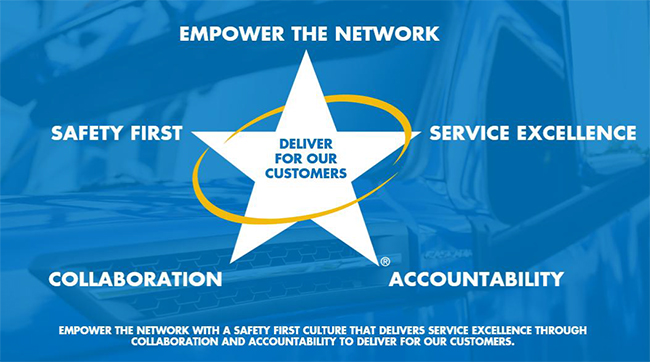
We focus significant attention on attracting and retaining talented and experienced individuals to manage and support our operations. To attract and retain top talent in our highly competitive industry, we have designed our compensation and benefits programs to provide a balanced and effective reward structure. Landstar seeks to compensate employees in a manner that is fair, consistent, and reflective of the external market and provides recognition for the achievement of individual strategic, operational, administrative and other goals, corporate objectives, and professional competencies while maintaining fiscal responsibility. Our short and long-term incentive programs are aligned with key business objectives and strategic goals and are intended to motivate strong performance. Our employees are eligible to participate in our medical, dental and vision programs, a 401(k) savings/retirement plan, flexible time-off, employer-provided life and disability insurance, our wellness program, our tuition reimbursement program, and an array of voluntary benefits designed to meet individual needs. We engage firms nationally recognized in the benefits area to objectively evaluate our programs and benchmark them against peers and other similarly situated organizations.
As of December 27, 2025, the Company and its subsidiaries employed 1,378 individuals, or 1,294 individuals excluding employees at Landstar Metro which is classified as held for sale. Two Landstar Ranger drivers (out of a Company total of approximately 8,514 drivers for BCO Independent Contractors) are members of the International Brotherhood of Teamsters. The turnover rate for Landstar employees located in the United States and Canada was 11% in 2025, 12% in 2024 and 14% in 2023. The Company considers relations with its employees to be good.
The Company has identified the following employee-focused goals:
| • | Create and maintain an environment in which continuous improvement, collaboration and accountability are encouraged and expected by everyone within the organization; |
| • | Engage each Landstar employee in the Company’s vision to inspire and empower entrepreneurs to succeed in the highly competitive, technology driven freight transportation industry; and |
| • | Ensure that all Landstar employees fully understand the requirements of their job and the role their job plays within Landstar. |
13
Table of Contents
Landstar formally monitors employee satisfaction and engagement through periodic employee satisfaction and engagement surveys. The Company also uses employee roundtable and focus group discussions as well as exit interviews to monitor engagement and satisfaction.
Landstar provides comprehensive professional development opportunities to employees at all levels. Landstar’s learning and development department offers all employees the opportunity to participate in various learning tracks on topics including Leadership, Workplace Safety & Security, Customer Service and other core skills. Courses offered by the learning and development department are delivered by Landstar’s team of Association for Talent Development (ATD) certified trainers through both on-line and classroom settings.
At our core, Landstar is about providing opportunity to qualified candidates and employees regardless of background. We do not tolerate discriminatory behavior and strongly believe that diverse perspectives and a collaborative culture lead to better business outcomes. The Company complies with all applicable federal and state laws pertaining to employment. Our management teams and all of our employees are expected to exhibit and promote honest, ethical and respectful conduct in the workplace. All of our employees must adhere to a code of ethics and employee compliance code that set standards for appropriate behavior and includes required annual training.
As of the end of 2025, a majority of the Company’s employees work remotely or on a hybrid basis.
Item 1A. Risk Factors
Operational Risks
Increased severity or frequency of accidents and other claims or a material unfavorable development of existing claims. As noted above in Item 1, “Business — Factors Significant to the Company’s Operations — Self-Insured Claims,” potential liability associated with accidents in the trucking industry is severe and occurrences are unpredictable. Landstar retains liability through a self-insured retention for commercial trucking claims up to $5 million per occurrence. Historically, these third party insurance arrangements were based on policy year periods beginning on May 1 and ending on the subsequent April 30. Beginning with the policy year period commencing May 1, 2025, the Company and its third party insurance providers adjusted the applicable policy year period, beginning in 2026, to commence on June 1 and end on the subsequent May 31. All applicable third party insurance arrangements with a policy period ending April 30, 2026 have been amended to provide for a policy period ending May 31, 2026, as reflected below.
Effective May 1, 2023, the Company entered into a three year commercial auto liability insurance arrangement for losses incurred between $5 million and $10 million (the “2023 Initial Excess Policy”) with a third party insurance company. For commercial trucking claims incurred on or after May 1, 2023 through May 31, 2026, the 2023 Initial Excess Policy provides for an aggregate deductible of $18 million over the thirty-seven-month term ending May 31, 2026. After payment of the deductible, the 2023 Initial Excess Policy provides for a limit for a single loss of $5 million, with an aggregate limit of $15 million for the thirty-seven-month term ending May 31, 2026.
The Company also maintains third party insurance arrangements providing excess coverage for commercial trucking liabilities in excess of $10 million. These third party arrangements provide coverage on a per occurrence or aggregated basis. Over the past fifteen years, there has been a significant increase in the occurrence of trials in courts throughout the United States involving catastrophic injury and fatality claims against commercial motor carriers that have resulted in verdicts in excess of $10 million. Within the transportation logistics industry, these verdicts are often referred to as “Nuclear Verdicts.” The increase in Nuclear Verdicts has had a significant impact on the cost of commercial auto liability claims throughout the United States. Due to the increasing cost of commercial auto liability claims, the availability of excess coverage has significantly decreased, and the pricing associated with such excess coverage, to the extent available, has significantly increased. Since the annual policy year ended April 30, 2020, as compared to the annual policy year ending May 31, 2026, the Company experienced an increase of approximately $22 million, or approximately 400%, in the premiums charged by third party insurance companies to the Company for excess coverage for commercial trucking liabilities in excess of $10 million.
In addition to the significant increase in the cost to motor carriers relating to commercial auto liability claims throughout the United States, there has also been a very significant increase throughout the United States in the number of, and potential loss exposure associated with, claims asserted against freight brokers in connection with accidents involving motor carriers the freight broker has engaged and contracted with to haul a shipment. The claims asserted against freight brokers often involve claims of
14
Table of Contents
negligent selection of the motor carrier who was involved in the relevant accident. Within the transportation logistics industry, these matters are often referred to as “Broker Liability Claims.” For example, see the discussion of the Cabral Matter (as defined below) in Item 7, “Management’s Discussion and Analysis of Financial Condition and Results of Operations — Legal Proceedings.” There is currently significant legal uncertainty regarding Broker Liability Claims as state and federal courts across the United States are divided as to whether such claims are preempted by federal law under the FAAAA, or are subject to the “safety exception” under the FAAAA. The matter of Montgomery v. Caribe Transport II, LLC, in which the Company is not a party, is currently pending before the U.S. Supreme Court and may result in a ruling relating to federal preemption of Broker Liability Claims under the FAAAA. No assurances can be provided as to any such ruling by the U.S. Supreme Court, the timing thereof, or the impact any such ruling may have on pending or future Broker Liability Claims asserted against the Company, including the Cabral Matter.
Moreover, the Company from year to year manages the level of its financial exposure to commercial trucking claims in excess of $10 million, including through the use of additional self-insurance, deductibles, aggregate loss limits, quota shares and other structured arrangements with third party insurance companies, based on the availability of coverage within certain excess insurance coverage layers and estimated cost differentials between proposed premiums from third party insurance companies and historical and actuarially projected losses experienced by the Company at various levels of excess insurance coverage. For example, with respect to a single hypothetical claim in the amount of $65 million incurred during the annual policy year ending May 31, 2026, the Company would have an aggregate financial exposure of approximately $36 million.
Within the Company’s third party insurance arrangements providing excess coverage for commercial trucking liabilities, structured arrangements with third party reinsurers within a specific loss layer may include provisions that require additional payments of premium in the event of unfavorable loss experience or a refund of premium in the event of favorable loss experience. During the 2025 fiscal year, with respect to one such three-year commercial auto liability reinsurance arrangement relating to certain excess claims incurred between May 1, 2020 through April 30, 2023, the Company received $12,000,000 of cash payments from third party reinsurance providers in the form of a “no claims bonus” due to favorable loss experience with respect to claims incurred during the applicable policy period. As further described in Note 11 in the “Notes to Consolidated Financial Statements” in this Annual Report on Form 10-K, in connection with the Judgment (as defined below) in the Cabral Matter, the Company has recorded the “no claims bonus” within current insurance claims in the consolidated balance sheet as of December 27, 2025. The Company intends to vigorously appeal the Cabral Matter, including the Judgment; however, no assurances can be provided regarding whether the Company will ultimately be able to recognize a gain with respect to the “no claims bonus.” For more information about the Cabral Matter, see Item 7, “Management’s Discussion and Analysis of Financial Condition and Results of Operations – Legal Proceedings.”
Furthermore, the Company’s third party insurance arrangements provide excess coverage up to an uppermost coverage layer, in excess of which the Company retains additional financial exposure. No assurances can be given that the availability of excess coverage for commercial trucking claims will not continue to deteriorate, that the pricing associated with such excess coverage, to the extent available, will not continue to increase, nor that insurance coverage from third party insurers for excess coverage of commercial trucking claims will even be available on commercially reasonable terms at certain levels. Moreover, the occurrence of a Nuclear Verdict, or the settlement of a catastrophic injury and/or fatality claim that could have otherwise resulted in a Nuclear Verdict, could have a material adverse effect on Landstar’s cost of insurance and claims and its results of operations.
As noted below in Item 1, “Legal, Tax, Regulatory and Compliance Risks — Regulatory and legislative changes,” several of the Operating Subsidiaries maintain a federal hazardous materials safety permit in connection with the Company’s transportation of hazardous substances. In the event the Company is involved in a spill or other accident involving hazardous substances, there is a release of hazardous materials while such hazardous materials are being transported by the Company, or Landstar is found to be in violation of or fail to comply with applicable environmental laws or regulations in connection with the transportation of hazardous materials, the Company could be subject to clean-up costs and liabilities, including substantial fines or penalties or civil and criminal liability, any of which could have a material adverse effect on the Company’s business and results of operations.
The Company retains liability of up to $2,000,000 for each general liability claim, $250,000 for each workers’ compensation claim and $250,000 for each cargo claim. In addition, under reinsurance arrangements by Signature of certain risks of the Company’s BCO Independent Contractors, the Company retains liability of up to $500,000, $1,000,000 or $2,000,000 with respect to certain occupational accident claims and up to $750,000 with respect to certain workers’ compensation claims. The Company’s exposure to liability associated with accidents incurred by Truck Brokerage Carriers, railroads and air and ocean cargo carriers who transport freight on behalf of the Company is reduced by various legal defenses and other factors including the extent to which such carriers maintain their own insurance coverage.
15
Table of Contents
In recent years, the amount and sophistication of fraud and cargo theft throughout the freight transportation and logistics supply chain has significantly increased. In particular, “strategic” cargo theft refers to instances when bad actors incorporate deceptive tactics to commit cargo theft. Such tactics may involve the use of fraud to deceive shippers, brokers, and/or carriers using a combination of methods including identity theft and impersonation, fictitious track-and-trace information, fictitious proof of delivery information and fraudulent carrier schemes. The Company has experienced, and may continue to experience, increases in the amount of cargo theft, including strategic cargo theft, resulting in increased exposure to liability from cargo claims. The Company has also experienced, and may continue to experience, incidences of other types of supply chain fraud, for example the fraud referenced in Note 19 in the “Notes to Consolidated Financial Statements” in this Annual Report on Form 10-K.
A material increase in the frequency or severity of accidents, cargo claims, or workers’ compensation claims, claims in connection with the transportation of hazardous materials, or the material unfavorable development of existing claims could have a material adverse effect on Landstar’s business, cost of insurance and claims and its results of operations.
Dependence on third party insurance companies. The Company is dependent on a limited number of third party insurance companies to provide insurance coverage in excess of its self-insured retention amounts. Historically, the Company has maintained insurance coverage for commercial trucking claims in excess of its self-insured retention, up to various maximum amounts, with a limited number of third party insurance companies. In an attempt to manage the cost of insurance and claims, the Company has historically increased or decreased the level of its financial exposure to commercial trucking claims by increasing or decreasing its level of self-insured retention based on the estimated cost differential between proposed premiums from third party insurance companies and historical and actuarially projected losses experienced by the Company at various levels of self-insured retention. Similarly, in its excess insurance layers, the Company may increase or decrease the level of its financial exposure to commercial trucking claims, including through the use of additional self-insurance as well as deductibles, aggregate loss limits, quota shares and other arrangements with third party insurance companies, based on the estimated cost differential between proposed premiums from third party insurance companies and historical and actuarially projected losses experienced by the Company at various levels of excess insurance coverage. To the extent that the third party insurance companies propose increases to their premiums for coverage of commercial trucking claims, the Company may decide to pay such increased premiums or increase its financial exposure on an aggregate, per occurrence or other basis, including by increasing the amount of its self-insured retention. In fact, in recent years, several of the largest third party insurers providing excess coverage for commercial trucking claims in the United States announced that in light of increased severity trends related to the increase in losses attributable to unfavorable verdicts, they would no longer provide such coverage. Decisions by these third party insurers to exit this line of business have had a significant negative impact on the availability and pricing of excess coverage for commercial trucking claims in the United States. No assurances can be given that other third party insurers will not also decide to exit the market as a provider of excess coverage for commercial trucking claims in the United States, which could have a further negative effect on the availability and pricing of such coverage. Accordingly, no assurance can be given that insurance coverage from third party insurers for claims in excess of the Company’s current self-insured retentions will continue to be available on commercially reasonable terms.
Dependence on independent commission sales agents. As noted above in Item 1, “Business — Factors Significant to the Company’s Operations — Agent Network,” the Company markets its services primarily through independent commission sales agents. During fiscal year 2025, 457 agents generated revenue for Landstar of at least $1 million each, or in the aggregate approximately 95% of Landstar’s consolidated revenue. Included among these Million Dollar Agents, 77 agents generated at least $10,000,000 of Landstar revenue during the 2025 fiscal year, or in the aggregate approximately 68% of Landstar’s consolidated revenue. Of these larger agencies, two such Landstar independent commission sales agencies each generated over 10% of Landstar’s consolidated revenue, or in the aggregate approximately $994,000,000, or 21%, of Landstar’s consolidated revenue and approximately 16% of Landstar’s consolidated variable contribution in fiscal year 2025.
A number of these larger agencies, including the second largest of Landstar’s independent commission sales agents by revenue, maintain administrative operations in countries outside of North America where the risks may be different than in the United States or Canada due to geopolitical, legal or other risks associated with maintaining administrative operations in such foreign jurisdictions. There can be no assurance regarding the potential disruption and impact adverse geopolitical developments in these foreign jurisdictions could have on the ability of certain large independent commission sales agents to generate and maintain administrative operations in support of significant amounts of Landstar revenue. As disclosed in a Current Report on Form 8-K filed by the Company on February 28, 2022, the second largest Landstar independent commission sales agency by 2025 revenue referenced above, while based in the United States, has significant administrative operations located in Ukraine. The administrative operations of this agency were significantly disrupted during the onset of the Russian invasion of Ukraine and continue to be affected by the ongoing conflict. The Company also has another of its largest independent commission sales agencies, as measured by revenue, that is based in the United States but conducts a portion of its administrative operations in
16
Table of Contents
western Ukraine. Russian efforts to destroy infrastructure throughout Ukraine has impacted the availability of electricity and other basic utilities at various times throughout the country. The priority for Landstar and both of these agencies is the safety and well-being of these agencies’ Ukrainian workforces and their families. No assurances can be provided regarding the conflict between Russia and Ukraine and the extent of potential future operational disruption the conflict may have on either of these Landstar agencies and the related impact of these disruptions on the Company.
Landstar competes with motor carriers and other third parties for the services of independent commission sales agents. Landstar has historically experienced very limited agent turnover in the number of its Million Dollar Agents. There can be no assurances, however, that Landstar will continue to experience very limited turnover of its Million Dollar Agents in the future. Landstar’s contracts with its agents, including its Million Dollar Agents, are typically terminable without cause upon 10 to 30 days’ notice by either party and generally contain significant but not unqualified restrictive covenants limiting the ability of a former agent to compete with Landstar for a specified period of time post-termination, and other restrictive covenants. The loss of some of the Company’s Million Dollar Agents and/or a significant decrease in revenue generated by Million Dollar Agents could have a material adverse effect on Landstar, including its results of operations and revenue.
Dependence on third party capacity providers. As noted above in Item 1, “Business — Factors Significant to the Company’s Operations — Third Party Capacity,” Landstar does not own trucks or other transportation equipment other than trailing equipment and relies on third party capacity providers, including BCO Independent Contractors, Truck Brokerage Carriers, railroads and air and ocean cargo carriers, to transport freight for its customers. The Company competes with motor carriers and other third parties for the services of BCO Independent Contractors and other third party capacity providers. The market for qualified truck owner-operators and other third party truck capacity providers is very competitive among motor carriers, third party logistics companies and others and no assurances can be given that the Company will be able to maintain or expand the number of BCO Independent Contractors or other third party truck capacity providers. Additionally, the Company’s third party capacity providers other than BCO Independent Contractors can be expected, under certain circumstances, to charge higher prices to cover increased operating expenses, such as any increases in the cost of fuel, labor, equipment or insurance, and the Company’s operating income may decline without a corresponding increase in price to the customer. A significant decrease in available capacity provided by either the Company’s BCO Independent Contractors or other third party capacity providers, or increased rates charged by other third party capacity providers that cannot be passed through to customers, could have a material adverse effect on Landstar, including its results of operations and revenue.
Disruptions or failures in the Company’s computer systems; cyber and other information security incidents. As noted above in Item 1, “Business — Factors Significant to the Company’s Operations — Technology,” the Company’s information technology systems used in connection with its operations are located in Jacksonville, Florida and to a lesser extent in Rockford, Illinois. In addition, the Company utilizes several third party data centers throughout the United States. Landstar relies, in the regular course of its business, on the proper operation of its information technology systems to link its extensive network of customers, employees, agents and third party capacity providers, including its BCO Independent Contractors. Moreover, a majority of the Company’s employees work remotely or on a hybrid basis. Although the Company has redundant systems for its critical operations, any significant disruption or failure of its technology systems or those of third party data centers on which it relies could significantly disrupt the Company’s operations and impose significant costs on the Company. Moreover, it is critical that the data processed by or stored in the Company’s information technology systems or otherwise in the Company’s possession remain confidential, as it often includes confidential, proprietary and/or competitively sensitive information regarding our customers, employees, agents and third party capacity providers, key financial and operational results and statistics, and our strategic plans, including technology innovations, developments and enhancements. Cyber incidents that impact the security, availability, reliability, speed, accuracy or other proper functioning of these systems and data, including outages, computer viruses, break-ins and similar disruptions, could have a significant impact on our operations. Accordingly, information security and the continued development and enhancement of the controls and processes designed to protect our systems, computers, software, data and networks from attack, damage or unauthorized access, including from AI enabled attacks, remain a priority for us. Our information systems and those of our third party service providers have been, and will likely continue to be, targeted by or subject to viruses, malware or other malicious codes, unauthorized access, cyber-attacks, cyber frauds, ransomware or other unauthorized occurrences which jeopardize the confidentiality, integrity or availability of our information or information systems. Cybersecurity threats are rapidly evolving and those threats and the means for obtaining access to our systems are becoming increasingly sophisticated. Cybersecurity threats can originate from a wide variety of sources including terrorists, nation states, financially motivated actors, hacktivists, internal actors, or third parties, such as external service providers or other third parties who may use an external service provider as a conduit to access our systems, and the techniques used change frequently and often are not recognized until after they have been launched. The rapid evolution and increased adoption of artificial intelligence technologies may intensify our cybersecurity risks including the deployment of artificial intelligence technologies by threat actors. Although we
17
Table of Contents
believe that we have robust security procedures and other safeguards in place, as threats continue to evolve, we may be required to expend additional resources to continue to enhance our information security measures and/or to investigate and remediate any security vulnerabilities. At any given time, we face known and unknown cybersecurity risks and threats that are not fully mitigated, and we may discover vulnerabilities as we continuously work to enhance our cybersecurity risk management program. A significant incident, including system failure, security breach, disruption by malware or ransomware, or other damage, could interrupt or delay our operations, damage our reputation with customers, agents, third party capacity providers, employees, vendors, investors or other stakeholders, cause a loss of customers, agents and/or third party capacity providers, expose us to a risk of loss or litigation, and/or cause us to incur significant time and expense to remedy such an event, any of which could have a material adverse impact on our results of operations and financial condition.
Although the Company maintains cybersecurity and business interruption insurance, the Company’s insurance may not be adequate to cover all losses that may be incurred in the event of a significant disruption or failure of its information technology systems. In addition, cybersecurity and business interruption insurance could in the future become more expensive and difficult to maintain and may not be available on commercially reasonable terms or at all.
Dependence on key vendors. As described above under “Dependence on third party insurance companies” and “Disruptions or failures in the Company’s computer systems; cyber and other information security incidents,” the Company is dependent on certain vendors, including third party insurance companies, third party data center providers, third party information technology application providers and third party payment disbursement providers. Any inability to negotiate satisfactory terms with one of these key vendors or any other significant disruption to or termination of a relationship with one of these key vendors could disrupt the Company’s operations and impose significant costs on the Company.
Adoption of artificial intelligence (“AI”). The Company uses, and will continue to expand its use of, machine learning and AI technologies to deliver services and operate its business. If the Company fails to successfully integrate AI into its digital ecosystem and business processes, or if it fails to keep pace with rapidly evolving AI technological developments, including attracting and retaining talented AI developers and programmers and cybersecurity personnel, the Company may face a competitive disadvantage. At the same time, the use or offering of AI technologies may result in new or expanded risks and liabilities, including enhanced government or regulatory scrutiny, litigation, privacy and compliance issues, ethical or confidentiality concerns, reputational harm, and security risks. It is not possible to predict all of the risks related to the use of AI, and changes in laws, rules, directives, and regulations governing the use of AI may adversely affect the Company’s ability to develop and use AI or subject it to legal liability. The cost of complying with laws and regulations governing AI could be significant and could increase our operating expenses, which could adversely affect our business, financial condition, and results of operations. Further, market demand and acceptance of AI technologies, including by our independent commission sales agents and BCO Independent Contractors, are uncertain, and we may be unsuccessful in efforts to further incorporate AI into our ecosystem of digital tools that are designed to: (i) assist Landstar independent commission sales agents in efficiently sourcing capacity, pricing transportation services and managing and analyzing the performance of their independent businesses, (ii) assist customers in meeting their transportation needs, (iii) assist third party capacity providers in identifying desirable freight opportunities and operating their independent businesses, and (iv) improve operational and administrative efficiency throughout the Company.
Acquisitions, Divestitures and Investments. The Company periodically considers acquisitions and equity investments that it believes are strategically important based on the potential that any such acquisition or investment candidate would further strengthen the Company’s strategic goals and service offerings. The Company makes no assurance that it will be able to successfully achieve its strategic goals as it relates to any such acquisition or investment. Further, the Company may have difficulties integrating acquired companies or efficiently managing divestitures. For potential acquisitions, success may depend upon efficiently integrating the acquired business into our existing systems and operations. If we complete a large acquisition or multiple acquisitions within a short period of time, we may experience heightened difficulties integrating the acquired companies. The Company would also be required to integrate these acquired businesses into our internal control environment, which may present challenges that are different than those presented by organic growth and that may be difficult to manage. If we are unable to successfully integrate and grow any acquired businesses and to realize contemplated revenue synergies and cost savings from such acquisitions, our business, prospects, results of operations, financial position, and cash flows could be materially and adversely affected.
During 2017, the Company established Landstar Metro, S.A.P.I. de C.V. (“Landstar Metro”), which acquired substantially all of the assets of the asset-light transportation logistics business of Fletes Avella, S.A. de C.V. Landstar Metro provides freight and logistics services within Mexico and in conjunction with Landstar’s U.S.-Mexico cross-border services. The Company’s initial investment in Landstar Metro was approximately $8.5 million. The carrying value of the Company’s investment in Landstar
18
Table of Contents
Metro, as of December 27, 2025, was approximately $6.5 million, reflecting additional investment and the results of operations of Landstar Metro since inception, less non-cash impairment charges. Landstar Metro is subject to certain risks arising from doing business in Mexico, including: changes in Mexico’s economic strength; changes in trade agreements, US-Mexico trade relations, or the imposition of tariffs on imports from Mexico and related retaliatory tariffs that may be imposed by the Mexican government; disruptions related to port of entry restrictions; difficulties in enforcing contractual obligations; foreign currency fluctuations; theft or vandalism of equipment; and social, political, and economic instability. As previously disclosed in a Current Report on Form 8-K, filed with the SEC on August 13, 2025, in connection with an annual strategic review of the Company’s operations, the Company determined that Landstar Metro has not been able to meet the Company’s strategic or operational goals and expectations, and, in connection therewith, the Company entered into an arrangement with a financial advisor to actively market Landstar Metro and consider strategic alternatives for this business, which may involve a sale or other disposition in whole or in part of Landstar Metro. No assurances can be provided regarding any potential sale or other disposition of Landstar Metro and whether any additional non-cash impairment charges or other additional charges and expenses will be incurred by the Company in connection with this sale process or upon any ultimate disposition of Landstar Metro.
Economic, Competitive and Industry Risks
Decreased demand for transportation services; U.S. trade relationships and potential or imposed tariffs. The transportation industry historically has experienced cyclical financial results as a result of slowdowns in economic activity, the business cycles of customers, and other economic factors beyond Landstar’s control. If a slowdown in economic activity or a downturn in the Company’s customers’ business cycles causes a reduction in the volume of freight shipped by those customers, the Company’s operating results could be materially adversely affected.
Moreover, Landstar hauls a significant number of shipments that have either been imported into the United States or are destined for export from the United States. There is significant uncertainty in the marketplace as to the potential actions of the U.S. government with respect to international trade policy, and the impact of tariffs may significantly adversely impact our customers, our industry, and our business. The U.S. government has made significant changes in U.S. trade policy, including the imposition on April 2, 2025, of a baseline tariff of 10% on product imports from almost all countries and individualized higher tariffs on certain other countries. While the announcement of the tariffs has been followed by announcements of limited exceptions and temporary pauses, certain foreign governments either have taken or are threatening to take retaliatory actions in response. The changes in U.S. trade policy and tariffs have caused uncertainty and volatility in financial markets. Further, there is potential for significant disruption with respect to trade between the United States and, respectively, Mexico and Canada, in connection with the anticipated review in 2026 of the United States-Mexico-Canada Agreement and related potential impacts on trade, tariffs and border duties and taxes throughout North America. Moreover, on February 20, 2026, the U.S. Supreme Court ruled that the U.S. government cannot use the International Emergency Economic Powers Act (“IEEPA”) to impose tariffs, overturning certain recent tariffs announced throughout 2025, including those on global imports from China, Canada and Mexico. This decision creates uncertainty about the immediate path forward for many supply chains, as billions of dollars in duties are now in question and the process for potential refunds remains unclear. Further, not all tariffs announced throughout 2025 will be impacted by this U.S. Supreme Court decision since many tariffs were imposed under other legal authorities that remain in effect and new tariffs may continue to be implemented through these other legal authorities. Tariffs or other trade restrictions may lead to continuing uncertainty and volatility in U.S. and global financial and economic conditions, declining consumer confidence, inflation or an economic slowdown. These tariffs or other trade restrictions, including corresponding actions taken by other countries in response to U.S. governmental actions or continuing uncertainty around the timing, scope, level, magnitude, duration and product range of tariffs, could have an adverse economic impact in the markets in which the Company operates, could cause reduced demand for the Company’s services and a reduction in the volume of shipments transported by the Company’s network, and could have a material adverse effect on Landstar’s results of operations.
Substantial industry competition. As noted above in Item 1, “Business — Factors Significant to the Company’s Operations — Competition,” Landstar competes primarily in the transportation and logistics services industry. This industry is extremely competitive and fragmented. Landstar competes primarily with truckload carriers, intermodal transportation service providers, railroads, less-than-truckload carriers, third party logistics companies, freight brokers and other asset-light transportation and logistics service providers. Management believes that competition for the freight transported by the Company is based on service, efficiency, safety and freight rates, which are influenced significantly by the economic environment, particularly the amount of available transportation capacity and freight demand. In recent years, the use of technology and the implementation of technology-based innovations, which may increasingly incorporate AI, have become increasingly important to compete within the transportation and logistics industry. In particular, management believes leadership in the development, operation and support of an ecosystem of digital technologies and applications is an ongoing part of providing high quality service. The failure of the Company to maintain or enhance its technology ecosystem in response to changing demands from customers, agents, and capacity providers could have a significant adverse impact on Landstar’s ability to compete for customers, agents and capacity providers in the transportation and logistics industry.
19
Table of Contents
In addition, competition in our industry, historically, has created downward pressure on freight rates. Many large shippers use 3PLs other than the Company to outsource the management and coordination of their transportation needs rather than directly arrange for transportation services with carriers. As noted above, there were eight transportation service providers, including 3PLs, included in the Company’s top 25 customers for the fiscal year ended December 27, 2025. Usage by large shippers of 3PLs often provides carriers, such as the Company, with a less direct relationship with the shipper and, as a result, may increase pressure on freight rates while making it more difficult for the Company to compete primarily based on service and efficiency. A prolonged decrease in freight rates could have a material adverse effect on Landstar, including its revenue and operating income.
Legal, Tax, Regulatory and Compliance Risks
Status of independent contractors. For many years, the topic of the classification of individuals as employees or independent contractors has garnered significant attention among federal and state regulators as well as the plaintiffs’ bar. Various legislative or regulatory proposals have been introduced at the federal and state levels that may affect the classification status of individuals as independent contractors or employees for either employment tax purposes (e.g., withholding, social security, Medicare and unemployment taxes) or other benefits available to employees (most notably, workers’ compensation benefits). Certain states (most prominently, California) have experienced significant activity by tax and other regulators and numerous class action lawsuits filed against transportation companies that engage independent contractors.
There are many different tests and standards that may apply to the determination of whether a relationship is that of an independent contractor or one of employment. For example, different standards may be applied by the Internal Revenue Service, the U.S. Department of Labor, the National Labor Relations Board, state unemployment agencies, state departments of labor, state taxing authorities, the Equal Employment Opportunity Commission, state discrimination or disability benefit administrators and state workers compensation boards, among others. For federal tax purposes, most individuals are classified as employees or independent contractors based on a multi-factor “common-law” analysis rather than any definition found in the Internal Revenue Code or Internal Revenue Service regulations. In addition, under Section 530 of the Revenue Act of 1978, a taxpayer that meets certain criteria may treat an individual as an independent contractor for employment tax purposes if the taxpayer has been audited without being told to treat similarly situated workers as employees, if the taxpayer has received a ruling from the Internal Revenue Service or a court decision affirming the taxpayer’s treatment of the individual as an independent contractor, or if the taxpayer is following a long-standing recognized practice.
The Company classifies its BCO Independent Contractors and independent commission sales agents as independent contractors for all purposes, including employment tax and employee benefits. There can be no assurance that legislative, judicial, administrative or regulatory (including tax) authorities will not introduce proposals or assert interpretations of existing rules and regulations that would change the employee/independent contractor classification of BCO Independent Contractors or independent commission sales agents doing business with the Company. Certain states, most notably California, have enacted laws codifying the strict “ABC” test for purposes of determining a worker’s status as an independent contractor or employee under that state’s law. Versions of the ABC test have existed in a number of other states over the years and have been challenged in various courts as violating the federal government’s exclusive right to regulate trucking in certain areas of law and interstate commerce. The Company monitors these laws and what steps may be necessary or advisable to adapt to a changing legal and regulatory environment. Nevertheless, there remains significant uncertainty regarding how these types of laws will be interpreted and enforced by state and local governments as well as by courts.
Potential changes, if any, that could impact the legal classification of the independent contractor relationship between the Company and BCO Independent Contractors or independent commission sales agents could have a material adverse effect on Landstar’s operating model. Further, the costs associated with any such potential changes could have a material adverse effect on the Company’s results of operations and financial condition if Landstar were unable to pass through to its customers an increase in price corresponding to such increased costs. Moreover, class action litigation in this area against other transportation companies has resulted in significant damage awards and/or monetary settlements for workers who have been allegedly misclassified as independent contractors and the legal and other related expenses associated with litigating these cases can be substantial.
Regulatory and legislative changes. As noted above in Item 1, “Business — Factors Significant to the Company’s Operations — Regulation,” certain of the Operating Subsidiaries are motor carriers and/or property brokers authorized to arrange for transportation services by motor carriers which are regulated by the Federal Motor Carrier Safety Administration (“FMCSA”), an agency of the U.S. Department of Transportation, and by various state agencies. Several of the Operating Subsidiaries maintain a federal hazardous materials safety permit and, as a result, have an increased risk of compliance review by the FMCSA. Certain of the Operating Subsidiaries are licensed as Ocean Transportation Intermediaries by the U.S. Federal Maritime Commission as non-vessel-operating common carriers and/or as ocean freight forwarders. The Company’s air transportation activities in the United States are subject to regulation by the U.S. Department of Transportation as an indirect air carrier. One of the Company’s
20
Table of Contents
subsidiaries is licensed by the U.S. Department of Homeland Security through the Bureau of U.S. Customs and Border Protection (“U.S. Customs”) as a customs broker. The Company is also subject to regulations and requirements relating to safety and security promulgated by, among others, the U.S. Department of Homeland Security through U.S. Customs and the Transportation Security Administration, the Canada Border Services Agency and various state and local agencies and port authorities.
The transportation industry is subject to other potential regulatory and legislative changes (such as the possibility of more stringent environmental, climate change and/or safety/security regulations, limits on vehicle weight and size and regulations relating to the health and wellness of commercial truck operators) that may affect the economics of the industry by requiring changes in operating practices, by changing the demand for motor carrier services or the cost of providing truckload or other transportation or logistics services, or by adversely impacting the number of available commercial truck operators.
In particular, the FMCSA may propose regulatory changes that affect the operation of commercial motor carriers across the United States. For example, effective May 20, 2025, the FMCSA established a new enforcement policy with respect to English language proficiency (“ELP”) requirements applicable to commercial motor vehicle drivers and the ability of such drivers to communicate effectively with law enforcement and understand highway traffic signs throughout the United States. In 2025, the FMCSA also proposed amendments to federal regulations applicable to the issuance by State Driver’s Licensing Agencies (“SDLAs”) of CDLs to foreign-domiciled individuals in order to significantly limit the authority of SDLAs to issue and renew CDLs with respect to individuals domiciled in a foreign jurisdiction and/or who do not maintain a lawful immigration status in the United States. It is difficult to predict in what form FMCSA regulations may be implemented, modified or enforced and what impact any such regulations may have on motor carrier operations or the aggregate number of trucks that provide hauling capacity to the Company. No assurances can be given with respect to what impact new or revised motor carrier oversight programs implemented by the FMCSA could have on the Company, its motor carrier operations or the aggregate number of trucks that provide hauling capacity to the Company.
Regulations focused on diesel emissions and other air quality matters. Focus on diesel emissions, climate change and related air quality matters has led to efforts by federal, state and local governmental agencies to support legislation and regulations to limit the amount of carbon emissions, including emissions created by diesel engines utilized in tractors such as those operated by the Company’s BCO Independent Contractors and Truck Brokerage Carriers. Moreover, federal, state and local governmental agencies may also focus on regulation in relation to trailing equipment specifications in an effort to achieve, among other things, lower carbon emissions. For example, the California Air Resources Board (“CARB”) has implemented regulations that restrict the ability of certain tractors and trailers from operating in California and that impose emission standards on nearly all diesel-fueled trucks with gross vehicle weight ratings in excess of 14,000 lbs. that operate in California. Moreover, these emission standards have become increasingly stringent over time. As of January 1, 2023, nearly all diesel-fueled trucks with gross vehicle weight ratings in excess of 14,000 lbs. that operate in California are required to have a 2010 or newer model year engine. No assurances can be given with respect to the extent BCO Independent Contractors will choose to become CARB-compliant by purchasing a new or used CARB-compliant tractor, replacing the engine in their existing tractor with a CARB-compliant engine or performing an exhaust retrofit of their existing tractor by installing a particulate matter filter. Accordingly, many of the Company’s BCO Independent Contractors may choose not to haul loads that would require travel within California, which could affect the ability of the Company to service customer freight needs for freight originating from, delivering to or traveling through California. Furthermore, increased regulation of tractor or trailing equipment specifications, including emissions created by diesel engines, could create substantial costs for the Company’s third party capacity providers and, in turn, increase the cost of purchased transportation to the Company. An increase in the costs to purchase, lease or maintain tractor or trailing equipment or in purchased transportation cost caused by existing or new regulations without a corresponding increase in price to the customer could adversely affect Landstar, including its results of operations and financial condition.
Regulations requiring the purchase and use of zero-emission vehicles (“ZEVs”). Currently, the long-haul trucking industry in North America is diesel-fuel based and long-haul trucking operations powered by electricity, natural gas, or hydrogen-based powertrains rather than diesel are not commercially feasible at scale in North America. Significant challenges remain with respect to the economic feasibility of these trucks and the further development of this technology is necessary considering power, torque, range, efficiency and other aspects of long-haul trucking operations. Moreover, the extensive nationwide charging/fueling infrastructure and maintenance network that would be necessary to support such operations does not exist. Nevertheless, federal, state and local governmental agencies may engage in efforts to support legislation and regulations mandating the transition of diesel-fuel based commercial motor vehicles, such as Class 8 tractors operated by the Company’s BCO Independent Contractors and Truck Brokerage Carriers, to ZEVs.
21
Table of Contents
Mandates requiring the transition to ZEVs would create substantial costs for the Company’s third party capacity providers and, in turn, increase the cost of purchased transportation to the Company. An increase in the costs to purchase, lease or maintain tractor equipment or in purchased transportation cost caused by existing or new regulations without a corresponding increase in price to the customer could adversely affect Landstar, including its results of operations and financial condition.
Moreover, irrespective of the enactment of these types of regulations, no assurances can be provided that the technology advancements that will need to occur to make ZEVs commercially viable for long-haul trucking or the extensive nationwide charging/fueling infrastructure and maintenance network that would be necessary to support such operations will develop in the time frame that would be necessary to enable efforts to comply with legislative or regulatory mandates requiring the transition of diesel fuel-based vehicles to ZEVs. It is not expected that long-haul trucking operations powered by electricity, natural gas, or hydrogen-based powertrains rather than diesel will become commercially viable at scale throughout North America in the next five years. However, as various technology alternatives continue to develop and mature and investment in infrastructure continues, local or regional service in certain geographic areas utilizing Class 8 tractors powered by electricity, natural gas, or hydrogen-based powertrains may become commercially viable in such time frame. Landstar intends to continue to actively monitor developments in the trucking industry related to the design, manufacture, operation, and support of heavy-duty trucks powered by electricity, natural gas, or hydrogen-based powertrains in order to consider the implementation of initiatives involving those technologies, as those technologies and the related infrastructure needed to support them may mature in the future. An increase in costs to implement these initiatives without a corresponding increase in price to the customer could adversely affect Landstar, including its results of operations and financial condition.
Supply Chain Fraud Matter. As disclosed in a Current Report on Form 8-K filed with the SEC on April 2, 2025 and the Company’s Quarterly Report on Form 10-Q for the 2025 first quarter, filed with the SEC on May 13, 2025, during the last week of the Company’s 2025 first fiscal quarter, the Company identified a supply chain fraud relating to the Company’s international freight forwarding operations (the “Supply Chain Fraud Matter”). The Supply Chain Fraud Matter did not involve the Company’s core North American truckload services. The Company’s financial results for the fiscal year ended December 27, 2025 included a $4.8 million pre-tax expense, or $0.10 per basic and diluted share, relating to this matter. This expense reflected the total anticipated aggregate adverse financial impact to Landstar relating to the fraud, net of certain actual and anticipated recoveries and before taking into account the cost of legal and other professional fees as well as additional potential recoveries in the future. No assurance can be provided with respect to the Company’s ability to collect anticipated recoveries relating to the Supply Chain Fraud Matter or the cost of legal and other professional fees that may be incurred by the Company in the future in connection with such collection efforts related to the Supply Chain Fraud Matter. The inability of the Company to recover additional amounts relating to the Supply Chain Fraud Matter could impose additional adverse financial impact and costs on the Company.
Potential changes in taxes. From time to time, various legislative proposals are introduced to increase federal, state, or local taxes. The Company cannot predict whether, or in what form, any increase in corporate income tax rates, state tax rates, taxes related to the procurement of insurance, motor fuel tax rates or other tax rates applicable to the transportation services provided by the Company will be enacted and, if enacted, how such increased tax rates may impact the Company. As an example, for every 100 basis point increase in the U.S. corporate income tax rate, the Company would recognize a one-time tax charge of approximately $1,000,000 in connection with revaluing its ending net deferred tax liabilities at December 27, 2025. With respect to potential increases in fuel and similar taxes, it is unclear whether or not the Company’s Truck Brokerage Carriers would attempt to pass the increase on to the Company or if the Company will be able to reflect this potential increased cost of capacity, if any, in prices to customers. Any such increase in fuel taxes, without a corresponding increase in price to the customer, could have a material adverse effect on Landstar, including its results of operations and financial condition. Moreover, competition from other transportation service companies including those that provide non-trucking modes of transportation would likely increase if state or federal taxes on fuel were to increase without a corresponding increase in taxes imposed upon other modes of transportation.
On August 16, 2022, the Inflation Reduction Act was signed into law and established a one percent excise tax on stock repurchases made by publicly traded U.S. corporations. This provision was effective for tax years beginning after December 31, 2022. Accrued excise tax of $1,762,000 was included in other current liabilities in the consolidated balance sheet at December 27, 2025. The excise tax could have an adverse effect on the Company’s cash flows in future years.
General Risk Factors
Intellectual property. The Company uses both internally developed and purchased technology in conducting its business. Whether internally developed or purchased, it is possible that the use of these technologies could be claimed to infringe upon or violate the intellectual property rights of third parties. In the event that a claim is made against the Company by a third party for the infringement of intellectual property rights, any settlement or adverse judgment against the Company either in the form of increased costs of licensing or a cease and desist order in using the technology could have an adverse effect on the Company’s business and its results of operations.
22
Table of Contents
Table of Contents
PART II
Item 5. Market for Registrant’s Common Equity, Related Stockholder Matters and Issuer Purchases of Equity Securities
The Common Stock of the Company is listed and traded on the NASDAQ Global Select Market under the symbol “LSTR.”
The reported last sale price per share of the Common Stock as reported on the NASDAQ Global Select Market on January 23, 2026 was $153.94 per share. As of such date, Landstar had 34,058,726 shares of Common Stock outstanding and had 148 stockholders of record of its Common Stock. However, the Company estimates that it has a significantly greater number of stockholders because a substantial number of the Company’s shares are held by brokers or dealers for their customers in street name.
Purchases of Equity Securities by the Company
The following table provides information regarding the Company’s purchase of its Common Stock during the period from September 28, 2025 to December 27, 2025, the Company’s fourth fiscal quarter:
| Fiscal Period |
Total Number of Shares Purchased |
Average Price Paid Per Share(1) |
Total Number of Shares Purchased as Part of Publicly Announced Programs |
Maximum Number of Shares That May Yet Be Purchased Under the Programs |
||||||||||||
| September 27, 2025 |
1,552,813 | |||||||||||||||
| Sept. 28, 2025 – Oct. 25, 2025 |
— | $ | — | — | 1,552,813 | |||||||||||
| Oct. 26, 2025 – Nov. 22, 2025 |
230,462 | 127.11 | 230,462 | 1,322,351 | ||||||||||||
| Nov. 23, 2025 – Dec. 27, 2025 |
56,233 | 130.39 | 56,233 | 1,266,118 | ||||||||||||
|
|
|
|
|
|
|
|||||||||||
| Total |
286,695 | $ | 127.76 | 286,695 | ||||||||||||
|
|
|
|
|
|
|
|||||||||||
| (1) | The average price paid per share does not include the 1% excise tax on net stock repurchases, as applicable. |
On December 7, 2021, the Landstar System, Inc. Board of Directors authorized the Company to purchase up to 1,912,824 shares of the Company’s Common Stock from time to time in the open market and in privately negotiated transactions. This program was completed during fiscal year 2025. On December 6, 2022, the Landstar System, Inc. Board of Directors authorized the Company to purchase up to 1,900,826 additional shares of the Company’s Common Stock from time to time in the open market and in privately negotiated transactions. On December 4, 2023, the Landstar System, Inc. Board of Directors authorized the Company to purchase up to 319,332 additional shares of its Common Stock from time to time in the open market and in privately negotiated transactions under its share purchase program. As of December 27, 2025, the Company had authorization to purchase in the aggregate up to 1,266,118 shares of its Common Stock under these programs. No specific expiration date has been assigned to the December 6, 2022 or December 4, 2023 authorizations.
Equity Compensation Plan Information
The Company maintains a stock compensation plan for members of its Board of Directors, the 2022 Directors Stock Compensation Plan (the “2022 DSCP”), and an employee equity incentive plan, the 2011 Equity Incentive Plan (the “2011 EIP”). The following table presents information related to securities authorized for issuance under these plans at December 27, 2025:
| Plan Category |
Number of Securities to be Issued Upon Exercise of Outstanding Options |
Weighted-average Exercise Price of Outstanding Options |
Number of Securities Remaining Available for Future Issuance Under Equity Compensation Plans |
|||||||||
| Equity Compensation Plans Approved by Security Holders |
0 | 0 | 2,854,641 | |||||||||
| Equity Compensation Plans Not Approved by Security Holders |
0 | 0 | 0 | |||||||||
Under the 2011 EIP, the issuance of (i) a non-vested share of Landstar Common Stock issued in the form of restricted stock and (ii) a share of Landstar Common Stock issued upon the vesting of a previously granted restricted stock unit each counts as the issuance of two securities against the number of securities available for future issuance. Included in the number of securities remaining available for future issuance under equity compensation plans were 172,859 shares of Common Stock reserved for issuance under the 2022 DSCP.
25
Table of Contents
Financial Model Shareholder Returns
The following graph illustrates the return that would have been realized, assuming reinvestment of dividends, by an investor who invested $100 in each of the Company’s Common Stock, the Standard and Poor’s 500 Stock Index and the Dow Jones Transportation Stock Index for the period commencing December 26, 2020 through December 27, 2025.
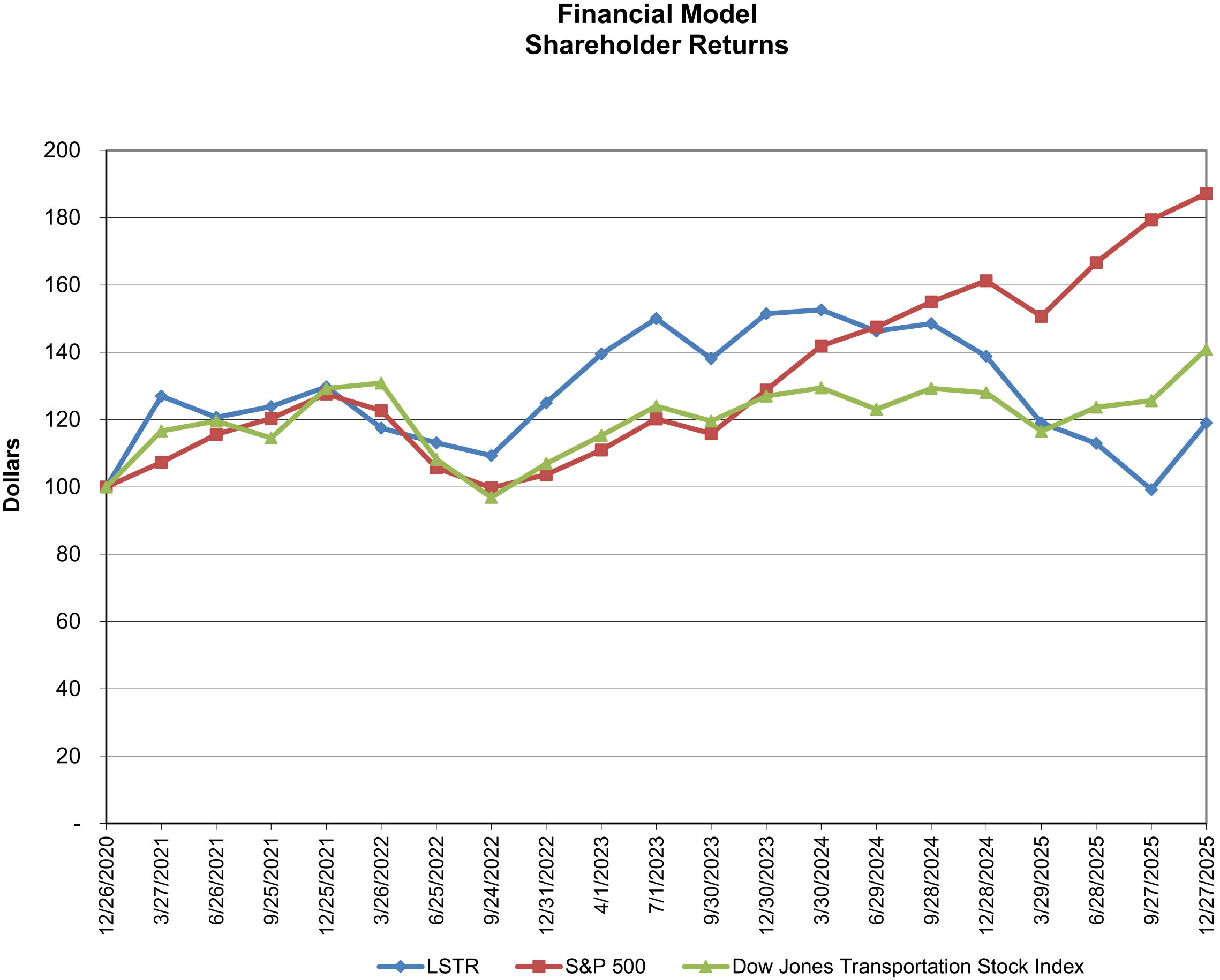
26
Table of Contents
Item 6. Reserved
Item 7. Management’s Discussion and Analysis of Financial Condition and Results of Operations
Forward-Looking Statements
The following is a “safe harbor” statement under the Private Securities Litigation Reform Act of 1995. Statements contained in this document that are not based on historical facts are “forward-looking statements.” This Management’s Discussion and Analysis of Financial Condition and Results of Operations and other sections of this Form 10-K contain forward-looking statements, such as statements which relate to Landstar’s business objectives, plans, strategies and expectations. Terms such as “anticipates,” “believes,” “estimates,” “intention,” “expects,” “plans,” “predicts,” “may,” “should,” “could,” “will,” the negative thereof and similar expressions are intended to identify forward-looking statements. Such statements are by nature subject to uncertainties and risks, including but not limited to: decreased demand for transportation services; U.S. trade relationships and potential or imposed tariffs; an increase in the frequency or severity of accidents or other claims; unfavorable development of existing accident claims; dependence on third party insurance companies; dependence on independent commission sales agents; dependence on third party capacity providers; the impact of the Russian conflict with Ukraine on the operations of certain independent commission sales agents, including the Company’s second largest such agent by revenue in the 2025 fiscal year; substantial industry competition; disruptions or failures in the Company’s computer systems; cyber and other information security incidents; dependence on key vendors; potential changes in taxes; status of independent contractors; regulatory and legislative changes; regulations focused on diesel emissions and other air quality matters; regulations requiring the purchase and use of zero-emission vehicles; intellectual property; acquisitions and investments; and other operational, financial or legal risks or uncertainties detailed in this and Landstar’s other SEC filings from time to time and described in Item 1A in this Form 10-K under the heading “Risk Factors.” These risks and uncertainties could cause actual results or events to differ materially from historical results or those anticipated. Investors should not place undue reliance on such forward-looking statements and the Company undertakes no obligation to publicly update or revise any forward-looking statements.
Introduction
Landstar System, Inc. and its subsidiary, Landstar System Holdings, Inc. (collectively referred to herein with their subsidiaries and other affiliated companies as “Landstar” or the “Company”), is a technology-enabled, asset-light provider of integrated transportation management solutions delivering safe, specialized transportation services to a broad range of customers utilizing a network of agents, third party capacity providers and employees. The Company offers services to its customers across multiple transportation modes, with the ability to arrange for individual shipments of freight to comprehensive third party logistics solutions to meet all of a customer’s transportation needs. Landstar provides services principally throughout the United States and to a lesser extent in Canada and Mexico, and between the United States and Canada, Mexico and other countries around the world. The Company’s services emphasize safety, cargo security, information coordination and customer service and are delivered through a network of approximately 960 independent commission sales agents and over 70,000 third party capacity providers, primarily truck capacity providers, linked together by a series of digital technologies which are provided and coordinated by the Company. The nature of the Company’s business is such that a significant portion of its operating costs varies directly with revenue.
Landstar markets its integrated transportation management solutions primarily through independent commission sales agents and exclusively utilizes third party capacity providers to transport customers’ freight. Landstar’s independent commission sales agents enter into contractual arrangements with the Company and are responsible for locating freight, making that freight available to Landstar’s capacity providers and coordinating the transportation of the freight with customers and capacity providers. The Company’s third party capacity providers consist of independent contractors who provide truck capacity to the Company under exclusive lease arrangements (the “BCO Independent Contractors”), unrelated trucking companies who provide truck capacity to the Company under non-exclusive contractual arrangements (the “Truck Brokerage Carriers”), air cargo carriers, ocean cargo carriers and railroads. Through this network of agents and capacity providers linked together by Landstar’s ecosystem of digital technologies, Landstar operates an integrated transportation management solutions business primarily throughout North America with revenue of $4.7 billion during the most recently completed fiscal year. The Company reports the results of two operating segments: the transportation logistics segment and the insurance segment.
The transportation logistics segment provides a wide range of integrated transportation management solutions. Transportation services are provided by Landstar’s “Operating Subsidiaries”: Landstar Ranger, Inc., Landstar Inway, Inc., Landstar Ligon, Inc., Landstar Gemini, Inc., Landstar Transportation Logistics, Inc., Landstar Global Logistics, Inc., Landstar Express America, Inc., Landstar Canada, Inc., Landstar Metro, S.A.P.I. de C.V., and Landstar Blue, LLC. Transportation services offered by the Company include truckload, less-than-truckload and other truck transportation, rail intermodal, air cargo, ocean cargo, expedited ground and air
27
Table of Contents
delivery of time-critical freight, heavy-haul/specialized, hazardous materials (“haz-mat”), cold chain/temperature-controlled, U.S.-Canada and U.S.-Mexico cross-border, intra-Mexico, intra-Canada, project cargo and customs brokerage. Examples of the industries serviced by the transportation logistics segment include automotive parts and assemblies, consumer durables, building products, metals, chemicals, foodstuffs, heavy machinery, retail, electronics, military equipment and general commodities. In addition, the transportation logistics segment provides transportation services to other transportation companies, including third party logistics and less-than-truckload service providers. The independent commission sales agents market services provided by the transportation logistics segment. Billings for freight transportation services are typically charged to customers on a per shipment basis for the physical transportation of freight and are referred to as transportation revenue. During fiscal year 2025, revenue generated by BCO Independent Contractors, Truck Brokerage Carriers and railroads represented approximately 38%, 53% and 2%, respectively, of the Company’s consolidated revenue. Collectively, revenue generated by air and ocean cargo carriers represented approximately 5% of the Company’s consolidated revenue during fiscal year 2025.
The insurance segment is comprised of Signature Insurance Company (“Signature”), a wholly owned offshore insurance subsidiary, and Risk Management Claim Services, Inc. The insurance segment provides risk and claims management services to certain of Landstar’s Operating Subsidiaries. In addition, it reinsures certain risks of the Company’s BCO Independent Contractors and provides certain property and casualty insurance and reinsurance to certain of Landstar’s Operating Subsidiaries. Revenue at the insurance segment represents reinsurance premiums from third party insurance companies that provide insurance programs to BCO Independent Contractors where all or a portion of the risk is ultimately borne by Signature. Revenue at the insurance segment represented approximately 1% of the Company’s consolidated revenue for fiscal year 2025.
Changes in Financial Condition and Results of Operations
Management believes the Company’s success principally depends on its ability to generate freight through its network of independent commission sales agents and to deliver freight safely, securely and efficiently utilizing BCO Independent Contractors and other third party capacity providers. Management believes the most significant factors to the Company’s success include increasing revenue, sourcing capacity, empowering its network through technology-based tools and controlling costs, including insurance and claims.
Revenue
While customer demand, which is subject to overall economic conditions, ultimately drives increases or decreases in revenue, the Company primarily relies on its independent commission sales agents to establish customer relationships and generate revenue opportunities. Management’s emphasis with respect to revenue growth is on revenue generated by independent commission sales agents who on an annual basis generate $1 million or more of Landstar revenue. Management believes future revenue growth is primarily dependent on its ability to increase both the revenue generated by Million Dollar Agents and the number of Million Dollar Agents through a combination of recruiting new agents, increasing the revenue opportunities generated by existing independent commission sales agents and providing its independent commission sales agents with digital technologies they may use to grow revenue and increase efficiencies at their businesses. The following table shows the number of Million Dollar Agents, the average revenue generated by these agents and the percent of consolidated revenue generated by these agents during the past three fiscal years:
| Fiscal Years | ||||||||||||
| 2025 | 2024 | 2023 | ||||||||||
| Number of Million Dollar Agents |
457 | 485 | 524 | |||||||||
|
|
|
|
|
|
|
|||||||
| Average revenue generated per Million Dollar Agent |
$ | 9,827,000 | $ | 9,388,000 | $ | 9,645,000 | ||||||
|
|
|
|
|
|
|
|||||||
| Percent of consolidated revenue generated by Million Dollar Agents |
95 | % | 94 | % | 95 | % | ||||||
|
|
|
|
|
|
|
|||||||
In fiscal year 2025, the change in the number of Million Dollar Agents was primarily attributable to agents who remained with the Company yet experienced lower year-over-year revenue that resulted in such agents moving below the Million Dollar Agent category due to the soft freight demand environment. Included among the Company’s Million Dollar Agents in the 2025 fiscal year, the Company had 77 independent sales agencies that generated at least $10 million in Landstar revenue. In fiscal year 2024, the change in the number of Million Dollar Agents was primarily attributable to agents who remained with the Company yet experienced lower year-over-year revenue that resulted in such agents moving below the Million Dollar Agent category due to the soft freight demand environment. Included among the Company’s Million Dollar Agents in the 2024 fiscal year, the Company had 81 independent sales agencies that generated at least $10 million in Landstar revenue.
28
Table of Contents
The change in the number of Million Dollar Agents on a year-over-year basis is influenced by many factors and is not solely the result of terminations of contractual relationships between agents and the Company, whether such terminations are initiated by the agent or the Company. Such other factors include consolidations among agencies or transactions in connection with ownership changes often due to retirement planning, estate planning or similar transitional matters. The change in the number of Million Dollar Agents on a year-over-year basis may also be affected by agents that remain with the Company yet experienced lower year-over-year revenue that resulted in such agent moving below the Million Dollar Agent category. Historically, the Company has experienced very few terminations of its Million Dollar Agents, whether such terminations are initiated by the agent or the Company. Annual terminations of Million Dollar Agents have typically been less than 3% of the total number of Million Dollar Agents. Revenue from accounts formerly handled by terminated Million Dollar Agents is often retained by the Company as the customer may choose to transfer its account to an existing Landstar agent.
29
Table of Contents
Management monitors business activity by tracking the number of loads (volume) and revenue per load by mode of transportation. Revenue per load can be influenced by many factors other than a change in price. Those factors include the average length of haul, freight type, special handling and equipment requirements, fuel costs and delivery time requirements. For shipments involving two or more modes of transportation, revenue is generally classified by the mode of transportation having the highest cost for the load. The following table summarizes this information by trailer type for truck transportation and by mode for all others for the past three fiscal years:
| Fiscal Years | ||||||||||||
| 2025 | 2024 | 2023 | ||||||||||
| Revenue generated through (in thousands): |
||||||||||||
| Truck transportation |
||||||||||||
| Truckload: |
||||||||||||
| Van equipment |
$ | 2,328,386 | $ | 2,447,810 | $ | 2,742,281 | ||||||
| Unsided/platform equipment |
1,527,802 | 1,455,663 | 1,490,393 | |||||||||
| Less-than-truckload |
95,856 | 99,828 | 117,683 | |||||||||
| Other truck transportation (1) |
383,970 | 343,253 | 479,173 | |||||||||
|
|
|
|
|
|
|
|||||||
| Total truck transportation |
4,336,014 | 4,346,554 | 4,829,530 | |||||||||
| Rail intermodal |
87,164 | 84,328 | 98,297 | |||||||||
| Ocean and air cargo carriers |
241,433 | 289,902 | 266,638 | |||||||||
| Other (2) |
79,149 | 98,461 | 108,857 | |||||||||
|
|
|
|
|
|
|
|||||||
| $ | 4,743,760 | $ | 4,819,245 | $ | 5,303,322 | |||||||
|
|
|
|
|
|
|
|||||||
| Revenue on loads hauled via BCO Independent Contractors included in total truck transportation |
$ | 1,803,514 | $ | 1,821,989 | $ | 1,998,408 | ||||||
| Number of loads: |
||||||||||||
| Truck transportation |
||||||||||||
| Truckload: |
||||||||||||
| Van equipment |
1,124,539 | 1,170,772 | 1,259,578 | |||||||||
| Unsided/platform equipment |
487,060 | 476,815 | 504,765 | |||||||||
| Less-than-truckload |
151,518 | 153,253 | 175,650 | |||||||||
| Other truck transportation (1) |
180,683 | 160,120 | 201,407 | |||||||||
|
|
|
|
|
|
|
|||||||
| Total truck transportation |
1,943,800 | 1,960,960 | 2,141,400 | |||||||||
| Rail intermodal |
29,970 | 27,970 | 29,620 | |||||||||
| Ocean and air cargo carriers |
31,120 | 34,440 | 32,820 | |||||||||
|
|
|
|
|
|
|
|||||||
| 2,004,890 | 2,023,370 | 2,203,840 | ||||||||||
|
|
|
|
|
|
|
|||||||
| Loads hauled via BCO Independent Contractors included in total truck transportation |
798,050 | 814,150 | 898,610 | |||||||||
| Revenue per load: |
||||||||||||
| Truck transportation |
||||||||||||
| Truckload: |
||||||||||||
| Van equipment |
$ | 2,071 | $ | 2,091 | $ | 2,177 | ||||||
| Unsided/platform equipment |
3,137 | 3,053 | 2,953 | |||||||||
| Less-than-truckload |
633 | 651 | 670 | |||||||||
| Other truck transportation (1) |
2,125 | 2,144 | 2,379 | |||||||||
| Total truck transportation |
2,231 | 2,217 | 2,255 | |||||||||
| Rail intermodal |
2,908 | 3,015 | 3,319 | |||||||||
| Ocean and air cargo carriers |
7,758 | 8,418 | 8,124 | |||||||||
| Revenue per load on loads hauled via BCO Independent Contractors |
$ | 2,260 | $ | 2,238 | $ | 2,224 | ||||||
| Revenue by capacity type (as a % of total revenue): |
||||||||||||
| Truck capacity providers: |
||||||||||||
| BCO Independent Contractors |
38 | % | 38 | % | 38 | % | ||||||
| Truck Brokerage Carriers |
53 | % | 52 | % | 53 | % | ||||||
| Rail intermodal |
2 | % | 2 | % | 2 | % | ||||||
| Ocean and air cargo carriers |
5 | % | 6 | % | 5 | % | ||||||
| Other |
2 | % | 2 | % | 2 | % | ||||||
| (1) | Includes power-only, expedited, straight truck, cargo van, and miscellaneous other truck transportation revenue generated by the transportation logistics segment. Power-only refers to shipments where the Company furnishes a power unit and an operator but not trailing equipment, which is typically provided by the shipper or consignee. |
| (2) | Includes primarily reinsurance premium revenue generated by the insurance segment and intra-Mexico transportation services revenue generated by Landstar Metro. |
30
Table of Contents
Expenses
Purchased transportation
Also critical to the Company’s success is its ability to secure capacity, particularly truck capacity, at rates that allow the Company to profitably transport customers’ freight. The following table summarizes the number of available truck capacity providers as of the end of the three most recent fiscal years:
| Dec. 27, 2025 |
Dec. 28, 2024 |
Dec. 30, 2023 |
||||||||||
| BCO Independent Contractors |
7,712 | 8,082 | 9,024 | |||||||||
| Truck Brokerage Carriers: |
||||||||||||
| Approved and active (1) |
36,852 | 43,718 | 49,111 | |||||||||
| Other approved |
25,938 | 26,527 | 27,524 | |||||||||
|
|
|
|
|
|
|
|||||||
| 62,790 | 70,245 | 76,635 | ||||||||||
|
|
|
|
|
|
|
|||||||
| Total available truck capacity providers |
70,502 | 78,327 | 85,659 | |||||||||
|
|
|
|
|
|
|
|||||||
| Trucks provided by BCO Independent Contractors |
8,514 | 8,843 | 9,809 | |||||||||
| (1) | Active refers to Truck Brokerage Carriers who moved at least one load in the 180 days immediately preceding the fiscal year end. |
Purchased transportation represents the amount a BCO Independent Contractor or other third party capacity provider is paid to haul freight. The amount of purchased transportation paid to a BCO Independent Contractor is primarily based on a contractually agreed-upon percentage of revenue generated by loads hauled by the BCO Independent Contractor. Purchased transportation paid to a Truck Brokerage Carrier is based on either a negotiated rate for each load hauled or, to a lesser extent, a contractually agreed-upon fixed rate per load. Purchased transportation paid to railroads and ocean cargo carriers is based on either a negotiated rate for each load hauled or a contractually agreed-upon fixed rate per load. Purchased transportation paid to air cargo carriers is generally based on a negotiated rate for each load hauled. Purchased transportation as a percentage of revenue for truck brokerage, rail intermodal and ocean cargo services is normally higher than that of BCO Independent Contractor and air cargo services. Purchased transportation is the largest component of costs and expenses and, on a consolidated basis, increases or decreases as a percentage of consolidated revenue in proportion to changes in the percentage of consolidated revenue generated through BCO Independent Contractors and other third party capacity providers and external revenue from the insurance segment, consisting of reinsurance premiums. Purchased transportation as a percent of revenue also increases or decreases in relation to the availability of truck brokerage capacity and with changes in the price of fuel on revenue generated from shipments hauled by Truck Brokerage Carriers. The Company passes 100% of fuel surcharges billed to customers for freight hauled by BCO Independent Contractors to its BCO Independent Contractors. These fuel surcharges are excluded from revenue and the cost of purchased transportation. Purchased transportation costs are recognized over the freight transit period as the performance obligation to the customer is completed.
Commissions to agents
Commissions to agents are based on contractually agreed-upon percentages of (i) revenue, (ii) revenue less the cost of purchased transportation, or (iii) revenue less a contractually agreed upon percentage of revenue retained by Landstar and the cost of purchased transportation (the “retention contracts”). Commissions to agents as a percentage of consolidated revenue vary directly with fluctuations in the percentage of consolidated revenue generated by the various modes of transportation and reinsurance premiums and, in general, vary inversely with changes in the amount of purchased transportation as a percentage of revenue on services provided by Truck Brokerage Carriers, railroads, air cargo carriers and ocean cargo carriers. Commissions to agents are recognized over the freight transit period as the performance obligation to the customer is completed.
Other operating costs, net of gains on asset sales/dispositions
Maintenance costs for Company-provided trailing equipment, the provision for uncollectible advances and other receivables due from BCO Independent Contractors and independent commission sales agents and recruiting and qualification costs for BCO Independent Contractors are the largest components of other operating costs. Also included in other operating costs are trailer rental costs and gains/losses, if any, on sales of Company-owned trailing equipment.
As further described in Note 18 in the “Notes to Consolidated Financial Statements” in this Annual Report on Form 10-K, during the last week of the Company’s 2025 first fiscal quarter, the Company identified a supply chain fraud relating to the Company’s international freight forwarding operations (the “Supply Chain Fraud Matter”). Other operating costs during the fiscal year ended December 27, 2025 included a $4.8 million expense relating to this matter. In addition, legal and other professional fees included in selling, general and administrative costs were slightly elevated during the Company’s 2025 fiscal year in connection with this matter.
31
Table of Contents
Insurance and claims
With respect to insurance and claims cost, potential liability associated with accidents in the trucking industry is severe and occurrences are unpredictable.
Landstar retains liability through a self-insured retention for commercial trucking claims up to $5 million per occurrence. The Company also maintains third party insurance arrangements providing coverage for commercial trucking liabilities in excess of $5 million. Historically, these third party insurance arrangements were based on policy year periods beginning on May 1 and ending on the subsequent April 30. Beginning with the policy year period commencing May 1, 2025, the Company and its third party insurance providers adjusted the applicable policy year period, beginning in 2026, to commence on June 1 and end on the subsequent May 31. All applicable third party insurance arrangements with a policy period ending April 30, 2026, have been amended to provide for a policy period ending May 31, 2026, as reflected below.
Effective May 1, 2023, the Company entered into a three year commercial auto liability insurance arrangement for losses incurred between $5 million and $10 million (the “2023 Initial Excess Policy”) with a third party insurance company. For commercial trucking claims incurred on or after May 1, 2023 through May 31, 2026, the 2023 Initial Excess Policy provides for an aggregate deductible of $18 million over the thirty-seven-month term ending May 31, 2026. After payment of the deductible, the 2023 Initial Excess Policy provides for a limit for a single loss of $5 million, with an aggregate limit of $15 million for the thirty-seven-month term ending May 31, 2026.
The Company also maintains third party insurance arrangements providing excess coverage for commercial trucking liabilities in excess of $10 million. These third party arrangements provide coverage on a per occurrence or aggregated basis. Over the past fifteen years, there has been a significant increase in the occurrence of trials in courts throughout the United States involving catastrophic injury and fatality claims against commercial motor carriers that have resulted in verdicts in excess of $10 million. Within the transportation logistics industry, these verdicts are often referred to as “Nuclear Verdicts.” The increase in Nuclear Verdicts has had a significant impact on the cost of commercial auto liability claims throughout the United States. Due to the increasing cost of commercial auto liability claims, the availability of excess coverage has significantly decreased, and the pricing associated with such excess coverage, to the extent available, has significantly increased. Since the annual policy year ended April 30, 2020, as compared to the annual policy year ending May 31, 2026, the Company experienced an increase of approximately $22 million, or approximately 400%, in the premiums charged by third party insurance companies to the Company for excess coverage for commercial trucking liabilities in excess of $10 million.
Moreover, the Company from year to year manages the level of its financial exposure to commercial trucking claims in excess of $10 million, including through the use of additional self-insurance, deductibles, aggregate loss limits, quota shares and other structured arrangements with third party insurance companies, based on the availability of coverage within certain excess insurance coverage layers and estimated cost differentials between proposed premiums from third party insurance companies and historical and actuarially projected losses experienced by the Company at various levels of excess insurance coverage. For example, with respect to a single hypothetical claim in the amount of $65 million incurred during the annual policy year ending May 31, 2026, the Company would have an aggregate financial exposure of approximately $36 million.
Within the Company’s third party insurance arrangements providing excess coverage for commercial trucking liabilities, structured arrangements with third party reinsurers within a specific loss layer may include provisions that require additional payments of premium in the event of unfavorable loss experience or a refund of premium in the event of favorable loss experience. During the 2025 fiscal year, with respect to one such three-year commercial auto liability reinsurance arrangement relating to certain excess claims incurred between May 1, 2020 through April 30, 2023, the Company received $12,000,000 of cash payments from third party reinsurance providers in the form of a “no claims bonus” due to favorable loss experience with respect to claims incurred during the applicable policy period. As further described in Note 11 in the “Notes to Consolidated Financial Statements” in this Annual Report on Form 10-K, in connection with the Judgment (as defined below) in the Cabral Matter, the Company has recorded the “no claims bonus” within current insurance claims in the consolidated balance sheet as of December 27, 2025. The Company intends to vigorously appeal the Cabral Matter, including the Judgment; however, no assurances can be provided regarding whether the Company will ultimately be able to recognize a gain with respect to the “no claims bonus.” For more information about the Cabral Matter, see Item 7, “Management’s Discussion and Analysis of Financial Condition and Results of Operations – Legal Proceedings.”
32
Table of Contents
Furthermore, the Company’s third party insurance arrangements provide excess coverage up to an uppermost coverage layer, in excess of which the Company retains additional financial exposure. No assurances can be given that the availability of excess coverage for commercial trucking claims will not continue to deteriorate, that the pricing associated with such excess coverage, to the extent available, will not continue to increase, nor that insurance coverage from third party insurers for excess coverage of commercial trucking claims will even be available on commercially reasonable terms at certain levels. Moreover, the occurrence of a Nuclear Verdict, or the settlement of a catastrophic injury and/or fatality claim that could have otherwise resulted in a Nuclear Verdict, could have a material adverse effect on Landstar’s cost of insurance and claims and its results of operations.
Further, the Company retains liability of up to $2,000,000 for each general liability claim, $250,000 for each workers’ compensation claim and $250,000 for each cargo claim. In addition, under reinsurance arrangements by Signature of certain risks of the Company’s BCO Independent Contractors, the Company retains liability of up to $500,000, $1,000,000 or $2,000,000 with respect to certain occupational accident claims and up to $750,000 with respect to certain workers’ compensation claims. The Company’s exposure to liability associated with accidents incurred by Truck Brokerage Carriers, railroads and air and ocean cargo carriers who transport freight on behalf of the Company is reduced by various legal defenses and other factors including the extent to which such carriers maintain their own insurance coverage. A material increase in the frequency or severity of accidents, cargo claims or workers’ compensation claims or the material unfavorable development of existing claims could have a material adverse effect on Landstar’s cost of insurance and claims and its results of operations.
Selling, general and administrative
During the 2025 fiscal year, employee compensation and benefits accounted for approximately 62% of the Company’s selling, general and administrative costs. Employee compensation and benefits include wages and employee benefit costs as well as incentive compensation and stock-based compensation expense. Incentive compensation and stock-based compensation expense is highly variable in nature in comparison to wages and employee benefit costs.
Depreciation and amortization
Depreciation and amortization primarily relate to depreciation of trailing equipment and information technology hardware and software.
Impairment of intangible and other assets
During the 2025 fiscal year, the Company recorded certain non-cash, non-recurring impairment charges of $32,170,000 in the aggregate (the “Non-Cash Impairment Charges”). The Non-Cash Impairment Charges, net of tax benefit, unfavorably impacted EPS by $0.71 per basic and diluted share. The Non-Cash Impairment Charges consisted of:
| • | $18,208,000, or $0.40 per basic and diluted share, in impairment charges to goodwill and certain other assets related to the Company’s decision to actively market for sale Landstar Metro, S.A.P.I. de C.V., the Company’s wholly-owned Mexican operating subsidiary, principally engaged in intra-Mexico truck transportation services. For additional information, see Note 14 in the “Notes to Consolidated Financial Statements” in this Annual Report on Form 10-K. |
| • | $8,963,000, or $0.20 per basic and diluted share, in impairment charges related to the decision to select one of the Company’s transportation management systems as its primary such system for truckload brokerage services and, in connection with that decision, wind-down an alternative transportation management system currently in use by Landstar Blue, LLC, one of the Company’s operating subsidiaries. For additional information, see Note 15 in the “Notes to Consolidated Financial Statements” in this Annual Report on Form 10-K. |
| • | $4,999,000 or $0.11 per basic and diluted share, relating to the carrying value of a non-controlling equity investment made by the Company in 2022 in Cavnue, LLC, a privately held technology start-up company. For additional information, see Note 16 in the “Notes to Consolidated Financial Statements” in this Annual Report on Form 10-K. |
Costs of revenue
The Company incurs costs of revenue related to the transportation of freight and, to a much lesser extent, to reinsurance premiums received by Signature. Costs of revenue include variable costs of revenue and other costs of revenue. Variable costs of revenue include purchased transportation and commissions to agents, as these costs are entirely variable on a shipment-by-shipment basis. Other costs
33
Table of Contents
of revenue include fixed costs of revenue and semi-variable costs of revenue, where such costs may vary over time based on certain economic factors or operational metrics such as the number of Company-controlled trailers, the number of BCO Independent Contractors, the frequency and severity of insurance claims, the number of miles traveled by BCO Independent Contractors, or the number and/or scale of information technology projects in process or in-service to support revenue generating activities, rather than on a shipment-by-shipment basis. Other costs of revenue associated with the transportation of freight include: (i) other operating costs, primarily consisting of trailer maintenance, the provision for uncollectible advances and other receivables due from BCO Independent Contractors and independent commission sales agents and BCO Independent Contractor recruiting and qualification costs, as reported in the Company’s Consolidated Statements of Income, (ii) transportation-related insurance premiums paid and claim costs incurred, included as a portion of insurance and claims in the Company’s Consolidated Statements of Income, (iii) costs incurred related to internally developed software including ASC 350-40 amortization, implementation costs, hosting costs and other support costs utilized to support the Company’s independent commission sales agents, third party capacity providers, and customers, included as a portion of depreciation and amortization and of selling, general and administrative in the Company’s Consolidated Statements of Income; and (iv) depreciation on Company-owned trailing equipment, included as a portion of depreciation and amortization in the Company’s Consolidated Statements of Income. Other costs of revenue associated with reinsurance premiums received by Signature are comprised of broker commissions and other fees paid related to the administration of insurance programs to BCO Independent Contractors and are included in selling, general and administrative in the Company’s Consolidated Statements of Income. In addition to costs of revenue, the Company incurs various other costs relating to its business, including most selling, general and administrative costs and portions of costs attributable to insurance and claims and depreciation and amortization. Management continually monitors all components of the costs incurred by the Company and establishes annual cost budgets that, in general, are used to benchmark costs incurred on a monthly basis.
Gross Profit, Variable Contribution, Gross Profit Margin and Variable Contribution Margin
The following table sets forth calculations of gross profit, defined as revenue less costs of revenue, and gross profit margin, defined as gross profit divided by revenue, for the periods indicated. The Company refers to revenue less variable costs of revenue as “variable contribution” and variable contribution divided by revenue as “variable contribution margin.” Variable contribution and variable contribution margin are each non-GAAP financial measures. The closest comparable GAAP financial measures to variable contribution and variable contribution margin are, respectively, gross profit and gross profit margin. The Company believes variable contribution and variable contribution margin are useful measures of the variable costs that we incur at a shipment-by-shipment level attributable to our transportation network of third party capacity providers and independent commission sales agents in order to provide services to our customers. The Company believes variable contribution and variable contribution margin are important performance measurements and management considers variable contribution and variable contribution margin in evaluating the Company’s financial performance and in its decision-making, such as budgeting for infrastructure, trailing equipment and selling, general and administrative costs.
34
Table of Contents
The reconciliations of gross profit to variable contribution and gross profit margin to variable contribution margin are each presented below:
| Fiscal Year | ||||||||||||
| 2025 | 2024 | 2023 | ||||||||||
| Revenue |
$ | 4,743,760 | $ | 4,819,245 | $ | 5,303,322 | ||||||
| Costs of revenue: |
||||||||||||
| Purchased transportation |
3,688,343 | 3,745,241 | 4,068,262 | |||||||||
| Commissions to agents |
387,397 | 392,751 | 462,668 | |||||||||
|
|
|
|
|
|
|
|||||||
| Variable costs of revenue |
4,075,740 | 4,137,992 | 4,530,930 | |||||||||
| Trailing equipment depreciation |
27,195 | 27,950 | 31,319 | |||||||||
| Information technology costs |
13,675 | 22,744 | 25,486 | |||||||||
| Insurance-related costs (1) |
161,370 | 115,764 | 116,069 | |||||||||
| Other operating costs |
61,586 | 58,781 | 54,191 | |||||||||
|
|
|
|
|
|
|
|||||||
| Other costs of revenue |
263,826 | 225,239 | 227,065 | |||||||||
|
|
|
|
|
|
|
|||||||
| Total costs of revenue |
4,339,566 | 4,363,231 | 4,757,995 | |||||||||
|
|
|
|
|
|
|
|||||||
| Gross profit |
$ | 404,194 | $ | 456,014 | $ | 545,327 | ||||||
|
|
|
|
|
|
|
|||||||
| Gross profit margin |
8.5 | % | 9.5 | % | 10.3 | % | ||||||
| Plus: other costs of revenue |
263,826 | 225,239 | 227,065 | |||||||||
|
|
|
|
|
|
|
|||||||
| Variable contribution |
$ | 668,020 | $ | 681,253 | $ | 772,392 | ||||||
|
|
|
|
|
|
|
|||||||
| Variable contribution margin |
14.1 | % | 14.1 | % | 14.6 | % | ||||||
| (1) | Insurance-related costs in the table above include (i) other costs of revenue related to the transportation of freight that are included as a portion of insurance and claims in the Company’s Consolidated Statements of Income and (ii) certain other costs of revenue related to reinsurance premiums received by Signature that are included as a portion of selling, general and administrative in the Company’s Consolidated Statements of Income. Insurance and claims costs included in other costs of revenue relating to the transportation of freight primarily consist of insurance premiums paid for commercial auto liability, general liability, cargo and other lines of coverage related to the transportation of freight and the related cost of claims incurred under those programs, and, to a lesser extent, the cost of claims incurred under insurance programs available to BCO Independent Contractors that are reinsured by Signature. Other insurance and claims costs included in costs of revenue that are included in selling, general and administrative in the Company’s Consolidated Statements of Income consist of brokerage commissions and other fees incurred by Signature relating to the administration of insurance programs available to BCO Independent Contractors that are reinsured by Signature. |
In general, variable contribution margin on revenue generated by BCO Independent Contractors represents a fixed percentage due to the nature of the contracts that pay a fixed percentage of revenue to both the BCO Independent Contractors and independent commission sales agents. For revenue generated by Truck Brokerage Carriers, variable contribution margin may be either a fixed or variable percentage, depending on the contract with each individual independent commission sales agent. Variable contribution margin on revenue generated from shipments hauled by railroads, air cargo carriers, ocean cargo carriers and Truck Brokerage Carriers, other than those under retention contracts, is variable in nature, as the Company’s contracts with independent commission sales agents provide commissions to agents at a contractually agreed upon percentage of the amount represented by revenue less purchased transportation for these types of shipments. Approximately 43% of the Company’s consolidated revenue in fiscal year 2025 was generated under transactions that pay a fixed percentage of revenue to the third party capacity provider and/or agents while 57% was generated under transactions that pay a variable percentage of revenue to the third party capacity provider and/or agents.
Operating income as a percentage of gross profit and operating income as a percentage of variable contribution
The following table presents operating income as a percentage of gross profit and operating income as a percentage of variable contribution. The Company’s operating income as a percentage of variable contribution is a non-GAAP financial measure calculated as operating income divided by variable contribution. The Company believes that operating income as a percentage of variable contribution is useful and meaningful to investors for the following principal reasons: (i) the variable costs of revenue for a significant portion of the business are highly influenced by short-term market-based trends in the freight transportation industry, whereas other costs, including other costs of revenue, are much less impacted by short-term freight market trends; (ii) disclosure of this measure allows investors to better understand the underlying trends in the Company’s results of operations; (iii) this measure is meaningful to
35
Table of Contents
investors’ evaluations of the Company’s management of costs attributable to operations other than the purely variable costs associated with purchased transportation and commissions to agents that the Company incurs to provide services to our customers; and (iv) management considers this financial information in its decision-making, such as budgeting for infrastructure, trailing equipment and selling, general and administrative costs.
| Fiscal Year | ||||||||||||
| 2025 | 2024 | 2023 | ||||||||||
| Gross profit |
$ | 404,194 | $ | 456,014 | $ | 545,327 | ||||||
| Operating income |
$ | 151,577 | $ | 248,907 | $ | 344,149 | ||||||
| Operating income as % of gross profit |
37.5 | % | 54.6 | % | 63.1 | % | ||||||
| Variable contribution |
$ | 668,020 | $ | 681,253 | $ | 772,392 | ||||||
| Operating income |
$ | 151,577 | $ | 248,907 | $ | 344,149 | ||||||
| Operating income as % of variable contribution |
22.7 | % | 36.5 | % | 44.6 | % | ||||||
The decrease in operating income as a percentage of gross profit from fiscal year 2024 to fiscal year 2025 resulted from the decrease of operating income at a more rapid percentage rate than the decrease in gross profit, primarily due to the impact of the impairment of certain intangible and other assets and the impact of the Company’s fixed cost infrastructure, principally certain components of selling, general and administrative costs, in comparison to a smaller gross profit base. The decrease in operating income as a percentage of gross profit from fiscal year 2023 to fiscal year 2024 resulted from the decrease of operating income at a more rapid percentage rate than the decrease in gross profit, primarily due to the impact of the Company’s fixed cost infrastructure, principally certain components of selling, general and administrative costs, in comparison to a smaller gross profit base.
The decrease in operating income as a percentage of variable contribution from fiscal year 2024 to fiscal year 2025 resulted from the decrease of operating income at a more rapid percentage rate than the decrease in variable contribution, primarily due to the impact of increased insurance and claims costs, the impact of the impairment of certain intangible and other assets and the impact of the Company’s fixed cost infrastructure, principally certain components of selling, general and administrative costs, in comparison to a smaller variable contribution base. The decrease in operating income as a percentage of variable contribution from fiscal year 2023 to fiscal year 2024 resulted from the decrease of operating income at a more rapid percentage rate than the decrease in variable contribution, primarily due to the impact of the Company’s fixed cost infrastructure, principally certain components of selling, general and administrative costs, in comparison to a smaller variable contribution base.
Also, as previously mentioned, the Company reports two operating segments: the transportation logistics segment and the insurance segment. External revenue at the insurance segment, representing reinsurance premiums, has historically been relatively consistent on an annual basis at 2% or less of consolidated revenue and generally corresponds directly with the number of trucks provided by BCO Independent Contractors. The discussion of cost line items in Management’s Discussion and Analysis of Financial Condition and Results of Operations considers the Company’s costs on a consolidated basis rather than on a segment basis. Management believes this presentation format is the most appropriate to assist users of the financial statements in understanding the Company’s business for the following reasons: (1) the insurance segment has no other operating costs; (2) discussion of insurance and claims at either segment without reference to the other may create confusion amongst investors and potential investors due to intercompany arrangements and specific deductible programs that affect comparability of financial results by segment between various fiscal periods but that have no effect on the Company from a consolidated reporting perspective; (3) selling, general and administrative costs of the insurance segment comprise less than 10% of consolidated selling, general and administrative costs and have historically been relatively consistent on a year-over-year basis; and (4) the insurance segment has no depreciation and amortization.
Fiscal Year Ended December 27, 2025 Compared to Fiscal Year Ended December 28, 2024
Revenue for fiscal year 2025 was $4,743,760,000, a decrease of $75,485,000, or 2%, compared to fiscal year 2024. Transportation revenue decreased $70,893,000, or 1%. The decrease in transportation revenue was attributable to a decreased number of loads hauled of approximately 1%, while revenue per load was approximately the same as compared to fiscal year 2024. Reinsurance premiums were $58,645,000 and $63,237,000 for fiscal years 2025 and 2024, respectively. The decrease in revenue from reinsurance premiums was primarily attributable to a decrease in the average number of trucks provided by BCO Independent Contractors in fiscal year 2025 compared to fiscal year 2024.
36
Table of Contents
Truck transportation revenue generated by BCO Independent Contractors and Truck Brokerage Carriers (together, the “third party truck capacity providers”) for fiscal year 2025 was $4,336,014,000, representing 91% of total revenue, a decrease of $10,540,000, or less than 1%, compared to fiscal year 2024. The number of loads hauled by third party truck capacity providers decreased approximately 1% in fiscal year 2025 compared to fiscal year 2024, while revenue per load on loads hauled by third party truck capacity providers increased approximately 1% compared to fiscal year 2024.
The decrease in the number of loads hauled via truck compared to fiscal year 2024 was primarily due to decreased demand from fiscal year 2024 for the Company’s van and less-than-truckload transportation services. Loads hauled via van equipment decreased 4% and less-than-truckload loadings decreased 1%, while loads hauled via other truck transportation services increased 13% and loads hauled via unsided/platform equipment increased 2% as compared to fiscal year 2024.
The increase in revenue per load on loads hauled via truck was primarily due to increased revenue per load on loads hauled via unsided/platform equipment, which was entirely attributable to an increase in the percentage of revenue contributed by heavy/specialized equipment, which typically has a higher revenue per load than unsided/platform loadings transported using standard flatbed and other less specialized pieces of platform equipment. Revenue per load on loads hauled via unsided/platform equipment increased 3%, while revenue per load on less-than-truckload loadings decreased 3%, on loads hauled via van equipment decreased 1% and on other truck transportation services decreased 1% as compared to fiscal year 2024.
Fuel surcharges billed to customers on revenue generated by BCO Independent Contractors are excluded from revenue. Fuel surcharges on Truck Brokerage Carrier revenue identified separately in billings to customers and included as a component of Truck Brokerage Carrier revenue were $108,709,000 and $118,295,000 in fiscal years 2025 and 2024, respectively. It should be noted that billings to many customers of the Company’s truck brokerage services include a single all-in rate and do not separately identify fuel surcharges on loads hauled via Truck Brokerage Carriers. Accordingly, the overall impact of changes in fuel prices on revenue and revenue per load on loads hauled via truck is likely to be greater than that indicated.
Transportation revenue generated by rail intermodal, air cargo and ocean cargo carriers (collectively, the “multimode capacity providers”) for fiscal year 2025 was $328,597,000, or 7% of total revenue, a decrease of $45,633,000, or 12%, compared to fiscal year 2024. Revenue per load on revenue generated by multimode capacity providers decreased approximately 10% in fiscal year 2025 compared to fiscal year 2024, and the number of loads hauled by multimode capacity providers decreased approximately 2% over the same period. Revenue per load on loads hauled via rail intermodal and ocean decreased approximately 4% and 8%, respectively, while revenue per load on loads hauled via air increased approximately 14% during fiscal year 2025 as compared to fiscal year 2024. The decrease in revenue per load on loads hauled by rail intermodal carriers was broad-based with decreases at multiple customers during fiscal year 2025. The decrease in revenue per load on loads hauled by ocean was primarily attributable to the loss of one specific customer during fiscal year 2025 in connection with the Supply Chain Fraud Matter. The increase in revenue per load on loads hauled by air cargo carriers was primarily attributable to increases at several specific customers during fiscal year 2025. Revenue per load on revenue generated by multimode capacity providers is influenced by many factors, including revenue mix among the various modes of transportation used, length of haul, complexity of freight, density of freight lanes, fuel costs and availability of capacity. The decrease in the number of loads hauled by multimode capacity providers was due to a 12% decrease in ocean loadings and a 4% decrease in air loadings, while rail loadings increased 7%. The 12% decrease in ocean loadings was broad-based with decreases at several customers. The 4% decrease in air loadings was primarily attributable to decreases at several specific customers. The 7% increase in rail loadings was primarily attributable to increased loadings at one specific agency.
Purchased transportation was 77.8% and 77.7% of revenue in fiscal years 2025 and 2024, respectively. The increase in purchased transportation as a percentage of revenue was primarily due to an increased rate of purchased transportation on revenue generated by Truck Brokerage Carriers. Commissions to agents were 8.2% and 8.1% of revenue in fiscal years 2025 and 2024, respectively. The increase in commissions to agents as a percentage of revenue was primarily attributable to a decreased cost of purchased transportation as a percentage of revenue on revenue generated by multimode capacity providers.
Investment income was $13,685,000 and $14,810,000 in fiscal years 2025 and 2024, respectively. The decrease in investment income was attributable to lower average rates of return on investments in fiscal year 2025, partially offset by a higher average investment balance held by the insurance segment during fiscal year 2025.
37
Table of Contents
Other operating costs increased $2,805,000 in fiscal year 2025 compared to fiscal year 2024. The increase in other operating costs compared to the prior year was primarily due to increased trailer equipment maintenance costs, partially offset by a decreased provision for contractor bad debt.
Insurance and claims increased $45,507,000 in fiscal year 2025 compared to fiscal year 2024. The highly elevated increase in insurance and claims expense compared to the prior year was primarily due to (i) an increase of $23,258,000 in net unfavorable development of prior years’ claims in fiscal year 2025 compared to fiscal year 2024, as further described below; (ii) increased severity of current year trucking and cargo claims in fiscal year 2025 compared to fiscal year 2024, including $11.0 million related to two separate tragic vehicular accidents which occurred during the 2025 fourth fiscal quarter; and (iii) a $5.3 million increase in the Company’s actuarily determined claim reserves relating to the anticipated loss exposure for claims above $1 million. During the 2025 and 2024 fiscal years, insurance and claims costs included $32,082,000 and $8,824,000 of net unfavorable adjustments to prior years’ claims estimates, respectively. Unfavorable development of prior years’ claims estimates of $32,082,000 during the 2025 fiscal year was primarily comprised of (i) approximately $10.7 million of unfavorable development on commercial trucking claims up to $1 million per occurrence for accident years 2024 and prior; (ii) approximately $10.6 million of unfavorable development on commercial trucking claims in excess of $1 million per occurrence for accident years 2024 and prior, including approximately $5.7 million related to the Cabral Matter; (iii) approximately $8.4 million of unfavorable development on cargo-related claims primarily attributable to fraud and theft in the supply chain; and (iv) approximately $2.4 million of net unfavorable development relating to reinsurance arrangements involving the Company’s captive insurance subsidiary, Signature Insurance Company, in connection with certain risks of the Company’s BCO Independent Contractors.
Selling, general and administrative costs increased $12,840,000 in fiscal year 2025 as compared to fiscal year 2024. The increase in selling, general and administrative costs compared to prior year was primarily attributable to increased information technology project consulting fees, increased stock-based compensation expense, increased wages, increased legal fees, an increased provision for incentive compensation and increased employee benefit costs, primarily attributable to increased medical and pharmacy costs under the self-insured portion of the Company’s medical plan, partially offset by the impact of Chief Executive Officer (“CEO”) transition costs in fiscal year 2024. Included in selling, general and administrative costs was stock-based compensation expense of $5,998,000 and $3,435,000 for the 2025 and 2024 fiscal years, respectively, and incentive compensation expense of $3,625,000 and $1,970,000 for the 2025 and 2024 fiscal years, respectively.
Depreciation and amortization decreased $10,350,000 in fiscal year 2025 compared to fiscal year 2024. The decrease in depreciation and amortization expense was primarily due to decreased depreciation on information technology software.
Impairment of intangibles and other assets was $32,170,000 in fiscal year 2025. This was attributable to the impairment matters referenced above under “Expenses – Impairment of intangible and other assets.”
The year-over-prior-year change in interest and debt expense (income) was $6,415,000, with net interest and debt expense of $996,000 in fiscal year 2025 compared to net interest and debt income of $5,419,000 in fiscal year 2024. The increase in interest and debt expense (income) was primarily attributable to decreased interest income earned on cash balances held by the transportation logistics segment and increased interest expense related to finance lease obligations.
The effective income tax rate was 23.6% for fiscal year 2025 and 23.0% for fiscal year 2024. The effective income tax rate was higher than the statutory federal income tax rate of 21% for fiscal year 2025 primarily attributable to state taxes. The effective income tax rate was higher than the statutory federal income tax rate of 21% for fiscal year 2024 primarily attributable to state taxes, partially offset by federal research and development tax credits.
Net income was $115,007,000, or $3.31 per basic and diluted share, in fiscal year 2025. Net income was $195,946,000, or $5.51 per basic and diluted share, in fiscal year 2024. Net income during fiscal year 2025 was unfavorably impacted by $32,170,000, or $0.71 per basic and diluted share, related to the impairment of intangible and other assets charges noted above.
Fiscal Year Ended December 28, 2024 Compared to Fiscal Year Ended December 30, 2023
Revenue for fiscal year 2024 was $4,819,245,000, a decrease of $484,077,000, or 9%, compared to fiscal year 2023. Transportation revenue decreased $474,838,000, or 9%. The decrease in transportation revenue was attributable to a decreased number of loads hauled of approximately 8% and decreased revenue per load of approximately 1% compared to fiscal year 2023. Reinsurance premiums were $63,237,000 and $72,476,000 for fiscal years 2024 and 2023, respectively. The decrease in revenue from reinsurance premiums was primarily attributable to a decrease in the average number of trucks provided by BCO Independent Contractors in fiscal year 2024 compared to fiscal year 2023.
38
Table of Contents
Truck transportation revenue generated by third party truck capacity providers for fiscal year 2024 was $4,346,554,000, representing 90% of total revenue, a decrease of $482,976,000, or 10%, compared to fiscal year 2023. The number of loads hauled by third party truck capacity providers decreased approximately 8% in fiscal year 2024 compared to fiscal year 2023, and revenue per load on loads hauled by third party truck capacity providers decreased approximately 2% compared to fiscal year 2023.
The decrease in the number of loads hauled via truck compared to fiscal year 2023 was primarily due to a broad-based decrease in demand for the Company’s truck transportation services. Loads hauled via other truck transportation services decreased 20%, less-than-truckload loadings decreased 13%, loads hauled via van equipment decreased 7% and loads hauled via unsided/platform equipment decreased 6% as compared to fiscal year 2023.
The decrease in revenue per load on loads hauled via truck was primarily due to a softer freight demand environment experienced during fiscal year 2024 and the impact of lower diesel fuel costs on loads hauled via Truck Brokerage Carriers. Revenue per load on loads hauled via other truck transportation services decreased 10%, on loads hauled via van equipment decreased 4% and on less-than-truckload loadings decreased 3%, while revenue per load on loads hauled via unsided/platform equipment increased 3% as compared to fiscal year 2023. The increase in revenue per load on loads hauled via unsided/platform equipment of 3% was favorably impacted by an increase in the percentage of revenue contributed by heavy/specialized equipment, which typically has a higher revenue per load.
Fuel surcharges billed to customers on revenue generated by BCO Independent Contractors are excluded from revenue. Fuel surcharges on Truck Brokerage Carrier revenue identified separately in billings to customers and included as a component of Truck Brokerage Carrier revenue were $118,295,000 and $147,691,000 in fiscal years 2024 and 2023, respectively. It should be noted that billings to many customers of the Company’s truck brokerage services include a single all-in rate and do not separately identify fuel surcharges on loads hauled via Truck Brokerage Carriers. Accordingly, the overall impact of changes in fuel prices on revenue and revenue per load on loads hauled via truck is likely to be greater than that indicated.
Transportation revenue generated by multimode capacity providers for fiscal year 2024 was $374,230,000, or 8% of total revenue, an increase of $9,295,000, or 3%, compared to fiscal year 2023. Revenue per load on revenue generated by multimode capacity providers increased approximately 3% in fiscal year 2024 compared to fiscal year 2023, while the number of loads hauled by multimode capacity providers was approximately the same in fiscal year 2024 compared to fiscal year 2023. Revenue per load on loads hauled via ocean increased 15%, while revenue per load on loads hauled via air and rail intermodal decreased 51% and 9%, respectively, during fiscal year 2024 as compared to fiscal year 2023. The increase in revenue per load on loads hauled by ocean was broad-based across many customers and reflected the impact of various geopolitical events on ocean shipping rates, generally. The decrease in revenue per load on loads hauled by air cargo carriers was primarily attributable to the impact of high value air loadings at one specific customer during fiscal year 2023. The decrease in revenue per load on loads hauled by rail intermodal was broad-based across many customers. Revenue per load on revenue generated by multimode capacity providers is influenced by many factors, including revenue mix among the various modes of transportation used, length of haul, complexity of freight, density of freight lanes, fuel costs and availability of capacity.
Purchased transportation was 77.7% and 76.7% of revenue in fiscal years 2024 and 2023, respectively. The increase in purchased transportation as a percentage of revenue was primarily due to an increased rate of purchased transportation on revenue generated by Truck Brokerage Carriers. Commissions to agents were 8.1% and 8.7% of revenue in fiscal years 2024 and 2023, respectively. The decrease in commissions to agents as a percentage of revenue was primarily attributable to an increased cost of purchased transportation as a percentage of revenue on revenue generated by Truck Brokerage Carriers during fiscal year 2024.
Investment income was $14,810,000 and $10,141,000 in fiscal years 2024 and 2023, respectively. The increase in investment income was attributable to a higher average investment balance held by the insurance segment during fiscal year 2024 and higher average rates of return on investments in fiscal year 2024.
Other operating costs increased $4,590,000 in fiscal year 2024 compared to fiscal year 2023. The increase in other operating costs compared to the prior year was primarily due to an increased provision for contractor bad debt and decreased gains on sales of operating property.
39
Table of Contents
Insurance and claims decreased $312,000 in fiscal year 2024 compared to fiscal year 2023. The decrease in insurance and claims expense compared to the prior year was primarily due to decreased BCO miles traveled during fiscal year 2024, partially offset by increased net unfavorable development of prior years’ claims in fiscal year 2024. During the 2024 and 2023 fiscal years, insurance and claims costs included $8,824,000 and $6,058,000 of net unfavorable adjustments to prior years’ claims estimates, respectively.
Selling, general and administrative costs increased $5,909,000 in fiscal year 2024 as compared to fiscal year 2023. The increase in selling, general and administrative costs compared to prior year was primarily attributable to increased employee benefit costs, primarily attributable to increased medical and pharmacy costs under the self-insured portion of the Company’s medical plan, the impact of Chief Executive Officer (“CEO”) transition costs and an increased provision for incentive compensation, partially offset by decreased project consulting fees. Included in selling, general and administrative costs was incentive compensation expense of $1,970,000 and $591,000 for the 2024 and 2023 fiscal years, respectively.
Depreciation and amortization decreased $1,415,000 in fiscal year 2024 compared to fiscal year 2023. The decrease in depreciation and amortization expense was primarily due to decreased trailing equipment depreciation, partially offset by increased depreciation on new and updated digital tools deployed for use by the Company’s network of agents, capacity providers and employees.
Net interest and debt income increased $1,473,000 in fiscal year 2024 compared to fiscal year 2023. The increase in interest and debt income was primarily attributable to increased interest income earned on cash balances held by the transportation logistics segment, partially offset by increased interest expense related to finance lease obligations.
The effective income tax rate was 23.0% for fiscal year 2024 and 24.0% for fiscal year 2023. The effective income tax rate was higher than the statutory federal income tax rate of 21% for fiscal year 2024 primarily attributable to state taxes, partially offset by federal research and development tax credits. The effective income tax rate was higher than the statutory federal income tax rate of 21% in fiscal year 2023 primarily attributable to state income taxes and nondeductible executive compensation, partially offset by excess tax benefits realized on stock-based awards.
Net income was $195,946,000, or $5.51 per basic and diluted share, in fiscal year 2024. Net income was $264,394,000, or $7.36 per basic and diluted share, in fiscal year 2023.
Capital Resources and Liquidity
Working capital and the ratio of current assets to current liabilities were $520,486,000 and 1.7 to 1, respectively, at December 27, 2025, compared with $646,713,000 and 2.0 to 1, respectively, at December 28, 2024, and $677,517,000 and 2.0 to 1, respectively, at December 30, 2023. Landstar has historically operated with current ratios within the range of 1.5 to 1 to 2.0 to 1. Cash provided by operating activities was $224,882,000, $286,561,000, and $393,648,000 in fiscal years 2025, 2024 and 2023, respectively. The decrease in cash flow provided by operating activities for fiscal year 2025 was primarily attributable to the impact of decreased net income (excluding the non-cash impact on net income relating to the impairment of intangible and other assets) and the timing of collections of receivables, partially offset by the timing of payments of insurance claims. The decrease in cash flow provided by operating activities for fiscal year 2024 was primarily attributable to decreased net income and decreased favorable net working capital impacts in connection with decreased net receivables, defined as accounts receivable less accounts payable.
The Company declared and paid $1.56 per share, or $54,126,000 in the aggregate, in cash dividends during fiscal year 2025, and during such period, also paid $70,632,000 of dividends payable which were declared during fiscal year 2024 and included in current liabilities in the consolidated balance sheet at December 28, 2024. In addition, on December 4, 2025, the Company announced that its Board of Directors declared a special cash dividend of $2.00 per share, or $68,117,000 in the aggregate, payable on January 21, 2026 to stockholders of record of its Common Stock as of January 6, 2026. Dividends payable of $68,117,000 related to this special dividend were included in current liabilities in the consolidated balance sheet at December 27, 2025. The Company declared and paid $1.38 per share, or $49,043,000 in the aggregate, in cash dividends during fiscal year 2024, and during such period, also paid $71,433,000 of dividends payable which were declared during fiscal year 2023 and included in current liabilities in the consolidated balance sheet at December 30, 2023. In addition, on December 9, 2024, the Company announced that its Board of Directors declared a special cash dividend of $2.00 per share, or $70,632,000 in the aggregate, payable on January 21, 2025 to stockholders of record of its Common Stock as of January 7, 2025. Dividends payable of $70,632,000 related to this special dividend were included in current liabilities in the consolidated balance sheet at December 28, 2024. The Company declared and paid $1.26 per share, or $45,276,000 in the aggregate, in cash dividends during fiscal year 2023, and during such period, also paid $71,854,000 of dividends payable which were declared during fiscal year 2022 and included in current liabilities in the consolidated balance sheet at December 31, 2022. Since paying its first cash dividend in August 2005, the Company has paid approximately $1,087,000,000 in cash dividends in the aggregate to its stockholders, inclusive of the $2.00 per share special dividend paid on January 21, 2026.
40
Table of Contents
During fiscal year 2025, the Company purchased 1,281,863 shares of its Common Stock at a total cost of $180,901,000, including $179,139,000 in cash purchases and accrued excise tax of $1,762,000 which is included in other current liabilities in the consolidated balance sheet at December 27, 2025. During fiscal year 2024, the Company purchased 452,019 shares of its Common Stock at a total cost of $82,117,000, including $81,400,000 in cash purchases and accrued excise tax of $717,000 which was included in other current liabilities in the consolidated balance sheet at December 28, 2024 and paid during fiscal year 2025. During fiscal year 2023, the Company purchased 319,332 shares of its Common Stock at a total cost of $54,267,000, including $53,919,000 in cash purchases and excise tax of $348,000 which was included in other current liabilities in the consolidated balance sheet at December 30, 2023 and paid during fiscal year 2024. The Company has used cash provided by operating activities to fund the purchases. Since January 1997, the Company has purchased approximately $2,515,000,000 of its Common Stock under programs authorized by the Board of Directors of the Company in open market and private block transactions. As of December 27, 2025, the Company may purchase in the aggregate up to 1,266,118 shares of its Common Stock under its authorized stock purchase programs. Long-term debt, including current maturities, was $76,822,000 at December 27, 2025, compared to $102,307,000 at December 28, 2024 and $71,140,000 at December 30, 2023.
Shareholders’ equity was $795,665,000, or 91% of total capitalization (defined as long-term debt including current maturities plus equity), at December 27, 2025, compared to $972,439,000, or 90% of total capitalization at December 28, 2024 and $983,923,000, or 93% of total capitalization at December 30, 2023. The decrease in shareholders’ equity was primarily the result of purchases of shares of the Company’s Common Stock and dividends declared by the Company in fiscal year 2025, partially offset by net income. The decrease in shareholders’ equity in fiscal year 2024 was primarily the result of dividends declared by the Company and purchases of shares of the Company’s Common Stock, partially offset by net income.
On July 1, 2022, Landstar entered into a second amended and restated credit agreement with a bank syndicate led by JPMorgan Chase Bank, N.A., as administrative agent (as further amended as of June 21, 2024, the “Credit Agreement”). The Credit Agreement, which matures July 1, 2027, provides for borrowing capacity in the form of a revolving credit facility of $300,000,000, $45,000,000 of which may be utilized in the form of letters of credit. The Credit Agreement also includes an “accordion” feature providing for a possible increase of up to an aggregate amount of borrowing capacity of $600,000,000.
The Credit Agreement contains a number of covenants that limit, among other things, the incurrence of additional indebtedness. The Company is required to, among other things, maintain a minimum fixed charge coverage ratio, as described in the Credit Agreement, and maintain a Leverage Ratio, as defined in the Credit Agreement, below a specified maximum. The Credit Agreement provides for a restriction on cash dividends and other distributions to stockholders on the Company’s capital stock to the extent there is a default under the Credit Agreement. In addition, the Credit Agreement under certain circumstances limits the amount of such cash dividends and other distributions to stockholders to the extent that, after giving effect to any payment made to effect such cash dividend or other distribution, the Leverage Ratio would exceed 2.5 to 1 on a pro forma basis as of the end of the Company’s most recently completed fiscal quarter. The Credit Agreement provides for an event of default in the event that, among other things, a person or group acquires 35% or more of the outstanding capital stock of the Company or obtains power to elect a majority of the Company’s directors or the directors cease to consist of a majority of Continuing Directors, as defined in the Credit Agreement. None of these covenants are presently considered by the Company to be materially restrictive to the Company’s operations, capital resources or liquidity. The Company is currently in compliance with all of the debt covenants under the Credit Agreement.
At December 27, 2025, the Company had no borrowings outstanding and $34,916,000 of letters of credit outstanding under the Credit Agreement. At December 27, 2025, there was $265,084,000 available for future borrowings under the Credit Agreement and access to an additional $300,000,000 under the Credit Agreement’s “accordion” feature. In addition, the Company has $75,331,000 in letters of credit outstanding as collateral for insurance claims that are secured by investments totaling $83,701,000 at December 27, 2025. Investments, all of which are carried at fair value, include primarily investment-grade bonds, asset-backed securities, commercial paper and U.S. Treasury obligations having maturities of up to five years. Fair value of investments is based primarily on quoted market prices. See “Notes to Consolidated Financial Statements” included herein for further discussion on measurement of fair value of investments.
Historically, the Company has generated sufficient operating cash flow to meet its debt service requirements, fund continued growth, both organic and through acquisitions, complete or execute share purchases of its Common Stock under authorized share purchase programs, pay dividends and meet working capital needs. As an asset-light provider of integrated transportation management solutions, the Company’s annual capital requirements for operating property are generally for trailing equipment and information
41
Table of Contents
technology hardware and software. In addition, a significant portion of the trailing equipment used by the Company is provided by third party capacity providers, thereby reducing the Company’s capital requirements. During fiscal years 2025, 2024 and 2023, the Company acquired $7,732,000, $62,194,000 and $4,093,000, respectively, of trailing equipment by entering into finance leases. During fiscal years 2025, 2024 and 2023, the Company also purchased $9,880,000, $30,998,000 and $25,688,000, respectively, of operating property. Landstar anticipates acquiring either by purchase or lease financing approximately $104,000,000 in new trailing equipment, primarily to replace older trailing equipment in fiscal year 2026. Landstar anticipates spending approximately $12,000,000 on information technology hardware and software in fiscal year 2026, $6,000,000 of which relates to either building or buying software applications that enhance or add to the Company’s technology ecosystem. In addition, Landstar anticipates spending approximately $3,000,000 on buildings and improvements in fiscal year 2026.
Management believes that cash flow from operations combined with the Company’s borrowing capacity under the Credit Agreement will be adequate to meet Landstar’s debt service requirements, fund continued growth, both internal and through acquisitions, pay dividends, complete the authorized share purchase programs and meet working capital needs.
Legal Proceedings
As previously disclosed by the Company in its Quarterly Report on Form 10-Q for the 2025 second quarter filed with the SEC on July 29, 2025, the Current Report on Form 8-K filed with the SEC on August 13, 2025, the Quarterly Report on Form 10-Q for the 2025 third quarter filed with the SEC on October 28, 2025 and the Current Report on Form 8-K filed with the SEC on January 21, 2026, a trial verdict (the “Verdict”) was rendered on August 6, 2025 in state court in El Paso County, Texas, in the matter of Eduardo Cabral, et. al. v. Landstar Ranger, Inc., et. al. (the “Cabral Matter”). As previously disclosed, the Verdict included a determination by the jury that Landstar Ranger, Inc. (“Landstar Ranger”) acted as a broker and not as a motor carrier with respect to the transportation of the shipment involved in a tragic accident. The Verdict also determined total monetary damages of $22.8 million and that 15% of such damages, or $3.42 million, was attributable to Landstar Ranger with the remainder of the total monetary damages attributable to the hauling motor carrier and the hauling motor carrier’s employee truck driver. On January 13, 2026, the trial court entered a judgment (the “Judgment”) with respect to the Verdict that found Landstar Ranger financially responsible for 100%, rather than 15%, of the $22.8 million of monetary damages awarded to the plaintiffs, plus pre-judgment interest. As a result of the Judgment, the Company recorded a pre-tax charge of approximately $5.7 million during the 2025 fiscal fourth quarter to insurance and claim costs which is included in insurance claims in the Company’s consolidated balance sheet as of December 27, 2025. The Company intends to vigorously appeal the Cabral Matter, including the Judgment; however, no assurances can be provided as to the probability of success with respect to any potential appeals relating to the Cabral Matter, generally, or the Judgment, specifically, or the ultimate outcome of any such appeals. The total cost associated with this matter, which may include post-judgment interest, bonding-related costs and legal and other professional fees, will depend on many factors and the ultimate financial impact, as well as the timing of the ultimate resolution of this matter, are difficult to predict.
The Company is involved in certain claims and pending litigation arising from the normal conduct of business. Many of these claims are covered in whole or in part by insurance. Based on knowledge of the facts and, in certain cases, opinions of outside counsel, management believes that adequate provisions have been made for probable and reasonably estimable losses with respect to the resolution of all such claims and pending litigation and that the ultimate outcome, after provisions therefor, will not have a material adverse effect on the financial condition of the Company, but could have a material effect on the results of operations in a given quarter or year.
Critical Accounting Estimates
Landstar provides for the estimated costs of self-insured claims primarily on an actuarial basis. The amount recorded for the estimated liability for claims incurred is based upon the facts and circumstances known on the applicable balance sheet date. The ultimate resolution of these claims may be for an amount greater or less than the amount estimated by the Company. The Company continually revises its existing claim estimates as new or revised information becomes available on the status of each claim. Historically, the Company has experienced both favorable and unfavorable development of prior years’ claims estimates within its various programs. During fiscal years 2025, 2024 and 2023, insurance and claims costs included $32,082,000, $8,824,000 and $6,058,000 of net unfavorable adjustments to prior years’ claims estimates, respectively. The unfavorable development of prior years’ claims in the 2025 fiscal year was primarily due to several specific commercial trucking claims, including $5.7 million related to the Judgment in the Cabral Matter, and elevated cargo loss experience as a result of fraud and theft in the supply chain. The unfavorable development of prior years’ claims in the 2024 and 2023 fiscal years was attributable in each year to several specific claims. It is reasonably likely that the ultimate outcome of settling all outstanding claims will be more or less than the estimated claims liability at December 27, 2025, primarily due to the inherent difficulty in estimating the severity of commercial trucking claims and the potential judgment or settlement amount that may be incurred in connection with the resolution of such claims.
42
Table of Contents
Significant variances from the Company’s estimates for the ultimate resolution of self-insured claims could be expected to positively or negatively affect Landstar’s earnings in a given quarter or year. However, management believes that the ultimate resolution of these items, given a range of reasonably likely outcomes, will not significantly affect the long-term financial condition of Landstar or its ability to fund its continuing operations.
Item 7A. Quantitative and Qualitative Disclosures About Market Risk
The Company is exposed to changes in interest rates as a result of its financing activities, primarily its borrowings on its revolving credit facility, if any, and investing activities with respect to investments held by the insurance segment.
On July 1, 2022, Landstar entered into the Second Amended and Restated Credit Agreement (as further amended as of June 21, 2024, the “Credit Agreement”) with a bank syndicate led by JPMorgan Chase Bank, N.A., as administrative agent. The Credit Agreement, which matures July 1, 2027, provides for borrowing capacity in the form of a revolving credit facility of $300,000,000, $45,000,000 of which may be utilized in the form of letters of credit. The Credit Agreement also includes an “accordion” feature providing for a possible increase of up to an aggregate amount of borrowing capacity of $600,000,000.
The revolving credit loans under the Credit Agreement as of December 27, 2025, at the option of Landstar, bear interest at (i) a forward-looking term rate based on the secured overnight financing rate plus 0.10% and an applicable margin ranging from 1.25% to 2.00%, or (ii) an alternate base rate plus an applicable margin ranging from 0.25% to 1.00%, in each case with the applicable margin determined based upon the Company’s Leverage Ratio, as defined in the Credit Agreement, at the end of the most recent applicable fiscal quarter for which financial statements have been delivered. The revolving credit facility bears a commitment fee, payable in arrears, of 0.20% to 0.30%, based on the Company’s Leverage Ratio at the end of the most recent applicable fiscal quarter for which financial statements have been delivered. During all of fiscal years 2025 and 2024 and as of both December 27, 2025 and December 28, 2024, the Company had no borrowings outstanding under the Credit Agreement.
Long-term investments, all of which are available-for-sale and are carried at fair value, include primarily investment-grade bonds and asset-backed securities having maturities of up to five years. Assuming that the long-term portion of investments remains at $91,482,000, the balance at December 27, 2025, a hypothetical increase or decrease in interest rates of 100 basis points would not have a material impact on future earnings on an annualized basis. Short-term investments consist of short-term investment-grade instruments and the current maturities of investment-grade corporate bonds and asset-backed securities. Accordingly, any future interest rate risk on these short-term investments would not be material to the Company’s operating results.
Assets and liabilities of the Company’s Canadian and Mexican operations are translated from their functional currency to U.S. dollars using exchange rates in effect at the balance sheet date and revenue and expense accounts are translated at average monthly exchange rates during the period. Adjustments resulting from the translation process are included in accumulated other comprehensive income. Transactional gains and losses arising from receivable and payable balances, including intercompany balances, in the normal course of business that are denominated in a currency other than the functional currency of the operation are recorded in the statements of income when they occur. The assets held at the Company’s Canadian and Mexican subsidiaries at December 27, 2025 were collectively, as translated to U.S. dollars, less than 2% of total consolidated assets. Accordingly, translation gains or losses of 25% or less related to the Canadian and Mexican operations would not be material.
43
Table of Contents
Dec. 27, 2025 |
Dec. 28, 2024 |
|||||||
| ASSETS |
||||||||
| Current Assets |
||||||||
| Cash and cash equivalents |
$ | $ | ||||||
| Short-term investments |
||||||||
| Trade accounts receivable, less allowance of $ |
||||||||
| Other receivables, including advances to independent contractors, less allowance of $ |
||||||||
| Assets held for sale |
||||||||
| Other current assets |
||||||||
| |
|
|
|
|||||
| Total current assets |
||||||||
| |
|
|
|
|||||
| Operating property, less accumulated depreciation and amortization of $ |
||||||||
| Goodwill |
||||||||
| Other assets |
||||||||
| |
|
|
|
|||||
| Total assets |
$ | $ | ||||||
| |
|
|
|
|||||
| LIABILITIES AND SHAREHOLDERS’ EQUITY |
||||||||
| Current Liabilities |
||||||||
| Cash overdraft |
$ | $ | ||||||
| Accounts payable |
||||||||
| Current maturities of long-term debt |
||||||||
| Insurance claims |
||||||||
| Dividends payable |
||||||||
| Liabilities held for sale |
||||||||
| Other current liabilities |
||||||||
| |
|
|
|
|||||
| Total current liabilities |
||||||||
| |
|
|
|
|||||
| Long-term debt, excluding current maturities |
||||||||
| Insurance claims |
||||||||
| Deferred income taxes and other noncurrent liabilities |
||||||||
| Shareholders’ Equity |
||||||||
| Common stock, $ |
||||||||
| Additional paid-in capital |
||||||||
| Retained earnings |
||||||||
| Cost of |
( |
) | ( |
) | ||||
| Accumulated other comprehensive loss |
( |
) | ( |
) | ||||
| |
|
|
|
|||||
| Total shareholders’ equity |
||||||||
| |
|
|
|
|||||
| Total liabilities and shareholders’ equity |
$ | $ | ||||||
| |
|
|
|
|||||
Fiscal Years Ended |
||||||||||||
December 27, 2025 |
December 28, 2024 |
December 30, 2023 |
||||||||||
| Revenue |
$ | $ | $ | |||||||||
| Investment income |
||||||||||||
| Costs and expenses: |
||||||||||||
| Purchased transportation |
||||||||||||
| Commissions to agents |
||||||||||||
| Other operating costs, net of gains on asset sales/dispositions |
||||||||||||
| Insurance and claims |
||||||||||||
| Selling, general and administrative |
||||||||||||
| Depreciation and amortization |
||||||||||||
| Impairment of intangible and other assets |
||||||||||||
| |
|
|
|
|
|
|||||||
| Total costs and expenses |
||||||||||||
| |
|
|
|
|
|
|||||||
| Operating income |
||||||||||||
| Interest and debt expense (income) |
( |
) | ( |
) | ||||||||
| |
|
|
|
|
|
|||||||
| Income before income taxes |
||||||||||||
| Income taxes |
||||||||||||
| |
|
|
|
|
|
|||||||
| Net income |
$ | $ | $ | |||||||||
| |
|
|
|
|
|
|||||||
| Basic and diluted earnings per share |
$ | $ | $ | |||||||||
| |
|
|
|
|
|
|||||||
| Average basic and diluted shares outstanding |
||||||||||||
| |
|
|
|
|
|
|||||||
| Dividends per common share |
$ | $ | $ | |||||||||
| |
|
|
|
|
|
|||||||
Fiscal Years Ended |
||||||||||||
Dec. 27, 2025 |
Dec. 28, 2024 |
Dec. 30, 2023 |
||||||||||
| Net income |
$ | $ | $ | |||||||||
| Other comprehensive income (loss): |
||||||||||||
| Unrealized holding gains on available-for-sale |
||||||||||||
| Foreign currency translation gains (losses) |
( |
) | ||||||||||
| |
|
|
|
|
|
|||||||
| Other comprehensive income (loss) |
( |
) | ||||||||||
| |
|
|
|
|
|
|||||||
| Comprehensive income |
$ | $ | $ | |||||||||
| |
|
|
|
|
|
|||||||
Fiscal Years Ended |
||||||||||||
Dec. 27, 2025 |
Dec. 28, 2024 |
Dec. 30, 2023 |
||||||||||
OPERATING ACTIVITIES |
||||||||||||
Net income |
$ | $ | $ | |||||||||
Adjustments to reconcile net income to net cash provided by operating activities: |
||||||||||||
Depreciation and amortization |
||||||||||||
Non-cash interest charges |
||||||||||||
Provisions for losses on trade and other accounts receivable |
||||||||||||
Gains on sales/disposals of operating property |
( |
) | ( |
) | ( |
) | ||||||
Impairment of intangible and other assets |
||||||||||||
Deferred income taxes, net |
( |
) | ( |
) | ||||||||
Stock-based compensation |
||||||||||||
Changes in operating assets and liabilities: |
||||||||||||
(Increase) decrease in trade and other accounts receivable |
( |
) | ||||||||||
Increase in other assets |
( |
) | ( |
) | ( |
) | ||||||
Decrease in accounts payable |
( |
) | ( |
) | ( |
) | ||||||
(Decrease) increase in other liabilities |
( |
) | ( |
) | ||||||||
Increase (decrease) in insurance claims |
( |
) | ||||||||||
NET CASH PROVIDED BY OPERATING ACTIVITIES |
||||||||||||
INVESTING ACTIVITIES |
||||||||||||
Sales and maturities of investments |
||||||||||||
Purchases of investments |
( |
) | ( |
) | ( |
) | ||||||
Purchases of operating property |
( |
) | ( |
) | ( |
) | ||||||
Proceeds from sales of operating property |
||||||||||||
NET CASH USED BY INVESTING ACTIVITIES |
( |
) | ( |
) | ( |
) | ||||||
FINANCING ACTIVITIES |
||||||||||||
Decrease in cash overdraft |
( |
) | ( |
) | ( |
) | ||||||
Dividends paid |
( |
) | ( |
) | ( |
) | ||||||
Proceeds from exercises of stock options |
||||||||||||
Taxes paid in lieu of shares issued related to stock-based compensation plans |
( |
) | ( |
) | ( |
) | ||||||
Purchases of common stock |
( |
) | ( |
) | ( |
) | ||||||
Principal payments on finance lease obligations |
( |
) | ( |
) | ( |
) | ||||||
NET CASH USED BY FINANCING ACTIVITIES |
( |
) | ( |
) | ( |
) | ||||||
Effect of exchange rate changes on cash and cash equivalents |
( |
) | ||||||||||
(Decrease) increase in cash and cash equivalents, including cash and cash equivalents classified as assets held for sale |
( |
) | ||||||||||
Less: Net change in cash and cash equivalents classified as assets held for sale |
( |
) | ||||||||||
Net change in cash and cash equivalents |
( |
) | ||||||||||
Cash and cash equivalents at beginning of period |
||||||||||||
Cash and cash equivalents at end of period |
$ | $ | $ | |||||||||
Accumulated |
||||||||||||||||||||||||||||||||
Additional |
Other |
|||||||||||||||||||||||||||||||
Common Stock |
Paid-In |
Retained |
Treasury Stock at Cost |
Comprehensive |
||||||||||||||||||||||||||||
Shares |
Amount |
Capital |
Earnings |
Shares |
Amount |
(Loss) Income |
Total |
|||||||||||||||||||||||||
| Balance December 31, 2022 |
$ | $ | $ | $ | ( |
) | $ | ( |
) | $ | ||||||||||||||||||||||
| Net income |
||||||||||||||||||||||||||||||||
| Dividends ($ |
( |
) | ( |
) | ||||||||||||||||||||||||||||
| Purchases of common stock |
( |
) | ( |
) | ||||||||||||||||||||||||||||
| Issuance of stock related to stock-based compensation plans |
( |
) | ( |
) | ( |
) | ||||||||||||||||||||||||||
| Stock-based compensation |
||||||||||||||||||||||||||||||||
| Other comprehensive income |
||||||||||||||||||||||||||||||||
| |
|
|
|
|
|
|
|
|
|
|
|
|
|
|
|
|||||||||||||||||
| Balance December 30, 2023 |
$ | $ | $ | $ | ( |
) | $ | ( |
) | $ | ||||||||||||||||||||||
| Net income |
||||||||||||||||||||||||||||||||
| Dividends ($ |
( |
) | ( |
) | ||||||||||||||||||||||||||||
| Purchases of common stock |
( |
) | ( |
) | ||||||||||||||||||||||||||||
| Issuance of stock related to stock-based compensation plans |
( |
) | ( |
) | ( |
) | ||||||||||||||||||||||||||
| Stock-based compensation |
||||||||||||||||||||||||||||||||
| Other comprehensive loss |
( |
) | ( |
) | ||||||||||||||||||||||||||||
| |
|
|
|
|
|
|
|
|
|
|
|
|
|
|
|
|||||||||||||||||
| Balance December 28, 2024 |
$ | $ | $ | $ | ( |
) | $ | ( |
) | $ | ||||||||||||||||||||||
| Net income |
||||||||||||||||||||||||||||||||
| Dividends ($ |
( |
) | ( |
) | ||||||||||||||||||||||||||||
| Purchases of common stock |
( |
) | ( |
) | ||||||||||||||||||||||||||||
| Issuance of stock related to stock-based compensation plans |
( |
) | ( |
) | ( |
) | ||||||||||||||||||||||||||
| Stock-based compensation |
||||||||||||||||||||||||||||||||
| Other comprehensive income |
||||||||||||||||||||||||||||||||
| |
|
|
|
|
|
|
|
|
|
|
|
|
|
|
|
|||||||||||||||||
| Balance December 27, 2025 |
$ | $ | $ | $ | ( |
) | $ | ( |
) | $ | ||||||||||||||||||||||
Fiscal Years Ended |
||||||||||||
| Mode |
December 27, 2025 |
December 28, 2024 |
December 30, 2023 |
|||||||||
| Truck – BCO Independent Contractors |
% | % | % | |||||||||
| Truck – Truck Brokerage Carriers |
% | % | % | |||||||||
| Rail intermodal |
% | % | % | |||||||||
| Ocean and air cargo carriers |
% | % | % | |||||||||
| Truck Equipment Type |
||||||||||||
| Van equipment |
$ | $ | $ | |||||||||
| Unsided/platform equipment |
$ | $ | $ | |||||||||
| Less-than-truckload |
$ | $ | $ | |||||||||
| Other truck transportation (1) |
$ | $ | $ | |||||||||
(1) |
Includes power-only, expedited, straight truck, cargo van, and miscellaneous other truck transportation revenue generated by the transportation logistics segment. Power-only refers to shipments where the Company furnishes a power unit and an operator but not trailing equipment, which is typically provided by the shipper or consignee. |
Balance at Beginning of Period |
Charged to Costs and Expenses |
Write-offs, Net of Recoveries |
Balance at End of Period |
|||||||||||||
| For the Fiscal Year Ended December 27, 2025 |
||||||||||||||||
| Trade receivables |
$ | $ | $ | ( |
) | $ | ||||||||||
| Other receivables |
( |
) | ||||||||||||||
| Other non-current receivables |
||||||||||||||||
| |
|
|
|
|
|
|
|
|||||||||
| $ | $ | $ | ( |
) | $ | |||||||||||
| |
|
|
|
|
|
|
|
|||||||||
| For the Fiscal Year Ended December 28, 2024 |
||||||||||||||||
| Trade receivables |
$ | $ | $ | ( |
) | $ | ||||||||||
| Other receivables |
( |
) | ||||||||||||||
| Other non-current receivables |
( |
) | ||||||||||||||
| |
|
|
|
|
|
|
|
|||||||||
| $ | $ | $ | ( |
) | $ | |||||||||||
| |
|
|
|
|
|
|
|
|||||||||
| For the Fiscal Year Ended December 30, 2023 |
||||||||||||||||
| Trade receivables |
$ | $ | $ | ( |
) | $ | ||||||||||
| Other receivables |
( |
) | ||||||||||||||
| Other non-current receivables |
||||||||||||||||
| |
|
|
|
|
|
|
|
|||||||||
| $ | $ | $ | ( |
) | $ | |||||||||||
| |
|
|
|
|
|
|
|
|||||||||
Unrealized Holding Gains (Losses) on Available-for-Sale Securities |
Foreign Currency Translation |
Total |
||||||||||
| Balance as of December 31, 2022 |
$ | ( |
) | $ | ( |
) | $ | ( |
) | |||
| Other comprehensive income |
||||||||||||
| |
|
|
|
|
|
|||||||
| Balance as of December 30, 2023 |
( |
) | ( |
) | ( |
) | ||||||
| Other comprehensive income (loss) |
( |
) | ( |
) | ||||||||
| |
|
|
|
|
|
|||||||
| Balance as of December 28, 2024 |
( |
) | ( |
) | ( |
) | ||||||
| Other comprehensive income |
||||||||||||
| |
|
|
|
|
|
|||||||
| Balance as of December 27, 2025 |
$ | ( |
) | $ | ( |
) | $ | ( |
) | |||
| |
|
|
|
|
|
|||||||
Amortized Cost |
Gross Unrealized Gains |
Gross Unrealized Losses |
Fair Value |
|||||||||||||
| December 27, 2025 |
||||||||||||||||
| Money market investments |
$ | $ | $ | $ | ||||||||||||
| Asset-backed securities |
||||||||||||||||
| Corporate bonds, commercial paper and direct obligations of government agencies |
||||||||||||||||
| U.S. Treasury obligations |
||||||||||||||||
| |
|
|
|
|
|
|
|
|||||||||
| Total |
$ | $ | $ | $ | ||||||||||||
| |
|
|
|
|
|
|
|
|||||||||
| December 28, 2024 |
||||||||||||||||
| Money market investments |
$ | $ | $ | $ | ||||||||||||
| Asset-backed securities |
||||||||||||||||
| Corporate bonds, commercial paper and direct obligations of government agencies |
||||||||||||||||
| |
|
|
|
|
|
|
|
|||||||||
| Total |
$ | $ | $ | $ | ||||||||||||
| |
|
|
|
|
|
|
|
|||||||||
Less than 12 months |
12 months or longer |
Total |
||||||||||||||||||||||
Fair Value |
Unrealized Loss |
Fair Value |
Unrealized Loss |
Fair Value |
Unrealized Loss |
|||||||||||||||||||
| December 27, 2025 |
||||||||||||||||||||||||
| Asset-backed securities |
$ | $ | $ | $ | $ | $ | ||||||||||||||||||
| Corporate bonds, commercial paper, and direct obligations of government agencies |
||||||||||||||||||||||||
| |
|
|
|
|
|
|
|
|
|
|
|
|||||||||||||
| Total |
$ | $ | $ | $ | $ | $ | ||||||||||||||||||
| |
|
|
|
|
|
|
|
|
|
|
|
|||||||||||||
| December 28, 2024 |
||||||||||||||||||||||||
| Asset-backed securities |
$ | $ | $ | $ | $ | $ | ||||||||||||||||||
| Corporate bonds, commercial paper, and direct obligations of government agencies |
||||||||||||||||||||||||
| |
|
|
|
|
|
|
|
|
|
|
|
|||||||||||||
| Total |
$ | $ | $ | $ | $ | $ | ||||||||||||||||||
| |
|
|
|
|
|
|
|
|
|
|
|
|||||||||||||
Fiscal Years |
||||||||||||
2025 |
2024 |
2023 |
||||||||||
| Current: |
||||||||||||
| Federal |
$ | $ | $ | |||||||||
| State |
||||||||||||
| Foreign |
||||||||||||
| |
|
|
|
|
|
|||||||
| Total current |
$ | $ | $ | |||||||||
| |
|
|
|
|
|
|||||||
| Deferred: |
||||||||||||
| Federal |
$ | $ | ( |
) | $ | ( |
) | |||||
| State |
( |
) | ||||||||||
| |
|
|
|
|
|
|||||||
| Total deferred |
$ | $ | ( |
) | $ | ( |
) | |||||
| |
|
|
|
|
|
|||||||
| Total: |
||||||||||||
| Federal |
$ | $ | $ | |||||||||
| State |
||||||||||||
| Foreign |
||||||||||||
| |
|
|
|
|
|
|||||||
| Total income taxes |
$ | |
$ | |
$ | |
||||||
| |
|
|
|
|
|
|||||||
Fiscal Years |
||||||||||||
2025 |
2024 |
2023 |
||||||||||
| United States |
$ | $ | $ | |||||||||
| Foreign |
||||||||||||
| |
|
|
|
|
|
|||||||
| Income before income taxes |
$ | $ | $ | |||||||||
| |
|
|
|
|
|
|||||||
Dec. 27, 2025 |
Dec. 28, 2024 |
|||||||
| Deferred tax assets: |
||||||||
| Receivable valuations |
$ | $ | ||||||
| Share-based payments |
||||||||
| Self-insured claims |
||||||||
| Other |
||||||||
| |
|
|
|
|||||
| Total deferred tax assets |
$ | $ | ||||||
| |
|
|
|
|||||
| Deferred tax liabilities: |
||||||||
| Operating property |
$ | $ | ||||||
| Goodwill |
||||||||
| Other |
||||||||
| |
|
|
|
|||||
| Total deferred tax liabilities |
$ | $ | ||||||
| |
|
|
|
|||||
| Net deferred tax liability |
$ | $ | ||||||
| |
|
|
|
|||||
Fiscal Year 2025 |
Fiscal Year 2024 |
Fiscal Year 2023 |
||||||||||||||||||||||
Amount |
Percent |
Amount |
Percent |
Amount |
Percent |
|||||||||||||||||||
U.S federal statutory income tax rate |
$ | % | $ | % | $ | % | ||||||||||||||||||
State and local income taxes, net of federal income tax effect (1) |
% | % | % | |||||||||||||||||||||
Foreign tax effects |
% | % | % | |||||||||||||||||||||
Effect of cross-border tax laws |
( |
) | % | ( |
) | % | ( |
) | % | |||||||||||||||
Tax credits |
( |
) | ( |
%) | ( |
) | ( |
%) | ( |
) | ( |
%) | ||||||||||||
Non-taxable and non-deductible items |
% | % | % | |||||||||||||||||||||
Changes in unrecognized tax benefits |
( |
) | ( |
)% | % | % | ||||||||||||||||||
Other adjustments, net |
% | ( |
) | % | % | |||||||||||||||||||
Effective tax rate |
$ | % | $ | % | $ | % | ||||||||||||||||||
(1) |
State taxes in Florida, Illinois, California and Texas make up the majority (greater than 50 percent) of the tax effect in this category. |
Fiscal Years |
||||||||
2025 |
2024 |
|||||||
Gross unrecognized tax benefits – beginning of the year |
$ | $ | ||||||
Gross increases related to current year tax positions |
||||||||
Gross increases related to prior year tax positions |
||||||||
Lapse of statute of limitations |
( |
) | ( |
) | ||||
Gross unrecognized tax benefits – end of the year |
$ | $ | ||||||
Fiscal Years |
||||||||||||
2025 |
2024 |
2023 |
||||||||||
Federal |
$ | $ | $ | |||||||||
State |
||||||||||||
Foreign |
||||||||||||
Total income taxes paid, net of refunds |
$ | $ | $ | |||||||||
Dec. 27, 2025 |
Dec. 28, 2024 |
|||||||
Land |
$ | $ | ||||||
Buildings and improvements |
||||||||
Trailing equipment |
||||||||
Information technology hardware and software |
||||||||
Other equipment |
||||||||
Total operating property, gross |
||||||||
Less accumulated depreciation and amortization |
||||||||
Total operating property, net |
$ | $ | ||||||
Finance leases: |
||||
Amortization of right-of-use |
$ | |||
Interest on lease liability |
||||
Total finance lease cost |
||||
Operating leases: |
||||
Lease cost |
||||
Variable lease cost |
||||
Sublease income |
( |
) | ||
Total net operating lease income |
( |
) | ||
Total net lease cost |
$ | |||
Operating lease right-of-use assets |
$ | |||||
Finance lease assets |
||||||
Total lease assets |
$ | |||||
Finance Leases |
Operating Leases |
|||||||
2026 |
$ | $ | ||||||
2027 |
||||||||
2028 |
||||||||
2029 |
||||||||
2030 |
||||||||
Thereafter |
||||||||
Total future minimum lease payments |
||||||||
Less amount representing interest ( |
||||||||
Present value of minimum lease payments |
$ | $ | ||||||
Current maturities of long-term debt |
||||||||
Long-term debt, excluding current maturities |
||||||||
Finance Leases |
Operating Leases |
|||||||
Weighted average remaining lease term (years) |
||||||||
Weighted average discount rate |
% | % | ||||||
Fiscal Years |
||||||||||||
2025 |
2024 |
2023 |
||||||||||
Total cost of the Plans during the period |
$ | $ | $ | |||||||||
Amount of related income tax benefit recognized during the period |
( |
) | ( |
) | ( |
) | ||||||
Net cost of the Plans during the period |
$ | $ | $ | |||||||||
Number of RSUs |
Weighted Average Grant Date Fair Value |
|||||||
Outstanding at December 31, 2022 |
$ | |||||||
Granted |
$ | |||||||
Shares earned in excess of target (1) |
$ | |||||||
Vested shares, including shares earned in excess of target |
( |
) | $ | |||||
Forfeited |
( |
) | $ | |||||
Outstanding at December 30, 2023 |
$ | |||||||
Granted |
$ | |||||||
Shares earned in excess of target (2) |
$ | |||||||
Vested shares, including shares earned in excess of target |
( |
) | $ | |||||
Forfeited |
( |
) | $ | |||||
Outstanding at December 28, 2024 |
$ | |||||||
Granted |
$ | |||||||
Forfeited |
( |
) | $ | |||||
Outstanding at December 27, 2025 |
$ | |||||||
(1) |
Represents additional shares earned (i) under the February 1, 2019 and January 31, 2020 RSU awards as fiscal year 2022 financial results exceeded target performance level and (ii) under the April 24, 2018 and July 1, 2019 RSU awards as total shareholder return during the applicable performance period exceeded target performance level under each of those awards. |
(2) |
Represents additional shares earned under the April 24, 2018 and July 1, 2019 RSU awards as total shareholder return during the applicable performance period exceeded target performance level under each of those awards. |
Number of Shares and Deferred Stock Units |
Weighted Average Grant Date Fair Value |
|||||||
Non-vested at December 31, 2022 |
$ | |||||||
Granted |
$ | |||||||
Vested |
( |
) | $ | |||||
Non-vested at December 30, 2023 |
$ | |||||||
Granted |
$ | |||||||
Vested |
( |
) | $ | |||||
Forfeited |
( |
) | $ | |||||
Non-vested at December 28, 2024 |
$ | |||||||
Granted |
$ | |||||||
Vested |
( |
) | $ | |||||
Forfeited |
( |
) | $ | |||||
Non-vested at December 27, 2025 |
$ | |||||||
Options Outstanding |
Options Exercisable |
|||||||||||||||
Number of Options |
Weighted Average Exercise Price per Share |
Number of Options |
Weighted Average Exercise Price per Share |
|||||||||||||
Options at December 31, 2022 |
$ | $ | ||||||||||||||
Exercised |
( |
) | $ | |||||||||||||
Options at December 30, 2023 |
||||||||||||||||
Transportation |
||||||||||||
Logistics |
Insurance |
Total |
||||||||||
2025 |
||||||||||||
External revenue |
$ | $ | $ | |||||||||
Internal revenue |
— | |||||||||||
Total revenue |
||||||||||||
Investment income |
||||||||||||
Purchased transportation |
||||||||||||
Commissions to agents |
||||||||||||
Other operating costs, net of gains on asset sales/dispositions |
||||||||||||
Insurance and claims |
||||||||||||
Selling, general and administrative |
||||||||||||
Depreciation and amortization |
||||||||||||
Impairment of intangible and other assets (1) |
||||||||||||
Operating income |
||||||||||||
Goodwill |
||||||||||||
Transportation |
||||||||||||
Logistics |
Insurance |
Total |
||||||||||
2024 |
||||||||||||
External revenue |
$ | $ | $ | |||||||||
Internal revenue |
— | |||||||||||
Total revenue |
||||||||||||
Investment income |
||||||||||||
Purchased transportation |
||||||||||||
Commissions to agents |
||||||||||||
Other operating costs, net of gains on asset sales/dispositions |
||||||||||||
Insurance and claims |
||||||||||||
Selling, general and administrative |
||||||||||||
Depreciation and amortization |
||||||||||||
Operating income |
||||||||||||
Goodwill |
||||||||||||
Transportation |
||||||||||||
Logistics |
Insurance |
Total |
||||||||||
2023 |
||||||||||||
External revenue |
$ | $ | $ | |||||||||
Internal revenue |
— | |||||||||||
Total revenue |
||||||||||||
Investment income |
||||||||||||
Purchased transportation |
||||||||||||
Commissions to agents |
||||||||||||
Other operating costs, net of gains on asset sales/dispositions |
||||||||||||
Insurance and claims |
||||||||||||
Selling, general and administrative |
||||||||||||
Depreciation and amortization |
||||||||||||
Operating income |
||||||||||||
Goodwill |
||||||||||||
(1) |
Included in the $ |
Fiscal Years Ended |
||||||||||||
December 27, 2025 |
December 28, 2024 |
December 30, 2023 |
||||||||||
Total revenue |
$ | $ | $ | |||||||||
Elimination of internal revenue |
( |
) | ( |
) | ( |
) | ||||||
Total consolidated revenue |
||||||||||||
Operating income |
$ | $ | $ | |||||||||
Interest and debt expense (income) ( 2 ) |
( |
) | ( |
) | ||||||||
Income before income taxes |
||||||||||||
(2) |
Interest and debt expense (income) includes (1) interest income earned on cash balances held by the transportation logistics segment of $ |
Fiscal Years Ended |
||||||||||||
December 27, 2025 |
December 28, 2024 |
December 30, 2023 |
||||||||||
Operating income |
$ | $ | $ | |||||||||
Net income |
$ | $ | $ | |||||||||
Basic and diluted earnings per share |
$ | $ | $ | |||||||||
As of December 27, 2025 |
||||
Assets held for sale: |
||||
Cash and cash equivalents |
$ | |||
Trade and other receivables |
||||
Operating property |
||||
Other assets |
||||
Less: valuation allowance |
( |
) | ||
Total assets held for sale (1) |
$ | |||
Liabilities held for sale: |
||||
Accounts payable |
$ | |||
Deferred income taxes and other liabilities |
||||
Total liabilities held for sale (1) |
$ | |||
Cumulative translation loss of foreign entities held for sale (2) |
$ | |||
(1) |
Assets and liabilities held for sale are separately presented on the consolidated balance sheets. |
(2) |
Cumulative translation loss of foreign entities held for sale is included within accumulated other comprehensive loss on the consolidated balance sheets. |
Table of Contents
Item 9. Changes in and Disagreements with Accountants on Accounting and Financial Disclosure
None.
Item 9A. Controls and Procedures
Disclosure Controls and Procedures
As of the end of the period covered by this Annual Report on Form 10-K, an evaluation was carried out, under the supervision and with the participation of the Company’s management, including the Chief Executive Officer (“CEO”) and Chief Financial Officer (“CFO”), of the effectiveness of the Company’s disclosure controls and procedures (as defined in Rule 13a-15(e) promulgated under the Securities Exchange Act of 1934, as amended). Based on that evaluation, the CEO and CFO concluded that the Company’s disclosure controls and procedures were effective as of December 27, 2025 to provide reasonable assurance that information required to be disclosed by the Company in reports that it filed or submitted under the Securities Exchange Act of 1934, as amended, is recorded, processed, summarized and reported within the time periods specified in Securities and Exchange Commission rules and forms.
In designing and evaluating disclosure controls and procedures, Company management recognizes that any disclosure controls and procedures, no matter how well designed and operated, can provide only reasonable assurance of achieving the desired control objectives, and management necessarily was required to apply its judgment in evaluating the cost-benefit relationship of possible controls and procedures. Because of the inherent limitation in any control system, no evaluation or implementation of a control system can provide complete assurance that all control issues and all possible instances of fraud have been or will be detected.
Internal Control Over Financial Reporting
(a) Management’s Report on Internal Control over Financial Reporting
Management of Landstar System, Inc. (the “Company”) is responsible for establishing and maintaining effective internal control over financial reporting, as such term is defined in Rules 13a-15(f) and 15d-15(f) under the Securities Exchange Act, as amended.
Internal control over financial reporting is a process designed to provide reasonable assurance regarding the reliability of financial reporting and the preparation of financial statements for external purposes in accordance with generally accepted accounting principles. The Company’s internal control over financial reporting includes those policies and procedures that (1) pertain to the maintenance of records that, in reasonable detail, accurately and fairly reflect the transactions and dispositions of the assets of the Company; (2) provide reasonable assurance that transactions are recorded as necessary to permit preparation of financial statements in accordance with generally accepted accounting principles, and that receipts and expenditures of the Company are being made only in accordance with authorizations of management and directors of the Company; and (3) provide reasonable assurance regarding prevention or timely detection of unauthorized acquisition, use, or disposition of the Company’s assets that could have a material effect on the Company’s financial statements.
Management, with the participation of the Company’s principal executive officer and principal financial officer, assessed the effectiveness of the Company’s internal control over financial reporting as of December 27, 2025. This assessment was performed using the criteria established under the Internal Control-Integrated Framework (2013) issued by the Committee of Sponsoring Organizations of the Treadway Commission (“COSO”).
Internal control over financial reporting cannot provide absolute assurance of achieving financial reporting objectives because of its inherent limitations, including the possibility of human error or circumvention or overriding of internal control. Accordingly, even effective internal control over financial reporting can provide only reasonable assurance with respect to financial statement preparation and reporting and may not prevent or detect misstatements. Also, projections of any evaluation of effectiveness to future periods are subject to the risk that controls may become inadequate because of changes in conditions, or that the degree of compliance with the policies or procedures may deteriorate.
Based on the assessment performed using the criteria established by COSO, management has concluded that the Company maintained effective internal control over financial reporting as of December 27, 2025.
72
Table of Contents
• |
Article I, Section 1.02 |
• |
Article I, Section 1.12 |
• |
Article II, Section 2.11 |
• |
Article II, Section 2.13 |
• |
Article IV, Section 4.06 |
• |
Article VI, Section 6.01 |
• |
Article VI, Section 6.04 |
• |
Article VI, Section 6.06 |
Table of Contents
PART IV
Item 15. Exhibits and Financial Statement Schedules
(a)(1) Financial Statements and Supplementary Data
| Page | ||||
| 44 | ||||
| 45 | ||||
| 46 | ||||
| 47 | ||||
| 48 | ||||
| 49 | ||||
| 70 | ||||
(2) Financial Statement Schedules
Financial statement schedules have been omitted because the required information is included in the consolidated financial statements or the notes thereto, or is not applicable or required.
(3) Exhibits
78
Table of Contents
79
Table of Contents
| 32.1** | Chief Executive Officer certification pursuant to 18 U.S.C. Section 1350, as adopted pursuant to Section 906 of the Sarbanes-Oxley Act of 2002 | |
| 32.2** | Chief Financial Officer certification pursuant to 18 U.S.C. Section 1350, as adopted pursuant to Section 906 of the Sarbanes-Oxley Act of 2002 | |
| (97) | ||
| 97.1+ | Landstar System, Inc. Clawback Policy, as adopted on August 10, 2023 | |
| 101* | The following materials from the Company’s Annual Report on Form 10-K for the fiscal year ended December 27, 2025, formatted in Inline eXtensible Business Reporting Language (iXBRL): (i) Consolidated Balance Sheets, (ii) Consolidated Statements of Income, (iii) Consolidated Statements of Comprehensive Income, (iv) Consolidated Statements of Cash Flows, (v) Consolidated Statements of Changes in Shareholders’ Equity, (vi) Notes to Consolidated Financial Statements, and (vii) Financial Statement Schedule. | |
| 104* | Cover Page Interactive Data File (formatted as Inline XBRL and contained in Exhibit 101). | |
| + | management contract or compensatory plan or arrangement |
| * | Filed herewith. |
| ** | Furnished herewith. |
THE COMPANY WILL FURNISH, WITHOUT CHARGE, TO ANY SHAREHOLDER OF THE COMPANY WHO SO REQUESTS IN WRITING, A COPY OF ANY EXHIBITS, AS FILED WITH THE SECURITIES AND EXCHANGE COMMISSION. ANY SUCH REQUEST SHOULD BE DIRECTED TO LANDSTAR SYSTEM, INC., ATTENTION: INVESTOR RELATIONS, 13410 SUTTON PARK DRIVE SOUTH, JACKSONVILLE, FLORIDA 32224.
80
Table of Contents
SIGNATURES
Pursuant to the requirements of Section 13 or 15(d) of the Securities Exchange Act of 1934, the registrant has duly caused this report to be signed on its behalf by the undersigned, thereunto duly authorized.
| Date: February 23, 2026 |
LANDSTAR SYSTEM, INC. | |||||
| By: | /s/ FRANK A. LONEGRO | |||||
| Frank A. Lonegro | ||||||
| President and Chief Executive Officer | ||||||
| By: | /s/ JAMES P. TODD | |||||
| James P. Todd | ||||||
| Vice President, Chief Financial Officer and Assistant Secretary | ||||||
Pursuant to the requirements of the Securities Exchange Act of 1934, this report has been signed below by the following persons on behalf of the registrant and in the capacities and on the dates indicated.
| Signature |
Title |
Date | ||||
| /s/ FRANK A. LONEGRO Frank A. Lonegro |
President and Chief Executive Officer; Principal Executive Officer; Director |
February 23, 2026 | ||||
| /s/ JAMES P. TODD |
Vice President and Chief Financial Officer | February 23, 2026 | ||||
| James P. Todd | and Assistant Secretary; Principal Financial Officer and |
|||||
| Principal Accounting Officer | ||||||
| * |
Director | February 23, 2026 | ||||
| Homaira Akbari | ||||||
| * |
Director | February 23, 2026 | ||||
| David G. Bannister | ||||||
| * |
Director | February 23, 2026 | ||||
| J. Barr Blanton | ||||||
| * |
Director | February 23, 2026 | ||||
| Melanie M. Hart | ||||||
| * |
Director | February 23, 2026 | ||||
| James L. Liang | ||||||
| * |
Chairman of the Board | February 23, 2026 | ||||
| Diana M. Murphy | ||||||
| * |
Director | February 23, 2026 | ||||
| Anthony J. Orlando | ||||||
| * |
Director | February 23, 2026 | ||||
| George P. Scanlon | ||||||
| * |
Director | February 23, 2026 | ||||
| Teresa L. White | ||||||
| By: | /s/ MICHAEL K. KNELLER | |
| Michael K. Kneller | ||
| Attorney In Fact* |
81
Exhibit 3.2
LANDSTAR SYSTEM, INC.
THIRD AMENDED & RESTATED BYLAWS
As Adopted on February 19, 2026
LANDSTAR SYSTEM, INC.
THIRD AMENDED & RESTATED BYLAWS
Table of Contents
| Page | ||||
| ARTICLE I |
| |||
| MEETINGS OF STOCKHOLDERS |
| |||
| Section 1.01. Annual Meetings |
1 | |||
| Section 1.02. Special Meetings |
1 | |||
| Section 1.03. Participation in Meetings by Remote Communication |
3 | |||
| Section 1.04. Notice of Meetings; Waiver of Notice |
2 | |||
| Section 1.05. Proxies |
2 | |||
| Section 1.06. Voting Lists |
3 | |||
| Section 1.07. Quorum |
3 | |||
| Section 1.08. Voting |
4 | |||
| Section 1.09. Adjournment |
4 | |||
| Section 1.10. Organization; Procedure |
4 | |||
| Section 1.11. No Stockholder Action by Written Consent |
5 | |||
| Section 1.12. Stockholder Meetings — Nominations and Other Proposals |
5 | |||
| ARTICLE II |
| |||
| BOARD OF DIRECTORS |
| |||
| Section 2.01. General Powers |
11 | |||
| Section 2.02. Number and Term of Office; Election of Directors |
11 | |||
| Section 2.03. Regular Meetings |
11 | |||
| Section 2.04. Special Meetings |
11 | |||
| Section 2.05. Notice of Meetings; Waiver of Notice |
12 | |||
| Section 2.06. Quorum; Voting |
12 | |||
| Section 2.07. Action by Communications Equipment |
12 | |||
| Section 2.08. Adjournment |
12 | |||
| Section 2.09. Action Without a Meeting |
12 | |||
| Section 2.10. Regulations |
12 | |||
| Section 2.11. Resignations of Directors |
13 | |||
| Section 2.12. Removal of Directors |
13 | |||
| Section 2.13. Vacancies and Newly Created Directorships |
13 | |||
| Section 2.14. Compensation |
13 | |||
| Section 2.15. Reliance on Accounts and Reports, etc. |
13 | |||
| ARTICLE III |
| |||
| COMMITTEES |
| |||
| Section 3.01. Designation of Committees |
14 | |||
| Section 3.02. Members and Alternate Members |
14 | |||
| Section 3.03. Committee Procedures |
14 | |||
| Section 3.04. Meetings and Actions of Committees |
15 | |||
| Section 3.05. Resignations and Removals |
15 | |||
| Section 3.06. Vacancies |
15 | |||
| ARTICLE IV |
| |||
| OFFICERS |
| |||
| Section 4.01. Officers |
15 | |||
| Section 4.02. Appointment of Officers |
16 | |||
| Section 4.03. Removal and Resignation of Officers |
16 | |||
| Section 4.04. Vacancies in Office |
16 | |||
| Section 4.05. Compensation |
16 | |||
| ARTICLE V |
| |||
| CAPITAL STOCK |
| |||
| Section 5.01. Certificates of Stock, Uncertificated Shares |
17 | |||
| Section 5.02. Signatures; Facsimile |
17 | |||
| Section 5.03. Lost, Stolen or Destroyed Certificates |
17 | |||
| Section 5.04. Transfer of Stock |
17 | |||
| Section 5.05. Registered Stockholders |
18 | |||
| Section 5.06. Transfer Agent and Registrar |
18 | |||
| ARTICLE VI |
| |||
| INDEMNIFICATION |
| |||
| Section 6.01. Indemnification |
18 | |||
| Section 6.02. Advance of Expenses |
19 | |||
| Section 6.03. Procedure for Indemnification |
19 | |||
| Section 6.04. Burden of Proof |
20 | |||
| Section 6.05. Contract Right; Non-Exclusivity; Survival |
20 | |||
| Section 6.06. Insurance |
20 | |||
| Section 6.07. Employees and Agents |
21 | |||
| Section 6.08. Interpretation; Severability |
21 | |||
| ARTICLE VII |
| |||
| OFFICES |
| |||
| Section 7.01. Registered Office |
21 | |||
| Section 7.02. Other Offices |
21 | |||
| ARTICLE VIII |
| |||
| GENERAL PROVISIONS |
| |||
| Section 8.01. Dividends |
21 | |||
| Section 8.02. Reserves |
22 | |||
| Section 8.03. Execution of Instruments |
22 | |||
| Section 8.04. Voting as Stockholder |
22 | |||
| Section 8.05. Fiscal Year |
22 | |||
| Section 8.06. Seal |
22 | |||
| Section 8.07. Books and Records; Inspection |
22 | |||
| Section 8.08. Electronic Transmission |
22 | |||
| Section 8.09. Exclusive Forum |
23 | |||
| ARTICLE IX |
| |||
| AMENDMENT OF BYLAWS |
| |||
| Section 9.01. Amendment |
23 | |||
| ARTICLE X |
| |||
| CONSTRUCTION |
| |||
| Section 10.01. Construction |
23 | |||
LANDSTAR SYSTEM, INC.
THIRD AMENDED & RESTATED BYLAWS
ARTICLE I
MEETINGS OF STOCKHOLDERS
Section 1.01. Annual Meetings. An annual meeting of the stockholders of the corporation for the election of directors and for the transaction of such other business as properly may come before such meeting shall be held each year either within or without the State of Delaware on such date and at such place and time as are designated by resolution of the corporation’s board of directors (the “Board”).
Section 1.02. Special Meetings. Subject to the terms of any series of preferred stock of the corporation, a special meeting of the stockholders of the corporation may be called, for any purpose , as is a proper matter for stockholder action under the General Corporation Law of the State of Delaware (as amended from time to time, the “DGCL”), at any time by (i) the Chairman of the Board, (ii) the President (or, in the event of his or her absence or disability, by any Vice President designated by the President to call such a meeting) or (iii) the Secretary pursuant to a resolution approved by a majority of the total number of authorized directors of the Board or pursuant to a signed written request to call a meeting from stockholders who own (or stockholders acting as nominee on behalf of other persons who own) at least [twenty] percent (20 %) of the total voting power (the “Required Percentage”) of all of the then-outstanding shares of voting stock of the corporation (the “Voting Stock”) entitled to vote on each of the matters proposed to be considered at such special meeting, and which stockholders have continuously held (or, in the case of stockholders acting as nominee on behalf of other persons, which persons have continuously held) the Required Percentage of Voting Stock for at least a one-year period prior to the date on which the Secretary receives such written request in accordance with an Acceptable Delivery Method (as defined below), in each case, to be held either within or without the State of Delaware on such date and at such time and place as are designated by such officer or in such resolution. The Board shall determine the place, if any, and fix the date and time, of any special meeting called at the request of one or more stockholders. Except as otherwise required by law or provided by the terms of any series of preferred stock of the corporation, a special meeting of stockholders of the corporation may not be called by any other person or persons. For purposes of this Section, “Acceptable Delivery Method” means delivery in writing to the Secretary (i) by electronic mail (but only if confirmation of receipt of such electronic mail is received; provided, that any communication or confirmation automatically generated by electronic means (such as out-of-office replies) shall not constitute confirmation of receipt) or (ii) by registered mail addressed to the Secretary at the principal executive offices of the corporation, return receipt requested, signed and dated by one or more stockholders of record, or beneficial owners, if any, of the corporation who own, and, in each case, who have owned continuously for at least one year, the Required Percentage of Voting Stock.
Section 1.03. Participation in Meetings by Remote Communication. The Board, acting in its sole discretion, may establish guidelines and procedures in accordance with applicable provisions of the DGCL and any other applicable law for the participation by stockholders and proxyholders in a meeting of stockholders by means of remote communications, and may determine that any meeting of stockholders will not be held at any place but will be held solely by means of remote communication. Stockholders and proxyholders complying with such procedures and guidelines and otherwise entitled to vote at a meeting of stockholders shall be deemed present in person and entitled to vote at a meeting of stockholders, whether such meeting is to be held at a designated place or solely by means of remote communication.
Section 1.04. Notice of Meetings; Waiver of Notice.
(a) The Secretary or any Assistant Secretary shall cause notice of each meeting of stockholders to be given in a manner permitted by the DGCL not less than ten (10) days nor more than sixty (60) days prior to the meeting to each stockholder of record entitled to vote at such meeting, subject to such exclusions as are then permitted by the DGCL. The notice shall specify (i) the place, if any, date and time of such meeting, (ii) the means of remote communications, if any, by which stockholders and proxy holders may be deemed to be present in person and vote at such meeting, (iii) the record date for determining the stockholders entitled to vote at the meeting (if such date is different from the record date for stockholders entitled to notice of the meeting), (iv) in the case of a special meeting, the purpose or purposes for which such meeting is called, and (v) such other information as may be required by law or as may be deemed appropriate by the President, the Vice President calling the meeting, or the Board. If the stockholder list referred to in Section 1.06 of these bylaws is made accessible on an electronic network, the notice of meeting must indicate how the stockholder list can be accessed. If notice of a meeting is transmitted electronically, the notice shall be deemed given when directed to the stockholder’s electronic mail address as supplied by the stockholder to the Secretary of the corporation or as otherwise directed pursuant to the stockholder’s authorization or instructions. A determination of stockholders of record entitled to notice of or to vote at a meeting of stockholders shall apply to any adjournment or recess of the meeting; provided, however, that the Board may fix a new record date for determination of stockholders entitled to vote at the adjourned or recessed meeting, and in such case shall also fix as the record date for stockholders entitled to notice of such adjourned or recessed meeting the same date as that fixed for determination of stockholders entitled to vote in accordance herewith at the adjourned or recessed meeting.
(b) A written waiver of notice of meeting signed by a stockholder or a waiver by electronic transmission by a stockholder, whether given before or after the meeting time stated in such notice, is deemed equivalent to notice. Attendance of a stockholder at a meeting is a waiver of notice of such meeting, except when the stockholder attends a meeting for the express purpose of objecting at the beginning of the meeting to the transaction of any business at the meeting on the ground that the meeting is not lawfully called or convened.
Section 1.05. Proxies.
(a) Each stockholder entitled to vote at a meeting of stockholders may authorize another person or persons to act for such stockholder by proxy.
2
(b) A stockholder may authorize a valid proxy by providing a written instrument signed by such stockholder, or by causing his or her signature to be affixed to such writing by any reasonable means, including but not limited to by facsimile signature, or by transmitting or authorizing an electronic transmission (as defined in Section 8.08 of these bylaws) setting forth an authorization to act as proxy to the person designated as the holder of the proxy, a proxy solicitation firm or a like authorized agent. Proxies by electronic transmission must either set forth, or be submitted with, information from which it can be determined that the electronic transmission was authorized by the stockholder. Any copy, facsimile telecommunication or other reliable reproduction of a writing or transmission created pursuant to this Section may be substituted or used in lieu of the original writing or transmission for any and all purposes for which the original writing or transmission could be used if such copy, facsimile telecommunication or other reproduction is a complete reproduction of the entire original writing or transmission.
(c) No proxy may be voted or acted upon after the expiration of three years from the date of such proxy, unless such proxy provides for a longer period. Every proxy is revocable at the pleasure of the stockholder providing it unless the proxy states that it is irrevocable and applicable law makes it irrevocable. A stockholder may revoke any proxy that is not irrevocable by attending the meeting and voting in person or by filing an instrument in writing revoking the proxy or by filing another duly executed proxy bearing a later date with the Secretary.
Section 1.06. Voting Lists. The officer of the corporation who has charge of the stock ledger of the corporation shall prepare, at least ten (10) days before every meeting of the stockholders (and before any adjournment thereof for which a new record date has been set), a complete list of the stockholders entitled to vote at the meeting, arranged in alphabetical order and showing the address of each stockholder and the number of shares registered in the name of each stockholder. This list shall be open to the examination of any stockholder for a period of ten (10) calendar days ending on the day before the meeting date for any purpose germane to the meeting as required by the DGCL or other applicable law. The stock ledger shall be the only evidence as to who are the stockholders entitled by this Section to examine the list required by this Section or to vote in person or by proxy at any meeting of stockholders.
Section 1.07. Quorum. Except as otherwise required by law or by the certificate of incorporation, the presence in person or by proxy of the holders of record of a majority of the shares entitled to vote at a meeting of stockholders shall constitute a quorum for the transaction of business at such meeting. Shares held by brokers that such brokers are prohibited by law, regulation or rule of any stock exchange from voting (pursuant to their discretionary authority on behalf of beneficial owners of such shares who have not submitted a proxy with respect to such shares) on some or all of the matters before the stockholders, but which shares would otherwise be entitled to vote at the meeting (“Broker Non-Votes”), shall be counted as present for the purpose of determining the presence or absence of a quorum. A quorum, once established, is not broken by the withdrawal of enough votes to leave less than a quorum.
3
Section 1.08. Voting. Every holder of record of shares entitled to vote at a meeting of stockholders is entitled to one vote for each share outstanding in his or her name on the books of the corporation (a) at the close of business on the record date for such meeting, or (b) if no record date has been fixed, at the close of business on the day next preceding the day on which notice of the meeting is given, or if notice is waived, at the close of business on the day next preceding the day on which the meeting is held. At all meetings of stockholders for the election of directors at which a quorum is present, each director shall be elected by the vote of the majority of the votes cast with respect to that director’s election, provided that if, as of the tenth (10th) day preceding the date the corporation first mails its notice of meeting for such meeting to the stockholders of the corporation, the number of nominees for election as director exceeds the number of directors to be elected, the directors shall be elected by a plurality of the votes cast. All other matters at any meeting at which a quorum is present shall be decided by the affirmative vote of a majority of votes cast, unless otherwise expressly provided by express provision of law or the certificate of incorporation. The stockholders do not have the right to cumulate their votes for the election of directors. For the avoidance of doubt, abstentions and Broker Non-Votes will not be counted as votes cast.
Section 1.09. Adjournment. Any meeting of stockholders may be adjourned, for any reason, or without reason, whether or not a quorum is present, from time to time (including to address a technical failure to convene or continue a meeting using remote communication), by the chairman of the meeting or by the vote of a majority of the shares of stock present in person or represented by proxy at the meeting, to reconvene at the same or some other place, and notice need not be given of any such adjourned meeting if the place, if any, and date and time thereof (and the means of remote communication, if any, by which stockholders and proxy holders may be deemed to be present in person and vote at such meeting) are (a) announced at the meeting at which the adjournment is taken, (b) displayed, during the time scheduled for the meeting, on the same electronic network, if any, used to enable stockholders and proxy holders to participate in the meeting by means of remote communication or (c) set forth in the notice of the meeting given in accordance with Section 1.04 of these bylaws, unless the adjournment is for more than thirty (30) days or a new record date is fixed for the adjourned meeting after the adjournment, in which case notice of the adjourned meeting in accordance with Section 1.04 of these bylaws shall be given to each stockholder of record entitled to vote at the meeting. At the adjourned meeting, the corporation may transact any business that might have been transacted at the original meeting.
Section 1.10. Organization; Procedure.
(a) The President shall preside over each meeting of stockholders. If the President is absent or disabled, the presiding officer shall be selected by the Board or, failing action by the Board, by a majority of the stockholders present in person or represented by proxy. The Secretary, or in the event of his or her absence or disability, an appointee of the presiding officer, shall act as secretary of the meeting. The Board may make such rules or regulations for the conduct of meetings of stockholders as it shall deem necessary, appropriate or convenient. Subject to any such rules and regulations, the presiding officer of any meeting shall have the right and authority to prescribe rules, regulations and procedures for such meeting and to take all such actions as in the judgment of the presiding officer are appropriate for the proper conduct of such meeting.
4
(b) Preceding any meeting of the stockholders, the Board may, and when required by law shall, appoint one or more persons to act as inspectors of elections, and may designate one or more alternate inspectors. If no inspector or alternate so appointed by the Board is able to act, or if no inspector or alternate has been appointed and the appointment of an inspector is required by law, the person presiding at the meeting shall appoint one or more inspectors to act at the meeting. Each inspector, before entering upon the discharge of the duties of an inspector, shall take and sign an oath faithfully to execute the duties of inspector with strict impartiality and according to the best of his or her ability. The inspectors shall discharge their duties in accordance with the requirements of applicable law.
Section 1.11. No Stockholder Action by Written Consent. Any action required or permitted to be taken by the stockholders of the corporation must be effected at a duly called annual or special meeting of the stockholders of the corporation, and the ability of the stockholders to consent in writing to the taking of any action is specifically denied.
Section 1.12. Stockholder Meetings — Nominations and Other Proposals.
(a) Annual Meetings.
(i) Nominations of persons for election to the Board and proposals of business to be considered by the stockholders at an annual meeting of stockholders may be made only (x) as specified in the corporation’s notice of meeting (or any notice supplemental thereto), (y) by or at the direction of the Board, or a committee appointed by the Board for such purpose, or (z) by any stockholder of the corporation who or which (1) is entitled to vote at the meeting, (2) complies in a timely manner with all notice procedures set forth in this Section 1.12, and (3) is a stockholder of record when the required notice is delivered and at the date of the meeting. A stockholder proposal must constitute a proper matter for corporate action under the DGCL. In no event shall a stockholder of record be entitled to make additional or substitute nominations or proposals following the expiration of the time periods set forth in this Section 1.12. The number of nominees a stockholder of record may nominate for election at the annual meeting (or in the case of one or more stockholders of record giving the notice on behalf of a beneficial owner, the number of nominees such stockholders of record may collectively nominate for election at the annual meeting on behalf of such beneficial owner) shall not exceed the number of directors to be elected at such annual meeting.
(ii) Notice in writing of a stockholder nomination or stockholder proposal must be delivered to the attention of the Secretary at the principal place of business of the corporation by the close of business not less than ninety (90) days nor more than one hundred twenty (120) days prior to the first anniversary of the date of the corporation’s proxy statement for the preceding year’s annual meeting or, if there was no proxy statement issued for the prior year, by the close of business on the tenth (10th) day following the day on which public announcement of the date of the current year’s annual meeting is first made. If the number of directors to be elected to the Board at an annual meeting is increased, and if the corporation does not make a public announcement naming all of the nominees for director or specifying the size of the increased Board at least seventy (70) days prior to the first anniversary of the date of the corporation’s proxy statement for the preceding year’s annual meeting (or, if there was no proxy statement issued for the prior year, does not make such public announcement concurrently with or prior to the day on which public announcement of the date of the current year’s annual
5
meeting is first made), then any stockholder nomination in respect of the increased number of positions shall be considered timely if delivered not later than the close of business on the tenth (10th) day following the day on which a public announcement naming all nominees or specifying the size of the increased Board is first made by the corporation. In no event will an adjournment or postponement of an annual meeting for which notice has been given or for which a public announcement of the meeting date has already been made commence a new time period (or extend any time period) for the giving of a notice of a stockholder nomination or a stockholder proposal.
(iii) Notice of a stockholder nomination shall include, as to each person whom the stockholder of record proposes to nominate for election or reelection as a director, (v) all information relating to such person required to be disclosed in solicitations of proxies for election of directors in an election contest or is otherwise required, in each case pursuant to Regulation 14A under the Securities Exchange Act of 1934, as amended (the “Exchange Act”), (w) a written representation that such person will comply with all requirements of Rule 14a-19 promulgated under the Exchange Act and all applicable policies of the corporation, (x) a written representation and agreement that such person consents to being named in the proxy statement and accompanying proxy card as a nominee of such stockholder of record and currently intends to serve as a director for the full term for which such person has been nominated for election, (y) a questionnaire completed and signed by such person (in the form to be provided by the Secretary upon written request of any stockholder of record within ten (10) days of such request) with respect to the background, experience, qualification, securities ownership and independence of such proposed nominee, including but not limited to (1) the background of any other person or entity on whose behalf the nomination is being made, (2) a written representation and agreement (in the form to be provided by the Secretary upon written request of any stockholder of record within ten (10) days of such request) that such person (A) is not, and such person will not become, party to any voting commitment with, and has not given any commitment or assurance to, any person or entity as to how such proposed nominee, if elected as a director of the corporation, will act or vote on any issue or question that has not been disclosed to the corporation or that could limit or interfere with such proposed nominee’s fiduciary duties under applicable law, (B) is not, and such person will not become, party to any agreements or arrangements with any person or entity other than the corporation with respect to any direct or indirect compensation, reimbursement or indemnification in connection with services as a director or nominee that has not been disclosed to the corporation, and (C) would be in compliance, if elected as a director of the corporation, and will comply with, all applicable publicly disclosed corporate governance, code of conduct and ethics, conflict of interest, confidentiality, corporate opportunities, trading and other policies and guidelines of the corporation as applicable to directors, (3) a written representation that such person has obtained all required third-party consents to serve on the Board if elected, including from any other public company board of directors on which such person serves, if applicable, (4) a description of any pending or threatened legal proceeding in which such person is a party or participant involving the corporation or any of its officers or directors, or any affiliate of the corporation, (5) a description of any interest in the securities of the corporation held by a general or limited partnership or similar entity in which such person is a general partner or beneficially owns an interest in
6
a general partner of such partnership or is the manager, managing member or beneficially owns an interest in the manager or managing member of a similar entity and (6) any other information requested by the corporation relating to laws, rules and regulations applicable to the corporation, and (z) all information that would be required to be disclosed pursuant to Item 404 of Regulation S-K if the stockholder of record making the nomination or proposal and the beneficial owner, if any, on whose behalf the nomination is made, or any proponent person (defined below) were the “registrant” and the nominee were a director of such registrant. Notice of a stockholder proposal shall include a brief description of the business desired to be brought before the meeting, the text of the proposal (including the text of any resolutions proposed for consideration and if such business includes proposed amendments to the certificate of incorporation and/or bylaws of the corporation, the text of the proposed amendments), the reasons for conducting such business at the meeting and any material interest in such business of such stockholder of record and the beneficial owner, if any, on whose behalf the proposal is made.
(iv) Notice of a stockholder nomination or proposal shall also set forth, as to the stockholder of record giving the notice and the beneficial owner, if any, on whose behalf the nomination or proposal is made and any other person or persons acting in concert therewith (a “proponent person”) (q) the name and address of such stockholder of record, as they appear on the corporation’s books and records, of such beneficial owner and of any such proponent person, (r) the class or series and number of shares of capital stock of the corporation which are owned, directly or indirectly, beneficially and of record by such stockholder of record, such beneficial owner and any such proponent person, (s) a representation that the stockholder is a holder of record of stock of the corporation entitled to vote at such meeting and intends to appear in person or by proxy at the meeting to propose such business or nomination, (t) a representation as to whether the stockholder of record, the beneficial owner or any proponent person will engage in a solicitation with respect to such nomination or other business proposal and, if so, the name of each participant in such solicitation; and a statement (1) confirming whether the stockholder of record, the beneficial owner or any proponent person intends or is part of a group which intends (A) to deliver a proxy statement and/or form of proxy to holders of at least the percentage of the corporation’s outstanding capital stock required to elect the nominee or to approve or adopt the proposal or (B) otherwise to solicit proxies from stockholders in support of such nomination or proposal, and in the case of any nomination, solicit proxies in support of any proposed nominee in accordance with Rule 14a-19 promulgated under the Exchange Act and (2) confirming whether any such stockholder of record, such beneficial owner or any such proponent person intends to otherwise solicit proxies or votes from stockholders in support of such nomination or other business proposal, (u) all information that would be required to be set forth in a Schedule 13D filed pursuant to Rule 13d-1(a) or an amendment pursuant to Rule 13d-2(a) if such statement were required to be filed under the Exchange Act and the rules and regulations promulgated thereunder by such stockholder of record, such beneficial owner or any such proponent person, (v) a certification regarding whether such stockholder of record, such beneficial owner or such proponent person has complied with all applicable federal, state and other legal requirements in connection with such stockholder’s, such beneficial owner’s or such proponent person’s acquisition of shares of capital stock or other securities of the corporation and/or such stockholder’s, such beneficial owner’s or
7
such proponent person’s acts or omissions as a stockholder of the corporation, (w) a description of any agreement or arrangement with respect to the nomination or proposal and/or the voting of shares of any class or series of stock of the corporation between or among such stockholder of record, such beneficial owner or any such proponent person, (x) a description of any agreement or arrangement (including, without limitation, regardless of the form of settlement, any derivative, long or short positions, profit interests, forwards, futures, swaps, options, warrants, convertible securities, stock appreciation or similar rights, hedging transactions and borrowed or loaned shares) to which such stockholder of record, such beneficial owner or any such proponent person is a party, the effect or intent of which is to transfer to or from such stockholder of record, such beneficial owner or any such proponent person, in whole or in part, any of the economic consequences of ownership of any security of the corporation, to increase or decrease the voting power of such stockholder of record, such beneficial owner or any such proponent person with respect to shares of any class or series of stock of the corporation or to provide such stockholder of record, such beneficial owner or any such proponent person, directly or indirectly, with the opportunity to profit or share in any profit derived from, or to otherwise benefit economically from, any increase or decrease in the value of any security of the corporation (a “Derivative Instrument”); (y) to the extent not disclosed pursuant to the immediately preceding clause (x), the principal amount of any indebtedness of the corporation or any of its subsidiaries beneficially owned by such stockholder of record, such beneficial owner or any such proponent person together with the title of the instrument under which such indebtedness was issued and a description of any Derivative Instrument entered into by or on behalf of such stockholder of record, such beneficial owner or any such proponent person relating to the value or payment of any indebtedness of the corporation or any such subsidiary, and (z) any other information relating to such stockholder of record, such beneficial owner or any such proponent person required to be disclosed in a proxy statement or other filings required to be made in connection with solicitations of proxies for, as applicable, the proposal and/or for the election of directors in an election contest pursuant to and in accordance with Section 14(a) of the Exchange Act and the rules and regulations promulgated thereunder. The foregoing notice requirements shall be deemed satisfied by a stockholder of record if the stockholder of record has notified the corporation of his or her intention to present a proposal at an annual meeting in compliance with Rule 14a-8 (or any successor thereof) promulgated under the Exchange Act and such stockholder of record’s proposal has been included in a proxy statement that has been prepared by the corporation to solicit proxies for such annual meeting.
(v) A stockholder of record providing notice of a proposed nomination for election to the Board or other business proposed to be brought before a meeting pursuant to this Section 1.12 of these bylaws shall update and supplement the information provided to the extent necessary so that the information provided therein is true and correct as of any record date for the meeting (such update and supplement to be delivered to the Secretary at the principal place of business of the corporation not later than five (5) days after any record date for the meeting) and as of the date that is ten (10) days prior to the date of the meeting (such update and supplement to be delivered to the Secretary at the principal place of business of the corporation not later than five (5) days prior to the date of such meeting), after it becomes aware of an inaccuracy or change in the information provided or required to be provided in such notice pursuant to this Section 1.12.
8
(b) Special Meetings.
(i) Only such business shall be conducted at a special meeting of stockholders as shall have been brought before the meeting pursuant to the corporation’s notice of meeting pursuant to Section 1.04 of these bylaws. Nominations of persons for election to the Board at a special meeting of stockholders may be made only (x) as specified in the corporation’s notice of meeting (or any supplement thereto), (y) by or at the direction of the Board, or a committee appointed by the Board for such purpose, if the corporation’s notice of meeting indicated that the purposes of meeting included the election of directors and specified the number of directors to be elected, or (z) subject to the provisions of these bylaws, by any stockholder of the corporation. A stockholder may nominate persons for election to the board (a “stockholder nomination”) at a special meeting only if the stockholder (1) is entitled to vote at the meeting, (2) complies in a timely manner with the notice procedures set forth in paragraph (ii) of this Section 1.12(b), and (3) is a stockholder of record when the required notice is delivered and at the date of the meeting.
(ii) Notice in writing of a stockholder nomination must be delivered to the attention of the Secretary at the principal place of business of the corporation not later than the later of the sixtieth (60th) day prior to the date of the meeting and the close of business on the tenth (10th) day following the last to occur of the public announcement by the corporation of the date of such meeting and the public announcement by the corporation of the nominees proposed by the Board to be elected at such meeting, and must comply with the provisions of Sections 1.12(a)(iii), (iv) and (v) of these bylaws.
(c) General.
(i) Except as otherwise provided by law, the certificate of incorporation or these bylaws, the presiding officer of a meeting of stockholders (and, in advance of any meeting of stockholders, the Board) shall have the power and duty (x) to make all necessary determinations relating to nominations of persons for election to the Board and the proposal of other business to be considered by the stockholders, including whether a nomination or any business proposed to be brought before the meeting was made in accordance with the procedures set forth in this Section 1.12, and (y) if any proposed nomination or business is not in compliance with this Section 1.12, to declare that such defective nomination shall be disregarded or that such proposed business shall not be transacted, notwithstanding that proxies in respect of such vote may have been received by the corporation.
(ii) The corporation may require any proposed stockholder nominee for director to furnish, including by way of interview, within ten (10) days of a request therefor, such other information as the corporation may reasonably require, including among other things, to determine the eligibility of such proposed nominee to serve as a director of the corporation and to determine the independence of such proposed nominee under the Exchange Act and rules and regulations thereunder and applicable stock
9
exchange rules. In addition, a stockholder of record seeking to bring an item of business before the annual meeting shall promptly provide any other information reasonably requested by the corporation. If the stockholder of record (or a qualified representative of the stockholder of record) making a nomination or proposal under this Section 1.12 does not appear at a meeting of stockholders to present such nomination or proposal, the nomination shall be disregarded and/or the proposed business shall not be transacted, as the case may be, notwithstanding that proxies in favor thereof may have been received by the corporation. Notwithstanding anything to the contrary in these bylaws, unless otherwise required by law, if any stockholder of record provides notice pursuant to Rule 14a-19(b) promulgated under the Exchange Act with respect to any proposed nominee and subsequently fails to comply with the requirements of Rule 14a-19(a)(2) or Rule 14a-19(a)(3) promulgated under the Exchange Act (or fails to timely provide reasonable evidence sufficient to satisfy the Board that such stockholder of record has met the requirements of Rule 14a-19(a)(3) promulgated under the Exchange Act as required under this Section 1.12(c)(ii)), then such stockholder of record’s nomination of each such proposed nominee shall be disregarded, notwithstanding that proxies or votes in respect of the election of such proposed nominees of such stockholder of record may have been received by the corporation. A stockholder of record, beneficial owner, or proponent person must notify the corporation if it no longer intends to solicit proxies in accordance with the representations it has made to the corporation regarding proxy solicitation and compliance with Rule 14a-19 or otherwise fails to timely satisfy the requirements of Rule 14a-19. A stockholder of record may not present a nomination (and any nominee shall be disqualified from standing for election as a nominee of such stockholder of record and such defective nomination shall be disregarded, notwithstanding that proxies in respect of such vote may have been received by the corporation) if such stockholder of record, the beneficial owner on whose behalf such stockholder of record gave notice, or any proponent person or nominee breaches a representation required by these bylaws or fails to comply with the requirements set forth in this Section 1.12 or applicable law or provides incomplete, false or misleading information to the corporation. Upon request by the corporation, if any stockholder of record provides notice pursuant to Rule 14a-19(b) promulgated under the Exchange Act, such stockholder of record shall deliver to the corporation, no later than five (5) business days prior to the applicable meeting, reasonable evidence that it has met the requirements of Rule 14a-19(a)(3) promulgated under the Exchange Act. Any stockholder of record directly or indirectly soliciting proxies from other stockholders must use a proxy card color other than white, which shall be reserved for exclusive use by the Board.
(iii) For purposes of this Section 1.12, “public announcement” shall mean disclosure in a press release reported by the Dow Jones News Service, Associated Press or comparable national news service or in a document publicly filed by the corporation with the Securities and Exchange Commission pursuant to Section 13, 14 or 15(d) of the Exchange Act.
10
(iv) Notwithstanding the foregoing provisions of this Section 1.12, a stockholder shall also comply with all applicable requirements of the Exchange Act and the rules and regulations thereunder with respect to the matters set forth in this Section 1.12. Nothing in this Section 1.12 shall be deemed to affect any rights of (x) stockholders to request inclusion of proposals other than nominations in the corporation’s proxy statement pursuant to the mandatory provisions of the Exchange Act and the rules or regulations thereunder or (y) the holders of any series of preferred stock to elect directors pursuant to any applicable provisions of the certificate of incorporation or of the relevant preferred stock certificate or designation.
(v) The announcement of an adjournment or postponement of an annual or special meeting does not commence a new time period (and does not extend any time period) for the giving of notice of a stockholder nomination or a stockholder proposal.
ARTICLE II
BOARD OF DIRECTORS
Section 2.01. General Powers. Except as may otherwise be provided by law or by the certificate of incorporation, the affairs and business of the corporation shall be managed by or under the direction of the Board. The directors shall act only as a Board, and the individual directors shall have no power as such.
Section 2.02. Number and Term of Office; Election of Directors.
(a) The number of directors that constitutes the whole Board shall not be less than seven, nor more than 10, the exact number within said limits to be fixed from time to time by resolution of the Board. Each director elected at an annual meeting of stockholders shall be elected to hold office for a one-year term expiring at the next annual meeting of stockholders and until such director’s successor shall be elected and qualified.
(b) In case of any increase in the number of directors in advance of an annual meeting of stockholders, each additional director shall be elected by the directors then in office, although less than a quorum, to hold office until the next annual meeting and until such director’s successor shall be elected and qualified. No decrease in the number of directors shall shorten the term of any incumbent director.
Section 2.03. Regular Meetings. Regular meetings of the Board shall be held on such dates, and at such times and places, as are determined from time to time by resolution of the Board.
Section 2.04. Special Meetings. Special meetings of the Board shall be held whenever called by the Chairman of the Board or the President or, in the event of his or her absence or disability, by any Vice President designated by the President to call such a meeting, or by a majority of the directors then in office, at such place, date and time as may be specified in the respective notices or waivers of notice of such meetings. Any business may be conducted at a special meeting.
11
Section 2.05. Notice of Meetings; Waiver of Notice.
(a) Notices of special meetings shall be given to each director, and notice of each resolution or other action affecting the date, time or place of one or more regular meetings shall be given to each director not present at the meeting adopting such resolution or other action, subject to Section 2.08 of these bylaws. Notices shall be given personally, by telephone, by mail or by electronic transmission or in any other form or manner permitted under the DGCL, directed to each director at the address from time to time designated by such director to the Secretary. Each such notice and confirmation must be given (received in the case of personal service, or delivery of written confirmation) at least 24 hours prior to the time of a special meeting, and at least five (5) days prior to the initial regular meeting affected by such resolution or other action, as the case may be.
(b) A written waiver of notice of meeting of the Board signed by a director or a waiver by electronic transmission by a director, whether given before or after the meeting time stated in such notice, is deemed equivalent to notice. Attendance of a director at a meeting is a waiver of notice of such meeting, except when the director attends a meeting for the express purpose of objecting at the beginning of the meeting to the transaction of any business at the meeting on the ground that the meeting is not lawfully called or convened.
Section 2.06. Quorum; Voting. At all meetings of the Board, the presence of a majority of the total authorized number of directors shall constitute a quorum for the transaction of business. Except as otherwise required by law, the certificate of incorporation or these bylaws, the vote of a majority of the directors present at any meeting at which a quorum is present shall be the act of the Board.
Section 2.07. Action by Communications Equipment. Members of the Board may participate in a meeting of the Board by means of conference telephone, videoconference or other communications equipment by means of which all persons participating in the meeting can hear each other, and participation in a meeting pursuant to this provision shall constitute presence in person at such meeting.
Section 2.08. Adjournment. A majority of the directors present may adjourn any meeting of the Board to another date, time or place, whether or not a quorum is present. No notice need be given of any adjourned meeting unless (a) the date, time and place of the adjourned meeting are not announced at the time of adjournment, in which case notice conforming to the requirements of Section 2.05 of these bylaws applicable to special meetings shall be given to each director, or (b) the meeting is adjourned for more than 24 hours, in which case the notice referred to in clause (a) shall be given to those directors not present at the announcement of the date, time and place of the adjourned meeting.
Section 2.09. Action Without a Meeting. Any action required or permitted to be taken at any meeting of the Board may be taken without a meeting if all members of the Board consent thereto in writing or by electronic transmission and any consent may be documented, signed and delivered in any manner permitted by Section 116 of the DGCL. After an action is taken, the consent or consents relating thereto shall be filed with the minutes of proceedings of the Board in the same paper or electronic form as the minutes are maintained.
Section 2.10. Regulations. To the extent consistent with applicable law, the certificate of incorporation and these bylaws, the Board may adopt such rules and regulations for the conduct of meetings of the Board and for the management of the affairs and business of the corporation as the Board may deem appropriate. The Board may elect from among its members a chairman and one or more vice-chairs to preside over meetings and to perform such other duties as may be designated by the Board.
12
Section 2.11. Resignations of Directors. Any director may resign at any time by submitting an electronic transmission or by delivering a written notice of resignation, signed by such director, to the President or the Secretary. Such resignation shall take effect upon delivery unless the resignation specifies a later effective date or an effective date determined upon the happening of a specified event.
Section 2.12. Removal of Directors. Subject to the rights of the holders of any class or series of preferred stock, if any, to elect additional directors pursuant to the certificate of incorporation, any director or the entire Board may be removed with or without cause by the holders of a majority of the shares then entitled to vote at an election of directors.
Section 2.13. Vacancies and Newly Created Directorships.
(a) Subject to the rights of the holders of any class or series of preferred stock, if any, to elect additional directors pursuant to the certificate of incorporation, any vacancy in the Board caused by any removal of one or more directors pursuant to Section 2.12 of these bylaws may be filled at the stockholder meeting at which such removal is effected by the stockholders entitled to vote for the election of the director so removed. If the stockholders do not so fill such vacancy, it may be filled in the manner provided in Section 2.13(b) of these bylaws.
(b) Subject to the rights of the holders of any class or series of preferred stock, if any, to elect additional directors pursuant to the certificate of incorporation, and except as provided in Section 2.13(a) of these bylaws, if any vacancies shall occur in the Board, by reason of death, resignation, removal or otherwise, or if the authorized number of directors shall be increased, the directors then in office shall continue to act. Any such vacancies or newly created directorships may be filled solely by a majority of the directors then in office, although less than a quorum, or by a sole remaining director. If a director resigns effective at a future date, he or she may participate in the election of replacement directors provided for in the preceding sentence, with the election to take effect at the effective date of such resignation. A director elected to fill a vacancy or a newly created directorship shall hold office until his or her successor has been elected and qualified.
Section 2.14. Compensation. The Board may by resolution determine the compensation of directors for their services and the expenses in the performance of such services for which a director is entitled to reimbursement.
Section 2.15. Reliance on Accounts and Reports, etc. A director, as such or as a member of any committee designated by the Board, shall in the performance of his or her duties be fully protected in relying in good faith upon the records of the corporation and upon information, opinions, reports or statements presented to the corporation by any of the corporation’s officers or employees, or committees designated by the Board, or by any other person as to the matters the member reasonably believes are within such other person’s professional or expert competence and who has been selected with reasonable care by or on behalf of the corporation.
13
ARTICLE III
COMMITTEES
Section 3.01. Designation of Committees. The Board shall designate such committees as may be required by applicable laws, regulations or stock exchange rules, and may designate such additional committees as it deems necessary or appropriate. Each committee shall consist of such number of directors, with such qualifications, as may be required by applicable laws, regulations or stock exchange rules, or as from time to time may be fixed by a majority of the total number of directors which the corporation would have if there were no vacancies on the Board (the “whole Board”), and shall have and may exercise all the powers and authority of the Board in the management of the business and affairs of the corporation to the extent delegated to such committee by resolution of a majority of the whole Board, which delegation shall include all such powers and authority as may be required by applicable laws, regulations or stock exchange rules. No committee shall have any power or authority as to (a) approving or adopting, or recommending to the stockholders, any action or matter (other than the election or removal of directors) expressly required by the DGCL to be submitted to stockholders for approval, or (b) adopting, amending or repealing any of these bylaws or (c) as may otherwise be excluded by law or by the certificate of incorporation, and no committee may delegate any of its power or authority to a subcommittee unless so authorized by a majority of the whole Board.
Section 3.02. Members and Alternate Members. The members of each committee and any alternate members shall be selected by a majority of the whole Board, and shall serve at the pleasure of the Board or, if a majority of the whole Board shall so determine, for a stated term. An alternate member may replace any absent or disqualified member at any meeting of the committee. An alternate member shall be given all notices of committee meetings and may attend any meeting of the committee, but may count towards a quorum and vote only if a member for whom such person is an alternate is absent or disqualified. Each member (and each alternate member) of any committee shall hold office only until the end of such term, if any, as may have been fixed for such person by a majority of the whole Board, the time he or she shall cease to be a director, or his or her earlier death, resignation or removal.
Section 3.03. Committee Procedures. A quorum for each committee shall be a majority of its members, unless the committee has only one or two members, in which case a quorum shall be one member, or unless a greater quorum is established by a majority of the whole Board. The vote of a majority of the committee members present at a meeting at which a quorum is present shall be the act of the committee. Each committee shall keep regular minutes of its meetings and report to the Board when required. A majority of the whole Board shall adopt a charter for each committee for which a charter is required by applicable laws, regulations or stock exchange rules, may adopt a charter for any other committee, and may adopt other rules and regulations for the government of any committee not inconsistent with the provisions of these bylaws or any such charter, and each committee may adopt its own rules and regulations of government, to the extent not inconsistent with these bylaws or any charter or other rules and regulations adopted by a majority of the whole Board.
14
Section 3.04. Meetings and Actions of Committees. Except to the extent that the same may be inconsistent with the terms of any committee charter required by applicable laws, regulations or stock exchange rules, meetings and actions of each committee shall be governed by, and held and taken in accordance with, the provisions of the following sections of these bylaws, with such bylaws being deemed to refer to the committee and its members in lieu of the Board and its members:
(a) Section 2.03 (to the extent relating to place and time of regular meetings);
(b) Section 2.04 (relating to special meetings);
(c) Section 2.05 (relating to notice and waiver of notice);
(d) Sections 2.07 and 2.09 (relating to telephonic communication and action without a meeting); and
(e) Section 2.08 (relating to adjournment and notice of adjournment).
Special meetings of committees may also be called by resolution of the Board.
Section 3.05. Resignations and Removals. Any member (and any alternate member) of any committee may resign from such position at any time by delivering a written notice of resignation, signed by such member, to the President or the Secretary. Unless otherwise specified therein, such resignation shall take effect upon delivery. Any member (and any alternate member) of any committee may be removed from such position at any time, either for or without cause, by resolution adopted by a majority of the whole Board.
Section 3.06. Vacancies. If a vacancy occurs in any committee for any reason the remaining members (and any alternate members) may continue to act if a quorum is present. A committee vacancy may only be filled by a majority of the whole Board.
ARTICLE IV
OFFICERS
Section 4.01. Officers. The corporation shall have such officers as are from time to time determined by resolution of the Board, including a President, who shall be the chief executive officer of the corporation and who may be designated “Chief Executive Officer,” one or more Vice Presidents, a Treasurer and a Secretary, and such other officers as may be appointed pursuant to Section 4.02(b) of these bylaws. The Board may from time to time designate a Vice President to perform the duties and exercise the powers of the President in the event of the President’s absence or disability. Any number of offices may be held by the same person. An officer of the corporation may be, but need not be, a director of the corporation, and the Chairman of the Board may but need not be the President of the corporation.
15
Section 4.02. Appointment of Officers.
(a) The Board shall elect the officers of the corporation, except such officers as may be appointed in accordance with the provisions of Section 4.02(b) of these bylaws.
(b) The Board from time to time may by resolution also empower the President (and one or more Vice Presidents) to appoint and remove subordinate officers and to prescribe their respective rights, terms of office, authorities and duties to the extent not prescribed by the Board.
(c) An officer shall have such authority and shall exercise such powers and perform such duties (i) as may be required by law, (ii) to the extent not inconsistent with law, as are specified in these bylaws, (iii) to the extent not inconsistent with law or these bylaws, as may be specified by resolution of the Board and (iv) to the extent not inconsistent with any of the foregoing, as may be specified by the appointing officer with respect to a subordinate officer appointed pursuant to delegated authority under Section 4.02(b). Any action by an appointing officer may be superseded by action by the Board.
(d) Unless otherwise determined by the Board, the officers of the corporation need not be elected for a specified term but shall serve at the pleasure of the board or the appointing officer or for such terms as may be agreed in the individual case by each officer and the corporation. Each officer, whether elected by the Board or appointed by an officer in accordance with Section 4.02(b) of these bylaws, shall hold office until his or her successor has been elected or appointed and has qualified, or until his or her earlier death, resignation or removal. A failure to elect officers shall not dissolve or otherwise affect the corporation.
Section 4.03. Removal and Resignation of Officers. Any officer may be removed, either with or without cause, by resolution of the Board at any regular or special meeting of the Board or, except in the case of an officer appointed by the Board, by any officer upon whom such power of removal may be conferred by the Board. Any officer may resign at any time by giving written notice to the corporation, either in writing signed by such officer or by electronic transmission. Unless otherwise specified therein, such resignation shall take effect upon delivery. Unless otherwise specified in the notice of resignation, the acceptance of the resignation shall not be necessary to make it effective. The removal or resignation of an officer does not affect the rights of the corporation or such officer under his or her contract of employment, if any.
Section 4.04. Vacancies in Office. Any vacancy occurring in any office of the corporation by death, resignation, removal or otherwise, may be filled by the Board or, if the vacant office was held by an officer appointed by another officer, by the appointing officer.
Section 4.05. Compensation. The salaries and all other compensation of the officers and other agents of the corporation shall be fixed by the Board or in the manner established by the Board.
16
ARTICLE V
CAPITAL STOCK
Section 5.01. Certificates of Stock, Uncertificated Shares. The shares of the corporation shall be represented by certificates, except to the extent that the Board has provided by resolution that some or all of any or all classes or series of the stock of the corporation shall be uncertificated shares. Any such resolution shall not apply to shares represented by a certificate until such certificate is surrendered to the corporation. Every holder of stock in the corporation represented by certificates shall be entitled to have, and the Board may in its sole discretion permit a holder of uncertificated shares to receive upon request, a certificate, signed by the appropriate officers of the corporation, representing the number of shares registered in certificate form. Such certificate shall be in such form as the Board may determine, to the extent consistent with applicable law, the certificate of incorporation and these bylaws.
Section 5.02. Signatures; Facsimile. All signatures on the certificates referred to in Section 5.01 of these bylaws may be in facsimile form, to the extent permitted by law. If any officer, transfer agent or registrar who has signed, or whose facsimile signature has been placed upon, a certificate shall have ceased to be such officer, transfer agent or registrar before such certificate is issued, it may be issued by the corporation with the same effect as if he or she were such officer, transfer agent or registrar at the date of issue.
Section 5.03. Lost, Stolen or Destroyed Certificates. A new certificate (or uncertificated shares, if authorized as contemplated by Section 5.01) may be issued in place of any certificate theretofore issued by the corporation alleged to have been lost, stolen or destroyed only upon delivery to the corporation of an affidavit of the owner or owners (or their legal representatives) of such certificate, setting forth such allegation, and a bond or other undertaking as may be satisfactory to a financial officer of the corporation designated by the Board to indemnify the corporation against any claim that may be made against it on account of the alleged loss, theft or destruction of any such certificate or the issuance of any such new certificate or uncertificated shares.
Section 5.04. Transfer of Stock.
(a) Transfers of certificated shares shall be made on the books of the corporation upon surrender to the corporation or the transfer agent of the corporation of a certificate for shares, duly endorsed or accompanied by appropriate evidence of succession, assignment or authority to transfer and otherwise in compliance with applicable law. Transfers of uncertificated shares shall be made on the books of the corporation as provided by applicable law. Within a reasonable time after the transfer of uncertificated shares, the corporation shall send to the registered owner thereof a written notice containing the information required to be set forth or stated on certificates pursuant to Sections 151, 156, 202(a) or 218(a) of the DGCL. Subject to applicable law, the provisions of the certificate of incorporation and these bylaws, the Board may prescribe such additional rules and regulations as it may deem appropriate relating to the issue, transfer and registration of shares of the corporation.
17
(b) The corporation may enter into agreements with stockholders to restrict the transfer of stock of the corporation in any manner not prohibited by the DGCL.
Section 5.05. Registered Stockholders. Except as otherwise required by applicable law and prior to due surrender of a certificate for registration of transfer, or due delivery of instructions for the registration of transfer of uncertificated shares, the corporation may treat the registered owner of any of its shares as the person exclusively entitled to receive dividends and other distributions, to vote, to receive notice, participate in meetings and otherwise to exercise all the rights and powers of the owner of the shares represented by such certificate, and the corporation shall not be bound to recognize any equitable, beneficial or legal claim to or interest in such shares on the part of any other person, whether or not the corporation shall have notice of such claim or interests. If a transfer of shares is made for collateral security, and not absolutely, this fact shall be so expressed in the entry of the transfer if, when the certificates are presented to the corporation for transfer or uncertificated shares are requested to be transferred, both the transferor and transferee request the corporation to do so.
Section 5.06. Transfer Agent and Registrar. The Board may appoint one or more transfer agents and one or more registrars, and may require all certificates representing shares to bear the signature of any such transfer agents or registrars.
ARTICLE VI
INDEMNIFICATION
Section 6.01. Indemnification.
(a) In General. The corporation shall indemnify, to the full extent permitted by the DGCL and other applicable law (including as it presently exists or may hereafter be amended, but, in the case of any such amendment, only to the extent that such amendment permits the corporation to provide broader indemnification rights than such law permitted the corporation to provide prior to such amendment), any person who was or is a party or is threatened to be made a party to any threatened, pending or completed action, suit or proceeding, whether civil, criminal, administrative or investigative (each, a “proceeding”) by reason of the fact that (x) such person is or was serving or has agreed to serve as a director or officer of the corporation or (y) such person, while serving as a director or officer of the corporation, is or was serving or has agreed to serve at the request of the corporation as a director, officer, employee, manager or agent of another corporation, partnership, joint venture, trust or other enterprise or (z) such person is or was serving or has agreed to serve at the request of the corporation as a director, officer or manager of another corporation, partnership, joint venture, trust or other enterprise, or by reason of any action alleged to have been taken or omitted by such person in such capacity, and who satisfies the applicable standard of conduct set forth in the DGCL or other applicable law:
(i) in a proceeding other than a proceeding by or in the right of the corporation, against expenses (including attorneys’ fees), judgments, fines and amounts paid in settlement actually and reasonably incurred by such person or on such person’s behalf in connection with such proceeding and any appeal therefrom, or
18
(ii) in a proceeding by or in the right of the corporation to procure a judgment in its favor, against expenses (including attorneys’ fees) actually and reasonably incurred by such person or on such person’s behalf in connection with the defense or settlement of such proceeding and any appeal therefrom.
(b) Indemnification in Respect of Successful Defense. To the extent that a present or former director or officer of the corporation has been successful on the merits or otherwise (including without limitation, settlement of any proceeding with or without payment of money or other consideration or the termination of any issue or matter in such proceeding by dismissal with or without prejudice) in defense of any proceeding referred to in Section 6.01(a) or in defense of any claim, issue or matter therein, such person shall be indemnified by the corporation against expenses (including attorneys’ fees) actually and reasonably incurred by such person in connection therewith. The termination of any action, suit or proceeding by judgment, order, conviction, or upon a plea of nolo contendere or its equivalent, shall not, of itself, create a presumption that the person did not act in good faith or in a manner which he or she reasonably believed to be in or not opposed to the best interests of the corporation and, with respect to any criminal action or proceeding, had reasonable cause to believe that his or her conduct was unlawful.
(c) Indemnification in Respect of Proceedings Instituted by Indemnitee. Section 6.01(a) does not require the corporation to indemnify a present or former director or officer of the corporation in respect of a proceeding (or part thereof) instituted by such person on his or her own behalf, unless such proceeding (or part thereof) has been authorized by the Board or the indemnification requested is pursuant to the last sentence of Section 6.03 of these bylaws.
Section 6.02. Advance of Expenses. The corporation shall advance all expenses (including reasonable attorneys’ fees) incurred by a present or former director or officer in defending any proceeding prior to the final disposition of such proceeding upon written request of such person and delivery of an undertaking (which may be unsecured) by such person to repay such amount if it shall ultimately be determined that such person is not entitled to be indemnified by the corporation. The corporation may authorize any counsel for the corporation to represent (subject to applicable conflict of interest considerations) such present or former director or officer in any proceeding, whether or not the corporation is a party to such proceeding.
Section 6.03. Procedure for Indemnification. Any indemnification under Section 6.01 of these bylaws or any advance of expenses under Section 6.02 of these bylaws shall be made only against a written request therefor (together with supporting documentation) submitted by or on behalf of the person seeking indemnification or advance. Indemnification may be sought by a person under Section 6.01 of these bylaws in respect of a proceeding only to the extent that both the liabilities for which indemnification is sought and all portions of the proceeding relevant to the determination of whether the person has satisfied any appropriate standard of conduct have become final. A person seeking indemnification or advance of expenses may seek to enforce such person’s rights to indemnification or advance of expenses (as the case may be) in the Delaware Court of Chancery to the extent all or any portion of a requested indemnification has not been granted within sixty (60) days of, or to the extent all or any portion of a requested advance of expenses has not been granted within twenty (20) days of, the submission of such request. All expenses (including reasonable attorneys’ fees) incurred by such person in connection with successfully establishing such person’s right to indemnification or advancement of expenses under this Article, in whole or in part, shall also be indemnified by the corporation.
19
Section 6.04. Burden of Proof.
(a) In any proceeding brought to enforce the right of a person to receive indemnification to which such person is entitled under Section 6.01 of these bylaws, the corporation has the burden of demonstrating that the standard of conduct applicable under the DGCL or other applicable law was not met by a preponderance of the evidence. A prior determination by the corporation (including its Board or any committee thereof, its independent legal counsel, or its stockholders) that the claimant has not met such applicable standard of conduct does not itself constitute evidence that the claimant has not met the applicable standard of conduct.
(b) In any proceeding brought to enforce a claim for advances to which a person is entitled under Section 6.02 of these bylaws, the person seeking an advance need only show that he or she has satisfied the requirements expressly set forth in Section 6.02 of these bylaws.
Section 6.05. Contract Right; Non-Exclusivity; Survival.
(a) The rights to indemnification and advancement of expenses provided by this Article shall be deemed to be separate contract rights between the corporation and each director and officer who serves in any such capacity at any time while these provisions as well as the relevant provisions of the DGCL are in effect, and no repeal or modification of any of these provisions or any relevant provisions of the DGCL shall adversely affect any right or obligation of such director or officer existing at the time of such repeal or modification with respect to any state of facts then or previously existing or any proceeding previously or thereafter brought or threatened based in whole or in part upon any such state of facts. Such “contract rights” may not be modified retroactively as to any present or former director or officer without the consent of such director or officer.
(b) The rights to indemnification and advancement of expenses provided by this Article shall not be deemed exclusive of any other indemnification or advancement of expenses to which a present or former director or officer of the corporation seeking indemnification or advancement of expenses may be entitled by any agreement, vote of stockholders or disinterested directors, or otherwise.
(c) The rights to indemnification and advancement of expenses provided by this Article to any present or former director or officer of the corporation shall inure to the benefit of the heirs, executors and administrators of such person.
Section 6.06. Insurance. The corporation will purchase and maintain insurance on behalf of any person who is or was or has agreed to become a director or officer of the corporation, or is or was serving at the request of the corporation as a director or officer of another corporation, partnership, joint venture, trust or other enterprise, against any liability asserted against such person and incurred by such person or on such person’s behalf in any such capacity, or arising out of such person’s status as such, whether or not the corporation would have the power to indemnify such person against such liability under the provisions of this Article.
20
Section 6.07. Employees and Agents. The Board, or any officer authorized by the Board generally or in the specific case to make indemnification decisions, may cause the corporation to indemnify any present or former employee or agent of the corporation in such manner and for such liabilities as the Board may determine, up to the fullest extent permitted by the DGCL and other applicable law.
Section 6.08. Interpretation; Severability. Terms defined in Sections 145(h) or (i) of the DGCL have the meanings set forth in such sections when used in this Article. If this Article or any portion hereof shall be invalidated on any ground by any court of competent jurisdiction, then the corporation shall nevertheless indemnify each director or officer of the corporation as to costs, charges and expenses (including attorneys’ fees), judgments, fines and amounts paid in settlement with respect to any action, suit or proceeding, whether civil, criminal, administrative or investigative, including an action by or in the right of the corporation, to the fullest extent permitted by any applicable portion of this Article that shall not have been invalidated and to the fullest extent permitted by applicable law.
ARTICLE VII
OFFICES
Section 7.01. Registered Office. The registered office of the corporation in the State of Delaware shall be located at the location provided in the corporation’s certificate of incorporation.
Section 7.02. Other Offices. The corporation may maintain offices or places of business at such other locations within or without the State of Delaware as the Board may from time to time determine or as the business of the corporation may require.
ARTICLE VIII
GENERAL PROVISIONS
Section 8.01. Dividends.
(a) Subject to any applicable provisions of law and the certificate of incorporation, dividends upon the shares of the corporation may be declared by the Board at any regular or special meeting of the Board and any such dividend may be paid in cash, property, or shares of the corporation’s stock.
(b) A member of the Board, or a member of any committee designated by the Board, shall be fully protected in relying in good faith upon the records of the corporation and upon such information, opinions, reports or statements presented to the corporation by any of its officers or employees, or committees of the Board, or by any other person as to matters the director reasonably believes are within such other person’s professional or expert competence and who has been selected with reasonable care by or on behalf of the corporation, as to the value and amount of the assets, liabilities and/or net profits of the corporation, or any other facts pertinent to the existence and amount of surplus or other funds from which dividends might properly be declared and paid.
21
Section 8.02. Reserves. There may be set apart out of any funds of the corporation available for dividends such sum or sums as the Board from time to time may determine proper as a reserve or reserves for meeting contingencies, equalizing dividends, repairing or maintaining any property of the corporation or for such other purpose or purposes as the Board may determine conducive to the interest of the corporation, and the Board may similarly modify or abolish any such reserve.
Section 8.03. Execution of Instruments. Except as otherwise required by law or the certificate of incorporation, the Board or any officer of the corporation authorized by the Board may authorize any other officer or agent of the corporation to enter into any contract or deliver, transmit and execute any instrument in the name and on behalf of the corporation. Any such authorization must be in writing or by electronic transmission and may be general or limited to specific contracts or instruments.
Section 8.04. Voting as Stockholder. Unless otherwise determined by resolution of the Board, the President or any Vice President shall have full power and authority on behalf of the corporation to attend any meeting of stockholders of any corporation in which the corporation may hold stock, and to act, vote (or execute proxies to vote) and exercise in person or by proxy all other rights, powers and privileges incident to the ownership of such stock at any such meeting, or through action without a meeting. The Board may by resolution from time to time confer such power and authority (in general or confined to specific instances) upon any other person or persons.
Section 8.05. Fiscal Year. The fiscal year of the corporation shall be the 52 or 53 week period ending the last Saturday in each December or such other annual period as shall be fixed from time to time by the Board.
Section 8.06. Seal. The seal of the corporation shall be circular in form and shall contain the name of the corporation, the year of its incorporation and the words “Corporate Seal” and “Delaware”. The form of such seal shall be subject to alteration by the Board. The seal may be used by causing it or a facsimile thereof to be impressed, affixed or reproduced, or may be used in any other lawful manner.
Section 8.07. Books and Records; Inspection. Except to the extent otherwise required by law, the books and records of the corporation shall be kept at such place or places within or without the State of Delaware as may be determined from time to time by the Board.
Section 8.08. Electronic Transmission. “Electronic transmission”, as used in these bylaws, means any form of communication, not directly involving the physical transmission of paper, that creates a record that may be retained, retrieved and reviewed by a recipient thereof, and that may be directly reproduced in paper form by such a recipient through an automated process.
22
Section 8.09. Exclusive Forum. Unless the corporation consents in writing to the selection of an alternative forum, the Court of Chancery of the State of Delaware will be the sole and exclusive forum for (a) any derivative action or proceeding brought on behalf of the corporation, (b) any action asserting a claim of breach of a fiduciary duty owed by any director, officer or other employee of the corporation to the corporation or the corporation’s stockholders, (c) any action asserting a claim arising pursuant to any provision of the DGCL or the certificate of incorporation or bylaws, or (d) any other action asserting a claim governed by the internal affairs doctrine.
ARTICLE IX
AMENDMENT OF BYLAWS
Section 9.01. Amendment. In furtherance and not in limitation of the powers conferred upon it by law, the Board is expressly authorized to adopt, repeal, alter or amend the bylaws of the corporation by the vote of a majority of the entire Board. In addition to any requirements of law and any provision of the certificate of incorporation, the stockholders of the corporation may adopt, repeal, alter or amend any provision of the bylaws upon the affirmative vote of the holders of 75% or more of the combined voting power of the then outstanding stock of the corporation entitled to vote generally in the election of directors.
ARTICLE X
CONSTRUCTION
Section 10.01. Construction. In the event of any conflict between the provisions of these bylaws as in effect from time to time and the provisions of the certificate of incorporation of the corporation as in effect from time to time, the provisions of such certificate of incorporation shall be controlling.
23
Exhibit 10.10
[Landstar System, Inc. Letterhead]
January 30, 2026
[Name]
[Address]
2026 Performance Related Stock Awards
Notice and Agreement under the 2011 Equity Incentive Plan
Dear [First Name]:
We are pleased to confirm that you have been credited with a target of [insert target number of RSUs] Performance Related Stock Awards, in the form of Restricted Stock Unit Awards (“RSUs”), under the 2011 Equity Incentive Plan (the “Plan”) of Landstar System, Inc. (the “Company”). Capitalized terms used without definition in this letter have the meanings given to them in the Plan.
We encourage you to review the Plan, which sets forth terms and conditions applicable to your RSUs, as well as the prospectus which accompanies this letter as Annex A. Please note that this letter and your RSUs are subject in all respects to the terms and conditions of the Plan; if there is any discrepancy between this letter and the Plan, the terms of the Plan shall govern. A copy of the Plan document accompanies this letter as Annex B.
You agree that as a condition precedent to your right to receive and retain the benefits of the RSUs, you must avoid Competitive Activity and comply with the restrictive covenants that you previously agreed to with the Company in connection with a prior grant of RSUs. Additionally, in consideration of the grant of the RSUs pursuant to Section 1 below, you agree to affirm your continued compliance with such covenants by signing the Affirmation of Restrictive Covenants set forth in Appendix A to this Award Agreement (this “Award Agreement”). Such covenants shall be in addition to, and shall not supersede, the covenants set forth in any other agreement to which you and the Company or a Subsidiary or Affiliate of the Company are or hereafter become parties. In reaffirming these covenants, you acknowledge having reviewed them and agree that these covenants continue to be reasonable in time and scope and do not pose an undue hardship on you. You further acknowledge and agree that the Company would not have entered into this Agreement and issued RSUs under this Award Agreement if you did not agree to these covenants.
1. RSU Vesting. Your RSUs will vest on January 31 of 2029, 2030 and 2031, if you have remained continuously employed with the Company or a Subsidiary thereof through the applicable vesting date, and based on the following vesting formula: the number of RSUs that vests on each vesting date will be determined by (1) multiplying the number of RSUs credited to you under this Agreement as of the vesting date by (2) the Performance Multiple derived from the chart below, and (3) subtracting therefrom the number of RSUs that have previously vested; provided that, in
no event, may the aggregate number of your RSUs that become vested under this Section 1 exceed 200% of the RSUs credited to you under this Award Agreement; and provided further that, once a portion of your RSUs has vested under this Section 1, such portion shall remain vested. For purposes of this Award Agreement, the Performance Multiple shall be as set forth in the chart below, with linear interpolation between Performance Hurdles:
| Performance Hurdle | Performance Multiple | Performance Level | ||
|
0% |
0% | |||
|
15% |
50% | |||
|
30% |
100% | Target | ||
|
45% |
150% | |||
|
60% |
200% | Maximum |
For purposes of the forgoing chart, the Performance Hurdle means with respect to RSUs that may vest on January 31, 2029, January 31, 2030 or January 31, 2031, the percentage change derived by comparing diluted earnings per share from continuing operations for the year then ended, to 2025 Adjusted Diluted Earnings Per Share. In determining the number of RSUs that become vested based on achieving the Performance Hurdle, such number shall be rounded to the nearest whole number.
“2025 Adjusted Diluted Earnings Per Share” means $4.12. This amount reflects diluted earnings per share in the 2025 fiscal year of $3.313, plus $0.804 (which amount relates to the charge taken by the Company in the 2025 first quarter in connection with a supply chain fraud relating to the Company’s international freight forwarding operations and impairment charges recorded in the Company’s 2025 fiscal year related to: the decision to actively market for sale Landstar Metro, S.A.P.I. de C.V., the Company’s wholly-owned Mexican operating subsidiary; the decision to wind-down the Landstar Blue TMS; and a non-controlling equity investment made by the Company in Cavnue, LLC, a privately held technology start-up company).
The determination of the number of your RSUs that vests as of each vesting date will be certified by the Committee as soon as reasonably practicable following the vesting date, but in no event later than two business days following the release of earnings by the Company for the relevant fiscal year. Any RSUs that do not become vested as of March 1, 2031 shall be forfeited.
2. Termination of Employment. Except as provided below or as otherwise provided in the Plan, any portion of your RSUs that have not otherwise become vested prior to the date your employment terminates will be forfeited upon your termination. Notwithstanding the immediately preceding sentence, if your employment is terminated due to your death or Disability, the unvested RSUs will remain outstanding and shall continue to be eligible to become vested as set forth in Section 1.
3. Transferability. You may not, at any time assign, alienate, pledge, attach, sell or otherwise transfer or encumber the RSUs and any such purported assignment, alienation, pledge, attachment, sale, transfer or encumbrance will be void and unenforceable for all purposes.
4. No Rights as a Stockholder other than Dividend Equivalents. Except as provided in this Section 4, you will not be the record owner of the shares of Stock underlying your RSUs, and you will not be entitled to any rights of a holder of the Stock (including, without limitation, any voting or dividend rights) unless and until the shares of Stock are transferred to you following vesting as set forth above. Dividend equivalents will be credited to your RSUs each time that a dividend is paid on the Company’s Stock. The aggregate amount of such dividend equivalents so credited in respect of each such dividend shall be equal to the dividend paid on a share of Stock multiplied by the number of RSUs credited to you under this Award Agreement on the dividend record date (to the extent the shares of Stock represented by such RSUs have not been paid to you as of the dividend record date). The dividend equivalents shall be converted into additional RSUs, rounded down to the nearest whole number, on the dividend payment date based upon the then Fair Market Value of the Stock, and such RSUs shall be added to the RSUs credited to you under this Award Agreement. The shares of Stock representing the portion of your RSUs that vest will be transferred to you as soon as practicable (but in no event later than 74 days) following the applicable vesting date.
5. Post-Vesting Holding Period. You will be expected to continue to hold the shares of Stock that you receive upon settlement of the RSUs, net of any applicable withholding obligations in connection with such settlement, for a period of not less than one year. All such shares shall be initially issued to you in an account in your name at Computershare, the Company’s transfer agent.
6. Change in Control. Unless the Committee determines otherwise in accordance with the Plan, in the event of a Change in Control that occurs prior to January 31, 2031, your RSUs will vest upon the Change in Control based on the following vesting formula; provided that, in no event, may the application of this Section 6 result in vesting that is duplicative of the vesting that results by application of Section 1; and provided further that, in no event, may the aggregate number of your RSUs that become vested under this Section 6, together with the RSUs that vest by operation of Section 1, exceed 200% of the RSUs credited to you under this Award Agreement:
|
If the Change in Control occurs |
Number of Vested RSUs | |
| During the Company’s 2026 fiscal year | [insert number of RSUs equal to 20% of target number] | |
| During the Company’s 2027 fiscal year | The sum of (i) the number of RSUs that would vest as provided in Section 1, assuming for this purpose that the applicable Performance Hurdle is calculated based on diluted earnings per share [from continuing operations] for the 2026 fiscal year compared to 2025 Diluted Earnings Per Share, and (ii)[insert number of RSUs equal to 20% of target number] | |
| During the Company’s 2028 fiscal year | The sum of (i) the number of RSUs that would vest as provided in Section 1, assuming for this purpose that the applicable Performance Hurdle is calculated based on diluted earnings per share [from continuing operations] for the 2027 fiscal year compared to 2025 Diluted Earnings Per Share, and (ii)[insert number of RSUs equal to 20% of target number] |
| During the Company’s 2029 fiscal year | The sum of (i) the number of RSUs that would vest as provided in Section 1, assuming for this purpose that the applicable Performance Hurdle is calculated based on diluted earnings per share [from continuing operations] for the 2028 fiscal year compared to 2025 Diluted Earnings Per Share, and (ii)[insert number of RSUs equal to 20% of target number] | |
| During the Company’s 2030 fiscal year | The sum of (i) the number of RSUs that would vest as provided in Section 1, assuming for this purpose that the applicable Performance Hurdle is calculated based on diluted earnings per share [from continuing operations] for the 2029 fiscal year compared to 2025 Diluted Earnings Per Share, and (ii)[insert number of RSUs equal to 20% of target number] | |
| After the end of the Company’s 2030 fiscal year and before [•], 2031 | The number of RSUs that would vest as provided in Section 1, assuming for this purpose that the applicable Performance Hurdle is calculated based on diluted earnings per share [from continuing operations] for the 2030 fiscal year compared to 2025 Diluted Earnings Per Share. |
Any RSUs that have not become vested (after operation of this Section 6) as of the date the Change in Control occurs shall be forfeited. Vested RSUs that have not been paid prior to the occurrence of the Change in Control shall either (a) be paid in shares of Stock or (b) be cancelled in exchange for an immediate payment in cash of an amount based upon the Change in Control Price, in the discretion of the Committee.
7. No Guarantee of Employment. Please note that nothing in this letter shall interfere with or limit in any way the right of the Company or any Subsidiary to terminate your employment at any time, nor confer upon you any right to continue in the employ of the Company or any Subsidiary or affiliate.
8. Clawback. Please note that this award of RSUs, any portion thereof and any payment related thereto, are subject to recovery or “clawback” by the Company. Notwithstanding any other provision of this letter or the Plan, the Company may cancel all or any part of the RSUs, require reimbursement of any amounts earned in respect of the RSUs, and effect any other right of recoupment in respect of the RSUs in accordance with the Clawback Policy. In addition, you may be required to repay to the Company previously paid compensation in respect of the RSUs in accordance with the Clawback Policy. By accepting the RSUs, you are agreeing to be bound by the Clawback Policy, as in effect or as may be adopted and/or modified from time to time by the Company in its discretion (including, without limitation, to comply with applicable law or stock exchange listing requirements).
9. Amendments. The Committee has the right, in its sole discretion, to alter or amend this letter from time to time and in any manner for the purpose of promoting the objectives of the Plan, provided that no such amendment shall in any manner adversely affect your rights under this letter without your consent.
[intentionally left blank]
Congratulations on your Performance Related Stock Awards.
| LANDSTAR SYSTEM, INC. | ||
| By: |
| |
| Name: James P. Todd | ||
| Title: Vice President and Chief Financial Officer | ||
Signature to the Award Agreement includes, and shall be construed as, signature to the Affirmation of Restrictive Covenants set forth in Appendix A.
| [PARTICIPANT] | ||
| Acknowledged and agreed: | ||
|
| ||
| «Name» | ||
| Dated: |
| |
| LANDSTAR SYSTEM, INC. | ||
| By: |
| |
| Name: Michael K. Kneller | ||
| Title: Vice President, General Counsel and Secretary | ||
Exhibit 10.13
LANDSTAR SYSTEM, INC.
ANNUAL INCENTIVE COMPENSATION PLAN
(DATED AS OF FEBRUARY 19, 2026)
| 1. | PURPOSE. |
The purposes of the Plan are to enable the Company and its Subsidiaries to attract, retain, motivate and reward highly qualified Executive Officers and key employees by providing them with the opportunity to earn competitive compensation directly linked to the Company’s performance.
| 2. | DEFINITIONS. |
Unless the context requires otherwise, the following words as used in the Plan shall have the meanings ascribed to each below.
(a) “Board” shall mean the Board of Directors of the Company.
(b) “Committee” shall mean the Compensation Committee of the Board or such other committee or subcommittee of the Board that the Board shall designate from time to time.
(c) “Common Stock” shall mean the common stock of the Company, par value $.01, any common stock into which such common stock may be changed, and any common stock resulting from any reclassification of such common stock.
(d) “Company “shall mean Landstar System, Inc.
(e) “Executive Officer” shall mean “executive officer as defined in Rule 3b-7 promulgated under the Securities Exchange Act of 1934, as amended.
(f) “Fair Market Value” shall mean, on any date, the average of the high sales price and the low sales price of a share of Common Stock as reported on the National Association of Securities Dealers Automated Quotation/National Market System (or on such other recognized market or quotation system on which the trading prices of the Common Stock are traded or quoted at the relevant time) on such date. In the event that there are no Common Stock transactions reported on NASDAQ/NMS (or such other system) on such date, Fair Market Value shall mean the closing price on the immediately preceding date on which Common Stock transactions were so reported.
(g) “Grant Date” shall mean, with respect to any shares of Common Stock awarded pursuant to this Plan, the date on which the Committee determines the portion, if any, of a Participant’s bonus which is payable in Common Stock.
(h) “Participant” shall mean (i) each Executive Officer of the Company and (ii) each other employee of the Company or a Subsidiary who the Committee designates as a participant under this Plan.
(i) “Plan” shall mean this Landstar System, Inc. Annual Incentive Compensation Plan, as set forth herein and as may be amended from time to time.
(j) “Section 409A” shall mean Section 409A the Internal Revenue Code of 1986, as amended.
(k) “Subsidiary” shall mean any corporation in which the Company owns, directly or indirectly, stock representing more than 50% of the voting power of all classes of stock entitled to vote.
| 3. | ADMINISTRATION. |
(a) Generally. The Committee shall administer and interpret the Plan. The Committee shall establish the performance objectives for any calendar year in accordance with Section 4 and certify whether such performance objectives have been obtained. Any authority exercised by the Committee under the Plan shall be exercised by the Committee in its sole discretion. Any determination made by the Committee under the Plan shall be final, conclusive and binding for all purposes and upon all persons. The Committee may employ such legal counsel, consultants and agents (including counsel or agents who are employees of the Company or a Subsidiary) as it may deem desirable for the administration of the Plan and may rely upon any opinion received from any such counsel or consultant or agent and any computation received from such consultant or agent. All expenses incurred in the administration of the Plan, including, without limitation, for the engagement of any counsel, consultant or agent, shall be paid by the Company. No member or former member of the Board or the Committee shall be liable for any act, omission, interpretation, construction or determination made in connection with the Plan other than as a result of such individual’s willful misconduct.
(b) Delegation by the Committee. All of the powers, duties and responsibilities of the Committee specified in this Plan may be exercised and performed by any officer, including the chief executive officer, or group of officers of the Company or its Subsidiaries, or director or group of directors of the Board if so delegated by the Committee; provided that any such delegation shall be subject to and comply with applicable law and stock exchange listing standards. Any determination, interpretation or other action taken pursuant to such delegation shall have the same effect hereunder as if made or taken by the Committee.
| 4. | BONUSES. |
(a) Performance Criteria. On or before March 15 of each year, the Committee shall establish the performance objective or objectives that must be satisfied in order for a Participant to receive a bonus for such year. Such performance objectives may include the relative or comparative achievement of any one or more of the following criteria, as determined by the Committee:
| • | Certain Strategic Goals; |
| • | Revenue; |
| • | Net Revenue (defined as Revenue less Purchased Transportation); |
| • | Operating Income; |
| • | Earnings per Share and/or Diluted Earnings Per Share; |
| • | Total Shareholder Return; |
| • | Return on Assets; |
| • | Return on Investment; |
| • | Return on Invested Capital; |
2
| • | Gross Profit; |
| • | Variable Contribution (defined as Revenue less Purchased Transportation and Agent Commissions); |
| • | Gross Profit Margin; |
| • | Variable Contribution Margin (defined as Variable Contribution divided by Revenue); |
| • | Operating Income as a percentage of Gross Profit; |
| • | Operating Income as a percentage of Variable Contribution; and |
| • | Certain costs (which may include Other Operating Costs, Insurance and Claims Costs, Selling General and Administrative Costs and./or Depreciation and Amortization costs) in gross dollars and/or as a percentage of Revenue, Net Revenue, Gross Profit, Variable Contribution or Operating Income |
Performance objectives may be established on a Company-wide basis or with respect to one or more business units, divisions, subsidiaries, products or services; and, in either absolute terms or relative to the performance of one or more comparable companies or an index covering multiple companies. Performance objectives may also take into consideration benchmarking against industry peers. In comparing actual performance against the performance objectives, the Committee may exclude from or include in such comparison any significant unusual or infrequently occurring items which appear on the Company’s books and records as the Committee deems appropriate.
(b) Maximum Amount Payable. If the Committee certifies in writing that any of the performance objectives established for the relevant year under Section 4(a) has been satisfied, each Participant who is employed by the Company or one of its subsidiaries on the last day of the calendar year for which the bonus is payable shall be entitled to receive an annual bonus, in the case of the chief executive officer, in an amount not to exceed $3,000,000, and in the case of each of the other participants under this Plan, in an amount not to exceed $2,500,000.
(c) Discretion. Notwithstanding anything else contained in Section 4(b) to the contrary but subject to the maximum amounts payable thereunder, the Committee shall have the right, in its absolute discretion, (i) to increase, reduce or eliminate the amount otherwise payable to any Participant under Section 4(b) based on individual performance or any other factors that the Committee, in its discretion, shall deem appropriate and (ii) to establish rules or procedures that have the effect of limiting the amount payable to each Participant to an amount that is less than the maximum amount otherwise authorized under Section 4(b).
(d) Awards of Common Stock. The Committee in its discretion may determine that up to 50% of a Participant’s bonus shall be payable in Common Stock. The number of shares of Common Stock to be awarded shall be determined by dividing the dollar value of the portion of a Participant’s bonus which is payable in Common Stock by the Fair Market Value of a share of Common Stock on the Grant Date, provided, however, that in no event shall the aggregate Fair Market Value of Common Stock awarded under the Plan with respect to any calendar year exceed $1,000,000. The distribution of Common Stock shall be granted under the Company’s equity incentive plan, as in effect from time to time, and subject to the terms and conditions of such equity incentive plan and to such other terms and conditions as the Committee shall otherwise determine, including such requirements as continued services for the vesting of such award.
3
| 5. | PAYMENT. |
Except as may be determined pursuant to the terms of Section 4(d) or as otherwise provided hereunder, payment of any bonus amount determined under Section 4 shall be made to each Participant as soon as practicable after the Committee certifies that one or more of the applicable performance objectives have been attained (or, in the case of any bonus payable under the provisions of Section 4(d), after the Committee determines the amount of any such bonus), but in no event later than March 15 of the year immediately following the year in which such bonus amount is earned. The Committee shall have the right to impose whatever conditions it deems appropriate with respect to the award of shares of Common Stock or other awards, including conditioning the vesting of such shares or other awards on the performance of additional service.
| 6. | GENERAL PROVISIONS. |
(a) Effectiveness of the Plan. The Plan shall be effective with respect to calendar years beginning on or after January 1, 2026.
(b) Amendment and Termination. Notwithstanding Section 6(a), the Board or the Committee may at any time amend, suspend, discontinue or terminate the Plan; provided, however, that no such amendment, suspension, discontinuance or termination shall adversely affect the rights of any Participant in respect of any calendar year which has already commenced.
(c) Designation of Beneficiary. Each Participant may designate a beneficiary or beneficiaries (which beneficiary may be an entity other than a natural person) to receive any payments which may be made following the Participant’s death. Such designation may be changed or canceled at any time without the consent of any such beneficiary. Any such designation, change or cancellation must be made in a form approved by the Committee and shall not be effective until received by the Committee. If no beneficiary has been named, or the designated beneficiary or beneficiaries shall have predeceased the Participant, the beneficiary shall be the Participant’s spouse or, if no spouse survives the Participant, the Participant’s estate. If a Participant designates more than one beneficiary, the rights of such beneficiaries shall be payable in equal shares, unless the Participant has designated otherwise.
(d) No Right of Continued Employment. Nothing in this Plan shall be construed as conferring upon any Participant any right to continue in the employment of the Company or any of its Subsidiaries.
(e) No Limitation on Corporate Actions. Nothing contained in the Plan shall be construed to prevent the Company or any Subsidiary from taking any corporate action which is deemed by it to be appropriate or in its best interest, whether or not such action would have an adverse effect on any awards made under the Plan. No employee, beneficiary or other person shall have any claim against the Company or any Subsidiary as a result of any such action.
(f) Nonalienation of Benefits. Except as expressly provided herein, no Participant or beneficiary shall have the power or right to transfer, anticipate, or otherwise encumber the Participant’s interest under the Plan. The Company’s obligations under the Plan are not assignable or transferable except to (i) a corporation which acquires all or substantially all of the Company’s assets or (ii) any corporation into which the Company may be merged or consolidated. The provisions of the Plan shall inure to the benefit of each Participant and the Participant’s beneficiaries, heirs, executors, administrators or successors in interest.
4
(g) Withholding. Any amount payable to a Participant or a beneficiary under this Plan shall be subject to any applicable federal, state and local income and employment taxes and any other amounts that the Company or a Subsidiary is required at law to deduct and withhold from such payment.
(h) Severability. If any provision of this Plan is held unenforceable, the remainder of the Plan shall continue in full force and effect without regard to such unenforceable provision and shall be applied as though the unenforceable provision were not contained in the Plan.
(i) Assignment. Except as otherwise provided in this Section 6(i), the Plan shall inure to the benefit of and be binding upon the parties hereto and their respective heirs, representatives, successors and assigns. Neither this Plan nor any right or interest hereunder shall be assignable by the Participant, his or her beneficiaries, or legal representatives; provided that nothing in this Section 6(i) shall preclude the Participant from designating a beneficiary in accordance with the terms set forth in Section 6(c) of the Plan. The Plan shall be assignable by the Company to a Subsidiary or affiliate of the Company or to any corporation or other entity resulting from the reorganization, merger or consolidation of the Company with any other corporation or other entity, or any corporation or other entity to or with which all or any portion of the Company’s business or assets may be sold, exchanged or transferred.
(j) Unfunded Plan; Plan Not Subject to ERISA. The Plan is an unfunded plan and Participants shall have the status of unsecured creditors of the Company. The Plan is not intended to be subject to the Employee Retirement Income and Security Act of 1974, as amended.
(k) Governing Law. The Plan shall be construed in accordance with and governed by the laws of the State of Delaware, without reference to the principles of conflict of laws.
(l) Headings. Headings are inserted in this Plan for convenience of reference only and are to be ignored in a construction of the provisions of the Plan.
(m) Clawback. Any payment paid under the Plan to a Participant is subject to recovery or “clawback” by the Company if the payment is based on materially inaccurate financial statements or any other materially inaccurate performance metric criteria, or as otherwise required by applicable law. Notwithstanding any other provisions in the Plan, the Company may cancel any amount payable hereunder, require reimbursement by a Participant of any bonus paid under the Plan, and effect any other right of recoupment of equity or other compensation provided under the Plan in accordance with any Company policies that may be adopted and/or modified from time to time (“Clawback Policy”). In addition, a Participant may be required to repay to the Company previously paid compensation under the Plan (including any prior year bonus) in accordance with the Clawback Policy. By accepting an award under the Plan, a Participant is agreeing to be bound by the Clawback Policy, as in effect or as may be adopted and/or modified from time to time by the Company in its discretion (including, without limitation, to comply with applicable law or stock exchange listing requirements).
(n) 409A Compliance. This Plan is intended to provide for payments that are exempt from the provisions of Section 409A, as amended from time to time, and the rules and regulations promulgated thereunder to the maximum extent possible and otherwise to be administered in a manner consistent with the requirements, where applicable, of Section 409A. Where reasonably possible and practicable, this Plan shall be administered in a manner to avoid the imposition on Participants of immediate tax recognition and additional taxes pursuant to Section 409A. In the case of any “nonqualified deferred compensation” (within the meaning of Section 409A) that may be treated as payable in the form of “a series of installment payments,” as defined in Treasury Regulation Section l.409A-2(b)(2)(iii), a Participant’s or designated beneficiary’s right to receive such payments shall be treated as a right to receive a series of separate payments for purposes of such Treasury Regulation. Notwithstanding the
5
foregoing, neither the Company nor the Committee, nor any of the Company’s directors, officers or employees shall have any liability to any person in the event Section 409A applies to any payment or right under this Plan in a manner that results in adverse tax consequences for the Participant or any of his or her beneficiaries or transferees. Notwithstanding any provision of this Plan to the contrary, the Board or the Committee may unilaterally amend, modify or terminate this Plan or any right hereunder if the Board or Committee determines, in its sole discretion, that such amendment, modification or termination is necessary or advisable to comply with applicable U.S. law, as a result of changes in law or regulation or to avoid the imposition of an additional tax, interest or penalty under Section 409A.
Any Plan provision to the contrary notwithstanding and subject to Section 409A, to the extent required by Section 409A, payment made to a Specified Employee upon a “separation from service” as defined in Section 409A of the Code may not be made before the date that is six months after the date of such separation from service (or, if earlier, the date of death of the Specified Employee). A Specified Employee is any Employee with respect to April 1 of each calendar year, who meets the definition of “key employee” of an Employer under Code Section 416(i) (without regard to Code Section 416(i)(5)) at any time during the preceding calendar year, all as provided in Code Section 409A.
6
Exhibit 21.1
LIST OF SUBSIDIARIES OF LANDSTAR SYSTEM, INC.
(as of December 27, 2025)
| Name |
Jurisdiction of Incorporation |
% of Voting Securities Owned | ||
| Subsidiary of Landstar System, Inc. |
||||
| Landstar System Holdings, Inc. |
Delaware | 100 | ||
| Subsidiaries of Landstar System Holdings, Inc. |
||||
| Landstar Inway, Inc. |
Delaware | 100 | ||
| Landstar Global Logistics, Inc. |
Delaware | 100 | ||
| Landstar Ligon, Inc. |
Delaware | 100 | ||
| Landstar Ranger, Inc. |
Delaware | 100 | ||
| Risk Management Claim Services, Inc. |
Delaware | 100 | ||
| Landstar Transportation Logistics, Inc. |
Delaware | 100 | ||
| Also d/b/a Landstar Carrier Services, Inc. |
||||
| Landstar Contractor Financing, Inc. |
Delaware | 100 | ||
| Signature Insurance Company |
Cayman Islands, BWI |
100 | ||
| Landstar Canada Holdings, Inc. |
Delaware | 100 | ||
| Landstar MH I LLC |
Delaware | 100 | ||
| Landstar Blue LLC |
Delaware | 100 | ||
| Landstar Investment Holdco, LLC |
Delaware | 100 | ||
| Landstar Transfronteras LLC |
Delaware | 100 | ||
| Subsidiary of Landstar Canada Holdings, Inc. |
||||
| Landstar Canada, Inc. |
Ontario, Canada | 100 | ||
| Also d/b/a Enterprise Landstar Canada in Quebec |
||||
| Subsidiary of Landstar Global Logistics, Inc. |
||||
| Landstar Express America, Inc. |
Delaware | 100 | ||
| Subsidiary of Landstar Ranger, Inc. |
||||
| Landstar Gemini, Inc. |
Delaware | 100 | ||
| Also d/b/a Landstar Less Than Truck Load |
||||
| Also d/b/a Landstar LTL |
||||
| Subsidiary of Landstar MH I LLC |
||||
| Landstar MH II LLC |
Delaware | 100 | ||
| Landstar Holdings, S. de R.L.C.V. |
Mexico | 0.1 | ||
| Subsidiary of Landstar MH II LLC |
||||
| Landstar Holdings, S. de R.L.C.V. |
Mexico | 99.9 | ||
| Subsidiary of Landstar Holdings, S. de R.L.C.V. |
||||
| Landstar Metro, S.A.P.I. de C.V. |
Mexico | 100 |
Exhibit 23.1
Consent of Independent Registered Public Accounting Firm
We consent to the incorporation by reference in the registration statements (No. 333-190411, No. 333-68454, No. 333-68452, No. 333-175890 and No. 333-267538) on Form S-8 of our reports dated February 23, 2026, with respect to the consolidated financial statements of Landstar System, Inc. and the effectiveness of internal control over financial reporting.
/s/ KPMG LLP
Jacksonville, Florida
February 23, 2026
Exhibit 24.1
POWER OF ATTORNEY
Landstar System, Inc.
Annual Report on Form 10-K
for fiscal year ended 12/27/25
KNOW ALL MEN BY THESE PRESENTS, that the undersigned does hereby make, constitute and appoint James P. Todd and Michael K. Kneller, and each of them, with full power in each to act without the other, her true and lawful attorney-in-fact and agent, in her name, place and stead to execute on her behalf, as an officer and/or director of Landstar System, Inc. (the “Company”), the Annual Report on Form 10-K of the Company for the fiscal year ended December 27, 2025, and file the same with all exhibits thereto and other documents in connection therewith, with the Securities and Exchange Commission (the “SEC”) pursuant to Sections 13 or 15(d) of the Securities Exchange Act of 1934, as amended (the “Act”), and any and all other instruments which either of said attorneys-in-fact and agents deems necessary or advisable to enable the Company to comply with the Act, the rules, regulations and requirements of the SEC in respect thereof, giving and granting to each of said attorneys-in-fact and agents full power and authority to do and perform each and every act and thing whatsoever necessary or appropriate to be done in and about the premises as fully to all intents as she might or could do if personally present at the doing thereof, with full power of substitution and resubstitution, hereby ratifying and confirming all that her said attorneys-in-fact and agents or substitutes may or shall lawfully do or cause to be done by virtue hereof.
IN WITNESS WHEREOF, the undersigned has hereunto set her hand on the date indicated below.
| /s/ Homaira Akbari |
| Homaira Akbari |
| DATED: January 20, 2026 |
POWER OF ATTORNEY
Landstar System, Inc.
Annual Report on Form 10-K
for fiscal year ended 12/27/25
KNOW ALL MEN BY THESE PRESENTS, that the undersigned does hereby make, constitute and appoint James P. Todd and Michael K. Kneller, and each of them, with full power in each to act without the other, his true and lawful attorney-in-fact and agent, in his name, place and stead to execute on his behalf, as an officer and/or director of Landstar System, Inc. (the “Company”), the Annual Report on Form 10-K of the Company for the fiscal year ended December 27, 2025, and file the same with all exhibits thereto and other documents in connection therewith, with the Securities and Exchange Commission (the “SEC”) pursuant to Sections 13 or 15(d) of the Securities Exchange Act of 1934, as amended (the “Act”), and any and all other instruments which either of said attorneys-in-fact and agents deems necessary or advisable to enable the Company to comply with the Act, the rules, regulations and requirements of the SEC in respect thereof, giving and granting to each of said attorneys-in-fact and agents full power and authority to do and perform each and every act and thing whatsoever necessary or appropriate to be done in and about the premises as fully to all intents as he might or could do if personally present at the doing thereof, with full power of substitution and resubstitution, hereby ratifying and confirming all that his said attorneys-in-fact and agents or substitutes may or shall lawfully do or cause to be done by virtue hereof.
IN WITNESS WHEREOF, the undersigned has hereunto set his hand on the date indicated below.
| /s/ David G. Bannister |
| David G. Bannister |
| DATED: January 20, 2026 |
POWER OF ATTORNEY
Landstar System, Inc.
Annual Report on Form 10-K
for fiscal year ended 12/27/25
KNOW ALL MEN BY THESE PRESENTS, that the undersigned does hereby make, constitute and appoint James P. Todd and Michael K. Kneller, and each of them, with full power in each to act without the other, his true and lawful attorney-in-fact and agent, in his name, place and stead to execute on his behalf, as an officer and/or director of Landstar System, Inc. (the “Company”), the Annual Report on Form 10-K of the Company for the fiscal year ended December 27, 2025, and file the same with all exhibits thereto and other documents in connection therewith, with the Securities and Exchange Commission (the “SEC”) pursuant to Sections 13 or 15(d) of the Securities Exchange Act of 1934, as amended (the “Act”), and any and all other instruments which either of said attorneys-in-fact and agents deems necessary or advisable to enable the Company to comply with the Act, the rules, regulations and requirements of the SEC in respect thereof, giving and granting to each of said attorneys-in-fact and agents full power and authority to do and perform each and every act and thing whatsoever necessary or appropriate to be done in and about the premises as fully to all intents as he might or could do if personally present at the doing thereof, with full power of substitution and resubstitution, hereby ratifying and confirming all that his said attorneys-in-fact and agents or substitutes may or shall lawfully do or cause to be done by virtue hereof.
IN WITNESS WHEREOF, the undersigned has hereunto set his hand on the date indicated below.
| /s/ J. Barr Blanton |
| J. Barr Blanton |
| DATED: January 20, 2026 |
POWER OF ATTORNEY
Landstar System, Inc.
Annual Report on Form 10-K
for fiscal year ended 12/27/25
KNOW ALL MEN BY THESE PRESENTS, that the undersigned does hereby make, constitute and appoint James P. Todd and Michael K. Kneller, and each of them, with full power in each to act without the other, her true and lawful attorney-in-fact and agent, in her name, place and stead to execute on her behalf, as an officer and/or director of Landstar System, Inc. (the “Company”), the Annual Report on Form 10-K of the Company for the fiscal year ended December 27, 2025, and file the same with all exhibits thereto and other documents in connection therewith, with the Securities and Exchange Commission (the “SEC”) pursuant to Sections 13 or 15(d) of the Securities Exchange Act of 1934, as amended (the “Act”), and any and all other instruments which either of said attorneys-in-fact and agents deems necessary or advisable to enable the Company to comply with the Act, the rules, regulations and requirements of the SEC in respect thereof, giving and granting to each of said attorneys-in-fact and agents full power and authority to do and perform each and every act and thing whatsoever necessary or appropriate to be done in and about the premises as fully to all intents as she might or could do if personally present at the doing thereof, with full power of substitution and resubstitution, hereby ratifying and confirming all that her said attorneys-in-fact and agents or substitutes may or shall lawfully do or cause to be done by virtue hereof.
IN WITNESS WHEREOF, the undersigned has hereunto set her hand on the date indicated below.
| /s/ Melanie M. Hart |
| Melanie M. Hart |
| DATED: January 20, 2026 |
POWER OF ATTORNEY
Landstar System, Inc.
Annual Report on Form 10-K
for fiscal year ended 12/27/25
KNOW ALL MEN BY THESE PRESENTS, that the undersigned does hereby make, constitute and appoint James P. Todd and Michael K. Kneller, and each of them, with full power in each to act without the other, his true and lawful attorney-in-fact and agent, in his name, place and stead to execute on his behalf, as an officer and/or director of Landstar System, Inc. (the “Company”), the Annual Report on Form 10-K of the Company for the fiscal year ended December 27, 2025, and file the same with all exhibits thereto and other documents in connection therewith, with the Securities and Exchange Commission (the “SEC”) pursuant to Sections 13 or 15(d) of the Securities Exchange Act of 1934, as amended (the “Act”), and any and all other instruments which either of said attorneys-in-fact and agents deems necessary or advisable to enable the Company to comply with the Act, the rules, regulations and requirements of the SEC in respect thereof, giving and granting to each of said attorneys-in-fact and agents full power and authority to do and perform each and every act and thing whatsoever necessary or appropriate to be done in and about the premises as fully to all intents as he might or could do if personally present at the doing thereof, with full power of substitution and resubstitution, hereby ratifying and confirming all that his said attorneys-in-fact and agents or substitutes may or shall lawfully do or cause to be done by virtue hereof.
IN WITNESS WHEREOF, the undersigned has hereunto set his hand on the date indicated below.
| /s/ James L. Liang |
| James L. Liang |
| DATED: January 20, 2026 |
POWER OF ATTORNEY
Landstar System, Inc.
Annual Report on Form 10-K
for fiscal year ended 12/27/25
KNOW ALL MEN BY THESE PRESENTS, that the undersigned does hereby make, constitute and appoint James P. Todd and Michael K. Kneller, and each of them, with full power in each to act without the other, her true and lawful attorney-in-fact and agent, in her name, place and stead to execute on her behalf, as an officer and/or director of Landstar System, Inc. (the “Company”), the Annual Report on Form 10-K of the Company for the fiscal year ended December 27, 2025, and file the same with all exhibits thereto and other documents in connection therewith, with the Securities and Exchange Commission (the “SEC”) pursuant to Sections 13 or 15(d) of the Securities Exchange Act of 1934, as amended (the “Act”), and any and all other instruments which either of said attorneys-in-fact and agents deems necessary or advisable to enable the Company to comply with the Act, the rules, regulations and requirements of the SEC in respect thereof, giving and granting to each of said attorneys-in-fact and agents full power and authority to do and perform each and every act and thing whatsoever necessary or appropriate to be done in and about the premises as fully to all intents as she might or could do if personally present at the doing thereof, with full power of substitution and resubstitution, hereby ratifying and confirming all that her said attorneys-in-fact and agents or substitutes may or shall lawfully do or cause to be done by virtue hereof.
IN WITNESS WHEREOF, the undersigned has hereunto set her hand on the date indicated below.
| /s/ Diana M. Murphy |
| Diana M. Murphy |
| DATED: January 20, 2026 |
POWER OF ATTORNEY
Landstar System, Inc.
Annual Report on Form 10-K
for fiscal year ended 12/27/25
KNOW ALL MEN BY THESE PRESENTS, that the undersigned does hereby make, constitute and appoint James P. Todd and Michael K. Kneller, and each of them, with full power in each to act without the other, his true and lawful attorney-in-fact and agent, in his name, place and stead to execute on his behalf, as an officer and/or director of Landstar System, Inc. (the “Company”), the Annual Report on Form 10-K of the Company for the fiscal year ended December 27, 2025, and file the same with all exhibits thereto and other documents in connection therewith, with the Securities and Exchange Commission (the “SEC”) pursuant to Sections 13 or 15(d) of the Securities Exchange Act of 1934, as amended (the “Act”), and any and all other instruments which either of said attorneys-in-fact and agents deems necessary or advisable to enable the Company to comply with the Act, the rules, regulations and requirements of the SEC in respect thereof, giving and granting to each of said attorneys-in-fact and agents full power and authority to do and perform each and every act and thing whatsoever necessary or appropriate to be done in and about the premises as fully to all intents as he might or could do if personally present at the doing thereof, with full power of substitution and resubstitution, hereby ratifying and confirming all that his said attorneys-in-fact and agents or substitutes may or shall lawfully do or cause to be done by virtue hereof.
IN WITNESS WHEREOF, the undersigned has hereunto set his hand on the date indicated below.
| /s/ Anthony J. Orlando |
| Anthony J. Orlando |
| DATED: January 20, 2026 |
POWER OF ATTORNEY
Landstar System, Inc.
Annual Report on Form 10-K
for fiscal year ended 12/27/25
KNOW ALL MEN BY THESE PRESENTS, that the undersigned does hereby make, constitute and appoint James P. Todd and Michael K. Kneller, and each of them, with full power in each to act without the other, his true and lawful attorney-in-fact and agent, in his name, place and stead to execute on his behalf, as an officer and/or director of Landstar System, Inc. (the “Company”), the Annual Report on Form 10-K of the Company for the fiscal year ended December 27, 2025, and file the same with all exhibits thereto and other documents in connection therewith, with the Securities and Exchange Commission (the “SEC”) pursuant to Sections 13 or 15(d) of the Securities Exchange Act of 1934, as amended (the “Act”), and any and all other instruments which either of said attorneys-in-fact and agents deems necessary or advisable to enable the Company to comply with the Act, the rules, regulations and requirements of the SEC in respect thereof, giving and granting to each of said attorneys-in-fact and agents full power and authority to do and perform each and every act and thing whatsoever necessary or appropriate to be done in and about the premises as fully to all intents as he might or could do if personally present at the doing thereof, with full power of substitution and resubstitution, hereby ratifying and confirming all that his said attorneys-in-fact and agents or substitutes may or shall lawfully do or cause to be done by virtue hereof.
IN WITNESS WHEREOF, the undersigned has hereunto set his hand on the date indicated below.
| /s/ George P. Scanlon |
| George P. Scanlon |
| DATED: January 20, 2026 |
POWER OF ATTORNEY
Landstar System, Inc.
Annual Report on Form 10-K
for fiscal year ended 12/27/25
KNOW ALL MEN BY THESE PRESENTS, that the undersigned does hereby make, constitute and appoint James P. Todd and Michael K. Kneller, and each of them, with full power in each to act without the other, her true and lawful attorney-in-fact and agent, in her name, place and stead to execute on her behalf, as an officer and/or director of Landstar System, Inc. (the “Company”), the Annual Report on Form 10-K of the Company for the fiscal year ended December 27, 2025, and file the same with all exhibits thereto and other documents in connection therewith, with the Securities and Exchange Commission (the “SEC”) pursuant to Sections 13 or 15(d) of the Securities Exchange Act of 1934, as amended (the “Act”), and any and all other instruments which either of said attorneys-in-fact and agents deems necessary or advisable to enable the Company to comply with the Act, the rules, regulations and requirements of the SEC in respect thereof, giving and granting to each of said attorneys-in-fact and agents full power and authority to do and perform each and every act and thing whatsoever necessary or appropriate to be done in and about the premises as fully to all intents as she might or could do if personally present at the doing thereof, with full power of substitution and resubstitution, hereby ratifying and confirming all that her said attorneys-in-fact and agents or substitutes may or shall lawfully do or cause to be done by virtue hereof.
IN WITNESS WHEREOF, the undersigned has hereunto set her hand on the date indicated below.
| /s/ Teresa L. White |
| Teresa L. White |
| DATED: January 20, 2026 |
EXHIBIT 31.1
SECTION 302 CERTIFICATION
I, Frank A. Lonegro, certify that:
| 1. | I have reviewed this annual report on Form 10-K of Landstar System, Inc.; |
2. Based on my knowledge, this report does not contain any untrue statement of a material fact or omit to state a material fact necessary to make the statements made, in light of the circumstances under which such statements were made, not misleading with respect to the period covered by this report;
3. Based on my knowledge, the financial statements, and other financial information included in this report, fairly present in all material respects the financial condition, results of operations and cash flows of the registrant as of, and for, the periods presented in this report;
4. The registrant’s other certifying officers and I are responsible for establishing and maintaining disclosure controls and procedures (as defined in Exchange Act Rules 13a-15(e) and 15d-15(e)) and internal control over financial reporting (as defined in Exchange Act Rules 13a-15(f) and 15(d)-15(f)) for the registrant and have:
a) Designed such disclosure controls and procedures, or caused such disclosure controls and procedures to be designed under our supervision, to ensure that material information relating to the registrant, including its consolidated subsidiaries, is made known to us by others within those entities, particularly during the period in which this report is being prepared;
b) Designed such internal control over financial reporting, or caused such internal control over financial reporting to be designed under our supervision, to provide reasonable assurance regarding the reliability of financial reporting and the preparation of financial statements for external purposes in accordance with generally accepted accounting principles;
c) Evaluated the effectiveness of the registrant’s disclosure controls and procedures and presented in this report our conclusions about the effectiveness of the disclosure controls and procedures, as of the end of the period covered by this report based on such evaluation; and
d) Disclosed in this report any change in the registrant’s internal control over financial reporting that occurred during the registrant’s most recent fiscal quarter (the registrant’s fourth fiscal quarter in the case of an annual report) that has materially affected, or is reasonably likely to materially affect, the registrant’s internal control over financial reporting; and
5. The registrant’s other certifying officers and I have disclosed, based on our most recent evaluation of internal control over financial reporting, to the registrant’s auditors and the audit committee of the registrant’s board of directors (or persons performing the equivalent functions):
a) All significant deficiencies and material weaknesses in the design or operation of internal control over financial reporting which are reasonably likely to adversely affect the registrant’s ability to record, process, summarize and report financial information; and
b) Any fraud, whether or not material, that involves management or other employees who have a significant role in the registrant’s internal control over financial reporting.
Date: February 23, 2026
| /s/ Frank A. Lonegro |
| Frank A. Lonegro |
| President and Chief Executive Officer |
EXHIBIT 31.2
SECTION 302 CERTIFICATION
I, James P. Todd, certify that:
| 1. | I have reviewed this annual report on Form 10-K of Landstar System, Inc.; |
2. Based on my knowledge, this report does not contain any untrue statement of a material fact or omit to state a material fact necessary to make the statements made, in light of the circumstances under which such statements were made, not misleading with respect to the period covered by this report;
3. Based on my knowledge, the financial statements, and other financial information included in this report, fairly present in all material respects the financial condition, results of operations and cash flows of the registrant as of, and for, the periods presented in this report;
4. The registrant’s other certifying officers and I are responsible for establishing and maintaining disclosure controls and procedures (as defined in Exchange Act Rules 13a-15(e) and 15d-15(e)) and internal control over financial reporting (as defined in Exchange Act Rules 13a-15(f) and 15(d)-15(f)) for the registrant and have:
a) Designed such disclosure controls and procedures, or caused such disclosure controls and procedures to be designed under our supervision, to ensure that material information relating to the registrant, including its consolidated subsidiaries, is made known to us by others within those entities, particularly during the period in which this report is being prepared;
b) Designed such internal control over financial reporting, or caused such internal control over financial reporting to be designed under our supervision, to provide reasonable assurance regarding the reliability of financial reporting and the preparation of financial statements for external purposes in accordance with generally accepted accounting principles;
c) Evaluated the effectiveness of the registrant’s disclosure controls and procedures and presented in this report our conclusions about the effectiveness of the disclosure controls and procedures, as of the end of the period covered by this report based on such evaluation; and
d) Disclosed in this report any change in the registrant’s internal control over financial reporting that occurred during the registrant’s most recent fiscal quarter (the registrant’s fourth fiscal quarter in the case of an annual report) that has materially affected, or is reasonably likely to materially affect, the registrant’s internal control over financial reporting; and
5. The registrant’s other certifying officers and I have disclosed, based on our most recent evaluation of internal control over financial reporting, to the registrant’s auditors and the audit committee of the registrant’s board of directors (or persons performing the equivalent functions):
a) All significant deficiencies and material weaknesses in the design or operation of internal control over financial reporting which are reasonably likely to adversely affect the registrant’s ability to record, process, summarize and report financial information; and
b) Any fraud, whether or not material, that involves management or other employees who have a significant role in the registrant’s internal control over financial reporting.
Date: February 23, 2026
| /s/ James P. Todd |
| James P. Todd |
| Vice President, Chief Financial Officer and Assistant Secretary |
EXHIBIT 32.1
CERTIFICATION PURSUANT TO
18 U.S.C. SECTION 1350,
AS ADOPTED PURSUANT TO
SECTION 906 OF THE SARBANES-OXLEY ACT OF 2002
In connection with the Annual Report of Landstar System, Inc. (the “Company”) on Form 10-K for the period ending December 27, 2025, as filed with the Securities and Exchange Commission on the date hereof (the “Report”), I, Frank A. Lonegro, President and Chief Executive Officer of the Company, certify pursuant to 18 U.S.C. Section 1350, as adopted pursuant to Section 906 of the Sarbanes-Oxley Act of 2002, that:
(1) The Report fully complies with the requirements of section 13(a) or 15(d) of the Securities and Exchange Act of 1934; and
(2) The information contained in the Report fairly presents, in all material respects, the financial condition and results of operations of the Company.
| /s/ Frank A. Lonegro |
| Frank A. Lonegro |
| President and Chief Executive Officer |
February 23, 2026
EXHIBIT 32.2
CERTIFICATION PURSUANT TO
18 U.S.C. SECTION 1350,
AS ADOPTED PURSUANT TO
SECTION 906 OF THE SARBANES-OXLEY ACT OF 2002
In connection with the Annual Report of Landstar System, Inc. (the “Company”) on Form 10-K for the period ending December 27, 2025, as filed with the Securities and Exchange Commission on the date hereof (the “Report”), I, James P. Todd, Vice President, Chief Financial Officer and Assistant Secretary of the Company, certify pursuant to 18 U.S.C. Section 1350, as adopted pursuant to Section 906 of the Sarbanes-Oxley Act of 2002, that:
(1) The Report fully complies with the requirements of section 13(a) or 15(d) of the Securities and Exchange Act of 1934; and
(2) The information contained in the Report fairly presents, in all material respects, the financial condition and results of operations of the Company.
| /s/ James P. Todd |
| James P. Todd |
| Vice President, Chief Financial Officer and Assistant Secretary |
February 23, 2026