
Terra Innovatum Global N.V 10-K for FY2025
Terra Innovatum Global N.V. (NKLR)
About this 10-K
Terra Innovatum Global N.V filed this 10-K on June 16, 2026, covering the fiscal year ended December 31, 2025 (FY2025).
Headline figures
Fiscal year ended December 31, 2025, as reported in this filing, compared with the same period a year earlier where the filing states it.
- Net income
- $539.52M
- compared with a net loss of $34K a year earlier
- Diluted EPS
- $9.74
UNITED STATES
SECURITIES AND EXCHANGE COMMISSION
Washington, D.C. 20549
FORM
(Mark One)
For the fiscal year ended:
For the transition period from ____________ to _____________
Commission File No.
| (Exact name of registrant as specified in its charter) |
| The | ||
| (State or other jurisdiction of incorporation or organization) | (I.R.S. Employer Identification No.) |
| 55100 LU | ||
| (Address of principal executive offices) | (Zip Code) |
| (Registrant’s telephone number, including area code) |
Securities registered pursuant to Section 12(b) of the Act:
| Title of each class | Trading Symbol(s) | Name of each exchange on which registered | ||
Securities registered pursuant to Section 12(g) of the Act: None.
Indicate by check mark if the registrant is a
well-known seasoned issuer, as defined in Rule 405 of the Securities Act. Yes ☐
Indicate by check mark if the registrant is not
required to file reports pursuant to Section 13 or Section 15(d) of the Act. Yes ☐
Indicate by check mark whether the registrant
(1) has filed all reports required to be filed by Section 13 or 15(d) of the Securities Exchange Act of 1934 during the preceding 12
months (or for such shorter period that the registrant was required to file such reports), and (2) has been subject to such filing requirements
for the past 90 days.
Indicate by check mark whether the registrant
has submitted electronically every Interactive Data File required to be submitted pursuant to Rule 405 of Regulation S-T during the preceding
12 months (or for such shorter period that the registrant was required to submit such files).
Indicate by check mark whether the registrant is a large accelerated filer, an accelerated filer, a non-accelerated filer, a smaller reporting company, or emerging growth company. See the definitions of “large accelerated filer,” “accelerated filer,” “smaller reporting company,” and “emerging growth company” in Rule 12b-2 of the Exchange Act.
| Large accelerated filer | ☐ | Accelerated filer | ☐ |
| ☒ | Smaller reporting company | ||
| Emerging growth company |
If an emerging growth company, indicate by check
mark if the registrant has elected not to use the extended transition period for complying with any new or revised financial accounting
standards provided pursuant to Section 13(a) of the Exchange Act.
Indicate by check mark whether the registrant
has filed a report on and attestation to its management’s assessment of the effectiveness of its internal control over financial
reporting under Section 404(b) of the Sarbanes-Oxley Act by the registered public accounting firm that prepared or issued its audit report.
If securities are registered pursuant to Section
12(b) of the Act, indicate by check mark whether the financial statements of the registrant included in the filing reflect the correction
of an error to previously issued financial statements.
Indicate by check mark whether any of those error corrections are restatements that required a recovery analysis of incentive-based compensation received by any of the registrant’s executive officers during the relevant recovery period pursuant to §240.10D-1(b). ☐
Indicate by check mark whether registrant is
a shell company (as defined in Rule 12b-2 of the Act). Yes ☐
No
As of June 30, 2025 (the last business day of
our most recently completed second fiscal quarter), based upon the last reported trade on that date, the aggregate market value of the
voting and non-voting common equity held by non-affiliates (for this purpose, all outstanding and issued ordinary shares minus shares
held by the officers, directors and known holders of 10% or more of the Company’s ordinary shares) was $
As of March 31, 2026, there were a total of
DOCUMENTS INCORPORATED BY REFERENCE
None.
Terra Innovatum Global N.V.
Annual Report on Form 10-K
Year Ended December 31, 2025
TABLE OF CONTENTS
i
CERTAIN TERMS
When used throughout this annual report on Form 10-K, references to:
“Closing” means, upon the terms and subject to the conditions set forth in the Business Combination Agreement, the consummation of the Business Combination on October 9, 2025.
“Governing Documents” means the legal agreements and instruments by which any Person (other than an individual) establishes its legal existence or which govern its internal affairs. For example, the “Governing Documents” of a corporation are its certificate of incorporation and by-laws, the “Governing Documents” of a limited partnership are its limited partnership agreement and certificate of limited partnership, the “Governing Documents” of a limited liability company are its operating agreement and certificate of formation and the “Governing Documents” of an exempted company are its memorandum and articles of association as amended and or restated from time to time.
“Governmental Authority” means any federal, national, state, provincial, territorial or municipal government, or any political subdivision of such government, and any agency, commission, department, board, bureau, official, minister, arbitral body (public or private), tribunal or court, whether national, state, provincial, local, foreign or multinational, exercising executive, legislative, judicial, regulatory or administrative functions of a nation, state, province or municipal government, or any political subdivision of such authority, including any authority having governmental or quasi-governmental powers, domestic or foreign.
“GSR III” means GSR III Acquisition Corp.
“GSR III Class A Shares” means Class A ordinary shares of GSR III, par value $0.0001 per share.
“GSR III Class B Shares” means Class B ordinary shares of GSR III, par value $0.0001 per share.
“GSR III Private Placement Units” means the units comprised of one GSR III Class A Share and one-seventh of one whole right to receive one GSR III Ordinary Share in connection with the consummation of the Business Combination issued and sold in a private placement simultaneously with GSR III’s initial public offering.
“GSR III Rights” means the right per GSR III Private Placement Unit to purchase one-seventh of one share upon consummation of the Closing.
“GSR III Shares” means GSR III Class A Shares and GSR III Class B Shares, collectively.
“Person” means any individual, firm, corporation, partnership, limited liability company, exempted company, incorporated or unincorporated association, joint venture, joint stock company, bank, trust company, trust or other entity, whether or not a legal entity, Governmental Authority or any department, agency or political subdivision of such Governmental Authority.
“Preferred Conversion Ratio” means 80 (i.e. 8,000 Terra Innovatum Preferred Shares divided by 100 quotas).
“Registration Rights Agreement” means that certain Registration Rights by and between GSR III, the Sponsor, Terra Innovatum and certain other parties.
ii
“Related Party” means any of the current or former directors, officers, employees, managers, members, or equityholders (both indirect and direct) (or any child or spouse of any such Person) of any Terra Entity.
“Sarbanes-Oxley Act” means the Sarbanes-Oxley Act of 2002.
“SEC” means the United States Securities and Exchange Commission.
“Securities Act” means the Securities Act of 1933, as amended.
“SOLO” means the SOLO micro-modular nuclear reactor.
“SOLO Test Reactor” means the First-Of-A-Kind (FOAK) demonstrative prototype of the SOLO reactor, developed and operated by Terra Innovatum, which is designed, constructed, and operated primarily for testing, research, training, and development purposes. This reactor is a non-power production or utilization facility under a Class 104(c) license pursuant to 10 CFR 50.21(c) of the U.S. Nuclear Regulatory Commission regulations.
“Sponsor” means GSR III Sponsor LLC, a Delaware limited liability company.
“Sponsor Holders” means the Sponsor and certain members of the Sponsor (including the three prior independent directors of GSR III) and certain other former holders of GSR III Class B Shares.
“Subsidiary” means, with respect to a Person, a corporation, general or limited partnership, limited liability company, joint venture, partnership or other entity of which a majority of the economic interests or the voting interests is owned, directly or indirectly, by such Person.
“Terra Ordinary Shares” means ordinary shares in the capital of Terra, par value EUR 0.01 per share, having the terms set forth in Terra’s Governing Documents.
“Terra Preferred Shares” means convertible preferred shares in the capital of Terra, par value EUR 100.00 per share, having the terms set forth in Terra’s Governing Documents.
“U.S. GAAP” means generally accepted accounting principles in the United States as in effect from time to time.
iii
Special Note Regarding Forward-Looking Statements
This report contains forward-looking statements within the meaning of Section 27A of the Securities Act of 1933, as amended (the “Securities Act”) and Section 21E of the Securities Exchange Act of 1934, as amended (the “Exchange Act”). All statements contained in this Form 10-K, other than statements of historical fact, are based on our management’s beliefs and assumptions and on information currently available to us. These statements relate to future events or to our future financial performance and involve known and unknown risks, uncertainties and other factors that may cause our actual results, levels of activity, performance or achievements to be materially different from any future results, levels of activity, performance or achievements expressed or implied by these forward-looking statements. Forward-looking statements include, but are not limited to, statements about:
| ● | our goals and strategies; | |
| ● | our future business development, financial condition and results of operations; | |
| ● | expected changes in our revenue, costs or expenditures; | |
| ● | growth of and competition trends in our industry; | |
| ● | our expectations regarding demand for, and market acceptance of, our products; | |
| ● | our expectations regarding our relationships with investors, institutional funding partners and other parties with whom we collaborate; | |
| ● | fluctuations in general economic and business conditions in the markets in which we operate; and | |
| ● | relevant government policies and regulations relating to our industry. |
In some cases, you can identify forward-looking statements by terms such as “may,” “could,” “will,” “should,” “would,” “expect,” “plan,” “intend,” “anticipate,” “believe,” “estimate,” “predict,” “potential,” “project” or “continue” or the negative of these terms or other comparable terminology. These statements are only predictions. You should not place undue reliance on forward-looking statements because they involve known and unknown risks, uncertainties and other factors, which are, in some cases, beyond our control and which could materially affect results. Factors that may cause actual results to differ materially from current expectations include, among other things, those listed under Item 1A “Risk Factors” and elsewhere in this report. If one or more of these risks or uncertainties occur, or if our underlying assumptions prove to be incorrect, actual events or results may vary significantly from those implied or projected by the forward-looking statements. No forward-looking statement is a guarantee of future performance.
In addition, statements that “we believe”, “we expect”, “we anticipate” and similar statements reflect our beliefs and opinions on the relevant subject. These statements are based upon information available to us as of the date of this report, and while we believe such information forms a reasonable basis for such statements, such information may be limited or incomplete, and our statements should not be read to indicate that we have conducted an exhaustive inquiry into, or review of, all potentially available relevant information. These statements are inherently uncertain and investors are cautioned not to unduly rely upon these statements.
The forward-looking statements made in this report relate only to events or information as of the date on which the statements are made in this report. Except as expressly required by the federal securities laws, there is no undertaking to publicly update or revise any forward-looking statements, whether as a result of new information, future events, changed circumstances or any other reason after the date of this report or to reflect the occurrence of unanticipated events.
iv
You should read this report and the documents that we reference in this report and have filed as exhibits to this report with the understanding that our actual future results, levels of activity, performance and achievements may be materially different from what we expect. We qualify all of our forward-looking statements by these cautionary statements. These forward-looking statements speak only as of the date of this report.
Trademarks, Trade Names and Service Marks
We own or have rights to trademarks, service marks and trade names that we use in connection with the operation of our business, including our corporate name, logos and website names. Other trademarks, service marks and trade names appearing in this report are the property of their respective owners. Solely for convenience, some of the trademarks, service marks and trade names referred to in this report are listed without the ® and ™ symbols, but we will assert, to the fullest extent under applicable law, our rights to our trademarks, service marks and trade names. This report may include trademarks, service marks and trade names owned by us or other companies. All trademarks, service marks and trade names included in this Annual Report are the property of their respective owners.
RISK FACTOR SUMMARY
The following is only a summary of the principal risks that may materially adversely affect our business, financial condition, results of operations and cash flows. The following summary should be read in conjunction with the complete discussion of risk factors we face, which are set forth below under “—Risk Factors.”
Risks Relating to Terra Innovatum’s Business
| ● | We have incurred losses and have not generated any revenue since our inception. We anticipate that we will continue to incur losses, and expect that we will not generate revenue, for the foreseeable future. |
| ● | Our limited operating history makes it difficult to evaluate our future prospects and the risks and challenges we may encounter. |
| ● | We have not yet commercialized or sold the SOLO or any other micro-modular reactor (“MMR”), and there is no guarantee that we will be able to do so. |
| ● | There is limited operating experience or regulatory precedent for reactors of this type, configuration and scale, which may result in greater than expected construction and material costs, maintenance requirements, operating expense or delivery timing. |
| ● | Our cost estimates are highly sensitive to broader economic factors, and our ability to control or manage our costs may be limited. |
| ● | Changes in the availability and cost of electricity, natural gas and other forms of energy are subject to volatile market conditions that could adversely affect our business. |
| ● | We and our customers operate in a politically sensitive environment, and the public perception of nuclear energy can affect our customers and us. |
| ● | Our supply base may not be able to scale to the production levels necessary to meet sales projections. |
v
Risks Relating to Terra Innovatum’s Capital Resources
| ● | In order to fulfill our business plan, we will require substantial additional funding. To the extent we require such additional investor funding in the future, such funding may be dilutive to our investors and no assurances can be provided as to terms of any such funding. Any such funding and the associated terms will be highly dependent upon market conditions and the progress of our business at the time we seek such funding. The terms of any financing that we pursue may be less favorable than previously anticipated and could become even less favorable depending on the amount of funds we may require. |
| ● | Our corporate expenditures, including our corporate level expenses, are subject to numerous risks and uncertainties. |
| ● | We may experience a disproportionately higher impact from inflation and rising costs. |
| ● | Our financial results may vary significantly from quarter to quarter. |
| ● | Fluctuations in Foreign Currency Exchange Rates and Withholding Taxes May Adversely Affect Our Results of Operations and Cash Flows. |
Risks Relating to Compliance with Law, Government Regulation and Litigation
| ● | Our business is subject to the policies, priorities, regulations and mandates of multiple governmental entities, and may be negatively or positively impacted by any change thereto. |
Risks Relating to Tax Matters Applicable to Terra Innovatum
| ● | Changes in tax, tariff or fiscal policies could adversely affect demand for our products. |
| ● | Changes to taxation or the interpretation or application of tax laws could have an adverse impact on our results of operations and financial condition. |
Risks Related to Ownership of Terra Shares and Terra Operating as a Public Company
| ● | Our only significant asset is our ownership interest in Terra OpCo, and such ownership may not be sufficient to satisfy our financial obligations. |
| ● | If a U.S. person is treated as owning at least 10% of the shares of Terra, such person may be subject to adverse U.S. federal income tax consequences. |
| ● | If analysts do not publish research about Terra’s business or if they publish inaccurate or unfavorable research, our share price and trading volume could decline. |
vi
PART I
ITEM 1. BUSINESS.
The Company
Terra Innovatum Global N.V. (“we,” “us,” “our,” “Terra,” “Terra Innovatum” or the “Company”) was formed in connection with Terra Innovatum Global s.r.l.’s conversion into a Dutch public limited liability company (naamloze vennootschap), as contemplated by the Business Combination Agreement, and is headquartered in Lucca, Italy. Terra is a leading micro-modular nuclear solutions company that aims to deliver reliable, low-cost and zero-carbon power wherever energy demand is present through its first-of-a-kind reactor SOLO. SOLO is compact yet extremely powerful with one unit generating 1MWe of power, while designed with significant safety characteristics and the ability to run 24/7 without the need to refuel for 15 years. Its modular design aims to achieve maximum energy efficiency while significantly reducing the levelized cost of energy (LCOE). SOLO is built predominantly using off-the-shelf components and widely available fuel, low-enriched uranium (“LEU”), which de-risks its regulatory and commercial pathway. Terra Innovatum aims to deploy SOLO by 2028 to address the growing global demand for sustainable and reliable energy.
Business Combination
On October 9, 2025, we consummated our previously announced business combination with GSR III Acquisition Corp. (“GSR III”), pursuant to the business combination agreement (the “Business Combination Agreement”), dated April 21, 2025, between GSR III and Terra Innovatum s.r.l., an Italian limited liability company (Italian Società a responsabilità limitata) (“Terra OpCo”), which contemplated several transactions and reorganizations through which Terra became the parent of GSR III. Pursuant to the terms of the Business Combination Agreement, Terra OpCo caused to be formed Terra Innovatum Global s.r.l., an Italian limited liability company (Italian Società a responsabilità limitata) with the same quotaholders in the same ownership percentages as Terra OpCo (“Terra Global”); Terra Global converted into a public limited liability company organized under Dutch law, referred to herein as “Terra”; GSR III was merged with and into Terra MergerCo (a wholly-owned Subsidiary of Terra), with GSR III surviving the merger as a wholly owned Subsidiary of Terra (the “Merger” and, together with the other transactions contemplated by the Business Combination Agreement, the “Business Combination”).
On October 10, 2025, our Ordinary Shares commenced trading on Nasdaq, under the symbol “NKLR.”
Our Mission
Terra Innovatum’s mission is to make nuclear power accessible by delivering simple and safe micro-reactor solutions that are scalable, affordable and deployable anywhere, 1MWe at a time.
Overview
Terra Innovatum srl was incorporated under the laws of Italy on September 23, 2021 (“Inception”) and is headquartered in Lucca, Italy. Before Terra Innovatum’s incorporation, from 2018 to 2021 a team of engineers, who are now part of Terra Innovatum, contributed their time, effort and resources to advance the SOLO concept to design, demonstrating the feasibility and the innovative aspects.
Terra Innovatum is a nuclear reactor developer, focused on smaller, cheaper, and safer advanced clean energy solutions. Terra Innovatum’s flagship product, the SOLO Micro-Modular Nuclear Reactor (SOLO), is designed to operate continuously at full power for 15 years without refueling, with the potential for core/reactor swaps to extend the operational cycle up to 45 years. Its modular design aims to achieve maximum energy efficiency while significantly reducing the levelized cost of energy (“LCOE”). Terra Innovatum is committed to delivering carbon-free energy solutions and aims to achieve commercial deployment of SOLO by 2028 to address the growing global demand for sustainable and reliable energy.
1
Terra Innovatum believes the following characteristics make SOLO unique and position the Company well for successful regulatory approval and commercialization:
| ● | The SOLO reactor uses Low Enriched Uranium (“LEU”) fuel which is commercially available and for which a well-established supply chain exists today. |
| ● | SOLO’s design inhibits the possibility of meltdown or explosion due to the use of a helium coolant instead of water and low thermal output. |
| ● | Emergency Planning Zone (“EPZ”) expected to be limited to “Operations Boundary.” |
| ● | Proliferant resistance due to safeguards implemented by design. |
| ● | Long lasting: each SOLO reactor is designed to operate for 15 years without refueling with a total potential lifespan of 45 years following core/reactor swaps; when High Assay Low Enriched Uranium (“HALEU”) becomes commercially available, SOLO reactors could operate for up to 45 years without refueling. |
| ● | Modularity by design: from 1MWe with 1 SOLO to 1GWe with approximately 1000 SOLOs. |
| ● | Redundancy by design: on a fleet of 100 SOLOs (100Mwe), 1 reactor under maintenance leaves 99% of the power generation available during its outage. |
| ● | Designed to be assembled in factories and transported for erection on site in a cost efficient manner. | |
| ● | SOLO’s compact and modular design allows potential usage on smaller customer sites that would not typically be suitable for traditional nuclear power. |
Terra Innovatum’s primary business model is centered on the direct sale of SOLO reactors to customers seeking reliable and sustainable energy solutions, such as industrial operations, manufacturing facilities, remote locations, healthcare facilities, and data centers, among many others. We intend to manufacture these units by contracting with existing nuclear component suppliers, with final assembly expected to be completed in established facilities in the U.S., Europe and Asia before transporting them to customer sites. Each SOLO reactor is designed to be easily transported via standard highways and installed using pre-fabricated components, with the goal of dramatically reducing deployment time and costs compared to conventional nuclear facilities. In addition to reactor sales, we intend to offer service packages and periodic maintenance services throughout each unit’s operational lifetime.
Innovation is central to our mission. Our breakthrough ability to reach criticality using LEU fuel should enable expedited regulatory approval. The SOLO reactor incorporates redundant shutdown mechanisms and is encased in a 2.5 meter thick concrete housing (known as the “monolith”) providing biological shielding; hence, no EPZ beyond the operational boundary is expected to be required. This design should allow the deployment of SOLO in highly populated areas and sensitive locations where conventional nuclear plants and other Small Modular Reactors (“SMRs”) cannot be deployed, notably due to their larger footprints and associated EPZ.
The SOLO reactor is designed to deliver a highly competitive and stable LCOE over a 45-year period, with potential for further reduction when waste heat is utilized for industrial or commercial applications, a process known as “cogeneration”. Our regulatory engagement plan was submitted to the Nuclear Regulatory Commission in early 2025, and we are targeting licensing and commercial deployment of our First-of-a-Kind (FOAK) reactor by 2028.
Our target customer base spans a number of diverse sectors — including industrial operations, manufacturing facilities, remote locations, healthcare facilities, and data centers, among many others. SOLO is designed to allow customers to purchase nuclear power generating capacity that can be deployed virtually anywhere it’s needed, providing point-of-use power and heat without reliance on transmission infrastructure. Focusing on using commercially proven materials and existing supply chains in the nuclear field, we are positioned to deliver reliable, affordable, and sustainable energy solutions to customers worldwide through our reactor sales and associated services.
2
Expected Timeline and Costs for Deployment
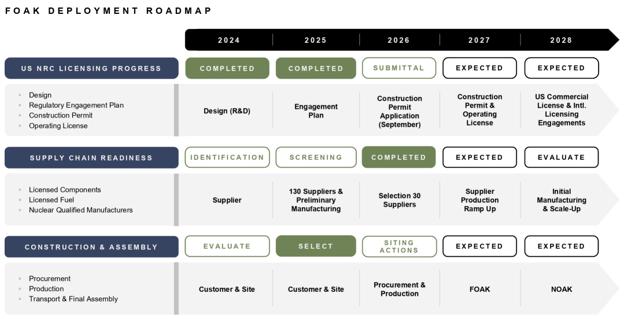
The following summarizes our estimated key dates in our timeline for deployment:
Industry Overview
The nuclear energy industry is experiencing renewed interest as countries worldwide seek reliable, carbon-free energy solutions to address climate change concerns while meeting growing energy demands. SMRs and microreactors, like our SOLO technology, represent a new generation of nuclear solutions designed to overcome traditional barriers to nuclear deployment.
The successful execution of our business model depends, among other considerations, on favorable regulatory environments, public acceptance of nuclear power, and continued policy support for advanced nuclear technologies. Recently, in the United States and globally, governments have demonstrated increased support for next-generation nuclear technologies through initiatives such as the Nuclear Regulatory Commission’s improved frameworks for reviewing innovative designs and the Department of Energy’s programs supporting advanced reactor development. However, the regulatory and political landscape could shift at any time due to factors beyond our control, including changes in administrations, public perception shifts following nuclear-related incidents, or evolving energy priorities.
Microreactor deployment faces unique challenges and opportunities compared to traditional nuclear plants and larger SMRs. While our SOLO reactor’s inherent safety features, small footprint, and envisioned absence of an EPZ requirement position us favorably for widespread adoption, we must navigate complex regulatory pathways that are still evolving for this new class of nuclear technology. Our ability to use commercially available LEU fuel provides a significant advantage over competitors requiring HALEU looking into the commercial readiness aspect.
Market adoption of microreactor technologies like SOLO will depend in part on our ability to demonstrate safety, reliability, and economic competitiveness against both traditional energy sources and other emerging technologies. The current market shift toward distributed energy resources and increasing demand for reliable, carbon-free power in applications ranging from data centers to remote industrial operations presents significant opportunities for our technology. However, public perception about nuclear energy, local community reaction to the installation of nuclear reactors, delays in regulatory approvals, or changes in energy economics could impact the pace of adoption and our overall business performance.
As we work toward commercializing our SOLO reactor, our performance will depend in part on factors affecting the broader nuclear industry and energy markets, which remain subject to technological, regulatory, and political influences that are difficult to predict over the long term.
Our markets
SOLO is intended to provide transformative micro-modular nuclear reactor solutions for industries requiring reliable, scalable, and carbon-free energy. The SOLO platform delivers electricity and/or heat (e.g. by means of high-temperature steam) to markets where conventional infrastructure is constrained, costly, or environmentally unsustainable. We believe that the SOLO solution can address six critical industry sectors through standardized, modular deployment, including: Industrial Applications, Logistics and Transportation, Data Centers, Energy Storage, Civil and Commercial Facilities and Underserved Communities.
We work with nuclear component suppliers, engineering firms, and construction partners to deliver complete SOLO reactor systems. By focusing on commercially available components and simplified design, we can address these diverse sectors with a standardized product that can be deployed virtually anywhere energy is needed and we can be flexible in the project development business model.
One key element of SOLO is its modularity. The SOLO provides energy production upon installation of the first module, allowing customers to scale as needed in a cost-effective manner without sacrificing its energy needs. As the reactor is expected to have a small EPZ, we can satisfy any demand ranging from MW to GW by replicating the reactor as many times is needed to cover the customer needs.
3
Industrial Applications
The SOLO reactor is designed to serve a wide range of industrial customers requiring both electricity and process heat. Our 1MWe power generation capability combined with 4MW of 55°C heat or 5MW of 450°C steam addresses critical energy needs across industries including cement production, food processing, paper mills, chemical plants, pharmaceutical facilities, and mining operations.
We believe that our reactors will provide industrial customers with stable energy costs, reduced carbon emissions, and enhanced reliability, particularly in remote locations or regions with expensive grid electricity.
SOLO is designed to support industrial processes that traditionally rely on fossil fuel boilers, offering significant decarbonization opportunities. This energy source is specifically relevant for sugar refiners, breweries and distilleries (other than food processing industries).
Logistics and Transportation
The logistics sector requires consistent power for frozen storage facilities, automated distribution centers, shipping ports, airports, and Electric Vehicle (“EV”) charging infrastructure, among a number of other applications. SOLO reactors provide the reliable electricity needed for these operations while offering waste heat utilization for facility climate control or specific process applications.
By eliminating dependency on diesel generators or unreliable grid connections, our technology can enable more sustainable and cost-effective logistics operations.
Data Centers
The rapidly growing data center market faces significant challenges including power availability constraints, land use and water restrictions, and grid capacity limitations. SOLO reactors address these challenges through their compact 10m2 footprint, which dramatically reduces land requirements compared to conventional power generation facilities and helps avoid the increasing land use conflicts seen in specific densely populated areas in the United States and Europe where data center development has faced restrictions due to competing community needs.
Our behind-the-meter, off-grid capability can reduce reliance on strained electrical infrastructure, allowing data centers to bypass the typical long waiting period for grid power access experienced in the United States and Europe.
The SOLO reactor’s modular approach may enable data center operators to deploy power capacity incrementally at 1MWe per module, aligning energy supply with facility construction phases and commercial ramp-up rather than waiting for full commissioning of large-scale power plants and its design features allows for load-follows operation with a very limited battery energy storage capacity.
This scalability supports both colocation and hyperscale facilities with the ability to deploy multiple units to meet capacity requirements up to 1GW. Our approach offers superior reliability and redundancy compared to traditional grid connections while simultaneously eliminating carbon emissions.
The waste heat from SOLO reactors can be utilized for building heating or sold to district heating systems or through heat pumps generating air conditioning, further enhancing efficiency and creating additional revenue streams.
Energy Storage
Our SOLO micro nuclear reactor platform is ideally suited to enable advanced energy storage.
4
By providing reliable, carbon-free electricity, SOLO can support the production of pink hydrogen through electrolysis.
In ammonia and fertilizer plants, SOLO’s electricity and heat can replace fossil-fuel boilers, enabling large-scale decarbonization of ammonia synthesis — critical steps for both food security and emerging clean energy markets.
Biofuel refineries can also benefit from SOLO’s process heat and power, which can efficiently drive distillation, fermentation, and pumping, lowering the carbon intensity of ethanol and biodiesel production while displacing diesel or natural gas.
Civil and Commercial Facilities
Critical facilities such as hospitals, airports, water treatment facilities and hotels require uninterrupted power for continuous operation.
The SOLO reactor is designed to deliver 1MWe of baseload power with additional thermal energy that can be utilized for space heating, water heating, and other facility needs.
For hospitals specifically, our technology is designed to enable both reliable power and the production of radioisotopes for medical applications such as cancer treatment and diagnostics, bringing these capabilities to facilities that might otherwise lack access to such resources.
Underserved Communities
Remote locations, islands, and communities with limited grid access traditionally rely on expensive, polluting diesel generation. SOLO reactors offer transformative energy solutions for these markets, providing stable electricity at predictable costs for basic needs, agricultural irrigation and water desalination. By eliminating dependence on diesel fuel logistics, price fluctuations and negative environmental impacts, our technology can enable sustainable energy independence and economic development in underserved regions.
Our Technology
Electricity and Thermal Capacity
SOLO outputs 1MW electric produced by transforming 4MW of heat powered by the same type of LEU fuel that powers most nuclear facilities in the world today.
Overall Dimensions
The reactor is compact with overall dimensions of approximately 6.5m in height, a cross section of 2.4 m and weighing 60 metric tons in total (reactor core is less than 20 metric tons). SOLO can be assembled in many existing nuclear manufacturing facilities and can be transported on most U.S. and European highways.
Fuel
SOLO can use LEU, leveraging the vast operational experience accumulated by the various fuel vendors over the past decades.
5
SOLO is prepared to accommodate future technologies notably on fuel perspective, being compatible with HALEU products when licensed and commercially available.
SOLO provides a platform able to transition to new developments e.g. potentially benefitting of significant extension of its fuel cycle employing HALEU or adopting current and future accident tolerant fuel (ATF) solutions related to new clad material, which would allow an increase of the thermodynamic efficiency and possibly extending its industrial applications.

| (1) | Based on the neutronics analysis, with the use of HALEU, SOLO could either (i) operate at a large power output of 20MWt for 15-years, or (ii) operate at the same power output of 4MWt for ~70 years. Increasing the power output, however, would require a change to the design of the reactor, while operating at the same power for a longer period of time would not require such design changes. |
SOLO can also benefit from current and future accident tolerant fuel (ATF) solutions related to new clad material, which would allow an increase of the average working temperature, consequently improving the thermodynamic efficiency and possibly extending its industrial applications.
Fuel Rods/Moderator
The fuel rods contain UO2 Pellets at 4.95% U-235 enrichment level in Zircalloy clad (same as operating Light Water Reactors). The moderator is a made of a solid heterogeneous Beryllium and Graphite matrix.
6
Coolant
SOLO is a gas cooled reactor. The coolant, which is helium gas, enters the bottom of the reactor, is heated while passing through dedicated channels adjacent to the fuel rods and collected into the upper plenum. Keeping a physical separation between the coolant and the fuel rods is a very important design feature. After being heated, the helium moves from the upper plenum to a heat exchanger transferring the heat to the secondary circuit for the production of electricity.

Multiple Redundant Shutdown Mechanisms
The reactor is controlled when everything is operating normally using 12 control drums. The control drums are built with a N+3 redundancy: 9 out of 12 drums are sufficient to ensure the control function up to shut down the reactor. In addition to the control system, we built 3 different active and passive and diverse shutdown mechanisms; each of which has its own redundancy. These 3 shutdown systems can be relied upon in case of malfunction or incident:
| ● | 12 shutdown drums: 9 of which are enough to shut down the reactor. |
| ● | 6 shutdown rods, 5 of which are enough to shut down the reactor. |
| ● | 6 shutdown rodlets, 5 of which are enough to shut down the reactor. |

7
Monolith: Biological Shield
SOLO is encased in all sides by the about 2.5m thick concrete block, the Monolith, which serves as a biological shield from radiation and the decay heat removal system. With the Monolith, decay heat is removed by natural convection. Since the radiation that reaches the outside of the Monolith is almost non-existent, we expect that an EPZ will be limited to the external boundary of the Monolith.
Competitive Strengths
Unique Technology and Safety Features
SOLO has been purposefully engineered as a compact 1MWe+4Mwt at 55°C/5MWt at 450°C reactor to prioritize safety. Its low thermal power output eliminates the risk of core meltdown. By using helium as a coolant instead of water, SOLO also avoids the danger of hydrogen explosions. Beside the elimination by physics of such catastrophic events the design benefits of the helium’s inert nature which allow the exclusion of corrosion issues on any reactor and coolant piping components. The reactor is equipped with multiple independent shutdown mechanisms and is enclosed within the Monolith, potentially allowing it to operate without the need for an EPZ to increase safety and regulatory compliance.
Supply Chain Certainty and Fast Time to Market
Every safety-related component of SOLO, including fuel, is sourced from the existing nuclear supply chain. Non safety-related components such as turbines, heat exchangers, condensers, etc. are commercially-off-the-shelf components from tradition non-nuclear suppliers. This approach promotes predictable regulatory pathways, reliable commercialization, and cost visibility. Multiple suppliers are available for each key component, reducing supply chain risk and supporting rapid deployment. The simulations associated with the design and components can be executed with existing codes licensed for nuclear applications.
SOLO’s simple design and use of off-the-shelf materials minimize R&D requirements and streamline the licensing process. The regulatory engagement plan with the NRC is already underway, targeting commercial deployment in 2028.
8
Economic Competitiveness
SOLO’s LCOE is expected to be highly competitive globally, especially in the U.S. and European markets.
The reactor’s co-generation capability (simultaneous production of electricity and usable heat) allows customers to offset heating costs, potentially reducing the effective electricity price further. We believe additional savings might be obtained where carbon credits are available for emission reductions.
Furthermore, SOLO’s modularity enables customers to scale installations precisely to their needs, with significant cost savings due to reduced transmission infrastructure and on-site assembly.
Operational Flexibility and Market Reach
SOLO can be a source of electricity, heat, co-generation, or radioisotopes, serving a diverse range of sectors: industrial, infrastructure, medical, data centers, and more.
The modular, factory-assembled design allows SOLO to be shipped globally and installed quickly, even in challenging environments. Its compact size and limited weight support transport on standard highways and fast on-site installation.
The SOLO reactor is compatible with both LEU and, when available, HALEU, ensuring future-proof fuel flexibility, potentially excluding the need of core/reactor replacement to cover the 45 year life span of the system.
Scalability and Redundancy
SOLO’s modularity means installations can be scaled from a single unit to hundreds or even thousands, providing energy redundancy and minimizing the impact of individual reactor outages. A 1,000-unit SOLO installation occupies less dedicated land (including EPZ) than a typical 1 GW reactor (when inclusive of a reactor’s required EPZ), at a fraction of the cost and with enhanced reliability.
Regulations
We are subject to extensive U.S. federal, state, and local laws and regulations, as well as foreign laws, covering a broad range of areas relevant to our operations. These regulatory requirements are continually evolving, both domestically and internationally, resulting in an expanding scope of compliance obligations. Key areas of regulation include nuclear energy and materials, environmental protection, export controls, national security, and other legal domains. Like other participants in the commercial nuclear industry, we operate under significant scrutiny from regulatory authorities in the U.S. and abroad, and many applicable laws and regulations are subject to ongoing interpretation and change by agencies and courts. Compliance with these requirements can be complex and costly, potentially affecting our business model, competitive position, and financial results.
The nuclear industry is highly regulated worldwide, and the design, construction, and operation of nuclear facilities require regulatory approval in each jurisdiction. Nuclear safety regulators typically assess design safety, resilience to internal and external hazards, and environmental impacts. Regulatory processes are country-specific, though international collaboration among regulators is common, especially when a design is deployed in multiple markets. Our licensing strategy aims to secure timely approvals by engaging early with regulators and maintaining a consistent design across markets, leveraging the U.S. Nuclear Regulatory Commission’s (“NRC”) approval of the design as a foundation.
Internationally, most countries restrict license applications to the proposed plant owner or operator. We intend to engage proactively with regulators in each target country, consistent with our approach in the U.S. The NRC’s established relationships with foreign regulators and participation in international organizations such as the International Atomic Energy Agency (“IAEA”) are expected to support our efforts to obtain regulatory approvals abroad and provide additional confidence in our technology. We also anticipate benefiting from the NRC’s regulatory assistance programs, which facilitate collaboration and information sharing with other national regulators. Beyond nuclear safety, our activities are also subject to other regulatory controls, including export control laws, nuclear material safeguards, non-proliferation obligations, and liability insurance regimes such as the Price-Anderson Act and international conventions. Compliance with these additional requirements may further impact our operations, costs, and risk profile.
9
Patents and Proprietary Rights
We strategically protect our intellectual property through a combination of patents, trademarks, trade secrets, confidentiality agreements, and licensing arrangements both domestically and internationally, with plans to strengthen this protection framework as our technology portfolio expands.
Our pending and filed patent applications specifically address our advanced reactor designs, passive safety systems, digital twin technology, and specialized nuclear instrumentation and control systems critical to our micro-modular reactor technologies. Patent Protection is expected to last until approximately 21 years from the earliest provisional filing date, which would be in 2046 taking into consideration the possibility of a short-term patent term extension and full payment of all fees.
Provisional patents expire one year from their filing date, however such patents remain patent pending as long as a Patent Cooperation Treaty or National phase application claiming a benefit to that provisional patent was filed on or before the one year deadline. The filing of the Regular, PCT or National phase application starts the 20 year available patent term. Together with the one year term of the Provisional Patent, the potential patent term will be approximately 21 years from the filing dates of the provisional applications. There are various factors that might extend or shorten patent terms, including without limitation, (i) excessive delays within the patent office that could result in extensions to the patent term, (ii) Terminal disclaimers that tie patent terms to other patents, and (iii) timely payment of maintenance fees to retain the patent(s) after issue.
The Company filed PCT filings for two provisional patents on April 20, 2026.
| U.S. Patent Application FOR: | File Date | Regular/PCT Due | Potential Patent Expiration | |||
| Small And Micro Nuclear Reactors And Conductive Solid Moderator Assemblies With Embedded Nuclear Fuel Used Therein | 8/25/2024 | 8/25/2025 | 8/25/2045 | |||
| Control And Shutdown System For Small And Micro Nuclear Reactors | 8/25/2024 | 8/25/2025 | 8/25/2045 | |||
| Control And Shutdown System For Small And Micro Nuclear Reactors | 1/10/2025 | 1/10/2026 | 1/10/2046 | |||
| Small and Micro Nuclear Reactor with Real Time Integrated Safeguard Systems | 1/13/2025 | 1/13/2026 | 1/13/2046 | |||
| Reactor Vessel Shell And Integrated Radiological Containment For Small And Micro Nuclear Reactors | 4/20/2025 | 4/20/2026 | 4/20/2046 | |||
| Radioisotopes Production with Nuclear Micro-Reactor | 4/20/2025 | 4/20/2026 | 4/20/2046 |
We also engage with international and local regulatory bodies and existing frameworks to safeguard our innovations across various jurisdictions. However, certain countries where our reactor components may be manufactured or where our reactor systems may be deployed may offer less robust protection for nuclear intellectual property compared to the United States or European Union regulatory environments.
Our intellectual property strategy employs a systematic assessment framework considering:
| — | Critical component manufacturing locations and supply chain considerations; |
| — | Strategic nuclear technology development pathways across different regulatory regimes; |
10
| — | Nuclear-specific intellectual property enforcement mechanisms in target deployment jurisdictions; and |
| — | Commercial significance relative to established and emerging competitors in specific nuclear markets and regions. |
We plan to establish licensing agreements for certain specialized nuclear technologies from third-party developers and anticipate continued expansion of such arrangements as our reactor deployment roadmap advances.
Manufacturing and supply chain
We implement a fabless and contract manufacturing strategy, and expect to contract with key suppliers for all phases of the manufacturing process. We expect that this will eliminate the need for an in-house factory and will allow us to use existing manufacturing facilities. We leverage the expertise of industry-leading suppliers that comply with nuclear quality assurance standards — including 10 CFR 50 Appendix B — in areas including fabrication, assembly, quality control, reliability testing, and licensing. We expect micro reactors like SOLO be regulated under the pending 10 CFR Part 57, a new regulation tailored to reactors like SOLO. This approach may allow Terra Innovatum to avoid the significant costs and risks associated with owning and operating manufacturing facilities while enabling scalability and rapid response to markets changing conditions.
While we plan to directly procure certain critical raw materials used in our products, such as moderators, fuel, and specialized components, our suppliers are expected to manage procurement for most other components. This enables us to focus our resources on product design, licensing, quality assurance, marketing, and customer engagement.
To anticipate high growth periods, we may place non-cancellable inventory orders for certain components ahead of historical lead times, pay premiums, or provide deposits to secure future supply and manufacturing capacity.
Our supply chain will be positioned for deployment, with manufacturing risks mitigated through qualification testing of key components in advance of both First-of-a-Kind (FOAK) and Nth-of-a-Kind (NOAK) installations. We will actively secure long-lead materials and have established long-term agreements with critical supply chain partners to ensure operational continuity.
Human Capital
As of December 31, 2025, we had 5 employees, four executive directors providing services to us (of whom three entered into a written directorship agreement), as well as contractors engaged on a full time basis depending on the needs.
Available Information
Our main corporate website address is https://terrainnovatum.com/. Copies of our filings with the SEC, including our annual report on Form 10-K, quarterly reports on Form 10-Q, current reports on Form 8-K, and amendments to reports filed pursuant to Sections 13(a) and 15(d) of the Securities Act, are available free of charge on our website within the “Investors” section as soon as reasonably practicable after having been electronically filed or furnished to the SEC. All SEC filings are also available on the SEC’s website at www.sec.gov. The information contained on these websites as referenced is not incorporated by reference into this filing. Further, the Company’s references to website URLs are intended to be inactive textual references only.
Investors and others should note that we announce material financial information to our investors using our investor relations website, SEC filings, press releases, public conference calls, and webcasts. We use these channels, including our website, to communicate with our investors and the public about our company, our products and solutions and other issues. It is possible that the information we post on our website could be deemed to be material information. Therefore, we encourage investors, the media and others interested in our company to review the information we make available on our website.
11
ITEM 1A. RISK FACTORS.
RISK FACTORS
These disclosures reflect the Company’s beliefs and opinions as to factors that could materially and adversely affect the Company and its securities in the future. References to past events are provided by way of example only and are not intended to be a complete listing or a representation as to whether or not such factors have occurred in the past or their likelihood of occurring in the future.
Risks Related to Terra Innovatum’s Business
We are a holding company with no direct operations that relies on dividends, distributions, loans and other payments, advances and transfers of funds from our operating Subsidiary, Terra Innovatum s.r.l., an Italian limited liability company (Italian Società a responsabilità limitata) (“Terra OpCo”), to pay dividends, pay expenses and meet our other obligations. Accordingly, our securityholders are subject to all of the risks of Terra OpCo’s business.
Throughout this section, unless otherwise noted, “Terra Innovatum,” “we,” “us” or “our” refers to Terra Innovatum Global N.V. and our consolidated subsidiaries, including Terra OpCo.
We have incurred losses and have not generated any revenue since our inception. We anticipate that we will continue to incur losses, and expect that we will not generate revenue, for the foreseeable future.
Since inception, we have incurred significant operating losses, and have an accumulated deficit of approximately $607.3 million as of December 31, 2025 and negative operating cash flow in 2025 and 2024. We expect that operating losses and negative cash flows will increase in the coming years because of additional costs and expenses related to our research and development (which we refer to herein as “R&D”), business development activities and our status as a publicly traded company. To date, we have not generated any revenue. We do not expect to generate any revenue unless and until we are able to commercialize our reactors and/or other lines of business. As we have incurred losses and experienced negative operating cash flows since our inception, and accordingly we have undertaken equity financing from investors to satisfy our funding needs; however, we may not raise adequate funding to offset our expenses and losses. Moreover, we may encounter unforeseen expenses, difficulties, complications, delays, and other unknown factors that may adversely affect our business. The magnitude of our future net losses will depend, in part, on the rate of future growth of our expenses and our ability to generate and grow revenue. We cannot predict the outcome of the actions to generate liquidity to fund our operations, whether such actions would generate the expected liquidity to fund our operations as currently planned or whether the costs of such actions will be available on reasonable terms or at all. Our continued solvency is dependent upon our ability to obtain additional working capital to complete our reactor development, to successfully market our reactors and to achieve commerciality for our reactors. Our prior losses and expected future losses have had and may continue to have adverse effects on our shareholders’ equity (deficit) and working capital and may lead to the failure of our business.
Our limited operating history makes it difficult to evaluate our future prospects and the risks and challenges we may encounter.
We have a limited operating history in a rapidly evolving industry. The markets for nuclear reactor design, nuclear reactor production, nuclear fuel design, nuclear fuel supply, and services related to any or all of the foregoing business may not continue to develop in a manner that we expect or that otherwise would be favorable to our business. As a result of our limited operating history and ongoing changes in our new and evolving industry, including evolving demand for our products and services and the potential development of technologies that may prove more efficient or effective for our intended use cases, our ability to forecast our future results of operations and plan for future growth is limited and subject to uncertainties. We have encountered and expect to continue to encounter risks and uncertainties frequently experienced by companies in rapidly evolving industries, such as the risks and uncertainties described in this annual report. Accordingly, we may be unable to prepare accurate internal financial forecasts or replace anticipated revenue that we do not receive as a result of delays, changed circumstances, or changed market conditions arising from these factors, and our results of operations in future reporting periods may be below the expectations of investors or analysts. If we do not address these risks successfully, our results of operations could differ materially from our estimates or the expectations of investors or analysts, causing our business to suffer and our ordinary share price to decline.
12
We have not yet commercialized or sold the SOLO or any other micro-modular reactor (“MMR”), and there is no guarantee that we will be able to do so.
After we develop and obtain regulatory approval, the planned initial deployment of the SOLO is subject to Terra Innovatum reaching binding agreements for its scope of supply with potential customers. If no customer enters into such binding agreements with us, our initial deployment of the SOLO and ongoing services associated with such deployment could be significantly delayed. This could have a material adverse effect on our business and financial condition. To date, the various memoranda of understanding that we have entered into with potential purchasers are non-binding and largely contingent upon successful site characterization studies — including for the First-Of-A-Kind site, governing body approvals and regulatory approvals, and may not result in binding agreements for the purchase of our products or services. The potential purchasers may also elect to terminate or pursue other alternative transactions.
If we fail to manage our growth effectively, we may be unable to execute our business plan, and our business, results of operations, and financial condition could be harmed.
In order to achieve future revenue growth, we must finalize our reactor design, receive regulatory approvals, and continue to develop and market new products and services to traditional and non-traditional end-users. We intend to expand our operations as we develop and deploy our products and services in the future, and will need to hire and retain additional personnel, upgrade our existing operational management and financial and reporting systems, and improve our business processes and controls. Our future expansion will include:
| ● | hiring and training new personnel; |
| ● | completing the designs, licensing, construction, and commissioning of SOLO; |
| ● | finalizing our reactor design and developing new technologies and services (e.g., training, maintenance, procurement); |
| ● | optimizing applications of our reactors to serve both traditional utility and electric power customers and a broad base of non-traditional industrial customers interested in utilizing the efficient high-temperature heat produced by our design; |
| ● | controlling expenses and investments in anticipation of expanded operations and rising costs; |
| ● | upgrading the existing operational management and financial reporting systems and team to comply with requirements as a public company; and |
| ● | implementing and enhancing administrative infrastructure, systems and processes. |
If our operations continue to grow as planned, of which there can be no assurance, we will need to expand our sales and marketing, research and development, customer and commercial strategy, products and services, supply, and manufacturing functions. These efforts will require us to invest significant financial and other resources, including in industries and sales channels in which we have limited experience to date. We will also need to develop and implement our manufacturing and operational systems and processes, and there is no guarantee that we will be able to scale the business as currently planned or within the planned timeframe. The continued expansion of our business will require manufacturing and operational facilities, as well as space for administrative support, and there is no guarantee that we will be able to find suitable locations for such facilities.
Our growth will increase the strain on our resources, and we could experience operating difficulties, including difficulties in hiring and training employees, finding manufacturing capacity to produce our MMRs and related equipment, delays in production, challenges in scaling-up fuel and component fabrication capacity and difficulty sourcing adequate raw material, such as graphite, for our reactors. These difficulties may divert the attention of management and key employees and impact financial and operational results. If we are unable to drive commensurate growth, these costs, which include headcount and capital assets, could result in decreased margins, which could have a material adverse effect on our business, financial condition and results of operations.
13
We are dependent upon key officers.
Our success depends to a significant extent on the continued service of our key management, technical and other personnel. We are very thinly staffed and, as a result, the loss of one or more of our executive officers could adversely affect our business, financial condition and prospects. We do not maintain “key person” life insurance on any of our executives. If we are unable to retain our current officers or attract and retain additional qualified employees as needed, our ability to execute our business strategy and achieve our objectives could be materially and adversely affected.
There is limited operating experience or regulatory precedent for reactors of this type, configuration and scale, which may result in greater than expected construction and material costs, maintenance requirements, operating expense or delivery timing.
Our MMR design will be actively managed through design reviews, prototyping, involvement of external partners and application of industry lessons. However, we could still fail to identify manufacturing, material and construction issues early enough to avoid negative effects on production, fabrication, construction or ultimate performance of our MMRs and related technologies, or we may encounter unexpected regulatory issues. Where these issues arise at such later stages of deployment, deployment could be subject to greater costs or be significantly delayed, which could materially and adversely affect our business.
We intend to operate deployed SOLO reactors in accordance with all applicable laws and regulations. For certain deployments, we may seek to engage one or more qualified operators with recognized experience in civil nuclear generation for the operation and maintenance of SOLO reactors. We may not be able to engage such operators on commercially agreeable terms, which could adversely affect our ability to deploy and commercialize SOLO reactors.
The market for MMRs generating electric power and high-temperature heat is not yet established and may not achieve the growth potential we expect or may grow more slowly than expected.
The market for MMRs, and particularly for MMRs utilizing advanced nuclear technologies such as those employed in the SOLO, has not yet been established. MMRs utilizing advanced nuclear technologies have limited operational history and have not been proven at scale. Estimates for the total addressable market and our expectations, inclusive of recent updates, with regards to certain unit economics are based on a number of internal and third-party estimates, including our potential contracted revenue, the number of potential customers who have expressed interest in our MMRs, assumed prices and production and regulatory costs for our MMRs, our ability to develop logistical and operational processes, assumptions regarding our technology and general market conditions. However, our assumptions and the data underlying our estimates may not be correct and the conditions supporting our assumptions or estimates may change at any time, reducing the predictive accuracy of these underlying factors. As a result, our expected performance as indicated by the illustrative unit economics provided in this annual report, our estimates of the annual total addressable market and serviceable addressable market for our services, as well as the expected growth rate for the total addressable market and serviceable addressable market for our services, may prove to be incorrect.
We may not attract customers to our MMR technology as quickly as we expect, or at all, and acquiring customers may be more expensive than we currently anticipate.
MMRs and advanced nuclear technologies are relatively new and unproven and may be more costly than alternatives. Accordingly, adoption of our technology, or MMRs and advanced nuclear technologies generally, among our potential customers may progress more slowly than we anticipate or it may be more expensive to bring potential customers into our pipeline. Any delay or failure to attract potential customers to our reactors or MMR technology may have a material and adverse impact on our business and financial condition.
Our cost estimates are highly sensitive to broader economic factors, and our ability to control or manage our costs may be limited.
Capital and operating costs for the deployment of a first-of-a-kind reactor such as the SOLO are difficult to project, inherently variable and are subject to significant change based on a variety of factors, including site-specific factors, customer off-take requirements, regulatory oversight, operating agreements, supply chain availability, inflation and other factors. Opportunities for cost reductions with subsequent deployments are similarly uncertain. To the extent cost reductions are not achieved within the expected timeframe or magnitude, the SOLO may not be cost competitive with alternative technologies, which could materially and adversely affect our expected revenues, gross margins and on the other information included in the Unit Economics Information.
14
Competition from existing or new companies could cause us to experience downward pressure on prices, fewer customer orders, reduced margins, the inability to take advantage of new business opportunities, and the loss of market share.
We operate in highly competitive markets and are subject to competition based upon product design, performance, pricing, quality, and services, from competing nuclear suppliers as well as from alternative means of producing electricity and/or heat. There are a number of advanced reactor designs, and some advanced reactor projects, under development in the United States. Many of these designs are involved in pre-application review with the NRC. Our advanced design, projected product design performance, engineering expertise, and quality control have been important factors in our growth; nonetheless other companies providing competing technologies could capture customers or market share from us, which could have a material adverse effect on our business or financial condition.
For sales and/or deployments outside of jurisdictions with highly-developed nuclear regulatory frameworks, some of our foreign competitors currently benefit from, and others may benefit in the future from, permissive regulatory and licensing regimes and/or from protective measures by their home countries where governments are providing financial support, including significant investments in the development of new technologies.
We believe our ability to compete successfully in designing, engineering and manufacturing our products and services at attractive costs to customers does and will depend on a number of factors, which may change in the future due to increased competition, our ability to meet our customers’ needs and the frequency and availability of our offerings. If we are unable to compete successfully, our business, financial condition and results of operations would be adversely affected.
Technological changes could render our technology and products uncompetitive or obsolete, which could prevent us from achieving market share and sales.
Our failure to refine or advance our MMR technologies could cause our reactor technology to become uncompetitive or obsolete, which could prevent us from achieving market share and sales. We may need to invest significant financial resources in research and product development to keep pace with technological advances in the industry and to compete in the future; we may be unable to secure such financing. A variety of competing alternative technologies may be in development by other companies that could result in lower manufacturing or operating costs and/or higher performance than those expected for our technology. Our development efforts may be rendered obsolete by the technological advances of others, and other technologies may prove more advantageous for commercialization.
Changes in the availability and cost of electricity, natural gas and other forms of energy are subject to volatile market conditions that could adversely affect our business.
The prices for and availability of electricity, oil and other energy resources are subject to volatile market conditions. We do not control these market conditions, which are, moreover, often affected by political and economic factors beyond our control. Decreases in energy prices, or changes in nuclear energy costs relative to other forms of energy, may adversely affect our business. To the extent that these uncertainties cause suppliers and customers to be more cost sensitive or to adjust their business plans and operations, decreased energy prices may have an adverse effect on our results of operations and financial condition.
The cost of electricity generated from nuclear sources may not be cost competitive with other electricity generation sources in some markets, which could materially and adversely affect our business.
Many U.S. electricity markets price electric energy, capacity, and/or ancillary services on a competitive basis, with market prices subject to substantial fluctuations. Other markets remain heavily regulated by state or local utility regulatory authorities, with power purchase decisions by electric utilities subject to various competitiveness or prudence tests. As a result of competitive pressures, some electricity markets experience low marginal energy prices at certain times due to a combination of subsidized generating resources, competitors with low-cost or no-cost fuel sources, or market-design features that create incentives for certain attributes or deliver revenue in unpredictable ways over time, and Terra Innovatum may not be able to compete in these markets unless the benefits of the low-carbon, reliable and/or resilient energy generation provided by the SOLO is sufficiently valued. Even in markets that price reliable capacity on a long-term basis, there is no guarantee that our customers’ SOLO units will be sufficiently low-cost so as to clear auction-style capacity markets, and clearing in any one year is no guarantee of clearing in successive years. Moreover, our SOLO reactor will likely serve a specific market segment of smaller distributed generation, remote application or industrial customers, who may have lower-cost power/heat alternatives available to them, especially in the near-term.
15
Given the relatively lower electricity prices and higher availability of power in the United States when compared to many international markets, the risk may be greater with respect to business in the United States. Regardless of jurisdiction, however, failure of our MMRs to provide competitively priced electricity or heat could materially and adversely affect our business.
We and our customers operate in a politically sensitive environment, and the public perception of nuclear energy can affect our customers and us.
Successful execution of our business model is dependent upon public support for nuclear power in the United States and other countries. The risks associated with uses of radioactive materials by our customers in future deployments of our MMR designs, and the public perception of those risks, can affect our business. Opposition by third parties can delay or prevent the licensing and construction of new nuclear power facilities and in some cases can limit the operation of nuclear reactors. Adverse public reaction to developments in the use of nuclear power could directly affect our customers and indirectly affect our business. In the past, adverse public reaction, increased regulatory scrutiny and related litigation have contributed to extended licensing and construction periods for new nuclear reactors, sometimes delaying construction schedules by decades or more, or even shutting down operations at already-constructed reactors.
Accidents involving nuclear power facilities, including but not limited to events similar to any of the Three Mile Island, Chernobyl or Fukushima Daiichi nuclear accidents, or terrorist acts or other high profile events involving radioactive materials, could materially and adversely affect the public perception of the safety of nuclear energy, our customers and the markets in which we operate and potentially decrease demand for nuclear energy or facilities, increase regulatory requirements and costs or result in liabilities or claims that could materially and adversely affect our business.
Historical nuclear accidents and fears of a new nuclear accident can hinder widespread acceptance of nuclear power. Nuclear power faces strong opposition from certain individuals and organizations both in the United States and abroad. With respect to public perceptions, the accident that occurred at the Fukushima nuclear power plant in Japan in 2011 increased public opposition to nuclear power in some countries, resulting in a slowdown in, or, in some cases, a complete halt to new construction of nuclear power plants, an early shut down of existing power plants and a dampening of the favorable regulatory climate needed to introduce new nuclear technologies. As a result of the Fukushima accident, some countries that were considering launching new domestic nuclear power programs delayed or cancelled the preparatory activities they were planning to undertake as part of such programs. If a high-visibility or high-consequence nuclear accident, including the loss or mishandling of nuclear materials, or other event, such as a terrorist attack involving a nuclear facility, occurs, public opposition to nuclear power may increase dramatically, regulatory requirements and costs could become more onerous or prohibitory, and customer demand for the SOLO could suffer, which could materially and adversely affect our business and operations.
The direct and indirect impact on us and our customers from severe weather and other effects of climate change and the economic impacts of the transition to non-carbon based energy, could adversely affect our financial condition, operating results, and cash flows.
Our operations and properties, and those of our customers, may in the future be adversely impacted by flooding, wildfires, high winds, drought and other effects of severe weather conditions that may be caused or exacerbated by climate change. These events can force our customers to suspend operations at impacted properties and may result in significant damage to such properties. Even if these events do not directly impact us or our customers they may indirectly impact us and our customers through increased insurance, energy or other costs. In addition, although the ongoing transition to non-carbon based energy is creating significant opportunities for us and our customers, the transition also presents certain risks, including macroeconomic risks related to higher energy costs and energy shortages, among other things. These direct and indirect impacts from climate change could adversely affect our financial condition, operating results, supply chain and cash flows.
16
Our operations involve the use, transportation and disposal of toxic, hazardous and/or radioactive materials and could result in liability without regard to fault or negligence.
Our operations involve the use, transportation, and disposal of toxic, hazardous and radioactive materials. A release of these materials could pose a health risk to humans, plants and animals or the environment. If an accident were to occur, its severity would depend on the volume and location of the release and the speed of corrective action taken by emergency response personnel, as well as other factors beyond our control, such as weather and wind conditions.
We currently do not own any property, if, in the future we do, under federal, state and local laws and regulations, a current or former owner or operator of real property may be liable for costs to remediate contamination resulting from the presence or release of hazardous substances, wastes or petroleum products. These costs could be substantial and liability under such laws is strict and may attach whether or not the owner or operator knew of or caused such contamination. Moreover, the presence of contamination may expose us to third-party claims for property damage or bodily injury, subject our properties to liens in favor of the government for damages and cleanup costs, impose restrictions on the manner in which we use our properties, and materially adversely affect our ability to sell, lease, insure, or develop our properties. We also may be liable for costs of remediating third-party disposal sites to which we arranged for the disposal or treatment of hazardous substances without regard to whether such disposal occurred in compliance with environmental laws. These matters could have an adverse effect on our financial condition.
Additionally, we may be responsible for decontamination or decommissioning of facilities where we conduct, or previously conducted, operations. Activities of our contractors, suppliers or other counterparties similarly may involve toxic, hazardous, and radioactive materials and we may be liable contractually, or under applicable law, to contribute to remedy damages or other costs arising from such activities, including the decontamination or decommissioning of third-party facilities.
In the United States, the nuclear liability law codified at 42 U.S.C. 2210 (along with subsequent amendments, the “Price-Anderson Act”) and applicable NRC regulations and corresponding insurance requirements channel liability to the nuclear operator of a nuclear power plant for third-party offsite damages caused by a nuclear incident or a precautionary evacuation due to a possible or actual nuclear incident. U.S. law is substantially similar in effect to global nuclear liability regimes wherein operators are subject to robust financial protection regimes, such as required insurance policies or government indemnification, to cover the operator’s financial risk in the event of a nuclear incident that gives rise to third-party offsite liability. If, however, an incident or precautionary evacuation is not covered under such a nuclear liability regime, we could be financially liable for damages arising from such incident or evacuation, which could have an adverse effect on our results of operations and financial condition.
The Price-Anderson Act does not, however, cover on-site loss or damage to property due to a nuclear incident. Rather, the NRC, like many nuclear regulators around the world, requires nuclear operators to maintain on-site property damage insurance. If an incident resulting in onsite property damage is not otherwise covered by the mandatory insurance policy maintained at the facility, then we could be potentially liable for damages arising from such incident, which could have an adverse effect on our results of operations and financial condition.
In our contracts, we seek to protect ourselves from liability, but there is no assurance that such contractual limitations on liability will be effective in all cases or in all jurisdictions. The costs of defending against a claim arising out of a nuclear incident or precautionary evacuation not otherwise covered by insurance, and any damages awarded as a result of such claim, could adversely affect our results of operations and financial condition.
17
Unresolved spent nuclear fuel storage and disposal issues and associated costs could have a significant negative impact on Terra Innovatum’s business operations if potential SOLO customers view the risks associated with these issues and costs as unacceptably high.
The Nuclear Waste Policy Act of 1982 requires the DOE to provide for the permanent disposal of spent nuclear fuel (“SNF”) and associated high-level nuclear waste (“HLW”). In 1987, Congress amended the Nuclear Waste Policy Act to identify Yucca Mountain, in Nevada, as the only site that the DOE could consider for a permanent repository. The DOE has since cancelled this project, but under the federal law, is required to construct storage facilities for, and to dispose of, all SNF and other HLW generated by domestic nuclear reactors. Interim storage requires the construction and maintenance of NRC licensed SNF/ HLW storage facilities. While the costs of developing and maintaining these interim storage facilities can have a significant effect on the costs associated with waste storage and disposal for nuclear reactors, including Terra Innovatum’s reactors, these costs could themselves be impacted by the timing of the opening of a disposal facility, as well as any possible future changes to the interim storage or transportation requirements for SNF and other forms of HLW, and the extent to which operators are able to continue to successfully sue DOE for costs incurred as a result of its continued failure to provide for permanent disposal.
There are currently two consolidated interim storage (“CIS”) facilities under development in the United States for the interim storage of SNF/HLW. One facility has received an NRC license for construction and operation, and the other facility is in the final stages of its NRC licensing review. It is possible that SNF/HLW generated at a Terra Innovatum reactor could be stored at one of these CIS facilities; however, it is also possible that these CIS facilities are never built or become operational, or are unable to store such waste from a Terra Innovatum reactor, in which case, the waste would need to be stored onsite or at another interim SNF storage facility until another disposal option became available, such as a U.S. government determined permanent national repository or other government storage facility.
The establishment of a national repository for the storage and/or permanent disposal of SNF, such as the one previously considered at Yucca Mountain, Nevada, the timing of such a facility’s opening and the ability of such a facility to accept waste from a Terra Innovatum reactor, and any related regulatory action, could impact the costs associated with our SOLO customers’ storage and/or disposal of SNF/HLW. Likewise, the establishment of a CIS for the storage of SNF/HLW, the timing of such a facility’s opening and being able to accept waste from a Terra Innovatum reactor, and any related regulatory action, could impact our customers’ costs associated with storage of SNF/HLW. These waste storage issues, and changes to the current waste disposal practices or changes to reactor operators’ ability to recover storage costs from DOE through litigation, could be material to Terra Innovatum’s operations if potential customers view waste disposal as problematic, detrimental or a negative factor when considering an investment in a Terra Innovatum reactor.
Unsatisfactory safety performance or security incidents at our facilities — or any nuclear facility around the world — could have a material adverse effect on our business, financial condition and results of operations.
We design and will manufacture highly sophisticated MMRs that depend on complex technology. We also work cooperatively with our suppliers, subcontractors, venture partners and other parties. Failures, disruptions or compromises to our or our third parties’ systems or facilities may be caused by natural disasters, accidents, power disruptions, telecommunications failures, acts of terrorism or war, computer viruses, bugs or vulnerabilities, physical or electronic break-ins, human error, targeted cyberattacks, other intentional conduct, or similar events or incidents. While we have built operational processes to ensure that the design, manufacture, performance and servicing of our MMRs meet rigorous safety standards and performance goals, there can be no assurance that we will not experience operational or process failures or other problems, including through manufacturing or design defects, failure of third-party safeguards, mishandling or process failures, natural disasters, cyber attacks, or other intentional acts, that could result in potential safety risks. There can be no assurance that our preparations, or those of third parties, will be able to prevent any such incidents.
Any actual or perceived safety issues may result in significant reputational harm to our businesses, in addition to tort liability, maintenance, increased safety infrastructure and other costs that may arise. Such issues with our MMRs, facilities, or customer safety could result in delaying or cancelling delivery of MMRs to our customers, increased regulation or other systemic consequences. Our inability to meet our safety standards or address adverse publicity affecting our reputation as a result of accidents, mechanical failures, damage to customer property or medical complications could have a material adverse effect on our business, financial condition and results of operations.
18
In the nuclear industry, an accident or incident involving the mishandling of nuclear materials at any nuclear facility in the world can have an impact on other nuclear facilities around the world in terms of public acceptance, political pressures, and regulatory requirements and scrutiny. For example, the March 2011 accident at the Fukushima Daiichi plant in Japan resulted in millions of dollars in additional regulatory reviews and requirements for U.S. nuclear power plants. If a safety incident occurs at any nuclear facility in the world, it could delay licensing and/or drive up costs to license or own our MMRs and negatively impact our business or financial condition.
We are subject to cybersecurity threats which could have adverse effects, including regulatory effects, on our business and results of operations.
We are increasingly dependent upon information technology systems, infrastructure and data to operate our business. In the ordinary course of business, we collect, store, process and transmit confidential information (including but not limited to intellectual property, proprietary business information and personal data). It is critical that we do so in a secure manner to maintain the confidentiality and integrity of such confidential information. We also have outsourced elements of our operations to third parties, and as a result we manage a number of third-party contractors who have access to our confidential information.
Despite the implementation of security measures, given their size and complexity and the increasing amounts of confidential information that they maintain, our internal information technology systems, operational technology systems, and industrial control systems, and those of our contractors and consultants are potentially vulnerable to breakdown or other damage or interruption from service interruptions, system malfunction, natural disasters, terrorism, war and telecommunication and electrical failures, as well as security breaches from inadvertent or intentional actions by our employees, contractors, consultants, business partners, and/or other third parties, or from cyber-attacks by malicious third parties (including the deployment of harmful malware, ransomware, denial-of-service attacks, social engineering and other means to affect service reliability and threaten the confidentiality, integrity and availability of information), which may compromise our system infrastructure or lead to data leakage. As part of our regular review of potential risks, we analyze emerging cyber security threats to us and our contractors, consultants, business partners and other third parties as well as our plans and strategies to address them. We are also subject to the SEC’s cybersecurity disclosure rules, which require us to describe our cybersecurity risk management, strategy, and governance, and to disclose material cybersecurity incidents. These obligations require us to maintain processes to assess the materiality of cybersecurity incidents on a timely basis, and any failure to timely or accurately make required disclosures could result in SEC enforcement action, investor litigation, or reputational harm. Our board of directors (“Board of Directors”), which has oversight responsibility for cyber security risks, including through the audit committee, which annually reviews our cybersecurity risk profile. See “Item 1C. Cybersecurity” for further information regarding our cybersecurity risk management, strategy and governance. Any failure to maintain effective cybersecurity governance processes could increase our vulnerability to cybersecurity threats and adversely affect our ability to satisfy our regulatory disclosure obligations. To the extent that any disruption or security breach were to result in a loss of, or damage to, our data or applications, or inappropriate disclosure of confidential or proprietary information, we could incur liability and reputational damage, and the further development and commercialization of our products could be delayed.
Additionally, we rely on third-party service providers for certain information technology functions, including cloud computing services. Any cybersecurity incident affecting our third-party service providers could adversely affect our operations or result in unauthorized access to our confidential information, even if our own systems are not directly compromised.
While we have not experienced any such system failure, accident or security breach to date, we cannot assure you that our data protection efforts and our investment in information technology will prevent significant breakdowns, data leakages, breaches in our systems or other cyber incidents that could have a material adverse effect upon our reputation, business, operations or financial condition. For example, we maintain databases comprised of our SOLO nuclear design technical engineering information and operations information, which have been and will continue to be used to design the SOLO reactors and will be utilized in “digital twin” construction and operations environments to allow for highly efficient construction and operations of these designs. If this database were to be lost or compromised, our ability to efficiently deploy and operate our reactors could be significantly impaired.
19
Furthermore, significant disruptions of our internal information technology systems or security breaches could result in the loss, misappropriation, and/or unauthorized access, use, or disclosure of, or the prevention of access to, confidential information (including, but not limited to, intellectual property, proprietary business information, and personal information), which could result in financial, legal, business, and reputational harm to us. For example, any such event that leads to unauthorized access, use, or disclosure of personal information, including personal information related to our employees, could harm our reputation directly, compel us to comply with federal and/or state breach notification laws and foreign law equivalents, subject us to mandatory corrective action, and otherwise subject us to liability under laws and regulations that protect the privacy and security of personal information, which could result in significant legal and financial exposure and reputational damages that could potentially have an adverse effect on our business.
In addition, we and our customers are or will be subject to specific cybersecurity requirements imposed by the NRC, which requires licensees to protect digital computer and communication systems and networks associated with safety, security, and emergency preparedness functions from cyber attacks. Compliance with these requirements may be costly and technically complex, and any failure to comply could result in regulatory enforcement action, delays in obtaining or maintaining NRC licenses, or restrictions on our operations.
Our supply base may not be able to scale to the production levels necessary to meet sales projections.
We do not have manufacturing assets and will rely on third-party manufacturers and construction firms to build SOLO, fuel fabrication facilities and associated equipment. While we are working to secure and manage sufficient third-party manufacturing capabilities and facilities, these capabilities and the facilities involve risks including timeline, cost, and financing risk and even if successfully developed, might not be available for our earliest SOLO deployments. Moreover, we are dependent on future supplier capability to meet production demands attendant to our forecasts. If our supply chain cannot meet the schedule demands of the market, our projected sales revenues could be materially impacted.
We rely on a limited number of suppliers for certain materials and supplied components, some of which are highly specialized and are being designed for first-of-a-kind or sole use in the SOLO. We and our third-party vendors may not be able to obtain sufficient materials or supplied components to meet our manufacturing and operating needs, or obtain such materials on favorable terms or at expected costs.
We do not directly manufacture any components of our MMRs. Our ability to manufacture our MMRs depends on the sufficient availability of raw materials and supplied components, including many highly technical components that are still under design, are being developed for first-of-a-kind or sole use in the SOLO and have not yet been qualified for use, or are produced only by a limited number of suppliers and may be particularly susceptible to cost increases, supply chain disruptions, or inflationary pressures.
Certain materials, such as the graphite used for the moderator, are currently produced in limited quantities and are available predominantly from a small number of vendors inside and outside the United States (e.g., Italy, Germany, and Japan).
We rely on a limited number of suppliers for such materials and components, which means we may not be able to obtain sufficient raw materials or supplied components to meet our manufacturing and operating needs, or obtain such materials on favorable terms or at expected costs. Our reliance on multi-layered international supply chains to secure raw materials and supplied components exposes us to volatility in the prices and availability of these materials and may make us susceptible to changes in geopolitical relationships that could impair our ability to fulfill orders in a timely manner or increase our production costs.
Beyond tariffs and inflation, our international supply chain is also exposed to the risk that foreign governments may impose trade restrictions—including export bans, import licensing requirements, foreign direct investment screening, or local content mandates—that could affect the availability or cost of critical components. The imposition of tariffs and the impacts of inflation on raw materials or supplied components for our reactors could have a material adverse effect on our operations, and foreign government trade restrictions could further compound these effects.
20
Prolonged disruptions in the supply of any key raw materials or components, difficulties in qualifying new sources of supply or implementing the use of replacement materials, or any volatility in prices could have a material adverse effect on our ability to operate in a cost-efficient and timely manner. Such prolonged disruptions could also result in cancellations or delays of scheduled launches, customer cancellations, or reductions in prices and margins, any of which could harm our business, financial condition, and results of operations.
We depend on key executives and management to execute our business plan and conduct our operations. A departure of key personnel could have a material adverse effect on our business.
Our success depends, in significant part, on the continued services of our senior management team and on our ability to attract, motivate, develop and retain a sufficient number of other highly skilled personnel, including engineers, manufacturing and quality assurance, finance, marketing and sales personnel. Our senior management team has extensive experience in the energy and manufacturing industries, and we believe that their depth of experience is instrumental to our continued success. The loss of any one or more members of our senior management team, for any reason, including resignation or retirement, could impair our ability to execute our business strategy and have a material adverse effect on our business and financial condition if we are unable to successfully attract and retain qualified and highly skilled replacement personnel.
Our business plan requires us to attract and retain qualified personnel including personnel with highly technical expertise. Were we not to be able to successfully recruit and retain experienced and qualified personnel, it could have a material adverse effect on our business.
Our future success depends in part on our ability to contract with, hire, integrate, and retain highly competent nuclear reactor and fuels focused engineers and scientists, and other qualified personnel. Competition for the limited number of these skilled professionals is intense. If we are unable to adequately anticipate our needs for certain key competencies and implement human resource solutions to recruit or improve these competencies, our business, results of operations and financial condition would suffer. If we are unable to recruit and retain highly skilled personnel, especially personnel with sufficient technical expertise to develop our reactors and fuel, we may experience delays, increased costs and reputational harm. As a result, the licensing and approval process and the project development and ongoing nuclear regulatory oversight for our nuclear power plants may be delayed or be more costly.
We rely heavily on our intellectual property portfolio. Our ability to protect our patents and other intellectual property rights may be challenged and is not guaranteed. If we are unable to protect our intellectual property rights, our business and competitive position may be harmed.
We may not be able to prevent unauthorized use of our intellectual property, which could harm our business and competitive position. We rely upon a combination of the intellectual property protections afforded by patents, trademarks/service marks, copyrights and trade secret laws in the United States and other jurisdictions, as well as commercial agreements such as confidentiality agreements, and license agreements to establish, maintain and enforce rights associated with our MMRs and related proprietary technologies. These measures are aimed at preventing third parties from using, practicing, selling, manufacturing, or otherwise commercially exploiting our MMRs and related technologies, which would erode our competitive position in our market. Our success depends in large part on our ability to obtain and enforce patent protection for our MMRs, as well as our ability to operate without infringing or violating the proprietary rights of others. We either own or have significant license rights to certain intellectual property applicable to our MMRs, including patent rights and pending patent applications on the same, and we will continue to file patent applications claiming new technologies directed to our MMRs in the United States and in other jurisdictions based on several factors including, but not limited to, commercial viability. Monitoring unauthorized use of our intellectual property rights is difficult and costly, and the steps we have taken or will take to prevent misappropriation may not be sufficient.
21
As noted above, we also rely upon unpatented trade secret protection, unpatented know-how and continuing technological innovation to develop and help maintain our business and competitive position. We seek to protect our proprietary technology, in part, by entering into confidentiality agreements with our suppliers, subcontractors, venture partners, employees and consultants, and other third parties. However, we may not be able to prevent the unauthorized disclosure or use of information which we consider to be confidential, our technical know-how or other trade secrets by the parties to these agreements, despite the existence generally of confidentiality provisions and other contractual restrictions. If any of the suppliers, subcontractors, venture partners, employees and consultants, and other third parties who are parties to these agreements breaches or violates the terms of any of these agreements, we may not have adequate remedies for any such breach or violation, and we could lose our trade secrets as a result. It is also possible that our trade secrets, know-how or other proprietary information could be obtained by third parties as a result of breaches of our physical or electronic security systems. Even where remedies are available, enforcing a claim that a party illegally disclosed or misappropriated our trade secrets is expensive and time consuming, and the outcome is unpredictable. Courts outside the United States are sometimes less willing to protect trade secrets. Additionally, despite our efforts to protect our proprietary technology, our trade secrets could otherwise become known or be independently discovered by our competitors. If any of our trade secrets were to be lawfully obtained or independently developed by a competitor or other third party, we would have no right to prevent them, or those to whom they communicate, from using that technology or information to compete with us.
The patent position of our nuclear power reactors is not a guarantee of protection or rights. During the patent prosecution process, a patent office may require us or our licensors to narrow the scope of the claims of our or our licensors’ pending and future patent applications. This may limit the scope of patent protection and our or our licensors’ ability to assert patent infringement if the patent is subsequently issued. In some cases, a patent may not be issued if we or our licensors are unable to overcome rejections from a patent office. By pursuing patent rights by filing a patent, we or our licensors may lose trade secrets that would have otherwise been protected had a patent not been sought and third parties may be able to exploit such published information in our patent application. Additionally, even if we obtain a patent in one jurisdiction (e.g., the United States), we cannot guarantee that we will obtain a corresponding patent in another jurisdiction (e.g., Italy) as patent laws differ from jurisdiction to jurisdiction. Additionally, maintaining and enforcing patent rights can involve complex legal and factual questions and may be subject to litigation in some cases. For example, third parties may challenge the validity of our or our licensors’ patents based on prior art at a tribunal such as the Patent Trial and Appeal Board at the U.S. Patent and Trademark Office and in a federal court. Because we cannot assure that all of the potentially relevant prior art relating to our patents and patent applications has been found, third parties may prevail in invalidating a patent or preventing a patent application from being issued as a patent. If we or our licensors are able to maintain valid patents or prevail in patent challenges instituted by third parties, we or our licensors may still bear the risk of third parties “designing around” our technologies to avoid an intellectual property infringement claim.
Our patent applications may not result in issued patents, which may have a material adverse effect on our ability to prevent others from commercially exploiting products similar to ours. The status of patents involves complex legal and factual questions and the breadth of claims allowed is uncertain. As a result, we cannot be certain that the patent applications that we file will result in patents being issued, or that our patents and any patents that may be issued to us will afford protection against competitors with similar technology. Numerous patents, published pending patent applications and unpublished pending patent applications owned by others exist in the fields in which we have developed and are developing our technology. In addition to the risk of infringing those patents, those patents may also be used as a basis to invalidate our patents or prevent our patent applications from issuing as patents. Our patents may also be challenged as invalid under other prior art and/or be challenged as unenforceable. Furthermore, patent applications filed in foreign countries are subject to laws, rules and procedures that differ from those of the United States, and thus we cannot be certain that foreign patent applications related to issued U.S. patents will be issued.
Even if our patent applications succeed and we are issued patents in accordance with those applications, it is still uncertain whether these patents will be contested, circumvented, invalidated or limited in scope in the future. The rights granted under any issued patents may not provide us with meaningful protection or competitive advantages, and some foreign countries provide significantly less effective patent enforcement than in the United States. In addition, the claims of any patents that issue from our patent applications may not be broad enough to prevent others from developing technologies that are similar or that achieve results similar to ours. The intellectual property rights of others could also bar us from licensing and exploiting any patents that are issued from our pending patent applications. In addition, patents issued to us may be infringed or designed around by others and others may obtain patents that we need to license or design around, either of which would increase costs and may adversely affect our business, prospects, financial condition and operating results.
22
We currently enjoy only limited geographical protection with respect to certain issued patents and may not be able to protect our intellectual property rights throughout the world.
We do not have worldwide patent rights for our MMRs and related proprietary technologies because there is no such thing as worldwide or “international patent rights.” Accordingly, we may not be able to protect our intellectual property rights in certain jurisdictions and their legal systems. Filing, prosecuting and defending patents on our MMRs worldwide can pose several challenges. First, procuring patent rights in multiple jurisdictions would be cost prohibitive because individual patent offices in different jurisdictions will have to examine each patent application separately. Therefore, costs such as examination fees, translation fees and attorneys’ fees are considered. Once a patent is registered, we or our licensors will also have the continued obligation of paying maintenance fees periodically to avoid patents from becoming abandoned or lapsed. Second, the breadth of claims in patents may vary from jurisdiction to jurisdiction. For instance, certain patent offices may require narrower claims, resulting in patent rights that are less extensive. Further, as noted above, we may not be able to obtain patents in some jurisdictions even if we obtain patents in other jurisdictions. Accordingly, our competitors may operate in countries where we do not have patent protection and can freely use our technologies and discoveries in such countries to the extent such technologies and discoveries are publicly known or disclosed in countries where we do have patent protection or pending patent applications.
Many countries have compulsory licensing laws under which a patent owner may be compelled to grant licenses to third parties. Many countries also limit the enforceability of patents against government agencies or government contractors. In these countries, the patent owner may have limited remedies, which could materially diminish the value of such patent. If we or any of our licensors are forced to grant a license to third parties with respect to any patents relevant to our business, our competitive position may be impaired, and our business and financial condition may be adversely affected.
We may need to defend ourselves against intellectual property infringement claims, which may be time-consuming and could cause us to incur substantial fees and costs.
Companies, organizations or individuals, including our existing and future competitors, may hold or obtain patents, trademarks/service marks or other intellectual property rights that would prevent, limit or interfere with our ability to develop our intellectual property and make, use, develop, import, offer to sell or sell our MMRs and related technology, which could make it more difficult for us to operate our company. From time to time, we may receive inquiries from holders of patents or trademarks/service marks inquiring whether we are infringing their proprietary rights and/or seeking court declarations that they do not infringe our intellectual property rights. Companies holding patents or other intellectual property rights similar to our technology may bring proceedings alleging infringement of such rights or otherwise asserting their rights and seeking licenses. In addition, if we are determined to have infringed a third party’s intellectual property rights, we may be required to do among other things, one or more of the following: (i) cease selling, incorporating or using MMRs that incorporate the challenged intellectual property; (ii) pay substantial damages; (iii) pay for and obtain a license from the holder of the infringed intellectual property right, which may not be available on reasonable terms or at all; or (iv) redesign part or all of our technology. In the event of a successful claim of infringement against us and our failure or inability to obtain a license to the infringed technology, our business, prospects, operating results and financial condition could be materially adversely affected. In addition, any litigation or claims, whether or not valid, could result in substantial costs and diversion of resources and management’s focus and attention.
We also license patents and other intellectual property from third parties, and we may face claims that the use of this intellectual property infringes the rights of other third parties. In such cases, we may seek indemnification from the licensors under our license contracts with those licensors or other damages. However, our rights to indemnification or damages may be unavailable or insufficient to cover our costs and losses, depending on our use of the technology, whether we choose to retain control over conduct of the litigation, and other factors.
23
We may not identify relevant third-party patents or may incorrectly interpret the relevance, scope or expiration of a third-party patent, which might adversely affect our ability to develop and market our MMRs.
We cannot guarantee that any of our patent searches or analyses, including the identification of relevant patents, the scope of patent claims or the expiration of relevant patents, are complete or thorough because there may be hundreds of thousands of relevant patents worldwide. We also cannot be certain that we have identified each and every third-party patent and pending application in the United States and abroad that is relevant to or necessary for the commercialization of our MMRs in any jurisdiction. The scope of a patent claim is generally determined by an interpretation of the law, the written disclosure in a patent, and the patent’s prosecution history. Our interpretation of the relevance or the scope of a patent or a pending application may be incorrect or not accepted by a court of competent jurisdiction. Our determination of the expiration date of any patent in the United States or abroad that we consider relevant may be incorrect or inaccurate. Our failure to identify and correctly interpret relevant patents may negatively impact our ability to develop and market our MMRs.
There are several circumstances under which a patent application may not be published and accessible to us or our licensors. For example, patent applications in the United States and many foreign jurisdictions are typically not published until 18 months after filing, but some patent applications in the United States may be maintained in secrecy until the patents are issued. Publications in scientific literature also often lag behind actual discoveries. Therefore, we cannot be certain that others have not filed patent applications for technology covered by our issued patents or our pending applications, or that we were the first to invent the technology or to file a patent application covering the technology. Our competitors may have filed, and may in the future file, patent applications covering our MMRs or technology similar to ours without us knowing. Any such patent application may have priority over our patent applications or patents, which could require us to procure rights to issued patents covering such technologies in order to avoid infringement claims.
We may be subject to claims of ownership and other rights to our patents and other intellectual property by third parties.
We may be subject to claims that former employees, collaborators, or other third parties have an interest in our patents or other intellectual property as an owner, a joint owner, a licensee, an inventor, or a co-inventor. In the latter two cases, the failure to name the proper inventors on a patent application can result in the patents issuing thereon being unenforceable. Inventorship disputes may arise from conflicting views regarding the contributions of different individuals named as inventors, the effects of foreign laws where foreign nationals are involved in the development of the subject matter of the patent, conflicting obligations of third parties involved in developing our patented technology or as a result of questions regarding co-ownership of potential joint inventions. Litigation may be necessary to resolve these and other claims challenging inventorship and ownership. Alternatively, or additionally, we may enter into agreements to clarify the scope of our rights in such intellectual property. If we fail in defending any such claims, in addition to paying monetary damages, we may lose exclusive ownership of, or right to use or license valuable intellectual property. Such an outcome could have a material adverse effect on our business. Even if we are successful in defending against such claims, litigation could result in substantial costs and be a distraction to management and other employees.
Our management has limited experience in operating a public company.
Our executive officers have limited experience in the management of a publicly traded company and our management team may not successfully or effectively manage our transition to a public company that will be subject to significant regulatory oversight and reporting obligations under federal securities laws. Their limited experience in dealing with the increasingly complex laws pertaining to public companies could be a disadvantage and could result in an increasing amount of their time being devoted to compliance activities which would result in less time being devoted to the management and growth of the Company. We may not have adequate personnel with the appropriate level of knowledge, experience, and training in the accounting policies, practices or internal controls over financial reporting required of public companies in the United States. The development and implementation of the standards and controls necessary for the Company to achieve the level of accounting standards required of a public company in the United States may require costs greater than expected. It is possible that we will be required to expand our employee base and hire additional employees to continue to support our operations as a public company which will increase our operating costs in future periods.
24
We are subject to data privacy and protection laws in multiple jurisdictions, including the GDPR, and any failure to comply with these laws could result in significant penalties and harm to our business.
In the ordinary course of business, we collect, store, transmit and otherwise process confidential information (including personal data) of our employees, contractors and business contacts and we are subject to data privacy and protection laws and regulations with respect to same. These laws include the European Union’s General Data Protection Regulation (“GDPR”) (and the applicable national GDPR implementation acts), which applies to our operations in Italy and the broader European Economic Area, as well as an evolving patchwork of U.S. federal and state privacy laws and other global privacy laws in the jurisdictions where we operate. The GDPR imposes stringent requirements on data controllers and processors, including requirements for lawful processing, restrictions on cross-border data transfers, requirements for data processing agreements, data subject rights, requirements for appropriate technical and organizational security measures, and mandatory data breach notification obligations. Penalties for non-compliance with the GDPR can be significant, including fines of up to 4% of global annual turnover or €20 million, whichever is greater. We process personal data relating to our employees, contractors, and business contacts, and as our operations expand, the volume and sensitivity of personal data we process is likely to increase. The regulatory landscape for privacy and data protection is rapidly evolving, with new laws and amendments being enacted in jurisdictions where we operate or intend to operate. Compliance with these diverse and sometimes conflicting requirements is complex and costly, and our failure to comply could result in regulatory enforcement actions (including fines), (civil) litigation (including class actions), reputational harm, and restrictions on our ability to process personal data, any of which could have a material adverse effect on our business, financial condition, and results of operations.
In addition, our international operations may implicate data localization requirements, restrictions on cross-border data transfers (such as requirements for the EU standard contractual clauses or other approved transfer mechanisms), and other compliance obligations that could increase our operational complexity and costs.
The use of artificial intelligence technologies may present business, legal, and regulatory risks.
We may utilize artificial intelligence and machine learning technologies in our operations, including design optimization, predictive maintenance, and operational analytics. The regulatory landscape for AI is rapidly evolving, with the European Union’s AI Act and various U.S. federal and state initiatives introducing new compliance obligations for AI systems. Our use of AI in connection with nuclear operations may be subject to additional regulatory scrutiny by the NRC and other authorities. AI technologies may produce inaccurate, biased, or otherwise flawed outputs, which could result in operational inefficiencies, reputational harm, or liability. Our data center customers, who represent a significant portion of our target market, may be subject to AI-related regulations that could affect their operations and, indirectly, demand for our products. As AI regulation continues to evolve, compliance costs may increase, and we may be required to modify our use of AI technologies, which could have a material adverse effect on our business, financial condition, and results of operations.
Risks Relating to Terra Innovatum’s Capital Resources
In order to fulfill our business plan, we will require substantial additional funding. To the extent we require such additional investor funding in the future, such funding may be dilutive to our investors and no assurances can be provided as to terms of any such funding. Any such funding and the associated terms will be highly dependent upon market conditions and the progress of our business at the time we seek such funding. The terms of any financing that we pursue may be less favorable than previously anticipated and could become even less favorable depending on the amount of funds we may require.
Our business is capital intensive. We expect that significant additional capital will be needed in the future to continue our planned operations, including commercialization efforts, expanded research and development activities and costs associated with operating a public company. To raise capital, we may enter into financing arrangements that may be costly or impose certain restrictive covenants or otherwise restrict our ability to seek additional leverage or financing. We may also seek to sell ordinary shares, convertible securities or other equity securities in one or more transactions at prices and in a manner we determine from time to time. If we sell ordinary shares, convertible securities or other equity securities, investors may be materially diluted by subsequent sales. Such sales may also result in material dilution to our existing shareholders, and new investors could gain rights, preferences and privileges senior to the holders of our ordinary shares. Pursuant to our Equity Incentive Plan, which became effective upon the Closing, our board is authorized to grant compensatory equity awards to our employees, directors and consultants. If the number of shares reserved under our Equity Incentive Plan is increased pursuant to the terms of our Equity Incentive Plan, our shareholders may experience additional dilution, which could cause our share price to fall. Any of the above events could significantly harm our business, prospects, financial condition and results of operations and cause the price of our ordinary shares to decline.
25
Our corporate expenditures, including our corporate level expenses, are subject to numerous risks and uncertainties.
Our current and future operating expenses are uncertain and impacted by various factors outside of our control, including rising costs and other impacts of inflation, evolving regulatory requirements, raw material availability, global conflicts, global supply chain challenges and component manufacturing and testing uncertainties, among other factors. Accordingly, it is possible that our overall expenses and related outspend could be higher than the levels we currently estimate, and any increases could have a material adverse effect on our business, financial condition and results of operations.
We may experience a disproportionately higher impact from inflation and rising costs.
Inflation has resulted in, and may continue to result in, higher interest rates and capital costs, higher shipping costs, higher material costs, supply shortages, increased costs of labor and other similar effects. Although the impact of material cost, labor, or other inflationary or economically driven factors will impact the entire nuclear and energy transition industry (including renewable sources of electricity, like solar and wind), the relative impact may not be the same across the industry, and the particular effects within the industry will depend on a number of factors, including material use, design, structure of supply agreements, project management and others, which could result in significant changes to the competitiveness of our technology and our ability to sell SOLO reactors, which could have a material adverse effect on our business, financial condition and results of operations.
If we incur indebtedness in the future, we could be exposed to risks that could adversely affect our business, financial condition and results of operations.
In the future, we may incur indebtedness which could have significant negative consequences for our security holders, business, results of operations and financial condition by, among other things:
| ● | increasing our vulnerability to adverse economic and industry conditions; |
| ● | limiting our ability to obtain additional financing; |
| ● | requiring the dedication of a substantial portion of our cash flow from operations to service our indebtedness, which will reduce the amount of cash available for other purposes; |
| ● | limiting our flexibility to plan for, or react to, changes in our business; and |
| ● | placing us at a possible competitive disadvantage with competitors that are less leveraged than us or have better access to capital. |
Our business may not generate sufficient funds, and we may otherwise be unable to maintain sufficient cash reserves, to pay any additional indebtedness that we may incur. Any future indebtedness that we may incur may contain financial and other restrictive covenants that will limit our ability to operate our business, raise capital or make payments under our indebtedness. If we fail to comply with such covenants or to make payments under any of our indebtedness when due, then we would be in default under that indebtedness, which could, in turn, result in that indebtedness becoming immediately payable in full and cross-default or cross-acceleration under our other indebtedness and other liabilities.
Our actual operating results may differ significantly from our guidance.
From time to time, we may release guidance in our quarterly earnings releases, quarterly earnings conference calls, or expectations regarding our future performance that represent our management’s estimates as of the date of release. This guidance, which includes forward-looking statements, will be based on projections prepared by our management. These projections are not expected to be prepared with a view toward compliance with published guidelines of the American Institute of Certified Public Accountants, and neither our registered public accountants nor any other independent expert or outside party is expected to comply or examine the projections. Accordingly, no such person is expected to express any opinion or any other form of assurance with respect to the projections.
26
Projections are based upon a number of assumptions and estimates that, while presented with numerical specificity, are inherently subject to significant business, economic, and competitive uncertainties and contingencies, many of which are beyond our control, and are based upon specific assumptions with respect to future business decisions, some of which will change. Any material change to the assumptions or estimates underlying the projections management prepares, or any material overruns or other unexpected increase in costs, could have a material adverse effect on the projections and the guidance on which it is based. The rapidly evolving market in which we operate may make it difficult to evaluate our current business and our future prospects, including our ability to plan for and model future growth. We intend to state possible outcomes as high and low ranges which are intended to provide a sensitivity analysis as variables are changed. However, actual results will vary from our guidance and the variations may be material. The principal reason that we release guidance is to provide a basis for our management to discuss our business outlook as of the date of release with analysts and investors. We do not accept any responsibility for any projections or reports published by any such persons. Investors are urged not to rely upon our guidance in making an investment decision regarding our ordinary shares.
Any failure to successfully implement our operating strategy or the occurrence of any of the events or circumstances set forth in this “Risk Factors” section could result in our actual operating results being different from our guidance, and the differences may be adverse and material.
Our financial results may vary significantly from quarter to quarter.
We expect our revenue and operating results to vary from quarter to quarter. We may incur significant operating expenses during the start-up and early stages of contracts and may not be able to recognize corresponding revenue in that same quarter. We may also incur additional expenses when contracts are terminated or expire and are not renewed. We may also incur additional expenses when companies are newly acquired.
Additional factors that may cause our financial results to fluctuate from quarter to quarter include those addressed elsewhere in this “Risk Factors” section and the following factors, among others:
| ● | the terms of customer contracts that affect the timing of revenue recognition; |
| ● | variability in demand for our services and solutions; |
| ● | commencement, completion or termination of contracts during any particular quarter; |
| ● | timing of award or performance incentive fee notices; |
| ● | timing of significant bid and proposal costs; |
| ● | the costs of remediating unknown defects, errors or performance problems of our product offerings; |
| ● | restrictions on and delays related to the export of nuclear articles and services; |
| ● | costs related to government inquiries; |
| ● | strategic decisions by us or our competitors, such as acquisitions, divestitures, spin-offs and joint ventures; |
| ● | strategic investments or changes in business strategy; |
| ● | changes in the extent to which we use subcontractors; |
27
| ● | fluctuations in our staff utilization rates; |
| ● | changes in our effective tax rate, including changes in our judgment as to the necessity of the valuation allowance recorded against our deferred tax assets; and |
| ● | the length of sales cycles. |
Significant fluctuations in our operating results for a particular quarter could cause us to fall out of compliance with the financial covenants related to any potential future indebtedness, which if not waived, could restrict our access to capital and cause us to take extreme measures to pay down the debt, if any.
If we experience significant fluctuations in our operating results and rate of growth and fail to meet revenue and earnings expectations, our share price may fall rapidly and without advance notice.
Due to our limited operating history, our unproven and evolving business model and the unpredictability of our emerging industry, we may not be able to accurately forecast our rate of growth. We base our current and future expense levels and our investment plans on estimates of future revenue and future rate of growth. Our expenses and investments are, to a large extent, not fixed and we expect that these expenses will increase in the future. We may not be able to adjust our spending quickly enough if our revenue falls short of our expectations.
Our results of operations depend on both the growth of demand for the products and services we are going to offer in future and the general economic and business conditions throughout the world. A softening of demand for our products and services for any reason will harm our operating results. Terrorist attacks, armed hostilities and wars in the past created, and may in the future create economic and business uncertainty that may also adversely affect our results of operations.
Our revenue and operating results may also fluctuate due to other factors, including:
| ● | our ability to design, develop, manufacture and sale smaller, cheaper, and safer advanced clean energy solutions, including nuclear reactors. |
| ● | assumptions relating to the size of the market for our nuclear reactors. |
| ● | unanticipated regulations of nuclear energy that add barriers to our business and have a negative effect on our operations. |
| ● | our estimates of expenses, future revenue, capital requirements and our needs for, or ability to obtain, additional financing. |
| ● | new product and service introductions by our competitors. |
| ● | technical difficulties or interruptions in our service. |
| ● | general economic conditions in our geographic markets. |
| ● | additional investment in our service or operations. |
| ● | regulatory compliance costs. |
As a result of these and other factors, we expect that our operating results may fluctuate significantly on a quarterly basis. We believe that period-to period comparisons of our operating results may not be meaningful, and you should not rely upon them as an indication of future performance.
28
Changes in our accounting estimates and assumptions could negatively affect our financial position and results of operations.
We prepare our financial statements in accordance with U.S. GAAP. These accounting principles require us to make estimates and assumptions that affect the reported amounts of assets and liabilities and the disclosure of contingent assets and liabilities at the date of our financial statements. We are also required to make certain judgments that affect the reported amounts of revenues and expenses during each reporting period. We periodically evaluate our estimates and assumptions including, but not limited to, those relating to business acquisitions, revenue recognition, recoverability of assets including customer receivables, contingencies, valuation of financial instruments, stock-based compensation and income taxes. We base our estimates on historical experience and various assumptions that we believe to be reasonable based on specific circumstances. These assumptions and estimates involve the exercise of judgment and discretion, which may evolve over time in light of operational experience, regulatory direction, developments in accounting principles and other factors. Actual results could differ from these estimates as a result of changes in circumstances, assumptions, policies or developments in the business, which could materially affect our financial statements.
Our ability to pay dividends may be limited and the level of future dividends is subject to change.
We do not expect to pay dividends for the foreseeable future. Payment of dividends on our shares in the future will be subject to business conditions, financial conditions, earnings, cash balances, commitments, strategic plans and other factors that the Board of Directors may deem relevant at the time it recommends approval of the dividend. Any dividend policy, once adopted, will be subject to change based on changes in statutory requirements, market trends, strategic developments, capital requirements and a number of other factors. In addition, under the Articles of Association and Dutch law, dividends may be declared on the Ordinary Shares only if the amount of equity exceeds the paid up and called up capital plus the reserves that have to be maintained pursuant to Dutch law or the Articles of Association. Further, even if we are permitted under the Articles of Association and Dutch law to pay cash dividends on our shares, we may not have sufficient cash to pay dividends in cash on our shares. We will be a holding company and our operations will be carried out through our subsidiaries. As a result, our ability to pay dividends will primarily depend on the ability of our subsidiaries to generate earnings and to provide us with the necessary financial resources.
It may be difficult to enforce U.S. judgments against us.
We are a public limited liability company under the laws of the Netherlands, and a substantial portion of our assets are outside of the United States. Many of our directors and senior management are resident outside the United States, and all or a substantial portion of our respective assets may be located outside the United States. As a result, it may be difficult for U.S. investors to effect service of process within the United States upon these persons. It may also be difficult for U.S. investors to enforce within the United States judgments predicated upon the civil liability provisions of the securities laws of the United States or any state thereof. In addition, there is uncertainty as to whether the courts outside the United States would recognize or enforce judgments of U.S. courts obtained against us or our directors and officers predicated upon the civil liability provisions of the securities laws of the United States or any state thereof. Therefore, it may be difficult to enforce U.S. judgments against us, our directors and officers and independent auditors.
Fluctuations in Foreign Currency Exchange Rates and Withholding Taxes May Adversely Affect Our Results of Operations and Cash Flows
The financial statements included in this annual report are presented in U.S. dollars, while a substantial portion of Terra Innovatum Global S.r.l.’s revenues, expenses and capital expenditures are denominated in euros. Accordingly, we are exposed to fluctuations in the euro/U.S. dollar exchange rate, which may have a material adverse effect on our results of operations and cash flows. For example, a strengthening of the U.S. dollar against the euro would reduce the reported U.S. dollar value of our euro-denominated revenues and assets, while a weakening of the U.S. dollar would increase the U.S. dollar value of our euro-denominated expenses and liabilities. Although we may enter into hedging arrangements to partially mitigate foreign currency risk, such transactions may not fully offset adverse movements, may entail significant costs and may expose us to additional risks, including counterparty credit risk and accounting volatility.
29
In addition, under Italian law, payments of dividends and interest by our Italian subsidiaries to U.S. or other non-Italian shareholders may be subject to withholding taxes at rates up to 26% unless reduced by an applicable tax treaty. Such withholding could reduce the net amount of cash available for distribution to our shareholders, adversely impact the attractiveness of our ordinary shares to certain investors and, in certain circumstances, require us to incur additional costs to secure treaty relief or obtain tax indemnities. Any changes in Italian or U.S. withholding tax rates, amendments to existing treaties or interpretations by tax authorities could further increase our tax burden and reduce the value of your investment.
Risks Relating to Compliance with Law, Government Regulation and Litigation
Our business is subject to the policies, priorities, regulations, mandates of multiple governmental entities and may be negatively or positively impacted by any change thereto.
We are subject to a wide variety of laws and regulations relating to various aspects of our business, including with respect to use and possession of radioactive materials; design, manufacture, operations, marketing and export of nuclear technologies; employment and labor; tax; data security of the operational and information technology we use; health and safety; zoning and environmental issues. Laws and regulations at the foreign, federal, state and local levels frequently change and are often interpreted in different ways, especially in relation to new and emerging industries, and we cannot always reasonably predict the impact from, or the ultimate cost of compliance with, current or future regulatory or administrative changes. While we monitor these developments and devote a significant amount of management’s time and external resources towards compliance with these laws, regulations and guidelines, we cannot guarantee that these measures will be satisfactory to regulators or other third parties, such as our customers, who are also subject to extensive governmental regulation. Our efforts to comply with new and changing laws and regulations may result in increased general and administrative expenses and a diversion of management time and attention. Moreover, changes in law, the imposition of new or additional regulations or the enactment of any new or more stringent legislation that impacts our business could require us to change the way we operate and could have a material adverse effect on our sales, profitability, cash flows, financial condition, and lead to regulatory delays that could impact our ability to obtain licenses, certificates, authorizations, permits, approvals, and/or certifications from regulatory agencies (collectively referred to herein as “regulatory approvals”).
Our MMRs are subject to regulations in all jurisdictions related to nuclear safety, environmental, and financial qualification. Regulatory approvals, such as construction permits and operating licenses issued by the NRC, are necessary for our customers to construct and operate our MMRs. Our plans to deploy MMRs rely on timely receipt of such regulatory approvals in the jurisdictions in which we seek to do business. Such regulatory approval processes may be subject to change, can be technically challenging to address, may result in the imposition of conditions that impact the financial viability of our MMR products, and may also provide opportunities for third parties to lodge objections or seek more stringent requirements for our products.
Lastly, all of our facilities are subject to regulations regarding human health and safety, wastewater, stormwater, air emissions and storage of materials like petroleum. If we fail to comply with these laws and regulations, we could be subject to fines or penalties from local, state, and federal regulators.
Uncertain global macro-economic and political conditions could materially adversely affect our results of operations and financial condition.
Our results of operations are materially affected by economic and political conditions in the United States and internationally, including inflation, deflation, interest rates, availability of capital, energy and commodity prices, trade laws and the effects of governmental initiatives to manage economic conditions. Current or potential customers may delay or decrease spending on our products and services as their business and budgets are impacted by economic conditions. The inability of current and potential customers to pay us for our products and services may adversely affect our earnings and cash flows.
Ongoing global supply chain disruptions have increasingly affected both the availability and cost of raw materials, component manufacturing and deliveries. These disruptions may result in delays in equipment deliveries and cost escalations that could adversely affect our business.
30
We are subject to stringent export and import control laws and regulations, and our failure to comply with these laws and regulations or to obtain necessary authorizations, could have a material adverse effect on our business, financial condition and results of operations.
If and when required, the inability to secure and maintain necessary export licenses or authorizations could negatively affect our ability to compete successfully or market our MMR technology for commercial applications. U.S. government agencies responsible for administering nuclear export control regulations have considerable discretion in interpreting and enforcing these regulations, as well as in approving, denying, or imposing specific conditions on authorizations to engage in controlled activities.
If we were unable to obtain authorization to export our technology, hardware, code, or technical assistance, our market opportunities would be limited, providing a competitive advantage to international suppliers of MMRs. Similarly, if export authorization could not be secured, we might need to implement design changes to our MMRs to address domestic supply chain issues, which could increase costs or lead to delays in the delivery of new plants and subsequent MMRs.
Failure to comply with export control laws and regulations could expose us to civil or criminal penalties, fines, investigations, more stringent compliance requirements, and loss of export privileges. In addition, changes to export control regulations or multilateral non-proliferation frameworks could further restrict our ability to export reactor components, technology, or technical data, materially and adversely affecting our international business prospects.
Changes in international trade policies, tariffs and treaties affecting imports and exports may have a material adverse effect on our performance or business prospects.
There have recently been significant changes to international trade policies and tariffs affecting imports and exports in tariffs on raw materials or could negatively affect our performance, and the current trade policy environment is characterized by considerable uncertainty. The United States has implemented a range of new tariffs and increases to existing tariffs, affecting steel, aluminum, and other raw materials and manufactured goods that may be relevant to our supply chain and operations. In response to these actions, other countries have imposed, are considering imposing, and may in the future impose new or increased tariffs on certain exports from the United States, including retaliatory tariffs that could increase the cost of our reactor systems for international customers and thereby reduce demand for our products in foreign markets.
There is currently significant uncertainty about the future relationship between the United States and other countries with respect to trade policies, taxes, government regulations, and tariffs, and we cannot predict whether, or to what extent, current tariffs will continue or trade policies will change in the future. Furthermore, the renegotiation, suspension, or termination of existing free trade agreements or bilateral investment treaties by the United States or by countries in which we plan to deploy our technology could adversely affect our international business strategy. Any significant increase in tariffs on raw materials or components supplied for our reactors, or the imposition of retaliatory tariffs by foreign countries on U.S.-origin nuclear technology or equipment, could negatively affect our performance and business prospects.
Terrorist attacks, acts of war or natural disasters may adversely affect our operations.
Terrorist acts, acts of war or natural disasters may disrupt our operations, as well as the operations of the businesses in which we invest. Such acts, including the ongoing conflicts in the Middle East and Ukraine, have created, and continue to create, economic and political uncertainties and have contributed to global economic instability. Future terrorist activities, military or security operations, or natural disasters could further weaken the domestic/global economies and create additional uncertainties, which may negatively impact our performance or business prospects. Losses from terrorist attacks and natural disasters are generally uninsurable.
In addition, the current U.S. political environment and the resulting uncertainties regarding actual and potential shifts in U.S. foreign investment, trade, taxation, economic, environmental and other policies, as well as the impact of geopolitical tension, such as a deterioration in the bilateral relationship between the U.S. and China or the ongoing conflicts in the Middle East and Ukraine, could lead to disruption, instability and volatility in the global markets. Unfavorable economic conditions also would be expected to increase our funding costs, limit our access to the capital markets or result in a decision by lenders not to extend credit to us. These events may limit our ability to grow and could have a material negative impact on our operating results, financial condition, results of operations and cash flows.
31
We are part of the nuclear power industry, which is highly regulated. Our MMR designs similarly differ from reactors currently in operation, including with respect to potential industrial uses. As a result, the regulatory licensing and approval process for our nuclear power plants may be delayed and made more costly.
The nuclear power industry is highly regulated. All entities that operate nuclear power facilities, fabricate nuclear fuel, or transport special nuclear materials in the United States are subject to the jurisdiction of the NRC (except for those facilities and applications separately regulated by the DOE). Entities performing similar activities in other countries are subject to regulation by the NRC’s counterparts around the world.
Our MMR designs differ in certain respects from the reactors currently used at commercial nuclear power facilities. Because of these design differences, our reactor designs could result in more prolonged and extensive review by the NRC and its counterparts around the world. Our reactor development timeline depends on the relevant nuclear regulator’s acceptance and approval of technical information and documentation related to our reactor designs in the course of any design-specific licensing, certification, approval, or similar process, or in facility-specific licensing.
U.S. government agencies responsible for administering nuclear export control regulations have considerable discretion in interpreting and enforcing these regulations, as well as in approving, denying, or imposing specific conditions on authorizations to engage in controlled activities. This regulatory discretion, combined with our unique MMR design, could result in more prolonged and extensive reviews by the NRC and its counterparts around the world, potentially causing delays in our reactor development program and commercialization efforts. Regulators may also require additional information regarding reactor behavior or performance, necessitating unplanned analytical or experimental work that could cause further schedule delays and require additional research and development funding.
These key materials and components may also be particularly vulnerable to inflationary pressures and cost increases.
The equipment, components, and materials used in a nuclear power plant are subject to a heightened level of manufacturing and quality assurance scrutiny, in compliance with NRC regulations, applicable codes and nuclear industry standards. Moreover, it is critical to demonstrate in facility design and development that the materials used in the facility that will be exposed to radiation will perform in accordance with necessary design parameters. The heightened manufacturing and quality assurance requirements and regulatory oversight limit the number of potential suppliers from whom we can procure many types of equipment, components, and materials used in our reactors, as well as the types of facilities where we can test certain materials. These suppliers and the key materials and essential components may be particularly vulnerable to price increases, as a result of supply and demand dynamics, inflation and other price pressures. As a result, supplier delays, unexpected performance testing results, issues in the manufacturing process or procuring necessary materials, international procurement needs, regulatory compliance issues, component qualification issues or delays, increases in costs as a result of inflation or otherwise, and geopolitical considerations can all impact our ability to perform necessary R&D, assist a customer in licensing a reactor, construct and assist customers in operating a Terra Innovatum reactor design. This could impact our project timelines and costs, as well as affect potential customer interest in our reactors.
The public has the ability to intervene in licensing proceedings before the NRC for a reactor.
Under the Atomic Energy Act and the implementing NRC regulations, members of the public, state, or tribal governments may request a public hearing opposing the issuance of any NRC permit or license, or challenging portions of the license or permit application or of the NRC’s review. Certain NRC actions also include provision for a mandatory administrative hearing regardless of whether any contentions are submitted in conjunction with the action. These hearing processes may delay or prevent the issuance of required regulatory approvals (e.g., permits or licenses) for a customer’s MMR.
32
The SOLO designs have not yet been approved or licensed for use at any site by the NRC, and approval or licensing of these designs is not guaranteed.
Terra Innovatum submitted its regulatory engagement plan to the NRC in January 2025. Notwithstanding these actions, the SOLO designs have not yet been licensed or approved by the NRC, and no currently operating NRC-regulated reactor uses technology we use in SOLO.
If the NRC disagrees with our, or our customers’, licensing approach or the technical bases supporting the nuclear safety and environmental impact evaluations, the construction and operating license application processes could take longer than currently expected, or a license may not be granted at all, which could materially and adversely affect our business. Further, the NRC could impose conditions in a license that are not acceptable to us or our customers, which could materially and adversely affect our business. Any delays, conditions or unexpected requirements may increase costs for us or our customers and may result in uncertainty regarding the ability to deploy our technology in a predictable way, which may adversely impact our competitiveness.
Even if the SOLO is licensed in the United States, we must still obtain approvals on a country-by-country basis to deploy these reactor technologies, which approvals may be delayed or denied or which may require modification to our design.
Even if the SOLO is licensed or approved in the United States, deploying our technology in other countries would require obtaining regulatory approvals in those jurisdictions. The regulatory framework for securing such approvals is complex, varies from country to country, and may involve authorities at national, sub-national, or local levels. Timelines are likely to be longer for initial deployments of our technology in any jurisdiction, as regulatory agencies may not be familiar with our technology or its differences from the legacy reactor designs used in existing nuclear power facilities. Moreover, other countries’ approval processes may differ significantly from the NRC’s process, or they may require modifications to certain aspects of our design as a condition of approval.
Some countries impose local content requirements or preferential procurement mandates on large infrastructure projects, including nuclear facilities. These requirements could increase our costs, necessitate the qualification of local suppliers who may not meet our quality standards, or limit our ability to use our preferred international supply chain. As a result, local content obligations could materially and adversely affect our financial performance in those markets.
Denial or delay in obtaining approvals abroad, whether due to regulatory, trade-related, or local content considerations, could materially and adversely affect our business outside the United States.
Our customers could incur substantial costs as a result of violations of, or liabilities under, environmental laws.
The operations and properties of our customers are subject to a variety of federal, state, local and foreign environmental, health and safety laws and regulations governing, among other things, air emissions, wastewater discharges, management and disposal of hazardous, non-hazardous and radioactive materials and waste and remediation of releases of hazardous materials. Although Terra Innovatum’s business is to design and sell technology rather than to construct and own or operate power plants, we must design our technology so it complies with such laws and regulations. Compliance with environmental requirements could require our customers to incur significant expenditures or result in significant restrictions on their operations, and the failure to comply with such laws and regulations, including failing to obtain any necessary permits, could result in substantial fines or enforcement actions, including regulatory or judicial orders enjoining or curtailing operations or requiring our customers to conduct or fund remedial or corrective measures, install pollution control equipment or perform other actions. More vigorous enforcement by regulatory agencies, the future enactment of more stringent laws, regulations or permit requirements, including relating to climate change, or other unanticipated events may arise in the future and adversely impact the market for our products or demand for our products from our customers, which could materially and adversely affect our business, financial condition and results of operations.
33
Our MMRs may not qualify as low-emissions or emissions-free pursuant to regulatory or incentive frameworks that consider emissions on a lifecycle basis or that otherwise account for fuel-cycle emissions or energy consumption.
While our MMRs generate no air emissions during operations, including no so-called greenhouse gases, our MMRs may nonetheless not qualify as providers of emissions-free, carbon-free, low-carbon or similar generating resources under emissions-limitation schemes that assess emissions on a lifecycle basis or that otherwise consider emissions from energy consumed in our fuel cycle. The failure of our MMRs to qualify for inclusion in emissions reduction or climate change related emissions control schemes, or emissions-based incentive programs may result in higher costs or lower revenues for us or our customers, and may adversely impact the demand for our products from our customers, which could materially and adversely affect our business, financial condition and results of operations.
We may become involved in litigation that may materially adversely affect us.
From time to time, we may become involved in various legal proceedings relating to matters incidental to the ordinary course of our business, including intellectual property, commercial, product liability, employment, class action, whistleblower and other litigation and claims, and governmental and other regulatory investigations and proceedings. Such matters can be time-consuming, divert management’s attention and resources from the operation of our business and cause us to incur significant expenses or liability or require us to change our business practices. Because of the potential risks, expenses and uncertainties of litigation, from time to time, we may settle disputes, even where we believe that we have meritorious claims or defenses. Because litigation is inherently unpredictable, we cannot assure you that the results of any of these actions will not have a material adverse effect on our business.
We have identified material weaknesses in our internal controls over financial reporting and if our remediation of such material weaknesses is not effective, or if we fail to develop and maintain an effective system of disclosure controls and internal controls over financial reporting, our ability to produce timely and accurate financial statements or comply with applicable laws and regulations could be impaired.
As a public company, we are subject to the reporting requirements of Dutch Law and the Exchange Act, the Sarbanes-Oxley Act, and the rules and regulations of the applicable listing standards of the Nasdaq Global Market. We expect that the requirements of these rules and regulations will continue to increase our legal, accounting, and financial compliance costs, make some activities more difficult, time-consuming, and costly, and place significant strain on our personnel, systems, and resources.
The Sarbanes-Oxley Act requires, among other things, that we maintain effective disclosure controls and procedures and internal control over financial reporting. We are continuing to develop and refine our disclosure controls, internal control over financial reporting and other procedures that are designed to ensure information required to be disclosed by us in our financial statements and in the reports that we will file with the SEC is recorded, processed, summarized and reported within the time periods specified in SEC rules and forms, and information required to be disclosed in reports under the Exchange Act is accumulated and communicated to our principal executive and financial officers. In order to maintain and improve the effectiveness of our internal controls and procedures, we have expended, and anticipate that we will continue to expend, significant resources, including accounting related costs and significant management oversight.
As further described in Section 9A, below, we identified material weaknesses in our internal controls over financial reporting. A material weakness is a deficiency, or combination of deficiencies, in internal controls over financial reporting, such that there is a reasonable possibility that a material misstatement of the annual or interim financial statements will not be prevented or detected on a timely basis. Our material weaknesses are related to (1) the lack of resources with adequate experience to execute internal controls over financial reporting at a level commensurate with public company requirements; (2) failure to complete a formal assessment of the impact of our de-SPAC transaction on our internal control environment; (3) failure to uplift our internal controls from a private-company operating environment to public company requirements; and (4) failure to implement a monitoring program to assess effectiveness of our internal controls.
We cannot assure you that the measures we have taken to date, and actions we may take in the future, will be sufficient to remediate the control deficiencies that led to a material weakness in our internal controls over financial reporting or that they will prevent or avoid potential future material weaknesses. Our current controls and any new controls we develop may become inadequate because of changes in conditions in our business. Further, additional weaknesses in our internal controls may be discovered in the future. Any failure to develop or maintain effective controls, or any difficulties encountered in their implementation or improvement, could harm our operating results, may result in a restatement of our financial statements for prior periods, cause us to fail to meet our reporting obligations, and could adversely affect the results of periodic management evaluations and annual independent registered public accounting firm attestation reports regarding the effectiveness of our internal control over financial reporting that we are required to include in the periodic reports we will file with the SEC. However, while we remain an “emerging growth company,” we will not be required to include an attestation report on internal control over financial reporting issued by our independent registered public accounting firm. Ineffective disclosure controls and procedures and internal control over financial reporting could also cause investors to lose confidence in our reported financial and other information, which would likely have a negative effect on the market price of our ordinary shares.
Our independent registered public accounting firm is not required to formally attest to the effectiveness of our internal control over financial reporting until after we are no longer an “emerging growth company” as defined in the JOBS Act. At such time, our independent registered public accounting firm may issue a report that is adverse in the event it is not satisfied with the level at which our internal control over financial reporting is documented, designed or operating. Any failure to maintain effective disclosure controls and internal control over financial reporting could have an adverse effect on our business and results of operations and could cause a decline in the price of our ordinary shares.
As a public company, and particularly after we are no longer an “emerging growth company,” significant resources and management oversight will be required. As a result, management’s attention may be diverted from other business concerns, which could harm our business, financial condition and operating results.
34
Risk Relating to Tax Matters Applicable to Terra Innovatum
Changes in tax, tariff or fiscal policies could adversely affect demand for our products.
Imposition of any additional taxes and levies on our products could adversely affect the demand for our products and our results of operations. Changes in corporate and other taxation policies as well as changes in export and other incentives given by various governments, or import or tariff policies, could also adversely affect our results of operations. Considerable uncertainty surrounds the introduction and scope of tariffs by countries around the world, as well as the potential for trade actions, and the imposition of tariffs and trade restrictions as a result of international trade disputes or changes in trade policies may adversely affect our sales and profitability. The occurrence of any the above may have a material adverse effect on our business, results of operations and financial condition.
As discussed above under the risk factor relating to international trade policies and tariffs, the tariff and trade policy environment is rapidly evolving and may have direct and indirect effects on our cost structure and the demand for our MMRs. To the extent that tariff-related cost increases or trade policy uncertainty causes our potential customers to delay purchasing decisions, this could materially and adversely affect our revenues and business prospects.
Changes to taxation or the interpretation or application of tax laws could have an adverse impact on our results of operations and financial condition.
Our business is expected to be subject to various taxes in different jurisdictions (currently, mainly Italy), which include, among others, the Italian corporate income tax (“IRES”), regional trade tax (“IRAP”), value added tax (“VAT”), excise duty, registration tax and other indirect taxes.
We are exposed to the risk that our overall tax burden may increase in the future.
Changes in tax laws or regulations, or in the position of the relevant Italian and non-Italian authorities regarding the application, administration or interpretation of these laws or regulations, particularly if applied retrospectively, could have a material adverse effect on our business, results of operations and financial condition.
In addition, tax laws are complex and subject to subjective valuations and interpretive decisions. The tax authorities may not agree with our interpretations of, or the positions we have taken or intend to take on, tax laws applicable to our ordinary activities and extraordinary transactions. In case of challenges by the tax authorities to our interpretations, we could face long tax proceedings that could result in the payment of additional tax and penalties, with potential material adverse effects on our business, results of operations and financial condition.
We intend to be treated exclusively as a resident of the Republic of Italy for tax purposes, but Dutch or other tax authorities may seek to treat us as a tax resident of another jurisdiction as a result of which we could be subject to increased and/or different taxes.
We intend to continue being resident for fiscal purposes exclusively in the Republic of Italy. Indeed, we intend to maintain management and organizational structure in such a manner that (i) our place of effective management would be in Italy and we should be regarded as a tax resident of Italy for Italian domestic law purposes; (ii) we should be considered to be exclusively tax resident in Italy for purposes of the applicable tax treaties, including the Convention between the Kingdom of the Netherlands and the Republic of Italy for the avoidance of double taxation and the prevention of fiscal evasion with respect to taxes on income and on capital (the “Italy-Netherlands Tax Treaty”); and (iii) we should not be regarded as a tax resident of any jurisdiction other than Italy, either for purposes of the domestic tax laws of such jurisdiction or for the purposes of any applicable tax treaty.
However, the determination of our tax residency depends primarily upon our place of effective management, which is largely a question of fact, based on all relevant circumstances.
Therefore, no assurance can be given regarding the final determination of our tax residency by tax authorities. In addition, changes to applicable laws and income tax treaties or interpretations thereof and changes to applicable facts and circumstances (e.g., a change of board members or the place where board meetings take place), may have a bearing on the determination of our tax residency and the consequent tax treatment.
If the competent tax authorities of a jurisdiction other than Italy, including the Netherlands, take the position that we should be treated as (exclusively) tax resident of that jurisdiction for purposes of an applicable tax treaty, we would be subject to corporation tax and all distributions made by us to our shareholders would be subject to any applicable dividend withholding tax in such other jurisdiction(s) as well as in Italy.
To resolve any dual tax residency issue, we may have access to a mutual agreement procedure and/or dispute resolution mechanisms under an applicable tax treaty and the dispute resolution mechanism under the EU Arbitration Directive (if it is an EU jurisdiction), or we could submit our case for judicial review by the relevant courts.
These procedures would require substantial time, costs and efforts, and it is not certain that double taxation issues can be resolved in all circumstances.
35
Risks Related to Ownership of Terra Shares and Terra Operating as a Public Company
Our only significant asset is our ownership interest in Terra OpCo, and such ownership may not be sufficient to satisfy our financial obligations.
We have no direct operations and no significant assets other than our ownership of Terra OpCo. We depend on Terra OpCo for distributions, loans and other payments to generate the funds necessary to meet our financial obligations, including our expenses as a publicly traded company and to pay any dividends with respect to Terra Shares. The financial condition and operating requirements of Terra OpCo may limit our ability to obtain cash from Terra OpCo. The earnings from, or other available assets of, Terra OpCo may not be sufficient to pay dividends or make distributions or loans to enable us to pay any dividends on Terra Ordinary Shares or satisfy our other financial obligations.
This lack of diversification may subject us to numerous economic, competitive and regulatory risks, any or all of which may have a substantial adverse impact upon the particular industry in which we may operate.
If a U.S. person is treated as owning at least 10% of the shares of Terra, such person may be subject to adverse U.S. federal income tax consequences.
If a U.S. holder is treated as owning (directly, indirectly or constructively) at least 10% of the value or voting power of the stock of Terra, such holder may be treated as a “United States shareholder” with respect to each of Terra and its direct and indirect subsidiaries (the “Terra Group”) that is a “controlled foreign corporation,” (a “CFC”), for U.S. federal income tax purposes. A non-U.S. corporation is considered a CFC if more than 50% of (1) the total combined voting power of all classes of stock of such corporation entitled to vote, or (2) the total value of the stock of such corporation is owned, or is considered as owned by applying certain constructive ownership rules, by United States shareholders on any day during the taxable year of such non-U.S. corporation. For our taxable years ending on or before December 31, 2025, and any taxable years of U.S. shareholders including that year, if the Terra Group includes one or more U.S. subsidiaries, certain of Terra’s non-U.S. subsidiaries could be treated as CFCs regardless of whether Terra otherwise is treated as a CFC. Immediately following the consummation of the Business Combination, the Terra Group included a U.S. subsidiary, so that Terra’s non-U.S. subsidiaries likely were considered CFCs for their taxable years ending on or before December 31, 2025.
If Terra or any of its non-U.S. subsidiaries is a CFC, 10% “United States shareholders” will be subject to adverse income inclusion and reporting requirements with respect to such CFC. No assurance can be provided that Terra will assist holders in determining whether it or any of its non-U.S. subsidiaries is treated as a CFC or whether any holder is treated as a United States shareholder with respect to any of such CFCs or furnish to any holder information that may be necessary to comply with reporting and tax payment obligations with respect to such CFCs.
The PFIC status of Terra could result in adverse U.S. federal income tax consequences to U.S. holders.
In general, a non-U.S. corporation is a PFIC for U.S. federal income tax purposes for any taxable year in which (i) 50% or more of the average value of its assets (generally determined on the basis of a weighted quarterly average) consists of assets that produce, or are held for the production of, passive income, or (ii) 75% or more of its gross income consists of passive income. Passive income generally includes dividends, interest, rents and royalties (other than rents or royalties derived from the active conduct of a trade or business) and gains from the disposition of passive assets. Cash and cash equivalents generally are passive assets. For purposes of the PFIC rules, a non-U.S. corporation that owns, directly or indirectly, at least 25% by value of the stock of another corporation is treated as if it held its proportionate share of the assets of the other corporation and received directly its proportionate share of the income of the other corporation.
Prior to the Business Combination, GSR III believed that it was likely a PFIC due to GSR III being a blank check company with no active business (as determined for purposes of the PFIC rules). Following the Business Combination our annual PFIC income and asset tests applied based on the assets and activities of the combined business. Based on the composition of our gross income for the year ending December 31, 2025, we believe that we were a PFIC for the year ending December 31, 2025 and it is likely that we will be a PFIC for our 2026 taxable year. The determination of whether we are a PFIC is a fact-intensive determination made on an annual basis and the applicable law is subject to varying interpretation. In particular, the characterization of our assets as active or passive may depend in part on our current and intended future business plans, which are subject to change.
If we are characterized as a PFIC, our U.S. holders may suffer adverse tax consequences, including having gains realized on the sale of our shares treated as ordinary income, rather than as capital gain and the loss of the preferential rate applicable to dividends received on our shares by individuals who are U.S. holders, and having interest charges apply to distributions by us and the proceeds of sales of the shares. A U.S. shareholder of a PFIC generally may mitigate these adverse U.S. federal income tax consequences by making a “qualified electing fund,” or QEF, election, or, to a lesser extent, a “mark to market” election.
If we determine that we are a PFIC for any taxable year, we will use commercially reasonable efforts to, and currently expect to, provide the necessary information for U.S. holders to make a QEF election.
36
If analysts do not publish research about Terra’s business or if they publish inaccurate or unfavorable research, our share price and trading volume could decline.
The trading market for our ordinary shares depends in part on the research and reports that analysts publish about its business. We do not have any control over these analysts. If one or more of the analysts who cover Terra downgrade our ordinary shares or publish inaccurate or unfavorable research about our business, the price of our ordinary shares would likely decline. If few analysts cover Terra, demand for our ordinary shares could decrease and its ordinary share price and trading volume may decline. Similar results may occur if one or more of these analysts stop covering Terra in the future or fail to publish reports on it regularly.
We may be subject to securities litigation, which is expensive and could divert management attention.
The market price of our ordinary shares may be volatile and, in the past, companies that have experienced volatility in the market price of their share have been subject to securities class action litigation.
We may be the target of this type of litigation in the future. Securities litigation against us could result in substantial costs and divert management’s attention from other business concerns, which could seriously harm its business.
Future resales of our Ordinary Shares may cause the market price of our securities to drop significantly, even if our business is doing well.
Pursuant to the Registration Rights Agreement, subject to certain exceptions, the Sponsor and the Management Holders are contractually restricted from selling or transferring any of our ordinary shares. Such restrictions began at Closing and end on the following terms: (i) for the Lock-Up Shares held by the Management Holders (the “Terra Lock-Up Shares”) and (ii) for the Sponsor Lock-Up Shares, (a) 25% of the Terra Lock-Up Shares and Sponsor Lock-Up Shares shall be released upon the earlier of the Terra Trading Price being greater than $12.00 or Terra issuing its first quarterly earnings release that occurs at least 120 days after the Closing, (b) an additional 25% of the Terra Lock-Up Shares and Sponsor Lock-Up Shares shall be released upon the earlier of the Terra Trading Price being greater than $14.00 or Terra issuing its second quarterly earnings release that occurs at least 120 days after the Closing, (c) a further 25% of the Terra Lock-Up Shares and Sponsor Lock-Up Shares shall be released upon the earlier of the Terra Trading Price being greater than $16.00 or Terra issuing its third quarterly earnings release that occurs at least 120 days after the Closing and (d) all the remaining Terra Lock-Up Shares and Sponsor Lock-Up Shares shall be released upon the earlier of the Terra Trading Price being greater than $18.00 or Terra issuing its fourth quarterly earnings release that occurs at least 120 days after the Closing. As of the date of this annual report, 50% of the Terra Lock-Up Shares and Sponsor Lock-Up Shares have been released from these restrictions.
The shares held by Sponsor and the Management Holders may be sold after the expiration of the applicable lock-up period under the Registration Rights Agreement and the Bylaws. As restrictions on resale end and the registration statement becomes available for use, the sale or possibility of sale of these shares could have the effect of increasing the volatility in our share price or the market price of our Ordinary Shares could decline if the holders of currently restricted shares sell them or are perceived by the market as intending to sell them.
37
The obligations associated with being a public company involve significant expenses and require significant resources and management attention, which may divert from Terra’s business operations.
As a public company, we are subject to the reporting requirements of the Exchange Act and the Sarbanes-Oxley Act. The Exchange Act requires the filing of annual, quarterly and current reports with respect to a public company’s business and financial condition. The Sarbanes-Oxley Act requires, among other things, that a public company establish and maintain effective internal control over financial reporting. As a result, we incur significant legal, accounting and other expenses that we as a private company, did not previously incur. Our entire management team and many of its other employees devotes substantial time to compliance and managing our transition into a public company.
These rules and regulations have resulted in us incurring substantial legal and financial compliance costs and make some activities more time-consuming and costly. For example, these rules and regulations have made it more difficult and more expensive for us to obtain director and officer liability insurance, and in the future it may be required to accept reduced policy limits and coverage or incur substantially higher costs to obtain the same or similar coverage. As a result, it may be difficult for us to continue to attract and retain qualified people to serve on our Board of Directors, the committees of our Board of Directors or as executive officers.
We are currently an emerging growth company and a smaller reporting company within the meaning of the Securities Act, and to the extent we have taken advantage of certain exemptions from disclosure requirements available to emerging growth companies or smaller reporting companies, this could make our securities less attractive to investors and may make it more difficult to compare our performance with other public companies.
We are currently an “emerging growth company” within the meaning of the Securities Act, as modified by the JOBS Act, and we are taking advantage of certain exemptions from various reporting requirements that are applicable to other public companies that are not emerging growth companies including, but not limited to, not being required to comply with the auditor attestation requirements of Section 404 of the Sarbanes-Oxley Act, reduced disclosure obligations regarding executive compensation in our periodic reports and proxy statements, and exemptions from the requirements of holding a non-binding advisory vote on executive compensation and shareholder approval of any golden parachute payments not previously approved. As a result, our shareholders may not have access to certain information they may deem important. We cannot predict whether investors will find our securities less attractive because we will rely on these exemptions. If some investors find our securities less attractive as a result of our reliance on these exemptions, the trading prices of our securities may be lower than they otherwise would be, there may be a less active trading market for our securities and the trading prices of our securities may be more volatile.
Further, Section 102(b)(1) of the JOBS Act exempts emerging growth companies from being required to comply with new or revised financial accounting standards until private companies (that is, those that have not had a Securities Act registration statement declared effective or do not have a class of securities registered under the Exchange Act) are required to comply with the new or revised financial accounting standards. The JOBS Act provides that a company can elect to opt out of the extended transition period and comply with the requirements that apply to non-emerging growth companies but any such election to opt out is irrevocable. We have elected not to opt out of such extended transition period, which means that when a standard is issued or revised and it has different application dates for public or private companies, we, as an emerging growth company, can adopt the new or revised standard at the time private companies adopt the new or revised standard. This may make comparison of our financial statements with another public company, which is neither an emerging growth company nor an emerging growth company which has opted out of using the extended transition period difficult or impossible because of the potential differences in accounting standards used.
Once we lose our “emerging growth company” status, we will no longer be able to take advantage of certain exemptions from reporting, and we will also be required to comply with the auditor attestation requirements of Section 404 of the Sarbanes-Oxley Act. We will incur additional expenses in connection with such compliance and our management will need to devote additional time and effort to implement and comply with such requirements.
We are also a “smaller reporting company,” meaning that the market value of our stock held by non-affiliates is less than $700.0 million and our annual revenue is less than $100.0 million during the most recently completed fiscal year. We will continue to be a smaller reporting company if either (i) the market value of our stock held by non-affiliates is less than $250.0 million or (ii) our annual revenue is less than $100.0 million during the most recently completed fiscal year and the market value of our stock held by non-affiliates is less than $700.0 million. If we are a smaller reporting company at the time we cease to be an emerging growth company, we may continue to rely on exemptions from certain disclosure requirements that are available to smaller reporting companies. Specifically, as a smaller reporting company we may choose to present only the two most recent fiscal years of audited financial statements in our Annual Report on Form 10-K and, similar to emerging growth companies, smaller reporting companies have reduced disclosure obligations regarding executive compensation.
38
ITEM 1B. UNRESOLVED STAFF COMMENTS.
Not applicable.
ITEM 1C. CYBERSECURITY.
To mitigate these risks, we employ a multi-layered defense strategy designed to protect the integrity of our data and operational technology. Key components of our cybersecurity program include:
| ● | Threat Detection & Prevention: Deployment of enterprise-grade antivirus and endpoint detection software to identify and neutralize unauthorized intrusions. |
| ● | Vulnerability Management: A patch management protocol to ensure all software and critical systems are updated against known vulnerabilities in a timely manner. |
| ● | Incident Response: While we maintain internal monitoring, we are developing protocols to engage third-party cybersecurity experts and legal counsel should a significant incident be detected, ensuring a rapid and comprehensive response. |
As of the date of this report, the Company is
Board Oversight
ITEM 2. PROPERTIES.
Our headquarters are in Lucca, Italy. The offices are sub-leased. On April 1, 2025, the Company entered into a lease agreement with Nine Nuclear and Industrial Engineering S.R.L., a Related Party, to sublease three office rooms from a property unit located in Lucca, Sorbano del Giudice, Via della Chiesa XXXII n. 759. The three office rooms will be used exclusively for professional office purposes and related activities. The term of the lease agreement is 24 months starting from April 1, 2025 and ending on March 31, 2027. Each party may withdraw from the lease agreement at any time before the expiration date of the contract. The rent is €11,400 ($12,320 USD) per annum, €950 ($1,027 USD) per month plus €50 ($54 USD) monthly as a flat-rate reimbursement for utilities and cleaning costs (the “Lease Fee”), with the total monthly amount to be paid no later than the 10th of each month. The Lease Fee will be updated annually by 75% of the variation in the official consumer price indices for worker and employee families as determined by the Italian Statistics Day in the previous year and subsequently year by year, with the first update taking effect on April 1, 2026. The lease agreement is subject to VAT according to Italian tax regulations.
We believe that all our properties have been adequately maintained, are generally in good condition, and are suitable and adequate for our business.
ITEM 3. LEGAL PROCEEDINGS.
We are, and from time to time, we may become involved in legal proceedings or be subject to claims arising in the ordinary course of our business. We are not presently a party to any legal proceedings that in the opinion of our management, if determined adversely to us, would individually or taken together have a material adverse effect on our business, financial condition or operating results.
Defending such proceedings is costly and can impose a significant burden on management and team members. The results of any current or future litigation cannot be predicted with certainty, and regardless of the outcome, litigation can have an adverse impact on us because of defense and settlement costs, diversion of management resources and other factors.
ITEM 4. MINE SAFETY DISCLOSURES.
Not applicable.
39
PART II
ITEM 5. MARKET FOR REGISTRANT’S COMMON EQUITY, RELATED STOCKHOLDER MATTERS AND ISSUER PURCHASES OF EQUITY SECURITIES.
Market Information
Our ordinary shares began trading on Nasdaq Global Market under the symbol “NKLR” on October 10, 2025.
Number of Holders of our Securities
As of March 31, 2026, there were approximately 68 holders of record of our ordinary shares. In computing the number of holders of record of our ordinary shares, each broker-dealer and clearing corporation holding shares on behalf of its customers is counted as a single shareholder.
Dividend Policy
We do not expect to pay dividends on our shares for the foreseeable future. Payment of dividends on our shares in the future will be subject to business conditions, financial conditions, earnings, cash balances, commitments, strategic plans and other factors that our Board of Directors may deem relevant at the time it recommends approval of the dividend. Any dividend policy, once adopted, will be subject to change based on changes in statutory requirements, market trends, strategic developments, capital requirements and a number of other factors. In addition, under our Articles of Association and Dutch law, dividends may be declared on the Terra Shares only if the amount of equity exceeds the paid up and called up capital plus the reserves that have to be maintained pursuant to Dutch law and/or our Articles of Association. Further, even if we are permitted under our Articles of Association and Dutch law to pay cash dividends on our shares, we may not have sufficient cash to pay dividends in cash on such shares. We will be a holding company and our operations will be carried out through our subsidiaries. As a result, our ability to pay dividends will primarily depend on the ability of our subsidiaries to generate earnings and to provide us with the necessary financial resources.
Securities Authorized for Issuance under Equity Compensation Plans
See Item 12 “Security Ownership of Certain Beneficial Owners and Management and Related Shareholder Matters.”
Recent Sales of Unregistered Securities
PIPE Agreements
As previously announced, on September 23, 2025, GSR III entered into Subscription Agreements (the “PIPE Subscription Agreement”) with certain accredited investors (the “Subscribers”), pursuant to which GSR III agreed to issue and sell 3,184,000 of its ordinary shares (the “PIPE Shares”), warrants to purchase up to 1,592,000 ordinary shares of GSR III at $12.00 per share (the “Half Warrants”) and warrants to purchase up to 796,000 ordinary shares of GSR III at $16.00 per share (the “Quarter Warrants”, and together with the Half Warrants, the “PIPE Warrants”), for an aggregate total of approximately $31.8 million.
Subsequent to September 23, 2025, GSR III entered into PIPE Subscription Agreements for an additional 499,500 PIPE Shares, Half Warrants to purchase up to 249,750 ordinary shares, and Quarter Warrants to purchase up to 124,875 ordinary shares, for an aggregate total of approximately $4.99 million.
The PIPE Warrants, issued in connection with closing of the PIPE Financing, are exercisable immediately upon issuance and have a term of five years from the date of issuance. The PIPE Shares and PIPE Warrants, as well as the ordinary shares issuable upon exercise of the PIPE Warrants, are subject to registration rights as described therein. Such description of the PIPE Subscription Agreement and the PIPE Warrants are qualified in their entirety by the text of the PIPE Subscription Agreement and PIPE Warrants, which are included as Exhibits 10.4, 4.1 and 4.2, respectively, and are incorporated herein by reference.
40
On October 9, 2025, Terra entered into an assumption and assignment agreement with GSR III (the “Assignment Agreement”), pursuant to which Terra assumed all rights and obligations of GSR III under the PIPE Subscription Agreement and PIPE Warrants. Such description is qualified in its entirety by the text of the Assignment Agreement, which is included as Exhibit 10.5 to this Report and is incorporated herein by reference.
The PIPE Shares and the PIPE Warrants issued and sold in the PIPE Investment have not been registered under the Securities Act and have been issued in reliance on the availability of an exemption from such registration.
Bridge Loans
As disclosed in the Proxy Statement/Prospectus, between May 2025 and August 2025, Terra Innovatum entered into the Bridge Loans for gross cash proceeds of $5.0 million. The Bridge Loans accrued interest at a rate of 15.00% per annum, payable in kind (“PIK”) calculated on the outstanding principal balance. On the Closing, the principal and accrued interest on the Bridge Loans converted into 752,326 Ordinary Shares, in the aggregate, at a conversion price of $7.00 per share. Additionally, in connection with the Bridge Loans, as amended, Terra Innovatum committed to issue to the Bridge Loan Lenders following the business combination (i) warrants to purchase at an exercise price of $11.50 per share the number of Ordinary Shares equal to 100% of the number of Ordinary Shares into which the applicable Bridge Loan will convert into at Closing and (ii) warrants to purchase at an exercise price of $15.00 per share the number of Ordinary Shares equal to 100% of the number of Ordinary Shares into which the applicable Bridge Loan will convert into at Closing (the “Bridge Warrants”). The Bridge Warrants have an exercise period of 36 months from the Closing.
In August 2025 and September 2025, for certain lenders (“the lenders”), Terra Innovatum amended the terms of their outstanding Bridge Loan agreements including the terms of the associated warrant commitments. For the existing warrant commitments having an exercise price of $11.50 per share, the amendments increased the number of shares underlying such warrants to equal 100% of the shares issuable upon conversion of the Bridge Loans, and shortened the exercise period of warrants held by certain lenders from 48 months to 36 months. Additionally, Terra Innovatum added a commitment to issue to the lenders new warrants having a number of underlying common shares equal to 100% of the shares issuable upon conversion of the Bridge Loans and an exercise price of $15.00 per share.
In September 2025 Terra Innovatum entered into additional Bridge Loans for additional aggregate proceeds of $690,000 having comparable terms as the original Bridge Loans, as amended, including with respect to warrant coverage and terms of the Bridge Warrants for the additional Bridge Loans. On the Closing, the principal and accrued interest on the additional Bridge Loans converted into 99,157 Ordinary Shares, in the aggregate, at a conversion price of $7.00 per share.
The description of the Bridge Warrants is qualified in its entirety by the text of the Bridge Warrants, a form of which is included as Exhibit 4.3, and is incorporated herein by reference.
ITEM 6. [Reserved]
41
ITEM 7. MANAGEMENT’S DISCUSSION AND ANALYSIS OF FINANCIAL CONDITION AND RESULTS OF OPERATIONS.
The following discussion and analysis provides information that Terra Innovatum Global N.V. management believes is relevant to an assessment and understanding of Terra Innovatum Global N.V.’s results of operations and financial condition. This discussion should be read together with Terra Innovatum Global N.V’s audited consolidated financial statements as of and for the year ended December 31, 2025 and 2024, and the related notes included elsewhere in this Form 10-K.
This discussion may contain forward-looking statements based upon current expectations that involve risks and uncertainties. Terra Innovatum Global N.V.’s actual results may differ materially from those anticipated in these forward-looking statements as a result of various factors, including those set forth under “Risk Factors” or in other parts of this Form 10-K.
Presentation of Financial Information
Beginning with the quarterly report on Form 10-Q for the three and nine months ended September 30, 2025, we have elected to present all dollar amounts rounded to the nearest thousand dollars, unless otherwise indicated. In prior periods, including those presented in the Form S-4 Amendment No. 5 filed on September 11, 2025, financial information was presented in whole dollars. This change has been made to enhance the readability and consistency of financial disclosures. As a result, certain prior period amounts may not be directly comparable due to rounding differences.
Company Overview
We are a pioneering nuclear energy technology company developing the SOLOTM Micro-Modular Nuclear Reactor (“SOLO”), a breakthrough solution designed to address critical challenges in affordable clean decentralized energy production. Our reactor represents a significant technological and engineering advancement, offering a compact, safe, and economically compelling alternative to traditional energy generation and supply solutions. The SOLO reactor’s core innovation lies in its ability to generate 1 MWe of electricity baseload with a continuous operational cycle of up to 15 years, extendable to 45 years through refueling, with a fixed and competitive projected levelized cost of energy. Our strategic roadmap targets commercial deployment by 2028, with a clear focus on delivering a scalable, modular nuclear solution that can be deployed across diverse geographies and markets — from industrial and infrastructure to remote and off-grid applications. Key differentiators include a gas-cooled design, multiple safety shutdown mechanisms, safeguard-by-design, small footprint, and the ability to use commercially available Low Enriched Uranium (“LEU”), which significantly reduces regulatory and technological barriers typical in nuclear energy development. We have made substantial progress in de-risking its First-of-a-Kind (“FOAK”) reactor, including initiating regulatory engagement with the U.S. Nuclear Regulatory Commission (“NRC”), and establishing a robust supply chain strategy. We have completed the reactor design, validated key technological components, and are targeting licensing and commercial deployment of the FOAK reactor by 2028.
Recent Developments
Business Combination and Public Listing
On October 9, 2025, we completed our Business Combination with GSR III Acquisition Corp. (“GSR III”), pursuant to a Business Combination Agreement executed in April 2025. In connection with the transaction, Terra Innovatum Srl. completed a reorganization, including the formation of Terra Innovatum Global Srl., the contribution of all Terra Innovatum Srl. quotas, and a cross-border conversion into Terra Innovatum Global N.V. (“Terra”). At Closing, all GSR III securities converted into Terra ordinary shares on a one-for-one basis (net of redemptions), and Private Investment in Public Equity (“PIPE”) investors purchased securities at $10.00 per share. Net proceeds from the Business Combination and PIPE financing totaled approximately $106,713. The transaction was accounted for as a recapitalization, with Terra as the accounting acquirer.
42
Conversion of Bridge Loans
Between May and September 2025, we issued $5,690 of unsecured bridge loans (the “Bridge Loans”) bearing 15% payment in kind (“PIK”) interest. Upon Closing of the Business Combination, all outstanding notes converted into 851,483 ordinary shares at a conversion price of $7.00 per share, and we issued warrants to purchase up to 851,483 ordinary shares at exercise prices of $11.50 and $15.00 each with a 36-month term. No Bridge Loan financing remained outstanding after conversion.
Preferred Share Conversion
At the Closing of the Business Combination, we issued 8,040 Convertible Preferred Shares, which are contingently convertible into ordinary shares based on milestone achievement. On October 16, 2025, certain milestones were met, and on November 13, 2025, our Board of Directors issued a confirmation statement in connection with the conversion of 4,020 preferred shares into 40,200,000 ordinary shares. Following the conversion, 4,020 preferred shares remained outstanding.
Related Party Agreements
Massimo Morichi
On April 18, 2025, we entered into a consulting agreement with Massimo Morici, our Chief Strategy Officer and a member of the Board of Directors, which was amended on December 23, 2025 and extended to December 31, 2025, pursuant to which Mr. Morici provided strategic and consulting services to us. During the year ended December 31, 2025, we awarded Mr. Morici an extraordinary bonus of $119 in connection with the completion of the business combination and related listing, $79 for reimbursable expenses under the agreement (treated as compensation for services) and $198 to Mr. Morici for his consultancy services. This consultancy expired on December 31, 2025.
Guillaume Moyen
On April 4, 2025, we entered into a consulting agreement with Guillaume Moyen, our former Chief Financial Officer and member of the Board of Directors, which was amended on September 30, 2025, pursuant to which Mr. Moyen provided business support and advisory services to us. During the year ended December 31, 2025, we awarded Mr. Moyen an extraordinary bonus of $100 in connection with the completion of the business combination and related listing and $167 to Mr. Moyen for his consultancy services. This consultancy expired on December 31, 2025.
Related Party Loan
During 2024 and 2025, we entered into two interest-free loan agreements with Terra Innovatum Srl. legacy quotaholders (related parties) consisting of (i) an agreement executed in 2024 for approximately $216 (the “2024 Loan Agreement”), which was fully funded by March 31, 2025, and (ii) an agreement executed on March 21, 2025 for $74 (the “2025 Loan Agreement”), which was funded through April 10, 2025. Both loans were unsecured and scheduled to mature on December 31, 2040, with automatic annual extensions permitted through December 31, 2045, unless earlier repayment was requested by the legacy Terra Innovatum Srl. quotaholders. The loans were issued at par with no fees or discounts and do not include any rights or preferences that would affect the economics of the arrangement; accordingly, the terms were negotiated directly with related parties and were not intended to reflect market-based pricing.
Because the lenders were related parties, we applied the Accounting Standards Codification (“ASC’) 835-30 related-party exception and did not impute interest. The loans were repaid in full upon the Closing of the Business Combination, and no amounts were outstanding as of December 31, 2025.
Lease Agreement
On April 1, 2025, we entered into a lease agreement with Nine Nuclear and Industrial Engineering S.R.L. (“Nine”), a related party, to sublease three office rooms from a property unit located in Lucca, Sorbano del Giudice, Via della Chiesa XXXII n. 759. The three office rooms will be used exclusively for professional office purposes and related activities. The term of the lease agreement is 24 months starting from April 1, 2025 and ending on March 31, 2027. Each party may withdraw from the lease agreement at any time before the expiration date of the contract without any penalty. The rent is $12 (€11) per annum, $1 (€1) and an immaterial monthly fee as a flat-rate reimbursement for utilities and cleaning costs (the “Lease Fee”), with the total monthly amount to be paid no later than the 10th of each month. The Lease Fee will be updated annually by 75% of the variation in the official consumer price indices for worker and employee families as determined by the Italian Statistics Day (“ISTAT”) in the previous year and subsequently year by year, with the first update taking effect on April 1, 2026. During the year ended December 31, 2025 we paid $10 in rent.
Engineering Services Agreements
In July 2025, we entered into an engineering services agreement with Nine, a related party, to support the design of the SOLO project. Per the terms of the agreement, Nine committed to deliver certain technical services to us with a total value of $215 (€184) plus value added tax (“VAT”). We expensed the costs associated with these services during the year ended December 31, 2025. Any unpaid amounts as of year-end are included in accrued expenses and other current liabilities.
In July 2025, we entered into an engineering services agreement with FPoliSolutions LLC (“FPoli Solutions”), a related party. As per the terms of the agreement, FPoliSolutions will provide support for the development of the SOLO Micro Modular Reactor including technical assistance in safety analysis, hazard modeling, radiological consequence evaluation, risk-informed safety assessments, and techno-economic analysis for $90 with work completed during September 2025.
43
In October 2025, we entered into an amendment to our existing engineering services agreement with FPoliSolutions. The amendment extends the scope of work through December 31, 2025, and adds one full-time engineer on a fixed-price basis of $107.
SPAC Financial Advisory Services
On December 18, 2024, we entered into an engagement letter with a financial advisory services provider (the “SPAC Financial Advisor”) to assist with the negotiation, structuring, and execution of our business combination with a special purpose acquisition company (“SPAC”) (the “SPAC Financial Advisory Services Agreement”). Under the agreement, the SPAC Financial Advisor also supported the preparation of marketing materials and efforts to secure potential backstop financing.
In connection with the Closing on October 9, 2025, we issued 223,000 ordinary shares to the SPAC Financial Advisor and also issued 40 Convertible Preferred Shares, which were contingently convertible into our ordinary shares at a ratio of 10,000 ordinary shares per Convertible Preferred Share, subject to milestone-based tranche conversion conditions pursuant to the Business Combination Agreement and the SPAC Financial Advisory Services Agreement. On October 16, 2025, certain conversion milestones were achieved, and on November 13, 2025, our Board of Directors issued a confirmation statement in connection with the conversion of 20 preferred shares resulting in the issuance of 200,000 ordinary shares to the SPAC Financial Advisor.
During the year ended December 31, 2025, we paid the cash success fee of $2,500 and the milestone fee of $225. During the year ended December 31, 2024, we paid the retainer fee of $50 and the LOI signature fee of $25. As of December 31, 2025, we had no non-cancelable remaining cash commitments under the SPAC Financial Advisory Services Agreement, as all remaining obligations are either contingent on future events or relate to reimbursable costs recognized when incurred.
Investor Relations and Advisory Services Agreements
In October 2025, we entered into an investor relations and advisory services agreement (the “October 27, 2025 Investor Relations and Advisory Services Agreement”) with the same vendor, effective November 1, 2025. The initial term extends through April 30, 2026, with automatic annual renewals unless terminated by either party with 60 days’ notice.
The agreement provides for a fixed monthly fee of $25, covering up to 84 hours of services allocated as follows: (i) 50 hours of investor relations, public relations, media, capital markets, and market-intelligence support for $17; (ii) 14 hours of social-media and communications services for $4; and (iii) 20 hours of business-development support for $5. We are also required to pay a 3% monthly service fee related to access to market-intelligence platforms. Additional services, including support for special situations such as M&A or crisis management, are billed at the vendor’s standard hourly rates, which may reach up to $1 per hour depending on personnel level.
Capital Markets Advisory Agreements
September 22, 2025 Capital Markets Advisory Agreement
In September 2025, we entered into a agreement (the “September 22, 2025 Capital Markets Advisory Agreement”) for a 12-month engagement period commencing August 19, 2025. Under the agreement, the vendor provides strategic capital markets advisory services, including support through the Closing and post-close public company advisory. As consideration for these services, a cash fee of $150 is payable upon close of the business combination, with additional cash fees of $125 90 days after close and $125 180 days after close. The agreement includes standard indemnification provisions and may be terminated upon 10 days’ written notice.
44
October 14, 2025 Capital Markets Advisory Agreement
In October 2025, we entered into a agreement (the “October 14, 2025 Capital Markets Advisory Agreement”) with a vendor for a term of 24 months. Under the agreement, the vendor will provide advisory services including assistance with research coverage, investor meetings, non-deal roadshows, and participation in the vendor hosted investor conferences. As compensation for these services, a total of $600 is due, structured as follows: $300 in cash, payable 12 months from the agreement date and $300 in cash, payable 24 months from the agreement date. These fees are subject to reduction by any fees paid to the vendor for other transactions during the term, up to a maximum offset of $600. In the event of a change of control during the term, the full advisory fee becomes immediately due and payable. The agreement contains standard indemnification clauses and may be terminated earlier only in the event of breach or for cause.
October 23, 2025 Capital Markets Advisory Agreement
In October 2025, we entered into an agreement (the “October 23, 2025 Capital Markets Advisory Agreement”) with a vendor to serve as our financial and capital markets advisor for a one-year term. Under the agreement, the vendor will provide advisory services including investor positioning, coordination of investor meetings, and participation in investor conferences, among other mutually agreed services. As consideration for these services, an advisory fee of $700 is due, payable in three installments, $233 which was paid upon execution of the agreement in October 2025, $233 on March 15, 2026, and $233 upon the end of the term of the agreement, October 23, 2026. The agreement contains standard indemnification clauses and may be terminated earlier only in the event of breach or for cause.
October 27, 2025 Capital Markets Advisory Agreement
In October 2025, we entered into an agreement (the “October 27, 2025 Capital Markets Advisory Agreement”) with a vendor for a 12-month engagement period beginning January 1, 2026. Under the October 27, 2025 Capital Markets Advisory Agreement, the vendor will provide strategic capital markets advisory services, including development of capital market strategy, institutional investor relationship development, participation in conferences and investor meetings and non-deal roadshows and related support. As compensation for these services, an advisory fee of $350 is due, structured as follows: $105 which was paid upon execution of the agreement on October 27, 2025 and $245 payable on January 1, 2026. The October 27, 2025 Capital Markets Advisory Agreement includes standard indemnification clauses and may be terminated with 90 days’ written notice.
Engineering Services Agreement
In December 2025, we entered into a agreement (the “December 1, 2025 Engineering Services Agreement”) for vendor-provided engineering services in support of SOLO licensing activities. The agreement specifies total consideration of €433 (plus applicable VAT), payable in four monthly installments of €108.25 each, with payment due within 10 days of invoice. The agreement includes customary confidentiality, intellectual property, and governing-law provisions. The agreement contains standard indemnification clauses and may be terminated only for material breach, in which case we are obligated to pay only for services rendered through termination date.
Feasibility and Industrialization Study Agreement
In November 2025, we entered into an agreement with a vendor to conduct a feasibility and industrialization study (the “Feasibility and Industrialization Study Agreement”) for the SOLO Micro Modular Nuclear Reactor project. The Feasibility and Industrialization Study Agreement outlines a comprehensive scope of engineering, fabrication planning, cost analysis, and regulatory support activities to be performed by the vendor. Under the Feasibility and Industrialization Study Agreement, total consideration based on estimated man-hours and hourly rates as defined in the agreement is due with a payment structure including 10% of the total price payable within 7 days of execution, and the remaining balance payable monthly based on progress milestones and time sheets.
45
The Feasibility and Industrialization Study Agreement allows for price adjustments if actual man-hours exceed estimates by more than 5%, or if additional activities are agreed upon. Any such adjustments will be subject to separate written agreement. The term of the Feasibility and industrialization Study Agreement is a minimum of 6 months and up to 24 months, effective upon receipt of the advance payment. Either party may terminate the agreement under specified conditions, including non-payment or breach.
Senior Advisor Agreement
On August 21, 2025, we entered into an agreement (the “Senior Advisor Agreement”) with an independent contractor to serve as a strategic advisor and promoter for us, particularly in connection with the Business Combination. The term of the Senior Advisor Agreement is 36 months and outlines the independent contractor’s responsibilities, including strategic advisory, business development, investor introductions, and support for commercial agreements related to SOLO. Compensation includes a one-time grant of 180,000 restricted shares in the post-combination public entity (vesting over 36 months) and 1% commission on qualifying new business the independent contractor originates. As of December 31, 2025, these restricted shares have not been granted.
Financial Performance
For the years ended December 31, 2025 and 2024, we reported a net income of $539,524 and net loss of $34, respectively. Net cash used by operating activities was $10,297 for the year ended December 31, 2025 compared to net cash used of $42 for the year ended December 31, 2024.
Key Factors and Trends Affecting Our Business and Results of Operations
We believe the following factors and trends may cause previously reported financial information not to be necessarily indicative of future operating results or future financial conditions:
| ● | Product Development Plan |
The commercial rollout of any advanced nuclear reactors depends on securing regulatory approvals for its design, construction, and operation. Our regulatory engagement plan was submitted to the NRC, and the NRC is currently reviewing a number of safety related topics related to SOLO. Although our team has significant prior experience working with the NRC, we cannot control NRC’s review process and review periods may take longer than anticipated.
| ● | Funding and Investment |
We have limited financial resources. There can be no assurance that sufficient funding will be available to us to fund our operating expenses and to further develop our business. We anticipate that we will likely need to raise additional capital to fund our operations while we implement and execute our business plan. Our continued solvency is dependent upon our ability to obtain additional working capital to complete our reactor development, to successfully market our reactors and to achieve commerciality for our reactors. We have encountered and expect to continue to encounter risks and uncertainties frequently experienced by companies in rapidly evolving industries. Accordingly, we may be unable to prepare accurate internal financial forecasts or replace anticipated revenue that we do not receive as a result of delays, changed circumstances, or changed market conditions arising from these factors, and our results of operations in future reporting periods may be below the expectations of investors or analysts.
46
| ● | Macroeconomic Conditions and Global Market Dynamics |
Our business operates in a complex global environment with multiple interconnected economic factors that can significantly impact our technological development, regulatory trajectory, and potential market penetration. As a nuclear technology company with an international human capital strategy and multinational supply chain, we are sensitive to macroeconomic trends and risks.
| ● | Global Supply Chain Dynamics |
We utilize a strategic outsourced manufacturing approach for the SOLO project, leveraging international human resources and implementing an international manufacturing model for our FOAK reactor. This strategy exposes us to global supply chain vulnerabilities, including potential impacts from geopolitical tensions, trade agreements, tariffs, and manufacturing disruptions. Our current assembly preparation in Europe for reactor deployment in the U.S. introduces additional complexity in navigating international trade regulations, currency exchange risks, and logistical challenges.
By partnering with specialized suppliers certified in nuclear engineering and precision manufacturing, we aim to avoid significant capital investments in manufacturing facilities and concentrate our resources on core competencies such as reactor design, technological innovation, and regulatory compliance. Our procurement strategy involves direct engagement with multiple suppliers for critical components, ensuring supply chain reliability and maintaining the flexibility to adapt our technology to evolving market and regulatory requirements.
| ● | Inflation and Cost Pressures |
Inflationary trends represent a risk to our development trajectory. Escalating costs in specialized manufacturing, regulatory compliance, technical talent acquisition, and raw material procurement could potentially erode our projected economic advantages.
| ● | Energy Market Evolution |
The global energy transition, driven by decarbonization efforts and increasing demand for reliable low-carbon baseload power, creates both opportunities and challenges. The explosive growth in data center energy requirements, particularly with artificial intelligence (“AI”) and computational infrastructure expansion, presents a promising market segment. However, economic growth cycles, shifts in energy policy, and potential slowdowns in technological adoption could materially affect our market positioning and revenue projections.
To mitigate the AI driven market concentration risks, we have strategically designed SOLO with multi-sector versatility, targeting a diverse range of energy-intensive industries including industrial manufacturing (cement, steel, mining, paper production), critical infrastructure services (airports, ports, logistics hubs), agricultural and food processing applications (greenhouses, vertical farming, food processing plants), energy storage (ammonia production, pink hydrogen) and essential utility services like desalination and water treatment. This intentional market diversification allows us to create resilience against sector-specific economic fluctuations, leveraging SOLO’s ability to provide both electricity and thermal energy across multiple high-demand sectors, including emerging opportunities in medical radioisotope production.
| ● | Regulatory and Geopolitical Landscape |
Our multinational operational model requires navigating complex regulatory environments across different jurisdictions. Changes in nuclear energy policies and geopolitical tensions could significantly impact our potential market access. The evolving global stance on nuclear energy, particularly small modular reactors, introduces both strategic opportunities and potential regulatory constraints.
| ● | Technological and Labor Market Dynamics |
The specialized nature of our technology demands access to a global pool of highly skilled technical talent. Potential labor market shifts, competition for specialized nuclear engineering expertise, and varying international education and training standards could influence our human resource strategy and technology development velocity.
47
| ● | Economic Uncertainty Factors |
Macroeconomic uncertainties, including potential recessionary periods, fluctuations in investment trends in energy related technology, and broader economic growth patterns, could affect our funding capabilities, customer acquisition strategies, and overall business development trajectory.
Emerging Growth Company and Smaller Reporting Company Status
Section 102(b)(1) of the Jumpstart Our Business Startups Act (“JOBS Act”) exempts emerging growth companies from being required to comply with new or revised financial accounting standards until private companies (that is, those that have not had a Securities Act registration statement declared effective or do not have a class of securities registered under the Securities Exchange Act of 1934, as amended) are required to comply with the new or revised financial accounting standards. The JOBS Act provides that a company can elect to opt out of the extended transition period and comply with the requirements that apply to non-emerging growth companies but any such election to opt out is irrevocable. Until we are considered to be an emerging growth company, we have elected not to opt out of such extended transition period which means that when an accounting standard is issued or revised and it has different application dates for public or private companies, as an emerging growth company we can adopt the new or revised standard at the time private companies adopt the new or revised standard.
We are also a “smaller reporting company” as defined in the Securities Exchange Act of 1934. We may continue to be a smaller reporting company even after we are no longer an emerging growth company. We may take advantage of certain of the scaled disclosures available to smaller reporting companies until the fiscal year following the determination that our voting and non-voting ordinary shares held by non-affiliates is $250,000 or more measured on the last business day of our second fiscal quarter, or our annual revenues are less than $100,000 during the most recently completed fiscal year and our voting and non-voting ordinary shares held by non-affiliates is $700,000 or more measured on the last business day of our second fiscal quarter.
Segment Reporting
We are a development-stage nuclear energy technology company focused on the research, development, and future commercialization of our SOLO micro-modular nuclear reactor. Our chief operating decision maker (“CODM”), consisting of our chief executive officer and founding officers acting collectively, reviews financial information on a consolidated basis for purposes of evaluating performance and allocating resources. The CODM does not review discrete financial information by product, function, or geographic location. As a result, we have determined that we operate as a single operating segment, which is also our sole reportable segment. The measure of segment profit or loss and segment assets is the same as that presented in the consolidated financial statements. The CODM primarily uses consolidated general and administrative expenses and development costs to assess operating performance and liquidity. We have not generated revenue from external customers, as our SOLO product remains under development.
Results of Operations
The period-to-period comparisons of our results of operations have been prepared using the historical periods included in our financial statements. The following discussion should be read in conjunction with the financial statements and related notes included elsewhere in this Form 10-K.
Key Components of Results of Operations
Revenue
To date, we have not generated any revenue from product sales and do not expect to generate any revenue from the sale of products for the foreseeable future.
48
Operating Expenses
General and administrative
Our general and administrative consists primarily of advisory fees in connection with the Business Combination, legal fees, audit, accounting and other professional services fees, share-settled contingent liability fees, Board of Directors compensation, insurance fees, transportation costs, fees for food and lodging, advertising fees, patent application fees, rental costs, certificates and procedure fees, employee benefits, bank charges, periodic fees, and other miscellaneous expenses.
Development costs
Development costs represent costs incurred to design and engineer SOLO. These costs include technical consulting and personnel-related expenses (such as salaries, employee benefits, and bonuses), software and computing costs, hardware and experimental supplies, and fees for outside engineering, analytical, and consulting services.
Other Income (Expenses)
Other income — related party
Our other income-related party consists of fees from engineering consulting services that we provide to related parties that are unrelated to our core business. We do not expect to earn these fees following the Business Combination.
Other expense, net
Our other expense, net primarily consists of other expenses associated with the Bridge Loans, foreign currency transaction gains and losses, and interest.
Interest expense
Our interest expense consists of interest recorded for the Bridge Loans.
Change in fair value – share settled contingent liability
The change in fair value — share settled contingent liability consists of the change in fair value of certain issuances of Convertible Preferred Shares.
Change in fair value — warrant liabilities
The change in fair value — warrant liabilities consists of the change in fair value of certain PIPE and Bridge Loan warrants.
Provision for income taxes
Provision (or benefit) for income taxes consists of the expense or income related to income taxes.
49
Results of Operations
Year Ended December 31, 2025 Compared to Year Ended December 31, 2024
The following table sets forth our historical results for the periods indicated and the changes between periods:
| For the Year Ended December 31, | ||||||||||||||||
| 2025 | 2024 | $ Variance | % Variance | |||||||||||||
| Operating expenses: | ||||||||||||||||
| General and administrative | $ | 32,311 | $ | 78 | $ | 32,233 | 41,324 | % | ||||||||
| Development costs | 1,388 | 75 | 1,313 | 1,751 | % | |||||||||||
| Total operating expenses | 33,699 | 153 | 33,546 | 21,925 | % | |||||||||||
| Loss from operations | (33,699 | ) | (153 | ) | 33,546 | 21,925 | % | |||||||||
| Other income (expenses): | ||||||||||||||||
| Other income - related party | - | 129 | (129 | ) | (100 | )% | ||||||||||
| Other expense, net | (1,906 | ) | - | 1,906 | NM | |||||||||||
| Interest expense | (1,426 | ) | - | 1,426 | NM | |||||||||||
| Change in fair value - share settled contingent liability | 559,967 | - | 559,967 | NM | ||||||||||||
| Change in fair value - warrant liabilities | 16,588 | - | 16,588 | NM | ||||||||||||
| Total other income, net | 573,223 | 129 | 573,094 | 444,259 | % | |||||||||||
| Income (loss) before income taxes | 539,524 | (24 | ) | 539,548 | 2,248,117 | % | ||||||||||
| (Provision) benefit for income taxes | - | (10 | ) | 10 | 100 | % | ||||||||||
| Net income (loss) | $ | 539,524 | $ | (34 | ) | $ | 539,558 | 1,586,935 | % | |||||||
NM – not meaningful
Operating Expenses
General and administrative
General and administrative increased by $32,233 for the year ended December 31, 2025 compared to the same period in 2024 primarily due to increases of (i) $19,725 related to the share-settled contingent liability, (ii) $7,207 for compensation to third parties, (iii) $2,082 for board of director compensation, (iv) $1,774 for professional fees, (v) $594 for insurance, (vi) $250 for transportation, (vii) $211 for food and lodging, and (viii) $100 for advertising. The remaining $290 increase is primarily driven by patent application fees, rental costs, certificates and procedures, employee benefits, bank charges, periodic fees, and other miscellaneous expenses.
We expect to continue to incur additional general and administrative expenses as a result of operating as a public company, including expenses related to compliance with the rules and regulations of the Securities Exchange Commission (“SEC”) and Nasdaq Stock Market, additional insurance costs, investor relations activities and other administrative and professional services. As a result, we expect general and administrative expenses to increase in absolute dollars in future periods.
Development costs
Development costs increased by $1,313 for the year ended December 31, 2025 compared to the same period in 2024 primarily due to increases of $1,256 in technical consultancy fees and $25 in salaries and wages. The remaining $32 increase is primarily driven by employee benefits and travel costs.
Other Income (Expense)
Other income — related party
During the year ended December 31, 2024, we provided $129 of engineering consulting services to an affiliate unrelated to our core business. These services are considered other income associated with related parties and were not provided during the year ended December 31, 2025.
50
Other expense, net
Other expense, net was $1,906 during the year ended December 31, 2025 compared to zero during the same period in 2024. This was primarily due to (i) a $1,372 increase driven by non-cash losses recognized upon issuance of bridge loan warrants, as the fair value of the warrants exceeded the associated loan proceeds at initial recognition, and a (ii) net foreign currency loss of $1,028, which is partially offset by (iii) an increase in interest income of $494.
Interest expense
Interest expense totaled $1,426 for the year ended December 31, 2025, attributable to the Bridge Loans. There was no interest expense during the same period in 2024.
Change in fair value – share settled contingent liability
There was a $559,967 unrealized gain in fair value attributable to the change in fair value of the share settled contingent liability. There was no share settled contingent liability in 2024.
Change in fair value — warrant liabilities
The $16,588 unrealized gain in fair value attributable to warrant liabilities consists of the change in fair value of certain PIPE and Bridge Loan warrants. There was no warrant liability in 2024.
Provision for income taxes
The provision for income taxes decreased from $10 to zero from the year ended December 31, 2024 to December 31, 2025.
Net income (loss)
Net income for the year ended December 31, 2025 was $539,524 compared to net loss of $34 for the year ended December 31, 2024. The $539,558 net change was primarily due to the $559,967 unrealized gain on change in fair value - share settled contingent liability and $16,588 unrealized gain on change in fair value of warrant liabilities. These increases were partially offset by increases of $33,546 in operating expenses, $1,906 in other expense, net and $1,426 in interest expense. The remaining $119 net change is primarily attributable to the decreases in other income from related party and provision for income taxes from the year ended December 31, 2024 to December 31, 2025.
Liquidity and Capital Resources
Liquidity represents our ability to generate sufficient cash to support ongoing operations, meet obligations, and fund future growth. Since inception, we have financed our activities primarily through capital contributions, as we have not yet generated revenue from our core operations. We do not expect to generate meaningful revenue unless and until we complete development, obtain regulatory licenses, and enter the commercialization phase of the SOLO, which we do not anticipate before 2028. Accordingly, we are dependent on our existing cash resources to fund operations while we advance toward commercialization. In the short term, our liquidity is supported by the proceeds received upon closing the Business Combination on October 9, 2025, which, together with the related PIPE financing, generated net proceeds of approximately $106,713. At Closing, all outstanding Bridge Loans converted into 851,483 ordinary shares at a price of $7.00 per share, eliminating near-term debt service commitments. We expect to outsource manufacturing activities, which reduces near-term capital expenditure requirements.
As of December 31, 2025, we had cash of $102,882 and an accumulated deficit of approximately $607,276. Net cash used in operating activities was $10,297 for the year ended December 31, 2025. We have historically incurred recurring operating losses and generated negative cash flows from operations.
51
We continue to evaluate and pursue potential liquidity-enhancing actions, which may include equity or debt financing, strategic transactions, or other funding arrangements; however, no definitive agreements are currently in place. Until sufficient funding is obtained or obligations are otherwise satisfied, we may be required to limit discretionary spending and defer or scale back certain planned activities.
Our primary sources of liquidity are cash on hand, and our primary uses of liquidity are operating expenses and licensing activities. We continue to actively monitor our liquidity position and may seek additional financing, including future equity offerings, strategic arrangements, or other capital-raising transactions, to support our long-term development and commercialization strategy.
Contractual Cash Requirements (Cancellable Agreements)
As discussed under “Recent Developments” above, we entered into several advisory and engineering arrangements during 2024 and 2025 in connection with the Business Combination and our post-combination activities. Although these agreements are cancellable under their respective terms and therefore do not constitute non-cancelable purchase commitments, we currently expect to incur cash outflows associated with these arrangements under our ongoing operating plan.
Cash Flows
The following table provides detailed information about our net cash flows for the year ended December 31, 2025 and 2024:
| Year Ended December 31, | ||||||||
| 2025 | 2024 | |||||||
| Net cash provided by (used in): | ||||||||
| Operating activities | $ | (10,297 | ) | $ | (42 | ) | ||
| Investing activities | (108 | ) | - | |||||
| Financing activities | 112,263 | 112 | ||||||
| Net increase in cash | $ | 101,858 | $ | 70 | ||||
Operating Activities
Net cash used by operating activities for the year ended December 31, 2025 was $10,297. This amount was primarily driven by (i) net income of $539,524, (ii) non-cash adjustments of $553,996, (iii) net working capital increases of $4,173, and (iv) an increase in other non-current liabilities of $2.
Net cash used by operating activities for the year ended December 31, 2024 was $42. This amount was primarily attributable to (i) net loss of $34 and (ii) net working capital decreases of $12, which is partially offset by (iii) an increase in other non-current liabilities of $4.
Investing Activities
Net cash used by investing activities for the year ended December 31, 2025 was $108, which was related to the purchases of equipment. There was no net cash from investing activities during the year ended December 31, 2024.
Financing Activities
Net cash provided by financing activities of $112,263 for the year ended December 31, 2025 was primarily driven by (i) $69,878 of proceeds from Business Combinations, net of transaction costs, (ii) $36,835 of proceeds from PIPE financing, and (iii) $5,690 of proceeds from Bridge Loans. The proceeds were partially offset by $116 of payments to related party loans and $24 of debt issuance cost payments related to Bridge Loans.
Net cash provided by financing activities for the year ended December 31, 2024 consisted of proceeds of $112 from an interest-free loan agreement that we entered into with our shareholders on December 18, 2024.
52
Critical Accounting Policies and Estimates
Critical Accounting Policy: Bridge Financing and Warrants
In connection with our financing activities, we entered into Bridge Loan agreements that include detachable warrants. We also entered into PIPE warrants and advisor warrant agreements. These arrangements require us to evaluate whether certain debt and warrant instruments represent freestanding financial instruments and, where applicable, determine the appropriate classification under ASC 480-10 and ASC 815-40. In addition, we evaluated whether these instruments met the definition of a derivative under ASC 815-10.
We determined that certain instruments, including the Bridge Loan Warrants and PIPE Warrants, meet the definition of a derivative, as they include an underlying (our common shares), require no initial net investment, and may be subject to net settlement. In performing this assessment, we considered whether the underlying shares associated with the instruments could be rapidly absorbed into the market, including analysis of trading volume. Other instruments, such as advisor warrants, are not within the scope of ASC 480 or ASC 815 and are classified as equity.
While the classification of certain warrants is based on the specific contractual terms and the application of relevant accounting guidance, the accounting for the overall bridge financing arrangements involves significant judgment and estimation. In particular, we are required to determine the fair value of the detachable warrants at issuance. Certain warrants are contingently issuable upon the occurrence of specified events; however, such warrants are considered issued for accounting purposes and are recognized at fair value upon inception.
As a result, the initial carrying value of the bridge loan may differ significantly from the proceeds received, and in certain cases, a loss may be recognized at inception when the fair value of the warrants exceeds the proceeds received.
Warrants that do not meet all criteria for equity classification are recorded as liabilities at fair value and remeasured at each reporting date, with changes in fair value recognized in earnings. Warrants that meet equity classification criteria (including advisor warrants) are recorded at their initial fair value and recognized as a component of additional paid-in capital.
Critical Accounting Policy: Convertible Preferred Shares and Complex Equity Instruments
In connection with the Business Combination and related arrangements, we issued Convertible Preferred Shares that are contingently convertible into ordinary shares upon the achievement of specified market-based and regulatory milestones; we also issued additional Convertible Preferred Shares to an advisor under similar milestone-based conditions, which are accounted for in accordance with ASC 718, Compensation- Stock Compensation. Determining whether these instruments are classified as equity or as liabilities requires significant judgment, including assessment of (i) whether settlement is fixed or may vary, (ii) the nature of the contingent features, and (iii) whether the instruments meet the scope exceptions in ASC 815 and the equity classification criteria in ASC 480/ASC 815-40. Classification conclusions affect where amounts are presented in the financial statements and whether subsequent remeasurement at fair value is required. Changes in facts and circumstances—such as the resolution of milestones—could require reclassification between equity and liabilities, with a corresponding impact on earnings.
Critical Accounting Policy: Business Combination Accounting and Recapitalization
We accounted for the October 9, 2025 de-SPAC transaction as a recapitalization, with Terra Innovatum Global Srl. identified as the accounting acquirer and GSR III not meeting the definition of a business under ASC 805. This conclusion required significant judgment and resulted in recognizing the net monetary assets of GSR III at historical carrying amounts with no recognition of goodwill or other intangible assets. Different judgments regarding the existence of a business, the accounting acquirer, or the nature of identifiable assets could have resulted in materially different accounting, including the recognition and measurement of intangible assets and goodwill.
Critical Accounting Policy: Foreign Currency Translation and Transactions
We operate across multiple jurisdictions and transact in multiple currencies, including euro-denominated vendor agreements and U.S. dollar reporting. Determining functional currencies for our entities and measuring remeasurement/translation effects involve judgment and can affect the timing and classification of foreign-currency gains and losses in the statement of operations. We recognize transaction gains and losses arising from foreign-currency-denominated balances through earnings. Exchange-rate volatility can materially affect reported operating results, cash flows, and liquidity trends, particularly for engineering services and feasibility programs that are priced in currencies other than the functional currency.
Critical Accounting Estimate: Fair Value Measurements – Level 3 Instruments
We use option pricing model valuation techniques that rely on significant unobservable inputs (“Level 3”) to measure certain instruments at fair value or to allocate proceeds at initial recognition, including share-settled contingent liabilities and, at issuance, certain equity-linked instruments and warrants. Key inputs include expected volatility, discount rates, equity value, contractual terms, and the probability and timing of milestone achievement. Small changes in these inputs can produce material changes in fair value, impacting earnings (for liabilities) or the allocation of proceeds within equity (for non-remeasured instruments). We evaluate inputs each period with reference to market data, peer benchmarks, and updated operating facts and circumstances.
53
The fair value of these Level 3 instruments is most sensitive to assumptions related to expected volatility and the probability and timing of milestone achievement. A higher expected volatility or an increase in the probability of achieving performance or regulatory milestones would generally increase the fair value of these instruments, while lower volatility or delayed milestone achievement would reduce fair value. Because certain of these instruments are classified as liabilities and remeasured at each reporting date, reasonably possible changes in these assumptions could result in material volatility in our reported earnings.
For example, holding other assumptions constant, an increase in assumed volatility or milestone probability would have resulted in a higher fair value measurement and a corresponding reduction in net income, while the opposite would have resulted in lower fair value and higher reported earnings.
Critical Accounting Estimate: Fair Value of Warrants
The valuation of both equity-classified and liability-classified warrants involves significant estimation uncertainty. We use option pricing models that require us to make assumptions about key inputs, including expected volatility, risk-free interest rates, term to expiration, and the fair value of the underlying equity. These inputs are inherently subjective and difficult to predict, and even small changes in any of them can materially affect the resulting fair value. The estimation process is particularly sensitive to market conditions and company-specific developments. We continuously evaluate these assumptions, and changes in inputs or classification could materially affect our financial condition and results of operations.
The fair value of our warrants is most sensitive to changes in expected volatility and the fair value of our ordinary shares. A higher assumed volatility or increase in share price would generally increase the fair value of the warrants, while decreases in these inputs would have the opposite effect. Because liability-classified warrants are remeasured through earnings, reasonably possible changes in these assumptions could materially affect our results of operations from period to period.
Critical Accounting Estimate: Share-settled Contingent Liability
We record share-settled contingent liabilities for arrangements in which a variable number of equity instruments are issued with contingent conversion outcomes based on the achievement of specified market-based or regulatory milestones. These instruments are classified as liabilities and measured at fair value because the timing and extent of settlement depend on the occurrence of future events that are not within our control.
Valuation of these instruments requires significant judgment, including assumptions related to expected equity volatility, discount rates, milestone probabilities, timing of achievement, and future share price outcomes. Fair value is generally estimated using a Monte Carlo simulation model, which incorporates multiple potential settlement scenarios and probability-weighted outcomes. Changes in these assumptions can materially impact fair value and may result in significant period-to-period volatility in earnings.
Because these contingent instruments remain outstanding until the underlying conditions are satisfied or expire, actual outcomes may differ from our estimates, resulting in potential variability in future reported results. During 2025, the resolution of certain milestones resulted in a significant reduction in the fair value of this liability, which materially increased net income. If future milestones are achieved earlier or later than expected, or if market conditions lead to significant changes in volatility or share price assumptions, the fair value of the remaining contingent instruments could change materially, resulting in corresponding gains or losses recognized in earnings.
Critical Accounting Estimate: PIPE Financing
We account for the PIPE Financing, which consists of Class A ordinary shares and accompanying Half-Warrants and Quarter-Warrants, at fair value on the issuance date in accordance with ASC 820. Because the PIPE units include multiple freestanding financial instruments with different economic characteristics, we allocate the proceeds received by first measuring the warrants at their fair value, with the remaining proceeds allocated to the Class A ordinary shares.
The accompanying warrants provide holders with the right to purchase Class A ordinary shares at fixed exercise prices of $12.00 per share for the Half-Warrants and $16.00 per share for the Quarter-Warrants, subject to standard anti-dilution adjustments. In addition, the warrants include issuer redemption features that permit us to redeem outstanding warrants for nominal consideration if our share price meets specified trading price thresholds for a defined period. These contractual terms significantly affect the fair value of the warrants.
The fair value of the PIPE warrants is estimated using valuation techniques that require significant judgment, including Monte Carlo simulation models, which incorporate assumptions related to expected share price volatility, risk-free interest rates, contractual term, redemption features, and simulated future share price paths. These assumptions are classified as Level 3 inputs under the fair value hierarchy.
Changes in key valuation inputs, particularly assumptions related to volatility and modeled share price trajectories, can materially affect the estimated fair value of the warrants and the resulting allocation of proceeds between equity and liability-classified instruments. Such changes could have a significant impact on additional paid-in capital and earnings in the period of issuance or subsequent reporting periods. We evaluate the reasonableness of valuation assumptions each reporting period based on observable market data, comparable company volatility metrics, and prevailing trading conditions.
54
Off-Balance Sheet Arrangements
We do not have any off-balance sheet arrangements (as that term is defined in Item 303 of Regulation S-K) that are reasonably likely to have a current or future material effect on our financial condition, expenses, results of operations, liquidity, or capital resources.
Related Party Transactions
Refer to Note 4. “Related Party Transactions” of the Notes to our Financial Statements included elsewhere in this Form 10-K for a discussion of related party transactions.
Recent Accounting Standards and Pronouncements
Refer to Note 3. “Summary of Significant Accounting Policies” of the Notes to our Financial included elsewhere in this Form 10-K for a discussion of recent accounting standards and pronouncements.
ITEM 7A. QUANTITATIVE AND QUALITATIVE DISCLOSURES ABOUT MARKET RISK.
Not applicable.
ITEM 8. FINANCIAL STATEMENTS AND SUPPLEMENTARY DATA.
The full text of our audited consolidated financial statements begins on page F-1 of this report and is included herein by reference.
ITEM 9. CHANGES IN AND DISAGREEMENTS WITH ACCOUNTANTS ON ACCOUNTING AND FINANCIAL DISCLOSURE.
None
ITEM 9A. CONTROLS AND PROCEDURES.
(a) Evaluation of Disclosure Controls and Procedures
We conducted an evaluation, under the supervision and with the participation of our management, of the effectiveness of the design and operation of our disclosure controls and procedures. The term “disclosure controls and procedures,” as defined in Rules 13a-15(e) and 15d-15(e) under the Securities and Exchange Act of 1934, as amended (“Exchange Act”), means controls and other procedures of a company that are designed to ensure that information required to be disclosed by the company in the reports it files or submits under the Exchange Act is recorded, processed, summarized and reported, within the time periods specified in the Securities and Exchange Commission’s rules and forms. Disclosure controls and procedures also include, without limitation, controls and procedures designed to ensure that information required to be disclosed by a company in the reports that it files or submits under the Exchange Act is accumulated and communicated to the company’s management, including its principal executive and principal financial officers, or persons performing similar functions, as appropriate, to allow timely decisions regarding required disclosure. Based on that evaluation, our Chief Executive Officer and Chief Financial Officer concluded that, as of December 31, 2025, our disclosure controls and procedures were not effective because of certain material weaknesses in our internal control over financial reporting, as further described below.
(b) Management’s Report on Internal Control Over Financial Reporting
Our management is responsible for establishing and maintaining adequate internal control over financial reporting as defined in Rules 13a-15(f) and 15d-15(f) under the Securities Exchange Act of 1934. Our internal control over financial reporting is a process designed by, or under the supervision of, our Chief Executive Officer and Chief Financial Officer, or persons performing similar functions, and effected by our Board of Directors, management and other personnel, to provide reasonable assurance regarding the reliability of financial reporting and the preparation of financial statements for external purposes in accordance with accounting principles generally accepted in the United States of America (GAAP). Our internal control over financial reporting includes those policies and procedures that: (i) pertain to the maintenance of records that, in reasonable detail, accurately and fairly reflect the transactions and disposition of the assets of our company; (ii) provide reasonable assurance that transactions are recorded as necessary to permit preparation of financial statements in accordance with GAAP and that receipts and expenditures of our company are being made only in accordance with authorization of management and directors of our company; and (iii) provide reasonable assurance regarding prevention or timely detection of unauthorized acquisition, use, or disposition of our assets that could have a material effect on the financial statements.
Management assessed the effectiveness of our internal control over financial reporting as of December 31, 2025. In making this assessment, management used the criteria set forth by the Committee of Sponsoring Organizations of the Treadway Commission in the 2013 Internal Control-Integrated Framework (or “COSO Framework”). Based on its evaluation, management has concluded that we did not maintain effective internal control over financial reporting as of December 31, 2025 due to the existence of four material weaknesses, described further below. A material weakness, as defined under standards established by the Public Company Accounting Oversight Board’s Auditing Standard No. 2, is a control deficiency, or a combination of control deficiencies, that results in more than a remote likelihood that material misstatement of annual or interim financial statements would not be prevented or detected. We describe the material weaknesses in the following section.
Pursuant to Regulation S-K Item 308(b), this Annual Report on Form 10-K does not include an attestation report of our company’s registered public accounting firm regarding internal control over financial reporting.
55
(c) Material Weakness in Internal Controls Over Financial Reporting
We did not maintain effective internal controls over financial reporting, based on the criteria established in the COSO Framework, which resulted in deficiencies in principles associated with the control environment and its ongoing evaluation by management. These control deficiencies constituted material weaknesses, either individually or in the aggregate, relating to:
| ● | The lack of sufficient Sarbanes-Oxley control environment, including: (i) insufficient structured reporting to our Board of Directors and Audit Committee on the design and operating effectiveness of internal controls over financial reporting; (ii) the organization has not attracted, developed, or retained personnel with the competence required to design and execute SOX-compliant controls, including the competence to scope, review and challenge the work of the external accounting valuation and tax specialists on which it relies; (iii) organizational structures, reporting lines and authorities for the financial reporting function have not been formally defined, which is the structural driver of the segregation of duties condition; and (iv) no individual has been formally designated as accountable for our Sarbanes-Oxley compliance program. | |
| ● | Following completion of our de-SPAC transaction we did not perform a formal assessment of the impact of this change on our internal control environment. As a result: (i) financial reporting objectives have not been defined in the context of public company obligations; (ii) risks to achieving those objectives have not been formally identified or assessed; (iii) no fraud risk assessment has been performed,; (iv) accountability for the risk-assessment process has not been assigned; and (v) no evaluation was performed to assess the delta between our existing control environment and the requirements of a SEC registrant. | |
| ● | Our failure to uplift our internal controls following our de-SPAC transaction. Specifically: (i) key controls lack documented evidence of review sufficient for audit purposes; (ii) data used in controls has not been validated for completeness and accuracy; (iii) third-party data is relied upon without evaluation of service organization controls or mapping of complementary user entity controls, and reliance on external specialists engaged for complex accounting, valuation and tax matters is not subject to structured internal review and challenge; (iv) no formal SOX policies or procedures have been documented; and (v) IT General Controls have not been scoped or evaluated. | |
| ● | We do not have a monitoring program to assess whether internal controls over financial reporting are present and operating effectively on an ongoing basis. |
The material weakness resulted in errors, which were identified and corrected during the audit. These material weaknesses created a reasonable possibility that a material misstatement of our annual or interim financial statements would not have been prevented or detected on a timely basis as of December 31, 2025.
Management has developed a plan to remediate the identified material weaknesses, and we expect to begin implementing these remediation efforts in 2026 and to include the following measures:
| ● | designating a Sarbanes-Oxley compliance program owner; | |
| ● | engaging external Sarbanes-Oxley advisors to provide training and advisory support; | |
| ● | evaluating the need for additional qualified finance headcount; | |
| ● | establishing audit committee reporting on internal control status; | |
| ● | performing a formal de-SPAC transition impact assessment on internal controls, including documenting the gap between current-state controls and SOX requirements as the baseline for the remediation roadmap; | |
| ● | performing a formal fraud risk assessment over financial reporting and reporting the results to the Audit Committee; | |
| ● | developing SOX policies and procedures and control templates; | |
| ● | implementing data validation protocols for all control inputs; | |
| ● | obtaining and reviewing SOC-1 reports for key third-party vendors and completing CUEC mapping; and | |
| ● | scoping and commencing an IT general controls assessment with support from an IT audit specialist. |
(c) Changes in Internal Control over Financial Reporting
Except for the identification of the material weaknesses above, there were no changes during the quarter ended December 31, 2025, in our internal control over financial reporting that materially affected, or are reasonably likely to materially affect, our internal control over financial reporting.
ITEM 9B. OTHER INFORMATION.
ITEM 9C. DISCLOSURE REGARDING FOREIGN JURISDICTIONS THAT PREVENT INSPECTIONS.
Not applicable.
56
PART III
ITEM 10. DIRECTORS, EXECUTIVE OFFICERS AND CORPORATE GOVERNANCE.
Directors and Executive Officers
The Board of Directors is currently composed of seven members, consisting of:
| ● | 4 Executive Directors; and |
| ● | 3 Non-Executive Directors. |
The following table sets forth certain information relating to the persons who serve as executive officers and Executive and Non-Executive Directors of Terra as of the date of this Annual Report.
| Name | Age | Title | ||
| Alessandro Petruzzi | 50 | Chief Executive Officer and Executive Director | ||
| Cesare Frepoli | 60 | Chief Operating Officer, Director of Licensing and Regulatory Affairs and Executive Director | ||
| Marco Cherubini | 52 | Chief Technology Officer and Product Director | ||
| Massimo Morichi | 65 | Chief Strategy Officer, SOLO Safeguards Director and Executive Director | ||
| Katherine Williams1 | 68 | Chief Financial Officer and Executive Director1 | ||
| Rex S. Jackson | 66 | Independent Non-Executive Director | ||
| Michael Howard | 68 | Independent Non-Executive Director and Chairperson of the Board of Directors | ||
| Peter Hastings | 65 | Independent Non-Executive Director |
| (1) | As of March 29, 2026, Ms. Williams was designated as Executive Director and Chief Financial Officer (CFO) of the Company. Ms. Williams has yet to be officially appointed as Executive Director and CFO during the 2026 annual general meeting. |
Biographies of Executive Officers and Directors
Set forth below are brief accounts of the business experience during at least the past five years of each executive officer and Director of Terra.
Alessandro Petruzzi, Ph.D., is a Co-Founder of Terra Innovatum S.R.L. and has served as President since its inception. He is Chief Executive Officer (CEO) of Terra and Executive Director since October 2025. He also founded Nuclear and Industrial Engineering, S.R.L. (NINE), a company that provides safety assessment services in the framework of licensing applications worldwide. He serves as Chair of the OECD/NEA Expert Group on Reactor Core Thermal-Hydraulics (EGTHM) and is an Industry Professor at McMaster University, Canada. He has managed international safety and licensing projects for nuclear facilities in Argentina, the UK, Finland, Brazil and Poland, including leading the safety accident analysis for Atucha-2 NPP for the Argentinean utility, the Hanikhivhi NPP for the Finnish utility and recently the independent safety analysis of the entire Final Safety Analysis Report of Westinghouse AP1000 for the Polish utility. He has contributed as an expert to IAEA safety review and training programs and is the scientific investigator for NINE on several IAEA research projects. He has co-authored numerous scientific publications and the IAEA SSG-2 guidance. He has also organized major conferences such as NURETH 15, BEPU2018, and BEPU2024. Alessandro earned his PhD in Nuclear and Industrial Safety from the “Leonardo da Vinci” Doctoral Engineering School in 2008, following over nine years with the Nuclear Research Group of San Piero a Grado (GRNSPG), University of Pisa.
Dr. Marco Cherubini is a Co-Founder of Terra Innovatum S.R.L., who has served as Chief Technology Officer and SOLO Product Director since December 2021. Prior to joining Terra, Dr. Cherubini was a Co-Founder and board member at Nuclear and Industrial Engineering S.R.L. (NINE), a leading engineering firm in nuclear safety, serving as Vice-President and Head of the Core Behavior Area, and supporting major projects in Australia, Argentina, Finland, Norway, and France, from July 2011. Dr. Cherubini has played a key role in emergency preparedness for nuclear-propelled vessels and in the licensing of advanced reactors globally. Dr. Cherubini holds an M.S. in Nuclear Engineering and Ph.D. Nuclear and Industrial Safety from the University of Pisa.
57
Dr. Cesare Frepoli has served as Co-Founder, Chief Operating Officer, and Director of Licensing and Regulatory Affairs at Terra since September 2021, and as Executive Director since October 2025. He has over 30 years of experience in nuclear engineering, specializing in safety analysis, regulatory strategy, and advanced simulation technologies. Dr. Frepoli serves as President and Chief Executive Officer of FPoliSolutions, a firm providing risk-informed safety analysis and regulatory support to nuclear and green energy sectors, from July 2013 to September 2021. Prior to that, Dr. Frepoli worked at Westinghouse Electric Company, a supplier of nuclear technology, where he served as an advisor and engineer from September 2001 to July 2013, receiving multiple George Westinghouse awards recognizing his leadership and innovation. Cesare holds a Ph.D. in Nuclear Engineering from Penn State University and a Master’s from Politecnico di Milano.
Dr. Massimo Morichi has served as Partner, Chief Strategy Officer, and SOLO Safeguards Director at Terra, since April 2025, and as an Executive Director since October 2025. Dr. Massimo is also currently a member of the Board of CAEN SpA Group and a professor at Aix-Marseille University and lecturer at University of PISA and UNICAM. Between 2016 and 2025, he held executive management roles and served on the Board of CAEN SpA Group. Between 2005 and 2016, he held senior executive roles including EVP Director Global R&D and Innovation at AREVA Group, a French multination group specializing in nuclear power, VP R&D CTO at CANBERRA Industries (U.S.), and Group Leader for major site remediation project in Japan. Dr. Morichi has led the development of over 65 nuclear measurement solutions, advanced safeguards systems for the IAEA, and directed the EU MICADO project for nuclear waste characterization. He is lecturer at universities in France and Italy. He holds an M.S. and PhD in Nuclear Physics from the University “La Sapienza” of Rome, a B.S. in Nuclear Engineering from IT IS Enrico Fermi ROMA, and is a Certified Radiation Protection Expert.
Katherine Williams has served as Executive Director and Chief Financial Officer (CFO) of Terra since March 2026. Previously, Ms. Williams served as a Non-Executive Director and Chairperson of the Board of Directors from October 2025 until March 2026. As of March 29, 2026, Ms. Williams was designated as Executive Director and Chief Financial Officer (CFO) of the Company. Ms. Williams has yet to be officially appointed as Executive Director and CFO during the 2026 annual general meeting. Since April 2025, Ms. Williams has served as CFO of Solestiss LLC, an energy developer and consultancy specializing in the nuclear and renewable energy sectors. Prior to Solestiss, from February 2002 to May 2024, Ms. Williams served as CEO and CFO of Framatome Inc., a global nuclear engineering and technology company that designs, builds, maintains, and services nuclear steam supply systems (NSSS) and equipment for nuclear power plants. Ms. Williams holds a B.S. from the College of Charleston and her MBA from the University of Pittsburgh.
58
Rex S. Jackson has served as a Non-Executive Director of Terra since October 2025. From May 2018 until November 2023, Mr. Jackson served as CFO of ChargePoint Inc. (NYSE: CHPT), a publicly-traded provider of charging solutions for electric vehicles. Mr. Jackson previously served as CFO of Gigamon Inc. (GIMO), a developer of network and security visibility solutions, from October 2016 until April 2018 after the completion of the Company’s going private transaction, and as CFO of Rocket Fuel Inc. (FUEL), an advertising technology company, from March 2016 to October 2016. Mr. Jackson served on the board of directors of EMCORE Corporation (EMKR) from 2015 to 2024, and of Energous Corporation (WATT), a company that develops wireless charging technology, from 2014 until 2019. Mr. Jackson also served as CFO of JDS Uniphase Corporation (JDSU), a provider of network and service enablement solutions and optical products for telecommunications service providers, cable operators, and network equipment manufacturers, from January 2013 through September 2015, where he drove the separation of JDSU into two independent public companies in August 2015. Mr. Jackson joined JDSU in January 2011 as Senior Vice President, Business Services, with responsibility for corporate development, legal, corporate marketing and information technology. From 2007 to 2010, Mr. Jackson served as CFO of Symyx Technologies, Inc. (SMMX), a provider of informatics and automation products, where he led the Company’s acquisition of MDL Information Systems, Inc. and subsequent merger of equals with another public company. Mr. Jackson also previously served as acting CFO at Synopsys, Inc. (SNPS), a provider of electronic design automation software and services, and held executive positions with Avago Technologies Limited (now Broadcom Inc. (AVGO)), a provider of analog semiconductor devices, AdForce, Inc. (ADFC) and Read-Rite Corporation (RDRT). Mr. Jackson holds a B.A. from Duke University and earned his J.D. from Stanford University Law School. Mr. Jackson’s accounting and financial expertise, general business acumen, extensive knowledge of a range of technologies and significant executive leadership experience were the primary qualifications that the Board of Directors considered in concluding that he should serve as a director of Terra.
Michael W. Howard has been a Non-Executive Director of Terra since October 2025. As of March 29, 2026, Mr. Howard serves as Chairperson of the Board of Directors. From 1999 to 2020, Dr. Howard held several leadership positions within EPRI, a global organization headquartered in Palo Alto, California, with several offices across the U.S. and internationally. Dr. Howard led EPRI in developing technological innovations related to electricity production, delivery, and consumption, including advancements in nuclear power, renewable energy, energy storage, and electric vehicles. In 2010, the EPRI Board of Directors appointed Dr. Howard as President and CEO of EPRI, a role he held until his retirement at the end of 2020. He was then honored with the title of CEO Emeritus by the Board. From 1996 to 1999, Dr. Howard was the President and CEO of PEAC, a technology-driven power electronics company that offered power quality solutions to large industrial customers and electric utility companies, which was acquired by EPRI in 1999. In 1990, Dr. Howard co-founded Scientific Imaging Solutions, a technology company specializing in advanced image processing systems for automated microscopic material and biological image analysis, which merged with an affiliated firm in Pittsburgh in 1992. From 1992 to 1999, Dr. Howard joined a venture capital firm that provided equity and debt investment to early-stage tech companies while serving as an adjunct professor at the University of Tennessee, where he taught various master’s and Ph.D. courses in Industrial and Systems Engineering. Dr. Howard earned his B.S. in Electrical Engineering from the University of Tennessee, his M.S. in Business and Engineering from the University of Pittsburgh, and his Ph.D. from the University of Tennessee’s College of Engineering, focusing his dissertation on advanced artificial intelligence. Dr. Howard also attended the Reactor Technology Course for Utility Executives co-sponsored by the Massachusetts Institute of Technology (MIT) and the Institute for Nuclear Power Operations (INPO). Dr. Howard is also a member of the Carnegie Mellon University Scott Institute advisory council and Chair Emeritus of the World Energy Council in London, England. Dr. Howard’s extensive experience in the energy sector, especially the electricity sector were the primary qualifications that the Board of Directors considered in concluding that he should serve as a director of Terra.
Peter Hastings has been a Non-Executive Director of Terra since October 2025. Mr. Hastings is also a Senior Fellow for the Nuclear Innovation Alliance, a Washington, DC-based, non-profit, non-partisan, think tank focused on catalyzing the next era of nuclear energy. He also consults with numerous nuclear energy clients through The Hastings Group, LLC, a management and regulatory advisory firm. From March 2018 to October 2025, Mr. Hastings was employed at Kairos Power LLC, a small modular reactor developer, where he served as Vice President of Regulatory, Quality, and Public Affairs, leading teams responsible for Kairos licensing and permitting activities, siting, reliability engineering, quality assurance, nuclear safeguards and security, internal and external communications and community engagement, and government relations Prior to joining Kairos, Mr. Hastings founded The Hastings Group and consulted with the Electric Power Research Institute, the Nuclear Energy Institute, the Nuclear Innovation Alliance, the Tennessee Valley Authority, Southern Company, and several advanced reactor developers on the regulatory framework for advanced reactors, the risk-informed “Licensing Modernization” project, source term development, and risk-informed emergency planning. He also held previous positions with Generation mPower, Duke Energy, and NuStart Energy Development. Mr. Hastings is a former member of several prominent nuclear energy industry institutes and councils, including the US Nuclear Industry Council and was Chairman of its Advanced Reactor Working Group, Chair of the Nuclear Energy Institute’s Advanced Reactor Regulatory Working Group, Vice Chair of the World Nuclear Association’s CORDEL Working Group and Chair of its Small Modular Reactor Task Force, Chair of the US High-Temperature Reactor Technology Working Group, and appointed member of the US Chamber of Commerce Civil Nuclear Trade Advisory Committee, as well as a member of numerous industry steering committees. Mr. Hastings earned his B.S. in nuclear engineering from NC State University and is a registered Professional Engineer in North and South Carolina. Mr. Hastings’ extensive experience in the nuclear energy sector was the primary qualification that the Board of Directors considered in concluding that he should serve as a director of Terra.
59
Family Relationships
Our Chief Business Officer, Giordano Morichi, is the son of our Chief Executive Officer, Massimo Morichi. Other than this, there are no other family relationships between or among any of the persons who will serve as directors or executive officers of Terra.
Dutch Corporate Governance Code
Since Terra qualifies as a listed Dutch public limited liability company (naamloze vennootschap), Terra is subject to the Dutch Corporate Governance Code (the “DCGC”). The DCGC contains both principles and best practice provisions on corporate governance that regulate relations between the board of directors and the general meeting and matters in respect of financial reporting, auditors, disclosure, compliance and enforcement standards. The DCGC is based on a “comply or explain” principle. Accordingly, Terra is required to disclose in its statutory board report, filed in the Netherlands, whether it complies with the provisions of the DCGC. If Terra does not comply with these provisions, Terra is required to give the reasons for such non-compliance.
Diversity and Director and Officer Qualifications
Terra has not formally established any specific, minimum qualifications that must be met by each of its directors. However, Terra generally evaluates the following qualities: educational background, diversity of professional experience, including whether the person is a current or was a former chief executive officer or chief financial officer of a public company or the head of a division of a prominent international organization, knowledge of Terra’s business, integrity, professional reputation, independence, wisdom, and ability to represent the best interests of Terra’s shareholders.
Furthermore, from the moment Terra qualifies as a so-called “large company” under Dutch law, it will be subject to the gender diversity target regime. Under this target regime Terra would have to set appropriate and ambitious targets — which should take the form of target ratios — to bring about a more balanced ratio of men to women with regard to its directors. A Dutch company qualifies as large, if it meets at least two of the following three criteria on at least two successive balance sheet dates: (a) the value of the total assets (based on its balance sheet and explanatory notes) on the basis of historical cost (acquisition and production cost) exceeds EUR 25 million, (b) the net turnover for the financial year exceeds EUR 50 million and (c) the average number of employees is 250 or more.
The Nominating and Corporate Governance Committee of the Board of Directors has adopted policies regarding director qualification requirements (including a diversity policy) and the process for identifying and evaluating director candidates for adoption by the Board of Directors.
Board Regulations
The Board of Directors has adopted written rules and regulations dealing with, inter alia, its internal organization, the manner in which decisions are taken, any quorum requirements, the composition, duties and organization of its committees and any other matters concerning the Board of Directors, the executive directors, the non-executive directors and committees established by the Board of Directors.
Board Meetings and Committees
During our last fiscal year, each of our directors attended at least 75% of the aggregate of (i) the total number of Board meetings and (ii) the total number of meetings of the committees on which the director served.
60
Independent Directors
In connection with the Business Combination, the Terra Ordinary Shares were listed on Nasdaq. Under the rules of Nasdaq, independent directors must comprise a majority of a listed company’s board of directors. In addition, the rules of Nasdaq require that, subject to specified exceptions, each member of a listed company’s audit, compensation and nominating and corporate governance committees be independent. Under the rules of Nasdaq, a director will only qualify as an “independent director” if in the opinion of that company’s board of directors, that person does not have a relationship that would interfere with the exercise of independent judgment in carrying out the responsibilities of a director. Audit committee members must also satisfy the additional independence criteria set forth in Rule 10A-3 under the Exchange Act and the rules of Nasdaq. Remuneration committee members must also satisfy the additional independence criteria set forth in Rule 10C-1 under the Exchange Act and the rules of Nasdaq. Due to the resignation of one of its independent Non-Executive Directors on November 7, 2025 for personal reasons and following the appointment of Ms. Williams as the Company’s Chief Financial Officer, Terra currently is not in compliance with the majority independent board requirement but will resolve the noncompliance through the addition of a new independent Non-Executive Director.
In order to be considered independent for purposes of Rule 10A-3 under the Exchange Act and under the rules of Nasdaq, a member of an audit committee of a listed company may not, other than in his or her capacity as a member of the committee, the board of directors, or any other board committee: (a) accept, directly or indirectly, any consulting, advisory, or other compensatory fee from the listed company or any of its subsidiaries; or (b) be an affiliated person of the listed company or any of its subsidiaries.
To be considered independent for purposes of Rule 10C-1 under the Exchange Act and under the rules of Nasdaq, the board of directors must affirmatively determine that the member of the remuneration committee is independent, including a consideration of all factors specifically relevant to determining whether the director has a relationship to the Company which is material to that director’s ability to be independent from management in connection with the duties of a remuneration committee member, including, but not limited to:
| (i) | the source of compensation of such director, including any consulting, advisory or other compensatory fee paid by the Company to such director; and |
| (ii) | whether such director is affiliated with the Company, a Subsidiary of the Company or an affiliate of a Subsidiary of the Company. |
The Board of Directors has undertaken a review of the independence of each Director and considered whether each Director of Terra has a material relationship with Terra that could compromise his or her ability to exercise independent judgment in carrying out his or her responsibilities. Rex Jackson, Michael Howard and Peter Hastings are considered “independent directors” as defined under the listing requirements and rules of Nasdaq and the applicable rules of the Exchange Act.
In addition, certain provisions regarding the independency of non-executive directors apply based on the DCGC. The composition of the non-executive directors is such that the members are able to operate independently and critically vis-à-vis one another, the executive directors and any particular interests involved. The composition of the non-executive directors should be such that they are able to operate independently and critically vis-à-vis one another, the executive directors and any particular interests involved. In order to safeguard the independence of the non-executive directors, certain independency criteria apply, being in any case that the DCGC stipulates that a majority of the non-executive directors should be independent within the meaning of the DCGC and that for each shareholder or group of affiliated shareholders directly or indirectly holding more than 10 per cent of the shares in Terra, there is at most one executive director who can be considered to be affiliated with or representing them in conformity with the independence rules as included in the DCGC.
Furthermore, the Chairperson of the Board of Directors should not be a former executive director and should be independent within the meaning of the DCGC.
All of Terra’s Non-Executive Directors, qualify as independent within the meaning of the DCGC.
61
Committees of the Board of Directors
The standing committees of the Board of Directors consist of an audit committee (the “Audit Committee”), a remuneration committee (the “Remuneration Committee”), and a nominating and corporate governance committee (the “Nominating and Corporate Governance Committee”). The responsibilities and composition of each committee following the Business Combination are set forth below.
Audit Committee
Our Audit Committee has been established in accordance with Section 3(a)(58)(A) of the Exchange Act. Due to the resignation of one of its independent directors on November 7, 2025 for personal reasons, the Audit Committee currently consists of three Directors, each of whom is a Non-Executive Director of the Board of Directors and an independent director as well as “financially literate” as defined under the Nasdaq listing standards. The members of the Audit Committee are Rex Jackson (Chair), Michael Howard, and Peter Hastings.
The purpose of the Audit Committee is to prepare the audit committee report required by the SEC to be included in Terra’s proxy statement and to assist the Board of Directors to (A) oversee: (i) accounting and financial reporting processes and the audits of the financial statements of Terra; (ii) the integrity of Terra’s financial statements; (iii) Terra’s processes relating to risk management and the conduct and systems of internal control over financial reporting and disclosure controls and procedures; (iv) the qualifications, engagement, compensation, independence and performance of Terra’s independent auditor, and the auditor’s conduct of the annual audit of the Terra’s financial statements and any other services provided to Terra; and (v) the performance of Terra’s internal audit function, if any; and (B) produce the annual report of the Audit Committee required by the rules of the SEC.
The Board of Directors Audit Committee operates pursuant to a written charter for the Audit Committee which is available on Terra’s website.
Remuneration Committee
Our Remuneration Committee consists of at least two Directors, each of whom is a Non-Executive Director of the Board of Directors and an independent director under Nasdaq’s listing standards. The members of the Remuneration Committee are Michael Howard (Chair) and Peter Hastings.
The purpose of the Remuneration Committee is to assist the Board of Directors to (A) carry out the Board of Directors’ overall responsibility relating to organizational strength and executive compensation; (B) assist the Board of Directors in overseeing Terra’s employee compensation policies and practices, including (i) determining and approving the compensation of Terra’s Chief Executive Officer (“CEO”) and Terra’s other executive officers, and (ii) reviewing and approving incentive compensation and equity compensation policies and programs, and exercising discretion in the administration of such programs; and (C) produce the annual report of the Remuneration Committee required by the rules of the SEC.
The Board of Directors operates pursuant to a written charter for the Remuneration Committee which is available on Terra’s website.
Nominating and Corporate Governance Committee
Our Nominating and Corporate Governance Committee consist of two Directors, each of whom is a Non-Executive Director of the Board of Directors and an independent Director under Nasdaq’s listing standards. The Nominating and Corporate Governance Committee is responsible for overseeing the selection of persons to be nominated to serve on the Board of Directors. The members of the Nominating and Corporate Governance Committee are Peter Hastings (Chair) and Michael Howard.
The purpose of the Nominating and Corporate Governance Committee is to assist the Board of Directors to (i) identify and screen individuals qualified to serve as directors and recommend to the Board of Directors candidates for nomination for election at the annual meeting of shareholders or to fill Board of Directors vacancies; (ii) develop, recommend to the Board of Directors and review Terra’s Corporate Governance Guidelines; (iii) coordinate and oversee self-evaluations of the Board of Directors, its committees, individual directors and management in the governance of Terra; (iv) review and approve, if appropriate, any related person transactions and other potential significant conflicts of interest; and (v) review on a regular basis the overall corporate governance of Terra and recommend improvements for approval by the Board of Directors where appropriate.
62
The Board of Directors operates pursuant to a written charter for the Nominating and Corporate Governance Committee is available on Terra’s website.
Code of Ethics
We have adopted a code of business conduct that applies to all of our Directors, officers and employees, including its principal executive officer, principal financial officer and principal accounting officer. Our code of business conduct is a “code of ethics,” as defined in Item 406(b) of Regulation S-K. Please note that our Internet website address is provided as an inactive textual reference only. Terra will make any legally required disclosures regarding amendments to, or waivers of, provisions of its code of ethics on its website.
Insider Trading Policy
We have adopted an insider trading policy and procedures governing the purchase, sale, and/or other dispositions of its securities by directors, officers and employees, or the Company itself, that are reasonably designed to promote compliance with insider trading laws, rules and regulations, and any listing standards applicable to Terra.
Communication with our Board of Directors
Our shareholders and other interested parties may communicate with our Board of Directors by sending written communication in an envelope addressed to “Board of Directors” in care of the Secretary, Via Matteo Trenta 117, Lucca, Italy 55100.
ITEM 11. EXECUTIVE COMPENSATION.
Summary Compensation Table. The following table sets forth certain compensation information for our Chief Executive Officer and each of the two most highly compensated officers (other than the Chief Executive Officer).
| Name | Year | Salary ($) | Bonus ($) | Option Awards ($) | Stock Awards ($) | All Other Compensation ($) | Total | |||||||||||||||||||||
| Alessandro Petruzzi | 2025 | $ | 203,747 | $ | 271,407 | - | - | $ | 475,154 | |||||||||||||||||||
| Marco Cherubini | 2025 | $ | 184,861 | $ | 252,020 | $ | 436,881 | |||||||||||||||||||||
| Cesare Frepoli | 2025 | $ | 184,861 | $ | 221,165 | $ | 406,026 | |||||||||||||||||||||
Amounts reflected in USD. For amounts paid in Euros, conversion was done at 1.13019 USD per Euro. The conversion ratio was based on the weighted average for fiscal year ended December 31, 2025.
Perquisites
Perquisites have not yet been established and therefore are not included in the figures above. The Remuneration Committee will determine any perquisites for the named executive officers based upon their services to be rendered. Such benefits to be paid by Terra may include company cars, medical insurance, accident insurance, tax preparation and financial counselling.
Equity Incentive Awards
Terra has adopted an Equity Incentive Plan under which several types of awards are available for issuance. Under the Equity Incentive Plan, NEOs receive 80% of their annual awards in Performance Share Units (“PSUs”) and 20% of their annual awards in Retention Restricted Share Units (“RSUs”). A PSU is a conditional right to receive Terra Ordinary Shares in the capital of Terra based on specific performance targets. For each vested PSU the holder is entitled to receive one Terra Ordinary Share. Each RSU represents the right to receive one Terra Ordinary Share.
63
Employment Agreements
The following outlines the material terms of our employment agreements with the NEOs, in addition to the compensation set forth above, pending approval by the Remuneration Committee:
Directorship Agreement with Mr. Alessandro Petruzzi
Effective as of October 10, 2025, Alessandro Petruzzi was appointed as our Chief Executive Officer and an executive director on our Board of Directors. Mr. Petruzzi’s directorship agreement does not constitute a contract of employment within the meaning of Section 7:610 et seq. of the Dutch Civil Code. Mr. Petruzzi’s directorship agreement provides for his fixed compensation, discretionary annual bonus opportunity, certain equity incentive awards (as detailed in the applicable individual award agreements), and certain benefits including a company car (or cash allowance in lieu), mobile phone and laptop, medical expense and accident insurance, D&O insurance, and tax preparation and financial counselling capped at €15,000 gross per year. Mr. Petruzzi’s office runs until after the close of the 2026 annual general meeting and is renewable year by year thereafter, with either party authorized to terminate upon six months’ written notice. The details of Mr. Petruzzi’s compensation for the fiscal year ended December 31, 2025 are included above in the Summary Compensation Table.
Pursuant to the terms of his directorship agreement, in the event Mr. Petruzzi is terminated as a “Good Leaver” (i.e., the Company revokes or does not renew his appointment without “just cause of removal,” or Mr. Petruzzi resigns for “just cause of resignation,” or in the event of death or severe disability, as such terms are defined in his directorship agreement), Mr. Petruzzi will, subject to his execution of a settlement and release agreement (the “Settlement Agreement”), be entitled to (i) a termination indemnity equal to one year of his fixed compensation plus a discretionary bonus calculated at 100% of target; (ii) a pro-rated discretionary bonus for the year of termination, subject to achievement of applicable performance criteria; (iii) continued medical expense insurance coverage for up to 18 months; (iv) continued vesting or full acceleration of any retention share units awarded under any equity plan, in accordance with the applicable individual award agreement; and (v) vesting of any Performance Stock Units (“PSUs”) for the months of actual service during the year of termination (subject to achievement of performance targets) or full acceleration, in each case in accordance with the applicable individual award agreement. In the event of termination as a “Bad Leaver” (as defined in his directorship agreement), Mr. Petruzzi would be entitled only to his fixed compensation accrued through the date of termination, without any right to receive further amounts.
In the event Mr. Petruzzi is terminated by the Company without “just cause of removal” or resigns for “just cause of resignation,” in each case in connection with a “change in control” (as defined in his directorship agreement), then in lieu of the foregoing Good Leaver severance and subject to his execution of a Settlement Agreement, Mr. Petruzzi would be entitled to (i) a lump sum equal to 18 months of his fixed compensation plus his target discretionary bonus calculated at 100% of target; (ii) a pro-rated discretionary bonus for the year of termination, subject to achievement of applicable performance criteria; (iii) continued medical, dental and vision coverage for up to 18 months; (iv) reimbursement of outplacement services expenses incurred in the 12 months following termination, up to a gross amount of €25,000; (v) continued vesting or full acceleration of any retention share units, in accordance with the applicable individual award agreement; and (vi) vesting or full acceleration of any PSUs, in accordance with the applicable individual award agreement.
Directorship Agreement with Mr. Cesare Frepoli
Effective as of October 10, 2025, Cesare Frepoli was appointed as our Chief Operating Officer and an executive director on our Board of Directors. Mr. Frepoli’s directorship agreement does not constitute a contract of employment within the meaning of Section 7:610 et seq. of the Dutch Civil Code. His directorship agreement provides for his fixed compensation, a discretionary annual bonus opportunity, certain equity incentive awards (as detailed in the applicable individual award agreements), and certain benefits including a company car (or cash allowance in lieu), mobile phone and laptop, medical expense and accident insurance, D&O insurance, and tax preparation and financial counselling capped at €15,000 gross per year. Mr. Frepoli’s office runs until after the close of the 2026 annual meeting of shareholders and is renewable year by year thereafter, with either party authorized to terminate upon six months’ written notice. The details of Mr. Frepoli’s compensation for the fiscal year ended December 31, 2025 are included above in the Summary Compensation Table.
64
Pursuant to the terms of his directorship agreement, in the event Mr. Frepoli is terminated as a “Good Leaver” (i.e., the Company revokes or does not renew his appointment without “just cause of removal,” or Mr. Frepoli resigns for “just cause of resignation,” or in the event of death or severe disability, as such terms are defined in his directorship agreement), Mr. Frepoli will, subject to his execution of a Settlement Agreement, be entitled to (i) a termination indemnity equal to one year of his fixed compensation plus his discretionary bonus calculated at 100% of target; (ii) a pro-rated discretionary bonus for the year of termination, subject to achievement of applicable performance criteria; (iii) continued medical expense insurance coverage for up to 18 months; (iv) continued vesting or full acceleration of any retention share units awarded under any equity plan, in accordance with the applicable individual award agreement; and (v) vesting of any PSUs for the months of actual service during the year of termination (subject to achievement of performance targets) or full acceleration, in each case in accordance with the applicable individual award agreement. In the event of termination as a “Bad Leaver” (as defined in his directorship agreement), Mr. Frepoli would be entitled only to his fixed compensation accrued through the date of termination, without any right to receive further amounts.
In the event Mr. Frepoli is terminated by the Company without “just cause of removal” or resigns for “just cause of resignation,” in each case in connection with a “change in control” (as defined in his directorship agreement), then in lieu of the foregoing Good Leaver severance and subject to his execution of a Settlement Agreement, Mr. Frepoli would be entitled to (i) a lump sum equal to 18 months of his fixed compensation plus his target discretionary bonus calculated at 100% of target; (ii) a pro-rated discretionary bonus for the year of termination, subject to achievement of applicable performance criteria; (iii) continued medical, dental and vision coverage for up to 18 months; (iv) reimbursement of outplacement services expenses incurred in the 12 months following termination, up to a gross amount of €25,000; (v) continued vesting or full acceleration of any retention share units, in accordance with the applicable individual award agreement; and (vi) vesting or full acceleration of any PSUs, in accordance with the applicable individual award agreement.
Annual Bonus
Pursuant to our annual bonus program, annual bonuses for our named executive officers will be between 50% and 250% of base salary if annual performance goals are achieved, which may include company performance measures and individual goals that will be determined in the first quarter of every fiscal year. The annual bonus may be paid in cash, PSUs or a combination of cash and PSUs. If paid solely in cash only, the annual bonus will be between 50% and 100% of the base salary. If settled in part or in full in PSUs, the annual bonus will be between 100% and 250% of the base salary. The NEOs are allowed to determine the makeup of the annual bonus. The Remuneration Committee may increase the short-term incentive payable for any given year in case of exceptional achievements.
Terra Board of Director Compensation
| Name | Fees Earned or Paid in Cash ($) | All Other ($) | Total | |||||||||
| Katherine Williams | $ | 27,288 | $ | 6,822 | $ | 34,110 | ||||||
| Peter Hastings | $ | 18,192 | $ | 4,548 | $ | 22,740 | ||||||
| Michael Howard | $ | 18,192 | $ | 11,370 | $ | 29,562 | ||||||
| Rex Jackson | $ | 18,192 | $ | 4,548 | $ | 22,740 | ||||||
| Massimo Morichi | $ | 198,054 | $ | 197,947 | $ | 396,000 | ||||||
| Guillaume Moyen | $ | 166,672 | $ | 100,002 | $ | 266,674 | ||||||
| Martha Crawford | $ | 0 | $ | 0 | $ | 0 | ||||||
65
Katherine Williams Services Agreement
Effective as of October 10, 2025, Katherine Williams was appointed as an independent Non-Executive Director and Chairperson of our Board of Directors. The appointment was for a fixed period of one year ending immediately after the close of the first annual general meeting of the Company held in the year after the appointment, subject to reappointment for a maximum of two subsequent periods. Ms. Williams’ service agreement provides for a fixed fee of $120,000 gross per annum (as corrected by an addendum dated December 2025, which amended the original fee of $80,000 to reflect her role as Chairperson of our Board of Directors), an additional annual fee for service on committees of the Board as set out in the Company’s Remuneration Policy, and any equity awards duly approved and granted by the Company or the Group Companies. Ms. Williams served as a member of the audit committee and the nominating and corporate governance committee. The Company maintains adequate directors’ and officers’ liability insurance as per market standards.
Pursuant to the terms of her service agreement, the Company may terminate the service agreement with immediate effect, without any type of fee or compensation, in the event that any of Ms. Williams’ actions in her capacity as Non-Executive Director qualifies as manifestly improper management as stipulated in Section 2:9 of the Dutch Civil Code, or if she acts in violation of one of the obligations of the service agreement and such breach is not remedied within 15 days after notification. Ms. Williams is authorized to terminate the service agreement prematurely in writing, subject to a notice period of three months. Upon termination, Ms. Williams shall have no entitlement to any compensation or remuneration of any kind other than accrued but unpaid compensation through the end date of the service agreement.
On March 29, 2026, Ms. Williams stepped down from the Company’s Audit Committee and Nominating and Corporate Governance Committee and as the Chairperson of the Board of Directors and was designated as Executive Director and the Company’s Chief Financial Officer.
Rex Jackson Services Agreement
Effective as of October 10, 2025, Rex S. Jackson was appointed as an independent Non-Executive Director on our Board of Directors. Mr. Jackson’s service agreement is based on a contract for services (overeenkomst van opdracht) within the meaning of Section 7:400 of the Dutch Civil Code and does not constitute a contract of employment. The appointment is for a fixed period of one year ending immediately after the close of the first annual general meeting of the Company held in the year after the appointment, subject to reappointment for a maximum of two subsequent periods. Mr. Jackson’s service agreement provides for a fixed fee of $80,000 gross per annum, an additional annual fee for service on committees of our board as set out in the Company’s Remuneration Policy, and any equity awards duly approved and granted by the Company or the Group Companies. Mr. Jackson serves as the Chairperson of the Audit Committee. The Company maintains adequate directors’ and officers’ liability insurance as per market standards.
Pursuant to the terms of his service agreement, the Company may terminate the service agreement with immediate effect, without any type of fee or compensation, in the event that any of Mr. Jackson’s actions in his capacity as Non-Executive Director qualifies as manifestly improper management as stipulated in Section 2:9 of the Dutch Civil Code, or if he acts in violation of one of the obligations of the service agreement and such breach is not remedied within 15 days after notification. Mr. Jackson is authorized to terminate the service agreement prematurely in writing, subject to a notice period of three months. Upon termination, Mr. Jackson shall have no entitlement to any compensation or remuneration of any kind other than accrued but unpaid compensation through the end date of the service agreement.
Peter Hastings Services Agreement
Effective as of October 10, 2025, Peter Hastings was appointed as an independent Non-Executive Director on our Board of Directors. Mr. Hastings’s service agreement is based on a contract for services (overeenkomst van opdracht) within the meaning of Section 7:400 of the Dutch Civil Code and does not constitute a contract of employment. The appointment is for a fixed period of one year ending immediately after the close of the first annual general meeting of the Company held in the year after the appointment, subject to reappointment for a maximum of two subsequent periods. Mr. Hastings’s service agreement provides for a fixed fee of $80,000 gross per annum, an additional annual fee for service on committees of the board as set out in the Company’s Remuneration Policy, and any equity awards duly approved and granted by the Company or the Group Companies. Mr. Hastings serves as a member of the Remuneration Committee and as the Chairperson of the Nominating and Corporate Governance Committee. The Company maintains adequate directors’ and officers’ liability insurance as per market standards.
66
Pursuant to the terms of his service agreement, the Company may terminate the service agreement with immediate effect, without any type of fee or compensation, in the event that any of Mr. Hastings’s actions in his capacity as Non-Executive Director qualifies as manifestly improper management as stipulated in Section 2:9 of the Dutch Civil Code, or if he acts in violation of one of the obligations of the service agreement and such breach is not remedied within 15 days after notification. Mr. Hastings is authorized to terminate the service agreement prematurely in writing, subject to a notice period of three months. Upon termination, Mr. Hastings shall have no entitlement to any compensation or remuneration of any kind other than accrued but unpaid compensation through the end date of the service agreement.
Michael W. Howard (Chairperson) Services Agreement
Effective as of October 10, 2025, M.W. Howard was appointed as an independent Non-Executive Director on our Board of Directors. Mr. Howard’s service agreement is based on a contract for services (overeenkomst van opdracht) within the meaning of Section 7:400 of the Dutch Civil Code and does not constitute a contract of employment. The appointment is for a fixed period of one year ending immediately after the close of the first annual general meeting of the Company held in the year after the appointment, subject to reappointment for a maximum of two subsequent periods. Mr. Howard’s service agreement provides for a fixed fee of $80,000 gross per annum, an additional annual fee for service on committees of the board as set out in the Company’s Remuneration Policy, and any equity awards duly approved and granted by the Company or the Group Companies. Mr. Howard serves as a member of the audit committee, the Chairperson of the remuneration committee, and a member of the nominating and corporate governance committee. The Company maintains adequate directors’ and officers’ liability insurance as per market standards.
Pursuant to the terms of his service agreement, the Company may terminate the service agreement with immediate effect, without any type of fee or compensation, in the event that any of Mr. Howard’s actions in his capacity as Non-Executive Director qualifies as manifestly improper management as stipulated in Section 2:9 of the Dutch Civil Code, or if he acts in violation of one of the obligations of the service agreement and such breach is not remedied within 15 days after notification. Mr. Howard is authorized to terminate the service agreement prematurely in writing, subject to a notice period of three months. Upon termination, Mr. Howard shall have no entitlement to any compensation or remuneration of any kind other than accrued but unpaid compensation through the end date of the service agreement.
Beginning March 29, 2026, Mr. Howard was appointed Chairperson of the Board of Directors.
Massimo Morichi Directorship Agreement
Effective as of October 10, 2025, Massimo Morichi was appointed as our Chief Strategy Officer and an Executive Director on our Board of Directors. Mr. Morichi’s directorship agreement does not constitute a contract of employment within the meaning of Section 7:610 et seq. of the Dutch Civil Code. His directorship agreement provides for his fixed compensation, a discretionary annual bonus opportunity, certain equity incentive awards (as detailed in individual award agreements), and certain benefits including a company car (or cash allowance in lieu), mobile phone and laptop, medical expense and accident insurance, D&O insurance, and tax preparation and financial counselling capped at €15,000 gross per year. Mr. Morichi’s office runs until after the close of the 2026 annual meeting of shareholders and is renewable year by year thereafter, with either party authorized to terminate upon six months’ written notice. The details of Mr. Morichi’s compensation for the fiscal year ended December 31, 2025 are included above in the Summary Compensation Table.
67
Pursuant to the terms of his directorship agreement, in the event Mr. Morichi is terminated as a “Good Leaver” (i.e., the Company revokes or does not renew his appointment without “just cause of removal,” or Mr. Morichi resigns for “just cause of resignation,” or in the event of death or severe disability, as such terms are defined in his directorship agreement), Mr. Morichi will, subject to his execution of a Settlement Agreement, be entitled to (i) a termination indemnity equal to one year of his fixed compensation plus his discretionary bonus calculated at 100% of target; (ii) a pro-rated discretionary bonus for the year of termination, subject to achievement of applicable performance criteria; (iii) continued medical expense insurance coverage for up to 18 months; (iv) continued vesting or full acceleration of any retention share units awarded under any equity plan, in accordance with the applicable individual award agreement; and (v) vesting of any PSUs for the months of actual service during the year of termination (subject to achievement of performance targets) or full acceleration, in each case in accordance with the applicable individual award agreement. In the event of termination as a “Bad Leaver” (as defined in his directorship agreement), Mr. Morichi would be entitled only to his fixed compensation accrued through the date of termination, without any right to receive further amounts.
In the event Mr. Morichi is terminated by the Company without “just cause of removal” or resigns for “just cause of resignation,” in each case in connection with a “change in control” (as defined in his directorship agreement), then in lieu of the foregoing Good Leaver severance and subject to his execution of a Settlement Agreement, Mr. Morichi would be entitled to (i) a lump sum equal to 18 months of his fixed compensation plus his target discretionary bonus calculated at 100% of target; (ii) a pro-rated MBO bonus for the year of termination, subject to achievement of applicable performance criteria; (iii) continued medical, dental and vision coverage for up to 18 months; (iv) reimbursement of outplacement services expenses incurred in the 12 months following termination, up to a gross amount of €25,000; (v) continued vesting or full acceleration of any retention share units, in accordance with the applicable individual award agreement; and (vi) vesting or full acceleration of any PSUs, in accordance with the applicable individual award agreement.
Each of the foregoing severance payments and benefits is subject to Mr. Morichi’s execution of a Settlement Agreement providing for, among other things, full waivers of any right, claim or action against the Company, its Group companies and their investors, as well as his continued compliance with certain confidentiality, intellectual property, non-disparagement and non-solicitation obligations set forth in his directorship agreement. Mr. Morichi is also subject to a 12-month post-termination non-solicitation restriction with respect to the Company’s and the Group’s employees, directors, collaborators, suppliers and clients.
Guillaume Moyen
The Company did not enter into any services agreements with Guillaume Moyen. Mr. Moyen resigned as the Company’s Chief Financial Officer and Executive Director on March 28, 2026.
Martha Crawford
The Company did not enter into any services agreements with Ms. Crawford. Ms. Crawford resigned from the Company’s Board of Directors on November 7, 2025.
68
ITEM 12. SECURITY OWNERSHIP OF CERTAIN BENEFICIAL OWNERS AND MANAGEMENT AND RELATED STOCKHOLDER MATTERS.
Security Ownership of Certain Beneficial Owners and Management
The following table sets forth information as of December 31, 2025 regarding the beneficial ownership of ordinary shares by:
| ● | each person known by us to be the beneficial owner of more than 5% of the outstanding shares of any class of our voting securities; | |
| ● | each of our current named executive officers and directors; and | |
| ● | all current executive officers and directors of Terra Innovatum as a group. |
Percentage of beneficial ownership of ordinary shares is based on 110,500,908 ordinary shares outstanding as of December 31, 2025.
Beneficial ownership is determined in accordance with the rules of the SEC and includes voting or investment power with respect to, or the power to receive the economic benefit of ownership of, the securities. In computing the number of shares beneficially owned by a person and the percentage ownership of that person, shares that the person has the right to acquire within 60 days are included, including through the exercise of any option or other right or the conversion of any other security. However, these shares are not included in the computation of the percentage ownership of any other person. Unless otherwise noted, the address of each shareholder listed below is Via Matteo Trenta 117 Lucca, Italy 55100.
Unless otherwise indicated, we believe that all persons named in the table have sole voting and investment power with respect to all of shares beneficially owned by them.
| Name of Beneficial Owner | Shares Owned |
Percentage Ownership |
||||||
| Directors and Named Executive Officers | - | - | ||||||
| Alessandro Petruzzi(1) | - | - | ||||||
| Cesare Frepoli(2) | 23,800,000 | 21.5 | % | |||||
| Marco Cherubini(1) | - | - | ||||||
| Massimo Morichi(3) | 7,875,000 | 7.1 | % | |||||
| Rex S. Jackson | - | - | ||||||
| Katherine Williams | - | - | ||||||
| Michael Howard | - | - | ||||||
| Peter Hastings | - | - | ||||||
| All Directors and Executive Officers as a Group (8 Persons) | 32,112,500 | 29.1 | % | |||||
| 5% or Greater Shareholders | - | - | ||||||
| NINENG S.R.L.(1) | 47,600,000 | 43.1 | % | |||||
| Giordano Morichi(4) | 7,000,000 | 6.3 | % | |||||
| (1) | Includes 25,840,000 ordinary shares issued at the Closing of the Business Combination. In addition, the holder was issued 4,352 Terra preferred shares, which are mandatorily convertible into up to 43,520,000 ordinary shares in four equal tranches upon achievement of specified milestones. On October 16, 2025, milestones corresponding to two tranches were achieved and the related preferred shares automatically converted into an aggregate of 21,760,000 ordinary shares, which are included in the amount shown above. The remaining two tranches had not been achieved as of December 31, 2025 and were not acquirable within 60 days of December 31, 2025. NINENG S.R.L., is the record holder of the Terra Shares reported herein. Alessandro Petruzzi and Marco Cherubini are the sole members and managers of NINENG S.R.L., and share voting and dispositive power over the Terra Shares. |
| (2) | Includes 12,920,000 ordinary shares issued at the Closing of the Business Combination. In addition, the holder was issued 2,176 Terra preferred shares, which are mandatorily convertible into up to 21,760,000 ordinary shares in four equal tranches upon achievement of specified milestones. On October 16, 2025, milestones corresponding to two tranches were achieved and the related preferred shares automatically converted into an aggregate of 10,880,000 ordinary shares, which are included in the amount shown above. The remaining two tranches had not been achieved as of December 31, 2025 and were not acquirable within 60 days of December 31, 2025. |
| (3) | Includes 4,275,000 ordinary shares issued at the Closing of the Business Combination. In addition, the holder was issued 720 Terra preferred shares, which are mandatorily convertible into up to 7,200,000 ordinary shares in four equal tranches upon achievement of specified milestones. On October 16, 2025, milestones corresponding to two tranches were achieved and the related preferred shares automatically converted into an aggregate of 3,600,000 ordinary shares, which are included in the amount shown above. The remaining two tranches had not been achieved as of December 31, 2025 and were not acquirable within 60 days of December 31, 2025. |
| (4) | Includes 3,800,000 ordinary shares issued at the Closing of the Business Combination. In addition, the holder was issued 640 Terra preferred shares, which are mandatorily convertible into up to 6,400,000 ordinary shares in four equal tranches upon achievement of specified milestones. On October 16, 2025, milestones corresponding to two tranches were achieved and the related preferred shares automatically converted into an aggregate of 3,200,000 ordinary shares, which are included in the amount shown above. The remaining two tranches had not been achieved as of December 31, 2025 and were not acquirable within 60 days of December 31, 2025. |
69
Securities Authorized for Issuance Under Equity Compensation Plans
The following table sets forth certain information about the securities authorized for issuance under our incentive plans as of December 31, 2025:
| Plan Category | Number of securities to be issued upon exercise of outstanding options, warrants and rights | Weighted-average exercise price of outstanding options, warrants and rights | Number of securities remaining available for future issuance under equity compensation plans (excluding securities reflected in column (a)) | |||||||||
| Equity compensation plans approved by shareholders | 0 | - | 7,030,094 | |||||||||
| Equity compensation plans not approved by shareholders | 0 | - | 0 | |||||||||
| Total | 0 | |||||||||||
ITEM 13. CERTAIN RELATIONSHIPS AND RELATED TRANSACTIONS, AND DIRECTOR INDEPENDENCE.
During the years ended December 31, 2025 and 2024, Terra Innovatum earned other income of $0 and $129,170, respectively, for engineering consulting services provided to related parties. The consulting services are unrelated to the core business of Terra Innovatum and are included in the statement of operations under other income — related parties.
During the years ended December 31, 2025 and 2024, Terra Innovatum entered into interest-free loan agreements with its legacy quotaholders. The total loan amounts of $73,635 and $216,212 were provided in cash installments by January 15, 2025. Both loans were repaid in full upon the Closing of the Business Combination.
70
On April 1, 2025, the Company entered into a lease agreement with Nine Nuclear and Industrial Engineering S.R.L. (“Nine”). The term of the lease runs for 24 months until March 31, 2027; each party may withdraw from the lease agreement at any time before the expiration date. The rent is $12,316 (€11,400 Euros) per annum in addition to a de minimis monthly fee as a flat-rate reimbursement for utilities and cleaning costs (the “Lease Fee”). The Lease Fee will be updated annually by 75% of the variation in the official consumer price indices for worker and employee families as determined by the Italian Statistics Day (“ISTAT”) in the previous year and subsequently year by year, with the first update taking effect on April 1, 2026. During the year ended December 31, 2025, the Company paid $9,663 in rent.
On July 11, 2025, the Company entered into an engineering services agreement with Nine, a related party, to support the design of the SOLO project. Per the terms of the agreement, Nine committed to deliver certain technical services to the Company with a total value of $214,508 (€183,560) plus value added tax (“VAT”). The Company paid an initial one-time payment of $131,410 in September 2025.
On July 23, 2025, the Company entered into an engineering services agreement with FPoliSolutions LLC (“FPoliSolutions”), a related party. As per the terms of the agreement, FPoliSolutions will provide support for the development of the SOLO Micro Modular Reactor including technical assistance in safety analysis, hazard modeling, radiological consequence evaluation, risk-informed safety assessments, and techno-economic analysis for $89,687 with work completed during September 2025.
On October 30, 2025, the Company entered into an amendment to its existing engineering services agreement with FPoliSolutions. The amendment extends the scope of work through December 31, 2025 and adds one full-time engineer on a fixed-price basis of $106,600.
Policies and Procedures for Related Persons Transactions
The Company has adopted a policy that requires the review and approval of any transaction, arrangement or relationship where the Company was, is or will be a participant and the amount involved exceeds $120,000, and in which any “Related Person” (generally defined as any director (or director nominee) or executive officer of the Company, beneficial owner of more than 5% of the Company’s shares, any immediate family member of the foregoing and any entity in which any of the foregoing persons is employed or is a partner or principal or in which that person has a 10% or greater beneficial ownership interest) had, has or will have a direct or indirect material interest.
Before entering any such transaction, arrangement or relationship, the Chief Financial Officer must be notified of the facts and circumstances of the proposed transaction, arrangement or relationship. If the Chief Financial Officer determines that a transaction, arrangement or relationship is indeed a related party transaction, then such transaction will be sent to the Audit Committee (or the Chairperson of such committee) for their review and approval. Only those transactions that are in the best interests of the Company shall be approved.
71
ITEM 14. PRINCIPAL ACCOUNTING FEES AND SERVICES.
Change in Independent Registered Public Accountants
On January 15, 2026, the Audit Committee of the Board of Directors (the “Audit Committee”) of the Company dismissed MaloneBailey, LLP (“MaloneBailey”) as the Company’s independent registered public accounting firm. MaloneBailey had served as the Company’s independent registered public accounting firm since April 29, 2025. MaloneBailey had served as the independent auditor for Terra Innovatum S.R.L, an Italian limited liability company, the Company’s wholly-owned Subsidiary, since 2025. MaloneBailey had served as the independent auditor for Xit Corp. (formerly GSR III Acquisition Corp.), a Cayman Islands exempted company, the Company’s wholly-owned Subsidiary, since 2024.
MaloneBailey’s audit report on the Company’s financial statements as of April 29, 2025 and for the period beginning April 29, 2025 (inception) and ended April 29, 2025 did not contain an adverse opinion or a disclaimer of opinion and was not qualified or modified as to uncertainty, audit scope or accounting principles, except that the report included an explanatory paragraph expressing substantial doubt about the Company’s ability to continue as a going concern.
During the period beginning April 29, 2025 (inception) and ended April 29, 2025 and the subsequent interim period through January 15, 2026: (1) there were no “disagreements” (as defined in Item 304(a)(1)(iv) of Regulation S-K) with MaloneBailey on any matter of accounting principles or practices, financial statement disclosure, or auditing scope or procedure, which disagreements, if not resolved to the satisfaction of MaloneBailey, would have caused MaloneBailey to make reference to the subject matter of such disagreements in connection with its reports on the financial statements for such periods and (2) there were no “reportable events” (as defined in Item 304(a)(1)(v) of Regulation S-K), except for the material weaknesses related to the Company’s internal controls over financial reporting as described elsewhere in this Annual Report.
We previously reported the change in accounting firms on a Current Report on Form 8-K filed with the SEC on January 21, 2026. We provided MaloneBailey with a copy of the above disclosures and requested that MaloneBailey furnish a letter addressed to the SEC stating whether or not it agrees with the foregoing statements. A copy of MaloneBailey’s letter dated January 21, 2026 was filed as Exhibit 16.1 to our Current Report on Form 8-K filed on January 21, 2026.
On January 15, 2026, the Audit Committee appointed KPMG Accountants N.V. (“KPMG”) as its new independent registered public accounting firm. The Company has authorized MaloneBailey to respond fully to the inquiries of the successor independent registered public accounting firm.
During the two most recent fiscal years and the subsequent interim period through January 15, 2026, the Company did not consult with KPMG with respect to (i) the application of accounting principles to a specified transaction, either completed or proposed, the type of audit opinion that might be rendered on the Company’s financial statements, and neither a written report nor oral advice was provided to the Company that KPMG concluded was an important factor considered by the Company in reaching a decision as to any accounting, auditing or financial reporting issue, or (ii) any matter that was either the subject of a disagreement (as that term is defined in Item 304(a)(1)(iv) of Regulation S-K and the related instructions to Item 304 of Regulation S-K) or a reportable event (as that term is defined in Item 304(a)(1)(v) of Regulation S-K).
72
Audit Committee Pre-Approval Policy
The Audit Committee has established a pre-approval policy and procedures for audit, audit-related and tax services that can be performed by the independent auditors without specific authorization from the Audit Committee subject to certain restrictions. The policy sets out the specific services pre-approved by the Audit Committee and the applicable limitations, while ensuring the independence of the independent auditors to audit our financial statements is not impaired. The pre-approval policy does not include a delegation to management of the Audit Committee’s responsibilities under the Exchange Act. During the year ended December 31, 2025, the Audit Committee pre-approved all audit and permissible non-audit services provided by our independent auditors.
Service Fees Paid to the Independent Registered Public Accounting Firm
The following tables summarize approximate aggregate fees billed to us by our former and current independent registered public accounting firms for the period from January 1, 2024 through December 31, 2025:
| For the year ended December 31, 2024 | For the year ended December 31, 2025 | |||||||
| Audit Fees (1) | $ | 75,000 | $ | 1,394,008 | ||||
| Audit-Related Fees | - | - | ||||||
| Tax Fees (2) | - | - | ||||||
| All Other Fees (3) | - | 77,250 | ||||||
| Total | $ | 75,000 | $ | 1,471,258 | ||||
| (1) | “Audit Fees” are fees incurred for professional services for the audit and quarterly reviews of our financial statements. Audit Fees for the 2024 and 2025 fiscal years consist of $75,000 and $232,350 incurred by MaloneBailey LLP, respectively, and $0 and $1,161,658 incurred by KPMG, respectively. |
| (2) | “Tax Fees” are fees primarily for tax compliance in connection with filing US income tax returns. |
| (3) | “All other fees” related to the reviews of Registration Statements on Form S-1 and S-4. These fees were solely incurred by MaloneBailey LLP. |
73
PART IV
ITEM 15. EXHIBIT AND FINANCIAL STATEMENT SCHEDULES.
(a) List of Documents Filed as a Part of This Report:
The Company’s financial statements, as indicated by the Index to Consolidated Financial Statements set forth below, begin on page F-1. Financial statement schedules have been omitted because they are not applicable or the required information is included in the financial statements or notes thereto.
INDEX TO CONSOLIDATED FINANCIAL STATEMENTS
(2) Index to Financial Statement Schedules:
All schedules have been omitted because the required information is included in the financial statements or the notes thereto, or because it is not required.
(3) Index to Exhibits:
See exhibits listed under Part (b) below.
(b) Exhibits:
74
| * | Filed herewith |
| + | Indicates a management or compensatory plan. |
| † | Certain schedules and similar attachments to this Exhibit have been omitted in accordance with Item 601(a)(5) of Regulation S-K. The registrant agrees to furnish supplementally a copy of any omitted exhibit or schedule to the SEC upon request. |
75
REPORT OF INDEPENDENT REGISTERED PUBLIC ACCOUNTING FIRM
To the Shareholders and Board of Directors of
Terra Innovatum Global N.V.
Opinion on the Consolidated Financial Statements
We have audited the accompanying consolidated balance sheet of Terra Innovatum Global N.V. and subsidiaries (the Company) as of December 31, 2025, the related consolidated statements of operations and comprehensive loss, changes in shareholders’ deficit, and cash flows for the year ended December 31, 2025, and the related notes (collectively, the consolidated financial statements). In our opinion, the consolidated financial statements present fairly, in all material respects, the financial position of the Company as of December 31, 2025, and the results of its operations and its cash flows for the year ended December 31, 2025, in conformity with U.S. generally accepted accounting principles.
Basis for Opinion
These consolidated financial statements are the responsibility of the Company’s management. Our responsibility is to express an opinion on these consolidated financial statements based on our audit. We are a public accounting firm registered with the Public Company Accounting Oversight Board (United States) (PCAOB) and are required to be independent with respect to the Company in accordance with the U.S. federal securities laws and the applicable rules and regulations of the Securities and Exchange Commission and the PCAOB.
We conducted our audit in accordance with the standards of the PCAOB. Those standards require that we plan and perform the audit to obtain reasonable assurance about whether the consolidated financial statements are free of material misstatement, whether due to error or fraud. The Company is not required to have, nor were we engaged to perform, an audit of its internal control over financial reporting. As part of our audit, we are required to obtain an understanding of internal control over financial reporting but not for the purpose of expressing an opinion on the effectiveness of the Company’s internal control over financial reporting. Accordingly, we express no such opinion.
Our audit included performing procedures to assess the risks of material misstatement of the consolidated financial statements, whether due to error or fraud, and performing procedures that respond to those risks. Such procedures included examining, on a test basis, evidence regarding the amounts and disclosures in the consolidated financial statements. Our audit also included evaluating the accounting principles used and significant estimates made by management, as well as evaluating the overall presentation of the consolidated financial statements. We believe that our audit provides a reasonable basis for our opinion.
/s/
We have served as the Company’s auditor since 2025.
June 15, 2026
F-1
REPORT OF INDEPENDENT REGISTERED PUBLIC ACCOUNTING FIRM
To the Quotaholders and Board of Directors of
Terra Innovatum S.R.L.
Opinion on the Financial Statements
We have audited the accompanying balance sheet of Terra Innovatum S.R.L. (the “Company”) as of December 31, 2024, and the related statements of operations and comprehensive loss, changes in quotaholders’ deficit, and cash flows for the year then ended, and the related notes (collectively referred to as the “financial statements”). In our opinion, the financial statements present fairly, in all material respects, the financial position of the Company as of December 31, 2024, and the results of its operations and its cash flows for the year then ended, in conformity with accounting principles generally accepted in the United States of America.
Going Concern Matter
The accompanying financial statements have been prepared assuming that the Company will continue as a going concern. As discussed in Note 2 to the financial statements, the Company has suffered recurring losses from operations and negative cash flows from operations which raises substantial doubt about its ability to continue as a going concern. Management’s plans in regard to these matters are also described in Note 2. The financial statements do not include any adjustments that might result from the outcome of this uncertainty.
Basis for Opinion
These financial statements are the responsibility of the Company’s management. Our responsibility is to express an opinion on the Company’s financial statements based on our audit. We are a public accounting firm registered with the Public Company Accounting Oversight Board (United States) (“PCAOB”) and are required to be independent with respect to the Company in accordance with the U.S. federal securities laws and the applicable rules and regulations of the Securities and Exchange Commission and the PCAOB.
We conducted our audit in accordance with the standards of the PCAOB. Those standards require that we plan and perform the audit to obtain reasonable assurance about whether the financial statements are free of material misstatement, whether due to error or fraud. The Company is not required to have, nor were we engaged to perform, an audit of its internal control over financial reporting. As part of our audit we are required to obtain an understanding of internal control over financial reporting but not for the purpose of expressing an opinion on the effectiveness of the Company’s internal control over financial reporting. Accordingly, we express no such opinion.
Our audit included performing procedures to assess the risks of material misstatement of the financial statements, whether due to error or fraud, and performing procedures that respond to those risks. Such procedures included examining, on a test basis, evidence regarding the amounts and disclosures in the financial statements. Our audit also included evaluating the accounting principles used and significant estimates made by management, as well as evaluating the overall presentation of the financial statements. We believe that our audit provides a reasonable basis for our opinion.
/s/ MaloneBailey, LLP
www.malonebailey.com
We served as the Company’s auditor from 2025 through 2026.
Houston, Texas
May 14, 2025
F-2
Terra Innovatum Global
N.V.
(formerly Terra Innovatum Global Srl.)
Consolidated Balance Sheets
(all amounts in USD)(in thousands)
| December 31, | ||||||||
| 2025 | 2024 | |||||||
| Assets | ||||||||
| Current assets: | ||||||||
| Cash and cash equivalents | $ | $ | ||||||
| Accounts receivable, net | ||||||||
| Prepaid expenses and other current assets | ||||||||
| Total current assets | ||||||||
| Equipment, net | ||||||||
| Total assets | $ | $ | ||||||
| Liabilities and shareholders’ deficit | ||||||||
| Current liabilities: | ||||||||
| Accounts payable | $ | $ | ||||||
| Accrued expenses and other current liabilities | ||||||||
| Total current liabilities | ||||||||
| Related party loan, non-current | ||||||||
| Share-settled contingent liability | ||||||||
| Warrant liabilities | ||||||||
| Other non-current liabilities | ||||||||
| Total liabilities | ||||||||
| Commitments and contingencies (Note 11) | ||||||||
| Shareholders’ deficit: | ||||||||
| Ordinary shares (€ | ||||||||
| Convertible Preferred Shares (€ | ||||||||
| Additional paid-in capital | ( | ) | ||||||
| Accumulated deficit | ( | ) | ( | ) | ||||
| Accumulated other comprehensive income | ( | ) | ||||||
| Total shareholders’ deficit | ( | ) | ( | ) | ||||
| Total liabilities and shareholders’ deficit | $ | $ | ||||||
The accompanying notes are an integral part of these consolidated financial statements.
F-3
Terra Innovatum Global
N.V.
(formerly Terra Innovatum Global Srl.)
Consolidated Statements of Operations and Comprehensive Income
(all amounts in USD)(in thousands, except share and per share amounts)
| For The Years Ended December 31, | ||||||||
| 2025 | 2024 | |||||||
| Operating expenses: | ||||||||
| General and administrative | $ | $ | ||||||
| Development costs | ||||||||
| Total operating expenses | ||||||||
| Loss from operations | ( | ) | ( | ) | ||||
| Other income (expenses): | ||||||||
| Other income - related party | ||||||||
| Other expense, net | ( | ) | ||||||
| Interest expense | ( | ) | ||||||
| Change in fair value - share settled contingent liability | ||||||||
| Change in fair value - warrant liabilities | ||||||||
| Total other income, net | ||||||||
| Income (loss) before income taxes | ( | ) | ||||||
| (Provision) benefit for income taxes | ( | ) | ||||||
| Net income (loss) | $ | $ | ( | ) | ||||
| Other comprehensive income (loss) | ||||||||
| Change in foreign currency translation adjustment | ( | ) | ||||||
| Total comprehensive income (loss) | $ | $ | ( | ) | ||||
| Net income per share - basic | $ | $ | ||||||
| Weighted-average ordinary shares outstanding - basic | ||||||||
| Net income per share - diluted | $ | $ | ||||||
| Weighted-average ordinary shares outstanding - dilutive | ||||||||
The accompanying notes are an integral part of these consolidated financial statements.
F-4
Terra Innovatum Global
N.V.
(Formerly Terra Innovatum Global Srl.)
Consolidated Statements of Changes in Shareholders’ Deficit
(all amounts in USD)(in thousands)
| Convertible | Accumulated | |||||||||||||||||||||||||||||||||||
| Preferred | Additional | other | Total | |||||||||||||||||||||||||||||||||
| Corporate | Shares | Ordinary shares | paid-in | Accumulated | comprehensive | shareholders’ | ||||||||||||||||||||||||||||||
| capital | Shares | Amount | Shares | Amount | capital | deficit | (loss) income | deficit | ||||||||||||||||||||||||||||
| Balance at January 1, 2024 | $ | | $ | $ | $ | $ | ( | ) | $ | $ | ||||||||||||||||||||||||||
| Retrospective application of the Business Combination | ( | ) | ( | ) | ||||||||||||||||||||||||||||||||
| Adjusted balances at beginning of period | $ | $ | $ | $ | ( | ) | $ | ( | ) | $ | $ | |||||||||||||||||||||||||
| Net loss | - | - | ( | ) | ( | ) | ||||||||||||||||||||||||||||||
| Foreign currency translation | - | - | ||||||||||||||||||||||||||||||||||
| Balance at December 31, 2024 | $ | $ | $ | $ | ( | ) | $ | ( | ) | $ | $ | ( | ) | |||||||||||||||||||||||
| Net income | - | - | ||||||||||||||||||||||||||||||||||
| Issuance of Convertible Preferred Shares | ||||||||||||||||||||||||||||||||||||
| Issuance of share-settled contingent liability | - | - | ( | ) | ( | ) | ||||||||||||||||||||||||||||||
| Business Combination, net of redemptions and transaction costs | ||||||||||||||||||||||||||||||||||||
| Issuance of ordinary shares and warrants in connection with PIPE Financing | ||||||||||||||||||||||||||||||||||||
| Issuance of Advisor warrants | - | - | ||||||||||||||||||||||||||||||||||
| Reclassification of excess of fair value of share-settled contingent liability over additional paid-in capital to accumulated deficit | - | - | ( | ) | ||||||||||||||||||||||||||||||||
| Conversion of Bridge Loan | ||||||||||||||||||||||||||||||||||||
| Conversion of share settled contingent liability into ordinary shares upon milestone event | ||||||||||||||||||||||||||||||||||||
| Conversion of Preferred Shares into ordinary shares upon milestone event | ( | ) | ( | ) | ||||||||||||||||||||||||||||||||
| Contingently vested Sponsor ordinary shares | ||||||||||||||||||||||||||||||||||||
| Foreign currency translation | - | - | ( | ) | ( | ) | ||||||||||||||||||||||||||||||
| Balance at December 31, 2025 | $ | $ | $ | $ | $ | ( | ) | $ | ( | ) | $ | ( | ) | |||||||||||||||||||||||
The accompanying notes are an integral part of these consolidated financial statements.
F-5
Terra Innovatum
Global N.V.
(formerly Terra Innovatum Global Srl.)
Consolidated Statements of Cash Flows
(all amounts in USD)(in thousands)
| For The Years Ended December 31, | ||||||||
| 2025 | 2024 | |||||||
| Cash flows from operating activities | ||||||||
| Net income (loss) | $ | $ | ( | ) | ||||
| Adjustments to reconcile net loss to net cash provided by (used in) operating activities | ||||||||
| Unrealized foreign exchange gain | ||||||||
| Loss on issuance of bridge loan and warrant liability | ||||||||
| Change in fair value of warrants | ( | ) | ||||||
| Change in fair value of share-settled contingent liability | ( | ) | ||||||
| Share-based compensation | ||||||||
| Remeasurement of bridge loan | ( | ) | ||||||
| Interest expense - non-cash | ||||||||
| Depreciation expense | ||||||||
| Issuance costs allocated to liability classified warrants | ||||||||
| Changes in operating assets and liabilities: | ||||||||
| Due from related parties | ||||||||
| Prepaid expenses and other current assets | ( | ) | ( | ) | ||||
| Accounts receivable, net | ( | ) | ||||||
| Accounts payable | ||||||||
| Accrued expenses and other current liabilities | ||||||||
| Other non-current liabilities | ||||||||
| Net cash used in operating activities | ( | ) | ( | ) | ||||
| Cash flows from investing activities | ||||||||
| Purchases of equipment | ( | ) | ||||||
| Net cash used in investing activities | ( | ) | ||||||
| Cash flows from financing activities | ||||||||
| Proceeds from Bridge Loans | ||||||||
| Payment of debt issuance costs for Bridge Loans | ( | ) | ||||||
| Proceeds from Business Combination, net of transaction costs | ||||||||
| Proceeds from PIPE financing | ||||||||
| Payments to related party loans | ( | ) | ||||||
| Net cash provided by financing activities | ||||||||
| Effect of exchange rate changes on cash and cash equivalents | ( | ) | ||||||
| Net change in cash and cash equivalents | ||||||||
| Cash and cash equivalents at beginning of the period | ||||||||
| Cash and cash equivalents at end of the period | $ | $ | ||||||
| Supplemental disclosures of cash flow information: | ||||||||
| Cash paid for interest | $ | $ | ||||||
| Cash paid for income taxes | $ | $ | ||||||
| Non-cash investing and financing activities: | ||||||||
| Initial value of warrant liabilities issued in connection with Bridge Loans | $ | $ | ||||||
| Conversion of Bridge Loans | $ | $ | ||||||
| Reclassification of excess of fair value of share-settled contingent liability over additional paid-in capital to accumulated deficit | $ | $ | ||||||
| Issuance of Share-settled Contingent Liability | $ | $ | ||||||
| Conversion of share-settled Contingent Liability into ordinary shares upon milestone achievement | $ | $ | ||||||
| Issuance of ordinary shares and Advisor Warrant in exchange for services | $ | $ | ||||||
The accompanying notes are an integral part of these consolidated financial statements
F-6
Terra Innovatum Global
N.V.
(formerly Terra Innovatum Global Srl.)
Notes to the Consolidated Financial Statements
(in thousands except share and per share amounts)
Note 1. Organization
Organization
Terra Innovatum Global N.V. (the “Company” or “Terra”) is a Dutch public limited liability company (naamloze vennootschap) organized under the laws of the Netherlands. The Company is registered in the Netherlands, and its legal headquarters is in Lucca Italy, San Marco district at Via Matteo Trenta No. 117.
On October 9, 2025, the Company consummated a business combination with GSR III Acquisition Corp. (“GSR III”) pursuant to a Business Combination Agreement dated April 21, 2025, as amended (the “Business Combination”) (see Note 2 – Business Combination). As a result of the Business Combination, the Company became a publicly traded parent company of the combined organization. The Company’s ordinary shares commenced trading on The Nasdaq Stock Market LLC (“Nasdaq”) under the symbol “NKLR” on October 10, 2025.
Following the Business Combination, Terra Innovatum Srl. (“Legacy Terra”), the private operating company prior to the Business Combination, continues to operate as a wholly owned subsidiary of the Company.
Nature of Operations
The Company is engaged in the development of nuclear energy technology
focused on the design of a micro-modular nuclear reactor known as the SOLO Micro-Modular Nuclear Reactor (“SOLO”).
The Company’s activities are currently centered on engineering design, technology validation, regulatory engagement, and supply
chain planning related to the SOLO reactor. The SOLO reactor is designed to generate approximately
As of December 31, 2025, the Company has completed the conceptual and detailed design phases of the reactor and has validated certain key technological components. The Company has initiated pre-application engagement with the U.S. Nuclear Regulatory Commission (“NRC”) and is progressing through regulatory and licensing activities required for future construction and operation. The Company has not yet constructed a commercial reactor and has not generated revenues from operations. All activities to date relate to research and development and preparation for potential future commercialization.
Risks and Uncertainties
The Company is an early-stage nuclear energy technology company and has not generated revenue from its principal activities. The Company’s current activities involve significant risks and uncertainties, including, but not limited to, its ability to obtain required regulatory approvals for its reactor technology and its ability to secure additional financing to fund operations through commercialization. The regulatory approval process for nuclear technologies is complex, time-consuming, and subject to factors beyond the Company’s control. In addition, the Company will require substantial additional capital to complete development and achieve commercialization, and there can be no assurance that such financing will be available on acceptable terms, or at all. These factors raise significant risks and uncertainties that could materially impact the Company’s future operations and financial condition.
Note 2. Business Combination
On April 21, 2025, GSR III, Legacy Terra, Terra Innovatum Global Srl., Terra MergerCo, and certain other parties entered into a business combination agreement, as amended (the “Business Combination Agreement”). GSR III held an extraordinary general meeting of shareholders on October 7, 2025 (the “Special Meeting”), at which GSR III shareholders approved the transactions contemplated by the Business Combination Agreement. Pursuant to the terms and subject to the conditions set forth in the Business Combination Agreement, the business combination was consummated on October 9, 2025 (the “Closing Date,” and such consummation, the “Closing”).
F-7
Terra Pre-Closing Restructuring
Prior to the Closing, Legacy Terra completed a series of restructuring transactions (the “Terra Pre-Closing Restructuring”) to establish a holding company structure.
On April 29, 2025, Legacy Terra formed Terra Innovatum Global Srl.
with the same quotaholders in the same ownership percentages as Legacy Terra. On June 23, 2025, the quotaholders contributed
In connection with the cross-border conversion, each issued and outstanding quota of Terra Innovatum Global Srl was converted into:
| ● |
| ● |
As a result of the conversion
of 100 quotas at the Common Conversion Ratio,
The Terra Pre-Closing Reorganization was accounted for as a transaction between entities under common control in accordance with Accounting Standards Codification (“ASC”) 805-50. Accordingly, assets and liabilities were recorded at historical carrying amounts, no goodwill or gain or loss was recognized. As the reorganization resulted in a change in the reporting entity, the consolidated financial statements have been retrospectively adjusted to include the historical financial results of Legacy Terra, the Company’s predecessor, for all periods presented, as if the current corporate structure had been in effect since the earliest period presented.
PIPE Financing
In connection with the Business Combination, in September 2025 and
October 2025, GSR III entered into subscription agreements (the “PIPE Subscription Agreements”) with certain accredited
investors (the “Subscribers”), pursuant to which GSR III agreed to issue and sell, in a private placement (the “PIPE
Financing”), Terra ordinary shares (the “PIPE Shares”) at a purchase price of $
Closing of the Business Combination
At the effective time of
the Closing, MergerCo merged with and into GSR III, the separate corporate existence of MergerCo ceased, and GSR III survived the Business
Combination as a wholly owned subsidiary of the Company. Each issued and outstanding GSR III Class A and Class B ordinary share outstanding
immediately prior to the Closing was converted into
In connection with the Closing and related arrangements, the following equity instruments were issued or became issuable:
| ● |
| ● |
F-8
| ● |
| ● |
| ● | Pursuant to a financial advisory arrangement, the Company paid Park
Avenue Capital Group Corp. (“PAC”) a $ |
| ● | Convertible bridge loans (including principal and accrued interest) outstanding at Closing converted into
|
Concurrent with the Closing, the Company entered into a registration rights agreement granting certain holders registration rights with respect to their shares and other equity securities.
Total proceeds received from the Business Combination
and PIPE Financing, net of redemptions and transaction costs, totaled approximately $
Accounting Treatment
The Business Combination was accounted for as a recapitalization by way of an asset acquisition in accordance with U.S. GAAP, as management determined that GSR III did not meet the definition of a business under ASC 805 because its assets consisted primarily of cash and investments held in trust and it did not have substantive operations.
Terra, which is controlled by legacy Terra Innovatum Global Srl. quotaholders, has been determined to be the accounting acquirer based on the following:
| ● | Legacy Terra Innovatum Global Quotaholders held a majority of the voting interest in the Company, with |
| ● | All of the senior management of the Company will come from the senior management of Terra Innovatum. |
| ● | Terra Innovatum will appoint a majority of the directors to the Board of Directors. |
| ● | The intended strategy of the Company will be to continue to focus on Terra Innovatum’s core service offerings. |
Accordingly, the transaction was treated as the equivalent of Terra issuing equity interests in exchange for the net monetary assets of GSR III, with the net assets of GSR III recorded at their historical carrying values, which approximate fair value, and no goodwill or other intangible assets recognized.
Accordingly, the consolidated assets, liabilities, and results of operations presented are those of the Company, and the shares and corresponding per-share amounts (including loss per share) for all prior periods have been retroactively restated to reflect the share exchanges and recapitalization described above.
F-9
The following table presents the total the Company’s ordinary shares outstanding immediately after the Closing:
| Shares | ||||
| Ordinary Shares held by Terra Innovatum Global Quotaholders | ||||
| Ordinary Shares held by GSR III public shareholders | ||||
| Ordinary Shares held by Sponsor and related parties of Sponsor | ||||
| Ordinary Shares held by unrelated third parties | ||||
| Ordinary Shares underlying the PIPE Financing | ||||
| Total Ordinary Shares | ||||
Includes
Note 3. Summary of Significant Accounting Policies
Basis of Presentation and Principles of Consolidation
The accompanying consolidated financial statements
have been prepared in accordance with US generally accepted accounting principles (“US GAAP”) and applicable rules
and regulations of the U.S. Securities and Exchange Commission (“SEC”). Any reference in these notes to applicable
guidance is meant to refer to U.S. GAAP, as found in the ASC and Accounting Standards Updates (“ASUs”) of the Financial
Accounting Standards Board (“FASB”). The consolidated financial statements include the financial statements of Terra
Innovatum Global N.V. and its subsidiaries. All intercompany balances and transactions have been eliminated. The consolidated financial
statements have been prepared on a going concern basis based on the Company’s cash and cash equivalents of $
Basis of Consolidation
The consolidated financial statements of the Company are presented in U.S. dollars and include the accounts of the Company and its wholly owned subsidiaries. All intercompany balances and transactions have been eliminated in consolidation.
The Company determines whether to consolidate an entity based on whether it has a controlling financial interest under ASC Topic 810, Consolidation (“ASC 810”). A controlling financial interest may be established through either (i) the variable interest entity (“VIE”) model or (ii) voting interest model (“VOE”).
Under the VIE model, an entity is considered a VIE if, among other factors, (i) the equity investment at risk is not sufficient to permit the entity to finance its activities without additional subordinated financial support, (ii) the equity holders lack the characteristics of a controlling financial interest, or (iii) voting rights are not substantive. The Company consolidates a VIE if it is the primary beneficiary, defined as the party that both (i) has the power to direct the activities that most significantly impact the entity’s economic performance and (ii) has the obligation to absorb losses or the right to receive benefits that could potentially be significant.
F-10
If an entity does not meet the definition of a
VIE, the Company evaluates consolidation under the voting interest model. Under this model, the Company consolidates entities in which
it has a controlling financial interest, generally evidenced by ownership of a majority of the voting interests. The Company has evaluated
its legal entities under ASC 810-10-15-14 and determined that none meet the definition of a VIE. Accordingly, the Company applies the
voting interest model and consolidates its subsidiaries based on its controlling financial interest, which is evidenced by
Use of Estimates
The preparation of financial statements in conformity with U.S. GAAP requires management to make estimates and assumptions that affect the reported amounts of assets, liabilities, expenses, and disclosures of contingencies. Significant estimates include, but are not limited to, the fair value of share-settled contingent liabilities, equity-based compensation, warrant valuations, PIPE Financing valuation, useful lives of long-lived assets, and deferred tax assets and related valuation allowances. Actual results may differ from those estimates.
Foreign Currency Translation and Transaction Gains and Losses
The Company’s reporting currency is the United States Dollar (“$”), while its functional currency is the Euro (“€”), which it uses for conducting business and maintaining its books and records. The accompanying consolidated financial statements are presented in US$.
Monetary assets and liabilities denominated in foreign currencies are remeasured at period-end exchange rates, and resulting foreign exchange gains and losses are recognized in earnings. For such monetary assets and liabilities that are measured at fair value, the Company has elected to present foreign exchange gains and losses arising from remeasurement within the same line item as the change in fair value of the underlying instruments in the consolidated statements of operations, as such amounts are considered an integral component of the overall fair value measurement. For other monetary assets and liabilities not measured at fair value, foreign exchange gains and losses are presented within other income (expense), net in the consolidated statements of operations.
In accordance with ASC 830-30, Translation of Financial Statements, the Company and its subsidiary, Terra Innovatum Srl., translate their assets and liabilities from their functional currency into US$ using the exchange rate at the balance sheet date. Revenues and expenses are translated at the average exchange rate for the reporting period. Translation gains and losses are recorded as a separate component of accumulated other comprehensive income (“AOCI”) within the consolidated statements of changes in shareholders’ deficit.
Cash flows are translated at average exchange rates for the reporting period. As a result, the amounts presented in the consolidated statements of cash flows may not directly reconcile with the corresponding changes in balances reported on the balance sheets.
During the year ended December 31, 2025, net foreign currency
transaction losses recognized in the consolidated statements of operations and comprehensive income, primarily from remeasurement of monetary
assets and liabilities denominated in currencies other than the functional currency, totaled approximately $
Cash and Cash Equivalents
The Company considers all highly
liquid investments with an original maturity of three months or less at the date of purchase to be cash equivalents. Cash equivalents
are stated at cost, which approximates market value, because of the short maturity of these instruments. The Company had $
Other income – Related party
Other income generated from engineering consulting services provided to related parties that are unrelated to the Company’s core business. This income is recognized as the related performance obligations are satisfied.
F-11
General and Administrative Costs
General and administrative costs include personnel-related expenses, director and contractor compensation, professional and consulting fees, software subscription and IT costs, office rent, vehicle rentals, and other facility-related expenses, insurance, bank charges, travel and lodging, membership fees, conference and registration costs, advertising and corporate representation costs, taxes and duties, and other governmental fees, depreciation of computer equipment, licenses, trademarks, capitalized development amortization, as well as stock-based compensation. General and administrative costs also include expenses recognized based on the underlying terms of each agreement, whereby milestone-based obligations are recorded when the related milestone is achieved, recurring service arrangements are recognized over time as services are received, and one-time deliverables are expensed at the point in time the service or deliverable is provided.
Development Costs
Development costs represent costs incurred to design and engineer SOLO. These costs include personnel-related expenses (such as salaries, employee benefits and bonuses), software and computing costs, hardware and experimental supplies, and fees for outside engineering, analytical, and consulting services.
Prepaid Expenses and Other Current Assets
Prepaid expenses and other current assets primarily consist of amounts paid in advance for goods or services to be consumed in future periods and other assets expected to be realized within one year. Prepaid expenses are recorded when paid and are expensed on a straight-line or usage-based basis over the periods in which the related benefits are received, in accordance with ASC 340.
Equipment
The Company’s fixed
assets are comprised of computer equipment. Computer equipment is stated at cost, net of accumulated depreciation. The Company capitalizes
purchases of computer equipment that exceed its capitalization threshold and have a useful life of greater than one year. Depreciation
is computed using the straight-line method over the estimated useful life of the asset. For computer equipment, the Company has determined
a useful life of
Leases
The Company applies ASC 842
to all lease arrangements. The Company’s office leases qualify as short-term leases (terms of
Fair Value Measurement
The Company measures certain financial assets and liabilities at fair value in accordance with ASC 820. Fair value is a market-based measurement that should be determined based on assumptions that market participants would use in pricing an asset or liability. As a basis for considering such assumptions, the Company uses a three-level hierarchy, which prioritizes fair value measurements based on the types of inputs used for the various valuation techniques (market approach, income approach and cost approach). The levels of hierarchy are described below:
| Level 1 — | Quoted prices in active markets for identical instruments. | |
| Level 2 — | Quoted prices for similar instruments in active markets; quoted prices for identical or similar instruments in markets that are not active; and model-derived valuations in which all significant inputs and significant value drivers are observable in active markets. | |
| Level 3 — | Valuations derived from valuation techniques in which one or more significant inputs or significant value drivers are unobservable. |
The Company’s assessment of the significance of a particular input to the fair value measurement in its entirety requires judgment and considers factors specific to the asset or liability. Financial assets and liabilities are classified in their entirety based on the most stringent level of input that is significant to the fair value measurement.
Warrants and Derivative Instruments
The Company evaluates warrants and other equity-linked financial instruments, including contingently issuable warrants, under ASC 815-40, Derivatives and Hedging—Contracts in an Entity’s Own Equity, and ASC 480-10, Distinguishing Liabilities from Equity, to determine appropriate classification and subsequent measurement.
F-12
Instruments that meet the conditions for equity classification under ASC 815-40 (including being indexed to the Company’s own stock and requiring physical or net share settlement with no provisions that could require cash settlement outside the Company’s control) are classified in equity at issuance and are not subsequently remeasured.
Instruments that do not meet the equity-classification conditions under ASC 815-40 or that otherwise meet liability-classification criteria under ASC 480-10 are classified as liabilities. Such instruments are initially measured at fair value and subsequently remeasured at each reporting date, with changes in fair value recognized in earnings.
In accordance with ASC 815-40, equity-linked instruments that are contingently issuable, exercisable, or settleable are considered issued for accounting purposes when an enforceable contract or arrangement exists, regardless of whether the contingencies have been resolved. Accordingly, contingently issuable warrants entered into prior to the consummation of a business combination (including warrants issuable upon the completion of a de-SPAC transaction) are recognized prior to the de-SPAC, provided that the counterparty has delivered consideration or performed under the arrangement.
Contingently issuable warrants are evaluated at inception to determine whether they qualify for equity classification or represent liability-classified equity-linked instruments prior to resolution of the contingency. Liability-classified contingent warrants are initially measured at fair value on the issuance date and subsequently remeasured at fair value at each reporting date, with changes in fair value recognized in earnings, until the contingency is resolved or equity classification becomes appropriate.
Upon resolution of a contingency for instruments that qualify for equity classification, any previously liability-classified warrants are reclassified to equity at their fair value on the resolution date and are not remeasured thereafter.
The Company also evaluates whether warrants or other equity-linked instruments contain foreign-currency-denominated exercise prices or other cross-currency features. Instruments that are not indexed to the Company’s functional currency, as determined under ASC 815-40, are classified as liabilities and measured at fair value, with changes recognized in earnings.
Share-settled Contingent Liability
The Company enters into arrangements that require settlement through the issuance of its ordinary shares upon the occurrence of specified contingent events. The Company evaluates such arrangements to determine the appropriate classification as either a liability or equity in accordance with ASC 480-10, Distinguishing Liabilities from Equity, and ASC 815-40, Contracts in Entity’s Own Equity. An obligation is classified as a liability when the arrangement requires settlement for a fixed or determinable monetary amount through the issuance of a variable number of shares or otherwise does not meet the criteria for equity classification.
Share-settled contingent liabilities are initially recorded at fair value and subsequently remeasured at fair value at each reporting date, with changes in fair value including the effect of foreign exchange translation, recognized in “change in fair value – share settled contingent liability” in the consolidated statements of operations and comprehensive income. The liability is derecognized upon settlement or extinguishment of the underlying obligation.
The determination of fair value requires management judgment and the use of significant estimates, including assumptions regarding the expected term of the contingent obligation (i.e., the estimated period until the contingency is resolved or the award settles), the Company’s stock-price volatility over that expected term, the probability of achieving any relevant performance or market conditions, and appropriate discount rates. Expected term is based on the contractual term of the arrangement, adjusted as necessary for management’s expectations about the timing of settlement events.
Convertible Preferred Shares
Preferred shares that contain settlement features not solely indexed to the Company’s own stock, or that may require issuing a variable number of ordinary shares, are classified as liabilities and remeasured at fair value each period. Preferred shares that require or permit settlement solely in equity instruments and meet equity classification criteria are recorded in permanent equity.
Debt Instruments
The Company records Bridge Loans (as defined in Note 7 – Bridge Loans) and other debt instruments at amortized cost in accordance with ASC 470, Debt. Debt is initially recognized net of original issue discounts and debt issuance costs, which are amortized using the effective interest method over the contractual term. PIK interest is accrued as incurred, added to the principal balance, and recognized in interest expense.
Upon conversion of debt into equity pursuant to the contractual terms (e.g., at the closing of a business combination), the carrying amount of the debt—including principal, accrued PIK interest, and unamortized discounts and issuance costs—is derecognized and reclassified to equity, and no gain or loss is recognized, consistent with ASC 470-20-40-4.
F-13
Equity-based Compensation
The Company accounts for equity-based awards granted to employees, directors, and nonemployees in accordance with ASC 718, Compensation-Stock Compensation. Equity-based awards are measured at their grant-date fair value and recognized as compensation cost over the requisite service period. Fair value is determined using the Black-Scholes option-pricing model, the Monte Carlo valuation model, or other appropriate valuation techniques depending on terms of the award.
Employee and Director Awards
Equity-based awards granted to employees and directors that contain service conditions are recognized as compensation expense over the requisite service period using either a straight-line or graded vesting attribution method, based on the terms of the award. For employee and director awards with cliff-vesting provisions, compensation cost is recognized on a straight-line basis over the requisite service period.
Nonemployee Awards
Equity-based awards granted to nonemployees are accounted for on the same measurement basis as employee awards and are measured at grant-date fair value once the performance or service criteria for grant-date classification are met. However, compensation cost for nonemployee awards is recognized over the period in which the goods or services are provided, using an attribution method consistent with the pattern in which the related goods or services are received, as if the Company had paid cash for those goods or services. The Company applies judgment in determining the appropriate attribution method for nonemployee awards, and the straight-line or graded vesting attribution election applicable to employee awards does not apply to nonemployee awards.
The Company accounts for forfeitures as they occur.
The Company determines the grant date fair value of nonemployee awards using a Black-Scholes option pricing model that requires management to make assumptions and judgments including, but not limited to the following:
| ● | Expected term: The estimate of the expected term of awards is determined in accordance with the simplified method which estimates the term based on an averaging of the vesting period and contractual term of the option grant for employee awards. The Company uses the contractual term for non-employee awards. |
| ● | Expected volatility. The Company determines the expected volatility by weighing the historical average volatilities of publicly traded industry peers and its own trading history. The Company intends to continue to consistently apply this methodology using the same or similar public companies until a sufficient amount of historical information regarding the volatility of the Company’s own common share price becomes available, unless circumstances change such that the identified companies are no longer similar to the Company, in which case more suitable company stock prices that are publicly available would be utilized in the calculation. |
| ● | Risk-free interest rate: The risk-free interest rate used to value nonemployee awards is based on the United States Treasury yield in effect at the time of grant for a period consistent with the expected term of the award. |
| ● | Dividend yield: The Company has never declared or paid any cash dividends and does not presently plan to pay cash dividends for the foreseeable future. |
| ● | Forfeiture rate: Stock-based compensation expense is reduced for forfeitures only when they occur. |
| ● | Fair value of Common Stock: The closing price of the Company’s common shares on Nasdaq is used as the fair value of the common shares. |
Related Party Transactions
Transactions with related parties are measured at the exchange amount, which is the amount established and agreed to by the related parties. The Company discloses material related-party transactions, including loans, engineering agreements, leases, and service arrangements. Related-party transactions are reviewed by management for reasonableness; however, such transactions may not be conducted at terms equivalent to those that prevail in arm’s-length transactions.
Concentration of Credit and Supplier Risk
The Company maintains cash deposits with financial institutions that may exceed federally insured limits. The Company is also dependent on a limited number of specialized engineering and nuclear-technology vendors. The loss of any such vendor could have a material impact on operations.
F-14
Commitments and Contingencies
The Company records a liability for loss contingencies when it is probable that a loss has been incurred and the amount is reasonably estimable. Gain contingencies are recognized only when realized.
Comprehensive Income
ASC 220, Comprehensive Income, establishes standards for reporting and display of comprehensive income or loss, its components and accumulated balances. Comprehensive income or loss as defined includes all changes in equity during a period from non-owner sources. Accumulated comprehensive (loss) income, as presented in the accompanying consolidated statements of changes in shareholders’ deficit, consists of changes in unrealized gains and losses on foreign currency translation.
Net Income (Loss) Per Share
Basic net income (loss) per share is computed by dividing net income attributable to ordinary shareholders by the weighted-average number of ordinary shares outstanding during the period. Diluted net income (loss) per share reflects the potential dilution that could occur if potential ordinary shares were issued and is computed in accordance with ASC 260, Earnings Per Share. Potential ordinary shares may include, among others, contingently issuable shares and warrants evaluated under the treasury stock method, if dilutive.
Segments
The Company operates and manages its business as a single operating segment. Operating segments are identified based on the information reviewed by the Company’s chief operating decision maker (“CODM”) for purposes of allocating resources and assessing performance. The Company has determined that its chief executive officer and founding officers, acting collectively, constitute the CODM.
The CODM reviews financial
information on a consolidated basis, including consolidated statements of operations, balance sheets, cash flows, and key expense metrics,
such as general and administrative expenses and development costs. Discrete financial information is not prepared or reviewed by product
line, function, or geographic area. As a result, the Company has
Income Taxes
The Company accounts for income taxes using the asset and liability method in accordance with ASC Topic 740, Income Taxes (“ASC 740”). Under this method, deferred tax assets and liabilities are recognized for the expected future tax consequences of temporary differences between the financial statement carrying amounts and the tax bases of assets and liabilities, as well as for operating loss and tax credit carryforwards. Deferred tax assets and liabilities are measured using enacted tax rates expected to apply to taxable income in the years in which those temporary differences are expected to be recovered or settled. The effect on deferred tax assets and liabilities of a change in enacted tax rates is recognized in income in the period that includes the enactment date (ASC 740-10-45-15).
The Company provides a valuation allowance when it believes that its deferred tax assets are not recoverable based on an assessment of estimated future taxable income that incorporates ongoing, prudent and feasible tax-planning strategies, that would be implemented, if necessary, to realize the deferred tax assets. Amounts recorded for valuation allowances require judgments about future income which can depend heavily on estimates and assumptions. All deferred tax assets and liabilities within the same tax jurisdiction are presented as a net amount in the noncurrent deferred tax assets or noncurrent deferred tax liabilities sections of our consolidated balance sheet.
The Company applies the recognition and measurement provisions of ASC 740-10-25 with respect to uncertain tax positions. A tax benefit is recognized only when it is more likely than not (a likelihood of more than 50%) that the position will be sustained upon examination by the relevant taxing authority based on its technical merits. The amount of tax benefit recognized is the largest amount that has a greater than 50% likelihood of being realized upon ultimate settlement.
Classification of interest and penalties (ASC 740-10-45-25). The Company has elected to classify interest accrued on underpayments of income taxes and penalties related to uncertain tax positions as a component of income tax expense in the consolidated statements of operations and comprehensive loss. Accrued interest and penalties are included within income taxes payable (or other non-current tax liabilities, as applicable) on the consolidated balance sheet. This policy is applied consistently across all jurisdictions in which the Company operates.
Emerging Growth Company Status
The Company is an emerging growth company, as defined in the Jumpstart Our Business Startups Act of 2012 (“the JOBS Act”). Under the JOBS Act, emerging growth companies can delay adopting new or revised accounting standards issued subsequent to the enactment of the JOBS Act, until such time as those standards apply to private companies. The Company has elected to use this extended transition period for complying with new or revised accounting standards that have different effective dates for public and private companies until the earlier of the date that it (i) is no longer an emerging growth company or (ii) affirmatively and irrevocably opts out of the extended transition period provided in the JOBS Act. As a result, these consolidated financial statements may not be comparable to companies that comply with the new or revised accounting pronouncements as of public company effective dates.
F-15
Recently Adopted Accounting Pronouncements
In December 2023, the FASB issued Accounting Standards Update (“ASU”)
No. 2023-09, Income Taxes (Topic 740): Improvements to Income Tax Disclosures, which requires, among other things: (i) a disaggregated
effective tax rate reconciliation using both percentages and reporting currency amounts, with separate disclosure of items meeting or
exceeding a
Recent Accounting Pronouncements
In November 2024, the FASB issued ASU No. 2024-03, Income Statement—Reporting Comprehensive Income—Expense Disaggregation Disclosures (Subtopic 220-40): Disaggregation of Income Statement Expenses. Subsequently, in January 2025, the FASB issued ASU No. 2025-01 to clarify the effective date of this guidance. ASU 2024-03 requires enhanced disclosure regarding specific expense categories, such as inventory costs, employee compensation, and depreciation, within the notes to the financial statements. The pronouncement is effective for annual reporting periods in fiscal years beginning after December 15, 2026, and for interim reporting periods beginning after December 15, 2027, with early adoption permitted. The guidance allows for either prospective or retrospective application. The Company does not expect the adoption of this pronouncement to have a material impact to its consolidated financial statements.
In September 2025, the FASB issued ASU No. 2025-07, Derivatives and Hedging (Topic 815) and Revenue from Contracts with Customers (Topic 606): Derivative Scope Refinements and Scope Clarification for Share-Based Noncash Consideration from a Customer in a Revenue Contract (ASU 2025-07), which refines the scope of Topic 815 by clarifying which contracts are subject to derivative accounting and expands the scope exception for certain contracts not traded on an exchange to include contracts for which settlement is based on operations or activities specific to one of the parties to the contract. The guidance also provides clarification under Topic 606 for share-based payments from a customer in a revenue contract. The guidance is effective for annual periods beginning after December 15, 2026 and interim periods within those annual reporting periods. Early adoption permitted. The Company is currently evaluating the impact of the adoption of this pronouncement, if any.
Note 4. Related Party Transactions
Other Income
During the year ended December
31, 2025 and 2024, the Company earned other income of
Consultant Agreements
Massimo Morichi
On April 18, 2025, the Company entered into a
consulting agreement with Massimo Morici, the Company’s Chief Strategy Officer and a member of the Board of Directors, which was
amended on December 23, 2025 and extended to December 31, 2025, pursuant to which Mr. Morici provided strategic and consulting services.
During the year ended December 31, 2025, the Company awarded Mr. Morici an extraordinary bonus of $
Guillaume Moyen
On April 4, 2025, the Company entered into a consulting
agreement with Guillaume Moyen, the Company’s former Chief Financial Officer and a former member of the Board of Directors, which
was amended on September 30, 2025, pursuant to which Mr. Moyen provided business support and advisory services. During the year ended
December 31, 2025, the Company awarded Mr. Moyen an extraordinary bonus of $
Related Party Loan
During
2024 and 2025, the Company entered into two interest free- loan agreements with Legacy Terra quotaholders (related parties),
consisting of (i) an agreement executed in 2024 for approximately $
Based on the contractual terms of the arrangements, no interest was imputed on either loan. The loans were repaid in full upon the Closing of the Business Combination (see Note 2 – Business Combination), and no amounts were outstanding as of December 31, 2025.
F-16
Lease Agreement
On April 1, 2025, the Company entered into a lease agreement with
Nine Nuclear and Industrial Engineering S.R.L. (“Nine”), a related party, to sublease three office rooms from a property
unit located in Lucca, Sorbano del Giudice, Via della Chiesa XXXII n. 759. The three office rooms will be used exclusively for professional
office purposes and related activities. The term of the lease agreement is 24 months starting from April 1, 2025 and ending
on March 31, 2027. Each party may withdraw from the lease agreement at any time before the expiration date of the contract without
any penalty. The rent is $
Engineering Services Agreements
On July 11, 2025, the Company entered into an engineering services
agreement with Nine, a related party, to support the design of the SOLO project. Per the terms of the agreement, Nine committed to deliver
certain technical services to the Company with a total value of $
On July 23, 2025, the Company entered into an engineering services
agreement with FPoliSolutions LLC (“FPoli Solutions”), a related party. As per the terms of the agreement, FPoliSolutions
provided support for the development of the SOLO Micro Modular Reactor including technical assistance in safety analysis, hazard modeling,
radiological consequence evaluation, risk-informed safety assessments, and techno-economic analysis for $
On October 30, 2025, the Company entered into
an amendment to its existing engineering services agreement with FPoliSolutions. The amendment extends the scope of work through December
31, 2025, and adds one full-time engineer on a fixed-price basis of $
Note 5. Prepaid Expenses and Other Current Assets
Prepaid expenses and other current assets consisted of the following:
| December 31, | ||||||||
| 2025 | 2024 | |||||||
| Insurance | $ | $ | ||||||
| Tax receivables | ||||||||
| Value added tax | ||||||||
| Bank interest accrued | ||||||||
| Advisory fees | ||||||||
| Technical consultancy | ||||||||
| Membership fees | ||||||||
| Advertising | ||||||||
| Other | ||||||||
| Total prepaid expenses and other current assets | $ | $ | ||||||
Note 6. Accrued Expenses and Other Current Liabilities
Accrued expenses and other current liabilities consisted of the following:
| December 31, | ||||||||
| 2025 | 2024 | |||||||
| Legal, accounting and other professional services | $ | $ | ||||||
| Wages payable | ||||||||
| Value added tax payable | ||||||||
| Technical consultancy | ||||||||
| Directors compensation | ||||||||
| Corporate and regional taxes payable | ||||||||
| Other | ||||||||
| Total accrued expenses and other current liabilities | $ | $ | ||||||
F-17
Note 7. Bridge Loans
Issuance and Terms (Pre-Business Combination)
During May, June, August and September 2025, Terra Innovatum Global
Srl. entered into unsecured note subscription agreements (the “Bridge Loans”) with multiple lenders for aggregate gross
proceeds of $
The Company incurred a total debt discount of $
In 2025, Terra Innovatum Global Srl. executed letter agreements providing
that, upon completion of the Business Combination, all outstanding principal and accrued PIK interest would automatically convert into
ordinary shares at a fixed price of $
August and September 2025 Amendments (Pre-Business Combination)
In August 2025, the Bridge Loan agreements were amended to (i) limit the liquidation preference to apply only upon termination of the
Business Combination, (ii) define the coverage amount as
Pre-Closing Accounting
Prior to Closing, the Bridge Loans and related
terms were recognized by Terra Innovatum Srl. and are included in the Company’s consolidated financial statements for the periods
presented prior to the Business Combination. The Company recorded (i)
In connection with the Bridge
Loans, the Company issued warrants to the lenders (see Note 9 — Warrants). The warrants were classified as liabilities and recorded
at fair value. As the fair value of the warrant liabilities exceeded the aggregate proceeds received, certain proceeds were allocated
to the warrant liabilities, resulting in the Bridge Loans being recorded at an initial carrying value of zero and a day-one loss of $
Conversion and Warrants Issued at Closing
Upon the Closing of the Business Combination on
October 9, 2025, all outstanding principal, unamortized debt issuance cost and accrued PIK interest under the Bridge Loans automatically
converted into
Note 8. Fair Value Measurements
Financial Instruments Not Recorded at Fair Value
Due to their short-term nature, the carrying value of the Company’s cash and cash equivalents, and other current assets, accounts receivable, accounts payable, Related party loan, non-current, and other non-current liabilities approximate fair value.
F-18
Financial Instruments Recorded at Fair Value on a Recurring Basis
Share-settled Contingent Liability
As discussed in Note 2 – Business Combination and Note 10 – Shareholders’ Deficit, at Closing the Company entered into share-settled arrangements involving (i) contingently Convertible Preferred Shares issued to former Terra Innovatum Global Srl. quotaholders and (ii) contingently vesting Sponsor ordinary shares subject to market-based and regulatory milestones. These arrangements may result in the issuance or vesting of a variable number of ordinary shares and are not solely indexed to the Company’s stock. As a result, they were initially classified and measured as liabilities at fair value, with the related amounts recorded within share-settled contingent liability in the consolidated balance sheet.
On October 16, 2025, certain milestones were achieved, resulting in the settlement of a portion of these arrangements. Immediately prior to settlement, the corresponding share-settled contingent liability was remeasured to fair value, and the resulting change in fair value was recognized in change in fair value – share-settled contingent liability. Upon settlement, the related liability was reclassified to equity.
As of December 31, 2025, unearned milestone tranches remain classified as share-settled contingent liabilities and are remeasured at fair value at each reporting date, with changes recognized in earnings until the applicable milestones are achieved or expire.
The following tables provide a summary of changes in the estimated fair value of the Share-Settled Contingent Liability using significant Level 3 inputs:
| Balance - January 1, 2025 | $ | |||
| Issuance of Share-settled Contingent Liability | ||||
| Settlements/derecognition to equity upon milestone achievement | ( | ) | ||
| Gain recognized in earnings due to change of fair value, net of foreign currency remeasurement impact | ( | ) | ||
| Foreign currency translation | ||||
| Balance - December 31, 2025 | $ |
The Company estimated the fair value of the Share-Settled Contingent Liability using the Monte Carlo option pricing model with the following inputs:
| Weighted average expected term (years) | ||||
| Weighted average expected volatility | % | |||
| Risk-free interest rate | % | |||
| Dividend yield | % |
The fair value measurement of the Share-settled Contingent Liability is classified within Level 3 of the fair value hierarchy due to the use of significant unobservable inputs. The valuation is sensitive to changes in expected volatility and the probability-weighted outcomes associated with achieving the applicable market-based and regulatory milestones, such that increases in these assumptions would generally result in a higher fair value measurement and decreases would result in a lower fair value measurement. Certain unobservable inputs are interrelated, and changes in one assumption may magnify or mitigate the effects of changes in other assumptions. Changes in these unobservable inputs are subject to estimation uncertainty, and reasonably different assumptions could have resulted in a materially different fair value measurement at the reporting date.
Liability Classified Warrants
The warrants issued to the PIPE Investor and Bridge Loan lenders in connection with the Merger are accounted for as liabilities in accordance with ASC 815-40 and are presented within warrant liabilities in the consolidated balance sheets. Warrant liabilities are measured at fair value at inception and on a recurring basis, with changes in fair value presented within change in fair value of warrant liabilities in the consolidated statements of operations and comprehensive income (loss).
The fair value of the liability-classified warrants is estimated using a Monte Carlo simulation model, which considers the probability-weighted outcomes of future share price paths. Significant inputs used in the valuation include the Company’s share price at the valuation date, expected share price volatility, risk-free interest rate, expected term of the warrants, and expected dividend yield.
Because the valuation relies on significant unobservable inputs, the liability-classified warrants are classified within Level 3 of the fair value hierarchy.
F-19
The valuation of the liability-classified warrants is sensitive to changes in key unobservable inputs, particularly expected share price volatility and the probability-weighted outcomes of future share price paths. Increases in expected volatility would generally result in a higher fair value measurement, while decreases would result in a lower fair value. Additionally, changes in assumptions regarding the Company’s expected share price performance could materially affect the estimated fair value. Although management believes the assumptions used are reasonable and consistent with available market information, different assumptions could have resulted in a materially different fair value measurement at the reporting date.
The following table summarizes the significant assumptions used in the valuation of the liability-classified warrants as of December 31, 2025:
| PIPE Warrant | Bridge Loan Warrant | |||||||
| Weighted average expected term (years) | ||||||||
| Weighted average expected volatility | % | % | ||||||
| Risk-free interest rate | % | % | ||||||
| Dividend yield | % | % | ||||||
During the periods presented, there were no transfers between levels of the fair value hierarchy.
Note 9. Warrants
Equity Classified Warrants – Advisor Warrant
As discussed in Note 2 – Business Combination, in connection with the Closing of the Business Combination on October 9, 2025 (the “Closing Date”), the Company issued a warrant to Park Avenue Capital Group Corp. (“PAC”) pursuant to a financial advisory arrangement entered into in connection with the Business Combination.
The warrant entitles PAC to purchase up to
The Advisor Warrant was issued in exchange for advisory services provided
in connection with the Business Combination and is accounted for as an equity-classified share-based payment award under ASC 718. The
grant date for accounting purposes was the Closing Date. The fair value of the Advisor Warrant was measured on the grant date and recognized
$
Liability Classified Warrants – PIPE Warrants
In connection with the PIPE Financing, the Company issued the PIPE Warrants to certain investors pursuant to the PIPE Subscription Agreements. The terms of the PIPE Warrants, including the exercise prices, issuance ratios, and contractual term, are described in Note 2 – Business Combination.
Management evaluated the PIPE Warrants under ASC 815-40 and determined that the warrants do not meet the criteria for equity classification because the exercise price is denominated in a currency other than the Company’s functional currency. As a result, the warrants are not considered indexed to the Company’s own stock under the fixed-for-fixed criterion. Accordingly, the PIPE Warrants are classified as liabilities in the consolidated balance sheet.
At issuance, proceeds from the PIPE Financing were allocated to the PIPE Warrants based on their fair values, with the residual amount allocated to the PIPE Shares. The PIPE Warrants were initially recorded at fair value on the Closing Date and are subsequently remeasured at fair value at each reporting date.
Changes in fair value of the PIPE Warrants are recognized in the consolidated statements of operations within change in fair value of warrant liabilities.
F-20
Liability Classified Warrants – Bridge Warrants
As discussed in Note 2 – Business Combination, in connection with the conversion of convertible bridge loans outstanding at Closing, the Company issued warrants to bridge lenders.
The Bridge Warrants are exercisable at $
Management evaluated the Bridge Warrants under ASC 815-40 and determined that the warrants do not meet the criteria for equity classification because the exercise price is denominated in a currency that is not the Company’s functional currency. Accordingly, the Bridge Warrants are not considered indexed to the Company’s own stock and classified as liabilities.
At issuance, proceeds from the bridge financing were allocated to the Bridge Warrants based on their fair value, with the residual amount allocated to the related financing instruments. The Bridge Warrants were initially recorded at fair value on the Closing Date and are subsequently remeasured at fair value at each reporting date, with changes in fair value recognized in the consolidated statements of operations.
The following table summarizes the activity in the Company’s warrant liabilities for the year ended December 31, 2025:
| PIPE Warrant | Bridge Loan Warrant | |||||||
| Balance - January 1, 2025 | $ | $ | ||||||
| Warrant liabilities | ||||||||
| Gain recognized in earnings due to change in fair value, net of foreign currency remeasurement impact | ( | ) | ( | ) | ||||
| Foreign currency translation | ( | ) | ||||||
| Balance - December 31, 2025 | $ | $ | ||||||
Refer to Note 8 – Fair Value Measurements for information regarding the valuation methodology and significant inputs used to estimate the fair value of the liability-classified warrants.
Note 10. Shareholder’s Deficit
Articles of Association and Corporate Structure
The Company was incorporated in the Netherlands and adopted its Articles of Association (“AOA”) on October 6, 2025 in connection with the execution of the notarial deed effecting its cross-border conversion and amendment of its governance documents. The conversion became effective on October 7, 2025. The AOA established, among others, the Company’s capital structure, shareholder rights, dividend provisions, and governance framework.
Under the AOA, the Company
is authorized to issue
Ordinary Shares
Holders of ordinary shares are entitled to one vote per share on matters submitted to a shareholder vote, and are entitled to receive dividends when, as, and if declared by the Company’s Board of Directors, after required allocations to the Special Dividend Reserve for Convertible Preferred Shares (as discussed below). Ordinary shareholders also participate pro rata with Convertible Preferred Share shareholders in the distribution of any residual assets upon liquidation. Holders of ordinary shares have pre-emptive rights on the issuance of new ordinary shares, except when pre-emptive rights are limited or excluded pursuant to the provisions of the AOA or for issuances to employees, issuances for non-cash consideration, or issuances pursuant to previously granted subscription rights. Holders of ordinary shares have no pre-emptive rights on the issuance of new Convertible Preferred Shares. Ordinary shares are freely transferable and may be pledged, with voting rights generally remaining with the shareholder unless granted to a pledgee.
F-21
Vesting Sponsor Shares
As part of the Business Combination,
Convertible Preferred Shares
Each Convertible Preferred Share carries
Liability-Classified Convertible Preferred Shares
In connection with the Business Combination, the
Company issued
Based on the contingent conversion features and other terms of the instrument, certain Convertible Preferred Shares are classified as share-settled contingent liabilities and are presented outside of shareholders’ equity. These instruments are non-derivative financial instruments, and the related accounting, including initial recognition and subsequent measurement, is described in Note 2 – Business Combination and Note 7 – Fair Value Measurements.
On October 16, 2025, specified milestones were
achieved, and on November 13, 2025 our Board of Directors issued a confirmation statement resulting in the conversion of
SPAC Financial Advisor Equity
At Closing, the Company issued
F-22
The aggregate grant-date
fair value of the 40 Convertible Preferred Shares was $
On October 16, 2025, certain market-based vesting conditions were satisfied,
and on November 13, 2025 our Board of Directors issued a confirmation statement resulting in the conversion of
The Company has assessed that achievement of the remaining regulatory milestones is probable. Accordingly, consistent with ASC 718, compensation cost for these awards has been fully recognized. Although the awards contain market-based and regulatory vesting conditions, the advisory services associated with these awards were fully rendered as of the closing date and no future service is required. As such, the full grant-date fair value was recognized in the period of issuance. The Company will continue to monitor the probability assessment of the regulatory milestones and will account for any changes in estimates in the period of change, as applicable.
The Convertible Preferred
Shares are classified within shareholder’s equity and will remain subject to ASC 718 until settlement or conversion. As of December
31, 2025,
Warrants
Advisor Warrants – refer to Note 9 – Warrants for discussion on Advisor Warrants.
Note 11. Commitments and Contingencies
SPAC Financial Advisory Services
On December 18, 2024, the Company entered into an engagement letter with a financial advisory services provider (the “SPAC Financial Advisor”) to assist with the negotiation, structuring, and execution of the Company’s business combination with a special purpose acquisition company (“SPAC”) (the “SPAC Financial Advisory Services Agreement”). Under the agreement, the SPAC Financial Advisor also supported the preparation of marketing materials and efforts to secure potential backstop financing.
In connection with the Closing on October 9, 2025, the Company issued
During the year ended December
31, 2025, the Company paid the cash success fee of $
F-23
Investor Relations and Advisory Services Agreements
On October 27, 2025, the Company entered into an investor relations
and advisory services agreement (the “October 27, 2025 Investor Relations and Advisory Services Agreement”) with the
same vendor, effective November 1, 2025. The initial term extends through April 30, 2026, with automatic annual renewals unless terminated
by either party with
The agreement provides for
a fixed monthly fee of $
Capital Markets Advisory Agreements
September 22, 2025 Capital Markets Advisory Agreement
In September 2025, the Company entered into an agreement (the “September
22, 2025 Capital Markets Advisory Agreement”) for a 12-month engagement period commencing August 19, 2025. Under the agreement,
the vendor provides strategic capital markets advisory services, including support through the Closing and post-close public company advisory.
As consideration for these services, a cash fee of $
October 14, 2025 Capital Markets Advisory Agreement
In October 2025, the Company entered into an agreement (the “October
14, 2025 Capital Markets Advisory Agreement”) with a vendor for a term of 24 months. Under the agreement, the vendor will provide
advisory services including assistance with research coverage, investor meetings, non-deal roadshows, and participation in the vendor
hosted investor conferences. As compensation for these services, a total of $
October 23, 2025 Capital Markets Advisory Agreement
In October 2025, the Company entered into an agreement (the “October
23, 2025 Capital Markets Advisory Agreement”) with a vendor to serve as the Company’s financial and capital markets advisor
for a one-year term. Under the agreement, the vendor will provide advisory services including investor positioning, coordination of investor
meetings, and participation in investor conferences, among other mutually agreed services. As consideration for its services, an advisory
fee of $
October 27, 2025 Capital Markets Advisory Agreement
In October 2025, the Company entered into an agreement (the “October
27, 2025 Capital Markets Advisory Agreement”) with a vendor for a 12-month engagement period beginning January 1, 2026. Under
the October 27, 2025 Capital Markets Advisory Agreement, the vendor will provide strategic capital markets advisory services, including
development of capital market strategy, institutional investor relationship development, participation in conferences and investor meetings
and non-deal roadshows and related support. As compensation for these services, an advisory fee of $
F-24
Engineering Services Agreement
In December 2025, the Company entered into an agreement (the “December
1, 2025 Engineering Services Agreement”) for vendor-provided engineering services in support of SOLO licensing activities. The
agreement specifies total consideration of €
Feasibility and Industrialization Study Agreement
In November 2025, the Company entered into an agreement with a vendor
to conduct a feasibility and industrialization study (the “Feasibility and Industrialization Study Agreement”) for
the SOLO Micro Modular Nuclear Reactor project. The Feasibility and Industrialization Study Agreement outlines a comprehensive scope of
engineering, fabrication planning, cost analysis, and regulatory support activities to be performed by the vendor. Under the Feasibility
and Industrialization Study Agreement, total consideration based on estimated man-hours and hourly rates as defined in the agreement is
due with a payment structure including
The Feasibility and Industrialization
Study Agreement allows for price adjustments if actual man-hours exceed estimates by more than
Senior Advisor Agreement
On August 21, 2025, the Company entered into an agreement (the “Senior
Advisor Agreement”) with an independent contractor to serve as a strategic advisor and promoter for the Company, particularly
in connection with the Business Combination. The term of the Senior Advisor Agreement is 36 months and outlines the independent contractor’s
responsibilities, including strategic advisory, business development, investor introductions, and support for commercial agreements related
to SOLO. Compensation includes a one-time grant of
Note 12. Net Income Per Share
Basic earnings per share (“EPS”) is computed by dividing net income (loss) attributable to ordinary shareholders by the weighted-average number of ordinary shares outstanding during the period. Diluted EPS reflects the effect of potentially dilutive securities and includes such securities only when dilutive. Potential ordinary shares are excluded from diluted EPS if their effect would be anti-dilutive or if issuance conditions have not been satisfied as of the reporting date. Contingently issuable shares are included in diluted EPS based on the number of shares that would be issuable if the reporting period end were the end of the contingency period and if the result would be dilutive. The two-class method is not applicable because the Company has no participating securities. Share-based awards, including the Convertible Preferred Shares issued to the Company’s financial advisor, do not have rights to dividends or dividend equivalents prior to conversion and therefore are not considered participating securities.
F-25
On October 9, 2025, the Company
completed the Business Combination accounted for as a recapitalization (see Note 2 – Business Combination). Consequently, historical
share information has been retroactively restated to reflect
At December 31, 2025, the weighted-average shares outstanding include
the
Basic and diluted net income (loss) per share attributable to ordinary shareholders were calculated as follows (in thousands except share and per share amounts):
| For The Years Ended December 31, | ||||||||
| 2025 | 2024 | |||||||
| Numerator: | ||||||||
| Net income (loss) | $ | $ | ( | ) | ||||
| Denominator: | ||||||||
| Weighted-average ordinary shares outstanding - basic | ||||||||
| Weighted average effect of potentially dilutive securities: | ||||||||
| Effect of potentially dilutive warrants | ||||||||
| Weighted-average ordinary shares outstanding - dilutive | ||||||||
| Net income per share attributable to ordinary shareholders: | ||||||||
| Basic | $ | $ | ||||||
| Diluted | $ | $ | ||||||
Certain securities were excluded from diluted
net income (loss) per share for the year ended December 31, 2025 because their issuance conditions were not satisfied at year-end—specifically,
share-settled contingent liabilities (SSCL) related to (i) Convertible Preferred Shares issued to former Terra quotaholders that remained
contingently convertible into
In addition, liability-classified PIPE Warrants
and Bridge Warrants were out-of-the-money at December 31, 2025 and therefore were anti-dilutive and excluded from diluted EPS, representing
The Company evaluated events occurring after December 31, 2025 through the date the financial statements were available to be issued and determined that there were no transactions that would have materially changed the number of ordinary shares or potential ordinary shares outstanding for purposes of the earnings per share calculations had such transactions occurred as of December 31, 2025.
F-26
Note 13. Segment Information
Note 14. Income Taxes
For the year ended December 31, 2025, the Company generated income before income taxes entirely in Italy. The Company also recorded no income tax expense or benefit due to current year tax losses and valuation allowance established against the Company’s net deferred tax assets.
The components of the Company’s deferred tax assets and liabilities are as follows:
| December 31, 2025 | ||||
| Deferred tax assets: | ||||
| Net operating loss carryforward | $ | |||
| Share-based compensation | ||||
| Other | ||||
| Total deferred tax assets before valuation allowance | ||||
| Valuation allowance | ( | ) | ||
| Total deferred tax assets after valuation allowance | ||||
| Total deferred tax (liabilities) | ||||
| Net deferred tax assets (liabilities) | $ | |||
The future realization of the tax benefits from existing temporary
differences and tax attributes ultimately depends on the existence of sufficient future taxable income. The Company assesses the realizability
of its deferred tax assets at each balance sheet date. In assessing the realization of its deferred tax assets, the Company considers
whether it is more likely than not that some portion or all of the deferred tax assets will not be realized. The Company considers the
projected future taxable income, expected reversal of existing deferred tax liabilities, and tax planning strategies in making this assessment.
After consideration of all available evidence, both positive and negative, the Company determined that it is not more likely than not
that its net deferred tax assets will be realized in the foreseeable future. As a result, the Company established a valuation allowance
of $
The reconciliation of the Company’s statutory tax rate and effective tax rate is as follows:
| For The Year Ended | ||||||||
| December 31, 2025 | ||||||||
| Amount | Percent | |||||||
| Pretax Income | $ | |||||||
| Statutory Tax Rate (IRES) | % | |||||||
| Subnational Taxes (IRAP) | % | |||||||
| Change in valuation allowance | % | |||||||
| Nontaxable or Nondeductible Items: | ||||||||
| Contingent liability | ( | ) | - | % | ||||
| Other | ( | ) | - | % | ||||
| Effective Tax Rate | $ | % | ||||||
The rate reconciliation uses Italy’s national statutory corporate
income tax rate of
F-27
As of December 31, 2025, income taxes paid (net of refunds received)
were $
As of December 31, 2025, the Company had net operating
loss carryforwards in Italy of $
The Company records uncertain tax positions as liabilities in accordance with ASC 740-10 and adjusts these liabilities when judgment changes as a result of the evaluation of new information not previously available. Since there is complexity in some of these uncertainties, the ultimate resolution may result in a payment that is materially different from the current estimate of the unrecognized tax benefit liabilities. These differences will be reflected as increases or decreases to income tax expense in the period in which new information is available. The calculation and assessment of the Company’s income tax exposures generally involve the uncertainties in the application of complex tax laws and regulations for federal/national, state/subnational, and foreign jurisdictions. A tax benefit from an uncertain tax position may be recognized when it is more likely than not that the position will be sustained upon local tax examination including resolutions of any related appeals or litigation on the basis of the technical merits.
The Company files income tax returns in Italy which is the Company’s major jurisdiction where it is subject to tax examination by local tax authorities. The Company is not currently under examination for income taxes and is not aware of any issues under review that could result in significant payments, accruals or material deviation from its tax positions. The statute of limitations for the Company has expired for tax years prior to 2021.
As of December 31, 2025, the Company has not recorded any liabilities for uncertain tax positions including any related interest and penalties. The Company’s policy is to recognize interest and penalties related to uncertain tax positions in the provision for income taxes.
Note 15. Subsequent Events
The Company has evaluated subsequent events through June 15, 2026 the date the financial statements were available to be issued, and determined that there have been no events that have occurred that would require adjustments to disclosures in the financial statements other than the following:
Lease Agreement
On January 2, 2026, the Company entered
into a lease agreement for office premises located in Lucca, Italy. The lease is for office and administrative use and has an initial
noncancelable term of
The Company has not yet determined the incremental borrowing rate or other inputs necessary to measure the related right-of-use asset and lease liability; accordingly, the Company is unable to reasonably estimate the financial effect of this lease at this time.
F-28
SIGNATURES
Pursuant to the requirements of Section 13 or 15(d) of the Securities Exchange Act of 1934, the registrant has duly caused this report to be signed on its behalf by the undersigned, thereunto duly authorized.
| Date: June 15, 2026 | Terra Innovatum Global N.V. |
| /s/ Alessandro Petruzzi | |
| Name: Alessandro Petruzzi | |
| Title: Chief Executive Officer | |
| (Principal Executive Officer) | |
| /s/ Katherine Williams | |
| Name: Katherine Williams | |
| Title: Chief Financial Officer | |
| (Principal Financial and Accounting Officer) |
Pursuant to the requirements of the Securities Exchange Act of 1934, this report has been signed below by the following persons on behalf of the registrant and in the capacities and on the dates indicated.
| SIGNATURE | TITLE | DATE | ||
| /s/ Alessandro Petruzzi | Chief Executive Officer and Director (principal executive officer) |
June 15, 2026 | ||
| Alessandro Petruzzi | ||||
| /s/ Katherine Williams | Chief Financial Officer and Director (principal financial and accounting officer) |
June 15, 2026 | ||
| Katherine Williams | ||||
| /s/ Cesare Frepoli | Chief Operating Officer and Director | June 15, 2026 | ||
| Cesare Frepoli | ||||
| /s/ Massimo Morichi | Chief Strategy Officer and Director | June 15, 2026 | ||
| Massimo Morichi | ||||
| /s/ Rex S. Jackson | Director | June 15, 2026 | ||
| Rex S. Jackson | ||||
| /s/ Michael Howard | Director | June 15, 2026 | ||
| Michael Howard | ||||
| /s/ Peter Hastings | Director | June 15, 2026 | ||
| Peter Hastings | ||||
76
Exhibit 4.4
DESCRIPTION OF SECURITIES
REGISTERED PURSUANT TO SECTION 12 OF THE
SECURITIES EXCHANGE ACT OF 1934
The following is a summary of material terms of Terra’s securities. It includes information relating to Terra’s securities, the Terra Articles of Association, the Terra board regulations and applicable Dutch law ultimately in effect as of the date of this annual report. The summaries of the Terra Articles of Association and the Terra board regulations as set forth in this annual report are qualified in their entirety by reference to the full text of the Terra Articles of Association and the Terra board regulations.
Corporate Seat and Place of Effective Management
Terra is a legal entity existing under the laws of the Netherlands. Its corporate seat (statutaire zetel) is in Amsterdam, the Netherlands. The address of Terra is Via Matteo Trenta 117, Lucca, Italy 55100. Since incorporation Terra has had, and it intends to continue to have, its place of effective management in Italy.
Terra is registered with the Dutch trade register. Its trade register number is 98523554.
Share Capital and Form of Shares
The Terra Articles of Association provide for an authorized share capital of €5,804,000, divided into (i) 500,000,000 Terra Ordinary Shares with a nominal value of €0.01 each, and (ii) 8,040 Terra Preferred Shares with a nominal value of €100.00 each. All issued and outstanding Terra Ordinary Shares and Terra Preferred Shares will have been fully paid up.
Under Dutch law, the authorized share capital is the maximum share capital that Terra may issue without amending the Terra Articles of Association.
Pursuant to the Terra Articles of Association, the Terra Ordinary Shares and the Terra Preferred Shares will be held in registered form. No share certificates will be issued.
Conversion of Terra Preferred Shares into Ordinary Shares
As outlined in the Terra Articles of Association, each Terra Preferred Share can be converted into 10,000 Terra Ordinary Shares. Upon fulfillment of the contractual conversion conditions as included in the Business Combination Agreement as determined by the Board of Directors (i) voluntarily or (ii) at the request of a holder of Terra Preferred Shares, the Board of Directors shall convert the Terra Preferred Shares held by the Terra shareholders into Terra Ordinary Shares in the ratio as included in the aforementioned sentence.
The request to convert of a holder of Terra Preferred Shares shall be made in writing and shall specify the number and numbering of Terra Preferred Shares to be converted.
The conversion of one or more Terra Preferred Shares will only take effect upon the issuance by the Board of Directors of a confirmation that the contractual conversion conditions as included in the Business Combination Agreement are met. The conversion of a Terra Preferred Share shall take place as of the date of the issuance of such confirmation by the Board of Directors, or on such later date as the Board of Directors shall indicate in the respective confirmation.
Upon the conversion of a Terra Preferred Share, a proportionate part of the special dividend reserve as maintained by Terra attached to that Terra Preferred Share, will be reallocated to the respective reserve(s) attached to the Terra Ordinary Shares that the Terra Preferred Share is being converted into.
On 13 November 2025, the Board of Directors issued a share conversion request and confirmation in accordance with the Terra Articles of Association pursuant to which the mandatory conversion of 4,020 Terra Preferred Shares into 40,200,000 Terra Ordinary Shares was effectuated.
Issuance of Shares
Based on the Terra Articles of Association, Terra Ordinary Shares and Terra Preferred Shares (together: the “Terra Shares”) shall be issued or rights to subscribe for Terra Shares may be granted pursuant to a resolution of the Board of Directors if the Board of Directors has been designated thereto by the Terra general meeting for a specific period and with due observance of applicable statutory provisions. Designation by resolution of the Terra general meeting cannot be withdrawn unless determined otherwise at the time of designation.
The scope and duration of the Board of Directors authority to issue Terra Shares or grant rights to subscribe for Terra Shares (such as granting options to purchase shares) will be determined by a resolution of Terra’s general meeting and relates, at the most, to all unissued shares in Terra’s authorized capital on the date on which the Board of Directors resolves to issue Terra shares or grant rights to subscribe for Terra Shares. The duration of this authority may not exceed a period of five years. Designation of the Board of Directors as the body authorized to issue Terra Shares or grant rights to subscribe for Terra Shares may be extended by a resolution of Terra’s general meeting for a period not exceeding five years in each case. The number of Terra Shares that may be issued or rights to subscribe for Terra Shares that may be granted by the Board of Directors is determined at the time of designation. If and insofar as the Board of Directors is not designated by the Terra general meeting, Terra Shares shall be issued pursuant to a resolution of the Terra general meeting.
No resolution of Terra’s general meeting or resolution of the Board of Directors is required to issue Terra Shares pursuant to the exercise of a previously granted right to subscribe for Terra Shares.
The Terra general meeting adopted a resolution prior to the Closing of the Business Combination pursuant to which the Board of Directors was authorized, for a period of five years from the date of the Closing, to issue Terra Ordinary Shares and Terra Preferred Shares and grant rights to subscribe for Terra Ordinary Shares and Terra Preferred Shares up to the authorized share capital from time to time.
A resolution by the Terra general meeting to issue Terra Shares or to designate the authority to issue Terra Shares to the Board of Directors, can only be adopted at the proposal of the Board of Directors.
Pre-emptive Rights
Under Dutch law and the Terra Articles of Association, each shareholder has a pre-emptive right in proportion to the aggregate amount of its Terra Ordinary Shares upon the issuance of new Terra Ordinary Shares or the granting of rights to subscribe for Terra Ordinary Shares. Exceptions to this pre-emptive right include the issuance of new Terra Ordinary Shares or the granting of rights to subscribe for Terra Ordinary Shares: (i) to employees of Terra or another company of its group; (ii) against payment other than in cash; and (iii) to persons exercising a previously granted right to subscribe for Terra Ordinary Shares. Holders of Terra Preferred Shares will not have pre-emptive rights to acquire newly issued Terra Ordinary Shares or Terra Preferred Shares and no shareholder shall have a pre-emptive right with respect to the issue of Terra Preferred Shares. In accordance with Dutch law, pre-emptive rights may be exercised during a period of at least two weeks after the announcement of an issuance of new Terra Ordinary Shares or a grant of rights to subscribe for Terra Ordinary Shares in the Dutch State Gazette or after the dispatch of a notice to the shareholders.
Based on Terra’s Articles of Association, the Board of Directors will be authorized to resolve on the limitation or exclusion of pre-emptive rights upon an issuance of Terra Ordinary Shares or a grant of rights to subscribe for Terra Ordinary Shares, if the Board of Directors has been designated thereto by the Terra general meeting for a specific period of time not exceeding five years, but only if the Board of Directors has also been authorized or is simultaneously authorized to issue Terra Shares. The designation may be extended by specific consecutive periods with due observance of applicable statutory provisions. Unless otherwise stipulated at its grant, the designation may not be withdrawn.
If and insofar as the Board of Directors is not designated by the Terra general meeting, pre-emptive rights may be limited or excluded by a resolution of the Terra general meeting. The Terra general meeting shall, in addition to the Board of Directors, remain authorized to limit or exclude pre-emptive rights if such is specifically stipulated in the resolution authorizing the Board of Directors to limit or exclude pre-emptive rights.
2
A resolution of the Terra general meeting to limit or exclude pre-emptive rights or to authorize the Board of Directors to do so, can only be adopted at the proposal of the Board of Directors and shall require a majority of at least two-thirds of the votes cast if less than half of the issued capital of Terra is represented at the Terra general meeting. When adopting a resolution to issue Terra Ordinary Shares, the Terra general meeting or the Terra Board of Directors shall determine how and during which period these pre-emptive rights may be exercised.
Prior to the Closing of the Business Combination, the Terra general meeting adopted a resolution pursuant to which the Board of Directors was authorized, for a period of five years from the Closing Date, to limit or exclude pre-emptive rights in connection with an issuance of Terra Ordinary Shares or grant of rights to subscribe for Terra Ordinary Shares.
Repurchase of Shares
Subject to Dutch law and the Terra Articles of Association, Terra may acquire fully paid-up Terra Shares in the capital of Terra either for no consideration or under universal title of succession, or against consideration if (i) Terra’s shareholders’ equity (eigen vermogen) less the acquisition price is not less than the sum of the paid-up and called-up share capital and any reserves to be maintained by Dutch law or the Terra Articles of Association, (ii) Terra and its subsidiaries would not thereafter hold shares or hold shares as pledgee with an aggregate nominal value exceeding 50% of Terra’s then current issued and outstanding share capital, and (iii) the Board of Directors has been designated to do so by the Terra general meeting. Any acquisition by Terra of Terra Shares in the capital of Terra that are not fully paid-up shall be null and void.
The authorization to the Board of Directors to acquire Terra Shares in Terra is valid for a maximum of 18 months. As part of the authorization, the general meeting of Terra must specify the number of Terra Shares that may be repurchased, the manner in which the Terra Shares may be acquired and the price range within which the Terra Shares may be acquired. The designation of the Board of Directors is not required if Terra acquires fully paid-up Terra Ordinary Shares for the purpose of transferring these to employees of Terra or its subsidiaries under any applicable equity compensation plan, provided that those shares are quoted on an official list of a stock exchange.
In addition, neither Terra nor its subsidiaries may hold more than one-tenth of its issued share capital for more than three years after it was converted into a public limited liability company (naamloze vennootschap) or after it acquired its own shares (i) for no consideration or (ii) under universal succession of title (algemene titel). Owned Terra Shares pledged by Terra and its subsidiaries are taken into account in this respect. Any Terra Shares held by Terra in excess of the amount permitted shall automatically transfer to the directors jointly at the end of the last day of such three-year period. Each director shall be jointly and severally liable to compensate Terra for the value of the Terra Shares at such time, with interest at the statutory rate thereon from such time. The same applies to the acquisition of Terra Shares for employees of Terra under any applicable equity compensation plan, provided that those Terra Shares are quoted on an official list of a stock exchange and held by Terra for more than 1 year after acquisition thereof.
Terra cannot derive any right to any distribution from Terra Shares, or voting rights attached to Terra Shares acquired by it.
Prior to the Closing of the Business Combination, the Terra general meeting adopted a resolution authorizing the Board of Directors for a period of 18 months from the Closing, to repurchase Terra Ordinary Shares representing up to ten percent (10%) of Terra’s issued share capital determined as at close of business at the day of the listing of the Terra Ordinary Shares on the Nasdaq Stock Market.
Reduction of Share Capital
The Terra general meeting may resolve – at the proposal of the Board of Directors – to reduce Terra’s issued and outstanding share capital by reducing the nominal value of shares through amendment of the Terra Articles of Association, cancelling shares held by the Company itself and cancelling all Terra Preferred Shares without repayment of their nominal value. A resolution to cancel all issued Terra Preferred Shares will be subject to the approval of the meeting of holders of Terra Preferred Shares.
3
A resolution of the Terra general meeting to reduce the share capital will require a majority of at least two-thirds of the votes cast at a Terra general meeting if less than half of the issued share capital is represented at the meeting. If half or more of the issued share capital is represented at the meeting, this resolution will be adopted with a simple majority of the votes cast.
In addition, Dutch law contains detailed provisions regarding the reduction of capital. A resolution to reduce the issued and outstanding share capital shall not take effect before a two months creditor opposition period has lapsed.
Transfer of Shares
Terra Shares are, in principle, freely transferable. However, a transfer of one or more Terra Preferred Shares is subject to contractual transfer restrictions and can only be effected with due observance of such contractual arrangements as set out in an agreement to be entered inter alia by and between the holders of Terra Preferred Shares. Transfers must be in compliance with other applicable laws and regulations including the securities laws.
Pursuant to the Terra Articles of Association, a Terra Preferred Share cannot be pledged. In accordance with the provisions of Dutch law and the Terra Articles of Association, the transfer of Terra Preferred Shares or right of usufruct thereon requires a deed executed for that purpose and, save in the event Terra itself is a party to such legal act, written acknowledgement by Terra of the transfer. Service of notice of the deed or of a certified notarial copy or extract of that deed on Terra will be the equivalent of such acknowledgement.
Terra Ordinary Shares that have been entered into the electronic book-entry system will be registered in the name of Cede & Co as nominee of DTC, and transfer of beneficial entitlements in shares held in the electronic book-entry system will be effected by electronic bookings. The above-mentioned requirements applicable to a transfer of the shares do not apply to the trading of such beneficial entitlements in shares.
On 14 November 2025, the Board of Directors resolved, in order to promote the tradability of the Terra Ordinary Shares, that the laws of the State of New York, United States of America, shall apply to the property law aspects of the Terra Ordinary Shares.
No Liability to Further Capital Calls
All of the outstanding Terra Ordinary Shares will be fully paid-up and non-assessable.
Discriminating Provisions
There are no provisions in the Terra Articles of Association that discriminate against a shareholder because of its ownership of a certain number of shares.
Dividends and Other Distributions
Pursuant to Dutch law and the Terra Articles of Association, the distribution of dividends will take place following the adoption of the Annual Accounts, from which Terra will determine whether such distribution is permitted. Terra may make distributions to its shareholders, whether from profits or from Terra’s freely distributable reserves, only insofar as Terra’s shareholders’ equity exceeds the sum of the paid-up and called-up share capital plus any reserves to be maintained by Dutch law or the Terra Articles of Association.
The Board of Directors may resolve to reserve the profits or part of the profits, with due observance of Terra’s policy on reserves and dividends. Any profits remaining after the reservation referred to in the previous sentence by the Board of Directors, will first be applied to allocate and add to the special dividend reserve for Terra Preferred Shares an amount equal to 1% of the aggregate nominal value of all issued and outstanding Terra Preferred Shares minus any amount that has been added to the special dividend reserve in respect of any interim distributions made during the financial year to which the Annual Accounts from which the profits are derived relate. The profits remaining after application of the preceding sentences will be at the disposal of the Terra general meeting, which may resolve to add the remaining profits to the reserves or distribute them to the holders of Terra Ordinary Shares. Distributions of dividends will be made to Terra’s shareholders in proportion to the nominal value of their Terra Ordinary Shares.
4
Subject to Dutch law and the Terra Articles of Association, the Board of Directors may resolve to make interim distributions on Terra Shares. For this purpose, the Board of Directors must prepare an interim statement of assets and liabilities. Such interim statement shall show Terra’s financial position not earlier than on the first day of the third month before the month in which the resolution to make the interim distribution is announced. An interim dividend can only be paid if (i) an interim statement of assets and liabilities is drawn up showing that the funds available for distribution are sufficient, and (ii) Terra’s shareholders’ equity exceeds the sum of the paid-up and called-up share capital plus any reserves to be maintained by Dutch law or the Terra Articles of Association. Interim distributions will be made in cash, in kind or in the form of Terra Ordinary Shares.
Holders of Terra Preferred Shares will not receive any dividends in respect of the Terra Preferred Shares; however, Terra will maintain a separate dividend reserve for Terra Preferred Shares for the sole purpose of the allocation of the mandatory minimal profits that accrue to the Terra Preferred Shares. Any distribution out of a preferred shares dividend reserve or the partial or full release of any such reserve will require a prior proposal from the Board of Directors and a resolution of the meeting of holders of Terra Preferred Shares, and will be made exclusively to the holders of Terra Preferred Shares in proportion to the aggregate nominal value of such Terra Preferred Shares.
Distributions will be payable on the day determined by the Board of Directors. Distributions will lapse if the distributions are not claimed within five years and one day following the date when they became payable.
Board of Directors
Board of Directors Composition
Pursuant to the Terra Articles of Association, Terra will have a one-tier board consisting of one or more Terra executive directors and two or more Terra non-executive directors. The Board of Directors will determine the number of Terra executive directors and Terra non-executive directors, provided that the majority of the Board of Directors will consist of Terra non-executive directors.
The Board of Directors will initially be composed of nine members, and shall be composed as described in “Management.” The current Board of Directors consists of eight members.
The Board of Directors is the executive and supervisory body of Terra. It is entrusted with the management of Terra, supervises the general course of affairs in Terra and the business affiliated with Terra and is responsible for the continuity of Terra. The Board of Directors is accountable for these matters to the Terra general meeting. The Board of Directors’ responsibilities include, among other things, developing a view on sustainable long-term value creation by Terra, determining Terra’s strategy and risk management policy, appointing and dismissing the senior internal auditor, annual assessment of the way in which the internal audit function fulfils its responsibility and approving the audit plan drawn up by the internal audit function, ensuring compliance with legislation and regulations and the corporate governance structure of Terra, publishing the corporate structure of Terra and any other information required under the Dutch Civil Code. The Board of Directors may allocate its duties and powers among the Directors and the committees of the Board of Directors in accordance with the Terra board regulations or otherwise in writing.
The Terra executive directors will primarily be responsible for all day-to-day operations of Terra. The Terra non-executive directors will, among others, supervise (i) the Terra executive directors’ policy and performance of duties and (ii) Terra’s general affairs and its business, and will render advice and direction to the Terra executive directors. The Terra non-executive directors will furthermore perform any duties allocated to them under or pursuant to Dutch law or the Terra Articles of Association. The Terra executive directors will timely provide the Terra non-executive directors with the information they need to carry out their duties.
5
The Board of Directors may further allocate its duties and powers among the directors pursuant to the Terra board regulations or otherwise in writing, provided that the following duties and powers may not be allocated to the executive directors:
| ● | supervising the performance of the Terra executive directors; |
| ● | making a nomination for the appointment of Terra directors, as set out in the Terra Articles of Association; |
| ● | determining a Terra executive director’s remuneration; and |
| ● | instructing an auditor, if the Terra general meeting fails to do so. |
The Board of Directors may determine pursuant to the Terra board regulations or otherwise in writing that one or more Terra directors can lawfully adopt resolutions concerning matters belonging to their duties within the meaning of Section 2:129a(3) of the Dutch Civil Code.
Each director has a duty to Terra to properly perform its duties. In the performance of their tasks, the directors shall be guided by the interests of Terra and the enterprise connected with it. Under Dutch law, the interests of Terra and the enterprise connected with it extend to the interests of all stakeholders, such as shareholders, creditors, employees, customers and suppliers.
The Board of Directors shall designate a non-executive director as chairperson of the board of directors (voorzitter) under Dutch law. The Board of Directors may in its discretion designate one of the non-executive directors as vice chairperson.
Nomination and Appointment
Terra directors will be appointed by the Terra general meeting on a binding nomination by the Board of Directors. The Terra general meeting will at all times be allowed to overrule a binding nomination for the appointment of a Terra director by a simple majority of the votes cast, representing at least one-third (1/3) of the issued capital of the Company. If the nomination comprises one candidate for a vacancy, a resolution concerning the nomination shall result in the appointment of the candidate, unless the nomination is overruled. If the binding nomination for appointment of a director is overruled, a new binding nomination may be made.
Term of Office; Suspension; Dismissal
Each director shall be appointed for a maximum period of one year, provided that his term of office shall lapse immediately after the close of the annual general meeting of Terra held in the year after his appointment. A director may be reappointed with due observance of the preceding sentence. A non-executive director may be in office for a period not exceeding twelve years, which period may or may not be interrupted, unless at the proposal of the Board of Directors of Terra the general meeting of Terra resolves otherwise.
Terra’s general meeting may at all times suspend or dismiss any director. A resolution of the Terra general meeting to suspend or dismiss a director other than at the proposal of the Board of Directors requires a two-thirds (2/3) majority of the votes cast. The Board of Directors may at all times suspend an executive director.
Conflict of Interest
A Terra director shall not participate in deliberations and the decision-making process in the event of a direct or indirect personal conflict of interest between that director and Terra and the enterprise connected with it, or in the event of being involved in a related party transaction within the meaning of Dutch law. If the Board of Directors is unable to adopt a resolution as a result of all directors being unable to participate in the deliberations and decision-making process due to such a conflict of interest, or due to all directors being involved in such a related party transaction, the decision shall nevertheless be taken by the Board of Directors.
If a director does not comply with the provisions on conflicts of interest, the resolution concerned is subject to nullification and the director may be held liable towards Terra. This nullification, however, only has internal effect and does not affect the external representation.
6
Liability of Directors
Pursuant to Dutch law, each Terra director may be held jointly and severally liable to Terra for damages in the event of improper or negligent performance of his or her duties. Furthermore, Terra directors may be held liable to third parties based on tort pursuant to certain provisions of the Dutch Civil Code. All Terra directors will be jointly and severally liable for failure of one or more co-directors. An individual Terra director will only be exempt from liability if he or she proves that he or she cannot be held culpable for the mismanagement and that he or she has not been negligent in seeking to prevent the consequences of the mismanagement. In this regard a Terra director may, however, refer to the allocation of tasks among the Terra directors. In certain circumstances, including in the event of bankruptcy of the Company, directors may incur additional specific civil and criminal liabilities.
Board Regulations
Pursuant to the Terra Articles of Association, the Board of Directors shall adopt regulations dealing with its internal organization, the manner in which decisions are taken, the composition, the duties and organization of committees of the Board of Directors and any other matters concerning the Board of Directors, Terra directors and committees established by the Board of Directors.
Decision-making
Pursuant to the Terra Articles of Association and the Terra board regulations, the Terra board of directors will strive to adopt its resolutions by unanimous vote. If this is not possible, resolutions will be adopted by a majority of votes cast, unless provided otherwise by the Terra Articles of Association or the Terra board regulations. In the event of a tie vote, the proposal will be rejected. Each Terra director shall have one vote.
The Terra Articles of Association and Dutch law provide that resolutions of the Board of Directors regarding a significant change in Terra’s identity or nature or the enterprise connected with it are subject to the approval of the Terra general meeting. Such resolutions include in any event: (i) the transfer of the business enterprise of Terra or practically the entire business enterprise of Terra to a third party; (ii) concluding or cancelling a long-lasting cooperation of Terra or a Subsidiary with another legal entity or company or as a fully liable partner in a partnership, provided that the cooperation or cancellation is of material significance to Terra; and (iii) acquiring or disposing of a participating interest in the share capital of a company with a value of at least one-third (1/3) of Terra’s assets, as shown in the balance sheet with explanatory notes according to the last adopted annual accounts, by Terra or a Subsidiary.
The Board of Directors may also adopt resolutions outside of a meeting, provided that such resolutions are recorded in writing or otherwise and that none of the Terra directors entitled to vote objects to this manner of decision-making.
Meetings of the Board of Directors may be held by means of an assembly of Terra directors in person or by telephone, video conference or any other means of electronic communication, provided that all Terra directors participating in such meetings are able to communicate with each other simultaneously.
Representation
The Board of Directors as a whole and any Terra executive director acting individually will be authorized to represent Terra. The Board of Directors may appoint officers with general or limited power to represent Terra.
Each officer shall be competent to represent Terra, subject to the restrictions imposed on him. The Board of Directors shall determine each officer’s title. Such officers may be registered with the Dutch trade register, indicating the scope of their power to represent Terra.
7
Indemnification of Terra directors and officers
Pursuant to the Terra Articles of Association, Terra shall indemnify each current or former Terra director in any anticipated or pending action, suit, proceeding or investigation for any claim against that Terra director that such Terra director may derive from exercising his respective duties as a Terra director for any and all:
| ● | costs and expenses, including but not limited to substantiated attorneys’ fees, reasonably incurred in relation to that Terra director’s defenses in the relevant action, suit, proceeding or investigation or a settlement thereof; |
| ● | liabilities, losses, damages, fines, penalties and other claims and/or financial effects of judgements against that Terra director, excluding any reputational damages and (other) immaterial damages; and |
| ● |
payments by that Terra director and/or any other financial effects resulting from a settlement of such action, suit, proceeding or investigation, excluding any reputational damages and (other) immaterial damages, subject to prior written approval of such settlement by Terra (such approval not to be unreasonably withheld),
provided he acted in good faith and in a manner he reasonably believed to be in, or not opposed to, the best interests of Terra or out of his mandate, and, with respect to any criminal action or proceeding, had no reasonable cause to believe his conduct was unlawful. |
Any indemnification by Terra pursuant to the Terra Articles of Association described above (i) shall be made only upon a determination by the Board of Directors that indemnification of the Terra director is proper under the circumstances because he had met the applicable standard of conduct set forth above, and (ii) may be paid by Terra in advance of the final disposition of the relevant anticipated or pending action, suit or proceeding against that Terra director, upon a resolution of the Board of Directors with respect to the specific case.
A Terra director, current or former, shall not be entitled to any indemnification pursuant to the Terra Articles of Association, if and to the extent:
| ● | a competent court, a judicial tribunal or, in case of an arbitration, an arbitrator or arbitral panel has established by final judgement that is not open to challenge or appeal, that the acts or omissions of the current or former Terra director can be considered intentional, willfully reckless or seriously culpable, unless this would in the given circumstances be unacceptable according to the standards of reasonableness and fairness; | |
|
Dutch law would not permit such indemnification; |
| ● | the costs or the decrease in assets of the current or former Terra director are/is covered by an insurance and the insurer started payment of the costs or the decrease in assets; or |
| ● | Terra and/or a company in the group brought the procedure in question up before the relevant court, judicial tribunal or, in case of an arbitration, arbitrator or arbitral panel, |
in which event he shall immediately repay any amount paid to him (in advance, as the case may be) by Terra in connection with the indemnification described herein.
This indemnification by Terra will not be exclusive of any other rights to which those indemnified may be entitled otherwise.
Vacancies and Inability
If the seat of a Terra executive director is vacant or upon the inability of a Terra executive director, the remaining Terra executive directors will temporarily be entrusted with the executive management of Terra, provided that the Board of Directors can temporarily fill vacancies without requiring a shareholder vote.
8
If the seats of all Terra executive directors are vacant or upon the inability of all Terra executive directors, the executive management of Terra shall temporarily be entrusted to the Terra non-executive directors, provided that the Board of Directors may provide for one or more temporary replacements.
If the seat of a Terra non-executive director is vacant or upon inability of a Terra non-executive director, the remaining Terra non-executive directors shall temporarily be entrusted with the performance of the duties and the exercise of the authorities of that Terra non-executive director, provided that the Board of Directors may provide for a temporary replacement. If the seats of all Terra non-executive directors are vacant or upon inability of all Terra non-executive directors, the Terra general meeting shall be authorized to temporarily entrust the performance of the duties and the exercise of the authorities of the Terra non-executive directors to one or more other individuals.
With regard to the above, pursuant to the Terra Articles of Association, a Terra director shall in any event be unable to act: (i) during the period for which the Terra director has claimed inability in writing, (ii) during the Terra director’s suspension, or (iii) during periods when Terra has not been able to contact the Terra director (including as a result of illness), provided that such period lasted longer than five consecutive days (or such other period as reasonably determined by the Board of Directors).
Terra General Meetings
Terra general meetings will be held in Amsterdam, Rotterdam or Haarlemmermeer (including Schiphol Airport), the Netherlands. The annual Terra general meeting shall be held no later than six months after the end of the financial year on the date and at the place mentioned in the convocation notice. Additional extraordinary Terra general meetings may also be held whenever considered appropriate by the Board of Directors or the chairperson of the Board of Directors. Pursuant to Dutch law, one or more shareholders and/or persons with meeting right, who solely or jointly represent at least 10% of the issued and outstanding share capital, may request the Board of Directors in writing to convene a Terra general meeting. If the Board of Directors has not taken the steps necessary to ensure that such meeting can be held within 6 weeks after the request, the requesting shareholder(s) and or other persons with meeting rights may at their request be authorized by the competent Dutch court in preliminary relief proceedings to convene a Terra general meeting. The court shall refuse the application if it does not appear that the applicant(s) has/have previously requested the Board of Directors to convene a Terra general meeting and the Board of Directors has not taken the necessary steps so that the Terra general meeting could be held within 6 weeks after the request. Such a request to the Board of Directors is subject to certain additional requirements. Additionally, the applicant must have a reasonable interest in the meeting being held.
Terra general meetings shall be convened by a notice, which shall inter alia include an agenda stating the items to be discussed, including for the annual Terra general meeting, among other things, the discussion and adoption of the annual accounts, appropriation of Terra’s profits, and proposals relating to the Board of Directors, including the appointment or re-appointment of Terra directors and the filling of any vacancies in the Board of Directors. In addition, the agenda shall include such items as have been included therein by the Board of Directors.
One or more shareholders, alone or together, representing at least 3% of the issued and outstanding share capital may also request to include items in the agenda of a Terra general meeting. Requests must be made in writing and received by the Board of Directors at least 60 days before the day of the meeting. No resolutions shall be adopted on items other than those which have been included in the agenda. In accordance with the DCGC, a shareholder may only request the inclusion of an item on the agenda after consulting the Board of Directors in that respect. If one or more shareholders intend to request that an item be put on the agenda that may result in a change in Terra’s strategy, the Board of Directors must be given the opportunity to invoke a reasonable period to respond to such intention. Such period shall not exceed 180 days (or such other period as may be stipulated for such purpose by Dutch law and/or the DCGC from time to time). If invoked, the Board of Directors must use such response period for further deliberation and constructive consultation, in any event with the shareholders(s) concerned, and must explore the alternatives. At the end of the response time, the Board of Directors must report on this consultation and the exploration of alternatives to the Terra general meeting. The response period may be invoked only once for any given general meeting and shall not apply to (a) an item in respect of which a response time or statutory reflection period (see below) has already been stipulated; or (b) if a shareholder holds at least 75% of Terra’s issued share capital as a consequence of a successful public bid. The response period may also be invoked in response to shareholders or others with meeting rights under Dutch law requesting that a Terra general meeting be convened, as described above.
9
In addition, a statutory reflection period under the Dutch Civil Code, similar to the aforementioned response time under the DCGC, but with a maximum of 250 days applies in the Netherlands. According to this statutory rule, the cooling-off period could be invoked by the Board of Directors in the event:
| ● | shareholders, using either their shareholder proposal right or their right to request a Terra general meeting, propose an agenda item for the Terra general meeting to dismiss, suspend or appoint a Terra director (or to amend any provision in the Terra Articles of Association dealing with those matters); or |
| ● | a public offer for Terra has been announced or made without agreement having been reached with Terra on such offer, |
provided, in each case, that in the opinion of the Board of Directors such proposal or offer materially conflicts with the interests of Terra and its business.
The cooling-off period, if invoked, ends upon the earliest of the following events:
| ● | the expiration of 250 days from: |
| ● | in case of shareholders using their shareholder proposal right, the day after the deadline for making such proposal for the next Terra general meeting has expired; |
| ● | in case of shareholders using their right to request a Terra general meeting, the day when they obtain court authorization to do so; or |
| ● | in case of a public offer as described above being made without agreement having been reached with Terra on such offer, the first following day; |
| ● | the day after a public offer without agreement having been reached with Terra on such offer, having been declared unconditional; or |
| ● | the Board of Directors deciding to end the cooling-off period earlier. |
In addition, one or more shareholders that may (jointly) exercise the shareholder proposal right at the time that the cooling-off period is invoked, may request the Enterprise Chamber (Ondernemingskamer) of the Amsterdam Court of Appeals (Gerechtshof Amsterdam) for early termination of the cooling-off period. The Enterprise Chamber must rule in favor of the request if the shareholders can demonstrate that:
| ● | the Board of Directors, in light of the circumstances at hand when the cooling-off period was invoked, could not reasonably have come to the conclusion that the relevant shareholder proposal or hostile offer constituted a material conflict with the interests of Terra and its business; |
| ● | the Board of Directors cannot reasonably believe that a continuation of the cooling-off period would contribute to careful policy-making; |
| ● | if other defensive measures, having the same purpose, nature and scope as the cooling-off period, have been activated during the cooling-off period and are not terminated or suspended at the relevant shareholders’ written request within a reasonable period following the request (i.e., no ‘stacking’ of defensive measures). |
During the cooling-off period, if invoked, the Board of Directors must gather all relevant information necessary for a careful decision-making process. In this context, the Board of Directors must at least consult with shareholders representing at least 3% of Terra’s issued share capital at the time the cooling-off period was invoked and with the Terra’s works council (if applicable). Formal statements expressed by these stakeholders during such consultations must be published on Terra’s website to the extent these stakeholders have approved that publication.
10
Ultimately one week following the last day of the cooling-off period, the Board of Directors must publish a report in respect of its policy and conduct of affairs during the cooling-off period on the Terra website. This report must also remain available for inspection by Terra’s shareholders and others with meeting rights under Dutch law at Terra’s office and must be tabled for discussion at the next general meeting.
The Terra general meeting is presided over by the chairperson of the Board of Directors or another director designated for that purpose by the Board of Directors. The Terra directors may attend a Terra general meeting in person or by electronic means of communication. The chairperson of the meeting may decide at his or her discretion to admit other persons to the meeting.
The external auditor of Terra may attend the annual Terra general meeting in which the annual accounts are discussed.
Record Date
When convening a Terra general meeting, the Board of Directors will be allowed to determine that persons with the right to vote or attend such meeting will be considered those persons who have these rights at the 28th day prior to the date of the meeting (the “Terra Record Date”) and are registered as such in a register to be designated by the Board of Directors for such purpose, regardless of whether they will have these rights at the date of the meeting. In order for a person to be able to attend a Terra general meeting and to have the right to vote in such meeting, such person must notify Terra in writing of his or her intention to do so no later than on the day and in the manner mentioned in the convocation notice for the Terra general meeting.
Voting Rights and Quorum at Terra General Meetings
Pursuant to the Terra Articles of Association, the Terra shareholders will have one vote for each Terra Ordinary Share and ten thousand votes for each Terra Preferred Share. No votes may be cast at a Terra general meeting on shares held by Terra or Terra’s subsidiaries. Nonetheless, the holders of a right of usufruct in respect of Terra Ordinary Shares are not excluded from the right to vote on such shares, if the right of usufruct or the right of pledge was granted prior to the time such share was acquired by Terra or any of Terra’s subsidiaries. Terra may not cast votes on shares in respect of which Terra or a Subsidiary holds a right of usufruct or a right of pledge. Terra Ordinary Shares which are not entitled to voting rights pursuant to the preceding sentences will not be taken into account for the purpose of determining the number of shares on which votes may be cast, or the amount of the share capital that is present or represented at a Terra general meeting. Unless Dutch law or the Terra Articles of Association state otherwise, all resolutions adopted at the Terra general meeting will be adopted with a simple majority of the votes cast.
Under the Terra Articles of Association no quorum requirement applies to the Terra general meeting. Certain resolutions can only be adopted by a (enhanced) majority of the votes, representing a certain part of the issued share capital.
Pursuant to Dutch law, when determining the extent to which shareholders vote, are present or represented, or the extent to which the share capital is present or represented, no account shall be taken of shares in respect of which the law or the Terra Articles of Association provide that no votes can be cast.
Meetings of Holders of Shares of a Specific Class
Meetings of holders of shares of a specific class will be held whenever the Board of Directors calls such meetings.
Meetings of holders of shares of a specific class may be convened no later than on the fifteenth day before the day of such meeting. The provisions applicable to Terra general meetings, except those concerning the frequency, notice period and the Terra Record Date, will apply mutatis mutandis to the meetings of holders of shares of a specific class. See “— Voting Rights and Quorum at Terra General Meetings.”
11
Financial Statements and Independent Auditor
Terra’s financial year will coincide with the calendar year. Annually, within the term set by law (which is currently four months after the end of the financial year), the Board of Directors shall prepare the financial statements. The financial statements must be accompanied by a statement of the auditor, the board report, and the additional information to the extent that this information is required. All Terra directors are required to sign the financial statements and in case the signature of any member is missing, the reason for this must be stated.
The annual accounts are to be adopted by the Terra general meeting. The financial statements, the board report and independent auditor’s report will be made available at Terra’s address to the shareholders for review as from the day of the notice convening the Terra general meeting at which they are discussed.
Amendments to the Terra Articles of Association
A resolution of the Terra general meeting to amend the Terra Articles of Association may only be adopted by the Terra general meeting at the proposal of the Board of Directors. The rights of shareholders may be changed only by amending the Terra Articles of Association in compliance with Dutch law. A resolution regarding the amendment of the Terra Articles of Association will require a simple majority of the votes cast.
Dissolution and Liquidation
Terra may only be dissolved by a resolution of the Terra general meeting at the proposal of the Board of Directors. If a resolution to dissolve Terra is to be submitted to the Terra general meeting, this must in all cases be stated in the convocation notice for the relevant Terra general meeting. If the Terra general meeting resolves to dissolve Terra, the members of the Board of Directors will be charged with the liquidation of the business of Terra, unless the Terra general meeting resolves otherwise at the proposal of the Board of Directors. During liquidation, the provisions of the Terra Articles of Association will remain in force as long as possible.
The balance remaining after payment of the debts of Terra following its dissolution shall be transferred to the Terra shareholders pro rata in proportion to the number of Terra shares held by each Terra shareholder.
Squeeze Out
Pursuant to article 2:92a of the Dutch Civil Code, a shareholder who, for his or her own account, holds at least 95% of Terra’s issued share capital may initiate proceedings against the other shareholders jointly for the transfer of their shares to the claimant. The proceedings are held before the Enterprise Chamber (Ondernemingskamer) of the Amsterdam Court of Appeals (Gerechtshof Amsterdam) and can be instituted by means of a writ of summons served upon each of the minority shareholders in accordance with the provisions of the Dutch Code of Civil procedure (Wetboek van Burgerlijke Rechtsvordering). The Enterprise Chamber may grant the claim for the squeeze-out in relation to all minority shareholders and will determine the price to be paid for the shares, if necessary after appointment of one to three expert(s) who will offer an opinion to the Enterprise Chamber on the value to be paid for the shares of the minority shareholders. Once the order to transfer becomes final before the Enterprise Chamber, the person acquiring the shares must give written notice of the date and place of payment and the price to the holders of the shares to be acquired whose addresses are known to him or her. Unless the addresses of all of them are known to the acquiring person, such person is required to publish the same in a Dutch national daily newspaper.
Cross-border restructuring
Dutch law provides that, to the extent the acquiring company in a cross-border merger or a cross-border demerger is organized under the laws of another European Economic Area member state, a shareholder of a non-surviving Dutch company who has voted against the cross-border merger or the cross-border demerger (as applicable) may make a claim with the Dutch company for compensation. The compensation is to be determined by one or more independent experts, subject to certain exceptions. The aforementioned also applies in case of a cross-border conversion.
12
Financial Reporting under Dutch Law
The Dutch Financial Reporting Supervision Act (Wet toezicht financiële verslaggeving, the “FRSA”), applies to Terra’s financial reporting. Under the FRSA, the Dutch Authority for the Financial Markets (Autoriteit Financiële Markten, “AFM”) supervises the application of financial reporting standards by, among others, companies whose corporate seats are in the Netherlands and whose securities are listed on a regulated market within the EU or on an equivalent third (non-EU) country market.
Pursuant to the FRSA, the AFM has an independent right to (i) request an explanation from Terra regarding the application of the applicable financial reporting standards if, based on publicly known facts or circumstances, it has reason to doubt Terra’s financial reporting meets such standards and (ii) recommend to Terra that it makes available further explanations. If Terra does not comply with such a request or recommendation, the AFM may request that the Dutch Enterprise Chamber orders Terra to (i) provide an explanation on the way it has applied the applicable financial reporting standards to its financial reports or (ii) prepare its financial reports in accordance with the Dutch Enterprise Chamber’s instructions.
Certain Insider Trading and Market Manipulation Laws
Dutch law contains rules intended to prevent insider trading and market manipulation.
On July 3, 2016, the Regulation (EU) No 596/2014 of the European Parliament and of the Council of April 16, 2014 (the “MAR”) replaced all of the Dutch market abuse rules. The MAR does not apply to Terra or to the Terra Ordinary Shares as the Terra Ordinary Shares will solely be listed on the Nasdaq, a stock exchange outside the European Economic Area. As a result, there are no EU rules or Dutch rules applicable to Terra relating to market abuse, such as insider trading, tipping, market manipulation and notification rules for director dealings.
Exchange Controls
Under Dutch law, there are no exchange control restrictions on investments in, or payments on, the Terra Ordinary Shares. There are no special restrictions in the Terra Articles of Association or Dutch law that limit the right of shareholders who are not citizens or residents of the Netherlands to hold or vote the Terra Ordinary Shares.
Certain United States Federal Income Taxation Considerations
The following is a general summary of certain material U.S. federal income tax considerations applicable to a U.S. Holder (as defined below) arising from and relating to the acquisition, ownership and disposition of the Terra Ordinary Shares. This summary is for general information purposes only and does not purport to be a complete analysis or listing of all potential U.S. federal income tax considerations that may apply to a U.S. Holder arising from or relating to the acquisition, ownership and disposition of the Terra Ordinary Shares. In addition, this summary does not take into account the individual facts and circumstances of any particular U.S. Holder that may affect the U.S. federal income tax consequences to such U.S. Holder, including, without limitation, specific tax consequences to a U.S. Holder under an applicable income tax treaty. Accordingly, this summary is not intended to be, and should not be construed as, legal or U.S. federal income tax advice with respect to any U.S. Holder. This summary does not address the U.S. federal alternative minimum, U.S. federal net investment income, U.S. federal estate and gift, U.S. state and local, and non-U.S. tax consequences to U.S. Holders of the acquisition, ownership and disposition of Terra Ordinary Shares. In addition, except as specifically set forth below, this summary does not discuss applicable income tax reporting requirements. Each prospective U.S. Holder should consult its own tax advisors regarding the U.S. federal, U.S. federal alternative minimum, U.S. federal net investment income, U.S. federal estate and gift, U.S. state and local, and non-U.S. tax consequences relating to the acquisition, ownership and disposition of the Terra Ordinary Shares.
This summary is not binding on the Internal Revenue Service (the “IRS”) and the IRS is not precluded from taking a position that is different from, or contrary to, the positions taken in this summary. Further, this summary is based on the U.S. Internal Revenue Code of 1986, as amended (the “Code”), Treasury Regulations (whether final, temporary, or proposed), published rulings of the IRS, published administrative positions of the IRS, and U.S. court decisions that are applicable, and, in each case, as in effect and available, as of the date of this document. Any of the authorities on which this summary is based could be changed in a material and adverse manner at any time, and any such change could be applied on a retroactive or prospective basis, which could affect the U.S. federal income tax considerations described in this summary.
13
This summary does not address the U.S. federal income tax considerations applicable to U.S. Holders that are subject to special provisions under the Code, including, but not limited to U.S. Holders that: (a) are tax-exempt organizations, qualified retirement plans, individual retirement accounts, or other tax-deferred accounts; (b) are financial institutions, underwriters, insurance companies, real estate investment trusts, or regulated investment companies; (c) are broker-dealers, dealers, or traders in securities or currencies that elect to apply a mark-to-market accounting method; (d) have a “functional currency” other than the U.S. dollar; (e) own the Terra Ordinary Shares as part of a straddle, hedging transaction, conversion transaction, constructive sale, or other integrated transaction; (f) acquire the Terra Ordinary Shares in connection with the exercise of employee stock options or otherwise as compensation for services; (g) hold the Terra Ordinary Shares other than as a capital asset within the meaning of Section 1221 of the Code (generally, property held for investment purposes); (h) are subject to special tax accounting rules with respect to the Terra Ordinary Shares; (i) are partnerships or other “pass-through” entities (and partners or other owners thereof); (j) are U.S. expatriates or former long-term residents of the United States subject to Sections 877 or 877A of the Code; or (k) own or have owned or will own (directly, indirectly, or by attribution) 10% or more of the total combined voting power or value of the Company’s outstanding shares. In addition, this summary does not discuss any tax consequences other than U.S. federal income tax consequences, including but not limited to any U.S. federal alternative minimum, U.S. federal net investment income, U.S. federal estate and gift, U.S. state and local, and non-U.S. tax consequences.
If an entity or arrangement that is classified as a partnership (or other “pass-through” entity) for U.S. federal income tax purposes holds the Terra Ordinary Shares, the U.S. federal income tax consequences to such entity or arrangement and the partners (or other owners or participants) of such entity or arrangement generally will depend on the activities of the entity or arrangement and the status of such partners (or owners or participants). Partners (or other owners or participants) of entities or arrangements that are classified as partnerships or as “pass-through” entities for U.S. federal income tax purposes should consult their own tax advisors regarding the U.S. federal income tax consequences arising from and relating to the acquisition, ownership and disposition of the Terra Ordinary Shares
ALL HOLDERS OF TERRA ORDINARY SHARES SHOULD CONSULT THEIR TAX ADVISORS AS TO THE PARTICULAR TAX CONSEQUENCES TO THEM OF THE TRANSACTIONS AND CONSIDERATIONS RELATING TO THE OWNERSHIP AND DISPOSITION OF TERRA ORDINARY SHARES, INCLUDING THE APPLICABILITY AND EFFECT OF STATE, LOCAL, NON-U.S. AND OTHER TAX LAWS AND POSSIBLE CHANGES IN TAX LAW.
U.S. Holders
For purposes of this summary, the term “U.S. Holder” means a beneficial owner of the Terra Ordinary Shares that is for U.S. federal income tax purposes:
| ● | An individual who is a citizen or resident of the United States; | |
| ● | a corporation (or other entity treated as a corporation for U.S. federal income tax purposes) organized under the laws of the United States, any state thereof or the District of Columbia; | |
| ● | an estate whose income is subject to U.S. federal income taxation regardless of its source; or | |
| ● | a trust that (1) is subject to the primary supervision of a court within the U.S. and the control of one or more U.S. persons for all substantial decisions or (2) has a valid election in effect under applicable Treasury Regulations to be treated as a U.S. person. |
14
General Rules Applicable to the Ownership and Disposition of Terra Ordinary Shares
The following discussion is subject, in its entirety, to the rules described above under the heading “Passive Foreign Investment Company Rules.”
Distributions on Terra Ordinary Shares
As stated above under “—Dividend Policy,” we do not expect to make distributions in respect of our Terra Ordinary Shares now or in the foreseeable future. However, if a U.S. Holder that receives a distribution with respect to a Terra Ordinary Share will be required to include the amount of such distribution in gross income as a dividend to the extent of the Company’s current or accumulated “earnings and profits”, as computed for U.S. federal income tax purposes. A dividend generally will be taxed to a U.S. Holder at ordinary income tax rates if the Company is a PFIC for the tax year of such distribution or was a PFIC for the preceding tax year. To the extent that a distribution exceeds the Company’s current and accumulated earnings and profits, such distribution will be treated first as a tax-free return of capital to the extent of a U.S. Holder’s tax basis in the Terra Ordinary Shares and thereafter as gain from the sale or exchange of such Ordinary Shares. (See “Sale or Other Taxable Disposition of Terra Ordinary Shares” below). Dividends received on Terra Ordinary Shares by corporate U.S. Holders generally will not be eligible for the dividends received deduction.
Sale or Other Taxable Disposition of Terra Ordinary Shares
Upon the sale or other taxable disposition of Terra Ordinary Shares, a U.S. Holder generally will recognize capital gain or loss in an amount equal to the difference between the U.S. dollar value of cash received plus the fair market value of any property received and such U.S. Holder’s tax basis in such Terra Ordinary Shares sold or otherwise disposed of. A U.S. Holder’s tax basis in Terra Ordinary Shares generally will be such U.S. Holder’s U.S. dollar cost for such Terra Ordinary Shares. Gain or loss recognized on such sale or other disposition generally will be long-term capital gain or loss if, at the time of the sale or other disposition, the Terra Ordinary Shares have been held for more than one year. Preferential tax rates currently apply to long-term capital gain of a U.S. Holder that is an individual, estate, or trust. Deductions for capital losses are subject to limitations.
Passive Foreign Investment Company Rules
Definition of a Passive Foreign Investment Company
If the Company were to constitute a “passive foreign investment company” or “PFIC” within the meaning of Section 1297 of the Code for any year during a U.S. Holder’s holding period, then certain potentially adverse rules would affect the U.S. federal income tax consequences to a U.S. Holder resulting from the acquisition, ownership and disposition of the Terra Ordinary Shares. The Company believes it was a PFIC for its taxable year ending December 31, 2025, and based on current business plans and financial expectations, it believes that it will likely be a PFIC for its 2026 tax year and may be a PFIC in subsequent tax years. No opinion of legal counsel or ruling from the IRS concerning its status as a PFIC has been obtained or is currently planned to be requested. The determination of whether any corporation was, or will be, a PFIC for a tax year depends, in part, on the application of complex U.S. federal income tax rules, which are subject to differing interpretations. In addition, whether any corporation will be a PFIC for any tax year depends on the assets and income of such corporation over the course of each such tax year and, as a result, cannot be predicted with certainty as of the date of this document. Accordingly, there can be no assurance that the IRS will not challenge any determination made by the Company or any of its subsidiaries concerning its PFIC status. Each U.S. Holder should consult its own tax advisors regarding the PFIC status of the Company and each of its subsidiaries.
In any year in which the Company is classified as a PFIC, a U.S. Holder will be required to file an annual report with the IRS containing such information as Treasury Regulations and/or other IRS guidance may require. In addition to penalties, a failure to satisfy such reporting requirements may result in an extension of the time period during which the IRS can assess a tax. U.S. Holders should consult their own tax advisors regarding the requirements of filing such information returns under these rules, including the requirement to file an IRS Form 8621 annually.
15
The Company generally will be a PFIC if, for a tax year, (a) 75% or more of its gross income is passive income (the “PFIC income test”) or (b) 50% or more of the value of its assets either produce passive income or are held for the production of passive income, based on the quarterly average of the fair market value of such assets (the “PFIC asset test”). “Gross income” generally includes all sales revenues less the cost of goods sold, plus income from investments and from incidental or outside operations or sources, and “passive income” generally includes, for example, dividends, interest (including on bank deposits or other short-term cash investments), certain rents and royalties, certain gains from the sale of stock and securities, and certain gains from commodities transactions. For purposes of the PFIC asset test, cash and assets readily convertible into cash are generally categorized as passive assets, subject to a limited exception under proposed regulations in respect of working capital held in a non-interest bearing financial account for the present needs of an active trade or business to cover operating expenses reasonably expected to be paid within 90 days. As the value of our assets will generally be determined by reference to our market capitalization, the determination of whether we will be or become a PFIC will depend in large part upon the market value of our Ordinary Shares, which we cannot control.
For purposes of the PFIC income test and PFIC asset test described above, if the Company owns, directly or indirectly, 25% or more of the total value of the outstanding shares of another corporation, the Company will be treated as if it (a) held a proportionate share of the assets of such other corporation and (b) received directly a proportionate share of the income of such other corporation.
Default PFIC Rules Under Section 1291 of the Code
If the Company is a PFIC for any tax year during which a U.S. Holder owns the Terra Ordinary Shares, the U.S. federal income tax consequences to such U.S. Holder of the acquisition, ownership, and disposition of the Terra Ordinary Shares will depend on whether and when such U.S. Holder makes an election to treat the Company as a “qualified electing fund” or “QEF” under Section 1295 of the Code (a “QEF Election”) or makes a mark-to-market election under Section 1296 of the Code (a “Mark-to-Market Election”). A U.S. Holder that does not make either a QEF Election or a Mark-to-Market Election will be referred to in this summary as a “Non-Electing U.S. Holder.”
A Non-Electing U.S. Holder will be subject to the rules of Section 1291 of the Code (described below) with respect to: (a) any gain recognized on the sale or other taxable disposition of the Terra Ordinary Shares; and (b) any “excess distribution” received on the Terra Ordinary Shares. A distribution generally will be an “excess distribution” to the extent that such distribution (together with all other distributions received in the current tax year) exceeds 125% of the average distributions received during the three preceding tax years (or during a U.S. Holder’s holding period for the Terra Ordinary Shares, if shorter).
Under Section 1291 of the Code, any gain recognized on the sale or other taxable disposition of the Terra Ordinary Shares must be ratably allocated to each day in a Non-Electing U.S. Holder’s holding period for the respective the Terra Ordinary Shares. The amount of any such gain or excess distribution allocated to the tax year of disposition or distribution of the excess distribution and to years before the entity became a PFIC, if any, would be taxed as ordinary income (and not eligible for certain preferred rates). The amounts allocated to any other tax year would be subject to U.S. federal income tax at the highest tax rate applicable to ordinary income in each such year, and an interest charge would be imposed on the tax liability for each such year, calculated as if such tax liability had been due in each such year. A Non-Electing U.S. Holder that is not a corporation must treat any such interest paid as “personal interest,” which is not deductible.
If the Company is a PFIC for any tax year during which a Non-Electing U.S. Holder holds the Terra Ordinary Shares, the Company will continue to be treated as a PFIC with respect to such Non-Electing U.S. Holder, regardless of whether the Company ceases to be a PFIC in one or more subsequent tax years. A Non-Electing U.S. Holder may terminate this deemed PFIC status by electing to recognize gain (which will be taxed under the rules of Section 1291 of the Code discussed above), but not loss, as if the Terra Ordinary Shares were sold on the last day of the last tax year for which the Company was a PFIC.
16
QEF Election
A U.S. Holder that makes a timely and effective QEF Election for the first tax year in which the holding period of its Terra Ordinary Shares begins generally will not be subject to the rules of Section 1291 of the Code discussed above with respect to its Terra Ordinary Shares. A U.S. Holder that makes a timely and effective QEF Election will be subject to U.S. federal income tax on such U.S. Holder’s pro rata share of (a) the Company’s net capital gain, which will be taxed as long-term capital gain to such U.S. Holder, and (b) the Company’s ordinary earnings, which will be taxed as ordinary income to such U.S. Holder. Generally, “net capital gain” is the excess of (a) net long-term capital gain over (b) net short-term capital loss, and “ordinary earnings” are the excess of (a) “earnings and profits” over (b) net capital gain. A U.S. Holder that makes a QEF Election will be subject to U.S. federal income tax on such amounts for each tax year in which the Company is a PFIC, regardless of whether such amounts are actually distributed to such U.S. Holder by the Company. However, for any tax year in which the Company is a PFIC and has no net income or gain, U.S. Holders that have made a QEF Election would not have any income inclusions as a result of the QEF Election. If a U.S. Holder that made a QEF Election has an income inclusion, such a U.S. Holder may, subject to certain limitations, elect to defer payment of current U.S. federal income tax on such amounts, subject to an interest charge.
A U.S. Holder that makes a timely and effective QEF Election with respect to the Company generally (a) may receive a tax-free distribution from the Company to the extent that such distribution represents the Company’s “earnings and profits” that were previously included in income by the U.S. Holder because of such QEF Election and (b) will adjust such U.S. Holder’s tax basis in the Terra Ordinary Shares to reflect the amount included in income or allowed as a tax-free distribution because of such QEF Election. In addition, a U.S. Holder that makes a QEF Election generally will recognize capital gain or loss on the sale or other taxable disposition of Terra Ordinary Shares.
The procedure for making a QEF Election, and the U.S. federal income tax consequences of making a QEF Election, will depend on whether such QEF Election is timely. A QEF Election will be treated as “timely” if such QEF Election is made for the first year in the U.S. Holder’s holding period for the Terra Ordinary Shares in which the Company is a PFIC. A U.S. Holder may make a timely QEF Election by filing the appropriate QEF Election documents at the time such U.S. Holder files a U.S. federal income tax return for such year. If a U.S. Holder does not make a timely and effective QEF Election for the first year in the U.S. Holder’s holding period for the Terra Ordinary Shares, the U.S. Holder may still be able to make a timely and effective QEF Election in a subsequent year if such U.S. Holder meets certain requirements and makes a “purging” election to recognize gain (which will be taxed under the rules of Section 1291 of the Code discussed above) as if such Terra Ordinary Shares were sold for their fair market value on the day the QEF Election is effective. If a U.S. Holder makes a QEF Election but does not make a purging election to recognize gain as discussed in the preceding sentence, then such U.S. Holder shall be subject to the QEF Election rules and shall continue to be subject to tax under the rules of Section 1291 discussed above with respect to its Terra Ordinary Shares. If a U.S. Holder owns PFIC stock indirectly through another PFIC, separate QEF Elections must be made for the PFIC in which the U.S. Holder is a direct shareholder and the Subsidiary PFIC for the QEF rules to apply to both PFICs.
A QEF Election will apply to the tax year for which such QEF Election is timely made and to all subsequent tax years, unless such QEF Election is invalidated or terminated or the IRS consents to revocation of such QEF Election. If a U.S. Holder makes a QEF Election and, in a subsequent tax year, the Company ceases to be a PFIC, the QEF Election will remain in effect (although it will not be applicable) during those tax years in which the Company is not a PFIC. Accordingly, if the Company becomes a PFIC in another subsequent tax year, the QEF Election will be effective and the U.S. Holder will be subject to the QEF rules described above during any subsequent tax year in which the Company qualifies as a PFIC. If a U.S. Holder owns PFIC stock indirectly through another PFIC, separate QEF Elections must be made for the PFIC in which the U.S. Holder is a direct shareholder and the subsidiary PFIC for the QEF rules to apply to both PFICs.
Mark-to-Market Election
A U.S. Holder may make a Mark-to-Market Election only if the Terra Ordinary Shares are marketable stock. The Terra Ordinary Shares generally will be “marketable stock” if the Terra Ordinary Shares are regularly traded on (a) a national securities exchange that is registered with the SEC, (b) the national market system established pursuant to section 11A of the Exchange Act, or (c) a foreign securities exchange that is regulated or supervised by a governmental authority of the country in which the market is located, provided that (i) such foreign exchange has trading volume, listing, financial disclosure, and surveillance requirements, and meets other requirements and the laws of the country in which such foreign exchange is located, together with the rules of such foreign exchange, ensure that such requirements are actually enforced and (ii) the rules of such foreign exchange effectively promote active trading of listed stocks. If such stock is traded on such a qualified exchange or other market, such stock generally will be “regularly traded” for any calendar year during which such stock is traded, other than in de minimis quantities, on at least 15 days during each calendar quarter. Each U.S. Holder should consult its own tax advisor in this matter.
17
A U.S. Holder that makes a Mark-to-Market Election with respect to its Terra Ordinary Shares generally will not be subject to the rules of Section 1291 of the Code discussed above with respect to such Terra Ordinary Shares. However, if a U.S. Holder does not make a Mark-to-Market Election beginning in the first tax year of such U.S. Holder’s holding period for the Terra Ordinary Shares for which the Company is a PFIC and such U.S. Holder has not made a timely QEF Election, the rules of Section 1291 of the Code discussed above will apply to certain dispositions of, and distributions on, the Terra Ordinary Shares.
A U.S. Holder that makes a Mark-to-Market Election will include in ordinary income, for each tax year in which the Company is a PFIC, an amount equal to the excess, if any, of (a) the fair market value of the Terra Ordinary Shares, as of the close of such tax year over (b) such U.S. Holder’s adjusted tax basis in such Terra Ordinary Shares. A U.S. Holder that makes a Mark-to-Market Election will be allowed a deduction in an amount equal to the excess, if any, of (a) such U.S. Holder’s adjusted tax basis in the Terra Ordinary Shares, over (b) the fair market value of such Terra Ordinary Shares (but only to the extent of the net amount of previously included income as a result of the Mark-to-Market Election for prior tax years).
A U.S. Holder that makes a Mark-to-Market Election generally also will adjust such U.S. Holder’s tax basis in the Terra Ordinary Shares to reflect the amount included in gross income or allowed as a deduction because of such Mark-to-Market Election. In addition, upon a sale or other taxable disposition of Terra Ordinary Shares, a U.S. Holder that makes a Mark-to-Market Election will recognize ordinary income or ordinary loss (not to exceed the excess, if any, of (a) the amount included in ordinary income because of such Mark-to-Market Election for prior tax years over (b) the amount allowed as a deduction because of such Mark-to-Market Election for prior tax years). Losses that exceed this limitation are subject to the rules generally applicable to losses provided in the Code and Treasury Regulations.
A U.S. Holder makes a Mark-to-Market Election by attaching a completed IRS Form 8621 to a timely filed United States federal income tax return. A Mark-to-Market Election applies to the tax year in which such Mark-to-Market Election is made and to each subsequent tax year, unless the Terra Ordinary Shares cease to be “marketable stock” or the IRS consents to revocation of such election. Each U.S. Holder should consult its own tax advisors regarding the availability of, and procedure for making, a Mark-to-Market Election.
Other PFIC Rules
Under Section 1291(f) of the Code, the IRS has issued proposed Treasury Regulations that, subject to certain exceptions, would cause a U.S. Holder that had not made a timely QEF Election to recognize gain (but not loss) upon certain transfers of Terra Ordinary Shares that would otherwise be tax-deferred (e.g., gifts and exchanges pursuant to corporate reorganizations) in the event the Company is a PFIC during such U.S. Holder’s holding period for the relevant shares. However, the specific U.S. federal income tax consequences to a U.S. Holder may vary based on the manner in which Terra Ordinary Shares are transferred.
Certain additional adverse rules may apply with respect to a U.S. Holder if the Company is a PFIC, regardless of whether such U.S. Holder makes a QEF Election. For example, under Section 1298(b)(6) of the Code, a U.S. Holder that uses Terra Ordinary Shares as security for a loan will, except as may be provided in Treasury Regulations, be treated as having made a taxable disposition of such Terra Ordinary Shares.
In addition, a U.S. Holder who acquires Terra Ordinary Shares from a decedent will not receive a “step up” in tax basis of such Terra Ordinary Shares to fair market value unless such decedent had a timely and effective QEF Election in place.
Special rules also apply to the amount of foreign tax credit that a U.S. Holder may claim on a distribution from a PFIC. Subject to such special rules, foreign taxes paid with respect to any distribution in respect of stock in a PFIC are generally eligible for the foreign tax credit. The rules relating to distributions by a PFIC and their eligibility for the foreign tax credit are complicated, and a U.S. Holder should consult with its own tax advisors regarding the availability of the foreign tax credit with respect to distributions by a PFIC.
18
The PFIC rules are complex, and each U.S. Holder should consult its own tax advisors regarding the PFIC rules and how the PFIC rules may affect the U.S. federal income tax consequences of the acquisition, ownership, and disposition of Terra Ordinary Shares.
Additional Considerations
Receipt of Foreign Currency
The amount of any distribution paid to a U.S. Holder in foreign currency, or on the sale, exchange or other taxable disposition of Terra Ordinary Shares generally will be equal to the U.S. dollar value of such foreign currency based on the exchange rate applicable on the date of receipt (regardless of whether such foreign currency is converted into U.S. dollars at that time). A U.S. Holder will have a tax basis in the foreign currency equal to its U.S. dollar value on the date of receipt. Any U.S. Holder who converts or otherwise disposes of the foreign currency after the date of receipt may have a foreign currency exchange gain or loss that would be treated as ordinary income or loss, and generally will be U.S. source income or loss for foreign tax credit purposes. Different rules apply to U.S. Holders who use the accrual method of tax accounting. Each U.S. Holder should consult its own U.S. tax advisors regarding the U.S. federal income tax consequences of receiving, owning, and disposing of foreign currency.
Foreign Tax Credit
Dividends paid on the Terra Ordinary Shares, if any, will be treated as foreign-source income, and generally will be treated as “passive category income” or “general category income” for U.S. foreign tax credit purposes. Any gain or loss recognized on a sale or other disposition of Terra Ordinary Shares generally will be United States source gain or loss. The Code applies various complex limitations on the amount of foreign taxes that may be claimed as a credit by U.S. taxpayers. In addition, Treasury Regulations that apply to foreign taxes paid or accrued (the “Foreign Tax Credit Regulations”) impose additional requirements for foreign withholding taxes to be eligible for a foreign tax credit, and there can be no assurance that those requirements will be satisfied. The Treasury Department has recently released guidance temporarily pausing the application of certain of the Foreign Tax Credit Regulations.
Subject to the PFIC rules and the Foreign Tax Credit Regulations, each as discussed above, a U.S. Holder that pays (whether directly or through withholding) foreign income tax with respect to dividends paid on the Terra Ordinary Shares generally will be entitled, at the election of such U.S. Holder, to receive either a deduction or a credit for such foreign income tax. Generally, a credit will reduce a U.S. Holder’s U.S. federal income tax liability on a dollar-for-dollar basis, whereas a deduction will reduce a U.S. Holder’s income that is subject to U.S. federal income tax. This election is made on a year-by-year basis and applies to all foreign taxes paid (whether directly or through withholding) by a U.S. Holder during a year.
The foreign tax credit rules are complex and involve the application of rules that depend on a U.S. Holder’s particular circumstances. Accordingly, each U.S. Holder should consult its own U.S. tax advisor regarding the foreign tax credit rules.
Backup Withholding and Information Reporting
Under U.S. federal income tax law and Treasury Regulations, certain categories of U.S. Holders must file information returns with respect to their investment in, or involvement in, a foreign corporation. For example, U.S. return disclosure obligations (and related penalties) are imposed on individuals who are U.S. Holders that hold certain specified foreign financial assets in excess of certain threshold amounts. The definition of specified foreign financial assets includes not only financial accounts maintained in foreign financial institutions, but also, unless held in accounts maintained by a financial institution, any stock or security issued by a non-U.S. person, any financial instrument or contract held for investment that has an issuer or counterparty other than a U.S. person and any interest in a non-U.S. entity. U.S. Holders may be subject to these reporting requirements unless their Terra Ordinary Shares are held in an account at certain financial institutions. Penalties for failure to file certain of these information returns are substantial. U.S. Holders should consult their own tax advisors regarding the requirements of filing information returns, including the requirement to file an IRS Form 8938.
19
Payments made within the U.S. or by a U.S. payor or U.S. middleman, of dividends on, and proceeds arising from the sale or other taxable disposition of Terra Ordinary Shares will generally be subject to information reporting and backup withholding tax if a U.S. Holder (a) fails to furnish such U.S. Holder’s correct U.S. taxpayer identification number (generally on IRS Form W-9), (b) furnishes an incorrect U.S. taxpayer identification number, (c) is notified by the IRS that such U.S. Holder has previously failed to properly report items subject to backup withholding tax, or (d) fails to certify, under penalty of perjury, that such U.S. Holder has furnished its correct U.S. taxpayer identification number and that the IRS has not notified such U.S. Holder that it is subject to backup withholding tax. However, certain exempt persons generally are excluded from these information reporting and backup withholding rules. Backup withholding is not an additional tax. Any amounts withheld under the U.S. backup withholding tax rules will be allowed as a credit against a U.S. Holder’s U.S. federal income tax liability, if any, or will be refunded, if such U.S. Holder furnishes required information to the IRS in a timely manner.
The discussion of reporting requirements set forth above is not intended to constitute a complete description of all reporting requirements that may apply to a U.S. Holder. A failure to satisfy certain reporting requirements may result in an extension of the time period during which the IRS can assess a tax, and under certain circumstances, such an extension may apply to assessments of amounts unrelated to any unsatisfied reporting requirement. Each U.S. Holder should consult its own tax advisors regarding the information reporting and backup withholding rules.
THE ABOVE SUMMARY IS NOT INTENDED TO CONSTITUTE A COMPLETE ANALYSIS OF ALL TAX CONSIDERATIONS APPLICABLE TO U.S. HOLDERS WITH RESPECT TO THE ACQUISITION, OWNERSHIP AND DISPOSITION OF TERRA ORDINARY SHARES. U.S. HOLDERS SHOULD CONSULT THEIR OWN TAX ADVISORS AS TO THE TAX CONSIDERATIONS APPLICABLE TO THEM IN LIGHT OF THEIR OWN PARTICULAR CIRCUMSTANCES.
Material Dutch Tax Considerations for Terra Ordinary Shares
The information set out below solely addresses the principal Dutch tax consequences in connection with the acquisition, ownership and transfer of Terra Ordinary Shares and it does not purport to describe every aspect of Dutch taxation that may be relevant to a particular holder. This summary does not describe any Dutch tax considerations or consequences arising from the Dutch Minimum Tax Act 2024 (the Dutch implementation of Council Directive (EU) 2022/2523 of 14 December 2022 on ensuring a global minimum level of taxation for multinational enterprise groups and large-scale domestic groups in the EU) which may be relevant for a particular holder. Tax matters are complex, and the tax consequences to a particular holder of Terra Ordinary Shares will depend in part on such holder’s circumstances. Accordingly, a holder of Terra Ordinary Shares is urged to consult his own tax advisor for a full understanding of the tax consequences to him of acquiring, owning and disposing of Terra Ordinary Shares in his particular circumstances, including the applicability and effect of Dutch tax laws.
Where in this summary English terms and expressions are used to refer to Dutch concepts, the meaning to be attributed to such terms and expressions shall be the meaning to be attributed to the equivalent Dutch concepts under Dutch tax law. Where in this summary the terms “the Netherlands” and “Dutch” are used, these refer solely to the European part of the Kingdom of the Netherlands.
This section assumes that the board shall control the conduct of the affairs of Terra and shall procure that Terra is organized such and that its business will be conducted in the manner set out in this Form, and particularly such that Terra is treated as tax resident solely in Italy, including for the application of the tax treaty as concluded between Italy and the Netherlands, as well as for Dutch domestic tax purposes. A change to such organizational structure or to the manner in which Terra conducts its business may invalidate the contents of this summary, which will not be updated to reflect any such change.
20
This summary is based on the tax law of the Netherlands (unpublished case law not included) as it stands at the date of this Form. The tax law upon which this summary is based, is subject to changes, possibly with retroactive effect. Any such change may invalidate the contents of this summary, which will not be updated to reflect such change. The summary does not address any tax consequences arising in any jurisdiction other than the Netherlands.
The summary in this Dutch taxation paragraph does not address the Dutch tax consequences for a holder of Terra Ordinary Shares who:
| (i) | is a person who may be deemed an owner of Terra Ordinary Shares for Dutch tax purposes pursuant to specific statutory attribution rules in Dutch tax law; |
| (ii) | is, although in principle subject to Dutch corporation tax, in whole or in part, specifically exempt from that tax in connection with income from Terra Ordinary Shares |
| (iii) | is an investment institution as defined in the Dutch Corporation Tax Act 1969; |
| (iv) | is an entity that, although in principle subject to Dutch corporation tax, is fully or partly exempt from Dutch corporation tax; |
| (v) | owns Terra Ordinary Shares in connection with a membership of a management board or a supervisory board, an employment relationship, a deemed employment relationship or management role; |
| (vi) | has a substantial interest in Terra or a deemed substantial interest in Terra for Dutch tax purposes. Generally, a person holds a substantial interest if (a) such person – either alone or, in the case of an individual, together with his partner or any of his relatives by blood or by marriage in the direct line (including foster-children) or of those of his partner for Dutch tax purposes – owns or is deemed to own, directly or indirectly, 5% or more of the shares or of any class of shares of Terra, or rights to acquire, directly or indirectly, such an interest in the shares of Terra or profit participating certificates relating to 5% or more of the annual profits or to 5% or more of the liquidation proceeds of Terra, or (b) such person’s shares, rights to acquire shares or profit participating certificates in Terra are held by him following the application of a non-recognition provision; or |
| (vii) | is for Dutch tax purposes taxable as a corporate entity and resident of Aruba, Curaçao or Sint Maarten. |
Withholding Taxes
Under Dutch domestic law, dividends distributed by a company that is tax resident in the Netherlands to its shareholders are generally subject to Dutch dividend withholding tax at a rate of 15% (2026). In addition, Dutch conditional withholding tax at a rate of 25.8% (2026) may, in specific circumstances, be imposed on dividends distributed by a Dutch tax resident company to a shareholder that qualifies as a related (gelieerd) to the distributing company within the meaning of the 2021 Dutch Withholding Tax Act. For these purposes, a company incorporated under Dutch law is, under a statutory deeming rule, in any event treated as a Dutch tax resident.
Terra was originally incorporated as an Italian limited liability company (Società a responsabilità limitata, or Srl), with legal personality. Pursuant to a deed of cross-border conversion dated 6 October 2025, Terra’s legal form was converted from an Srl into, ultimately, a Dutch public limited liability company (naamloze vennootschap, or N.V.) under Dutch law while retaining its legal personality.
Based on a public decree dated 30 March 2022, the cross-border legal conversion into a Dutch company while retaining legal personality, does not, in itself, result in Terra being regarded as incorporated under Dutch law and, accordingly, the statutory deeming rule under Dutch domestic law pursuant to which a company incorporated under Dutch law is treated as Dutch tax resident does not apply solely as a result of the legal conversion.
On this basis, and for as long as Terra is tax resident solely in Italy as set out above, and is not regarded as tax resident in the Netherlands on any other basis, dividend distributions by Terra on the Terra Ordinary Shares may be made free from withholding or deduction of or for any taxes of whatever nature imposed, levied, withheld or assessed by the Netherlands or any political subdivision or taxing authority of or in the Netherlands.
21
Taxes on Income and Capital Gains
Resident holders of Terra Ordinary Shares
A holder of Terra Ordinary Shares who is resident or deemed to be resident in the Netherlands for Dutch tax purposes is fully subject to Dutch income tax if he is an individual or fully subject to Dutch corporation tax if it is a corporate entity, or an entity, including an association, a partnership and a mutual fund, taxable as a corporate entity, as described in the summary below.
Individuals deriving profits or deemed to be deriving profits from an enterprise
Any benefits derived or deemed to be derived from or in connection with Terra Ordinary Shares that are attributable to an enterprise from which an individual derives profits, whether as an entrepreneur or pursuant to a co-entitlement to the net value of an enterprise, other than as a shareholder, are generally subject to Dutch income tax at progressive rates up to 49.5%.
Individuals deriving benefits from miscellaneous activities
Any benefits derived or deemed to be derived from or in connection with Terra Ordinary Shares that constitute benefits from miscellaneous activities by an individual are generally subject to Dutch income tax at progressive rates up to 49.5%.
An individual may, inter alia, derive, or be deemed to derive, benefits from or in connection with Terra Ordinary Shares that are taxable as benefits from miscellaneous activities if his investment activities go beyond regular active portfolio management.
Other individuals
If a holder of Terra Ordinary Shares is an individual whose situation has not been discussed before in this section “Dutch taxation – Taxes on income and capital gains – Resident holders of Terra Ordinary Shares”, the value of his Terra Ordinary Shares forms part of the yield basis for purposes of tax on benefits from savings and investments. A deemed benefit, which is calculated on the basis of a holder’s actual bank savings plus his actual other investments (including the value of his Terra Ordinary Shares, minus his actual liabilities whilst taking into account a deemed benefit for each of these categories, is taxed at the rate of 36%. For the year 2026, the estimated deemed benefit rate for actual bank savings is 1.28%, the deemed benefit rate for actual other investments is 6.00% and the estimated deemed benefit rate for actual liabilities is 2.70%. The estimated deemed return percentages will be confirmed later. Actual benefits derived from or in connection with his Terra Ordinary Shares are in principle not subject to Dutch income tax.
The Dutch Supreme Court has ruled that the regime as set out hereinabove is incompatible with the European Convention on Human Rights as well as the First Protocol to this Convention in cases where the deemed benefit is higher than the actual nominal return on the assets and liabilities, which includes unrealised changes in value of such assets and liabilities, but excludes costs. In these cases, the Dutch Supreme Court has ruled that restoration rights must be granted to such holder of Terra Ordinary Shares. In response to these rulings, Dutch tax law has been amended to include a rebuttal mechanism for taxpayers subject to tax on benefits from savings and investments. Under this mechanism, taxpayers may challenge the deemed benefit if the actual benefit – calculated in accordance with specific rules – is lower in a given year. Taxpayers wishing to make use of this rebuttal mechanism must submit a form provided by the Dutch tax authorities. If the rebuttal is successful, taxation under the savings and investments regime will only apply to the actual benefit realized in the relevant year. This rebuttal mechanism serves as a transitional measure pending the introduction of a new regime for the taxation of savings and investments, which new regime is expected to tax realized and unrealized net capital gains on savings and investments and to enter into force not earlier than 1 January 2028. Holders of Terra Ordinary Shares that are taxed in this manner with respect to the Notes are therefore recommended to consult a professional tax adviser.
Corporate entities
Any benefits derived or deemed to be derived from or in connection with Terra Ordinary Shares that are held by a corporate entity, or an entity, including an association, a partnership and a mutual fund, taxable as a corporate entity, are generally subject to Dutch corporation tax.
22
General
A holder of Terra Ordinary Shares will not be deemed to be resident in the Netherlands for Dutch tax purposes by reason only of the execution and/or enforcement of the documents relating to the issue of Terra Ordinary Shares or the performance by Terra of its obligations under such documents or under the Terra Ordinary Shares.
Non-resident holders of Terra Ordinary Shares
Individuals
If a holder of Terra Ordinary Shares is an individual who is neither resident nor deemed to be resident in the Netherlands for purposes of Dutch income tax, he will not be subject to Dutch income tax in respect of any benefits derived or deemed to be derived from or in connection with Terra Ordinary Shares, except if:
(i) he derives profits from an enterprise, whether as an entrepreneur or pursuant to a co-entitlement to the net value of such enterprise, other than as a shareholder, and such enterprise is carried on, in whole or in part, through a permanent establishment or a permanent representative in the Netherlands, and his Terra Ordinary Shares are attributable to such permanent establishment or permanent representative; or
(ii) he derives benefits or is deemed to derive benefits from or in connection with Terra Ordinary Shares that are taxable as benefits from miscellaneous activities performed in the Netherlands;
Corporate entities
If a holder of Terra Ordinary Shares is a corporate entity, or an entity including an association, a partnership and a mutual fund, taxable as a corporate entity, which is neither resident, nor deemed to be resident in the Netherlands for purposes of Dutch corporation tax, it will not be subject to Dutch corporation tax in respect of any benefits derived or deemed to be derived from or in connection with Terra Ordinary Shares, except if:
(i) it derives profits from an enterprise directly which is carried on, in whole or in part, through a permanent establishment or a permanent representative in the Netherlands, and to which permanent establishment or permanent representative its Terra Ordinary Shares are attributable; or
(ii) it derives profits pursuant to a co-entitlement to the net value of an enterprise which is managed in the Netherlands, other than as a holder of securities, and to which enterprise its Terra Ordinary Shares are attributable.
General
If a holder of Terra Ordinary Shares is neither resident nor deemed to be resident in the Netherlands, such holder will for Dutch tax purposes not carry on or be deemed to carry on an enterprise, in whole or in part, through a permanent establishment or a permanent representative in the Netherlands by reason only of the execution and/or enforcement of the documents relating to the issue of Terra Ordinary Shares or the performance by Terra of its obligations under such documents or under the Terra Ordinary Shares.
Gift and Inheritance Taxes
No Dutch gift tax or Dutch inheritance tax will arise with respect to an acquisition or deemed acquisition of Terra Ordinary Shares by way of gift by, or upon the death of, a holder of Terra Ordinary Shares who is neither resident nor deemed to be resident in the Netherlands for purposes of Dutch gift tax or Dutch inheritance tax except if, in the event of a gift whilst not being a resident nor being a deemed resident in the Netherlands for purposes of Dutch gift tax or Dutch inheritance tax, the holder of Terra Ordinary Shares becomes a resident or a deemed resident in the Netherlands and dies within 180 days after the date of the gift.
For purposes of Dutch gift tax and Dutch inheritance tax, a gift of Terra Ordinary Shares made under a condition precedent is deemed to be made at the time the condition precedent is satisfied.
Registration taxes and duties
No Dutch registration tax, stamp duty or any other similar tax or duty, other than court fees, will be payable in the Netherlands by a holder of Terra Ordinary Shares in connection with the acquisition, ownership and transfer of the Terra Ordinary Shares.
23
Exhibit 10.10

Private and confidential
02 December 2025
Clearwater, Florida USA
Dear Peter,
We are writing to you on behalf of the board of directors (Board) of Terra Innovatum Global N.V., a public company (naamloze vennootschap) under Dutch law, having its official seat (statutaire zetel) in Amsterdam, the Netherlands and with address at Via Matteo Trenta 117 , CAP 55100, Lucca, Italy, registered with the Dutch trade register under number 98523554 (Company), to thank you for having agreed to serve as non- executive director on the Board of the Company, also qualifying as independent (within the meaning of the Dutch Corporate Governance Code (DCGC) and the applicable Nasdaq standard rules.
You have been appointed as an independent non-executive director (Non-Executive Director) to the Board (Appointment) by means of a shareholder’s resolution of the Company with effect as from 10 October 2025, which date shall be equal to the date of admission of the ordinary shares of the Company for public trading on Nasdaq (Commencement Date). This letter sets out the terms and conditions of your Appointment (and once accepted by you: Service Agreement).
In this Service Agreement, Group Companies and each a Group Company, shall mean the Company and any of its direct or indirect subsidiaries or its group companies, if any, from time to time, and subsidiary and group shall be as defined in the Sections 2:24a and 2:24b of the Dutch Civil Code.
| 1 | Appointment |
| 1.1 | The Appointment is for a fixed period of time ending immediately after the close of the first annual general meeting of the Company held in the fourth (4th) year after the Appointment, subject to reappointment for a maximum two subsequent periods of four (4) years each unless at the proposal of the Board the general meeting of the Company resolves otherwise. |
| 1.2 | Notwithstanding the other provisions of the Service Agreement, your Appointment may be terminated, prematurely, at any time by the competent corporate body of the Company in accordance with the Company’s articles of association and the relevant Sections of the Dutch Civil Code. |
| 1.3 | Notwithstanding the other provisions of the Service Agreement, you are authorised to terminate this Service Agreement prematurely in writing, subject to a notice period of three (3) months. |
| 2 | Qualification of relationship |
You acknowledge that you are an independent contractor to the Company and that the terms and conditions of the Appointment as laid down in this Service Agreement are based on a contract for services (overeenkomst van opdracht) within the meaning of Section 7:400 of the Dutch Civil Code.
| 3 | Duties |
| 3.1 | As a Non-Executive Director, you shall have all the powers and duties given to non-executive directors by law, by the Company’s articles of association and by the Board regulations as applicable from time to time, if any. You are obliged to do or to refrain from doing all that directors or ordinarily reasonable persons in similar positions should do or should refrain from doing. In performing your duties, you will be guided by the interests of the Company and its enterprise, and you shall take into account the relevant interests of the Company’s stakeholders (including but not limited to its shareholders). The aforementioned is also referred to as “Duty of Care” and “Duty of Loyalty” under the Nasdaq standard rules. |
| 3.2 | In your role as Non-Executive Director, you will comply with Dutch law, the provisions of the Service Agreement, the Company’s articles of association, the Board regulations, the Dutch Corporate Governance Code, the Nasdaq standard rules and all other rules and regulations covering the activities of (Non-Executive) Directors of the Company and the Company’s relevant internal codes and applicable Group policies as applicable from time to time, including but not limited to: |
| (a) | the Audit Committee charter; |
| (b) | the Remuneration Committee charter; |
| (c) | the Nominating and Corporate Governance Committee charter; and |
| (d) | the Board Profile and Diversity and Inclusion Policy; |
| (e) | Dividend Policy; |
| (f) | Form of Clawback Policy; |
| (g) | Insider Trading Policy; |
| (h) | Policy on Bilateral Contacts with Shareholders; |
| (i) | Remuneration Policy; and |
| (j) | Stakeholder Engagement Policy. |
By signing this Service Agreement, you agree to, subject to applicable law, comply with all provisions included in these policies and codes, as applicable from time to time, and any additional policies or codes which may be introduced after signing of this Service Agreement. Copies of all applicable policies will be made available to you.
| 3.3 | The Board is responsible for the continuity of the Company and its affiliated enterprise and for the sustainable long-term value creation by the Company and its affiliated enterprise. Both the executive and non-executive directors take part in the decision-making in relation to the general affairs of the Company. The Board provides, among others, insight, advice and leadership for important objectives, such as (i) protection of the interests of the relevant shareholders, (ii) identifying and managing the risks associated with the Company’s strategy and activities and (iii) engaging with relevant stakeholders. |
| 3.4 | More specifically, you as Non-Executive Director will take part in the decision-making process in relation to the general affairs of the Company and will be primarily charged with the supervision of the executive directors of the Company. |
| 3.5 | The objects and duties of the Board and your role as Non-Executive Director are set out in more detail in the Board regulations, as amended from time to time. |
2
| 3.6 | Within the Board, you will be appointed as a member of the Remuneration Committee and chairperson of the Nominating and Corporate Governance Committee. |
| 3.7 | You will devote such time to the affairs of the Company as is required by your duties. You will appreciate that the nature of the role makes it difficult to be specific about the time commitment. The expected time commitment includes but is not limited to attendance at regular and emergency management and Board meetings and the annual general meeting of the Company. By signing this Service Agreement, you confirm that you are able to allocate sufficient time to perform your role. |
| 3.8 | In person meetings of the Board – if any - will in principle be held in Lucca, Italy. The general meetings of the Company will be held in the Netherlands. |
| 4 | Supply of information |
You will be entitled to all relevant information about the Company’s affairs as is reasonably necessary in order to enable you to discharge your duties as Non-Executive Director.
| 5 | Fee |
| 5.1 | You will receive a fixed fee of USD 80,000 gross per annum as remuneration for your Appointment and duties outlined above (Fee). In addition to the Fee, the Company will pay non-executives directors serving on one of the Company’s committees of the Board an additional annual fee as set out in the Remuneration Policy (Additional Fee). In case of reappointment the fees applicable at that time will apply. |
| 5.2 | The Fee and the Additional Fee will be paid in quarterly equal instalments, in arrears to your bank account, after deduction of any applicable taxes and employee social security contributions or similar contributions, required by law and for which you are liable. |
| 5.3 | You shall have no entitlement to any compensation or remuneration of any kind in connection with your service as a non-executive director hereunder, except for the Fee, Additional Fee, and any equity awards duly approved and granted by the Company or the Group Companies. After the expiry of the term of this Service Agreement, you will never (be able to) claim entitlement to any fee other than that already accrued under this Service Agreement through the end of the term. |
| 6 | Costs and expenses |
The Company will reimburse you for all reasonable and properly documented costs and expenses you incur in performing your role as Non-Executive Director of the Company, subject to the prior written approval of the Company.
| 7 | Conflicts of interest |
You have indicated that there are no (potential) conflicts of interest that are apparent at present. You will observe the rules and policies in respect of (potential) conflicts of interest as applicable from time to time.
3
| 8 | Other directorships and business interests |
| 8.1 | The Company acknowledges that you may have business interests other than those of the Company. Any conflicts that are apparent at the time of signing the Service Agreement are set out in the Form S-4 registration statement as filed with the Securities and Exchange Commission on 14 May 2025 in connection with the admission of the ordinary shares of the Company for public trading on Nasdaq. |
| 8.2 | If, during the Appointment, you wish to accept any public appointment or further directorship, you will be required to obtain prior written approval of the Board. Such approval will not be unreasonably withheld provided: (a) the likely time commitment for the other role will not affect your ability to give priority to your duties under the Appointment, and (b) the other role does not give rise to competitive, conflict or reputational issues for the Company or any Group Company. In this respect, please be aware that the number of boards of which you may be a member or positions as non-executive director on one tier boards which you may assume may be limited in accordance with Section 2:142a of the Dutch Civil Code. |
| 9 | Confidentiality |
| 9.1 | During your Appointment, you will have access to confidential information regarding the Company and the business and financial affairs of the Group. Except as required by law or by any regulatory or governmental authority, you shall not, during your Appointment (except in the proper performance of your functions and for the benefit of the Company and the Group) or after your Appointment has ceased, disclose to any person, company or other organization or use any confidential information or trade secrets concerning the Company and the Group, including for the avoidance of doubt: |
| (a) | strategy documents, acquisition and investment proposals, business development plans, reports and research results; |
| (b) | details of contracts and/or agreements entered into between the Company, other members of the Group and/or third parties; |
| (c) | all financial information including, budgets, financial plans, management accounts, and financial reports and information; and |
| (d) | any document marked or stated to be “confidential” and any information which by its nature is commercially sensitive. |
The above non-disclosure obligation does not apply to any information already in the public domain.
| 9.2 | Your attention is drawn to the requirements under both legislation and regulation as to the disclosure of inside information. You agree to comply with such legislation and regulations at all times. |
| 10 | Termination and post-termination obligations |
| 10.1 | The Service Agreement is entered into for a definite period of time, commencing on the Commencement Date and ending automatically upon termination of the Appointment, subject to any reappointment, in accordance with Clauses 1.1, 1.2 and 1.3 of this Service Agreement. |
| 10.2 | In derogation from Clause 10.1, the Company can terminate the Service Agreement with immediate effect by means of a written statement, without any type of fee or compensation in the following instances: |
| (i) | if any of your actions performed in your position as Non-Executive Director qualifies as manifestly improper management as stipulated in Section 2:9 of the Dutch Civil Code; or |
| (ii) | if you act in violation of one the obligations of this Service Agreement, after being notified to remedy the breach and such breach is not remedied with 15 days after the notification. |
4
| 10.3 | On termination of the Appointment you shall at the Company’s first request to that effect surrender to the Company all property of the Company in your possession as well as all documents which in any way relate to the Company and/or its Group Companies and/or its customers and other business relations, all this in the broadest sense, as well as all copies of such documents and property, in each case which you have received or have become aware of in your capacity as member of the Board. The Company is able to arrange the disposal of papers which you no longer require. |
| 10.4 | Upon termination of the Service Agreement, you remain entitled to receipt of any part of the Fees and Additional Fee accrued until the end date of this Service Agreement but not yet paid out. |
| 11 | D&O insurance |
The Company shall maintain adequate directors’ and officers’ liability insurance (a ‘D&O insurance’) as per market standards.
| 12 | Taxes and social security contributions |
| 12.1 | All remuneration amounts mentioned in this Service Agreement are gross amounts (exclusive of VAT, if any). All taxes and, without prejudice to the fact that the Service Agreement does not qualify as an employment contract and without prejudice to the fact that both you and the Company do not intend to enter into any form of employment contract, social security contributions that may be applicable under the laws of any jurisdiction in respect of the payments are for your account only. The Company shall not be required to make any additional payments or gross-up in respect of any taxes, contributions or withholdings that may be due, it being understood that any liability for such amounts shall be borne exclusively by you. |
| 12.2 | You will indemnify and hold harmless the Company and any of its Group Companies for any claims in relation to the non and/or late payment of any taxes and/or contributions in connection with the remuneration or any other payments to be made under this Service Agreement including any fines, interest and cost incurred in this respect. Should any claim be made against the Company or any of its Group Companies in connection with, or arising out of, any taxes and/or social security contribution due, you hereby irrevocably authorize the Company (and, as the case may be, any of its Group Companies) to withhold and set off from any amounts payable to you, including without limitation any remuneration, fees, bonuses or other entitlements, such sums as may be reasonably necessary to indemnify and hold the Company or the relevant Group Company harmless in respect of such claim. |
| 13 | Miscellaneous |
| 13.1 | If any provision of this Service Agreement is held by any court to be invalid, ineffective or unenforceable in whole or in part, the validity, effectiveness and enforceability of the remaining provisions of this Service Agreement shall not be affected or impaired. Upon agreement between the Company and you, any such invalid, ineffective or unenforceable provision(s) shall be replaced by such valid, effective and enforceable provision(s) as come(s) closest to the economic intent and purpose of such invalid, ineffective or unenforceable provision(s). |
| 13.2 | Any amendment and/or variation of this Service Agreement shall be of no force or effect, unless agreed to in writing by both you and the Company. Neither party shall be entitled to transfer or assign any of its rights or obligations under this Service Agreement to any third party without the prior approval of the other party. |
| 13.3 | The terms of this Service Agreement and any non-contractual obligation arising out of or in connection therewith shall be governed by and interpreted in accordance with the laws of the Netherlands. |
| 13.4 | All disputes arising out of or in connection with this Service Agreement shall be submitted in first instance to the competent court in Amsterdam, the Netherlands. |
Signature page follows
5
Please sign and return the enclosed copy of this letter to acknowledge receipt and to confirm your acceptance of the terms of your appointment as Non-Executive Director.
Yours sincerely,
Signed for and on behalf of Terra Innovatum Global N.V. by,
| /s/ Alessandro Petruzzi | ||
| Name: | Alessandro Petruzzi | |
| Title: | CEO | |
| /s/ P.S. Hastings | ||
| Name: | P.S. Hastings | |
6
Exhibit 10.11

Private and confidential
December 1, 2025
Rex S. Jackson
211 Oakland Avenue
Capitola, CA 95010
USA
Dear Rex,
We are writing to you on behalf of the board of directors ( Board ) of Terra Innovatum Global N.V., a public company ( naamloze vennootschap ) under Dutch law, having its official seat ( statutaire zetef ) in Amsterdam, the Netherlands and with address at Via Matteo Trenta 117, CAP 55100, Lucca, Italy, registered with the Dutch trade register under number 98523554 ( Company ), to thank you for having agreed to serve as non-executive director on the Board of the Company, also qualifying as independent (within the meaning of the Dutch Corporate Governance Code ( DCGC ) and the applicable Nasdaq standard rules.
You have been appointed as an independent non-executive director ( Non-Executive Director ) to the Board ( Appointment ) by means of a shareholder’s resolution of the Company with effect as from 10 October 2025, which date shall be equal to the date of admission of the ordinary shares of the Company for public trading on Nasdaq ( Commencement Date ). This letter sets out the terms and conditions of your Appointment ( and once accepted by you: Service Agreement ).
In this Service Agreement, Group Companies and each a Group Company, shall mean the Company and any of its direct or indirect subsidiaries or its group companies, if any, from time to time, and subsidiary and group shall be as defined in the Sections 2:24a and 2:24b of the Dutch Civil Code.
| 1 | Appointment |
| 1.1 | The Appointment is for a fixed period of time ending immediately after the close of the first annual general meeting of the Company held in the fourth (4th) year after the Appointment, subject to reappointment for a maximum two subsequent periods of four (4) years each unless at the proposal of the Board the general meeting of the Company resolves otherwise. |
| 1.2 | Notwithstanding the other provisions of the Service Agreement, your Appointment may be terminated, prematurely, at any time by the competent corporate body of the Company in accordance with the Company’s articles of association and the relevant Sections of the Dutch Civil Code. |
| 1.3 | Notwithstanding the other provisions of the Service Agreement, you are authorised to terminate this Service Agreement prematurely in writing, subject to a notice period of three (3) months. |
| 2 | Qualification of relationship |
You acknowledge that you are an independent contractor to the Company and that the terms and conditions of the Appointment as laid down in this Service Agreement are based on a contract for services (overeenkomst van opdracht) within the meaning of Section 7:400 of the Dutch Civil Code.
| 3 | Duties |
| 3.1 | As a Non-Executive Director, you shall have all the powers and duties given to non-executive directors by law, by the Company’s articles of association and by the Board regulations as applicable from time to time, if any. You are obliged to do or to refrain from doing all that directors or ordinarily reasonable persons in similar positions should do or should refrain from doing. In performing your duties, you will be guided by the interests of the Company and its enterprise, and you shall take into account the relevant interests of the Company’s stakeholders (including but not limited to its shareholders). The aforementioned is also referred to as “Duty of Care” and “Duty of Loyalty” under the Nasdaq standard rules. |
| 3.2 | In your role as Non-Executive Director, you will comply with Dutch law, the provisions of the Service Agreement, the Company’s articles of association, the Board regulations, the Dutch Corporate Governance Code, the Nasdaq standard rules and all other rules and regulations covering the activities of ( Non-Executive ) Directors of the Company and the Company’s relevant internal codes and applicable Group policies as applicable from time to time, including but not limited to: |
| (a) | the Audit Committee charter; |
| (b) | the Remuneration Committee charter; |
| (c) | the Nominating and Corporate Governance Committee charter; and |
| (d) | the Board Profile and Diversity and Inclusion Policy; |
| (e) | Dividend Policy; |
| (f) | Form of Clawback Policy; |
| (g) | Insider Trading Policy; |
| (h) | Policy on Bilateral Contacts with Shareholders; |
| (i) | Remuneration Policy; and |
| (j) | Stakeholder Engagement Policy. |
By signing this Service Agreement, you agree to, subject to applicable law, comply with all provisions included in these policies and codes, as applicable from time to time, and any additional policies or codes which may be introduced after signing of this Service Agreement. Copies of all applicable policies will be made available to you.
| 3.3 | The Board is responsible for the continuity of the Company and its affiliated enterprise and for the sustainable long-term value creation by the Company and its affiliated enterprise. Both the executive and non-executive directors take part in the decision-making in relation to the general affairs of the Company. The Board provides, among others, insight, advice and leadership for important objectives, such as (i) protection of the interests of the relevant shareholders, (ii) identifying and managing the risks associated with the Company’s strategy and activities and (iii) engaging with relevant stakeholders. |
2
| 3.4 | More specifically, you as Non-Executive Director will take part in the decision-making process in relation to the general affairs of the Company and will be primarily charged with the supervision of the executive directors of the Company. |
| 3.5 | The objects and duties of the Board and your role as Non-Executive Director are set out in more detail in the Board regulations, as amended from time to time. |
| 3.6 | Within the Board, you will be appointed as the chairperson of the Audit Committee. |
| 3.7 | You will devote such time to the affairs of the Company as is required by your duties. You will appreciate that the nature of the role makes it difficult to be specific about the time commitment. The expected time commitment includes but is not limited to attendance at regular and emergency management and Board meetings and the annual general meeting of the Company. By signing this Service Agreement, you confirm that you are able to allocate sufficient time to perform your role. |
| 3.8 | In person meetings of the Board - if any - will in principle be held in Lucca, Italy. The general meetings of the Company will be held in the Netherlands. |
| 4 | Supply of information |
You will be entitled to all relevant information about the Company’s affairs as is reasonably necessary in order to enable you to discharge your duties as Non-Executive Director.
| 5 | Fee |
| 5.1 | You will receive a fixed fee of USD 80,000 gross per annum as remuneration for your Appointment and duties outlined above ( Fee ). In addition to the Fee, the Company will pay non-executives directors serving on one of the Company’s committees of the Board an additional annual fee as set out in the Remuneration Policy ( Additional Fee ). In case of reappointment the fees applicable at that time will apply. |
| 5.2 | The Fee and the Additional Fee will be paid in quarterly equal instalments, in arrears to your bank account, after deduction of any applicable taxes and employee social security contributions or similar contributions, required by law and for which you are liable. |
| 5.3 | You shall have no entitlement to any compensation or remuneration of any kind in connection with your service as a non-executive director hereunder, except for the Fee, Additional Fee, and any equity awards duly approved and granted by the Company or the Group Companies. After the expiry of the term of this Service Agreement, you will never (be able to) claim entitlement to any fee other than that already accrued under this Service Agreement through the end of the term. |
3
| 6 | Costs and expenses |
The Company will reimburse you for all reasonable and properly documented costs and expenses you incur in performing your role as Non-Executive Director of the Company, subject to the prior written approval of the Company.
| 7 | Conflicts of interest |
You have indicated that there are no (potential) conflicts of interest that are apparent at present. You will observe the rules and policies in respect of (potential) conflicts of interest as applicable from time to time.
| 8 | Other directorships and business interests |
| 8.1 | The Company acknowledges that you may have business interests other than those of the Company. Any conflicts that are apparent at the time of signing the Service Agreement are set out in the Form S-4 registration statement as filed with the Securities and Exchange Commission on 14 May 2025 in connection with the admission of the ordinary shares of the Company for public trading on Nasdaq. |
| 8.2 | If, during the Appointment, you wish to accept any public appointment or further directorship, you will be required to obtain prior written approval of the Board. Such approval will not be unreasonably withheld provided: (a) the likely time commitment for the other role will not affect your ability to give priority to your duties under the Appointment, and (b) the other role does not give rise to competitive, conflict or reputational issues for the Company or any Group Company. In this respect, please be aware that the number of boards of which you may be a member or positions as non-executive director on one tier boards which you may assume may be limited in accordance with Section 2:142a of the Dutch Civil Code. |
| 9 | Confidentiality |
| 9.1 | During your Appointment, you will have access to confidential information regarding the Company and the business and financial affairs of the Group. Except as required by law or by any regulatory or governmental authority, you shall not, during your Appointment (except in the proper performance of your functions and for the benefit of the Company and the Group) or after your Appointment has ceased, disclose to any person, company or other organization or use any confidential information or trade secrets concerning the Company and the Group, including for the avoidance of doubt: |
| (a) | strategy documents, acquisition and investment proposals, business development plans, reports and research results; |
| (b) | details of contracts and/or agreements entered into between the Company, other members of the Group and/or third parties; |
| (c) | all financial information including, budgets, financial plans, management accounts, and financial reports and information; and |
| (d) | any document marked or stated to be “confidential” and any information which by its nature is commercially sensitive. |
4
The above non-disclosure obligation does not apply to any information already in the public domain.
| 9.2 | Your attention is drawn to the requirements under both legislation and regulation as to the disclosure of inside information. You agree to comply with such legislation and regulations at all times. |
| 10 | Termination and post-termination obligations |
| 10.1 | The Service Agreement is entered into for a definite period of time, commencing on the Commencement Date and ending automatically upon termination of the Appointment, subject to any reappointment, in accordance with Clauses 1.1, 1.2 and 1.2 of this Service Agreement. |
| 10.2 | In derogation from Clause 10.1, the Company can terminate the Service Agreement with immediate effect by means of a written statement, without any type of fee or compensation in the following instances: |
| (i) | if any of your actions performed in your position as Non-Executive Director qualifies as manifestly improper management as stipulated in Section 2:9 of the Dutch Civil Code; or |
| (ii) | if you act in violation of one the obligations of this Service Agreement, after being notified to remedy the breach and such breach is not remedied with 15 days after the notification. |
| 10.3 | On termination of the Appointment you shall at the Company’s first request to that effect surrender to the Company all property of the Company in your possession as well as all documents which in any way relate to the Company and/or its Group Companies and/or its customers and other business relations, all this in the broadest sense, as well as all copies of such documents and property, in each case which you have received or have become aware of in your capacity as member of the Board. The Company is able to arrange the disposal of papers which you no longer require. |
| 10.4 | Upon termination of the Service Agreement, you remain entitled to receipt of any part of the Fees and Additional Fee accrued until the end date of this Service Agreement but not yet paid out. |
| 11 | D&O insurance |
The Company shall maintain adequate directors’ and officers’ liability insurance (a ‘D&O insurance’) as per market standards.
| 12 | Taxes and social security contributions |
| 12.1 | All remuneration amounts mentioned in this Service Agreement are gross amounts (exclusive of VAT, if any). All taxes and, without prejudice to the fact that the Service Agreement does not qualify as an employment contract and without prejudice to the fact that both you and the Company do not intend to enter into any form of employment contract, social security contributions that may be applicable under the laws of any jurisdiction in respect of the payments are for your account only. The Company shall not be required to make any additional payments or gross-up in respect of any taxes, contributions or withholdings that may be due, it being understood that any liability for such amounts shall be borne exclusively by you. |
5
| 12.2 | You will indemnify and hold harmless the Company and any of its Group Companies for any claims in relation to the non and/or late payment of any taxes and/or contributions in connection with the remuneration or any other payments to be made under this Service Agreement including any fines, interest and cost incurred in this respect. Should any claim be made against the Company or any of its Group Companies in connection with, or arising out of, any taxes and/or social security contribution due, you hereby irrevocably authorize the Company (and, as the case may be, any of its Group Companies) to withhold and set off from any amounts payable to you, including without limitation any remuneration, fees, bonuses or other entitlements, such sums as may be reasonably necessary to indemnify and hold the Company or the relevant Group Company harmless in respect of such claim. |
| 13 | Miscellaneous |
| 13.1 | If any provision of this Service Agreement is held by any court to be invalid, ineffective or unenforceable in whole or in part, the validity, effectiveness and enforceability of the remaining provisions of this Service Agreement shall not be affected or impaired. Upon agreement between the Company and you, any such invalid, ineffective or unenforceable provision(s) shall be replaced by such valid, effective and enforceable provision(s) as come(s) closest to the economic intent and purpose of such invalid, ineffective or unenforceable provision(s). |
| 13.2 | Any amendment and/or variation of this Service Agreement shall be of no force or effect, unless agreed to in writing by both you and the Company. Neither party shall be entitled to transfer or assign any of its rights or obligations under this Service Agreement to any third party without the prior approval of the other party. |
| 13.3 | The terms of this Service Agreement and any non-contractual obligation arising out of or in connection therewith shall be governed by and interpreted in accordance with the laws of the Netherlands. |
| 13.4 | All disputes arising out of or in connection with this Service Agreement shall be submitted in first instance to the competent court in Amsterdam, the Netherlands. |
Signature page follows
6
Please sign and return the enclosed copy of this letter to acknowledge receipt and to confirm your acceptance of the terms of your appointment as Non-Executive Director.
Yours sincerely,
Signed for and on behalf of Terra lnnovatum Global N.V. by,
| /s/ Alessandro Petruzzi | ||
| Name: | Alessandro Petruzzi |
|
| Title: | CEO | |
| /s/ R.S. Jackson | ||
| Name: | R.S. Jackson | |
7
Exhibit 10.12

Private and confidential
2 December 2025
Dear Michael,
We are writing to you on behalf of the board of directors (Board) of Terra Innovatum Global N.V., a public company (naamloze vennootschap) under Dutch law, having its official seat (statutaire zetel) in Amsterdam, the Netherlands and with address at Via Matteo Trenta 117 , CAP 55100, Lucca, Italy, registered with the Dutch trade register under number 98523554 (Company), to thank you for having agreed to serve as non- executive director on the Board of the Company, also qualifying as independent (within the meaning of the Dutch Corporate Governance Code (DCGC) and the applicable Nasdaq standard rules.
You have been appointed as an independent non-executive director (Non-Executive Director) to the Board (Appointment) by means of a shareholder’s resolution of the Company with effect as from 10 October 2025, which date shall be equal to the date of admission of the ordinary shares of the Company for public trading on Nasdaq (Commencement Date). This letter sets out the terms and conditions of your Appointment (and once accepted by you: Service Agreement).
In this Service Agreement, Group Companies and each a Group Company, shall mean the Company and any of its direct or indirect subsidiaries or its group companies, if any, from time to time, and subsidiary and group shall be as defined in the Sections 2:24a and 2:24b of the Dutch Civil Code.
| 1 | Appointment |
| 1.1 | The Appointment is for a fixed period of time ending immediately after the close of the first annual general meeting of the Company held in the fourth (4th) year after the Appointment, subject to reappointment for a maximum two subsequent periods of four (4) years each unless at the proposal of the Board the general meeting of the Company resolves otherwise. |
| 1.2 | Notwithstanding the other provisions of the Service Agreement, your Appointment may be terminated, prematurely, at any time by the competent corporate body of the Company in accordance with the Company’s articles of association and the relevant Sections of the Dutch Civil Code. |
| 1.3 | Notwithstanding the other provisions of the Service Agreement, you are authorised to terminate this Service Agreement prematurely in writing, subject to a notice period of three (3) months. |
| 2 | Qualification of relationship |
You acknowledge that you are an independent contractor to the Company and that the terms and conditions of the Appointment as laid down in this Service Agreement are based on a contract for services (overeenkomst van opdracht) within the meaning of Section 7:400 of the Dutch Civil Code.
| 3 | Duties |
| 3.1 | As a Non-Executive Director, you shall have all the powers and duties given to non-executive directors by law, by the Company’s articles of association and by the Board regulations as applicable from time to time, if any. You are obliged to do or to refrain from doing all that directors or ordinarily reasonable persons in similar positions should do or should refrain from doing. In performing your duties, you will be guided by the interests of the Company and its enterprise, and you shall take into account the relevant interests of the Company’s stakeholders (including but not limited to its shareholders). The aforementioned is also referred to as “Duty of Care” and “Duty of Loyalty” under the Nasdaq standard rules. |
| 3.2 | In your role as Non-Executive Director, you will comply with Dutch law, the provisions of the Service Agreement, the Company’s articles of association, the Board regulations, the Dutch Corporate Governance Code, the Nasdaq standard rules and all other rules and regulations covering the activities of (Non-Executive) Directors of the Company and the Company’s relevant internal codes and applicable Group policies as applicable from time to time, including but not limited to: |
| (a) | the Audit Committee charter; |
| (b) | the Remuneration Committee charter; |
| (c) | the Nominating and Corporate Governance Committee charter; and |
| (d) | the Board Profile and Diversity and Inclusion Policy; |
| (e) | Dividend Policy; |
| (f) | Form of Clawback Policy; |
| (g) | Insider Trading Policy; |
| (h) | Policy on Bilateral Contacts with Shareholders; |
| (i) | Remuneration Policy; and |
| (j) | Stakeholder Engagement Policy. |
By signing this Service Agreement, you agree to, subject to applicable law, comply with all provisions included in these policies and codes, as applicable from time to time, and any additional policies or codes which may be introduced after signing of this Service Agreement. Copies of all applicable policies will be made available to you.
| 3.3 | The Board is responsible for the continuity of the Company and its affiliated enterprise and for the sustainable long-term value creation by the Company and its affiliated enterprise. Both the executive and non-executive directors take part in the decision-making in relation to the general affairs of the Company. The Board provides, among others, insight, advice and leadership for important objectives, such as (i) protection of the interests of the relevant shareholders, (ii) identifying and managing the risks associated with the Company’s strategy and activities and (iii) engaging with relevant stakeholders. |
| 3.4 | More specifically, you as Non-Executive Director will take part in the decision-making process in relation to the general affairs of the Company and will be primarily charged with the supervision of the executive directors of the Company. |
| 3.5 | The objects and duties of the Board and your role as Non-Executive Director are set out in more detail in the Board regulations, as amended from time to time. |
2
| 3.6 | Within the Board, you will be appointed as a member of the Audit Committee, as the chairperson of the Remuneration Committee and as a member of the Nominating and Corporate Governance Committee. |
| 3.7 | You will devote such time to the affairs of the Company as is required by your duties. You will appreciate that the nature of the role makes it difficult to be specific about the time commitment. The expected time commitment includes but is not limited to attendance at regular and emergency management and Board meetings and the annual general meeting of the Company. By signing this Service Agreement, you confirm that you are able to allocate sufficient time to perform your role. |
| 3.8 | In person meetings of the Board – if any - will in principle be held in Lucca, Italy. The general meetings of the Company will be held in the Netherlands. |
| 4 | Supply of information |
You will be entitled to all relevant information about the Company’s affairs as is reasonably necessary in order to enable you to discharge your duties as Non-Executive Director.
| 5 | Fee |
| 5.1 | You will receive a fixed fee of USD 80,000 gross per annum as remuneration for your Appointment and duties outlined above (Fee). In addition to the Fee, the Company will pay non-executives directors serving on one of the Company’s committees of the Board an additional annual fee as set out in the Remuneration Policy (Additional Fee). In case of reappointment the fees applicable at that time will apply. |
| 5.2 | The Fee and the Additional Fee will be paid in quarterly equal instalments, in arrears to your bank account, after deduction of any applicable taxes and employee social security contributions or similar contributions, required by law and for which you are liable. |
| 5.3 | You shall have no entitlement to any compensation or remuneration of any kind in connection with your service as a non-executive director hereunder, except for the Fee, Additional Fee, and any equity awards duly approved and granted by the Company or the Group Companies. After the expiry of the term of this Service Agreement, you will never (be able to) claim entitlement to any fee other than that already accrued under this Service Agreement through the end of the term. |
| 6 | Costs and expenses |
The Company will reimburse you for all reasonable and properly documented costs and expenses you incur in performing your role as Non-Executive Director of the Company, subject to the prior written approval of the Company.
| 7 | Conflicts of interest |
You have indicated that there are no (potential) conflicts of interest that are apparent at present. You will observe the rules and policies in respect of (potential) conflicts of interest as applicable from time to time.
3
| 8 | Other directorships and business interests |
| 8.1 | The Company acknowledges that you may have business interests other than those of the Company. Any conflicts that are apparent at the time of signing the Service Agreement are set out in the Form S-4 registration statement as filed with the Securities and Exchange Commission on 14 May 2025 in connection with the admission of the ordinary shares of the Company for public trading on Nasdaq. |
| 8.2 | If, during the Appointment, you wish to accept any public appointment or further directorship, you will be required to obtain prior written approval of the Board. Such approval will not be unreasonably withheld provided: (a) the likely time commitment for the other role will not affect your ability to give priority to your duties under the Appointment, and (b) the other role does not give rise to competitive, conflict or reputational issues for the Company or any Group Company. In this respect, please be aware that the number of boards of which you may be a member or positions as non-executive director on one tier boards which you may assume may be limited in accordance with Section 2:142a of the Dutch Civil Code. |
| 9 | Confidentiality |
| 9.1 | During your Appointment, you will have access to confidential information regarding the Company and the business and financial affairs of the Group. Except as required by law or by any regulatory or governmental authority, you shall not, during your Appointment (except in the proper performance of your functions and for the benefit of the Company and the Group) or after your Appointment has ceased, disclose to any person, company or other organization or use any confidential information or trade secrets concerning the Company and the Group, including for the avoidance of doubt: |
| (a) | strategy documents, acquisition and investment proposals, business development plans, reports and research results; |
| (b) | details of contracts and/or agreements entered into between the Company, other members of the Group and/or third parties; |
| (c) | all financial information including, budgets, financial plans, management accounts, and financial reports and information; and |
| (d) | any document marked or stated to be “confidential” and any information which by its nature is commercially sensitive. |
The above non-disclosure obligation does not apply to any information already in the public domain.
| 9.2 | Your attention is drawn to the requirements under both legislation and regulation as to the disclosure of inside information. You agree to comply with such legislation and regulations at all times. |
| 10 | Termination and post-termination obligations |
| 10.1 | The Service Agreement is entered into for a definite period of time, commencing on the Commencement Date and ending automatically upon termination of the Appointment, subject to any reappointment, in accordance with Clauses 1.1, 1.2 and 1.2 of this Service Agreement. |
4
| 10.2 | In derogation from Clause 10.1, the Company can terminate the Service Agreement with immediate effect by means of a written statement, without any type of fee or compensation in the following instances: |
| (i) | if any of your actions performed in your position as Non-Executive Director qualifies as manifestly improper management as stipulated in Section 2:9 of the Dutch Civil Code; or |
| (ii) | if you act in violation of one the obligations of this Service Agreement, after being notified to remedy the breach and such breach is not remedied with 15 days after the notification. |
| 10.3 | On termination of the Appointment you shall at the Company’s first request to that effect surrender to the Company all property of the Company in your possession as well as all documents which in any way relate to the Company and/or its Group Companies and/or its customers and other business relations, all this in the broadest sense, as well as all copies of such documents and property, in each case which you have received or have become aware of in your capacity as member of the Board. The Company is able to arrange the disposal of papers which you no longer require. |
| 10.4 | Upon termination of the Service Agreement, you remain entitled to receipt of any part of the Fees and Additional Fee accrued until the end date of this Service Agreement but not yet paid out. |
| 11 | D&O insurance |
The Company shall maintain adequate directors’ and officers’ liability insurance (a ‘D&O insurance’) as per market standards.
| 12 | Taxes and social security contributions |
| 12.1 | All remuneration amounts mentioned in this Service Agreement are gross amounts (exclusive of VAT, if any). All taxes and, without prejudice to the fact that the Service Agreement does not qualify as an employment contract and without prejudice to the fact that both you and the Company do not intend to enter into any form of employment contract, social security contributions that may be applicable under the laws of any jurisdiction in respect of the payments are for your account only. The Company shall not be required to make any additional payments or gross-up in respect of any taxes, contributions or withholdings that may be due, it being understood that any liability for such amounts shall be borne exclusively by you. |
| 12.2 | You will indemnify and hold harmless the Company and any of its Group Companies for any claims in relation to the non and/or late payment of any taxes and/or contributions in connection with the remuneration or any other payments to be made under this Service Agreement including any fines, interest and cost incurred in this respect. Should any claim be made against the Company or any of its Group Companies in connection with, or arising out of, any taxes and/or social security contribution due, you hereby irrevocably authorize the Company (and, as the case may be, any of its Group Companies) to withhold and set off from any amounts payable to you, including without limitation any remuneration, fees, bonuses or other entitlements, such sums as may be reasonably necessary to indemnify and hold the Company or the relevant Group Company harmless in respect of such claim. |
5
| 13 | Miscellaneous |
| 13.1 | If any provision of this Service Agreement is held by any court to be invalid, ineffective or unenforceable in whole or in part, the validity, effectiveness and enforceability of the remaining provisions of this Service Agreement shall not be affected or impaired. Upon agreement between the Company and you, any such invalid, ineffective or unenforceable provision(s) shall be replaced by such valid, effective and enforceable provision(s) as come(s) closest to the economic intent and purpose of such invalid, ineffective or unenforceable provision(s). |
| 13.2 | Any amendment and/or variation of this Service Agreement shall be of no force or effect, unless agreed to in writing by both you and the Company. Neither party shall be entitled to transfer or assign any of its rights or obligations under this Service Agreement to any third party without the prior approval of the other party. |
| 13.3 | The terms of this Service Agreement and any non-contractual obligation arising out of or in connection therewith shall be governed by and interpreted in accordance with the laws of the Netherlands. |
| 13.4 | All disputes arising out of or in connection with this Service Agreement shall be submitted in first instance to the competent court in Amsterdam, the Netherlands. |
Signature page follows
6
Please sign and return the enclosed copy of this letter to acknowledge receipt and to confirm your acceptance of the terms of your appointment as Non-Executive Director.
Yours sincerely,
Signed for and on behalf of Terra Innovatum Global N.V. by,
| /s/ Alessandro Petruzzi | ||
| Name: | Alessandro Petruzzi | |
| Title: | CEO | |
| Name: | M.W. Howard | |
7
Exhibit 10.13

Private and confidential
4 December 2025
Dear Katherine,
We are writing to you on behalf of the board of directors (Board) of Terra Innovatum Global N.V., a public company (naamloze vennootschap) under Dutch law, having its official seat (statutaire zetel) in Amsterdam, the Netherlands and with address at Via Matteo Trenta 117 , CAP 55100, Lucca, Italy, registered with the Dutch trade register under number 98523554 (Company), to thank you for having agreed to serve as non- executive director on the Board of the Company, also qualifying as independent (within the meaning of the Dutch Corporate Governance Code (DCGC) and the applicable Nasdaq standard rules.
You have been appointed as an independent non-executive director (Non-Executive Director) to the Board (Appointment) by means of a shareholder’s resolution of the Company with effect as from 10 October 2025, which date shall be equal to the date of admission of the ordinary shares of the Company for public trading on Nasdaq (Commencement Date). This letter sets out the terms and conditions of your Appointment (and once accepted by you: Service Agreement).
In this Service Agreement, Group Companies and each a Group Company, shall mean the Company and any of its direct or indirect subsidiaries or its group companies, if any, from time to time, and subsidiary and group shall be as defined in the Sections 2:24a and 2:24b of the Dutch Civil Code.
| 1 | Appointment |
| 1.1 | The Appointment is for a fixed period of time ending immediately after the close of the first annual general meeting of the Company held in the fourth (4th) year after the Appointment, subject to reappointment for a maximum two subsequent periods of four (4) years each unless at the proposal of the Board the general meeting of the Company resolves otherwise. |
| 1.2 | You will be the chair of the Board (voorzitter). |
| 1.3 | Notwithstanding the other provisions of the Service Agreement, your Appointment may be terminated, prematurely, at any time by the competent corporate body of the Company in accordance with the Company’s articles of association and the relevant Sections of the Dutch Civil Code. |
| 1.4 | Notwithstanding the other provisions of the Service Agreement, you are authorised to terminate this Service Agreement prematurely in writing, subject to a notice period of three (3) months. |
| 2 | Qualification of relationship |
You acknowledge that you are an independent contractor to the Company and that the terms and conditions of the Appointment as laid down in this Service Agreement are based on a contract for services (overeenkomst van opdracht) within the meaning of Section 7:400 of the Dutch Civil Code.
| 3 | Duties |
| 3.1 | As a Non-Executive Director, you shall have all the powers and duties given to non-executive directors by law, by the Company’s articles of association and by the Board regulations as applicable from time to time, if any. You are obliged to do or to refrain from doing all that directors or ordinarily reasonable persons in similar positions should do or should refrain from doing. In performing your duties, you will be guided by the interests of the Company and its enterprise, and you shall take into account the relevant interests of the Company’s stakeholders (including but not limited to its shareholders). The aforementioned is also referred to as “Duty of Care” and “Duty of Loyalty” under the Nasdaq standard rules. |
| 3.2 | In your role as Non-Executive Director, you will comply with Dutch law, the provisions of the Service Agreement, the Company’s articles of association, the Board regulations, the Dutch Corporate Governance Code, the Nasdaq standard rules and all other rules and regulations covering the activities of (Non-Executive) Directors of the Company and the Company’s relevant internal codes and applicable Group policies as applicable from time to time, including but not limited to: |
| (a) | the Audit Committee charter; |
| (b) | the Remuneration Committee charter; |
| (c) | the Nominating and Corporate Governance Committee charter; and |
| (d) | the Board Profile and Diversity and Inclusion Policy; |
| (e) | Dividend Policy; |
| (f) | Form of Clawback Policy; |
| (g) | Insider Trading Policy; |
| (h) | Policy on Bilateral Contacts with Shareholders; |
| (i) | Remuneration Policy; and |
| (j) | Stakeholder Engagement Policy. |
By signing this Service Agreement, you agree to, subject to applicable law, comply with all provisions included in these policies and codes, as applicable from time to time, and any additional policies or codes which may be introduced after signing of this Service Agreement. Copies of all applicable policies will be made available to you.
| 3.3 | The Board is responsible for the continuity of the Company and its affiliated enterprise and for the sustainable long-term value creation by the Company and its affiliated enterprise. Both the executive and non-executive directors take part in the decision-making in relation to the general affairs of the Company. The Board provides, among others, insight, advice and leadership for important objectives, such as (i) protection of the interests of the relevant shareholders, (ii) identifying and managing the risks associated with the Company’s strategy and activities and (iii) engaging with relevant stakeholders. |
| 3.4 | More specifically, you as Non-Executive Director will take part in the decision-making process in relation to the general affairs of the Company and will be primarily charged with the supervision of the executive directors of the Company. |
| 3.5 | The objects and duties of the Board and your role as Non-Executive Director are set out in more detail in the Board regulations, as amended from time to time. |
2
| 3.6 | Within the Board, you will be appointed as a member of the Audit Committee and the Nominating and Corporate Governance Committee. |
| 3.7 | You will devote such time to the affairs of the Company as is required by your duties. You will appreciate that the nature of the role makes it difficult to be specific about the time commitment. The expected time commitment includes but is not limited to attendance at regular and emergency management and Board meetings and the annual general meeting of the Company. By signing this Service Agreement, you confirm that you are able to allocate sufficient time to perform your role. |
| 3.8 | In person meetings of the Board – if any - will in principle be held in Lucca, Italy. The general meetings of the Company will be held in the Netherlands. |
| 4 | Supply of information |
You will be entitled to all relevant information about the Company’s affairs as is reasonably necessary in order to enable you to discharge your duties as Non-Executive Director.
| 5 | Fee |
| 5.1 | You will receive a fixed fee of USD 80,000 gross per annum as remuneration for your Appointment and duties outlined above (Fee). In addition to the Fee, the Company will pay non-executives directors serving on one of the Company’s committees of the Board an additional annual fee as set out in the Remuneration Policy (Additional Fee). In case of reappointment the fees applicable at that time will apply. |
| 5.2 | The Fee and the Additional Fee will be paid in quarterly equal instalments, in arrears to your bank account, after deduction of any applicable taxes and employee social security contributions or similar contributions, required by law and for which you are liable. |
| 5.3 | You shall have no entitlement to any compensation or remuneration of any kind in connection with your service as a non-executive director hereunder, except for the Fee, Additional Fee, and any equity awards duly approved and granted by the Company or the Group Companies. After the expiry of the term of this Service Agreement, you will never (be able to) claim entitlement to any fee other than that already accrued under this Service Agreement through the end of the term. |
| 6 | Costs and expenses |
The Company will reimburse you for all reasonable and properly documented costs and expenses you incur in performing your role as Non-Executive Director of the Company, subject to the prior written approval of the Company.
| 7 | Conflicts of interest |
You have indicated that there are no (potential) conflicts of interest that are apparent at present. You will observe the rules and policies in respect of (potential) conflicts of interest as applicable from time to time.
| 8 | Other directorships and business interests |
| 8.1 | The Company acknowledges that you may have business interests other than those of the Company. Any conflicts that are apparent at the time of signing the Service Agreement are set out in the Form S-4 registration statement as filed with the Securities and Exchange Commission on 14 May 2025 in connection with the admission of the ordinary shares of the Company for public trading on Nasdaq. |
3
| 8.2 | If, during the Appointment, you wish to accept any public appointment or further directorship, you will be required to obtain prior written approval of the Board. Such approval will not be unreasonably withheld provided: (a) the likely time commitment for the other role will not affect your ability to give priority to your duties under the Appointment, and (b) the other role does not give rise to competitive, conflict or reputational issues for the Company or any Group Company. In this respect, please be aware that the number of boards of which you may be a member or positions as non-executive director on one tier boards which you may assume may be limited in accordance with Section 2:142a of the Dutch Civil Code. |
| 9 | Confidentiality |
| 9.1 | During your Appointment, you will have access to confidential information regarding the Company and the business and financial affairs of the Group. Except as required by law or by any regulatory or governmental authority, you shall not, during your Appointment (except in the proper performance of your functions and for the benefit of the Company and the Group) or after your Appointment has ceased, disclose to any person, company or other organization or use any confidential information or trade secrets concerning the Company and the Group, including for the avoidance of doubt: |
| (a) | strategy documents, acquisition and investment proposals, business development plans, reports and research results; |
| (b) | details of contracts and/or agreements entered into between the Company, other members of the Group and/or third parties; |
| (c) | all financial information including, budgets, financial plans, management accounts, and financial reports and information; and |
| (d) | any document marked or stated to be “confidential” and any information which by its nature is commercially sensitive. |
The above non-disclosure obligation does not apply to any information already in the public domain.
| 9.2 | Your attention is drawn to the requirements under both legislation and regulation as to the disclosure of inside information. You agree to comply with such legislation and regulations at all times. |
| 10 | Termination and post-termination obligations |
| 10.1 | The Service Agreement is entered into for a definite period of time, commencing on the Commencement Date and ending automatically upon termination of the Appointment, subject to any reappointment, in accordance with Clauses 1.1 and 1.3 of this Service Agreement. |
4
| 10.2 | In derogation from Clause 10.1, the Company can terminate the Service Agreement with immediate effect by means of a written statement, without any type of fee or compensation in the following instances: |
| (i) | if any of your actions performed in your position as Non-Executive Director qualifies as manifestly improper management as stipulated in Section 2:9 of the Dutch Civil Code; or |
| (ii) | if you act in violation of one the obligations of this Service Agreement, after being notified to remedy the breach and such breach is not remedied with 15 days after the notification. |
| 10.3 | On termination of the Appointment you shall at the Company’s first request to that effect surrender to the Company all property of the Company in your possession as well as all documents which in any way relate to the Company and/or its Group Companies and/or its customers and other business relations, all this in the broadest sense, as well as all copies of such documents and property, in each case which you have received or have become aware of in your capacity as member of the Board. The Company is able to arrange the disposal of papers which you no longer require. |
| 10.4 | Upon termination of the Service Agreement, you remain entitled to receipt of any part of the Fees and Additional Fee accrued until the end date of this Service Agreement but not yet paid out. |
| 11 | D&O insurance |
The Company shall maintain adequate directors’ and officers’ liability insurance (a ‘D&O insurance’) as per market standards.
| 12 | Taxes and social security contributions |
| 12.1 | All remuneration amounts mentioned in this Service Agreement are gross amounts (exclusive of VAT, if any). All taxes and, without prejudice to the fact that the Service Agreement does not qualify as an employment contract and without prejudice to the fact that both you and the Company do not intend to enter into any form of employment contract, social security contributions that may be applicable under the laws of any jurisdiction in respect of the payments are for your account only. The Company shall not be required to make any additional payments or gross-up in respect of any taxes, contributions or withholdings that may be due, it being understood that any liability for such amounts shall be borne exclusively by you. |
| 12.2 | You will indemnify and hold harmless the Company and any of its Group Companies for any claims in relation to the non and/or late payment of any taxes and/or contributions in connection with the remuneration or any other payments to be made under this Service Agreement including any fines, interest and cost incurred in this respect. Should any claim be made against the Company or any of its Group Companies in connection with, or arising out of, any taxes and/or social security contribution due, you hereby irrevocably authorize the Company (and, as the case may be, any of its Group Companies) to withhold and set off from any amounts payable to you, including without limitation any remuneration, fees, bonuses or other entitlements, such sums as may be reasonably necessary to indemnify and hold the Company or the relevant Group Company harmless in respect of such claim. |
| 13 | Miscellaneous |
| 13.1 | If any provision of this Service Agreement is held by any court to be invalid, ineffective or unenforceable in whole or in part, the validity, effectiveness and enforceability of the remaining provisions of this Service Agreement shall not be affected or impaired. Upon agreement between the Company and you, any such invalid, ineffective or unenforceable provision(s) shall be replaced by such valid, effective and enforceable provision(s) as come(s) closest to the economic intent and purpose of such invalid, ineffective or unenforceable provision(s). |
| 13.2 | Any amendment and/or variation of this Service Agreement shall be of no force or effect, unless agreed to in writing by both you and the Company. Neither party shall be entitled to transfer or assign any of its rights or obligations under this Service Agreement to any third party without the prior approval of the other party. |
| 13.3 | The terms of this Service Agreement and any non-contractual obligation arising out of or in connection therewith shall be governed by and interpreted in accordance with the laws of the Netherlands. |
| 13.4 | All disputes arising out of or in connection with this Service Agreement shall be submitted in first instance to the competent court in Amsterdam, the Netherlands. |
Signature page follows
5
Please sign and return the enclosed copy of this letter to acknowledge receipt and to confirm your acceptance of the terms of your appointment as Non-Executive Director.
Yours sincerely,
Signed for and on behalf of Terra Innovatum Global N.V. by,
| /s/ Alessandro Petruzzi | ||
| Name: | Alessandro Petruzzi | |
| Title: | CEO | |
| /s/ K.C. Williams | ||
| Name: | K.C. Williams | |
6
Exhibit 10.14
ADDENDUM
SERVICE AGREEMENT
THIS ADDENDUM is dated 10 December 2025 and made between:
| (1) | TERRA INNOVATUM GLOBAL N.V., a public company (naamloze vennootschap) under Dutch law, having its official seat (statutaire zetel) in Amsterdam, the Netherlands and with address at Via Matteo Trenta 117, CAP 55100, Lucca, Italy, registered with the Dutch trade register under number 98523554 (the Company); and |
| (2) | K.C. WILLIAMS, born on 14 August 1957, residing at 129 Wood Duck Loop, Mooresville NC 28117, United States of America (the Non-Executive Director). |
The Company and the Non-Executive Director hereinafter to be referred to jointly as Parties and individually Party.
WHEREAS:
| (A) | The Non-Executive Director has been appointed as an independent non-executive director to the board of directors of the Company by means of a shareholder’s resolution of the Company, effective as of 10 October 2025; |
| (B) | The Non-Executive Director entered into a service agreement with the Company dated 4 December 2025, in which the terms and conditions of the Non-Executive Director’s appointment are set out, attached hereto as Annex I (the Service Agreement); and |
| (C) | The Service Agreement erroneously reflects an incorrect fee. The Parties wish to set out the correct fee arrangements in this addendum (the Addendum). |
IT IS AGREED AS FOLLOWS:
| 1 | INTEGRAL PART |
This Addendum forms an integral part of the Service Agreement. With the exception of the amendments to certain provisions of the Service Agreement as set forth in this Addendum, all terms and conditions as laid down in the Service Agreement shall remain in full force and effect. In the event of conflict between provisions in the Service Agreement and provisions of this Addendum, the provisions in this Addendum shall prevail. Unless otherwise defined in this Addendum or unless the context otherwise requires, capitalised words and expressions used in this Addendum have the meaning set out in the Service Agreement.
| 2 | FEE |
Clause 5.1 (Fee) of the Service Agreement shall be amended as follows:
| 5.1 | You will receive a fixed fee of USD 120,000 gross per annum as remuneration for your Appointment and duties outlined in the Service Agreement (Fee). In addition to the Fee, the Company will pay non-executives directors serving on one of the Company’s committees of the Board an additional annual fee as set out in the Remuneration Policy (Additional Fee). In case of reappointment the fees applicable at that time will apply. |
| 3 | MISCELLANEOUS |
| 3.1 | In the event any provision of this Addendum and/or the Service Agreement should prove to be invalid, the remaining provisions of the Addendum and the Service Agreement shall remain in full force. In that case, the Non-Executive Director and the Company shall replace the invalid provision by a valid provision in accordance with the objective of this Addendum, which is as similar as possible in substance to the invalid provision. |
| 3.2 | This Addendum may exclusively be amended by means of a statement to that effect laid down in writing and signed by the Non-Executive Director and the Company. |
| 3.3 | This Addendum is governed by Dutch law. |
| 3.4 | All disputes which may arise further to the Addendum or further to agreements which may be a consequence thereof, shall be submitted in first instance to the competent court in Amsterdam, the Netherlands. |
This Addendum has been entered into on the date stated at the beginning of this Addendum.
Remainder of page intentionally left blank
Signature page follows
2
SIGNATURE PAGE
| TERRA INNOVATUM GLOBAL N.V. | K.C. WILLIAMS | ||
| /s/ A. Petruzzi | /s/ K.C. Williams | ||
| By: | A. Petruzzi | ||
| Title: | CEO | ||
3
Annex I
Service Agreement
4

Private and confidential
4 December 2025
Dear Katherine,
We are writing to you on behalf of the board of directors (Board) of Terra Innovatum Global N.V., a public company (naamloze vennootschap) under Dutch law, having its official seat (statutaire zetel) in Amsterdam, the Netherlands and with address at Via Matteo Trenta 117 , CAP 55100, Lucca, Italy, registered with the Dutch trade register under number 98523554 (Company), to thank you for having agreed to serve as non-executive director on the Board of the Company, also qualifying as independent (within the meaning of the Dutch Corporate Governance Code (DCGC) and the applicable Nasdaq standard rules.
You have been appointed as an independent non-executive director (Non-Executive Director) to the Board (Appointment) by means of a shareholder’s resolution of the Company with effect as from 10 October 2025, which date shall be equal to the date of admission of the ordinary shares of the Company for public trading on Nasdaq (Commencement Date). This letter sets out the terms and conditions of your Appointment (and once accepted by you: Service Agreement).
In this Service Agreement, Group Companies and each a Group Company, shall mean the Company and any of its direct or indirect subsidiaries or its group companies, if any, from time to time, and subsidiary and group shall be as defined in the Sections 2:24a and 2:24b of the Dutch Civil Code.
| 1 | Appointment |
| 1.1 | The Appointment is for a fixed period of time ending immediately after the close of the first annual general meeting of the Company held in the fourth (4th) year after the Appointment, subject to reappointment for a maximum two subsequent periods of four (4) years each unless at the proposal of the Board the general meeting of the Company resolves otherwise. |
| 1.2 | You will be the chair of the Board (voorzitter). |
| 1.3 | Notwithstanding the other provisions of the Service Agreement, your Appointment may be terminated, prematurely, at any time by the competent corporate body of the Company in accordance with the Company’s articles of association and the relevant Sections of the Dutch Civil Code. |
| 1.4 | Notwithstanding the other provisions of the Service Agreement, you are authorised to terminate this Service Agreement prematurely in writing, subject to a notice period of three (3) months. |
| 2 | Qualification of relationship |
You acknowledge that you are an independent contractor to the Company and that the terms and conditions of the Appointment as laid down in this Service Agreement are based on a contract for services (overeenkomst van opdracht) within the meaning of Section 7:400 of the Dutch Civil Code.
| 3 | Duties |
| 3.1 | As a Non-Executive Director, you shall have all the powers and duties given to non-executive directors by law, by the Company’s articles of association and by the Board regulations as applicable from time to time, if any. You are obliged to do or to refrain from doing all that directors or ordinarily reasonable persons in similar positions should do or should refrain from doing. In performing your duties, you will be guided by the interests of the Company and its enterprise, and you shall take into account the relevant interests of the Company’s stakeholders (including but not limited to its shareholders). The aforementioned is also referred to as “Duty of Care” and “Duty of Loyalty” under the Nasdaq standard rules. |
5
| 3.2 | In your role as Non-Executive Director, you will comply with Dutch law, the provisions of the Service Agreement, the Company’s articles of association, the Board regulations, the Dutch Corporate Governance Code, the Nasdaq standard rules and all other rules and regulations covering the activities of (Non-Executive) Directors of the Company and the Company’s relevant internal codes and applicable Group policies as applicable from time to time, including but not limited to: |
| (a) | the Audit Committee charter; |
| (b) | the Remuneration Committee charter; |
| (c) | the Nominating and Corporate Governance Committee charter; and |
| (d) | the Board Profile and Diversity and Inclusion Policy; |
| (e) | Dividend Policy; |
| (f) | Form of Clawback Policy; |
| (g) | Insider Trading Policy; |
| (h) | Policy on Bilateral Contacts with Shareholders; |
| (i) | Remuneration Policy; and |
| (j) | Stakeholder Engagement Policy. |
By signing this Service Agreement, you agree to, subject to applicable law, comply with all provisions included in these policies and codes, as applicable from time to time, and any additional policies or codes which may be introduced after signing of this Service Agreement. Copies of all applicable policies will be made available to you.
| 3.3 | The Board is responsible for the continuity of the Company and its affiliated enterprise and for the sustainable long-term value creation by the Company and its affiliated enterprise. Both the executive and non-executive directors take part in the decision-making in relation to the general affairs of the Company. The Board provides, among others, insight, advice and leadership for important objectives, such as (i) protection of the interests of the relevant shareholders, (ii) identifying and managing the risks associated with the Company’s strategy and activities and (iii) engaging with relevant stakeholders. |
| 3.4 | More specifically, you as Non-Executive Director will take part in the decision-making process in relation to the general affairs of the Company and will be primarily charged with the supervision of the executive directors of the Company. |
| 3.5 | The objects and duties of the Board and your role as Non-Executive Director are set out in more detail in the Board regulations, as amended from time to time. |
6
| 3.6 | Within the Board, you will be appointed as a member of the Audit Committee and the Nominating and Corporate Governance Committee. |
| 3.7 | You will devote such time to the affairs of the Company as is required by your duties. You will appreciate that the nature of the role makes it difficult to be specific about the time commitment. The expected time commitment includes but is not limited to attendance at regular and emergency management and Board meetings and the annual general meeting of the Company. By signing this Service Agreement, you confirm that you are able to allocate sufficient time to perform your role. |
| 3.8 | In person meetings of the Board – if any - will in principle be held in Lucca, Italy. The general meetings of the Company will be held in the Netherlands. |
| 4 | Supply of information |
You will be entitled to all relevant information about the Company’s affairs as is reasonably necessary in order to enable you to discharge your duties as Non-Executive Director.
| 5 | Fee |
| 5.1 | You will receive a fixed fee of USD 80,000 gross per annum as remuneration for your Appointment and duties outlined above (Fee). In addition to the Fee, the Company will pay non-executives directors serving on one of the Company’s committees of the Board an additional annual fee as set out in the Remuneration Policy (Additional Fee). In case of reappointment the fees applicable at that time will apply. |
| 5.2 | The Fee and the Additional Fee will be paid in quarterly equal instalments, in arrears to your bank account, after deduction of any applicable taxes and employee social security contributions or similar contributions, required by law and for which you are liable. |
| 5.3 | You shall have no entitlement to any compensation or remuneration of any kind in connection with your service as a non-executive director hereunder, except for the Fee, Additional Fee, and any equity awards duly approved and granted by the Company or the Group Companies. After the expiry of the term of this Service Agreement, you will never (be able to) claim entitlement to any fee other than that already accrued under this Service Agreement through the end of the term. |
| 6 | Costs and expenses |
The Company will reimburse you for all reasonable and properly documented costs and expenses you incur in performing your role as Non-Executive Director of the Company, subject to the prior written approval of the Company.
| 7 | Conflicts of interest |
You have indicated that there are no (potential) conflicts of interest that are apparent at present. You will observe the rules and policies in respect of (potential) conflicts of interest as applicable from time to time.
| 8 | Other directorships and business interests |
| 8.1 | The Company acknowledges that you may have business interests other than those of the Company. Any conflicts that are apparent at the time of signing the Service Agreement are set out in the Form S-4 registration statement as filed with the Securities and Exchange Commission on 14 May 2025 in connection with the admission of the ordinary shares of the Company for public trading on Nasdaq. |
7
| 8.2 | If, during the Appointment, you wish to accept any public appointment or further directorship, you will be required to obtain prior written approval of the Board. Such approval will not be unreasonably withheld provided: (a) the likely time commitment for the other role will not affect your ability to give priority to your duties under the Appointment, and (b) the other role does not give rise to competitive, conflict or reputational issues for the Company or any Group Company. In this respect, please be aware that the number of boards of which you may be a member or positions as non-executive director on one tier boards which you may assume may be limited in accordance with Section 2:142a of the Dutch Civil Code. |
| 9 | Confidentiality |
| 9.1 | During your Appointment, you will have access to confidential information regarding the Company and the business and financial affairs of the Group. Except as required by law or by any regulatory or governmental authority, you shall not, during your Appointment (except in the proper performance of your functions and for the benefit of the Company and the Group) or after your Appointment has ceased, disclose to any person, company or other organization or use any confidential information or trade secrets concerning the Company and the Group, including for the avoidance of doubt: |
| (a) | strategy documents, acquisition and investment proposals, business development plans, reports and research results; |
| (b) | details of contracts and/or agreements entered into between the Company, other members of the Group and/or third parties; |
| (c) | all financial information including, budgets, financial plans, management accounts, and financial reports and information; and |
| (d) | any document marked or stated to be “confidential” and any information which by its nature is commercially sensitive. |
The above non-disclosure obligation does not apply to any information already in the public domain.
| 9.2 | Your attention is drawn to the requirements under both legislation and regulation as to the disclosure of inside information. You agree to comply with such legislation and regulations at all times. |
| 10 | Termination and post-termination obligations |
| 10.1 | The Service Agreement is entered into for a definite period of time, commencing on the Commencement Date and ending automatically upon termination of the Appointment, subject to any reappointment, in accordance with Clauses 1.1 and 1.3 of this Service Agreement. |
| 10.2 | In derogation from Clause 10.1, the Company can terminate the Service Agreement with immediate effect by means of a written statement, without any type of fee or compensation in the following instances: |
| (i) | if any of your actions performed in your position as Non-Executive Director qualifies as manifestly improper management as stipulated in Section 2:9 of the Dutch Civil Code; or |
| (ii) | if you act in violation of one the obligations of this Service Agreement, after being notified to remedy the breach and such breach is not remedied with 15 days after the notification. |
8
| 10.3 | On termination of the Appointment you shall at the Company’s first request to that effect surrender to the Company all property of the Company in your possession as well as all documents which in any way relate to the Company and/or its Group Companies and/or its customers and other business relations, all this in the broadest sense, as well as all copies of such documents and property, in each case which you have received or have become aware of in your capacity as member of the Board. The Company is able to arrange the disposal of papers which you no longer require. |
| 10.4 | Upon termination of the Service Agreement, you remain entitled to receipt of any part of the Fees and Additional Fee accrued until the end date of this Service Agreement but not yet paid out. |
| 11 | D&O insurance |
The Company shall maintain adequate directors’ and officers’ liability insurance (a ‘D&O insurance’) as per market standards.
| 12 | Taxes and social security contributions |
| 12.1 | All remuneration amounts mentioned in this Service Agreement are gross amounts (exclusive of VAT, if any). All taxes and, without prejudice to the fact that the Service Agreement does not qualify as an employment contract and without prejudice to the fact that both you and the Company do not intend to enter into any form of employment contract, social security contributions that may be applicable under the laws of any jurisdiction in respect of the payments are for your account only. The Company shall not be required to make any additional payments or gross-up in respect of any taxes, contributions or withholdings that may be due, it being understood that any liability for such amounts shall be borne exclusively by you. |
| 12.2 | You will indemnify and hold harmless the Company and any of its Group Companies for any claims in relation to the non and/or late payment of any taxes and/or contributions in connection with the remuneration or any other payments to be made under this Service Agreement including any fines, interest and cost incurred in this respect. Should any claim be made against the Company or any of its Group Companies in connection with, or arising out of, any taxes and/or social security contribution due, you hereby irrevocably authorize the Company (and, as the case may be, any of its Group Companies) to withhold and set off from any amounts payable to you, including without limitation any remuneration, fees, bonuses or other entitlements, such sums as may be reasonably necessary to indemnify and hold the Company or the relevant Group Company harmless in respect of such claim. |
| 13 | Miscellaneous |
| 13.1 | If any provision of this Service Agreement is held by any court to be invalid, ineffective or unenforceable in whole or in part, the validity, effectiveness and enforceability of the remaining provisions of this Service Agreement shall not be affected or impaired. Upon agreement between the Company and you, any such invalid, ineffective or unenforceable provision(s) shall be replaced by such valid, effective and enforceable provision(s) as come(s) closest to the economic intent and purpose of such invalid, ineffective or unenforceable provision(s). |
| 13.2 | Any amendment and/or variation of this Service Agreement shall be of no force or effect, unless agreed to in writing by both you and the Company. Neither party shall be entitled to transfer or assign any of its rights or obligations under this Service Agreement to any third party without the prior approval of the other party. |
| 13.3 | The terms of this Service Agreement and any non-contractual obligation arising out of or in connection therewith shall be governed by and interpreted in accordance with the laws of the Netherlands. |
| 13.4 | All disputes arising out of or in connection with this Service Agreement shall be submitted in first instance to the competent court in Amsterdam, the Netherlands. |
Signature page follows
9
Please sign and return the enclosed copy of this letter to acknowledge receipt and to confirm your acceptance of the terms of your appointment as Non-Executive Director.
Yours sincerely,
Signed for and on behalf of Terra Innovatum Global N.V. by,
| /s/ Alessandro Petruzzi | ||
| Name: | Alessandro Petruzzi | |
| Title: | CEO | |
| /s/ K.C. Williams | ||
| Name: | K.C. Williams | |
10
Exhibit 21.1
Subsidiaries of Terra Innovatum Global N.V.
| Name of Subsidiary | Jurisdiction | |
|
Terra Innovatum Corp |
US - Delaware | |
| Terra Innovatum S.R.L. | Italy | |
| XIT Corp. | Cayman Islands |
Exhibit 23.1
Consent of Independent Registered Public Accounting Firm
We consent to the incorporation by reference in the registration statement (No. 333-291423) on Form S-1 of our report dated June 15, 2026, with respect to the consolidated financial statements of Terra Innovatum Global N.V.
/s/ KPMG Accountants N.V.
Amstelveen, The Netherlands
June 15, 2026
Exhibit 31.1
CERTIFICATION OF PRINCIPAL EXECUTIVE OFFICER
PURSUANT TO
EXCHANGE ACT RULES 13a-14(a) AND 15d-14(a),
AS ADOPTED PURSUANT TO
SECTION 302 OF THE SARBANES-OXLEY ACT OF 2002
I, Alessandro Petruzzi, certify that:
| 1. | I have reviewed this annual report on Form 10-K of Terra Innovatum Global N.V.; |
| 2. | Based on my knowledge, this report does not contain any untrue statement of a material fact or omit to state a material fact necessary to make the statements made, in light of the circumstances under which such statements were made, not misleading with respect to the period covered by this report; |
| 3. | Based on my knowledge, the financial statements, and other financial information included in this report, fairly present in all material respects the financial condition, results of operations and cash flows of the registrant as of, and for, the periods presented in this report; |
| 4. | The registrant’s other certifying officer(s) and I are responsible for establishing and maintaining disclosure controls and procedures (as defined in Exchange Act Rules 13a-15(e) and 15d-15(e)) and internal control over financial reporting (as defined in Exchange Act Rules 13a-15(f) and 15d-15(f)) for the registrant and have: |
| a) | Designed such disclosure controls and procedures, or caused such disclosure controls and procedures to be designed under our supervision, to ensure that material information relating to the registrant, including its consolidated subsidiaries, is made known to us by others within those entities, particularly during the period in which this report is being prepared; |
| b) | designed such internal control over financial reporting, or caused such internal control over financial reporting to be designed under our supervision, to provide reasonable assurance regarding the reliability of financial reporting and the preparation of financial statements for external purposes in accordance with generally accepted accounting principles; |
| c) | Evaluated the effectiveness of the registrant’s disclosure controls and procedures and presented in this report our conclusions about the effectiveness of the disclosure controls and procedures, as of the end of the period covered by this report based on such evaluation; and |
| d) | Disclosed in this report any change in the registrant’s internal control over financial reporting that occurred during the registrant’s most recent fiscal quarter (the registrant’s fourth fiscal quarter in the case of an annual report) that has materially affected, or is reasonably likely to materially affect, the registrant’s internal control over financial reporting; and |
| 5. | The registrant’s other certifying officer(s) and I have disclosed, based on our most recent evaluation of internal control over financial reporting, to the registrant’s auditors and the audit committee of the registrant’s board of directors (or persons performing the equivalent functions): |
| a) | All significant deficiencies and material weaknesses in the design or operation of internal control over financial reporting which are reasonably likely to adversely affect the registrant’s ability to record, process, summarize and report financial information; and |
| b) | Any fraud, whether or not material, that involves management or other employees who have a significant role in the registrant’s internal control over financial reporting. |
Date: June 15, 2026
| /s/ Alessandro Petruzzi | |
| Alessandro Petruzzi | |
|
Chief Executive Officer (Principal Executive Officer) |
Exhibit 31.2
CERTIFICATION OF PRINCIPAL FINANCIAL OFFICER
PURSUANT TO
EXCHANGE ACT RULES 13a-14(a) AND 15d-14(a),
AS ADOPTED PURSUANT TO
SECTION 302 OF THE SARBANES-OXLEY ACT OF 2002
I, Katherine Williams, certify that:
| 1. | I have reviewed this annual report on Form 10-K of Terra Innovatum Global N.V.; |
| 2. | Based on my knowledge, this report does not contain any untrue statement of a material fact or omit to state a material fact necessary to make the statements made, in light of the circumstances under which such statements were made, not misleading with respect to the period covered by this report; |
| 3. | Based on my knowledge, the financial statements, and other financial information included in this report, fairly present in all material respects the financial condition, results of operations and cash flows of the registrant as of, and for, the periods presented in this report; |
| 4. | The registrant’s other certifying officer(s) and I are responsible for establishing and maintaining disclosure controls and procedures (as defined in Exchange Act Rules 13a-15(e) and 15d-15(e)) and internal control over financial reporting (as defined in Exchange Act Rules 13a-15(f) and 15d-15(f)) for the registrant and have: |
| a) | Designed such disclosure controls and procedures, or caused such disclosure controls and procedures to be designed under our supervision, to ensure that material information relating to the registrant, including its consolidated subsidiaries, is made known to us by others within those entities, particularly during the period in which this report is being prepared; | |
| b) | designed such internal control over financial reporting, or caused such internal control over financial reporting to be designed under our supervision, to provide reasonable assurance regarding the reliability of financial reporting and the preparation of financial statements for external purposes in accordance with generally accepted accounting principles; | |
| c) | Evaluated the effectiveness of the registrant’s disclosure controls and procedures and presented in this report our conclusions about the effectiveness of the disclosure controls and procedures, as of the end of the period covered by this report based on such evaluation; and | |
| d) | Disclosed in this report any change in the registrant’s internal control over financial reporting that occurred during the registrant’s most recent fiscal quarter (the registrant’s fourth fiscal quarter in the case of an annual report) that has materially affected, or is reasonably likely to materially affect, the registrant’s internal control over financial reporting; and | |
| 5. | The registrant’s other certifying officer(s) and I have disclosed, based on our most recent evaluation of internal control over financial reporting, to the registrant’s auditors and the audit committee of the registrant’s board of directors (or persons performing the equivalent functions): |
| a) | All significant deficiencies and material weaknesses in the design or operation of internal control over financial reporting which are reasonably likely to adversely affect the registrant’s ability to record, process, summarize and report financial information; and | |
| b) | Any fraud, whether or not material, that involves management or other employees who have a significant role in the registrant’s internal control over financial reporting. |
Date: June 15, 2026
| /s/ Katherine Williams | |
| Katherine Williams | |
|
Chief Financial Officer (Principal Financial and Accounting Officer) |
Exhibit 32.1
CERTIFICATION PURSUANT TO 18 U.S.C. SECTION 1350, AS ADOPTED
PURSUANT TO SECTION 906 OF THE SARBANES-OXLEY ACT OF 2002
In connection with Annual Report of Terra Innovatum Global N.V. (the “Company”) on Form 10-K for the period ended December 31, 2025 as filed with the Securities and Exchange Commission on the date hereof (the “Report”), the undersigned Alessandro Petruzzi, Chief Executive Officer (Principal Executive Officer) of the Company, certifies, pursuant to 18 U.S.C. Section 1350, as adopted pursuant to Section 906 of the Sarbanes-Oxley Act of 2002, that:
| (1) | The Report fully complies with the requirements of Section 13(a) or 15(d) of the Securities Exchange Act of 1934; and | |
| (2) | The information contained in the Report fairly presents, in all material respects, the financial condition and results of operations of the Company. |
Date: June 15, 2026
| /s/ Alessandro Petruzzi | |
| Alessandro Petruzzi | |
|
Chief Executive Officer (Principal Executive Officer) |
A signed original of this written statement required by Section 906 has been provided to Terra Innovatum Global N.V. and will be retained by Terra Innovatum Global N.V. and furnished to the Securities and Exchange Commission or its staff upon request.
The foregoing certification is being furnished to the Securities and Exchange Commission pursuant to § 18 U.S.C. Section 1350. It is not being filed for purposes of Section 18 of the Securities Exchange Act of 1934, as amended, and is not to be incorporated by reference into any filing of the Company, whether made before or after the date hereof, regardless of any general incorporation language in such filing.
Exhibit 32.2
CERTIFICATION PURSUANT TO 18 U.S.C. SECTION 1350, AS ADOPTED
PURSUANT TO SECTION 906 OF THE SARBANES-OXLEY ACT OF 2002
In connection with Annual Report of Terra Innovatum Global N.V. (the “Company”) on Form 10-K for the period ended December 31, 2025 as filed with the Securities and Exchange Commission on the date hereof (the “Report”), the undersigned Katherine Williams, Chief Financial Officer (Principal Financial and Accounting Officer) of the Company, certifies, pursuant to 18 U.S.C. Section 1350, as adopted pursuant to Section 906 of the Sarbanes-Oxley Act of 2002, that:
| (1) | The Report fully complies with the requirements of Section 13(a) or 15(d) of the Securities Exchange Act of 1934; and | |
| (2) | The information contained in the Report fairly presents, in all material respects, the financial condition and results of operations of the Company. |
Date: June 15, 2026
| /s/ Katherine Williams | |
| Katherine Williams | |
|
Chief Financial Officer (Principal Financial and Accounting Officer) |
A signed original of this written statement required by Section 906 has been provided to Terra Innovatum Global N.V. and will be retained by Terra Innovatum Global N.V. and furnished to the Securities and Exchange Commission or its staff upon request.
The foregoing certification is being furnished to the Securities and Exchange Commission pursuant to § 18 U.S.C. Section 1350. It is not being filed for purposes of Section 18 of the Securities Exchange Act of 1934, as amended, and is not to be incorporated by reference into any filing of the Company, whether made before or after the date hereof, regardless of any general incorporation language in such filing.