
BIXT 10-K
Bioxytran, Inc (BIXT)
UNITED STATES
SECURITIES AND EXCHANGE COMMISSION
WASHINGTON, D.C. 20549
FORM
For
the Year ended
OR
For the transition period from_____________ to _____________
Commission
file number:
(Exact name of registrant as specified in its charter)
| (State
or other jurisdiction of incorporation or organization) |
(I.R.S.
Employer Identification No.) |
| (Address of principal executive offices) | (Zip Code) |
(Registrant’s telephone number, including area code)
Securities registered pursuant to Section 12(b) of the Act: None
Securities registered pursuant to Section 12(g) of the Act:
Securities registered under Section 12(g) of the Exchange Act:
(Title of Class)
Common Stock, $.001 par value per share
Indicate
by check mark if the registrant is a well-known seasoned issuer, as defined in Rule 405 of the Securities Act. Yes ☐
Indicate
by check mark if the registrant is not required to file reports pursuant to Section 13 or Section 15(d) of the Exchange Act. Yes ☐
Indicate
by check mark whether the registrant (1) has filed all reports required to be filed by Section 13 or 15(d) of the Securities Exchange
Act of 1934 during the preceding 12 months (or for such shorter period that the registrant was required to file such reports), and (2)
has been subject to such filing requirements for the past 90 days.
Indicate
by check mark whether the registrant has submitted electronically every Interactive Data File required to be submitted pursuant to Rule
405 of Regulation S-T (§ 232.405 of this chapter) during the preceding 12 months (or for such shorter period that the registrant
was required to submit such files).
Indicate by check mark whether the registrant is a large accelerated filer, an accelerated filer, or a non-accelerated filer, a smaller reporting company, or an emerging growth company. See definition of “large accelerated filer,” and large “accelerated filer,” “smaller reporting company,” and “emerging growth company” in Rule 12b-2 of the Exchange Act.
| Large accelerated filer | ☐ | Accelerated filer | ☐ |
| ☒ | Smaller Reporting Company | ||
| Emerging Growth Company |
If an emerging growth company, indicate by check mark if the registrant has elected not to use the extended transition period for complying with any new or revised financial accounting standards provided pursuant to Section 13(a) of the Exchange Act. ☐
Indicate
by check mark whether the registrant has filed a report on and attestation to its management’s assessment of the effectiveness
of its internal control over financial reporting under Section 404(b) of the Sarbanes-Oxley Act (15 U.S.C. 7262(b)) by the registered
public accounting firm that prepared or issued its audit report.
If
securities are registered pursuant to Section 12(b) of the Act, indicate by check mark whether the financial statements of the registrant
included in the filing reflect the correction of an error to previously issued financial statements.
Indicate by check mark whether any of those error corrections are restatements that required a recovery analysis of incentive-based compensation received by any of the registrant’s executive officers during the relevant recovery period pursuant to §240.10D-1(b). ☐
Indicate
by check mark whether the registrant is a shell company (as defined in Rule 12b-2 of the Exchange Act). Yes ☐ No
Indicate the number of shares outstanding of each of the issuer’s classes of Common Stock, as at the latest practicable date.
| Class | Trading Symbol | Name of each exchange on which listed | ||
| OTCQB |
As
at June 30, 2025, the aggregate market value of the registrant’s voting stock held by non-affiliates based upon the per share closing
price of $0.1048 as reported on the OTCQB Market and the market value of shares owned by non-affiliates was approximately $
The number of shares of Common Stock outstanding as at April 15, 2026, was shares.
BIOXYTRAN, INC.
FORM 10-K
TABLE OF CONTENTS
| i |
Special Note Regarding Forward Looking Statements
This Annual Report on Form 10-K contains a number of “forward-looking statements”. Specifically, all statements other than statements of historical facts included in this Annual Report on Form 10-K regarding our financial position, business strategy and plans and objectives of management for future operations are forward-looking statements. These forward-looking statements are based on the beliefs of management at the time these statements were made, as well as assumptions made by and information currently available to management. When used in this Annual Report on Form 10-K and the documents incorporated by reference herein, the words “anticipate,” “believe,” “estimate,” “expect,” “may,” “will,” “continue” and “intend,” and words or phrases of similar import, as they relate to our financial position, business strategy and plans, or objectives of management, are intended to identify forward-looking statements. These statements reflect our current view with respect to future events and are subject to risks, uncertainties and assumptions related to various factors.
You should understand that the following important factors, in addition to those discussed in our periodic reports to be filed with the SEC under the Exchange Act, could affect our future results and could cause those results to differ materially from those expressed in such forward-looking statements:
| ● | We expect to incur losses for the foreseeable future and may never achieve or maintain profitability. | |
| ● | We are a company with limited operating history which makes it difficult to evaluate our current business and future prospects. | |
| ● | We will require additional financing to implement our business plan which may not be available on favorable terms or at all, and we may have to accept financing terms that would adversely affect our stockholders. | |
| ● | Raising additional capital may cause dilution to our stockholders, restrict our operations or require us to relinquish rights to our drug candidates and dietary supplements. | |
| ● | Our products are based on novel, unproven technologies. | |
| ● | Clinical drug development involves a lengthy and expensive process, with an uncertain outcome. We may incur additional costs or experience delays in completing, or ultimately be unable to complete, the development and commercialization of our drug candidates. | |
| ● | We may be unable to commercialize our drug candidates | |
| ● | Our success depends upon our ability to retain key executives and to attract, retain, and motivate qualified personnel and direction and the loss of these persons could adversely affect our operations and results. | |
| ● | We will need regulatory approvals to commercialize our products as drugs. | |
| ● | Our competitive position depends on protection of our intellectual property. | |
| ● | The market for our proposed products is rapidly changing and competitive, and new drugs and new treatments which may be developed by others could impair our ability to maintain and grow our business and remain competitive. | |
| ● | We may become involved in lawsuits to protect or enforce patents that may issue to us, that we may acquire, or may license in the future, or other intellectual property, which could be expensive, time-consuming and ultimately unsuccessful. | |
| ● | As a public company, we must implement additional and expensive finance and accounting systems, procedures and controls as we grow our business and organization to satisfy new reporting requirements, which will increase our costs and require additional management resources. |
Although we believe that our expectations (including those on which our forward-looking statements are based) are reasonable, we cannot assure you that those expectations will prove to be correct. Should any one or more of these risks or uncertainties materialize, or should any underlying assumptions prove incorrect, actual results may vary materially from those described in our forward-looking statements as anticipated, believed, estimated, expected or intended.
Except for our ongoing obligations to disclose material information under the federal securities laws, we undertake no obligation to publicly update or revise any forward-looking statements, whether as a result of new information, future events or any other reason. All subsequent forward-looking statements attributable to us or any person acting on our behalf are expressly qualified in their entirety by the cautionary statements contained or referred to herein. In light of these risks, uncertainties and assumptions, the forward-looking events discussed in this Annual Report on Form 10-K and the documents incorporated by reference herein might not occur.
| ii |
PART I
Item 1. Business.
GENERAL ORGANIZATION AND BUSINESS
Bioxytran, Inc. is a clinical stage pharmaceutical company developing platform technologies in the fields of Glycovirology, Hypoxia and Degenerative Diseases to eliminate viruses and prolong lifespan using carbohydrate drug design.
We were incorporated on June 9, 2008, as America’s Driving Ranges, Inc.. On September 21, 2018, the Company was reorganized into Bioxytran through a reverse merger to focus on the development, manufacturing and commercialization of therapeutic drugs designed to address Hypoxia and Degenerative Diseases and antiviral treatment in humans. Our principal executive offices are located at 75 2nd Avenue, Needham, MA 02494. There are four wholly owned subsidiaries specialized in specific aspects of the business.
Pharmalectin, Inc. (the “Pharmalectin”) is a subsidiary focused on the development, manufacture and commercialization of therapeutic drugs designed to address conditions related to viral diseases.
NDPD Pharma, Inc. (the “NDPD”) is a subsidiary focused on prototyping and development of specialized equipment for pharmaceutical manufacturing, and in the development of carbohydrate molecules deriving from partially hydrolyzed guar gum (“PHGG”).
Pharmalectin (BVI), Inc. (the “Pharmalectin BVI”) is a subsidiary serving as custodian of the Company’s Copyrights, Trademarks and Patents.
Pharmalectin India Pvt Ltd. (the “Pharmalectin India”) is a subsidiary managing the Company’s local clinical research and trials, and holds the local rights to commercialization in India.
Platform Technologies
Bioxytran uses Galectin inhibitors to combat the virus, SARS-CoV-2. The technology is built on the lifetime work of company’s founder, David Platt, PhD. Dr. Platt expressed (identified), and named, the Human Galectin-3 protein coded by a single gene, LGALS3, located on chromosome 14. Galectin inhibitors block the binding of galectins to carbohydrate structures, present in numerous disease indications calming the body’s overactive inflammatory response that makes chronic diseases worse. The galectin inhibitors also have the capability to neutralize the spike proteins of a number of viruses which reduces their capability to replicate. Dr. Platt has over the years used this knowledge to create a significant number of sustainable therapeutic solutions. Bioxytran is also developing treatments for hypoxic conditions, necrosis, and degenerative diseases that utilize the carrying of oxygen to affected areas for stroke, wound, and brain damage treatment.
a. Glycovirology
Glycovirology is a novel glycan-based platform technology. The concept involves using sugar-based drugs to block viruses. They work by latching onto the virus’s binding site, which prevents the virus from attaching to and entering our healthy cells. Researchers have also found that these carbohydrate drugs can help regulate the immune system. Moving forward, scientists will likely refine these drug candidates to better target the stable, common parts of the virus—the areas that don’t mutate or change easily.
The efficacy of the lead candidate (the “ProLectin-M”, or the “PL-M”) a molecule based on Partially Hydrolyzed Guar Gum (the “PHGG”) was evaluated in a randomized, double-blind, placebo-controlled clinical study in patients with mild to moderately severe COVID-19. Primary endpoints included changes in the absolute RT-PCR Ct values of the nucleocapsid and open reading frame (ORF) genes from baseline to days 3 and 7. On day 3, 14 subjects in the PL-M group had cycle counts for the N gene above the cut-off value of 29 (target cycle count 29), whereas on day 7, all subjects had cycle counts above the cut-off value. Ct values in placebo subjects were consistently less than 29, and no placebo subjects were RT-PCR-negative until day 7. Most of the symptoms disappeared completely after receiving PL-M treatment for 7 days in more patients compared to the placebo group. The results were published in the journal Virus on February 23, 2023 under the title “An Oral Galectin Antagonist in COVID-19—A Phase II Randomized Controlled Trial”, DOI: 10.3390/vaccines11040731.
Galectin Antagonist Benefits
| ● | Eliminates virus: Galectin Antagonist shows a rapid reduction of viral load in the blood and eliminates the virus completely within a few days. The theory behind the Mechanism of Action (MOA) is that the drug prevents the virus from entering the human cell and is eventually eliminated by the liver. |
| 1 |
| ● | Stops the spread: If Galectin Antagonist reduces the viral load quickly enough it has the potential to get to viral levels that are considered non-contagious. Lowering viral levels can also lower the infectivity of the virus and help prevent people from spreading the virus to others by reducing the time that they are contagious whereas vaccinated people can still infect others. | |
| ● | Promotes immunity: The adaptive immune system creates Immunoglobulin G (IgG) antibodies resulting in long term immunity. | |
| ● | Prophylactic characteristics: If Galectin Antagonist can slow the spread of the virus to other parts of the body, then it gives rise to the possibility that people who are not infected by the virus might be able to use Galectin Antagonist as a preventative measure. | |
| ● | Universally compatible with all mutations: By targeting lectins, which are located on the most conservative part of the spike protein, Galectin Antagonist binds to the part of the spike protein resistant to change regardless of how the SARS-CoV-2 mutates. | |
| ● | Easy to transport and administer: Galectin Antagonist tablets can be stored at any temperature. They are easy to administer and people can treat themselves at home. |
Bioxytran has an Investigational New Drug application (an “IND”) approved by the FDA under the title “PROTECT: PROlectin-m, a nucleocapsid TErminal galeCTin antagonist for COVID-19 (PROTECT), a Randomized, Double-blinded Clinical Trial to Evaluate the Efficacy and Safety in Non-Hospitalized Adult Participants with COVID-19”
Further, the Company has an IND issued by India’s Central Drugs Standard Control Organisation (the “CDSCO”) with permission to conduct: “A Phase 1b/2a Randomized, Blinded, placebo-controlled Study in Participants with Mild to Moderate COVID-19 to Evaluate the Safety, Efficacy, and Pharmacokinetics of Orally Administered ProLectin-M”.
b. Hypoxia and Degenerative Diseases
Bioxytran is developing an innovative platform of oxygen therapeutic treatments for hypoxic conditions and necrosis prevention. Our initial targeted medical conditions are brain stroke, wound healing, and trauma. Most of these disease indications can use hyperbaric treatment, but that form of treatment is costly and limited. In these indications hyperbaric treatment shows promise, but the duration of treatment is limited due to oxygen toxicity our oxygen transport molecule has the ability to impact the duration of treatment due to its drug design. A hyperbaric chamber can only be used for a short time and can develop free radicals in the blood and typically a treatment lasts 1 hour. In theory our transport molecule will deliver the right kind of oxygen and not develop any free radicals known to cause oxygen toxicity.
| ● | Delivering less free radicals and right type of oxygen (the “O2”) | |
| ● | Deliver longer treatment regimens |
Oxygen is indispensable to the life of all human tissues. Hemoglobin, a protein normally contained within red blood cells, is the molecule responsible for carrying and releasing oxygen to the body’s tissues. Hemoglobin’s protein structure is similar in many different animal species, including humans. Under normal conditions, hemoglobin contained within red blood cells carries approximately 98% of the body’s oxygen and the remaining two percent is dissolved in the plasma, or the liquid part of the blood.
Our solution is an Acellular Oxygen Carrier (the “AOC”), which molecules hold the same amount of oxygen as the hemoglobin molecules in Red Blood Cells (the “RBC”). The AOC molecule contains a co-polymer to stabilize the cross- linked subunits of hemoglobin protein as a universal carrier for oxygen. It is delivered as an injectable intravenous (“IV”) solution whose molecules are thousands of times smaller than red blood cells. AOC circulates in the blood collecting oxygen from the lungs and releasing the oxygen molecules where the tissue has developed ischemia, or lack of oxygen. AOC has oxygen affinity that mimics human red blood cells and is not expected to cause adverse effects. AOC is non-immunogenic, and universally compatible with all blood types. It is recognized by the Blood Brain Barrier (the “BBB”) and has low viscosity allowing it to safely deliver oxygen to the brain.
Our lead drug candidate, BXT-25, is a treatment modality intended to keep the brain tissue oxygenated and has no adverse effects. The treatment is administered through intravenous (the “IV”) injection during and after an ischemic stroke, and is being developed for stroke treatment. A stroke occurs when the blood supply to the brain is interrupted or reduced. This deprives the brain of oxygen, which can cause brain cells to die. Ischemic strokes constitute about 87% of all strokes, and are caused by a blockage of the brain’s blood supply by a blood clot. A hemorrhagic stroke is caused by a ruptured blood vessel. The oxygen is delivered to the brain immediately upon infusion (< 3 min). Once the cells become oxygenated their hypoxia condition will be reversed. The sooner oxygenated blood can be administered in these situations the better the outcomes.
The Company has constructed a prototype production line for the AOC and successfully manufactured trial batches of the compound. The material had been successfully in animal trials that show the non-toxicity of the experimental drug, along with the corresponding full recovery in Swiss Albino mice.
| 2 |
Many degenerative diseases such as Alzheimer, Dementia, and Parkinson’s, are affected by the lack of oxygen supplied to tissues.
Additional Areas of Interest
In the past, similar types of carbohydrate substances have been used as a fibrosis drug, dermatological drug, and a cancer drug, but are currently being reformulated to treat viral infections. We believe that we have a novel approach in treating viral infections in humans. Our drug development efforts are guided by specialists on carbohydrate chemistry and other disciplines, and we intend to supplement our efforts with input from the Scientific and the Medical Advisory Boards.
An IND with has been issued by CDSCO for an “Study to Evaluate the Safety, Tolerability, Pharmacokinetics and Pharmacodynamics of ProLectin-I Injection” for treatment of lung-fibrosis.
Company Overview
We are a clinical stage pharmaceutical company focused on the development, manufacturing and commercialization of therapeutic drugs designed to address unmet medical needs in the fields of viral infections, glycovirology, and oxygen delivery, hypoxia and degenerative diseases.
Glycovirology
We are currently working on an end-to-end solution for Covid-19 mild to severe cases and treatment for organ damage caused by the virus or by commonly used treatment methods.
| ● | ProLectin-M, a chewable polysaccharide tablet for mild to moderate cases of Covid-19. | |
| ● | ProLectin-I, a polysaccharide IV treatment for more severe cases of Covid-19. | |
| ● | ProLectin-F, a polysaccharide IV treatment of lung-fibrosis as a result of the use of ventilators used for treatment of Covid-19. | |
| ● | ProLectin-A, a polysaccharide and Hemoglobin IV treatment of ARDS as a result of Covid-19. |
Using our issued patents and proprietary technology coupled with the scientific knowledge and expertise of Dr. David Platt, we intend to develop and manufacture ProLectin-M (oral) for treatment of mild cases and ProLectin-I (intravenous) for treatment of more severe cases of Covid-19. These treatments may also be used for the treatment of other types of viral infections, such as influenza.
A significant problem related to the Covid-19 pandemic is that an increasing number of patients are developing life- threatening complications, such as ARDS, shock (i.e., a potentially fatal drop in blood pressure), kidney failure, acute cardiac injury and secondary bacterial infections. The underlying cause for these complications is often a cytokine storm that results in a massive, systemic inflammatory response, leading to the damage of vital organs such as the lungs, heart, and kidneys, and ultimately multiple organ failure and death in many cases. For this purpose, we are developing ProLectin- A that aim to deliver oxygen to damaged organs and at the same time fight infection.
The fourth drug in this series, ProLectin-F, is being developed to treat patients developing lung fibrosis as a result of the use of ventilator in Covid-19 treatment. Increasing evidence from experimental and clinical studies suggests that mechanical ventilation, which is necessary for life support in patients with acute respiratory distress syndrome, can cause lung fibrosis, which may significantly contribute to morbidity and mortality. According to a review of medical records of 22,350 admissions showed that the cost of treating patients who were put on a ventilator was four times higher than for those treated without a ventilator and also that the death rate of pulmonary fibrosis patients who were put on a hospital ventilator was seven times higher than those treated without a ventilator, according to a review of thousands of medical records.
The Company is capitalizing on 30 years of research in Galectins and recent peer reviewed articles on Galectins and Covid-19. The founder of the Company also has an impressive body of patents in this field which gives him an advantage with respect to filing new patents based on his prior art. We will rely on a combination of patent applications, patent, trade secrets, proprietary know-how and trademarks to protect our proprietary rights. We believe that to have a competitive advantage, we must develop and maintain the proprietary aspects of our technologies. Because the drug can be taken by mouth, treatment can be started early for a potentially three-fold benefit:
| ● | inhibit patients’ progress to severe disease | |
| ● | shorten the infectious phase to ease the emotional and socioeconomic toll of prolonged patient isolation, and | |
| ● | rapidly silence local outbreaks |
| 3 |
A Proof-of-Concept trial was approved by the Internal Review Board (the “IRB”) at Mazumdar Shaw Medical Center, Narayana Health in Bangalore, India. The results of the trial are described in our three peer-reviewed articles Galectin antagonist use in mild cases of SARS-CoV-2; pilot feasibility randomised, open label, controlled trial, published in Journal of Vaccines & Vaccination on December 30, 2020, Carbohydrate ProLectin-M, a Galectin-3 Antagonist, Blocks SARS-CoV-2 Activity published in the International Journal of Health Sciences on June 30, 2022, and PLG-007 and Its Active Component Galactomannan-α Competitively Inhibit Enzymes That Hydrolyze Glucose Polymers published in the International Journal of Molecular Science on July 13, 2022.
Phase 2 Clinal Trial Results
Results from our latest Phase 2 trial on COVID-19 patients conducted at ESIS Medical College and Hospital, Sanath Nagar, Hyderabad, India, published in the peer-reviewed journal Virus: An Oral Galectin Antagonist in COVID- 19—A Phase II Randomized Controlled Trial on February 23, 2023, show positive results of its randomized, placebo- controlled Phase 2 clinical trial in thirty-four (34) patients with mild-to-moderate COVID-19. During the seven (7) days of treatment, an orally administered Galectin Antagonist in the form of a chewable tablet was administered eight (8) times per day on an hourly basis. The endpoint was a statistically significant reduction in viral load measured by the number of patients reaching a below threshold PCR value (Ct value ≥ 29) by day 7. The trial met its endpoint with a one hundred percent (100%) response rate by day 7 versus six percent (6%) in placebo, which was statistically significant (p-value = .001). Our analysis also revealed an 82% response rate by day 3, which was statistically significant (p-value = .001). There were no drug-related serious adverse events (SAE’s) in the patient population or viral rebounds by day fourteen (14) in the patient population.
On December 2, 2022, India’s Central Drugs Standard Control Organisation (CDSCO) issued an IND with permission to conduct: “A Phase 1b/2a Randomized, Blinded, placebo-controlled Study in Participants with Mild to Moderate COVID-19 to Evaluate the Safety, Efficacy, and Pharmacokinetics of Orally Administered ProLectin-M”. On March 2, 2026, the Company reported that the study showed that the highest evaluated dose of ProLectin-M (16,800 mg/day) was associated with statistically significant earlier viral clearance and faster clinical improvement by Day 5 compared with placebo, while demonstrating a favorable safety and tolerability profile. By Day 7, viral clearance was observed across all study arms, consistent with the expected natural resolution of infection in this population, indicating the treatment effect may be related to accelerating viral clearance. No serious adverse events were reported, and no treatment-related discontinuations occurred. The results provides clarity as the Company advances with its Phase 3 application. The The Phase 3 trial is projected to start in the third quarter of 2026, provided we obtain adequate funding.
On August 21, 2023, the Company’s IND #153742 under the title “PROTECT: PROlectin-m, a nucleocapsid TErminal galeCTin antagonist for COVID-19 (PROTECT), a Randomized, Double-blinded Clinical Trial to Evaluate the Efficacy and Safety in Non-Hospitalized Adult Participants with COVID-19” was approved by the FDA. The trial is expected to start in the third quarter of 2026, provided we obtain adequate funding.
On January 27, 2023, an additional IND with the CDSCO was issued for ProLectin-I for an “IV treatment of SARS- CoV-2 in hospitalized patients with moderate Covid-19 infections and for Long Covid”, and for ProLectin-F for “treatment of lung-fibrosis as a result of use of ventilator”.
Hypoxia and Degenerative Diseases
Currently, the Bioxytran’s lead pharmaceutical drug candidate, BXT-25 is planned to be an Acellular Oxygen Carrier (“AOC”) consisting of camel hemoglobin stabilized with a co-polymer. This modified hemoglobin will be designed to be an injectable intravenous drug and we plan to begin pre-clinical studies and apply to the Food and Drug Administration (FDA) for approval to use BXT-25 to prevent necrosis by carrying oxygen to human tissue with blood flow to the brain. If we successfully complete Phase I testing with the FDA, we plan to explore the use of additional drug candidates using chemical structures that are a sub-class of BXT-25 and share the same physical properties to treat wound healing due to hypoxia, cardiovascular ischemia, anemia, cancer conditions and trauma, subject to FDA approval.
BXT-25 is a novel unproven technology. Although we have not conducted research applying our co-polymer technology and related chemistry to the treatment of hypoxic conditions, we know from Dr. Platt’s prior research that our technology enables the creation of molecules that are thousands of times smaller than human red blood cells and we believe that our proprietary technology will enable these molecules to carry oxygen for delivery to tissue through the bloodstream. We also believe that the small size of these molecules will more effectively enable their delivery to hypoxic tissues which red blood cells cannot reach under the clinical conditions we intend to address. We may be unsuccessful in developing these technologies into drugs which the FDA ultimately will approve.
| 4 |
Stroke
Stroke, also known as cerebrovascular accident (CVA), or brain attack, occurs when poor blood-flow to the brain results in necrosis and cell death. Strokes can be classified into two major categories: ischemic and hemorrhagic. Ischemic strokes are caused by interruption of the blood supply to the brain; hemorrhagic strokes result from the rupture of a blood vessel or an abnormal vascular structure. According to the Center for Disease Control, approximately 87% of all strokes are ischemic strokes. An ischemic stroke may be thrombotic, which occurs when diseased or damaged cerebral arteries become blocked by the formation of a blood clot within the brain, or embolic, which occurs when a clot formed originally somewhere in the body outside the brain - typically in the heart - travels in a cerebral artery. Whether thrombotic or embolic, an ischemic stroke restricts the flow of blood to the brain and results in near-immediate physical and neurological deficits.
According to the Center for Disease Control, there are about 795,000 new or recurrent cases of stroke in the United States each year, of which 610,000 are new cases and 185,000 recurrent cases. One hundred thirty thousand (130,000) Americans are killed by stroke each year, or one every four minutes. Stroke is a leading cause of serious long-term disability and costs the United States an estimated $34 Billion each year, according to the Center for Disease Control, a figure which includes the cost of health care services, medications to treat the stroke, and missed days of work.
Hemoglobin and Complex Co-Polymer Science
Oxygen therapeutics describe generally a class of agents that will be administered intravenously to enhance the oxygen delivery capability of blood. These oxygen transporting agents may be perfluorocarbon (PFC) emulsions or modified hemoglobin solutions. Our technology involves the development of hemoglobin-based oxygen carriers. To produce BXT-25, we will take red blood cells (RBCs) from camel sources, isolate hemoglobin from the RBCs and, by applying our proprietary co-polymer chemistry, stabilize and modify the hemoglobin. Our novel, complex co-polymer molecules can be produced at specific molecular weights and with other pharmaceutical properties for various hypoxic diseases; and in the production of BXT-25.
The BXT-25 co-polymer hemoglobin molecule will be designed to be 5,000 times smaller than an RBC, which we believe will enable that small molecule to reach hypoxic tissue more effectively than RBCs. BXT-25 will be designed to be administered as an injectable IV drug that will circulate in the blood collecting oxygen from the lungs and releasing the oxygen molecules where tissue has developed ischemia, or lack of oxygen. BXT-25 will be designed to have oxygen affinity that mimics RBCs, minimize adverse effects, and be compatible with all blood types. BXT will be designed to have a shelf life of two years at room temperature.
With regard to compatibility with all blood types, we believe that the differences between a BXT-25 molecule and a red blood cell will not be limited to differences in size. Surfaces of red blood cells include different antigens which determine the blood type as A, B, AB or O. We believe that BXT-25 will be found to be compatible with all blood types because it is a single, modified hemoglobin molecule stabilized with a co-polymer which, unlike a red blood cell, has neither antigens nor a Rh factor.
Certain regulatory issues relating to our use of camel hemoglobin as a raw material
Our products include a commercially available raw material, camel hemoglobin, that has been purified, chemically modified and cross-linked for stability. It is sourced from controlled herds of camels raised for various applications. Those herds are subject to and meet the requirements of a herd management program that assures the origin, health, feed and quality of the camels used as a raw material source. Our suppliers will contract to maintain traceable records on animal origin, health, feed and care as part of our effort to assure the use of known, healthy animals in compliance with applicable laws and regulations.
Camel whole blood will be collected in individual pre-sanitized containers. The containers will be shipped to a separation facility. Prior to the collection of blood, the animals undergo live inspection. We have validated and tested the processes described below for removal of potential pathogens in our raw material. Potential pathogens include bacteria, viruses such as those leading to hepatitis and AIDS. The validation of a process means that it has been tested and documented and that it performs adequately. Health and regulatory authorities have given guidance directed at three factors to control these diseases: source of animals, the nature of tissue used and manufacturing process. We will comply with, and believe we will exceed, all current guidelines regarding such risks for human pharmaceutical products.
There will be four major steps in the manufacture of BXT-25: (1) hemoglobin separation; (2) hemoglobin purification; (3) polymerization/size selection and (4) synthesizing with our co-polymer. More specifically, camel blood will be collected in an aseptic fashion and processed to first remove plasma and then to remove at high concentration the hemoglobin protein from red blood cells. The hemoglobin will be purified of other red cell proteins by anion exchange chromatography. The purified hemoglobin will be stabilized by the addition of a cross-linking agent to form hemoglobin polymers. There is an additional sizing step to remove the higher hemoglobin molecules. The final step, co-polymer synthesis, will take place on the stabilized hemoglobin. The combination polymers will be filled with a solution suitable for infusion. The product will be run through sterilizing filters into sterile product bags.
| 5 |
Strategic Objectives
It is our intention to develop the drug to the point whereby the Company would be in a position to license the drug to large pharmaceuticals capable of conducting clinical trials and managing the distribution of the product. The Company does not plan to create a sales and marketing staff to commercialize the pharmaceutical products it produces. The Company would be dependent on third parties such as licensees, collaborators, joint venture partners or independent distributors to market and sell those products.
The FDC Act and other federal and state statutes and regulations govern the testing, manufacture, safety, effectiveness, labeling, storage, record keeping, approval, advertising and promotion of our products. As a result of these laws and regulations, product development and product approval processes are very expensive and time-consuming. Our goal is to advance our leading drug candidate, BXT-25, and our Subsidiary’s leading drug candidate, ProLectin-Rx, through regulatory submissions for Investigational New Drug (IND) status in the United States, is subject to expensive and time-consuming approval processes.
Management
Our management team and advisors include, most notably, our CEO and Chairman David Platt, Ph.D., who has played a leading role in the development of complex co-polymer therapeutics for a variety of applications to address a variety of unmet medical needs. Our CFO, Ola Soderquist, CPA, CMA, is a seasoned financial officer with more than 30 years of senior international entrepreneurial management experience within many industries, both in public and private companies.
Dr. Platt and Mr. Soderquist are our only employees and each of them is committed on a full-time basis. David Platt and Ola Soderquist currently have a monthly salary of $35,000, along with a 25% 401(k) Safe Harbor coverage up to the federal limit, currently $70,000 per year plus potential catchup, currently $11,250, as well as reimbursement of a gold-level healthcare plan.
Our Executive Officers and Directors may also receive stock or stock options at the discretion of our Board of Directors according to approved the 2021 Stock Plan, or any subsequent Stock Plan.
Business Development
We are a clinical stage pharmaceutical company focused on the development, manufacturing and commercialization of therapeutic drugs designed to address unmet medical needs in the fields of viral infections, glycovirology, and oxygen delivery, hypoxia and degenerative diseases.
Glycovirology
We are currently working on an end-to-end solution for Covid-19 mild to severe cases and treatment for organ damage caused by the virus or by commonly used treatment methods.
| ● | ProLectin-M, a chewable polysaccharide tablet for mild to moderate cases of Covid-19. | |
| ● | ProLectin-I, a polysaccharide IV treatment for more severe cases of Covid-19. | |
| ● | ProLectin-F, a polysaccharide IV treatment of lung-fibrosis as a result of the use of ventilators used for treatment of Covid-19. | |
| ● | ProLectin-A, a polysaccharide and Hemoglobin IV treatment of ARDS as a result of Covid-19. |
Using our issued patents and proprietary technology coupled with the scientific knowledge and expertise of Dr. David Platt, we intend to develop and manufacture ProLectin-M (oral) for treatment of mild cases and ProLectin-I (intravenous) for treatment of more severe cases of Covid-19. These treatments may also be used for the treatment of other types of viral infections, such as influenza.
A significant problem related to the Covid-19 pandemic is that an increasing number of patients are developing life- threatening complications, such as ARDS, shock (i.e., a potentially fatal drop in blood pressure), kidney failure, acute cardiac injury and secondary bacterial infections. The underlying cause for these complications is often a cytokine storm that results in a massive, systemic inflammatory response, leading to the damage of vital organs such as the lungs, heart, and kidneys, and ultimately multiple organ failure and death in many cases. For this purpose, we are developing ProLectin- A that aim to deliver oxygen to damaged organs and at the same time fight infection.
| 6 |
The fourth drug in this series, ProLectin-F, is being developed to treat patients developing lung fibrosis as a result of the use of ventilator in Covid-19 treatment. Increasing evidence from experimental and clinical studies suggests that mechanical ventilation, which is necessary for life support in patients with acute respiratory distress syndrome, can cause lung fibrosis, which may significantly contribute to morbidity and mortality. According to a review of medical records of 22,350 admissions showed that the cost of treating patients who were put on a ventilator was four times higher than for those treated without a ventilator and also that the death rate of pulmonary fibrosis patients who were put on a hospital ventilator was seven times higher than those treated without a ventilator, according to a review of thousands of medical records.
The Company is capitalizing on 30 years of research in Galectins and recent peer reviewed articles on Galectins and Covid-19. The founder of the Company also has an impressive body of patents in this field which gives him an advantage with respect to filing new patents based on his prior art. We will rely on a combination of patent applications, patent, trade secrets, proprietary know-how and trademarks to protect our proprietary rights. We believe that to have a competitive advantage, we must develop and maintain the proprietary aspects of our technologies. Because the drug can be taken by mouth, treatment can be started early for a potentially three-fold benefit:
| ● | inhibit patients’ progress to severe disease | |
| ● | shorten the infectious phase to ease the emotional and socioeconomic toll of prolonged patient isolation, and | |
| ● | rapidly silence local outbreaks |
A Proof-of-Concept trial was approved by the IRB at Mazumdar Shaw Medical Center, Narayana Health in Bangalore, India. The results of the trial are described in our three peer-reviewed articles Galectin antagonist use in mild cases of SARS-CoV-2; pilot feasibility randomised, open label, controlled trial, published in Journal of Vaccines & Vaccination on December 30, 2020, Carbohydrate ProLectin-M, a Galectin-3 Antagonist, Blocks SARS-CoV-2 Activity published in the International Journal of Health Sciences on June 30, 2022, and PLG-007 and Its Active Component Galactomannan-α Competitively Inhibit Enzymes That Hydrolyze Glucose Polymers published in the International Journal of Molecular Science on July 13, 2022.
Phase 2 Clinal Trial Results
Results from our latest Phase 2 trial on COVID-19 patients conducted at ESIS Medical College and Hospital, Sanath Nagar, Hyderabad, India, published in the peer-reviewed journal Virus: An Oral Galectin Antagonist in COVID- 19—A Phase II Randomized Controlled Trial on February 23, 2023, show positive results of its randomized, placebo- controlled Phase 2 clinical trial in thirty-four (34) patients with mild-to-moderate COVID-19. During the seven (7) days of treatment, an orally administered Galectin Antagonist in the form of a chewable tablet was administered eight (8) times per day on an hourly basis. The endpoint was a statistically significant reduction in viral load measured by the number of patients reaching a below threshold PCR value (Ct value ≥ 29) by day 7. The trial met its endpoint with a one hundred percent (100%) response rate by day 7 versus six percent (6%) in placebo, which was statistically significant (p-value = .001). Our analysis also revealed an 82% response rate by day 3, which was statistically significant (p-value = .001). There were no drug-related serious adverse events (SAE’s) in the patient population or viral rebounds by day fourteen (14) in the patient population.
On December 2, 2022, India’s Central Drugs Standard Control Organisation (CDSCO) issued an IND with permission to conduct: “A Phase 1b/2a Randomized, Blinded, placebo-controlled Study in Participants with Mild to Moderate COVID-19 to Evaluate the Safety, Efficacy, and Pharmacokinetics of Orally Administered ProLectin-M”. On March 2, 2026, the Company reported that the study showed that the highest evaluated dose of ProLectin-M (16,800 mg/day) was associated with statistically significant earlier viral clearance and faster clinical improvement by Day 5 compared with placebo, while demonstrating a favorable safety and tolerability profile. By Day 7, viral clearance was observed across all study arms, consistent with the expected natural resolution of infection in this population, indicating the treatment effect may be related to accelerating viral clearance. No serious adverse events were reported, and no treatment-related discontinuations occurred. The results provides clarity as the Company advances with its Phase 3 application. The The Phase 3 trial is projected to start in the third quarter of 2026, provided we obtain adequate funding.
On August 21, 2023, the Company’s IND #153742 under the title “PROTECT: PPRlectin-m, a nucleocapsid TErminal galeCTin antagonist for COVID-19 (PROTECT), a Randomized, Double-blinded Clinical Trial to Evaluate the Efficacy and Safety in Non-Hospitalized Adult Participants with COVID-19” was approved by the FDA. The trial is expected to start in the third quarter of 2026, provided we obtain adequate funding.
On January 27, 2023, an additional IND with the CDSCO was issued for ProLectin-I for an “IV treatment of SARS- CoV-2 in hospitalized patients with moderate Covid-19 infections and for Long Covid”, and for ProLectin-F for “treatment of lung-fibrosis as a result of use of ventilator”.
| 7 |
Hypoxia and Degenerative Diseases
Currently, Bioxytran’s lead pharmaceutical drug candidate, BXT-25 is planned to be an Acellular Oxygen Carrier (“AOC”) consisting of camel hemoglobin stabilized with a co-polymer. This modified hemoglobin will be designed to be an injectable intravenous drug and we plan to begin pre-clinical studies and apply to the Food and Drug Administration (FDA) for approval to use BXT-25 to prevent necrosis by carrying oxygen to human tissue with blood flow to the brain. If we successfully complete Phase I testing with the FDA, we plan to explore the use of additional drug candidates using chemical structures that are a sub-class of BXT-25 and share the same physical properties to treat wound healing due to hypoxia, cardiovascular ischemia, anemia, cancer conditions and trauma, subject to FDA approval.
BXT-25 is a novel unproven technology. Although we have not conducted research applying our co-polymer technology and related chemistry to the treatment of hypoxic conditions, we know from Dr. Platt’s prior research that our technology enables the creation of molecules that are thousands of times smaller than human red blood cells and we believe that our proprietary technology will enable these molecules to carry oxygen for delivery to tissue through the bloodstream. We also believe that the small size of these molecules will more effectively enable their delivery to hypoxic tissues which red blood cells cannot reach under the clinical conditions we intend to address. We may be unsuccessful in developing these technologies into drugs which the FDA ultimately will approve.
Stroke
Stroke, also known as cerebrovascular accident (CVA), or brain attack, occurs when poor blood-flow to the brain results in necrosis and cell death. Strokes can be classified into two major categories: ischemic and hemorrhagic. Ischemic strokes are caused by interruption of the blood supply to the brain; hemorrhagic strokes result from the rupture of a blood vessel or an abnormal vascular structure. According to the Center for Disease Control, approximately 87% of all strokes are ischemic strokes. An ischemic stroke may be thrombotic, which occurs when diseased or damaged cerebral arteries become blocked by the formation of a blood clot within the brain, or embolic, which occurs when a clot formed originally somewhere in the body outside the brain - typically in the heart - travels in a cerebral artery. Whether thrombotic or embolic, an ischemic stroke restricts the flow of blood to the brain and results in near-immediate physical and neurological deficits.
According to the Center for Disease Control, there are about 795,000 new or recurrent cases of stroke in the United States each year, of which 610,000 are new cases and 185,000 recurrent cases. One hundred thirty thousand (130,000) Americans are killed by stroke each year, or one every four minutes. Stroke is a leading cause of serious long-term disability and costs the United States an estimated $34 Billion each year, according to the Center for Disease Control, a figure which includes the cost of health care services, medications to treat the stroke, and missed days of work.
Hemoglobin and Complex Co-Polymer Science
Oxygen therapeutics describe generally a class of agents that will be administered intravenously to enhance the oxygen delivery capability of blood. These oxygen transporting agents may be perfluorocarbon (PFC) emulsions or modified hemoglobin solutions. Our technology involves the development of hemoglobin-based oxygen carriers. To produce BXT-25, we will take red blood cells (RBCs) from camel sources, isolate hemoglobin from the RBCs and, by applying our proprietary co-polymer chemistry, stabilize and modify the hemoglobin. Our novel, complex co-polymer molecules can be produced at specific molecular weights and with other pharmaceutical properties for various hypoxic diseases; and in the production of BXT-25.
The BXT-25 co-polymer hemoglobin molecule will be designed to be 5,000 times smaller than an RBC, which we believe will enable that small molecule to reach hypoxic tissue more effectively than RBCs. BXT-25 will be designed to be administered as an injectable IV drug that will circulate in the blood collecting oxygen from the lungs and releasing the oxygen molecules where tissue has developed ischemia, or lack of oxygen. BXT-25 will be designed to have oxygen affinity that mimics RBCs, minimize adverse effects, and be compatible with all blood types. BXT will be designed to have a shelf life of two years at room temperature.
With regard to compatibility with all blood types, we believe that the differences between a BXT-25 molecule and a red blood cell will not be limited to differences in size. Surfaces of red blood cells include different antigens which determine the blood type as A, B, AB or O. We believe that BXT-25 will be found to be compatible with all blood types because it is a single, modified hemoglobin molecule stabilized with a co-polymer which, unlike a red blood cell, has neither antigens nor a Rh factor.
Certain regulatory issues relating to our use of camel hemoglobin as a raw material
Our products include a commercially available raw material, camel hemoglobin, that has been purified, chemically modified and cross-linked for stability. It is sourced from controlled herds of camels raised for various applications. Those herds are subject to and meet the requirements of a herd management program that assures the origin, health, feed and quality of the camels used as a raw material source. Our suppliers will contract to maintain traceable records on animal origin, health, feed and care as part of our effort to assure the use of known, healthy animals in compliance with applicable laws and regulations.
| 8 |
Camel whole blood will be collected in individual pre-sanitized containers. The containers will be shipped to a separation facility. Prior to the collection of blood, the animals undergo live inspection. We have validated and tested the processes described below for removal of potential pathogens in our raw material. Potential pathogens include bacteria, viruses such as those leading to hepatitis and AIDS. The validation of a process means that it has been tested and documented and that it performs adequately. Health and regulatory authorities have given guidance directed at three factors to control these diseases: source of animals, the nature of tissue used and manufacturing process. We will comply with, and believe we will exceed, all current guidelines regarding such risks for human pharmaceutical products.
There will be four major steps in the manufacture of BXT-25: (1) hemoglobin separation; (2) hemoglobin purification; (3) polymerization/size selection and (4) synthesizing with our co-polymer. More specifically, camel blood will be collected in an aseptic fashion and processed to first remove plasma and then to remove at high concentration the hemoglobin protein from red blood cells. The hemoglobin will be purified of other red cell proteins by anion exchange chromatography. The purified hemoglobin will be stabilized by the addition of a cross-linking agent to form hemoglobin polymers. There is an additional sizing step to remove the higher hemoglobin molecules. The final step, co-polymer synthesis, will take place on the stabilized hemoglobin. The combination polymers will be filled with a solution suitable for infusion. The product will be run through sterilizing filters into sterile product bags.
FDA Approval Process
In the United States, pharmaceutical products, including biologics like BXT-25, are subject to extensive regulation by the FDA. The FDC Act and other federal and state statutes and regulations, govern, among other things, the research, development, testing, manufacture, storage, recordkeeping, approval, labeling, promotion and marketing, distribution, post-approval monitoring and reporting, sampling, and import and export of pharmaceutical products. Failure to comply with applicable U.S. requirements may subject a company to a variety of administrative or judicial sanctions, such as FDA refusal to approve pending new drug applications, or NDAs, warning letters, product recalls, product seizures, total or partial suspension of production or distribution, injunctions, fines, civil penalties, and criminal prosecution.
Pharmaceutical product development in the United States typically involves preclinical laboratory and animal tests, the submission to the FDA/EMA of an IND application, which must become effective before clinical testing may commence, and adequate and well-controlled clinical trials to establish the safety and effectiveness of the drug or biologic for each indication for which FDA/EMA approval is sought. Satisfaction of FDA/EMA pre-market approval requirements typically take many years (typically between 5-7 years post an IND submission) and the actual time required may vary substantially based upon the type, complexity and novelty of the product or disease.
Preclinical tests include laboratory evaluation as well as animal trials to assess the characteristics and potential pharmacology and toxicity of the product. The conduct of the preclinical tests must comply with federal regulations and requirements including good laboratory practices. The results of preclinical testing are submitted to the FDA as part of an IND along with other information, including information about product chemistry, manufacturing and controls, and a proposed clinical trial protocol. Long term preclinical tests, such as animal tests of reproductive toxicity and carcinogenicity, may continue after the IND is submitted.
A 30-day waiting period after the submission of each IND is required prior to the commencement of clinical testing in humans. If the FDA has not objected to the IND within this 30-day period, the clinical trial proposed in the IND may begin.
Clinical trials involve the administration of the investigational drug to healthy volunteers or patients under the supervision of a qualified investigator. Clinical trials must be conducted in compliance with federal regulations and good clinical practices, or GCP, as well as under protocols detailing the objectives of the trial, the parameters to be used in monitoring safety and the effectiveness criteria to be evaluated. Each protocol involving testing on U.S. patients and subsequent protocol amendments must be submitted to the FDA as part of the IND.
The FDA may order the temporary or permanent discontinuation of a clinical trial at any time or impose other sanctions if it believes that the clinical trial is not being conducted in accordance with FDA requirements or presents an unacceptable risk to the clinical trial patients. The clinical trial protocol and informed consent information for patients in clinical trials must also be submitted to an institutional review board, or IRB, for approval. An IRB may also require the clinical trial at the site to be halted, either temporarily or permanently, for failure to comply with the IRB’s requirements, or may impose other conditions.
Clinical trials to support New Drug Applications (NDAs) are typically conducted in three sequential Phases, but the Phases may overlap. In Phase 1, the initial introduction of the investigational drug candidate into healthy human subjects or patients, the investigational drug is tested to assess metabolism, pharmacokinetics, pharmacological actions, side effects associated with increasing doses and, if possible, early evidence on effectiveness. Phase 2 usually involves trials in a limited patient population, to determine the effectiveness of the investigational drug for a particular indication or indications, dosage tolerance and optimum dosage, and identify common adverse effects and safety risks. In the case of product candidates for severe or life-threatening diseases such as pneumonia, the initial human testing is often conducted in patients rather than in healthy volunteers.
| 9 |
If an investigational drug demonstrates evidence of effectiveness and an acceptable safety profile in Phase 2 evaluations, Phase 3 clinical trials are undertaken to obtain additional information about clinical efficacy and safety in a larger number of patients, typically at geographically dispersed clinical trial sites, to permit the FDA to evaluate the overall benefit-risk relationship of the investigational drug and to provide adequate information for its labeling.
After completion of the required clinical testing, an NDA, is prepared and submitted to the FDA. FDA approval of the marketing application is required before marketing of the product may begin in the United States. The marketing application must include the results of all preclinical, clinical and other testing and a compilation of data relating to the product’s pharmacology, chemistry, manufacture, and controls.
The FDA has 60 days from its receipt of an NDA to determine whether the application will be accepted for filing based on the agency’s threshold determination that it is sufficiently complete to permit substantive review. Once the submission is accepted for filing, the FDA begins an in-depth review. The FDA has agreed to certain performance goals in the review of marketing applications. Most such applications for non-priority drug products are reviewed within ten months. The review process may be extended by the FDA for three additional months to consider new information submitted during the review or clarification regarding information already provided in the submission. The FDA may also refer applications for novel drug products or drug products that present difficult questions of safety or efficacy to an advisory committee, typically a panel that includes clinicians and other experts, for review, evaluation and a recommendation as to whether the application should be approved. The FDA is not bound by the recommendation of an advisory committee, but it generally follows such recommendations. Before approving a marketing application, the FDA will typically inspect one or more clinical sites to assure compliance with GCP.
Additionally, the FDA will inspect the facility or the facilities at which the drug product is manufactured. The FDA will not approve the NDA unless compliance with cGMP is satisfactory and the marketing application contains data that provide substantial evidence that the product is safe and effective in the indication studied. Manufacturers of biologics also must comply with FDA’s general biological product standards.
After the FDA evaluates the NDA and the manufacturing facilities, it issues an approval letter or a complete response letter. A complete response letter outlines the deficiencies in the submission and may require substantial additional testing or information in order for the FDA to reconsider the application. If and when those deficiencies have been addressed in a resubmission of the marketing application, the FDA will re-initiate review. If the FDA is satisfied that the deficiencies have been addressed, the agency will issue an approval letter. The FDA has committed to reviewing such resubmissions in two or six months depending on the type of information included. It is not unusual for the FDA to issue a complete response letter because it believes that the drug product is not safe enough or effective enough or because it does not believe that the data submitted are reliable or conclusive.
An approval letter authorizes commercial marketing of the drug product with specific prescribing information for specific indications. As a condition of approval of the marketing application, the FDA may require substantial post-approval testing and surveillance to monitor the drug product’s safety or efficacy and may impose other conditions, including labeling restrictions, which can materially affect the product’s potential market and profitability. Once granted, product approvals may be withdrawn if compliance with regulatory standards is not maintained or problems are identified following initial marketing.
Once an NDA is approved, a product will be subject to certain post-approval requirements. For instance, the FDA closely regulates the post-approval marketing and promotion of therapeutic products, including standards and regulations for direct-to-consumer advertising, off-label promotion, industry-sponsored scientific and educational activities and promotional activities involving the internet.
European Directorate for the Quality of Medicines Certification (EDQM)
Certification from the European Directorate for the Quality of Medicines (EDQM) is required for all new and approved human and veterinary medicinal products that are manufactured from materials taken from cattle and marketed in the European Union. As part of the certification process, we will be required to provide technical information on the manufacturing process, the origin of the raw material and type of tissue used, the cattle traceability, beginning at their country of birth, and auditing, and a risk analysis from an independent expert.
We intend to establish and implement clinical development programs that add value to our business in the shortest period of time possible and to seek strategic partners when a program becomes advanced and requires additional resources. We intend to continue focusing our expertise and resources to develop novel formulations, and to leverage development partnerships to apply our complex co-polymer chemistry designs in other medical indications. We may seek to enter into licensing, co-marketing, or co-development agreements across different geographic regions, in order to avail ourselves of the marketing expertise of one or more seasoned marketing and/or pharmaceutical companies. We plan to further develop new and proprietary drug candidates by using novel development pathways specific to each drug candidate.
A core part of our strategy relies upon creating safe and efficacious drug formulations that can be administered as standalone therapies or in combination with existing medications. We believe we utilize a novel approach that is expected to create drug formulations that can be combined with existing therapies and potentially deliver valuable products in areas of high unmet medical needs. We will assemble a scientific advisory board consisting of scientists with both academic and corporate research and development experience that will provide leadership and counsel in the scientific, technological and regulatory aspects of our current and future projects. In addition, we will assemble a medical advisory board consisting of leading physicians and key opinion leaders who have participated in relevant clinical studies and who will guide us through ongoing clinical trial programs. Our scientific and medical advisory boards consist of some of leading scientists, medical doctors and professionals in the co-polymer and ischemic brain injury field.
We believe that our drug development leadership team provides us with a significant competitive advantage in designing highly efficient clinical programs to deliver valuable products in areas of high unmet medical needs.
Project Costs ProLectin-Rx
Pharmalectin is a single purpose entity aiming to develop pharmaceutical cures for Covid-19 (collectively referred to as “ProLectin-Rx”) and bring the drugs through FDA acceptance, and thereafter, license out the product(s). The total cost of the project is estimated to cost $30 million of which approximately $5 million has been invested so far.
As of December 31, 2025, Good Manufacturing Practice (GMP), pre-clinical and two clinical Phase I/II study have been completed for the initial drug, ProLectin-M, which is an oral formulation against mild to moderate symptoms of the disease and GMP has been completed for ProLectin-I, and -F.
On December 2, 2022, India’s Central Drugs Standard Control Organisation (CDSCO) issued an IND with permission to conduct: “A Phase 1b/2a Randomized, Blinded, placebo-controlled Study in Participants with Mild to Moderate COVID-19 to Evaluate the Safety, Efficacy, and Pharmacokinetics of Orally Administered ProLectin-M”. On March 2, 2026, the Company reported that the study showed that the highest evaluated dose of ProLectin-M (16,800 mg/day) was associated with statistically significant earlier viral clearance and faster clinical improvement by Day 5 compared with placebo, while demonstrating a favorable safety and tolerability profile. By Day 7, viral clearance was observed across all study arms, consistent with the expected natural resolution of infection in this population, indicating the treatment effect may be related to accelerating viral clearance. No serious adverse events were reported, and no treatment-related discontinuations occurred. The results provides clarity as the Company advances with its Phase 3 application. The The Phase 3 trial is projected to start in the third quarter of 2026, provided we obtain adequate funding.
On January 27, 2023, an additional IND with the CDSCO was issued for an IV treatment of SARS-CoV-2 in moderate (Hospitalized patients) Covid-19 infections (ProLectin-I), Long Covid, and of treatment of lung-fibrosis as a result of use of ventilator in treatment of Covid-19 (ProLectin-F), respectively.
On August 21, 2023, the Company’s IND #153742 under the title “PROTECT: ProLectin-M, a nucleocapsid TErminal GaleCTin antagonist for COVID-19 (PROTECT), a Randomized, Double-blinded Clinical Trial to Evaluate the Efficacy and Safety in Non-Hospitalized Adult Participants with COVID-19” was approved by the FDA, the trial is expected to start in the third quarter of 2026, provided we obtain adequate funding.
In addition to the approximately $5.0 million currently invested in the project, we believe we will be required to spend an additional $0.1 million for submission of Investigational New Drug application (IND) protocol, approximately $1.0 million in a Phase I safety study, 200,000 for additional in-vitro studies (incl HIV and Ebola), $0.1 for the development of a PK method, and 2,000,000 for a Phase 2 (dosage and pharmacokinetics) and an additional 10,000,000 for a Phase III clinical trials.
Further, we will be required to spend an additional $5.3 million in order to submit an IND with the FDA for ProLectin-M, -I and, as well as a proof of concept for ProLectin-F. An additional spending in the range of $8 to $10 million will be required in order to complete the Phase IIb/III testing with the FDA and EMA of the ProLectin-I and -F.
| 10 |
Approximately 15%, or $3.3 million, will need to be added in overhead, and $1 million for General and Administrative and general working capital purposes.
| Estimated Cost | ||||
| ProLectin-M | ||||
| Clinical Trials: | ||||
| IND Protocol (IND #153742) | $ | 100,000 | ||
| Phase 1 – safety | 1,000,000 | |||
| In-vitro trials 10-15 viruses | 200,000 | |||
| PK Method | 100,000 | |||
| Phase 2 – dose optimization and PK | 2,000,000 | |||
| Phase 3 – efficacy | 10,000,000 | |||
| Total Estimated Cost | $ | 13,400,000 | ||
| ProLectin-I and -F | ||||
| Clinical Trials: | ||||
| IND Protocol | $ | 200,000 | ||
| Phase 1 – safety | 1,000,000 | |||
| PK Method | 100,000 | |||
| Phase 2 – dose optimization and PK | 4,000,000 | |||
| Total Estimated Cost | $ | 5,300,000 | ||
| Overhead (15%) | 3,300,000 | |||
| GNA | 1,000,000 | |||
| Total Project Cost ProLectin-Rx | $ | 23,000,000 | ||
Project Costs Universal Oxygen Carrier (“UOC”)
ProLectin-A
In order to develop ProLectin-A, the Company will need an additional $12 million, approximately $4.0 million of proceeds will be used for preparation for scale up and Good Manufacturing Practices (“GMP”) facility, $2.0 million for the adaptation of the MDX-Viewer, approximately $1.0 million will be used for toxicity testing in animals and for Investigational New Drug application (IND) protocol, approximately $5.0 million for Phase I (safety) and Phase II (proof of concept) clinical trials.
We expect that obtaining a CE from the European Directorate for the Quality of Medicines will require an additional $3.0 million in funds.
BXT-25
In order to start the development BXT-25, the Company will need an additional $5.2 million. Approximately $0.2 million to prepare and submit the IND protocol. Approximately $5.0 million for Phase I (safety) and Phase II (proof of concept) clinical trials.
We expect that obtaining a CE from the European Directorate for the Quality of Medicines will require an additional $0.5 million in funds. G&A is expected to be $3.0 million.
Approximately 15%, or $2.9 million will need to be added in overhead, and $1 million for General and Administrative and general working capital purposes.
| Estimated Cost | ||||
| ProLectin-A | ||||
| Clinical Trials: | ||||
| Animal toxicity | $ | 800,000 | ||
| GMP Facility | 4,000,000 | |||
| MDX-Viewer | 2,000,000 | |||
| IND Protocol | 200,000 | |||
| Phase 1 – safety | 1,000,000 | |||
| Phase 2 – dose optimization and PK | 4,000,000 | |||
| Total Estimated Cost | $ | 12,000,000 | ||
| BXT-25 | ||||
| Clinical Trials: | ||||
| IND Submission | $ | 200,000 | ||
| Phase 1 – safety | 1,000,000 | |||
| Phase 2 – dose optimization and PK | 4,000,000 | |||
| Total Estimated Cost | $ | 5,200,000 | ||
| Overhead (15%) | 2,850,000 | |||
| GNA | 950,000 | |||
| Total Project Cost AOC | $ | 21,000,000 | ||
| 11 |
In aggregate, we believe we will require an additional $30-35 million in order to complete the II/a trials with the FDA for ProLectin-A and BXT-25 and the Phase II/b/III trials for ProLectin-I and -F. There are no guarantees the Company will be able to obtain additional capital funder, whether through debt and/or equity financing, or will be able to raise funds on terms acceptable to the Company.
Market Opportunity
Glycovirology
Pharmalectin, a subsidiary, is focusing on the development, manufacturing and commercialization of therapeutic drugs designed to address viral diseases in humans. The Company has developed a novel method designed to reduce the viral load and modulate the immune system using a galectin Antagonist.
Currently, the Subsidiary’s lead drug candidate is a glycovirology platform technology named ProLectin, a complex galectin antagonist that binds to, and blocks the activity of galectin-3, a type of galectin. During viral infections galectins are upregulated and downregulated based on the type of virus.
To our knowledge, Pharmalectin, Inc. is the only company planning to develop a viable end-to-end solution for Covid-19. We are also the only company, to our knowledge, attempting to use a Galectin Antagonist to combat the virus, SARS-CoV-2. The technology is built on the life-time work by the founder of the Company, Dr. Platt, who discovered, and named, the Human Galectin-3 protein coded by a single gene, LGALS3, located on chromosome 14, and published in his groundbreaking article, Structure-Function Relationship of a Recombinant Human Galactoside-Binding Protein, Biochemistry 1993. Galectin Antagonists block the binding of galectins to carbohydrate structures, present in numerous diseases, reducing their capability to replicate. Over the years, Dr. Platt has used this knowledge to create a significant number of sustainable therapeutic solutions.
Using our issued patents and proprietary technology, we intend to develop and manufacture ProLectin-RX and similar drugs for applications including treatment of virological conditions. Our patent position consists of two patents of methods for treating SARS-CoV-2 by administering an effective amount of complex polysaccharides to subjects issued in 2022 by the International Bureau of the Patent Cooperation Treaty (PCT) expiring in February 2041 (Polysaccharides for IV Administration that Treat Sars-Cov-2 Infections - WO2022099061A1) and (Polysaccharides for Use in Treating Sars- Cov-2 Infections - WO2022099052A1), as well as a patent expiring in 2043 (Lectin-Binding Carbohydrates for Treating Viral Infections - WO2023178228A1). These patents were assigned to us outright by Dr. Platt. Dr Platt did not receive any compensation from the Company in consideration of his assignments.
Further, Pharmalectin has received an international trademark for ProLectin (WO0000001646681).
The Company is capitalizing on 30 years of research in Galectins and recent peer reviewed articles on Galectins and Covid-19. Dr. Platt also has an impressive body of patents in this field which gives him an advantage with respect to filing new patents based on his prior art. We will rely on a combination of patent applications, patent, trade secrets, proprietary know-how and trademarks to protect our proprietary rights. We believe that to have a competitive advantage, we must develop and maintain the proprietary aspects of our technologies. Because the drug can be taken by mouth, treatment can be started early for a potentially three-fold benefit:
| ● | inhibit patients’ progress to severe disease |
| ● | shorten the infectious phase to ease the emotional and socioeconomic toll of prolonged patient isolation, and |
| ● | rapidly silence local outbreaks |
Hypoxia and Degenerative Diseases
Using our proprietary technology, we will develop and manufacture BXT-25 and similar drugs for applications including treatment of stroke conditions. Bioxytran has an exclusive license for an FDA approved technology monitoring NADH (MDX Viewer), the control marker in the body’s conversion of Oxygen to Energy, or the energy generating chain. The technology provides a clinical end-point for measuring oxygen supply to the brain in real-time. MDX Viewer, developed by MDX LifeSciences, Inc., provides us with the potential to develop new molecules that could potentially address unmet medical needs in disease indications resulting from hypoxia. MDX LifeSciences has licensed a patent (Tissue Metabolic Score for Patient Monitoring - US20210153816A1) to Bioxytran for clinical monitoring of oxygen delivery through oxygen carriers. MDX Lifesciences is an Affiliate of the Company.
| 12 |
On April 19, 2023, the Company announced that its long awaited Acelluar Oxygen Carrier (“AOC”) BXT-25 had been successfully tested in animals. The initial results are very encouraging because they show the non-toxicity of the experimental drug, along with the corresponding full recovery in Swiss Albino mice, in an experiment carried out in a joint venture with The Heme Foundation. As a next step, the Company intends to proceed with a 14-day repeated dose toxicity study using New Zealand Rabbits and Wistar Rats as funding permits.
Key Strengths
We believe that our key differentiating elements include:
| ● | Focus on novel therapeutic opportunities provided by co-polymer: We are focused on development of co-polymer compounds to stabilize the modified hemoglobin molecule. The Co- polymer method of chemical stabilization has not received as much scientific attention as nucleic acids and proteins, but the Company believes that it is a viable alternative to these other materials. |
| ● | Experienced management |
| - | Our President, Chief Executive Officer and Chairman, David Platt, Ph.D., is a chemical engineer, a pioneer in designing drugs made from co-polymers, and has more than 30 years of experience in the development of therapeutic drugs. We are the fourth biotechnology company founded by Dr. Platt. The prior company is Boston Therapeutics Inc. (OTC: BTHE). The first two are International Gene Group, which later became Prospect Therapeutics, and is now known as La Jolla Pharmaceuticals (Nasdaq: LJPC), and Pro-Pharmaceuticals (now Galectin Therapeutics) (Nasdaq: GALT). Their core technologies were either developed or co-developed by Dr. Platt. | |
| - | Our CFO Ola Soderquist has more than 30 years of senior international entrepreneurial management experience within technology companies. Ola’s managerial experience portfolio includes; Start-ups, Private, Public, Venture Capital and Private Equity ownership. He has served in CFO and other managerial capacities in multiple industry sectors and companies. Ola is a multi-lingual senior finance professional poised to work globally and cross-functionally, particularly with complex projects involving change management, business integration, systems implementation, continuous improvement, and process excellence. He obtained a BS and an MS in Accounting from Stockholm School of Economics and an MBA from Babson College. | |
| - | We have assembled a scientific and medical advisory board consisting of leading physicians and key opinion leaders who have participated in relevant clinical studies and who will guide us through ongoing clinical trial programs. Our scientific and medical advisory boards consist of some of the leading scientists, medical doctors and professionals in the ischemia or hypoxia fields. |
| ● | Products are differentiated and address significant unmet needs: Our lead product candidate, BXT-25, PL-M, or any future drug candidates will be designed to address significant unmet medical needs. Oxygen therapy management, including stroke, other hypoxia management and treatment of diseases and medical conditions associate with hypoxia, remain a critical area of unmet need. Increasingly, patients, physicians and the media are highlighting the deficiencies of current oxygen therapy related therapies and the growing population of individuals adversely affected by ischemia, unhealed wounds, or traumatic brain injury.
|
| ● | Efficient development strategy: We believe that our regulatory development pathway is a standard generic pathway approval for a drug. |
| ● | Risks Associated with Our Business: Our business is subject to numerous significant risks, as more fully described in the section entitled “Risk Factors”. You should read and carefully consider these risks, together with the risks set forth under the section entitled “Risk Factors” and all of the other information in this Confidential Private Placement Memorandum, including the financial statements and the related notes included elsewhere in this Confidential Private Placement Memorandum, before deciding whether to invest in our Common Stock. If any of the risks discussed in this Confidential Private Placement Memorandum actually occur, our business, financial condition or operating results could be materially and adversely affected. In particular, our risks include, but are not limited to, the following: |
| - | We expect to incur losses for the foreseeable future and may never achieve or maintain profitability. | |
| - | We are a company with limit operating history which makes it difficult to evaluate our current business and future prospects. | |
| - | We will require additional financing to implement our business plan, which may not be available on favorable terms or at all, and we may have to accept financing terms that would adversely affect our stockholders. | |
| - | Raising additional capital may cause dilution to our stockholders, restrict our operations or require us to relinquish rights to our drug candidates. |
| 13 |
| - | Our products are based on novel, unproven technologies. | |
| - | Clinical drug development involves a lengthy and expensive process, with an uncertain outcome. We may incur additional costs or experience delays in completing, or ultimately be unable to complete, the development and commercialization of our drug candidates. | |
| - | We may be unable to commercialize our drug candidates or expand awareness. | |
| - | Our success depends upon our ability to retain key executives and to attract, retain, and motivate qualified personnel and direction and the loss of these persons could adversely affect our operations and results. | |
| - | our competitive position depends on protection of our intellectual property. We intend to submit more patents and provisional patents in the near future to strengthen our intellectual property. | |
| - | The market for our proposed products is rapidly changing and competitive, and new drugs and new treatments which may be developed by others could impair our ability to maintain and grow our business and remain competitive. | |
| - | We may become involved in lawsuits to protect or enforce patents that may issue to us, that we may acquire, or may license in the future or other intellectual property, which could be expensive, time-consuming and ultimately unsuccessful. | |
| - | The market price of our Common Stock may be highly volatile, and you could lose all or part of your investment. | |
| - | We have a limited market for our Common Stock, which makes our securities very speculative. | |
| - | You will experience immediate and substantial dilution as a result of our currently effective public offering and may experience additional dilution in the future. | |
| - | Our management will have broad discretion in how we use the net proceeds of our currently effective public offering. |
Corporate Information
We are a clinical stage pharmaceutical company founded on June 9, 2008, as America’s Driving Ranges, Inc. On September 21, 2018, the Company was reorganized into Bioxytran through a reverse merger to focus on the development, manufacturing and commercialization of therapeutic drugs designed to address hypoxia in humans, which is a lack of oxygen in tissues.
Our principal executive offices are located at 75 2nd Ave., Suite 605, Needham, MA 02494.
Smaller Reporting Company Status
The Company meets the smaller reporting company requirements. The Company will report its results in this Annual Report on Form 10-K in accordance with the smaller reporting company requirements and in its reports filed with the SEC.
Item 1A. Risks Factors.
The Company is a smaller reporting company and is not required to provide this information.
Item 1B. Unresolved Staff Comments.
The Company presently does not have unresolved staff comments.
Item 1C. Cybersecurity Risk Management, Strategy, and Governance.
Bioxytran recognizes the critical importance of developing, implementing, and maintaining robust cybersecurity measures to safeguard our information systems and protect the confidentiality, integrity, and availability of our data.
Managing Material Risks & Integrated Overall Risk Management
| 14 |
Engage Third-parties on Risk Management
Oversee Third-party Risk
Risks from Cybersecurity Threats
We
have
The Board of Directors is acutely aware of the critical nature of managing risks associated with cybersecurity threats. The Board has established robust oversight mechanisms to ensure effective governance in managing risks associated with cybersecurity threats because we recognize the significance of these threats to our operational integrity and stakeholder confidence,
Board of Directors Oversight
Management’s Role Managing Risk
| ● | Current cybersecurity landscape and emerging threats; |
| ● | Status of ongoing cybersecurity initiatives and strategies; |
| ● | Incident reports and learnings from any cybersecurity events; and |
| ● | Compliance with regulatory requirements and industry standards. |
Risk Management Personnel
Monitor Cybersecurity Incidents
| 15 |
Reporting to Board of Directors
Item 2. Properties.
We do not currently own any real property. We lease access to shared office space at 75 2nd Ave., Suite 605, Needham, MA 02494 on a month-to-month basis for $163 per month. We are also leasing a shared office space in Bangalore, India on a month-to-month basis for $72 per month, and storage unit in Tel-Aviv, Israel on a month-to-month basis for $620 per month. We believe these facilities are adequate for our current needs.
Item 3. Legal Proceedings.
In the normal course of business, the Company may be involved in legal proceedings, claims and assessments arising in the ordinary course of business. Such matters are subject to many uncertainties, and outcomes are not predictable with assurance. Legal fees for such matters are expensed as incurred and we accrue for adverse outcomes as they become probable and estimable.
On December 29, 2025, the Company terminated an officer for cause. The officer has contested all allegations and has, so far, submitted a worker rights complaint with the state of Washington, which the Company has contested as having no foundation or basis in fact. The Company does not believe the former officer will be successful in his claim, therefore no accrual has been allocated.
Item 4. Mine Safety Disclosures.
Not applicable.
| 16 |
PART II
Item 5. Market for Registrant’s Common Equity, Related Stockholder Matters and Issuer Purchases of Equity Securities.
Our Common Stock is quoted under the symbol “BIXT” on the OTCQB tier expert market operated by OTC Markets Group, Inc. Only a limited market exists for our securities. There is no assurance that a regular trading market will develop, or if developed, that it will be sustained. Therefore, a shareholder may be unable to resell his securities in our company.
The following tables set forth the range of high and low bid prices for our Common Stock for the each of the periods indicated as reported by the OTC Markets. These quotations reflect inter-dealer prices, without retail mark-up, mark-down or commission and may not necessarily represent actual transactions.
| Quarter Ended | High | Low | ||||||
| December 31, 2025 | $ | 0.095 | $ | 0.039 | ||||
| September 30, 2025 | 0.106 | 0.061 | ||||||
| June 30, 2025 | 0.228 | 0.093 | ||||||
| March 31, 2025 | $ | 0.206 | $ | 0.062 | ||||
| Quarter Ended | High | Low | ||||||
| December 31, 2024 | $ | 0.120 | $ | 0.086 | ||||
| September 30, 2024 | 0.129 | 0.075 | ||||||
| June 30, 2024 | 0.153 | 0.075 | ||||||
| March 31, 2024 | $ | 0.155 | $ | 0.095 | ||||
On April 14, 2026 the last reported sale price of our Common Stock as reported on the OTCQB Information tier was $0.0377 per share.
Our Common Shares are issued in registered form. The registrar and transfer agent for our shares is:
Securities Transfer Corporation, LLC
2901 N Dallas Parkway, Suite 380
Plano, Texas 75093
Phone: (469) 633-0101
Penny Stock
The SEC has adopted rules that regulate broker-dealer practices in connection with transactions in penny stocks. Penny stocks are generally equity securities with a market price of less than $5.00, other than securities registered on certain national securities exchanges or quoted on the NASDAQ system, provided that current price and volume information with respect to transactions in such securities is provided by the exchange or system. The penny stock rules require a broker-dealer, prior to a transaction in a penny stock, to deliver a standardized risk disclosure document prepared by the SEC, that: (a) contains a description of the nature and level of risk in the market for penny stocks in both public offerings and secondary trading; (b) contains a description of the broker’s or dealer’s duties to the customer and of the rights and remedies available to the customer with respect to a violation of such duties or other requirements of the securities laws; (c) contains a brief, clear, narrative description of a dealer market, including bid and ask prices for penny stocks and the significance of the spread between the bid and ask price; (d) contains a toll-free telephone number for inquiries on disciplinary actions; (e) defines significant terms in the disclosure document or in the conduct of trading in penny stocks; and (f) contains such other information and is in such form, including language, type size and format, as the SEC shall require by rule or regulation.
The broker-dealer also must provide, prior to effecting any transaction in a penny stock, the customer with (a) bid and offer quotations for the penny stock; (b) the compensation of the broker-dealer and its salesperson in the transaction; (c) the number of shares to which such bid and ask prices apply, or other comparable information relating to the depth and liquidity of the market for such stock; and (d) a monthly account statement showing the market value of each penny stock held in the customer’s account.
In addition, the penny stock rules require that prior to a transaction in a penny stock not otherwise exempt from those rules, the broker-dealer must make a special written determination that the penny stock is a suitable investment for the purchaser and receive the purchaser’s written acknowledgment of the receipt of a risk disclosure statement, a written agreement as to transactions involving penny stocks, and a signed and dated copy of a written suitability statement.
These disclosure requirements may have the effect of reducing the trading activity for our Common Stock. Therefore, stockholders may have difficulty selling our securities.
| 17 |
Holders of Common Stock
As at the date of this Annual Report on Form 10-K, we have approximately 507 holders of record at our transfer agent (TA), Securities Transfer Corporation, and 1,569 holders in street names (excluding shareholders with accounts at foreign brokers), based on the Depository Trust Company (DTC) shareholder reports obtained through Broadridge, totaling an estimated 2,076 holders of Common Stock.
Dividends
There have been no cash dividends declared on our Common Stock since our company was formed. Dividends are declared at the sole discretion of our Board of Directors. Our intention is not to declare cash dividends, but to retain all cash for our operations.
Equity Compensation Plan Information
Securities Authorized for Issuance under Equity Compensation Plans
On January 19, 2021, the Company established a 2021 Employee, Director and Consultant Stock Plan (the “2021 Plan”). The 2021 Plan was approved by the Company’s Board of Directors and by the consent of the shareholders owning a majority of the outstanding shares. The material features of the 2021 Plan are described below.
Administration
A designated Administrator, or in the absence of such, our Board of Directors’ Compensation Committee or both, in the sole discretion of our Board, administers the 2021 Plan, which was approved by the Company’s Board of Directors on January 19, 2021. The Board, subject to the provisions of the 2021 Plan, has the authority to determine and designate Officers, employees, Directors and consultants to whom awards shall be made and the terms, conditions and restrictions applicable to each award (including, but not limited to, the option price, any restriction or limitation, any vesting schedule or acceleration thereof, and any forfeiture restrictions). The Board may, in its sole discretion, accelerate the vesting of awards. The Board of Directors must approve all grants of Options and Stock Awards issued to our Officers or Directors.
Types of Awards
The 2021 Plan is designed to enable us to offer certain Officers, employees, Directors and consultants of us and our subsidiaries equity interests in us and other incentive awards in order to attract, retain and reward such individuals and to strengthen the mutuality of interests between such individuals and our stockholders. In furtherance of this purpose, the 2021 Plan contains provisions for granting incentive and non-statutory stock options, stock wards and stock appreciation rights.
Stock Options. A “stock option” is a contractual right to purchase a number of shares of Common Stock at a price determined on the date the option is granted. The option price per share of Common Stock purchasable upon exercise of a stock option and the time or times at which such options shall be exercisable shall be determined by the Board at the time of grant. Such option price shall not be less than 110% of the fair market value of the Common Stock on the date of grant. The option price must be paid in cash, money order, check or Common Stock of the Company. The Options may also contain at the time of grant, at the discretion of the Board, certain other cashless exercise provisions.
Options shall be exercisable at the times and subject to the conditions determined by the Board at the date of grant, but no option may be exercisable more than ten years after the date it is granted. If the Optionee ceases to be an employee of our company for any reason other than death, any option granted as an Incentive Stock Option exercisable on the date of the termination of employment may be exercised for a period of thirty days or until the expiration of the stated term of the option, whichever period is shorter. In the event of the Optionee’s death, any granted Incentive Stock Option exercisable at the date of death may be exercised by the legal heirs of the Optionee from the date of death until the expiration of the stated term of the option or six months from the date of death, whichever event first occurs. In the event of disability of the Optionee, any granted Incentive Stock Options shall expire on the stated date that the Option would otherwise have expired or 12 months from the date of disability, whichever event first occurs. The termination and other provisions of a non-statutory stock option shall be fixed by the Board of Directors at the date of grant of each respective option.
Common Stock Award. “Common Stock Award” is shares of Common Stock that will be issued to a recipient at the end of a restriction period, if any, specified by the Board if he or she continues to be an employee, Director or consultant of us. If the recipient remains an employee, Director or consultant at the end of the restriction period, the applicable restrictions will lapse and we will issue a stock certificate representing such shares of Common Stock to the participant. If the recipient ceases to be an employee, Director or consultant of us for any reason (including death, disability or retirement) before the end of the restriction period unless otherwise determined by the Board, the restricted stock award will be terminated.
| 18 |
Eligibility
The Company’s Officers, employees, Directors and consultants of Bioxytran, Inc. are eligible to be granted stock options, and Common Stock Awards. Eligibility shall be determined by the Board; however, all Options and Stock Awards granted to Officers and Directors must be approved by the Board.
Termination or Amendment of the 2021 Plan
The Board may at any time amend, discontinue, or terminate all or any part of the 2021 Plan, provided, however, that unless otherwise required by law, the rights of a participant may not be impaired without his or her consent, and provided that we will seek the approval of our stockholders for any amendment if such approval is necessary to comply with any applicable federal or state securities laws or rules or regulations.
Awards
In 2025, there was in total 4,542,742 shares awarded and issued from the 2021 Stock Plan. In 2024, there was in total 4,218,538 shares awarded and issued from the 2021 Stock Plan, while 3,987,124 shares were forfeited in connection with the NDPD acquisition and an additional 335,000 stock options were forfeited. See Note 13 in the financial statements for more details.
Shares Subject to the 2021 Plan
Subject to adjustment, the aggregate number of shares of Stock which may be delivered under the 2021 Plan shall not exceed a number equal to 15% of the total number of shares of Stock outstanding immediately following the Effective Time, assuming for this purpose the conversion into Stock of all outstanding securities that are convertible by their terms (directly or indirectly) into Stock; provided, however, that, as of January 1 of each calendar year, commencing with the year 2021, the maximum number of shares of Stock which may be delivered under the 2021 Plan shall automatically increase by a number sufficient to cause the number of shares of Stock covered by the 2021 Plan to equal 15% of the total number of shares of Stock then outstanding, assuming for this purpose the conversion into Stock of all outstanding securities that are convertible by their terms (directly or indirectly) into Stock.
On December 31, 2025 there were 42,067,823 shares or stock options available to be issued from the 2021 Plan, an additional 9,719,701 was added to the plan at the automatic reset on January 1, 2026. On December 31, 2024 there were 30,585,728 shares or stock options available to be issued from the 2021 Plan, an additional 16,024,837 was added to the plan at the automatic reset on January 1, 2025.
Federal Tax Consequences
The Federal income tax discussion set forth below is intended for general information only. State and local income tax consequences are not discussed, and may vary from locality to locality.
Incentive Stock Options. Incentive stock options granted under the 2021 Plan are designed to qualify for the special tax treatment for incentive stock options provided for in the Internal Revenue Code (the “Code”). Under the provisions of the Code, an optionee who at all times from the date of grant until three months before the date of exercise is an employee of the Company, and who holds the shares of Common Stock obtained upon exercise of his incentive stock option for two years after the date of grant and one year after exercise, will recognize no taxable income on either the grant or exercise of such option and will recognize capital gain or loss on the sale of the shares. If such shares are held by the optionee for the required holding period, the Company will not be entitled to any tax deduction with respect to the grant or exercise of the option. If such shares are sold by the optionee prior to the expiration of the holding periods described above, the optionee will recognize ordinary income upon such disposition. Upon the exercise of an incentive stock option, the optionee will incur an item of tax preference equal to the excess of the fair market value of the shares at the time of exercise over the exercise price, which may subject the optionee to the alternative minimum tax.
Non-Qualified Options. Under present Treasury regulations, an optionee who is granted a non-qualified option will not realize taxable income at the time the option is granted. In general, an optionee will be subject to tax for the year of exercise on an amount of ordinary income equal to the excess of the fair market value of the shares on the date of exercise over the option price, and the Company will receive a corresponding deduction. Income tax withholding requirements apply upon exercise. The optionee’s basis in the shares so acquired will be equal to the option price plus the amount of ordinary income upon which he is taxed. Upon subsequent disposition of the shares, the optionee will realize capital gain or loss, long-term or short-term, depending upon the length of time the shares are held after the option is exercised.
| 19 |
Common Stock Awards. Recipients of shares of restricted Common Stock that are not “transferable” and are subject to “substantial risk of forfeiture” at the time of grant will not be subject to Federal income taxes until lapse or release of the restrictions on the shares. The recipient’s income and the Company’s deduction will be equal to the fair market value of the shares on the date of lapse or release of such restrictions. It has been the Company’s policy to value the cost of the issuance of said unregistered shares at the then bid price of the stock when issued.
The issuance of any of our common or preferred stock is within the discretion of our Board of Directors, which has the power to issue any or all of our authorized but unissued shares without stockholder approval.
Recent Sales of Unregistered Securities; Use of Proceeds from Registered Securities
| Date | # Shares | Amount | Price/Share | Type | Notice | |||||||||||||
| 1/17/2024 | a | 333,333 | $ | 45,000 | $ | 0.135 | private placement | |||||||||||
| 4/15/2024 | a | 173,077 | 18,000 | 0.104 | private placement | |||||||||||||
| 4/22/2024 | a | 194,553 | 25,000 | 0.128 | private placement | |||||||||||||
| 6/27/2024 | a | 212,766 | 20,000 | 0.094 | private placement | |||||||||||||
| see note 13, 2024 | d | 1,919,214 | 199,682 | 0.104 | stock plan issuance | |||||||||||||
| 10/30/2025 | a | 226,938 | 13,616 | 0.060 | private placement | |||||||||||||
| 11/14/2025 | a | * | 15,444,000 | 389,872 | 0.025 | private placement | ||||||||||||
| 12/01/2025 | a | * | 1,170,001 | 35,498 | 0.030 | private placement | ||||||||||||
| 12/10/2025 | c | 609,858 | 49,337 | 0.081 | consulting fees | |||||||||||||
| see note 13, 2025 | d | 1,664,027 | $ | 121,062 | $ | 0.073 | stock plan issuance | |||||||||||
| * | The private placement also included 15,383,334 five-year warrants priced at $292,230, or $0.019/warrant |
| a | The Company claims an exemption from the registration requirements of the Securities Act for the private placement of these securities pursuant to Section 4(a)(2) of the Securities Act and/or Rule 506 of Regulation D promulgated under the Securities Act. |
| c | The Company claims an exemption from the registration requirements of the Securities Act pursuant to the Exchange Exemption in Rule 3(a)(9) of the Securities Act. |
| d | The Company claims an exemption from the registration requirements of the Securities Act for the Compensatory Benefit Plan pursuant to Rule 701 of the Securities Act. |
All funds received though these equity transactions will be used in the development of the ProLectin-M, and for operating expenses.
Purchase of Equity Securities by the Issuer and Affiliated Purchasers
Common shares:
| Date | # Shares | Amount | Price/Share | Type | Notice | |||||||||||||
| 1/18/2024 | c | 3,599,289 | $ | 485,904 | $ | 0.135 | debt conversion | affiliate | ||||||||||
| see note 13,2025 | d | 1,886,944 | $ | 198,628 | $ | 0.105 | stock plan issuance | affiliate | ||||||||||
Preferred shares:
| Date | # Shares | Amount | Price/Share | Type | Notice | |||||||||||||
| 8/19/2024 | d | 8,973,405 | $ | 160,949 | $ | 0.018 | exercise of warrant | affiliate | ||||||||||
| 8/19/2024 | c | 776,817 | 353,840 | 0.455 | debt conversion | affiliate | ||||||||||||
| 10/25/2024 | c | 28,467,564 | 15,481,377 | 0.460 | subsidiary acquisition | affiliate | ||||||||||||
| 10/25/2024 | a | (14,085,410 | ) | (4,007,572 | ) | 0.285 | return to treasury | affiliate | ||||||||||
| see note 13, 2024 | d | 82,476 | 40,000 | 0.485 | stock plan issuance | affiliate | ||||||||||||
| see note 13, 2025 | d | 575,743 | $ | 207,288 | $ | 0.360 | stock plan issuance | affiliate | ||||||||||
| a | The Company claims an exemption from the registration requirements of the Securities Act for the private placement of these securities pursuant to Section 4(a)(2) of the Securities Act and/or Rule 506 of Regulation D promulgated under the Securities Act. |
| c | The Company claims an exemption from the registration requirements of the Securities Act pursuant to the Exchange Exemption in Rule 3(a)(9) of the Securities Act. |
| d | The Company claims an exemption from the registration requirements of the Securities Act for the Compensatory Benefit Plan pursuant to Rule 701 of the Securities Act. |
| 20 |
We did not purchase any of our shares of Common Stock or other securities during our fiscal year ended December 31, 2025. However, 14,085,410 preferred shares were cancelled in the year ended December 31, 2024.
Note Financing
At December 31, 2025, and 2024, the outstanding convertible notes were as follows:
| Debtor | Date of Issuance | Principal Amount | Interest Rate | Accrued Interest | Total Amount | Maturity Date | ||||||||||||||||
| Private Placement, 2021 Note | 5/3/2021 | $ | 805,000 | 10 | % | $ | 277,956 | $ | 1,082,956 | 3/01/2025 | ||||||||||||
| Debtor | Date of Issuance | Principal Amount | Interest Rate | Accrued Interest | Total Amount | Maturity Date | ||||||||||||||||
| Private Placement, 2021 Note | 5/3/2021 | $ | 805,000 | 10 | % | $ | 143,642 | $ | 948,642 | 3/01/2025 | ||||||||||||
Note Holders
Around April 29, 2021, we entered into four (4) Securities Purchase Agreements, or “the 2021 SPA’s”, under which we agreed to sell convertible promissory notes, “the Notes”, in an aggregate principal amount of $2,165,000; $1,000,000 at 6% interest and $1,165,000 at 10% interest to the debtors, as shown in the table above. A note of $65,000 was converted on May 17, 2023, and a note of $100,000 was converted on June 28, 2023. An additional $100,000 was drawn from a $1,000,000 note was drawn on August 30, 2023. On March 20, 2024 an additional $100,000 was drawn and on May 16, 2024 another $100,000 from the same Note. The Note with 6% interest was fully called on January 22, 2024, for an amount of $1,163,562.
On July 15, 2024, the note was extended until November 20,2024 with the following modifications: At any time after the issue date of the Note, the holder of the Note, (“the Holder”), has the option to convert all or any part of the outstanding and unpaid principal amount and accrued and unpaid interest of the Note into shares of our Common Stock at the Conversion Price. The “Conversion Price” will be the lesser of (i) $0.08 per share or (ii) if the market price at the date of conversion is below $0.08, the conversion price will be reduced with 120% of the price difference. Additionally, a debt discount of $105,000 was added to the Note principal. The note has been in default since March 1, 2025.
Recent Conversions of Notes and Warrants
| Date | # Shares | Amount | $/share | Type | Notice | |||||||||||||
| 1/22/2024 | c | 4,356,778 | $ | — | $ | — | exercise of warrant | cashless | ||||||||||
| 1/22/2024 | b | 8,950,474 | 1,163,562 | 0.130 | convertible note | |||||||||||||
| 3/20/2024 | b | 906,618 | 100,000 | 0.110 | convertible note | |||||||||||||
| 4/15/2024 | b | 479,192 | 62,295 | 0.130 | convertible note | |||||||||||||
| 5/16/2024 | b | 769,231 | $ | 100,000 | $ | 0.130 | convertible note | |||||||||||
| b | At the time of sale of the promissory note, the Company claimed an exemption from the registration requirements of the Securities Act for these securities pursuant to Section 4(a)(2) of the Securities Act and/or Rule 506 of Regulation D promulgated under the Securities Act. |
| c | The Company claims an exemption from the registration requirements of the Securities Act pursuant to the Exchange Exemption in Rule 3(a)(9) of the Securities Act. |
The shares were registered as subject to Rule 144.
Item 6. [Reserved]
Item 7. Management’s Discussion and Analysis of Financial Condition and Results of Operations
Overview
We do not currently have sufficient capital resources to fund operations. To stay in business and to continue the development of our products, we will need to raise additional capital through public or private sales of our securities, debt financing or short-term bank loans, or a combination of the foregoing. We believe that if we can raise $3,700,000, we will have sufficient working capital to develop our business over the next approximately fifteen (15) months. At funding raised that is significantly less than $3,700,000, we can likely continue to develop our business over the same 15-month period, but funding at that level will delay the development of our technology and business.
| 21 |
Bioxytran, Inc. is headquartered in Needham, Massachusetts. The Company’s initial product pipeline is focused on developing and commercializing therapeutic molecules for stroke. BXT-25 will be designed to be an injectable anti-necrosis drug specifically designed to treat a person immediately after that person suffers an ischemic stroke. The drug is designed to be injected intravenously to travel to the lungs to pick up oxygen molecules to carry to the brain. Like a red blood cell, the drug will cross the blood brain barrier, which is a protective semi-permeable membrane allowing some material to cross but preventing others from crossing. BXT-25 will be designed to diffuse oxygen into the brain tissues. We expect the BXT-25 molecule to be 5,000 times smaller than a red blood cell.
On December 2, 2022, India’s Central Drugs Standard Control Organisation (CDSCO) issued an IND with permission to conduct: “A Phase 1b/2a Randomized, Blinded, placebo-controlled Study in Participants with Mild to Moderate COVID-19 to Evaluate the Safety, Efficacy, and Pharmacokinetics of Orally Administered ProLectin-M”. On March 2, 2026, the Company reported that the study showed that the highest evaluated dose of ProLectin-M (16,800 mg/day) was associated with statistically significant earlier viral clearance and faster clinical improvement by Day 5 compared with placebo, while demonstrating a favorable safety and tolerability profile. By Day 7, viral clearance was observed across all study arms, consistent with the expected natural resolution of infection in this population, indicating the treatment effect may be related to accelerating viral clearance. No serious adverse events were reported, and no treatment-related discontinuations occurred. The results provides clarity as the Company advances with its Phase 3 application. The The Phase 3 trial is projected to start in the third quarter of 2026, provided we obtain adequate funding.
On August 21, 2023, the Company’s IND #153742 under the title “PROTECT: ProLectin-M, a nucleocapsid TErminal GaleCTin antagonist for COVID-19 (PROTECT), a Randomized, Double-blinded Clinical Trial to Evaluate the Efficacy and Safety in Non-Hospitalized Adult Participants with COVID-19” was approved by the FDA, the trial is expected to start in the third quarter of 2026, provided we obtain adequate funding.
On January 27, 2023, an additional IND with the CDSCO was issued for ProLectin-I for an “IV treatment of SARS-CoV-2 in hospitalized patients with moderate Covid-19 infections and for Long Covid”, and for ProLectin-F for “treatment of lung-fibrosis as a result of use of ventilator”.
On April 19, 2023, the Company announced that its Acelluar Oxygen Carrier (“AOC”) BXT-25 has been successfully tested in animals. The initial results are very encouraging because they show the non-toxicity of the experimental drug, along with the corresponding full recovery in Swiss Albino mice, in an experiment carried out in a joint venture with NDPD Pharma, Inc. As a next step, the Company intends to proceed with a 14-day repeated dose toxicity study using New Zealand Rabbits and Wistar Rats as funding permits.
The accompanying consolidated financial statements have been prepared assuming the Company will continue as a going concern. The Company has limited resources and operating history. The Company currently has one convertible loan outstanding at a total face value of $805,000. As shown in the accompanying consolidated financial statements, the Company had an accumulated deficit of $21,044,246 as at December 31, 2025. The accumulated deficit as at December 31, 2024, was $18,921,169.
The future of the Company is dependent upon its ability to obtain financing to develop its new business opportunities and support the cost of the drug development including clinical trials and regulatory submission to the FDA.
Management plans to seek additional capital through private placements and public offerings of its Common Stock. There can be no assurance that the Company will be successful in accomplishing its objectives. Without such additional capital or the establishment of strategic relationships with established pharmaceutical companies, the Company may be required to cease operations. These conditions raise substantial doubt about the Company’s ability to continue as a going concern. The financial statements do not include any adjustments relating to the recoverability and classification of recorded assets, or the amounts of and classification of liabilities that might be necessary in the event the Company cannot continue operations.
| 22 |
RESULTS OF OPERATIONS
We are a clinical stage company. Historically, Bioxytran was engaged in formation, fund raising and identifying and consulting with the scientific community regarding the development, formulation and testing of its products. We are actively engaged in research and development activities through our Subsidiary, Pharmalectin, Inc., developing the ProLectin-Rx.
| Research and Development | December
31, 2025 | December
31, 2024 | ||||||
| Research and development: | ||||||||
| Process development | $ | 100,000 | $ | 1,475 | ||||
| Product development | (500 | ) | 82,184 | |||||
| Regulatory | 0 | 1,679 | ||||||
| Clinical trials | 352,500 | — | ||||||
| Project management | 2,000 | 27,000 | ||||||
| Total research and development | $ | 454,000 | $ | 112,337 | ||||
| During the twelve months ended December 31, 2025, the Company recorded $454,000 in R&D expenses. During the twelve months ended December 31, 2024, the Company recorded $112,337. |
| General and Administrative | December 31, 2025 | December 31, 2024 | ||||||
| General and administrative expenses: | ||||||||
| Payroll and related expenses | $ | 737,168 | $ | 867,098 | ||||
| Costs for legal, accounting and other professional services | 204,870 | 92,149 | ||||||
| Costs for legal, accounting and other professional services affiliates | 5,000 | 10,000 | ||||||
| Marketing expense | 64,500 | 336,125 | ||||||
| Miscellaneous expenses | 179,594 | 171,334 | ||||||
| Compensation expense to BoD and Management | 156,655 | 349,929 | ||||||
| Compensation expense to consultants | 40,722 | 284,096 | ||||||
| Total general and administrative | $ | 1,388,509 | $ | 2,110,731 | ||||
| The decrease in Payroll and related expenses for the twelve months ended December 31, 2025, were due to the Company’s Officers forfeiting 50% of their salaries for the year. | |
| The Costs for legal, accounting and other professional services for the twelve months ended December 31, 2025 was $204,870 while it was $92,149 for the year ended December 31, 2024. The difference is the additional cost of the change of auditors. | |
| Sales and marketing expense for the twelve months ended December 31, 2025, were $64,500, as compared to $336,125 for the twelve months ended December 31, 2024. The decrease costs are due to reduced stock promotional activities in 2025. | |
| Miscellaneous G&A expenses during the twelve months ended December 31, 2025, and 2024, was $179,594 and $171,334, respectively. | |
| Stock-based compensation mounted to $197,377 for the twelve months ended December 31, 2025, (whereof $156,655 to affiliates). The stock-based compensation for the twelve months ended December 31, 2024, was $634,025, (whereof $349,929 for affiliates). |
| Other expenses | December 31, 2025 | December 31, 2024 | ||||||
| Other (expenses): | ||||||||
| Gain/Loss of issuance | $ | — | $ | (488,253 | ) | |||
| Change in FV of Derivative | 216,701 | (133,121 | ) | |||||
| Interest expense | 134,314 | 84,240 | ||||||
| Interest expense affiliate | 51,876 | 8,340 | ||||||
| Debt discount amortization | — | 677,781 | ||||||
| Debt forgivness | (133,867 | ) | — | |||||
| Amortization of IP | 11,544 | 7,950 | ||||||
| Total other income (expenses) | $ | 280,568 | $ | 156,937 | ||||
| During the twelve months ended December 31, 2025, the Company recorded $186,190 in interest expense (whereof $51,876 to affiliates), $11,544 was amortized from the Company’s IP. The change in fair value of derivative was 216,701 and there was a loan forgiveness of 133,867. During the twelve months ended December 31, 2024, the Company recorded $677,781 in amortization of debt discount while the interest expense was $92,580 (whereof $8,340 to affiliates), $7,950 was amortized from the Company’s IP. The loss on issuance at December 31, 2024, was due to a valuation difference of $488,253 leading to a restatement of Additional Paid In Capital (“APIC”) corrected in December 2024, while the fair value of derivative decreased by $133,121. |
| Non-Controlling Interest | December 31, 2025 | December 31, 2024 | ||||||
| Net loss attributable to the non-controlling interest | $ | — | $ | 13,324 | ||||
| 100% of the subsidiary’s shares were acquired in 2024, why the attribution of $13,324 is for the period prior to the acquisition. |
| 23 |
| Net Loss | December 31, 2025 | December 31, 2024 | ||||||
| Net loss attributable to Bioxytran | $ | (2,123,077 | ) | $ | (2,366,681 | ) | ||
| Loss per common share, basic and diluted | $ | (0.02 | ) | $ | (0.02 | ) | ||
| Weighted average number of common shares outstanding, basic | 91,843,409 | 138,598,691 | ||||||
| The Company generated a net loss for the twelve months ended December 31, 2025, of $2,123,077. In comparison, for the twelve months ended December 31, 2024, the Company generated a net loss of $2,366,681. |
CASH-FLOWS
December 31, 2025 | December 31, 2024 | |||||||
| Net cash used in operating activities | $ | (526,455 | ) | $ | (381,316 | ) | ||
| Net cash used in investing activities | (23,091 | ) | (28,194 | ) | ||||
| Net cash provided by financing activities | 1,054,306 | 388,578 | ||||||
| Cash, beginning of period | 5,154 | 26,086 | ||||||
| Cash, end of period | 509,914 | 5,154 | ||||||
| Net increase (decrease) in cash | $ | 504,760 | $ | (20,932 | ) | |||
| Net cash used in operating activities was an outflow of $526,455 and $381,316 for the twelve months ended December 31, 2025, and 2024, respectively. | |
| In the twelve months ended December 31, 2025, the Company is in the process of filing a patent, and $23,091 was spent in legal fees. In the twelve months ended December 31, 2024 the amount was $28,194. | |
| Cash flows from financing activities were an inflow of $1,054,306 and $388,578 for the twelve months ended December 31, 2025, and 2024, respectively. | |
| The available cash was $509,914 and $5,154 in the end of the twelve months ended December 31, 2025, and 2024, respectively. |
LIQUIDITY AND CAPITAL RESOURCES
Current Assets | December 31, 2025 | December 31, 2024 | ||||||
| Current assets: | ||||||||
| Cash | $ | 509,914 | $ | 5,154 | ||||
| Pre-payment | 3,551 | — | ||||||
| Total current assets | $ | 513,465 | $ | 5,154 | ||||
| As of December 31, 2025, our current assets consisted of $513,465, whereof 509,914 in cash and $3,551 in pre-payments at December 31, 2024 we had $5,154 in cash. |
Current Liabilities | December 31, 2025 | December 31, 2024 | ||||||
| Current liabilities: | ||||||||
| Accounts payable and accrued expenses | $ | 849,636 | $ | 278,258 | ||||
| Accounts payable affiliates | 647,959 | 147,286 | ||||||
| Un-issued shares liability | 16,272 | 91,729 | ||||||
| Un-issued shares liability affiliates | 82,006 | 132,639 | ||||||
| Loan from affiliates | 395,668 | 241,078 | ||||||
| Other short-term loans | 50,000 | 48,000 | ||||||
| Derivative liability | 403,353 | 186,652 | ||||||
| Convertible notes payable, net of discount | 805,000 | 805,000 | ||||||
| Total current liabilities | $ | 3,249,894 | $ | 1,930,642 | ||||
| At December 31, 2025, we had total liabilities of $3,249,894, which consisted of $1,497,595 in accounts payable and accrued expenses (of which $647,959 was payable to related parties), $98,278 in un-issued shares (of which $82,006 was payable to related parties), and $805,000 in one convertible loan and $395,668 in a loan from affiliates and $50,000 in other short-term loans, as well as a derivative liability of $403,353. At December 31, 2024, we had total liabilities of $1,930,642, which consisted of $425,544 in accounts payable and accrued expenses (of which $147,286 was payable to related parties), $224,368 in un-issued shares (of which $132,639 was payable to related parties), and $805,000 in one convertible loan and $241,078 in a loan from affiliates and $48,000 in other short-term loans, as well as a derivative liability of $186,652. |
| 24 |
Net Working Capital and Accumulated Deficit | December 31, 2025 | December 31, 2024 | ||||||
| Net working capital | $ | (2,736,430 | ) | $ | (1,925,488 | ) | ||
| Accumulated deficit | $ | (21,044,246 | ) | $ | (18,921,169 | ) | ||
| At December 31, 2025, the net working capital was negative $2,736,430 and the accumulated deficit of $21,044,246. Comparatively, on December 31, 2024, we had net working capital of negative $1,925,488 and the accumulated deficit of $18,921,169. We believe that we must raise not less than $3,700,000 to be able to continue our business operations for the next 15 months. |
Cash Proceeds from Financing Activities | December 31, 2025 | December 31, 2024 | ||||||
| Stock transactions | $ | 438,986 | $ | 63,000 | ||||
| Issued warrants | 292,230 | — | ||||||
| Short-term loans | 12,000 | 48,000 | ||||||
| Short-term loans from affiliates | 311,090 | 216,078 | ||||||
| Proceeds from note sales | — | 61,500 | ||||||
| Net cash provided by financing activities | $ | 1,054,306 | $ | 388,578 | ||||
| During the twelve months ending December 31, 2025, the Company had raised $1,054,306 in net cash from a combination of debt and equity. During the twelve months ending December 31, 2024, the Company had raised $388,578 in net cash from a combination of debt and equity. The Company is aware that its current cash on hand will not be sufficient to fund its projected operating requirements through the month of July 2026. |
Planned Financing Activities
The Company believes it needs to raise approximately $2-3 million in 2026. However, there can be no assurance that these funds will be available on terms acceptable to the Company, or will be sufficient to enable the Company to fully complete its development activities or sustain operations. If the Company is unable to raise sufficient additional funds, it will have to develop and implement a plan to further extend payables, reduce overhead, or scale back its current business plan until sufficient additional capital is raised to support further operations. There can be no assurance that such a plan will be successful.
Commitments
We have no current commitment from our Officers and Directors or any of our shareholders, to supplement our operations or provide us with financing in the future. If we are unable to raise additional capital from conventional sources and/or additional sales of stock in the future, we may be forced to curtail or cease our operations. Even if we are able to continue our operations, the failure to obtain financing could have a substantial adverse effect on our business and financial results. In the future, we may be required to seek additional capital by selling debt or equity securities, selling assets, or otherwise be required to bring cash flows in balance when we approach a condition of cash insufficiency. The sale of additional equity or debt securities, if accomplished, may result in dilution to our then shareholders. We provide no assurance that financing will be available in amounts or on terms acceptable to us, or at all.
Contractual Obligations
| Convertible Note | December 31, 2025 | December 31, 2024 | ||||||
| Interest on notes payable | $ | 277,956 | $ | 143,642 | ||||
| Convertible notes payable | 805,000 | 805,000 | ||||||
| Total | $ | 1,082,956 | $ | 948,642 | ||||
| As at December 31, 2025, our contractual obligations include one convertible note with a principal of $805,000, with accrued interest of $277,956. As at December 31, 2024 there was one convertible note with a principal of $805,000, with accrued interest for the note of $143,642. |
The Company’s Executive Officers have entered employment contracts and confidentiality, non-disclosure and assignment of invention agreements.
On October 28, 2022, the Bioxytran Board of Directors unanimously approved the modification of/amendment of paragraph 8 to the Officers’ Employment Agreements, referring to termination without cause in case of change of control.
The most substantial changes encompass;
| ● | Compensation of three times the annual salary upon the Termination Date, plus any target bonus earned. | |
| ● | Continued coverage under any health, medical, dental or vision program or policy in which they were eligible to participate at the time of your employment termination for 12 months. | |
| ● | Provide outplacement services through one or more outside firms of their choosing up to an aggregate of $50,000. |
Off-Balance Sheet Arrangements
We do not have any off-balance sheet arrangements that have, or are reasonably likely to have, a current or future material effect on our consolidated financial condition, results of operations, liquidity, capital expenditures or capital resources.
CRITICAL ACCOUNTING POLICIES
In presenting our financial statements in conformity with generally accepted accounting principles, we are required to make estimates and assumptions that affect the amounts reported therein. Several of the estimates and assumptions we are required to make relate to matters that are inherently uncertain as they pertain to future events. However, events that are outside of our control cannot be predicted and, as such, they cannot be contemplated in evaluating such estimates and assumptions. If there is a significant unfavorable change to current conditions, it could result in a material adverse impact to our results of operations, financial position and liquidity. We believe that the estimates and assumptions we used when preparing our financial statements were the most appropriate at that time. Presented below are those accounting policies that we believe require subjective and complex judgments that could potentially affect reported results. However, the majority of our businesses operate in environments where we pay a fee for a service performed, and therefore the results of the majority of our recurring operations are recorded in our financial statements using accounting policies that are not particularly subjective, nor complex.
Stock Based Compensation
The Company has share-based compensation plans under which non-employees, consultants and suppliers may be granted restricted stock, as well as options to purchase shares of Company Common Stock at the fair market value at the time of grant. Stock-based compensation cost is measured by the Company at the grant date, based on the fair value of the award over the requisite service period.
The Company applies ASC 718 for options, Common Stock and other equity-based grants to its employees and Directors. ASC 718 requires measurement of all employee equity-based payment awards using a fair-value method and recording of such expense in the consolidated financial statements over the requisite service period. The fair value concepts have not changed significantly in ASC 718; however, in adopting this standard, companies must choose among alternative valuation models and amortization assumptions. After assessing alternative valuation models and amortization assumptions, the Company will continue using both the Black-Scholes valuation model and straight-line amortization of compensation expense over the requisite service period for each separately vesting portion of the grant.
Fair Value
Accounting Standards Codification subtopic 825-10, Financial Instruments (“ASC 825-10”) requires disclosure of the fair value of certain financial instruments. The carrying value of cash and cash equivalents, accounts payable and accrued liabilities, and short-term borrowings, as reflected in the balance sheets, approximate fair value because of the short-term maturity of these instruments. All other significant financial assets, financial liabilities and equity instruments of the Company are either recognized or disclosed in the financial statements together with other information relevant for making a reasonable assessment of future cash flows, interest rate risk and credit risk. Where practicable the fair values of financial assets and financial liabilities have been determined and disclosed; otherwise only available information pertinent to fair value has been disclosed.
| 25 |
The Company follows Accounting Standards Codification subtopic 820-10, Fair Value Measurements and Disclosures (“ASC 820-10”) and Accounting Standards Codification subtopic 825-10, Financial Instruments (“ASC 825-10”), which permits entities to choose to measure many financial instruments and certain other items at fair value.
Warrant Valuation
The Company accounts for warrants issued in connection with financing transactions in accordance with ASC 815 (Derivatives and Hedging) or ASC 505 (Equity), as applicable. Warrants that are freestanding and meet the criteria for equity classification are recorded at fair value on the issuance date and allocated proceeds based on relative fair value when issued with other securities.
For warrants classified as equity, fair value is estimated using the Black-Scholes option-pricing model. Key inputs include the fair value of the underlying common stock, exercise price, expected term, risk-free interest rate, expected volatility, and expected dividend yield. Changes in these assumptions could materially affect the estimated fair value. Warrants classified as liabilities are remeasured at each reporting date, with changes in fair value recognized in earnings.
The Company accounts for warrants issued in connection with equity offerings in accordance with ASC 505-10-30-6, allocating proceeds between common stock and detachable warrants based on their relative fair values.
Business Combinations
The Company applies ASC 805, “Business Combinations”. ASC 805 requires recognition of assets acquired, liabilities assumed, and non-controlling interest in the acquired entity at the acquisition date, measured at their fair values as of that date. This ASC also requires the fair value of acquired in-process research and development (“IPR&D”) to be recorded as intangibles with indefinite lives, contingent consideration to be recorded on the acquisition date, and restructuring and acquisition-related deal costs to be expensed as incurred. Any excess of the fair value of net assets acquired over purchase price and any subsequent changes in estimated contingencies are to be recorded in earnings. In addition, changes in valuation allowance related to acquired deferred tax assets and in acquired income tax position are to be recognized in earnings.
Segment Reporting
The Company has not yet begun generating revenue from its planned principal operations and operates a single reportable segment. The chief operating decision maker is the Company’s chief executive officer who assesses performance based on total expenses, cash-flows, and progress made in the Company’s ongoing development efforts. All of the Company’s long-lived assets are located in the United States.
Recent Accounting Pronouncements
Management does not believe that any recent issued, but not yet effective, accounting standards could have any material effect on the financial statements. As new accounting pronouncements are issued, we will adopt those that are applicable under the circumstances.
Item 7A. Quantitative and Qualitative Disclosures About Market Risk
Item 7A is not applicable to us because we are a smaller reporting company.
Item 8. Financial Statements and Supplementary Data.
The financial statements listed in Item 15(a) are incorporated herein by reference and are filed under this Item 8 as a part of this report and follow the signature pages to this Annual Report on Form 10-K on page F-1.
Item 9. Changes in and Disagreements with Accountants on Accounting and Financial Disclosure.
None.
Item 9A. Controls and Procedures
Evaluation of Disclosure Controls and Procedures
Our Chief Executive Officer (Principal Executive Officer) and Chief Financial Officer (Principal Financial Officer) reviewed the effectiveness of our disclosure controls and procedures as at the end of the period covered by this report and concluded that as at December 31, 2025, (i) the Company’s disclosure controls and procedures were not effective to ensure that material information relating to the Company is recorded, processed, summarized, and reported within the time periods specified in the rules and forms of the Securities and Exchange Commission (the “Commission”), and (ii) the Company’s controls and procedures have not been designed to ensure that information required to be disclosed by the Company in the reports that it files or submits under the Securities Exchange Act of 1934, as amended, is accumulated and communicated to the Company’s management, including its Principal Executive and Principal Financial Officers, or persons performing similar functions, as appropriate to allow timely decisions regarding required disclosure.
Based on this evaluation, our Principal Executive Officer and Principal Financial Officer concluded as at the evaluation date that our disclosure controls and procedures were not effective due primarily to a material weakness in the segregation of duties in the Company’s internal controls.
| 26 |
Management’s Report on Internal Control Over Financial Reporting
Our management is responsible for establishing and maintaining adequate internal control over financial reporting as defined in Rule 13a-15(f) under the Securities Exchange Act of 1934, as amended. Our management assessed the effectiveness of our internal control over financial reporting as of December 31, 2025. In making this assessment, our management used the criteria set forth by the Committee of Sponsoring Organizations of the Treadway Commission (“COSO”) in Internal Control-Integrated Framework (2013). A material weakness is a deficiency, or a combination of deficiencies, in internal control over financial reporting, such that there is a reasonable possibility that a material misstatement of our annual or interim financial statements will not be prevented or detected on a timely basis.
As disclosed in our previous filings, there are material weaknesses in the Company’s internal control over financial reporting due to the fact that the Company does not have an adequate process established to ensure appropriate levels of review of accounting and financial reporting matters, which resulted in our closing process not identifying all required adjustments and disclosures in a timely fashion. The Company’s CEO/CFO has identified control deficiencies regarding the lack of segregation of duties and the need for a stronger internal control environment. The small size of the Company’s accounting staff may prevent adequate controls in the future, such as segregation of duties, due to the cost/benefit of such remediation.
Although the Company has hired a consultant to assist with SEC reporting and accounting matters, we expect that the Company will need to hire accounting personnel with the requisite knowledge to improve the levels of review of accounting and financial reporting matters. The Company may experience delays in doing so and any such additional employees would require time and training to learn the Company’s business and operating processes and procedures. For the near-term future, until such personnel are in place, this will continue to constitute a material weakness in the Company’s internal control over financial reporting that could result in material misstatements in the Company’s financial statements not being prevented or detected.
Because of the above material weakness, management has concluded that we did not maintain effective internal control over financial reporting as of December 31, 2025, based on the criteria established in “Internal Control-Integrated Framework” issued by the COSO.
No Attestation Report by Independent Registered Accountant
The effectiveness of our internal control over financial reporting as of December 31, 2025, has not been audited by our independent registered public accounting firm by virtue of our exemption from such requirement as a smaller reporting company.
Changes in Internal Controls Over Financial Reporting
There was no change in our internal control over financial reporting (as defined in Rules 13a-15(f) and 15d-15(f) under the Exchange Act) during the fiscal year ended December 31, 2025, that has materially affected, or is reasonably likely to materially affect, our internal control over financial reporting.
Inherent Limitations on Effectiveness of Controls
The Company’s management does not expect that its disclosure controls or its internal control over financial reporting will prevent or detect all error and all fraud. A control system, no matter how well designed and operated, can provide only reasonable, not absolute, assurance that the control system’s objectives will be met. The design of a control system must reflect the fact that there are resource constraints, and the benefits of controls must be considered relative to their costs. Further, because of the inherent limitations in all control systems, no evaluation of controls can provide absolute assurance that misstatements due to error or fraud will not occur or that all control issues and instances of fraud, if any, within the Company have been detected. These inherent limitations include the realities that judgments in decision making can be faulty and that breakdowns can occur because of simple error or mistake. Controls can also be circumvented by the individual acts of some persons, by collusion of two or more people, or management override of the controls. The design of any system of controls is based in part on certain assumptions about the likelihood of future events, and there can be no assurance that any design will succeed in achieving its stated goals under all potential future conditions. Projections of any evaluation of controls effectiveness to future periods are subject to risks. Over time, controls may become inadequate because of changes in conditions or deterioration in the degree of compliance with policies or procedures.
Item 9 B. Other Information
| 27 |
PART III
Item 10. Directors, Executive Officers and Corporate Governance
Our Board of Directors, Executive Officers and key employees are as follows:
| Name | Age as at December 31, 2025 | Position | Term as officer/Director | |||
| David Platt, Ph.D. | 72 | Chief Executive Officer, Chairman, Secretary | September 2018 to Present | |||
| Ola Soderquist, MBA, CPA, CMA | 64 | Chief Financial Officer, Treasurer | September 2018 to Present | |||
| Dale H. Conaway, D.V.M. | 70 | Director | September 2018 to Present | |||
| Alan M. Hoberman. Ph.D. | 72 | Director | September 2018 to Present | |||
| Radka Milanova, Ph.D. | 71 | Director | April 2024 to Present |
David Platt, Ph.D. is the Chief Executive Officer and Chairman of our Board of Directors. Dr. Platt is a world-renowned expert in carbohydrate chemistry and has founded three publicly traded companies, creating nearly $1B for investors. He has raised $150M directly in public markets in the U.S. and has led development of two drug candidates from concept through phase II clinical trials. Prior to Bioxytran, Inc. Dr. Platt founded Boston Therapeutics Inc. in 2010 (OTC: BTHE) where he served as Chief Executive Officer from 2010 to April 1, 2015 and as a Director from March 2015 to June 8, 2016. From 2001 to 2009, Dr. Platt was a founder, Chief Executive Officer and Chairman of the Board at Pro-Pharmaceuticals, Inc. (OTC: PRWP and AMEX: PRW, now NASDAQ: GALT). From 1995 to 2000 Dr. Platt was the founder of International Gene Group (NASDAQ: IGGI, GLGS now LPJC). Dr. Platt received a Ph.D. in Chemistry in 1988 from Hebrew University in Jerusalem. In 1989, Dr. Platt was a research fellow at the Weizmann Institute of Science, Rehovot, Israel, and from 1989 to 1991, was a research fellow at the Michigan Foundation (re-named Barbara Ann Karmanos Institute). From 1991 to 1992, Dr. Platt was a research scientist with the Department of Internal Medicine at the University of Michigan. Dr. Platt has published peer-reviewed articles and holds many patents, primarily in the field of carbohydrate chemistry. Our Board of Directors believes that Dr. Platt’s expertise and experience with public biotech companies, his perspective, depth and background in chemistry and finance, the capital formation process and leadership experience in public companies provide him with the qualifications and skills to serve on our Board of Directors.
Ola Soderquist, MBA, CPA, CMA, CM&AA has more than 30 years of senior international entrepreneurial management experience within technology companies. Ola’s managerial experience portfolio includes; Start-ups, Private, Public, Venture Capital and Private Equity ownership. He has served in CFO and other managerial capacities in multiple industry sectors and companies. His public company tenures include companies in the Wallenberg Sphere (1986-1996): Industrivarden (OMX:INDU), Electrolux (OMX:ELUX), Ericsson (NASDAQ:ERIC), Swedish Match (OMX:SWMA) and SKF AB (OMX:SKF), and most recently in Traction (OMX:TRAC) (1996-2001) and Belden (NYSE: BDC) (2006-2011). His private company experience includes CFO and CAO positions in Proditec, Inc. (2001-2006), LFA Corp. (2012-2014) and Faria Beede Instruments, Inc. (2014-2016). Ola is a multi-lingual senior finance professional poised to work globally and cross-functionally, particularly with complex projects involving change management, business integration, systems implementation, continuous improvement, and process excellence. He obtained a BS and an MSA rom Stockholm School of Economics and an MBA from Babson College.
Dale H. Conaway, D.V.M., is a Director of the Company. Dr Conaway is a Veterinary Medical Officer in Federal Research. From 2001 to 2006, Dr. Conaway was the Deputy Regional Director (Southern Region). From 2010 to September 15, 2016, Dr. Conaway served as a member of the Board of Directors of Boston Therapeutics, Inc.. From 1998 to 2001, Dr. Conaway served as Manager of the Equine Drug Testing and Animal Disease Surveillance Laboratories for the Michigan Department of Agriculture. From 1994 to 1998, he was Regulatory Affairs Manager for the Michigan Department of Public Health Vaccine Production Division. Dr. Conaway received a D.V.M. degree from Tuskegee Institute and an M.S. degree in pathology from the College of Veterinary Medicine at Michigan State University. Our Board of Directors believes that Dr. Conway’s expertise and experience as a Director in a public biotech company, his perspective, depth and background in testing and the development of biologic compounds, and his leadership in management provide him with the qualifications and skills to serve on our Board of Directors.
Alan M. Hoberman, Ph.D. is president and CEO of Argus International, Inc., overseeing a staff of scientists and other professionals who provide consulting services for industry, government agencies, law firms and other organizations, both in the U.S. and internationally. From 2014 to September 15, 2016 Dr. Hoberman served as a member of the Board of Directors of Boston Therapeutics, Inc. Between 1991 and 2013 he held a series of positions of increasing responsibility at Charles River Laboratories Preclinical Services (formerly, Argus Research Laboratories, Inc.), most recently as Executive Director of Site Operations and Toxicology. He currently works with that organization to design, supervise and evaluate reproductive and developmental toxicity, neurotoxicity, inhalation and photobiology studies. Dr. Hoberman holds a PhD in toxicology from Pacific Western University, an MS in interdisciplinary toxicology from the University of Arkansas and a BS in biology from Drexel University. Our Board of Directors believes that Dr. Hoberman’s expertise and experience as a Director in a public biotech company, his perspective, depth and background in consulting and advising clients and his experience in the testing and development of biologic compounds, and his leadership in management provide him with the qualifications and skills to serve on our Board of Directors.
| 28 |
Radka Milanova, Ph.D., is a Director of the Company. Dr. Milanova earned her Ph.D. in Organic Chemistry from Simon Fraser University, Canada. Dr. Milanova’s professional experience includes executive positions with various biotechnology companies. She has championed and captained five Investigational New Drug Applications (“IND”) and two successful New Drug Applications (“NDA”), lead Research and Development programs, invented eight granted patents and seventeen publications, obtained millions in grants, associated with licensing deals, and business development agreements that achieved winning commercialization results, maximizing global market share and generating millions in revenues. Our Board of Directors believes that Dr. Milanova’s expertise and experience in practicing pharmaceutical development, her perspective, depth and background in business development and out-licensing, and her leadership experience in the field of biotechnology provide her with the qualifications and skills to serve on our Board of Directors.
Our Directors are elected annually and each holds office until the annual meeting of the shareholders of the Company and until their respective successors are elected and qualified. Our Officers, including any Officers we may elect moving forward, will hold their positions at the pleasure of the Board of Directors, absent any employment agreement. In the event, we employ any additional Officers or Directors of the Company, they may receive compensation as determined by the Company from time to time by vote of the Board of Directors. Vacancies in the Board will be filled by majority vote of the remaining Directors or in the event that a sole remaining Director vacates his position, by our majority shareholders. Our Directors may be reimbursed by the Company for expenses incurred in attending meetings of the Board of Directors.
Executive Officers
Set forth below is information regarding our current Executive Officers. Except as set forth below, there are no family relationships between any of our Executive Officers and our Directors. Executive Officers are elected annually by our Board of Directors. Each Executive Officer holds his office until he resigns or is removed by the Board or his successor is elected and qualified.
| Name | Age as at December 31, 2025 | Position | Term as officer | |||
| David Platt, Ph.D. | 72 | Chief Executive Officer, Secretary and Chairman | September 2018 to Present | |||
| Ola Soderquist, MBA, CPA, CMA | 64 | Chief Financial Officer, Treasurer | September 2018 to Present |
Biographical information with respect to Dr. Platt, Mr. Sheikh and Mr. Soderquist is set forth above.
Scientific Advisory Board
We have established a scientific advisory board to advise our management regarding our clinical and regulatory development programs and other customary matters. Our scientific advisors are experts in various areas at medicine including diabetes and other diseases. We believe the advice of our scientific advisors is important to the research, development and clinical testing of our products. Our scientific advisory board is comprised of the following individuals.
Prof. Avraham Mayevsky, Ph.D. is a worldwide authority in the field of minimal invasive monitoring of tissue and organ physiology. Dr. Mayevsky is a professor at the Faculty of Life Sciences, Bar-Ilan University, Israel. He served as Head of the Department of Life Sciences and Dean of the Faculty of Natural Sciences at Bar-Ilan University, where he established a center of tissue physiology. He served as Visiting professor at University of Pennsylvania and Johns Hopkins Medical School World-recognized expert in tissue physiology, especially in brain metabolism. He Published over 150 papers and patents. He has published over 170 papers in scientific journals and is the author of five patents. He also founded Vital Medical Ltd. Dr. Mayevsky completed his PhD from Weizmann Institute of Science, Rehovot, Israel.
Prof. Kevin H Mayo, Ph.D. is a well-known authority in the field of structural biology and structure-based drug design and discovery. He received degrees from Boston University (BA) and the University of Massachusetts (PhD), and was a postdoctoral associate at the Max-Planck Institute for Biochemistry (Alexander von Humboldt Fellow with Nobel Laureate Rudolf Moessbauer) and Yale University (Chemistry). Dr. Mayo is presently Professor of Biochemistry, Molecular Biology & Biophysics, as well as Lab Medicine & Pathology, at the University of Minnesota (UMN), Minneapolis, USA. He is also Director of the High Field Nuclear Magnetic Resonance Center at the UMN. Over the years, Dr. Mayo has consulted with numerous pharmaceutical companies and is co-founder of PepTx, Inc., a startup pharmaceutical company based in Minnesota. He also currently holds Visiting Professorships at Maastricht University (The Netherlands), Ludwigs-Maximillian-University (Munich, Germany), and Northeast Normal University (Changchun, China). Dr. Mayo has published over 250 papers in peer-reviewed scientific journals and is the author of 28 patents.
| 29 |
Medical Advisory Board
We have established a Medical Advisory Board that will be comprised of Clinicians and Clinical Research professionals who are interested in the field of hypoxia, virology or in other subjects related to our product pipeline. The board will provide leadership and expertise to assist us in designing, executing and implementing our clinically oriented activities in a safe, efficient and professional manner.
Dr. Leslie Ajayi, MD PhD, brings over 20 years of clinical development experience in academia and industry. He is a fully trained physician leader with international specialty training in internal medicine, cardiovascular medicine, and clinical pharmacology. He received his undergraduate training in Health Sciences and his MD equivalent graduating Magna Cum Lade from Obafemi Awolowo University [OAU] in Nigeria. A few years later, he received his PhD in clinical pharmacology from the University of Glasgow. As an academic clinical pharmacologist in Glasgow, UK, he worked with Big Pharma as an investigator for Phase 1 first in man, proof of concept, pharmacokinetics (PK), Pharmacodynamics (PD), PK-PD, and studies in special populations such as the elderly and in pregnancy. He was also involved in all types of designs of randomized controlled clinical trials (double blind, placebo controlled, double dummy, single blind, cross over, parallel group, Latin squares designs). His industry exposure was relegated to big pharma clinical research monitors and clinical research organizations. He worked on notable projects like perindopril and cilazapril (ACEI), and amlodipine. He evaluated the effects of ACEI on Type-2 Diabetes and insulin resistance in hypertensives.
Dr. John Mabayoje, MD, is a practicing Emergency Room doctor and Medical Director who graduated from the University of Ife /OAU in 1980. He has 6 years of residency/ fellowship training in internal medicine, family practice, geriatric medicine, substance abuse, and emergency medicine. He also has 125 hours of sonography training. He is licensed to practice in a number of states and has 44 years’ experience in emergency medicine in the United States and internationally. He has published research work on histochemistry. He has extensive experience with COVID-19 patients, treating over 4,800 patients on 2 continents. He is known in circles as an astute diagnostician and innovator looking for ways to getting the best therapeutic advantages for his patients.
Dr. Alben Sigamani, M.D. is currently Professor and Head of Clinical Research, Narayan Health, Bangalore. He has over 17 years of experience in clinical research and in managing multi-center academic and regulatory Randomized Controlled Trials in India. He has several publications to his credit with a citation index (h-index) of 24. Dr. Sigamani is a Medical Professional (MD) in Clinical Pharmacology & Therapeutics with a Master’s Degree in Clinical Trials from the University of London. In 2021, Dr. Sigamani obtained “COVID-19: Tracking the Novel Coronavirus Certificate” from the London School of Hygiene and Tropical Medicine.
Thomaskutty Alumparambil. B.S., C.C.P has over 30 years of clinical experience that includes heart, lung and liver transplants. He is an expert on quality control and quality assurance programs, surgical protocols, blood gas analysis and anticoagulation management.
The Company has established and approved charters for separate audit, compensation and nominating/governance committees of its Board of Directors.
Code of Ethics
A code of business conduct and ethics is a written standard designed to deter wrongdoing and to promote (a) honest and ethical conduct, (b) full, fair, accurate, timely and understandable disclosure in regulatory filings and public statements, (c) compliance with applicable laws, rules and regulations, (d) the prompt reporting violation of the code and (e) accountability for adherence to the code.
Board of Directors Independence
Our Board of Directors consists of four members. We are not currently subject to any law, rule or regulation requiring that all or any portion of our Board of Directors include “independent” Directors. Three of the members of the Board of Directors, Dale H. Conaway, D.V.M., Alan Hoberman and Radka Milanova are “independent” as defined in Section 4200(a)(15) of NASDAQ Stock Market Rules.
Audit Committee
Our Board of Directors has established an Audit Committee and appointed three members to the Committee; Alan Hoberman, Radka Milanova and Dale Conaway.
Nominating and Governance Committee
Our Board of Directors has established a Nominating and Governance Committee and appointed three members to the Committee; Alan Hoberman, as Chairman, Dale Conaway and Radka Milanova.
| 30 |
Compensation Committee
Our Board of Directors has established a Compensation Committee and appointed three members to the Committee; Dale Conaway, as Chairman, Alan Hoberman and Radka Milanova to our compensation committee.
Compensation Committee Interlocks and Insider Participation
All members of the Compensation Committee are non-employee Directors of the Company. None of our Executive Officers serves on the Compensation Committee or on the Board of Directors of any other company of which any members of our Compensation Committee or any of our Directors is an Executive Officer.
Audit Committee Report Regarding Audited Financial Statements
The Audit Committee of the Board is composed of three Directors, all of whom are “independent” as defined in Section 4200(a)(15) of NASDAQ Stock Market Rules. The Audit Committee has prepared the following report on its activities with respect to the Company’s audited financial statements for the fiscal year ended December 31, 2025 (the “Audited Financial Statements”).
| ● | The Audit Committee reviewed and discussed the Company’s Audited Financial Statements with management; | |
| ● | The Audit Committee discussed with Fruci & Associates II, PLLC (“Fruci”), PCAOB ID #05525, the Company’s independent registered public accounting firm for fiscal 2025, the matters required to be discussed by the Public Company Accounting Oversight Board in Rule 3200T: | |
| ● | The Audit Committee received from the independent registered public accounting firm the written disclosures regarding auditor independence, discussed with Pinnacle its independence from the Company and its management: and | |
| ● | Based on the review and discussion referred to above, and in reliance thereon, the Audit Committee determined that the Audited Financial Statements be included in the Company’s Annual Report on Form 10-K for the fiscal year ended December 31, 2025, for filing with the U.S. Securities and Exchange Commission. | |
| All members of the Audit Committee (Alan Hoberman, Dale Conaway and Radka Milanova) concur in this report. | ||
Indemnification Agreements
Our Bylaws provide for the indemnification of Directors and officers. See “Indemnification of Directors and Officers.”
As at January 1, 2021, Dr. Platt and Mr. Soderquist each receive a monthly compensation of $35,000, along with a 25% 401(k) Safe Harbor coverage up to the federal limit, currently $70,000 per year plus potential catchup, currently up to $11,250. The Company will further cover all costs related to maintaining Professional Certificates, and in absence of a corporate healthcare plan, reimburse the Officer for reasonable self-subscribed gold-level healthcare plan;
As per Board decision on August 4, 2023, our non-employee Directors will be compensated by the issuance of $5,000 of shares of Common Stock per board and/or committee meeting with its basis determined by the markets closing price of the day prior to issuance in accordance with ASC 820;
Our Executive Officers and Directors may also receive stock or stock options at the discretion of our Board of Directors in the according to approved the 2021 Stock Plan, or any subsequent Stock Plan;
Director Independence
Three of the members of the Board of Directors are “independent” as defined under the rules of the as defined in Section 4200(a)(15) of NASDAQ Stock Market Rules.
Section 16(a) Beneficial Ownership Reporting Compliance
Section 16(a) of the Securities Exchange Act of 1934, as amended, requires our Directors and Executive Officers and persons who own more than 10% of the issued and outstanding shares of our Common Stock to file reports of initial ownership of Common Stock and other equity securities and subsequent changes in that ownership with the SEC. Officers, Directors and greater than ten percent stockholders are required by SEC regulation to furnish us with copies of all Section 16(a) forms they file. To our knowledge, we confirm that, based solely on a review of the copies of such reports furnished to us and written representations except for the Form 3 Initial Statement of Beneficial Ownership filed by all Officers and Directors that no other reports were required, during the fiscal year ended December 31, 2025 all Section 16(a) filing requirements applicable to our Officers, Directors and greater than 10% beneficial owners were complied with.
| 31 |
Item 11. Executive Compensation
The following table sets forth information concerning all cash all cash and non-cash compensation awarded to, earned by or paid to the Company’s Chief Executive Officer (“CEO”), Chief Financial Officer (“CFO”) and the Chief Communications Officer (“CCO”), regardless of compensation level. The Company’s CEO, CFO and the CCO are the only Officers of the Company for whom compensation disclosure is required pursuant to instruction 1 to Item 402(m)(2) of Regulation S-K.
Summary Compensation Table
| Name and Principal Position | Year | Salary | Bonus | Stock Awards | Total Compensation | |||||||||||||||
| David Platt, CEO, Chairman | 2025 | $ | 210,000 | $ | — | $ | — | $ | 210,000 | |||||||||||
| 2024 | 210,000 | — | — | 210,000 | ||||||||||||||||
| Ola Soderquist, CFO | 2025 | 210,000 | — | — | 210,000 | |||||||||||||||
| 2024 | $ | 210,000 | $ | — | $ | — | $ | 210,000 | ||||||||||||
| * | Mike Sheikh was terminated as of December 29, 2025, and is therefore not included. |
Grants of Plan-Based Awards
There were no equity awards to the Company’s Executive Officers during the years ended at December 31, 2025 and 2024.
Outstanding Equity Awards at December 31, 2025; Option exercises and vested
There were no outstanding options or equity awards held by the Company’s Executive Officers at December 31, 2025.
Director Compensation
All compensation paid to our employee Directors is set forth in the table summarizing Executive Officer compensation above. Our non-employee Directors currently are entitled to receive $5,000 of shares of Common Stock per board and/or committee meeting with its basis determined by the markets closing price of the day prior to issuance in accordance with ASC 820. There were 575,743 common shares, at a fair market value of $207,288, issued as compensation to the Board in 2025. There were 459,864 common shares, at a fair market value of $238,628, issued as compensation to the Board in 2024. Except for the foregoing, there are currently no agreements in effect entitling them to compensation.
| Name and Principal Position | Year | Stock Awards | Total Compensation | |||||||||
| Alan Hoberman | 2024 | 704,528 | $ | 73,454 | ||||||||
| 2025 | 732,700 | 53,499 | ||||||||||
| Dale Conaway | 2024 | 704,528 | 73,454 | |||||||||
| 2025 | 732,700 | 53,499 | ||||||||||
| Anders Utter* | 2024 | 704,528 | 73,454 | |||||||||
| 2025 | 680,615 | 46,791 | ||||||||||
| Radka Milanova** | 2024 | 185,740 | 18,265 | |||||||||
| 2025 | 732,700 | $ | 53,499 | |||||||||
| * | Anders Utter resigned as a Director on December 7, 2025. |
| ** | Radka Milanova succeeded Hana Chen Walden on April 19, 2024. |
Employment Contracts
Our Executive Officers have entered into employment contracts and confidentiality, non-disclosure and assignment of invention agreements. The most substantial provisions include;
| ● | Compensation of three (3) times the employee’s annual salary upon the Termination Date and any target bonus earned, or if termination occurs within 12 months of a change in control, then the terminated employee shall receive two (2) times the employee’s annual salary and any target bonus earned. | |
| ● | Continued coverage under any health, medical, dental or vision program or policy, in which they were eligible to participate at the time of employment termination, for 12 months. | |
| ● | Provide outplacement services through one or more outside firms of the employee’s choosing up to an aggregate of $50,000. |
| 32 |
There are no other arrangements or plans in which we provide pension, retirement or similar benefits for any of Executive Officers or Directors.
The Board of Directors has set the monthly salary for David Platt and Ola Soderquist to $35,000 along with a 25% 401(k) Safe Harbor coverage up to the federal limit, currently $70,000 per year plus potential catchup, currently up to $11,250. The Company will further cover all costs related to maintaining Professional Certificates, and in absence of a corporate healthcare plan, reimburse the Officer for reasonable self-subscribed gold-level healthcare plan.
Our Executive Officers and Directors may also receive stock or stock options at the discretion of our Board of Directors in the according to approved the 2021 Stock Plan, or any subsequent Stock Plan.
Compensation Risk Assessment
We have formed a Compensation Committee. In setting compensation, the Compensation Committee will consider the risks to the Company’s stockholders and to achievement of its goals that may be inherent in its compensation programs. The Compensation Committee will review and discuss its assessment with management and outside legal counsel to confirm that the Company’s compensation programs are and will be within industry standards and designed with the appropriate balance of risk and reward to align employees’ interests with those of the Company without incenting employees to take unnecessary or excessive risks. We believe our compensation plans will be appropriately structured consistent with the Company’s status as a pre-revenue start-up enterprise, and will not be reasonably likely to result in a material adverse effect on the Company.
Item 12. Security Ownership of Certain Beneficial Owners and Management and Related Stockholder Matters
The following table includes the information as of 2025 for our equity compensation plan as at December 31, 2025:
| Plan Category | Number of securities to be issued upon exercise of outstanding options (a) | Weighted-average exercise price of outstanding options (b) | Number of securities remaining available for future issuance under equity compensation plans (excluding securities reflected in column (a)) (c) | |||||||||
| Equity compensation 2021 Stock Plan | — | $ | — | $ | 42,067,823 | |||||||
Total number of shares awarded from the 2021 Plan
| Number of Shares | Fair Value per Share | Weighted Average Market Value per Share | ||||||||||
| Shares Issued as of January 1, 2024 | 5,288,687 | $ | 0.001 – 0.55 | $ | 0.02 | |||||||
| Shares Issued | 4,218,538 | 0.097 – 0.12 | 0.10 | |||||||||
| Shares Retired | (3,987,124 | ) | 0.002 – 0.10 | 0.01 | ||||||||
| Shares Issued as of December 31, 2024 | 5,520,101 | $ | 0.001 – 0.55 | $ | 0.09 | |||||||
| Shares Issued | 4,542,742 | 0.070 – 0.14 | 0.07 | |||||||||
| Shares Issued as of December 31, 2025 | 10,062,843 | $ | 0.001 – 0.55 | $ | 0.08 | |||||||
For the year ended December 31, 2025, the Company recorded stock-based compensation expense of $197,376 in connection with share-based payment awards. For the year ended December 31, 2024, the Company recorded stock-based compensation expense of $634,025 in connection with share-based payment awards.
Beneficial Ownership of Executive Officers, Directors and other Affiliates
The following table sets forth certain information as at April 15, 2026 with respect to the beneficial ownership of shares of the Company’s Common Stock by (i) each person or group known to us, to beneficially own more than 5% of the outstanding shares of such stock, (ii) each Director; (iii) each of our Executive Officers named in the summary compensation table under “Director and Executive Compensation” currently serving as an Executive Officer; and (iv) the Executive Officers and Directors as a group. All persons listed below have (i) sole voting power and investment power with respect to their shares of Common Stock (the only class of outstanding stock), except to the extent that authority is shared by spouses under applicable law, and (ii) record and beneficial ownership with respect to their shares of stock. The percentage of beneficial ownership is based upon 113,361,886 shares of Common Stock and 43,283,991 shares of Preferred Stock outstanding as at April 15, 2026. Except as otherwise indicated in the footnotes to the table, the persons and entities named in the table have sole voting and investment power with respect to all shares beneficially owned, subject to community property laws, where applicable.
| 33 |
| Name and Address of Beneficial Owner | Number of preferred shares owned | Percent of Class (1) | Number of common shares owned (2) | |||||||||
| David Platt (3) whereof 82,260 indirect | 20,121,163 | 46.2 | % | — | ||||||||
| Ola Soderquist (3) | 13,576,456 | 31.4 | 500,000 | |||||||||
| Dale H. Conaway (3) | 379,177 | 0.9 | — | |||||||||
| Alan M. Hoberman (3) | 416,207 | 1.0 | — | |||||||||
| Radka Milanova (3) | 203,688 | 0.5 | — | |||||||||
| All Officers and Directors as a Group (7 persons) | 34,696,691 | 81.1 | % | 500,000 | ||||||||
| Shareholder with > 10% ownership | ||||||||||||
| Mike Sheikh (4) | 8,214,720 | 19.0 | % | — | ||||||||
| (1) | The percentage shown in the table is based on 43,283,991 shares of Convertible Preferred Stock outstanding on April 15, 2026. |
| (2) | Symbolize less than 0.01% of common stock, based on 113,361,886 shares of Common Stock outstanding on April 15, 2026. |
| (3) | The business address of these individuals is 75 2nd Ave., Suite 605, Needham, MA 02494 |
| (4) | The business address of this shareholder is 1905 S Audubon Ct, Spokane, WA 99224 |
Item 13. Certain Relationships and Related Transactions, and Director Independence
From the date of the Company’s Merger on September 21, 2018 we have not entered into any material transactions or series of transactions, except for what is disclosed here below, that would be considered material in which any officer, Director or beneficial owner of 5% or more of any class of our capital stock, or any immediate family member of any of the preceding persons, had a direct or indirect material interest, and there are no transactions presently proposed, except as follows:
Common shares:
| Date | # Shares | Amount | Price/Share | Type | Notice | |||||||||||||
| 1/18/2024 | c | 3,599,289 | $ | 485,904 | $ | 0.135 | debt conversion | affiliate | ||||||||||
Preferred shares:
| Date | # Shares | Amount | Price/Share | Type | Notice | |||||||||||||
| 8/19/2024 | d | 8,973,405 | $ | 160,949 | $ | 0.018 | exercise of warrant | affiliate | ||||||||||
| 8/19/2024 | c | 776,817 | 353,840 | 0.455 | debt conversion | affiliate | ||||||||||||
| 10/25/2024 | c | 28,467,564 | 15,481,377 | 0.460 | subsidiary acquisition | affiliate | ||||||||||||
| 10/25/2024 | a | (14,085,410 | ) | $ | (4,007,572 | ) | $ | 0.285 | return to treasury | affiliate | ||||||||
| a | The Company claims an exemption from the registration requirements of the Securities Act for the private placement of these securities pursuant to Section 4(a)(2) of the Securities Act and/or Rule 506 of Regulation D promulgated under the Securities Act. |
| c | The Company claims an exemption from the registration requirements of the Securities Act pursuant to the Exchange Exemption in Rule 3(a)(9) of the Securities Act. |
| d | The Company claims an exemption from the registration requirements of the Securities Act for the Compensatory Benefit Plan pursuant to Rule 701 of the Securities Act. |
| 34 |
Item 14. Principal Accountant Fees and Services.
The table below shows the fees that we paid or accrued for the audit and other services provided by Fruci & Associates II, PLLC (“Fruci”), PCAOB ID # 05525, for the fiscal year ended December 31, 2025, and 2024.
| Fee Category | 2025 | 2024 | ||||||
| Audit Fees | $ | 70,000 | $ | 48,000 | ||||
| Audit Related Fees | — | — | ||||||
| Tax Fees | — | — | ||||||
| All other Fees | $ | 2,536 | $ | — | ||||
This category includes the audit of our annual financial statements, review of financial statements included in our annual and quarterly reports and services that are normally provided by the independent registered public accounting firms in connection with engagements for those fiscal years. This category also includes advice on audit and accounting matters that arose during, or as a result of, the audit or the review of interim financial statements.
Audit-Related Fees
This category consists of assurance and related services by the independent registered public accounting firms that are reasonably related to the performance of the audit or review of our financial statements and are not reported above under “Audit Fees”. The services for the fees disclosed under this category include services relating to our registration statements.
Tax Fees
This category consists of professional services rendered for tax compliance and tax advice.
All Other Fees
This category consists of fees for other miscellaneous items.
Pre-Approved Services
The Audit Committee requires pre-approval of audit, audit-related and tax services to be performed by the independent registered public accounting firm. The Audit Committee approved the audit and audit-related services to be performed by the independent registered public accounting firms and tax professionals in 2025 and 2024.
The Audit Committee has not expressly adopted rules permitting the Audit Committee to delegate to one or more of its members pre- approval authorities with respect to permitted services nor has the Audit Committee actually delegated such authority to its members. To the extent it elects to do so in the future, the Board expects that such delegation will be subject to the requirement that the decisions of any Audit Committee member to whom pre-approval authority is delegated must be presented to the full Audit Committee at its next scheduled meeting.
| 35 |
PART IV
Item 15. Exhibits, Financial Statement Schedules.
(a)(1) Financial Statements
See Index to Financial Statements commencing on Page F-1.
(a)(2) Financial Statement Schedules
All supplemental schedules have been omitted since the required information is not present in amounts sufficient to require submission of the schedule, or because the required information is included in the financial statements or notes thereto.
(b) Exhibits
The following exhibits are filed as part of this report:
| 36 |
| 37 |
| 38 |
| 39 |
| 40 |
| 41 |
SIGNATURES
Pursuant to the requirements of Section 13 or 15(d) of the Securities Exchange Act of 1934, the registrant has duly caused this report to be signed on its behalf by the undersigned, thereunto duly authorized.
| BIOXYTRAN, INC. | ||
| Dated: April 15, 2026 | By: | /s/ David Platt |
| David Platt | ||
| President
and Chief Executive Officer, Secretary (Principal Executive Officer) | ||
| /s/ Ola Soderquist | ||
| Ola Soderquist | ||
| Chief Financial Officer, Treasurer | ||
| (Principal Accounting Officer) | ||
Pursuant to the requirements of the Securities Exchange Act of 1934, this report has been signed below this fifteenth day of April, 2026, by the following persons on behalf of the registrant and in the capacities indicated.
| Signature | Title | |
| /s/ David Platt, Ph.D. | Chairman of the Board of Directors | |
| David Platt | ||
| /s/ Dale H. Conaway, DVM | Director | |
| Dale H. Conaway | ||
| /s/ Radka Milanova, Ph.D. | Director | |
| Radka Milanova | ||
| /s/ Alan M. Hoberman, Ph.D. | Director | |
Alan M. Hoberman |
| 42 |
BIOXYTRAN,
INC.
FINANCIAL STATEMENTS
FOR THE YEARS ENDED DECEMBER 31, 2025 AND DECEMBER 31, 2024
TABLE OF CONTENTS
| F-1 |
REPORT OF INDEPENDENT REGISTERED PUBLIC ACCOUNTING FIRM
To the Board of Directors and Stockholders of Bioxytran, Inc.
Opinion on the Financial Statements
Going Concern
The accompanying financial statements have been prepared assuming that the Company will continue as a going concern. As discussed in Note 3 to the financial statements, the Company had cash, a negative working capital, has not yet generated revenue, and has incurred an accumulated deficit. These factors, among others, raise substantial doubt about the Company’s ability to continue as a going concern. Management’s plans in regard to these matters are also described in Note 3. The financial statements do not include any adjustments that might result from the outcome of this uncertainty.
Basis for Opinion
These financial statements are the responsibility of the Company’s management. Our responsibility is to express an opinion on the Company’s financial statements based on our audits. We are a public accounting firm registered with the Public Company Accounting Oversight Board (United States) (PCAOB) and are required to be independent with respect to the Company in accordance with the U.S. federal securities laws and the applicable rules and regulations of the Securities and Exchange Commission and the PCAOB.
We conducted our audits in accordance with the standards of the PCAOB. Those standards require that we plan and perform the audit to obtain reasonable assurance about whether the financial statements are free of material misstatement, whether due to error or fraud. The Company is not required to have, nor were we engaged to perform, an audit of its internal control over financial reporting. As part of our audits, we are required to obtain an understanding of internal control over financial reporting, but not for the purpose of expressing an opinion on the effectiveness of the Company’s internal control over financial reporting. Accordingly, we express no such opinion.
Our audits included performing procedures to assess the risks of material misstatement of the financial statements, whether due to error or fraud, and performing procedures that respond to those risks. Such procedures included examining, on a test basis, evidence regarding the amounts and disclosures in the financial statements. Our audits also included evaluating the accounting principles used and significant estimates made by management, as well as evaluating the overall presentation of the financial statements. We believe that our audits provide a reasonable basis for our opinion.
Critical Audit Matters
Critical audit matters are matters arising from the current period audit of the financial statements that were communicated or required to be communicated to the audit committee and that (1) relate to accounts or disclosures that are material to the financial statements and (2) involved our especially challenging, subjective, or complex judgments. We determined that there were no critical audit matters.

We have served as the Company’s auditor since 2024.
April 15, 2026
| F-2 |
BIOXYTRAN, INC.
CONSOLIDATED BALANCE SHEETS
DECEMBER 31, 2025 AND DECEMBER 31, 2024
December 31, 2025 | December 31, 2024 | |||||||
| ASSETS | ||||||||
| Current assets: | ||||||||
| Cash | $ | $ | ||||||
| Pre-payment | ||||||||
| Total current assets | ||||||||
| Intangibles, net | ||||||||
| Total assets | $ | $ | ||||||
| LIABILITIES AND STOCKHOLDERS’ DEFICIT | ||||||||
| Current liabilities: | ||||||||
| Accounts payable and accrued expenses | $ | $ | ||||||
| Accounts payable affiliates | ||||||||
| Un-issued shares liability | ||||||||
| Un-issued shares liability affiliates | ||||||||
| Loan from affiliates | ||||||||
| Other short-term loans | ||||||||
| Derivative Liability | ||||||||
| Convertible notes payable, net of premium and discount | ||||||||
| Total current liabilities | ||||||||
| Total liabilities | ||||||||
| Commitments and contingencies | ||||||||
| Stockholders’ deficit: | ||||||||
| Preferred stock, $ par value; shares authorized, and issued and outstanding as at December 31, 2025, and 2024, respectively | ||||||||
| Common stock, $ par value; shares authorized; and issued and outstanding as at December 31, 2025, and 2024, respectively | ||||||||
| Additional paid-in capital | ||||||||
| Accumulated deficit | ( | ) | ( | ) | ||||
| Total stockholders’ deficit | ( | ) | ( | ) | ||||
| Total liabilities and stockholders’ equity | $ | $ | ||||||
See the accompanying notes to these consolidated financial statements
| F-3 |
BIOXYTRAN, INC.
CONSOLIDATED STATEMENTS OF OPERATIONS
FOR THE YEARS ENDED DECEMBER 31, 2025 AND DECEMBER 31, 2024
| Year ended | ||||||||
December 31, 2025 | December 31, 2024 | |||||||
| Operating expenses: | ||||||||
| Research and development | $ | $ | ||||||
| General and administrative | ||||||||
| General and administrative affiliates | ||||||||
| Total operating expenses | ||||||||
| Loss from operations | ( | ) | ( | ) | ||||
| Other expenses: | ||||||||
| Loss of issuance | ||||||||
| Change in FV of Derivative | ( | ) | ||||||
| Interest expense | ( | ) | ( | ) | ||||
| Interest expense affiliate | ( | ) | ( | ) | ||||
| Amortization of Intellectual Property | ( | ) | ( | ) | ||||
| Debt forgiveness | ||||||||
| Debt discount amortization | ( | ) | ||||||
| Total other expenses | ( | ) | ( | ) | ||||
| Net loss before provision for income taxes | ( | ) | ( | ) | ||||
| Provision for income taxes | ||||||||
| Net loss | ( | ) | ( | ) | ||||
| Net loss attributable to the non-controlling interest | ||||||||
| NET LOSS ATTRIBUTABLE TO BIOXYTRAN | $ | ( | ) | $ | ( | ) | ||
| Loss per common share, basic and diluted | $ | ) | $ | ) | ||||
| Weighted average number of common shares outstanding, basic and diluted | ||||||||
See the accompanying notes to these consolidated financial statements
| F-4 |
BIOXYTRAN, INC.
CONSOLIDATED STATEMENT OF CHANGES IN STOCKHOLDERS’ DEFICIT
FOR THE YEARS ENDED DECEMBER 31, 2025 AND DECEMBER 31, 2024
| Common Stock | Preferred Stock | Additional Paid in | Shares sold not | Accumulated | Non- controlling | Total Share- holder Equity | ||||||||||||||||||||||||||||||
| Shares | Amount | Shares | Amount | Capital | issued | Deficit | interest | (Deficit) | ||||||||||||||||||||||||||||
| 1/1/2024 | $ | $ | $ | $ | $ | ( | ) | $ | ( | ) | $ | ( | ) | |||||||||||||||||||||||
| Cash Stock transactions | ||||||||||||||||||||||||||||||||||||
| Cash Stock subscriptions | ( | ) | ||||||||||||||||||||||||||||||||||
| Shares issued to affiliates - 2021 Plan | ||||||||||||||||||||||||||||||||||||
| Shares issued to consultants - 2021 Plan | ||||||||||||||||||||||||||||||||||||
| Debt conversion affiliates | ||||||||||||||||||||||||||||||||||||
| Debt conversion consultants | ||||||||||||||||||||||||||||||||||||
| Convertible Loan | ||||||||||||||||||||||||||||||||||||
| Exercise of Warrants | ( | ) | ||||||||||||||||||||||||||||||||||
| Conversion to Preferred Stock affiliates | ( | ) | ( | ) | ||||||||||||||||||||||||||||||||
| Acquisition of Subsidiary affiliates | ||||||||||||||||||||||||||||||||||||
| Acquisition of Subsidiary | ||||||||||||||||||||||||||||||||||||
| Retirement of shares | ( | ) | ( | ) | ( | ) | ( | ) | ||||||||||||||||||||||||||||
| Net loss attributable to the non-controlling interest | ( | ) | ( | ) | ||||||||||||||||||||||||||||||||
| Acquisition of minority interest | ( | ) | ||||||||||||||||||||||||||||||||||
| Net loss | ( | ) | ( | ) | ||||||||||||||||||||||||||||||||
| 12/31/2024 | $ | $ | $ | $ | $ | ( | ) | $ | $ | ( | ) | |||||||||||||||||||||||||
| Cash Stock transactions | ||||||||||||||||||||||||||||||||||||
| Shares issued to BOD & Mgmnt - 2021 Plan | ||||||||||||||||||||||||||||||||||||
| Shares issued to consultants - 2021 Plan | ||||||||||||||||||||||||||||||||||||
| Debt conversion BOD & Mgmnt | ( | ) | ( | ) | ( | ) | ||||||||||||||||||||||||||||||
| Fees consultants | ||||||||||||||||||||||||||||||||||||
| Debt forgiveness affiliates | ||||||||||||||||||||||||||||||||||||
| Warrant issuance | ||||||||||||||||||||||||||||||||||||
| Net loss | ( | ) | ( | ) | ||||||||||||||||||||||||||||||||
| 12/31/2025 | $ | $ | $ | $ | $ | ( | ) | $ | $ | ( | ) | |||||||||||||||||||||||||
See the accompanying notes to these consolidated financial statements
| F-5 |
BIOXYTRAN, INC.
CONSOLIDATED STATEMENTS OF CASH FLOWS
FOR THE YEARS ENDED DECEMBER 31, 2025 AND DECEMBER 31, 2024
| Year Ended | ||||||||
December 31, 2025 | December 31, 2024 | |||||||
| CASH FLOWS FROM OPERATING ACTIVITIES: | ||||||||
| Net loss | $ | ( | ) | $ | ( | ) | ||
| Adjustments to reconcile net loss to net cash used in operating activities: | ||||||||
| Debt discount amortization, incl. issuance of warrants | ||||||||
| Amortization of IP | ||||||||
| Stock-based compensation | ||||||||
| Stock-based compensation affiliates | ||||||||
| Interest paid for note conversion | ||||||||
| Gain/Loss of Issuance | ( |
) | ||||||
| Acquisition of subsidiary | ||||||||
| Acquisition of subsidiary, affiliates | ( |
) | ||||||
| Change in FV of Derivative | ( | ) | ||||||
| Changes in operating assets and liabilities: | ||||||||
| Debt forgivness | ( | ) | ||||||
| Pre-payments | ( | ) | ||||||
| Accounts payable and accrued expenses | ||||||||
| Accounts payable and accrued expenses affiliates | ||||||||
| Net cash used in operating activities | ( | ) | ( | ) | ||||
| CASH FLOWS FROM INVESTING ACTIVITIES: | ||||||||
| Investment in intangibles | ( | ) | ( | ) | ||||
| Net cash used in investing activities | ( | ) | ( | ) | ||||
| CASH FLOWS FROM FINANCING ACTIVITIES: | ||||||||
| Proceeds from stock sales | ||||||||
| Proceeds from note sales | ||||||||
| Short-term loans | ||||||||
| Warrant issued | ||||||||
| Short-term loans from affiliates | ||||||||
| Net cash provided by financing activities | ||||||||
| Net increase (decrease) in cash | ( | ) | ||||||
| Cash, beginning of period | ||||||||
| Cash, end of period | $ | $ | ||||||
| SUPPLEMENTAL DISCLOSURES OF CASH FLOW INFORMATION | ||||||||
| Interest paid | $ | $ | ||||||
| Income taxes paid | ||||||||
| NON-CASH INVESTING & FINANCING ACTIVITIES | ||||||||
| Common shares issued for the conversion of principal and accrued interest | ||||||||
| Debt discount on convertible note | ||||||||
| Forfeiture of warrants | ||||||||
| Reclassification from affiliate loans to affiliate accounts payable | ||||||||
| Reclassification from affiliate loans to other short-term liabilities | ||||||||
| Issuance, debt conversion affiliates | ||||||||
| Issuance, debt conversion | ||||||||
| Payroll forgiveness affiliates | ||||||||
| Gain/Loss of issuance | $ | $ | ||||||
See the accompanying notes to these consolidated financial statements
| F-6 |
BIOXYTRAN, INC.
NOTES TO THE CONSOLIDATED FINANCIAL STATEMENTS
AS AT DECEMBER 31, 2025 AND DECEMBER 31, 2024
NOTE 1 – BACKGROUND AND ORGANIZATION
Business Operations
Bioxytran, Inc. (“Bioxytran”, or the “Company”) is a clinical stage pharmaceutical company developing platform technologies in the fields of Glycovirology, Hypoxia and Degenerative Diseases to eliminate viruses and prolong lifespan using carbohydrate drug design.
Bioxytran uses Galectin inhibitors to combat the virus, SARS-CoV-2. The technology is built on the lifetime work of company’s founder, David Platt, PhD. Dr. Platt expressed, and named, the Human Galectin-3 protein coded by a single gene, LGALS3, located on chromosome 14. Galectin inhibitors block the binding of galectins to carbohydrate structures, present in numerous disease indications by reducing the inflammatory feedback loop associated with the chronic diseases. The galectin inhibitors also have the capability to neutralize the spike proteins of a number of viruses which reduces their capability to replicate. Dr. Platt has over the years used this knowledge to create a significant number of sustainable therapeutic solutions. Bioxytran is also developing treatments for hypoxic conditions, necrosis, and degenerative diseases that utilize the carrying of oxygen to affected areas for stroke, wound, and brain damage treatment.
Pharmalectin, Inc. (“Pharmalectin”) is a subsidiary focused on the development, manufacture and commercialization of therapeutic drugs designed to address conditions related to viral diseases.
NDPD Pharma, Inc. (“NDPD”) is a subsidiary focused on prototyping and development of specialized equipment for pharmaceutical manufacturing, and in the development of carbohydrate molecules deriving from partially hydrolyzed guar gum (“PHGG”).
Our Foreign Subsidiary, Pharmalectin (BVI), Inc. (“Pharmalectin BVI”) is the owner and custodian of the Company’s Copyrights, Trade Marks and Patents.
Our subsidiary, Pharmalectin India Pvt Ltd. (“Pharmalectin India”) is managing the Company’s local clinical research and trials, and holds the local rights to commercialization.
Organization
Bioxytran, Inc. was organized on October 5, 2017, as a Delaware corporation, with a taxing structure for U.S. federal and state income tax as a C-Corporation with authorized Common shares with a par value of $, and Preferred shares with a par value of $. On September 21, 2018, the Company went under a reorganization in the form of a reverse merger and is currently registered as a Nevada corporation with a taxing structure for U.S. federal and state income tax as a C-Corporation with authorized Common shares with a par value of $, and Preferred shares with a par value of $. Our Convertible Preferred Stock has a par value of $ per share. The Preferred shares can at any time be converted into shares of Common Stock at a 1:5 basis, and carry a voting-power of an “as if converted” basis multiplied by a factor of two.
Pharmalectin was organized on October 5, 2017, as a Delaware corporation, with a taxing structure for U.S. federal and state income tax as a C-Corporation with authorized Common shares with a par value of $, and Preferred shares with a par value of $. Pharmalectin was founded under the name of Bioxytran “Bioxytran (DE)”. On April 29, 2021, the name was changed to Pharmalectin, Inc. On August 19, 2024, the Company acquired the minority interest of Pharmalectin from affiliates, the beneficial ownership of which included the Company officers. As at December 31, 2025, there are shares of Common Stock issued and outstanding.
NDPD
Pharma was organized on October 5, 2017, as a Delaware corporation, with a taxing structure for U.S. federal and state income tax as
a C-Corporation with authorized shares of Common Stock with a par value of $, and shares of Preferred Stock
with a par value of $. On October 25, 2024, the Company acquired
Pharmalectin BVI was organized on March 17, 2022 as a British Virgin Islands (BVI) Business Corporation with a BVI corporate taxing structure with authorized shares with a par value of $. There are currently outstanding shares held by the Company.
Pharmalectin
India was organized on August 30, 2022 as an Indian Business Corporation with an India corporate
taxing structure with authorized shares with a par value of Rupees. There are currently outstanding shares, whereof
(
| F-7 |
Basis of Presentation
The summary of significant accounting policies presented below is designed to assist in understanding the Company’s consolidated financial statements. Such financial statements and accompanying notes are the representations of the Company’s management, who are responsible for their integrity and objectivity. These accounting policies conform to accounting principles generally accepted in the United States of America (“U.S. GAAP”) in all material respects and have been consistently applied in preparing the accompanying consolidated financial statements. The Company has not earned any revenue from operations since inception. The Company chose December 31st as its fiscal year end.
Principles of Consolidation
The accompanying consolidated financial statements include the accounts of Bioxytran, Inc. a Nevada Corporation, its majority owned subsidiary, Pharmalectin, Inc. of Delaware (collectively, the “Company”), as well as its wholly owned subsidiaries, Pharmalectin (BVI), Inc of British Virgin Islands and Pharmalectin India Pvt Ltd. All intercompany accounts have been eliminated upon consolidation.
NOTE 2 - SUMMARY OF SIGNIFICANT ACCOUNTING POLICIES
A summary of the significant accounting policies applied in the preparation of the accompanying financial statements follows.
Cash
For purposes of the Statement of Cash Flows, the Company considers all highly liquid debt instruments purchased with a maturity date of three months or less to be cash equivalents.
At
December 31, 2025, the Company held cash balances totaling approximately $
Use of Estimates
The preparation of financial statements in conformity with GAAP requires management to make estimates and assumptions that affect the reported amounts of assets and liabilities, disclosure of contingent assets and liabilities at the date of the financial statements and the reported amount of expenses during the reporting period. Significant estimates include the fair value of the Company’s stock, stock-based compensation and the valuation allowance related to deferred tax assets. Actual results may differ from these estimates.
The Company computes earnings (loss) per share under Accounting Standards Codification subtopic 260-10, Earnings Per Share (“ASC 260-10”). Net loss per common share is computed by dividing net loss by the weighted average number of shares of Common Stock outstanding during the year. Diluted earnings per share, if presented, would include the dilution that would occur upon the exercise or conversion of all potentially dilutive securities into Common Stock using the “treasury stock” and/or “if converted” methods as applicable.
At
December 31, 2025, we would, based on the market price of $/share, be obligated to issue approximately shares of Common
Stock upon conversion of the convertible note (the “2021 Note”) and
The Company measures the cost of services received from employees and non-employees in exchange for an award of equity instruments based on the fair value of the award on the grant date, defined as the bid price at the market closing on the prior day, pursuant ASC 718. Stock-based compensation expense is recorded by the Company in the same expense classifications in the statements of operations, as if such amounts were paid in cash.
| F-8 |
Income Taxes
The Company accounts for income taxes under the asset and liability method. Under this method, deferred tax assets and liabilities are recognized for the future tax consequences attributable to differences between the financial statement carrying amounts of existing assets and liabilities and their respective tax bases. Deferred tax assets and liabilities are measured using enacted tax rates in effect for the year in which those temporary differences are expected to be recovered or be settled. The effect on deferred tax assets and liabilities of a change in tax rates is recognized in income in the period that includes the enactment date. A valuation allowance is provided when it is more likely than not that some portion of the gross deferred tax asset will not be realized. The Company records interest and penalties related to income taxes as a component of provision for income taxes. The Company did not recognize any interest and penalty expense for the years ended December 31, 2025, and 2024.
On December 22, 2017, the Tax Cuts and Jobs Act (TCJA) was signed into law by the President of the United States. TCJA is a tax reform act that among other things, reduced corporate tax rates to 21 percent effective January 1, 2018. FASB ASC 740, Income Taxes, requires deferred tax assets and liabilities to be adjusted for the effect of a change in tax laws or rates in the year of enactment, which is the year in which the change was signed into law. Accordingly, the Company adjusted its deferred tax assets and liabilities at December 31, 2017, using the new corporate tax rate of 21 percent. See Note 15.
Research and Development
The
Company accounts for research and development costs in accordance with Accounting Standards Codification subtopic 730-10, Research and
Development (“ASC 730-10”). Under ASC 730-10, all research and development costs must be charged to expense as incurred.
Accordingly, internal research and development costs are expensed as incurred. Third-party research and development costs are expensed
when the contracted work has been performed or as milestone results have been achieved as defined under the applicable agreement. Company-sponsored
research and development costs related to both present and future products are expensed in the period incurred. During the year ended
December 31, 2025 the Company incurred $
Intangibles – Goodwill and Other
Valuation of intangibles are in accordance with ASC 350. Costs associated with the application and award of patents in the U.S. and various other countries are capitalized and amortized on a straight-line basis over the term of the patents as determined at award date, which varies depending on the pendency period of the application, generally approximating seventeen years. Capitalized patent costs, also referred to as patent prosecution costs, include internal legal labor, professional legal fees, government filing fees and translation fees related to expanding the Company’s patent portfolio. Costs associated with the maintenance and annuity fees of patents are accounted for as prepaid assets at the time of payment and amortized over the shorter of the maintenance period or remaining life of the related patent.
Accrued Expenses
As part of the process of preparing our consolidated financial statements, we are required to estimate accrued expenses. This process involves identifying services that third parties have performed on our behalf and estimating the level of service performed and the associated cost incurred on these services as at each balance sheet date in our consolidated financial statements. Examples of estimated accrued expenses include professional service fees, such as those arising from the services of attorneys and accountants and accrued payroll expenses. In connection with these service fees, our estimates are most affected by our understanding of the status and timing of services provided relative to the actual services incurred by the service providers. In the event that we do not identify certain costs that have been incurred or we under- or over-estimate the level of services or costs of such services, our reported expenses for a reporting period could be understated or overstated. The date on which certain services commence, the level of services performed on or before a given date, and the cost of services are often subject to our judgment. We make these judgments based upon the facts and circumstances known to us in accordance with accounting principles generally accepted in the U.S.
Reclassification
Certain prior year amounts have been reclassified to conform to the current year presentation. These reclassifications had no impact on previously reported income or equity.
Convertible Debt
The Company accounts for convertible debt that does not meet the criteria for equity treatment in accordance with the guidance contained in ASU 2020-06, Debt—Debt with Conversion and Other Options (Subtopic 470-20) and Derivatives and Hedging—Contracts in Entity’s Own Equity (Subtopic 815-40): Accounting for Convertible Instruments and Contracts in an Entity’s Own Equity. Accordingly, the Company elected to classify the convertible debt as a liability at amortized cost using the effective interest method. The Company classifies convertible debt based on the re-payment terms and conditions. Any discounts on the convertible debt and costs incurred upon issuance of the convertible debt are amortized to interest expense over the terms of the related convertible debt. Convertible debt is also analyzed for the existence of embedded derivatives, which may require bifurcation from the convertible debt and separate accounting treatment. Refer to Note 9 for information regarding convertible debt.
| F-9 |
Embedded Derivatives
The Company accounts for embedded derivatives in accordance with ASC 815-15, which requires separation of certain derivative-like features embedded in host contracts (such as convertible debt) when:
| ● | The economic characteristics of the embedded feature are not clearly and closely related to the host contract; and | |
| ● | The hybrid instrument is not already measured at fair value. |
The Company uses this method for calculations of Convertible debt with price-adjusted conversion features (e.g., reset provisions based on stock price declines) are bifurcated and measured at fair value through earnings, by applying a 100-step binomial lattice model incorporating stock price volatility, risk-free rates, and contractual adjustment terms.
Changes in fair value of bifurcated derivatives are recognized in earnings each reporting period.
Warrants
The Company determines the accounting classification of warrants it issues as either liability or equity classified by first assessing whether the warrants meet liability classification in accordance with ASC 480-10, Accounting for Certain Financial Instruments with Characteristics of both Liabilities and Equity (“ASC 480”), then in accordance with ASC 815-40 (“ASC 815”), Accounting for Derivative Financial Instruments Indexed to, and Potentially Settled in, a Company’s Own Stock. Under ASC 480, warrants are considered liability classified if the warrants are mandatorily redeemable, obligate the Company to settle the warrants or the underlying shares by paying cash or other assets, or warrants that must or may require settlement by issuing variable number of shares. If warrants do not meet liability classification under ASC 480, the Company assesses the requirements under ASC 815, which states that contracts that require or may require the issuer to settle the contract for cash are liabilities recorded at fair value, irrespective of the likelihood of the transaction occurring that triggers the net cash settlement feature. If the warrants do not require liability classification under ASC 815, and in order to conclude equity classification, the Company also assesses whether the warrants are indexed to its common stock and whether the warrants are classified as equity under ASC 815 or other applicable GAAP. After all relevant assessments, the Company concludes whether the warrants are classified as liability or equity. Liability classified warrants require fair value accounting at issuance and subsequent to initial issuance with all changes in fair value after the issuance date recorded in the statements of operations. Equity classified warrants only require fair value accounting at issuance with no changes recognized subsequent to the issuance date.
The fair value of warrants is determined using the Black-Scholes option-pricing model using assumptions regarding volatility of our common share price, remaining life of the warrant, and risk-free interest rates at each period end.
However, according to ASC 718-10-55-42 an exception would be if the fair value of one of the equity instruments (e.g., the share) is readily determinable and the other (e.g., the warrant) is not, the fair value of the instrument that is not readily determinable shall be measured using the residual method.
Fair Value
Accounting Standards Codification subtopic 825-10, Financial Instruments (“ASC 825-10”) requires disclosure of the fair value of certain financial instruments. The carrying value of cash and cash equivalents, accounts payable and accrued liabilities, and short-term borrowings, as reflected in the balance sheets, approximate fair value because of the short-term maturity of these instruments. All other significant financial assets, financial liabilities and equity instruments of the Company are either recognized or disclosed in the financial statements together with other information relevant for making a reasonable assessment of future cash flows, interest rate risk and credit risk. Where practicable the fair values of financial assets and financial liabilities have been determined and disclosed; otherwise only available information pertinent to fair value has been disclosed.
The Company follows Accounting Standards Codification subtopic 820-10, Fair Value Measurements and Disclosures (“ASC 820-10”) and Accounting Standards Codification subtopic 825-10, Financial Instruments (“ASC 825-10”), which permits entities to choose to measure many financial instruments and certain other items at fair value.
Under U.S. GAAP (specifically ASC 820, Fair Value Measurement), the fair value hierarchy prioritizes the inputs used in valuation techniques into three levels. Level 1 inputs have the highest priority and require the least disclosure, while Level 3 inputs have the lowest priority and require the most disclosure.
Level 1 (Quoted Prices in Active Markets)
Inputs: Unadjusted quoted prices for identical assets or liabilities in active markets (e.g., NYSE, NASDAQ) that the entity can access at the measurement date.
Level 2 (Observable Inputs Other Than Quoted Prices)
Inputs: Observable directly or indirectly for the asset/liability, but not quoted prices for identical items in active markets.
Level 3 (Unobservable Inputs)
Inputs: Unobservable inputs based on the entity’s own assumptions about what market participants would use (including risk assumptions). Used when observable inputs are not available.
The valuation of shares issued under an exemption from registration, such as under Rule 3(a)(9) of the Securities Act, typically relates to ASC 820 (Fair Value Measurement) under U.S. Generally Accepted Accounting Principles (GAAP). This accounting standard provides guidance on how to measure fair value when required for financial reporting purposes. Among other notable considerations the Company highlights;
When valuing shares in an exchange under Rule 3(a)(9), the conversion terms and the value of the securities being exchanged (debt, other equity, etc.) must be considered. If the company is offering a premium or discount as part of the exchange, this would impact the fair value measurement;
Based on Empirical Evidence and Studies, for restricted stock in public companies, the liquidity discount averages around 20%–30%, based on, but not limited to, the following data;
| F-10 |
| ● | Liquidity of the Security: | ||
| - | If the company has low trading volumes and investors may find it difficult to sell shares, the discount could be on the higher end of the range (e.g., 30%–40%). | ||
| - | Conversely, for OTC companies with higher trading volumes, the discount might be lower (e.g., 10%–20%). | ||
| ● | Holding Period: | ||
| - | The longer the restriction period on the newly issued shares, the higher the discount. If the shares are subject to extended holding periods, investors will require greater compensation for their inability to sell the shares in the short term. | ||
| - | For example, shares that are restricted for nine months under SEC Rule 144 could see a 20%–30% discount. If the holding period extends beyond that or other limitations apply, the discount might increase. | ||
| ● | Company Fundamentals and Risk | ||
| - | Investors consider the financial health, stability, and growth prospects of the issuing company. A riskier OTC company with volatile financials or uncertain growth prospects might see a larger liquidity discount (e.g., closer to 40%). | ||
| - | Companies with strong fundamentals might experience a lower discount (e.g., 10%–20%), even in the OTC market. | ||
In
accordance with the guidance of ASC 820 concerning for Lack of Registration Premium, shares that are restricted for nine months under
SEC Rule 144 generally see a 20%–30% discount on market price. The Company has opted for a
In contrary, shares issued under the registration requirements of the Securities Act for the Compensatory Benefit Plan pursuant to Rule 701 of the Securities Act where ASC 718 (Compensation—Stock Compensation), are valued at market price at the grant date, based on the limited number of shares awarded, and its predictable repetitiveness. Under ASC 718, the grant date is typically the measurement date for share-based compensation, the Company has interpreted this as the closing bid price on the market on the day preceding the grant, or award. This is the date when both parties (employer and employee) have a mutual understanding of the terms of the award, and it is used to determine the fair value of the stock-based award for accounting purposes. The fair value measured at the grant date is not adjusted for subsequent changes in stock price.
Further, for derivatives under ASC 815, fair value is critical because these financial instruments (e.g., convertible note with a variable conversion rate) must be recorded at fair value on the balance sheet, with changes typically flowing through earnings. For the calculation of the derivative debt, the Company is using the Binomial Option Pricing model by Cox, Ross and Rubinstein.
Business Combinations
The Company applies ASC 805, “Business Combinations”. ASC 805 requires recognition of assets acquired, liabilities assumed, and non-controlling interest in the acquired entity at the acquisition date, measured at their fair values as of that date. This ASC also requires the fair value of acquired in-process research and development (“IPR&D”) to be recorded as intangibles with indefinite lives, contingent consideration to be recorded on the acquisition date, and restructuring and acquisition-related deal costs to be expensed as incurred. Any excess of the fair value of net assets acquired over purchase price and any subsequent changes in estimated contingencies are to be recorded in earnings. In addition, changes in valuation allowance related to acquired deferred tax assets and in acquired income tax position are to be recognized in earnings.
Further, ASC 805-50 addresses specific issues related to transactions involving entities under common control and acquisitions of assets rather than businesses. Common Control Transactions – Deals between entities under the same parent or controlling party are accounted for differently (e.g., book-value transfers) rather than fair value, as they are not considered arm’s-length.
Recent Accounting Pronouncements
There were various updates recently issued, most of which represented technical corrections to the accounting literature or application to specific industries and are not expected to a have a material impact on the Company’s financial position, results of operations or cash flows. Two of the recent accounting pronouncements that could have affected the Company are as follows:
ASU 2023-09 (Income Tax Disclosures) – Adopted January 1, 2025. This update expands the rate reconciliation and requires disaggregated income taxes paid by jurisdiction. Adoption impacted disclosures only and had no effect on the Company’s financial position, results of operations, or cash flows.
ASU 2024-01 (Profits Interest Awards) – Adopted January 1, 2025. This update clarifies whether profits interest awards are accounted for under stock compensation guidance (ASC 718). Adoption did not have a material impact on the Company’s financial statements.
| F-11 |
NOTE 3 – GOING CONCERN AND MANAGEMENT’S LIQUIDITY PLANS
As
at December 31, 2025, the Company had cash of $
During
the year ended December 31, 2025, the Company raised a total of $
The Company intends to raise additional capital through private placements of debt and equity securities, but there can be no assurance that these funds will be available on terms acceptable to the Company, or will be sufficient to enable the Company to fully complete its development activities or sustain operations. If the Company is unable to raise sufficient additional funds, it will have to develop and implement a plan to further extend payables, reduce overhead, or scale back its current business plan until sufficient additional capital is raised to support further operations. There can be no assurance that such a plan will be successful.
Accordingly, the accompanying consolidated financial statements have been prepared in conformity with U.S. GAAP, which contemplates continuation of the Company as a going concern and the realization of assets and satisfaction of liabilities in the normal course of business. The carrying amounts of assets and liabilities presented in the financial statements do not necessarily purport to represent realizable or settlement values. The consolidated financial statements do not include any adjustment that might result from the outcome of this uncertainty.
NOTE 4: SINGLE SEGMENT DISCLOSURE
For the Year Ended December 31, 2025
In accordance with Accounting Standards Codification ASC 218, Segment Reporting, the Company has determined that it operates as a single operating segment. The Company’s Chief Operating Decision Maker (“CODM”), which is its Chief Executive Officer, reviews the Company’s financial performance and allocates resources on a consolidated basis. The Company’s operations focus solely on pharmaceutical research and development activities, and it does not manage the business using multiple segments or by product lines.
| i. | Revenue and Geographic Information: As of December 31, 2025, the Company has not yet generated significant revenues from its pharmaceutical products as it remains in the research and development phase. Consequently, there is no dis-aggregation of revenue by geographic area or product line. |
| ii. | Major Customers and Concentration of Risk: Since the Company is in the development phase and has not generated revenue from product sales, there are no major customers to report. The Company is reliant on funding through private placements, equity offerings, and other financial arrangements to sustain its research and development efforts. |
| iii. | Long-lived Assets by Geographic Region: The Company’s tangible and intangible assets, including intellectual property and research-related equipment, are located within the United States and BVI. However, these assets do not represent a significant portion of the Company’s total assets. |
Conclusion: The Company has concluded that it qualifies as a single reportable segment under ASC 218 based on the nature of its operations, the way it is managed, and the financial information reviewed by the CODM. As such, no additional segment disclosures are required in the consolidated financial statements.
Forward-Looking Statements: This disclosure may contain forward-looking statements regarding future financial performance, business operations, and regulatory approvals. Actual results may differ materially from those projected due to various risks and uncertainties, including but not limited to regulatory approvals, market conditions, and the success of clinical trials.
NOTE 5 - AFFILIATES TRANSACTIONS
On
October 25, 2024, the Company completed the acquisition of NDPD Pharma, Inc. (“NDPD”), an affiliate
where the beneficial ownership includes the Company’s officers. The Company issued shares of Preferred Stock
valued at $
| F-12 |
The
Company holds a License Agreement (the “License” or “Agreement”) for a medical device (license obtained in 2019)
with an affiliated company in which Company officers hold a majority interest. The device was developed prior to the establishment of
Bioxytran. The maintenance cost for each license amounts to $
NOTE 6 – BUSINESS COMBINATIONS
The Company accounts for acquisitions in accordance with ASC 805, Business Combinations. The guidance requires consideration given, including contingent consideration, assets acquired, liabilities assumed and non-controlling interests to be valued at their fair market values at the acquisition date. The guidance further provides that: (1) in-process research and development will be recorded at fair value as an indefinite-lived intangible asset; (2) acquisition costs will generally be expensed as incurred, (3) restructuring costs associated with a business combination will generally be expensed subsequent to the acquisition date; and (4) changes in deferred tax asset valuation allowances and income tax uncertainties after the acquisition date generally will affect income tax expense (benefit). ASC 805 requires that any excess of the purchase price over the fair value of assets acquired, including identifiable intangibles and liabilities assumed, be recognized as goodwill.
Acquisition of NDPD Pharma, Inc.
Overview
On
October 25, 2024, the Company’s Board of Directors unanimously voted to acquire 100% of the issued and outstanding shares of Common
Stock of NDPD Pharma, Inc. (“NDPD”). NDPD, of which the Company’s officers have beneficial ownership, had its assets
valued by an independent Accredited Senior Appraiser (“ASA”) in Business Valuations. NDPD’s shareholders were offered
a stock purchase agreement, allowing them to sell
NDPD was organized on October 5, 2017, as a Delaware corporation, with a taxing structure for U.S. federal and state income tax as a C-Corporation with authorized shares of Common Stock with a par value of $, and shares of Preferred Stock with a par value of $. At the time of the acquisition NDPD had shares of Common Stock outstanding.
At
the time of acquisition, NDPD held shares of Bioxytran Preferred Stock with a fair market value of $
| WO2022099052A1 | Polysaccharides for Use in Treating Sars-Cov-2 Infections |
| WO2023178228A1 | Lectin-Binding Carbohydrates for Treating Viral Infections |
The
right of use, limited to the COVID-19 indication, for the patents were transferred to Bioxytran as per the License Agreement between
Pharmalectin, Inc. and NDPD Pharma, Inc. dated May 2, 2021 (the “License Agreement”), wherein NDPD was to receive a 33% royalty.
The value of the License Agreement was appraised at $
A board-certified Appraiser assured that the valuation engagement was performed in conformance in accordance with the ASA Business Valuation Standards of the American Society of Appraisers in conjunction with the Uniform Standards of Professional Appraisal Practice (USPAP) promulgated by the Appraisal Foundation and the Principles of Appraisal Practice and Code of Ethics of the American Society of Appraisers.
| F-13 |
The following table summarizes the fair market value of assets acquired and liabilities assumed as of the date of the valuation and subsequent purchase agreement:
| October 1, 2024 | ||||
| License Agreement for 33% of the value in a single indication (Covid-19) | $ | |||
| Stock in Bioxytran ( | ||||
| Assets included in the acquisition, but outside of the scope of valuation: | ||||
| Patent (WO2022099052A1) including free use of PHGG based compounds for therapeutical use in Covid-19: including, but not limited to Clinical Trials, Manufacturing and Distribution. | ||||
| Patent (WO2023178228A1) including free use of PHGG based compounds for therapeutical use in 60+ viral infections: including, but not limited to Clinical Trials, Manufacturing and Distribution. | ||||
| Bank assets, Debt and Expenses Assumed | ( | ) | ||
| Official valuation | $ | |||
As
the license agreement only symbolizes 33% of the Covid-19 patent value, it can be argued that the fair value of this patent would be
at least $
| October 25, 2024 | ||||
| Consideration Paid | ||||
| Common Stock – shares @ $ | $ | |||
| Preferred Stock – shares @ $ | ||||
| Assumed value | $ | |||
The Company applies ASC 805, “Business Combinations”. ASC 805 requires recognition of assets acquired, liabilities assumed, and non-controlling interest in the acquired entity at the acquisition date, measured at their fair values as of that date. This ASC also requires the fair value of acquired in-process research and development (“IPR&D”) to be recorded as intangibles with indefinite lives, contingent consideration to be recorded on the acquisition date, and restructuring and acquisition-related deal costs to be expensed as incurred. Any excess of the fair value of net assets acquired over purchase price and any subsequent changes in estimated contingencies are to be recorded in earnings. In addition, changes in valuation allowance related to acquired deferred tax assets and in acquired income tax position are to be recognized in earnings.
In
an exception to the standard rule, as NDPD is considered a closely held entity considered the joint ownership by the Company’s
officers ASC 805-50 is applied and all assets will have to be brough over at their carrying value which for the license and patents were
$
Accounting wise the transaction value of the acquisition is result in the following transactions:
| October 25, 2024 | ||||
| Issuance Common Stock – shares @ $ APIC | $ | |||
| Issuance Preferred Stock – shares @ $ APIC | ||||
| Bank | ( | ) | ||
| Expenses | ( | ) | ||
| Assumed Loan to Affiliate | ||||
| Subsidiary integration (APIC) | $ | ( | ) | |
Thus,
due to ASC 805-50 the $
NOTE 7 - INTANGIBLES
Intangible
assets are reviewed for impairment whenever events or changes in circumstances indicate that the carrying amount of an asset may not
be recoverable.
Goodwill is not amortized but ASC 350 require instead that companies test goodwill for impairment at least annually. Goodwill impairment testing involves comparing the carrying amount of goodwill (the amount at which it is recorded on the balance sheet) to its fair value. If the carrying amount exceeds the fair value, an impairment loss is recognized.
Amortization of capitalized patent costs associated with the application and award of patents in the U.S. and various other countries are capitalized and amortized on a straight-line basis over the term of the patents as determined at the award date, which varies depending on the pendency period of the application, generally approximating seventeen years. The current patent application is still in process, and is therefore not yet amortized.
Estimated Remaining Life (years) | December 31, 2025 | December 31, 2024 | ||||||||||
| Capitalized patent costs | $ | $ | ||||||||||
| Accumulated amortization | ( | ) | ( | ) | ||||||||
| Intangible assets, net | $ | $ | ||||||||||
| F-14 |
NOTE 8 – ACCOUNTS PAYABLES AND ACCRUED EXPENSES AND OTHER CURRENT LIABILITIES
On
December 31, 2025, there was $
In
the first nine months of 2025, management has forfeited $
The following table represents the major components of accounts payables and accrued expenses and other current liabilities at December 31, 2025, and 2024:
December 31, 2025 | December 31, 2024 | |||||||
| Payroll affiliates (1) | $ | $ | ||||||
| Pension/401K | ||||||||
| Payroll taxes | ||||||||
| Accounts payable affiliates (1) | ||||||||
| Professional fees | ||||||||
| Other accounts payable | ||||||||
| Interest affiliates (3) | ||||||||
| Interest | ||||||||
| Un-issued shares affiliates (2) | ||||||||
| Un-issued shares | ||||||||
| Loan from Affiliates (3) | ||||||||
| Short Term loan | ||||||||
| Convertible note payable | ||||||||
| Derivative Liability | ||||||||
| Total | $ | $ | ||||||
| (1) | |
| (2) | |
| (3) |
NOTE 9 – CONVERTIBLE NOTES PAYABLE
Around
May 3, 2021, we entered into four (4) Securities Purchase Agreements (the “2021 SPA’s”), under which we agreed to sell
convertible promissory notes (the “2021 Notes”), in an aggregate principal amount of $
At
any time after the issue date of the Notes, the Holders of the Notes, (the “2021 Holders”), have the option to convert all
or any part of the outstanding and unpaid principal amount and accrued and unpaid interest of the 2021 Notes into shares of our Common
Stock at the Conversion Price.
If the 2021 Notes are converted prior to us paying off such note, it would lead to substantial dilution to our shareholders as a result of the conversion discounted applicable to the 2021 Notes. There can be no assurance that there will be any funds available to pay off the 2021 Notes. If we fail to obtain such additional financing on a timely basis, the 2021 Holders may convert the 2021 Notes and sell the underlying shares, which may result in significant dilution to shareholders due to the conversion discount, as well as a significant decrease in our stock price.
On
May 5, 2023, three (3) of the Notes were renegotiated; the interest was set to
| F-15 |
At December 31, 2025, and 2024, the outstanding convertible notes were as follows:
| Name | Principal due | Accrued interest | Total amount due | |||||||||||
| December 31, 2024 | ||||||||||||||
| Notes sold in exchange for cash | (1)(2) | $ | $ | $ | ||||||||||
| December 31, 2025 | ||||||||||||||
| Notes sold in exchange for cash | (1) | $ | $ | $ | ||||||||||
| (1) | The note was sold on May 3, 2021 with a face value of
$ |
| (2) | During the year 2024 a
total of $ |
NOTE 10 – EMBEDDED DERIVATIVE IN CONVERTIBLE NOTE
Convertible Note Terms
The Company has outstanding convertible debt with the following key terms:
| ● | Principal Amount: $ | |
| ● | Conversion Price: $ | |
| ● | Maturity Date: | |
| ● | Current Market Price of Common Stock: $ | |
| ● | Price Adjustment Feature:
If the market price at conversion is below |
Embedded Derivative Classification
The price adjustment feature meets the criteria for bifurcation as an embedded derivative under ASC 815-15-25-1 because:
| ● | It is not clearly and closely related to the host debt instrument. | |
| ● | The | |
| ● | It is required to be separately accounted for at fair value with changes recorded in earnings. |
Valuation Technique
The company has used a 100-step binomial lattice model for its valuations. The binomial model captures:
| ● | Path dependency of the adjustment feature. | |
| ● | Optimal conversion behavior (American-style exercise). | |
| ● | Probability-weighted payoffs under risk-neutral valuation. |
Fair Value Measurement of Embedded Derivative
The fair value measurement of the derivative is classified within Level 3 of the fair value hierarchy established by ASC 820-10-35-37 through ASC 820-10-35-54A, as the valuation inputs include unobservable inputs (expected volatility) that are significant to the overall measurement.
The
derivative liability on the note was at December 31, 2025, valued at $
| Parameter | December 31, 2025 | December 31, 2024 | Source/Methodology | |||||||
| Current Stock Price | $ | $ | Observable market price | |||||||
| Conversion Price | $ | $ | Contractual terms | |||||||
| Volatility | % | % | Historical volatility of comparable companies | |||||||
| Risk-Free Rate | % | % | 1.5-month (6-month)* U.S. Treasury yield | |||||||
| Time to Maturity | default | default | 6 months* | |||||||
| Adjustment Multiplier | % | % | Contractual terms | |||||||
| * | The number of months used in the calculation to estimate the value of the derivative debt. |
| F-16 |
For
the year ended December 31, 2025, the derivative liability was valued $
Sensitivity and Risks
| ● | ||
| ● | ||
| ● |
NOTE 11 – ALLOCATION OF FAIR VALUE IN PRIVATE PLACEMENT
Unit Offering
During
the period 10/30/2025 and 12/26/2025, the Company completed a private placement offering of shares of common stock (after
issuance of , or 8%, commission* shares, 8%) and warrants for aggregate cash proceeds of $
| * | paid to the broker, Member FINRA / SIPC. |
In accordance with ASC 505-10-30-6 (Relative Fair Value Allocation), the total proceeds were allocated to the common stock and the warrants based on their relative fair values on the date of issuance. The fair value of the common stock was determined based on the quoted market price of $ per share on the issuance date. The fair value of the warrants was estimated using the Black-Scholes option-pricing model, resulting in a fair value of $ per warrant.
The allocation was calculated as follows:
| Component | Standalone Fair Value | % of Total Fair Value | Allocation of Proceeds | Allocation per Share/Warrant | ||||||||||||
| Common Stock ( shares) | $ | % | $ | $ | ||||||||||||
| Warrants ( warrants) | % | |||||||||||||||
| Total | $ | % | $ | |||||||||||||
When a company issues two or more equity instruments (e.g., common stock and warrants) in a single transaction for a lump-sum proceeds amount, the proceeds must be allocated to each instrument based on their relative fair values on the issuance date. No gain or loss is recognized on the initial recognition.
Warrant Terms
The
warrants have an exercise price of $
In accordance with ASC 505-10-50-3, the following information is disclosed regarding the warrants:
| ● | Number of shares issuable upon exercise: shares | |
| ● | Exercise
price: $ | |
| ● | Exercise
period: through |
Fair Value Measurement (ASC 820)
The fair value of the warrants was estimated using the Black-Scholes option-pricing model in accordance with ASC 820-10-35-2 (Fair Value Measurement Framework). The following significant inputs were used in the valuation:
| Assumption | Value | |
| Expected volatility | ||
| Expected term | ||
| Risk-free interest rate | ||
| Expected dividend yield |
| F-17 |
The fair value measurement of the warrants is classified within Level 3 of the fair value hierarchy established by ASC 820-10-35-37 through ASC 820-10-35-54A, as the valuation inputs include unobservable inputs (expected volatility) that are significant to the overall measurement.
Warrant Activity
A summary of warrant activity for the year ended 12/31/2025 is as follows:
| Number of Warrants * | Weighted Average | Weighted Average Remaining Expected Term | ||||||||||
| Outstanding, beginning of year | $ | |||||||||||
| Granted | ||||||||||||
| Exercised | — | |||||||||||
| Forfeited/Cancelled | — | |||||||||||
| Outstanding, end of year | $ | |||||||||||
NOTE 12 – STOCKHOLDERS’ EQUITY
Preferred stock
The Company is authorized to issue shares of Common Stock, and shares of Preferred Stock.
Preferred Stock
Issuances in the period January 1 and December 31, 2024
| Date | # Shares | Amount | Price/Share | Type | Notice | |||||||||||||
| 1/1/2024 | $ | $ | ||||||||||||||||
| 8/19/2024 | g | conversion Common | affiliate | |||||||||||||||
| 8/19/2024 | c | exercise of warrant | affiliate | |||||||||||||||
| 8/19/2024 | c | debt conversion | affiliate | |||||||||||||||
| 8/28/2024 | g | conversion Common | affiliate | |||||||||||||||
| 8/28/2024 | g | ( | ) | ( | ) | conversion Common | affiliate | |||||||||||
| 10/25/2024 | c | subsidiary acquisition | affiliate | |||||||||||||||
| 10/25/2024 | a | ( | ) | return to treasury | affiliate | |||||||||||||
| 10/25/2024 | c | ( | ) | Subsidiary integration | affiliate | |||||||||||||
| 12/4/2024 | g | ( | ) | ( | ) | stock conversion | affiliate | |||||||||||
| See note 13 | b | see 2021 stock plan | affiliate | |||||||||||||||
| 12/31/2024 | $ | $ | ||||||||||||||||
| F-18 |
Issuances in the period January 1 and December 31, 2025
| Date | # Shares | Amount | Price/Share | Type | Notice | |||||||||||||
| 1/1/2025 | $ | $ | ||||||||||||||||
| 1/10/2025 | g | ( | ) | ( | ) | stock conversion | affiliate | |||||||||||
| 3/31/2025 | payroll forfeiture* | affiliate | ||||||||||||||||
| 12/10/2025 | g | ( | ) | ( | ) | stock conversion | affiliate | |||||||||||
| See note 13 | d | 2021 Stock Plan | affiliate | |||||||||||||||
| 12/31/2025 | $ | $ | ||||||||||||||||
| * |
Common stock
Number of shares of Common Stock issued and outstanding during the reporting period(s):
Issuances in the period January 1 and December 31, 2024
| Date | # Shares | Amount | Price/Share | Type | Notice | |||||||||||||
| 1/1/2024 | $ | $ | ||||||||||||||||
| 1/17/2024 | a | ( | ) | subscription | ||||||||||||||
| 1/17/2024 | a | private placement | ||||||||||||||||
| 1/18/2024 | c | debt conversion | ||||||||||||||||
| 1/18/2024 | c | debt conversion | affiliate | |||||||||||||||
| 1/22/2024 | c | exercise of warrant | cashless | |||||||||||||||
| 1/22/2024 | b | convertible note | ||||||||||||||||
| 3/20/2024 | b | convertible note | ||||||||||||||||
| 3/27/2024 | c | debt conversion | ||||||||||||||||
| 4/4/2024 | c | debt conversion | ||||||||||||||||
| 4/15/2024 | b | convertible note | ||||||||||||||||
| 4/15/2024 | a | private placement | ||||||||||||||||
| 4/19/2024 | c | debt conversion | ||||||||||||||||
| 4/22/2024 | a | private placement | ||||||||||||||||
| 5/16/2024 | b | convertible note | ||||||||||||||||
| 5/20/2024 | c | debt conversion | ||||||||||||||||
| 6/27/2024 | a | private placement | ||||||||||||||||
| 8/19/2024 | g | ( | ) | ( | ) | stock conversion | affiliate | |||||||||||
| 8/28/2024 | g | ( | ) | ( | ) | stock conversion | affiliate | |||||||||||
| 8/28/2024 | g | stock conversion | affiliate | |||||||||||||||
| 10/25/2024 | h | subsidiary acquisition | ||||||||||||||||
| 12/4/2024 | h | stock conversion | ||||||||||||||||
| see note 13 | d | 2021 Stock Plan | affiliate | |||||||||||||||
| see note 13 | d | 2021 Stock Plan | ||||||||||||||||
| 12/31/2024 | $ | $ | ||||||||||||||||
| F-19 |
Issuances in the period January 1 and December 31, 2025
| Date | # Shares | Amount | Price/Share | Type | Notice | |||||||||||||
| 1/1/2025 | $ | $ | ||||||||||||||||
| 1/10/2025 | h | stock conversion | ||||||||||||||||
| 9/30/2025 | a | subscription | ||||||||||||||||
| 10/30/2025 | a | ( | ) | subscription | ||||||||||||||
| 10/30/2025 | a | private placement | ||||||||||||||||
| 11/13/2025 | a | * | private placement | |||||||||||||||
| 11/13/2025 | a | * | warrants | |||||||||||||||
| 12/19/2025 | a | * | private placement | |||||||||||||||
| 12/19/2025 | a | * | warrants | |||||||||||||||
| 12/10/2025 | c | consulting fees | ||||||||||||||||
| 12/10/2025 | h | stock conversion | ||||||||||||||||
| see note 13 | d | 2021 Stock Plan | ||||||||||||||||
| 12/31/2025 | $ | $ | ||||||||||||||||
| * |
| a | |
| b | |
| c | |
| d | |
| e | The Company claims an exemption from the registration requirements of the Securities Act pursuant to the Exchange Exemption in section 12(a) of the Securities Act. |
| f | The shares were issued after the Company filed a registration statement with the SEC, on Form S-1 |
| g | |
| h |
Common Shares due, but not yet issued in accordance with service contract for the year ended December 31, 2025:
| Date | # Shares | Amount | Price/Share | Type | Notice | |||||||||||
| 12/31/2025 | $ | $ | consulting fees | |||||||||||||
| 12/31/2025 | $ | $ | ||||||||||||||
Common Stock Warrants
| 2025 | 2024 | |||||||
| Risk-free interest rate | – | % | – | % | ||||
| Expected dividend yield | % | % | ||||||
| Volatility factor (monthly) | % | % | ||||||
| Expected life of warrant | years | years | ||||||
| F-20 |
For
the year ended December 31, 2025 the Company issued
The following table summarizes the Company’s Common Stock warrant activity for the years ended December 31, 2025, and 2024:
| Number of Warrants * | Weighted Average | Weighted Average Remaining Expected Term | ||||||||||
| Outstanding as at January 1, 2024 | $ | |||||||||||
| Granted | — | |||||||||||
| Exercised | — | |||||||||||
| Forfeited/Cancelled | ( | ) | — | |||||||||
| Outstanding as at December 31, 2024 | $ | |||||||||||
| Granted | ||||||||||||
| Exercised | — | |||||||||||
| Forfeited/Cancelled | — | |||||||||||
| Outstanding as at December 31, 2025 | $ | |||||||||||
The following table summarizes information about stock warrants that are vested or expected to vest at December 31, 2025 with a market price of $ at December 31, 2025:
| Warrants Outstanding and Exercisable | ||||||||||||||||||
| Exercise Price | Number of Warrants | Weighted Average Exercise Price Per Share | Weighted Average Remaining Contractual Life (Years) | Aggregate Intrinsic Value | ||||||||||||||
| $ | $ | $ | ||||||||||||||||
| $ | $ | $ | ||||||||||||||||
The weighted-average remaining contractual life for warrants exercisable at December 31, 2025 is years. The aggregate intrinsic value for fully vested, exercisable warrants was $ at December 31, 2025.
| Number of Warrants | Weighted- Average Grant-Date Fair Value per share | |||||||
| Non-vested as at January 1, 2024 | $ | |||||||
| Granted | ||||||||
| Forfeited/Cancelled | ( | ) | ||||||
| Vested | ||||||||
| Non-vested as at December 31, 2024 | $ | |||||||
| Granted | ||||||||
| Forfeited/Cancelled | ||||||||
| Vested | ||||||||
| Non-vested as at December 31, 2025 | $ | |||||||
On
January 15, 2021, the Company adopted a stock option plan entitled “The 2021 Employee, Director and Consultant Stock Plan”
(the “2021 Plan”) under which the Company may grant Options to Purchase Stock, Stock Awards or Stock Appreciation Rights
up to
Under the terms of the 2021 Plan, the Board of Directors shall specify the exercise price and vesting period of each stock option on the grant date. Vesting of the options is typically immediate and the options typically expire in five years. Stock Awards, which are fully and immediately vested upon issuance, may be directly issued under the Plan (without any intervening options).
Shares Awarded and Issued 2021 Plan:
As
at January 1, 2025, there were shares issued valued at a fair historic market value of $ at the time of award and at
December 31, 2025, there were shares issued valued at a fair historic market value of $
| F-21 |
Issuances under the 2021 Stock Plan in the period January 1 and December 31, 2024
| Date | # Shares | Amount | Price/Share | Type | Notice | |||||||||||||
| 1/01/2024 | $ | $ | ||||||||||||||||
| 3/22/2024 | stipend | affiliate | ||||||||||||||||
| 3/22/2024 | stipend | |||||||||||||||||
| 3/22/2024 | bonus | affiliate | ||||||||||||||||
| 3/22/2024 | bonus | |||||||||||||||||
| 4/19/2024 | stipend | affiliate | ||||||||||||||||
| 4/19/2024 | stipend | |||||||||||||||||
| 8/14/2024 | stipend | affiliate | ||||||||||||||||
| 8/14/2024 | stipend | |||||||||||||||||
| 10/25/2024 | * | stipend | affiliate | |||||||||||||||
| 10/25/2024 | stipend | |||||||||||||||||
| 10/25/2024 | ** | ( | ) | ( | ) | forfeited | affiliate | |||||||||||
| 10/25/2024 | ** | ( | ) | ( | ) | forfeited | affiliate | |||||||||||
| 12/31/2024 | $ | $ | ||||||||||||||||
Issuances under the 2021 Stock Plan in the period January 1 and December 31, 2025
| Date | # Shares | Amount | Price/Share | Type | Notice | |||||||||||||
| 1/01/2025 | $ | $ | ||||||||||||||||
| 1/06/2025 | * | stipend | affiliates | |||||||||||||||
| 1/06/2025 | stipend | |||||||||||||||||
| 1/06/2025 | * | bonus | affiliates | |||||||||||||||
| 1/06/2025 | bonus | |||||||||||||||||
| 5/12/2025 | * | stipend | affiliates | |||||||||||||||
| 5/12/2025 | stipend | |||||||||||||||||
| 11/14/2025 | * | stipend | affiliates | |||||||||||||||
| 11/14/2025 | stipend | |||||||||||||||||
| 12/31/2025 | $ | $ | ||||||||||||||||
| The Company claims an exemption from the registration requirements of the Securities Act for the Compensatory Benefit Plan pursuant to Rule 701 of the Securities Act. | |
| * | |
| ** |
Shares awarded, but not yet issued, under the 2021 Stock Plan for the year ended December 31, 2025:
| Date | # Shares | Amount | Price/Share | Type | Notice | |||||||||||||
| 12/31/2025 | * | $ | $ | stipend | affiliate | |||||||||||||
| 12/31/2025 | stipend | |||||||||||||||||
| 12/31/2025 | $ | $ | ||||||||||||||||
For the year ended December 31, 2025, the Company recorded stock-based compensation expense of $ (including $ to affiliates) in connection with share-based payment awards. For the year ended December 31, 2024, the Company recorded stock-based compensation expense of $ (including $ to affiliates) in connection with share-based payment awards.
| Number
of Shares |
Fair
Value per Share |
Weighted Average Market Value per Share |
||||||||||
| Shares Issued as of January 1, 2024 | $ | – | $ | |||||||||
| Shares Issued | – | |||||||||||
| Shares Retired | ( |
) | – | |||||||||
| Shares Issued as of December 31, 2024 | $ | – | $ | |||||||||
| Shares Issued | – | |||||||||||
| Shares Issued as of December 31, 2025 | $ | – | $ | |||||||||
Stock options granted and vested 2021 Plan:
For the year ended December 31, 2025, there were options awarded under the 2021 Stock Plan. For the year ended December 31, 2024, there were options awarded under the 2021 Stock Plan. However, options were forfeited.
| F-22 |
| Number
of Options |
Exercise
Price per Share |
Weighted Average Exercise Price per Share |
||||||||||
| Outstanding as of January 1, 2024 | $ | – | $ | |||||||||
| Granted | — | |||||||||||
| Exercised | — | |||||||||||
| Options forfeited/cancelled | ( |
) | – | |||||||||
| Outstanding as of December 31, 2024 | $ | $ | ||||||||||
| Granted | — | |||||||||||
| Exercised | — | |||||||||||
| Options forfeited/cancelled | ||||||||||||
| Outstanding as of December 31, 2025 | $ | $ | ||||||||||
At December 31, 2025 and 2024, there are stock options outstanding.
As at December 31, 2025, the Company has options or stock awards available for grant under the 2021 Plan.
NOTE 14 – NON-CONTROLLING INTEREST
On
August 19, 2024, the minority shareholders in Pharmalectin, which included Company officers, exercised a conversion option for a
NOTE 15 – PROVISION FOR INCOME TAXES
Provision for Income Taxes
During the year ended December 31, 2025, and 2024, no provision for income taxes was recorded as the Company generated net operating losses.
The tax effects of temporary differences that give rise to deferred tax assets are presented below:
| 2025 | 2024 | |||||||
| Deferred Tax Assets: | ||||||||
| Net operating loss carryforward | $ | $ | ||||||
| Total deferred tax assets | ||||||||
| Valuation allowance | ( | ) | ( | ) | ||||
| Deferred tax asset, net of valuation allowance | $ | $ | ||||||
A reconciliation of the statutory federal income tax rate to the Company’s effective tax rate is as follows:
| Tax benefit at federal statutory rate | ( | )% | ( | )% |
The Company assesses the likelihood that deferred tax assets will be realized. To the extent that realization is not likely, a valuation allowance is established. Based upon the Company’s history of losses since inception, management believes that it is more likely than not those future benefits of deferred tax assets will not be realized.
At
December 31, 2025, the Company had approximately $
| F-23 |
Pursuant to the Internal Revenue Code Section 382 (“Section 382”), certain ownership changes may subject the net operating loss carryforwards (“carryforwards”) and research and development tax credit carryforwards to annual limitations which could reduce or defer the carryforwards. Section 382 imposes limitations on a corporation’s ability to utilize carryforwards if it experiences an ownership change. An ownership change may result from transactions increasing the ownership of certain stockholders in the stock of a corporation by more than 50 percentage points over a three-year period. In the event of an ownership change, utilization of the carryforwards would be subject to an annual limitation under Section 382 determined by multiplying the value of its stock at the time of the ownership change by the applicable long-term tax-exempt rate. Any unused annual limitation may be carried over to later years. The imposition of this limitation on its ability to use the carryforwards to offset future taxable income could cause the Company to pay U.S. federal income taxes earlier than if such limitation were not in effect and could cause such carryforwards to expire unused, reducing or eliminating the benefit of such carryforwards. The Company has not completed a Section 382 study to determine if there have been one or more ownership changes due to the costs associated with such a study. Until a study is completed and the extent of the limitations, if any, is able to be determined, no additional amounts have been written off or are being presented as an uncertain tax position.
On
December 22, 2017, the U.S. government enacted comprehensive tax legislation commonly referred to as the Tax Cut and Jobs Act (the “Tax
Act”). The Tax Act establishes new tax laws that affects 2019 and future years, including a reduction in the U.S. federal corporate
income tax rate to
The Company applies the provisions of ASC 740-10, Income Taxes. The Company has not recognized any liability for unrecognized tax benefits and does not believe there is any uncertainty with respect to its tax position. The Company’s policy with respect to unrecognized tax benefits is to recognize interest accrued related to unrecognized tax benefits in interest expense and penalties in operating expenses.
The Company files tax returns as prescribed by the tax laws of the jurisdictions in which it operates. In the normal course of business, the Company is subject to examination by federal and state jurisdictions, where applicable. There are currently no pending income tax examinations. Earlier years may be examined to the extent that tax credit or net operating loss carryforwards are used in future periods. The Company’s policy is to record interest and penalties related to income taxes as part of its income tax provision.
NOTE 16 – COMMITMENTS AND CONTINGENCIES
Employment contracts
Our Executive Officers have entered into employment contracts and confidentiality, non-disclosure and assignment of invention agreements. The most substantial provisions include;
| ● | Compensation of three (3) times the employee’s annual salary upon the Termination Date and any target bonus earned, or if termination occurs within 12 months of a change in control, then the terminated employee shall receive two (2) times the employee’s annual salary and any target bonus earned. | |
| ● | Continued coverage under any health, medical, dental or vision program or policy, in which they were eligible to participate at the time of employment termination, for 12 months. | |
| ● | Provide outplacement services
through one or more outside firms of the employee’s choosing up to an aggregate of $ |
There are no other arrangements or plans in which we provide pension, retirement or similar benefits for any of Executive Officers or Directors.
Litigation
In the normal course of business, the Company may be involved in legal proceedings, claims and assessments arising in the ordinary course of business. Such matters are subject to many uncertainties, and outcomes are not predictable with assurance. Legal fees for such matters are expensed as incurred and we accrue for adverse outcomes as they become probable and estimable.
On December 29, 2025, the Company terminated an officer for cause. The officer has contested all allegations and has, so far, submitted a worker rights complaint with the state of Washington, which the Company has contested as having no foundation or basis in fact. The Company does not believe the former officer will be successful in his claim, therefore no accrual has been allocated.
NOTE 17 – SUBSEQUENT EVENTS
2021 Stock Plan Reset
On January 1, 2026, the 2021 Employee, Director and Consultant Stock Plan (the “2021 Plan”) was automatically reset in accordance with the stipulations (
| F-24 |
Unit Offering
During
the period 1/20/2026 and 1/23/2026, the Company completed the private placement offering with the sale of an additional shares
of common stock (after issuance of
| * |
In
accordance with ASC 505-10-30-6 (Relative Fair Value Allocation), the total proceeds were allocated to the common stock and the
warrants based on their relative fair values on the date of issuance. The fair value of the common stock was determined based on the
quoted market price of $ per share on the issuance date. The fair value of the warrants was estimated using the Black-Scholes option-pricing
model, resulting in a fair value of $
The allocation was calculated as follows:
| Component | Standalone Fair Value | % of Total Fair Value | Allocation of Proceeds | Allocation per Share/Warrant | ||||||||||||
| Common Stock ( shares) | $ | % | $ | $ | ||||||||||||
| Warrants ( warrants) | % | |||||||||||||||
| Total | $ | % | $ | |||||||||||||
Issuances of Common Stock subsequent to December 31, 2025
| Date | # Shares | Amount | Price/Share | Type | Notice | |||||||||||||
| 1/01/2026 | $ | $ | ||||||||||||||||
| 1/23/2026 | a | * | private placement | |||||||||||||||
| 1/23/2026 | a | * | warrants | |||||||||||||||
| 1/10/2026 | c | consulting fees | ||||||||||||||||
| 2/10/2026 | c | consulting fees | ||||||||||||||||
| 3/10/2026 | c | consulting fees | ||||||||||||||||
| 4/15/2026 | $ | $ | ||||||||||||||||
Issuances of Warrants subsequent to to December 31, 2025
| Date | # Warrants | wavg Term | wavg Exerc | Type | Notice | |||||||||||||
| 1/01/2026 | $ | |||||||||||||||||
| 1/23/2026 | a | * | private placement | |||||||||||||||
| 4/15/2026 | $ | |||||||||||||||||
| * | |
| a | |
| c | |
| d | The Company claims an exemption from the registration requirements of the Securities Act for the Compensatory Benefit Plan pursuant to Rule 701 of the Securities Act. |
| Date | # Shares | Amount | Price/Share | Type | Notice | |||||||||||||
| 1/01/2026 | $ | $ | stipend | |||||||||||||||
| 1/30/2026 | ** | bonus | affiliate | |||||||||||||||
| 3/31/2026 | stipend | |||||||||||||||||
| 4/15/2026 | $ | $ | ||||||||||||||||
| ** |
The shares will be issued as Preferred Stock, but are for comparative purpose expressed as Common share equivalents in this table. |
Management sees no further subsequent events requiring disclosure.
| F-25 |
Exhibit 3.9
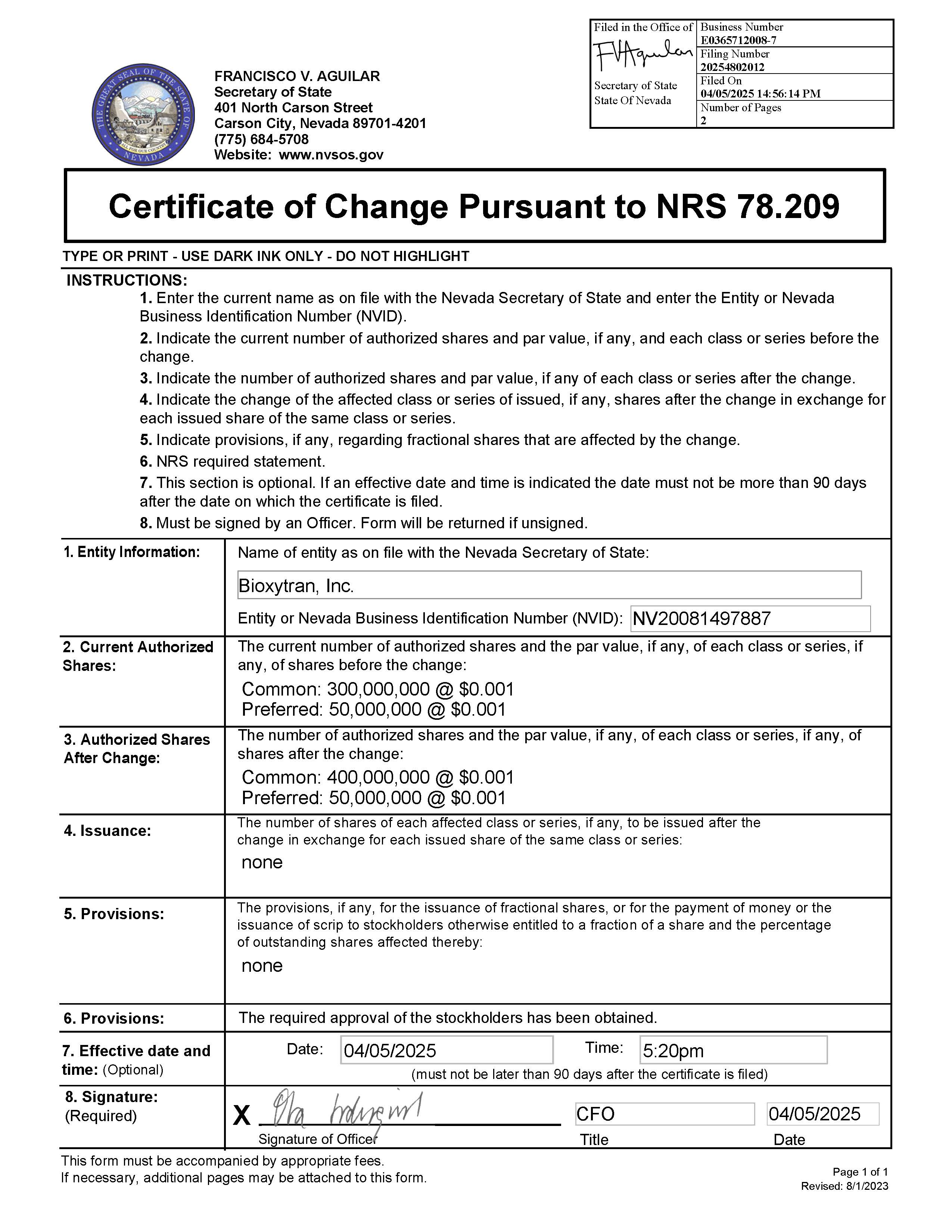
Exhibit 10.91
COMMON SHARE WARRANT
For the Purchase of ______________ (____________) shares of Common Stock
of
Bioxytran, Inc.
(the “Shares”)
1. Warrant Shares. THIS CERTIFIES THAT, for value received, _________________, or its assigns (“Holder”), as registered owner of this Warrant Shares, issued by Bioxytran, Inc. (the “Company”), Holder is entitled, at any time or from time to time from ___________, 2026 (the “Commencement Date”), and at or before 5:00 p.m., Eastern time, _____________, 2031 (the “Expiration Date”), but not thereafter, to subscribe for, purchase and receive, in whole or in part, up to _____________ shares of Common Stock of the Company, par value $0.001 per share, subject to adjustment as provided in Section 6 hereof. If the Expiration Date is a day on which banking institutions are authorized by law to close, then this Warrant Shares may be exercised on the next succeeding day which is not such a day in accordance with the terms herein. During the period ending on the Expiration Date, the Company agrees not to take any action that would terminate this Warrant Shares except as otherwise provided herein or with the Holder’s consent. This Warrant Shares is initially exercisable at $0.12 per Share; provided, however, that upon the occurrence of any of the events specified in Section 6 hereof, the rights granted by this Warrant Shares, including the exercise price per Share and the number of Shares to be received upon such exercise, shall be adjusted as therein specified. The term “Exercise Price” shall mean the initial exercise price or the adjusted exercise price, depending on the context.
2. Exercise.
2.1 Exercise Form. In order to exercise this Warrant Shares, the exercise form attached hereto must be duly executed and completed and delivered to the Company, together with this Warrant Shares and payment of the Exercise Price for the Shares being purchased payable in cash by wire transfer of immediately available funds to an account designated by the Company or by certified check or official bank check. If the subscription rights represented hereby shall not be exercised at or before 5:00 p.m., Eastern time, on the Expiration Date, this Warrant Shares shall become and be void without further force or effect, and all rights represented hereby shall cease and expire.
2.2 Legend. Each certificate for the Shares purchased under this Warrant Shares shall bear a legend as follows unless such Shares have been registered under the Securities Act of 1933, as amended (the “Act”):
“The securities represented by this certificate have not been registered under the Securities Act of 1933, as amended (the “Act”), or applicable state law. Neither the securities nor any interest therein may be offered for sale, sold or otherwise transferred except pursuant to an effective registration statement under the Act, or pursuant to an exemption from registration under the Act and applicable state law which, in the opinion of counsel to the Company, is available.”
3. Transfer.
3.1 Transfer. Transfers to others may be made subject to compliance with or exemptions from applicable securities laws. In order to make any permitted assignment, the Holder must deliver to the Company the assignment form attached hereto duly executed and completed, together with the Warrant Shares and payment of all transfer taxes, if any, payable in connection therewith. The Company shall within five (5) Business Days upon receipt of the completed assignment form and payment of all transfer taxes, if any, transfer this Warrant Shares on the books of the Company and shall execute and deliver a new Warrant Shares or Warrant Shares of like tenor to the appropriate assignee(s) expressly evidencing the right to purchase the aggregate number of Shares purchasable hereunder or such portion of such number as shall be contemplated by any such assignment. The term “Business Day” means any day other than a Saturday, a Sunday or a legal holiday or a day on which banking institutions are authorized or obligated by law to close in New York, New York.
3.2 Restrictions Imposed by the Act. The Shares evidenced by this Warrant Shares shall not be transferred unless and until: (i) the Company has received the opinion of counsel for the Holder that the securities may be transferred pursuant to an exemption from registration under the Act and applicable state securities laws, the availability of which is established to the reasonable satisfaction of the Company (the Company hereby agreeing that the opinion of Robert J. Burnett shall be deemed satisfactory evidence of the availability of an exemption), or (ii) a registration statement or a post-effective amendment to the registration statement relating to the offer and sale of the Shares has been filed by the Company and declared effective by the U.S. Securities and Exchange Commission (the “Commission”) and compliance with applicable state securities law has been established.
4. Call Features of Warrants
4.1 Direct Exercise. Unexercised warrants may be called by the Company commencing upon the ninth (9th) month of the term of the warrants if the Company’s common stock reaches a Trading Price exceeding $.50 per share for 10 consecutive days, subject to adjustment as described in Article 6, the Company has the right, until the Expiration Date, to demand in writing the exercise of this warrant by issuing a Call Notice. Upon delivery of a Call Notice to the Holder in written form, the Holder will have 10 days in which to exercise all or a portion of this warrant in accordance with Section 2.1. Should the Holder not exercise in accordance with Section 2.1 within 10 days of receipt of the written Call Notice, then any unexercised portion of this warrant and all of its terms and provisions will be deemed to have expired immediately.
4.2 Cashless Exercise. Unexercised warrants may also be called by the Company in a cashless exercise. Commencing upon the ninth (9th) month of the term of the warrants, the Company has the right, until the Expiration Date, to demand in writing a cashless exercise of this warrant by issuing a Call Notice. Upon delivery of a Call Notice to the Holder in written form, the Holder will have 10 days in which to elect to receive the number of Shares equal to the value of this Purchase Warrant (or the portion thereof being exercised), by surrender of this Purchase Warrant to the Company, together with the exercise form attached hereto, in which event the Company will issue to Holder Shares in accordance with the formula here below. Should the Holder not exercise within 10 days of receipt of the written Call Notice, then any unexercised portion of this warrant and all of its terms and provisions will be deemed to have expired immediately.
| X | = | Y*(A-B) | ||||
| A | ||||||
| Where, | ||||||
| X | = | The number of Shares to be issued to Holder; | ||||
| Y | = | The number of Shares for which the Purchase Warrant is being exercised; | ||||
| A | = | The fair market value of one Share; and | ||||
| B | = | The Exercise Price. | ||||
For purposes of this Section 4.2, the fair market value of a Share is defined as follows:
| (i) | if the Company’s common stock is traded on a national securities exchange, the fair value shall be deemed to be the closing price on such exchange on the trading day immediately preceding the date on which Holder elects to exercise this Purchase Warrant, which shall be set forth in the applicable notice of exercise; |
| (ii) | if the Company’s common stock is traded on any tier of the OTC Markets or any successor over-the-counter market, the fair value shall be deemed to be the closing bid price on the over-the-counter market on the trading day immediately preceding date on which Holder elects to exercise this Purchase Warrant, which shall be set forth in the applicable notice of exercise; or |
| (iii) | if there is no active trading market, the fair value shall be the fair market value as determined in good faith by the Company’s Board of Directors. |
5. New Warrant Shares to be Issued.
5.1 Partial Exercise or Transfer. Subject to the restrictions in Section 3 hereof, this Warrant Shares may be exercised or assigned in whole or in part. In the event of the exercise or assignment hereof in part only, upon surrender of this Warrant Shares for cancellation, together with the duly executed exercise or assignment form and funds sufficient to pay any Exercise Price and/or transfer tax if exercised pursuant to Section 2.1 hereto, the Company shall cause to be delivered to the Holder without charge a new Warrant Shares of like tenor to this Warrant Shares in the name of the Holder evidencing the right of the Holder to purchase the number of Shares purchasable hereunder as to which this Warrant Shares has not been exercised or assigned.
5.2 Lost Certificate. Upon receipt by the Company of evidence satisfactory to it of the loss, theft, destruction or mutilation of this Warrant Shares and of reasonably satisfactory indemnification or the posting of a bond, the Company shall execute and deliver a new Warrant Shares of like tenor and date. Any such new Warrant Shares executed and delivered as a result of such loss, theft, mutilation or destruction shall constitute a substitute contractual obligation on the part of the Company.
6. Adjustments.
6.1 Adjustments to Exercise Price and Number of Securities. The Exercise Price and the number of Shares underlying the Warrant Shares shall be subject to adjustment from time to time as hereinafter set forth:
6.1.1 Share Dividends; Split Ups. If, after the date hereof, and subject to the provisions of Section 6.3 below, the number of outstanding Shares is increased by a share dividend payable in Shares or by a split up of Shares or other similar event, then, on the effective day thereof, the number of Shares purchasable hereunder shall be increased in proportion to such increase in outstanding Shares, and the Exercise Price shall be proportionately decreased.
6.1.2 Aggregation of Shares. If, after the date hereof, and subject to the provisions of Section 6.3 below, the number of outstanding Shares is decreased by a consolidation, combination or reclassification of Shares or other similar event, then, on the effective date thereof, the number of Shares purchasable hereunder shall be decreased in proportion to such decrease in outstanding Shares, and the Exercise Price shall be proportionately increased.
6.1.3 Replacement of Securities upon Reorganization, etc. In case of any reclassification or reorganization of the outstanding Shares other than a change covered by Section 6.1.1 or 6.1.2 hereof or that solely affects the par value of such Shares, or in the case of any share reconstruction or merger or consolidation of the Company with or into another corporation (other than a consolidation or share reconstruction or merger in which the Company is the continuing corporation and that does not result in any reclassification or reorganization of the outstanding Shares), or in the case of any sale or conveyance to another corporation or entity of the property of the Company as an entirety or substantially as an entirety in connection with which the Company is dissolved, the Holder of this Warrant Shares shall have the right thereafter (until the expiration of the right of exercise of this Warrant Shares) to receive upon the exercise hereof, for the same aggregate Exercise Price payable hereunder immediately prior to such event, the kind and amount of shares or other securities or property (including cash) receivable upon such reclassification, reorganization, share reconstruction or merger, or consolidation, or upon a dissolution following any such sale or transfer, by a Holder of the number of Shares of the Company obtainable upon exercise of this Warrant Shares immediately prior to such event; and if any reclassification also results in a change in Shares covered by Section 6.1.1 or 6.1.2, then such adjustment shall be made pursuant to Sections 6.1.1, 6.1.2 and this Section 6.1.3. The provisions of this Section 6.1.3 shall similarly apply to successive reclassifications, reorganizations, share reconstructions or mergers, or consolidations, sales or other transfers.
6.1.4 Changes in Form of Warrant Shares. This form of Warrant Shares need not be changed because of any change pursuant to this Section 6.1, and Warrant Shares issued after such change may state the same Exercise Price and the same number of Shares as are stated in the Warrant Shares initially issued pursuant to this Agreement. The acceptance by any Holder of the issuance of new Warrant Shares reflecting a required or permissive change shall not be deemed to waive any rights to an adjustment occurring after the Commencement Date or the computation thereof.
6.2 Substitute Warrant Shares. In case of any consolidation of the Company with, or share reconstruction or merger of the Company with or into, another corporation (other than a consolidation or share reconstruction or merger which does not result in any reclassification or change of the outstanding Shares), the corporation formed by such consolidation or share reconstruction or merger shall execute and deliver to the Holder a supplemental Warrant Shares providing that the holder of each Warrant Shares then outstanding or to be outstanding shall have the right thereafter (until the stated expiration of such Warrant Shares) to receive, upon exercise of such Warrant Shares, the kind and amount of shares and other securities and property receivable upon such consolidation or share reconstruction or merger, by a holder of the number of Shares of the Company for which such Warrant Shares might have been exercised immediately prior to such consolidation, share reconstruction or merger, sale or transfer. Such supplemental Warrant Shares shall provide for adjustments which shall be identical to the adjustments provided for in this Section 6. The above provision of this Section shall similarly apply to successive consolidations or share reconstructions or mergers.
6.3 Elimination of Fractional Interests. The Company shall not be required to issue certificates representing fractions of Shares upon the exercise of the Warrant Shares, nor shall it be required to issue scrip or pay cash in lieu of any fractional interests, it being the intent of the parties that all fractional interests shall be eliminated by rounding any fraction up or down, as the case may be, to the nearest whole number of Shares or other securities, properties or rights.
7. Reservation and Listing. The Company shall at all times reserve and keep available out of its authorized Shares, solely for the purpose of issuance upon exercise of the Warrant Shares, such number of Shares or other securities, properties or rights as shall be issuable upon the exercise thereof. The Company covenants and agrees that, upon exercise of the Warrant Shares and payment of the Exercise Price therefor, in accordance with the terms hereby, all Shares and other securities issuable upon such exercise shall be duly and validly issued, fully paid and non-assessable and not subject to preemptive rights of any shareholder. As long as the Warrant Shares shall be outstanding, the Company shall use its commercially reasonable efforts to cause all Shares issuable upon exercise of the Warrant Shares to be listed (subject to official notice of issuance) on a national securities exchange or quoted on any tier of the OTC Markets or any successor trading market on which the Shares issued by the Company may then be listed and/or quoted.
8. Certain Notice Requirements.
8.1 Holder’s Right to Receive Notice. Nothing herein shall be construed as conferring upon the Holders the right to vote or consent or to receive notice as a shareholder for the election of directors or any other matter, or as having any rights whatsoever as a shareholder of the Company. If, however, at any time prior to the expiration of the Warrant Shares and their exercise, any of the events described in Section 8.2 shall occur, then, in one or more of said events, the Company shall give written notice of such event at least 10 days prior to the date fixed as a record date or the date of closing the transfer books for the determination of the shareholders entitled to such dividend, distribution, conversion or exchange of securities or subscription rights, or entitled to vote on such proposed dissolution, liquidation, winding up or sale. Such notice shall specify such record date or the date of the closing of the transfer books, as the case may be. Notwithstanding the foregoing, the Company shall deliver to each Holder a copy of each notice given to the other shareholders of the Company in connection with the events described in Section 8.2 below at the same time and in the same manner that such notice is given to the shareholders.
8.2 Events Requiring Notice. The Company shall be required to give the notice described in this Section 8 upon one or more of the following events: (i) if the Company shall take a record of the holders of its Shares for the purpose of entitling them to receive a dividend or distribution payable otherwise than in cash, or a cash dividend or distribution payable otherwise than out of retained earnings, as indicated by the accounting treatment of such dividend or distribution on the books of the Company, (ii) the Company shall offer to all the holders of its Shares any additional shares of capital stock of the Company or securities convertible into or exchangeable for shares of capital stock of the Company, or any option, right or warrant to subscribe therefor, or (iii) a dissolution, liquidation or winding up of the Company (other than in connection with a consolidation or share reconstruction or merger) or a sale of all or substantially all of its property, assets and business shall be proposed.
8.3 Notice of Change in Exercise Price. The Company shall, promptly after an event requiring a change in the Exercise Price pursuant to Section 6 hereof, send notice to the Holders of such event and change (“Price Notice”). The Price Notice shall describe the event causing the change and the method of calculating same and shall be certified as being true and accurate by the Company’s Chief Financial Officer.
8.4 Transmittal of Notices. Any and all notices or other communications or deliveries required or permitted to be provided hereunder shall be in writing and shall be deemed given and effective on the earliest of: (a) the date of transmission, if such notice or communication is delivered via e-mail attachment at the email address set forth below at or prior to 5:30 p.m. (New York City time) on a Business Day, (b) the next Business Day after the date of transmission, if such notice or communication is delivered via e-mail attachment at the e-mail address as set forth below on a day that is not a Business Day or later than 5:30 p.m. (New York City time) on any Business Day, (c) the second (2nd) Business Day following the date of mailing, if sent by U.S. nationally recognized overnight courier service or (d) upon actual receipt by the party to whom such notice is required to be given.
If to the Holder:
______________________
attn. __________________
______________________
______________________
______________________
If to the Company:
Bioxytran, Inc.
attn. Dr David Platt
75 2nd Ave., Ste 605
Needham, MA, 02494
9. Miscellaneous.
9.1 Amendments. The Company and the Holder may from time to time supplement or amend this Warrant Shares. All modifications or amendments shall require the written consent of and be signed by the party against whom enforcement of the modification or amendment is sought.
9.2 Headings. The headings contained herein are for the sole purpose of convenience of reference, and shall not in any way limit or affect the meaning or interpretation of any of the terms or provisions of this Warrant Shares.
9.3. Entire Agreement. This Warrant Shares (together with the other agreements and documents being delivered pursuant to or in connection with this Warrant Shares) constitutes the entire agreement of the parties hereto with respect to the subject matter hereof, and supersedes all prior agreements and understandings of the parties, oral and written, with respect to the subject matter hereof.
9.4 Binding Effect. This Warrant Shares shall inure solely to the benefit of and shall be binding upon, the Holder and the Company and their permitted assignees, respective successors, legal representative and assigns, and no other person shall have or be construed to have any legal or equitable right, remedy or claim under or in respect of or by virtue of this Warrant Shares or any provisions herein contained.
9.5 Governing Law; Submission to Jurisdiction; Trial by Jury. This Warrant Shares shall be governed by and construed and enforced in accordance with the laws of the State of New York, without giving effect to conflict of laws principles thereof. The Company hereby agrees that any action, proceeding or claim against it arising out of, or relating in any way to this Warrant Shares shall be brought and enforced in the New York Supreme Court, County of New York, or in the United States District Court for the Southern District of New York, and irrevocably submits to such jurisdiction, which jurisdiction shall be exclusive. The Company hereby waives any objection to such exclusive jurisdiction and that such courts represent an inconvenient forum. Any process or summons to be served upon the Company may be served by transmitting a copy thereof by registered or certified mail, return receipt requested, postage prepaid, addressed to it at the address set forth in Section 8 hereof. Such mailing shall be deemed personal service and shall be legal and binding upon the Company in any action, proceeding or claim. The Company and the Holder agree that the prevailing party(ies) in any such action shall be entitled to recover from the other party(ies) all of its reasonable attorneys’ fees and expenses relating to such action or proceeding and/or incurred in connection with the preparation therefor. The Company and the Holder hereby irrevocably waive, to the fullest extent permitted by applicable law, any and all right to trial by jury in any legal proceeding arising out of or relating to this Agreement or the transactions contemplated hereby.
9.6 Waiver, etc. The failure of the Company or the Holder to at any time enforce any of the provisions of this Warrant Shares shall not be deemed or construed to be a waiver of any such provision, nor to in any way affect the validity of this Warrant Shares or any provision hereof or the right of the Company or any Holder to thereafter enforce each and every provision of this Warrant Shares. No waiver of any breach, non-compliance or non-fulfillment of any of the provisions of this Warrant Shares shall be effective unless set forth in a written instrument executed by the party or parties against whom or which enforcement of such waiver is sought; and no waiver of any such breach, non-compliance or non-fulfillment shall be construed or deemed to be a waiver of any other or subsequent breach, non-compliance or non-fulfillment.
9.7 Exchange Agreement. As a condition of the Holder’s receipt and acceptance of this Warrant Shares, Holder agrees that, at any time prior to the complete exercise of this Warrant Shares by Holder, if the Company and the holder enter into an agreement (“Exchange Agreement”) pursuant to which they agree that all outstanding Warrant Shares will be exchanged for securities or cash or a combination of both, then Holder shall agree to such exchange and become a party to the Exchange Agreement.
IN WITNESS WHEREOF, the Company has caused this Warrant Shares to be signed by its duly authorized officer as of the ___th day of ______, 2025.
| BIOXYTRAN, INC. | ||
| By: | ||
| Name: | David Platt | |
| Title: | Chief Executive Officer | |
Exhibit 10.92
INSTRUCTIONS ON COMPLETING THIS PRIVATE PLACEMENT SUBSCRIPTION AGREEMENT
1. The Company will comply with blue-sky laws in any state where an investment is consumed. You must submit proof of residency by attaching a legible copy of your driver’s license, passport or other government-issued photo identification. If the shares are to be issued in more than one name, both persons must supply a copy of their driver’s license, US passport or other government-issued photo identification.
2. YOU MUST COMPLETE ALL INFORMATION REQUESTED, including your current address, telephone number and social security number. Please print or type all information. Illegible documentation will be returned.
3. You must complete IRS Substitute Form W-9.
4. You are also asked to complete an accredited investor qualification, available in SCHEDULE C beginning on page 7, as required by Rule 501 of Reg D.
5. If you are paying by check or money order, please make the check or money order payable to “Bioxytran, Inc.” in the amount of the Total Purchase Price for the shares.
6. Your subscription is subject to acceptance by the Company in its sole discretion and shall remain irrevocable until the closing date of the offering. If your subscription is accepted, the shares subscribed for will be issued upon acceptance of the Subscription Agreement by the Company in writing. If your subscription is not accepted for any reason, your subscription amount will be returned to you promptly without interest or deduction.
7. Please sign where indicated. If the shares are to be registered in more than one name, both persons must sign.
8. A copy of your driver’s license, US passport or other government-issued photo identification must be returned with the subscription agreement.
FOR MORE INFORMATION ON THE OFFERING, PLEASE SEE SCHEDULE A BEGINNING ON PAGE 5.
PLEASE READ THE INSTRUCTIONS ON SCHEDULE B BEGINNING ON PAGE 6 CAREFULLY ON HOW TO FILL IN AND COMPLETE THIS PRIVATE PLACEMENT SUBSCRIPTION AGREEMENT AND ALL OF THE SCHEDULES ATTACHED HERETO.
FOR ASSISTANCE CALL (617) 510-2539 AND ASK TO SPEAK TO DR. DAVID PLATT ABOUT THE BIOXYTRAN PRIVATE PLACEMENT.
PRIVATE PLACEMENT SUBSCRIPTION AGREEMENT
Bioxytran, Inc.
The undersigned subscribes for and agrees to purchase shares of Common Stock in Bioxytan, Inc. (the “Company”), as follows.
| Number of Units | Unit Price | Purchase Price | ||||||||
| $ | .05 | $ | ||||||||
The units purchased will be registered in my/our name only, as holder of record, and a certificate representing the shares I purchase will be delivered to me/us as soon as practicable after the Company approves this subscription. The certificate will be delivered to the undersigned via book entry held at Securities Stock Transfer Corporation, (469-633-0101). I/we have given my/our Social Security or Tax Identification number and current telephone numbers below.
PLEASE PRINT THE FOLLOWING INFORMATION LEGIBLY AND SIGN THIS SUBSCRIPTION AGREEMENT WHERE INDICATED ON THE NEXT PAGE.
| Name(s) | SSN or TIN | |||
| Street Address | Cell Phone: | |||
| City, State, Zip code | Home Phone: | |||
| Email Address | Office Phone: |
The undersigned understands that the units are being offered in reliance on the undersigned’s representations here below and that the Company will rely on such representations in accepting any subscriptions for the shares. The undersigned agrees to indemnify and hold harmless the Company against any damage, loss, expense or cost, including reasonable attorneys’ fees, sustained as a result of any misstatement or omission on the undersigned’s part.
— Signature page to follow —
ACKNOWLEDGEMENT
THIS SUBSCRIPTION AGREEMENT IS NOT VALID UNLESS SIGNED
| Entity Name (If Applicable): | |
| Signature: | |
| Name of Signer (Print): | |
| Title: | |
| (If subscribing as custodian, trustee, corporate officer, etc.) | |
Accepted by: BIOXYTRAN, INC. |
|
| By | |
| Dr. David Platt, Chief Executive Officer | |
| Date: _____ber_____,2025 | |
SUBSTITUTE W-9
☐ Check this box if the following statement is true: I/we am/are not subject to back-up withholding either
| (1) | because I/we am/are exempt from back-up withholding | |
| (2) | I/we have not been notified that I/we am/are subject to back-up withholding as a result of a failure to report all interest or dividends, or | |
| (3) | the Internal Revenue Service has notified me/us that I/we am/are no longer subject to back-up withholding. Under the penalties of perjury, I/we certify that the information contained herein, including the Social Security number or taxpayer identification number given above, is true, correct and complete. |
SCHEDULE A
INFORMATION REGARDING THE PRIVATE PLACEMENT
This agreement (the “Subscription Agreement”), is a private placement offering dated October 15, 2025, and is for purchasing units consisting of one (1) restricted Common Stock and one (1) warrant share in Bioxytran, Inc. for an amount of up to $750,000 on a “best efforts” basis. The units are priced at $.05 per unit.
Bioxytran, Inc. is a public company listed on OTCQB aiming to develop pharmaceutical cure in the space of glycovirology, hypoxia and degenerative diseases and bring the drugs through FDA acceptance and thereafter license out the products.
If you wish to take part in the Private Placement, you must complete the Subscription Agreement. You will be asked to confirm your purchase.
PLEASE READ THE INSTRUCTIONS CAREFULLY ON HOW TO FILL IN AND COMPLETE THIS PRIVATE PLACEMENT SUBSCRIPTION AGREEMENT.
The offering is being made on a self-underwritten basis. There will be no escrow or impound of funds tendered on subscription, and proceeds from the sale of shares will be available to us immediately upon acceptance of subscriptions by us.
We reserve the right to reject any subscriptions, in whole or in part, for any reason, in our sole discretion.
The Purchase Price for the shares may be paid for by check, wire or money order. Our wiring instructions are:
BIOXYTRAN, INC. PRIVATE PLACEMENT ACCOUNT
| Account Name | Bioxytran, Inc. |
| Account Address: | 75 2nd Ave., Suite 605, Needham, MA 02494 |
| Wire Routing Number: | 026009593 |
| Account Number: | |
| Bank Name: | Bank of America |
| Bank Address: | 235 Needham Street, Newton, MA 02464 |
| RE: | BIOXYTRAN October 2025 offering |
MUST RECEIVE PROPERLY COMPLETED SUBSCRIPTION AGREEMENTS NO LATER THAN NOVEMBER 30, 2025 (THE “EXPIRATION DATE”), UNLESS EXTENDED.
TO SUBSCRIBE FOR STOCK, COMPLETE AND SIGN THE SUBSCRIPTION AGREEMENT AND RETURN IT WITH PAYMENT TO THE COMPANY AT:
Bioxytran, Inc.
75 2nd Ave., Ste 605
Needham, MA 02494
Phone: 617-510-2539
e-mail: [email protected]
ATT: Chief Executive Officer
SCHEDULE B
REPRESENTATIONS AND AGREEMENTS
By signing the Subscription Agreement, you (the “subscriber”) are representing to Bioxytran, Inc. the following information:
1. THE SUBSCRIBER IS AT LEAST EIGHTEEN (18) YEARS OF AGE AND IS A VALID RESIDENT OF THE STATE INDICATED ON PAGE 1 OF THIS SUBSCRIPTION AGREEMENT. The subscriber is under no legal disability nor is the subscriber subject to any order, which would prevent or interfere with the subscriber’s execution, delivery and performance of this Subscription Agreement or the purchase of the shares by the subscriber.
2. The subscriber has received and read the Private Placement Memorandum (“PPM”).
3. This Subscription Agreement cannot be revoked by the subscriber and it is an irrevocable agreement binding on the subscriber, and on the subscriber’s heirs, estate, legal representatives, assigns and successors, and shall survive the subscriber’s death, disability or dissolution. Bioxytran, Inc., however, may reject the agreement prior to the subscriber’s acceptance of the same.
4. The subscriber understands that the subscriber may not sell, transfer or assign this Subscription Agreement, or any interest or rights herein.
5. If this Subscription Agreement is executed on behalf of a corporation, partnership, trust or other entity, the subscriber has/have been duly authorized to execute this Subscription Agreement and all other instruments in connection with the purchase of the shares, and the signature(s) of the subscriber is/are binding upon such corporation, partnership, trust or other entity. The subscriber must return appropriate certification of such authorization.
6. The provisions of this Subscription Agreement shall be construed and enforced according to the laws of Nevada. Bioxytran, Inc. reserves the right, in our sole discretion, to require completion or correction of any Subscription Agreement. We are not obligated to notify any subscriber of any defect in any Subscription Agreement and may accept or reject any Subscription Agreement in whole or in part for any reason or no reason.
7. This Subscription Agreement constitutes the entire agreement between the parties hereto with respect to the purchase of shares of our Common Stock in the Private Placement and may be amended only in writing by the parties to be bound thereby.
SCHEDULE C
INVESTOR SUITABILITY QUESTIONNAIRE
BIOXYTRAN, INC.
This Questionnaire is being distributed to certain individuals and entities which may be offered the opportunity to purchase securities (the “Securities”) of Bioxytran, Inc., a Nevada corporation (the “Company”). The purpose of this Questionnaire is to assure the Company that all such offers and purchases will meet the standards imposed by the Securities Act of 1933, as amended (the “Act”), and applicable state securities laws.
All answers will be kept confidential. However, by signing this Questionnaire, the undersigned agrees that this information may be provided by the Company to its legal and financial advisors, and the Company and such advisors may rely on the information set forth in this Questionnaire for purposes of complying with all applicable securities laws and may present this Questionnaire to such parties as it reasonably deems appropriate if called upon to establish its compliance with such securities laws. The undersigned represents that the information contained herein is complete and accurate and will notify the Company of any material change in any of such information prior to the undersigned’s investment in the Company.
For Individual Investors
Accredited Investor Certification. The undersigned makes one of the following representations regarding its income, net worth, status as a “family client” of a “family office,” and/or certain professional certifications or designations and certain related matters and has checked the applicable representation:
| ☐ | The undersigned’s incomei during each of the last two years exceeded $200,000 or, if the undersigned is married or has a spousal equivalent1, the joint income of the undersigned and the undersigned’s spouse or spousal equivalent, as applicable, during each of the last two years exceed $300,000, and the undersigned reasonably expects the undersigned’s income, from all sources during this year, will exceed $200,000 or, if the undersigned is married or has a spousal equivalent, the joint income of undersigned and the undersigned’s spouse or spousal equivalent, as applicable, from all sources during this year will exceed $300,000. | |
| ☐ | The undersigned’s net worth,ii including the net worth of the undersigned’s spouse or spousal equivalent, as applicable, is in excess of $1,000,000 (excluding the value of the undersigned’s primary residence). | |
| ☐ | The undersigned is a holder in good standing of one or more of the following certifications or designations administered by the Financial Industry Regulatory Authority, Inc. (FINRA): the Licensed General Securities Representative (Series 7), Licensed Investment Adviser Representative (Series 65), or Licensed Private Securities Offerings Representative (Series 82). | |
| ☐ | The undersigned is a “family client,” as defined in rule 202(a)(11)(G)-1 under the Investment Advisers Act of 1940, as amended (the “Advisers Act”), of a family office as defined in rule 202(a)(11)(G)-1 under the Advisers Act, (i) with assets under management in excess of $5,000,000, (ii) that is not formed for the specific purpose of acquiring the securities offered, and (iii) whose prospective investment is directed by a person who has such knowledge and experience in financial and business matters that such family office is capable of evaluating the merits and risks of the prospective investment, and whose prospective investment is directed by such family office pursuant to clause (iii) of this sentence. | |
| ☐ | The undersigned cannot make any of the representations set forth above. |
For Entity Investors
Accredited Investor Certification. The undersigned makes one of the following representations regarding its net worth and certain related matters and has checked the applicable representation:
| ☐ | The undersigned is a trust with total assets in excess of $5,000,000 whose purchase is directed by a person with such knowledge and experience in financial and business matters that such person is capable of evaluating the merits and risks of the prospective investment. | |
| ☐ | The undersigned is a bank, an investment adviser registered pursuant to Section 203 of the Advisers Act or registered pursuant to the laws of a state, any investment adviser relying on the exemption from registering with the SEC under Section 203(l) or (m) of the Advisers Act, an insurance company, an investment company registered under the United States Investment Company Act of 1940, as amended, a broker or dealer registered pursuant to Section 15 of the United States Securities Exchange Act of 1934, as amended, a business development company, a Small Business Investment Company licensed by the United States Small Business Administration, a Rural Business Investment Company as defined in Section 384A of the Consolidated Farm and Rural Development Act, as amended, a plan with total assets in excess of $5,000,000 established and maintained by a state for the benefit of its employees, or a private business development company as defined in Section 202(a)(22) of the Advisers Act. | |
| ☐ | The undersigned is an employee benefit plan and either all investment decisions are made by a bank, savings and loan association, insurance company, or registered investment advisor, or the undersigned has total assets in excess of $5,000,000 or, if such plan is a self-directed plan, investment decisions are made solely by persons who are accredited investors. |
1 For purposes of this Questionnaire, “spousal equivalent” means a cohabitant occupying a relationship generally equivalent to that of a spouse.
| ☐ | The undersigned is a corporation, limited liability company, partnership, business trust, not formed for the purpose of acquiring the Securities, or an organization described in Section 501(c)(3) of the Internal Revenue Code of 1986, as amended (the “Code”), in each case with total assets in excess of $5,000,000. | |
| ☐ | The undersigned is an entity in which all of the equity owners (in the case of a revocable living trust, its grantor(s)) qualify under any of the above subparagraphs, or, if an individual, each such individual has a net worth,2 either individually or upon a joint basis with such individual’s spouse or spousal equivalent, as applicable, in excess of $1,000,000 (within the meaning of such terms as used in the definition of “accredited investor” contained in Rule 501 under the Act), or has had an individual income1 in excess of $200,000 for each of the two most recent years, or a joint income with such individual’s spouse or spousal equivalent, as applicable, in excess of $300,000 in each of those years, and has a reasonable expectation of reaching the same income level in the current year. | |
| ☐ | The undersigned is an entity, of a type not listed in any of the paragraphs above, which was not formed for the specific purpose of acquiring the securities offered, owning investments in excess of $5,000,000. | |
| ☐ | The undersigned is a “family office,” as defined in rule 202(a)(11)(G)-1 under the Advisers Act, (i) with assets under management in excess of $5,000,000, (ii) that is not formed for the specific purpose of acquiring the securities offered, and (iii) whose prospective investment is directed by a person who has such knowledge and experience in financial and business matters that such family office is capable of evaluating the merits and risks of the prospective investment. | |
| ☐ | The undersigned is a “family client,” as defined in rule 202(a)(11)(G)-1 under the Advisers Act, of a family office meeting the requirements in the above paragraph and whose prospective investment is directed by such family office pursuant to clause (iii) of the above paragraph. | |
| ☐ | The undersigned cannot make any of the representations set forth above. |
In Witness Whereof, the undersigned has executed this Investor Suitability Questionnaire as of the date written below.
| Name of Investor | |
| (Signature) | |
| Name of Signing Party (Please Print) | |
| Title of Signing Party (Please Print) | |
| Address | |
| Date Signed |
i For purposes of this Questionnaire, “income” means adjusted gross income, as reported for federal income tax purposes, increased by the following amounts: (a) the amount of any tax exempt interest income received, (b) the amount of losses claimed as a limited partner in a limited partnership, (c) any deduction claimed for depletion, (d) amounts contributed to an IRA or Keogh retirement plan, (e) alimony paid, and (f) any amounts by which income from long-term capital gains has been reduced in arriving at adjusted gross income pursuant to the provisions of Section 1202 of the Code.
ii For purposes of this Questionnaire, “net worth” means the excess of total assets, excluding your primary residence, at fair market value over total liabilities, including your mortgage or any other liability secured by your primary residence only if and to the extent that it exceeds the value of your primary residence. Net worth should include the value of any other shares of stock or options held by you and your spouse or spousal equivalent and any personal property owned by you or your spouse or spousal equivalent (e.g. furniture, jewelry, other valuables, etc.). For the purposes of calculating joint net worth: joint net worth can be the aggregate net worth of you and your spouse or spousal equivalent; assets need not be held jointly to be included in the calculation.
Exhibit 31.1
CERTIFICATION OF PRINCIPAL EXECUTIVE OFFICER AND PRINCIPAL FINANCIAL OFFICER
PURSUANT TO RULE 13a-14
I, David Platt, certify that:
| 1. | I have reviewed this Annual Report on Form 10-K of BIOXYTRAN, Inc; | |
| 2. | Based on my knowledge, this report does not contain any untrue statement of a material fact or omit to state a material fact necessary to make the statements made, in light of the circumstances under which such statements were made, not misleading with respect to the period covered by this report; | |
| 3. | Based on our knowledge, the financial statements, and other financial information included in this report, fairly present in all material respects the financial condition, results of operations and cash flows of the registrant as of, and for, the periods presented in this report; | |
| 4. | The registrant’s other certifying officer and we are responsible for establishing and maintaining disclosure controls and procedures (as defined in Exchange Act Rules 13a-15(e) and 15d-15(e)) and internal control over financial reporting (as defined in Exchange Act Rules 13a-15(f) and 15d-15(f)) for the registrant and have: | |
| a) | designed such disclosure controls and procedures, or caused such disclosure controls and procedures to be designed under our supervision, to ensure that material information relating to the registrant, including its consolidated subsidiaries, is made known to us by others within those entities, particularly during the period in which this report is being prepared; | |
| b) | designed such internal control over financial reporting, or caused such internal control over financial reporting to be designed under our supervision, to provide reasonable assurance regarding the reliability of financial reporting and the preparation of financial statements for external purposes in accordance with generally accepted accounting principles; | |
| c) | evaluated the effectiveness of the registrant’s disclosure controls and procedures and presented in this report our conclusions about the effectiveness of the disclosure controls and procedures, as of the end of the period covered by this report based on such evaluation; and | |
| d) | disclosed in this report any change in the registrant’s internal control over financial reporting that occurred during the registrant’s most recent quarter (the registrant’s fourth fiscal quarter in the case of an annual report) that has materially affected, or is reasonably likely to materially affect, the registrant’s internal control over financial reporting; and | |
| 5. | We have disclosed, based on our most recent evaluation of internal control over financial reporting, to the registrant’s auditors and the audit committee of registrant’s board of directors (or persons performing the equivalent functions): | |
| a) | all significant deficiencies and material weaknesses in the design or operation of internal control over financial reporting which are reasonably likely to adversely affect the registrant’s ability to record, process, summarize and report financial information; and | |
| b) | any fraud, whether or not material, that involves management or other employees who have a significant role in the registrant’s internal control over financial reporting. | |
| BIOXYTRAN, INC. | ||
| Date: April 15, 2026 | By: | /s/ David Platt |
| David Platt | ||
| Chief Executive Officer | ||
Exhibit 31.2
CERTIFICATION OF PRINCIPAL EXECUTIVE OFFICER AND PRINCIPAL FINANCIAL OFFICER
PURSUANT TO RULE 13a-14
I, Ola Soderquist, certify that:
| 1. | I have reviewed this Annual Report on Form 10-K of BIOXYTRAN, Inc; | |
| 2. | Based on my knowledge, this report does not contain any untrue statement of a material fact or omit to state a material fact necessary to make the statements made, in light of the circumstances under which such statements were made, not misleading with respect to the period covered by this report; | |
| 3. | Based on our knowledge, the financial statements, and other financial information included in this report, fairly present in all material respects the financial condition, results of operations and cash flows of the registrant as of, and for, the periods presented in this report; | |
| 4. | The registrant’s other certifying officer and we are responsible for establishing and maintaining disclosure controls and procedures (as defined in Exchange Act Rules 13a-15(e) and 15d-15(e)) and internal control over financial reporting (as defined in Exchange Act Rules 13a-15(f) and 15d-15(f)) for the registrant and have: | |
| a) | designed such disclosure controls and procedures, or caused such disclosure controls and procedures to be designed under our supervision, to ensure that material information relating to the registrant, including its consolidated subsidiaries, is made known to us by others within those entities, particularly during the period in which this report is being prepared; | |
| b) | designed such internal control over financial reporting, or caused such internal control over financial reporting to be designed under our supervision, to provide reasonable assurance regarding the reliability of financial reporting and the preparation of financial statements for external purposes in accordance with generally accepted accounting principles; | |
| c) | evaluated the effectiveness of the registrant’s disclosure controls and procedures and presented in this report our conclusions about the effectiveness of the disclosure controls and procedures, as of the end of the period covered by this report based on such evaluation; and | |
| d) | disclosed in this report any change in the registrant’s internal control over financial reporting that occurred during the registrant’s most recent quarter (the registrant’s fourth fiscal quarter in the case of an annual report) that has materially affected, or is reasonably likely to materially affect, the registrant’s internal control over financial reporting; and | |
| 5. | We have disclosed, based on our most recent evaluation of internal control over financial reporting, to the registrant’s auditors and the audit committee of registrant’s board of directors (or persons performing the equivalent functions): | |
| a) | all significant deficiencies and material weaknesses in the design or operation of internal control over financial reporting which are reasonably likely to adversely affect the registrant’s ability to record, process, summarize and report financial information; and | |
| b) | any fraud, whether or not material, that involves management or other employees who have a significant role in the registrant’s internal control over financial reporting. | |
| BIOXYTRAN, INC. | ||
| Date: April 15, 2026 | By: | /s/ Ola Soderquist |
| Ola Soderquist | ||
| Chief Financial Officer | ||
Exhibit 32
CERTIFICATION PURSUANT TO
18 U.S.C. SECTION 1350,
AS ADOPTED PURSUANT TO
SECTION 906 OF THE SARBANES-OXLEY ACT OF 2002
In connection with the Quarterly Report on Form 10-K of BIOXYTRAN, Inc. (the “Company”) for the year ending December 31, 2025 as filed with the Securities and Exchange Commission on the date hereof (the “Report”), David Platt, Chief Executive Officer and Ola Soderquist, Chief Financial Officer of the Company, hereby certifies, pursuant to 18 U.S.C. Section 1350, as adopted pursuant to Section 906 of the Sarbanes-Oxley Act of 2002, that to their knowledge:
| (1) | The report fully complies with the requirements of Section 13(a) or 15(d) of the Securities Exchange Act of 1934; and |
| (2) | The information contained in the Report fairly presents, in all material respects, the financial condition and results of operations of the Company. |
| BIOXYTRAN, INC. | ||
| Date: April 15, 2026 | By: | /s/ David Platt |
| David Platt | ||
| Chief Executive Officer | ||
| /s/ Ola Soderquist | ||
| Ola Soderquist | ||
| Chief Financial Officer | ||