
AMUB 6-K
Ubs AG (AMUB)
6-K
2026-03-09
For: 2025-12-31
View Original
Added on
April 06, 2026
UNITED STATES
SECURITIES AND EXCHANGE COMMISSION
Washington, D.C. 20549
_________________
FORM 6-K
REPORT OF FOREIGN PRIVATE ISSUER
PURSUANT TO RULE 13a-16 OR 15d-16 UNDER
THE SECURITIES EXCHANGE ACT OF 1934
Date: March 9, 2026
UBS Group AG
(Registrant's Name)
Bahnhofstrasse 45, 8001 Zurich, Switzerland
(Address of principal executive office)
Commission File Number: 1-36764
UBS AG
(Registrant's Name)
Bahnhofstrasse 45, 8001 Zurich, Switzerland
Aeschenvorstadt 1, 4051 Basel, Switzerland
(Address of principal executive office)
Commission File Number: 1-15060
Indicate by check mark whether the registrants file or will file annual reports under cover of Form
20-F or Form 40-
F.
Form 20-F
☒
☐
This Form 6-K consists of UBS Group Sustainability Report 2025, which appears immediately
following this page.

Sustainability Report
2025
Thinking and acting with the long term in mind
Table of contents
Page
Sustainability Report 2025
| Introduction 2
Introduction
Partnering with clients on a sustainable future
2025 was a pivotal year for UBS, as we advanced the integration of Credit Suisse, strengthened our foundations and
deepened our support for clients navigating an increasingly dynamic and complex environment.
As we build on this momentum, innovation and collaboration across the Group continue to shape how we deliver for
our stakeholders. But long-term success is also rooted in the responsibility we share to help shape a more sustainable
future – for our clients, our people and the communities we are part of. Our efforts remain anchored in our ambition to
position UBS as a leader in sustainability and are guided by three pillars:
(i)
Protect
: manage our business in alignment with our sustainable, long-term strategy and evolving standards;
(ii)
Grow
: embed an innovative sustainability and impact offering across all our business divisions; and
(iii)
Attract
: be the bank of choice for clients and employees.
We support clients as they transition to a low carbon economy, assessing climate-related risks and opportunities across
our business to create value for clients, shareholders and other stakeholders. In 2025, we made significant progress
toward our scope 1 and 2 net-zero target – reducing emissions by 48% cumulatively against the 2023 baseline and 20%
year on year, through our energy reduction initiatives and renewable electricity usage. For scope 3, we remain committed
to our lending sector decarbonization targets in key sectors and to further develop our approach to transition finance.
Beyond increasing investment in activities with sustainability-related objectives, we recognize that the transition also
requires increased support for companies in carbon-intensive sectors in executing their transition plans.
At the same time, we continued to strengthen our climate risk management capabilities, including identifying, measuring,
monitoring, managing and reporting climate-related risks, while further embedding regulatory requirements into our
financial risk management and stress testing frameworks. Our firm-wide sustainability and climate risk framework is
underpinned by proprietary methodologies for transition and physical risk assessment, scenario analysis and stress testing.
In 2025, we enhanced these tools and integrated sustainability and climate risk considerations more deeply into our
traditional financial and non-financial risk frameworks.
Our progress is reflected in key environmental, social and governance (ESG) ratings, with MSCI reaffirming our AA score
and continued strong performance in the S&P Global Corporate Sustainability Assessment.
Trends
For the industry as a whole, global sustainability-oriented public and exchange-traded fund assets grew to a new high of
USD 3.9 trillion as of the end of December 2025, supported by strong market performance over the course of the year.
Europe remains by far the largest market with an 86% market share.1 Sustainable investments accounted for 12% of all
fundraising in private markets in 2025. From the private markets assets raised, most were allocated to energy transition
infrastructure funds.2 Multiple industry surveys conducted throughout the year consistently confirmed sustained investor
interest and a commitment to sustainable investing.3
Sustainability policy and regulation underwent a recalibration in 2025, aiming to balance growth, resilience and energy
security with previously defined goals around decarbonization, protection of natural capital, social inclusion and economic
development. Fragmentation continues to pose challenges for global firms like ours; greater alignment on global
standards – particularly in reporting and risk management – will be essential to support effective capital allocation.
Ensuring that policies are balanced and broadly accepted by societies undergoing multiple parallel transitions is equally
important.
In this evolving macroeconomic and regulatory landscape, we help clients achieve their sustainability and impact
objectives. The transition to a lower carbon economy, and the associated risks and opportunities, remains a priority for
many clients – driven by their own ambitions, as well as by regulatory requirements. In parallel, sustainable investing
continues to diversify into private markets.
1
2
3
Sources including UBS, KPMG, BNP Paribas, Morgan Stanley and Bloomberg.


Sustainability Report 2025
| Introduction 3
People and communities
Our global presence in 51 countries and jurisdictions, combined with the expertise of more than 105,000 employees,
enables us to deliver better outcomes for our clients, people and communities.
Our employees bring our strategy to life every day. We therefore aim to attract, develop and empower employees with
the capabilities, potential and mindset to help us succeed. Guided by meritocracy, we develop and promote our people
with integrity, ensuring they have the visibility and opportunities needed to build successful and thriving careers.
Good corporate citizenship principles are embedded into our employment practices – from hiring and development to
fair pay and benefits.
UBS aims to support an economy that prioritizes the well-being of people and the planet. Through the UBS Optimus
network of foundations, and in partnership with philanthropists, employees, implementation organizations and
institutional partners, we work to deliver systemic and catalytic impact for marginalized communities globally and locally,
with a focus on children and young people. In 2021, UBS set two goals: to mobilize USD 1
bn in philanthropic capital
and to reach more than 26.5
million people by the end of 2025 (cumulative since 2021). We met the USD 1 bn milestone
ahead of schedule in 2024, and by the end of 2025 had reached more than 26.5
million people.
In 2025, we successfully engaged 37% of our global workforce in volunteering activities, many in skills-based programs.
We recognize the importance of continuing these efforts – empowering participating employees and strengthening
communities in ways that also support our business.
Our commitment
The transition to a lower-carbon economy is reshaping industries and investment landscapes. We work closely with clients
to help them understand these implications – from operational impacts to strategic opportunities – and we continue to
develop the transparency tools and methodologies, as well as the insights that support informed decision-making. While
we remain committed to achieving our climate goals, meaningful progress also requires action beyond our direct control,
including progress across sectors, clear and forward-looking regulation, and greater alignment on requirements across
markets.
Our clients remain at the heart of our decisions. We are committed to being their bank of choice and to providing
solutions that anticipate and meet their evolving priorities. This commitment drives our focus on protecting long-term
value and delivering innovative product offerings, fully aligned with our three pillars that shape our sustainable approach.
Colm Kelleher
Chairman of the Board of Directors
Sergio P. Ermotti
Group Chief Executive Officer
UBS was among the companies that first signed the UN Global Compact in 2000 and is also a member of the UN Global
Compact Network Switzerland, meaning we are committed to its principles on human rights, labor standards, the
environment and anti-corruption. As reflected in detail in this report, we have a substantial set of goals and activities in
place pertaining to the principles of the UN Global Compact.
Sustainability Report 2025
| Introduction 4
About this report
Overview
The UBS Group Sustainability Report 2025 provides disclosures on environmental, social and governance (ESG) topics for
the UBS Group and its consolidated subsidiaries, including UBS AG, as of 31 December 2025. The scope and content of
this report is prepared in accordance with the Swiss legal and regulatory requirements, in particular the provisions
pertaining to transparency on non-financial matters contained in the Swiss Code of Obligations Art. 964b, and the Swiss
Ordinance on Climate Disclosures based on the recommendations of the Task Force on Climate-Related Financial
Disclosures (the TCFD). The Sustainability Report additionally includes information required by regulations promulgated
by the Swiss Financial Market Supervisory Authority (FINMA) and selected regional regulatory requirements for UBS
entities. This report has also been prepared with reference to the Global Reporting Initiative (GRI) and in accordance with
our “Basis of preparation”.
The reporting period for this UBS Group Sustainability Report is 1 January to 31 December 2025, which is aligned with
the financial reporting period of the UBS Group. The baseline years for our targets are stated in the respective sections
of this report. Disclosures showing financed emissions against our lending activities and progress against our lending
sector decarbonization targets are reported with a one-year time lag (up to 31 December 2024) due to the lack of
available 2025 data.
Unless otherwise noted, the information included in this report is presented at the UBS Group level.
›
Refer to the Global Reporting Initiative Content Index 2025, available at
ubs.com/sustainability-reporting
, for more information
on the metrics with references to the GRI standards
›
Refer to “Basis of preparation” in the “Other supplemental information” section of the Supplement to this report , available at
ubs.com/sustainability-reporting
, for more information on metrics, including definitions, approaches and scope
›
Refer to “Appendix 2 – Other supplemental information” in the appendix to this report for an overview of non-financial
disclosures in accordance with Art. 964b of the Swiss Code of Obligations
›
Refer to the “Supplement to Managing sustainability and climate risks” section of the Supplement to this report, available at
ubs.com/sustainability-reporting
, for information on the implementation of the environmental risk regulations in Singapore and
the Hong Kong SAR by UBS, information pertaining to the UBS Group’s approach to the “Swiss Ordinance on Due Diligence and
Transparency in relation to Minerals and Metals from Conflict-Affected Areas and Child Labor” and Canada OFSI B-15
requirements
›
Refer to the “Supplement to Environment” section of the Supplement to this report, available at
ubs.com/sustainability-reporting
,
for information on disclosures in connection with the legal entity reporting requirements of the ESG sourcebook in the Business
Standards section of the UK Financial Conduct Authority Handbook
›
Refer to “Note 27 Interests in subsidiaries and other entities” in the “Consolidated financial statements” section of the UBS Group
Annual Report 2025, available under “Annual reporting” at
, for supplementary information regarding certain
significant subsidiaries
Integration of Credit Suisse – explanations and related assumptions
On 12 June 2023, UBS Group AG acquired Credit Suisse Group AG, succeeding by operation of Swiss law to all assets
and liabilities of Credit Suisse Group AG. Since the acquisition, we have successfully executed our integration plans and
we have won back, retained and grown client assets. Throughout 2025, we continued to make excellent progress with
respect to the integration of Credit Suisse, including with regard to client account migrations and infrastructure
decommissioning. We are on track to substantially complete the integration by the end of 2026, including pertaining to
sustainability matters.
Sustainability Report 2025
| Introduction 5
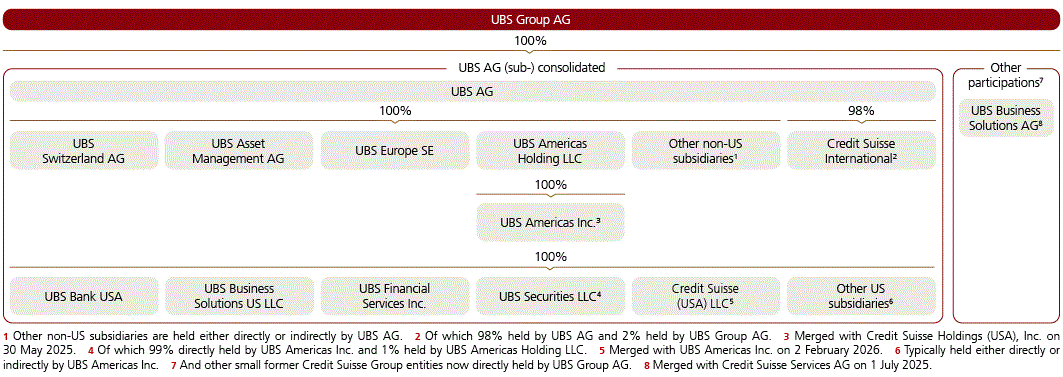
The legal structure of the UBS Group
The chart below gives an overview of our principal legal entities and our legal entity structure.
›
Refer to the “Risk factors” and “Regulatory and legal developments” sections and the “Integration of Credit Suisse” section of the
UBS Group Annual Report 2025, available under “Annual reporting” at
ubs.com/investors
, for more information
Assurance and agreed-upon procedures
UBS’s sustainability metrics, as disclosed in the UBS Group Sustainability Report 2025 and its Supplement, have been
assured by Ernst & Young Ltd, Basel (EY). EY’s procedures covered 29 metrics subject to reasonable assurance in key
areas such as climate and 205 metrics subject to limited assurance. A list of these metrics and the level of assurance can
be found in the assurance report.
As part of our assurance activities in 2024, we engaged EY to perform agreed-upon procedures on our lending sector
decarbonization targets to assist us in determining whether these have been set in line with reference scenarios
mentioned and informed by certain requirements taken from pertinent global standards and initiatives. These agreed-
upon procedures remain relevant for 2025.
›
Refer to the Lending sector decarbonization targets agreed-upon procedures , available at
ubs.com/sustainability-reporting
, for
more information
Explanation of dependencies
Certain activities of UBS that pertain to the implementation of its sustainability and impact strategy are directly impacted
by factors that it cannot influence directly or can only influence in part. These include governmental actions (e.g. when
it comes to the achievement of the Paris Agreement and thus the achievement of our firm’s climate-related ambitions);
the quality and availability of (standardized) data (e.g. in areas such as emissions); the development and enhancement of
required methodologies and methodological tools (e.g. on climate risk); the ongoing evolution of relevant definitions and
standards (e.g. sustainable finance); and the furthering of transparency (e.g. pertaining to company disclosures of data).
Areas where these dependencies are of particular relevance (including, in particular, regarding the examples noted above)
are explained in the relevant sections of this report.
9 March 2026
The UBS Group
Contacts
Information to stakeholders about the content of this report is provided by the stakeholder management team within
Group Sustainability and Impact.
Sustainability Report 2025
| Introduction 6
Terms used in this report, unless the context requires otherwise
”UBS”, ”UBS Group”, “UBS Group AG consolidated”, “Group”, “the
Group”, “we”, “us” and “our”
UBS Group AG and its consolidated subsidiaries
“UBS AG”
UBS AG and its consolidated subsidiaries
“Credit Suisse AG”
Credit Suisse AG and its consolidated subsidiaries, before the merger with
UBS AG
“Credit Suisse Group” and “Credit Suisse”
Credit Suisse Group AG and its consolidated subsidiaries, before the
acquisition by UBS
“UBS Group AG”
UBS Group AG on a standalone basis
“Credit Suisse Group AG”
Credit Suisse Group AG on a standalone basis, before the merger with UBS
Group AG
“UBS AG standalone”
UBS AG on a standalone basis
“UBS Switzerland AG” and “UBS Switzerland AG standalone”
UBS Switzerland AG on a standalone basis
“UBS Europe SE” and “UBS Europe SE consolidated”
UBS Europe SE and its consolidated subsidiaries
“UBS Europe SE standalone”
UBS Europe SE on a standalone basis
“1m”
One million, i.e. 1,000,000
“1bn”
One billion, i.e. 1,000,000,000
“1trn”
One trillion, i.e. 1,000,000,000,000
In this report, unless the context requires otherwise, references to any gender shall apply to all genders.
Sustainability Report 2025
| General information 7
General information
Our business model
UBS – who we are
We are the world’s only truly global wealth manager and the leading bank in Switzerland. These key pillars of our strategy
are enhanced by our focused and competitive asset management and investment banking capabilities. Staying close to
our clients, whether they are individuals, institutions or businesses, and providing financial advice and solutions to help
them to achieve their goals is at the heart of what we do. We have a capital-generative and well-diversified global
business model with strong competitive positions in our target markets and the regions in which we operate.
Our business model, including our regional diversification, with our deep-rooted, risk-aware culture, superior client service
and prudent capital management, is built on our respected brand and has made it possible to sustainably grow profits
and deliver attractive capital returns to shareholders over the long term.
We are focused on driving sustainable long-term growth while maintaining risk and cost discipline
Our objective is to generate value for our stakeholders by driving sustainable long-term structural growth and attractive
capital returns. To accomplish this, we are building on our scale, content and solutions, while remaining disciplined on
capital, risk and costs. Maintaining a balance sheet for all seasons remains a foundation of our success and a significant
source of strength and resilience. This provides us with the capacity to invest strategically and enables us to deliver against
our financial targets and ambitions, which are outlined in the “Targets, capital guidance and ambitions” section of this
report.
Our growth plans are rooted in an attractive business mix, that is also a source of competitive strength, and are supported
by collaboration between our businesses. Our asset-gathering businesses generate close to 60% of our revenues
1
are characterized by being structurally attractive from a capital consumption perspective, representing around 39% of
our risk-weighted assets (RWA).
1
1
our home market and an attractive, stable and well-diversified economy, with low historic credit losses. Furthermore, we
operate a capital-efficient Investment Bank, which is limited to 25% of Group RWA.
1
Our aim is to create long-term sustainable value. We also have a responsibility to the communities in which we live and
operate, and to our employees. We have outlined selected environmental, social and governance (ESG) aspirations, which
are aligned with our financial targets and ambitions.
We have a global, diversified business model
Our invested assets of more than USD 7trn are regionally diversified across the globe. We give our clients access to a
broad, relevant and customizable range of solutions, which, together with our thought leadership and capabilities,
position us well to become their partner of choice. Our strategic ambitions reflect the long-term outlook on demographic
and social trends affecting wealth distribution, product demand and client experience.
We are among the market leaders in the Americas, the world’s largest wealth pool and one of the fastest-growing wealth
markets. Around half of the invested assets our wealth management clients entrusted us with are booked in that region.
Following the acquisition of Credit Suisse, the Investment Bank has invested in growing its Global Banking and Global
Markets capabilities in the region, and is focused on cross-regional and cross-divisional collaboration to drive growth.
Asia Pacific is our fastest-growing region, and where we continue to lead as the largest wealth manager
2
consistent top-tier investment bank. We are further investing in and growing our businesses to deliver leading capabilities,
capitalizing on market momentum in the Hong Kong SAR and the mainland of China, leveraging strong cross-divisional
collaboration and global connectivity, and driving growth through a diversified footprint, with the Hong Kong SAR and
Singapore as the regional hubs, as well as strategic partnerships in markets such as Japan and India. In 2025, our total
invested assets in Asia Pacific surpassed the USD 1trn milestone for the first time.
In EMEA, we are one of the largest wealth managers, and we are focused on deepening our share of wallet with EMEA-
domiciled global clients, while further driving profitability in select key markets, including the Middle East.
Finally, in Switzerland we have a highly integrated business model and aim to reinforce our position as the leading bank.
We are driving our digital transformation, enhancing the client experience and improving efficiency, while focusing on
capturing growth opportunities. In 2025, UBS was again named Best Bank in Switzerland by Euromoney, for the eleventh
time since 2012. Our role as a trusted partner to the Swiss economy remains central to our strategy. This is reflected in
our substantial contribution to the Swiss economy, including, among other aspects, a lending volume commitment of
CHF 350bn.
Sustainability Report 2025
| General information 8
We deliver integrated coverage for clients by collaborating as one UBS
We are committed to serving our clients as one firm, with collaboration across our business divisions being a cornerstone
of our strategy and a key differentiator, as we deliver the full value of the firm to clients. For example, our asset-gathering
businesses work in synergy to offer clients a comprehensive product suite paired with exclusive, personalized services.
The Investment Bank complements these by delivering insights, execution capabilities and risk management expertise to
both wealth management clients with complex needs and Swiss corporate clients.
In today’s interconnected world, our wealth management clients are becoming increasingly global and mobile in both
their business and personal lives, demanding comprehensive, seamless, multi-jurisdictional financial solutions. With our
unmatched global footprint and best-in-class solutions, we are well positioned to connect our clients to the firm across
jurisdictions in a systematic and integrated manner.
We are investing in our technology to improve the client experience and enhance employee productivity
We continue to focus on investing in a resilient and secure technology infrastructure that is designed to help ensure the
stability of our services for our clients and employees worldwide. This includes investments to strengthen our core
platforms, modernize applications and enhance system reliability, in an increasingly complex environment.
Since our acquisition of the Credit Suisse Group in 2023, one of our key focus areas has been the integration of
technology and operations. We continue to rapidly advance in this space, with approximately 1,600 Credit Suisse business
applications decommissioned by the end of 2025 (55% of those in scope) and around 85% of Swiss-booked client
accounts transferred. In addition, our strong technology foundation has facilitated an overall seamless integration across
the Group, including the migration of businesses and client accounts to the UBS platforms.
›
Refer to the “Integration of Credit Suisse” section of the UBS Group Annual Report 2025, available under “Annual reporting” at
ubs.com/investors
, for more information
We also continue to strengthen our technology position, with a focus on accelerating our Group artificial intelligence (AI)
strategy to achieve impactful outcomes more quickly and incrementally. In 2025, we appointed a Chief Artificial
Intelligence Officer to support UBS’s transformation into a fully AI-enabled institution. We are moving quickly to adopt
AI throughout the Group to reshape business capabilities and enhance employee productivity, and we are constantly
developing and exploring new opportunities, from more traditional automation to agentic AI solutions. Our AI strategy
is centered around nine large-scale transformational AI initiatives. These initiatives are designed to have a broad impact
across the Group, increasing efficiency and improving processes and systems. For example, we are implementing the next
generation of software development, which includes the widespread deployment of AI-augmented development tools,
enabling engineers to deliver faster, more innovative and scalable solutions and streamlining UBS’s software development
cycle.
To support our employees, we are upskilling and reskilling employees in AI and adjacent technologies through specific AI
training to ensure innovation is embedded responsibly and effectively. We also continue to invest in partnerships with
leading academic institutions worldwide and other key players, to develop ideas, drive positive outcomes across the
Group and foster pioneering AI research. For example, we have announced the launch of the Oxford-UBS Centre for
Applied Artificial Intelligence, focusing on three key research areas (society, economy and the future of AI). This enables
us to explore pioneering applications and practical solutions that can be implemented at scale across the Group.
These efforts are underpinned by an AI framework and policy that have been designed to safeguard the interests of
clients, employees and stakeholders. In parallel, we maintain a strong focus on operational resilience, cybersecurity and
data protection to support keeping our platforms secure, stable and available at all times.
›
Refer to the “Risk management and control” section of the UBS Group Annual Report 2025, available under “Annual reporting” at
ubs.com/investors
, for more information
In addition, we are actively building out foundational digital asset infrastructure to launch a range of new products
addressing evolving client needs. For example, we are investing in our solutions for the tokenization of real-world assets,
such as
UBS Tokenize
. We are also developing digital money offerings, such as our
UBS Digital Cash
solution, and we are evaluating stablecoins. Finally, we are also exploring access to cryptocurrencies.
Supporting sustainability
We are guided by our ambition to be a leader in sustainability. This is reflected in our vision to be the bank for the next
generation. To help us realize that vision, our sustainability and impact strategy is based on three overarching strategic
pillars: Protect, Grow and Attract.
1
Excluding Non-core and Legacy.
2
Asian Private Banker (April 2025) and UBS estimate.
Sustainability Report 2025
| General information 9
Our stakeholder engagement
We engage with UBS’s stakeholders, such as clients, employees, investors, policymakers, legislators and regulators, along
with representatives of the business community, society and non-governmental organizations (NGOs), on a regular basis
and on a wide range of topics. This engagement helps us to better understand stakeholder expectations and concerns
and to manage pertinent issues and challenges. In recent years, the exchange of views and ideas with stakeholders on
sustainability-related issues has grown in importance. Such interactions are undertaken through various dedicated
channels.
Clients
Our clients’ preferred communication channels continually evolve, and we strive to engage with them in the most
convenient way. We use a variety of channels, in particular digital channels and regular client relationship and service
meetings, as well as various corporate road shows and dedicated events, with a mix of hybrid and in-person events.
Global Wealth Management engages with clients through a broad range of forums and channels, from personalized
private briefings with subject matter experts to segment-specific virtual and in-person events and large-scale initiatives.
Through marketing and media campaigns, events, advertising, publications and digital-only solutions, we helped to drive
a greater awareness of the firm among prospective clients and reinforced trust-based relationships between advisors and
clients. We have continued to deliver capabilities to clients, for example through digitally enabled e-banking and advisory
tools, while also bringing the best of UBS to our clients via units such as Unified Global Alternatives, Unified Global
Banking and Unified Global Markets. We have also continued to leverage artificial intelligence (AI) to positively impact
our business and serve our clients more efficiently. Examples include
STAAT Insights
, which assisted our US financial
advisors in their client interactions through the delivery of over 20 million insights in 2025, and our AI-powered chatbots,
available across regions. We believe AI will continue to enable more personalized advice and solutions more quickly,
ensuring a more efficient experience for our clients around the globe. It does not replace trust or human interaction,
which are the cornerstones of our business.
Personal & Corporate Banking engages with clients via various means of communication, including regular client events
(leveraging a number of formats, such as webcasts and in-person, virtual or hybrid events), as well as sustaining many
events formerly led by Credit Suisse. In 2025, we further enhanced our digital engagement strategies to reach more
clients and strengthen relationships with existing ones. We utilize various channels, including social media, online displays,
search engines and helplines, as well as our branch network.
In Asset Management, we use various channels to bring our clients the ideas, understanding and clarity to support their
investment decisions. Our regular investor publications provide thematic perspectives and actionable insights,
supplemented by our global program of events, which includes our annual
The Red Thread
key international locations, as well as our flagship
UBS Reserve Management Seminar (RMS)
in Switzerland and
Sovereign
Investment Circle
best practices, while the annual
RMS
sentiment and trends. We also continued to host a broad range of hybrid and online events to help our clients better
understand market challenges and opportunities, as well as our ongoing engagement through our social media and
digital platforms.
The Investment Bank hosted more than 240 conferences globally in 2025, providing clients with access to corporations,
experts, research and capital introductions. The events covered a diverse range of topics, including macroeconomic,
geopolitical, technology and AI, and sector- and region-specific themes, in addition to regulatory, product and market
trends. More than 50,000 clients took part in such events over the year. We leverage our intellectual capital and
relationships and use our execution capabilities, differentiated research content, bespoke solutions, client franchise model
and global platform to expand coverage across a broad set of clients.
UBS Live Desk
, built within the
UBS Neo
provides clients with a stream of fast-paced commentary from UBS traders. The
UBS Analytical Research Community
(UBS-ARC)
academics and analysts in the Americas region.
Client feedback and surveys
We engage with our clients on a regular basis and on a wide range of topics. This engagement helps us to better
understand clients’ expectations and concerns, including those pertaining to sustainability, and to manage pertinent
issues and challenges. Feedback received from clients relevant to our policies is considered in the regular reviews of
policies and incorporated where applicable. Our client insight and feedback teams are responsible for gathering and
processing all demands and issues raised through our central channel, available online.
Sustainability Report 2025
| General information 10
Investors
We have regular interactions with institutional investors, financial analysts and other market participants, such as credit
rating agencies, including on sustainability topics. These interactions take place through the UBS Investor Relations team,
with subject matter experts engaged as required, and help us to learn about investors’ concerns and address these as
best possible. The Annual General Meeting is also an open forum through which to hear our shareholders’ concerns or
inquiries, which may then feed into our approach on material topics.
Employees
Our employees want to have an impact and to help shape their daily experience. Therefore, they have opportunities
throughout the year to connect with leadership and share their views on strategic alignment, the work environment, line
manager effectiveness, culture and well-being. In 2025, initiatives such as our regular “Ask the GEB“ and Group CEO
townhall events supported two-way conversations on topics including the firm’s strategy and direction. Our multi-faceted
employee listening strategy, including short pulse surveys, employee life cycle surveys and focus groups on topics such as
employee sentiment on AI, enabled us to gather insights from all business divisions. Our Group-wide employee survey,
conducted in September 2025, assessed organizational health indicators such as line manager effectiveness, employee
engagement, empowerment and culture.
Governments and regulators
Financial market stability and the transition toward a more sustainable world are largely dependent on the overall
economic, regulatory and political environment and the conduct of firms. We actively participate in political and
regulatory discussions to share our expertise on proposed regulatory and supervisory changes. The dialogue is coordinated
by our Governmental Affairs team and organized regionally under the leadership of the globally responsible Head
Governmental Affairs. Our advocacy priorities and engagements, both direct and indirect through trade associations, are
determined based on the UBS Group’s strategy and priorities and aligned with UBS’s senior management. In Switzerland,
they must be aligned with the general political engagement approach defined by UBS’s internal Political Board Swiss
Chapter. In the US, our advocacy priorities are presented to and approved by the Management Committee for the US
Combined Operations at the beginning of every year.
Regarding the stability of the financial system, UBS advocates for an internationally aligned regulatory framework,
including for anti-money laundering and digital regulation, as well as sustainability disclosures. Moreover, in the wake of
the acquisition of the Credit Suisse Group, UBS supports in principle most of the regulatory proposals from the Swiss
Federal Council, as long as they are implemented in a targeted, internationally aligned and proportionate way. UBS is
contributing its perspectives throughout the public consultation process. UBS has submitted a consultation response to
the proposed changes to the Capital Adequacy Ordinance, including changes to the valuation of assets, and a
consultation response to the proposed changes to the Banking Act regarding the capital treatment of foreign
participations. Both responses are publicly available.
In recognition of the essential role played by Switzerland’s political parties, UBS provided a total of CHF 1.2m in relation
to 2025 (2024: CHF 1.2m), as a contribution to support their operational costs. These financial contributions are direct
and calculated based on the number of parliamentary seats the respective party holds at the federal and cantonal levels.
Swiss parties are eligible to apply for a financial contribution if they commit to free competition, the market economy
and the Swiss financial center. They should also have a national focus and either form a parliamentary group in the federal
parliament or be represented in at least one cantonal government. In addition, we are a member of several organizations,
including industry groups, that fund their activities from membership fees or other member contributions. Political
contributions, if any, provided by these industry groups are subject to the disclosure requirements as per the Swiss
transparency requirements for political funding on the part of the recipient (Art. 76 ff. of the Federal Act on Political
Rights and the Ordinance on Transparency in Political Funding). Beyond the above, there were no additional material
contributions, including in kind.
›
Refer to UBS’s response to the 6 June 2025 Capital Adequacy Ordinance consultation and UBS’s response to the 26 September
2025 consultation on the capitalization of foreign participations by parent companies of systemically important banks, available
under “Investor presentations” at
ubs.com/presentations
, for more information
Other key societal stakeholders
Communities
We aim to maximize our impact in local communities. We recognize that our long-term success depends on the health
and prosperity of the communities that we are part of. Our social impact strategy guides the firm’s charitable
contributions toward strategic partners and initiatives that align with the firm’s priorities in the communities where we
operate. Through local measures and partnerships (including with academia), operating within a global framework and
coordinated across regions, we endeavor to deliver business and community impact by identifying innovative and high-
quality programs that are aligned to our business. We provide focused financial and human support, including employee
volunteering programs and client participation where appropriate. In addition, our partnerships in academia contribute
to our efforts to engage with thought leaders at universities and other academic institutions.
Sustainability Report 2025
| General information 11
Non-governmental organizations
We regularly interact with NGOs and appreciate their input and insight, as they help us consider our approach to, and
understanding of, societal issues and concerns. These may then be considered as part of relevant topic discussions.
NGOs have long established themselves as critical watchdogs of companies, both scrutinizing and challenging how we
address a broad range of environmental, social and human rights concerns. In 2025, discussions with NGOs remained
particularly focused on climate change, including the transition to a low-carbon economy. Other topics discussed included
sustainable finance, human rights and nature.
Rating agencies
We also actively engage in dialogue with analysts at rating and research agencies, including on environmental, social and
governance (ESG) matters, which helps us to evaluate our sustainability performance and activities and provides a useful
means of benchmarking. In 2025, for example, we provided detailed information about our sustainability-related
performance to a range of agencies, either in response to questionnaires or via calls (with ESG analysts) and the UBS
Group Sustainability Report regularly serves as a key source of information for these agencies.
Media
Our media teams maintain direct and long-term relationships with media representatives across all our business regions
and provide them with timely information on a wide range of global, regional and local topics.
Sustainability Report 2025
| General information 12
Assessment of the significance of sustainability-related
topics to UBS
Assessing the significance of sustainability-related topics helps us to ensure that our sustainability disclosures reflect our
stakeholders’ expectations and concerns for the integrated firm. It also informs our discussions as we evolve our approach
to sustainability. This approach is grounded in recognizing the importance of engaging with and listening to subject
matter experts and key stakeholders to inform and evolve our sustainability strategy.
Note
: For 2025, the 2023 Global Reporting Initiative (GRI)-based assessment remains valid, with no material changes to
the topics identified in 2024 or 2025. This assessment supports our interactions with stakeholders, including regulators,
that would want to understand the relevance of environmental, social and governance (ESG) topics to our disclosures.
›
Refer to the “Supplement to General information” section of the Supplement to this report, available at
ubs.com/sustainability-
reporting
, for more information about the methodology and outcome of the assessment of the significance of sustainability-
related topics to UBS
›
Refer to the “Supporting opportunities” section of this report for more information about the materiality of opportunities
›
Refer to the “Managing sustainability and climate risks” section of this report for more information about the materiality of
climate-related risks across risk categories
Sustainability Report 2025
| Governance 13
Governance
Our sustainability governance
The role of the Board of Directors of the UBS Group and its committees
The Board of Directors of the UBS Group (the BoD) has ultimate responsibility for the success of the Group and for
delivering sustainable shareholder value within a framework of prudent and effective controls. The BoD determines the
Group’s strategy and the necessary financial and human resources, at the recommendation of the Group Chief Executive
Officer (the Group CEO), and also sets the Group’s values and standards to ensure its obligations to shareholders and
other stakeholders are met. The BoD oversees the overall direction, supervision and control of the Group and its
management. It also supervises compliance with applicable laws, rules and regulations. The Chairman of the BoD,
together with the Group CEO, takes responsibility for UBS’s reputation and is closely involved in, and responsible for,
ensuring effective communication with shareholders and stakeholders, including government officials, regulators and
public organizations.
As of 31 December 2025, the BoD of the UBS Group consisted of 12 non-executive members, of whom 41.7% were
women, and the Board of Directors of UBS AG consisted of the same 12 non-executive members, of whom 41.7% were
women. The numbers and percentages are unchanged from 2024.
Five committees support the BoD in fulfilling its duty through the respective responsibilities and authority given to them.
All BoD committees have specific responsibilities pertaining to environmental, social and governance (ESG) matters. For
example, the Corporate Culture and Responsibility Committee (the CCRC) is primarily responsible for corporate culture
and sustainability, the Compensation Committee is responsible for financial and non-financial compensation topics, the
Risk Committee (the RC) supervises the integration of sustainability-related matters in risk management, the Governance
and Nominating Committee supports the Board in establishing best practices in corporate governance, and the Audit
Committee has oversight of the control framework underpinning sustainability metrics.
›
Refer to the “Corporate Governance” section of the UBS Group Annual Report 2025, available under “Annual reporting” at
ubs.com/investors
, for more information about the BoD committees
›
Refer to the “Supplement to Governance” section of the Supplement to this report, available at
ubs.com/sustainability-reporting
,
for more information
The CCRC is the supervisory body primarily responsible for corporate culture and sustainability. It is chaired by the
Chairman of the BoD, with four BoD members as committee members. Permanent guests include the Group CEO, the
Group Chief Operating Officer, the Group Chief Risk Officer, the Chief Sustainability Officer and the Group General
Counsel. The CCRC oversees our Group-wide sustainability and impact strategy and key activities across environmental
and social topics. These include climate, nature and human rights. Annually, it considers and approves the Group-wide
sustainability and impact objectives. As part of this process, it also considers the impact and financial materiality of
climate- and sustainability-related risks and opportunities on UBS.
The CCRC’s function is forward-looking in that it monitors and reviews societal trends and transformational developments
and assesses their potential relevance for the UBS Group. In undertaking this assessment, it reviews stakeholder concerns
and expectations pertaining to the societal performance of UBS and the development of its corporate culture. UBS has
various mechanisms (including complaint and feedback procedures) in place to ensure that such concerns and
expectations are received, managed and, where necessary, brought to the attention of the Group Executive
Board (the GEB) and the BoD. The CCRC is also responsible for conducting the annual review process for the Code of
Conduct and Ethics of UBS (the Code) and for proposing amendments to the BoD. This process includes a prior review
of the Code by the GEB and is led by the Group CEO.
The role of our executive management
As of 31 December 2025, the GEB consisted of 15 executive members, of whom 26.7% were women, and the UBS AG
Executive Board consisted of 14 executive members, of whom 21.4% were women. Except for the President of UBS
Switzerland AG, all the members of the GEB are members of the Executive Board of UBS AG. For both the GEB and the
UBS AG Executive Board, the number of members and the percentage of women are unchanged from 2024.
The GEB has executive management responsibility for steering the Group and its business. It develops the strategies for
the Group, the business divisions and Group functions and it implements the BoD-approved strategies. The GEB develops,
implements and maintains an appropriate and adequate business organization designed to ensure compliance with
applicable laws and regulations and an appropriate management information system.
Sustainability Report 2025
| Governance 14
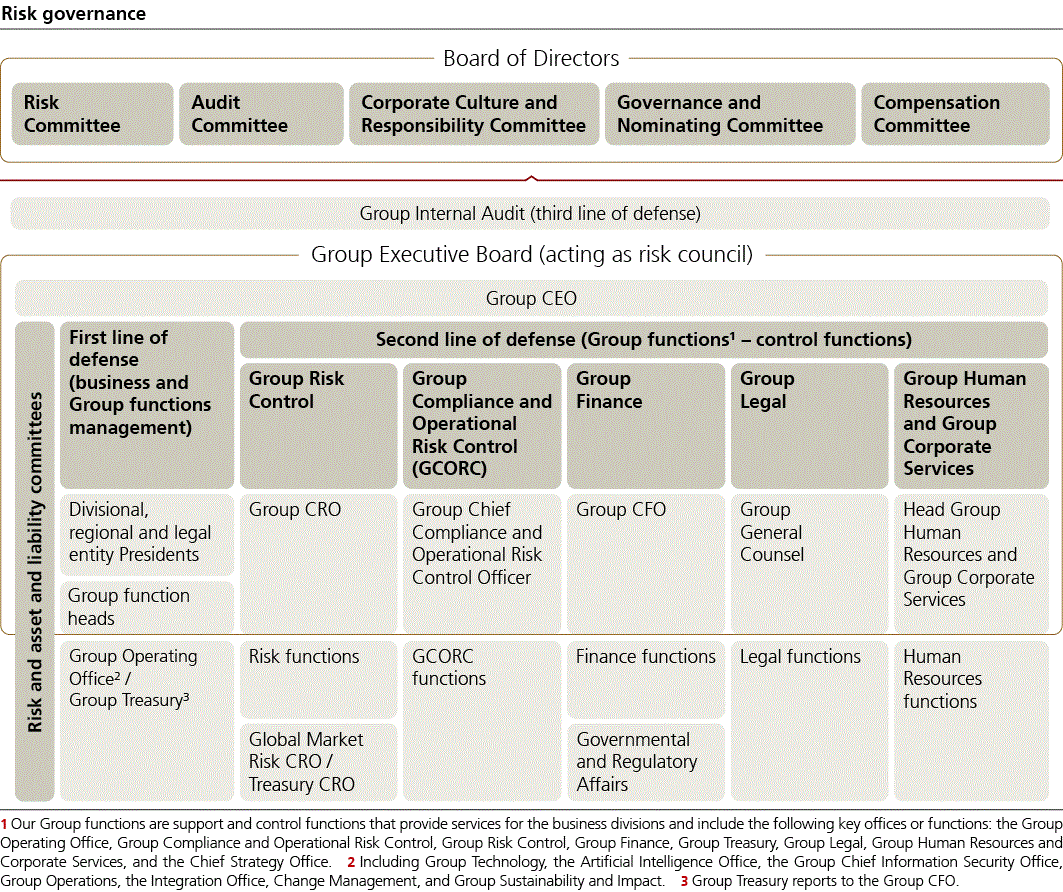
The GEB also acts as the risk council of the Group. It has overall responsibility for establishing and implementing risk
management and control in the Group. It manages the risk profile of the Group as a whole as determined by the BoD
and the RC and manages the Group’s reputation. The GEB determines its requirements for risk reporting, including
improvements and changes to the reports, and receives periodic updates on risk data limitations. For the management
of risks, UBS maintains a risk governance framework. This framework governs risks including those related to
sustainability and climate, its own workforce, consumers and end users, and business conduct.
Our risk governance framework operates along three lines of defense.
Our first line of defense, business and Group functions management, owns its risks and is accountable for maintaining
effective processes and systems to manage them in compliance with applicable laws, rules and regulations, as well as
internal standards, including identifying control weaknesses and inadequate processes.
Our second line of defense, control functions, is separate from the business and reports directly to the Group CEO.
Control functions provide independent oversight, challenge financial and non-financial risks arising from the firm’s
business activities, and establish independent frameworks for risk assessment, measurement, aggregation, control and
reporting, protecting against non-compliance with applicable laws, rules and regulations.
Our third line of defense, Group Internal Audit, reports to the Chairman and to the Audit Committee. This function
assesses the design and operating effectiveness and sustainability of processes to define risk appetite, governance, risk
management, internal controls, remediation activities and processes to comply with legal and regulatory requirements
and internal governance standards.
›
Refer to the “Non-financial risk framework” section of the UBS Group Annual Report 2025, available under “Annual reporting” at
ubs.com/investors
, for information about our approach to managing non-financial risks
Sustainability Report 2025
| Governance 15
The Group Chief Risk Officer is responsible for developing and implementing control principles and an appropriate
independent control framework for sustainability and climate risk within UBS, together with integrating it into the firm’s
overall risk management and risk appetite frameworks. The Head of Sustainability and Climate Risk supports the GEB by
providing leadership on sustainability risk in collaboration with the business divisions and Group functions. Our
sustainability and climate risk policy framework is applied Group-wide to relevant activities, including client and supplier
relationships.
Oversight of objective-setting and monitoring processes
UBS runs an annual objective-setting process for objectives related to sustainability and impact matters, which includes
environmental (including climate-related) and social topics. As delegated to the Group Chief Operating Officer
(since 1 January 2026) by the Group CEO, the Group Chief Operating Officer is responsible for setting the Group-wide
sustainability and impact strategy and developing Group-wide sustainability and impact objectives in alignment with the
business divisions and Group functions. The annual strategy review and objective-setting process is done to identify
priorities and strategic focus areas across the Group. Progress made in implementing Group-wide sustainability and
impact objectives is reported as part of UBS’s annual sustainability disclosures including in this UBS Group Sustainability
Report. Objectives are considered and approved annually by the GEB and the CCRC and progress toward them is tracked
and reported internally on a quarterly basis.
Swiss law requires Swiss companies to achieve net-zero greenhouse emissions in their own operations by 2050. In line
with Swiss law, and as set out in this report, UBS has announced a climate plan to achieve net zero by 2035 across its
own operations (scope 1 and 2), well ahead of the 2050 deadline. This plan is integrated into the firm’s methodologies
and approaches. Adherence is primarily driven by three GEB members: the Group Chief Operating Officer, along with risk
teams led by the Group Chief Risk Officer, and compliance teams under the Group Chief Compliance and Operational
Risk Control Officer and is considered in the annual GEB performance assessments. UBS considers the performance
assessments in determining the performance award decisions. However, there is no direct link between senior
management compensation and specific climate goals.
›
Refer to the “Supplement to Governance” section of the Supplement to this report, available at
ubs.com/sustainability-reporting
,
for additional information about our sustainability governance
Ensuring (the availability of) appropriate skills and expertise
We consider the continuous education of the members of the BoD and the GEB to be an important priority and support
their participation in various training sessions. In addition to an induction program for new BoD members, continuous
training and topical deep dives are part of the agendas of the BoD and the GEB. The BoD and the GEB are well diversified
and composed of members with a broad spectrum of skills, educational backgrounds, experience and expertise from a
range of sectors that reflect the nature and scope of the firm’s business. The Governance and Nominating Committee
maintains a competencies and experience matrix to identify gaps in the competencies and experiences considered most
relevant to the BoD, taking into consideration the firm’s business exposure, risk profile, strategy and geographic reach.
In recent years, the composition of the BoD has been systematically shaped in response to the identified requirements.
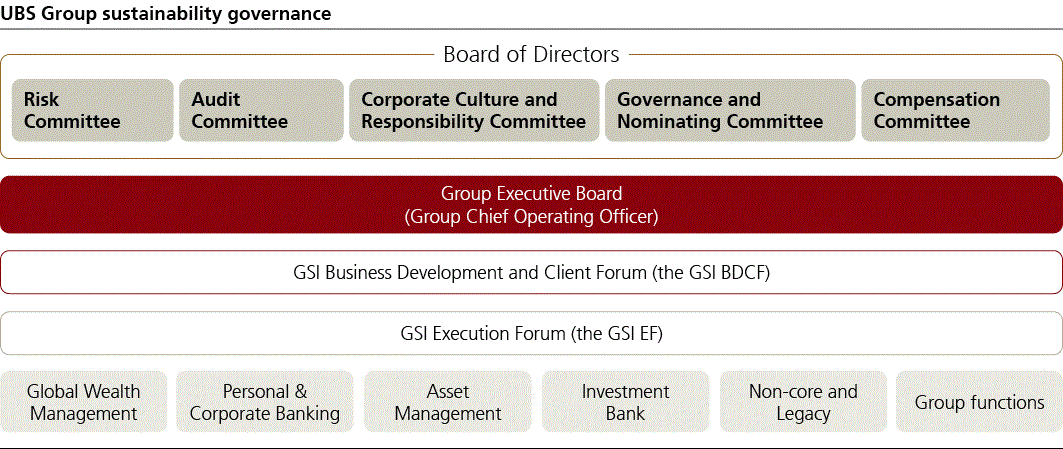
Our sustainability governance
Our sustainability and corporate culture activities are grounded in our Principles and Behaviors and overseen at the highest
level of the organization. Our Code covers our commitment to acting with the long term in mind and creating value for
clients, employees, communities and investors. This includes our commitment to protecting the environment, including
by fulfilling our respective compliance obligations. Among other topics, the sustainability governance of UBS Group
oversees matters related to climate, nature and human rights.
Sustainability Report 2025
| Governance 16
Group Sustainability and Impact
Group Sustainability and Impact develops the Group-wide sustainability and impact strategy and oversees the strategy’s
implementation by the business divisions and Group functions responsible for execution. Group Sustainability and Impact
operates under the leadership of the Group Chief Operating Officer. Each of the Group Sustainability and Impact senior
managers listed below, specifically the Chief Sustainability Officer, the Head of Social Impact and Philanthropy and the
Group Sustainability and Impact Chief Operating Officer, report directly to the Group Chief Operating Officer
(since 1 January 2026). Senior managers may hold more than one role and, where required, may have additional
responsibilities and reporting lines in the Group’s legal entities.
Group Chief Operating Officer
Effective from 1 January 2026, the responsibilities previously held by the GEB Lead for Sustainability and Impact have
been integrated into the broader remit of the Group Chief Operating Officer. The Group Chief Operating Officer now
has overall responsibility for overseeing and managing Group Sustainability and Impact. In particular, the Group Chief
Operating Officer is responsible for the oversight of matters such as maintaining an appropriate and adequate functional
organization designed to ensure compliance with applicable laws and regulations. Additionally, where necessary, the
Group Chief Operating Officer represents UBS in interactions with regulatory authorities on Group-wide sustainability-
and impact-related topics in close coordination with the Group CEO, other GEB members and Governmental and
Regulatory Affairs. In relation to disclosures, the Group Chief Operating Officer is responsible for the annual UBS Group
Sustainability Report and associated disclosures process, jointly with the Group Chief Financial Officer.
GSI Business Development and Client Forum
The GSI Business Development and Client Forum (the GSI BDCF) is the most senior administrative body overseeing the
Group-wide sustainability and impact activities. The forum is focused on client, product and impact approaches in relation
to the overall UBS sustainability and impact implementation activities, together with the business divisions, operating
under the oversight of the Group Chief Operating Officer.
›
Refer to the “Supplement to Governance“ section of the Supplement to this report, available at
ubs.com/sustainability-reporting
,
for additional information about our sustainability governance
Chief Sustainability Officer
The Chief Sustainability Officer, jointly with the Head of Social Impact and Philanthropy, supports the Group Chief
Operating Officer in setting the Group-wide sustainability and impact strategy, in alignment with the business divisions
and Group functions. The Chief Sustainability Officer develops and maintains frameworks and methodologies to drive
Group-wide consistency. In addition, the Chief Sustainability Officer manages the annual UBS sustainability reporting
process jointly with Group Finance.
Head of Social Impact and Philanthropy
The Head of Social Impact and Philanthropy oversees the UBS-governed charitable entities, including UBS Optimus
network of foundations entities and donor-advised fund entities. The remit of the Head of Social Impact and Philanthropy
includes overseeing the strategy, corporate structure and governance, financial matters and relevant risks and controls.
The Head of Social Impact and Philanthropy also manages the social impact and philanthropy client and employee offering
through the provision of philanthropic insights, advice and execution services to existing and prospective clients and
volunteering opportunities to UBS employees.
Group Sustainability and Impact Chief Operating Officer
The Group Sustainability and Impact Chief Operating Officer manages the end-to-end processes and the operating and
control environment of Group Sustainability and Impact, together with the business divisions and Group functions. The
Group Sustainability and Impact Chief Operating Officer ensures effective oversight of operational performance and
timely escalation of relevant matters impacting Group Sustainability and Impact. Furthermore, the Group Sustainability
and Impact Chief Operating Officer supports the Group Chief Operating Officer in developing Group-wide sustainability
and impact objectives, in alignment with the business divisions and Group functions, to implement the Group-wide
sustainability and impact strategy and monitor the progress against these objectives.
GSI Execution Forum
The Group Sustainability and Impact Chief Operating Officer is supported by the GSI Execution Forum. This forum reports
to the GSI BDCF and is responsible for the day-to-day oversight of the front-to-back operating environment and for the
implementation of the Group-wide sustainability and impact strategy through Group-wide strategic objectives and
outcomes.
In addition to the roles outlined above, the following senior managers also hold responsibilities related to Group-wide
sustainability: the Head of Sustainability and Climate Risk, the Sustainability Chief Financial Officer, the Group Head
Compliance & Investigations, the Global Head of Sustainability Regulatory Strategy and the Head of Sustainability and
Impact Legal.
Sustainability Report 2025
| Governance 17
Business conduct and corporate culture
The Code of Conduct and Ethics of UBS
UBS recognizes the value of having a strong and inclusive culture to define how we work together every day. Our culture
is based on our three keys to success: our Pillars, Principles and Behaviors. These keys drive our business decisions and
people management processes. Culture-building behavior is promoted through a number of Group-wide, divisional and
regional initiatives. Examples of Group-wide actions that are promoted through regular communications include (but are
not limited to) our risk culture campaign (including a focus on speaking up and whistleblowing), the Three Keys on Air
series of events (in 2025, this highlighted key aspects of our culture, including developing a winning mindset, lifelong
learning, and artificial intelligence and ethics), and learning and development for employees and line managers (including
mandatory training). We are also continuing our core culture programs, such as Kudos (peer-to-peer recognition) to
support connectivity and collaboration and the One UBS program, formerly known as our Group Franchise Awards, which
rewards cross-divisional business collaboration and recognizes employees for sharing simplification and innovation ideas
across the firm. An important global initiative launched in 2024, and continued in 2025, was “Crafting our future”,
interactive in-person sessions to ensure leaders and line managers were aligned around our strategic priorities and our
culture to effectively contribute to our success.
In the Code of Conduct and Ethics of UBS (the Code), the Board of Directors (the BoD) and the Group Executive Board
(the GEB) set out the principles and practices that define our ethical standards and the way we do business, which apply
to all aspects of our business. The Corporate Culture and Responsibility Committee is responsible for conducting the
annual review of the Code and for proposing amendments to the BoD. This review process includes a prior review of the
Code by the GEB and is led by the Group CEO. In undertaking this assessment, the committee reviews stakeholder
concerns and expectations pertaining to the societal performance of UBS and to the development of UBS’s corporate
culture.
The Code sets out the principles and commitments that define our ethical standards and the way we do business. It
constitutes a commitment to respecting the laws, rules and regulations that are designed to create a level playing field
for all – including competition and antitrust laws and fair access requirements. The Code commits all UBS employees to
do whatever they can to combat money laundering, fraud, corruption and terrorist financing. It also requires that UBS
employees do not help or advise our clients, or any other party, to evade taxes or misreport taxable income and gains.
Furthermore, the Code states that we should not contract with third parties who provide services for UBS or on our
behalf, where those services help others improperly evade taxes.
›
Refer to the Code of Conduct and Ethics of UBS, available at
ubs.com/code
, for more information
Principles for identifying, preventing, escalating and managing conduct risks are established in the Group-wide conduct
risk management framework. These principles are aligned to the Code and the Group-wide Escalation Framework and
include the following.
–
Above all, our culture and our Principles and Behaviors are the strongest mitigants to our exposure to conduct risk.
–
be crystallizing.
–
Identifying actual or potential conduct risks is the responsibility of every UBS employee. Employees must take appropriate
steps to identify and escalate any actual or potential conduct risks they may see in their day-to-day activities and have a
duty to role model UBS’s Behaviors and support its risk culture of ”see something, say something”.
Roles and responsibilities for management and governance of conduct are defined in the Group Policy on Conduct Risk
Management. They include reviewing employee, market and client-related conduct risk information, performing periodic
reviews, and considering employee and client feedback.
Ongoing monitoring covers the activities of both the firm and employees, to detect issues that may have a potential
impact on clients and markets, and to detect individual cases of employee misconduct. Conduct risk reporting and
management information included in the Group Risk Report provides the GEB with actionable insights and visibility on
relevant trends and themes.
We are committed to incentivizing the right behavior by establishing reward principles and internal control frameworks
to support adherence to internal and external standards, laws, rules and regulations.
Breaches of our Code, UBS policies or external laws, rules or regulations may result in disciplinary action, up to and
including dismissal. In addition, employee conduct is considered in year-end performance and reward decisions.
Sustainability Report 2025
| Governance 18
Conduct and culture training
We have a global mandatory training module titled “Conduct and Culture”, which educates all employees on adherence
to the three keys. The training explains how our culture and the Code guide business decisions, clarifies standards and
expectations regarding employee behavior and accountability, and helps employees identify and respond to conduct risks.
Additionally, all employees must annually affirm that they have read and will adhere to the Code and other key policies,
supporting a culture where ethical and responsible behavior is part of our everyday operations. By following and affirming
the Code, we foster a culture where responsible behavior is ingrained in a way that protects our clients, our people and
our reputation and ensures stability and sustainable performance. This safeguards our ability to create lasting value for
our shareholders, clients and societies.
Group-wide Escalation Framework
Significant matters requiring immediate senior management awareness and action are managed in accordance with our
Group-wide Escalation Framework. This lays out: (i) minimum requirements for escalations; (ii) applicable escalation paths
for distinct governance dimensions; and (iii) the interplay between governance dimensions. The framework is
complemented by divisional / regional / legal entity annexes detailing specific escalation requirements outlining
taxonomies, thresholds, processes and protocols. The framework ensures that significant matters are escalated promptly
and appropriately, without replacing day-to-day governance, line management responsibilities (e.g. determining
preliminary severity and appropriate initial reaction), monitoring / reporting or regular risk assessments.
Whistleblowing protection for employees
Employees are encouraged to escalate any potential issues and violations to line managers and control functions.
Alternatively, our Whistleblowing Protection for Employees policy and related procedures enable employees to raise
concerns or to escalate potential breaches of laws, regulations, rules or other legal requirements, policies or professional
standards, sexual harassment or misconduct, or any violation of the Code, without fear of retaliation. Whistleblowing
concerns may be raised confidentially or, if preferred, anonymously, via our dedicated whistleblowing channels, which
are made available Group-wide to all employees. These channels, including the whistleblowing intranet form and hotline,
are available at all times. All concerns raised are taken seriously and reviewed.
All employees are required to complete mandatory “Speaking Up at UBS” training every two years, with new joiners
required to complete it during onboarding. This training aligns with the Whistleblowing Protection for Employees policy,
raising awareness of available reporting channels and providing line managers with guidelines for handling employee
concerns. In addition, we encourage a speak-up culture through Group-wide awareness activities, such as
communications from the GEB, newsletters, whistleblowing campaigns and regular employee surveys. These initiatives
reinforce our commitment to non-retaliation and promote safe reporting options.
For staff receiving whistleblowing reports, there are procedures and guidance on handling such reports to ensure each
whistleblowing concern is taken seriously and reviewed. Whistleblowing reports made through the dedicated
whistleblowing channels (intranet form and hotline) are received and appropriately triaged by the relevant Regional Head
of Investigations and their delegates (selected investigators in their team), who are trained on how to handle such reports.
We also maintain controls and processes to check for potential retaliation against known whistleblowers.
Group Investigations
We maintain an investigations framework and the Group Investigations Policy, defining clear roles and responsibilities at
two levels: (i) cross-functional governance bodies that have responsibilities across the investigations portfolio; and
(ii) those with prescribed roles and responsibilities over specific investigations.
Our Group Investigations function is responsible for conducting and overseeing all investigations, including incidents of
corruption and bribery. The investigations must be conducted and governed in a way that ensures they are independent,
objective and reliable, as defined in our Group Investigations Policy, which governs the conduct of all investigations,
including whistleblowing investigations.
The investigations framework also covers reporting requirements, to ensure accurate and complete quarterly reporting
to the BoD and the GEB, as well as to regulators.
Sustainability Report 2025
| Governance 19
Combating financial crime
The Group Executive Board (the GEB) oversees our efforts to combat money laundering, corruption and terrorist financing.
The first line of defense owns the anti-money-laundering (AML) and terrorist-financing risk front to back for its respective
clients and their activities and has the primary responsibility for managing that risk. Dedicated staff in the second line of
defense support the organization in developing, maintaining and implementing Group financial crime programs,
including control and oversight. The third line of defense is the reinforcement component led by Group Internal Audit
and independently evaluates the financial crime control frameworks.
UBS complies with applicable laws and regulations and is committed to meeting industry standards regarding the effective
prevention of money laundering and financing of terrorism. By taking measures to prevent and detect non-compliance
with laws and regulations, the firm does not tolerate or facilitate criminal activity or breaches of the latter or spirit of
applicable laws, regulations, rules and policies designed to prevent such activities.
UBS does not knowingly engage in business activities that present unacceptable money laundering, fraud, sanctions or
corruption risks. Money laundering, fraud, sanctions, and bribery and corruption risks associated with all of our business
operations are assessed annually against our control framework and as a firm we take action, where appropriate, to
further mitigate these risks through appropriate policies, procedures and controls.
In 2025, all employees of UBS, including its senior management and governance bodies, received adequate training on
financial crime prevention matters, covering AML / know your client (KYC), sanctions, fraud and anti-corruption topics.
All staff are required to complete the Global Financial Crime Prevention refresher module on an annual basis.
Public–private partnerships
UBS is a founding member of the Wolfsberg Group,
1
the financial services sector to prevent financial crimes, such as money laundering, fraud, corruption and terrorist
financing, and to develop industry standards for KYC due diligence and ongoing transaction monitoring.
The Wolfsberg Group brings together banks from around the world at its annual forum and regional outreach meetings
focused on financial crime topics. It also delivers an annual academy to support the development of junior financial crime
prevention officers and works on guidance papers in related key areas of financial crime. UBS is actively involved with
this group.
UBS is a member of various public–private partnerships operating globally that have been set up to foster closer working
relationships between financial institutions and law enforcement.
Prevention and detection of corruption and bribery
The Group Policy Against Bribery and Corruption (ABC) is consistent with the principles of the United Nations Convention
against Corruption.
The ABC policy provides the following definitions of bribery and corruption.
–
indirectly, to or from any person, for that person to act improperly or refrain from acting or to act in breach of
performance of official or fiduciary duties, or in breach of contractual or other obligations in order that UBS may obtain
or retain business, or gain any other improper advantage.
–
public officials) or commercial (involving private parties).
The ABC policy sets out a zero-tolerance approach for bribery and corruption; the Group is committed to detecting and
preventing bribery and corruption and requires employees and associated persons (defined as persons that perform
services for, or on behalf of, a commercial organization) to do business in a fair and transparent manner, in compliance
with the principles of the policy.
Each employee is responsible for:
–
policy and related procedures;
–
–
–
channels defined in the Group’s policy on whistleblowing protection for employees.
Delegated by the Global Head Financial Crime Prevention, the Global Head Anti-Bribery and Corruption, supported by
the specialized teams, is responsible for establishing and maintaining an ABC program that incorporates the principles of
the ABC policy as minimum global standards. The BoD Risk Committee and the GEB oversee the Financial Crime program
(including ABC) through regular reviews and reporting. We have adequate systems and controls in place and hold
ourselves accountable for detecting, stopping and reporting bribery and corruption matters.
1
Sustainability Report 2025
| Governance 20
The ABC framework comprises tone from the top communications, policies, procedures, training, risk assessments,
controls across all key risk areas, investigations and incident management, and monitoring and assurance (including
independent audit). The program aligns with globally recognized standards and legal and regulatory requirements
designed to prevent and mitigate bribery and corruption risks across all jurisdictions in which we operate, e.g. the UK
Bribery Act and the US Foreign Corrupt Practices Act. The GEB and senior management set the policy and risk appetite
and all employees are accountable for complying with the policy. The ABC framework includes controls across all key risk
areas: employees, third parties (vendors and intermediaries), charitable and political donations and sponsorships, hiring,
gifts and business entertainment, joint ventures and acquisitions, and client-related ABC risk. There is regular control
testing to ensure that the framework and controls are appropriately designed and operating effectively.
Where corruption or bribery incidents arise, these are identified through controls monitoring, self-declaration or reporting
(e.g. use of the whistleblower hotline), or ongoing due diligence, risk assessment and approval processes. Incident
response is based on the assessed severity and impact, with senior management involved for more serious incidents.
Incidents that are breaches of UBS policies, including the ABC policy, are dealt with pursuant to the Employee Incidents
Policy and framework and may result in disciplinary action, including dismissal, in serious cases.
Risk assessments are conducted under the ABC program, at a minimum annually, and are designed to ensure that the
framework is appropriately designed and operating effectively to address both current and any emerging ABC risks.
Regular updates on the ABC program’s operating effectiveness and incident management reporting are shared with first-
and second-line management committees. They are also reported to the BoD and the Audit Committee. Reporting
includes provision of qualitative and quantitative risk indicators, which cover both inherent and control risk.
The ABC policy is accessible to all employees through our internal policy repository and relevant ABC intranet page. In
addition, an annual declaration and commitment to this policy is required from all UBS staff that includes a statement of
compliance toward any past or current bribery- or corruption-related incidents.
Additionally, our suppliers must comply with anti-bribery and corruption laws at all times, with expectations outlined
within our suppliers’ policy: the Anti-bribery and Corruption, Sanctions, Fraud and Anti-Facilitation of Tax Evasion Policy.
›
Refer to
ubs.com/suppliers
, for more information
ABC training is mandatory for all UBS Group employees, including the GEB and the BoD, and is rolled out on an annual
basis. All new joiners are required to complete a comprehensive training course within 30 days of starting employment
with the firm and annually thereafter a refresher course is required to be completed by all employees.
Onboarding and ongoing monitoring
UBS performs risk-based initial due diligence on all clients, which is designed to establish their identity and ownership,
the nature of their business activities and the source(s) of their wealth and funds. This includes formal processes for
mitigating the risk of impersonation fraud in circumstances where we are not doing business on a face-to-face basis.
Where the client represents a potentially elevated risk according to the Group Anti Money Laundering and Know Your
Client Policy, enhanced due diligence is performed.
As per the Code of Conduct and Ethics, UBS is committed to respecting the laws, rules and regulations that are designed
to create a level playing field with fair access requirements. We act fairly, respectfully and honestly toward everyone with
whom we deal.
After a client onboarding is completed, ongoing due diligence and name screening are performed during the life cycle
of the client relationship. Clients are assigned a risk rating and client activities and transactions are subject to AML
transaction monitoring in accordance with this risk rating. In addition, ongoing periodic KYC reviews are conducted with
varied frequency, driven by the client risk rating.
The Group Anti Money Laundering and Know Your Client Policy sets out the process and criteria relating to the
identification, senior management sign-off, periodic review and ongoing monitoring of clients deemed to be politically
exposed persons, along with other clients who have links with jurisdictions or industries that pose elevated levels of
financial crime risk.
Red flags must be referred to Financial Crime Prevention if any UBS staff become aware of potentially suspicious activities
during the client life cycle and this may result in internal reviews, suspicious activity report filing and / or client exit, as
appropriate.
UBS adheres to the global Financial Action Task Force standards and local laws and regulations with regard to record-keeping.
The financial crime framework is subject to regular independent controls testing, in both the first and second lines of
defense. The Group Internal Audit team performs a cycle of independent audit reviews covering the financial crime
framework globally and cross-divisionally and we are subject to ongoing supervision by regulatory authorities in all the
markets in which we operate.
Sustainability Report 2025
| Strategy 21
Strategy
Our sustainability and impact strategy
We are guided by our ambition to be a leader in sustainability. This is reflected in our vision to be the bank for the next
generation. To help us realize that vision, our sustainability and impact strategy is based on three overarching strategic
pillars: Protect, Grow and Attract.
Sustainability and impact vision: be the bank for the next generation
Protect
Manage our business in alignment with our
sustainable, long-term Group strategy and
evolving standards.
Grow
Embed an innovative sustainability and impact
offering across all our business divisions.
Attract
Be the bank of choice for clients and employees.
Protect
As part of our continued commitment to protect our clients’ assets and those of our firm, we are focused on managing
our business by aligning with the sustainable long-term Group strategy and evolving standards. We maintain a strong
control and risk framework to support our risk management processes and product offering, as well as complying with
regulatory requirements. In addition, we have a climate transition plan in place to support our clients in the transition to
a low-carbon world and to reduce their exposure to transition risks while also mitigating related risks to UBS.
›
Refer to the “Environment” section of this report for more information about our decarbonization approach and efforts
›
Refer to the “Managing sustainability and climate risks” section of this report for more information about our sustainability and
climate risk management approach
Grow
We are continuing to expand our sustainability and impact product offering across all business divisions to meet our
clients’ evolving needs and to support them through the world’s transition to a low-carbon economy. Innovation in
product development, client reporting and engagement, as well as exploring artificial-intelligence-driven use cases to
streamline processes are key to delivering competitive solutions. To facilitate this, we have a dedicated Group
Sustainability and Impact Business Development & Client Forum, which focuses on client, product and impact approaches.
›
Refer to the “Governance” section of this report for more information about the Group Sustainability and Impact Business
Development & Client Forum and our sustainability governance
›
Refer to the “Supporting opportunities” section of this report for more information about our innovative sustainability and
impact offering
Attract
We aspire to be the bank of choice for clients and employees alike, maintaining top-quartile sustainability ratings and
positioning the firm as a go-to employer through our engagement and education programs. In 2025, our MSCI AA rating
was reaffirmed
1
2
›
Refer to the “Social” section of this report for more information about UBS’s employees and its philanthropic activities
1
.
2
Sustainability Report 2025
| Strategy 22
Our key aspirations and progress
We work with a long-term focus on providing appropriate returns to our stakeholders in a responsible manner.
We are committed to providing transparent aspirations, goals and targets and reporting on the progress made against
them. This table provides an overview, with more detailed information provided throughout this report.
Ambitions
Topics
Our aspirations, goals or targets
Progress
1. Protect
Climate
Lending sector decarbonization targets have been
established to address our financed emissions by aligning
specified sectors to decarbonization pathways.
1
Reduce emissions intensity associated with UBS in-scope
lending by 2030 from 2021 levels for:
–
Swiss residential real estate by 45%;
–
Swiss commercial real estate by 48%;
–
power generation by 60%;
–
iron and steel by 27%; and
–
cement by 24%.
Reduce absolute financed emissions associated with UBS
in-scope lending by 2030 from 2021 levels for:
–
fossil fuels by 70%.
Calculated progress against pathways for lending sector decarbonization
targets
(current period: end of 2024 vs 2021 baseline, prior period: end of
2023 vs 2021 baseline).
2
Changes in emissions intensity associated with UBS in-scope lending:
–
Swiss residential real estate reduced 15% (Prior period: 11%);
–
Swiss commercial real estate reduced 10% (Prior period: 9%);
–
power generation reduced 55% (Prior period: 33%);
–
iron and steel reduced 14% (Prior period: 20%); and
–
cement reduced 4% (Prior period: 3%).
Changes in absolute financed emissions associated with UBS in-scope lending:
–
fossil fuels reduced 83% (Prior period: 80%).
Asset Management provides choice to enable clients to
pursue their climate goals. We commit that all clients’ net-
zero-ambition portfolios align with the Paris Agreement
with interim targets by latest 2035.
3
Asset Management had a combined invested assets value of USD 111.5bn in
net-zero-ambition portfolios (2024: USD 64.4bn).
4
Reduce our scope 1 and 2 emissions to net zero by 2035
(90% reduction of scope 1 and market-based scope 2
emissions by 2035 vs 2023 baseline, neutralizing the
remaining 10% with high-quality carbon removals).
Scope 1 and market-based scope 2 emissions reduced by 48% vs 2023
baseline (2024: reduced by 35% vs 2023 baseline).
Reduce our absolute energy consumption by 35% by 2030
vs 2023 baseline.
Absolute energy consumption reduced by 18.8% vs 2023 baseline (2024:
reduced by 9% vs 2023 baseline).
5
Achieve 100% renewable electricity aligned to RE100 in
markets where feasible by 2026.
6
Achieved 99.7% renewable electricity aligned with RE100 (2024: 99.8%).
Environment
Paper:
–
Reduce office printing per FTE by 25% by 2030 vs 2023
baseline.
–
Achieve 90% of recycled paper used for office printing
by 2030.
–
Office printing per FTE increased by 2% vs 2023 baseline (2024: increased
by 15% vs 2023 baseline).
–
Achieved 18.1% of recycled paper used for office printing (2024: 15.5%).
Waste: Achieve a 60% recycling rate for our office waste
by 2030.
Achieved 54.0% waste recycling rate (2024: 52.9%).
Water: Reduce water consumption by 7% by 2030 vs 2023
baseline.
Water consumption reduced by 12% vs 2023 baseline (2024: increased by
2% vs 2023 baseline).
Sustainability Report 2025
| Strategy 23
Ambitions
Topics
Our aspirations, goals or targets
Progress
2. Grow
Market
opportunities
Embed an innovative sustainability and impact offering
across all our business divisions.
Increased sustainable investing invested assets to USD 405.6bn (2024:
USD 309.6bn).
7
Facilitated 95 green, social, sustainability or sustainability-linked (GSSS) bond
transactions globally against our target of 100 (2024: 96).
8
The total on-balance sheet drawn exposure of sustainable loans granted to
corporate and institutional clients booked on the UBS Switzerland AG
platform amounted to USD 2.4bn as of end 2025 (excluding mortgages)
(2024: USD 2.0bn).
9
Supporting our clients to achieve their sustainable investing
goals: 20% of Asset Management’s fund offering globally
will be sustainable investing products, providing choice for
clients.
As of end 2025, 23.4% of Asset Management’s fund offering consisted of
sustainable investing products (2024: 23.4%).
10
Social impact
and
philanthropy
Raise USD 1bn in donations to our client philanthropy
foundations and funds (cumulative for 2021–2025).
Achieved a UBS Optimus network of foundations donation volume of
USD 472m in 2025 (2024: USD 366m), totaling USD 1.6bn since 2021, thus
surpassing our goal (all figures include UBS matching contributions).
Reach 26.5 million beneficiaries by 2025 (cumulative for
2021– 2025).
Reached 9.3 million beneficiaries in 2025 (2024: 7.1 million) and 33.5 million
beneficiaries through UBS Optimus network of foundations activities since
2021.
11,12
3. Attract
Bank of choice
Maintain top quartile position in key environment, social and
governance (ESG) ratings by the end of 2026.
Achieved top quartile position vs direct peers as defined in UBS compensation
report in ESG ratings including but not limited to:
–
MSCI: AA rating, “Leader” in industry group;
–
S&P Global Corporate Sustainability Assessment: score of 71. Constituent
of the Dow Jones Best-in-Class indices.
Cautionary note:
We have developed methodologies that we use to set our climate-related targets and identify climate-related risks and that underly the metrics that are disclosed in this report. Standard -setting
organizations and regulators continue to provide new or revised guidance and standards, as well as new or enhanced regulatory requirements for climate disclosures. Our disclosed metrics are based upon data
available to us, including estimates and approximations where actual or specific data is not available. We intend to update our disclosures to comply with new guidance and regulatory requirements as they become
applicable to UBS. Such updates may result in revisions to our disclosed metrics, our methodologies and related disclosures, which may be substantial, as well as changes to the metrics we disclose.
1
frameworks and data, and the materiality of the relevant activity to UBS. We will continue to publicly disclose our progress on an annual basis and, while we continue to take steps to align our in-scope business
activities with the ambitions set out above, it is important to note that progress toward our targets may not be linear. We regularly review our targets and update our disclosures in line with new or enhanced regulatory
developments, evolving best practices for the financial sector and climate science. Such reviews may lead us to revise previously agreed voluntary commitments, metrics and methodologies. Refer to the “Basis of
preparation 2025” section of the Supplement to the UBS Group Sustainability Report 2025, available at ubs.com/sustainability-reporting, for more information about progress calculations, exclusions and parts of the
value chain within sectors covered by metrics and targets.
2
Refer to the “Environment” section of this report for further information. Our corporate emissions reporting process involves two distinct one-year time
lags. Firstly, emissions for a given year are published the following year (e.g. 2024 emissions are reported in 2025), reflecting the time required to collect, validate and assure the completeness and accuracy of the
underlying data prior to disclosure. Secondly, due to the timing of corporate emissions disclosures and third-party data processing, our year-end 2024 lending exposures are mapped to 2023 emissions data – the most
recent available – since companies typically release emissions figures several months after year-end and data providers require additional time to aggregate and verify this information. As a result, reported 2024
financed emissions are based on 2024 exposures and 2023 emissions data. For Swiss residential and commercial real estate, this lag does not apply, as exposure and emissions data align to the same reporting year
(2024).
3
4
The scope of assets with net-zero ambition for 2025 is Asset
Management. For 2024, Credit Suisse portfolios were in the process of being assessed in the context of Asset Management’s net-zero alignment framework and were therefore excluded from this metrics reporting.
5
6
Bahamas and Qatar, where such systems are not yet available.
7
sustainable investing invested assets contain invested assets of Credit Suisse portfolios that have been migrated onto UBS platforms and vetted against UBS’s sustainable investing policies or merged with existing UBS
SI portfolios. This process is being carried out in waves and will continue in some parts of the firm until the end of 2026. The 2024 figure has been revised. Refer to the “Supporting Opportunities” section of this report
for more information.
8
report, available at ubs.com/sustainability-reporting.
9
and climate risks” section of the Supplement to this report, available at ubs.com/sustainability-reporting. The following instruments are in scope of this metric: sustainability-linked loans (SLL), green, social or
sustainability loans (use-of-proceeds loans).
10
Asset Management single investor and feeder funds are excluded. Products formerly managed by Credit Suisse Asset Management that were categorized in accordance with the legacy Credit Suisse Sustainable
Investment Framework (the Credit Suisse SIF) have been within the scope of the total number of funds since 2024. Of these products, only those assessed against the UBS Group Sustainable Investing Policy and
classified as a sustainable investing product are within the scope of Asset Management sustainable investing funds.
11
individual was enrolled in a program in the previous year, they are still counted in the following year as they are considered to have received different levels of support over the period.
12
from 2021 to 2024 additionally included beneficiaries reached through UBS Social Impact activities. Comparative figures have been revised to reflect beneficiaries reached solely through UBS Optimus network of
foundations activities.
Sustainability Report 2025
| Environment 24
Environment
Our climate transition plan
In 2025, we further developed our climate transition plan and advanced its implementation. This plan underpins our
ambition to support our clients in the transition to a low-carbon world and embeds considerations of climate-related risks
and opportunities across our governance, strategy and operations to ensure their integration throughout the firm.
Our transition plan is structured around the key pillars outlined below. An overview of our transition plan, including a
detailed mapping of all relevant content with corresponding references, is provided in the “Environment” section of the
Supplement to this report, available at
ubs.com/sustainability-reporting
.
Targets and actions
By 2050, the global economy aims to transition to net zero. As part of that, across our own operations (scopes 1 and 2),
UBS plans to achieve net zero by 2035, well ahead of 2050.
We have defined the following targets:
Scopes 1 and 2:
Scope 3:
Addressing our financed emissions by aligning specified sectors to decarbonization pathways (lending sector
decarbonization targets).
›
Refer to “Reducing our own environmental impact” in this section for details about our scope 1 and 2 net-zero target
›
Refer to “Supporting our financing clients’ low-carbon transition” in this section for details about our lending sector
decarbonization targets
These targets are based on the methodologies, data and assumptions described in this report and are aligned with a
1.5°C scenario, except for our lending sector decarbonization targets for Swiss residential and commercial real estate,
which follow a below 2°C pathway.
1
review and update our targets to reflect evolving regulations, best practices and climate science. Adjustments may be
made to voluntary commitments and underlying metrics and methodologies.
Underpinning our targets, we pursue specific objectives and implement actions across our business:
Supporting our clients’ low-carbon transition
In 2025, we continued to work toward our objectives of supporting the transition of our financing and investing clients
to low-carbon and climate-resilient business models and mobilizing private and institutional capital to facilitate an orderly
transition.
Financing:
measurable reductions in financed absolute emissions and emission intensity across key sectors through client
engagement, sustainable and transition finance solutions, and portfolio management.
Investing:
support clients with education and portfolio transparency, reflecting the responsibilities associated with our investment
mandates agreed with clients and evolving climate ambitions.
›
Refer to “Supporting our clients’ low-carbon transition” in this section for more details
Reducing our own environmental impact
We continued to work toward our objectives of minimizing our operational footprint and promoting efficient, sustainable
resource use. We made significant progress toward our scope 1 and 2 net-zero target, which is supported by our energy
reduction and renewable electricity targets. We reduced our scope 1 and market-based scope 2 emissions from 30,287
2
metric tons of CO
2
e reported in 2024 to 24,151 metric tons of CO
2
e reported in 2025, resulting in a 48% reduction
against our 2023 baseline. Our energy consumption fell by 18.8% against the 2023 baseline, totaling 613 GWh,
compared with 684
GWh
2
with 99.8% in 2024.
›
Refer to “Reducing our own environmental impact” in this section for more details
1
a minimum rate to be followed. This scenario is a representative, country-specific pathway, reflective of the government’s climate strategy. It also informs Switzerland’s decarbonization ambitions for real estate as set
out in the Swiss Climate and Innovation Act.
2
market-based greenhouse gas emissions (scope 2) increased from 30,274 t CO
2
e to 30,287 t CO
2
e and energy consumption in GWh increased from 679 GWh to 684 GWh.
Sustainability Report 2025
| Environment 25
Managing the environmental impact of our supply chain
In 2025, we continued to manage the environmental impact of our supply chain and work toward responsible supply
chain practices. Our activities included tracking supply chain vendor-related scope 3 emissions
1
scope 1 and 2 emissions reporting of our vendors. In 2025, vendor-related emissions increased by 3%, reaching 0.84
million
metric
tons
of
CO
2
e, compared with 0.81 million
metric
tons of
CO
2
e in 2024. In addition, 88% of our GHG key
vendors
2
›
Refer to “Managing the environmental impact of our supply chain” in this section for more details
Managing the risks of climate change to our business
In 2025, we continued to manage climate-related risks by identifying, measuring, monitoring, managing and reporting
these risks, while further integrating regulatory requirements into our financial risk management and stress-testing
frameworks. Our firm-wide sustainability and climate risk policy framework is underpinned by proprietary methodologies
for transition and physical risk assessment, scenario analysis and stress testing. In 2025, we enhanced these tools and
embedded sustainability and climate risk considerations into our various financial and non-financial risk management
frameworks.
›
Refer to the “Managing sustainability and climate risks” section of this report for more details
Integration into strategy and financial planning
Our climate transition plan is aligned with our Group sustainability and impact strategy, which is based on three
overarching pillars: protect, grow and attract. In relation to our climate transition plan, our strategic ambition manifests
as follows.
–
Protect
our business by managing climate risks and supporting our clients’ low-carbon transition to protect their
assets.
–
Grow
–
Attract
and be the bank of choice for clients and employees by being recognized as a leader in climate and leading
by example in our own operations.
UBS runs an annual strategy review and objective-setting process related to sustainability and impact matters, including
climate-related topics, to identify priorities and strategic focus areas across the Group. The agreed objectives are
subsequently integrated into our standard multi-year financial planning process.
By embedding climate-related insights into our business strategy and financial planning process, and regularly assessing
climate-related risks and opportunities, we also aim to continuously enhance our resilience to climate change.
Environmental and sustainability objectives continue to be an integral part of our compensation determination process.
We have explicit sustainability-related objectives in the non-financial goal category of the Group CEO and Group Executive
Board (the GEB) scorecards. This structure, with two out of five non-financial categories covering ESG-related objectives,
underscores the importance and impact of sustainability on GEB compensation.
›
Refer to the “Strategy” section of this report for more information about our Group sustainability and impact strategy
›
Refer to the “Governance” section of this report for more information about our strategy review and objective-setting process
›
Refer to the “Managing sustainability and climate risks” section of this report for more information about our analysis of the
resilience of our strategy and business model to climate change and how we integrate climate-related impacts in our financial
planning
›
Refer to the UBS Compensation Report 2025, available at
ubs.com/annualreporting
, for more information about our
compensation process
Governance and oversight
Our climate transition plan has been approved and is supervised by the BoD’s Corporate Culture and Responsibility
Committee (the CCRC). The CCRC oversees our Group sustainability and impact strategy and annually approves the
firm’s sustainability and impact objectives.
Group Sustainability and Impact developed and continues to enhance UBS’s climate transition plan, overseeing its
implementation by the business divisions and Group functions through the underlying objectives of the plan. Group Real
Estate and Supply Chain is responsible for steering our in-house environmental management program, covering climate-
related activities within our own operations and supply chain.
›
Refer to the “Governance” section of this report for more information about our sustainability and climate governance
›
Refer to “Reducing our own environmental impact” in this section for more information about our in-house environmental
management program and associated governance
1
Supply chain vendor-related scope 3 emissions refer to scope 3, categories 1, 2, 4 and 9, excluding water -consumption-related emissions.
2
Vendors with the largest emissions that collectively account for more than 50% of our calculated supply chain-related scope 3 emissions are classified as “GHG key vendors”.
Sustainability Report 2025
| Environment 26
Dependencies and external enablers
Currently, our climate transition plan does not cover all our business activities. Over time, we may expand our ambitions
to include additional scope 3 activities, subject to the availability of appropriate measurement frameworks, reliable data
and materiality to UBS. It is important to note that progress toward our climate ambitions and targets may not be linear
and depends not only on our internal actions but also on broader systemic developments across sectors and geographies.
Key external enablers include cross-sector collaboration between private and public stakeholders, clear guidance from
governments through thoughtful regulations, policies and incentives, the development and scaling of low-carbon
technologies, and shifts in consumer behavior and market dynamics.
Supporting our clients in their low-carbon transition across our financing and investing activities remains a strategic
priority for us. In the area of client investments, our ability to meet climate-related ambitions is shaped by various factors,
including, where applicable, our fiduciary responsibilities and the terms of client mandates. We continue to embed
sustainability and climate considerations into our operating model, which involves ongoing refinement of our evaluation
and decision-making frameworks, governance structures, control processes and underlying systems.
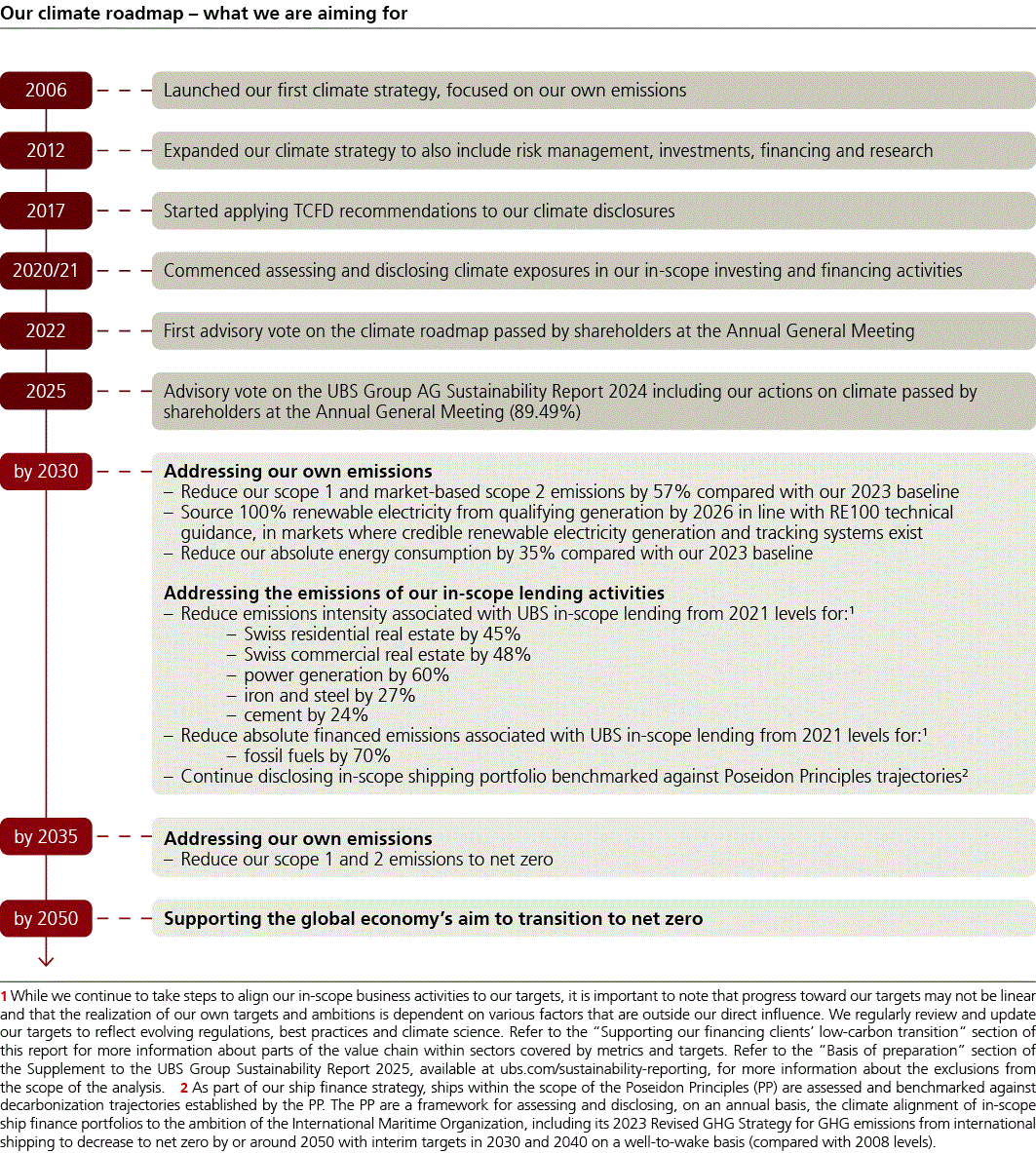
Sustainability Report 2025
| Environment 27
›
Refer to the “Poseidon Principles Annual Disclosure Report 2025”, available at
poseidonprinciples.org/finance/#report
, for more
information about the Poseidon Principles framework and UBS-related disclosures
Sustainability Report 2025
| Environment 28
Supporting our clients’ low-carbon transition
Supporting our clients in their low-carbon transition remains a strategic priority for us. To this end, we have defined
climate-related targets and actions across our financing and investing activities, which are outlined below.
In 2025, we enhanced our approach to transition finance. Beyond increasing investment in activities with sustainability-
related objectives, we recognize that the transition also requires increased support for companies in carbon-intensive
sectors in executing their transition.
To ensure consistency and integrity in our approach, we reviewed the latest international standards, regulations and
guidance
1
on financing and investing in the transition, and took the following actions:
–
defined transition finance –
2
transition”,
3
4
–
developed criteria for assessing the credibility of transition plans –
transition finance definition to support, where relevant, the assessment of transactions in scope of our sustainability
and climate risk policy framework; and
–
enhanced transparency –
with our definition and supported by international standards, internal sustainability scoring, fund due diligence and
others.
Supporting our financing clients’ low-carbon transition
Our lending sector decarbonization targets
We remain committed to our 2030 lending sector decarbonization targets. This section outlines the methodological
choices underlying our target-setting process and the calculation of our climate-related lending metrics.
Our approach to target-setting is aligned with industry guidance and best practices, and our financed emissions
calculations follow globally recognized standards, including the Greenhouse Gas (GHG) Protocol Corporate Accounting
and Reporting Standard
5
6
As part of our assurance activities in 2024, we engaged Ernst & Young Ltd, Basel to perform agreed-upon procedures on
our lending sector decarbonization targets to assist us in determining whether these have been set in line with reference
scenarios mentioned and informed by certain requirements taken from pertinent global standards and initiatives. These
agreed-upon procedures remain relevant for 2025.
›
Refer to the “Lending sector decarbonization targets agreed-upon procedures ”, available at
ubs.com/sustainability-reporting
, for
more information
Financed emissions calculations (1)
Lending activities fall under scope 3, category 15 (financed emissions), as defined in the GHG Protocol Corporate
Accounting and Reporting Standard.
Our financed emissions calculations include the seven gases mandated under the Kyoto Protocol, reported as CO₂e,
except for iron and steel and cement physical intensities, which are reported as CO₂.
7
We include apportioned scope 1 and 2 emissions of financed counterparties or assets. In addition, scope 3 emissions of
financed counterparties are included for the fossil fuels (coal, oil and gas), automotive and agriculture sectors. This year’s
reporting newly includes financed emissions associated with the agriculture sector;
8
updated accordingly, and comparative values are included. For financed counterparties in other sectors, scope 3 emissions
are excluded due to data quality limitations.
Emissions estimates rely on client disclosures, third-party sources and internal data. Where company- or asset-level
emissions data is unavailable, we use estimates in our calculations, following the PCAF hierarchy.
1
and of the Council, the IIGCC’s Net Zero Investment Framework 2.0, the UK government’s Transition Finance Market Review (independent review commissioned by HMT and DESNZ) and the ICMA’s Climate Transition
Finance Handbook. These sources were used as reference points and not applied prescriptively.
2
The use of the term “transition”, particularly when used in product naming, marketing or promotion, may be subject to additional regulatory requirements depending on the relevant jurisdiction.
3
4
5
6
First Edition.
7
Guidelines (Vol. 3, IPPU) provide default emission factors with detailed CO₂ quantification for iron and steel and cement process and fuel-related emissions, while non-CO₂ gases are comparatively minor and receive
less emphasis in sector guidance. Refer to IPCC 2006 Guidelines (Vol. 3, IPPU), available at ipcc-nggip.iges.or.jp/public/2006gl/vol3.html for more information. Likewise, the Cement CO₂ and Energy Protocol (WBCSD/CSI)
prioritizes CO₂ reporting for the cement industry and treats non-CO₂ gases as supplemental, to be reported using dedicated tools only where material. This approach aligns with IPCC AR6 sector reporting conventions,
which frame cement process emissions primarily in CO₂ terms. Refer to the document titled “The Cement CO
2
docs.wbcsd.org/2011/05/CSI-CO2-Protocol.pdf
, for more information.
8
Sustainability Report 2025
| Environment 29
Our corporate emissions reporting process involves two distinct one-year time lags. First, emissions for a given year are
published the following year (e.g. 2024 emissions are reported in 2025), reflecting the time required to collect, validate
and assure the completeness and accuracy of the underlying data prior to disclosure. Second, due to the timing of
corporate emissions disclosures and third-party data processing, our year-end 2024 lending exposures are mapped to
2023 emissions data – the most recent available – since companies typically release emissions figures several months after
year-end and data providers require additional time to aggregate and verify this information. As a result, reported 2024
financed emissions are based on 2024 exposures and 2023 emissions data. For Swiss residential and commercial real
estate, this lag does not apply, as exposure and emissions data align to the same reporting year (2024).
Scope of targets and baseline year (2)
Our lending sector decarbonization targets cover Swiss real estate mortgages (residential and commercial real estate) and
financing of in-scope activities in the fossil fuels (coal, oil and gas), power generation, iron and steel and cement corporate
sectors.
For real estate, we include loans secured by owner-occupied properties, properties rented out on a non-commercial scale,
rented-out properties in multi-family homes, any other income-producing real estate and own-use commercial real estate.
For corporate sectors, we focus on borrowers in sub-sectors or parts of the value chain with the greatest climate impact.
We conduct an annual assessment of all key sectors – both those with established targets and those without – to prioritize
sectors and confirm the scope of our target setting activities. This assessment is guided by a robust internal methodology
that incorporates quantitative and qualitative indicators, including financed emissions and financial exposure materiality,
the availability of relevant data and methodologies, market expectations and alignment with our business strategy.
The sectors for which decarbonization targets have been set represent USD 303.2bn, or 43% of the USD 701.8bn in
total gross lending exposure for 2024 and 70% of the USD 430.9bn in gross lending exposure for which data and
methodologies are available to estimate emissions.
1
improve.
In-scope emissions for our targets are fully aligned with the inventory boundaries used in our financed emissions reporting
for the sectors covered by those targets. Our target sectors account for 67% of total financed emissions (6.9 million
metric tons out of 10.4 million metric tons) for which data and methodologies are available to estimate emissions. All
targets are stated on a gross basis and therefore exclude greenhouse gas removals, carbon credits and avoided emissions.
2021 was selected as the baseline year for our targets set in 2023, in line with industry guidance and best practices. It
was chosen due to being both recent and relevant, with high-quality data available to support robust target-setting.
Scenario selection (3)
For real estate, our targets are using the percentage decarbonization rate implied by the Energy Perspectives 2050+ ZERO
Basis scenario (below 2°C scenario) as a minimum rate to be followed. This scenario is a representative, science-based,
country-specific pathway that reflects the government’s climate strategy and guides Switzerland’s decarbonization
ambitions for real estate as set out in the Swiss Climate and Innovation Act. We have chosen this pathway instead of a
1.5°C-aligned scenario because the entire exposure covered by this target is located in Switzerland. Aligning with the
Swiss pathway ensures our targets are consistent with national policy objectives and regulatory requirements, providing
a realistic and locally relevant benchmark for decarbonization in this sector.
For corporate sectors, we use the percentage decarbonization rate implied by the International Energy Agency (the IEA)
Net Zero Emission (NZE) by 2050 (the IEA’s World Energy Outlook of October 2023 update) scenario
2
to be followed. This scenario is one of the most recent, science-based and widely accepted models that achieves a
temperature increase of no more than 1.5°C by end of the century.
Sector pathways may be updated as we gain greater clarity on the validity of key technological and regulatory
uncertainties identified and assumed within the IEA NZE scenario (e.g. production volumes, biofuels or carbon-capture
utilization and storage). Until that point, the possibility of overshoot is factored into certain sector pathways due to the
heavy reliance on external factors outside our direct influence.
Target-setting approach (4)
Targets are based on the full-lending commitment made to our clients. This includes outstanding loans, along with
undrawn irrevocable commitments and guarantees, i.e. amounts we are required to provide upon request by a
counterparty. In contrast, our calculation of total financed emissions for non-financial corporates and real estate
mortgages is based solely on outstanding lending exposure, in accordance with PCAF guidance.
3
For fossil fuels, we set an absolute emissions reduction target using the Absolute Contraction Approach.
4
sectors, we use physical emissions intensity targets, applying the Sector Decarbonization Approach (SDA), which assumes
global convergence of sector emissions intensities by 2050.
5
1
on consolidated IFRS numbers (inclusive of purchase price allocation adjustments recorded in the UBS Group as a result of the acquisition of the Credit Suisse Group in compliance with IFRS 3, Business Combinations).
2
reduction).
3
4
The Absolute Contraction Approach requires all companies to reduce emissions by the same absolute percentage, regardless of sector or growth trajectory.
5
The SDA allocates emission reductions based on sector-specific decarbonization pathways aligned with technology and activity levels.
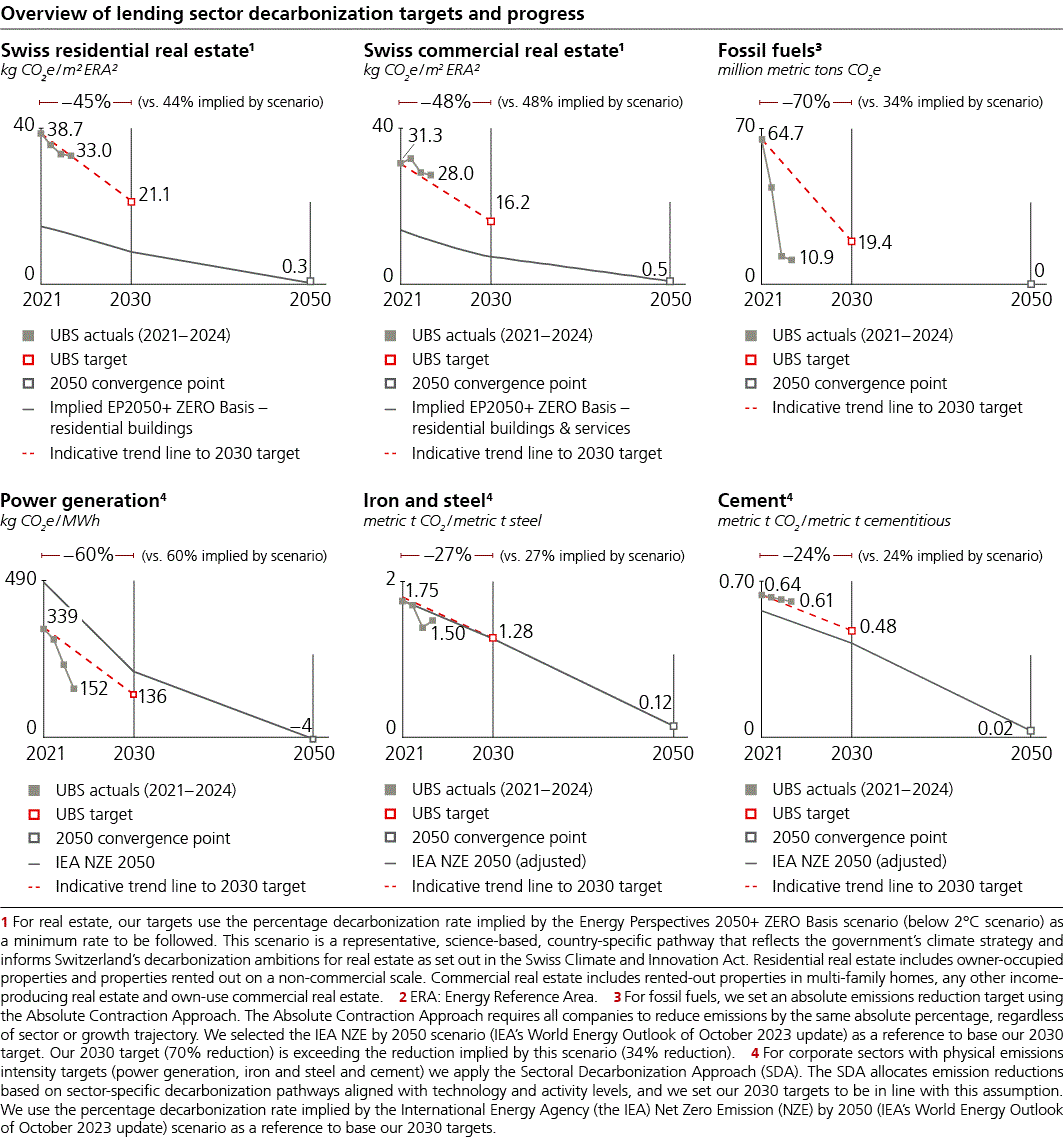
Sustainability Report 2025
| Environment 30
Physical emissions intensity is preferred for most sectors as it normalizes emissions by output enabling fairer comparison
between corporate clients of different sizes and supporting assessment of their emissions regardless of their growth.
Setting absolute emissions targets could limit our ability to lend to clients, including those with lower carbon intensity,
potentially restricting support for their transition. For transparency, we disclose total absolute financed emissions for the
sectors covered by trajectories.
Governance and disclosure (5)
Targets are set at the UBS Group level, approved and overseen by the BoD’s Corporate Culture and Responsibility
Committee (the CCRC), and managed by business divisions in collaboration with Group Sustainability and Impact and
Group functions under the Group Chief Operating Officer.
Progress is disclosed annually, targets are reviewed at least every five years, and from 2030 onward base years and target
values will be updated every five years to reflect the latest climate science and best practices. Progress may not be linear
and year-on-year volatility is expected due to portfolio changes.
›
Refer to “Basis of preparation” in the "Other supplemental information" section of the Supplement to this report, available at
ubs.com/sustainability-reporting
, for more information about our climate-related lending metrics
Sustainability Report 2025
| Environment 31
Parameters and definitions for our 2030 lending sector decarbonization targets (UBS Group)
Sectors
Targets scope
GHG emission
scope
Scenario
Type of target
Residential real estate
1
Region Switzerland only
1,2
2
Energy Perspectives 2050+ ZERO basis for residential buildings (below 2°C)
Intensity
Commercial real estate
1
Region Switzerland only
1,2
2
Energy Perspectives 2050+ ZERO basis for residential buildings & services (below 2°C)
Intensity
Fossil fuels (coal, oil and gas)
B.05, B.06, C.19
3
1,2,3
IEA NZE 2050 - WEO 2023 (1.5°C)
4
Absolute
Power generation
D.35.1.1, D.35.1.3
3
1
IEA NZE 2050 - WEO 2023 (1.5°C)
Intensity
Iron and steel
C.24.1
3
1,2
IEA NZE 2050 - WEO 2023 adjusted for scope 2 (1.5°C)
Intensity
Cement
C.23.5.1
3
1,2
IEA NZE 2050 - WEO 2023 adjusted for scope 2 (1.5°C)
Intensity
1
Residential real estate includes owner occupied properties and properties rented out on a non-commercial scale. Commercial real estate includes rented-out properties in multi-family homes, any other income-
producing real estate and own-use commercial real estate.
2
Residential real estate emissions scope covers owners' energy consumption only. Commercial real estate emissions scope covers owners' or tenants'
energy consumption only.
3
For corporate sectors, NACE codes are referenced. The following parts of the value chain are included in the targets scope: fossil fuels: coal extraction, oil and gas upstream, refining and
integrated companies; power generation: power generation and integrated electric utility companies; iron and steel: production of iron and steel, hot rolling and coking coal manufacturing; cement: production of
cement and clinker. The scope includes corporate borrowers where more than 25% of their revenues are derived from in-scope activities (except for coal, which is 5%). Revenue percentages are evaluated only at the
pre-deal assessment stage. The materiality assessment may also include counterparties whose production represents a significant share of global output.
4
IEA NZE by 2050 as a reference to base our 2030 target. Our 2030 target (70% reduction) is exceeding the percentage reduction implied by this scenario (34% reduction).
Progress reporting for our 2030 lending sector decarbonization targets (UBS Group)
For the year ended 31.12.24
Gross lending exposure
Progress
5
Targets
2024
2023
2024
2023
2021
2021–24
2030
2021–30
Sectors
Full value
chain
(USD bn)
1
Covered
by targets
(USD bn)
1
Full value
chain
(USD bn)
1
Covered
by targets
(USD bn)
1
Unit
Actuals
Actuals
Baseline
% change
vs
baseline
Value
% change
vs
baseline
Residential real estate
3
336.7
213.3
384.7
242.4
kg CO
2
e / m
2
2
33.0
34.4
38.7
(15%)
21.1
(45%)
Commercial real estate
3
84.1
102.1
kg CO
2
e / m
2
2
28.0
28.5
31.3
(10%)
16.2
(48%)
Fossil fuels (coal, oil and gas)
4
9.4
2.3
10.6
2.8
million metric t CO
2
e
10.9
12.9
64.7
(83%)
19.4
(70%)
Power generation
3.3
2.6
5.0
3.9
kg CO
2
e / MWh
152
227
339
(55%)
136
(60%)
Iron and steel
0.5
0.3
0.7
0.5
metric t CO
2
1.50
1.41
1.75
(14%)
1.28
(27%)
Cement
0.7
0.6
1.1
1.0
metric t CO
2
0.61
0.62
0.64
(4%)
0.48
(24%)
1
Full value chain includes all activities within each sector. Refer to the "Parameters and definitions for our 2030 lending sector decarbonization targets (UBS Group)” table above for details on sector coverage.
Exposures are shown on a gross basis; gross lending exposure includes total on-balance sheet loans and advances to customers and off-balance sheet guarantees and irrevocable loan commitments (within the scope
of expected credit loss) and is based on consolidated IFRS numbers (inclusive of purchase price allocation adjustments recorded in the UBS Group as a result of the acquisition of the Credit Suisse Group in compliance
with IFRS 3, Business Combinations). Refer to the Basis of preparation 2025 document, available at ubs.com/sustainability-reporting, for more information about exclusions and parts of the value chain within sectors
covered by metrics and targets.
2
3
4
gross lending exposure not covered by this target is commodity trade financing for which guidelines and methodologies have yet to be developed.
5
ubs.com/sustainability-reporting, for more information about progress calculations.
Financed emissions reporting – 2024 (UBS Group)
For the year ended 31.12.24
Gross lending
exposure
(USD bn)
1
Outstanding
exposure
(USD bn)
1
Financed
emissions,
scopes 1 and 2
(million metric
t CO
2
e)
2
Financed
emissions,
scope 3
(million metric
t CO
2
e)
2
PCAF score,
scopes 1 and
2
3
PCAF score,
scope 3
3
Economic
intensity
(million metric
t CO
2
e /
USD bn)
2
Exposure to non-financial corporates and real estate mortgages
covered by targets
Swiss residential real estate
4
213.3
212.1
1.1
4.1
0.01
Swiss commercial real estate
4
84.1
83.7
0.6
4.1
0.01
Fossil fuels (coal, oil and gas)
2.3
0.9
0.2
3.9
2.1
2.0
4.80
Power generation
2.6
0.7
0.7
2.1
1.04
Iron and steel
0.3
0.1
0.2
1.6
1.65
Cement
0.6
0.0
0.1
2.8
2.10
Exposure to non-financial corporates and real estate mortgages not
covered by targets
127.7
74.4
2.1
1.4
5
4.7
2.5
0.05
Total non-financial corporates and real estate mortgages
430.9
371.9
5.1
5.3
Financial services firms, private individuals and other
270.9
210.0
Total exposure
701.8
581.9
1
Gross lending exposure includes total on-balance sheet loans and advances to customers and off-balance sheet guarantees and irrevocable loan commitments. Outstanding exposure includes total on-balance sheet
loans and advances to customers. Both gross and outstanding exposures are within the scope of expected credit loss and are based on consolidated IFRS numbers (inclusive of purchase price allocation adjustments
recorded in the UBS Group as a result of the acquisition of the Credit Suisse Group in compliance with IFRS 3, Business Combinations).
2
reporting, for more information about financed emissions calculations.
3
used to calculate financed emissions of corporate loans and real estate mortgages. It is calculated in accordance with PCAF reporting guidance: PCAF (2022). The Global GHG Accounting and Reporting Standard Part
A: Financed Emissions. Second Edition.
4
Residential real estate includes owner-occupied properties and properties rented out on a non-commercial scale. Commercial real estate includes rented-out properties in
multi-family homes, any other income-producing real estate and own-use commercial real estate. The reported figures reflect the exposure linked to loans that are secured by real estate collateral.
5
for “Other non-financial corporates and real estate mortgages” are only reported for the agriculture and automotive sectors.
Sustainability Report 2025
| Environment 32
Financed emissions reporting – 2023 (UBS Group)
For the year ended 31.12.23
Gross lending
exposure
(USD bn)
1
Outstanding
exposure
(USD bn)
1
Financed
emissions,
scopes 1 and 2
(million metric
t CO
2
e)
2
Financed
emissions,
scope 3
(million metric
t CO
2
e)
2
PCAF score,
scopes 1 and
2
3
PCAF score,
scope 3
3
Economic
intensity
(million metric
t CO
2
e /
USD bn)
2
Exposure to non-financial corporates and real estate mortgages
covered by targets
Swiss residential real estate
4
242.4
240.6
1.2
4.1
0.01
Swiss commercial real estate
4
102.1
101.4
0.8
4.1
0.01
Fossil fuels (coal, oil and gas)
2.8
0.8
0.2
3.3
2.0
8
2.2
8
4.60
Power generation
3.9
0.9
1.1
2.3
8
1.15
Iron and steel
0.5
0.2
0.2
2.3
8
0.90
Cement
1.0
0.1
0.4
4.3
8
3.74
Exposure to non-financial corporates and real estate mortgages not
covered by targets
141.4
81.0
2.5
2.0
5
4.7
7
2.5
9
0.06
10
Total non-financial corporates and real estate mortgages
494.1
425.0
6.4
5.3
6
Financial services firms, private individuals and other
285.3
216.5
Total exposure
779.4
641.5
1
Gross lending exposure includes total on-balance sheet loans and advances to customers and off-balance sheet guarantees and irrevocable loan commitments. Outstanding exposure includes total on-balance sheet
loans and advances to customers. Both gross and outstanding exposures are within the scope of expected credit loss and are based on consolidated IFRS numbers (inclusive of purchase price allocation adjustments
recorded in the UBS Group as a result of the acquisition of the Credit Suisse Group in compliance with IFRS 3, Business Combinations).
2
Refer to the Basis of preparation 2025, available at ubs.com/sustainability-
reporting, for more information about financed emissions calculations.
3
PCAF scores represent weighted average based on outstanding exposures. The PCAF quality score measures the reliability and quality of data
used to calculate financed emissions of corporate loans and real estate mortgages. It is calculated in accordance with PCAF reporting guidance: PCAF (2022). The Global GHG Accounting and Reporting Standard Part
A: Financed Emissions. Second Edition.
4
multi-family homes, any other income-producing real estate and own-use commercial real estate. The reported figures reflect the exposure linked to loans that are secured by real estate collateral.
5
for “Other non-financial corporates and real estate mortgages” have been updated to include agriculture in addition to the previously reported automotive sector. The 2023 reported values have been updated
accordingly. The previous value reported was 0.2 million metric t CO
2
e.
6
the scope used for prior disclosures. 2023 data has been updated accordingly. The previously reported value was 3.5 million metric t CO
2
e.
7
methodology change from our third-party data provider. Previously reported values were: fossil fuels 1.3; power generation 2.1; iron and steel 1.7; cement 4.1 and “Others non-financial corporates and real
estate mortgages” 4.8.
8
9
From 2024 reporting,
the disclosure has been expanded to include financed emissions associated with the agriculture sector, in addition to the scope used in prior disclosures. 2023 data has been updated accordingly. The previously
reported value was 5.0.
10
From 2024 reporting, the disclosure has been expanded to include financed emissions associated with the agriculture sector, in addition to the scope used in prior disclosures. 2023 data
has been updated accordingly. The previously reported value was 0.03 million metric t CO
2
e / USD bn.
Decarbonization levers and key actions underpinning our lending sector decarbonization targets
To underpin our lending sector decarbonization targets, we identified two decarbonization levers and underlying actions.
While these levers and actions may not always result in directly measurable emissions reductions, they are designed to
support our clients in their decarbonization efforts and to ensure continuous progress toward our targets.
Lever 1: supporting our clients’ low-carbon transition
Achieving our sector decarbonization targets depends on our clients successfully delivering on their own transition plans.
While we have limited direct influence over the pace or success of these transitions, we can make an effective contribution
by enabling and supporting our clients. We do this by understanding their transition objectives and needs, through
engagement and by offering tailored solutions.
Understanding our clients
Understanding our clients is the foundation of how we support their transition, whether or not they have formal
decarbonization targets. We regularly monitor clients’ transition objectives and progress, and evaluate how their delivery
on commitments affects our own decarbonization trajectory.
We conduct an annual review of clients’ disclosed decarbonization commitments in key sectors (power generation, iron
and steel, and cement) and evaluate their potential impact on our own targets. By factoring in the expected emissions
reductions from these commitments, we estimate how much our portfolio’s carbon intensity could decrease and the
expected progress toward our targets if clients deliver on their plans. Based on our current portfolio composition, if these
commitments are fully realized by 2030, the resulting reductions would be sufficient to meet our own sector targets.
Engaging with clients
Building on these insights, we engage with clients to understand their priorities and assist with their climate transition
efforts. Our engagement approach combines strategic and operational elements and is aimed at anticipating and meeting
client needs while aligning with our own decarbonization objectives. Each interaction is tailored to the client’s unique
circumstances.
We selectively integrate sustainability and transition insights into client dialogues and embed them in our risk
management processes. This enables us to track progress, inform decision-making and maintain an ongoing, proactive
dialogue that aligns the decarbonization objectives of both clients and UBS.
We also facilitate engagement through client conferences and workshops featuring sustainability experts.
Our client engagement approach remains flexible, ensuring alignment with evolving regulations, market trends and
jurisdiction-specific considerations. Where appropriate, we are exploring opportunities to make our engagement
strategies more structured and proactive, further aligning them with both clients’ and our own decarbonization goals.
Offering sustainable finance products and services
To support clients in achieving their stated sustainability and transition priorities including their decarbonization
ambitions, we offer targeted sustainable financing solutions.
Sustainability Report 2025
| Environment 33
Sustainable financing is an important element of the Grow pillar within our Group sustainability and impact strategy,
encompassing both on-balance sheet lending (such as sustainability-linked loans and mortgages) and off-balance sheet,
capital market and private market financing solutions. We provide transaction structuring to help clients across business
divisions integrate sustainability objectives into their financing strategies.
›
Refer to the “Supporting Opportunities” section of this report for more information about our sustainable finance product and
service offering
Lever 2: lending portfolio management
In addition to supporting our clients’ low-carbon transition, and to deliver any remaining reductions in our portfolio
intensities required to meet our lending sector decarbonization targets, we aim to manage our portfolio through a set of
targeted actions.
Applying enhanced due diligence for transactions in carbon-intensive sectors
At the business selection stage, in line with our sustainability risk process, enhanced due diligence may be triggered for
transactions in carbon-intensive sectors with higher climate-related impacts and risks. This process ensures we identify
and assess potential exposures early and integrate risk considerations into our decision-making.
Conducting pre-deal assessments
As part of our established pre-deal assessment processes, we actively assess clients and significant transactions to
determine their alignment with our decarbonization targets, estimate the impact on our financed emissions and
document the projected figures and transaction rationale accordingly. This process has supported greater awareness
among business divisions in the proactive engagement on decarbonization assessments and wider climate considerations
when reviewing transactions.
Allowing maturity of loans or existing positions through our non-core and legacy division
We also allow loans to mature, resulting in adjusted lending exposure and associated carbon intensity. In addition, our
Non-core and Legacy division has materially exited positions and reduced exposures, including those not aligned with
our long-term strategy and risk appetite, which also resulted in adjusted associated carbon intensity.
›
Refer to “Non-core and Legacy” in the “Our businesses” section of the UBS Group Annual Report 2025, available under “Annual
reporting” at
ubs.com/investors
, for more information
Monitoring progress against targets
In addition to the above, we track our progress against targets. For in-scope sectors, the performance and associated
changes in the lending portfolio are discussed during quarterly performance reviews with business division representatives
from the Investment Bank, Personal & Corporate Banking and Global Wealth Management and our Sustainability and
Climate Risk unit. Reviews include an analysis of trends and significant changes in exposures and emissions, and criteria
that are deemed to influence the target metrics.
We recognize that our ability to achieve these targets and our clients’ realization of their own decarbonization
commitments are influenced by external factors beyond our direct control, such as regulatory developments,
technological advancements and the pace of market transitions. Financial institutions have limited direct influence over
clients’ transition abilities or the speed at which the transition happens. As a result, progress may not be linear. We
continuously monitor our clients’ advancement toward their disclosed commitments and assess how their achievement
of these commitments impacts our own trajectories.
Performance against targets and outlook
For each lending sector decarbonization target, we outline the relevance to our business divisions, report on progress
achieved and indicative trend lines, and outline the key drivers behind changes in absolute emissions or emissions
intensity. Where applicable, we describe the levers and actions we are deploying to advance toward these targets,
acknowledging that not all measures apply uniformly across sectors. Finally, we highlight critical external dependencies
that may influence our ability to meet these targets, ensuring transparency around relevant factors shaping our transition
pathway.
Swiss residential real estate
Relevance:
The decarbonization pathway for residential real estate lending covers our financing activity in Switzerland
across Personal & Corporate Banking and Global Wealth Management.
Progress:
by the Swiss government’s Energy Perspectives 2050+ ZERO Basis (EP 2050+) scenario for residential buildings. By the
end of 2024, our estimated portfolio emissions intensity decreased by 15% against the 2021 baseline, reaching 33.0 kg
CO
2
e per m
2
fuel heating. Additionally, starting in 2024, we began accounting for the impact from photovoltaic systems installed on
the roofs of financed properties. Although this effect is currently limited, it is expected to grow in significance over time.
Our estimated emissions intensity is 0.6% above the 2024 level of our indicative trend line to 2030 (32.8kg CO
2
e per m
2
ERA).
Outlook:
On the one hand, we provide self-service tools and advice – such as the digital renovation calculator launched in e-
Banking and on
ubs.com
2
e
footprint and energy consumption level before and after renovation. On the other hand, we offer products for renovations
or acquisitions of energy-efficient properties.
Sustainability Report 2025
| Environment 34
Dependencies:
building efficiency and non-fossil-fuel heating systems. We will continue collaborating with government and industry
peers to align on required actions.
Swiss commercial real estate
Relevance:
The decarbonization pathway for commercial real estate lending covers financing activity in Switzerland
across Personal & Corporate Banking and Global Wealth Management.
Progress:
by the Swiss government’s EP 2050+ scenario for residential buildings and services. By the end of 2024, our estimated
portfolio emissions intensity decreased by 10% against the 2021 baseline, reaching 28.0 kg CO
2
e per m
2
driven by an increased share of financed properties with non-fossil-fuel heating and an increase in financed properties
with high-quality building envelopes that reduce heat loss. Additionally, starting in 2024, we began accounting for the
impact from photovoltaic systems installed on the roofs of financed properties. Although this effect is currently limited,
it is expected to grow in significance over time. Our estimated emissions intensity is 6.7% above the 2024 level of our
indicative trend line to 2030 (26.3kg CO
2
e per m
2
Outlook:
solutions. UBS Loan Green continues to be a key product for clients planning low-energy new constructions, energy-
efficient renovations or the acquisition of sustainable properties, offering customized financing and guidance.
Dependencies:
building efficiency and non-fossil-fuel heating systems. We will continue collaborating with government and industry
peers to align on required actions.
Fossil fuels (coal, oil and gas)
Relevance:
Our fossil fuel portfolio is concentrated among a small number of corporate clients in the Investment Bank
and Personal & Corporate Banking, with limited exposure from Global Wealth Management.
Progress:
reduction implied by the IEA NZE by 2050 scenario (34% reduction by 2030). By the end of 2024, our estimated financed
emissions decreased by 83% against the 2021 baseline, totaling 10.9 million metric tons of CO
2
e. Between 2021 and
2022, emissions fell by 29%, primarily driven by an overall reduction in the financed portfolio and a significant decrease
in coal exposure. In 2023, several loans were classified as non-core and, by 31 December 2023, were no longer held in
line with the Group’s strategy, driving the remaining reduction for that year. In 2024, the additional reduction was mainly
driven by an overall reduction in the financed portfolio. Our estimated financed emissions are 78.1% below the 2024
level of our indicative trend line to 2030 (49.6 million metric tons of CO
2
e).
Outlook:
continue to finance clients in line with our sustainability and climate risk policy framework.
Dependencies:
on fossil fuels for energy security and affordability in many regions.
Power generation
Relevance:
Our power generation portfolio spans corporate clients across the Investment Bank, Personal & Corporate
Banking and Global Wealth Management.
Progress:
by the IEA NZE by 2050 scenario. By the end of 2024, our estimated portfolio emissions intensity decreased by 55%
against the 2021 baseline, reaching 152 kg CO
2
e per MWh, primarily driven by a reduced exposure to high carbon-
intensity clients. In Personal & Corporate Banking, clients with a significant share of renewable energy production in
Switzerland also contributed to our emissions intensity being below the IEA benchmark. Our estimated emission intensity
is 43.8% below the 2024 level of our indicative trend line to 2030 (271.3 kg CO
2
e per MWh).
Outlook:
those plans are fully implemented. We aim to support our clients’ in their low-carbon transition and continue to provide
financing in line with our sustainability and climate risk policy framework. We expect the reduction of non-core loans to
contribute to a further decrease in portfolio intensity.
Dependencies:
in clean energy. Recent data indicates that investments of around USD 2.2trn per annum are going toward clean energy,
representing two-thirds of global energy investments. Spending on low-emissions power generation has almost doubled
over the past five years. This increase is driven not only by emissions reduction targets but also a variety of economic,
technology, industrial and energy security considerations.
›
Refer to “World Energy Investment 2025”, available at
iea.org/reports/world-energy-investment-2025
, for more information
Iron and steel
Relevance:
Our iron and steel portfolio is concentrated among a small number of corporate clients in the Investment
Bank and Personal & Corporate Banking, with limited exposure from Global Wealth Management.
Sustainability Report 2025
| Environment 35
Progress:
by the IEA NZE by 2050 scenario. By the end of 2024, our estimated portfolio emissions intensity decreased by 14%
against the 2021 baseline, reaching 1.50 metric tons of CO₂ per metric ton of steel. This represents a higher intensity
than in 2023, when the portfolio was 20% below the baseline. The year-on-year increase results from a shift in portfolio
composition, where exposure decreased to clients with comparatively lower emissions intensity. Our estimated emissions
intensity is 5.7% below the 2024 level of our indicative trend line to 2030 (1.59 metric tons CO
2
Outlook:
those plans are fully implemented. We aim to support our clients in their low-carbon transition and continue to provide
financing in line with our sustainability and climate risk policy framework. This can include supporting production shifts
that reduce reliance on coal and by promoting increased scrap use, direct reduction processes and electric arc furnace
technologies.
Dependencies:
steelmaking technologies, supported by research, development and robust policy incentives.
Cement
Relevance:
Our cement portfolio consists of corporate clients in Personal & Corporate Banking and the Investment Bank.
Progress:
by the IEA NZE by 2050 scenario. By the end of 2024, our estimated portfolio emissions intensity decreased by 4% against
the 2021 baseline, reaching 0.61 metric tons of CO
2
improvements among existing clients. Our estimated emissions intensity is 4.2% above the 2024 level of our indicative
trend line to 2030 (0.59 metric tons of CO
2
Outlook:
with strong disclosures and externally verified emissions reduction targets, including interim 2030 goals. We aim to
support our clients in their low-carbon transition and continue to provide financing in line with our sustainability and
climate risk policy framework. This can include increasing exposure through sustainability-linked products or project ring-
fencing and providing advisory support on transactions such as asset acquisitions, business line disposals, equity raising
and share buybacks.
Dependencies:
intensity has remained largely flat in recent years, underscoring the need for disruptive solutions.
Our approach to measuring facilitated emissions from our capital markets business
Our role in capital market transactions helps our clients access capital for their businesses. We recognize that these
activities can influence real-economy emissions and therefore we consider it important to monitor and disclose the
emissions associated with transactions we facilitate. The Investment Bank offers clients access to the primary and
secondary public capital markets and private capital transactions.
Facilitated emissions differ from financed emissions in two respects: they are off-balance sheet, reflecting services rather
than financing, and they relate to short-term transaction involvement rather than long-term loan exposure. In line with
industry guidance, we distinguish between on-balance sheet “financed” and off-balance sheet “facilitated” emissions.
By disclosing facilitated emissions for public capital markets transactions, we aim to provide transparency on the emissions
linked to our capital market activities. These emissions are calculated in accordance with the PCAF Global GHG
Accounting and Reporting Standard – Part B Facilitated Emissions (first version, December 2023), which covers primary
capital market issuance activities including public equity capital markets and public debt capital markets where we acted
as, among others, lead bookrunner, lead manager or co-manager. We continue to monitor emerging industry guidance
and target-setting methodologies for facilitated emissions. Facilitated emissions for the 2025 reporting year are not
presented due to the inherent time lag in emissions data availability.
In 2025, we expanded our coverage beyond carbon-intensive sectors to include all non-financial corporate sectors,
revising 2023 figures accordingly, aligning the scope of our facilitated emissions reporting with that of our financed
emissions disclosures. This provides a more complete view of the emissions associated with our capital markets activities.
We include apportioned scope 1 and 2 emissions of facilitated counterparties. In addition, scope 3 emissions of facilitated
counterparties are included for the fossil fuels (coal, oil and gas), automotive and agriculture sectors. For facilitated
counterparties in other sectors, scope 3 emissions are excluded due to data quality limitations.
It is important to note that facilitated emissions are influenced by annual transaction volumes and our market share,
which can vary year to year. In 2024, for the selected carbon intensive sectors where we report scope 1 and 2 facilitated
emissions, the overall facilitated amount declined, resulting in a corresponding decrease in scope 1 and 2 facilitated
emissions. For the sectors where scope 3 emissions are included, specifically fossil fuels (coal, oil and gas) and automotive,
the underlying facilitated amount increased, leading to a rise in scope 3 facilitated emissions.
Beyond reporting our facilitated emissions, we review and assess Global Banking transactions, employing a robust business
selection process for mandates that are accepted. We conduct an annual assessment of the proximity of our products and
services to sustainability and climate risks as part of risk control self-assessment. Capital markets activities fall within our
sustainability and climate risk policy framework, enabling us to identify and manage potential adverse impacts on climate,
nature, the environment and human rights, as well as associated risks that may affect us and our clients.
Sustainability Report 2025
| Environment 36
Facilitated emissions reporting (UBS Group)
1
For the year ended
31.12.24
31.12.23
Facilitated
amount
(USD bn)
Facilitated
emissions,
scopes 1
and 2
(million
metric t
CO
2
e)
Facilitated
emissions,
scope 3
(million
metric t
CO
2
e)
PCAF
score,
scopes 1
and 2
3
PCAF
score,
scope 3
3,4
Facilitated
intensity
(million
metric t
CO
2
e / USD
bn)
Facilitated
amount
(USD bn)
Facilitated
emissions,
scopes 1
and 2
(million
metric t
CO
2
e)
Facilitated
emissions,
scope 3
(million
metric t
CO
2
e)
4
PCAF
score,
scopes 1
and 2
3
PCAF
score,
scope 3
3,4
Facilitated
intensity
(million
metric t
CO
2
e / USD
bn)
Selected carbon-intensive
sectors
2
4.8
0.6
2.1
2.4
2.5
0.55
6.5
1.3
1.8
2.2
6
2.5
6
0.46
Other non-financial
corporates
5
36.7
0.5
0.4
2.7
2.5
0.02
33.8
0.5
0.3
3.0
2.4
0.02
Total non-financial
corporates
5
41.5
1.1
2.5
2.7
4.2
0.09
40.4
1.8
2.1
2.9
4.2
0.10
Public administration,
financial and insurance
activities
87.0
83.8
Total facilitated amount
128.5
124.2
1
This table includes data derived from data provided under license by ION. ION retains and reserves all rights in such data.
2
generation, iron and steel, aluminum, cement, automotive and air transportation. Refer to the sector approach in the “Supporting our financing clients’ low-carbon transition” section of this report for more information
about the parts of the value chain within the relevant scope of the sectors.
3
4
automotive sectors.
5
that of our financed emissions disclosures. Facilitated emissions, PCAF scores and facilitated intensity have been calculated for 2023 for comparative purposes.
6
scope 3 were updated following a methodology change introduced by our third-party data provider; the previously reported values were 1.6 (scopes 1 and 2) and 1.7 (scope 3).
›
Refer to the “Supporting Opportunities” section of this report for more information about the Investment Bank’s capital market
activities
›
Refer to the “Sustainability and climate risk policy framework” section of the Supplement to this report, available at
ubs.com/sustainability-reporting
, for more information about our sustainability and climate risk policy framework
›
Refer to “Basis of preparation” in the "Other supplemental information" section of the Supplement to this report, available at
ubs.com/sustainability-reporting, for more information about our methodology to calculate facilitated emissions
Supporting our clients’ neutralization of residual emissions
Our climate transition plan prioritizes emission reductions in line with science-based climate targets and credible
trajectories to achieve these targets. In addition, we anticipate that the deployment of carbon removal solutions will be
needed to supplement the emission reduction strategies of our clients and counterbalance hard-to-abate emissions. We
aim to support our clients in the deployment of solutions to neutralize residual emissions in line with science-based
decarbonization pathways. As best practice guidance, regulation, methodologies and technologies develop, our approach
to decarbonization, including neutralization, will continue to evolve.
Participation in high-integrity carbon markets plays a supplemental role to sectoral and economy-wide decarbonization.
The Investment Bank continues to develop its carbon investment product suite from its previous first-of-a-kind carbon
finance transaction that aims to provide returns to investors from the sale of credits generated by carbon dioxide removal
projects. We support transparent investments in carbon markets that align with the current publicly available consensus
on high-integrity standards and robust governance (including the Voluntary Carbon Markets Integrity Initiative Claims
Code of Practice, the Integrity Council for the Voluntary Carbon Market Core Carbon Principles and the Oxford Principles
for Net-Zero-Aligned Carbon Offsetting).
Supporting our investing clients’ low-carbon transition
We remain committed to supporting our investing clients in the transition to a low-carbon world, in line with the
obligations to our clients. These include our fiduciary duties as an investment manager and the terms of the mandates
agreed with clients. In 2025, we continued to deliver on the key strategic actions identified in 2024, presented below.
Our approach focuses on providing our clients with choices through our climate-related solutions and engagement
activities. It should be noted that not all these actions are relevant to both Asset Management and Global Wealth
Management, or to all regions within these divisions, and progress on these actions may not be linear or simultaneous.
1. Expanding climate-related strategies, products and solutions
We develop and enhance our platform of climate-focused investment strategies and products, offering clients access to
solutions that align with their transition goals and enabling the shift of capital toward opportunities that align with or
support the transition to a low-carbon economy.
2a. Engaging investee companies (Asset Management only)
Through stewardship, we encourage companies to adopt credible transition plans and manage financially material
climate-related risks and opportunities.
2b. Collaborating with third-party fund managers
1
We work with third-party fund managers to understand their climate transition plans and approaches to climate-related
risks and opportunities and collaborate on the development of climate-related solutions, where the legal framework
allows.
Sustainability Report 2025
| Environment 37
3. Supporting clients through education and portfolio transparency
We provide thought leadership, education sessions, portfolio construction tools and transparency tools to help clients
identify climate risks and transition opportunities, enabling informed investment decisions aligned with their climate
objectives.
4. Providing employees with training, tools and information
We offer training to our employees to integrate climate considerations into client advice and portfolio management,
ensuring support for clients navigating the transition in accordance with their climate objectives.
5. Engaging with policymakers
2
We participate in discussions on key topics such as regulations and policy development, advocating for standards that
support effective investment approaches to climate issues and the broader transition economy.
Details by business division on each strategic action are provided below.
›
Refer to the “Supporting our transition plan: key enablers” section of this report for an overview of our relevant Group
initiatives, beyond the specific actions outlined below for Asset Management and Global Wealth Management
Asset Management
Asset Management provides choice to enable clients to pursue their climate goals. We commit that all clients’ net-zero
ambition portfolios align with the Paris Agreement with interim targets by latest 2035.
3
USD 111.5bn in net-zero ambition portfolios as at year end 2025 (compared with USD 64.4bn in 2024).
4
Our climate-related policies, guidelines and frameworks
In addition to the Group-wide policies, guidelines and frameworks, Asset Management also applies specific policies,
guidelines and framework.
The
Asset Management Approach to Sustainable Investing
builds on the
Group Sustainable Investing Policy
. It determines how investment approaches relating to ESG integration
and sustainable and impact strategies are implemented across the business, including the approach to climate changes
across investment strategies. The document also describes Asset Management’s exclusion approach and the scope of
application, and the approach to stewardship, which highlights the activities undertaken to monitor and, where necessary,
intervene on matters that may affect the long-term value of investee companies. The document is owned by Asset
Management’s Sustainable Investing team and is applicable to all of Asset Management’s employees globally involved in
the processes of manufacturing, distributing, labelling, marketing or promoting investment products or services that are
positioned as sustainable investing. In addition, the
Asset Management Proxy Voting Policy
standards for employing voting rights on behalf of clients conforming with Asset Management‘s philosophy of good
corporate governance.
The
Asset Management Net Zero Alignment Framework
development of products and solutions meeting the needs of clients for net-zero ambition investing. The framework
describes a range of methodologies for determining the net-zero ambition of investment products and covers investments
in public equities and corporate bonds, sovereign bonds, direct real estate, carbon markets and private debt.
›
Refer to “Our climate-related policies, guidelines and frameworks” of this section for an overview of our Group-wide policies,
guidelines and frameworks
›
Refer to the “Supporting Opportunities” section of this report for further information about our sustainable investing activities
›
Refer to
ubs.com/ch/en/assetmanagement/capabilities/sustainable-investing
approach to sustainable investing
Climate-related investing metrics
The table below provides metrics related to the investments of the Asset Management division. Investment-associated
emissions are provided based on the recommendations of the Task Force on Climate-related Financial Disclosures (the
TCFD) and are derived from the GHG emissions (scopes 1 and 2) attributed to the issuers and the positions within the
investment portfolios we manage. The metrics are calculated for portfolios where emissions data is available in our equity,
fixed income and multi-asset portfolios, accounting for 53% of the total invested assets of Asset Management (compared
with 48% in 2024).
The table below shows the progression of carbon metrics for Asset Management and for the equities and fixed income
asset classes. Higher absolute carbon emissions reflect a combination of growth in overall invested assets and an increased
scope of portfolios for which carbon metrics can be calculated. Overall carbon intensity measures declined during 2025,
consistent with market movements reflected in major investment indices, adjustments to the portfolios offered to clients
and portfolio-level changes made on behalf of Asset Management clients.
1
Detailed actions for Asset Management are not presented separately, as these activities are embedded within its broader investment and oversight processes.
2
also cover Global Wealth Management. Refer to “Supporting our transition plan: key enablers” in this section for further details.
3
4
and were therefore excluded from this metric’s reporting.
Sustainability Report 2025
| Environment 38
Climate-related investing metrics – portfolio emissions (Asset Management)
1,2
For the year ended
31.12.25
31.12.24
Asset Management investment-associated carbon emissions
Carbon emissions (absolute in million metric tons of CO
2
e)
70.0
54.8
Carbon intensity (in metric tons of CO
2
e per USD m invested)
48.3
56.5
Carbon intensity (in metric tons of CO
2
e per USD m of revenue or GDP)
3
94.8
101.2
Equities Asset Class
Carbon intensity (in metric tons of CO
2
e per USD m invested)
33.1
38.5
Carbon intensity (in metric tons of CO
2
e per USD m revenue)
86.8
90.4
Fixed income Asset Class
Carbon intensity (in metric tons of CO
2
e per USD m invested)
93.9
108.3
Carbon intensity (in metric tons of CO
2
e per USD m revenue or GDP)
3
112.5
130.9
1
2
have been migrated onto UBS platforms. As the process was carried out in waves, these portfolios were only partially included in 2024.
3
Carbon intensity revenue measures comprise a combination based on the
revenue of corporate issuers and the share of GDP of sovereign issuers.
›
Refer to “Basis of preparation” in the "Other supplemental information" section of the Supplement to this report, available at
ubs.com/sustainability-reporting
, for more information about our climate-related investing metrics
Our key climate-related actions
Asset Management aims to manage its climate-related impacts and realize opportunities through the actions described
below. These actions are only partially and indirectly connected to the investment-associated emissions we report for
Asset Management and for the selected asset classes.
Action 1: Expanding climate-related strategies, products and solutions
Asset Management has a broad sustainable investing product shelf, which includes traditional and alternative funds,
exchange-traded funds and mandates with broad sustainability and climate orientations. Examples of such products
include strategies that invest in climate solutions, the energy transition, green bonds, transitioning real estate and more.
To meet our clients’ preferences and demands, we continuously review our suite of sustainability and climate-related
portfolios.
The table below shows progress related to total assets with a net-zero ambition. The growth in invested assets for net-
zero ambition portfolios was mainly driven by the formalization of net-zero objectives for existing portfolios. Foreign
exchange effects, positive market performance and net new money also contributed to this increase. In 2025, we
extended the availability of net-zero ambition portfolios across additional asset classes, such as active equities and fixed
income, reflecting both the introduction of new strategies and enhancements to existing portfolios. This also included
expanding our real estate offering. As a result, our growing net-zero ambition offering is increasingly comprehensive and
better positioned to provide clients with choices across a diversified net-zero shelf of investment options.
Climate-related investing metrics: Opportunities – net-zero ambition investing (Asset Management)
For the year ended
31.12.25
31.12.24
Assets with documented net-zero ambition (USD bn)
1
111.5
64.4
Net-zero ambition assets share of total invested assets (%)
5.3
3.6
1
The scope of assets with net-zero ambition for 2025 is Asset Management. For 2024, Credit Suisse portfolios were in the process of being assessed in the context of Asset Management’s net-zero alignment
framework and were therefore excluded from this metrics reporting.
›
Refer to “Basis of preparation” in the "Other supplemental information" section of the Supplement to this report, available at
ubs.com/sustainability-reporting
, for more information about our climate-related investing metrics
Action 2: Engaging investee companies
Asset Management has maintained a dedicated climate engagement program for over seven years, focusing on investee
companies in listed equity and corporate fixed income investment portfolios where climate change represents a potential
investment risk. This program supports our ambition to protect and enhance the value of our clients’ investment portfolios
in line with our fiduciary duty. The engagement is guided by company-specific engagement objectives, an evidenced-
based research framework and sector-specific standards addressing governance, corporate transition plans and
decarbonization levers.
In 2025, Asset Management strengthened its proxy voting approach to reinforce engagement efforts which are
undertaken to protect the financial aspects of investments in companies with elevated levels of climate change risk. This
involved identifying larger companies in selected sectors that fall short of basic expectations on managing climate
transition-related risks. In these cases Asset Management may vote against directors due to these climate strategy
considerations.
In Asset Management’s real assets business, active ownership relating to climate change is integrated, where applicable,
into the management of its funds, and is implemented throughout the ownership cycle of an underlying investment,
from development or acquisition to ongoing asset management, renovation, maintenance and sale.
Action 3: Supporting clients through education and portfolio transparency
Asset Management recognizes that its approach to climate change investment is determined by clients’ choices. That is
why it aims to help clients achieve their climate objectives by partnering with them on climate risk management and by
providing information on evolving practices for portfolios with climate objectives. This includes supporting climate-
oriented portfolio construction, where applicable, through internal transition readiness assessment methodologies,
transparency on climate-relevant metrics and thought leadership.
Sustainability Report 2025
| Environment 39
In 2025, Asset Management supported clients in various ways, reflecting the specific needs of the clients involved. For
example, it helped a central bank in Europe to understand the complex and diverse Paris-aligned benchmark landscape
in terms of index providers and methodologies. We partnered with the client to support the design of a custom index
solution.
During the year, Asset Management also published thought pieces and guidance. They include
higher returns, A climate-driven investment approach, Harnessing climate data,
A focus on climate can achieve
multiple investor goals.
Action 4: Providing employees with training, tools and information
To support clients in the low-carbon transition, Asset Management equips employees with training, tools and information
aligned with its sustainable investing goals. In 2025, Asset Management delivered internal presentations on sustainable
investing topics, including climate change, and offered targeted training sessions. We continued role-specific knowledge
development through the Berkeley UBS external certification program and conducted regulatory learning sessions
educating investment professionals about sustainable investing regulatory and greenwashing risks.
Action 5: Engaging with policymakers
Asset Management engages with policymakers such as regulators and governments to provide input into policy and
regulation, ultimately seeking to support the development of well-functioning markets.
With respect to climate issues, Asset Management engages with key stakeholders such as national and international
policymakers through industry forums such as: The European Fund and Asset Management Association’s ESG &
Stewardship Standing Committee, the UK Investment Association’s Sustainability & Responsible Investment Committee
and the Asset Management Association Switzerland’s Expert Committee Sustainable Finance. In the Asia Pacific region,
Asset Management is a member of the Asia Securities Industry and Financial Markets Association’s ESG Committee and
the Australian Financial Services Council’s ESG Working Group. Recent focus topics included the EU’s Omnibus
Regulation, the Swiss Stewardship Code and Swiss Climate Scores, and the evolution of sustainable investing / ESG
product regulations and regimes.
Global Wealth Management
Global Wealth Management is a distributor of investment solutions, including those that focus on climate. We recognize
that some investors may have decarbonization ambitions or an interest in investing in the transition to a low-carbon
world. That is why we aim to provide a range of solutions for private investors and family offices to address their own
decarbonization targets where possible. We may seek to do this through allocations to climate-related solutions in our
discretionary mandates, where relevant and available, and by curating climate investment options for advisory portfolios.
Our approach combines offering a range of credible solutions with building investor awareness, driving innovation across
asset classes and strategies and equipping investors with the tools to understand their portfolios in a climate context.
However, the available solutions, approaches and climate-related data and information will differ by region.
Aligned to our overall approach to supporting our investing clients, Global Wealth Management has implemented Group-
wide policies, guidelines and frameworks, supported by targeted actions.
›
Refer to “Our policies, guidelines and frameworks” in the “Supporting our transition plan: key enablers” section of this report for
an overview of relevant policies, guidelines and frameworks
Our key climate-related actions
Global Wealth Management aims to manage its climate-related impacts through the actions described below. While
these actions may not always result in directly measurable emissions reductions, they are designed to enable and support
such reductions over time.
Action 1: Expanding climate-related strategies, products and solutions
Global Wealth Management aims to support climate change mitigation by providing options for private investors and
family offices to address their decarbonization objectives. In 2025, Global Wealth Management continued to expand the
number of investment solutions across asset classes and strategies. Highlights included:
–
launching the third iteration of the Climate Innovation Fund, its flagship climate technologies venture capital fund of
funds;
–
onboarding a range of transition-focused long-only equity and fixed income funds; and
–
repositioning the existing transition-focused MyWay module to align with the transition framework published by our
Chief Investment Office.
We believe that the transition to a low-carbon world requires a diversified approach, where investments in clean energy
infrastructure and green technologies are complemented by effective and credible shareholder and bondholder
engagement with high-emitters. Therefore, we allocate a portion of our discretionary portfolios to impactful engagement
strategies, including those that invest in companies with the objective of driving decarbonization, and regularly
collaborate with these managers with regard to their impact measurement and reporting capabilities. In 2025, we
onboarded an engagement fund that targets decarbonization of high climate impact sectors.
›
Refer to the “Supporting opportunities” section of this report for more information about our products and solutions
Sustainability Report 2025
| Environment 40
Action 2: Collaborating with third-party fund managers
Global Wealth Management works closely with third-party fund managers on developing new sustainability and climate
solutions, where relevant and permitted by legal frameworks. It aims to identify relevant and compelling investment
opportunities and credible tools and support the launch of new solutions where possible and relevant for client portfolios.
In 2025, Global Wealth Management engaged with many of its fund management partners to understand how they are
expanding their transition offering. It also hosts regular “innovation sessions” with managers on its platform to discuss
market trends, development ideas and new strategies. These sessions include a focus on sustainability and transition.
Action 3: Supporting clients through education and portfolio transparency
Global Wealth Management aims to support clients advance their climate objectives and deepen their understanding of
how their portfolios align with these goals through education, investment research, thought leadership, portfolio
construction and transparency. Its investment specialists provide investment insights to clients and advisors on various
climate-related and transition-investing topics, given the importance of climate change for capital markets and business
models. This includes incorporating climate considerations into portfolios, setting portfolio decarbonization targets and
building exposure to carbon markets.
In 2025, Global Wealth Management continued to provide coverage of climate-related investing topics in publications
for private clients. Our Chief Investment Office published:
–
Its framework for investing in the transition to a low-carbon economy, identifying different ways for clients to invest
in the transition and related opportunities across sectors;
–
a publication on opportunities for climate solutions in venture capital; and
–
continued coverage of opportunities in renewable energy infrastructure.
Climate and the transition also remain a central part of the broader coverage of our Chief Investment Office, featured in:
–
The annual sustainable investing outlook, identifying key sustainable investing opportunities for 2025, highlighting the
transition as a key theme for 2025;
–
periodical sustainable investing publication and event coverage (e.g. New York Climate Week, COP30, Hong Kong
Green Week);
–
associated with “Power and Resources”.
Global Wealth Management activated this content internally and externally through a variety of channels, including video
content, social media campaigns, podcasts in collaboration with industry partners and through UBS’s website.
To further enhance transparency, Global Wealth Management began the rollout of the Sustainable Investing Lab (the SI
Lab) in some regions, with broader availability planned for next year. The SI Lab and the reporting capabilities provide
advanced sustainability and climate-related insights for clients, advisors, portfolio managers and investment specialists.
Since the Swiss Climate Scores were introduced in 2023, Global Wealth Management has continued to provide advisors
with related content through its platform. It has also incorporated key environmental statistics into the after-sales
materials for relevant investment modules offered to clients.
Action 4: Providing employees with training, tools and information
Global Wealth Management continues to strengthen employee capabilities on climate and transition topics by offering
an education curriculum covering sustainability and sustainable investing topics in certain regions and access to our newly
launched SI Lab providing tools to better understand sustainability and climate-related data on investee companies, funds
and portfolios.
Our approach to nature
We aim to manage the risks and opportunities related to natural capital and biodiversity in line with the three strategic
pillars of the UBS Group sustainability and impact strategy and increasing regulatory expectations. We recognize the
challenges of transitioning toward a society that meets human needs while respecting the limits of our planet’s natural
resources. However, there are also opportunities particularly resulting from the need to fund this transition. We continue
to take steps to be in a position to act. In 2025 we continued to do the following.
Developing capabilities
As part of our overall education strategy, we seek to equip both relevant client-facing and non-client-facing employees
with the knowledge and skills to effectively integrate sustainability into their work, including specialized topics such as
nature. In 2025, we hosted dedicated sessions on nature during our Global Learning Week and expanded our
foundational training on sustainability and impact with a module on nature.
In 2025, the Chief Sustainability Office focused on understanding the market landscape for natural capital and
biodiversity, assessing existing internal capabilities and exploring available data and methodologies. These efforts are
expected to contribute to strengthening client support and satisfying regulatory requirements in the years ahead. We
also raised awareness among clients and external stakeholders on emerging nature market and wider biodiversity
conservation efforts. For example, the Chief Investment Office published
An Introduction to Nature Investing
clients’ understanding of nature-related issues when considering investment opportunities. We also hosted the second
UBS Nature Finance Conference and achieved an outstanding response, welcoming 230 participants, including nearly
100 clients.
Sustainability Report 2025
| Environment 41
Addressing nature-related issues
We consider nature-related issues in our existing risk and investment management processes.
–
financial risks from the FINMA Circular 2026/1 “Nature-related financial risks”.
–
In Asset Management, we consider nature-related risks as part of our ESG integration processes. We use a proprietary
ESG risk dashboard that aggregates multiple data sources to identify companies with financially material ESG risks. In
2025, we built on efforts started in previous years to further develop a thematic natural capital engagement program
that works with investee companies to encourage actions that ensure natural capital is accounted for and included in
financial and economic decision-making.
–
Global Wealth Management uses six sustainability topics to inform investment analysis, allocate discretionary capital
where relevant and provide targeted advice to private and family office clients based on their stated sustainability
preferences (pollution and waste, climate change, water, products and services, people and governance). The first four
directly relate to nature or its drivers.
›
Refer to
ubs.com/global/en/assetmanagement/insights/thematic-viewpoints/sustainable-impact-investing/articles/natural -capital-
approach-investing,
›
Refer to
ubs.com/global/en/assetmanagement/capabilities/sustainable-investing/thematic-engagement,
about Asset Management’s natural capital expectations
Seeking nature-related opportunities
We continue to monitor and engage with the emerging concepts related to nature-positive finance, transition planning
and target-setting by both non-financial corporates and financial institutions. We are active in nature -related finance
across all our business divisions and are building out nature-related solutions in partnership with clients. For example, we
have facilitated the issuance of bonds with nature-related use of proceeds through the Investment Bank, issued
sustainability-linked loans with nature-related key performance indicators through Personal & Corporate Banking,
launched nature-related investment funds in Global Wealth Management (e.g. the Ocean Engagement fund) and
progressed our nature-themed engagement programs in Asset Management. In addition, we continue to work with
clients who wish to have a more direct impact through the UBS Optimus network of foundations and other philanthropic
services, specifically by participating in programs to generate nature-positive outcomes.
›
Refer to the “Supporting Opportunities” section of this report for more information about our sustainable product offering and
developments in 2025
›
Refer to “UBS Optimus Foundation 2024 Annual Review”, available at
ubs.com/global/en/sustainability-impact/our-
insights/publications/optimus-2024-annual-review,
for more information about the UBS Optimus network
Sustainability Report 2025
| Environment 42
Reducing our own environmental impact
To reduce our own environmental impact, we have implemented clear governance, policies, guidelines and frameworks,
targets and actions.
Governance
Responsibility for managing environmental and climate-related impacts across our operations and supply chain is held by
Group Real Estate and Supply Chain (GRESC), which reports to the Head Group Human Resources and Corporate Services.
GRESC collaborates closely with the Group Technology, responsible for minimizing technology-related environmental
impacts from hardware, data centers and cloud environments.
GRESC ensures that all activities comply with local legislation and are aligned with international standards, specifically
ISO 14001 globally and ISO 50001 in the EMEA region, as outlined in our manual for our environmental and energy
management systems. Through these efforts, and with Group Technology’s focus on optimizing technology infrastructure
and implementing energy efficiency measures, we continue to reduce our overall environmental footprint and advance
our sustainability objectives.
›
Refer to the “Our policies, guidelines and frameworks” in the “Supporting our transition plan: key enablers” section of this report
for further information about our manual for our environmental and energy management systems and additional Group-wide
policies, guidelines and frameworks
Our operational climate-related targets
Our scope 1 and 2 net-zero target
Established in 2024, the scope 1 and 2 net-zero target remains central to our climate transition plan. Across all our global
own operations, we aim to reduce our scope 1 and market-based scope 2 emissions by at least 90% against our 2023
baseline of 46,278 metric tons of CO
2
e by 2035, before neutralizing any residual emissions through the purchase of
carbon removal credits. As part of the pathway toward 2035, we set a 2030 interim target to reduce scope 1 and market-
based scope 2 emissions by 57% against our 2023 baseline. This interim target is a gross target and does not include
GHG removals, carbon credits or avoided emissions. Emissions covered by our target are fully aligned with the inventory
boundaries used for our greenhouse gas emissions reporting.
For 2025, our combined scope 1 and market-based scope 2 emissions totaled 24,151 metric tons of CO
2
e, compared with
30,287
1
2
e for 2024, representing a 48% reduction from our 2023 baseline and 20% year on year.
Separately:
–
scope 1 emissions totaled 14,690 metric tons of CO₂e, compared with 18,636
1
reduction of 29% from the baseline and 21% year on year; and
–
market-based scope 2 emissions totaled 9,462 metric tons of CO₂e, compared with 11,651
1
2024, a reduction of 63% from the baseline and 19% year on year.
When developing the scope 1 and 2 net-zero target, we reviewed sectoral net-zero pathways (e.g. real estate) but found
none fully reflected the structure of our operations. We followed the latest guidance from the Science Based Target
initiative (the SBTi) and use its Absolute Contraction Approach,
2
Demonstrating our commitment to climate action, we have set a more ambitious target, aiming to achieve net zero by
2035, well ahead of 2050, the deadline under the SBTi Absolute Contraction Approach. Although our net-zero target
and trajectory have not been externally assured, the baseline and subsequent greenhouse gas emissions inventories are
verified according to ISO 14064 standard.
It is important to note that business growth and technological advancements may lead to changes in workforce size,
which could impact real estate and service-related needs. The continued advancement of low-emission technologies for
space heating, and countries’ net-zero commitments are expected to positively impact the achievability of our target. The
impact of heating system types and building envelope quality is accounted for in our emissions calculations through the
measured energy consumption for a specific building coupled with the emission intensity for the respective heating
system. Where measured data is not available, we use estimates based on comparable information. We recognize that
the impact of such developments is difficult to quantify in the forecast and therefore needs to be closely monitored.
Projections of real estate demand changes will be factored into the annual model review to ensure early course correction
if required. Another factor that will impact target achievement is the availability of renewable-source electricity in line
with RE100 requirements as production may not necessarily keep pace with an increase in global demand.
From 2026 onward (as part of our beyond value chain commitment), we will voluntarily retire technological carbon removal
credits annually to match our full scope 1 emissions by 2030, scaling in line with our declining emissions trajectory.
›
Refer to the “Reducing our environmental footprint – additional information“ section of the Supplement to this report, available
at
ubs.com/sustainability-reporting
, for more information about our GHG emissions reporting
1
GHG emissions and certain activity data for 2024 were revised, mainly due to improved data availability. As a result of this revision our previously reported 2024 direct greenhouse gas emissions (scope 1) increased
from 18,168 t CO
2
e to 18,636 t CO
2
e and indirect market-based greenhouse gas emissions (scope 2) decreased from 12,107 t CO
2
e to 11,651 t CO
2
e.
2
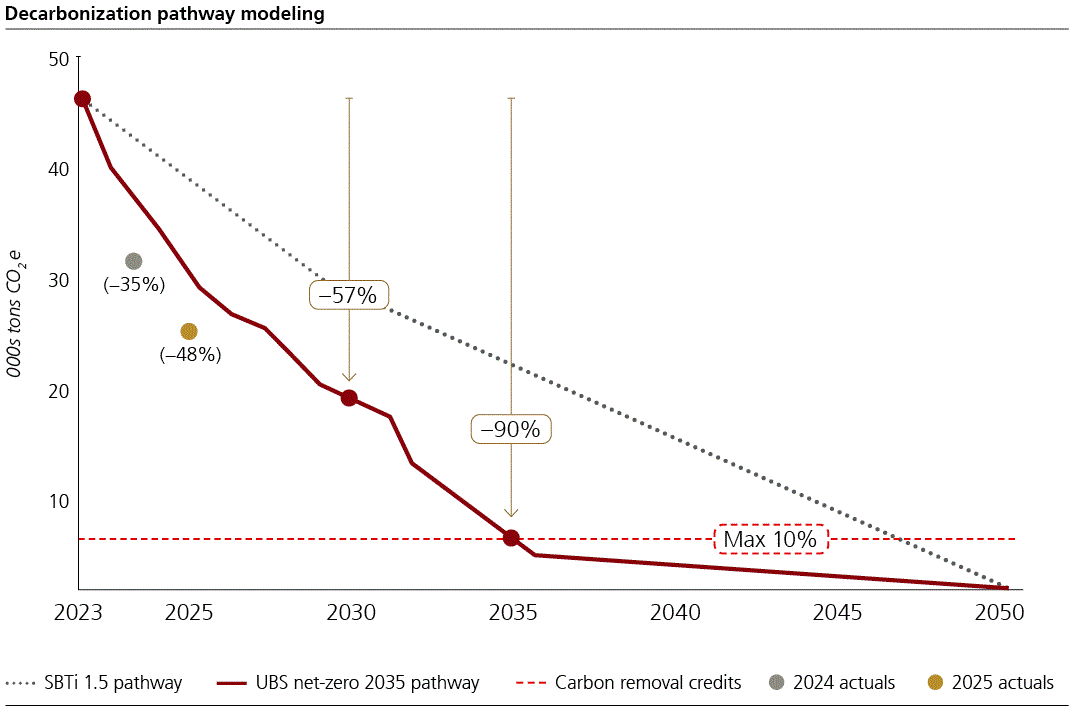
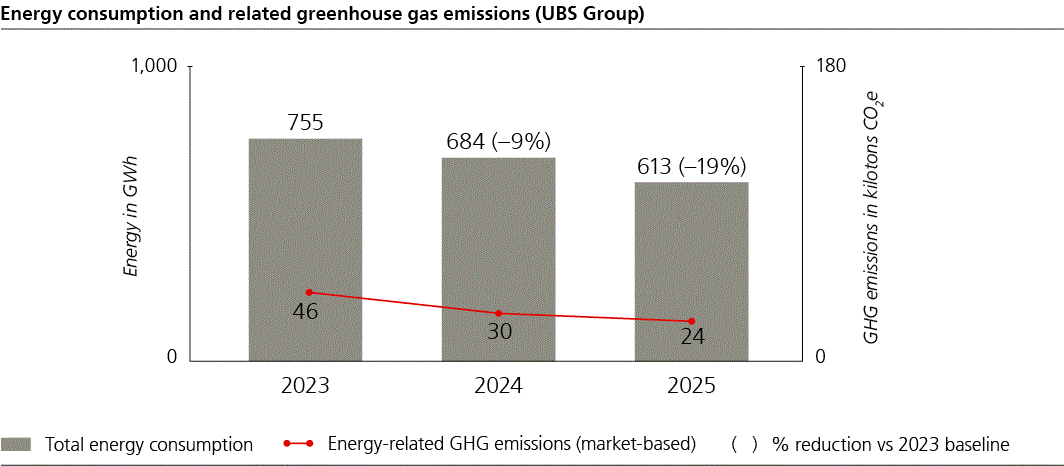
Sustainability Report 2025
| Environment 43
Our energy reduction target
Alongside our scope 1 and 2 net-zero target, we aim to reduce our absolute energy consumption by 35% by 2030
compared with our 2023 baseline of 755 GWh. The ambition level of this target was determined through forecasting
the expected energy usage reductions resulting from the implementation of the relevant decarbonization levers and
actions described below.
In 2025, our absolute energy consumption totaled 613 GWh, compared with 684 GWh
1
from our baseline and of 10.3% year on year. Our energy reduction efforts also help mitigate the risk of not achieving
full renewable electricity sourcing as market challenges may arise.
1
GHG emissions and certain activity data for 2024 were revised, mainly due to improved data availability. As a result of this revision, our previously reported 2024 energy consumption in GWh increased from 679 GWh
to 684 GWh.
Sustainability Report 2025
| Environment 44
Our renewable electricity target
We maintain our commitment to sourcing 100% of the electricity we use from qualifying renewable generation by 2026,
in line with RE100 technical guidance, in markets where credible renewable electricity generation and tracking systems
exist. In 2025, this excluded the Bahamas and Qatar, where such systems are not yet available. In 2025, we sourced
99.7% of our electricity from renewable sources, compared with 99.8% in 2024.
Target considerations and monitoring progress
Our operational climate-related targets continue to be led and managed by GRESC in collaboration with Group
Technology. 2023 was selected as the baseline year for our net-zero and energy reduction targets, in line with industry
guidance and best practices, and reflecting material changes for the Group. The baseline year reflects the first full year
of operations following the acquisition of the Credit Suisse Group, ensuring that the organizational perimeter, activity
levels and emissions sources of the combined entity are fully and consistently represented. As a result, 2023 provides a
stable and representative reference point for measuring progress toward our targets. We actively engaged relevant
stakeholders in the development of these targets by collecting strategic assessments from topic experts, regional
representatives and real estate managers. Progress is disclosed annually, targets are reviewed at least every five years and,
from 2030 onward, base years and target values will be updated every five years to reflect the latest climate science and
best practices.
For the energy consumption and related scope 2 emissions inventory, where measured data could not be obtained,
estimates are included based on comparable measured information.
It is important to note that progress toward our targets may not be linear, as annual results can fluctuate due to changes
in operational activity, business growth, technology evolution, workforce dynamics and energy market conditions. These
factors can influence real estate and service-related needs. We regularly assess them as part of our annual planning and
monitoring process to enable timely course correction. The availability of renewable-source electricity remains a critical
enabler of our progress, and we continue to ensure procurement in line with RE100 requirements.
We continue to implement energy efficiency measures across our real estate and data centers, ensure renewable-source
electricity use and embed low-carbon practices across our operations and technology. These efforts advance our
decarbonization impact and demonstrate our ongoing commitment to achieving our operational climate-related targets.
Decarbonization levers and key actions underpinning our operational targets
To deliver on our operational climate-related targets outlined above and manage our climate-related impacts in our own
operations, we identified a set of decarbonization levers and corresponding actions across our real estate operations and
service portfolio. These levers represent categories of mitigation actions, providing the framework for structuring and
implementing our actions.
Lever 1: phasing out fossil fuels and switching to greener alternatives (scope 1)
We are making progress with the implementation of our four-part action plan to phase out fossil fuels and switch to
greener alternatives to significantly reduce our associated scope 1 emissions. This lever represents roughly one-third of
our progress toward achieving our scope 1 and 2 net-zero target, underscoring its critical role in decarbonizing our
operations.
Phasing out fossil-fuel-powered own vehicles
We are committed to phasing out fossil-fuel-powered vehicles in our global fleet by 2035. Where full transition is not yet
feasible, we will deploy the best available interim solutions, such as hybrid vehicles, while continuing to pursue greener
alternatives. This approach ensures compliance with evolving emission standards and optimizes operational efficiency,
while minimizing our carbon footprint.
Transitioning to sustainable fuels and battery technologies
In 2025, we began implementing the high-level plans developed in 2024, that extend through 2035 and focus on
reducing and replacing fossil fuels in critical engineering power systems. We aim to replace these conventional fuels with
more sustainable alternatives, such as biofuels, hydrogenated vegetable oils and battery technologies. We completed the
cross-regional market analysis of fuel alternatives initiated in 2024 and used its results to enhance procurement and
deployment planning.
Eliminating heating oils and natural gas
We are replacing heating systems that are based on oil and natural gas within our operations, targeting full transition by
2035, in line with industry decarbonization efforts. This involves identifying real estate assets suitable for electrification
and switching to district heating, thereby maximizing both operational and cost efficiency throughout each asset’s
lifecycle.
Adopting refrigerants that have low global warming potential
We are progressing the replacement of traditional refrigerants with alternatives that have lower global warming potential
(GWP). This initiative is being rolled out across all regions, with completion targeted for 2035.
Sustainability Report 2025
| Environment 45
Lever 2: reducing our operational emissions (scopes 1 and 2)
Alongside reducing our scope 1 emissions, we are also focusing on reducing our operational emissions through strategic
enhancements to our corporate real estate portfolio and data centers. By implementing four key actions, we plan to
create more energy-efficient workspaces and real estate. The actions are part of our target achievement strategy and will
continue through 2035 and beyond. This lever represents just over a quarter of the progress toward achieving our scope 1
and 2 net-zero target, reflecting the importance of operational efficiency in achieving our climate goals.
Consolidating and optimizing our corporate real estate portfolio
In collaboration with the individual business divisions, we continued optimizing our real estate footprint by exiting from
or downsizing underutilized spaces and reducing our corporate real estate portfolio’s energy usage, either via retrofitting
or, in some cases, by relocating to more sustainable buildings.
Our data center strategy is focused on streamlining operations by consolidating primary sites and rightsizing capacity to
meet demand. Decommissioning legacy Credit Suisse sites and migrating applications to the Cloud or co-location
environments has optimized strategic locations, reduced costs and eliminated parallel run emissions.
Upgrading and retrofitting our corporate real estate portfolio
To reduce our real estate energy footprint, we intend to upgrade and retrofit our portfolio in line with internationally
recognized building standards, such as Leadership in Energy and Environmental Design (LEED) by the US Green Building
Council (USGBC). We expect to improve and extend the existing energy management system within the EMEA region,
with greater implementation of ISO 50001, driving energy efficiency across our operations.
In 2025, we continued to advance our commitment to sustainable real estate through additional green building
certifications and progress on key renovation and development projects worldwide.
–
Switzerland
: Renovation work at the Paradeplatz 6 building in Zurich and the Place Saint-François 16 building in
Lausanne is progressing toward LEED Platinum certification, targeted for 2027 and 2028, respectively.
–
EMEA
: Our Frankfurt and Madrid offices are pursuing LEED Platinum and Gold certifications, respectively. In Monaco,
preparations for the GB2 building are underway, with BD2M (Bâtiments Durables De Monaco) in-use certification
expected by 2026.
–
Americas
: We are working toward LEED certification for ten locations in the United States. Upon completion, these
projects will add LEED-certified space to our Americas portfolio.
–
Asia Pacific
: Our new office in Taichung, Taiwan, achieved LEED Platinum certification in late 2024, demonstrating
strong performance in energy and water efficiency, sustainable materials and indoor environmental quality.
Development of our flagship office in Hong Kong remains on track for completion in 2027, with the goal of achieving
the highest ratings globally for LEED v4.1 ID+C, WELL v2 and Building Environmental Assessment Method (BEAM) Plus
certifications. Several additional projects across the region are also progressing toward certification between 2026 and
2028.
UBS locations
LEED Platinum
LEED Gold
LEED Silver
LEED certified
Switzerland
1
1
0
0
EMEA
7
7
0
0
Americas
6
23
9
6
Asia Pacific
11
10
0
0
Supporting the decarbonization of district heating and cooling systems
Although we do not have direct operational control over external district heating and cooling systems, we plan to support
their decarbonization as part of our real estate consolidation strategy. Over the next few years, we plan to establish an
engagement plan to foster partnerships and collaborate with stakeholders (including local communities and utility
companies) to promote the transition to low-carbon district heating solutions.
Improving energy efficiency and demand-side management
Complementing our renewable-source electricity strategy, we are investing in energy efficiency technologies and smart
energy management systems to further reduce electricity demand. This includes optimizing building operations,
leveraging real-time data analytics and supporting behavioral initiatives to further reduce our scope 2 emissions.
Lever 3: transitioning to renewable-source electricity generation (scope 2)
Transitioning to renewable-source electricity generation remains central to achieving our net-zero target. Building on
progress since 2020, we are advancing our efforts to source 100% of our electricity from renewable-source -qualifying
generation by 2026, in line with RE100 technical guidance and local market feasibility. This lever represents close to a
quarter of the progress toward achieving our scope 1 and 2 net-zero target, highlighting the pivotal role of clean
electricity sourcing in our strategy.
Sustainability Report 2025
| Environment 46
Identifying and implementing opportunities for direct power purchase agreements
We regularly assess our real estate ownership and lease arrangements to identify long-term opportunities for sourcing
electricity directly from renewable generators through power purchase agreements. This approach supports the build-
out of new electricity generation plants and strengthens the chain of custody between the generation source and the
end use of electricity, while decreasing the carbon content of the grid in the longer term. Where feasible and in line with
RE100 guidance, we prioritize in-country procurement and direct contracting, maximizing impact and transparency.
Improving the transparency of the chain of custody for renewable energy certificates
We continue to work closely with our key electricity suppliers to enhance the transparency and traceability of renewable
energy certificates associated with our operations. We regularly assess whether existing electricity products and tariffs
meet RE100 criteria and actively explore opportunities to support the development of new offerings that strengthen
compliance and foster a more competitive, transparent and RE100-aligned renewable-source electricity market.
Building competitive renewable energy certificate supply solutions
In electricity markets where our consumption volumes are insufficient for tariff negotiations, or where regulatory
frameworks limit available electricity tariff options, we continue to purchase additional renewable energy certificates to
cover our residual electricity needs. We conduct competitive tenders for broker services and manage these contracts
through our corporate vendor governance processes to ensure alignment with evolving RE100 standards. We also support
renewable-source electricity generators in markets where their products cannot be integrated into local energy tariffs,
helping to unlock new supply pathways and promote market inclusivity.
Advancing renewable-source electricity tracking systems
In a few countries where we operate, infrastructure for tracking renewable-source electricity volumes remains
underdeveloped or absent, compromising the availability of renewable energy certificates in line with RE100 technical
criteria. We actively engage in industry and policy consultations to promote the creation of renewable energy tracking
systems in emerging markets. Our objective is to expand access to verifiable renewable electricity sourcing in these
regions, supporting market transformation and alignment with RE100 standards.
Investing in on-site renewable generation of electricity
We regularly assess our real estate ownership and lease arrangements to identify assets where we expect to maintain
long-term operational control and where infrastructure (e.g. roof space) can support the deployment of on-site
renewable-source electricity generation. Where technically and economically feasible, we continue to invest in on-site
renewables, such as solar panels, reducing reliance on grid-based electricity and mitigating risk associated with future
market constraints that could limit access to renewable-source electricity tariffs or certificates. This approach strengthens
our energy resilience and supports our decarbonization strategy.
GHG removal and GHG avoidance projects financed through carbon credits
We aim to achieve our 2035 scope 1 and 2 net-zero target by reducing emissions by at least 90% from the 2023 baseline
and neutralizing any remaining residual emissions through the purchase of high-quality, permanent technological carbon
removal credits. In addition, from 2026 onward (as part of our beyond value chain commitment), we will voluntarily retire
technological carbon removal credits annually to match our full scope 1 emissions by 2030, scaling in line with our
declining emissions trajectory.
From 2035 onward, we will retire sufficient credits to maintain net-zero status for scope 1 and market-based scope 2
emissions, not exceeding the 10% maximum against our 2023 baseline. Credits are sourced through strategic
partnerships with Climeworks and neustark, established in 2022 as part of our carbon removal strategy. Both companies
focus on developing and scaling innovative carbon removal technologies. We are also a founding buyer of the NextGen
CDR Facility, a coalition of five companies committed to scaling high-quality carbon removal solutions and catalyzing the
development of a robust market for engineered removals. These partnerships have continued to evolve and strengthen
throughout 2025, reinforcing our commitment to credible and science-based carbon removal pathways.
Since 2007, the UBS Group has matched 100% of air travel emissions with an equivalent amount of nature-based carbon
avoidance and removal credits. In 2025, in line with this commitment, we retired 49,000 credits verified under the Verra
VCS standard, rated “A” on average by the third-party carbon ratings agency BeZero Carbon at the time of retirement,
compared with 75,211 credits in 2024.
All carbon credit purchases comply with our carbon and environmental markets guideline, which sets minimum
requirements for such instruments. We only purchase credits assessed against the Integrity Council for the Voluntary
Carbon Market (the ICVCM) Core Carbon Principles and verified under recognized high-integrity standards such as Gold
Standard, Verra.
We acknowledge that standards and methodologies for carbon credits are still evolving, and we will continue to improve
our portfolio through market partnerships and industry engagement toward a standardized quality benchmark for the
future.
›
Refer to the “Sustainability and climate risk policy framework” section of the Supplement to this report, available at
ubs.com/sustainability-reporting
, for more information about our carbon and environmental markets guideline
Sustainability Report 2025
| Environment 47
Carbon credits canceled outside our value chain (UBS Group)
For the year ended
31.12.25
31.12.24
Total (t CO
2
e)
49,000
75,211
Share from removal projects (%)
60%
60%
Share from avoidance projects (%)
40%
40%
Share of carbon credits verified against recognized quality standards (Verra VCS) (%)
100%
100%
Internal carbon pricing
We continue to apply a forward-looking shadow carbon price of USD 400 per metric ton of CO
2
e to all our scope 1 and
market-based scope 2 emissions at the UBS Group AG consolidated level.
1
of low-emission technologies in real estate projects, including the replacement of fossil-fuel heating systems, relocation
of real estate assets and fuel transition in critical engineering power systems.
The carbon price is reviewed annually to ensure its relevance to our climate transition plan and to reflect developments
in carbon removal technologies and market dynamics. As part of setting our internal carbon price, we have considered
critical assumptions such as the expected future costs of engineered removals and insights from past purchases of removal
projects. At present, our internal carbon price is used exclusively for strategic and operational decision-making. It is not
reflected in our financial statements.
Our environmental targets and performance in our own operations
Progress across key environmental areas
In 2025, we continued to advance our efforts to reduce our operational environmental footprint and embed
environmental responsibility across our business. Beyond our operational climate-related targets and actions outlined
above, we focused on key areas including waste, paper and water, travel and biodiversity, integrating sustainable
practices into the way we work. By engaging our employees, suppliers and clients, we are reinforcing a shared
commitment to responsible operations and continuous improvement. As 2025 marks the target year for our existing
waste, paper and water targets, we have defined new targets for 2030 in these areas, using 2023 as the baseline year
to be consistent with our emissions and energy targets.
1
information“ section of the Supplement to this report, available at
ubs.com/sustainability-reporting
.
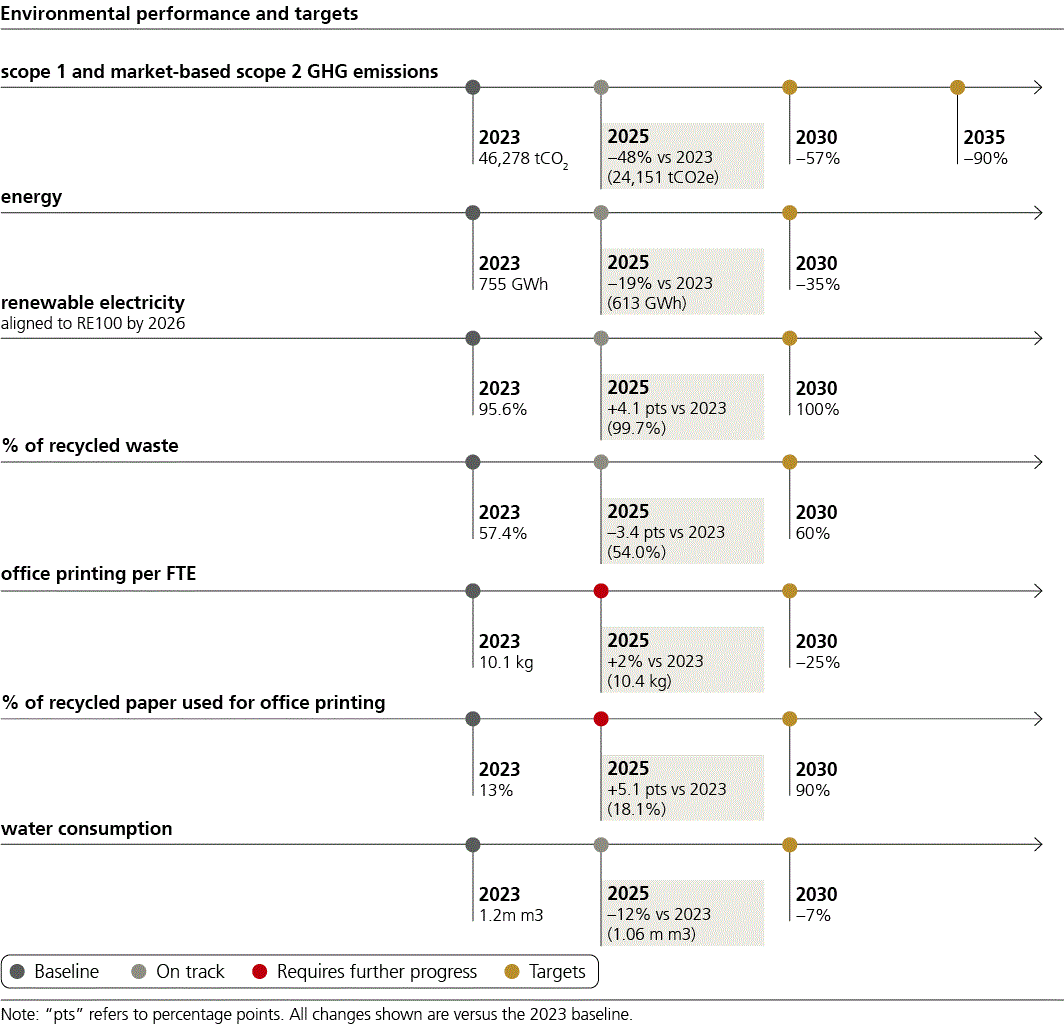
Sustainability Report 2025
| Environment 48
Waste, paper and water
In 2025, we continued to focus on waste minimization and increasing the percentage of recycled waste across our
operations. We launched the “Recycle like a rockstar" campaign to increase awareness of our staff and piloted the
recycling of paper towels in selected Swiss locations with positive results.
In 2025, we achieved a recycling ratio of 54.0%, compared with 52.9% in 2024, with limited additional improvement
due to the continued decline in paper consumption, which represents a significant share of recycled materials. While
progress was made, the recycling ratio remained below the 60% target set against the 2019 baseline.
Minimizing the impacts from waste remains a focus of the UBS environmental program. Accordingly, recognizing the
operational challenges, we have concluded to maintain the target for percentage of recycled waste at 60% through to
2030. The scope remains unchanged from the previous target and covers operational waste from offices and data centers,
excluding construction waste.
We continue to raise employee awareness to further increase the proportion of recycled waste and to prioritize reusable
items. While we no longer have a target for waste reduction per FTE, due to limited influence on this metric, we continue
to measure and transparently report on our operational waste from offices and data centers
UBS maintains a technology sustainability program focused on reuse, upcycling, and responsible recycling across
infrastructure, end user devices, storage, and printing estates. Key initiatives include hardware lifecycle extensions,
original equipment manufacturer (OEM) buyback programs, certified e-waste recycling, and internal redeployment to
support recycling and waste reduction objectives.
Large scale device consolidation, virtualization, and cloud migration reduce the need for new hardware while lowering
power consumption and physical footprint.
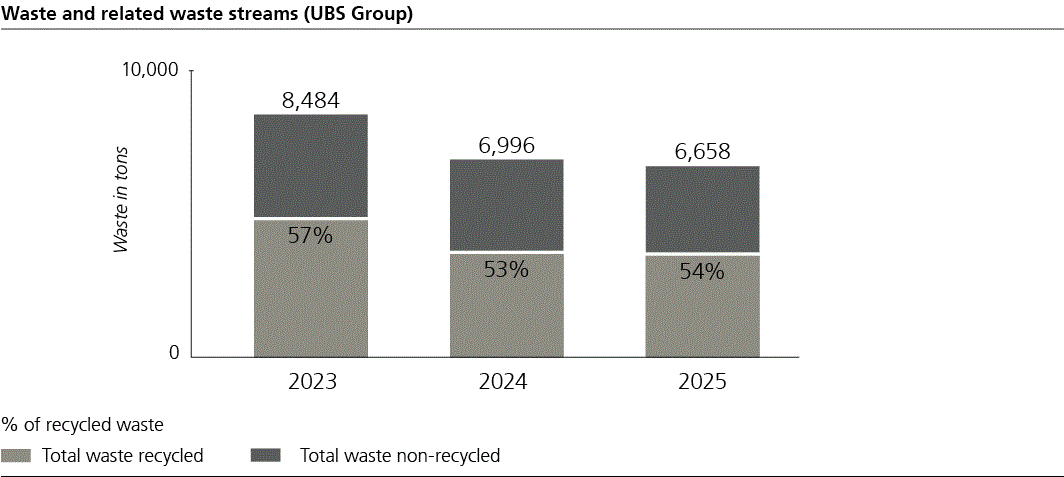
Sustainability Report 2025
| Environment 49
End user technology is prioritized for reuse within UBS, resale where viable, or certified recycling, ensuring minimal waste
and maximum recovery of value and materials.
Complementary programs in managed print, digital workflows, and data driven storage reduction further enable print
avoidance, asset reuse, and environmentally responsible disposal.
Through our ISO 14001 environmental management program and contract spot checks, we ensure that our waste
management partners operate in accordance with contractual and legislative requirements.
›
Refer to the “Reducing our environmental footprint – additional information” section of the Supplement to this report, available
at
ubs.com/sustainability-reporting
covered by our internal carbon price, and how this relates to our total emissions
We maintained paper consumption per full-time equivalents (FTE) below our 2025 target (27.4 kg per FTE), at 26.7 kg
per FTE in 2025 (compared with 23.7
1
since the baseline year. The year-on-year increase is predominantly due to mandatory communications in relation to the
client migrations from legacy Credit Suisse to UBS.
Our sustainable paper (recycled and FSC paper) target covers 100% of our paper consumption. In support of our
sustainable paper target for 2025 – covering 100% of our paper consumption – we implemented contract changes
during the past year. Although the full effect of these changes is not reflected in the full year 2025 data (70.2%
sustainable paper; compared with 50.3%
1
target by year-end 2025. These figures refer exclusively to office and publishing paper volumes based only on measured-
activity data, with packaging and sanitation paper excluded from scope.
We are introducing a new paper reduction target focused on office printing, where employees have the most direct
influence. By 2030, we aim to reduce office printing per FTE by 2.5kg (i.e. 25%) compared with the 2023 baseline of
10.1kg. We have also set a 2030 target for at least 90% of paper used for office printing to come from 100% recycled
sources, prioritizing post-consumer recycled paper wherever possible. In 2025, office printing per FTE was 2% higher
than the 2023 baseline, totaling 10.4 kg (compared with 11.6 kg in 2024), and 18.1% of paper used for office printing
came from recycled sources (compared with 15.5% in 2024). We will continue to monitor and publish our overall paper
consumption, including publishing material and client statements. The original sustainable paper requirements for other
types of paper purchasing (such as FSC-certified paper) remain in place as business-as-usual practices. These measures
demonstrate our commitment to reducing environmental impacts associated with paper production and to maintaining
responsible resource management practices across our operations.
To enhance water efficiency in our facilities, we continue to implement measures such as monitoring water use and
optimizing flushing times and overflow management. In 2025, water usage was 20% lower than the 2019 baseline
(compared with 8% lower in 2024), despite variations in office occupancy levels. Our 2025 water reduction target is
thereby achieved. To reinforce our commitment to improving water efficiency, we are setting a new baseline year (2023)
and a revised target: by 2030, we aim to reduce water consumption by 7% compared with the 2023 baseline. This target
builds on our existing efforts and reflects our focus on operational improvements across our offices. These actions support
our broader environmental objectives and help minimize the impact of our operations on water resources.
1
Comparative figures have been revised due to improved data availability during 2025 reporting period. As a result of this revision our previously reported 2024 paper consumption in kg per FTE increased from 21.5
to 23.7 and share of recycled and FSC paper increased from 49.9% to 50.3%.
Sustainability Report 2025
| Environment 50
Travel
In 2025, we continued to strengthen our approach to managing travel-related emissions through enhanced reporting
and policy measures. We improved our internal carbon intensity metrics and data granularity to provide more insights
into travel emissions before and after trips, enabling better measurement and management of our footprint. Our travel
policy remains focused on encouraging employees to choose lower-carbon transport options where feasible and we
expanded partnerships with hotels meeting recognized sustainability standards, clearly flagged at the point of sale to
support informed choices.
We also maintained the purchase of high-quality carbon credits matching 100% of Group air travel emissions and began
assessing additional solutions, such as sustainable aviation fuel credits, to support long-term decarbonization goals. In
2025, business travel emissions totaled 60,772 metric tons of CO₂e, representing a 26% decrease compared with 2024
(81,964 metric tons of CO₂e). Recognizing that the emissions reduction for 2025 is largely due to the reduction of the
emission factors for air travel published by DEFRA, these actions reflect our commitment to reducing the environmental
impact of business travel while maintaining transparency and alignment with recognized reporting standards.
›
Refer to “Our policies, guidelines and frameworks” in the “Supporting our transition plan: key enablers” section of this report for
more information about the UBS Business Travel and Expense policy
›
Refer “GHG removal and GHG avoidance projects financed through carbon credits” in this section for more information about our
purchasing of carbon credits
Biodiversity
In 2025, we expanded our efforts to promote biodiversity across our offices and engage employees in meaningful
activities. Building on previous initiatives, such as green roofs and awareness programs, we introduced additional
measures to strengthen local ecosystems and employee involvement.
We have installed and maintain more than 50 beehives across 10 green roofs in the Americas, Poland, the UK and
Switzerland, supporting thriving pollinator populations and enhancing urban biodiversity. We complemented these
actions with hands-on workshops, rooftop garden tours, biodiversity talks and honey tastings, helping colleagues
understand the critical role of pollinators and ecosystems. These initiatives reflect our commitment to preserving
biodiversity and creating positive environmental impact within and beyond our office locations.
Environmental targets and indicators in our own operations
Information about our environmental targets and indicators is included in our annual GHG emissions report, prepared in
accordance with the ISO 14064-1:2018 standard. This report undergoes external assurance each year in line with the
ISAE 3410 standard and with consideration of the ISO 14064-3:2019 standard.
We have successfully passed ISO 14001 environmental management system audits every year since implementation,
including in 2025. In the EU and the UK, our activities are also certified according to the ISO 50001:2018 energy
management system standard, including this year for the first time, legacy Credit Suisse sites which were already part of
the ISO14001 certification. These internationally recognized frameworks ensure the appropriate policies, processes and
controls are in place for the effective management of environmental and energy topics within our operations and their
consistent implementation across daily activities.
Environmental targets and performance
1
Actuals
Targets
Progress
GRI
2
2025
2024
2023
2030
2035
Baseline
% change
from baseline
Status
5
Scope 1 and market-based scope 2 greenhouse gas emissions in t
CO
2
e
305-1, 305-2
24,151
30,287
6
46,278
(57%)
(90%)
46,278
3
(48%)
green
Energy consumption in GWh
302-1-e
613
684
6
755
(35%)
755
3
(19%)
green
Share of renewable electricity
302-1
99.7%
99.8%
95.6%
100%
100%
95.6%
3
4%
green
Percentage of recycled waste
306-4
54.0%
52.9%
57.4%
60%
57.4%
3
(6%)
amber
Office printing per FTE
4
301-1-a
10.4
11.6
10.1
(25%)
10.1
3
2%
amber
Percentage of recycled paper used for office printing
301-1-a-ii
18.1%
15.5%
13.0%
90%
13.0%
3
40%
amber
Water consumption in m m
3
303-5
1.06
1.23
1.21
(7%)
1.21
3
(12%)
green
Legend: CO
2
e = CO
2
3
1
Reporting period 1 January - 31 December.
2
3
4
based on HR workforce data.
5
6
revision our previously reported 2024 scope 1 and market-based scope 2 greenhouse gas emissions increased from 30,274 t CO
2
e to 30,287 t CO
2
e and energy consumption increased from 679 GWh to 684 GWh.
Outcome of 2025 environmental targets
1
Actuals
Targets
Progress
GRI
2
2025
2024
2023
2025
Baseline
3
% change
from baseline
Status
5
Paper consumption in kg per FTE
4
301-1-a
26.7
23.7
7
27.7
(50%)
54.9
(51%)
green
Share of recycled and FSC paper
301-1-a-ii
70.2%
50.3%
7
71.5%
100%
63.2%
11%
green
6
Waste in kg per FTE
4
306-3
64.4
62.7
69.8
(10%)
133.5
(52%)
green
Waste recycling ratio
306-4
54.0%
52.9%
57.4%
60%
50.2%
7%
amber
Water consumption in m m
3
303-5
1.06
1.23
1.21
(5%)
1.33
(20%)
green
Legend: FTE = full-time equivalents; GWh = gigawatt-hour; kWh = kilowatt-hour; km = kilometer; kg = kilogram; m m
3
1
Refer to the “Environment” section of the Supplement to the UBS Group Sustainability Report 2025, available at ubs.com/sustainability-reporting, for detailed information about our environmental indicators.
2
Refer to GRI Sustainability Reporting Standards, available at globalreporting.org for more information.
3
4
5
track; Amber: improvements required.
6
‑
end, despite partial
‑
year effects in the 2025 full
‑
year average.
7
data availability during 2025 reporting period. As a result of this revision our previously reported 2024 paper consumption in kg per FTE increased from 21.5 to 23.7 and the share of recycled and FSC paper increased
from 49.9% to 50.3%.
Sustainability Report 2025
| Environment 51
Sustainable Technology Guild
The Sustainable Technology Guild (the STG) continues to raise internal awareness of sustainable software development.
We aim to ensure our technologists and engineers are well educated on the environmental impact of technology and are
trained in how to reduce it through optimized energy use in technology solutions.
The STG focuses on developing measurement solutions for the applications hosted in our data centers and those in the
public Cloud. We collaborated with our cloud partner, Microsoft, on the development of the Azure Carbon Optimizer
(the ACO), a carbon measurement tool for cloud-based computing workloads. Microsoft has launched the ACO tool
publicly, and we have begun rolling it out internally, enabling teams to better understand and baseline their emissions.
The STG’s primary focus remains on minimizing the energy consumption of our technology estate and the introduction
of green software engineering practices.
Sustainability Report 2025
| Environment 52
Managing the environmental impact of our supply
chain
To manage the environmental impact of our supply chain, we have implemented a set of dedicated policies, guidelines
and frameworks, supported by targeted actions.
›
Refer to “Our policies, guidelines and frameworks” in the “Supporting our transition plan: key enablers” section of this report for
an overview of relevant policies, guidelines and frameworks
Our key actions to manage the environmental impact of our supply chain
Increasing transparency and reporting of climate information by vendors
We are tracking the scope 1 and 2 emissions reporting of our GHG key vendors. Vendors with the largest emissions that
collectively account for more than 50% of our calculated supply chain vendor-related scope 3 emissions
1
“GHG key vendors”. On this basis, we identified 95 such vendors in 2025.
Overview of climate-related disclosures of our GHG key vendors (UBS Group)
2023
2024
2025
% of GHG key vendors who have disclosed their emissions and
declared a stated net-zero target
1
65% (62 / 95)
78% (74 / 95)
88% (84 / 95)
1
Shows GHG key vendors that disclosed emissions and declared a stated net-zero target as a percentage of total GHG key vendors. The number and percentage of key vendors achieving this metric are sourced from
an external environmental performance disclosures platform. We do not independently verify our vendors’ goals or progress toward them.
In 2025, beyond our GHG key vendors, 71% (304 of 426) of vendors voluntarily submitted environmental information
on an external environmental performance disclosure platform, a percentage that remains consistent with 2024 (70%,
or 341of 487).
Tracking supply chain vendor-related scope 3 emissions
We continuously measure and monitor our vendor-related scope 3 emissions to track progress against the reduction
trajectory initiated in 2024, when emissions decreased by 28% year on year, primarily reflecting spend consolidation
following the integration of Credit Suisse. In 2025, we broadly maintained the strong performance achieved in the prior
year, with vendor-related scope 3 emissions amounting to 0.84 million
metric
tons
of
CO
2
e, compared with
0.81 million
metric
tons of
CO
2
e in 2024. The 3% increase observed in 2025 was driven mainly by higher relevant spend,
particularly in construction execution and IT services (e.g. cloud services), as well as a reduction in the availability of
supplier-specific emissions factors, leading to an increased use of more conservative standard industry parameters.
›
Refer to the “Reducing our environmental footprint – additional information” section of the Supplement to this report, available
at
ubs.com/sustainability-reporting
, for more information about our GHG emissions reporting
Assessing and improving high-ESG-impact vendors’ practices
In line with our Responsible Supply Chain Management (RSCM) policy, we identify, assess and monitor vendor practices
across key ESG areas, including climate and the environment.
We identify high-ESG-impact vendors, defined as vendors providing goods and services that could have a substantial
environmental or social impact, when establishing new contracts or renewals. These vendors are assessed against our
RSCM policy and are required to provide disclosures about their management practices along with corresponding
evidence, which is then evaluated by a specialist team. We also undertake such assessments on some non-high-ESG-
impact vendors where we have significant ongoing relationships.
Actual and potential negative impacts considered in the assessment of vendor practices include, but are not limited to,
the following:
–
adverse environmental impacts due to inefficient use of resources (e.g. water and energy);
–
hazardous substances, emissions, pollutants and the limited recyclability of products that adversely affect people,
nature and the environment; and
–
modern slavery, forced labor, child labor, unfair employment practices and anti-corruption.
Should our assessment reveal any non-compliance with our policy, we define and agree, together with the vendor, on
vendor-specific improvement measures and closely monitor the implementation progress of these remediation actions. A
lack of improvement may lead to the termination of the vendor relationship. Vendors are reassessed after 24 months to
ensure that, even in long-term contracts, our expectations regarding environmental and social aspects are being met and
continuously supervised.
1
Sustainability Report 2025
| Environment 53
In 2025, we conducted 331 risk-based due diligence assessments on high-ESG-impact vendors covering newly sourced
contracts, renewals and ongoing contracts (compared with 445 in 2024). Of those assessed, 12% were considered in
need of improving their management practices (compared with 33% in 2024). For these vendors, we agreed on specific
remediation actions and are closely monitoring implementation progress to ensure timely and effective resolution. In
2025, we have increased our overall RSCM assessment coverage of vendors by spend to 54% in 2025, from 51% in
2024.
In addition to RSCM assessments for new contracts and renewals, we also regularly screen active vendors as part of our
sustainability and climate risk control processes. In 2025, 100% of new vendors were screened for environmental and
social risks, consistent with 2024.
In 2025, none of our vendor relationships were terminated as a result of our assessments and no human rights issues
involving active, directly contracted vendors were identified or reported. In part, this was due to having carried out our
assessment process prior to signing contracts. We have also trained our supply chain function staff on human rights and
modern slavery.
Raising awareness of environmental matters through the sustainable procurement guide
In 2024, we launched a sustainable procurement guide, which we continued sharing with vendors throughout 2025 via
the UBS supplier webpage. From environmental certification to waste management and sustainability reporting, this
guide provides insights on how our vendors can take significant steps toward reducing their environmental footprint,
promoting ethical and inclusive practices in their supply chain and contributing to the well-being of ecosystems.
›
Refer to our Climate disclosure guideline for vendors and Sustainable procurement guide for vendors, available at
ubs.com/global/en/our-firm/suppliers/supply-chain
, for more information
Embedding supplier sustainability in our everyday activities
The goods and services we buy, and where and whom we buy them from, are crucial elements of our sustainability
impact. We are committed to making a positive environmental and social impact, and expect the same from our suppliers.
Our Global Procurement and Vendor Management Policy and Guidance consider the ESG impacts of products and
services when selecting a vendor.
In 2025, we trained our vendor relationship managers as part of their onboarding process, enabling them to have
impactful discussions with vendors in relation to ESG topics, local labor laws, human rights and environmental
responsibilities. Suppliers are required to follow our global supplier policies, which include a policy on anti-bribery and
corruption, sanctions, fraud and anti-facilitation of tax evasion.
Inclusive growth in the supply chain
In 2025, we maintained our commitment to inclusive sourcing practices and we encourage the consideration of qualified
suppliers, large and small, in all competitive tender processes. Our procurement teams are guided to actively identify and
invite suppliers of all sizes to participate, where appropriate, ensuring a broad and competitive vendor pool. Participation
in the tender process is based on supplier capabilities, experience and alignment with UBS’s quality, cost and sustainability
standards. All suppliers are evaluated on equal footing, and no preference or advantage is given based on diversity status.
Sustainability Report 2025
| Environment 54
Supporting our transition plan: key enablers
Beyond the individual actions related to supporting our clients’ low-carbon transition and reducing the environmental
impact of our own operations and supply chain as described in the above sections, we have identified five key enablers,
listed below, to support the implementation of our climate transition plan.
Governance and accountabilities (1)
Sustainability and climate-related matters are governed at the highest levels of our organization, supported by a robust,
Group-wide governance framework. This structure ensures strategic oversight, accountability and effective execution
across all sustainability and transition-related initiatives.
In 2025, we marked a significant milestone with the evolution of our climate program into a broader sustainability and
transition program. This expanded scope now integrates nature and human rights topics, reflecting our commitment to
a more holistic approach to sustainability. The program is underpinned by more targeted mandates and specialized
working groups, enhancing its depth and operational effectiveness.
Importantly, the updated program is now more closely aligned with our Group sustainability and impact strategy,
reinforcing its three strategic pillars of protect, grow and attract.
›
Refer to the “Governance” section of this report for more information
Industry, government and public sector engagement (2)
We actively participate in political discussions by sharing our expertise on proposed regulatory and supervisory changes
and engaging in sustainability and climate-related exchanges through trade associations such as the International Institute
of Finance, the Association for Financial Markets in Europe and the Swiss Bankers Association.
In Switzerland, our home market, we participated in 2025, along with Swiss industry associations, in the Swiss Federal
Council’s consultation on proposed amendments to the Ordinance on Climate Disclosures in light of recent international
developments. Our feedback emphasized the importance of aligning revisions with global standards and considering the
EU’s initiative to simplify its sustainability reporting framework to avoid fragmentation.
Regionally, we engage with policymakers across the EU, the Americas, the UK and key Asia-Pacific jurisdictions. Notably,
we participated in several industry association initiatives in the EU to support and inform the European Commission’s
simplification efforts aimed at reducing reporting and regulatory burdens under the Corporate Sustainability Reporting
Directive, the Taxonomy Regulation and the Corporate Sustainability Due Diligence Directive.
Training and culture (3)
Educating our workforce on sustainability and sustainable finance is an important part of ensuring we meet our
sustainability and climate ambitions. In 2025, we continued to coordinate the delivery of sustainability training and
awareness activities across UBS through a dedicated sustainability education workstream.
In 2025, relevant training on a Group-wide basis included:
–
a series of information sessions following the publication of the UBS Sustainability Report 2024 to raise awareness and
understanding of our own progress in relation to our environmental objectives;
–
climate- and nature-related training as part of our all-staff Global Learning Week, including webinars focused on
climate and nature fundamentals, greenwashing and impact investing sessions; and
–
roll-out of the Sustainability Fundamentals training across the firm, to strengthen foundational and advanced
knowledge on sustainability, including climate, nature, social impact, governance, and how we can support our clients.
We recognize that sustainability training and education are gaining importance and may receive greater regulatory
scrutiny over time. Keeping abreast with this changing landscape is essential to develop targeted training and ensure our
employees have the skills and knowledge needed to meet emerging expectations.
›
Refer to the “People and culture make the difference” section of this report for more information about training and culture
›
Refer to “Group sustainability and impact management indicators“ in the “Governance” section of the Supplement to this report,
available at
ubs.com/sustainability-reporting
, for more information about employee training participation rates
Data management (4)
We have implemented a Group ESG data strategy to streamline access to ESG data across the organization, ensuring
consistency and alignment. Central to this approach is an enterprise data platform that consolidates third-party ESG data
into a single authoritative source, enabling all internal systems and users to draw from it.
We aim to facilitate the creation of standardized data products that incorporate Group-level methodologies where
needed. These products, governed by a data management framework, support external disclosures and other key
outputs. We also collaborate closely with ESG data vendors to align on internal requirements, enhance data quality and
integrate new transition-focused data sets and analytics. The data strategy is overseen by the ESG Data & Methodology
Forum, which has senior representatives from our business divisions and Group functions.
Sustainability Report 2025
| Environment 55
To enhance due diligence on ESG data, tools such as the updated 2025 data quality questionnaire have been rolled out,
which reflect best practices and regulatory standards. Additionally, we have developed advanced calculation tools to
measure financed and facilitated emissions, ensuring regulatory compliance and transparent reporting.
Our policies, guidelines and frameworks (5)
We have established a set of climate-related policies, guidelines and frameworks that underpin our climate transition plan
and guide decision-making across our organization. Our policies are embedded within our governance structures and
operational processes, and are regularly reviewed and updated to reflect evolving regulatory requirements, market
developments and advances in climate science. This approach promotes accountability and transparency across the
Group.
Overarching policies, guidelines and frameworks
Group sustainability and impact constitutional document
Our Group sustainability and impact constitutional document serves as our primary sustainability governance guideline.
It acts as a guide to understanding the principles and practices that drive our commitment to responsible and sustainable
business operations and describes how we govern and execute the UBS Group sustainability and impact strategy.
This document applies to UBS Group AG and all its directly controlled legal entities. It is reviewed annually under the
authority of the Group Chief Operating Officer. Together with the Code of Conduct and Ethics of UBS, it serves as the
Group’s environmental policy under the ISO 14001 standard.
›
Refer to the “Business conduct and corporate culture” section of this report for more information about the Code of Conduct and
Ethics of UBS
›
Refer to the “UBS Group-wide sustainability and impact constitutional document” and “Code of Conduct and Ethics”, available at
ubs.com/sustainability-reporting
UBS’s sustainability and climate risk policy framework
We define sustainability and climate risks as the risk that we negatively impact, or are impacted by, climate change,
natural capital, human rights and other ESG matters. Climate risks can arise from either changing climate conditions
(physical risks) or from efforts to mitigate climate change (transition risks).
We conduct an annual assessment of the proximity of our products, services and supply chain to sustainability and
climate-related risks. Activities identified as high risk are subject to our firm-wide sustainability and climate risk policy
framework. This framework enables us to identify and manage potential adverse impacts on climate, nature, the
environment and human rights, as well as the associated risks that may affect us and our clients.
The framework is embedded in our corporate culture and applied consistently across the Group, including all business
divisions, Group functions, locations and legal entities. It is integrated into our management practices and control
principles and is overseen by senior management.
Additionally, to support the firm’s sustainable finance strategy and mitigate potential greenwashing risk, UBS has
developed the Group-wide Sustainable finance and carbon and environmental market guidelines. These guidelines are
part of the overarching Group sustainability and climate risk policy and set minimum requirements when labeling,
marketing and distributing sustainable finance, green equity, and carbon and environmental markets instruments,
ensuring that sustainability claims made by UBS or its clients related to these instruments can be substantiated and
consistently communicated. They apply to all UBS employees globally involved in client-facing activities for these
instruments, as well as when UBS purchases carbon and environmental markets instruments for its own operations. The
guidelines are owned by the Sustainability and Climate Risk unit, which also monitors their implementation.
›
Refer to the “Sustainability and climate risk policy framework” section of the Supplement to this report, available at
ubs.com/sustainability-reporting
, for more information
Policies, guidelines and frameworks related to our financing and investing activities
Company Transition Assessment Scorecard
The Company Transition Assessment Scorecard (CTAS) is a rules-based, sector-agnostic assessment that informs our
understanding of counterparties’ transition-related risk profiles. We use the CTAS as one input among many in
individualized, risk-based assessments that are anchored in quantifiable risk drivers, expected loss and capital
considerations. The CTAS does not operate as an eligibility or exit screen, and we do not maintain blanket no-serve lists
for lawful industries. Decisions about onboarding, pricing and relationship management are based on documented,
customer-specific analyses and are subject to oversight designed to ensure consistency across similarly situated customers.
The UBS Green Funding Framework
The UBS Green Funding Framework sets out our Group-wide green funding program through which we can issue a
variety of green funding products , including bonds, derivatives, deposits and similar financial instruments. We maintain
assets that meet the environmental criteria defined in the framework at an amount equal to the proceeds of any green
funding issuance.
The framework aligns with international market practice and guidance and is designed to meet the core pillars of the
Green Bond Principles, the recognized voluntary guidelines published by the International Capital Markets Association. It
defines criteria and processes for the use of proceeds, asset evaluation and selection, management of proceeds and
related reporting, and thereby supports the management of risks associated with our green funding program.
Sustainability Report 2025
| Environment 56
Currently, eligible assets under the framework are mortgage loans financing Minergie-certified real estate in Switzerland,
or equivalent real estate certifications as determined by us. These assets are tracked and reviewed quarterly for ongoing
eligibility and availability.
We publish an annual Green Funding Investor Report that provides details on our green funding activities, eligible assets
and estimated environmental impact, including energy CO₂ emissions savings, along with the methodology used. We
solicit an annual independent third-party review of the eligible asset pool to confirm compliance with our criteria and
reporting commitments, with the results disclosed in each report.
The Green Funding Framework is owned by Group Treasury and governed by a Green Funding Forum comprised of
representatives from key business divisions and second line of defense functions.
Group Sustainable Investing Policy
The Group Sustainable Investing Policy sets minimum standards to ensure transparency in the classification of
sustainability-related investment products and services across the Group, as well as in corporate and financial disclosure.
It provides the foundation for substantiating and consistently communicating ESG or sustainability-related statements,
declarations, actions or communications to stakeholders. The purpose of this policy is to mitigate potential greenwashing,
reputational, legal / liability and regulatory risks arising from overstating the ESG or sustainability credentials of an
investment product or service.
The policy is owned by Group Sustainability and Impact, which also monitors its implementation. It applies to all UBS
employees globally involved in manufacturing, distributing, labelling, marketing or promoting investment products or
services positioned as sustainable investing and made available to clients. Business divisions own and implement their
respective divisional sustainable investing frameworks, and businesses owning the relevant products and activities must
adhere to this policy.
Asset Management policies, guidelines and frameworks
In addition to the broader Group-wide policies, guidelines and frameworks outlined in this section, our Asset
Management division has established its own specific policies, guidelines and frameworks.
›
Refer to “Asset Management” in the “Supporting our investing clients’ low-carbon transition” section of this report for more
information
Policies, guidelines and frameworks related to our own operations
Manual for our environmental and energy management systems
The Manual for our environmental and energy management systems defines the framework, processes, roles and
responsibilities for implementing, maintaining and continually improving our integrated management systems, designed
to meet the requirements of ISO 14001:2015 for environmental management and, where applicable, ISO 50001:2018
for energy management. The integrated management systems cover our own operations. Accountability for
implementing this manual rests with the Global Head Group Real Estate and Supply Chain.
The environmental management system, certified to ISO 14001:2015, applies globally across all owned and leased
operated buildings and associated corporate real estate and facility management services that support our business
activities. It focuses on areas of highest environmental impact including climate change and nature, sustainable
operations, energy and resource efficiency and regulatory compliance.
The energy management system, certified to ISO 50001:2018, applies to selected locations in Europe, where it supports
compliance with the EU Energy Efficiency Directive and national energy efficiency legislation. Within this scope, regular
energy audits are performed and efficiency measures implemented in line with ISO 50001:2018 requirements.
Both systems are annually externally audited and recertified every three years to verify that appropriate policies and
processes are in place and effectively implemented. The manual is reviewed and updated annually by subject matter
experts to reflect organizational and operational changes.
In developing and maintaining this manual, we consider the interests of key stakeholders, including employees, facility
users, regulators and certification bodies. To support effective implementation, we provide targeted training for
employees and other relevant stakeholders, ensuring they understand our management systems requirements and their
roles in applying them. The manual, related policies and procedures and training materials are made available to impacted
stakeholders and those responsible for implementation via our internal document management system and corporate
intranet, ensuring easy access, transparency and continuous learning opportunities.
UBS Business Travel & Expense policy
The UBS Business Travel & Expense policy operationalizes our commitment to reducing unnecessary business travel and
the associated carbon footprint by encouraging employees to consider the environmental impact of their travel choices.
Key initiatives include avoiding short trips, planning flights efficiently and choosing sustainable transportation options,
such as public transport, rail travel, electric vehicles and eco-friendly accommodation.
Sustainability Report 2025
| Environment 57
The Global Head Group Real Estate and Supply Chain and the Global Operating Manager Group Real Estate and Supply
Chain are accountable for the implementation of this policy. It applies globally to all roles, business divisions, Group
functions, business units, business areas, legal entities and locations. The Global Travel and Expense Management
Function is responsible for the collection of travel and environmental impact data and provides reporting to management
to inform decision-making. Annual audits and business reviews consider the interests of key stakeholders to ensure the
policy remains relevant and aligned with sustainability objectives. The policy is made available to all affected stakeholders
and those responsible for implementation through the corporate intranet and the global travel booking platform,
ensuring transparency and ease of access.
Policies, guidelines and frameworks related to our supply chain
We manage our supply chain and procurement activities through a set of policies and guidelines that embed ESG
standards and promote transparency, accountability and sustainability across vendor relationships.
Accountability for these policies rests with the Global Head Group Real Estate and Supply Chain and the Head Supply
Chain. All relevant policies and supporting guidelines are available to vendors through the UBS supplier portal and
communicated during onboarding and engagement processes.
›
Refer to
ubs.com/global/en/our-firm/suppliers/supply-chain
, for an overview of our supply chain-related policies, guidelines and
frameworks
Responsible Supply Chain Management Framework, Policy and Guideline
Our Group-wide Responsible Supply Chain Management (RSCM) Framework is a key component of our procurement
activities. The framework is based on identifying, assessing and monitoring vendor practices in the areas of human and
labor rights, environment and nature, health and safety and anti-corruption. It applies to all vendors across business
divisions, Group functions, locations and legal entities and is supported by procedural controls.
Central to the framework is the RSCM Policy, to which our direct suppliers are bound by contract. It serves as a benchmark
for assessing sustainable practices of our suppliers and outlines our expectations across key areas.
The RSCM Guideline outlines the implementation of the policy and sets out a risk-based due diligence approach to
evaluate potentially high-ESG-impact vendors. These vendors (defined as those providing goods and services with
potential substantial environmental or social impact) are identified during onboarding and contract renewals.
Global Procurement and Vendor Management Policy
This Global Procurement and Vendor Management Policy sets out the minimum requirements for official purchases and
the management of vendor relationships. It applies globally to all vendor-related purchases made by UBS.
It establishes mandatory requirements for the UBS vendor risk framework, which also applies globally. The policy also
defines key responsibilities for sourcing roles, such as vendor relationship manager, executive sponsor and vendor contract
manager, to ensure effective supplier management and compliance with risk controls.
By integrating robust risk management practices, the policy supports our commitment to responsible procurement and
promotes transparency and sustainability in vendor engagements.
Climate disclosure guideline for vendors
As part of our strategy to reduce greenhouse gas emissions across our operations and the supply chain, the Climate
disclosure guideline for vendors establishes climate-related disclosure expectations for all vendors, with enhanced
expectations for GHG key vendors
1
, who contribute to over 50% of our calculated scope 3 emissions.
1
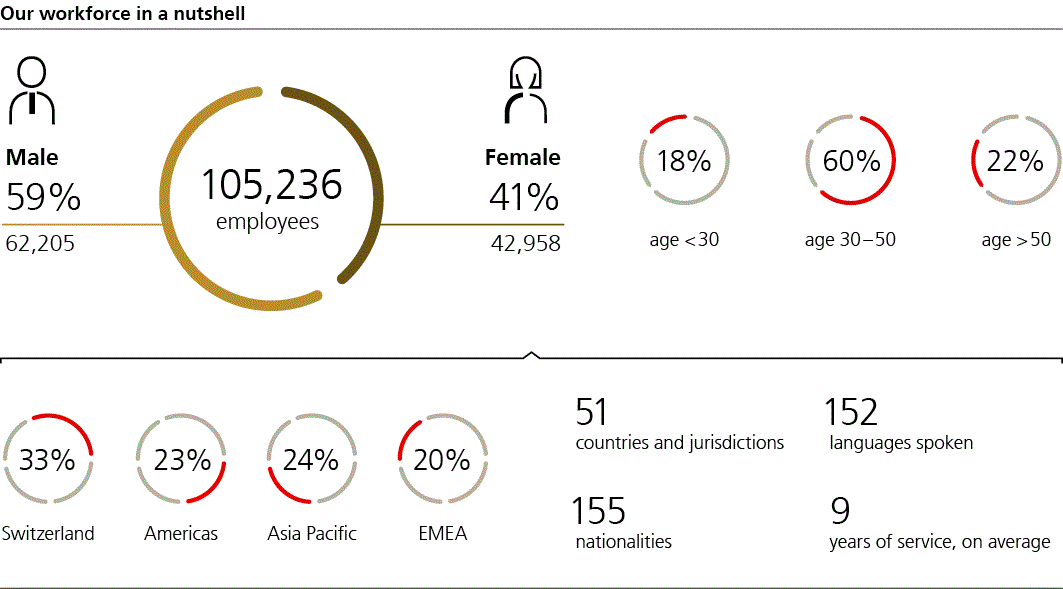
Sustainability Report 2025
| Social 58
Social
People and culture make the difference
Driving sustainable performance
We seek to be a world-class employer for talented individuals across all our markets. With 105,236 (2024: 110,323) staff
in 51 (2024: 51) countries and jurisdictions, we aim to attract, develop and empower our employees to unlock their full
potential, deliver on our client promise and drive meaningful outcomes for our clients, colleagues and communities. Good
corporate citizenship principles are embedded in our employment practices, from hiring and development to fair pay and
benefits. Furthermore, as a founding member of the World Economic Forum’s Good Work Framework, we are committed
to supporting high-quality work worldwide.
›
Refer to the “Driving social impact” section of this report for more information about our community impact and employee
volunteering activities
This infographic shows that on 31 December 2025 UBS had 105,236 (2024: 110,323) employees by headcount (internal
personnel). On that date, 62,205 (2024: 65,091), or 59% (2024: 59%), of our workforce were male and 42,958 (2024:
45,178), or 41% (2024: 41%), female, 18% (2024: 18%)
under the age of 30, 60% (2024: 61%) aged between 30 and
50 and 22% (2024: 22%) over 50. Switzerland was where 33% (2024: 32%) of our workforce were located, with 23%
(2024: 23%) in the Americas, 24% (2024: 24%) in Asia Pacific and 20% (2024: 20%) in EMEA. Our employees come
from 51 countries and jurisdictions (2024: 51), hold 155 nationalities (2024: 159), speak 152 languages (2024: 166) and
have an average of 9 years of service (2024: 9). All data was calculated as of 31 December 2025 on a headcount basis
of 105,236 (2024: 110,323) internal employees only (103,177 FTE (2024: 108,648)). The number of external staff as of
31 December 2025 was approximately 16,412 (workforce count) (2024: 20,335). All quantitative headcount-related
disclosures include all UBS employees except the employees in the Savoy Hotel Baur en Ville AG, Ausbildungszentrum
Schloss Wolfsberg AG, Fides and Card
Center subsidiaries.
Gender data is self-reported in HR systems and does not
include those who have chosen not to disclose as a male or female employee. Therefore, gender-specific numbers do not
match the overall total.
›
Refer to the Supplement to this report, available at
ubs.com/sustainability-reporting
, for more information about our workforce
The three keys and our corporate culture
Our culture, grounded in our three keys to success (our Pillars, Principles and Behaviors), guides how we work together,
supports our business decisions and steers our people management approach.
›
Refer to
ubs.com/global/en/our-firm/our-culture,
for more information about our three keys to success
Sustainability Report 2025
| Social 59
Following the acquisition of the Credit Suisse Group in 2023, we continued to embed our culture across our combined
organization in 2025 to ensure it fully reflects our values and supports our strategy. Our cultural integration efforts were
guided by a dedicated culture integration forum, which was instrumental in steering the firm’s cultural alignment; the
Corporate Culture and Responsibility Committee of the Board of Directors maintained oversight by reviewing and
monitoring activities across the Group related to corporate culture.
Our three keys to success were amplified through initiatives such as our global peer-to-peer recognition program,
Kudos
,
and through our
One UBS
referrals and ideas program, formerly known as our
Group Franchise Awards
. The
One UBS
program rewards cross-divisional business collaboration and recognizes employees for sharing innovation or simplification
ideas. Additionally, internal culture ambassadors played an active role in embedding our culture across the firm.
Throughout the year, global training programs, such as
Crafting Our Future
, which was a series of interactive in-person
sessions sponsored by the Group Executive Board (the GEB), helped align managers at all levels of the organization around
our strategy and culture and equip them to contribute to our future growth. Our ongoing global risk culture campaign,
“We’re all risk managers”, emphasized individual accountability, psychological safety and proactive decision-making.
How we manage our people
Recruiting and hiring talent
In 2025, we hired a total of 8,024 external candidates, including graduates and apprentices, across the Group
(2024: 8,525). The number of external hires, which was lower than in 2024, reflects our strategic emphasis on internal
mobility and proactive internal sourcing, an approach that strengthens our culture and supports long-term career growth
while reinforcing organizational efficiency by retaining and developing existing talent. A total of 2,117 junior talents
joined one of our various firm-wide intern, graduate and apprenticeship programs (2024: 2,168).
We remain one of Switzerland’s largest providers of multi-year apprenticeships and we sponsor similar programs in the
UK. Our summer internships and work-study opportunities across the US, EMEA, Asia Pacific and Switzerland regions
help us build a global pipeline of early-career talent.
›
Refer to the Supplement this report, available at
ubs.com/sustainability-reporting
, and to
ubs.com/global/en/careers/about-
us/employer-awards
for employer ratings and recognitions
Retaining and developing talent
In 2025, 59.4% of all eligible roles were filled by internal candidates (2024: 52.6%), reflecting our strong culture of
internal mobility and commitment to employee development. We launched the
UBS My Career
talent hub in 2025 to
connect employees with internal jobs, mentoring, rotations and learning opportunities and to facilitate targeted talent
management. We consider it important for the success of both employees and the organization to bring together the
right people and roles. Line managers are expected to play an active role in supporting both individual development and
internal career progression.
Our Group-wide talent offering is supplemented by programs in the business divisions, functions and regions. Their aim
is to create a culture of cross-divisional and international mobility, developing versatile leaders at all levels of the
organization. Central to this approach is an annual talent and succession review to identify future leaders, ensure business
continuity and proactively manage employee development. Our leadership development framework ensures we address
their unique needs. Flagship initiatives, such as the Regional Leadership Forum, the AI Senior Leadership Journey and the
AI for Leaders series, foster innovation and prepare leaders to thrive in an artificial intelligence (AI)-enabled world.
We are committed to offering flexible working options wherever possible. Most employees are eligible to work partially
from home, depending on their role, regulatory restrictions and location, and on divisional or functional requirements.
Such arrangements, along with options such as part-time schedules, flexible hours, job sharing and partial retirement,
support employee engagement and retention and help us attract a wider range of talent.
Internal training is delivered via our
UBS University
platform. Our offering includes client advisor certification and
regulatory, business and line manager training, along with modules on culture, sustainable finance, AI, data literacy,
language learning, well-being and other topics. In 2025, we expanded AI learning for all employees with interactive and
self-guided modules to support the responsible and effective use of AI. In addition to internal training, we continued our
partnership with a leading external provider in 2025 to offer employees access to thousands of additional learning
opportunities. In 2025, permanent employees completed approximately 2.9 million learning activities (including
mandatory training) (2024: 3.0 million), equating to an average of 22.9 training hours per employee (2024: 24.8).
All employees are required to meet initial and ongoing training and competency requirements appropriate to the activities
they undertake on the firm’s behalf. We may also require employees to complete mandatory or business-required training,
including risk-management-related training, in line with our mandatory learning policy.
Performance management
Our performance management approach
(MyImpact)
Performance and behavior objectives help the firm assess both what an employee accomplishes and how our Behaviors
(accountability with integrity, collaboration and innovation) are demonstrated. Regular check-ins, along with an
embedded feedback tool, enable employees to give and receive real-time feedback throughout the year, supporting
continuous improvement. Although each line manager retains the decision and ownership of the performance review,
they are supported by AI-enabled tools, including a summarization of the employee’s feedback, to support more holistic
and complete evaluations.
Sustainability Report 2025
| Social 60
More than 362,000 feedback interactions were recorded in 2025 across the organization (2024: 371,000). In 2025,
100% of eligible employees received a performance review (2024: 100%), where their achievements, feedback received
and demonstrated behaviors were assessed holistically.
Employee engagement
Our employees want to have an impact and to help shape their daily experience. Therefore, they have opportunities
throughout the year to connect with leadership and share their views on strategic alignment, the work environment, line
manager effectiveness, culture and well-being. In 2025, initiatives such as our regular “Ask the GEB“ and Group CEO
townhall events supported two-way conversations on topics including the firm’s strategy and direction. Our multi-faceted
employee listening strategy, including short pulse surveys, employee life cycle surveys and focus groups on topics such
as employee sentiment on AI, enabled us to gather insights from all business divisions.
Our Group-wide employee survey, conducted in September 2025, assessed organizational health indicators such as line
manager effectiveness, employee engagement, empowerment and culture. The response rate was 81% (2024: 77%),
with an engagement score of 81% (2024: 83%) and an empowerment score of 87% (2024: 86%). These results
exceeded industry benchmarks
1
services sector.
Employee representation
UBS’s Human Rights Statement and the Code of Conduct and Ethics of UBS (the Code) reinforce the firm’s responsibility
for respecting workers’ rights. We actively engage with our formal employee representation groups and specifically the
UBS European Employee Forum, which includes representatives from all the EU member states where the UBS Group has
a presence. This forum considers topics related to performance, operations and workplace conditions, while local works
councils focus on topics such as benefits, workplace conditions and potential reorganizations. Together, they represent
51.8% of our global workforce (2024: 52.0%). Where applicable, our operations are subject to collective bargaining
agreements.
Fair and equitable pay
We pay for performance and we take pay equity seriously. Across all our locations, we apply the same fair pay standards,
reinforced by annual reviews of our approach and policies in line with established equal pay methodologies. In 2025, our
statistical pay gap analyses reaffirmed that pay differences between male and female employees in similar roles across our core
financial hubs remained below 1%, a difference consistent with that for 2024. If we find any gaps not explained by business
or by appropriate employee factors such as role, responsibility, experience, performance or location, we look at the root causes
and address them.
We also aim to ensure that all employees are paid at least a living wage. We regularly assess employees’ salaries against
local living wages, using benchmarks defined by the Fair Wage Network. Our latest review showed that all employees’
salaries were at or above the respective benchmarks.
›
Refer to the UBS Compensation Report 2025, available at
ubs.com/annualreporting
, and to
ubs.com/sustainability-reporting
for
our UK Gender and Ethnicity Pay Gap Report
Employee benefits and assistance
Our benefits offering supports employees through every stage of life. This includes health care, well-being and retirement
benefits, insurance (such as life insurance) and flexible leave policies tailored to local market practices. All employees are
covered by policies that protect against employment injury or disability. Furthermore, parental leave, including adoption
leave, is available to all employees globally, as outlined in local HR policies, and all our locations offer family-related leave.
Benefits are aligned with local markets and often exceed legal requirements. Employee assistance programs and internal
teams help employees and their family members manage personal or work-related issues that may affect their well-being.
Furthermore, we promote employee health and well-being through a range of programs, benefits and workplace resources,
along with specialized e-learning curriculums. In 2025, employees in every region participated in community volunteering
activities, mental and physical health initiatives, and financial education events. Our dedicated well-being portal offers a
wide range of employee resources with access to tailored initiatives, toolkits and relevant employee networks.
In addition to mentorships and peer-led sessions, we deepened our commitment to the #WorkingWithCancer pledge in
2025 by supporting a “time off for screening“ initiative that helped ensure our employees had the flexibility and support
they needed to plan health checkups and screenings.
The absentee rate in 2025 for the UBS Group based on illness or accident-related absences recorded in HR tools was
2.2% (2024: 2.1%).
Should business or organizational circumstances arise that lead to employee redundancy, we offer professional
reorientation services with a focus on redeployment within UBS. We believe these measures help employees affected by
restructuring to favorably position themselves in the labor market. Employees considering retirement also have access to
various resources to help them prepare for this transition.
›
Refer to the Health and safety statement 2025, available at
ubs.com/sustainability-reporting
, for information about UBS’s health
and safety statement
›
Refer to
ubs.com/employees
1
Sustainability Report 2025
| Social 61
Equal opportunities and whistleblowing
As an equal opportunity employer, we provide equal employment and advancement opportunities for all individuals. We
have clear policies and strong safeguards against discrimination, bullying, victimization and harassment (including sexual
harassment), along with an independent anti-harassment representative who reviews our training and policies.
Employees are encouraged to raise concerns openly, whether they relate to potential violations of any policies, laws,
regulations or legal requirements, misconduct, harassment or breaches of the Code. Multiple Group-wide confidential
channels are available, including a hotline and an online whistleblowing form that offers users the option to remain
anonymous. These channels have been established to enable concerns to be raised with confidentiality and without fear
of retaliation.
›
Refer to the “Business conduct and corporate culture” section of this report for more information about whistleblowing
Workforce inclusion
We are committed to being an inclusive workplace based on meritocracy and we aim to build a culture of belonging
where all employees are recognized and valued and where everyone can be successful and thrive. Our global workforce
has a variety of skills, experiences and backgrounds that reflect the diversity of our clients to serve them at our best. We
deliver our vision through a focus on four key stakeholder groups: employees, clients, community and society, and our
supply chain.
›
Refer to the “Supporting opportunities” section of this report for more information about our clients
›
Refer to the “Driving social impact” section of this report for more information about the topic of community and society
›
Refer to the “Managing the environmental impact of our supply chain” section of this report for more information about our
suppliers
Our strategy is built on four pillars: inclusive leadership, hiring, development and belonging. We leverage all four to
support our workforce across a variety of personal characteristics to create an inclusive culture for everyone.
Inclusive leadership
Our governance framework enables leaders and employees to deliver the strategy and play a part in delivering an inclusive
environment. This guiding principle starts with the oversight and commitment of the GEB and is implemented by leaders
across the firm. We leverage communication channels, workplace forums and councils and engagement plans to drive
awareness and accountability. In every location in which we operate, we continue to act in accordance with the current
law and regulations and will monitor any changes to ensure we remain consistent.
Our strategy is reinforced by our public commitments to support all employees, including, but not limited to, the UN
Women’s Empowerment Principles, the Valuable 500 and the Race at Work Charter (in the UK). Of particular note is our
commitment to the Valuable 500, a global business collective of CEOs and their companies focused on advancing
disability inclusion that we have partnered with since 2021. In 2025, we strengthened disability inclusion by embedding
a dedicated social media strategy and an accommodation request form into our recruitment processes, introducing
additional resources, such as our Guide to Accommodation Conversations and Group-wide digital accessibility e-learning,
and expanding our employee Ability network membership in support of employees with disabilities and allies. We also
conducted an external vendor-led assessment of our branches and offices to evaluate physical accessibility. These efforts
led to our first-ever recognition as a top scorer in the 2025 Best Place to Work for Disability Inclusion by the Disability
Index
®
.
›
Refer to the Supplement to this report, available at
ubs.com/sustainability-reporting
, for more information about our workforce
Hiring
We hire the best people for the right roles, to deliver for our clients, our businesses, our shareholders and the communities
we serve. We focus on brand awareness and on attracting talent for professional- and entry-level roles in our
organization, ensuring our recruitment process is accessible for everyone. For example, in 2025, we launched a disability
inclusiveness and accessibility tool kit aimed at recruiters and managers. Its purpose was to ensure an accessible
application and onboarding experience for persons with disabilities, and all recruiters received detailed training.
Additionally, our UBS Career Comeback program supports candidates on career breaks who want to re-enter the
corporate world. We see a career break or change as a source of transferable skills and experiences that can bring
candidates back to the corporate world stronger than ever.
›
Refer to the Supplement to this report, available at
ubs.com/sustainability-reporting
, for more information about our workforce
Development
We develop and promote with meritocracy at the forefront of decisions we make and provide employees with visibility
and opportunities to enable successful and thriving careers. Development opportunities include mentorship, sponsorship,
training, coaching and career mobility.
Furthermore, we aim to ensure that our promotion and succession planning processes account for the breadth of all
employees’ skills, backgrounds and experiences. For example, in 2025, our six-month career development program, the
Growth Alignment Experience, for employees at the associate director and director levels, and our Not in Your Image
program for employees at the authorized officer, associate director and director levels, provided cohort experiences that
enabled employees to apply and drive their own development with active support from their line managers. Participants
worked with external coaches to align their personal purpose with professional impact while expanding their networks.
Sustainability Report 2025
| Social 62
In 2025, we partnered with the Executive Leadership Council’s Institute for Leadership Development and Research, along
with organizations such as Luminary and the Hispanic Association on Corporate Responsibility, to increase access to
external leadership development events that facilitate individual growth and build our talent pipeline. We also sponsored
intergenerational reciprocal mentoring initiatives and a reverse-mentoring program that paired junior colleagues with
senior leaders to strengthen inclusive leadership skills.
Belonging
It is critically important to us that we respect an environment where all our employees are treated fairly and are able to
reach their potential. A sense of belonging drives employee engagement and is vital for both individual and organizational
well-being. In this respect, inclusive leadership and fair, transparent policies and practices are foundational measures. In
2025, we promoted inclusion and belonging through leadership training and through measures including flexible
working arrangements, fertility support, parental leave, menopause support, transgender support and an ongoing focus
on disability inclusion.
Acting as an engine for engagement and belonging, our employee network chapters around the world connect
employees on a variety of topics. These communities, which are open to everyone, come together to celebrate all cultures,
educate and raise awareness, offer peer support, allyship and networking opportunities, and help ensure the firm’s
sustainable growth by further strengthening our inclusive culture.
›
Refer to
ubs.com/inclusion
›
Refer to
ubs.com/employees
and
ubs.com/careers
Sustainability Report 2025
| Social 63
Driving social impact
UBS aims to support an economy that prioritizes the well-being of people and planet. Through the UBS Optimus network
of foundations (the UBS Optimus Foundation), and in partnership with philanthropists, employees, implementation
organizations and institutional partners, we work to deliver systemic and catalytic impact for marginalized communities
globally and locally, with a focus on children and young people. The UBS Optimus Foundation is a global network of
separately organized and regulated, tax-exempt, charitable organizations, founded and managed by UBS, that make
grants and other financial contributions to implementing partner organizations aligned with their values and objectives.
In addition to mobilizing our clients’ resources to advance the missions of our portfolio of partners, we also seek to ensure
both the firm and employees are engaged in our Social Impact strategy. We do this mainly through charitable
contributions and employee volunteering.
In 2021, UBS set two goals: (i) mobilizing USD 1bn in philanthropic capital, which was achieved, ahead of schedule, in
2024; and (ii) reaching more than 26.5 million people by the end of 2025 (cumulative since 2021), which had been
exceeded by the end of 2025.
We know that working together is key to achieving these targets. We want to go beyond these outputs to create systemic
impact. That is why, in addition to providing insights, advice and execution services to clients and prospective clients, we
have increased our efforts in the areas of blended finance, collaborative philanthropy and impact transparency.
1
In blended finance, we continue to facilitate opportunities and partnerships that leverage public and private capital in
innovative ways.
In collaborative philanthropy, we have brought together clients and partners on joint initiatives addressing global
challenges, most recently through the Resilio Fund, a bold initiative designed to strengthen the resilience of communities
responding to humanitarian crises. This fund backs what local NGOs and community groups are already doing to help
themselves by financing local mutual aid, scaling community services and supporting a faster, more accountable response
to crises. We have also continued our collaboration with the Lemann Foundation, supporting efforts to improve public
education outcomes across Latin America through an ecosystem approach involving local organizations, research
institutions and public-sector partners.
On impact transparency, our impact rating tool, which was introduced in 2024 and rates all grants and investments with
regard to intentionality, additionality and measurability, is now being deployed across all grants and investments. In
collaboration with Impact Frontiers, we have published the first results of this experience and are working to apply
artificial-intelligence-based algorithms to help our teams complete the tool more efficiently and enhancing impact
monitoring for swifter reporting and decision-making.
Our clients and partners are invited to be part of our impact ecosystem by supporting and engaging in various
collaborative initiatives and approaches.
The UBS Optimus Foundation
In 2025, the UBS Optimus Foundation raised USD 472m in donations (2024: USD 366m, both figures include UBS
matching contributions). The 2025 amount exceeded the ambition of reaching by 2027 USD 400m in donations each
year (including matching contributions). Going forward, the foundation aims to continue to raise a similar amount each
year. In 2025, the UBS Optimus Foundation committed USD 461m (2024: USD 310m) in grants from the foundations.
2
Investing for impact
In 2025, the UBS Optimus Foundation focused on strengthening its existing portfolio by mobilizing funding from clients,
so investees can achieve meaningful results. In addition, the foundation celebrated the successful final closing of the SDG
Outcomes Fund and advanced outcomes-based financing through its Outcomes Accelerator Program, reinforcing its
commitment to innovative approaches that deliver measurable impact.
UBS Collectives
Launched in 2020, the
UBS Collectives
focus on issues central to our impact strategy.
–
UBS Accelerate Collective: advancing innovative financing for education, health and climate outcomes.
–
UBS Climate Collective: strengthening coastal resilience through community empowerment, ecosystem restoration and
nature-based climate action.
–
UBS Transform Collective: promoting family-based care and transforming child protection systems.
Our three
UBS Collectives
and embark on a structured learning journey, while building meaningful connections with peers. Members benefit from
expert-led modules, donor update calls, access to subject matter specialists and immersive experiences that bring to life
impact on the ground.
Sustainability Report 2025
| Social 64
Helping our clients structure their philanthropy: donor-advised funds
Donor-advised funds (DAFs) provide clients with an alternative charitable-giving vehicle to setting up their own
foundations, offering greater choice and personalization while being managed in line with their usual investment
approach. UBS operates its own DAF entities in Switzerland, Singapore, the UK and the Hong Kong SAR. In 2025,
USD 961m in donations was received into these UBS charitable entities (2024: USD 329m).
3
Supporting our communities
We have provided direct cash contributions through our affiliated foundations in Switzerland, through partnerships in
the communities where we operate and through contributions to the UBS Optimus Foundation. The combined value of
these contributions in 2025 was USD 84m (2024: USD 74m).
Employee volunteering
We have global targets for employee engagement through volunteering, which are built from the bottom up on the basis
of regional targets. In 2025, we successfully engaged 37% of our global workforce in volunteering (2024: 32%).
1
Currently, our impact transparency focus is on ensuring that all grants and investments supported by the UBS Optimus Foundation undergo consistent and transparent diligence, approval, management and reporting
processes, in line with industry standards.
2
3
Sustainability Report 2025
| Social 65
Respecting human rights
UBS is committed to respecting and promoting human rights, as set out in the UN Guiding Principles on Business and
Human Rights. When assessing the firm’s potential human rights impacts, we focus on three key stakeholder groups
(clients, employees and vendors), as well as society at large.
›
Refer to the “Our stakeholder engagement” section of this report for more information about our interactions with stakeholders,
including civil society groups
Clients: UBS aims to provide its clients with innovative investment solutions on themes related to human rights, such as
health, education, gender and / or equality. In addition, we take human rights risks into account in solutions that address
a broader range of sustainability issues. We identify and manage actual and potential adverse impacts on human rights
to which our clients’ assets and our own assets are exposed, most notably through our sustainability and climate risk
policy framework (including human rights). Our clients also have access to solutions that help them to realize their
philanthropy goals, including those related to human rights.
›
Refer to the “Strategy” section of this report for more details about our sustainability and impact strategy, key aspirations and
progress
›
Refer to the Supplement to this report, available at
ubs.com/sustainability-reporting
, for more information about the
“Sustainability and climate risk policy framework”, including SCR assessments undertaken in 2025 (including human rights-
related)
›
Refer to the “Driving social impact” section of this report for more details about our approach to philanthropy services
Employees: UBS is committed to respecting human rights standards through its human resources policies and practices,
and to meeting the obligations that a responsible company is required to comply with. These are reviewed on a regular
basis in an effort to make sure we continue to respect human and labor rights.
›
Refer to the “People and culture make the difference” section above for more information about UBS’s human resources policies
and principles
›
Refer to “Key policies and principles” in the appendix to this report for more information about UBS’s human resources policies
and principles
Vendors: UBS is committed to reducing the negative societal impacts of the goods and services it purchases. That is why,
when we are establishing new contracts or renewals, we identify high-impact vendors based on whether they provide
goods and services that either have a substantial social impact or are sourced in markets with potentially high social risks.
Vendors that do not meet the minimum applicable standard, because they are associated with actual and potential human
rights risks, have to agree to and comply with a remediation plan before signing a contract with us.
›
Refer to the Responsible Supply Chain Management Policy including the UBS Supplier Code of Conduct for more details about our
responsible supply chain management and assessments, available at
ubs.com/sustainability-reporting
, for more information
UBS’s human-rights-related commitments and actions are set out in the UBS Human Rights Statement. The statement
shows the structures (governance and policies) and mechanisms (procedures and processes) UBS has in place to support
its commitments. UBS also publishes a Modern Slavery and Human Trafficking Statement pursuant to the UK 2015
Modern Slavery Act and to the Australian 2018 Modern Slavery Act.
›
Refer to the Human Rights Statement 2026, available at
ubs.com/sustainability-reporting
,
for more information
›
Refer to the Modern Slavery and Human Trafficking Statement 2026, which will be available as of 30 June 2026 at
ubs.com/sustainability-reporting
, for more information
›
Refer to the Supplement to this report, available at
ubs.com/sustainability-reporting
, for more information about “Information on
the UBS Group pursuant to the Swiss Ordinance on Due Diligence and Transparency in relation to Minerals and Metals from
Conflict-Affected Areas and Child Labor”
Sustainability Report 2025
| Social 66
Responsible use of artificial intelligence
Artificial intelligence (AI) creates an opportunity to significantly enhance our services to clients and improve employee
efficiency. UBS is working toward becoming an AI-enabled institution to create meaningful impact for clients, employees
and shareholders. Deployment of AI in the financial services sector involves new risks and changes the landscape for
many existing risks. To manage these risks, we have embedded our deployment of AI tools and methods into our existing
risk frameworks and governance and have created additional governance and oversight to address the new risks. These
frameworks are designed to protect our clients, our employees and their data and to ensure the integrity of our processes
and the services we deliver to clients.
Governance
The deployment of AI within UBS operates within the firm’s overall governance framework. The Board of Directors
provides overall oversight, and the Group Executive Board has overall responsibility for establishing and implementing
risk management and control.
›
Refer to the “Corporate Governance“ section of the UBS Group Annual Report 2025, available under “Annual reporting” at
ubs.com/investors
, for more information
We have established a comprehensive AI framework that supports the ethical and sustainable use of AI across the firm.
Dedicated governance bodies are in place to oversee AI risk governance and adherence to regulatory requirements,
internal policies and guidelines. We have embedded our use and deployment of AI within our existing risk management
frameworks, including cybersecurity, information security, data protection, data ethics, model risk management and third-
party risk management.
›
Refer to the “Operational risk” and “Cybersecurity and information security” in the “Risk management and control” section of the
UBS Group Annual Report 2025, available under “Annual reporting” at
ubs.com/investors
, for more information
In addition, we have developed additional policies and frameworks to address the novel issues and risks presented by the
deployment of AI in our business. These include processes designed to ensure that AI systems are interpretable, auditable
and aligned with regulatory expectations. Our approach to explainability is aligned with global regulatory frameworks
such as the EU AI Act, the OECD AI Principles and the National Institute of Standards and Technology’s AI Risk
Management Framework. UBS recognizes that opaque models, especially large language models, pose compliance risks
and has developed specialized techniques to address issues such as generative AI hallucination and source attribution
and ethical and accountability concerns.
AI-enabled workplace
We have taken a firm-wide approach to equipping employees with the understanding and skills to leverage AI effectively
through mandatory training on responsible use, risk awareness and practical guidance for generative AI, machine learning
and AI ethics. In 2025, we launched the AI Senior Leadership Journey in partnership with Saïd Business School at Oxford
University. This is a global program enabling senior management to drive transformation towards an AI-enabled
organization. The wider AI People Enablement program offers additional learning opportunities, including foundational
courses, hands-on workshops and live sessions that support ongoing skill development across all roles. Beyond these core
modules, training content is regularly refreshed to keep pace with evolving AI capabilities and business needs. This multi-
year program is intended to embed usage of AI into the workplace at scale, attracting specialized talent and building an
AI-focused junior pipeline.
›
Refer to the “People and culture make the difference” section of this report for more information on employee engagement and
enablement in the context of AI adoption
Clients
We have continued to roll out AI to positively impact our business and serve our clients better. We expect that generative
AI will continue to help us generate more personalized advice and solutions more quickly and in a sustainable and
responsible way, ensuring a more efficient experience for our clients around the globe. We consider the provision of
investment recommendations, advice or research to clients or investors as a high-risk AI use case. We therefore manage
risks to clients through appropriate human oversight and appropriate risk management, as described above.
›
Refer to the “Supporting opportunities” section of this report for more information
›
Refer to the “Our businesses” section of the UBS Group Annual Report 2025, available under “Annual reporting” at
ubs.com/investors
, for more information
Own operations
As AI becomes more integral to our processes, we are mindful of its growing energy demands and associated carbon
footprint. We are proactively addressing these challenges by leveraging energy-optimized data centers and collaborating
with partners to monitor and reduce emissions, particularly as AI workloads shift to the cloud. Although we aim to explore
the potential for AI to have a positive impact on our sustainability efforts, we are also conscious that it is difficult to
predict whether that impact would help to offset the significant energy increases associated with most AI use cases.
›
Refer to the “Reducing our own environmental impact” section of this report for more information
Sustainability Report 2025
| Supporting opportunities 67
Supporting opportunities
Opportunities in sustainable finance
Sustainable finance and our commercial sustainability-related product and service offering are central to the Grow pillar
of our firm-wide sustainability and impact strategy. Our business divisions are continuing to further develop the firm’s
sustainable finance capabilities in line with evolving client demand. Each division defines and pursues specific sustainable
finance objectives through an annual objective-setting process, targeting tangible business outcomes, product innovation,
client engagement and integration of sustainability considerations into routine operations. A critical input to this process
is the firm’s materiality assessment, which evaluates environmental and social topics – including climate – across short-,
medium- and long-term horizons. Our assessment found climate-related topics represent a material financial opportunity
for Asset Management, where an established product offering is already contributing materially to revenues today, with
expectations of continued contribution going forward.
Our approach to sustainable finance
Sustainable finance still lacks a consistent definition that is uniformly accepted in the financial industry. It therefore
remains important to set out how UBS understands sustainable finance across the three principal areas of our associated
product and service offering.
–
Investing:
–
Financing:
–
Research, advisory, data analytics, platforms and other services:
sustainability-related objectives, such as analytics, scoring, reporting, tools and client support through our interactions
with them.
Sustainable investing
Our approach to sustainable investing is defined in the UBS Group Sustainable Investing Policy. According to our policy,
sustainable investing includes any product (e.g. fund or mandate) with an underlying investment strategy that, in addition
to targeting market-rate financial returns, aims to explicitly:
–
align with one or more specific sustainability-related objectives; or
–
contribute to achieving one or more specific sustainability-related objectives,
while also considering sound governance structures and potential adverse impacts on broader sustainability matters,
where relevant. Strategies focused only on the integration of sustainability risks and / or exclusions and / or active
ownership, with no contribution to sustainability-related objectives, would not qualify as sustainable investing for us.
While we regularly review our global sustainable investing framework to ensure that it continues to appropriately consider
evolving regulatory guidance, market practice and client expectations, it is not tailored to or defined by any specific local
regulatory requirements or definitions.
We summarize our investing approaches as follows:
Traditional investing
Sustainable investing
–
Targets risk-adjusted market-rate investment returns
–
Has no explicit sustainability objectives
–
May manage sustainability risks related to
investment performance
–
May use sustainability-related tools, but these do
not drive the strategy
–
Targets risk-adjusted market-rate investment returns
–
Has explicit sustainability objectives that drive the strategy
–
Underlying investments may contribute to positive sustainability-related objectives through
products, services and / or proceeds
–
Impact investing additionally has explicit intentions to generate measurable, verifiable and
positive sustainability outcomes, and impact is attributable to investor action and / or
contribution
›
Refer to the Supplement to this report, available at
ubs.com/sustainability-reporting
, for more information about environmental,
social and governance (ESG) integration and exclusion
The legacy Credit Suisse Sustainable Investment Framework (the Credit Suisse SIF)
1
portfolios and clients that have not been fully onboarded to UBS as of the end of 2025. The Credit Suisse SIF will be
phased out over time and in line with further integration progress. It does not have any bearing on our established UBS
sustainable investing approach and governance. Products and services designated in accordance with the Credit Suisse
SIF are not automatically carried over to become UBS sustainable investing products, but are subject to detailed product-
by-product sustainable investing due diligence. We no longer report Group-level invested assets information associated
with the Credit Suisse SIF as the migration has already progressed to a significant extent, though it remains ongoing in
some parts of the firm.
1
asset classes, locations and regulatory regimes. Classification can also help match clients’ interests with relevant investment solutions. The Credit Suisse Sustainable Investment Framework classification does not
supersede any regulatory commitment, nor does it determine or indicate whether an investment solution will be labeled as “sustainable” (or any other such term) under any given regulatory regime.
Sustainability Report 2025
| Supporting opportunities 68
Sustainable financing
Our sustainable financing instruments are governed by the UBS Sustainable Finance Guideline, which is associated with
the overarching Sustainability and Climate Risks policy. The guideline defines criteria for all sustainability-labeled financing
instruments we offer to our clients, including green, social, sustainability, transition and sustainability-linked (GSSS) bonds
and loans, along with sustainability-labeled equity instruments (e.g. green equity). All in-scope instruments are subject to
specific criteria, aligned to commonly used global industry and market standards (e.g. those issued by the International
Capital Market Association (the ICMA), the Loan Market Association (the LMA), the Loan Syndication & Trading
Association (the LSTA), the Asia Pacific Loan Market Association (the APLMA), the European Green Bond (EuGB) Standard
or the World Federation of Exchanges (the WFE).
›
Refer to the “Sustainability and climate risk policy framework“ section of the Supplement to this report, available at
ubs.com/sustainability-reporting
, for our definitions of sustainable financing products
Meeting clients’ differentiated needs
We serve a broad range of clients across our four main business divisions. The table below provides an illustrative overview
of sustainable finance products and services offered to clients by our business divisions. While it provides a good
illustration of the breadth of products and services available to clients across UBS’s business activities, it is not an
exhaustive representation of our sustainable finance and investing offering, which varies by jurisdiction, booking center
and client domicile and is also subject to client suitability and preference considerations. Not all products and services are
available to all clients and / or in all regions.
A sustainable finance offering for all our clients
1
Investing
Financing
Research, advisory, data analytics,
platforms and other services
Global Wealth
Management
–
Sustainable discretionary mandates
–
Sustainable modules for traditional
discretionary mandates
–
Sustainable investing solutions for
advisory mandates
–
Sustainable separately managed
accounts (SMAs)
2
–
Sustainable public market investment
funds (actively managed and indexed)
–
Sustainable private market funds
(including infrastructure and real estate)
–
Sustainable hedge funds
–
Sustainable structured products
–
Direct investments in sustainable
equities and bonds
–
Real-estate-related financing
3
–
Sustainable investing research and
thought leadership
–
Sustainability reporting
–
Philanthropy solutions
–
Renovation journey, tools,
partnerships and ecosystems
3
Personal & Corporate
Banking
–
Sustainable discretionary mandates
–
Sustainable modules for traditional
discretionary mandates
–
Sustainable public market investment
funds (actively / passively managed)
–
Sustainable private market funds
(including infrastructure and real estate)
–
Real-estate-related financing
–
Green, social, sustainability
and sustainability-linked
bonds
–
Sustainability-linked loans
–
Sustainability leasing for
energy-efficient assets
–
Renovation journey, tools,
partnerships and ecosystems
–
Sustainable savings account
–
Sustainability reporting and analysis
–
Sustainability research and thought
leadership
–
Philanthropy solutions
The Investment Bank
–
Thematic sustainability-related products
(e.g. carbon, climate)
–
Green, social, sustainability
and sustainability-linked
bonds
–
Green, social, sustainability
and sustainability-linked loans
–
Labeled equity
–
ESG advisory
–
ESG research
Asset Management
–
Sustainable separately managed
accounts (SMAs)
2
–
UBS sustainable public market funds
(actively and passively managed)
–
UBS sustainable private market funds
(including infrastructure and real estate)
–
UBS sustainable hedge funds
–
Sustainable mandate solutions (actively
and passively managed)
–
Sustainability thought leadership
–
Sustainability analytics and
reporting for clients (standardized
and customized)
1
Investing and financing products referenced in this table follow UBS’s Group Sustainable Investing Policy and UBS Sustainable Finance Guideline, where applicable. Any sustainability-related terms or classifications
appearing in this table are not intended to constitute references to or representations of compliance with any jurisdiction-specific regulatory labeling regimes or sustainability taxonomies. UBS applies all applicable
sustainability-related regulatory requirements to its products and services in the jurisdictions in which they are offered.
›
Refer to the “Basis of preparation” in the Supplement to this report, available at
ubs.com/sustainability-reporting
, for details of
products that are included in sustainable product metrics
Sustainability Report 2025
| Supporting opportunities 69
Sustainable finance in 2025:
–
As of the end of 2025, UBS’s total sustainable and sustainability-linked financing and sustainable investing volumes
stood at USD 455.0bn (2024: USD 346.6bn).
1,2
–
Our total sustainable investing invested assets reached USD 405.6bn (2024: USD 309.6bn).
3,4
–
The sustainable investing portion of our total invested assets was 5.8% (2024: 5.1%).
–
In the Investment Bank, we facilitated 95 green, social, sustainability or sustainability-linked (GSSS) bond transactions
globally (2024: 96).
5
–
The total on-balance sheet drawn exposure of sustainable loans granted to corporate and institutional clients booked
on the UBS Switzerland AG platform amounted to USD 2.4bn (excluding mortgages) as of the end of 2025
(2024: USD 2.0bn).
6
Total sustainable and sustainability-linked financing and sustainable investing volumes
1
For the year ended
USD bn, except where indicated
31.12.25
31.12.24
31.12.23
Sustainable and sustainability-linked financing and sustainable investing volumes
455.0
346.6
314.8
Sustainable investing invested assets
405.6
309.6
292.3
UBS-apportioned deal value of green, social, sustainability, and sustainability-linked (GSSS) bond deals (cumulative since 2022)
2
47.0
35.0
22.6
Sustainable loans granted to corporate and institutional clients
3
2.4
2.0
1
Includes products and transactions subject to the UBS Group Sustainable Investing Policy and the UBS Sustainable Finance Guideline. Refer to additional footnotes in the “Sustainable investing invested assets” and
“Labelled transactions facilitated by UBS” tables further below in this section for additional detail.
2
Does not include any transaction volumes associated with bonds facilitated by Credit Suisse Investment Bank during 2022. For 2023 figures, UBS performed an assessment for Credit Suisse GSSS bonds and included
those deemed to be aligned with the UBS Sustainable Finance Guideline.
3
loans).
Sustainable investing
The global sustainability-oriented public fund markets grew to record highs of USD 3.9trn
7
2025, supported by strong market performance over the course of the year. Europe remains by far the largest market,
with an 86% market share. Last year, the net new money in funds and exchange-traded funds (ETFs) were on aggregate
negatively impacted by geopolitical tensions, anti-ESG sentiment in certain regions and by reallocations of fund assets
into mandates. Nevertheless, sustainability-oriented fixed income funds recorded another year of inflows. The European
sustainability-oriented fund universe has undergone a comprehensive naming review as fund managers implemented the
European Securities and Markets Authority (ESMA) Guidelines on fund names using ESG or sustainability-related terms.
Around 29% of the sustainability-oriented European fund universe has been renamed since January 2024.
Sustainability-oriented funds accounted for 12% of all global private markets fundraising in 2025, reaching a final-close
size of USD 167bn and exceeding that of 2024.
8
While sustainability-related fundraising was strongest in Europe, North America represented 38% of the aggregate
figures.
Multiple industry surveys conducted throughout the year have consistently indicated sustained investor interest and
commitment to sustainable investing.
9
institutional investors, younger generations (Gen Z, Millennials) and investors based in Europe and Asia Pacific. Key
thematic investment priorities include renewable energy and energy efficiency, with growing attention also directed
toward nature-related areas such as water, waste management, pollution, biodiversity and various social themes.
Additional research supports the value generated by integrating sustainability considerations into both investments and
operations.
10
sustainability-linked initiatives have demonstrated a 3% increase in EBITDA over the investment lifecycle, according to
data from the ESG Data Convergence Initiative.
During 2025, UBS participated in an inaugural Paris Agreement Article 6.2 cross-border carbon exchange executed by
the governments of Switzerland and Norway, the first Internationally Transferred Mitigation Outcome (ITMO) transaction
in the global technological carbon removal market, supporting our expectation that greenhouse gas emissions markets
can play an important, market-based role in addressing climate change risks. This marks an important step toward
establishing transparent, rules-based international carbon markets and lays the groundwork for regulatory infrastructure
that will enable future cross-border carbon transfers.
1
Includes products and transactions subject to the UBS Group Sustainable Investing Policy and the UBS Sustainable Finance Guideline.
2
Calculated as the sum of: (i) firm-wide sustainable investing invested assets as of the end of 2025; (ii) the cumulated GSSS labeled bond volumes, on a UBS share basis, between 2022 and the end of 2025 as facilitated
by the Investment Bank; and (iii) drawn sustainable loan exposures in Personal & Corporate Banking as of the end of 2025.
3
Includes products subject to the UBS Group Sustainable Investing Policy. Full-year figures include integration-related impacts of approximately USD 36.1bn in Asset Management and USD 1.6bn in Global Wealth
Management. Refer to additional footnotes in the “Sustainable investing invested assets” table in this section.
4
Comparative information has been revised to reflect this change, resulting in the inclusion of USD 13.2bn for 2024 and USD 10.6bn for 2023.
5
Includes transactions subject to the UBS Sustainable Finance Guideline.
6
in scope of this metric: sustainability-linked loans (SLL), green, social, and sustainability loans (use-of-proceeds loans).
7
8
9
Sources: KPMG, BNP Paribas, Morgan Stanley, Bloomberg and UBS.
10
Sustainability Report 2025
| Supporting opportunities 70
Over the course of 2025, UBS sustainable investing invested assets went up to USD 405.6bn as of 31 December 2025,
compared with USD 309.6bn at the end of 2024, representing a year-on-year increase of 31%.
1
was due to strong market performance and foreign exchange effects, while also driven significantly by integration-related
effects, in particular in Asset Management. Sustainable investing invested assets accounted for 5.8% of the UBS Group’s
total invested assets at the end of 2025. UBS is the third-largest manager of open-ended funds and ETFs by sustainable
investing invested assets.
2
The table below provides additional detail on sustainable investing invested assets for UBS. We have simplified our
sustainable investing reporting categories compared with previous years by focusing mainly on our overall sustainable
investing invested assets and on impact investing invested assets as part of that, as they represent an important,
differentiated sub-class of instruments that are subject to more stringent eligibility criteria.
3
separate reporting of invested assets associated with instruments categorized as “sustainability focus” in order to avoid
confusion with the “Sustainability Focus” investment product label introduced in the UK through the Sustainability
Disclosure Requirements (the SDR) as these are not equivalent.
The terminology included refers to definitions in the UBS Sustainable Investing Policy and does not refer or relate to any
product-specific regulatory labelling regime or naming conventions. UBS sustainable investing invested assets contain
invested assets of Credit Suisse portfolios, which have been migrated onto UBS platforms and vetted against UBS’s
sustainable investing policies or merged with existing UBS sustainable investing portfolios. This process is being carried
out in waves and will continue in some parts of the firm until the end of 2026. The Credit Suisse integration-related
impact to sustainable investing invested assets in 2025 was approximately USD 38bn, of which USD 36.1bn were in Asset
Management and USD 1.6bn in Global Wealth Management. Certain products have been reclassified during 2025 for
reasons including, but not limited to, an evolving regulatory environment, periodic monitoring of the product shelf, and
developing internal classification standards. The impact of these reclassifications on sustainable investing invested assets
was immaterial in 2025.
Sustainable investing invested assets
For the year ended
% change from
USD bn, except where indicated
31.12.25
31.12.24
31.12.23
31.12.24
UBS Group invested assets
7,004.6
6,086.8
5,714.1
15
Sustainable investing invested assets
1,2
405.6
309.6
292.3
31
o/w Impact investing invested assets
20.4
20.3
21.8
0
Sustainable investing proportion of UBS Group invested assets (%)
3
5.8
5.1
6.5
1
Invested assets reported for sustainable investing include limited amounts of instruments not classified as sustainable investing. This includes cash and cash-like instruments that each fund and portfolio hold for
liquidity management purposes, as well as client-directed investments included in sustainable investing mandates managed by Asset Management.
2
frameworks and standards, sustainable investing invested assets attributable to Global Wealth Management’s US business are included for 2025. Comparative information has been revised to reflect this change,
resulting in the inclusion of USD 13.2bn for 2024 and USD 10.6bn for 2023.
3
we report the sustainable investing proportion of UBS AG total invested assets, excluding any invested assets booked by and for Credit Suisse AG.
Sustainable financing
In 2025, issuance volumes of sustainability-labeled bonds in global markets grew 5% year on year compared with 2024
levels, reaching USD 849bn and representing the strongest year since 2021. Green bond issuance continued to dominate,
accounting for 59% of total sustainability-labeled bond issuance in 2025.
4
debuted in the market last year, with the largest transaction coming from a supranational issuer, with the European
Investment Bank issuing a 12-year EUR 3bn Climate Awareness Bond.
We facilitated 95 green, social, sustainability and sustainability-linked (GSSS) bonds in 2025 (2024: 96). Over the course
of 2025, we have seen an increased number of social bonds and deal activity was strongest in the EMEA region. The
slight decrease in our overall facilitated volumes was due to a relatively lower number of sustainability-linked bond
transactions.
Labeled transactions facilitated by UBS
1
For the year ended
% change from
USD bn, except where indicated
31.12.25
31.12.24
31.12.23
31.12.24
Total labeled transactions
Number of green, social, sustainability, and sustainability-linked (GSSS) bond deals
95
96
102
(1)
Total deal value of green, social, sustainability, and sustainability-linked (GSSS) bond deals
54.0
56.0
53.7
(4)
UBS-apportioned deal value of above
12.0
12.4
12.8
(3)
Number of green, sustainability and sustainability-linked bond deals
77
85
93
(9)
Total deal value of green, sustainability and sustainability-linked bond deals
47.6
48.1
49.3
(1)
UBS-apportioned deal value of above
10.0
11.2
11.6
(11)
1
included those deemed to be aligned to UBS Sustainable Finance Guidelines.
1
Following the completion of the alignment with internal UBS frameworks and standards, sustainable investing invested assets attributable to Global Wealth Management’s US business are included for 2025.
Comparative information has been revised to reflect this change, resulting in the inclusion of USD 13.2
bn for 2024 and USD 10.6
bn for 2023.
2
Source: Morningstar.
3
Refer to “Our approach to sustainable finance” in this section for additional detail on UBS’s Group sustainable investing approach.
4
Source: London Stock Exchange Group (LSEG).
Sustainability Report 2025
| Supporting opportunities 71
Sustainable finance and artificial intelligence
As UBS is expanding the use of artificial intelligence (AI)-enabled tools and capabilities across the firm, use cases related
to sustainability and sustainable finance more specifically are actively being developed. For example, the business divisions
are exploring AI tools to support their work around ESG due diligence questionnaires, investment product development
processes, company-specific sustainability and transition profile assessments, as well as broader education and insights
activities. The potential of AI to streamline data collection, particularly qualitative, sustainability-related reference data
that traditionally requires extensive manual effort, is highly promising. This capability is driving efforts to achieve
significant efficiencies in scale and scope. However, human oversight continues to be crucial to the implementation and
application of AI tools.
›
Refer to ”Sustainability and climate risk policy framework“ section of the Supplement to this report, available at
ubs.com/sustainability-reporting
, for more information about UBS’s sustainability and climate risk policy framework including the
UBS Sustainable Finance Guideline
Sustainability Report 2025
| Supporting opportunities 72
Global Wealth Management
As the world’s only truly global wealth manager, dedicated to serving high and ultra high net worth individuals, as well
as selected institutional clients, we aim to help private clients and family offices pursue their sustainability objectives in
line with their targeted financial performance via an end-to-end insights-driven investment value chain. We incorporate
sustainability-focused insights – including risks and opportunities – across asset allocation, thematic and asset class views,
portfolio construction and instrument selection, to inform the discretionary and advisory solutions available to clients.
These solutions include multi-asset investment portfolios, tailored portfolio solutions and a suite of advisory options across
equities, bonds and alternative investments.
2025 highlights
–
Global Wealth Management clients’ impact investing assets stood at USD 10.0bn (2024: 10.5bn).
1
–
Global Wealth Management clients’ sustainable investing invested assets reached USD 72.9bn (2024: USD 69.1bn).
1,2,3,4
Delivering actionable investment insights
The Chief Investment Office (CIO) of Global Wealth Management identifies actionable sustainability-related investment
opportunities across its research and investment management functions. These include, for example, strategies across
gender-lens investments, climate technology ventures, renewables infrastructure, sustainable bonds and thematic areas
such as transition investing, nature investing and climate innovation. We publish a regular series of sustainable investing
insights, including a monthly
Sustainable investing perspectives
Sustainable
InSIghts
Sustainable investing in charts
During 2025, we provided insights for clients on the implications for sustainable investing stemming from evolving
geopolitical topics, including a dedicated analysis on new US White House Executive Orders and other global policy
developments. We helped clients follow and understand the discussion and actions from key events including the World
Economic Forum 2025, UN Climate Week 2025 and COP30. The underlying sustainable investing insights are also
integrated into other investment views, for example around the CIO’s series on transformational investment opportunities
across power and resources, and longevity.
As part of the Credit Suisse acquisition, additional tools designed to enhance transparency and reporting on the
sustainability characteristics of investments and portfolios, as well as selected sustainable and impact investing solutions,
were brought onto the merged platform during 2025.
Building sustainable portfolios
Our flagship cross-asset sustainable investing portfolio – based on our dedicated sustainable investing strategic asset
allocation (SI SAA) – continued to deliver positive financial performance, with portfolio innovations such as emerging
market sustainable finance delivering meaningful risk diversification in 2025. Within Global Wealth Management
Switzerland and International, we addressed the dynamic market environment by implementing tactical changes to the
portfolio throughout the year, including diversifying our equity allocations to mitigate volatility resulting from strategic
exposure to small- and medium-sized companies and growth equities. This broadened portfolio exposure to a range of
sustainability-related themes and increased exposure to companies demonstrating a positive sustainability-related
improvement trajectory.
We saw a further increase in interest and allocations to tailored and customized portfolios that enable clients to express
their own sustainability views while supported by our sustainable investing portfolio construction, investment universe
and transparency. We continued to enhance the methodology underpinning the CIO sustainability scores for issuers,
which informs our investment process within specific strategies and enables issuer-, fund- and portfolio-level transparency
to be delivered to clients by addressing controversies and their materiality across industries. We also continue to actively
advise clients on individual funds and direct investments as part of advisory mandates and allocations to their broader
traditional portfolios.
Changes in our clients’ sustainable investing invested assets during 2025 mostly reflect market performance. Asset flows,
as supported by trends observed in our client conversations and industry commentary, reflect a broad concern among
private investors about performance outside the US technology sector and the slower-than-expected pace of interest rate
cuts that are yet to positively impact small- and medium-sized companies, which still represent a meaningful share of
many sustainability-focused portfolios. As a result, clients have become more tactical in allocating to sustainability in their
portfolios, which can also be seen in the rising use of sustainable investing modules within traditional investment
mandates.
1
vetted against UBS’s sustainable investing policies or merged with existing UBS sustainable investing portfolios. This process is being carried out in waves and will continue in some parts of the firm at least until the
end of 2026. Invested assets reported as sustainable investing include limited amounts of instruments not classified as sustainable investing.
2
3
Report 2024 we focused on sustainable investing invested assets following the Global Wealth Management CIO’s sustainable investing strategic asset allocation (SI SAA), figures now include invested assets pertaining
to all sustainable investing products and services held by Global Wealth Management clients globally.
4
Comparative information has been revised to reflect this change, resulting in the inclusion of USD 13.2bn for 2024.
Sustainability Report 2025
| Supporting opportunities 73
Additionally, the changes in our clients’ impact investing reported assets are due to the return of capital from our earlier
private market impact investments, which have now reached maturity and started distributing proceeds to investors, re-
allocations of assets within the discretionary sustainable investing mandates between different sustainable investing
strategies within Global Wealth Management Switzerland and International, and general market factors.
Providing investment solutions for climate and nature challenges
In 2025, Global Wealth Management continued to increase the number of available investment solutions across asset
classes and strategies to support clients’ decarbonization objectives. This included the onboarding of specific transition
strategies, such as the Nordea Climate Engagement Fund and the Robeco Climate Transition Equity Fund, along with the
launch of the flagship UBS Climate Innovation Fund III – a continuation of the former Credit Suisse climate venture
platform under UBS’s impact investing framework in our Switzerland and international business - and extending the
Macquarie Energy Transition Infrastructure Fund, a clean energy infrastructure solution, to our US-domiciled clients.
Global Wealth Management’s sustainable investing portfolio and modules are now available to clients in Australia. We
also continued Global Wealth Management’s credit research coverage of individual green bonds, expanding the available
universe for clients who prefer direct investments to fund solutions. These complement our existing offering and
investment tools that enable the building of customized and bespoke allocations. Examples include using water
consumption and pollution and waste data to address nature-related risks and opportunities in single stock and bond
portfolios.
We are continuing to explore ways to develop nature-related products and solutions in our wealth and asset management
businesses. Global Wealth Management’s primer “
An introduction to nature investing
”, published in 2025, is aimed at
providing education and a tool kit for private investors seeking to develop investment exposure in nature. This primer
explicitly addresses investments “in” and “for” nature. In our view, the investable solution set “in” nature remains
relatively nascent and is yet to reach mainstream commercial scale. Global Wealth Management’s current focus is
therefore on investing in solutions to reduce pollution and aid conservation, such as through the Robeco Circular Economy
Fund, and engaging with listed companies to sharpen their focus on these topics via our engagement funds available to
clients, including the Federated Hermes SDG Engagement Fund.
›
Refer to the “Environment” section of this report for more information about UBS’s nature-related activities
Educating our clients and employees
Supporting our clients, prospective clients and advisors with timely research and education on sustainable investing is an
important part of the advice we provide.
Given the rapidly evolving environment around sustainability and investments, it is crucial for advisors to stay up to date
with industry trends, regulatory developments and investment ideas. During 2025, we continued to engage with advisors
through various channels, including the regular Let’s Talk SI sessions for Global Wealth Management product and client-
facing staff. We are continuing to run accelerated training programs for our client-facing staff. To date, several hundred
of our Asia Pacific Global Wealth Management client advisors and advisory specialists have benefited from 2-day certified
training provided by the University of Zurich. In addition, our portfolio managers and product specialists around the world
participated in portfolio sustainability integration training delivered by the University of California, Berkeley. Gender-lens
and sustainable investing was a key part of the West Region’s Women’s Conference in the US, which is offered to leading
financial advisors in this market.
Our educational work with clients has also continued to evolve. We conduct dedicated Next Generation and Emerging
Successors client sessions on sustainable and impact investing. Sustainable investing is also integrated into many of our
core flagship client events, with a focus on actionable investment ideas, and featured in our Global Family Office forums
and Philanthropy Roundtable events. We held several client events as part of the 2025 UBS Nature Finance Conference
in London, focusing on broad portfolio development and on specific themes such as ocean investing. We held a number
of events focused on gender-lens investments.
In addition, in Asia Pacific, we introduced a new format of CIO-driven client engagements, in collaboration with the UBS
Group’s Chief Sustainability Office and the Investment Bank where relevant, covering specific topics such as ocean
conservation and climate technology or building investor communities, including a women’s wealth and sustainable
investing workshop. In the US, sustainable investing was a core component of this year’s annual Philanthropy Forum and
it was also integrated throughout local events involving clients and advisors. For example, gender-lens investing was
central to an event hosted in Los Angeles as a collaboration between UBS’s Sports and Entertainment segment and
PlayMakeHer, as well as an event in Boston centered on female investors.
›
Refer to
ubs.com/global/en/wealthmanagement/what-we-offer/investing/sustainable-investing
Global Wealth Management’s sustainable investing insights
›
Refer to the UBS Group Annual Report 2025, available at
ubs.com/investors
, for more information about the overall business and
financial profile of Global Wealth Management as important context for the product and financial information provided here
›
Refer to the “Supporting opportunities” section of this report for more information about the proportion of sustainable investing
invested assets as part of our total invested assets
Sustainability Report 2025
| Supporting opportunities 74
Personal & Corporate Banking
Personal & Corporate Banking is at the core of our operations in Switzerland, the only market in which we operate across
all of our business areas, supporting our Swiss clients and the Swiss economy with UBS’s unparallelled global reach and
capabilities. By offering innovative sustainability-related advice and solutions, we are well-positioned to seize
opportunities in transition finance and support our clients’ decarbonization ambitions.
2025 highlights
–
The total on-balance sheet drawn exposure of sustainable loans granted to corporate and institutional clients booked
on the UBS Switzerland AG platform amounted to USD 2.4bn (excluding mortgages) as of the end of 2025 (2024:
USD 2.0bn).
1
–
For the first time we arranged a green private placement for a Swiss client, positioning us for future transactions in
both private placements and bond formats.
–
We closed our first bilateral sustainability-linked loan in commodity trade finance with a Swiss-based steel trader.
Private clients
In 2025, Personal & Corporate Banking continued to empower private clients to achieve their sustainability-related goals. In
order to support clients on their property renovation and refurbishment projects, the UBS renovation calculator is now
available in e-banking for retail clients, providing an easily accessible assessment of potential renovation measures. Clients
can access estimated renovation costs, recommended timings and insights into CO
2
both before and after renovation. Furthermore, we saw growth in UBS Sustainable Savings Account volumes. This solution
is available in UBS key4 banking and includes a quarterly report that describes the impact created by those savings.
Additionally, the migration of Credit Suisse clients led to a significant increase in UBS Vitainvest sustainable pension solutions.
Corporate and institutional clients
Support for corporate and institutional clients is being provided across three levels: advice, tailored solutions and
partnerships. At the center of this approach is a holistic dialogue on sustainability that considers a client’s current position
and identifies the most material topics to be addressed for further progress. Building on our efforts from previous years,
we continued to host regional client roundtables across Switzerland, fostering meaningful exchanges between companies
on sector-specific challenges. Furthermore, we published the “
Virtuous circles: The circular economy
” explainer, aimed
at Swiss firms, which outlines the drivers behind the circular economy’s growing popularity and its implications for
companies. To ensure our client advisors remain equipped to lead client discussions with confidence, we conducted
learning sessions with internal experts to facilitate the exchange of expertise and best practices.
Through our tailored sustainability-related financing solutions, including sustainability-linked loans, green, social,
sustainability and sustainability-linked bonds and the newly launched UBS Sustainable Leasing for energy efficient assets,
we enable clients of different sizes and at various stages of their transition to pursue their investment objectives.
Partnerships remain a key pillar of support, providing our clients with access to a diverse and carefully evaluated network
of external experts and solution providers such as esg2go and act Cleantech. As part of our commitment to driving
innovation and entrepreneurship in Switzerland, Personal & Corporate Banking launched the first Impact Tech Award
together with Startup Nights, the leading start-up event in Switzerland. This award shines the spotlight on Swiss start-ups
that are making a real difference through technology – delivering tangible environmental and societal impact for today
and tomorrow.
Swiss real estate
Personal & Corporate Banking has enhanced its Swiss real estate services to further support clients in renovating and
refurbishing their properties, helping them to improve energy efficiency and long-term value. We have introduced CO
2
portfolio reporting capabilities for institutional investors on our UBS key4 mortgage platform, enhancing transparency
and enabling more informed decision-making for their portfolios. We also expanded our UBS Renovation Service offering
to private clients with income-producing real estate, enabling more clients to benefit from the combined expertise of
UBS and Wincasa. Several deals have already been closed with private clients using this service. For UBS Loan Green and
UBS Mortgage Green, an additional eligibility criterion based on the implied energy efficiency class of a building has been
introduced, based on a model developed by Wüest Partner AG, a leading Swiss real estate consulting firm. Furthermore,
the migration of the Credit Suisse loan book led to an increase in UBS Loan Green volumes driven by the interest of
former Credit Suisse clients in this offering.
›
Refer to the UBS Group Annual Report 2025, available at
ubs.com/investors
, for more information about the overall business and
financial profile of Personal & Corporate Banking as important context for the product and financial information provided here
›
Refer to
ubs.com/sustainability-reporting
including the UBS Sustainable Finance Guideline
›
Refer to the “Supporting opportunities” section of this report for more information about the proportion of sustainable investing
invested assets as part of our total invested assets
1
year-on-year change is driven by several factors, including ongoing loan origination and foreign exchange effects.
Sustainability Report 2025
| Supporting opportunities 75
Asset Management
With nearly 30 years
1
solutions that aim to deliver sustainable outcomes alongside financial returns. Our sustainable investing capabilities cover
active and passive styles of investing and span asset classes. There is rarely a one-size-fits-all solution for clients, which is
why we incorporate a variety of approaches to ensure client choice in our offering. These include active ownership,
impact and transition-focused strategies. We integrate data science into our sustainable investing processes to drive
innovation and create more efficient alpha opportunities.
Our sustainable investing commitments and 2025
highlights
–
Supporting our clients to achieve their sustainable investing goals: 20% of Asset Management’s fund offering
2
will be sustainable-investing products, providing choice for clients. At the end of 2025, 23.4% of Asset Management’s
fund offering consisted of sustainable investing products (2024: 23.4%).
–
At the end of 2025, Asset Management managed sustainable investing invested assets of USD 304.1bn
(2024: USD 220.4bn).
3
–
UBS Asset Management provides choice to enable clients to pursue their climate goals. We commit that all clients’
net-zero-ambition portfolios align with the Paris Agreement with interim targets by latest 2035.
4
Asset Management had a combined invested assets value of USD 111.5bn in net-zero-ambition portfolios
(2024: USD 64.4bn).
5
–
Asset Management’s corporate engagements with investee companies on sustainability-related topics achieved 73.6%
positive progress against preset objectives (2024: 66.7%).
Our sustainable investing offering
Asset Management has a broad sustainable investing product shelf that includes traditional and alternative funds,
exchange-traded funds and mandates with broad sustainability and climate orientations. Examples of such products
include strategies that invest in climate solutions, climate transition, green bonds, green real estate and more. To meet
our client preferences and demand, we continually review our suite of sustainability and climate-related portfolios.
2025 marked a significant milestone in advancing the integration of Credit Suisse Asset Management (CSAM) into UBS,
with essentially all CSAM products designated for classification as sustainable investing under the UBS Asset Management
sustainable investing classification framework having been successfully migrated to the UBS platform, aligning with UBS’s
standards and governance for sustainable investing.
Notable climate-related offering developments in 2025
In 2025, we expanded our offering mainly in net-zero real estate, active equities, corporate fixed income and rules-based
strategies. This included expanding our Climate Aware fund range. For Swiss institutional clients, new launches included
the Equities World ex CH Small Caps Climate Aware and Equities Emerging Markets Climate Aware funds. With these
additions, Swiss institutional investors now can invest in four Climate Aware net-zero-aligned equity benchmark
universes: Switzerland, developed markets ex Switzerland (large caps), developed markets ex Switzerland (small caps) and
emerging markets.
We also developed customized decarbonization mandates with interim 2030 targets, designed to achieve 40%
decarbonization by 2030 compared with 2019. These mandates include a rules-based equity strategy, an active equity
strategy and an active fixed income strategy. We also collaborated with a leading index provider to create custom indices
that reflect individual client expectations. These indices combine Paris-Aligned Benchmark (PAB) criteria, activity and
norms-based exclusions, positive screening aligned with the UN Sustainable Development Goals (SDGs) and
environmental, social and governance (ESG) ratings.
1
2
Management single investor and feeder funds are excluded. Products formerly managed by Credit Suisse Asset Management that were categorized in accordance with the legacy Credit
Suisse Sustainable Investment Framework have been within the scope of the total number of funds since 2024. Of these products, only those assessed against the UBS Group Sustainable
Investing Policy and classified as a sustainable investing product are within the scope of Asset Management sustainable investing funds.
3
Figures do not include invested assets classified under the Credit Suisse Sustainable Investment Framework but include invested assets of Credit Suisse portfolios that have been migrated
onto UBS platforms and vetted against UBS’s sustainable investing policies or merged with existing UBS sustainable investing portfolios. This process is being carried out in waves and will
continue in some parts of the firm at least until the end of 2026. The Credit Suisse integration-related impact on sustainable investing invested assets for Asset Management in 2025 was
USD 36.1bn. Invested assets reported as sustainable investing include limited amounts of instruments not classified as sustainable investments. This includes cash and cash-like instruments
that each fund and portfolio holds for liquidity management purposes and client-directed investments included in sustainable investing mandates.
4
5
The scope of assets with net-zero ambition for 2025 is Asset Management. For 2024, Credit Suisse portfolios were in the process of being assessed in the context of Asset Management’s
net-zero alignment framework and were therefore excluded from this metric’s reporting.
Sustainability Report 2025
| Supporting opportunities 76
Active ownership
In 2025, we continued our programs of engagement with investee companies to support our overarching goal to protect
and enhance the value of our clients’ investment portfolios in line with our fiduciary duty. During 2025, Asset
Management actively engaged with 250 companies on sustainability-related topics. Of the total of 341 meetings
undertaken on sustainability-related topics, 244 included dialogue regarding environmental and social issues (2024: 321
companies, 473 meetings in total and 300 meetings on environmental and social issues). Some highlights from the
perspective of our specific environmental and social engagements are included below.
Environment
In the seventh year of our climate-themed engagement program, we continued dialogues with companies in several
carbon-intensive industries where climate change represents a potential investment risk. These interactions focus on how
companies consider topics such as decarbonization, transition planning and the management of long-term physical
climate risks. We engage with companies where these environmental topics are financially material to safeguarding or
enhancing the long-term value of the investment.
We also monitor developments related to biodiversity, as changes in natural ecosystems can have financial implications
for certain business models. Where relevant, we seek to understand how companies incorporate biodiversity-related
considerations into their broader strategic planning.
We remain participants in selected international engagement platforms. Those interactions are limited to non-binding,
high-level exchanges of views.
In 2025, we continued to apply our existing voting framework, which includes assessing how companies approach
financially material risk topics, including those related to climate considerations. We also added to our proxy voting
approach, reinforcing our engagement efforts with a vote against directors due to climate strategy considerations.
Social
Our engagement activities also cover social topics, broadly grouped into human capital, human rights, and safety and
quality. We engage with companies on these topics where they are financially material to protecting or enhancing the
long-term value of investments.
In human-rights-related discussions, we seek to understand how companies develop and communicate their policies and
practices. In human capital engagements, we explore how businesses approach workforce-related matters, including
labor conditions and workforce composition. Our safety and quality discussions vary by industry and may include
cybersecurity and responsible use of technology for IT companies, nutritional considerations for food and beverage firms,
and broader product-related matters where applicable.
We also continue to participate in selected international collaborative initiatives. These interactions are limited to non-
binding, high-level exchanges of views.
Governance
We engage with investee companies based on our belief that strong governance leads to better corporate performance
by enhancing the management of business strategy, capital allocation and risks, leading to improved shareholder value.
We encourage companies to provide timely, accurate and comprehensive reporting on all material governance and
business matters, as clear and effective disclosure enables investors to effectively monitor companies’ operations and
business practices. Our monitoring of governance-related factors includes using internal information from our proprietary
databases, external specialist sell-side broker research and third-party rating tools, reviewing the inputs to governance,
holding meetings with company executives and non-executive board members, assessing deviations from relevant
corporate governance codes, and monitoring corporate developments through company announcements and market
news sources. Our governance engagement also provides a forum for us to give feedback to companies on issues raised
at annual general meetings of shareholders and to explain our voting decisions.
›
Refer to the UBS Group Annual Report 2025, available at
ubs.com/investors
, for more information about the overall business and
financial profile of Asset Management as important context for the product and financial information provided here
›
Refer to the “Supporting opportunities” section of this report for more information about the proportion of sustainable investing
invested assets as part of our total invested assets
Sustainability Report 2025
| Supporting opportunities 77
Investment Bank
The Investment Bank offers clients global advice and access to the world’s primary, secondary and private capital markets.
In 2025, we continued to hone our capabilities through initiatives across Global Markets, Global Research, Global Banking
and data-led offerings.
2025 highlights
–
We facilitated 95 green, social, sustainability and sustainability-linked (GSSS) bond transactions
1
–
We acted as joint global coordinator and joint bookrunner for the first green initial public offering (IPO) in Asia and
the first company in the Philippines and ASEAN to achieve green equity accreditation.
–
We acted as joint lead manager on the European Green Bond (EuGB) format for a financial services company – the
first issuer of the sector to adopt the EuGB format, where 100% of the proceeds will be allocated to EU-Taxonomy-
aligned activities.
–
We published thematic pieces and held events with strong client interaction on the topics of power systems and wider
related topics (e.g. artificial intelligence (AI) build-out).
Global Research
In 2025, investors navigated a continually evolving sustainability landscape, while at the same time analyzing and
assessing significant market activity in energy transition and other key sustainability-related topics driven by underlying
fundamentals (for example, power constraints and other sustainability considerations related to AI data center activity).
ESG Research delivered thematic reports on related topics. These included nuclear (
How to play the value chain
), grids
(
The Great Grid Build-out: Growth outlook
), data center cooling technologies (which also addresses a key operational
concern regarding water availability for data center operation) and a deep dive on geothermal energy.
More generally, through our research we addressed ways in which environmental, social and governance (ESG) factors
connect to individual markets, sectors and companies within our coverage. ESG research is supported by UBS Evidence
Lab, which provides data-driven insights into ESG-relevant questions, and by UBS HOLT, which provides a clear, objective
framework for comparing and valuing over 20,000 companies worldwide.
2
Global Markets
Within Global Markets, our product capabilities include facilitating client access to thematic investment exposure, in line
with their choice of sustainability topics. In 2025, we saw an increased focus on structured products related to nuclear
and data center exposures in response to the growing energy demands of AI and the need for a reliable, consistent and
low-carbon power source.
We have continued to advance the build-out of UBS’s product capability to offer clients the opportunity to invest in
specific sustainability-aligned projects (including carbon removals projects), as well as further progressing the groundwork
for green structured issuance, blended finance and emission allowance offerings. Developing this product suite will enable
UBS to meet client demand for sustainability-aligned investment solutions alongside the more traditional product set and
to demonstrate its origination capabilities.
Our partnership with the UBS Optimus network of foundations (the UBS Optimus Foundation) continued to evolve in
2025. One example of this is the announcement in 2025 of support provided by UBS and the UBS Optimus Foundation,
alongside various other key stakeholders, for the flood action coalition.
3
for a new investable market in natural flood and drought resilience, unlocking private and public capital to scale nature-
based solutions across the UK and strengthen the country’s economic and climate resilience”.
›
Refer to the “Driving social impact” section of this report for more information about the UBS Optimus network of foundations
1
2
Source: ubs.com/global/en/investment-bank/holt.
3
Sustainability Report 2025
| Supporting opportunities 78
Global Banking
ESG advisory
We are continuing to support clients globally with our strategic, hands-on and analytically grounded ESG advisory
approach, helping them navigate investor divergence and reposition equity stories to deliver the best outcome. Our
differentiated model has delivered critical contributions across mergers and acquisitions, equity capital markets and
private funds group situations, targeting key corporate clients and financial sponsors. As part of our ESG advisory services,
we are focused on sustainability and AI leadership through deep market knowledge, proprietary ESG fund analytics,
thoughtful investor communication and innovative instruments, while intensifying investor engagement via non-deal
road shows and global events such as COP30. The team is an early adopter of generative AI and has actively been
integrating AI into workflows for deeper insights and improved efficiencies, such as language and topic analysis in
sustainability reports and large volumes of earnings calls.
2025 deal highlights
–
Joint Lead left global coordinator and joint bookrunner for the first green IPO in Asia and the first company in the
Philippines and ASEAN to achieve green equity accreditation under the Philippine SEC Guidelines, which were
published in September 2025. S&P’s Climate Transition Assessment showed that 100% of the company’s revenues in
2024 were derived from “green” activities, highlighting the company’s role as a sustainability leader in the water
sector. It is the largest water utility IPO in Southeast Asia, since 2015, and the largest water utility IPO globally since
2008.
–
Financial advisor to a global leader in sustainable construction on the spin-off of a subsidiary, the largest-ever spin-off
by a Swiss company, to create North America’s largest building solutions company. The transaction unlocks strategic
focus for both companies, accelerating the ability of each to scale low-carbon, advanced building technologies across
their respective regions.
Leveraged and debt capital markets
The Investment Bank arranged USD 54.0bn in green, social, sustainability and sustainability-linked (GSSS) financing
(2024: USD 56.0bn), of which USD 12.0bn was the UBS-apportioned volume (2024: USD 12.4bn), through 95 bond
deals during 2025 (2024: 96 deals). We continued to play an active role in sustainable fixed income markets, actively
supporting the adoption of the European Green Bond Standard, which became applicable in December 2024. We
continued to solidify our strong position in the Swiss franc-denominated market. Alongside Switzerland, we were active
in the GSSS bond markets across Europe, the UK, Australia and Brazil.
We acted as joint lead manager for a financial services company on its EuGB issuance – the first financial services issuer
to adopt the EuGB format – with 100% of proceeds allocated to EU-Taxonomy-aligned activities such as green buildings
and renewable energy.
We also advanced thematic innovation by advising clients on nature-related bond opportunities, including asset-mapping
and co-benefit reporting, supported by new guidance from the International Capital Market Association (the ICMA) and
the International Finance Corporation (the IFC). In September 2025, UBS acted as joint lead manager for a Dutch
promotional bank’s green bond, for water management and flood defense projects.
The Investment Bank strengthened its sovereign, supranational and agency (SSA) issuers franchise in 2025 by introducing
an annual approval framework for sustainability-labeled sovereign bonds, enabling faster execution and enhanced
efficiency.
›
Refer to the UBS Group Annual Report 2025, available at
ubs.com/investors
, for more information about the overall business and
financial profile of the Investment Bank as important context for the product and financial information provided here
›
Refer to ”Sustainability and climate risk policy framework“ section of the Supplement to this report, available at
ubs.com/sustainability-reporting
, for more information about UBS’s sustainability and climate risk policy framework including the
UBS Sustainable Finance Guideline
Sustainability Report 2025
| Supporting opportunities 79
Group Treasury activities
In 2025, Group Treasury continued to invest its liquidity portfolios under a dedicated ESG investment framework. This
framework guides the integration of ESG considerations into the investment process alongside more traditional economic
and risk dimensions. The framework supports investments in green, social and sustainability-labeled bonds.
At the end of 2025, Group Treasury held USD 11.2bn of green, social and sustainability-labeled bonds in its liquidity
portfolios, compared with the USD 7.9bn it held in 2024.
Sustainability Report 2025
| Managing sustainability and climate risks
80
Managing sustainability and
climate risks
Introduction
Managing sustainability and climate risks is a key component of our corporate responsibility. We define these risks as the
risks that UBS negatively impacts, or is impacted by, climate change, nature, human rights and other environmental and
social matters. Such risks may materialize as credit, market, liquidity, business or non-financial risks for UBS, potentially
leading to adverse financial, liability or reputational impacts.
Sustainability and climate risk management
framework
Our firm-wide sustainability and climate risk management framework, supported by dedicated policies, standards and
guidelines, forms the basis of our approach to identifying, assessing and managing environmental and social risks. It
enables us to address potential adverse impacts on the climate, the environment and human rights, while also managing
related risks that may affect UBS and our clients, and supporting the transition to a low-carbon economy.
Overseen by senior management, the framework is applied across client onboarding, transaction due diligence, product
development, our own operations and our supply chain. It is a continuous process, consisting of four phases described
in the following sections: (i) risk identification and measurement; (ii) monitoring and risk appetite setting; (iii) risk
management and control; and (iv) risk reporting and disclosure.
›
Refer to the “Sustainability and climate risk policy framework” section of the Supplement to this report for more information
›
Refer to the “Our investment management approach to sustainability and climate risks” section of this report for a description of
our sustainability and climate risk investment approach
Governance and strategic oversight
Group Risk Control is responsible for our firm-wide sustainability and climate risk framework and for managing financial
exposure to these risks as a second line of defense. Group Compliance and Operational Risk Control provides independent
oversight of our non-financial risk control environment, ensuring its adequacy and effectiveness. We manage
sustainability and climate risks through a dedicated risk management framework, which continues to evolve and is
focused on meeting emerging regulatory requirements and enhancing core processes, such as reporting and disclosures.
The Group Chief Risk Officer is responsible for the development of the sustainability and climate risk framework, including
the definition of risk appetite and its integration into existing Group-wide risk management frameworks. The Head of
Sustainability and Climate Risk supports the Group Executive Board by providing leadership on sustainability in
collaboration with the business divisions and Group functions. Oversight of our sustainability and climate risk efforts is
conducted jointly by the Risk Committee and the Corporate Culture and Responsibility Committee of the Board of
Directors. These bodies monitor the progress of our efforts to address sustainability and climate risks.
›
Refer to the “Supplement to Governance” section of the Supplement to the UBS Group Sustainability Report 2025, available at
ubs.com/sustainability-reporting
, for further details on sustainability governance at UBS
Sustainability Report 2025
| Managing sustainability and climate risks
81
Risk identification and measurement
Sustainability and climate risks are identified at divisional and cross-divisional levels. Our climate-related risk identification
methodologies and materiality assessment collectively define key focus areas and risk drivers. The insights gained
contribute to our overall sustainability and climate risk strategy by:
–
identifying concentrations of climate-sensitive exposure, which may increase vulnerability to financial and non-financial
risks, thereby guiding resource prioritization for enhanced risk quantification and management; and
–
enabling us to assist clients with their low-carbon transition and identify those who may benefit from our sustainability-
focused products and services.
The outcomes of this process guide senior management decision-making and provide stakeholders with valuable insights
through our external disclosures.
Our approach to climate-related risk identification
Our methodologies are designed to assess how susceptible clients and assets are to climate risks, focusing on the potential
financial impacts that could arise from policy changes, technological shifts, market evolution in the context of transition
risk and climate-related hazard events in the context of physical risk. These assessments evaluate the magnitude of
climate-related risk drivers affecting a counterparty or asset class, helping us determine how such risks may influence
creditworthiness, collateral values and broader portfolio exposure.
1
For corporate clients, when counterparty-level information is available and of sufficient quality, a bottom-up methodology
is used. The methodology includes the counterparty’s measures and actions in place to mitigate transition risks
summarized through UBS’s internal Company Transition Assessment Scorecard and the exposure of their assets to physical
hazards. When counterparty-level information is not available, a top-down methodology is used for transition and
physical risks based on both the country of risk domicile and the internal UBS industry classification (Group Industry Code
2).
For Lombard lending, an overall portfolio rating is assigned based on the average riskiness of the collaterals that are
posted securing the loans. In 2025, UBS developed a global real estate (GRE) model to provide a counterparty-level rating
across transition and physical risks in the real estate portfolio. Together, these methodologies enable UBS to assess how
transition and physical risks may influence the risk profiles of clients and provide a consolidated view of the UBS Group
exposure to climate-related risks.
Transition risk
Climate-driven transition risks arise from the transition to a sustainable economy, in particular its decarbonization, for
example due to changes in policy, case law, technology or in the behavior of market participants. This may contribute to
a structural change across economies and consequently affect banks and the stability of the wider financial sector.
The climate-driven transition risk profile chart shows that, in 2025, the key sectors contributing to the UBS Group’s
transition-risk-sensitive exposure continued to be real estate, industrials and transportation, unchanged from 2024.
Physical risk
Climate-driven physical risks arise from acute hazards, which are increasing in severity and frequency , and chronic risks,
which arise from an incrementally changing climate. Climate-driven physical risks may contribute to a structural change
across economies and consequently affect banks and the stability of the wider financial sector.
The climate-driven physical risk profile chart shows that, in 2025, Switzerland and the Americas were the largest
contributors to the UBS Group’s physical-risk-sensitive exposure, with both regions demonstrating relatively high adaptive
capacity to manage physical risk hazards, resulting in a moderately low overall physical risk rating. Countries are grouped
into regions according to the UBS Country and Region Data Standard.
›
Refer to the “Supplement to Managing sustainability and climate risks” and the “Basis of preparation” sections of the Supplement
to the UBS Group Sustainability Report 2025, available at
ubs.com/sustainability-reporting
, for details about methodologies
1
develop our risk identification and measurement approaches.
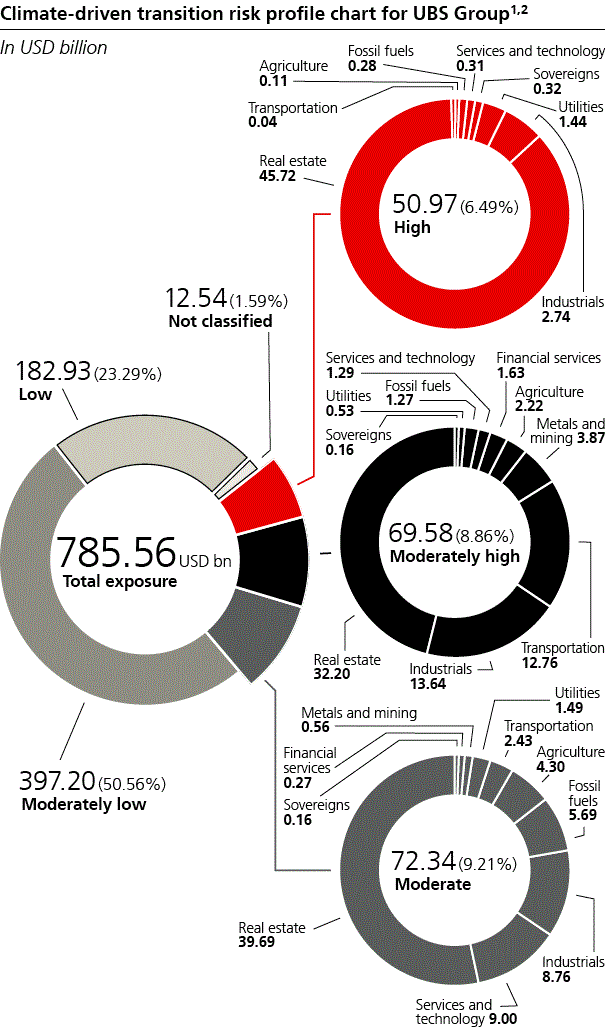
Sustainability Report 2025
| Managing sustainability and climate risks
82
High 50.97 (6.49%)
Real estate
45.72
Utilities
1.44
Fossil fuels
0.28
Private clients with mortgages
39.72
Power production: regulated & high-carbon
fuels
1.44
Wholesale & trading: refined petroleum products
0.17
Real estate financing
6.00
Sovereigns
0.32
Refining and marketing
0.10
Industrials
2.74
Government agencies
0.30
Agriculture
0.11
Chemicals
2.13
Sovereigns
0.02
Food and beverage production
0.10
Machinery and related parts manufacturing
0.32
Services and Technology
0.31
Livestock – beef extensive grazing
0.02
Cement or concrete manufacture
0.29
Business services
0.31
Transportation
0.04
Electronics manufacture
0.01
Land-based shipping high-carbon (trucks)
0.04
Moderately high 69.58 (8.86%)
Real estate
32.20
Transportation (cont.)
Services and technology
1.29
Private clients with mortgages
19.96
Land-based shipping high-carbon (trucks)
1.03
Business services
1.26
Development and management of real estate
6.66
Airlines – commercial
0.87
Media, information technology
0.02
Real estate financing
5.57
Automobile manufacture (high-carbon fuels)
0.10
Fossil fuels
1.27
Industrials
13.64
Transit systems
0.05
Wholesale & trading: crude oil and natural gas
1.02
Machinery and related parts manufacturing
6.34
Metals and mining
3.87
Conventional oil (on- / off-shore)
0.14
Pharmaceuticals
3.00
Mining conglomerates (incl. trading)
3.04
Integrated oil and gas
0.07
Plastics and petrochemicals manufacture
2.02
Production of other mined metals and raw
materials
0.57
Gas processing (including LNG)
0.05
Consumer durables manufacturing
1.60
Production of steel and iron
0.27
Utilities
0.53
Chemicals
0.60
Agriculture
2.22
Power production: regulated & high-carbon fuels
0.36
Other consumer goods manufacturing
0.07
Food and beverage production
2.22
Waste water treatment
0.17
Clothing manufacture
0.02
Financial services
1.63
Sovereigns
0.16
Transportation
12.76
Banks
1.17
Sovereigns
0.16
Sea-based shipping (high-carbon fuels)
7.35
Other financial services
0.20
Airlines – cargo
2.00
Asset managers and asset owners
0.19
Transportation parts and equipment supply
1.36
Brokers and other intermediaries
0.07
Moderate 72.34 (9.21%)
Real estate
39.69
Fossil fuels
5.69
Utilities
1.49
Private clients with mortgages
29.82
Wholesale & trading: refined petroleum
products
5.32
Waste disposal and recycling
0.59
Real estate financing
7.08
Transportation and storage (gas)
0.19
Power production: regulated & high-carbon fuels
0.49
Construction – non-infrastructure
2.68
Downstream oil and gas distribution
0.17
Grid operation and transmission
0.27
Development and management of real estate
0.07
Wholesale & trading: crude oil and natural gas
0.01
Wholesale & trading: electricity and power
0.13
Construction of buildings and related activities
0.04
Agriculture
4.30
Metals and mining
0.56
Services and technology
9.00
Food and beverage wholesale / retail
2.92
Metal or mining not elsewhere classified
0.45
Media, information technology
8.59
Food and beverage production
1.14
Production of steel and iron
0.07
Business services
0.25
Crops – high emissions intensity
0.14
Production of other mined metals and raw
materials
0.04
Entertainment, leisure, retail not elsewhere
classified
0.11
Other agricultural services
0.07
Financial services
0.27
Education
0.05
Livestock – other
0.02
Asset managers and asset owners
0.15
Industrials
8.76
Transportation
2.43
Banks
0.11
Electronics manufacture
4.07
Passenger ships
1.71
Sovereigns
0.16
Other consumer goods manufacturing
1.51
Airlines – cargo
0.38
Government agencies
0.11
Clothing manufacture
1.46
Sea-based shipping (high-carbon fuels)
0.16
Sovereigns
0.05
Aerospace and defence activities
1.19
Automobile manufacture (high-carbon fuels)
0.10
Pharmaceuticals
0.26
Airlines – commercial
0.08
Machinery and related parts manufacturing
0.14
Plastics and petrochemicals manufacture
0.13
1
loss) and is based on consolidated information reported under IFRS Accounting Standards (inclusive of purchase price allocation adjustments recorded in the UBS Group as a result of the acquisition of
the Credit Suisse Group in compliance with IFRS 3, Business Combinations).
2
are defined as those business activities that are rated as high, moderately high or moderate, whereas those that are rated as having moderately low and low vulnerability are rated as “non-sensitive”.
The exposures that are not assessed due to lack of methodology and / or data are categorized as “not classified”.
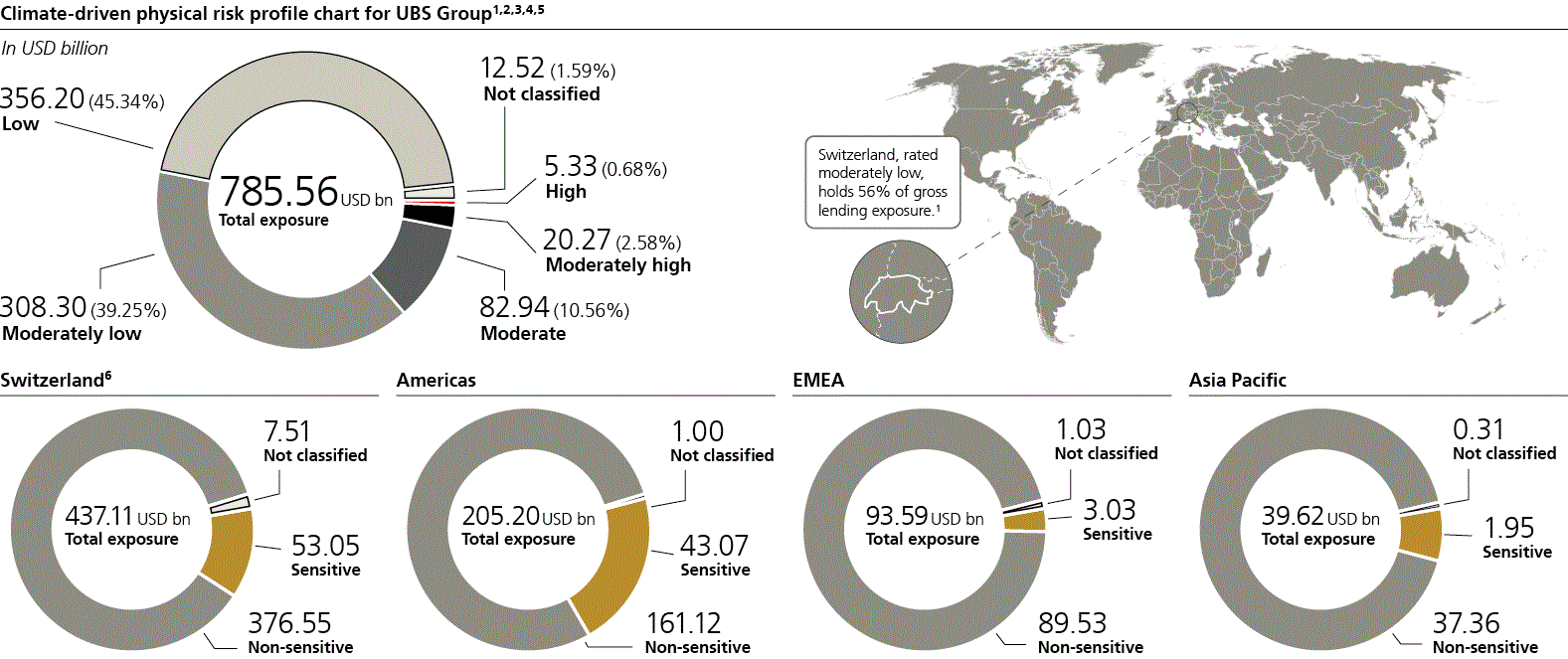
Sustainability Report 2025
| Managing sustainability and climate risks
83
Switzerland
6
Americas
EMEA
Asia Pacific
Sensitive
53.05
Sensitive
43.07
Sensitive
3.03
Sensitive
1.95
Private clients with mortgages
19.20
Financial services
20.77
Services and technology
0.81
Financial services
0.85
Real estate financing
12.61
Services and technology
11.83
Industrials
0.66
Metals and mining
0.33
Services and technology
8.12
Industrials
4.79
Private clients with mortgages
0.48
Services and technology
0.22
Others
13.11
Others
5.68
Others
1.08
Others
0.55
Non-sensitive
376.55
Non-sensitive
161.12
Non-sensitive
89.53
Non-sensitive
37.36
Not classified
7.51
Not classified
1.00
Not classified
1.03
Not classified
0.31
1
allocation adjustments recorded in the UBS Group as a result of the acquisition of the Credit Suisse Group in compliance with IFRS 3, Business Combinations).
2
that are rated as high, moderately high or moderate, whereas those that are rated as having moderately low and low vulnerability are rated as “non-sensitive”. The exposures that are not assessed due to lack of methodology and / or data are categorized as “not classified”.
3
risk rating across all regions is “moderately low”. The world map therefore reflects the moderately low color scale as in the total exposure chart.
4
Countries are grouped into regions according to the UBS Country and Region Data Standard.
5
region. This includes exposure to countries that cannot be mapped, global funds, multi-lateral institutions, and ship and aircraft financing.
6
Sustainability Report 2025
| Managing sustainability and climate risks
84
Climate scenario analysis and stress testing
We apply scenario-based approaches to assess our exposure to transition and physical risks arising from climate change.
We have introduced several in-house assessments leveraging industry collaborations to tailor approaches for addressing
methodological and data challenges. We employ dedicated climate risk models that are designed to capture both
systematic and idiosyncratic effects to perform stress-testing exercises across short-, medium- and long-term horizons.
The work performed includes regulatory scenario analysis and stress-testing exercises. These include, for example, the
Bank of England 2021 Climate Biennial Exploratory Scenario, the 2022 European Central Bank climate risk stress test
(which assesses banks’ preparedness for dealing with financial and economic shocks stemming from climate risk) and the
2024 Swiss Financial Market Supervisory Authority (FINMA) and Swiss National Bank climate scenario analysis exercise.
These exercises facilitated the identification of financial risks from climate change. They also made it possible for UBS to
assess management actions in response to different scenario results and perform a counterparty-level analysis. Although
the results indicated mild losses and low exposure for the entities and portfolios in scope, they provided valuable insights
to strengthen UBS’s climate risk scenario analysis and stress testing.
In 2025, we further refined and expanded our internal climate risk scenarios and enhanced the dedicated climate risk
methodologies. Furthermore, we conducted a Group-wide climate scenario analysis to guide the materiality assessment
of climate-related risks, meeting the FINMA Circular 2026/1 “Nature-related financial risks” (published by FINMA in
December 2024) requirements on nature-related financial risks. A range of climate scenarios in line with UBS’s business
model were used, including a stress scenario, under which the lack of coordinated mitigation efforts places the planet on
a 3°C-warming trajectory by 2100.
Over the last few years, we have also leveraged industry-wide initiatives, such as the Paris Agreement Capital Transition
Assessment exercise launched by the Swiss Federal Office for the Environment in 2020, 2022 and 2024. Through this
exercise, we assessed the climate alignment of our listed investments (including equities and bonds), mortgages and
direct real estate portfolios. The assessment enabled us to compare our results with the aggregated performance of all
participating banks’ portfolios, showing the progress made over time and the efforts still needed.
Materiality of climate-related risks across risk categories
UBS conducts a financial risk materiality assessment of climate-related risk drivers, complementing its regular risk
identification processes described above. This climate-related materiality assessment evaluates how transition and physical
risk drivers may affect UBS’s risk categories: credit, market, liquidity, business and non-financial risks.
In 2025, the materiality assessment for climate risks was enhanced and performed based on a combination of qualitative
and quantitative inputs (including climate scenario analysis and exposures to climate-sensitive sectors), from both an
inherent and residual perspective. Inherent risk refers to the level of risk that exists in the absence of any climate-related
controls or mitigation actions, whereas residual risk refers to the level of risk after taking them into account.
Materiality was assessed across the short (one year), medium (two to five years) and long term (more than five years) to
capture the dynamic nature of climate risk exposure.
The table below summarizes whether transition and physical risks are considered material or not material on an inherent
basis, for each risk category and time horizon under a stress case scenario.
Overview of inherent material risks under stress case scenarios
Risk type
Time horizon
Credit
Market
1
Liquidity
2
Business
3
Non-financial risk
Physical risk
Short-term
Not material
Not material
Not material
Not material
Not material
Medium-term
Not material
Not material
Not material
Long-term
Material
Not material
Transition risk
Short-term
Material
Not material
Material
Material
Not material
Medium-term
Material
Material
Material
Long-term
Material
Material
1
than long-term climate transition. The banking book scenario time horizon is aligned with the liquidity portfolio (high-quality liquid assets) and existing internal liquidity adequacy assessment process (ILAAP) stress
tests, which operate on a one-year horizon. This alignment ensures consistency with regulatory expectations and reflects the relatively stable nature of banking book exposures. Therefore, market risk has not been
assessed in the medium and long terms.
2
which is considered long-term for liquidity purposes and is in alignment with the time horizon of the funding regulatory metric, the net stable funding ratio (one year). Therefore, liquidity risk has not been assessed
in the medium and long terms.
3
Sustainability Report 2025
| Managing sustainability and climate risks
85
Inherent credit risk is assessed as material under stress-case scenarios, primarily due to the expected long-term impacts
of chronic physical hazards on macroeconomic developments in the real estate sector (physical risk) and also due to
regulatory uncertainty, which may require significant investments and impact credit quality for the real estate sector and
for corporate lending exposures to sectors deemed climate-sensitive (transition risk).
Inherent liquidity risk is assessed as material under stress-case scenarios, reflecting potential for abrupt shifts in regulatory
conditions, resulting in economic disruptions that could trigger significant outflows, elevated funding costs or impaired
access to capital markets (transition risk).
Inherent business risk is assessed as material under stress-case scenarios, considering the potential financial impacts of a
sudden and disorderly climate transition resulting in economic disruptions, which could reduce the value of assets and
recurring fee income, and increased market uncertainty, which could lower deal flow and transaction-based fees
(transition risk).
All material financial risks are primarily driven by indirect climate impacts, such as macroeconomic impacts from climate
change, as opposed to direct climate impacts on counterparties or assets.
Inherent non-financial risk is assessed as material under stress-case scenarios, due to ongoing regulatory scrutiny and the
evolving legal landscape around climate and sustainability requirements and disclosures, which can expose UBS to
litigation risk, regulatory penalties and reputational damage in the event of non-compliance or perceived greenwashing
(transition risk).
Across all risk types, climate-related risks are assessed as not material on a residual basis (after considering our standard
climate-related controls / mitigation actions), with the exception of non-financial risk in the long term. The latter risk
remains material even after mitigating controls are taken into account, due to persistent political uncertainty and
diverging regulatory requirements across jurisdictions, which lead to heightened legal and litigation risks (transition risk).
Material risks were fed into the regular risk identification process, and a climate root cause driver was added, where
relevant.
Sustainability Report 2025
| Managing sustainability and climate risks
86
Monitoring and risk appetite setting
UBS has established a qualitative (e.g. exclusion of controversial activities) and quantitative (e.g. decarbonization targets)
risk appetite, which is subject to periodic monitoring and enhancements. The risk appetite guides decision-making and
supports proactive management of exposures to climate-sensitive sectors.
The climate-related risk metrics below help us monitor our exposure to key transition and physical risk drivers across
portfolios, highlighting where climate-related vulnerabilities may influence our overall risk profile. UBS will continue to
develop these metrics, ensuring alignment with regulatory expectations and industry-leading practices.
›
Refer to the “Sustainability and climate risk policy framework” section of the Supplement to the UBS Group Sustainability Report
2025, available at
ubs.com/sustainability-reporting
, for more details on sustainability and climate risk standards, decarbonization
control framework and assessments
Climate-related risk metrics
The table below includes climate-related risk metrics for the UBS Group, UBS AG on a standalone basis, UBS Switzerland
AG on a standalone basis and UBS Europe SE on a standalone basis.
In 2025, UBS developed the global real estate (GRE) model, enabling asset-level sensitivity assessments for real estate
financing and the private clients with mortgages portfolio, impacting both transition- and physical-risk-sensitive
exposures.
Climate-driven transition-risk-sensitive exposure accounted for 24.6% of the UBS Group’s total gross lending exposure,
up from 21.0% based on the revised
1
UBS’s Swiss residential and commercial real estate decarbonization targets to identify properties that rely on fossil fuel
heating systems and are not progressing in line with UBS’s decarbonization pathway as sensitive.
Climate-driven physical-risk-sensitive exposure accounted for 13.8% of the UBS Group’s total gross lending exposure, up
from 12.8% based on the revised
1
physical risk rating by assessing building-level exposures to a physical risk hazard.
Carbon-related assets accounted for 9.7% of the UBS Group’s total gross lending exposure, down from 10.9% in 2024.
However, on an absolute basis, carbon-related assets remained largely flat year on year.
1
The revised 2024 figures do not include the revision of legacy Credit Suisse exposure integrated into target UBS platform during 2025.
Sustainability Report 2025
| Managing sustainability and climate risks
87
Risk management – Climate-related metrics
For the year ended
31.12.25
31.12.24
Climate-related metrics (USD bn)
Total exposure to climate-sensitive sectors, transition risk UBS Group AG consolidated
1,2
192.9
147.5
Climate-sensitive sectors, transition risk, proportion of total gross lending exposure, UBS Group AG consolidated (%)
1,2
24.6
21.0
Total exposure to climate-sensitive sectors, transition risk UBS AG (standalone)
1,2
31.6
36.2
Total exposure to climate-sensitive sectors, transition risk UBS Switzerland AG (standalone)
1,2
154.5
103.5
Total exposure to climate-sensitive sectors, transition risk UBS Europe SE (standalone)
1,2
0.0
0.0
Exposure to climate-sensitive sectors, transition risk: Traded products, UBS Group AG consolidated
3
1.4
2.1
Exposure to climate-sensitive sectors, transition risk: Issuer risk, UBS Group AG consolidated
4
8.8
6.8
Total exposure to climate-sensitive sectors, physical risk: UBS Group AG consolidated
1,2,5
108.5
89.6
Climate-sensitive sectors, physical risk, proportion of total gross lending exposure, UBS Group AG consolidated gross (%)
1,2
13.8
12.8
Total exposure to climate-sensitive sectors, physical risk UBS AG (standalone)
1,2,5
64.4
65.0
Total exposure to climate-sensitive sectors, physical risk UBS Switzerland AG (standalone)
1,2
56.9
43.5
Total exposure to climate-sensitive sectors, physical risk UBS Europe SE (standalone)
1,2
0.0
0.0
Exposure to climate-sensitive sectors, physical risk: Traded products, UBS Group AG consolidated
3
2.9
3.3
Exposure to climate-sensitive sectors, physical risk: Issuer risk, UBS Group AG consolidated
4
14.4
12.6
Carbon-related assets: UBS Group AG consolidated
1,6
76.1
76.5
Carbon-related assets proportion of total gross lending exposure, UBS Group AG consolidated gross (%)
1,6
9.7
10.9
Carbon-related assets: UBS AG (standalone)
1,6
26.2
30.3
Carbon-related assets: UBS Switzerland AG (standalone)
1,6
51.6
46.6
Carbon-related assets: UBS Europe SE (standalone)
1,6
0.0
0.0
1
Gross lending exposure consists of total on-balance sheet loans and advances to customers and off-balance sheet guarantees and irrevocable loan commitments (within the scope of expected credit loss) and is
based on consolidated and standalone information reported under IFRS Accounting Standards (inclusive of purchase price allocation adjustments recorded in UBS as a result of the acquisition of the Credit Suisse
Group in compliance with IFRS 3, Business Combinations).
2
Comparative figures have been revised following the development of the global real estate model. The revision applies to the exposure booked on the
UBS platform only and not to the exposure on the legacy Credit Suisse platform. Consequently, the previously reported transition risk exposure has been revised as follows: UBS Group AG (consolidated) to USD 147.5bn
from USD
120.3bn; UBS AG (standalone) to USD 36.2bn from USD 36.6bn; UBS Switzerland AG (standalone) to USD 103.5bn from USD 83bn; and UBS Europe SE (standalone) remained unchanged following the
revision. The transition risk proportion of total gross lending exposure, UBS Group AG consolidated (%) was revised to 21% from 17.1%. In addition, the previously reported physical risk exposure has been revised
as follows: UBS Group AG (consolidated) to USD 89.6bn from USD 68.9bn; UBS AG (standalone) to USD 65.0bn from USD 65.7bn; UBS Switzerland AG (standalone) to USD 43.5bn from USD 22.6bn; and UBS Europe
SE (standalone) to USD 28.3m from USD 24.3m. The physical risk proportion of total gross lending exposure, UBS Group AG consolidated gross (%) was revised to 12.8% from 9.8%.
3
metric is calculated using over-the-counter derivatives, exchange-traded derivatives and securities financing transactions, consisting of securities borrowing and lending, and repurchase and reverse repurchase
agreements.
4
5
(standalone) includes loans and advances to UBS subsidiaries that are classified as sensitive based on its sector and country of risk in the absence of asset-level data. These subsidiaries transact with third parties and
the sensitivity of that exposure facing external counterparties is assessed and included in the banking products, traded products or issuer risk exposure metrics in the UBS Group disclosure.
6
Carbon-related assets
are defined as concentrations of credit exposure to assets tied to the four non-financial sector groups as defined by the Task Force on Climate-related Financial Disclosures (the TCFD), using the Global Industry
Classification Standard. These four groups are: (i) energy; (ii) transportation; (iii) materials and buildings; and (iv) agriculture, food and forest products. This metric is agnostic of risk rating.
›
Refer to the Basis of preparation 2025, available at
, for more information on the metrics’
definitions, approaches and scope
Sustainability Report 2025
| Managing sustainability and climate risks
88
The table below presents a view of the UBS Group risk profile and changes year on year across sectors and sub-sectors
for both transition and physical risks. It shows our total exposure to each sector and the trend compared with 2024. For
both transition and physical risk, the exposure weighted average risk ratings, the year-on-year exposure weighted average
trends and the climate-sensitive exposure in 2025 and 2024 are presented. Overall, the UBS Group continues to have an
average rating of moderate for transition risk and moderately low for physical risk.
Risk exposures by sector for UBS Group
1,2
Transition risk
Physical risk
Sector / Sub-sector
2025
exposure
(USD bn)
YoY
exposure
trend
3
Weighted average
risk rating 2025
4
YoY
weighted
average risk
trend
3
2025
climate-
sensitive
exposure
(USD bn)
2024
climate-
sensitive
exposure
(USD bn)
5
Weighted average
risk rating 2025
4
YoY
weighted
average risk
trend
3
2025
climate-
sensitive
exposure
(USD bn)
2024
climate-
sensitive
exposure
(USD bn)
5
Agriculture
Agriculture, fishing and forestry
0.45
↓
Moderate
↑
0.25
0.42
Moderately Low
↓
0.13
0.54
Food and beverage
7.00
↑
Moderately High
↓
6.38
6.51
Moderately Low
→
3.63
3.93
Financial services
Financial services
93.59
↑
Moderately Low
→
1.89
0.03
Moderately Low
→
22.09
18.85
Fossil fuels
Downstream refining, distribution
0.32
↓
Moderately High
↑
0.32
0.54
Moderately Low
↓
0.08
0.26
Integrated oil and gas
0.07
↓
Moderately High
↑
0.07
0.32
Moderately Low
↑
0.00
0.00
Midstream transport, storage
0.19
↑
Moderate
→
0.19
0.10
Moderate
→
0.19
0.10
Trading fossil fuels
6.53
→
Moderately High
→
6.53
6.72
Moderately Low
→
0.58
0.73
Upstream extraction
0.14
↓
Moderately High
→
0.14
0.24
Moderately Low
↑
0.01
0.02
Industrials
Cement or concrete manufacture
0.29
↑
High
→
0.29
0.24
Moderately Low
→
0.04
0.03
Chemicals manufacture
2.73
↓
High
→
2.73
3.80
Moderately Low
↓
0.56
1.27
Electronics manufacture
4.56
↓
Moderate
→
4.08
4.48
Moderately Low
↑
1.14
1.47
Goods and apparel manufacture
4.74
↓
Moderately High
→
4.65
5.11
Moderately Low
→
2.86
2.94
Machinery manufacturing
8.06
→
Moderately High
→
7.99
8.02
Moderately Low
→
1.08
1.21
Pharmaceuticals manufacture
3.59
→
Moderately High
↓
3.26
3.64
Moderately Low
→
0.99
1.06
Plastics and petrochemicals manufacture
2.19
↑
Moderately High
→
2.14
1.81
Moderately Low
↑
0.92
0.69
Metals and mining
Mining conglomerates (incl. trading)
3.04
↑
Moderately High
→
3.04
2.83
Moderately Low
→
0.12
0.07
Mining and quarrying
0.98
↓
Moderate
↓
0.45
0.66
Moderately Low
↓
0.40
0.59
Production of metals
1.01
↑
Moderately High
↓
0.94
0.87
Moderately Low
↓
0.25
0.39
Private clients
Lombard
6
173.59
↑
Moderately Low
→
0.00
0.00
Moderately low
→
0.00
0.00
Real estate
Development and management
12.34
↑
Moderately High
↓
9.45
11.04
Moderately low
→
0.43
0.68
Real estate financing
93.00
↑
Moderate
↑
18.65
10.40
Moderately low
↑
12.91
9.89
Private clients with mortgages
292.27
↑
Moderate
↑
89.50
53.17
Moderately Low
→
20.85
13.24
Services and technology
↓
Services and technology
38.00
↑
Moderate
↑
10.60
9.31
Moderately Low
→
20.94
18.85
Sovereigns
Sovereigns
2.53
↓
Moderately Low
↓
0.65
0.34
Moderately low
→
0.07
0.04
Transportation
Air transport
3.41
↑
Moderately High
→
3.33
2.84
Moderate
→
2.89
2.50
Automotive
1.31
↑
Moderate
→
0.20
0.23
Moderate
→
1.21
1.08
Rail freight
1.13
↑
Low
→
0.00
0.00
Moderate
→
1.04
0.77
Road freight
1.19
↓
Moderately High
→
1.07
1.32
Moderately Low
→
0.56
0.64
Transit
0.60
↑
Moderate
↑
0.05
0.00
Moderately Low
→
0.39
0.33
Transportation parts and equipment supply
1.44
↑
Moderately High
→
1.36
1.10
Moderate
→
0.63
0.64
Water transport
9.23
↑
Moderately High
↑
9.23
8.55
Moderate
↑
9.17
5.21
Utilities
Power generation
2.78
→
High
→
2.70
2.24
Moderate
↑
2.17
1.42
Waste treatment
0.76
↑
Moderately High
→
0.76
0.68
Moderately Low
→
0.19
0.19
Not classified
12.54
↓
Not Classified
→
0.00
0.01
Not classified
→
0.02
0.02
Grand Total
785.56
↑
Moderate
→
192.89
147.55
Moderately low
→
108.54
89.61
1
based on consolidated and standalone information reported under IFRS Accounting Standards (inclusive of purchase price allocation adjustments recorded in UBS as a result of the acquisition of the Credit Suisse
Group in compliance with IFRS 3, Business Combinations).
2
rating categories: low, moderately low, moderate, moderately high and high. Sensitive exposures are defined as those business activities that are rated as high, moderately high or moderate, whereas those that are
rated as having moderately low and low vulnerability are rated as “non-sensitive”. The exposures that are not assessed due to lack of methodology and / or data are categorized as “not classified”.
3
change in risk profile (discrete risk score, weighted average per sub-sector) is considered as >5% shift up, or down year on year. Similarly, for absolute exposure.
4
average for a given sector scope.
5
Comparative figures have been revised following the development of the global real estate model. The revision applies to the exposure booked on the UBS platform only and not
to the legacy exposure on the Credit Suisse platform. Consequently, the previously reported transition risk was revised to USD 147.55bn from USD 120.25bn and physical risk was revised to USD 89.61bn from USD
68.94bn.
6
Sustainability Report 2025
| Managing sustainability and climate risks
89
Risk management and control
Controls in financial and non-financial risk processes
UBS has integrated sustainability and climate risk considerations into both financial and non-financial processes across all
business divisions and Group functions. This ensures that relevant risks are identified, assessed, monitored and escalated
in a timely and consistent manner. Sustainability and climate risk controls are embedded throughout key processes
including client onboarding, transaction due diligence, product development, our own operations and supply chain. To
support consistent implementation of sustainability and climate risk practices across the organization, UBS has delivered
sustainability and climate-risk training to employees across the business divisions and Group functions.
›
Refer to the “Sustainability and climate risk policy framework” section of the Supplement to the UBS Group Sustainability Report
2025, available at
ubs.com/sustainability-reporting
, for details about our standards, guidelines and assessments
Integration of climate-related risks into traditional risk management framework
UBS has integrated climate risk considerations into its traditional risk management and control framework to ensure that
material risks are systematically assessed, monitored and mitigated across traditional risk categories. This integration
supports a consistent and forward-looking approach, aligned with regulatory expectations and international best
practices.
Our approach is designed to support the ongoing management of climate-related risks as they manifest across traditional
risk categories and has been built in line with principles outlined by the Basel Committee on Banking Supervision (the
BCBS) and the Task Force on Climate-related Financial Disclosures (the TCFD). As FINMA has mandated financial
institutions in categories 1 and 2 to implement material climate-related financial risks in their due diligence processes
from 1 January 2026, at the latest, (Circular 2026/1 “Nature-related financial risks”, published by FINMA in December
2024), UBS has embedded the management of these risks within each traditional risk category. The following outlines
how UBS manages climate-related risks within each risk category.
Credit risk
Credit risk refers to potential credit losses that may arise from climate-related risks (both transition and physical)
materializing due to the impacts of a changing climate and the global shift toward a low-carbon economy. These risks
can affect the financial position of UBS’s counterparties, for example when such impacts impair a borrower’s capacity to
meet its financial obligations the likelihood of credit losses increases.
At the transaction level, proprietary climate risk rating methodologies and company-specific due diligence questions
support the identification and assessment of climate-related risks in credit approvals and reviews. In 2025, integration
efforts centered on lending to corporate clients. Targeted training equipped the first and second lines of defense with
the tools and capabilities to incorporate climate-related risk into their credit assessments. Another important priority was
embedding counterparty-level climate risk rating model outputs into strategic IT systems, facilitating seamless integration
within the credit approval workflow.
At the portfolio level, an enhanced approach for concentration monitoring of collateral in climate-sensitive sectors has
been introduced for Global Wealth Management and relevant parts of the Investment Bank. We are continuing to
enhance and automate quarterly risk reporting to strengthen oversight and transparency.
Liquidity risk
Liquidity risk refers to the potential impact on liquidity adequacy driven by risks from the transition to a low-carbon
economy and a changing physical climate. These risks represent an additional driver of liquidity risk and can influence
our ability to raise funds, liquidate assets or respond to changes in clients’ liquidity demands. Such impacts could lead to
increased net cash outflows or depletion of our liquidity buffer.
Climate-related risk considerations have been integrated into UBS’s liquidity management framework by introducing
climate risk stress-testing and reporting, leveraging the heatmaps and counterparty-level climate risk rating models to
assess potential impacts. The identification and integration of material climate-related risks into our liquidity risk
management framework is an iterative process, reflecting the evolving nature of climate science, regulatory expectations
and data availability. As methodologies mature and industry-wide data quality improves, UBS continues to enhance its
approach through advanced analytics and scenario-based insights. Liquidity risk is further mitigated through the
maintenance of robust high-quality liquid asset buffers, comprehensive stress-testing under diverse scenarios and access
to diversified funding sources.
Business risk
Business risk may be affected by climate-related impacts, which can influence performance through several channels.
These include potential reduction in net interest income, decreases in asset value and recurring fee income, and
heightened market uncertainty that could lower deal flow and transaction-based fees. Such factors underscore the
potential financial implications of climate change on our business model.
Sustainability Report 2025
| Managing sustainability and climate risks
90
These risks are managed and mitigated through UBS’s Group-wide sustainability and impact strategy, which aligns long-
term commercial objectives with climate-related goals and regulatory expectations. This strategic alignment helps ensure
that UBS remains resilient in the face of evolving sustainability challenges and market dynamics. Finally, climate-related
risks, issues and opportunities and their impact on business and strategy are incorporated into the firm’s financial planning
process.
Market risk
Market risk refers to potential financial impacts arising from price shifts and market volatility. Climate change can
influence these dynamics through two main channels: (i) physical risks, where a changing environment means there are
more likely to be extreme weather events impacting supply channels and company profitability ; and (ii) transition risks,
where climate policies, technological shifts and evolving market perceptions alter asset valuations or disrupt correlations
between risk factors, potentially impacting liquidity and model assumptions.
We have been progressively embedding climate considerations into our market risk management framework. This
includes the introduction of sector- / country-level climate heatmaps and counterparty-level climate risk rating models,
enabling daily monitoring and reporting of climate-sensitive exposures across our portfolio. For selected legal entities,
this framework is complemented with quantitative risk appetite measures, such as climate risk concentration triggers. In
addition, we have advanced climate-specific stress-testing capabilities, adapting long-term scenarios to short-term market
risk analysis to assess potential climate-related stress events. These initiatives are supported by continued enhancements
of our analytical tools and governance processes, ensuring climate risk remains an integral component of our market risk
management approach.
Non-financial risk
Non-financial risk, including reputational risk, can be influenced by climate-related risks. These may stem from inadequate
or failed internal processes, systems or human error, or from external factors, such as physical climate events, stakeholder
legal actions related to climate issues or concerns about our response to climate change and the transition to a low-
carbon economy. Such risks can impact compliance, operational resilience and financial crime prevention, potentially
resulting in significant non-financial consequences for UBS.
In line with the BCBS’s principles, UBS has integrated climate-related risks into the non-financial risk framework.
Environmental, social and governance (ESG) risks, including climate, are considered within UBS’s Group-wide non-
financial risk identification model. UBS is continuing to develop this framework in alignment with its commercial strategy
and industry expectations, including the integration of ESG risks into the non-financial risk taxonomy and risk appetite
statements. Additionally, UBS maintains a reputational risk framework with clearly defined roles and responsibilities,
escalation requirements and review and approval authorities. Reputational risk (including sustainability-related
reputational risks, such as greenwashing risk) is considered across all business activities, transactions and decisions.
Sustainability Report 2025
| Managing sustainability and climate risks
91
Risk reporting and disclosure
Sustainability and climate risk considerations are embedded in UBS’s quarterly risk reporting cycles, facilitating transparent
reporting across the firm, key legal entities and the business divisions. This process includes:
–
transactions referred to the Sustainability and Climate Risk unit;
–
climate-sensitive sector activities leveraging our proprietary climate risk heatmaps and rating models through an
automated reporting process;
–
financed emissions and emissions intensities and their utilization against defined risk tolerance thresholds at the Group,
business division and sector levels; and
–
regulatory monitoring on sustainability and climate risks.
UBS prepares annual external disclosures on sustainability and climate risks, in alignment with regulatory requirements
including the recommendations of the TCFD.
›
Refer to the “Sustainability and climate risk policy framework” section of the Supplement to the UBS Group Sustainability Report
2025, available at
ubs.com/sustainability-reporting
, for more information
Sustainability Report 2025
| Managing sustainability and climate risks
92
Our investment management approach to
sustainability and climate risks
The following section focuses specifically on how sustainability and climate risk is addressed within the investment
approaches of Asset Management and Global Wealth Management.
Assessing climate-related financial risks in client portfolios
As a global financial institution, we aim to support our clients in the transition to a low-carbon economy. Our Asset
Management and Global Wealth Management business divisions address this by offering innovative products and services
in investment and financing, establishing climate risk monitoring and management systems and providing transparent
reporting and disclosures.
Our Asset Management and Global Wealth Management business divisions strive to integrate climate-related financial
risk considerations into our decision-making and processes pertaining to services, strategies or products offered or
employed by third parties, including delegates. In doing so, they demonstrate their commitment to implementing the
recommendations of the Task Force on Climate-related Financial Disclosures (the TCFD). They also perform climate risk
assessments on discretionary portfolios managed in Singapore and in-scope collective investment schemes managed in
Hong Kong, respectively, in line with the Guidelines on Environmental Risk Management for Asset Managers of the
Monetary Authority of Singapore (MAS) and the climate risk regulations of the Securities and Futures Commission of
Hong Kong respectively. They also disclose portfolio risk across climate scenarios in the UK, in line with TCFD
recommendations.
›
Refer to the “Specific climate risk disclosure for client investment assets in Singapore and Hong Kong” section and to the “UK
climate and sustainability disclosures” section of the Supplement to the UBS Group Sustainability Report 2025, available at
ubs.com/sustainability-reporting,
for more information
We collaborate with our industry and with our clients, ensuring they have access to best practice as it evolves, along with
robust science-based approaches, standardized methodologies and high-quality data for measuring and mitigating
climate risks.
Quantifying climate risk: data and metrics
To evaluate climate risks at issuer level, we utilize physical and transition climate risk data from various data providers.
Physical climate risk arises from the impact of weather events and long-term or widespread environmental changes.
Higher levels of physical risk imply higher probability of an issuer or direct assets being impaired in value. Our physical
risk assessment considers the potential impact of extreme climate events on an issuer’s assets or our direct assets. Each
physical risk score represents a sensitivity-adjusted, weighted average of risk scores linked to all associated assets across
different climate hazards, such as heat / cold waves, water stress, flooding, sea level rises, hurricanes, wildfires and
drought.
Transition risk arises from the process of adjusting to an environmentally sustainable economy, including changes in public
policies, disruptive technological developments and shifts in consumer and investor preferences. One of the ways we
assess transition risk is by using a “carbon earnings at risk” approach, which analyzes the unpriced carbon cost to a
company as a percentage of its earnings before interest, taxes, depreciation and amortization. We regard carbon earnings
at risk as one of the more directly quantifiable and comparable metrics across industries globally, and therefore more
suitable for reflecting the reach and complexity of our investments.
For both physical and transition risks, the analysis is typically based on publicly reported company data, restricting
coverage to corporate issuers, which form the bulk of our public markets portfolios. Consequently, exposures to
sovereigns or structured products, for example, are not covered at this point.
Climate risk data remains an evolving area. This results in acknowledged limitations in data coverage and quality, such as
issuer type and the use of proxy or estimation techniques. Financial models also typically project up to three years into
the future, with significant deterioration in visibility beyond one year. As such, long-term projections used to generate
data, even for 2030, may have limited accuracy. We work closely with our data providers to continually enhance the
scope and quality of data available to us.
Sustainability Report 2025
| Managing sustainability and climate risks
93
Application in Asset Management
Asset Management’s sustainable investing (SI) integration approach identifies climate-related risks and opportunities that
can be applied in managing existing investment strategies and new portfolio construction. Portfolio construction criteria
are applied based on the intended objectives of the given strategy and classified based on their sustainability
characteristics. Exclusion criteria address elevated sustainability risks and the scope of portfolios to which such exclusions
are applied is described in Asset Management’s approach to exclusions. The investment approach in fund documentation
describes the extent to which a strategy targets particular risk or opportunity outcomes. Asset Management discloses
various climate-related metrics in line with the TCFD’s Supplemental Guidance for Asset Managers.
›
Refer to “Supporting our investing clients’ low-carbon transition” in the “Environment” section of this report for more
information about Asset Management’s climate-related metrics
Asset Management includes disclosure of portfolio-level metrics for sustainable investment portfolios in its fund factsheets
and in client reporting.
Within Asset Management, the overall strategy for managing climate risks is to integrate risk data and insights into our
investment management processes.
In our public markets investments, this begins with assessing SI issues based on our SI material issues framework. Asset
Management’s environmental, social and governance (ESG) material issues framework reflects a sector-based view of
exposures to physical and transition climate risks. This identifies the most relevant issues by sector, making the connection
with key value drivers that may impact the investment thesis across sectors. Asset Management’s climate risk assessment
also uses issuer-level physical risk data for a range of climate hazards and transition risk data for assessing exposure to
changes in carbon pricing. This helps to identify issuers with higher levels of risk, and they are then subjected to qualitative
assessment. This includes location and business segments at risk along with mitigation measures, including board
oversight, company risk assessment, adaptation actions, and engagement with suppliers, customers and local
stakeholders. This climate risk assessment is an additional consideration in the overall assessment of the issuer’s
sustainability performance, which informs investment decisions.
Our Global Real Assets business considers key transition risks using our proprietary, in-house SI dashboard. This assesses
the environmental performance of directly controlled real estate assets against pathways and targets. On the physical risk
side, we use a third-party location risk intelligence tool to analyze asset-level physical risk for our direct investments in
both real estate and infrastructure. We also use third-party data to inform our assessment of physical risk in our indirect
real estate investments. These tools identify each asset’s potential physical risks under a variety of climate change
scenarios and timelines.
Active ownership
The transition of investment portfolios will require real-economy emission reductions. Asset Management sees the active
ownership strategy as a powerful tool in influencing corporate and other stakeholder behavior to achieve real-economy
outcomes, while also protecting the long-term value of our clients’ assets as the transition takes place.
Asset Management has had a dedicated climate engagement program in place for over seven years, addressing financially
material climate-related risks in companies and tracking measurable progress. It covers high-emitting companies in our
listed equity and corporate bond universe, taking into account a range of sectors and geographies. This includes
companies from the oil and gas, electricity and other utilities, metals and mining, construction materials, and chemicals
sectors. The program is focused on driving credible transition strategies across portfolio holdings where these support
our overarching goal to protect and enhance the value of our clients’ investment portfolios in line with our fiduciary duty.
This means we will pursue engagement objectives that seek to address issuer-specific opportunities and risks that we
believe have the potential to enhance investment returns.
Our Global Real Assets business typically holds a majority stake in our direct real assets, so it is possible to positively
influence outcomes through active ownership. This includes collaboration with tenants, third-party companies,
employees, communities and other stakeholders (via, for example, green lease clauses, tenant satisfaction surveys and
tenant reach-outs) to drive and achieve emission reductions and other climate risk mitigations. Where we do not have
control, we actively engage with owners and stakeholders to address climate-related risks and monitor progress
accordingly. This engagement includes physical risk exposure and mitigation, transition plans, disclosures and alignment
on our net-zero ambitions.
Sustainability Report 2025
| Managing sustainability and climate risks
94
Application in Global Wealth Management
Global Wealth Management actively monitors industry best practice and data developments to support product
disclosures and inform climate-specific investment solutions. We have also made continued progress on capacity building
and making climate risk assessment findings available across the investment value chain. For these core purposes, we
prioritize bottom-up, location-based datasets with sufficient breadth to cover as much of our clients’ portfolio exposures
as possible. Beyond disclosures and specific solutions, Global Wealth Management does not currently use climate risk
analyses to inform investment decisions at either the asset allocation or the instrument selection level. This reflects a
suitability mismatch between the bottom-up transparency prioritized for reporting and our top-down investment
allocation processes, meaning the data cannot be directly integrated into our investment processes without significant
use of proxies and assumptions. Moreover, based on currently available data, portfolios that are optimized for climate
risk would carry significant biases that could have a substantial impact on projected risk-adjusted returns. In sum, we
observe challenges due to investment scope, limitations of data availability, modeling uncertainties and implementation
hurdles, but remain prepared to further integrate climate risks into core investment processes, should these restrictions
be resolved.
Industry engagement
Most of our discretionary portfolios comprise investment funds from third-party fund managers, including Asset
Management, which runs independent processes. Generally, Global Wealth Management acts as an asset allocator and
manager of these portfolios, but it does not control portfolio construction and management within the underlying fund
investment solutions. Therefore, in addition to developing a climate risk assessment management framework for
portfolios based on underlying investment holdings, we aim to understand the climate risk management practices
established by the managers of the underlying funds.
We regularly ask investment fund partners of approved investment funds for information about their approach to climate
risk issues. This includes the extent to which climate risk management processes have been developed and implemented
within their businesses, aligned to frameworks such as the TCFD and the MAS Guidelines on Environmental Risk
Management for Asset Managers, where and as required by the relevant regulators. We are committed to maintaining
regular communication with our fund partners about the development of climate risk management processes related to
their strategies.
Sustainability Report 2025
| Managing sustainability and climate risks
95
Resilience of UBS’s strategy and business model
Identification of material risks
UBS has a structured risk identification process in place designed to support the firm’s ongoing risk management and
control efforts, which is aligned with global regulatory expectations. The process of identifying the material risks to which
our businesses at UBS are exposed is a key component of risk management. A comprehensive risk identification and
assessment process contributes to an enhanced understanding of the top vulnerabilities impacting the organization under
various conditions, enabling management to better capture, measure, monitor and control risk exposure, as appropriate.
As part of the Risk Identification process, risks identified as material are then considered within the Risk Coverage
Assessment and the development of stress scenarios. They are ultimately used in the assessment of adequacy of post-
stress capital levels and capital actions as part of the Group Internal Capital Adequacy Assessment Process (ICAAP).
Climate and environment considerations are assessed for their viability as root causes of potential risks as part of the
climate risk materiality assessment, which forms an integral part of the broader risk identification process.
Stress testing
The combined stress-testing (CST) framework is scenario-based and aims to quantify overall firm-wide income, expenses
and losses that could result from extreme yet plausible macroeconomic and geopolitical stress events. Indirect climate
risks are taken into account in these stress tests, in as much as they manifest through macro-financial shocks.
Direct climate risks are generally not addressed by existing combined stress-testing models (CST). To address their impact,
UBS has implemented a dedicated climate add-on in its three-year strategic planning and internal stress-testing exercises.
Leveraging dedicated climate stress models, the add-on is designed to capture incremental direct physical risks (e.g. flood
damage affecting property value of a mortgage loan) and direct transition risks (e.g. a company’s inability to adapt to
new climate-related regulations) over a three-year horizon. The add-on is based on a scenario consistent with the
assumption that global warming will be 2°C or less.
By integrating this add-on, UBS ensures a comprehensive assessment of climate risk in internal capital adequacy
assessments.
The climate add-on leverages the same models – dedicated climate stress models – used in the climate scenario analysis,
which assesses UBS’s exposure to climate risks across short-, medium- and long-term horizons.
Stress testing is an input into our capital management processes. We are committed to maintaining a strong common
equity tier 1 capital and total loss-absorbing capacity (TLAC) position at all times. The annual strategic planning process
includes a capital planning component that is key in defining our target capital levels and returns. This process takes into
account, among other factors, the current and potential future TLAC requirements, our aggregate risk exposure in terms
of the CST, the dedicated climate add-on, and the effect of expected policy changes. These processes ensure that UBS
remains resilient against any risks identified as material in its risk identification processes.
Integrating sustainability-related impacts in our financial planning
UBS operates a multi-year financial planning process. This process reflects our business position, corporate strategy and
prospective economic environment. Sustainability is a component of that strategy and planning process.
At divisional level, commercial opportunities including our client offerings that are subject to the Group Sustainable
Investing Policy and the Sustainable Finance Guideline, are also considered. The changing global outlook regarding
sustainability and climate change, in particular, is reflected in the process, with the risks associated with climate change
being reflected in our capital requirement planning calculations.
Formal guidance on capital-framework calculations is subject to ongoing market and regulatory discussion, and we will
continue to reflect this in our planning processes.
Sustainability Report 2025
| Managing sustainability and climate risks
96
Business continuity management
UBS has a business continuity, resilience and crisis management (BCM) framework in place to minimize the financial,
regulatory, reputational and market impact of unplanned disruptive events, including those that are climate related. We
conduct regular BCM reviews, which include assessments of potential loss of premises, compromised buildings and data
centers, loss of staff, loss of technology, loss of third parties, and the need for risk mitigation. Additionally, enhanced
operational resilience minimizes the risk and impact of an unplanned disruption on markets and clients. It includes risk
mitigation beyond standard BCM scenarios, including cyberattacks and data integrity incidents. Department recovery
plans are in place for loss of premises and loss of staff incidents due to disruptive events, such as severe weather events.
The plans are not specifically climate-related but rather agnostic to the cause of disruption. Crisis management
committees are trained accordingly to react to any materializing threats. A country risk profiling process is in place to
identify any location-specific material risks and if any acute weather mitigating plans exist. In the case of material climate-
related exposures, that would be captured accordingly. We have conducted stress tests and climate-related scenario
analysis to assess the potential impacts of climate-related physical and transition risks on selected portfolios. Through our
comprehensive business continuity planning and physical climate risk identification process we consider the risk to our
own physical assets. We are committed to ensuring continuity of service for our clients and the broader financial markets.
The aforementioned activities described are governed by the Business Continuity & Resilience Framework, which ensures
that the firm’s residual operational risk remains within its risk appetite. This framework enables divisions and functions
to analyze their services to understand the associated continuity and resilience risks and develop effective recovery
strategies and solutions.
The Group’s main hubs span across Asia Pacific (mainly Singapore, the Hong Kong and Tokyo), EMEA (mainly London,
Zurich, Frankfurt and Madrid) and the US (mainly New York City). Each of these areas are assessed for climate-related
threats and may present climate change risks in the form of extreme weather conditions and the potential for natural
disasters (earthquakes, hurricanes, typhoons, tidal anomalies, rising temperatures, etc.) and the increased threat of
disease outbreaks. Where vulnerabilities have been identified, additional assessments are carried out and appropriate
planning is put in place to mitigate the risk of impact. Key first-level-of-defense controls are in the form of key procedural
controls that monitor the overall conformance of divisions and functions to the BCM program, as well as process controls
designed to identify more specific threats.
Sustainability Report 2025
| Appendix 1 | Governance 97
Appendix
Appendix 1
–
Key policies and principles
Sustainable finance
Name
Description
Group Sustainable
Investing Policy
Sets minimum standards to ensure transparency in the classification of sustainability-related investment products and services across the Group, as
well as corporate and financial disclosure. It provides the foundation to substantiate and consistently communicate environmental, social and
governance (ESG) or sustainability-related statements, declarations, actions or communications to stakeholders. The purpose of this policy is to
mitigate potential greenwashing, reputational, legal and / or regulatory risks arising from overstating the ESG or sustainability credentials of an
investment product or service.
The owner of this policy is Group Sustainability and Impact.
Sustainable Finance
Guideline
These guidelines set Group-wide minimum requirements when labelling, marketing and distributing sustainable financing, green equity, carbon and
environmental market instruments.
The owner of these guidelines is Group Risk Control.
Carbon and
Environmental Markets
guideline
UBS Green Funding
Framework
The UBS Green Funding Framework sets out our Group-wide green funding program through which we can issue a variety of green funding products,
including bonds, derivatives, deposits and similar financial instruments. We maintain assets that meet the environmental criteria defined in the
framework at an amount equal to the proceeds of any green funding issuance.
The owner of this framework is Group Chief Financial Office.
Regulatory compliance
Data privacy and data ethics
Name
Description
Group Data Protection
Policy
Describes the minimum global standards for processing personal data in accordance with data privacy laws and regulations. This policy applies to all
staff involved in personal data (i.e. all information relating to an identified or identifiable natural person) processing activities globally. This includes
information relating to UBS’s clients, prospects, UBS’s employees and candidates.
The owner of this policy is Group Compliance & Operational Risk Control.
Group Data Ethics Policy
Sets out UBS’s data ethics principles and requirements, in line with the Code of Conduct and Ethics of UBS. This policy, which applies to all UBS staff
globally involved in data processing through artificial intelligence and / or data analytics involving client-identifying data and / or personal data,
provides the framework to identify, manage and control data usage by UBS in an ethical and responsible manner.
The owner of this policy is Group Compliance & Operational Risk Control.
Group Artificial
Intelligence (AI) Policy
Sets out our governance standards and requirements for the development, adoption and operation of AI based on principles of respecting human
autonomy, preventing harm, and ensuring fairness and transparency.
The owner of this policy is Group Compliance & Operational Risk Control.
Records Management
Policy (RMP)
Provides the foundation on which UBS develops and maintains a consistent approach in managing Information and records through their lifecycle.
The owner of this policy is Group Compliance & Operational Risk Control.
Information Barriers
Policy
Sets out our minimum expected standards, providing guidance on using and establishing information barriers and handling of protected
information.
The owner of this policy is Group Compliance & Operational Risk Control.
Client and product suitability
Name
Group Suitability
Principles
The Group Suitability Principles set out the principles which UBS applies in assessing the suitability of financial products and services to be compliant
with applicable regulations and industry standards, and to act in the best interests of our clients. They are applicable to all roles and all UBS
employees. These principles act as the basis for the divisional suitability policies, and specific local or entity specific policies where required.
The owner of this policy is Group Compliance and Operational Risk Control.
Sustainability Report 2025
| Appendix 1 | Governance 98
Access to products and services
Name
Description
Guideline on Client
Vulnerability
Ensures that, in order to deliver excellent client experience for all types of clients, staff understand how to identify and respond to client vulnerability.
This is because a client’s abilities or decision-making may be impaired compared to their usual situation or compared to other clients. This guideline,
which applies to all roles in Global Wealth Management and Personal & Corporate Banking, helps to ensure that clients with a vulnerability are
treated appropriately and fairly.
The owner of this guideline is Global Wealth Management.
Web Accessibility
Guideline
Ensures that electronic documents and information available on the web can be accessed and used by people with disabilities.
The owner of this guideline is Group Human Resources and Corporate Services.
Digital accessibility
guidelines
Offers standards for all UBS digital platforms and provides guidance on the scope, requirements and the accessibility evaluation operating model to
follow. These include UBS Digital Accessibility Technical Standard, UBS Digital Accessibility Handbook and Global Wealth Management and Personal
& Corporate Banking Digital Accessibility Guide.
The owner of these guidelines is Group Human Resources and Corporate Services.
Global Inclusive
Accessibility Standard
Describes the design principles and standards that should be applied to all premises Group-wide to deliver physical accessibility. The owner of this
standard is Group Human Resources and Corporate Services.
Responsible marketing practices
Name
Description
Group Marketing
Communications
Governance
Prescribes (based on the UBS Brand Policy) the overall approach to producing and using marketing communications, clarifies roles and responsibilities,
outlines processes and controls that must be adhered to and offers supportive tools. These guidelines are intended to ensure effective and efficient
cooperation among the various stakeholders.
The owner of this document is Group Human Resources and Corporate Services.
Global Wealth
Management and
Personal & Corporate
Banking Policy on
Marketing Materials
Ensures UBS complies with its obligations to provide existing and potential clients with information that is fair, balanced, clear and not misleading and
to establish adequate controls to ensure consistent adherence to the respective standards.
The owner of this policy is Group Compliance and Operational Risk Control.
Global Asset Management
Marketing
Communications Policy
Establishes common principles on the identification of marketing communications and ensures marketing communications are clear, fair, balanced
and not misleading.
The owner of this policy is Group Compliance and Operational Risk Control.
Investment Banking
Global Marketing
Materials Policy
Intended for producers and approvers of marketing materials, provides information on the content of marketing materials, covering minimum
standards (including ensuring fair, clear and not misleading statements), country-specific content and escalation requirements.
The owner of this policy is Group Compliance and Operational Risk Control.
Market Conduct policy
Sets out our minimum expected standards for market conduct, providing guidance on prohibited conduct and conduct requiring escalation. Addresses
greenwashing or ESG risks by setting minimum standards for all communications by the Investment Bank and Non-core and Legacy. When making an
ESG or sustainability claim about an investment product, fund or company’s financial instruments or the company and its products and services, there
should be relevant, sourced and credible evidence to back the claim up. Additionally, when referencing a third-party product (e.g. ESG index,
externally issued green bond), it must be ensured that the ESG or sustainable characteristics of such a product can be clearly set out, including how an
investor can obtain more information about the index or asset.
The owner of this policy is Group Compliance and Operational Risk Control.
Climate and nature
Name
Description
Group-wide
sustainability and
impact Constitutional
document
The Group-wide sustainability and impact (S&I) constitutional document applies to UBS Group AG and all its directly controlled legal entities.
This document is UBS’s primary sustainability governance guideline. It consolidates relevant policies and definitions to illustrate how the UBS Group
governs and executes its Group-wide S&I strategy. As such, it serves as a comprehensive guide to understanding the principles and practices that
drive UBS’s commitment to responsible and sustainable business operations. This document’s implementation is subject to regular audits by Group
Internal Audit.
The owner of this policy is Group Sustainability and Impact.
Sustainability and
Climate Risk Policy
Framework
Sustainability and climate risk is defined as the risk that UBS negatively impacts, or is impacted by, climate change, natural, human rights and other
environmental and social matters. Group Risk Control is responsible for our firm-wide sustainability and climate risk policy framework and for
managing the financial exposure to risks as a second line of defense. Group Compliance and Operational Risk Control provides independent
oversight of our non-financial risk control environment, ensuring its adequacy and effectiveness.
The owner of this policy framework is Group Risk Control.
Responsible Supply
Chain Management
(RSCM) Framework
1.1.1
Is based on identifying, assessing and monitoring vendor practices in the areas of human and labor rights, environment and nature, health and safety
and anti-corruption. It applies to all vendors across UBS business divisions, Group functions, locations and legal entities and is supported by
procedural controls.
1.1.2
The owner of this framework is Group Human Resources and Corporate Services.
Sustainability Report 2025
| Appendix 1 | Governance 99
Client experience
Name
Description
Client Complaints
Handling
Outlines the principles and minimum standards for client complaints in Global Wealth Management and Personal & Corporate Banking. Handling
client complaints is not only a regulatory obligation, but also services as an early warning indicator for issues with a service or product.
The owner of this policy is Global Wealth Management.
Asset Management
Complaints Management
Policy
Sets out principles for the handling of client and / or investor complaints that Asset Management expects its employees to adhere to. Client and / or
investor complaints are an important source of information on Asset Management’s products and services. The policy, which applies to all Asset
Management employees, articulates the requirements to identify, record, investigate and respond promptly to complaints and outlines standard
principles for recording, processing and reporting Asset Management complaints.
The owner of this policy is Group Compliance and Operational Risk Control.
Investment Bank & Non-
core and Legacy Policy on
Client Complaints
Sets out principles for managing Investment Bank client complaints so they can be captured consistently and are therefore reportable to
management and to regulators, if applicable. It applies to all UBS Investment Banking and Investment Banking-aligned employees, including Non-
Core and Legacy employees, consultants and temporary employees interacting with clients and prospective clients on UBS products or services.
The owner of this policy is Group Compliance and Operational Risk Control.
Cyber and Information Security
Name
Description
Cyber & Information
Security Policy
Defines the Cyber & Information Security mandate across UBS and sets the firm-wide baseline requirements necessary for safeguarding information
and IT assets.
The owner of this policy is Group Chief Information Security Officer.
GenAI Cyber and
Information Security
Guideline
Documents the firm-wide Generative AI (GenAI) Security Framework, including control requirements to mitigate cyber and information security risks
associated with the adoption of GenAI solutions. It provides detailed implementation guidance and covers GenAI applications operated in-house or
within third-party solutions.
The owner of this policy is Group Chief Information Security Officer.
Employees
Name
Description
Employee Assistance
and Care Program
Provides confidential individual support to permanent UBS employees (and where applicable to household and / or family members) with personal
or work-related issues that may affect their well-being.
The owner of this policy is Group Human Resources and Corporate Services.
Employee handbooks
Provides information on the policies, practices, procedures and benefits applicable to a specific location or country. Where applicable, employee
handbooks (along with a contract / offer letter and, if applicable, personnel regulations) are the principal sources of information on the terms and
conditions of employment and applicable HR programs, policies and procedures. Subject to local legal requirements, failure to comply with any of
the requirements of the relevant employee handbook may result in disciplinary action, up to and including dismissal.
The owner of the handbooks is Group Human Resources and Corporate Services.
Employee Incidents
Policy
Sets out the principles for assessing breaches of UBS policies in a consistent manner. All UBS persons as defined by the policy are expected to
comply. All UBS policies are in scope, unless defined by the respective Chief Operating Officer as out of scope and approved by the Group Chief
Compliance and Operational Risk Control Office, Employee Incidents team. The scope of UBS policies will be applied to the Credit Suisse policies
that have not yet been integrated.
The owner of this policy is Group Compliance and Operational Risk Control.
Employment of Staff
within UBS
Applicable to all UBS employees, this policy establishes minimum hiring and employment standards and provides fair, consistent and transparent
treatment of employees, while taking account of local legal and market practice requirements and shareholder interests. Where applicable, the
policy is supplemented by Employee Handbooks providing local information and clarification. Breaches may be dealt with in line with
the Employee Incidents Policy and could result in disciplinary action, including dismissal, in serious cases.
The owner of this policy is Group Human Resources and Corporate Services.
UBS Global Block Leave
Policy
Applicable to all UBS employees and UBS external staff as required by their role or legislative requirements, this policy ensures that all employees
are aware of their block leave requirements to mitigate fraud risk and to meet local legislative requirements.
The owner of this policy is Group Human Resources and Corporate Services.
Global Staff Vetting
Policy
Defines the global minimum standards for background checks to be undertaken during onboarding for all members of staff and provides
requirements for periodic re-vetting of existing staff. These global mandatory standards guarantee a globally consistent vetting approach for UBS
staff. Non-compliance may have a negative impact on legal, regulatory, financial or reputational risks. The policy outlines who (UBS third-party
vetting vendors, suppliers) is accountable for conducting the checks. HR and other functions are engaged, as needed, to ensure any adverse
findings or policy changes are within UBS’s risk appetite.
The owner of this policy is Group Human Resources and Corporate Services.
Group Investigations
Policy
Sets out the framework for the conduct and governance of all internal investigations of actual, alleged or suspected breaches of law, regulation or
policy involving UBS and / or its employees.
The owner of this policy is Group Compliance and Operational Risk Control.
Group Physical Security
Policy
Defines the physical security governance structures, principles and high-level measures that ensure UBS people, information, infrastructure,
valuable assets and business operations are effectively protected from physical security threats that may otherwise cause loss, damage or harm.
Failure to effectively mitigate the risks posed by security threats could impact clients and staff, constitute a breach of laws or regulations and
negatively affect the firm’s reputation, brand or financials. Breaches of policy may be dealt with in line with the Employee Incidents Policy and
could result in disciplinary action, including dismissal.
The owner of this policy is Group Compliance and Operational Risk Control.
Sustainability Report 2025
| Appendix 1 | Governance 100
Employees
Name
Description
Group Policy on Conflict
of Interest
Sets out the principles, minimum requirements which all UBS staff must adhere to in identifying, preventing, escalating and managing conflicts of
interest. This policy covers all UBS persons i.e. internal and external staff and any other individuals who provide services for UBS, or who are
employed by a service provider to UBS, who is based on UBS premises and has access to UBS systems.
The owner of this framework is Group Compliance and Operational Risk Control.
Health and Safety
Statement
Details UBS’s commitment to a working environment that protects the health, safety and well-being of all employees, contractors, clients and
visitors on UBS premises.
The owner of this statement is Group Human Resources and Corporate Services.
Mandatory Learning
Policy
Covers topics important for all staff and for the firm, and all staff must complete the modules assigned to them by the due date.
Non-completion or failure to complete in a timely manner is systematically tracked and subject to an escalation and disciplinary process.
The owner of this policy is Group Human Resources and Corporate Services.
Total Reward Principles
Underpins UBS’s approach to compensation and defines UBS’s compensation framework. The se principles apply to all employees globally (with
variations in certain locations due to local legal requirements, regulations and practices) and are periodically reviewed and approved by the
Compensation Committee. The principles are fully aligned with our strategy and our three keys to success. In the short to medium term, they also
enable UBS to drive the economic and cultural integration of Credit Suisse and the long-term value creation of the combined firm.
The owner of these principles is Group Human Resources and Corporate Services.
Whistleblowing
Protection for
Employees
Establishes dedicated whistleblowing channels for UBS workforce to raise concerns in a safe, confidential and, if preferred, anonymous way
without fear of retaliation. Enables employees to raise concerns or to escalate potential breaches of laws, regulations, rules or other legal
requirements, policies, professional standards, sexual harassment or misconduct, or any violation of the Code without fear of retaliation. It applies
to the UBS employees, all business divisions and Group functions, all regions and all UBS entities, including their branches and representative
offices.
The owner of this policy is Group Compliance and Operational Risk Control.
Sustainability Report 2025
| Appendix 2 | Other supplemental information 101
Appendix 2 – Other supplemental information
Information on non-financial disclosures
Risk evaluation
Pursuant to the requirements of the Swiss Code of Obligations Art. 964b, this section includes an evaluation of the risks
that have a high probability of potential negative impacts upon the “aspects” covered by said laws.
We are subject to separate, and sometimes conflicting, ESG regulations and regulator expectations in the various
jurisdictions in which UBS operates. For example, in certain jurisdictions, we are required to set diversity targets or other
ESG-related goals that are considered illegal or contrary to regulatory expectations in other jurisdictions. In addition, with
respect to decarbonization mandates, there is substantial uncertainty as to the scope of actions that may be required of
us, governments and others to achieve the goals we have set, and many of our goals and objectives are only achievable
with a combination of government and private action. National and international standards and expectations, industry
and scientific practices, regulatory taxonomies, and disclosure obligations addressing these matters are relatively
immature and are rapidly evolving. In addition, there are significant limitations in the data available to measure our climate
and other goals. Although we have defined and disclosed our goals based on the standards existing at the time of
disclosure, there can be no assurance (i) that the various ESG regulatory and disclosure regimes under which we operate
will not come into further conflict with one another, (ii) that the current standards will not be interpreted differently than
our understanding or change in a manner that substantially increases the cost or effort for us to achieve such goals or
(iii) that additional data or methods, whether voluntary or required by regulation, may substantially change our calculation
of our goals and ambitions. It is possible that such goals may prove to be considerably more difficult or even impossible
to achieve. The evolving standards may also require us to substantially change the stated goals and ambitions. If we are
not able to achieve the goals we have set, or can only do so at significant expense to our business, we may fail to meet
regulatory expectations, incur damage to our reputation or be exposed to an increased risk of litigation or other adverse
action.
While ESG regulatory regimes and international standards are being developed, including to require consideration of ESG
risks in investment decisions, some jurisdictions, notably in the US, have developed rules restricting the consideration of
ESG factors in investment and business decisions. Under these anti-ESG rules, companies that are perceived as boycotting
or discriminating against certain industries may be restricted from doing business with certain governmental entities. Our
businesses may be adversely affected if we are considered as discriminating against companies based on ESG
considerations, or if further anti-ESG rules are developed or broadened.
A major focus of US and other countries’ governmental policies relating to financial institutions in recent years has been
on fighting money laundering and terrorist financing. We are required to maintain effective policies, procedures and
controls to detect, prevent and report money laundering and terrorist financing, and to verify the identity of our clients
under the laws of many of the countries in which we operate. We are also subject to laws and regulations related to
corrupt and illegal payments to government officials by others, such as the US Foreign Corrupt Practices Act and the UK
Bribery Act. We have implemented policies, procedures and internal controls that are designed to comply with such laws
and regulations. Failure to maintain and implement adequate programs to combat money laundering, terrorist financing
or corruption, or any failure of our programs in these areas, could have serious consequences both from legal enforcement
action and from damage to our reputation. Frequent changes in sanctions imposed and increasingly complex sanctions
imposed on countries, entities and individuals, as exemplified by the breadth and scope of the sanctions imposed in
relation to the war in Ukraine, increase our cost of monitoring and complying with sanctions requirements and increase
the risk that we will not identify in a timely manner client activity that is subject to a sanction.
The financial services industry is characterized by intense competition, continuous innovation, restrictive, detailed and
sometimes fragmented regulation and ongoing consolidation. We face competition at the level of local markets and
individual business lines and from global financial institutions that are comparable to us in their size and breadth, as well
as competition from new technology-based market entrants, which may not be subject to the same level of regulation.
Barriers to entry in individual markets and pricing levels are being eroded by new technology. We expect these trends to
continue and competition to increase. Our competitive strength and market position could be eroded if we are unable
to identify market trends and developments, do not respond to such trends and developments by devising and
implementing adequate business strategies, do not adequately develop or update our technology, including our digital
channels and tools and deployment of artificial intelligence, or are unable to attract or retain the qualified people needed.
The amount and structure of our employee compensation is affected not only by our business results but also by
competitive factors and regulatory considerations.
Sustainability Report 2025
| Appendix 2 | Other supplemental information 102
In response to the demands of various stakeholders, including regulatory authorities and shareholders, and in order to
better align the interests of our staff with other stakeholders, our compensation framework includes deferral periods for
stock awards, forfeiture provisions and clawback provisions for certain awards linked to business performance. We also
have individual caps on the proportion of fixed to variable pay for the members of the Group Executive Board (GEB), as
well as certain other employees. UBS is also required to maintain and enforce provisions requiring UBS to recover from
GEB members a portion of performance-based incentive compensation in the event that the UBS Group, or another entity
with securities listed on a US national securities exchange, is required to restate its financial statements as a result of a
material error.
›
Refer to the “Risk factors” and “Risk management and control” sections of the UBS Group Annual Report 2025, available under
“Annual reporting” at
ubs.com/investors
, for more information
Non-financial disclosures pursuant to the Swiss Code of Obligations Art. 964b.
This report comprises the “non-financial” disclosures required for UBS Group AG, and its subsidiaries, under Art. 964b
of the Swiss Code of Obligations. These disclosures can be found in the sections and the pages indicated below. The
material topics listed in the index are limited to the matters addressed by the Swiss Code of Obligations Art. 964b. For
material matters, we assess the effectiveness of our management approaches through a number of measures as
described, in particular, in “Business conduct and corporate culture” and “Key policies and principles” in the
“Governance” section of this report, and “Approach to grievances” in the Supplement to this report.
›
Refer to the “Supplement to Managing sustainability and climate risks” section of the Supplement to this report, available at
ubs.com/sustainability-reporting
, for more information about “Information on the UBS Group pursuant to the Swiss Ordinance on
Due Diligence and Transparency in relation to Minerals and Metals from Conflict-Affected Areas and Child Labor”
Non-financial aspects
Section of Sustainability Report 2025 (SR 2025)
Page(s)
Broad thematic matters
Partnering with clients on a sustainable future
SR 2025 / 2–3
About this report
SR 2025 / 4–6
Our business model
SR 2025 / 7–8
Our stakeholder engagement
SR 2025 / 9–11
Governance
SR 2025 / 13–20
Our sustainability and impact strategy
SR 2025 / 21
Our key aspirations and progress
SR 2025 / 22–23
Supporting opportunities
SR 2025 / 67–79
Key policies and principles
SR 2025 / 97–100
Risk evaluation
SR 2025 / 101–102
Environmental matters
Environment
SR 2025 / 24–57
Managing sustainability and climate risks
SR 2025 / 80–96
Social and employee matters
People and culture make the difference
SR 2025 / 58–62
Driving social impact
SR 2025 / 63–64
Human rights matters
Respecting human rights
SR 2025 / 65
Managing sustainability and climate risks
SR 2025 / 80–96
Anti-corruption and bribery matters
Combating financial crime
SR 2025 / 19
Prevention and detection of corruption and bribery
SR 2025 / 19–20
1
.
Sustainability Report 2025
| Appendix 2 | Other supplemental information 103
Sustainability Report 2025
| Appendix 2 | Other supplemental information 104
Sustainability Report 2025
| Appendix 2 | Other supplemental information 105
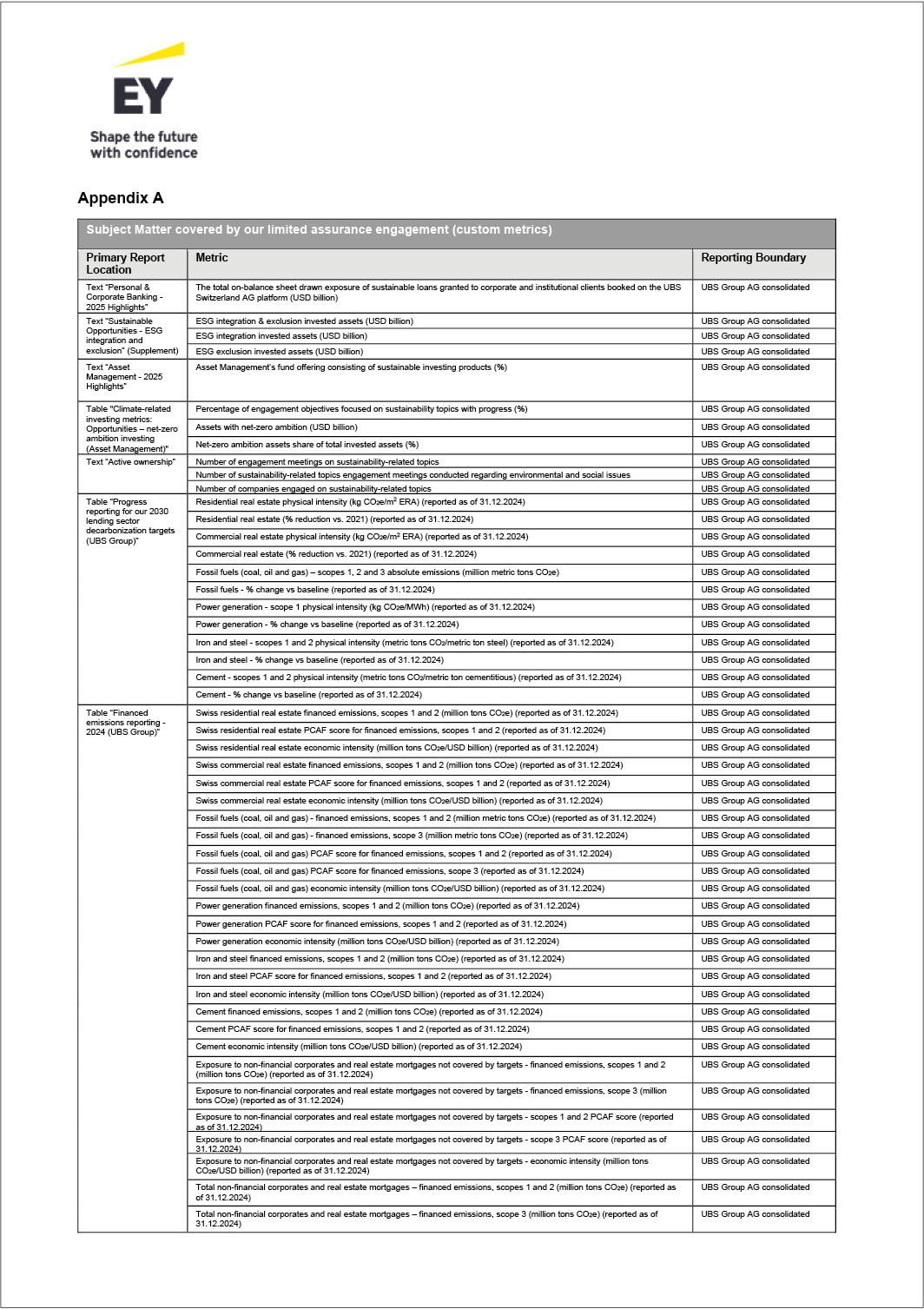
Sustainability Report 2025
| Appendix 2 | Other supplemental information 106
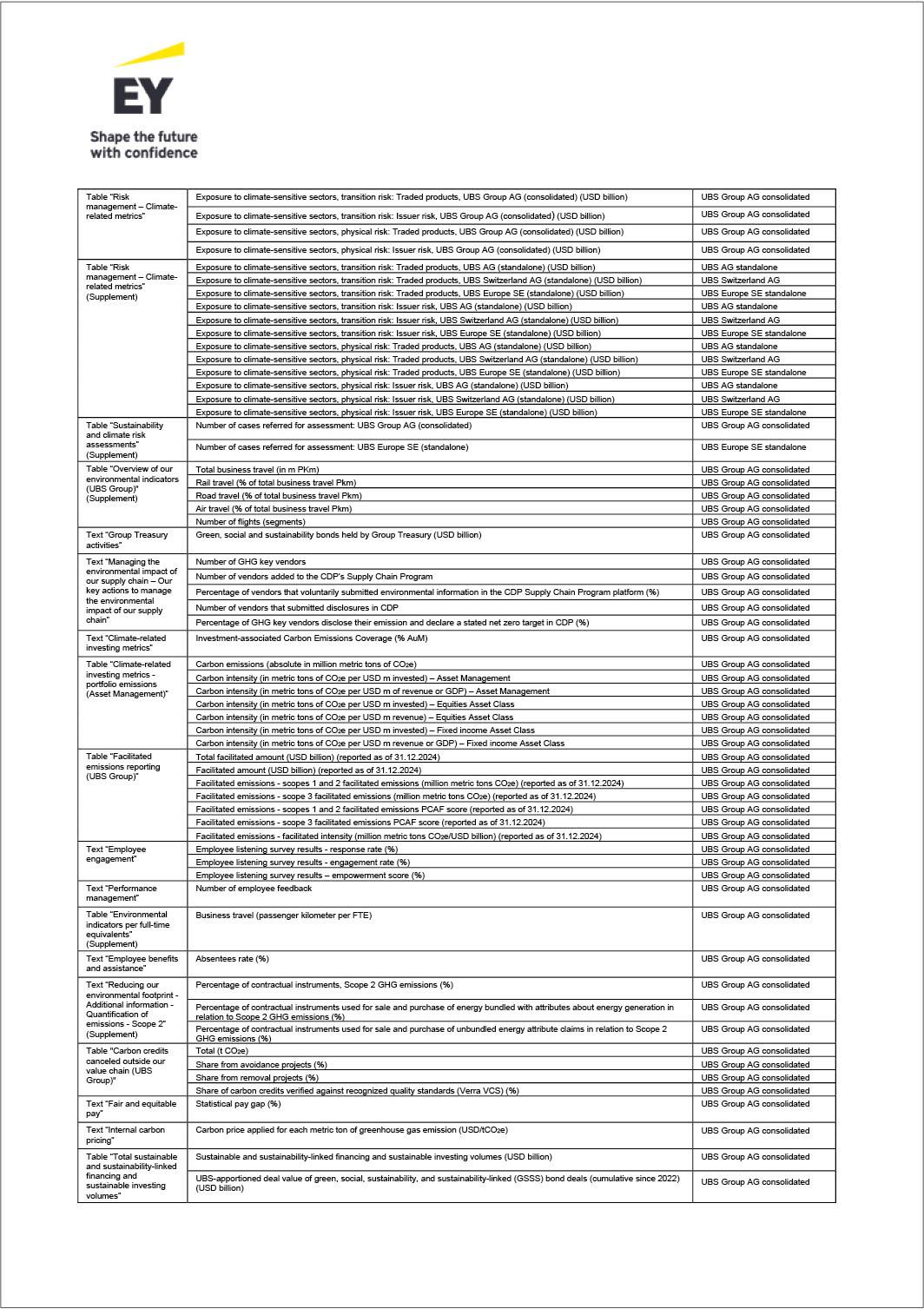
Sustainability Report 2025
| Appendix 2 | Other supplemental information 107
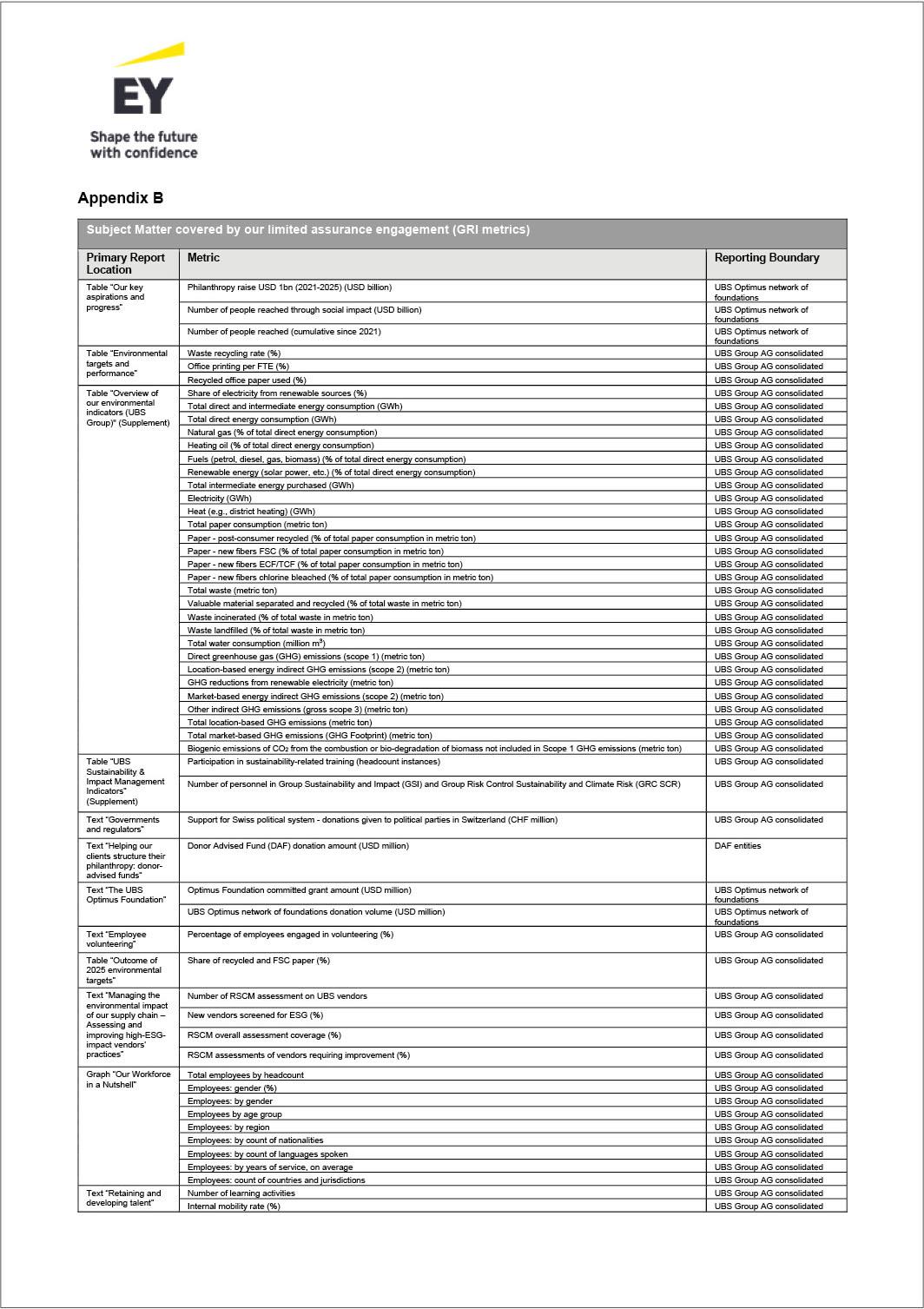
Sustainability Report 2025
| Appendix 2 | Other supplemental information 108
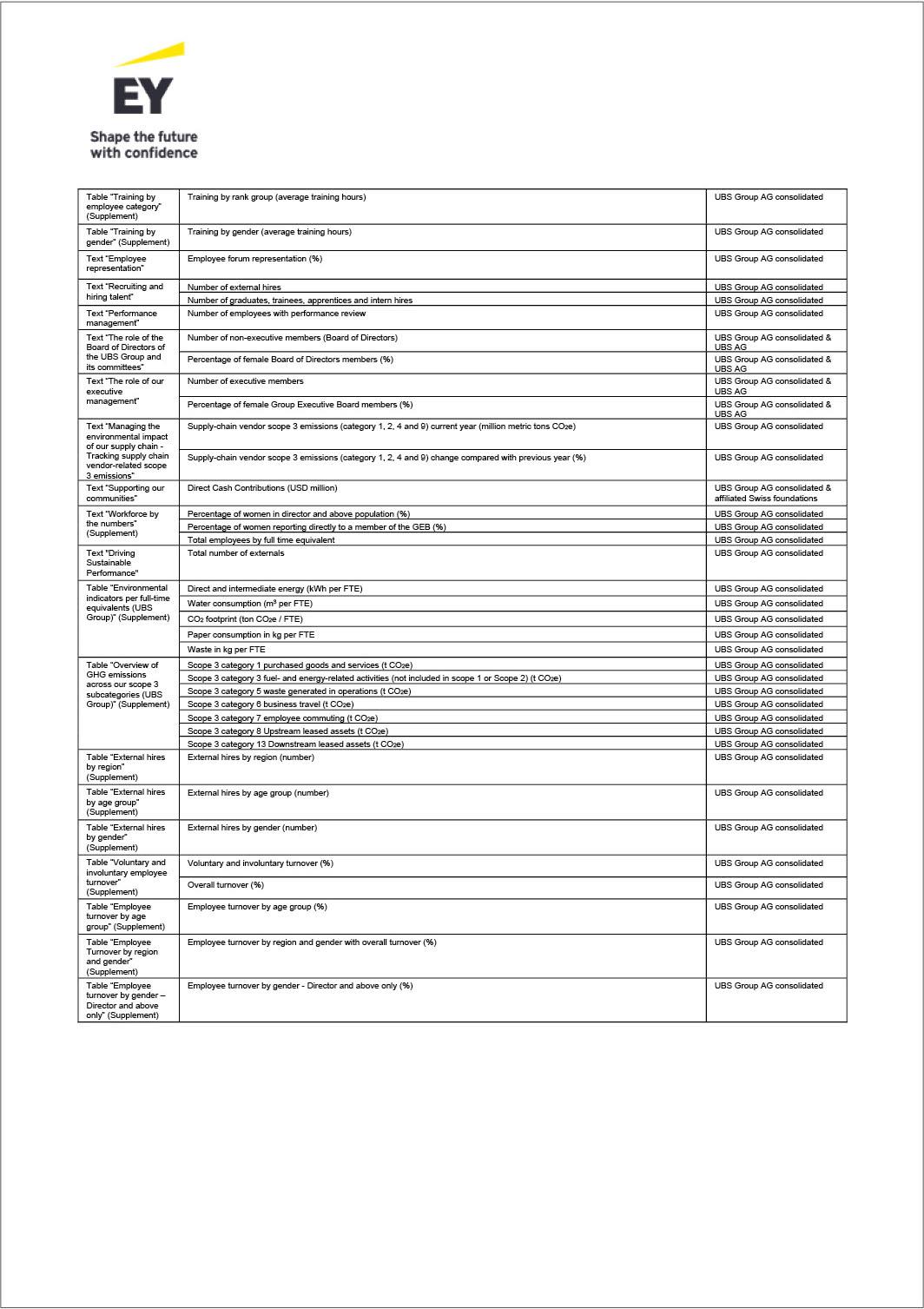
Sustainability Report 2025
| Appendix 2 | Other supplemental information 109
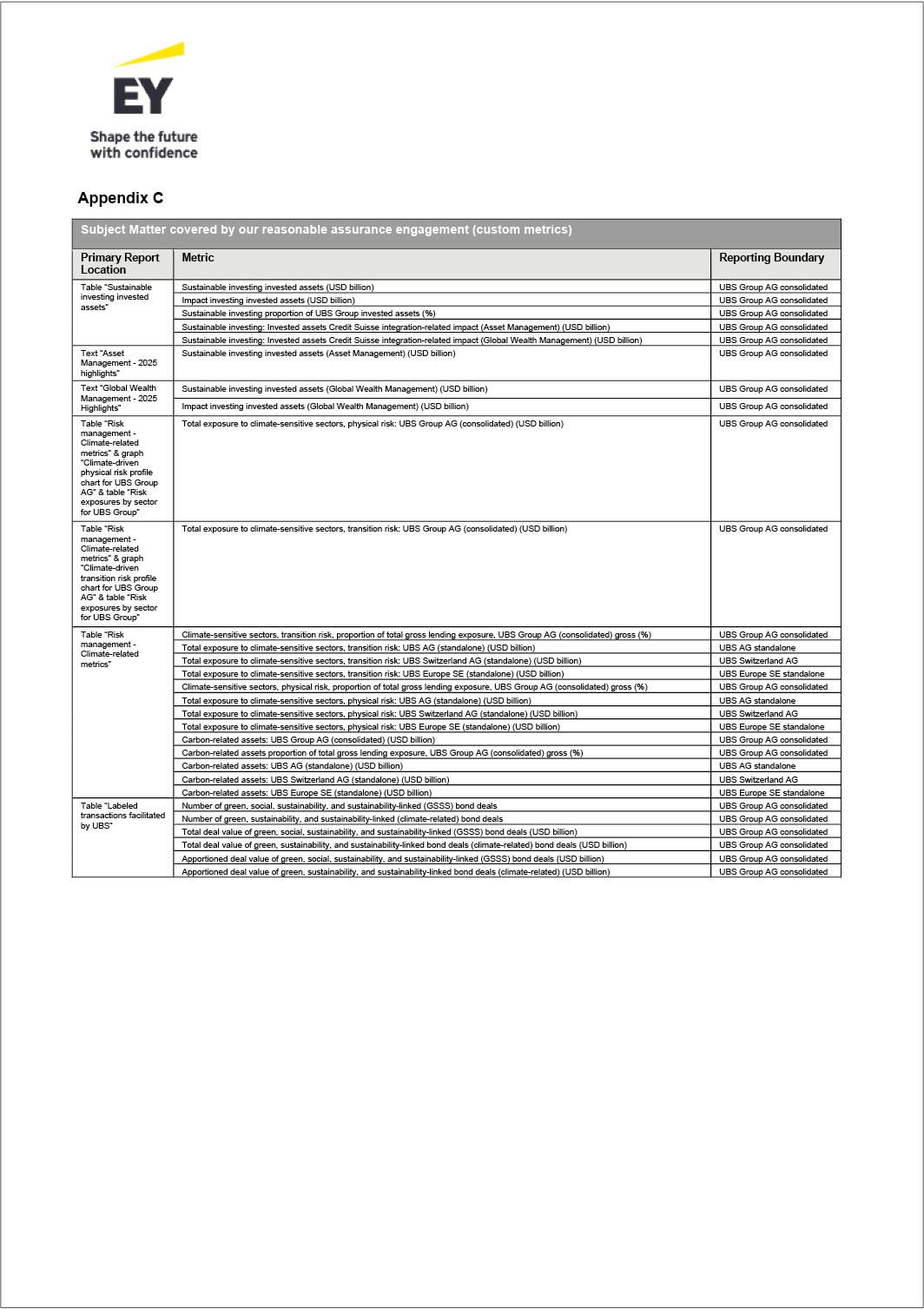
Sustainability Report 2025
| Appendix 2 | Other supplemental information 110
Sustainability Report 2025
| Appendix 2 | Other supplemental information 111
Abbreviations frequently used in our sustainability report
A
AI artificial intelligence
AML anti-money laundering
B
BoD Board of Directors
C
CCRC Corporate Culture and Responsibility Committee
CEO Chief Executive Officer
CIO Chief Investment Office
Credit Suisse SIF Credit Suisse Sustainable Investment Framework
E
EMEA Europe, Middle East and Africa
ESG environmental, social and governance
EU European Union
ERA energy reference area
EY Ernst & Young
F
FINMA Swiss Financial Market Supervisory Authority
FTE full-time equivalents
G
GEB Group Executive Board
GHG greenhouse gas
GRI Global Reporting Initiative
GSI Group Sustainability and Impact
I
IEA International Energy Agency
IPO initial public offering
IFRS International Financial Reporting Standards
ISO International Organization for Standardization
L
LEED Leadership in Energy and Environmental Design
N
NGO non-governmental organization
NZE Net-Zero Emissions by 2050 Scenario
P
PCAF Partnership for Carbon Accounting Financials
R
RSCM responsible supply chain management
S
S&P Standard & Poor’s
SCR sustainability and climate risk unit
SDG Sustainable Development Goal
T
TCFD Task Force on Climate-related Financial Disclosures
U
UN United Nations
USD US dollar
Note:
Sustainability Report 2025
| Appendix 2 | Other supplemental information 112
Cautionary Statement
Cautionary Statement |
Forward-Looking Statements in the UBS Group Annual Report 2025, available at ubs.com/investors, for further details.
Notice to investors |
solicitation of an offer to buy or sell any securities or other financial instruments in Switzerland, the United States or any other jurisdiction. No investment
decision relating to securities of or relating to UBS Group AG, UBS AG or their affiliates should be made on the basis of this report. Refer to the UBS Group
Annual Report 2025, available at ubs.com/investors, for additional information.
Rounding |
percent changes are calculated on the basis of unrounded figures. Information about absolute changes between reporting periods, which is provided in text
and which can be derived from figures displayed in the tables, is calculated on a rounded basis.
Tables |
date or for the relevant period. Zero values generally indicate that the respective figure is zero on an actual or rounded basis. Percentage changes are presented
as a mathematical calculation of the change between periods.

UBS Group AG
P.O. Box
CH-8098 Zurich
ubs.com
SIGNATURES
Pursuant to the requirements of the Securities Exchange Act of 1934, the registrants have duly
caused this report to be signed on their behalf by the undersigned, thereunto duly authorized.
UBS Group AG
By: /s/ Beatriz Martin Jimenez
Name: Beatriz Martin Jimenez
Head Non-Core and Legacy, and
President UBS EMEA
By: /s/ Todd Tuckner
Name: Todd Tuckner
UBS AG
By: /s/ Beatriz Martin Jimenez
Name: Beatriz Martin Jimenez
Title: Chief Operating Officer,
Head Non-Core and Legacy, and
President UBS EMEA
By: /s/ Todd Tuckner
Name: Todd Tuckner
Date: March 9, 2026