
ABUS 8-K
Arbutus Biopharma Corp (ABUS)
UNITED STATES
SECURITIES AND EXCHANGE COMMISSION
Washington, D.C. 20549
_________________
FORM
_________________
CURRENT REPORT
Pursuant to Section 13 or 15(d)
of the Securities Exchange Act of 1934
Date of Report (Date of earliest event reported):
_______________________________
(Exact name of registrant as specified in its charter)
_______________________________
| (State or Other Jurisdiction of Incorporation) | (Commission File Number) | (I.R.S. Employer Identification No.) |
(Address of Principal Executive Offices) (Zip Code)
(
(Registrant's telephone number, including area code)
(Former name or former address, if changed since last report)
_______________________________
Check the appropriate box below if the Form 8-K filing is intended to simultaneously satisfy the filing obligation of the registrant under any of the following provisions:
| Written communications pursuant to Rule 425 under the Securities Act (17 CFR 230.425) | |
| Soliciting material pursuant to Rule 14a-12 under the Exchange Act (17 CFR 240.14a-12) | |
| Pre-commencement communications pursuant to Rule 14d-2(b) under the Exchange Act (17 CFR 240.14d-2(b)) | |
| Pre-commencement communications pursuant to Rule 13e-4(c) under the Exchange Act (17 CFR 240.13e-4(c)) |
Securities registered pursuant to Section 12(b) of the Act:
| Title of each class | Trading Symbol(s) | Name of each exchange on which registered |
Indicate by check mark whether the registrant is an emerging growth company as defined in Rule 405 of the Securities Act of 1933 (§230.405 of this chapter) or Rule 12b-2 of the Securities Exchange Act of 1934 (§240.12b-2 of this chapter).
Emerging growth company
If an emerging growth company, indicate by check mark if the registrant has elected not to use the extended transition period for complying with any new or revised financial accounting standards provided pursuant to Section 13(a) of the Exchange Act. ☐
On November 13, 2025, Arbutus Biopharma Corporation (the “Company”) issued a press release announcing its financial results for the third quarter ended September 30, 2025 and certain other information. A copy of the press release is furnished herewith as Exhibit 99.1 hereto and is incorporated by reference herein
On November 13, 2025, the Company posted an updated corporate presentation on its website at www.arbutusbio.com. A copy of the presentation is filed herewith as Exhibit 99.2 and is incorporated by reference herein.
(d) Exhibits.
| Exhibit Number | Description | |||
| 99.1 | Press release dated November 13, 2025 | |||
| 99.2 | Corporate Presentation dated November 13, 2025 | |||
| 104 | Cover page interactive data file (formatted as inline XBRL). |
SIGNATURE
Pursuant to the requirements of the Securities Exchange Act of 1934, the registrant has duly caused this report to be signed on its behalf by the undersigned hereunto duly authorized.
| Arbutus Biopharma Corporation | ||
| Date: November 13, 2025 | By: | /s/ Tuan Nguyen |
| Tuan Nguyen | ||
| Chief Financial Officer | ||
EXHIBIT 99.1
Arbutus Reports Third Quarter 2025 Financial Results and Provides Corporate Update
| Strong financial position with cash, cash equivalents and marketable securities of $93.7M | |
| Moderna litigation U.S. trial scheduled for March 2026; | |
| Favorable claim construction ruling in Pfizer-BioNTech litigation issued in September 2025 | |
| Additional analysis of imdusiran (AB-729) clinical data shows: | |
| - | 46% of Phase 2a patients met criteria to discontinue all treatment |
| - | 94% of long-term follow-up patients remain off all treatment for up to 2+ years |
| - | 100% of HBV DNA positive patients in Phase 1b achieved HBV DNA levels below quantification after only 18 weeks of imdusiran and nucleos(t)ide analogue therapy |
| - | All HBV e-antigen positive patients demonstrated dose-dependent HBV e-antigen decreases |
WARMINSTER, Pa., Nov. 13, 2025 (GLOBE NEWSWIRE) -- Arbutus Biopharma Corporation (Nasdaq: ABUS) (“Arbutus” or the “Company”), a clinical-stage biopharmaceutical company focused on infectious disease, today reported third quarter 2025 financial results and provided a corporate update.
“The strength of our third quarter performance reflects our disciplined focus on executing strategic priorities,” said Lindsay Androski, President and CEO of Arbutus. “We are also excited to share additional analysis of imdusiran clinical data being conducted as part of our ongoing strategic review. Notably, in addition to the eight patients who initially achieved functional cure with imdusiran at 60mg in our Phase 2a trials, forty more patients across all cohorts discontinued nucleos(t)ide analogue therapy after meeting study-defined criteria. In total, a combined 46% of all Phase 2a patients were able to discontinue all treatment. All but one patient who achieved functional cure or who we are following after discontinuing nucleos(t)ide analogue therapy remain off all treatment long-term, now exceeding two years for some patients. Across our Phase 1b and Phase 2a trials, imdusiran has demonstrated sustained benefits in chronic hepatitis B patients, regardless of baseline hepatitis B surface antigen levels, hepatitis B virus DNA presence or absence, and hepatitis B e-antigen positivity or negativity. We remain dedicated to accelerating the development and potential approval of imdusiran.”
LNP Litigation
- Arbutus continues to consult closely with and support its exclusive licensee, Genevant Sciences, to protect and defend Arbutus’s intellectual property, which is the subject of on-going lawsuits against Moderna and Pfizer/BioNTech. The Company, together with Genevant, is seeking fair compensation for Moderna’s and Pfizer/BioNTech’s use of Arbutus’s patented LNP technology that was developed with great effort and at a great expense, and without which Moderna’s and Pfizer/BioNTech’s COVID-19 vaccines would not have been successful.
- In the Moderna U.S. litigation, fact discovery, expert discovery and summary judgment briefing have been completed. A jury trial is scheduled for March 2026. In March 2025, the Company, alongside Genevant Sciences, filed five international lawsuits against Moderna and its affiliates seeking to enforce patents protecting the Company’s patented LNP technology across 30 countries. Public oral hearings for two of the five cases which are before the Unified Patent Court are scheduled for May 2026, and a trial in the Canadian case is set to begin in September 2027.
- The claim construction hearing for the lawsuit against Pfizer/BioNTech occurred in December 2024, and the court issued a claim construction ruling in September 2025, which construed the disputed claim terms in a manner the Company generally considers to be favorable.
Corporate Updates
- The Company showcased four poster presentations featuring data from its hepatitis B virus (HBV) programs at AASLD 2025. One poster presented new analysis from the Company’s IM-PROVE I Phase 2a clinical trial showing beneficial clinical outcomes were observed across all evaluated HBV genotypes (A to E). The Company also had a Poster of Distinction highlighting AB-101’s maximal PD-L1 receptor occupancy between 68-100% at a 30mg daily dose.
- Today, the Company published an updated Corporate Presentation on its website, which includes the results of its recently completed analysis of imdusiran clinical data.
- In addition to the eight functional cures, an additional 40 patients across all cohorts in its Phase 2a trials met study-defined criteria for nucleos(t)ide analogue (NA) therapy discontinuation.
- In total, 46% (48/105) of all Phase 2a patients either achieved functional cure or remained off NA therapy for at least 48 weeks after discontinuing NA therapy following treatment with imdusiran.
- Eighteen patients consented to long-term follow-up, including all functionally cured patients and 10 patients who discontinued NA therapy. To date, 94% of those follow-up patients have remained off all treatment for between 58 to 109 weeks. One functionally cured patient seroreverted but remains virally suppressed and off all treatment.
- Additionally, 56% (5/9) of Phase 1b patients (only received imdusiran and NA therapy) who elected to discontinue NA therapy, remained off all treatment for at least 3 years.
- Imdusiran has also demonstrated steep and durable declines in HBV DNA, and, with NA therapy, achieved full HBV DNA suppression significantly faster than NA therapy alone. By week 18 of treatment with imdusiran and NA therapy, 100% of Phase 1b HBV DNA positive patients achieved HBV DNA levels below the level of quantification, The eight Phase 2a patients who achieved functional cure continue to have HBV DNA levels below the level of quantification.
- In 30 hepatitis B e-antigen (HBeAg) positive patients in our Phase 1 and 2a trials, HBeAg decreased in all patients in a dose-dependent manner.
Financial Results
Cash, Cash Equivalents and Investments
As of September 30, 2025, the Company had cash, cash equivalents and investments in marketable securities of $93.7 million compared to $122.6 million as of December 31, 2024. During the nine months ended September 30, 2025, the Company used $35.0 million in operating activities, which included one-time payments related to its restructuring efforts. This was partially offset by $3.9 million of proceeds from the exercise of stock options.
Revenue
Total revenue was $0.5 million for the quarter ended September 30, 2025, compared to $1.3 million for the same period in 2024. The decrease of $0.8 million was due to a decrease in license royalty revenues, primarily due to a decline in Alnylam’s sales of ONPATTRO.
Operating Expenses
Research and development expenses were $5.8 million for the quarter ended September 30, 2025, compared to $14.3 million for the same period in 2024. The decrease of $8.5 million was due primarily to cost savings from the Company’s decisions to streamline the organization to focus its efforts on advancing the clinical development of imdusiran and AB-101, which included ceasing all discovery efforts, discontinuing its IM-PROVE III clinical trial, and reducing the Company’s workforce.
General and administrative expenses were $3.0 million for the quarter ended September 30, 2025, compared to $4.5 million for the same period in 2024. This decrease was due primarily to cost-cutting efforts by the Company, which drove reductions in employee compensation-related expenses and legal fees.
Restructuring costs in the quarter ended September 30, 2025 were $0.1 million, and all remaining restructuring-related payments are expected to be made by the first quarter of 2026.
Net Loss
For the quarter ended September 30, 2025, the Company’s net loss was $7.7 million, or a loss of $0.04 per basic and diluted common share, as compared to a net loss of $19.7 million, or a loss of $0.10 per basic and diluted common share, for the quarter ended September 30, 2024.
Outstanding Shares
As of September 30, 2025, the Company had 192.0 million common shares issued and outstanding, as well as 14.9 million stock options and unvested restricted stock units outstanding.
| UNAUDITED CONDENSED CONSOLIDATED STATEMENTS OF INCOME AND LOSS (in thousands, except share and per share data) | |||||||||||||||
| Three Months Ended September 30, | Nine Months Ended September 30, | ||||||||||||||
| 2025 | 2024 | 2025 | 2024 | ||||||||||||
| Revenue | |||||||||||||||
| Collaborations and licenses | $ | 280 | $ | 767 | $ | 11,809 | $ | 2,861 | |||||||
| Non-cash royalty revenue | 249 | 572 | 1,223 | 1,736 | |||||||||||
| Total Revenue | 529 | 1,339 | 13,032 | 4,597 | |||||||||||
| Operating expenses | |||||||||||||||
| Research and development | 5,778 | 14,273 | 20,235 | 45,227 | |||||||||||
| General and administrative | 3,044 | 4,537 | 12,204 | 17,396 | |||||||||||
| Change in fair value of contingent consideration | 268 | 344 | 827 | 735 | |||||||||||
| Restructuring costs | 98 | 3,625 | 12,636 | 3,625 | |||||||||||
| Total operating expenses | 9,188 | 22,779 | 45,902 | 66,983 | |||||||||||
| Loss from operations | (8,659 | ) | (21,440 | ) | (32,870 | ) | (62,386 | ) | |||||||
| Other income | |||||||||||||||
| Interest income | 952 | 1,747 | 3,191 | 5,121 | |||||||||||
| Interest expense | (23 | ) | (29 | ) | (79 | ) | (107 | ) | |||||||
| Foreign exchange (loss) gain | (12 | ) | 5 | 13 | (16 | ) | |||||||||
| Total other income | 917 | 1,723 | 3,125 | 4,998 | |||||||||||
| Income tax expense | — | — | — | — | |||||||||||
| Net loss | $ | (7,742 | ) | $ | (19,717 | ) | $ | (29,745 | ) | $ | (57,388 | ) | |||
| Net loss per common share | |||||||||||||||
| Basic and diluted | $ | (0.04 | ) | $ | (0.10 | ) | $ | (0.16 | ) | $ | (0.31 | ) | |||
| Weighted average number of common shares | |||||||||||||||
| Basic and diluted | 191,778,950 | 188,997,194 | 191,347,969 | 184,244,819 | |||||||||||
| UNAUDITED CONDENSED CONSOLIDATED BALANCE SHEETS (in thousands) | ||||||||
| September 30, 2025 | December 31, 2024 | |||||||
| Cash, cash equivalents and marketable securities, current | $ | 93,702 | $ | 122,623 | ||||
| Accounts receivable and other current assets | 3,740 | 4,693 | ||||||
| Total current assets | 97,442 | 127,316 | ||||||
| Property and equipment, net of accumulated depreciation and impairment | 137 | 3,309 | ||||||
| Right of use asset | — | 1,048 | ||||||
| Other non-current assets | 131 | 34 | ||||||
| Total assets | $ | 97,710 | $ | 131,707 | ||||
| Accounts payable and accrued liabilities | $ | 4,653 | $ | 7,564 | ||||
| Deferred license revenue, current | — | 7,571 | ||||||
| Lease liability, current | 531 | 483 | ||||||
| Total current liabilities | 5,184 | 15,618 | ||||||
| Liability related to sale of future royalties | 3,684 | 4,829 | ||||||
| Deferred license revenue, non-current | — | 2,863 | ||||||
| Contingent consideration | 11,052 | 10,225 | ||||||
| Lease liability, non-current | 391 | 806 | ||||||
| Total stockholders’ equity | 77,399 | 97,366 | ||||||
| Total liabilities and stockholders’ equity | $ | 97,710 | $ | 131,707 | ||||
| UNAUDITED CONDENSED CONSOLIDATED STATEMENTS OF CASH FLOWS (in thousands) | |||||||
| Nine Months Ended September 30, | |||||||
| 2025 | 2024 | ||||||
| Net loss | $ | (29,745 | ) | $ | (57,388 | ) | |
| Non-cash items | 6,609 | 5,453 | |||||
| Change in deferred license revenue | (10,434 | ) | (880 | ) | |||
| Other changes in working capital | (1,387 | ) | (1,720 | ) | |||
| Net cash used in operating activities | (34,957 | ) | (54,535 | ) | |||
| Net cash provided by investing activities | 16,941 | 9,537 | |||||
| Issuance of common shares pursuant to the Open Market Sale Agreement | — | 44,124 | |||||
| Cash provided by other financing activities | 4,081 | 6,451 | |||||
| Net cash provided by financing activities | 4,081 | 50,575 | |||||
| Effect of foreign exchange rate changes on cash and cash equivalents | 13 | (16 | ) | ||||
| (Decrease) / Increase in cash and cash equivalents | (13,922 | ) | 5,561 | ||||
| Cash and cash equivalents, beginning of period | 36,330 | 26,285 | |||||
| Cash and cash equivalents, end of period | 22,408 | 31,846 | |||||
| Investments in marketable securities | 71,294 | 85,725 | |||||
| Cash, cash equivalents and marketable securities, end of period | $ | 93,702 | $ | 117,571 | |||
About Imdusiran (AB-729)
Imdusiran is an RNAi therapeutic specifically designed to reduce all hepatitis B viral proteins and antigens including HBsAg, which is thought to be a key prerequisite to enable reawakening of a patient’s immune system to control the virus. Imdusiran targets hepatocytes using Arbutus’ novel covalently conjugated N-Acetylgalactosamine (“GalNAc”) delivery technology enabling subcutaneous delivery. To date, Arbutus has reported a total of eight patients with cHBV who have achieved a functional cure following treatment with imdusiran and NA therapy in combination with either IFN or low dose nivolumab plus an immunotherapeutic, with seven out of the eight patients continuing to sustain functional cure for over a year after treatment. An additional 40 patients across our Phase 2a clinical trials were able to remain off NA therapy for at least 48 weeks after discontinuing NA therapy following treatment with imdusiran. Clinical data generated thus far has shown imdusiran to be generally safe and well-tolerated, while also providing meaningful reductions in HBsAg and hepatitis B virus DNA.
About HBV
Hepatitis B is a potentially life-threatening liver infection caused by HBV. HBV can cause chronic infection which leads to a higher risk of death from cirrhosis and liver cancer. cHBV infection represents a significant unmet medical need. The World Health Organization estimates that over 250 million people worldwide suffer from cHBV infection, while other estimates indicate that approximately 2 million people in the United States suffer from cHBV infection. Approximately 1.1 million people die every year from complications related to cHBV infection despite the availability of effective vaccines and current treatment options.
About Arbutus
Arbutus Biopharma Corporation (Nasdaq: ABUS) is a clinical-stage biopharmaceutical company focused on infectious disease. The Company is currently developing imdusiran (AB-729) and an oral PD-L1 inhibitor (AB-101) for the treatment of cHBV infection. The Company is also consulting closely with and supporting its exclusive licensee, Genevant Sciences, to protect and defend its intellectual property, which is the subject of on-going lawsuits against Moderna and Pfizer/BioNTech for use of Arbutus’s patented LNP technology in their COVID-19 vaccines. For more information, visit www.arbutusbio.com.
Forward-Looking Statements and Information
This press release contains forward-looking statements within the meaning of the Section 27A of the Securities Act of 1933 and Section 21E of the Securities Exchange Act of 1934, and forward-looking information within the meaning of Canadian securities laws (collectively, forward-looking statements). Forward-looking statements in this press release include statements about: the potential to lead to a functional cure for HBV and/or the discontinuation of HBV therapies after treatment with Arbutus’ product candidates; the durability of clinical benefits from Arbutus’ product candidates; the potential for Arbutus’ product candidates to achieve success in clinical trials; Arbutus’ pipeline and development plans for its cHBV programs; and Arbutus’ plans with respect to the ongoing patent litigation matters, and the expected timing thereof.
With respect to the forward-looking statements contained in this press release, Arbutus has made numerous assumptions regarding, among other things: the effectiveness and timeliness of clinical trials, and the usefulness of the data; the continued demand for Arbutus’ assets; and the stability of economic and market conditions. While Arbutus considers these assumptions to be reasonable, these assumptions are inherently subject to significant business, economic, competitive, market and social uncertainties and contingencies. Additionally, there are known and unknown risk factors which could cause Arbutus’ actual results, performance or achievements to be materially different from any future results, performance or achievements expressed or implied by the forward-looking statements contained herein. Known risk factors include, among others: ongoing and anticipated clinical trials may be more costly or take longer to complete than anticipated, and may never be initiated or completed, or may not generate results that warrant future development of the tested product candidate; Arbutus may elect to change its strategy regarding its product candidates and clinical development activities; Arbutus may not receive the necessary regulatory approvals for the clinical development of Arbutus’ product candidates; uncertainties associated with litigation generally and patent litigation specifically; economic and market conditions may worsen; market shifts may require a change in strategic focus; Arbutus’ workforce reduction and plans to reduce its net cash burn may not materially extend the cash runway and may create a distraction or uncertainty that may adversely affect its operating results, business, or investor perceptions; and risks related to the sufficiency of Arbutus’ cash resources for its foreseeable and unforeseeable operating expenses and capital expenditures.
A more complete discussion of the risks and uncertainties facing Arbutus appears in Arbutus’ Annual Report on Form 10-K, Arbutus’ Quarterly Reports on Form 10-Q and Arbutus’ continuous and periodic disclosure filings, which are available at www.sedar.com and at www.sec.gov. All forward-looking statements herein are qualified in their entirety by this cautionary statement, and Arbutus disclaims any obligation to revise or update any such forward-looking statements or to publicly announce the result of any revisions to any of the forward-looking statements contained herein to reflect future results, events or developments, except as required by law.
Arbutus Biopharma Corporation / [email protected]
Exhibit 99.2
NASDAQ: ABUS ARBUTUSBIO.COM ©2025 ARBUTUS BIOPHARMA, INC . Corporate Presentation November 13, 2025
©2025 ARBUTUS BIOPHARMA, INC . Forward - Looking Statements This presentation contains forward - looking statements within the meaning of the U . S . Private Securities Litigation Reform Act of 1995 and Canadian securities laws . All statements that are not historical facts are hereby identified as forward - looking statements for this purpose and include, among others, statements relating to : the potential market opportunity for HBV ; Arbutus’ ability to meet a significant unmet medical need ; Arbutus' strategy, future operations, clinical trials, and prospects ; the potential for Arbutus’ product candidates to achieve their desired or anticipated outcomes ; Arbutus’ expectations regarding the cost, timing and results of clinical development of Arbutus’ product candidates ; the potential of Arbutus' product candidates to improve upon the standard of care and lead to a functional cure for HBV ; and other statements relating to Arbutus’ future operations, future financial performance, future financial condition, prospects or other future events . With respect to the forward - looking statements contained in this presentation, Arbutus has made numerous assumptions regarding, among other things : the effectiveness and timeliness of clinical trials, and the usefulness of the data ; the timeliness of regulatory approvals ; the continued demand for Arbutus’ assets ; and the stability of economic and market conditions . While Arbutus considers these assumptions to be reasonable, these assumptions are inherently subject to significant business, economic, competitive, market and social uncertainties, and contingencies including uncertainties and contingencies related to patent litigation matters . Forward - looking statements herein involve known and unknown risks, uncertainties and other factors that may cause the actual results, events or developments to be materially different from any future results, events or developments expressed or implied by such forward - looking statements . Such factors include, among others : ongoing and anticipated clinical trials may be more costly or take longer to complete than anticipated, and may never be initiated or completed, or may not generate results that warrant future development of the tested drug candidate ; changes in Arbutus’ strategy regarding its product candidates and clinical development activities ; Arbutus may not receive the necessary regulatory approvals for the clinical development of Arbutus' products ; economic and market conditions may worsen ; market shifts may require a change in strategic focus ; and risks related to the sufficiency of Arbutus’ cash resources . A more complete discussion of the risks and uncertainties facing Arbutus appears in Arbutus' Annual Report on Form 10 - K, Quarterly Reports on Form 10 - Q and Arbutus' periodic disclosure filings, which are available at www . sec . gov and at www . sedar . com . All forward - looking statements herein are qualified in their entirety by this cautionary statement, and Arbutus disclaims any obligation to revise or update any such forward - looking statements or to publicly announce the result of any revisions to any of the forward - looking statements contained herein to reflect future results, events or developments, except as required by law . | 2
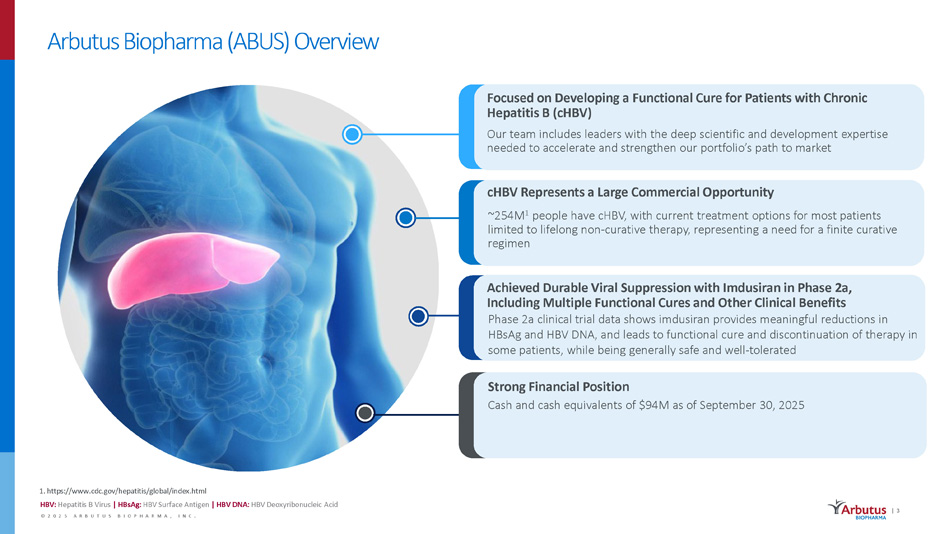
©2025 ARBUTUS BIOPHARMA, INC . Arbutus Biopharma (ABUS) Overview | 3 Our team includes leaders with the deep scientific and development expertise needed to accelerate and strengthen our portfolio’s path to market HBV: Hepatitis B Virus | HBsAg : HBV Surface Antigen | HBV DNA : HBV Deoxyribonucleic Acid Focused on Developing a Functional Cure for Patients with Chronic Hepatitis B ( cHBV ) Cash and cash equivalents of $94M as of September 30, 2025 1. https://www.cdc.gov/hepatitis/global/index.html Strong Financial Position ~254M 1 people have cHBV , with current treatment options for most patients limited to lifelong non - curative therapy, representing a need for a finite curative regimen cHBV Represents a Large Commercial Opportunity Achieved Durable Viral Suppression with Imdusiran in Phase 2a, Including Multiple Functional Cures and Other Clinical Benefits Phase 2a clinical trial data shows imdusiran provides meaningful reductions in HBsAg and HBV DNA, and leads to functional cure and discontinuation of therapy in some patients, while being generally safe and well - tolerated
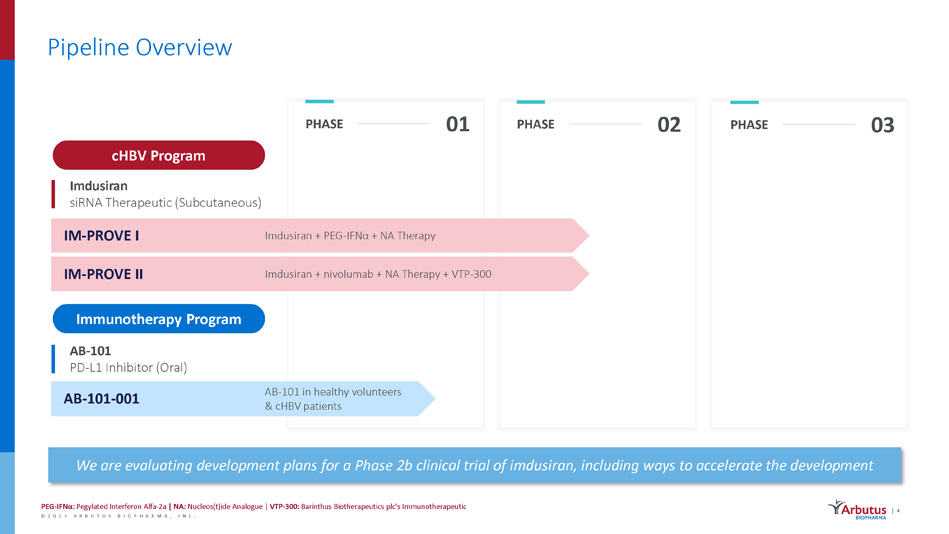
©2025 ARBUTUS BIOPHARMA, INC . Pipeline Overview | 4 cHBV Program Immunotherapy Program Imdusiran siRNA Therapeutic (Subcutaneous) AB - 101 PD - L1 Inhibitor (Oral) IM - PROVE I IM - PROVE II Imdusiran + PEG - IFNα + NA Therapy Imdusiran + nivolumab + NA Therapy + VTP - 300 AB - 101 - 001 AB - 101 in healthy volunteers & cHBV patients PHASE 01 PHASE 02 PHASE 03 PEG - IFNα: Pegylated Interferon Alfa - 2a | NA: Nucleos (t)ide Analogue | VTP - 300: Barinthus Biotherapeutics plc's Immunotherapeutic We are evaluating development plans for a Phase 2b clinical trial of imdusiran , including ways to accelerate the development
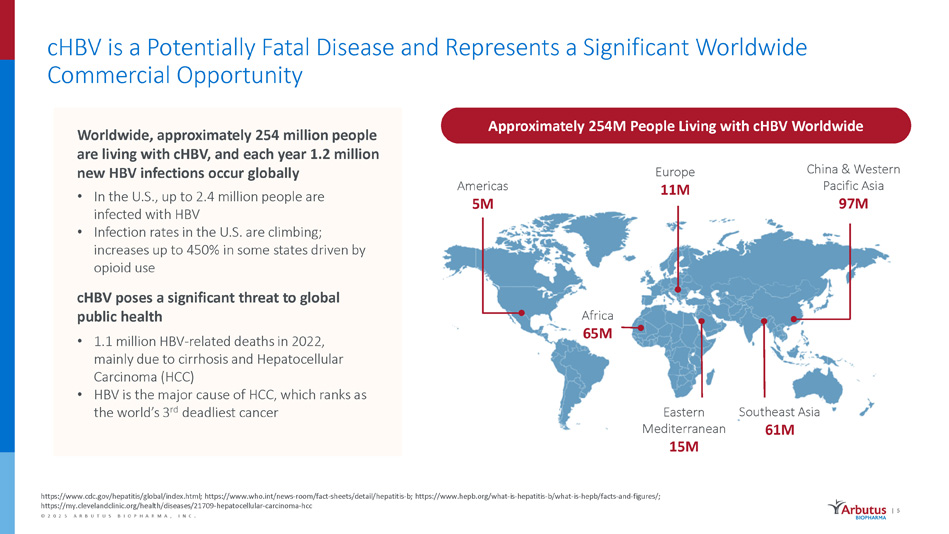
©2025 ARBUTUS BIOPHARMA, INC . cHBV is a Potentially Fatal Disease and Represents a Significant Worldwide Commercial Opportunity | 5 https://www.cdc.gov/hepatitis/global/index.html; https://www.who.int/news - room/fact - sheets/detail/hepatitis - b; https://www.hepb. org/what - is - hepatitis - b/what - is - hepb/facts - and - figures/; https://my.clevelandclinic.org/health/diseases/21709 - hepatocellular - carcinoma - hcc Americas 5M Worldwide, approximately 254 million people are living with cHBV , and each year 1.2 million new HBV infections occur globally Approximately 254M People Living with cHBV Worldwide Europe 11M China & Western Pacific Asia 97M • In the U.S., up to 2.4 million people are infected with HBV • Infection rates in the U.S. are climbing; increases up to 450% in some states driven by opioid use Africa 65M • 1.1 million HBV - related deaths in 2022, mainly due to cirrhosis and Hepatocellular Carcinoma (HCC) • HBV is the major cause of HCC, which ranks as the world’s 3 rd deadliest cancer Eastern Mediterranean 15M Southeast Asia 61M cHBV poses a significant threat to global public health
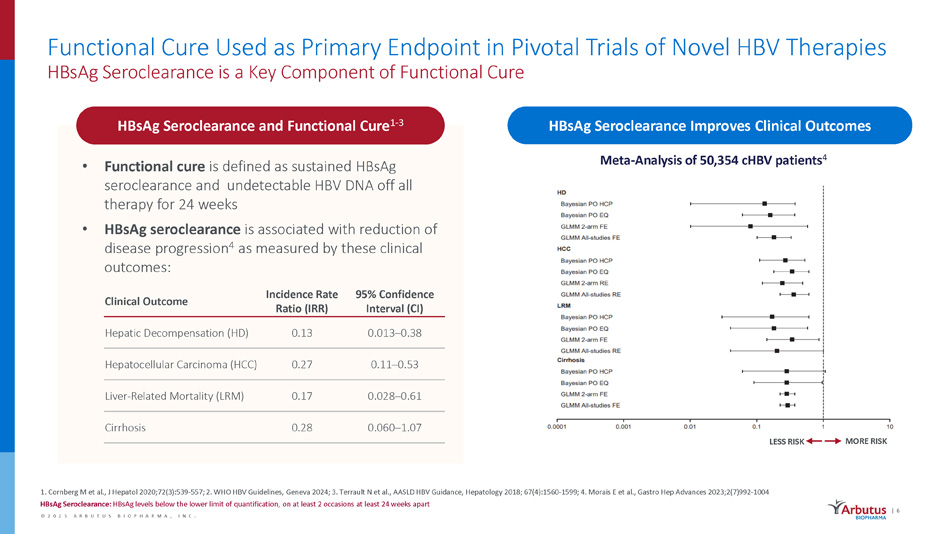
©2025 ARBUTUS BIOPHARMA, INC . | 6 1. Cornberg M et al., J Hepatol 2020;72(3):539 - 557; 2. WHO HBV Guidelines, Geneva 2024; 3. Terrault N et al., AASLD HBV Guidance, Hepatology 2018; 67(4):1560 - 1599; 4. Morais E et al., Gastro Hep Advances 2023;2(7)992 - 1004 • Functional cure is defined as sustained HBsAg seroclearance and undetectable HBV DNA off all therapy for 24 weeks • HBsAg seroclearance is associated with reduction of disease progression 4 as measured by these clinical outcomes: 95% Confidence Interval (CI) Incidence Rate Ratio (IRR) Clinical Outcome 0.013 – 0.38 0.13 Hepatic Decompensation (HD) 0.11 – 0.53 0.27 Hepatocellular Carcinoma (HCC) 0.028 – 0.61 0.17 Liver - Related Mortality (LRM) 0.060 – 1.07 0.28 Cirrhosis LESS RISK MORE RISK Functional Cure Used as Primary Endpoint in Pivotal Trials of Novel HBV Therapies HBsAg Seroclearance is a Key Component of Functional Cure HBsAg Seroclearance Improves Clinical Outcomes Meta - Analysis of 50,354 cHBV patients 4 HBsAg Seroclearance : HBsAg levels below the lower limit of quantification, on at least 2 occasions at least 24 weeks apart HBsAg Seroclearance and Functional Cure 1 - 3
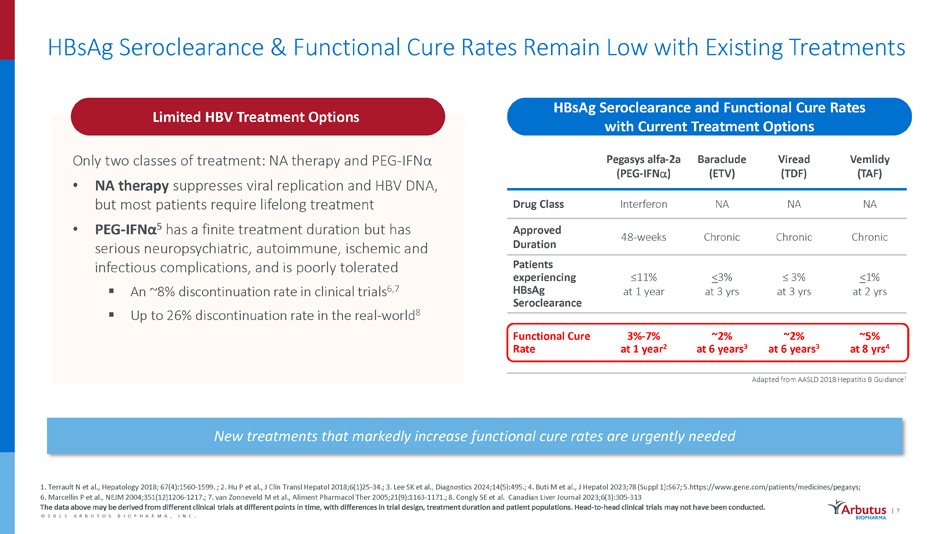
©2025 ARBUTUS BIOPHARMA, INC . HBsAg Seroclearance & Functional Cure Rates Remain Low with Existing Treatments | 7 1. Terrault N et al., Hepatology 2018; 67(4):1560 - 1599. ; 2. Hu P et al., J Clin Transl Hepatol 2018;6(1)25 - 34.; 3. Lee SK et al., Diagnostics 2024;14(5):495.; 4. Buti M et al., J Hepatol 2023;78 (Suppl 1):S67; 5.https://www.gene.com/patients/medicines/pegasys; 6. Marcellin P et al., NEJM 2004;351(12)1206 - 1217.; 7. van Zonneveld M et al., Aliment Pharmacol Ther 2005;21(9):1163 - 1171.; 8. Congly SE et al. Canadian Liver Journal 2023;6(3):305 - 313 The data above may be derived from different clinical trials at different points in time, with differences in trial design, t rea tment duration and patient populations. Head - to - head clinical trials may not have been conducted. Limited HBV Treatment Options Only two classes of treatment: NA therapy and PEG - IFNα • NA therapy suppresses viral replication and HBV DNA, but most patients require lifelong treatment • PEG - IFNα 5 has a finite treatment duration but has serious neuropsychiatric, autoimmune, ischemic and infectious complications, and is poorly tolerated ▪ An ~8% discontinuation rate in clinical trials 6,7 ▪ Up to 26% discontinuation rate in the real - world 8 HBsAg Seroclearance and Functional Cure Rates with Current Treatment Options Vemlidy (TAF) Viread (TDF) Baraclude (ETV) Pegasys alfa - 2a (PEG - IFN ) NA NA NA Interferon Drug Class Chronic Chronic Chronic 48 - weeks Approved Duration < 1% at 2 yrs ≤ 3 % at 3 yrs < 3% at 3 yrs ≤ 11% at 1 year Patients experiencing HBsAg Seroclearance ~5% at 8 yrs 4 ~2% at 6 years 3 ~2% at 6 years 3 3% - 7% at 1 year 2 Functional Cure Rate Adapted from AASLD 2018 Hepatitis B Guidance 1 New treatments that markedly increase functional cure rates are urgently needed
©2025 ARBUTUS BIOPHARMA, INC. Imdusiran RNAi Therapeutic | 8
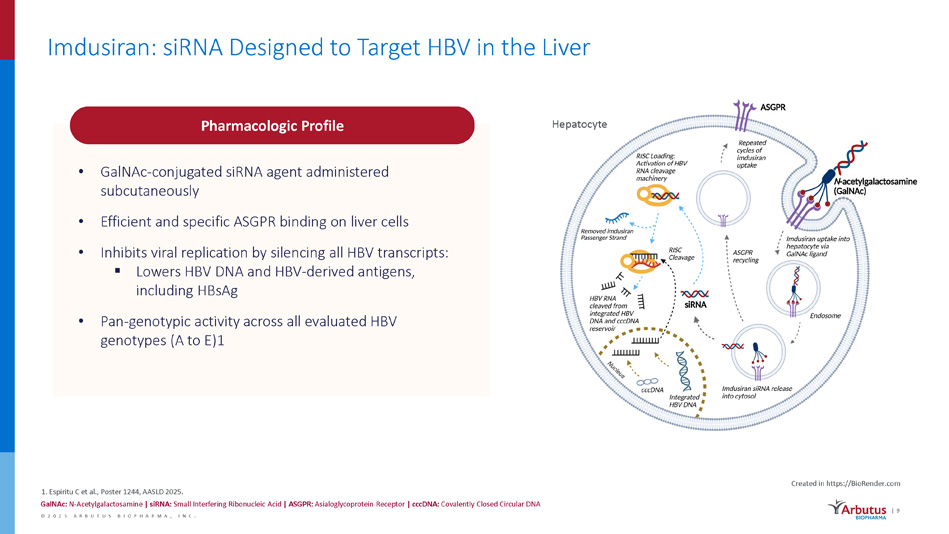
©2025 ARBUTUS BIOPHARMA, INC . Imdusiran : siRNA Designed to Target HBV in the Liver | 9 Created in https://BioRender.com GalNAc: N - Acetylgalactosamine | siRNA: Small Interfering Ribonucleic Acid | ASGPR: Asialoglycoprotein Receptor | cccDNA : Covalently Closed Circular DNA Hepatocyte Pharmacologic Profile • GalNAc - conjugated siRNA agent administered subcutaneously • Efficient and specific ASGPR binding on liver cells • Inhibits viral replication by silencing all HBV transcripts: ▪ Lowers HBV DNA and HBV - derived antigens, including HBsAg • Pan - genotypic activity across all evaluated HBV genotypes (A to E)1 1. Espiritu C et al., Poster 1244, AASLD 2025.

©2025 ARBUTUS BIOPHARMA, INC . Imdusiran is Designed for Potential Best - In - Class Anti - HBV siRNA Properties Significant Structural Differences Compared to Other HBV Targeting siRNA Candidates | 10 *USAN file numbers LM - 78, KL - 34, KL - 171, LM - 23 #2' Fluoro Mods HBV Target # siRNA Targets siRNA 3(S), 3(AS) All (HBx) 1 Imdusiran 4(S), 5(AS) All (HBx) 1 Elebsiran 3(S), 9(AS) for each siRNA HBsAg ORF/ HBx 2 Daplusiran / Tomligisiran 7(s), 10(AS) HBsAg ORF (no HBx ) 1 Xalnesiran • Proprietary tetranary GalNAc provides highly efficient liver - targeted uptake by ASGPR • Single trigger agent with unique potency and enhanced durability vs other HBx - targeting siRNAs • Optimized chemical modifications with minimal 2′ fluoro substitutions to reduce off - target effects • Unique asymmetric siRNA duplex structure (shorter passenger) enhances on - target potency and minimizes side effects Imdusiran Elebsiran* mod mod Daplusiran* mod mod Tomligisiran* Nicked Xalnesiran* mod 2' - O - Me 2’ Fluoro Glycol nucleic acid Unmodified Phosphorothioate (PS) Terminal modification GalNAc Ligand ORF: Open Reading Frame | HBx : HBV X Protein | S: Sense Strand | AS: Antisense Strand
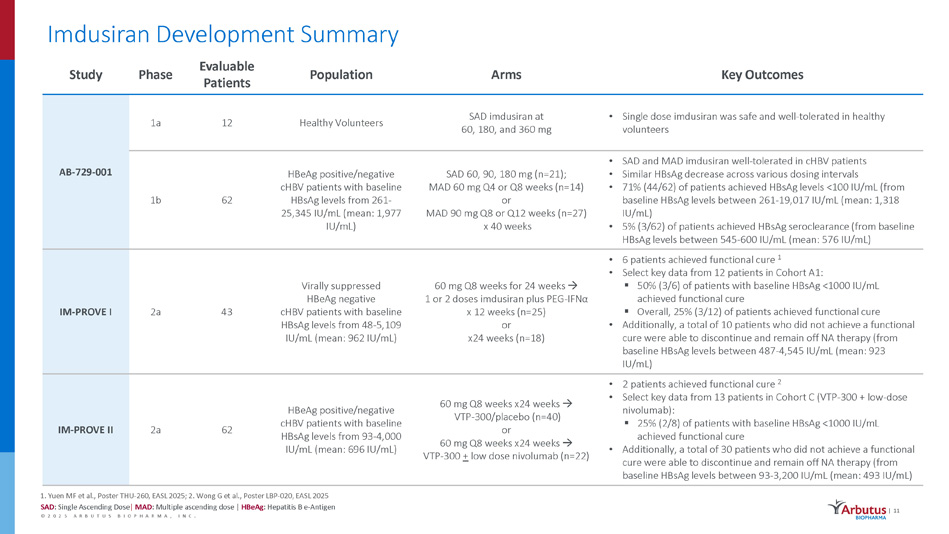
©2025 ARBUTUS BIOPHARMA, INC . Imdusiran Development Summary | 11 SAD : Single Ascending Dose | MAD : Multiple ascending dose | HBeAg : Hepatitis B e - Antigen Key Outcomes Arms Population Evaluable Patients Phase Study • Single dose imdusiran was safe and well - tolerated in healthy volunteers SAD imdusiran at 60, 180, and 360 mg Healthy Volunteers 12 1a AB - 729 - 001 • SAD and MAD imdusiran well - tolerated in cHBV patients • Similar HBsAg decrease across various dosing intervals • 71% (44/62) of patients achieved HBsAg levels <100 IU/mL (from baseline HBsAg levels between 261 - 19,017 IU/mL (mean: 1,318 IU/mL) • 5% (3/62) of patients achieved HBsAg seroclearance (from baseline HBsAg levels between 545 - 600 IU/mL (mean: 576 IU/mL) SAD 60, 90, 180 mg (n=21); MAD 60 mg Q4 or Q8 weeks (n=14) or MAD 90 mg Q8 or Q12 weeks (n=27) x 40 weeks HBeAg positive/negative cHBV patients with baseline HBsAg levels from 261 - 25,345 IU/mL (mean: 1,977 IU/mL) 62 1b • 6 patients achieved functional cure 1 • Select key data from 12 patients in Cohort A1: ▪ 50% (3/6) of patients with baseline HBsAg <1000 IU/mL achieved functional cure ▪ Overall, 25% (3/12) of patients achieved functional cure • Additionally, a total of 10 patients who did not achieve a functional cure were able to discontinue and remain off NA therapy (from baseline HBsAg levels between 487 - 4,545 IU/mL (mean: 923 IU/mL ) 60 mg Q8 weeks for 24 weeks 1 or 2 doses imdusiran plus PEG - IFN α x 12 weeks (n=25) or x24 weeks (n=18) Virally suppressed HBeAg negative cHBV patients with baseline HBsAg levels from 48 - 5,109 IU/mL (mean: 962 IU/mL) 43 2a IM - PROVE I • 2 patients achieved functional cure 2 • Select key data from 13 patients in Cohort C (VTP - 300 + low - dose nivolumab): ▪ 25% (2/8) of patients with baseline HBsAg <1000 IU/mL achieved functional cure • Additionally, a total of 30 patients who did not achieve a functional cure were able to discontinue and remain off NA therapy (from baseline HBsAg levels between 93 - 3,200 IU/mL (mean: 493 IU/mL) 60 mg Q8 weeks x24 weeks VTP - 300/placebo (n=40) or 60 mg Q8 weeks x24 weeks VTP - 300 + low dose nivolumab (n=22) HBeAg positive/negative cHBV patients with baseline HBsAg levels from 93 - 4,000 IU/mL (mean: 696 IU/mL) 62 2a IM - PROVE II 1. Yuen MF et al., Poster THU - 260, EASL 2025; 2. Wong G et al., Poster LBP - 020, EASL 2025
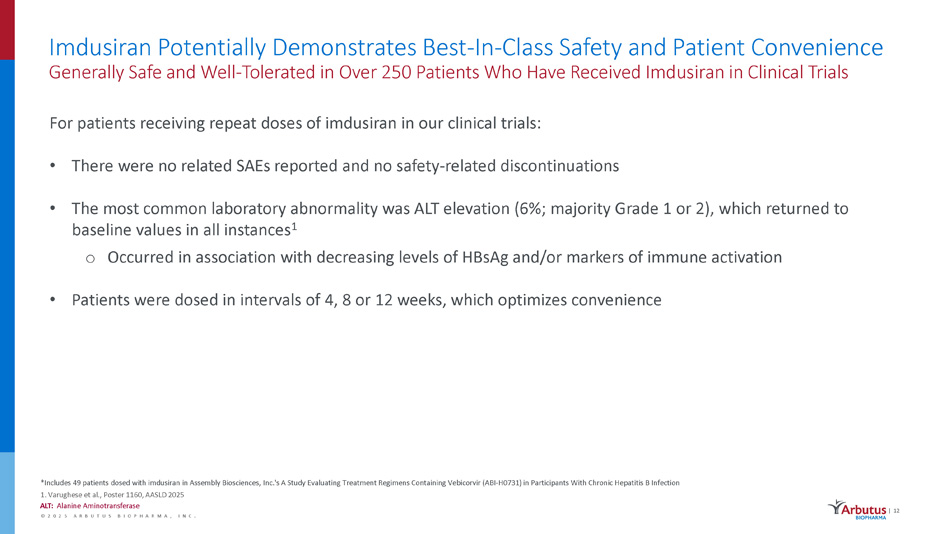
©2025 ARBUTUS BIOPHARMA, INC . Imdusiran Potentially Demonstrates Best - In - Class Safety and Patient Convenience Generally Safe and Well - Tolerated in Over 250 Patients Who Have Received Imdusiran in Clinical Trials | 12 For patients receiving repeat doses of imdusiran in our clinical trials: • There were no related SAEs reported and no safety - related discontinuations • The most common laboratory abnormality was ALT elevation (6%; majority Grade 1 or 2), which returned to baseline values in all instances 1 o Occurred in association with decreasing levels of HBsAg and/or markers of immune activation • Patients were dosed in intervals of 4, 8 or 12 weeks, which optimizes convenience 1. Varughese et al., Poster 1160, AASLD 2025 *Includes 49 patients dosed with imdusiran in Assembly Biosciences, Inc.'s A Study Evaluating Treatment Regimens Containing Vebicorvir (ABI - H0731) in Participants With Chronic Hepatitis B Infection ALT: Alanine Aminotransferase
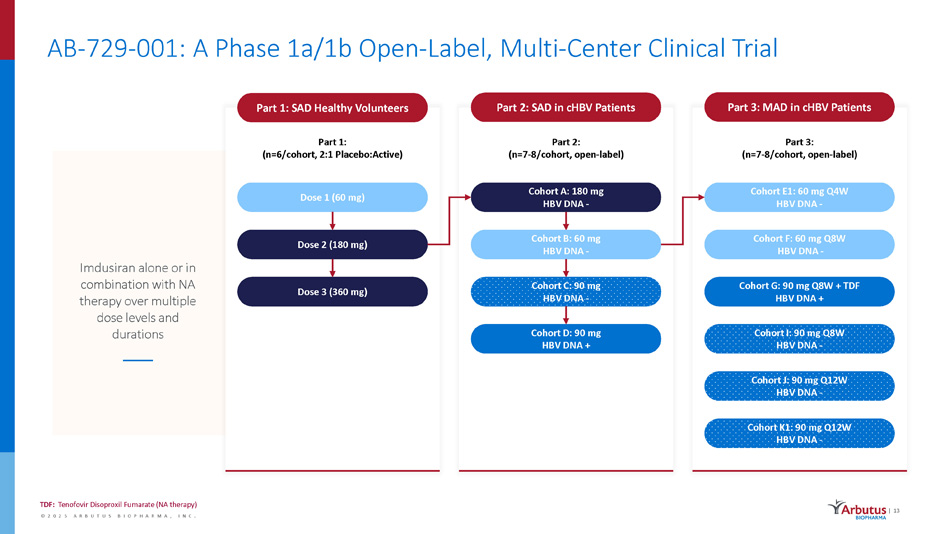
©2025 ARBUTUS BIOPHARMA, INC . AB - 729 - 001: A Phase 1a/1b Open - Label, Multi - Center Clinical Trial | 13 Imdusiran alone or in combination with NA therapy over multiple dose levels and durations Part 1: SAD Healthy Volunteers Part 2: SAD in cHBV Patients Part 3: MAD in cHBV Patients Part 1: (n=6/cohort, 2:1 P lacebo :Active) Part 2: (n=7 - 8/cohort, open - label) Part 3: (n=7 - 8/cohort, open - label) Dose 1 (60 mg) Dose 2 (180 mg) Dose 3 (360 mg) Cohort A: 180 mg HBV DNA - Cohort B: 60 mg HBV DNA - Cohort C: 90 mg HBV DNA - Cohort D: 90 mg HBV DNA + Cohort E1: 60 mg Q4W HBV DNA - Cohort F: 60 mg Q8W HBV DNA - Cohort G: 90 mg Q8W + TDF HBV DNA + Cohort I: 90 mg Q8W HBV DNA - Cohort J: 90 mg Q12W HBV DNA - Cohort K1: 90 mg Q12W HBV DNA - TDF: Tenofovir Disoproxil Fumarate (NA therapy)
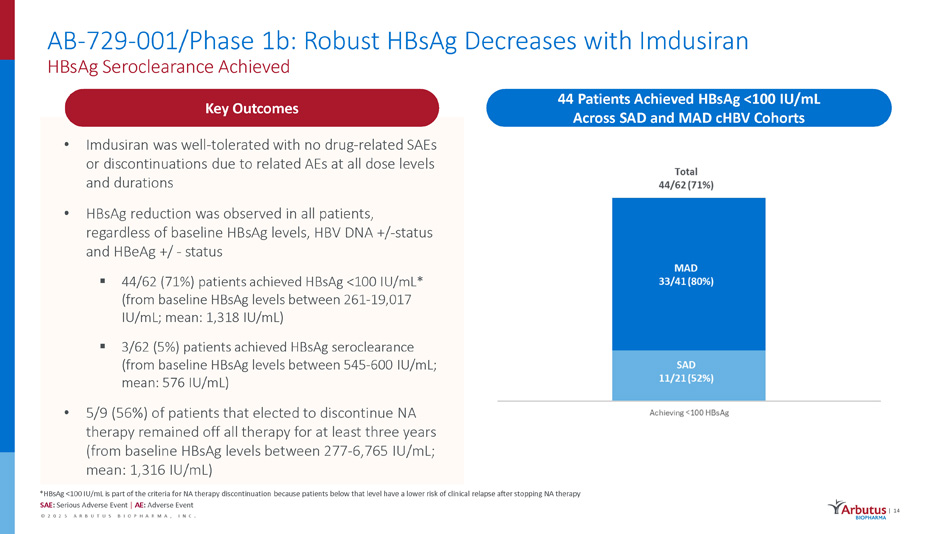
©2025 ARBUTUS BIOPHARMA, INC . AB - 729 - 001/Phase 1b: Robust HBsAg Decreases with Imdusiran HBsAg Seroclearance Achieved | 14 Key Outcomes • Imdusiran was well - tolerated with no drug - related SAEs or discontinuations due to related AEs at all dose levels and durations • HBsAg reduction was observed in all patients, regardless of baseline HBsAg levels, HBV DNA +/ - status and HBeAg +/ - status ▪ 44/62 (71%) patients achieved HBsAg <100 IU/mL* (from baseline HBsAg levels between 261 - 19,017 IU/mL; mean: 1,318 IU/mL) ▪ 3/62 (5%) patients achieved HBsAg seroclearance (from baseline HBsAg levels between 545 - 600 IU/mL; mean: 576 IU/mL) • 5/9 (56%) of patients that elected to discontinue NA therapy remained off all therapy for at least three years (from baseline HBsAg levels between 277 - 6,765 IU/mL; mean: 1,316 IU/mL) 44 Patients Achieved HBsAg <100 IU/mL Across SAD and MAD cHBV Cohorts SAE : Serious Adverse Event | AE : Adverse Event *HBsAg <100 IU/mL is part of the criteria for NA therapy discontinuation because patients below that level have a lower risk of clinical relapse after stopping NA therapy

©2025 ARBUTUS BIOPHARMA, INC . AB - 729 - 001/Phase 1b: Multiple Ascending Dose Arms See Robust HBsAg Decreases Across All HBsAg Baseline Levels, HBeAg +/ - Status and HBV DNA +/ - Status | 15 Phase 1b Part 3 MAD – Repeat Dosing in cHBV Patients Mean ( ± Standard Error) Log 10 HBsAg Decrease • Across all cohorts, HBsAg mean decrease was 99% ( - 2.0 log) after imdusiran dosing up to week 48 (from mean baseline HBsAg of 2,248 IU/mL) ▪ 33/41 (80%) patients achieved HBsAg <100 IU/mL (from baseline HBsAg levels between 309 - 19,017 IU/mL; mean: 1,754 IU/mL) ▪ 3/41 (7%) patients achieved HBsAg seroclearance (from baseline HBsAg levels between 545 - 600 IU/mL; mean: 576 IU/mL) • The majority of HBsAg decrease occurred within the initial 12 weeks of dosing • In HBeAg+ patients, HBsAg levels continued to decline after week 24 Key Outcomes From Phase 1b Part 3 MAD
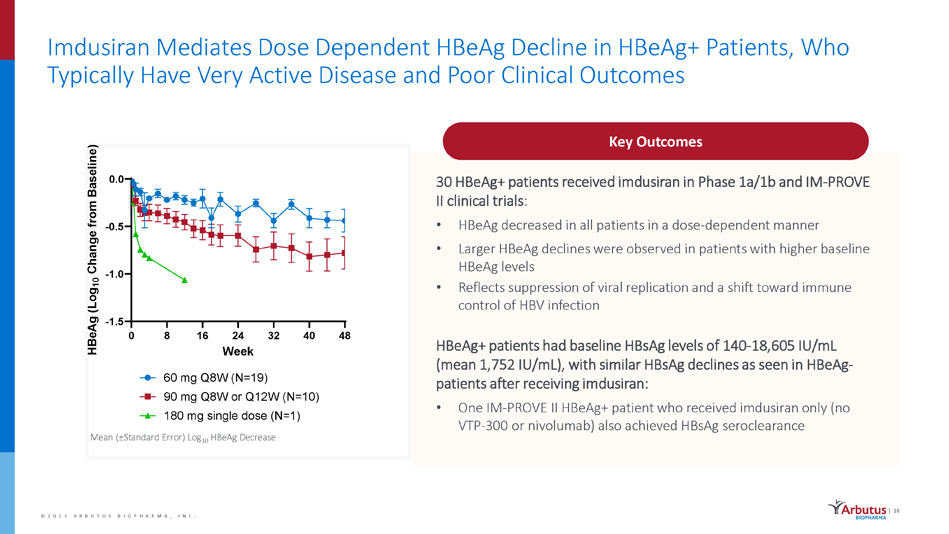
©2025 ARBUTUS BIOPHARMA, INC . Imdusiran Mediates Dose Dependent HBeAg Decline in HBeAg+ Patients, Who Typically Have Very Active Disease and Poor Clinical Outcomes | 16 Key Outcomes 30 HBeAg+ patients received imdusiran in Phase 1a/1b and IM - PROVE II clinical trials : • HBeAg decreased in all patients in a dose - dependent manner • Larger HBeAg declines were observed in patients with higher baseline HBeAg levels • Reflects suppression of viral replication and a shift toward immune control of HBV infection HBeAg+ patients had baseline HBsAg levels of 140 - 18,605 IU/mL (mean 1,752 IU/mL), with similar HBsAg declines as seen in HBeAg - patients after receiving imdusiran : • One IM - PROVE II HBeAg+ patient who received imdusiran only (no VTP - 300 or nivolumab) also achieved HBsAg seroclearance Mean ( ± Standard Error) Log 10 HBeAg Decrease 0 8 16 24 32 40 48 -1.5 -1.0 -0.5 0.0 WeekH B e A g ( L o g 1 0 C h a n g e f r o m B a s e l i n e ) 60 mg Q8W (N=19) 90 mg Q8W or Q12W (N=10) 180 mg single dose (N=1)
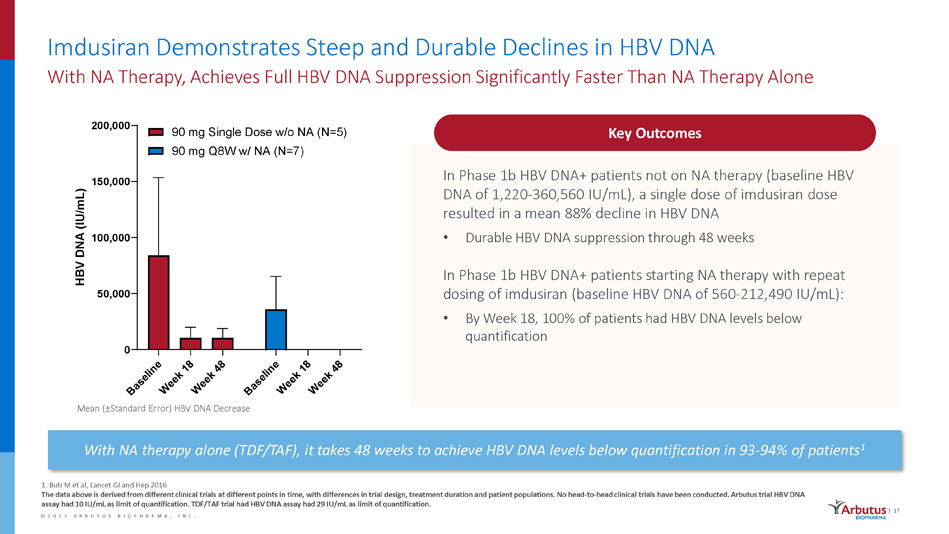
©2025 ARBUTUS BIOPHARMA, INC . Imdusiran Demonstrates Steep and Durable Declines in HBV DNA With NA Therapy, Achieves Full HBV DNA Suppression Significantly Faster Than NA Therapy Alone | 17 Mean ( ± Standard Error) HBV DNA Decrease In Phase 1b HBV DNA+ patients not on NA therapy (baseline HBV DNA of 1,220 - 360,560 IU/mL), a single dose of imdusiran dose resulted in a mean 88% decline in HBV DNA • Durable HBV DNA suppression through 48 weeks In Phase 1b HBV DNA+ patients starting NA therapy with repeat dosing of imdusiran (baseline HBV DNA of 560 - 212,490 IU/mL): • By Week 18, 100% of patients had HBV DNA levels below quantification Key Outcomes 1. Buti M et al, Lancet GI and Hep 2016 The data above is derived from different clinical trials at different points in time, with differences in trial design, treat men t duration and patient populations. No head - to - head clinical trials have been conducted. Arbutus trial HBV DNA assay had 10 IU/mL as limit of quantification. TDF/TAF trial had HBV DNA assay had 29 IU/mL as limit of quantification. With NA therapy alone (TDF/TAF), it takes 48 weeks to achieve HBV DNA levels below quantification in 93 - 94% of patients 1 B a s e l i n e W e e k 1 8 W e e k 4 8 B a s e l i n e W e e k 1 8 W e e k 4 8 0 50,000 100,000 150,000 200,000 H B V D N A ( I U / m L ) 90 mg Single Dose w/o NA (N=5) 90 mg Q8W w/ NA (N=7)
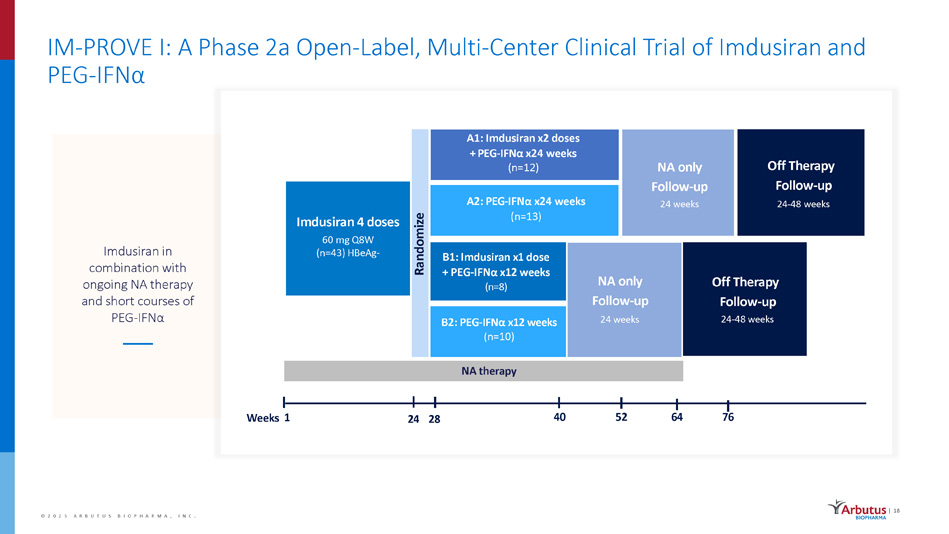
©2025 ARBUTUS BIOPHARMA, INC . IM - PROVE I: A Phase 2a Open - Label, Multi - Center Clinical Trial of Imdusiran and PEG - IFNα | 18 Imdusiran in combination with ongoing NA therapy and short courses of PEG - IFNα NA only Follow - up 24 weeks A1: Imdusiran x 2 doses + PEG - IFN α x24 w eeks (n=12) A2: PEG - IFN α x24 weeks (n=13) B1: Imdusiran x 1 dose + PEG - IFN α x12 weeks (n=8) Imdusiran 4 doses 60 mg Q8W ( n=43 ) HBeAg - Randomize NA only Follow - up 24 weeks Off Therapy Follow - up 24 - 48 weeks Off Therapy Follow - up 24 - 48 weeks 52 Weeks 1 40 64 76 24 28 B2: PEG - IFN α x12 weeks ( n=10) NA therapy

©2025 ARBUTUS BIOPHARMA, INC . IM - PROVE I 1 : 37% of Patients Either Achieved Functional Cure or Were Able to Discontinue NA Therapy With Imdusiran at 60 mg | 19 *All patients were on NA background therapy Total Functional Cure and NA Therapy Discontinuation Treatment regimen* Imdusiran (60 mg) x6 doses + PEG - IFN α x24 weeks Cohort A1 Imdusiran (60 mg) x4 doses + PEG - IFN α x24 weeks Cohort A2 Imdusiran (60 mg) x5 doses + PEG - IFN α x12 weeks Cohort B1 Imdusiran (60 mg) x4 doses + PEG - IFN α x12 weeks Cohort B2 Total
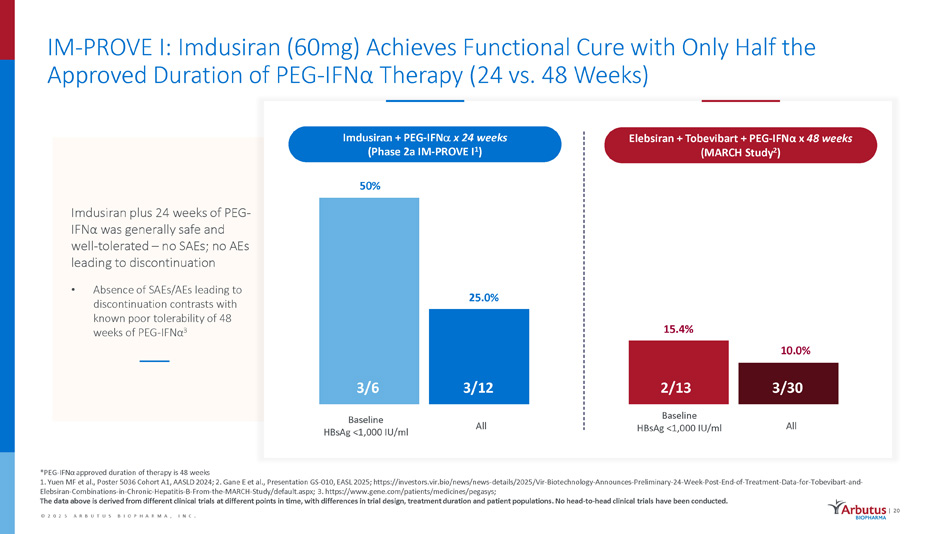
©2025 ARBUTUS BIOPHARMA, INC . IM - PROVE I: Imdusiran (60mg) Achieves Functional Cure with Only Half the Approved Duration of PEG - IFNα Therapy (24 vs. 48 Weeks) | 20 *PEG - IFNα approved duration of therapy is 48 weeks 1. Yuen MF et al., Poster 5036 Cohort A1, AASLD 2024; 2. Gane E et al., Presentation GS - 010, EASL 2025; https://investors.vir.bi o/news/news - details/2025/Vir - Biotechnology - Announces - Preliminary - 24 - Week - Post - End - of - Treatment - Data - for - Tobevibart - and - Elebsiran - Combinations - in - Chronic - Hepatitis - B - From - the - MARCH - Study/default.aspx; 3. https://www.gene.com/patients/medicines/pegasys; The data above is derived from different clinical trials at different points in time, with differences in trial design, treat men t duration and patient populations. No head - to - head clinical trials have been conducted. 50% 25.0% 15.4% 10.0% Baseline HBsAg <1,000 IU/ml All Baseline HBsAg <1,000 IU/ml All 3/6 3/12 2/13 3/30 2/13 3/30 Imdusiran + PEG - IFN x 24 weeks (Phase 2a IM - PROVE I 1 ) Elebsiran + Tobevibart + PEG - IFNα x 48 weeks (MARCH Study 2 ) 3/6 3/12 2/13 3/30 Imdusiran plus 24 weeks of PEG - IFNα was generally safe and well - tolerated – no SAEs; no AEs leading to discontinuation • Absence of SAEs/AEs leading to discontinuation contrasts with known poor tolerability of 48 weeks of PEG - IFNα 3
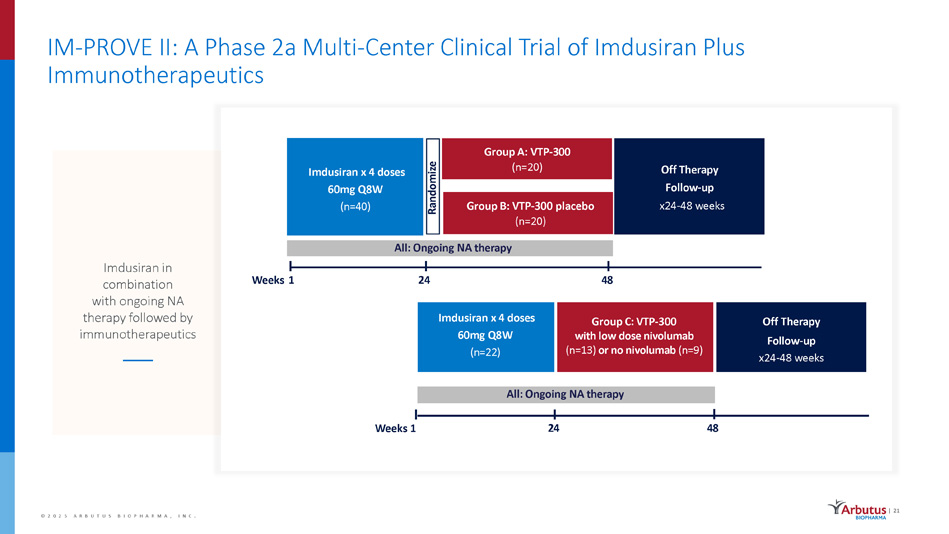
©2025 ARBUTUS BIOPHARMA, INC . IM - PROVE II: A Phase 2a Multi - Center Clinical Trial of Imdusiran Plus Immunotherapeutics | 21 Imdusiran in combination with ongoing NA therapy followed by immunotherapeutics Group B : VTP - 300 placebo (n=20) Weeks 1 Imdusiran x 4 doses 60mg Q8W (n=40) Imdusiran x 4 doses 6 0 mg Q8W (n=22) Weeks 1 24 Off Therapy Follow - up x24 - 48 weeks Randomize All: Ongoing NA therapy All: Ongoing NA therapy 24 48 48 Off Therapy Follow - up x24 - 48 weeks Group A : VTP - 300 (n=20) Group C: VTP - 300 with low dose nivolumab (n=13) or no nivolumab (n=9)
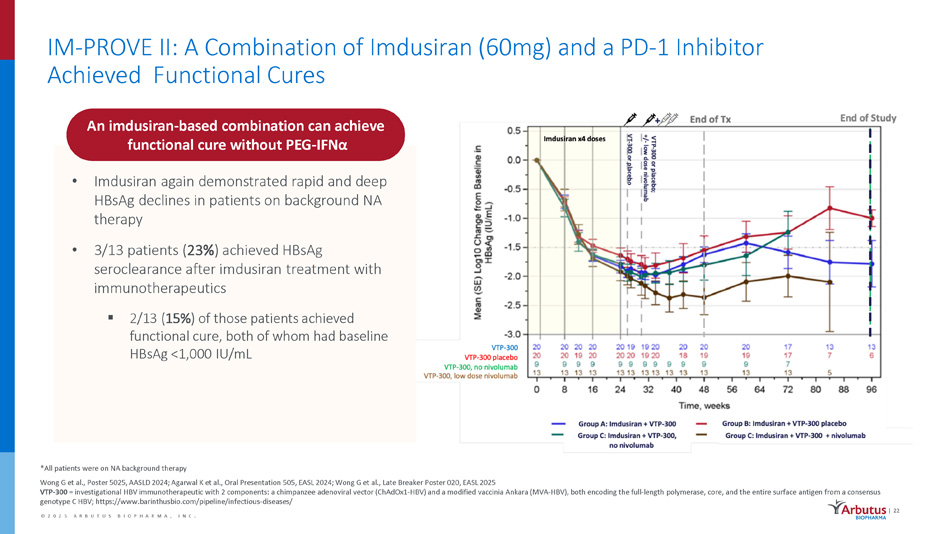
©2025 ARBUTUS BIOPHARMA, INC . IM - PROVE II: A Combination of Imdusiran (60mg) and a PD - 1 Inhibitor Achieved Functional Cures | 22 Wong G et al., Poster 5025, AASLD 2024; Agarwal K et al., Oral Presentation 505, EASL 2024; Wong G et al., Late Breaker Poste r 0 20, EASL 2025 VTP - 300 = investigational HBV immunotherapeutic with 2 components: a chimpanzee adenoviral vector (ChAdOx1 - HBV) and a modified vaccinia Ankara (MVA - HBV), both encoding the full - length polymerase, core, and the entire surface antigen from a consensus genotype C HBV; https://www.barinthusbio.com/pipeline/infectious - diseases/ An imdusiran - based combination can achieve functional cure without PEG - IFNα • Imdusiran again demonstrated rapid and deep HBsAg declines in patients on background NA therapy • 3/13 patients ( 23% ) achieved HBsAg seroclearance after imdusiran treatment with immunotherapeutics ▪ 2/13 ( 15% ) of those patients achieved functional cure, both of whom had baseline HBsAg <1,000 IU/mL *All patients were on NA background therapy
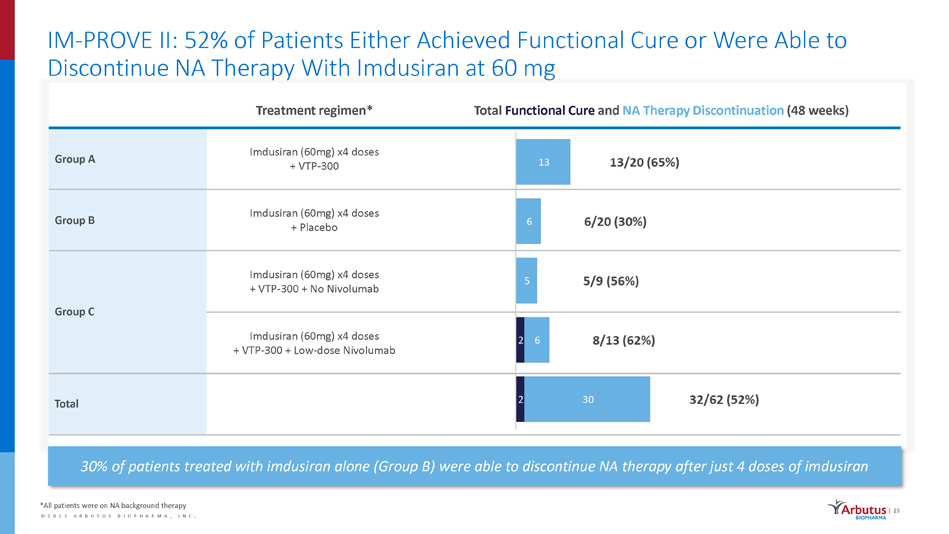
©2025 ARBUTUS BIOPHARMA, INC . | 23 *All patients were on NA background therapy Total Functional Cure and NA Therapy Discontinuation (48 weeks) Treatment regimen* Imdusiran ( 60mg) x4 doses + VTP - 300 Group A Imdusiran ( 60mg) x4 doses + Placebo Group B Imdusiran ( 60mg) x4 doses + VTP - 300 + No Nivolumab Group C Imdusiran ( 60mg) x4 doses + VTP - 300 + Low - dose Nivolumab Total IM - PROVE II: 52% of Patients Either Achieved Functional Cure or Were Able to Discontinue NA Therapy With Imdusiran at 60 mg 30% of patients treated with imdusiran alone (Group B) were able to discontinue NA therapy after just 4 doses of imdusiran
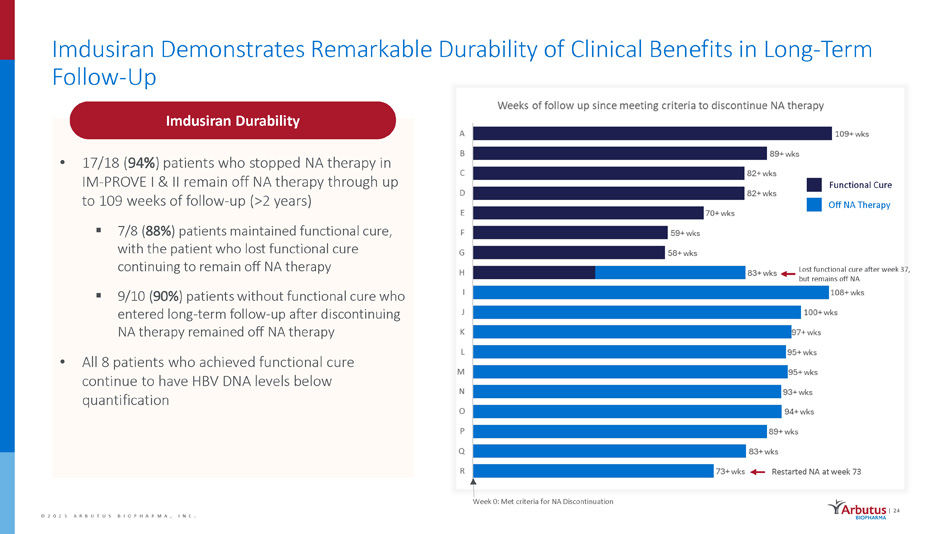
©2025 ARBUTUS BIOPHARMA, INC . Imdusiran Demonstrates Remarkable Durability of Clinical Benefits in Long - Term Follow - Up | 24 Functional Cure Off NA Therapy • 17/18 ( 94% ) patients who stopped NA therapy in IM - PROVE I & II remain off NA therapy through up to 109 weeks of follow - up (>2 years) ▪ 7/8 ( 88% ) patients maintained functional cure, with the patient who lost functional cure continuing to remain off NA therapy ▪ 9/10 ( 90% ) patients without functional cure who entered long - term follow - up after discontinuing NA therapy remained off NA therapy • All 8 patients who achieved functional cure continue to have HBV DNA levels below quantification Lost functional cure after week 37, but remains off NA Restarted NA at week 73 Imdusiran Durability Week 0: Met criteria for NA Discontinuation
©2025 ARBUTUS BIOPHARMA, INC . | 25 *The data above is derived from different clinical trials at different points in time, with differences in trial design, trea tme nt duration and patient populations. No head - to - head clinical trials have been conducted. Imdusiran has the Potential to Set a New Benchmark in cHBV Treatment • Well - tolerated in over 250 patients who have received imdusiran across clinical trials. For patients receiving repeat doses of Imdusiran : ▪ No related SAEs reported and no safety - related discontinuations ▪ Low incidence of ALT (6%; majority Grade 1 or 2), which resolved and occurred in association with decreasing levels of HBsAg and/or markers of immune activation • Long dosing intervals (4, 8 or 12 weeks) are more convenient and preferable for patients • Mediates robust HBsAg decreases across all HBsAg baseline levels, HBeAg +/ - status and HBV DNA +/ - status ▪ 46% (48/105) of all Phase 2a patients achieved functional cure or discontinued NA therapy • Demonstrates steep and durable declines in HBV DNA and, with NA therapy, achieves full HBV DNA suppression significantly faster than NA therapy alone* ▪ All 8 patients who achieved functional cure in Phase 2a continue to have HBV DNA levels below quantification • Remarkable durability observed in long - term follow - up ▪ 88% of functional cure patients and 90% of NA therapy discontinuation patients from Phase 2a trials continue to maintain clinical benefits for up to 109 weeks (>2 years), with ongoing follow - up ▪ 56% (5/9) of Phase 1b patients ( imdusiran + NA therapy) who elected to discontinue NA therapy remained off all therapy for at least 3 years
©2025 ARBUTUS BIOPHARMA, INC. AB - 101 Oral PD - L1 Checkpoint Inhibitor | 26

©2025 ARBUTUS BIOPHARMA, INC . AB - 101: A Differentiated Oral PD - L1 Inhibitor Designed for Safety | 27 PD - 1 : Programmed cell death protein 1 | PD - L1: Programmed death ligand protein 1 | Ab: Antibody | mAb : Monoclonal antibody | FIH: First in human | ir - AE: Immune - Related Adverse Event Thi EP et al., Poster THU254, EASL 2025 ; Gane E et al., Poster THU248, EASL 2025; Gane E et al., Poster 1123, AASLD 2025. *The data above is derived from different clinical trials at different points in time, with differences in trial design, trea tme nt duration and patient populations. No head - to - head clinical trials have been conducted. Differentiated Approach with Potentially Superior Safety Profile* Validated Mechanism of Action and Potent Activity De - risked Human Proof - of - Concept Oral small molecule advantage: Convenient once - daily oral dosing vs IV - administered mAb checkpoint inhibitors Designed for safety: Preclinical data with favorable liver distribution & FIH - confirmed safety profile Clinical differentiation: More favorable ir - AE profile vs mAb Potent target engagement: Disrupts PD - 1/PD - L1 interaction at sub - nanomolar concentrations Robust, mAb - comparable activity: In preclinical models, once - daily dosing demonstrated activity comparable to established PD - L1 mAb atezolizumab Confirmed target engagement in humans: Clear, dose - dependent PD - L1 receptor occupancy, maximal (100%) at 40 mg dose Optimal PK for once - daily dosing: Half - life of ~20 hrs supports engagement over 24 hrs Strong safety & tolerability profile: Well - tolerated in single and multiple dosing (up to 28 days); no SAEs in ongoing FIH study
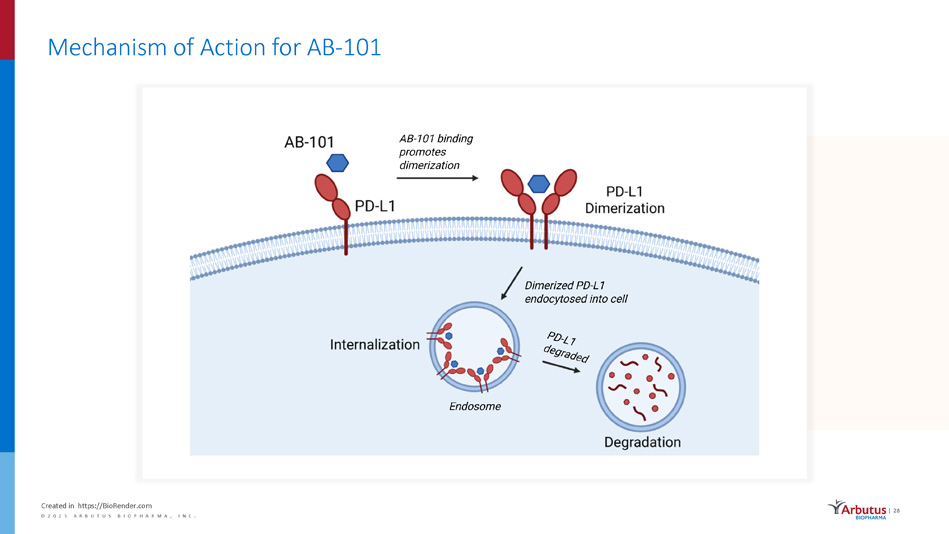
©2025 ARBUTUS BIOPHARMA, INC . Mechanism of Action for AB - 101 | 28 Created in https://BioRender.com
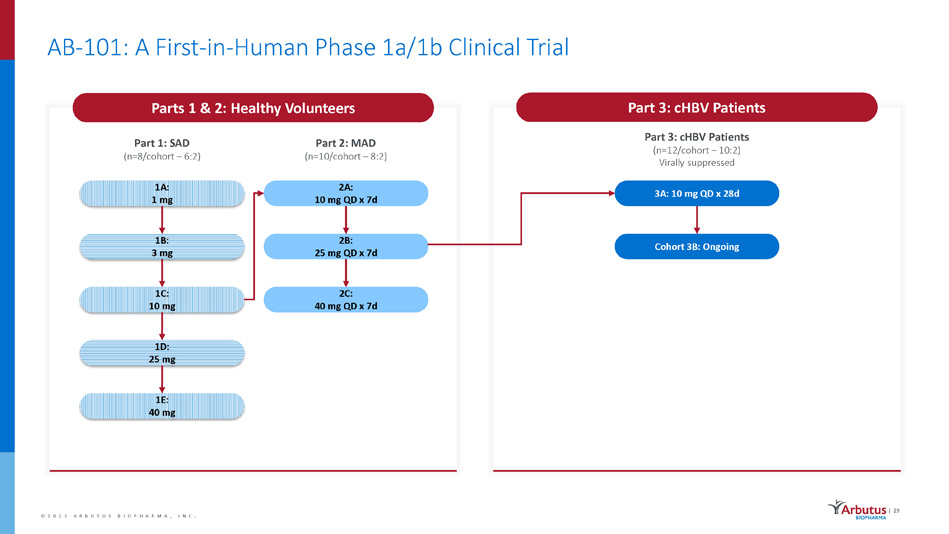
©2025 ARBUTUS BIOPHARMA, INC . AB - 101: A First - in - Human Phase 1a/1b Clinical Trial | 29 Parts 1 & 2: Healthy Volunteers Part 3: cHBV Patients Part 1: SAD (n=8/cohort – 6:2) Part 2: MAD (n=10/cohort – 8:2) Part 3: cHBV Patients (n=12/cohort – 10:2) Virally suppressed 1A: 1 mg 1B: 3 mg 1C: 10 mg 1D: 25 mg 1E: 40 mg 2A: 10 mg QD x 7d 2B: 25 mg QD x 7d 2C: 40 mg QD x 7d 3A: 10 mg QD x 28d Cohort 3B: Ongoing
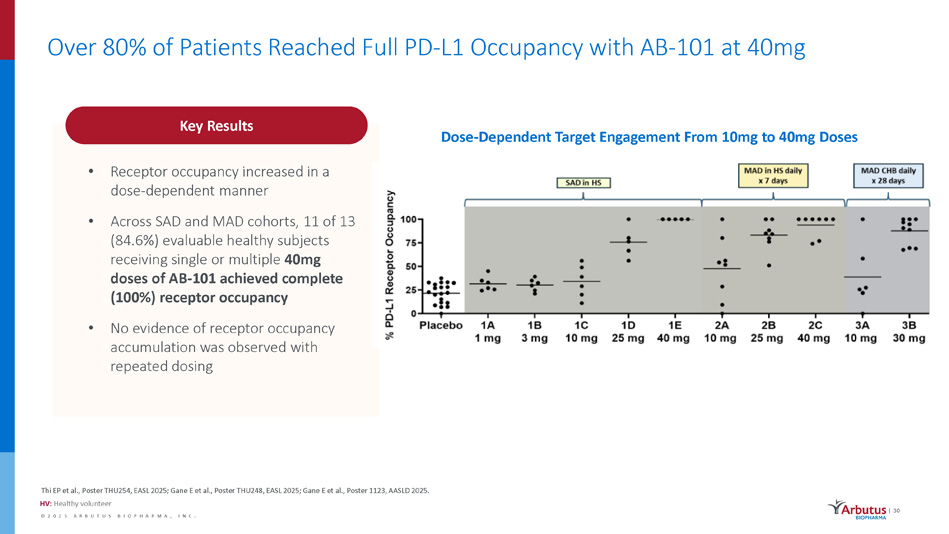
©2025 ARBUTUS BIOPHARMA, INC . Over 80% of Patients Reached Full PD - L1 Occupancy with AB - 101 at 40mg | 30 Thi EP et al., Poster THU254, EASL 2025; Gane E et al., Poster THU248, EASL 2025; Gane E et al., Poster 1123, AASLD 2025. HV: Healthy volunteer Dose - Dependent Target Engagement From 10mg to 40mg Doses Key Results • Receptor occupancy increased in a dose - dependent manner • Across SAD and MAD cohorts, 11 of 13 (84.6%) evaluable healthy subjects receiving single or multiple 40mg doses of AB - 101 achieved complete (100%) receptor occupancy • No evidence of receptor occupancy accumulation was observed with repeated dosing
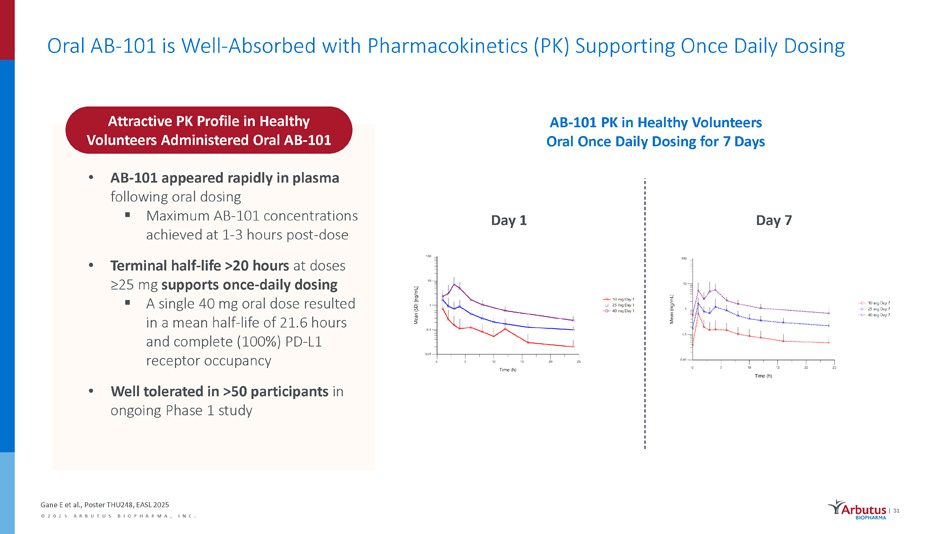
©2025 ARBUTUS BIOPHARMA, INC . Oral AB - 101 is Well - Absorbed with Pharmacokinetics (PK) Supporting Once Daily Dosing | 31 AB - 101 PK in Healthy Volunteers Oral Once Daily Dosing for 7 Days Attractive PK Profile in Healthy Volunteers Administered Oral AB - 101 • AB - 101 appeared rapidly in plasma following oral dosing ▪ Maximum AB - 101 concentrations achieved at 1 - 3 hours post - dose • Terminal half - life >20 hours at doses ≥25 mg supports once - daily dosing ▪ A single 40 mg oral dose resulted in a mean half - life of 21.6 hours and complete (100%) PD - L1 receptor occupancy • Well tolerated in >50 participants in ongoing Phase ථ 1 study Gane E et al., Poster THU248 , EASL 2025 Day 1 Day 7
NASDAQ: ABUS ARBUTUSBIO.COM ©2025 ARBUTUS BIOPHARMA, INC .