
AGNT 10-Q
AGNT, Inc. (AGNT)
tota
UNITED STATES
SECURITIES AND EXCHANGE COMMISSION
Washington, D.C. 20549
FORM
For the quarterly period ended
or
For the transition period from ______________________ to ______________________
Commission File Number:
(Exact name of registrant as specified in its charter)
| ||
(State or other jurisdiction | (I.R.S. Employer | |
of incorporation or organization) | Identification No.) | |
(Address of principal executive offices) | (Zip Code) | |
( | ||
(Registrant’s telephone number, including area code) | ||
eXp World Holdings, Inc.
(Former name, former address and former fiscal year,
if changed since last report)
Securities registered pursuant to Section 12(b) of the Act:
(Title of Each Class) | (Trading Symbol) | (Name of each exchange on which registered) |
Indicate by check mark whether the registrant (1) has filed all reports required to be filed by Section 13 or 15(d) of the Securities Exchange Act of 1934 during the preceding 12 months (or for such shorter period that the registrant was required to file such reports), and (2) has been subject to such filing requirements for the past 90 days.
Indicate by check mark whether the registrant has submitted electronically every Interactive Data File required to be submitted pursuant to Rule 405 of Regulation S-T (§232.405 of this chapter) during the preceding 12 months (or for such shorter period that the registrant was required to submit such files).
Indicate by check mark whether the registrant is a large accelerated filer, an accelerated filer, a non-accelerated filer, a smaller reporting company, or an emerging growth company. See the definitions of “large accelerated filer,” “accelerated filer,” “smaller reporting company,” and “emerging growth company” in Rule 12b-2 of the Exchange Act.
Accelerated filer ☐ | Non-accelerated filer ☐ | Smaller reporting company | ||||
Emerging growth company |
If an emerging growth company, indicate by check mark if the registrant has elected not to use the extended transition period for complying with any new or revised financial accounting standards provided pursuant to Section 13(a) of the Exchange Act. ☐
Indicate by a check mark whether the registrant is a shell company (as defined in Rule 12b-2 of the Exchange Act).
Yes
There were
TABLE OF CONTENTS
Page | ||||
3 | ||||
4 | ||||
Management’s Discussion and Analysis of Financial Condition and Results of Operations | 16 | |||
24 | ||||
24 | ||||
24 | ||||
25 | ||||
30 | ||||
30 | ||||
30 | ||||
30 | ||||
31 |
2
CAUTIONARY NOTE REGARDING FORWARD-LOOKING STATEMENTS
This Quarterly Report on Form 10-Q for the quarterly period ended June 30, 2026 (this “Quarterly Report”), including the “Management’s Discussion and Analysis of Financial Condition and Results of Operations” in Part I, Item 2 herein (“MD&A”), contains statements that are not historical facts and may constitute forward-looking statements within the meaning of the Private Securities Litigation Reform Act of 1995. Forward-looking statements are not based on historical facts but rather represent current expectations and assumptions of future events. For example, statements in this Quarterly Report regarding the potential future impact of macroeconomic conditions on our business and results of operations and expectations of growth, including as a result of investment in technology and entering into new markets, are forward-looking statements. These statements involve known and unknown risks, uncertainties and other important factors that may cause our actual results, performance or achievements to be materially different from any future results, performance or achievements expressed or implied by the forward-looking statements.
Many of these risks and other factors are beyond our ability to control or predict. Forward-looking statements can be identified by words such as “believe,” “expect,” “anticipate,” “estimate,” “project,” “plan,” “should,” “intend,” “may,” “will,” “could,” “can,” “would,” “potential,” “seek,” “goal” and similar expressions of the future. These risks and uncertainties, as well as other risks and uncertainties that could cause our actual results to differ significantly from management’s expectations, include, but are not limited to:
| ● | the impact of macroeconomic conditions on the strength of the residential real estate market; |
| ● | the impact of monetary policies of the U.S. federal government and its agencies on our operations; |
| ● | the impact of changes in consumer attitudes on home sale transaction volume; |
| ● | the impact of excessive or insufficient home inventory supply on home sale transaction value; |
| ● | our ability to retain and attract additional qualified personnel; |
| ● | changes in tax laws and regulations that may have a material adverse effect on our business; |
| ● | our ability to protect our intellectual property rights; |
| ● | the impact of security breaches, interruptions, delays and failures in our systems and operations on our business; |
| ● | our financial condition and reputation; |
| ● | our ability to predict the demand or growth of our new products and services; |
| ● | our ability to maintain our agent growth rate; |
| ● | the impact of adverse outcomes in litigation and regulatory actions against us and other companies and agents in our industry on our business, including the outcome of any settlements related to those actions; and |
| ● | the effect of inflation and continuing high interest rates on real estate transaction values and our operating results, profits and cash flows. |
Other factors, including those described under the heading “Risk Factors” in Part II, Item 1A of this Quarterly Report, under the heading “Risk Factors” in Part I, Item 1A of our Annual Report on Form 10-K for the fiscal year ended December 31, 2025 (the “2025 Annual Report”) and elsewhere in the 2025 Annual Report, may also cause actual results to differ materially from those described in our forward-looking statements. Additionally, there may be other risks described from time to time in the reports that we file with the Securities and Exchange Commission (the “SEC”). Most of these factors are difficult to anticipate and are generally beyond our control. You should consider these factors in connection with considering any forward-looking statements that may be made by us.
Forward-looking statements are based on currently available operating, financial and market information and are inherently uncertain. Investors should not place undue reliance on forward-looking statements, which speak only as of the date they are made and are not guarantees of future performance. Actual future results and trends may differ materially from such forward-looking statements. We undertake no obligation to publicly update or revise any forward-looking statements whether as a result of new information, future developments or otherwise, except as may be required by law.
3
PART 1 – FINANCIAL INFORMATION
Item 1.FINANCIAL STATEMENTS (UNAUDITED)
AGNT, INC.
CONDENSED CONSOLIDATED BALANCE SHEETS
(In thousands, except share amounts)
(UNAUDITED)
June 30, 2026 | December 31, 2025 | |||
ASSETS | ||||
CURRENT ASSETS | ||||
Cash and cash equivalents | $ | $ | ||
Restricted cash | | | ||
Accounts receivable, net of allowance for credit losses of $ | | | ||
Prepaids and other assets | | | ||
TOTAL CURRENT ASSETS | | | ||
Property and equipment, net | | | ||
Other noncurrent assets | | | ||
Intangible assets, net | | | ||
Deferred tax assets, net | | | ||
Goodwill | | | ||
TOTAL ASSETS | $ | $ | ||
LIABILITIES AND EQUITY | ||||
CURRENT LIABILITIES | ||||
Accounts payable | $ | $ | ||
Customer deposits | | | ||
Accrued expenses | | | ||
Litigation contingency | | | ||
Other current liabilities | | | ||
TOTAL CURRENT LIABILITIES | | | ||
TOTAL LIABILITIES | | | ||
EQUITY | ||||
Common Stock, $ | | | ||
Additional paid-in capital | | | ||
Treasury stock, at cost: | ( | ( | ||
Accumulated earnings (deficit) | ( | ( | ||
Accumulated other comprehensive income (loss) | ( | | ||
TOTAL EQUITY | | | ||
TOTAL LIABILITIES AND EQUITY | $ | $ | ||
The accompanying notes are an integral part of these condensed consolidated financial statements.
4
AGNT, INC.
CONDENSED CONSOLIDATED STATEMENTS OF COMPREHENSIVE INCOME (LOSS)
(In thousands, except share amounts and per share data)
(UNAUDITED)
| Three Months Ended June 30, | Six Months Ended June 30, | ||||||
2026 | 2025 | 2026 | 2025 | |||||
Revenues | $ | $ | $ | $ | ||||
Commissions and other agent-related costs | | | | | ||||
Gross profit | | | | | ||||
Operating expenses | ||||||||
General and administrative expenses | | | | | ||||
Technology and development expenses | | | | | ||||
Sales and marketing expenses | | | | | ||||
Litigation contingency | | - | | - | ||||
Total operating expenses | | | | | ||||
Operating income (loss) | | ( | ( | ( | ||||
Other (income) expense | ||||||||
Other (income) expense, net | ( | ( | ( | ( | ||||
Equity in (income) losses of unconsolidated affiliates | ( | | | | ||||
Other (income) expense, net | ( | ( | ( | ( | ||||
Income (loss) before income tax expense | | ( | ( | ( | ||||
Income tax (benefit) expense | | | | | ||||
Net income (loss) | ($ | ($ | ($ | ($ | ||||
Earnings (loss) per share | ||||||||
Basic, net income (loss) | ($ | ($ | ($ | ($ | ||||
Diluted, net income (loss) | ($ | ($ | ($ | ($ | ||||
Weighted average shares outstanding | ||||||||
Basic | | | | | ||||
Diluted | | | | | ||||
Comprehensive income (loss): | ||||||||
Net income (loss) | ($ | ($ | ($ | ($ | ||||
Other comprehensive income (loss): | ||||||||
Foreign currency translation gain (loss), net of tax | ( | | ( | | ||||
Comprehensive income (loss) | ($ | $ | ($ | ($ | ||||
The accompanying notes are an integral part of these condensed consolidated financial statements.
5
AGNT, INC.
CONDENSED CONSOLIDATED STATEMENTS OF STOCKHOLDERS’ EQUITY
(In thousands)
(UNAUDITED)
| Three Months Ended June 30, | Six Months Ended June 30, | ||||||
2026 | 2025 | 2026 | 2025 | |||||
Common stock: | ||||||||
Balance, beginning of period | $ | $ | $ | $ | ||||
Balance, end of period | | | | | ||||
Treasury stock: | ||||||||
Balance, beginning of period | ( | ( | ( | ( | ||||
Repurchases of common stock | - | ( | - | ( | ||||
Balance, end of period | ( | ( | ( | ( | ||||
Additional paid-in capital: | ||||||||
Balance, beginning of period | | | | | ||||
Shares issued for stock options exercised | | | | | ||||
Agent growth incentive stock-based compensation | | | | | ||||
Agent equity stock-based compensation | | | | | ||||
Other share activity | | | | | ||||
Balance, end of period | | | | | ||||
Accumulated earnings (deficit): | ||||||||
Balance, beginning of period | ( | ( | ( | ( | ||||
Net income (loss) | ( | ( | ( | ( | ||||
Dividends declared and paid ($ | ( | ( | ( | ( | ||||
Balance, end of period | ( | ( | ( | ( | ||||
Accumulated other comprehensive income (loss): | ||||||||
Balance, beginning of period | ( | ( | | ( | ||||
Foreign currency translation gain (loss) | ( | | ( | | ||||
Balance, end of period | ( | ( | ( | ( | ||||
Total equity | $ | $ | $ | $ | ||||
The accompanying notes are an integral part of these condensed consolidated financial statements.
6
AGNT, INC.
CONDENSED CONSOLIDATED STATEMENTS OF CASH FLOWS
(In thousands)
(UNAUDITED)
Six Months Ended June 30, | ||||
2026 | 2025 | |||
OPERATING ACTIVITIES | ||||
Net income (loss) | ($ | ($ | ||
Reconciliation of net income (loss) to net cash provided by operating activities: | ||||
Depreciation expense | | | ||
Amortization expense - intangible assets | | | ||
Loss on disposition of assets | | - | ||
Credit (benefit) losses on receivables/bad debt on receivables | ( | | ||
Equity in loss of unconsolidated affiliates | | | ||
Agent growth incentive stock-based compensation expense | | | ||
Other stock-based compensation | | | ||
Agent equity stock-based compensation expense | | | ||
Deferred income taxes, net | ( | ( | ||
Changes in operating assets and liabilities: | ||||
Accounts receivable | ( | ( | ||
Prepaids and other assets | | ( | ||
Customer deposits | | | ||
Accounts payable | ( | | ||
Accrued expenses | | | ||
Litigation contingency | ( | ( | ||
Other operating activities | | ( | ||
NET CASH PROVIDED BY OPERATING ACTIVITIES | | | ||
INVESTING ACTIVITIES | ||||
Purchases of property and equipment | ( | ( | ||
Acquisitions, net of cash acquired | ( | - | ||
Proceeds from sale of assets | | - | ||
Investments in unconsolidated affiliates | ( | ( | ||
Capitalized software development costs in intangible assets | | ( | ||
NET CASH USED IN INVESTING ACTIVITIES | ( | ( | ||
FINANCING ACTIVITIES | ||||
Repurchase of common stock | - | ( | ||
Proceeds from exercise of options | | | ||
Dividends declared and paid | ( | ( | ||
NET CASH USED IN FINANCING ACTIVITIES | ( | ( | ||
Effect of changes in exchange rates on cash, cash equivalents and restricted cash | ( | | ||
Net change in cash, cash equivalents and restricted cash | | | ||
Cash, cash equivalents and restricted cash, beginning balance | | | ||
CASH, CASH EQUIVALENTS AND RESTRICTED CASH, ENDING BALANCE | $ | $ | ||
SUPPLEMENTAL DISCLOSURE OF CASH FLOWS INFORMATION: | ||||
Cash paid for income taxes | | | ||
SUPPLEMENTAL DISCLOSURE OF NON-CASH INVESTING ACTIVITIES: | ||||
Property and equipment purchases in accounts payable | | | ||
The accompanying notes are an integral part of these condensed consolidated financial statements.
7
AGNT, Inc.
Notes to the Condensed Consolidated Financial Statements
(UNAUDITED)
(Amounts in thousands, except share amounts and per share data or as noted otherwise)
1. | DESCRIPTION OF BUSINESS AND BASIS OF PRESENTATION |
AGNT, Inc. (“AGNT”, the “Company”, “we”, “us” or “our”) (formerly known as eXp World Holdings, Inc.) was incorporated in the State of Delaware on July 30, 2008 and converted to a Texas corporation on June 11, 2026. AGNT is a multi-model real estate platform operating through its subsidiaries eXp Realty®, the Company’s cloud-based brokerage, and NextHome, Inc. (“NextHome”), a national real estate franchise. Together, these businesses support independent real estate agents, franchise owners, brokers, and entrepreneurs across North America and international markets. The Company also operates FrameVR.io, a virtual collaboration platform, and SUCCESS® Enterprises, a personal development and media brand. The Company reports results through
The accompanying consolidated financial statements are prepared in accordance with U.S. generally accepted accounting principles (“U.S. GAAP”), expressed in U.S. dollars, and the Company’s fiscal year ends on December 31. The preparation of these consolidated financial statements and accompanying notes in conformity with U.S. GAAP requires the use of management estimates.
These interim financial statements should be read in conjunction with the audited consolidated financial statements and related notes contained in the Company’s 2025 Annual Report.
In management’s opinion, these interim financial statements reflect all normal recurring adjustments necessary for a fair presentation and are not necessarily indicative of results expected for the full year ending December 31, 2026.
2. | SUMMARY OF SIGNIFICANT ACCOUNTING POLICIES |
Principles of Consolidation
The consolidated financial statements include the accounts of the Company, its wholly-owned subsidiaries, and entities in which the Company has a variable interest of which the Company is the primary beneficiary. If the Company has a variable interest in an entity but it is not the primary beneficiary of the entity or does not exercise control over the operations and has less than 50% ownership, it will use the equity or cost method of accounting for investments.
Joint ventures
A joint venture is a contractual arrangement whereby the Company and other parties undertake an economic activity through a jointly controlled entity. Joint control exists when strategic, financial and operating policy decisions relating to the activities require the unanimous consent of the parties sharing control. Joint ventures are accounted for using the equity method and are recognized initially at cost. Joint ventures are typically included in the Other Affiliated Services segment unless the joint venture specifically supports one of the other reportable segments.
Investments in Equity Securities
We hold investments in certain equity securities that do not have readily determinable fair values and for which we do not exercise significant influence. These investments qualify for and are accounted for using the measurement alternative under Financial Accounting Standards Board Accounting Standards Codification (“ASC”) Topic 321, Investments (“ASC 321”).
Use of Estimates
Preparing financial statements under U.S. GAAP requires management to make estimates and assumptions that affect reported amounts and disclosures. Key areas requiring estimates include credit losses, legal contingencies, revenue recognition, stock-based compensation, and deferred tax assets.
Management bases these estimates on current facts, historical experience, and other reasonable factors. Actual results may differ materially and adversely from these estimates, which could affect future results of operations.
8
Reclassifications
When necessary, the Company will reclassify certain amounts in prior period financial statements to conform to the current period’s presentation. The prior periods presented do not include any reclassifications. The Company maintains a consistent presentation across all periods presented.
Restricted cash
Restricted cash consists of cash held in escrow by the Company on behalf of real estate buyers and amounts held in Canadian commission trust accounts. Buyer escrow amounts are recorded as customer deposit liabilities until released, at which time the liability is reduced. Amounts held in legally designated trust accounts at financial institutions in Canada are restricted solely to the payment of real estate commissions, in accordance with applicable Canadian real estate regulations. The corresponding obligation is reflected in commissions payable to agents, included in accrued expenses on the Company’s condensed consolidated balance sheets.
The following table provides a reconciliation of cash and cash equivalents and restricted cash reported within the condensed consolidated balance sheets that sum to the total of the same amounts shown on the condensed consolidated statements of cash flows.
Cash and cash equivalents | Restricted cash | Total | ||||
Balance, June 30, 2025 | $ | $ | $ | |||
Balance, December 31, 2025 | $ | $ | $ | |||
Balance, June 30, 2026 | $ | $ | $ |
3. | EXPECTED CREDIT LOSSES |
The Company evaluates expected credit losses using an aging schedule and records an allowance when amounts are determined to be uncollectible.
As of June 30, 2026 and December 31, 2025, the Company recognized expected credit losses of $
4. | PROPERTY AND EQUIPMENT, NET |
Property and equipment, net consisted of the following:
| June 30, 2026 | December 31, 2025 | ||
Computer hardware and software | $ | $ | ||
Furniture, fixture, and equipment | | | ||
Total depreciable property and equipment | | | ||
Less: accumulated depreciation | ( | ( | ||
Depreciable property and equipment, net | | | ||
Assets under development | | | ||
Property and equipment, net | $ | $ |
For the three months ended June 30, 2026 and 2025, depreciation expense was $
9
5. | GOODWILL AND INTANGIBLE ASSETS |
Goodwill was $
Definite-lived intangible assets, net consisted of the following:
June 30, 2026 | ||||||
Gross | Accumulated | Net Carrying | ||||
| Amount | | Amortization | Amount | ||
Trade name |
| $ |
| ($ | $ | |
Existing technology | | ( | | |||
Non-competition agreements | | ( | | |||
Customer relationships | | ( | | |||
Licensing agreement | | ( | - | |||
Intellectual property | | ( | | |||
Total intangible assets |
| $ |
| ($ | $ | |
December 31, 2025 | ||||||
Gross | Accumulated | Net Carrying | ||||
Amount | | Amortization | Amount | |||
Trade name |
| $ |
| ($ | $ | |
Existing technology | |
| ( | | ||
Non-competition agreements | |
| ( | | ||
Customer relationships | |
| ( | | ||
Licensing agreement | |
| ( | - | ||
Intellectual property | |
| ( | | ||
Total intangible assets |
| $ |
| ($ | $ | |
Definite-lived intangible assets are amortized using the straight-line method over an asset’s estimated useful life. Amortization expense for definite-lived intangible assets for the three months ended June 30, 2026 and 2025 was $
6.STOCKHOLDERS’ EQUITY
The following table represents a share reconciliation of the Company’s common stock issued for the periods presented:
| Three Months Ended June 30, | Six Months Ended June 30, | ||||||
2026 | 2025 | 2026 | 2025 | |||||
Common stock: | ||||||||
Balance, beginning of period | | | | | ||||
Shares issued for stock options exercised | | | | | ||||
Agent growth incentive stock-based compensation | | | | | ||||
Agent equity stock-based compensation | | | | | ||||
Other stock-based compensation | | - | | - | ||||
Other share activity | ( | - | ( | - | ||||
Balance, end of period | | | | | ||||
Dividends
During the three and six months ended June 30, 2026, cash dividends paid totaled $
10
Stock Compensation Programs
Related to the Agent Equity Program, during the three months ended June 30, 2026 and 2025, the Company issued shares of the Company’s common stock to agents and brokers with a value of $
Related to the Agent Growth Incentive Program (“AGIP”), during the three months ended June 30, 2026 and 2025, the Company’s stock-based compensation expense was $
As of June 30, 2026, the total unrecognized compensation costs associated with AGIP, where the performance metric has been achieved and the number of shares awarded are fixed, was $
The following table illustrates changes in the Company’s stock-based compensation liability for the periods presented:
Amount | ||
Balance, December 31, 2024 | $ | |
Stock grant liability increase year to date | | |
Stock grants reclassified from liability to equity year to date | ( | |
Balance, December 31, 2025 | $ | |
Stock grant liability increase year to date | | |
Stock grants reclassified from liability to equity year to date | ( | |
Balance, June 30, 2026 | $ |
Other Restricted Stock Units (“RSUs”)
RSUs may be granted to directors, officers, certain employees and consultants. Each RSU represents the right to receive
During the three months ended June 30, 2026 and 2025, the Company's stock-based compensation expense attributable to RSUs was $
During the six months ended June 30, 2026 and 2025, the Company's stock-based compensation expense attributable to RSUs was $
As of June 30, 2026, the total unrecognized compensation costs associated with these RSUs was $
Stock Option Awards
Stock options are granted to directors, officers, certain employees and consultants with an exercise price equal to the fair market value of common stock on the grant date and the stock options expire
During the three months ended June 30, 2026 and 2025, the Company granted
Stock Repurchase Program
The Company’s stock repurchase program does not obligate the Company to acquire a minimum amount of shares and it limits the Company’s aggregate repurchases to $
11
negotiated or open market transactions, including under plans complying with Rule 10b5-1 under the Securities Exchange Act of 1934, as amended. For accounting purposes, common stock repurchased under the stock repurchase program is recorded based upon the trade date of the applicable trade. Such repurchased shares are held in treasury and are presented using the cost method. These shares are considered issued but not outstanding.
During the three and six months ended June 30, 2026, there were
7.SEGMENT INFORMATION
The following table provides information about the Company’s reportable segments (in thousands):
Revenues | |||||||
Three Months Ended June 30, | Six Months Ended June 30, | ||||||
2026 | 2025 | 2026 | 2025 | ||||
North American Realty | $ | $ | $ | $ | |||
International Realty | | | | | |||
Other Affiliated Services | | | | | |||
Commissions reconciliation: | |||||||
Segment eliminations | ( | ( | ( | ( | |||
Consolidated revenues | $ | $ | $ | $ | |||
Commissions and Other Agent-Related Costs | |||||||
Three Months Ended June 30, | Six Months Ended June 30, | ||||||
2026 | 2025 | 2026 | 2025 | ||||
North American Realty | $ | $ | $ | $ | |||
International Realty | | | | | |||
Other Affiliated Services | | | | | |||
Commissions reconciliation: | |||||||
Segment eliminations | - | - | - | - | |||
Consolidated commissions and other agent-related costs | $ | $ | $ | $ | |||
| Operating Income (Loss) | ||||||
Three Months Ended June 30, | Six Months Ended June 30, | ||||||
2026 | 2025 | 2026 | 2025 | ||||
North American Realty | $ | $ | $ | $ | |||
International Realty | ( | ( | ( | ( | |||
Other Affiliated Services | ( | ( | ( | ( | |||
Segment Operating Income (Loss) | | | | ( | |||
Corporate expenses and other | ( | ( | ( | ( | |||
Consolidated Operating Income (Loss) | $ | ($ | ( | ( | |||
Adjusted EBITDA | |||||||
Three Months Ended June 30, | Six Months Ended June 30, | ||||||
2026 | 2025 | 2026 | 2025 | ||||
North American Realty | $ | $ | $ | $ | |||
International Realty | ( | ( | ( | ( | |||
Other Affiliated Services | ( | ( | ( | ( | |||
Corporate expenses and other | ( | ( | ( | ( | |||
Consolidated adjusted EBITDA | $ | $ | $ | $ | |||
Income (loss) before income tax expense reconciliation: | |||||||
Depreciation and amortization expense | | | | | |||
Legal costs non-recurring | | - | | - | |||
Litigation contingency | | - | | - | |||
Stock-based compensation expense | | | | | |||
Stock option expense | | | | | |||
Other (income) expense, net | ( | ( | ( | ( | |||
Consolidated income (loss) before income tax expense | $ | ($ | ($ | ($ | |||
12
Goodwill | |||
June 30, 2026 | December 31, 2025 | ||
North American Realty | $ | $ | |
International Realty | - | - | |
Other Affiliated Services | - | - | |
Segment and consolidated total | | | |
8.EARNINGS PER SHARE
Basic earnings (loss) per share is computed based on net income (loss) attributable to AGNT stockholders divided by the basic weighted-average shares outstanding during the period. Dilutive earnings (loss) per share is computed consistently with the basic computation while giving effect to all dilutive potential common shares and common share equivalents that were outstanding during the period. The Company uses the treasury stock method to reflect the potential dilutive effect of unvested stock awards and unexercised options.
The following table sets forth the calculation of basic and diluted earnings (loss) per share attributable to common stockholders during the periods presented:
Three Months Ended June 30, | Six Months Ended June 30, | ||||||||
2026 | 2025 | 2026 | 2025 | ||||||
Numerator: | |||||||||
Net income (loss) | ($ | ($ | ($ | ($ | |||||
Denominator: | |||||||||
Weighted average shares - basic | | | | | |||||
Dilutive effect of common stock equivalents | - | - | - | - | |||||
Weighted average shares - diluted | | | | | |||||
Earnings per share: | |||||||||
Net income (loss) per share - basic | ($ | ($ | ($ | ($ | |||||
Net income (loss) per share - diluted | ($ | ($ | ($ | ($ | |||||
For the three months ended June 30, 2026 and 2025, total outstanding shares of common stock excluded
9.INCOME TAXES
The Company’s quarterly tax provision is computed by applying the estimated annual effective tax rate to the year-to-date pre-tax income or loss plus discrete tax items arising in the period. The Company’s provision for income tax expense amounted to $
The Company is subject to a wide variety of tax laws and regulations in the jurisdictions where it operates. U.S. and international tax reform legislation could affect the Company's effective tax rate. The Company continues to monitor the Organization for Economic Co-operation and Development’s (OECD) Base Erosion and Profit Shifting (BEPS) framework—including the legislative adoption of Pillar Two and other tax reform legislation by jurisdiction—to evaluate the potential impact on future periods. The Company does not expect the adoption of Pillar Two rules to have a significant impact on its consolidated financial statements in fiscal year 2026.
10.FAIR VALUE MEASUREMENT
The Company holds funds in a money market account, which are considered Level 1 assets. The Company values its money market funds at fair value on a recurring basis.
As of June 30, 2026 and December 31, 2025, the fair value of the Company’s money market funds was $
The Company holds investments in equity securities without readily determinable fair values. These investments are accounted for under the measurement alternative method in accordance with ASC 321. As of June 30, 2026, the carrying value of these investments was $
13
11.COMMITMENTS AND CONTINGENCIES
From time to time, the Company is subject to potential liability under laws and government regulations and various claims and legal actions that may be asserted against us that could have a material adverse effect on the Company’s business, reputation, results of operations, cash flows and/or financial condition. Such litigation includes, but is not limited to, actions or claims relating to cyber-attacks, data breaches, the Real Estate Settlement Procedures Act (“RESPA”), the Telephone Consumer Protection Act of 1991 (“TCPA”) and state consumer protection laws, antitrust and anticompetition, worker classification, stockholder derivative actions, non-compliance with contractual or other legal obligations, and franchise laws and regulations, including the Federal Trade Commission’s Franchise Rule (16 C.F.R. Part 436), state franchise disclosure and registration requirements, and franchise relationship laws governing termination, renewal, and transfer rights.
Antitrust Litigation
The Company and its affiliated brokerage entities are among several defendants in certain sell-side and buy-side class action lawsuits, as detailed below. While the Company does not expect such litigation to have a material adverse effect on our business, results of operations, cash flows or financial condition, due to the complexities inherent in such litigation, including the uncertainty of legal processes and potential developments in the cases, the ultimate liability may differ from current expectations.
Sell-Side Class Action Lawsuits
The Company is currently named in
On December 9, 2024, the Company and certain of its subsidiaries entered into a Settlement Agreement (the “Settlement”) with plaintiffs in the U.S. antitrust lawsuit 1925 Hooper LLC, et al. v. The National Association of Realtors et al., Case No. 1:23-cv-05392- SEG (United States District Court for the Northern District of Georgia, Atlanta Division), which was filed on November 22, 2023 against the Company and other U.S. brokerage defendants (the “Hooper Action”). The Settlement resolves all claims set forth in the Hooper Action and similar claims on a nationwide basis against the Company (collectively, the “Sell-Side Claims”) and releases the Company, its subsidiaries and affiliates, and their independent contractor real estate agents in the U.S. from the Sell-Side Claims. By the terms of the Settlement, the Company agreed to make certain changes to its business practices and to pay a total settlement amount of $
The Settlement and any actions taken to carry out the Settlement are not an admission or concession of liability, or of the validity of any claim, defense, or point of fact or law on the part of any party. The Company continues to deny the material allegations of the complaints in the antitrust litigation. The Company entered into the Settlement after considering the risks and costs of continuing the litigation.
The Company continues to vigorously defend against the claims in the Canadian putative class action antitrust lawsuit Kevin McFall v. Canadian Real Estate Association, et al., Case No. T-119-24-ID 1 (Federal Court of Canada), filed on January 18, 2024. Management is currently unable to reasonably estimate the possible loss or range of possible loss for the Canadian antitrust litigation because, among other reasons, (i) the proceeding is in preliminary stages, (ii) specific damage amounts have not been sought, (iii) damages sought are, in our opinion, unsupported and/or exaggerated, (iv) there are significant factual issues to be resolved; and/or (v) there are novel legal issues or unsettled legal theories presented.
Buy-Side Class Action Lawsuit
The Company is currently named in
14
Tuccori, to which the Company was not named as a defendant, is a case that consolidated several purported class action lawsuits filed by home buyers. In October 2025, the court preliminarily approved a settlement structure, which included an opt-in procedure under which other companies subject to home buyer claims could participate in the Tuccori settlement, subject to preliminary and final court approval. On April 14, 2026, the Company opted into the Tuccori settlement via an Opt-In Settlement Agreement (the “Tuccori Settlement”). By the terms of the Tuccori Settlement, the Company agreed to make certain changes to its business practices and to pay a total settlement amount of $
Derivative Litigation
Certain current and former directors and officers of the Company were named as defendants, and the Company was named as a nominal defendant, in a derivative lawsuit in the Court of Chancery of the State of Delaware, first filed on September 25, 2024, entitled Los Angeles City Employees’ Retirement System, on behalf of eXp World Holdings, Inc. v. Glenn Sanford, et al. (C.A. No. 2024-0998-KSJM). The lawsuit alleges that certain current and former directors and officers breached fiduciary duties related to the Company’s response to reports of alleged sexual misconduct involving independent contractor real estate agents affiliated with the Company’s subsidiaries and that certain defendants had improper compensation arrangements allowing them to profit from the Company’s revenue share program in connection therewith. The complaint seeks a court declaration of fiduciary duty breaches, disgorgement of profits, damages with interest, injunctive relief for improved oversight of sexual misconduct allegations, and reimbursement of plaintiffs’ costs, including expert and attorney fees. During the quarter ended March 31, 2026, the Court of Chancery denied the defendants' motion to dismiss and the case is now proceeding through discovery. Although the Company does not anticipate that the outcome of such litigation will have a material adverse effect on its business, results of operations, cash flows, or financial condition, the inherent complexities and uncertainties of legal proceedings may result in a liability that differs from current expectations. Management is currently unable to reasonably estimate the possible loss or range of possible loss for this matter because, among other reasons, (i) the proceeding is progressing through preliminary stages, (ii) specific damage amounts have not been sought, (iii) there are significant factual issues to be resolved; and/or (iv) there are novel legal issues or unsettled legal theories presented.
12.SUBSEQUENT EVENTS
Quarterly Cash Dividend
On
15
Item 2. | MANAGEMENT’S DISCUSSION AND ANALYSIS OF FINANCIAL CONDITION AND RESULTS OF OPERATIONS |
The following discussion should be read together with our condensed consolidated financial statements and related notes included elsewhere in this Quarterly Report and consolidated financial statements and related notes appearing in our 2025 Annual Report. This MD&A contains forward-looking statements. See the Cautionary Note Regarding Forward-Looking Statements at the beginning of this Quarterly Report for important information regarding such statements, including risks and uncertainties that could cause actual results to differ materially from those expressed or implied. We undertake no obligation to publicly update or revise any forward-looking statements except as may be required by law.
All dollar amounts are in USD thousands except share amounts and per share data and as otherwise noted.
OVERVIEW
The Company operates a diversified portfolio of service-based businesses whose operations benefit substantially from utilizing our enabling technology platform. A substantial portion of our revenue is derived from commissions received by our residential real estate brokerages which provide a full suite of brokerage and adjacent services (such as mortgage, title, and content creation) to our real estate agents and brokers. Our real estate agents and brokers affiliate their real estate licenses with us and operate their businesses utilizing our cloud-based technology platform to enhance their real estate businesses and optimize efficiencies. In May 2026, we acquired NextHome, a franchised real estate brokerage. Through NextHome, we now serve independent real estate professionals and brokerages who operate under the NextHome franchise system, broadening the range of affiliation models through which agents and brokers can access our ecosystem of services and support. Our enabling and innovative technology platform is a robust suite of cloud-based applications and software services tailored for our real estate agents, brokers, and professionals and targets business operations such as customer relationship management, marketing, client services, and brokerage functionalities. We succeed when our real estate professionals succeed, and we remain focused on being the most agent-centric business on the planet – built by agents, built for agents.
MARKET CONDITIONS AND INDUSTRY TRENDS
Our performance is closely tied to housing market activity, which is influenced by economic conditions such as employment, consumer confidence, mortgage availability, interest rates, and the balance of supply and demand. Periods of economic growth and lower interest rates generally support higher home sales activity, while rising rates, affordability constraints, increased unemployment, or broader economic slowdowns may reduce transaction volumes and pricing. Regulatory developments, geopolitical events, and shifts in consumer sentiment can also affect housing demand.
In the first six months of 2026, U.S. home sales increased 2.8% compared to the same period in 2025, and home sales prices increased 1.8%, according to the National Association of Realtors (“NAR”). Inventory levels remain constrained, at 4.6 months of supply, consistent with inventory levels in June 2025. Our forecasting models continue to reflect minimal growth, informed by historical trends, seasonality and the current macroeconomic conditions.
In this environment, we believe the Company is positioned for growth with a strong base of agents, an efficient cloud-based operating model, and low fixed costs.
16
Legal Environment
See Part II, Item 1 of this Quarterly Report for a discussion of the current legal environment and how such environment could potentially impact our business, results of operations, cash flows and/or financial condition.
KEY BUSINESS METRICS
Management uses our results of operations, financial condition, cash flows, and key business metrics related to our business and industry to evaluate our performance and make strategic decisions.
The following table outlines the key business metrics that we periodically review to track the Company’s performance:
Three Months Ended June 30, | Six Months Ended June 30, | |||||||
2026 | 2025 | 2026 | 2025 | |||||
Performance: | ||||||||
Agent NPS | 69 | 77 | 69 | 78 | ||||
Agent count | 87,338 | 82,704 | 87,338 | 82,704 | ||||
Real estate sales transactions | 132,497 | 118,612 | 224,095 | 208,255 | ||||
Real estate sales volume | $ 60,479,784 | $ 52,477,798 | $ 101,227,566 | 91,118,882 | ||||
Other real estate transactions | 22,410 | 20,955 | 41,230 | 38,970 | ||||
Real estate per transaction cost | $ 525 | $ 621 | $ 598 | $ 670 | ||||
Revenues | $ 1,449,548 | $ 1,308,877 | $ 2,455,089 | $ 2,263,783 | ||||
Gross profit | $ 98,797 | $ 92,654 | $ 174,144 | $ 168,789 | ||||
Operating income (loss) | $ 1,641 | ($ 2,376) | ($ 7,147) | ($ 12,752) | ||||
Consolidated adjusted EBITDA(1) | $ 25,700 | $ 11,201 | $ 29,753 | 13,356 | ||||
| (1) | Consolidated adjusted EBITDA is a non-U.S. GAAP financial measure. For a definition, reconciliation to net income (loss), and discussion of why management believes this measure is useful to investors, see “Non-U.S. GAAP Financial Measures”. |
Agent net promoter score (“aNPS”)
The Company utilizes aNPS as a metric to measure agent satisfaction. aNPS is calculated based on responses to a periodic survey in which agents are asked, on a scale of 0 to 10, how likely they are to recommend our company to a fellow real estate professional.
We believe an aNPS above 50 is indicative of excellent agent satisfaction. For both the three and six months ended June 30, 2026, our aNPS was 69, compared to 77 and 78, respectively, for the same periods in 2025.
Agent count
We believe our ability to attract and retain a diverse and professional agent base is a key driver of our long-term success. While our organic agent base has experienced continued pressure amidst a challenging macroeconomic environment , we remain deeply focused on the retention and support of our agents and teams across all levels of production. The scale of our agent base remains subject to factors beyond our control, including elevated mortgage rates, suppressed transaction volumes, and evolving industry practices. Despite these headwinds, we continue to prioritize a comprehensive value proposition that supports agent productivity, operational efficiency, and long-term professional growth for our entire network.
The number of agents increased in the first six months of 2026, compared to the same period in 2025, primarily due to the addition of agents in connection with the NextHome acquisition completed during the second quarter of 2026. We remain committed to retaining our agents in the U.S., Canada, and internationally through the execution of our growth strategies and the end-to-end suite of services we offer our agents.
Real estate sales transactions and volume
Real estate sales transactions are based on the side (buyer or seller) of each real estate transaction and are recorded upon the closing of a purchase or sale of a home in which our agents and brokers represented the buyer or seller, respectively. Transaction volume represents the total sales value for all transactions and is influenced by several market factors, including, but not limited to, the pricing and quality of our services and market conditions that affect home sales, such as macroeconomic factors, economic growth, or contraction, local inventory levels, mortgage interest rates, and seasonality. The number of real estate transactions and volume are key drivers of our revenue and profitability.
17
Our real estate sales transactions and volume typically fluctuate with changes in the market’s existing home sales transactions as reported by NAR; however, company-specific initiatives influence the transaction volume and productivity of our agents. For the three and six months ended June 30, 2026, compared to the same periods in 2025, our real estate sales transactions increased 12% and 8%, respectively. For the three and six months ended June 30, 2026, compared to the same periods in 2025, transaction volume increased 15% and 11%, respectively. The improvements in transactions and volume are due to increased agent productivity and increased home sale prices.
Other real estate transactions
Other real estate transactions are recorded for leases, rentals and referrals that are undertaken by our agents and brokers. Other real estate transactions for the three and six months ended June 30, 2026 increased compared to the same periods in 2025. Other real estate transactions reflect the full breadth of services that our agents and brokers generate beyond traditional home sales transactions.
Real estate per transaction cost
Real estate per transaction cost is measured as general and administrative, sales and marketing, and technology and development expenses resulting from our services that directly support our agents and brokers, divided by total transactions (real estate sales and other). Real estate per transaction cost decreased 15% and 11% for the three and six months ended June 30, 2026, respectively, compared to the same periods in 2025, primarily due to operational efficiency gains from higher real estate transactions and reduced personnel expenses, employee stock-based compensation expenses, and marketing expenses. We believe real estate per transaction cost provides useful information to investors because it measures the operating efficiency and scalability of our platform on a per-transaction basis.
Revenues
Revenues substantially represent the commission revenue earned by and the Company for closed brokerage real estate transactions in addition to fees paid to the Company by agents. The Company’s revenues increased 11% and 8% for the three and six months ended June 30, 2026, respectively, compared to same periods in 2025, primarily due to higher home sales prices in North America, increased international production, and improved productivity in North America.
Gross profit
Gross profit increased to $98.8 million and $174.1 million in the three and six months ended June 30, 2026, respectively. Gross profit increased in 2026 due to increased revenues, partially offset by increased agent commissions, productivity awards, and other agent-related costs due to agent commission capping.
Operating Income (Loss)
Operating income (loss), in the three and six months ended June 30, 2026, improved when compared to the same periods in 2025. The improvements reflect increased revenues and actions taken to reduce operating costs in the second half of 2025, partially offset by increased legal expenses and accruals in connection with the Company’s ongoing efforts to resolve litigation matters, including the NAR settlement and other claims.
Consolidated Adjusted EBITDA
Management reviews consolidated adjusted EBITDA, which is a non-U.S. GAAP financial measure, to understand and evaluate our core operating performance. For the three and six months ended June 30, 2026, consolidated adjusted EBITDA increased by $14.5 million and $16.4 million, respectively, compared to the same periods in 2025. The increases in consolidated adjusted EBITDA reflect improvements in operating results related to actions taken to reduce operating costs in 2025, which offset increased agent commission capping.
18
RESULTS OF OPERATIONS
The following table reflects the results of each of our operations during the three and six months ended June 30, 2026 and 2025:
Three Months Ended | Three Months Ended | Change 2026 | ||||
June 30, 2026 | June 30, 2025 | vs. 2025 | ||||
Statement of Operations Data: | ||||||
Revenues |
| $ 1,449,548 | $ 1,308,877 | 11% | ||
Commissions and other agent-related costs | 1,350,751 | 1,216,223 | 11% | |||
Gross profit | 98,797 | 92,654 | 7% | |||
Operating expenses | ||||||
General and administrative expenses | 71,575 | 74,076 | (3)% | |||
Technology and development expenses | 18,425 | 18,093 | 2% | |||
Sales and marketing expenses | 2,821 | 2,861 | (1)% | |||
Litigation contingency | 4,335 | - | - | |||
Total operating expenses | 97,156 | 95,030 | 2% | |||
Operating income (loss) | 1,641 | (2,376) | 169% | |||
Other (income) expense | ||||||
Other (income) expense, net | (657) | (760) | (14)% | |||
Equity in (income) losses of unconsolidated affiliates | (8) | 207 | 104% | |||
Total other (income) expense, net | (665) | (553) | 20% | |||
Income (loss) before income tax expense | 2,306 | (1,823) | 226% | |||
Income tax (benefit) expense | 4,999 | 468 | (968)% | |||
Net income (loss) | (2,693) | (2,291) | (18)% |
Six Months Ended | Six Months Ended | Change 2026 | ||||
| June 30, 2026 | June 30, 2025 | vs. 2025 | |||
Statement of Operations Data: | ||||||
Revenues |
| $ 2,455,089 | $ 2,263,783 | 8% | ||
Commissions and other agent-related costs | 2,280,945 | 2,094,994 | 9% | |||
Gross profit | 174,144 | 168,789 | 3% | |||
Operating expenses | ||||||
General and administrative expenses | 135,788 | 140,947 | (4)% | |||
Technology and development expenses | 36,020 | 34,898 | 3% | |||
Sales and marketing expenses | 5,148 | 5,696 | (10)% | |||
Litigation contingency | 4,335 | - | - | |||
Total operating expenses | 181,291 | 181,541 | 0% | |||
Operating income (loss) | (7,147) | (12,752) | 44% | |||
Other (income) expense | ||||||
Other (income) expense, net | (925) | (1,703) | 46% | |||
Equity in (income) losses of unconsolidated affiliates | 122 | 127 | 4% | |||
Total other (income) expense, net | (803) | (1,576) | (49)% | |||
Income (loss) before income tax expense | (6,344) | (11,176) | 43% | |||
Income tax (benefit) expense | 1,447 | 2,139 | 32% | |||
Net income (loss) | (7,791) | (13,315) | 41% |
Commissions and Other Agent-Related Costs
For the three and six months ended June 30, 2026, commissions and other agent-related costs increased compared to the same periods in 2025, primarily due to increased agent commission capping. Commissions and other agent-related costs include sales commissions, revenue share and stock-based compensation paid to our agents.
General and Administrative Expenses
For the three and six months ended June 30, 2026, general and administrative expenses decreased compared to the same periods in 2025, due to decreased employee-related expenses, partially offset by increased litigation expenses. General and administrative expenses include costs related to wages, employee stock-based compensation, and other general overhead expenses.
19
Technology and Development Expenses
For the three and six months ended June 30, 2026, technology and development expenses increased compared to the same periods in 2025, primarily due to increased technology expenses related to agent support. These expenses include employee-related costs and other expenses for the maintenance and development of the technology used by both our agents and our employees.
Sales and Marketing Expenses
For the three and six months ended June 30, 2026, sales and marketing expenses decreased compared to the same periods in 2025, due to efficiencies gained from our CRM of choice program in the U.S. and Canada residential real estate market.
Litigation Contingency
For the three and six months ended June 30, 2026, we recorded a litigation contingency expense reflecting a new accrual recorded in connection with the Tuccori Settlement based on the preliminary court approval granted in May 2026. Litigation contingency expense represents accruals for probable and estimable losses related to ongoing legal matters. See Note 11 – Commitments and Contingencies to the unaudited condensed consolidated financial statements for additional information regarding the Tuccori Settlement
Legal Costs non-recurring
For both the three months and six months ended June 30, 2026, we incurred legal costs of $4,485 driven by non-recurring costs incurred in connection with strategic corporate development initiatives. These costs are non-recurring in nature and not reflective of ongoing core operations and we did not incur such costs in 2025.
Other (Income) Expense, Net
For the three months ended June 30, 2026, total other (income) expense, net increased primarily due to lower losses in equity investments compared to the same period in 2025. For the six months ended June 30, 2026, total other (income) expense, net decreased primarily due to lower interest income when compared to the same period in 2025. Total other (income) expense, net includes interest income earned on cash and cash equivalents, and (earnings) losses related to equity investments.
Income Tax (Benefit) Expense
The Company’s provision for income taxes was an expense of $5.0 million and an expense of $0.5 million for the three months ended June 30, 2026 and 2025, respectively, which represented effective tax rates of 217% and (26%), respectively. The expense for the three months ended June 30, 2026 was primarily driven by the pre-tax income for the period, stock-based compensation shortfalls and non-deductible executive compensation.
The Company’s provision for income tax expense (benefit) amounted to $1.4 million and $2.1 million for the six months ended June 30, 2026 and 2025, respectively, which represented effective tax rates of (23%) and (19%), respectively. The effective tax rate differs from our statutory rates in both periods primarily due to foreign and domestic mix of earnings, and stock-based compensation.
BUSINESS SEGMENT DISCLOSURES
Management evaluates segment performance based on revenue, segment adjusted EBITDA, and operating income (loss). See Note 7 – Segment Information to the unaudited condensed consolidated financial statements for additional information regarding our business segments. The following table reflects the results of each of our reportable segments during the three and six months ended June 30, 2026 and 2025:
20
Three Months Ended | Three Months Ended | Change 2026 | ||||
June 30, 2026 | June 30, 2025 | vs. 2025 | ||||
Statement of Operations Data: | ||||||
Revenues |
| |||||
North American Realty | $ 1,403,046 | $ 1,276,487 | 10% | |||
International Realty | 46,352 | 32,293 | 44% | |||
Other Affiliated Services | 686 | 708 | (3)% | |||
Corporate expenses and other | (536) | (611) | 12% | |||
Total Consolidated Revenues | $ 1,449,548 | $ 1,308,877 | 11% | |||
Segment Adjusted EBITDA(1) | ||||||
North American Realty | $ 30,726 | $ 19,784 | 55% | |||
International Realty | (1,315) | (3,859) | 66% | |||
Other Affiliated Services | (188) | (2,291) | 92% | |||
Corporate expenses and other | (3,523) | (2,433) | (45)% | |||
Total Segment Adjusted EBITDA(1) | $ 25,700 | $ 11,201 | 129% | |||
Operating Income (Loss) |
| |||||
North American Realty | $ 7,875 | $ 7,111 | 11% | |||
International Realty | (1,821) | (4,209) | 57% | |||
Other Affiliated Services | (255) | (2,359) | 89% | |||
Corporate expenses and other | (4,158) | (2,919) | (42)% | |||
Total Consolidated Operating Income (Loss) | $ 1,641 | ($ 2,376) | 169% | |||
| (1) | Segment adjusted EBITDA is a non-U.S. GAAP financial measure. For a definition, reconciliation to net income (loss), and discussion of why management believes this measure is useful to investors, see “Non-U.S. GAAP Financial Measures”. |
Six Months Ended | Six Months Ended | Change 2026 | ||||
June 30, 2026 | June 30, 2025 | vs. 2025 | ||||
Statement of Operations Data: | ||||||
Revenues |
| |||||
North American Realty | $ 2,368,150 | $ 2,199,535 | 8% | |||
International Realty | 86,504 | 63,950 | 35% | |||
Other Affiliated Services | 1,544 | 1,535 | 1% | |||
Corporate expenses and other | (1,109) | (1,237) | 10% | |||
Total Consolidated Revenues | $ 2,455,089 | $ 2,263,783 | 8% | |||
Segment Adjusted EBITDA(1) | ||||||
North American Realty | $ 40,689 | $ 27,519 | 48% | |||
International Realty | (3,736) | (5,474) | 32% | |||
Other Affiliated Services | (318) | (3,746) | 92% | |||
Corporate expenses and other | (6,882) | (4,943) | (39)% | |||
Total Segment Adjusted EBITDA(1) | $ 29,753 | $ 13,356 | 123% | |||
Operating Income (Loss) |
| |||||
North American Realty | $ 6,264 | $ 3,287 | 91% | |||
International Realty | (4,837) | (6,129) | 21% | |||
Other Affiliated Services | (449) | (4,002) | 89% | |||
Corporate expenses and other | (8,125) | (5,908) | (38)% | |||
Total Consolidated Operating Income (Loss) | ($ 7,147) | ($ 12,752) | 44% | |||
| (1) | Segment adjusted EBITDA is a non-U.S. GAAP financial measure. For a definition, reconciliation to net income (loss), and discussion of why management believes this measure is useful to investors, see “Non-U.S. GAAP Financial Measures”. |
21
North American Realty revenues increased 10% and 8% in the three and six months ended June 30, 2026, respectively, compared to the same periods in 2025, primarily due to increases in agent productivity and home sale prices in the U.S., partially offset by lower real estate transactions in Canada. North American Realty adjusted EBITDA as well as operating income (loss) improved in the three and six months ended June 30, 2026 compared to the same periods of 2025 due to increased revenues, and lower operating costs, which offset increased commissions and other agent-related costs as a result of increased agent commission capping.
International Realty revenue increased 44% and 35% in the three and six months ended June 30, 2026, respectively, compared to the same periods in 2025, primarily due to increased real estate transactions driven by increased productivity in previously launched markets. International Realty adjusted EBITDA and operating income (loss) improved in the three and six months ended June 30, 2026, compared to the same periods in 2025, primarily due to increased revenues and continued expense management.
Other Affiliated Services revenue decreased 3% and increased 1% in the three and six months ended June 30, 2026, respectively, compared to the same periods in 2025. Other Affiliated Services adjusted EBITDA and operating loss improved in the three and six months ended June 30, 2026, compared to the same periods in 2025, due to lower employee-related costs.
Corporate expenses and other contain the costs incurred to operate the Company.
NON-U.S. GAAP FINANCIAL MEASURES
To supplement our consolidated financial statements, which are prepared and presented in accordance with U.S. GAAP, we use consolidated adjusted EBITDA and segment adjusted EBITDA, non-U.S. GAAP financial measures, to understand and evaluate our core operating performance. These non-U.S. GAAP financial measures, which may be different than similarly titled measures used by other companies, are presented to enhance investors' overall understanding of our financial performance and should not be considered a substitute for, or superior to, the financial information prepared and presented in accordance with U.S. GAAP.
We define consolidated adjusted EBITDA as net income (loss), excluding other income (expense), net, income tax benefit (expense), depreciation, amortization, impairment charges (as applicable), litigation contingency, legal costs non-recurring, stock-based compensation expense, stock option expense, and other items that are not core to the operating activities of the Company. Segment adjusted EBITDA is defined consistently, excluding other income (expense), income tax benefit (expense), depreciation, amortization, impairment charges (as applicable), litigation contingency, legal costs non-recurring, stock-based compensation expense, stock option expense, and other non-core items. We believe these measures provide useful information about our financial performance, help identify underlying trends that could otherwise be masked by excluded expenses, and allow for greater transparency with respect to key metrics used by management for financial and operational decision-making.
Limitations of these measures compared to net income (loss), the most directly comparable U.S. GAAP measure include:
| ● | Consolidated adjusted EBITDA and segment adjusted EBITDA exclude stock-based compensation expenses related to our agent growth incentive program and stock option expense, which have been and will continue to be for the foreseeable future, significant recurring expenses in our business and an important part of our compensation strategy; and |
| ● | Consolidated adjusted EBITDA and segment adjusted EBITDA exclude certain recurring, non-cash charges such as depreciation of fixed assets, amortization of intangible assets and impairment charges related to these long-lived assets, as applicable, and, although these are non-cash charges, the assets being depreciated, amortized, or impaired may have to be replaced in the future. |
Three Months Ended June 30, | Six Months Ended June 30, | |||||||
| 2026 | 2025 | 2026 | 2025 | ||||
Net income (loss) | ($ 2,693) | ($ 2,291) | ($ 7,791) | ($ 13,315) | ||||
Total other (income) expense, net | (665) | (553) | (803) | (1,576) | ||||
Income tax (benefit) expense | 4,999 | 468 | 1,447 | 2,139 | ||||
Depreciation and amortization | 2,245 | 2,272 | 4,567 | 4,833 | ||||
Legal costs non-recurring | 4,485 | - | 4,485 | - | ||||
Litigation contingency | 4,335 | - | 4,335 | - | ||||
Stock-based compensation expense(1) | 12,102 | 9,703 | 21,175 | 17,821 | ||||
Stock option expense | 892 | 1,602 | 2,338 | 3,454 | ||||
Consolidated adjusted EBITDA | $ 25,700 | $ 11,201 | $ 29,753 | $ 13,356 | ||||
| (1) | This includes agent growth incentive stock-based compensation expense. |
22
LIQUIDITY AND CAPITAL RESOURCES
Our primary sources of liquidity are our cash and cash equivalents on hand and cash flows generated from our business operations. Our ability to generate sufficient cash flow from operations or to access certain capital markets, including banks, is necessary to fund our operations and capital expenditures, repurchase our common stock, and meet obligations as they become due.
Currently, our primary use of cash on hand is to sustain and grow our business operations, including, but not limited to, making commission and revenue share payments to agents and brokers and cash outflows for operating expenses, share repurchases, and dividend payments. In addition, the Company has no known material cash requirements as of June 30, 2026 relating to capital expenditures, commitments, or human capital (except as passthrough commissions to agents and brokers concurrent with settled real estate transactions), other than cash payments due pursuant to litigation settlement agreements, which may be paid in installments over time. For information regarding the Company’s expected cash requirement related to litigation settlement agreements, see Note 11 – Commitments and Contingencies to the unaudited condensed consolidated financial statements.
We believe that our existing balances of cash and cash equivalents and cash flows expected to be generated from our operations will be sufficient to satisfy our operating requirements for at least the next twelve months. Our future capital requirements will depend on many factors, including our level of investment in technology, our rate of growth into new markets, and cash used to repurchase shares of the Company’s common stock. Our capital requirements may be affected by factors which we cannot control such as the changes in the residential real estate market, interest rates, industry practice changes in light of the NAR settlement relating to the antitrust litigation, and other monetary and fiscal policy changes to the manner in which we currently operate. In order to support and achieve our future growth plans, we may need or seek advantageously to obtain additional funding through equity or debt financing. There can be no assurance such financing will be available on terms acceptable to us or at all. If we raise funds by issuing equity securities, dilution to our stockholders may result. We believe that our current operating structure will facilitate sufficient cash flows from operations to satisfy our expected long-term liquidity requirements beyond the next twelve months.
Net Working Capital
Net working capital is calculated as the Company’s total current assets less its total current liabilities. The following table presents our net working capital as of June 30, 2026 and December 31, 2025:
| June 30, 2026 | | December 31, 2025 | |
Current assets | $ 391,395 | $ 304,868 | ||
Current liabilities | (258,318) | (199,701) | ||
Net working capital | $ 133,077 | $ 105,167 | ||
As of June 30, 2026, net working capital increased by $27.9 million, compared to net working capital as of December 31, 2025 due to an increase in cash and restricted cash and net accounts receivable, due to the timing of receivable collections, and a decrease in the litigation contingency, due to the payments made in June 2026, such increases were partially offset by an increase in commissions payable accruals.
Cash Flows
The following table presents our cash flows for the six months ended June 30, 2026 and 2025:
Six Months Ended June 30, | |||||
| 2026 | 2025 | | ||
Net cash provided by operating activities | $ 59,339 | $ 75,926 | |||
Net cash used in investing activities | (11,065) | (17,207) | |||
Net cash used in financing activities | (16,111) | (44,766) | |||
Effect of changes in exchange rates on cash, cash equivalents and restricted cash | (2,569) | 2,393 | |||
Net change in cash, cash equivalents and restricted cash | $ 29,594 | $ 16,346 | |||
For the six months ended June 30, 2026, net cash provided by operating activities decreased ($16.6) million compared to the same period in 2025, primarily driven by the payments made for the litigation contingency.
For the six months ended June 30, 2026, cash used in investing activities decreased due to lower cash used for investments in affiliates and purchases of property and equipment, partially offset by increased cash used for the purchase of a business compared to the same period in 2025.
23
For the six months ended June 30, 2026, net cash flows used in financing activities decreased compared to the same period in 2025, due to no stock repurchases in the first half of 2026 compared to $29.9 million of stock repurchases for the same period in 2025.
Acquisitions
Acquisitions have not been a material element of our ongoing business, but we continue to seek opportunities to expand and enhance our portfolio of solutions, access new revenue streams, or otherwise complement or accelerate the growth of our existing operations. We may fund acquisitions or investments in complementary businesses with various sources of capital, including existing cash balances and cash flow from operations.
CRITICAL ACCOUNTING POLICIES AND ESTIMATES
The condensed consolidated financial statements should be read in conjunction with the consolidated financial statements included in the 2025 Annual Report, which provides a description of our critical accounting policies. There were no changes to critical accounting policies or estimates as reflected in our 2025 Annual Report. For additional information regarding our critical accounting policies and estimates, see the Critical Accounting Policies and Estimates section of Part II, Item 7 Management’s Discussion and Analysis of Financial Condition and Results of Operations included in our 2025 Annual Report.
Item 3. | QUANTITATIVE AND QUALITATIVE DISCLOSURES ABOUT MARKET RISK |
There have been no material changes in our exposures to market risk since December 31, 2025. For details on the Company’s market risks relating to interest rates and foreign currency exchange rates, see Part II, Item 7A Quantitative and Qualitative Disclosures About Market Risk in our 2025 Annual Report.
Item 4. | CONTROLS AND PROCEDURES |
Evaluation of Disclosure Controls and Procedures
Management is responsible for establishing and maintaining disclosure controls and procedures (as defined in Rules 13a-15(e) and 15d-15(e) under the Securities Exchange Act of 1934, as amended (the “Exchange Act”)) that are designed to ensure that information required to be disclosed by us in the reports that we file or submit under the Exchange Act is recorded, processed, summarized and reported within the time periods specified in the SEC’s rules and forms, and that such information is accumulated and communicated to management, including our Chief Executive Officer and Chief Financial Officer, as appropriate to allow timely decisions regarding required disclosure.
As of June 30, 2026, an evaluation was conducted by the Company under the supervision and with the participation of its management, including our Chief Executive Officer and Chief Financial Officer, of the effectiveness of its disclosure controls and procedures. Based on this evaluation, our Chief Executive Officer and Chief Financial Officer each concluded that the Company’s disclosure controls and procedures were effective at the reasonable assurance level as of June 30, 2026.
Changes in Internal Control over Financial Reporting
There were no changes in our internal control over financial reporting (as defined in Rules 13a-15(f) and 15d-15(f) under the Exchange Act) that occurred during the quarter ended June 30, 2026 that have materially affected, or are reasonably likely to materially affect, our internal control over financial reporting.
PART II – OTHER INFORMATION
Item 1. | LEGAL PROCEEDINGS |
See Note 11 – Commitments and Contingencies to the unaudited condensed consolidated financial statements included in Part I, Item 1 of this Quarterly Report for additional information regarding the Company’s legal proceedings, which information is incorporated herein by reference. We cannot provide any assurances that results of such litigation will not have a material adverse effect on our business, results of operations, cash flows or financial condition.
Litigation and other legal matters are inherently unpredictable and subject to substantial uncertainties and adverse resolutions could occur. In addition, litigation and other legal matters, including class action lawsuits, government investigations and regulatory proceedings, can be costly to defend and, depending on the class size and claims, could be costly to settle. As such, the Company could incur judgments, penalties, sanctions, fines or enter into settlements of claims with liability that are materially in excess of amounts accrued and these settlements could have a material adverse effect on the Company’s financial condition, results of operations and/or cash flows in any particular period.
24
Item 1A. | RISK FACTORS |
The business, financial condition and operating results of the Company can be affected by a number of risks, whether currently known or unknown. For a discussion of our potential risks and uncertainties, please see Part I, Item 1A Risk Factors of the 2025 Annual Report, which discussion is hereby incorporated by reference into Part II, Item 1A of this Quarterly Report. Additional risks not currently known to us or that we currently deem to be immaterial also may materially adversely affect our business, financial condition or results of operations in future periods. Any of these factors, in whole or in part, could materially and adversely affect the Company’s business, financial condition, operating results and stock price. Except for the modified risk factors set forth below, there have been no material changes to the Company’s risk factors as disclosed in the 2025 Annual Report.
The Company faces significant risk to its brand and revenue if it fails to maintain compliance with the law and regulations of federal, state, local and foreign governmental authorities, or private associations and governing boards.
The Company operates in a heavily regulated industry subject to complex, federal, state, provincial and local laws and regulations within the markets in which the Company operates and third-party organizations’ regulations, policies and bylaws governing the real estate business.
In general, the laws, rules and regulations that apply to the Company’s business practices include, without limitation, RESPA, the federal Fair Housing Act of 1968, the Dodd-Frank Wall Street Reform and Consumer Protection Act of 2010 (the “Dodd-Frank Act”), the Exchange Act and federal advertising and other laws, as well as comparable state statutes; rules of trade organizations such as NAR, local Multiple Listing Service (MLS) systems and state and local Association of Realtors; licensing requirements and related obligations that could arise from the Company’s business practices relating to the provision of services other than real estate brokerage services, including without limitation, its mortgage lending services; privacy regulations relating to the Company’s use of personal information collected from the registered users of its websites; laws relating to the use and publication of information through the internet; and state real estate brokerage and mortgage lending licensing requirements, as well as statutory due diligence, disclosure, record keeping and standard-of-care obligations relating to these licenses. Recent regulatory scrutiny regarding the classification of real estate agents as independent contractors, particularly at the state level, could lead to increased compliance costs, potential reclassification, or penalties, which could materially impact the Company’s owned brokerage operations.
Moreover, under U.S. franchise law, we are subject to federal regulations enforced by the Federal Trade Commission (“FTC”) governing franchise offers and sales, as well as various regulations in states in which we operate, which may impose additional registration and disclosure requirements. Furthermore, our ability to terminate or refuse renewal/transfer of franchise agreements may be restricted by state-specific “franchise relationship” or “business opportunity” laws.
Entering into new business arrangements, joint ventures, or business lines may expose the Company to additional regulatory and compliance risks that could materially and adversely affect the Company’s business and financial condition.
The Company’s strategy includes pursuing new business initiatives, entering into joint ventures, and expanding into complementary business lines. These efforts often require the Company to navigate complex and evolving regulatory environments that may differ significantly from those governing the Company’s core operations. If the Company is unable to timely and effectively address these regulatory and compliance requirements, or if risks arise beyond the Company’s reasonable ability to mitigate, its business and financial condition may be materially and adversely affected.
For example, SUCCESS® Lending, the Company’s joint venture mortgage business launched in 2021, operates in the highly regulated mortgage lending industry, which involves stringent licensing requirements, state and federal oversight, and compliance with consumer protection laws. The mortgage lending business faces inherent risks, including but not limited to, operational challenges, legal and regulatory scrutiny, and unforeseen compliance costs.
These new business lines also require significant investments in infrastructure, personnel, and systems to ensure compliance. Failure to meet these obligations could result in legal or regulatory penalties, reputational damage, or the inability to scale these operations as planned. Moreover, the financial success of these ventures is uncertain given their limited operating histories, making it difficult to predict their long-term contribution to the Company’s overall financial performance.
25
Similarly, the Company’s franchise business, while currently immaterial to its overall operations, introduces a distinct regulatory layer. Under U.S. federal law, the Company is subject to regulations enforced by the FTC governing the offer and sale of franchises, including mandatory pre-sale disclosure obligations. Additionally, various states in which the Company operates impose their own registration and disclosure requirements that must be satisfied before franchise offers or sales may be made in those jurisdictions. Furthermore, certain states have enacted “franchise relationship” or “business opportunity” laws that may restrict the Company’s ability to terminate, refuse to renew, or withhold consent to the transfer of franchise agreements, regardless of the terms negotiated in those agreements. Failure to comply with applicable federal and state franchise laws could expose the Company to regulatory penalties, rescission claims by franchisees, or reputational harm, any of which could adversely affect the Company’s business and financial condition.
While the Company aims to mitigate these risks through robust compliance frameworks and strategic partnerships, no mitigation effort can fully eliminate all risk. Unanticipated challenges in these or other future ventures could materially and adversely affect the Company’s operations, reputation, and financial condition.
The Company is, and may in the future be, blocked from or limited in providing its agent and franchise compensation plans in certain jurisdictions and may be required to modify its business model in those jurisdictions as a result.
The Company’s agent compensation plans represent a key lever in its strategy to attract and retain independent agents and brokers and are subject to various international, federal, state, territorial and local laws, rules and regulations which differ in each of the Company’s existing and future markets. As a result, the Company is, and may in the future be, blocked from or limited in providing each of its agent compensation plans in certain markets. In addition, these laws, rules and regulations are subject to judicial and agency interpretation, and it might be determined that the Company’s agent compensation plans are not permitted to be offered to independent contractors. In response to such limitations, the Company has been, and may in the future be, required to modify its agent compensation practices in such markets.
Separately, to the extent the Company operates franchise businesses, state-specific “franchise relationship” or “business opportunity” laws introduce analogous constraints on operational flexibility at the jurisdictional level. These laws may restrict the Company’s ability to terminate, refuse to renew, or withhold consent to the transfer of franchise agreements in certain states, regardless of the terms set forth in those agreements or the Company’s broader business objectives in a given market. While the Company’s franchise operations are currently immaterial, the patchwork of state franchise relationship laws, which vary significantly in scope, applicability, and enforcement, creates compliance complexity that mirrors the jurisdictional variability the Company already navigates with respect to its agent compensation plans. As the Company’s franchise operations grow or extend into additional jurisdictions, this complexity may increase and could further constrain the Company’s ability to manage and exit franchise relationships on its preferred terms.
Failure to comply with applicable law, rules and regulations or failure to subsequently modify the Company’s business model in certain jurisdictions to effectively attract and retain agents and brokers could negatively affect the Company’s business, results of operations or financial condition. The costs attributable to developing compliant agent and franchise compensation plans can be significant and could adversely affect the Company’s financial condition.
The Company may be unable to attract, retain, and incentivize qualified real estate professionals.
The Company’s success depends significantly on its ability to attract, retain, and engage qualified real estate agents and brokers, who are the foundation of the Company’s revenue-generating activities. Competition for skilled agents and brokers is intense, as the Company faces pressure from other brokerages offering alternative compensation models, technology tools, or support services, as well as from technology companies seeking experienced professionals in software development and cloud-based solutions. If the Company fails to recruit and retain a strong network of agents and brokers, the Company’s competitive position, market share, and overall business performance could be adversely affected. Likewise, our franchisees could experience similar issues, which could result in a decrease in royalty fees received by us, negatively affect franchisees’ perception of our value proposition, limit our ability to expand our franchise network, or require us to offer more advantageous financial arrangements to attract and retain franchisees.
Industry and regulatory changes, including recent revisions to the NAR policies and standards, buyer-broker compensation practices, and the recent settlement resolving nationwide antitrust litigation against NAR and major brokerages, may increase compliance burdens for agents, raise operating costs, and impact the perceived value of the profession. These developments could lead to higher attrition rates across the industry and at the Company, particularly among part-time agents or those with lower transaction volumes. Broader shifts in compensation structures, licensing requirements, or competitive dynamics could further complicate the Company’s ability to recruit and retain agents, and if a significant number of agents leave the profession or fail to maintain active licenses, the Company’s agent base and market presence could be materially diminished.
26
Further, the Company’s value proposition for agents and brokers, which includes allowing them to participate in the revenue of the Company, is not typical in the real estate industry. If agents and brokers do not understand or appreciate this unique model, including the Company’s revenue share program, equity incentives, and cloud-based platform, the Company may not be able to attract, retain, and incentivize agents effectively. In addition, volatility in the value of the Company’s stock or changes to the perceived value of its programs could negatively impact recruitment and retention.
If the Company is unable to attract and retain qualified agents and brokers, or to maintain their engagement with its model and programs, the Company’s business, financial condition, results of operations, and growth prospects could be materially and adversely affected.
Material decreases in the average brokerage commission rate, due to conditions beyond the Company’s control, could materially adversely affect its financial results.
There are many factors that contribute to average broker commission rates that are beyond the Company’s control. Factors that can contribute to a material decrease in brokerage commissions include changes in regulation, litigation (including pending litigation and industry practice changes described elsewhere in this Quarterly Report), the rise of certain competitive brokerage or non-traditional competitor models, an increase in the popularity of discount brokers and agents, increased adoption of flat fees, commission models with more competitive rates, rebates or lower commission rates on transactions, as well as other competitive factors. For example, the Company competes with other brokerages that may have reduced operating margins and access to capital resources permitting them to prioritize market share over profits, as well as the growing popularity of non-traditional platforms such as listing aggregators, which may put additional pressure on the Company’s commissions and related costs. The average broker commission rate for a real estate transaction is a key determinant of the Company’s profitability, and a material decrease in brokerage commission rates could have a material adverse effect on the Company’s business and profitability.
These risks extend to the Company’s franchise operations. Because royalties received from the Company’s franchisees are calculated as a percentage of the franchisee’s gross agent commissions, the Company’s royalty revenues are directly exposed to the same commission rate pressures that affect its own brokerage operations. Any decline in franchisees’ gross commission income, or in the percentage of commissions they are able to collect, would generally result in a corresponding decline in the Company’s royalty revenues. While the Company’s franchise operations are currently immaterial, such declines could nevertheless negatively affect current or prospective franchisees’ perception of the franchise’s value proposition, which in turn could limit the Company’s ability to expand its franchisee network or require it to offer more advantageous financial arrangements to attract and retain franchisees. To the extent the franchise business grows, this exposure could become more significant.
The Company's franchise business, while currently immaterial, exposes it to risks tied to franchisee performance and the terms of its franchise arrangements that could adversely affect its financial results.
Prior to May 6, 2026, the Company had no prior material history operating a franchise business, and its franchise operations are currently immaterial to its overall financial results. However, to the extent the franchise business grows, the Company's financial results will become increasingly influenced by the operational and financial performance of its franchisees. Because certain franchise royalties may be calculated as a percentage of franchisees' gross agent commissions, the Company's royalty revenues are directly exposed to the same commission rate pressures, regulatory changes, and broader economic conditions that affect its own brokerage operations. If industry trends weaken, or if one or more franchisees becomes less competitive, experiences financial distress, or elects to leave the franchise system, royalty revenues could decline, which could adversely affect the Company's revenues and profitability.
The franchise model also exposes the Company to risks related to franchisee liquidity, terminations, and non-renewals. The Company may from time to time need to increase bad debt reserves, record impairment charges related to any funding provided to franchisees, or contend with franchisees that fail to meet their payment obligations. Any of these developments could adversely affect the Company's franchise brand and financial results.
27
Actions of independent real estate professionals affiliated with the Company could materially and adversely affect the Company’s reputation and subject it to liability.
The Company's operations rely on the performance of a large and geographically dispersed network of independent real estate professionals, including brokers, franchisees, and agents, over whom the Company has limited direct oversight and control. The conduct of these professionals, whether arising from the quality of services provided to customers, failures to comply with applicable laws and regulations, violations of industry standards or ethical obligations, unauthorized or improper representations to clients, fair housing violations, data privacy breaches, conflicts of interest, or other acts or omissions in the course of their professional activities, could expose the Company to reputational harm, regulatory scrutiny, and legal liability. These risks are heightened by the scale of the Company's network, the difficulty of monitoring conduct across a large independent contractor base, and the varying regulatory environments in which these professionals operate.
The Company has previously been subject to, and could continue to be subject to, public scrutiny as well as litigation and regulatory claims arising out of such professionals' performance of brokerage services or other conduct. Adverse determinations in any such matters could result in substantial financial penalties, damage awards, injunctive relief, or harm to the Company's brand and reputation. Furthermore, high-profile misconduct by any affiliated professional, even where the Company is not found directly liable, could negatively affect public perception of the Company and its ability to attract and retain agents, brokers, franchisees, and customers.
Certain provisions of our certificate of formation and bylaws could delay or prevent a change of control of the Company, which could deprive our shareholders of the opportunity to receive a premium for their shares.
Our certificate of formation authorizes our board of directors to issue shares of preferred stock in one or more series, and to fix the designations, powers, preferences and rights of each series, without further shareholder approval. Our certificate of formation also does not permit cumulative voting in the election of directors. Our bylaws provide that special meetings of shareholders may be called only by the board, the chairperson of the board, our Chief Executive Officer or president, or by holders of at least 50% of our outstanding voting stock, and our certificate of formation and bylaws require the written consent of holders of at least 55% of our outstanding capital stock for shareholders to act without a meeting. Our bylaws also impose detailed advance notice requirements on shareholders wishing to nominate directors or bring other business before a meeting. Each of these provisions could have the effect of delaying, deterring or preventing a change of control that our board of directors determines is not in the best interests of the Company and its shareholders, even if some or a majority of our shareholders might consider such a change of control to be beneficial, which could limit shareholders’ opportunity to receive a premium for their shares.
These provisions operate alongside, rather than through, Section 21.606 of the Texas Business Organizations Code (Texas’s default anti-takeover statute), our certificate of formation affirmatively elects not to be governed by Section 21.606 of the Texas Business Organizations Code (the “TBOC”), which would otherwise restrict certain business combinations with interested shareholders. In addition, our bylaws and certificate of formation adopt a majority-outstanding vote (rather than supermajority) standard for the removal of directors and for shareholder approval of mergers, asset sales and dissolutions and adopted a majority-cast vote standard for the election of directors, which is generally less protective of incumbent management than provisions found in some other companies’ governing documents. The overall effect of our organizational documents on any particular change-of-control transaction will depend on the specific facts and circumstances at the time.
The TBOC and our bylaws include provisions that may limit the venues in which certain shareholder claims may be brought and require that certain claims be resolved without a jury trial, impose an ownership threshold on derivative litigation, and provides for presumption of the business judgment rule each of which could make it more difficult or costly for shareholders to pursue claims against us.
Our bylaws provide that, unless we consent in writing to an alternative forum, the Texas Business Court (Eleventh Division), or specified Texas federal or state courts if the Business Court lacks jurisdiction, will be the exclusive forum for the following: (a) any derivative action or proceeding brought on behalf of the Company; (b) any action asserting a claim for or based on a breach of a fiduciary duty owed by any current or former director, shareholder, officer or other employee of the Company to the Company or the Company’s shareholders; (c) any action asserting a claim against the Company or any current or former director, officer or other employee of the Company arising pursuant to any provision of the TBOC or the certificate of formation or the bylaws; (d) any action asserting an “internal entity claim” (as defined in Section 2.115 of the TBOC); or (e) any other action or proceeding in which the Texas Business Court has jurisdiction, subject to certain exceptions (each an “Internal Dispute”). Except to the extent that the Company consents in writing, or a court of competent jurisdiction determines in a final and unappealable judgment, that an Internal Dispute is not subject to the sole and exclusive venue and forum or jurisdiction of the Business Court, a shareholder will not be permitted to litigate an Internal Dispute in federal court or in any state court other than the Business Court, and will not be able to avail itself of any potential advantages or procedural protections of such other forums (subject to the provisions of the Securities Act of 1933, as amended (the “Securities Act”), or the Exchange Act discussed below). Our bylaws separately provide that federal district courts will be
28
the exclusive forum for claims arising under the Securities Act or the Exchange Act. Any person or entity purchasing or otherwise acquiring any interest in our shares of capital stock will be deemed to have notice of and to have consented to these provisions and our bylaws further include that any person or entity purchasing or otherwise acquiring or holding any interest in shares of stock of the Company shall be deemed to have irrevocably and unconditionally waived any right it may have to a trial by jury in any Internal Dispute. This will prevent a shareholder from requesting that a jury decide disputed issues of fact and may discourage lawsuits against us and our directors, officers, other managerial officials, and other employees.
In addition, our bylaws prohibit a shareholder from instituting or maintaining a derivative proceeding on our behalf unless that shareholder beneficially owns at least 3% of our outstanding shares at the time the proceeding is instituted. A similar ownership threshold provision based on this 2025 TBOC provision has already been challenged in court proceedings involving another Texas corporation and, although the federal district court found the provision enforceable in that case, its enforceability or governing documents containing its provisions could be subject to further challenges or interpretation. The TBOC also permits corporations to request a court, at the start of a transaction (including a related party transaction) or inquiry into a derivative claim, to determine the independence and disinterestedness of directors serving on a special committee reviewing the transaction or directors or other individuals on panels reviewing derivative claims. Subsequent challenges to independence or disinterestedness would require new facts.
In addition, Section 21.419 of the TBOC sets forth certain presumptions concerning compliance by directors and officers with respect to their duties to a corporation, including the duty of care and duty of loyalty. Specifically, in taking or declining to take any action on any matters of a corporation’s business, Section 21.419, which applies to us, provides that a director or officer is presumed to have acted (i) in good faith, (ii) on an informed basis, (iii) in furtherance of the interests of the corporation and (iv) in obedience to the law and the corporation’s governing documents. These provisions are described as codifying the “business judgment rule.” In order to succeed in a cause of action against a director or officer, the Company or a shareholder pursuing such an action must rebut one or more of the foregoing presumptions and prove with particularity the director or officer’s act or omission constituted a breach of duty as a director or officer and that such breach involved fraud, intentional misconduct, an ultra vires act or a knowing violation of law.
These provisions may limit a shareholder’s ability to bring a claim in a judicial forum that the shareholder finds favorable, may increase the cost of bringing a claim, may discourage lawsuits against us and our directors and officers, and may result in less favorable outcomes to shareholders than would result from a jury trial or from litigation in a forum other than the one designated in our bylaws and may result in shareholders and the company incurring additional costs or delays associated with resolving such actions, including in other jurisdictions. Shareholders will not be deemed to have waived compliance with the federal securities laws and the rules and regulations thereunder as a result of these provisions.
29
Item 2. | UNREGISTERED SALES OF EQUITY SECURITIES AND USE OF PROCEEDS |
Issuer Purchases of Equity Securities
The following table provides information about repurchases of our common stock during the quarter ended June 30, 2026:
Period | Total number of shares purchased | Average price paid per share | Total number of shares purchased as part of publicly announced plans or programs (1) | Approximate dollar value of shares that may yet be purchased under the plans or programs | ||||
04/01/2026-04/30/2026 | - | $ - | - | 233,105,769 | ||||
05/01/2026-05/31/2026 | - | - | - | 233,105,769 | ||||
06/01/2026-06/30/2026 | - | - | - | 233,105,769 | ||||
Total | - | $ - | - |
| (1) | On December 27, 2018, the Board announced a stock repurchase program authorizing the Company to purchase its common stock, which has been amended from time to time. Most recently, on June 26, 2023, the Board announced an increase to the total amount of its buyback program from $500.0 million to $1.0 billion. The stock repurchase program is more fully disclosed in Note 6 – Stockholders’ Equity to the condensed consolidated financial statements included elsewhere in this Quarterly Report. |
Item 3. | DEFAULTS UPON SENIOR SECURITIES |
None.
Item 4. | MINE SAFETY DISCLOSURES |
Not applicable.
Item 5. | OTHER INFORMATION |
On
During the three months ended June 30, 2026, and except as set forth in this Item 5, no other directors or officers (as defined in Rule 16a-1(f) of the Exchange Act) adopted or terminated a Rule 10b5-1 trading arrangement or non-Rule 10b5-1 trading arrangement, each as defined in Item 408 of Regulation S-K.
30
Item 6. | EXHIBITS |
Exhibit | Exhibit | Incorporated by Reference | ||||
Number | | Description | | Form | Exhibit | Filing Date |
2.1 | 8-K | 2.1 | 06/11/2026 | |||
3.1* | Certificate of Formation of Registrant filed on June 11, 2026 | N/A | N/A | N/A | ||
3.2* | N/A | N/A | N/A | |||
10.1 | 8-K | 10.1 | 06/11/2026 | |||
10.13* 10.14* | U.S. Form of eXp Realty, LLC Independent Contractor Agreement U.S. Form of eXp Realty, LLC Policies & Procedures | N/A N/A | N/A N/A | N/A N/A | ||
31.1* | ||||||
31.2* | ||||||
|
| |||||
32.1** | ||||||
32.2** | ||||||
101.INS* | Inline XBRL Instance Document | |||||
|
| |||||
101.SCH | * | Inline XBRL Taxonomy Extension Schema Document | ||||
|
| |||||
101.CAL* | Inline XBRL Taxonomy Extension Calculation Linkbase Document | |||||
|
| |||||
101.DEF* | Inline XBRL Taxonomy Extension Definition Linkbase Document | |||||
|
| |||||
101.LAB* | Inline XBRL Taxonomy Extension Label Linkbase Document | |||||
|
| |||||
101.PRE* | Inline XBRL Taxonomy Extension Presentation Linkbase Document | |||||
104* | Cover Page Interactive Data File (formatted as Inline XBRL and contained in Exhibits 101) |
* Filed herewith
** Furnished herewith and not “filed” for purposes of Section 18 of the Exchange Act
31
Exhibit 3.1
| 1 CERTIFICATE OF FORMATION OF AGNT, INC. AGNT, Inc., a corporation organized and existing under the laws of the State of Texas (the “Company”), hereby certifies as follows: 1. AGNT, Inc., a Delaware corporation (the “Delaware Corporation”), with its registered office in the State of Delaware at 1521 Concord Pike Suite 201, Wilmington, Delaware, 19803, US, was originally incorporated on July 30, 2008. 2. The Delaware Corporation was converted into a corporation incorporated under the laws of the State of Texas under the name “AGNT, Inc.” on June 11, 2026 pursuant to a plan of conversion, under which the Delaware Corporation converted to the Company. ARTICLE I The name of the corporation is AGNT, Inc. The Company is a for-profit corporation. ARTICLE II The address of the Company’s initial registered office in the State of Texas is 2595 N Dallas Pkwy, Suite 350, Frisco, Texas 75034. The name of its initial registered agent at such address is United Agent Group Inc. The initial mailing address of the Company is 2219 Rimland Drive, Suite 301, Bellingham, Washington, 98226. ARTICLE III The purpose of the Company is to engage in any lawful act or activity for which corporations may be organized under the Texas Business Organizations Code (“TBOC”), as the same exists or as may hereafter be amended from time to time. ARTICLE IV 1. Authorized Capital Stock. The total number of shares of capital stock the Company has authority to issue is 900,000,000 shares of Common Stock, par value $0.00001 per share (“Common Stock”) and 100,000,000 shares of Preferred Stock, par value $0.00001 per share (“Preferred Stock”). 2. Adjustment in Authorized Common Stock or Preferred Stock. Except as otherwise may be expressly provided by the terms of any series of Preferred Stock, the number of authorized shares of Common Stock or Preferred Stock may be increased or decreased (but not below the number of shares of Common Stock or Preferred Stock then outstanding, as applicable) by an affirmative vote of the holders of a majority of the total voting power represented by the outstanding capital stock of the Company entitled to vote thereon, and without a separate class vote by the Common Stock or Preferred Stock, except as may be required by the TBOC. 3. Common Stock. (a) Voting Powers. Each holder of shares of Common Stock shall be entitled to one (1) vote for each share thereof held as of the applicable record date. To the maximum extent permitted by the TBOC, but subject to the rights, if any, of the holders of Preferred Stock as specified in this Certificate of Formation or in any certificate of designation, and further subject to the Bylaws of the Company (“Bylaws”), subject to Article IV Section 3(b), Article V Section 2 and Article XI, an affirmative vote of the majority of shares of the outstanding capital stock of the Company entitled to vote and represented at a meeting with quorum shall be sufficient to approve, authorize, adopt, or to otherwise cause the Company to take, or affirm the Company’s taking of, any action. |
| 2 (b) Vote for a Fundamental Business Transaction. The following action may be taken by the affirmative vote of the holders of a majority of the total voting power represented by the outstanding capital stock of the Company entitled to vote thereon: (1) the adoption by the shareholders of a proposed plan of merger or consolidation involving the corporation; (2) the approval by the shareholders of a sale, lease, exchange, or other disposition of all, or substantially all, the assets of the corporation otherwise than in the usual and regular course of business as conducted by the corporation; and (3) winding up or dissolution. 4. Preferred Stock. The Preferred Stock may be issued from time to time in one or more series pursuant to a resolution or resolutions providing for such issue duly adopted by the board of directors of the Company (the “Board”) (authority to do so being hereby expressly vested in the Board). The Board is further authorized, subject to limitations prescribed by law, to fix by resolution or resolutions the designations, powers, preferences and rights, and the qualifications, limitations or restrictions thereof, of any series of Preferred Stock, including, without limitation, authority to fix by resolution or resolutions the dividend rights, dividend rate, conversion rights, voting rights, rights and terms of redemption (including sinking fund provisions), redemption price or prices, and liquidation preferences of any such series, and the number of shares constituting any such series and the designation thereof, or any of the foregoing. The Board is further authorized to increase (but not above the total number of authorized shares of the class) or decrease (but not below the number of shares of any such series then outstanding) the number of shares of any series, subject to the powers, preferences and rights, and the qualifications, limitations and restrictions thereof stated in the Certificate of Formation or the resolution of the Board originally fixing the number of shares of such series. Except as may be otherwise specified by the terms of any series of Preferred Stock, if the number of shares of any series of Preferred Stock is so decreased, then the Company shall take all such steps as are necessary to cause the shares constituting such decrease to resume the status which they had prior to the adoption of the resolution originally fixing the number of shares of such series. 5. Additional Rights. (a) Dividends and Distributions. The holders of shares of Common Stock shall be entitled to receive such dividends and other distributions (payable in cash, property, or capital stock of the Company) when, as and if declared thereon by the Board from time to time out of any assets or funds of the Company legally available therefor, and shall share equally on a per share basis in such dividends and distributions. (b) Dissolution, Liquidation or Winding Up. In the event of any voluntary or involuntary liquidation. dissolution, or winding up of the Company, after payment or provision for payment of the debts and other liabilities of the Company, and the holders of shares of Common Stock shall be entitled to receive all the remaining assets of the Company available for distribution to its shareholders, ratably in proportion to the number of shares of Common Stock held by them. ARTICLE V 1. General Powers. The business and affairs of the Company shall be managed by or under the direction of the Board. In furtherance and not in limitation of the powers conferred by statute, the Board is expressly authorized to make, alter, amend or repeal the Bylaws of the Company. 2. Number of Directors; Initial Directors; Term; Election. (a) The number of directors that constitute the whole Board shall be fixed exclusively by resolution of the Board. The Board currently consists of six directors, and the names and addresses of |
| 3 such directors are: Name Address Glenn Sanford 2219 Rimland Drive, Suite 301, Bellingham, Washington, 98226, U.S. Randall Miles 2219 Rimland Drive, Suite 301, Bellingham, Washington, 98226, U.S. Dan Cahir 2219 Rimland Drive, Suite 301, Bellingham, Washington, 98226, U.S. Monica Weakley 2219 Rimland Drive, Suite 301, Bellingham, Washington, 98226, U.S. Peggie Pelosi 2219 Rimland Drive, Suite 301, Bellingham, Washington, 98226, U.S. Fred Reichheld 2219 Rimland Drive, Suite 301, Bellingham, Washington, 98226, U.S. (b) At a meeting of shareholders at which directors are to be elected and a quorum is present, a nominee for director shall be elected to the Board if the number of votes cast “for” such nominee’s election exceed the number of votes cast “against” such nominee’s election, excluding abstentions. (c) Elections of directors need not be by written ballot unless otherwise provided in the Bylaws of the Company. 3. Action by Written Consent of the Board of Directors. Unless otherwise restricted by this Certificate of Formation or the TBOC, any action required or permitted to be taken at any meeting of the Board, or of any committee or subcommittee thereof, may be taken without a meeting all the members of the Board or committee or subcommittee, as the case may be, consent thereto in writing or by electronic transmission. ARTICLE VI 1. Action by Written Consent of Shareholders. Any action required by the TBOC to be taken at any annual or special meeting of shareholders of the Company, or any action which may be taken at any annual or special meeting of such shareholders, may be taken without a meeting, without prior notice and without a vote, if a consent or consents in writing, setting forth the action so taken, shall be signed by the holders of outstanding stock representing fifty-five percent (55%) of the outstanding capital stock of the Company entitled to vote thereon. 2. Special Meetings. Except as otherwise may be expressly provided by the terms of any series of Preferred Stock, special meetings of shareholders of the Company may be called only by the Board, the chairperson of the Board, the chief executive officer or the president or by the holders of not less than fifty percent (50%) (or the highest percentage of ownership that may be set under the TBOC) of the Company’s then outstanding shares of capital stock entitled to vote at such special meeting. 3. Advance Notice of Shareholder Business. Advance notice of shareholder nominations for the election of directors and of business to be brought by shareholders before any meeting of the shareholders of the Company shall be given in the manner provided in the Bylaws of the Company. 4. No Cumulative Voting. No shareholder will be permitted to cumulate votes at any election of directors. ARTICLE VII To the fullest extent permitted by the TBOC, as the same exists or as may hereafter be amended from time to time, no director or officer of the Company shall be personally liable to the Company or its shareholders for monetary damages for breach of fiduciary duty as a director or officer, as applicable. If the TBOC is amended to authorize corporate action further eliminating or limiting the personal liability of directors or officers, then the liability of a director or officer of the Company shall be eliminated or limited to the fullest extent permitted by the TBOC, as so amended. |
| 4 Neither any amendment nor repeal of this Article, nor the adoption of any provision of this Certificate of Formation inconsistent with this Article, shall eliminate or reduce the effect of this Article in respect of any matter occurring, or any cause of action, suit or claim accruing or arising or that, but for this Article, would accrue or arise, prior to such amendment, repeal or adoption of an inconsistent provision. ARTICLE VIII Subject to any provisions in the Bylaws of the Company related to indemnification of directors or officers of the Company, the Company shall indemnify, to the fullest extent permitted by applicable law, any director or officer of the Company who was or is a party or is threatened to be made a party to any threatened, pending or completed action, suit or proceeding, whether civil, criminal, administrative or investigative (a “Proceeding”) by reason of the fact that he or she is or was a director, officer, employee or agent of the Company or is or was serving at the request of the Company as a director, officer, employee or agent of another corporation, partnership, joint venture, trust or other enterprise, including service with respect to employee benefit plans, against expenses (including attorneys’ fees), judgments, fines and amounts paid in settlement actually and reasonably incurred by such person in connection with any such Proceeding. The Company shall be required to indemnify a person in connection with a Proceeding (or part thereof) initiated by such person only if the Proceeding (or part thereof) was authorized by the Board. The Company shall have the power to indemnify, to the extent permitted by the TBOC, as it presently exists or may hereafter be amended from time to time, any employee or agent of the Company who was or is a party or is threatened to be made a party to any Proceeding by reason of the fact that he or she is or was a director, officer, employee or agent of the Company or is or was serving at the request of the Company as a director, officer, employee or agent of another corporation, partnership, joint venture, trust or other enterprise, including service with respect to employee benefit plans, against expenses (including attorneys’ fees), judgments, fines and amounts paid in settlement actually and reasonably incurred by such person in connection with any such Proceeding. A right to indemnification or to advancement of expenses arising under a provision of this Certificate of Formation or a bylaw of the Company shall not be eliminated or impaired by an amendment to this Certificate of Formation or the Bylaws of the Company after the occurrence of the act or omission that is the subject of the civil, criminal, administrative or investigative action, suit or proceeding for which indemnification or advancement of expenses is sought, unless the provision in effect at the time of such act or omission explicitly authorizes such elimination or impairment after such action or omission has occurred. ARTICLE IX The Company elects not to be governed by Section 21.606 of the TBOC. ARTICLE X 1. Except as provided in Article VII and Article VIII above, the Company reserves the right to amend, alter, change or repeal any provision contained in the Certificate of Formation by the affirmative vote of the holders of a majority of the total voting power represented by the outstanding capital stock of the Company entitled to vote thereon, and all rights conferred upon shareholders herein are granted subject to this reservation. 2. Notwithstanding any provision of the Certificate of Formation, the Bylaws of the Company or any provision of law that might otherwise permit a lesser vote, the affirmative vote of a majority of the voting power of the outstanding capital stock of the Company entitled to vote thereon, voting together as a single class, shall be required for the shareholders of the Company to amend, alter, change or repeal any provision of the Bylaws of the Company. ARTICLE XI This document becomes effective when the document is accepted and filed by the secretary of state. IN WITNESS WHEREOF, AGNT, Inc., has caused this Certificate of Formation to be signed by its |
| 5 duly authorized officer on June 11, 2026. By: /s/ James Bramble Name: Title: James Bramble Corporate Secretary |

Exhibit 3.2
| 1 BYLAWS OF AGNT, INC. Adopted June 11, 2026 Table of Contents ARTICLE I - MEETINGS OF SHAREHOLDERS........................................................................................... 4 1.1 Place of Meetings ..................................................................................................................... 4 1.2 Annual Meeting......................................................................................................................... 4 1.3 Special Meeting ........................................................................................................................ 4 1.4 Advance Notice Procedures. .................................................................................................... 4 1.5 Notice of Shareholders’ Meetings............................................................................................. 9 1.6 Quorum..................................................................................................................................... 9 1.7 Adjourned Meeting; Notice ..................................................................................................... 10 1.8 Conduct of Business............................................................................................................... 10 1.9 Voting ..................................................................................................................................... 10 1.10 Shareholder Action by Written Consent Without a Meeting. .................................................. 11 1.11 Record Dates.......................................................................................................................... 12 1.12 Proxies.................................................................................................................................... 12 1.13 List of Shareholders Entitled to Vote ...................................................................................... 12 ARTICLE II - DIRECTORS........................................................................................................................... 13 2.1 Powers.................................................................................................................................... 13 2.2 Number of Directors ............................................................................................................... 13 2.3 Election, Qualification and Term of Office of Directors........................................................... 13 2.4 Resignation and Vacancies .................................................................................................... 13 2.5 Place of Meetings; Meetings by Telephone............................................................................ 13 2.6 Conduct of Business............................................................................................................... 14 2.7 Regular Meetings ................................................................................................................... 14 2.8 Special Meetings; Notice ........................................................................................................ 14 2.9 Quorum; Voting ...................................................................................................................... 14 2.10 Board Action by Written Consent Without a Meeting ............................................................. 14 2.11 Fees and Compensation of Directors ..................................................................................... 15 2.12 Removal of Directors .............................................................................................................. 15 ARTICLE III - COMMITTEES .......................................................................................................................... 15 3.1 Committees of Directors ......................................................................................................... 15 3.2 Committee Minutes................................................................................................................. 15 3.3 Meetings and Actions of Committees ..................................................................................... 15 3.4 Subcommittees....................................................................................................................... 16 ARTICLE IV - OFFICERS ............................................................................................................................... 16 |
| 2 4.1 Officers ................................................................................................................................... 16 4.2 Appointment of Officers .......................................................................................................... 16 4.3 Subordinate Officers............................................................................................................... 16 4.4 Removal and Resignation of Officers ..................................................................................... 16 4.5 Vacancies in Offices ............................................................................................................... 17 4.6 Representation of Securities of Other Corporations or Entities.............................................. 17 4.7 Authority and Duties of Officers.............................................................................................. 17 ARTICLE V - INDEMNIFICATION ................................................................................................................ 17 5.1 Indemnification of Directors and Officers in Third-Party Proceedings .................................... 17 5.2 Indemnification of Directors and Officers in Actions by or in the Right of the Company ........ 17 5.3 Successful Defense................................................................................................................ 17 5.4 Indemnification of Others........................................................................................................ 18 5.5 Advanced Payment of Expenses............................................................................................ 18 5.6 Limitation on Indemnification .................................................................................................. 18 5.7 Determination; Claim .............................................................................................................. 18 5.8 Non-Exclusivity of Rights........................................................................................................ 19 5.9 Insurance................................................................................................................................ 19 5.10 Survival................................................................................................................................... 19 5.11 Effect of Repeal or Modification.............................................................................................. 19 5.12 Certain Definitions .................................................................................................................. 19 ARTICLE VI - STOCK..................................................................................................................................... 19 6.1 Stock Certificates; No Partly Paid Shares .............................................................................. 19 6.2 Special Designation on Certificates........................................................................................ 20 6.3 Lost Certificates...................................................................................................................... 20 6.4 Dividends................................................................................................................................ 20 6.5 Stock Transfer Agreements.................................................................................................... 20 6.6 Registered Shareholders........................................................................................................ 20 6.7 Transfers ................................................................................................................................ 21 ARTICLE VII - MANNER OF GIVING NOTICE AND WAIVER......................................................................... 21 7.1 Notice of Shareholders Meetings............................................................................................ 21 7.2 Waiver of Notice...................................................................................................................... 21 ARTICLE VIII - GENERAL MATTERS.............................................................................................................. 21 8.1 Fiscal Year.............................................................................................................................. 21 8.2 Seal ........................................................................................................................................ 21 8.3 Annual Report......................................................................................................................... 21 8.4 Construction; Definitions......................................................................................................... 21 8.5 Election To Be Governed by Section 21.419 of the TBOC..................................................... 21 |
| 3 8.6 Ownership Threshold for Derivative Proceedings .................................................................. 21 8.7 Forum Selection ..................................................................................................................... 21 8.8 Jury Trial Waiver..................................................................................................................... 22 ARTICLE IX - AMENDMENTS........................................................................................................................ 22 |

| 4 ARTICLE I - MEETINGS OF SHAREHOLDERS 1.1 Place of Meetings. Meetings of shareholders of AGNT, Inc. (the “Company”) shall be held at any place, within or outside the State of Texas, determined by the Company’s board of directors (the “Board”). The Board may, in its sole discretion, determine that a meeting of shareholders shall not be held at any place, but may instead be held solely by means of remote communication as authorized by Section 6.002(a) of the Texas Business Organizations Code (the “TBOC”). In the absence of any such designation or determination, shareholder meetings shall be held at the Company’s principal executive office. To the extent permitted by the TBOC, the Board may postpone or reschedule any previously scheduled meeting of shareholders at any time, before or after the notice for such meeting has been given to the shareholders. 1.2 Annual Meeting. Unless directors are elected by written consent in lieu of an annual meeting, an annual meeting of shareholders shall be held for the election of directors and for the transaction of such other business as may properly come before the meeting, at such date and time as may be designated by resolution of the Board from time to time. 1.3 Special Meeting. Except as otherwise expressly provided by the terms of any series of Preferred Stock permitting the holders of such series of Preferred Stock to call a special meeting of the shareholders, special meetings of shareholders of the Company may be called only by the Board, the chairperson of the Board, the Chief Executive Officer or the president or by the holders of not less than fifty percent (50%) (or the highest percentage of ownership that may be set under the TBOC) of the Company’s then outstanding shares of capital stock entitled to vote at such special meeting. If a special meeting of the shareholders has been called, the Company shall cause notice to be given to the shareholders entitled to vote at such meeting, in accordance with these bylaws, that a meeting will be held at the time requested by the person or persons calling the meeting. The notice of a special meeting shall include the purpose for which the meeting is called. Only such business shall be conducted at a special meeting of shareholders as shall have been brought before the special meeting pursuant to the notice of a special meeting. Nothing contained in this Section 1.3 shall be construed as limiting, fixing or affecting the time when a meeting of shareholders called by action of the Board may be held. 1.4 Advance Notice Procedures. (i) Annual Meetings of Shareholders. (a) Nominations of persons for election to the Board or the proposal of other business to be transacted by the shareholders at an annual meeting of shareholders may be made only (1) pursuant to the Company’s notice of meeting (or any supplement thereto); (2) by or at the direction of the Board; (3) as may be provided in the certificate of designations for any class or series of Preferred Stock; or (4) by any shareholder of the Company who (A) is a shareholder of record at the time of giving of the notice contemplated by Section 1.4(i)(b); (B) is a shareholder of record on the record date for the determination of shareholders entitled to notice of the annual meeting; (C) is a shareholder of record on the record date for the determination of shareholders entitled to vote at the annual meeting (if such date is different from the record date for determining shareholders entitled to notice of the meeting); (D) is a shareholder of record at the time of the annual meeting; and (E) complies with the procedures set forth in this Section 1.4(i). (b) For nominations or other business to be properly brought before an annual meeting of shareholders by a shareholder pursuant to clause (4) of Section 1.4(i)(a), the shareholder must have given timely notice in writing to the secretary and any such nomination or proposed business must constitute a proper matter for shareholder action. To be timely, a shareholder’s notice must be received by the secretary at the principal executive offices of the Company no earlier than 8:00 a.m., local time, on the one hundred twentieth (120th) day and no later than 5:00 p.m., local time, on the ninetieth (90th) day prior to the day of the first anniversary of the preceding year’s annual meeting of shareholders. However, if no annual meeting of shareholders was held in the preceding year, or if the date of the applicable annual meeting has been changed by more than thirty (30) days from the first anniversary of the preceding year’s annual meeting, then to be timely such notice must be received by the secretary at the principal executive |
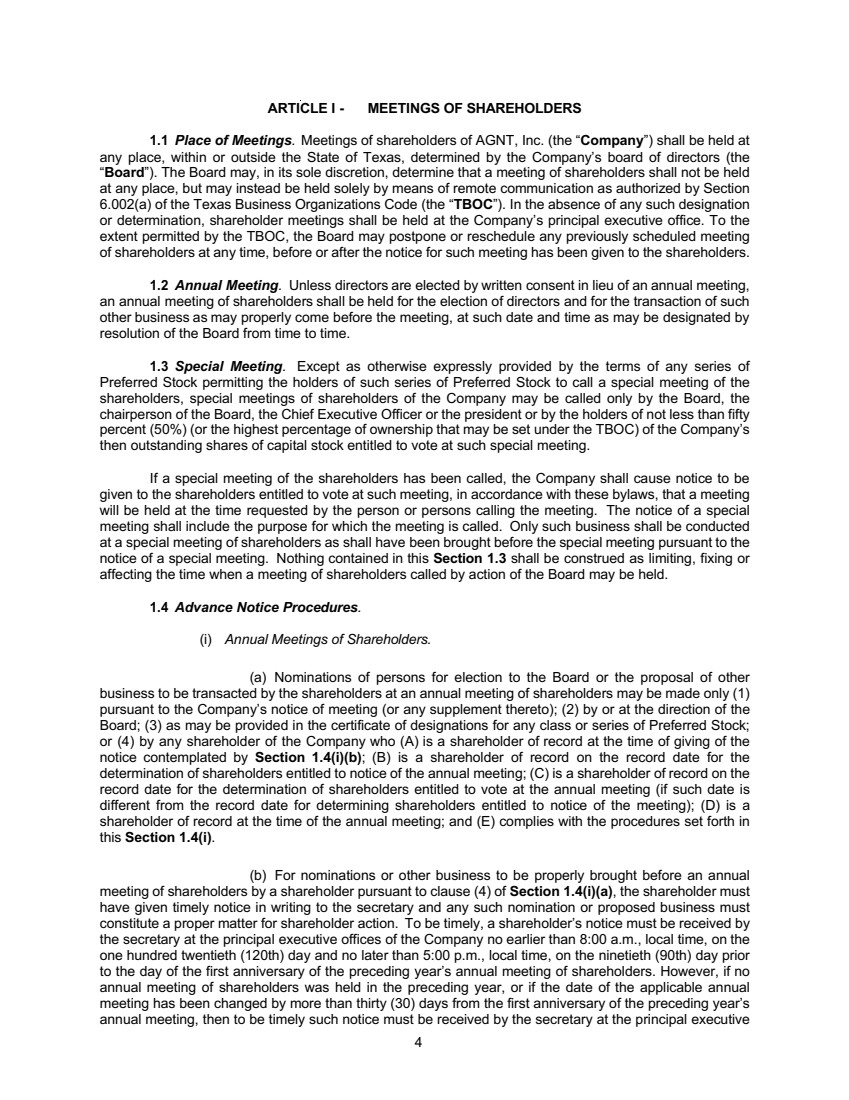
| 5 offices of the Company no earlier than 8:00 a.m., local time, on the one hundred twentieth (120th) day prior to the day of the annual meeting and no later than 5:00 p.m., local time, on the tenth (10th) day following the day on which Official Notice of the date of the annual meeting was first given by the Company. In no event will the adjournment, rescheduling or postponement of any annual meeting, or any announcement thereof, commence a new time period (or extend any time period) for the giving of a shareholder’s notice as described above. If the number of directors to be elected to the Board is increased and there is no Official Notice naming all of the nominees for director or specifying the size of the increased Board at least ten (10) days before the last day that a shareholder may deliver a notice of nomination pursuant to the foregoing provisions, then a shareholder’s notice required by this Section 1.4(i)(b) will also be considered timely, but only with respect to nominees for any new positions created by such increase, if it is received by the secretary at the principal executive offices of the Company no later than 5:00 p.m., local time, on the tenth (10th) day following the day on which such Official Notice is first given. “Official Notice” means disclosure in a press release or by notice in writing or electronic transmission disseminated by or at the direction of the Company to all shareholders entitled to notice of shareholder meetings. (c) A shareholder’s notice to the secretary must set forth: (1) as to each person whom the shareholder proposes to nominate for election as a director: a) such person’s name, age, business address, residence address and principal occupation or employment; the class and number of shares of the corporation that are held of record or are beneficially owned by such person and a description of any Derivative Instruments (defined below) held or beneficially owned thereby or of any other agreement, arrangement or understanding (including any short position or any borrowing or lending of shares), the effect or intent of which is to mitigate loss to, or to manage the risk or benefit of share price changes for, or to increase or decrease the voting power of such person; and all information relating to such person that would be required to be disclosed in solicitations of proxies for the contested election of directors of publicly traded corporations, or otherwise would be required, in each case pursuant to Section 14 of the Securities Exchange Act of 1934 (the “1934 Act”) if the Company were publicly traded; b) such person’s written consent to being named in such shareholder’s proxy statement as a nominee of such shareholder and to serving as a director of the Company if elected; c) a reasonably detailed description of any direct or indirect compensatory, payment, indemnification or other financial agreement, arrangement or understanding that such person has, or has had within the past three (3) years, with any person or entity other than the Company (including the amount of any payment or payments received or receivable thereunder), in each case in connection with candidacy or service as a director of the Company (a “Third-Party Compensation Arrangement”); and d) a description of any other material relationships between such person and such person’s respective affiliates and associates, or others acting in concert with them, on the one hand, and such shareholder giving the notice and the beneficial owner, if any, on whose behalf the nomination is made, and their respective affiliates and associates, or others acting in concert with them, on the other hand; (2) as to any other business that the shareholder proposes to bring before the annual meeting: a) a brief description of the business desired to be brought before the annual meeting; b) the text of the proposal or business (including the text of any |
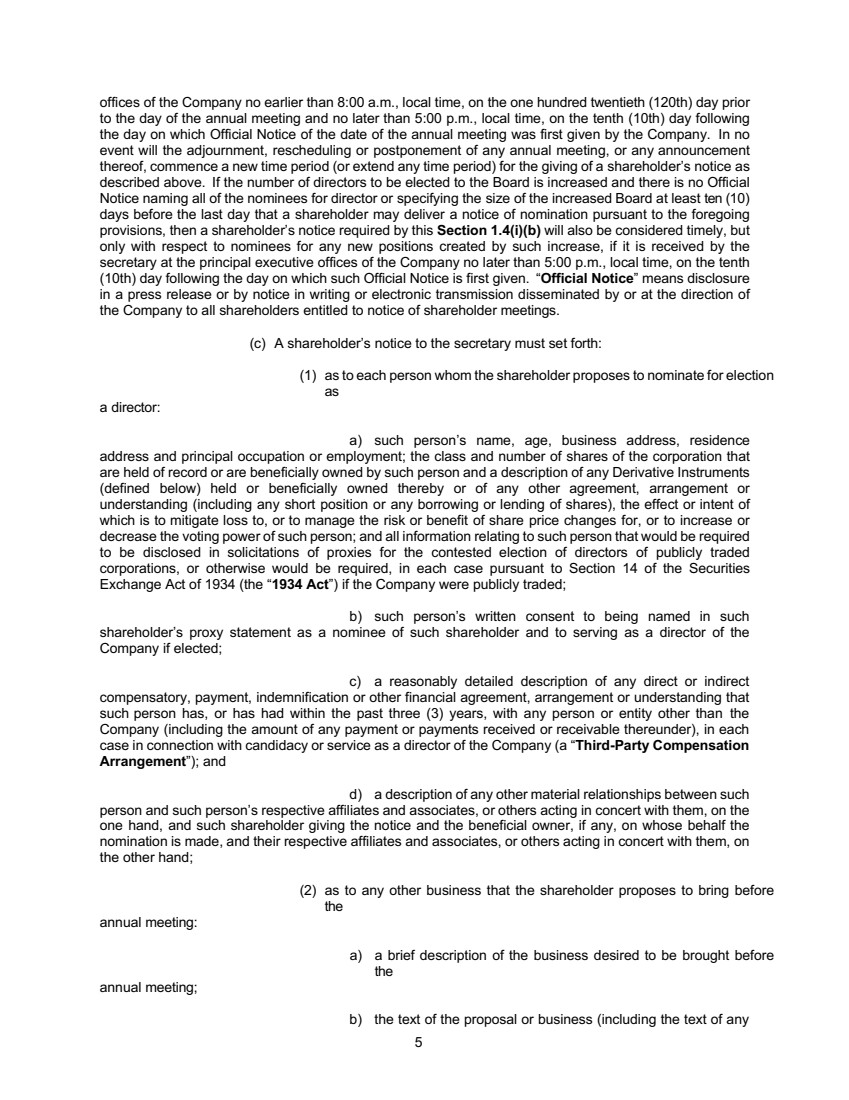
| 6 resolutions proposed for consideration and, if applicable, the text of any proposed amendment to these bylaws or the Company’s certificate of formation); c) any material interest in such business of such shareholder giving the notice and the beneficial owner, if any, on whose behalf the proposal is made, and their respective affiliates and associates, or others acting in concert with them; and d) a description of all agreements, arrangements and understandings between such shareholder and the beneficial owner, if any, on whose behalf the proposal is made, and their respective affiliates or associates or others acting in concert with them, and any other person or persons (including their names) in connection with the proposal of such business by such shareholder; and (3) as to the shareholder giving the notice and the beneficial owner, if any, on whose behalf the nomination or proposal is made: a) the name and address of such shareholder (as they appear on the Company’s books), of such beneficial owner and of their respective affiliates or associates or others acting in concert with them; b) for each class or series, the number of shares of stock of the Company that are, directly or indirectly, held of record or are beneficially owned by such shareholder, such beneficial owner or their respective affiliates or associates or others acting in concert with them; c) a description of any agreement, arrangement or understanding between such shareholder, such beneficial owner or their respective affiliates or associates or others acting in concert with them, and any other person or persons (including, in each case, their names) in connection with the proposal of such nomination or other business; d) a description of any agreement, arrangement or understanding (including, regardless of the form of settlement, any derivative, long or short positions, profit interests, forwards, futures, swaps, options, warrants, convertible securities, stock appreciation or similar rights, hedging transactions and borrowed or loaned shares) that has been entered into by or on behalf of such shareholder, such beneficial owner or their respective affiliates or associates or others acting in concert with them, with respect to the Company’s securities (any of the foregoing, a “Derivative Instrument”), or any other agreement, arrangement or understanding that has been made the effect or intent of which is to create or mitigate loss to, manage risk or benefit of share price changes for or increase or decrease the voting power of such shareholder, such beneficial owner or their respective affiliates or associates or others acting in concert with them, with respect to the Company’s securities; e) any rights to dividends on the Company’s securities owned beneficially by such shareholder, such beneficial owner or their respective affiliates or associates or others acting in concert with them, that are separated or separable from the underlying security; f) any proportionate interest in the Company’s securities or Derivative Instruments held, directly or indirectly, by a general or limited partnership in which such shareholder, such beneficial owner or their respective affiliates or associates or others acting in concert with them, is a general partner or, directly or indirectly, beneficially owns an interest in a general partner of such general or limited partnership; g) any performance-related fees (other than an asset-based fee) that such shareholder, such beneficial owner or their respective affiliates or associates or others acting in concert with them is entitled to based on any increase or decrease in the value of the Company’s securities or Derivative Instruments, including, without limitation, any such interests held by members of the immediate family of such persons sharing the same household; h) any significant equity interests or any Derivative Instruments in any principal competitor of the Company that are held by such shareholder, such beneficial owner or their respective affiliates or associates or others acting in concert with them; |
| 7 i) any direct or indirect interest of such shareholder, such beneficial owner or their respective affiliates or associates or others acting in concert with them, in any contract with the Company, any affiliate of the Company or any principal competitor of the Company (in each case, including any employment agreement, collective bargaining agreement or consulting agreement); j) a representation and undertaking that the shareholder is a holder of record of stock of the Company as of the date of submission of the shareholder’s notice and intends to appear in person or by proxy at the meeting to bring such nomination or other business before the meeting; k) a representation and undertaking that such shareholder or any such beneficial owner intends, or is part of a group that intends, to (x) deliver a proxy statement or other proxy solicitation material or form of proxy to holders of at least the percentage of the voting power of the Company’s then-outstanding stock required to approve or adopt the proposal or to elect each such nominee; or (y) otherwise solicit proxies from shareholders in support of such proposal or nomination; l) any other information relating to such shareholder, such beneficial owner, or their respective affiliates or associates or others acting in concert with them, or director nominee or proposed business that, in each case, would be required to be disclosed in a proxy statement or other filing that would be required to be made in connection with the solicitation of proxies in support of such nominee (in a contested election of directors) or proposal pursuant to Section 14 of the 1934 Act if the Company were publicly traded; and m) such other information relating to any proposed item of business as the Company may reasonably require to determine whether such proposed item of business is a proper matter for shareholder action. (d) In addition to the requirements of this Section 1.4, to be timely, a shareholder’s notice (and any additional information submitted to the Company in connection therewith) must further be updated and supplemented, if necessary, (1) so that the information provided or required to be provided in such notice is true and correct as of the record date(s) for determining the shareholders entitled to notice of, and to vote at, the meeting and as of the date that is ten (10) business days prior to the meeting or any adjournment, rescheduling or postponement thereof and (2) to provide any additional information that the Company may reasonably request. Such update and supplement or additional information, if applicable, must be received by the secretary at the principal executive offices of the Company, in the case of a request for additional information, promptly following a request therefor, which response must be delivered not later than such reasonable time as is specified in any such request from the corporation or, in the case of an update or supplement of any information, not later than five (5) business days after the record date(s) for the meeting (in the case of any update and supplement required to be made as of the record date(s)), and not later than eight (8) business days prior to the date for the meeting or any adjournment, rescheduling or postponement thereof (in the case of the update and supplement required to be made as of eight (10) business days prior to the meeting or any adjournment, rescheduling or postponement thereof). The failure to timely provide such update, supplement or additional information shall result in the nomination or proposal no longer being eligible for consideration at the meeting. (ii) Special Meetings of Shareholders. Except to the extent required by the TBOC, and subject to Section 1.3, special meetings of shareholders may be called only in accordance with the Company’s certificate of formation and these bylaws. Only such business will be conducted at a special meeting of shareholders as has been brought before the special meeting pursuant to the Company’s notice of meeting. If the election of directors is included as business to be brought before a special meeting in the Company’s notice of meeting, then nominations of persons for election to the Board at such special meeting may be made by any shareholder who (i) is a shareholder of record at the time of giving of the notice contemplated by this Section 1.4(ii); (ii) is a shareholder of record on the record date for the determination of shareholders entitled to notice of the special meeting; (iii) is a shareholder of record on the record date for the determination of shareholders entitled to vote at the special meeting; (iv) is a shareholder of record at the time of the special meeting; and (v) complies with the procedures set forth in this Section 1.4(ii). For nominations to be properly brought by a shareholder before a special meeting pursuant to this Section |
| 8 1.4(ii), the shareholder’s notice must be received by the secretary at the principal executive offices of the Company no earlier than 8:00 a.m., local time, on the one hundred twentieth (120th) day prior to the day of the special meeting and no later than 5:00 p.m., local time, on the later of the ninetieth (90th) day prior to such special meeting and the tenth (10th) day following the day on which Official Notice of the date of the special meeting was first given. In no event will any adjournment, rescheduling or postponement of a special meeting or the announcement thereof commence a new time period (or extend any time period) for the giving of a shareholder’s notice. A shareholder’s notice to the Secretary must comply with the applicable notice requirements of Section 1.4(a)(iii). (iii) Other Requirements. (a) To be eligible to be a nominee by any shareholder for election as a director of the Company at a meeting of shareholders, the proposed nominee must provide to the secretary, in accordance with the applicable time periods prescribed for delivery of notice under Section 1.4(i)(b) or Section 1.4(i): (1) a signed and completed written questionnaire (in the form provided by the secretary at the written request of the nominating shareholder, which form will be provided by the secretary within ten (10) days of receiving such request) containing information regarding such nominee’s background and qualifications and such other information as may reasonably be required by the Company to determine the eligibility of such nominee to serve as a director of the Company or to serve as an independent director of the Company; (2) a written representation and undertaking that, unless previously disclosed to the Company, such nominee is not, and will not become, a party to any voting agreement, arrangement, commitment, assurance or understanding with any person or entity as to how such nominee, if elected as a director, will vote on any issue; (3) a written representation and undertaking that, unless previously disclosed to the Company, such nominee is not, and will not become, a party to any Third-Party Compensation Arrangement; (4) a written representation and undertaking that, if elected as a director, such nominee would be in compliance, and will continue to comply, with the Company’s corporate governance guidelines as disclosed on the Company’s website, as amended from time to time; and (5) a written representation and undertaking that such nominee, if elected, intends to serve a full term on the Board. (b) At the request of the Board, any person nominated by the Board for election as a director must furnish to the secretary the information that is required to be set forth in a shareholder’s notice of nomination that pertains to such nominee. (c) No person will be eligible to be nominated by a shareholder for election as a director of the Company unless nominated in accordance with the procedures set forth in this Section 1.4. No business proposed by a shareholder will be conducted at a shareholder meeting except in accordance with this Section 1.4. (d) The chairperson of the applicable meeting of shareholders will, if the facts warrant, determine and declare to the meeting that a nomination was not made in accordance with the procedures prescribed by these bylaws or that business was not properly brought before the meeting. If the chairperson of the meeting should so determine, then the chairperson of the meeting will so declare to the meeting and the defective nomination will be disregarded or such business will not be transacted, as the case may be. (e) Notwithstanding anything to the contrary in this Section 1.4, unless otherwise required by law, if the shareholder (or a qualified representative of the shareholder) does not appear in person at the meeting to present a nomination or other proposed business, such nomination will be |
| 9 disregarded or such proposed business will not be transacted, as the case may be, notwithstanding that proxies in respect of such nomination or business may have been received by the Company and counted for purposes of determining a quorum. For purposes of this Section 1.4, (1) to be considered a qualified representative of the shareholder, a person must be a duly authorized officer, manager or partner of such shareholder or must be authorized by a writing executed by such shareholder or an electronic transmission delivered by such shareholder to act for such shareholder as proxy at the meeting, and such person must produce such writing or electronic transmission, or a reliable reproduction of the writing or electronic transmission, at the meeting and (2) “principal executive offices” shall mean the address for the Company’s principal executive offices as set forth on the cover page of its most recent Annual Report on Form 10-K filed with the U.S. Securities and Exchange Commission, as such address may be updated by any subsequent report filed with the U.S. Securities and Exchange Commission or other public announcement by the Company. (f) Without limiting this Section 1.4, a shareholder must also comply with all applicable requirements of the 1934 Act with respect to the matters set forth in this Section 1.4, it being understood that (1) any references in these bylaws to the 1934 Act are not intended to, and will not, limit any requirements applicable to nominations or proposals as to any other business to be considered pursuant to this Section 1.4; and (2) compliance with clause (4) of Section 1.4(i)(a) and with Section 1.4(ii) are the exclusive means for a shareholder to make nominations or submit other business (other than as provided in Section 1.4(iii)(g)). Notwithstanding anything to the contrary in this Section 1.4, the notice requirements set forth in these bylaws with respect to the proposal of any business (other than nominations) pursuant to this Section 1.4 will be deemed to be satisfied by a shareholder if (1) such shareholder has submitted a proposal to the Company in compliance with Rule 14a-8 under the 1934 Act; and (2) such shareholder’s proposal has been included in a proxy statement that has been prepared by the Company to solicit proxies for the meeting of shareholders. Subject to Rule 14a-8 and other applicable rules and regulations under the 1934 Act, nothing in these bylaws will be construed to permit any shareholder, or give any shareholder the right, to include or have disseminated or described in the Company’s proxy statement any nomination of a director or any other business proposal. 1.5 Notice of Shareholders’ Meetings. Whenever shareholders are required or permitted to take any action at a meeting, a notice of the meeting in the form of a writing or electronic transmission shall be given which shall state the place, if any, date and hour of the meeting, the means of remote communications, if any, by which shareholders and proxy holders may be deemed to be present in person and vote at such meeting, the record date for determining the shareholders entitled to vote at the meeting, if such date is different from the record date for determining shareholders entitled to notice of the meeting, and, in the case of a special meeting, the purpose or purposes for which the meeting is called. Except as otherwise provided in the TBOC, the certificate of formation or these bylaws, the notice of any meeting of shareholders shall be given not less than ten (10) nor more than sixty (60) days before the date of the meeting to each shareholder entitled to vote at such meeting as of the record date for determining the shareholders entitled to notice of the meeting. Notwithstanding the preceding paragraph, notice of a shareholder meeting regarding a “fundamental business transaction” (as defined in Section 1.002 of the TBOC) must be given to each shareholder of the Company not later than twenty-one (21) days prior to such meeting, regardless of whether the shareholder is entitled to vote on the matter, in accordance with the TBOC. 1.6 Quorum. Except as otherwise provided by law, the certificate of formation or these bylaws, at each meeting of shareholders the presence in person or by proxy of the holders of shares of stock having a majority of the voting power which could be cast by the holders of all outstanding shares of stock entitled to vote at the meeting shall be necessary and sufficient to constitute a quorum. Where a separate vote by a class or series or classes or series is required, a majority of the voting power of the outstanding shares of such class or series or classes or series, present in person or represented by proxy, shall constitute a quorum entitled to take action with respect to that vote on that matter, except as otherwise provided by law, the certificate of formation or these bylaws. If, however, such quorum is not present or represented at any meeting of the shareholders, then |
| 10 either (i) the chairperson of the meeting, or (ii) the shareholders entitled to vote at the meeting, present in person or represented by proxy, shall have the power to adjourn the meeting from time to time, in accordance with Section 1.7 of these bylaws, until a quorum is present or represented. 1.7 Adjourned Meeting; Notice. Any meeting of shareholders, annual or special, may adjourn from time to time to reconvene at the same or some other place, and notice need not be given of the adjourned meeting if the time, place, if any, thereof, and the means of remote communications, if any, by which shareholders and proxy holders may be deemed to be present in person and vote at such adjourned meeting are announced at the meeting at which the adjournment is taken. At the adjourned meeting, the Company may transact any business which might have been transacted at the original meeting; provided, however, if the adjournment is for more than thirty (30) days, a notice of the adjourned meeting shall be given to each shareholder of record entitled to vote at the meeting. If after the adjournment a new record date for shareholders entitled to vote is fixed for the adjourned meeting, the Board shall fix a new record date for notice of such adjourned meeting in accordance with Section 6.101 of the TBOC and Section 1.11 of these bylaws, and shall give notice of the adjourned meeting to each shareholder of record entitled to vote at such adjourned meeting as of the record date fixed for notice of such adjourned meeting. 1.8 Conduct of Business. Meetings of shareholders shall be presided over by a chairperson designated by the Board, or in the absence of such designation by the Chairperson of the Board, if any, or in his or her absence by the Vice Chairperson of the Board, if any, or in the absence of the foregoing persons by the Chief Executive Officer, or in the absence of the foregoing persons by the President, or in the absence of the foregoing persons by a Vice President, or in the absence of the foregoing persons by a chairperson chosen at the meeting. The Secretary shall act as secretary of the meeting, but in his or her absence the chairperson of the meeting may appoint any person to act as secretary of the meeting. The chairperson of any meeting of shareholders shall determine the order of business and the procedure at the meeting, including such regulation of the manner of voting and the conduct of business, and shall have the power to adjourn the meeting to another place, if any, date or time, whether or not a quorum is present. 1.9 Voting. The shareholders entitled to vote at any meeting of shareholders shall be determined in accordance with the provisions of Section 1.11 of these bylaws, subject to Sections 6.251 and 6.252 (relating to voting trusts and other voting agreements) and Subchapter D of Chapter 6 (relating to voting of ownership interests) of the TBOC. Each shareholder entitled to vote at any meeting of shareholders shall be entitled to the number of votes per share for each share of capital stock held by such shareholder as of the applicable record date which has voting power upon the matter in question as set forth in the certificate of formation. Voting at meetings of shareholders need not be by written ballot and, unless otherwise required by law, need not be conducted by inspectors of election unless so determined by the holders of shares of stock having a majority of the votes which could be cast by the holders of all outstanding shares of stock entitled to vote thereon which are present in person or by proxy at such meeting. If authorized by the Board, such requirement of a written ballot shall be satisfied by a ballot submitted by electronic transmission, provided that any such electronic transmission must either set forth or be submitted with information from which it can be determined that the electronic transmission was authorized by the shareholder or proxy holder. Except as otherwise required by law, the certificate of formation or these bylaws, in all matters other than the election of directors, at a meeting where a quorum is present, the affirmative vote of a majority of the shares of stock of the corporation which are voting on the matter shall be sufficient to approve, authorize, adopt, or to otherwise cause the Company to take, or affirm the Company’s taking of, any action. Except as otherwise required by law, the certificate of formation or these bylaws, at meetings of shareholders for the election of directors at which a quorum is present a nominee for director shall be elected to the Board if the number of votes cast “for” such nominee’s election exceed the number of votes cast “against” such nominee’s election, excluding abstentions. Where a separate vote by a class or series or classes or series is required, in all matters other than the election of directors and a “fundamental business transaction” as defined under the TBOC, at a meeting where a quorum is present, the affirmative vote of a majority of the shares of such class or series or classes or series at which are voting on the matter shall be the act of such class or series or classes or series, except as otherwise provided by law, the certificate of formation or these bylaws. |
| 11 1.10 Shareholder Action by Written Consent Without a Meeting. Any action required by the TBOC to be taken at any annual or special meeting of shareholders of the Company, or any action which may be taken at any annual or special meeting of such shareholders, may be taken without a meeting, without prior notice and without a vote, if a consent or consents in writing, setting forth the action so taken, shall be signed by the holders of outstanding stock representing fifty-five percent (55%) of the outstanding capital stock of the Company entitled to vote thereon. No written consent shall be effective to take the corporate action referred to therein unless written consents signed by a sufficient number of holders to take action are delivered to the Company in the manner required by Sections 6.201 and 6.202 of the TBOC within sixty (60) days of the first date on which a written consent is so delivered to the Company. Any person executing a consent may provide, whether through instruction to an agent or otherwise, that such a consent will be effective at a future time (including a time determined upon the happening of an event), no later than sixty (60) days after such instruction is given or such provision is made, if evidence of such instruction or provision is provided to the Company. Unless otherwise provided, any such consent shall be revocable prior to its becoming effective. An electronic transmission consenting to an action to be taken and transmitted by a shareholder or proxy holder, or by a person or persons authorized to act for a shareholder or proxy holder, shall be deemed to be written and signed for purposes of this Section 1.10, provided that any such electronic transmission sets forth or is delivered with information from which the Company can determine (i) that the electronic transmission was transmitted by the shareholder or proxy holder or by a person or persons authorized to act for the shareholder or proxy holder and (ii) the date on which such shareholder or proxy holder or authorized person or persons transmitted such electronic transmission. A consent given by electronic transmission is delivered to the Company upon the earliest of (i) when the consent enters an information processing system, if any, designated by the Company for receiving consents, so long as the electronic transmission is in a form capable of being processed by that system and the Company is able to retrieve that electronic transmission; (ii) when a paper reproduction of the consent is delivered to the Company’s principal place of business or an officer or agent of the Company having custody of the book in which proceedings of meetings of shareholders are recorded; (iii) when a paper reproduction of the consent is delivered to the Company’s registered office in the State of Texas by hand or by certified or registered mail, return receipt requested; or (iv) when delivered in such other manner, if any, provided by resolution of the Board. A consent given by electronic transmission is delivered under this Section 1.10 even if no person is aware of its receipt. Receipt of an electronic acknowledgement from an information processing system establishes that a consent given by electronic transmission was received but, by itself, does not establish that the content sent corresponds to the content received. In the event that the Board shall have instructed the officers of the Company to solicit the vote or written consent of the shareholders of the Company, an electronic transmission of a shareholder written consent given pursuant to such solicitation, to be effective, must be delivered by electronic mail or facsimile telecommunications to the Secretary or the President of the Company or to a person designated by the Company for receiving such consent, or delivered to an information processing system designated by the Company for receiving such consent. Prompt notice of the taking of the corporate action without a meeting by less than unanimous written consent shall be given to those shareholders who have not consented in writing and who, if the action had been taken at a meeting, would have been entitled to notice of the meeting if the record date for notice of such meeting had been the date that written consents signed by a sufficient number of holders to take the action were delivered to the Company as provided in Sections 6.201 or 6.202 of the TBOC. In the event that the action which is consented to is such as would have required the filing of a certificate under any provision of the TBOC, if such action had been voted on by shareholders at a meeting thereof, the certificate filed under such provision shall state, in lieu of any statement required by such provision concerning any vote of shareholders, that written consent has been given in accordance with Sections 6.201 or 6.202 of the TBOC. For the avoidance of doubt, the provisions of Section 1.4 concerning advance notice of shareholder business or the nomination or election of directors shall not apply to any action by shareholder written consent. |
| 12 1.11 Record Dates. In order that the Company may determine the shareholders entitled to notice of any meeting of shareholders or any adjournment thereof, the Board may fix a record date, which record date shall not precede the date upon which the resolution fixing the record date is adopted by the Board and which record date shall not be more than sixty (60) nor less than ten (10) days before the date of such meeting. If the Board so fixes a date, such date shall also be the record date for determining the shareholders entitled to vote at such meeting unless the Board determines, at the time it fixes such record date, that a later date on or before the date of the meeting shall be the date for making such determination. If no record date is fixed by the Board, the record date for determining shareholders entitled to notice of and to vote at a meeting of shareholders shall be at the close of business on the day next preceding the day on which notice is given, or, if notice is waived, at the close of business on the day next preceding the day on which the meeting is held. A determination of shareholders of record entitled to notice of or to vote at a meeting of shareholders shall apply to any adjournment of the meeting; provided, however, that the Board may fix a new record date for determination of shareholders entitled to vote at the adjourned meeting, and in such case shall also fix as the record date for shareholders entitled to notice of such adjourned meeting the same or an earlier date as that fixed for determination of shareholders entitled to vote in accordance with the provisions of Section 6.101 of the TBOC and this Section 1.11 at the adjourned meeting. In order that the Company may determine the shareholders entitled to consent to corporate action in writing without a meeting, the Board may fix a record date, which record date shall not precede the date upon which the resolution fixing the record date is adopted by the Board, and which date shall not be more than ten (10) days after the date upon which the resolution fixing the record date is adopted by the Board. If no record date has been fixed by the Board, the record date for determining shareholders entitled to consent to corporate action in writing without a meeting, when no prior action by the Board is required by law, shall be the first date on which a signed written consent setting forth the action taken or proposed to be taken is delivered to the Company in accordance with applicable law. If no record date has been fixed by the Board and prior action by the Board is required by law, the record date for determining shareholders entitled to consent to corporate action in writing without a meeting shall be at the close of business on the day on which the Board adopts the resolution taking such prior action. In order that the Company may determine the shareholders entitled to receive payment of any dividend or other distribution or allotment of any rights or the shareholders entitled to exercise any rights in respect of any change, conversion or exchange of stock, or for the purpose of any other lawful action, the Board may fix a record date, which record date shall not precede the date upon which the resolution fixing the record date is adopted, and which record date shall be not more than sixty (60) days prior to such action. If no record date is fixed, the record date for determining shareholders for any such purpose shall be at the close of business on the day on which the Board adopts the resolution relating thereto. 1.12 Proxies. Each shareholder entitled to vote at a meeting of shareholders or to express consent or dissent to corporate action in writing without a meeting may authorize another person or persons to act for such shareholder by proxy authorized by a document or by an electronic transmission permitted by law filed in accordance with the procedure established for the meeting, but no such proxy shall be voted or acted upon after eleven (11) months from its date, unless the proxy provides for a longer period. The revocability of a proxy that states on its face that it is irrevocable shall be governed by the provisions of Sections 21.368, 21.369 and 21.370 of the TBOC. 1.13 List of Shareholders Entitled to Vote. Not later than the eleventh (11th) day before the date of each meeting of the shareholders of the Company, an officer or agent having charge of the Company’s stock transfer records shall prepare an alphabetical list of the shareholders entitled to vote at such meeting or any adjournment or postponement thereof showing the address and the type and number of shares held by each shareholder. Such list shall be kept on file at the registered office or the principal executive office of the Company and shall be subject to inspection by any shareholder at any time during regular business hours for a period of at least ten (10) days prior to such meeting. Alternatively, the list of shareholders may be kept on a reasonably accessible electronic network, if the information required to gain access to the list is provided with the notice of the meeting. In the event that the corporation determines to make the list available on an electronic network, the Company may take reasonable steps to ensure that such information |
| 13 is available only to shareholders of the corporation. The original share transfer records shall be prima facie evidence as to (a) the identity of the shareholders entitled to vote at any meeting of shareholders and the number of shares held by each of them and (b) the identity of the shareholders entitled by this Section 1.13 to examine the list required by this Section 1.13. ARTICLE II - DIRECTORS 2.1 Powers. The business and affairs of the Company shall be managed by or under the direction of the Board, except as may be otherwise provided in the TBOC or the certificate of formation. 2.2 Number of Directors. The Board shall consist of one or more members, each of whom shall be a natural person. Unless the certificate of formation fixes the number of directors, the number of directors shall be determined from time to time by resolution of the Board. No reduction of the authorized number of directors shall have the effect of removing any director before that director’s term of office expires. 2.3 Election, Qualification and Term of Office of Directors. Except as provided in Section 2.4 of these bylaws, and subject to Sections 1.2 and 1.10 of these bylaws, directors shall be elected at each annual meeting of shareholders. Directors need not be shareholders unless so required by the certificate of formation or these bylaws. The certificate of formation or these bylaws may prescribe other qualifications for directors. Each director shall hold office until such director’s successor is elected and qualified or until such director’s earlier death, resignation or removal. 2.4 Resignation and Vacancies. Any director may resign at any time upon notice given in writing or by electronic transmission to the Company. A resignation is effective when the resignation is delivered unless the resignation specifies a later effective date or an effective date determined upon the happening of an event or events. A resignation which is conditioned upon the director failing to receive a specified vote for reelection as a director may provide that it is irrevocable. Unless otherwise provided in the certificate of formation or these bylaws, when one or more directors resign from the Board, effective at a future date, a majority of the directors then in office, shall have power to fill such vacancy or vacancies, the vote thereon to take effect when such resignation or resignations shall become effective. Unless otherwise provided in the certificate of formation, these bylaws or by the TBOC, and subject to the rights of the holders of any one or more series of Preferred Stock then outstanding, newly created directorships resulting from any increase in the authorized number of directors or any vacancies in the Board shall be filled by a majority vote of the directors then in office, even if the remaining directors constitute less than a quorum of the Board, or by election at an annual or special meeting of shareholders called for that purpose. If at any time, by reason of death or resignation or other cause, the Company should have no directors in office, then any officer or any shareholder or an executor, administrator, trustee or guardian of a shareholder, or other fiduciary entrusted with like responsibility for the person or estate of a shareholder, may call a special meeting of shareholders in accordance with the provisions of the certificate of formation or these bylaws. A director elected to fill a vacancy shall be elected for the unexpired term of his or her predecessor in office and until such director’s successor is elected and qualified, or until such director’s earlier death, resignation or removal. Except as otherwise provided by the TBOC, during a period between two successive annual meetings of shareholders, the Board may not fill more than two vacancies created by an increase in the number of directors. 2.5 Place of Meetings; Meetings by Telephone. The Board may hold meetings, both regular and special, either within or outside the State of Texas. Unless otherwise restricted by the certificate of formation or these bylaws, members of the Board, or any committee designated by the Board or any subcommittee, may participate in a meeting of the Board, or any such committee or subcommittee, by means of conference telephone or other communications |
| 14 equipment by means of which all persons participating in the meeting can hear each other, and such participation in a meeting shall constitute presence in person at the meeting. 2.6 Conduct of Business. Meetings of the Board shall be presided over by the Chairperson of the Board, if any, or in his or her absence by the Vice Chairperson of the Board, if any, or in the absence of the foregoing persons by a chairperson designated by the Board, or in the absence of such designation by a chairperson chosen at the meeting. The Secretary shall act as secretary of the meeting, but in his or her absence the chairperson of the meeting may appoint any person to act as secretary of the meeting. 2.7 Regular Meetings. Regular meetings of the Board may be held without notice at such time and at such place as shall from time to time be determined by the Board. 2.8 Special Meetings; Notice. Special meetings of the Board for any purpose or purposes may be called at any time by the Chairperson of the Board, the Chief Executive Officer, the President, the Secretary or any two directors. Notice of the time and place of special meetings shall be: (i) delivered personally by hand, by courier or by telephone; (ii) sent by United States first-class mail, postage prepaid; or (iii) given by electronic transmission, directed to each director at that director’s address or telephone number, or by means of electronic transmission, as the case may be, as shown on the Company’s records. If the notice is delivered personally by hand, by courier, or by telephone, or given by means of electronic transmission, it shall be delivered, sent or otherwise directed to each director, as applicable, at least twenty-four (24) hours before the time of the holding of the meeting. If the notice is sent by United States mail, it shall be deposited in the United States mail at least four (4) days before the time of the holding of the meeting. Any oral notice may be communicated to the director. The notice need not specify the place of the meeting (if the meeting is to be held at the Company’s principal executive office) nor the purpose of the meeting, to the fullest extent permitted by applicable law. 2.9 Quorum; Voting. At all meetings of the Board, the presence of at least a majority of the total authorized directorships shall constitute a quorum for the transaction of business; provided that in no case shall the presence of less than 1/3 of the total authorized directorships constitute a quorum. If a quorum is not present at any meeting of the Board, then the directors present thereat may adjourn the meeting from time to time, without notice other than announcement at the meeting, until a quorum is present. The affirmative vote of a majority of the directors present at any meeting at which a quorum is present shall be the act of the Board, except as may be otherwise specifically provided by statute, the certificate of formation or these bylaws. If the certificate of formation provides that one or more directors shall have more or less than one vote per director on any matter, every reference in these bylaws to a majority or other proportion of the directors shall refer to a majority or other proportion of the votes of the directors. 2.10 Board Action by Written Consent Without a Meeting. Unless otherwise restricted by the certificate of formation or these bylaws, any action required or permitted to be taken at any meeting of the Board, or of any committee or subcommittee thereof, may be taken without a meeting if all members of the Board or committee or subcommittee, as the case may be, consent thereto in writing or by electronic transmission. Any person (whether or not then a director) may provide, whether through instruction to an agent or otherwise, that a consent to action will be effective at a future time (including a time determined upon the happening of an event), no later than sixty (60) days after such instruction is given or such provision is made and such consent shall be deemed to have been given for purposes of this Section 2.10 at such effective time so long as such person is then a director and did not revoke the consent prior to such time. Any such consent shall be revocable prior to its becoming effective. After an action is taken, the consent |
| 15 or consents relating thereto shall be filed with the minutes of the proceedings of the Board, or the committee or subcommittee thereof, in the same paper or electronic form as the minutes are maintained. 2.11 Fees and Compensation of Directors. Unless otherwise restricted by the certificate of formation or these bylaws, the Board shall have the authority to fix the compensation of directors. 2.12 Removal of Directors. Subject to the rights of the holders of any one or more series of Preferred Stock then outstanding, any director or the entire Board may be removed, with or without cause, by the holders of a majority of the voting power of the shares then entitled to vote at an election of directors. No reduction of the authorized number of directors shall have the effect of removing any director prior to the expiration of such director’s term of office. ARTICLE III - COMMITTEES 3.1 Committees of Directors. The Board may designate one or more committees, each committee to consist of one or more of the directors of the Company. The Board may designate one or more directors as alternate members of any committee, who may replace any absent or disqualified member at any meeting of the committee. In the absence or disqualification of a member of a committee, the member or members thereof present at any meeting and not disqualified from voting, whether or not such member or members constitute a quorum, may unanimously appoint another member of the Board to act at the meeting in the place of any such absent or disqualified member. Any such committee, to the extent provided in the resolution of the Board or in these bylaws, shall have and may exercise all the powers and authority of the Board in the management of the business and affairs of the Company, and may authorize the seal of the Company to be affixed to all papers that may require it; but no such committee shall have the power or authority to (i) amend the certificate of formation, except to (x) establish series of shares, (y) increase or decrease the number of shares in a series or (z) eliminate a series of shares as authorized by Section 21.155 of the TBOC, (ii) propose a reduction of stated capital under Sections 21.253 and 21.254 of the TBOC, (iii) approve a plan of merger, share exchange, or conversion of the corporation, (iv) recommend to shareholders the sale, lease or exchange of all or substantially all of the property and assets of the corporation not made in the usual and regular course of its business, (v) recommend to the shareholders a voluntary winding up and termination or a revocation of a voluntary winding up and termination, (vi) amend, alter or repeal the bylaws or adopt new bylaws, (vii) fill vacancies on the Board, (viii) fill vacancies on or designate alternate members of a committee of the Board, (ix) fill a vacancy to be filled because of an increase in the number of directors, (x) elect or remove officers of the corporation or members or alternate members of a committee of the Board, (xi) set the compensation of the members or alternate members of a committee of the Board or (xii) alter or repeal a resolution of the Board that states that it may not be amended or repealed by a committee of the Board. 3.2 Committee Minutes. Each committee and subcommittee shall keep regular minutes of its meetings and report the same to the Board, or the committee, when required. 3.3 Meetings and Actions of Committees. A majority of the directors then serving on a committee or subcommittee shall constitute a quorum for the transaction of business by the committee or subcommittee, unless the certificate of formation, these bylaws, a resolution of the Board or a resolution of a committee that created the subcommittee requires a greater or lesser number, provided that in no case shall a quorum be less than 1/3 of the directors then serving on the committee or subcommittee. The vote of the majority of the members of a committee or subcommittee present at a meeting at which a quorum is present shall be the act of the committee or subcommittee, unless the certificate of formation, these bylaws, a resolution of the Board or a resolution of a committee that created the subcommittee requires a greater number. Meetings and actions of committees and subcommittees shall otherwise be governed by, and held and taken in accordance with, the provisions of: (i) Section 2.5 (Place of Meetings; Meetings by Telephone); (ii) Section 2.7 (Regular Meetings); (iii) Section 2.8 (Special Meetings; Notice); |
| 16 (iv) Section 2.9 (Quorum; Voting); (v) Section 2.10 (Board Action by Written Consent Without a Meeting); and (vi) Section 7.2 (Waiver of Notice), with such changes in the context of those bylaws as are necessary to substitute the committee or subcommittee and its members for the Board and its members. However: (i) the time and place of regular meetings of committees and subcommittees may be determined either by resolution of the Board or by resolution of the committee or subcommittee; (ii) special meetings of committees and subcommittees may also be called by resolution of the Board or the committee or subcommittee; and (iii) notice of special meetings of committees and subcommittees shall also be given to all alternate members, as applicable, who shall have the right to attend all meetings of the committee or subcommittee. The Board, or, in the absence of any such action by the Board, the committee or subcommittee, may adopt rules for the government of any committee or subcommittee not inconsistent with the provisions of these bylaws. Any provision in the certificate of formation providing that one or more directors shall have more or less than one vote per director on any matter shall apply to voting in any committee or subcommittee, unless otherwise provided in the certificate of formation or these bylaws. 3.4 Subcommittees. Unless otherwise provided in the certificate of formation, these bylaws or the resolutions of the Board designating the committee, a committee may create one or more subcommittees, each subcommittee to consist of one or more members of the committee, and delegate to a subcommittee any or all of the powers and authority of the committee. ARTICLE IV - OFFICERS 4.1 Officers. The officers of the Company shall be a Chief Executive Officer and a Secretary. The Company may also have, at the discretion of the Board, a Chairperson of the Board, a Vice Chairperson of the Board, one or more Vice Presidents, a Chief Financial Officer, Chief Operating Officer, a Treasurer, one or more Assistant Treasurers, one or more Assistant Secretaries and any such other officers as may be appointed in accordance with the provisions of these bylaws. Any number of offices may be held by the same person. 4.2 Appointment of Officers. The Board shall appoint the officers of the Company, except such officers as may be appointed in accordance with the provisions of Section 4.3 of these bylaws. 4.3 Subordinate Officers. The Board may appoint, or empower the Chief Executive Officer or, in the absence of a Chief Executive Officer, the President, to appoint, such other officers and agents as the business of the Company may require. Each of such officers and agents shall hold office for such period, have such authority and perform such duties as are provided in these bylaws or as the Board may from time to time determine. 4.4 Removal and Resignation of Officers. Any officer may be removed, either with or without cause, by the Board or, for the avoidance of doubt, any duly authorized committee or subcommittee thereof or by any officer upon whom such power of removal has been conferred by the Board or, for the avoidance of doubt, any duly authorized committee or subcommittee thereof. Any officer may resign at any time by giving written notice to the Company. Any resignation shall take effect at the date of the receipt of that notice or at any later time specified in that notice. Unless otherwise specified in the notice of resignation, the acceptance of the resignation shall not be necessary to make it effective. Any resignation is without prejudice to the rights, if any, of the Company under any contract to which the officer is a party. |
| 17 4.5 Vacancies in Offices. Any vacancy occurring in any office of the Company shall be filled by the Board or as provided in Section 4.3 of these bylaws. 4.6 Representation of Securities of Other Corporations or Entities. Unless otherwise directed by the Board, the Chief Executive Officer or, in the absence of a Chief Executive Officer, the President or any other person authorized by the Board, the Chief Executive Officer or, in the absence of a Chief Executive Officer, the President is authorized to vote, represent and exercise on behalf of the Company all rights incident to any and all shares or other securities or interests in, or issued by, any other entity or entities, and all rights incident to any management authority conferred on the Company in accordance with the governing documents of any entity or entities, standing in the name of the Company, including the right to act by written consent in lieu of a meeting. The authority granted herein may be exercised either by such person directly or by any other person authorized to do so by proxy or power of attorney duly executed by such person having the authority. 4.7 Authority and Duties of Officers. Except as otherwise provided in these bylaws, the officers of the Company shall have such powers and duties in the management of the Company as may be designated from time to time by the Board and, to the extent not so provided, as generally pertain to their respective offices, subject to the control of the Board. ARTICLE V - INDEMNIFICATION 5.1 Indemnification of Directors and Officers in Third Party Proceedings. Subject to the other provisions of this Article V, the Company shall indemnify, to the fullest extent permitted by the TBOC, as now or hereinafter in effect, any person who was or is a party or is threatened to be made a party to any threatened, pending or completed action, suit or proceeding, whether civil, criminal, administrative or investigative (a “Proceeding”) (other than an action by or in the right of the Company) by reason of the fact that such person is or was a director or officer of the Company, or is or was a director or officer of the Company serving at the request of the Company as a director, officer, employee or agent of another corporation, partnership, joint venture, trust or other enterprise, against expenses (including attorneys’ fees), judgments, fines and amounts paid in settlement actually and reasonably incurred by such person in connection with such Proceeding if such person acted in good faith and in a manner such person reasonably believed to be in or not opposed to the best interests of the Company, and, with respect to any criminal action or proceeding, had no reasonable cause to believe such person’s conduct was unlawful. The termination of any Proceeding by judgment, order, settlement, conviction, or upon a plea of nolo contendere or its equivalent, shall not, of itself, create a presumption that the person did not act in good faith and in a manner which such person reasonably believed to be in or not opposed to the best interests of the Company, and, with respect to any criminal action or proceeding, had reasonable cause to believe that such person’s conduct was unlawful. 5.2 Indemnification of Directors and Officers in Actions by or in the Right of the Company. Subject to the other provisions of this Article V, the Company shall indemnify, to the fullest extent permitted by the TBOC, as now or hereinafter in effect, any person who was or is a party or is threatened to be made a party to any threatened, pending or completed action or suit by or in the right of the Company to procure a judgment in its favor by reason of the fact that such person is or was a director or officer of the Company, or is or was a director or officer of the Company serving at the request of the Company as a director, officer, employee or agent of another corporation, partnership, joint venture, trust or other enterprise against expenses (including attorneys’ fees) actually and reasonably incurred by such person in connection with the defense or settlement of such action or suit if such person acted in good faith and in a manner such person reasonably believed to be in or not opposed to the best interests of the Company; except that no indemnification shall be made in respect of any claim, issue or matter as to which such person shall have been adjudged to be liable to the Company unless and only to the extent that the court in which such action or suit was brought shall determine upon application that, despite the adjudication of liability but in view of all the circumstances of the case, such person is fairly and reasonably entitled to indemnity for such expenses which such court shall deem proper. 5.3 Successful Defense. To the extent that a present or former director or officer of the Company has been successful on the merits or otherwise in defense of any action, suit or proceeding described in |
| 18 Section 5.1 or Section 5.2 of these bylaws, or in defense of any claim, issue or matter therein, such person shall be indemnified against expenses (including attorneys’ fees) actually and reasonably incurred by such person in connection therewith. 5.4 Indemnification of Others. Subject to the other provisions of this Article V, the Company shall have power to indemnify its employees and agents to the extent not prohibited by the TBOC or other applicable law. The Board shall have the power to delegate to any person or persons the determination of whether employees or agents shall be indemnified. 5.5 Advanced Payment of Expenses. Expenses (including attorneys’ fees) actually and reasonably incurred by an officer or director of the Company in defending any Proceeding shall be paid by the Company in advance of the final disposition of such Proceeding upon receipt of a written request therefor (together with documentation reasonably evidencing such expenses and any documentation as may be required by the TBOC) and an undertaking by or on behalf of the person to repay such amounts if it shall ultimately be determined that the person is not entitled to be indemnified under this Article V or the TBOC. Such expenses (including attorneys’ fees) actually and reasonably incurred by former directors and officers or other employees and agents of the Company or by persons serving at the request of the Company as directors, officers, employees or agents of another corporation, partnership, joint venture, trust or other enterprise may be so paid upon such terms and conditions, if any, as the Company deems appropriate. The right to advancement of expenses shall not apply to any Proceeding (or any part of any Proceeding) for which indemnity is excluded pursuant to these bylaws, but shall apply to any Proceeding (or any part of any Proceeding) referenced in Section 5.6(ii) or Section 5.6(iii) of these bylaws prior to a determination that the person is not entitled to be indemnified by the Company. 5.6 Limitation on Indemnification. Subject to the requirements in Section 5.3 of these bylaws and the TBOC, the Company shall not be obligated to indemnify any person pursuant to this Article V in connection with any Proceeding (or any part of any Proceeding): (i) for which payment has actually been made to or on behalf of such person under any statute, insurance policy, indemnity provision, vote or otherwise, except with respect to any excess beyond the amount paid; (ii) for an accounting or disgorgement of profits pursuant to Section 16(b) of the Securities Exchange Act of 1934, as amended, or similar provisions of federal, state or local statutory law or common law, if such person is held liable therefor (including pursuant to any settlement arrangements); (iii) for any reimbursement of the Company by such person of any bonus or other incentive-based or equity-based compensation or of any profits realized by such person from the sale of securities of the Company, as required in each case under the Securities Exchange Act of 1934, as amended (including any such reimbursements that arise from an accounting restatement of the Company pursuant to Section 304 of the Sarbanes-Oxley Act of 2002 (the “Sarbanes-Oxley Act”), or the payment to the Company of profits arising from the purchase and sale by such person of securities in violation of Section 306 of the Sarbanes-Oxley Act), if such person is held liable therefor (including pursuant to any settlement arrangements); (iv) initiated by such person, including any Proceeding (or any part of any Proceeding) initiated by such person against the Company or its directors, officers, employees, agents or other indemnitees, unless (a) the Board authorized the Proceeding (or the relevant part of the Proceeding) prior to its initiation, (b) the Company provides the indemnification, in its sole discretion, pursuant to the powers vested in the Company under applicable law, (c) otherwise required to be made under Section 5.7 of these bylaws or (d) otherwise required by applicable law; or (v) if prohibited by applicable law. 5.7 Determination; Claim. If a claim for indemnification or advancement of expenses under this Article V is not paid by the Company or on its behalf within ninety (90) days after receipt by the Company of a written request therefor, the claimant shall be entitled to an adjudication by a court of competent jurisdiction of his or her entitlement to such indemnification or advancement of expenses. To the extent not |
| 19 prohibited by law, the Company shall indemnify such person against all expenses actually and reasonably incurred by such person in connection with any action for indemnification or advancement of expenses from the Company under this Article V, to the extent such person is successful in such action. In any such suit, the Company shall, to the fullest extent not prohibited by law, have the burden of proving that the claimant is not entitled to the requested indemnification or advancement of expenses. 5.8 Non-Exclusivity of Rights. The indemnification and advancement of expenses provided by, or granted pursuant to, this Article V shall not be deemed exclusive of any other rights to which those seeking indemnification or advancement of expenses may be entitled under the certificate of formation or any statute, bylaw, agreement, vote of shareholders or disinterested directors or otherwise, both as to action in such person’s official capacity and as to action in another capacity while holding such office. The Company is specifically authorized to enter into individual contracts with any or all of its directors, officers, employees or agents respecting indemnification and advancement of expenses, to the fullest extent not prohibited by the TBOC or other applicable law. 5.9 Insurance. The Company may purchase and maintain insurance on behalf of any person who is or was a director, officer, employee or agent of the Company, or is or was serving at the request of the Company as a director, officer, employee or agent of another corporation, partnership, joint venture, trust or other enterprise against any liability asserted against such person and incurred by such person in any such capacity, or arising out of such person’s status as such, whether or not the Company would have the power to indemnify such person against such liability under the provisions of the TBOC. 5.10 Survival. The rights to indemnification and advancement of expenses conferred by this Article V shall continue as to a person who has ceased to be a director, officer, employee or agent and shall inure to the benefit of the heirs, executors and administrators of such a person. 5.11 Effect of Repeal or Modification. A right to indemnification or to advancement of expenses arising under a provision of the certificate of formation or a bylaw shall not be eliminated or impaired by an amendment to the certificate of formation or these bylaws after the occurrence of the act or omission that is the subject of the civil, criminal, administrative or investigative action, suit or proceeding for which indemnification or advancement of expenses is sought, unless the provision in effect at the time of such act or omission explicitly authorizes such elimination or impairment after such action or omission has occurred. 5.12 Certain Definitions. For purposes of this Article V, references to the “Company” shall include, in addition to the resulting corporation, any constituent corporation (including any constituent of a constituent) absorbed in a consolidation or merger which, if its separate existence had continued, would have had power and authority to indemnify its directors, officers, employees or agents, so that any person who is or was a director, officer, employee or agent of such constituent corporation, or is or was serving at the request of such constituent corporation as a director, officer, employee or agent of another corporation, partnership, joint venture, trust or other enterprise, shall stand in the same position under the provisions of this Article V with respect to the resulting or surviving corporation as such person would have with respect to such constituent corporation if its separate existence had continued. For purposes of this Article V, references to “other enterprises” shall include employee benefit plans; references to “fines” shall include any excise taxes assessed on a person with respect to an employee benefit plan; references to “serving at the request of the Company” shall include any service as a director, officer, employee or agent of the Company which imposes duties on, or involves services by, such director, officer, employee or agent with respect to an employee benefit plan, its participants or beneficiaries; and a person who acted in good faith and in a manner such person reasonably believed to be in the interest of the participants and beneficiaries of an employee benefit plan shall be deemed to have acted in a manner “not opposed to the best interests of the Company” as referred to in this Article V. ARTICLE VI - STOCK 6.1 Stock Certificates; No Partly Paid Shares. The shares of the Company shall be uncertificated, provided that the Board may provide by resolution or resolutions that some or all of any or all classes or series of its stock shall be represented by certificates. Any such resolution shall not apply to shares represented by a certificate until such certificate is surrendered to the Company. Unless otherwise |
| 20 provided by resolution of the Board, every holder of stock represented by certificates shall be entitled to have a certificate signed by, or in the name of, the Company by any two officers of the Company representing the number of shares registered in certificate form. Any or all of the signatures on the certificate may be a facsimile. In case any officer, transfer agent or registrar who has signed or whose facsimile signature has been placed upon a certificate has ceased to be such officer, transfer agent or registrar before such certificate is issued, it may be issued by the Company with the same effect as if such person were such officer, transfer agent or registrar at the date of issue. The Company shall not have power to issue a certificate in bearer form. The Company may not issue the whole or any part of its shares as partly paid. 6.2 Special Designation on Certificates. If the Company is authorized to issue more than one class of stock or more than one series of any class, then the powers, designations, preferences and relative, participating, optional or other special rights of each class of stock or series thereof and the qualifications, limitations or restrictions of such preferences and/or rights shall be set forth in full or summarized on the face or back of the certificate that the Company shall issue to represent such class or series of stock; provided that, except as otherwise provided in Section 3.202 of the TBOC, in lieu of the foregoing requirements, there may be set forth on the face or back of the certificate that the Company shall issue to represent such class or series of stock, a statement that the Company will furnish without charge to each shareholder who so requests the powers, designations, preferences and relative, participating, optional or other special rights of each class of stock or series thereof and the qualifications, limitations or restrictions of such preferences and/or rights. Within a reasonable time after the issuance or transfer of uncertificated stock, the registered owner thereof shall be given a notice, in writing or by electronic transmission, containing the information required to be set forth or stated on certificates pursuant to this Section 6.2 or Section 3.205 of the TBOC or with respect to this Section 6.2 a statement that the Company will furnish without charge to each shareholder who so requests the powers, designations, preferences and relative, participating, optional or other special rights of each class of stock or series thereof and the qualifications, limitations or restrictions of such preferences and/or rights. Except as otherwise expressly provided by law, the rights and obligations of the holders of uncertificated stock and the rights and obligations of the holders of certificates representing stock of the same class and series shall be identical. 6.3 Lost Certificates. Except as provided in this Section 6.3, no new certificates for shares shall be issued to replace a previously issued certificate unless the latter is surrendered to the Company and cancelled at the same time. The Company may issue a new certificate of stock or uncertificated shares in the place of any certificate theretofore issued by it, alleged to have been lost, stolen or destroyed, and the Company may require the owner of the lost, stolen or destroyed certificate, or such owner’s legal representative, to give the Company a bond sufficient to indemnify it against any claim that may be made against it on account of the alleged loss, theft or destruction of any such certificate or the issuance of such new certificate or uncertificated shares. 6.4 Dividends. The Board, subject to any restrictions contained in the certificate of formation or applicable law, may declare and pay dividends upon the shares of the Company’s capital stock. Dividends may be paid in cash, in property or in shares of the Company’s capital stock, subject to the provisions of the certificate of formation. The Board may set apart out of any of the funds of the Company available for dividends a reserve or reserves for any proper purpose and may abolish any such reserve. 6.5 Stock Transfer Agreements. The Company shall have power to enter into and perform any agreement with any number of shareholders of any one or more classes of stock of the Company to restrict the transfer of shares of stock of the Company of any one or more classes owned by such shareholders in any manner not prohibited by the TBOC. 6.6 Registered Shareholders. The Company: (i) shall be entitled to treat the person registered on its books as the owner of any share or shares as the person exclusively entitled to receive dividends, vote, receive notifications and otherwise exercise all the rights and powers of an owner of such share or shares; and (ii) shall not be bound to recognize any equitable or other claim to or interest in such share |
| 21 or shares on the part of another person, whether or not it shall have express or other notice thereof, except as otherwise provided by the laws of Texas. 6.7 Transfers. Transfers of record of shares of stock of the Company shall be made only upon its books by the holders thereof, in person or by an attorney duly authorized, and, if such stock is certificated, upon the surrender of a certificate or certificates for a like number of shares, properly endorsed or accompanied by proper evidence of succession, assignation or authority to transfer. ARTICLE VII - MANNER OF GIVING NOTICE AND WAIVER 7.1 Notice of Shareholders Meetings. Notice of any meeting of shareholders shall be given in the manner set forth in the TBOC. 7.2 Waiver of Notice. Whenever notice is required to be given under any provision of the TBOC, the certificate of formation or these bylaws, a written waiver, signed by the person entitled to notice, or a waiver by electronic transmission by the person entitled to notice, whether before or after the time of the event for which notice is to be given, shall be deemed equivalent to notice. Attendance of a person at a meeting shall constitute a waiver of notice of such meeting unless the person participates in or attends the meeting solely to object to the transaction of business at the meeting on the ground that the meeting was not lawfully called or convened. Neither the business to be transacted at, nor the purpose of, any regular or special meeting of the shareholders need be specified in any written waiver of notice or any waiver by electronic transmission unless so required by the certificate of formation or these bylaws. ARTICLE VIII - GENERAL MATTERS 8.1 Fiscal Year. The fiscal year of the Company shall be fixed by resolution of the Board and may be changed by the Board. 8.2 Seal. The Company may adopt a corporate seal, which shall be in such form as may be approved from time to time by theBoard. The Company may use the corporate seal by causing it or a facsimile thereof to be impressed or affixed or in any other manner reproduced. 8.3 Annual Report. The Company shall cause an annual report to be sent to the shareholders of the Company to the extent required by applicable law. If and so long as there are fewer than one hundred (100) holders of record of the Company’s shares, the requirement of sending an annual report to the shareholders of the Company is expressly waived (to the extent permitted under applicable law). 8.4 Construction; Definitions. Unless the context requires otherwise, the general provisions, rules of construction and definitions in the TBOC shall govern the construction of these bylaws. Without limiting the generality of this provision, the singular number includes the plural, the plural number includes the singular, and the term “person” includes a corporation, any other entity and a natural person. 8.5 Election To Be Governed by Section 21.419 of the TBOC. The Corporation elects to be governed by Section 21.419 of the TBOC. 8.6 Ownership Threshold for Derivative Proceedings. No shareholder may institute or maintain a “derivative proceeding” (as defined in Section 21.551 of the TBOC) in the right of the Company unless such shareholder, at the time the derivative proceeding is instituted, beneficially owns a number of shares sufficient to meet an ownership threshold of at least three percent (3%) of the outstanding shares of the Company. 8.7 Forum Selection. Unless the Company consents in writing to the selection of an alternative forum, the Texas Business Court in the Eleventh Division of the Texas Business Court (or, if the Texas Business Court does not have jurisdiction, the federal district court for the Southern District of Texas, Houston Division or the state district court of Harris County, Texas or another state court in Texas, provided, |
| 22 however, and for purposes of clarity, any suit, action or other proceeding shall only be brought before a state court in Harris County, Texas, to the extent and only to the extent that the Texas Business Court and the Federal Court do not have jurisdiction over the same) shall, to the fullest extent permitted by law, be the sole and exclusive forum for (a) any derivative action or proceeding brought on behalf of the Company, (b) any action asserting a claim for or based on a breach of a fiduciary duty owed by any current or former director, shareholder, officer or other employee of the Company to the Company or the Company’s shareholders, (c) any action asserting a claim against the Company or any current or former director, officer or other employee of the Company arising pursuant to any provision of the TBOC or the certificate of formation or these bylaws (as each may be amended from time to time), (d) any action asserting an “internal entity claim” (as defined in Section 2.115 of the TBOC) or (e) any other action or proceeding in which the Texas Business Court has jurisdiction, except for, as to each of (a) through (e) above, any claim as to which such court determines that there is an indispensable party not subject to the jurisdiction of such court (and the indispensable party does not consent to the personal jurisdiction of such court within ten (10) days following such determination), which is vested in the exclusive jurisdiction of a court or forum other than such court or for which such court does not have subject matter jurisdiction. For the avoidance of doubt, nothing contained in this first paragraph of Article VIII Section 8.7 shall apply to any action brought to enforce a duty or liability created by the Securities Act of 1933, as amended (the “1933 Act”), or the 1934 Act or any successor thereto. Unless the Company consents in writing to the selection of an alternative forum, the federal district courts of the United States shall be the sole and exclusive forum for the resolution of any complaint asserting a cause of action arising under the 1933 Act. Any person or entity purchasing or otherwise acquiring any interest in any security of the Company shall be deemed to have notice of and consented to the provisions of this Article VIII Section 8.7. 8.8 Jury Trial Waiver. UNLESS THE COMPANY CONSENTS IN WRITING TO A JURY TRIAL, THE COMPANY AND EACH SHAREHOLDER, DIRECTOR AND OFFICER OF THE COMPANY HEREBY IRREVOCABLY AND UNCONDITIONALLY WAIVE ANY RIGHT THAT THE COMPANY OR SUCH PERSON MAY HAVE TO A TRIAL BY JURY IN ANY LEGAL ACTION, PROCEEDING, CAUSE OF ACTION, COUNTERCLAIM, CROSS-CLAIM OR THIRD-PARTY CLAIM ARISING OUT OF OR RELATING TO ANY “INTERNAL ENTITY CLAIM” AS THAT TERM IS DEFINED IN SECTION 2.115 OF THE TBOC, AND TO THE FULLEST EXTENT PERMITTED BY APPLICABLE LAW, ANY OTHER LEGAL ACTION, PROCEEDING, CAUSE OF ACTION, COUNTERCLAIM, CROSS-CLAIM OR THIRD-PARTY CLAIM WITHIN THE SCOPE OF SECTION 8.7 OF THIS ARTICLE EIGHT AND EACH SHAREHOLDER AGREES THAT SUCH SHAREHOLDER’S HOLDING OR ACQUISITION OF SHARES OF STOCK OF THE COMPANY OR, TO THE EXTENT PERMITTED BY LAW, OPTIONS OR RIGHTS TO ACQUIRE SHARES OF STOCK OF THE COMPANY FOLLOWING THE ADOPTION OF THESE BYLAWS CONSTITUTES SUCH SHAREHOLDER’S INTENTIONAL AND KNOWING WAIVER OF ANY RIGHT TO TRIAL BY JURY WITH RESPECT TO SUCH CLAIMS. ARTICLE IX - AMENDMENTS These bylaws may be adopted, amended or repealed by the shareholders entitled in the manner specified in the certificate of formation. The Board shall have the power to make, alter and repeal the bylaws of the corporation, but bylaws made by the board may be altered or repealed, and new bylaws made, by the shareholders. |
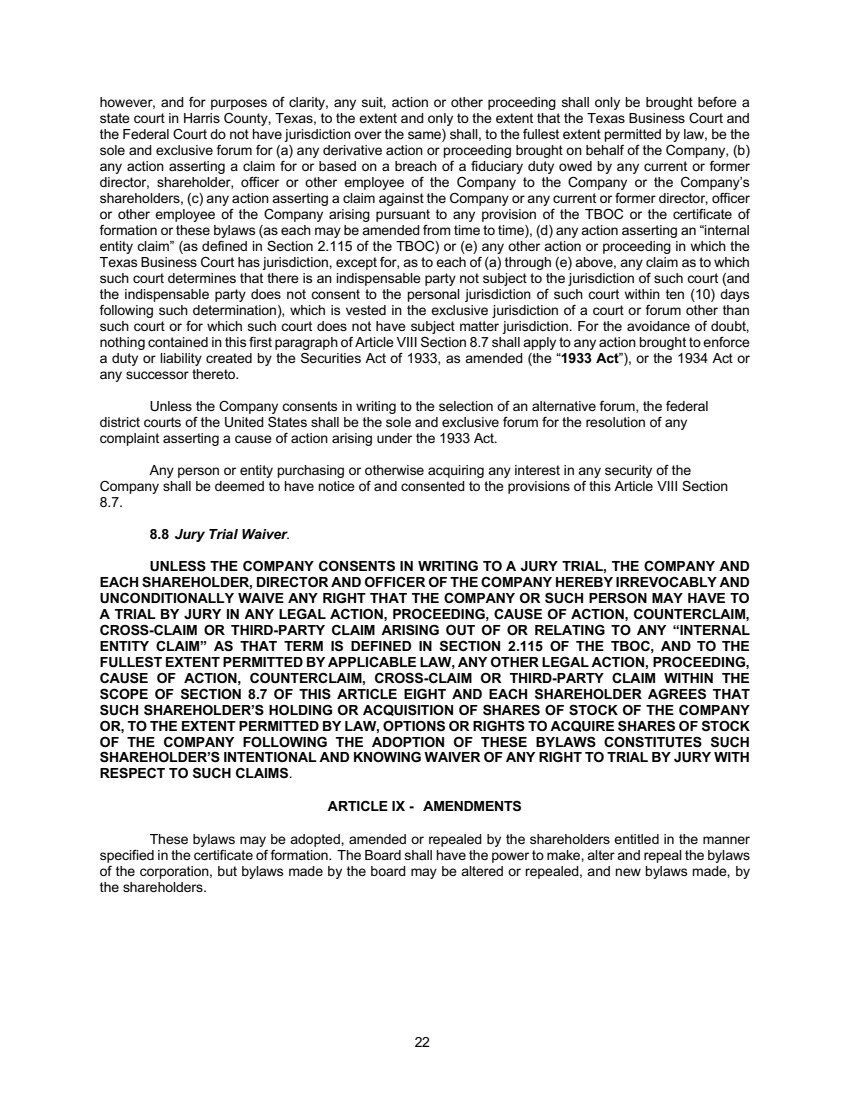
Ex. 10.13
THIS INDEPENDENT CONTRACTOR AGREEMENT (this “ICA”) is made and entered into by and between the undersigned real estate licensee (“Agent”), and the applicable eXp entity1 licensed as a real estate brokerage company in Agent’s state(s) of licensure (“eXp”). This ICA shall become effective (the “Effective Date”), as follows: (1) when electronically signed by the last of the Parties to electronically sign this ICA (if this ICA is to be Agent’s original Independent Contractor Agreement with eXp), or (2) as provided in Section 15, below (if this ICA is to be a revision to a former version of Agent’s Independent Contractor Agreement with eXp). eXp and Agent may be referred to hereinafter individually as a “Party,” and collectively as the “Parties.”
BACKGROUND
| C. | The Parties mutually desire for Agent to become affiliated with eXp as a real estate licensee in Agent’s state(s) of licensure, all in accordance with the terms and conditions set forth in this ICA. |
AGREEMENT
NOW THEREFORE, in consideration for the above recitals, and for other good and valuable consideration, the receipt and sufficiency of which are mutually acknowledged, the Parties agree as follows:
1 eXp Realty, LLC (in all states except those that follow); eXp Realty of California, Inc. (in California); eXp Realty of Northern California, Inc. (in northern California); eXp Realty of Greater Los Angeles, Inc. (in central California); eXp Realty of Southern California, Inc. (in southern California); eXp Realty North, LLC (in N. Dakota, Minnesota, and portions of New York, except as further qualified); eXp Realty of Connecticut, LLC (in Connecticut, and Brooklyn, New York); eXp Realty Associates, LLC (in Brooklyn, mid-town, and downtown, New York City); eXp Realty of Charlotte Metro NC, LLC, eXp Realty of Northwest NC, LLC, eXp Realty of Northeast NC, LLC, eXp Realty of Piedmont NC, LLC, eXp Realty of Southeast NC, LLC, and eXp Realty of Triangle NC, LLC (in North Carolina); and eXp Realty South, LLC (in select areas of Florida).
eXp Realty (USA) Independent Contractor Agreement | Page 1 of 15 | Version_R_USA_EN_August 2026 |
Ex. 10.13
a.Compensation Split. Agent shall be entitled to compensation on purchase transactions, sales transactions, rental/lease transactions, broker price opinions (“BPOs”), and referrals (each, a “Transaction,” collectively, “Transactions”) as follows: income retained by eXp after referrals, but prior to compensation split (“Gross Compensation Income”), shall be split at the rate of 80% to Agent (“Contractor Dollar”) and 20% to eXp (“Company Dollar”) on all Transactions closed by the Agent. Should any Transaction be subject to any state or local taxes, the 80%/20% compensation split will be calculated after the tax is deducted.
b.Stock and Equity. eXp provides opportunities to eligible eXp real estate licensees to obtain shares of AGNT, Inc. (f/k/a eXp World Holdings, Inc.) common stock (Nasdaq: AGNT) through (i) the Agent Equity Program, in which eXp real estate licensees must opt-in in order to participate and agree to the terms and conditions of that program, and (ii) the Agent Growth Incentive Program, which is available to all eXp real estate licensees and no opt-in step is required, both of which are administered under the respective Equity Incentive Plan set forth in Agent’s Election Form or Grant Agreement, as applicable. Shares acquired through either of the foregoing programs will be issued to Agent in Agent’s individual capacity;
eXp Realty (USA) Independent Contractor Agreement | Page 2 of 15 | Version_R_USA_EN_August 2026 |
Ex. 10.13
shares cannot be issued to non-natural persons (e.g., a legal entity). If interested, Agent should visit the eXp Agent Shareholder Hub for details and participation information.
c.Revenue Share Plan. Agent shall be automatically enrolled in eXp’s Revenue Share Plan, which shall be governed by those terms set forth in the eXp P&Ps.
d.Compensation Period Definitions. Agent’s onboard date (“Onboard Date”) shall be the later of, (a) Agent’s “Join Date” (the date eXp verifies Agent’s email address and Agent becomes active in MY | eXp®), or (b) the date on which Agent’s real estate license is transferred to eXp. Agent’s anniversary date (“Anniversary Date”) shall be the first day of the calendar month following Agent’s Onboard Date with eXp. So, for example, if Agent’s Onboard Date is January 18, 2025, then Agent’s Anniversary Date will be February 1, 2025. Agent’s “Capping Period” is a consecutive twelve (12) calendar month period during which time the amount of Company Dollar collected on Agent’s Transactions is accrued towards the Company Dollar Cap. The term “Company Dollar Cap” means that once the amount of Company Dollar received from Agent’s closed Transactions reaches $16,000 (the $16,000 amount being commonly referred to as a “Full Cap”) within Agent’s Capping Period, eXp will no longer collect the Company Dollar portion of the compensation split and the Agent will thereafter be considered to be in a “Capped Status” until the expiration of the then-current Capping Period. The “Cap Reset Date” is the date upon which each new Capping Period begins and the amount of Company Dollar paid by Agent that has accrued towards the Company Dollar Cap will reset to zero. The Cap Reset Date for Agent will be the same as Agent’s Anniversary Date, except as otherwise expressly agreed to the contrary by separate written addendum to this ICA. Agent’s anniversary year (“Anniversary Year”) shall begin on Agent’s Anniversary Date with eXp and end on the day immediately preceding the next Anniversary Date. So, for example, if Agent’s Onboard Date is January 18, 2025, then Agent’s Anniversary Date would be February 1, 2025 and Agent’s Anniversary Year will run from February 1, 2025 through January 31, 2026, and continue for the same period each year thereafter. Except as otherwise expressly agreed to the contrary, an Agent’s Capping Period will directly overlap with Agent’s Anniversary Year.
eXp Realty (USA) Independent Contractor Agreement | Page 3 of 15 | Version_R_USA_EN_August 2026 |
Ex. 10.13
[Agent’s Signature Here]
[Agent’s Signature Here]
eXp Realty (USA) Independent Contractor Agreement | Page 4 of 15 | Version_R_USA_EN_August 2026 |
Ex. 10.13
PRIMARY STATE | LICENSE NUMBER |
| |
NON-PRIMARY STATE(S) (if applicable) | LICENSE NUMBER(S) |
| |
| |
*If Agent is licensed and affiliated with eXp in more than one state, no additional ICA is required.
eXp Realty (USA) Independent Contractor Agreement | Page 5 of 15 | Version_R_USA_EN_August 2026 |
Ex. 10.13
[Agent’s Signature Here]
eXp Realty (USA) Independent Contractor Agreement | Page 6 of 15 | Version_R_USA_EN_August 2026 |
Ex. 10.13
[Agent’s Signature Here]
[Agent’s Signature Here]
[Agent’s Signature Here]
[Agent’s Signature Here]
eXp Realty (USA) Independent Contractor Agreement | Page 7 of 15 | Version_R_USA_EN_August 2026 |
Ex. 10.13
eXp Realty (USA) Independent Contractor Agreement | Page 8 of 15 | Version_R_USA_EN_August 2026 |
Ex. 10.13
eXp Realty (USA) Independent Contractor Agreement | Page 9 of 15 | Version_R_USA_EN_August 2026 |
Ex. 10.13
If to Agent:(As specified by Agent in MY | eXp®)
If to eXp:[email protected]
eXp Realty (USA) Independent Contractor Agreement | Page 10 of 15 | Version_R_USA_EN_August 2026 |
Ex. 10.13
eXp Realty (USA) Independent Contractor Agreement | Page 11 of 15 | Version_R_USA_EN_August 2026 |
Ex. 10.13
THE FOREGOING SPONSOR SELECTION (OR LACK OF SELECTION, IF LEFT BLANK) BY AGENT IS A SIGNIFICANT DECISION WHICH IS IRREVOCABLE. AGENT IS ENCOURAGED TO PAUSE TO CAREFULLY CONSIDER WHO IS THE MOST INFLUENTIAL IN AGENT’S DECISION TO JOIN EXP. CHANGES IN SPONSORSHIP WILL NOT BE MADE. IF THERE ARE ANY UNANSWERED QUESTIONS ABOUT SPONSORSHIP, AGENT SHOULD STOP NOW AND RETURN TO THE ICA ONCE THE SELECTION OF SPONSORSHIP IS FULLY CONSIDERED AND UNDERSTOOD.
[Agent’s Signature Here]
eXp Realty (USA) Independent Contractor Agreement | Page 12 of 15 | Version_R_USA_EN_August 2026 |
Ex. 10.13
[Agent’s Signature Here]
eXp Realty (USA) Independent Contractor Agreement | Page 13 of 15 | Version_R_USA_EN_August 2026 |
Ex. 10.13
[SIGNATURE PAGE IMMEDIATELY FOLLOWS]
eXp Realty (USA) Independent Contractor Agreement | Page 14 of 15 | Version_R_USA_EN_August 2026 |
Ex. 10.13
IN WITNESS WHEREOF, and by their electronic signatures, below, the Parties hereto evidence their agreement to enter into and be bound by the terms of this ICA effective as of the Effective Date.
Agent:eXp:
SignatureLeo Pareja, Chief Executive Officer
Agent NameBroker - Primary State
eXp Realty (USA) Independent Contractor Agreement | Page 15 of 15 | Version_R_USA_EN_August 2026 |
Ex. 10.14
eXp Realty (hereafter, “eXp,” “we,” “our,” and such analogous terminology) reserves the right to make updates to the policies and procedures set forth within these eXp Realty (USA) Policies and Procedures (“eXp P&Ps” or “eXp’s P&Ps”). When and if updates are made, they will be communicated through eXp communication platforms, eXp News weekly newsletter, and/or the weekly company meeting.
By signing an Independent Contractor Agreement (“ICA”) with eXp, each independent contractor real estate licensee with eXp (singularly an “Agent”; and collectively, “Agents”) is agreeing to adhere to and abide by these eXp P&Ps, with such eXp P&Ps being incorporated by reference into Agent’s ICA verbatim and at length, and constituting a part of Agent’s ICA as though fully set forth therein. A glossary of terms defined in these eXp P&Ps is located at the back of these eXp P&Ps; defined terms that are used but not otherwise defined in these eXp P&Ps shall be as defined in the ICA.
Table of Contents:
eXp Realty (USA) Policies and Procedures Page 1 of 98 Version_R_USA_EN_August 2026
Ex. 10.14
eXp Realty (USA) Policies and Procedures Page 2 of 98 Version_R_USA_EN_August 2026
Ex. 10.14
eXp Realty (USA) Policies and Procedures Page 3 of 98 Version_R_USA_EN_August 2026
Ex. 10.14
eXp Realty (USA) Policies and Procedures Page 4 of 98 Version_R_USA_EN_August 2026
Ex. 10.14
[REMAINDER OF PAGE INTENTIONALLY LEFT BLANK]
eXp Realty (USA) Policies and Procedures Page 5 of 98 Version_R_USA_EN_August 2026
Ex. 10.14
| I. | CORE VALUES |
At eXp, our core values are more than just motivational posters on virtual walls; they support our vision and shape our culture. Our global community is powered by agents, partners, and staff who work collaboratively to transform the real estate experience. These eXp P&Ps, our Code of Conduct, and the way we carry out our daily operations, including the enforcement of these policies, are based on these nine core values.

| II. | POLICY |
It is the policy of eXp to participate in a real estate activity only when it is legal, honest, fair and beneficial to us and others. In pursuit of compensation for ourselves, we will never ignore the benefit of our community. Therefore, we will conduct our business in a manner to follow all the laws and rules of our profession. We pledge to exercise the highest standard of ethics, honesty, fairness and professionalism in all our real estate activities.
eXp Realty (USA) Policies and Procedures Page 6 of 98 Version_R_USA_EN_August 2026
Ex. 10.14
| III. | PROCEDURES |
Every Agent is expected to adhere to and abide by these eXp P&Ps. Failure to adhere to the eXp P&Ps could result in legal and regulatory liability for the Agent and eXp. Therefore, the Agent agrees that if they depart from the eXp P&Ps, they will defend, indemnify and hold eXp, and its principals and affiliates harmless against any and all claims, complaints or actions that may arise from such a departure. In addition, failure to comply with this Policy is grounds for the immediate release of an Agent’s license and removal from eXp.
These eXp P&Ps provide detailed guidelines for eXp’s brokerage policies and procedures; however, there may be some circumstances or issues that are not addressed. In those instances, decisions and actions taken will reflect our core values.
As provided above, these eXp P&Ps are incorporated into the ICA that each Agent entered into as part of the process of associating with eXp. Failure to comply with these eXp P&Ps may be grounds for immediate termination and dismissal from eXp. Additionally, an Agent’s right to be compensated for their work, activities on behalf of eXp, revenue share and stock may be adversely affected by any failure on Agent’s part to carry out, adhere to, and otherwise support and fulfill the provisions of these eXp P&Ps.
| IV. | STATE POLICIES AND PROCEDURES |
These eXp P&Ps are designed to address nationwide brokerage policies and procedures applicable to all Agents in all states in which eXp does business. It is impractical to address the peculiarities of state and local requirements in the body of these eXp P&Ps, particularly the responsibilities of Agents to principals and the public. While it is each Agent’s obligation to be fully familiar with and fully comply with state and local law pertaining to the provision of real estate brokerage services, eXp offers additional state policies and procedures where necessary, to address many, but not all, state and local requirements. Any State P&Ps, if applicable, will be a critical part of these eXp P&Ps and, to the extent it is inconsistent with these eXp P&Ps, the applicable State P&Ps supersedes these eXp P&Ps.
| V. | CODE OF CONDUCT |
All Agents shall conduct their business in alignment with eXp’s core values, the National Association of REALTORS® Code of Ethics, and in accordance with applicable federal and state laws. Agents should conduct themselves in an appropriate business-like manner in all activities and relations with fellow Agents, clients, potential customers and eXp staff.
eXp Realty (USA) Policies and Procedures Page 7 of 98 Version_R_USA_EN_August 2026
Ex. 10.14
All Agents shall strive at all times to perform in a manner that will increase the goodwill, reputation and business of eXp, and Agents shall do nothing which would serve to disturb, discredit or devalue eXp or eXp’s goodwill, reputation and/or business.
Any Agent whose conduct, actions or performance violates or conflicts with eXp’s P&Ps, eXp’s core values, or any other eXp policy, may be released from eXp immediately and without warning.
It is the commitment of eXp to ensure the brokerage is free from negative, aggressive and inappropriate behaviors, and that the environment is aimed at providing an atmosphere upholding our core values. All Agents and employees of eXp have the right to be treated with dignity and respect. All complaints of negative and inappropriate behaviors will be taken seriously and followed through to resolution. Agents or employees of eXp who file complaints will not be victimized for “whistle-blowing” or reporting others for their inappropriate behavior. Agents may file complaints by emailing [email protected].
Agents who are members of the National Association of REALTORS® are required to maintain their mandatory ethics training. Failure to complete the course will result in suspension or termination of Realtor® membership and removal from eXp.
Agents are expected to become familiar with and adhere to the National Association of REALTORS® Pathways to Professionalism found on their website at https://www.nar.realtor/code-of-ethics-and-arbitration-manual/pathways-to-professionalism.
Agents shall not disparage the conduct, reputation, or character of another Agent, of any eXp employee or member of management, or of eXp itself (including eXp’s products, services, and business model). Agents shall not disparage competing brokerages or their agents. Agents shall not solicit, recruit, employ, induce, or entice (either for themselves or another), directly or indirectly through a third party, any eXp partners, affiliates, salespersons, real estate agents, and/or employees to leave eXp during the Term of an Agent’s ICA, and for a period of two (2) years following termination of an Agent’s ICA. This paragraph shall be referred to as eXp’s Non-Solicitation and Non-Disparagement Policy.
Agents shall not take any action that creates, or has the possibility of creating, any civil and/or criminal liability for eXp and/or other eXp Agents.
Violations of this Code of Conduct are grounds for immediate termination of Agent’s ICA.
| VI. | DUTIES AS AN AGENT |
| A. | Fiduciary |
| 1. | The Agent and all licensed assistants shall abide by their fiduciary responsibilities when acting as an Agent for a client. The Agent owes the client the fiduciary duties of obedience, loyalty, disclosure, confidentiality, accounting, reasonable skill and care. Agents shall also deal fairly |
eXp Realty (USA) Policies and Procedures Page 8 of 98 Version_R_USA_EN_August 2026
Ex. 10.14
| with all parties to a transaction. |
| 2. | The agency relationship with any party with whom an Agent is working on behalf of eXp or an Agent must have their license affiliated with eXp and have established in writing on a form acceptable to the state Designated Managing Broker or applicable Managing Broker(s) (individually, and collectively, hereinafter referred to as “State Broker”) before an offer on a property is written, or a listing is taken. The failure to establish and disclose the type of relationship one has by the time of contract is unacceptable. The contract is to serve only as confirmation of an election made by the buyer/lessee or seller/lessor in a separate written agreement before the contract is written. |
| B. | Cooperation and Compensation |
| 1. | As a matter of policy, eXp does not offer cooperation or compensation to sub-agents. |
| 2. | eXp does not share listing compensation with a buyer’s broker. eXp will assist any seller-directed compensation for a buyer’s broker at a seller’s written direction. |
| 3. | eXp does not require sellers to offer compensation to a buyer’s broker. If a seller chooses to offer compensation, the compensation offered by a seller to a buyer’s broker is not required to be a, “blanket or unilateral offer of compensation”. The seller may determine when the offer of compensation is made, at time of listing, at time of showing, or negotiated in the purchase contract. |
| 4. | An Agent exclusively representing a buyer shall not, under any circumstances, contact a seller directly without first obtaining the express consent by the listing broker and State Broker. The exception to this policy being for sale by owner properties. |
| 5. | eXp Agents representing a buyer in a Transaction shall have a Buyer-Broker Agreement. Compensation to buyer’s broker shall be established via this agreement. |
| 6. | eXp Agents shall not advertise or otherwise represent their services as being “free” unless they will not receive any compensation from any source for those services. |
| 7. | eXp Agents may not filter or restrict listings to a buyer based on the existence or amount of any offer of compensation offered to a buyer’s broker. eXp Agents shall make available properties as requested by a buyer and not refuse to show based on offers of compensation to a buyer’s broker. |
| 8. | eXp Agents shall disclose to a buyer any offer of compensation made to a buyer’s broker. |
| 9. | eXp Agents shall provide each consumer with a clear and conspicuous written disclosure if eXp is obligated to pay a referral fee in connection with their Transaction. This disclosure must identify the originating brokerage and the amount or calculation method of the fee (e.g., a specific percentage or flat fee). eXp’s standard Referral Fee Disclosure form is available for Agents’ use to fulfill this requirement. |
| C. | Good Standing |
Each Agent has a duty to remain in Good Standing at eXp. To be considered in “Good Standing,” an Agent must:
eXp Realty (USA) Policies and Procedures Page 9 of 98 Version_R_USA_EN_August 2026
Ex. 10.14
| 1. | be current on all financial obligations and not have any unpaid fees, charges, repayments, or any other amounts owed by the Agent to eXp; |
| 2. | have and maintain an active and current status for: |
| a) | all required licenses; |
| b) | local, state, and national REALTOR® Association/Board memberships, where applicable; and |
| c) | any other subscriptions that are required to conduct real estate business in the Agent’s state(s); and |
| 3. | not be deemed in breach of any term, covenant, condition, obligation (including monies owed) or duty set forth in the ICA and these eXp P&Ps, as determined by eXp in its reasonable discretion. |
eXp reserves the right to withhold earnings from, and assign another Agent to close out, any pending transactions concerning any Agent that is not in Good Standing.
In order to remain eligible to collect revenue share under eXp’s Revenue Share Plan, an Agent must be and remain in Good Standing; any failure to remain in Good Standing may result in a loss of pending revenue share earnings. See section titled, “Qualifications to Receive Revenue Share,” for more information.
| D. | Agreements, Compliance Forms, Insurance Forms |
Each Agent will submit all documents necessary for eXp to keep themselves in compliance with all applicable local, state, and federal laws, as well as with eXp’s P&Ps. eXp will share all materials with an Agent that eXp maintains in its records relating to that Agent’s agency and independent contractor relationship with eXp.
eXp reserves the right to assess penalties (financial and otherwise) against an Agent, in accordance with each Agent’s ICA and eXp’s P&Ps, if that Agent fails or refuses to provide completed documentation as required by eXp or by any applicable local, state, or federal law, in order to achieve and maintain compliance with such laws.
| E. | License Renewal and State Department of Licensing Rules |
Agents shall maintain an active real estate license with the applicable state department or agency that is charged with administering the issuance of any real estate licenses in that state (“State Department of Licensing”). It is the Agent’s sole responsibility to fulfill all continuing education requirements and file their renewal promptly and be aware of their licensing status with the State Department of Licensing. eXp may, at its sole option, sever the Agent’s license with eXp if the Agent’s license is not renewed on time. Failure to renew can have severe financial impacts on the Agent. Compensation is subject to forfeiture for any unlicensed real estate activities after expiration/revocation of an Agent’s license.
Agents shall adhere to all state and federal licensing rules and regulations. It shall be the Agent’s responsibility to be knowledgeable about the rules set forth by their State Department of Licensing.
eXp Realty (USA) Policies and Procedures Page 10 of 98 Version_R_USA_EN_August 2026
Ex. 10.14
Should a complaint be filed against an Agent, the Agent must immediately notify eXp via their State Broker for assistance in responding promptly to the complaint and cooperate fully with the State Department of Licensing.
| F. | Non-Disclosure Of Trade Secrets |
Each Agent recognizes and acknowledges that much of the information that will be furnished to him/her concerning eXp’s clients, customers, listings, holdings, investments, transactions, eXp-generated leads, and other confidential matters constitutes valuable, special, and unique assets and are trade secrets of eXp. Accordingly, Agents shall not, during or after their affiliation with eXp, disclose any such information or any part thereof, to any person, firm, corporation, association, or other entity for any reason or purpose whatsoever without the express written consent of eXp.
| G. | Real Estate Transactions |
All real estate transactions must be taken in eXp’s name (and not in an Agent’s name or in the name of any other real estate brokerage company), and processed and closed through eXp. This means that any listings (whether sale or rental) must be listed, advertised, processed, and closed through eXp; and any buyer/tenant-representation services must be performed through eXp.
Each Agent shall ensure that all fees or other compensation earned by the Agent, and for which the Agent must be an active licensed real estate professional in order to receive such compensation in connection with the sale, lease, or rental of real estate, and any interest therein or service in relation thereto, are made payable to eXp.
In order to receive compensation, Agents acting on behalf of buyers shall have a written agreement prior to touring a home (e.g., a “touring agreement” or Buyer-Broker Agreement). Where state law is more restrictive, refer to State P&Ps.
| H. | Transaction Files |
| 1. | Forms |
Agents shall use the most current forms provided by eXp Realty or that are customary to the MLS or REALTOR® Board where the Agent is a member. eXp does not condone or endorse the unauthorized use of any copyright-protected forms developed by any MLS or REALTOR® Board. Under no circumstance may Agents use any copyright-protected forms developed by any MLS or REALTOR® Board unless such Agents belong to the MLS or REALTOR® Board that created the copyright-protected forms. Agents, and not eXp, will be solely responsible for all costs and expenses arising from their unauthorized use of any copyright-protected forms. Agents must use any applicable regulatory documents required by federal and state agencies.
Agents may not create, use AI to create, and/or use their own transaction forms (e.g., purchase and sale agreements, addenda, etc...), or engagement forms (e.g., listing agreements, buyer
eXp Realty (USA) Policies and Procedures Page 11 of 98 Version_R_USA_EN_August 2026
Ex. 10.14
representation agreements, etc...) unless the forms intended to be used are first approved, in writing, by both their State Broker and Regional Director. However, nothing in these eXp P&Ps shall prevent Agents from using transaction forms provided by a client and/or a client’s lawyer, provided that such forms are presented to Agent’s State Broker and Regional Director prior to their execution. Many eXp forms will be found within the transaction management system currently used.
Agents are aware and understand that all dual agency transactions must contain a fully executed consent for dual/limited representation form, completed prior to purchase/sale contract execution, in order to preserve the right to errors and omissions insurance coverage on the file. Agents are aware that if they fail to obtain such written consent, the file may be excluded from coverage and such Agent shall be responsible for the full amount of the damages, attorneys’ fees, and costs incurred by and/or recovered against eXp.
| 2. | Executed Real Estate Documents |
The State Broker has a supervisory responsibility by law and must comply with the State Licensing Department’s rules. All purchase and sale agreements, listings, buyer-broker agreements, referrals and any other transactional documents must be uploaded into the transaction management system within two business days of execution to allow time for review and approval by the applicable State Broker team. Please refer to the transaction checklists provided in each state.
Transaction files should include all documents related to the transaction and any and all correspondence, notes, email communications, text messages, etc., regardless of whether the Transaction closed or not. Agents are encouraged to make copies of their files. eXp reserves the right to maintain digital files in storage for the statutory period as required by the state licensing departments. Unauthorized removal of any file from the transaction management system may lead to termination.
Once a customer or client has signed a document, they are entitled to and shall, therefore, receive a copy of the document upon its execution. Agents are required to either provide an electronic copy, via email, or deliver a physical copy of the document(s) to them.
Agents shall transact ALL real estate brokerage business through one of the AGNT, Inc. (f/k/a eXp World Holdings, Inc.) family of real estate brokerage companies. Transactions that are processed outside of the foregoing may be grounds for immediate termination.
| 3. | Earnest Money |
Earnest money shall be handled as described in State P&Ps. The Agent will be subject to immediate termination if it has been determined that there has been any improper handling of earnest money.
All files must contain an accounting for disbursement of funds including earnest money and final
eXp Realty (USA) Policies and Procedures Page 12 of 98 Version_R_USA_EN_August 2026
Ex. 10.14
settlement statements.
| 4. | Late or Incomplete Paperwork Submissions |
Signed documents of any variety, listing files, and files pertaining to completed transactions must each be uploaded within eXp’s transaction management system within the sooner of the following: (a) forty-eight (48) hours after their execution or in the case of a completed transaction, the respective closing date (as applicable), or (b) the maximum time period permitted by the Agent’s applicable state’s real estate licensing laws. Listing files and files pertaining to completed transactions must include all required paperwork pertaining to the listing or transaction, as applicable; missing paperwork is not acceptable. Failure to adhere to these requirements is a violation of eXp policy and may subject the Agent to escalating repercussions, all as determined by the State Broker and/or Brokerage Operations leadership, in their sole discretion. Such repercussions include, without limitation, any of the following or combination thereof:
| a) | Loss of split check (if allowed in the Agent’s state) for stated times; |
| b) | If the Agent fails to adhere to these requirements three (3) or more times within a rolling, consecutive 6-month period, the Agent will be required to use an eXp-approved Transaction Coordinator (“TC”) to assist Agent with organizing and uploading the Agent’s next three (3) Agent listing files and/or files pertaining to completed transactions, all at the Agent’s sole cost and expense. Thereafter, the Agent is free to continue or discontinue using the same or different eXp-approved TC, as the Agent determines; if use is continued, such use will be at the Agent’s sole cost and expense. |
| c) | Required training on eXp’s transaction management system, and policies and procedures pertaining to state contracts; and |
| d) | Offboarding the Agent from eXp. |
Any fines assessed to the State Broker, or to eXp, pertaining to an Agent’s failure to follow these document and file submission policies shall be reimbursed by that Agent. The costs of undertaking any investigation by the State Broker for an Agent’s non-compliance with these document and file submission policies may be passed on to that Agent, all at eXp’s sole discretion.
| I. | Agent-Owned Real Properties |
| 1. | Generally |
One of the great benefits of having a real estate license is the advantage of building personal wealth through the sale and purchase of real estate. However, these transactions place both eXp as well as the Agent-Owner (defined below) at a greater risk of litigation due to the nature of rehabbed and flipped property transactions. In addition, the mere fact that a seller or buyer is a licensed real estate professional and REALTOR® means they are held to a higher standard and subject to higher incidences of legal claims and litigation. Therefore, these policies are intended to protect both the Agent-Owner, eXp, and all of our Agents and shareholders.
eXp Realty (USA) Policies and Procedures Page 13 of 98 Version_R_USA_EN_August 2026
Ex. 10.14
| a) | “Agent-Owned” means ownership is held or controlled by an Agent, whether through an Agent’s own name, a spouse’s name, a business entity, a trust, or that is otherwise owned and/or controlled by Agent and/or Agent’s spouse (also referred to as an “Agent-Owner”) |
| b) | Unless prior written approval is granted by Brokerage Operations leadership, Agents shall not enter into a contract to sell or flip a property until the Agent holds legal title (as opposed to mere equitable title) to the subject property. |
| c) | A single Agent may not represent both sides of a sales transaction if the Agent or a family member of the Agent is a principal or party to the transaction. |
| d) | Under NO circumstances can an Agent represent the buyer in a Personal Transaction (as defined below); additionally, an Agent cannot act as an intermediary in a Personal Transaction. |
| e) | Agents shall never act as a principal in a transaction without the full written consent of all parties. |
| f) | The buyer must sign an agency representation disclosure. |
| g) | Both the buyer and Agent shall execute the Disclosure of Personal Interest of eXp Realty Agent Addendum to Residential Purchase Contract with each Agent-Owned property. |
| h) | The parties must use standard forms and sales contracts and all forms must be state approved with full and accurate signatures & dates. |
| i) | Agent’s name, Agent and/or Agent’s spouse’s business entity or trust name, or Agent’s spouse’s name must be on the title or lease agreement (as applicable) for the Transaction to be considered. |
| j) | All seller disclosures must be made regarding any property defects or material information, must be completed on a seller’s disclosure notice, and must have all necessary signatures, dates & initials. |
| k) | For all transactions where the property is Agent-Owned, eXp strongly encourages that the Agent-Owner ensures a home inspection is delivered to the buyer. |
| (1) | The buyer must have a home inspection done by a licensed property inspector (if licensing is a requirement in the state in which the property is located) or submit a written waiver of such. |
| (2) | If buyer waives the right to a property inspection, the buyer must provide written notice of that waiver by completing and signing the Buyer Acknowledgement and Waiver of Inspections. |
| (3) | A copy of the property inspection, along with all addenda and/or amendments must be included in the file. |
| l) | For all transactions where the property is Agent-Owned, the Agent-Owner is strongly encouraged to ensure the property is covered by a standard home warranty from a company of the buyer’s choice. |
| (1) | The buyer must be made aware that they may purchase a residential service contract (home warranty) for the property via the Disclosure of Personal Interest of eXp Agent Addendum to Residential Purchase Contract. |
eXp Realty (USA) Policies and Procedures Page 14 of 98 Version_R_USA_EN_August 2026
Ex. 10.14
| m) | Ownership must be disclosed in all marketing materials, MLS, advertising, and stated in the special provisions, or its equivalent, section of the contract regardless of what percentage of ownership interest in the property is held by the Agent. |
| n) | Agents are required to turn in a copy of the full closing disclosure and copies of any/all compensation checks received for the transaction. |
| o) | Any work completed on the property that requires a permit or is a major repair (i.e., repairs that are not of a casual nature, or otherwise require permits) shall be done by a licensed, bonded, and insured contractor. In jurisdictions where a contractor license is not required, the individual performing the repair(s) must be an experienced and qualified tradesperson. |
| 2. | Personal Transactions |
A “Personal Transaction” is any Transaction concerning a property that is owned or leased by an Agent (whether in an Agent’s own name, a spouse’s name, a business entity, a trust, or that is otherwise controlled by Agent and/or Agent’s spouse), regardless of whether Agent chooses to represent themselves or have another eXp Agent represent them.
Agents may exempt from the Minimum Company Dollar Rule three (3) Personal Transactions per Anniversary Year, whether involving the Agent’s ownership interests or leasehold interests. (Please communicate with your State Broker should you have questions.)
Personal Transactions will carry a Personal Transaction Fee (“Personal Transaction Fee”) taken as a charge against the Contractor Dollar, as follows:
| a) | Personal Transactions involving a purchase or sale will carry a $250 Personal Transaction Fee, in addition to the Transaction Review Fee and Risk Management Fee. For Agents who have reached a Capped Status and who are paying a reduced Capped Status Transaction Fee, the Personal Transaction Fee shall be collected at the reduced rate of $75 per Personal Transaction for the remainder of that Agent’s Capping Period. |
| b) | Personal Transactions involving a lease will carry a $75 Personal Transaction Fee, and either, (i) no Transaction Review Fee or Risk Management Fee (if the Gross Compensation Income is $1,000 or less), or (ii) a Transaction Review Fee and Risk Management Fee (if the Gross Compensation Income is greater than $1,000). **Personal Transactions involving a lease do not count towards the three (3) exempt Personal Transactions per Anniversary Year. |
Personal Transaction compensation is not included in revenue share calculations where no Company Dollar is generated from the completion of the Personal Transactions.
eXp Realty (USA) Policies and Procedures Page 15 of 98 Version_R_USA_EN_August 2026
Ex. 10.14
When an Agent in the eXp Mentor Program is purchasing a personal property, a Buyer-Broker Agreement is required for the amount of compensation being collected. Minimum compensation must be minimum Company Dollar for a Personal Transaction.
For eXp Agents in the eXp Mentor Program, please see the relevant eXp Mentor Program Addendum to Independent Contractor Agreement for rules and fees involved in a Personal Transaction.
| J. | Commercial Property |
Prior to transacting in or contemplating a commercial transaction, Agents must have authorization from their State Broker. Agents may not act outside their area of expertise.
Agents must be aware that eXp’s errors & omissions insurance policy limits are generally not sufficient to conduct many commercial real estate activities.
For purposes of these eXp P&Ps, “Residential Property” shall be defined as any real property that is zoned to accommodate a residential dwelling having not less than one (1) and not greater than four (4) dwelling units, whether such real property is vacant land or improved real property; and “Commercial Property” shall be defined as any real property that is not Residential Property.
| K. | Unauthorized Activities |
| 1. | Generally |
| a) | No business will be conducted in eXp’s name that does not pertain directly to the duties of a real estate licensee as directed by federal, state and local laws/regulations as well as eXp’s Policies, referenced herein. |
| b) | Agents shall not open any brick-and-mortar offices in eXp’s name or bind eXp to any agreements without the written consent of their State Broker. |
| c) | Except as otherwise provided in the last sentence to this paragraph, Agents shall not conduct property management services through eXp. The term “property management services” means engaging in any activities concerning an actual or prospective tenant on behalf of a client, whether or not such activities are coupled with any property preservation services (as that term is defined herein) (e.g., collecting rents, performing inspections, setting up repairs and maintenance, running a background check, making or assisting with tenant selection, etc.). However, Agents may list rental properties on behalf of landlord-clients, and Agents may assist tenant-clients in locating suitable properties in which to rent. |
| d) | Agents shall not operate limited function referral offices through eXp. The term “limited function referral offices” means those offices that are solely engaged in referring clients or customers to non-eXp real estate brokerage companies. Agents desiring to perform limited function referral offices should both (i) refer to their State P&Ps, and (ii) contact their State Broker for more information. |
eXp Realty (USA) Policies and Procedures Page 16 of 98 Version_R_USA_EN_August 2026
Ex. 10.14
| e) | Agents shall not sell or list to sell business opportunities or engage in business brokerage activities. For avoidance of doubt, this prohibition does not apply to brokering interests of cooperative corporations (co-ops). |
| f) | Agents shall not conduct a final walk-through inspection on behalf of a client. |
| g) | Agents shall not perform work or do repairs on properties where the Agent is representing a buyer or seller. |
| h) | A single Agent shall not represent both sides of a sales transaction if the Agent or a family member of the Agent is a principal or party to the transaction. Failure to follow this policy can result in loss of errors and omissions coverage and each Agent shall be responsible for any legal costs and may be subject to removal from eXp, as provided in their ICA. |
| i) | Agents shall not represent both sides of a transaction without full written consent from all parties executed prior to contract. Failure to follow this policy can result in loss of errors and omissions coverage. Agents shall be responsible for all legal costs and may be subject to removal from eXp, as more fully provided in Agent’s ICA. |
| j) | Agents shall not engage in the act of wholesaling properties, in which they, or a family member, have a financial interest without first obtaining written approval from both the State Broker and Brokerage Operations leadership. No real estate compensation arising from a wholesaling transaction in which either the Agent and/or the Agent’s family member is a principal, shall be credited, reduced, or otherwise waived unless the transaction file is complete; and if the file is complete, any such crediting, reduction, or waiver must be approved in writing, and in advance, by Agent’s State Broker. In this instance, real estate wholesaling occurs when the Agent contracts with a home seller to purchase their property, markets the home to potential buyers and then sells and assigns the purchase contract to another buyer before the purchase transaction closes. The Agent makes a profit, which is the difference between the contracted price with the seller and the amount paid by the buyer. For avoidance of doubt, real estate wholesaling does not occur (for purposes of this paragraph) when there is a deed transfer as between the original seller and first buyer, on the one hand, and a second deed transfer as between the first buyer and subsequent buyer, on the other hand, even if the two deed transfers occur on the same day, whether or not through simultaneous closings. Agents should consult with their State Broker team or Regional Director (formerly known as their, “Centers of Excellence Director” or “COE Director”) for more information. |
| k) | Agents may only work with an unrepresented party with proper disclosure, and the Agent must represent a party in the transaction (i.e., helping a buyer client purchase from a for sale by owner, helping an unrepresented buyer purchase their listing where they represent the seller). MLS-only listings are not allowed. |
| l) | Agents shall not act outside of their area of expertise, either in knowledge base or geographic area. At the option of the State Broker, another Agent may be assigned to work with the Agent or to personally assist the Agent in such a transaction. If compensation to the Agent is affected, the State Broker shall negotiate a reasonable compensation agreement on that transaction. |
eXp Realty (USA) Policies and Procedures Page 17 of 98 Version_R_USA_EN_August 2026
Ex. 10.14
| m) | As a general rule, Agents shall not contract for any services or bind eXp in any way without written consent of eXp. However, Agents may enter into client-specific or transaction-specific agreements (on eXp’s behalf), (1) that affect only themselves (as opposed to any other eXp Agents), and (2) which a reasonably prudent real estate licensee would customarily enter into in the normal and regular course of rendering those real estate brokerage services offered by eXp (including, without limitation, listing agreements, client-specific or transaction-specific referral agreements, and buyer-broker agreements). |
| n) | For avoidance of doubt, Agents do not have authority and are not permitted to enter into any agreements (on eXp’s behalf) that may affect any Agents other than themselves or eXp, including by way of example only, and without limitation, master referral agreements, lead generation agreements, master service agreements, office lease agreements, non-disclosure or confidentiality agreements, or any other type of business-to-business vendor agreement. If Agents are unsure whether they have the authority to enter into an agreement on eXp’s behalf, they should refrain from entering into that agreement and confer with their State Broker. |
| o) | Agents shall not render legal, appraisal or tax advice to any person on behalf of the Agent, the State Broker or eXp. Under no circumstances is an Agent to deny, or in any way discourage, a client from seeking the advice of an attorney of client’s choice. Rather, such activity should be encouraged. |
| p) | An Agent shall not act, or agree to act, as an “attorney in fact” (whether under a power of attorney, a representation agreement, or a transaction-related document), as follows: |
| 1) | on behalf of a client or customer of eXp; or |
| 2) | on behalf of a party that is on the opposite side of a Transaction from either an eXp client or customer, or from Agent (when acting as a principal in a Transaction). |
NOTE: An Agent may act as an “attorney in fact” on behalf of a family member whom they represent in a Transaction, provided that they first receive the prior written approval of their State Broker.
| q) | Agents whose clients are operating as an attorney in fact under a power of attorney must confer with their State Broker prior to accepting such client. For avoidance of doubt, eXp cannot confirm the validity or enforceability of any powers of attorney. |
| r) | Agents shall not recommend third party services with whom the Agent has a familial relationship in any transactions the Agent is directly involved in or has a financial interest in unless the Agent discloses their familial and/or financial interest (if any) in writing to the client, and also provides at least one additional referral, preferably more, at the same time. |
| s) | Agents shall not, directly or indirectly (such as through a company an Agent owns or controls), perform or complete any repairs on a property for a client, that is or is intended to become the subject of a transaction in which the Agent is involved, regardless of whether the Agent is a licensed contractor. |
| t) | Agents shall not enroll or participate in auction websites without State Broker approval. |
| 2. | Competitor Affiliation is Prohibited |
eXp Realty (USA) Policies and Procedures Page 18 of 98 Version_R_USA_EN_August 2026
Ex. 10.14
An Agent shall not be affiliated with a competing real estate brokerage company. This means that an Agent (including an Agent’s spouse or partner, if applicable) shall not alone or in association with others, whether individually or through any legal entity (such as a corporation, limited liability company, joint venture, etc.) do any of the following:
| a) | own, manage, operate, or control; |
| b) | be employed by, or engaged as an independent contractor with; |
| c) | serve as an officer, director, consultant, or agent to; |
| d) | capitalize or lend money to; or |
| e) | grant the use of his or her name to |
any residential or commercial real estate brokerage firm other than those within the eXp family of real estate brokerage companies. Notwithstanding the foregoing, an Agent may own, as a passive investor, the issued and outstanding stock of a publicly held company that competes with any real estate brokerage company within the eXp family of real estate brokerage companies.
| 3. | Limited Representation is Prohibited |
Except as otherwise provided below, no Agent shall enter into any representation relationship with a seller, buyer, landlord, or tenant that limits the services to be provided to that person (“Limited Representation”), nor shall any Agent participate in any transaction that does not result in a fiduciary relationship between an Agent and the seller, buyer, landlord, or renter.
However, an Agent may engage in any of the following Limited Representation relationships provided that, (1) each such relationship is disclosed in writing and signed by the client or customer, and such disclosure clearly establishes the Agent’s duties to the client or customer (including the limitations of the Agent’s relationship with the client or customer), (2) any such relationship is not prohibited by applicable law or regulations, and (3) any such relationship is not prohibited by State P&Ps:
| a) | a “limited dual agency” relationship; |
| b) | a “transactional” relationship (i.e., a nonagency relationship where an Agent does not represent a buyer or seller, or landlord and renter, in the transaction, treating both as customers); and |
| c) | a “facilitator” relationship (i.e., a relationship where an Agent assists a buyer and seller, or landlord and renter, in reaching agreement in a real estate transaction but has no fiduciary duties to either party). |
If an Agent is unclear with the above, the Agent should contact their State Broker before engaging in any of these relationships.
In any listing engagement (including where there is Limited Representation), no Agents shall encourage or place in any “MLS listing remarks,” directions that a buyer’s or renter’s agent (or potential buyers or renters themselves) contact the seller or landlord, directly, for any reason.
eXp Realty (USA) Policies and Procedures Page 19 of 98 Version_R_USA_EN_August 2026
Ex. 10.14
| VII. | ANCILLARY AND AFFILIATED SERVICES |
| A. | Property Preservation Services |
Agents may only engage in property preservation services when working on behalf of clients that are asset managers or institutional clients (whether or not associated with eXp’s REO/Relocation division). Agents may not engage in property preservation services for clients that are not asset managers or institutional clients. The term “property preservation services’’ means tending to and managing only the physical aspects of any real property on behalf of a client (e.g., scheduling, coordinating, and/or setting up any repairs or maintenance concerning a client’s real property). For avoidance of doubt, “property preservation services” are distinct from “property management services” (defined herein). For example, and without limitation, an Agent may schedule plumbing repairs on behalf of a bank that owns an REO property, but an Agent may not schedule plumbing repairs for a mere, individual property owner that owns a property.
| B. | Mortgage Loan Origination |
| 1. | Generally |
Except as may otherwise be prohibited by law, an Agent may perform mortgage activities in any Transaction in which they have a personal or financial interest.
| 2. | Dual Capacity |
If an Agent is authorized by applicable law to perform both real estate brokerage activities and mortgage loan origination activities, the Agent may perform both sets of activities in the same transaction provided that the Agent has properly disclosed their “dual capacity” (as both real estate agent and mortgage loan originator) to his or her client.
| 3. | Familial Relationship - Conditionally Acceptable |
An Agent may not refer the services of a mortgage loan originator, that has a familial relationship to the Agent, on any transactions in which the Agent is performing real estate brokerage activities, unless each of the following conditions are met: (1) the buyer/borrower is being represented through the Agent and is not an opposite party in the purchase transaction; (2) such familial relationship is disclosed to the buyer/borrower, in writing, in advance of making the referral (an email from the Agent to the buyer/borrower is acceptable; see below example); (3) if the disclosure is made through email, then a copy of the email is uploaded to the transaction file in eXp’s transaction management system; if the disclosure is made in any other written form, it must be signed and then uploaded to the transaction file in eXp’s transaction management system; and (4) the Agent must provide the name and contact information for at least one additional mortgage loan originator at the time the referral is made to buyer/borrower.
Example: Agent sends the following email to the buyer/borrower:
eXp Realty (USA) Policies and Procedures Page 20 of 98 Version_R_USA_EN_August 2026
Ex. 10.14
“Dear [Buyer/Borrower],
Here are a couple of loan originators for your consideration:
| 1. | Sally Smith of Smith Mortgage: (732) 123-4567 |
| 2. | Jenny Jones of Jones Home Loans: (732) 321-7654 |
*Jenny is my spouse; you can pick any loan originator you choose and
your options are not limited to the two individuals or companies listed in this
email.”
| C. | Affiliated Business Arrangements – Ownership in Settlement Service Providers |
**(This section of these eXp P&Ps is applicable when an Agent has a direct or indirect (beneficial) ownership interest in any settlement service provider, and that Agent or a member of any team to which that Agent belongs, intends to refer that settlement service provider to an eXp client.)**
Step 1: Produce a Custom Affiliated Business Arrangement (ABA) Disclosure Form. Agents that own an interest in a settlement service provider must use their own ABA disclosure form in all purchase and sale Transactions that they participate in on behalf of eXp; this is to be used in addition to eXp’s own ABA disclosure form. Agents will have their own ABA disclosure form prepared by competent legal counsel; Agents are not to prepare this form themselves. The proposed ABA disclosure form must name eXp (and the Agent) in the “From” line at the top of the form; the form must also contain language referencing eXp, substantially similar to the following:
“eXp Realty, LLC, together with its subsidiaries and affiliates (collectively, “eXp”), does not have any relationship with [Name of settlement service provider].”
(Agents are responsible for updating their ABA disclosure form from time to time so that it always remains in conformance with applicable law and any changes in factual circumstances. Each update to an Agent’s ABA disclosure form must be accompanied by an additional legal opinion letter, as more fully discussed, below.)
Step 2: RESPA Attorney. Agent consults with an attorney of their choosing that is knowledgeable in the Real Estate Settlement Procedures Act (“RESPA”), for the purpose of having that attorney review the Agent’s proposed ABA disclosure form (and any updates to that form) at the Agent’s sole cost and expense. The attorney will also be responsible for confirming the truth and accuracy of any entities and entity-relationships referenced in the proposed (or updated) ABA disclosure form. If the Agent’s attorney determines that the proposed (or updated) ABA disclosure form does not conform with RESPA or is less than true and correct, then the Agent or attorney will revise it so that it conforms to RESPA and is true and correct.
Step 3: Legal Opinion Letter. After the Agent’s attorney has determined that the proposed (or updated)
eXp Realty (USA) Policies and Procedures Page 21 of 98 Version_R_USA_EN_August 2026
Ex. 10.14
ABA disclosure form conforms with RESPA, makes true and correct representations, and contains the recommended language that is needed for eXp, the Agent’s attorney proceeds to draft a legal opinion letter, for the benefit of Agent and eXp and upon which each may rely, that among other things, (1) provides that the attorney is conversant in RESPA, (2) affirms that the proposed (or updated) ABA disclosure form conforms with RESPA, (3) substantiates how/why it conforms with RESPA, and (4) affirms that the relationships spelled out in the ABA disclosure form are true and correct. (Agent must have a new legal opinion letter produced each time Agent’s ABA disclosure form is updated.)
Step 4: Delivery to eXp. The Agent provides eXp with a copy of both the proposed (or updated) ABA disclosure form and the Agent’s attorney’s legal opinion letter. The proposed (or updated) ABA disclosure form and legal opinion letter are to be routed to eXp’s Legal Operations Department for its review.
Step 5(a): Authorization for Proposed ABA Disclosure form. If eXp receives Agent’s proposed ABA disclosure form and the accompanying legal opinion letter and its Legal Operations Department approves of each of them, then eXp will present Agent with a copy of its Agent-Owned Settlement Service Provider Addendum for Agent’s signature. Thereafter, Agent will have eXp’s authorization to use, and shall use, Agent’s proposed ABA disclosure form in connection with each Transaction that they and any of their team members engage in.
Step 5(b): Authorization for Updated ABA Disclosure form. If eXp receives Agent’s updated ABA disclosure form and the accompanying legal opinion letter and its Legal Operations Department approves of each of them, then eXp will formalize its approval, in writing, and thereafter, Agent will have eXp’s authorization to use, and shall use, Agent’s updated ABA disclosure form in connection with each Transaction that they and any of their team members engage in.
Step 6: Use. Once the proposed (or updated) ABA disclosure form and Agent’s attorney’s legal opinion letter have been approved by eXp, Agent shall use, and shall cause each member of any team to which Agent belongs (if applicable) to use, Agent’s proposed (or updated) ABA disclosure form in all Transactions that they participate in on behalf of eXp.
Note: Agent may not own a settlement service provider and also serve as a real estate licensee on behalf of eXp unless/until all the above referenced steps are completed.
| D. | Home Warranty Companies |
**(This section of these eXp P&Ps is applicable when an Agent wants to work with and be compensated
eXp Realty (USA) Policies and Procedures Page 22 of 98 Version_R_USA_EN_August 2026
Ex. 10.14
by a home warranty company.)**
| 1. | Free to Contract with Home Warranty Company |
eXp will not prohibit an Agent from contracting directly with a home warranty company on their own, individual behalf (and not on behalf of eXp), for purposes of rendering a “compensable service” (as such term is used in Title 24 of the Code of Federal Regulations Section 3500.14 (Prohibition against kickbacks and unearned fees)) to that home warranty company. For avoidance of doubt, a compensable service is not conditioned on the referral of business to that home warranty company; rather, it is services actually performed by an Agent. Any such contract as between a home warranty company and an Agent is not to reference eXp in any way.
| 2. | No Review of Contract |
eXp will not review or render any opinion on the sufficiency of any contract to be entered into between a home warranty company and an Agent as it relates to the Agent’s performance of a “compensable service” for that home warranty company.
| 3. | No Referral Fees |
No Agent may receive compensation (i.e., a referral fee) from a home warranty company if the basis for such compensation is the making of a referral of a prospective customer to a home warranty company.
| 4. | Free to Receive Payment for Compensable Services |
eXp will not prohibit an Agent from receiving compensation directly from a home warranty company as a result of the Agent’s rendering of a compensable service for that home warranty company. eXp will not be a payment intermediary, i.e., we will not receive payment from a home warranty company and then forward that payment along to an Agent.
| 5. | No Amendment to ABA Disclosure Form |
eXp will not amend its ABA Disclosure Form, or produce or authorize the production of any new eXp ABA Disclosure Form, to include references to any home warranty company with whom an Agent may be individually contracted.
| VIII. | AGENT FEES |
| A. | Standard Fees |
Agent fees include each of those listed below (note - unused portions of any monthly fees previously paid will not be credited/prorated). For avoidance of doubt, an Agent shall not be assessed, more than once per Transaction, any Agent fees that are generated on a Transaction-by-Transaction basis (such as Transaction Review Fees, Risk Management Fees, and Capped Status Transaction Fees).
eXp Realty (USA) Policies and Procedures Page 23 of 98 Version_R_USA_EN_August 2026
Ex. 10.14
| ● | Sign-Up Fee: $149*. This sum includes an Agent’s first month Cloud Brokerage Fee. (*NYC REBNY Agents shall pay a Sign-Up Fee of $199.) |
| ● | Cloud Brokerage Fee: $85* per month, includes access to all platforms. (*NYC REBNY Agents shall pay a Cloud Brokerage Fee of $165 per month.) |
| ● | Washington Workers Compensation Insurance: Agents whose primary state of licensure is Washington shall pay the workers portion of the Washington Workers’ Compensation Insurance premium as stated on each annual Rate Notice issued by the Washington State Department of Labor & Industries prior to the start of each calendar year. |
| ● | Transaction Review Fee: $25 per Transaction. All Transactions (as defined in the ICA) will include a Transaction Review Fee taken as a charge against the Contractor Dollar (defined below) and shall be deducted from all Transactions, excluding all referrals, Broker Price Opinions (“BPOs”), and leasing/rental compensation under $1,000 Gross Compensation Income to eXp. |
| ● | Risk Management Fee: $60 per Transaction. All Transactions will include a Risk Management Fee taken as a charge against the Contractor Dollar Amount and shall be deducted from all closings, excluding all referrals, BPOs, and leasing/rental compensation under $1,000 Gross Compensation Income to eXp. The annual per eXp Agent cap on payment of Risk Management Fees for non-commercial Transactions is $750. Commercial Transactions do not have a Risk Management Fee cap. |
| ● | Capped Status Transaction Fee: Once an Agent has reached their annual Company Dollar Cap amount and is in a “Capped Status”, then that Agent shall pay a “Tier 1” Capped Status Transaction Fee, per Transaction. The Tier 1 Capped Status Transaction Fee shall be in an amount that is the lesser of the following: (a) 20% of GCI, or (b) $250, per Transaction. The Capped Status Transaction Fee shall be collected until $5,000 has been collected (per Capping Period), at which point Agent shall pay a “Tier 2” Capped Status Transaction Fee, per Transaction. The Tier 2 Capped Status Transaction Fee shall be in the amount of $75 per Transaction for the remainder of that Agent’s Capping Period. For avoidance of doubt, the terms “Tier 1” and “Tier 2,” as used in connection with the Capped Status Transaction Fee, are entirely unrelated to the terms “Tier 1” and “Tier 2,” as used in connection with the Revenue Share Plan. |
This Capped Status Transaction Fee applies to each side of a Transaction closed by an Agent in a Capped Status, unless the Agent is in a “One eXp Agent, Two Transaction Sides” transaction (defined below), in which case the Agent is charged one Capped Status Transaction Fee per Transaction, not per Transaction side. The term “One eXp Agent, Two Transaction Sides” means a dual agency transaction in which one natural person represents a buyer and seller in the same transaction.
eXp Realty (USA) Policies and Procedures Page 24 of 98 Version_R_USA_EN_August 2026
Ex. 10.14
For avoidance of doubt, if an Agent in a Capped Status is representing a seller, and another Agent in a Capped Status is representing a buyer, in the same Transaction, then the Agent that is representing the seller shall pay their 20% of GCI or $250 (if they have not already paid $5,000 in Capped Status Transaction Fees for that Capping Period), or $75 (if they have already paid $5,000 in Capped Status Transaction Fees for that Capping Period), and the Agent that is representing the buyer shall pay their 20% of GCI, $250, or $75 (as the case may be), for that Transaction.
Revenue share will not be paid out on Transactions completed by Agents in a Capped Status. Capped Status Transaction Fees will be in addition to all other deductions and fees. The Minimum Company Dollar Rule (defined below) and the Capped Status Transaction Fee are separate from each other; when one applies, the other does not. The Minimum Company Dollar Rule applies when an Agent is not in a Capped Status, and the Capped Status Transaction Fee applies when an Agent is in a Capped Status.
In situations where more than one Agent together represent either (or both) Transaction side(s) in any single Transaction, and because the Capped Status Transaction Fee is “per Transaction side” and not “per Agent,” then the Capped Status Transaction Fees are always split between Agents on the same Transaction side in an amount equal to the proportionate percentage of the compensation each Agent earns, as reflected in the applicable Disbursement Agreement.
Example 1 (Two eXp Agents, One Transaction Side):
If:
| ● | Agent A and Agent B are both in a Capped Status; and |
| ● | Agent A has paid $1,000 and Agent B $2,500 in Capped Status Transaction Fees during their respective then-current Capping Periods; and |
| ● | Agent A and Agent B both represented the buyer in a sales Transaction; and |
| ● | GCI is $10,000 |
| ● | Agent A received 60% of the compensation and Agent B received 40% of the compensation. |
Then:
| ● | The applicable Capped Status Transaction Fee for both Agent A and Agent B would be $250, because $250 is less than the amount that equals 20% of GCI (that is, $10,000 GCI x 20% = $2,000); and |
| ● | Agent A would pay $150 (60% of the $250) of the Capped Status Transaction Fee and Agent B would pay $100 (40% of the $250) of the Capped Status Transaction Fee. |
Example 2 (Two eXp Agents, One Transaction Side):
eXp Realty (USA) Policies and Procedures Page 25 of 98 Version_R_USA_EN_August 2026
Ex. 10.14
If:
| ● | Same facts as Example 1, except that Agent A has paid $5,000 in Capped Status Transaction Fees during his/her then-current Capping Period |
Then:
| ● | The $250 Capped Status Transaction Fee would then be reduced to $75 for Agent A because Agent A has paid a total of $5,000 in Capped Status Transaction Fees; and |
| ● | Agent A would pay $45 (60% of the $75) of the Capped Status Transaction Fee and Agent B would pay $100 (40% of the $250) of the Capped Status Transaction Fee |
In the example above, each Agent will pay the percentage of their respective Capped Status Transaction Fee amount, if any, if the Agents have different applicable Capped Status Transaction Fee amounts.
Example 3 (One eXp Agent, Two Transaction Sides):
If:
| ● | Agent A has not paid $5,000 in Capped Status Transaction Fees during his/her then-current Capping Period and has a Transaction in which they represent both sides. |
Then:
| ● | One $250 Capped Status Transaction Fee will be split and then applied to each side ($125 per side). |
| B. | Minimum Company Dollar Rule |
Subject to the below-referenced exemptions, eXp is to receive a minimum amount of Company Dollar on each closed purchase Transaction, and on each closed sale Transaction, involving an Agent who is not in a Capped Status. This is known as the “Minimum Company Dollar Rule.” The Minimum Company Dollar Rule shall be applied as follows:
| ● | When the final, gross sales price of the subject property is greater than or equal to $83,333, then the amount of Company Dollar to be received by eXp shall be the greater of, (a) $500, or (b) an amount that is equal to twenty percent (20%) of the GCI. |
| ● | When the final, gross sales price of the subject property is less than $83,333, then the amount of Company Dollar to be received by eXp shall be the lesser of, (a) $500 or (b) an amount that is equal to twenty percent (20%) of the GCI. |
Each Agent has an obligation to act in good faith in his or her dealings with eXp. Therefore, and except as it pertains to exempted Personal Transactions, no Agent shall credit, reduce, or otherwise waive his or her rights to receive a real estate compensation in amounts greater than thirty percent (30%) of the GCI, on any Transaction that is subject to the Minimum Company Dollar Rule, without first receiving
eXp Realty (USA) Policies and Procedures Page 26 of 98 Version_R_USA_EN_August 2026
Ex. 10.14
their State Broker’s written approval. For avoidance of doubt, eXp does not mandate the amount of fees or percentages that an Agent charges clients.
NOTE: The Minimum Company Dollar Rule applies to all purchase or sale Transactions, except as otherwise set forth in these P&Ps. The Minimum Company Dollar Rule and the Capped Status Transaction Fee are separate from each other; when one applies, the other does not. The Minimum Company Dollar Rule applies when an Agent is not in a Capped Status, and the Capped Status Transaction Fee applies when an Agent is in a Capped Status. For avoidance of doubt, the Minimum Company Dollar Rule does not reduce or eliminate an Agent’s obligation to pay any other applicable per Transaction fee; an Agent’s obligation to pay all such fees remain in full force and effect.
| 1. | Exemptions from the Minimum Company Dollar Rule: |
The following Transaction types are exempt from the Minimum Company Dollar Rule and will be paid out according to the Agent’s regular payment plan per the terms of the Agent’s ICA and in these eXp P&Ps:
| a) | 3 Personal Transactions per Anniversary Year; |
| b) | REO/HUD Listings; |
| c) | Short Sales; |
| d) | Rental Transactions; |
| e) | Referral Transactions; |
| f) | BPO Transactions; and |
| g) | Such other Transactions as may be determined by eXp in its sole and absolute discretion on a case-by-case basis. |
| C. | Late Fees |
All amounts charged to the Agent from eXp for recurring payments, monthly Cloud Brokerage Fees, and/or paid for programs opted in, and any other fees charged or back-charged for reimbursement per written agreements and policies are due within 10 days from the date of billing.
Any billing that remains unpaid more than 30 days past due shall be assessed a late fee in an amount that is the lesser of: (a) $25 or (b) the maximum amount allowed under state law. For avoidance of doubt, no unpaid invoice shall be assessed more than one late fee.
If an Agent’s account reaches 90 days past due/delinquent, eXp may terminate this Agreement pursuant to the Termination clause in the ICA and any/all pending compensation payments and/or revenue share payments shall be forfeited to the company.
Each Agent shall pay eXp, in full, any past due fees and other amounts owing from that Agent upon demand, and any unpaid balances shall be subject to collections and/or formal legal proceedings. Additionally, if an Agent has elected to participate in the 2015 Agent Equity Program, the Agent’s participation will be temporarily suspended until eXp has been paid in full.
eXp Realty (USA) Policies and Procedures Page 27 of 98 Version_R_USA_EN_August 2026
Ex. 10.14
| D. | eXp Right to Payment |
eXp has the irrevocable right to seek payment or reimbursement, as applicable, from each Agent, in connection with the Reimbursable Amounts. Payment or reimbursement of Reimbursable Amounts may be obtained by eXp, through any (or any combination) of the following methods: (i) offset against any fees, revenue sharing, other compensation, or any combination thereof, owed by eXp to an Agent; and (ii) using an Agent’s preferred payment method then on file with eXp.
| E. | Agent Fees Non-Refundable |
All of the above referenced fees are non-refundable. Sales tax laws and regulations for each state determine whether a fee is subject to sales tax. If applicable, sales tax is applied as a separate line item on the Agent’s statement. eXp reserves the right to adjust this fee schedule. For the avoidance of doubt, nothing in this section shall preclude eXp from having the ability to make any adjustments or corrections; any such adjustments or corrections shall not constitute a refund to Agent.
| IX. | ACCOUNTING AND COMPENSATION |
| A. | I.R.S. Form 1099 |
Agents will receive I.R.S. Form 1099 on or before January 31 of the calendar year following their earnings in compliance with requirements published by the Internal Revenue Service. Total earnings reported to Agents will include Agent compensation earned, revenue share earned, and stock issuances (ICON Agent Awards, stock awards, etc.). All information reported to the Internal Revenue Service is reported on a cash basis, thus all compensation reported is based on the calendar year in which the Agent was paid. For example, if a home closed for a client on December 30, but eXp did not receive final paperwork until January 2, and the Agent was paid on January 3, that transaction will be included on the next year’s I.R.S. Form 1099. Please consult a tax advisor for proper reporting of taxable income and deductions. Upon visiting MY | eXp® or submitting an email request to [email protected], Agents can receive an I.R.S. Form 1099 Report with the breakdown of earnings and fees paid within the period. (Note: A breakdown of earnings and fees will be available, whether or not eXp prepares and releases an I.R.S. Form 1099. Also note: If an Agent operates through a legal entity, that Agent and that Agent’s legal entity might not receive an I.R.S. Form 1099, if one is not required by law.) Agents that are licensed in more than one state will be paid in accordance with the real estate licensing laws and rules of the most restrictive state in which that Agent is licensed. On each I.R.S. Form 1099 prepared and released by eXp, eXp will identify, as “RECIPIENT” (see picture, below), that natural person or legal entity that received the payment, from eXp, this is being reported.
eXp Realty (USA) Policies and Procedures Page 28 of 98 Version_R_USA_EN_August 2026
Ex. 10.14
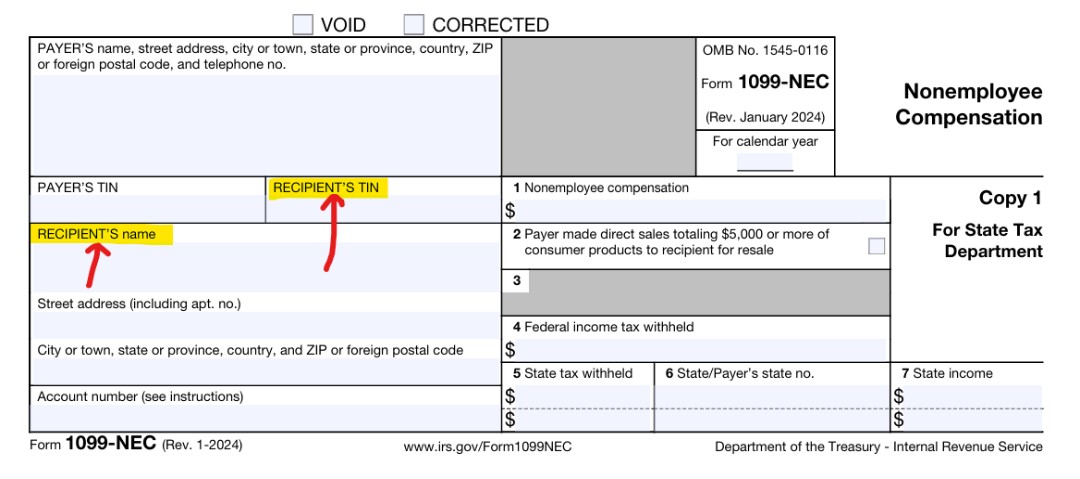
| B. | Compensation |
To receive compensation from eXp, an Agent must maintain a perfect “Name and TIN Match” across the following three platforms:
| 1. | state licensing records (name matching only) |
| 2. | the W-9 on file with eXp |
| 3. | the I.R.S. TIN Matching System |
Agents electing to be compensated through a legal entity must ensure:
| 1. | The W-9 is amended to reflect the entity’s complete legal name and Tax ID. |
| 2. | The entity is duly licensed and in good standing with the state department of licensing. |
| 3. | The entity is permitted to receive such compensation under applicable law. |
| 4. | The entity is validly formed and in good standing with the applicable state agency, such as the Secretary of State. |
eXp reserves the right to withhold 100% of any compensation* if the recipient’s name or Tax ID does not match across the required platforms, whether the recipient is the Agent or a legal entity. (For purposes of this section, the term “compensation” is all-encompassing. It includes Contractor Dollar,
eXp Realty (USA) Policies and Procedures Page 29 of 98 Version_R_USA_EN_August 2026
Ex. 10.14
Revenue Share Plan payments, equity-related awards or issuances, reimbursements, and any other fees or payments otherwise due to the Agent from eXp.)
An Agent cannot transact real estate brokerage business, for payment, in a state in which an Agent is not licensed.
All compensation, including but not limited to, retainers (that is, all fees, deposits, or other monies requested from a consumer that are to be used to retain the professional real estate services of an Agent), rental compensation, administrative fees, document storage fees, broker price opinions, and any additional fees charged to the consumer by the Agent (such as, for example, any Administrative Transaction Fee), shall be made payable to eXp and shall be subject to any applicable splits. At no time shall the Agent accept client payments made payable to themselves directly. All compensation and Agent-collected fees are subject to applicable Company Dollar and Contractor Dollar splits. (Note: Retainer fees shall be non-refundable, where permitted by law. Agents will consult with their State Broker before collecting any retainer).
Any agreement to share compensation between Agents within eXp shall be done so in writing. All agreements shall be uploaded and stored in eXp’s transaction management system. In the absence of a signed written agreement between Agents, eXp shall pay the entire Agent share of the compensation to the Agent(s) whose name(s) appear on the transactional document between the principals (to be divided equally between those Agents if more than one and not otherwise specified). Except for team disputes, eXp will make the final determination regarding compensation disputes between Agents licensed with eXp. All referrals between Agent and any other eXp-related agent must be documented on that eXp-approved Referral Agreement for use in the originating brokerage jurisdiction. For example, if an eXp Agent in Utah were to refer a client to an agent in Italy that is affiliated with eXp Italia S.r.l. (that is eXp’s affiliate operating in Italy), then that referral relationship must be memorialized in the form of Referral Agreement as used and approved by eXp in Utah. Conversely, if an agent affiliated with eXp Italia S.r.l. were to refer a client to an eXp Agent in Utah, then that referral relationship must be memorialized in the form of Referral Agreement as used and approved by eXp Italia S.r.l.
An Agent may only receive payment related to a transaction if any one or more of the following apply: (1) they are designated on the transaction paperwork as the Agent representing a party to the transaction; or (2) they have a written referral document in eXp’s transaction management system; or (3) they have the appropriate team documents on file with eXp indicating, with specificity, when and in what amounts compensation to the Agent is to be made; or (4) with the prior express written consent of an attorney within eXp’s Legal Operations Department or a Designated Managing Broker (“DMB”) (or higher) in eXp’s Brokerage Operations Department. This prohibition applies regardless of whether an Agent seeks to modify a general agreement concerning all transactions, an agreement concerning transactions within a specific category, or an agreement concerning a specific property. This prohibition extends to changes in compensation an Agent would otherwise receive even for theoretical transactions that are not yet under contract.
eXp Realty (USA) Policies and Procedures Page 30 of 98 Version_R_USA_EN_August 2026
Ex. 10.14
Any sales incentive, gift, and/or bonus received shall be paid to eXp. eXp treats bonuses, gifts and incentives as any other compensation and will pay the Agent based on the Agent’s current split.
| C. | Compensation Advances |
Compensation advance are not offered by eXp directly but may be obtained in accordance with the following procedures. All compensation advances must be approved in writing by the State Broker in advance.
| 1. | Prior to signing any compensation advance agreement, the Agent must have the listing file (with an accepted purchase and sale contract) or the transaction file uploaded in eXp’s transaction management system, and it must have passed eXp’s approval process. |
| 2. | An Agent may only receive up to 70% of the net compensation due to the Agent as a compensation advance, or an amount less than $20,000, and up to $6,000 on active listing advances. (Note: Compensation advance companies outside of eXp Solutions may offer different amounts). Exceptions to this general rule may be made on a case by case basis in extenuating circumstances, as determined by eXp in its sole and absolute discretion. |
| 3. | Agents may receive multiple compensation advances but the aggregate of all compensation advances that an Agent may have outstanding at any one time shall not exceed $20,000. |
| 4. | A $100 service charge (“Service Charge”) will be added to: 1) any advances made from a compensation advance company that is outside of eXp Solutions; and 2) and UCC liens presented to eXp from a compensation advance company seeking payment of any unpaid compensation advance(s). |
| D. | Actions for Unpaid Compensation or Procuring Cause Claims |
A decision to proceed with legal action, mediation or arbitration against a party owing compensation to eXp will be made solely at the discretion of eXp. eXp shall not have any monetary obligations to the Agent or any other party, resulting from brokerage fees and/or compensation that is uncollected. Agents may obtain independent counsel as desired to pursue and/or defend their position during mediation or arbitration. eXp shall not supply counsel to pursue these items.
Should the Agent be named in a mediation or arbitration as the respondent, eXp reserves the right to require that the total amount of the disputed compensation is held by eXp until the mediation or arbitration results are received. Should eXp and the Agent not prevail, the Agent shall pay all compensation amounts immediately to eXp.
An Agent does not have the authority to reduce, defer or replace any portion of eXp’s splits or fees without the written consent of the State Broker, or eXp.
| E. | Referral Payments and Relocation Companies |
Referrals shall only be paid to licensed Agents in conjunction with all Department of Licensing rules and regulations. However, as it pertains to any international referrals concerning jurisdictions that do not
eXp Realty (USA) Policies and Procedures Page 31 of 98 Version_R_USA_EN_August 2026
Ex. 10.14
require licensing, such referrals will be facilitated in accordance with that jurisdiction’s laws, rules, and regulations.
All referrals between an Agent and any other non-eXp agent or brokerage must be in writing and uploaded into eXp’s transaction management system.
All third-party referrals are subject to eXp split and eXp cap rules.
Outbound referral fees are taken off the top of a transaction and directed to the referral/relocation companies.
| F. | Perceived Compensation Discrepancies |
Agents shall have ninety (90) days following original disbursement of a compensation to notify eXp’s Transaction Processing Team (via email only to [email protected]) of any perceived compensation discrepancy resulting in a payment shortage to the Agent. eXp will evaluate the Agent’s notification and if eXp agrees that there has been a payment discrepancy at the Agent’s expense, eXp will correct such a discrepancy. However, if the Agent fails to timely notify eXp’s Transaction Processing Team of any such perceived compensation discrepancy within the time and manner specified, then the subject compensation payment amount will be deemed correct and final by eXp, and that amount, whatever it may be, will be used and relied upon by eXp for all purposes under the Agent’s ICA. For the avoidance of doubt, nothing in eXp’s P&Ps shall preclude eXp from reopening any matters or revisiting any files, at any time, in instances where there may have been any compensation discrepancy resulting in a payment shortage to eXp (e.g., an overpayment to an Agent); eXp reserves all rights to seek immediate reimbursement from an Agent for such amounts in such instances.
| X. | MARKETING AND ADVERTISING |
As a representative of eXp, Agents are expected to adhere to the highest standards of conduct and professionalism. This extends to all marketing and advertising activities including social media, digital, print and other forms of content used to communicate with potential clients and prospective Agents.
| A. | Compliance with Laws, Guidelines, and Regulations |
| 1. | Agents are prohibited from posting inaccurate or misleading information in all of their content whether intended for clients or prospective Agents; Agents’ marketing, advertising and communication must be completely factual. |
| 2. | All marketing, advertising, and communication, whether for property listings, Agent Attraction, or general purposes, must adhere to all federal, state, and local laws and regulations (e.g., any REALTOR® Code of Ethics, fair housing, antitrust, license, copyright, etc.), including, when using any tools or communications provided by or on behalf of eXp. This includes broad-based |
eXp Realty (USA) Policies and Procedures Page 32 of 98 Version_R_USA_EN_August 2026
Ex. 10.14
| mandates like the Telephone Consumer Protection Act (“TCPA”), including “do not call list” guidelines, the Telemarketing Sales Rules (“TSR”), the CAN-SPAM Act, Federal Trade Commission (“FTC”) rules, Securities and Exchange Commission (“SEC”) regulations, NAR antitrust practice changes (see https://www.nar.realtor/the-facts/nar-settlement-faqs), and state and national tortious interference laws, and their implementing rules and regulations (collectively, “Solicitation Laws”). For avoidance of doubt, eXp cannot and does not make any representations to Agents concerning the lawfulness of the content and/or manner of transmission of any communication or communication tools provided to Agents that may be provided or offered by eXp or any of eXp’s affiliated partners, any eXp provided lead generation vendors, or in or through any training classes or materials provided by or through any other Agent or eXp employee. Agents must consult their own legal counsel before using any eXp tools and/or communication. |
| 4. | Agents are responsible for ensuring that all advertisements are compliant with all applicable federal, state, and local laws, rules, and regulations, including, without limitation, each of the following: HUD rules and regulations, RESPA (including its implementing rules and regulations), and rules and regulations promulgated by state-level real estate regulatory bodies (such as, for example, a state’s Dept. of Real Estate, Real Estate Commission, or analogous bodies having a different name). Furthermore, Agents must adhere to the standards of the REALTOR® Code of Ethics and the rules of Boards or MLSs. |
| 5. | Agents may not use the name, likeness, or reference to or of any other Agents in their own marketing materials without first obtaining the referenced-Agent’s prior written consent. |
| 6. | In regards to communicating offers of compensation, such offers shall be at a seller’s written direction and made in compliance with eXp State P&P’s. |
| B. | eXp Brand Guidelines |
| 1. | Use of eXp logo and name are considered advertising and must comply with the eXp Brand Guidelines |
eXp Realty (USA) Policies and Procedures Page 33 of 98 Version_R_USA_EN_August 2026
Ex. 10.14
| 2. | Agents must read and comply with the eXp Brand Guidelines, which can be found on MY | eXp®, HUB, and/or on the applicable eXp website, for brand and logo usage. |
| 3. | eXp provides Agents with access to a vast library of pre-produced and pre-approved marketing and advertising content through the eXp Canva which can be found on MY | eXp®, HUB, and/or on the applicable eXp website. Agents are encouraged to utilize this tool to the furthest extent possible. All content in eXp Canva has been reviewed and approved by eXp’s Marketing, Agent Compliance, and Legal teams. Note: While eXp Canva templates are pre-approved for brand and regulatory compliance, any custom-created content or significantly modified templates must be processed through the designated compliance channel (as specified in Marketing Review and Approval, below) prior to publication. |
| 4. | Agents must properly brand their content to avoid leading viewers to believe that their website, social media profile, presentation, or other marketing content is official eXp marketing collateral. Agents must prominently identify themselves and provide their contact information on all content. Specific to websites, Agent’s name and/or team name, as well as eXp’s logo should be visible above the fold. |
| 5. | Use of the letters or trademark “eXp” or “eXp Realty” in DBA, entity names, domain names, social media handles, channel names, and other social media is prohibited (e.g., @exprealtyjohn, @exprealtytx, etc.). |
| 6. | Agents may use a combination of their name or team name along with the phrase “eXp Realty”“ to name pages on Facebook and other similar platforms (e.g., The John Doe Team – eXp Realty). |
| 7. | The use of the letters “eXp” or the name “eXp” in social media profiles or page names to claim a geographic area or specific location is prohibited (e.g., eXp of Bellingham, eXp Washington, etc.). |
| C. | Intellectual Property Rights |
eXp respects the valid intellectual property of others, and we fully expect our employees and Agents to do the same, in the same way we expect others to respect our intellectual property. Agents shall not infringe the intellectual property rights of others in the course of providing real estate agent services, including (a) avoiding the use of any trademarks that would in any way be confusingly similar to the senior trademarks of others, and (b) avoiding the use of any unlicensed images or other media of others.
| 1. | Permission to Use eXp Trademarks |
| a) | In order to keep the eXp brand strong and enforceable, eXp is required to control its use and maintain consistency and quality associated with its use. As an Agent of eXp, in the course of promotion of real estate services, Agents may only use eXp trademarks (e.g., eXp, eXp Realty, and/or the logos associated therewith), in a manner consistent with the eXp Brand Guidelines, which can be found on MY | eXp®, HUB, and/or on the applicable eXp website. |
eXp Realty (USA) Policies and Procedures Page 34 of 98 Version_R_USA_EN_August 2026
Ex. 10.14
| b) | Moreover, Agents should not do anything that would damage or dilute the goodwill associated with eXp trademarks. To the extent eXp determines that an Agent’s use of an eXp trademark is, in any way, harmful to eXp, or its trademarks, the Agent will modify his/her use immediately after notice from eXp to conform to eXp’s standards. |
| c) | eXp may revoke any permission to display eXp trademarks if an Agent does not comply with the policies in this document. |
| 2. | eXp Trademark Usage |
| a) | Agents may only use eXp trademarks to promote their activities as Agents with eXp and not for any other purpose. Prohibited uses include using eXp trademarks to promote Agent-hosted events without obtaining permission from eXp. |
| b) | Agents may not use any eXp trademarks or branding content to sell products or services online or elsewhere, such as accessories, or apparel, etc., or to promote the products or services of others, unless eXp grants a written license to do so. |
| c) | Agents should use the eXp Realty logo, together with their team name and/or team logo, in their advertising and communication content to avoid confusion with official eXp created advertising and communication. |
| d) | Agents must not use the trademark eXp, eXp Realty, EXP, or variations thereof, or any other eXp trademark, in any website domain, email address (other than provided by eXp), social media handle, or social media page. |
| e) | Agents may not use any eXp Commercial related trademark for any purposes unless they are also affiliated with eXp Commercial and subject to an eXp Commercial-specific Independent Contractor Agreement. Use of eXp Commercial-related trademarks shall be subject to those terms and conditions set forth within eXp Commercial U.S. Policies and Procedures, which, for the avoidance of doubt, is distinct and separate from the policies set forth within these eXp P&Ps. |
| f) | Agents must never register, or attempt to register, with any agency, any trademarks, business names, or legal entity names, that include the trademarks eXp, eXp Realty, EXP, or variations thereof, or any other eXp trademark, whether as a stand-alone trademark/name, or in combination with another trademark/name. |
| 3. | Unlicensed Content and Trademarks |
| a) | Agents must never use unlicensed images or other unlicensed media (e.g., photos, including photos of properties, videos, music, etc.) in promoting any real estate advertisements/listings or any real estate services. Violations of this policy may result legal costs to Agent, sanctions and potentially termination. |
| b) | Other than original media created by Agent, all media (including images, photos of properties, videos, music, etc…) used by the Agent must be acquired from a vetted and/or |
eXp Realty (USA) Policies and Procedures Page 35 of 98 Version_R_USA_EN_August 2026
Ex. 10.14
| reputable source (e.g., reputable stock image licensor, or a licensor that Agent has verified to be a reputable provider of the media with authority to grant the rights or license required for Agent’s purposes). |
| c) | Agents are prohibited from using trademarks or names in promoting their real estate services that are confusingly similar to the trademarks of others. Agents shall not infringe the trademark rights of others in promoting their real estate services. |
| D. | Marketing Review and Approval |
| 2. | Pre-Approved Templates. Agents are encouraged to utilize pre-approved templates found in eXp Canva or in the eXp Marketing Center to ensure automatic brand and regulatory compliance. |
eXp Realty (USA) Policies and Procedures Page 36 of 98 Version_R_USA_EN_August 2026
Ex. 10.14
| The availability of this supervisory tool does not relieve the Agent of their sole responsibility for the accuracy and legal compliance of their marketing materials. |
| E. | Property-Related Advertising |
All property-related advertising including yard signs, flyers, door hangers, digital ads (web, social media, etc.) may not be published or placed until eXp has the executed listing agreement and, if custom-created content, such content has been submitted through the designated compliance channel.
| 1. | Yard Signs |
| a) | Signs must comply with all local, state and federal requirements. |
| b) | Signs used must be signs designed by or expressly approved by eXp. This includes sign riders, directional signs, sold signs, and other signs as needed to support the listing. Approval can be obtained through the review process outlined above. |
| c) | Most MLSs prohibit putting up a “For Sale” sign before entering the listing in the MLS. A listing must be reported when it is taken and when it is sold within certain limitations. Agents must follow the MLS rules and comply. Any fine that results due to a violation of this policy will be paid by the Agent and not the State Broker or eXp. |
| 2. | Flyers, Door Hangers, etc. |
| a) | Printed content must comply with all local, state and federal requirements. |
| b) | Review and approval of flyers, door hangers, etc. can be obtained through the review process outlined above. |
| 3. | Online Advertisements and Content |
| a) | Agents may post property-related content to their own websites, blogs, and social media profiles and pages provided. |
| b) | Agents may use paid or boosted advertisements through social media, search engines, or other online platforms for the purchase or sale of client property. |
| c) | Agents shall ensure that all online advertising and content marketing is accurate and legally compliant prior to posting. |
| F. | MLS Advertising |
Agents are prohibited from advertising offers of compensation in a multiple listing service (“MLS”) as directed in their State P&P’s. Agents are also prohibited from using MLS data or data feeds to directly or indirectly establish or maintain a platform containing offers of compensation from multiple brokers or other buyer representatives.
eXp Realty (USA) Policies and Procedures Page 37 of 98 Version_R_USA_EN_August 2026
Ex. 10.14
| G. | General Advertising |
| 1. | In Any Medium |
Under no circumstances may an Agent hold themselves out to the public, or advertise in any medium (including, without limitation, in their email signature block, or when engaging in recruiting efforts), that they are an “owner agent” of eXp, even if the Agent owns one or more shares of stock in AGNT, Inc. For avoidance of doubt, the foregoing prohibition is entirely unrelated to, and distinct from, an Agent’s obligation to disclose and/or advertise that they are an “agent owner” of any real property that they maintain as a listing.
| 2. | Business Cards |
Unless the Agent has the express permission (through the official review process) on a design different from those provided by eXp, the Agent will use an eXp-approved design. Template designs are available to Agents in eXp Canva.
All Agent business cards will have the following identifying information on the cards:
| a) | Brokerage name. |
| b) | Agent name as it appears on state licensing documents. |
| c) | Agent title. |
| (1) | Title may include any of the following where allowed: |
| (a) | REALTOR® |
| (b) | Real Estate Professional |
| (c) | Buyer’s Agent |
| (d) | Listing Agent |
| (2) | Title may also list a professional designation as recognized by the National Association of REALTORS®. |
| (a) | CRS, ABR, SRS, RSPS, etc. |
| (3) | Agents cannot use a title that would reasonably lead someone to believe that the Agent is an employee of eXp or representing themself as an employee of eXp (e.g., Recruiter, Recruiting Manager, Vice President of Agent Attraction, Growth Leader) or any other such term or title that may cause confusion as to the Agent’s position with eXp. |
| (4) | Additional items which may be included on the front of business cards: |
| (a) | eXp provided alias email address |
| (b) | Agent’s direct phone number |
| (c) | eXp website or Agent’s careers site |
| (d) | Social media accounts such as LinkedIn, Facebook and/or Twitter |
| (e) | Personal business website or blog |
| d) | Business cards must adhere to all applicable state-specific requirements such as real estate license number(s), MLS number(s), font size, etc. |
eXp Realty (USA) Policies and Procedures Page 38 of 98 Version_R_USA_EN_August 2026
Ex. 10.14
| 3. | Social Media |
| a) | Agents must learn and abide by the terms of service of any social networks or online advertising platforms. |
| b) | Shareable social media content can be found on MY | eXp®, HUB, and/or on the applicable eXp website, and on eXp’s respective social media channels. |
| c) | Agents may not use social media to compete with eXp or engage in conduct that could create a conflict of interest. |
| d) | Social media content that is discourteous, aggressive, defamatory, discriminatory, sexually explicit, offensive, or in any other way damaging to viewers is prohibited. |
| (2) | Agents are to avoid arguments and aggressive language on social media that could leave a negative view of eXp and/or impact the Agent’s business. |
| (4) | Agents are responsible for their social media channels and content. Any violation of these policies can lead to sanctions, up to termination. |
| (1) | Agents must identify themselves as Agents, sales representatives, brokers, etc. with eXp Realty, and in accordance with state guidelines. |
| (4) | Agents must adhere to state-specific rules and guidelines for profile and page names, as well as all other content on social media networks. |
| g) | Shared statistics about eXp (Agent count, rankings, etc.) should be cited and verified with eXp before posting. |
| h) | Paid advertisements for Agent Attraction are not allowed through social media platforms or search engines. See the Agent Attraction section for more information. |
| i) | See something, say something. If an Agent sees something on social media that requires an official eXp response or violates the policies and procedures or ICA, they are |
eXp Realty (USA) Policies and Procedures Page 39 of 98 Version_R_USA_EN_August 2026
Ex. 10.14
| encouraged to contact [email protected]. The team will respond within two business days. |
| 4. | Websites |
| c) | Agents are responsible for ensuring articles, blogs, downloadable files, and all online content are accurate and not misleading. |
| d) | If content (blog post, article, etc.) is hosted on a site other than the Agent’s, review and approval is to be obtained through the Marketing Review and Approval process mentioned above. |
| (1) | Upon publication and distribution, Agents should monitor channels daily for the first week, then weekly thereafter for any false or defamatory comments. |
| (2) | Comments that are false or misleading should be removed or addressed through proper communication channels. |
| H. | Promotional Discount Advertisements |
From time to time an Agent may decide to offer and advertise promotional discounts in order to generate additional listings for themselves. Any Agent that elects to offer and advertise such promotional discounts must ensure that such advertisements clearly and conspicuously state that the promotional discount is being offered exclusively by the Agent, and not by eXp, and approved as outlined above.
| I. | Co-Marketing and Co-Listing Arrangements |
eXp does not prohibit Agents from engaging in co-marketing arrangements and/or co-listing arrangements, as between eXp, on the one hand, and a non-eXp brokerage firm, on the other hand, provided that any such arrangements conform with, and are not violative of, all applicable law, rules, and regulations. If Agents are interested in engaging in any such arrangements, they must first consult with their State Broker.
| J. | Employment Ads and Job Postings |
Agents may not create employment ads or job postings for the sole purpose of attracting prospective
eXp Realty (USA) Policies and Procedures Page 40 of 98 Version_R_USA_EN_August 2026
Ex. 10.14
Agents to grow their Revenue Share Group within eXp’s Revenue Share Plan. Advertisements for open positions may only be used to recruit prospective Agents to join a registered team in a salaried or shared compensation position or to hire individuals for paid support positions.
All employment ads or job postings must adhere to local laws and regulations, eXp policies, and National Association of REALTORS® advertising guidelines. The use of job websites, online classifieds, employment-related search engines, and paid advertisements for the purpose of posting a job or creating an employment ad is limited to the following criteria:
| 2. | Any employment ad or job posting that results in direct affiliation with eXp (i.e., an Agent joining your team who also signs an ICA with eXp) must be reviewed and approved by the State Broker and by eXp’s Agent Compliance team prior to publication. The job description must also include the following disclaimer: “[TEAM NAME] is a team of licensees independently contracted with eXp. The position in this ad is not a listing for direct employment. The earning potential, perks, benefits, and access to systems listed within this description are contingent upon the applicant signing an Independent Contractor Agreement with eXp.” |
| 3. | Employment ads or job postings for support staff (scheduling coordinator, valuation specialist, transaction coordinator, etc.) must also be reviewed and approved by the Agent Compliance team via [email protected]. Independent Contractors not affiliated with a team may also post jobs and employment ads to build their support staff. |
| 4. | An independent Agent who wishes to form a registered team may use job sites, online classifieds, or employment-related search engines to advertise for their first salaried position or Agent team member. The Agent should submit their intention to form a team and their advertisement to their State Broker and to eXp’s Agent Compliance team for review and approval prior to posting and indicate that it is an advertisement for the initial team member. |
| 5. | Agents shall not advertise under false pretenses and/or offer what appear to be positions of employment with eXp, AGNT, Inc., or any of its subsidiaries and/or advertise content which is otherwise misleading. Employment ads should include Agent team name and indication of affiliation with eXp (e.g., John Doe Real Estate Team – by, with, or of, eXp). |
| 6. | Job listings must not contain eXp branding, official images, logos, or other intellectual property with the exception of an eXp logo. Employment advertisements must not contain links to official eXp job listings or websites. |
eXp Realty (USA) Policies and Procedures Page 41 of 98 Version_R_USA_EN_August 2026
Ex. 10.14
| K. | Media Relations |
eXp has furnished Agents with the “Media Relations Guidelines and Best Practices” resource that they should read and understand before engaging with the media. This resource can be found on MY | eXp®, HUB, and/or on the applicable eXp website. Any additional questions or requests related to media relations should be sent to [email protected].
All press releases mentioning eXp must be pre-approved prior to distribution and include the following language: “[insert name] is an independent contractor of eXp and this is not an official press release of eXp, its parent company AGNT, Inc., or any related subsidiary.” Once approved via the above email address, the press release cannot be modified without additional approval for the modifications.
Please refer all media requests to talk about eXp, services, products, data, stock price, market expansion, etc. to [email protected].
Media requests about the Agent’s opinion on the local market are acceptable. Agents should refrain from speaking directly about eXp or speculating on the stock price of AGNT, Inc. We discourage Agents from discussing national industry issues or local/national competitors.
| L. | Content License And Model Release Provided By An Agent |
Unless otherwise expressly agreed upon in writing between eXp and Agent, to the extent an Agent provides to eXp or any of its affiliates or licensees (not to be confused with real estate licensees) (collectively, “eXp Licensees”), any photographs, images or content of any type created or otherwise owned by the Agent (collectively, “Agent Content”) including, without limitation, by uploading such Agent Content via any online network operated by an eXp Licensee, Agent retains ownership to such Agent Content but Agent hereby grants eXp Licensees a royalty-free, irrevocable, world-wide, perpetual, non-exclusive license to publicly display, distribute, reproduce and create derivative works of the Agent Content, in whole or in part, in any media, including on any eXp Licensee website, for any purpose, including advertising and promotion of eXp Licensee services and/or products.
eXp Realty (USA) Policies and Procedures Page 42 of 98 Version_R_USA_EN_August 2026
Ex. 10.14
| Content provided by Agent, and eXp Licensees retain exclusive and sole discretion as to whether to use such Agent Content or reject or remove such Agent Content from any online systems operated by any eXp Licensees. |
| 3. | Agent hereby waives all moral rights as to such photographs and releases and shall hold harmless eXp Licensees, and their assigns, licensees, successors in interest, agents, employees and representatives from any liability by virtue of any blurring, distortion, alteration, or use in composite form whether intentional or otherwise, that may occur or be produced in the taking of the photographs, or in any processing thereof. |
| XI. | REALTOR® ASSOCIATION AND MULTIPLE LISTING SERVICE BOARDS OF DIRECTORS |
| A. | Associations of REALTORS® |
eXp is a member of local Associations of REALTORS® where appropriate for access to MLS, access to standardize forms, and for other localized member benefits. Agents may not join a Board of Directors of any local Associations of REALTORS® without eXp first becoming a member.
| B. | Multiple Listing Services |
Agent access to their local/regional MLS is always via the broker participant; Agents cannot join an MLS without the broker first becoming a participant of the service.
When serving on the Board of Directors of an MLS, eXp Agents and regional brokers will bear in mind
eXp Realty (USA) Policies and Procedures Page 43 of 98 Version_R_USA_EN_August 2026
Ex. 10.14
that because we are a brokerage, not a franchise model, access to the MLS is conditional upon eXp’s approval. As a result, policy and business decisions regarding MLS on the national, state and local levels will conform precisely to stated eXp policies and positions and to any NAR antitrust practice changes. In the absence of a stated position, elected volunteers usually cannot go wrong by choosing consumer-friendly policies that enhance data collaboration, consolidation and the freedom of the broker to use MLS data in ways conforming to generally accepted practices on the internet.
| XII. | EXP’S REVENUE SHARE PLAN |
| A. | Overview |
eXp’s Revenue Share Plan (the “Revenue Share Plan”) provides a financial incentive to Agents who help grow sales within the AGNT, Inc. family of real estate brokerage companies. The plan is funded through eXp’s collection of Company Dollar from Qualifying Transactions.
One-half of the Company Dollar earned and received is used for eXp’s operating expenses and other management purposes (this is known as “Retained Company Dollar”), while the remaining half is placed in the “Revenue Share Pool.” Each brokerage within AGNT, Inc. has its own Revenue Share Pool, determined on a per-country basis.
eXp calculates the Revenue Share Plan across all seven Tiers, monthly. If the total amount calculated to be paid out in a given month is less than the full amount in the Revenue Share Pool (known as the, “Calculated Company Dollar”), the difference (the “Adjustment Bonus” or “Adjustment Amount”) is added to the payout. In this way, eXp ensures that all money within the Revenue Share Pool is fully paid each month. eXp reserves the right to apply the Adjustment Bonus to any Tier or combination of Tiers in its sole discretion.
[REMAINDER OF PAGE INTENTIONALLY LEFT BLANK]
eXp Realty (USA) Policies and Procedures Page 44 of 98 Version_R_USA_EN_August 2026
Ex. 10.14
| B. | Revenue Share Explained |
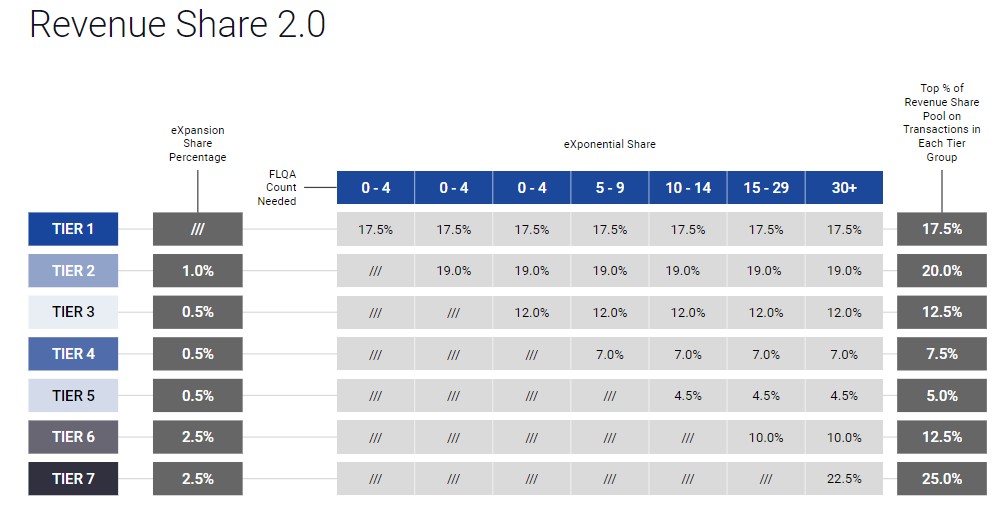
As an Agent sponsors productive agents, they earn 17.5% of the Revenue Share Pool from the Qualifying Transactions of their directly sponsored agents (Tier 1). As these agents sponsor others, additional Tiers are unlocked, allowing the Agent to earn through eXpansion Share and eXponential Share.
Example: Suppose that Agent sponsors 15 new eXp agents (Tier 1), who sponsor 25 agents (Tier 2), who sponsor 40 agents (Tier 3), and so on. If 10 of the Tier 1 agents are FLQA, the Agent unlocks earnings from Tiers 4 and 5, as follows:
| 1. | 17.5% from Tier 1 transactions. |
| 2. | 20% from Tier 2 (1% eXpansion Share + 19% eXponential Share) |
| 3. | 12.5% from Tier 3 (0.5% eXpansion Share + 12% eXponential Share) |
| 4. | 7.5% from Tier 4 (0.5% eXpansion Share + 7% eXponential Share) |
Revenue share is paid on the 22nd of each month for the previous month’s transactions. No revenue share is paid on transactions from agents in Capped Status, as no Company Dollar is generated.
| C. | Qualifications To Receive Revenue Share |
To receive both eXpansion Share and eXponential Share, an Agent must:
| 1. | Be Revenue Share Eligible at the time of payout. |
eXp Realty (USA) Policies and Procedures Page 45 of 98 Version_R_USA_EN_August 2026
Ex. 10.14
| 2. | Hold an active real estate license or registration with eXp in any area where both parties conduct business. |
| D. | Manipulating Revenue Share Plan Prohibited |
Each Agent has an obligation to act in good faith in his or her dealings with eXp. Agents shall not attempt to manipulate the Revenue Share Plan. Examples of attempts to manipulate the Revenue Share Plan include, without limitation, each of the following: (1) engaging in the practice of sponsoring Straw Agents, and (2) adding any other Agent’s name(s) to transaction documentation who was not a true party to the transaction solely for the purpose of artificially qualifying that eXp Agent as an FLQA.
eXp shall have the right and sole discretion to determine who is manipulating the Revenue Share Plan, and reserves the right to terminate Agents for such activities.
eXp will also notify an Agent that it has released the licenses of any Agent(s) that it believes are Straw Agents and review the Agent’s recruiting practices with the Agent.
If, after reviewing the recruiting practices with the Agent, the Agent continues to engage in, or appears to be engaged in, the practice of manipulating the Revenue Share Plan, the Agent may be restricted from sponsoring agents and/or released from eXp.
| E. | Revenue Share Vesting Policy |
| 1. | Achieving Vested Status |
Except as otherwise provided elsewhere in these eXp P&Ps, to become vested in the Revenue Share Plan, an Agent must satisfy each of the following two conditions for not less than 36 consecutive calendar months (the “Vesting Period”):
| 2. | Maintaining Vested Status |
Once vested, an Agent shall remain vested in the Revenue Share Plan, subject to the following additional conditions:
| a) | Within thirty (30) days from an Agent’s Offboard Date, if the Agent has achieved a vested status, as described above, the Agent must submit a request to eXp via email to [email protected] to be recognized as a vested Agent. |
| b) | For eXpansion Share: An Agent shall maintain their vested status in the eXpansion Share earned under the Revenue Share Plan from and after their Offboard Date, provided that they maintain a real estate license that is active and in good standing, even if they affiliate with a competitor (as described in the Competitor Affiliation is Prohibited section in these P&Ps). |
eXp Realty (USA) Policies and Procedures Page 46 of 98 Version_R_USA_EN_August 2026
Ex. 10.14
| c) | For eXponential Share: An Agent shall maintain their vested status in the eXponential Share earned under the Revenue Share Plan from and after their Offboard Date, provided that (i) they maintain a real estate license that is active and in good standing, and (ii) they do not affiliate with a competitor (as described in the Competitor Affiliation is Prohibited section in these P&Ps). |
| 3. | Losing Vested Status |
Despite the statements in the “Maintaining Vested Status” section, above, eXp reserves the right, as determined in its sole discretion, to withdraw an Agent’s Vested Status if any of the following conditions are true:
| a) | an Agent is convicted of a crime; |
| b) | an Agent commits or attempts to commit or admits to committing acts of moral turpitude or that are inconsistent with eXp’s core values; |
| c) | an Agent has engaged in legal action against eXp or acted in a manner that facilitates, or is in any way connected to, legal action against eXp; or |
| d) | an Agent has violated one or more obligations that survive the termination of their ICA. |
| 4. | Discretionary Regaining of Vested Status upon Reaffiliation |
If a vested Agent offboards from eXp, and subsequently re-affiliates with eXp, regardless of whether reaffiliation occurs during or after the Agent’s Original Sponsor Window (defined below), then that Agent may, in eXp’s sole and absolute discretion, be restored to their original position in the Revenue Share Plan (and regain their vested status), subject to the following conditions:
| a) | Agent re-affiliates under their original sponsor; and |
| b) | Agent did not lose their vested status for any of the reasons specified in Section 3 (Losing Vested Status), immediately above. |
The “Original Sponsor Window” is the one (1) year period beginning on an Agent’s Offboard Date, during which time, if an Agent rejoins eXp, that Agent’s Sponsor will continue to serve in the same capacity. For avoidance of doubt, Agent’s failure to satisfy the conditions of maintaining their vested status under Section 2 (Maintaining Vested Status), above, shall not adversely impact the potential restoration of Agent’s original position in the Revenue Share Plan. Agent will not be entitled to receive any “back payments”; Agent will only be entitled to receive payments arising from their original position in the Revenue Share Plan which are generated from and after Agent’s new Onboard Date.
| F. | Agent Succession Policy |
An Agent may nominate a successor to his or her position in eXp’s Revenue Share Plan (collectively, an “Agent position” or “Agent’s position”) in the event of the Agent’s death or permanent incapacitation. Upon the death or permanent incapacity of an Agent, such Agent shall automatically
eXp Realty (USA) Policies and Procedures Page 47 of 98 Version_R_USA_EN_August 2026
Ex. 10.14
be considered Vested in the Revenue Share Plan regardless of whether the Agent has met the requirements under the Revenue Share Vesting Policy.
Nomination of a successor may only be accomplished by correctly completing the “Rev. Share Position” Successor Nomination Form (the “Successor Nomination Form”), which can be found on MY | eXp®, HUB, and/or on the applicable eXp website, and submitting it to the Onboarding team (for newly joining agents) or the eXpert Care team (for existing agents), as applicable, within eXp prior to such Agent’s death or permanent incapacity. Any Successor Nomination Form(s) submitted to eXp that is/are not properly completed will not be accepted. Nomination of a successor(s) becomes effective once the Onboarding Team receives a correctly completed and signed copy of the Successor Nomination Form. Completed Successor Nomination Forms submitted by newly joining Agents shall be submitted together with the rest of their new agent documentation to the Onboarding team; all other Agents must submit their completed Successor Nomination Forms to the eXpert Care Team via email to [email protected].
Successor nomination(s) will only apply to the Agent’s position as identified by the Agent ID number provided in section 1 of the Successor Nomination Form. An Agent may nominate no more than one primary and one secondary successor at a time. A minor, trust, or entity cannot be nominated as a successor because the successor must be eligible to obtain and hold a valid real estate license. An Agent’s position may be transferred to the Agent’s secondary successor if no primary successor is living or able to accept the Agent’s position for any reason at the time of the Agent’s death or permanent incapacitation, or if the Agent’s primary successor is not approved by eXp. If both of the successors nominated by an Agent predecease the Agent then the Agent must change his or her successor nomination(s) or that Agent’s position will close upon that Agent’s death and no further successor nomination(s) will be accepted, with the exception of any surviving spouse that was not previously nominated.
It is the sole responsibility of an Agent to change any nominated successors, except that, if the Agent was married and does not nominate a successor, or no nominated successor survives the Agent, the Agent’s spouse shall be deemed to be nominated as the Agent’s successor, provided that proof of marriage or a legally recognized union be provided to eXp upon request, and provided also that the Agent’s spouse meets all of the requirements to become an approved, succeeding Agent. In the event of divorce where a former spouse was a nominated successor to an Agent, such nomination will automatically lapse and will not be recognized by eXp unless a new nomination, dated after the divorce or termination, is submitted.
An Agent can change his or her successor nomination(s) at any time by submitting one of the following to the eXpert Care Team at [email protected]: (i) a new Successor Nomination Form; or (ii) a letter of instruction to revoke the then current successor nomination(s) on file with eXp. The submitting Agent must sign and date the Successor Nomination Form or letter of instruction, as described immediately above, for his or her nomination change or revocation of nomination to be valid. A successor nomination may not be changed or revoked by will, codicil, trust, request made by email,
eXp Realty (USA) Policies and Procedures Page 48 of 98 Version_R_USA_EN_August 2026
Ex. 10.14
telephone conversation, or any method other than by the Successor Nomination Form or letter of instruction, as described above.
Before any nominated successor can be placed into another Agent’s position within eXp, the nominated successor must first be approved (through appointment) by eXp. eXp reserves the right, in its sole discretion, at any time and without prior notice, to decline to approve or accept any nominated successor for any or no reason. eXp shall not be required to approve the appointment of the nominated successor for an Agent that was not in Good Standing with eXp or for a nominated successor that is an existing Agent not in Good Standing. A nominated successor shall have a reasonable time, but in no event more than twelve (12) months from the date of Agent’s death or permanent incapacity, to become a licensed real estate professional and join eXp, which shall be determined by the nominated successor’s Onboard Date. All requests to exercise a successor’s nomination must be submitted to the Agent Compliance team via email to [email protected].
Nomination as a successor does not create any legal right(s) to, legal interests in, or any guarantee of approval and appointment as a successor by eXp. Additionally, an Agent’s position is not a property right that can be transferred through a will, trust instrument, probate proceedings, guardianship/conservatorship proceedings, divorce proceedings, sale and/or assignment, and/or any other legal process. For avoidance of doubt, an Agent’s legal representative (under a will), trustee (under a trust), attorney in fact (under a power of attorney), guardian or conservator (under a guardianship/conservatorship), or a court of competent jurisdiction (in legal proceedings), cannot nominate (or appoint) an Agent’s successor; only an Agent can nominate his or her successor by completing and submitting the Successor Nomination Form to eXp and only eXp can approve an Agent’s nomination and appoint a successor to an Agent’s position. An Agent’s position cannot be bought, sold, traded, or otherwise conveyed by an Agent; eXp reserves the right to deny approving and accepting the appointment of an Agent’s nominated successor if eXp, in its sole discretion, believes that an Agent’s position is being bought, sold, traded, or otherwise conveyed.
Any revenue share earnings that would otherwise become payable during the period of time beginning on the date of an Agent’s death or permanent incapacitation and the nominated successor’s Onboard Date (if the successor is not already an Agent), or appointment approval date (if the successor is already an Agent), shall accrue for a period not to exceed twelve (12) months following Agent’s death or permanent incapacitation. The accrued revenue share earnings shall be paid to Agent’s approved and appointed successor. If Agent’s nominated successor does not become approved and appointed on or before the twelve (12) month period, then all such accrued revenue share earnings shall lapse and will not be paid out to the Agent’s successor or held for payment at a later date.
An Agent’s position may be transferred through Agent Succession in perpetuity. If an Agent holds more than one Agent position through Agent Succession, that Agent can only earn an ICON Agent Award on one Agent position. If an Agent holds more than one Agent position, that Agent may nominate different successor(s) to each Agent position that they hold.
eXp Realty (USA) Policies and Procedures Page 49 of 98 Version_R_USA_EN_August 2026
Ex. 10.14
| G. | Modifications to the Revenue Share Plan |
The stated revenue share payout structure may be modified to allow eXp to better compete, attract and retain agents as well as to maintain a base level of profitability.
The terms and conditions of this policy, or to eXp’s Revenue Share Plan, are subject to modification as and when determined by the Executive Management of eXp and/or the Board of Directors of AGNT, Inc., without notice to or approval from Agents. An explanation about revenue sharing calculations as well as other aspects of the Revenue Share Plan can be obtained by contacting eXp’s Revenue Share Support Team at [email protected]. Notwithstanding anything to the contrary in the ICA or in eXp’s P&Ps, no modifications to the Revenue Share Plan will require eXp to provide notice of such modifications to Agents, or to obtain signatures from Agents, in order for such modifications to be binding against Agents.
**In acknowledgment of certain contributions made to eXp’s growth and infrastructure, eXp reserves the right to designate certain managing brokers, executives and key personnel as being in Good Standing with eXp notwithstanding any discrepancies that may exist from time to time between their own personal production and the criteria set forth in the ICA and the eXp P&Ps. In addition, such personnel may be deemed to be in Good Standing even though no monthly Cloud Brokerage Fee is assessed against such personnel.
| XIII. | AGENT ATTRACTION |
Agents can influence prospective Agents not yet affiliated with an eXp brokerage firm to join eXp and leverage their efforts to earn Revenue Share. “Agent Attraction” is the process of engaging credible, ethical, and productive real estate professionals and inviting them to join an eXp Brokerage (defined below).
The policies in this section are based on eXp’s core values and serve as a guide for Agents as they participate in ethical and successful Agent Attraction activities. All efforts related to Agent Attraction that violate any law, rule, or regulation on a national, state, and local level are prohibited.
| A. | Sponsorship Interference Prohibited |
| 1. | Agents are prohibited from encouraging prospective Agents already engaged in the Agent Attraction process with another Agent to change their intended sponsorship declaration. |
| 2. | It is the responsibility of each Agent to discover if a prospective Agent is already engaged in the Agent Attraction process with another Agent and shall refer them back to their prior contact as a professional courtesy. |
| 3. | Each Agent is responsible to ensure that the recipients of their Agent Attraction communication are not currently eXp Agents. These types of solicitations and any other actions encouraging a change of sponsorship by a current Agent are considered to be interference and are prohibited. |
eXp Realty (USA) Policies and Procedures Page 50 of 98 Version_R_USA_EN_August 2026
Ex. 10.14
| 4. | Agents are prohibited from encouraging existing Agents to strategically offboard from eXp; this includes the practice of encouraging existing Agents to offboard from eXp, with the intention to later rejoin eXp, but only after the closing of the Original Sponsor Window. |
| 5. | Any effort to interfere with, coerce, or otherwise unethically convince a prospective or current Agent to change their intended sponsorship declaration (or current sponsor) is subject to corrective action up to and including termination of their affiliation with, and severance, from eXp. |
| 6. | Incentives may not be used as a means to persuade a prospective Agent to change their intended sponsorship declaration. This includes offering benefits outside of eXp business model such as cash, access to paid services, gifts, office space, guaranteed leads, the payment of monthly technology and registration costs with eXp, etc. |
| 7. | Disparaging fellow Agents in an effort to persuade a prospective Agent to change sponsorship or their intended sponsorship declaration is strictly prohibited. |
| B. | Income and Lifestyle Claims |
Agents at eXp can generate income through three primary opportunities: real estate compensation, equity opportunities, and eXp’s Revenue Share Plan. When discussing these opportunities with others, Agents must ensure that any statements about potential earnings follow the income claim guidelines outlined below.
Income claims include any communication or content that shows, states, or implies how much an Agent has earned or could earn through the eXp opportunity. This includes earnings statements, visual content, presentations, social media posts, and other materials shared verbally, digitally, or in writing. Lifestyle claims, such as images or videos that imply financial success from eXp’s revenue share model, whether stated explicitly or implicitly, must follow income claim rules and include the required disclaimer.
All claims related to earning income with eXp must adhere to the following guidelines:
| 1. | Income claims must be truthful, accurate, and not misleading in any way. |
| 2. | All claims must set appropriate expectations by providing context, including the time, work, and effort required to achieve the stated or implied outcome. |
| 3. | Income claims must be accompanied by eXp’s income disclaimer statement that also includes a link to eXp’s U.S. average income disclosure chart. Agents shall place the following statement clearly and conspicuously in their content: |
“These figures are not a guarantee, representation or projection of earnings or profits you can or should expect. They also do not include expenses incurred by agents in operating their businesses. eXp makes no guarantee of financial success. Success with eXp results only from successful sales efforts, which require hard work, diligence, skill, persistence, competence, and
eXp Realty (USA) Policies and Procedures Page 51 of 98 Version_R_USA_EN_August 2026
Ex. 10.14
leadership. Your success will depend upon how well you exercise these qualities. Visit the applicable eXp website for average agent earnings and additional information about earning opportunities with eXp.”
| 4. | Agents may use eXp-produced marketing materials or create their own content to describe income opportunities. Agent-created content that includes income claims or earnings examples must be submitted for review and approval by their State Broker team and the Agent Compliance team at [email protected] before it is shared in any form. |
| 6. | The creation and use of online revenue share calculators by agents or third parties is strictly prohibited. However, agents may use the official eXp Revenue Share Calculator on MY | eXp®, HUB, and/or on the applicable eXp website, provided they follow all terms of use and guidelines set by the company. |
| C. | Recruiting |
| 1. | Except as expressly provided by eXp, in writing, real estate licensees who hang their license with eXp are the only individuals authorized to present the eXp opportunity to prospective Agents. |
| 2. | Agents may employ the services of assistants (including licensed, unlicensed and virtual) to engage in limited Agent Attraction-related activities provided they adhere to these guidelines: |
| a) | Assistants may not actively recruit individuals or present eXp opportunity. |
| b) | Compensating individuals, in any manner, either directly or through affiliation, who are not real estate licensees affiliated with eXp, to recruit or attract agents to eXp is strictly prohibited. Agents shall not hire or engage any third parties for the purpose of engaging in recruitment or attraction activities on that Agent’s behalf. |
| c) | Assistants may set appointments for the Agent who employs them to present eXp opportunity to prospective Agents. |
| d) | Assistants must clearly identify the Agent or team they are representing, provide opt-out instructions, and present the Agents’ contact information to the prospective Agent they are communicating with. For example, if an assistant is engaged by a particular Agent and not by eXp (as a company), that assistant cannot say that they are calling on behalf of eXp; they may only say they are calling on behalf of the Agent on whose behalf they are engaged. |
| e) | The hiring of assistants whose responsibilities will include participation in the above Agent Attraction activities must comply with the policies found in these eXp P&Ps (respectively titled “Agent Assistants - Unlicensed,” and “Agent Assistants – Licensed”) that regulate the utilization of assistants. |
eXp Realty (USA) Policies and Procedures Page 52 of 98 Version_R_USA_EN_August 2026
Ex. 10.14
| 3. | The use of agents, hired agents, staff, recruitment companies or other similar third-party services to send unsolicited text messages, emails, place phone calls, etc. is not allowed in the Agent Attraction process. |
| 4. | Compensating individuals, in any manner, who are not real estate licensees affiliated with eXp, to recruit or attract agents to eXp is strictly prohibited. An Agent shall not hire or engage any third parties for the purpose of engaging in recruitment or attraction activities on such Agent’s behalf. |
| 5. | Agents may utilize prospective-agent prospect lead-generating services provided that the prospective-agent leads have given permission to be contacted and the initial contact with such leads is in compliance with the terms and services of platforms where the contact takes place and adheres to any applicable laws such as the Solicitation Laws. Lead-generating services and their representatives may not present the eXp opportunity. |
| 6. | Agents are prohibited from offering cash or stock incentives as a means to recruit prospective Agents. However, Agents may offer to help cover some de minimis transition (trivial or minor) expenses such as, new signs, business cards, etc. |
| 7. | Unless expressly authorized by eXp’s Agent Compliance Group, in writing, Agent-created content that includes comparative advertising of eXp to a competing real estate brokerage is prohibited. |
| D. | Sponsorship |
| 1. | Definition and Responsibilities |
The Revenue Share Plan is a way for eXp to say “thank you” to Agents who attract serious and productive professionals who fit culturally with eXp and its core values. Once a joining Agent selects a Sponsor and joins eXp, their Sponsor enters into a financial relationship with eXp where eXp pays a percentage of Company Dollar to that individual in the form of revenue share. If the Sponsor leaves eXp, that financial relationship is severed and their position in the Revenue Share Plan reverts to eXp.
It is the right of a prospective Agent to identify and select the individual they choose to name as their Sponsor. The Sponsor is the Agent who a joining Agent (sometimes referred to as a “Sponsee” in this context) identifies as the person who most influenced them to join eXp. This declaration is made during the process of completing the ICA. An Agent’s sole requirement to qualify as a Sponsor is selection by the joining Agent as the individual who most influenced them to join eXp. While Sponsors are encouraged to support joining Agents throughout the joining process and beyond; Sponsors are not required to do so. The role of Sponsor is distinctive from other roles like a mentor, coach, or team leader. In some cases, these roles are assumed by the same person, but they are not mandatory for a Sponsor. A Sponsor has no binding authority, on behalf of eXp, as it pertains to establishing or modifying the terms of any relationship between Agent and eXp.
eXp Realty (USA) Policies and Procedures Page 53 of 98 Version_R_USA_EN_August 2026
Ex. 10.14
| 2. | Change Requests |
In order to maintain the integrity of eXp’s Revenue Share Plan, eXp may only grant changes in sponsorship in very limited situations. Changes in sponsorship are only permitted under very extraordinary conditions that meet one or more of the criteria below. Except in situations with extenuating circumstances as determined by eXp, sponsorship change requests must be submitted to eXp via email at [email protected] within thirty (30) business days of the Onboard Date of the Agent requesting the sponsorship change.
Sponsorship change request criteria:
| a) | Errors |
| (1) | Clerical, administrative, or system errors on the part of eXp. |
| (2) | Misidentification of sponsoring Agent by eXp or joining Agent (e.g., John Smith as opposed to Jon Smith). |
| (3) | Omission of sponsor name during the enrollment process (if requested by eXp, in its sole discretion, Agent may be required to provide evidence of prior relationship with the requested sponsor and their attraction efforts). |
| (4) | Sponsor change requests within the same Revenue Share Group in cases where the Agent has misidentified sponsor as the upline/team leader (requires written approval from the current sponsor). |
| b) | Misconduct |
| (1) | Misleading or fraudulent attraction efforts where a prospective Agent is led to believe they are signing up under a specific individual, but the listed sponsor is another Agent not previously discussed or disclosed to the prospective Agent. |
| (2) | Sponsorship change based on improper enrollment of the prospective Agent without their authorization or signing up a prospective Agent without disclosing eXp as the brokerage. |
| c) | Brokerage Migration |
| (1) | In situations where an independent brokerage moves to eXp and the joining Agent had previously been with eXp and is still within the Original Sponsor Window, eXp will allow the joining Agent to select a new sponsor under the joining team. |
Agents wishing to leave eXp of their own volition (and not at the prompting of any other eXp Agent) in order to change their selected sponsor must remove their license from eXp and allow the Original Sponsor Window to expire before they can rejoin under a different sponsor. If the Agent returns before expiration of the Original Sponsor Window, the Agent must name their original sponsor.
Sponsorship changes outside of the preceding criteria will only be made at eXp’s discretion. All other sponsorship selections, placements, and decisions are considered irrevocable.
eXp Realty (USA) Policies and Procedures Page 54 of 98 Version_R_USA_EN_August 2026
Ex. 10.14
| 3. | Co-Sponsor |
To provide better support for new Agents, eXp offers a “Co-Sponsor” option alongside existing sponsor concepts. When joining eXp, an eligible new Agent may select a “Co-Sponsor” (provided that Agent has also selected a Sponsor). While a Sponsor remains that individual who most influenced Agent to join eXp, a Co-Sponsor is an existing Agent who agrees to take on extra responsibilities to support the new Agent (sometimes referred to as a “Sponsee” in this context). When a Sponsee selects a Co-Sponsor, two things will happen:
First, and from the perspective of a Sponsor, that Sponsee and each individual within that Sponsee’s Revenue Share Group will move down one Tier within eXp’s Revenue Share Plan. For example, prior to selecting a Co-Sponsor, Sponsee was a “Tier 1” of their Sponsor; but, after selecting a Co-Sponsor, Sponsee becomes a “Tier 2” of their Sponsor.
Second, and from the perspective of a Co-Sponsor, that Sponsee and each individual within that Sponsee’s Revenue Share Group will make a lateral move under Co-Sponsor within eXp’s Revenue Share Plan. For example, prior to selecting a Co-Sponsor, Sponsee was a “Tier 1” of their Sponsor; but, after selecting a Co-Sponsor, Sponsee becomes a “Tier 1” of their Co-Sponsor.
Additional terms and conditions pertaining to the “Co-Sponsor” option are available for viewing on MY | eXp®, HUB, and/or on the applicable eXp website.
Unless otherwise specified on MY | eXp®, HUB, and/or on the applicable eXp website, the same limitations and conditions that apply to changing Sponsors also apply to changing Co-Sponsors, including application of the “Original Sponsor Window” (which shall apply to a Co-Sponsor in the same way it does to a Sponsor).
| E. | Agent Prospects, Contacts, and Leads |
Agents shall not engage in the unlawful recruitment of prospective Agents, including, but not limited to, intentionally and knowingly encouraging or facilitating a franchise broker/owner to (i) abandon their franchise prior to the expiration term in the franchise agreement or (ii) otherwise breach their franchise agreement to affiliate with eXp. Any violation of state or national law during Agent Attraction activities is, at eXp’s exclusive election, grounds for termination of an Agent’s ICA with eXp or exclusion from participation in eXp’s Revenue Share Plan.
Agent Attraction contacts and leads must be sourced and managed appropriately in accordance with the following guidelines:
| 1. | Agent is responsible to verify that Agent prospect contacts and leads are not currently Agents who are licensed with eXp. “Blind” attraction efforts between existing Agents may constitute interference and are strictly prohibited. |
| 2. | Agents are prohibited from harvesting prospective Agent contact information from databases |
eXp Realty (USA) Policies and Procedures Page 55 of 98 Version_R_USA_EN_August 2026
Ex. 10.14
| such as the MLS, Boards, or other sources in order to broadcast attraction-related information to large groups through mass emailing, robo-dialers, text messages, mailers (flier), online messenger, or other channels. |
| 3. | Leads and contacts obtained from third-party services or other forms of recruiting assistance must be verified by the Agent as having given permission to be contacted regarding eXp opportunity. It is the sole responsibility of the Agent to certify this information. |
| 4. | Prospective Agent contacts must knowingly opt-in to receive information regarding eXp opportunity and must be provided with easily-accessible means to opt-out of future solicitations related to Agent Attraction. Agents must honor opt-out requests promptly and cease further contact. Outreach must be performed in accordance with the Solicitation Laws, and all other applicable federal, state and local guidelines, and their implementing rules and regulations. Transmitting unsolicited voice and text messages (as well as other forms of communication) is heavily restricted and regulated under the Solicitation Laws and other federal laws and regulations as well as various state and local jurisdictions’ laws and regulations. Each Agent should consult their legal advisor to ensure compliance with the Solicitation Laws. |
| 5. | Agents shall not engage in the unlawful recruitment of prospective Agents, including, but not limited to, intentionally and knowingly encouraging or facilitating a franchise broker/owner to (i) abandon their franchise prior to the expiration term in the franchise agreement or (ii) otherwise breach their franchise agreement to affiliate with eXp. Any violation of state or national law during Agent Attraction activities is, at eXp’s exclusive election, grounds for termination of an Agent’s ICA with eXp or exclusion from participation in eXp’s Revenue Share Plan. |
| F. | Attraction Marketing and Communication |
| 1. | All content (both offline and online) related to Agent Attraction must adhere to the guidelines and approval process found in the Marketing And Advertising section of these eXp P&Ps. |
| 2. | Any communication for the purpose of Agent Attraction (whether solicited or unsolicited) through email, telephone, text message, social media, messenger, etc. must be done so in adherence with national, state, and local laws that regulate communication including, but not limited to, the Solicitation Laws. |
| 3. | Social Media |
| a) | Paid ads for the purpose of Agent Attraction through social media, search engines or other online advertising platforms are prohibited. |
| b) | Agents are encouraged to leverage their social media networks and execute their own organic social media campaigns to share the eXp opportunity. |
| c) | Accurate and truthful representation in professional profiles, whether online or otherwise, |
eXp Realty (USA) Policies and Procedures Page 56 of 98 Version_R_USA_EN_August 2026
Ex. 10.14
| is required. Agents must avoid using titles which would reasonably lead someone to believe that they are an employee of eXp or representing themselves as an employee of eXp. |
| 4. | In-person and online meetings must be advertised and conducted in accordance with our core values of transparency and integrity. Agents must deliver on advertised content and avoid “bait and switch” tactics to entice attendees to join an Agent Attraction event. |
| a) | “Lunch and Learns”, webinars, conference calls, and other similar opportunities must be advertised and executed in such a way that prospective Agents do not feel deceived or misled in any way. If Agents host such events the intent to share eXp opportunity must be clearly stated in all communications advertising for the event. |
| b) | Paid ads for Agent Attraction are not allowed. Therefore, any event with the intention of Agent Attraction may not be advertised through paid means. These types of events may be shared organically through social media, through opted-in email lists, etc. |
| c) | If an Agent event provides education or training on a real estate-related topic (not Agent Attraction), you may advertise (paid and non-paid) for this event. At the conclusion of an Agent-hosted event you may let attendees know that you will be taking a short break allowing them to leave. If they choose to stay, you may then engage those who remain in the Agent Attraction process after a clear break has been taken from your original presentation. The intention and spirit of this provision is that an Agent cannot advertise for an attraction event; consequently, Agent cannot “bait and switch” by advertising for an education or training event on a real estate-related topic, provide token coverage of that topic, and use the balance of that event to engage in the attraction process. |
| G. | Reporting Agent Attraction Violations |
It is at eXp’s sole discretion to determine if a practice not mentioned in the policies above is aligned with its culture and core values. eXp reserves the right to ask Agents to discontinue any Agent Attraction practice that it deems to be in conflict with these policies and procedures and eXp’s core values.
Agents must abide by the articles set forth in the National Association of REALTORSⓇ Code of Ethics, eXp’s Core Values, and these eXp P&Ps. Agents must always represent eXp and its business model with the highest degree of accuracy, integrity, and professionalism. Agent Attraction and participation in the revenue share plan is a privilege and not a right.
Any violation of these guidelines must be reported to the Agent Compliance team by email at [email protected].
| H. | Stock Solicitations Prohibited |
As a business having a parent corporation with publicly traded common stock, eXp is subject to requirements relating to the substance and manner of public communication. Federal securities laws
eXp Realty (USA) Policies and Procedures Page 57 of 98 Version_R_USA_EN_August 2026
Ex. 10.14
generally require that, in the absence of an exemption, offers to buy stock, and solicitations regarding stock, need to be preceded by a filed registration statement relating to the offer. All Agents of eXp shall follow the guidelines below (in addition to the AGNT, Inc. Insider Trading Policy, also below) for the protection of eXp and those affiliated with it. Failure to adhere to these guidelines will result in immediate release from eXp.
| 1. | All directors, officers, employees and Agents are subject to SEC Insider Trading regulations which include the obligation not to disseminate confidential information of eXp. |
| 2. | Agents cannot solicit interest in, or encourage others to buy AGNT, Inc.’s stock, or promote AGNT, Inc.’s stock or stock’s growth as the basis for encouraging others to join eXp, unless expressly authorized by AGNT, Inc. and pursuant to applicable securities laws. |
| 3. | Agents should only discuss the equity program or similar stock incentives according to official eXp literature. |
| 4. | Agents may not post their equity account balances on social media whether it is in the form of a screenshot, a graphic, or in a text description. This prohibition also extends to inclusion in presentations, videos, and other content that is used for Agent Attraction. |
| 5. | Agents must adhere to all guidelines found in the Income Claims section of the eXp P&Ps when discussing, presenting, or sharing their participation in the equity opportunities with eXp both in public and private conversations (including social media). Agents are encouraged to direct potential Agents to eXp approved resources or publicly available information. |
| I. | Event Sponsorship Requests from Vendors |
From time to time, opportunities may arise for vendors to sponsor local events for eXp (for example, and without limitation, eXp Regional Rallies events). Individuals that are not eXp Agents may or may not attend such local events. By contrast, EXPCON events are not “local” events for purposes of this section of this eXp P&Ps.
If Agent learns of a vendor that desires to sponsor a local event for eXp (hereinafter, a “Potential Local Sponsor”), the Agent will ask their State Broker to submit a sponsorship request to eXp’s Brokerage Operations department at least two weeks prior to the event. eXp reserves all rights to refuse such sponsorship by a Potential Local Sponsor for any reason. At NO time is the Agent to handle the funds without written approval from eXp’s Brokerage Operations department (through one of its Regional Directors).
If the Potential Local Sponsor is not a participant in eXp Solutions (formerly referred to as Affiliated Services, and Preferred Partners), eXp will not advertise or otherwise promote Potential Local Sponsor in eXp World, on eXp communication platforms, in eXp’s newsletters, or in eXp-generated emails; however, an acknowledgement of the Potential Local Sponsor’s sponsorship (in the form of a “thank you”) may be made on eXp communication platforms, in eXp’s newsletters, and in eXp-generated emails.
eXp Realty (USA) Policies and Procedures Page 58 of 98 Version_R_USA_EN_August 2026
Ex. 10.14
| XIV. | COMPANY TOOLS AND INFORMATION |
| A. | eXp Communication and Training Platforms |
Through eXp communication platforms, MY | eXp®, and eXp World, eXp provides best practices in different parts of the business. It is the responsibility of the Agent to stay up to date on the latest policies and procedures, as well as the latest best practices relative to working with any tools and services eXp has deployed or is being recommended for Agents to use.
| 1. | Agents shall not give out usernames or passwords or any other access to any internal or eXp provided third party system. |
| 2. | Agents may not share any recorded video (e.g., event instances in eXp World, sessions from eXp Shareholders Summit, sessions from eXpCON, etc.) intended for internal use by eXp without receiving written approval from eXp. |
| 3. | When hosting a session in eXp World, Agents may record the session but only with the consent of the attendees, and eXpUniversity.com (if applicable). |
| 4. | Distribution of recorded or captured content through websites and social media (e.g., Facebook, LinkedIn, YouTube, etc.) is not allowed without eXp’s written consent. |
| 5. | eXp reserves the right to limit the use of any video content to the extent eXp determines in its sole discretion that the video content does not contain accurate information about eXp or does not accurately represent eXp’s desired image or brand. |
| B. | eXp Communication Platforms |
eXp communication platforms are core internal tools used by eXp and its Agents to communicate, collaborate, share information, and foster community. In keeping with eXp’s Core Values – particularly Community, Collaboration, and Transparency – all users are expected to engage respectfully, responsibly, and professionally. The following guidelines apply to all Agents’ use of these platforms to ensure a safe, productive, and compliant digital environment.
| 1. | Agent Conduct Guidelines |
| a) | Prohibited Content: Agents may not post or share content that is aggressive, defamatory, discriminatory, sexually explicit, offensive, or otherwise harmful to the eXp community. This includes public spaces, private groups, and direct messaging features. Content of this nature may be removed, and disciplinary action may follow. |
| b) | Professionalism: Disparagement of fellow Agents, eXp staff, eXp leadership, or competitors is strictly prohibited. |
| c) | Solicitation and Promotion: Self-promotion, marketing of services or merchandise, and recruiting other Agents is only permitted in designated, approved areas. Posting |
eXp Realty (USA) Policies and Procedures Page 59 of 98 Version_R_USA_EN_August 2026
Ex. 10.14
| promotional content in non-designated areas or using direct messaging for solicitation without prior consent is not permitted. |
| d) | Unsolicited Outreach: Agents may not use eXp communication platforms to “cold message,” recruit, or send unsolicited promotional messages to other users through direct messaging, group chats, or public feeds. |
| e) | Mass Notifications: The use of platform-wide notification features (e.g., “@channel,” “@everyone,” “@all,” “@here,” or similar broadcast tags) must be strictly limited to urgent, business-critical, or universally relevant communication. Utilizing these features for marketing, self-promotion, or non-essential announcements is prohibited. |
| 2. | Creation and Management Guidelines |
Digital workspaces, groups, and events are designed to foster professional collaboration. Agents may create or join these spaces provided they adhere to the following universal standards:
Naming and Branding: Titles for groups, spaces, or events must be professional, avoid vulgar or crude language, and must not imply “Official” eXp-corporate status. Specifically, titles shall not include the terms, “eXp,” “ICON,” or “Referral” (unless specifically approved in writing by eXp), nor should they include any other terms that suggest an eXp-approved lead generation program. |
b) | Neutrality and Core Values: In alignment with our commitment to an inclusive environment, user-created spaces and events should remain professional and business focused. Titles and descriptions should not be political or religious in nature. |
c) | Invitation and “Opt-In” Integrity: Agents must respect the digital boundaries of others. Specifically, mass-inviting users to events, “auto-adding” users to groups without their prior consent, and utilizing features that trigger unsolicited email notifications and calendar invites are all strictly prohibited. Mass notifications must only be directed to audiences with a direct, established interest in the content, such as members of a group the Agent specifically administers. |
d) | Approved Promotional Areas: Events or groups focused on marketing products, services, or merchandise should only be created or shared within designated “Marketplace” or “Promotion” areas as defined by the current platform. |
e) Procedural Compliance: Additional administrative requirements and operational standards for the use and management of these platforms are maintained in eXp’s official resource centers and are incorporated herein by this reference.
eXp Realty (USA) Policies and Procedures Page 60 of 98 Version_R_USA_EN_August 2026
Ex. 10.14
| 3. | Reporting & Oversight |
eXp maintains administrative oversight of all eXp communication platforms to ensure a professional and secure environment.
| a) | Reporting Violations: Users are encouraged to utilize integrated platform reporting tools to flag content that violates these policies. In the absence of an automated reporting feature, or for sensitive matters, concerns should be reported to [email protected]. |
| b) | Jurisdiction: All interactions on eXp communication platforms are subject to eXp’s P&Ps, inclusive of its Code of Conduct. This applies to all digital interactions, including public forums, restricted groups, and private direct messages. |
| c) | Remediation and Discipline: eXp reserves the right to moderate, archive, or remove content and groups at its discretion. Violations of these guidelines may result in a loss of platform access, formal warnings, or further disciplinary action in accordance with Agent’s ICA. |
| C. | eXp World |
Even though eXp World is a virtual work environment it should be treated as a professional place of business. Appropriate workplace etiquette must be observed including the personal conduct and behavior of all users. Agents shall adhere to eXp’s Code of Conduct, Core Values, and avoid any actions or content that are argumentative, discourteous, or otherwise unprofessional while in eXp World.
Agents should also become familiar with the platforms’ Terms of Service and Privacy Policy found on MY | eXp®, HUB, and/or on the applicable eXp website. Failure to adhere to these guidelines could result in disciplinary action.
| D. | eXp Email for Agents |
eXp provides to each Agent an eXp email alias, also known as a forwarding or alternate email address, that is configured to forward to the personally owned and controlled email address an Agent provides to eXp for purposes of conducting eXp business. eXp email aliases do not have a mailbox of their own, and instead only forward all incoming emails to an Agent’s personal email address. Email aliases may be delivered by various providers from time-to-time as requirements and costs dictate. eXp email aliases enable forwarding to other email addresses and systems. eXp does not and cannot access Agent personal email accounts and only receives logs of forwarding activity related to each eXp provided email alias. eXp provided email aliases are not configured for sending email from the provided email alias, Agents are responsible for that configuration. Agents are responsible for ensuring their respective eXp email alias forwards incoming email to their correct email account, so that important communication from eXp, their State Broker, and/or actual or prospective clients is not missed.
eXp Realty (USA) Policies and Procedures Page 61 of 98 Version_R_USA_EN_August 2026
Ex. 10.14
For avoidance of doubt, eXp employees use eXp provided email accounts using the “@exprealty.net” email domain to communicate with Agents and other eXp employees, and to conduct eXp business, as opposed to Agents’ eXp email aliases which use the “@exprealty.com” email domain.
Agents are strongly encouraged to use email security best practices to protect their email accounts from unauthorized access and avoid wire fraud attempts. Agents are also strongly encouraged to use the Wire Fraud Email Notice Template provided by the National Association of Realtors® at https://www.nar.realtor/law-and-ethics/wire-fraud-email-notice-template.
| XV. | ICON AGENT AWARD |
The ICON Agent Award is aimed at attracting and incentivizing top Agents into eXp.
The ICON Agent Award provides each qualified “ICON” with publicly traded AGNT, Inc. common stock upon the achievement of certain production and cultural goals within an Agent’s Anniversary Year. The ICON Agent Award Program is subject to approval by the Board of Directors each year. Full qualification details can be found by visiting the ICON Agent Award webpage on MY | eXp®, HUB, and/or on the applicable eXp website. An Agent is not eligible to receive an ICON Agent Award (or receive ICON status), unless the Agent is in Good Standing with eXp.
| XVI. | EXP MENTOR PROGRAM |
Generally, if an Agent has not completed three purchase Transactions or sale Transactions (or any combination thereof) within the twelve (12) month period immediately preceding the Agent’s Onboard Date (collectively, the “Mentor Program Requirements”), the Agent will be required to participate in the eXp Mentor Program, as a mentee, upon transfer of their license to eXp. In that event, Agent will be required to enter into the eXp Mentor Program Addendum to ICA, the form of which will vary depending upon the state in which the Agent is licensed. Notwithstanding the preceding, eXp reserves the right to require an Agent to participate in the eXp Mentor Program, as determined in its sole discretion. eXp reserves the right to require any Agent to re-enroll in the eXp Mentor Program as may be required by applicable law. If an Agent enrolled in the eXp Mentor Program has not been assigned a mentor, then that Agent’s mentor shall be that Agent’s State Broker. eXp may share the mentee’s personal contact information with other Agents that provide assistance in the eXp Mentor Program.
| XVII. | EXPRESSOFFERS INVESTOR REFERRAL FEE |
Agents desiring to participate in eXp’s ExpressOffers program and generate additional referral fees by referring investors to eXp must first complete the ExpressOffers training and enter into the ExpressOffers Investor Referral Addendum to Independent Contractor Agreement.
eXp Realty (USA) Policies and Procedures Page 62 of 98 Version_R_USA_EN_August 2026
Ex. 10.14
| XVIII. | MULTI-GLOBAL LICENSE PROGRAM |
| A. | Background |
The AGNT, Inc. family of real estate brokerage companies is comprised of the following brands: eXp® Realty and eXp® Commercial. Each brand conducts its own in-country operations through specific brokerage companies that are licensed or registered to engage in the real estate brokerage business in their particular jurisdiction (whether country, state, province, region, etc.) (each, an “eXp Brokerage”). Except as it pertains to the brokerage companies operating under the eXp® Realty (USA) brand, and eXp® Commercial (USA) brand, respectively, each eXp Brokerage operating outside of the United States maintains its own form of Independent Contractor Agreement that is to be used by any individual desiring to affiliate with that eXp Brokerage, in that jurisdiction, for the purpose of engaging in real estate brokerage activities on that eXp Brokerage’s behalf in that jurisdiction.
| B. | Multi-Country Affiliation (Generally) |
The “Multi-Global License Program” is applicable in instances where an Agent desires to affiliate with two or more eXp Brokerages, each in a different country (e.g., with eXp Commercial, LLC in Arizona, and with eXp Italia S.r.l. in Italy). The Multi-Global License Program is not applicable in instances where Agents that are or desire to become affiliated, (1) with two or more eXp Brokerages within the same brand and operating within the same country (e.g., with eXp Realty, LLC in Arizona, and with eXp Realty of California, Inc. DBA “eXp Realty” in California), or (2) with two or more eXp Brokerages across different brands and operating within the same country (e.g., with eXp Commercial, LLC in Arizona, and with eXp Realty of California, Inc. DBA “eXp Realty” in California).
| C. | Agents’ Additional Affiliation |
Under our Multi-Global License Program, Agents are permitted to affiliate with any eXp Brokerages, provided that, (1) the eXp Brokerages are in different countries, and (2) the Agent satisfies all of the terms, conditions, and requirements of each such eXp Brokerage. By affiliating across national borders with more than one eXp Brokerage, an Agent automatically becomes subject to all of the terms and conditions of the Multi-Global License Program.
| D. | Agents’ Independent Obligations |
Unless other terms apply, all Agents participating in the Multi-Global License Program shall abide by all monetary, policy, and contractual obligations imposed upon them by each eXp Brokerage with whom they are affiliated. An Agent’s affiliation with more than one eXp Brokerage will not excuse that Agent from any of his or her payment or performance obligations to any other eXp Brokerage with whom the Agent is affiliated. Agents’ payment and performance obligations to each eXp Brokerage are distinct obligations. So, for example (and without limitation), Agents will have to pay all fees imposed upon them by each eXp Brokerage with whom they are affiliated; Agents will have to honor all policies and procedures applicable to each eXp Brokerage with whom they are affiliated; and Agents will have to
eXp Realty (USA) Policies and Procedures Page 63 of 98 Version_R_USA_EN_August 2026
Ex. 10.14
honor the terms and conditions of each Independent Contractor Agreement to which they are a party.
| E. | “Capped Status” Matters |
Unless other terms apply, all matters concerning achieving a “Capped Status,” as applied by each eXp Brokerage with whom an Agent is affiliated, shall co-exist and apply independently. An Agent’s Company Dollar Cap, Capping Period, Cap Reset Date, and Anniversary Year, will be applied separately as between each eXp Brokerage with whom the Agent is affiliated. This means, for example, that if an Agent is affiliated with two eXp Brokerages, that Agent can (and likely will) have two different Cap Reset Dates, Capping Periods, and/or achieve a Capped Status at two different times (if at all), and so on. In addition, Company Dollar earned and collected from an Agent by any eXp Brokerage with whom that Agent is affiliated will not be aggregated with Company Dollar earned and collected from the Agent by any other eXp Brokerage with whom that Agent is affiliated (for the purpose of determining whether the Agent is considered to be in a Capped Status in any country). For example, assume that an Agent is affiliated with two eXp Brokerages, namely eXp Realty, LLC (in the USA) and eXp Italia S.r.l. (in Italy). If the Agent has satisfied all of the requirements to reach a Capped Status under eXp Italia S.r.l., then the Agent shall be considered to be in a Capped Status with respect to only eXp Italia S.r.l., and not with respect to eXp Realty, LLC. Company Dollar collected by eXp Realty, LLC (in the USA) will not be combined with any Company Dollar collected by eXp Italia S.r.l. for the purpose of determining whether that Agent is to be considered in Capped Status at eXp Italia S.r.l.
| F. | ICON Agent Awards |
All matters concerning ICON Agent Awards, as applied by each eXp Brokerage with whom an Agent is affiliated, shall co-exist and apply independently. Agents can earn an ICON Agent Award in each country where an Agent is affiliated with an eXp Brokerage, according to each such eXp Brokerage’s own rules. However, earning an ICON Agent Award in one eXp Brokerage does not mean that an Agent has or will earn an ICON Agent Award in any other eXp Brokerage.
| G. | Sponsor; FLQA; Initial FLQA Period |
Agents cannot have more than one Sponsor at any given time when associated with any eXp Brokerage (i.e., Agents can only have one Sponsor, regardless of how many eXp Brokerages they are affiliated with). Agents shall only be considered an FLQA once, at any given time, for their Sponsor. The Initial FLQA Period shall only apply one time, and with respect to that particular eXp Brokerage with whom an Agent first satisfies the applicable FLQA requirements. We have no obligation to notify any Sponsor that an Agent sponsored by that Sponsor, is a participant in the Multi-Global License Program.
| XIX. | LEGAL, INSURANCE, AND COMPLIANCE WITH THE LAW |
| A. | Antitrust |
The amount or rate of real estate compensation is not fixed by law. They are set by each Agent
eXp Realty (USA) Policies and Procedures Page 64 of 98 Version_R_USA_EN_August 2026
Ex. 10.14
individually and may be negotiable between a buyer or seller, and Agent.
eXp is a full service real estate brokerage company. As such, compensation rates of eXp are determined by each Agent on a transaction by transaction basis, and such rates are to be based on the value of the services provided and competitive market conditions. Compensation rates are determined solely by agreement between the Agent and the selling party or buying party. Agents shall not participate in any discussions with individuals affiliated with any other company concerning the compensation rates charged by eXp or any other real estate company. When soliciting a listing or negotiating any agreement, Agents shall not make any reference to “prevailing” or “standard” compensation rates in the market or any other words that suggest that the compensation rates are uniform, standard, set by law, or otherwise non-negotiable. Any advertised compensation rate for service must be clear and prominent, and specify that it is the Agent (or team) that is setting the compensation rate, and not eXp. Listing Agents shall work with sellers to determine the buyer-broker compensation to be offered, if any.
| B. | Conflicts of Interest |
Agents shall avoid engaging in activities that would result in a question of business ethics or a compromise in the Agent’s loyalty to eXp or clients. Questions regarding potential conflicts must be directed to the Agent’s State Broker. When purchasing an eXp listing, it must be disclosed in the contract that the Agent is a member of eXp. Additionally, no Agent shall be involved in any form of settlement service or receive income or benefits “for value” directly from a settlement service company while actively licensed with eXp. Buyer Agents shall enter into a written agreement with the buyer prior to touring a home and shall not filter out or restrict listings communicated to customers or clients based on the existence or level of compensation offered.
| C. | Data Security and Client Privacy |
Agents will come in contact with personal and confidential information in the day-to-day course of their business. All Agents of eXp are expected to become familiar with and follow a course of action concerning the transmission, handling, storage, and disposal of all personal and confidential information that is in alignment with all local, state, and federal laws regarding data security and client privacy. Agents may have multiple roles with regard to data privacy and security depending on the stage of the client relationship. For example, Agents may engage with many prospective clients and build a book of contacts that have not entered into a contractual relationship with eXp. In this example, Agent is determining the data collection and processing activity and must do so in accordance with applicable law. Once a client enters into a contractual relationship with eXp, Agent now plays a dual role where Agent is asked by eXp to process specific data to complete a transaction and such data must be processed in accordance with applicable law and eXp’s Privacy Policy and Data Processing Policy, which may be found by visiting MY | eXp®, HUB, and/or the applicable eXp website. Agents are encouraged to review the National Association of REALTORS® Data Security and Privacy Toolkit found at https://www.nar.realtor/data-privacy-security/nars-data-security-and-privacy-toolkit (including its Cybersecurity Checklist: Best Practices for Real Estate Professionals found at
eXp Realty (USA) Policies and Procedures Page 65 of 98 Version_R_USA_EN_August 2026
Ex. 10.14
https://www.nar.realtor/law-and-ethics/cybersecurity-checklist-best-practices-for-real-estate-professionals), and to adopt those “best practices” presented by the National Association of REALTORS®. If an Agent fails to secure their client’s data and confidential information, the Agent will defend, indemnify, and hold eXp, and its principals and affiliates harmless against any and all claims, complaints, or actions that may arise from such a departure. In addition, failure to comply with this Policy is grounds for the immediate release of the Agent’s license and removal from eXp.
| D. | Do Not Call Rules |
Agents must stay up-to-date on rules relating to the National Do Not Call Registry (See: www.ftc.gov/donotcall), as well as all anti-spam laws and regulations (See: www.ftc.gov/enforcement/rules/rulemaking-regulatory-reform-proceedings/can-spam-rule).
Cold calling must be done in compliance with applicable state and national laws. Any fines that result from any violation of the “do not call” law or any other solicitation law will be paid for by the Agent who broke said rule.
Agents are encouraged to leverage “eXp Dial Safe” for scrubbing of all telephone numbers against applicable Do Not Call lists prior to making initial contact. “eXp Dial Safe” may be located via MY | eXp® or via Okta dashboard and provides Agents the ability to scrub against the Canadian National Do Not Call List, the United States National Do Not Call List, and each of the United States’ state specific Do Not Call Lists, e.g. the Louisiana Do Not Call List.
| E. | Drones |
Agents who desire to use drones must be familiar with and follow all Federal Aviation Administration (FAA) drone rules, and any other applicable laws and regulations. (See: www.faa.gov/uas for more information.)
| F. | Drug and Alcohol Use |
| 1. | Illegal Drugs. Agents shall not be under the influence of illegal drugs while representing eXp. |
| 2. | Prescription or Over-the-Counter Medication. eXp shall not preclude Agents from being under the influence of prescription or over-the-counter medication while representing eXp, provided that, (a) their ability to represent eXp, including the servicing of our clients, is not compromised; (b) the health, welfare, and safety of eXp clients, eXp agents, and all other persons, is not compromised; and (c) their behavior would not be considered unbecoming of an eXp representative, or otherwise disrepute or negatively impact eXp’s reputation. |
| 3. | Alcohol. Agents shall not be under the influence of alcohol while performing real estate brokerage services. However, and except as provided in the preceding sentence, eXp shall not preclude Agents from being under the influence of alcohol when representing eXp outside of the scope of performing real estate brokerage services (such as at agent attraction events where |
eXp Realty (USA) Policies and Procedures Page 66 of 98 Version_R_USA_EN_August 2026
Ex. 10.14
| alcohol may be served), provided that, (a) their ability to represent eXp is not compromised; (b) the health, welfare, and safety of eXp clients, eXp agents, and all other persons, is not compromised; (c) their behavior would not be considered unbecoming of an eXp representative, or otherwise disrepute or negatively impact eXp’s reputation; and (d) they are of legal drinking age. |
Agents shall also discourage the use of drugs or alcohol by any party when making decisions or taking action concerning a Transaction. Upon discovering that a party is under the influence of either drugs or alcohol, Agents should take appropriate action to terminate that day’s activity and suggest that they discuss or complete the Transaction another time.
| G. | Harassment |
eXp takes all forms of harassment seriously. This includes but is not limited to verbal, physical or sexual. All reported or suspected occurrences of harassment will be promptly and thoroughly investigated. Any Agent that is found to have harassed another Agent, employee, client, customer, or any member of the public shall be immediately, and without warning, released from eXp at eXp’s sole discretion.
If an Agent feels they have been harassed in any way, the Agent shall notify the State Broker or a member of the corporate team immediately.
eXp will not permit or condone any acts of retaliation against anyone who files harassment complaints or cooperates in the investigation of the same.
| H. | Prohibition on Changes to Compensation Splits and Referral Fees During Legal Action; No Split Checks |
When a lawsuit, garnishment, or other legal action has been served upon eXp, or eXp has been made aware that such an action is pending, any Agents that are a party to such legal action shall be prohibited from changing any compensation split agreement(s), including, but not limited to, Team Agreement(s), existing referral agreements with fellow Agents, co-listing agreements, etc., without the prior express written consent of the Agent’s State Broker. This prohibition applies regardless of whether the Agent seeks to modify a general agreement concerning all transactions, an agreement concerning transactions within a specific category, or an agreement concerning a specific property. This prohibition also extends to changes in compensation that the Agent would otherwise receive, even for future transactions, listing assignments, or co-listings until no further legal action is pending.
For so long as an Agent is not in Good Standing or has any legally required withholdings (such as, for example, garnishments, tax levies, child support orders, or UCC-1 liens from unpaid compensation advances) being withheld from an Agent’s compensation or other earnings from eXp, that Agent shall not partake in receiving a “split check” in states where such practices are permitted.
eXp Realty (USA) Policies and Procedures Page 67 of 98 Version_R_USA_EN_August 2026
Ex. 10.14
| I. | Products and Services |
Agents may not offer any non-eXp business plan, opportunity, product or incentive (including any multi-level marketing programs) utilizing any eXp platform such as eXp World or otherwise in conjunction with offering eXp products or services.
| 1. | Selling, Offering To Sell, Or Promoting Any Competing Products Or Services |
Agents may not directly sell, offer to sell or directly promote to other Agents competing products or services. Any product or service in the same generic category as an eXp product or service is deemed to be competing.
| J. | Reporting Problems |
It is understood that Agents, though operating as independent contractors, act as agents of eXp and must, therefore, keep eXp informed of their activities. Agents shall immediately, but in no event longer than five (5) calendar days after the time that they become aware of any of the following situations, bring any of the following situations to their State Broker’s attention and provide eXp with copies of any correspondence or legal process in connection with such situations. Failure to timely notify the State Broker and eXp may, in certain circumstances and in eXp’s sole discretion, result in termination of Agent’s ICA and disaffiliation from eXp.
| 12. | Any notification received from the state real estate licensing authority regarding the status of an Agent’s real estate license. |
eXp Realty (USA) Policies and Procedures Page 68 of 98 Version_R_USA_EN_August 2026
Ex. 10.14
Pre-Existing Matters Disclosure Requirement: During the onboarding process, each Agent must disclose any of the following matters to eXp:
| 1. | Any past or pending criminal charges, or civil or criminal judgments against themselves (including, without limitation, DUIs and felonies), but excluding minor traffic infractions. |
| 2. | Any past or pending lawsuits, legal actions, or unresolved disputes related to Agent’s real estate activities, prior real estate brokerage(s), or real estate compensation payments. |
| 3. | Any past or pending interactions with a real estate licensing authority that have adversely impacted, or have the potential to adversely impact, Agent’s real estate license. |
Failure to disclose such pre-existing matters during the onboarding process may, in eXp’s sole discretion, result in immediate termination of Agent’s ICA and disaffiliation from eXp.
| K. | Legal Action Between eXp Agents |
No Agent shall file a Civil or Administrative Action (defined in the ICA) against any other Agent affiliated with the eXp family of real estate brokerage companies (including eXp Realty, LLC, eXp Commercial, LLC, and/or eXp International Holdings, Inc., and any of their respective subsidiaries, divisions, affiliates, or assigns) for any issue arising out of or relating to the actual or alleged real estate brokerage activity of that other Agent without providing seven (7) days prior written notice to their own State Broker advising of their intent to do so and identifying, with specificity, the basis of the Agent’s dispute with the other Agent. To the extent there is any dispute as between two or more Agents, of a real estate nature (for example, but without limitation, compensation disputes, referral fee agreement disputes, procuring cause disputes, REALTOR® Code of Ethics disputes, etc…), such disputes may be resolved through eXp’s own “internal dispute resolution” procedures; this option shall not apply to any disputes among members of any particular team. Agents should reach out to their State Broker for details on this process.
In addition, an Agent shall provide written notice to their own State Broker within twenty-four (24) hours following their own filing of a Civil or Administrative Action advising of the occurrence of such filing. An Agent’s failure to comply with the foregoing notice requirements shall constitute a material breach of these eXp P&Ps. Nothing in this section shall prohibit an Agent from notifying a licensing or other governmental entity of allegations that he or she is required by law to report. However, all requirements in this section must be complied with to the maximum extent possible, with performance excused only to the extent that he or she is legally required to take some action which precludes compliance with a particular requirement in this section.
| L. | Legal Action Against eXp Prohibited |
By acknowledging and accepting the terms within these eXp P&Ps, each Agent represents, warrants, and covenants to eXp that they will not cause or participate in the filing of any Civil or Administrative Action against eXp, its holding companies, and it’s or their respective subsidiaries, affiliates, directors,
eXp Realty (USA) Policies and Procedures Page 69 of 98 Version_R_USA_EN_August 2026
Ex. 10.14
officers, managers, members, or employees. Each Agent acknowledges and agrees that the filing of any such Civil or Administrative Action shall constitute a material breach of these eXp P&Ps, and that eXp may thereafter terminate the offending Agent’s ICA in accordance with its terms, as determined by eXp in its sole and absolute discretion. Nothing in this section shall prohibit any Agent from notifying a licensing or other governmental entity of allegations that he or she is required by law to report. However, all terms in this section must be complied with to the maximum extent possible, with performance excused only to the extent that he or she is legally required to take some action which precludes compliance with a particular requirement in this section.
| M. | Claims Reimbursement |
Each Agent shall be responsible for and shall reimburse eXp up to $2,500 (two thousand five hundred dollars) incurred in the defense or resolution of any claim made against that Agent and/or eXp as a result of the Agent’s actions or inactions (except for any procuring cause claims), regardless of whether or not the claim is eligible for insurance coverage. Even where the Agent does not believe the claim or cause of action has merit and/or does not believe any money should be expended in the defense or resolution of the matter, the Agent expressly agrees in advance, by signing his or her ICA, that he or she will reimburse eXp up to $2,500 expended in defense or resolution of the matter within thirty (30) days of receipt of a request for reimbursement from eXp. An Agent may elect to have all or any portion of the reimbursable amount withheld from any compensation and/or revenue share payments due to the Agent in lieu of making payment directly to eXp. However, if an Agent does not reimburse eXp directly within the thirty (30) day period then eXp shall deduct the full amount due from any and all compensation and revenue share payments due to the Agent until eXp has been fully reimbursed. If it is determined that an Agent acted fraudulently, grossly or recklessly negligent, or willfully, the Agent shall be responsible for the full amount of the damages and costs recovered against eXp, along with all costs of defense. This language in no way limits the liability of an Agent to eXp and in no way limits any covenants or conditions stated in an Agent’s ICA.
| N. | Claims That Are Not Covered By Real Estate E&O Insurance |
eXp’s real estate errors and omissions (“E&O”) insurance extends coverage to eXp Agents solely in the performance of real estate sales and leasing services for a fee or compensation. All eXp Agents should be aware and understand that eXp’s E&O insurance policy, like many others, has certain limitations and exclusions and only provides insurance coverage for specific types of claims. It is particularly important for eXp Agents to know that there are certain types of claims that, when made against eXp or an eXp Agent, are not covered under eXp’s E&O insurance policy. Some of these uninsured claim types include, but are not limited to:
| 1. | Claims made under the Telephone Consumer Protection Act (“TCPA”), including “do not call list” guidelines, the Telemarketing Sales Rules (“TSR”), the CAN-SPAM Act, Federal Trade Commission (“FTC”) rules; |
| a. | Example: An eXp Agent makes cold calls or text messages to prospects but does not follow one or more of the above laws; these claims are not covered by any insurance |
eXp Realty (USA) Policies and Procedures Page 70 of 98 Version_R_USA_EN_August 2026
Ex. 10.14
| available on the market and carry hefty statutory fines, which means there is no defense to these claims outside of proving that you did not place the call(s) or send the text message(s); |
| 2. | Personal injury claims; |
| a. | Example: A person slips and falls, injuring themselves while at a property and the person claims the eXp Agent is at fault for their alleged injuries; an eXp Agent’s for sale sign in the yard falls over and injures someone, etc. |
| 3. | Intellectual property infringement claims, including copyright infringement; |
| a. | Example: An eXp Agent uses a photo or image on their website that they have not obtained permission to use. |
| 4. | An eXp Agent’s Personal Transaction, regardless of whether eXp or the eXp Agent/Owner earned a fee or compensation; |
| a. | Example: A buyer makes any kind of claim against an eXp Agent in a Transaction where the eXp Agent was selling a property they owned (or had any kind of interest in) or controlled and neither eXp nor the eXp Agent earned a compensation on the Transaction. |
| 5. | Class action claims of any kind whatsoever. |
eXp Agents should determine whether they want, or are required by their state regulations, to obtain their own individual insurance coverage for activities such as those listed in the examples above.
Lastly, like most insurance policies, eXp’s E&O insurance policy will not cover claims in which it is determined that eXp’s or an eXp Agent’s actions were fraudulent, grossly or recklessly negligent, or willful.
| XX. | OFFICE POLICIES |
| A. | Agent Business Expenses |
eXp shall not be responsible for any expense incurred by Agents in the performance of their business duties unless approved in advance and in writing by the State Broker. No inducements, including inspections or other services associated with real estate brokerage services customarily paid by customers or clients, shall be offered or paid by an Agent without advance approval by the State Broker, and then shall be at the Agent’s sole expense. An Agent shall disclose, in writing, any compensation or profit received or to be received by such Agent (whether directly or indirectly), in connection with any expenditures advanced on behalf of that Agent’s client.
| B. | Agent Assistants - Generally |
eXp fully supports the use of licensed and unlicensed assistants (which include transaction
eXp Realty (USA) Policies and Procedures Page 71 of 98 Version_R_USA_EN_August 2026
Ex. 10.14
coordinators) by the Agents. By delegating tasks that may be performed by those other than the Agent, the Agent’s time can be spent more efficiently on tasks directly related to maximizing earning potential. eXp advises all Agents using assistants to seek legal counsel regarding employment laws and obligations within their state.
All assistants, whether licensed or unlicensed, must have their own individual login credentials to any eXp-supported platforms or systems, including, but not limited to, eXp’s CRM of Choice, transaction management systems, communication tools, and cloud-based environments. Shared usernames or passwords are strictly prohibited, and all logins must comply with eXp’s identity management and Single Sign-On (SSO) protocols.
Agents must have a written contract with their assistants. Said contract must be submitted to the State Broker for approval within ten (10) business days of joining eXp or entering into an agreement for these services. Copies of the contract are to be filed in the Agent’s file.
Assistants (including transaction coordinators) are to be compensated for their services directly by those Agents with whom they are respectively engaged. Assistants that are licensed with eXp are to be paid for their services through escrow. Agents shall not use the services of any licensed assistants that are licensed with any real estate brokerage company other than eXp.
| C. | Agent Assistants - Unlicensed |
Agents are responsible for training their assistants, making sure they are familiar with and abide by all eXp policies and procedures and all federal and state regulations. The Agent must review these eXp P&Ps with the assistant and present a copy of the eXp Agent and Assistant Cloud Brokerage Access Agreement (“Access Agreement”) to the assistant, for their review. An unaltered copy of the Access Agreement that has been signed by both the Agent and assistant shall be returned to the Agent’s State Broker, and must be approved and signed by that State Broker before the assistant may access any eXp systems. To the extent that an Agent grants any assistants with access to any eXp systems, without first securing the State Broker’s prior written consent in the manner provided above, then eXp may exercise any rights or remedies (including terminating the Agent’s ICA) as provided in the Agent’s ICA or these eXp P&Ps.
An unlicensed assistant may not perform the following tasks or duties, including but not limited to:
eXp Realty (USA) Policies and Procedures Page 72 of 98 Version_R_USA_EN_August 2026
Ex. 10.14
An unlicensed assistant may:
| D. | Agent Assistants - Licensed |
Licensed assistants must be licensed with eXp and with no other real estate brokerage company. Licensed assistants are bound by the same licensing requirements as an Agent including, but not limited to, executing an ICA and fully associating themselves with eXp. They shall pay all fees due under their ICA and follow all policies and procedures of eXp. Licensed assistants may only assist other Agents and may not work for or with any agents outside of eXp.
| E. | Administrative Transaction Fees |
Agents are free to determine whether or not they will assess their respective clients an administrative transaction fee (“Administrative Transaction Fee”), provided that doing so is not precluded by applicable federal or state law, please refer to your State P&Ps for guidance. An Administrative Transaction Fee is a fee amount, determined by each respective Agent, that consists of an Agent’s cost of doing business (e.g., costs for any assistants and transaction coordinators used in a transaction). The Administrative Transaction Fee is distinct from and in addition to any real estate compensation to be earned by eXp and the Agent. If an Agent elects to assess his or her clients an Administrative Transaction Fee, they must first receive each such client’s prior written consent; a sample form, referred to as an “Administrative Transaction Fee Agreement,” is available by request to the Agent’s State Broker. If working with a buyer, this consent must be signed prior to showing any property. The Administrative Transaction Fee Agreement must be signed by each such client before an Administrative Transaction Fee may be assessed, and each must specify all of the following:
| 1. | that the Agent has the discretion to establish, set, and assess each or any of his or her clients an Administrative Transaction Fee; |
| 2. | that eXp does not require its Agents to charge any Administrative Transaction Fee, and that eXp does not establish the amount of any Administrative Transaction Fee to be charged by any of its Agents; |
| 3. | that the Administrative Transaction Fee amount may fluctuate from client to client depending upon the specific costs incurred and/or additional services rendered by the Agent; |
| 4. | that the Administrative Transaction Fee is separate from, and in addition to, any real estate compensation to be earned by eXp and the Agent; |
| 5. | the exact amount of the Administrative Transaction Fee to be assessed to the respective client; |
eXp Realty (USA) Policies and Procedures Page 73 of 98 Version_R_USA_EN_August 2026
Ex. 10.14
| 6. | the time that the Administration Transaction Fee will be due and payable, whether at closing or prior to the Agent’s rendering of any brokerage related services. |
If used by an Agent, the fully executed Administrative Transaction Fee Agreement must be uploaded into eXp’s transaction management system. Administrative Transaction Fees are subject to the same Contractor Dollar/Company Dollar split applicable to an Agent at the time of receipt of payment of the Administrative Transaction Fee. Administrative Transaction Fees may also be considered part of a referral fee that is to be paid to an outside company or vendor.
| F. | Associations and Board Memberships |
Unless specifically waived by eXp in an addendum to an Agent’s ICA, all Agents must be members (active and in good standing) of the National Association of REALTORS®, as well as both the state and local Association of REALTORS® where that respective Agent is situated. An Agent’s participation in an MLS is optional and is not required by eXp, unless eXp will be charged a fee as a result of that Agent’s license being affiliated with eXp, in which event that Agent’s participation will be required. If an Agent holds real estate licenses in more than one state, that Agent may, in eXp’s discretion, be required to join each state Association of REALTORS® in such additional states, as well as one or more local Association(s) of REALTORS® and/or MLS(s) in such additional states, as determined by eXp.
Subject to the foregoing paragraph, an Agent shall maintain an active membership in a local association or board of REALTORS® affiliated with the National Association of REALTORS®, as determined by eXp, unless that Agent maintains an active membership in the Real Estate Board of New York (“REBNY”) and/or the Brooklyn MLS.
Any state that requires eXp to pay the Agent’s portion of the membership dues will be handled accordingly. For any REALTORS® associations that require eXp to pay membership fees upfront on behalf of an Agent, that Agent shall reimburse eXp within 10 days of invoice for the same. Agents who fail to timely reimburse eXp will be subject to removal from eXp.
Agents who are billed directly by the Association and MLS are expected to pay those bills in a timely manner as directed by the Association and MLS. eXp will not pay late dues on behalf of the Agent and the Agent will be subject to removal from eXp. Please check with your State eXp P&Ps for state specific information and any variances to this policy.
Agents shall abide by the REALTORS® Code of Ethics and Standards of Practice of the National Association of REALTORS®, the statutes and rules of the state within which they are licensed, and any requirements of the MLS of which they are a member.
| G. | Contact Information |
Agents MUST use their legal name as it appears on their real estate license in all advertising, on contracts and in all real estate correspondence. Agents using any name other than their full legal name
eXp Realty (USA) Policies and Procedures Page 74 of 98 Version_R_USA_EN_August 2026
Ex. 10.14
may only do so if allowable within their state and must have the State Broker’s approval.
Agent’s business address is the eXp office address in the state in which the Agent’s license is registered. Agents must use this address in all activities if an address is required by the state licensing department. All business correspondence related to transactions must be sent to this address, not to the Agent’s home. No personal mail may come to the office. Any mail coming to the office will be considered official business and subject to being opened by the State Broker or admin team. Agents shall make arrangements to pick up any parcels that are delivered to the office by vendors and will work to properly inform all vendors that parcel deliveries are to be scheduled directly with the Agent. All unclaimed parcels are subject to disposal within seven (7) days of delivery.
Escrow companies, title companies and other closing agencies must send all communications pertaining to a transaction to our company address. Agents may receive a duplicate copy of escrow documents for the file.
Agents are solely responsible for keeping their personal contact information (including mailing address, forwarding email address used to forward Agent’s eXp email alias to, and telephone number) current in MY | eXp®. eXp will rely upon the information provided by an Agent, in MY | eXp®, as being true, correct, and complete. Agents can update their forwarding email address, telephone number, and emergency contact information directly in MY | eXp®. Any failure by an Agent to provide or maintain the most current information in MY | eXp® shall not affect the validity of any notice from eXp to the Agent.
| H. | Contacting the State Broker(s) |
Each state has a different State Broker, as a result, please review any state specific information with regard to broker communication. Each State Broker will make themselves available inside of eXp World for general communication and discussions. Consult the State Broker’s public calendar or State P&Ps for their availability.
If an Agent has a specific urgent need for the State Broker to address outside of business hours, the Agent should call or email the State Broker directly.
| I. | Open Houses |
Agents shall only hold open houses for other eXp Agents. No open houses shall be held for any listings other than eXp listings or For Sale By Owner where written authorization has been given and where prospective buyers complete a “touring agreement” or an eXp Single Property, Buyer-Broker Representation Agreement. Agents holding open houses for sellers who do not have their house listed for sale must have appropriate state approved documentation completed giving them the right to do so. eXp listings shall only be held open by other eXp Agents who are appropriately licensed and acting within their area of expertise for the geographic location of the listing.
eXp Realty (USA) Policies and Procedures Page 75 of 98 Version_R_USA_EN_August 2026
Ex. 10.14
| J. | Out of Town or Unavailable |
When an Agent has listings and/or open escrows and is out of town, or otherwise unable to provide services to clients, the Agent is required to notify the State Broker and fill out the appropriate company form establishing someone to manage the business in Agent’s absence.
| K. | Physical Office Space |
eXp has a cloud-based office and as such does not invest in physical bricks-and-mortar infrastructure, except where required by the State Department of Licensing laws. Agents are encouraged to contact their local affiliates, title and escrow companies, lenders, banks and other organizations with whom they work if they need physical space to meet clients.
Where allowed by law and Association/Board rules, Agents who have achieved the level of associate broker and have agreed to policies relating to the opening of an eXp office may, with approval from eXp, be permitted to have a branded eXp office. Agents shall be responsible for compliance with all local and state laws regarding their branch office. This includes, but is not limited to, meetings, licensing, advertising, and signage requirements.
eXp may itself open and operate, or authorize the opening and operation of, an eXp office (“Branch Office”). Any Branch Office that eXp authorizes an Agent to open and operate will be paid for by the Agent or Agents who have agreed to open that office, and no obligation relating to that office will transfer to eXp. Any financial obligation with regard to opening and/or maintaining a Branch Office will be at the expense of the Agent(s) who opened the Branch Office including any fines for non-compliance and renewal fees.
Please ask the State Broker for the Branch Office Agreement and talk to the State Broker to see if the Agent qualifies. Branch Offices must be pre-approved in writing (through a Branch Office Agreement) by eXp prior to operation, advertising, or opening. Except for any Branch Offices that have been approved by eXp, Branch Offices shall not be situated within any Agent’s (or other person’s) personal residence.
[REMAINDER OF PAGE INTENTIONALLY LEFT BLANK]
eXp Realty (USA) Policies and Procedures Page 76 of 98 Version_R_USA_EN_August 2026
Ex. 10.14
| L. | Data Privacy & Artificial Intelligence (AI) Use Policy |
| 1. | Purpose. |
To establish clear standards for safeguarding personal and confidential clients or customer information and to provide guidance on the ethical and compliant use of Artificial Intelligence (AI) tools in the course of real estate practice.
| 2. | Definitions. |
(Only for purposes of this Data Privacy & Artificial Intelligence Use Policy)
| ● | Personal Information (PI): Any information related to or linked with a client or customer, including name, address, phone number, financial details, email, and digital identifiers. |
| ● | Confidential Information: Information related to a real estate transaction that is not publicly known and must be protected in fulfillment of eXp’s fiduciary duties. |
| ● | Artificial Intelligence (AI) tool: Any software, application, or system that analyzes information or generates output using algorithms, machine learning, or natural language processing, with or without human prompts. |
| 3. | Agent Responsibilities. |
| ● | Collect only the minimum necessary clients or customer information for each Transaction. |
| ● | Retain client or customer information in secured, encrypted tools, including the applicable transaction management system or other software provided by eXp. |
| ● | Never disclose clients or customers or client/customer data (written, verbal, or digital) to third parties without written consent, unless legally required. |
| ● | Immediately report data breaches or suspected unauthorized access to the Designated Managing Broker and to eXp IT Security at [email protected]. |
Fair Housing laws and regulations must always be followed. It is each Agent’s responsibility to safeguard and protect client and customer personal information (PI). State and Local rules and regulations are ever evolving and must be adhered to in the implementation of AI as a business practice.
| 4. | Permissible Use of AI with Client and Customer Data. |
| ● | The following use cases are offered as examples only and Agents must use their own best judgment as it relates to using AI tools and client and customer personal information in accordance with fair housing laws and regulations and other applicable law: |
| o | Drafting listing remarks, marketing materials, or transaction summaries without including personal information (PI). |
| o | Assisting with contract drafts, templates, or standard documents where clients or customers, or personal information is anonymized. |
| o | Analyzing market trends, property data, or comparable sales using aggregated or public data only. |
| o | NOTE: AI tools should be used as assistants, not decision-makers. Human review is required for any clients or customers or client/customer-facing material. |
eXp Realty (USA) Policies and Procedures Page 77 of 98 Version_R_USA_EN_August 2026
Ex. 10.14
| 5. | Prohibited AI Use Involving Client and Customer Data. |
| ● | Agents are strictly prohibited from entering personal information or Confidential Information into “public” or “free” versions of AI tools (e.g., free tiers of ChatGPT, Claude, or Gemini) and any other license tier where the provider’s Terms of Service allow for the use of user-entered data to train future iterations of the model. Agents must ensure that any non-eXp provided AI tools do not transmit or store client personal information in non-U.S. jurisdictions or unknown cloud environments. |
| ● | The following prohibited use cases are offered as examples only and Agents must use their own best judgement as it relates to using AI tools and client and customer personal information in accordance with fair housing laws and regulations and other applicable law: |
| o | Upload or enter client or customer personal information or financial information into AI platforms that are not explicitly provided by eXp. |
| o | Use AI to predict buyer/seller motivations, personal preferences, or financial capabilities based on characteristics of protected classes (e.g., race, gender, religion). |
| o | Use AI to generate automated communication to clients or customers that impersonates Agent without clear disclosure. |
| o | Allow AI tools to transmit or store client or customer information in non-U.S. jurisdictions or unknown cloud environments that are not controlled and limited to U.S. locations, including backups. |
| o | Use AI to generate or disseminate false, deceptive, or misleading content, including fake reviews, impersonation without consent, or misrepresentative media such as deepfakes. |
| o | Employ AI for profiling or automated decision-making that may have a legal or significant impact on a client or customer, such as lending, housing, or eligibility decisions, without human oversight, transparency, and legal disclosure. |
| o | Utilize AI for any purpose prohibited by law, including harassment, discrimination, political campaigning, social scoring, or behavioral manipulation. |
| 6. | Company Tools & Security Practices. |
| ● | Agents must only use AI or Customer Relationship Management (Customer Relationship Management (CRM)) tools that: |
| o | Have published data privacy and retention policies. |
| o | Use end-to-end encryption. |
| o | Do not retain user-entered data for training purposes without explicit consent. |
| ● | All devices (laptops, phones, tablets) used to access client or customer information must have: |
| o | Active antivirus software |
| o | Two-factor authentication (2FA) |
| o | Automatic lock screens when idle |
| ● | eXp does not review AI tools or any other software that is purchased by an Agent. It is the Agent’s sole responsibility to ensure that their use of AI tools and any other software is in compliance with applicable law. |
eXp Realty (USA) Policies and Procedures Page 78 of 98 Version_R_USA_EN_August 2026
Ex. 10.14
| 7. | AI & Disclosure Requirements. |
| ● | When AI is used in any form of communication with clients or customers, or the public, Agent must ensure the following disclosure is clearly and conspicuously provided: “Important: This is an automated AI tool and not an eXp agent. It does not provide legal, financial, or real estate advice and does not represent you in any transaction. Please consult directly with your eXp agent before making decisions.” |
| ● | Agents are responsible for consulting the State P&Ps for specific disclosure verbiage, placement requirements, and font sizes that may be mandated by state law (e.g., California or Colorado), which may include “side-by-side” photo requirements. |
| ● | Any fines assessed to eXp pertaining to an Agent’s failure to follow AI disclosure mandates set forth in the State P&Ps shall be reimbursed by that Agent, all at eXp's sole discretion. |
| ● | All advertising generated or assisted by AI must comply with truth-in-advertising, fair housing, and state-specific marketing regulations. |
| ● | Any AI-driven voice, text, or electronic messaging must comply with telecommunications and anti-spam laws, including obtaining prior legal consent and providing clear identification and opt-out options. |
| 8. | Data Security & Confidentiality. |
| ● | Prohibition of Sensitive Data Input - Agents are strictly prohibited from entering any Personal Information (PI), confidential client data, financial documents, or signed legal agreements (including but not limited to FinCEN forms, listing agreements, and offers) into public third-party generative AI tools. |
| 9. | Human Oversight & Fact-Checking. |
| ● | Mandatory Human Verification - While AI may be used to assist in drafting, the Agent holds sole, non-transferable accountability for the accuracy of all data points. Before publishing or sending any AI-assisted content, Agents must first independently verify that all material facts generated by any AI tools (such as property dimensions, zoning, tax amounts, and property history), are true and correct, and conform to the data reflected in the records of credible and authoritative sources. Relying blindly on AI-generated data may constitute a regulatory violation. |
| 10. | Virtual Staging & Visual Media. |
| ● | Watermarks - Any listing photographs, virtual tours, or video media that have been digitally altered, enhanced, or virtually staged using generative AI tools are strongly encouraged, but not required, to be watermarked with the text “Virtually Staged” or “Digitally Rendered” directly on the image. |
| ● | Labels via Listing Remarks and Metadata Tags – As a mandatory minimum standard, all AI-altered photos must be labeled using both a disclosure in the listing remarks and a backend metadata tag (e.g., “Virtually_Staged_Bedroom”). However, where required by |
eXp Realty (USA) Policies and Procedures Page 79 of 98 Version_R_USA_EN_August 2026
Ex. 10.14
| applicable law or local MLS rules, stricter local disclosure requirements apply, such as displaying the original, unaltered photo directly adjacent to the altered version. |
| ● | Local Policy Compliance - Agents must consult their specific State P&Ps for local requirements regarding disclosure verbiage, placement constraints, and font sizes. |
| ● | Prohibition of Deceptive Alterations - AI tools must never be used to conceal physical defects, structural issues, or environmental hazards of a property. Doing so may constitute “misleading” advertising or representations under applicable law (such as the Federal Trade Commission Act, federal antitrust laws, or state consumer protection and unfair trade practices laws). |
| 11. | Broker Oversight & Enforcement. |
| ● | The brokerage reserves the right to audit the Agent’s use of AI tools (including, without limitation, use of eXp’s proprietary automated review bot) and data handling practices at any time. |
| ● | AI agents or “bots” may interact with the public. However, in instances where Agent is not immediately available to supervise the interaction (e.g., after business hours), Agent must review all automated communications as soon as reasonably possible to ensure accuracy and compliance. Agent remains legally responsible for the accuracy and compliance of all AI-generated content as if Agent had authored it personally. |
| ● | Violations of this policy may result in disciplinary action, including: |
| o | Retraining or compliance coursework |
| o | Written warnings |
| o | Suspension or termination of Agent affiliation |
| XXI. | TEAMS AT EXP REALTY |
| A. | Generally |
A “team” is generally defined, in most states, as a lead Agent (“team leader”) and at least one other Agent working as a team member (“team member”). For more information on teams, Agents may review eXp’s, “Teams at eXp Realty - Understanding Types and Compensation” informational sheet and eXp’s, “Teams at eXp Realty Policy” available on MY | eXp®, HUB, and/or on the applicable eXp website; or contact eXp’s Team Services Department at [email protected].
| B. | Team Names |
Team names shall conform with the real estate licensing laws and rules in effect in the state(s) in which the team name is being used. A team leader shall select a proposed team name upon formation of a team. Regardless of whether or not state requirements allow use of the terms “Realty” or “Real Estate” in a team name, eXp does not allow the use of such terms in a team name of any Agents. The proposed team name must be presented by the team leader to his or her State Broker for approval. A team name may only be used if, and after, it has been approved in writing by the team leader’s State Broker. For
eXp Realty (USA) Policies and Procedures Page 80 of 98 Version_R_USA_EN_August 2026
Ex. 10.14
team registration requirements, Agents should consult their State P&Ps and their State Broker team.
| C. | Team Composition |
A team of any kind cannot be composed of members from both eXp and eXp Commercial. All team members must be affiliated with the same brokerage as their team leader (i.e., eXp or eXp Commercial; eXp and eXp Commercial being distinct brokerages). For example, a team that has a team leader affiliated with eXp must also have all team members associated with eXp; those team members could not be associated with eXp Commercial.
Unless advance arrangements are made with eXp, in writing, a team leader’s departure from a team (whether because they leave the team, offboard from eXp, or otherwise) shall cause a team to dissolve automatically as of that date the team leader leaves the team or offboards from eXp, whichever occurs first.
| D. | Team Agreements |
“Team Agreements” are to be made based on mutually agreed upon terms between a team leader and the team member(s). These agreements must be in writing, fully executed, and carefully considered to ensure compliance with all federal, state and local law as well as eXp’s policies. A team leader shall maintain a copy of each fully executed Team Agreement in their files at all times. Team leader shall provide a signed copy of their written Team Agreement with each team member, to eXp. Adjusted Company Dollar Cap amounts for team members shall only be provided within applicable team structures. eXp will not allow a team to stay affiliated with eXp if the team enforces or attempts to enforce a restriction against a former team member which would prevent them from staying with eXp after leaving the team; nor will eXp intervene in any disputes between team members and team leaders.
| E. | Team Disputes |
Any disputes that may arise between or among current or former team leader(s) and/or team member(s) (collectively, the “disputing parties”), concerning any Team Agreement entered into between them, shall be resolved between and among the disputing parties and without eXp’s participation. In no event will eXp assist any of the disputing parties to enforce the terms of any Team Agreement against the other disputing parties (including enforcement of any restrictive covenants such as non-compete or non-solicitation provisions), nor will eXp preclude a former team member from remaining affiliated with eXp after his or her departure from a team.
By executing their eXp ICA, each Agent agrees that if they wish to remain affiliated with eXp, they will not attempt to enforce any restrictive covenants (including, without limitation, the terms of any non-compete provisions) under any Team Agreement, against any former team member that remains affiliated with eXp after leaving the applicable team, and regardless of whether or not such former team member joins a new team or remains unaffiliated with any team.
If team leader(s) or team member(s) nevertheless attempt to enforce any restrictive covenant in
eXp Realty (USA) Policies and Procedures Page 81 of 98 Version_R_USA_EN_August 2026
Ex. 10.14
contravention to the preceding sentence, then eXp may terminate such team leader(s)’ and/or team member(s)’ ICA(s) and end such team leader(s)’ and/or team member(s)’ engagement with eXp.
| F. | Team Fee Distribution |
| 1. | Transaction Review Fee: Can be paid by either the team leader or the team member or split between the two as agreed upon in their written Team Agreement. |
| 2. | Risk Management Fee: Shall be divided equally between the team leader and the team member. Each Agent shall be responsible for their annual Risk Management Fee cap. |
| 3. | Compensation: GCI, as defined in Agent’s ICA, shall be first divided between the team leader and the team member based on the percentages agreed to between the team leader and team member. From there, each Agent’s compensation split will be divided according to the Company Dollar and Contractor Dollar split in effect for that Agent at the time of the Transaction closing, less any applicable Transaction fees. |
| 4. | Capped Transaction Fees: Once an Agent has reached their Company Dollar Cap (as that term is defined in the Agent’s ICA), that Agent will pay a percentage of the Capped Transaction Fee equal to the percentage of GCI they received. |
In certain cases, eXp will reduce a team member’s annual Company Dollar Cap. Team members with a reduced Company Dollar Cap are not eligible to receive the “capping equity award” or the ICON Agent Award, as paying a full cap amount is required for both. For a team member to qualify for a reduced Company Dollar Cap, the team and team leader must meet any requirements prescribed to the applicable team.
| G. | Non-Solicitation of Other eXp Team Members |
No Agent may solicit, recruit, employ, or entice (either for themselves or another), directly or indirectly through a third party, any individuals that are members of other existing teams at eXp, to leave those teams and join Agent’s team.
| H. | Application of Non-Solicitation and Non-Disparagement Policy To Teams |
To the extent that eXp’s Non-Solicitation and Non-Disparagement Policy, as described in the Code of Conduct, above, would prohibit an Agent who is a team leader of an eXp approved real estate team from leaving eXp and taking his or her team members with them to a competing brokerage, the non-solicitation portion of this particular policy shall not apply.
| XXII. | OMISSIONS FROM POLICY AND PROCEDURES |
Any items or procedural issues not covered in the eXp P&Ps are subject to State Broker and eXp approval. Any decisions rendered on the items not covered in the eXp P&Ps are final and are to be made at the sole discretion of eXp.
eXp Realty (USA) Policies and Procedures Page 82 of 98 Version_R_USA_EN_August 2026
Ex. 10.14
| XXIII. | UPON TERMINATION OF ICA |
An Agent shall forfeit all rights to any Transactions, transactional compensation or proceeds if the Agent does not affiliate with a new (non-eXp) brokerage company within three (3) business days following the Agent’s Offboard Date (as that term is defined in Section 6 of the ICA). Each Agent shall communicate with his/her State Broker in advance of, and following, their Offboard Date regarding any pending Transactions to ensure that such Transactions are not adversely impacted by the termination of the Agent’s affiliation with eXp.
| A. | eXp’s Transfer of Pending Transactions |
Subject to the terms in the opening paragraph of this section above, an Agent may execute a pending escrow transfer form and transfer any pending Transaction(s) to his/her new brokerage company. Eligibility to transfer pending Transactions in this way is conditioned upon satisfaction of each of the following: (1) the Agent must be in Good Standing as of his/her Offboard Date, (2) the Agent’s new brokerage company must be willing to accept the transfer of such pending Transactions from eXp, (3) eXp must receive each affected client’s prior written consent authorizing the transfer to the new brokerage company, and (4) eXp must approve in writing of each such transfer (which eXp may withhold in its sole and absolute discretion). For each such Transaction that is to be transferred, if any of the preceding conditions are not met, that pending Transaction will remain with eXp. For Agents not in a Capped Status, the transfer of any pending Transaction(s) away from eXp to the Agent’s new brokerage company shall require the payment of a twenty percent (20%) referral fee from that new brokerage company back to eXp. In addition, for all Agents, regardless of Capped Status, any other applicable referral fees that may be due upon the closing of that pending Transaction shall be paid to eXp (by Agent through Agent’s new brokerage firm), who will then remit payment to the originating brokerage company pursuant to the terms of any preexisting referral agreement.
| B. | eXp’s Retention of Pending Transactions |
Subject to the terms in the opening paragraph of this section above, eXp will pay Agent’s compensation, less any splits, Agent fees, deductions or withholdings (including, but not limited to, invoices issued from accounting, transaction coordination fees, garnishments or any other outstanding fees or legally required withholding) upon closing of any pending Transactions that remain with eXp following Agent’s affiliation with a new brokerage company.
In addition to Section 6 under the ICA, an Agent’s ICA shall also immediately, and automatically terminate, without prior notice, if for any reason, the Agent breaches his or her obligations hereunder, or if the Agent’s license expires, is restricted, suspended or is revoked.
In the event an Agent leaves eXp, his/her Offboard Date will be determined in accordance with Section 6 of the Agent’s ICA titled, “Termination.”
eXp Realty (USA) Policies and Procedures Page 83 of 98 Version_R_USA_EN_August 2026
Ex. 10.14
Termination of an Agent’s ICA could, and likely will, result in a significant financial loss to an Agent, including but not limited to:
| (1) | loss of certain pending transactions, as more fully described above; |
| (2) | if an Agent is not in a vested status, loss of eXpansion Share payments and eXponential Share payments, including those that would otherwise have been earned on or before the Agent’s Offboard Date, but paid following the Agent’s Offboard Date; |
| (3) | if an Agent is in a vested status, loss of eXponential Share payments, including those that would otherwise have been earned on or before the Agent’s Offboard Date, but paid following the Agent’s Offboard Date; and |
| (4) | loss of UNVESTED AGNT, Inc. stock awards. |
Example 1:
An Agent is in a vested status and is receiving eXpansion Share and eXponential Share payments. That Agent leaves eXp, having an Offboard Date of August 15, 2022, and the Agent retains their vested status following their Offboard Date. Also, the Agent maintains a real estate license that is active and in good standing and the Agent does not affiliate with a competitor. It then follows that the Agent will receive their eXpansion Share payments and eXponential Share payments earned for the month of July 2022, when each is paid by eXp on August 22, 2022.
Example 2:
Same facts as Example 1, except that the Agent affiliates with a competitor effective as of their Offboard Date. In that event, it then follows that the Agent will receive only their eXpansion Share payments earned for the month of July 2022, when such payments are released by eXp on August 22, 2022. However, the Agent will not receive any eXponential Share payments that otherwise would have been earned for the month of July 2022 and paid by eXp on August 22, 2022.
Upon termination of their affiliation with, and severance from eXp, Agents will lose access to all eXp tools, emails, files, and eXp provided third party sites. eXp strongly encourages Agents to backup any files they desire access to prior to requesting offboarding.
| C. | Leads Upon Departure |
Upon an Agent’s actual or pending departure from eXp (the “Departing Agent”), eXp shall maintain and preserve the Departing Agent’s database of eXp-generated and non-eXp generated leads within any eXp-provided consumer relationship management applications for a period of up to 30 days (the “Preservation Period”) following the Agent’s Offboard Date.
If the Departing Agent would like to obtain a list of his/her non-eXp generated leads, then the non-eXp generated leads can be exported upon written request to eXp’s Technology and Technical Support at [email protected] (an “Export Request”) provided that, (1) the Export Request is received within
eXp Realty (USA) Policies and Procedures Page 84 of 98 Version_R_USA_EN_August 2026
Ex. 10.14
the Preservation Period, and (2) the Departing Agent is in Good Standing. If the Departing Agent does not provide an Export Request as set forth herein during the Preservation Period, then the Departing Agent’s non-eXp generated leads are subject to forfeiture and deletion after the Preservation Period expires.
Notwithstanding the foregoing, any eXp-generated leads (such as, for example only, and without limitation, those generated through REVENOS®, eXp’s Bundle Select® program, eXp’s REO division, eXp’s Relocation division, and eXp’s ExpressOffers program) may not be released to Agent.
| D. | Rejoining eXp |
If an Agent terminates his or her ICA while there remain any Amounts Owed to eXp, and the Agent wishes to rejoin eXp, then eXp may, in its sole discretion, provide the Agent with a one-time option to rejoin eXp under the following conditions:
| (1) | the entirety of the Agent’s Amounts Owed to eXp must be repaid to eXp (assuming that such Amounts Owed to eXp have not already been satisfied in full); and |
| (2) | at eXp’s discretion, by and through the Regional Director responsible for managing the Agent’s state, such Amounts Owed to eXp must be repaid to eXp as follows: either (i) in one lump sum prior to the Agent’s rejoining eXp, or (ii) in accordance with those terms and conditions set forth in a written repayment plan (“Repayment Plan”) presented by the Agent’s forthcoming Regional Director, which Repayment Plan shall not have a term longer than sixty (60) days following the date of the Agent’s rejoining eXp; |
| (3) | the Agent enters into a new ICA with eXp; and |
| (4) | the Repayment Plan shall take the form of an addendum to the Agent’s new ICA with eXp. |
If the Agent breaches any of the above conditions, or if the Agent’s new ICA is terminated for any reason, by either the Agent or eXp, and at the time of this additional ICA termination there again exists any Amounts Owed to eXp, then Agent is forever precluded from rejoining eXp as a real estate licensee, as determined in eXp’s sole and absolute discretion.
| XXIV. | INTERPRETATION |
If any provision in these eXp P&Ps requires interpretation, the resolution of such ambiguity shall not be held against eXp. In these eXp P&Ps, the singular includes the plural and the plural the singular; words importing any gender include the other genders; references to statutes are to be construed as including all statutory provisions consolidating, amending, or replacing the statute referred to; the word “or” shall be deemed to include “and/or”, the words “including,” “includes,” and “include” shall be deemed to be followed by the words “without limitation”; and section headings are included for convenience of reference only and shall not constitute a part of these eXp P&Ps for any other purpose.
eXp Realty (USA) Policies and Procedures Page 85 of 98 Version_R_USA_EN_August 2026
Ex. 10.14
| XXV. | CONFLICTS |
To the extent there may be any conflict between the terms of an Agent’s ICA and the terms in these eXp P&Ps, the more restrictive terms (in eXp’s favor) shall be controlling.
| XXVI. | REVISIONS TO THESE EXP P&PS |
eXp reserves the right to revise these eXp P&Ps, in its sole discretion. Revisions to these eXp P&Ps shall be consistent with revisions to Agent’s ICA, as provided by the terms of Agent’s ICA.
| ● | Adjustment Bonus - This is the difference between the total amount of money within the Revenue Share Pool, on the one hand, and the Calculated Company Dollar, on the other hand. This is also known as the “Adjustment Amount.” |
| ● | Adjustment Amount - (See “Adjustment Bonus”) |
| ● | Affiliated Business Arrangement (ABA) - The definition of the term “affiliated business arrangement” is defined in 12 USCS § 2602(7) of the Real Estate Settlement Procedures Act. The term “affiliated business arrangement” means an arrangement in which (A) a person who is in a position to refer business incident to or a part of a real estate settlement service involving a federally related mortgage loan, or an associate of such person, has either an affiliate relationship with or a direct or beneficial ownership interest of more than 1 percent in a provider of settlement services; and (B) either of such persons directly or indirectly refers such business to that provider or affirmatively influences the selection of that provider; and (8) the term “associate” means one who has one or more of the following relationships with a person in a position to refer settlement business: (A) a spouse, parent, or child of such person; (B) a corporation or business entity that controls, is controlled by, or is under common control with such person; (C) an employer, officer, director, partner, franchisor, or franchisee of such person; or (D) anyone who has an agreement, arrangement, or understanding, with such person, the purpose or substantial effect of which is to enable the person in a position to refer settlement business to benefit financially from the referrals of such business. |
| ● | Access Agreement - An abbreviated term referring to the eXp Agent and Assistant Cloud Brokerage Access Agreement that, once completed and accepted, allows support staff (such as administrative and/or transaction coordinator assistants) to access eXp’s various systems. |
| ● | Administrative Transaction Fee - A fee amount, determined by each respective Agent, that consists of an Agent’s cost of doing business (e.g., costs for any assistants and transaction coordinators used in a given transaction) and is distinct from and in addition to any real estate |
eXp Realty (USA) Policies and Procedures Page 86 of 98 Version_R_USA_EN_August 2026
Ex. 10.14
| compensation to be earned by eXp and Agent. |
| ● | Agent - An independent contractor real estate licensee who has entered into an agreement with eXp through an eXp Independent Contractor Agreement (referred to as Agents collectively). |
| ● | Agent Attraction - The process of engaging credible, ethical, and productive real estate professionals and inviting them to join eXp, or its commercial affiliate, eXp Commercial. |
| ● | Agent Content - Content such as photographs, images or content of any type created, commissioned by, or otherwise owned by Agent. |
| ● | Agent-Owned - Ownership is held or controlled by an Agent, whether through an Agent’s own name, a spouse’s name, a business entity, a trust, or that is otherwise owned and/or controlled by Agent and/or Agent’s spouse (also referred to as an “Agent-Owner”) |
| ● | Branch Office - Any eXp office, whether opened and operated by eXp, or authorized by eXp to be opened and operated by an Agent. Agent opened and operated Branch Offices must be pre-approved in writing (through a Branch Office Agreement) by eXp prior to operation, advertising, or opening. |
| ● | BPO - An abbreviation for the term “Broker Price Opinion.” |
| ● | Calculated Company Dollar - The total amount of revenue share that is calculated to be paid out in a given month, exclusive of any Adjustment Bonus. |
| ● | Capped Status - An Agent reaches Capped Status when the amount of Company Dollar required under that Agent’s ICA or ICA addendum has been collected by eXp within that Agent’s Capping Period. |
| ● | CAN-SPAM - Abbreviation for the Controlling the Assault of Non-Solicited Pornography And Marketing Act of 2003 which is a law passed in 2003 establishing the United States’ first national standards for the sending of commercial email. |
| ● | Commercial Property - Any real property that is not Residential Property. (See definition for “Residential Property” below). |
| ● | Departing Agent - Agent departing from eXp. |
| ● | DMB - An abbreviation for the term “Designated Managing Broker.” |
| ● | E&O – Errors and omissions insurance. |
eXp Realty (USA) Policies and Procedures Page 87 of 98 Version_R_USA_EN_August 2026
Ex. 10.14
| ● | eXp Brokerage – This is a specific brokerage company, within the AGNT, Inc. family of real estate brokerage companies, that conducts business under any of the eXp® Realty or eXp® Commercial brands, and that is licensed or registered to engage in the real estate brokerage business in its particular jurisdiction (whether country, state, province, region, etc.). |
| ● | eXp Licensees - eXp or any of its affiliates or licensees (not to be confused with real estate licensees), as it pertains to Agent Content. (See definition for “Agent Content” above). |
| ● | eXpansion Share - eXpansion Share is revenue share money within the Revenue Share Pool that is earned and received from Qualifying Transactions closed by an Agent’s Revenue Share Group, and that is paid out to the Agent in an amount that is based on the Tier group of the Agent(s) who closed the Transaction(s). See the Revenue Share Plan Chart (“Revenue Share Chart”), above, for a breakdown of the amount of eXpansion Share paid for each Tier group. |
| ● | eXponential Share - eXponential Share is revenue share money within the Revenue Share Pool that is earned and received from Qualifying Transactions closed by an Agent’s Revenue Share Group, and that is paid out to the Agent in an amount that is based on the Tier group of the Agent(s) who closed the Transaction(s). In order to unlock eXponential Share earning potential, the Agent must have the minimum number of Front-Line Qualifying Active agents (as defined below). See the Revenue Share Chart, above, for a breakdown of the amount of eXponential Share paid for each Tier. |
| ● | Export Request - A written request from a Departing Agent to eXp’s Technology and Technical Support team, sent via email to [email protected], for a list of all of the Departing Agent’s non-eXp generated leads. |
| ● | Front-Line Qualifying Active (FLQA) - A Front-Line Qualifying Active agent is a licensed Agent who has been sponsored into eXp and has been active and productive with eXp during the prior rolling six-month period by closing a minimum of $5,000 in Gross Compensation Income. In order to unlock eXponential Share earning potential beyond Tier 1, an Agent must have the minimum number of Front-Line Qualifying Active agents in his or her Revenue Share Group. |
| ● | FTC - An abbreviation for the Federal Trade Commission which is an independent agency of the United States government whose principal mission is the enforcement of civil U.S. antitrust law and the promotion of consumer protection. |
| ● | Good Standing - To be considered in Good Standing, an Agent must: (1) be current on all financial obligations and not have any unpaid fees, charges, repayments, or any other amounts owed by Agent to eXp; (2) have and maintain an active and current status on: (i) all required licenses; (ii) local, state, and national REALTOR® Association/Board memberships, where applicable; and (iii) any other subscriptions which are required to conduct real estate business in Agent’s state(s); and (3) not be deemed in breach of any term, covenant, condition, obligation |
eXp Realty (USA) Policies and Procedures Page 88 of 98 Version_R_USA_EN_August 2026
Ex. 10.14
| (including monies owed) or duty set forth in the ICA and these eXp P&Ps, as determined by eXp in its reasonable discretion. |
| ● | ICA - An abbreviation for eXp’s form of Independent Contractor Agreement |
| ● | ICON - A status awarded to Agents who have received an ICON Agent Award. |
| ● | ICON Agent Award - An award earned by Agents who have achieved certain production and cultural goals within an Agent’s Capping Period. Each qualified “ICON” receives publicly-traded AGNT, Inc. common stock. |
| ● | Income Claims - Statements or representations that depict earnings obtained by Agents as a result of participating in the eXp opportunity. Such claims can consist of direct statements, presentations, videos, social media posts, charts, and images that directly state or imply what earnings an individual Agent made or makes and what earnings a prospective Agent might be able to make with eXp. Income and earnings claims also include implied claims such as lifestyle representations. |
| ● | Initial FLQA Period - A six (6) month period that begins at the moment that an Agent satisfies the Initial FLQA Period Productivity Requirement, during which time Agent will be classified as FLQA for his or her Sponsor. |
| ● | Initial FLQA Period Productivity Requirement (a.k.a. “Productivity Requirement”) - The requirement that a new Agent must close a minimum of $5,000 in Gross Compensation Income during the prior six (6) month period to qualify for the Initial FLQA Period. |
| ● | Limited Function Referral Offices - Offices that are solely engaged in referring clients or customers to non-eXp real estate brokerage companies. Agents shall not operate limited function referral offices through eXp. |
| ● | Limited Representation - Any representation relationship with a seller, buyer, landlord, or tenant that limits the services to be provided to that person. |
| ● | Mentor Program Requirements - Generally, if an Agent has not completed three (3) purchase Transactions or sale Transactions (or any combination thereof) within the twelve (12) month period immediately preceding the Agent’s Onboard Date, then the Agent will be required to participate in the eXp Mentor Program, as a mentee, upon transfer of their license to eXp. |
| ● | Minimum Company Dollar Rule - The rule providing that eXp is to receive a minimum amount of Company Dollar on each closed purchase Transaction and on each closed sale Transaction involving an Agent who is not in a Capped Status. |
eXp Realty (USA) Policies and Procedures Page 89 of 98 Version_R_USA_EN_August 2026
Ex. 10.14
| ● | MLS - An abbreviation for Multiple Listing Service. |
| ● | NAR - An abbreviation for the National Association of REALTORS®. |
| ● | One eXp Agent, Two Transaction Sides - A dual agency transaction in which one natural person represents a buyer and seller in the same transaction. |
| ● | Original Sponsor Window - The one (1) year period beginning on an Agent’s Offboard Date, during which time, if an Agent rejoins eXp, that Agent’s Sponsor will continue to serve in the same capacity. |
| ● | Personal Transaction - Any Transaction concerning a property that is owned or leased by an Agent (whether in an Agent’s own name, a spouse’s name, a business entity, a trust, or that is otherwise controlled by Agent and/or Agent’s spouse), regardless of whether Agent chooses to represent themselves or have another eXp Agent represent them. |
| ● | Potential Local Sponsor - A vendor that desires to sponsor a local event for eXp. |
| ● | Preservation Period - A period of up to 30 days in which a Departing Agent’s database of eXp-generated and non-eXp generated leads within any eXp-provided consumer relationship management applications is preserved. |
| ● | Property Management Services - Engaging in any activities concerning an actual or prospective tenant on behalf of a client, whether or not such activities are coupled with any property preservation services (as that term is defined herein) (e.g., collecting rents, performing inspections, setting up repairs and maintenance, running a background check, making or assisting with tenant selection, etc.). |
| ● | Property Preservation Services - Tending to and managing only the physical aspects of any real property on behalf of a client (e.g., scheduling, coordinating, and/or setting up any repairs or maintenance concerning a client’s real property). |
| ● | Qualifying Transaction - A Qualifying Transaction is either, (a) a purchase Transaction, sales Transaction, or (in the case of eXp Commercial) a business brokerage Transaction, that generates Company Dollar; or (b) BPOs, rental/lease Transactions, or referrals that respectively generate Gross Compensation Income of at least $1,000. A Personal Transaction does not generate Company Dollar, and is therefore not a Qualifying Transaction. |
| ● | Residential Property - Any real property that is zoned to accommodate a residential dwelling having not less than one (1) and not greater than four (4) dwelling units, whether such real property is vacant land or improved real property. |
eXp Realty (USA) Policies and Procedures Page 90 of 98 Version_R_USA_EN_August 2026
Ex. 10.14
| ● | REBNY - An abbreviation for the Real Estate Board of New York. |
| ● | RESPA - An abbreviation for the Real Estate Settlement Procedures Act. |
| ● | Retained Company Dollar - That one-half of Company Dollar earned and received, and used for eXp’s operating expenses and other management purposes. |
| ● | Revenue Share Group - An Agent’s Revenue Share Group consists of (i) the Agents that he or she personally sponsors to join eXp (also referred to as “Sponsees”), who are situated at the Agent’s “Tier 1” in eXp’s Revenue Share Plan, and (ii) an unbroken chain of sponsorship relationships extending downward through successive Tiers, from Tier 2 through Tier 7. Each Tier is comprised of Agents who were sponsored by the Agents in the preceding Tier, maintaining a continuous, direct lineage of sponsorship from the original sponsoring Agent. |
| ● | Revenue Share Eligible - For an Agent to remain eligible to collect revenue share (also referred to as “Revenue Share Eligibility”), the Agent must be in Good Standing. |
| ● | Revenue Share Plan - The Revenue Share Plan exists to provide a financial incentive to the Agents with eXp who have helped grow sales within the eXp family of real estate brokerage companies. |
| ● | Revenue Share Pool - That one-half of Company Dollar earned and received which supports the Revenue Share Plan. |
| ● | SEC - An abbreviation for the U.S. Securities and Exchange Commission which is an independent agency of the United States federal government whose primary purpose is to enforce the law against market manipulation. |
| ● | Service Charge - A $100 service charge that is added to: 1) any advances made from a compensation advance company that is outside of the eXp preferred partners network; and 2) and UCC liens presented to eXp from a compensation advance company seeking payment of any unpaid compensation advance(s). |
| ● | Solicitation Laws - Laws encompassing broad-based mandates like the Telephone Consumer Protection Act (“TCPA”), the Telemarketing Sales Rules (“TSR”), the CAN-SPAM Act, Federal Trade Commission (“FTC”) rules, Securities and Exchange Commission (“SEC”) regulations, and state and national tortious interference laws, and their implementing rules and regulations. |
| ● | Sponsee – A Sponsee is a joining Agent that has selected another Agent as their Sponsor (and, if applicable, their Co-Sponsor). A Sponsee is in the “Tier 1” position of their Sponsor’s Revenue Share Group, unless they have selected a Co-Sponsor, in which event the Sponsee is in the “Tier 2” position of their Sponsor’s Revenue Share Group, and in the “Tier 1” position of their Co- |
eXp Realty (USA) Policies and Procedures Page 91 of 98 Version_R_USA_EN_August 2026
Ex. 10.14
| Sponsor’s Revenue Share Group. |
| ● | Sponsor - A Sponsor is the Agent who a joining Agent selects (as identified in their ICA) as the person who most influenced them to join eXp. |
| ● | Sponsorship - An Agent’s sole requirement to qualify as a sponsor is selection by the joining Agent in their ICA as the individual who most influenced them to join eXp. The role of sponsor is distinctive from other roles like a mentor, coach, or team leader. In some cases, these roles are assumed by the same person, but they are not mandatory for a sponsor. |
| ● | Sponsorship Interference - Any effort(s) or action(s) taken by an Agent to interfere with, coerce, or otherwise unethically encourage or convince a prospective or current Agent to change their intended sponsorship declaration (or current sponsor); Sponsorship Interference is prohibited and subject to corrective action up to and including termination of their affiliation with, and severance from eXp. |
| ● | State Broker - Designated Managing Broker or applicable Managing Broker(s) (individually, and collectively). |
| ● | State P&Ps – Means those policies and procedures applicable to a particular state. |
| ● | State Department of Licensing - A State’s department or agency that is charged with administering the issuance of any real estate licenses in that State. |
| ● | Straw Agent - Straw Agents are Agents who are not engaged in the business of selling real estate or engaged in the process of attracting other productive agents to join eXp and help grow company sales. |
| ● | T&E Addendum - An abbreviation for the term “Title & Escrow eXp Addendum.” |
| ● | TC - An abbreviation for the term “Transaction Coordinator.” |
| ● | TCPA - An abbreviation for the term “Telephone Consumer Protection Act of 1991.” This law restricts marketing through certain types of phone calls and text messages, and provides protection for private citizens through the National Do Not Call List. It also places restrictions on the use of automated dialing systems and artificial or prerecorded voice messages. |
| ● | Team - A “team” is generally defined, in most states, as a lead Agent (“team leader”) and at least one other Agent working as a team member (“team member”). |
| ● | Team Agreement - An agreement outlining mutually agreed upon terms between a team leader and the team member(s). These agreements must be in writing, fully executed and carefully |
eXp Realty (USA) Policies and Procedures Page 92 of 98 Version_R_USA_EN_August 2026
Ex. 10.14
| considered to ensure compliance with all federal, state and local law as well as eXp’s Policies. |
| ● | Team Leader - Lead Agent on a team. |
| ● | Team Member - An Agent (other than a team leader) that is working as a team member with a team leader. |
| ● | Tier - In the Revenue Share Plan, the hierarchy of Agents that are sponsored in succession beginning with the Agent and each group of Agents thereafter, as follows: |
| ● | Agent. |
| ● | Tier 1: the group of eXp Agents sponsored by the Agent. |
| ● | Tier 2: the group of eXp Agents sponsored by Tier 1 eXp Agents. |
| ● | Tier 3: the group of eXp Agents sponsored by Tier 2 eXp Agents. |
| ● | Tier 4: the group of eXp Agents sponsored by Tier 3 eXp Agents. |
| ● | Tier 5: the group of eXp Agents sponsored by Tier 4 eXp Agents. |
| ● | Tier 6: the group of eXp Agents sponsored by Tier 5 eXp Agents. |
| ● | Tier 7: the group of eXp Agents sponsored by Tier 6 eXp Agents. |
| ● | TSR - An abbreviation for the Telemarketing Sales Rule, enacted in 1995; it is the FTC’s regulation on telemarketing authorized by the Telemarketing and Consumer Fraud and Abuse Prevention Act. |
| ● | Vested - Subject to certain qualifications and conditions, as described in these P&Ps, an Agent that is Vested in the Revenue Share Plan may continue to receive benefits payable thereunder after Agent terminates his or her ICA or discontinues actively engaging in licensed real estate activities. |
| ● | Vesting Period - The time period, consisting of not less than 36 consecutive months, during which time an Agent must satisfy the following two conditions in order to become vested in the Revenue Share Plan: (1) be in Good Standing; and (2) be affiliated with eXp as a real estate licensee. |
[REMAINDER OF PAGE INTENTIONALLY LEFT BLANK]
eXp Realty (USA) Policies and Procedures Page 93 of 98 Version_R_USA_EN_August 2026
Ex. 10.14
**(This section of these eXp P&Ps is an excerpt taken directly from the Insider Trading Policy of AGNT, Inc. (adopted as of March 31, 2023). Part II has been intentionally omitted as it does not apply to Agents of eXp, unless they are also “insiders,” in which event they will receive Part II separately.)**
| XXIX. | INSIDER TRADING POLICY OF AGNT, INC. |
This Insider Trading Policy (“Policy”) describes the standards of AGNT, Inc. and its subsidiaries (the “Company”) on trading, and causing the trading of, the Company’s securities or securities of certain other publicly traded companies while in possession of confidential information. Part I of this Policy (below) prohibits trading in certain circumstances and applies to all directors, executive officers, employees, agents, and brokers, and their respective immediate family members, of the Company.
One of the principal purposes of the United States federal securities laws is to prohibit so-called “insider trading.” Simply stated, insider trading occurs when a person uses material nonpublic information about the Company to make decisions to purchase, sell, give away or otherwise trade the Company’s securities or the securities of certain other companies or to provide that information to others outside the Company. The prohibitions against insider trading apply to trades, tips and recommendations by any person, including all persons associated with the Company, if the information involved is “material” and “nonpublic.” These terms are defined in this Policy under Part I, Section 3 below. The prohibitions would apply to any director, executive officer, employee, agent or broker of the Company who buys or sells securities on the basis of material nonpublic information that he or she obtained about the Company, its businesses, partners, competitors or other companies with which the Company has contractual relationships or may be negotiating transactions.
PART I
This Policy applies to all trading or other transactions in (i) the Company’s securities, including common stock, options and any other securities that the Company may issue, such as preferred stock, notes, bonds and convertible securities, as well as to derivative securities relating to any of the Company’s securities, whether or not issued by the Company and (ii) the securities of certain other companies, including common stock, options and other securities issued by those companies as well as derivative securities relating to any of those companies’ securities, where the person trading used information obtained while working for the Company.
eXp Realty (USA) Policies and Procedures Page 94 of 98 Version_R_USA_EN_August 2026
Ex. 10.14
Information dealing with the following subjects is reasonably likely to be found material in particular situations:
eXp Realty (USA) Policies and Procedures Page 95 of 98 Version_R_USA_EN_August 2026
Ex. 10.14
| (xiii) | proposals, plans or agreements, even if preliminary in nature, involving mergers, acquisitions, divestitures, recapitalizations, strategic alliances, licensing arrangements, or purchases or sales of substantial assets; and |
Material information is not limited to historical facts but may also include projections and forecasts. With respect to a future event, such as a merger, acquisition or introduction of a new product, the point at which negotiations or product development are determined to be material is determined by balancing the probability that the event will occur against the magnitude of the effect the event would have on a company’s operations or stock price should it occur. Thus, information concerning an event that would have a large effect on stock price, such as a merger, may be material even if the possibility that the event will occur is relatively small. When in doubt about whether particular nonpublic information is material, you should presume it is material. If you are unsure whether information is material, you should either consult the Compliance Officer before making any decision to disclose such information (other than to persons who need to know it) or to trade in or recommend securities to which that information relates, or assume that the information is material.
Nonpublic information may include:
As with questions of materiality, if you are not sure whether information is considered public, you should either consult with the Compliance Officer, or assume that the information is nonpublic and treat it as confidential.
eXp Realty (USA) Policies and Procedures Page 96 of 98 Version_R_USA_EN_August 2026
Ex. 10.14
The trading restrictions of this Policy do not apply if you are exercising stock options granted under the Company’s 2015 Equity Incentive Plan (or any successor plan) for cash or the delivery of previously owned Company stock. However, the sale of any shares issued on the exercise of Company-granted stock options and any cashless exercise of Company-granted stock options are subject to trading restrictions under this Policy.
Penalties for trading on or communicating material nonpublic information can be severe, both for individuals involved in such unlawful conduct and their employers and supervisors, and may include jail terms, criminal fines, civil penalties and civil enforcement injunctions. Given the severity of the potential penalties, compliance with this Policy is absolutely mandatory.
In addition, a person who tips others may also be liable for transactions by the tippees to whom he or she has disclosed material nonpublic information. Tippers can be subject to the same penalties and sanctions as the tippees, and the SEC has imposed large penalties even when the tipper did not profit from the transaction.
The SEC can also seek substantial civil penalties from any person who, at the time of an insider trading violation, “directly or indirectly controlled the person who committed such violation,” which would apply to the Company and/or management and supervisory personnel. These control persons may be held liable for up to the greater of $2,301,065 or three times the amount of the profits gained or losses avoided. Even for violations that result in a small or no profit, the SEC can seek penalties from a company and/or its management and supervisory personnel as control persons.
eXp Realty (USA) Policies and Procedures Page 97 of 98 Version_R_USA_EN_August 2026
Ex. 10.14
If you have any questions regarding any of the provisions of this Policy, please contact the Compliance Officer at [email protected].
[END OF DOCUMENT]
eXp Realty (USA) Policies and Procedures Page 98 of 98 Version_R_USA_EN_August 2026
Exhibit 31.1
Certification of the Chief Executive Officer pursuant to Rule
13a-14(a) under the Securities Exchange Act of 1934, as adopted pursuant to
Section 302 of the Sarbanes-Oxley Act of 2002
I, Glenn Sanford, hereby certify that:
| 1. | I have reviewed this Quarterly Report on Form 10-Q of AGNT, Inc.; |
| 2. | Based on my knowledge, this report does not contain any untrue statement of a material fact or omit to state a material fact necessary to make the statements made, in light of the circumstances under which such statements were made, not misleading with respect to the period covered by this report; |
| 3. | Based on my knowledge, the financial statements, and other financial information included in this report, fairly present in all material respects the financial condition, results of operations and cash flows of the registrant as of, and for, the periods presented in this report; |
| 4. | The registrant’s other certifying officer(s) and I are responsible for establishing and maintaining disclosure controls and procedures (as defined in Exchange Act Rules 13a-15(e) and 15d-15(e)) and internal control over financial reporting (as defined in Exchange Act Rules 13a-15(f) and 15d-15(f)) for the registrant and have: |
| (a) | Designed such disclosure controls and procedures, or caused such disclosure controls and procedures to be designed under our supervision, to ensure that material information relating to the registrant, including its consolidated subsidiaries, is made known to us by others within those entities, particularly during the period in which this report is being prepared; |
| (b) | Designed such internal control over financial reporting, or caused such internal control over financial reporting to be designed under our supervision, to provide reasonable assurance regarding the reliability of financial reporting and the preparation of financial statements for external purposes in accordance with generally accepted accounting principles; |
| (c) | Evaluated the effectiveness of the registrant’s disclosure controls and procedures and presented in this report our conclusions about the effectiveness of the disclosure controls and procedures, as of the end of the period covered by this report based on such evaluation; and |
| (d) | Disclosed in this report any change in the registrant’s internal control over financial reporting that occurred during the registrant’s most recent fiscal quarter (the registrant’s fourth fiscal quarter in the case of an annual report) that has materially affected, or is reasonably likely to materially affect, the registrant’s internal control over financial reporting; and |
| 5. | The registrant’s other certifying officer(s) and I have disclosed, based on our most recent evaluation of internal control over financial reporting, to the registrant’s auditors and the audit committee of the registrant’s board of directors (or persons performing the equivalent functions): |
| (a) | All significant deficiencies and material weaknesses in the design or operation of internal control over financial reporting which are reasonably likely to adversely affect the registrant’s ability to record, process, summarize and report financial information; and |
| (b) | Any fraud, whether or not material, that involves management or other employees who have a significant role in the registrant’s internal control over financial reporting. |
Date: | August 4, 2026 | |
| | |
By: | /s/ Glenn Sanford | |
| Glenn Sanford | |
| Chief Executive Officer (Principal Executive Officer) | |
Exhibit 31.2
Certification of the Chief Financial Officer pursuant to Rule
13a-14(a) under the Securities Exchange Act of 1934, as adopted pursuant to
Section 302 of the Sarbanes-Oxley Act of 2002
I, Jesse Hill, hereby certify that:
| 1. | I have reviewed this Quarterly Report on Form 10-Q of AGNT, Inc.; |
| 2. | Based on my knowledge, this report does not contain any untrue statement of a material fact or omit to state a material fact necessary to make the statements made, in light of the circumstances under which such statements were made, not misleading with respect to the period covered by this report; |
| 3. | Based on my knowledge, the financial statements, and other financial information included in this report, fairly present in all material respects the financial condition, results of operations and cash flows of the registrant as of, and for, the periods presented in this report; |
| 4. | The registrant’s other certifying officer(s) and I are responsible for establishing and maintaining disclosure controls and procedures (as defined in Exchange Act Rules 13a-15(e) and 15d-15(e)) and internal control over financial reporting (as defined in Exchange Act Rules 13a-15(f) and 15d-15(f)) for the registrant and have: |
| (a) | Designed such disclosure controls and procedures, or caused such disclosure controls and procedures to be designed under our supervision, to ensure that material information relating to the registrant, including its consolidated subsidiaries, is made known to us by others within those entities, particularly during the period in which this report is being prepared; |
| (b) | Designed such internal control over financial reporting, or caused such internal control over financial reporting to be designed under our supervision, to provide reasonable assurance regarding the reliability of financial reporting and the preparation of financial statements for external purposes in accordance with generally accepted accounting principles; |
| (c) | Evaluated the effectiveness of the registrant’s disclosure controls and procedures and presented in this report our conclusions about the effectiveness of the disclosure controls and procedures, as of the end of the period covered by this report based on such evaluation; and |
| (d) | Disclosed in this report any change in the registrant’s internal control over financial reporting that occurred during the registrant’s most recent fiscal quarter (the registrant’s fourth fiscal quarter in the case of an annual report) that has materially affected, or is reasonably likely to materially affect, the registrant’s internal control over financial reporting; and |
| 5. | The registrant’s other certifying officer(s) and I have disclosed, based on our most recent evaluation of internal control over financial reporting, to the registrant’s auditors and the audit committee of the registrant’s board of directors (or persons performing the equivalent functions): |
| (a) | All significant deficiencies and material weaknesses in the design or operation of internal control over financial reporting which are reasonably likely to adversely affect the registrant’s ability to record, process, summarize and report financial information; and |
| (b) | Any fraud, whether or not material, that involves management or other employees who have a significant role in the registrant’s internal control over financial reporting. |
Date: | August 4, 2026 | | |||
| | | |||
By: | /s/ Jesse Hill | | |||
| Jesse Hill | | |||
| Chief Financial Officer (Principal Financial Officer) | | |||
Exhibit 32.1
Certification of Chief Executive Officer pursuant to 18 U.S.C.
1350, as adopted pursuant to Section 906 of the Sarbanes-Oxley Act of 2002
In connection with the quarterly report of AGNT, Inc. (the “Company”) on Form 10-Q for the period ended June 30, 2026 as filed with the Securities and Exchange Commission (the “Report”), I, Glenn Sanford, the Chief Executive Officer of the Company, hereby certify pursuant to 18 U.S.C. 1350, as adopted pursuant to Section 906 of the Sarbanes-Oxley Act of 2002, that, to my knowledge:
| 1. | The Report fully complies with the requirements of Section 13(a) or 15(d) of the Securities Exchange Act of 1934, as amended; and |
| 2. | The information contained in the Report fairly presents, in all material respects, the financial condition and results of operations of the Company. |
Date: | August 4, 2026 | |
| | |
By: | /s/ Glenn Sanford | |
| Glenn Sanford | |
| Chief Executive Officer (Principal Executive Officer) | |
A signed original of this written statement required by Section 906 has been provided to the Company and will be retained by the Company and furnished to the Securities and Exchange Commission (“SEC”) or its staff upon request.
This certification accompanies the Form 10-Q to which it relates, is not deemed filed with the SEC and is not to be incorporated by reference into any filing of the Company under the Securities Act of 1933, as amended, or the Securities Exchange Act of 1934, as amended (whether made before or after the date of the Form 10-Q), irrespective of any general incorporation language contained in such filing.
Exhibit 32.2
Certification of Chief Financial Officer pursuant to 18 U.S.C.
1350, as adopted pursuant to Section 906 of the Sarbanes-Oxley Act of 2002
In connection with the quarterly report of AGNT, Inc. (the “Company”) on Form 10-Q for the period ended June 30, 2026 as filed with the Securities and Exchange Commission (the “Report”), I, Jesse Hill, the Chief Financial Officer of the Company, hereby certify pursuant to 18 U.S.C. 1350, as adopted pursuant to Section 906 of the Sarbanes-Oxley Act of 2002, that, to my knowledge:
| 1. | The Report fully complies with the requirements of Section 13(a) or 15(d) of the Securities Exchange Act of 1934, as amended; and |
| 2. | The information contained in the Report fairly presents, in all material respects, the financial condition and results of operations of the Company. |
Date: | August 4, 2026 | |
| | |
By: | /s/ Jesse Hill | |
| Jesse Hill | |
| Chief Financial Officer (Principal Financial Officer) | |
A signed original of this written statement required by Section 906 has been provided to the Company and will be retained by the Company and furnished to the Securities and Exchange Commission (“SEC”) or its staff upon request.
This certification accompanies the Form 10-Q to which it relates, is not deemed filed with the SEC and is not to be incorporated by reference into any filing of the Company under the Securities Act of 1933, as amended, or the Securities Exchange Act of 1934, as amended (whether made before or after the date of the Form 10-Q), irrespective of any general incorporation language contained in such filing.