
Instinct Bio Technical Co Holdings Inc 20-F, filed Jul 29, 2026
Instinct Bio Technical Co Holdings Inc. (BIOT)
About this 20-F
Instinct Bio Technical Co Holdings Inc filed this 20-F on July 29, 2026, covering the fiscal year ended July 23, 2026.
UNITED STATES
SECURITIES AND EXCHANGE COMMISSION
WASHINGTON, D.C. 20549
FORM 20-F
(Mark One)
¨ REGISTRATION STATEMENT PURSUANT TO SECTION 12(b) OR 12(g) OF THE SECURITIES EXCHANGE ACT OF 1934
OR
¨ ANNUAL REPORT PURSUANT TO SECTION 13 OR 15(d) OF THE SECURITIES EXCHANGE ACT OF 1934
For the fiscal year ended _______________
OR
¨ TRANSITION REPORT PURSUANT TO SECTION 13 OR 15(D) OF THE SECURITIES EXCHANGE ACT OF 1934
For the transition period from to
OR
x SHELL COMPANY REPORT PURSUANT TO SECTION 13 OR 15(d) OF THE SECURITIES EXCHANGE ACT OF 1934
Date of event requiring this shell company report: July 23, 2026
Commission File Number: 001-43415
Instinct Bio Technical Company Holdings Inc.
(Exact name of Registrant as specified in its charter)
| Not applicable | Cayman Islands | |
| (Translation of Registrant’s name into English) | (Jurisdiction of incorporation or organization) |
3rd Floor West Side Gotanda bldg.
6-2-7 Nishi Gotanda, Shinagawa-ku,
Tokyo 1410031, Japan
(Address of principal executive offices)
Tomoki Nagano
Tel.: +81-3-5747-9401
Email: ir@instinct-bro.com
3rd Floor West Side Gotanda bldg.
6-2-7 Nishi Gotanda, Shinagawa-ku,
Tokyo 1410031, Japan
(Name, Telephone, Email and/or Facsimile number and Address of Company Contact Person)
Securities registered or to be registered pursuant to Section 12(b) of the Act:
| Title of each class | Trading Symbol(s) |
Name
of each exchange on which registered | ||
| Ordinary shares, par value $0.00001 per share | BIOT | The Nasdaq Stock Market LLC | ||
| Warrants, each exercisable for one ordinary share at an exercise price of $11.50 per ordinary share | BIOTW | The Nasdaq Stock Market LLC |
Securities registered or to be registered pursuant to Section 12(g) of the Act: None
Securities for which there is a reporting obligation pursuant to Section 15(d) of the Act: None
Indicate the number of outstanding shares of each of the issuer’s classes of capital or common stock as of the close of the period covered by the shell company report:
On July 23, 2026, the issuer had 28,794,472 ordinary shares, par value $0.00001 per share, outstanding.
Indicate by check mark if the registrant is a well-known seasoned issuer, as defined in Rule 405 of the Securities Act.
Yes ¨ No x
If this report is an annual or transition report, indicate by check mark if the registrant is not required to file reports pursuant to Section 13 or 15(d) of the Securities Exchange Act of 1934.
Yes ¨ No ¨
Indicate by check mark whether the registrant: (1) has filed all reports required to be filed by Section 13 or 15(d) of the Securities Exchange Act of 1934 during the preceding 12 months (or for such shorter period that the registrant was required to file such reports), and (2) has been subject to such filing requirements for the past 90 days.
Yes ¨ No x
Indicate by check mark whether the registrant has submitted electronically every Interactive Data File required to be submitted pursuant to Rule 405 of Regulation S-T (§232.405 of this chapter) during the preceding 12 months (or for such shorter period that the registrant was required to submit such files).
Yes x No ¨
Indicate by check mark whether the registrant is a large accelerated filer, an accelerated filer, or a non-accelerated filer, or an emerging growth company. See definition of “accelerated filer,” “large accelerated filer,” and “emerging growth company” in Rule 12b-2 of the Exchange Act. (Check one):
| Large accelerated filer ¨ | Accelerated filer ¨ | Non-accelerated filer x |
| Emerging growth company x |
If an emerging growth company that prepares its financial statements in accordance with U.S. GAAP, indicate by check mark if the registrant has elected not to use the extended transition period for complying with any new or revised financial accounting standards† provided pursuant to Section 13(a) of the Exchange Act. ¨
† The term “new or revised financial accounting standard” refers to any update issued by the Financial Accounting Standards Board to its Accounting Standards Codification after April 5, 2012.
Indicate by check mark whether the registrant has filed a report on and attestation to its management’s assessment of the effectiveness of its internal control over financial reporting under Section 404(b) of the Sarbanes-Oxley Act (15 U.S.C. 7262(b)) by the registered public accounting firm that prepared or issued its audit report. ¨
If securities are registered pursuant to Section 12(b) of the Act, indicate by check mark whether the financial statements of the registrant included in the filing reflect the correction of an error to previously issued financial statements.¨
Indicate by check mark whether any of those error corrections are restatements that required a recovery analysis of incentive based compensation received by any of the registrant’s executive officers during the relevant recovery period pursuant to §240.10D-1(b). ¨
Indicate by check mark which basis of accounting the registrant has used to prepare the financial statements included in this filing:
| U.S. GAAP ¨ | International Financial Reporting Standards as issued by the International Accounting Standards Board x | Other ¨ |
If “Other” has been checked in response to the previous question indicate by check mark which financial statement item the registrant has elected to follow.
Item 17 ¨ Item 18 ¨
If this is an annual report, indicate by check mark whether the registrant is a shell company (as defined in Rule 12b-2 of the Exchange Act).
Yes ¨ No ¨
TABLE OF CONTENTS
| i |
EXPLANATORY NOTE
On February 28, 2025, Instinct Bio Technical Company Holdings Inc.(formerly known as Relativity Holdings Inc., a Cayman Islands company) (“Pubco”), Relativity Acquisition Corp., a Delaware corporation (“Relativity”) entered into a business combination agreement (as amended and restated on October 22, 2025 and as may be further amended, restated or supplemented from time to time, the “Business Combination Agreement”), by and among Relativity, Relativity Purchaser Merger Sub II Inc., a wholly owned subsidiary of Pubco (the “Merger Sub”), Instinct Bio Technical Company Inc., a Cayman Islands exempted company (the “Target Company” or “BIOT”) and its shareholders (collectively, the “Sellers”, each a “Seller”), Tomoki Nagano (“Founder”), Relativity Acquisition Sponsor, LLC, a Delaware limited liability company, in the capacity as the representative from and after the Effective Time (as defined in the Business Combination Agreement) for the stockholders of Pubco (other than the Sellers) in accordance with the terms and conditions of this Agreement (the “Purchaser Representative”), and Tomoki Nagano in the capacity as the representative from and after the date of the Business Combination Agreement for the Sellers in accordance with the terms and conditions of the Business Combination Agreement (the “Seller Representative”) (all of the transactions contemplated by the Business Combination Agreement, including the issuances of securities thereunder, the “Business Combination”).
Pursuant to the Business Combination Agreement, subject to the terms and conditions set forth therein, (a) Merger Sub merged with and into Relativity, with Relativity surviving the merger as a wholly-owned subsidiary of Pubco (the “Merger”), and (b) each Seller contributed all of its ownership interests in BIOT to Pubco in exchange for aggregate consideration in the amount of $225,000,000, to be paid in ordinary shares, par value $0.00001 per share, of Pubco (“Pubco Ordinary Share”) valued at $10.00 per share. Except as otherwise indicated or where the context otherwise requires, references in this Shell Company Report on Form 20-F (including any information incorporated by reference herein, the “Report”) to “we,” “us,” “our,” the “Company,” “Combined Company,” or “Pubco” refer to Instinct Bio Technical Company Holdings Inc., a Cayman Islands exempted company, and its consolidated subsidiaries following the consummation of the Business Combination.
Upon the consummation of the Business Combination on July 23, 2026, and pursuant to the Business Combination Agreement:
| · | All issued and outstanding shares of BIOT were cancelled and exchanged for the right to receive Pubco Ordinary Shares representing the Equity Consideration (as defined in the Business Combination Agreement). The aggregate consideration payable in connection with the Business Combination was US$225,000,000, payable at Closing in the form of newly issued Pubco Ordinary Shares, valued at US$10.00 per share, with a par value of US$0.00001 per share (the “Merger Consideration Shares”). The Merger Consideration Shares were allocated among the shareholders of BIOT on a pro rata basis, with each BIOT shareholder receiving the number of Pubco Ordinary Shares determined in accordance with the terms of the Business Combination Agreement; | |
| · | Each share of Relativity common stock, par value US$0.0001 per share, issued and outstanding immediately prior to the effective time of the Business Combination (other than any redeemed shares) was automatically cancelled and converted into the right to receive one (1) validly issued, fully paid and non-assessable Pubco Ordinary Share (other than Relativity stockholders who exercised their redemption rights in connection with the Business Combination); | |
| · | Each Relativity warrant to purchase shares of Relativity common stock that was issued and outstanding immediately prior to the effective time of the Business Combination was automatically assumed by Pubco and converted into a warrant to purchase one (1) Pubco Ordinary Share, on substantially the same terms and conditions as applied to such Relativity warrant immediately prior to the Business Combination; | |
| · | The name of the Pubco was changed to “Instinct Bio Technical Company Holdings Inc.” | |
| · | Immediately prior to the consummation of the Business Combination, Mr. Tomoki Nagano transferred to Chardan Capital Markets LLC (“Chardan”) a number of ordinary shares of BIOT that, upon the Closing, were converted into 1,615,385 freely-tradeable Pubco Ordinary Shares, pursuant to the Settlement Agreement. Because the shares were transferred to Chardan from Mr. Nagano’s existing holdings, they did not involve the issuance of any additional Pubco Ordinary Shares; |
The Business Combination was consummated on July 23, 2026. The transaction was unanimously approved by Relativity’s Board of Directors and was approved at the extraordinary general meeting of Relativity’s shareholders held on March 25, 2026, or the “Extraordinary General Meeting”. Relativity’s shareholders also voted to approve all other proposals presented at the Extraordinary General Meeting. On July 24, 2026, the Combined Company’s Ordinary Shares are listed on the Nasdaq Stock Market, or “NASDAQ”, under the symbols “BIOT” and “BIOTW,” respectively.
| 1 |
CAUTIONARY NOTE REGARDING FORWARD-LOOKING STATEMENTS
This Shell Company Report on Form 20-F (including information incorporated by reference herein, this “Report”) contains or may contain forward-looking statements as defined in Section 27A of the Securities Act, and Section 21E of the Securities Exchange Act of 1934, as amended (the “Exchange Act”), that involve significant risks and uncertainties. All statements other than statements of historical facts are forward-looking statements. These forward-looking statements include information about our possible or assumed future results of operations or our performance. Words such as “expects,” “intends,” “plans,” “believes,” “anticipates,” “estimates,” and variations of such words and similar expressions are intended to identify the forward-looking statements, but absence of these words does not mean that a statement is not forward-looking. The risk factors and cautionary language referred to or incorporated by reference in this Report provide examples of risks, uncertainties and events that may cause actual results to differ materially from the expectations described in our forward-looking statements, including among other things, the matters identified in the section titled “Risk Factors” of the Proxy Statement and Prospectus filed with the Securities and Exchange Commission (the “SEC”) on March 5, 2026 (the “Proxy Statement/Prospectus”), part of Pubco's Registration Statement on Form F-4, as amended (File No. 333-290120) (the “Form F-4”), which are incorporated by reference into this Report.
Readers are cautioned not to place undue reliance on these forward-looking statements, which speak only as of the date of this Report. Although we believe that the expectations reflected in such forward-looking statements are reasonable, there can be no assurance that such expectations will prove to be correct. These statements involve known and unknown risks and are based upon a number of assumptions and estimates which are inherently subject to significant uncertainties and contingencies, many of which are beyond our control. Actual results may differ materially from those expressed or implied by such forward-looking statements. We undertake no obligation to publicly update or revise any forward-looking statements contained in this Report, or the documents to which we refer readers in this Report, to reflect any change in our expectations with respect to such statements or any change in events, conditions or circumstances upon which any statement is based.
| 2 |
PART I
ITEM 1. IDENTITY OF DIRECTORS, SENIOR MANAGEMENT AND ADVISERS
| A. | Directors and Senior Management |
The directors and executive officers of the Combined Company upon the consummation of the Business Combination are set forth in the Proxy Statement/Prospectus, in the section titled “Executive Officers and Directors After the Business Combination” which is incorporated herein by reference.
The business address for each of the directors and executive officers of the Combined Company is 3rd Floor West Side Gotanda bldg., 6-2-7 Nishi Gotanda, Shinagawa-ku, Tokyo 1410031, Japan.
| B. | Advisers |
Loeb & Loeb LLP represented Relativity as U.S. securities counsel in connection with the Business Combination. The address of Loeb & Loeb LLP is 345 Park Avenue, New York, New York 10154.
Darryl, Edward & Co. acted as legal counsel to the Target Company in connection with the Business Combination. The address of Darryl, Edward & Co. is D-35-03, Menara Suezcap 1, KL Gateway, 59200 Kuala Lumpur.
Ogier represented Pubco and the Target Company on matters of Cayman Islands law. The address of Ogier is 11th Floor, Central Tower, 28 Queen’s Road Central, Central, Hong Kong.
| C. | Auditors |
WithumSmith+Brown, PC has acted as the independent registered public accounting firm for Relativity. Morison LC PLT has acted as the independent registered public accounting firm of BIOT for the financial period November 30, 2024 and 2023, and will be the Combined Company’s independent registered public accounting firm following the Business Combination.
| 3 |
ITEM 2. OFFER STATISTICS AND EXPECTED TIMETABLE
Not applicable.
ITEM 3. KEY INFORMATION
| A. | [Reserved] |
| B. | Capitalization and Indebtedness |
The following table sets forth, on the basis of generally accepted accounting principles in the United States, our consolidated capitalization and indebtedness on an unaudited pro forma combined basis as of November 30, 2025, after giving effect to the Business Combination.
| As of November 30, 2025 (pro forma) | US$ | |||
| Cash and cash equivalents | 131,905 | |||
| Total equity | (1,517,783) | |||
| Debt: | ||||
| Non-current debt | 125,403 | |||
| Current debt | 681,703 | |||
| Total indebtedness | 807,106 | |||
| Total capitalization | (710,677) | |||
For more information, see the unaudited pro forma condensed combined financial information of the Combined Company contained in Exhibit 18.1 to this Report.
| C. | Reasons for the Offer and Use of Proceeds |
Not applicable.
| D. | Risk Factors |
The risk factors associated with the Company are described in the Proxy Statement/Prospectus in the section titled “Risk Factors,” which is incorporated herein by reference.
| 4 |
ITEM 4. INFORMATION ON THE COMPANY
| A. | History and Development of the Company |
The legal name of the Company is Instinct Bio Technical Company Holdings Inc. The Company was incorporated as an exempted company under the laws of Cayman Islands on May 22, 2025, for the purpose of completing the Business Combination. After the Business Combination, the business of Instinct Bio Technical Company Inc., Instinct Brothers Co., Ltd and its subsidiaries prior to the consummation of the Business Combination became the business of Instinct Bio Technical Company Holdings Inc. following the consummation of the Business Combination. The history and development of the Company and the material terms of the Business Combination are described in the Proxy Statement/Prospectus under the headings “Summary of the Proxy Statement/Prospectus,” “Proposal No. 1 — The Business Combination Proposal,” “Information About BIOT,” “BIOT Management’s Discussion and Analysis of Financial Condition and Analysis of Financial Condition and Results of Operations,” and “Description of Pubco’s Securities,” which are incorporated herein by reference. See “Explanatory Note” in this Report for additional information regarding the Company and the Business Combination. Certain information about the Company is set forth in “Item 4.B — Business Overview” and is incorporated herein by reference.
The Company’s registered office is c/o Ogier Global (Cayman) Limited, 89 Nexus Way, Camana Bay, Grand Cayman, KY1-9009, Cayman Islands, and the Company’s principal executive office is 3rd Floor West Side Gotanda bldg., 6-2-7 Nishi Gotanda, Shinagawa-ku, Tokyo 1410031, Japan. The Company’s principal website address is https://instinct-biot.com. We do not incorporate the information contained on, or accessible through, the Company’s websites into this Report, and you should not consider it a part of this Report. The SEC maintains an Internet site that contains reports, proxy and information statements, and other information regarding issuers that file electronically with the SEC. The SEC’s website is www.sec.gov.
| B. | Business Overview |
Following and as a result of the Business Combination, all business of the Combined Company is conducted through BIOT and its subsidiaries. A description of the business is included in the Proxy Statement/Prospectus in the sections titled “Information About BIOT” and “BIOT Management’s Discussion and Analysis of Financial Condition and Analysis of Financial Condition and Results of Operations,” which are incorporated herein by reference.
| C. | Organizational Structure |
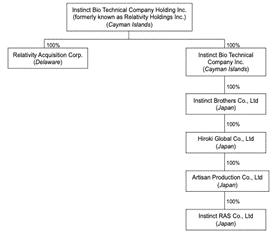
Upon consummation of the Business Combination, Merger Sub merged with and into Relativity, with Relativity surviving the merger as a wholly-owned subsidiary of Pubco. Pursuant to the Business Combination Agreement, Pubco acquired all of the outstanding equity interests of BIOT, and BIOT became a wholly-owned subsidiary of Pubco. The following diagram depicts a simplified organizational structure of the Combined Company as of the date hereof.
| 5 |
| D. | Property, Plants and Equipment |
The Combined Company’s property, plants and equipment are held through BIOT and its subsidiaries. Information regarding BIOT’s property, plants and equipment is described in the Proxy Statement/Prospectus under the headings “Information About BIOT—Property and Equipment,” which information is incorporated herein by reference.
ITEM 4A. UNRESOLVED STAFF COMMENTS
None / Not applicable.
ITEM 5. OPERATING AND FINANCIAL REVIEW AND PROSPECTS
The discussion and analysis of the financial condition and results of operation of BIOT and its subsidiaries is included in the Proxy Statement/Prospectus in the section titled “BIOT Management’s Discussion and Analysis of Financial Condition and Analysis of Financial Condition and Results of Operations,” which is incorporated herein by reference.
On July 24, 2026, the Company entered into a term sheet with Chardan for a standing equity facility of up to US$150.0 million (the “ChEF”) that would provide the Company with the means to raise financing at market pricing over a three-year period. Upon the execution of definitive documents and the filing and effectiveness of a registration statement permitting the resale of the Pubco Ordinary Shares and Chardan’s receipt of a no-objection letter from FINRA, the ChEF would enable the Company, subject to a daily purchase limit and certain other conditions, to require Chardan to purchase its Pubco Ordinary Shares at the day’s volume-weighted average price, reducted by a four percent (4.0%) discount (increased to 5% in off-market hours). The Company would view the ChEF as one of several potential sources of capital, to be drawn on only as and when the Company determines it appropriate. There can be no assurance that definitive documentation will be executed, that the registration statement will be declared effective, or that the Company will sell any shares under the ChEF.
ITEM 6. DIRECTORS, SENIOR MANAGEMENT AND EMPLOYEES
| A. | Directors and Senior Management. |
The following table sets forth certain information relating to the executive officers and directors of the Combined Company as of the date of this Report.
Combined Company
| Name | Age | Position | ||
| Tomoki Nagano | 44 | Director; Group Chief Executive Officer; Chairman | ||
| Fumihiro Nagano | 47 | Director; Chief Marketing Officer | ||
| Yuji Naito | 46 | Director; Chief Operating Officer | ||
| Masashi Ohmatsu | 63 | Chief Financial Officer | ||
| Masato Terachi | 30 | Independent Director | ||
| Say Leong, Lim | 55 | Independent Director | ||
| Sally, Lim | 55 | Independent Director | ||
| Jessica Assaf | 35 | Independent Director |
| 6 |
The following is a brief biography of each of our executive officers and directors:
Tomoki Nagano serves as our Group Chief Executive Officer, Chairman and Director. He has over two decades of experience in the cosmetics and consumer goods industry, specializing in product planning, procurement, international trade, and brand development. Mr. Tomoki graduated with a Diploma in International Business from Faculty of Business at Seneca College of Applied Arts & Technology in 2004, and began his career at Angel Heart Co. (formerly known as AmazYou Planning), where he was responsible for product planning, as well as the import and export of perfumes in the foreign division. This role marked the beginning of his extensive career in the cosmetics industry. In 2015, Mr. Tomoki joined Li & Fung Trading in Hong Kong as a sales representative, where he played a key role in expanding sales channels to major retailers and drugstores across Japan.
In 2017, Mr. Tomoki established Hiroki Global Co., Ltd, leveraging his extensive experience in the beauty and consumer goods market. He further expanded his leadership in 2019 by taking on the role of CEO at Instinct Brothers Co., Ltd (formerly known as Vivian Co., Ltd) in September 2021. With a wealth of experience spanning product development, supply chain management, and international business expansion, Mr. Tomoki continues to drive Instinct Brothers’ growth and strategic direction in the global market.
Fumihiro Nagano has served as our Chief Marketing Officer and Representative Director since September 2022, and as Vice President of Instinct Brothers since September 2021. He has over 20 years of experience in sports medicine, rehabilitation, and healthcare management. Mr. Fumihiro graduated in 2000 from the Faculty of Bonesetting at Sendai Osteopathic Medicine College, earning his license as a Judo rehabilitation teacher. He began his career at Major Field Co., Ltd in 2003 and joined the Japan Olympic Committee as a medical science staff member in 2006. In 2008, he became the Gymnastics Medical Science Trainer for the Japan Women’s Gymnastics Team. From 2013 to November 2022, Mr. Fumihiro served as President and CEO in RISE Co., Ltd. He also managed multiple osteopathic clinics and personal training gyms, overseeing the growth and development of healthcare staff.
Yuji Naito has served as our Senior Executive Managing Director and Chief Operating Officer since September 2021. In 2002, Mr. Naito began his career in the agriculture and food industry with U JAPAN LLC, where he played a key role in establishing farms across China, Taiwan, Thailand, Sri Lanka, and the Philippines. In 2017, Mr. Naito founded U JAPAN LLC, where he continues to serve as a representative partner, to support the global growth of over 30 brands. In the same year, he invested in enchant Co., Ltd., a food and agriculture-related business, where he led the organization of various events in collaboration with local governments and companies.
Masashi Ohmatsu has served as our Chief Financial Officer since February 2022. Mr. Ohmatsu earned his Bachelor degree from the Faculty of Economics at Okayama University in 1985. Mr. Ohmatsu brings over 30 years of experience in the financial services industry. He began his career with Mizuho Securities (formerly Nippon Kangyo Kakumaru Securities) and was seconded to the subsidiary in Singapore, Kankaku Singapore Merchant Bank, where he played a crucial role in sales and relationship management with local institutional investors for nearly 10 years. In 1998, Mr. Ohmatsu returned to Japan and was instrumental in the launch of ABN AMRO Bank’s asset management services in Japan, where he held significant leadership roles. In 2003, he was appointed as the President of ABN AMRO Asset Management Japan Co., Ltd., overseeing the firm’s operations and driving growth in the Japanese market. Following his tenure at ABN AMRO, Mr. Ohmatsu continued to excel in the asset management industry, serving as Executive Vice President of Fortis Asset Management Co., Ltd. from 2008 to 2009, and later as CEO of UOB Asset Management Japan Co., Ltd. form 2009 until 2013. In 2013, he relocated to Singapore to lead UOB-SM Asset Management Pte Ltd as CEO, which he did until 2017. In 2017, Mr. Ohmatsu transitioned to entrepreneurial leadership, taking on the role of CEO at Hit Holdings Pte Ltd. until 2019.
Independent Directors
Say Leong, Lim is as an independent member of the board of the Combined Company. Mr. Lim has served as the Chairman of the board of directors and Chief Executive Officer of Globalink Investment Inc. since 2021. Since April 2023, Mr. Lim has served as the Chief Executive Officer of Xtend Digital Sdn. Bhd., a technology company based in Malaysia. Since June 2021, Mr. Lim has served as an independent director at LFE corporation Bhd., an engineering company in Malaysia. Since February 2019, Mr. Lim has served as the Independent Non-executive Director of Aurora Italia International Bhd., a public retail company in Malaysia. In May 2010, Mr. Lim co-founded Everise Concepts PLT and has since served as its advisor. Everise Concepts PLT is principally involved in the provision of corporate and business consultancy, real estate projects and the wholesale and distribution of fast-moving consumer goods via retail and online channels. From November 2020 to April 2022, Mr. Lim served as an independent director of Caely Holdings Bhd. Mr. Lim obtained his Chartered Management Accountant Degree in management accountancy from the Chartered Institute of Management Accountants (CIMA) United Kingdom in 1991 and was admitted as a Malaysian Institute of Accountants (MIA) in 1996. Mr. Lim obtained his Master of Business Administration from Heriot-Watt University in the United Kingdom in 1997.
| 7 |
Sally, Lim is an independent member on the board of the Combined Company. Ms. Lim brings with extensive experience in accounting, finance and administration. From 1999 to 2005, she served as the Finance and Administration Manager of Denko-HLB Sdn. Bhd., where she played a key role in the successful corporate restructuring of the Denko Group in 2004. Ms. Lim was also instrumental in leading a team for the implementation of an Enterprise Resource Planning (ERP) system for Denko Group. In 2010, Ms. Lim co-founded Everise Concepts PLT, where she currently serves as a director, offering services relating to corporate reorganizations, foreign direct investments, initial public offerings, mergers and acquisitions. In 2019, she acted as a local consultant to a Hong Kong-listed company establishing operations in Penang, Malaysia, and assisted a Chinese company in assessing and evaluating business opportunities in Malaysia. Ms. Lim also served as a manager of GL Sponsor LLC, a sponsor of a NASDAQ-listed SPAC, from 2019 to 2022. She was an independent non-executive director of Mineski Global (Malaysia) Sdn. Bhd. from July 2021 to December 2022, and served as an independent non-executive director of EOS IT Management Solutions Sdn. Bhd., an IT company, from December 2020 to December 2023. She obtained her Diploma in Accounting from Perkim Goon College, Malaysia, in 1991.
Masato Terachi is an independent member of the board of the Combined Company. Mr. Terachi began his career in Tokyo as an assistant to a business owner, where he gained practical experience in corporate management and leadership. Mr. Terachi has served as a sales consultant for a financial company and as an external director for a rapidly growing venture firm. Since September 2020, he served as the Chairman and Chief Executive Officer of ON-OckRe Co., Ltd., a company specializing in talent analytics and development services. From June 2024 to May 2025, he served as an Organizational Development Consultant at CONSCIENCE Inc., and from September 2023 to May 2024, as a Human Resources Consultant at TANEDA Co., Ltd., a general trading company for people and work. Between January 2017 and May 2021, Mr. Terachi served as the President of Samulion Factory Co., Ltd., overseeing food service and beauty enterprises. Earlier, from November 2016 to January 2019, he was an External Recruiter in the Human Resources Department at NCS Co., Ltd. Mr. Terachi currently advises companies preparing for IPOs, medium-sized enterprises, and listed corporations.
Jessica Assaf is an independent member of the board of the Combined Company. She is an award-winning entrepreneur and activist dedicated to improving health and well-being through business. Her advocacy journey began at the age of 15, focusing on safe products, corporate accountability, consumer wellness and female empowerment. In high school, Assaf co-founded Teens for Safe Cosmetics, a group that successfully lobbied for the California Safe Cosmetics Act of 2005, requiring manufacturers to disclose harmful ingredients in personal care products. Assaf earned her undergraduate degree from New York University’s Gallatin School and later received her MBA from Harvard Business School, during which she co-founded RAW IS EVERYTHING, a clean skincare company that achieved national distribution. In 2019, Assaf co-founded Prima, a purpose-driven CBD wellness brand and Public Benefit Corporation (B Corp) that was acquired in 2023. She is now the Director of Communications at OSEA Malibu and works with purpose-driven companies on branding, marketing, social media, retail strategy, PR and partnerships. Throughout her career, Assaf has been recognized for her contributions to health advocacy and entrepreneurship, including being named to Forbes’ 30 Under 30 list in 2020.
Family Relationships
Mr. Tomoki Nagano, our Group Chief Executive Officer, Chairman of the Board and a Director, is the brother of Mr. Fumihiro Nagano, our Chief Operating Officer and a Director. Ms. Qian Zhao, the spouse of Mr. Tomoki Nagano, serves as a director of Hiroki Global Co., Ltd. Except as disclosed above, there are no family relationships among any of the directors or executive officers of the Combined Company.
Committees of the Board of the Directors
The Combined Company’s board of directors has an audit committee, compensation committee and nominating and corporate governance committee. All of the committees comply with all applicable requirements of the Sarbanes-Oxley Act, Nasdaq and SEC rules and regulations as further described below. The responsibilities of each of the committees of the Combined Company’s board of directors are described below. Each member of these committees is appointed by the Combined Company’s board of directors and will serve for such term or terms as the board may determine or until such member’s earlier resignation or death.
| 8 |
Each of these committees has a written charter. The charters are available on the Combined Company’s corporate website at https://instinct-biot.com. The information on any of the Combined Company’s website is deemed not to be incorporated in this Report or to be part of this Report.
Audit Committee
The Combined Company is required to maintain an audit committee consisting of at least three independent directors in accordance with the Nasdaq listing standards and applicable SEC rules. The audit committee is composed of three independent directors: Say Leong Lim (chair), Masato Terachi, and Sally Lim. The parties have determined that Say Leong Lim qualifies as the “audit committee financial expert” under Nasdaq listing standards and under Rule 10-A-3(b)(1) under the Exchange Act.
The audit committee’s role is to compile the necessary audit committee report for the SEC to be included in Pubco’s proxy statements and to support the Combined Company’s board of directors in supervising (1) the integrity of the financial reports, (2) adherence to legal and statutory obligations, (3) the qualifications and autonomy of BIOT’s independent accountants, (4) the internal audit function’s efficacy, and (5) the performance of the independent accounting firm engaged by the Combined Company.
Compensation Committee
The Combined Company maintains a compensation committee composed of Masato Terachi, Say Leong Lim and Sally Lim (chair). The Combined Company’s board of directors has determined that each proposed member of Pubco’s remuneration committee is independent under the Nasdaq listing standards and applicable SEC rules, including the additional independence requirements applicable to the members of a remuneration committee.
The Combined Company’s board of directors has adopted a charter setting forth the responsibilities of the committee, which are consistent with the Nasdaq listing standards and applicable SEC rules, and include among others:
| · | recommending to the Combined Company’s board of directors for its approval a compensation policy in accordance with the requirements of Cayman Islands law as well as other compensation policies, incentive-based compensation plans and equity-based compensation plans, and overseeing the development and implementation of such policies and recommending to Combined Company’s board of directors any amendments or modifications the committee deems appropriate, including as required under Cayman Islands law; | |
| · | implementing and administering our incentive compensation equity-based remuneration plans; | |
| · | assisting management in complying with the proxy statement and annual report disclosure requirements; | |
| · | approving all special perquisites, special cash payments and other special compensation and benefit arrangements for the officers and employees; | |
| · | if required, producing a report on executive compensation to be included in the annual proxy statement; and | |
| · | reviewing, evaluating and recommending changes, if appropriate, to the remuneration for directors. |
| 9 |
Nomination Committee
The Combined Company maintains a nominating and corporate governance committee composed of Masato Terachi (chair), Say Leong Lim and Sally Lim. The primary purposes of the nominating and corporate governance committee are to (A) (i) identify individuals qualified to serve on the board of directors, consistent with criteria approved by the board of directors, (ii) recommend that the board of directors approve a slate of director nominees for election by the shareholders of the Company at the annual meeting of the shareholders of the Company and (iii) recommend director nominees in the event of a vacancy on the board of directors, (B) (i) develop and recommend to the board of directors a set of corporate governance policies and principles to be applicable to the Company and (ii) periodically re-evaluate such policies and guidelines for the purpose of recommending amendments to them if appropriate, (C) oversee an annual evaluation of the board of directors, each of the committees of the board of directors, and management of the Company, (D) review certain related party transactions and procedures for evaluating and approving such transactions, (E) (i) review the stock ownership guidelines applicable to each of the directors, the Chief Executive Officer and each other individual identified as an executive officer of the Company, (ii) determine compliance with such guidelines at least annually, (iii) review such guidelines annually, and (iv) recommend any necessary changes to the board of directors, and (F) perform such other duties and responsibilities as may be delegated to it from time to time by the board of directors.
| B. | Compensation |
Information pertaining to the compensation of the directors and executive officers of the Combined Company is set forth in the Proxy Statement/Prospectus, in the section titled “Executive and Director Compensation” which are incorporated herein by reference.
Following the Business Combination, the Combined Company entered into, employment agreements with each of its executive officers. Each such agreement supersedes any prior employment arrangement with the respective officer. Under the employment agreements, each officer is entitled to receive a base annual salary, the amount of which is determined by the board of directors of the Combined Company (the “Board”), and reimbursement for reasonable, pre-approved travel and other business-related expenses incurred in the performance of duties. Employment under each agreement is at will and continues until either party provides at least sixty (60) days’ prior written notice of its intention to terminate the employment relationship. If an officer’s employment is terminated by the Combined Company without “cause” or by the officer for “just cause,” the officer will be entitled to receive (i) accrued but unpaid base salary through the termination date; (ii) reimbursement for any unreimbursed pre-approved reasonable business expenses incurred through the termination date; (iii) accrued but unused annual leave days; (iv) all other payments or benefits to which she shall be entitled as of the termination date under the terms of any applicable compensation arrangement or benefit, equity, or fringe benefit plan or program or grant; and (v) in lieu of benefits under any severance plan or policy of the Combined Company, any such amount as may be agreed between the parties. The foregoing description of the form of Employment Agreement is qualified in its entirety by the terms of the Employment Agreement attached hereto and incorporated herein as Exhibits 4.4, 4.5, 4.6 and 4.7.
Following the Business Combination, the Combined Company entered into Independent Director Agreements with each of its independent directors. Pursuant to the terms of the Independent Director Agreement, each independent director serves as independent contractors and not as employees of the Combined Company. Each independent director is entitled to receive compensation in an amount determined by the Board, as well as reimbursement for reasonable out-of-pocket expenses incurred in connection with the performance of his or her duties as a director, subject to the Combined Company’s prior written approval. The foregoing description of the form of Independent Director Agreement is qualified in its entirety by the terms of the Independent Director Agreement attached hereto and incorporated herein as Exhibit 4.8.
| C. | Board Practices |
Information pertaining to the Company’s board practices is set forth in the Proxy Statement/Prospectus, in the section titled “Executive and Director Compensation,” and “Management Following The Business Combination” which are incorporated herein by reference.
| 10 |
| D. | Employees |
Information pertaining to the Company’s employees is set forth in the Proxy Statement/Prospectus, in the section titled “Information About BIOT —Employees,” which is incorporated herein by reference.
| E. | Share Ownership |
Ownership of the Company’s Ordinary Shares by its directors and executive officers upon the consummation of the Business Combination is set forth in Item 7.A of this Report.
| F. | Disclosure of Registrant’s Action to Recover Erroneously Awarded Compensation |
Not applicable.
ITEM 7. MAJOR SHAREHOLDERS AND RELATED PARTY TRANSACTIONS
| A. | Major Shareholders. |
The following table sets forth information regarding the beneficial ownership of Ordinary Shares as of July 23, 2026 by:
| · | each person known by us to be the beneficial owner of more than 5% of Ordinary Shares; | |
| · | each of our directors and executive officers; and | |
| · | all our directors and executive officers as a group. |
Beneficial ownership is determined according to the rules of the SEC, which generally provide that a person has beneficial ownership of a security if that person possesses sole or shared voting or investment power over that security. A person is also deemed to be a beneficial owner of securities that the person has a right to acquire within 60 days including, without limitation, through the exercise of any option, warrant or other right or the conversion of any other security. Such securities, however, are deemed to be outstanding only for the purpose of computing the percentage beneficial ownership of that person but are not deemed to be outstanding for the purpose of computing the percentage beneficial ownership of any other person. Under these rules, more than one person may be deemed to be a beneficial owner of the same securities.
The calculations of the percentage of beneficial ownership are based on 28,794,472 Ordinary Shares issued and outstanding, as of July 23, 2026.
Unless otherwise indicated, we believe that all persons named in the table below have sole voting and investment power with respect to all Ordinary Shares beneficially owned by them.
| Number of Ordinary Shares |
% of Total Ordinary Shares |
% of Voting Power |
||||||||||
| Executive Officers and Directors (1) | ||||||||||||
| Tomoki Nagano | 10,425,365 | 36.21 | % | 36.21 | % | |||||||
| Fumihiro Nagano | 10,000 | * | * | |||||||||
| Yuji Naito | 10,000 | * | * | |||||||||
| Masashi Ohmatsu | 1,000 | * | * | |||||||||
| Say Leong, Lim | 360,000 | 1.25 | % | 1.25 | % | |||||||
| Sally, Lim | 90,000 | * | * | |||||||||
| Jessica Assaf | — | — | — | |||||||||
| Masato Terachi | 100 | * | * | |||||||||
| All Directors and Executive Officers as a group (8 individuals) | % | % | ||||||||||
| Principal Shareholders (Greater than 5% Holders): | ||||||||||||
| Tomoki Nagano | 10,425,365 | 36.21 | % | 36.21 | % | |||||||
| Chardan Capital Markets LLC (2) | 1,615,385 | 5.61 | % | 5.61 | % | |||||||
| Relativity Acquisition Sponsor, LLC | 5,515,481 | 19.15 | % | 19.15 | % | |||||||
| * | Less than 1% of the total number of outstanding Ordinary Shares |
| (1) | The business address for the directors and executive officers of the Company is 3rd Floor West Side Gotanda bldg., 6-2-7 Nishi Gotanda, Shinagawa-ku, Tokyo 1410031, Japan. |
| (2) | Consists of 1,615,385 Ordinary Shares received by Chardan Capital Markets LLC pursuant to the Settlement Agreement described in “Item 10.C — Material Contracts — Chardan Settlement Agreement.” The address of Chardan Capital Markets LLC is One Pennsylvania Plaza, Suite 4800, New York, New York 10119. |
| 11 |
| B. | Related Party Transactions |
Information pertaining to the Company’s related party transactions is set forth in the Proxy Statement/Prospectus in the section titled “Certain Relationships and Related Person Transactions – Certain Relationships and Transactions of BIOT,” which is incorporated herein by reference.
| C. | Interests of Experts and Counsel |
None.
ITEM 8. FINANCIAL INFORMATION
| A. | Consolidated Statements and Other Financial Information |
Financial Statements
See Item 18 of Part III of this Report.
Legal Proceedings
Legal or arbitration proceedings are described in the Proxy Statement/Prospectus in the section titled “Information About BIOT — Legal Proceedings,” which is incorporated herein by reference.
Dividend Policy
The Company’s policy on dividend distributions is described in the Proxy Statement/Prospectus in the sections titled “Trading Market and Dividends – Dividend Policy,” “Risk Factors - Because there are no current plans to pay cash dividends on Pubco Ordinary Shares for the foreseeable future, you may not receive any return on investment unless you sell your Pubco Ordinary Shares at a price greater than what you paid for it,” “Material U.S. Federal Income Tax Consequences — Material U.S. Federal Income Tax Consequences of the Business Combination,” “Description of Pubco Securities,” which are incorporated herein by reference.
| B. | Significant Changes |
Not applicable.
ITEM 9. THE OFFER AND LISTING
| A. | Offer and Listing Details |
The Combined Company’s Ordinary Shares and Warrants are listed on Nasdaq under the symbol “BIOT” and “BIOTW”, respectively.
| B. | Plan of Distribution |
Not applicable.
| 12 |
| C. | Markets |
The Combined Company’s Ordinary Shares and Warrants are listed on Nasdaq under the symbol “BIOT” and “BIOTW”, respectively.
| D. | Selling Shareholders |
Not applicable.
| E. | Dilution |
Not applicable.
| F. | Expenses of the Issue |
Not applicable.
ITEM 10. ADDITIONAL INFORMATION
| A. | Share Capital |
The Company’s authorized share capital is US$50,000 divided into 5,000,000,000 ordinary shares of US$0.00001 par value each. As of July 23, 2026, subsequent to the Closing, 28,794,472 Ordinary Shares were issued and outstanding.
| B. | Memorandum and Articles of Association |
The Amended and Restated Memorandum and Articles of Association of the Company (“Company Charter”) effective as of July 23, 2026 are filed as part of this Report.
The description of the Company Charter is contained in the Proxy Statement/Prospectus in the sections titled “Comparison of Corporate Governance and Stockholder Rights,” and “Description of Pubco’s Securities,” which are incorporated herein by reference.
| C. | Material Contracts |
Material Contracts Relating to the Business Combination
Business Combination Agreement
The description of the Business Combination Agreement in the Proxy Statement/Prospectus in the sections titled “The Redomestication Merger Proposal (Proposal 1)” and “The Acquisition Merger Proposal (Proposal 2)” are incorporated herein by reference.
Related Agreements
The description of the material provisions of certain additional agreements entered into pursuant to the Business Combination Agreement in the Proxy Statement/Prospectus in the section titled “The Acquisition Merger Proposal (Proposal 2)” — Certain Related Agreements” is incorporated herein by reference.
Chardan Settlement Agreement
On July 17, 2026, BIOT, Instinct Brothers Co., Ltd. and Mr. Tomoki Nagano entered into a Settlement Agreement and Mutual Release (the “Settlement Agreement”) with Chardan Capital Markets LLC (“Chardan”) in connection with the advisory fee payable to Chardan in the amount of US$5.25 million for its services as exclusive merger and acquisition and capital markets advisor to BIOT and Instinct Brothers Co., Ltd. in connection with the Business Combination. Pursuant to the Settlement Agreement, Mr. Nagano transferred to Chardan a number of his ordinary shares of BIOT that, upon the Closing, were converted into 1,615,385 Pubco Ordinary Shares. The Company and Chardan have executed a term sheet for the ChEF. See ITEM 5.
| 13 |
| D. | Exchange Controls |
There are no governmental laws, decrees, regulations or other legislation in the Cayman Islands that may affect the import or export of capital, including the availability of cash and cash equivalents for use by the Company, or that may affect the remittance of dividends, interest, or other payments by the Company to non-resident holders of its Ordinary Shares. There is no limitation imposed by the laws of the Cayman Islands or in the Company Charter on the right of non-residents to hold or vote shares.
| E. | Taxation |
Information pertaining to tax considerations is set forth in the Proxy Statement/Prospectus in the section titled “Material U.S. Federal Income Tax Considerations” which is incorporated herein by reference.
| F. | Dividends and Paying Agents |
The Company’s policy on dividend distributions is described in the Proxy Statement/Prospectus in the sections titled “Trading Market and Dividends – Dividend Policy,” “Risk Factors - Because there are no current plans to pay cash dividends on the PubCo ordinary shares for the foreseeable future, you may not receive any return on investment unless you sell your PubCo ordinary shares at a price greater than what you paid for it.” “Material U.S. Federal Income Tax Consequences – U.S. Federal Income Tax Consequences of Ownership and Disposition of Pubco,” “Description of Pubco Securities,” which are incorporated herein by reference. The Company has not identified a paying agent.
| G. | Statement by Experts |
The financial statements of Pubco for the financial period May 22, 2025 (date of incorporation) to May 31, 2025, included in the Proxy Statement/Prospectus were audited by Morison LC PLT, an independent registered public accounting firm as stated in their report appearing herein. Such financial statements are included in reliance upon the report of such firm given upon their authority as experts in accounting and auditing.
The consolidated financial statements of BIOT and its subsidiaries as of November 30, 2024 and 2023, included in the Proxy Statement/Prospectus were audited by Morison LC PLT, an independent registered public accounting firm as stated in their report appearing herein. Such financial statements are included in reliance upon the report of such firm given upon their authority as experts in accounting and auditing.
| H. | Documents on Display |
We are subject to certain of the informational filing requirements of the Exchange Act. Since we are a “foreign private issuer,” we are exempt from the rules and regulations under the Exchange Act prescribing the furnishing and content of proxy statements, and our officers, directors and principal shareholders are exempt from the reporting and “short-swing” profit recovery provisions contained in Section 16 of the Exchange Act, with respect to their purchase and sale of our shares. In addition, we are not required to file reports and financial statements with the SEC as frequently or as promptly as U.S. companies whose securities are registered under the Exchange Act. However, we are required to file with the SEC an Annual Report on Form 20-F containing financial statements audited by an independent accounting firm. We will also furnish to the SEC, on Form 6-K, unaudited financial information on a bi-annual basis. The SEC also maintains a website at http://www.sec.gov that contains reports and other information that we file with or furnish electronically with the SEC.
| I. | Subsidiary Information |
Not applicable.
| J. | Annual Report to Security Holders |
Not applicable.
ITEM 11. QUANTITATIVE AND QUALITATIVE DISCLOSURES ABOUT MARKET RISK
The information on market risk is set forth in the Proxy Statement/Prospectus in the section titled “BIOT Management’s Discussion and Analysis of Financial Condition and Analysis of Financial Condition and Results of Operations,” which is incorporated herein by reference.
ITEM 12. DESCRIPTION OF SECURITIES OTHER THAN EQUITY SECURITIES.
Not applicable.
| 14 |
PART II
ITEM 13. DEFAULTS, DIVIDEND ARREARAGES AND DELINQUENCIES.
None.
ITEM 14. MATERIAL MODIFICATIONS TO THE RIGHTS OF SECURITY HOLDERS AND USE OF PROCEEDS.
None.
ITEM 15. CONTROLS AND PROCEDURES.
ITEM 16. [RESERVED]
Item 16A. Audit Committee Financial Expert.
Our board of directors has determined that Mr. Lim Say Leong, an independent director (under the standards set forth in set forth in Nasdaq Stock Market Rule 5605(a)(2) and Rule 10A-3 under the Exchange Act) and the chairperson of our audit committee, is our audit committee financial expert.
Item 16B. Code of Ethics.
We have adopted a Code of Business Conduct and Ethics applicable to all of our employees, officers and directors, including those officers responsible for financial reporting. A copy of the policy is available in our website at https://instinct-biot.com and is filed as Exhibit 11.1 to this Report. The information contained on, or accessible through, our website is not incorporated by reference into this Report and should not be considered a part of this Report. We intend to disclose any substantive amendments to, or waivers from, the Code of Business Conduct and Ethics for our executive officers or directors by posting such information on our website or through any other means required by applicable law.
Item 16D. Exemptions from the Listing Standards for Audit Committees.
None.
Item 16E Purchases of Equity Securities by the Issuer and Affiliated Purchasers.
None.
Item 16F. Change in Registrant’s Certifying Accountant.
None.
| 15 |
Item 16G. Corporate Governance.
As a Cayman Islands company listed on the Nasdaq Capital Market, we are subject to Nasdaq Stock Market corporate governance listing standards. However, the Nasdaq Stock Market rules permit a foreign private issuer like us to follow the corporate governance practices of its home country. Certain corporate governance practices in the Cayman Islands, which is our home country, may differ significantly from Nasdaq Stock Market corporate governance listing standards. Shareholders of Cayman Islands exempted companies like us have no general rights under Cayman Islands law to inspect corporate records or to obtain copies of register of members of these companies (other than the memorandum and articles of association, special resolutions, and the register of mortgages and charges). Our directors have discretion under our articles of association to determine whether or not, and under what conditions, our corporate records may be inspected by our shareholders, but are not obliged to make them available to our shareholders. This may make it more difficult for a shareholder to obtain the information needed to establish any facts necessary for a shareholder motion or to solicit proxies from other shareholders in connection with a proxy contest.
Certain corporate governance practices in the Cayman Islands, which is our home country, differ significantly from requirements for companies incorporated in other jurisdictions such as the United States. To the extent we choose to follow home country practice with respect to corporate governance matters, our shareholders may be afforded less protection than they otherwise would under rules and regulations applicable to U.S. domestic issuers.
Item 16H. Mine Safety Disclosure.
Not applicable.
Item 16I. Disclosure Regarding Foreign Jurisdictions that Prevent Inspections.
Not applicable.
Item 16J. Insider Trading Policies
Our board of directors has adopted insider trading policies and procedures governing the purchase, sale, and other dispositions of our securities by directors, senior management, and employees that are reasonably designed to promote compliance with applicable insider trading laws, rules, and regulations, and any listing standards applicable to us. A copy of the policy is attached as Exhibit 11.2 to this Report.
Our board of directors has also adopted an executive officer compensation clawback policy required by the Nasdaq Listing Rule 5608, the form of which is attached as Exhibit 11.3 to this Report.
| 16 |
Item 16K. Cybersecurity
We have implemented processes for assessing, identifying and managing material risks from cybersecurity threats and monitoring the prevention, detection, mitigation and remediation of material cybersecurity incident. We have also integrated cybersecurity risk management into our overall risk management system. We do not engage any third parties in connection with the processes for assessing, identifying, and managing material risks from cybersecurity threats. As of the date of this Report, we have not experienced any material cybersecurity incidents or identified any material cybersecurity threats that have affected or are reasonably likely to materially affect us, our business strategy, results of operations or financial condition.
Governance
Our board of directors is responsible for overseeing our cybersecurity risk management. Our board of directors shall review, approve and maintain oversight of the disclosure (i) on Form 6-K for material cybersecurity incidents (if any) and (ii) related to cybersecurity matters in the periodic reports (including annual report on Form 20-F) of our Company.
At management level, our Chief Executive Officers and Chief Financial Officer are responsible for assessing, identifying and managing material risks from cybersecurity threats to our Company and monitoring the prevention, detection, mitigation and remediation of material cybersecurity incident. Our executive officers shall meet with the board of directors (i) in connection with each current report to furnish information concerning any material cybersecurity incident, report the status of any material cybersecurity incidents or material risks from cybersecurity threats to our Company, if any, and the relevant disclosure issue, and (ii) in connection with each annual report, present the disclosure concerning cybersecurity matters in Form 20-F.
If a cybersecurity incident occurs, our executive officers will promptly organize relevant personnel for internal assessment and if it is determined that the incident could potentially be a material cybersecurity event, our executive officers will promptly report the incident and assessment results to our board of directors and external legal counsel, to the extent appropriate. Our executive officers shall prepare disclosure material on the cybersecurity incident for review and approval by the board of directors, and external legal counsel (if necessary), before it is disseminated to the public.
| 17 |
PART III
ITEM 17. FINANCIAL STATEMENTS
Not applicable.
ITEM 18. FINANCIAL STATEMENTS
The unaudited pro forma condensed combined financial information of Pubco as of and for the year ended November 30, 2025, contained in Exhibit 18.1 to this Report is incorporated herein by reference.
The audited financial statements of Pubco for the financial period May 22, 2025 (date of incorporation) to 30 November, 2025, contained in Exhibit 18.2 to this Report is incorporated herein by reference.
The consolidated audited financial statements of BIOT and its subsidiaries as of and for the years ended November 30, 2025 and 2024, contained in Exhibit 18.3 to this Report is incorporated herein by reference.
| 18 |
ITEM 19. EXHIBITS
EXHIBIT INDEX
| * | Filed herewith. | |
| † | Indicates a management contract or any compensatory plan, contract or arrangement. | |
| # | Schedules and annexes have been omitted |
| 19 |
SIGNATURE
The registrant hereby certifies that it meets all of the requirements for filing on Form 20-F and that it has duly caused and authorized the undersigned to sign this Report on its behalf.
| Instinct Bio Technical Company Holdings Inc. | ||
| July 28, 2026 | By: | /s/ Tomoki Nagano |
| Name: | Tomoki Nagano | |
| Title: | Chief Executive Officer and Director | |
| 20 |
Exhibit 1.1
|
Companies Act (Revised)
Company Limited by Shares
| ||
|
amended and restated memorandum
of association
|
||
| (Adopted by special resolution passed on 23 July 2026 and with effect from 23 July 2026) | ||

Companies Act (Revised)
Company Limited by Shares
Amended and Restated
Memorandum of Association
of
INSTINCT BIO TECHNICAL COMPANY HOLDINGS INC.
(Adopted by special resolution passed on 23 July 2026 and with effect from 23 July 2026)
| 1 | The name of the Company is INSTINCT BIO TECHNICAL COMPANY HOLDINGS INC., including such name as may be changed from time to time. |
| 2 | The Company's registered office will be situated at the office of Ogier Global (Cayman) Limited, 89 Nexus Way, Camana Bay, Grand Cayman, KY1-9009, Cayman Islands or at such other place in the Cayman Islands as the directors may at any time decide. |
| 3 | The Company's objects are unrestricted. As provided by section 7(4) of the Companies Act (Revised), the Company has full power and authority to carry out any object not prohibited by any law of the Cayman Islands. |
| 4 | The Company has unrestricted corporate capacity. Without limitation to the foregoing, as provided by section 27 (2) of the Companies Act (Revised), the Company has and is capable of exercising all the functions of a natural person of full capacity irrespective of any question of corporate benefit. |
| 5 | Nothing in any of the preceding paragraphs permits the Company to carry on any of the following businesses without being duly licensed, namely: |
| (a) | the business of a bank or trust company without being licensed in that behalf under the Banks and Trust Companies Act (Revised); or |
| (b) | insurance business from within the Cayman Islands or the business of an insurance manager, agent, sub-agent or broker without being licensed in that behalf under the Insurance Act (Revised); or |
| (c) | the business of company management without being licensed in that behalf under the Companies Management Act (Revised). |
| 6 | Unless licensed to do so, the Company will not trade in the Cayman Islands with any person, firm or corporation except in furtherance of its business carried on outside the Cayman Islands. Despite this, the Company may effect and conclude contracts in the Cayman Islands and exercise in the Cayman Islands any of its powers necessary for the carrying on of its business outside the Cayman Islands. |
| 7 | The Company is a company limited by shares and accordingly the liability of each member is limited to the amount (if any) unpaid on that member's shares. |
| 8 | The share capital of the Company is US$50,000 divided into 5,000,000,000 Ordinary Shares of par value US$0.00001 each. However, subject to the Companies Act (Revised) and the Company's articles of association, the Company has power to do any one or more of the following: |
| (a) | to redeem or repurchase any of its shares; |
| (b) | to increase or reduce its capital; |
| (c) | to issue any part of its capital (whether original, redeemed, increased or reduced): |
| (i) | with or without any preferential, deferred, qualified or special rights, privileges or conditions; or |
| (ii) | subject to any limitations or restrictions |
and unless the condition of issue expressly declares otherwise, every issue of shares (whether declared to be ordinary, preference or otherwise) is subject to this power; and
| (d) | to alter any of those rights, privileges, conditions, limitations or restrictions. |
| 9 | The Company has power to register by way of continuation as a body corporate limited by shares under the laws of any jurisdiction outside the Cayman Islands and to be deregistered in the Cayman Islands. |
|
Companies Act (Revised)
Company Limited By Shares
| ||
|
AMENDED AND RESTATED
|
||
|
(Adopted by special resolution passed on 23 July 2026 and with effect from 23 July 2026) | ||
Contents
| 1 Definitions, interpretation and exclusion of Table A | 1 |
| Definitions | 1 |
| Interpretation | 4 |
| Exclusion of Table A Articles | 5 |
| 2 Shares | 5 |
| Power to issue Shares and options, with or without special rights | 5 |
| Power to issue fractions of a Share | 6 |
| Power to pay commissions and brokerage fees | 6 |
| Trusts not recognised | 6 |
| Security interests | 6 |
| Power to vary class rights | 6 |
| Effect of new Share issue on existing class rights | 7 |
| No bearer Shares or warrants | 7 |
| Treasury Shares | 7 |
| Rights attaching to Treasury Shares and related matters | 7 |
| Register of Members | 8 |
| Annual Return | 8 |
| 3 Share certificates | 8 |
| Issue of share certificates | 8 |
| Renewal of lost or damaged share certificates | 9 |
| 4 Lien on Shares | 9 |
| Nature and scope of lien | 9 |
| Company may sell Shares to satisfy lien | 10 |
| Authority to execute instrument of transfer | 10 |
| Consequences of sale of Shares to satisfy lien | 10 |
| Application of proceeds of sale | 11 |
| 5 Calls on Shares and forfeiture | 11 |
| Power to make calls and effect of calls | 11 |
| Time when call made | 11 |
| Liability of joint holders | 12 |
| Interest on unpaid calls | 12 |
| Deemed calls | 12 |
| Power to accept early payment | 12 |
| Power to make different arrangements at time of issue of Shares | 12 |
| Notice of default | 12 |
| Forfeiture or surrender of Shares | 13 |
| Disposal of forfeited or surrendered Share and power to cancel forfeiture or surrender | 13 |
| Effect of forfeiture or surrender on former Member | 13 |
| Evidence of forfeiture or surrender | 14 |
| Sale of forfeited or surrendered Shares | 14 |
| 6 Transfer of Shares | 14 |
| Form of Transfer | 14 |
| Power to refuse registration for Shares not listed on a Designated Stock Exchange | 14 |
| Suspension of transfers | 15 |
| Company may retain instrument of transfer | 15 |
| Notice of refusal to register | 15 |
| 7 Transmission of Shares | 15 |
| Persons entitled on death of a Member | 15 |
| Registration of transfer of a Share following death or bankruptcy | 16 |
| Indemnity | 16 |
| Rights of person entitled to a Share following death or bankruptcy | 16 |
| 8 Alteration of capital | 17 |
| Increasing, consolidating, converting, dividing and cancelling share capital | 17 |
| Dealing with fractions resulting from consolidation of Shares | 17 |
| Reducing share capital | 18 |
| 9 Redemption and purchase of own Shares | 18 |
| Power to issue redeemable Shares and to purchase own Shares | 18 |
| Power to pay for redemption or purchase in cash or in specie | 18 |
| Effect of redemption or purchase of a Share | 18 |
| 10 Meetings of Members | 19 |
| Annual and extraordinary general meetings | 19 |
| Power to call meetings | 19 |
| Content of notice | 20 |
| Period of notice | 21 |
| Persons entitled to receive notice | 21 |
| Accidental omission to give notice or non-receipt of notice | 21 |
| 11 Proceedings at meetings of Members | 22 |
| Quorum | 22 |
| Lack of quorum | 22 |
| Chairperson | 22 |
| Right of a Director to attend and speak | 22 |
| Accommodation of Members at Virtual Meeting | 23 |
| Security | 23 |
| Adjournment, postponement and cancellation | 23 |
| Method of voting | 23 |
| Taking of a poll | 24 |
| Chairperson’s casting vote | 24 |
| Written resolutions | 24 |
| Sole-Member Company | 25 |
| 12 Voting rights of Members | 26 |
| Right to vote | 26 |
| Rights of joint holders | 26 |
| Representation of corporate Members | 26 |
| Member with mental disorder | 27 |
| Objections to admissibility of votes | 27 |
| Form of proxy | 27 |
| How and when proxy is to be delivered | 28 |
| Voting by proxy | 29 |
| 13 Number of Directors | 29 |
| 14 Appointment, disqualification and removal of Directors | 29 |
| First Directors | 29 |
| No age limit | 29 |
| Corporate Directors | 30 |
| No shareholding qualification | 30 |
| Appointment of Directors | 30 |
| Board’s power to appoint Directors | 30 |
| Term of office | 30 |
| Removal of Directors | 31 |
| Resignation of Directors | 31 |
| Termination of the office of Director | 31 |
| 15 Alternate Directors | 32 |
| Appointment and removal | 32 |
| Notices | 33 |
| Rights of alternate Director | 33 |
| Appointment ceases when the appointor ceases to be a Director | 33 |
| Status of alternate Director | 33 |
| Status of the Director making the appointment | 33 |
| 16 Powers of Directors | 34 |
| Powers of Directors | 34 |
| Directors below the minimum number | 34 |
| Appointments to office | 34 |
| Provisions for employees | 35 |
| Exercise of voting rights | 35 |
| Remuneration | 35 |
| Disclosure of information | 36 |
| 17 Delegation of powers | 36 |
| Power to delegate any of the Directors’ powers to a committee | 36 |
| Local boards | 37 |
| Power to appoint an agent of the Company | 37 |
| Power to appoint an attorney or authorised signatory of the Company | 37 |
| Borrowing Powers | 38 |
| Corporate Governance | 38 |
| 18 Meetings of Directors | 38 |
| Regulation of Directors’ meetings | 38 |
| Calling meetings | 38 |
| Notice of meetings | 38 |
| Use of technology | 39 |
| Quorum | 39 |
| Chairperson or deputy to preside | 39 |
| Voting | 39 |
| Recording of dissent | 39 |
| Written resolutions | 40 |
| Validity of acts of Directors in spite of formal defect | 40 |
| 19 Permissible Directors' interests and disclosure | 40 |
| 20 Minutes | 40 |
| 21 Accounts and audit | 41 |
| Auditors | 41 |
| 22 Record dates | 42 |
| 23 Dividends | 42 |
| Source of dividends | 42 |
| Declaration of dividends by Members | 42 |
| Payment of interim dividends and declaration of final dividends by Directors | 42 |
| Apportionment of dividends | 43 |
| Right of set off | 43 |
| Power to pay other than in cash | 43 |
| How payments may be made | 44 |
| Dividends or other monies not to bear interest in absence of special rights | 44 |
| Dividends unable to be paid or unclaimed | 44 |
| 24 Capitalisation of profits | 45 |
| Capitalisation of profits or of any share premium account or capital redemption reserve; | 45 |
| Applying an amount for the benefit of Members | 45 |
| 25 Share Premium Account | 45 |
| Directors to maintain share premium account | 45 |
| Debits to share premium account | 46 |
| 26 Seal | 46 |
| Company seal | 46 |
| Duplicate seal | 46 |
| When and how seal is to be used | 46 |
| If no seal is adopted or used | 46 |
| Power to allow non-manual signatures and facsimile printing of seal | 47 |
| Validity of execution | 47 |
| 27 Indemnity | 47 |
| Release | 48 |
| Insurance | 48 |
| 28 Notices | 48 |
| Form of notices | 48 |
| Electronic communications | 49 |
| Persons entitled to notices | 50 |
| Persons authorised to give notices | 50 |
| Delivery of written notices | 50 |
| Joint holders | 50 |
| Signatures | 50 |
| Giving notice to a deceased or bankrupt Member | 51 |
| Date of giving notices | 51 |
| Saving provision | 51 |
| 29 Authentication of Electronic Records | 51 |
| Application of Articles | 51 |
| Authentication of documents sent by Members by Electronic means | 52 |
| Authentication of document sent by the Secretary or Officers of the Company by Electronic means | 52 |
| Manner of signing | 53 |
| Saving provision | 53 |
| 30 Transfer by way of continuation | 53 |
| 31 Winding up | 54 |
| Distribution of assets in specie | 54 |
| No obligation to accept liability | 54 |
| 32 Amendment of Memorandum and Articles | 54 |
| Power to change name or amend Memorandum | 54 |
| Power to amend these Articles | 54 |
| 33 Mergers and Consolidations | 54 |
Companies Act (Revised)
Company Limited by Shares
Amended and Restated
Articles of Association
of
INSTINCT BIO TECHNICAL COMPANY HOLDINGS INC.
(Adopted by special resolution passed on 23 July 2026 and with effect from 23 July 2026)
| 1 | Definitions, interpretation and exclusion of Table A |
Definitions
| 1.1 | In these Articles, the following definitions apply: |
Act means the Companies Act (Revised) of the Cayman Islands, including any statutory modification or re-enactment thereof for the time being in force;
Articles means, as appropriate:
| (a) | these articles of association as amended from time to time: or |
| (b) | two or more particular articles of these Articles; |
and Article refers to a particular article of these Articles;
Auditors means the auditor or auditors for the time being of the Company;
Board means the board of Directors from time to time;
Business Day means a day when banks in Grand Cayman, the Cayman Islands are open for the transaction of normal banking business and for the avoidance of doubt, shall not include a Saturday, Sunday or public holiday in the Cayman Islands;
Cayman Islands means the British Overseas Territory of the Cayman Islands;
Class A Director means a Director so designated pursuant to Article 14.4.
Class B Director means a Director so designated pursuant to Article 14.4.
Clear Days, in relation to a period of notice, means that period of calendar days excluding:
| (a) | the calendar day when the notice is given or deemed to be given; and |
| 1 |
| (b) | the calendar day for which it is given or on which it is to take effect; |
Commission means Securities and Exchange Commission of the United States of America or other federal agency for the time being administering the U.S. Securities Act;
Company means the above-named company;
Default Rate means ten per cent per annum;
Designated Stock Exchanges means the Nasdaq Capital Market in the United States of America for so long as any class of the Company’s Shares are there listed and any other stock exchange on which any class of the Company’s Shares are listed for trading;
Designated Stock Exchange Rules means the relevant code, rules and regulations, as amended, from time to time, applicable as a result of the original and continued listing of any Shares or on the Designated Stock Exchanges;
Directors means the directors for the time being of the Company and the expression Director shall be construed accordingly;
Electronic has the meaning given to that term in the Electronic Transactions Act (Revised) of the Cayman Islands;
Electronic Record has the meaning given to that term in the Electronic Transactions Act (Revised) of the Cayman Islands;
Electronic Signature has the meaning given to that term in the Electronic Transactions Act (Revised) of the Cayman Islands;
Fully Paid Up means:
| (a) | in relation to a Share with par value, means that the par value for that Share and any premium payable in respect of the issue of that Share, has been fully paid or credited as paid in money or money’s worth; and |
| (b) | in relation to a Share without par value, means that the agreed issue price for that Share has been fully paid or credited as paid in money or money’s worth; |
Independent Director means a Director who is an independent director as defined in the Designated Stock Exchange Rules as determined by the Board;
Member means any person or persons entered on the register of Members from time to time as the holder of a Share;
Memorandum means the memorandum of association of the Company as amended from time to time;
| 2 |
month means a calendar month;
Officer means a person appointed to hold an office in the Company including a Director, alternate Director or liquidator and excluding the Secretary;
Ordinary Resolution means a resolution of a duly constituted general meeting of the Company passed by a simple majority of the votes cast by, or on behalf of, the Members who (being entitled to do so) vote in person or by proxy or, in the case of corporations, by their duly authorised representatives, at that meeting. The expression includes a written resolution signed by the requisite majority in accordance with Article 11.14;
Ordinary Share means an ordinary share in the capital of the Company;
Partly Paid Up means:
| (a) | in relation to a Share with par value, that the par value for that Share and any premium payable in respect of the issue of that Share, has not been fully paid or credited as paid in money or money’s worth; and |
| (b) | in relation to a Share without par value, means that the agreed issue price for that Share has not been fully paid or credited as paid in money or money’s worth; |
Secretary means a person appointed to perform the duties of the secretary of the Company, including a joint, assistant or deputy secretary;
Share means a share in the share capital of the Company and the expression:
| (a) | includes stock (except where a distinction between shares and stock is expressed or implied); and |
| (b) | where the context permits, also includes a fraction of a Share; |
Special Resolution means a resolution of a duly constituted general meeting of the Company or a resolution of a meeting of the holders of any class of Shares in a class meeting duly constituted in accordance with the Articles in each case passed by a majority of not less than two-thirds of the votes cast by, or on behalf of, the Members who (being entitled to do so) vote in person or by proxy at that meeting. The expression includes a unanimous written resolution signed by all of the Members entitled to vote at such meeting;
Treasury Shares means Shares held in treasury pursuant to the Act and Article 2.12;
U.S. Securities Act means the Securities Act of 1933 of the United States of America, as amended, or any similar federal statute and the rules and regulations of the Commission thereunder, all as the same shall be in effect at the time; and
Virtual Meeting means any general meeting of the Members at which the Members (and any other permitted participants of such meeting, including without limitation the chairman of the meeting and any Directors) are permitted to attend and participate solely by means of Electronic Communication Facilities.
| 3 |
Interpretation
| 1.2 | In the interpretation of these Articles, the following provisions apply unless the context otherwise requires: |
| (a) | A reference in these Articles to a statute is a reference to a statute of the Cayman Islands as known by its short title, and includes: |
| (i) | any statutory modification, amendment or re-enactment; and |
| (ii) | any subordinate legislation or regulations issued under that statute. |
Without limitation to the preceding sentence, a reference to a revised Act of the Cayman Islands is taken to be a reference to the revision of that Act in force from time to time as amended from time to time.
| (b) | Headings are inserted for convenience only and do not affect the interpretation of these Articles, unless there is ambiguity. |
| (c) | If a day on which any act, matter or thing is to be done under these Articles is not a Business Day, the act, matter or thing must be done on the next Business Day. |
| (d) | A word which denotes the singular also denotes the plural, a word which denotes the plural also denotes the singular, and a reference to any gender also denotes the other genders. |
| (e) | A reference to a person includes, as appropriate, a company, trust, partnership, joint venture, association, body corporate or government agency. |
| (f) | Where a word or phrase is given a defined meaning another part of speech or grammatical form in respect to that word or phrase has a corresponding meaning. |
| (g) | All references to time are to be calculated by reference to time in the place where the Company’s registered office is located. |
| (h) | The words written and in writing include all modes of representing or reproducing words in a visible form, but do not include an Electronic Record where the distinction between a document in writing and an Electronic Record is expressed or implied. |
| (i) | The words including, include and in particular or any similar expression are to be construed without limitation. |
| 4 |
| (j) | The term present means, in respect of any person attending a meeting, such person’s presence at a general meeting of Members (or any meeting of the holders of any class of Shares), which may be satisfied by means of such person or, if a corporation or other non-natural person, its duly authorized representative (or, in the case of any Member, a proxy which has been validly appointed by such Member in accordance with these Articles), being: (a) physically present at the meeting; or (b) in the case of any meeting at which Electronic Communication Facilities are permitted in accordance with these Articles, including any Virtual Meeting, connected by means of the use of such Electronic Communication Facilities. |
| 1.3 | The headings in these Articles are intended for convenience only and shall not affect the interpretation of these Articles. |
Exclusion of Table A Articles
| 1.4 | The regulations contained in Table A in the First Schedule of the Act and any other regulations contained in any statute or subordinate legislation are expressly excluded and do not apply to the Company. |
| 2 | Shares |
Power to issue Shares and options, with or without special rights
| 2.1 | Subject to the provisions of the Act and these Articles about the redemption and purchase of the Shares, the Directors have general and unconditional authority to allot (with or without confirming rights of renunciation), grant options over or otherwise deal with any unissued Shares to such persons, at such times and on such terms and conditions as they may decide. No Share may be issued at a discount except in accordance with the provisions of the Act. |
| 2.2 | Without limitation to the preceding Article, the Directors may so deal with the unissued Shares: |
| (a) | either at a premium or at par; or |
| (b) | with or without preferred, deferred or other special rights or restrictions, whether in regard to dividend, voting, return of capital or otherwise. |
| 2.3 | Without limitation to the two preceding Articles: |
| (a) | the Company may issue rights, options, warrants or convertible securities or securities of similar nature conferring the right upon the holders thereof to subscribe for, purchase or receive any class of Shares or other securities in the Company at such times and on such terms and conditions as the Directors may decide; |
| (b) | the Directors may refuse to accept any application for Shares, and may accept any application in whole or in part, for any reason or for no reason. |
| 5 |
Power to issue fractions of a Share
| 2.4 | Subject to the Act, the Company may issue fractions of a Share of any class. A fraction of a Share shall be subject to and carry the corresponding fraction of liabilities (whether with respect to calls or otherwise), limitations, preferences, privileges, qualifications, restrictions, rights and other attributes of a Share of that class of Shares. |
Power to pay commissions and brokerage fees
| 2.5 | The Company may pay a commission to any person in consideration of that person: |
| (a) | subscribing or agreeing to subscribe, whether absolutely or conditionally; or |
| (b) | procuring or agreeing to procure subscriptions, whether absolute or conditional, |
for any Shares. That commission may be satisfied by the payment of cash or the allotment of Fully Paid Up or Partly Paid Up Shares or partly in one way and partly in another.
| 2.6 | The Company may employ a broker in the issue of its capital and pay him any proper commission or brokerage. |
Trusts not recognised
| 2.7 | Except as required by Act: |
| (a) | no person shall be recognised by the Company as holding any Share on any trust; and |
| (b) | no person other than the Member shall be recognised by the Company as having any right in a Share. |
Security interests
| 2.8 | Notwithstanding the preceding Article, the Company may (but shall not be obliged to) recognise a security interest of which it has actual notice over shares. The Company shall not be treated as having recognised any such security interest unless it has so agreed in writing with the secured party. |
Power to vary class rights
| 2.9 | If the share capital is divided into different classes of Shares then, unless the terms on which a class of Shares was issued state otherwise, the rights attaching to a class of Shares may only be varied if one of the following applies: |
| (a) | the Members holding not less than two-thirds of the issued Shares of that class consent in writing to the variation; or |
| 6 |
| (b) | the variation is made with the sanction of a Special Resolution passed at a separate general meeting of the Members holding the issued Shares of that class. |
The rights conferred on the Member holding Shares of any class shall not be deemed to be varied by the Company's consolidation and division of only one class of Shares, without consolidating or dividing any other class of Shares.
| 2.10 | For the purpose of Article 2.9(b), all the provisions of these Articles relating to general meetings apply, mutatis mutandis, to every such separate meeting except that the necessary quorum shall be one or more persons holding, or representing by proxy, not less than one third of the issued Shares of the class. |
| 2.11 | For the purposes of a separate class meeting, the Directors may treat two or more or all the classes of Shares as forming one class of Shares if the Directors consider that such classes of Shares would be affected in the same way by the proposals under consideration, but in any other case shall treat them as separate classes of Shares. |
Effect of new Share issue on existing class rights
| 2.12 | Unless the terms on which a class of Shares was issued state otherwise, the rights conferred on the Member holding Shares of any class shall not be deemed to be varied by the creation or issue of further Shares ranking pari passu with the existing Shares of that class. |
No bearer Shares or warrants
| 2.13 | The Company shall not issue Shares or warrants to bearers. |
Treasury Shares
| 2.14 | Shares that the Company purchases, redeems or acquires by way of surrender in accordance with the Act shall be held as Treasury Shares and not treated as cancelled if: |
| (a) | the Directors so determine prior to the purchase, redemption or surrender of those shares; and |
| (b) | the relevant provisions of the Memorandum and Articles and the Act are otherwise complied with. |
Rights attaching to Treasury Shares and related matters
| 2.15 | No dividend may be declared or paid, and no other distribution (whether in cash or otherwise) of the Company’s assets (including any distribution of assets to Members on a winding up) may be made to the Company in respect of a Treasury Share. |
| 2.16 | The Company shall be entered in the register of Members as the holder of the Treasury Shares. However: |
| 7 |
| (a) | the Company shall not be treated as a Member for any purpose and shall not exercise any right in respect of the Treasury Shares, and any purported exercise of such a right shall be void; and |
| (b) | a Treasury Share shall not be voted, directly or indirectly, at any meeting of the Company and shall not be counted in determining the total number of issued shares at any given time, whether for the purposes of these Articles or the Act. |
| 2.17 | Nothing in Article 2.15 prevents an allotment of Shares as Fully Paid Up bonus shares in respect of a Treasury Share and Shares allotted as Fully Paid Up bonus shares in respect of a Treasury Share shall be treated as Treasury Shares. |
| 2.18 | Treasury Shares may be disposed of by the Company in accordance with the Act and otherwise on such terms and conditions as the Directors determine. |
Register of Members
| 2.19 | The Directors shall keep or cause to be kept a register of Members as required by the Act and may cause the Company to maintain one or more branch registers as contemplated by the Act, provided that where the Company is maintaining one or more branch registers, the Directors shall ensure that a duplicate of each branch register is kept with the Company's principal register of Members and updated within such number of days of any amendment having been made to such branch register as may be required by the Act. |
| 2.20 | The title to Shares listed on a Designated Stock Exchange may be evidenced and transferred in accordance with the laws applicable to the rules and regulations of the Designated Stock Exchange and, for these purposes, the register of Members may be maintained in accordance with section 40B of the Act. |
Annual Return
| 2.21 | The Directors in each calendar year shall prepare or cause to be prepared an annual return and declaration setting forth the particulars required by the Act and shall deliver a copy thereof to the registrar of companies for the Cayman Islands. |
| 3 | Share certificates |
Issue of share certificates
| 3.1 | A Member shall only be entitled to a share certificate if the Directors resolve that share certificates shall be issued. Share certificates representing Shares, if any, shall be in such form as the Directors may determine. If the Directors resolve that share certificates shall be issued, upon being entered in the register of Members as the holder of a Share, the Directors may issue to any Member: |
| 8 |
| (a) | without payment, one certificate for all the Shares of each class held by that Member (and, upon transferring a part of the Member’s holding of Shares of any class, to a certificate for the balance of that holding); and |
| (b) | upon payment of such reasonable sum as the Directors may determine for every certificate after the first, several certificates each for one or more of that Member’s Shares. |
| 3.2 | Every certificate shall specify the number, class and distinguishing numbers (if any) of the Shares to which it relates and whether they are Fully Paid Up or Partly Paid Up. A certificate may be executed under seal or executed in such other manner as the Directors determine. |
| 3.3 | Every certificate shall bear legends required under the applicable laws, including the U.S. Securities Act (to the extent applicable). |
| 3.4 | The Company shall not be bound to issue more than one certificate for Shares held jointly by several persons and delivery of a certificate for a Share to one joint holder shall be a sufficient delivery to all of them. |
Renewal of lost or damaged share certificates
| 3.5 | If a share certificate is defaced, worn-out, lost or destroyed, it may be renewed on such terms (if any) as to: |
| (a) | evidence; |
| (b) | indemnity; |
| (c) | payment of the expenses reasonably incurred by the Company in investigating the evidence; and |
| (d) | payment of a reasonable fee, if any for issuing a replacement share certificate, |
as the Directors may determine, and (in the case of defacement or wearing-out) on delivery to the Company of the old certificate.
| 4 | Lien on Shares |
Nature and scope of lien
| 4.1 | The Company has a first and paramount lien on all Shares (whether Fully Paid Up or not) registered in the name of a Member (whether solely or jointly with others). The lien is for all monies payable to the Company by the Member or the Member’s estate: |
| (a) | either alone or jointly with any other person, whether or not that other person is a Member; and |
| 9 |
| (b) | whether or not those monies are presently payable. |
| 4.2 | At any time the Board may declare any Share to be wholly or partly exempt from the provisions of this Article. |
Company may sell Shares to satisfy lien
| 4.3 | The Company may sell any Shares over which it has a lien if all of the following conditions are met: |
| (a) | the sum in respect of which the lien exists is presently payable; |
| (b) | the Company gives notice to the Member holding the Share (or to the person entitled to it in consequence of the death or bankruptcy of that Member) demanding payment and stating that if the notice is not complied with the Shares may be sold; and |
| (c) | that sum is not paid within fourteen (14) Clear Days after that notice is deemed to be given under these Articles, |
and Shares to which this Article 4.3 applies shall be referred to as Lien Default Shares.
| 4.4 | The Lien Default Shares may be sold in such manner as the Board determines. |
| 4.5 | To the maximum extent permitted by law, the Directors shall incur no personal liability to the Member concerned in respect of the sale. |
Authority to execute instrument of transfer
| 4.6 | To give effect to a sale, the Directors may authorise any person to execute an instrument of transfer of the Lien Default Shares sold to, or in accordance with the directions of, the purchaser. |
| 4.7 | The title of the transferee of the Lien Default Shares shall not be affected by any irregularity or invalidity in the proceedings in respect of the sale. |
Consequences of sale of Shares to satisfy lien
| 4.8 | On a sale pursuant to the preceding Articles: |
| (a) | the name of the Member concerned shall be removed from the register of Members as the holder of those Lien Default Shares; and |
| (b) | that person shall deliver to the Company for cancellation the certificate (if any) for those Lien Default Shares. |
| 10 |
| 4.9 | Notwithstanding the provisions of Article 4.8, such person shall remain liable to the Company for all monies which, at the date of sale, were presently payable by him to the Company in respect of those Lien Default Shares. That person shall also be liable to pay interest on those monies from the date of sale until payment at the rate at which interest was payable before that sale or, failing that, at the Default Rate. The Board may waive payment wholly or in part or enforce payment without any allowance for the value of the Lien Default Shares at the time of sale or for any consideration received on their disposal. |
Application of proceeds of sale
| 4.10 | The net proceeds of the sale, after payment of the costs, shall be applied in payment of so much of the sum for which the lien exists as is presently payable. Any residue shall be paid to the person whose Lien Default Shares have been sold: |
| (a) | if no certificate for the Lien Default Shares was issued, at the date of the sale; or |
| (b) | if a certificate for the Lien Default Shares was issued, upon surrender to the Company of that certificate for cancellation |
but, in either case, subject to the Company retaining a like lien for all sums not presently payable as existed on the Lien Default Shares before the sale.
| 5 | Calls on Shares and forfeiture |
Power to make calls and effect of calls
| 5.1 | Subject to the terms of allotment, the Board may make calls on the Members in respect of any monies unpaid on their Shares including any premium. The call may provide for payment to be by instalments. Subject to receiving at least 14 Clear Days' notice specifying when and where payment is to be made, each Member shall pay to the Company the amount called on his Shares as required by the notice. |
| 5.2 | Before receipt by the Company of any sum due under a call, that call may be revoked in whole or in part and payment of a call may be postponed in whole or in part. Where a call is to be paid in instalments, the Company may revoke the call in respect of all or any remaining instalments in whole or in part and may postpone payment of all or any of the remaining instalments in whole or in part. |
| 5.3 | A Member on whom a call is made shall remain liable for that call notwithstanding the subsequent transfer of the Shares in respect of which the call was made. He shall not be liable for calls made after he is no longer registered as Member in respect of those Shares. |
Time when call made
| 5.4 | A call shall be deemed to have been made at the time when the resolution of the Directors authorising the call was passed. |
| 11 |
Liability of joint holders
| 5.5 | Members registered as the joint holders of a Share shall be jointly and severally liable to pay all calls in respect of the Share. |
Interest on unpaid calls
| 5.6 | If a call remains unpaid after it has become due and payable the person from whom it is due and payable shall pay interest on the amount unpaid from the day it became due and payable until it is paid: |
| (a) | at the rate fixed by the terms of allotment of the Share or in the notice of the call; or |
| (b) | if no rate is fixed, at the Default Rate. |
The Directors may waive payment of the interest wholly or in part.
Deemed calls
| 5.7 | Any amount payable in respect of a Share, whether on allotment or on a fixed date or otherwise, shall be deemed to be payable as a call. If the amount is not paid when due the provisions of these Articles shall apply as if the amount had become due and payable by virtue of a call. |
Power to accept early payment
| 5.8 | The Company may accept from a Member the whole or a part of the amount remaining unpaid on Shares held by him although no part of that amount has been called up. |
Power to make different arrangements at time of issue of Shares
| 5.9 | Subject to the terms of allotment, the Directors may make arrangements on the issue of Shares to distinguish between Members in the amounts and times of payment of calls on their Shares. |
Notice of default
| 5.10 | If a call remains unpaid after it has become due and payable the Directors may give to the person from whom it is due not less than 14 Clear Days' notice requiring payment of: |
| (a) | the amount unpaid; |
| (b) | any interest which may have accrued; and |
| (c) | any expenses which have been incurred by the Company due to that person’s default. |
| 5.11 | The notice shall state the following: |
| (a) | the place where payment is to be made; and |
| 12 |
| (b) | a warning that if the notice is not complied with the Shares in respect of which the call is made will be liable to be forfeited. |
Forfeiture or surrender of Shares
| 5.12 | If the notice given pursuant to Article 5.10 is not complied with, the Directors may, before the payment required by the notice has been received, resolve that any Share the subject of that notice be forfeited. The forfeiture shall include all dividends or other monies payable in respect of the forfeited Share and not paid before the forfeiture. Despite the foregoing, the Board may determine that any Share the subject of that notice be accepted by the Company as surrendered by the Member holding that Share in lieu of forfeiture. |
Disposal of forfeited or surrendered Share and power to cancel forfeiture or surrender
| 5.13 | A forfeited or surrendered Share may be sold, re-allotted or otherwise disposed of on such terms and in such manner as the Board determine either to the former Member who held that Share or to any other person. The forfeiture or surrender may be cancelled on such terms as the Directors think fit at any time before a sale, re-allotment or other disposition. Where, for the purposes of its disposal, a forfeited or surrendered Share is to be transferred to any person, the Directors may authorise some person to execute an instrument of transfer of the Share to the transferee. The Directors may accept the surrender for no consideration of any Share in accordance with the Act. |
Effect of forfeiture or surrender on former Member
| 5.14 | On forfeiture or surrender: |
| (a) | the name of the Member concerned shall be removed from the register of Members as the holder of those Shares and that person shall cease to be a Member in respect of those Shares; and |
| (b) | that person shall surrender to the Company for cancellation the certificate (if any) for the forfeited or surrendered Shares. |
| 5.15 | Despite the forfeiture or surrender of his Shares, that person shall remain liable to the Company for all monies which at the date of forfeiture or surrender were presently payable by him to the Company in respect of those Shares together with: |
| (a) | all expenses; and |
| (b) | interest from the date of forfeiture or surrender until payment: |
| (i) | at the rate of which interest was payable on those monies before forfeiture; or |
| (ii) | if no interest was so payable, at the Default Rate. |
The Directors, however, may waive payment wholly or in part.
| 13 |
Evidence of forfeiture or surrender
| 5.16 | A declaration, whether statutory or under oath, made by a Director or the Secretary shall be conclusive evidence of the following matters stated in it as against all persons claiming to be entitled to forfeited Shares: |
| (a) | that the person making the declaration is a Director or Secretary of the Company, and |
| (b) | that the particular Shares have been forfeited or surrendered on a particular date. |
Subject to the execution of an instrument of transfer, if necessary, the declaration shall constitute good title to the Shares.
Sale of forfeited or surrendered Shares
| 5.17 | Any person to whom the forfeited or surrendered Shares are disposed of shall not be bound to see to the application of the consideration, if any, of those Shares nor shall his title to the Shares be affected by any irregularity in, or invalidity of the proceedings in respect of, the forfeiture, surrender or disposal of those Shares. |
| 6 | Transfer of Shares |
Form of Transfer
| 6.1 | Subject to the following Articles about the transfer of Shares, and provided that such transfer complies with applicable rules of the Designated Stock Exchange, a Member may freely transfer Shares to another person by completing an instrument of transfer in a common form or in a form prescribed by the Designated Stock Exchange (if such Shares are listed on the Designated Stock Exchange) or in any other form approved by the Directors, executed: |
| (a) | where the Shares are Fully Paid, by or on behalf of that Member; and |
| (b) | where the Shares are partly paid, by or on behalf of that Member and the transferee. |
| 6.2 | The transferor shall be deemed to remain the holder of a Share until the name of the transferee is entered into the register of Members. |
Power to refuse registration for Shares not listed on a Designated Stock Exchange
| 6.3 | Where the Shares of any class in question are not listed on or subject to the rules of any Designated Stock Exchange, the Directors may in their absolute discretion decline to register any transfer of such Shares which are not Fully Paid Up or on which the Company has a lien. The Directors may also, but are not required to, decline to register any transfer of any such Share unless: |
| 14 |
| (a) | the instrument of transfer is lodged with the Company, accompanied by the certificate (if any) for the Shares to which it relates and such other evidence as the Board may reasonably require to show the right of the transferor to make the transfer; |
| (b) | the instrument of transfer is in respect of only one class of Shares; |
| (c) | the instrument of transfer is properly stamped, if required; |
| (d) | in the case of a transfer to joint holders, the number of joint holders to whom the Share is to be transferred does not exceed four; |
| (e) | the Shares transferred are Fully Paid Up and free of any lien in favour of the Company; and |
| (f) | any applicable fee of such maximum sum as the Designated Stock Exchanges may determine to be payable, or such lesser sum as the Board may from time to time require, related to the transfer is paid to the Company. |
Suspension of transfers
| 6.4 | The registration of transfers may, on 14 Clear Days’ notice being given by advertisement in such one or more newspapers or by electronic means, be suspended and the register of Members closed at such times and for such periods as the Directors may, in their absolute discretion, from time to time determine, provided always that such registration of transfer shall not be suspended nor the register of Members closed for more than 30 Clear Days in any year. |
Company may retain instrument of transfer
| 6.5 | All instruments of transfer that are registered shall be retained by the Company. |
Notice of refusal to register
| 6.6 | If the Directors refuse to register a transfer of any Shares of any class not listed on a Designated Stock Exchange, they shall within one month after the date on which the instrument of transfer was lodged with the Company send to each of the transferor and the transferee notice of the refusal. |
| 7 | Transmission of Shares |
Persons entitled on death of a Member
| 7.1 | If a Member dies, the only persons recognised by the Company as having any title to the deceased Members’ interest are the following: |
| (a) | where the deceased Member was a joint holder, the survivor or survivors; and |
| 15 |
| (b) | where the deceased Member was a sole holder, that Member’s personal representative or representatives. |
| 7.2 | Nothing in these Articles shall release the deceased Member’s estate from any liability in respect of any Share, whether the deceased was a sole holder or a joint holder. |
Registration of transfer of a Share following death or bankruptcy
| 7.3 | A person becoming entitled to a Share in consequence of the death or bankruptcy of a Member may elect to do either of the following: |
| (a) | to become the holder of the Share; or |
| (b) | to transfer the Share to another person. |
| 7.4 | That person must produce such evidence of his entitlement as the Directors may properly require. |
| 7.5 | If the person elects to become the holder of the Share, he must give notice to the Company to that effect. For the purposes of these Articles, that notice shall be treated as though it were an executed instrument of transfer. |
| 7.6 | If the person elects to transfer the Share to another person then: |
| (a) | if the Share is Fully Paid Up, the transferor must execute an instrument of transfer; and |
| (b) | if the Share is nil or Partly Paid Up, the transferor and the transferee must execute an instrument of transfer. |
| 7.7 | All the Articles relating to the transfer of Shares shall apply to the notice or, as appropriate, the instrument of transfer. |
Indemnity
| 7.8 | A person registered as a Member by reason of the death or bankruptcy of another Member shall indemnify the Company and the Directors against any loss or damage suffered by the Company or the Directors as a result of that registration. |
Rights of person entitled to a Share following death or bankruptcy
| 7.9 | A person becoming entitled to a Share by reason of the death or bankruptcy of a Member shall have the rights to which he would be entitled if he were registered as the holder of the Share. But, until he is registered as Member in respect of the Share, he shall not be entitled to attend or vote at any meeting of the Company or at any separate meeting of the holders of that class of Shares. |
| 16 |
| 8 | Alteration of capital |
Increasing, consolidating, converting, dividing and cancelling share capital
| 8.1 | To the fullest extent permitted by the Act, the Company may by Ordinary Resolution do any of the following and amend its Memorandum for that purpose: |
| (a) | increase its share capital by new Shares of the amount fixed by that Ordinary Resolution and with the attached rights, priorities and privileges set out in that Ordinary Resolution; |
| (b) | consolidate and divide all or any of its share capital into Shares of larger amount than its existing Shares and, where there is more than one class of Shares in the share capital of the Company, the Company may by Ordinary Resolution approve the consolidation and division of one class of Shares only, without consolidating or dividing any other class of Shares; |
| (c) | convert all or any of its Paid Up Shares into stock, and reconvert that stock into Paid Up Shares of any denomination; |
| (d) | sub-divide its Shares or any of them into Shares of an amount smaller than that fixed by the Memorandum, so, however, that in the sub-division, the proportion between the amount paid and the amount, if any, unpaid on each reduced Share shall be the same as it was in case of the Share from which the reduced Share is derived; and |
| (e) | cancel Shares which, at the date of the passing of that Ordinary Resolution, have not been taken or agreed to be taken by any person, and diminish the amount of its share capital by the amount of the Shares so cancelled or, in the case of Shares without nominal par value, diminish the number of Shares into which its capital is divided. |
Dealing with fractions resulting from consolidation of Shares
| 8.2 | Whenever, as a result of a consolidation of Shares, any Members would become entitled to fractions of a Share the Directors may on behalf of those Members deal with the fractions as it thinks fit, including (without limitation): |
| (a) | either round up or down the fraction to the nearest whole number, such rounding to be determined by the Directors acting in their sole discretion; |
| (b) | sell the Shares representing the fractions for the best price reasonably obtainable to any person (including, subject to the provisions of the Act, the Company); or |
| (c) | distribute the net proceeds in due proportion among those Members. |
| 8.3 | For the purposes of Article 8.2, the Directors may authorise some person to execute an instrument of transfer of the Shares to, in accordance with the directions of, the purchaser. The transferee shall not be bound to see to the application of the purchase money nor shall the transferee’s title to the Shares be affected by any irregularity in, or invalidity of, the proceedings in respect of the sale. |
| 17 |
Reducing share capital
| 8.4 | Subject to the Act and to any rights for the time being conferred on the Members holding a particular class of Shares, the Company may, by Special Resolution, reduce its share capital in any way. |
| 9 | Redemption and purchase of own Shares |
Power to issue redeemable Shares and to purchase own Shares
| 9.1 | Subject to the Act and to any rights for the time being conferred on the Members holding a particular class of Shares, the Company may by its Directors: |
| (a) | issue Shares that are to be redeemed or liable to be redeemed, at the option of the Company or the Member holding those redeemable Shares, on the terms and in the manner its Directors determine before the issue of those Shares; |
| (b) | with the consent by Special Resolution of the Members holding Shares of a particular class, vary the rights attaching to that class of Shares so as to provide that those Shares are to be redeemed or are liable to be redeemed at the option of the Company on the terms and in the manner which the Directors determine at the time of such variation; and |
| (c) | purchase all or any of its own Shares of any class including any redeemable Shares on the terms and in the manner which the Directors determine at the time of such purchase. |
The Company may make a payment in respect of the redemption or purchase of its own Shares in any manner authorised by the Act, including out of any combination of the following: capital, its profits and the proceeds of a fresh issue of Shares.
Power to pay for redemption or purchase in cash or in specie
| 9.2 | When making a payment in respect of the redemption or purchase of Shares, the Directors may make the payment in cash or in specie (or partly in one and partly in the other) if so authorised by the terms of the allotment of those Shares or by the terms applying to those Shares in accordance with Article 9.1, or otherwise by agreement with the Member holding those Shares. |
Effect of redemption or purchase of a Share
| 9.3 | Upon the date of redemption or purchase of a Share: |
| 18 |
| (a) | the Member holding that Share shall cease to be entitled to any rights in respect of the Share other than the right to receive: |
| (i) | the price for the Share; and |
| (ii) | any dividend declared in respect of the Share prior to the date of redemption or purchase; |
| (b) | the Member’s name shall be removed from the register of Members with respect to the Share; and |
| (c) | the Share shall be cancelled or held as a Treasury Share, as the Directors may determine. |
| 9.4 | For the purpose of Article 9.3, the date of redemption or purchase is the date when the Member's name is removed from the register of Members with respect to the Shares the subject of the redemption or purchase. |
| 10 | Meetings of Members |
Annual and extraordinary general meetings
| 10.1 | The Company may, but shall not (unless required by the applicable Designated Stock Exchange Rules) be obligated to, in each year hold a general meeting as an annual general meeting, which, if held, shall be convened by the Board, in accordance with these Articles. |
| 10.2 | All general meetings other than annual general meetings shall be called extraordinary general meetings. |
Power to call meetings
| 10.3 | A majority of all the Directors or all of the Class A Directors may call a general meeting at any time. |
| 10.4 | If there are insufficient Directors to constitute a quorum and the remaining Directors are unable to agree on the appointment of additional Directors, the Directors must call a general meeting for the purpose of appointing additional Directors. |
| 10.5 | A majority of all the Directors or all of the Class A Directors must also call a general meeting if requisitioned in the manner set out in the next two Articles. |
| 10.6 | The requisition must be in writing and given by one or more Members who together hold at least ten per cent of the rights to vote at such general meeting. |
| 10.7 | The requisition must also: |
| (a) | specify the purpose of the meeting. |
| 19 |
| (b) | be signed by or on behalf of each requisitioner (and for this purpose each joint holder shall be obliged to sign). The requisition may consist of several documents in like form signed by one or more of the requisitioners; and |
| (c) | be delivered in accordance with the notice provisions. |
| 10.8 | Should the majority of all the Directors or all of the Class A Directors fail to call a general meeting within 21 Clear Days’ from the date of receipt of a requisition, the requisitioners or any of them may call a general meeting within three months after the end of that period. |
| 10.9 | Without limitation to the foregoing, if there are insufficient Directors to constitute a quorum and the remaining Directors are unable to agree on the appointment of additional Directors, any one or more Members who together hold at least five (5) per cent of the rights to vote at a general meeting may call a general meeting for the purpose of considering the business specified in the notice of meeting which shall include as an item of business the appointment of additional Directors. |
| 10.10 | If the Members call a meeting under the above provisions, the Company shall reimburse their reasonable expenses. |
Content of notice
| 10.11 | Notice of a general meeting shall specify each of the following: |
| (a) | the place, the date and the hour of the meeting; |
| (b) | whether the meeting will be held virtually, at a physical place or both; |
| (c) | if the meeting is to be held in any part at a physical place, the address of such place; |
| (d) | if the meeting is to be held in two or more places, or in any part virtually, the Electronic Communication Facilities that will be used to facilitate the meeting, including the procedures to be followed by any Member or other participant of the meeting who wishes to utilise such Electronic Communication Facilities for the purposes of attending and participating in such meeting; |
| (e) | subject to paragraph (f) and the requirements of (to the extent applicable) the Designated Stock Exchange Rules, the general nature of the business to be transacted; and |
| (f) | if a resolution is proposed as a Special Resolution, the text of that resolution. |
| 10.12 | In each notice there shall appear with reasonable prominence the following statements: |
| (a) | that a Member who is entitled to attend and vote is entitled to appoint one or more proxies to attend and vote instead of that Member; and |
| 20 |
| (b) | that a proxyholder need not be a Member. |
Period of notice
| 10.13 | At least five (5) Clear Days' notice must be given to Members for any general meeting. |
| 10.14 | Subject to the Act, a meeting may be convened on shorter notice, subject to the Act with the consent of the Member or Members who, individually or collectively, hold not less than 75 per cent of the voting rights of all those who have a right to vote at that meeting. |
Persons entitled to receive notice
| 10.15 | Subject to the provisions of these Articles and to any restrictions imposed on any Shares, the notice shall be given to the following people: |
| (a) | the Members |
| (b) | persons entitled to a Share in consequence of the death or bankruptcy of a Member; |
| (c) | the Directors; and |
| (d) | the Auditors (if appointed). |
| 10.16 | The Board may determine that the Members entitled to receive notice of, attend and vote at a meeting are those persons entered on the register of Members at the close of business on a day determined by the Board. |
Accidental omission to give notice or non-receipt of notice
| 10.17 | Proceedings at a meeting shall not be invalidated by the following: |
| (a) | an accidental failure to give notice of the meeting to any person entitled to notice; or |
| (b) | non-receipt of notice of the meeting by any person entitled to notice. |
| 10.18 | In addition, where a notice of meeting is published on a website proceedings at the meeting shall not be invalidated merely because it is accidentally published: |
| (a) | in a different place on the website; or |
| (b) | for part only of the period from the date of the notification until the conclusion of the meeting to which the notice relates. |
| 21 |
| 11 | Proceedings at meetings of Members |
Quorum
| 11.1 | Save as provided in the following Article, no business shall be transacted at any meeting unless a quorum is present in person or by proxy at the meeting. A quorum is as follows: |
| (a) | if the Company has only one Member: that Member; |
| (b) | if the Company has more than one Member: one or more Members holding Shares that represent not less than one-third of the votes attached to the outstanding Shares carrying the right to vote at such general meeting. |
Lack of quorum
| 11.2 | If a quorum is not present at the meeting within fifteen minutes of the time appointed for the meeting, or if at any time during the meeting it becomes inquorate, then the following provisions apply: |
| (a) | If the meeting was requisitioned by Members, it shall be cancelled. |
| (b) | In any other case, the meeting shall stand adjourned to the same time and place seven days hence, or to such other time or place as is determined by the Directors. If a quorum is not present at the meeting within fifteen minutes of the time appointed for the adjourned meeting, then the Members present in person or by proxy at the meeting shall constitute a quorum. |
Chairperson
| 11.3 | The chairperson of a general meeting (including any Virtual Meeting) shall be the chairperson of the Board or such other Director as the Directors may determine. Absent any such person being present at the meeting within fifteen minutes of the time appointed for the meeting, the Directors present shall elect one of their number to chair the meeting. The chairperson of the meeting shall be entitled to attend and participate at any such general meeting by means of Electronic Communication Facilities, and to act as the chairperson of such general meeting, in which event the chairperson of the meeting shall be deemed to be present at the meeting. |
| 11.4 | If no Director is present within fifteen minutes of the time appointed for the meeting, or if no Director is willing to act as chairperson, the Members present in person or by proxy and entitled to vote shall choose one of their number to chair the meeting. |
Right of a Director to attend and speak
| 11.5 | Even if a Director is not a Member, he shall be entitled to attend and speak at any general meeting and at any separate meeting of Members holding a particular class of Shares. |
| 22 |
Accommodation of Members at Virtual Meeting
| 11.6 | A Member entitled to receive notice and attend a meeting will be deemed to be in attendance at such meeting despite their attendance being virtual if adequate facilities are available to ensure that the Member is able to: |
| (a) | participate in the business for which the meeting has been convened; and |
| (b) | hear all that happens at the meeting. |
Without limiting the generality of the foregoing, the Directors may determine that any general meeting may be held as a Virtual Meeting.
Security
| 11.7 | In addition to any measures which the Board may be required to take due to the location or venue of the meeting, the Board may make any arrangement and impose any restriction it considers appropriate and reasonable in the circumstances to ensure the security of a meeting including, without limitation, the searching of any person attending the meeting and the imposing of restrictions on the items of personal property that may be taken into the meeting place. The Board may refuse entry to, or eject from, a meeting a person who refuses to comply with any such arrangements or restrictions. |
Adjournment, postponement and cancellation
| 11.8 | A meeting may be: |
| (a) | postponed or cancelled prior to the meeting at the discretion of the Directors by written notice provided to all persons entitled to attend the meeting, unless the meeting was requisitioned by Members or otherwise called by Members pursuant to Article 10; or |
| (b) | adjourned, with or without an appointed date for resumption, at any time during the meeting at the discretion of the chairperson with the consent of the Members constituting a quorum. |
The chairperson must adjourn the meeting if so directed by the Members constituting a quorum at the meeting. No business, however, can be transacted at an adjourned or postponed meeting other than business which might properly have been transacted at the original meeting.
| 11.9 | Should a meeting be adjourned for more than seven (7) Clear Days, whether because of a lack of quorum or otherwise, Members shall be given at least seven (7) Clear Days' notice of the date, time and place of the adjourned meeting and the general nature of the business to be transacted. Otherwise it shall not be necessary to give any notice of the adjournment. |
Method of voting
| 11.10 | A resolution put to the vote of the meeting shall be decided on a poll. |
| 23 |
Taking of a poll
| 11.11 | A poll shall be taken in such manner as the chairperson directs. He may appoint scrutineers (who need not be Members) and fix a place and time for declaring the result of the poll. If, through the aid of technology, the meeting is held as a Virtual Meeting or in more than one place, the chairperson may appoint scrutineers virtually and in more than one place; but if he considers that the poll cannot be effectively monitored at that meeting, the chairperson shall adjourn the holding of the poll to a date, place and time when that can occur. |
Chairperson’s casting vote
| 11.12 | In the case of an equality of votes, the chairperson of the meeting shall be entitled to a second or casting vote. |
Written resolutions
| 11.13 | Without limitation to section 60(1) of the Act, Members may pass a Special Resolution without holding a meeting if the following conditions are met: |
| (a) | all Members entitled to vote on the resolution are given notice of the resolution as if the same were being proposed at a meeting of Members; |
| (b) | all Members entitled so to vote; |
| (i) | sign a document; or |
| (ii) | sign several documents in the like form each signed by one or more of those Members; and |
| (c) | the signed document or documents is or are delivered to the Company, including, if the Company so nominates, by delivery of an Electronic Record by Electronic means to the address specified for that purpose. |
| (d) | Such written resolution, which shall be as effective as if it had been passed at a meeting of the Members entitled to vote duly convened and held, is passed when all such Members have so signified their agreement to the resolution. |
| 11.14 | Members may pass an Ordinary Resolution in writing without holding a meeting if the following conditions are met: |
| (a) | all Members entitled to vote on the resolution are: |
| (i) | given notice of the resolution as if the same were being proposed at a meeting of Members; and |
| 24 |
| (ii) | notified in the same or an accompanying notice of the date by which the resolution must be passed if it is not to lapse, being a period of five (5) Clear Days beginning with the date that the notice is first given; |
| (b) | the required majority of the Members entitled so to vote: |
| (i) | sign a document; or |
| (ii) | sign several documents in the like form each signed by one or more of those Members; and |
| (c) | the signed document or documents is or are delivered to the Company, including, if the Company so nominates, by delivery of an Electronic Record by Electronic means to the address specified for that purpose. |
Such written resolution, which shall be as effective as if it had been passed at a meeting of the Members entitled to vote duly convened and held, is passed upon the later of these dates: (i) subject to the following Article, the date next immediately following the end of the period of five (5) Clear Days beginning with the date that notice of the resolution is first given and (ii) the date when the required majority have so signified their agreement to the resolution. However, the proposed written resolution lapses if it is not passed before the end of the period of 14 days beginning with the date that notice of it is first given.
| 11.15 | If all Members entitled to be given notice of the Ordinary Resolution consent, a written resolution may be passed as soon as the required majority have signified their agreement to the resolution, without any minimum period of time having first elapsed. Save that the consent of the majority may be incorporated in the written resolution, each consent shall be in writing or given by Electronic Record and shall otherwise be given to the Company in accordance with Article 28 (Notices) prior to the written resolution taking effect. |
| 11.16 | The Directors may determine the manner in which written resolutions shall be put to Members. In particular, they may provide, in the form of any written resolution, for each Member to indicate, out of the number of votes the Member would have been entitled to cast at a meeting to consider the resolution, how many votes he wishes to cast in favour of the resolution and how many against the resolution or to be treated as abstentions. The result of any such written resolution shall be determined on the same basis as on a poll. |
| 11.17 | If a written resolution is described as a Special Resolution or as an Ordinary Resolution, it has effect accordingly. |
Sole-Member Company
| 11.18 | If the Company has only one Member, and the Member records in writing his decision on a question, that record shall constitute both the passing of a resolution and the minute of it. |
| 25 |
| 12 | Voting rights of Members |
Right to vote
| 12.1 | Unless their Shares carry no right to vote, or unless a call or other amount presently payable has not been paid, all Members are entitled to vote at a general meeting, and all Members holding Shares of a particular class of Shares are entitled to vote at a meeting of the holders of that class of Shares. |
| 12.2 | Members may vote in person or by proxy. |
| 12.3 | On a poll a Member shall have one vote for each Share he holds, unless any Share carries special voting rights. A fraction of a Share shall entitle its holder to an equivalent fraction of one (1) vote (or a fraction of such number of votes which such Share carries pursuant to its special voting rights). |
| 12.4 | No Member is bound to vote on his Shares or any of them; nor is he bound to vote each of his Shares in the same way. |
Rights of joint holders
| 12.5 | If Shares are held jointly, only one of the joint holders may vote. If more than one of the joint holders tenders a vote, the vote of the holder whose name in respect of those Shares appears first in the register of Members shall be accepted to the exclusion of the votes of the other joint holder. |
Representation of corporate Members
| 12.6 | Save where otherwise provided, a corporate Member must act by a duly authorised representative. |
| 12.7 | A corporate Member wishing to act by a duly authorised representative must identify that person to the Company by notice in writing. |
| 12.8 | The authorisation may be for any period of time, and must be delivered to the Company before the commencement of the meeting at which it is first used. |
| 12.9 | The Directors of the Company may require the production of any evidence which they consider necessary to determine the validity of the notice. |
| 12.10 | Where a duly authorised representative is present at a meeting that Member is deemed to be present in person; and the acts of the duly authorised representative are personal acts of that Member. |
| 12.11 | A corporate Member may revoke the appointment of a duly authorised representative at any time by notice to the Company; but such revocation will not affect the validity of any acts carried out by the duly authorised representative before the Directors of the Company had actual notice of the revocation. |
| 26 |
Member with mental disorder
| 12.12 | A Member in respect of whom an order has been made by any court having jurisdiction (whether in the Cayman Islands or elsewhere) in matters concerning mental disorder may vote by that Member’s receiver, curator bonis or other person authorised in that behalf appointed by that court. |
| 12.13 | For the purpose of the preceding Article, evidence to the satisfaction of the Directors of the authority of the person claiming to exercise the right to vote must be received not less than 24 hours before holding the relevant meeting or the adjourned meeting in any manner specified for the delivery of forms of appointment of a proxy, whether in writing or by Electronic means. In default, the right to vote shall not be exercisable. |
Objections to admissibility of votes
| 12.14 | An objection to the validity of a person’s vote may only be raised at the meeting or at the adjourned meeting at which the vote is sought to be tendered. Any objection duly made shall be referred to the chairperson whose decision shall be final and conclusive. |
Form of proxy
| 12.15 | An instrument appointing a proxy shall be in any common form or in any other form approved by the Directors. |
| 12.16 | The instrument must be in writing and signed in one of the following ways: |
| (a) | by the Member; or |
| (b) | by the Member’s authorised attorney; or |
| (c) | if the Member is a corporation or other body corporate, under seal or signed by an authorised officer, secretary or attorney. |
If the Directors so resolve, the Company may accept an Electronic Record of that instrument delivered in the manner specified below and otherwise satisfying the Articles about authentication of Electronic Records.
| 12.17 | The Directors may require the production of any evidence which they consider necessary to determine the validity of any appointment of a proxy. |
| 12.18 | A Member may revoke the appointment of a proxy at any time by notice to the Company duly signed in accordance with Article 12.16. |
| 27 |
| 12.19 | No revocation by a Member of the appointment of a proxy made in accordance with Article 12.18 will affect the validity of any acts carried out by the relevant proxy before the Directors of the Company had actual notice of the revocation. |
How and when proxy is to be delivered
| 12.20 | Subject to the following Articles, the Directors may, in the notice convening any meeting or adjourned meeting, or in an instrument of proxy sent out by the Company, specify the manner by which the instrument appointing a proxy shall be deposited and the place and the time (being not later than the time appointed for the commencement of the meeting or adjourned meeting to which the proxy relates) at which the instrument appointing a proxy shall be deposited. In the absence of any such direction from the Directors in the notice convening any meeting or adjourned meeting or in an instrument of proxy sent out by the Company, the form of appointment of a proxy and any authority under which it is signed (or a copy of the authority certified notarially or in any other way approved by the Directors) must be delivered so that it is received by the Company before the time for holding the meeting or adjourned meeting at which the person named in the form of appointment of proxy proposes to vote. They must be delivered in either of the following ways: |
| (a) | In the case of an instrument in writing, it must be left at or sent by post: |
| (i) | to the registered office of the Company; or |
| (ii) | to such other place specified in the notice convening the meeting or in any form of appointment of proxy sent out by the Company in relation to the meeting. |
| (b) | If, pursuant to the notice provisions, a notice may be given to the Company in an Electronic Record, an Electronic Record of an appointment of a proxy must be sent to the address specified pursuant to those provisions unless another address for that purpose is specified: |
| (i) | in the notice convening the meeting; or |
| (ii) | in any form of appointment of a proxy sent out by the Company in relation to the meeting; or |
| (iii) | in any invitation to appoint a proxy issued by the Company in relation to the meeting. |
| (c) | Notwithstanding Article 12.20(a) and Article 12.20(b), the chairperson of the Company may, in any event at his discretion, direct that an instrument of proxy shall be deemed to have been duly deposited. |
| 12.21 | If the form of appointment of proxy is not delivered on time, it is invalid. |
| 28 |
| 12.22 | When two or more valid but differing appointments of proxy are delivered or received in respect of the same Share for use at the same meeting and in respect of the same matter, the one which is last validly delivered or received (regardless of its date or of the date of its execution) shall be treated as replacing and revoking the other or others as regards that Share. lf the Company is unable to determine which appointment was last validly delivered or received, none of them shall be treated as valid in respect of that Share. |
| 12.23 | The Board may at the expense of the Company send forms of appointment of proxy to the Members by post (that is to say, pre-paying and posting a letter), or by Electronic communication or otherwise (with or without provision for their return by pre-paid post) for use at any general meeting or at any separate meeting of the holders of any class of Shares, either blank or nominating as proxy in the alternative any one or more of the Directors or any other person. lf for the purpose of any meeting invitations to appoint as proxy a person or one of a number of persons specified in the invitations are issued at the Company’s expense, they shall be issued to all (and not to some only) of the Members entitled to be sent notice of the meeting and to vote at it. The accidental omission to send such a form of appointment or to give such an invitation to, or the non-receipt of such form of appointment by, any Member entitled to attend and vote at a meeting shall not invalidate the proceedings at that meeting |
Voting by proxy
| 12.24 | A proxy shall have the same voting rights at a meeting or adjourned meeting as the Member would have had except to the extent that the instrument appointing him limits those rights. Notwithstanding the appointment of a proxy, a Member may attend and vote at a meeting or adjourned meeting. If a Member votes on any resolution a vote by his proxy on the same resolution, unless in respect of different Shares, shall be invalid. |
| 12.25 | The instrument appointing a proxy to vote at a meeting shall not confer any further right to speak at the meeting, except with the permission of the chairperson of the meeting. |
| 13 | Number of Directors |
| 13.1 | There shall be a Board consisting of not less than one person provided however that the Company may by Ordinary Resolution increase or reduce the limits in the number of Directors. Unless fixed by Ordinary Resolution, the maximum number of Directors shall be unlimited. |
| 14 | Appointment, disqualification and removal of Directors |
First Directors
| 14.1 | The first Directors shall be appointed in writing by the subscriber or subscribers to the Memorandum, or a majority of them. |
No age limit
| 14.2 | There is no age limit for Directors save that they must be at least eighteen years of age. |
| 29 |
Corporate Directors
| 14.3 | Unless prohibited by law, a body corporate may be a Director. If a body corporate is a Director, the Articles about representation of corporate Members at general meetings apply, mutatis mutandis, to the Articles about Directors’ meetings. |
No shareholding qualification
| 14.4 | Unless a shareholding qualification for Directors is fixed by Ordinary Resolution, no Director shall be required to own Shares as a condition of his appointment. |
Appointment of Directors
| 14.5 | The Directors shall be divided into two classes: Class A and Class B. An executive Director shall be a Class A Director (a Class A Director). Each Independent Director shall be a Class B Director (a Class B Director). Any Director that is not an Independent Director but is non-executive shall also be a Class B Director. Upon the adoption of the Articles, the existing Directors shall by resolution classify themselves as Class A or Class B as applicable. A Director may be appointed by Ordinary Resolution or by the Directors. Any appointment may be to fill a vacancy or as an additional Director. |
| 14.6 | The remaining Director(s) may appoint a Director even though there is not a quorum of Directors. |
| 14.7 | No appointment can cause the number of Directors to exceed the maximum (if one is set); and any such appointment shall be invalid. |
| 14.8 | For so long as Shares are listed on a Designated Stock Exchange, the Directors shall include at least such number of Independent Directors as applicable law, rules or regulations or the Designated Stock Exchange Rules require as determined by the Board. |
Board’s power to appoint Directors
| 14.9 | Without prejudice to the Company’s power to appoint a person to be a Director pursuant to these Articles, the Board shall have power at any time to appoint any person who is willing to act as a Director, either to fill a vacancy or as an addition to the existing Board, subject to the total number of Directors not exceeding any maximum number fixed by or in accordance with these Articles. |
Term of office
| 14.10 | Subject to all applicable laws and the Designated Stock Exchange Rules: |
| (a) | each Class A Director shall hold office until such Director resigns, is removed from office, or otherwise vacates the office. There shall be no requirement for any Class A Director to retire or be re-elected at any annual general meeting of the Company or upon any specified event. A Class A Director elected to fill a vacancy resulting from the death, resignation or removal of a Director shall serve for the remainder of the full term of the Director whose death, resignation or removal shall have created such vacancy and until his successor shall have been elected and qualified. |
| 30 |
| (b) | an appointment of a Class B Director may be on terms that the Director shall automatically retire from office (unless he has sooner vacated office) at the next or a subsequent annual general meeting or upon any specified event or after any specified period in a written agreement between the Company and the Class B Director, if any; but no such term shall be implied in the absence of express provision. Each Class B Director whose term of office expires shall be eligible for re-election at a meeting of the Members or re-appointment by the Board. |
Removal of Directors
| 14.11 | A Director may be removed by Ordinary Resolution. |
Resignation of Directors
| 14.12 | A Director may at any time resign office by giving to the Company notice in writing or, if permitted pursuant to the notice provisions, in an Electronic Record delivered in either case in accordance with those provisions. |
| 14.13 | Unless the notice specifies a different date, the Director shall be deemed to have resigned on the date that the notice is delivered to the Company. |
Termination of the office of Director
| 14.14 | A Director may retire from office as a Director by giving notice in writing to that effect to the Company at the registered office, which notice shall be effective upon such date as may be specified in the notice, failing which upon delivery to the registered office. |
| 14.15 | Without prejudice to the provisions in these Articles for retirement (by rotation or otherwise), a Director’s office shall be terminated forthwith if: |
| (a) | he is prohibited by the law of the Cayman Islands from acting as a Director; or |
| (b) | he is made bankrupt or makes an arrangement or composition with his creditors generally; or |
| (c) | he resigns his office by notice to the Company; or |
| (d) | he only held office as a Director for a fixed term and such term expires; or |
| (e) | in the opinion of a registered medical practitioner by whom he is being treated he becomes physically or mentally incapable of acting as a Director; or |
| 31 |
| (f) | he is given notice by the majority of the other Directors (not being less than two in number) to vacate office (without prejudice to any claim for damages for breach of any agreement relating to the provision of the services of such Director); or |
| (g) | he is made subject to any law relating to mental health or incompetence, whether by court order or otherwise; or |
| (h) | without the prior consent from the chairman of the Board (or, if no chairman is appointed, the chairman of such meetings of Directors), he is absent from three consecutive meetings of Directors without any reasonable explanation. |
| 15 | Alternate Directors |
Appointment and removal
| 15.1 | Any Director may appoint any other person, including another Director, to act in his place as an alternate Director. No appointment shall take effect until the Director has given notice of the appointment to the Board. |
| 15.2 | A Director may revoke his appointment of an alternate at any time. No revocation shall take effect until the Director has given notice of the revocation to the Board. |
| 15.3 | A notice of appointment or removal of an alternate Director shall be effective only if given to the Company by one or more of the following methods: |
| (a) | by notice in writing in accordance with the notice provisions contained in these Articles; |
| (b) | if the Company has a facsimile address for the time being, by sending by facsimile transmission to that facsimile address a facsimile copy or, otherwise, by sending by facsimile transmission to the facsimile address of the Company's registered office a facsimile copy (in either case, the facsimile copy being deemed to be the notice unless Article 29.7 applies), in which event notice shall be taken to be given on the date of an error-free transmission report from the sender’s fax machine; |
| (c) | if the Company has an email address for the time being, by emailing to that email address a scanned copy of the notice as a PDF attachment or, otherwise, by emailing to the email address provided by the Company's registered office a scanned copy of the notice as a PDF attachment (in either case, the PDF version being deemed to be the notice unless Article 29.7 applies), in which event notice shall be taken to be given on the date of receipt by the Company or the Company's registered office (as appropriate) in readable form; or |
| (d) | if permitted pursuant to the notice provisions, in some other form of approved Electronic Record delivered in accordance with those provisions in writing. |
| 32 |
Notices
| 15.4 | All notices of meetings of Directors shall continue to be given to the appointing Director and not to the alternate. |
Rights of alternate Director
| 15.5 | An alternate Director shall be entitled to attend and vote at any Board meeting or meeting of a committee of the Directors at which the appointing Director is not personally present, and generally to perform all the functions of the appointing Director in his absence. An alternate Director, however, is not entitled to receive any remuneration from the Company for services rendered as an alternate Director. |
Appointment ceases when the appointor ceases to be a Director
| 15.6 | An alternate Director shall cease to be an alternate Director if: |
| (a) | the Director who appointed him ceases to be a Director; or |
| (b) | the Director who appointed him revokes his appointment by notice delivered to the Board or to the registered office of the Company or in any other manner approved by the Board; or |
| (c) | in any event happens in relation to him which, if he were a Director of the Company, would cause his office as Director to be vacated. |
Status of alternate Director
| 15.7 | An alternate Director shall carry out all functions of the Director who made the appointment. |
| 15.8 | Save where otherwise expressed, an alternate Director shall be treated as a Director under these Articles. |
| 15.9 | An alternate Director is not the agent of the Director appointing him. |
| 15.10 | An alternate Director is not entitled to any remuneration for acting as alternate Director. |
Status of the Director making the appointment
| 15.11 | A Director who has appointed an alternate is not thereby relieved from the duties which he owes the Company. |
| 33 |
| 16 | Powers of Directors |
Powers of Directors
| 16.1 | Subject to the provisions of the Act, the Memorandum and these Articles the business of the Company shall be managed by the Directors who may for that purpose exercise all the powers of the Company. |
| 16.2 | No prior act of the Directors shall be invalidated by any subsequent alteration of the Memorandum or these Articles. However, to the extent allowed by the Act, Members may, by Special Resolution, validate any prior or future act of the Directors which would otherwise be in breach of their duties. |
Directors below the minimum number
| 16.3 | lf the number of Directors is less than the minimum prescribed in accordance with these Articles, the remaining Director or Directors shall act only for the purposes of appointing an additional Director or Directors to make up such minimum or of convening a general meeting of the Company for the purpose of making such appointment. lf there are no Director or Directors able or willing to act, any two Members may summon a general meeting for the purpose of appointing Directors. Any additional Director so appointed shall hold office (subject to these Articles) only until the dissolution of the annual general meeting next following such appointment unless he is re-elected during such meeting. |
Appointments to office
| 16.4 | The Directors may appoint a Director: |
| (a) | as chairperson of the Board; |
| (b) | as managing Director; |
| (c) | to any other executive office, |
for such period, and on such terms, including as to remuneration as they think fit.
| 16.5 | The appointee must consent in writing to holding that office. |
| 16.6 | Where a chairperson is appointed he shall, unless unable to do so, preside at every meeting of Directors. |
| 16.7 | If there is no chairperson, or if the chairperson is unable to preside at a meeting, that meeting may select its own chairperson; or the Directors may nominate one of their number to act in place of the chairperson should he ever not be available. |
| 16.8 | Subject to the provisions of the Act, the Directors may also appoint and remove any person, who need not be a Director: |
| 34 |
| (a) | as Secretary; and |
| (b) | to any office that may be required |
for such period and on such terms, including as to remuneration, as they think fit. In the case of an Officer, that Officer may be given any title the Directors decide.
| 16.9 | The Secretary or Officer must consent in writing to holding that office. |
| 16.10 | A Director, Secretary or other Officer of the Company may not hold the office, or perform the services, of auditor. |
Provisions for employees
| 16.11 | The Board may make provision for the benefit of any persons employed or formerly employed by the Company or any of its subsidiary undertakings (or any member of his family or any person who is dependent on him) in connection with the cessation or the transfer to any person of the whole or part of the undertaking of the Company or any of its subsidiary undertakings. |
Exercise of voting rights
| 16.12 | The Board may exercise the voting power conferred by the shares in any body corporate held or owned by the Company in such manner in all respects as it thinks fit (including, without limitation, the exercise of that power in favour of any resolution appointing any Director as a Director of such body corporate, or voting or providing for the payment of remuneration to the Directors of such body corporate). |
Remuneration
| 16.13 | Every Director may be remunerated by the Company for the services he provides for the benefit of the Company, whether as Director, employee or otherwise, and shall be entitled to be paid for the expenses incurred in the Company’s business including attendance at Directors’ meetings. |
| 16.14 | Until otherwise determined by the Company by Ordinary Resolution, the Directors (other than alternate Directors) shall be entitled to such remuneration by way of fees for their services in the office of Director as the Directors may determine. |
| 16.15 | Remuneration may take any form and may include arrangements to pay pensions, health insurance, death or sickness benefits, whether to the Director or to any other person connected to or related to him. |
| 16.16 | Unless his fellow Directors determine otherwise, a Director is not accountable to the Company for remuneration or other benefits received from any other company which is in the same group as the Company or which has common shareholdings. |
| 35 |
Disclosure of information
| 16.17 | Subject to compliance with applicable laws, including the applicable federal securities laws of the United States, the Directors may release or disclose to a third party any information regarding the affairs of the Company, including any information contained in the register of Members relating to a Member, (and they may authorise any Director, Officer or other authorised agent of the Company to release or disclose to a third party any such information in his possession) if: |
| (a) | the Company or that person, as the case may be, is lawfully required to do so under the laws of any jurisdiction to which the Company is subject; or |
| (b) | such disclosure is in compliance with the Designated Stock Exchange Rules; or |
| (c) | such disclosure is in accordance with any contract entered into by the Company; or |
| (d) | the Directors are of the opinion such disclosure would assist or facilitate the Company’s operations. |
| 17 | Delegation of powers |
Power to delegate any of the Directors’ powers to a committee
| 17.1 | The Directors may delegate any of their powers to any committee consisting of one or more persons who need not be Members. Persons on the committee may include non-Directors so long as the majority of those persons are Directors. For so long as any class of the Shares are listed on a Designated Stock Exchange, any such committee shall be made up of such number of Independent Directors as required from time to time by the Designated Stock Exchange Rules or otherwise required by applicable law. |
| 17.2 | The delegation may be collateral with, or to the exclusion of, the Directors’ own powers. |
| 17.3 | The delegation may be on such terms as the Directors think fit, including provision for the committee itself to delegate to a sub-committee; save that any delegation must be capable of being revoked or altered by the Directors at will. |
| 17.4 | Unless otherwise permitted by the Directors, a committee must follow the procedures prescribed for the taking of decisions by Directors. |
| 17.5 | For so long as any class of the Shares are listed on a Designated Stock Exchange, the Board shall establish an audit committee, a compensation committee and a nominating and corporate governance committee. Each of these committees shall be empowered to do all things necessary to exercise the rights of such committee set forth in these Articles. Each of the audit committee, compensation committee and nominating and corporate governance committee (if so established) shall be made up of such number of Independent Directors as required from time to time by the Designated Stock Exchange Rules or otherwise required by applicable law, subject to any exemptions permitted under the Designated Stock Exchange Rules and other applicable laws. |
| 36 |
Local boards
| 17.6 | The Board may establish any local or divisional board or agency for managing any of the affairs of the Company whether in the Cayman Islands or elsewhere and may appoint any persons to be members of a local or divisional Board, or to be managers or agents, and may fix their remuneration. |
| 17.7 | The Board may delegate to any local or divisional board, manager or agent any of its powers and authorities (with power to sub-delegate) and may authorise the members of any local or divisional board or any of them to fill any vacancies and to act notwithstanding vacancies. |
| 17.8 | Any appointment or delegation under this Article 17.8 may be made on such terms and subject to such conditions as the Board thinks fit and the Board may remove any person so appointed, and may revoke or vary any delegation. |
Power to appoint an agent of the Company
| 17.9 | The Directors may appoint any person, either generally or in respect of any specific matter, to be the agent of the Company with or without authority for that person to delegate all or any of that person’s powers. The Directors may make that appointment: |
| (a) | by causing the Company to enter into a power of attorney or agreement; or |
| (b) | in any other manner they determine. |
Power to appoint an attorney or authorised signatory of the Company
| 17.10 | The Directors may appoint any person, whether nominated directly or indirectly by the Directors, to be the attorney or the authorised signatory of the Company. The appointment may be: |
| (a) | for any purpose; |
| (b) | with the powers, authorities and discretions; |
| (c) | for the period; and |
| (d) | subject to such conditions |
as they think fit. The powers, authorities and discretions, however, must not exceed those vested in, or exercisable, by the Directors under these Articles. The Directors may do so by power of attorney or any other manner they think fit.
| 37 |
| 17.11 | Any power of attorney or other appointment may contain such provision for the protection and convenience for persons dealing with the attorney or authorised signatory as the Directors think fit. Any power of attorney or other appointment may also authorise the attorney or authorised signatory to delegate all or any of the powers, authorities and discretions vested in that person. |
| 17.12 | The Board may remove any person appointed under Article 17.10 and may revoke or vary the delegation. |
Borrowing Powers
| 17.13 | The Directors may exercise all the powers of the Company to borrow money and to mortgage or charge its undertaking, property and assets both present and future and uncalled capital, or any part thereof, and to issue debentures and other securities, whether outright or as collateral security for any debt, liability or obligation of the Company or its parent undertaking (if any) or any subsidiary undertaking of the Company or of any third party. |
Corporate Governance
| 17.14 | The Board may, from time to time, and except as required by applicable law or the Designated Stock Exchange Rules, adopt, institute, amend, modify or revoke the corporate governance policies or initiatives of the Company, which shall be intended to set forth the guiding principles and policies of the Company and the Board on various corporate governance related matters as the Board shall determine by resolution from time to time. |
| 18 | Meetings of Directors |
Regulation of Directors’ meetings
| 18.1 | Subject to the provisions of these Articles, the Directors may regulate their proceedings as they think fit. |
Calling meetings
| 18.2 | Any Director may call a meeting of Directors at any time. The Secretary must call a meeting of the Directors if requested to do so by a Director. |
Notice of meetings
| 18.3 | Notice of a Board meeting may be given to a Director personally or by word of mouth or given in writing or by Electronic communications at such address as he may from time to time specify for this purpose (or, if he does not specify an address, at his last known address). A Director may waive his right to receive notice of any meeting either prospectively or retrospectively. |
| 38 |
Use of technology
| 18.4 | A Director may participate in a meeting of Directors through the medium of conference telephone, video or any other form of communications equipment providing all persons participating in the meeting are able to hear and speak to each other throughout the meeting. |
| 18.5 | A Director participating in this way is deemed to be present in person at the meeting. |
Quorum
| 18.6 | The quorum for the transaction of business at a meeting of Directors shall be two unless the Directors fix some other number. |
Chairperson or deputy to preside
| 18.7 | The Board may appoint a chairperson and one or more deputy chairperson or chairpersons and may at any time revoke any such appointment. |
| 18.8 | The chairperson, or failing him any deputy chairperson (the longest in office taking precedence if more than one is present), shall preside at all Board meetings. If no chairperson or deputy chairperson has been appointed, or if he is not present within five minutes after the time fixed for holding the meeting, or is unwilling to act as chairperson of the meeting, the Directors present shall choose one of their number to act as chairperson of the meeting. |
Voting
| 18.9 | A question which arises at a Board meeting shall be decided by a majority of votes. If votes are equal the chairperson may, if he wishes, exercise a casting vote. |
Recording of dissent
| 18.10 | A Director present at a meeting of Directors shall be presumed to have assented to any action taken at that meeting unless: |
| (a) | his dissent is entered in the minutes of the meeting; or |
| (b) | he has filed with the meeting before it is concluded signed dissent from that action; or |
| (c) | he has forwarded to the Company as soon as practical following the conclusion of that meeting signed dissent. |
A Director who votes in favour of an action is not entitled to record his dissent to it.
| 39 |
Written resolutions
| 18.11 | The Directors may pass a resolution in writing without holding a meeting if all Directors sign a document or sign several documents in the like form each signed by one or more of those Directors. |
| 18.12 | A written resolution signed by a validly appointed alternate Director need not also be signed by the appointing Director. |
| 18.13 | A written resolution signed personally by the appointing Director need not also be signed by his alternate. |
| 18.14 | A resolution in writing passed pursuant to Article 18.11, Article 18.12 and/or Article 18.13 shall be as effective as if it had been passed at a meeting of the Directors duly convened and held; and it shall be treated as having been passed on the day and at the time that the last Director signs (and for the avoidance of doubt, such day may or may not be a Business Day). |
Validity of acts of Directors in spite of formal defect
| 18.15 | All acts done by a meeting of the Board, or of a committee of the Board, or by any person acting as a Director or an alternate Director, shall, notwithstanding that it is afterwards discovered that there was some defect in the appointment of any Director or alternate Director or member of the committee, or that any of them were disqualified or had vacated office or were not entitled to vote, be as valid as if every such person had been duly appointed and qualified and had continued to be a Director or alternate Director and had been entitled to vote. |
| 19 | Permissible Directors' interests and disclosure |
| 19.1 | A Director who is in any way, whether directly or indirectly, interested in a contract or transaction or proposed contract or transaction with the Company shall declare the nature of his interest at a meeting of the Directors. A general notice given to the Directors by any Director to the effect that he is a member of any specified company or firm and is to be regarded as interested in any contract or transaction which may thereafter be made with that company or firm shall be deemed a sufficient declaration of interest in regard to any contract so made or transaction so consummated. Subject to the Designated Stock Exchange Rules and disqualification by the chairperson of the relevant Board meeting, a Director may vote in respect of any contract or transaction or proposed contract or transaction notwithstanding that he may be interested therein provided the Director discloses to his fellow directors the nature and extent of any material interests in respect of any contract or transaction or proposed contract or transaction and if he does so his vote shall be counted and he may be counted in the quorum at any meeting of the Directors at which any such contract or transaction or proposed contract or transaction shall come before the meeting for consideration. |
| 20 | Minutes |
| 20.1 | The Company shall cause minutes to be made in books of: |
| 40 |
| (a) | all appointments of Officers and committees made by the Board and of any such Officer’s remuneration; and |
| (b) | the names of Directors present at every meeting of the Directors, a committee of the Board, the Company or the holders of any class of shares or debentures, and all orders, resolutions and proceedings of such meetings. |
| 20.2 | Any such minutes, if purporting to be signed by the chairperson of the meeting at which the proceedings were held or by the chairperson of the next succeeding meeting or the Secretary, shall be prima facie evidence of the matters stated in them. |
| 21 | Accounts and audit |
| 21.1 | The Directors must ensure that proper accounting and other records are kept, and that accounts and associated reports are distributed in accordance with the requirements of the Act. |
| 21.2 | The books of account shall be kept at the registered office of the Company and shall always be open to inspection by the Directors. No Member (other than a Director) shall have any right of inspecting any account or book or document of the Company except as conferred by the Act or as authorised by the Directors or by Ordinary Resolution. |
| 21.3 | Unless the Directors otherwise prescribe, the financial year of the Company shall end on 30 November in each year and begin on 1 December in each year. |
Auditors
| 21.4 | The Directors may appoint or remove an Auditor of the Company who shall hold office on such terms as the Directors determine, provided that for so long as Shares are listed on a Designated Stock Exchange, such appointment or removal shall be made in accordance with the applicable Designated Stock Exchange Rules. |
| 21.5 | At any general meeting convened and held at any time in accordance with these Articles, the Members may, by Ordinary Resolution, remove the Auditor before the expiration of his term of office. If they do so, the Members shall, by Ordinary Resolution, at that meeting appoint another Auditor in his stead for the remainder of his term. |
| 21.6 | The Auditors shall examine such books, accounts and vouchers; as may be necessary for the performance of their duties. |
| 21.7 | The Auditors shall, if so requested by the Directors, make a report on the accounts of the Company during their tenure of office at the next annual general meeting following their appointment, and at any time during their term of office, upon request of the Directors or any general meeting of the Company. |
| 41 |
| 22 | Record dates |
| 22.1 | Except to the extent of any conflicting rights attached to Shares, the resolution declaring a dividend on Shares of any class, whether it be an Ordinary Resolution of the Members or a Director’s resolution, may specify that the dividend is payable or distributable to the persons registered as the holders of those Shares at the close of business on a particular date, notwithstanding that the date may be a date prior to that on which the resolution is passed. |
| 22.2 | If the resolution does so specify, the dividend shall be payable or distributable to the persons registered as the holders of those Shares at the close of business on the specified date in accordance with their respective holdings so registered, but without prejudice to the rights inter se in respect of the dividend of transferors and transferees of any of those Shares. |
| 22.3 | The provisions of this Article apply, mutatis mutandis, to bonuses, capitalisation issues, distributions of realised capital profits or offers or grants made by the Company to the Members. |
| 23 | Dividends |
Source of dividends
| 23.1 | Dividends may be declared and paid out of any funds of the Company lawfully available for distribution. |
| 23.2 | Subject to the requirements of the Act regarding the application of a company’s Share premium account and with the sanction of an Ordinary Resolution, dividends may also be declared and paid out of any share premium account. |
Declaration of dividends by Members
| 23.3 | Subject to the provisions of the Act, the Company may by Ordinary Resolution declare dividends in accordance with the respective rights of the Members but no dividend shall exceed the amount recommended by the Directors. |
Payment of interim dividends and declaration of final dividends by Directors
| 23.4 | The Directors may declare and pay interim dividends or recommend final dividends in accordance with the respective rights of the Members if it appears to them that they are justified by the financial position of the Company and that such dividends may lawfully be paid. |
| 23.5 | Subject to the provisions of the Act, in relation to the distinction between interim dividends and final dividends, the following applies: |
| (a) | Upon determination to pay a dividend or dividends described as interim by the Directors in the dividend resolution, no debt shall be created by the declaration until such time as payment is made. |
| 42 |
| (b) | Upon declaration of a dividend or dividends described as final by the Directors in the dividend resolution, a debt shall be created immediately following the declaration, the due date to be the date the dividend is stated to be payable in the resolution. |
If the resolution fails to specify whether a dividend is final or interim, it shall be assumed to be interim.
| 23.6 | In relation to Shares carrying differing rights to dividends or rights to dividends at a fixed rate, the following applies: |
| (a) | If the share capital is divided into different classes, the Directors may pay dividends on Shares which confer deferred or non-preferred rights with regard to dividends as well as on Shares which confer preferential rights with regard to dividends but no dividend shall be paid on Shares carrying deferred or non-preferred rights if, at the time of payment, any preferential dividend is in arrears. |
| (b) | The Directors may also pay, at intervals settled by them, any dividend payable at a fixed rate if it appears to them that there are sufficient funds of the Company lawfully available for distribution to justify the payment. |
| (c) | If the Directors act in good faith, they shall not incur any liability to the Members holding Shares conferring preferred rights for any loss those Members may suffer by the lawful payment of the dividend on any Shares having deferred or non-preferred rights. |
Apportionment of dividends
| 23.7 | Except as otherwise provided by the rights attached to Shares all dividends shall be declared and paid according to the amounts Paid Up on the Shares on which the dividend is paid. All dividends shall be apportioned and paid proportionately to the amount Paid Up on the Shares during the time or part of the time in respect of which the dividend is paid. But if a Share is issued on terms providing that it shall rank for dividend as from a particular date, that Share shall rank for dividend accordingly. |
Right of set off
| 23.8 | The Directors may deduct from a dividend or any other amount payable to a person in respect of a Share any amount due by that person to the Company on a call or otherwise in relation to a Share. |
Power to pay other than in cash
| 23.9 | If the Directors so determine, any resolution declaring a dividend may direct that it shall be satisfied wholly or partly by the distribution of assets. If a difficulty arises in relation to the distribution, the Directors may settle that difficulty in any way they consider appropriate. For example, they may do any one or more of the following: |
| (a) | issue fractional Shares; |
| 43 |
| (b) | fix the value of assets for distribution and make cash payments to some Members on the footing of the value so fixed in order to adjust the rights of Members; and |
| (c) | vest some assets in trustees. |
How payments may be made
| 23.10 | A dividend or other monies payable on or in respect of a Share may be paid in any of the following ways: |
| (a) | if the Member holding that Share or other person entitled to that Share nominates a bank account for that purpose - by wire transfer to that bank account; or |
| (b) | by cheque or warrant sent by post to the registered address of the Member holding that Share or other person entitled to that Share. |
| 23.11 | For the purposes of Article 23.10(a), the nomination may be in writing or in an Electronic Record and the bank account nominated may be the bank account of another person. For the purposes of Article 23.10(b), subject to any applicable law or regulation, the cheque or warrant shall be made to the order of the Member holding that Share or other person entitled to the Share or to his nominee, whether nominated in writing or in an Electronic Record, and payment of the cheque or warrant shall be a good discharge to the Company. |
| 23.12 | If two or more persons are registered as the holders of the Share or are jointly entitled to it by reason of the death or bankruptcy of the registered holder (Joint Holders), a dividend (or other amount) payable on or in respect of that Share may be paid as follows: |
| (a) | to the registered address of the Joint Holder of the Share who is named first on the register of Members or to the registered address of the deceased or bankrupt holder, as the case may be; or |
| (b) | to the address or bank account of another person nominated by the Joint Holders, whether that nomination is in writing or in an Electronic Record. |
| 23.13 | Any Joint Holder of a Share may give a valid receipt for a dividend (or other amount) payable in respect of that Share. |
Dividends or other monies not to bear interest in absence of special rights
| 23.14 | Unless provided for by the rights attached to a Share, no dividend or other monies payable by the Company in respect of a Share shall bear interest. |
Dividends unable to be paid or unclaimed
| 23.15 | If a dividend cannot be paid to a Member or remains unclaimed within six weeks after it was declared or both, the Directors may pay it into a separate account in the Company’s name. If a dividend is paid into a separate account, the Company shall not be constituted trustee in respect of that account and the dividend shall remain a debt due to the Member. |
| 44 |
| 23.16 | A dividend that remains unclaimed for a period of six years after it became due for payment shall be forfeited to, and shall cease to remain owing by, the Company. |
| 24 | Capitalisation of profits |
Capitalisation of profits or of any share premium account or capital redemption reserve;
| 24.1 | The Directors may resolve to capitalise: |
| (a) | any part of the Company’s profits not required for paying any preferential dividend (whether or not those profits are available for distribution); or |
| (b) | any sum standing to the credit of the Company's share premium account or capital redemption reserve, if any. |
| 24.2 | The amount resolved to be capitalised must be appropriated to the Members who would have been entitled to it had it been distributed by way of dividend and in the same proportions. The benefit to each Member so entitled must be given in either or both of the following ways:: |
| (a) | by paying up the amounts unpaid on that Member's Shares; |
| (b) | by issuing Fully Paid Up Shares, debentures or other securities of the Company to that Member or as that Member directs. The Directors may resolve that any Shares issued to the Member in respect of Partly Paid Up Shares (Original Shares) rank for dividend only to the extent that the Original Shares rank for dividend while those Original Shares remain Partly Paid Up. |
Applying an amount for the benefit of Members
| 24.3 | The amount capitalised must be applied to the benefit of Members in the proportions to which the Members would have been entitled to dividends if the amount capitalised had been distributed as a dividend. |
| 24.4 | Subject to the Act, if a fraction of a Share, a debenture or other security is allocated to a Member, the Directors may issue a fractional certificate to that Member or pay him the cash equivalent of the fraction. |
| 25 | Share Premium Account |
Directors to maintain share premium account
| 25.1 | The Directors shall establish a share premium account in accordance with the Act. They shall carry to the credit of that account from time to time an amount equal to the amount or value of the premium paid on the issue of any Share or capital contributed or such other amounts required by the Act. |
| 45 |
Debits to share premium account
| 25.2 | The following amounts shall be debited to any share premium account: |
| (a) | on the redemption or purchase of a Share, the difference between the nominal value of that Share and the redemption or purchase price; and |
| (b) | any other amount paid out of a share premium account as permitted by the Act. |
| 25.3 | Notwithstanding the preceding Article, on the redemption or purchase of a Share, the Directors may pay the difference between the nominal value of that Share and the redemption purchase price out of the profits of the Company or, as permitted by the Act, out of capital. |
| 26 | Seal |
Company seal
| 26.1 | The Company may have a seal if the Directors so determine. |
Duplicate seal
| 26.2 | Subject to the provisions of the Act, the Company may also have a duplicate seal or seals for use in any place or places outside the Cayman Islands. Each duplicate seal shall be a facsimile of the original seal of the Company. However, if the Directors so determine, a duplicate seal shall have added on its face the name of the place where it is to be used. |
When and how seal is to be used
| 26.3 | A seal may only be used by the authority of the Directors. Unless the Directors otherwise determine, a document to which a seal is affixed must be signed in one of the following ways: |
| (a) | by a Director (or his alternate) and the Secretary; or |
| (b) | by a single Director (or his alternate). |
If no seal is adopted or used
| 26.4 | If the Directors do not adopt a seal, or a seal is not used, a document may be executed in the following manner: |
| (a) | by a Director (or his alternate) and the Secretary; or |
| (b) | by a single Director (or his alternate); or |
| (c) | in any other manner permitted by the Act. |
| 46 |
Power to allow non-manual signatures and facsimile printing of seal
| 26.5 | The Directors may determine that either or both of the following applies: |
| (a) | that the seal or a duplicate seal need not be affixed manually but may be affixed by some other method or system of reproduction; |
| (b) | that a signature required by these Articles need not be manual but may be a mechanical or Electronic Signature. |
Validity of execution
| 26.6 | If a document is duly executed and delivered by or on behalf of the Company, it shall not be regarded as invalid merely because, at the date of the delivery, the Secretary, or the Director, or other Officer or person who signed the document or affixed the seal for and on behalf of the Company ceased to be the Secretary or hold that office and authority on behalf of the Company. |
| 27 | Indemnity |
| 27.1 | To the extent permitted by law, the Company shall indemnify each existing or former Director (including alternate Director), Secretary and other Officer of the Company (including an investment adviser or an administrator or liquidator) and their personal representatives against: |
| (a) | all actions, proceedings, costs, charges, expenses, losses, damages or liabilities incurred or sustained by the existing or former Director (including alternate Director), Secretary or Officer in or about the conduct of the Company's business or affairs or in the execution or discharge of the existing or former Director's (including alternate Director's), Secretary’s or Officer’s duties, powers, authorities or discretions; and |
| (b) | without limitation to paragraph (a), all costs, expenses, losses or liabilities incurred by the existing or former Director (including alternate Director), Secretary or Officer in defending (whether successfully or otherwise) any civil, criminal, administrative or investigative proceedings (whether threatened, pending or completed) concerning the Company or its affairs in any court or tribunal, whether in the Cayman Islands or elsewhere. |
No such existing or former Director (including alternate Director), Secretary or Officer, however, shall be indemnified in respect of any matter arising out of his own dishonesty, fraud, willful default or willful neglect.
| 27.2 | To the extent permitted by Act, the Company may make a payment, or agree to make a payment, whether by way of advance, loan or otherwise, for any legal costs incurred by an existing or former Director (including alternate Director), Secretary or Officer of the Company in respect of any matter identified in Article 27.1 on condition that the Director (including alternate Director), Secretary or Officer must repay the amount paid by the Company to the extent that it is ultimately found not liable to indemnify the Director (including alternate Director), Secretary or that Officer for those legal costs. |
| 47 |
Release
| 27.3 | To the extent permitted by law, the Company may by Special Resolution release any existing or former Director (including alternate Director), Secretary or other Officer of the Company from liability for any loss or damage or right to compensation which may arise out of or in connection with the execution or discharge of the duties, powers, authorities or discretions of his office; but there may be no release from liability arising out of or in connection with that person’s own dishonesty, fraud, willful default or willful neglect. |
Insurance
| 27.4 | To the extent permitted by Act, the Company may pay, or agree to pay, a premium in respect of a contract insuring each of the following persons against risks determined by the Directors, other than liability arising out of that person’s own dishonesty, fraud, willful default or willful neglect: |
| (a) | an existing or former Director (including alternate Director), Secretary or Officer or auditor of: |
| (i) | the Company; |
| (ii) | a company which is or was a subsidiary of the Company; |
| (iii) | a company in which the Company has or had an interest (whether direct or indirect); and |
| (b) | a trustee of an employee or retirement benefits scheme or other trust in which any of the persons referred to in paragraph (a) is or was interested. |
| 28 | Notices |
Form of notices
| 28.1 | Save where these Articles provide otherwise, and subject to the Designated Stock Exchange Rules (to the extent applicable), any notice to be given to or by any person pursuant to these Articles shall be: |
| (a) | in writing signed by or on behalf of the giver in the manner set out below for written notices; or |
| (b) | subject to the next Article, in an Electronic Record signed by or on behalf of the giver by Electronic Signature and authenticated in accordance with Articles about authentication of Electronic Records; or |
| 48 |
| (c) | where these Articles expressly permit, by the Company by means of a website. |
Electronic communications
| 28.2 | A notice may only be given to the Company in an Electronic Record if: |
| (a) | the Directors so resolve or otherwise accept the notice; or |
| (b) | any Director or Officer provides the giver of the notice an electronic address to which the notice may be sent and a notice is sent to that address within a reasonable period of time. |
| 28.3 | A notice may not be given by Electronic Record to a person other than the Company unless the recipient has provided the giver of the notice with an Electronic address to which notice may be sent. |
| 28.4 | Subject to the Act, the Designated Stock Exchange Rules (to the extent applicable) and to any other rules which the Company is bound to follow, the Company may also send any notice or other document pursuant to these Articles to a Member by publishing that notice or other document on a website where: |
| (a) | the Company and the Member have agreed to his having access to the notice or document on a website (instead of it being sent to him); |
| (b) | the notice or document is one to which that agreement applies; |
| (c) | the Member is notified (in accordance with any requirements laid down by the Act and, in a manner for the time being agreed between him and the Company for the purpose) of: |
| (i) | the publication of the notice or document on a website; |
| (ii) | the address of that website; and |
| (iii) | the place on that website where the notice or document may be accessed, and how it may be accessed; and |
| (d) | the notice or document is published on that website throughout the publication period, provided that, if the notice or document is published on that website for a part, but not all of, the publication period, the notice or document shall be treated as being published throughout that period if the failure to publish that notice of document throughout that period is wholly attributable to circumstances which it would not be reasonable to have expected the Company to prevent or avoid. For the purposes of this Article 28.4 "publication period" means a period of not less than twenty-one days, beginning on the day on which the notification referred to in Article 28.4(c) is deemed sent. |
| 49 |
Persons entitled to notices
| 28.5 | For so long as any class of the Shares are listed on a Designated Stock Exchange, any notice or other document to be given to a Member may be given by reference to the register of Members as it stands at any time within the period of twenty-one days before the day that the notice is given or (where and as applicable) within any other period permitted by, or in accordance with the requirements of, (to the extent applicable) the Designated Stock Exchange Rules and/or the Designated Stock Exchanges. No change in the register of Members after that time shall invalidate the giving of such notice or document or require the Company to give such item to any other person. |
Persons authorised to give notices
| 28.6 | A notice by either the Company or a Member pursuant to these Articles may be given on behalf of the Company or a Member by a Director or company secretary of the Company or a Member. |
Delivery of written notices
| 28.7 | Save where these Articles provide otherwise, a notice in writing may be given personally to the recipient, or left at (as appropriate) the Member’s or Director’s registered address or the Company’s registered office, or posted to that registered address or registered office. |
Joint holders
| 28.8 | Where Members are joint holders of a Share, all notices shall be given to the Member whose name first appears in the register of Members. |
Signatures
| 28.9 | A written notice shall be signed when it is autographed by or on behalf of the giver, or is marked in such a way as to indicate its execution or adoption by the giver. |
| 28.10 | An Electronic Record may be signed by an Electronic Signature. |
Evidence of transmission
| 28.11 | A notice given by Electronic Record shall be deemed sent if an Electronic Record is kept demonstrating the time, date and content of the transmission, and if no notification of failure to transmit is received by the giver. |
| 28.12 | A notice given in writing shall be deemed sent if the giver can provide proof that the envelope containing the notice was properly addressed, pre-paid and posted, or that the written notice was otherwise properly transmitted to the recipient. |
| 28.13 | A Member present, either in person or by proxy, at any meeting of the Company or of the holders of any class of Shares shall be deemed to have received due notice of the meeting and, where requisite, of the purposes for which it was called. |
| 50 |
Giving notice to a deceased or bankrupt Member
| 28.14 | A notice may be given by the Company to the persons entitled to a Share in consequence of the death or bankruptcy of a Member by sending or delivering it, in any manner authorised by these Articles for the giving of notice to a Member, addressed to them by name, or by the title of representatives of the deceased, or trustee of the bankrupt or by any like description, at the address, if any, supplied for that purpose by the persons claiming to be so entitled. |
| 28.15 | Until such an address has been supplied, a notice may be given in any manner in which it might have been given if the death or bankruptcy had not occurred. |
Date of giving notices
| 28.16 | A notice is given on the date identified in the following table |
| Method for giving notices | When taken to be given |
| (A) Personally | At the time and date of delivery |
| (B) By leaving it at the Member's registered address | At the time and date it was left |
| (C) By posting it by prepaid post to the street or postal address of that recipient | 48 hours after the date it was posted |
| (D) By Electronic Record (other than publication on a website), to recipient's Electronic address | 48 hours after the date it was sent |
| (E) By publication on a website | 24 hours after the date on which the Member is deemed to have been notified of the publication of the notice or document on the website |
Saving provision
| 28.17 | None of the preceding notice provisions shall derogate from the Articles about the delivery of written resolutions of Directors and written resolutions of Members. |
| 29 | Authentication of Electronic Records |
Application of Articles
| 29.1 | Without limitation to any other provision of these Articles, any notice, written resolution or other document under these Articles that is sent by Electronic means by a Member, or by the Secretary, or by a Director or other Officer of the Company, shall be deemed to be authentic if either Article 29.2 or Article 29.4 applies. |
| 51 |
Authentication of documents sent by Members by Electronic means
| 29.2 | An Electronic Record of a notice, written resolution or other document sent by Electronic means by or on behalf of one or more Members shall be deemed to be authentic if the following conditions are satisfied: |
| (a) | the Member or each Member, as the case may be, signed the original document, and for this purpose Original Document includes several documents in like form signed by one or more of those Members; and |
| (b) | the Electronic Record of the Original Document was sent by Electronic means by, or at the direction of, that Member to an address specified in accordance with these Articles for the purpose for which it was sent; and |
| (c) | Article 29.7 does not apply. |
| 29.3 | For example, where a sole Member signs a resolution and sends the Electronic Record of the original resolution, or causes it to be sent, by facsimile transmission to the address in these Articles specified for that purpose, the facsimile copy shall be deemed to be the written resolution of that Member unless Article 29.7 applies. |
Authentication of document sent by the Secretary or Officers of the Company by Electronic means
| 29.4 | An Electronic Record of a notice, written resolution or other document sent by or on behalf of the Secretary or an Officer or Officers of the Company shall be deemed to be authentic if the following conditions are satisfied: |
| (a) | the Secretary or the Officer or each Officer, as the case may be, signed the original document, and for this purpose Original Document includes several documents in like form signed by the Secretary or one or more of those Officers; and |
| (b) | the Electronic Record of the Original Document was sent by Electronic means by, or at the direction of, the Secretary or that Officer to an address specified in accordance with these Articles for the purpose for which it was sent; and |
| (c) | Article 29.7 does not apply. |
This Article 29.4 applies whether the document is sent by or on behalf of the Secretary or Officer in his own right or as a representative of the Company.
| 29.5 | For example, where a sole Director signs a resolution and scans the resolution, or causes it to be scanned, as a PDF version which is attached to an email sent to the address in these Articles specified for that purpose, the PDF version shall be deemed to be the written resolution of that Director unless Article 29.7 applies. |
| 52 |
Manner of signing
| 29.6 | For the purposes of these Articles about the authentication of Electronic Records, a document will be taken to be signed if it is signed manually or in any other manner permitted by these Articles. |
Saving provision
| 29.7 | A notice, written resolution or other document under these Articles will not be deemed to be authentic if the recipient, acting reasonably: |
| (a) | believes that the signature of the signatory has been altered after the signatory had signed the original document; or |
| (b) | believes that the original document, or the Electronic Record of it, was altered, without the approval of the signatory, after the signatory signed the original document; or |
| (c) | otherwise doubts the authenticity of the Electronic Record of the document |
and the recipient promptly gives notice to the sender setting the grounds of its objection. If the recipient invokes this Article, the sender may seek to establish the authenticity of the Electronic Record in any way the sender thinks fit.
| 30 | Transfer by way of continuation |
| 30.1 | The Company may, by Special Resolution, resolve to be registered by way of continuation in a jurisdiction outside: |
| (a) | the Cayman Islands; or |
| (b) | such other jurisdiction in which it is, for the time being, incorporated, registered or existing. |
| 30.2 | To give effect to any resolution made pursuant to the preceding Article, the Directors may cause the following: |
| (a) | an application be made to the Registrar of Companies of the Cayman Islands to deregister the Company in the Cayman Islands or in the other jurisdiction in which it is for the time being incorporated, registered or existing; and |
| (b) | all such further steps as they consider appropriate to be taken to effect the transfer by way of continuation of the Company. |
| 53 |
| 31 | Winding up |
Distribution of assets in specie
| 31.1 | If the Company is wound up the Members may, subject to these Articles and any other sanction required by the Act, pass a Special Resolution allowing the liquidator to do either or both of the following: |
| (a) | to divide in specie among the Members the whole or any part of the assets of the Company and, for that purpose, to value any assets and to determine how the division shall be carried out as between the Members or different classes of Members; and/or |
| (b) | to vest the whole or any part of the assets in trustees for the benefit of Members and those liable to contribute to the winding up. |
No obligation to accept liability
| 31.2 | No Member shall be compelled to accept any assets if an obligation attaches to them. |
| 31.3 | The Directors are authorised to present a winding up petition |
| 31.4 | The Directors have the authority to present a petition for the winding up of the Company to the Grand Court of the Cayman Islands on behalf of the Company without the sanction of a resolution passed at a general meeting. |
| 32 | Amendment of Memorandum and Articles |
Power to change name or amend Memorandum
| 32.1 | Subject to the Act, the Company may, by Special Resolution: |
| (a) | change its name; or |
| (b) | change the provisions of its Memorandum with respect to its objects, powers or any other matter specified in the Memorandum. |
Power to amend these Articles
| 32.2 | Subject to the Act and as provided in these Articles, the Company may, by Special Resolution, amend these Articles in whole or in part. |
| 33 | Mergers and Consolidations |
| 33.1 | The Company shall have the power to merge or consolidate with one or more other constituent companies (as defined in the Companies Act) upon such terms as the Directors may determine and (to the extent required by the Companies Act) with the approval of a Special Resolution. |
| 54 |
Exhibit 3.2
ASSUMPTION OF WARRANT AGREEMENT
THIS ASSUMPTION OF WARRANT AGREEMENT (this “Agreement”), is made and entered effective as of July 21, 2026, by and among Relativity Acquisition Corp., a Delaware corporation (“Relativity”), Instinct Bio Technical Company Holdings Inc. (formerly known as Relativity Holdings Inc.), a Cayman Islands exempted company (“PubCo”), and Continental Stock Transfer & Trust Company, a New York limited purpose trust company, as warrant agent (the “Warrant Agent”). Capitalized terms used herein but not otherwise defined shall have the meanings given to them in the Warrant Agreement (as defined below).
WHEREAS, Relativity and the Warrant Agent previously entered into that certain Warrant Agreement, dated February 10, 2022 (the “Warrant Agreement”), pursuant to which the Warrant Agent agreed to act on behalf of Relativity in connection with the issuance, registration, transfer, exchange, redemption and exercise of up to 14,375,000 warrants (the “Public Warrants”) underlying units issued in Relativity’s initial public offering (the “IPO”), and up to 653,750 warrants (the “Private Placement Warrants”) issued in a private placement consummated simultaneously with the IPO;
WHEREAS, the IPO and the private placement were consummated on February 15, 2022;
WHEREAS, Relativity has entered into a Business Combination Agreement dated February 28, 2025 (as amended and restated on October 22, 2025, and as may be further amended, restated or supplemented from time to time, the "Business Combination Agreement"), by and among (i) Relativity; (ii) Pubco; (iii) Relativity Purchaser Merger Sub II Inc., a Cayman Islands company and a wholly-owned subsidiary of Pubco (“Merger Sub”); (iv) Instinct Bio Technical Company Inc., a Cayman Islands exempted company (“BIOT”), and its shareholders (“Sellers”); (v) Relativity Acquisition Sponsor, LLC, in the capacity as representative of the stockholders of Pubco other than the Sellers ; and (vi) Tomoki Nagano, in the capacity as representative of the Sellers , which provides for a Business Combination between Relativity and BIOT;
WHEREAS, pursuant to the Combination Agreement, Relativity will merge with and into Merger Sub (the “Merger”) and (ii) following the Merger, Pubco will acquire all the outstanding securities of BIOT and a wholly-owned subsidiary of PubCo (the “Business Combination”); and as a result of the Business Combination, holders of Ordinary Shares of BIOT and Relativity will become holders of shares of ordinary shares, par value $0.00001 per share, of PubCo (“Ordinary Shares”);
WHEREAS, upon consummation of the Business Combination, as provided in Section 4.4 of the Warrant Agreement, the Warrants will no longer be exercisable for Common Stock of Relativity but instead will be exercisable for Ordinary Shares; and
WHEREAS, in connection with the Business Combination, PubCo wishes to confirm the assumption of Relativity’s rights, duties, covenants and other obligations (the “Obligations”) under the Warrant Agreement;
NOW, THEREFORE, for good and valuable consideration, the receipt and adequacy of which are hereby acknowledged, the parties agree as follows:
| 1. | Assumption of the Obligations. As of and with effect on and from the Closing (as defined in the Business Combination Agreement), Relativity hereby assigns to PubCo all of Relativity’s rights, titles, interests and obligations in and under the Warrant Agreement; and PubCo hereby assumes, and agrees to pay, perform, satisfy and discharge in full, as the same become due, all of Relativity’s liabilities and obligations under the Warrant Agreement arising on, from and after the Closing. |
| 2. | Consent. The Warrant Agent hereby consents to (i) the assignment of the Warrant Agreement by Relativity to PubCo and the assumption of the Warrant Agreement by PubCo from Relativity, in each case effective as of the Closing, and (ii) the continuation of the Warrant Agreement, in full force and effect from and after the Closing. |
| 3. | No Amendments. Except for the assumption of the Obligations by PubCo hereunder, the Warrant Agreement shall remain unchanged and in full force and effect. |
| 4. | Miscellaneous. |
| (a) | Relativity and PubCo agree to execute such reasonable further instruments or perform such reasonable acts which are or may become reasonably necessary to carry out the intent of this Agreement. |
| (b) | This Agreement shall be governed by and construed under the laws of the State of New York without regard to its conflict of laws principles. |
| (c) | This Agreement may be executed in two or more counterparts, each of which shall be deemed to be an original, but all of which together shall constitute one and the same instrument. |
[The balance of this page is intentionally left blank.]
IN WITNESS WHEREOF, the parties have executed this Agreement as of the date first above written.
| RELATIVITY ACQUISITION CORP. | ||
| By: | ||
| Name: Tarek Tabsh | ||
| Title: Chief Executive Officer | ||
| INSTINCT BIO TECHNICAL COMPANY HOLDINGS INC. | ||
| By: | ||
| Name: Tomoki Nagano | ||
| Title: Director | ||
| CONTINENTAL STOCK TRANSFER & TRUST COMPANY, as Warrant Agent | ||
| By: | ||
| Name: | ||
| Title: | ||
Exhibit 4.8
FORM OF INDEPENDENT DIRECTOR AGREEMENT
THIS INDEPENDENT DIRECTOR AGREEMENT (“Agreement”) is made and entered into as of [___], 2026, by and between INSTINCT BIO TECHNICAL COMPANY HOLDINGS INC., an exempted company incorporated under the laws of the Cayman Islands (the “Company”) and (the “Director”), and this Agreement shall become effective on the closing date of the Company’s business combination (the “Effective Date”).
WHEREAS, the Company desires to appoint the Director to serve as a member of the Company’s board of directors (the “Board”), and the Director is willing to accept such appointment and to serve on the Board in accordance with the terms and conditions of this Agreement and the Company’s Articles of Association and Memorandum of Association (collectively, “Charter Documents” as may be amended from time to time); and
WHEREAS, the Director may be appointed to serve as a member or chair of one or more committees of the Board;
NOW THEREFORE, in consideration of the foregoing and the Director’s services to the Company as a member of the Board, as a member of such committees of the Board to which the Director may be appointed from time to time and as chair of one or more committees to which the Director may be appointed in such capacity from time to time, and intending to be legally bound hereby, the Company and the Director hereby agree as follows:
| 1. | Services. |
| (a) | Director agrees, subject to Director’s continued status as a director as determined by the Board and its shareholders (if applicable), to serve as a member of the Board and, subject to Director’s appointment thereto, the (1) Audit Committee, (2) Compensation Committee and (3) Nomination Committee of the Board (each a “Committee”) and to provide those services (“Services”) required of a director and Committee member under the Company’s Charter Documents. |
| (b) | Director agrees to cooperate with the Company and its attorneys, both during and after the termination of this Agreement, in connection with any litigation or other proceeding arising out of or relating to matters of which Director was involved prior to the termination of this Agreement. Director's cooperation shall include, without limitation, providing assistance to the Company’s counsel, experts and consultants, and providing truthful testimony in pretrial and trial or hearing proceedings. In the event that Director’s cooperation is requested after the termination of this Agreement, Corporation will (x) seek to minimize interruptions to Director’s schedule to the extent consistent with its interests in the matter; and (y) reimburse Director for all reasonable and appropriate out-of-pocket expenses actually incurred by Director in connection with such cooperation upon reasonable substantiation of such expenses. |
| (c) | Director agrees that Director will not testify voluntarily in any lawsuit or other proceeding which directly or indirectly involves the Company, or any affiliated companies, or which may create the impression that such testimony is endorsed or approved by the Company or its affiliated companies, without advance notice (including the general nature of the testimony) to and, as such testimony is without subpoena or other compulsory legal process the approval of, the Company’s general counsel. |
| 1 |
| 2. | Nature of Relationship. |
The Director is an independent contractor and will not be deemed an employee of the Company for purposes of employee benefits, income tax withholding, unemployment benefits or otherwise. Except as authorized by the Board or the Company’s Charter Documents, or as allowed by law, the Director shall not hold himself out as an agent of the Company or enter into any agreement or incur any obligations on the Company’s behalf. This Agreement shall not be deemed an employment contract between the Company (or any of its subsidiaries or related companies) and the Director. The Director specifically acknowledges that the term of service provided by this Agreement is set forth in Section 7 below.
| 3. | Corporation Information. |
The Company will supply to the Director, at the Company’s expense:
| a. | periodic briefings on the business and operations of the Corporation; |
| b. | “director packages” (which will include but will not be limited to, for example, meeting agendas and Corporation reports) for each Board and Committee meeting, at a reasonable time before each meeting; |
| c. | Copies of minutes of all requested stockholders’, directors’ and applicable Committee meetings; |
| d. | Any other materials that are required under the Charter Documents or the charter of any Committee on which the Director serves; and |
| e. | Any other materials which may, in the reasonable judgment of Corporation, be necessary for performing the Services. |
| 4. | Representations, Warranties and Covenants of Director. |
| 4.1 | Director agrees to provide complete and accurate information and to permit the Company to perform a full background investigation. Accordingly, Director represents and warrants that the information provided to the Company regarding Director’s experience, background and expertise is truthful, accurate and complete. |
| 4.2 | Director represents and warrants that the performance of the Services will not violate any agreement to which Director is a party, compromise any rights or trust between any other party and Director, or create a conflict of interest. |
| 4.3 | Director agrees not to enter into any agreement during the term of this Agreement that will create a conflict of interest with this Agreement. |
| 4.4 | Director agrees to comply with all applicable state and federal laws and regulations, including Section 10 and Section 16 of the Securities and Exchange Act of 1934 and the rules promulgated thereunder. |
| 4.5 | During the term of this Agreement and for a period of three (3) years following determination or termination of this Agreement (“Restriction Period”), the Director shall not interfere with the Company’s relationship with, or endeavor to entice away from the Company, any person who, on the date of the termination of this Agreement and/or at any time during the one year period prior to the termination of this Agreement, was an employee or customer of the Company or otherwise had a material business relationship with the Company. |
| 2 |
| 4.6 | The Director agrees that during the term of this Agreement and the Restriction Period, he shall not in any manner, directly or indirectly, through any person, firm or corporation, alone or as a member of a partnership or as an officer, director, stockholder, investor or employee of or consultant to any other corporation or enterprise; engage in the business of developing, marketing, selling or supporting technology to or for businesses in which the Company engages in or in which the Company has an actual intention, as evidenced by the Company's written business plans, to engage in, within any geographic area in which the Company is then conducting such business. Nothing in this Section 6 shall prohibit the Director from being (i) a stockholder in a mutual fund or a diversified investment company or (ii) a passive owner of not more than three percent of the outstanding stock of any class of securities of a corporation, which are publicly traded, so long as the Director has no active participation in the business of such corporation. |
| 4.7 | The Director agrees that during the term of this Agreement and the Restriction Period, he shall not in any manner, directly or indirectly, through any person, firm or corporation, alone or as a member of a partnership or as an officer, director, stockholder, investor or employee of or consultant to any other corporation or enterprise; engage in the business of developing, marketing, selling or supporting technology to or for businesses in which the Company engages in or in which the Company has an actual intention, as evidenced by the Company's written business plans, to engage in, within any geographic area in which the Company is then conducting such business. Nothing in this Section 6 shall prohibit the Director from being (i) a stockholder in a mutual fund or a diversified investment company or (ii) a passive owner of not more than three percent of the outstanding stock of any class of securities of a corporation, which are publicly traded, so long as the Director has no active participation in the business of such corporation. |
| 5. | Compensation. |
| 5.1 | Compensation. Upon the Effective Date and during the term of this Agreement, the Director shall receive such remuneration as may be mutually agreed between the Director and the Company from time to time (“Compensation”), payable in accordance with the Company’s normal and customary practices. The Compensation may be reviewed during the term of this Agreement by the Compensation Committee pursuant to its terms of reference after the Effective Date. Any adjustment of the Compensation shall be recommended by the Compensation Committee (when applicable) and approved by the Board duly convened pursuant to the then current Charter Documents. |
| 5.2 | Expense Reimbursement. During the Directorship Term, the Company shall reimburse the Director for all reasonable out-of-pocket expenses incurred by the Director in attending any in-person meetings, provided that the Director complies with the generally applicable policies, practices and procedures of the Company for submission of expense reports, receipts or similar documentation of such expenses. Any reimbursements for allocated expenses (as compared to out-of-pocket expenses of the Director in excess of $500.00) must be approved in advance by the Company. For the avoidance of doubt, the Director’s expenses shall not be reimbursable hereunder if those expenses do not qualify for reimbursement under the Charter Documents. |
| 3 |
| 6. | Indemnification. |
| 6.1 | The Company and the Director agree that indemnification with respect to the Director’s service on the Board shall be governed by that certain Indemnification Agreement attached as Exhibit A hereto (the “Indemnity Agreement”). |
| 7. | Term and Termination. |
| 7.1 | The term of this Agreement shall commence on the Effective Date and shall continue until the Director’s successor is duly elected or appointed and qualified, or until the Director’s earlier death, disqualification, resignation, or removal from office in accordance with this Agreement, the Company’s Charter Documents, or applicable law (the “Expiration Date”). If a successor has not been duly elected or appointed as of the Expiration Date, the Director shall continue to serve until such successor is duly elected or appointed and qualified. |
| 7.2 | The Director may at any time, and for any reason, resign from such position subject to any other contractual obligation or any obligation imposed by operation of law. |
| 7.3 | The Director may be removed from the Board or any committee thereof, with or without cause, in accordance with applicable law and the Company’s Charter Documents. |
| 7.4 | This Agreement shall automatically terminate upon the Director’s death, disability, resignation, or removal from the Board. For purposes of this Section, “disability” means the Director’s inability to perform the Services for a continuous period of at least fifteen (15) days |
| 7.5 | Upon termination of this Agreement, the Director shall promptly return all Company materials provided pursuant to Section 3, except as necessary to fulfill any outstanding obligations hereunder. The Company shall be entitled to seek injunctive relief to enforce this provision. |
| 7.6 | Upon termination, the Company shall promptly pay the Director all accrued but unpaid compensation and reimbursable expenses incurred as of the termination date, upon submission of reasonable supporting documentation. |
| 8. | Assignment. |
This Agreement and all of the provisions hereof shall be binding upon and inure to the benefit of the parties hereto and their respective successors and permitted assigns and, except as otherwise expressly provided herein, neither this Agreement, nor any of the rights, interests or obligations hereunder shall be assigned by either of the parties hereto without the prior written consent of the other party.
| 9. | General. |
| 9.1 | Governing Law and Venue. This Agreement and the legal relations among the parties shall be governed by, and construed and enforced in accordance with, the laws of the Cayman Islands, without regard to its conflict of laws rules. The Corporation and Director hereby irrevocably and unconditionally (i) agree that any action or proceeding arising out of or in connection with this Agreement shall be brought only in the Cayman Islands (the “Caymans Court”), and not in any other state or federal court in the United States of America or any court in any other country, (ii) consent to submit to the exclusive jurisdiction of the Caymans Court for purposes of any action or proceeding arising out of or in connection with this Agreement, (iii) waive any objection to the laying of venue of any such action or proceeding in the Caymans Court and (iv) waive, and agree not to plead or to make, any claim that any such action or proceeding brought in the Caymans Court has been brought in an improper or inconvenient forum. |
| 4 |
| 9.2 | Notices. All notices and other communications required or permitted hereunder will be in writing and will be delivered by hand or sent by overnight courier or e-mail to: |
| Company: Instinct Bio Technical Company Holdings Inc. Address: 3rd Floor, West Side Gotanda Building, 6-2-7 Nishi Gotanda, Shinagawa-ku, Tokyo 141-0031, Japan Attn: Chief Executive Officer E-mail: ir@instinct-bro.com |
Director: Address: Email: |
| 9.3 | Severability. In the event that any provision of this Agreement is held to be unenforceable under applicable law, this Agreement will continue in full force and effect without such provision and will be enforceable in accordance with its terms. |
| 9.4 | Survival of Obligations. Notwithstanding the expiration or termination of this Agreement, neither party hereto shall be released hereunder from any liability or obligation to the other which has already accrued as of the time of such expiration or termination (including, without limitation, Corporation’s obligation to make any fees and expense payments) or which thereafter might accrue in respect of any act or omission of such party prior to such expiration or termination. |
| 9.5 | Entire Agreement. This Agreement, along with the Exhibits referenced herein that may be previously or contemporaneously executed, embodies the entire agreement and understanding between the parties hereto with respect to the subject matter of this Agreement and supersedes all prior or contemporaneous agreements and understanding other than this Agreement relating to the subject matter hereof. |
| 9.6 | Amendment and Waiver. This Agreement may be amended only by a written agreement executed by the parties hereto. No provision of this Agreement may be waived except by a written document executed by the party entitled to the benefits of the provision. No waiver of a provision will be deemed to be or will constitute a waiver of any other provision of this Agreement. A waiver will be effective only in the specific instance and for the purpose for which it was given, and will not constitute a continuing waiver. |
| 9.7 | Counterparts. This Agreement may be signed in any number of counterparts, each of which will be deemed an original, but all of which together will constitute one instrument. The parties hereto agree that a scanned copy of a signed counterpart or an electronic signature transmitted by email or through an electronic signature platform shall be deemed to constitute an original signature and shall have the same legal effect as delivery of an original signed counterpart. |
[The remainder of this page has been intentionally left blank. Signature page(s) to follow]
| 5 |
IN WITNESS WHEREOF, the undersigned have executed this Independent Director Agreement as of the date first written above.
| INSTINCT BIO TECHNICAL COMPANY HOLDINGS INC. | ||
| By: | ||
| Name: | ||
| Title: | ||
| DIRECTOR | ||
| By: | ||
| 6 |
EXHIBIT A
INDEMNITY AGREEMENT
This Indemnity Agreement (“Agreement”) is effective as of ___, 2026, by and between Instinct Bio Technical Company Holdings Inc., a Cayman Islands exempted company (the “Company”), and __________ (“Indemnitee”).
RECITALS
WHEREAS, the Board of Directors of the Company (the “Board”) has determined that, in order to attract and retain qualified individuals, the Company will attempt to maintain on an ongoing basis, at its sole expense, liability insurance to protect persons serving the Company and its subsidiaries from certain liabilities.
WHEREAS, the Articles of Association and Memorandum of Association of the Company require indemnification of the officers and Board of Directors of the Company (the “Board”). Indemnitee may also be entitled to indemnification pursuant to the Companies Act (Revised) (“Companies Act”). The Articles of Association and Memorandum of Association of the Company and the Companies Act expressly provide that the indemnification provisions set forth therein are not exclusive, and thereby contemplate that contracts may be entered into between the Company and members of the Board, officers and other persons with respect to indemnification;
WHEREAS, it is reasonable, prudent and necessary for the Company contractually to obligate itself to indemnify, and to advance expenses on behalf of, such persons to the fullest extent permitted by applicable law so that they will serve or continue to serve the Company free from undue concern that they will not be so indemnified.
WHEREAS, this Agreement is a supplement to and in furtherance of the Articles of Association and Memorandum of Association of the Company and any resolutions adopted pursuant thereto, and shall not be deemed a substitute therefor, nor to diminish or abrogate any rights of Indemnitee thereunder; and
WHEREAS, Indemnitee does not regard the protection available under the Company’s Articles of Association and Memorandum of Association and insurance as adequate in the present circumstances, and may not be willing to serve as a director without adequate protection, and the Company desires Indemnitee to serve in such capacity. Indemnitee is willing to serve, continue to serve and to take on additional service for or on behalf of the Company on the condition that he be so indemnified;
NOW, THEREFORE, in consideration of the premises and the covenants contained herein, the Company and Indemnitee do hereby covenant and agree as follows:
Section 1. Services to the Company. Indemnitee agrees to serve as a director of the Company. Indemnitee may at any time and for any reason resign from such position (subject to any other contractual obligation or any obligation imposed by operation of law), in which event the Company shall have no obligation under this Agreement to continue to allow Indemnitee to serve as a director. This Agreement shall not be deemed an employment contract between the Company (or any of its subsidiaries or any Enterprise) and Indemnitee. Indemnitee specifically acknowledges that Indemnitee may be removed as a director at any time for any reason, with or without cause, in accordance with the Company’s Articles of Association and Memorandum of Association, the Companies Act and any agreement between Company and Indemnitee. The foregoing notwithstanding, this Agreement shall continue in force after Indemnitee has ceased to serve as a director of the Company.
| 7 |
Section 2. Definitions. As used in this Agreement:
(a) A “Change in Control” shall be deemed to occur upon the earliest to occur after the date of this Agreement of any of the following events:
(i) Acquisition of Stock by Third Party. Any Person (as defined below) is or becomes the Beneficial Owner (as defined below), directly or indirectly, of securities of the Company representing twenty percent (20%) or more of the combined voting power of the Company’s then outstanding securities;
(ii) Change in Board of Directors. During any period of two (2) consecutive years (not including any period prior to the execution of this Agreement), individuals who at the beginning of such period constitute the Board, and any new director (other than a director designated by a person who has entered into an agreement with the Company to effect a transaction described in Sections 2(a)(i), 2(a)(iii) or 2(a)(iv)) whose election by the Board or nomination for election by the Company’s stockholders was approved by a vote of at least a majority of the directors then still in office who either were directors at the beginning of the period or whose election or nomination for election was previously so approved, cease for any reason to constitute a least a majority of the members of the Board;
(iii) Corporate Transactions. The effective date of a merger or consolidation of the Company with any other entity, other than a merger or consolidation which would result in the voting securities of the Company outstanding immediately prior to such merger or consolidation continuing to represent (either by remaining outstanding or by being converted into voting securities of the surviving entity) more than 51% of the combined voting power of the voting securities of the surviving entity outstanding immediately after such merger or consolidation and with the power to elect at least a majority of the board of directors or other governing body of such surviving entity;
(iv) Liquidation. The approval by the stockholders of the Company of a complete liquidation of the Company or an agreement for the sale or disposition by the Company of all or substantially all of the Company’s assets; and
(v) Other Events. There occurs any other event of a nature that would be required to be reported in response to Item 6(e) of Schedule 14A of Regulation 14A (or a response to any similar item on any similar schedule or form) promulgated under the Exchange Act (as defined below), whether or not the Company is then subject to such reporting requirement.
For purposes of this Section 2(a), the following terms shall have the following meanings:
(A) “Exchange Act” shall mean the Securities Exchange Act of 1934, as amended.
(B) “Person” shall have the meaning as set forth in Sections 13(d) and 14(d) of the Exchange Act; provided, however, that Person shall exclude (i) the Company, (ii) any trustee or other fiduciary holding securities under an employee benefit plan of the Company and (iii) any corporation owned, directly or indirectly, by the stockholders of the Company in substantially the same proportions as their ownership of stock of the Company.
(C) “Beneficial Owner” shall have the meaning given to such term in Rule 13d-3 under the Exchange Act; provided, however, that Beneficial Owner shall exclude any Person otherwise becoming a Beneficial Owner by reason of the stockholders of the Company approving a merger of the Company with another entity.
(b) “Corporate Status” describes the status of a person who is or was a director, trustee, general partner, managing member, officer, employee, agent or fiduciary of the Company or of any other corporation, partnership or joint venture, trust, employee benefit plan or other enterprise which such person is or was serving at the request of the Company.
| 8 |
(c) “Disinterested Director” means a director of the Company who is not and was not a party to the Proceeding in respect of which indemnification is sought by Indemnitee.
(d) “Enterprise” shall mean the Company and any other corporation, partnership, limited liability company, joint venture, trust, employee benefit plan or other enterprise of which Indemnitee is or was serving at the request of the Company as a director, trustee, general partner, managing member, officer, employee, agent or fiduciary.
(e) “Expenses” shall include all reasonable attorneys’ fees, retainers, court costs, transcript costs, fees of experts, witness fees, travel expenses, duplicating costs, printing and binding costs, telephone charges, postage, delivery service fees, and all other disbursements or expenses of the types customarily incurred in connection with prosecuting, defending, preparing to prosecute or defend, investigating, being or preparing to be a witness in, or otherwise participating in, a Proceeding. Expenses also shall include Expenses incurred in connection with any appeal resulting from any Proceeding, including without limitation the premium, security for, and other costs relating to any cost bond, supersedeas bond, or other appeal bond or its equivalent. Expenses, however, shall not include amounts paid in settlement by Indemnitee or the amount of judgments or fines against Indemnitee.
(f) “Independent Counsel” means a law firm, or a member of a law firm, that is experienced in matters of corporation law and neither presently is, nor in the past five (5) years has been, retained to represent: (i) the Company or Indemnitee in any matter material to either such party (other than with respect to matters concerning the Indemnitee under this Agreement, or of other indemnitees under similar indemnification agreements) or (ii) any other party to the Proceeding giving rise to a claim for indemnification hereunder. Notwithstanding the foregoing, the term “Independent Counsel” shall not include any person who, under the applicable standards of professional conduct then prevailing, would have a conflict of interest in representing either the Company or Indemnitee in an action to determine Indemnitee’s rights under this Agreement. The Company agrees to pay the reasonable fees and expenses of the Independent Counsel referred to above and to fully indemnify such counsel against any and all Expenses, claims, liabilities and damages arising out of or relating to this Agreement or its engagement pursuant hereto.
(g) “Proceeding” shall include any threatened, pending or completed action, suit, arbitration, alternate dispute resolution mechanism, investigation, inquiry, administrative hearing or any other actual, threatened or completed proceeding, whether brought in the right of the Company or otherwise and whether of a civil, criminal, administrative or investigative nature, including any appeal therefrom, in which Indemnitee was, is or will be involved as a party, a potential party, a non-party witness or otherwise by reason of the fact that Indemnitee is or was a director or officer of the Company, by reason of any action taken by him or of any action or inaction on his part while acting as director or officer of the Company, or by reason of the fact that he is or was serving at the request of the Company as a director, trustee, general partner, managing member, officer, employee or agent of another corporation, partnership, joint venture, trust or fiduciary of the Company or any other enterprise, in each case whether or not serving in such capacity at the time any liability or expense is incurred for which indemnification, reimbursement, or advancement of expenses can be provided under this Agreement.
(h) Reference to “other enterprise” shall include employee benefit plans; references to “fines” shall include any excise tax assessed with respect to any employee benefit plan; references to “serving at the request of the Company” shall include any service as a director, officer, employee or agent of the Company which imposes duties on, or involves services by, such director, officer, employee or agent with respect to an employee benefit plan, its participants or beneficiaries; and a person who acted in good faith and in a manner he reasonably believed to be in the best interests of the participants and beneficiaries of an employee benefit plan shall be deemed to have acted in a manner “not opposed to the best interests of the Company” as referred to in this Agreement.
| 9 |
Section 3. Indemnity in Third-Party Proceedings. The Company shall indemnify Indemnitee in accordance with the provisions of this Section 3 if Indemnitee is, or is threatened to be made, a party to or a participant in any Proceeding, other than a Proceeding by or in the right of the Company to procure a judgment in its favor. Pursuant to this Section 3, Indemnitee shall be indemnified against all Expenses, judgments, fines and amounts paid in settlement actually and reasonably incurred by Indemnitee or on his behalf in connection with such Proceeding or any claim, issue or matter therein, if Indemnitee acted in good faith and in a manner he reasonably believed to be in or not opposed to the best interests of the Company and, in the case of a criminal proceeding had no reasonable cause to believe that his conduct was unlawful.
Section 4. Indemnity in Proceedings by or in the Right of the Company. The Company shall indemnify Indemnitee in accordance with the provisions of this Section 4 if Indemnitee is, or is threatened to be made, a party to or a participant in any Proceeding by or in the right of the Company to procure a judgment in its favor. Pursuant to this Section 4, Indemnitee shall be indemnified against all Expenses actually and reasonably incurred by him or on his behalf in connection with such Proceeding or any claim, issue or matter therein, if Indemnitee acted in good faith and in a manner he reasonably believed to be in or not opposed to the best interests of the Company. No indemnification for Expenses shall be made under this Section 4 in respect of any claim, issue or matter as to which Indemnitee shall have been finally adjudged by a court to be liable to the Company, unless and only to the extent that the court in which the Proceeding was brought shall determine upon application that, despite the adjudication of liability but in view of all the circumstances of the case, Indemnitee is fairly and reasonably entitled to indemnification.
Section 5. Indemnification for Expenses of a Party Who is Wholly or Partly Successful. Notwithstanding any other provisions of this Agreement, to the extent that Indemnitee is a party to (or a participant in) and is successful, on the merits or otherwise, in any Proceeding or in defense of any claim, issue or matter therein, in whole or in part, the Company shall indemnify Indemnitee against all Expenses actually and reasonably incurred by him in connection therewith. If Indemnitee is not wholly successful in such Proceeding but is successful, on the merits or otherwise, as to one or more but less than all claims, issues or matters in such Proceeding, the Company shall indemnify Indemnitee against all Expenses actually and reasonably incurred by him or on his behalf in connection with each successfully resolved claim, issue or matter. If the Indemnitee is not wholly successful in such Proceeding, the Company also shall indemnify Indemnitee against all Expenses actually and reasonably incurred in connection with a claim, issue or matter related to any claim, issue, or matter on which the Indemnitee was successful. For purposes of this Section and without limitation, the termination of any claim, issue or matter in such a Proceeding by dismissal, with or without prejudice, shall be deemed to be a successful result as to such claim, issue or matter.
Section 6. Indemnification For Expenses of a Witness. Notwithstanding any other provision of this Agreement, to the extent that Indemnitee is, by reason of his Corporate Status, a witness in any Proceeding to which Indemnitee is not a party, he shall be indemnified against all Expenses actually and reasonably incurred by him or on his behalf in connection therewith.
Section 7. Additional Indemnification.
(a) Notwithstanding any limitation in Sections 3, 4, or 5, the Company shall indemnify Indemnitee to the fullest extent permitted by law if Indemnitee is a party to or threatened to be made a party to or a participant in any Proceeding (including a Proceeding by or in the right of the Company to procure a judgment in its favor) against all Expenses, judgments, fines and amounts paid in settlement actually and reasonably incurred by Indemnitee in connection with the Proceeding.
| 10 |
(b) For purposes of Section 7(a), the meaning of the phrase “to the fullest extent permitted by law” shall include, but not be limited to:
(i) to the fullest extent permitted by the provision of the Companies Act that authorizes or contemplates additional indemnification by agreement, or the corresponding provision of any amendment to or replacement of the Companies Act; and
(ii) to the fullest extent authorized or permitted by any amendments to or replacements of the Companies Act adopted after the date of this Agreement that increase the extent to which a corporation may indemnify its officers and directors.
Section 8. Exclusions. Notwithstanding any provision in this Agreement, the Company shall not be obligated under this Agreement to make any indemnity in connection with any claim made against Indemnitee:
(a) for which payment has actually been made to or on behalf of Indemnitee under any insurance policy or other indemnity provision, except with respect to any excess beyond the amount paid under any insurance policy or other indemnity provision, except (i) to the extent that amounts are thereafter “clawed back” or otherwise under dispute and (ii) as may be otherwise agreed upon by the Company in writing;
(b) for an accounting of profits made from the purchase and sale (or sale and purchase) by Indemnitee of securities of the Company within the meaning of Section 16(b) of the Securities Exchange Act of 1934, as amended, or similar provisions of state statutory law or common law; or
(c) in connection with any Proceeding (or any part of any Proceeding) initiated by Indemnitee, including any Proceeding (or any part of any Proceeding) initiated by Indemnitee against the Company or its directors, officers, employees or other indemnitees, unless (i) the Board authorized the Proceeding (or any part of the Proceeding) prior to its initiation (ii) the Company provides the indemnification, in its sole discretion, pursuant to the powers vested in the Company under applicable law or (iii) such Proceeding is initiated by Indemnitee to enforce his rights under this Agreement.
Section 9. Advances of Expenses. Notwithstanding any provision of this Agreement to the contrary, the Company shall advance the expenses incurred by Indemnitee in connection with any Proceeding within thirty (30) days after the receipt by the Company of a statement or statements requesting such advances from time to time (which shall include invoices received by Indemnitee in connection with such Expenses but, in the case of invoices in connection with legal services, any references to legal work performed or to expenditures made that would cause Indemnitee to waive any privilege accorded by applicable law shall not be so included), whether prior to or after final disposition of any Proceeding. Advances shall be unsecured and interest free. Advances shall be made without regard to Indemnitee’s ability to repay the expenses and without regard to Indemnitee’s ultimate entitlement to indemnification under the other provisions of this Agreement. Advances shall include any and all reasonable Expenses incurred pursuing an action to enforce this right of advancement, including Expenses incurred preparing and forwarding statements to the Company to support the advances claimed. The Indemnitee shall qualify for advances upon the execution and delivery to the Company of this Agreement which shall constitute an undertaking providing that the Indemnitee undertakes to repay the advance to the extent that it is ultimately determined that Indemnitee is not entitled to be indemnified by the Company. This Section 9 shall not apply to any claim made by Indemnitee for which indemnity is excluded pursuant to Section 8.
| 11 |
Section 10. Procedure for Notification and Defense of Claim.
(a) To obtain indemnification under this Agreement, Indemnitee shall submit to the Company a written request, including therein or therewith such documentation and information as is reasonably available to Indemnitee and is reasonably necessary to determine whether and to what extent Indemnitee is entitled to indemnification, not later than thirty (30) days after receipt by Indemnitee of notice of the commencement of any Proceeding. The failure by Indemnitee to notify the Company will not relieve the Company from any liability which it may have to Indemnitee hereunder or under any other agreement (including, without limitation, the Company’s Certificate of Incorporation and Bylaws), and any delay in so notifying the Company shall not constitute a waiver by Indemnitee of any rights hereunder, except to the extent (solely with respect to the indemnity hereunder) that such failure or delay materially prejudices the Company. The Secretary of the Company shall, promptly upon receipt of such a request for indemnification, advise the Board in writing that Indemnitee has requested indemnification.
(b) The Company will be entitled to participate in the Proceeding at its own expense.
Section 11. Procedure Upon Application for Indemnification.
(a) Upon written request by Indemnitee for indemnification pursuant to the first sentence of Section 10(a), a determination, if required by applicable law, with respect to Indemnitee’s entitlement thereto shall be made in the specific case: (i) if a Change in Control shall have occurred, by Independent Counsel in a written opinion to the Board, a copy of which shall be delivered to Indemnitee or (ii) if a Change in Control shall not have occurred, (A) by a majority vote of the Disinterested Directors, even though less than a quorum of the Board, (B) by a committee of Disinterested Directors designated by a majority vote of the Disinterested Directors, even though less than a quorum of the Board, (C) if there are no such Disinterested Directors or, if such Disinterested Directors so direct, by Independent Counsel in a written opinion to the Board, a copy of which shall be delivered to Indemnitee or (D) if so directed by the Board, by the stockholders of the Company; and, if it is so determined that Indemnitee is entitled to indemnification, payment to Indemnitee shall be made within ten (10) days after such determination. Indemnitee shall cooperate with the person, persons or entity making such determination with respect to Indemnitee’s entitlement to indemnification, including providing to such person, persons or entity upon reasonable advance request any documentation or information which is not privileged or otherwise protected from disclosure and which is reasonably available to Indemnitee and reasonably necessary to such determination. Any costs or expenses (including attorneys’ fees and disbursements) incurred by Indemnitee in so cooperating with the person, persons or entity making such determination shall be borne by the Company (irrespective of the determination as to Indemnitee’s entitlement to indemnification) and the Company hereby indemnifies and agrees to hold Indemnitee harmless therefrom.
(b) In the event the determination of entitlement to indemnification is to be made by Independent Counsel pursuant to Section 11(a) hereof, the Independent Counsel shall be selected as provided in this Section 11(b). If a Change in Control shall not have occurred, the Independent Counsel shall be selected by the Board, and the Company shall give written notice to Indemnitee advising him of the identity of the Independent Counsel so selected. If a Change in Control shall have occurred, the Independent Counsel shall be selected by Indemnitee (unless Indemnitee shall request that such selection be made by the Board, in which event the preceding sentence shall apply), and Indemnitee shall give written notice to the Company advising it of the identity of the Independent Counsel so selected. In either event, Indemnitee or the Company, as the case may be, may, within ten (10) days after such written notice of selection shall have been given, deliver to the Company or to Indemnitee, as the case may be, a written objection to such selection; provided, however, that such objection may be asserted only on the ground that the Independent Counsel so selected does not meet the requirements of “Independent Counsel” as defined in Section 2 of this Agreement, and the objection shall set forth with particularity the factual basis of such assertion. Absent a proper and timely objection, the person so selected shall act as Independent Counsel. If such written objection is so made and substantiated, the Independent Counsel so selected may not serve as Independent Counsel unless and until such objection is withdrawn or a court has determined that such objection is without merit. If, within twenty (20) days after submission by Indemnitee of a written request for indemnification pursuant to Section 10(a) hereof, no Independent Counsel shall have been selected and not objected to, either the Company or Indemnitee may petition a court of competent jurisdiction for resolution of any objection which shall have been made by the Company or Indemnitee to the other’s selection of Independent Counsel and/or for the appointment as Independent Counsel of a person selected by the Court or by such other person as the Court shall designate, and the person with respect to whom all objections are so resolved or the person so appointed shall act as Independent Counsel under Section 11(a) hereof. Upon the due commencement of any judicial proceeding or arbitration pursuant to Section 13(a) of this Agreement, Independent Counsel shall be discharged and relieved of any further responsibility in such capacity (subject to the applicable standards of professional conduct then prevailing).
| 12 |
Section 12. Presumptions and Effect of Certain Proceedings.
(a) In making a determination with respect to entitlement to indemnification hereunder, the person or persons or entity making such determination shall presume that Indemnitee is entitled to indemnification under this Agreement if Indemnitee has submitted a request for indemnification in accordance with Section 10(a) of this Agreement, and the Company shall have the burden of proof to overcome that presumption in connection with the making by any person, persons or entity of any determination contrary to that presumption. Neither the failure of the Company (including by its directors or independent legal counsel) to have made a determination prior to the commencement of any action pursuant to this Agreement that indemnification is proper in the circumstances because Indemnitee has met the applicable standard of conduct, nor an actual determination by the Company (including by its directors or independent legal counsel) that Indemnitee has not met such applicable standard of conduct, shall be a defense to the action or create a presumption that Indemnitee has or has not met the applicable standard of conduct.
(b) If the person, persons or entity empowered or selected under Section 11 of this Agreement to determine whether Indemnitee is entitled to indemnification shall not have made a determination within sixty (60) days after receipt by the Company of the request therefor, the requisite determination of entitlement to indemnification shall be deemed to have been made and Indemnitee shall be entitled to such indemnification, absent (i) a misstatement by Indemnitee of a material fact, or an omission of a material fact necessary to make Indemnitee’s statement not materially misleading, in connection with the request for indemnification or (ii) a prohibition of such indemnification under applicable law; provided, however, that such 60-day period may be extended for a reasonable time, not to exceed an additional thirty (30) days, if the person, persons or entity making the determination with respect to entitlement to indemnification in good faith requires such additional time for the obtaining or evaluating of documentation and/or information relating thereto; and provided, further, that the foregoing provisions of this Section 12(b) shall not apply (i) if the determination of entitlement to indemnification is to be made by the stockholders pursuant to Section 11(a) of this Agreement and if (A) within fifteen (15) days after receipt by the Company of the request for such determination the Board has resolved to submit such determination to the stockholders for their consideration at an annual meeting thereof to be held within seventy-five (75) days after such receipt and such determination is made thereat, or (B) a special meeting of stockholders is called within fifteen (15) days after such receipt for the purpose of making such determination, such meeting is held for such purpose within sixty (60) days after having been so called and such determination is made thereat or (ii) if the determination of entitlement to indemnification is to be made by Independent Counsel pursuant to Section 11(a) of this Agreement.
(c) The termination of any Proceeding or of any claim, issue or matter therein, by judgment, order, settlement or conviction, or upon a plea of nolo contendere or its equivalent, shall not (except as otherwise expressly provided in this Agreement) of itself adversely affect the right of Indemnitee to indemnification or create a presumption that Indemnitee did not act in good faith and in a manner which he reasonably believed to be in or not opposed to the best interests of the Company or, with respect to any criminal Proceeding, that Indemnitee had reasonable cause to believe that his conduct was unlawful.
| 13 |
(d) Reliance as Safe Harbor. For purposes of any determination of good faith, Indemnitee shall be deemed to have acted in good faith if Indemnitee’s action is based on the records or books of account of the Enterprise, including financial statements, or on information supplied to Indemnitee by the officers of the Enterprise in the course of their duties, or on the advice of legal counsel for the Enterprise or on information or records given or reports made to the Enterprise by an independent certified public accountant or by an appraiser or other expert selected with reasonable care by the Enterprise. The provisions of this Section 12(d) shall not be deemed to be exclusive or to limit in any way the other circumstances in which the Indemnitee may be deemed to have met the applicable standard of conduct set forth in this Agreement.
(e) Actions of Others. The knowledge and/or actions, or failure to act, of any director, officer, agent or employee of the Enterprise shall not be imputed to Indemnitee for purposes of determining the right to indemnification under this Agreement.
Section 13. Remedies of Indemnitee.
(a) In the event that (i) a determination is made pursuant to Section 11 of this Agreement that Indemnitee is not entitled to indemnification under this Agreement, (ii) advancement of Expenses is not timely made pursuant to Section 9 of this Agreement, (iii) no determination of entitlement to indemnification shall have been made pursuant to Section 11(a) of this Agreement within forty-five (45) days after receipt by the Company of the request for indemnification, (iv) payment of indemnification is not made pursuant to Section 5 or 6 or the last sentence of Section 11(a) of this Agreement within ten (10) days after receipt by the Company of a written request therefor, (v) payment of indemnification pursuant to Section 3, 4 or 7 of this Agreement is not made within ten (10) days after a determination has been made that Indemnitee is entitled to indemnification or (vi) the Company or any other person or entity takes or threatens to take any action to declare this Agreement void or unenforceable, or institutes any litigation or other action or proceeding designed to deny, or to recover from, Indemnitee the benefits provided or intended to be provided to Indemnitee hereunder, Indemnitee shall be entitled to an adjudication by a court, selected pursuant to Section 22, to such indemnification or advancement of Expenses. Alternatively, Indemnitee, at his option, may seek an award in arbitration to be conducted by a single arbitrator through the Judicial Arbitration and Mediation Service (“JAMS”). Indemnitee shall commence such proceeding seeking an adjudication or an award in arbitration within 180 days following the date on which Indemnitee first has the right to commence such proceeding pursuant to this Section 13(a); provided, however, that the foregoing clause shall not apply in respect of a proceeding brought by Indemnitee to enforce his rights under Section 5 of this Agreement. The Company shall not oppose Indemnitee’s right to seek any such adjudication or award in arbitration.
(b) In the event that a determination shall have been made pursuant to Section 11(a) of this Agreement that Indemnitee is not entitled to indemnification, any judicial proceeding or arbitration commenced pursuant to this Section 13 shall be conducted in all respects as a de novo trial, or arbitration, on the merits and Indemnitee shall not be prejudiced by reason of that adverse determination. In any judicial proceeding or arbitration commenced pursuant to this Section 13 the Company shall have the burden of proving Indemnitee is not entitled to indemnification or advancement of Expenses, as the case may be.
(c) If a determination shall have been made pursuant to Section 11(a) of this Agreement that Indemnitee is entitled to indemnification, the Company shall be bound by such determination in any judicial proceeding or arbitration commenced pursuant to this Section 13, absent (i) a misstatement by Indemnitee of a material fact, or an omission of a material fact necessary to make Indemnitee’s statement not materially misleading, in connection with the request for indemnification or (ii) a prohibition of such indemnification under applicable law.
| 14 |
(d) The Company shall be precluded from asserting in any judicial proceeding or arbitration commenced pursuant to this Section 13 that the procedures and presumptions of this Agreement are not valid, binding and enforceable and shall stipulate in any such court or before any such arbitrator that the Company is bound by all the provisions of this Agreement. The Company shall indemnify Indemnitee against any and all Expenses and, if requested by Indemnitee, shall (within ten (10) days after receipt by the Company of a written request therefore) advance such Expenses to Indemnitee, which are incurred by Indemnitee in connection with any action brought by Indemnitee for indemnification or advancement of Expenses from the Company under this Agreement or under any directors’ and officers’ liability insurance policies maintained by the Company, regardless of whether Indemnitee ultimately is determined to be entitled to such indemnification, advancement of Expenses or insurance recovery, as the case may be.
Section 14. Non-exclusivity; Survival of Rights; Insurance; Subrogation.
(a) The rights of indemnification and to receive advancement of Expenses as provided by this Agreement shall not be deemed exclusive of any other rights to which Indemnitee may at any time be entitled under applicable law, the Company’s Certificate of Incorporation, the Company’s Bylaws, any agreement, a vote of stockholders or a resolution of directors, or otherwise. No amendment, alteration or repeal of this Agreement or of any provision hereof shall limit or restrict any right of Indemnitee under this Agreement in respect of any action taken or omitted by such Indemnitee in his Corporate Status prior to such amendment, alteration or repeal. To the extent that a change in laws of the Cayman Islands, whether by statute or judicial decision, permits greater indemnification or advancement of Expenses than would be afforded currently under the Company’s Articles of Association, Memorandum of Association and this Agreement, it is the intent of the parties hereto that Indemnitee shall enjoy by this Agreement the greater benefits so afforded by such change. No right or remedy herein conferred is intended to be exclusive of any other right or remedy, and every other right and remedy shall be cumulative and in addition to every other right and remedy given hereunder or now or hereafter existing at law or in equity or otherwise. The assertion or employment of any right or remedy hereunder, or otherwise, shall not prevent the concurrent assertion or employment of any other right or remedy.
(b) To the extent that the Company maintains an insurance policy or policies providing liability insurance for directors, officers, employees, or agents of the Company or of any other corporation, partnership, joint venture, trust, employee benefit plan or other enterprise which such person serves at the request of the Company, Indemnitee shall be covered by such policy or policies in accordance with its or their terms to the maximum extent of the coverage available for any such director, officer, employee or agent under such policy or policies. If, at the time of the receipt of a notice of a claim pursuant to the terms hereof, the Company has director and officer liability insurance in effect, the Company shall give prompt notice of the commencement of such proceeding to the insurers in accordance with the procedures set forth in the respective policies. The Company shall thereafter take all necessary or desirable action to cause such insurers to pay, on behalf of the Indemnitee, all amounts payable as a result of such proceeding in accordance with the terms of such policies.
(c) In the event of any payment under this Agreement, the Company shall be subrogated to the extent of such payment to all of the rights of recovery of Indemnitee, who shall execute all papers required and take all action necessary to secure such rights, including execution of such documents as are necessary to enable the Company to bring suit to enforce such rights.
| 15 |
(d) The Company shall not be liable under this Agreement to make any payment of amounts otherwise indemnifiable (or for which advancement is provided hereunder) hereunder if and to the extent that Indemnitee has otherwise actually received such payment under any insurance policy, contract, agreement or otherwise except (i) to the extent that amounts are thereafter “clawed back” or otherwise under dispute and (ii) as may be otherwise agreed upon by the Company in writing.
(e) The Company’s obligation to indemnify or advance Expenses hereunder to Indemnitee who is or was serving at the request of the Company as a director, officer, employee or agent of any other corporation, partnership, joint venture, trust, employee benefit plan or other enterprise shall be reduced by any amount Indemnitee has actually received as indemnification or advancement of expenses from such other corporation, partnership, joint venture, trust, employee benefit plan or other enterprise.
Section 15. Duration of Agreement. This Agreement shall continue until and terminate upon the later of: (a) ten (10) years after the date that Indemnitee shall have ceased to serve as a director or (b) one (1) year after the final termination of any Proceeding then pending in respect of which Indemnitee is granted rights of indemnification or advancement of Expenses hereunder and of any proceeding (including any appeal) commenced by Indemnitee pursuant to Section 13 of this Agreement relating thereto. This Agreement shall be binding upon the Company and its successors and assigns and shall inure to the benefit of Indemnitee and his heirs, executors and administrators. The Company shall require and shall cause any successor (whether direct or indirect by purchase, merger, consolidation or otherwise) to all or substantially all of the business or assets of the Company to, by written agreement, expressly assume and agree to perform this Agreement in the same manner and to the same extent that the Company would be required to perform if no such succession had taken place.
Section 16. Severability. If any provision or provisions of this Agreement shall be held to be invalid, illegal or unenforceable for any reason whatsoever: (a) the validity, legality and enforceability of the remaining provisions of this Agreement (including without limitation, each portion of any Section of this Agreement containing any such provision held to be invalid, illegal or unenforceable, that is not itself invalid, illegal or unenforceable) shall not in any way be affected or impaired thereby and shall remain enforceable to the fullest extent permitted by law; (b) such provision or provisions shall be deemed reformed to the extent necessary to conform to applicable law and to give the maximum effect to the intent of the parties hereto; and (c) to the fullest extent possible, the provisions of this Agreement (including, without limitation, each portion of any Section of this Agreement containing any such provision held to be invalid, illegal or unenforceable, that is not itself invalid, illegal or unenforceable) shall be construed so as to give effect to the intent manifested thereby.
Section 17. Enforcement.
(a) The Company expressly confirms and agrees that it has entered into this Agreement and assumed the obligations imposed on it hereby in order to induce Indemnitee to serve as a director of the Company, and the Company acknowledges that Indemnitee is relying upon this Agreement in serving as a director of the Company.
(b) This Agreement constitutes the entire agreement between the parties hereto with respect to the subject matter hereof and supersedes all prior agreements and understandings, oral, written and implied, between the parties hereto with respect to the subject matter hereof.
Section 18. Modification and Waiver. No supplement, modification or amendment of this Agreement shall be binding unless executed in writing by the parties thereto. No waiver of any of the provisions of this Agreement shall be deemed or shall constitute a waiver of any other provisions of this Agreement nor shall any waiver constitute a continuing waiver.
| 16 |
Section 19. Notice by Indemnitee. Indemnitee agrees promptly to notify the Company in writing upon being served with any summons, citation, subpoena, complaint, indictment, information or other document relating to any Proceeding or matter which may be subject to indemnification or advancement of Expenses covered hereunder. The failure of Indemnitee to so notify the Company shall not relieve the Company of any obligation which it may have to the Indemnitee under this Agreement or otherwise.
Section 20. Notices. All notices, requests, demands and other communications under this Agreement shall be in writing and shall be deemed to have been duly given (a) if delivered by hand and receipted for by the party to whom said notice or other communication shall have been directed, or (b) mailed by certified or registered mail with postage prepaid, on the third business day after the date on which it is so mailed:
(a) If to Indemnitee, at the address indicated on the signature page of this Agreement, or such other address as Indemnitee shall provide to the Company.
| (b) | If to the Company to: |
3rd Floor, West Side Gotanda Building, 6-2-7 Nishi Gotanda, Shinagawa-ku, Tokyo 141-0031, Japan
or to any other address as may have been furnished to Indemnitee by the Company.
Section 21. Contribution. To the fullest extent permissible under applicable law, if the indemnification provided for in this Agreement is unavailable to Indemnitee for any reason whatsoever, the Company, in lieu of indemnifying Indemnitee, shall contribute to the amount incurred by Indemnitee, whether for judgments, fines, penalties, excise taxes, amounts paid or to be paid in settlement and/or for Expenses, in connection with any claim relating to an indemnifiable event under this Agreement, in such proportion as is deemed fair and reasonable in light of all of the circumstances of such Proceeding in order to reflect (i) the relative benefits received by the Company and Indemnitee as a result of the event(s) and/or transaction(s) giving cause to such Proceeding and/or (ii) the relative fault of the Company (and its directors, officers, employees and agents) and Indemnitee in connection with such event(s) and/or transaction(s).
Section 22. Applicable Law and Consent to Jurisdiction. This Agreement and the legal relations among the parties shall be governed by, and construed and enforced in accordance with, the laws of the Cayman Islands, without regard to its conflict of laws rules. Except with respect to any arbitration commenced by Indemnitee pursuant to Section 13(a) of this Agreement, the Company and Indemnitee hereby irrevocably and unconditionally (i) agree that any action or proceeding arising out of or in connection with this Agreement shall be brought only in the courts of the Cayman Islands (the “Caymans Court”), and not in any other state or federal court in the United States of America or any court in any other country, (ii) consent to submit to the exclusive jurisdiction of the Caymans Court for purposes of any action or proceeding arising out of or in connection with this Agreement, (iii) waive any objection to the laying of venue of any such action or proceeding in the Caymans Court and (iv) waive, and agree not to plead or to make, any claim that any such action or proceeding brought in the Caymans Court has been brought in an improper or inconvenient forum.
Section 23. Coverage. This Agreement shall apply with respect to Indemnitee’s service as a director of the Company prior to the date of this Agreement.
Section 24. Identical Counterparts. This Agreement may be executed in one or more counterparts, each of which shall for all purposes be deemed to be an original but all of which together shall constitute one and the same Agreement. Only one such counterpart signed by the party against whom enforceability is sought needs to be produced to evidence the existence of this Agreement. The parties hereto agree to accept a facsimile transmission copy of their respective actual signatures as evidence of their actual signatures to this Agreement and any modification or amendment of this Agreement; provided, however, that each party who produces a facsimile signature agrees, by the express terms hereof, to place, promptly after transmission of his or her signature by fax, a true and correct original copy of his or her signature in overnight mail to the address of the other party.
| 17 |
Section 25. Miscellaneous. Use of the masculine pronoun shall be deemed to include usage of the feminine pronoun where appropriate. The headings of the paragraphs of this Agreement are inserted for convenience only and shall not be deemed to constitute part of this Agreement or to affect the construction thereof.
IN WITNESS WHEREOF, the parties have caused this Agreement to be signed as of the day and year first above written.
| INSTINCT BIO TECHNICAL COMPANY HOLDINGS INC. | INDEMNITEE | |||
| By: | By: | |||
| Name: | Name: | |||
| Designation: | Chief Executive Officer | Address: | ||
| 18 |
Exhibit 8.1
Subsidiaries of Instinct Bio Technical Company Holdings Inc.
| Legal Name | Jurisdiction of Incorporation | |
| Instinct Bio Technical Company Inc. | Cayman Islands | |
| Instinct Brothers Co., Ltd | Japan | |
| Hiroki Global Co., Ltd | Japan | |
| Artisan Production Co., Ltd | Japan | |
| Instinct RAS Co., Ltd | Japan |
Exhibit 11.1
INSTINCT BIO TECHNICAL COMPANY HOLDINGS INC.
CODE OF ETHICS AND BUSINESS CONDUCT
Adopted: July 23, 2026
| I. | Covered Persons/Purpose of the Code |
This Code of Ethics and Business Conduct (the “Code”) for Instinct Bio Technical Company Holdings Inc. (the “Company”) has been adopted by the Company’s Board of Directors (the “Board” or “Board of Directors”) and, together with the Company’s charter and bylaws, sets forth the guiding principles by which we operate our company and conduct our daily business.
This Code applies to (i) officers of the Company, (ii) all members of the Board, and (iii) employees of the Company (collectively, the “Covered Persons” and each a “Covered Person”) for the purpose of promoting:
| · | honest and ethical conduct, including the ethical handling of actual or apparent conflicts of interest between personal and professional relationships; |
| · | avoidance of conflicts of interest, including disclosure to an appropriate person or committee of any material transaction or relationship that reasonably could be expected to give rise to such a conflict; |
| · | full, fair, accurate, timely, and understandable disclosure in reports and documents that the Company files with, or submits to, the U.S. Securities and Exchange Commission (“SEC”) and in other public communications made by the Company; |
| · | compliance with applicable laws and governmental rules and regulations; |
| · | the prompt internal reporting of violations of the Code to an appropriate person or persons identified in the Code; |
| · | accountability for adherence to the Code; and |
| · | guidance to Covered Persons to help them recognize and deal with ethical issues. |
| II. | Conflicts of Interest |
Covered Persons should be scrupulous in avoiding conflicts of interest with regard to the interests of the Company. A “conflict of interest” occurs when a Covered Person’s private interest interferes in any way—or even appears to interfere—with the interests of, or his or her service to, the Company. For example, a conflict of interest would arise if a Covered Person, or a member of his or her family, receives improper personal benefits as a result of his or her position with the Company.
The following list provides examples of prohibited conflicts of interest under this Code, but Covered Persons should keep in mind that these examples are not exhaustive. Each Covered Person must:
| · | not use his personal influence or personal relationships improperly to influence business decisions or financial reporting by the Company whereby the Covered Person would benefit personally to the detriment of the Company; |
| · | not cause the Company to take action, or fail to take action, for the individual personal benefit of the Covered Person to the detriment of the Company; |
| · | not receive personal benefits from somebody other than the Company as a result of his or her position with the Company which are not generally available to other Covered Persons of the Company; |
| · | not take actions or have interests that may make it difficult for the Covered Person to perform his or her work with the Company objectively and effectively; |
| · | not engage in competition with the Company; and |
| · | report at least annually any affiliations or other relationships related to conflicts of interest. |
The overarching principle is that the personal interest of a Covered Person should not be placed improperly before the interest of the Company. Additionally, federal securities laws prohibit personal loans to directors and executive officers by the Company.
In order to avoid situations in which a conflict of interest involving a Covered Person may result in an improper benefit, the Company has established the following procedures: (i) all transactions between the Company or its affiliates must be approved by the Nominating and Corporate Governance Committee, as outlined further in the charter of the Nominating and Corporate Governance Committee, and (ii) all other transactions involving a conflict of interest must be brought to the attention of the Chairman of the Nominating and Corporate Governance Committee for review and approval. Conflicts of interest may not always be clear-cut, so if a Covered Person has a question, he or she shall promptly bring it to the attention of the Chairman of the Nominating and Corporate Governance Committee. Examples of potential conflicts of interest include:
| · | service as a director on the board of any other business organization; |
| · | the receipt of non-nominal gifts; |
| · | the receipt of entertainment from any company with which the Company has current or prospective business dealings, including investments in such companies, unless such entertainment is business-related, reasonable in cost, appropriate as to time and place, and not so frequent as to raise any questions of impropriety; or |
| · | any ownership interest in, or any consulting or employment relationship with, any of the Company’s unaffiliated service providers. |
| III. | Civic Activities and Political Offices |
The Company encourages civic, charitable, educational, and political activities as long as they do not interfere with the performance of the duties of an officer or director of the Company. Each officer or director of the Company shall contact the Chairman of the Nominating and Corporate Governance Committee before agreeing to participate in any civic or political activities that are likely to unduly interfere with the performance of his or her duties as an officer or director of the Company.
Covered Persons engaging in political activities are expected to do so as private citizens and must make clear that their views and actions are their own, and not those of the Company. Covered Persons must not use their position within the Company to pressure other employees to make contributions or support or oppose any political candidates, elections, or ballot initiatives. Covered Persons holding political office shall conduct themselves in accordance with the code of ethics or conduct applicable to such office or political body, including with respect to recusal.
| IV. | Corporate Opportunities |
Covered Persons owe a duty to the Company to advance the Company’s legitimate interests when the opportunity to do so arises. Covered Persons are prohibited from (i) personally taking for themselves opportunities that are discovered through the use of corporate property, information, or position; (ii) using corporate property, information, or position for personal gain; and (iii) competing with the Company. Competing with the Company may involve engaging in the same line of business as the Company or any situation where the Covered Person takes away from the Company opportunities for sales or purchases of products, properties, services, or other interests.
| V. | Confidentiality |
Covered Persons shall maintain the confidentiality of confidential information entrusted to them by the Company, or parties with which the Company transacts business, except when disclosure is authorized by the Chairman of the Audit Committee or required by laws, regulations, or legal proceedings. Whenever feasible, Covered Persons should consult with the Compliance Officer or the Chairman of the Audit Committee if they believe they have a legal obligation to disclose confidential information. Confidential information includes all non-public information, and all other information the disclosure of which might be harmful to the Company or parties with which the Company transacts business, including, without limitation, information that could (i) be of use to competitors of the Company; (ii) have an adverse effect on the Company’s business relationships or otherwise adversely affect the reputation or perception of the Company in the business, financial, investment or homebuilding community; (iii) impair the value of any of the Company’s assets; or (iv) expose the Company to legal claims, regulatory actions, or other forms of liability. Covered Persons shall not share confidential information with anyone outside of the Company, including family and friends who do not need to know the information to carry out their duties to the Company. Covered Persons remain under an obligation to keep all information confidential even if their relationship with the Company ends. All public and media communications involving the Company shall be handled exclusively by the Chief Executive Officer of the Company or his or her designee.
All reports and records prepared or maintained pursuant to this Code will be considered confidential and shall be maintained and protected accordingly. Except as otherwise required by law or regulation or this Code, such matters shall not be disclosed to anyone other than the Board, the Audit Committee, and legal advisers.
| VI. | Insider Trading |
Covered Persons are prohibited from buying or selling the Company’s securities while the Covered Person is aware of material non-public information about the Company. Information is considered material if it would affect a reasonable investor’s decision to purchase, hold, or sell a security, including stocks, bonds, or options. In addition, a Covered Person may not “tip” a family member, friend, or other person by providing that person with material non-public information about the Company. Trading in the securities of a company doing business with the Company is subject to the same restrictions. Covered Persons are subject to the terms and conditions of the Company’s Insider Trading Policy (the “Insider Trading Policy”), which contains important additional information regarding trading in the Company’s securities.
| VII. | Recordkeeping |
All of the Company’s books, records, accounts, and financial statements must be maintained in reasonable detail, must appropriately reflect the Company’s transactions, and must conform both to applicable legal requirements and to the Company’s system of internal controls. Unrecorded or “off the books” funds or assets should not be maintained unless permitted by applicable law or regulation and authorized by the Audit Committee. Records should always be retained or destroyed according to the Company’s record retention policies.
| VIII. | Fair Dealing |
Each Covered Person shall deal fairly with the Company’s customers, suppliers, competitors, officers, and employees. No Covered Person should take unfair advantage of anyone through manipulation, concealment, abuse of privileged information, misrepresentation of material facts, or any other unfair dealing or practice. The Company seeks competitive advantages through superior products and customer experience service, never through unethical or illegal business practices. Stealing proprietary information, possessing trade secret information that was obtained without the owner’s consent, or inducing such disclosures by past or present employees of other companies is prohibited. Covered Persons must disclose, prior to or at their time of hire, the existence of any employment agreement, non-compete or non-solicitation agreement, confidentiality agreement, or similar agreement with a former employer that may in any way restrict or prohibit the performance of any duties or responsibilities of their positions with the Company. Copies of such agreements should be provided to the Chief Executive Officer of the Company to permit evaluation of the agreement in light of the Covered Person’s position. In no event shall a Covered Person use any trade secrets, proprietary information, or other similar property, acquired in the course of his or her employment with another employer in the performance of his or her duties for or on behalf of the Company. Whenever the ethical or legal requirements of a situation are unclear, Covered Persons should contact their supervisor or the Compliance Officer.
| IX. | Protection and Proper Use of Company Assets |
All Covered Persons shall protect the Company’s assets and ensure their efficient and proper use. Theft, carelessness, and waste have a direct impact on the Company’s profitability. All assets of the Company should be used for legitimate business purposes. The Company’s assets may not be used for personal benefit, sold, loaned, given away, or disposed of without proper authorization. Permitting the Company’s property to be damaged, lost, or used in an unauthorized manner is strictly prohibited. Covered Persons shall not use corporate or other official stationary for personal purposes.
| X. | Compliance with Laws, Rules and Regulations |
All Covered Persons shall act in accordance with applicable laws, rules, and regulations, including insider trading laws (“Applicable Laws”). Many of the Applicable Laws are specifically described herein or in other policies and procedures of the Company.
| XI. | Foreign Corrupt Practices Act |
The United States Foreign Corrupt Practices Act prohibits giving anything of value, directly or indirectly, to foreign government officials or foreign political candidates in order to obtain, retain, or direct business. Accordingly, corporate funds, property, or anything of value may not be, directly or indirectly, offered or given by a Covered Person or an agent acting on his or her behalf, to a foreign official, foreign political party, or official thereof or any candidate for a foreign political office for the purpose of influencing any act or decision of such foreign person or inducing such person to use his or her influence or in order to assist in obtaining or retaining business for, or directing business to, any person.
Covered Persons are also prohibited from offering or paying anything of value to any foreign person if it is known or it should have been known that all or part of such payment will be used for the above-described prohibited actions. This provision includes situations when intermediaries, such as affiliates or agents, are used to channel payoffs to foreign officials.
| XII. | Disclosure and Compliance |
Each Covered Person shall be required to:
| · | familiarize himself or herself with the disclosure requirements generally applicable to the Company; |
| · | not knowingly misrepresent, or cause others to misrepresent, facts about the Company to others, whether within or outside the Company, including to the Company’s directors and auditors, and to governmental regulators and self-regulatory organizations; |
| · | to the extent appropriate within his or her area of responsibility, consult with other officers and directors of the Company, with the goal of promoting full, fair, accurate, timely, and understandable disclosure in the reports and documents the Company files with, or submits to, the SEC and in other public communications made by the Company; |
| · | promote compliance with the standards and restrictions imposed by applicable laws, rules, and regulations; and |
| · | comply with the Insider Trading Policy. |
| XIII. | Accountability |
Each Covered Person must:
| · | upon adoption of the Code (or thereafter as applicable, upon becoming a Covered Person), affirm in writing to the Board that he or she has received, read, and understands the Code; |
| · | annually thereafter affirm in writing to the Board that he or she has complied with the requirements of the Code; |
| · | not retaliate against any other Covered Person for reports of potential violations that are made in good faith; and |
| · | notify the Chairman of the Audit Committee or the Compliance Officer promptly if he or she knows of any material violation of laws, rules, regulations, or this Code. |
It is the responsibility of management at all levels to enforce the Code and all Covered Persons to report violations to and cooperate with the Company in the investigation of any matter by providing honest, truthful and complete information, or, in doubtful cases, to seek advice from, their superiors or the Compliance Officer of the Code. Any violation of this Code or other Company policies may result in disciplinary action, up to and including termination of employment.
| XIV. | Accounting Complaints |
The Company’s policy is to comply with all applicable financial reporting and accounting regulations applicable to the Company. If any Covered Person of the Company has concerns or complaints regarding questionable accounting or auditing matters (including, but not limited to, knowingly providing any false or misleading representation to an auditor) which in any way affect the Company, then he or she is encouraged to submit those concerns or complaints (anonymously, confidentially, or otherwise) to the Chairman of the Audit Committee in accordance with the Whistleblower Policy of the Company.
| XV. | Reporting any Illegal or Unethical Behavior |
Covered Persons are encouraged to talk to officers or directors about observed illegal or unethical behavior and, when in doubt, about the best course of action in a particular situation. Employees, officers, and directors who are concerned that violations of this Code have occurred or may occur, or that other illegal or unethical conduct by other officers or directors of the Company has occurred or may occur, should contact (anonymously, confidentially, or otherwise) the Compliance Officer of the Code or the Chairman of the Audit Committee.
No employee, officer, or director will be penalized for making a good-faith report of violations of this Code or other illegal or unethical conduct, nor will the Company permit or tolerate retaliation of any kind against anyone who makes a good-faith report. An employee, officer, or director who submits a report in bad-faith, however, may be subject to disciplinary action. If an employee wishes to remain anonymous, he or she may do so.
| XVI. | Administration and Violations of the Code of Ethics and Business Conduct |
This Code shall be administered and monitored by the Code’s Compliance Officer who shall be appointed by the Audit Committee. The Compliance Officer will handle the Company’s day-to-day compliance matters, including:
| · | Receiving, reviewing, investigating, and resolving concerns and reports on the matters described in the Code; |
| · | Providing guidance on the meaning and application of the Code; and |
| · | Reporting periodically and as matters arise (if deemed necessary by the Compliance Officer) to management, the disclosure committee of the Company, if such a committee exists, and the Audit Committee on the implementation and effectiveness of the Code and other compliance matters and recommending any updates or amendments to the Code that he or she deems necessary. |
Any questions and further information on this Code should be directed to the Compliance Officer.
Covered Persons are expected to follow this Code at all times. Generally, there should be no waivers of this Code. For members of the Board of Directors and the Company’s executive officers, the Board of Directors shall have the sole and absolute discretionary authority to approve any deviation or waiver from or amendments to this Code. Any such waiver from or amendment to this Code applicable to or directed at the members of the Board of Directors and executive officers shall be disclosed to shareholders as required by the rules promulgated by the SEC under the Securities Exchange Act of 1934, as amended, and other applicable law. No waiver of any provision of the Code with regard to a director or officer will be effective until that waiver has been reported to the person responsible for preparation of the Company’s reports on Form 6-K in sufficient detail to enable that person to prepare a report on Form 6-K containing any required disclosure with regard to the waiver.
| XVII. | Public Company Reporting |
As a public company, it is important that the Company’s filings with the SEC and other public disclosures of information be complete, fair, accurate, and timely. An officer or director of the Company may be called upon to provide necessary information to ensure that the Company’s public reports are complete, fair, and accurate. The Company expects each officer and director of the Company to take this responsibility seriously and to provide prompt, complete, fair, and accurate responses to inquiries with respect to the Company’s public disclosure requirements. The Chief Executive Officer, Chief Financial Officer, people performing similar functions, any of the Company’s directors, and other officers who may be participating in the preparation of reports, press releases, forms, or other information to be publicly disclosed through filings with the SEC or as mandated by the SEC are expected to use their diligent efforts to ensure that such reports, press releases, forms, or other information are complete, fair, accurate, and timely.
| XVIII. | Code of Ethics for Senior Financial Officers |
This Code shall be the code of ethics for senior financial officers adopted by the Company for purposes of Item 406 of Regulation S-K promulgated by the SEC.
| XIX. | No Rights Created |
This Code is a statement of fundamental principles, policies, and procedures that govern Covered Persons in the conduct of Company business. It is not intended to and does not create any legal rights for any customer, supplier, competitor, shareholder, or any other non-employee or entity.
Exhibit 11.2
INSTINCT BIO TECHNICAL COMPANY HOLDINGS INC.
INSIDER TRADING POLICY
Adopted: July 23, 2026
Purpose
This Insider Trading Policy (the “Policy”) provides guidelines with respect to transactions in the securities of Instinct Bio Technical Company Holdings Inc. (the “Company”) and the handling of confidential information about the Company and the companies with which the Company does business. The Company’s Board of Directors (the “Board”) has adopted this Policy to promote compliance with federal, state and foreign securities laws that prohibit certain persons who are aware of material nonpublic information about a company from: (i) trading in securities of that company; or (ii) providing material nonpublic information to other persons who may trade on the basis of that information.
Persons Subject to the Policy
This Policy applies to all directors, officers, and employees of the Company and its subsidiaries and affiliates (each, a “Covered Individual” and, collectively, “Covered Individuals”). The Board may also determine that other persons should be subject to this Policy, such as agents, contractors, or consultants who have access to material nonpublic information.
In addition, this Policy applies to the family members of a Covered Individual who reside with such Covered Individual (including a spouse, children, stepchildren, grandchildren, parents, stepparents, grandparents, siblings and in-laws), anyone else who lives in the household of a Covered Individual, and any family members of a Covered Individual who do not live in the household of such Covered Individual but whose transactions in Company Securities are directed by such Covered Individual or are subject to such Covered Individual’s influence or control, such as parents or children who consult with such Covered Individual before they trade in Company Securities (collectively, “Family Members”). A Covered Individual is responsible for the transactions of Family Members and therefore should make them aware of the need to confer with such Covered Individual before they trade in Company Securities, and such Covered Individual should treat all such transactions for purposes of this Policy and applicable securities laws as if the transactions were for such Covered Individual’s own account. This Policy does not, however, apply to personal securities transactions of Family Members where the purchase or sale decision is made by a third party not controlled by, influenced by or related to such Covered Individual or such Covered Individual’s Family Members.
Lastly, this Policy applies to any entities that a Covered Individual influences or controls, including any corporations, partnerships or trusts (collectively referred to as “Controlled Entities” and, together with the Covered Individuals and their Family Members, “Covered Persons”), and transactions by these Controlled Entities should be treated for the purposes of this Policy and applicable securities laws as if they were for such Covered Individual’s account.
Transactions Subject to the Policy
This Policy applies to transactions in the Company’s securities (collectively referred to in this Policy as “Company Securities”), including the Company’s common stock, options to purchase common stock, warrants, rights or any other type of securities that the Company may issue, including (but not limited to) preferred stock, convertible debentures and warrants, as well as derivative securities that are not issued by the Company, such as exchange-traded put or call options or swaps relating to the Company Securities.
Individual Responsibility
Persons subject to this Policy have ethical and legal obligations to maintain the confidentiality of information about the Company and to not engage in transactions in Company Securities while in possession of material nonpublic information. Persons subject to this policy must not engage in illegal trading and must avoid the appearance of improper trading. Each individual is responsible for making sure that he or she complies with this Policy, and that any family member, household member or entity whose transactions are subject to this Policy, as discussed below, also comply with this Policy. In all cases, the responsibility for determining whether an individual is in possession of material nonpublic information rests with that individual, and any action on the part of the Company, the Compliance Officer or any other employee or director pursuant to this Policy (or otherwise) does not in any way constitute legal advice or insulate an individual from liability under applicable securities laws. You could be subject to severe legal penalties as well as disciplinary action by the Company for any conduct prohibited by this Policy or applicable securities laws, as described below in more detail under the heading “Consequences of Violations.”
Administration of the Policy
The Audit Committee of the Board of Directors of the Company shall appoint an individual to serve as the Compliance Officer for the purposes of this Policy. The Compliance Officer may designate another employee of the Company to be responsible for administration of this Policy in the Compliance Officer’s absence. All determinations and interpretations by the Compliance Officer shall be final and not subject to further review.
Statement of Policy
It is the policy of the Company that no director, officer or other employee of the Company (or any other person designated by this Policy or by the Compliance Officer as subject to this Policy) who is aware of material nonpublic information relating to the Company may, directly, or indirectly through family members or other persons or entities:
| 1. | Engage in transactions in Company Securities, except as otherwise specified in this Policy under the headings “Transactions Under Company Plans,” “Transactions Not Involving a Purchase or Sale” and “Rule 10b5-1 Plans;” |
| 2. | Recommend the purchase or sale of any Company Securities; |
| 3. | Disclose material nonpublic information to persons within the Company whose jobs do not require them to have that information, or outside of the Company to other persons, including, but not limited to, family, friends, business associates, investors and expert consulting firms, unless any such disclosure is made in accordance with the Company’s policies regarding the protection or authorized external disclosure of information regarding the Company; or |
| 4. | Assist anyone engaged in the above activities. |
In addition, it is the policy of the Company that no Covered Person or any other person designated by the Compliance Officer pursuant to this Policy who, in the course of working for the Company, learns of material nonpublic information about a company with which the Company does business, including a customer or supplier of the Company, may trade in that company’s securities until the information becomes public or is no longer material.
There are no exceptions to this Policy, except as specifically noted herein. Transactions that may be necessary or justifiable for independent reasons (such as the need to raise money for an emergency expenditure), or small transactions, are not excepted from this Policy. The securities laws do not recognize any mitigating circumstances, and, in any event, even the appearance of an improper transaction must be avoided to preserve the Company’s reputation for adhering to the highest standards of conduct.
Definition of Material, Non-Public Information
Material Information. Information is considered “material” if a reasonable investor would consider that information important in making a decision to buy, hold or sell securities. Any information that could be expected to affect a company’s stock price, whether it is positive or negative, should be considered material. There is no bright-line standard for assessing materiality; rather, materiality is based on an assessment of all of the facts and circumstances, and is often evaluated by enforcement authorities with the benefit of hindsight. While it is not possible to define all categories of material information, some examples of information that ordinarily would be regarded as material are:
| · | Financial results of the Company, including earnings or operating results; |
| · | Projections of earnings or other financial data; |
| · | Significant litigation or disputes with significant customers, suppliers or contractors; |
| · | Gain or loss of a significant tenant, supplier or contract; |
| · | Acquisition, divestiture, merger or consolidation proposals or agreements; |
| · | Major changes in corporate structure; |
| · | Public offerings or private sales of debt or equity securities; |
| · | Stock redemption or repurchase programs by the Company; |
| · | Significant changes in Company personnel; |
| · | Significant expansion or reduction of operations; |
| · | Significant new products, services or marketing plans; |
| · | Significant write-ups or write-downs of assets, or changes in accounting methods; |
| · | Actual or projected changes in industry circumstances or competitive conditions that could significantly affect the Company’s revenues, earnings, financial position or future prospects; |
| · | Increases or decreases in cash dividends; |
| · | Stock splits or stock dividends; |
| · | A significant cybersecurity incident, such as a data breach, or any other significant disruption in the company’s operations or loss, potential loss, breach or unauthorized access of its property or assets, whether at its facilities or through its information technology infrastructure; or |
| · | The imposition of an event-specific restriction on trading in Company Securities or the securities of another company or the extension or termination of such restriction. |
When Information is Considered Public. Information that has not been disclosed to the public is generally considered to be nonpublic information. In order to establish that the information has been disclosed to the public, it may be necessary to demonstrate that the information has been widely disseminated. Information generally would be considered widely disseminated if it has been disclosed through the Dow Jones “broad tape,” newswire services, a broadcast on widely-available radio or television programs, publication in a widely-available newspaper, magazine or news website, or public disclosure documents filed with the U.S. Securities and Exchange Commission (the "SEC") that are available on the SEC’s website. By contrast, information would likely not be considered widely disseminated if it is available only to the Company’s employees, or if it is only available to a select group of analysts, brokers and institutional investors.
Once information is widely disseminated, it is still necessary to provide the investing public with sufficient time to absorb the information. As a general rule, information should not be considered fully absorbed by the marketplace until after the second business day after the day on which the information is released. If, for example, the Company were to make an announcement on a Monday, Covered Person should not trade in Company Securities until Thursday. Depending upon the particular circumstances, the Company may determine that a longer or shorter period should apply to the release of specific material, non-public information.
Transactions Under Company Plans
This Policy does not apply in the case of the following transactions, except as specifically noted:
Stock Option Exercises. This Policy does not apply to the exercise of an employee stock option acquired pursuant to the Company’s plans, or to the exercise of a tax withholding right pursuant to which a Covered Person has elected to have the Company withhold shares subject to an option to satisfy tax withholding requirements. This Policy does apply, however, to any sale of stock as part of a broker-assisted cashless exercise of an option or any other market sale for the purpose of generating the cash needed to pay the exercise price of an option.
Restricted Stock Awards. This Policy does not apply to the vesting of restricted stock, or the exercise of a tax withholding right pursuant to which a Covered Person elects to have the Company withhold shares of stock to satisfy tax withholding requirements upon the vesting of any restricted stock. The Policy does apply, however, to any market sale of restricted stock.
401(k) Plan. This Policy does not apply to purchases of Company Securities in the Company’s 401(k) plan resulting from a Covered Person’s periodic contribution of money to the plan pursuant to Covered Person’s payroll deduction election. This Policy does apply, however, to certain elections a Covered Person may make under the 401(k) plan, including (a) an election to increase or decrease the percentage of a Covered Person’s periodic contributions that will be allocated to the Company stock fund, (b) an election to make an intra-plan transfer of an existing account balance into or out of the Company stock fund, (c) an election to borrow money against a Covered Person’s 401(k) plan account if the loan will result in a liquidation of some or all of such Covered Person’s Company stock fund balance and (d) an election to pre-pay a plan loan if the pre-payment will result in allocation of loan proceeds to the Company stock fund. It should be noted that sales of Company Securities from a 401(k) account are also subject to Rule 144, and therefore affiliates should ensure that a Form 144 is filed when required.
Employee Stock Purchase Plan. This Policy does not apply to purchases of Company Securities in the employee stock purchase plan resulting from a Covered Person’s periodic contribution of money to the plan pursuant to the election a Covered Person made at the time of such Covered Person’s enrollment in the plan. This Policy also does not apply to purchases of Company Securities resulting from lump sum contributions to the plan, provided that a Covered Person elected to participate by lump sum payment at the beginning of the applicable enrollment period. This Policy does apply, however, to a Covered Person’s election to participate in the plan for any enrollment period, and to a Covered Person’s sales of Company Securities purchased pursuant to the plan.
Dividend Reinvestment Plan. This Policy does not apply to purchases of Company Securities under any Company dividend reinvestment plan resulting from a Covered Person’s reinvestment of dividends paid on Company Securities. This Policy does apply, however, to voluntary purchases of Company Securities resulting from additional contributions that a Covered Person chooses to make to any such dividend reinvestment plan, and to a Covered Person’s election to participate in the plan or increase such Covered Person’s level of participation in any such plan. This Policy also applies to a Covered Person’s sale of any Company Securities purchased pursuant to any such plan.
Other Similar Transactions. Any other purchase of Company Securities from the Company or sales of Company Securities to the Company are not subject to this Policy.
Transactions Not Involving a Purchase or Sale
Bona fide gifts are not transactions subject to this Policy (other than pre-clearance procedures as specified under the heading “Additional Procedures”), unless the Covered Person making the gift has reason to believe that the recipient intends to sell the Company Securities while the Covered Person is aware of material, non-public information, or the Covered Person making the gift is subject to the trading restrictions specified below under the heading “Additional Procedures” and the sales by the recipient of the Company Securities occur during a blackout period. Further, transactions in mutual funds that are invested in Company Securities are not transactions subject to this Policy.
Special and Prohibited Transactions
The Board has determined that there is a heightened legal risk and/or the appearance of improper or inappropriate conduct if the persons subject to this Policy engage in certain types of transactions. It therefore is the Company’s policy that any Covered Persons may not engage in any of the following transactions, or should otherwise consider the Company’s preferences as described below:
Short-Term Trading. Short-term trading of Company Securities may be distracting to the Covered Person and may unduly focus the Covered Person on the Company’s short-term stock market performance instead of the Company’s long-term business objectives. For these reasons, any Covered Person who purchases Company Securities in the open market may not sell any Company Securities of the same class during the six months following the purchase (or vice versa).
Short Sales. Short sales of Company Securities (i.e., the sale of a security that the Covered Person does not own) may evidence an expectation on the part of the Covered Person that the securities will decline in value and, therefore, have the potential to signal to the market that the Covered Person lacks confidence in the Company’s prospects. In addition, short sales may reduce a Covered Person’s incentive to seek to improve the Company’s performance. For these reasons, short sales of Company Securities are prohibited. In addition, Section 16(c) of the Exchange Act prohibits certain Covered Persons from engaging in short sales.
Publicly-Traded Options. Given the relatively short term of publicly-traded options, transactions in options may create the appearance that a Covered Person is trading based on material, non-public information and focus a Covered Person’s attention on short-term performance at the expense of the Company’s long-term objectives. Accordingly, transactions in put options, call options or other derivative securities, on an exchange or in any other organized market, are prohibited by this Policy.
Hedging Transactions. Hedging or monetization transactions can be accomplished through a number of possible mechanisms, including through the use of financial instruments such as prepaid variable forwards, equity swaps, collars and exchange funds. Such transactions may permit a Covered Person to continue to own Company Securities obtained through employee benefit plans or otherwise, but without the full risks and rewards of ownership. When that occurs, the Covered Person may no longer have the same objectives as the Company’s other shareholders. Therefore, Covered Persons are prohibited from engaging in any such transactions.
Margin Accounts and Pledged Securities. Securities held in a margin account as collateral for a margin loan may be sold by the broker without the customer’s consent if the customer fails to meet a margin call. Similarly, securities pledged (or hypothecated) as collateral for a loan may be sold in foreclosure if the borrower defaults on the loan. Because a margin sale or foreclosure sale may occur at a time when the pledgor is aware of material, non-public information or otherwise is not permitted to trade in Company Securities, Covered Persons are prohibited from holding Company Securities in a margin account or otherwise pledging Company Securities as collateral for a loan.
Standing and Limit Orders. Standing and limit orders (except standing and limit orders under approved Rule 10b5-1 Plans, as described below) create heightened risks for insider trading violations similar to the use of margin accounts. There is no control over the timing of purchases or sales that result from standing instructions to a broker, and as a result the broker could execute a transaction when a Covered Person is in possession of material, non-public information. The Company therefore discourages placing standing or limit orders on Company Securities. If a Covered Person determines that they must use a standing order or limit order, the order should be limited to short duration and should otherwise comply with the restrictions and procedures outlined below under the heading “Additional Procedures.”
Additional Procedures
The Board has established additional procedures in order to assist the Company in the administration of this Policy, to facilitate compliance with laws prohibiting insider trading while in possession of material, non-public information, and to avoid the appearance of any impropriety. These additional procedures are applicable only to those individuals described below.
Pre-Clearance Procedures. Covered Persons may not engage in any transaction in Company Securities without first obtaining pre-clearance of the transaction from the Compliance Officer. A request for pre-clearance should be submitted to the Compliance Officer at least two (2) business days in advance of the proposed transaction. The Compliance Officer is under no obligation to approve a transaction submitted for pre-clearance and may determine not to permit the transaction. If a Covered Person seeks pre-clearance and permission to engage in the transaction is denied, then such Covered Person should refrain from initiating any transaction in Company Securities and should not inform any other person of the restriction.
When a request for pre-clearance is made, the Covered Person should carefully consider whether such Covered Person may be aware of any material, non-public information about the Company and should describe fully those circumstances to the Compliance Officer. The Covered Person should also indicate whether such Covered Person has effected any non-exempt “opposite-way” transactions within the past six (6) months and should be prepared to report the proposed transaction on an appropriate Form 4 or Form 5. The Covered Person should also be prepared to comply with SEC Rule 144 and file Form 144, if necessary, at the time of any sale.
Quarterly Trading Restrictions. Covered Persons may not conduct any transactions involving the Company’s Securities (other than as specified by this Policy), during a “Blackout Period” beginning 15 days prior to the end of each fiscal quarter and ending on the second (2nd) business day following the date of the public release of the Company’s earnings results for that quarter. In other words, Covered Persons may only conduct transactions in Company Securities during the “Window Period” beginning on the third (3rd) business day following the public release of the Company’s quarterly earnings and ending 15 days prior to the close of the next fiscal quarter.
Event-Specific Trading Restriction Periods. From time to time, an event may occur that is material to the Company and is known by only a few Covered Persons. So long as the event remains material and nonpublic, those Covered Persons designated by the Compliance Officer may not trade Company Securities. In addition, the Company’s financial results may be sufficiently material in a particular fiscal quarter that, in the judgment of the Compliance Officer, certain Covered Persons should refrain from trading in Company Securities even sooner than the typical Blackout Period described above. In that situation, the Compliance Officer may notify these Covered Persons that they should not trade in the Company’s Securities, without disclosing the reason for the restriction. The existence of an event-specific trading restriction period or extension of a Blackout Period will not be announced to the Company as a whole and should not be communicated to any other person. Even if the Compliance Officer has not designated a Covered Person as a person who should not trade due to an event-specific restriction, Covered Persons should not trade while aware of material, non-public information. Exceptions will not be granted during an event-specific trading restriction period.
Exceptions. The quarterly trading restrictions and event-specific trading restrictions do not apply to those transactions to which this Policy does not apply, as described above under the headings “Transactions Under Company Plans” and “Transactions Not Involving a Purchase or Sale.” Further, the requirement for pre-clearance, the quarterly trading restrictions and event-specific trading restrictions do not apply to transactions conducted pursuant to approved Rule 10b5-1 plans, described under the heading “Rule 10b5-1 Plans.”
Rule 10b5-1 Plans
Rule 10b5-1 under the Exchange Act provides a defense from insider trading liability under Rule 10b-5. In order to be eligible to rely on this defense, a Covered Person must enter into a Rule 10b5-1 plan for transactions in Company Securities that meets certain conditions specified in the Rule (a “Rule 10b5-1 Plan”). If the plan meets the requirements of Rule 10b5-1 of the Exchange Act, Company Securities may be purchased or sold without regard to certain insider trading restrictions. To comply with the Policy, a Rule 10b5-1 Plan must be approved by the Compliance Officer and meet the requirements of Rule 10b5-1 and any additional Company guidelines for Rule 10b5-1 plans. In general, a Rule 10b5-1 Plan must be entered into at a time when the Covered Person entering into the plan is not aware of material, non-public information. Once the plan is adopted, the Covered Person must not exercise any influence over the amount of securities to be traded, the price at which they are to be traded or the date of the trade. The plan must either specify the amount, pricing and timing of transactions in advance or delegate discretion on these matters to an independent third party.
Any Rule 10b5-1 Plan must be submitted for approval five (5) days prior to the entry into the Rule 10b5-1 Plan. No further pre-approval of transactions conducted pursuant to the Rule 10b5-1 Plan will be required.
Filing of Section 16 Reports
The SEC’s rules under Section 16(a) of the Exchange Act impose reporting requirements on executive officers, directors, and 10% stockholders. If there is any change in ownership by an executive officer, director, or 10% stockholder of Company stock at any time, other than through certain exempt Company benefit plans, such person will be required to file a Form 4 with the SEC reporting the change. In virtually all cases, the Form 4 must be filed no later than the second business day following the execution date of the transaction.
Executive officers, directors, and 10% stockholders are also required to report certain exempt transactions to the SEC at year-end on a Form 5. The number and types of transactions eligible for Form 5 reporting are very limited. Coupled with the complexity of determining the time for filing reports in the situations described above, the need to pre-clear with the Compliance Officer all transactions that executive officers, directors, and 10% stockholders may contemplate is essential to our ability to assist such persons in making the proper filings in the required time frames.
Under SEC rules, the preparation and filing of Section 16(a) reports is solely the responsibility of the directors, executive officers, and 10% stockholders. However, because of the complexities of compliance with the Section 16(a) filing requirements and to help prevent inadvertent violations of the short-swing profit rules, the Company has determined that it is prudent to provide such persons with assistance in preparing and filing their reports. In this regard, the Company’s [General Counsel] has been designated as the Company’s Filing Coordinator and can assist all executive officers and directors in preparing, reviewing, and filing all Forms 3, 4, and 5.
Post-Termination Transactions
This Policy continues to apply to transactions in Company Securities even after termination of service to the Company. If a Covered Person is in possession of material, non-public information when such Covered Person’s service terminates, that Covered Person may not trade in Company Securities until that information has become public or is no longer material.
Consequences of Violations
The purchase or sale of securities while aware of material, non-public information, or the disclosure of material, non-public information to others who then trade in the Company’s Securities, is prohibited by the federal and state laws. Insider trading violations are pursued vigorously by the SEC, U.S. Attorneys and state enforcement authorities as well as the laws of foreign jurisdictions. Punishment for insider trading violations is severe and could include significant fines and imprisonment. Although the regulatory authorities concentrate their efforts on the individuals who trade, or who tip inside information to others who trade, the federal securities laws also impose potential liability on companies and other “controlling persons” if they fail to take reasonable steps to prevent insider trading by company personnel.
In addition, a Covered Person’s failure to comply with this Policy may subject the individual to Company-imposed sanctions, including dismissal for cause, whether or not the employee’s failure to comply results in a violation of law. Needless to say, a violation of law, or even an SEC investigation that does not result in prosecution, can tarnish a person’s reputation and irreparably damage a career.
Company Assistance
Any person who has a question about this Policy or its application to any proposed transaction may obtain additional guidance from the Compliance Officer.
Certification
All Covered Persons subject to this Policy must certify their understanding of, and intent to comply with, this Policy.
CERTIFICATION
I certify that:
| 1. | I have read and understand the Company’s Insider Trading Policy (the “Policy”). I understand that the Compliance Officer is available to answer any questions I have regarding the Policy. |
| 2. | Since [date the Policy became effective], or such shorter period of time that I have been an employee of the Company, I have complied with the Policy. |
| 3. | I will continue to comply with the Policy for as long as I am subject to the Policy. |
| Printed name: | ||
| Signature: | ||
| Date: |
Exhibit 11.3
INSTINCT BIO TECHNICAL COMPANY HOLDINGS INC.
EXECUTIVE OFFICER COMPENSATION CLAWBACK POLICY
Adopted: July 23, 2026
I. Defined Terms.
For purpose of this Policy, the following terms have the following meanings:
“Applicable Period” means the three completed fiscal years preceding the earlier of: (i) the date that the Board, a committee of the Board, or the officer or officers of the Company authorized to take such action if Board action is not required, concludes, or reasonably should have concluded, that the Company is required to prepare an accounting restatement of any of the Company’s financial statements due to the Company’s material noncompliance with any financial reporting requirement under U.S. securities laws; or (ii) the date a court, regulator, or other legally authorized body directs the Company to prepare a restatement.
“Board” means the board of directors of the Company.
“Committee” means the Compensation Committee of the Board of Directors of the Company.
“Company” means Instinct Bio Technical Company Holdings Inc.
“Covered Executive Officer” means any current or former Executive Officer of the Company.
“Effective Date” means the date the Policy is adopted by the Committee.
“Equity Incentive Compensation” means any stock options, stock appreciation rights, restricted stock, restricted stock units, long-term incentive plan units or other similar awards granted, vested or accrued under any Company plan or agreement and payable to a Covered Executive Officer based wholly or in part upon the attainment of a Financial Reporting Measure by the Company and its consolidated subsidiaries.
“Executive Officer” means an officer as defined in Rule 10D-1(d) under the Securities Exchange Act of 1934, as amended.
“Executive Compensation Arrangement” means any plan or agreement pursuant to which the Company compensates a Covered Executive Officer through Incentive Compensation on or after the date of adoption of this Policy.
“Financial Reporting Measure” means a measure that is determined and presented in accordance with the accounting principles used in preparing the Company’s financial statements (including “non-GAAP” financial measures, such as those appearing in earnings releases), and any measure that is derived wholly or in part from such measure. Examples of Financial Reporting Measures include measures based on: revenues, net income, operating income, financial ratios, EBITDA, liquidity measures, return measures (such as return on assets), and profitability of one or more segments. Stock price and total shareholder return (“TSR”) also are Financial Reporting Measures.
“Impracticable” means, after exercising a normal due process review of all the relevant facts and circumstances and taking all steps required by Exchange Act Rule 10D-1 and any applicable exchange listing standard, the Committee determines that recovery of the Incentive Compensation is impracticable because: (i) it has determined that the direct expense that the Company would pay to a third party to assist in recovering the Incentive Compensation would exceed the amount to be recovered; (ii) it has concluded that the recovery of the Incentive Compensation would violate home country law adopted prior to November 28, 2022; or (iii) it has determined that the recovery of Incentive Compensation would cause a tax-qualified retirement plan, under which benefits are broadly available to the Company’s employees, to fail to meet the requirements of 26 U.S.C. 401(a)(13) or 26 U.S.C. 411(a) and regulations thereunder.
“Incentive Compensation” means Equity Incentive Compensation and Non-Equity Incentive Compensation; however, it does not include: (i) base salaries; (ii) discretionary cash bonuses; (iii) awards (either cash or equity) that are based upon subjective, strategic or operational standards; and (iv) equity awards that vest solely on the passage of time.
“Non-Equity Incentive Compensation” means any variable cash compensation paid to a Covered Executive Officer based wholly or in part upon the attainment of a Financial Reporting Measure by the Company and its consolidated subsidiaries.
“Policy” means this Executive Officer Compensation Clawback Policy.
“Received” – Incentive Compensation is deemed “Received” in any Company fiscal period during which the Financial Reporting Measure specified in the Incentive Compensation award is attained, even if the payment or grant of the Incentive Compensation occurs after the end of that period.
II. Clawback Policy.
If the Company is required to prepare an accounting restatement of any of the Company’s financial statements due to the Company’s material non-compliance with any applicable financial reporting requirement under U.S. securities laws, the Company shall, unless the Committee determines it to be Impracticable, take reasonably prompt action to recover from each Covered Executive Officer that portion of the unvested, vested, unpaid or paid Incentive Compensation received by or paid to such Covered Executive Officer during the Applicable Period that was in excess of the amount that such Covered Executive Officer would have received or been paid had such Incentive Compensation been calculated based upon the financial results reported in the restated financial statements. The foregoing Policy shall apply regardless of the culpability of a Covered Executive Officer with respect to such accounting restatement. This Policy shall apply only to Incentive Compensation (calculated on a pre-tax basis) Received after _________, 2024 by a person: (i) after beginning service as a Covered Executive Officer; (ii) who served as a Covered Executive Officer at any time during the performance period for that Incentive Compensation; and (iii) while the Company had a class of securities listed on a national securities exchange or national securities association.
III. Recoupment.
The Committee will determine, in its sole discretion, the method for recouping Incentive Compensation hereunder which may include, without limitation: (a) requiring reimbursement of cash Incentive Compensation previously paid; (b) seeking recovery of any gain realized on the vesting, exercise, settlement, sale, transfer, or other disposition of any equity-based awards; (c) offsetting the recouped amount from any compensation otherwise owed by the Company to the Covered Executive Officer; (d) cancelling outstanding vested or unvested equity awards, and/or (e) taking any other remedial and recovery action permitted by law, as determined by the Committee.
The Committee intends that this Policy will be applied to the fullest extent of the law. The Committee may require that any employment agreement, equity award agreement, or similar agreement entered into on or after the Effective Date shall, as a condition to the grant of any benefit thereunder, require a Covered Executive Officer to agree to abide by the terms of this Policy. Any right of recoupment under this Policy is in addition to, and not in lieu of, any other remedies or rights of recoupment that may be available to the Company pursuant to the terms of any similar policy in any employment agreement, equity award agreement, or similar agreement and any other legal remedies available to the Company.
IV. General.
A. The Committee may amend this Policy from time to time in its discretion and shall amend this Policy as it deems necessary to reflect final regulations adopted by the U.S. Securities and Exchange Commission (the “SEC”) under Section 10D of the Exchange Act and to comply with any rules or standards adopted by the national securities exchange on which the Company’s securities are listed. The Committee may terminate this Policy at any time. It is intended that this Policy comply with, and that the Committee seek to administer this Policy in compliance with, the Dodd-Frank Wall Street Reform and Consumer Protection Act of 2010, as amended, the Sarbanes Oxley Act of 2002, as amended, all applicable rules and regulations of the SEC and, to the extent applicable, the national securities exchange on which the Company’s securities are listed, and all other applicable law.
B. The Committee shall, subject to the provisions of this Policy, make such determinations and interpretations and take such actions in connection with this Policy as it deems necessary, appropriate or advisable. All determinations and interpretations made by the Committee shall be final, binding and conclusive.
C. The rights to recoupment set forth in this Policy are in addition to any other rights that the Company may have against any Covered Executive Officer, including, without limitation, any remedies at law or in equity. Application of this Policy does not preclude the Company from taking any other action to enforce a Covered Executive Officer’s obligations to the Company, including termination of employment or institution of civil or criminal proceedings.
D. Notwithstanding the terms of any of the Company’s organizational documents, any corporate policy or any contract, the Company shall not indemnify any Covered Executive Officer against the loss of any incorrectly awarded Incentive Compensation.
E. The Company shall make all disclosures and filings with respect to this Policy and maintain all documents and records that are required by the applicable rules and forms of the SEC (including, without limitation, Rule 10D-1) and any applicable exchange listing standard.
F. The Company shall take all reasonable appropriate steps to inform Covered Executive Officers of this Policy so that this Policy shall be enforceable to the fullest extent legally permissible.
Exhibit 15.1
Consent of Independent Registered Public Accounting Firm
We consent to the inclusion in Form 20-F of our report dated April 30, 2026, with respect to the financial statements of Instinct Bio Technical Company Inc. for the financial year ended November 30, 2025 and November 30, 2024.
/s/ MORISON LC PLT (LLP0032572-LCA)
Chartered Accountant (AF002469) Kuala
Lumpur, Malaysia
July 27, 2026
Consent of Independent Registered Public Accounting Firm
We consent to the inclusion in Form 20-F of our report dated April 30, 2026, with respect to the financial statements of Instinct Bio Technical Company Holdings Inc. (formerly known as Relativity Holding Inc.) for the financial period 22 May 2025 (date of incorporation) to November 30, 2025.
/s/ MORISON LC PLT (LLP0032572-LCA)
Chartered Accountant (AF002469) Kuala
Lumpur, Malaysia
July 27, 2026
Exhibit 18.1
INSTINCT BIO TECHNICAL COMPANY HOLDINGS INC.
UNAUDITED PRO FORMA CONDENSED COMBINED FINANCIAL INFORMATION
On February 28, 2025, Instinct Brothers Co., Ltd. (together with its successor Instinct Bio Technical Company Inc., “BIOT”) entered into a Business Combination Agreement with Relativity Acquisition Corp. (the “SPAC”), Instinct Bio Technical Company Holdings Inc. (formerly known as Relativity Holdings Inc., “Pubco”), Relativity Purchaser Merger Sub II Inc. (“Merger Sub”), Relativity Acquisition Sponsor, LLC (the “Sponsor”), and Tomoki Nagano, in his capacities as Founder and Seller Representative (the “Business Combination Agreement”). The Business Combination Agreement was amended and restated on October 22, 2025.
Pursuant to the Business Combination Agreement, the transaction was effected through (i) the merger of Merger Sub with and into the SPAC, with the SPAC continuing as the surviving entity and a subsidiary of Pubco, and securityholders of the SPAC receiving substantially equivalent securities of Pubco, and (ii) the acquisition by Pubco of all of the issued and outstanding equity interests of BIOT from its shareholders in exchange for newly issued Pubco ordinary shares. At the Closing on July 23, 2026, Instinct Bio Technical Company Holdings Inc. became the publicly traded parent, and Instinct Bio Technical Company Inc. became an indirect wholly owned subsidiary of Pubco.
The aggregate equity consideration for BIOT under the Amended and Restated Business Combination Agreement was US$225,000,000, payable through the issuance of 22,500,000 Pubco ordinary shares at the contractual reference price of US$10.00 per share. The final closing capitalization reflected in this pro forma information follows the client-confirmed Form 20-F.
The unaudited pro forma condensed combined statement of financial position combines the historical statement of financial position of BIOT as of November 30, 2025, Relativity Holdings Inc. as of November 30, 2025, and Relativity Acquisition Corp. as of December 31, 2025 (the most recent practicable date), after giving effect to the Business Combination as if it had occurred on the applicable pro forma balance sheet date.
The unaudited pro forma condensed combined statement of operations for the year ended November 30, 2025 combines BIOT for the year ended November 30, 2025, Relativity Holdings Inc. for the period from June 1, 2025 to November 30, 2025, and Relativity Acquisition Corp. for the year ended December 31, 2025, after giving effect to the Business Combination as if it had occurred on December 1, 2024, the earliest period presented.
The unaudited pro forma condensed combined financial information has been prepared in accordance with Article 11 of Regulation S-X, as amended by Release No. 33-10786, “Amendments to Financial Disclosures about Acquired and Disposed Businesses,” and reflects IFRS Accounting Standards as issued by the IASB, the accounting basis of Instinct Bio Technical Company Holdings Inc. Only Transaction Accounting Adjustments are presented; Management’s Adjustments (depicting reasonably estimable synergies) have not been presented.
BIOT’s fiscal year end (November 30) and the SPAC’s fiscal year end (December 31) differ by 31 days, which is within the 93-day threshold under Rule 11-02(c)(3) of Regulation S-X; accordingly, no conforming period adjustment has been made.
The pro forma information is presented for illustrative purposes only. It is not necessarily indicative of the financial position or results of operations that would have occurred had the Business Combination been completed on the dates assumed, nor is it indicative of future results.
This information should be read together with the following:
| · | the audited consolidated financial statements of BIOT and related notes for the years ended November 30, 2025 and 2024; |
| · | the management accounts of Relativity Holdings Inc. for the period from June 1, 2025 to November 30, 2025; |
| · | the historical financial statements of Relativity Acquisition Corp. for the relevant periods, as filed with the SEC; |
| · | the Business Combination Agreement, its amendment, the closing capitalization, the Flow of Funds Memorandum, and redemption documentation; and |
| · | the related management discussion and analysis and other information included or incorporated by reference in the Form 20-F. |
Description of the Business Combination
At Closing, Pubco had an aggregate of 28,794,472 ordinary shares outstanding, par value US$0.00001 per share, comprising: (i) 6,294,472 ordinary shares issued to the existing securityholders of the SPAC, including shares issuable to existing rights holders of the SPAC; and (ii) 22,500,000 Merger Consideration Shares issued in connection with the acquisition of BIOT. In addition, 15,028,750 warrants to purchase Pubco ordinary shares remained outstanding, comprising 14,375,000 public warrants and 653,750 private placement warrants. The warrants are not included in the number of issued and outstanding ordinary shares.
In connection with the Closing, holders of 15,279 shares of the SPAC’s Class A common stock validly exercised their right to redeem such shares for a pro rata portion of the funds held in the Trust Account, at a redemption price of US$12.940752 per share, for an aggregate redemption payment of US$197,721.75, leaving 40,622 Public Shares outstanding immediately following the redemption.
The Trust Account held US$723,401.00 as of the effective time of the Business Combination. This balance was fully applied to (i) the redemption payment of US$197,721.75 described above and (ii) transaction expenses of US$525,679.25 paid at Closing, such that no residual cash was released from the Trust Account to the combined company.
The underwriter of the SPAC’s initial public offering, A.G.P./Alliance Global Partners, agreed to waive in full its entitlement to the deferred underwriting discount under the underwriting agreement dated February 25, 2021, pursuant to a waiver letter dated February 24, 2025. Accordingly, no amount was payable in respect of the deferred underwriting discount at Closing.
Anticipated Accounting Treatment
The Business Combination is accounted for as a capital reorganization under IFRS, with no goodwill or other intangible assets recognized. A capital reorganization does not result in a new basis of accounting, and the financial statements of the combined company represent, in most respects, a continuation of the financial statements of BIOT.
The SPAC does not meet the definition of a “business” under IFRS 3, Business Combinations, because it did not contain substantive processes capable of contributing significantly to the ability to create outputs. Accordingly, the Business Combination is accounted for as a capital reorganization rather than a business combination within the scope of IFRS 3.
Under this method of accounting, the SPAC and Pubco are treated as the accounting acquirees, and BIOT is deemed to be the accounting acquirer. BIOT’s assets and liabilities continue at their historical carrying amounts. The identifiable net assets and liabilities of the SPAC and Pubco are recognized at carrying value, with no goodwill recorded. The excess of the fair value of the equity instruments deemed issued to the SPAC’s securityholders over the fair value of the SPAC’s and Pubco’s identifiable net assets acquired is recognized as a listing expense under IFRS 2, Share-based Payment.
BIOT has been determined to be the accounting acquirer based on an evaluation of the following facts and circumstances:
| · | BIOT’s shareholders, in the aggregate, hold the largest voting interest in the combined company; |
| · | BIOT is the substantive operating business of the combined company, comprising manufacturing and sale operations conducted through its Japan-based subsidiaries, whereas the SPAC and Pubco had no operations prior to the Business Combination; |
| · | BIOT’s senior management comprises the senior management of the combined company; and |
| · | BIOT is the substantially larger entity in terms of assets, revenue, and operations. |
IFRS 2 Listing Expense Calculation
| Calculation | Amount | Basis | ||||
| Fair value of deemed Pubco shares issued to SPAC securityholders | $ | 62,944,720.00 | 6,294,472 shares × $10.00 per share (provisional proxy) | |||
| Add: SPAC adjusted net liabilities at Closing | $ | 3,589,908.81 | Historical SPAC equity, adjusted for closing mechanics | |||
| Add: Pubco adjusted net liabilities at Closing | $ | 20,834.22 | Pubco management accounts as of November 30, 2025 | |||
| IFRS 2 listing expense | $ | 66,555,463.03 | Recognized as a non-recurring expense | |||
The listing expense is a preliminary estimate based on a provisional fair value of $10.00 per Pubco ordinary share (the contractual exchange price). It will be finalized based on the quoted market price of Pubco’s ordinary shares (or an appropriate valuation) and the SPAC’s and Pubco’s net assets as of the actual Closing date, and may differ materially from the amount presented above.
Basis of Pro Forma Presentation
The pro forma adjustments reflect the transaction mechanics and accounting conclusions supported by the current source documents. The principal adjustments include: the release and full utilization of the Trust Account; the actual redemption of Public Shares; settlement of a portion of the SPAC’s accounts payable from the Trust Account; replacement of historical legal share capital with Pubco’s post-Closing legal share capital; elimination of historical trust income; continuation of the warrant liability classification; and recognition of the provisional IFRS 2 listing expense.
Pro Forma Ownership and Weighted Average Shares
| Holder / instrument | Shares | % ownership | ||||||
| SPAC securityholders, including rights holders | 6,294,472 | 21.9 | % | |||||
| BIOT shareholders / Merger Consideration Shares | 22,500,000 | 78.1 | % | |||||
| Total ordinary shares / weighted average shares | 28,794,472 | 100.0 | % | |||||
| Warrants (excluded from diluted EPS) | 15,028,750 | N/A | ||||||
UNAUDITED PRO FORMA CONDENSED COMBINED BALANCE SHEET
YEAR ENDED NOVEMBER 30, 2025
| Line item | BIOT
(IFRS Historical) | Rel. Holdings (IFRS Historical) | Rel.
Acq. (US GAAP) | IFRS Conversion and Presentation Alignment | Transaction Accounting Adjustments | Pro
Forma Combined | Ref. | |||||||||||||||||||
| ASSETS | ||||||||||||||||||||||||||
| Property, plant and equipment | 809,211 | — | — | — | — | 809,211 | ||||||||||||||||||||
| Intangible assets | 19,025 | — | — | — | — | 19,025 | ||||||||||||||||||||
| Right-of-use assets | 154,572 | — | — | — | — | 154,572 | ||||||||||||||||||||
| Other receivables — non-current | 111,573 | — | — | — | — | 111,573 | ||||||||||||||||||||
| Inventories | 394,689 | — | — | — | — | 394,689 | ||||||||||||||||||||
| Trade receivables | 274,403 | — | — | — | — | 274,403 | ||||||||||||||||||||
| Other receivables / due from sponsor | 1,091,788 | — | 11,076 | — | — | 1,102,864 | ||||||||||||||||||||
| Tax recoverable | 14,964 | — | — | — | — | 14,964 | ||||||||||||||||||||
| Cash and bank | 124,764 | 1 | 7,140 | — | — | 131,905 | ||||||||||||||||||||
| Cash held in trust | — | — | 794,299 | — | (794,299 | ) | — | C | ||||||||||||||||||
| TOTAL ASSETS | 2,994,989 | 1 | 812,515 | — | (794,299 | ) | 3,013,206 | |||||||||||||||||||
| LIABILITIES | ||||||||||||||||||||||||||
| Lease liabilities — non-current | 125,403 | — | — | — | — | 125,403 | ||||||||||||||||||||
| Trade payables | 25,129 | — | — | — | — | 25,129 | ||||||||||||||||||||
| Other payables / accounts payable | 687,636 | 15,736 | 2,592,439 | — | (352,121 | ) | 2,943,691 | E | ||||||||||||||||||
| Lease liabilities — current | 112,468 | — | — | — | — | 112,468 | ||||||||||||||||||||
| Taxation / income tax payable | 1,758 | — | 77,225 | — | — | 78,983 | ||||||||||||||||||||
| Advance from Instinct Brothers | — | 1,000 | 433,190 | — | — | 434,190 | ||||||||||||||||||||
| Due to related party | — | 4,099 | 28,771 | — | — | 32,870 | ||||||||||||||||||||
| Excise tax payable | — | — | 10,285 | — | — | 10,285 | ||||||||||||||||||||
| Warrant liability | — | — | 767,970 | — | — | 767,970 | ||||||||||||||||||||
| Class A common stock subject to possible redemption — reclassified from temporary equity | — | — | — | 726,019 | (726,019 | ) | — | IFRS/D | ||||||||||||||||||
| TOTAL LIABILITIES | 952,394 | 20,835 | 3,909,880 | 646,919 | (999,040 | ) | 4,530,989 | |||||||||||||||||||
| TEMPORARY EQUITY (US GAAP presentation, prior to IFRS conversion) | ||||||||||||||||||||||||||
| Class A common stock subject to possible redemption | — | — | 726,019 | (726,019 | ) | — | — | IFRS | ||||||||||||||||||
| TOTAL TEMPORARY EQUITY | — | — | 726,019 | (726,019 | ) | — | — | |||||||||||||||||||
| EQUITY | ||||||||||||||||||||||||||
| Share capital | 220 | 1 | 424 | — | (357 | ) | 288 | H/I | ||||||||||||||||||
| Merger reserve | 82,600 | — | — | — | — | 82,600 | ||||||||||||||||||||
| Foreign currency translation reserve | (918,205 | ) | — | — | — | — | (918,205 | ) | ||||||||||||||||||
| Retained earnings / accumulated deficit | 2,877,980 | (20,835 | ) | (3,823,808 | ) | — | (66,644,548 | ) | (67,611,211 | ) | A/B/F/G/I | |||||||||||||||
| Reverse recapitalization / additional paid-in capital | — | — | — | — | 66,928,746 | 66,928,746 | H/I | |||||||||||||||||||
| TOTAL EQUITY | 2,042,595 | (20,834 | ) | (3,823,384 | ) | — | 283,841 | (1,517,783 | ) | |||||||||||||||||
| TOTAL LIABILITIES, TEMPORARY EQUITY AND EQUITY | 2,994,989 | 1 | 812,515 | — | (794,299 | ) | 3,013,206 | |||||||||||||||||||
UNAUDITED PRO FORMA CONDENSED COMBINED STATEMENT OF OPERATIONS
FISCAL YEAR ENDED NOVEMBER 30, 2025
| Line item | BIOT (IFRS Historical) | Rel. Holdings (IFRS Historical) | Rel. Acq. (US GAAP) | IFRS Conversion and Presentation Alignment | Transaction Accounting Adjustments | Pro Forma Combined | Ref. | |||||||||||||||||||
| Revenue | 2,243,757 | — | — | — | — | 2,243,757 | ||||||||||||||||||||
| Cost of sales | (627,292 | ) | — | — | — | — | (627,292 | ) | ||||||||||||||||||
| Gross profit | 1,616,465 | — | — | — | — | 1,616,465 | ||||||||||||||||||||
| Other income | 35,253 | — | 13,688 | — | — | 48,941 | ||||||||||||||||||||
| Income from trust account | — | — | 23,519 | — | (23,519 | ) | — | A | ||||||||||||||||||
| Impairment loss on financial assets | (14,511 | ) | — | — | — | — | (14,511 | ) | ||||||||||||||||||
| Administrative and operating expenses | (1,853,161 | ) | (10,856 | ) | (1,028,815 | ) | — | — | (2,892,832 | ) | ||||||||||||||||
| Change in fair value of warrant liability | — | — | (226,183 | ) | — | — | (226,183 | ) | ||||||||||||||||||
| Finance costs | (10,863 | ) | — | — | — | — | (10,863 | ) | ||||||||||||||||||
| Listing expense under IFRS 2 | — | — | — | — | (66,505,098 | ) | (66,505,098 | ) | B | |||||||||||||||||
| Loss before income tax | (226,817 | ) | (10,856 | ) | (1,217,791 | ) | — | (66,528,617 | ) | (67,984,081 | ) | |||||||||||||||
| Income tax expense | (1,832 | ) | — | (3,175 | ) | — | — | (5,007 | ) | |||||||||||||||||
| NET LOSS FOR THE PERIOD | (228,649 | ) | (10,856 | ) | (1,220,966 | ) | — | (66,528,617 | ) | (67,989,088 | ) | |||||||||||||||
| Weighted average ordinary shares — basic and diluted | 28,794,472 | |||||||||||||||||||||||||
| Basic and diluted loss per share | — | — | — | — | — | $ | (2.3612 | ) | ||||||||||||||||||
Notes to Unaudited Pro Forma Condensed Combined Financial Information
Note 1 — Description of the Business Combination
On February 28, 2025, Instinct Brothers Co., Ltd. (together with its successor, Instinct Bio Technical Company Inc., "BIOT") entered into the Business Combination Agreement with Relativity Acquisition Corp. (the "SPAC"), Instinct Bio Technical Company Holdings Inc. (formerly known as Relativity Holdings Inc., "Pubco"), Relativity Purchaser Merger Sub II Inc. ("Merger Sub"), Relativity Acquisition Sponsor, LLC (the "Sponsor"), and Tomoki Nagano, in his capacities as Founder and Seller Representative (the "Business Combination Agreement"). The Business Combination Agreement was amended and restated on October 22, 2025. Pursuant to the terms of the Business Combination Agreement, the Business Combination between the SPAC and BIOT was effected in two steps: (i) the merger of Merger Sub with and into the SPAC, with the SPAC continuing as the surviving entity and a wholly-owned subsidiary of Pubco, and securityholders of the SPAC receiving substantially equivalent securities of Pubco; and (ii) the acquisition by Pubco of all of the issued and outstanding equity interests of BIOT from its shareholders (the "Sellers") in exchange for newly issued Pubco ordinary shares (the "Share Swap"). At the Closing on July 23, 2026 (the "Closing"), each share of BIOT held by the Sellers was exchanged for the right to receive Pubco ordinary shares, and BIOT became an indirect wholly-owned subsidiary of Pubco. The total consideration paid by Pubco to the Sellers in the form of Pubco ordinary shares at the Closing was equal to $225,000,000.
The Business Combination Agreement is subject to certain customary closing conditions and contains customary representations, warranties, covenants and indemnity provisions. Capitalized terms used but not defined herein shall have the respective meanings set forth in the Business Combination Agreement. The respective governing bodies of the SPAC and BIOT approved and declared advisable the Business Combination Agreement and the transactions contemplated thereby, and resolved to recommend approval of the Business Combination Agreement and related transactions by their respective securityholders.
As a result of the Closing, pursuant to the terms of the Business Combination Agreement, all of the outstanding shares of BIOT held by the Sellers were exchanged for the right to receive Pubco ordinary shares. The aggregate consideration for the Business Combination was $225,000,000, payable at the Closing in the form of 22,500,000 newly issued Pubco ordinary shares, par value $0.00001 per share. The Merger Consideration Shares were allocated among the Sellers in accordance with the Allocation Schedule to the Business Combination Agreement.
There was no PIPE (private investment in public equity) financing in connection with the Business Combination.
At the Closing, the Sellers received an aggregate of 22,500,000 Pubco ordinary shares. Separately, the SPAC's securityholders received an aggregate of 6,294,472 Pubco ordinary shares, and the SPAC's warrant holders received 15,028,750 warrants to purchase Pubco ordinary shares on the same terms as such warrants had prior to the Closing. Accordingly, 28,794,472 Pubco ordinary shares were outstanding immediately following Closing. The warrants are not included in the number of issued and outstanding ordinary shares.
Note 2 — Basis of Presentation
The unaudited pro forma condensed combined financial information has been prepared in accordance with Article 11 of Regulation S-X, as amended by the final rule, Release No. 33-10786, "Amendments to Financial Disclosures about Acquired and Disposed Businesses." Release No. 33-10786 replaces the previous pro forma adjustment criteria with simplified requirements to depict the accounting for the transaction ("Transaction Accounting Adjustments") and, at the registrant's election, to present reasonably estimable synergies and other transaction effects ("Management's Adjustments"). Pubco has elected not to present Management's Adjustments, and only Transaction Accounting Adjustments are presented in the unaudited pro forma condensed combined financial information. The historical financial information has been adjusted to reflect pro forma adjustments that are directly attributable to the Business Combination, as described in Note 4.
BIOT's and Pubco's historical financial information is presented as of and for the periods ended November 30, 2025; the SPAC's historical financial information is presented as of December 31, 2025 (statement of financial position, being the most recent practicable date). The resulting 31-day difference between BIOT's and the SPAC's statement of operations period ends is within the 93-day threshold under Rule 11-02(c)(3) of Regulation S-X, and no conforming period adjustment has been made. The use of historical balance sheets with different dates should be confirmed with securities counsel and the independent auditor before filing.
The unaudited pro forma condensed combined financial information has been prepared reflecting the actual redemption of 15,279 shares of the SPAC's Class A common stock, resulting in a redemption payment of $197,721.75 and leaving 40,622 Public Shares that did not redeem.
Included in the shares outstanding and weighted average shares outstanding presented in the unaudited pro forma condensed combined financial information are an aggregate of 22,500,000 Pubco ordinary shares issued to the Sellers and an aggregate of 6,294,472 Pubco ordinary shares issued to the SPAC's securityholders. There was no PIPE financing in connection with the Business Combination.
Note 3 — Accounting Policies and IFRS Alignment
The historical financial information of the SPAC has been adjusted to give effect to the differences between U.S. GAAP and IFRS as issued by the IASB for the purposes of the unaudited pro forma condensed combined financial information. The adjustment presented to convert the SPAC's consolidated balance sheet from U.S. GAAP to IFRS reclassifies the SPAC's Class A common stock subject to possible redemption to a financial liability under IAS 32, because holders have the right to require the SPAC to redeem such shares for cash and the SPAC has an obligation to deliver cash upon redemption. The classification and measurement conclusion remains subject to confirmation against the complete contractual terms of the instrument.
No adjustment has been presented to convert the SPAC's statement of operations from U.S. GAAP to IFRS because no material difference was identified for the revenue and expense line items included in the period presented, subject to completion of the final accounting-policy alignment review.
The SPAC's consolidated financial statements have been prepared in accordance with U.S. GAAP and in USD and aligned to IFRS as follows:
Relativity Acquisition Corp.'s Consolidated Balance Sheet as of December 31, 2025
| US GAAP Dec 31, 2025 |
IFRS Adjustments |
Ref | IFRS Dec 31, 2025 |
|||||||||||||
| Assets | ||||||||||||||||
| Cash | $ | 7,140 | $ | — | $ | 7,140 | ||||||||||
| Cash held in Trust Account | 794,299 | — | 794,299 | |||||||||||||
| Due from sponsor | 11,076 | — | 11,076 | |||||||||||||
| Total assets | $ | 812,515 | $ | — | $ | 812,515 | ||||||||||
| Liabilities | ||||||||||||||||
| Accounts payable | $ | 2,592,439 | $ | — | $ | 2,592,439 | ||||||||||
| Advance from Instinct Brothers | 433,190 | — | 433,190 | |||||||||||||
| Due to related party | 28,771 | — | 28,771 | |||||||||||||
| Excise tax payable | 10,285 | — | 10,285 | |||||||||||||
| Income tax payable | 77,225 | — | 77,225 | |||||||||||||
| Warrant liability | 767,970 | — | 767,970 | |||||||||||||
| Class A common stock subject to possible redemption | — | 726,019 | (a) | 726,019 | ||||||||||||
| Total liabilities | 3,909,880 | 726,019 | 4,635,899 | |||||||||||||
| Class A common stock subject to possible redemption | 726,019 | (726,019 | ) | (a) | — | |||||||||||
| Total shareholders' deficit | (3,823,384 | ) | — | (3,823,384 | ) | |||||||||||
| Total liabilities and shareholders' deficit | $ | 812,515 | $ | — | $ | 812,515 | ||||||||||
Adjustment (a) reclassifies and presents the SPAC's Class A common stock subject to possible redemption as a financial liability under IFRS based on the contractual redemption obligation. The final classification and measurement should be confirmed against the complete instrument terms under IAS 32 and IFRS 9.
Relativity Acquisition Corp.'s Consolidated Statement of Operations for the year ended December 31, 2025
| US GAAP Dec 31, 2025 | IFRS Adjustments | Ref | IFRS Dec 31, 2025 | ||||||||||||
| General and administrative expenses | $ | (1,028,815 | ) | $ | — | $ | (1,028,815 | ) | |||||||
| Change in fair value of warrant liability | (226,183 | ) | — | (226,183 | ) | ||||||||||
| Gain from forgiveness of professional fees | 13,688 | — | 13,688 | ||||||||||||
| Income from investment in Trust Account | 23,519 | — | 23,519 | ||||||||||||
| Loss before income tax | (1,217,791 | ) | — | (1,217,791 | ) | ||||||||||
| Income tax expense | (3,175 | ) | — | (3,175 | ) | ||||||||||
| Net loss | $ | (1,220,966 | ) | $ | — | $ | (1,220,966 | ) | |||||||
Note 4 — Transaction Accounting Adjustments
A. Eliminates historical trust income of $23,519 for the year ended December 31, 2025, as this income is non-recurring and will not continue following the release and winding up of the Trust Account at Closing. Recorded against retained earnings on the pro forma balance sheet.
B. Recognizes the IFRS 2 listing expense of $66,505,098 (see “IFRS 2 Listing Expense Calculation” above) as a non-recurring expense in the statement of operations, and as a corresponding reduction of retained earnings on the balance sheet.
C. Eliminates the SPAC’s Trust Account asset of $794,299 of December 31, 2025, reflecting that the Trust Account was fully utilized at Closing — see Note 6.
D. Extinguishes / reclassifies the SPAC's Class A common stock subject to possible redemption of $726,019 as of December 31, 2025. Of this amount, approximately $84,172 was cash-settled in February 2026 and $197,722 was cash-settled at Closing. The remaining $444,125 is reclassified to permanent equity as part of the capital reorganization, there being no further redemption feature attaching to the combined company's ordinary shares following the Closing.
E. Reduces the SPAC’s recorded accounts payable by $352,121, representing the portion of transaction expenses paid from the Trust Account at Closing (see Note 6) that had already been recorded as a liability as of the most recent practicable balance sheet date, matched against the April 2026 accounts payable aging schedule.
F. Records net non-redemption Trust Account activity of $13,274 between December 31, 2025 and the effective time of the Business Combination. Together with the approximately $84,172 February 2026 redemption payment, this bridges the audited December 31, 2025 Trust Account balance of $794,299 to the $723,401 balance at the effective time.
G. Records $173,559 of transaction expenses paid from the Trust Account at Closing that were not yet recorded as a liability as of the most recent practicable balance sheet date (being the balance of the $525,679 total transaction expenses in excess of the $352,121 already recorded — see adjustment E), recognized against retained earnings as part of the capital reorganization / listing expense.
H. Replaces the historical legal share capital of BIOT, Pubco, and the SPAC (an aggregate of $645 at their respective par values) with Pubco’s post-Closing legal share capital, being 28,794,472 ordinary shares at $0.00001 par value ($288), with the difference of $357 recorded within reverse recapitalization / additional paid-in capital.
I. Eliminates Pubco’s historical equity structure (share capital of $1.00 and accumulated deficit of $20,835 as of November 30, 2025) as part of the capital reorganization, with the net effect recorded within retained earnings and reverse recapitalization / additional paid-in capital.
No income tax effect has been presented for the pro forma adjustments. This treatment is based on the preliminary conclusion that the relevant listing, capital-reorganization and closing-cost adjustments do not give rise to a recognizable current or deferred tax benefit. The conclusion should be confirmed by reference to the tax character of each adjustment and the jurisdictions of the entities affected — see Note 9.
Note 5 — Reverse Recapitalization and IFRS 2 Listing Expense
The Business Combination is accounted for as a capital reorganization under IFRS, as the SPAC does not meet the definition of a "business" under IFRS 3. BIOT is the accounting acquirer, and the SPAC and Pubco are treated as the accounting acquirees. The excess of the fair value of the equity instruments deemed issued to the SPAC's securityholders over the fair value of the SPAC's and Pubco's identifiable net assets acquired is recognized as a listing expense under IFRS 2.
The $10.00 contractual exchange price used in this calculation is distinct from, and a provisional proxy for, the IFRS 2 fair value that will ultimately be determined by reference to the quoted market price of Pubco's ordinary shares (or an appropriate valuation) as of the actual Closing date. The listing expense presented above is accordingly preliminary and may differ materially once transaction-date market evidence becomes available.
The reverse recapitalization / additional paid-in capital balance of $66,984,182 (see Note 4, adjustments H and I) reflects the equity effects of replacing BIOT's, Pubco's, and the SPAC's legacy legal share capital with Pubco's post-Closing legal share capital and eliminating Pubco's historical equity structure as part of the capital reorganization. The final amount should be supported by the completed equity roll-forward and closing journal entries rather than treated as an unsupported balancing figure.
Note 6 — Trust Account, Redemptions and Transaction Costs
The Trust Account held $794,299 as of December 31, 2025. After an approximately $84,172 redemption payment in February 2026 and net non-redemption Trust Account activity of $13,274, the Trust Account held $723,401 at the effective time of the Business Combination. The $723,401 balance was fully applied at Closing to: (i) the redemption payment of $197,722 in respect of 15,279 shares validly tendered for redemption at $12.940752 per share; and (ii) transaction expenses of $525,679, of which $352,121 had already been recorded as accounts payable (adjustment E) and $173,559 had not yet been recorded (adjustment G). No residual cash was released from the Trust Account to the combined company.
The deferred underwriting discount payable by the SPAC under its original underwriting agreement was waived in full by A.G.P./Alliance Global Partners pursuant to a waiver letter dated February 24, 2025; accordingly, no liability is recognized in the pro forma combined balance sheet in respect of this item.
Note 7 — Share Capital and Loss Per Share
Pro forma basic and diluted net loss per share is calculated using the pro forma combined net loss for the period and the pro forma weighted average number of ordinary shares outstanding, assuming the ordinary shares issued in connection with the Business Combination had been outstanding since December 1, 2024, the beginning of the earliest period presented. See “Pro Forma Ownership and Weighted Average Shares” above for the share count reconciliation.
The SPAC’s 15,028,750 outstanding warrants (comprising 14,375,000 public warrants and 653,750 private placement warrants) are excluded from the calculation of diluted net loss per share, as their inclusion would be anti-dilutive given the combined company’s pro forma net loss position.
| Pro forma combined net loss for the year ended November 30, 2025 | $ | (67,989,088 | ) | |
| Pro forma weighted average shares outstanding — basic and diluted | 28,794,472 | |||
| Pro forma basic and diluted net loss per share | $ | (2.3612 | ) |
Note 8 — Warrants
At Closing, the SPAC’s 14,375,000 public warrants and 653,750 private placement warrants converted, on a one-for-one basis, into warrants to purchase Pubco ordinary shares, on the same terms as such warrants had prior to the Closing, with no amendments effected in connection with the Business Combination. Each warrant entitles the holder to purchase one Pubco ordinary share at an exercise price of $11.50 per share (subject to adjustment), expiring five years after the Closing or earlier upon redemption.
The warrants are presented as financial liabilities and remeasured at fair value through profit or loss at each reporting date under U.S. GAAP (ASC 815-40) and IFRS (IAS 32 / IFRS 9), based on the current analysis of their contractual terms. The final IFRS classification should be confirmed against the complete warrant agreement and any amendments effective at Closing. The warrants are excluded from diluted earnings per share as described in Note 7.
Note 9 — Income Taxes
No income tax effect has been recorded in respect of the pro forma adjustments described in Note 4. The adjustments principally relate to the capital reorganization, the provisional IFRS 2 listing expense, the Trust Account and transaction costs. Based on the preliminary tax analysis, no corresponding current or deferred tax benefit has been recognized. Before filing, management should confirm the tax character of each adjustment under the laws of the relevant jurisdiction, including the jurisdictions of BIOT's operating subsidiaries, and assess whether any current or deferred tax effect is required under IAS 12.
Adjustment Support Schedule
| Ref. | Adjustment | Amount | Statement line | IFRS basis | ||||||
| A | Eliminate historical trust income | 23,519.00 | Statement of operations | Transaction shown as if completed at beginning of period | ||||||
| B | Recognize IFRS 2 listing expense | 66,505,098 | Statement of operations / equity | IFRS 2 | ||||||
| C | Eliminate trust asset | (794,299 | ) | Statement of financial position | Closing mechanics | |||||
| D | Extinguish / reclassify redeemable shares | 726,019 | Statement of financial position | IAS 32 extinguishment / reclassification | ||||||
| E | Settle accounts payable from trust | 352,121 | Statement of financial position | Liability settlement | ||||||
| F | Record additional trust income to Closing | 13,274 | Statement of financial position / retained earnings | IFRS 9 finance income | ||||||
| G | Record unaccrued closing costs | 173,559 | Both | IFRS 2 / IAS 32 | ||||||
| H | Replace historical legal capital | (357 | ) | Equity | IAS 32 / IAS 1 | |||||
| I | Eliminate Relativity Holdings historical equity | 20,834 | Equity | Reverse acquisition presentation | ||||||
Exhibit 18.2
RELATIVITY HOLDINGS INC.
STATEMENT BY DIRECTOR
The Director of Relativity Holdings Inc. state that, in our opinion, the accompanying financial statements are drawn up in accordance with International Financial Reporting Standards issued by the International Accounting Standards Board, so as to give a true and fair view of the financial position of Relativity Holdings Inc. as at 30 November 2025 and of the financial performance and the cash flows of the Company for the financial period from 22 May 2025 (date of incorporation) to 30 November 2025.
The Board of Director has, on the date of this statement, authorised these financial statements for issue
 |
|
| TOMOKI NAGANO | |
| 30 APR 2026 |
REPORT OF INDEPENDENT REGISTERED PUBLIC ACCOUNTING
FIRM TO THE
SHAREHOLDER AND THE BOARD OF DIRECTOR OF RELATIVITY HOLDINGS INC (OC-
421851)
(HEREINAFTER COLLECTIVELY REFERRED TO AS THE "COMPANY" OR "RELATIVITY")
(Incorporated in Cayman Islands)
Opinion on the Financial Statements
We have audited the financial statements of Relativity Holdings Inc., which comprises the statement of financial position of Relativity Holdings Inc. as of 30 November 2025, the statement of profit and loss and other comprehensive income, statement of changes in equity and statement of cash flows, for the financial period from 22 May 2025 (date of incorporation) to 30 November 2025, and the related notes to the financial statements (collectively referred to as the "financial statements"). In our opinion, the financial statements present fairly, in all material respects, the financial position of the Company as of 30 November 2025, and the results of its operations and its cash flows for the 22 May 2025 (date of incorporation) to 30 November 2025, in conformity with International Financial Reporting Standards as issued by the International Accounting Standards Board.
Basis for Opinion
These financial statements are the responsibility of the Company's management. Our responsibility is to express an opinion on the financial statements based on our audits. We are a public accounting firm registered with the Public Company Accounting Oversight Board (United States) ("PCAOB") and are required to be independent with respect to the Company in accordance with the U.S. federal securities laws and the applicable rules and regulations of the Securities and Exchange Commission and the PCAOB.
We conducted our audits in accordance with the standards of the PCAOB. Those standards require that we plan and perform the audit to obtain reasonable assurance about whether the financial statements are free of material misstatement, whether due to error or fraud. The Company is not required to have, nor were we engaged to perform, an audit of its internal control over financial reporting. As part of our audits, we are required to obtain an understanding of internal control over financial reporting but not for the purpose of expressing an opinion on the effectiveness of the Company's internal control over financial reporting. Accordingly, we express no such opinion.
Basis for Opinion (Cont’d)
Our audits included performing procedures to assess the risks of material misstatement of the financial statements, whether due to error or fraud, and performing procedures that respond to those risks. Such procedures included examining, on a test basis, evidence regarding the amounts and disclosures in the financial statements. Our audits also included evaluating the accounting principles used and significant estimates made by management, as well as evaluating the overall presentation of the financial statements. We believe that our audits provide a reasonable basis for our opinion.

MORISON LC PLT (AF 002469)
202206000028 (LLP0032572-LCA)
Chartered Accountants
Petaling Jaya,
Malaysia 30 April
2026
We have served as the Company's auditor since 2025.
RELATIVITY HOLDINGS INC.
STATEMENT OF FINANCIAL POSITION
| 30 November 2025 | |||||||
| Note | USD | ||||||
| EQUITY | |||||||
| Invested share capital | 5 | - | * | ||||
| Accumulated losses | (20,835 | ) | |||||
| Total equity | (20,835 | ) | |||||
| LIABILITIES | |||||||
| Other payables | 6 | 15,736 | |||||
| Amount due to related parties | 7 | 5,099 | |||||
| Total liabilities | 20,835 | ||||||
| Total equity and liability | - | ||||||
* Nominal amount rounded to USD0
The accompanying notes are an integral part of the financial statements.
RELATIVITY HOLDINGS INC.
STATEMENT OF PROFIT AND LOSS AND COMPREHENSIVE INCOME
| 22 May 2025 (date of incorporation) to 30 November 2025 | |||||||
| Note | USD | ||||||
| Administrative expenses | (20,835 | ) | |||||
| Loss before taxation | (20,835 | ) | |||||
| Taxation | - | ||||||
| Net loss for the financial period, representing total comprehensive loss for the financial period | (20,835 | ) | |||||
| Loss per share | |||||||
| - Basic | (20.8 | ) | |||||
The accompanying notes are an integral part of the financial statements.
RELATIVITY HOLDINGS INC.
STATEMENT OF CHANGES IN EQUITY
| Number of | Share capital | Accumulated losses | Total | |||||||||||||
| shares | USD | USD | USD | |||||||||||||
| As at 22 May 2025 (date of incorporation) | 1 | - | * | - | - | * | ||||||||||
| Net loss for the financial period, representing total comprehensive loss for the financial period | - | - | (20,835 | ) | (20,835 | ) | ||||||||||
| As at 30 November 2025 | 1 | - | * | (20,835 | ) | (20,835 | ) | |||||||||
* Nominal amount rounded to USD0
The accompanying notes are an integral part of the financial statements.
RELATIVITY HOLDINGS INC.
STATEMENT OF CASH FLOWS
| 22 May 2025 | ||||
| (date of incorporation) | ||||
| to | ||||
| 30 November | ||||
| 2025 | ||||
| USD | ||||
| Cash flows from operating activities | ||||
| Loss before taxation | (20,835 | ) | ||
| Operating loss before changes in working capital | (20,835 | ) | ||
| Change in working capital: | ||||
| Other payables | 15,736 | |||
| Cash used in operating activities | (5,099 | ) | ||
| Cash flows from financing activity | ||||
| Advances from related parties | 5,099 | |||
| Cash generated from financing activity | 5,099 | |||
| Net changes in cash and cash equivalents | - | |||
| Cash and cash equivalents at the beginning of period/date of incorporation | - | |||
| Cash and cash equivalents at the end of financial period | - | |||
The accompanying notes are an integral part of the financial statements.
RELATIVITY HOLDINGS INC.
Note 1. Corporate Information
General information
Relativity Holdings Inc. (hereinafter collectively referred to as “Company” or “Relativity”) is an exempted company incorporated and domiciled in Cayman Islands.
The registered office and principal place of business of the Company are located at 89, Nexus Way, Camana Bay, Grand Cayman, KY1-9009 Cayman Islands.
The Company was incorporated on 22 May 2025 and has not commenced its business operation since the date of incorporation. The principal activity of the Company is investment holding.
These financial statements were authorized for issue by the Board of Director on the date of the Director's Statement.
Note 2: Basis of Presentation
Statement of Compliance
The financial statements for the financial period from 22 May 2025 (date of incorporation) to 30 November 2025 of the Company have been prepared in accordance with International Accounting Standards (“IAS”) and International Financial Reporting Standards (“IFRS”) issued by International Accounting Standards Board (“IASB”).
The financial statements have been prepared under the historical cost convention, unless otherwise indicated in the significant policies below.
Going concern assumption
The Company incurred a net loss of USD20,835 during the financial period from 22 May 2025 (date of incorporation) to 30 November 2025 and, as of that date, the Company’s current liabilities exceeded current assets by USD20,835 and has a deficit in shareholder’s equity of USD20,835, thereby indicating that material uncertainty exists and may cast significant doubt on the Company’s ability to continue as a going concern. The director and related parties have confirmed his continuing financial support to ensure the Company meets its obligations as and when they fall due, enabling the financial statements to be prepared on a going concern basis.
Adoption of new and amended statements
The Company has adopted all the new, revised IAS, IFRS and interpretations and amendments to IAS, IFRS issued by the IASB that are mandatory for financial period.
Standards issued but not yet effective
The following are accounting standards, amendments and interpretations of the IFRS framework that have been issued by the International Accounting Standards Board (“IASB”) but have not been adopted by the Company:
Annual periods beginning on/after 1 January 2026
Amendments to IFRS 7 and 9, “Classification and Measurement of Financial Instruments”
Amendments to IFRS 7 and 9, “Contracts Referencing Nature-dependent Electricity”
Annual periods beginning on/after 1 January 2027
IFRS 18, “Presentation in Financial Statements” (Original Issue)
IFRS 19, “Subsidiaries without Public Accountability: Disclosures”
Note 2: Basis of Presentation (Cont’d)
Effective date yet to be determined
Amendments to IFRS 10, “Consolidated Financial Statements” and IAS 28, “Investments in Associates and Joint Ventures” (Sale or Contribution of Assets between an Investor and its Associate or Joint Venture)
The Company intends to adopt the above new and amendments to IAS, IFRSs when they become effective.
The adoption of these new and amendments to IAS, IFRS pronouncements did not result in significant changes to the Company’s accounting policies and has no material effect on the amounts or the disclosures reported for the current or prior reporting periods.
Functional and presentation currency
These financial statements have been presented in United States dollar (“USD” or “US$”), which is the Company’s functional currency. All financial information presented in USD have been rounded to the nearest dollar, unless otherwise stated.
Note 3. Summary of Significant Accounting Policies
| (a) | Financial liabilities |
Financial liabilities are recognised when, and only when, the Company becomes a party to the contractual provisions of the financial instruments. All financial liabilities are recognised initially at fair value plus, in the case of financial liabilities not at fair value through profit or loss, directly attributable transaction costs.
After initial recognition, financial liabilities that are not carried at fair value through profit or loss are subsequently measured at amortised cost using the effective interest method. Gains and losses are recognised in profit or loss when the liabilities are derecognised, and through the amortisation process.
A financial liability is derecognised when the obligation under the liability is discharged or cancelled or expires. When an existing financial liability is replaced by another from the same lender on substantially different terms, or the terms of an existing liability are substantially modified, such an exchange or modification is treated as a derecognition of the original liability and the recognition of a new liability, and the difference in the respective carrying amounts is recognised in profit or loss.
| (a) | Offsetting of financial liabilities |
Financial assets and financial liabilities are offset and the net amount is reported in the statement of financial position if, and only if, there is a currently enforceable legal right to offset the recognised amounts and there is an intention to settle on a net basis, or to realise the assets and settle the liabilities simultaneously.
| (b) | Share capital |
Ordinary shares are classified as equity. Other shares are classified as equity and/or liability according to the economic substance of the particular instrument. The transaction costs of an equity transaction are accounted for as a deduction from equity, net of tax. Equity transaction costs comprise only those incremental external costs directly attributable to the equity transaction which would otherwise have been avoided.
Note 4. Significant accounting judgements, estimates and assumptions
The preparation of the financial statements in conformity with IAS and IFRS requires management to make judgements, estimates and assumptions that affect the reported amounts of revenues, expenses, assets and liabilities, and the disclosure of contingent liabilities at the reporting dates. It also requires the use of certain critical accounting estimates and assumptions. The areas involving a higher degree of judgement or complexity, or areas where assumptions and estimates are significant to the financial statements. However, uncertainty about these assumptions and estimates could result in outcomes that could require a material adjustment to the carrying amount of the asset or liability affected in the future.
There are no significant areas of estimation uncertainty and critical judgement in applying accounting policies that have significant effect on the amounts recognized in the financial statements.
Note 5: Share Capital
| 30 November 2025 | 30 November 2025 | |||||||
| No. of shares | USD | |||||||
| At date of incorporation/end of the financial period | 1 | - | ||||||
* Nominal amount rounded to USD0
Note 6: Other Payables
| 30 November | ||||
| 2025 | ||||
| USD | ||||
| Other payable | 9,536 | |||
| Accruals | 6,200 | |||
| 15,736 | ||||
Other payables are unsecured and non-interest bearing.
Note 7: Amount due to related parties
The amounts due to related companies are non-trade, unsecured, interest-free, and repayable on demand.
Note 8: Taxation
By virtue of the Company’s incorporation in the Cayman Islands, all of its profits are exempted from income tax.
Note 9. Related Party Disclosures
| (a) | Identifying related parties |
For the purpose of these financial statements, parties are considered to be related to the Company if the Company has the ability, directly or indirectly, to control the party or significant influence over the party in making financial and operating decisions, or vice versa, or where the Company and the party are subject to common control. Related parties may be individuals or other entities.
Related parties also include key management personnel defined as those persons having authority and responsibility for planning, directing, and controlling the activities of the Company either directly or indirectly. The key management personnel comprise the Director and management personnel of the Company, having authority and responsibility for planning, directing, and controlling the activities of the Company directly or indirectly.
| (b) | Significant related party transactions |
The Company has no significant related party transactions during the financial period, except as disclosed in Note 7 to financial statements.
| (c) | Compensation of key management personnel |
The Company does not have any key management personnel compensation during the financial period.
Note 10. Financial Instruments
| (a) | Classification of financial instruments |
Financial liabilities are measured on an ongoing basis either at fair value or at amortised cost. The principal accounting policies in Note 3 describe how the classes of financial instruments are measured, and how income and expense, including fair value gains and losses, are recognised.
The following table analyses the financial asset and liability in the statement of financial position by the class of financial instruments to which they are assigned, and therefore by the measurement basis:
| 30 November | ||||
| 2025 | ||||
| USD | ||||
| At amortised cost | ||||
| Financial liabilities | ||||
| Other payables | 15,736 | |||
| Amount due to related parties | 5,099 | |||
| 20,835 | ||||
| (b) | Financial risk management objectives and policies |
The Company standardised financial risk management policy is to ensure that adequate financial resources are available for the development of the Company whilst managing its liquidity risk. The Company operates within clearly defined guidelines that are approved by the Board and the Company’s policy is not to engage in speculative transactions.
Note 10. Financial Instruments (Cont’d)
| (b) | Financial risk management objectives and policies (Cont’d) |
Liquidity risk refers to the risk that the Company will encounter difficulty in meeting its financial obligations as they fall due. The Company’s exposure to liquidity risk arises primarily from mismatches of the maturities of financial assets and liabilities.
The Company’s funding requirements and liquidity risk are managed with the objective of meeting business obligations on a timely basis, relying on financial support from the director of the Company and related parties to maintain sufficient liquidity.
All financial liability of the Company is assessed as current and correspondingly, no detailed maturity analysis is deemed necessary.
| (c) | Fair values of financial instruments |
The carrying amounts of short-term payables approximate their fair value due to the relatively short-term nature of these financial instruments and insignificant impact of discounting.
| (i) | Policy on transfer between levels |
The fair value of an asset to be transferred between levels is determined as of the date of the event or change in circumstances that caused the transfer. There were no transfers between levels during current and previous financial period.
Note 11. Capital Management
The Company’s objectives when managing capital are to safeguard the Company’s ability to continue as a going concern in order to provide returns for shareholder and benefits for other stakeholders and to maintain an optimal capital structure to reduce the cost of capital.
In order to maintain or adjust the capital structure, the Company may adjust the amount of return capital to shareholder, issue new shares or sell assets to reduce debt. The combining entities are not subject to any externally imposed capital requirements. There were no changes in the Company’s approach to capital management during the financial year.
The Company is not subject to any externally imposed capital requirements.
Note 12. Comparative Figures
No comparative figures are presented as this is the first set of financial statements prepared by the Company since the date of its incorporation.
Note 13. Date of Authorisation for Issue
The financial statements of the Company for the financial period from 22 May 2025 (date of incorporation) to 30 November 2025 were authorised for issue on 30 April 2026.
Exhibit 18.3
REPORT OF INDEPENDENT REGISTERED PUBLIC ACCOUNTING FIRM
To the Shareholder and Sole Director of
Instinct Bio Technical Company Inc.
(Registration No. OC-420235)
(Incorporated in the Cayman Islands)
Opinion on the Consolidated financial statements
We have audited the consolidated financial statements of Instinct Bio Technical Company Inc. (“BIOT Group”) and its subsidiaries, as disclosed in Note 1 to the consolidated financial statements, which comprises the consolidated statements of financial position of Instinct Bio Technical Company Inc. as of November 30, 2025, and consolidated statements of profit and loss and other comprehensive income, consolidated statements of changes in equity and consolidated statements of cash flows, for the financial year from December 1, 2024 to November 30,2025, and the related notes to the consolidated financial statements, including a summary of material accounting policies. (collectively referred to as the “consolidated financial statements”). In our opinion, the consolidated financial statements present fairly, in all material respects, the financial position of BIOT Group as at November 30, 2025, and the results of their operations and their cash flows for the financial year from December 1, 2024 to November 30,2025, in conformity with International Financial Reporting Standards as issued by the International Accounting Standards Board.
Basis for Opinion
These consolidated financial statements are the responsibility of the Group’s management. Our responsibility is to express an opinion on the consolidated financial statements based on our audits. We are a public accounting firm registered with the Public Company Accounting Oversight Board (United States) (“PCAOB”) and are required to be independent with respect to BIOT Group in accordance with the U.S. federal securities laws and the applicable rules and regulations of the Securities and Exchange Commission and the PCAOB.
We conducted our audits in accordance with the standards of the PCAOB. Those standards require that we plan and perform the audit to obtain reasonable assurance about whether the consolidated financial statements are free of material misstatement, whether due to error or fraud. The Group is not required to have, nor were we engaged to perform, an audit of its internal control over financial reporting. As part of our audits, we are required to obtain an understanding of internal control over financial reporting but not for the purpose of expressing an opinion on the effectiveness of BIOT Group’s internal control over financial reporting. Accordingly, we express no such opinion.
Basis for Opinion (Cont’d)
Our audits included performing procedures to assess the risks of material misstatement of the consolidated financial statements, whether due to error or fraud, and performing procedures that respond to those risks. Such procedures included examining, on a test basis, evidence regarding the amounts and disclosures in the consolidated financial statements. Our audits also included evaluating the accounting principles used and significant estimates made by management, as well as evaluating the overall presentation of the consolidated financial statements. We believe that our audits provide a reasonable basis for our opinion.

MORISON LC PLT (AF 002469)
202206000028 (LLP0032572-LCA)
Chartered Accountants
Petaling Jaya,
Malaysia 30 April 2026
We have served as the Company's auditor since 2025.
BIOT GROUP
CONSOLIDATED STATEMENTS OF FINANCIAL POSITION
| The Group | The Company | |||||||||||||
| Nov 30, 2025 | Nov 30, 2024 | Nov 30, 2025 | ||||||||||||
| Audited | Audited | Audited | ||||||||||||
| Note | USD | USD | USD | |||||||||||
| ASSETS | ||||||||||||||
| Non-current assets | ||||||||||||||
| Property, plant and equipment | 4 | 809,211 | 865,027 | - | ||||||||||
| Investment in subsidiaries | 5 | - | - | 1,000 | ||||||||||
| Intangible asset | 6 | 19,025 | 38,837 | - | ||||||||||
| Right-of-use assets | 7 | 154,572 | 223,592 | - | ||||||||||
| Other receivables | 10 | 111,573 | 164,379 | - | ||||||||||
| 1,094,381 | 1,291,835 | 1,000 | ||||||||||||
| Current assets | ||||||||||||||
| Inventories | 8 | 394,689 | 368,761 | - | ||||||||||
| Trade receivables | 9 | 274,403 | 420,390 | - | ||||||||||
| Other receivables | 10 | 1,091,788 | 508,578 | 630,981 | ||||||||||
| Tax recoverable | 14,964 | 3,012 | - | |||||||||||
| Cash and bank balances | 124,764 | 512,446 | - | |||||||||||
| 1,900,608 | 1,813,187 | 630,981 | ||||||||||||
| Total assets | 2,994,989 | 3,105,022 | 631,981 | |||||||||||
| EQUITY | ||||||||||||||
| Invested share capital | 11 | 220 | 83,600 | 220 | ||||||||||
| Retained earnings | 2,877,980 | 3,106,629 | (6,001 | ) | ||||||||||
| Merger reserve | 12 | 82,600 | - | - | ||||||||||
| Foreign currency translation reserve | (918,205 | ) | (853,096 | ) | - | |||||||||
| Total equity | 2,042,595 | 2,337,133 | (5,781 | ) | ||||||||||
BIOT GROUP
CONSOLIDATED STATEMENTS OF FINANCIAL POSITION (Cont’d)
| Group | Company | |||||||||||||
| Nov 30, 2025 | Nov 30, 2024 | Nov 30, 2025 | ||||||||||||
| Audited | Audited | Audited | ||||||||||||
| Note | USD | USD | USD | |||||||||||
| LIABILITIES | ||||||||||||||
| Non-current liabilities | ||||||||||||||
| Other payables | - | 13,333 | - | |||||||||||
| Lease liabilities | 13 | 125,403 | 91,958 | - | ||||||||||
| 125,403 | 105,291 | - | ||||||||||||
| Current liabilities | ||||||||||||||
| Trade payables | 14 | 25,129 | 51,450 | - | ||||||||||
| Other payables | 15 | 687,636 | 456,006 | 65,780 | ||||||||||
| Amount due to subsidiary | 16 | - | - | 571,982 | ||||||||||
| Lease liabilities | 13 | 112,468 | 141,307 | - | ||||||||||
| Taxation | 1,757 | 13,835 | - | |||||||||||
| 826,990 | 662,598 | 637,762 | ||||||||||||
| Total liabilities | 952,393 | 767,889 | 637,762 | |||||||||||
| Total equity and liabilities | 2,994,989 | 3,105,022 | 631,981 | |||||||||||
The accompanying notes are an integral part of the consolidated financial statements.
BIOT GROUP
CONSOLIDATED STATEMENTS OF CHANGES IN EQUITY
| Invested share capital |
Retained earnings |
Merger Reserve |
Currency translation differences |
Total | ||||||||||||||||
| USD | USD | USD | USD | USD | ||||||||||||||||
| The Group | ||||||||||||||||||||
| As at December 1, 2023 | 83,600 | 3,031,972 | - | (808,234 | ) | 2,307,338 | ||||||||||||||
| Profit for the financial year | - | 74,657 | - | - | 74,657 | |||||||||||||||
| Other comprehensive loss | - | - | - | (44,862 | ) | (44,862 | ) | |||||||||||||
| Total comprehensive income/(loss) for the financial year | - | 74,657 | - | (44,862 | ) | 29,795 | ||||||||||||||
| As at November 30, 2024 | 83,600 | 3,106,629 | - | (853,096 | ) | 2,337,133 | ||||||||||||||
| Issuance of share capital | 1,000 | - | - | - | 1,000 | |||||||||||||||
| Changes in ownership interest in a combined entity | (83,600 | ) | - | 82,600 | - | (1,000 | ) | |||||||||||||
| Share capital reduction | (780 | ) | - | - | - | (780 | ) | |||||||||||||
| Loss for the financial year | - | (228,649 | ) | - | (228,649 | ) | ||||||||||||||
| Other comprehensive income | - | - | - | (65,109 | ) | (65,109 | ) | |||||||||||||
| Total comprehensive (loss)/income for the financial period | - | (228,649 | ) | - | (65,109 | ) | (293,758 | ) | ||||||||||||
| As at November 30, 2025 | 220 | 2,877,980 | 82,600 | (918,205 | ) | 2,042,595 | ||||||||||||||
BIOT GROUP
CONSOLIDATED STATEMENTS OF CHANGES IN EQUITY (CONT’D)
| Number of | Share capital | Accumulated loss | Total | |||||||||||||
| shares | USD | USD | USD | |||||||||||||
| The Company | ||||||||||||||||
| As at March 28, 2025 | 1 | *- | - | *- | ||||||||||||
| Issuance of share capital | 99,999,999 | 1,000 | - | 1,000 | ||||||||||||
| Share capital reduction | (77,950,000 | ) | (780 | ) | - | (780 | ) | |||||||||
| Net profit for the financial year, representing total comprehensive income for the financial year | - | - | (6,001 | ) | (6,001 | ) | ||||||||||
| As at November 30, 2025 | 22,050,000 | 220 | (6,001 | ) | (5,781 | ) | ||||||||||
* Nominal amount rounded to USD0
The accompanying notes are an integral part of the consolidated financial statements.
BIOT GROUP
CONSOLIDATED STATEMENTS OF CASH FLOWS
| The Group | The Company | |||||||||||
| Dec 1, 2024 | Dec 1, 2023 | Mar 28, 2025 | ||||||||||
| to | to | to | ||||||||||
| Nov 30, 2025 | Nov 30, 2024 | Nov 30, 2025 | ||||||||||
| USD | USD | USD | ||||||||||
| Cash flows (used in)/from operating activities | ||||||||||||
| (Loss)/Profit before taxation | (226,817 | ) | 126,458 | (6,001 | ) | |||||||
| Adjustments for: | ||||||||||||
| Depreciation of: | - | |||||||||||
| - property, plant and equipment | 75,712 | 77,728 | - | |||||||||
| - intangible assets | 19,029 | 19,890 | - | |||||||||
| - right-of-use assets | 123,638 | 139,261 | - | |||||||||
| Interest income | (484 | ) | (6,245 | ) | - | |||||||
| Gain on disposal of property, plant and equipment | (695 | ) | - | - | ||||||||
| Loss on written off of property, plant and equipment | 14,987 | - | - | |||||||||
| Loss on disposal of right-of-use assets | 68,884 | - | - | |||||||||
| Interest expense | 10,863 | 3,557 | - | |||||||||
| Net impairment loss on - trade receivables | 14,511 | 220 | - | |||||||||
| Unrealised foreign exchange | (38,435 | ) | - | |||||||||
| Operating profit/(loss) before changes in working capital | 61,193 | 360,869 | (6,001 | ) | ||||||||
| Changes in working capital: | ||||||||||||
| Inventories | (25,928 | ) | 104,462 | - | ||||||||
| Trade receivables | 145,957 | (70,926 | ) | - | ||||||||
| Other receivables | (537,711 | ) | (138,645 | ) | (630,981 | ) | ||||||
| Trade payables | (26,321 | ) | 34,840 | - | ||||||||
| Other payables | 217,517 | (66,383 | ) | 65,000 | ||||||||
| Cash (used in)/generated from operations carried forward | (165,293 | ) | 224,217 | (571,982 | ) | |||||||
BIOT GROUP
CONSOLIDATED STATEMENTS OF CASH FLOWS (CONT’D)
| The Group | The Company | |||||||||||
| Dec 1, 2024 | Dec 1, 2023 | Mar 28, 2025 | ||||||||||
| to | to | to | ||||||||||
| Nov 30, 2025 | Nov 30, 2024 | Nov 30, 2025 | ||||||||||
| Audited | Audited | Audited | ||||||||||
| USD | USD | USD | ||||||||||
| Cash (used in)/generated from operations | (165,293 | ) | 224,217 | (571,982 | ) | |||||||
| Interest received | 484 | 6,245 | - | |||||||||
| Interest paid | (7,779 | ) | (263 | ) | - | |||||||
| Tax paid | (29,692 | ) | (64,843 | ) | - | |||||||
| Tax refunded | 3,249 | 424,369 | - | |||||||||
| Net cash (used in)/generated from operating activities | (199,031 | ) | 589,725 | (571,982 | ) | |||||||
| Cash flows from/(used in) investing activities | ||||||||||||
| Additions of: | ||||||||||||
| - property, plant and equipment* | - | (7,995 | ) | - | ||||||||
| - intangible assets | - | (18,793 | ) | - | ||||||||
| Proceeds from disposal of property, plant and equipment | 16,683 | - | - | |||||||||
| Net cash generated from/(used in) investing activities | 16,683 | (26,788 | ) | - | ||||||||
| Cash flows (used in)/from financing activities | ||||||||||||
| Repayment of borrowings | - | (132,656 | ) | - | ||||||||
| Repayment of lease liabilities | (137,142 | ) | (133,437 | ) | - | |||||||
| Interest paid in relation to lease liabilities | (3,084 | ) | (3,536 | ) | - | |||||||
| Amount due from subsidiary | - | - | 571,982 | |||||||||
| Net cash (used in)/from financing activities | (140,226 | ) | (269,629 | ) | 571,982 | |||||||
| Net (decrease)/increase in cash and cash equivalents | (322,574 | ) | 293,308 | - | ||||||||
| Effect of exchange rate fluctuations on cash and cash equivalent | (65,108 | ) | (21,242 | ) | - | |||||||
| Cash and cash equivalents at the beginning of the financial year/period | 512,446 | 240,380 | - | |||||||||
| Cash and cash equivalents at the end of the financial year/period | 124,764 | 512,446 | - | |||||||||
BIOT GROUP
CONSOLIDATED STATEMENTS OF CASH FLOWS (CONT’D)
| The Group | The Company | |||||||||||
| December 1, 2024 | December 1, 2023 | December 1, 2024 | ||||||||||
| to | to | to | ||||||||||
| 30 November | 30 November | 30 November | ||||||||||
| 2025 | 2024 | 2025 | ||||||||||
| USD | USD | USD | ||||||||||
| Notes to the consolidated statements of cash flows | ||||||||||||
| i. Cash outflows for leases as a lessee | ||||||||||||
| Included in net cash from operating activities | ||||||||||||
| Payment relating to short-term leases | 7,663 | 46,397 | - | |||||||||
| Included in net cash from financing activities | ||||||||||||
| Payment of lease liabilities | 137,142 | 133,437 | - | |||||||||
| Interest paid in relation to lease liabilities | 3,084 | 3,536 | - | |||||||||
| 147,889 | 183,128 | |||||||||||
* During the current financial year, the Group acquired property, plant and equipment through the following arrangements:
| 2025 | 2024 | |||||||
| USD | USD | |||||||
| Financed by: | ||||||||
| Cash payments | - | 7,996 | ||||||
| Hire purchase arrangement | 84,944 | - | ||||||
| 84,944 | 7,996 | |||||||
The accompanying notes are an integral part of the consolidated financial statements.
INSTINCT BIO TECHNICAL COMPANY INC. (OC-420235)
(Incorporated in the Cayman Islands on 28 March 2025)
NOTES TO THE CONSOLIDATED FINANCIAL STATEMENTS
Financial Year: December 1, 2024 to November 30, 2025
Note 1. Corporate Information
General information
Instinct Bio Technical Company Inc. (“BIOT” or “Company”) was incorporated in Cayman Islands on 28 March 2025 as an exempted company with limited liability under the Cayman Islands Companies Act (as revised). The Company's registered office will be situated at the office of Ogier Global (Cayman) Limited, 89 Nexus Way, Camana Bay, Grand Cayman, KY1-9009, Cayman Islands.
The principal activity of the Company is investment holding. The Company does not carry on any business operations directly. All operating activities are conducted through its subsidiaries.
The Group's financial year end is 30 November. The current financial period presented covers the year from December 1, 2024 to November 30, 2025, with comparative information for the financial year ended November 30, 2024.
Group structure
Nagano Tomoki (the "Founder") was the controlling shareholder of the Company, Instinct Brothers Co. Ltd. and Hiroki Global Co. Ltd.. Pursuant to the reorganisation, the Founder became the ultimate beneficial owner of the Group through his shareholding in BIOT, the holding company.
The following table sets out the entities comprising the Group during the financial year ended November 30, 2025:
| Entities | Jurisdiction | Date of incorp. | Effective interest | Principal place of business | ||||
| Instinct Bio Technical Company Inc. (“BIOT”) | Cayman Islands | March 28, 2025 | N/A | Investment holding | ||||
| Instinct Brothers Co. Ltd. (3011401015509) (“ISB”) | Japan | February 21, 2011 | 100% | West Side Gotanda Building, Level 3, 6-2-7, Nishi Gotanda, Shinagawa City, Tokyo, Japan | ||||
| Hiroki Global Co. Ltd. (1011402006954) (“Hiroki”) | Japan | March 19, 1999 | 100% | West Side Gotanda Building, Level 3, 6-2-7, Nishi Gotanda, Shinagawa City, Tokyo, Japan | ||||
| Instinct Ras Co. Ltd. (8011001140132) (“Ras”) | Japan | April 4, 2021 | 100% | West Side Gotanda Building, Level 3, 6-2-7, Nishi Gotanda, Shinagawa City, Tokyo, Japan | ||||
| Artisan Production Co. Ltd. (1080401024564) (“AP”) | Japan | September 18, 2020 | 100% | 9899, Obuchi, Kakegawa City, Shizuoka Prefecture, Japan |
ISB, Hiroki, AP, and Ras are collectively referred to as the "Subsidiaries". The Company and its Subsidiaries are collectively referred to as the "Group".
Reorganization
The Group was assembled through a series of reorganization transactions (collectively, the "Reorganization") all occurring within the financial year ended November 30, 2025. The key steps of the Reorganization, were as follows:
| Date | Event | Description | ||
| 28 Mar 2025 | BIOT incorporated | The Company was incorporated in the Cayman Islands with one ordinary share of USD0.00001. The Company's shares were registered in the name of Ogier Global Subscriber (Cayman) Limited as bare nominee for the Founder. Beneficial ownership of the Company rested with the Founder from the date of incorporation. | ||
| 12 Apr 2025 | Transfer of BIOT share and allotment of new 99,999,999 shares | Nominee transferred one ordinary BIOT share to the founder. 99,999,999 ordinary shares of the Company were allotted and issued to the Founder at USD 0.00001 per share (aggregate consideration: USD 1,000). | ||
| 1 May 2025 | ISB acquired Hiroki | ISB acquired 118 Hiroki shares, representing 100% equity interest in Hiroki from the Founder pursuant to a share sale agreement dated 1 May 2025, discharged in full by the issuance of 1 new ISB ordinary shares to the Founder. Subsequently ISB repurchased and cancel one ordinary ISB share. | ||
| 15 Jun 2025 | BIOT acquired ISB | The Company acquired 500 ISB shares, representing 100% equity interest in ISB from the Founder pursuant to a share sale agreement dated 15 June 2025. The purchase consideration was fully discharged by the prior allotment of 100,000,000 ordinary shares of the Company to the Founder, constituting full and final settlement with no further consideration payable. | ||
| 21 Oct 2025 | Share repurchase | The Company repurchased 77,950,000 ordinary shares from the founder at USD 0.00001 per share (aggregate consideration: USD 780). |
The Reorganisation constitutes a combination of entities under common control, as all combining entities were controlled by the same individual (the Founder) both before and after each transaction. The Group has applied the predecessor cost method to the combination of entities. Accordingly, although the Company was incorporated on March 28, 2025, the consolidated financial statements are presented for the full financial year from December 1, 2024 to November 30, 2025, with the Subsidiaries' results included for the entire year as if the Group had always been in its current structure. The Company's own costs are included from 28 March 2025 (date of incorporation).
The comparative financial information for the financial year ended November 30, 2024 represents the combined predecessor financial information of the subsidiaries, presented as if the Group had always existed in its current structure. The combination was accounted for on a predecessor basis, as all entities were under common control of the same controlling shareholder throughout the reporting periods.
Note 2: Basis of Presentation
Statement of Compliance
These financial statements have been prepared in accordance with International Financial Reporting Standards ("IFRS") as issued by the International Accounting Standards Board ("IASB").
These financial statements have also been prepared in accordance with the auditing standards of the Public Company Accounting Oversight Board (“PCAOB”) as required for the inclusion of the proposed listing of Relativity Holdings Inc. on the Nasdaq Stock Market as disclosed in Note 22 Significant and Subsequent Events.
The financial statements have been prepared under the historical cost convention, unless otherwise indicated in the significant policies below.
Adoption of new and amended statements
The Group has adopted all the new, revised IAS, IFRS and interpretations and amendments to IAS, IFRS issued by the IASB that are mandatory for financial year beginning on December 1, 2024.
Annual periods beginning on or after 1 January 2024
Amendments to IFRS 16, “Leases” (Lease Liability in a Sale and Leaseback)
Amendments to IAS 1, “Presentation of Financial Statements” (Non-Current Liabilities with Covenants)
Amendments to IAS 1, “Presentation of Financial Statements” (Classification of Liabilities as Current or Non-current)
Amendments to IAS 7 and IFRS 7, “Supplier Finance Arrangements”
Standards issued but not yet effective
The following are accounting standards, amendments and interpretations of the IFRS framework that have been issued by the International Accounting Standards Board (“IASB”) but have not been adopted by the Group:
Annual periods beginning on/after 1 January 2025
Amendments to IAS 21, “Lack of Exchangeability
Annual periods beginning on/after 1 January 2026
Amendments to IFRS 7 and 9, “Classification and Measurement of Financial Instruments”
Amendments to IFRS 7 and 9, “Contracts Referencing Nature-dependent Electricity”
Annual Improvements to IFRS Accounting Standards—Volume 11
Annual periods beginning on/after 1 January 2027
IFRS 18, “Presentation in Financial Statements” (Original Issue)
IFRS 19, “Subsidiaries without Public Accountability: Disclosures”
Amendments to IFRS 19, “Subsidiaries without Public Accountability: Disclosures”
Amendments to IAS 21, “Translation to a Hyperinflationary Presentation Currency”
Effective date yet to be determined
Amendments to IFRS 10, “Consolidated Financial Statements” and IAS 28, “Investments in Associates and Joint Ventures” (Sale or Contribution of Assets between an Investor and its Associate or Joint Venture)
The Group intends to adopt the above new and amendments to IAS, IFRSs when they become effective.
The adoption of these new and amendments to IAS, IFRS pronouncements did not result in significant changes to the Group’s accounting policies and has no material effect on the amounts or the disclosures reported for the current or prior reporting periods.
Note 2: Basis of Presentation (Cont’d)
Basis of consolidation
Subsidiaries are entities over which the Group has control. The Group controls an entity when it is exposed to, or has rights to, variable returns from its involvement with the entity and has the ability to affect those returns through its power over the entity. Potential voting rights are considered in assessing control only when such rights are substantive. The Group also considers that it has de facto control over an investee when, despite not holding the majority of voting rights, it has the current practical ability to direct the activities of the investee that most significantly affect the investee's returns.
All entities comprising the Group were under the common control of the same ultimate beneficial owner (the Founder, Nagano Tomoki) throughout the periods presented in these financial statements. Common control exists where the same ultimate beneficial owner controls all combining entities both before and after the combination, and that control is not transitory. In the case of this Group, the Founder has maintained continuous and uninterrupted control over all entities throughout the periods presented. Control is assessed by reference to beneficial ownership, board composition, and the terms of any nominee or trust arrangements. Accordingly, the Group has applied the predecessor cost method in accordance with the accounting standards.
Under the predecessor cost method, the consolidated financial statements are presented as if the Group had always been in its current structure from the beginning of the earliest comparative period presented (December 1, 2022). All subsidiaries — including Hiroki Global Co. Ltd., which was not legally within the ISB subgroup during the comparative periods — are included throughout, on the basis that all entities were under the Founder's common control throughout those periods. There is no recognition of fair value adjustment or goodwill or gain on bargain purchase on any step of the Reorganization. The assets and liabilities of all combining entities are recognized at their pre-existing carrying amounts (predecessor carrying amounts). No fair value adjustments are made to any asset or liability of the combining entities.
In the Company's standalone financial statements, the cost of investment in each subsidiary is recorded at the nominal value of the shares issued as consideration. In the consolidated financial statements, this investment is eliminated against the subsidiaries' equity as part of the consolidation process.
Merger reserve is recognized when the net assets of the combining entities recognized at predecessor carrying amounts exceeded the nominal consideration given by the Company. The merger reserve is not distributable.
The results of all subsidiaries are included in the consolidated income statement for the full financial year, as if the Group had always been in its current structure. The Company's own costs (principally holding company and listing preparation costs) are included from 28 March 2025, being the date of the Company's incorporation, as the Company had no existence or activity prior to that date.
All intragroup transactions, balances, income, and expenses are eliminated in full on consolidation. Intragroup losses are also eliminated, except to the extent that the transaction provides evidence of an impairment of the asset transferred, in which case the loss is recognised in the consolidated financial statements. Where necessary, adjustments are made to the financial statements of a subsidiary to ensure consistency of accounting policies with those of the Group before consolidation.
Note 2: Basis of Presentation (Cont’d)
Functional and presentation currency
The functional currency of the Company is United States Dollar (“USD”), being the currency of the primary economic environment in which they operate. The functional currency of the subsidiaries is Japanese Yen (“JPY”), being the currency of the primary economic environment in which they operate. The consolidated financial statements are presented in United States Dollars (“USD”), which is the presentation currency of the Group.
For the purpose of presentation in USD, assets and liabilities are translated at the closing rate at the reporting date, while income and expenses are translated at the exchange rates at the dates of the transactions, or average rates where these approximate actual rates. Resulting exchange differences are recognized in other comprehensive income and accumulated in the foreign currency translation reserve.
The translations of Japanese yen amounts into U.S. dollar amounts have been made at the following rates :
| (i) | ¥150 to $1 the approximate rate of exchange at year ended November 30, 2024; and | |
| (ii) | ¥156 to $1 the approximate rate of exchange at period ended November 30, 2025. |
Such translations should not be construed as representations that the Japanese yen amounts could be converted into U.S. dollars at that or any other rate. All financial information presented in USD have been rounded to the nearest dollar, unless otherwise stated.
Basis of going concern
The directors have reviewed the Group's financial projections, cash flow forecasts, and available financing for a period of not less than twelve months from the date of approval of these financial statements. Having performed this assessment, the directors are satisfied that the Group has adequate resources to continue as a going concern for the foreseeable future. These financial statements have accordingly been prepared on the going concern basis.
Note 3. Material Accounting Policy Information
The Group applies the material accounting policy information set out below, consistently throughout all periods presented in the consolidated financial statements unless otherwise stated.
| (a) | Property, plant and equipment |
Property, plant and equipment are stated at cost less accumulated depreciation and any accumulated impairment losses. The policy of recognition and measurement of impairment losses is in accordance with Note 3(f).
| (i) | Recognition and measurement |
Cost includes expenditures that are directly attributable to the acquisition of the assets and any other costs directly attributable to bringing the asset to working condition for its intended use, cost of replacing component parts of the assets, and the present value of the expected cost for the decommissioning of the assets after their use. The cost of self-constructed assets also includes the cost of materials and direct labour. For qualifying assets, borrowing costs are capitalised in accordance with the accounting policy on borrowing costs. All other repair and maintenance costs are recognised in profit or loss as incurred.
Note 3. Material Accounting Policy Information (Cont’d)
| (a) | Property, plant and equipment (Cont’d) |
| (i) | Recognition and measurement (Cont’d) |
The cost of property, plant and equipment recognised as a result of a business combination is based on fair value at acquisition date. The fair value of property is the estimated amount for which a property could be exchanged on the date of valuation between a willing buyer and a willing seller in an arm’s length transaction after proper marketing wherein the parties had each acted knowledgeably, prudently and without compulsion. The fair value of other items of plant and equipment is based on the quoted market prices for similar items.
When significant parts of an item of property, plant and equipment have different useful lives, they are accounted for as separate items (major components) of property, plant and equipment.
Property, plant and equipment are derecognised upon disposal or when no future economic benefits are expected from its use or disposal. Gains or losses arising on the disposal of property, plant and equipment are determined as the difference between the disposal proceeds and the carrying amount of the assets and are recognised in profit or loss.
| (ii) | Subsequent costs |
The cost of replacing part of an item of property, plant and equipment is recognised in the carrying amount of the item if it is probable that the future economic benefits embodied within the part will flow to the Group and its cost can be measured reliably. The costs of the day-to-day servicing of property, plant and equipment are recognised in the profit or loss as incurred.
| (iii) | Depreciation |
Freehold land is not depreciated. Depreciation is recognised in the profit or loss on straight line basis to write off the cost of each asset to its residual value over its estimated useful life.
Except for freehold land, property, plant and equipment are depreciated based on the estimated useful lives of the assets as follows:
| Freehold buildings and renovation | 15 to 20 years | |
| Signboard | 10 years | |
| Motor vehicles | 6 years | |
| Machineries | 10 years | |
| Computers and equipment | 4 to 5 years |
The residual values, useful lives and depreciation method are reviewed at the end of each reporting period to ensure that the amount, method and period of depreciation are consistent with previous estimates and the expected pattern of consumption of the future economic benefits embodied in property, plant and equipment.
| (b) | Intangible assets |
Intangible assets acquired are measured initially at cost. Following initial acquisition, intangible asset is measured at cost less any accumulated impairment losses.
Intangible asset is tested for impairment annually, irrespective of whether there is any indication of impairment. The useful life of intangible asset is reviewed annually to determine whether the useful life assessment continues to be supportable. If not, the change in useful life from indefinite to finite is made on a prospective basis.
Note 3. Material Accounting Policy Information (Cont’d)
| (b) | Intangible assets (Cont’d) |
Software is depreciated based on the estimated useful lives of 5 years.
Intangible asset is derecognised upon disposal or when no future economic benefits are expected from its use or disposal. The difference between the net disposal proceeds, if any and the net carrying amounts is recognised in the profit or loss in the year the asset is derecognised.
| (c) | Financial assets |
Debt instruments
Financial assets are recognised in the statements of financial position when, and only when, the Group becomes a party to the contractual provisions of the financial instrument.
When financial assets are recognised initially, they are measured at fair value, plus, in the case of financial assets not at FVTPL, directly attributable transaction costs. The Group determines the classification of its financial assets at initial recognition, and the categories include trade and other receivables, financial assets at fair value through profit or loss and cash and bank balances.
| (i) | Financial assets at amortised cost |
The Group measures financial assets at amortised cost if both of the following conditions are met:
| · | The financial asset is held within a business model with the objective to hold financial assets in order to collect contractual cash flows; and | |
| · | The contractual terms of the financial asset give rise on specified dates to cash flows that are solely payments of principal and interest on the principal amount outstanding. |
Financial assets at amortised cost are subsequently measured using the effective interest (EIR) method and are subject to impairment. Gains and losses are recognised in profit or loss when the asset is derecognised, modified or impaired.
| (ii) | Fair value through other comprehensive income |
The Group has not designated any financial assets as FVTOCI.
| (iii) | Financial assets at fair value through profit or loss |
Debt instruments that are held for trading as well as those that do not meet the criteria for classification as amortised cost or FVOCI are classified as FVTPL. Movement in fair values and interest income is recognised in profit or loss in the period in which it arises.
| (d) | Inventories |
Finished goods are stated at the lower of cost and net realisable value after adequate allowance has been made for all deteriorated, damaged, obsolete or slow-moving inventories.
Cost of manufactured and trading products is determined on weighted average basis respectively. The cost comprises all costs of purchase, costs of conversion, direct labour, other direct costs and related production overheads based on normal operating capacity and other costs incurred in bringing the inventories to their present location and condition.
Note 3. Material Accounting Policy Information (Cont’d)
| (d) | Inventories (Cont’d) |
Net realisable value is the estimated selling price in the ordinary course of business, less the estimated costs of completion and the estimated costs necessary to make the sale.
| (e) | Impairment of financial assets |
The Group recognised an allowance for expected credit losses (“ECL”) for all debt instruments not held at FVTPL. ECLs are based on the difference between the contractual cash flows due in accordance with the contract and all the cash flows that the Group expects to receive, discounted at an approximation of the original effective interest rate. The expected cash flows will include cash flows from the sale of collateral held or other credit enhancements that are integral to the contractual terms.
ECLs are recognised in two stages. For credit exposures for which there has not been a significant increase in credit risk since initial recognition, ECLs are provided for credit losses that result from default events that are possible within the next 12-months (“a 12-month ECL”). For those credit exposures for which there has been a significant increase in credit risk since initial recognition, a loss allowance is required for credit losses expected over the remaining life of the exposure, irrespective of the timing of the default (“a lifetime ECL”).
For trade receivables, the Group applies a simplified approach in calculating ECLs. Therefore, the Group does not track changes in credit risk, but instead recognises a loss allowance based on lifetime ECLs at each reporting date. The Group has established a provision matrix that is based on its historical credit loss experience, adjusted for forward-looking factors specific to the debtors and the economic environment.
| (f) | Impairment of non-financial assets |
Assets that have an indefinite useful life, such as goodwill or intangible assets not ready to use, are not subject to amortisation and are tested annually for impairment. Assets that are subject to amortisation and depreciation are reviewed for impairment whenever events or changes in circumstances indicate that the carrying amount may not be recoverable.
For the purpose of impairment testing, assets are grouped together into the smallest group of assets that generates cash inflows from continuing use that are largely independent of the cash inflows of other assets or cash generating units.
The recoverable amount of an asset or cash-generating unit is the greater of its value in use and its fair value less costs to sell. In assessing value in use, the estimated future cash flows are discounted to their present value using a pre-tax discount rate that reflects current market assessments of the time value of money and the risks specific to the asset or cash-generating unit.
An impairment loss is recognised if the carrying amount of an asset or its related cash-generating unit exceeds its estimated recoverable amount. Impairment losses are recognised in profit or loss unless it reverses a previous revaluation in which it is charged to the revaluation surplus.
Impairment losses recognised in prior periods are assessed at the end of each reporting period for any indications that the loss has decreased or no longer exists. An impairment loss is reversed if there has been a change in the estimates used to determine the recoverable amount since the last impairment loss was recognised. An impairment loss is reversed only to the extent that the asset’s carrying amount that would have been determined, net of depreciation or amortisation, if no impairment loss had been recognised. Reversals of impairment losses are credited to profit or loss in the financial year in which the reversals are recognised.
Note 3. Material Accounting Policy Information (Cont’d)
| (g) | Cash and cash equivalents |
Cash and cash equivalents comprise cash in hand and cash at bank which are subject to an insignificant risk of changes in value. For the purpose of the statements of cash flows, cash and cash equivalents are presented net of bank overdrafts and pledged deposits, if any.
| (h) | Share capital |
Ordinary shares are classified as equity. Incremental transaction costs directly attributable to the issuance of new equity instruments are recognised as a deduction from equity, net of any tax effects.
Where the Company repurchases its own shares, the consideration paid — including any directly attributable transaction costs — is recognised as a deduction from equity. No gain or loss is recognised in profit or loss on the repurchase, reissuance, or cancellation of treasury shares. Repurchased shares are presented as a separate deduction within equity until they are cancelled or reissued.
| (i) | Revenue recognition |
| (i) | Revenue from contracts with customers |
Revenue is recognised when the Group satisfied a performance obligation (“PO”) by transferring a promised good or services to the customer, which is when the customer obtains control of the good or service. A PO may be satisfied at a point in time or over time. The amount of revenue recognised is the amount allocated to the satisfied PO.
The Group recognises revenue from the sales of goods and services rendered. Revenue from sale of goods is recognised when control of the products has transferred, and the payment terms can be identified, and it is probable that the Group will collect the consideration to which it will be entitled to in exchange of those goods or services, being at the point the customer purchases the goods.
Revenue is recognised based on the price specified in the contract net of the rebates, discounts and taxes. Payment of the transaction price is due immediately at the point the customer purchases the goods.
It is the Group’s policy to sell its products to the end customer with a right of return within 14 days. The Group uses its accumulated historical experience to estimate the number of returns using the expected value method. It is highly probable that a significant reversal in the cumulative revenue recognised will not occur given the consistent level of returns over previous years. The validity of this assumption and the estimated amount of returns are reassessed at each reporting date. No contract liability (refund liability) nor the right to the returned goods are recognised for the products expected to be returned as the return rate is assessed to be insignificant, based on accumulated experience of the Group.
| (ii) | Other revenue and income |
Revenue and income from other sources are recognised as follows:
Rental income
Rental income is recognised on a straight-line basis over the tenure of the lease.
Interest income
Interest income is recognised on an accrual basis using the effective interest method.
Note 4: Property, plant and equipment
| Land | Freehold buildings, renovation and signboard | Machineries | Motor vehicles | Computers and equipment | Total | |||||||||||||||||||
| USD | USD | USD | USD | USD | USD | |||||||||||||||||||
| The Group | ||||||||||||||||||||||||
| Cost | ||||||||||||||||||||||||
| At December 1, 2023 | 335,798 | 466,179 | 104,130 | 244,410 | 8,231 | 1,158,748 | ||||||||||||||||||
| Addition | - | 4,372 | - | - | 3,624 | 7,996 | ||||||||||||||||||
| Currency translation differences | (6,585 | ) | (9,117 | ) | (2,041 | ) | (4,792 | ) | (143 | ) | (22,678 | ) | ||||||||||||
| At November 30, 2024 | 329,213 | 461,434 | 102,089 | 239,618 | 11,712 | 1,144,066 | ||||||||||||||||||
| Additions | - | - | - | 84,944 | 84,944 | |||||||||||||||||||
| Disposal | - | - | - | (50,050 | ) | (50,050 | ) | |||||||||||||||||
| Written off | - | (22,757 | ) | - | (22,757 | ) | ||||||||||||||||||
| Currency translation differences | (13,310 | ) | (17,714 | ) | (4,128 | ) | (11,132 | ) | (474 | ) | (46,758 | ) | ||||||||||||
| At November 30, 2025 | 315,903 | 420,963 | 97,961 | 263,380 | 11,238 | 1,109,445 | ||||||||||||||||||
Note 4: Property, plant and equipment (Cont’d)
| Land | Freehold buildings, renovation and signboard | Machineries | Motor vehicles | Computers and equipment | Total | |||||||||||||||||||
| USD | USD | USD | USD | USD | USD | |||||||||||||||||||
| The Group | ||||||||||||||||||||||||
| Accumulated depreciation | ||||||||||||||||||||||||
| At December 1, 2023 | - | 67,936 | 23,775 | 110,685 | 2,535 | 204,931 | ||||||||||||||||||
| Addition | - | 25,815 | 10,157 | 39,734 | 2,022 | 77,728 | ||||||||||||||||||
| Currency translation differences | - | (1,200 | ) | (414 | ) | (1,968 | ) | (38 | ) | (3,620 | ) | |||||||||||||
| At November 30, 2024 | - | 92,551 | 33,518 | 148,451 | 4,519 | 279,039 | ||||||||||||||||||
| Additions | - | 24,736 | 10,219 | 38,338 | 2,419 | 75,712 | ||||||||||||||||||
| Disposals | - | - | - | (34,062 | ) | - | (3,4062 | ) | ||||||||||||||||
| Written off | - | (7,770 | ) | - | - | - | (7,770 | ) | ||||||||||||||||
| Currency translation differences | - | (4,445 | ) | (1,778 | ) | (6,179 | ) | (283 | ) | (12,685 | ) | |||||||||||||
| At November 30, 2025 | - | 105,072 | 41,959 | 146,548 | 6,655 | 300,234 | ||||||||||||||||||
| Carrying amount | ||||||||||||||||||||||||
| At November 30, 2024 | 329,213 | 368,883 | 68,571 | 91,167 | 7,193 | 865,027 | ||||||||||||||||||
| At November 30, 2025 | 315,903 | 315,891 | 56,002 | 116,832 | 4,583 | 809,211 | ||||||||||||||||||
Motor vehicles with an aggregate net carrying amount of USD77,666 (2024: Nil) are acquired under hire purchase arrangement (Note 13).
Note 5: Investment in subsidiaries
| The Company | ||
| Nov 30, 2025 | ||
| USD | ||
| Unquoted shares - at cost: | ||
| At beginning/end of financial period/year | 1,000 |
Details of the subsidiary companies are as follows:
| Place of incorporation and operation | Proportion of ownership interest and voting power held | |||||
| Direct Subsidiary | ||||||
| Instinct Brothers Co. Ltd. | Japan | 100 | Sales, management and shipping of regenerative medicine and stem cell cosmetics | |||
| Indirect Subsidiaries: | ||||||
| Hiroki Global Co. Ltd. | Japan | 100 | Import and trading of stem cells raw material, medicine, beauty and healthy products | |||
| Instinct Ras Co. Ltd. | Japan | 100 | Sales, branding, design and marketing of products | |||
| Artisan Production Co. Ltd. | Japan | 100 | Manufacturing of healthy foods, daily consumables using stem cells |
Note 6: Intangible Asset
| The Group | ||||
| Software | ||||
| USD | ||||
| Cost | ||||
| At December 1, 2023 | 88,043 | |||
| Additions | 18,793 | |||
| Currency translation differences | (1,630 | ) | ||
| At November 30, 2024 | 105,206 | |||
| Currency translation differences | (4,254 | ) | ||
| At November 30, 2025 | 100,952 | |||
| Accumulated depreciation | ||||
| At December 1, 2023 | 47,304 | |||
| Addition | 19,890 | |||
| Currency translation differences | (825 | ) | ||
| At November 30, 2024 | 66,369 | |||
| Addition | 19,029 | |||
| Currency translation differences | (3,471 | ) | ||
| At November 30, 2025 | 81,927 | |||
| Carrying amount | ||||
| At November 30, 2024 | 38,837 | |||
| At November 30, 2025 | 19,025 | |||
| The Group | ||||||||
| Nov 30, 2025 | Nov 30, 2024 | |||||||
| Audited | Audited | |||||||
| USD | USD | |||||||
| Depreciation charge for financial year | 19,029 | 19,890 | ||||||
Note 7: Right-of-Use Assets
| The Group | ||||
| USD | ||||
| Cost | ||||
| At December 1, 2023 | 607,836 | |||
| Currency translation differences | (11,918 | ) | ||
| At November 30, 2024 | 595,918 | |||
| Addition | 15,446 | |||
| Lease modification | 119,844 | |||
| Written off | (56,455 | ) | ||
| Termination | (150,292 | ) | ||
| Currency translation differences | (21,136 | ) | ||
| At November 30, 2025 | 503,325 | |||
| Accumulated depreciation | ||||
| At December 1, 2023 | 237,000 | |||
| Addition | 139,973 | |||
| Currency translation differences | (4,647 | ) | ||
| At November 30, 2024 | 372,326 | |||
| Addition | 123,638 | |||
| Written off | (56,455 | ) | ||
| Termination | (81,408 | ) | ||
| Currency translation differences | (9,348 | ) | ||
| At November 30, 2025 | 348,753 | |||
| Carrying amount | ||||
| At November 30, 2024 | 223,592 | |||
| At November 30, 2025 | 154,572 | |||
The Group leases buildings for their office, production and hostel for lease terms of between 1 to 5 years.
Note 8: Inventories
| The Group | ||||||||
| November 30, | November 30, | |||||||
| 2025 | 2024 | |||||||
| USD | USD | |||||||
| At cost | ||||||||
| Merchandise and finished goods | 271,840 | 259,400 | ||||||
| Raw materials and supplies | 122,849 | 109,361 | ||||||
| 394,689 | 368,761 | |||||||
| Recognised as cost of sales | 402,903 | 230,668 | ||||||
Note 9: Trade Receivables
Trade receivables are generally on 30 days term (2024: 30 days). They are recognised at their original invoice amounts which represent their fair values on initial recognition. Other credit terms are approved on a case-by-case basis.
The Group determines that a trade receivable is credit-impaired when the customer is experiencing significant financial difficulty and has defaulted in payments. Unless otherwise demonstrated, the Group generally considers a default to have occurred when the trade receivable is more than 90 days past due. The gross carrying amount of a credit-impaired trade receivable is directly written off when there is no reasonable expectation of recovery. This normally occurs when there is reasonable proof of customer insolvency.
The Group measures the loss allowance for trade receivables at an amount equal to lifetime expected credit losses using the simplified approach in accordance with IFRS 9. Such lifetime expected credit losses are calculated using a provision matrix based on historical observed default rates (adjusted for forward-looking estimates). The following table details the risk profile of trade receivables based on the Group’s provision matrix. As the Group’s historical credit loss experience does not show significantly different loss patterns for different customer segments, the loss allowance based on past due status is not further distinguished among the diversity of customer base.
The average credit loss rates were based on the payment profile of revenue over a period of 12 months and the corresponding historical credit losses experienced during the period. The rates were adjusted to reflect current and forward-looking information on macroeconomic factors affecting the ability of the customers to settle the receivables.
Trade receivables that are past due but not impaired are relate to a number of independent customers for whom there is no recent history of default.
| The Group | ||||||||
| Nov 30, 2025 | Nov 30, 2024 | |||||||
| USD | USD | |||||||
| Trade receivables: | ||||||||
| Third parties | 27,536 | 31,269 | ||||||
| Related party | 247,117 | 389,341 | ||||||
| 274,653 | 420,610 | |||||||
| Less: Allowance for impairment losses | (250 | ) | (220 | ) | ||||
| 274,403 | 420,390 | |||||||
The amount owing by a related party represents trade balance due from a company controlled by the common controlling shareholder who is also a Director of the Group. These balances arise from transactions in the ordinary course of business and are subject to credit terms consistent with those extended to third-party customers. The Group assesses the credit risk of these balances in accordance with its credit risk management policies and does not consider the balances to be impaired as at the reporting date.
Note 9: Trade Receivables (Cont’d)
The reconciliation of movements in the impairment loss of trade receivables is as follows:
| The Group | ||||||||
| Nov 30, 2025 | Nov 30, 2024 | |||||||
| USD | USD | |||||||
| At beginning of financial year | 220 | 2,631,980 | ||||||
| Charge for the financial year | 261 | 220 | ||||||
| Written off during the financial year | - | (2,567,271 | ) | |||||
| Reversal during the financial year | (220 | ) | - | |||||
| Currency translation differences | (11 | ) | (64,709 | ) | ||||
| At end of financial year | 250 | 220 | ||||||
The aged analysis of trade receivables as at the end of the reporting period:
| Gross amount | Loss allowance | Net amount | ||||||||||
| USD | USD | USD | ||||||||||
| The Group | ||||||||||||
| Nov 30, 2025 | ||||||||||||
| Not past due | ||||||||||||
| Current | 188,042 | - | 188,042 | |||||||||
| Past due | ||||||||||||
| 30 days | 57,350 | - | 57,350 | |||||||||
| 60 days | 1,475 | - | 1,475 | |||||||||
| More than 90 days | 27,786 | (250 | ) | 27,536 | ||||||||
| 274,653 | (250 | ) | 274,403 | |||||||||
| Nov 30, 2024 | ||||||||||||
| Not past due | ||||||||||||
| Current | 376,298 | - | 376,298 | |||||||||
| Past due | ||||||||||||
| 30 days | 65 | - | 65 | |||||||||
| 90 days | 12,837 | - | 12,837 | |||||||||
| More than 90 days | 31,410 | (220 | ) | 31,190 | ||||||||
| 420,610 | (220 | ) | 420,390 | |||||||||
As at November 30, 2025, the Group’s trade receivables of USD86,361 (2024: USD44,092) were past due but not impaired. These relate to a number of independent customers from whom there is no recent history of default.
Note 10: Other Receivables
| Gross amount | Loss allowance | Net amount | ||||||||||
| USD | USD | USD | ||||||||||
| The Group | ||||||||||||
| Nov 30, 2025 | ||||||||||||
| Non-current | ||||||||||||
| Long term loan receivable | 5,077 | - | 5,077 | |||||||||
| Deposit | ||||||||||||
| Guarantee deposit | 28,571 | - | 28,571 | |||||||||
| Security deposit | 50,662 | - | 50,662 | |||||||||
| Rental deposit | 20,029 | - | 20,029 | |||||||||
| Prepayment | ||||||||||||
| Long-term prepaid expenses | 7,234 | - | 7,234 | |||||||||
| 111,573 | - | 111,573 | ||||||||||
| Current | ||||||||||||
| Other receivables | 546,635 | (169,669 | ) | 376,966 | ||||||||
| Consumption tax | 7,410 | - | 7,410 | |||||||||
| Prepayment | ||||||||||||
| Prepaid expenses | 707,412 | - | 707,412 | |||||||||
| 1,261,457 | (169,669 | ) | 1,091,788 | |||||||||
| Total | 1,373,030 | (169,669 | ) | 1,203,361 | ||||||||
| Nov 30, 2024 | ||||||||||||
| Non-current | ||||||||||||
| Long term loan receivable | 40,667 | - | 40,667 | |||||||||
| Deposit | ||||||||||||
| Guarantee deposit | 31,030 | - | 31,030 | |||||||||
| Security deposit | 52,797 | - | 52,797 | |||||||||
| Rental deposit | 39,775 | - | 39,775 | |||||||||
| Prepayment | ||||||||||||
| Long-term prepaid expenses | 110 | - | 110 | |||||||||
| 164,379 | - | 164,379 | ||||||||||
| Current | ||||||||||||
| Other receivables | 543,784 | (162,362 | ) | 381,422 | ||||||||
| Prepayment | ||||||||||||
| Prepaid expenses | 127,156 | - | 127,156 | |||||||||
| 670,940 | (162,362 | ) | 508,578 | |||||||||
| Total | 835,319 | (162,362 | ) | 672,957 | ||||||||
Note 10: Other Receivables (Cont’d)
The reconciliation of movements in the impairment loss of other receivables is as follows:
| The Group | ||||||||
| Nov 30, 2025 | Nov 30, 2024 | |||||||
| USD | USD | |||||||
| At beginning of financial year | 162,362 | 165,609 | ||||||
| Charge for the financial year | 14,470 | - | ||||||
| Currency translation difference | (7,163 | ) | (3,247 | ) | ||||
| At end of financial year | 169,669 | 162,362 | ||||||
Other receivables of the Group as follows :
| The Group | ||||||||
| Nov 30, 2025 | Nov 30, 2024 | |||||||
| USD | USD | |||||||
| Related party | 297,886 | 218,793 | ||||||
| Third parties | 79,080 | 162,629 | ||||||
| 376,966 | 381,422 | |||||||
| Nov 30, 2025 | ||||
| USD | ||||
| The Company | ||||
| Prepayments | 630,981 | |||
The amount owing by a related party represents a non-trade balance due from a company controlled by the common controlling shareholder who is also a Director of the Group, which is unsecured, non-interest bearing and repayable on demand.
Note 11: Invested Equity
Invested equity represents the aggregate capital contributions of the entities under common control, presented on a combined basis. During the current financial year, the Group completed a capital reorganization. Consequently, invested equity was reclassified to a merger reserve.
Note 11: Invested Equity (Cont’d)
The Group
| Number of | Share Capital | Number of | Invested Equity | Total | ||||||||||||||||
| shares | USD | shares | USD | USD | ||||||||||||||||
| Ordinary shares issued and paid up | ||||||||||||||||||||
| At December 1, 2023 | 500 | 66,828 | 118 | 15,772 | 82,600 | |||||||||||||||
| Addition | - | - | - | - | - | |||||||||||||||
| At November 30, 2024 / December 1, 2024 | 500 | 66,828 | 118 | 15,772 | 82,600 | |||||||||||||||
| Changes in ownership interest in a combined entity | (500 | ) | (66,828 | ) | (118 | ) | (15,772 | ) | (82,600 | ) | ||||||||||
| Issuance of shares | 100,000,000 | 1,000 | - | - | 1,000 | |||||||||||||||
| Share repurchase | (77,950,000 | ) | (780 | ) | - | - | (780 | ) | ||||||||||||
| At November 30, 2025 | 22,050,000 | 220 | - | - | 220 | |||||||||||||||
| The Company | ||||||||
| Number
of shares | Amount | |||||||
| Ordinary shares | ||||||||
| Authorized | ||||||||
| At date of incorporation/ | ||||||||
| At end of financial year | 5,000,000,000 | 50,000 | ||||||
| The Company | ||||||||
| Number
of shares | Amount | |||||||
| Issued and paid up | ||||||||
| At date of incorporation | 1 | 0 | * | |||||
| Issued during the period | 99,999,999 | 1,000 | ||||||
| Share repurchase | (77,950,000 | ) | (780 | ) | ||||
| At end of financial year | 22,050,000 | 220 | ||||||
* Nominal amount rounded to USD0
The authorized share capital of the Company is USD50,000 divided into 5,000,000,000 Ordinary shares of par value USD0.00001 each.
Upon incorporation, the Company issued 1 ordinary share at a par value of USD0.00001, resulting in an initial issued and paid-up share capital of USD0.00001.
On April 12, 2025, the Company issued 99,999,999 ordinary shares at a par value of USD0.00001 per share, for a total consideration of USD1,000.
On October 21, 2025, the Company repurchased 77,950,000 ordinary shares of USD0.00001 each from the sole shareholder for a total consideration of USD779.50. The repurchased shares were cancelled upon acquisition, resulting in a reduction in the issued share capital of the Company.
Note 12: Merger Reserve
The merger reserve of USD82,600 represents the excess of the ISB Group’s net assets at the date of the Reorganisation, recognised at predecessor carrying amounts, over the nominal consideration given. The merger reserve comprises the aggregate of:
(i) the equity of the ISB Subgroup (comprising ISB, AP, and Ras) as at December 1, 2021 being the beginning of the transition period, translated into USD at the applicable opening exchange rate, less the nominal share capital of the Company; and
(ii) The equity of Hiroki as at December 1, 2021, being the beginning of the transition period, translated into USD at the applicable opening exchange rate, included on the basis that Hiroki was under the Founder’s common control throughout the relevant period.
The merger reserve is not distributable and does not form part of the Company’s retained earnings or reserves available for dividend distribution.
Note 13: Lease Liabilities
| The Group | ||||||||
| Nov 30, 2025 | Nov 30, 2024 | |||||||
| USD | USD | |||||||
| Minimum lease payments | ||||||||
| Within one year | 118,227 | 143,040 | ||||||
| Later than one year and not later than two years | 88,225 | 69,440 | ||||||
| Later than two year and not later than five years | 29,338 | 22,993 | ||||||
| Later than five years | 12,410 | - | ||||||
| 248,200 | 235,473 | |||||||
| Less: Future finance charges | (10,329 | ) | (2,208 | ) | ||||
| Present value of minimum lease payments | 237,871 | 233,265 | ||||||
| Present value of minimum lease payments | ||||||||
| Within one year | 112,468 | 141,307 | ||||||
| Later than one year and not later than two years | 85,189 | 69,000 | ||||||
| Later than two year and not later than five years | 27,804 | 22,958 | ||||||
| Later than five years | 12,410 | - | ||||||
| 237,871 | 233,265 | |||||||
Note 14: Trade Payables
The Group’s normal trade credit terms ranges 30 to 60 days (2023: 30 to 60 days). Other credit terms are assessed and approved on a case-to-case basis.
Note 15: Other Payables
| The Group | The Company | |||||||||||
| Nov 30, 2025 | Nov 30, 2024 | Nov 30, 2025 | ||||||||||
| USD | USD | USD | ||||||||||
| Non-current | ||||||||||||
| Other payables | - | 13,333 | - | |||||||||
| Current | ||||||||||||
| Other payables | 380,864 | 195,964 | - | |||||||||
| Accruals | 151,701 | 178,872 | 65,000 | |||||||||
| Accrued consumption tax | 5,023 | 27,991 | - | |||||||||
| Deposit refundable | - | 46,707 | - | |||||||||
| Amount owing to directors | 150,048 | 6,472 | 780 | |||||||||
| 687,636 | 456,006 | 65,780 | ||||||||||
| 687,636 | 469,339 | 65,780 | ||||||||||
Other payables are unsecured and non-interest bearing.
The amount owing to director by the Company amounting to USD780 represents unpaid consideration for the repurchase of the Company’s shares during the financial period.
The amount owing to directors by the Group comprises advances for expenses incurred on behalf of the Group and a loan from directors amounting to JPY20,000,000 (equivalent USD 127,943). The advances are unsecured, interest-free and repayable on demand, with no fixed terms of repayment. The loan is unsecured, bears interest at 1.1% per annum and is repayable within one year, on August 26, 2026.
Note 16: Amount due to subsidiary
Amount due to subsidiary is non-trade nature, unsecured, payable on demand and non-interest bearing.
Note 17: Revenue
| The Group | ||||||||||||||||||||
| Sales of regenerative medicine and stem cell cosmetics |
Import of stem cells raw materials |
Manufacturing of healthy foods, daily consumables |
Sales and marketing |
Total | ||||||||||||||||
| USD | USD | USD | USD | USD | ||||||||||||||||
| November 30, 2025 | ||||||||||||||||||||
| Japan | 2,117,715 | 13 | 7 | 52,282 | 2,170,017 | |||||||||||||||
| Indonesia | 7,007 | - | - | - | 7,007 | |||||||||||||||
| Hong Kong | 66,733 | - | - | - | 66,733 | |||||||||||||||
| 2,191,455 | 13 | 7 | 52,282 | 2,243,757 | ||||||||||||||||
| November 30, 2024 | ||||||||||||||||||||
| Japan | 2,571,054 | - | - | 176,879 | 2,747,933 | |||||||||||||||
| Indonesia | 12,771 | - | - | - | 12,771 | |||||||||||||||
| 2,583,825 | - | - | 176,879 | 2,760,704 | ||||||||||||||||
The timing of revenue recognition is at a point in time when the goods are delivered and accepted by customers.
Concentration of revenue
The Group is principally engaged in the sale of cosmetic products. For the financial years ended November 30, 2025 and 2024, the Group derived a significant concentration of its revenue from two major customers, both located in Japan. The following customers individually accounted for 10% or more of the Group’s total revenue for the year:
| Nov 30, 2025 | Nov 30, 2024 | |||||||||||||||
| JPY | % | JPY | % | |||||||||||||
| Customer A - Brosky | 160,808,044 | 47.83 | % | 229,588,456 | 55.16 | % | ||||||||||
| Customer B - Bebe | 34,624,205 | 10.30 | % | 37,253,136 | 8.95 | % | ||||||||||
The two major customers collectively accounted for approximately 58.13% of the Group’s total revenue for the financial year ended November 30, 2025 and 64.11% for the financial year ended November 30, 2024. Both customers operate as online retail platforms based in Japan and are third parties with whom the Group has maintained long-standing commercial relationships, cultivated over a number of years and supported by a consistent track record of product quality, timely delivery and collaborative brand development. The Directors consider these relationships to be stable and strategically important to the Group’s continued growth in the Japanese market.
Whilst the Directors acknowledge the customer and geographic concentration risk this presents, they are actively managing and reducing this risk through the following strategic initiatives.
The Group has been engaged in original design manufacturing (“ODM”) and original equipment manufacturing (“OEM”) activities and continues to expand this capability by onboarding additional customers, deepening its integration across the Japanese market and diversifying its customer base beyond the two major platform customers.
The Group has made sustained investments in research and development to build a portfolio of owned proprietary skincare and cosmeceutical brands, strengthening product differentiation and supporting margin expansion. The Group markets its own brand product through its own direct-to-consumer online platform providing an independent channel to reach end consumers directly for brand positioning.
Note 17: Revenue (Cont’d)
The Group is also actively pursuing expansion into international markets through collaboration with established local partners in selected target markets.
Note 18: Taxation
Income taxes applicable to the Group consist of corporate tax, inhabitants’ taxes and enterprise taxes which, in the aggregate, resulted in a statutory tax rate of approximately 30.43% for the years ended November 30, 2025 and November 30, 2024.
Disclosure of the reconciliation between the statutory and effective tax rates for the years ended November 30, 2024 and 2025 is as follows:
| The Group | The Company | |||||||||||
| Nov 30, 2025 | Nov 30, 2024 | Nov 30, 2025 | ||||||||||
| USD | USD | USD | ||||||||||
| (Loss)/Profit before taxation | (226,817 | ) | 126,801 | (6,001 | ) | |||||||
| Tax at statutory tax rate of 33% (2024: 33%) | (80,361 | ) | 38,597 | * | ||||||||
| Tax effects in respect of: | ||||||||||||
| Effect of different tax rates | - | (128,360 | ) | * | ||||||||
| Non-deductible expenses | 17,518 | 166,906 | * | |||||||||
| Income not subject to tax | (1,139 | ) | (25,342 | ) | * | |||||||
| Deferred tax not recognised | 65,814 | - | * | |||||||||
| 1,832 | 51,801 | * | ||||||||||
* By virtue of the Company’s incorporation in the Cayman Islands, all of its profits are exempted from income tax.
The Group recorded a loss before tax for the financial year. However, under the applicable tax legislation in Japan, the Company is required to pay minimum corporate tax regardless of its tax loss position. Accordingly, current tax expense represents the minimum tax payable for the financial year.
Note 19. Related Party Disclosures
| a. | Identifying related parties |
For the purposes of these financial statements, parties are considered to be related to the Group or the Company if the Group or the Company has the ability, directly or indirectly, to control or joint control the party or exercise significant influence over the party in making financial and operating decisions, or vice versa, or where the Group or the Company and the party are subject to common control. Related parties may be individuals or other entities.
Related parties also include key management personnel defined as those persons having authority and responsibility for planning, directing and controlling the activities of the Group either directly or indirectly. The key management personnel comprise the directors and key management personnel of the Group, having authority and responsibility for planning, directing and controlling the activities of the Group entities directly or indirectly.
Note 19. Related Party Disclosures (Cont’d)
| b. | Significant related party transactions |
Related party transactions have been entered into in the normal course of business under normal trade. In addition to the related party balances disclosed elsewhere in the financial statements, the significant related party transactions of the Group and the Company are as follows:
| The Group | The Company | |||||||||||
| Nov 30, 2025 | Nov 30, 2024 | Nov 30, 2025 | ||||||||||
| USD | USD | USD | ||||||||||
| Transactions with a related company: | ||||||||||||
| Sales | (67,092 | ) | (79,744 | ) | - | |||||||
Note 20. Financial Instruments
| a. | Classification of financial instruments |
Financial assets and financial liabilities are measured on an ongoing basis either at fair value or at amortised cost. The principal accounting policies in Note 3 describe how the classes of financial instruments are measured, and how income and expense, including fair value gains and losses, are recognised.
The following table analyses the financial assets and liabilities in the statements of financial position by the class of financial instruments to which they are assigned, and therefore by the measurement basis:
| The Group | The Company | |||||||||||
| Nov 30, 2025 | Nov 30, 2024 | Nov 30, 2025 | ||||||||||
| USD | USD | USD | ||||||||||
| At amortised cost | ||||||||||||
| Financial assets | ||||||||||||
| Trade receivables | 274,403 | 420,390 | - | |||||||||
| Other receivables | 488,715 | 545,691 | - | |||||||||
| Cash and bank balances | 124,764 | 512,446 | - | |||||||||
| 887,882 | 1,478,527 | - | ||||||||||
| Financial liabilities | ||||||||||||
| Trade payables | 25,129 | 51,450 | - | |||||||||
| Other payables | 687,636 | 469,339 | 65,780 | |||||||||
| Lease liabilities | 237,871 | 233,265 | - | |||||||||
| 950,636 | 754,054 | 65,780 | ||||||||||
Note 20. Financial Instruments (Cont’d)
| b. | Financial risk management objectives and policies |
The Group standardised financial risk management policy is to ensure that adequate financial resources are available for the development of the Group whilst managing its financial risks, including credit risk, liquidity risk, foreign currency risk and interest risk. The Group operates within clearly defined guidelines that are approved by the Board and the Parent’s policy is not to engage in speculative transactions.
The following sections provide details regarding the Group’s exposure to the abovementioned financial risks and the objective, policies and processes for the management of these risks.
| i. | Credit risk |
Financial assets that are primarily exposed to credit risks are trade and other receivables, inter-company balances and cash and bank balances.
Credit risk is the risk of a financial loss to the Group if a customer or counterparty to a financial instrument fails to meet its contractual obligations. The Group’s exposure to credit risk arises principally from the inability of its customers to make payments when due.
The carrying amounts of the financial assets recorded on the consolidated statements financial position at the end of the reporting period represent the Group’s maximum exposure to credit risk.
Concentration of credit risk
As at the reporting date, the Group’s top 2 customers accounted for approximately 58.13% of total trade receivables (2024: 64.11%). The Group continuously monitors the creditworthiness of these customers and manages the associated credit risk through ongoing review of outstanding balances and collection performance.
While the Group has established relationships with these customers, any adverse changes in their financial position may have a material impact on the Group’s cash flows and financial position.
| ii. | Liquidity risk |
Liquidity risk refers to the risk that the Group and the Company will encounter difficulty in meeting its financial obligations as they fall due. The Group’s and the Company’s exposure to liquidity risk arises primarily from mismatches of the maturities of financial assets and liabilities.
The Group’s and the Company’s funding requirements and liquidity risk are managed with the objective of meeting business obligations on a timely basis. The Group and the Company finance its liquidity through internally generated cash flows.
Note 20. Financial Instruments (Cont’d)
| b. | Financial risk management objectives and policies (Cont’d) |
| ii. | Liquidity risk (Cont’d) |
Analysis of financial instruments by remaining contractual maturities
The table below summarises the maturity profile of the Group’s and the Company’s financial liabilities at the end of the reporting period based on undiscounted contractual payments:
| Weighted average effective interest rate | Total carrying amount | On demand or within 1 year | 2 to 5 years | More than 5 years | Total undiscounted cash flow | ||||||||||||||||||
| % | USD | USD | USD | USD | USD | ||||||||||||||||||
| The Group | |||||||||||||||||||||||
| November 30, 2025 | |||||||||||||||||||||||
| Non-interest bearing: | |||||||||||||||||||||||
| Trade payables | - | 25,129 | 25,129 | - | - | 25,129 | |||||||||||||||||
| Other payables | - | 537,588 | 537,588 | - | - | 537,588 | |||||||||||||||||
| Amount due to directors | - | 22,105 | 22,105 | - | - | 22,105 | |||||||||||||||||
| 584,822 | 584,822 | - | - | 584,822 | |||||||||||||||||||
| Interest bearing: | |||||||||||||||||||||||
| Lease liabilities | 1.1 – 7.0 | 237,871 | 118,227 | 117,563 | 12,410 | 248,200 | |||||||||||||||||
| Amount due to directors | 1.1 | 127,943 | 129,350 | - | - | 129,350 | |||||||||||||||||
| 365,814 | 247,577 | 117,563 | 12,410 | 377,550 | |||||||||||||||||||
| 950,636 | 832,399 | 117,563 | 12,410 | 962,372 | |||||||||||||||||||
Note 20. Financial Instruments (Cont’d)
| c. | Financial risk management objectives and policies (Cont’d) |
| iii. | Liquidity risk (Cont’d) |
Analysis of financial instruments by remaining contractual maturities (Cont’d)
The table below summarises the maturity profile of the Group’s and the Company’s financial liabilities at the end of the reporting period based on undiscounted contractual payments: (Cont’d)
| Weighted average effective interest rate |
Total carrying amount |
On demand or within 1 year |
2 to 5 years |
More than 5 years |
Total undiscounted cash flow |
||||||||||||||||||
| % | USD | USD | USD | USD | USD | ||||||||||||||||||
| The Group | |||||||||||||||||||||||
| November 30, 2024 | |||||||||||||||||||||||
| Non-interest bearing: | |||||||||||||||||||||||
| Trade payables | - | 51,450 | 51,450 | - | - | 51,450 | |||||||||||||||||
| Other payables | - | 462,867 | 462,867 | - | - | 462,867 | |||||||||||||||||
| Amount due to directors | - | 6,472 | 6,472 | - | - | 6,472 | |||||||||||||||||
| 520,789 | 520,789 | - | - | 520,789 | |||||||||||||||||||
| Interest bearing: | |||||||||||||||||||||||
| Lease liabilities | 1.1 | 233,265 | 143,040 | 92,433 | - | 235,473 | |||||||||||||||||
| 233,265 | 143,040 | 92,433 | - | 235,473 | |||||||||||||||||||
| 754,054 | 663,829 | 92,433 | - | 756,262 | |||||||||||||||||||
At the end of the financial year, the Company only inclusive of current liabilities, hence no maturity profile.
Note 20. Financial Instruments (Cont’d)
b. Financial risk management objectives and policies (Cont’d)
| iii. | Foreign currency risk |
All operating entities of the Group are incorporated and domiciled in Japan, with Japanese Yen (“JPY”) as their functional currency. The Group’s results, financial assets and liabilities are predominantly denominated in JPY and, accordingly, the Group has minimal exposure to foreign currency risk arising from transactions denominated in currencies other than JPY.
The Group is, however, exposed to foreign currency risk arising from the translation of its foreign operations into the Group’s presentation currency. Accordingly, the Group is subject to translation risk arising from movements in the JPY/USD exchange rate. A weakening of JPY against USD would reduce the USD value of the Group’s net assets and earnings when translated for consolidation purposes.
Exchange differences arising on translation are recognised in other comprehensive income and accumulated in the foreign currency translation reserve within equity. These translation differences are not reclassified to profit or loss on disposal of the foreign operations.
| iv. | Interest rate risk |
The Group’s exposure to interest rate risk arises mainly from interest-bearing financial instruments, namely a loan from a director and lease liabilities. These instruments bear interest at fixed rates and, accordingly, the Group is not exposed to significant cash flow interest rate risk.
As the Group does not account for its fixed rate financial instruments at fair value through profit or loss, any change in interest rates at the end of the reporting period would not affect its profit or loss (and equity). No disclosure of sensitivity analysis is presented as there is no floating rate instrument outstanding as at end of the financial year.
| c. | Fair values of financial instruments |
The carrying amounts of short-term payables and cash and cash equivalents approximate their fair value due to the relatively short-term nature of these financial instruments and insignificant impact of discounting.
| i. | Policy on transfer between levels |
The fair value of an asset to be transferred between levels is determined as of the date of the event or change in circumstances that caused the transfer. There were no transfers between levels during current and previous financial period.
Note 20. Financial Instruments (Cont’d)
| c. | Fair values of financial instruments (Cont’d) |
| ii. | Level I fair value |
Level 1 fair value is derived from quoted prices (unadjusted) in active markets for identical assets or liabilities.
| iii. | Level 2 fair value |
Level 2 fair value is estimated using inputs other than quoted prices included within Level I that are observable for the asset or liability, either directly (i.e. as prices) or indirectly (i.e. derived from prices).
| iv. | Level 3 fair value |
Level 3 fair values for the financial assets and liabilities are estimated using unobservable inputs.
Note 21. Capital Management
The Group’s objectives when managing capital are to safeguard the Group’s ability to continue as a going concern in order to provide returns for shareholders and benefits for other stakeholders and to maintain an optimal capital structure to reduce the cost of capital.
In order to maintain or adjust the capital structure, the Group may adjust the amount of dividends paid to shareholders, return capital to shareholders, issue new shares or sell assets to reduce debt. The combining entities are not subject to any externally imposed capital requirements. There were no changes in the Group’s approach to capital management during the financial year.
The debts to equity ratio of the Group at the end of the reporting period was as follows:
| The Group | The Company | |||||||||||
| 2025 | 2024 | 2025 | ||||||||||
| USD | USD | USD | ||||||||||
| Loans and borrowings | 95,961 | - | - | |||||||||
| Less: Cash and cash equivalents | (124,764 | ) | (512,446 | ) | - | |||||||
| Net cash | (28,803 | ) | (512,446 | ) | - | |||||||
| Debts to equity ratio (times) | ^ | ^ | ^ | |||||||||
^ The gearing ratio is not applicable as the Group is in a net cash position as at 30 November 2025 and had no loans and borrowings as at 30 November 2024.
There were no changes in the Group’s approach to capital management during the financial year.
Note 22. Significant and Subsequent Events
Share allotment
On April 12, 2025, the Company issued 99,999,999 ordinary shares with a par value of USD0.00001 per share for cash for a total consideration of USD1,000.
Acquisition of ISB
On June 15, 2025, the Company entered into a share sale agreement with the Founder to acquire 500 shares in ISB, representing 100% of the issued share capital of ISB. The purchase consideration was fully satisfied through the prior allotment of 100,000,000 ordinary shares of the Company to the Founder, which constitutes full and final settlement, with no further consideration payable.
Share repurchase
On October 21, 2025, the Company repurchased 77,950,000 ordinary shares with a par value of USD0.00001 each from the sole shareholder for a total consideration of USD779.50. The repurchased shares were subsequently cancelled upon acquisition.
Proposed Business Combination with Relativity Acquisition Corp
On November 12, 2025, the registration statement on Form F-4, as amended, filed with the United States Securities and Exchange Commission (“SEC”) in connection with the proposed business combination (the “Business Combination”) between Relativity Acquisition Corp. (“Relativity”), a special purpose acquisition company listed on OTC Markets under the symbol “ACQC”, and Instinct Bio Technical Company Inc. (“Company” or “BIOT”)), together with Instinct Brothers Co., Ltd. (“ISB”), was declared effective by the SEC.
Under the terms of the proposed Business Combination, the Combined Company will operate under the name Instinct Bio Technical Company Holdings Inc. (the “Combined Company”) and its ordinary shares and warrants are expected to be listed on the NASDAQ Stock Exchange under the ticker symbols “BIOT” and “BIOTW” respectively.
On March 25, 2026, Relativity held an extraordinary general meeting at which its shareholders voted to approve the Business Combination. The full voting results were disclosed by Relativity in a Form 8-K filed with the SEC. The shareholder approval represents a significant milestone in the completion of the Business Combination.
As at April 13, 2026, being the date on which these financial statements were authorised for issue by the Sole Director, the Business Combination had received shareholder approval but had not yet closed. The closing of the Business Combination is expected to occur in the coming weeks, subject to the satisfaction or waiver of all remaining closing conditions, which include customary regulatory approvals and other conditions precedent as set out in the definitive agreement. There can be no certainty as to the timing or ultimate completion of the Business Combination.
As the Business Combination had not closed as at the date of authorisation of these financial statements, no adjustments arising from the transaction have been reflected in the consolidated statements of financial position or the consolidated statements of comprehensive income of the Group for the financial year ended November 30, 2025.
Note 23: Date of Authorisation for Issue
The consolidated financial statements of the Group and of the Company for the financial year ended November 30, 2025 were authorised for issuance by the Board of Directors on 30 April 2026, in accordance with the Statements of Directors.
INSTINCT BIO TECHNICAL COMPANY INC. (OC-420235)
STATEMENT BY SOLE DIRECTOR
The Sole Director of Instinct Bio Technical Company Inc. state that, in my opinion, the accompanying financial statements of the Group and of the Company are drawn up in accordance with International Financial Reporting Standards issued by the International Accounting Standards Board, so as to give a true and fair view of the financial position of Instinct Bio Technical Company Inc. as at November 30, 2025 and of their financial performance and their cash flows of the Group and of the Company for the year ended on that date.
The Sole Director has, on the date of this statement, authorised and approved these consolidated financial statements for issue.

INSTINCT BROTHERS CO. LTD. (3011401015509)
STATEMENT BY DIRECTORS
The Directors of Instinct Brothers Co. Ltd. state that, in their opinion, the consolidated financial statements of Instinct Brothers Co. Ltd. which form part of the consolidated financial statements of BIOT Group, are drawn up in accordance with International Financial Reporting Standards issued by the International Accounting Standards Board so as to give a true and fair view of the financial position of the Company as at November 30, 2025 and of its financial performance and cash flows for the year ended on that date.



3 0. APR 202&