
BLDP 40-F
Ballard Power Systems Inc. (BLDP)
40-F
2026-03-12
For: 2025-12-31
View Original
Added on
April 07, 2026
UNITED STATES
SECURITIES AND EXCHANGE COMMISSION
Washington, D.C. 20549
____________________
FORM 40-F
| Registration statement pursuant to Section 12 of the Securities Exchange Act of 1934 | ||||||||
or
| Annual report pursuant to Section 13(a) or 15(d) of the Securities Exchange Act of 1934 | ||||||||
For the fiscal year ended: | Commission File Number: | | |||||||||
____________________
(Exact name of registrant as specified in its charter)
| Not Applicable | ||||||||||||||
| (Province or Other Jurisdiction of | (Primary Standard Industrial Classification | (I.R.S. Employer | ||||||||||||
| Incorporation or Organization) | Code Number) | Identification No.) | ||||||||||||
(604 ) 454-0900
(Address and telephone number of registrant’s principal executive offices)
____________________
(800 ) 927-9800
(Name, address (including zip code) and telephone number (including area code) of agent for service in the United States)
____________________
Securities registered or to be registered pursuant to Section 12(b) of the Act:
| Title of Each Class: | Trading Symbol | Name of Each Exchange On Which Registered: | ||||||
Securities registered or to be registered pursuant to Section 12(g) of the Act: Not applicable
Securities for which there is a reporting obligation pursuant to Section 15(d) of the Act: Not applicable
For annual reports, indicate by check mark the information filed with this form:
Indicate the number of outstanding shares of each of the registrant’s classes of capital or common stock as of the close of the period covered by the annual report: As of December 31, 2025, there were 300,784,816 common shares outstanding.
Indicate by check mark whether the Registrant (1) has filed all reports required to be filed by Section 13 or 15(d) of the Exchange Act during the preceding 12 months (or for such shorter period that the Registrant was required to file such reports) and (2) has been subject to such filing requirements for the past 90 days. ☒ Yes ☐ No
Indicate by check mark whether the Registrant has submitted electronically every Interactive Data File required to be submitted pursuant to Rule 405 of Regulation S-T (§232.405 of this chapter) during the preceding 12 months (or such shorter period that the Registrant was required to submit such files). ☒ Yes ☐ No
Indicate by check mark whether the registrant is an emerging growth company as defined in Rule 12b-2 of the Exchange Act.
Emerging growth company ☐
If an emerging growth company that prepares its financial statements in accordance with U.S. GAAP, indicate by check mark if the registrant has elected not to use the extended transition period for complying with any new or revised financial accounting standards provided pursuant to Section 13(a) of the Exchange Act. ☐
Indicate by check mark whether the registrant has filed a report on and attestation to its management’s assessment of the effectiveness of its internal control over financial reporting under Section 404(b) of the Sarbanes-Oxley Act (15 U.S.C. 7262(b)) by the registered public accounting firm that prepared or issued its audit report. ☒
If securities are registered pursuant to Section 12(b) of the Act, indicate by check mark whether the financial statements of the registrant included in the filing reflect the correction of an error to previously issued financial statements.
Indicate by check mark whether any of those error corrections are restatements that required a recovery analysis of incentive-based compensation received by any of the registrant’s executive officers during the relevant recovery period pursuant to §240.10D-1(b). ☐
This Annual Report (this “Annual Report”) on Form 40-F shall be incorporated by reference into or as an exhibit to, as applicable, the following Registration Statements of the Registrant filed under the Securities Act of 1933: Form S-8 (File No. 333-271785); and Form F-10 (File No. 333-287958).
DOCUMENTS INCORPORATED BY REFERENCE
The following documents of Ballard Power Systems Inc. (the “Registrant” or the “Company”) are filed as exhibits to this Annual Report and are hereby incorporated by reference herein:
| ● | the Registrant’s Annual Information Form for the year ended December 31, 2025; | ||||
| ● | the Registrant’s Audited Consolidated Financial Statements as at and for the years ended December 31, 2025 and 2024, including the notes thereto, together with the report of the independent registered public accounting firm thereon; and | ||||
| ● | the Registrant’s Management’s Discussion and Analysis for the year ended December 31, 2025. | ||||
EXPLANATORY NOTE
The Company is a Canadian issuer eligible to file its annual report pursuant to Section 13 of the United States Securities Exchange Act of 1934, as amended (the “Exchange Act”) on Form 40-F. The Company is a “foreign private issuer” as defined in Rule 3b-4 under the Exchange Act and Rule 405 under the Securities Act of 1933, as amended. Accordingly, the Company’s equity securities are exempt from Sections 14(a), 14(b), 14(c), 14(f) and 16 of the Exchange Act pursuant to Rule 3a12-3.
The Company is permitted, under a multi-jurisdictional disclosure system adopted by the United States, to prepare this Annual Report on Form 40-F in accordance with Canadian disclosure requirements, which are different from those of the United States.
The Company prepares its financial statements in accordance with International Financial Reporting Standards as issued by the International Financial Accounting Standards Boards. Accordingly, the financial statements of the Company incorporated by reference in this Annual Report may not be comparable to financial statements of United States companies.
Our independent auditor is KPMG LLP, Vancouver, British Columbia, Canada (PCAOB Firm ID 85)
CAUTIONARY STATEMENT REGARDING FORWARD LOOKING STATEMENTS
This Annual Report contains forward-looking statements concerning anticipated developments in the operations of the Company in future periods, planned development activities, the adequacy of the Company’s financial resources and other events or conditions that may occur in the future. Forward-looking statements are frequently, but not always, identified by words such as “estimate”, “project”, “believe”, “anticipate”, “intend”, “expect”, “plan”, “predict”, “may”, “should”, “will” and similar expressions, or by statements that events, conditions or results “will,” “may,” “could” or “should” occur or be achieved. Forward-looking statements are statements about the future and are inherently uncertain, and actual achievements of the Company or other future events or conditions may differ materially from those reflected in the forward-looking statements due to a variety of risks, uncertainties and other factors, including, without limitation, those described in the Annual Information Form incorporated by reference in this Annual Report.
The Company’s forward-looking statements are based on the beliefs, expectations and opinions of management on the date the statements are made and the Company assumes no obligation to update such forward-looking statements in the future. For the reasons set forth above, investors should not place undue reliance on forward-looking statements.
DISCLOSURE CONTROLS AND PROCEDURES
The required disclosure is included in Management’s Discussion and Analysis, which is incorporated herein by reference to Exhibit 99.2.
MANAGEMENT’S ANNUAL REPORT ON INTERNAL CONTROL OVER FINANCIAL REPORTING
The required disclosure is included in Management’s Discussion and Analysis, which is incorporated herein by reference to Exhibit 99.2.
ATTESTATION REPORT OF THE REGISTERED PUBLIC ACCOUNTING FIRM
The Registrant’s independent registered public accounting firm, KPMG LLP, independently assessed the effectiveness of the Registrant’s internal control over financial reporting. KPMG LLP’s attestation is located in the
Report of Independent Registered Public Accounting Firm included in the Registrant’s Audited Consolidated Financial Statements, which is incorporated herein by reference to Exhibit 99.1.
CHANGES IN INTERNAL CONTROLS OVER FINANCIAL REPORTING
During the period covered by this Annual Report, no changes occurred in the Company’s internal control over financial reporting that has materially affected, or is reasonably likely to materially affect, the Company’s internal control over financial reporting.
NOTICES PURSUANT TO REGULATION BTR
There were no notices required by Rule 104 of Regulation BTR that the Company sent during the year ended December 31, 2025 concerning any equity security subject to a blackout period under Rule 101 of Regulation BTR.
AUDIT COMMITTEE AND AUDIT COMMITTEE FINANCIAL EXPERT
The Board has a separately designated standing audit committee (the “Audit Committee”) established for the purpose of overseeing the accounting and financial reporting processes of the Company and audits of the financial statements of the Company in accordance with Section 3(a)(58)(A) of the Exchange Act. As of the date of this Annual Report, the Company’s Audit Committee is comprised of Kathleen Bayless, Douglas P. Hayhurst, James Roche and Janet Woodruff, each of whom the Board has determined is independent, as that term is defined in the listing standards of the NASDAQ Global Market (“Nasdaq”) and Rule 10A-3 of the Exchange Act.
The Registrant’s Board of Directors has determined that the Audit Committee has at least four members, Kathleen Bayless, Douglas P. Hayhurst, James Roche and Janet Woodruff, who each qualify as an audit committee financial expert as defined in paragraph (8)(b) of General Instruction B of Form 40-F, and is independent, as defined in the listing standards of Nasdaq. A description of Ms. Bayless', Mr. Hayhurst’s, Mr. Roche's and Ms. Woodruff's qualifications are included in the Annual Information Form, under the heading “Audit Committee Matters”, which is incorporated herein by reference to Exhibit 99.3.
CODE OF ETHICS
The Registrant has adopted a code of ethics that applies to all members of its Board of Directors, as well as its officers and employees. A copy of the code of ethics is attached here as Exhibit 14.1 and also posted on the Registrant’s Internet website at www.ballard.com, and is available in print to any person without charge, upon written request to the corporate secretary of the Registrant at the principal executive offices of the Registrant provided above. During the year ended December 31, 2025, the code of ethics was revised to address personal and organizational conflicts of interest in Section 6.0 and to add reference to a supplementary policy for conflicts of interest related to United States Department of Energy funded projects. If there are any amendments to the code of ethics, the Registrant intends to provide a brief description of the amendment and a copy of the amendment via its website. No waivers of the code of ethics have been granted to any principal officer of the Registrant or any person performing similar functions during the year ended December 31, 2025.
PRINCIPAL ACCOUNTANT FEES AND SERVICES
The required disclosure is included in the Annual Information Form, under the heading “Audit Committee Matters,” which is incorporated herein by reference to Exhibit 99.3.
OFF-BALANCE SHEET ARRANGEMENTS
The required disclosure is included under the heading “Off-Balance Sheet Arrangements & Contractual Obligations” in Management’s Discussion and Analysis, which is incorporated herein by reference to Exhibit 99.2.
CASH REQUIREMENTS
The required disclosure is included under the heading “Off-Balance Sheet Arrangements & Contractual Obligations” in Management’s Discussion and Analysis, which is incorporated herein by reference to Exhibit 99.2.
NASDAQ CORPORATE GOVERNANCE
The Registrant’s common shares are listed on Nasdaq. Nasdaq Marketplace Rule 5615(a)(3) permits a foreign private issuer, such as the Registrant, to follow its home country practice in lieu of most of the requirements of the 5600 Series of the Nasdaq Marketplace Rules. For a discussion of the significant differences between our corporate governance practices and those required to be followed by U.S. domestic issuers under Nasdaq’s corporate governance requirements, please refer to our website at www.ballard.com.
FOREIGN JURISDICTIONS THAT PREVENT INSPECTIONS
Not applicable.
RECOVERY OF ERRONEOUSLY AWARDED COMPENSATION
Not applicable.
CERTAIN U.S. FEDERAL INCOME TAX CONSIDERATIONS
The following is a general summary of certain material U.S. federal income tax considerations applicable to a U.S. Holder (as defined below) arising from and relating to the acquisition, ownership and disposition of common shares.
This summary is for general information purposes only and does not purport to be a complete analysis or listing of all potential U.S. federal income tax considerations that may apply to a U.S. Holder arising from and relating to the acquisition, ownership or disposition of common shares. In addition, this summary does not take into account the individual facts and circumstances of any particular U.S. Holder that may affect the U.S. federal income tax considerations applicable to such U.S. Holder including, without limitation, specific tax consequences to a U.S. Holder under an applicable income tax treaty. Accordingly, this summary is not intended to be, and should not be construed as, legal or U.S. federal income tax advice with respect to any particular U.S. Holder. This summary does not address the U.S. federal alternative minimum tax, U.S. federal net investment income tax, U.S. federal estate and gift tax, U.S. state and local tax, or non‑U.S. tax consequences to U.S. Holders of the acquisition, ownership or disposition of common shares. In addition, except as discussed below, this summary does not discuss applicable income tax reporting requirements. Each U.S. Holder should consult its own tax advisor regarding the U.S. federal, U.S. state and local and non-U.S. tax considerations applicable to the acquisition, ownership and disposition of common shares.
No legal opinion from U.S. legal counsel or ruling from the Internal Revenue Service (the “IRS”) has been requested, or will be obtained, regarding the U.S. federal income tax considerations applicable to a U.S. Holder arising from or relating to the acquisition, ownership or disposition of common shares. This summary is not binding on the IRS, and the IRS is not precluded from taking a position that is different from, or contrary to, the positions taken in this summary. In addition, because the authorities on which this summary is based are subject to various interpretations, the IRS and the U.S. courts could disagree with one or more of the conclusions described in this summary.
This summary is based on the Internal Revenue Code of 1986, as amended (the “Code”), Treasury Regulations (whether final, temporary, or proposed) promulgated thereunder, published rulings of the IRS, published administrative positions of the IRS, the Convention between the United States of America and Canada with Respect to Taxes on Income and on Capital of 1980, as amended (the “Canada-U.S. Tax Convention”), and U.S. court decisions that are applicable and, in each case, as in effect and available, as of the date of this document. Any of the authorities on which this summary is based could be changed in a material and adverse manner at any time, and any such change could be applied on a retroactive or prospective basis. This summary does not discuss the potential effects, whether adverse or beneficial, of any proposed legislation that, if enacted, could be applied on a retroactive or prospective basis.
U.S. Holders
For purposes of this summary, the term “U.S. Holder” means a beneficial owner of common shares that is for U.S. federal income tax purposes:
a.an individual who is a citizen or resident of the United States;
b.a corporation organized under the laws of the United States, any state thereof or the District of Columbia;
c.an estate the income of which is subject to U.S. federal income taxation regardless of its source; or
d.a trust that (a) is subject to the primary supervision of a court within the United States and the control of one or more U.S. persons for all substantial decisions or (b) has a valid election in effect under applicable Treasury Regulations to be treated as a U.S. person.
U.S. Holders Subject to Special U.S. Federal Income Tax Rules Not Addressed
This summary does not address the U.S. federal income tax considerations applicable to U.S. Holders that are subject to special provisions under the Code, including, but not limited to, U.S. Holders that: (a) are tax-exempt organizations, qualified retirement plans, individual retirement accounts, or other tax-deferred accounts; (b) are banks, financial institutions, underwriters, insurance companies, real estate investment trusts, or regulated investment companies; (c) are broker-dealers, dealers, or traders in securities or currencies that elect to apply a mark-to-market accounting method; (d) have a “functional currency” other than the U.S. dollar; (e) own common shares as part of a straddle, hedging transaction, conversion transaction, constructive sale, or other integrated transaction; (f) acquire common shares in connection with the exercise or cancellation of employee stock options or otherwise as compensation for services; (g) hold common shares other than as a capital asset within the meaning of Section 1221 of the Code (generally, property held for investment purposes); (h) are partnerships or other “pass-through” entities (and investors in such partnerships and entities); (i) are S corporations (and shareholders thereof); (j) are U.S. expatriates or former long-term residents of the United States; (k) hold common shares in connection with a trade or business, permanent establishment, or fixed base outside the United States; (l) are subject to special tax accounting rules with respect to the common shares; or (m) own, have owned or will own (directly, indirectly, or by attribution) 10% or more of the total combined voting power or value of the outstanding shares of the Company. U.S. Holders that are subject to special provisions under the Code, including, but not limited to, U.S. Holders described immediately above, should consult their own tax advisors regarding the U.S. federal income tax considerations applicable to the acquisition, ownership and disposition of common shares.
If an entity or arrangement that is classified as a partnership (or other pass-through entity) for U.S. federal income tax purposes holds common shares, the U.S. federal income tax consequences to such entity or arrangement and the partners (or other owners or participants) of such entity or arrangement generally will depend on the activities of the entity or arrangement and the status of such partners (or other owners or participants). This summary does not address the tax consequences to any such entity, arrangement or partner (or other owner or participant). Partners (or other owners or participants) of entities or arrangements that are classified as partnerships or as pass-through entities for U.S. federal income tax purposes should consult their own tax advisors regarding the U.S. federal income tax considerations arising from and relating to the acquisition, ownership and disposition of common shares.
Ownership and Disposition of Common Shares
The following discussion is subject in its entirety to the rules described below under the heading “Passive Foreign Investment Company Rules”.
Distributions on Common Shares
A U.S. Holder that receives a distribution, including a constructive distribution, with respect to a common share will be required to include the amount of such distribution in gross income as a dividend (without reduction for any Canadian income tax withheld from such distribution) to the extent of the current or accumulated “earnings and profits” of the Company, as computed in accordance with U.S. federal income tax principles. To the extent that a distribution exceeds the current and accumulated “earnings and profits” of the Company, such distribution will be treated first as a tax-free return of capital to the extent of a U.S. Holder’s adjusted tax basis in the common shares and thereafter as gain from the sale or exchange of such common shares (see “Sale or Other Taxable Disposition of Common Shares” below). However, the Company may not maintain calculations of its earnings and profits in accordance with U.S. federal income tax principles, and each U.S. Holder should therefore assume that any distribution by the Company with respect to the common shares will constitute ordinary dividend income. Dividends received on common shares by corporate U.S. Holders generally will not be eligible for the “dividends received deduction”.
Subject to applicable limitations and provided the Company is eligible for the benefits of the Canada-U.S. Tax Convention or the common shares are readily tradable on a United States securities market, dividends paid by the Company to non-corporate U.S. Holders, including individuals, generally will be eligible for the preferential tax
rates applicable to long-term capital gains for dividends, provided certain holding period and other conditions are satisfied, including that the Company not be classified as a PFIC (as defined below) in the tax year of distribution or in the preceding tax year. A dividend generally will be taxed to a U.S. Holder at ordinary income tax rates (rather than preferential rates for qualified dividend income to the extent otherwise applicable) if the Company is a PFIC for the tax year of such distribution or the preceding tax year. The dividend rules are complex, and each U.S. Holder should consult its own tax advisor regarding the application of such rules.
Sale or Other Taxable Disposition of Common Shares
Upon the sale or other taxable disposition of common shares, a U.S. Holder will generally recognize gain or loss in an amount equal to the difference, if any, between (a) the U.S. dollar value of any cash received plus the fair market value of any property received and (b) such U.S. Holder’s adjusted tax basis in such common shares sold or otherwise disposed of. Gain or loss recognized on such sale or other disposition generally will be capital gain or loss, which will be long-term capital gain or loss if, at the time of the sale or other taxable disposition, such common shares are held for more than one year.
Preferential tax rates currently apply to long-term capital gains of a U.S. Holder that is an individual, estate, or trust. There are currently no preferential tax rates for long-term capital gains of a U.S. Holder that is a corporation. Deductions for capital losses are subject to significant limitations under the Code.
Passive Foreign Investment Company Rules
If the Company constitutes a “passive foreign investment company” within the meaning of Section 1297(a) of the Code (a “PFIC”) for any year during a U.S. Holder’s holding period, then certain potentially adverse rules would affect the U.S. federal income tax consequences to such U.S. Holder resulting from the acquisition, ownership and disposition of common shares. The Company believes that it was classified as a PFIC for its most recently completed tax year. No determination has been made by the Company with respect to its anticipated PFIC status for its current tax year or any future tax year. No opinion of legal counsel or ruling from the IRS concerning the status of the Company as a PFIC has been obtained or is currently planned to be requested. The determination of whether any corporation was, or will be, a PFIC for a tax year depends, in part, on the application of complex U.S. federal income tax rules, which are subject to differing interpretations. In addition, whether any corporation will be a PFIC for any tax year depends on the assets and income of such corporation over the course of each such tax year and, as a result, the PFIC status of the Company and any non-U.S. subsidiary of the Company for its current tax year or any future tax year cannot be predicted with certainty as of the date of this document. The Company’s PFIC classification for its current or future tax years may depend on, among other things, the manner in which, and how quickly, the Company utilizes its cash on hand, the income generated by it and its subsidiaries, as well as on changes in the market value of common shares. Accordingly, there can be no assurance that the IRS will not challenge any determination made by the Company (or any subsidiary of the Company) concerning its PFIC status. If the Company is a PFIC for any tax year during which a U.S. Holder holds common shares, the Company will continue to be treated as a PFIC with respect to such U.S. Holder, regardless of whether it ceases to be a PFIC in one or more subsequent tax years. Each U.S. Holder should consult its own tax advisors regarding the PFIC status of the Company and the PFIC status of each non-U.S. subsidiary of the Company.
In any year in which the Company is classified as a PFIC, a U.S. Holder will be required to file an annual report with the IRS containing such information as Treasury Regulations and/or other IRS guidance may require. In addition to penalties, a failure to satisfy such reporting requirements may result in an extension of the time period during which the IRS can assess a tax. U.S. Holders should consult their own tax advisors regarding the requirements of filing such information returns under these rules, including the requirement to file an IRS Form 8621 annually.
The Company generally will be a PFIC if, for a tax year, (a) 75% or more of the gross income of the Company is passive income (the “PFIC income test”) or (b) 50% or more of the value of the Company’s assets either produce passive income or are held for the production of passive income, based on the quarterly average of the fair market value of such assets (the “PFIC asset test”). “Gross income” generally includes all sales revenues less the cost of goods sold, plus income from investments and from incidental or outside operations or sources, and
“passive income” generally includes, for example, dividends, interest, certain rents and royalties, certain gains from the sale of stock and securities, and certain gains from commodities transactions. Active business gains arising from the sale of commodities generally are excluded from passive income if substantially all of a foreign corporation’s commodities are stock in trade or other inventory, depreciable property used in its trade or business, or supplies regularly used or consumed in the ordinary course of its trade or business and certain other requirements are satisfied.
For purposes of the PFIC income test and PFIC asset test described above, if the Company owns, directly or indirectly, 25% or more of the total value of the outstanding shares of another corporation, the Company will be treated as if the Company (a) held a proportionate share of the assets of such other corporation and (b) received directly a proportionate share of the income of such other corporation. No determination has been made by the Company with respect to the anticipated PFIC status for any entity in which the Company holds a direct or indirect interest for any particular tax year. In addition, for purposes of the PFIC income test and PFIC asset test described above, and assuming certain other requirements are met, “passive income” does not include certain interest, dividends, rents, or royalties that are received or accrued by the Company from certain “related persons” (as defined in Section 954(d)(3) of the Code), to the extent such items are properly allocable to the income of such related person that is not passive income. Each U.S. Holder should consult its own tax advisors regarding the PFIC classification for each entity in which the Company holds a direct or indirect interest in the event the Company is classified as a PFIC for any particular tax year.
Under certain attribution rules, if the Company is a PFIC, U.S. Holders will generally be deemed to own their proportionate share of the Company’s direct or indirect equity interest in any company that is also a PFIC (a “Subsidiary PFIC”), and will generally be subject to U.S. federal income tax under the default rules of Section 1291 of the Code discussed below on their proportionate share of (a) any “excess distributions,” as described below, on the stock of a Subsidiary PFIC and (b) a disposition or deemed disposition of the stock of a Subsidiary PFIC by the Company or another Subsidiary PFIC, both as if such U.S. Holders directly held the shares of such Subsidiary PFIC. In addition, U.S. Holders may be subject to U.S. federal income tax on any indirect gain realized on the stock of a Subsidiary PFIC on the sale or disposition of common shares. Accordingly, U.S. Holders should be aware that they could be subject to tax under the PFIC rules even if no distributions are received and no redemptions or other dispositions of common shares are made.
Default PFIC Rules Under Section 1291 of the Code
If the Company is a PFIC for any tax year during which a U.S. Holder owns common shares, the U.S. federal income tax consequences to such U.S. Holder of the ownership and disposition of common shares will depend on whether and when such U.S. Holder makes elections to treat the Company and each Subsidiary PFIC, if any, as a “qualified electing fund” (a “QEF”) under Section 1295 of the Code (a “QEF Election”) or makes a mark-to-market election under Section 1296 of the Code (a “Mark-to-Market Election”) with respect to its common shares. A U.S. Holder that does not make either a QEF Election or a Mark-to-Market Election will be referred to in this summary as a “Non-Electing U.S. Holder”.
A Non-Electing U.S. Holder will be subject to the default rules of Section 1291 of the Code (described below) with respect to: (a) any gain recognized on the sale or other taxable disposition of common shares; and (b) any “excess distribution” received on the common shares. A distribution generally will be an “excess distribution” to the extent that such distribution (together with all other distributions received in the current tax year) exceeds 125% of the average distributions received during the three preceding tax years (or during a U.S. Holder’s holding period for the common shares, if shorter).
Under Section 1291 of the Code, if the Company were to constitute a PFIC during a Non-Electing U.S. Holder’s holding period of common shares, any gain recognized on the sale or other taxable disposition of common shares (including an indirect disposition of the stock of any Subsidiary PFIC), and any “excess distribution” received on common shares or a distribution by a Subsidiary PFIC to its shareholder that is deemed to be received by a U.S. Holder, must be ratably allocated to each day in a Non-Electing U.S. Holder’s holding period for the respective common shares. The amount of any such gain or excess distribution allocated to the tax year of disposition or distribution of the excess distribution and to years before the entity became a PFIC, if any, would be taxed as
ordinary income (and not eligible for certain preferential rates). The amounts allocated to any other tax year would be subject to U.S. federal income tax at the highest tax rate applicable to ordinary income in each such year, and an interest charge would be imposed on the tax liability for each such year, calculated as if such tax liability had been due in each such year. A Non-Electing U.S. Holder that is not a corporation must treat any such interest paid as “personal interest,” which is not deductible.
If the Company is a PFIC for any tax year during which a Non-Electing U.S. Holder holds common shares and the Company ceases to be a PFIC, a Non-Electing U.S. Holder may terminate ongoing deemed PFIC status with respect to its common shares by electing to recognize gain (which will be taxed under the rules of Section 1291 of the Code discussed above), but not loss, as if such common shares were sold on the last day of the last tax year for which the Company was a PFIC.
QEF Election
A U.S. Holder that makes a timely and effective QEF Election for the first tax year in which its holding period of its common shares begins generally will not be subject to the default rules of Section 1291 of the Code discussed above with respect to its common shares. A U.S. Holder that makes a timely and effective QEF Election will be subject to U.S. federal income tax on such U.S. Holder’s pro rata share of (a) the net capital gain of the Company, which will be taxed as long-term capital gain to such U.S. Holder, and (b) the ordinary earnings of the Company, which will be taxed as ordinary income to such U.S. Holder. Generally, “net capital gain” is the excess of (a) net long-term capital gain over (b) net short-term capital loss, and “ordinary earnings” are the excess of (a) “earnings and profits” over (b) net capital gain. A U.S. Holder that makes a QEF Election will be subject to U.S. federal income tax on such amounts for each tax year in which the Company is a PFIC, regardless of whether such amounts are actually distributed to such U.S. Holder by the Company. However, for any tax year in which the Company is a PFIC and has no net income or gain, U.S. Holders that have made a QEF Election would not have any income inclusions as a result of the QEF Election. If a U.S. Holder that made a QEF Election has an income inclusion, such a U.S. Holder may, subject to certain limitations, elect to defer payment of current U.S. federal income tax on such amounts, subject to an interest charge. If such U.S. Holder is not a corporation, any such interest paid will be treated as “personal interest,” which is not deductible.
A U.S. Holder that makes a timely and effective QEF Election with respect to the Company generally (a) may receive a tax-free distribution from the Company to the extent that such distribution represents “earnings and profits” of the Company, as computed in accordance with U.S. federal income tax principles, that were previously included in income by the U.S. Holder because of such QEF Election and (b) will adjust such U.S. Holder’s tax basis in the common shares to reflect the amount included in income or allowed as a tax-free distribution because of such QEF Election. In addition, a U.S. Holder that makes a QEF Election generally will recognize capital gain or loss on the sale or other taxable disposition of common shares.
The procedure for making a QEF Election, and the U.S. federal income tax consequences of making a QEF Election, will depend on whether such QEF Election is timely. A QEF Election will be treated as “timely” for purposes of avoiding the default PFIC rules discussed above if such QEF Election is made for the first year in the U.S. Holder’s holding period for the common shares in which the Company was a PFIC. A U.S. Holder may make a timely QEF Election by filing the appropriate QEF Election documents at the time such U.S. Holder files a U.S. federal income tax return for such year. If a U.S. Holder does not make a timely and effective QEF Election for the first year in the U.S. Holder’s holding period for the common shares, the U.S. Holder may still be able to make a timely and effective QEF Election in a subsequent year if such U.S. Holder meets certain requirements and makes a “purging” election to recognize gain (which will be taxed under the default rules of Section 1291 of the Code discussed above) as if such common shares were sold for their fair market value on the day the QEF Election is effective. If a U.S. Holder makes a QEF Election but does not make a “purging” election to recognize gain as discussed in the preceding sentence, then such U.S. Holder will be subject to the QEF Election rules and will continue to be subject to tax under the default rules of Section 1291 of the Code discussed above with respect to the common shares.
A QEF Election will apply to the tax year for which such QEF Election is timely made and to all subsequent tax years, unless such QEF Election is invalidated or terminated or the IRS consents to revocation of such QEF
Election. If a U.S. Holder makes a QEF Election and, in a subsequent tax year, the Company ceases to be a PFIC, the QEF Election will remain in effect (although it will not be applicable) during those tax years in which the Company is not a PFIC. Accordingly, if the Company becomes a PFIC again in a later tax year, the QEF Election will still be effective and the U.S. Holder will be subject to the QEF rules described above during any subsequent tax year in which the Company qualifies as a PFIC. If a U.S. Holder owns PFIC stock indirectly through another PFIC, separate QEF Elections must be made for the PFIC in which the U.S. Holder is a direct shareholder and the Subsidiary PFIC for the QEF rules to apply to both PFICs.
A U.S. Holder makes a QEF Election by attaching a completed IRS Form 8621, including a PFIC Annual Information Statement, to a timely filed United States federal income tax return. However, if the Company does not provide the required information with regard to the Company or any of its Subsidiary PFICs, U.S. Holders will not be able to make a QEF Election for such entity and will continue to be subject to the rules of Section 1291 of the Code discussed above that apply to Non-Electing U.S. Holders with respect to the taxation of gains and excess distributions.
For each tax year that the Company qualifies as a PFIC, the Company: (a) intends to make publicly available to U.S. Holders, upon their written request, a “PFIC Annual Information Statement” for the Company as described in Treasury Regulations Section 1.1295-1(g) (or any successor Treasury Regulation) and (b) upon written request, intends to use commercially reasonable efforts to provide such additional information that such U.S. Holder is reasonably required to obtain in connection with maintaining such QEF Election with regard to the Company. The Company may elect to provide such information on the Company’s website. However, U.S. Holders should be aware that the Company can provide no assurances that the Company will provide any such information relating to any Subsidiary PFIC and as a result, a QEF Election may not be available with respect to any Subsidiary PFIC. Because the Company may own shares in one or more Subsidiary PFICs at any time, U.S. Holders will continue to be subject to the rules discussed above with respect to the taxation of gains and excess distributions with respect to any Subsidiary PFIC for which the U.S. Holders do not obtain such required information. Each U.S. Holder should consult its own tax advisors regarding the availability of, and procedure for making, a QEF Election with respect to the Company and any Subsidiary PFIC.
Mark-to-Market Election
A U.S. Holder may make a Mark-to-Market Election with respect to its common shares only if the common shares are marketable stock. The common shares generally will be “marketable stock” if the common shares are regularly traded on (a) a national securities exchange that is registered with the SEC, (b) the national market system established pursuant to section 11A of the Exchange Act, or (c) a foreign securities exchange that is regulated or supervised by a governmental authority of the country in which the market is located, provided that (i) such foreign exchange has trading volume, listing, financial disclosure, and surveillance requirements, and meets other requirements and the laws of the country in which such foreign exchange is located, together with the rules of such foreign exchange, ensure that such requirements are actually enforced and (ii) the rules of such foreign exchange effectively promote active trading of listed stocks. If such stock is traded on such a qualified exchange or other market, such stock generally will be considered “regularly traded” for any calendar year during which such stock is traded, other than in de minimis quantities, on at least 15 days during each calendar quarter. U.S. Holders should consult their own tax advisors in this matter.
A U.S. Holder that makes a timely and effective Mark-to-Market Election with respect to its common shares generally will not be subject to the default rules of Section 1291 of the Code discussed above with respect to such common shares. However, if a U.S. Holder does not make a Mark-to-Market Election beginning in the first tax year of such U.S. Holder’s holding period for the common shares for which the Company is a PFIC (and such U.S. Holder has not made a timely QEF Election), the default rules of Section 1291 of the Code discussed above will apply to certain dispositions of, and distributions on, the common shares.
A U.S. Holder that makes a timely and effective Mark-to-Market Election will include in ordinary income, for each tax year in which the Company is a PFIC, an amount equal to the excess, if any, of (a) the fair market value of the common shares, as of the close of such tax year over (b) such U.S. Holder’s adjusted tax basis in such common shares. A U.S. Holder that makes a Mark-to-Market Election will be allowed a deduction in an amount equal to the
excess, if any, of (a) such U.S. Holder’s adjusted tax basis in the common shares, over (b) the fair market value of such common shares (but only to the extent of the net amount of previously included income as a result of the Mark-to-Market Election for prior tax years).
A U.S. Holder that makes a timely and effective Mark-to-Market Election generally also will adjust such U.S. Holder’s tax basis in the common shares to reflect the amount included in gross income or allowed as a deduction because of such Mark-to-Market Election. In addition, upon a sale or other taxable disposition of common shares, a U.S. Holder that makes a Mark-to-Market Election will recognize ordinary income or ordinary loss (not to exceed the excess, if any, of (a) the amount included in ordinary income because of such Mark-to-Market Election for prior tax years over (b) the amount allowed as a deduction because of such Mark-to-Market Election for prior tax years). Losses that exceed this limitation are subject to the rules generally applicable to losses provided in the Code and Treasury Regulations.
A U.S. Holder makes a Mark-to-Market Election by attaching a completed IRS Form 8621 to a timely filed United States federal income tax return. A timely Mark-to-Market Election applies to the tax year for which such Mark-to-Market Election is made and to each subsequent tax year, unless the common shares cease to be “marketable stock” or the IRS consents to revocation of such election. Each U.S. Holder should consult its own tax advisors regarding the availability of, and procedure for making, a Mark-to-Market Election.
Although a U.S. Holder may be eligible to make a Mark-to-Market Election with respect to the common shares, no such election may be made with respect to the stock of any Subsidiary PFIC that a U.S. Holder is treated as owning, if such stock is not itself marketable stock. Hence, the Mark-to-Market Election would not be effective to eliminate the application of the default rules of Section 1291 of the Code described above with respect to deemed dispositions of Subsidiary PFIC stock or excess distributions from a Subsidiary PFIC to its shareholder.
Other PFIC Rules
Under Section 1291(f) of the Code, the IRS has issued proposed Treasury Regulations that, subject to certain exceptions, would cause a U.S. Holder that has not made a timely QEF Election to recognize gain (but not loss) upon certain transfers of common shares that would otherwise be tax-deferred (e.g., gifts and exchanges pursuant to corporate reorganizations) in the event that the Company is a PFIC during such U.S. Holder’s holding period for the relevant common shares. However, the specific U.S. federal income tax consequences to a U.S. Holder may vary based on the manner in which common shares are transferred.
If finalized in their current form, the proposed Treasury Regulations applicable to PFICs would be effective for transactions occurring on or after April 1, 1992. Because the proposed Treasury Regulations have not yet been adopted in final form, they are not currently effective, and there is no assurance that they will be adopted in the form and with the effective date proposed. Nevertheless, the IRS has announced that, in the absence of final Treasury Regulations, taxpayers may apply reasonable interpretations of the Code provisions applicable to PFICs and that it considers the rules set forth in the proposed Treasury Regulations to be reasonable interpretations of those Code provisions. The PFIC rules are complex, and the implementation of certain aspects of the PFIC rules requires the issuance of Treasury Regulations which in many instances have not been promulgated and which, when promulgated, may have retroactive effect. U.S. Holders should consult their own tax advisors about the potential applicability of the proposed Treasury Regulations.
Certain additional adverse rules may apply with respect to a U.S. Holder if the Company is a PFIC, regardless of whether such U.S. Holder makes a QEF Election. For example, under Section 1298(b)(6) of the Code, a U.S. Holder that uses common shares as security for a loan will, except as may be provided in Treasury Regulations, be treated as having made a taxable disposition of such common shares.
In addition, a U.S. Holder who acquires common shares from a decedent generally will not receive a “step up” in tax basis of such common shares to fair market value unless such decedent had a timely and effective QEF Election in place.
Special rules also apply to the amount of foreign tax credit that a U.S. Holder may claim on a distribution from a PFIC. Subject to such special rules, foreign taxes paid with respect to any distribution in respect of stock in a PFIC are generally eligible for the foreign tax credit. The rules relating to distributions by a PFIC and their eligibility for the foreign tax credit are complicated, and a U.S. Holder should consult with its own tax advisors regarding the availability of the foreign tax credit with respect to distributions by a PFIC.
The PFIC rules are complex, and each U.S. Holder should consult its own tax advisors regarding the PFIC rules (including the applicability and advisability of a QEF Election or Mark-to-Market Election) and how the PFIC rules may affect the U.S. federal income tax consequences of the acquisition, ownership and disposition of common shares.
Additional Considerations
Receipt of Foreign Currency
The amount of any distribution paid to a U.S. Holder in foreign currency, or payment received in foreign currency on the sale, exchange or other taxable disposition of common shares, generally will be equal to the U.S. dollar value of such foreign currency based on the exchange rate applicable on the date of receipt or, if applicable, the date of settlement if the common shares are traded on an established securities market (regardless of whether such foreign currency is converted into U.S. dollars at that time). If the foreign currency received is not converted into U.S. dollars on the date of receipt, a U.S. Holder will have a tax basis in the foreign currency equal to its U.S. dollar value on the date of receipt. Any U.S. Holder who converts or otherwise disposes of the foreign currency after the date of receipt may have a foreign currency exchange gain or loss that would be treated as ordinary income or loss, and generally will be U.S.-source income or loss for foreign tax credit purposes. Different rules apply to U.S. Holders who use the accrual method of tax accounting. Each U.S. Holder should consult its own U.S. tax advisor regarding the U.S. federal income tax consequences of receiving, owning, and disposing of foreign currency.
Foreign Tax Credit
Dividends paid on the common shares will be treated as foreign-source income and generally will be treated as “passive category income” or “general category income” for U.S. foreign tax credit purposes. Any gain or loss recognized on a sale or other disposition of common shares generally will be U.S.-source gain or loss. Certain U.S. Holders that are eligible for the benefits of the Canada-U.S. Tax Convention may elect to treat such gain or loss as Canadian-source gain or loss for U.S. foreign tax credit purposes. The Code applies various complex limitations on the amount of foreign taxes that may be claimed as a credit by U.S. taxpayers. In addition, Treasury Regulations that apply to foreign taxes paid or accrued (the “Foreign Tax Credit Regulations”) impose additional requirements for Canadian withholding taxes to be eligible for a foreign tax credit, and there can be no assurance that those requirements will be satisfied. The Treasury Department has released guidance temporarily pausing the application of certain of the Foreign Tax Credit Regulations.
Subject to the PFIC rules and the Foreign Tax Credit Regulations, each as discussed above, a U.S. Holder that pays (whether directly or through withholding) Canadian income tax with respect to dividends paid on the common shares generally will be entitled, at the election of such U.S. Holder, to receive either a deduction or a credit for such Canadian income tax paid. Generally, a credit will reduce a U.S. Holder’s U.S. federal income tax liability on a dollar-for-dollar basis, whereas a deduction will reduce a U.S. Holder’s income that is subject to U.S. federal income tax. This election is made on a year-by-year basis and applies to all foreign taxes paid (whether directly or through withholding) by a U.S. Holder during a year.
The foreign tax credit rules are complex, and involve the application of rules that depend on a U.S. Holder’s particular circumstances. Accordingly, each U.S. Holder should consult its own U.S. tax advisor regarding the foreign tax credit rules.
Information Reporting and Backup Withholding
Under U.S. federal income tax laws and Treasury Regulations, certain categories of U.S. Holders must file information returns with respect to their investment in, or involvement in, a foreign corporation. For example, U.S. return disclosure obligations (and related penalties) are imposed on individuals who are U.S. Holders that hold certain specified foreign financial assets in excess of certain threshold amounts. The definition of specified foreign financial assets includes not only financial accounts maintained in foreign financial institutions, but also, unless held in accounts maintained by a financial institution, any stock or security issued by a non-U.S. person, any financial instrument or contract held for investment that has an issuer or counterparty other than a U.S. person and any interest in a foreign entity. U.S. Holders may be subject to these reporting requirements unless their common shares are held in an account at certain financial institutions. Penalties for failure to file certain of these information returns are substantial. U.S. Holders should consult with their own tax advisors regarding the requirements of filing information returns, including the requirement to file an IRS Form 8938.
Payments made within the United States or by a U.S. pay or U.S. middleman, of dividends on, and proceeds arising from the sale or other taxable disposition of, common shares will generally be subject to information reporting and backup withholding tax, (currently at the rate of 24%), if a U.S. Holder (a) fails to furnish such U.S. Holder’s correct U.S. taxpayer identification number (generally on IRS Form W-9), (b) furnishes an incorrect U.S. taxpayer identification number, (c) is notified by the IRS that such U.S. Holder has previously failed to properly report items subject to backup withholding tax, or (d) fails to certify, under penalty of perjury, that such U.S. Holder has furnished its correct U.S. taxpayer identification number and that the IRS has not notified such U.S. Holder that it is subject to backup withholding tax. However, certain exempt persons, such as U.S. Holders that are corporations, generally are excluded from these information reporting and backup withholding tax rules. Backup withholding is not an additional tax. Any amounts withheld under the U.S. backup withholding tax rules generally will be allowed as a credit against a U.S. Holder’s U.S. federal income tax liability, if any, or will be refunded, if such U.S. Holder furnishes required information to the IRS in a timely manner.
The discussion of reporting requirements set forth above is not intended to constitute an exhaustive description of all reporting requirements that may apply to a U.S. Holder. A failure to satisfy certain reporting requirements may result in an extension of the time period during which the IRS can assess a tax, and under certain circumstances, such an extension may apply to assessments of amounts unrelated to any unsatisfied reporting requirement. Each U.S. Holder should consult its own tax advisor regarding the information reporting and backup withholding rules.
THE ABOVE SUMMARY IS NOT INTENDED TO CONSTITUTE A COMPLETE ANALYSIS OF ALL TAX CONSIDERATIONS APPLICABLE TO U.S. HOLDERS WITH RESPECT TO THE ACQUISITION, OWNERSHIP AND DISPOSITION OF THE COMMON SHARES. U.S. HOLDERS SHOULD CONSULT THEIR OWN TAX ADVISORS REGARDING THE TAX CONSIDERATIONS APPLICABLE TO THEM IN LIGHT OF THEIR OWN PARTICULAR CIRCUMSTANCES.
UNDERTAKING
The Company undertakes to make available, in person or by telephone, representatives to respond to inquiries made by the Commission staff, and to furnish promptly, when requested to do so by the Commission staff, information relating to: the securities registered pursuant to Form 40-F; the securities in relation to which the obligation to file an annual report on Form 40-F arises; or transactions in said securities.
CONSENT TO SERVICE OF PROCESS
The Company has previously filed with the Commission a written consent to service of process on Form F-X. Any change to the name or address of the Company’s agent for service shall be communicated promptly to the Commission by amendment to the Form F-X referencing the file number of the Company.
EXHIBIT INDEX
The following documents are being filed with the Commission as exhibits to this Annual Report on Form 40-F.
| Exhibit | Description | |||||||
| 101 | Interactive Data File, formatted as Inline XBRL | |||||||
| 104 | Cover Page from this Annual Report on Form 40-F, formatted as Inline XBRL | |||||||
SIGNATURES
Pursuant to the requirements of the Exchange Act, the Registrant certifies that it meets all of the requirements for filing on Form 40-F and has duly caused this Annual Report to be signed on its behalf by the undersigned, thereto duly authorized.
| BALLARD POWER SYSTEMS INC. | |||||
| Date: March 12, 2026 | By: /s/ Kate Igbalode | ||||
Name: Kate Igbalode | |||||
Title: Senior Vice President & Chief Financial Officer | |||||
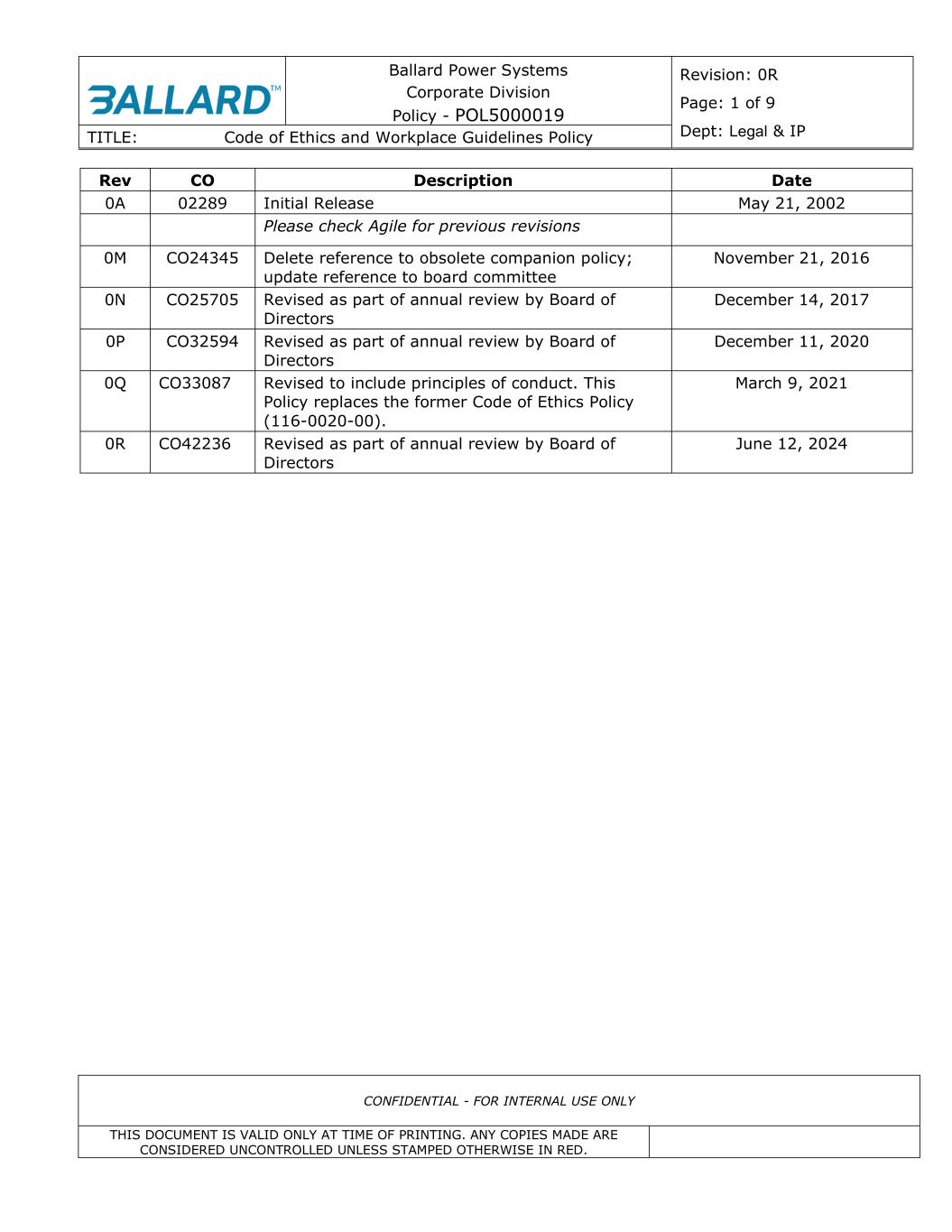
Ballard Power Systems Corporate Division Policy - POL5000019 Revision: 0R Page: 1 of 9 Dept: Legal & IP TITLE: Code of Ethics and Workplace Guidelines Policy CONFIDENTIAL - FOR INTERNAL USE ONLY THIS DOCUMENT IS VALID ONLY AT TIME OF PRINTING. ANY COPIES MADE ARE CONSIDERED UNCONTROLLED UNLESS STAMPED OTHERWISE IN RED. Rev CO Description Date 0A 02289 Initial Release May 21, 2002 Please check Agile for previous revisions 0M CO24345 Delete reference to obsolete companion policy; update reference to board committee November 21, 2016 0N CO25705 Revised as part of annual review by Board of Directors December 14, 2017 0P CO32594 Revised as part of annual review by Board of Directors December 11, 2020 0Q CO33087 Revised to include principles of conduct. This Policy replaces the former Code of Ethics Policy (116-0020-00). March 9, 2021 0R CO42236 Revised as part of annual review by Board of Directors June 12, 2024
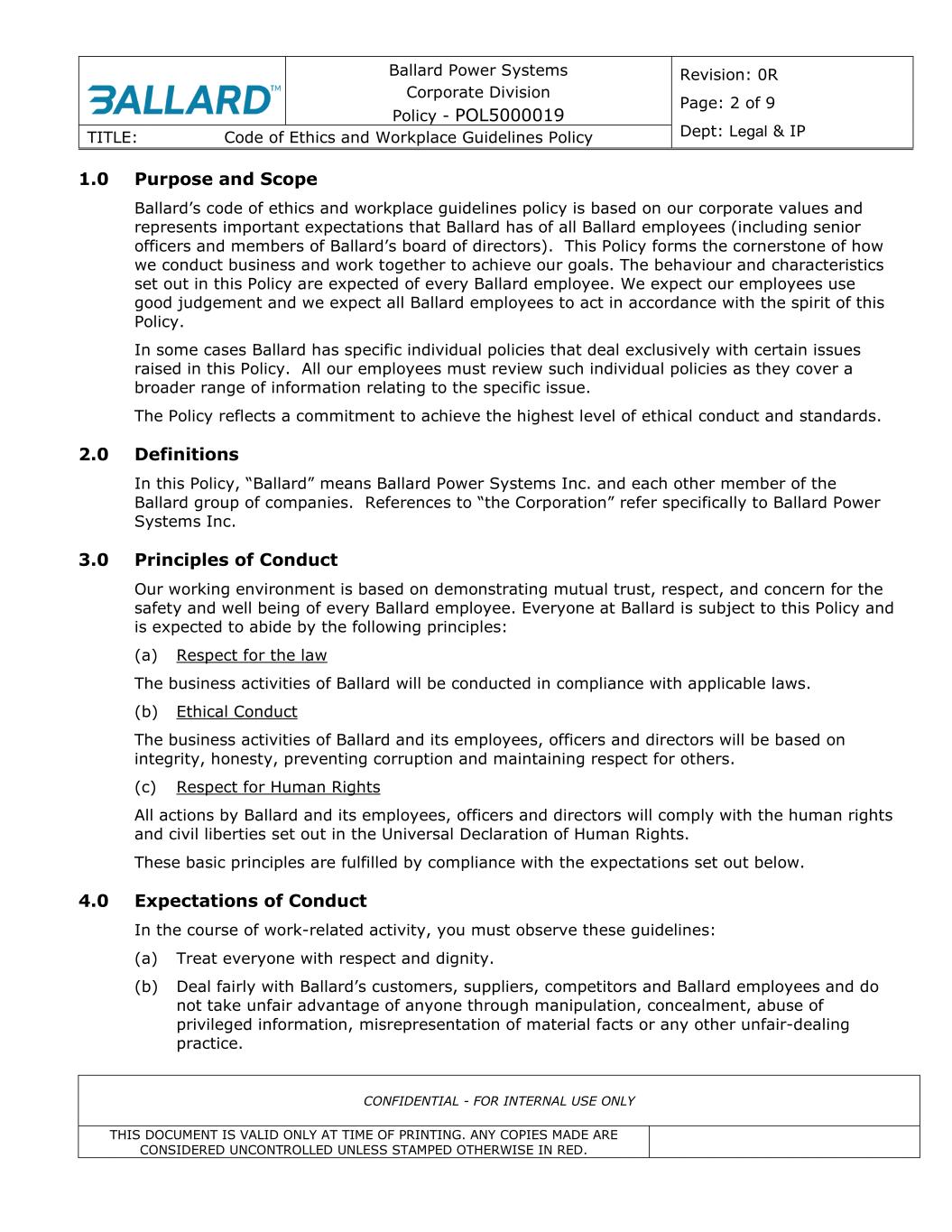
Ballard Power Systems Corporate Division Policy - POL5000019 Revision: 0R Page: 2 of 9 Dept: Legal & IP TITLE: Code of Ethics and Workplace Guidelines Policy CONFIDENTIAL - FOR INTERNAL USE ONLY THIS DOCUMENT IS VALID ONLY AT TIME OF PRINTING. ANY COPIES MADE ARE CONSIDERED UNCONTROLLED UNLESS STAMPED OTHERWISE IN RED. 1.0 Purpose and Scope Ballard’s code of ethics and workplace guidelines policy is based on our corporate values and represents important expectations that Ballard has of all Ballard employees (including senior officers and members of Ballard’s board of directors). This Policy forms the cornerstone of how we conduct business and work together to achieve our goals. The behaviour and characteristics set out in this Policy are expected of every Ballard employee. We expect our employees use good judgement and we expect all Ballard employees to act in accordance with the spirit of this Policy. In some cases Ballard has specific individual policies that deal exclusively with certain issues raised in this Policy. All our employees must review such individual policies as they cover a broader range of information relating to the specific issue. The Policy reflects a commitment to achieve the highest level of ethical conduct and standards. 2.0 Definitions In this Policy, “Ballard” means Ballard Power Systems Inc. and each other member of the Ballard group of companies. References to “the Corporation” refer specifically to Ballard Power Systems Inc. 3.0 Principles of Conduct Our working environment is based on demonstrating mutual trust, respect, and concern for the safety and well being of every Ballard employee. Everyone at Ballard is subject to this Policy and is expected to abide by the following principles: (a) Respect for the law The business activities of Ballard will be conducted in compliance with applicable laws. (b) Ethical Conduct The business activities of Ballard and its employees, officers and directors will be based on integrity, honesty, preventing corruption and maintaining respect for others. (c) Respect for Human Rights All actions by Ballard and its employees, officers and directors will comply with the human rights and civil liberties set out in the Universal Declaration of Human Rights. These basic principles are fulfilled by compliance with the expectations set out below. 4.0 Expectations of Conduct In the course of work-related activity, you must observe these guidelines: (a) Treat everyone with respect and dignity. (b) Deal fairly with Ballard’s customers, suppliers, competitors and Ballard employees and do not take unfair advantage of anyone through manipulation, concealment, abuse of privileged information, misrepresentation of material facts or any other unfair-dealing practice.
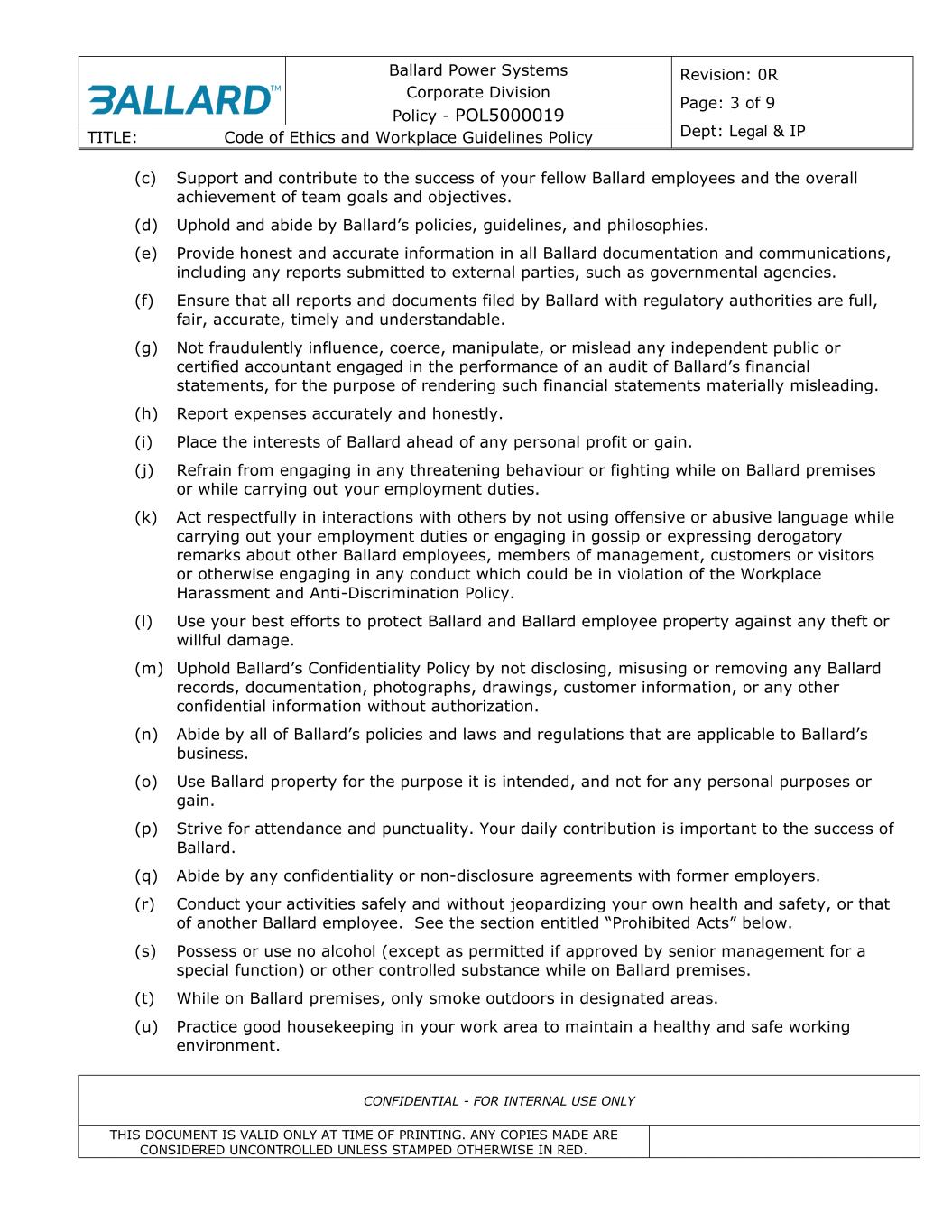
Ballard Power Systems Corporate Division Policy - POL5000019 Revision: 0R Page: 3 of 9 Dept: Legal & IP TITLE: Code of Ethics and Workplace Guidelines Policy CONFIDENTIAL - FOR INTERNAL USE ONLY THIS DOCUMENT IS VALID ONLY AT TIME OF PRINTING. ANY COPIES MADE ARE CONSIDERED UNCONTROLLED UNLESS STAMPED OTHERWISE IN RED. (c) Support and contribute to the success of your fellow Ballard employees and the overall achievement of team goals and objectives. (d) Uphold and abide by Ballard’s policies, guidelines, and philosophies. (e) Provide honest and accurate information in all Ballard documentation and communications, including any reports submitted to external parties, such as governmental agencies. (f) Ensure that all reports and documents filed by Ballard with regulatory authorities are full, fair, accurate, timely and understandable. (g) Not fraudulently influence, coerce, manipulate, or mislead any independent public or certified accountant engaged in the performance of an audit of Ballard’s financial statements, for the purpose of rendering such financial statements materially misleading. (h) Report expenses accurately and honestly. (i) Place the interests of Ballard ahead of any personal profit or gain. (j) Refrain from engaging in any threatening behaviour or fighting while on Ballard premises or while carrying out your employment duties. (k) Act respectfully in interactions with others by not using offensive or abusive language while carrying out your employment duties or engaging in gossip or expressing derogatory remarks about other Ballard employees, members of management, customers or visitors or otherwise engaging in any conduct which could be in violation of the Workplace Harassment and Anti-Discrimination Policy. (l) Use your best efforts to protect Ballard and Ballard employee property against any theft or willful damage. (m) Uphold Ballard’s Confidentiality Policy by not disclosing, misusing or removing any Ballard records, documentation, photographs, drawings, customer information, or any other confidential information without authorization. (n) Abide by all of Ballard’s policies and laws and regulations that are applicable to Ballard’s business. (o) Use Ballard property for the purpose it is intended, and not for any personal purposes or gain. (p) Strive for attendance and punctuality. Your daily contribution is important to the success of Ballard. (q) Abide by any confidentiality or non-disclosure agreements with former employers. (r) Conduct your activities safely and without jeopardizing your own health and safety, or that of another Ballard employee. See the section entitled “Prohibited Acts” below. (s) Possess or use no alcohol (except as permitted if approved by senior management for a special function) or other controlled substance while on Ballard premises. (t) While on Ballard premises, only smoke outdoors in designated areas. (u) Practice good housekeeping in your work area to maintain a healthy and safe working environment.
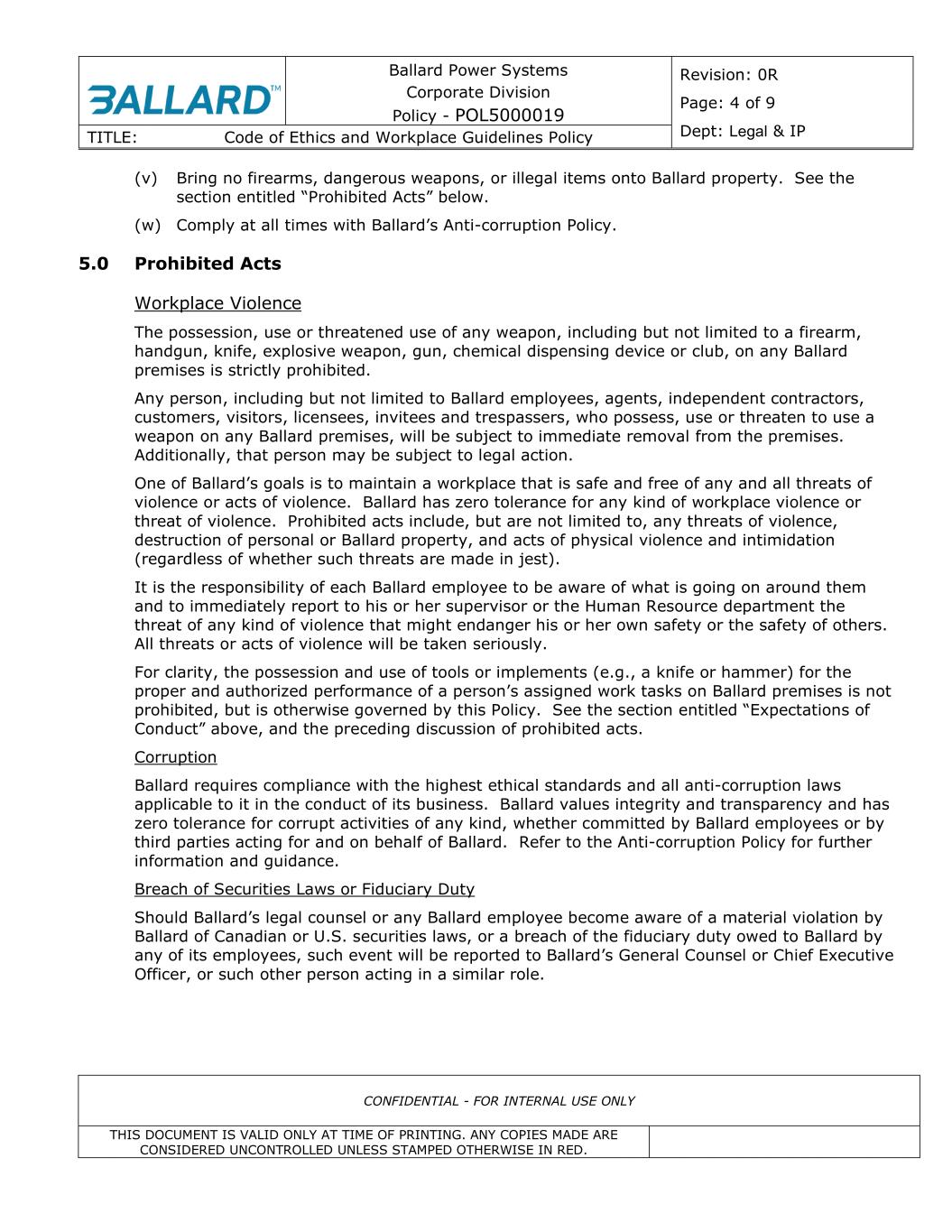
Ballard Power Systems Corporate Division Policy - POL5000019 Revision: 0R Page: 4 of 9 Dept: Legal & IP TITLE: Code of Ethics and Workplace Guidelines Policy CONFIDENTIAL - FOR INTERNAL USE ONLY THIS DOCUMENT IS VALID ONLY AT TIME OF PRINTING. ANY COPIES MADE ARE CONSIDERED UNCONTROLLED UNLESS STAMPED OTHERWISE IN RED. (v) Bring no firearms, dangerous weapons, or illegal items onto Ballard property. See the section entitled “Prohibited Acts” below. (w) Comply at all times with Ballard’s Anti-corruption Policy. 5.0 Prohibited Acts Workplace Violence The possession, use or threatened use of any weapon, including but not limited to a firearm, handgun, knife, explosive weapon, gun, chemical dispensing device or club, on any Ballard premises is strictly prohibited. Any person, including but not limited to Ballard employees, agents, independent contractors, customers, visitors, licensees, invitees and trespassers, who possess, use or threaten to use a weapon on any Ballard premises, will be subject to immediate removal from the premises. Additionally, that person may be subject to legal action. One of Ballard’s goals is to maintain a workplace that is safe and free of any and all threats of violence or acts of violence. Ballard has zero tolerance for any kind of workplace violence or threat of violence. Prohibited acts include, but are not limited to, any threats of violence, destruction of personal or Ballard property, and acts of physical violence and intimidation (regardless of whether such threats are made in jest). It is the responsibility of each Ballard employee to be aware of what is going on around them and to immediately report to his or her supervisor or the Human Resource department the threat of any kind of violence that might endanger his or her own safety or the safety of others. All threats or acts of violence will be taken seriously. For clarity, the possession and use of tools or implements (e.g., a knife or hammer) for the proper and authorized performance of a person’s assigned work tasks on Ballard premises is not prohibited, but is otherwise governed by this Policy. See the section entitled “Expectations of Conduct” above, and the preceding discussion of prohibited acts. Corruption Ballard requires compliance with the highest ethical standards and all anti-corruption laws applicable to it in the conduct of its business. Ballard values integrity and transparency and has zero tolerance for corrupt activities of any kind, whether committed by Ballard employees or by third parties acting for and on behalf of Ballard. Refer to the Anti-corruption Policy for further information and guidance. Breach of Securities Laws or Fiduciary Duty Should Ballard’s legal counsel or any Ballard employee become aware of a material violation by Ballard of Canadian or U.S. securities laws, or a breach of the fiduciary duty owed to Ballard by any of its employees, such event will be reported to Ballard’s General Counsel or Chief Executive Officer, or such other person acting in a similar role.
Ballard Power Systems Corporate Division Policy - POL5000019 Revision: 0R Page: 5 of 9 Dept: Legal & IP TITLE: Code of Ethics and Workplace Guidelines Policy CONFIDENTIAL - FOR INTERNAL USE ONLY THIS DOCUMENT IS VALID ONLY AT TIME OF PRINTING. ANY COPIES MADE ARE CONSIDERED UNCONTROLLED UNLESS STAMPED OTHERWISE IN RED. 6.0 Conflicts of Interest Ballard expects its employees to avoid situations that create conflicts of interest. Conflicts of interest generally take two forms, organizational and personal. In both cases, the appearance of a conflict of interest can be as significant as an actual conflict, so if you have a concern about an appearance of conflict or an actual conflict of interest, please speak to your supervisor. Organizational conflicts of interest refer to situations where, due to relationships with a parent company, affiliate, or subsidiary company, the Ballard company in question is unable or appears to be unable to be impartial in conducting a procurement action involving another Ballard company. Ballard’s policy is to identify, avoid, and mitigate organizational conflicts of interest in work performed with public funding, and for employees to assist in this effort. Organizational conflicts of interest can arise in different contexts, but employees should be particularly vigilant for organizational conflicts of interest when Ballard is performing work funded by or done on behalf of public agencies, including the United States Federal government. Organizational conflicts of interest typically fall into three categories: (1) Unequal access to information: an unfair competitive advantage resulting from obtaining information not generally available to others seeking federal funding. (2) Impaired objectivity: assessing performance or evaluating the application of Ballard or a direct competitor seeking federal funding. (3) Biased ground rules: providing engineering or technical assistance or writing the work requirements for a federal funding opportunity or solicitation where Ballard or a Ballard affiliate is applying for those funds. A common example of a conflict of interest that may require mitigation or management is the use by Ballard of US Federal funding to procure goods or services from a Ballard affiliate or subsidiary. If you become aware of a situation where you, or a Ballard colleague, has an organizational conflict of interest, then disclose that information to your supervisor as soon as possible. Your supervisor will assess the relevant facts regarding the conflict and seek assistance from the Legal team. In the event Ballard determines that an actual or potential organizational conflict exists, Ballard must promptly disclose that conflict to the Federal funding agency (e.g., the United States Department of Energy) along with a proposed plan to mitigate or manage that organizational conflict of interest. The conflict of interest may be mitigated by screening employees from confidential data, recusal of Ballard employees, use of non-affiliated sources of supply, or other means that have been approved by the Federal funding agency. For personal conflicts of interest, a Ballard employee that finds himself or herself in a situation where he or she may be placing their own or others interests ahead of the interests of Ballard must seek advice from his or her direct supervisor. The list below indicates a few personal conflicts that Ballard employees should be aware of. However, many other conflicts of interest can exist and the list below simply sets out the ones that most commonly arise. If you are in a conflict of interest or perceive you may be in a conflict of interest, please speak to your supervisor and from refrain from decision-making and interaction with the relevant person or other entity in the course of your Ballard employment unless and until you have been informed by your supervisor that the conflict has been resolved.
Ballard Power Systems Corporate Division Policy - POL5000019 Revision: 0R Page: 6 of 9 Dept: Legal & IP TITLE: Code of Ethics and Workplace Guidelines Policy CONFIDENTIAL - FOR INTERNAL USE ONLY THIS DOCUMENT IS VALID ONLY AT TIME OF PRINTING. ANY COPIES MADE ARE CONSIDERED UNCONTROLLED UNLESS STAMPED OTHERWISE IN RED. Accepting gifts and invitations Ballard employees may not accept any money or gifts from a supplier or customer, especially where it could influence or might reasonably be seen as influencing Ballard’s business relationship with that supplier or customer. As a minor exception to this general rule, this Policy does not prohibit Ballard employees from accepting occasional gifts of nominal value (i.e. under US $50) or social invitations which are customary and proper under the circumstances and in keeping with good business ethics, so long as no reciprocal obligation is involved in such acceptance. Exercise your best personal judgment and common sense when deciding whether to accept a gift or invitation. When in doubt, please consult your supervisor. Ballard employees must keep in mind that soliciting a gift (whether of nominal value or otherwise) is never acceptable. Choosing suppliers When choosing a supplier among competitors for any goods or service, Ballard employees must weigh the facts impartially and objectively. Choose the supplier who can offer the best-valued product or service in accordance with Ballard’s needs. Ballard employees must not do anything that suggests the purchase decision was influenced by irrelevant or improper considerations, such as a kickback, bribe, personal favour, or gift. When choosing suppliers, Ballard employees must disclose to their supervisor any personal relationships which could influence, or be perceived to influence, the selection and then abstain from the decision-making process. In addition, Ballard employees must not exert any influence to obtain “special treatment” from a particular supplier. It is essential that suppliers competing for Ballard’s business have confidence that Ballard’s selection process is ethical. Giving Gifts Employees must not give gifts to any employee of a supplier or customer where the gift is intended for or may be perceived as a bribe. Providing reasonable levels of hospitality to other parties is certainly acceptable, as long as the expenses are kept at a reasonable level and are not prohibited by law. Giving gifts of nominal value is also generally acceptable, such as Ballard sweatshirts or other Ballard merchandise. Refer to the Commitment and Expenditure Policy and the Travel and Employee Expense Reporting Policy for further information and guidance. Financial conflicts of interest Ballard employees should avoid acquiring or holding a significant financial interest in companies where it may give rise to a conflict between the employee’s financial interest and Ballard’s interests, such as a supplier, customer or provider of service. A financial interest generally will be considered “significant” or improper if the amount of investment (e.g. number of shares owned), together with the identity of the particular company in which the Ballard employee has invested, is influencing or could be viewed objectively as influencing a Ballard employee’s actions or decisions as a Ballard employee. If a Ballard employee holds a significant interest in another company which does business or is negotiating to do business with Ballard, the Ballard employee must disclose the potential conflict to his or her supervisor and refrain from all decision making related to and interaction with that other company in the course of employment. Financial conflicts of interest may also affect Ballard projects that involve funding from the US government. For example, the United States Department of Energy (“US DOE”) has an interim
Ballard Power Systems Corporate Division Policy - POL5000019 Revision: 0R Page: 7 of 9 Dept: Legal & IP TITLE: Code of Ethics and Workplace Guidelines Policy CONFIDENTIAL - FOR INTERNAL USE ONLY THIS DOCUMENT IS VALID ONLY AT TIME OF PRINTING. ANY COPIES MADE ARE CONSIDERED UNCONTROLLED UNLESS STAMPED OTHERWISE IN RED. conflicts of interest policy that must be complied with by each Ballard employee (or contractor) involved in a project funded at least in part by the US DOE. Please refer to Ballard’s Supplementary Policy for Conflicts of Interest in US DOE Funded Projects if you are or will be participating in a project that receives some or all of its funding from the US DOE, either directly, where Ballard is the recipient, or indirectly, where Ballard is a subcontractor to an entity that is receiving the funding. Family and Personal Relationships A Ballard employee should inform their manager if they are considering hiring a near relative or friend, if a relative or friend works for a supplier or competitor or if a near relative or person with whom an employee has a close relationship with is an executive or major shareholder in a competing company. Other employment Employees should not be working outside of their employment at Ballard where such other employment could interfere with the performance of their duties and responsibilities at Ballard. If there are circumstances that require you to maintain another job, you must consult with your supervisor and the Human Resources Department. Ballard does not prevent employees from expending a reasonable amount of time on the activities of community and similar non-profit organizations. Participation on Outside Board of Directors From time to time, employees may have opportunity to sit on a board of directors of another organization. Ballard recognizes the value that can be gained through participation on an outside board of directors. Boards of non-profit organizations companies and boards of companies affiliated with Ballard are not considered outside boards. No approval is required for sitting on the board of non-profit organization or an affiliated company, and sitting on such boards is not counted in determining how many outside boards an employee or executive officer may join. 1. The following approval process applies where an employee has been asked to sit on a board of directors for any another organization. Any proposed board appointment involving an employee other than an executive officer must be approved in advance by the employee’s supervisor, functional Vice President and the CEO. Employees will only be permitted to sit on a maximum of one outside board. 2. Any proposed board appointment involving an executive officer, other than the CEO, must be approved by the governance committee of Ballard’s board of directors. Executive officers will only be permitted to sit on a maximum of one outside board. 3. Any proposed board appointment involving the CEO must be approved by the governance committee of Ballard’s board of directors, followed by approval of the board of directors. The CEO will only be permitted to sit on a maximum of one outside board. The required approvals must be obtained prior to the effective date of any outside board appointment.
Ballard Power Systems Corporate Division Policy - POL5000019 Revision: 0R Page: 8 of 9 Dept: Legal & IP TITLE: Code of Ethics and Workplace Guidelines Policy CONFIDENTIAL - FOR INTERNAL USE ONLY THIS DOCUMENT IS VALID ONLY AT TIME OF PRINTING. ANY COPIES MADE ARE CONSIDERED UNCONTROLLED UNLESS STAMPED OTHERWISE IN RED. Loans Subject to legislative exceptions, Ballard will not, directly or indirectly, extend, arrange or renew an extension of credit in the form of a personal loan to or for any director or executive officer. 7.0 Corporate Communications & Confidentiality Ballard is committed to providing timely, orderly, consistent and credible information (both positive and negative), in accordance with securities laws, to develop and maintain realistic investor expectations. Communications with analysts, the media and investors may only be handled by senior management (i.e. CEO, President or Vice President) or the Corporation’s Investor Relations department in accordance with Ballard’s Disclosure Policy. Refer to the Disclosure Policy for further information and guidance regarding related to disclosure of material information, external communications and crisis management communication. The use of social media communication channels is subject to the Disclosure Policy and the Confidentiality Policy. Refer to the Social Media Policy & Guidelines for further information and guidance. The Confidentiality Policy sets out guidelines for the safeguarding of confidential information and for the conduct of Ballard employees and members of Ballard’s board of directors acting on behalf of Ballard when dealing with external parties. However, it is important to reiterate some of the important points of the Confidentiality Policy in this Policy. Ballard employees must not use their knowledge of any confidential or internal information for personal gain, financial or otherwise. In addition, Ballard employees should not discuss details of Ballard’s business with family or friends or at social or public functions such as dinner parties or trade shows. While it may occasionally become necessary to disclose confidential information in the course of business, such disclosure must be limited to situations where controls have been put into place to limit the inappropriate use or further disclosure of the information. Where confidential information must be disclosed to an external party (such as collaborators, joint developers, suppliers, customers, bankers or professional advisors), only information absolutely necessary to the external party should be provided and the external party should sign a confidentiality agreement in acceptable form. Ballard employees are also required to maintain the confidentiality of information entrusted to them by external parties (e.g. suppliers, customers) in the same manner that Ballard confidential information is maintained. To ensure that the confidentiality of Ballard’s or external parties’ information is maintained when multiple copies of a confidential document has been distributed, all Ballard employees should keep a record of where each copy is and the persons to whom they have given such a copy. This can be done by numbering each copy and creating a distribution list. Confidential documents should include a legend stating that they are proprietary and confidential. If a Ballard employee or a member of Ballard’s board of directors discloses material confidential information to an external party and is concerned that such disclosure may not have been in accordance with this Policy, he or she must immediately notify his or her supervisor or the Corporation’s Chief Financial Officer, the Investor Relations or Legal department. Likewise, a
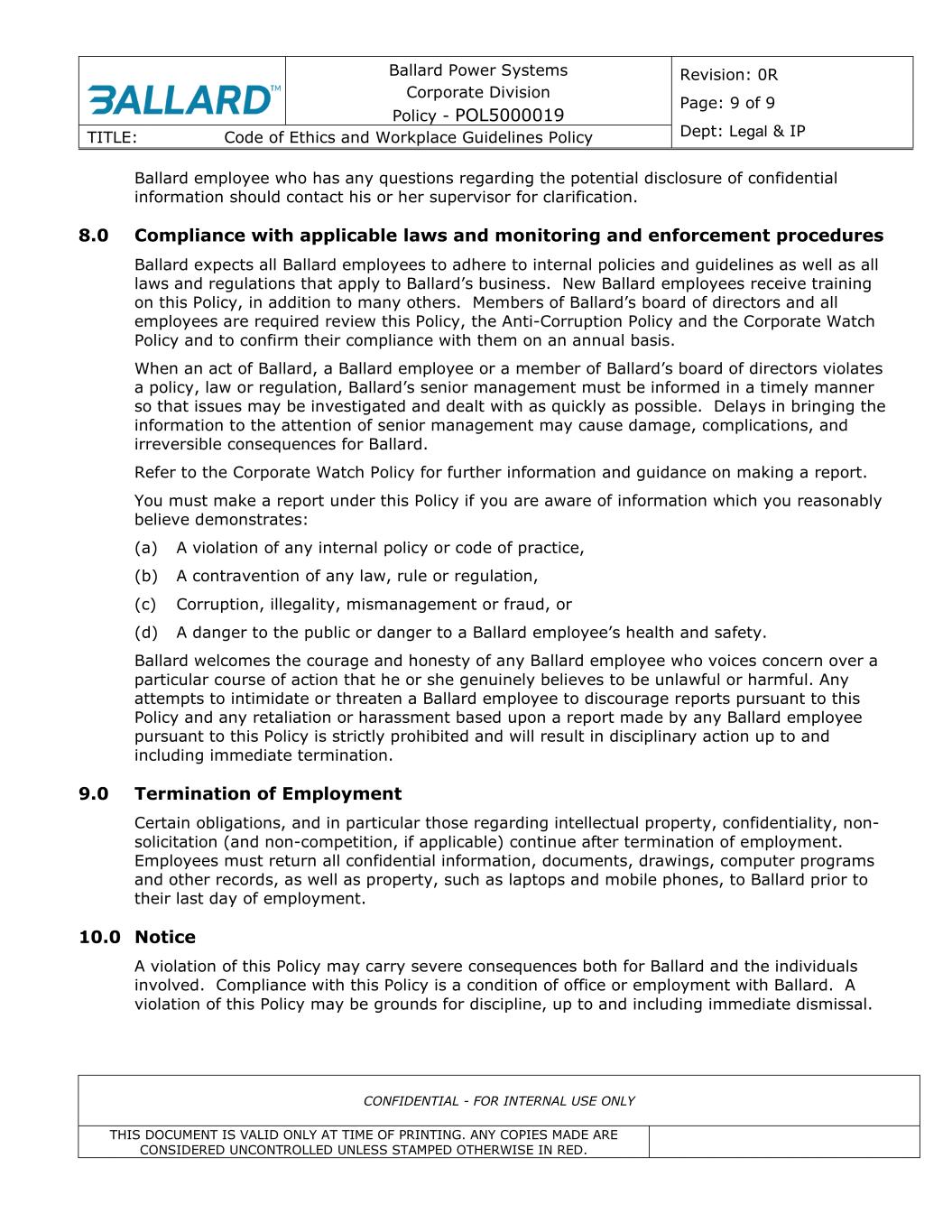
Ballard Power Systems Corporate Division Policy - POL5000019 Revision: 0R Page: 9 of 9 Dept: Legal & IP TITLE: Code of Ethics and Workplace Guidelines Policy CONFIDENTIAL - FOR INTERNAL USE ONLY THIS DOCUMENT IS VALID ONLY AT TIME OF PRINTING. ANY COPIES MADE ARE CONSIDERED UNCONTROLLED UNLESS STAMPED OTHERWISE IN RED. Ballard employee who has any questions regarding the potential disclosure of confidential information should contact his or her supervisor for clarification. 8.0 Compliance with applicable laws and monitoring and enforcement procedures Ballard expects all Ballard employees to adhere to internal policies and guidelines as well as all laws and regulations that apply to Ballard’s business. New Ballard employees receive training on this Policy, in addition to many others. Members of Ballard’s board of directors and all employees are required review this Policy, the Anti-Corruption Policy and the Corporate Watch Policy and to confirm their compliance with them on an annual basis. When an act of Ballard, a Ballard employee or a member of Ballard’s board of directors violates a policy, law or regulation, Ballard’s senior management must be informed in a timely manner so that issues may be investigated and dealt with as quickly as possible. Delays in bringing the information to the attention of senior management may cause damage, complications, and irreversible consequences for Ballard. Refer to the Corporate Watch Policy for further information and guidance on making a report. You must make a report under this Policy if you are aware of information which you reasonably believe demonstrates: (a) A violation of any internal policy or code of practice, (b) A contravention of any law, rule or regulation, (c) Corruption, illegality, mismanagement or fraud, or (d) A danger to the public or danger to a Ballard employee’s health and safety. Ballard welcomes the courage and honesty of any Ballard employee who voices concern over a particular course of action that he or she genuinely believes to be unlawful or harmful. Any attempts to intimidate or threaten a Ballard employee to discourage reports pursuant to this Policy and any retaliation or harassment based upon a report made by any Ballard employee pursuant to this Policy is strictly prohibited and will result in disciplinary action up to and including immediate termination. 9.0 Termination of Employment Certain obligations, and in particular those regarding intellectual property, confidentiality, non- solicitation (and non-competition, if applicable) continue after termination of employment. Employees must return all confidential information, documents, drawings, computer programs and other records, as well as property, such as laptops and mobile phones, to Ballard prior to their last day of employment. 10.0 Notice A violation of this Policy may carry severe consequences both for Ballard and the individuals involved. Compliance with this Policy is a condition of office or employment with Ballard. A violation of this Policy may be grounds for discipline, up to and including immediate dismissal.
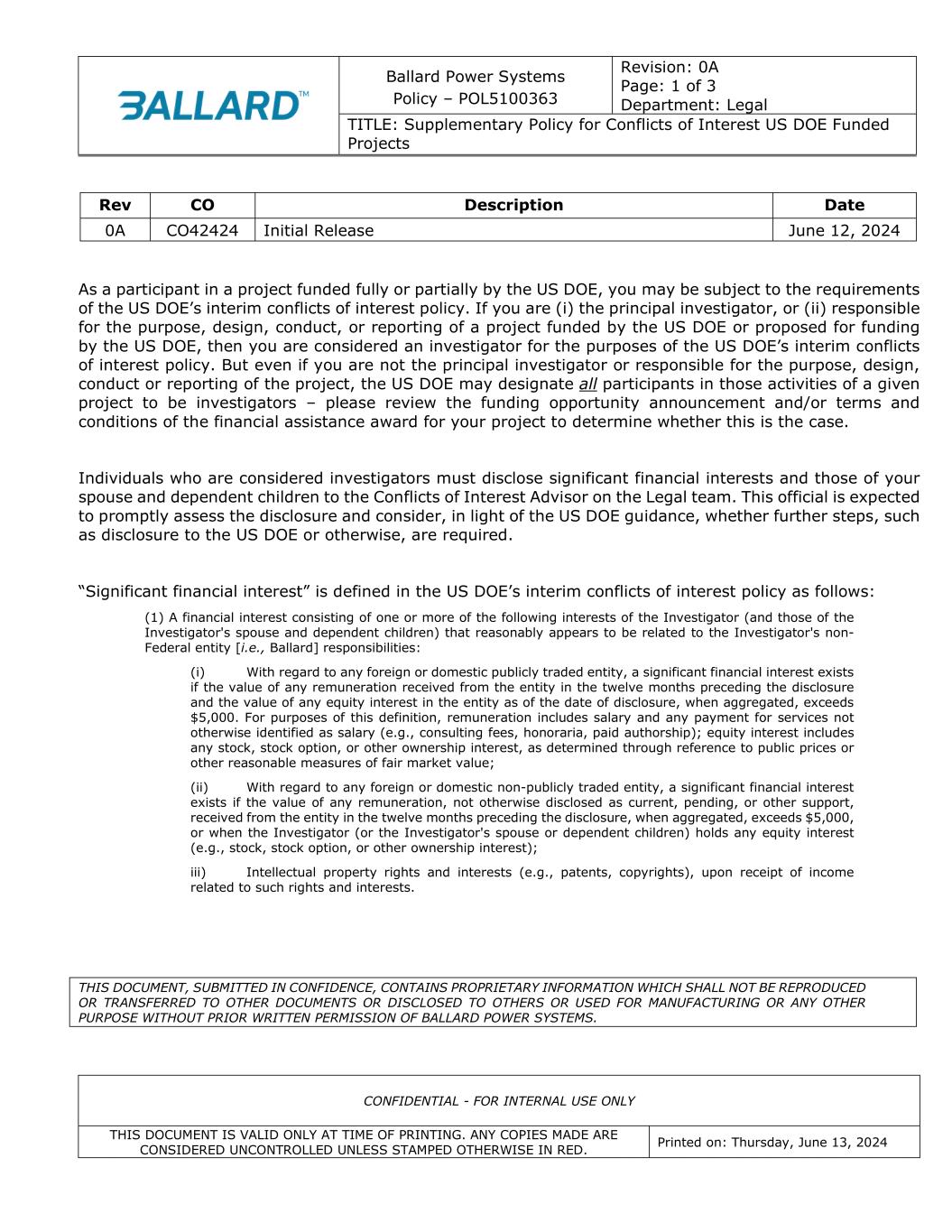
Ballard Power Systems Policy – POL5100363 Revision: 0A Page: 1 of 3 Department: Legal TITLE: Supplementary Policy for Conflicts of Interest US DOE Funded Projects CONFIDENTIAL - FOR INTERNAL USE ONLY THIS DOCUMENT IS VALID ONLY AT TIME OF PRINTING. ANY COPIES MADE ARE CONSIDERED UNCONTROLLED UNLESS STAMPED OTHERWISE IN RED. Printed on: Thursday, June 13, 2024 Rev CO Description Date 0A CO42424 Initial Release June 12, 2024 As a participant in a project funded fully or partially by the US DOE, you may be subject to the requirements of the US DOE’s interim conflicts of interest policy. If you are (i) the principal investigator, or (ii) responsible for the purpose, design, conduct, or reporting of a project funded by the US DOE or proposed for funding by the US DOE, then you are considered an investigator for the purposes of the US DOE’s interim conflicts of interest policy. But even if you are not the principal investigator or responsible for the purpose, design, conduct or reporting of the project, the US DOE may designate all participants in those activities of a given project to be investigators – please review the funding opportunity announcement and/or terms and conditions of the financial assistance award for your project to determine whether this is the case. Individuals who are considered investigators must disclose significant financial interests and those of your spouse and dependent children to the Conflicts of Interest Advisor on the Legal team. This official is expected to promptly assess the disclosure and consider, in light of the US DOE guidance, whether further steps, such as disclosure to the US DOE or otherwise, are required. “Significant financial interest” is defined in the US DOE’s interim conflicts of interest policy as follows: (1) A financial interest consisting of one or more of the following interests of the Investigator (and those of the Investigator's spouse and dependent children) that reasonably appears to be related to the Investigator's non- Federal entity [i.e., Ballard] responsibilities: (i) With regard to any foreign or domestic publicly traded entity, a significant financial interest exists if the value of any remuneration received from the entity in the twelve months preceding the disclosure and the value of any equity interest in the entity as of the date of disclosure, when aggregated, exceeds $5,000. For purposes of this definition, remuneration includes salary and any payment for services not otherwise identified as salary (e.g., consulting fees, honoraria, paid authorship); equity interest includes any stock, stock option, or other ownership interest, as determined through reference to public prices or other reasonable measures of fair market value; (ii) With regard to any foreign or domestic non-publicly traded entity, a significant financial interest exists if the value of any remuneration, not otherwise disclosed as current, pending, or other support, received from the entity in the twelve months preceding the disclosure, when aggregated, exceeds $5,000, or when the Investigator (or the Investigator's spouse or dependent children) holds any equity interest (e.g., stock, stock option, or other ownership interest); iii) Intellectual property rights and interests (e.g., patents, copyrights), upon receipt of income related to such rights and interests. THIS DOCUMENT, SUBMITTED IN CONFIDENCE, CONTAINS PROPRIETARY INFORMATION WHICH SHALL NOT BE REPRODUCED OR TRANSFERRED TO OTHER DOCUMENTS OR DISCLOSED TO OTHERS OR USED FOR MANUFACTURING OR ANY OTHER PURPOSE WITHOUT PRIOR WRITTEN PERMISSION OF BALLARD POWER SYSTEMS.
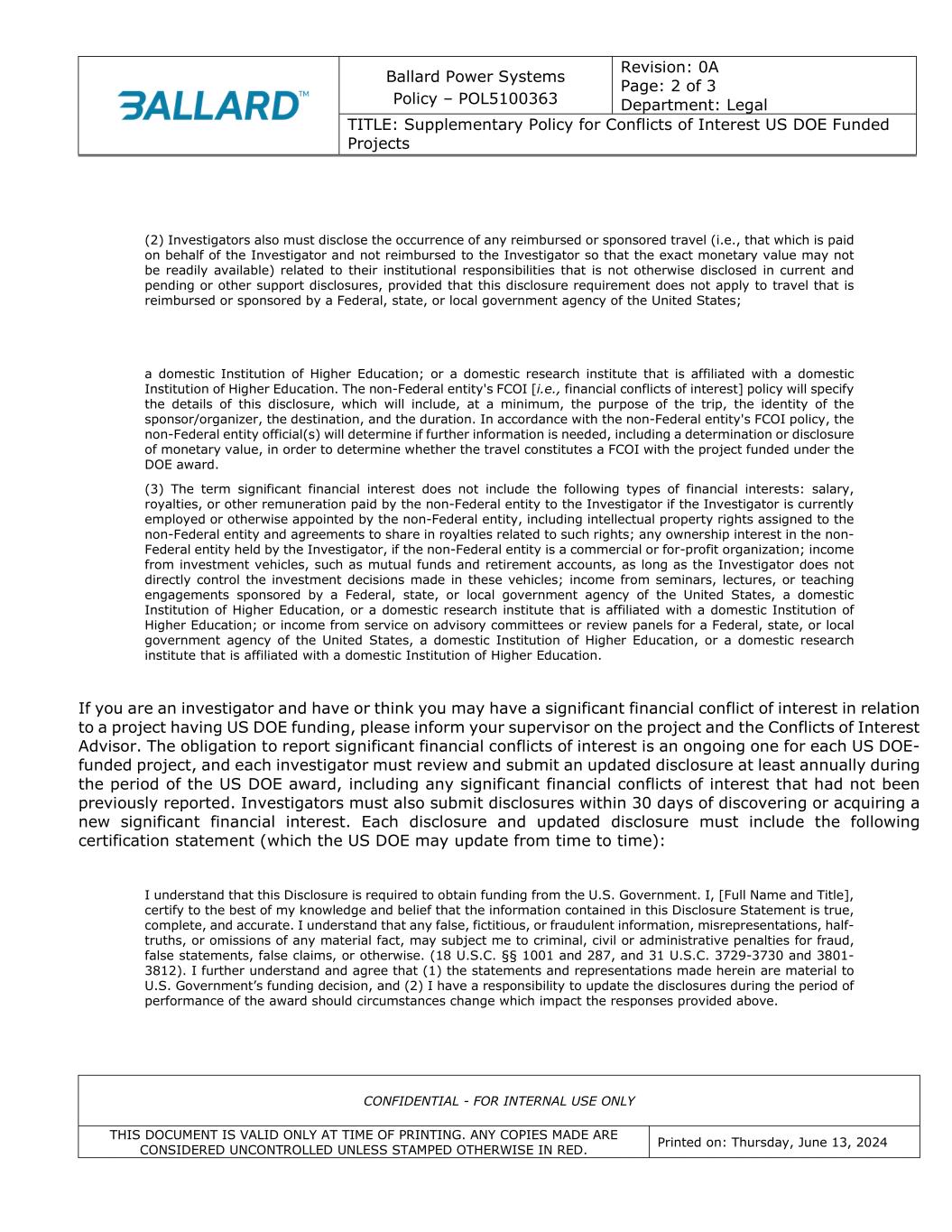
Ballard Power Systems Policy – POL5100363 Revision: 0A Page: 2 of 3 Department: Legal TITLE: Supplementary Policy for Conflicts of Interest US DOE Funded Projects CONFIDENTIAL - FOR INTERNAL USE ONLY THIS DOCUMENT IS VALID ONLY AT TIME OF PRINTING. ANY COPIES MADE ARE CONSIDERED UNCONTROLLED UNLESS STAMPED OTHERWISE IN RED. Printed on: Thursday, June 13, 2024 (2) Investigators also must disclose the occurrence of any reimbursed or sponsored travel (i.e., that which is paid on behalf of the Investigator and not reimbursed to the Investigator so that the exact monetary value may not be readily available) related to their institutional responsibilities that is not otherwise disclosed in current and pending or other support disclosures, provided that this disclosure requirement does not apply to travel that is reimbursed or sponsored by a Federal, state, or local government agency of the United States; a domestic Institution of Higher Education; or a domestic research institute that is affiliated with a domestic Institution of Higher Education. The non-Federal entity's FCOI [i.e., financial conflicts of interest] policy will specify the details of this disclosure, which will include, at a minimum, the purpose of the trip, the identity of the sponsor/organizer, the destination, and the duration. In accordance with the non-Federal entity's FCOI policy, the non-Federal entity official(s) will determine if further information is needed, including a determination or disclosure of monetary value, in order to determine whether the travel constitutes a FCOI with the project funded under the DOE award. (3) The term significant financial interest does not include the following types of financial interests: salary, royalties, or other remuneration paid by the non-Federal entity to the Investigator if the Investigator is currently employed or otherwise appointed by the non-Federal entity, including intellectual property rights assigned to the non-Federal entity and agreements to share in royalties related to such rights; any ownership interest in the non- Federal entity held by the Investigator, if the non-Federal entity is a commercial or for-profit organization; income from investment vehicles, such as mutual funds and retirement accounts, as long as the Investigator does not directly control the investment decisions made in these vehicles; income from seminars, lectures, or teaching engagements sponsored by a Federal, state, or local government agency of the United States, a domestic Institution of Higher Education, or a domestic research institute that is affiliated with a domestic Institution of Higher Education; or income from service on advisory committees or review panels for a Federal, state, or local government agency of the United States, a domestic Institution of Higher Education, or a domestic research institute that is affiliated with a domestic Institution of Higher Education. If you are an investigator and have or think you may have a significant financial conflict of interest in relation to a project having US DOE funding, please inform your supervisor on the project and the Conflicts of Interest Advisor. The obligation to report significant financial conflicts of interest is an ongoing one for each US DOE- funded project, and each investigator must review and submit an updated disclosure at least annually during the period of the US DOE award, including any significant financial conflicts of interest that had not been previously reported. Investigators must also submit disclosures within 30 days of discovering or acquiring a new significant financial interest. Each disclosure and updated disclosure must include the following certification statement (which the US DOE may update from time to time): I understand that this Disclosure is required to obtain funding from the U.S. Government. I, [Full Name and Title], certify to the best of my knowledge and belief that the information contained in this Disclosure Statement is true, complete, and accurate. I understand that any false, fictitious, or fraudulent information, misrepresentations, half- truths, or omissions of any material fact, may subject me to criminal, civil or administrative penalties for fraud, false statements, false claims, or otherwise. (18 U.S.C. §§ 1001 and 287, and 31 U.S.C. 3729-3730 and 3801- 3812). I further understand and agree that (1) the statements and representations made herein are material to U.S. Government’s funding decision, and (2) I have a responsibility to update the disclosures during the period of performance of the award should circumstances change which impact the responses provided above.

Ballard Power Systems Policy – POL5100363 Revision: 0A Page: 3 of 3 Department: Legal TITLE: Supplementary Policy for Conflicts of Interest US DOE Funded Projects CONFIDENTIAL - FOR INTERNAL USE ONLY THIS DOCUMENT IS VALID ONLY AT TIME OF PRINTING. ANY COPIES MADE ARE CONSIDERED UNCONTROLLED UNLESS STAMPED OTHERWISE IN RED. Printed on: Thursday, June 13, 2024 If you have any questions about whether or not you need to make any disclosures, please speak to your supervisor on the project or the Conflicts of Interest Advisor.
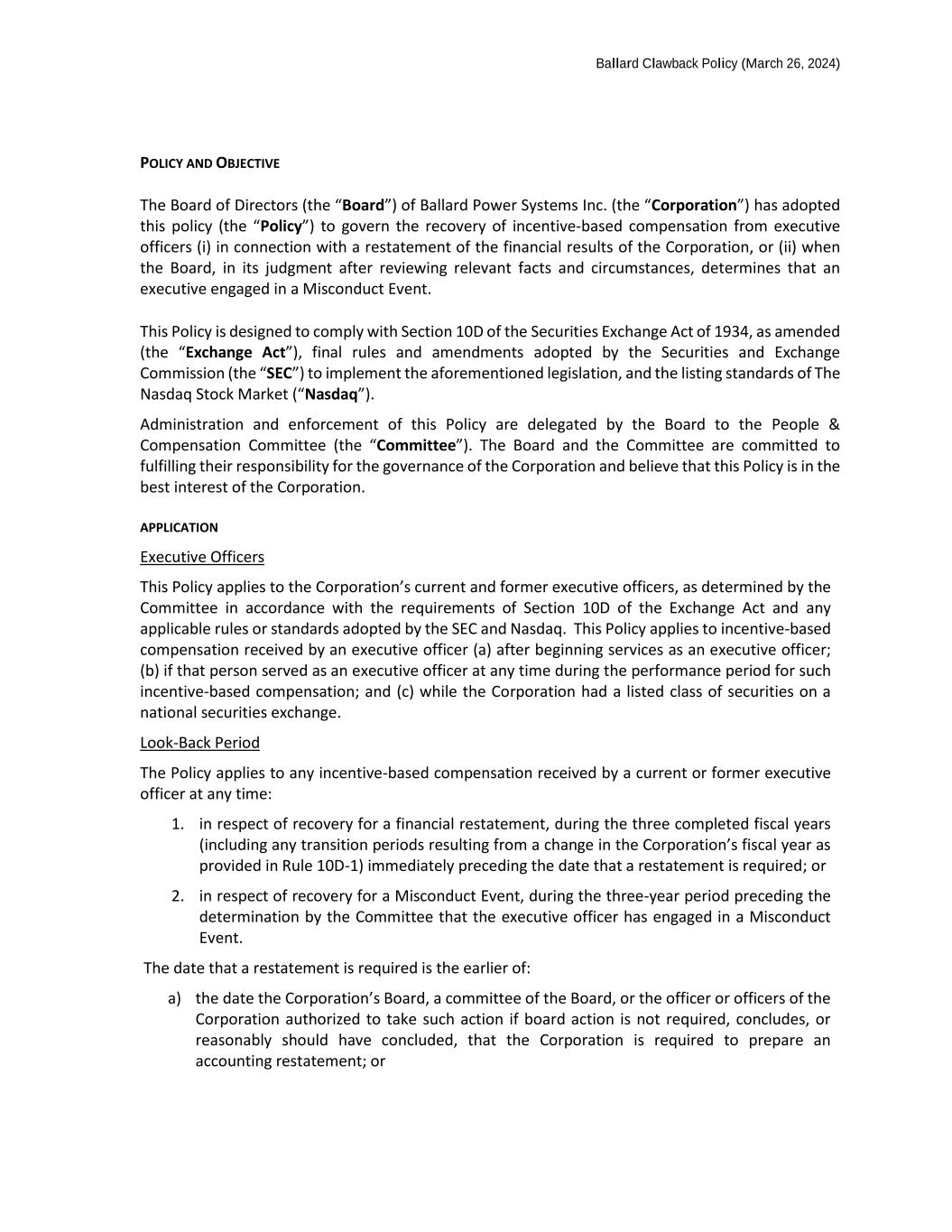
Ballard Clawback Policy (March 26, 2024) POLICY AND OBJECTIVE The Board of Directors (the “Board”) of Ballard Power Systems Inc. (the “Corporation”) has adopted this policy (the “Policy”) to govern the recovery of incentive-based compensation from executive officers (i) in connection with a restatement of the financial results of the Corporation, or (ii) when the Board, in its judgment after reviewing relevant facts and circumstances, determines that an executive engaged in a Misconduct Event. This Policy is designed to comply with Section 10D of the Securities Exchange Act of 1934, as amended (the “Exchange Act”), final rules and amendments adopted by the Securities and Exchange Commission (the “SEC”) to implement the aforementioned legislation, and the listing standards of The Nasdaq Stock Market (“Nasdaq”). Administration and enforcement of this Policy are delegated by the Board to the People & Compensation Committee (the “Committee”). The Board and the Committee are committed to fulfilling their responsibility for the governance of the Corporation and believe that this Policy is in the best interest of the Corporation. APPLICATION Executive Officers This Policy applies to the Corporation’s current and former executive officers, as determined by the Committee in accordance with the requirements of Section 10D of the Exchange Act and any applicable rules or standards adopted by the SEC and Nasdaq. This Policy applies to incentive-based compensation received by an executive officer (a) after beginning services as an executive officer; (b) if that person served as an executive officer at any time during the performance period for such incentive-based compensation; and (c) while the Corporation had a listed class of securities on a national securities exchange. Look-Back Period The Policy applies to any incentive-based compensation received by a current or former executive officer at any time: 1. in respect of recovery for a financial restatement, during the three completed fiscal years (including any transition periods resulting from a change in the Corporation’s fiscal year as provided in Rule 10D-1) immediately preceding the date that a restatement is required; or 2. in respect of recovery for a Misconduct Event, during the three-year period preceding the determination by the Committee that the executive officer has engaged in a Misconduct Event. The date that a restatement is required is the earlier of: a) the date the Corporation’s Board, a committee of the Board, or the officer or officers of the Corporation authorized to take such action if board action is not required, concludes, or reasonably should have concluded, that the Corporation is required to prepare an accounting restatement; or
- 2 - b) the date a court, regulator, or other legally authorized body directs the Corporation to prepare the accounting restatement. Notwithstanding the foregoing, this Policy only applies to incentive-based compensation received on or after the effective date. The Corporation’s former policy will apply to incentive-based compensation received before the effective date. RECOVERY A. Financial Restatements Recovery of erroneously awarded compensation under this Part A is on a “no fault” basis, without regard to whether any misconduct occurred or an executive officer’s responsibility for the erroneous financial statements. For the purposes of this Part A, a “performance metric” in the definition of incentive-based compensation is limited to financial reporting measures. Further, equity awards that vest exclusively upon completion of a specified employment period, without any performance condition, and bonus awards that are discretionary or based on subjective metrics or metrics unrelated to financial reporting measures, do not constitute incentive-based compensation for the purposes of this Part A. Types of Restatements A restatement due to material noncompliance with any financial reporting requirement under the securities laws triggers application of this Policy. Recovery for restatements that correct errors that are material to previously issued financial statements (“Big R” restatements), as well as for restatements that correct errors that are not material to previously issued financial statements but would result in a material misstatement if the errors were left uncorrected in the current report or the error correction was recognized in the current period (“little r” restatements). In determining the materiality of an error, the Board shall have regard to the facts and circumstances and existing judicial and administrative interpretations. Recovery Amount Determination The erroneously awarded incentive-based compensation subject to recovery is the amount of incentive-based compensation received that exceeds the amount of incentive-based compensation that otherwise would have been received had it been determined based on the restated amounts, calculated on a pre-tax basis. For equity awards that are incentive-based compensation, if the shares, share units or options are still held at the time of recovery, the recoverable amount is the number of shares, share units or options received in excess of the number that should have been received after applying the restated financial reporting measure. If options have been exercised, but the underlying shares have not been sold, the recoverable amount is the number of shares underlying the excess options applying the restated financial measure. For incentive-based compensation based on stock price or total shareholder return, where the amount of erroneously awarded compensation is not subject to mathematical recalculation based on the information in an accounting restatement, the recoverable amount must be determined based on a reasonable, documented estimate of the effect of the accounting restatement on the applicable measure. The Corporation shall maintain documentation of the determination of that reasonable estimate and provide such documentation to Nasdaq.
- 3 - Recovery of Amounts Paid The Corporation shall recover erroneously awarded incentive-based compensation in compliance with this Policy, except to the extent that the Board has determined that pursuit of recovery would be impracticable because: 1. the direct expense paid to a third party to assist in enforcing the policy would exceed the amount to be recovered; 2. it would violate home country law, where that law was adopted prior to November 28, 2022, based on an opinion of counsel acceptable to Nasdaq; or 3. it would cause a retirement plan, under which benefits are broadly available to employees of the Corporation, to fail to meet the requirements of 26 U.S.C. 401(a)(13) or 26 U.S.C. 411(a) and regulations thereunder. Before concluding that pursuit is impracticable, the Corporation must first make a reasonable attempt to recover the incentive-based compensation, document such reasonable attempt(s) to recover, and provide that documentation to Nasdaq. B. Misconduct Events For the purposes of this Part B, equity awards that vest exclusively upon completion of a specified employment period, without any performance condition, and bonus awards that are discretionary or based on subjective goals or goals unrelated to financial reporting measures, may constitute incentive-based compensation in the Committee’s sole discretion. If a matter involves both financial restatement and a Misconduct Event, nothing in this Part B will impact the recovery of erroneously awarded incentive-based compensation as required by Part A of this Policy. Recovery Amount Determination If an executive officer engages in a Misconduct Event, the Committee will determine in its sole discretion the amount, if any, of the incentive-based compensation that should be recovered. In making such determination, the Committee may take into account any considerations it deems appropriate, including, without limitation, (i) the applicable governing law, (ii) the likelihood of success and the cost of pursuing recovery, (iii) the facts and circumstances regarding the underlying conduct, and (iv) any prejudice to the interests of the Corporation, including in any related proceeding or investigation. Recovery of Amounts Paid The Committee will determine, in its sole discretion, the method for recovering incentive-based compensation to the extent permitted by applicable law, which may include without limitation: 1. requiring reimbursement of incentive-based compensation; 2. cancelling or rescinding some or all outstanding vested or unvested equity (and/or equity-based) awards; 3. adjusting or withholding from unpaid compensation or other set-off; or 4. reducing or eliminating future salary increases, incentive-based compensation, or severance.
- 4 - NO INDEMNIFICATION The Corporation is prohibited from indemnifying any current or former executive officer for recovered compensation. However, if an executive officer subject to a recovery demand or forfeiture retains counsel to represent the executive officer to challenge such determination and as a result of such challenge the Committee retracts, withdraws or rescinds all or part of such determination, or a court of competent jurisdiction rules that all or part of such determination is invalid, or contrary to this Policy or applicable law, the Corporation shall reimburse such executive officer for all reasonable costs and legal fees in connection with such representation. DEFINITIONS For the purposes of this Policy: 1) “effective date” means October 2, 2023. 2) “executive officer” means the Corporation’s president, principal financial officer, principal accounting officer (or if there is no such accounting officer, the controller), any vice-president of the Corporation in charge of a principal business unit, division, or function (such as sales, administration, or finance), any other officer who performs a policy-making function, or any other person who performs similar policymaking functions for the Corporation. Executive officers of the Corporation’s parent(s) or subsidiaries are deemed executive officers of the Corporation if they perform such policy making functions for the Corporation. Policy-making function is not intended to include policy-making functions that are not significant. 3) “financial reporting measures” are measures that are determined and presented in accordance with the accounting principles used in preparing the Corporation’s financial statements, and any measures that are derived wholly or in part from such measures. Stock price and total shareholder return are also financial reporting measures. A financial reporting measure need not be presented within the financial statements or included in a regulatory filing. 4) “incentive-based compensation” is any compensation that is granted, earned, or vested based wholly or in part upon the attainment of a performance metric. Incentive-based compensation includes, but is not limited to: ➢ Non-equity incentive plan awards that are earned based wholly or in part on satisfying a performance metric; ➢ Bonuses paid from a “bonus pool,” the size of which is determined based wholly or in part on satisfying a performance metric; ➢ Other cash awards based on satisfaction of a performance metric; ➢ Restricted stock, restricted stock units, performance share units, stock options, and stock appreciation rights that are granted or become vested based wholly or in part on satisfying a performance metric; and ➢ Proceeds received upon the sale of shares acquired through an incentive plan that were granted or vested based wholly or in part on satisfying a performance metric.
- 5 - 5) “Misconduct Event” means any of the following circumstances: a) A material violation of law, or a written policy of the Corporation, including without limitation, the Corporation’s Code of Ethics; or b) gross negligence, fraud, or willful misconduct in the performance of the executive officer’s duties, provided that any such circumstances must have caused material financial harm to the Corporation, or a material decline in the Corporation’s common share price. 6) “received” Incentive-based compensation is deemed received in the Corporation’s fiscal period during which the financial reporting measure specified in the incentive-based compensation award is attained, even if the payment or grant of the incentive-based compensation occurs after the end of that period. GENERAL Disclosure Requirements The Corporation shall file this Policy as an exhibit to its Form 40-F filed with the SEC. In addition, the Corporation shall file all disclosures required by securities laws if, during the prior fiscal year, either a triggering restatement occurred or any balance of excess incentive-based compensation was outstanding. (See Appendix for current disclosure requirements.) Interpretation and Amendment The Board is authorized to interpret and construe this Policy and to make all determinations necessary, appropriate or advisable for the administration of this Policy and may delegate any or all of its duties and responsibilities under this Policy to the Audit Committee and/or People & Compensation Committee, in which case any reference to the “Board” in this Policy shall be to such committees. This Policy shall not be deemed to contradict the existing terms of any outstanding agreements, plans, programs or other arrangements pursuant to which performance-based compensation may be awarded or paid by the Corporation and shall supersede any such agreements, plans, programs or other arrangements to the extent of any inconsistency with this Policy. The remedies available under this Policy shall not be exhaustive and nothing herein shall preclude the Corporation from taking any disciplinary actions in respect of the acts or conduct of an executive officer as the Corporation deems appropriate in the circumstances, up to and including termination of employment, as well as any other remedies or recourses available to the Corporation. The provisions of this Policy are in addition to (and not in lieu of) any rights to repayment the Corporation may have under Section 304 of the Sarbanes-Oxley Act of 2002 and other applicable laws. This Policy may be amended or restated by the Board from time to time to ensure compliance with applicable securities regulations and exchange rules and policies, and it may be supplemented by, among other things, more specific procedures and standards as well as amendments to the applicable compensation agreements, plans, programs or other arrangements of the Corporation. This Policy was approved by the Board of Directors of the Corporation on March 26, 2024.
- 6 - APPENDIX SEC rules require disclosure pursuant to Item 402 of Regulation S-K of the following items, among others, if, during the prior fiscal year, either a triggering restatement occurred or any balance of excess incentive-based compensation was outstanding: • The date on which the listed issuer was required to prepare an accounting restatement and the aggregate dollar amount of erroneously awarded compensation attributable to such accounting restatement (including an analysis of how the recoverable amount was calculated) or, if the amount has not yet been determined, an explanation of the reasons and disclosure of the amount and related disclosures in the next filing that is subject to Item 402 of Regulation S-K; • The aggregate dollar amount of erroneously awarded compensation that remains outstanding at the end of its last completed fiscal year; • If the financial reporting measure related to a stock price or total shareholder return metric, the estimates used to determine the amount of erroneously awarded compensation attributable to such accounting restatement and an explanation of the methodology used for such estimates; • If recovery would be impracticable, for each current and former named executive officer and for all other current and former executive officers as a group, disclose the amount of recovery forgone and a brief description of the reason the listed registrant decided in each case not to pursue recovery; and • For each current and former named executive officer, disclose the amount of erroneously awarded compensation still owed that had been outstanding for 180 days or longer since the date the issuer determined the amount owed.
Consolidated Financial Statements
(Expressed in U.S. dollars)
BALLARD POWER SYSTEMS INC.
Years ended December 31, 2025 and 2024
MANAGEMENT’S REPORT
Management’s Responsibility for the Financial Statements and Report on Internal Control over Financial Reporting
The consolidated financial statements contained in this Annual Report have been prepared by management in accordance with International Financial Reporting Standards (“IFRS”) as issued by the International Accounting Standards Board. The integrity and objectivity of the data in these consolidated financial statements are management’s responsibility. Management is also responsible for all other information in the Annual Report and for ensuring that this information is consistent, where appropriate, with the information and data contained in the consolidated financial statements.
Management is responsible for establishing and maintaining adequate internal control over financial reporting. Internal control over financial reporting is a process designed to provide reasonable assurance regarding the reliability of financial reporting and the preparation of consolidated financial statements for external reporting purposes in accordance with IFRS. Internal control over financial reporting may not prevent or detect fraud or misstatements because of limitations inherent in any system of internal control. Management has assessed the effectiveness of the Corporation’s internal control over financial reporting based on the framework in Internal Control – Integrated Framework (2013) issued by the Committee of Sponsoring Organizations of the Treadway Commission, and concluded that the Corporation’s internal control over financial reporting was effective as of December 31, 2025. Some of the assets and liabilities include amounts, which are based on estimates and judgments, as their final determination is dependent on future events.
The Board of Directors oversees management’s responsibilities for financial reporting through the Audit Committee, which consists of six directors who are independent and not involved in the daily operations of the Corporation. The Audit Committee meets on a regular basis with management and the external and internal auditors to discuss internal controls over the financial reporting process, auditing matters and financial reporting issues. The Audit Committee is responsible for appointing the external auditors (subject to shareholder approval), and reviewing and approving all financial disclosure contained in our public documents and related party transactions.
The external auditors, KPMG LLP, have audited the financial statements and expressed an unqualified opinion thereon. KPMG has also expressed an unqualified opinion on the effective operation of the internal controls over financial reporting as of December 31, 2025. The external auditors have full access to management and the Audit Committee with respect to their findings concerning the fairness of financial reporting and the adequacy of internal controls.
| “MARTY NEESE” | “KATE IGBALODE" | ||||
| MARTY NEESE | KATE IGBALODE | ||||
| President and | Senior Vice President and | ||||
| Chief Executive Officer | Chief Financial Officer | ||||
| March 11, 2026 | March 11, 2026 | ||||
Report of Independent Registered Public Accounting Firm
To the Shareholders and Board of Directors
Ballard Power Systems Inc.:
Opinion on the Consolidated Financial Statements
We have audited the accompanying consolidated statements of financial position of Ballard Power Systems Inc. and subsidiaries (the Corporation) as at December 31, 2025 and 2024, the related consolidated statements of loss and comprehensive income (loss), changes in equity, and cash flows for each of the years then ended, and the related notes (collectively, the consolidated financial statements). In our opinion, the consolidated financial statements present fairly, in all material respects, the financial position of the Corporation as at December 31, 2025 and 2024, and its financial performance and its cash flows for each of the years then ended, in conformity with International Financial Reporting Standards (IFRS) as issued by the International Accounting Standards Board (IASB).
We also have audited, in accordance with the standards of the Public Company Accounting Oversight Board (United States) (PCAOB), the Corporation’s internal control over financial reporting as at December 31, 2025, based on criteria established in Internal Control – Integrated Framework (2013) issued by the Committee of Sponsoring Organizations of the Treadway Commission, and our report dated March 11, 2026 expressed an unqualified opinion on the effectiveness of the Corporation’s internal control over financial reporting.
Basis for Opinion
These consolidated financial statements are the responsibility of the Corporation’s management. Our responsibility is to express an opinion on these consolidated financial statements based on our audits. We are a public accounting firm registered with the PCAOB and are required to be independent with respect to the Corporation in accordance with the U.S. federal securities laws and the applicable rules and regulations of the Securities and Exchange Commission and the PCAOB.
We conducted our audits in accordance with the standards of the PCAOB. Those standards require that we plan and perform the audit to obtain reasonable assurance about whether the consolidated financial statements are free of material misstatement, whether due to error or fraud. Our audits included performing procedures to assess the risks of material misstatement of the consolidated financial statements, whether due to error or fraud, and performing procedures that respond to those risks. Such procedures included examining, on a test basis, evidence regarding the amounts and disclosures in the consolidated financial statements. Our audits also included evaluating the accounting principles used and significant estimates made by management, as well as evaluating the overall presentation of the consolidated financial statements. We believe that our audits provide a reasonable basis for our opinion.
Critical Audit Matter
The critical audit matter communicated below is a matter arising from the current period audit of the consolidated financial statements that was communicated or required to be communicated to the audit committee and that: (1) relates to accounts or disclosures that are material to the consolidated financial statements and (2) involved our especially challenging, subjective, or complex judgments. The communication of a critical audit matter does not alter in any way our opinion on the consolidated financial statements, taken as a whole, and we are not, by communicating the critical audit matter below, providing a separate opinion on the critical audit matter or on the accounts or disclosures to which it relates.
Evaluation of inventory excess and obsolescence
As discussed in Note 8 to the consolidated financial statements, the Corporation’s inventories were $43.8 million as at December 31, 2025. As further discussed in Notes 4(d) and 5(d), the Corporation states its inventories at the lower of cost or net realizable value and records an adjustment to the cost when management estimates that inventory carrying values will be affected by changes in market pricing or demand for the products and by changes in technology or design which could make the inventory obsolete or recoverable at less than the recorded value. The Corporation’s model to estimate the excess and obsolete inventory is based on an analysis of existing inventory quantities compared to future demand. Additionally, the Corporation reviews inventory to determine whether the carrying value exceeds the net amount realizable upon the ultimate sale of the inventory.
We identified the evaluation of excess and obsolete inventory as a critical audit matter. Complex auditor judgment was required to evaluate certain assumptions used in the Corporation’s model, specifically assumptions that take into account future demand and the percentage of inventory considered at risk.
The following are the primary procedures we performed to address this critical audit matter. We evaluated the design and tested the operating effectiveness of certain internal controls related to the Corporation’s process to estimate inventory excess and obsolescence. We assessed the Corporation’s assumptions used to estimate the provision for excess and obsolete inventory by:
•evaluating historical cumulative write down trends and relevant changes to the overall business environment,
•evaluating the Corporation’s ability to accurately estimate future demand by comparing certain assumptions made in the prior year to actual results in the current period,
•performing inquiries with nonfinancial personnel for a selection of products within inventory for which the Corporation evaluated excess and obsolescence based on assumptions with a higher degree of subjectivity,
•selecting a sample of products within inventory and for each sample selection, we inspected internal and/or external information underlying the Corporation’s evaluation of excess and obsolescence and recalculated the Corporation’s estimate of the inventory provision based on the actual quantity of product on hand compared to the estimate of future demand.
/s/ KPMG LLP
Chartered Professional Accountants
We have served as the Corporation’s auditor since 1999.
Vancouver, Canada
March 11, 2026
Report of Independent Registered Public Accounting Firm
To the Shareholders and Board of Directors
Ballard Power Systems Inc.:
Opinion on Internal Control Over Financial Reporting
We have audited Ballard Power Systems Inc. and subsidiaries’ (the Corporation) internal control over financial reporting as of December 31, 2025, based on criteria established in Internal Control – Integrated Framework (2013) issued by the Committee of Sponsoring Organizations of the Treadway Commission. In our opinion, the Corporation maintained, in all material respects, effective internal control over financial reporting as of December 31, 2025, based on criteria established in Internal Control – Integrated Framework (2013) issued by the Committee of Sponsoring Organizations of the Treadway Commission.
We also have audited, in accordance with the standards of the Public Company Accounting Oversight Board (United States) (PCAOB), the consolidated statements of financial position of the Corporation as at December 31, 2025 and 2024, the related consolidated statements of loss and comprehensive income (loss), changes in equity, and cash flows for each of the years then ended, and the related notes (collectively, the consolidated financial statements), and our report dated March 11, 2026 expressed an unqualified opinion on those consolidated financial statements.
Basis for Opinion
The Corporation’s management is responsible for maintaining effective internal control over financial reporting and for its assessment of the effectiveness of internal control over financial reporting, included in the accompanying Management’s Responsibility for the Financial Statements and Report on Internal Control over Financial Reporting. Our responsibility is to express an opinion on the Corporation’s internal control over financial reporting based on our audit. We are a public accounting firm registered with the PCAOB and are required to be independent with respect to the Corporation in accordance with the U.S. federal securities laws and the applicable rules and regulations of the Securities and Exchange Commission and the PCAOB.
We conducted our audit in accordance with the standards of the PCAOB. Those standards require that we plan and perform the audit to obtain reasonable assurance about whether effective internal control over financial reporting was maintained in all material respects. Our audit of internal control over financial reporting included obtaining an understanding of internal control over financial reporting, assessing the risk that a material weakness exists, and testing and evaluating the design and operating effectiveness of internal control based on the assessed risk. Our audit also included performing such other procedures as we considered necessary in the circumstances. We believe that our audit provides a reasonable basis for our opinion.
Definition and Limitations of Internal Control Over Financial Reporting
A company’s internal control over financial reporting is a process designed to provide reasonable assurance regarding the reliability of financial reporting and the preparation of financial statements for external purposes in accordance with generally accepted accounting principles. A company’s internal control over financial reporting includes those policies and procedures that (1) pertain to the maintenance of records that, in reasonable detail, accurately and fairly reflect the transactions and dispositions of the assets of the company; (2) provide reasonable assurance that transactions are recorded as necessary to permit preparation of financial statements in accordance with generally accepted accounting principles, and that receipts and expenditures of the company are being made only in accordance with authorizations of management and directors of the company; and (3) provide reasonable assurance regarding prevention or timely detection of unauthorized acquisition, use, or disposition of the company’s assets that could have a material effect on the financial statements.
Because of its inherent limitations, internal control over financial reporting may not prevent or detect misstatements. Also, projections of any evaluation of effectiveness to future periods are subject to the risk that controls may become inadequate because of changes in conditions, or that the degree of compliance with the policies or procedures may deteriorate.
/s/ KPMG LLP
Chartered Professional Accountants
March 11, 2026
BALLARD POWER SYSTEMS INC.
Consolidated Statements of Financial Position
(Expressed in thousands of U.S. dollars)
| Note | December 31, 2025 | December 31, 2024 | ||||||||||||||||||
| Assets | ||||||||||||||||||||
| Current assets: | ||||||||||||||||||||
| Cash and cash equivalents | $ | $ | ||||||||||||||||||
| Short-term investments | ||||||||||||||||||||
| Trade and other receivables | 7 | |||||||||||||||||||
| Inventories | 8 | |||||||||||||||||||
| Prepaid expenses and other current assets | ||||||||||||||||||||
| Total current assets | ||||||||||||||||||||
| Non-current assets: | ||||||||||||||||||||
| Property, plant and equipment | 9 | |||||||||||||||||||
| Intangible assets | 10 | |||||||||||||||||||
| Equity-accounted investment | 11 | |||||||||||||||||||
| Long-term financial investments | 12 | |||||||||||||||||||
| Other long-term assets | ||||||||||||||||||||
| Total assets | $ | $ | ||||||||||||||||||
| Liabilities and Equity | ||||||||||||||||||||
| Current liabilities: | ||||||||||||||||||||
| Trade and other payables | 14 | $ | $ | |||||||||||||||||
| Deferred revenue | 15 | |||||||||||||||||||
| Provisions and other current liabilities | 16 | |||||||||||||||||||
| Current lease liabilities | 17 | |||||||||||||||||||
| Total current liabilities | ||||||||||||||||||||
| Non-current liabilities: | ||||||||||||||||||||
| Non-current lease liabilities | 17 | |||||||||||||||||||
| Deferred gain on finance lease liability | 17 | |||||||||||||||||||
| Non-current deferred revenue | 15 | |||||||||||||||||||
| Other non-current liabilities and employee future benefits | 18 | |||||||||||||||||||
| Total liabilities | ||||||||||||||||||||
| Equity: | ||||||||||||||||||||
| Share capital | 19 | |||||||||||||||||||
| Contributed surplus | 19 | |||||||||||||||||||
| Accumulated deficit | ( | ( | ||||||||||||||||||
| Foreign currency reserve | ( | ( | ||||||||||||||||||
| Total equity | ||||||||||||||||||||
| Total liabilities and equity | $ | $ | ||||||||||||||||||
See accompanying notes to consolidated financial statements.
Approved on behalf of the Board:
| “Kathy Bayless” | “Jim Roche” | ||||
| Director | Director | ||||
BALLARD POWER SYSTEMS INC.
Consolidated Statements of Loss and Comprehensive Income (Loss)
For the years ended December 31
(Expressed in thousands of U.S. dollars, except per share amounts and number of shares)
| Note | 2025 | 2024 | ||||||||||||||||||
| Revenues: | ||||||||||||||||||||
| Product and service revenues | 21 & 30 | $ | $ | |||||||||||||||||
| Cost of product and service revenues | ||||||||||||||||||||
| Gross margin | ( | |||||||||||||||||||
| Operating expenses: | ||||||||||||||||||||
| Research and product development | ||||||||||||||||||||
| General and administrative | ||||||||||||||||||||
| Sales and marketing | ||||||||||||||||||||
| Other expense | 23 | |||||||||||||||||||
| Total operating expenses | ||||||||||||||||||||
| Results from operating activities | ( | ( | ||||||||||||||||||
| Finance income and other | 24 | |||||||||||||||||||
| Finance expense | 24 | ( | ( | |||||||||||||||||
| Net finance income | ||||||||||||||||||||
| Equity in loss of investment in joint venture and associates | 11 & 25 | ( | ( | |||||||||||||||||
| Impairment charges on property, plant and equipment | 9 | ( | ( | |||||||||||||||||
| Impairment charges on intangible assets | 10 | ( | ( | |||||||||||||||||
| Impairment charges on goodwill | 26 | ( | ||||||||||||||||||
| Impairment charges on equity-accounted investment | 11 & 25 | ( | ||||||||||||||||||
| Gain on sale of assets | 9 | |||||||||||||||||||
| Loss before income taxes | ( | ( | ||||||||||||||||||
| Income tax expense | 28 | ( | ( | |||||||||||||||||
| Net loss from continued operations | ( | ( | ||||||||||||||||||
| Net loss from discontinued operations | 27 | ( | ||||||||||||||||||
| Net loss | $ | ( | $ | ( | ||||||||||||||||
| Other comprehensive income (loss): | ||||||||||||||||||||
| Items that will not be reclassified to profit or loss: | ||||||||||||||||||||
| Actuarial gain on defined benefit plans | 18 | |||||||||||||||||||
| Items that may be reclassified subsequently to profit or loss: | ||||||||||||||||||||
| Foreign currency translation differences | ( | |||||||||||||||||||
| Other comprehensive income (loss), net of tax | ( | |||||||||||||||||||
| Total comprehensive loss | $ | ( | $ | ( | ||||||||||||||||
| Basic and diluted loss per share | ||||||||||||||||||||
| Continued operations | $ | ( | $ | ( | ||||||||||||||||
| Discontinued operations | $ | $ | ||||||||||||||||||
| Loss per share for the period | $ | ( | $ | ( | ||||||||||||||||
| Weighted average number of common shares outstanding | ||||||||||||||||||||
See accompanying notes to consolidated financial statements.
BALLARD POWER SYSTEMS INC.
Consolidated Statements of Changes in Equity
(Expressed in thousands of U.S. dollars except number of shares)
| Number of shares | Share capital | Contributed surplus | Accumulated deficit | Foreign currency reserve | Total equity | |||||||||||||||||||||||||||||||||
| Balance, December 31, 2023 | $ | $ | $ | ( | $ | ( | $ | |||||||||||||||||||||||||||||||
| Net loss | — | — | — | ( | — | ( | ||||||||||||||||||||||||||||||||
| Options exercised (note 19) | ( | — | — | |||||||||||||||||||||||||||||||||||
| DSUs redeemed (note 19) | — | — | — | — | — | |||||||||||||||||||||||||||||||||
| RSUs redeemed (note 19) | ( | — | — | ( | ||||||||||||||||||||||||||||||||||
| Share-based compensation (note 19) | — | — | — | — | ||||||||||||||||||||||||||||||||||
| Other comprehensive income (loss): | ||||||||||||||||||||||||||||||||||||||
| Defined benefit plan actuarial gain (note 18) | — | — | — | — | ||||||||||||||||||||||||||||||||||
| Foreign currency translation for foreign operations | — | — | — | — | ( | ( | ||||||||||||||||||||||||||||||||
| Balance, December 31, 2024 | $ | $ | $ | ( | $ | ( | $ | |||||||||||||||||||||||||||||||
| Net loss | — | — | — | ( | — | ( | ||||||||||||||||||||||||||||||||
| Options exercised (note 19) | ( | — | — | |||||||||||||||||||||||||||||||||||
| DSUs redeemed (note 19) | ( | — | — | ( | ||||||||||||||||||||||||||||||||||
| RSUs redeemed (note 19) | ( | — | — | ( | ||||||||||||||||||||||||||||||||||
| Share-based compensation (note 19) | — | — | ||||||||||||||||||||||||||||||||||||
| Other comprehensive income (loss): | ||||||||||||||||||||||||||||||||||||||
| Foreign currency translation for foreign operations | — | — | — | — | ||||||||||||||||||||||||||||||||||
| Balance, December 31, 2025 | $ | $ | $ | ( | $ | ( | $ | |||||||||||||||||||||||||||||||
See accompanying notes to consolidated financial statements.
BALLARD POWER SYSTEMS INC.
Consolidated Statements of Cash Flows
For the years ended December 31
(Expressed in thousands of U.S. dollars)
| Note | 2025 | 2024 | ||||||||||||||||||
| Cash provided by (used in): | ||||||||||||||||||||
| Operating activities: | ||||||||||||||||||||
| Net loss for the year | $ | ( | $ | ( | ||||||||||||||||
| Adjustments for: | ||||||||||||||||||||
| Depreciation and amortization | 9 & 10 | |||||||||||||||||||
| Deferred gain amortization | 17 | ( | ( | |||||||||||||||||
| Impairment loss on trade receivables | ||||||||||||||||||||
| Inventory (reversal) impairment and onerous contracts provision adjustments | 8 | ( | ||||||||||||||||||
| Unrealized (gain) loss on forward contracts | ( | |||||||||||||||||||
| Equity in loss of investment in joint venture and associates | 11 & 25 | |||||||||||||||||||
| Net (increase) decrease in fair value of investments | 12 & 31 | ( | ||||||||||||||||||
| Gain on sale of assets | 9 | ( | ||||||||||||||||||
| De-recognition of lease | ( | |||||||||||||||||||
| Impairment charges on property, plant and equipment | 9 | |||||||||||||||||||
| Impairment charges on intangible assets | 10 | |||||||||||||||||||
| Impairment charges on goodwill | 26 | |||||||||||||||||||
| Impairment charges on equity-accounted investment | 11 & 25 | |||||||||||||||||||
| Accretion on decommissioning liabilities | 18 | |||||||||||||||||||
| Employee future benefits and plan contributions | ( | ( | ||||||||||||||||||
| Share-based compensation | 19 | |||||||||||||||||||
| ( | ( | |||||||||||||||||||
| Changes in non-cash working capital: | ||||||||||||||||||||
| Trade and other receivables | ||||||||||||||||||||
| Inventories | ( | |||||||||||||||||||
| Prepaid expenses and other current assets | ||||||||||||||||||||
| Trade and other payables | ( | |||||||||||||||||||
| Deferred revenue | ||||||||||||||||||||
| Warranty provision | ( | |||||||||||||||||||
| Cash used in operating activities | ( | ( | ||||||||||||||||||
| Investing activities: | ||||||||||||||||||||
| Net increase in short-term investments | ( | |||||||||||||||||||
| Contributions to long-term investments | 12 | ( | ( | |||||||||||||||||
| Additions to property, plant and equipment | ( | ( | ||||||||||||||||||
| Investment in intangible assets | 10 | ( | ( | |||||||||||||||||
| Proceeds on sale of assets | 9 | |||||||||||||||||||
| Consideration paid related to acquisition | 16 | ( | ||||||||||||||||||
| Cash used in investing activities | ( | ( | ||||||||||||||||||
| Financing activities: | ||||||||||||||||||||
| Principal payments of lease liabilities | 17 | ( | ( | |||||||||||||||||
| Net proceeds on issuance of share capital from share option exercises | 19 | |||||||||||||||||||
| Net proceeds on defined benefit obligation settlement | 18 | |||||||||||||||||||
| Cash used in financing activities | ( | ( | ||||||||||||||||||
| Effect of exchange rate fluctuations on cash and cash equivalents held | ( | |||||||||||||||||||
| Decrease in cash and cash equivalents | ( | ( | ||||||||||||||||||
| Cash and cash equivalents, beginning of year | ||||||||||||||||||||
| Cash and cash equivalents, end of year | $ | $ | ||||||||||||||||||
Supplemental disclosure of cash flow information (note 29). See accompanying notes to consolidated financial statements.
BALLARD POWER SYSTEMS INC. Notes to Consolidated Financial Statements Years ended December 31, 2025, and 2024 (Tabular amounts expressed in thousands of U.S. dollars, except per share amounts and numbers of shares) | ||
1. Reporting entity:
The principal business of Ballard Power Systems Inc. (the “Corporation”) is the design, development, manufacture, sale and service of proton exchange membrane ("PEM") fuel cell products for a variety of applications, focusing on power products for bus, truck, rail, marine, stationary and emerging market (material handling, off-road and other) applications, as well as the delivery of services, including technology solutions, after sales services and training. A fuel cell is an environmentally clean electrochemical device that combines hydrogen fuel with oxygen (from the air) to produce electricity.
The Corporation is a company domiciled in Canada and its registered office is located at 9000 Glenlyon Parkway, Burnaby, British Columbia, Canada, V5J 5J8. The consolidated financial statements of the Corporation as at and for the years ended December 31, 2025 and 2024 comprise the Corporation and its subsidiaries (note 4(a)).
2. Basis of preparation:
(a) Statement of compliance:
These consolidated financial statements of the Corporation have been prepared in accordance with International Financial Reporting Standards (“IFRS”) as issued by the International Accounting Standards Board (“IASB”).
The consolidated financial statements were authorized for issue by the Board of Directors on March 11, 2026.
Details of the Corporation's material accounting policies are included in note 4.
(b) Basis of measurement:
The consolidated financial statements have been prepared on the historical cost basis except for the following material items in the statement of financial position:
•Financial assets classified as measured at fair value through profit or loss (FVTPL)
(c) Functional and presentation currency:
These consolidated financial statements are presented in U.S. dollars, which is the Corporation’s functional currency.
(d) Use of estimates:
The preparation of the consolidated financial statements in conformity with IFRS requires the Corporation’s management to make estimates and assumptions that affect the application of accounting policies and the reported amounts of assets, liabilities, income and expenses. Actual results may differ from these estimates.
Estimates and underlying assumptions are reviewed on an ongoing basis. Revisions to accounting estimates are recognized in the period in which the estimates are revised and in any future periods affected.
Significant areas having estimation uncertainty include revenue recognition, asset impairment (including property, plant, and equipment, intangible assets, and goodwill) and any related recoveries of previously recognized impairment, warranty provision, inventory and onerous contract provisions, and fair value measurement (including long-term financial investments). These estimates and judgments are discussed further in note 5.
11
BALLARD POWER SYSTEMS INC. Notes to Consolidated Financial Statements Years ended December 31, 2025, and 2024 (Tabular amounts expressed in thousands of U.S. dollars, except per share amounts and numbers of shares) | ||
2. Basis of preparation (cont'd):
(e) Future operations:
The Corporation is required to assess its ability to continue as a going concern or whether substantial doubt exists as to the Corporation’s ability to continue as a going concern into the foreseeable future. The Corporation’s ability to continue as a going concern and realize its assets and discharge its liabilities and commitments in the normal course of business is dependent upon the Corporation having adequate liquidity and achieving profitable operations that are sustainable. The Corporation's liquidity objective to remain a going concern into the foreseeable future is to maintain cash balances sufficient to fund at least six quarters of forecasted cash used by operating activities and contractual commitments.
The Corporation’s strategy to attain this liquidity objective is to continue its drive to attain profitable operations that are sustainable by executing a business plan that continues to focus on revenue growth, improving overall gross margins, maintaining discipline over operating expenses, managing working capital and capital expenditure requirements, and securing additional financing to fund its operations as needed until the Corporation does achieve profitable operations that are sustainable. Failure to implement this plan could have a material adverse effect on the Corporation’s financial condition and or results of operations.
3. Changes in accounting policies:
The Corporation has consistently applied the accounting policies set out in note 4 to all periods presented in these consolidated financial statements.
Effective January 1, 2025, the Corporation adopted a number of new standards and interpretations, but they did not have a material impact on the Corporation's consolidated financial statements.
4. Material accounting policies:
The accounting policies set out below have been applied consistently to all periods presented in these consolidated financial statements, unless otherwise indicated.
(a) Basis of consolidation:
The consolidated financial statements include the accounts of the Corporation and its principal subsidiaries as follows:
| Percentage ownership | |||||||||||
| 2025 | 2024 | ||||||||||
| Ballard Fuel Cell Systems Inc. | % | % | |||||||||
| Ballard Power Corporation | % | % | |||||||||
| Ballard Services Inc. | % | % | |||||||||
| Ballard Hong Kong Ltd. | % | % | |||||||||
| Ballard US Inc. | % | % | |||||||||
| Ballard Power Systems Europe A/S | % | % | |||||||||
| Guangzhou Ballard Power Systems Co., Ltd. | % | % | |||||||||
12
BALLARD POWER SYSTEMS INC. Notes to Consolidated Financial Statements Years ended December 31, 2025, and 2024 (Tabular amounts expressed in thousands of U.S. dollars, except per share amounts and numbers of shares) | ||
4. Material accounting policies (cont'd):
(a) Basis of consolidation (cont'd):
Subsidiary Entities
Subsidiaries are entities controlled by the Corporation. The Corporation controls an entity when it is exposed to, or has rights to, variable returns from its involvement with the entity and has the ability to affect those returns through its power over the entity. The financial statements of subsidiaries are included in the consolidated financial statements from the date that control commences until the date that control ceases. Intercompany balances and transactions are eliminated in the consolidated financial statements.
Equity Investment Entities
The Corporation also has a non-controlling, 49 % interest (2024 - 49 %), in Weichai Ballard Hy-Energy Technologies Co., Ltd ("Weichai Ballard JV"). This associated company is accounted for using the equity method of accounting.
(b) Foreign currency:
(i) Foreign currency transactions
Transactions in foreign currencies are translated to the respective functional currencies of the Corporation and its subsidiaries at the exchange rate in effect at the transaction date. Monetary assets and liabilities denominated in other than the functional currency are translated at the exchange rates in effect at the statement of financial position date. The resulting exchange gains and losses are recognized in profit or loss. Non-monetary assets and liabilities denominated in other than the functional currency that are measured at fair value are translated to the functional currency at the exchange rate at the date that the fair value was determined. Non-monetary items that are measured in terms of historical cost in other than the functional currency are translated using the exchange rate at the date of the transaction.
(ii) Foreign operations
The assets and liabilities of foreign operations are translated to the presentation currency using exchange rates at the reporting date. The income and expenses of foreign operations are translated to the presentation currency using exchange rates at the dates of the transactions. Foreign currency differences are recognized in other comprehensive income (loss).
(c) Financial instruments:
(i) Financial assets
The Corporation initially recognizes loans and receivables and deposits on the date that they originated and all other financial assets on the trade date at which the Corporation becomes a party to the contractual provisions of the instrument. The Corporation derecognizes a financial asset when the contractual rights to the cash flows from the asset expire, or when it transfers substantially all the risks and rewards of ownership of the financial asset.
13
BALLARD POWER SYSTEMS INC. Notes to Consolidated Financial Statements Years ended December 31, 2025, and 2024 (Tabular amounts expressed in thousands of U.S. dollars, except per share amounts and numbers of shares) | ||
4. Material accounting policies (cont'd):
(c) Financial instruments (cont'd):
(i) Financial assets (cont'd)
Financial assets are classified as measured at: amortized cost; fair value through other comprehensive income ("FVOCI") or fair value through profit or loss ("FVTPL"). The classification of financial assets is generally based on the business model in which a financial asset is managed and its contractual cash flow characteristics. Derivatives embedded in contracts where the host is a financial asset in the scope of the standard are never separated. Instead, the hybrid financial instrument as a whole is assessed for classification. The Corporation's financial assets which consist primarily of cash and cash equivalents, short-term investments, trade and other receivables, contract assets and long-term financial investments are classified at amortized cost except for long-term financial investments which are measured at fair value through profit or loss.
The Corporation also periodically enters into foreign exchange forward contracts to limit its exposure to foreign currency rate fluctuations. These derivatives are recognized initially at fair value and are recorded as either assets or liabilities based on their fair value. Subsequent to initial recognition, these derivatives are measured at fair value and changes to their value are recorded through profit or loss.
(ii) Financial liabilities
Financial liabilities comprise the Corporation’s trade and other payables. The financial liabilities are initially recognized on the date they are originated and are derecognized when the contractual obligations are discharged or cancelled or expire. These financial liabilities are recognized initially at fair value and subsequently are measured at amortized cost using the effective interest method, when materially different from the initial amount. Fair value is determined based on the present value of future cash flows, discounted at the market rate of interest.
(d) Inventories:
Inventories are recorded at the lower of cost and net realizable value. The cost of inventories is based on the first-in first-out principle, and includes expenditures incurred in acquiring the inventories, production or conversion costs and other costs incurred in bringing them to their existing location and condition. In the case of manufactured inventories and work in progress, cost includes materials, labor and appropriate share of production overhead based on normal operating capacity. Costs of materials are determined on an average per unit basis.
Net realizable value is the estimated selling price in the ordinary course of business, less the estimated costs of completion and selling expenses. In establishing any impairment of inventory, management estimates the likelihood that inventory carrying values will be affected by changes in market demand, technology and design, which would impair the value of inventory on hand. The Corporation's model to estimate the excess and obsolete inventory is based on an analysis of existing inventory quantities compared to future demand. Additionally, the Corporation reviews inventory to determine whether the carrying value exceeds the net amount realizable upon the ultimate sale of the inventory.
(e) Property, plant and equipment:
(i) Recognition and measurement
Items of property, plant and equipment are measured at cost less accumulated depreciation and any accumulated impairment losses. The cost of self-constructed assets includes the cost of materials, costs directly attributable to bringing the assets to a working condition for their intended use, and the costs of dismantling and removing items and restoring the site on which they are located. If significant parts of an item of property, plant and equipment have different useful lives, then they are accounted for as separate items (major components) of property, plant and equipment.
14
BALLARD POWER SYSTEMS INC. Notes to Consolidated Financial Statements Years ended December 31, 2025, and 2024 (Tabular amounts expressed in thousands of U.S. dollars, except per share amounts and numbers of shares) | ||
4. Material accounting policies (cont'd):
(e) Property, plant and equipment (cont'd):
(i) Recognition and measurement (cont'd)
Any gain or loss on disposal of an item of property, plant and equipment is recognized in profit or loss.
(ii) Depreciation
Depreciation is calculated to write-off the cost of items of property, plant and equipment less their estimated residual values using the straight-line method over their estimated useful lives, and is recognized in profit or loss.
The estimated useful lives of property, plant and equipment for current and comparative periods are as follows:
| Computer equipment | |||||
| Furniture and fixtures | |||||
| Leasehold improvements | The shorter of initial term of the respective lease and | ||||
| estimated useful life | |||||
| Production and test equipment | |||||
Leased assets are depreciated over the shorter of the lease term or their useful lives unless it is reasonably certain that the Corporation will obtain ownership by the end of the lease term.
| Right-of-use asset - Property | |||||
| Right-of-use asset - Office equipment | |||||
| Right-of-use asset - Vehicles | |||||
Depreciation methods, useful lives and residual values are reviewed at each reporting date and adjusted if appropriate.
(f) Leases:
IFRS 16 Leases is based on a single, on-balance sheet accounting model for lessees. As a result, the Corporation, as a lessee, has recognized right-of-use assets representing its rights to use the underlying assets, and lease liabilities representing its obligation to make lease payments.
At inception of a contract, the Corporation assesses whether a contract is, or contains, a lease. A contract is, or contains, a lease if the contract conveys the right to control the use of an identified asset for a period of time in exchange for consideration.
i. As a Lessee
The Corporation recognizes a right-of-use asset and a lease liability at the lease commencement date. The right-of-use asset is initially measured at cost, which comprises the initial amount of the lease liability adjusted for any lease payments made at or before the commencement date, plus any initial direct costs incurred and an estimate of costs to dismantle and remove the underlying asset or to restore the underlying asset or the site on which it is located, less any lease incentives received.
The right-of-use asset is subsequently depreciated using the straight-line method from the commencement date to the earlier of the end of the useful life of the right-of-use asset or the end of the lease term. The estimated useful lives of right-of-use assets are determined on the same basis as those of property and equipment. In addition, the right-of-use asset is periodically reduced by impairment losses, if any, and adjusted for certain remeasurements of the lease liability.
15
BALLARD POWER SYSTEMS INC. Notes to Consolidated Financial Statements Years ended December 31, 2025, and 2024 (Tabular amounts expressed in thousands of U.S. dollars, except per share amounts and numbers of shares) | ||
4. Material accounting policies (cont'd):
(f) Leases (cont'd):
i. As a Lessee (cont'd)
The lease liability is initially measured at the present value of the lease payments that are not paid at the commencement date, discounted using the interest rate implicit in the lease or, if that rate cannot be readily determined, the Corporation’s incremental borrowing rate. Generally, the Corporation uses its incremental borrowing rate as the discount rate.
The lease liability is subsequently measured at amortized cost using the effective interest method. It is remeasured when there is a change in future lease payments arising from a change in an index or rate, if there is a change in the Corporation’s estimate of the amount expected to be payable under a residual value guarantee or if the Corporation changes its assessment of whether it will exercise a purchase, extension or termination option. When the lease liability is remeasured in this way, a corresponding adjustment is made to the carrying amount of the right-of-use asset, or is recorded in profit or loss if the carrying amount of the right-of-use asset has been reduced to zero.
The Corporation presents right-of-use assets in ‘Property, plant and equipment’ and lease liabilities in ‘Lease liability’ in the statement of financial position.
The Corporation has elected not to recognize right-of-use assets and lease liabilities for short-term leases of properties, equipment and vehicles that have a lease term of 12 months or less. The Corporation has elected not to recognize right-of-use assets and lease liabilities for low value leases that have initial values of less than $5,000 . The Corporation recognizes the lease payments associated with these leases as an operating expense on a straight-line basis over the lease term.
(g) Goodwill and intangible assets:
(i) Recognition and measurement
| Goodwill | Goodwill arising on the acquisition of subsidiaries is measured at cost less accumulated impairment losses. Impairment losses on goodwill are not reversed. | ||||
| Research and development | Expenditure on research activities is recognized in profit or loss as incurred. | ||||
| Development expenditure is capitalized only if the expenditure can be measured reliably, the product or process is technically and commercially feasible, future economic benefits are probable and the Corporation intends to and has sufficient resources to complete development and to use or sell the asset. Otherwise, it is recognized in profit or loss as incurred. Subsequent to initial recognition, development expenditure is measured at cost less accumulated amortization and any accumulated impairment losses. | |||||
| Intangible assets | Intangible assets, including patents, know-how, in-process research and development, trademarks and service marks, customer contracts and relationships, non-compete agreements, and software systems that are acquired or developed by the Corporation and have finite useful lives are measured at cost less accumulated amortization and any accumulated impairment losses. | ||||
(ii) Amortization
Amortization is calculated to write-off the cost of intangible assets less their estimated residual values using the straight-line method over their estimated useful lives, and is recognized in profit or loss. Goodwill is not amortized.
The estimated useful lives for current and comparative periods are as follows:
| ERP management reporting software system | |||||
| Internally generated fuel cell intangible assets | |||||
Amortization methods, useful lives and residual values are reviewed at each reporting date and adjusted if appropriate.
16
BALLARD POWER SYSTEMS INC. Notes to Consolidated Financial Statements Years ended December 31, 2025, and 2024 (Tabular amounts expressed in thousands of U.S. dollars, except per share amounts and numbers of shares) | ||
4. Material accounting policies (cont'd):
(h) Impairment:
(i) Financial assets
An ‘expected credit loss’ ("ECL") model applies to financial assets measured at amortized cost and debt investments at FVOCI, but not to investments in equity instruments. The Corporation's financial assets measured at amortized cost and subject to the ECL model consist primarily of trade receivables and contract assets.
In applying the ECL model, loss allowances are measured on either of the following bases:
•12-month ECLs: these are ECLs that result from possible default events within the 12 months after the reporting date; and
•lifetime ECLs: these are ECLs that result from all possible default events over the expected life of a financial instrument.
The Corporation measures loss allowances for trade receivables and contract assets at an amount equal to lifetime ECLs.
When determining whether the credit risk of a financial asset has increased significantly since initial recognition and when estimating ECLs, the Corporation considers reasonable and supportable information that is relevant and available without undue cost or effort. This includes both quantitative and qualitative information and analysis, based on historical experience and informed credit assessment and including forward-looking information.
(ii) Non-financial assets
The carrying amounts of the Corporation’s non-financial assets other than inventories are reviewed at each reporting date to determine whether there is any indication of impairment. If any such indication exists, then the asset’s recoverable amount is estimated. For assets including goodwill, intangible assets, and property, plant and equipment, the recoverable amount is estimated annually or whenever events or circumstances indicate that the carrying amount may not be recoverable.
The recoverable amount of an asset or cash-generating unit is the greater of its value in use and its fair value less costs to sell. In assessing value in use, the estimated future cash flows are discounted to their present value using a pre-tax discount rate that reflects current market assessments of the time value of money and the risks specific to the asset. Fair value less costs to sell is defined as the estimated price that would be received on the sale of the asset in an orderly transaction between market participants at the measurement date. For the purposes of impairment testing, assets that cannot be tested individually are grouped together into the smallest group of assets that generates cash inflows from continuing use that are largely independent of the cash inflows of other groups of assets ("cash-generating units").
The allocation of goodwill to cash-generating units reflects the lowest level at which goodwill is monitored for internal reporting purposes.
An impairment loss is recognized if the carrying amount of an asset or its cash-generating unit exceeds its estimated recoverable amount. Impairment losses are recognized in profit or loss. Impairment losses recognized in respect of the cash generating unit are allocated first to reduce the carrying amount of any goodwill allocated to the unit, and then to reduce the carrying amounts of the other assets in the unit on a pro-rata basis. However, individual assets within the cash generating unit are not impaired below their residual fair market value.
Equity-accounted investments (associates and joint ventures) are tested for impairment as a single asset when there is an indicator of impairment. If such indicators exist, the impairment guidance associated with other non-financial assets is used to determine the recoverable amount of the investment.
17
BALLARD POWER SYSTEMS INC. Notes to Consolidated Financial Statements Years ended December 31, 2025, and 2024 (Tabular amounts expressed in thousands of U.S. dollars, except per share amounts and numbers of shares) | ||
4. Material accounting policies (cont'd):
(h) Impairment (cont'd):
(ii) Non-financial assets (cont'd)
An impairment loss in respect of goodwill is not reversed. In respect of other assets including property, plant, and equipment, impairment losses recognized in prior periods are assessed at each reporting date for any indications that the loss has decreased or no longer exists. An impairment loss is reversed only to the extent that the asset’s carrying amount does not exceed the carrying amount that would have been determined, net of depreciation or amortization, if no impairment loss had been recognized.
(i) Provisions:
A provision is recognized if, as a result of a past event, the Corporation has a present legal or constructive obligation that can be estimated reliably, and it is probable that an outflow of economic benefits will be required to settle the obligation. Provisions are determined by discounting the expected future cash flows at a pre-tax rate that reflects current market assessments of the time value of money and the risk specific to the liability. The unwinding of the discount is recognized as a finance expense.
Warranty provision
A provision for warranty costs is recorded on product sales at the time the sale is recognized. In establishing the warranty provision, management estimates the likelihood that products sold will experience warranty claims and the estimated cost to resolve claims received, taking into account the nature of the contract and past and projected experience with the products.
Onerous contracts provision
A provision for onerous contracts is also assessed and measured at the present value of the lower of the expected cost of terminating the contract and the expected net cost of continuing with the contract, which is determined based on the incremental costs of fulfilling the obligation under the contract and an allocation of other costs directly related to fulfilling the contract. Before an onerous contract provision is established, the Corporation recognizes any impairment loss on the assets (including through an inventory provision) associated with that contract. Changes to the provision for onerous contracts are recognized in cost of sales.
Decommissioning liabilities
Legal obligations to retire tangible long-lived assets are recorded at the net present value of the expected costs of settlement at acquisition with a corresponding increase in asset value. These include assets leased under operating leases. The liability is accreted over the life of the asset to the ultimate settlement amount and the increase in asset value is depreciated over the remaining useful life of the asset.
(j) Revenue recognition:
The Corporation generates revenues primarily from product sales, the sale of related extended warranty and customer services, the license and sale of intellectual property and fundamental knowledge, and the provision of engineering services and technology transfer services. Product revenues and extended warranty and customer service revenues are derived primarily from standard product sales contracts and from long-term fixed price contracts. Intellectual property and fundamental knowledge license revenues are derived primarily from standard licensing and technology transfer agreements. Engineering service and technology transfer services revenues are derived primarily from cost-plus reimbursable contracts and from long-term fixed price contracts.
18
BALLARD POWER SYSTEMS INC. Notes to Consolidated Financial Statements Years ended December 31, 2025, and 2024 (Tabular amounts expressed in thousands of U.S. dollars, except per share amounts and numbers of shares) | ||
4. Material accounting policies (cont'd):
(j) Revenue recognition (cont'd):
Revenue is recognized when a customer obtains control of the goods or services. Determining the timing of the transfer of control, at a point in time or over time, requires judgment. On standard product sales contracts, product revenues are recognized when customers obtain control of the product, that is when transfer of title and risks and rewards of ownership of goods have passed and when obligation to pay is considered certain. Invoices are generated and revenue is recognized at that point in time. Provisions for warranties are made at the time of sale. Extended warranty and customer service revenues earned on standard product sales contracts are typically recognized over time on a straight-line basis consistent with the term of the extended warranty or customer service provided.
On standard licensing and technology transfer agreements, revenues are recognized on the transfer of rights to a licensee, when it is determined to be distinct from other performance obligations, and if the customer can direct the use of, and obtain substantially all of the remaining benefits from the license as it exists at the time of transfer. In other cases, the proceeds are considered to relate to the right to use the asset over the license period and the revenue is recognized over that period. If it is determined that the license is not distinct from other performance obligations, revenue is recognized over time as the customer simultaneously receives and consumes the benefit.
On cost-plus reimbursable contracts, revenues are recognized as costs are incurred, and include applicable fees earned as services are provided.
On long-term fixed price contracts, the customer controls all of the work in progress as the services are being provided. This is because under these contracts, the deliverables are made to a customer’s specification, and if a contract is terminated by the customer, then the Corporation is entitled to reimbursement of the costs incurred to date plus the applicable gross margin. Therefore, revenue from these contracts and the associated costs are recognized as the costs are incurred over time.
On long-term fixed price contracts, revenues are recognized over time using cumulative costs incurred to date relative to total estimated costs at completion to measure progress towards satisfying performance obligations. Generally, revenue is recognized by multiplying the expected consideration by the ratio of cumulative costs incurred to date to the sum of incurred and estimated costs for completing the performance obligation. The cumulative effect of changes to estimated revenues and estimated costs for completing a contract are recognized in the period in which the revisions are identified. In the event that the estimated costs for completing the contract exceed the expected revenues on a contract, such loss is recognized in its entirety in the period it becomes known.
Deferred revenue (i.e. contract liabilities) represents cash received from customers in excess of revenue recognized on uncompleted contracts.
(k) Finance income and expense:
Finance income comprises interest income on funds invested, gains (losses) on the disposal of available-for-sale financial assets, foreign exchange gains (losses), and changes in the fair value of non-financial assets (including long-term financial investments) at fair value through profit or loss. Interest income is recognized as it accrues in income, using the effective interest method.
(l) Income taxes:
The Corporation follows the asset and liability method of accounting for income taxes. Under this method, deferred income taxes are recognized for the deferred income tax consequences attributable to differences between the financial statement carrying values of assets and liabilities and their respective income tax bases (temporary differences) and for loss carry forwards. The resulting changes in the net deferred tax asset or liability are included in profit or loss.
19
BALLARD POWER SYSTEMS INC. Notes to Consolidated Financial Statements Years ended December 31, 2025, and 2024 (Tabular amounts expressed in thousands of U.S. dollars, except per share amounts and numbers of shares) | ||
4. Material accounting policies (cont'd):
(l) Income taxes (cont'd):
Deferred tax assets and liabilities are measured using enacted, or substantively enacted, tax rates expected to apply to taxable income in the years in which temporary differences are expected to be recovered or settled. The effect on deferred income tax assets and liabilities, of a change in tax rates, is included in profit or loss in the period that includes the substantive enactment date. Deferred income tax assets are reviewed at each reporting date and are reduced to the extent that it is no longer probable that the related tax benefit will be realized.
(m) Employee benefits:
Termination benefits
Termination benefits are recognized as an expense (restructuring expense recorded in other operating expense) when the Corporation is committed demonstrably, without realistic possibility of withdrawal, to a formal detailed plan to either terminate employment before the normal retirement date, or to provide termination benefits as a result of an offer made to encourage voluntary redundancy. Termination benefits for voluntary redundancies are recognized as an expense if the Corporation has made an offer of voluntary redundancy, it is probable that the offer will be accepted, and the number of acceptances can be estimated reliably. If benefits are payable more than 12 months after the reporting period, then they are discounted to their present value.
Short-term employee benefits
Short-term employee benefit obligations are measured on an undiscounted basis and are expensed as the related service is provided.
A liability is recognized for the amount expected to be paid under short-term cash bonus or profit sharing plans if the Corporation has a present legal or constructive obligation to pay this amount as a result of past service provided by the employee, and the obligation can be estimated reliably.
(n) Share-based compensation plans:
The Corporation uses the fair-value based method of accounting for share-based compensation for all awards of shares, share options, restricted share units ("RSUs"), and deferred share units ("DSUs")granted. The resulting compensation expense, based on the fair value of the awards granted, excluding the impact of any non-market service and performance vesting conditions, is charged to profit or loss over the period that the employees unconditionally become entitled to the award, with a corresponding increase to contributed surplus.
Fair values of share options are calculated using the Black-Scholes valuation method as of the grant date and adjusted for estimated forfeitures. Restricted share units and deferred share units are valued at the fair-value price at grant date. For awards with graded vesting, the fair value of each tranche is calculated separately and recognized over its respective vesting period. Non-market vesting conditions are considered in making assumptions about the number of awards that are expected to vest. At each reporting date, the Corporation reassesses its estimates of the number of awards that are expected to vest and recognizes the impact of any revision in the statement of profit or loss with a corresponding adjustment to contributed surplus. For awards with market conditions, the fair value is determined at grant date using a complex financial simulation model and there is no subsequent true-up to actual.
The Corporation issues shares, share options, restricted share units (including performance share units), and deferred share units under its share-based compensation plans as described in note 19. Any consideration paid by employees on exercise of share options or purchase of shares, together with the amount initially recorded in contributed surplus, is credited to share capital. The redemption of restricted share units and deferred share units are non-cash transactions that are recorded in contributed surplus and share capital. The Corporation estimates the number of equity instruments expected to vest based on anticipated forfeitures arising from service conditions. The forfeiture rate is reviewed at each reporting date and revised, if necessary, so that cumulative expense reflects the number of awards expected to vest. Differences between estimated and actual forfeitures are recognized in the statement of profit or loss in the period in which the change in estimate occurs.
20
BALLARD POWER SYSTEMS INC. Notes to Consolidated Financial Statements Years ended December 31, 2025, and 2024 (Tabular amounts expressed in thousands of U.S. dollars, except per share amounts and numbers of shares) | ||
4. Material accounting policies (cont'd):
(o) Earnings (loss) per share:
Basic earnings (loss) per share is computed using the weighted average number of common shares outstanding during the period, adjusted for treasury shares. Diluted earnings per share is calculated using the treasury stock method.
Under the treasury stock method, the dilution is calculated based upon the number of common shares issued should deferred share units, restricted share units, and “in the money” options, if any, be exercised. The treasury stock method is used to compute the dilutive effect of these instruments. Under this method, the incremental number of common shares used in computing diluted earnings per share is the difference between the number of common shares assumed issued upon exercise and assumed purchased at the average market price during the year using the assumed proceeds. When the effects of outstanding stock-based compensation arrangements would be anti-dilutive, diluted loss per share is not shown separately.
(p) Segment reporting:
An operating segment is a component of the Corporation that engages in business activities from which it may earn revenues and incur expenses, including revenues and expenses that relate to transactions with any of the Corporation’s other components. Segment results include items directly attributable to a segment as well as those that can be allocated on a reasonable basis. Unallocated items comprise mainly corporate assets, head office expenses, and income tax assets and liabilities.The Corporation operates in a single operating segment, Fuel Cell Products and Services, as the Corporation's chief executive officer reviews the results of the business as a whole.
5.Critical judgments in applying accounting policies and key sources of estimation uncertainty:
Critical judgments in applying accounting policies:
Critical judgments that management has made in the process of applying the Corporation’s accounting policies and that have the most significant effect on the amounts recognized in the consolidated financial statements are limited to management’s assessment of the Corporation’s ability to continue as a going concern (note 2(e)).
Key sources of estimation uncertainty:
The following are key assumptions concerning the future and other key sources of estimation uncertainty that have significant risk of resulting in a material adjustment to the reported amount of assets, liabilities, income and expenses within the next fiscal year.
(a)Revenue recognition:
On long-term fixed price contracts, revenues are recorded over time using costs incurred to date relative to total estimated costs at completion to measure progress towards satisfying performance obligations. Revenue is recognized by multiplying the expected consideration by the ratio of cumulative costs incurred to date to the sum of incurred and estimated costs for completing the performance obligation. The cumulative effect of changes to expected revenues and expected costs for completing a contract are recognized in the period in which the revisions are identified. If the expected costs exceed the expected revenues on a contract, such loss is recognized in its entirety in the period it becomes known.
(i) The determination of expected costs for completing a contract is based on estimates that can be affected by a variety of factors such as variances in the timeline to completion, the cost of materials, the availability and cost of labour, as well as productivity.
21
BALLARD POWER SYSTEMS INC. Notes to Consolidated Financial Statements Years ended December 31, 2025, and 2024 (Tabular amounts expressed in thousands of U.S. dollars, except per share amounts and numbers of shares) | ||
5.Critical judgments in applying accounting policies and key sources of estimation uncertainty (cont'd):
Key sources of estimation uncertainty (cont'd):
(a)Revenue recognition (cont'd):
(ii) The determination of potential revenues includes the contractually agreed amount and may be adjusted based on the estimate of the Corporation’s attainment on achieving certain defined contractual milestones. Management’s estimation is required in determining the amount of consideration to which the Corporation expects to be entitled and in determining when a performance obligation has been met.
Estimates used to determine revenues and costs of long-term fixed price contracts involve uncertainties that ultimately depend on the outcome of future events and are periodically revised as projects progress. There is a risk that a customer may ultimately disagree with management’s assessment of the progress achieved against milestones, or that the Corporation's estimates of the work required to complete a contract may change.
(b) Asset impairment:
Many of the factors used in assessing fair value are outside the control of management and it is reasonably likely that assumptions and estimates will change from period to period. These changes may result in future impairments or reversals of previous impairments. For example, the revenue growth rate could be lower than projected due to economic, industry or competitive factors, or the discount rate used in the value in use model could increase due to a change in market interest rates.
In the current environment, certain of these estimation uncertainty risks have increased in magnitude, primarily with respect to property, plant and equipment, intangible assets, and goodwill.
The carrying amounts of the Corporation's non-financial assets, other than inventories, are reviewed at each reporting date to determine whether there is any indication of impairment or impairment reversal. If any such indicator exists, then the asset's recoverable amount is estimated. The recoverable amount of an asset or cash-generating unit is the greater of its value in use and its fair value less costs to sell. However, individual assets within the cash-generating unit are not impaired below their residual fair market value. For assets that have indefinite useful lives including goodwill, intangible assets, and property, plant and equipment, the recoverable amount is estimated annually, or whenever events or circumstances indicate that the carrying amount may not be recoverable, or that past impairments may now be recoverable. Once goodwill is impaired, it is not reversed in the future.
(c)Warranty provision:
A provision for warranty costs is recorded on product sales at the time of shipment. In establishing the warranty provision, management estimates the likelihood that products sold will experience warranty claims and the cost to resolve claims received. In making such determinations, the Corporation uses estimates based on the nature of the contract and past and projected experience with the products. Should these estimates prove to be incorrect, the Corporation may incur costs different from those provided for in the warranty provision. Management reviews warranty assumptions and makes adjustments to the provision at each reporting date based on the latest information available, including the expiry of contractual obligations. Adjustments to the warranty provision are recorded in cost of product and service revenues.
22
BALLARD POWER SYSTEMS INC. Notes to Consolidated Financial Statements Years ended December 31, 2025, and 2024 (Tabular amounts expressed in thousands of U.S. dollars, except per share amounts and numbers of shares) | ||
5.Critical judgments in applying accounting policies and key sources of estimation uncertainty (cont'd):
Key sources of estimation uncertainty (cont'd):
(d)Inventory and onerous contracts provision:
In determining the lower of cost and net realizable value of inventory and in establishing the appropriate provision for inventory obsolescence, management estimates the likelihood that inventory carrying values will be affected by changes in market pricing or demand for the products and by changes in technology or design which could make inventory on hand obsolete or recoverable at less than the recorded value. Management performs regular reviews to assess the impact of changes in technology and design, sales trends and other changes on the carrying value of inventory. Where it is determined that such changes have occurred and will have a negative impact on the value of inventory on hand, appropriate provisions are made.
If there is a subsequent increase in the value of inventory on hand, reversals of previous write-downs to net realizable value are made. Unforeseen changes in these factors could result in additional inventory provisions, or reversals of previous provisions, being required.
A provision for onerous contracts is also assessed and measured at the present value of the lower of the expected cost of terminating the contract and the expected net cost of continuing with the contract, which is determined based on the incremental costs of fulfilling the obligation under the contract and an allocation of other costs directly related to fulfilling the contract. Before an onerous contract provision is established, the Corporation recognizes any impairment loss on the assets (including through an inventory provision) associated with that contract.
(e) Fair value measurement (including long-term financial investments) and residual fair value of property, plant and equipment:
A number of the Corporation’s accounting policies and disclosures require the measurement of fair values, for both financial and non-financial assets and liabilities.
When one is available, the Corporation measures the fair value of an instrument or asset using the quoted price in an active market for that instrument or asset. A market is regarded as “active” if transactions for the asset or liability take place with sufficient frequency and volume to provide pricing information on an ongoing basis. If there is no quoted price in an active market, then the Corporation uses valuation techniques that maximize the use of relevant observable inputs and minimize the use of unobservable inputs. This involves developing estimates and assumptions consistent with how market participants would price the instrument or asset. Management bases its assumptions on observable data as far as possible, but this is not always available. In that case, management uses the best information available. Where they are available, the fair value of investments is based on observable market transactions. Estimated fair values may vary from the actual prices that would be achieved in an arm’s length transaction at the reporting date. For investments in private funds that hold investments where fair market value is not readily determinable, the Corporation typically relies on the fund manager’s assessment of the value of these investments to value its interest in the fund.
23
BALLARD POWER SYSTEMS INC. Notes to Consolidated Financial Statements Years ended December 31, 2025, and 2024 (Tabular amounts expressed in thousands of U.S. dollars, except per share amounts and numbers of shares) | ||
6. Recent accounting pronouncements and future accounting policy changes:
The following is an overview of accounting standard changes that the Corporation will be required to adopt in future years. The Corporation expects to adopt these standards as at their effective dates and will continue to evaluate the impact of these standards on the consolidated financial statements.
Presentation and Disclosure in Financial Statements (IFRS 18)
On April 9, 2024, the IASB issued IFRS 18 Presentation and Disclosure in Financial Statements to improve reporting of financial performance. IFRS 18 replaces IAS 1 Presentation of Financial Statements. It carries forward many requirements from IAS 1 unchanged.
The new Accounting Standard introduces significant changes to the structure of a company’s income statement, more discipline and transparency in presentation of management's own performance measures (commonly referred to as "non-GAAP measures") and less aggregation of items into large, single numbers. The main impacts of the new Accounting Standard include:
•introducing a newly defined "operating profi"’ subtotal and a requirement for all income and expenses to be allocated between three new distinct categories based on a company’s main business activities (i.e. operating, investing and financing);
•requiring disclosure about management performance measures (MPMs); and
•adding new principles for aggregation and disaggregation of information.
IFRS 18 applies for annual periods beginning on or after January 1, 2027. Early application is permitted. The extent of the impact of adoption of IFRS 18 has not yet been determined.
7. Trade and other receivables:
| December 31, 2025 | December 31, 2024 | |||||||||||||
| Trade accounts receivable, gross | $ | $ | ||||||||||||
| Allowance for doubtful accounts | ( | ( | ||||||||||||
| Trade accounts receivable, net | ||||||||||||||
| Other receivables | ||||||||||||||
| Contract assets | ||||||||||||||
| $ | $ | |||||||||||||
Contract assets
Contract assets primarily relate to the Corporation's rights to consideration for work completed but not billed as at December 31 , 2025
| Contract assets | December 31, 2025 | December 31, 2024 | ||||||||||||
| At January 1, 2025 | $ | $ | ||||||||||||
| Additions to contract assets | ||||||||||||||
| Invoiced during the year | ( | ( | ||||||||||||
| Impaired during the year | ( | |||||||||||||
| At December 31, 2025 | $ | $ | ||||||||||||
Information about the Corporation's exposure to credit and market risks, and impairment losses for trade receivables and contract assets is included in note 31.
24
BALLARD POWER SYSTEMS INC. Notes to Consolidated Financial Statements Years ended December 31, 2025, and 2024 (Tabular amounts expressed in thousands of U.S. dollars, except per share amounts and numbers of shares) | ||
8. Inventories:
| December 31, 2025 | December 31, 2024 | |||||||||||||
| Raw materials and consumables | $ | $ | ||||||||||||
| Work-in-progress | ||||||||||||||
| Finished goods | ||||||||||||||
| Service inventory | ||||||||||||||
| $ | $ | |||||||||||||
In 2025, the amount of raw materials and consumables, finished goods and work-in-progress recognized as cost of product and service revenues amounted to $95,758,000 (2024 - $81,785,000 ).
In 2025, the Corporation recorded inventory impairments of $9,214,000 (2024 - $11,818,000 ) and reversed previously recorded impairments of $15,167,000 (2024 - $6,200,000 ) primarily related to the sale or consumption of inventory previously provided for including on certain onerous contracts, resulting in net positive (negative) inventory impairments of $5,953,000 (2024 - $(5,618,000 )). Write-downs and reversals are included in either cost of product and service revenues, or research and product development expense, depending on the nature of inventory.
9. Property, plant and equipment:
| December 31, 2025 | December 31, 2024 | |||||||||||||
| Property, plant and equipment owned | $ | $ | ||||||||||||
| Right-of-use assets | ||||||||||||||
| $ | $ | |||||||||||||
Property, plant and equipment owned
| Net carrying amounts | December 31, 2025 | December 31, 2024 | ||||||||||||
| Computer equipment | $ | $ | ||||||||||||
| Furniture and fixtures | ||||||||||||||
| Leasehold improvements | ||||||||||||||
| Production and test equipment | ||||||||||||||
| $ | $ | |||||||||||||
| Cost | December 31, 2024 | Additions | Disposals | December 31, 2025 | |||||||||||||||||||
| Computer equipment | $ | $ | $ | $ | |||||||||||||||||||
| Furniture and fixtures | |||||||||||||||||||||||
| Leasehold improvements | |||||||||||||||||||||||
| Production and test equipment | ( | ||||||||||||||||||||||
| $ | $ | $ | ( | $ | |||||||||||||||||||
25
BALLARD POWER SYSTEMS INC. Notes to Consolidated Financial Statements Years ended December 31, 2025, and 2024 (Tabular amounts expressed in thousands of U.S. dollars, except per share amounts and numbers of shares) | ||
9. Property, plant and equipment (cont'd):
Property, plant and equipment owned (cont'd)
| Accumulated depreciation and impairment reserves | December 31, 2024 | Depreciation | Disposals | Impairment | December 31, 2025 | ||||||||||||||||||||||||
| Computer equipment | $ | $ | $ | $ | $ | ||||||||||||||||||||||||
| Furniture and fixtures | |||||||||||||||||||||||||||||
| Leasehold improvements | |||||||||||||||||||||||||||||
| Production and test equipment | ( | ||||||||||||||||||||||||||||
| $ | $ | $ | ( | $ | $ | ||||||||||||||||||||||||
During the year ended December 31, 2025, the Corporation recognized impairment charges on property, plant, and equipment of $2,475,000 consisting of aggregate impairment charges of $3,162,000 when impairment indicators continued to exist, partially offset by recoveries on disposals of impaired assets of $687,000 .
During the year ended December 31, 2024 , the Corporation recognized impairment charges on property, plant, and equipment of $111,020,000 consisting of a net fair value impairment allowance against consolidated capital assets of $95,076,000 to impair these operating assets to their estimated residual fair value of $9,000,000 (based on a level 3 fair value determination) and a write-down of certain specific assets of $15,944,000 located primarily in Canada, Denmark, and China, primarily as a result of the September 2024 global corporate restructuring initiative. In the event that the Corporation identifies impairment reversal indicators in the future, including continued market capitalization recovery in excess of equity value, and other indicators of operating asset fair value increases, this net remaining impairment allowance of $76,728,000 may be reversed in part or in full.
During the year ended December 31, 2025, the Corporation disposed of certain miscellaneous equipment in Denmark for net proceeds of $80,000 , resulting in a gain on sale of assets of $73,000 .
During the year ended December 31, 2024 , the Corporation disposed of certain small stationary assets in Denmark consisting of property, plant, and equipment of $263,000 and inventory of $2,907,000 for net proceeds of $3,170,000 , resulting in a gain/loss of $nil .
| Cost | December 31, 2023 | Additions | Disposals | Effect of movements in exchange rates | December 31, 2024 | ||||||||||||||||||||||||
| Building | $ | $ | $ | ( | $ | $ | |||||||||||||||||||||||
| Computer equipment | |||||||||||||||||||||||||||||
| Furniture and fixtures | ( | ||||||||||||||||||||||||||||
| Leasehold improvements | |||||||||||||||||||||||||||||
| Production and test equipment | ( | ( | |||||||||||||||||||||||||||
| $ | $ | $ | ( | $ | ( | $ | |||||||||||||||||||||||
26
BALLARD POWER SYSTEMS INC. Notes to Consolidated Financial Statements Years ended December 31, 2025, and 2024 (Tabular amounts expressed in thousands of U.S. dollars, except per share amounts and numbers of shares) | ||
9. Property, plant and equipment (cont'd):
Property, plant and equipment owned (cont'd)
| Accumulated depreciation and impairment reserves | December 31, 2023 | Depreciation | Disposals | Impairment | Effect of movements in exchange rates | December 31, 2024 | |||||||||||||||||||||||||||||
| Building | $ | $ | $ | ( | $ | $ | $ | ||||||||||||||||||||||||||||
| Computer equipment | ( | ||||||||||||||||||||||||||||||||||
| Furniture and fixtures | ( | ( | |||||||||||||||||||||||||||||||||
| Leasehold improvements | ( | ||||||||||||||||||||||||||||||||||
| Production and test equipment | ( | ||||||||||||||||||||||||||||||||||
| $ | $ | $ | ( | $ | $ | ( | $ | ||||||||||||||||||||||||||||
Right-of-use assets
The Corporation leases certain assets under lease agreements, comprising primarily of leases of land and buildings, office equipment and vehicles (note 17).
| Net carrying amounts included in property, plant and equipment | December 31, 2025 | December 31, 2024 | ||||||
| Property | $ | $ | ||||||
| Equipment | ||||||||
| Vehicle | ||||||||
| $ | $ | |||||||
| Cost | December 31, 2024 | Additions | De-recognition | December 31, 2025 | |||||||||||||||||||
| Property | $ | $ | $ | ( | $ | ||||||||||||||||||
| Equipment | ( | ||||||||||||||||||||||
| Vehicle | |||||||||||||||||||||||
| $ | $ | $ | ( | $ | |||||||||||||||||||
| Accumulated depreciation | December 31, 2024 | Depreciation | De-recognition | December 31, 2025 | |||||||||||||||||||
| Property | $ | $ | $ | ( | $ | ||||||||||||||||||
| Equipment | ( | ||||||||||||||||||||||
| Vehicle | |||||||||||||||||||||||
| $ | $ | $ | ( | $ | |||||||||||||||||||
| Cost | December 31, 2023 | Additions | De-recognition | Effect of movements in exchange rates | December 31, 2024 | ||||||||||||||||||||||||
| Property | $ | $ | $ | ( | $ | $ | |||||||||||||||||||||||
| Equipment | |||||||||||||||||||||||||||||
| Vehicle | ( | ( | |||||||||||||||||||||||||||
| $ | $ | $ | ( | $ | $ | ||||||||||||||||||||||||
27
BALLARD POWER SYSTEMS INC. Notes to Consolidated Financial Statements Years ended December 31, 2025, and 2024 (Tabular amounts expressed in thousands of U.S. dollars, except per share amounts and numbers of shares) | ||
9. Property, plant and equipment (cont'd):
Right-of-use assets (cont'd)
| Accumulated depreciation | December 31, 2023 | Depreciation | De-recognition | Effect of movements in exchange rates | December 31, 2024 | ||||||||||||||||||||||||
| Property | $ | $ | $ | ( | $ | ( | $ | ||||||||||||||||||||||
| Equipment | |||||||||||||||||||||||||||||
| Vehicle | |||||||||||||||||||||||||||||
| $ | $ | $ | ( | $ | $ | ||||||||||||||||||||||||
10. Intangible assets:
| December 31, 2025 | December 31, 2024 | ||||||||||
| ERP management reporting software system | $ | $ | |||||||||
| Accumulated | Net carrying | ||||||||||
| Balance | Cost | amortization | amount | ||||||||
| At January 1, 2024 | $ | $ | $ | ||||||||
| Additions to intangible assets | |||||||||||
| Amortization expense | ( | ||||||||||
| Impairment on intangible assets | ( | ||||||||||
| Impaired asset retirement adjustment | ( | ( | |||||||||
| At December 31, 2024 | |||||||||||
| Additions to intangible assets | |||||||||||
| Amortization expense | ( | ||||||||||
| Impairment on intangible assets | ( | ( | ( | ||||||||
| Disposals adjustment | ( | ( | |||||||||
| At December 31, 2025 | $ | $ | $ | ||||||||
Additions to intangible assets in 2025 of $337,000 (2024 - $1,768,000 ) consist primarily of costs to expand and enhance the capabilities of the ERP management reporting software system.
Amortization expense on intangible assets is allocated to research and product development expense or general and administration expense depending upon the nature of the underlying assets. During the year ended December 31 , 2025726,000 (2024 - $759,000 ) was recorded.
During the year ended December 31, 2025, the Corporation recognized impairment charges on intangible assets of $1,120,000 ( 2024 - $658,000 ) consisting of a write-down of certain information technology assets located in Denmark primarily as a result of the July 2025 and September 2024 global corporate restructuring initiatives, respectively.
28
BALLARD POWER SYSTEMS INC. Notes to Consolidated Financial Statements Years ended December 31, 2025, and 2024 (Tabular amounts expressed in thousands of U.S. dollars, except per share amounts and numbers of shares) | ||
11. Equity-accounted Investments:
For the year ended December 31, 2025, the Corporation recorded $4,727,000 (2024 - $4,941,000 ) in equity loss of investment in joint venture and associates, comprising of equity loss in Weichai Ballard JV.
| Investment in Weichai Ballard JV | December 31, 2025 | December 31, 2024 | |||||||||
| Beginning balance | $ | $ | |||||||||
Recognition (deferral) of | ( | ||||||||||
| Equity in loss | ( | ( | |||||||||
| Cumulative translation adjustment due to foreign exchange | ( | ||||||||||
| Impairment charges on equity-accounted investment | ( | ||||||||||
| Ending balance | $ | $ | |||||||||
Weichai Ballard JV is an associate in which the Corporation has significant influence and a 49 % ownership interest. At December 31, 2025, as specified in the Equity Joint Venture Agreement, the Corporation has fulfilled its capital contribution commitments to Weichai Ballard JV. During the year ended December 31, 2025, the Corporation recognized impairment charges of $4,634,000 to fully impair its remaining equity investment in Weichai Ballard JV as it exits from its operations in China and expects to recover nominal, or no amounts, on its equity investment at this time.
The following tables summarize the financial information of Weichai Ballard JV as included in its own financial statements as of December 31, 2025 and 2024, adjusted for foreign exchange differences, the application of the Corporation's accounting policies, and the Corporation's incorporation costs.
| December 31, 2025 | December 31, 2024 | ||||||||||
Percentage ownership interest ( | |||||||||||
| Current assets | $ | $ | |||||||||
| Non-current assets | |||||||||||
| Current liabilities | ( | ( | |||||||||
Net assets (100%) | |||||||||||
Corporation's share of net assets ( | |||||||||||
| Incorporation costs | |||||||||||
| Elimination of unrealized profit on downstream sales, net of sale to third party | ( | ( | |||||||||
| Impairment charges on equity-accounted investment | ( | ||||||||||
| Carrying amount of investment in Weichai Ballard JV | $ | $ | |||||||||
| December 31, | December 31, | ||||||||||
| 2025 | 2024 | ||||||||||
| Revenue (100%) | $ | $ | |||||||||
| Net loss (100%) | |||||||||||
Corporation's share of net loss ( | $ | $ | |||||||||
29
BALLARD POWER SYSTEMS INC. Notes to Consolidated Financial Statements Years ended December 31, 2025, and 2024 (Tabular amounts expressed in thousands of U.S. dollars, except per share amounts and numbers of shares) | ||
12. Long-term financial investments:
In addition to the above equity-accounted investments, the Corporation has also acquired ownership interest in various other investments, which are recognized at fair value (note 31).
| Net carrying value | December 31, 2024 | Contributions (Proceeds) | Change in Fair Value | December 31, 2025 | ||||||||||
| Long-term investment - Forsee Power | $ | $ | $ | ( | $ | |||||||||
| Long-term investment - Wisdom Motor | ( | |||||||||||||
| Long-term investment - Quantron AG | ||||||||||||||
| Long-term investment - HyCap Fund | ||||||||||||||
| Long-term investment - Clean H2 Fund | ||||||||||||||
| Long-term investment - Templewater Fund | ( | |||||||||||||
| $ | $ | $ | $ | |||||||||||
| Net carrying value | December 31, 2023 | Contributions (Proceeds) | Change in Fair Value | December 31, 2024 | ||||||||||
| Long-term investment - Forsee Power | $ | $ | $ | ( | $ | |||||||||
| Long-term investment - Wisdom Motor | ( | |||||||||||||
| Long-term investment - Quantron AG | ( | |||||||||||||
| Long-term investment - HyCap Fund | ||||||||||||||
| Long-term investment - Clean H2 Fund | ( | |||||||||||||
| Long-term investment - Templewater Fund | ( | |||||||||||||
| $ | $ | $ | ( | $ | ||||||||||
During the year ended December 31 , 20251,743,000 (2024 - ($14,788,000 )) were recognized as an unrealized gain (loss) in the consolidated statements of loss and comprehensive income (loss) and included in finance income and other (notes 24 and 31).
Investment in Forsee Power SA
In October 2021, the Corporation acquired a non-controlling 9.8 % equity interest in Forsee Power SA ("Forsee Power"), a publicly traded French company specializing in the design, development, manufacture, commercialization, and financing of smart battery systems for sustainable electric transport.
During the year ended December 31, 2025, changes in fair value and foreign exchange adjustments totalling ($559,000 ) (2024 - ($12,699,000 )) were recognized as an unrealized loss in the consolidated statements of loss and comprehensive income (loss) and included in finance income and other (notes 24 and 31), resulting in net fair value investment in Forsee Power of $1,711,000 as of December 31, 2025 (2024 - $2,270,000 ), now representing a non-controlling 4.5 % equity interest.
Investment in Wisdom Motor Holdings Ltd.
In June 2022, the Corporation invested $10,000,000 and acquired a non-controlling 7.2 % interest in Wisdom Group Holdings Ltd. ("Wisdom Motor"), a privately held Cayman Islands holding company with operating subsidiaries whose business includes the design and manufacture of vehicles, including zero emission fuel cell electric buses, trucks, and battery-electric vehicles. During the year ended December 31, 2023, the Corporation assigned its option held to purchase additional Series A Preferred Shares in Wisdom for consideration of $1,000,000 , resulting in recovery of contributions of $1,000,000 . The exercise of this option by the acquiring counterparties, diluted the Corporation's ownership interest from 7.2 % to 6.7 % as of December 31, 2025.
During the year ended December 31, 2025, changes in fair value totalling ($1,900,000 ) (2024 - ($2,200,000 )) were recognized as an unrealized loss in the consolidated statements of loss and comprehensive income (loss) and included in finance income and other (notes 24 and 31), resulting in net fair value investment in Wisdom Motor of $nil (2024 - $1,900,000 ) as of December 31, 2025.
30
BALLARD POWER SYSTEMS INC. Notes to Consolidated Financial Statements Years ended December 31, 2025, and 2024 (Tabular amounts expressed in thousands of U.S. dollars, except per share amounts and numbers of shares) | ||
12. Long-term financial investments (cont'd):
Investment in Quantron AG
In September 2022, the Corporation invested €5,000,000 ($5,183,000 ) and acquired a non-controlling 1.9 % equity interest in Quantron AG, a privately held German electric vehicle integrator and specialty OEM to accelerate fuel cell truck adoption. During the year ended December 31, 2023, the Corporation made a committed additional contribution of €3,000,000 ($3,304,000 ) to exercise its option to purchase an additional 793 shares, resulting in a non-controlling ownership interest of 3.0 % in Quantron AG. In May 2024, the Corporation made a nominal additional contribution of $1,000 to purchase additional shares in order to maintain its non-controlling 3.0 % equity interest. During 2024, Quantron AG commenced insolvency proceedings and the Corporation's investment was fully impaired. During 2025, the insolvency proceedings completed and Quantron AG was liquidated.
During the year ended December 31, 2025, changes in fair value and foreign exchange adjustments totalling $nil (2024 -($4,401,000 )) were recognized as an unrealized loss in the consolidated statements of loss and comprehensive income (loss) and included in finance income and other (notes 24 and 31), resulting in net fair value investment in Quantron AG of $nil (2024 - $nil ) as of December 31, 2025.
Investment in Hydrogen Funds
HyCap Fund I SCSp
In August 2021, the Corporation invested in HyCap Fund I SCSp (“HyCap”), a special limited partnership registered in Luxembourg. During the year ended December 31, 2025, the Corporation made additional contributions of £4,541,000 ($6,130,000 ) (2024 - £4,768,000 ($6,102,000 )) for total contributions of £20,296,000 ($26,444,000 ), representing a 10.4 % equity interest.
During the year ended December 31, 2025, changes in fair value and foreign exchange adjustments totalling $1,960,000 (2024 - $5,084,000 ) were recognized as an unrealized gain in the consolidated statements of loss and comprehensive income (loss) and included in finance income and other (notes 24 and 31), resulting in net fair value investment in HyCap of $32,077,000 (2024 - $23,987,000 ) as of December 31, 2025.
Clean H2 Infrastructure Fund
In December 2021, the Corporation invested in Clean H2 Infrastructure Fund I ("Clean H2"), a special limited partnership registered in France. During the year ended December 31, 2025, the Corporation made additional contributions of €2,127,000 ($2,460,000 ) (2024 - €4,962,000 ($5,328,000 )) for total contributions of €11,790,000 ($12,935,000 ), representing a 1.5 % equity interest.
During the year ended December 31, 2025, changes in fair value and foreign exchange adjustments totalling $2,465,000 (2024 - ($360,000 )) were recognized as an unrealized gain (loss) in the consolidated statements of loss and comprehensive income (loss) and included in finance income and other (notes 24 and 31), resulting in net fair value investment in Clean H2 of $13,968,000 (2024 - $9,043,000 ) as of December 31, 2025.
Investment in Decarbonization and Climate Technology Fund
Templewater Fund
In February 2024, the Corporation invested in Templewater Decarbonization I, L.P ("Templewater"), a special limited partnership registered in Cayman Islands. During the year ended December 31, 2025, the Corporation made additional contributions of $158,000 (2024 - $527,000 ) for total contributions of $685,000 , representing a 1.8 % equity interest, on a total commitment of $1,000,000 , remainder yet to be paid.
During the year ended December 31, 2025, changes in fair value totalling ($223,000 ) (2024 - ($212,000 )) were recognized as an unrealized loss in the consolidated statements of loss and comprehensive income (loss) and included in finance income and other (notes 24 and 31), resulting in net fair value investment in Templewater of $250,000 (2024 - $315,000 ) as of December 31, 2025.
31
BALLARD POWER SYSTEMS INC. Notes to Consolidated Financial Statements Years ended December 31, 2025, and 2024 (Tabular amounts expressed in thousands of U.S. dollars, except per share amounts and numbers of shares) | ||
13. Bank facilities:
The Corporation has the following bank facilities available to it.
Letter of Guarantee Facility
The Corporation has a Letter of Guarantee Facility (“LG Facility”), enabling the bank to issue letters of guarantee, standby letters of credit, performance bonds, or similar credits on the Corporation's behalf from time to time up to a maximum of $2,000,000 . As at December 31, 2025, a nominal amount (2024 - $1,017,000 ) was outstanding under the LG Facility.
The LG Facility also enables the Corporation to enter into foreign exchange contracts (at face value amounts in excess of the LG Facility). As at December 31, 2025, the Corporation had outstanding foreign exchange currency contracts to purchase a total of CDN $nil (2024 – CDN $17,500,000 ) resulting in an unrealized loss of CDN $nil (2024 – CDN $685,000 ) at December 31, 2025. The unrealized gain on forward foreign exchange contracts is presented in prepaid expenses and other current assets in the statement of financial position and the unrealized loss on forward foreign exchange contracts is presented in trade and other payables.
The Corporation also has a Loan Agreement enabling the bank to issue commercial credit cards, standby letters of credit, or similar credits on the Corporation's behalf from time to time up to a maximum of approximately CDN $13,000,000 . As at December 31, 2025, no amounts were outstanding under the Loan Agreement. As at December 31, 2025, letters of credit of $2,092,000 (CDN $2,615,000 ) (2024 - CDN $nil ) were outstanding on the LG Facility associated with this Loan Agreement.
14. Trade and other payables:
| December 31, 2025 | December 31, 2024 | ||||||||||
| Trade accounts payable | $ | $ | |||||||||
| Compensation payable | |||||||||||
| Other liabilities | |||||||||||
| Taxes payable | |||||||||||
| $ | $ | ||||||||||
15. Deferred revenue:
Deferred revenue (i.e. contract liabilities) represents cash received from customers in excess of revenue recognized on uncompleted contracts.
| Deferred revenue | December 31, 2025 | December 31, 2024 | |||||||||
| Beginning Balance | $ | $ | |||||||||
| Additions to deferred revenue | |||||||||||
| Revenue recognized during the year | ( | ( | |||||||||
| Ending Balance | $ | $ | |||||||||
| December 31, 2025 | December 31, 2024 | ||||||||||
| Current deferred revenue | $ | $ | |||||||||
| Non-current deferred revenue | |||||||||||
| Ending balance | $ | $ | |||||||||
32
BALLARD POWER SYSTEMS INC. Notes to Consolidated Financial Statements Years ended December 31, 2025, and 2024 (Tabular amounts expressed in thousands of U.S. dollars, except per share amounts and numbers of shares) | ||
16. Provisions:
| Restructuring | Warranty | Onerous | Contingent | ||||||||||||||
| Balance | provision | provision | contracts | consideration | Total | ||||||||||||
| At January 1, 2024 | $ | $ | $ | $ | $ | ||||||||||||
| Provisions made during year | |||||||||||||||||
| Provisions used/paid during year | ( | ( | ( | ( | |||||||||||||
| Provisions reversed/expired during year | ( | ( | ( | ||||||||||||||
| Effect of movements in exchange rates | ( | ( | |||||||||||||||
| At December 31, 2024 | |||||||||||||||||
| Provisions made during year | |||||||||||||||||
| Provisions used/paid during year | ( | ( | ( | ||||||||||||||
| Provisions reversed/expired during year | ( | ( | ( | ( | |||||||||||||
| Effect of movements in exchange rates | ( | ||||||||||||||||
| At December 31, 2025 | $ | $ | $ | $ | $ | ||||||||||||
Restructuring provision
During the year ended December 31, 2025, the Corporation accrued additional restructuring expenses in provisions and other current liabilities, consisting primarily of amounts incurred related to a July 2025 corporate restructuring initiative including costs related to the Chief Executive Officer ("CEO") transition and other personnel severance costs, certain contract exit and modification costs, and related consulting and advisory services. This provision is adjusted as actual costs are incurred and expended each quarter.
During the year ended December 31, 2024, the Corporation accrued restructuring expenses in provisions and other current liabilities, related primarily to a September 2024 global corporate restructuring initiative consisting of cost reduction measures including a reduction in workforce, a rationalization of products and product development programs, and a reduction or cancellation of certain capital projects. This provision is adjusted as actual costs are incurred and expended each quarter.
As at December 31, 2025, restructuring costs totalling $5,890,000 (December 31, 2024 - $8,053,000 ) remain accrued.
Warranty provision
The Corporation recorded warranty provisions of $6,758,000 (2024 - $6,364,000 ), comprised of $4,427,000 (2024 - $6,304,000 ) related to new product sales and $2,331,000 (2024 - $60,000 ) related to upward warranty adjustments. This was offset by warranty expenditures of $4,428,000 (2024 - $4,369,000 ) and downward warranty adjustments of $1,620,000 (2024 - $4,182,000 ), due primarily to contractual expirations and changes in estimated and actual costs to repair. As at December 31, 2025, total warranty provision of $13,567,000 (2024 - $12,894,000 ) has been accrued in provisions and other current liabilities.
Onerous Contracts
Upon completion of a review of the Corporation's "open" contracts as of December 31, 2025, total onerous contract costs of $929,000 (2024 - $9,460,000 ) have been accrued in provisions and other current liabilities.
The Corporation will continue to review open contracts on a quarterly basis to determine if any ongoing or new contracts become onerous, and if any of the underlying conditions or assumptions change which would require an adjustment to the accrued provision.
Contingent Consideration
During the year ended December 31, 2024, the Corporation made cash payments totalling $100,000 upon successful achievement of certain performance milestones, related to the post-acquisition restructuring of operations at Ballard Motive Solutions in the UK in 2022 (note 27). The contingent consideration has been fully paid.
33
BALLARD POWER SYSTEMS INC. Notes to Consolidated Financial Statements Years ended December 31, 2025, and 2024 (Tabular amounts expressed in thousands of U.S. dollars, except per share amounts and numbers of shares) | ||
17. Lease liability:
The Corporation leases certain assets under lease agreements. The lease liability consists primarily of leases of land and buildings, office equipment and vehicles. The leases have interest rates ranging from 4.95 % to 9.42 % per annum and expire between January 2026 and February 2035.
| December 31, 2025 | December 31, 2024 | ||||||||||
| Property | $ | $ | |||||||||
| Equipment | |||||||||||
| Vehicle | |||||||||||
| Lease Liability, Current | $ | $ | |||||||||
| Property | $ | $ | |||||||||
| Equipment | |||||||||||
| Vehicle | |||||||||||
| Lease Liability, Non-current | $ | $ | |||||||||
| Lease Liability, Total | $ | $ | |||||||||
During the year ended December 31 , 20253,043,000 (2024 - $3,327,000 ). The Corporation is committed to future minimum lease payments (comprising principal and interest) as follows:
| Maturity Analysis | December 31, 2025 | ||||||||||||||||
| Less than one year | $ | ||||||||||||||||
| Between one and five years | |||||||||||||||||
| More than five years | |||||||||||||||||
| Total undiscounted lease liabilities | $ | ||||||||||||||||
Deferred gains were also recorded on closing of a finance lease agreement and are amortized over the lease term. At December 31, 2025, the outstanding deferred gain was $nil (2024 – $69,000 ).
18. Other non-current liabilities and employee future benefits:
| December 31, 2025 | December 31, 2024 | ||||||||||
| Other non-current liabilities | $ | $ | |||||||||
| Net other post-retirement benefit plan liability | |||||||||||
| Other non-current liabilities and employee future benefits | $ | $ | |||||||||
Non-current liabilities: Decommissioning liabilities
A provision for decommissioning liabilities has been recorded for the Corporation’s head office building in Burnaby, British Columbia and is related to estimated site restoration obligations at the end of the lease term. The Corporation has made certain modifications to the leased building to facilitate the manufacturing and testing of its fuel cell products. Consequently, the site restoration obligations relate primarily to dismantling and removing various manufacturing and test equipment and restoring the infrastructure of the leased building to its original state of when the lease was entered into.
34
BALLARD POWER SYSTEMS INC. Notes to Consolidated Financial Statements Years ended December 31, 2025, and 2024 (Tabular amounts expressed in thousands of U.S. dollars, except per share amounts and numbers of shares) | ||
18. Other non-current liabilities and employee future benefits (cont'd):
Non-current liabilities: Decommissioning liabilities (cont'd)
Due to the long-term nature of the liability, the most significant uncertainty in estimating the provision is the costs that will be incurred. The Corporation has determined a range of reasonably possible outcomes of the total costs for the head office building. In determining the fair value of the decommissioning liabilities, the estimated future cash flows have been discounted at 2.96 % per annum (2024 – 2.96 %).
The Corporation performed an assessment of the estimated cash flows required to settle the obligations for the building as of December 31, 2025. Based on the assessment, an increase of $nil in the provision (2024 - $373,000 ) was recorded against decommissioning liabilities, in addition to accretion costs of $21,000 (2024 - $58,000 ) and the effect of movements in exchange rates of $132,000 (2024 - $(188,000 )).
The net discounted amount of estimated cash flows required to settle the obligation for the building as of December 31, 2025 is $2,733,000 (2024 - $2,580,000 ) which is expected to be settled at the end of the lease term which was recently extended for another 10 years to 2035.
Employee future benefits
The Corporation historically maintained a defined benefit pension plan covering existing and former employees in the United States.
During the year ended December 31, 2024, the Corporation effectively terminated and wound-down the defined benefit pension plan through the settlement of the remaining plan liability and recognized actuarial gain on settlement of $913,000 in other comprehensive income (loss). Surplus assets on termination of $1,489,000 were transferred to the Corporation's defined contribution 401K plan in the U.S.
Other post-retirement benefit plan
Certain employees in the United States are also eligible for post-retirement healthcare, life insurance, and other benefits. The Corporation accrues the present value of its obligations under employee future benefit plans and related costs, net of the present value of plan assets.
19. Equity:
| Share-based compensation | December 31, 2025 | December 31, 2024 | |||||||||
| Option Expense | $ | $ | |||||||||
| DSU Expense | |||||||||||
| RSU Expense | |||||||||||
| Total share-based compensation (including restructuring) | $ | $ | |||||||||
Share-based compensation expense is included in research and product development expense of $1,806,000 (2024 - $4,317,000 ), in general and administrative expense of $1,993,000 (2024 - $2,363,000 ), in sales and marketing expense of $85,000 (2024 - $776,000 ) and in other expense (related to restructuring) of $2,455,000 (2024 - $nil ).
(a)Share capital:
As at December 31, 2025, 300,784,816 299,438,116
35
BALLARD POWER SYSTEMS INC. Notes to Consolidated Financial Statements Years ended December 31, 2025, and 2024 (Tabular amounts expressed in thousands of U.S. dollars, except per share amounts and numbers of shares) | ||
19. Equity (cont'd):
(b) Share options:
The Corporation has options outstanding under a consolidated share option plan. All directors, officers and employees of the Corporation, and its subsidiaries, are eligible to participate in the share option plans although as a matter of policy, options are currently not issued to directors. Option exercise prices are denominated in either Canadian or U.S. dollars, depending on the residency of the recipient. Canadian dollar denominated options have been converted to U.S. dollars using the year-end exchange rate for presentation purposes.
All options have a term of seven years from the date of grant unless otherwise determined by the board of directors. One-third of the options vest and may be exercised, at the beginning of each of the second, third, and fourth years after granting.
As at December 31, options outstanding from the consolidated share option plan were as follows:
| Balance | Options for common shares | Weighted average exercise price | |||||||||
| At January 1, 2024 | $ | ||||||||||
| Options exercised | ( | ||||||||||
| Options forfeited | ( | ||||||||||
| Options expired | ( | ||||||||||
| At December 31, 2024 | |||||||||||
| Options exercised | ( | ||||||||||
| Options forfeited | ( | ||||||||||
| Options expired | ( | ||||||||||
| At December 31, 2025 | $ | ||||||||||
The following table summarizes information about the Corporation’s share options outstanding as at December 31, 2025:
| Options outstanding | Options exercisable | ||||||||||||||||||||||||||||
| Number | Weighted average remaining contractual life | Weighted average exercise | Number | Weighted average | |||||||||||||||||||||||||
| Range of exercise price | outstanding | (years) | price | exercisable | exercise price | ||||||||||||||||||||||||
$ | $ | $ | |||||||||||||||||||||||||||
$ | |||||||||||||||||||||||||||||
$ | |||||||||||||||||||||||||||||
$ | |||||||||||||||||||||||||||||
| $ | $ | ||||||||||||||||||||||||||||
During 2025, compensation expense of $141,000 (2024 – $896,000 ) was recorded in net loss based on the grant date fair value of the awards recognized over the vesting period.
During 2025, 156,738 (2024 - 154,509 ) options were exercised for an equal amount of common shares for proceeds of $459,000 (2024 -$308,000 ).
As at December 31, 2025, options to purchase 2,262,620 common shares were outstanding (2024 – 3,763,020 ).
36
BALLARD POWER SYSTEMS INC. Notes to Consolidated Financial Statements Years ended December 31, 2025, and 2024 (Tabular amounts expressed in thousands of U.S. dollars, except per share amounts and numbers of shares) | ||
19. Equity (cont'd):
(c) Share distribution plan:
The Corporation has a consolidated share distribution plan that permits the issuance of common shares for no cash consideration to employees of the Corporation to recognize their past contribution and to encourage future contribution to the Corporation. As at December 31, 2025, there were 9,273,136 (2024 – 8,621,503 ) shares available to be issued under this plan.
During 2024 and 2025, no no
(d) Deferred share units:
Deferred share units (“DSUs”) are granted to the board of directors and executives. Eligible directors must elect to receive at least half of their annual retainers and executives may elect to receive all or part of their annual bonuses in DSUs. Each DSU is redeemable for one common share in the capital of the Corporation after the director or executive ceases to provide services to the Corporation. Shares will be issued from the Corporation’s share distribution plan.
| Balance | DSUs for common shares | ||||
| At January 1, 2024 | |||||
| DSUs granted | |||||
| DSUs exercised | |||||
| At December 31, 2024 | |||||
| DSUs granted | |||||
| DSUs exercised | ( | ||||
| At December 31, 2025 | |||||
During 2025, compensation expense of $324,000 (2024 - $511,000 ) was recorded in net loss relating to 191,051 DSUs (2024 - 252,299 ) granted during the year.
During 2025, 148,046 DSUs (2024 – nil ) were exercised, net of applicable taxes, which resulted in the issuance of 68,840 common shares (2024 – nil ), resulting in an impact on equity of $149,000 (2024 - $nil ).
As at December 31, 2025, 1,032,673 DSUs were outstanding (2024 – 989,668 ).
(e) Restricted share units:
Restricted share units (“RSUs”) are granted to certain employees, executives and directors. Each RSU is convertible into one common share, net of statutory tax withholdings. The RSUs vest after a specified number of years from the date of issuance, and under certain circumstances, are contingent on achieving specified performance criteria and/or market criteria. For certain of the RSUs awarded, a performance factor adjustment is made if there is an over-achievement (or under-achievement) of specified performance criteria, resulting in additional (or fewer) RSUs being converted. Certain RSUs granted in 2024 and 2025 include an additional market criteria with weighted vesting over three years
The Corporation has two plans under which RSUs may be granted, the consolidated share distribution plan and the market purchase RSU plan. Awards under the consolidated share distribution plan are satisfied by the issuance of treasury shares on maturity. No shares have been issued under the market purchase RSU plan.
37
BALLARD POWER SYSTEMS INC. Notes to Consolidated Financial Statements Years ended December 31, 2025, and 2024 (Tabular amounts expressed in thousands of U.S. dollars, except per share amounts and numbers of shares) | ||
19. Equity (cont'd):
(e) Restricted share units (cont'd):
| Balance | RSUs for common shares | ||||
| At January 1, 2024 | |||||
| RSUs granted | |||||
| RSUs exercised | ( | ||||
| RSUs forfeited | ( | ||||
| At December 31, 2024 | |||||
| RSUs granted | |||||
| RSUs exercised | ( | ||||
| RSUs forfeited | ( | ||||
| At December 31, 2025 | |||||
During 2025, compensation expense of $5,874,000 (2024 - $6,049,000 ) was recorded in net loss.
During 2025, 6,510,588 (2024 – 3,151,939 ) RSUs were issued. The fair value of RSU grants is measured based on the stock price of the shares underlying the RSU on the date of grant or by using a complex simulation model, depending on the type of RSU.
During 2025, 2,332,470 RSUs (2024 – 642,850 ) were exercised, net of applicable taxes, which resulted in the issuance of 1,121,122 common shares (2024 – 347,901 ), resulting in an impact on equity of $1,956,000 (2024 - $855,000 ).
As at December 31, 2025, 5,478,660 RSUs were outstanding (2024 – 4,592,095 ).
20. Commitments and contingencies:
As at December 31, 2025, the Corporation is committed to minimum lease payments (note 17).
Long-term financial investments include two investments committing the Corporation to be a limited partner in hydrogen infrastructure and growth equity funds (note 12). The Corporation has committed to investing £25,000,000 (including £20,296,000 invested as of December 31, 2025) into HyCap. The Corporation has committed to investing €30,000,000 (including €11,790,000 invested as of December 31, 2025) into Clean H2. Long-term financial investments also include an investment committing the Corporation to be a limited partner in Templewater, a decarbonizaton and climate technology and growth equity fund. The Corporation has committed to investing $1,000,000 (including $685,000 invested as of December 31, 2025) into Templewater.
As at December 31, 2025, the Corporation has outstanding commitments aggregating up to a maximum of $5,751,000 relating primarily to purchases of property, plant and equipment.
In connection with the acquisition of intellectual property from UTC in April 2014, the Corporation retains a royalty obligation in certain circumstances to pay UTC a portion of any future intellectual property sale and licensing income generated from certain of the Corporation's intellectual property portfolio for a period of 15 years expiring in April 2029. No
The Corporation retains a previous funding obligation to pay royalties of 2 % of revenues, to a maximum of $4,613,000 (CDN $5,351,000 ), on sales of certain fuel cell products for commercial distributed utility applications. As of December 31, 2025, no royalties have been incurred to date for this agreement.
38
BALLARD POWER SYSTEMS INC. Notes to Consolidated Financial Statements Years ended December 31, 2025, and 2024 (Tabular amounts expressed in thousands of U.S. dollars, except per share amounts and numbers of shares) | ||
20. Commitments and contingencies (cont'd):
The Corporation also retains a previous funding obligation to pay royalties of 2 % of revenues, to a maximum of $1,896,000 (CDN $2,200,000 ), on sales of certain fuel cell products for commercial transit applications. As of December 31, 2025, no royalties have been incurred to date for this agreement.
In the ordinary course of business or as required by certain acquisition or disposition agreements, the Corporation is periodically required to provide certain indemnities to other parties. As of December 31 , 2025
21. Disaggregation of revenue:
The Corporation's operations and main revenue streams are the same as those described in note 4. Revenues from the delivery of services, including technology solutions, after sales services and training, are included in each of the respective markets. The Corporation's revenue is derived from contracts with customers.
In the following table, revenue is disaggregated by geographical market, by market application, and by timing of revenue recognition.
| December 31, | December 31, | |||||||
| 2025 | 2024 | |||||||
| Geographical markets | ||||||||
| Europe | $ | $ | ||||||
| North America | ||||||||
| China | ||||||||
| Rest of World | ||||||||
| $ | $ | |||||||
| Application | ||||||||
| Bus | $ | $ | ||||||
| Truck | ||||||||
| Rail | ||||||||
| Marine | ||||||||
| HD Mobility subtotal | ||||||||
| Stationary | ||||||||
| Emerging Markets and Other | ||||||||
| $ | $ | |||||||
| Timing of revenue recognition | ||||||||
| Products transferred at a point in time | $ | $ | ||||||
| Products and services transferred over time | ||||||||
| $ | $ | |||||||
39
BALLARD POWER SYSTEMS INC. Notes to Consolidated Financial Statements Years ended December 31, 2025, and 2024 (Tabular amounts expressed in thousands of U.S. dollars, except per share amounts and numbers of shares) | ||
22. Personnel expenses:
Personnel expenses are included in cost of product and service revenues, research and product development expense, general and administrative expense, sales and marketing expense, and other expense.
| December 31, 2025 | December 31, 2024 | |||||||||||||
| Salaries and employee benefits | $ | $ | ||||||||||||
| Share-based compensation (note 19) | ||||||||||||||
| $ | $ | |||||||||||||
23. Other operating expense:
| December 31, 2025 | December 31, 2024 | ||||||||||
| Net impairment loss on trade receivables | $ | $ | |||||||||
| Impairment loss allowance (note 31) | ( | ||||||||||
| Total impairment loss on trade receivables | $ | $ | |||||||||
| Restructuring and related costs | |||||||||||
| $ | $ | ||||||||||
Impairment loss on trade receivables
During the year ended December 31, 2025, the Corporation recorded a net impairment loss on trade receivables of $1,020,000 (2024 - $12,760,000 ), consisting primarily of receivables from certain customers in Europe and China no longer deemed collectible, net of recoveries. In the event that the Corporation recovers any amounts previously recorded as impairment losses, the recovered amount will be recognized as a reversal of the impairment loss in the period of recovery.
During the year ended December 31, 2025, the Corporation recognized an impairment recovery of $300,000 (2024 - $nil ) on its impairment loss allowance, based on a probability-weighted estimate of credit losses. Information about the Corporation's exposure to credit and market risks, and impairment losses for trade receivables and contract assets is included in note 31.
Restructuring and related costs
During the year ended December 31, 2025, total restructuring and related charges of $22,963,000 consist of amounts incurred related to a July 2025 global corporate restructuring initiative including personnel severance costs including a CEO transition and other workforce reductions, certain contract exit and modification costs, and related consulting and advisory services.
During the year ended December 31, 2024, total restructuring and related charges of $17,046,000 consist of $14,706,000 initially in provisions and other current liabilities and $2,340,000 initially in prepaid expenses. These charges relate primarily to a September 2024 global corporate restructuring initiative consisting primarily of cost reduction measures including a reduction in workforce, a rationalization of products and product development activities, and a reduction or cancellation of certain capital projects. Restructuring and related charges include personnel change costs, inventory impairment charges related to product rationalization, contract exit and modification costs, grant adjustment charges, and legal and advisory costs, net of expected recoveries.
40
BALLARD POWER SYSTEMS INC. Notes to Consolidated Financial Statements Years ended December 31, 2025, and 2024 (Tabular amounts expressed in thousands of U.S. dollars, except per share amounts and numbers of shares) | ||
24. Finance income and expense:
| 2025 | 2024 | ||||||||||
| Employee future benefit plan expense | $ | ( | $ | ( | |||||||
| Investment income | |||||||||||
| Mark to market and foreign exchange gain (loss) on financial assets (notes 12 & 31) | ( | ||||||||||
| Foreign exchange gain (loss) | ( | ||||||||||
| Government recoveries | |||||||||||
| Finance income and other | $ | $ | |||||||||
| Finance expense | $ | ( | $ | ( | |||||||
25. Related party transactions:
Related parties include shareholders with a significant ownership interest in the Corporation, including its subsidiaries and affiliates, and the Corporation’s equity accounted investee, Weichai Ballard JV (note 11).
For the year ended December 31, 2025 and 2024, related party transactions and balances with the Corporation's 49
| Balances with related party - Weichai Ballard JV | 2025 | 2024 | |||||||||
| Trade and other receivables | $ | $ | |||||||||
| Equity-accounted investment | |||||||||||
| Deferred revenue | |||||||||||
| Transactions during the year with related party - Weichai Ballard JV | 2025 | 2024 | |||||||||
| Revenues | $ | $ | |||||||||
| Cost of goods sold and operating expenses | |||||||||||
| Impairment charges on equity-accounted investment | |||||||||||
Corporation Directors and Executive Officers
The Corporation provides key management personnel, being board directors and executive officers, certain benefits, in addition to their salaries. Key management personnel also participate in the Corporation’s share-based compensation plans (note 19).
In addition to cash and equity compensation, the Corporation provides the executive officers with certain personal benefits, including car allowance, medical benefit program, long and short-term disability coverage, life insurance and an annual medical, financial planning allowance and relocation allowances and services as necessary.
The employment agreements for the executive officers are substantially the same with slight variations by individual. The maximum obligation that is required to be provided in the event of termination is notice of 12 months plus one month for every year of employment completed with the Corporation (to a maximum of 24 months), or payment in lieu of such notice, consisting of the salary, bonus and other benefits that would have been earned during such notice period. If there is a change of control, and if the executive officer’s employment is terminated, including a constructive dismissal, within 2 years following the date of a change of control, the executive officer is entitled to a payment equivalent to payment in lieu of a 24 month notice period. The minimum obligation that is required is limited to that required by employment standards legislation plus one day for every full month of employment since hire date, with no distinction made for a change of control situation.
41
BALLARD POWER SYSTEMS INC. Notes to Consolidated Financial Statements Years ended December 31, 2025, and 2024 (Tabular amounts expressed in thousands of U.S. dollars, except per share amounts and numbers of shares) | ||
25. Related party transactions (cont'd):
Key management personnel compensation is comprised of:
| 2025 | 2024 | ||||||||||
| Salaries and employee benefits | $ | $ | |||||||||
| Post-employment retirement benefits | |||||||||||
| Termination benefits | |||||||||||
| Share-based compensation (note 19) | |||||||||||
| $ | $ | ||||||||||
26. Impairment charges on goodwill:
The carrying amounts of the Corporation's non-financial assets, other than inventories, are reviewed at each reporting date to determine whether there is any indication of impairment. If any such indicator exists, then the asset's recoverable amount is estimated. For goodwill and intangible assets that have indefinite useful lives, the recoverable amount is estimated annually, or whenever events or circumstances indicate that the carrying amount may not be recoverable. An impairment loss in respect of goodwill is not reversed.
As a result of indicators of potential impairment including the decline in the Corporation's market capitalization in 2024, the initiation of a global corporate restructuring (notes 16 and 23) in September 2024, and indicators of slowing hydrogen and fuel cell policy implementation and market adoption, the Corporation updated its goodwill and non-financial asset impairment tests as of September 30, 2024.
During the year ended December 31, 2024, the Corporation recognized goodwill impairment charges of $40,277,000 to write-down remaining corporate goodwill to $nil as a result of the decline in the Corporation's market capitalization at that time.
27. Discontinued operations:
During the year ended December 31, 2023, the Corporation completed a restructuring of operations at Ballard Motive Solutions and effectively closed the operation. As such, the historic operating results of the Ballard Motive Solutions business for 2024 have been removed from continuing operating results and are instead presented separately in the consolidated statements of loss and comprehensive income (loss) as loss from discontinued operations.
Net loss from discontinued operations for the years ended December 31 , 2025
| 2025 | 2024 | |||||||
| Total operating expense | ( | |||||||
| Finance expense | ||||||||
| Net loss from discontinued operations | $ | $ | ( | |||||
During the year ended December 31, 2024, net loss from discontinued operations of $715,000 includes net impairment loss on trade receivables of $444,000 consisting primarily of receivables no longer deemed collectible.
42
BALLARD POWER SYSTEMS INC. Notes to Consolidated Financial Statements Years ended December 31, 2025, and 2024 (Tabular amounts expressed in thousands of U.S. dollars, except per share amounts and numbers of shares) | ||
27. Discontinued operations (cont'd):
Net cash flows from discontinued operations for the years ended December 31 , 2025
| 2025 | 2024 | |||||||
| Cash used in operating activities | $ | $ | ( | |||||
| Cash used in discontinued operations | $ | $ | ( | |||||
28. Income taxes:
(a)Current tax expense:
The components of income tax benefit (expense) included in the determination of the profit (loss) from continuing operations comprise of:
| 2025 | 2024 | ||||||||||
| Current tax expense | |||||||||||
| Current period income tax | $ | $ | |||||||||
| Withholding tax | |||||||||||
| Total current tax expense | $ | $ | |||||||||
| Deferred tax expense | |||||||||||
| Origination and reversal of temporary differences | $ | ( | $ | ( | |||||||
| Adjustments for prior periods | |||||||||||
| Change in unrecognized deductible temporary differences | |||||||||||
| Total deferred tax expense | $ | $ | |||||||||
| Total income tax expense from continuing operations | $ | $ | |||||||||
The Corporation’s effective income tax rate differs from the combined Canadian federal and provincial statutory income tax rate for companies. The principal factors causing the difference are as follows:
| 2025 | 2024 | ||||||||||
| Net loss before income taxes (from continuing operations) | $ | ( | $ | ( | |||||||
| Expected tax recovery at 27.00% (2024 – 27.00%) | $ | ( | $ | ( | |||||||
| Increase (reduction) in income taxes resulting from: | |||||||||||
| Non-deductible expenses (non-taxable income) | |||||||||||
| Expiry of losses and ITC | |||||||||||
| Investment tax credits earned | ( | ( | |||||||||
| Foreign tax rate and tax rate differences | |||||||||||
| Change in unrecognized deductible temporary differences | |||||||||||
| Other | |||||||||||
| Income taxes from continuing operations | $ | $ | |||||||||
(b) Unrecognized deferred tax asset:
At December 31, 2025, the Corporation did not recognize any deferred tax assets resulting from the following deductible temporary differences for financial statement and income tax purposes.
43
BALLARD POWER SYSTEMS INC. Notes to Consolidated Financial Statements Years ended December 31, 2025, and 2024 (Tabular amounts expressed in thousands of U.S. dollars, except per share amounts and numbers of shares) | ||
28. Income taxes (cont'd):
(b) Unrecognized deferred tax asset (cont'd):
| 2025 | 2024 | ||||||||||
| Scientific research expenditures | $ | $ | |||||||||
| Investments | |||||||||||
| Share issuance costs | |||||||||||
| Losses from operations carried forward | |||||||||||
| Capital losses carried forward | |||||||||||
| Investment tax credits | |||||||||||
| Property, plant and equipment and intangible assets | |||||||||||
| $ | $ | ||||||||||
Deferred tax assets have not been recognized in respect of these deductible temporary differences because it is not currently probable that future taxable profit will be available against which the Corporation can utilize the benefits.
The Corporation has available to carry forward the following as at December 31:
| 2025 | 2024 | ||||||||||
| Canadian scientific research expenditures | $ | $ | |||||||||
| Canadian losses from operations | |||||||||||
| Canadian capital losses from operations | |||||||||||
| Canadian investment tax credits | |||||||||||
| US federal losses from operations | |||||||||||
| Denmark losses from operations | |||||||||||
| Hong Kong losses from operations | |||||||||||
| UK losses from operations | |||||||||||
| UK research and development tax credits | |||||||||||
The Canadian scientific research expenditures may be carried forward indefinitely. The Canadian losses from operations may be used to offset future Canadian taxable income and expire over the period from 2035 to 2045.
The Hong Kong and Denmark losses from operations may be used to offset future taxable income in Hong Kong and Denmark for corporate tax and trade tax purposes and may be carried forward indefinitely.
The US federal losses from operations incurred prior to January 1, 2018 may be used to offset future US taxable income and expire over the period from 2025 to 2038 and may be carried forward indefinitely for losses incurred after January 1, 2018.
29. Supplemental disclosure of cash flow information:
| Non-cash financing and investing activities: | 2025 | 2024 | |||||||||
| Issuance of shares to settle compensatory awards | $ | $ | |||||||||
44
BALLARD POWER SYSTEMS INC. Notes to Consolidated Financial Statements Years ended December 31, 2025, and 2024 (Tabular amounts expressed in thousands of U.S. dollars, except per share amounts and numbers of shares) | ||
30. Operating segments:
The Corporation operates in a single operating segment, Fuel Cell Products and Services, which consists of the sale of PEM fuel cell products and services for a variety of applications, including Heavy-Duty Mobility (consisting of bus, truck, rail, and marine applications), Stationary Power, and Emerging and Other Markets (consisting of material handling, off-road, and other applications). Revenues from the delivery of services, including technology solutions, after sales services and training, are included in each of the respective markets.
In 2025, revenues included sales to three individual customers of $18,239,000 , $16,919,000 and $16,244,000 respectively, which exceeded 10% of total revenue. In 2024, revenues included sales to two individual customers of $20,176,000 and $10,451,000 , respectively, which exceeded 10% of total revenue.
Revenues from continuing operations by geographic area, which are attributed to countries based on customer location for the years ended December 31, are as follows:
| Revenues | 2025 | 2024 | |||||||||
| United States | $ | $ | |||||||||
| Poland | |||||||||||
| Canada | |||||||||||
| Germany | |||||||||||
| United Kingdom | |||||||||||
| Egypt | |||||||||||
| Spain | |||||||||||
| China | |||||||||||
| Netherlands | |||||||||||
| Denmark | |||||||||||
| France | |||||||||||
| Other countries | |||||||||||
| $ | $ | ||||||||||
Non-current assets by geographic area are as follows:
| December 31, | December 31, | ||||||||||
| Non-current assets | 2025 | 2024 | |||||||||
| Canada | $ | $ | |||||||||
| United States | |||||||||||
| Denmark | |||||||||||
| China | |||||||||||
| $ | $ | ||||||||||
31. Financial instruments:
(a)Fair value:
The Corporation’s financial instruments consist of cash and cash equivalents, short-term investments, trade and other receivables, long-term financial investments, and trade and other payables. The fair values of cash and cash equivalents, trade and other receivables, and trade and other payables approximate their carrying values because of the short-term nature of these instruments.
45
BALLARD POWER SYSTEMS INC. Notes to Consolidated Financial Statements Years ended December 31, 2025, and 2024 (Tabular amounts expressed in thousands of U.S. dollars, except per share amounts and numbers of shares) | ||
31. Financial instruments (cont'd):
(a)Fair value (cont'd):
Long-term financial investments (note 12) comprise investment in hydrogen infrastructure and growth equity funds: HyCap Fund and Clean H2 Fund, investment in a decarbonization and climate technology fund: Templewater, and an investment in Forsee Power, Wisdom Motor, and Quantron AG. Changes in fair value and foreign exchange adjustments are recognized as gains or losses in the consolidated statements of loss and comprehensive income (loss) and included in finance income and other (note 24). During the year ended December 31, 2025, the Corporation recognized net mark to market and foreign exchange gains (losses) of $1,743,000 (2024 - $(14,788,000 )).
| Increase (decrease) in fair value due to MTM and foreign exchange | December 31, 2025 | December 31, 2024 | |||||||||
| Long-term investment - Forsee Power | $ | ( | $ | ( | |||||||
| Long-term investment - Wisdom Motor | ( | ( | |||||||||
| Long-term investment - Quantron AG | ( | ||||||||||
| Long-term investment - HyCap Fund | |||||||||||
| Long-term investment - Clean H2 Fund | ( | ||||||||||
| Long-term investment - Templewater Fund | ( | ( | |||||||||
| Increase (decrease) in fair value of investments | $ | $ | ( | ||||||||
Fair value measurements recognized in the statement of financial position must be categorized in accordance with the following levels:
(i) Level 1: Quoted prices (unadjusted) in active markets for identical assets or liabilities;
(ii) Level 2: Inputs other than quoted prices included in Level 1 that are observable for the asset or liability, either directly (i.e. as prices) or indirectly (i.e. derived from prices);
(iii) Level 3: Inputs for the asset or liability that are not based on observable market data (unobservable inputs).
The Corporation's above-mentioned investment in Forsee Power is categorized as Level 1 whereas the other investments are all categorized as Level 3.
(b) Financial risk management:
The Corporation primarily has exposure to foreign currency exchange rate risk, commodity risk, interest rate risk, and credit risk.
Foreign currency exchange rate risk
Foreign currency exchange rate risk is the risk that the fair value of deferred cash flows of a financial instrument will fluctuate because of changes in foreign exchange rates. The Corporation is exposed to currency risks primarily due to its holdings of Canadian dollar denominated cash equivalents and its Canadian dollar denominated purchases and accounts payable. Substantially all receivables are denominated in U.S. dollars.
Periodically, the Corporation uses foreign exchange currency contracts to manage exposure to currency rate fluctuations. These contracts are recorded at their fair value as either assets or liabilities in the statement of financial position. Any changes in fair value are recorded in the statements of loss and comprehensive income (loss) irrespective of whether the contract is formally designated and qualified under hedge accounting criteria or not designated, or not qualified, under hedge accounting criteria. The outstanding foreign exchange currency contracts are not qualified under hedge accounting.
46
BALLARD POWER SYSTEMS INC. Notes to Consolidated Financial Statements Years ended December 31, 2025, and 2024 (Tabular amounts expressed in thousands of U.S. dollars, except per share amounts and numbers of shares) | ||
31. Financial instruments (cont'd):
(b) Financial risk management (cont'd):
Foreign currency exchange rate risk (cont'd)
The Corporation limits its exposure to foreign currency risk by holding Canadian denominated cash and cash equivalents in amounts up to 100 % of forecasted twelve month Canadian dollar net expenditures and up to 50 % of the following twelve months of forecasted Canadian dollar net expenditures, thereby creating an economic hedge. Periodically, the Corporation also enters into forward foreign exchange contracts to further limit its exposure. At December 31, 2025, the Corporation held Canadian dollar denominated cash and cash equivalents of CDN $42,091,000 and did not have any outstanding forward foreign exchange contracts.
The following exchange rates applied during the year ended December 31, 2025:
| $US to $1.00 CDN | $CDN to $1.00 US | ||||||||||
| January 1, 2025 Opening rate | $ | $ | |||||||||
| December 31, 2025 Closing rate | $ | $ | |||||||||
| Fiscal 2025 Average rate | $ | $ | |||||||||
Based on cash and cash equivalents and forward foreign exchange contracts held at December 31, 2025, a 10 % increase in the Canadian dollar against the U.S. dollar, with all other variables held constant, would result in an increase in foreign exchange gains of approximately $3,074,000 recorded against profit or loss. If the Canadian dollar weakened 10 % against the US dollar, there would be an equal, and opposite impact, on profit or loss. This sensitivity analysis includes foreign currency denominated monetary items, and adjusts their translation at year-end, for a 10 % change in foreign currency rates.
Commodity risk
Commodity risk is the risk of financial loss due to fluctuations in commodity prices, in particular, for the price of platinum and palladium, which are key components of the Corporation’s fuel cell products. Platinum and palladium are scarce natural resources and therefore the Corporation is dependent upon a sufficient supply of these commodities. To manage its exposure to commodity price fluctuations, the Corporation may include platinum and or palladium pricing adjustments directly into certain significant customer contracts.
Interest rate risk
Interest rate risk is the risk that the fair value of deferred cash flows of a financial instrument will fluctuate because of changes in market interest rates. The Corporation is exposed to interest rate risk arising primarily from fluctuations in interest rates on its cash and cash equivalents. The Corporation limits its exposure to interest rate risk by continually monitoring and adjusting portfolio duration to align to forecasted cash requirements and anticipated changes in interest rates.
Based on cash and cash equivalents at December 31, 2025, a 1.0 % decline in interest rates, with all other variables held constant, would result in a decrease in investment income of $5,271,000 . If interest rates had been 1.0 % higher, there would be an equal and opposite impact on investment income.
Credit risk
Credit risk is the risk of financial loss to the Corporation if a customer or counterparty to a financial instrument fails to meet its contractual obligations, and arises principally from the Corporation’s receivables from customers.
47
BALLARD POWER SYSTEMS INC. Notes to Consolidated Financial Statements Years ended December 31, 2025, and 2024 (Tabular amounts expressed in thousands of U.S. dollars, except per share amounts and numbers of shares) | ||
31. Financial instruments (cont'd):
(b) Financial risk management (cont'd):
Credit risk (cont'd)
IFRS 9 Financial Instruments requires impairment losses to be recognized based on “expected losses” that will occur in the future, incorporating forward looking information relating to defaults and applies a single ECL impairment model that applies to all financial assets within scope. ECLs are a probability-weighted estimate of credit losses. Credit losses are measured as the present value of all cash shortfalls (i.e. the difference between the cash flows due to the Corporation in accordance with the contract and the cash flows that the Corporation expects to receive). Under IFRS 9, at each reporting date the Corporation is required to assess whether financial assets carried at amortized cost are credit-impaired.
As a result of this review for the year ended December 31, 2025, the Corporation recognized an impairment recovery of $300,000 on its estimated ECL impairment losses, excluding specific impairment losses (note 23).
The movement in the allowance for impairment in respect of trade receivables and contract assets during the year was as follows.
| December 31, | December 31, | |||||||
| Impairment loss allowance | 2025 | 2024 | ||||||
| Beginning balance | $ | $ | ||||||
| Net measurement of loss allowance | ( | |||||||
| Ending balance | $ | $ | ||||||
48
 Page 1 of 48
CAUTION REGARDING FORWARD-LOOKING STATEMENTS
This document contains forward-looking statements about expected events and the financial and operating performance of Ballard Power Systems Inc. (“Ballard”, “the Company”, “we”, “us” or “our”). Forward-looking statements include any statements that do not refer to historical facts. Forward-looking statements are based on the beliefs of management and reflect our current expectations as contemplated under the safe harbor provisions of Section 21E of the United States Securities Exchange Act of 1934, as amended. Words such as "estimate", "project", "believe", "anticipate", "intend", "expect", "plan", "predict", "may", "should", "will", the negatives of these words or other variations thereof and comparable terminology are intended to identify forward-looking statements. Such statements include, but are not limited to, statements with respect to our objectives, goals, liquidity, sources and uses of capital, outlook, strategy, order backlog, order book of expected deliveries, sales pipeline and future product sales; future product roadmap, including expected product costs and selling prices; future production capacities and volumes; the markets for our products; expenses and costs; research, technology and product development activities, including future product performance, attributes, and launches and product cost reduction plans; as well as statements with respect to our beliefs, plans, objectives, expectations, anticipations, estimates and intentions, including regarding our ability to implement, execute, complete or realize benefits of our restructuring initiatives on the timelines we expect, including our expectations with response to our expected restructuring changes, cost savings and the reduction of our planned capital expenditure. These statements are not guarantees of future performance and involve assumptions, risks and uncertainties that are difficult to predict. In particular, these forward-looking statements are based on certain factors and assumptions relating to our expectations with respect to hydrogen and fuel cell market development; certain factors and assumptions relating to our existing customer and partner relationships; the generation of new sales; producing, delivering, and selling the expected product and service volumes at the expected prices and costs; and controlling our costs. They are also based on a variety of general factors and assumptions including, but not limited to, our expectations regarding technology and product development efforts; manufacturing capacity and cost; product and service pricing; market demand; and the availability and prices of raw materials, labour, and supplies. These assumptions have been derived from information available to the Company including information obtained by the Company from third parties. These assumptions may prove to be incorrect in whole or in part. In addition, actual results may differ materially from those expressed, implied, or forecasted in such forward-looking statements. Factors that could cause our actual results or outcomes to differ materially from the results expressed, implied or forecasted in such forward-looking statements include, but are not limited to: our ability to successfully execute our business plan; commercial adoption of hydrogen in mobility and stationary power applications, including delays in hydrogen adoption and negative market sentiment; our expectation that our cash reserves will be reduced due to future operating losses, working capital requirements, capital expenditures and potential investments, and our ability to access additional capital when required; potential fluctuations in our financial and business results that make forecasting difficult and may restrict our access to funding; our dependence on a limited number of customers and risks associated with early-stage market activities; our dependence on third party suppliers for the supply of key materials and components and risks of supply chain disruption; our dependence on OEMs and system integrators; our limited experience manufacturing fuel cell products at commercial scale; risks inherent in international operations, including trade tariffs, currency restrictions and restrictions on repatriation of funds; risks under certain customer supply agreements; public policy and regulatory changes, including regulations relating to perfluoroalkyl and polyfluoroalkyl substances and changes to clean energy subsidies and incentives; adequate investment in hydrogen fueling infrastructure and competitive pricing of hydrogen fuel; geopolitical events and global economic risks; inflationary pressures, including relating to supply of materials and labour; commodity price fluctuations; competition and competitive technologies; risks associated with capital investments and new business processes; risks associated with mergers and acquisitions; our technology and products may not meet market requirements; we may not be able to sell our products on a commercially viable basis on the timetable anticipated, or at all; our ability to attract and retain key personnel; warranty claims, product performance guarantees, or indemnification claims; a mass market for our products may never develop or may take longer to develop than anticipated; cybersecurity threats; our ability to protect our intellectual property; climate change risks; regulatory agency actions that could affect existing or future investments, acquisitions or joint ventures; additional issuance of securities may dilute existing securityholders and affect the market price of our securities; exchange rate fluctuations; product safety, product liability or other claims; environmental liabilities; changes in U.S. tax laws and tax status related to “passive foreign investment company” designation; emerging diseases;; and the general assumption that none of the risks identified in the Risks and Uncertainties section of this document or in our most recent Annual Information Form will materialize. Readers should not place undue reliance on Ballard's forward-looking statements. The forward-looking statements contained in this document speak only as of the date of this Management Discussion and Analysis (“MD&A”). Except as required by applicable legislation, Ballard does not undertake any obligation to release publicly any updates or revisions to these forward-looking statements to reflect events or circumstances after the date of this MD&A including the occurrence of unanticipated events.
Page 2 of 48MANAGEMENT’S DISCUSSION AND ANALYSIS
March 11, 2026
Section | Description | ||||
1.Introduction | 1.1 Preparation of the MD&A 1.2 Management’s Report on Disclosure Controls and Procedures and Internal Controls over Financial Reporting 1.3 Risks and Uncertainties | ||||
2. Core Strategy and Business | 2.1 Core Business 2.2 Strategic Imperatives | ||||
3. Select Annual Financial Information and 2026 Business Outlook | 3.1 Select Annual Financial Information 3.2 2025 Performance Compared to 2025 Business Outlook 3.3 2026 Business Outlook | ||||
4. Recent Developments (Including Contractual Updates) | 4.1 Recent Developments (including Contractual updates) | ||||
5. Results of Operations | 5.1 Operating Segments 5.2 Summary of Key Financial Metrics – Three months ended December 31, 2025 5.3 Summary of Key Financial Metrics – Year ended December 31, 2025 5.4 Operating Expenses and Other Items – Three months and year ended December 31, 2025 5.5 Summary of Quarterly Results | ||||
6. Cash Flow, Liquidity and Capital Resources | 6.1 Summary of Cash Flows 6.2 Cash Provided by (Used by) Operating Activities 6.3 Cash Provided by (Used by) Investing Activities 6.4 Cash Provided by (Used by) Financing Activities 6.5 Liquidity and Capital Resources | ||||
7. Other Financial Matters | 7.1 Off Balance Sheet Arrangements and Contractual Obligations 7.2 Related Party Transactions 7.3 Outstanding Share and Equity Information | ||||
8. Use of Proceeds | 8.1 Reconciliation of Use of Proceeds from Previous Financings | ||||
9. Accounting Matters | 9.1 Overview 9.2 Critical Judgments in Applying Accounting Policies 9.3 Key Sources of Estimation Uncertainty 9.4 Recently Adopted Accounting Policy Changes 9.5 Future Accounting Policy Changes | ||||
10. Supplemental Non-GAAP Measures and Reconciliations | 10.1 Overview 10.2 Cash Operating Costs 10.3 EBITDA and Adjusted EBITDA | ||||
Page 3 of 481. INTRODUCTION
1.1 Preparation of the MD&A
This discussion and analysis of financial condition and results of operations of Ballard Power Systems Inc. (“Ballard”, “the Company”, “we”, “us” or “our”) is prepared as of March 11, 2026 and should be read in conjunction with our audited consolidated financial statements and accompanying notes for the year ended December 31, 2025. The results reported herein are presented in U.S. dollars unless otherwise stated and have been prepared in accordance with International Financial Reporting Standards (“IFRS”) as issued by the International Accounting Standards Board. Additional information relating to the Company, including our Annual Information Form, is filed with Canadian (www.sedarplus.ca) and U.S. (www.sec.gov) securities regulatory authorities and is also available on our website at www.ballard.com.
1.2 Management’s Report on Disclosure Controls and Procedures and Internal Controls over Financial Reporting
Disclosure controls and procedures
Our disclosure controls and procedures are designed to provide reasonable assurance that relevant information is gathered and reported to senior management, including the Chief Executive Officer (“CEO”) and the Chief Financial Officer (“CFO”), on a timely basis so that appropriate decisions can be made regarding public disclosures.
As of the end of the period covered by this report, we evaluated, under the supervision and with the participation of management, including the CEO and the CFO, the effectiveness of the design and operation of our disclosure controls and procedures, as defined in Rules 13a–15(e) and 15d-15(e) of the Securities Exchange Act of 1934 (“Exchange Act”). The CEO and CFO have concluded that as of December 31, 2025, our disclosure controls and procedures were effective to ensure that information required to be disclosed in reports we file or submit under the Exchange Act is recorded, processed, summarized, and reported within the time periods specified therein, and accumulated and reported to management to allow timely discussions regarding required disclosure.
Internal control over financial reporting
The CEO and CFO, together with certain other members of management, are responsible for establishing and maintaining adequate internal control over the Company’s financial reporting. Internal control over financial reporting is designed under our supervision, and overseen by the Company’s board of directors, management, and other personnel, to provide reasonable assurance regarding the reliability of financial reporting and the preparation of financial statements for external purposes in accordance with IFRS.
There are inherent limitations in the effectiveness of internal control over financial reporting, including the possibility that misstatements may not be prevented or detected. Accordingly, even effective internal controls over financial reporting can provide only reasonable assurance with respect to financial statement preparation. Furthermore, the effectiveness of internal controls can change with circumstances.
Management, including the CEO and CFO, have evaluated the effectiveness of internal control over financial reporting, as defined in Rules 13a–15(f) of the Exchange Act, in relation to criteria described in Internal Control–Integrated Framework (2013) issued by the Committee of Sponsoring Organizations of
Page 4 of 48the Treadway Commission (“COSO”). Based on this evaluation, management has determined that internal control over financial reporting was effective as of December 31, 2025.
KPMG LLP, our independent registered public accounting firm, has audited our consolidated financial statements and expressed an unqualified opinion thereon. KPMG LLP has also expressed an unqualified opinion on the effectiveness of our internal control over financial reporting as of December 31, 2025.
Changes in internal control over financial reporting
During the year ended December 31, 2025, there were no changes in internal control over financial reporting that have materially affected, or are reasonably likely to materially affect, the Company’s internal control over financial reporting. Our design of disclosure controls and procedures and internal controls over financial reporting includes controls, policies and procedures covering our subsidiaries including Ballard Power Systems Europe A/S, Ballard Fuel Cell Systems Inc., and Guangzhou Ballard Power Systems Co., Ltd.
1.3 Risks and Uncertainties
An investment in our common shares involves risk. Investors should carefully consider the risks and uncertainties described below and in our Annual Information Form. The risks and uncertainties described in our Annual Information Form are not the only ones that we face. Additional risks and uncertainties, including those that we do not know about now or that we currently deem immaterial, may also adversely affect our business. For a more complete discussion of the risks and uncertainties which apply to our business and our operating results, please see our Annual Information Form and other filings with Canadian (www.sedarplus.ca) and U.S. (www.sec.gov) securities regulatory authorities.
A summary of our identified risks and uncertainties are as follows:
•We may not be able to successfully execute our business plan.
•Commercial adoption of hydrogen in mobility and stationary power applications, including delays in hydrogen adoption and negative market sentiment are beyond our control and may have an adverse impact on our business, our key suppliers, and/or customers and our ability to raise capital.
•We expect our cash reserves will be reduced due to future operating losses, working capital requirements, capital expenditures, and potential acquisitions and other investments by our business, including in certain hydrogen infrastructure and growth equity funds, and we cannot provide certainty as to how long our cash reserves will last or that we will be able to access additional capital when necessary.
•Potential fluctuations in our financial and business results make forecasting difficult and may restrict our access to funding for our commercialization plan.
•We depend on a limited number of customers for the majority of our revenues and are subject to risks associated with early-stage market activities related to fuel cell bus, truck, rail, marine and stationary applications.
•We are dependent on third party suppliers for the supply of key materials and components for our products and services and may be subject to supply chain disruption.
Page 5 of 48•We are dependent upon Original Equipment Manufacturers and Systems Integrators to purchase certain of our products.
•We have limited experience manufacturing fuel cell products on a commercial basis and our experience has been limited to relatively low production volumes.
•We are subject to risks inherent in international operations, including restrictions on the conversion of currencies and restrictions on repatriation of funds, and risks related to trade tariffs.
•Certain of our customer supply agreements are subject to certain conditions or risks, including achievement of certain product performance milestones, completion of product development programs, or customer cancellation provisions.
•Public policy and regulatory changes, including regulations relating to perfluoroalkyl and polyfluoroalkyl substances used in our products, could hurt the market for our products and services.
•Adequate investment in hydrogen fueling infrastructure and competitive pricing of hydrogen fuel is beyond our control.
•Geopolitical events are beyond our control and may have an adverse impact on our business, our key suppliers, and/or customers.
•We currently face inflationary pressures, including relating to supply of materials and labour.
•Commodity price fluctuations are beyond our control and may have a material adverse effect on our business, operating results, financial condition and profitability.
•We currently face and will continue to face significant competition, and many current and future competitors may have significantly more resources.
•We could be adversely affected by risks associated with capital investments and new business processes.
•We could be adversely affected by risks associated with mergers and acquisitions.
•Our technology and products may not meet the market requirements, including requirements relating to performance, integration and / or cost.
•We may not be able to sell our products on a commercially viable basis on the timetable we anticipate, or at all.
•We could lose or fail to attract the personnel necessary to operate our business.
•Warranty claims, product performance guarantees, or indemnification claims could negatively impact our gross margins and financial performance.
•A mass market for our products may never develop or may take longer to develop than we anticipate.
•We may experience cybersecurity threats to our information technology infrastructure and systems, and unauthorized attempts to gain access to our proprietary or confidential information, as may our customers, suppliers and/or partners.
•We depend on our intellectual property, and our failure to protect that intellectual property could adversely affect our expected future growth and success.
•Climate change risks may adversely affect our operations, or the operations of our suppliers, customers and/or partners.
Page 6 of 48•Regulatory agencies could require us to modify or terminate existing investments, acquisitions or joint ventures and could delay or prevent future opportunities.
•Additional issuance of securities by Ballard may dilute existing securityholders, reduce some or all of Ballard’s financial measures on a per share basis, reduce the trading price of the Common Shares or other Ballard securities or impede Ballard’s ability to raise future capital.
•Exchange rate fluctuations are beyond our control and may have a material adverse effect on our business, operating results, financial condition and profitability.
•Our products use flammable fuels and some generate high voltages, which could subject our business to product safety, product liability or other claims.
•We could be liable for environmental damages resulting from our research, development or manufacturing operations.
•We may constitute a “passive foreign investment company” which could result in adverse U.S. federal income tax consequences for U.S. investors.
•Emerging diseases may adversely affect our operations our suppliers, our customers and/or partners.
2. CORE BUSINESS AND STRATEGY
2.1 Core Business
At Ballard, our vision is to deliver fuel cell power for a sustainable planet. We are recognized as a world leader in proton exchange membrane (“PEM”) fuel cell power system development and commercialization.
Our principal business is the design, development, manufacture, sale and service of PEM fuel cell products for a variety of applications, focusing on power products for bus, truck, rail, marine, stationary and emerging market (material handling, off-road and other) applications, as well as the delivery of services, including technology solutions, after sales services and training.
A fuel cell is an environmentally clean electrochemical device that combines hydrogen fuel with oxygen (from the air) to produce electricity. The hydrogen fuel can be obtained from natural gas, methanol, ammonia, or other hydrocarbon fuels, or from water through electrolysis. Ballard’s PEM fuel cell products are typically designed to feature high fuel efficiency, relatively low operating temperature, high durability, low noise and vibration, compact size, quick response to changes in electrical demand, and modular design. Embedded in each Ballard fuel cell product lies a stack of unit cells designed with our proprietary PEM fuel cell technology. This technology includes membrane electrode assemblies, catalysts, plates, and other key components, and draw on intellectual property from our patent portfolio, together with our extensive experience and know-how, in key areas of PEM fuel cell stack design, operation, production processes and systems integration.
We are based in Canada, with head office, research, technology and product development, engineering services, testing, manufacturing and after-sale service facilities in Burnaby, British Columbia. We also have sales and after-sale service facilities in Hobro, Denmark, a module assembly facility in Bend, Oregon, and a sales and logistics office in Guangzhou, Guangdong Province, China.
Page 7 of 48We have a non-controlling, 49% interest in Weichai Ballard Hy-Energy Technologies Co., Ltd. (“Weichai Ballard JV”), located in Weifang, Shandong Province, China. Weichai Ballard JV’s business is to manufacture certain fuel cell products utilizing Ballard’s liquid cooled fuel cell stack (“LCS”) and LCS-based power modules for bus, commercial truck, and forklift applications with certain exclusive rights in China. During the fourth quarter of 2025, we recognized impairment charges of ($4.6) million to fully impair our remaining equity investment in Weichai Ballard JV.
We also have certain non-controlling and non-equity accounted investments including: (i) a 4.5% equity interest in Forsee Power SA (“Forsee Power”), a French public company specializing in the design, development, manufacture, commercialization, and financing of smart battery systems for sustainable electric transport; and (ii) a 6.7% equity interest in Wisdom Group Holdings Ltd. (“Wisdom”), a Cayman Island private holding company with operating subsidiaries whose business includes the design and manufacture of vehicles, including zero emission fuel cell electric buses, trucks, and battery-electric vehicles. During the fourth quarter of 2025, we recognized impairment charges of ($1.9) million to fully impair our investment in Wisdom.
We have also invested in three hydrogen infrastructure, decarbonization and/or growth equity funds: (i) a 10.4% interest in HyCap Fund I SCSP (“HyCap”), a special limited partnership registered in Luxembourg; (ii) a 1.5% interest in Clean H2 Infra Fund (“Clean H2”), a special limited partnership registered in France; and (iii) a 1.84% interest in Templewater Decarbonization I, L.P. (“Templewater”), a limited partnership registered in Cayman Islands.
2.2 Strategic Focus and Context
We strive to build value for our shareholders by developing, manufacturing, selling, and servicing zero-emission, industry-leading PEM fuel cell technology products and services to meet the needs of our customers in target markets. More specifically, our business plan is to leverage our core competencies of PEM fuel cell stack technology and module development and manufacturing, our investments in advanced manufacturing and production capacity, and our product portfolio by marketing our products and services across select large and attractive addressable market applications and select geographic regions.
We typically select our target market applications based on use cases where the comparative user value propositions for PEM fuel cells powered by hydrogen are strongest – such as where operators value low emission vehicles that require high utilization, long driving range, heavy payload, fast refueling, and similar user experiences to legacy diesel vehicles – and where the barriers to entry for hydrogen refueling infrastructure are lowest – such as use cases where vehicles typically return to a depot for centralized refueling and don’t require a distributed refueling network. Our current target markets include medium- and heavy-duty mobility applications, such as bus, truck, rail, and marine, along with certain off-road applications including material handling and stationary power solutions.
We select our target geographic markets based on a variety of factors, including addressable market sizes of the target market applications in the geographic markets, historic deployments and expected market adoption rates for hydrogen and fuel cells, supportive government policies, existing and potential
Page 8 of 48partner, customer, and end user relationships, and competitive dynamics. Our current key target markets are the geographic regions of Europe and North America.
We also seek to leverage common PEM fuel cell technology platforms across multiple applications and regions in order to support scale efficiencies and cost reduction over time. While we recognize addressing multiple market applications and geographic markets in parallel increases our near-term cost structure and investments, we believe offering the same core PEM fuel cell technologies and substantially similar derivative PEM fuel cell products across multiple mobility and power market applications and across select geographic regions will significantly expand and strengthen our long-term business prospects. We believe this model approach will increase volume scaling in our operations, enable lower product and production costs for the benefit of all markets, improve our competitive positioning and market share, enable diversified revenue streams and profit pools, and enhance our returns on investments in our technology, product development, and manufacturing.
As we look to our long-term strategic plan and cascading capital allocation, we continue to believe hydrogen and PEM fuel cells will play an important long-term role in decarbonizing select heavy mobility and stationary power applications. We continue to believe that there are certain use cases where customers will be attracted to the differentiated PEM fuel cell value proposition of long range, fast refueling, heavy payload, and zero tailpipe emissions.
However, given ongoing market uncertainties, we expect further industry rationalization, failures, restructurings and consolidation. We will continue to closely monitor various factors and circumstances that may impact the commercial adoption of our markets and products, including factors related to macroeconomic conditions and outlook, geopolitical context, climate change policies, hydrogen and fuel cell industry growth, capital markets, supply chain development, and customer conditions. We will continue to review our investment plans and cost structure based on these factors as we remain focused on our customers and developing next-generation, low-cost fuel cell products, while maintaining disciplined spending and balance sheet strength for long-term competitiveness and sustainability.
Overall, our strategy is focused on disciplined capital allocation, prioritization of markets and applications with clearer commercial adoption pathways, continued product cost reduction and operational efficiency, and maintaining our strong financial position to support long-term competitiveness.
3. SELECT ANNUAL FINANCIAL INFORMATION AND 2025 BUSINESS OUTLOOK
3.1 Select Annual Financial Information
Results of Operations | Year ended, | ||||||||||||||||
(Expressed in thousands of U.S. dollars, except per share amounts and gross margin %) | 2025 | 2024 | 2023 | ||||||||||||||
| Revenues | $ | 99,370 | $ | 69,731 | $ | 102,368 | |||||||||||
| Gross margin | $ | 5,462 | $ | (21,982) | $ | (21,831) | |||||||||||
| Gross margin % | 5% | (32%) | (21%) | ||||||||||||||
| Total Operating Expenses | $ | 108,920 | $ | 161,318 | $ | 141,073 | |||||||||||
Cash Operating Costs (1) | $ | 78,935 | $ | 115,931 | $ | 119,327 | |||||||||||
Adjusted EBITDA (1) | $ | (100,928) | $ | (168,133) | $ | (150,088) | |||||||||||
Page 9 of 48| Net loss from continuing operations | $ | (90,914) | $ | (323,530) | $ | (144,210) | |||||||||||
| Net loss from continuing operations per share | $ | (0.30) | $ | (1.08) | $ | (0.48) | |||||||||||
Financial Position | At December 31, | ||||||||||||||||
(expressed in thousands of U.S. dollars) | 2025 | 2024 | 2023 | ||||||||||||||
| Total assets | $ | 682,388 | $ | 777,307 | $ | 1,077,542 | |||||||||||
| Total non-current liabilities | $ | 31,464 | $ | 28,731 | $ | 15,740 | |||||||||||
| Cash, cash equivalents and short-term investments | $ | 531,254 | $ | 606,052 | $ | 753,243 | |||||||||||
Cash Operating Costs and Adjusted EBITDA are non-GAAP measures. We use certain Non-GAAP measures to assist in assessing our financial performance. Non-GAAP measures do not have any standardized meaning prescribed by GAAP and are therefore unlikely to be comparable to similar measures presented by other companies. See reconciliation to GAAP in the Supplemental Non-GAAP Measures section.
3.2 2025 Performance compared to 2025 Business Outlook
Consistent with the Company’s past practice, and in view of the early stage of hydrogen fuel cell market development and adoption, we did not provide specific revenue or net income (loss) guidance for 2025 although we did provide certain quantitative and qualitative outlook expectations for 2025. Revenue in 2025 was back-half weighted as expected with approximately two thirds of 2025 revenue realized in the last half of 2025. Our 2025 outlook also included:
•Total Operating Expenses: 2025 outlook range of $100 million to $120 million – Total Operating Expenses in fiscal 2025 of $108.9 million were at the mid-range of our outlook range of between $100 million and $120 million. Excluding restructuring and related expenses of $23.0 million, total Operating Expenses in 2025 would have been $85.9 million, below the lower end of the guidance range due to cost savings arising from the July 2025 restructuring initiatives.
•Capital Expenditures: 2025 revised outlook range of $8 million to $12 million – Total Capital Expenditures (being additions to property, plant and equipment and investment in other intangible assets) in fiscal 2025 of $10.2 million were at the mid-range of our revised outlook range of between $8 million and $12 million.
3.3 2026 Business Outlook
Consistent with the Company’s past practice, and in view of the early stage of hydrogen fuel cell market development and adoption, we are not providing specific revenue or net income (loss) guidance for 2026 although like in prior years, we expect revenue in 2026 to be back-half weighted. Our outlook for 2026 also includes:
•Total Operating Expenses: 2026 outlook range of $65 million to $75 million – We expect total Operating Expenses for fiscal 2026 to be between $65 million and $75 million (compared to $108.9 million in fiscal 2025; or $86.0 million excluding restructuring and related expenses) as we continue to invest in our business, including investments in research, technology development, continuation engineering, product development, product cost reduction, advanced manufacturing, sales, marketing and customer experience.
•Capital Expenditures: 2026 outlook range of $5 million to $10 million – We expect total Capital Expenditures (being additions to property, plant and equipment and investment in other intangible assets) for fiscal 2026 to be between $5 million and $10 million (compared to $10.2 million in fiscal
Page 10 of 482025) as we continue to optimize our manufacturing capacity in support of reducing product costs, and continue with our ongoing planned investments in testing, advanced manufacturing, and production.
Our expectations for 2026 are in part supported by our 12-month Order Book of approximately $53.9 million which is derived from our Order Backlog of approximately $119.3 million as of December 31, 2025. Our Order Backlog represents the estimated aggregate value of orders at a given time for which customers have made contractual commitments. Our 12-month Order Book represents the aggregate expected value of that portion of the Order Backlog that the Company expects to deliver in the subsequent 12-month period.
Our expectations are based on our internal forecast which reflects an assessment of overall business conditions and takes into account actual sales, operating expenses, capital expenditures, and financial results in the first two months of 2026; sales orders received for units and services expected to be delivered in the remainder of 2026; risk adjustments to our sales orderbook and sales pipeline; purchase and cost commitments currently in existence for fiscal 2026; an estimate with respect to the generation of new sales and the timing of deliveries in each of our markets for the balance of 2026; an estimate of purchase and cost commitments to be generated for the balance of 2026; and assumes an average U.S. dollar exchange rate in the low-mid $0.70’s in relation to the Canadian dollar for the remainder of 2025.
The primary risk factors to our business expectations for 2026 are restructuring and related expenses in excess of current expectations; expected cost reductions and savings as a result of our past restructurings not materializing to the extent expected; customer, production, or program delays or cancellations in delivering against existing orders, and delays from forecast in terms of closing and delivering expected sales; adverse macro-economic and political conditions including trade, tariff, and other geopolitical risks; changes in government subsidy and incentive programs; inadequate investment in hydrogen infrastructure and / or excessive hydrogen fuel costs, all of which could negatively impact our customers’ access to capital and the success of their program plans which could adversely impact our business, including potential changes, delays or accelerations in our expected operating and capital equipment requirements; disruptions due to delays of supply of key materials and components from third party suppliers; disruptions as a result of our reliance on a limited number of product customers and certain of those customer’s internal development and commercialization plans and financial liquidity; and fluctuations in the Canadian dollar relative to the U.S. dollar, as a significant portion of our operating expense commitments and capital expenditure commitments are priced in Canadian dollars.
In addition to hydrogen and fuel cell commercialization and market adoption risks, certain customers, partners and suppliers are in their early stage of business development, and are subject to significant corporate, product development, and financial risks, including risks on their development programs, commercialization plans, financing plans and liquidity. If customers, partners or suppliers experience any failures or delays in their plans or experience any liquidity or solvency challenges, our business may be materially adversely impacted.
Page 11 of 48Our Order Backlog and our 12-month Order Book are currently comprised of a relatively limited number of contracts and a relatively limited number of customers. Given the relative immaturity of our industry and customer deployment programs, our Order Backlog and 12-month Order Book are potentially vulnerable to risk of cancellation, deferral or non-performance by our customers for a variety of reasons, including: risks related to continued customer commitment to a fuel cell program; risks related to customer liquidity; credit risks; risks related to changes, reductions or eliminations in government policies, tariffs, subsidies and incentives; risks related to macro-economic and political conditions including trade, public health, and other geopolitical risks; risks related to slower market adoption; risks related to vehicle integration challenges; risks related to the development of effective hydrogen refueling infrastructure; risks related to the ability of our products to meet evolving market requirements; and supplier-related risks. Certain of our customer supply agreements are also subject to certain conditions or risks, including achievement of certain product performance milestones, completion of product development programs, or customer cancellation provisions, and it is likely that some future supply agreements will also be subject to similar conditions and risks. There can be no assurance that we will achieve or satisfy such conditions or that customers will not cancel their orders. In addition, our supply agreements may include various pricing structures or reduced pricing tiers based on various factors, including volumes and the timing of deliveries. In setting these reduced pricing tiers, we may assume certain future product cost reductions which are subject to execution risk, including future commodity costs, supply chain costs, and production costs, and we may not be successful in achieving the planned cost reductions. In such circumstances, these agreements may become future onerous contracts if our gross margins become negative and the value of carried inventory to support product delivery under such contracts may also be adversely impacted.
Furthermore, potential fluctuations in our financial results make financial forecasting difficult. In addition, due to the early stage of development of the market for hydrogen fuel cell products, it is difficult to accurately predict future revenues, operating expenses, cash flows, or results of operations on a quarterly basis. The Company’s revenues, operating expenses, cash flows, and other operating results can vary significantly from quarter to quarter. As a result, quarter-to-quarter comparisons of revenues, operating expenses, cash flows, and other operating results may not be meaningful; instead, we believe our operating performance should be assessed over a number of quarters and years. It is likely that in one or more future quarters, financial results will fall below the expectations of securities analysts and investors and the trading price of the Company's shares may be materially and adversely affected.
4.RECENT DEVELOPMENTS
4.1 Recent Developments (including Contractual updates)
Ballard announces commercial agreement with New Flyer for 50 MW of fuel cell bus engines
On March 10, 2026, we announced reaching a commercial agreement with New Flyer, a subsidiary of NFI Group Inc., a leading provider of diverse and sustainable mobility solutions in North America and Europe. The agreement for 500 FCmove®-HD+ fuel cell engines, totaling 50 MW, represents the largest single commitment from New Flyer since the partnership began. Deliveries, starting in 2026, will power New Flyer’s Xcelsior CHARGE FC™ hydrogen fuel cell buses across North America.
Page 12 of 48Ballard launches FCmove®-SC fuel cell at Busworld: improved performance and lifecycle cost on the road to diesel parity (new fuel cell engineered to power city transit buses - lower cost, simplified vehicle integration, smarter fleet services, and enhanced safety)
On September 17, 2025, we announced the unveiling of our new-generation transit fuel cell module, the FCmove®-SC, at Busworld in Brussels in October 2025. Designed for city transit duty, the FCmove®-SC builds on Ballard’s market-leading FCmove family to deliver greater sustained power, simplified vehicle integration, improved in-service performance and lower lifecycle cost as part of Ballard’s roadmap toward diesel parity.
The FCmove®-SC offers several enhancements for bus manufacturers and operators including: (i) a 30% increase in system power (end-of-life) with improved durability, operating and freeze-start temperatures and higher power density; (ii) a 25% increase in volumetric power density through integrated DC/DC packaging; (iii) a 25% higher maximum radiator outlet temperature (60°C → 75°C), simplifying vehicle thermal management; and (iv) a 40% reduction in total part count.
•Lower lifecycle cost, better performance: the FCmove®-SC targets a peak power capability of at least 75 kW, optimized for consistent in-service output and higher thermal margins for improved efficiency. These attributes support smaller cooling requirements and provide more usable waste heat for cabin heating — all intended to reduce operating cost and enable competitive total cost of ownership versus legacy diesel systems. Efficient subsystems support an expected service life of approximately 25,000 operating hours under standard transit duty cycles.
•Simpler integration: by internalizing the DC/DC converter and power controller, the FCmove®-SC consolidates functionality into a smaller, more serviceable package. Fewer external interfaces and routable parts simplify powertrain integration and reduce diagnostics and preventive maintenance requirements.
•Intelligent services: Ballard is upgrading its fleet services to pair the FCmove®-SC with predictive maintenance and analytics. Onboard communications and Ballard’s FCServiceCloud Customer Insight portal enables preventive and predictive maintenance workflows, helping operators maximize uptime and lower lifecycle support costs.
•Enhanced safety: Enhanced safety is central to the FCmove®-SC architecture which introduces industry-leading safety features. The PEM stack enclosure incorporates a new internal geometry that inhibits hydrogen-related risks. This passive safety measure reduces dependence on conventional active safety features such as sensors and software controls.
•Proven field performance: The new FCmove®-SC draws on Ballard’s extensive on-road experience. In Europe, Ballard has deployed more than 850 vehicles across cities on the continent. Ballard’s FCmove®-HD module has been produced, scaled, and successfully operated over nearly a hundred
Page 13 of 48million service kilometers. This market-leading operational base has informed FCmove®-SC’s new design, architecture, and component subsystems resulting in lower total cost of ownership for transit operators.
Ballard Announces Strategic Realignment to Strengthen Commercial Focus and Achieve Positive Cash Flow Under New Leadership
On July 31, 2025, we launched a strategic realignment led by newly appointed President and CEO, Marty Neese, to position the Company for disciplined growth, sharper market execution, and stronger financial performance in line with current commercial realities. This decisive shift reflects an important leadership agenda and marks a fundamental reset in how the Company operates, prioritizes innovation, and delivers value to customers, given the current market dynamics. Key elements of the plan include:
•Path to Positive Cash Flow: A core outcome of the realignment is a structured plan to achieve positive cash flow by year-end 2027, through enhanced cost discipline, market prioritization, pricing improvements, and optimized working capital.
•Operational Efficiency: Ballard expects to reduce annualized operating costs by approximately 30% in 2026 relative to the first half of 2025, through immediate workforce adjustments, tighter portfolio integration, and streamlined operations.
•Sharpened Market and Product Focus: Ballard plans to prioritize fuel cell products with the strongest commercial traction, discontinue non-core programs, and focus product development on efforts to reduce system costs, accelerate next-gen stack readiness, and drive higher-margin offerings.
•Margin Expansion Initiatives: Ballard is targeting enhanced gross margins through lower product costs, value-based pricing, and elevated customer service.
•Disciplined Capital and Cash Management: Ballard plans to continue limiting capital expenditures and rigorously manage cash, with a focus on inventory optimization and working capital control, to sustain financial strength. As of December 31, 2025, the Company held approximately $527 million in cash and cash equivalents.
During 2025, we recognized total net restructuring expenses of $23.0 million related to this strategic realignment and other related restructuring actions consisting primarily of personnel severance costs, contract exit and modification costs, grant adjustment charges, and legal and advisory costs, net of recoveries.
Weichai Power Co., Ltd. and Weichai Ballard Hy-Energy Technologies Co., Ltd.
On November 13, 2018, we announced the closing of a strategic collaboration transaction with Weichai. Ballard’s strategic collaboration with Weichai included:
•Equity Investment – an equity investment in Ballard made by Weichai representing a 19.9% interest in the Company at that time. Weichai is estimated to currently hold an approximate 15.3% interest in Ballard.
Ballard entered into an investor rights agreement with Weichai under which: (a) so long as Weichai directly or indirectly holds at least 10% of Ballard’s outstanding shares, it has an anti-dilution right
Page 14 of 48entitling it to maintain its percentage ownership in Ballard by subscribing for Common Shares from treasury at the same price as Ballard distributes Common Shares to other investors (to date, Weichai’s anti-dilution rights with respect to all previous offerings of the Company have expired unexercised); (b) for so long as Weichai directly or indirectly holds at least 15% of Ballard’s outstanding Common Shares, it has the right to nominate two directors to Ballard’s board of directors; and (c) if there is a third-party offer to buy Ballard, Weichai has the right to make a superior proposal or otherwise it must vote its Common Shares in accordance with the recommendation of Ballard’s board of directors.
•China Joint Venture and Technology Transfer Agreement – Weichai and Ballard established a joint venture company in Shandong Province in 2018 to support China’s Fuel Cell Electric Vehicle market, with Weichai holding a controlling ownership interest of 51% and Ballard holding a 49% ownership position. Weichai holds three of five Weichai Ballard JV board seats and Ballard holds two, with Ballard having certain shareholder protection provisions.
Weichai Ballard JV develops and manufactures fuel cell modules and components including Ballard’s LCS bi-polar plates, fuel cell stacks and FCgen®-LCS-based power modules for bus, commercial truck, and forklift applications with exclusive rights (subject to certain conditions) in China and is to pay Ballard a total of $90 million under a program to develop and transfer technology to Weichai Ballard JV in order to enable these manufacturing activities. Revenue earned from the $90 million Weichai Ballard JV technology transfer agreement ($nil million in fiscal 2025 and 2024; $4.9 million in fiscal 2023; $6.0 million in fiscal 2022; $18.2 million in fiscal 2021; $21.2 million in fiscal 2020; $22.5 million in fiscal 2019; $1.2 million in fiscal 2018) is recorded primarily as technology solutions revenues in our Heavy-Duty Mobility Truck market. During 2018, we received an initial $9.0 million program prepayment from Weichai Ballard JV with additional amounts to be paid as program milestones are successfully completed. We retain an exclusive right to the developed technologies outside China, subject to certain restrictions on sublicensing outside China. The Weichai Ballard JV also purchased MEAs exclusively from Ballard for FCgen®-LCS fuel cell stacks under a long-term supply agreement.
•Fuel Cell Sales – In 2019, we announced the receipt of a purchase order from Weichai Ballard JV for the delivery of MEAs valued at approximately $19 million under a long-term MEA supply agreement. Revenue earned from this agreement ($1.3 million in the fourth quarter of 2025; $1.5 million in fiscal 2025; $nil million in the fourth quarter of 2024; $0.1 million in fiscal 2024) is recorded as product revenue in our Heavy-Duty Mobility Truck market. As of December 31, 2025, $3.5 million of revenue associated with this order to Weichai Ballard JV remains unrecognized as these MEAs have not yet been sold to external customers by Weichai Ballard JV.
The Weichai Ballard JV operation, located in Weifang, Shandong Province, China, has commenced production activities of LCS bi-polar plates, LCS fuel cell stacks and LCS-based modules to power bus and truck FCEVs for the China market.
Page 15 of 48As a result of continued policy and other challenges in the China fuel cell market and underperformance of the Weichai Ballard JV, we initiated a strategic review of our China strategy in 2024 with consideration of all strategic options, including related to the Weichai Ballard JV. As a result of this review, we previously halted additional investment in China including in the Weichai Ballard JV. During the fourth quarter of 2025, we recognized impairment charges of ($4.6) million as we fully impaired our remaining equity accounted investment in Weichai Ballard JV.
5. RESULTS OF OPERATIONS
5.1 Operating Segments
We report our results in the single operating segment of Fuel Cell Products and Services. Our Fuel Cell Products and Services segment consists of the sale of PEM fuel cell products and services for a variety of applications, including Heavy-Duty Mobility (consisting of bus, truck, rail, and marine applications), Stationary Power, and Emerging and Other Markets (consisting of material handling, off-road, and other applications). Revenues from the delivery of Services, including technology solutions, after sales services, and training are included in each of the respective markets.
5.2 Summary of Key Financial Metrics – Three Months Ended December 31, 2025
Revenue and Gross Margin
(Expressed in thousands of U.S. dollars) | Three months ended December 31, | ||||||||||||||||||||||
2025 | 2024 | $ Change | % Change | ||||||||||||||||||||
Heavy-Duty Mobility | $ | 28,633 | $ | 16,818 | $ | 11,815 | 70% | ||||||||||||||||
Bus | 13,125 | 13,085 | 40 | —% | |||||||||||||||||||
Truck | 1,267 | 598 | 669 | 112% | |||||||||||||||||||
Rail | 10,804 | 1,089 | 9,715 | 892% | |||||||||||||||||||
Marine | 3,437 | 2,046 | 1,391 | 68% | |||||||||||||||||||
Stationary | 3,181 | 6,934 | (3,753) | (54%) | |||||||||||||||||||
Emerging and Other | 1,824 | 768 | 1,056 | 138% | |||||||||||||||||||
Revenues | $ | 33,638 | $ | 24,520 | $ | 9,118 | 37% | ||||||||||||||||
Europe | $ | 12,897 | $ | 16,669 | $ | (3,772) | (23%) | ||||||||||||||||
North America | 19,422 | 7,123 | 12,299 | 173% | |||||||||||||||||||
China | 1,266 | 69 | 1,197 | 1729% | |||||||||||||||||||
Rest of World | 53 | 659 | (606) | (92%) | |||||||||||||||||||
Revenues | 33,638 | 24,520 | 9,118 | 37% | |||||||||||||||||||
Cost of goods sold | 28,035 | 27,747 | 288 | 1% | |||||||||||||||||||
Gross Margin | $ | 5,603 | $ | (3,227) | $ | 8,830 | 274% | ||||||||||||||||
Gross Margin % | 17% | (13%) | n/a | 30 pts | |||||||||||||||||||
Fuel Cell Products and Services Revenues of $33.6 million for the fourth quarter of 2025 increased 37%, or $9.1 million, compared to the fourth quarter of 2024. The 37% increase was driven by higher Heavy-Duty Mobility and Emerging and Other revenues, partially offset by lower Stationary market revenues. Revenue increases in North America and China were partially offset by lower revenues in Europe and Rest of World.
Page 16 of 48Heavy-Duty Mobility revenues of $28.6 million in the fourth quarter of 2025 increased $11.8 million, or 70%, over the fourth quarter of 2024 due to higher sales of rail, marine, truck and bus fuel cell products. Heavy-Duty Mobility revenues on a quarter-to-quarter basis are impacted by product mix due to varying customer requirements and various fuel cell products, including numerous power configurations required by our customers (and the resulting impact on selling price) of our fuel cell modules, fuel cell stacks, MEAs, and related component and parts kits. Heavy-Duty Mobility revenues of $28.6 million in the fourth quarter of 2025 includes service revenues of $nil million earned on the Weichai Ballard JV technology transfer program; $1.3 million from Weichai Ballard JV for the supply of a mix of certain fuel cell products and components; and $27.3 million from a variety of customers in North America, Europe, and the rest of the world, primarily for shipments of FCmove™-HD, FCmove™-HD+, FCmove™-XD, and FCwave™ fuel cell modules and related components for their respective bus, rail, marine and truck programs.
In comparison, Heavy-Duty Mobility revenues of $16.8 million in the fourth quarter of 2024 included service revenues of $nil million earned on the Weichai Ballard JV technology transfer program; $0.1 million from Weichai Ballard JV for the supply of a mix of certain fuel cell products and components that will be used in the assembly of modules to power zero-emission FCEVs in China; and $16.7 million from a variety of customers in Europe, North America, China, and the rest of the world, primarily for shipments of FCmove™-HD, FCmove™-HD+, FCmove™-XD, and FCwave™ fuel cell modules and related components for their respective bus, truck, rail and marine programs.
Stationary revenues of $3.2 million in the fourth quarter of 2025 decreased ($3.8) million, or (54%), over the fourth quarter of 2024 due to lower sales of stationary power generation fuel cell modules, stacks, products and services primarily in Europe. Stationary revenues also include technology solutions program revenues from a variety of customer programs for stationary applications.
Emerging and Other market revenues of $1.8 million in the fourth quarter of 2025 increased $1.1 million, or 138%, over the fourth quarter of 2024 due primarily to higher sales of fuel cell products for material handling and miscellaneous applications.
Fuel Cell Products and Services gross margins were $5.6 million, or 17% of revenues, for the fourth quarter of 2025, compared to ($3.2) million, or (13%) of revenues, for the fourth quarter of 2024. The improvement in gross margin in the fourth quarter of 2025 as compared to the fourth quarter of 2024 is due primarily to a decline in onerous contract provisions, product cost reduction initiatives, and lower manufacturing overhead costs as a result of the global corporate restructurings initiated in July 2025 and September 2024 which included a reduction in workforce and certain operational consolidation. Overall negative gross margin in the fourth quarter of 2024 was driven primarily by the impacts of relatively low revenue scaling and manufacturing cost absorption and by a shift to lower overall product margin and service revenue mix including the impacts of pricing strategy, declines of higher margin engineering services revenues, and increases in product component supply costs.
Gross margin in the fourth quarter of 2025 was positively impacted by net decreases in onerous contract provisions and net inventory impairment provision adjustments of $1.8 million; and positively impacted by nominal net warranty adjustments. Gross margin in the fourth quarter of 2024 was positively impacted by
Page 17 of 48net warranty adjustments of $2.1 million; and negatively impacted by net increases in onerous contract provisions and inventory impairment provision adjustments of ($1.3) million.
Operating Expenses and Cash Operating Costs
(Expressed in thousands of U.S. dollars) | Three months ended December 31, | ||||||||||||||||||||||
2025 | 2024 | $ Change | % Change | ||||||||||||||||||||
Research and Product Development | $ | 10,938 | $ | 19,909 | $ | (8,971) | (45%) | ||||||||||||||||
General and Administrative | 4,837 | 6,275 | (1,438) | (23%) | |||||||||||||||||||
Sales and Marketing | 1,635 | 3,066 | (1,431) | (47%) | |||||||||||||||||||
Operating Expenses | $ | 17,410 | $ | 29,250 | $ | (11,840) | (40%) | ||||||||||||||||
Research and Product Development (cash operating cost) | $ | 9,937 | $ | 19,426 | $ | (9,489) | (49%) | ||||||||||||||||
General and Administrative (cash operating cost) | 4,417 | 4,615 | (198) | (4%) | |||||||||||||||||||
Sales and Marketing (cash operating cost) | 1,792 | 3,152 | (1,360) | (43%) | |||||||||||||||||||
Cash Operating Costs | $ | 16,146 | $ | 27,193 | $ | (11,047) | (41%) | ||||||||||||||||
Cash Operating Costs and its components of Research and Product Development (cash operating cost), General and Administrative (cash operating cost), and Sales and Marketing (cash operating cost) are non-GAAP measures. We use certain Non-GAAP measures to assist in assessing our financial performance. Non-GAAP measures do not have any standardized meaning prescribed by GAAP and are therefore unlikely to be comparable to similar measures presented by other companies. See the reconciliation of Cash Operating Costs to GAAP in the Supplemental Non-GAAP Measures and Reconciliations section and the reconciliation of Research and Product Development (cash operating cost), General and Administrative (cash operating cost), and Sales and Marketing (cash operating cost) to GAAP in the Operating Expense section. Cash Operating Costs adjusts operating expenses for stock-based compensation expense, depreciation and amortization, impairment losses on trade receivables, restructuring charges, the impact of unrealized gains or losses on foreign exchange contracts, acquisition related costs, and financing charges.
Total Operating Expenses (excluding Other operating expenses) for the fourth quarter of 2025 were $17.4 million, a decrease of ($11.8) million, or (40%), compared to the fourth quarter of 2024. The (40%) decrease was driven by lower research and product development expenses of ($9.0) million, lower general and administrative expenses of ($1.4) million, and lower sales and marketing expenses of ($1.4) million.
Cash Operating Costs (see Supplemental Non-GAAP Measures and Reconciliations) for the fourth quarter of 2025 were $16.1 million, a decrease of ($11.0) million, or (41%), compared to the fourth quarter of 2024. The (41%) decrease was driven by lower research and product development cash operating costs of ($9.5) million, lower sales and marketing cash operating costs of ($1.4) million, and lower general and administrative cash operating costs of ($0.2) million.
The respective ($11.8) million, or (40%), and ($11.0) million, or (41%), decrease in operating expenses and cash operating costs in the fourth quarter of 2025 was driven primarily by the impacts of the global corporate restructurings initiated in July 2025 and September 2024 which included a reduction in workforce, a rationalization of product development programs, and operational consolidation. These cost savings were partially offset by the impact of inflationary wage pressures in 2025.
Program investment in the fourth quarter of 2025 includes expenditures related to our recently unveiled new-generation transit fuel cell module, FCmove SC®, continued development on our FCmove XD fuel cell module designed for heavy-duty vehicles, our FCgen®-HPS High-Power Density Fuel Cell Stack for light-medium-and heavy-duty vehicles, our FCwave™ Fuel Cell Module for high power applications, and on the ongoing improvement and cost reduction of all of our fuel cell products including our high performance fuel cell module, the FCmove™-HD and HD+, and our high performance liquid-cooled fuel cell stack, the FCgen®-LCS.
Adjusted EBITDA
Page 18 of 48(Expressed in thousands of U.S. dollars) | Three months ended December 31, | ||||||||||||||||||||||
2025 | 2024 | $ Change | % Change | ||||||||||||||||||||
Adjusted EBITDA | $ | (11,593) | $ | (36,004) | $ | 24,411 | 68% | ||||||||||||||||
EBITDA and Adjusted EBITDA are non-GAAP measures. We use certain Non-GAAP measures to assist in assessing our financial performance. Non-GAAP measures do not have any standardized meaning prescribed by GAAP and are therefore unlikely to be comparable to similar measures presented by other companies. See reconciliation of Adjusted EBITDA to GAAP in the Supplemental Non-GAAP Measures and Reconciliations section. Adjusted EBITDA adjusts EBITDA for stock-based compensation expense, transactional gains and losses, acquisition related costs, finance and other income, recovery on settlement of contingent consideration, asset impairment charges, and the impact of unrealized gains and losses on foreign exchange contracts.
Adjusted EBITDA (see Supplemental Non-GAAP Measures and Reconciliations) for the fourth quarter of 2025 was ($11.6) million, compared to ($36.0) million for the fourth quarter of 2024. The decrease in Adjusted EBITDA loss of $24.1 million was driven primarily by the improvement in gross margin of $8.8 million, by lower Cash Operating Costs of $11.0 million, by lower impairment losses on trade receivables of $3.0 million, lower restructuring and related expenses of $1.4 million, and by lower equity in loss of investment in joint venture and associates of $1.0 million attributed to the operations of Weichai Ballard JV.
Net Loss from Continuing Operations
(Expressed in thousands of U.S. dollars) | Three months ended December 31, | ||||||||||||||||||||||
2025 | 2024 | $ Change | % Change | ||||||||||||||||||||
Net loss from Continuing Operations | $ | (17,527) | $ | (46,471) | $ | 28,944 | 62% | ||||||||||||||||
Net loss from continuing operations for the fourth quarter of 2025 was ($17.5) million, or ($0.06) per share, compared to a net loss from continuing operations of ($46.5) million, or ($0.16) per share, in the fourth quarter of 2024. The $28.9 million decrease in net loss in the fourth quarter of 2025 was driven primarily by the decrease in Adjusted EBITDA loss of $24.4 million, lower impairment charges on property, plant and equipment of $4.9 million, higher finance and other income of $2.9 million, lower stock-based compensation expense of $1.0 million, and lower losses on forward foreign exchange contracts of $0.9 million. These improvements were partially offset by increased impairment charges on equity investment in joint venture and associates of ($4.6) million.
5.3 Summary of Key Financial Metrics – Year Ended December 31, 2025
Page 19 of 48Revenue and Gross Margin
(Expressed in thousands of U.S. dollars) | Year ended December 31, | ||||||||||||||||||||||
2025 | 2024 | $ Change | % Change | ||||||||||||||||||||
Heavy-Duty Mobility | $ | 81,040 | $ | 53,390 | $ | 27,650 | 52% | ||||||||||||||||
Bus | 50,000 | 44,163 | 5,837 | 13% | |||||||||||||||||||
Truck | 1,684 | 3,714 | (2,030) | (55%) | |||||||||||||||||||
Rail | 25,467 | 2,647 | 22,820 | 862% | |||||||||||||||||||
Marine | 3,889 | 2,866 | 1,023 | 36% | |||||||||||||||||||
Stationary | 8,142 | 12,757 | (4,615) | (36%) | |||||||||||||||||||
Emerging and Other | 10,188 | 3,584 | 6,604 | 184% | |||||||||||||||||||
Revenues | $ | 99,370 | $ | 69,731 | $ | 29,639 | 43% | ||||||||||||||||
Europe | $ | 43,629 | $ | 47,153 | $ | (3,524) | (7%) | ||||||||||||||||
North America | 50,167 | 17,997 | 32,170 | 179% | |||||||||||||||||||
China | 1,545 | 2,631 | (1,086) | (41%) | |||||||||||||||||||
Rest of World | 4,029 | 1,950 | 2,079 | 107% | |||||||||||||||||||
Revenues | 99,370 | 69,731 | 29,639 | 43% | |||||||||||||||||||
Cost of goods sold | 93,908 | 91,713 | 2,195 | 2% | |||||||||||||||||||
Gross Margin | $ | 5,462 | $ | (21,982) | $ | 27,444 | 125% | ||||||||||||||||
Gross Margin % | 5% | (32%) | n/a | 37 pts | |||||||||||||||||||
Fuel Cell Products and Services Revenues of $99.4 million for 2025 increased $29.6 million, or 43%, compared to 2024. The 43% increase was driven by higher Heavy-Duty Mobility and Emerging and Other market revenues, partially offset by lower Stationary market revenues. Revenue increases in North America and the Rest of World were partially offset by lower revenues in Europe and China.
Heavy-Duty Mobility revenues of $81.0 million in 2025 increased $27.7 million, or 52%, over 2024 due to higher sales of rail, bus and marine fuel cell products, partially offset by lower sales in the truck sub-market. Heavy-Duty Mobility revenues on a quarter-to-quarter basis are impacted by product mix due to varying customer requirements and various fuel cell products, including numerous power configurations required by our customers (and the resulting impact on selling price) of our fuel cell modules, fuel cell stacks, MEAs, and related component and parts kits. Heavy-Duty Mobility revenues of $81.0 million in 2025 includes service revenues of $nil million earned on the Weichai Ballard JV technology transfer program; $1.5 million from Weichai Ballard JV for the supply of a mix of certain fuel cell products and components; and $79.5 million from a variety of customers in Europe, North America, the rest of world, and China, primarily for shipments of FCmove™-HD, FCmove™-HD+, FCmove™-XD, and FCwave™ fuel cell modules and related components for their respective bus, rail, truck, and marine programs.
In comparison, Heavy-Duty Mobility revenues of $53.4 million in 2024 included service revenues of $nil million earned on the Weichai Ballard JV technology transfer program; $2.5 million from Weichai Ballard JV for the supply of a mix of certain fuel cell products and components that will be used in the assembly of modules to power zero-emission FCEVs in China; and $50.9 million from a variety of customers in Europe, North America, China, and the rest of the world, primarily for shipments of FCmove™-HD, FCmove™-HD+, FCmove™-XD, and FCwave™ fuel cell modules and related components for their respective bus, truck, rail and marine programs.
Page 20 of 48Stationary revenues of $8.1 million in 2025 decreased ($4.6) million, or (36%), from 2024 due to lower sales of stationary power generation fuel cell modules, stacks, products and services primarily in Europe. Stationary revenues also include technology solutions program revenues from a variety of customer programs for stationary applications.
Emerging and Other market revenues of $10.2 million in 2025 increased $6.6 million, or 184%, over 2024 due primarily higher sales of fuel cell modules for material handling and miscellaneous applications, combined with a one-time off-road sales transaction in the third quarter of 2025.
Fuel Cell Products and Services gross margins were $5.5 million, or 5% of revenues, for 2025, compared to ($22.0) million, or (32%) of revenues, for 2024. The improvement in gross margin loss in 2025 as compared to 2024 is due primarily to a decline in onerous contract provisions, product cost reduction initiatives, and lower manufacturing overhead costs as a result of the global corporate restructurings initiated in July 2025 and September 2024 which included a reduction in workforce and certain operational consolidation, combined with a higher margin one-time off-road sales transaction in the third quarter of 2025. The overall negative gross margin in the first half of 2025 and fiscal 2024 was driven primarily by the impacts of relatively low revenue scaling and manufacturing cost absorption and by a shift to lower overall product margin and service revenue mix including the impacts of pricing strategy, declines of higher margin engineering services revenues, and increases in product component supply costs.
Gross margin in 2025 was positively impacted by net decreases in onerous contract provisions and net inventory impairment provision adjustments of $6.0 million; and negatively impacted by net warranty adjustments of ($0.7) million. Gross margin in 2024 was negatively impacted by net increases in onerous contract provisions and net inventory impairment provision adjustments of ($5.7) million; and positively impacted by net warranty adjustments of $4.0 million.
Operating Expenses and Cash Operating Costs
(Expressed in thousands of U.S. dollars) | Year ended December 31, | ||||||||||||||||||||||
2025 | 2024 | $ Change | % Change | ||||||||||||||||||||
Research and Product Development | $ | 58,741 | $ | 94,494 | $ | (35,753) | (38%) | ||||||||||||||||
General and Administrative | 18,448 | 23,516 | (5,068) | (22%) | |||||||||||||||||||
Sales and Marketing | 8,048 | 13,502 | (5,454) | (40%) | |||||||||||||||||||
Operating Expenses | $ | 85,237 | $ | 131,512 | $ | (46,275) | (35%) | ||||||||||||||||
Research and Product Development (cash operating cost) | $ | 54,678 | $ | 84,590 | $ | (29,912) | (35%) | ||||||||||||||||
General and Administrative (cash operating cost) | 16,295 | 18,617 | (2,322) | (12%) | |||||||||||||||||||
Sales and Marketing (cash operating cost) | 7,962 | 12,724 | (4,762) | (37%) | |||||||||||||||||||
Cash Operating Costs | $ | 78,935 | $ | 115,931 | $ | (36,996) | (32%) | ||||||||||||||||
Cash Operating Costs and its components of Research and Product Development (cash operating cost), General and Administrative (cash operating cost), and Sales and Marketing (cash operating cost) are non-GAAP measures. We use certain Non-GAAP measures to assist in assessing our financial performance. Non-GAAP measures do not have any standardized meaning prescribed by GAAP and are therefore unlikely to be comparable to similar measures presented by other companies. See the reconciliation of Cash Operating Costs to GAAP in the Supplemental Non-GAAP Measures and Reconciliations section and the reconciliation of Research and Product Development (cash operating cost), General and Administrative (cash operating cost), and Sales and Marketing (cash operating cost) to GAAP in the Operating Expense section. Cash Operating Costs adjusts operating expenses for stock-based compensation expense, depreciation and amortization, impairment losses on trade receivables, restructuring charges, the impact of unrealized gains or losses on foreign exchange contracts, acquisition related costs, and financing charges.
Total Operating Expenses (excluding Other operating expenses) for 2025 were $85.2 million, a decrease of ($46.3) million, or (35%), compared to 2024. The (35%) decrease was driven by lower research and
Page 21 of 48product development expenses of ($35.8) million, lower sales and marketing expenses of ($5.5) million, and lower general and administrative expenses of ($5.1) million.
Cash Operating Costs (see Supplemental Non-GAAP Measures and Reconciliations) for 2025 were $78.9 million, a decrease of ($37.0) million, or (32%), compared to 2024. The (32%) decrease was driven by lower research and product development cash operating costs of ($29.9) million, lower sales and marketing cash operating costs of ($4.8) million, and lower general and administrative cash operating costs of ($2.3) million.
The respective ($46.3) million, or (35%), and ($37.0) million, or (32%), decrease in operating expenses and cash operating costs in 2025 was driven primarily by the impacts of the global corporate restructurings initiated in July 2025 and September 2024 which included a reduction in workforce, a rationalization of product development programs, and operational consolidation. These cost savings were partially offset by the impact of inflationary wage pressures in 2025.
Program investment in 2025 includes expenditures related to our recently unveiled new-generation transit fuel cell module, FCmove SC®, continued development on our FCmove XD fuel cell module designed for heavy-duty vehicles, our FCgen®-HPS High-Power Density Fuel Cell Stack for light-medium-and heavy-duty vehicles, our FCwave™ Fuel Cell Module for high power applications, and on the ongoing improvement and cost reduction of all of our fuel cell products including our high performance fuel cell module, the FCmove™-HD and HD+, and our high performance liquid-cooled fuel cell stack, the FCgen®-LCS.
Adjusted EBITDA
(Expressed in thousands of U.S. dollars) | Year ended December 31, | ||||||||||||||||||||||
2025 | 2024 | $ Change | % Change | ||||||||||||||||||||
Adjusted EBITDA | $ | (100,928) | $ | (168,133) | $ | 67,205 | 40% | ||||||||||||||||
EBITDA and Adjusted EBITDA are non-GAAP measures. We use certain Non-GAAP measures to assist in assessing our financial performance. Non-GAAP measures do not have any standardized meaning prescribed by GAAP and are therefore unlikely to be comparable to similar measures presented by other companies. See reconciliation of Adjusted EBITDA to GAAP in the Supplemental Non-GAAP Measures and Reconciliations section. Adjusted EBITDA adjusts EBITDA for stock-based compensation expense, transactional gains and losses, acquisition related costs, finance and other income, recovery on settlement of contingent consideration, asset impairment charges, and the impact of unrealized gains and losses on foreign exchange contracts.
Adjusted EBITDA (see Supplemental Non-GAAP Measures and Reconciliations) for 2025 was ($100.9) million, compared to ($168.1) million for 2024. The decrease in Adjusted EBITDA loss of $67.2 million was driven primarily by the improvement in gross margin loss of $27.4 million, lower Cash Operating Costs of $37.0 million, and by lower impairment losses on trade receivables of $12.0 million. These improvements were partially offset by higher restructuring and related expenses of ($5.9) million.
Restructuring and related charges in 2025 of $23.0 million (included in Adjusted EBITDA loss) consist of amounts incurred related to the July 2025 corporate restructuring including personnel change costs including the CEO transition and other workforce reductions, certain contract exit and modification costs, and related consulting and advisory services.
Restructuring and related charges in 2024 of $17.0 million (included in Adjusted EBITDA loss) consist of amounts incurred related to the global corporate restructuring initiated in September 2024 and consist primarily of cost reduction measures including a reduction in workforce, a rationalization of products and product development activities, and a reduction or cancellation of certain capital projects.
Net Loss from Continuing Operations
Page 22 of 48(Expressed in thousands of U.S. dollars) | Year ended December 31, | ||||||||||||||||||||||
2025 | 2024 | $ Change | % Change | ||||||||||||||||||||
Net loss from Continuing Operations | $ | (90,914) | $ | (323,530) | $ | 232,616 | 72% | ||||||||||||||||
Net loss from continuing operations for 2025 was ($90.9) million, or ($0.30) per share, compared to a net loss from continuing operations of ($323.5) million, or ($1.08) per share, in 2024. The $232.6 million decrease in net loss 2025 was driven primarily by the decrease in Adjusted EBITDA loss of $67.2 million, lower impairment charges on goodwill of $40.3 million, lower impairment charges on property, plant and equipment of $108.5 million, lower depreciation and amortization expense of $7.5 million, lower stock-based compensation expense of $3.6 million, and higher finance and other income of $8.5 million, and increased gains on forward foreign exchange contracts of $1.8 million. These improvements were partially offset by increased impairment charges on equity investment in joint venture and associates of ($4.6) million.
Goodwill impairment charges of ($40.3) million in 2024 consist of a write-down of the remaining corporate goodwill balance to $nil as a result of the decline in the Company’s market capitalization. Property, plant and equipment impairment charges of ($111.0) million in 2024 consist of a net impairment allowance against consolidated assets of ($95.1) million to impair these operating assets to their estimated residual value, and a write-down of certain specific assets of ($15.9) million located in Canada, Denmark and China primarily as a result of the global corporate restructuring initiative initiated in September 2024.
In addition, operating margins, and costs in 2025 were impacted by the positive impact of a weaker Canadian dollar, relative to the U.S. dollar, as compared to 2024. As a significant amount of our net operating costs (primarily labour) are denominated in Canadian dollars, gross margin, operating expenses, Adjusted EBITDA, and net loss are impacted by changes in the Canadian dollar relative to the U.S. dollar. As the Canadian dollar relative to the U.S. dollar was approximately (2%), or (150) basis points, lower 2025 as compared to 2024, positive foreign exchange impacts on our Canadian operating margins and cost base were approximately $1.5 million. A $0.01 decrease in the Canadian dollar, relative to the U.S. dollar, positively impacts annual operating margins and costs by approximately $1.0 million.
Net Loss from Discontinued Operations
Net loss from discontinued operations for 2024 was ($0.7) million, or ($0.00) per share. During the fourth quarter of 2023, we completed a restructuring of operations at Ballard Motive Solutions in the U.K. and effectively closed the operation. As such, the historic operating results of the Ballard Motive Solutions business have been removed from continuing operating results and are instead presented separately in the statement of comprehensive income (loss) as loss from discontinued operations.
Page 23 of 485.4 Operating Expenses and Other Items – Three Months and Year ended December 31, 2025
Research and product development expenses
(Expressed in thousands of U.S. dollars) | Three months ended December 31, | ||||||||||||||||||||||
Research and product development | 2025 | 2024 | $ Change | % Change | |||||||||||||||||||
Research and product development expense | $ | 10,938 | $ | 19,909 | $ | (8,971) | (45%) | ||||||||||||||||
Less: Depreciation and amortization expense | $ | (934) | $ | 141 | $ | (1,075) | (762%) | ||||||||||||||||
Less: Stock-based compensation (expense) recovery | $ | (67) | $ | (624) | $ | 557 | 89% | ||||||||||||||||
Research and Product Development (cash operating cost) | $ | 9,937 | $ | 19,426 | $ | (9,489) | (49%) | ||||||||||||||||
(Expressed in thousands of U.S. dollars) | Year ended December 31, | ||||||||||||||||||||||
Research and product development | 2025 | 2024 | $ Change | % Change | |||||||||||||||||||
Research and product development expense | $ | 58,741 | $ | 94,494 | $ | (35,753) | (38%) | ||||||||||||||||
Less: Depreciation and amortization expense | $ | (2,257) | $ | (5,587) | $ | 3,330 | 60% | ||||||||||||||||
Less: Stock-based compensation expense | $ | (1,806) | $ | (4,317) | $ | 2,511 | 58% | ||||||||||||||||
Research and Product Development (cash operating cost) | $ | 54,678 | $ | 84,590 | $ | (29,912) | (35%) | ||||||||||||||||
Research and Product Development (cash operating cost) is a non-GAAP measure. We use certain Non-GAAP measures to assist in assessing our financial performance. Non-GAAP measures do not have any standardized meaning prescribed by GAAP and are therefore unlikely to be comparable to similar measures presented by other companies. Research and Product Development (cash operating cost) adjusts Research and product development expense for depreciation and amortization expense and stock-based compensation expense. See the reconciliation of the adjustments to Research and product development expense in the table above.
Research and product development expenses for the three months ended December 31, 2025, were $10.9 million, a decrease of ($9.0) million, or (45%), compared to the corresponding period of 2024. Excluding depreciation and amortization expense and stock-based compensation expense, research, and product development cash operating costs (see Supplemental Non-GAAP Measures and Reconciliations) were $9.9 million in the fourth quarter of 2025, a decrease of ($9.5) million, or (49%), compared to the fourth quarter of 2024.
Research and product development expenses for the year ended December 31, 2025, were $58.7 million, a decrease of ($35.8) million, or (38%), compared to the corresponding period of 2024. Excluding depreciation and amortization expense and stock-based compensation expense, research and product development cash operating costs (see Supplemental Non-GAAP Measures and Reconciliations) were $54.7 million in 2025, a decrease of ($29.9) million, or (35%), compared to 2024.
The respective ($9.5) million, or (49%), and ($29.9) million, or (35%), decrease in research and development cash operating costs (see Supplemental Non-GAAP Measures and Reconciliations) in the fourth quarter and fiscal year 2025, as compared to the fourth quarter and fiscal year 2024, was driven primarily by the impacts of the global corporate restructurings initiated in July 2025 and September 2024 which included a reduction in workforce, a rationalization in product development programs, and operational consolidation. These cost savings were partially offset by the impact of inflationary wage pressures in 2025. Expenses in 2025 include expenditures on technology and product development activities including the design and development of next generation fuel cell stacks and engines for bus, truck, rail, marine and stationary applications, and continuation engineering investment in our existing fuel cell products, including activities related to product cost reduction.
Program investment includes expenditures related to our recently unveiled new-generation transit fuel cell module, FCmove SC®, continued development on our FCmove XD fuel cell module designed for heavy-duty vehicles, our FCgen®-HPS High-Power Density Fuel Cell Stack for light-medium-and heavy-duty vehicles, our FCwave™ Fuel Cell Module for high power applications, and on the ongoing improvement and cost reduction of all of our fuel cell products including our high performance fuel cell module, the FCmove™-HD and HD+, and our high performance liquid-cooled fuel cell stack, the FCgen®-LCS.
Page 24 of 48Depreciation and amortization expense (recovery) included in research and product development expense for the three months and year ended December 31, 2025 was $0.9 million and $2.3 million, respectively, compared to ($0.1) million and $5.6 million, respectively, for the corresponding periods of 2024. Depreciation and amortization expense relate primarily to depreciation expense on our investment in research and product development facilities and equipment. The decrease in 2025 was due primarily to the impairment of certain research and product development equipment in 2024.
Stock-based compensation expense included in research and product development expense for the three months and year ended December 31, 2025 was $0.1 million and $1.8 million, respectively, compared to $0.6 million and $4.3 million, respectively, for the corresponding periods of 2024. The decrease in 2025 was due primarily to forfeitures as a result of the July 2025 restructuring and certain equity awards no longer expected to meet their performance vesting criteria.
General and administrative expenses
(Expressed in thousands of U.S. dollars) | Three months ended December 31, | ||||||||||||||||||||||
General and administrative | 2025 | 2024 | $ Change | % Change | |||||||||||||||||||
General and administrative expense | $ | 4,837 | $ | 6,275 | $ | (1,438) | (23%) | ||||||||||||||||
Less: Depreciation and amortization expense | $ | (235) | $ | (278) | $ | 43 | 15% | ||||||||||||||||
Less: Stock-based compensation (expense) recovery | $ | (185) | $ | (530) | $ | 345 | 65% | ||||||||||||||||
Add: Impact of unrealized gains (losses) on foreign exchange contracts | $ | — | $ | (852) | $ | 852 | 100% | ||||||||||||||||
General and Administrative (cash operating cost) | $ | 4,417 | $ | 4,615 | $ | (198) | (4%) | ||||||||||||||||
(Expressed in thousands of U.S. dollars) | Year ended December 31, | ||||||||||||||||||||||
General and administrative | 2025 | 2024 | $ Change | % Change | |||||||||||||||||||
General and administrative expense | $ | 18,448 | $ | 23,516 | $ | (5,068) | (22%) | ||||||||||||||||
Less: Depreciation and amortization expense | $ | (845) | $ | (1,441) | $ | 596 | 41% | ||||||||||||||||
Less: Stock-based compensation expense | $ | (1,993) | $ | (2,363) | $ | 370 | 16% | ||||||||||||||||
Add: Impact of unrealized gains (losses) on foreign exchange contracts | $ | 685 | $ | (1,095) | $ | 1,780 | 163% | ||||||||||||||||
General and Administrative (cash operating cost) | $ | 16,295 | $ | 18,617 | $ | (2,322) | (12%) | ||||||||||||||||
General and Administrative (cash operating cost) is a non-GAAP measure. We use certain Non-GAAP measures to assist in assessing our financial performance. Non-GAAP measures do not have any standardized meaning prescribed by GAAP and are therefore unlikely to be comparable to similar measures presented by other companies. General and Administrative (cash operating cost) adjusts General and administrative expense for depreciation and amortization expense, stock-based compensation expense and the impact of unrealized gains or losses on foreign exchange contracts. See the reconciliation of the adjustments to General and administrative expense in the table above.
General and administrative expenses for the three months ended December 31, 2025 were $4.8 million, a decrease of ($1.4) million, or (23%) compared to the corresponding period of 2024. Excluding depreciation and amortization expense, stock-based compensation expense, and the impact of unrealized gains (losses) on foreign exchange contracts, general and administrative cash operating costs (see Supplemental Non-GAAP Measures and Reconciliations) were $4.4 million in the fourth quarter of 2025, a decrease of ($0.2) million, or (4%), compared to the fourth quarter of 2024.
General and administrative expenses for the year ended December 31, 2025, were $18.4 million, a decrease of ($5.1) million, or (22%), compared to the corresponding period of 2024. Excluding depreciation and amortization expense, stock-based compensation expense, and the impact of unrealized gains (losses) on foreign exchange contracts, general and administrative cash operating costs (see Supplemental Non-GAAP Measures and Reconciliations) were $16.3 million in 2025, a decrease of ($2.3) million, or (12%), compared to 2024.
The respective ($0.2) million, or (4%), and ($2.3) million or (12%), decrease in general and administrative cash operating costs (see Supplemental Non-GAAP Measures and Reconciliations) in the fourth quarter
Page 25 of 48and fiscal year 2025, as compared to the fourth quarter and fiscal year 2024, was due primarily to the impacts of the global corporate restructurings initiated in July 2025 and September 2024 which included a reduction in workforce, partially offset by the impact of inflationary wage pressures, reduced government grant recoveries, and increased consulting services.
Depreciation and amortization expense included in general and administrative expense for the three months and year ended December 31, 2025 was $0.2 million and $0.8 million, respectively, compared to $0.3 million and $1.4 million, respectively, for the corresponding periods of 2024. Depreciation and amortization expense relate primarily to information technology intangible assets including our ERP system. The decrease in 2025 was due primarily to the amortization and impairment of certain equipment in 2024.
Stock-based compensation expense (recovery) included in general and administrative expense (recovery) for the three months and year ended December 31, 2025 was $0.2 million and $2.0 million, respectively, compared to $0.5 million and $2.4 million, respectively, for the corresponding periods of 2024. The decrease in 2025 was due primarily to certain equity awards no longer expected to meet their performance vesting criteria.
The impact of unrealized (gains) losses on foreign exchange contracts included in general and administrative expense for the three months and year ended December 31, 2025, was $nil million and ($0.7) million, respectively, compared to $0.9 million and $1.1 million, respectively, for the corresponding periods of 2024. Periodically, we use forward foreign exchange contracts to help manage our exposure to currency rate fluctuations. We record these contracts at their fair value as of the balance sheet date as either assets or liabilities with any changes in fair value in the period recorded in profit or loss (general and administrative expense) as these contracts are not designated or qualified under hedge accounting criteria.
Sales and marketing expenses
(Expressed in thousands of U.S. dollars) | Three months ended December 31, | ||||||||||||||||||||||
Sales and marketing | 2025 | 2024 | $ Change | % Change | |||||||||||||||||||
Sales and marketing expense | $ | 1,635 | $ | 3,066 | $ | (1,431) | (47%) | ||||||||||||||||
Less: Depreciation and amortization expense | $ | — | $ | — | $ | — | —% | ||||||||||||||||
Less: Stock-based compensation expense (recovery) | $ | 157 | $ | 86 | $ | 71 | 83% | ||||||||||||||||
Sales and Marketing (cash operating cost) | $ | 1,792 | $ | 3,152 | $ | (1,360) | (43%) | ||||||||||||||||
(Expressed in thousands of U.S. dollars) | Year ended December 31, | ||||||||||||||||||||||
Sales and marketing | 2025 | 2024 | $ Change | % Change | |||||||||||||||||||
Sales and marketing expense | $ | 8,048 | $ | 13,502 | $ | (5,454) | (40%) | ||||||||||||||||
Less: Depreciation and amortization expense | $ | (1) | $ | (2) | $ | 1 | 50% | ||||||||||||||||
Less: Stock-based compensation expense | $ | (85) | $ | (776) | $ | 691 | 89% | ||||||||||||||||
Sales and Marketing (cash operating cost) | $ | 7,962 | $ | 12,724 | $ | (4,762) | (37%) | ||||||||||||||||
Sales and Marketing (cash operating cost) is a non-GAAP measure. We use certain Non-GAAP measures to assist in assessing our financial performance. Non-GAAP measures do not have any standardized meaning prescribed by GAAP and are therefore unlikely to be comparable to similar measures presented by other companies. Sales and Marketing (cash operating cost) adjusts Sales and marketing expense for depreciation and amortization expense and stock-based compensation expense. See the reconciliation of the adjustments to Sales and marketing expense in the table above.
Sales and marketing expenses for the three months ended December 31, 2025 were $1.6 million, a decrease of ($1.4) million, or (47%), compared to the corresponding period of 2024. Excluding stock-based compensation expense, sales and marketing cash operating costs (see Supplemental Non-GAAP Measures and Reconciliations) was $1.8 million in the fourth quarter of 2025, a decrease of ($1.4) million, or (43%), compared to the fourth quarter of 2024.
Page 26 of 48Sales and marketing expenses for the year ended December 31, 2025 were $8.0 million, a decrease of ($5.5) million, or (40%), compared to the corresponding period of 2024. Excluding stock-based compensation expense, sales and marketing cash operating costs (see Supplemental Non-GAAP Measures and Reconciliations) was $8.0 million in 2025, a decrease of ($4.8) million, or (37%), compared to 2024.
The respective ($1.4) million, or (43%), and ($4.8) million or (37%), decrease in sales and marketing cash operating costs (see Supplemental Non-GAAP Measures and Reconciliations) in the fourth quarter and fiscal year 2025, as compared to the fourth quarter and fiscal year 2024, was due primarily to the impacts of the global corporate restructurings initiated in July 2025 and September 2024 which included a reduction in workforce, partially offset by the impact of inflationary wage pressures.
Stock-based compensation expense (recovery) included in sales and marketing expense for the three months and year ended December 31, 2025 was ($0.2) million and $0.1 million, respectively, compared to ($0.1) million and $0.8 million, respectively, for the corresponding periods of 2024. The decrease in 2025 was due primarily to forfeitures as a result of the July 2025 restructuring and certain equity awards no longer expected to meet their performance vesting criteria.
Other operating expenses (recovery) for the three months and year ended December 31, 2025, was ($0.5) million and $23.7 million, respectively, compared to $3.9 million and $29.8 million, respectively, for the corresponding periods of 2024. The following table provides a breakdown of other operating expense for the reported periods:
(Expressed in thousands of U.S. dollars) | Three months ended December 31, | ||||||||||||||||||||||
2025 | 2024 | $ Change | % Change | ||||||||||||||||||||
Impairment loss (recovery) on trade receivables | $ | 189 | $ | 3,206 | $ | (3,017) | (94%) | ||||||||||||||||
Restructuring and related expense (recovery) | (734) | 708 | (1,442) | (204%) | |||||||||||||||||||
Acquisition related costs | — | — | — | — | |||||||||||||||||||
Other expenses (recovery) | $ | (545) | $ | 3,914 | $ | (4,459) | (114%) | ||||||||||||||||
(Expressed in thousands of U.S. dollars) | Year ended December 31, | ||||||||||||||||||||||
2025 | 2024 | $ Change | % Change | ||||||||||||||||||||
Impairment loss (recovery) on trade receivables | $ | 720 | $ | 12,760 | $ | (12,040) | (94%) | ||||||||||||||||
Restructuring and related expense | 22,963 | 17,046 | 5,917 | 35% | |||||||||||||||||||
Acquisition related costs | — | — | — | — | |||||||||||||||||||
Other expenses (recovery) | $ | 23,683 | $ | 29,806 | $ | (6,123) | (21%) | ||||||||||||||||
Restructuring and related expense (recovery) for the three months and year ended December 31, 2025 were ($0.7) million and $23.0 million, respectively, compared to $0.7 million and $17.0 million, respectively, for each of the corresponding periods of 2024. Restructuring expense in 2025 consist of amounts incurred related to the July 2025 corporate restructuring including personnel change costs including the CEO transition and other workforce reductions, certain contract exit and modification costs, and related consulting and advisory services. Restructuring costs in 2024 consist of amounts incurred related to the global corporate restructuring initiated in September 2024 and consist primarily of cost reduction measures including a reduction in workforce, a rationalization of products and product development activities, and a reduction or cancellation of certain capital projects. Restructuring expense
Page 27 of 48of $5.9 million related to the July 2025 and September 2024 corporate restructurings remain accrued in provisions and other current liabilities as of December 31, 2025 consisting primarily of personnel severance costs paid over time.
Impairment loss (recovery) on trade receivables for the three months and year ended December 31, 2025 were $0.2 million and $0.7 million, respectively, compared to $3.2 million and $12.8 million, respectively, for the corresponding periods of 2024. Amounts consist primarily of receivables from certain customers in China and Europe no longer deemed collectable. If we recover on an impaired trade receivable through legal or other means, the recovered amount is recognized in the period of recovery as a reversal of the impairment loss.
Finance income (loss) and other for the three months and year ended December 31, 2025 was $0.9 million and $27.4 million, respectively, compared to ($2.1) million and $18.9 million, respectively, for the corresponding periods of 2024. The following table provides a breakdown of finance and other income (loss) for the reported periods:
(Expressed in thousands of U.S. dollars) | Three months ended December 31, | ||||||||||||||||||||||
2025 | 2024 | $ Change | % Change | ||||||||||||||||||||
Employee future benefit plan expense | $ | — | $ | (9) | $ | 9 | 100% | ||||||||||||||||
Investment and other income (loss) | 5,517 | 7,643 | (2,126) | (28%) | |||||||||||||||||||
Mark to Market gain (loss) on financial assets | (5,112) | (7,417) | 2,305 | 31% | |||||||||||||||||||
Foreign exchange gain (loss) | (75) | (2,296) | 2,221 | 97% | |||||||||||||||||||
Government (levies) recovery | 520 | — | 520 | 100% | |||||||||||||||||||
Finance income (loss) and other | $ | 850 | $ | (2,079) | $ | 2,929 | 141% | ||||||||||||||||
(Expressed in thousands of U.S. dollars) | Year ended December 31, | ||||||||||||||||||||||
2025 | 2024 | $ Change | % Change | ||||||||||||||||||||
Employee future benefit plan expense | $ | (21) | $ | (20) | $ | (1) | (5%) | ||||||||||||||||
Investment and other income (loss) | 24,534 | 36,885 | (12,351) | (33%) | |||||||||||||||||||
Mark to Market gain (loss) on financial assets | 1,743 | (14,788) | 16,531 | 112% | |||||||||||||||||||
Foreign exchange gain (loss) | 427 | (3,144) | 3,571 | 114% | |||||||||||||||||||
Government (levies) recovery | 700 | — | 700 | 100% | |||||||||||||||||||
Finance income (loss) and other | $ | 27,383 | $ | 18,933 | $ | 8,450 | 45% | ||||||||||||||||
Employee future benefit plan expense for the three and year ended December 31, 2025 and 2024 were nominal and consist primarily of miscellaneous service costs on a curtailed and now terminated defined benefit pension plan for certain former United States employees.
Investment and other income for the three months and year ended December 31, 2025 were $5.5 million and $24.5 million, respectively, compared to $7.6 million and $36.9 million, respectively, for the corresponding periods of 2024. Amounts were earned on our cash, cash equivalents and short-term investments and have changed proportionately with the relative change in our overall average monthly cash balances and the overall change in the underlying market interest rates during 2025 and 2024.
Page 28 of 48Mark to market gain (loss) on financial assets for the three months and year ended December 31, 2025 were ($5.1) million and $1.7 million, respectively, compared to ($7.4) million and ($14.8) million, respectively, for the corresponding periods of 2024. Mark to market gain (loss) consist primarily of changes in the fair value of our long-term financial investments including HyCap, Clean H2, Forsee Power, Wisdom, Quantron, and Templewater, and include impairment charges of ($1.9) million in 2025 to fully impair our investment in Wisdom. Mark to market gains and losses are also impacted by the conversion of these long-term financial assets from their respective European Euro or Great British pound denominated investment to the U.S. dollar.
Foreign exchange gains (losses) for the three months and year ended December 31, 2025 were ($0.1) million, and $0.4 million, respectively, compared to ($2.3) million and ($3.1) million, respectively, for the corresponding periods of 2024. Foreign exchange gains and losses are attributable primarily to the effect of changes in the value of the Canadian dollar, relative to the U.S. dollar, on our Canadian dollar-denominated net monetary position. Foreign exchange gains and losses are also impacted by the conversion of Ballard Power Systems Europe A/S’ assets and liabilities from the Danish Kroner to the U.S. dollar at exchange rates in effect at each reporting date which are recorded in other comprehensive income (loss).
Government (levies) recovery for the three months and year ended December 31, 2025 were $0.5 million and $0.7 million, respectively, compared to ($nil) million, respectively, for the corresponding periods of 2024. Government levies relate to potential withholding tax accruals on certain commercial contracts primarily in China and have declined, or reversed, due primarily to the impairment of the underlying contract receivables.
Finance expense for the three months and year ended December 31, 2025 was ($0.5) million and ($1.9) million, respectively, compared to ($0.5) million and ($2.1) million, respectively, for the corresponding periods of 2024. Finance expense represents the interest expense incurred on our right-of-use assets with a lease term of greater than 12-months, including our head office building, manufacturing facility, and related storage facilities in Burnaby, British Columbia, as well as similar right-of-use assets in all of our subsidiaries.
Equity in income (loss) of investment in joint venture and associates for the three months and year ended December 31, 2025 was ($1.6) million and ($4.7) million, respectively, compared to ($2.5) million and ($4.9) million, respectively, for the corresponding periods of 2024. Equity in loss of investment in joint venture and associates relates to the pickup of 49% of the net income (loss) of Weichai Ballard JV in China due to our 49% ownership position which is accounted for using the equity method of accounting.
The equity in loss of investment in 2025 and 2024 is due to Weichai Ballard JV’s continued operating losses primarily as a result of negative gross margin generated on product sales, inventory impairment charges, and operating expenses. Weichai Ballard JV’s business is to manufacture certain fuel cell products utilizing Ballard’s liquid cooled fuel cell stack (“LCS”) and LCS-based power modules for bus, commercial truck, and forklift applications with certain exclusive rights in China.
Page 29 of 48Impairment charges on equity investment in joint venture and associates for the three months and year ended December 31, 2025 was ($4.6) million in each of the periods, compared to $nil for the corresponding periods of 2024. During the fourth quarter of 2025, we recognized impairment charges of ($4.6) million to fully impair our remaining equity investment in Weichai Ballard JV as we exit from our operations in China and expect to recover nominal, or no amounts, on our equity investment at this time.
Impairment charges on goodwill for the year ended December 31, 2024 was ($40.3) million and consists of a write-down of the remaining corporate goodwill balance to $nil as a result of the decline in the Company’s market capitalization during that time.
Impairment (charges) recovery on property, plant and equipment for the three months and year ended December 31, 2025 was $0.7 million and ($2.5) million, respectively, compared to ($4.3) million and ($111.0) million, respectively, for the corresponding periods of 2024.
Impairment charges of ($2.5) million in 2025 consist of aggregate impairment charges of ($3.2) million in the first half of 2025 when impairment indicators continued to exist, partially offset by recoveries on disposals of impaired assets of $0.7 million in the fourth quarter of 2025. At December 31, 2025, the remaining net impairment allowance against consolidated property, plant and equipment assets was ($76.7) million as these operating assets were impaired in 2024 and 2025 to their estimated residual value of approximately $13.9 million at December 31, 2025.
Impairment charges of ($111.0) million in 2024 consist of a net impairment allowance against consolidated assets of ($93.5) million to impair these operating assets to their estimated residual value of approximately $9.0 million at December 31, 2024, and a write-down of certain specific assets of ($17.5) million located in Denmark, Canada, and China that were discontinued pursuant to the global corporate restructuring initiative initiated in September 2024.
Impairment charges on intangible assets for the three months and year ended December 31, 2025 was ($1.1) million in each of the periods, compared to ($0.7) million for the corresponding periods of 2024, and consist of a write-down of certain information technology assets located in Denmark primarily as a result of the restructuring initiatives in 2025 and 2024.
5.4 Summary of Quarterly Results
The following table provides summary financial data for our last eight quarters:
(Expressed in thousands of U.S. dollars, except per share amounts and weighted average shares outstanding which are expressed in thousands) | Quarter ended, | ||||||||||||||||||||||
Dec 31, 2025 | Sep 30, 2025 | Jun 30, 2025 | Mar 31, 2025 | ||||||||||||||||||||
Revenues | $ | 33,638 | $ | 32,501 | $ | 17,842 | $ | 15,389 | |||||||||||||||
Net loss from continuing operations | $ | (17,527) | $ | (28,070) | $ | (24,280) | $ | (21,036) | |||||||||||||||
Net loss from continuing operations per share, basic and diluted | $ | (0.06) | $ | (0.09) | $ | (0.08) | $ | (0.07) | |||||||||||||||
Weighted average common shares outstanding | 300,732 | 300,512 | 299,845 | 299,518 | |||||||||||||||||||
Dec 31, 2024 | Sep 30, 2024 | Jun 30, 2024 | Mar 31, 2024 | ||||||||||||||||||||
Revenues | $ | 24,520 | $ | 14,756 | $ | 16,003 | $ | 14,452 | |||||||||||||||
Net loss from continuing operations | $ | (46,471) | $ | (204,531) | $ | (31,463) | $ | (41,066) | |||||||||||||||
Net loss from continuing operations per share, basic and diluted | $ | (0.16) | $ | (0.68) | $ | (0.11) | $ | (0.14) | |||||||||||||||
Weighted average common shares outstanding | 299,425 | 299,412 | 299,392 | 299,011 | |||||||||||||||||||
Page 30 of 48Summary of Quarterly Results: There were no significant seasonal variations in our quarterly results. Variations in our net loss for the above periods were affected primarily by the following factors:
•Revenues: Variations in fuel cell product and service revenues reflect the demand and timing of our customers’ fuel cell vehicle, bus, and fuel cell product deployments as well as the demand and timing of their engineering services projects. Variations in fuel cell product and service revenues also reflect the timing of work performed and the achievements of milestones under long-term fixed price contracts.
•Operating expenses: Operating expenses were negatively impacted in the third quarter of 2025, the second quarter of 2025, and the third quarter of 2024 by restructuring and related charges of ($17.6) million, ($5.9) million, and ($16.1) million, respectively. Operating expenses were also negatively impacted in the fourth quarter of 2024, the third quarter of 2024, and the first quarter of 2024 by impairment losses on trade receivables of ($3.2) million, ($7.9) million, and ($1.7) million, respectively. Operating expenses also include the impact of changes in the value of the Canadian dollar, versus the U.S. dollar, on our Canadian dollar denominated expenditures.
•Net loss from continuing operations: Net loss from continuing operations is impacted by the above noted impacts on Revenues and Operating expenses. Net loss in the fourth quarter of 2025 was negatively impacted by impairment charges on equity investment in joint venture and associations of ($4.6) million, and negatively impacted by impairment charges on intangible assets of ($1.1) million. Net loss in the second quarter of 2025, the first quarter of 2025, the fourth quarter of 2024, and the third quarter of 2024 was negatively impacted by impairment charges on property, plant and equipment and intangible assets of ($0.9) million, ($2.2) million, ($5.0) million, and ($106.8) million, respectively. Net loss in the third quarter of 2024 was negatively impacted by impairment charges on goodwill of ($40.3) million.
Net loss in the fourth quarter of 2025, the third quarter of 2025, the second quarter of 2025, the first quarter of 2025, the fourth quarter of 2024, the third quarter of 2024, the second quarter of 2024, and the first quarter of 2024, was also impacted by mark to market gains (losses) on financial assets of ($5.1) million, ($0.9) million, $3.3 million, $4.4 million, ($7.4) million, ($2.7) million, $1.7 million, and ($6.3) million, respectively, related primarily to our long-term financial investments in HyCap, Clean H2, Forsee Power, Wisdom, Quantron, and Templewater.
6.CASH FLOWS, LIQUIDITY AND CAPITAL RESOURCES
6.1 Summary of Cash Flows
Cash and cash equivalents were $527.1 million as of December 31, 2025, compared to $603.9 million as of December 31, 2024. The ($76.9) million decrease in cash and cash equivalents in 2025 was driven primarily by cash used in operating activities of ($56.2) million, purchases of property, plant and equipment and intangible assets of ($10.2) million, long-term financial investments of ($8.7) million, and by finance lease repayments of ($3.0) million.
Page 31 of 486.2 Cash Provided by (Used by) Operating Activities
(Expressed in thousands of U.S. dollars) | Three months ended December 31, | ||||||||||||||||
2025 | 2024 | $ Change | |||||||||||||||
Cash Operating Loss | $ | (5,365) | $ | (23,938) | $ | 18,573 | |||||||||||
Change in Working Capital: | |||||||||||||||||
Trade and other receivables | 7,387 | (4,684) | 12,071 | ||||||||||||||
Inventory | 16,164 | 6,514 | 9,650 | ||||||||||||||
Prepaid expenses and other current assets | 1,079 | 2,976 | (1,897) | ||||||||||||||
Trade and other payables | (8,969) | (6,917) | (2,052) | ||||||||||||||
Deferred revenue | 692 | 2,289 | (1,597) | ||||||||||||||
Warranty provision | 440 | (645) | 1,085 | ||||||||||||||
16,793 | (467) | 17,261 | |||||||||||||||
Cash Provided (Used) by Operating Activities | $ | 11,428 | $ | (24,405) | $ | 35,833 | |||||||||||
For the three months ended December 31, 2025, cash provided by operating activities was $11.4 million, compared to ($24.4) million for the three months ended December 31, 2024. The $35.8 million increase in cash provided by operating activities in the fourth quarter of 2025, as compared to the fourth quarter of 2024, was driven by the relative improvement in cash operating losses of $18.6 million, and by the relative improvement in working capital of $17.3 million.
The relative $18.6 million decrease in cash operating losses in the fourth quarter of 2025 was driven primarily by the decrease in Adjusted EBITDA loss of $24.4 million and by several items included in cash operating losses but excluded from Adjusted EBITDA loss or vice-versa totaling ($5.8) million, including changes in impairment losses on trade receivables, inventory impairment and onerous contracts provision adjustments, restructuring expenses, finance and other income (excluding mark to market fair value changes on investments), and equity investment losses in joint venture and associates.
The total change in working capital of $16.8 million in the fourth quarter of 2025 was driven by lower inventory of $16.2 million due primarily to increased shipments in the quarter, by lower accounts and contract receivables of $7.4 million due primarily to the timing of revenues and the related customer collections, by lower prepaid expenses of $1.1 million primarily due to the timing of annual insurance renewals, and by higher deferred revenue of $0.7 million as we collected pre-payments on certain product and service contracts in advance of work performed. These fourth quarter of 2025 inflows were partially offset by lower accounts payable and accrued liabilities of ($9.0) million primarily as a result of the timing of restructuring expenses, supplier payments, and annual compensation awards.
The total change in working capital of ($0.5) million in the fourth quarter of 2024 was driven by lower accounts payable and accrued liabilities of ($6.9) million primarily as a result of the timing of restructuring payments, supplier payments, and annual compensation awards, and by higher accounts and contract receivables of ($4.7) million primarily due to the timing of revenues and the related customer collections. These fourth quarter of 2024 outflows were partially offset by lower inventory of $6.5 million primarily as a result of fourth quarter shipments, by lower prepaid expenses of $3.0 million primarily due to the timing of annual insurance renewals, and by higher deferred revenue of $2.3 million as we collected pre-payments on certain product and service contracts in advance of work performed.
Page 32 of 48(Expressed in thousands of U.S. dollars) | Year ended December 31, | ||||||||||||||||
2025 | 2024 | $ Change | |||||||||||||||
Cash Operating Loss | $ | (74,215) | $ | (113,335) | $ | 39,120 | |||||||||||
Change in Working Capital: | |||||||||||||||||
Trade and other receivables | 6,046 | 13,349 | (7,303) | ||||||||||||||
Inventory | 10,069 | (16,946) | 27,016 | ||||||||||||||
Prepaid expenses and other current assets | 2,893 | 2,689 | 204 | ||||||||||||||
Trade and other payables | (8,326) | 1,204 | (9,529) | ||||||||||||||
Deferred revenue | 6,693 | 7,044 | (351) | ||||||||||||||
Warranty provision | 673 | (2,104) | 2,776 | ||||||||||||||
18,048 | 5,236 | 12,813 | |||||||||||||||
Cash Used by Operating Activities | $ | (56,167) | $ | (108,099) | $ | 51,933 | |||||||||||
For the year ended December 31, 2025, cash used by operating activities was ($56.2) million compared to ($108.1) million for year ended December 31, 2024. The $51.9 million decrease in cash used by operating activities in 2025, as compared to 2024, was driven by the relative decrease in cash operating losses of $39.1 million, and by the relative improvement in working capital of $12.8 million.
The relative $39.1 million decrease in cash operating losses in 2025 was driven primarily by the decrease in Adjusted EBITDA loss of $67.2 million and by several items included in cash operating losses but excluded from Adjusted EBITDA loss or vice-versa totaling ($28.1) million, including changes in impairment losses on trade receivables, inventory impairment and onerous contracts provision adjustments, restructuring expenses, finance and other income (excluding mark to market fair value changes on investments), and equity investment losses in joint venture and associates.
The total change in working capital of $18.1 million in 2025 was driven by lower inventory of $10.1 million due primarily to increased shipments in the quarter, higher deferred revenue of $6.7 million as we collected pre-payments on certain product and service contracts in advance of work performed, lower accounts and contract receivables of $6.0 million due primarily to the timing of revenues and the related customer collections, and by lower prepaid expenses of $2.9 million primarily due to the timing of annual insurance renewals. These 2025 inflows were partially offset by lower accounts payable and accrued liabilities of ($8.3) million primarily as a result of the timing of restructuring expenses, supplier payments, and annual compensation awards.
The total change in working capital of $5.2 million 2024 was driven by lower accounts and contract receivables of $13.3 million primarily due to the timing of revenues and the related customer collections, by higher deferred revenue of $7.0 million as we collected pre-payments on certain product and service contracts in advance of work performed, and by lower prepaid expenses of $2.7 million. These 2024 inflows were partially offset by higher inventory of ($16.9) million primarily to support expected product shipments in 2025, and by lower warranty provisions of ($2.1) million.
6.3 Cash Provided by (Used by) Investing Activities
Investing activities resulted in net cash outflows of ($9.7) million and ($20.9) million, respectively, for the three months and year ended December 31, 2025, compared to net cash outflows of ($6.1) million and ($36.5) million, respectively, for the corresponding periods of 2024.
Investing activities in the fourth quarter of 2025 of ($9.7) million consist of capital expenditures of ($3.8) million incurred primarily for production and test equipment; long-term investments of ($3.8) million for
Page 33 of 48new investments in Clean H2, HyCap, and Templewater; and net increases in short-term investments of ($2.1) million.
Investing activities in 2025 of ($20.9) million consist of capital expenditures of ($10.2) million incurred primarily for production and test equipment and certain intangible assets; long-term investments of ($8.7) million for new investments in HyCap, Clean H2, and Templewater; net increases in short-term investments of ($2.1) million; partially offset by proceeds on disposition of certain small stationary assets in Denmark of $0.1 million.
Investing activities in the fourth quarter of 2024 of ($6.1) million consist of capital expenditures of ($5.9) million incurred primarily for production and test equipment and certain intangible assets; long-term investments of ($3.3) million for new investments in HyCap and Clean H2; partially offset by proceeds on disposition of certain small stationary assets in Denmark of $3.2 million.
Investing activities in 2024 of ($36.5) million consist of capital expenditures of ($27.6) million incurred primarily for production and test equipment and certain intangible assets; long-term investments of ($12.0) million for new investments in HyCap, Clean H2, and Templewater; partially offset by proceeds on disposition of certain small stationary assets in Denmark of $3.2 million.
6.4 Cash Provided by (Used by) Financing Activities
Financing activities resulted in net cash outflows of ($0.4) million and ($2.6) million, respectively, for the three months and year ended December 31, 2025, compared to net cash outflows of $0.8 million and ($1.5) million, respectively, for the corresponding periods of 2024.
Financing activities in the fourth quarter of 2025 of ($0.4) million consist of finance lease payments of ($0.8) million, partially offset by proceeds from the exercise of share purchase options of $0.5 million.
Financing activities in 2025 of ($2.6) million consist of finance lease payments of ($3.0) million, partially offset by proceeds from the exercise of share purchase options of $0.5 million.
Financing activities in the fourth quarter of 2024 of $0.8 million consist of a recovery on settlement and termination of the defined benefit pension plan for certain former United States employees of $1.5 million, partially offset by finance lease payments of ($0.7) million.
Financing activities in 2024 of ($1.5) million consist of finance lease payments of ($3.3) million, partially offset by a recovery on settlement and termination of the defined benefit pension plan for certain former United States employees of $1.5 million, and proceeds from the exercise of share purchase options of $0.3 million.
6.5 Liquidity and Capital Resources
As of December 31, 2025, we had total liquidity of $531.3 million. We measure liquidity as our net cash and short-term investment position, consisting of the sum of our cash, cash equivalents and short-term investments of $531.3 million, as we have no bank debt.
Page 34 of 48We have a Letter of Guarantee Facility (the “LG Facility”) enabling our bank to issue letters of guarantee, standby letters of credit, performance bonds, or similar credits on our behalf from time to time up to a maximum of $2.0 million. The LG Facility also enables us to enter into foreign exchange contracts (at face value amounts in excess of the LG Facility). As of December 31, 2025, nominal amounts were outstanding under the LG Facility.
We also have a Loan Agreement (the “Loan Agreement”) enabling our bank to issue commercial credit cards, standby letters of credit, or similar credits on our behalf from time to time up to a maximum of approximately Canadian $13 million. As of December 31, 2025, letters of credit of Canadian $2.6 million were outstanding under the Loan Agreement.
Our liquidity objective is to maintain cash balances sufficient to fund at least six quarters of forecasted cash used by operating activities and contractual commitments. Our strategy to attain this objective is to continue our drive to attain profitable operations that are sustainable by executing a business plan that continues to focus on revenue growth, improving overall gross margins, maintaining discipline over operating expenses, managing working capital and capital expenditure requirements, and securing additional financing to fund our operations as needed until we do achieve profitable operations that are sustainable. We believe that we have adequate liquidity in cash and working capital to achieve our liquidity objective.
Failure to achieve or maintain this liquidity objective could have a material adverse effect on our financial condition and results of operations including our ability to continue as a going concern. There are also various risks and uncertainties affecting our ability to achieve this liquidity objective including, but not limited to, the market acceptance and rate of commercialization of our products, the ability to successfully execute our business plan, and general global economic conditions, certain of which are beyond our control. While we continue to make significant investments in product development and market development activities necessary to commercialize our products, make increased investments in working capital and capital expenditures as we grow our business, and make ongoing capital contributions in support of our investment in certain hydrogen infrastructure and growth equity funds, our actual liquidity requirements will also vary and will be impacted by future acquisitions and strategic partnerships and investments, our relationships with our lead customers and strategic partners including their ability to successfully finance and fund their operations and programs and agreements with us, our success in developing new channels to market and relationships with customers, our success in generating revenue growth from near-term product, service and licensing opportunities, our success in managing our operating expense and working capital requirements, foreign exchange fluctuations, and the progress and results of our research, development and demonstration programs.
We may also choose to pursue additional liquidity through the issuance of debt or equity in private or public market financings. To enable the timely issuance of equity securities in the public market, we renewed our Base Shelf Prospectus on file with the securities regulators in Canada on June 11, 2025. The Base Shelf Prospectus, which is effective for 25-months ending in July 2027, was filed in each of the provinces and territories of Canada, and a corresponding shelf registration statement on Form F-10 was
Page 35 of 48also filed with the United States Securities and Exchange Commission. These filings will enable offerings of securities at any time during the 25-month period that the Base Shelf Prospectus remains effective. No offerings of securities under this Base Shelf Prospectus have been issued to date.
No assurance can be given that any such additional liquidity will be available or that, if available, it can be obtained on terms favorable to the Company. If any securities are offered under the Base Shelf Prospectus, the terms of any such securities and the intended use of the net proceeds resulting from such offering would be established at the time of any offering and would be described in a supplement to the Base Shelf Prospectus filed with applicable Canadian securities regulators and/or the SEC, respectively, at the time of such an offering.
7.OTHER FINANCIAL MATTERS
7.1 Off-Balance Sheet Arrangements and Contractual Obligations
Periodically, we use forward foreign exchange contracts to manage our exposure to currency rate fluctuations. We record these contracts at their fair value as either assets or liabilities on our statement of financial position. Any changes in fair value are either (i) recorded in other comprehensive income if formally designated and qualified under hedge accounting criteria; or (ii) recorded in profit or loss (general and administrative expense) if either not designated, or not qualified, under hedge accounting criteria. As of December 31, 2025, we did not have any outstanding foreign exchange currency contracts.
As of December 31, 2025, we did not have any other material obligations under guarantee contracts, retained or contingent interests in transferred assets, outstanding derivative instruments, or non-consolidated variable interests.
As of December 31, 2025, we had the following contractual obligations and commercial commitments calculated on a non-discounted basis (with the exception of Finance leases):
(Expressed in thousands of U.S. dollars) | Payments due by period, | ||||||||||||||||||||||||||||
Contractual Obligations | Total | Less than one year | 1-3 years | 4-5 years | After 5 years | ||||||||||||||||||||||||
Finance leases | $ | 30,044 | $ | 5,070 | $ | 7,710 | $ | 5,739 | $ | 11,525 | |||||||||||||||||||
Asset retirement obligations | 2,856 | — | — | — | 2,856 | ||||||||||||||||||||||||
Long-term investment (HyCap) | 6,335 | 6,335 | — | — | — | ||||||||||||||||||||||||
Long-term investment (Clean H2) | 21,396 | 21,396 | — | — | — | ||||||||||||||||||||||||
Long-term investment (Templewater) | 316 | 316 | — | — | — | ||||||||||||||||||||||||
Total contractual obligations | $ | 60,947 | $ | 33,117 | $ | 7,710 | $ | 5,739 | $ | 14,381 | |||||||||||||||||||
Long-term investments include an investment committing us to be a limited partner in HyCap, a hydrogen infrastructure and growth equity fund. HyCap is to invest in a combination of hydrogen infrastructure projects and investments in companies along the hydrogen value chain. We have committed to invest £25.0 million (including £20.3 million invested as of December 31, 2025) into HyCap.
Long-term investments also include an investment committing us to be a limited partner in Clean H2, another hydrogen infrastructure and growth equity fund. Clean H2 is to invest in a combination of hydrogen infrastructure projects and investments in companies along the hydrogen value chain. We have
Page 36 of 48committed to invest €30.0 million (including €11.8 million invested as of December 31, 2025) into Clean H2.
Long-term investments also include an investment committing us to be a limited partner in Templewater, a decarbonization climate technology and growth equity fund. We have committed to invest $1.0 million (including $0.7 million invested as of December 31, 2025) in Templewater.
In addition, we have outstanding commitments of $5.8 million as of December 31, 2025, related primarily to purchases of property, plant, and equipment. Capital expenditures and expenditures on other intangible assets pertain to our regular operations and are expected to be funded through cash on hand.
In connection with the acquisition of intellectual property from UTC in 2014, we have a royalty obligation in certain circumstances to pay UTC a portion of any future intellectual property sale and licensing income generated from certain of our intellectual property portfolio for a period of 15-years expiring in April 2029. No royalties were paid to UTC for years ended December 31, 2025 and 2024.
As of December 31, 2025, we retain a previous funding obligation to pay royalties of 2% of revenues (to a maximum of Canadian $5.4 million) on sales of certain fuel cell products for commercial distributed utility applications. No royalties have been incurred to date due to this agreement.
We also retain a previous funding obligation to pay royalties of 2% of revenues (to a maximum of Canadian $2.2 million) on sales of certain fuel cell products for commercial transit applications. No royalties have been incurred to date due to this agreement.
In the ordinary course of business or as required by certain acquisition or disposition agreements, we are periodically required to provide certain indemnities to other parties. As of December 31, 2025, we have not accrued any significant amount owing, or receivable, due to any indemnity agreements undertaken in the ordinary course of business.
7.2 Related Party Transactions
Related parties include our 49% owned equity accounted investee, Weichai Ballard JV. Transactions between us and our subsidiaries are eliminated on consolidation. For the three months and year ended December 31, 2025 and 2024, related party transactions and balances with Weichai Ballard JV are as follows:
(Expressed in thousands of U.S. dollars) | Three Months ended December 31, | ||||||||||
Transactions with related parties | 2025 | 2024 | |||||||||
Revenues | $ | 1,266 | $ | 64 | |||||||
Cost of goods sold and operating expenses | $ | 827 | $ | 3,222 | |||||||
Impairment of Equity Accounted Investment | $ | 4,634 | $ | — | |||||||
(Expressed in thousands of U.S. dollars) | Year Ended December 31, | ||||||||||
Transactions with related parties | 2025 | 2024 | |||||||||
Revenues | $ | 1,531 | $ | 2,480 | |||||||
Cost of goods sold and operating expenses | $ | 974 | $ | 10,997 | |||||||
Impairment of Equity Accounted Investment | $ | 4,634 | $ | — | |||||||
Page 37 of 48(Expressed in thousands of U.S. dollars) | As at Dec 31, | As at Dec 31, | |||||||||
Balances with related parties | 2025 | 2024 | |||||||||
Accounts receivable | $ | 1,607 | $ | 3,447 | |||||||
Deferred revenue | $ | (1,607) | $ | (1,831) | |||||||
Equity Accounted Investment | $ | — | $ | 8,238 | |||||||
We also provide key management personnel, being board directors and executive officers, certain benefits, in addition to their salaries. Key management personnel also participate in the Company’s share-based compensation plans. Key management personnel compensation is summarized in note 25 to our annual consolidated financial statements for the year ended December 31, 2025.
7.3 Outstanding Share and Equity Information
As of March 11, 2026 | |||||||||||
Common share outstanding | 300,913,456 | ||||||||||
Options outstanding | 2,165,266 | ||||||||||
DSUs outstanding | 1,032,672 | ||||||||||
RSUs / PSUs outstanding (subject to vesting and performance criteria) | 5,124,626 | ||||||||||
8.USE OF PROCEEDS
8.1 Reconciliation of Use of Proceeds from Previous Financings
During 2021 and 2020, we completed the following offerings of our common shares (“Common Shares”):
•On February 23, 2021, we closed a bought deal offering of 14.87 million Common Shares at a price of $37.00 per Common Share for gross proceeds of $550.2 million and net proceeds of $527.3 million (the “2021 Offering”).
•On September 1, 2020, we announced an at-the-market equity program to issue a total of 16.45 million Common Shares from treasury (the “$250 million ATM Program”). The 16.45 million Common Shares issued under the $250 million ATM Program were sold in the third and fourth quarters of 2020 at prevailing market prices at the time of sale for total gross proceeds of $250 million and total net proceeds of $244.1 million.
•On March 10, 2020, we announced an at-the-market equity program to allow the issuance of up to $75 million of Common Shares from treasury (the “$75 million ATM Program” and together with the $250 million ATM Program, the “2020 ATM Programs”). The 8.2 million Common Shares issued under the $75 million ATM Program were sold in the first half of 2020 at prevailing market prices at the time of sale for total gross proceeds of $66.7 million and total net proceeds of $64.7 million.
The net proceeds from the 2021 Offering of $527.3 million were intended to be used to further strengthen the Company’s financial position, thereby providing additional flexibility to fund growth strategies, including through activities such as product innovation, investments in production capacity expansion and localization, future acquisitions and strategic partnerships and investments. The net proceeds from the 2020 ATM Programs of $308.8 million were intended to be used for general corporate purposes. Pending
Page 38 of 48their use, we disclosed our intention to invest the net proceeds from the 2021 Offering in short-term, investment grade, interest bearing instruments or to hold them as cash and cash equivalents.
The following tables sets out a comparison of the Company’s disclosed expected use of net proceeds from the 2021 Offering and the 2020 ATM Programs to the actual use of such net proceeds to December 31, 2025. As of December 31, 2025, the residual net proceeds from the 2021 Offering and the 2020 ATM Programs were held in interest bearing cash accounts.
2021 Offering Net Proceeds $527.3M | |||||||||||
Intended Use of Net Proceeds: Further strengthen the Company’s balance sheet, thereby providing additional flexibility to fund growth strategies, including through activities such as product innovation, investments in production capacity expansion and localization, future acquisitions and strategic partnerships and investments. | |||||||||||
Actual Use of Net Proceeds (expressed in thousands of U.S. dollars) | Variance – (Over)/Under Expenditures | Explanation of Variance | |||||||||
Research and Product Development (cash Operating cost) expenditures including product development of next generation fuel cell stacks and modules | $148,788 | N/A | N/A | ||||||||
Investments in property, plant and equipment and other intangible assets including production capacity expansion and localization | $45,178 | N/A | N/A | ||||||||
Strategic partnerships and investments including Quantron, Wisdom, Forsee Power, HyCap, Clean H2, Templewater, Weichai Ballard JVCo, and acquisition related expenses | $24,272 | N/A | N/A | ||||||||
Total expended to December 31, 2025 | $218,238 | ||||||||||
2020 ATM Programs Net Proceeds $308.8M | |||||||||||
Intended Use of Net Proceeds: General Corporate Purposes | |||||||||||
Actual Use of Net Proceeds (expressed in thousands of U.S. dollars) | Variance – (Over)/Under Expenditures | Explanation of Variance | |||||||||
Gross Margin loss expenditures (net of inventory impairment charges) | $42,322 | N/A | N/A | ||||||||
General and Administration (cash Operating cost) expenditures | $85,805 | N/A | N/A | ||||||||
Sales and Marketing (cash Operating cost) expenditures | $49,056 | N/A | N/A | ||||||||
Restructuring and related expenditures | $48,408 | N/A | N/A | ||||||||
Working capital requirements | $26,911 | N/A | N/A | ||||||||
Lease liability principal repayments | $14,438 | N/A | N/A | ||||||||
Total expended to December 31, 2025 | $266,940 | ||||||||||
9.ACCOUNTING MATTERS
9.1 Overview
Our consolidated financial statements are prepared in accordance with IFRS, which require us to make estimates and assumptions that affect the application of accounting policies and the reported amounts of assets, liabilities, income, and expenses. Actual results may differ from those estimates. Estimates and underlying assumptions are reviewed on an ongoing basis. Revisions to accounting estimates are recognized in the period in which the estimates are revised and in any future periods affected.
9.2 Critical Judgments in Applying Accounting Policies
Critical judgments that we have made in the process of applying our accounting policies and that have the most significant effect on the amounts recognized in the consolidated financial statements is limited to our
Page 39 of 48assessment of our ability to continue as a going concern (See Note 2 (e) to our annual consolidated financial statements).
Our material accounting policies are detailed in note 4 to our annual consolidated financial statements for the year ended December 31, 2025. Effective January 1, 2026, we adopted a number of new standards and interpretations, but they did not have a material impact on our financial statements.
9.3 Key Sources of Estimation Uncertainty
The following are key assumptions concerning the future and other key sources of estimation uncertainty that have a significant risk of resulting in a material adjustment to the reported amount of assets, liabilities, income, and expenses within the next financial year.
REVENUE RECOGNITION
Revenues are generated primarily from product sales, the sale of related extended warranty and customer services, the license and sale of intellectual property and fundamental knowledge, and the provision of engineering services and technology transfer services. Product revenues and extended warranty and customer service revenues are derived primarily from standard product sales contracts and from long-term fixed price contracts. Intellectual property and fundamental knowledge license revenues are derived primarily from standard licensing and technology transfer agreements. Engineering service and technology transfer service revenues are derived primarily from cost-plus reimbursable contracts and from long-term fixed price contracts.
Revenue is recognized when a customer obtains control of the goods or services. Determining the timing of the transfer of control, at a point in time or over time, requires judgment.
On standard product sales contracts, product revenues are recognized when customers obtain control of the product, which is when transfer of title and risks and rewards of ownership of goods have passed, and when obligation to pay is considered certain. Invoices are generated and revenue is recognized at that point in time. Provisions for warranties are made at the time of sale. Extended warranty and customer service revenues earned on standard product sales contracts are typically recognized over time on a straight-line basis consistent with the term of the extended warranty or customer service provided. Revenue recognition for standard product sales contracts does not usually involve significant estimates.
On standard licensing and technology transfer agreements, revenues are recognized on the transfer of rights to a licensee, when it is determined to be distinct from other performance obligations, and if the customer can direct the use of, and obtain substantially all of the remaining benefits from the license as it exists at the time of transfer. In other cases, the proceeds are considered to relate to the right to use the asset over the license period and the revenue is recognized over that period. If it is determined that the license is not distinct from other performance obligations, revenue is recognized over time as the customer simultaneously receives and consumes the benefit. Revenue recognition for standard license and sale agreements does not usually involve significant estimates.
Page 40 of 48On cost-plus reimbursable contracts, revenues are recognized as costs are incurred, and include applicable fees earned as services are provided. Revenue recognition for cost-plus reimbursable contracts does not usually involve significant estimates.
On long-term fixed price contracts, the customer controls all of the work in progress as the services are being provided. This is because under these contracts, the deliverables are made to a customer’s specification, and if a contract is terminated by the customer, then the Company is entitled to reimbursement of the costs incurred to date plus the applicable gross margin. Therefore, revenue from these contracts and the associated costs are recognized as the costs are incurred over time. On long-term fixed price contracts, revenues are recognized over time using cumulative costs incurred to date relative to total estimated costs at completion to measure progress towards satisfying performance obligations. Generally, revenue is recognized by multiplying the expected consideration by the ratio of cumulative costs incurred to date to the sum of incurred and estimated costs for completing the performance obligation. The cumulative effect of changes to estimated revenues and estimated costs for completing a contract are recognized in the period in which the revisions are identified. If the estimated costs for completing the contract exceed the expected revenues on a contract, such loss is recognized in its entirety in the period it becomes known. Deferred revenue (i.e., contract liabilities) represents cash received from customers in excess of revenue recognized on uncompleted contracts.
•The determination of expected costs for completing a contract is based on estimates that can be affected by a variety of factors such as variances in the timeline to completion, the cost of materials, the availability and cost of labour, as well as productivity.
•The determination of potential revenues includes the contractually agreed amount and may be adjusted based on the estimate of our attainment on achieving certain defined contractual milestones. Management’s estimation is required in determining the amount of consideration for which the Company expects to be entitled and in determining when a performance obligation has been met.
Estimates used to determine revenues and costs of long-term fixed price contracts involve uncertainties that ultimately depend on the outcome of future events and are periodically revised as projects progress. There is a risk that a customer may ultimately disagree with management’s assessment of the progress achieved against milestones, or that our estimates of the work required to complete a contract may change.
During the three months and year ended December 31, 2025, and 2024, there were no significant adjustments to revenues relating to revenue recognized in a prior period.
ASSET IMPAIRMENT
The carrying amounts of our non-financial assets, other than inventories, are reviewed at each reporting date to determine whether there is any indication of impairment or impairment reversal. If any such indicator exists, then the asset’s recoverable amount is estimated. For assets including goodwill, intangible assets, and property, plant and equipment, the recoverable amount is estimated annually, or whenever events or circumstances indicate that the carrying amount may not be recoverable, or that past impairments may now be recoverable.
Page 41 of 48As a result of indicators of potential impairment including a decline in the Company’s market capitalization in 2024, the initiation of a global corporate restructuring in September 2024, and indicators of slowing hydrogen and fuel cell policy implementation and market adoption, we updated our asset impairment tests as of September 30, 2024, December 31, 2024, March 31, 2025, and June 30, 2025.
The recoverable amount of an asset or cash-generating unit is the greater of its value in use and its fair value less costs to sell. In assessing value in use, the estimated future cash flows are discounted to their present value using a pre-tax discount rate that reflects current market assessments of the time value of money and the risks specific to the asset. In assessing fair value less costs to sell, the price that would be received on the sale of an asset in an orderly transaction between market participants at the measurement date is estimated. For the purposes of impairment testing, assets that cannot be tested individually are grouped together into the smallest group of assets that generates cash inflows from continuing use that are largely independent of the cash inflows of other groups of assets. The allocation of goodwill and other non-financial assets to cash-generating units reflects the lowest level at which these assets are monitored for internal reporting purposes. Many of the factors used in assessing fair value are outside the control of management, and it is reasonably likely that assumptions and estimates will change from period to period. These changes may result in future impairments. For example, our revenue growth rate could be lower than projected due to economic, industry or competitive factors, or the discount rate used in our value in use model could increase due to a change in market interest rates.
An impairment loss is recognized if the carrying amount of an asset or its cash-generating unit exceeds its estimated recoverable amount. Impairment losses are recognized in net loss. Impairment losses recognized in respect of the cash-generating unit are allocated first to reduce the carrying amount of any goodwill allocated to the unit, and then to reduce the carrying amounts of the other assets in the unit on a pro-rata basis. However, individual assets within the cash-generating unit are not impaired below their residual fair market value.
An impairment loss in respect of goodwill is not reversed. In respect of other assets including property, plant and equipment, impairment losses recognized in prior periods are assessed at each reporting date for any indications that the cumulative loss has decreased or no longer exists. An impairment loss is reversed only to the extent that the asset’s carrying amount does not exceed the carrying amount that would have been determined, net of depreciation or amortization, if no impairment loss had been recognized.
As a result of impairment tests performed in 2024, we recognized goodwill impairment charges of ($40.3) million in the three months ended September 30, 2024 to write-down goodwill to nil. In addition, we recognized impairment charges on property, plant and equipment of ($106.8) million in the three months ended September 30, 2024, consisting of a fair value impairment allowance of ($105.0) million against consolidated capital assets to impair these operating assets to their estimated residual value of approximately $9.0 million, and a write-down of certain specific assets of ($1.8) million that were discontinued pursuant to the global corporate restructuring. During the three months ended December 31, 2024, we recognized adjustments to the net ($105.0) million fair value impairment allowance on property, plant and equipment consisting of (i) additions to the allowance for capital additions in the period of ($4.6) million as the Company’s market capitalization remained depressed; (ii) deductions to the allowance for specifically identified capital assets totaling $14.5 million that were directly impaired or disposed of in the period; and (iii) deductions to the allowance for depreciation and amortization expense of $1.6 million that would have been recognized had the underlying assets not been fully impaired to estimated residual
Page 42 of 48value. As of December 31, 2024, the net fair value impairment allowance recognized against consolidated property, plant and equipment approximated ($93.5) million.
During the year ended December 31, 2025, we recognized adjustments to the net ($93.5) million fair value impairment allowance on property, plant and equipment at December 31, 2024, consisting of (i) additions to the allowance for capital additions in the first six months of 2025 of ($3.2) million as the Company’s market capitalization remained depressed below equity value during this time; (ii) deductions to the allowance for specifically identified capital assets totaling $6.2 million that were directly impaired or disposed of in the period; and (iii) deductions to the allowance for depreciation and amortization expense of $13.7 million that would have been recognized had the underlying assets not been fully impaired to estimated residual value during this time. As of December 31, 2025, the net fair value impairment allowance recognized against consolidated property, plant and equipment approximated ($76.7) million. In the event that the Company identifies impairment reversal indicators in the future, including continued market capitalization recovery in excess of equity value, and other indicators of operating asset fair value increases, this net remaining impairment allowance of ($76.7) million may be reversed in part or in full.
WARRANTY PROVISION
A provision for warranty costs is recorded on product sales at the time of shipment. In establishing the accrued warranty liabilities, we estimate the likelihood that products sold will experience warranty claims and the cost to resolve claims received.
In making such determinations, we use estimates based on the nature of the contract and past and projected experience with the products. Should these estimates prove to be incorrect, we may incur costs different from those provided for in our warranty provisions. During the three months and year ended December 31, 2025, we recorded provisions to accrued warranty liabilities of $1.4 million and $4.4 million, respectively, for new product sales, compared to $2.3 million and $6.3 million, respectively, for the three months and year ended December 31, 2024.
We review our warranty assumptions and make adjustments to accrued warranty liabilities quarterly based on the latest information available and to reflect the expiry of contractual obligations. Adjustments to accrued warranty liabilities are recorded in cost of product and service revenues. As a result of these reviews and the resulting adjustments, our warranty provision and cost of revenues for the three months and year ended December 31, 2025, were adjusted downwards (upwards) by $nil million and ($0.7) million, respectively, compared to adjustments of $2.1 million and $4.0 million, respectively, for the three months and year ended December 31, 2024.
INVENTORY AND ONEROUS CONTRACT PROVISIONS
In determining the lower of cost and net realizable value of our inventory and establishing the appropriate provision for inventory obsolescence, we estimate the likelihood that inventory carrying values will be affected by changes in market pricing or demand for our products and by changes in technology or design which could make inventory on hand obsolete or recoverable at less than cost. We perform regular reviews to assess the impact of changes in technology and design, sales trends, and other changes on the carrying value of inventory. Where we determine that such changes have occurred and will have a negative impact on the value of inventory on hand, appropriate provisions are made. If there is a subsequent increase in the value of inventory on hand, reversals of previous write-downs to net realizable
Page 43 of 48value are made. Unforeseen changes in these factors could result in additional inventory provisions, or reversals of previous provisions, being required.
A provision for onerous contracts is also assessed and measured at the present value of the lower of the expected cost of terminating the contract and the expected net cost of continuing with the contract, which is determined based on the incremental costs of fulfilling the obligation under the contract and an allocation of other costs directly related to fulfilling the contract. Before an onerous contract provision is established, we recognize any impairment loss on the assets (including through an inventory provision) associated with that contract.
During the three months and year ended December 31, 2025, positive inventory impairment and onerous contract provision adjustments of $1.8 million and $6.0 million, respectively, were recorded as a (charge) recovery to cost of product and service revenues, compared to negative inventory impairment and onerous contract provision adjustments of ($1.3) million and ($5.7) million, respectively, in the three months and year ended December 31, 2024.
FAIR VALUE MEASUREMENT (INCLUDING INVESTMENTS)
Fair value is the price that would be received to sell an asset or paid to transfer a liability in an orderly transaction between market participants at the measurement date in the principal or, in its absence, the most advantageous market to which the Company has access at that date. The fair value of a liability reflects its non-performance risk. A number of the Company’s accounting policies and disclosures require the measurement of fair values, for both financial and non-financial assets and liabilities.
When one is available, the Company measures the fair value of an instrument using the quoted price in an active market for that instrument. A market is regarded as “active” if transactions for the asset or liability take place with sufficient frequency and volume to provide pricing information on an ongoing basis. If there is no quoted price in an active market, then the Company uses valuation techniques that maximize the use of relevant observable inputs and minimize the use of unobservable inputs. This involves developing estimates and assumptions consistent with how market participants would price the instrument. Management bases its assumptions on observable data as far as possible, but this is not always available. In that case, management uses the best information available. Where they are available, the fair value of investments is based on observable market transactions. Estimated fair values may vary from the actual prices that would be achieved in an arm’s length transaction at the reporting date. For investments in private funds that hold investments where fair market value is not readily determinable, including our investments in HyCap, Clean H2 and Templewater, we typically rely on the fund manager’s assessment of the value of these investments to value our interest in the fund.
The best evidence of the fair value of a financial instrument (including investments) on initial recognition is usually the transaction price – i.e., the fair value of the consideration given or received. If the Company determines that the fair value on initial recognition differs from the transaction price and the fair value is evidenced neither by a quoted price in an active market for an identical asset or liability nor based on a valuation technique for which any unobservable inputs are judged to be insignificant in relation to the measurement, then the financial instrument is initially measured at fair value, adjusted to defer the
Page 44 of 48difference between the fair value on initial recognition and the transaction price. Subsequently, that difference is recognized in profit or loss on an appropriate basis over the life of the instrument but no later than when the valuation is wholly supported by observable data, or the transaction is closed out.
During the three months and year ended December 31, 2025, we recognized net mark to market gain (loss) on financial assets of ($5.1) million and $1.7 million, respectively, compared to ($7.4) million and ($14.8) million, respectively, for the three months and year ended December 31, 2024. Mark to market gain (loss) in 2025 and 2024 consist primarily of changes in the fair value of our long-term financial investments including HyCap, Clean H2, Forsee Power, Wisdom, Quantron, and Templewater.
9.4 Recently Adopted Accounting Policy Changes
Effective January 1, 2025, we adopted a number of new standards and interpretations, but they did not have a material impact on our financial statements.
9.5 Future Accounting Policy Changes
The following is an overview of accounting standard changes that we will be required to adopt in future years. We do not expect to adopt any of these standards before their effective dates and we continue to evaluate the impact of these standards on our consolidated financial statements.
Presentation and Disclosure in Financial Statements (IFRS 18)
On April 9, 2024, the IASB issued IFRS 18 Presentation and Disclosure in Financial Statements to improve reporting of financial performance. IFRS 18 replaces IAS 1 Presentation of Financial Statements. It carries forward many requirements from IAS 1 unchanged.
The new Accounting Standard introduces significant changes to the structure of a company’s income statement, more discipline and transparency in presentation of management's own performance measures (commonly referred to as 'non-GAAP measures,') and less aggregation of items into large, single numbers. The main impacts of the new Accounting Standard include:
•introducing a newly defined ‘operating profit’ subtotal and a requirement for all income and expenses to be allocated between three new distinct categories based on a company’s main business activities (i.e. operating, investing and financing);
•requiring disclosure about management performance measures (MPMs); and
•adding new principles for aggregation and disaggregation of information.
IFRS 18 applies for annual periods beginning on or after January 1, 2027. Early application is permitted. The extent of the impact of adoption of IFRS 18 has not yet been determined.
10.SUPPLEMENTAL NON-GAAP MEASURES AND RECONCILIATIONS
10.1 Overview
In addition to providing measures prepared in accordance with GAAP, we present certain supplemental non-GAAP measures. These measures are Cash Operating Costs (including its components of research and product development (operating cost), general and administrative (operating cost) and sales and marketing (operating cost)), EBITDA and Adjusted EBITDA. These non-GAAP measures do not have any standardized meaning prescribed by GAAP and therefore are unlikely to be comparable to similar measures presented by other companies. We believe these measures are useful in evaluating the
Page 45 of 48operating performance of the Company’s ongoing business. These measures should be considered in addition to, and not as a substitute for, operating expenses, net income, cash flows and other measures of financial performance and liquidity reported in accordance with GAAP. The calculation of these non-GAAP measures has been made on a consistent basis for all periods presented.
10.2 Cash Operating Costs
This supplemental non-GAAP measure is provided to assist readers in determining our operating costs on an ongoing cash basis. We believe this measure is useful in assessing performance and highlighting trends on an overall basis.
We also believe Cash Operating Costs is frequently used by securities analysts and investors when comparing our results with those of other companies. Cash Operating Costs differs from the most comparable GAAP measure, total operating expenses, primarily because it does not include stock-based compensation expense, depreciation and amortization, impairment losses or recoveries on trade receivables, restructuring and related costs, acquisition related costs, the impact of unrealized gains and losses on foreign exchange contracts, and financing charges. The following tables show a reconciliation of total operating expenses to Cash Operating Costs for the three months and year ended December 31, 2025 and 2024:
(Expressed in thousands of U.S. dollars) | Three months ended December 31, | ||||||||||||||||
Cash Operating Costs | 2025 | 2024 | $ Change | ||||||||||||||
Total Operating Expenses | $ | 16,865 | $ | 33,164 | $ | (16,299) | |||||||||||
Stock-based compensation (expense) recovery | (95) | (1,068) | 973 | ||||||||||||||
Impairment recovery (losses) on trade receivables | (189) | (3,206) | 3,017 | ||||||||||||||
Acquisition related costs | — | — | — | ||||||||||||||
Restructuring and related (costs) recovery | 734 | (708) | 1,442 | ||||||||||||||
Impact of unrealized gains (losses) on foreign exchange contracts | — | (852) | 852 | ||||||||||||||
Depreciation and amortization | (1,169) | (137) | (1,032) | ||||||||||||||
Cash Operating Costs | $ | 16,146 | $ | 27,193 | $ | (11,047) | |||||||||||
(Expressed in thousands of U.S. dollars) | Year ended December 31, | ||||||||||||||||
Cash Operating Costs | 2025 | 2024 | $ Change | ||||||||||||||
Total Operating Expenses | $ | 108,920 | $ | 161,318 | $ | (52,398) | |||||||||||
Stock-based compensation expense | (3,884) | (7,456) | 3,572 | ||||||||||||||
Impairment recovery (losses) on trade receivables | (720) | (12,760) | 12,040 | ||||||||||||||
Acquisition related costs | — | — | — | ||||||||||||||
Restructuring and related (costs) recovery | (22,963) | (17,046) | (5,917) | ||||||||||||||
Impact of unrealized gains (losses) on foreign exchange contracts | 685 | (1,095) | 1,780 | ||||||||||||||
Depreciation and amortization | (3,103) | (7,030) | 3,927 | ||||||||||||||
Cash Operating Costs | $ | 78,935 | $ | 115,931 | $ | (36,996) | |||||||||||
The components of Cash Operating Costs of research and product development (cash operating cost), general and administrative (cash operating cost), and sales and marketing (cash operating cost) differ from their respective most comparable GAAP measure of research and product development expense, general and administrative expense, and sales and marketing expense, primarily because they do not include stock-based compensation expense, depreciation and amortization expense, and acquisition related costs. A reconciliation of these respective operating expenses to the respective components of
Page 46 of 48Cash Operating Costs for the three months and year ended December 31, 2025 and 2024 is included in Section 5.3 Operating Expenses and Other Items.
A breakdown of total stock-based compensation expense for the three months and year ended December 31, 2025 and 2024 are as follows:
(Expressed in thousands of U.S. dollars) | Three months ended December 31, | ||||||||||||||||
Stock-based compensation expense | 2025 | 2024 | $ Change | ||||||||||||||
Total stock-based compensation expense recorded as follows: | |||||||||||||||||
Cost of goods sold | $ | — | $ | — | $ | — | |||||||||||
Research and product development expense (recovery) | 67 | 624 | (557) | ||||||||||||||
General and administrative expense (recovery) | 185 | 530 | (345) | ||||||||||||||
Sales and marketing expense (recovery) | (157) | (86) | (71) | ||||||||||||||
Stock-based compensation expense (recovery) | $ | 95 | $ | 1,068 | $ | (973) | |||||||||||
(Expressed in thousands of U.S. dollars) | Year ended December 31, | ||||||||||||||||
Stock-based compensation expense | 2025 | 2024 | $ Change | ||||||||||||||
Total stock-based compensation expense recorded as follows: | |||||||||||||||||
Cost of goods sold | $ | — | $ | — | $ | — | |||||||||||
Research and product development expense | 1,806 | 4,317 | (2,511) | ||||||||||||||
General and administrative expense | 1,993 | 2,363 | (370) | ||||||||||||||
Sales and marketing expense | 85 | 776 | (691) | ||||||||||||||
Stock-based compensation expense | $ | 3,884 | $ | 7,456 | $ | (3,572) | |||||||||||
A breakdown of total depreciation and amortization expense for the three months and year ended December 31, 2025 and 2024 are as follows:
(Expressed in thousands of U.S. dollars) | Three months ended December 31, | ||||||||||||||||
Depreciation and amortization expense | 2025 | 2024 | $ Change | ||||||||||||||
Total depreciation and amortization expense recorded as follows: | |||||||||||||||||
Cost of goods sold | $ | (25) | $ | 858 | $ | (883) | |||||||||||
Research and product development expense | 934 | (141) | 1,075 | ||||||||||||||
General and administrative expense | 235 | 278 | (43) | ||||||||||||||
Sales and marketing expense | — | — | — | ||||||||||||||
Depreciation and amortization expense | $ | 1,144 | $ | 995 | $ | 149 | |||||||||||
(Expressed in thousands of U.S. dollars) | Year ended December 31, | ||||||||||||||||
Depreciation and amortization expense | 2025 | 2024 | $ Change | ||||||||||||||
Total depreciation and amortization expense recorded as follows: | |||||||||||||||||
Cost of goods sold | $ | 955 | $ | 4,527 | $ | (3,572) | |||||||||||
Research and product development expense | 2,257 | 5,587 | (3,330) | ||||||||||||||
General and administrative expense | 845 | 1,441 | (596) | ||||||||||||||
Sales and marketing expense | 1 | 2 | (1) | ||||||||||||||
Depreciation and amortization expense | $ | 4,058 | $ | 11,557 | $ | (7,499) | |||||||||||
10.3 EBITDA and Adjusted EBITDA
These supplemental non-GAAP measures are provided to assist readers in determining our operating performance. We believe this measure is useful in assessing performance and highlighting trends on an overall basis. We also believe EBITDA and Adjusted EBITDA are frequently used by securities analysts and investors when comparing our results with those of other companies. EBITDA differs from the most comparable GAAP measure, net loss from continuing operations, primarily because it does not include finance expense, income taxes, depreciation of property, plant and equipment, and amortization of
Page 47 of 48intangible assets. Adjusted EBITDA adjusts EBITDA for stock-based compensation expense, transactional gains and losses, acquisition related costs, finance and other income, recovery on settlement of contingent consideration, asset impairment charges, and the impact of unrealized gains and losses on foreign exchange contracts. The following tables show a reconciliation of net loss to EBITDA and Adjusted EBITDA for the three months and year ended December 31, 2025 and 2024:
(Expressed in thousands of U.S. dollars) | Three months ended December 31, | ||||||||||||||||
EBITDA and Adjusted EBITDA | 2025 | 2024 | $ Change | ||||||||||||||
Net loss from continuing operations | $ | (17,527) | $ | (46,471) | $ | 28,944 | |||||||||||
Depreciation and amortization | 1,144 | 995 | 149 | ||||||||||||||
Finance expense | 451 | 539 | (88) | ||||||||||||||
Income taxes (recovery) | 27 | 18 | 9 | ||||||||||||||
EBITDA | $ | (15,905) | $ | (44,919) | $ | 29,014 | |||||||||||
Stock-based compensation expense (recovery) | 95 | 1,068 | (973) | ||||||||||||||
Acquisition related costs | — | — | — | ||||||||||||||
Finance and other (income) loss | (850) | 2,079 | (2,929) | ||||||||||||||
Impairment charge (recovery) on property, plant and equipment | (687) | 4,258 | (4,945) | ||||||||||||||
Impairment charge on intangible assets | 1,120 | 658 | 462 | ||||||||||||||
Impairment charge on equity investment | 4,634 | — | 4,634 | ||||||||||||||
Impact of unrealized (gains) losses on foreign exchange contracts | — | 852 | (852) | ||||||||||||||
Adjusted EBITDA | $ | (11,593) | $ | (36,004) | $ | 24,411 | |||||||||||
(Expressed in thousands of U.S. dollars) | Year ended December 31, | ||||||||||||||||
EBITDA and Adjusted EBITDA | 2025 | 2024 | $ Change | ||||||||||||||
Net loss from continuing operations | $ | (90,914) | $ | (323,530) | $ | 232,616 | |||||||||||
Depreciation and amortization | 4,058 | 11,557 | (7,499) | ||||||||||||||
Finance expense | 1,905 | 2,146 | (241) | ||||||||||||||
Income taxes (recovery) | 51 | 121 | (70) | ||||||||||||||
EBITDA | $ | (84,900) | $ | (309,706) | $ | 224,806 | |||||||||||
Stock-based compensation expense | 3,884 | 7,456 | (3,572) | ||||||||||||||
Acquisition related costs | — | — | — | ||||||||||||||
Finance and other (income) loss | (27,383) | (18,933) | (8,450) | ||||||||||||||
Impairment charge on goodwill | — | 40,277 | (40,277) | ||||||||||||||
Impairment charge on property, plant and equipment | 2,475 | 111,020 | (108,545) | ||||||||||||||
Gain on sale of property, plant and equipment | (73) | — | (73) | ||||||||||||||
Impairment charge on intangible assets | 1,120 | 658 | 462 | ||||||||||||||
Impairment charge on equity investment | 4,634 | — | 4,634 | ||||||||||||||
Impact of unrealized (gains) losses on foreign exchange contracts | (685) | 1,095 | (1,780) | ||||||||||||||
Adjusted EBITDA | $ | (100,928) | $ | (168,133) | $ | 67,205 | |||||||||||
Page 48 of 48
BALLARD POWER SYSTEMS INC.
ANNUAL INFORMATION FORM
For the year ended December 31, 2025
Dated March 9, 2026

TABLE OF CONTENTS
| 8 | |||||
| 15 | |||||
| 16 | |||||
| 18 | |||||
| 18 | |||||
| 18 | |||||
| 19 | |||||
| 21 | |||||
| 21 | |||||
Rail | 21 | ||||
Stationary Power | 21 | ||||
Marine | 22 | ||||
Truck | 22 | ||||
Material Handling | 22 | ||||
| 22 | |||||
| 24 | |||||
| 29 | |||||
| 29 | |||||
| 29 | |||||
| 30 | |||||
| 30 | |||||
| 30 | |||||
| 31 | |||||
| 31 | |||||
| 32 | |||||
| 32 | |||||
| 32 | |||||
| 33 | |||||
| 34 | |||||
| 35 | |||||
2
| 36 | |||||
| 36 | |||||
| 36 | |||||
| 36 | |||||
| 39 | |||||
| 40 | |||||
| 40 | |||||
| 40 | |||||
| 41 | |||||
| 42 | |||||
| 42 | |||||
| 43 | |||||
| 44 | |||||
| 44 | |||||
| 44 | |||||
| 44 | |||||
| 44 | |||||
| 45 | |||||
| 45 | |||||
| 46 | |||||
| 46 | |||||
| 68 | |||||
| 69 | |||||
3
This Annual Information Form and the documents incorporated by reference herein contain forward-looking statements that are based on the beliefs of management and reflect our current expectations as contemplated under the safe harbor provisions of Section 21E of the United States Securities Exchange Act of 1934, as amended. When used in this Annual Information Form, the words “estimate”, “project”, “believe”, “anticipate”, “intend”, “expect”, “plan”, “predict”, “may”, “could”, “should”, “will”, the negatives of these words or other variations thereof and comparable terminology are intended to identify forward-looking statements. Such statements include, but are not limited to, statements with respect to our objectives, goals, liquidity, sources and uses of capital, outlook, strategy, order backlog, order book of expected deliveries, sales pipeline and future product sales; future product roadmap, including expected product costs and selling prices; future production capacities and volumes; the markets for our products; expenses and costs; research, technology and product development activities, including future product performance, attributes, and launches and product cost reduction plans; as well as statements with respect to our beliefs, plans, objectives, expectations, anticipations, estimates and intentions, including regarding our ability to implement, execute, complete or realize benefits of our restructuring initiatives on the timelines we expect, including our expectations with response to our expected restructuring changes, cost savings and the reduction of our planned capital expenditure. These statements are not guarantees of future performance and involve assumptions, risks and uncertainties that are difficult to predict. In particular, these forward-looking statements are based on certain factors and assumptions relating to our expectations with respect to hydrogen and fuel cell market development; certain factors and assumptions relating to our existing customer and partner relationships; the generation of new sales; producing, delivering, and selling the expected product and service volumes at the expected prices and costs; and controlling our costs. They are also based on a variety of general factors and assumptions including, but not limited to, our expectations regarding technology and product development efforts; manufacturing capacity and cost; product and service pricing; market demand; and the availability and prices of raw materials, labour, and supplies. These assumptions have been derived from information available to the Company including information obtained by the Company from third parties. These assumptions may prove to be incorrect in whole or in part. In addition, actual results may differ materially from those expressed, implied, or forecasted in such forward-looking statements. Factors that could cause
4
our actual results or outcomes to differ materially from the results expressed, implied or forecasted in such forward-looking statements include, but are not limited to: our ability to successfully execute our business plan; commercial adoption of hydrogen in mobility and stationary power applications, including delays in hydrogen adoption and negative market sentiment; our expectation that our cash reserves will be reduced due to future operating losses, working capital requirements, capital expenditures and potential investments, and our ability to access additional capital when required; potential fluctuations in our financial and business results that make forecasting difficult and may restrict our access to funding; our dependence on a limited number of customers and risks associated with early-stage market activities; our dependence on third party suppliers for the supply of key materials and components and risks of supply chain disruption; our dependence on OEMs and system integrators; our limited experience manufacturing fuel cell products at commercial scale; risks inherent in international operations, including trade tariffs, currency restrictions and restrictions on repatriation of funds; risks under certain customer supply agreements; public policy and regulatory changes, including regulations relating to perfluoroalkyl and polyfluoroalkyl substances (“PFAS”) and changes to clean energy subsidies and incentives; adequate investment in hydrogen fueling infrastructure and competitive pricing of hydrogen fuel; geopolitical events and global economic risks; inflationary pressures, including relating to supply of materials and labour; commodity price fluctuations; competition and competitive technologies; risks associated with capital investments and new business processes; risks associated with mergers and acquisitions; our technology and products may not meet market requirements; we may not be able to sell our products on a commercially viable basis on the timetable anticipated, or at all; our ability to attract and retain key personnel; warranty claims, product performance guarantees, or indemnification claims; a mass market for our products may never develop or may take longer to develop than anticipated; cybersecurity threats; our ability to protect our intellectual property; climate change risks; regulatory agency actions that could affect existing or future investments, acquisitions or joint ventures; additional issuance of securities may dilute existing securityholders and affect the market price of our securities; exchange rate fluctuations; product safety, product liability or other claims; environmental liabilities; changes in U.S. tax laws and tax status related to “passive foreign investment company” designation; emerging diseases; and the general assumption that none of the risks noted in the “Risk Factors” section of this Annual Information Form will materialize.
5
The forward-looking statements contained in this Annual Information Form speak only as of the date of this Annual Information Form. Except as required by applicable legislation, Ballard does not undertake any obligation to release publicly any revisions to these forward-looking statements to reflect events or circumstances after the date of this Annual Information Form, including the occurrence of unanticipated events.
In this Annual Information Form, references to “Corporation”, “Company”, “Ballard”, “we”, “us” and “our” refer to Ballard Power Systems Inc. and, as applicable, its subsidiaries. All dollar amounts are in United States dollars unless otherwise indicated. Canadian dollars are indicated by the symbol “C$”, and euros by the symbol “€”.
Except where otherwise indicated, all information presented is as of December 31, 2025.
6
CORPORATE STRUCTURE
Name, Address and Incorporation
Ballard was incorporated on November 12, 2008 under the Canada Business Corporations Act (Canada), under the name “7076991 Canada Inc.” Ballard changed its name to “Ballard Power Systems Inc.” on December 31, 2008. On August 24, 2016, Ballard continued into British Columbia under the Business Corporations Act (British Columbia). Ballard’s head office is located at 9000 Glenlyon Parkway, Burnaby, British Columbia, Canada V5J 5J8, and its registered office is located at Suite 1700, 666 Burrard Street, Vancouver, British Columbia, Canada V6C 2X8.
Previously, Ballard Power Systems Inc. was a British Columbia company incorporated on May 30, 1989. The original predecessor to Ballard was founded in 1979 under the name Ballard Research Inc. to conduct research and development on high-energy lithium batteries. In the course of investigating environmentally clean energy systems with commercial potential, we began to develop fuel cells and have been developing fuel cell technology since 1983.
Our Vision, Mission and Values
Our vision is to deliver fuel cell power for a sustainable planet. Our mission is to use our fuel cell expertise to deliver valuable and innovative solutions to our customers globally, create rewarding opportunities for our team, provide extraordinary value to our shareholders and power the hydrogen society.
Our values represent our core beliefs and underpin how we carry on our business. In addition to our value pillars of safety and innovation, we have five key cultural values:
•Listen and Deliver – We listen to our customers, understand their business and deliver innovative and valuable solutions for lasting partnerships;
•Quality Always – We deliver quality in everything we do;
•Inspire Excellence – We live with integrity, passion, urgency, agility and humility;
•Row Together – We achieve success through respect, trust and collaboration; and
•Own It – We step up, take ownership for our results and trust others to do the same.
7
Intercorporate Relationships
We have eight subsidiaries and affiliates: (i) Ballard Power Corporation, a Delaware corporation that is a holding company; (ii) Ballard Fuel Cell Systems, Inc., a Delaware corporation that does certain development and manufacturing work, and provides certain services to customers; (iii) Ballard US Inc. (formerly Ballard Unmanned Systems Inc.), a Delaware corporation that is a dormant holding company; (iv) Ballard Power Systems Europe A/S (formerly Dantherm Power A/S), a Danish corporation that provides certain sales, commissioning, engineering services and after-sales service; (v) BDF IP Holdings Ltd., a Canadian corporation that holds certain intellectual property assets; (vi) Ballard Services Inc., a British Columbia company that provides certain engineering services; (vii) Ballard Hong Kong Limited, a holding company for certain assets in China; and (viii) Guangzhou Ballard Power Systems Co., Ltd., a Chinese wholly foreign-owned entity, that provides certain sales, quality, supply chain and after-sales services.
We have a non-controlling 49% interest in Weichai Ballard Hy-Energy Technologies Co., Ltd. (“Weichai-Ballard JV”), located in Weifang, Shandong Province, China, with Weichai Power Co., Ltd. (“Weichai”) holding a 51% interest. The Weichai-Ballard JV’s business is to manufacture Ballard’s FCgen®-LCS fuel cell bipolar plates, stacks and power modules for bus, commercial truck and forklift applications with certain exclusive rights in China.
8
The following chart shows these subsidiaries and affiliates, their respective jurisdictions of incorporation and our percentage of share ownership in each of them, all as of March 9, 2026:
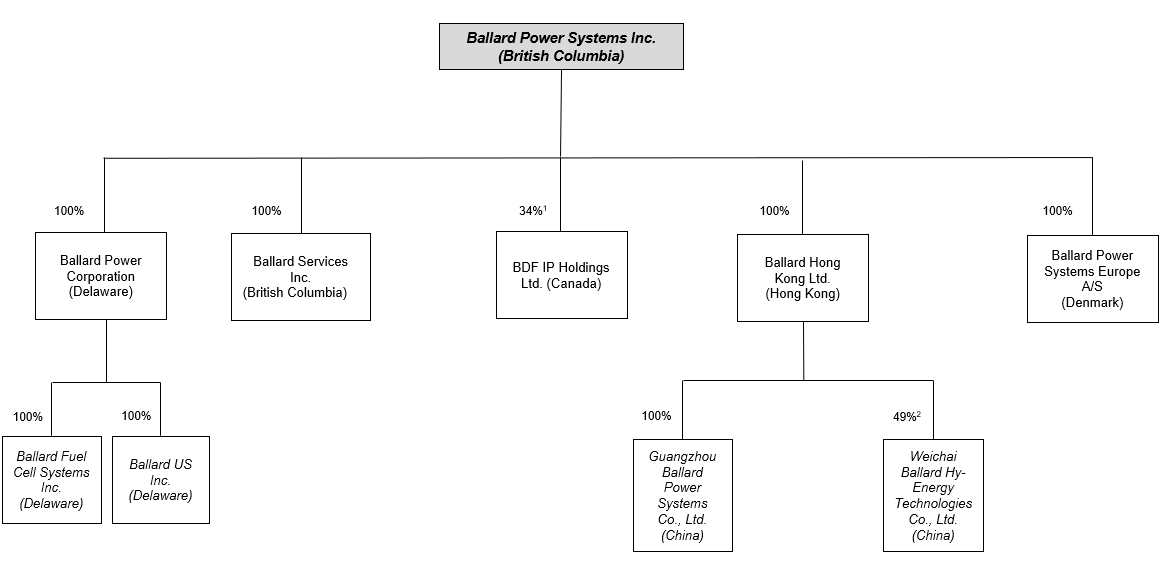
Notes:
1. Ballard holds 100% of the non-voting, participating shares of BDF IP Holdings Ltd. and 34% of the voting, non-participating shares, along with each of Mercedes-Benz AG (33%) and Ford Motor Company (33%).
2. Ballard indirectly holds a 49% interest in Weichai Ballard Hy-Energy Technologies Co., Ltd. together with Weichai Power Co., Ltd. (51%).
Recent History
Over the past three years, we have continued to focus on building and commercializing our proton exchange membrane (“PEM”) fuel cell business for select mobility and stationary power applications. The following are key developments during that period:
Ballard launches FCmove®-SC fuel cell at Busworld
On September 17, 2025, we announced plans to launch the FCmove®-SC fuel cell engine at Busworld in Brussels. The FCmove®-SC is designed for city transit bus applications and builds on the Company’s FCmove platform.
The module incorporates engineering enhancements relative to prior-generation products, including an increase in end-of-life system power, higher volumetric power density through integrated DC/DC packaging, an increase in maximum radiator outlet temperature from 60°C to 75°C to support vehicle thermal management, and a reduction in total part count. The FCmove®-SC is designed to deliver peak power capability of at least 75 kW and is expected to support an
9
estimated service life of approximately 25,000 operating hours under standard transit duty cycles.
The FCmove®-SC internalizes certain power electronics components to simplify system integration and reduce external interfaces. The module is supported by the Company’s fleet services platform, including onboard communications and the FCServiceCloud™ portal, which provides maintenance and performance monitoring capabilities. The design also incorporates safety-focused features within the PEM stack enclosure architecture.
The FCmove®-SC design reflects the Company’s operating experience in transit applications, including deployments of fuel cell-powered buses in Europe and other markets.
Strategic restructuring, leadership transition and realignment initiatives (2023–2025)
Over the past three years, the Company has implemented a series of restructuring and strategic realignment initiatives to align its investment intensity, cost structure and product development priorities with evolving hydrogen market conditions and policy uncertainty.
In 2023, we implemented a modest headcount reduction, rationalized our product portfolio, reduced the number of active product development programs, discontinued certain legacy products and non-core activities, and suspended a proposed investment to localize membrane electrode assembly manufacturing in China.
On September 12, 2024, we announced a global corporate restructuring that included a sizeable workforce reduction, rationalization and consolidation of certain global operations and facilities, and a reduction in certain planned capital expenditures, with the objective of reducing total annualized operating costs by approximately 30% compared to the first half of 2024.
As part of the 2024 restructuring initiatives, the Company reduced its corporate cost structure in China and initiated a strategic review of the Weichai-Ballard JV in light of continued policy and market challenges in the China fuel cell sector and the joint venture’s operating performance. Following completion of this review in early 2025, the Company does not intend to make additional significant investments in China, including in the Weichai-Ballard JV, for the foreseeable future. During the fourth quarter of 2025, the Company recognized an impairment charge of $4.6 million to fully impair its remaining equity investment in the Weichai-Ballard JV.
On June 16, 2025, the Company announced a planned leadership transition pursuant to which Randy MacEwen stepped down as President and Chief Executive Officer, and Marty Neese was
10
appointed President and Chief Executive Officer effective July 7, 2025, as part of the Company’s succession planning process.
On July 31, 2025, under Mr. Neese’s leadership, the Company announced a strategic realignment intended to align its operations, capital allocation and product development priorities with prevailing hydrogen market conditions and commercial adoption timelines.
The strategic realignment includes a structured plan focussed on enhanced cost discipline, market and product prioritization, pricing initiatives and optimized working capital management to improve the Company’s financial performance and strengthen its long-term sustainability.
As part of this initiative, the Company expects to further reduce annualized operating costs by approximately 30% in 2026 relative to the first half of 2025, through workforce adjustments, portfolio rationalization and operational streamlining. The Company also intends to prioritize fuel cell products and applications with stronger commercial traction, discontinue certain non-core programs, and focus product development efforts on system cost reduction, next-generation stack readiness and higher-margin product offerings.
In addition, the Company is pursuing margin expansion initiatives through product cost reductions, value-based pricing strategies and enhanced customer service offerings. The strategic realignment also emphasizes disciplined capital allocation, including limiting capital expenditures and maintaining rigorous cash and working capital management practices, with a focus on inventory optimization.
Ballard announces order for 6.4 MW to eCap Marine for Samskip vessels
On July 22, 2025, we announced an order to supply 6.4 MW of FCwave™ fuel cell engines to eCap Marine GmbH for deployment on two Samskip vessels operating between Norway and the Netherlands. This order represents continued expansion of Ballard’s fuel cell products into marine applications.
Ballard announces 1.5 MW fuel cell engine order for Sierra Northern Railway
On June 5, 2025, we announced an order from Sierra Northern Railway for 1.5 MW of fuel cell engines to support the conversion of three diesel switching locomotives to hydrogen fuel cell
11
operation. The order includes 12 FCmove®-XD fuel cell engines and reflects continued progress in the adoption of fuel cell technology in heavy-duty rail applications.
Ballard announces fuel cell engine order totaling approximately 5 MW of fuel cell engines for bus market
On March 4, 2025, we announced a multi-year supply agreement from Manufacturing Commercial Vehicles for 50 FCmove®-HD+ fuel cell engines totaling approximately 5 megawatts (“MW”).
Ballard announces multiple orders totaling over 6 MW of fuel cell engines for European bus market
On December 20, 2024, we announced orders from two bus manufacturers to supply over 90 fuel cell engines, representing approximately 6.4 MW of total rated power, for the European and UK city bus market.
Ballard announces orders for 70 hydrogen fuel cell engines for delivery to Wrightbus in 2024
On April 16, 2024, we announced multiple purchase orders totaling 70 FCmove®-HD hydrogen fuel cell engines from our customer Wrightbus, a UK-based bus manufacturer deploying hydrogen-powered buses in the UK and Europe.
Manufacturing capacity and expansion initiatives (2022-2025)
On September 30, 2022, the Company announced its “local for local” strategy, which included plans to expand its global manufacturing footprint in Europe, the United States, and China, including a proposed investment of approximately $130 million to establish a China headquarters, membrane electrode assembly (“MEA”) manufacturing facility and research and development center in Shanghai.
Given continued policy and market uncertainties, including evolving U.S. federal energy priorities, recent reductions in U.S. hydrogen and fuel cell funding programs, and uncertainties relating to hydrogen adoption timelines in heavy mobility applications, the business case for large-scale production capacity expansion investments in the foreseeable future remains highly challenging. Accordingly, the Company has determined not to proceed with its previously planned expansion program for a new fuel cell manufacturing facility in Rockwall, Texas (the “Texas Gigafactory”) and is focusing on optimizing utilization and efficiency at its existing manufacturing facilities.
12
In 2024, the Company entered into financial assistance agreements with the U.S. Department of Energy (“DOE”) providing for awards totaling approximately $40 million and was awarded up to $54 million of federal investment tax credits in support of the Texas Gigafactory. The DOE awards were subsequently terminated in 2025. In light of the Company’s decision not to proceed with the Texas Gigafactory, the Company does not expect to realize the benefit of the related federal investment tax credits.
On March 5, 2025, the Company signed an agreement with the European Innovation Fund for a grant of up to €113 million in support of a proposed European manufacturing facility. Funding under the grant is milestone-based, with the first milestone aligned with the Company’s final investment decision, currently planned for the third quarter of 2027. Any final investment decision will be subject to market adoption, demand indicators and overall project economics.
Long-term supply agreement with NFI Group Inc. (“NFI”) and purchase order for 100 fuel cell engines for bus deployments in North America
On January 3, 2024, we announced the signing of a new long-term supply agreement with NFI, a leading independent bus and coach manufacturer and a leader in electric mass mobility solutions in North America and Europe. As part of the agreement, NFI placed its first purchase order for a minimum of 100 FCmove®-HD+ modules which were delivered in 2024.
On November 4, 2024, we announced a purchase order to supply a further 200 fuel cell engines to a subsidiary of NFI.
Solaris Bus & Coach S.A. orders and long-term supply agreement
On November 17, 2022, we announced another purchase order from Solaris Bus & Coach S.A. (“Solaris”) for a further 25 70 kW heavy-duty FCmove®-HD fuel cell modules.
On October 10, 2023, we announced multiple purchase orders totaling 177 hydrogen fuel cell engines from Solaris. Deliveries commenced in 2023 and 2024, with the remaining units shipped in 2025.
On November 6, 2023 we announced multiple purchase orders totaling 62 hydrogen fuel cells engines from Solaris.
On April 1, 2024, we announced the signing of a long-term supply agreement with Solaris Bus & Coach sp. z o.o. for the supply of 1,000 hydrogen fuel cell engines through 2027 for the European transit bus market.
13
Ballard signs contracts with Stadler
On September 26, 2022, we announced an order from Stadler Rail AG , a leading manufacturer of rolling stock, for the supply of six 100 kW FCmove®-HD+ fuel cell engines to power trains for San Bernardino County Transportation Authority (SBCTA), with options for additional units.
On December 9, 2024, we announced the signing of a multi-year supply agreement with Stadler US Inc. to supply approximately 8 MW of FCmove®-HD+ fuel cell engines to power trains for the California Department of Transportation (Caltrans).
Infrastructure funds
In 2021, we committed to invest in two hydrogen infrastructure and growth equity funds whereby we acquired a 10% interest in the HyCap Fund I SCSP (“HyCap”), a special limited partnership registered in Luxembourg; and a 1% interest in the Clean H2 Infra Fund (“Clean H2”), a special limited partnership registered in France.
During the first quarter of 2024, we committed to invest in a decarbonization and climate technology and growth equity fund by acquiring a 2% interest in Templewater Decarbonization I, L.P., a limited partnership registered in Cayman Islands.
Ballard and Quantron AG announce a strategic partnership for the development of hydrogen fuel cell trucks
On September 7, 2021, we announced a strategic partnership with Quantron AG (“Quantron”) intended to support the deployment and adoption of fuel cell technologies in commercial vehicle applications.
On September 19, 2022, we announced a minority equity investment in Quantron. In 2023, Ballard made an additional investment in Quantron following the satisfaction of certain investment conditions.
Following financial distress, the company underwent restructuring in late 2024, significantly reducing its workforce. As a result of the restructuring, the Company no longer holds an equity interest in Quantron.
14
Ballard receives orders to power Siemens Mireo Plus H passenger trains and signs LOI for up to an additional 200 modules over the next six years
On July 15, 2021, the Company announced that it had received a purchase order for two of our 200 kW fuel cell modules from Siemens Mobility GmbH (“Siemens”) to power a 2-car Mireo Plus H passenger train through a trial operation in Bavaria, Germany.
On September 22, 2022, the Company announced that it had received an order for fourteen 200 kW fuel cell modules from Siemens, to power a fleet of seven Mireo Plus H passenger trains. These trains entered passenger service in early 2025.
Siemens also entered into a letter of intent with Ballard for the supply of up to 200 fuel cell modules totaling approximately 40 MW over a sixyear period, including a firm commitment for 100 fuel cell modules totaling approximately 20 MW.
Ballard fuel cells to power CPKC Hydrogen Locomotive Program
On March 9, 2021, we announced that Canadian Pacific (“CP”), now Canadian Pacific Kansas City (“CPKC”), will employ Ballard fuel cell modules for CP’s pioneering Hydrogen Locomotive Program to develop North America’s first hydrogen-powered line-haul freight locomotive by retrofitting a formerly diesel-powered locomotive with Ballard’s 200 kW hydrogen fuel cell modules.
In 2022 through 2024, Ballard supplied CPKC with 44 fuel cell engines for use in its hydrogen locomotives.
On December 5, 2024, we announced the signing of a new long-term supply agreement with CPKC, including the initial supply of 98 fuel cell engines for use in the North American freight rail market. Of the 98 engines, 65 were delivered in 2025, and the remaining 33 engines have been or are expected to be delivered in 2026.
OUR BUSINESS
At Ballard, our vision is to deliver fuel cell power for a sustainable planet. We are recognized as a world leader in PEM fuel cell power system development and commercialization.
Our principal business is the design, development, manufacture, sale and service of PEM fuel cell products for a variety of applications, focusing on power products for bus, truck, rail, marine, stationary and emerging market (material handling, off-road and other) applications, as well as the delivery of services, including technology solutions, after sales services and training.
15
A fuel cell is an environmentally clean electrochemical device that combines hydrogen fuel with oxygen (from the air) to produce electricity. The hydrogen fuel can be obtained from natural gas, methanol, ammonia, or other hydrocarbon fuels, or from water through electrolysis. Ballard’s PEM fuel cell products are typically designed to feature high fuel efficiency, relatively low operating temperature, high durability, low noise and vibration, compact size, quick response to changes in electrical demand, and modular design. Embedded in each Ballard fuel cell product lies a stack of unit cells designed with our proprietary PEM fuel cell technology. This technology includes membrane electrode assemblies, catalysts, plates, and other key components, and draws on intellectual property from our patent portfolio, together with our extensive experience and know-how, in key areas of PEM fuel cell stack design, operation, production processes and systems integration.
Strategy
We strive to build value for our shareholders by developing, manufacturing, selling, and servicing zero-emission, industry-leading PEM fuel cell technology products and services to meet the needs of our customers in target markets. More specifically, our business plan is to leverage our core competencies of PEM fuel cell stack technology and module development and manufacturing, our investments in advanced manufacturing and production capacity, and our product portfolio by marketing our products and services across select large and attractive addressable market applications and select geographic regions.
We typically select our target market applications based on use cases where the comparative user value propositions for PEM fuel cells powered by hydrogen are strongest – such as where operators value low emission vehicles that require high utilization, long driving range, heavy payload, fast refueling, and similar user experiences to legacy diesel vehicles – and where the barriers to entry for hydrogen refueling infrastructure are lowest – such as use cases where vehicles typically return to a depot for centralized refueling and do not require a distributed refueling network. Our current target markets include medium- and heavy-duty mobility applications, such as bus, truck, rail, and marine, along with certain off-road applications, including material handling and stationary power solutions.
We select our target geographic markets based on a variety of factors, including addressable market sizes of the target market applications in the geographic markets, historic deployments and expected market adoption rates for hydrogen and fuel cells, supportive government policies,
16
existing and potential partner, customer, and end user relationships, and competitive dynamics. Our current key target markets are the geographic regions of Europe and North America.
We also seek to leverage common PEM fuel cell technology platforms across multiple applications and regions in order to support scale efficiencies and cost reduction over time. While we recognize addressing multiple market applications and geographic markets in parallel increases our near-term cost structure and investments, we believe offering the same core PEM fuel cell technologies and substantially similar derivative PEM fuel cell products across multiple mobility and power market applications and across select geographic regions will significantly expand and strengthen our long-term business prospects. We believe this model approach will increase volume scaling in our operations, enable lower product and production costs for the benefit of all markets, improve our competitive positioning and market share, enable diversified revenue streams and profit pools, and enhance our returns on investments in our technology, product development, and manufacturing.
As we look to our long-term strategic plan and cascading capital allocation, we continue to believe hydrogen and PEM fuel cells will play an important long-term role in decarbonizing select heavy mobility and stationary power applications. We continue to believe that there are certain use cases where customers will be attracted to the differentiated PEM fuel cell value proposition of long range, fast refueling, heavy payload, and zero tailpipe emissions.
However, given ongoing market uncertainties, we expect further industry rationalization, failures, restructurings and consolidation. We will continue to closely monitor various factors and circumstances that may impact the commercial adoption of our markets and products, including factors related to macroeconomic conditions and outlook, geopolitical context, climate change policies, hydrogen and fuel cell industry growth, capital markets, supply chain development, and customer conditions. We will continue to review our investment plans and cost structure based on these factors as we remain focused on our customers and developing next-generation, low-cost fuel cell products, while maintaining disciplined spending and balance sheet strength for long-term competitiveness and sustainability.
Overall, our strategy is focused on disciplined capital allocation, prioritization of markets and applications with clearer commercial adoption pathways, continued product cost reduction and operational efficiency, and maintaining our strong financial position to support long-term competitiveness.
17
Revenues from Market Segments
We report our results in the single operating segment of Fuel Cell Products and Services. Our Fuel Cell Products and Services segment consists of the sale of PEM fuel cell products and services for a variety of applications, including Heavy-Duty Mobility (consisting of bus, truck, rail, and marine applications), Stationary Power, and Emerging and Other Markets (consisting of material handling, off-road, and other applications). Revenues from the delivery of Services, including technology solutions, after-sales services and training, are included in each of the respective markets.
The following chart shows the percentage of total revenues which arises from sales to investees and sales of products and services to other customers, for the years 2025 and 2024:
| 2025 | 2024 | |||||||
| Revenues from Fuel Cell Products and Services | ||||||||
Percentage of total revenues | 100% | 100% | ||||||
Portion representing sales to investees (1) | 1.5% | 4.0% | ||||||
Portion representing sales to customers other than investees | 98.5% | 96.0% | ||||||
Notes:
1. In this table, “investees” means Weichai Ballard Hy-Energy Technologies Co., Ltd., a joint venture formed in China, of which we hold a 49% equity interest.
Our Markets, Products and Services
Product & Service Overview
Ballard provides products in three distinct product classes and two separate categories of services:
1.MEAs: We provide our proprietary membrane electrode assemblies (“MEAs”) to selected customers to produce their own fuel cell stacks.
2.Fuel cell stacks: We provide our proprietary FCgen® fuel cell stacks to original equipment manufacturer (“OEM”) customers and system integrators that use the stacks to produce fuel cell systems for certain mobility or stationary power solutions.
3.Fuel cell modules: We design and assemble PEM fuel cell power modules or engines for certain mobility and stationary power applications. We design these modules using our proprietary fuel cell stacks, balance of plant components we typically specify and procure from third-party suppliers, and proprietary controls software.
18
4.Technology Solutions: We offer specialized engineering services to our customers typically for integration of our into a vehicle platform or packaged power generation solution or for custom fuel cell development.
5.After-Sales Services: We offer our customers after-sales services, including warranty support, service contracts, spare parts management, fleet monitoring, and training, to support customers throughout the service life of our products.
The following table lists the key fuel cell products we currently produce, offer for sale, have under development or are testing:
| Fuel Cell Product Family: | ||||||||
| Product Name | Application | Status | ||||||
FCgen®-LCS MEA | Fuel cell stacks for buses and commercial vehicles | Sales to licensee (Weichai-Ballard JV) | ||||||
FCgen®-HPS stacks | Light-duty and heavy-duty commercial vehicles | Sales to OEMs and system integrators | ||||||
FCgen®-LCS stacks | Buses, commercial vehicles, rail and material handling | Sales to OEMs and system integrators | ||||||
FCgen®-1020ACS stacks | Material handling and backup power | Sales to OEMs and system integrators | ||||||
FCmove® modules | Buses, commercial vehicles, rail and stationary | Sales to OEMs and system integrators | ||||||
FCwave® modules | Marine, rail (freight locomotives) and stationary | Sales to OEMs and system integrators | ||||||
FCrail® modules | Passenger rail application | Sales to OEMs and system integrators | ||||||
Fuel Cell Products and Services
Our primary business is the sale of Power Products, consisting of fuel cell modules and fuel cell stacks offered to customers in our target market applications of bus, truck, rail, marine, stationary power, and off-highway markets such as material handling. Fuel cell electric vehicles and power generation systems in these applications rely on centralized fueling depots that simplify the
19
hydrogen infrastructure requirements and are typically government-subsidized, thus enabling the purchase of pre-commercial fleets.
In addition to our fuel product, we also provide engineering services to customers in our target markets under our Technology Solutions offering. Our engineering services help customers solve difficult technical and business challenges in the commercialization of their PEM fuel cell products and/or address new business opportunities and markets. We offer customized, bundled technology solutions, including specialized PEM fuel cell engineering services, access to our intellectual property portfolio and know-how, as well as specialized integration and after sales support for our products in various applications across all of our market applications.
We design and manufacture fuel cell modules and stack products capable of delivering 50 kW to 200 kW of power. These modules and stacks can be combined to provide power output in excess of 1 MW for certain applications. We supply the fuel cell modules to a combination of vehicle OEMs and system integrators to deliver to end users.
In 2019, we launched our eighth-generation high-performance fuel cell module, the FCmove® platform. The FCmove® family of products is designed to power medium- and heavy-duty commercial vehicles such as buses and trucks. We have sold over 1,500 FCmove® fuel cell modules to date. The FCmove®-HD 70 kW and 100 kW versions were launched in 2019 and 2021. In May 2024, the Company launched its ninth-generation fuel cell module, the FCmove®-XD (120/240 kW), designed for heavy-duty truck (Class 6–8) and coach applications.
In September 2025, at Busworld in Brussels, the Company launched the FCmove®-SC (75 kW), a next-generation fuel cell module designed for transit bus applications. The FCmove®-SC is intended to improve durability, simplify system integration and reduce lifecycle costs compared to prior generations of transit modules. The FCmove-SC (75kW) forms part of the Company’s ninth-generation portfolio of core fuel cell module products.
In 2020, we introduced the FCwave®, a fuel cell module designed for marine applications. The FCwave® fuel cell module is a 200 kW modular unit that can be scaled in series up to the multi-megawatt power level. The FCwave® product is intended to provide primary propulsion power for marine vessels – such as passenger and car ferries, river push boats, and fishing boats – as well as stationary electrical power generator for applications such as shore power, EV charging and critical infrastructure backup power. In 2021, we also started to sell FCwave® products for stationary and rail applications. In 2022, the Company received Type Approval from DNV, one of the world’s leading marine classification and certification bodies, for its FCwave® marine fuel
20
cell module. This Type Approval supports deployment of the FCwave® module in marine applications, subject to applicable regulatory requirements. In 2024 and 2025, we continued sales of FCwave® products into marine, stationary power, and rail applications, including projects related to freight locomotives in Canada.
Market Applications
Bus
We provide Power Products and associated services to bus manufacturers, primarily in Europe and North America. The city transit bus market is our most mature market as measured by the length of time Ballard has been active in the market and by the number of products sold to customers in the market. Hydrogen fuel cell buses offer zero tailpipe emissions, long range, rapid refueling times, reliable performance in diverse weather conditions, and scalable refueling infrastructure.
The FCmove®-SC module is designed specifically for this market segment and reflects the Company’s ongoing product development efforts focused on cost reduction and operational performance in transit applications.
Rail
We supply Power Products and associated services to train manufacturers and railway operators, primarily in Europe and North America. Our technology offers a value proposition to railway operators seeking to reduce greenhouse gas emissions on railway lines that lack overhead catenary power infrastructure, as hydrogen fuel cells eliminate the need to build the overhead infrastructure by utilizing refueling depots that mirror current practice for diesel locomotives. Target applications for our rail vertical include passenger rail and freight locomotive applications.
Stationary Power
We supply Power Products and associated services to OEMs and system integrators of power generation products. Our products are designed to enable zero-emission power generation in remote locations that lack access to electrical grid infrastructure, or to generate backup power for extended periods.
Given the expected growth in electricity demand and challenges associated with expanding the electrical transmission and distribution infrastructure, we believe fuel cell products may support incremental power generation requirements and, in certain cases, may be deployed more quickly
21
than grid upgrades. Target applications include EV charging, television and film production sites, grid balancing, and backup power for critical infrastructure.
As power demand from datacenter increases, PEM fuel cell system may support reduced time-to-power and provide complementary or backup power to the grid or to on-site generation. PEM fuel cells offer operational characteristics such as rapid ramp-up capability, cycling flexibility, high reliability, low noise, and modular scalability from megawatt to multi-megawatt scale. These characteristics may support lower-carbon power solutions for data centers and may contribute to improved community acceptance in certain jurisdictions.
Marine
We supply Power Products and associated services to the marine industry, including ship builders, ship operators and systems integrators in Europe. Fuel cell power offers low emissions, long range and rapid refueling time. Target applications in our marine vertical include coastal and river applications, such as ferries, barges, short sea container ships and tugs.
Truck
We supply Power Products and associated services to commercial truck manufacturers and commercial truck integrators, primarily in Europe and North America. Our Power Products and associated services revenues from Weichai-Ballard JV are also recorded in this vertical. The hydrogen fuel cell truck market is at a nascent phase typified by demonstration projects to prove the capabilities of the technology in real world use cases. For truck applications, hydrogen fuel cell power offers long range, high payloads, short refueling times, and high fuel efficiency. Target applications for our truck vertical include heavy-duty long haul trucks, rubbish collection vehicles or garbage trucks, and medium-duty trucks or delivery vans.
Material Handling
The material handling market includes industrial vehicles such as forklifts, automated guided vehicles and ground support equipment. Our initial focus is on battery-powered Class 1 counterbalance lift trucks, Class 2 reach trucks and Class 3 pallet forklifts. Ballard is currently supplying fuel cell stacks to a limited number of system integrators in North America and Europe.
Competition
Diesel-powered buses and commercial trucks currently dominate the market today. Compressed natural gas and diesel electric hybrid powertrains are lower-emission alternatives to diesel
22
engines but are in limited service today. Electric trolley buses provide a zero-emission alternative; however, their purchase price is high and the overhead catenary power infrastructure is expensive to maintain and is considered aesthetically undesirable in many urban centres. The recent developments in battery-powered powertrain vehicles have created a zero-emission alternative to fuel cell buses in the form of battery electric buses and commercial trucks, as well as electrified trains and battery-powered marine vessels. These battery-powered heavy-duty vehicles represent a competitive zero-emission mobility solution in certain applications.
Fuel cell electric vehicles represent an alternative zero-emission solution for medium- and heavy-duty applications in certain use cases across bus, truck, rail, marine and off-highway markets.
Compared to battery electric vehicles, fuel cell electric vehicles may offer advantages in certain applications, including longer range, higher energy density to support payload requirements, and faster refueling times.
In certain fleet configurations, hydrogen refueling infrastructure may offer logistical and scaling advantages relative to battery charging infrastructure..
Companies developing fuel cell systems for heavy-duty motive applications include Beijing Sinohytec Co. Ltd., cellcentric GmbH & Co. KG (a joint venture of Daimler Truck AG and the Volvo Group), Cummins Inc., EKPO Fuel Cell Technologies GmbH (a joint venture of ElringKlinger and OPmobility), Hyundai Motor Company, Honda Motor Company, Plug Power, Inc., Powercell Sweden AB, Robert Bosch GmbH, Shanghai Re-Fire Technology Co., Ltd., Sino-Synergy Hydrogen Energy Technology (Jiaxing) Co., Ltd., Symbio SAS (a joint venture of Michelin, Forvia and Stellantis), and Toyota Motor Corporation.
We are also seeing the emergence of product offerings for hydrogen internal combustion engines developed by companies like Cummins Inc. and J C Bamford Excavators Ltd. Numerous engine and vehicle manufacturers are investing in development programs. This technology is seen as a potential bridge between legacy internal combustion engines and hydrogen fuel cell mobility. Through modification of existing diesel engines, it allows the use of hydrogen as a fuel leading to CO2 emission reduction. However, the technology is not expected to meet all zero emission requirements (such as NOx and SOx emissions) and may exhibit lower overall efficiency compared to fuel cell systems.
The stationary power generation market is currently dominated by diesel generators, gas internal combustion engines and batteries. Advanced battery technology continues to make modest
23
progress in the backup power generation market. However, advanced battery technologies still require lengthy recharging and, in many cases, cannot meet desired run times without requiring substantial space.
PEM fuel cell products may offer advantages over batteries in certain applications, including extended run time without lengthy recharging and, in some cases, lower lifecycle costs.
For certain applications and markets we believe fuel cell power generators offer a value proposition against diesel generators with lower operating cost, extended run time, low emission and noise, and less risk of theft.
Hydrogen-fueled gas turbines are also being developed and could be an alternative to diesel or natural gas generators. Compared with fuel cell systems, however, H-ICEs and gas turbines produce nitrous oxide emissions and are considered to be less power efficient.
Companies developing PEM fuel cell systems for stationary power generation applications include Honda Motor Company, Plug Power, Inc., Powercell, and Toyota.The Company seeks to compete through fuel cell designs focused on emissions performance, reliability, durability and cost competitiveness.
The Company competes based on factors including technology, product performance, intellectual property, manufacturing capabilities, customer relationships, partnerships and operational experience in heavy-duty applications.
Impact of Regulations and Public Policy
In the course of carrying on our business, the Company is subject to and monitors government regulations and public policies that may affect the fuel cell industry, zero-emission vehicles and related markets. The statements below are based on our understanding of applicable regulations and public policies as of the date of this Annual Information Form. Regulations and public policies may change, and the Company’s interpretation of such regulations may differ from that of regulators or other stakeholders.
Prolonged policy uncertainty, unpredictable election cycles, and funding challenges have contributed to delays in certain hydrogen projects across key global markets. In some cases, projects have been postponed, scaled back or cancelled. Industry commentary has referenced extended timelines for hydrogen project development, hydrogen infrastructure build-out and commercial adoption of PEM fuel cell applications relative to earlier expectations.
24
According to the Hydrogen Council’s Global Hydrogen Compass 2025 industry report, total committed global clean hydrogen production capacity now exceeds 6 million tonnes per year, including approximately 1 million tonnes per year of capacity already in operation. Since 2020, more than 1,700 hydrogen-related projects have been announced globally.
In 2025, investment activity in the hydrogen sector continued, although at a more measured pace. According to the Hydrogen Council’s Global Hydrogen Compass 2025 report, approximately $110 billion of committed investment in hydrogen projects has reached final investment decision or an equivalent commitment stage across more than 500 projects.
United States
In 2025, changes in U.S. federal policy priorities and funding frameworks increased uncertainty regarding government support for certain clean energy programs, including incentives and funding mechanisms that had supported green hydrogen development. Legislative developments and budgetary considerations introduced uncertainty regarding the availability and timing of certain tax credits, including those established under the Inflation Reduction Act, may have contributed to delays or reconsideration of some renewable-based hydrogen projects and related private investment decisions.
Policy emphasis also shifted toward broader domestic energy production, including lower-carbon hydrogen pathways such as blue hydrogen (natural gas with carbon capture). In addition, tariffs and regulatory changes may increase cost and planning uncertainty across clean hydrogen supply chains. As a result, certain large-scale hydrogen projects have experienced delays, scope changes, or cancellations, and market activity has increasingly reflected the role of state-level and regional initiatives with more stable incentive structures.
The California Air Resources Board (“CARB”) Low Carbon Transportation and Air Quality Improvement Program provides mobile-source incentives to reduce GHG emissions, criteria pollutants, and air toxics through the development of advanced technology and clean transportation solutions in California.
CARB’s Innovative Clean Transit (“ICT”) regulation, adopted in December 2018, requires public transit agencies to transition to a 100% zero‑emission bus (“ZEB”) fleet. Beginning in 2029, all new transit bus purchases by California transit agencies are required to be ZEBs, with a target for full transition by 2040.
25
In 2020, the CARB adopted Advanced Clean Trucks (“ACT”) regulation, which requires truck manufacturers to increase the percentage of zero-emission truck sales in California over time. Beginning in 2024, manufacturers are required to meet increasing sales targets, ranging from approximately 30% to 50% by 2030 and 40% to 75% by 2035, depending on vehicle class.
CARB regulatory requirements have been viewed as supportive of demand for zero-emission fuel cell and battery-electric trucks and buses in California. However, the authority for certain California emissions standards has been subject to ongoing legal and political challenges at the federal level, including Congressional actions related to U.S. Environmental Protection Agency waivers under the U.S. Clean Air Act. Developments affecting the availability or scope of such waivers could impact the implementation or enforceability of certain California zero-emission vehicle regulations, including the ICT and ACT regulations, and could affect market adoption timelines.
Europe
The European Union has identified hydrogen as a component of its decarbonization strategy under initiatives such as the European Green Deal and the REPowerEU plan. These frameworks include measures intended to support the development and deployment of renewable and low-carbon hydrogen, particularly in sectors that are difficult to electrify, including steel, chemicals, heavy transport, and aviation. The EU has established targets for domestic production of renewable hydrogen and for hydrogen imports in order to reduce fossil fuel dependence by 2030 and support its longer-term objective of net-zero greenhouse gas emissions by 2050.
The European Commission’s “Fit for 55” package includes 19 legislative proposals to help the European Union reach its climate goals of reducing GHG emissions by 55% by 2030 and achieving carbon-neutrality by 2050. A significant portion of the legislative measures proposed under this package have now been adopted, several of which could support growth of the European Union’s hydrogen economy.
For instance, the Alternative Fuels Infrastructure Regulation (Regulation (EU) 2023/1804) mandates the deployment of hydrogen refueling stations at least every 200 km along the TEN-T core transport network corridors for compressed hydrogen by 2030.
The revised Renewable Energy Directive, Directive (EU) 2023/2413 (“RED III”) that came into force on November 20, 2023, includes provisions intended to promote the use of renewable fuels of non-biological origin (“RFNBOs”), including renewable hydrogen and its derivatives, in the transport and industrial sectors.
26
As of late 2025, implementation of RED III, including provisions relating to RFNBOs, remained ongoing across EU Member States.
Implementation timelines and transposition of RED III provisions vary across Member States, and the European Commission may initiate infringement procedures where Member States do not meet implementation obligations.
The European Commission’s revised CO₂ emission standards for heavy-duty vehicles, presented on February 14, 2023, are intended to support the transition to zero-emission trucks, buses and coaches by establishing progressively more stringent emission reduction requirements for vehicle manufacturers. In 2024, the EU formally amended and expanded those standards to broaden their scope to nearly all new heavy-duty vehicles, including medium lorries, urban buses, coaches, and trailers, and to introduce more ambitious CO₂ reduction targets of 45% by 2030, 65% by 2035, and 90% by 2040 relative to the applicable reference period.
In November 2021, the European Commission launched the Clean Hydrogen Partnership, taking over the activities of the existing Fuel Cells and Hydrogen Joint Undertaking. The Partnership is intended to support hydrogen technology research and development, with up to €1 billion of EU funding for the period 2021-2027, complemented by additional private investment from private sector participants.
The European Union has also introduced funding mechanisms intended to accelerate investment in renewable hydrogen projects. In 2023, the European Commission launched the European Hydrogen Bank, an initiative designed to support the scaling of renewable hydrogen production and help bridge the cost gap between renewable hydrogen and fossil-based alternatives. The initiative is expected to mobilize funding through instruments such as the EU Innovation Fund, which provides financial support for large-scale low-carbon technology projects across the European Union and is financed through revenues generated under the EU Emissions Trading System. Hydrogen production and related infrastructure projects are among the technologies eligible for Innovation Fund support.
Other relevant EU legislative initiatives for the hydrogen and fuel cell sector include FuelEU Maritime, the revised EU Emissions Trading System, the Energy Efficiency Directive, the revision of the EU Gas Directive and EU Gas Regulation, the revised Weights and Dimensions Directive and the Net-Zero Industry Act.
27
Canada
Canada’s Hydrogen Strategy, originally released in December 2020, remains a key element of federal policy intended to position Canada as a producer, user, and exporter of low-carbon hydrogen in support of the country’s objective of achieving net-zero greenhouse gas emissions by 2050 and fostering economic development in hydrogen value chains.
The federal government has enacted and expanded fiscal measures intended to support hydrogen development, including the Clean Hydrogen Investment Tax Credit, a refundable investment tax credit of up to approximately 15% to 40% of eligible project costs, depending on lifecycle carbon intensity and compliance with certain labour and other program requirements, to support clean hydrogen production and attract capital.
The Clean Fuels Fund, administered by Natural Resources Canada, and the Net Zero Accelerator initiative under the Strategic Innovation Fund provide additional federal funding programs to support infrastructure, production facilities, and clean fuels projects that may include hydrogen. Legislation implementing the Clean Hydrogen Investment Tax Credit was included in Canada’s 2024 federal budget and related legislative measures, with program implementation expected to occur through subsequent regulations and guidance.
Regional hydrogen hubs have been announced or are under development or proposal across Canada, including in Edmonton, Vancouver, and Southern Ontario, to support coordination of production, distribution, refuelling, and industrial use, with participation from government and industry stakeholders. Several provinces, including British Columbia, Alberta, Quebec, Nova Scotia, and Ontario, have introduced hydrogen strategies or funding programs intended to complement federal initiatives and support regional development.
Hydrogen is also referenced within Canada’s Clean Fuel Regulations, which establish carbon-intensity reduction framework and credit market for liquid fossil fuels intended to incentivize lower-carbon-intensity fuels, including hydrogen, for use in transportation and certain industrial applications.
In 2024, the Government of Canada announced the Canada Public Transit Fund, which is intended to provide long-term federal transit funding averaging approximately $3 billion per year beginning in fiscal 2026–2027 to support public transit systems, including investments that may enable the deployment of zero-emission buses and related infrastructure.
28
The federal government has also announced broader infrastructure and economic initiatives intended to support major projects across energy, critical minerals, transportation and clean growth sectors, including efforts aimed at improving coordination of regulatory processes and federal funding programs for large-scale projects of national interest.
Workforce
As of December 31, 2025, we had 492 temporary and permanent employees in Canada, the United States, the European Union and China, representing such diverse disciplines as electrochemistry, polymer chemistry, chemical, mechanical, electronic and electrical engineering, manufacturing, quality, supply chain management, advanced manufacturing, marketing, sales, service, business development, legal, finance, accounting, human resources, information technology and business management. This reflects the global corporate restructuring further detailed in the Recent History section. Our employees are not represented by any labour union. Each employee must agree to confidentiality provisions as part of the terms of employment, and certain employees have also executed non-competition agreements with Ballard.
Sustainability
Strategy and Oversight
Our strategic theme, Here for Life®, reflects our purpose to decarbonize mobility and drive the transition to a low-carbon energy future. Our strategy remains rooted in a fundamental commitment to risk management, seizing opportunities, and operating in an environmentally and socially responsible way.
The Board’s Nominating and Governance Committee (“N&G Committee”) is responsible for overseeing our environmental, social, and governance performance, including the policies and practices related to sustainability. Composed of independent directors, the N&G Committee receives regular updates from management on sustainability activities and shares relevant information with the Board regularly. In 2025, the N&G Committee was focused on navigating the evolving regulatory landscape, with particular attention to understanding emerging reporting standards, anti-greenwashing and modern slavery legislation in Canada and assessing other potential regulatory impacts.
Details of the Committee’s mandate are available on Ballard’s website at https://www.ballard.com/investor-hub/document-library/#governance.
29
Recent Developments
In 2025, Ballard completed its first double-materiality assessment (DMA) to align sustainability risks and opportunities with financial and impact considerations.
The Company published three key reports related to its sustainability activities, including (i) its annual Communication on Progress (CoP) report to the United Nations Global Compact (“UNGC”), detailing progress against the ten principles, (ii) the sixth standalone annual Sustainability Report capturing the second year of activities from our Sustainability strategy and roadmap, and the pursuit of Ballard’s sustainability commitments and supporting initiatives, and (iii) the second annual “Fighting Against Forced Labour and Child Labour in the Supply Chains Act” report to align with recent Canadian legislation. A copy of the Sustainability Report and Forced and Child Labour Report can be found on the website at www.ballard.com/sustainability.
Ballard continued to advance its Mission Carbon Reduction initiative, targeting carbon reduction for corporate emissions (corporate emissions include scope 1, scope 2, and some scope 3 emissions, including business travel, employee commuting and telecommuting, and the hydrogen production emissions of hydrogen consumed by the organization in research and development activities).
Environmental Policy
Ballard is committed to supporting the delivery of fuel cell solutions while seeking to mitigate our negative environmental impact and ensuring compliance with applicable regulatory requirements. Consequently, we have implemented comprehensive environmental management programs with half of our operating sites (including our most material production facilities) third-party certified under ISO 14001. We strive to contribute to the protection of the environment by integrating environmental priorities into our overall business plan and through the specific monitoring and measurement of such priorities against historical performance and, in some cases, specific targets.
Social Policies
Ballard maintains (i) a comprehensive Code of Ethics and (ii) a Harassment, Workplace Bullying and Anti-discrimination Policy. These policies affirm Ballard’s commitment to preventing harassment and discrimination against any employee or applicant based on grounds of religion, race, sex, nationality, disability or any other basis protected by law, ordinance or regulation. The policies extend to recruitment, selection and compensation practices, as well as to working conditions and the work environment. Internal complaint resolution procedures have been
30
established whereby any person covered by these policies can contact their people and culture business partner or manager who will address their complaint. We encourage our employees to report any situation that appears to involve a breach of the company’s ethical or legal obligations and have engaged a third-party to receive anonymous reports or allegations of wrongdoing, and they can be contacted on a confidential basis.
Facilities
We currently have facilities in Canada, Denmark, USA, and China, including the following facilities: (a) 281,103 ft² (26,115 m²) of leased facilities in Burnaby, British Columbia that house our corporate headquarters and our fuel cell development, manufacturing, assembly and testing activities; (b) 27,759 ft² (3,508 m²) of leased facilities in Hobro, Denmark that house certain engineering, sales and service activities; and (c) 26,779 ft² (2,488 m²) of leased facilities in Bend, Oregon that house certain of our assembly and testing facilities. The Weichai-Ballard JV’s operations in Weifang, Shandong Province, China are conducted in an approximately 150,000 ft² (14,000 m²) facility.
We are committed to ensuring that each of our facilities is operated in full compliance with all applicable laws, including all applicable health, safety, and regulatory standards.
Manufacturing
Our PEM fuel cell products are produced in three facilities – two in Burnaby, British Columbia, Canada, and one in Bend, Oregon, USA. Along with these facilities, the Weichai-Ballard JV manufactures Ballard’s FCgen®-LCS fuel cell stack and FCgen®-LCS-based power modules for bus, truck and forklift applications in Weifang, Shandong Province, China. The Burnaby facilities are focused on our core fuel cell competencies, which include the production of MEAs, the production of bipolar plates, integration and testing of fuel cell stacks, assembly and testing of modules and systems, as well as support of other products required through our engineering services contracts. Our Bend facility manufactures and tests certain motive modules primarily for the U.S. market.
As a part of our strategy to reduce product costs and enable future volume production, we continue to make investments in our manufacturing processes, equipment, capabilities and business processes.
Certain materials and components used in the production of MEAs, bipolar plates, fuel cell stacks, and balance of plant are proprietary in nature and have been developed in joint collaboration between Ballard and our key supply base. Strategic supply agreements have been
31
executed with these suppliers to ensure security of supply, protection of our intellectual property, and adherence to our strict quality and reliability standards.
Safety
We maintain a robust safety program that is designed to ensure the safety of our employees, contractors, customers, suppliers and partners in our facilities. We have various protocols to support our safety program, including training and instruction, hazard identification and control, workplace inspections, emergency preparedness, incident investigations, and safety metrics tracking. Certain of our facilities have achieved safety standards or certifications, such as ISO 45001.
Quality
We maintain a robust quality and reliability assurance program that monitors critical process parameters and measures product performance to ensure industry and internal standards are met. Certain of our operations have adopted quality management systems and achieved certain quality standards or certifications, such as ISO9001:2015. We also conduct certain factory acceptance tests prior to preparing a fuel cell stack or module for shipment. Our quality and reliability tests complement certain production surveillance activities. These programs and tests help assure delivery of expected performance in the field with a high level of product quality and reliability.
Research and Product Development
Our R&D model differentiates us from many of our competitors due to its vertical integration, from advanced research to product development, manufacturing, and applications. We continue to devote substantial resources to our R&D efforts, which generally focus on continually improving the performance and lowering the costs of our MEAs, bipolar plates, stacks, and modules, while improving our production processes.
We continue to invest in R&D related to:
•our MEAs, including MEA design, materials, components, and production processes, with a focus on improving the overall cost, performance, durability, reliability, power density, and efficiency of our products;
•our bipolar plates, including plate design, materials, and production processes, with a focus on improving the overall cost, performance, durability, and power density of our products;
•our unit cell designs, including frames, seals and adhesives;
32
•our stack design, including stack hardware;
•our module design, including engine bay and rooftop mount variants, with a focus on system design, balance of plant component selection, and software development, to improve the overall cost, performance, durability, reliability, power density, and efficiency of our products; and
•advanced manufacturing initiatives, including new production processes, improvements in production throughput and yield, material cost reduction, and automation.
Intellectual Property
Ballard’s technical strengths lie in our proprietary MEA design, combined with our extensive stack and system integration capabilities, which enables development of complete end-user systems that meet or exceed customer specifications, across a wide range of market applications.
Our intellectual property covers multiple aspects of our technology, including: materials and components; cell, stack and systems architecture; stack/system operation and control; and manufacturing processes. Our intellectual property portfolio is not limited to our patents and patent applications; it also includes know-how and trade secrets developed over more than 30 years of research, product development and production.
As of March 9, 2026, Ballard owns or controls: 28 United States granted patents; 70 non-United States granted patents; 3 United States published patent applications; and 15 published non-United States patent applications. Our patents will expire between March 2026 and November 2039.
We hold license rights to additional intellectual property from a number of third parties. We have a royalty-free license to approximately 803 issued patents and pending patent applications from AUDI for bus and non-automotive applications and a royalty-bearing license for all other applications. In addition, these licenses include non-exclusive, royalty-free access to all of the intellectual property rights held by NuCellSys GmbH, a Daimler subsidiary, and to all of the intellectual property rights relating to fuel cells developed by Daimler, Ford and their subsidiaries (either directly or through AFCC), including any intellectual property rights developed by them to January 31, 2013. As of March 9, 2026, approximately 62 of the patents and patent applications that were included in these licenses, are currently granted or pending.
33
Cybersecurity
Ballard is committed to maintaining strong security controls, including encryption, to protect our information and the information our customers and partners entrust to us. We maintain administrative, technical, and organizational security measures to protect information from loss, misuse, and unauthorized access or disclosure. These measures are based on industry security practices and take into account the sensitivity of the information we collect, the current state of technology, the cost effectiveness of implementation, and the scope of the data processing we engage in. To our knowledge, Ballard has not experienced an information security breach in the last three years.
Ballard implements and maintains a cybersecurity framework to manage cyber risk, control, and compliance-based activities. We are certified under the ISO 27001:2022 standard (International Organization for Standardization) and Ballard also maintains robust cyber insurance coverage. Ballard employees receive cybersecurity training during onboarding and on an ongoing basis.
The Audit Committee is responsible for overseeing our cybersecurity risk program and monitoring cybersecurity policies and procedures within our organization. Management briefs the Audit Committee on cybersecurity matters quarterly.
34
SHARE CAPITAL AND MARKET FOR SECURITIES
Our authorized share capital consists of an unlimited number of common shares and an unlimited number of preferred shares. As of March 9, 2026, our issued share capital consisted of 300,913,456 common shares. Our common shares are listed and trade on the Toronto Stock Exchange (“TSX”) and on the National Association of Securities Dealers Automated Quotation Global Market (“NASDAQ”) and trade under the symbol “BLDP” on both exchanges.
The following table shows the monthly trading activity for our common shares on the TSX and NASDAQ during 2025:
| TSX | NASDAQ | |||||||||||||
Price Range (C$) | Average Daily Volume (#) | Price Range (US$) | Average Daily Volume (#) | |||||||||||
| January | $1.92-$2.85 | 1,110,637 | $1.33-$1.99 | 929,131 | ||||||||||
| February | $1.75-$2.13 | 886,406 | $1.23-$1.50 | 561,332 | ||||||||||
| March | $1.59-$1.93 | 783,027 | $1.10-$1.35 | 822,972 | ||||||||||
| April | $1.45-$1.74 | 606,957 | $1.02-$1.26 | 646,024 | ||||||||||
| May | $1.68-$1.97 | 1,271,685 | $1.20-$1.43 | 1,076,087 | ||||||||||
| June | $1.74-$2.41 | 761,864 | $1.28-$1.79 | 1,111,436 | ||||||||||
| July | $2.18-$2.91 | 695,361 | $1.61-2.13 | 941,070 | ||||||||||
| August | $2.38-$2.86 | 556,613 | $1.73-$2.06 | 515,188 | ||||||||||
| September | $2.57-$4.14 | 1,009,657 | $1.85-$2.99 | 1,000,872 | ||||||||||
| October | $3.77-$5.59 | 1,316,837 | $2.72-$3.98 | 1,355,310 | ||||||||||
| November | $3.78-$5.17 | 1,491,533 | $2.68-$3.57 | 1,528,727 | ||||||||||
| December | $3.49-$3.99 | 591,685 | $2.53-$2.72 | 720,557 | ||||||||||
The holders of our common shares are entitled to one vote for each share held on all matters to be voted on by such shareholders and, subject to the rights and priorities of the holders of preferred shares, are entitled to receive such dividends as may be declared by our Board out of funds legally available therefor and, in the event of liquidation, wind-up or dissolution, to receive our remaining property, after the satisfaction of all outstanding liabilities.
Our preferred shares are issuable in series and our Board is entitled to determine the designation, preferences, rights, conditions, restrictions, limitations and prohibitions to be attached to each series of such shares. The Board represents that it will not, without prior shareholder approval, issue or use preferred stock for any defensive or anti-takeover purpose or for the purpose of implementing any shareholder rights plan. Currently there are no preferred shares outstanding.
35
DIVIDEND RECORD AND POLICY
To date, we have not paid any dividends on our shares and, because it is anticipated that all available cash will be needed to implement our business plans, we have no plans to pay dividends in the foreseeable future.
ESCROWED SECURITIES AND SECURITIES SUBJECT TO CONTRACTUAL RESTRICTIONS ON TRANSFER
There are no securities of Ballard in escrow or subject to contractual restrictions on transfer.
DIRECTORS AND OFFICERS
Board of Directors
The following chart provides the following information as of December 31, 2025: the name and province or state of residence of each of our directors, each director’s respective positions and offices held with Ballard, their principal occupation during the past five years and, the period of time each has served as a director.
Name and Province/State of Residence(1) | Office | Principal Occupations and Positions During the Last Five Years | Director Since | ||||||||
Kathy Bayless California, USA | Director | Ms. Bayless’ principal occupation is corporate director. Ms. Bayless is a member of the Board and Audit Committee Chair of Veeco Instruments Inc. (electronics manufacturing equipment) and Amprius Technologies, Inc. (lithium-ion battery manufacturing). Previously Ms. Bayless held various executive roles at public technology companies, including SVP Chief Financial Officer and Treasurer at Synaptics, Incorporated as well as Komag, Incorporated. Ms. Bayless is a Certified Public Accountant in California. | 2021 | ||||||||
Michael Chen Shandong, China | Director | Mr. Chen currently serves as the CEO of Weichai Ballard Hy-energy Technologies Co. Ltd. and Vice General Manager of Weichai Holding Group Co., Ltd. (diesel engine manufacturing). He has served in various engineering and management roles at Weichai Power Co., Ltd, (diesel engine, powertrain and hydraulic products manufacturing) since 2010. Mr. Chen earned a PhD in Power Engineering and Engineering Thermophysics from Tsinghua University. | 2024 | ||||||||
Jacqueline Dedo Michigan, USA | Director | Ms. Dedo is co-founder of Aware Mobility LLC (ACES development & consulting) and a corporate director. Prior to that, Ms. Dedo held various executive roles at Dana Holding Corp. (now Dana Incorporated, automotive component supplier), Piston Group (automotive manufacturing), The Timken Company (industrial machinery manufacturing), Motorola (computer and electronics manufacturing), and Robert Bosch Corporation (automotive component & systems supplier). Ms. Dedo earned her B.Sc. in electrical engineering from Kettering University. | 2024 | ||||||||
36
Name and Province/State of Residence(1) | Office | Principal Occupations and Positions During the Last Five Years | Director Since | ||||||||
Douglas P. Hayhurst British Columbia, Canada | Director | Mr. Hayhurst’s principal occupation is corporate director. Previously, Mr. Hayhurst was a Global Industry Leader with IBM Canada Business Consulting Services (consulting services) and with PricewaterhouseCoopers Management Consultants (consulting services). Prior to that, Mr. Hayhurst held various senior executive management roles with Price Waterhouse Canada including National Deputy Managing Partner (Toronto) and Managing Partner for British Columbia (Vancouver). Mr. Hayhurst received a Fellowship (FCA) from the Institutes of Chartered Accountants of British Columbia and of Ontario. He has completed the Directors Education Program of the Institute of Corporate Directors and has received his ICD.D designation. | 2012 | ||||||||
Hubertus M. Muehlhaeuser Switzerland | Director | Mr. Muehlhaeuser’s principal occupation is Corporate Director. Mr. Mühlhäuser is Board Chair of Kelvion Holding Ltd. (heat exchangers); FläktGroup Ltd. (air handling technology solutions) and TAKKT AG (business equipment distributor). Previously he was Chairman & CEO of Pontem Corporation (special purpose acquisition company) and CEO and Executive Director at CNH Industrial N.V. (capital goods manufacturer), CEO and Executive Director at Welbilt Inc. (food and beverage equipment) and Sr. Vice President and General Manager at AGCO Corporation (agricultural equipment). | 2021 | ||||||||
Marty Neese California, USA | Director, President & Chief Executive Officer | Mr. Neese is President & Chief Executive Officer of Ballard, a position he has held since 2025. Previously, Mr. Neese was CEO of Verdagy Inc. (electrolysis and hydrogen production). He is also co-founder of Nuvosil AS (silicon recycling). Previously, he was Chief Operating Officer of Velodyne LiDAR, Inc. (autonomous vehicles) from February 2017 to October 2017. Prior to that, over the past 20 years, Mr. Neese held various executive positions at SunPower Corporation (solar power equipment and services), Flextronics (electronics manufacturing services), and Solectron Corporation (electronics manufacturing services). | 2015 | ||||||||
James Roche Ontario, Canada | Director | Mr. Roche is founder, President & CEO of Stratford Group Ltd. (management consulting services) and Chair of ThinkRF Corp. (communications equipment manufacturer), a position he has held since 2016. Prior to that, Mr. Roche was CEO of ThinkRF Corp. from 2016 to 2025, co-founder, President & CEO of Tundra Semiconductor (semiconductor component manufacturer) from 1995 to 2006 and founding member and executive at Newbridge Networks (communications equipment manufacturer) from 1986 to 1995. | 2015 | ||||||||
37
Name and Province/State of Residence(1) | Office | Principal Occupations and Positions During the Last Five Years | Director Since | ||||||||
Janet Woodruff British Columbia, Canada | Director | Ms. Woodruff’s principal occupation is corporate director. Previously, Ms. Woodruff served as acting CEO to the Transportation Investment Corporation (transportation infrastructure management) from 2014 to 2015, advisor to the board (2013-2014) and interim Chief Financial Officer (2012-2013). Prior to that, she was Vice President and Special Advisor to BC Hydro (public utility) from 2010 to 2011; Interim President (2009-2010) and Vice President, Corporate Services and Chief Financial Officer (2007-2008) of BC Transmission Corporation (electricity transmission infrastructure); and Chief Financial Officer and Vice President, Systems Development and Performance of Vancouver Coastal Health (regional health authority) from 2003 to 2007. | 2017 | ||||||||
Huajie Wang Shandong, China | Director | Mr. Wang is Director of Strategy and Planning Department at Weichai Power Co. Ltd. (diesel engine, powertrain and hydraulic products manufacturing), Director at Weichai Honki (Japan) Technology (intelligent manufacturing, clean energy vehicle development), and Director at China National Center of Technology Innovation for Fuel Cell. Mr. Wang has a degree in Thermal Energy and Power Engineering from Shandong University, and has worked for Weichai Power as the leader in production, quality control, lab testing and strategy planning, and as General Manager for Société Internationale des Moteurs Baudouin (marine propulsion systems). | 2025 | ||||||||
Notes:
1. The information as to place of residence, principal occupation, business or employment of, and shares beneficially owned, or controlled or directed, directly or indirectly, by a director is not within the knowledge of our management and has been furnished by the director.
Directors are elected annually at our annual shareholders’ meeting and serve on the Board until the next annual shareholders’ meeting, at which time, they either stand for re-election or cease to serve on the Board. If no meeting is held, each director serves until his or her successor is elected or appointed, unless the director resigns earlier.
The Board currently has three standing committees: (1) the Audit Committee (“AC”); (2) the People & Compensation Committee (“PCC”); and (3) the Nominating & Governance Committee (“NGC”).
In September 2025, the Sustainability & Governance Committee (“SGC”) and Commercial Committee (“CC”) were merged to form the NGC. At that time, all independent directors were appointed as members of each of the standing committees. As a result, Ms. Bayless attended two PCC meetings during the year; Ms. Dedo and Mr. Muehlhaeuser joined one AC meeting; and all independent directors attended the NGC for one meeting.
Mr. Neese attended all CC and SGC meetings prior to his appointment as President & CEO in July 2025, and ceased to serve on any Board committees as of that date.
38
Ms. Bayless serves as Chair of the AC, Mr. Muehlhaeuser serves as Chair of the PCC, and Ms. Woodruff serves as Chair of the NGC.
Prior to the committee reorganization in September 2025, the SGC was comprised of Ms. Bayless, Mr. Muehlhaeuser, Mr. Neese, Mr. Roche and Ms. Woodruff, with Ms. Woodruff serving as Chair. The CC was comprised of Ms. Dedo, Mr. Muehlhaeuser, Mr. Neese and Mr. Roche, with Mr. Neese serving as Chair.
The members of these committees are all independent directors. Management directors and directors appointed by shareholders pursuant to agreements with Ballard are not eligible to serve on Board committees. Accordingly, Weichai nominees do not serve on any committees.
Conflicts of Interest
Mr. Chen and Mr. Wang are directors and officers of Weichai or affiliates of Weichai, and as a result they may have potential material conflicts of interest with Ballard given the contractual relationships between and amongst Ballard, Weichai and the Weichai-Ballard JV as discussed above in the Recent History section and below in the Material Contracts section of this Annual Information Form.
39
Executive Officers
As of March 9, 2026, we have six executive officers. The name and province or state of residence of each executive officer, the offices held by each officer and each officer’s principal occupation during the last five years are as follows:
| Name and Province/State of Residence | Position | Principal Occupation | ||||||
Kevin Colbow British Columbia, Canada | Senior Vice President and Chief Technology Officer | Executive officer of Ballard. | ||||||
Kate Igbalode Washington, USA | Senior Vice President and Chief Financial Officer | Executive officer of Ballard. Formerly Vice President, Corporate Finance, Strategy & Investor Relations of Ballard, and formerly Director, Investor Relations at Suncor (2019-2021) | ||||||
Marty Neese California, USA | President and Chief Executive Officer | Executive officer of Ballard. Formerly CEO of Verdagy Inc. (2021-2025) | ||||||
Sarbjot (Jyoti) Sidhu British Columbia, Canada(1) | Senior Vice President and Chief Experience Officer | Executive officer of Ballard.Formerly Senior Vice President, Operations of Ballard. | ||||||
Lee Sweetland British Columbia, Canada | Senior Vice President and Chief Operating Officer | Executive officer of Ballard. Formerly Senior Vice President and Chief Transformation Officer, and formerly Vice President Advanced Manufacturing of Ballard and Director, Advanced Manufacturing of Ballard | ||||||
Oben Uluc Berlin, Germany | Vice President, Sales and Marketing | Executive officer of Ballard. Formerly Vice President, Sales & Marketing EMEA Region of Ballard. | ||||||
Notes:
1. Sarbjot (Jyoti) Sidhu was appointed Senior Vice President and Chief Experience Officer (CXO) at Ballard in October 2025. In this role, she leads global Customer Care and People and Culture.
Shareholdings of Directors and Executive Officers
As of March 9, 2026, our directors and executive officers, as a group, beneficially owned, or controlled or directed, directly or indirectly, 240,632 of our common shares, being less than 1% of our issued and outstanding common shares.
Cease Trade Orders, Bankruptcies, Penalties or Sanctions
For the 10 years ended March 9, 2026, other than as disclosed below we are not aware that any current director or executive officer of Ballard had been a director or executive officer of any issuer which, while that person was acting in that capacity, or within a year of that person ceasing to act in that capacity, became bankrupt or made a proposal under any legislation relating to bankruptcy or insolvency or was subject to or instituted any proceedings, arrangement or
40
compromise with creditors or had a receiver, receiver manager or trustee appointed to hold its assets.
Mr. Roche was Chair of Aonix Advanced Materials Corp. (a private company) when a bankruptcy order was issued against it under the Bankruptcy and Insolvency Act (Canada) on October 13, 2017.
For the 10 years ended March 9, 2026, we are not aware that any current director or executive officer of Ballard had been a director, chief executive officer or chief financial officer of any issuer which was the subject of a cease trade order, an order similar to a cease trade order or an order that denied such issuer access to any exemption under securities legislation, and that was in effect for a period of more than 30 consecutive days, (in each such case, an “Order”) while that person was acting in that capacity, or was subject to such an Order issued after the director or executive officer ceased to be a director, chief executive officer or chief financial officer and resulted from an event that occurred while that person was acting in that capacity.
INTEREST OF MANAGEMENT AND OTHERS IN MATERIAL TRANSACTIONS
The Weichai-Ballard JV is 51% owned by Weichai. As of March 9, 2026, Weichai is estimated to beneficially own approximately 15.3% of Ballard’s common shares through its wholly owned subsidiary, Weichai Power Hong Kong International Development Co., Limited (“Weichai HK”).
The Weichai-Ballard JV has exclusive rights to manufacturer Ballard’s next generation LCS fuel cell stack and LCS-based modules for bus, commercial truck and forklift markets in China.
As noted above, two of Ballard’s directors, Mr. Chen and Mr. Wang, are directors and officers of Weichai or affiliates of Weichai.
Except as described above, none of our insiders, directors or executive officers, nor any associate or affiliate of such persons, has had any material interest, direct or indirect, in any transaction of ours within our three most recently completed financial years, nor in any transaction or proposed transaction within our current financial year that has materially affected or would materially affect us or any of our subsidiaries.
41
AUDIT COMMITTEE MATTERS
Audit Committee Mandate
The Audit Committee operates under a mandate that is approved by the Board and which outlines the responsibilities of the Audit Committee. A copy of the Audit Committee’s mandate is attached as Appendix “A” and posted on our website. This mandate is reviewed annually and the Audit Committee’s performance is assessed.
42
Composition of the Audit Committee
The following table sets forth the name of each of the current members of the Audit Committee, whether such member is independent, whether such member is financially literate and the relevant education and experience of such member.
| Name | Independent? | Financially Literate? | Relevant Education and Experience | ||||||||
| Kathy Bayless (Chair) | Yes | Yes | Ms. Bayless is a member of the Board and Audit Committee Chair of Veeco Instruments Inc. (electronics manufacturing equipment) and Amprius Technologies, Inc. (lithium-ion battery manufacturing). Previously Ms. Bayless held various executive roles at public technology companies, including SVP Chief Financial Officer and Treasurer at Synaptics, Incorporated as well as Komag, Incorporated. Ms. Bayless is a Certified Public Accountant in California. | ||||||||
| Jacqueline Dedo | Yes | Yes | Ms. Dedo is co-founder of Aware Mobility LLC (ACES development & consulting) and a corporate director. Prior to that, over 40 years, Ms. Dedo held various executive roles at Dana Holding Corp. (now Dana Incorporated, automotive component supplier), Piston Group (automotive manufacturing), The Timken Company (industrial machinery manufacturing), Motorola (connectivity and electronics manufacturing), and Robert Bosch Corporation (automotive component & systems supplier). Ms. Dedo earned her B.Sc. in electrical engineering from Kettering University. | ||||||||
| Douglas P. Hayhurst | Yes | Yes | Mr. Hayhurst was an executive with IBM Canada Business Consulting Services and a Partner with PricewaterhouseCoopers Management Consultants. Prior to that, Mr. Hayhurst held various senior executive management roles with Price Waterhouse including National Deputy Managing Partner (Toronto) and Managing Partner for British Columbia (Vancouver). Mr. Hayhurst received a Fellowship (FCA) from the Institutes of Chartered Accountants of British Columbia and of Ontario. He has completed the Directors Education Program of the Institute of Corporate Directors and has received his ICD.D designation. | ||||||||
Hubertus M. Muehlhaeuser | Yes | Yes | Mr. Muehlhaeuser’s principal occupation is Corporate Director. Mr. Mühlhäuser is Board Chair of Kelvion Holding Ltd. (heat exchangers), FläktGroup Ltd. (air handling technology solutions), and TAKKT AG (business equipment distributor). Previously he was Chairman & CEO of Pontem Corporation (special purpose acquisition company) and CEO and Executive Director at CNH Industrial N.V. (capital goods manufacturert), CEO and Executive Director at Welbilt Inc. (food and beverage equipment) and Sr. Vice President and General Manager at AGCO Corporation (agricultural equipment). | ||||||||
| James Roche | Yes | Yes | Mr. Roche is currently President and CEO of Stratford Group Ltd. and was a founding member and executive at Newbridge Networks Corporation. He subsequently co-founded Tundra Semiconductor Corporation, and was President and CEO of the publicly traded company. Mr. Roche has also served as President and CEO of CMC Microsystems and ThinkRF Corp. | ||||||||
| Janet Woodruff | Yes | Yes | Ms. Woodruff was acting CEO to the Transportation Investment Corporation from 2014 to 2015, advisor to the board (2013-2014) and interim Chief Financial Officer (2012-2013). Formerly Vice President and Special Advisor to BC Hydro from 2010 to 2011; Interim President (2009-2010) and Vice President, Corporate Services and Chief Financial Officer (2007-2008) of BC Transmission Corporation. Formerly, Chief Financial Officer and Vice President, Systems Development and Performance of Vancouver Coastal Health from 2003 to 2007. | ||||||||
The Audit Committee is responsible for recommending the appointment of our external auditors (for shareholder approval at our annual general meeting), monitoring the external auditors’ qualifications and independence, and determining the appropriate level of remuneration for the external auditors. The external auditors report directly to the Audit Committee.
43
The Audit Committee also approves in advance, on a case-by-case basis, any services to be provided by the external auditors that are not related to the audit. The following table shows the costs incurred with KPMG LLP in 2025 and 2024 for audit and non-audit related work, all of which were approved by the Audit Committee:
| Type of Audit Fees | 2025 (C$) | 2024 (C$) | ||||||
Audit | $911,900 | $1,054,428 | ||||||
Audit-Related Fees | Nil | Nil | ||||||
Tax Fees | Nil | $21,400 | ||||||
All Other Fees | Nil | $7,400 | ||||||
Audit Fees
Audit fees were for professional services rendered by KPMG LLP for the audit of the annual financial statements, quarterly reviews and services provided in connection with statutory and regulatory filings or engagements relating to prospectuses and other offering documents.
Audit-Related Fees
Audit-related fees would be for assurance and related services reasonably related to the performance of the audit or review of financial statements or other services traditionally performed by the auditor but are not reported under the heading audit fees above. There were no fees paid to KPMG LLP that would be considered “Audit-Related Fees” in 2025 and 2024.
Tax Fees
There were no fees paid to KPMG LLP that would be considered “Tax Fees” in 2025. The “Tax Fees” in 2024 consist of advisory services related to the tax treatment of stock options for the employees of Ballard Power Systems Europe A/S.
All Other Fees
All other fees to be disclosed under this category would be for products and services other than those described under the headings audit fees, audit-related fees and tax fees above. There were no fees paid to KPMG LLP that would be considered “All Other Fees” in 2025. The “All Other Fees” in 2024 consist of KPMG Denmark XBRL tagging services.
LEGAL PROCEEDINGS
From time to time, we may be involved in litigation relating to claims arising out of our operations in the normal course of business.
44
TRANSFER AGENT AND REGISTRAR
Our transfer agent and registrar is Odyssey Trust Company, United Kingdom Building, 350-409 Granville Street, Vancouver, British Columbia, Canada, V6C 1T2.
MATERIAL CONTRACTS
Particulars of every contract that is material to Ballard, other than a contract entered into in the ordinary course of business that is not required to be disclosed under National Instrument 51-102 – Continuous Disclosure Obligations, and that was entered into within the most recently completed financial year, or before the most recently completed financial year but is still in effect, are listed below.
AUDI Patent License and Intellectual Property Exploitation Agreement
On October 29, 2020, we entered into a Patent License and Intellectual Property Exploitation Agreement (the “License Agreement”) with AUDI expanding Ballard’s right to use the FCgen®-HPS product, a high-performance, zero-emission, proton exchange membrane (PEM) fuel cell stack in all applications, including commercial trucks and passenger cars. The License Agreement modifies many of the provisions of TDA-3 related to the parties’ respective intellectual property rights. Concurrently with the signing of the License Agreement Ballard and AUDI entered into an amendment to TDA-3.
Pursuant to the License Agreement AUDI grants to Ballard for use in all applications a non-exclusive, royalty-bearing license to the intellectual property developed for AUDI pursuant to TDA-3, the prior Technology Development Agreement dated as of March 1, 2013 entered into between Ballard and Volkswagen AG, as amended and assigned to AUDI, and the Transfer and License Agreement dated February 11, 2015 between Ballard and AUDI.
Pursuant to the License Agreement Ballard grants to AUDI for use in all applications a non-exclusive, royalty-bearing license to use Ballard’s background and sideground intellectual property incorporated, forming a part of, or covering work or deliverables performed in connection with TDA-3.
The License Agreement established the royalty payable by each party. The term of the License Agreement continues until the last of the relevant patents expire.
We filed the License Agreement on SEDAR on November 6, 2020.
45
Weichai Strategic Collaboration
On November 13, 2018, we entered into a strategic collaboration transaction with Weichai that included the following material agreements:
1.A Subscription Agreement between Weichai and Ballard dated August 29, 2018. The Subscription Agreement resulted in an equity investment in Ballard by Weichai in the amount of approximately $163.6 million, representing 19.9% of the outstanding common shares of the capital of Ballard at that time.
2.An Investor Rights Agreement between Weichai HK and Ballard dated November 13, 2018. The key terms of the Investor Rights Agreement are set out in the Recent History section of this Annual Information Form.
3.A Joint Venture Agreement between Weichai and Ballard Hong Kong Limited dated November 13, 2018. The key terms of the Joint Venture Agreement are set out in the Recent History section of this Annual Information Form.
The Subscription Agreement was filed on SEDAR on September 3, 2018 and the Investor Rights Agreement and Joint Venture Agreement were filed on SEDAR on November 23, 2018.
INTERESTS OF EXPERTS
KPMG LLP, our independent auditor, has audited our consolidated financial statements for the years ended December 31, 2025 and 2024. As at the date hereof, KPMG LLP has confirmed that they are independent with respect to the Corporation within the meaning of the relevant rules and related interpretations prescribed by the relevant professional bodies in Canada and any applicable legislation or regulations and also that they are independent accountants with respect to the Corporation under all relevant U.S. professional and regulatory standards.
RISK FACTORS
An investment in our common shares involves risk. Investors should carefully consider the risks and uncertainties described below and the other information contained in, and incorporated into, this Annual Information Form, including “Management’s Discussion and Analysis” and our financial statements for the year ended December 31, 2025. The risks and uncertainties described below are not the only ones we face. Additional risks and uncertainties, including those that we do not know about now or that we currently deem immaterial, may also adversely affect our business.
46
We may not be able to successfully execute our business plan.
The execution of our business plan poses many challenges and is based on a number of assumptions. We may not be able to successfully execute our business plan. If we experience significant cost overruns on our programs, or if our business plan is more costly than we anticipate, certain research and development activities may be delayed or eliminated, resulting in changes or delays to our commercialization plans, or we may be compelled to secure additional funding (which may or may not be available) to execute our business plan. We cannot predict with certainty our future revenues or results from our operations. If the assumptions on which our revenue or expenditure forecasts are based change, the benefits of our business plan may change as well. In addition, we may consider expanding our business beyond what is currently contemplated in our business plan. Depending on the financing requirements of a potential acquisition or new product opportunity, we may be required to raise additional capital through the issuance of equity or debt. If we are unable to raise additional capital on acceptable terms, we may be unable to pursue a potential acquisition or new product opportunity.
Commercial adoption of hydrogen in mobility and stationary power applications, including delays in hydrogen adoption and negative market sentiment are beyond our control and may have an adverse impact on our business, our key suppliers, and/or customers and our ability to raise capital.
Over the past few years, there have been significant changes in the hydrogen and fuel cell industry context resulting from a variety of factors, including: an uncertain macroeconomic outlook; a dynamic geopolitical environment; prolonged policy uncertainty in the U.S., Europe and China; uncertain election cycles in key countries; rising interest rates, inflation and material costs; and various funding challenges. These changes have adversely impacted and delayed hydrogen projects across key global markets. We believe there is a multi-year push-out of the hydrogen and fuel cell industry, including hydrogen project development, the availability of low-cost hydrogen, the availability of hydrogen refueling infrastructure, and the commercial adoption of PEM fuel cell applications.
Compounding these challenges, access to the equity capital markets has been challenged by a negative change in investor sentiment towards ESG investing and pre-profitability clean energy companies with long-duration investment horizons. In the hydrogen sector, this means many companies are struggling with compressed valuations, liquidity issues, and restricted access to capital. As a result, many companies in the industry (including Ballard) have implemented cost
47
restructurings. Notably, in 2024, many companies across the industry filed for bankruptcy/insolvency or determined to wind down operations.
While rationalization is having some impact on competitive landscape, we see continued pressure on selling prices given weak customer economics, high hydrogen prices and weak demand-side subsidies.
The current U.S. Administration is expected to have a negative impact on programs supporting the hydrogen industry, including the recent issuing of executive orders to pause disbursement of hydrogen funds under the IRA and IIJA. For example, in 2025, the DOE terminated previously awarded financial assistance agreements relating to the Company’s planned U.S. manufacturing expansion in Rockwall, Texas.
These and other macro-economic conditions, including volatility in capital markets, and global and regional expectations with respect to the rate of inflation, may adversely affect our sales, and thereby delay the commercialization of our products. Customers and/or suppliers may not be able to successfully execute their business plans; product development activities may be delayed or eliminated; new product introduction may be delayed or eliminated; end-user demand may decrease; and some companies (including Ballard) may not continue to be commercially viable.
The inability to raise capital on favorable terms, particularly during times of high interest rates and inflation, and uncertainty or reduced liquidity in the capital markets, could negatively affect Ballard’s ability to maintain and expand our businesses. Other factors beyond Ballard’s control that could increase our cost of capital or impair our ability to access the capital markets include depressed economic conditions, a recession, increasing interest rates, inflation, sanctions, trade restrictions, tariffs and non-tariff trade barriers, political instability, war, terrorism, and extreme volatility in the debt, equity, or credit markets. If Ballard is unable to access capital markets on terms that are reasonable, we may have to delay raising capital, issue shorter-term securities, and/or bear an unfavorable cost of capital, which, in turn, may have a material and adverse impact on our business, financial condition and results of operations for us, our key suppliers and/or customers.
48
We expect our cash reserves will be reduced due to future operating losses, working capital requirements, capital expenditures, and potential acquisitions and other investments by our business, including in certain hydrogen infrastructure and growth equity funds, and we cannot provide certainty as to how long our cash reserves will last or that we will be able to access additional capital when necessary.
We have a history of losses and negative cash flows and expect to incur continued losses and generate negative cash flow until we can produce sufficient revenues to cover our costs. We expect to incur continued losses and generate negative cash flow until we can produce sufficient revenues to cover our costs. Further, we are obligated to fund HyCap and Clean H2 to our agreed upon contribution amount. We may never become profitable. Even if we do achieve profitability, we may be unable to sustain or increase our profitability in the future. There are substantial uncertainties associated with our achieving and sustaining profitability. We expect our cash reserves will be reduced due to future operating losses, working capital requirements, and we cannot provide certainty as to how long our cash reserves will last or that we will be able to access additional capital if and when necessary.
Potential fluctuations in our financial and business results make forecasting difficult and may restrict our access to funding for our commercialization plan.
We expect our revenues and operating results to vary significantly from quarter to quarter. As a result, quarter-to-quarter comparisons of our revenues and operating results may not be meaningful. Due to the stage of development of our business, it is difficult to predict our future revenues or results of operations accurately. We are also subject to normal operating risks such as credit risks, foreign currency risks and fluctuations in commodity prices. As a result, it is possible that in one or more future quarters, our operating results may fall below the expectations of investors and securities analysts. Not meeting investor and security analyst expectations may materially and adversely impact the trading price of our common shares and restrict our ability to secure the required funding to pursue our commercialization plans.
We depend on a limited number of customers for the majority of our revenues and are subject to risks associated with early-stage market activities related to fuel cell bus, truck, rail, marine and stationary applications.
We depend on a limited number of customers for the majority of our revenues and are subject to risks associated with early stage market activities related to fuel cell bus, truck, rail, marine and stationary applications. While we continually seek to expand our customer base, we expect the
49
limited number of customers will continue for the next several years. Our future success is dependent upon the continued purchases of our products by these customers. Any fluctuations in anticipated demand from these customers may negatively impact on our business, financial condition and results of operations.
If we are unable to broaden our customer base and expand relationships with other potential customers, our business in these markets will continue to be impacted by unanticipated demand fluctuations due to our dependence on these customers. Unanticipated demand fluctuations may have a negative impact on our revenues and business, and an adverse effect on our business, financial condition and results of operations.
In addition, our dependence on a small number of customers in our markets exposes us to numerous other risks, including: a slowdown or delay in the customers’ deployment of our products could significantly reduce demand for our products as well as increase pricing pressure on our products due to increased purchasing leverage; customer-specific factors resulting in a choice to pursue an alternative technology or supplier; reductions in a few customers’ forecasts and demand could result in excess inventories; the current or future economic conditions could negatively affect our major customers and cause them to significantly reduce operations or file for bankruptcy; concentration of accounts receivable credit risk, which could have a material adverse effect on our liquidity and financial condition if one of our major customers declared bankruptcy or delayed payment of their receivables; and changes in government support for hydrogen refueling infrastructure and zero-emission vehicles could adversely affect the end-user cost of our products and our customer's products.
We are dependent on third party suppliers for the supply of key materials and components for our products and services and may be subject to supply chain disruption.
We have established relationships with third party suppliers, on whom we rely to provide materials and components for our products. A supplier’s failure to supply materials or components in a timely manner, or to supply materials and components that meet our quality, quantity or cost requirements, or our inability to obtain substitute sources for these materials and components in a timely manner or on terms acceptable to us, could harm our ability to manufacture and deliver our products. Ballard depends on third-party carriers to ship our products to customers around the world. Any interruption or inefficiency in the shipping process could cause delays, damage, or loss of products. In addition, to the extent that our product development plans rely on development of supplied materials or components, we cannot
50
guarantee that we will be able to leverage our relationships with suppliers to support these plans. To the extent that the processes that our suppliers use to manufacture the materials and components are proprietary, we may be unable to obtain comparable materials or components from alternative suppliers, which could adversely affect our ability to produce viable fuel cell products or significantly raise our cost of producing such products.
While supply chain disruptions that occurred globally as a result of the COVID-19 pandemic did not materially impact our business or operations, supply chains could be further disrupted in the future by factors beyond our control. This could include: a reduction in the supply or availability of commodities or parts required to manufacture our products; lockdowns and workforce disruptions caused by epidemics and pandemics; the impacts of climate change on transportation networks and suppliers manufacturing facilities; and economic sanctions or embargoes.
We are dependent upon Original Equipment Manufacturers (OEMs) and Systems Integrators to purchase certain of our products.
To be commercially useful, our fuel cell products must be integrated into products manufactured by Systems Integrators and OEMs. We can offer no guarantee that Systems Integrators or OEMs will manufacture appropriate, durable or safe products or, if they do manufacture such products, that they will choose to use our fuel cell products. Any integration, design, manufacturing or marketing problems encountered by Systems Integrators or OEMs could adversely affect the market for our fuel cell products and our financial results.
We sell a significant portion of our products to relatively small System Integrator customers with limited experience developing fuel cell system products on a commercial basis. We do not know whether these customers will be able to successfully develop, manufacture or market products to their customers. In addition, our dependence on such customers in this market increases the risks of difficulties in integration, design, manufacturing or marketing of their products; and that current or future macro-economic conditions could negatively affect them and cause them to significantly reduce operations or file for bankruptcy.
We have limited experience manufacturing fuel cell products on a commercial basis and our experience has been limited to relatively low production volumes.
To date, we have limited experience manufacturing fuel cell products on a commercial basis and our experience has been limited to relatively low production volumes. We have limited experience developing and manufacturing products that meet regulatory and commercial requirements in our target markets.
51
We cannot be sure that we will be able to develop efficient, low-cost, high-volume automated processes that will enable us to meet our cost goals and profitability projections. While we currently have sufficient production capacity to fulfill customer orders in the near term, we expect that we will increase our production capacity based on market demand. We cannot be sure that we will be able to achieve any planned increases in production capacity or that unforeseen problems relating to our manufacturing processes will not occur. Even if we are successful in developing high-volume automated processes and achieving planned increases in production capacity, we cannot be sure that we will do so in time to meet our product commercialization schedule or to satisfy customer demand. If our business does not grow as quickly as anticipated, our existing and planned manufacturing facilities would, in part, represent excess capacity for which we may not recover the cost, in which case our revenues may be inadequate to support our committed costs and planned growth, and our gross margins and business strategy would be adversely affected. Any of these factors may have a material adverse impact on our business, financial conditions and results of operations.
We are subject to risks inherent in international operations, including restrictions on the conversion of currencies and restrictions on repatriation of funds, and risks related to trade tariffs.
We face numerous challenges in our international business activities, including restrictions on the conversion of currencies; restrictions on repatriation of funds; nationalization and expropriation; war, insurrection, civil unrest, strikes and other political risks; negotiation of contracts with government entities; unexpected changes in regulatory and other legal requirements; delays or inability to obtain permits; fluctuations in exchange rates; longer accounts receivable requirements and collections; difficulties in managing international operations; potentially adverse tax consequences; and added risks and uncertainties due to different economic, cultural and political environments.
Trade disputes and trade barriers, whether tariff or non-tariff, could prevent us from selling our products in key geographical markets, make our products uncompetitive with local competitors, and prevent us from sourcing key components of our products.
The current U.S. Administration has implemented tariffs on U.S. imports, including substantial tariffs on imports from Canada, Mexico, China and Europe. Whether and to what extent tariffs will continue to be imposed remains to be seen, but if tariffs are increased or additional tariffs are imposed, they will lead to increased costs for materials and goods imported into the U.S. and
52
may lead to retaliatory tariffs from affected countries. Any such tariffs may result in disruptions to global supply chains, increased costs for materials and goods, and increased logistics costs and challenges, for Ballard as well as for our suppliers and/or customers.
Any of the above factors could have a material and adverse impact on our business, financial conditions and results of operations for us, our key suppliers and/or customers.
Certain of our customer supply agreements are subject to certain conditions or risks, including achievement of certain product performance milestones, completion of product development programs, or customer cancellation provisions.
Certain of our customer supply agreements are subject to certain conditions or risks, including achievement of certain product performance milestones, completion of product development programs, or customer cancellation provisions, and it is likely that some future supply agreements will also be subject to similar conditions and risks. There can be no assurance that we will achieve or satisfy the conditions or that customers will not cancel their orders. In addition, our supply agreements may include various pricing structures or reduced pricing tiers based on various factors, including volumes and timing. In setting these reduced pricing tiers, we may assume certain future product cost reductions which are subject to execution risk, including future commodity costs, supply chain costs, and production costs, and we may not be successful in achieving the planned cost reductions. In such circumstances, these agreements may become future onerous contracts if our gross margins become negative, and the value of carried inventory to support product delivery under such contracts may also be adversely impacted. This could have a material and adverse effect on our business, financial condition and results of operations.
Public policy and regulatory changes, including regulations relating to perfluoroalkyl and polyfluoroalkyl substances (“PFAS”) used in our products, could hurt the market for our products and services.
Changes in existing government regulations and the emergence of new regulations with respect to fuel cell products may hurt the market for our products and services. Environmental laws and regulations have driven interest in fuel cells. We cannot guarantee that these laws and policies, including subsidies or incentives associated with the adoption of clean energy products, will not change. Changes in these laws and other laws and policies, or the failure of these laws and policies to become more widespread, could result in manufacturers abandoning their interest in fuel cell products or favoring alternative technologies. In addition, as fuel cell products are introduced into our target markets, governments may impose burdensome requirements and
53
restrictions on the use of fuel cell products that could reduce or eliminate demand for some or all of our products and services.
Government budgetary constraints could reduce the demand for our products by restricting the funding available for green hydrogen production and/or zero-emission products like those that we produce. We cannot guarantee that current government direct and indirect financial support for our products will continue. Any significant economic slowdown or change in government policies and practices around subsidies for fuel cell products, zero-emission vehicles or hydrogen fueling infrastructure, in any of the regions in which we operate, could have a material and adverse impact on the business, financial condition and results of operations for us, our key suppliers and/or customers.Like many industries, the hydrogen and fuel cell industries use perfluoroalkyl and polyfluoroalkyl substances in products, including materials and components of PEM fuel cells and electrolyzers. There are accelerating regulatory trends in markets where we operate focused on reducing or eliminating the presence of PFAS in the environment, including a proposed ban on PFAS for fuel cells in Europe by 2031. While we are working with our supply base to eliminate the use of PFAS in materials and components used in our fuel cell products, including our membrane electrode assemblies, there can be no assurance that our suppliers would be able to successfully achieve reductions of PFAS if required to comply with future regulatory requirements.
The U.S. Administration has discussed pursuing an agenda that focuses on deregulation, particularly with respect to environmental and climate change-related regulations, cutting expenditures, and restructuring federal agencies. Whether and to what extent this agenda will impact the hydrogen and fuel cell sectors remains to be seen, but changes to environmental laws and regulations, including available subsidies and incentives for fuel cell products, zero-emission vehicles or hydrogen fueling infrastructure, could be detrimental to our business, or to our suppliers’ and/or customers businesses in the U.S., and could be rapid and unexpected.
Adequate investment in hydrogen fueling infrastructure and competitive pricing of hydrogen fuel is beyond our control.
The successful large-scale deployment of zero-emission vehicles will require adequate investment in hydrogen fueling infrastructure and competitive pricing of hydrogen fuel. Inadequate hydrogen fueling infrastructure and/or excessive hydrogen fuel costs could negatively impact deployment of fuel cell powered zero-emission vehicles and could have a material and
54
adverse impact the business, financial condition and results of operations for us, our key suppliers and/or customers.
Geopolitical events are beyond our control and may have an adverse impact on our business, our key suppliers, and/or customers.
While our operations have not been, and are unlikely to be, directly impacted by the current conflicts in Ukraine and the Middle East, the conflicts and international response have, and may continue to have, wide-ranging impacts to the global economy and markets. The duration and outcome of these conflicts remains uncertain, and could continue to fuel, or exacerbate global tensions, energy and other commodity shortages, supply chain disruptions, inflationary pressures, weakening sentiment and growth prospects, market volatility, cyberattacks, and the proliferation of sanctions and trade measures.
The implications of the conflicts in Ukraine and the Middle East are difficult to predict with any certainty at this time and there remains uncertainty relating to the potential impact of the conflicts on our business, our key suppliers, and/or customers, and it could have a material and adverse effect on our business operations, financial reporting, financial condition and results of operations. Depending on the extent, duration, and severity of the conflicts, it may have the effect of heightening many of the other risks described herein.
We are subject to geopolitical risk in all jurisdictions in which we operate. There are risks of political instability in several of the jurisdictions in which we operate, including, from such factors as political conflict, economic sanctions or embargoes, tariffs and corruption. Political tensions and potential conflict could contribute to global economic uncertainty and could significantly disrupt the flow of goods, services and people. Such conditions could have a destabilizing effect on our markets and/or increase the costs of conducting business in affected jurisdictions. The materialization of one or more of these risks could have a material and adverse impact on our business, financial condition and results of operations for us, our key suppliers and/or customers.
We currently face inflationary pressures, including relating to supply of materials and labour.
We currently face inflationary pressures in all markets in which we operate, with higher commodities, energy, labor, freight and other production input pricing. While many of these input price increases will likely moderate over time, the increases may have a longer-term effect on our cost structure. Additionally, we may continue to experience price increases or surcharges
55
from suppliers in connection with the inflationary pressures they face. The inability to offset inflationary price increases through price increases to or cost recoveries from our customers, modifications to our products, continuous improvement actions or otherwise, could have a material and adverse impact on our business, financial condition and results of operations.
Commodity price fluctuations are beyond our control and may have a material adverse effect on our business, operating results, financial condition and profitability.
Commodity prices, in particular the price of platinum and palladium, affect our costs. Platinum and palladium are key components of our fuel cell products. Platinum and palladium are scarce natural resources and we are dependent upon a sufficient supply of these commodities. While we do not anticipate significant near or long-term shortages in the supply of platinum or palladium, such shortages could adversely affect our ability to produce commercially viable fuel cell products or significantly raise our cost of producing such products. In order to reduce the impact of platinum price fluctuations, we occasionally enter into various hedging programs.
We currently face and will continue to face significant competition, and many current and future competitors may have significantly more resources.
As fuel cell products have the potential to replace existing power products, competition for our products will come from current power technologies, from improvements to current power technologies, and from new alternative energy technologies, including other types of fuel cells. Each of our target markets is currently serviced by existing manufacturers with existing customers and suppliers. These manufacturers use proven and widely accepted technologies such as internal combustion engines and batteries as well as coal, oil and nuclear-powered generators.
Additionally, there are competitors working on developing technologies other than PEM fuel cells (such as other types of fuel cells and advanced batteries) in each of our targeted markets. Some of these technologies are as capable of fulfilling existing and proposed regulatory requirements as the PEM fuel cell.
Within the PEM fuel cell market, we also have a large number of competitors. Across the world, corporations, national laboratories and universities are actively engaged in the development and manufacture of PEM fuel cell products and components. Each of these competitors has the potential to capture market share in each of our target markets.
56
Many of our competitors have substantial financial resources, customer bases, manufacturing, marketing and sales capabilities, and businesses or other resources, which give them significant competitive advantages over us.
We could be adversely affected by risks associated with capital investments and new business processes.
We may, in the future, seek to expand our business through investments in capital equipment and new business processes.
While necessary for the growth of our business, investments in capital equipment and new business processes involve allocating resources based on future expectations that may or may not be correct. Investments in capital equipment and new business processes may not address the requirements of the targeted markets in the future and may result in lower-than-expected returns on such investments.
The above risks and difficulties, if they materialize, could disrupt our ongoing business, distract management, result in the loss of key personnel, increase expenses and otherwise have a material adverse effect on our business, results of operations and financial performance.
We could be adversely affected by risks associated with mergers and acquisitions.
We may, in the future, seek to expand our business through acquisitions and investments.
Acquisitions will be in part dependent on management’s ability to identify, acquire and develop suitable acquisition targets in both new and existing markets. In certain circumstances, acceptable acquisition targets might not be available. Acquisitions involve a number of risks, including: (i) the possibility that we, as successor owner, may be legally and financially responsible for liabilities of prior owners; (ii) the possibility that we may pay more than the acquired company or assets are worth; (iii) the additional expenses associated with completing an acquisition and amortizing any acquired intangible assets; (iv) the difficulty of integrating the operations and personnel of an acquired business; (v) the challenge of implementing uniform standards, controls, procedures and policies throughout an acquired business; (vi) the inability to integrate, train, retrain and motivate key personnel of an acquired business; (vii) the potential disruption of our ongoing business and the distraction of management from our day-to-day operations; and (viii) an inability to realize the full extent of, or any of, the anticipated benefits of a merger or acquisition transaction, including failure to realize projected revenue gains or achieve expected cost savings within the assumed timeframe.
57
The above risks and difficulties, if they materialize, could disrupt our ongoing business, distract management, result in the loss of key personnel, increase expenses and otherwise have a material adverse effect on our business, results of operations and financial performance.
Our technology and products may not meet the market requirements, including requirements relating to performance, integration and/or cost.
The market requirements for our products and, by extension, our technology change rapidly. Our existing and planned products may not meet the market requirements for any number of characteristics, including performance, integration characteristics, cost, freeze-protection, ingress protection, and durability.
We may not be able to sell our products on a commercially viable basis on the timetable we anticipate, or at all.
We cannot guarantee that we will be able to develop commercially viable fuel cell products on the timetable we anticipate, or at all. Selling our fuel cell products on a commercially viable basis requires technological advances to improve the durability, reliability and performance of these products, and to develop commercial volume manufacturing processes for these products. It also depends upon our ability to reduce the costs of these products, since they are currently more expensive than products based on existing technologies, such as internal combustion engines and batteries. We may not be able to sufficiently reduce the cost of these products without reducing their performance, reliability and durability, which would adversely affect the willingness of consumers to buy our products. We cannot guarantee that we will be able to internally develop the technology necessary to sell our fuel cell products on a commercially viable basis or that we will be able to acquire or license the required technology from third parties.
In addition, before we release any product to market, we subject it to numerous field tests. These field tests may encounter problems and delays for a number of reasons, many of which are beyond our control. If these field tests reveal technical defects or reveal that our products do not meet performance goals, our anticipated timeline for selling our products on a commercially viable basis could be delayed, and potential purchasers may decline to purchase our products.
We could lose or fail to attract the personnel necessary to operate our business.
Our success depends in large part on our ability to attract and retain key management, engineering, scientific, marketing, manufacturing and operating personnel. As we develop
58
additional manufacturing capabilities and expand the scope of our operations, we will require more skilled personnel. Recruiting personnel for the fuel cell industry is highly competitive. We may not be able to continue to attract and retain the qualified executive, managerial and technical personnel needed for our business. Our failure to attract or retain qualified personnel could have a material adverse effect on our business.
Warranty claims, product performance guarantees, or indemnification claims could negatively impact on our gross margins and financial performance.
There is a risk that our warranty accrual estimates are not sufficient and we may recognize additional expenses, including those related to litigation, as a result of warranty claims in excess of our current expectations. Such warranty claims may necessitate changes to our products or manufacturing processes and/or a product recall, all of which could hurt our reputation and the reputation of our products and may have an adverse impact on our financial performance and/or on future sales. While we attempt to mitigate these risks through product development, quality assurance and customer support and service processes, there can be no assurance that these processes are adequate. Even in the absence of any warranty claims, a product deficiency such as a design or manufacturing defect could be identified, necessitating a product recall or other corrective measures, which could hurt our reputation and the reputation of our products and may have an adverse impact on our financial performance and/or on future sales.
New products may have different performance characteristics from previous products. In addition, we have limited field experience with existing commercial products from which to make our warranty accrual estimates.
A mass market for our products may never develop or may take longer to develop than we anticipate.
Our fuel cell products represent emerging markets, and we do not know whether end-users will want to use them in commercial volumes. In such emerging markets, demand and market acceptance for recently introduced products and services are subject to a high level of uncertainty and risk. The development of a mass market for our fuel cell products may be affected by many factors, some of which are beyond our control, including the emergence of newer, more competitive technologies and products, the cost of fuels used by our products, regulatory requirements, consumer perceptions of the safety of our products and related fuels, and end-user reluctance to buy a new product.
59
If a mass market fails to develop, or develops more slowly than we anticipate, we may never achieve profitability. In addition, we cannot guarantee that we will continue to develop, manufacture or market our products if sales levels do not support the continuation of the product.
We may experience cybersecurity threats to our information technology infrastructure and systems, and unauthorized attempts to gain access to our proprietary or confidential information, as may our customers, suppliers and/or partners.
We depend on information technology infrastructure and systems (“IT Systems”), hosted internally and outsourced, to process, transmit and store electronic data and financial information (including proprietary or confidential information), and manage business operations. Our business requires the appropriate and secure utilization of sensitive, confidential or personal data or information belonging to our employees, customers and partners. In addition, Ballard proprietary or confidential information may be stored on IT Systems of our suppliers, customers and partners. Increased global cybersecurity vulnerabilities, threats and more sophisticated and targets cyber-related attacks pose a risk to the security of Ballard’s and its customers’, partners’, suppliers’ and third-party service providers’ IT Systems and the confidentiality, availability and integrity of Ballard’s and its customers’ and partners’ data or information. We may be subject to cybersecurity risks or other breaches of our IT Systems intended to obtain unauthorized access to our information and that of our business partners, destroy data or disable, degrade or sabotage our IT Systems through the introductions of computer viruses, fraudulent emails, cyber attached and other means, and such breaches could originate from a variety of sources including our own employees or unknown third parties. While we have made investments seeking to address these threats, including monitoring of networks and systems, hiring of experts, employee training and security policies for employees, we may face difficulties in anticipating and implementing adequate preventative measures and remain potentially vulnerable. We must rely on our own safeguards as well as the safeguards put in place by our suppliers, customers and partners to mitigate the threats. Our internal systems are audited for cybersecurity vulnerabilities by third party security firms to ensure we are prepared for new and emerging threats. Our suppliers, customers and partners have varying levels of cybersecurity expertise and safeguards, most have yearly compliance audits that are available upon request.
An IT System failure or non-availability, cyber-attack or breach of systems security could disrupt our operations, cause financial loss, a loss of business opportunities, misappropriation or unauthorized release of confidential/proprietary or personal information, damage to our systems and those with whom we do business, violation of privacy laws, litigation, regulatory penalties
60
and remediation and restoration costs, as well as increased costs to maintain our IT Systems. Cybersecurity breaches or failures of our IT Systems could have an adverse effect on our business operations, financial reporting, financial condition and results of operations, and result in reputational damage. Furthermore, given the highly evolving nature of cybersecurity threats or disruptions and their increased frequency, the impact of any future incident cannot be easily predicted or mitigated, and the costs related to such threats or disruptions may not be fully insured or indemnified by other means.
We depend on our intellectual property, and our failure to protect that intellectual property could adversely affect our expected future growth and success.
Failure to protect our existing intellectual property rights may result in the loss of our exclusivity regarding, or the right to use, our technologies. If we do not adequately ensure our freedom to use certain technology, we may have to pay others for the rights to use their intellectual property, pay damages for infringement or misappropriation, or be enjoined from using such intellectual property. We rely on patent, trade secret, trademark and copyright laws to protect our intellectual property. Some of our intellectual property is not covered by any patent or patent application, and the patents to which we currently have rights expire between 2024 and 2039. Our present or future-issued patents may not protect our technological leadership, and our patent portfolio may not continue to grow at the same rate as it has in the past. Moreover, our patent position is subject to complex factual and legal issues that may give rise to uncertainty as to the validity, scope and enforceability of a particular patent. Accordingly, there is no assurance that: (i) any of the patents owned by us or other patents that third parties license to us will not be invalidated, circumvented, challenged, rendered unenforceable or licensed to others; or (ii) any of our pending or future patent applications will be issued with the breadth of claim coverage sought by us, if issued at all. In addition, effective patent, trade secret, trademark and copyright protection may be unavailable, limited or not applied for in certain countries.
We also seek to protect our proprietary intellectual property, including intellectual property that may not be patented or patentable, in part by confidentiality agreements and, if applicable, inventors’ rights agreements with our strategic partners and employees. We can provide no assurance that these agreements will not be breached, that we will have adequate remedies for any breach, or that such persons or institutions will not assert rights to intellectual property arising out of these relationships.
61
Certain of our intellectual property have been licensed to us on a non-exclusive basis from third parties who may also license such intellectual property to others, including our competitors. If necessary or desirable, we may seek further licenses under the patents or other intellectual property rights of others. However, we may not be able to obtain such licenses or the terms of any offered licenses may not be acceptable to us. The failure to obtain a license from a third party for intellectual property we use could cause us to incur substantial liabilities and to suspend the manufacture or shipment of products or our use of processes requiring the use of such intellectual property.
We may become subject to lawsuits in which it is alleged that we have infringed the intellectual property rights of others or commence lawsuits against others who we believe are infringing upon our rights. Our involvement in intellectual property litigation could result in significant expense to us, adversely affecting the development of sales of the challenged product or intellectual property and diverting the efforts of our technical and management personnel, whether or not such litigation is resolved in our favour.
Climate change risks may adversely affect our operations, or the operations of our suppliers, customers and/or partners.
Our business interruption risk is exacerbated by an increasing number of extreme weather events related to climate change. Extreme weather events such as floods and fires caused or exacerbated by climate change could impair our ability to carry on business. For example, extreme weather events could cause catastrophic destruction to some of our or our supplier’s and/or customer’s facilities, which could in turn disrupt our production and/or prevent us from supplying products to our customers.
Transitioning to a lower-carbon economy creates opportunities for us and may increase demand for zero-emission products like those that we produce. However, we may also become subject to potential negative impacts of new environmental regulations, laws, and policies that could result in increased costs of carrying on our business. Our financial condition may be negatively impacted by costs associated with changes in environmental laws and regulations and regulatory enforcement.
Regulatory agencies could require us to modify or terminate existing investments, acquisitions or joint ventures and could delay or prevent future opportunities.
Our current and future investment, acquisition and joint venture opportunities are, or may be, subject to the jurisdiction of the Department of Innovation, Science and Economic Development
62
(“ISED”) under the Investment Canada Act (the “ICA”), the U.S. Federal Trade Commission (“FTC”) and Department of Justice (“DOJ”) under the Hart-Scott-Rodino Antitrust Improvements Act of 1976 (the “HSR Act”) and related legislation and regulations, the Committee on Foreign Investment in the United States (“CFIUS”) and other similar regulatory schemes. The ICA regulates the acquisition of control of a Canadian business by a non-Canadian and requires that certain transactions be reviewed by ISED before they are permitted to close. The HSR Act regulates certain transactions that affect U.S. commerce and requires that certain transactions be reported to the FTC and DOJ before they are permitted to close. CFIUS has jurisdiction over investments in “U.S. businesses” by non-U.S. persons that involve U.S. national security concerns, which concerns may change or evolve over time in response to political, economic or other events. Unlike the ICA and the HSR Act, CFIUS may intervene in the transaction before or after the closing if the parties to a transaction do not make a voluntary or required filing with CFIUS.
Because we are a British Columbia-based company with operations and assets in the United States, Europe and China, as well as a joint venture and significant shareholders in China, from time to time we have received and responded to inquiries from these agencies. We may receive additional inquiries from, or be required to make filings with, these agencies in the future. Any of these agencies could delay or prevent us from participating in future investment, acquisition or joint venture opportunities, or could require us to take steps to address concerns identified by the regulatory agency with respect to existing investments or joint ventures. Each of these regulatory agencies has broad discretion to investigate and intervene in transactions that fall within the scope of their respective regulatory authority. In addition, CFIUS could intervene in our previously completed transactions and require us to modify or amend the terms of those transactions, or terminate or unwind all or part of the transactions, if CFIUS determines that it is necessary to address U.S. national security concerns, without regard to whether the transaction was completed and operated in accordance with applicable law. If these regulatory agencies modify, delay, prevent or terminate our participation in these investments, acquisitions and joint ventures, the results of our operations or financial condition may be adversely impacted.
63
Additional issuance of securities by Ballard may dilute existing securityholders, reduce some or all of Ballard’s financial measures on a per share basis, reduce the trading price of the Common Shares or other Ballard securities or impede Ballard’s ability to raise future capital.
Ballard may issue additional securities in the future in connection with acquisitions, strategic transactions, financings, or for other purposes. To the extent additional securities are issued, Ballard’s existing securityholders could be diluted and some or all of Ballard’s financial measures could be reduced on a per share basis. Additionally, Ballard securities issued in connection with a transaction may not be subject to resale restrictions and, as such, the market price of Ballard’s securities may decline if certain large holders of Ballard securities or recipients of Ballard securities in connection with an acquisition, sell all or a significant portion of such securities or are perceived by the market as intending to sell such securities. In addition, such issuances of securities may impede Ballard’s ability to raise capital through the sale of additional equity securities in the future.
Exchange rate fluctuations are beyond our control and may have a material adverse effect on our business, operating results, financial condition and profitability.
We report our financial results in United States dollars. Our operating expenditures are particularly affected by fluctuations in the exchange rate between the Canadian dollar and the United States dollar. We generate the majority of our revenues in United States dollars while the majority of our operating expenditures are incurred in Canadian dollars. As a result, any increase in the value of the Canadian dollar, relative to the United States dollar, increases the amount of reported operating expenditures in excess of any corresponding increase in revenues and gross margins. Exchange rate fluctuations are beyond our control, and the Canadian dollar may appreciate against the United States dollar in the future, which would result in higher operating expenditures and lower net income. In order to reduce the potential negative effect of a strengthening Canadian dollar, we occasionally enter into various hedging programs. Regardless, if the Canadian dollar increases in value, it will negatively affect our financial results and our competitive position compared to other fuel cell product manufacturers in jurisdictions where operating costs are lower.
64
Our products use flammable fuels and some generate high voltages, which could subject our business to product safety, product liability or other claims.
Our business exposes us to potential product safety, product liability and similar claims that are inherent in electrical products, and in products that use hydrogen or hydrogen-rich reformate fuels. High-voltage electricity poses potential shock hazards, and hydrogen is a flammable gas and therefore a potentially dangerous fuel. Any accidents involving our products or other hydrogen-based products could materially impede widespread market acceptance and demand for our fuel cell products. Involvement in litigation could result in significant expense to us, adversely affecting the development and sales of our products, and diverting the efforts of our technical and management personnel, whether or not the litigation is resolved in our favour. In addition, we may be held responsible for damages beyond the scope of our insurance coverage. We also cannot predict whether we will be able to maintain our insurance coverage on acceptable terms.
We could be liable for environmental damages resulting from our research, development or manufacturing operations.
Our business exposes us to the risk of harmful substances escaping into the environment, resulting in personal injury or loss of life, damage to or destruction of property, and natural resource damage. Depending on the nature of the claim, our current insurance policies may not adequately reimburse us for costs incurred in settling environmental damage claims, and in some instances, we may not be reimbursed at all. Our business is subject to numerous laws and regulations that govern environmental protection and human health and safety. These laws and regulations have changed frequently in the past and it is reasonable to expect additional and more stringent changes in the future. Our operations may not comply with future laws and regulations, and we may be required to make significant unanticipated capital and operating expenditures. If we fail to comply with applicable environmental laws and regulations, governmental authorities may seek to impose fines and penalties on us, or to revoke or deny the issuance or renewal of operating permits, and private parties may seek damages from us. Under those circumstances, we might be required to curtail or cease operations, conduct site remediation or other corrective action, or pay substantial damage claims.
65
We may constitute a “passive foreign investment company”, which could result in adverse U.S. federal income tax consequences for U.S. investors.
We believe that we were classified as a “passive foreign investment company (a “PFIC”) within the meaning of Section 1297(a) of the United States Internal Revenue Code of 1986, as amended (the “Code”), for our most recently completed tax year. No determination has been made by us with respect to our anticipated PFIC status for our current tax year or any future tax year. Our PFIC classification for our current or future tax years may depend on, among other things, the manner in which, and how quickly, we utilize our cash on hand, the income generated by us and our subsidiaries, as well as on changes in the market value of our common shares. If we are a PFIC for any year during a U.S. taxpayer’s holding period of our common shares, then such U.S. taxpayer generally will be required to treat any gain realized upon a disposition of our common shares or any so-called ‘‘excess distribution’’ received on our common shares as ordinary income, and to pay an interest charge on a portion of such gain or distribution. In certain circumstances, the sum of the tax and the interest charge may exceed the total amount of proceeds realized on the disposition, or the amount of excess distribution received, by the U.S. taxpayer. Subject to certain limitations, these tax consequences may be altered if a U.S. taxpayer makes a timely and effective “QEF Election” under Section 1295 of the Code (a “QEF Election”) with respect to us or a “mark-to-market” election under Section 1296 of the Code (a “Mark-to-Market Election”) with respect to the common shares. For each tax year that we qualify as a PFIC, we: (i) intend to make publicly available to U.S. taxpayers, upon their written request, a “PFIC Annual Information Statement” with respect to us as described in Treasury Regulations Section 1.1295-1(g), and (ii) upon written request, intend to use commercially reasonable efforts to provide such additional information that such U.S. taxpayer is reasonably required to obtain in connection with maintaining such QEF Election with regard to us. We may elect to provide such information on our website. However, U.S. taxpayers should be aware that we can provide no assurances that we will provide any such information relating to any non-U.S. subsidiary of ours that is classified as a PFIC. A U.S. taxpayer who makes a timely and effective QEF Election generally must report on a current basis its share of our net capital gain and ordinary earnings for any year in we are a PFIC, whether or not we distribute any amounts with respect to the common shares. A U.S. taxpayer who makes the Mark-to-Market Election generally must include as ordinary income each year the excess of the fair market value of the common shares over the U.S. taxpayer’s basis therein. This paragraph is qualified in its entirety by the discussion under the heading “Certain U.S. Federal Income Tax Considerations” in our
66
Annual Report on Form 40-F, which has been filed with the SEC and can be found on the SEC’s website at www.sec.gov. Each U.S. taxpayer should consult its own tax advisors regarding the tax consequences of the PFIC rules and the acquisition, ownership and disposition of the common shares.
Emerging diseases may adversely affect our operations, our suppliers, our customers and/or partners.
Emerging diseases and government actions to address them, may adversely affect our operations, our suppliers, or our customers.
A local, regional, national or international epidemic may prevent, or cause delays in, acquiring components of our products, producing our products, delivering our services, completing sales of our products or services whether by direct impacts to our operations, or impacts to the operations of our suppliers, customers or to the financial markets.
The continued magnitude, outcome and duration of epidemics and pandemics are difficult to accurately assess, but their impacts could:
•worsen economic conditions, which could negatively impact levels of investment in fuel cell technology deployments by governments and/or our customers;
•impact our production levels, including as a result of full or partial shutdowns of our manufacturing facilities;
•impact our customers’ production volume levels, including as a result of prolonged unscheduled facility shutdowns;
•cause potential shortages of employees to staff our facilities, or the facilities of our customers, and/or suppliers;
•lead to prolonged disruptions of critical components, including because of the bankruptcy/insolvency of one or more suppliers; or
•result in governmental regulation adversely impacting our business,
all of which could have a material adverse effect on our business, financial condition and results of operations, which could be rapid and unexpected.
67
ADDITIONAL INFORMATION
Additional information regarding Ballard may be found on the Canadian Securities Administrator’s SEDAR website at www.sedar.com and on the United States Securities and Exchange Commission’s EDGAR website at www.sec.gov. In particular, additional information regarding directors’ and officers’ remuneration and indebtedness, principal holders of our securities and securities authorized for issuance under security compensation plans is contained in our information circular for our most recent annual meeting of securityholders that involved the election of directors. Additional financial information is provided in our financial statements and Management’s Discussion and Analysis for the most recently completed financial year.
Copies of this Annual Information Form and the documents incorporated by reference herein, our comparative financial statements (including the auditors’ report) for the year ended December 31, 2025, each interim financial statement issued after December 31, 2025, our management proxy circular and our Annual Report may be obtained upon request from our Corporate Secretary, 9000 Glenlyon Parkway, Burnaby, British Columbia, V5J 5J8, or on our website at www.ballard.com.
68
APPENDIX “A”
AUDIT COMMITTEE MANDATE
Purpose
The Board has established an Audit Committee (the “Committee”) to assist the Board in fulfilling its oversight responsibilities regarding:
(a)the integrity of the Corporation’s accounting and financial reporting;
(b)the Corporation’s systems of internal controls over financial reporting;
(c)the independence and performance of the Corporation’s external and internal auditors;
(d)the identification and management of the Corporation’s risks;
(e)the Corporation’s Whistleblower Reporting processes;
(f)the Corporation’s financial policies; and
(g)the review and approval of related party transactions.
Definitions
In this Mandate:
•the “Corporation” means Ballard Power Systems Inc.,
•a “director” means a member of the Corporation's board of directors (the “Board”),
•“securities laws” means applicable securities legislation, rules and regulations, (including, without limitation, the Sarbanes-Oxley Act of 2002, the British Columbia Business Corporations Act, National Policy 58-201 Corporate Governance Guidelines, National Instrument 55-104 Insider Reporting Requirements and Exemptions), and the standards of the stock exchanges on which the Corporation’s securities are listed, and
•“NGC” means the Corporation’s Nominating & Governance Committee.
Composition and Eligibility
A) The Committee will have a minimum of three members, including the chair of the Committee. All members must be “independent” and financially literate as defined by securities laws. At least one member of the Committee must be an audit committee “financial expert” as defined by securities laws, and at least one member must have experience in overseeing and managing cybersecurity and AI related enterprise risks.
B) Any member of the Committee who serves on more than three public company audit committees must inform the Chair of the Board, so that the Board may consider and discuss with such member any issues related to his or her effectiveness and time commitment.
69
Meetings & Quorum
A) The Committee will meet at least quarterly, with additional meetings as required.
B) Meetings may be held in person, by teleconference, or by electronic means.
C) The CEO, CFO, Controller, internal auditor, and such other executives as appropriate will have direct access to the Committee and any of them may request a meeting of the Committee be called by notifying the chair of the Committee.
D) A majority of members constitute a quorum. Once established, a quorum is maintained even if members leave the meeting prior to conclusion.
E) As part of every regularly-scheduled meeting, the Committee will hold in-camera sessions with: (1) the external auditors and the internal auditors; (2) with the external auditors only; (3) the CFO, and (4) of the Committee itself, without management or management directors present. The Committee may also hold other in-camera sessions with such members of management present as the Committee deems appropriate.
F) The Corporate Secretary (or designate) shall act as secretary and maintain minutes of all meetings.
G) The Committee will report to the Board on its meetings and each independent director will have access to the minutes of the Committee’s meetings.
Duties and Responsibilities
A) Financial Reporting Control Systems
The Committee is responsible for monitoring the quality and integrity of the Corporation’s accounting and financial reporting process through discussions with management, the external auditors and the internal auditors.
The Committee is responsible for monitoring the quality and integrity of the Corporation’s accounting and financial reporting process through discussions with management, the external auditors and the internal auditors.
In discharging this responsibility, the Committee will review:
(i) with management and the external auditors, the Company’s significant accounting policies, including the impact of alternative accounting policies, and any proposed changes thereto; and key management estimates, risks and judgments that could materially affect the financial results;
(ii) emerging accounting issues and their potential impact on the Company’s financial reporting;
(iii) with management any significant changes in financial risks facing the Corporation;
(iv) management’s report assessing the adequacy and effectiveness of the Corporation’s disclosure controls and procedures and systems of internal control; and
70
(v) the evaluation by either the internal or external auditors of management’s internal control systems, and management’s responses to any identified deficiencies or weaknesses.
Prior to public disclosure, the Committee will review and approve (where authority has been delegated by Board to the Committee) or recommend to the Board for approval:
(i) the audited annual consolidated financial statements and unaudited interim condensed consolidated financial statements of the Corporation;
(ii) the interim and annual management’s discussion and analysis of financial condition and results of operations (MD&A) of the Corporation; and
(iii) all other material financial public disclosure documents of the Company and those of its subsidiaries that are reporting issuers, including prospectuses, material press releases with financial results, the Annual Information Form and management information circular.
B) External Auditors
The external auditors will report directly to the Committee and the Committee will:
(i) recommend to the Board and the Corporation’s shareholders the appointment of external auditors; determine their compensation; and monitor and evaluate their qualifications, resources, performance and independence;
(ii) oversee the work of the external auditors and review and approve the annual audit plan of the external auditors, including the scope of the audit to be performed, and performance against the audit plan;
(iii) pre-approve all audit, audit-related and non-audit services to be provided to the Corporation or any of its subsidiaries, by the external auditors (and its affiliates), in accordance with applicable securities laws;
(iv) discuss with the external auditors the quality and acceptability of the Corporation’s accounting policies, including:
a) all critical accounting policies and practices;
b) all alternative treatments of financial information that have been discussed with management, implications of their use and the external auditors’ "preferred treatment";
c) any other material written communications between the external auditors and management;
(v) review reports of the external auditors;
(vi) review the quarterly and annual representation letters given by management to the external auditors;
(vii) at least annually, obtain and review a report by the external auditors describing:
71
a) the firm's internal quality-control procedures;
b) any material issues raised by the most recent internal quality control review, or peer review of the firm, or by any inquiry or investigation by governmental, regulatory or professional authorities, within the preceding five years, respecting one or more independent audits carried out by the firm, and any steps taken to deal with such issues; and
c) all relationships between the external auditors and the Company.
(viii) annually assess and confirm the independence of the external auditors and require the external auditors to deliver an annual report to the Committee regarding its independence, and hold discussions with the external auditors as to any relationship or services that may impact their objectivity or independence;
(ix) ensure that the audit partners representing the external auditors meet the rotation requirements set out by securities laws; and
(x) review and approve hiring policies regarding partners, employees and former partners and employees of current and former external auditors in accordance with applicable securities laws and the Corporation’s policies.
C) Monitoring Internal Auditors
The internal auditors will report quarterly to the Committee on the results of internal audit activities and will also have direct access to the chair of the Committee when the internal auditors determine it is necessary. The Committee will:
(i) annually approve the appointment of the internal auditor (or persons responsible for the function);
(ii) review the scope of responsibilities and effectiveness of the internal audit team, its reporting relationships, activities, organizational structure and resources, its independence from management and its working relationship with the external auditors;
(iii) oversee the work of the internal auditors including reviewing and approving the annual internal audit plan and updates thereto; and
(iv) review the reports of the internal auditors on the status of significant internal audit findings, recommendations and management’s responses and review any other reports of the internal auditors.
D) Financial Management
The Committee will at least annually:
(i) review with management and approve, or make recommendations to the Board to approve, the Corporation’s capital structure strategy; financial policies and investment policies, including debt and equity components; current and expected financial leverage, interest rate and foreign exchange exposures; taking in
72
consideration current and future business needs (including the Annual Operating Plan), capital markets and the Corporation’s credit rating; and
(ii) review compliance with financial policies.
E) Cybersecurity and AI
The Committee will:
(i) oversee policies and procedures for providing security, confidentiality, privacy, availability and integrity of the Corporation’s data, including personal information and customer and other third party confidential information in the Corporation’s possession or custody;
(ii) oversee the Corporation’s compliance with applicable information security, privacy, data protection, and AI-related laws and industry standards, and oversee any internal audits of the Corporation’s information technology systems and processes;
(iii) oversee policies and procedures of the Corporation in preparation for responding to any material cybersecurity incidents;
(iv) review the Corporation’s cyber insurance policies to ensure appropriate coverage; and
(v) ensure that appropriate risk management, data governance, and internal control frameworks are in place for all AI initiatives, including a formal process for managing AI-related risks and a review of the cybersecurity implications.
F) Risk Management and Internal Controls
The Committee will:
(i) at least annually, review the Corporation’s risk assessment and risk management policies, including the Corporation’s insurance coverage, and management’s compliance with them;
(ii) review with management, the external auditors and legal counsel, as necessary, any litigation, claim or other contingency, including any tax assessment, that could have a material effect upon the financial position or operating results of the Corporation and the appropriateness of the disclosure thereof in the documents reviewed by the Committee;
(iii) review and recommend to the Board for approval of the Corporation’s delegation of financial authority;
(iv) while ensuring confidentiality and anonymity, ensure management has established procedures for the receipt, retention and treatment of complaints received by the Corporation regarding accounting, internal accounting controls or auditing matters or employee concerns regarding accounting or auditing matters or breaches of the Corporation’s ethics policies (“Whistleblower Reporting”);
73
(v) review quarterly reports on any Whistleblower Reporting complaints received by the Corporation;
(vi) review management’s approach for safeguarding corporate assets, data and information systems, the adequacy of staffing of key financial functions (including succession plans for the Corporation’s CFO and Controller) and their plans for improvements;
(vii) review the appointment of the financial senior executives of the Corporation, prior to recommendation by the SGC to the Board;
(viii) assist the Board with the oversight of the Corporation’s compliance with applicable legal and regulatory requirements; and
(ix) review other risk management matters from time to time as the Committee may consider suitable or the Board may specifically direct.
G) Related Party Transactions
A related party transaction is defined as a transaction or a series of transactions in which the Corporation or any of its subsidiaries is to be a party, which involves an amount exceeding U.S. $120,000 in aggregate and in which any of the following persons have a direct or indirect material interest:
• a director or executive officer of the Corporation;
• any nominee for election as a director of the Corporation;
• any security holder of the Corporation known by the Corporation to own (of record or beneficially) more than 5% of any class of the Corporation’s voting securities; and
• any member of the immediate family of any of the foregoing persons.
In carrying out its responsibilities in reviewing and approving related party transactions, the Committee will:
(i) receive details of all related party transactions proposed by the Corporation, and actual and potential conflicts of interest relating thereto, to verify their propriety and that disclosure is appropriate;
(ii) if a valuation or fairness opinion is required by any applicable statutes or regulations, supervise the preparation of such valuation or fairness opinion; and
(iii) if approval of the Board of directors is necessary, provide a recommendation to the Board of directors with respect to the related party transaction.
H) Other
The Committee will:
(i) annually review the audit of the expense reports of the Chair of the Board of Directors and the CEO;
(ii) review the minutes of the Corporation’s Disclosure Committee; and
74
(iii) evaluate, at least annually, the adequacy of this Mandate and the Committee’s performance, and report its evaluation and any recommendations for change to the Board.
Authority
A) The Committee is authorized to retain independent legal, financial, governance or commercial advisors at the Corporation’s expense without further Board approval.
B) The Committee may delegate responsibilities to a subcommittee or individual member where appropriate, provided such delegation is reported to the Board.
C) The Committee is empowered to investigate any activity of the Corporation and all employees are to co-operate as requested by the Committee.
D) Nothing contained in the above mandate is intended to assign to the Audit Committee the Board’s responsibility to ensure the Corporation’s compliance with applicable laws or regulations or to expand applicable standards of liability under statutory or regulatory requirements for the directors or the members of the Audit Committee.
Review
The Committee will review this mandate annually and recommend any changes to the Board.
75
Certification Pursuant to Section 302 of the Sarbanes-Oxley Act of 2002
I, Marty Neese, certify that:
1.I have reviewed this annual report on Form 40-F of Ballard Power Systems Inc.;
2.Based on my knowledge, this report does not contain any untrue statement of a material fact or omit to state a material fact necessary to make the statements made, in light of the circumstances under which such statements were made, not misleading with respect to the period covered by this report;
3.Based on my knowledge, the financial statements, and other financial information included in this report, fairly present in all material respects the financial condition, results of operations and cash flows of the issuer as of, and for, the periods presented in this report;
4.The issuer’s other certifying officer and I are responsible for establishing and maintaining disclosure controls and procedures (as defined in Exchange Act Rules 13a-15(e) and 15d-15(e)) and internal control over financial reporting (as defined in Exchange Act Rules 13a-15(f) and 15d-15(f)) for the issuer and have:
a)Designed such disclosure controls and procedures, or caused such disclosure controls and procedures to be designed under our supervision, to ensure that material information relating to the issuer, including its consolidated subsidiaries, is made known to us by others within those entities, particularly during the period in which this report is being prepared;
b)Designed such internal control over financial reporting, or caused such internal control over financial reporting to be designed under our supervision, to provide reasonable assurance regarding the reliability of financial reporting and the preparation of financial statements for external purposes in accordance with generally accepted accounting principles;
c)Evaluated the effectiveness of the issuer’s disclosure controls and procedures and presented in this report our conclusions about the effectiveness of the disclosure controls and procedures, as of the end of the period covered by this report based on such evaluation; and
d)Disclosed in this report any change in the issuer’s internal control over financial reporting that occurred during the period covered by the annual report that has materially affected, or is reasonably likely to materially affect the issuer’s internal control over financial reporting; and
5.The issuer’s other certifying officer and I have disclosed, based on our most recent evaluation of internal control over financial reporting, to the issuer’s auditors and the audit committee of the issuer’s board of directors (or persons performing the equivalent functions):
a)All significant deficiencies and material weaknesses in the design or operation of internal control over financial reporting which are reasonably likely to adversely affect the issuer’s ability to record, process, summarize and report financial information; and
b)Any fraud, whether or not material, that involves management or other employees who have a significant role in the issuer’s internal control over financial reporting.
Date: March 12, 2026
By: /s/ Marty Neese
Name: Marty Neese
President and Chief Executive Officer
Certification Pursuant to Section 302 of the Sarbanes-Oxley Act of 2002
I, Kate Igbalode, certify that:
1.I have reviewed this annual report on Form 40-F of Ballard Power Systems Inc.;
2.Based on my knowledge, this report does not contain any untrue statement of a material fact or omit to state a material fact necessary to make the statements made, in light of the circumstances under which such statements were made, not misleading with respect to the period covered by this report;
3.Based on my knowledge, the financial statements, and other financial information included in this report, fairly present in all material respects the financial condition, results of operations and cash flows of the issuer as of, and for, the periods presented in this report;
4.The issuer’s other certifying officer and I are responsible for establishing and maintaining disclosure controls and procedures (as defined in Exchange Act Rules 13a-15(e) and 15d-15(e)) and internal control over financial reporting (as defined in Exchange Act Rules 13a-15(f) and 15d-15(f)) for the issuer and have:
a)Designed such disclosure controls and procedures, or caused such disclosure controls and procedures to be designed under our supervision, to ensure that material information relating to the issuer, including its consolidated subsidiaries, is made known to us by others within those entities, particularly during the period in which this report is being prepared;
b)Designed such internal control over financial reporting, or caused such internal control over financial reporting to be designed under our supervision, to provide reasonable assurance regarding the reliability of financial reporting and the preparation of financial statements for external purposes in accordance with generally accepted accounting principles;
c)Evaluated the effectiveness of the issuer’s disclosure controls and procedures and presented in this report our conclusions about the effectiveness of the disclosure controls and procedures, as of the end of the period covered by this report based on such evaluation; and
d)Disclosed in this report any change in the issuer’s internal control over financial reporting that occurred during the period covered by the annual report that has materially affected, or is reasonably likely to materially affect the issuer’s internal control over financial reporting; and
5.The issuer’s other certifying officer and I have disclosed, based on our most recent evaluation of internal control over financial reporting, to the issuer’s auditors and the audit committee of the issuer’s board of directors (or persons performing the equivalent functions):
a)All significant deficiencies and material weaknesses in the design or operation of internal control over financial reporting which are reasonably likely to adversely affect the issuer’s ability to record, process, summarize and report financial information; and
b)Any fraud, whether or not material, that involves management or other employees who have a significant role in the issuer’s internal control over financial reporting.
Date: March 12, 2026
By: /s/ Kate Igbalode
Name: Kate Igbalode
Senior Vice President & Chief Financial Officer
Section 906 Certification
Certification Pursuant to
18 U.S.C. Section 1350
As Adopted Pursuant to Section 906 of the Sarbanes-Oxley Act of 2002
In connection with the Annual Report on Form 40-F of Ballard Power Systems Inc., a corporation organized under the laws of British Columbia (the “Company”), for the period ending December 31, 2025 as filed with the Securities and Exchange Commission on the date hereof (the “Report”), each of the undersigned officers of the Company certifies, pursuant to 18 U.S.C. Section 1350, as adopted pursuant to Section 906 of the Sarbanes-Oxley Act of 2002, that:
| 1. | The Report fully complies with the requirements of Section 13(a) or 15(d) of the Securities Exchange Act of 1934 (15 U.S.C. 78m(a) or 78o(d)); and | ||||
| 2. | The information contained in the Report fairly presents, in all material respects, the financial condition and results of operations of the Company. | ||||
| Dated: March 12, 2026 | /s/ Marty Neese | ||||
| Marty Neese | |||||
| President & Chief Executive Officer (principal executive officer) | |||||
| Dated: March 12, 2026 | /s/ Kate Igbalode | ||||
| Kate Igbalode | |||||
| Senior Vice President & Chief Financial Officer (principal financial officer) | |||||
Consent of Independent Registered Public Accounting Firm
The Board of Directors
Ballard Power Systems Inc.
We consent to the use of:
•our report dated March 11, 2026, on the consolidated financial statements of Ballard Power Systems Inc. (the “Corporation”), which comprise the consolidated statements of financial position as at December 31, 2025 and 2024, the related consolidated statements of loss and comprehensive income (loss), changes in equity and cash flows for each of the years then ended, and the related notes (collectively the “consolidated financial statements”), and
•our report dated March 11, 2026 on the effectiveness of internal control over financial reporting as of December 31, 2025,
each of which is included in the Annual Report on Form 40-F of the Corporation for the year ended December 31, 2025.
We also consent to the incorporation by reference of such reports in the Registration Statement (No. 333-271785) on Form S-8 and Registration Statement (No. 333-287958) on Form F-10 of the Corporation.
//s// KPMG LLP
Chartered Professional Accountants
March 11, 2026
Vancouver, Canada