
CLW 10-K
Clearwater Paper Corp (CLW)
10-K
2026-02-18
For: 2025-12-31
View Original
Added on
April 06, 2026
UNITED STATES
SECURITIES AND EXCHANGE COMMISSION
Washington, D.C. 20549
FORM 10-K
(Mark One)
| ANNUAL REPORT PURSUANT TO SECTION 13 OR 15(d) OF THE SECURITIES EXCHANGE ACT OF 1934 | |||||
For the fiscal year ended December 31 , 2025
or
| TRANSITION REPORT PURSUANT TO SECTION 13 OR 15(d) OF THE SECURITIES EXCHANGE ACT OF 1934 | |||||
For the transition period from to
Commission File Number: 001-34146

(Exact name of registrant as specified in its charter)
| (State or other jurisdiction of incorporation or organization) | (I.R.S. Employer Identification No.) | ||||||||||
| (Address of principal executive offices) | (Zip Code) | ||||||||||
(509 ) 344-5900
(Registrant’s telephone number, including area code)
Securities registered pursuant to Section 12(b) of the Act:
| Title of each class | Trading Symbol | Name of each exchange on which registered | ||||||
Securities registered pursuant to Section 12(g) of the Act: None
Indicate by check mark if the registrant is a well-known seasoned issuer, as defined in Rule 405 of the Securities Act. ☐ Yes ☒ No
Indicate by check mark if the registrant is not required to file reports pursuant to Section 13 or Section 15(d) of the Act. ☐ Yes ☒ No
Indicate by check mark whether the registrant (1) has filed all reports required to be filed by Section 13 or 15(d) of the Securities Exchange Act of 1934 during the preceding 12 months (or for such shorter period that the registrant was required to file such reports), and (2) has been subject to such filing requirements for the past 90 days. ☒ Yes ☐ No
Indicate by check mark whether the registrant has submitted electronically every Interactive Data File required to be submitted and posted pursuant to Rule 405 of Regulation S-T (§ 232.405 of this chapter) during the preceding 12 months (or for such shorter period that the registrant was required to submit and post such files). ☒ Yes ☐ No
Indicate by check mark whether the registrant is a large accelerated filer, an accelerated filer, a non-accelerated filer, a smaller reporting company, or an emerging growth company. See the definitions of “large accelerated filer,” “accelerated filer,” “smaller reporting company” and "emerging growth company" in Rule 12b-2 of the Exchange Act.
| Large accelerated filer | ☐ | ☒ | ||||||||||||||||||
| Non-accelerated filer | ☐ | Smaller reporting company | ||||||||||||||||||
| Emerging growth company | ||||||||||||||||||||
If an emerging growth company, indicate by check mark if the registrant has elected not to use the extended transition period for complying with any new or revised financial accounting standards provided pursuant to Section 13(a) of the Exchange Act. ☐
Indicate by check mark whether the registrant has filed a report on and attestation to its management’s assessment of the effectiveness of its internal control over financial reporting under Section 404(b) of the Sarbanes-Oxley Act (15 U.S.C. 7262(b)) by the registered public accounting firm that prepared or issued its audit report. ☒
If securities are registered pursuant to Section 12(b) of the Act, indicate by check mark whether the financial statements of the registrant included
in the filing reflect the correction of an error to previously issued financial statements. ☐
Indicate by check mark whether any of those error corrections are restatements that required a recovery analysis of incentive-based compensation received by any of the registrant’s executive officers during the relevant recovery period pursuant to §240.10D-1(b). ☐
Indicate by check mark whether the registrant is a shell company (as defined in Rule 12b-2 of the Act). ☐ Yes ☒ No
As of June 30, 2025, the aggregate market value of the common stock held by non-affiliates was $427.7 million.
As of February 17, 2026, 16,038,485 shares of common stock were outstanding.
__________________________
DOCUMENTS INCORPORATED BY REFERENCE
Portions of the definitive proxy statement for the 2026 Annual Meeting of Stockholders to be held on May 7, 2026 are incorporated by reference in Part III of this Form 10-K.
CLEARWATER PAPER CORPORATION
Index to Form 10-K
| PAGE NUMBER | ||||||||
| PART I | ||||||||
| ITEM 1. | ||||||||
| ITEM 1A. | ||||||||
| ITEM 1B. | ||||||||
| ITEM 1C. | ||||||||
| ITEM 2. | ||||||||
| ITEM 3. | ||||||||
| ITEM 4. | ||||||||
| PART II | ||||||||
| ITEM 5. | ||||||||
| ITEM 6. | ||||||||
| ITEM 7. | ||||||||
| ITEM 7A. | ||||||||
| ITEM 8. | ||||||||
| ITEM 9. | ||||||||
| ITEM 9A. | ||||||||
| ITEM 9B. | ||||||||
| ITEM 9C. | ||||||||
| PART III | ||||||||
| ITEM 10. | ||||||||
| ITEM 11. | ||||||||
| ITEM 12. | ||||||||
| ITEM 13. | ||||||||
| ITEM 14. | ||||||||
| PART IV | ||||||||
| ITEM 15. | ||||||||
| ITEM 16. | ||||||||
Part I
FORWARD-LOOKING STATEMENTS
Our disclosure and analysis in this report contains, in addition to historical information, certain forward-looking statements within the meaning of the Private Securities Litigation Reform Act of 1995, including statements as to our expectations regarding our cost-reduction plan, including the amount and timing of severance and other related charges; our efforts to integrate the Augusta, Georgia paperboard manufacturing facility and associated businesses; the sale of our consumer products division (our tissue business); our ongoing assessment of potential asset dispositions, reorganizations or impairment charges; our expectations concerning the One Big Beautiful Bill Act (“OBBBA”) and other changes in tax law or accounting standards; our expectations with respect to environmental matters, including the PFAS-related litigation involving the Augusta facility and potential insurance recoveries; our strategy; our operations and expectations; current and anticipated borrowing and credit facilities; cash flows; capital expenditures; disclosure controls; compliance with our loan and financing agreements; tax rates; debt repayments; operating costs; selling, general and administrative expenses; liquidity; benefit plan funding levels; stockholder equity; interest expenses; and legal proceedings; and our ability to execute our growth, expansion and strategic initiatives and other plans described in this report. Words such as “anticipate,” “expect,” “intend,” “plan,” “target,” “project,” “believe,” “schedule,” “estimate,” “may,” and similar expressions are intended to identify such forward-looking statements. These forward-looking statements are based on management’s current expectations, estimates, assumptions and projections that are subject to change. Our actual results of operations may differ materially from those expressed or implied by the forward-looking statements contained in this report. Important factors that could cause or contribute to such differences in operating results include those risks discussed in Item 1A of this report, as well as the following:
•competitive pricing pressures for our products, including as a result of capacity additions, demand reduction and the impact of foreign currency fluctuations on the pricing of products globally;
•the loss of, change in price in regard to, or reduction in, orders from a significant customer;
•changes in customer or consumer preferences for paperboard grades or substrates;
•consolidation and vertical integration of converting operations in the paperboard industry;
•changes in the cost and availability of wood fiber and wood pulp;
•changes in energy, chemicals, packaging and freight costs and disruptions in transportation services impacting our ability to receive inputs or ship products to customers;
•cyclical industry conditions;
•changes in the United States and international economies and in general economic conditions in the regions and industries in which we operate;
•manufacturing or operating disruptions, including equipment malfunctions and damage to our manufacturing facilities;
•larger competitors having operational, financial and other advantages;
•labor disruptions;
•reliance on a limited number of third-party suppliers, vendors and service providers required for the production of our products and our operations;
•cyber-security risks;
•environmental liabilities or expenditures and climate change;
•our ability to execute on our growth and expansion strategies and other strategic initiatives;
•our ability to successfully execute capital projects and other activities to operate our assets, including effective maintenance, implement our operational efficiencies and realize higher throughput or lower costs;
•IT system disruptions and IT system implementation failures;
1
•changes in expenses, required contributions and potential withdrawal costs associated with our pension plans;
•our ability to attract, motivate, train and retain qualified and key personnel;
•our ability to service our debt obligations and restrictions on our business from debt covenants and terms;
•changes in our banking relations;
•negative changes in our credit agency ratings; and
•changes in laws, regulations or industry standards affecting our business.
Forward-looking statements contained in this report present management’s views only as of the date of this report. Except as required under applicable law, we do not intend to issue updates concerning any future revisions of management’s views to reflect events or circumstances occurring after the date of this report. You are advised, however, to consult any further disclosures we make on related subjects in our quarterly reports on Form 10-Q and current reports on Form 8-K filed with the Securities and Exchange Commission, or SEC.
ABOUT THIRD PARTY INFORMATION
In this annual report on Form 10-K, we rely on and refer to information regarding industry data obtained from market research, publicly available information, industry publications, U.S. government sources, and other third parties. Although we believe the information is reliable, we cannot guarantee the accuracy or completeness of the information and have not independently verified.
2
| ITEM 1. | Business | ||||
GENERAL
Clearwater Paper is recognized as a leading manufacturer and supplier of Solid Bleached Sulfate (SBS) paperboard packaging products, serving independent converters throughout North America. We participate in the North American paperboard market, which encompasses approximately 10 million tons and is divided into three principal substrates, each offering a diverse array of applications. SBS constitutes nearly fifty percent of the market, while Coated Unbleached Kraft (CUK) and Coated Recycled Board (CRB) comprise the remaining substrates.
The paperboard products produced are inherently sustainable, aligning with prevailing trends that favor renewable and recyclable materials. We believe we are strategically positioned to benefit from the increasing emphasis on sustainability within the industry. We produce paperboard that is then converted and printed by independent converters and primarily used in folding carton and food service applications. Additionally, minor amounts of pulp are sold to outside customers.
We regularly pursue the development of new products and innovative solutions, with the objective of expanding and diversifying our paperboard portfolio. Our status as an independent, non-integrated supplier is considered fundamental to our value proposition, distinguishing us within the competitive landscape of the paperboard packaging industry.
Our manufacturing facilities and all other assets are located within the continental United States.
We believe we are one of the five largest producers of paperboard in North America with approximately 11% of the available production capacity in 2025. We also provide custom sheeting and slitting of paperboard products.
Acquisition and Divestiture
Throughout 2024, we underwent two significant transactions that focused our strategy exclusively on the paperboard packaging sector. Looking ahead, we expect to consider further acquisitions or other arrangements that may be considered as part of our broader growth objectives.
In May 2024, we completed the purchase of a paperboard manufacturing facility and associated business, located in Augusta, Georgia from Graphic Packaging International, LLC. We paid $700 million plus an adjustment for wood inventory and other assets, totaling approximately $710.6 million. For more information, see Note 3, "Business Acquisition," in the Notes to the Consolidated Financial Statements included herein under "Item 8. Financial Statements and Supplementary Data."
Subsequently, in October 2024, our tissue business, previously reported as the Consumer Products segment and focused on producing private label tissue items, was divested to Sofidel America Corp, a wholly owned subsidiary of Sofidel S.p.A.. We received $1.06 billion in cash less adjustments for working capital, indebtedness and transaction expenses. For more information, see Note 4, "Discontinued Operations," in the Notes to the Consolidated Financial Statements included herein under "Item 8. Financial Statements and Supplementary Data."
Share Repurchases
In November 2024, the Board of Directors authorized an additional share repurchase program to allow us to purchase up to $100 million of our issued and outstanding shares of common stock through open market purchases, privately negotiated transactions and Rule 10b5-1 plans. The previous $100 million share repurchase program was authorized in December 2015 and was completed in October 2024. At December 31, 2025, we had $79.5 million under the share repurchase program available for repurchases.
The following table presents the Company's share repurchases under the two share repurchase programs for the years ended December 31, 2025, 2024, and 2023:
3
| Amount Repurchased (millions) | Number of Shares Repurchased (thousands) | Average Price per Share | |||||||||
| 2025 | $ | 17.2 | 599 | $ | 28.71 | ||||||
| 2024 | $ | 10.0 | 287 | $ | 34.88 | ||||||
| 2023 | $ | 17.9 | 543 | $ | 32.97 | ||||||
Products
SBS Overview
SBS paperboard is a premium paperboard grade that is most frequently used to produce folding cartons (also includes blister, carded packaging and top sheet), food service (including liquid packaging, cups and plates) and commercial printing items. As reported by Fastmarket RISI (October 2025), U.S. SBS production is estimated to be 40% folding carton, 56% food service and 4% other. SBS paperboard is used for such products because it is manufactured using virgin fiber combined with the kraft bleaching process, which results in superior cleanliness, brightness and consistency. SBS paperboard is often manufactured with a clay coating to provide superior surface printing qualities.
Typically, the process of making paperboard starts with the chemical processing of wood fibers to make pulp. This pulp is then bleached, resulting in bright, white pulp that is subsequently formed into paperboard. The various grades of paperboard are wound into rolls for converting to final end users. For liquid packaging and cup stock grades, a separate procedure applies a polyethylene coating, which serves as a durable and moisture-resistant barrier.
Folding Carton
Folding carton paperboard includes blister, carded packaging and top sheet. Within the folding carton segment, there are varying qualities of SBS paperboard, as well as competing paperboard substrates that can be substituted for SBS. We focus on the high end of the folding carton category which requires a premium print surface and includes uses such as packaging for pharmaceuticals, cosmetics and other premium retail goods. This generally provides for differentiation resulting in margins that are more attractive than less demanding folding carton applications.
Food Service
Food service paperboard includes liquid packaging, and cup and plate categories. This includes rigid containers such as juice, milk and wine sold in retail channels, premium ice cream, hot and cold cups used in quick service channels and paper plates. Our food service paperboard is known for its cleanliness and printability, and is engineered for superior performance.
With the exception of our capability to supply just-in-time sheeting and narrow rolls, we do not produce converted paperboard end-products, so we are not simultaneously a supplier of and a competitor to our customers.
Sales and Marketing
We utilize various methods for the sale and distribution of our paperboard. The majority of our paperboard is sold to packaging converters in North America through sales managers located throughout the United States, with a smaller percentage channeled through distribution to commercial printers. We sell sheeted paperboard products directly to folding carton converters, merchants and commercial printers. Our principal methods of competing are product quality, customer service and price.
Competition
We compete with other manufacturers of paperboard, including unbleached and recycled grades, both domestically and internationally. Paperboard manufacturers also compete with plastic manufacturers as well as other primary and secondary packaging materials on the basis of product performance, price, quality and customer service.
4
Raw Materials
Wood fiber is our principal raw material, which consists of chips, sawdust and logs. We own (or lease) and operate wood chipping facilities which we believe bolsters our wood fiber position and provides short-term and long-term cost savings. Additionally, we procure a portion of our pulp requirements in order to meet product specifications. We purchase approximately 5% of our annual pulp requirements externally which supplements our internal production capabilities.
In addition to wood fiber, we utilize a significant amount of chemicals in the production of pulp and paper, including caustic, polyethylene, starch, sodium chlorate, latex and specialty process paper chemicals. A portion of the chemicals used in our manufacturing processes, particularly in the pulp-making process, are petroleum-based or are impacted by petroleum prices.
Energy
We consume substantial amounts of energy, such as electricity, hog fuel, steam and natural gas. While we produce the majority of our own energy needs by utilizing carbon neutral biomass, we also purchase a portion of our natural gas and electricity under supply contracts. Under most of these contracts, the providers have agreed to provide us with our requirements for a particular type of energy at a specific facility and have pricing mechanisms that adjust or set prices based on current market conditions.
Freight
Freight is a significant cost input for our business. Fuel prices, miles driven and line-haul rates impact our freight costs for delivery of raw materials to our manufacturing facilities, internal inventory transfers and delivery of our finished products to customers.
Product Development
Our product development resources work directly with our sales and marketing personnel to understand long-term consumer and retailer trends with a goal of creating relevant new paperboard solutions. These innovative solutions seek to provide customers with differentiated packaging to meet consumer preferences. Our development efforts include, but are not limited to, light weight folding carton paperboard that do not sacrifice print quality and strength; developing compostable food service products including innovations in biodegradable barriers and coatings; options for unbleached paperboard (CUK) and continued investment in alternative fibers with up to 35% of post-consumer recycled content.
Seasonality
Customer buying patterns for our paperboard generally result in lower sales volumes for certain grades during the first and fourth quarters, compared to the second and third quarters of a given year.
CLIMATE CHANGE
Climate change is an important issue to the public, governmental authorities and various other stakeholders, and is a priority for our business. Our continuing efforts to incorporate climate risk and opportunity into our core business strategy and disclosure include the following actions:
Governance
We periodically incorporate sustainability topics, including climate-related issues, into quarterly Board meetings to ensure oversight and accountability.
Strategy
We have established greenhouse gas (GHG) reduction targets validated by the Science Based Targets initiative (SBTi) and developed a roadmap to achieve these reductions through business transformation.
Risk & Opportunity
Climate-related risks are integrated into our Enterprise Risk Management (ERM) program, providing a systematic approach to identifying and assessing potential impacts from regulatory changes, physical risks, and operational disruptions.
We have voluntarily provided disclosure and established targets with respect to climate change. Satisfying these targets has increased and may continue to increase our capital and operational costs. Achievement of
5
these targets is subject to various risks and uncertainties and there is no assurance that our actions or investments will meet investor expectations or any applicable regulatory standards regarding sustainability. Our failure to meet these climate targets could negatively impact our reputation which could adversely impact our business. Moreover, our voluntary establishment and disclosure of these targets may put us at a competitive disadvantage.
Metrics & Targets
•GHG Emissions: Reduce Scope 1 and Scope 2 emissions by 30% and Scope 3 emissions by 25% by 2030.
•Water Conservation: Develop new targets for water conservation and effluent reduction aligned with the best available climate science.
•Sustainable Products: Expand recyclable, compostable, or marine-degradable paperboard offerings to represent 10%+ of total SBS cup stock production by 2030.
•Renewable Energy: Generate renewable fuel from organic residual wood fiber to produce steam and electricity, reducing reliance on external energy sources at our mills.
Additional information regarding our GHG targets and strategy are available in our 2025 Sustainability Summary, which we prepared in accordance with the Global Reporting Initiative (GRI) Standards Core Option. Our sustainability reports are available on our website at www.clearwaterpaper.com/sustainability. The information contained in these sustainability reports is not incorporated by reference into this Form 10-K and should not be considered part of this or any other report that we file with or furnish to the SEC.
GOVERNMENTAL
For a discussion of the uncertainties and business risks associated with the environmental regulations, see Part I, Item 1A, "Risk Factors—Risks Related to Our Business Operations and the Markets in Which We Operate — We are subject to significant environmental regulation and compliance expenditures, which could increase our costs and subject us to liabilities" including information regarding environmental matters under Part II, Item 7 “Management’s Discussion and Analysis of Financial Condition and Results of Operations” of this report, and which is incorporated herein by reference.
HUMAN CAPITAL
Our core values of Commitment, Collaboration, Communication, Courage, and Character are the foundation that define our culture and guide our operations to ensure that we protect, develop, and support our most critical stakeholders – our employees, customers, and communities. We apply these core values throughout our organization with key focus areas of safety and human capital management as discussed below.
Safety
The health and safety of our employees is our highest priority. We aspire to achieve zero significant workplace injuries and fatalities (SIFs) and to provide a safe, open, and accountable work environment for our employees. We have a dedicated Environmental, Health and Safety (EH&S) team that is tasked with promoting safe working practices, monitoring incidents, and working to reduce risks to our employees. Our EH&S team compiles and publishes regular safety results and leverages this information to implement enhanced safety procedures and training across our operations. We provide several channels for all employees to speak up, ask for guidance, and report concerns related to ethics or safety violations. We address employee concerns and take appropriate actions that uphold our core values.
Human Capital Management
Our approximately 1,900 employees are instrumental to delivering on our commitments to our customers and securing long term success for our organization. We actively work to attract and retain the best-qualified talent by offering competitive pay and benefits, including market-competitive compensation, healthcare, paid time off, parental leave, retirement benefits, tuition assistance, employee skills development and leadership development. We have deployed training and development programs across our organization to invest in the professional growth of our people.
We believe that a sustained commitment to fairly treating all of our employees makes us a stronger and more competitive organization. We are dedicated to fostering and sustaining an environment where our teammates
6
are valued for their unique backgrounds, knowledge, skills, and experiences. We continue to execute on these goals.
As of December 31, 2025, approximately 1,263 of our employees are covered under collective bargaining agreements. Unions represent hourly employees at our manufacturing sites. One of our union agreements associated with our Lewiston, Idaho facility expired in the third quarter of 2025. Our relationship with this union remains good and we are negotiating a new agreement. For a discussion of the uncertainties and business risks associated with employee relations, see Part I, Item 1A, "Risk Factors — Risks Related to Our Business Operations and the Markets in Which We Operate — Our business and financial performance may be harmed by future labor disruptions."
WEBSITE
Interested parties may access our periodic and current reports filed with the SEC, at no charge, by visiting our website, www.clearwaterpaper.com. In the menu select “Investor Relations,” then select “Financial Information & SEC Filings.” Information on our website is not part of this report.
7
| ITEM 1A. | Risk Factors | ||||
Our business, financial condition, results of operations and liquidity are subject to various risks and uncertainties, including those described below, and as a result, the trading price of our common stock could decline. You should read the following risk factors carefully in connection with evaluating the Company’s business and the forward-looking information contained in this Annual Report. Any of the following risks and uncertainties could materially and adversely affect our business, financial condition, or operating results. While the Company believes it has identified and discussed below the key risk factors affecting our business, there may be additional risks and uncertainties that the Company does not presently know or that does not currently believe to be significant that may adversely affect our business, financial condition or operating results in the future.
RISKS RELATED TO OUR INDUSTRY, THE MARKETS IN WHICH WE OPERATE, AND THE PRODUCTS THAT WE OFFER
Difficult industry and market demand conditions have in the past and may continue to adversely affect the operating results and cash flows of our business.
Our business has historically been affected by cyclical market demand. Difficult industry and market conditions may adversely affect our utilization rates due to decreases in product demand. During such periods, our facilities may not operate at full capacity or may need to take production downtime. During periods of lower capacity utilization and production downtimes, we not only experience lost revenue from lower shipment volumes but are also forced to continue to incur our fixed manufacturing costs, which are not absorbed by our lower production levels. Our results of operations and cash flows may be materially adversely affected in a period of prolonged and significant market weakness. We are not able to predict market conditions or our ability to sustain pricing and production levels during periods of weak demand.
Increases in paperboard supply have and may continue to adversely affect our operating results and financial condition.
We expect increased competition in North America from both foreign and domestic manufacturers. We have experienced, and expect to continue to experience, increased direct sales by foreign competitors in the markets in which we compete. In addition, as a result of increased sales by foreign suppliers into the Asian and European markets, we expect domestic manufacturers to seek to increase their sales in the United States to offset displaced overseas sales.
Several significant investments in paperboard manufacturing facilities in North America and globally have been announced, with one large facility beginning production in 2025. This expanded supply has and could continue to significantly increase the production and supply of Solid Bleached Sulfate (SBS) and Folding Boxboard (FBB) paperboard in the market. If demand does not increase commensurate with supply, it could continue to result in lower capacity utilization and affect the price of SBS, which could materially and adversely affect our results of operations and cash flows.
Lack of diversification of products exposes us to other market-related risks and uncertainties.
We currently manufacture only SBS paperboard and a limited quantity of market pulp. Due to this lack of diversification, any adverse developments in the pulp and paperboard industry could have a significantly greater impact on our overall financial condition and results of operations than if we maintained multiple lines of business or manufactured multiple substrates within the paperboard segment.
Substitution amongst paperboard grades could have an adverse effect on our financial results.
We currently manufacture only SBS paperboard. In addition to non-paper-based packaging substitutes for paperboard, there are other grades or substrates of paperboard, including FBB, Coated Recycled Board (CRB), and Coated Unbleached Kraft (CUK) paperboard, which are or can be substituted for SBS paperboard. If demand for SBS paperboard declines as a result of customer or consumer preference for these substitute products, or more generally, we may lose business or may not be able to grow our existing paperboard business, and we may be forced to sell at lower margins, all of which could negatively affect our financial condition and results of operations.
Our products are vulnerable to declines in demand due to a shift in consumer preference for
8
competing, sustainable materials which may have an adverse effect on our business.
Consumer preferences are increasingly shaped by concerns over post-consumer waste, packaging sustainability, and the environmental impact of materials. The demand for recyclable and eco-friendly packaging represents a significant trend, requiring us to focus on developing innovative, sustainable consumer packaging solutions to help customers achieve their packaging sustainability goals. However, responding to these goals involves risks and uncertainties, as these efforts require substantial investment and may involve significant changes to our manufacturing facilities and processes. The inability to innovate our products effectively or respond adequately to changes in consumer preference could result in financial and operational challenges.
The loss of, or a significant reduction in, orders from, or changes in prices in regard to, any of our large customers could adversely affect our operating results and financial condition.
We derive a substantial amount of revenue from a concentrated group of customers. Our top 10 customers accounted for 46% of our sales in 2025. If we lose any of these customers or a substantial portion of their business or if the terms of our relationship with any of them becomes less favorable to us, our net sales would decline, which would harm our results of operations and financial condition. In 2025, we experienced increased price competition in our paperboard business along with a significant drop in demand due to market conditions. This competition and the decline in demand has resulted in a decrease in our paperboard revenue and gross margins and adversely affected our financial condition.
Our agreements with our customers, including our largest customers, are not exclusive and generally do not contain minimum volume purchase commitments. Our relationships with our largest and most important customers will depend on their needs for quality products and services, and our ability to continue to meet these needs at competitive prices. Approximately 49% of our customer agreements in effect as of December 31, 2025 adjust pricing based on a third-party industry quoted list price and we have no influence over the timing and magnitude of these price changes. If we lose one or more of our large customers or if we experience a significant decline in the volume of purchases or the pricing paid by any of them, we may not be able to quickly replace the lost revenue, and our operating results and business could be harmed.
Consolidation in the North American paperboard and converting industry may adversely affect our business.
The ongoing consolidation of paperboard and paperboard converting businesses, including through the acquisition and integration of converting businesses by competitors of ours, could result in a loss of customers and sales. A loss of customers or sales as a result of consolidations and integrations could have a material adverse effect on our business, financial condition, results of operations and cash flows.
Larger competitors have operational and other advantages over our operations.
The markets for our products are highly competitive, and companies that have substantially greater financial resources compete with us in each market. Some of our competitors have advantages over us, including lower raw material and labor costs and better access to the inputs of our products.
Our ability to successfully compete in the pulp and paperboard industry is influenced by a number of factors, including manufacturing capacity, general economic conditions and the availability and demand for paperboard substitutes. Our business competes with Smurfit Westrock, Georgia-Pacific, Graphic Packaging, Sappi and other international producers, most of whom are much larger than us. Any increase in manufacturing capacity by any of these or other producers could result in overcapacity in the pulp and paperboard industry, which could cause downward pressure on pricing.
RISKS RELATED TO OUR BUSINESS STRATEGY
If we are unable to continue to implement our business plan and strategic initiatives, our financial condition and operating results could be materially affected.
Our future operating results will depend, in part, on the extent to which we can successfully implement our business plan and strategic initiatives in a cost-effective manner. We pursue strategic initiatives that management considers important to our long-term success, including mergers and acquisitions, dispositions and restructuring activity. There are risks involved with the execution of such initiatives, including significant business, economic and competitive uncertainties, many of which are beyond our control, including those
9
associated with the global macro-environment in which we operate, trends in our industry, demand for our products, competitive threats, product innovation, public policy developments, changes to consumption habits, and resource allocation. If we are unable to successfully implement our business plan or strategic initiatives, our business, financial condition and operating results could be materially and adversely affected.
Additionally, we may enhance, modify or build manufacturing facilities as part of our strategic initiatives. We may be unable to identify future suitable strategic capital or building projects or may be unable to achieve anticipated benefits or cost savings from construction projects in the timeframe we anticipate, or at all. Large construction projects or acquisitions can result in a decrease in our cash and short-term investments, an increase in our indebtedness, or both, and also may limit our ability to access additional capital when needed and divert management's attention from other business concerns.
We may incur significant costs or be unable to realize the expected benefits of our restructuring initiatives.
On November 1, 2024, we completed the sale of our consumer products division to Sofidel America Corp. (the “Tissue Divestiture”). In response to the Tissue Divestiture and current paperboard market conditions, we have made and expect to continue to make certain changes to our functional and leadership structure to reduce operating expenses and adjust cash flows. Additional restructuring initiatives or changes to our functional and leadership structure may also be implemented in the future to align our operations with shifting demands in the markets in which we operate. These restructuring initiatives may include adjustments to our workplace policies and personnel strategy which could adversely impact our reputation and brand, and our ability to recruit, retain, train, and motivate highly skilled personnel. Such restructuring activities may also divert the attention of management and be disruptive to our business operations. While these initiatives are implemented to achieve long-term savings, we may incur significant short-term costs and there are no assurances that we will be able to realize all, or any, of the expected benefits.
We may fail to attract, motivate, train and retain qualified personnel, including key personnel.
Our ability to effectively run our business depends on our ability to attract, motivate, train and retain employees with the skills necessary to understand and adapt to the competitive markets in which we operate. The increasing demand for qualified personnel makes it more difficult for us to attract and retain employees with requisite skill sets, particularly employees with specialized technical and trade experience, and can increase our operating and overhead costs. Changing demographics and labor work force trends also may result in a loss of knowledge and skills as experienced workers retire. If we fail to attract, motivate, train and retain qualified personnel, or if we experience excessive turnover, we may experience declining sales, manufacturing delays or other inefficiencies, increased recruiting, training and relocation costs and other difficulties, which may negatively impact our results of operations, cash flows and financial condition.
In addition, we rely on key executive and management personnel to manage our business efficiently and effectively. The loss of any of our key personnel could adversely affect our results of operations, cash flows and financial condition. Effective succession planning is also important to our long-term success. Our failure to identify candidates with the leadership skills to manage our organization, and our failure to ensure effective transfers of knowledge and smooth transitions involving key executives, could hinder our strategic planning and execution.
We may not achieve the expected benefits from strategic acquisitions, partnerships, joint ventures, divestitures, capital investments and other corporate transactions that we have pursued in the past and may pursue in the future.
We may pursue strategic acquisitions, joint ventures, divestitures, capital investments and other corporate transactions, such as our acquisition in May 2024 of our paper mill in Augusta, Georgia. We may not achieve the expected benefits associated with any such transactions in which we engage. Among the benefits we would expect from potential acquisitions and joint ventures are synergies, cost savings, growth opportunities and access to new markets (or a combination thereof), and in the case of divestitures, the realization of proceeds from the sale of assets to purchasers who place higher strategic value on such assets than we do. Corporate transactions of this nature which we may pursue involve a number of special risks, including our inability to realize our business goals with respect to such transactions as noted above, the focus of our management’s attention on these transactions and the integration of acquired businesses into our operations, the demands on our financial, operational and information technology systems resulting from acquired
10
businesses, and the possibility that we may become responsible for substantial contingent or unanticipated legal and operational liabilities as the result of acquisitions or other corporate transactions. Failure to achieve the expected benefits of a transaction could have a material adverse effect on our business, financial condition, results of operations and cash flows and may require us to record an impairment charge for goodwill or fixed assets.
RISKS RELATING TO OUR OPERATIONS AND COST STRUCTURE
We incur significant expenses to maintain our manufacturing equipment and any interruption in the operations of our facilities may harm our operating performance.
We regularly incur significant expenses to maintain our manufacturing equipment and facilities. The machines and equipment that we use to produce our products are complex, interdependent, have many parts and some are run on a continuous basis. We must perform routine maintenance on our equipment and have to periodically replace a variety of parts such as motors, pumps, pipes and electrical parts. In addition, our facilities require periodic shutdowns to perform major maintenance, during which we may discover additional maintenance or equipment issues that need to be addressed. These scheduled shutdowns of facilities result in decreased sales and increased costs in the periods in which they occur and could result in unexpected operational issues during the restart of a facility or in future periods as a result of changes to equipment and operational and mechanical processes made during the shutdown period.
Unexpected production disruptions could cause us to shut down or curtail operations at any of our facilities. Disruptions could occur due to any number of circumstances, including prolonged power outages, mechanical or process failures, faults in aging equipment, shortages of raw materials, natural catastrophes, disruptions in the availability of transportation, labor disputes, cyber-attacks and malware, terrorism, changes in or non-compliance with environmental or safety laws, and the lack of availability of services from any of our facilities key suppliers. For example, in the first quarter of 2024, extreme cold and related natural gas supply issues resulted in the shutdown of our Lewiston, Idaho mill. Any facility shutdowns may be followed by prolonged startup periods, regardless of the reason for the shutdown. Those startup periods could range from several days to several weeks, depending on the reason for the shutdown and other factors. Any prolonged disruption in operations at any of our facilities could cause significant lost production, which would have a material adverse effect on our results of operations.
We rely on information technology in critical areas of our operations, and a disruption relating to such technology could harm our operations and financial condition.
We use information technology, or IT, systems in various aspects of our operations, including enterprise resource planning, management of inventories, manufacturing, supply chain and customer sales. In addition to traditional IT systems, we rely on operational technology, industrial control systems, and plant-floor networks, collectively operational technology or OT, to operate manufacturing equipment, control processes, and maintain production continuity. These systems are increasingly interconnected with enterprise IT systems. We have different legacy IT and OT systems that we are continuing to integrate, upgrade and move to the cloud. If one of these systems were to fail or cause operational or reporting interruptions, or if we decide to change these systems or hire outside parties to provide these systems, we may suffer disruptions, which could have a material adverse effect on our manufacturing and sales operation, results of operations and financial condition. In addition, we may underestimate the costs, complexity and time required to develop and implement and operating new systems.
We face cyber-security risks.
Our business operations rely upon secure technology systems for data capture, processing, storage and reporting. Despite careful security and controls design, implementation and updating, our information technology systems or operational technology systems could become subject to cyber-attacks. We may not have the resources or technical sophistication to anticipate or prevent all such cyber attacks. Moreover, techniques used to obtain unauthorized access to systems change frequently and may not be known until launched against us. Security breaches can also occur as a result of nontechnical issues, including intentional or inadvertent breaches by our employees. Cybersecurity threats facing us include ransomware, data encryption, extortion, denial-of-service attacks, and other attacks designed to disrupt system availability or impair our ability to access critical data and systems. Such attacks could prevent us from operating manufacturing facilities, fulfilling customer orders, processing transactions, or meeting contractual obligations
11
and may result in damage to equipment, safety incidents, environmental impacts, any of which could have a material adverse effect on our business, results of operations, and financial conditions.
In the event of a cybersecurity incident, our ability to restore systems, data, or operations in a timely manner may be limited by the complexity of our environment, the nature of the incident, or dependencies on third parties. Recovery efforts may require significant time, resources, and expense, and in some cases systems or data may not be fully recoverable. Extended recovery periods could magnify the operational, financial, and reputational impacts of a cybersecurity incident.
A cybersecurity incident may also affect our ability to make timely and accurate disclosures under applicable securities laws. Determining the materiality, scope, and potential impact of a cybersecurity incident can involve significant judgment and may depend on information that is not immediately available. As a result, we may face challenges in assessing disclosure obligations or communicating the full extent of an incident while investigations and remediation efforts are ongoing.
A cybersecurity incident, operational failure, or security control deficiency affecting one or more of our third-party vendors or service providers could disrupt our operations or result in unauthorized access to our systems or data. We may have limited visibility into, or control over, the cybersecurity practices of such third parties, which could increase our exposure to cyber-related risks.
Our operations may be subject to extreme weather and climate-related events
Extreme weather-related events, such as prolonged, extreme high or low temperatures, extreme storms, floods and decreased or curtailed water supplies, could result in physical damage to our facilities and operations. Such events may also result in supply chain disruptions and increased costs. For example, in the fourth quarter of 2024, impacts from Hurricane Helene resulted in the temporary suspension of operations at our Augusta, Georgia facility.
Damage or disruptions we may incur because of weather-related risks could have a material adverse effect on our manufacturing and sales operations, results of operations and financial condition. In addition, we may underestimate the costs, complexity and time required to develop and implement mitigation efforts to address potential climate change impacts.
The cost and availability of chemicals and energy needed for our manufacturing processes significantly affects our results of operations and cash flows.
We use a variety of chemicals in our manufacturing processes, including petroleum-based polyethylene and certain petroleum-based latex chemicals. Prices for these chemicals have been and are expected to remain volatile. In addition, chemical suppliers that use petroleum-based products in the manufacture of their chemicals may, due to supply shortages and cost increases, ration the amount of chemicals available to us, and therefore we may not be able to obtain at favorable prices the chemicals we need to operate our business, if we are able to obtain them at all. Additionally, our facilities rely on imported raw materials and energy, including market pulp, natural gas, bulk chemicals and other commodities required to manufacture our products that could be impacted by tariffs on imported goods. Any significant disruption in the supply of, or significant cost increase in our manufacturing inputs, caused by tariffs or otherwise, in circumstances where we cannot raise the price of our products, could have a material adverse effect on our results of operations, affect our ability to meet customer demand in a timely manner and harm our reputation and our business.
Our manufacturing operations also utilize large amounts of electricity and natural gas. Energy prices have fluctuated widely over the past decade, which in turn affects our operational costs. We purchase on the open market a substantial portion of the natural gas necessary to produce our products, and, as a result, the price and other terms of those purchases are subject to change based on factors such as worldwide supply and demand, geopolitical events, government regulation, weather, interruptions in pipeline and other delivery systems, and natural disasters. Our facilities currently operate in regulated electricity markets; however, regulated utility service does not eliminate our exposure to system-driven electricity price variability. Our energy costs in future periods will depend principally on our ability to produce a substantial portion of our electricity needs internally, on changes in market prices for natural gas, and on reducing energy usage. Any significant energy shortage, or significant increase in our energy costs, in circumstances where we cannot raise the price of our products, could have a material adverse effect on our results of operations. Any disruption in the supply of energy could also affect our ability to meet customer demand in a timely manner
12
and could harm our reputation and our business.
We rely on a limited number of third-party suppliers, vendors and service providers required for the production of our products and our operations.
Our dependence on a limited number of third-party suppliers, and the challenges we may face in obtaining adequate supplies of raw materials, involve several risks, including limited control over pricing, availability, quality and delivery schedules. Limitations on the availability of, and subsequent increases in, the costs of raw materials could have an adverse effect on our financial results. We cannot be certain that our current suppliers will continue to provide us with the quantities of these raw materials that we require or will continue to satisfy our anticipated specifications and quality requirements. Any supply interruption in limited raw materials could materially harm our ability to manufacture our products until a new source of supply, if any, could be identified and qualified. Although we believe there are other suppliers of these raw materials, we may be unable to find a sufficient alternative supply channel in a reasonable time or on commercially reasonable terms.
We also depend on a limited number of third-party vendors for certain of our operating equipment and spare parts as well as service providers. Any performance failure on the part of our suppliers or vendors could interrupt production of our products, which would have a material adverse effect on our business.
We depend on external sources of wood fiber which exposes our business and results of operations to potentially significant supply and price fluctuations.
Wood fiber is the principal raw material used to create wood pulp, which in turn is used to manufacture our pulp and paperboard products. Wood fiber pricing is subject to regional market influences, and our cost of wood fiber may increase in the areas our facilities are located due to market shifts in those regions. For example, much of the wood fiber we use in our pulp manufacturing process at our Lewiston, Idaho facility, is the by-product of sawmill operations. As a result, the price of these residual wood fibers is affected by operating levels in both the pulp and paperboard and lumber industries, which in the case of the latter is impacted by regional new home construction as well as home remodeling and repairs. During the past decade, many sawmills in the western United States have closed or curtailed operations or their operations have been consolidated. Additionally, the ability of paper and wood pellet mills in British Columbia to acquire wood fiber from the U.S. Inland Northwest region with limited to no reciprocal ability by U.S. mills to acquire wood fiber from British Columbia, reduces the supply of, and increases the costs for, wood fiber. The price of wood fiber in the Pacific Northwest is expected to remain volatile. Our Arkansas and Augusta pulp and paperboard facilities rely on whole log chips for a significant portion of their wood fiber, the supply of which can be negatively affected by regional demand from other paper or wood product manufacturing facilities as well as adverse weather conditions and reductions in logging companies.
The primary source for wood fiber is timber, the availability of which may be limited by adverse weather, fire, insect infestation, disease, ice storms, windstorms, flooding and other natural and man-made causes, including those caused by climate change, thereby reducing supply and increasing prices.
The effects on market prices for wood fiber resulting from various governmental programs involving tax credits or payments related to biomass and other renewable energy projects or from environmental litigation or regulation are uncertain and could result in a reduction in the supply of wood fiber available for our pulp and paperboard manufacturing operations. Additionally, wood pellet and pulp facilities can increase demand and prices for wood fiber. If we and our pulp suppliers are unable to obtain wood fiber at favorable prices or at all, our costs will increase, and our operations and financial results may be harmed.
Our business and financial performance may be harmed by future labor disruptions.
As of December 31, 2025, approximately 1,263 of our full-time employees were represented by unions under collective bargaining agreements. As these agreements expire, we may not be able to negotiate extensions or replacement agreements on terms acceptable to us. If such workers were to engage in a strike, lockout, work slowdown, stoppage or other labor action, or if other employees were to become unionized, we could experience a significant disruption of our operations and/or higher ongoing labor costs, which could adversely affect our business, financial condition and results of operations.
In August 2025, a collective bargaining agreement for hourly employees at our Lewiston, Idaho facility, which affects approximately 500 employees, expired. In May 2026, a collective bargaining agreement for hourly
13
employees at our Lewiston, Idaho facility, which affects approximately 15 employees will expire. Any failure to reach an agreement with one of the unions may result in strikes, lockouts, work slowdowns, stoppages or other labor actions, any of which could have a material adverse effect on our operations and financial results.
Disruptions in transportation services or increases in our freight costs could have a material adverse effect on our business.
Our business is dependent on transportation services to deliver our products to our customers and to deliver raw materials to us. Shipments of products and raw materials may be delayed or disrupted due to weather conditions, labor shortages or strikes, regulatory actions or other events. If our transportation providers are unavailable or fail to deliver our products in a timely manner, we may incur increased costs and we may be unable to manufacture and deliver our products on a timely basis. For example, in 2022, we experienced both difficulties in procuring sufficient transportation for shipments as well as significant increases in freight costs due to a number of factors.
The costs of these transportation services are also affected by geopolitical, economic and weather-related events. We have not been able in the past, and may not be able in the future, to pass part or all of any fuel price increases through to customers. Any increased fuel or freight costs, in circumstances where we cannot raise the price of our products, could have a material adverse effect on our gross margins.
Following the Tissue Divestiture, we share certain facilities in Lewiston, Idaho with Sofidel and we are required to provide certain services to Sofidel related to such shared facilities. Our relationship with Sofidel may impact our ability to conduct business at our Lewiston mill solely for our benefit.
Following the Tissue Divestiture, we share certain facilities located in Lewiston, Idaho with an affiliate of Sofidel America Corp. (together with such affiliate, “Sofidel”). We are party to a Services and Use Rights Agreement with Sofidel, pursuant to which we provide certain supplies and services to Sofidel in connection with its operations at such shared facility. Given the terms of this arrangement, operation of the Lewiston facility requires additional organizational formalities and procedures for decision-making on site. In certain circumstances, we must consult with Sofidel to reach a common view on operational matters affecting both portions of the Lewiston facility. Our inability to take certain unilateral actions at the Lewiston facility could have an adverse effect on our business, operating results or financial condition. We may also be exposed to unexpected risks associated with Sofidel’s operations at the Lewiston facility over which we have little control.
Our operations require substantial capital and our capital expenditures may not achieve the desired outcomes or may be achieved at a higher cost than anticipated.
Our business is capital intensive and we regularly make capital expenditures to maintain our equipment, improve our operating efficiency, comply with environmental laws, and innovate to remain competitive. Many of our capital projects are complex, costly, and implemented over an extended period of time. We may experience higher expenditures than anticipated for particular capital projects as well as unanticipated business disruptions, and we may not achieve the desired benefits from a given project, any of which could adversely affect our business, financial condition, results of operations and cash flows. In addition, disputes between us and contractors who are involved with implementing capital projects could lead to time-consuming and costly litigation.
We are subject to significant environmental regulation and environmental compliance expenditures, which could increase our costs and subject us to liabilities.
We are subject to various federal, state and foreign environmental laws and regulations concerning, among other things, water discharges, air emissions, hazardous material and waste management and environmental cleanup. Environmental laws and regulations continue to evolve and we may become subject to increasingly stringent environmental standards in the future, particularly under laws and standards related to air quality, water quality, product composition and climate change issues.
Increased regulatory activity at the state, federal and international level is possible regarding climate change as well as other emerging environmental issues associated with our manufacturing sites and products, such as water quality standards, dam breaching for purposes of aiding salmon recovery in the Pacific Northwest, or recycling. Such new public policy or compliance with regulations that implement new public policy in these areas might require significant expenditures on our part or even the curtailment of certain of our manufacturing operations.
14
We could also incur substantial fines or sanctions, enforcement actions, damage claims, cleanup costs, third-party claims for property damage and personal injury, and reputational harm as a result of violations of, or liabilities under, environmental laws, regulations, codes and common law. The amount and timing of environmental expenditures is difficult to predict, and, in some cases, liability may be imposed without regard to contribution or to whether we knew of, or caused, the release of hazardous substances.
We are required to comply with environmental laws and the terms and conditions of multiple environmental permits. In particular, the pulp and paperboard industry in the United States is subject to rules associated with effluent and air emissions. Federal, state and local laws and regulations require us to routinely obtain authorizations from and comply with the evolving standards of the appropriate governmental authorities, which have considerable discretion over the terms of permits. Failure to comply with environmental laws and permit requirements could result in civil or criminal fines or penalties or enforcement actions, including regulatory or judicial orders enjoining or curtailing our operations or requiring us to take corrective measures, install pollution control equipment, or take other remedial actions, such as product recalls or labeling changes. We also may be required to make additional expenditures, which could be significant, relating to environmental matters on an ongoing basis. There can be no assurance that future environmental permits will be granted or that we will be able to maintain and renew existing permits, and the failure to do so could have a material adverse effect on our results of operations, financial condition and cash flows.
We own properties, conduct or have conducted operations at properties, and have assumed indemnity obligations for properties or operations where hazardous materials have been or were used for many years, including during periods before careful management of these materials was required or generally believed to be necessary. Consequently, we will continue to be subject to risks under environmental laws that impose liability for historical releases of hazardous substances and to liability for other potential violations of environmental laws or permits at existing sites or ones for which we have indemnity obligations.
We are exposed to lawsuits, governmental investigations and proceedings relating to current and historical operations and products, which could harm our business.
From time to time, the nature of our business exposes us to certain lawsuits, governmental investigations and proceedings relating to current and historical operations and products, which may include claims involving product liability, environmental compliance, hazardous materials, infringement of intellectual property rights of third parties, workplace safety, employment and other claims. While we have in place processes and policies to mitigate these risks and to investigate and address such claims as they may arise, we cannot predict the underlying costs to defend or resolve such claims and any adverse rulings or results could have a material adverse effect on our business, financial condition, or results of operations.
Compliance with varying federal, state and foreign regulatory schemes and third-party certifications may impair our ability to continue to sell our products in key markets or to key customers and increase our costs.
Our products are utilized in domestic and international markets, requiring compliance with varying regulations and third-party certifications regarding raw materials and product attributes for specific applications. For example, our food service products must comply with multiple jurisdictions’ food contact requirements. If we are unable to comply with applicable regulations or applicable third-party certification requirements, our products may not be qualified for their intended applications or markets, which may result in a loss of sales volume for the impacted customers and markets. Additionally, compliance with varying regulations across jurisdictions and our third-party certifications may require us to substitute raw materials with more expensive alternatives or to change operational processes to ensure compliance, which may increase our costs.
RISKS RELATED TO OUR EMPLOYEE PLANS
We may be required to pay material amounts to multiemployer pension plans; our participation subjects us to potential liabilities, which could be significant, if we withdraw from a plan in the future.
We contribute to two multiemployer pension plans. The amount of our annual contributions to these plans is negotiated with the union representing our employees covered by each plan. In 2025, we contributed approximately $3.5 million to these plans. If in future years we continue to participate in these plans, we may be required to make increased annual contributions in amounts that are difficult to predict and potentially beyond our control, which would reduce the cash available for business and other needs. The decision
15
whether to continue to participate in these multiemployer plans does not rest solely with us; rather, it is negotiated as part of the collective bargaining agreements with labor unions that participate in these plans.
If we were to withdraw partially or completely from a multiemployer plan that is underfunded, we would be liable for a proportionate share of that plan’s unfunded vested benefits as required by law. This is called withdrawal liability. The amount of withdrawal liability, if any, assessable to us if we were to withdraw in a future year is difficult to predict and largely beyond our control.
One of the multiemployer pension plans to which we contribute, the IAM National Pension Fund, or IAM NPF, elected to be certified in “critical status” for the plan year beginning January 1, 2019. If we were to withdraw from IAM NPF, either completely or partially, we would incur a statutory withdrawal liability based on our proportionate share of IAM NPF’s unfunded vested benefits. Based on information available to us, as well as information provided by IAM NPF, and reviewed by our actuarial consultant, we estimate that, as of December 31, 2025, we would be obligated to pay a single sum withdrawal liability payment of approximately $4.6 million on a pretax basis if we were to have completely withdrawn from IAM NPF in 2025. We currently have no plans to withdraw from IAM NPF and have not recognized any liability associated with a withdrawal from IAM NPF in our consolidated financial statements.
The other multiemployer pension plan to which we contribute, the PACE Industry Union-Management Pension Fund, or PIUMPF, was certified to be in “critical status” for the plan year beginning January 1, 2010 and continued to be in critical status through the plan year beginning January 1, 2014. For the plan years beginning January 1, 2015 through January 1, 2023, PIUMPF was certified to be in “critical and declining status” under the Multiemployer Pension Reform Act of 2014. The number of employers participating in PIUMPF fell from 49 during 2019 to 42 in 2024. We were one of the two largest contributing employers participating in PIUMPF in 2025.
The American Rescue Plan Act of 2021, or ARPA, includes provisions to provide financial relief to financially troubled multiemployer pension plans. In 2023, PIUMPF applied for and received approximately $1.33 billion in a lump sum payment under this program — an amount intended to allow it to remain solvent until approximately 2051. Following the receipt of such payment, as of January 1, 2024, PIUMPF is no longer certified to be in “declining status” (although it is still certified to be in “critical status” under ARPA after the receipt of such payment).
If we were to withdraw from PIUMPF, either completely or partially, we would incur a statutory withdrawal liability based on our proportionate share of PIUMPF’s unfunded vested benefits. Based on information available to us, as well as information provided by PIUMPF, and reviewed by our actuarial consultant, we estimate that, as of December 31, 2025, the withdrawal liability payments that we would be required to make to PIUMPF were we to have completely withdrawn in 2025 would be approximately $5.6 million per year on a pretax basis. These payments generally would continue for 20 years with an estimated present value of approximately $71.4 million on a pre-tax basis. We expect that all other things being equal, the receipt of ARPA funds has eliminated PIUMPF’s unfunded vested benefits. Because the ARPA funds must be “phased in” over the period of time such funds are expected to be utilized, however, we expect any potential withdrawal liability will be significantly reduced annually and ultimately eliminated over an extended period.
Were we voluntarily to withdraw from PIUMPF, we could be subject to substantial payments in addition to the withdrawal liability payments described above. As a plan in critical and declining status, PIUMPF has adopted a rehabilitation plan. That rehabilitation plan purports to require a withdrawing employer to make an additional, lump-sum payment — above and beyond the statutory withdrawal liability — based on the employer’s share of PIUMPF’s accumulated funding deficiency, or AFD.
We believe PIUMPF’s purported imposition of this AFD exit fee on withdrawing employers is not legally enforceable — and that PIUMPF’s receipt of approximately $1.33 billion in lump sum financial relief from the federal government (through the ARPA program) provides additional support for this belief. Among other things, since it was enacted, PIUMPF’s sole justification for imposition of the AFD exit fee is that it was necessary to forestall PIUMPF’s insolvency — a justification that no longer applies now that PIUMPF has received funds under the ARPA program that have addressed its solvency crisis.
Nevertheless, we are aware that one large employer that withdrew from PIUMPF prior to PIUMPF’s receipt of ARPA funds has recognized a liability for payment of an AFD exit fee amount and that other withdrawing employers have paid some amounts in respect to the AFD exit fee. There have been lawsuits in federal courts
16
challenging PIUMPF’s AFD exit fee. These lawsuits have not resolved the issue.
If the AFD exit fee were held to be legally enforceable, and if we were to withdraw in a future year, the amount of our AFD exit fee liability at the time of our withdrawal could be material and would be subject to a variety of factors, including without limitation, the nature and timing of a withdrawal, the financial health of PIUMPF at the time of the withdrawal, the level of contributions to the plan made by other contributing employers before our withdrawal, whether any employers that had withdrawn in the intervening years had made AFD exit fee payments, the success of the potential legal challenges we could raise and the effect of funding provided under ARPA. PIUMPF’s receipt of approximately $1.33 billion in ARPA funds is more than enough to eliminate PIUMPF’s AFD. However, due to regulatory and accounting requirements, the impact of the ARPA funding will be effectively phased in over time, and we expect that this will result in the substantial reduction annually and ultimate elimination of any potential AFD exit fee exposure over an extended period.
As we currently have no plans to withdraw from PIUMPF, we have not recognized any liability associated with a withdrawal from PIUMPF in our consolidated financial statements.
Adverse changes to, or requirements under, pension laws and regulations or adverse changes, requirements or claims pursuant to PIUMPF’s rehabilitation plan, such as the AFD exit fee, could increase the likelihood and amount of our liabilities. Were we to withdraw from PIUMPF, these liabilities would be in addition to the pension contributions we would have to make to any new pension plan adopted or contributed to by us to replace PIUMPF. All of this could materially reduce the cash we would have available for business and other needs.
Our pension and health care costs are subject to numerous factors that could cause these costs to change.
In addition to our pension plans, we provide health care benefits to certain of our current and former salaried and hourly employees. Our health care costs vary with changes in health care costs generally, which have significantly exceeded general economic inflation rates for many years. Our pension costs are dependent upon numerous factors resulting from actual plan experience and assumptions about future investment returns. Pension plan assets are primarily made up of equity and fixed income investments. Fluctuations in actual equity market returns as well as changes in general interest rates may result in increased pension costs in future periods. Likewise, changes in assumptions regarding current discount rates, expected rates of return on plan assets and mortality rates could also increase pension costs. Significant changes in any of these factors may adversely impact our cash flows, financial condition and results of operations.
Our pension and health care costs are subject to numerous factors that could cause these costs to change.
In addition to our pension plans, we provide health care benefits to certain of our current and former salaried and hourly employees. Our health care costs vary with changes in health care costs generally, which have significantly exceeded general economic inflation rates for many years. Our pension costs are dependent upon numerous factors resulting from actual plan experience and assumptions about future investment returns. Pension plan assets are primarily made up of equity and fixed income investments. Fluctuations in actual equity market returns as well as changes in general interest rates may result in increased pension costs in future periods. Likewise, changes in assumptions regarding current discount rates, expected rates of return on plan assets and mortality rates could also increase pension costs. Significant changes in any of these factors may adversely impact our cash flows, financial condition and results of operations.
RISKS RELATED TO OUR INDEBTEDNESS
Despite our current indebtedness levels, we may still incur significant additional indebtedness. Incurring more indebtedness could increase the risks associated with our substantial indebtedness.
We may be able to incur substantial additional indebtedness, including additional secured indebtedness, in the future. The terms of the Credit Agreements restrict but do not prohibit us from doing so. We had availability of approximately $265 million under our PCA Credit Agreement as of December 31, 2025. After giving effect to borrowing base limitations, outstanding borrowings and issuance of letters of credit, we had availability of approximately $143 million under the ABL Credit Agreement as of December 31, 2025. In addition, our Credit Agreements allow us to obtain additional secured revolving loan commitments under our ABL Credit Agreement and additional term revolver commitments under our PCA Credit Agreement, in each
17
case, under certain circumstances, which would be guaranteed by our subsidiary guarantors. In addition, the indenture governing our notes does not prevent us from incurring certain other liabilities that do not constitute secured indebtedness. If new debt or other liabilities are added to our current debt levels, the related risks that we and our subsidiaries now face could intensify.
If we default under our Credit Agreements, or other indebtedness, we may not be able to service our debt obligations.
In the event of a default under our Credit Agreements or other indebtedness, lenders could elect to declare all amounts borrowed, together with accrued and unpaid interest and other fees, to be due and payable. If such acceleration occurs, thereby permitting an acceleration of amounts outstanding under our debt obligations, we may not be able to repay the amounts due. Events of default are separately defined in each credit agreement or indenture, but include events such as failure to make payments when due, breach of covenants, default under certain other indebtedness, failure to satisfy judgments in excess of a threshold amount, certain insolvency events and the occurrence of a change of control (as defined in the Credit Agreements). The occurrence of an event of default could have serious consequences to our financial condition and results of operations and could cause us to become bankrupt or insolvent.
To service our existing and future indebtedness, we must generate cash flows. Our ability to generate cash depends on many factors beyond our control, and we may be forced to take other actions to satisfy our obligations under our indebtedness, which may not be successful.
As of December 31, 2025, we had approximately $347 million of outstanding indebtedness, and we could incur substantial additional indebtedness in the future. Our ability to make scheduled payments on or to refinance our indebtedness, including our outstanding notes, and to fund planned capital expenditures, will depend on our ability to generate cash from our operations. This, to a significant extent, is subject to general economic, financial, competitive, legislative, regulatory and other factors that are beyond our control.
We cannot assure you that our business will generate sufficient cash flows from operations or that future borrowings will be available to us under our Credit Agreements in an amount sufficient to enable us to pay our indebtedness, including our outstanding notes, or to fund our other liquidity needs. We cannot assure you that we will be able to refinance any of our indebtedness, including our Credit Agreements and our outstanding notes, on commercially reasonable terms or at all.
If our cash flows and capital resources are insufficient to fund our debt service obligations, we may be forced to reduce or delay investments and capital expenditures, or to sell assets, seek additional capital or restructure or refinance our indebtedness. These alternative measures may not be successful and may not permit us to meet our scheduled debt service obligations. If our operating results and available cash are insufficient to meet our debt service obligations, we could face substantial liquidity problems and might be required to dispose of material assets or operations to meet our debt service and other obligations. We may not be able to consummate those dispositions or to obtain the proceeds that we could realize from them, and these proceeds may not be adequate to meet any debt service obligations then due. Additionally, our debt agreements limit the use of the proceeds from certain dispositions; as a result, we may not be allowed, under these documents, to use proceeds from such dispositions to satisfy all current debt service obligations.
Our Credit Agreements contain various covenants that limit our discretion in the operation of our business.
Our Credit Agreements contain various covenants that limit our discretion in the operation of our business by restricting our ability to:
•undergo a change in control;
•sell assets;
•pay dividends and make other distributions;
•make investments, capital expenditures and other restricted payments;
•redeem or repurchase our capital stock;
•incur additional debt and issue preferred stock;
•guarantee indebtedness;
18
•create liens;
•consolidate, merge or sell substantially all of our assets;
•enter into certain transactions with our affiliates;
•engage in new lines of business; and
•enter into sale and lease-back transactions.
These restrictions on our ability to operate our business at our discretion could materially harm our business by, among other things, limiting our ability to enter into, make, or borrow in order to take advantage of financing opportunities with respect to mergers and acquisitions, capital expenditures and other corporate opportunities.
If and when (and for as long as) availability, as calculated, under the ABL Credit Agreement is less than a specified amount for a certain period of time, funds deposited into deposit accounts used for collections would be transferred on a daily basis into a blocked account with the administrative agent and applied to prepay loans under the ABL Credit Agreement. If and when our leverage ratio, as calculated under the PCA Credit Agreement, is greater than a specified amount (and lasting until at least the end of two fiscal quarters until our leverage ratio is less than such amount), the amount of dividends, stock repurchases, capital expenditures and other investments we would be permitted to make in the then current fiscal year would be capped at specified dollar amounts.
As a result of these covenants and restrictions, we may be limited in how we conduct our business and we may be unable to raise additional debt or equity financing to compete effectively or to take advantage of new business opportunities. The terms of any future indebtedness we may incur could include more restrictive covenants. We cannot assure you that we will be able to maintain compliance with these covenants in the future and, if we fail to do so, that we will be able to obtain waivers from the lenders and/or amend the covenants.
There are various limitations on our ability to incur the full $375 million of commitments under our ABL Credit Agreement and borrowings under our ABL Credit Agreement are limited by a specified borrowing base consisting of a percentage of eligible accounts receivable and inventory, less customary reserves. In addition, under the ABL Credit Agreement, a monthly fixed charge maintenance covenant would become applicable during an event of default or if availability, as calculated under the ABL Credit Agreement, is at any time less than or equal to the greater of (i) 10.0% of the lesser of the borrowing base and the maximum $375 million of current revolving loan commitments (such lesser amount, the “Line Cap”) and (ii) $25 million. As of December 31, 2025, availability under the ABL Credit Agreement was approximately $143 million. However, it is possible that availability, as calculated under the ABL Credit Agreement, could fall below the minimum threshold in a future period. If the covenant trigger were to occur, we would be required to satisfy and maintain on the last day of each quarter a fixed charge coverage ratio of at least 1.1x for the preceding four quarter period for which financial statements had been delivered. As of December 31, 2025, our fixed charge coverage ratio was approximately 0.6x which is below the 1.1x minimum threshold that would be required to be maintained if the fixed charge coverage ratio was required to be tested. If and when the fixed charge coverage ratio were to be tested, our ability to meet the minimum fixed charge coverage ratio could be affected by events beyond our control, and we cannot assure you that we would meet this ratio at such time. A breach of any of these covenants could result in a default under the ABL Credit Agreement. Events beyond our control could affect our ability to meet these financial tests, and we cannot assure you that we will meet them.
Our failure to comply with the covenants contained in our Credit Agreements or the indenture governing our outstanding notes, including as a result of events beyond our control, could result in an event of default that could cause repayment of the debt to be accelerated.
If we are not able to comply with the covenants and other requirements contained in the indenture governing our outstanding notes, our Credit Agreements or our other debt instruments, an event of default under the relevant debt instrument could occur. If an event of default does occur, it could trigger a default under our other debt instruments, prohibit us from accessing additional borrowings, and permit the holders of the defaulted debt to declare amounts outstanding with respect to that debt to be immediately due and payable. Our assets and cash flow may not be sufficient to fully repay borrowings under our outstanding debt instruments. In addition, we may not be able to refinance or restructure the payments on the applicable debt.
19
Even if we were able to secure additional financing, it may not be available on favorable terms.
Credit rating downgrades could increase our borrowing costs or otherwise adversely affect us.
Some of our outstanding indebtedness has received credit ratings from rating agencies. Our credit ratings could change based on, among other things, our results of operations and financial condition. Credit ratings are subject to ongoing evaluation by credit rating agencies and may be lowered, suspended or withdrawn entirely by a rating agency or placed on a “watch list” for a possible downgrade or assigned a “negative outlook.” Although our indebtedness does not include any triggers that would increase existing borrowing rates if there were a ratings downgrade, actual or anticipated changes or downgrades, including any announcement that our ratings are under review for a downgrade or have been assigned a negative outlook, could increase our future borrowing costs, which could in turn adversely affect our results of operations, cash flows and financial condition, and the trading price of our common stock. If a downgrade were to occur or a negative outlook were to be assigned, it could impact our ability to access the capital markets to raise debt and/or increase the associated costs. In addition, while our credit ratings are important to us, we may take actions and otherwise operate our business in a manner that adversely affects our credit ratings.
An increase in interest rates could have a negative effect on our business.
We have the ability to select the Secured Overnight Financing Rate (SOFR) as the benchmark rate for outstanding obligations under our Credit Agreements. SOFR is a floating rate, subject to a minimum rate floor in the Credit Agreements. As a result, we are exposed to risks associated with an increase in interest rates. Any further increase in SOFR will increase the Company’s debt service obligations, which could have a negative impact on the Company’s cash flow, financial position or operating results, including cash available for servicing the Company’s indebtedness, and result in increased borrowing costs. We may utilize derivative financial instruments, such as interest rate swaps, to manage our interest rate risk. There can be no assurance, however, that increases in interest rates will not adversely affect our business, financial position and results of operations by causing an increase in interest expense. Significantly higher interest rates may also reduce the availability and increase the cost of obtaining new debt and refinancing existing indebtedness.
RISKS RELATING TO OUR COMMON STOCK
Certain provisions of our certificate of incorporation and bylaws and Delaware law may make it difficult for stockholders to change the composition of our Board of Directors and may discourage hostile takeover attempts that some of our stockholders may consider to be beneficial.
Certain provisions of our certificate of incorporation and bylaws and Delaware law may have the effect of delaying or preventing changes in control if our Board of Directors determines that such changes in control are not in the best interests of the Company and our stockholders. The provisions in our certificate of incorporation and bylaws include, among other things, the following:
•a classified Board of Directors with staggered terms (which shall cease to be classified after the 2027 annual meeting);
•the ability of our Board of Directors to issue shares of preferred stock and to determine the price and other terms, including preferences and voting rights, of those shares without stockholder approval;
•stockholder action can only be taken at a special or regular meeting and not by written consent;
•advance notice procedures for nominating candidates to our Board of Directors or presenting matters at stockholder meetings;
•removal of directors only for cause (except for directors elected following the 2025 annual meeting); and
•supermajority voting requirements to amend our bylaws and certain provisions of our certificate of incorporation.
While these provisions have the effect of encouraging persons seeking to acquire control of the Company to negotiate with our Board of Directors, they could enable the Board of Directors to hinder or frustrate a transaction that some, or a majority, of the stockholders might believe to be in their best interests and, in that case, may prevent or discourage attempts to remove and replace incumbent directors. We are also subject to Delaware laws that could have similar effects. One of these laws prohibits us from engaging in a business
20
combination with a significant stockholder unless specific conditions are met.
GENERAL RISKS
United States and global economic conditions could have adverse effects on the demand for our products and financial results.
U.S. and global economic conditions and currency exchange rates have a significant impact on our business and financial results. Recessed global economic conditions and a strong U.S. dollar could affect our business in a number of ways, including causing declines in global demand for paperboard, and increased competition from foreign manufacturers in the U.S. market. Foreign currency changes can also impact pricing associated with our raw materials such as pulp and equipment purchases, impacting our cost structure.
Recent fluctuations in economic conditions and cycles may have adverse effects on our financial results.
During 2025, interest and inflation rates increased significantly relative to recent years, although the impacts were felt to different extents, and the far extent of such increases remains to be seen. Increasing rates may materially affect our prices and the demand for our products.
We may face demand, supply, and operational challenges associated with effects of a disease outbreak, including epidemics, pandemics, or similar widespread public health concerns.
Our business and financial results may be negatively impacted by health epidemics, pandemics and similar widespread public health concerns or outbreaks. Despite our efforts to manage these impacts, their ultimate impact also depends on factors beyond our knowledge or control, including the duration and severity of any such outbreak and actions taken to contain its spread and mitigate its public health effects.
We could be subject to changes in tax rates, the adoption of new tax laws or interpretations, or exposure to additional tax liabilities.
We are subject to income and other taxes in the U.S. Tax laws are dynamic and subject to change as new laws are passed and new interpretations of the law are issued or applied. Significant judgment is required in estimating our provision for income taxes. In the ordinary course of our business, there are many transactions and calculations where the ultimate tax determination is uncertain. Although we believe our tax estimates are reasonable, any final determination pursuant to tax audits and any related litigation could be materially different to the amounts reflected in our financial statements. Should any tax authority disagree with our estimates and determine any additional tax liabilities, including interest and penalties for us, this could adversely impact our results of operations, financial position and cash flows.
| ITEM 1B. | Unresolved Staff Comments | ||||
None.
| ITEM 1C. | Cybersecurity | ||||
Our programs are regularly evaluated by external experts with the results of those reviews reported to the senior leadership team and the Board of Directors. We also actively engage with key vendors, industry participants, and intelligence communities as part of our continuing efforts to evaluate and enhance the effectiveness of our information security policies and procedures.
During 2025, we did not experience any cybersecurity threats that had a material impact or are reasonably
21
likely to materially affect our business, results of operations or financial condition. However, despite our efforts, we cannot eliminate all risks from cybersecurity threats, or provide assurances that we have not experienced an undetected cybersecurity incident. Please see our "Risk Factors" in item 1A of this report for more information.
| ITEM 2. | Properties | ||||
Facilities
Our principal executive offices are located in Spokane, Washington. We believe that each of our facilities is adequately maintained and is suitable for conducting our operations and business. Information shown below regarding currently owned operating production capacities is based on annual, normal operating rates and normal production mixes under current market conditions, taking into account known constraints. Market conditions, fluctuations in raw material supply, environmental restrictions and the nature of current orders may cause actual production rates and mixes to vary significantly from the production rates and mixes shown. Additionally, we operate five sheeting operations which have the capacity to produce about 185,000 tons of sheeted paperboard and our Lewiston, Idaho operation has the ability to produce 90,000 tons of baled pulp.
| (In tons) | Paperboard | |||||||
| Augusta, Georgia | 600,000 | |||||||
| Lewiston, Idaho | 480,000 | |||||||
| Cypress Bend, Arkansas | 340,000 | |||||||
| 1,420,000 | ||||||||
22
| ITEM 3. | Legal Proceedings | ||||
We may from time to time be involved in claims, proceedings and litigation arising from our business and property ownership. We believe, based on currently available information, that the results of such proceedings, in the aggregate, will not have a material adverse effect on our financial condition, results of operations and cash flows.
The matter below is included per Item 103(c)(3) of Regulation S-K of the Securities Exchange Act of 1934, as amended.
Environmental Lawsuit Related to the Company’s Facility in Augusta, Georgia
The Company was named as a defendant in a complaint filed on February 5, 2025 in the Superior Court of Chatham County in the State of Georgia, styled The Mayor and Aldermen of the City of Savannah, Georgia v. 3M Company, et al. (the “Environmental Lawsuit”).
The plaintiff seeks monetary damages and equitable and injunctive relief in connection with the alleged presence of per- and poly-fluoroalkyl substances (“PFAS”) in the plaintiffs’ source water supply used to produce drinking water.
The Environmental Lawsuit names over fifty defendants and categorizes them separately as: (1) the “PFAS Manufacturer” defendants who allegedly created and sold PFAS or PFAS-containing products to various industries in Georgia and South Carolina, and (2) the “PFAS User” defendants who allegedly “purchased and used PFAS and products containing or degrading into PFAS in their industrial processes” and discharged PFAS. The plaintiff alleges the Company, which operates a facility in Augusta, Georgia that it recently acquired in May of 2024, is a PFAS User defendant. In 2025 the case was transferred to the multidistrict litigation established for Aqueous Film-Forming Foams (AFFF) Products Liability Litigation, in federal district court for the District of South Carolina, where it is presently pending. The Company believes it has meritorious defenses to the claims and intends to vigorously defend this matter.
| ITEM 4. | Mine Safety Disclosures | |||||||
Not applicable.
23
Part II
| ITEM 5. | Market for Registrant’s Common Equity, Related Stockholder Matters and Issuer Purchases of Equity Securities | ||||
MARKET FOR OUR COMMON STOCK
Our common stock is traded on the New York Stock Exchange under the symbol "CLW."
HOLDERS
As of February 17, 2026, there were approximately — registered holders of our common stock.
ISSUER PURCHASES OF EQUITY SECURITIES
Our Board of Directors approved a new stock repurchase program on October 31, 2024 authorizing the repurchase of up to $100 million of our common stock. As of December 31, 2025, we had up to $79.5 million of authorized repurchases remaining.
This plan replaced the previously approved plan and terminated any remaining authorization under such plan. The repurchase program authorizes purchases of our common stock from time to time through open market purchases, negotiated transactions or other means, including accelerated stock repurchases and 10b5-1 trading plans in accordance with applicable securities laws and other restrictions. We have no obligation to repurchase stock under this program and may suspend or terminate the program at any time. The authorization has no expiration date.
No shares were repurchased during the fourth quarter of 2025.
SALES OF UNREGISTERED SECURITIES
None.
DIVIDENDS
We have not paid any cash dividends. We will continue to review whether payment of a cash dividend on our common stock in the future best serves the company and our stockholders. The declaration and amount of any dividends, however, would be determined by our Board of Directors and would depend on our earnings, our compliance with the terms of our notes and revolving credit facilities that may contain certain restrictions on our ability to pay dividends, and any other factors that our Board of Directors believes are relevant.
PERFORMANCE GRAPH
The graph below compares the cumulative total stockholder return of our common stock for the period beginning December 31, 2020 and ending December 31, 2025, with the cumulative total return during such period of the S&P 600 Small Cap Index, the S&P MidCap 400, and the Russell 2000 Index. The comparison assumes $100 was invested on December 31, 2020, in our common stock and in the indices and assumes dividends were reinvested. The stock performance shown on the graph represents historical stock performance and is not necessarily indicative of future stock price performance.
24
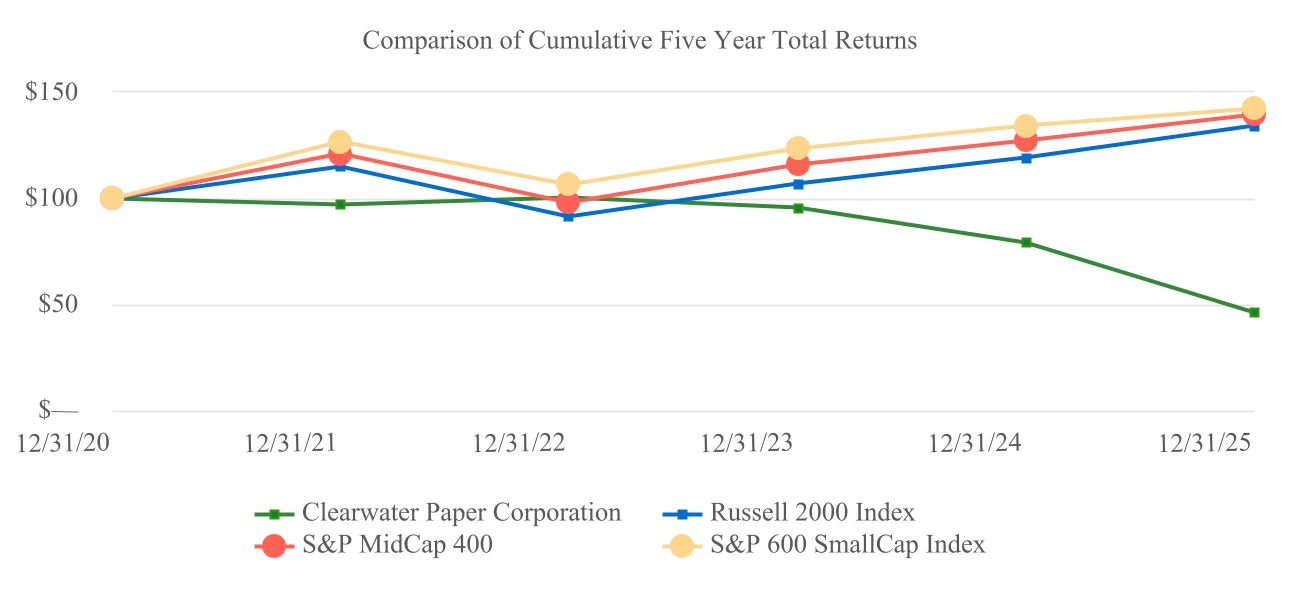
ITEM 6. [Reserved]
25
| ITEM 7. | Management’s Discussion and Analysis of Financial Condition and Results of Operations | ||||
The following discussion and analysis should be read in conjunction with our audited consolidated financial statements and related notes that appear elsewhere in this report. This discussion contains forward-looking statements reflecting our current expectations that involve risks and uncertainties. Actual results may differ materially from those discussed in these forward-looking statements due to a number of factors, including those set forth in the section entitled “Risk Factors” and elsewhere in this report. A discussion of the earliest year may be found in Management's Discussion and Analysis of Financial Condition and Results of Operations in our Annual Report on Form 10-K filed on February 24, 2025.
Overview of Business
We are a premier manufacturer and supplier of Solid Bleached Sulfate (SBS) paperboard packaging products to independent converters. We believe we are well positioned to capitalize on sustainability trends toward renewable and recyclable materials. We focus on food service and folding carton markets and provide limited distribution and sheeting services. Additionally, we sell minor amounts of pulp to outside customers. We believe our status as an independent, non-integrated supplier is core to our value proposition. We strive to develop new products and innovative solutions to expand and diversify our paperboard portfolio. In 2024, we completed the acquisition of a paperboard manufacturing facility and associated business in Augusta, Georgia.
Significant Factors That Impact Our Business and Results of Operations
The paperboard industry is affected by macro-economic conditions around the world and has historically experienced cyclical market conditions. As a result, prices for products and sales volumes have historically been volatile. Product pricing is significantly affected by the relationship between supply and demand for our products. Product supply in the industry is influenced primarily by fluctuations in available manufacturing production, which tends to increase during periods when prices remain strong. During 2025, the paperboard industry saw significant weakness due to increasing supply.
Our operating costs include raw materials, labor and selling, general and administrative expenses. We manage these costs through cost saving and productivity initiatives, sourcing programs, and pricing actions. Additionally, our operations, as do all pulp and paperboard manufacturing operations, require regular annual planned maintenance outages.
Critical Accounting Policies and Significant Estimates
A discussion of our significant accounting policies and significant accounting estimates and judgments is presented in Note 1, "Summary of Significant Accounting Policies" of the Notes to Consolidated Financial Statements in Item 8 of this report. Throughout the preparation of the financial statements, we employ significant judgments in the application of accounting principles and methods. We believe that the accounting estimates discussed below represent the accounting estimates requiring the exercise of judgment where a different set of judgments could result in the greatest changes to reported results. We reviewed the development, selection and disclosure of our critical accounting estimates with the Audit Committee of our Board of Directors. For 2025, the significant accounting estimate and judgment includes:
Retirement Plans and Postretirement Benefits
We have a number of defined benefit pension plans in the United States covering many of our employees. Benefit accruals under most of our defined benefit pension plans in the United States were frozen prior to January 2014.
We account for the consequences of our sponsorship of these plans using assumptions to calculate the related assets, liabilities and expenses recorded in our financial statements. Net actuarial gains and losses occur when actual experience differs from any of the assumptions used to value defined benefit plans or when assumptions change as they may each year. The primary factors contributing to actuarial gains and losses are changes in the discount rate used to value obligations as of the measurement date and the differences between expected and actual returns on pension plan assets. This accounting method results in the potential for volatile and difficult to forecast gains and losses.
26
We record amounts relating to these defined benefit plans based on various actuarial assumptions, including discount rates, assumed rates of return, compensation increases and life expectancy. We review our actuarial assumptions on an annual basis and make modifications to the assumptions based on current economic conditions and trends. We believe that the assumptions utilized in recording our obligations under our plans are reasonable based on our experience and on advice from our independent actuaries; however, differences in actual experience or changes in the assumptions may materially affect our financial condition or results of operations.
The following table illustrates the estimated impact on hypothetical pension obligations and expenses that would have resulted from a 25-basis point reduction in two key assumptions for the year ended December 31, 2025:
| (In millions) | Statements of Operations | Balance Sheets | ||||||
| Discount rate | $ | 0.4 | $ | 4.4 | ||||
| Expected long term rate of return | $ | 0.6 | $ | — | ||||
It is not possible to forecast or predict whether there will be actuarial gains and losses in future periods, and if required, the magnitude of any such adjustment. These gains and losses are driven by differences in actual experience or changes in the assumptions that are beyond our control, such as changes in interest rates and the actual return on pension plan assets.
27
Non-GAAP Financial Measures
In evaluating our business, we utilize several non-GAAP financial measures. A non-GAAP financial measure is generally defined by the SEC as one that purports to measure historical or future financial performance, financial position or cash flows, but excludes or includes amounts that would not be so excluded or included under applicable GAAP guidance. In this report on Form 10-K, we disclose income (loss) from continuing operations before interest expense, net, non-operating pension and other post employment benefit costs, income tax expense, depreciation and amortization, other operating charges, net, debt retirement costs, and goodwill impairment as Adjusted EBITDA from continuing operations which is a non-GAAP financial measure. Adjusted EBITDA from continuing operations is not a substitute for the GAAP measure of net income or for any other GAAP measures of operating performance.
We have included Adjusted EBITDA from continuing operations in this report because we use it as an important supplemental measure of our performance and believe that it is frequently used by securities analysts, investors and other interested persons in the evaluation of companies in our industry, some of which present Adjusted EBITDA when reporting their results. We use Adjusted EBITDA from continuing operations to evaluate our performance as compared to other companies in our industry that have different financing and capital structures and/or tax rates. It should be noted that companies calculate Adjusted EBITDA differently and, therefore, our Adjusted EBITDA from continuing operations measure may not be comparable to Adjusted EBITDA reported by other companies. Our Adjusted EBITDA from continuing operations measure has material limitations as a performance measure because it excludes interest expense, net, income tax (benefit) expense and depreciation and amortization which are necessary to operate our business or which we otherwise incur or experience in connection with the operation of our business. In addition, we exclude other income and expense items which are outside of our core operations.
The following table provides our Adjusted EBITDA from continuing operations for the periods presented and a reconciliation to net income.
| For The Years Ended December 31, | |||||||||||
| (In millions) | 2025 | 2024 | 2023 | ||||||||
| Net income (loss) | $ | (18.6) | $ | 196.3 | $ | 107.7 | |||||
| Less: income from discontinued operations, net of tax | 34.4 | 270.3 | 59.0 | ||||||||
| Income (loss) from continuing operations | (53.0) | (74.0) | 48.7 | ||||||||
| Add (deduct): | |||||||||||
| Income tax provision (benefit) | (7.1) | (27.1) | 16.9 | ||||||||
| Interest expense, net | 16.8 | 29.2 | 9.5 | ||||||||
| Goodwill impairment | 48.0 | — | — | ||||||||
| Depreciation and amortization expense | 92.4 | 69.8 | 40.7 | ||||||||
| Inventory revaluation on acquired business | — | 6.8 | — | ||||||||
| Other operating charges, net | 8.9 | 24.0 | 3.2 | ||||||||
| Other non-operating (income) expense | 1.2 | (1.8) | (0.1) | ||||||||
| Debt retirement costs | — | 9.1 | 3.1 | ||||||||
| Adjusted EBITDA from continuing operations | $ | 107.2 | $ | 36.0 | $ | 122.0 | |||||
28
OPERATING RESULTS FROM CONTINUING OPERATIONS
| For The Years Ended December 31, | Increase (decrease) | |||||||||||||||||||
| 2025 | 2024 | 2023 | 2025-2024 | 2024-2023 | ||||||||||||||||
| Net sales | $ | 1,555.4 | $ | 1,383.6 | $ | 1,136.0 | 12 | % | 22 | % | ||||||||||
| Cost of sales | 1,439.8 | 1,307.5 | 935.3 | 10 | % | 40 | % | |||||||||||||
| Gross profit | 115.6 | 76.1 | 200.7 | 52 | % | (62) | % | |||||||||||||
| Gross profit as % of sales | 7.4 | % | 5.5 | % | 17.7 | % | ||||||||||||||
| Selling, general and administrative expenses | 100.8 | 116.7 | 119.4 | (14) | % | (2) | % | |||||||||||||
| Selling, general and administrative as % of sales | 6.5 | % | 8.4 | % | 10.5 | % | ||||||||||||||
Other operating charges, net (1) | 8.9 | 24.0 | 3.2 | nm | nm | |||||||||||||||
Goodwill impairment(1) | 48.0 | — | — | nm | nm | |||||||||||||||
| Income (loss) from continuing operations | $ | (42.1) | $ | (64.5) | $ | 78.1 | 35 | % | (183) | % | ||||||||||
| Adjusted EBITDA from continuing operations | $ | 107.2 | $ | 36.0 | $ | 122.0 | 198 | % | (70) | % | ||||||||||
| Adjusted EBITDA margin | 6.9 | % | 2.6 | % | 10.7 | % | 165 | % | (76) | % | ||||||||||
(1) See Note 7, "Goodwill and Intangible Assets" and Note 10, "Other operating charges," of the Notes to the Consolidated Financial Statements included in Item 8 of this report for additional information.
Net Sales
For the year ended December 31, 2025, net sales increased compared to the prior year primarily due to the inclusion of the Augusta operations (see Note 3, "Business Acquisition" of the Notes to the Consolidated Financial Statements included in Item 8 of this report for additional information). The addition of Augusta operations was offset by declines in market prices and changes in our product mix.
| For The Years Ended December 31, | Increase (decrease) | |||||||||||||||||||
| 2025 | 2024 | 2023 | 2025-2024 | 2024-2023 | ||||||||||||||||
| Paperboard shipments (short tons) | 1,236,114 | 1,080,898 | 751,520 | 14.4 | % | 43.8 | % | |||||||||||||
| Paperboard sales price (per short ton) | $ | 1,167 | $ | 1,210 | $ | 1,375 | (3.6) | % | (12.0) | % | ||||||||||
| Pulp shipments (short tons) | 148,487 | 101,429 | 140,284 | 46.4 | % | (27.7) | % | |||||||||||||
| Pulp sales price (short tons) | $ | 652 | $ | 581 | $ | 607 | 12.2 | % | (4.3) | % | ||||||||||
Cost of sales
Costs included in our cost of sales include input costs (principally raw materials and energy), labor and overhead, supply chain costs (principally freight and outside warehousing). The table below provides the details of our cost of sales for the years ended December 31, 2025, 2024 and 2023.
| For The Years Ended December 31, | Increase (decrease) | |||||||||||||||||||
| 2025 | 2024 | 2023 | 2025-2024 | 2024-2023 | ||||||||||||||||
| Input costs | $ | 688.5 | $ | 615.0 | $ | 494.5 | 12.0 | % | 24.4 | % | ||||||||||
| Labor and overhead | 517.7 | 482.2 | 302.7 | 7.4 | % | 59.3 | % | |||||||||||||
| Supply chain costs | 153.3 | 140.1 | 105.3 | 9.4 | % | 33.0 | % | |||||||||||||
| Other | (8.1) | 4.4 | (3.3) | nm | nm | |||||||||||||||
| Depreciation and amortization | 88.3 | 65.9 | 36.1 | 34.0 | % | 82.7 | % | |||||||||||||
| Cost of Sales | $ | 1,439.8 | $ | 1,307.5 | $ | 935.3 | 10.1 | % | 39.8 | % | ||||||||||
29
For the year ended December 31, 2025, cost of sales increased compared to the prior year, primarily due to the inclusion of the Augusta operations offset by cost reduction activities. Input costs increased due to higher production volume with increases on a per ton basis across energy and chemicals offset by reductions on a per ton basis in fiber. Our labor and overhead increased due to the inclusion of the Augusta operations offset by implementation of our cost reduction plan. Depreciation increased due to inclusion of Augusta operations. Supply chain costs increased due to higher volumes offset by lower freight costs per ton due to improved freight optimization related to our revised facility footprint. Other costs decreased due to inventory increases related to the additional absorption of labor and overhead as of the year ended December 31, 2025 as compared to inventory decreases for the year ended December 31, 2024.
Gross profit
For the year ended December 31, 2025, gross profit increased due to improved operating performance, higher sales volume and our planned cost reduction activities, offset by lower sales prices.
Selling, general and administrative
For the year ended December 31, 2025 compared to the year ended December 31, 2024, selling, general and administrative expenses decreased due our planned cost reductions and reductions in incentive compensation linked to reduced operational results, partially offset by increased sales cost resulting from the Augusta acquisition.
Other operating charges
See Note 10, "Other Operating Charges, net" of the Notes to the Consolidated Financial Statements included in Item 8 of this report for additional information.
Overall income (loss) from continuing operations and Adjusted EBITDA
For the year ended December 31, 2025, operating income (loss) from continuing operations increased as compared to the prior year due to lower input costs and our planned cost reduction activities, offset by lower sales pricing, goodwill and other impairment charges, integration cost associated with the acquisition of the Augusta facility and severance. For the year ended December 31, 2025, Adjusted EBITDA from continuing operations increased as compared to the prior year due to lower input costs and our planned cost reduction activities, offset by lower sales pricing.
POTENTIAL IMPAIRMENTS
We review from time-to-time possible dispositions or reorganization of various assets in light of current and anticipated economic and industry conditions, our strategic plan and other relevant factors. Because a determination to dispose or reorganize particular assets may require management to make assumptions regarding the transaction structure of the disposition or reorganization and to estimate the net sales proceeds, which may be less than previous estimates of undiscounted future net cash flows, we may be required to record impairment charges in connection with decisions to dispose of assets.
2026 OPERATIONS
In early 2026, the company experienced production disruptions and higher operating costs due to severe weather affecting its Augusta and Cypress Bend facilities. Through the date of filing, these events have resulted in an estimated $20 million reduction in Adjusted EBITDA.
For the full year of 2026, we expect to generate revenue between $1.45 billion and $1.55 billion, with higher volumes being more than offset by lower carry over pricing from 2025. New productivity initiatives and carry over from 2025 productivity are expected to offset input cost inflation of roughly 2% to 3%. We expect direct costs from our three planned major maintenance outages in 2026 to be similar to 2025, or roughly $50 million. We intend to execute our Lewiston, Idaho planned major maintenance outage in June of 2026, and the Augusta, Georgia outage in October of 2026. In addition, we will target $20 million of working capital improvements versus 2025, primarily by reducing our finished goods inventories. While we expect this reduction to generate incremental cash flows, it may have a negative impact on our fixed cost absorption and Adjusted EBITDA.
AUGUSTA ACQUISITION - REPRESENTATION AND WARRANTY INSURANCE CLAIM
On February 20, 2024, we and Graphic Packaging International, LLC (“GPK”), a wholly owned subsidiary of
30
Graphic Packaging Holding Company, entered into an Asset Purchase Agreement (the “Purchase Agreement”), pursuant to which we acquired a paperboard manufacturing facility and associated business, located in Augusta, Georgia (Augusta). The acquisition was completed on May 1, 2024 and the purchase price was $700 million, subject to adjustments for inventory and other assets. The amount paid totaled approximately $710.6 million. Our consolidated statement of operations includes the operation of these assets from May 1, 2024 through December 31, 2025.
GPK made customary representations and warranties in the Purchase Agreement for a transaction of this nature relating to periods prior to, and as of, the closing of the acquisition. We obtained representation and warranty insurance, subject to exclusions, a policy limit of $105 million, and certain other terms and conditions, to cover losses resulting from a breach of these representations and warranties. We have notified the insurance carriers of alleged breaches of certain representations and warranties contained in the Purchase Agreement. In July and November 2025, we submitted our claims to the insurance carriers for losses arising of the alleged breaches. During 2025, we received a partial settlement of $23.0 million related to these claims, of which $6.0 million was related to reimbursable costs and recorded within "Cost of sales" and $17.0 million related to other breaches and reported within "Other operating charges, net" in our Consolidated Statements of Operations . Although we believe that our claims are meritorious, no assurance can be given as to whether we will recover additional proceeds related to these claims.
LIQUIDITY AND CAPITAL RESOURCES
Overview
Our principal sources of liquidity are existing cash, cash generated by our operations and our ability to borrow under such credit facilities as we may have in effect from time to time. At times, we may also issue equity, debt or hybrid securities or engage in other capital market transactions. Due to the competitive and cyclical nature of the markets in which we operate, there is uncertainty regarding the amount of cash flows we will generate during the next twelve months. However, we believe that our cash flows from operations, our cash on hand and our borrowing capacity under our Credit Agreements will be adequate to fund debt service requirements and provide cash to support our ongoing operations, capital expenditures and working capital needs for the next twelve months.
Our principal uses of liquidity are paying the costs and expenses associated with our operations, servicing outstanding indebtedness and making capital expenditures. We may also from time to time prepay or repurchase outstanding indebtedness or shares or acquire assets or businesses that are complementary to our operations. Any such prepayments, repurchases or acquisitions may be commenced, suspended, discontinued, or resumed, and the method or methods of effecting any such prepayments or repurchases may be changed at any time or from time to time without prior notice.
Operating Activities
During 2025, we generated $12.3 million of cash from operations, as compared to $61.4 million in 2024. This decrease was driven by lower operating performance due to the divestiture of our tissue operations which are included in discontinued operations for the year ended December 31, 2024. Additionally, we paid $57 million related to our 2024 income tax liability primarily related to the divestiture of our tissue operations in 2024 and received $23.0 million in insurance proceeds. Accounts receivable and accounts payable agings have remained relatively consistent with balances as of December 31, 2024.
Investing Activities
During 2025, we used $100.4 million in cash from investing activities, as compared to generating $167.7 million in 2024. During the year ended December 31, 2025, we paid $88.8 million related to capital expenditures and paid $11.6 million associated with the working capital adjustment related to our business divestiture that occurred during 2024. Included in accounts payable and accrued liabilities was $7.4 million in related to capital expenditures that had not yet been paid at December 31, 2025.
In 2026, we expect cash paid for capital expenditures to be approximately $65 million to $75 million.
Financing Activities
Net cash flows provided by financing activities were $39.3 million for 2025. We borrowed $82.0 million and repaid $18.6 million under our Credit Agreements. We used $17.2 million to repurchase stock and $2.3 million
31
in connection with income tax withholding requirements associated with our employee stock-based compensation plans during the year ended December 31, 2025.
Commitments
Significant contractual obligations as of December 31, 2025 include our long term debt obligations, lease obligations and retirement plans and post retirement benefits. Refer to Note 9 "Debt," Note 6 "Leases" and Note 12 "Retirement plans and postretirement benefits" included in Item 8 of this report for further information. Other purchase obligations include purchase commitments of $122.1 million, of which $67.9 million is payable within 12 months, related to contracts for raw materials (including natural gas, electricity, chemicals and pulp), capital expenditures, and various IT services.
Credit Agreements
We are party to an amended and restated credit agreement (which may be amended from time to time, the “PCA Credit Agreement”) that consists of a term revolver commitment in the amount of $264.6 million. We may also increase term revolver commitments under the PCA Credit Agreement in an aggregate amount of up to $60 million, subject to obtaining commitments from any participating lenders and certain other conditions. The obligations under the PCA Credit Agreement are secured by liens on substantially all of our personal property assets and each of our domestic subsidiaries that are guarantors of the PCA Credit Agreement. Borrowings under the PCA Credit Agreement are subject to mandatory prepayment in certain circumstances. We may, at our option, prepay and reborrow any borrowings under the PCA Credit Agreement, in whole or in part, at any time and from time to time without premium or penalty (except in certain circumstances). The PCA Credit Agreement matures on May 1, 2029, subject to a springing maturity beginning on the date that is 91 days prior to the maturity of the Company’s 2020 Notes if the outstanding principal amount of the 2020 Notes plus $50 million is at any time during such 91 day period greater than the sum of our available borrowing liquidity and unrestricted cash.
We are also party to an asset-based loan credit agreement (which may be amended from time to time, the “ABL Credit Agreement,” and together with the PCA Credit Agreement, the “Credit Agreements”) that consists of a $375 million revolving loan commitment, subject to borrowing base limitations. Borrowings under the ABL Credit Agreement are subject to mandatory prepayment in certain circumstances. We may also increase the revolving commitments under the ABL Credit Agreement in an aggregate amount of up to $100 million, subject to obtaining commitments from any participating lenders and certain other conditions. The obligations under the ABL Credit Agreement are secured by liens on substantially all of our personal property assets and each of our domestic subsidiaries that are guarantors of the ABL Credit Agreement. We may, at our option, prepay and reborrow any borrowings under the ABL Credit Agreement, in whole or in part, at any time and from time to time without premium or penalty (except in certain circumstances). The ABL Credit Agreement matures on November 7, 2027. As of December 31, 2025, we had borrowings of $64.0 million outstanding under this facility and $3.5 million drawn to support our letters of credit.
Both Credit Agreements contain customary representations, warranties, and affirmative and negative covenants. The ABL Credit Agreement also contains a financial covenant, which requires us to maintain a consolidated fixed charge coverage ratio of not less than 1.10x to 1.00x, provided that the financial covenant under the ABL Credit Agreement is only applicable during an event of default or if availability, as calculated under the ABL Credit Agreement, is at any time less than or equal to the greater of (i) 10.0% the Line Cap (as defined above) and (ii) $25 million.
At December 31, 2025, we were in compliance with the covenants in the Credit Agreements, and based on our current financial projections, we expect to remain in compliance. However, if our financial position, results of operations or market conditions deteriorate, we may not be able to remain in compliance. There can be no assurance that we will be able to remain in compliance with the Credit Agreements. See Note 9, "Debt," to the Notes to Consolidated Financial Statements included in Item 8 of this report for additional information.
32
| ITEM 7A. | Quantitative and Qualitative Disclosures About Market Risk | ||||
Interest Rate Risk
Our exposure to market risk on financial instruments is limited to our ABL Credit Agreements, under which there was $64.0 million outstanding as of December 31, 2025. The interest rates applied to borrowings on our Credit Agreements and are adjusted often and therefore react quickly to any movement in the general trend of market interest rates.
Quantitative Information about Market Risk
| Expected Maturity Date | |||||||||||||||||||||||||||||||||||||||||
| (In millions) | 2026 | 2027 | 2028 | 2029 | 2030 | Thereafter | Total | ||||||||||||||||||||||||||||||||||
Long-term debt:1 | |||||||||||||||||||||||||||||||||||||||||
| Fixed rate | $ | — | $ | — | $ | 275.0 | $ | — | $ | — | $ | — | $ | 275.0 | |||||||||||||||||||||||||||
| Variable rate | $ | — | $ | 64.0 | $ | — | $ | — | $ | — | $ | — | $ | 64.0 | |||||||||||||||||||||||||||
| Average interest rate | — | % | 5.08 | % | 4.75 | % | — | % | — | % | — | % | 4.81 | % | |||||||||||||||||||||||||||
Fair value at December 31, 2025 | $ | 322.2 | |||||||||||||||||||||||||||||||||||||||
33
| ITEM 8. | Financial Statements and Supplementary Data | ||||
Report of Independent Registered Public Accounting Firm
To the Stockholders and Board of Directors
Clearwater Paper Corporation:
Opinion on the Consolidated Financial Statements
We have audited the accompanying consolidated balance sheets of Clearwater Paper Corporation and subsidiaries (the Company) as of December 31, 2025 and 2024, the related consolidated statements of operations, comprehensive income (loss), stockholders’ equity, and cash flows for each of the years in the three-year period ended December 31, 2025, and the related notes (collectively, the consolidated financial statements). In our opinion, the consolidated financial statements present fairly, in all material respects, the financial position of the Company as of December 31, 2025 and 2024, and the results of its operations and its cash flows for each of the years in the three-year period ended December 31, 2025, in conformity with U.S. generally accepted accounting principles.
We also have audited, in accordance with the standards of the Public Company Accounting Oversight Board (United States) (PCAOB), the Company’s internal control over financial reporting as of December 31, 2025, based on criteria established in Internal Control – Integrated Framework (2013) issued by the Committee of Sponsoring Organizations of the Treadway Commission, and our report dated February 18, 2026 expressed an unqualified opinion on the effectiveness of the Company’s internal control over financial reporting.
Basis for Opinion
These consolidated financial statements are the responsibility of the Company’s management. Our responsibility is to express an opinion on these consolidated financial statements based on our audits. We are a public accounting firm registered with the PCAOB and are required to be independent with respect to the Company in accordance with the U.S. federal securities laws and the applicable rules and regulations of the Securities and Exchange Commission and the PCAOB.
We conducted our audits in accordance with the standards of the PCAOB. Those standards require that we plan and perform the audit to obtain reasonable assurance about whether the consolidated financial statements are free of material misstatement, whether due to error or fraud. Our audits included performing procedures to assess the risks of material misstatement of the consolidated financial statements, whether due to error or fraud, and performing procedures that respond to those risks. Such procedures included examining, on a test basis, evidence regarding the amounts and disclosures in the consolidated financial statements. Our audits also included evaluating the accounting principles used and significant estimates made by management, as well as evaluating the overall presentation of the consolidated financial statements. We believe that our audits provide a reasonable basis for our opinion.
Critical Audit Matter
The critical audit matter communicated below is a matter arising from the current period audit of the consolidated financial statements that was communicated or required to be communicated to the audit committee and that: (1) relates to accounts or disclosures that are material to the consolidated financial statements and (2) involved our especially challenging, subjective, or complex judgments. The communication of a critical audit matter does not alter in any way our opinion on the consolidated financial statements, taken as a whole, and we are not, by communicating the critical audit matter below, providing a separate opinion on the critical audit matter or on the accounts or disclosures to which it relates.
Measurement of the pension benefit obligation
As discussed in Notes 1 and 12 to the consolidated financial statements, the Company’s pension benefit obligation was $213.9 million as of December 31, 2025. The measurement of the pension benefit obligation is based on actuarial assumptions that require judgment, which includes the discount rate
34
applied to the pension benefit obligation.
We identified the evaluation of the discount rate used in the measurement of the pension benefit obligation as a critical audit matter. Specialized skills and knowledge were required to evaluate the discount rate used to determine the pension benefit obligation. In addition, there was subjectivity and judgment in applying and evaluating results of the procedures due to the sensitivity of the pension benefit obligation to changes in the discount rate.
The following are the primary procedures we performed to address this critical audit matter. We evaluated the design and tested the operating effectiveness of certain controls over the Company’s pension benefit process. This included a control related to the determination of the discount rate assumption. We considered the change in the discount rate from that used in the prior year, including consideration of the changes in the discount rate in light of published reports of actuarial experts. We involved an actuarial professional with specialized skills and knowledge, who assisted in evaluating the discount rate as determined using the hypothetical bond portfolio model through analyzing the bond selection criteria, the bond ratings, and the cash flow matching of the model.
/s/ KPMG
We have served as the Company’s auditor since 2007.
February 18, 2026
35
CLEARWATER PAPER CORPORATION
Consolidated Balance Sheets
| December 31, | ||||||||
| (In millions, except share information) | 2025 | 2024 | ||||||
| Assets | ||||||||
| Current assets: | ||||||||
| Cash and cash equivalents | $ | $ | ||||||
Receivables, net of allowance for current expected credit losses of $ | ||||||||
| Inventories, net | ||||||||
| Other current assets | ||||||||
| Total current assets | ||||||||
| Property, plant and equipment | ||||||||
| Accumulated depreciation and amortization | ( | ( | ||||||
| Property, plant and equipment, net | ||||||||
| Goodwill and intangible assets, net | ||||||||
| Other assets, net | ||||||||
| Total assets | $ | $ | ||||||
| Liabilities and stockholders' equity | ||||||||
| Current liabilities: | ||||||||
| Current portion of long-term debt | ||||||||
| Accounts payable and accrued liabilities | ||||||||
| Total current liabilities | ||||||||
| Long-term debt | ||||||||
| Liability for pension and other postretirement employee benefits | ||||||||
| Deferred tax liabilities | ||||||||
| Other long-term obligations | ||||||||
| Total liabilities | ||||||||
| Stockholders’ equity: | ||||||||
Preferred stock, par value $ no shares issued | ||||||||
Common stock, par value $ | ||||||||
| Additional paid-in capital | ||||||||
Treasury stock, | ( | ( | ||||||
| Retained earnings | ||||||||
| Accumulated other comprehensive loss, net of tax | ( | ( | ||||||
| Total stockholders’ equity | ||||||||
| Total liabilities and stockholders' equity | $ | $ | ||||||
The accompanying notes are an integral part of these consolidated financial statements.
36
CLEARWATER PAPER CORPORATION
Consolidated Statements of Operations
| For The Years Ended December 31, | |||||||||||
(In millions, except per share data) | 2025 | 2024 | 2023 | ||||||||
| Net sales | $ | $ | $ | ||||||||
| Costs and expenses: | |||||||||||
| Cost of sales | |||||||||||
| Selling, general and administrative expenses | |||||||||||
| Other operating charges, net | |||||||||||
| Goodwill impairment | |||||||||||
| Total operating costs and expenses | |||||||||||
| Operating income (loss) | ( | ( | |||||||||
| Interest expense, net | ( | ( | ( | ||||||||
| Debt retirement costs | ( | ( | |||||||||
| Other non-operating (expense) income | ( | ||||||||||
| Total non-operating expense | ( | ( | ( | ||||||||
| Income (loss) from continuing operations before income taxes | ( | ( | |||||||||
| Income tax provision (benefit) | ( | ( | |||||||||
| Income (loss) from continuing operations | ( | ( | |||||||||
| Income (loss) from discontinued operations before income taxes | ( | ||||||||||
| Gain on sale of discontinued operations | |||||||||||
| Income tax provision (benefit) of discontinued operations | ( | ||||||||||
| Income (loss) from discontinued operations | |||||||||||
| Net income (loss) | $ | ( | $ | $ | |||||||
| Basic income (loss) per share: | |||||||||||
| Income (loss) per share from continuing operations | $ | ( | $ | ( | $ | ||||||
| Income (loss) per share from discontinued operations | |||||||||||
| Net income (loss) per share | ( | ||||||||||
| Diluted income (loss) per share: | |||||||||||
| Income (loss) per share from continuing operations | ( | ( | |||||||||
| Income (loss) per share from discontinued operations | |||||||||||
| Net income (loss) per share | $ | ( | $ | $ | |||||||
The accompanying notes are an integral part of these consolidated financial statements.
37
CLEARWATER PAPER CORPORATION
Consolidated Statements of Comprehensive Income (Loss)
| For The Years Ended December 31, | |||||||||||
| (In millions) | 2025 | 2024 | 2023 | ||||||||
| Net income (loss) | $ | ( | $ | $ | |||||||
| Other comprehensive income (loss), net of tax: | |||||||||||
| Defined benefit pension and other postretirement employee benefits: | |||||||||||
Net (gain) loss arising during the period, net of tax of $ | ( | ||||||||||
Amortization of actuarial (gain) loss included in net periodic cost, net of tax of $ | ( | ( | |||||||||
| Other comprehensive income (loss), net of tax | ( | ||||||||||
| Comprehensive income (loss) | $ | ( | $ | $ | |||||||
The accompanying notes are an integral part of these consolidated financial statements.
38
CLEARWATER PAPER CORPORATION
Consolidated Statements of Cash Flows
| For The Years Ended December 31, | |||||||||||
| (In millions) | 2025 | 2024 | 2023 | ||||||||
| Operating activities | |||||||||||
| Net income (loss) | $ | ( | $ | $ | |||||||
| Adjustments to reconcile net income (loss) to net cash flows provided by operating activities: | |||||||||||
| Goodwill impairment | |||||||||||
| Depreciation and amortization | |||||||||||
| Equity-based compensation expense | |||||||||||
| Deferred taxes | ( | ( | |||||||||
| Defined benefit pension and other postretirement employee benefits | ( | ( | |||||||||
| Gain on business divestiture | ( | ( | |||||||||
| Amortization of deferred debt costs and debt retirement | |||||||||||
| Loss on sale or impairment associated with assets | |||||||||||
| Changes in operating assets and liabilities, net of acquisitions and divestitures: | |||||||||||
| (Increase) in accounts receivable | ( | ( | ( | ||||||||
| (Increase) decrease in inventories | ( | ||||||||||
| (Increase) decrease in other current assets | ( | ||||||||||
| Increase (decrease) in accounts payable and accrued liabilities | ( | ( | |||||||||
| Other, net | ( | ||||||||||
| Net cash flows provided by operating activities | |||||||||||
| Investing activities | |||||||||||
Additions to property, plant and equipment 1 | ( | ( | ( | ||||||||
| Acquisition of business | ( | ||||||||||
| Proceeds (payments) from business divestiture | ( | ||||||||||
| Net cash flows provided by (used in) investing activities | ( | ( | |||||||||
| Financing activities | |||||||||||
| Borrowings on long-term debt | |||||||||||
| Repayments of long-term debt | ( | ( | ( | ||||||||
| Taxes paid related to net share settlement of equity awards | ( | ( | ( | ||||||||
| Repurchases of common stock | ( | ( | ( | ||||||||
| Payments for debt issuance costs | ( | ( | |||||||||
| Other, net | ( | ||||||||||
| Net cash flows provided by (used in) financing activities | ( | ( | |||||||||
| Increase (decrease) in cash and cash equivalents | ( | ( | |||||||||
| Cash and cash equivalents at beginning of period | |||||||||||
| Cash and cash equivalents at end of period | $ | $ | $ | ||||||||
| Supplemental disclosures of cash flow information: | |||||||||||
| Cash paid for interest, net of amounts capitalized | $ | $ | $ | ||||||||
| Cash paid for income taxes, net of refunds received | $ | $ | $ | ||||||||
1 Capital expenditures of $7.4 million, $25.8 million and $13.0 million that have not been paid as of December 31, 2025, 2024 and 2023 were excluded from the Statement of Cash Flows.
The accompanying notes are an integral part of these consolidated financial statements.
39
CLEARWATER PAPER CORPORATION
Consolidated Statements of Stockholders’ Equity
| Common Stock | Additional Paid-In Capital | Treasury Stock | Retained Earnings | Accumulated Other Comprehensive Loss | Total Stockholders' Equity | |||||||||||||||||||||
| (In millions, except share amounts which are in thousands) | Shares | Amount | Shares | Amount | ||||||||||||||||||||||
| Balance at December 31, 2022 | $ | — | $ | — | $ | — | $ | $ | ( | $ | ||||||||||||||||
| Net income | — | — | — | — | — | — | ||||||||||||||||||||
| Stock-based compensation expense | — | — | — | — | — | — | ||||||||||||||||||||
| Issuance of shares under stock plans, net | — | ( | — | — | — | — | ( | |||||||||||||||||||
Pension and other postretirement employee benefits, net of tax of $ | — | — | — | — | — | — | ||||||||||||||||||||
| Repurchases of common stock | ( | — | ( | — | — | — | — | ( | ||||||||||||||||||
| Balance at December 31, 2023 | — | — | — | ( | ||||||||||||||||||||||
| Net income | — | — | — | — | — | — | ||||||||||||||||||||
| Stock-based compensation expense | — | — | — | — | — | — | ||||||||||||||||||||
| Issuance of shares under stock plans, net | — | ( | — | — | — | — | ( | |||||||||||||||||||
Pension and other postretirement employee benefits, net of tax of $ | — | — | — | — | — | — | ( | ( | ||||||||||||||||||
| Repurchases of common stock | ( | — | ( | ( | ( | — | — | ( | ||||||||||||||||||
| Balance at December 31, 2024 | — | ( | ( | ( | ||||||||||||||||||||||
| Net loss | — | — | — | — | — | ( | — | ( | ||||||||||||||||||
| Stock-based compensation expense | — | — | — | — | — | — | ||||||||||||||||||||
| Issuance of shares under stock plans, net | — | ( | — | — | ( | |||||||||||||||||||||
Pension and other postretirement employee benefits, net of tax of $ | — | — | — | — | — | — | ||||||||||||||||||||
| Repurchases of common stock | — | ( | ( | — | — | ( | ||||||||||||||||||||
| Balance at December 31, 2025 | $ | — | $ | ( | $ | ( | $ | $ | ( | $ | ||||||||||||||||
The accompanying notes are an integral part of these consolidated financial statements.
40
CLEARWATER PAPER CORPORATION
Index to Notes to Consolidated Financial Statements
| PAGE NUMBER | ||||||||
| NOTE 1 | ||||||||
| NOTE 2 | ||||||||
| NOTE 3 | ||||||||
| NOTE 4 | ||||||||
| NOTE 5 | ||||||||
| NOTE 6 | ||||||||
| NOTE 7 | ||||||||
| NOTE 8 | ||||||||
| NOTE 9 | ||||||||
| NOTE 10 | ||||||||
| NOTE 11 | ||||||||
| NOTE 12 | ||||||||
| NOTE 13 | ||||||||
| NOTE 14 | ||||||||
| NOTE 15 | ||||||||
| NOTE 16 | ||||||||
| NOTE 17 | ||||||||
| NOTE 18 | ||||||||
| NOTE 19 | ||||||||
41
NOTE 1: SUMMARY OF SIGNIFICANT ACCOUNTING POLICIES
NATURE OF OPERATIONS AND BASIS OF PRESENTATION
We are a premier manufacturer and supplier of bleached paperboard focused on servicing independent converters in North America. We also offer services that include customer sheeting, slitting, and cutting. Prior to the completion of the sale of our tissue business, we manufactured and sold consumer and parent roll tissues to major retailers, including grocery, club and discount stores.
On May 1, 2024, we completed the acquisition of a paperboard manufacturing facility and associated business in Augusta, Georgia. See Note 3, "Business Acquisition," for more information about the acquisition.
On November 1, 2024, we completed the divestiture of our tissue business. This divestiture is presented as discontinued operations within our Consolidated Statements of Operations and is excluded from continuing operations for all periods presented. See Note 4, "Discontinued Operations," for more information on the divestiture.
Use Of Estimates
The preparation of financial statements in conformity with accounting principles generally accepted in the U.S. requires management to make estimates and assumptions that affect the reported amounts of assets and liabilities and disclosure of contingent assets and liabilities at the date of the financial statements and the reported amounts of net sales and expenses during the reporting period. Actual results may differ from those estimates.
Principles Of Consolidation
These consolidated financial statements include the financial condition and results of operations of Clearwater Paper Corporation and its wholly-owned subsidiaries. All intercompany transactions and balances between operations within the Company have been eliminated. Certain amounts have been reclassified from prior year presentation for consistency.
Business Combinations
We apply the principles provided in the Financial Accounting Standards Board (FASB) Accounting Standards Codification (ASC) 805, Business Combinations, to determine whether an acquisition involves an asset or a business. In determining whether an acquisition should be accounted for as a business combination or asset acquisition, we first determine whether substantially all of the fair value of the gross assets acquired is concentrated in a single identifiable asset or a group of similar identifiable assets. If this is the case, the single identifiable asset or the group of similar assets is accounted for as an asset acquisition. If this is not the case, we then further evaluate whether the single identifiable asset or group of similar identifiable assets and activities includes, at a minimum, an input and a substantive process that together significantly contribute to the ability to create outputs. If so, the transaction is accounted for as a business combination.
We account for business combinations using the acquisition method of accounting which requires that (i) identifiable assets acquired (including identifiable intangible assets) and liabilities assumed generally be measured and recognized at fair value as of the acquisition date and (ii) the excess of the purchase price over the estimated net fair value of identifiable assets acquired and liabilities assumed be recognized as goodwill, which is not amortized for accounting purposes but is subject to testing for impairment at least annually. We measure and recognize asset acquisitions that are not deemed to be business combinations based on the cost to acquire the assets. Goodwill is not recognized in an asset acquisition with any consideration in excess of net assets acquired allocated to acquired assets on a relative estimated fair value basis. Transaction costs are expensed in a business combination and transaction costs directly attributable to the acquisition are considered a component of the cost of the acquisition in an asset acquisition. See Note 3, "Business Acquisition," for additional information.
Discontinued Operations
We present discontinued operations when there is a plan to dispose of a component of an entity or a group of
42
Cash And Cash Equivalents
We consider all highly liquid instruments with maturities of three months or less to be cash equivalents.
Accounts Receivable
Receivables consist of:
| December 31, | |||||||||||
| 2025 | 2024 | ||||||||||
| Trade accounts receivable | $ | $ | |||||||||
| Allowance for current expected credit losses | ( | ( | |||||||||
| Unbilled receivables | |||||||||||
| Taxes receivable | |||||||||||
| Other | |||||||||||
| $ | $ | ||||||||||
Inventories
Our inventories are stated at the lower of net realizable value or current cost using the average cost method.
| December 31, | |||||||||||
| 2025 | 2024 | ||||||||||
| Logs, chips and sawdust | $ | $ | |||||||||
| Pulp | |||||||||||
| Paperboard products | |||||||||||
| Materials and supplies | |||||||||||
| $ | $ | ||||||||||
Property, Plant And Equipment
Property, plant and equipment are stated at cost, including assets acquired under finance lease obligations, and any interest costs capitalized, less accumulated depreciation. Depreciation of buildings, equipment and other depreciable assets is determined using the straight-line method. Estimated useful lives generally range from 10 to 40 years for land improvements, 10 to 40 years for building and improvements, and 2 to 25 years for machinery and equipment (includes office and other equipment).
| December 31, | |||||||||||
| 2025 | 2024 | ||||||||||
| Land and land improvements | $ | $ | |||||||||
| Buildings and improvements | |||||||||||
| Machinery and equipment | |||||||||||
| Construction in progress | |||||||||||
| Property, plant and equipment | |||||||||||
| Less accumulated depreciation and amortization | ( | ( | |||||||||
| Property, plant and equipment, net | $ | $ | |||||||||
43
At December 31, 2025 and 2024, included within property, plant and equipment, net were finance leases of $8.2 million and $8.6 million and associated accumulated depreciation amounts of $0.4 million and $0.3 million.
Depreciation expense included in our financials is as follows:
| For The Years Ended December 31, | |||||||||||
| 2025 | 2024 | 2023 | |||||||||
| Continuing operations | $ | $ | $ | ||||||||
| Discontinued operations | |||||||||||
| Amortization of intangibles | |||||||||||
| $ | $ | $ | |||||||||
Planned Maintenance
We recognize the cost of repair and maintenance activities in the period in which the activity is performed or goods are consumed under the direct expense method. We perform planned annual maintenance activities at our facilities and associated expenses are included in cost of sales.
Accounts Payable And Accrued Liabilities
Accounts payable and accrued liabilities consist of:
| December 31, | ||||||||
| 2025 | 2024 | |||||||
| Trade payables | $ | $ | ||||||
| Accrued compensation | ||||||||
| Operating lease liabilities | ||||||||
| Taxes payable | ||||||||
| Other | ||||||||
| $ | $ | |||||||
Included in accounts payable and other accrued liabilities is $7.4 million and $25.8 million related to capital expenditures that had not yet been paid as of December 31, 2025 and 2024.
We maintain a program with a financial institution to provide our vendors with an option to receive payments earlier than our standard payment terms. Vendors receive payments directly from the financial institution. We are obligated to repay the financial institution in the next billing cycle which is generally 35 to 60 days later than payment to the supplier. Amounts under this program were included in "Other" in the table above and payments made under this program are reflected as cash outflows for operating activities in the Consolidated Statements of Cash Flows.
The roll forward of our outstanding obligations confirmed as valid under the program were as follows:
| December 31, | ||||||||
| 2025 | 2024 | |||||||
| Supplier finance program obligations balance, beginning of the year | $ | $ | ||||||
| Invoice amounts added during the year | ||||||||
| Invoice amounts paid during the year | ( | ( | ||||||
| Supplier finance program obligations balance, end of year | $ | $ | ||||||
Retirement Plans And Postretirement Benefits
We are required to use actuarial methods and assumptions in the valuation of defined benefit obligations and other postretirement obligations and the determination of expense. Differences between actual and expected results or changes in the values of the obligations and plan assets are not recognized in earnings as they occur but, rather, systematically and gradually over subsequent periods.
44
See Note 12, "Retirement Plans and Postretirement Benefits," for further information.
Income Taxes
Income taxes are accounted for under the asset and liability method. Deferred tax assets and liabilities are recognized for the future tax consequences attributable to differences between the consolidated financial statement carrying amounts of existing assets and liabilities and their respective tax basis and operating loss and tax credit carryforwards. Deferred tax assets and liabilities are measured using enacted tax rates expected to apply to taxable income in the years in which those temporary differences are expected to be recovered or settled. The effect on deferred tax assets and liabilities of a change in tax rates is recognized in income in the period that includes the enactment date.
The determination of our provision for income taxes requires significant judgment, the use of estimates, and the interpretation and application of complex tax laws. Significant judgment is required in assessing the timing and amounts of deductible and taxable items and the probability of sustaining uncertain tax positions. The benefits of uncertain tax positions are recorded in our consolidated financial statements only after determining a more-likely-than-not probability that the uncertain tax positions will withstand challenge, if any, from tax authorities. When facts and circumstances change, we reassess these probabilities and record any changes in the consolidated financial statements as appropriate.
See Note 8, "Income Taxes," for further information.
Revenue Recognition
We enter into contracts that can include various combinations of paperboard products, which are generally distinct and accounted for as separate performance obligations.
Generally, revenue is recognized at a point in time upon transfer of control of promised products or services to customers in an amount that reflects the consideration we expect to receive in exchange for those products or services. Transfer of control typically occurs when the title and risk of loss passes to the customer. Shipping terms generally indicate when title and the risk of loss have passed, usually this is upon receipt at our customer's destination. We have elected to treat shipping and handling costs as a fulfillment cost. We expense incremental direct costs of obtaining a contract (sales commissions) when incurred because the amortization period is generally 12 months or less. We maintain consignment inventory at a limited number of customer locations. For consigned inventory, we recognize revenue upon transfer of control, which is often in advance of invoicing the customer. These amounts are classified as unbilled receivables in the above detail of trade accounts receivable.
We provide for trade promotions, customer cash discounts and other deductions, which are considered variable consideration and recorded as a reduction to net sales. These costs are recorded at the later of the time of sale or the implementation of the program based on management’s best estimates. Estimates are based on historical and projected experience for each type of program or customer. Volume allowances are accrued based on our estimates of customer volume achievement and other factors incorporated into customer agreements. Revenue, net of returns and credits, is only recognized to the extent that it is probable that a significant reversal of any incremental revenue will not occur. Judgment associated with forecasted volumes is required to determine the most probable amount of variable consideration to apply as a reduction to net sales. Management adjusts accruals when circumstances indicate (typically as a result of a change in volume expectations). As of December 31, 2025 and 2024, we accrued $14.8 million and $8.9 million for customer rebates recorded in accounts payable and accrued liabilities on our Consolidated Balance Sheets.
45
Other Operating Charges, Net
We classify significant amounts unrelated to ongoing core operating activities as “Other operating charges, net” in the Consolidated Statements of Operations. Such items include, but are not limited to, amounts related to facility closures and related gain (loss) on sale and impairment, restructuring charges (including severance charges), costs to establish and maintain litigation or environmental reserves, gains or losses from settlements with governmental or other organizations, acquisition and integration related costs and cash settled equity-based compensation to our directors. Due to the nature of these items, amounts in the statement of operations can fluctuate from year to year. The determination of which items are considered significant and unrelated to core operations is based upon management’s judgment.
See Note 10, "Other Operating Charges, net," for further information.
Accounts Receivable Arrangement
Prior to the sale of our tissue business, we maintained an uncommitted supply-chain financing program with a global financial institution. Under this program, a specific customer's trade accounts receivable may be acquired, without recourse, by the institution at a discounted rate.
For the year ended December 31, 2024, we sold $261.6 million of receivables. The proceeds from these sales of receivables are included within operating activities in our Consolidated Statements of Cash Flows. For the years ended December 31, 2024, and 2023 factoring expense on the sale of receivables was $3.4 million and $3.7 million and was included Selling, general and administrative expense within our Income (loss) from discontinued operations in our Consolidated Statements of Operations. With the divestiture of our Tissue operations in 2024, we discontinued this program.
Environmental And Asset Retirement Obligations
Our asset retirement liability reflects the estimated present value of our obligations for capping, closure and post closure costs with respect to landfills, asbestos remediation and other ongoing environmental monitoring. We have met our current legal obligation to identify and manage these materials. These obligations are recorded in “Accounts Payable and Accrued liabilities” and “Other long-term obligations” on our Consolidated Balance Sheets. The following table represents the activity associated with these obligations for the years ended.
| December 31, | |||||||||||
| 2025 | 2024 | ||||||||||
| Beginning balance | $ | $ | |||||||||
| Liabilities acquired | |||||||||||
| Accretion expense | |||||||||||
| Payments | ( | ||||||||||
| Ending balance | $ | $ | |||||||||
Treasury Stock
Under our 2024 stock repurchase authorization, we repurchase shares of common stock and such shares are recorded at cost as treasury stock and result in a reduction of shareholders' equity in the Consolidated Balance Sheets. We use the weighted-average cost method for determining the cost of shares reissued. The difference between the cost of the treasury shares and the reissuance value is added to or deducted from additional paid-in capital. If additional paid in capital is exhausted, amounts will be deducted directly from retained earnings upon reissuance.
46
NOTE 2: RECENTLY ADOPTED AND NEW ACCOUNTING STANDARDS
Recently Adopted
In December 2023, the FASB issued ASU No. 2023-09, Income Taxes—Improvements to Income Tax Disclosures (Topic 740), which requires enhanced disclosures primarily related to the rate reconciliation and disaggregation of income taxes paid. This ASU is effective for annual periods beginning after December 15, 2024, with early adoption permitted. We adopted this ASU prospectively on January 1, 2025. The adoption of this standard resulted in additional income tax disclosures and did not have any impact on our financial statements. See Note 8, "Income Taxes," for additional information.
New Accounting Standards
In November 2024, the FASB issued ASU 2024-03, Disaggregation of Income Statement Expenses (Subtopic 220-40), which requires disaggregated disclosure of certain types of expenses, such as inventory purchases, employee compensation, depreciation, and amortization in commonly presented expense captions such as cost of revenue and selling, general and administrative expenses. This ASU is effective for fiscal years beginning after December 15, 2026, and interim periods within fiscal years beginning after December 15, 2027. Early adoption is permitted. The adoption of this ASU will result in additional disclosure of income statement expenses but will not have a material impact on our financial statements.
NOTE 3: BUSINESS ACQUISITION
On May 1, 2024, we completed the acquisition of a paperboard manufacturing facility and associated business, located in Augusta, Georgia (Augusta) from Graphic Packaging International, LLC (Augusta Acquisition). The acquisition is being accounted for under Financial Accounting Standards Board (FASB) Accounting Standards Codification (ASC) 805, Business Combinations as a business combination as opposed to an asset acquisition. We used borrowings under our credit facilities to fund the acquisition.
The purchase price of the Augusta Acquisition was allocated to assets acquired and liabilities assumed based on the estimated fair values as of the date of acquisition. The excess of the purchase price over the fair value of the net assets acquired was allocated to goodwill, which is expected to be deductible for tax purposes. The purchase price was final as of May 1, 2025.
The purchase price allocation as of May 1, 2025 is as follows:
| Original Purchase Price Allocation | Measurement Period Adjustments | Final Purchase Price Allocation | |||||||||
| Purchase price | $ | $ | — | $ | |||||||
| Inventories, net | |||||||||||
| Other current assets | ( | ||||||||||
| Property, plant and equipment | |||||||||||
| Other assets, net | |||||||||||
| Total assets acquired | |||||||||||
| Current portion of long-term debt | ( | ( | |||||||||
| Accounts payable and accrued liabilities | ( | ( | ( | ||||||||
| Long-term debt | ( | — | ( | ||||||||
| Other long-term obligations | ( | — | ( | ||||||||
| Total liabilities assumed | ( | ( | ( | ||||||||
| Net assets acquired | |||||||||||
| Goodwill | ( | ||||||||||
| Total estimated fair value of net assets acquired | $ | $ | — | $ | |||||||
The following unaudited pro forma consolidated financial information for the twelve ended December 31, 2024 combines our results and the unaudited results of the Augusta operations for the corresponding periods. The unaudited pro forma consolidated financial information assumes that the Augusta Acquisition, which closed on
47
May 1, 2024, was completed on January 1, 2023. The pro forma consolidated financial information has been calculated after applying our accounting policies and includes adjustments to reduce previously recorded amortization expense, fair value adjustments for acquired inventory, property, plant and equipment and operating leases. The impact to depreciation expense was de minimis due to the valuation step up being offset by increased useful lives. These pro forma results have been prepared for comparative purposes only and do not purport to be indicative of our operating results that would have been achieved had the Augusta Acquisition actually taken place on January 1, 2023. In addition, these results are not intended to be a projection of future results and do not reflect events that may occur after the Augusta Acquisition, including but not limited to revenue enhancements, cost savings or operating synergies that we may achieve as a result of the Augusta Acquisition.
| For The Years Ended December 31, | |||||||||||
| (Unaudited) | 2024 | 2023 | |||||||||
| Net sales | $ | $ | |||||||||
| Net income | |||||||||||
NOTE 4: DISCONTINUED OPERATIONS
On November 1, 2024, we completed the divestiture of our tissue business to Sofidel America Corp. The purchase price was $1.06 billion in cash, subject to adjustments for working capital, indebtedness and transaction expenses. We recorded a gain on sale of $307.2 million for the year ended December 31, 2024. During the year ended December 31, 2025, we recorded an additional gain of $1.5 million due to the reversal of a portion of the previously accrued working capital settlement amount. The final cash payment of $11.6 million is included on our Consolidated Statement of Cash Flows for the year end December 31, 2025.
Below is a reconciliation of line items constituting pre-tax income from discontinued operations to the after-tax income from discontinued operations as reported on our Consolidated Statement of Operations:
| For The Years Ended December 31, | |||||||||||
| 2025 | 2024 | 2023 | |||||||||
| Net sales | $ | $ | $ | ||||||||
| Cost of sales | |||||||||||
| Selling, general and administrative expenses | |||||||||||
| Other operating charges, net | |||||||||||
| Income (loss) from discontinued operations | ( | ||||||||||
| Non-operating expense | ( | ( | |||||||||
| Income (loss) from discontinued operations before income taxes | ( | ||||||||||
During the year ended December 31, 2025, we finalized the sales price of Tissue operations based upon the working capital settlement. Additionally, based upon the filing of our 2024 income tax return, we recorded a tax benefit associated with the sale of $36.4 million, primarily related to continued discussions with the IRS on the WSD matter discussed in Note 8.
The major components of “Other operating charges, net” included in discontinued operations for the years ended December 31, 2025, 2024 and 2023 are reflected in the table below. These items are considered
48
outside of our core discontinued operations.
| For The Years Ended December 31, | |||||||||||
| 2025 | 2024 | 2023 | |||||||||
| Divestiture related costs | $ | $ | $ | ||||||||
| Loss on sale or impairment associated with assets | |||||||||||
| Business improvement and other expenses | |||||||||||
| $ | $ | $ | |||||||||
Operating and investing cash flows of the discontinued operation are presented in the following table:
| Twelve Months Ended December 31, | |||||||||||
| 2025 | 2024 | 2023 | |||||||||
| Net cash provided by (used in) operating activities of discontinued operations | $ | ( | $ | $ | |||||||
| Net cash used in investing activities of discontinued operations | ( | ( | |||||||||
NOTE 5: FAIR VALUE MEASUREMENTS
Fair value measurements and disclosure requirements establish a fair value hierarchy that prioritizes the inputs to valuation techniques used to measure fair value into three levels. Level 1 inputs, the highest priority, are quoted prices in active markets for identical assets or liabilities. Level 2 inputs reflect other than quoted prices included in level 1 that are either observable directly or through corroboration with observable market data. Level 3 inputs are unobservable inputs due to little or no market activity for the asset or liability, such as internally-developed valuation models.
Carrying amounts reported on the consolidated balance sheets for cash and cash equivalents, receivables and accounts payable approximate fair value due to the short-term maturity of these instruments. See discussion on fair market values for long-term debt included within Note 9, "Debt."
NOTE 6: LEASES
We have operating leases for manufacturing equipment, office equipment, and vehicles. Our leases have remaining lease terms from less than 1 to 10 years, and some of our leases include one or more options to renew. Options to renew, extend or terminate a lease are reflected in our lease terms when we believe it is reasonably certain we will exercise that option. When our leases do not provide an implicit or an explicit interest rate, we use our incremental borrowing rate in determining the present value of lease payments.
49
Components Of Lease Expense
| For The Years Ended December 31, | |||||||||||
| 2025 | 2024 | 2023 | |||||||||
| Operating lease costs | $ | $ | $ | ||||||||
| Finance lease costs: | |||||||||||
| Amortization of ROU assets | |||||||||||
| Interest on lease liabilities | |||||||||||
| Total finance lease costs | |||||||||||
| Variable lease costs | |||||||||||
| Total lease costs | $ | $ | $ | ||||||||
Supplemental Balance Sheet Information
| December 31, | |||||||||||
| Balance Sheet Caption | 2025 | 2024 | |||||||||
| Lease ROU assets | |||||||||||
| Operating lease assets | $ | $ | |||||||||
| Finance lease assets, net | $ | $ | |||||||||
| Lease Liabilities | |||||||||||
| Current operating lease liabilities | $ | $ | |||||||||
| Current finance lease liabilities | $ | $ | |||||||||
| Non-current operating lease liabilities | $ | $ | |||||||||
| Non-current finance lease liabilities | $ | $ | |||||||||
| Total operating lease liabilities | $ | $ | |||||||||
| Total finance lease liabilities | $ | $ | |||||||||
Lease Term And Discount Rate
| December 31, | ||||||||
| 2025 | 2024 | |||||||
| Weighted average remaining lease term (years) | ||||||||
| Operating leases | ||||||||
| Finance lease | ||||||||
| Weighted average discount rate | ||||||||
| Operating leases | % | % | ||||||
| Finance lease | % | % | ||||||
50
Supplemental Cash Flow Information
The table below includes lease information for both continuing and discontinued operations.
| For The Years Ended December 31, | |||||||||||
| 2025 | 2024 | 2023 | |||||||||
| Cash paid for amounts included in the measurement of lease liabilities: | |||||||||||
| Operating cash flows from operating leases | $ | $ | $ | ||||||||
| Operating cash flows from finance leases | |||||||||||
| Financing cash flows from finance leases | |||||||||||
| Non-cash amounts for lease liabilities arising from obtaining ROU assets: | |||||||||||
| Operating leases | $ | $ | $ | ||||||||
| Operating leases assumed on business acquisition | |||||||||||
| Finance leases assumed on business acquisition | |||||||||||
Maturity Of Lease Liabilities
As of December 31, 2025, our future maturities of lease liabilities were as follows:
| Operating | Finance | |||||||
| 2026 | $ | $ | ||||||
| 2027 | ||||||||
| 2028 | ||||||||
| 2029 | ||||||||
| 2030 | ||||||||
| Thereafter | ||||||||
| Total lease payments | ||||||||
| Less imputed interest | ( | ( | ||||||
| Present value of lease liabilities | $ | $ | ||||||
51
NOTE 7: GOODWILL AND INTANGIBLE ASSETS
Changes in the carrying amounts of goodwill and intangible assets were as follows:
| Goodwill | Intangibles - Customer Relationship | Total | |||||||||||||||
Balance as of December 31, 2023 | $ | $ | $ | ||||||||||||||
Recognized goodwill 1 | — | ||||||||||||||||
| Amortization | — | ( | ( | ||||||||||||||
Balance as of December 31, 2024 | |||||||||||||||||
Recognized goodwill - measurement period adjustment 1 | ( | — | ( | ||||||||||||||
| Goodwill impairment | ( | — | ( | ||||||||||||||
| Amortization | — | ( | ( | ||||||||||||||
Balance as of December 31, 2025 | $ | $ | $ | ||||||||||||||
1 Goodwill recognized from the Augusta acquisition. See Note 3, "Business Acquisition," for additional information.
As of December 31, 2024, we had $48.6 million of goodwill included on our Consolidated Balance Sheets. Our goodwill was accumulated through the acquisition of Manchester Industries in 2016 for $35.1 million and the acquisition of the Augusta paperboard facility in 2024 of $12.9 million. Goodwill is not amortized but tested for impairment annually as of each November 1st and at any time when events suggest impairment may have occurred, such as a significant adverse change in the business climate or a sustained drop in the company’s market capitalization. If the carrying amount of a reporting unit exceeds the estimated fair value of that reporting unit, a goodwill impairment loss is recognized equal to the excess of the reporting unit’s carrying amount of over its estimated fair value.
During the third quarter of 2025, we concluded that the sustained decline in our stock price (market capitalization) was a triggering event requiring an interim goodwill impairment assessment. Based upon this assessment, we concluded that our carrying value exceeded the estimated fair value. As a result, we recorded a non-cash goodwill impairment charge of $48.0 million which represents a full impairment of the goodwill. The decline in the estimated fair value and the resulting impairment was primarily driven by continued paperboard market softness and additional market capacity coming online which drove a sustained decline in our market capitalization. This was coupled with the increase in our carrying value related to the divestiture of our tissue business in late 2024. The fair market value considered both the market and income approach. As a result of the triggering event, we conducted a recoverability analysis on other long-term assets, including fixed assets and intangible assets subject to amortization. The results indicated that no need for further impairment charges.
Our intangible assets, which were accumulated through the acquisition of Manchester Industries, are amortized over their useful lives of 10 years. The gross book value and accumulated amortization of definite lived intangible assets at December 31, 2025 was $25.4 million and $23.3 million. The gross book value and accumulated amortization of definite lived intangible assets at December 31, 2024 was $34.9 million and $30.6 million.
As of December 31, 2025, estimated future amortization expense related to intangible assets is as follows:
| Amount | |||||
| 2026 | $ | ||||
| Total | $ | ||||
52
NOTE 8: INCOME TAXES
Income Tax Provision (Benefit)
The components of income tax provision (benefit) from continuing operations is comprised of the following:
| For The Years Ended December 31, | |||||||||||||||||
| 2025 | 2024 | 2023 | |||||||||||||||
| Current | |||||||||||||||||
| Federal | $ | $ | ( | $ | |||||||||||||
| State | ( | ||||||||||||||||
| Total current | ( | ||||||||||||||||
| Deferred | |||||||||||||||||
| Federal | ( | ( | |||||||||||||||
| State | ( | ( | |||||||||||||||
| Total deferred | ( | ( | |||||||||||||||
| Income tax provision (benefit) | $ | ( | $ | ( | $ | ||||||||||||
We adopted ASU 2023-09 "Income Taxes (Topic 740): "Improvements to Income Tax Disclosures" on a prospective basis beginning with the year ended December 31, 2025. The following table presents the required disclosures pursuant to ASU 2023-09 and reconciles the U.S. federal statutory amounts and rate to our actual effective amount and rate on income from continuing operations for the year ended December 31, 2025.
| For The Year Ended December 31, 2025 | |||||||||||
| $ | % | ||||||||||
| Tax at the statutory rate | $ | ( | % | ||||||||
| State and local taxes, net of federal income tax impact | ( | % | |||||||||
| Tax credits | |||||||||||
| Research credit | ( | % | |||||||||
| Nontaxable or nondeductible items: | |||||||||||
| Goodwill impairment | ( | % | |||||||||
| Other items | ( | % | |||||||||
| Change in unrecognized tax benefit | ( | % | |||||||||
| Other, net | |||||||||||
| Return to provision | ( | % | |||||||||
| Deferred tax adjustments | ( | % | |||||||||
| Other, net | ( | % | |||||||||
| Income tax benefit | $ | ( | % | ||||||||
The following table presents the required disclosures prior to the adoptions of ASU 2023-09 and reconciles the U.S. federal statutory amounts and rate to our actual effective amount and rate on income from continuing operations for the years ended December 31, 2024 and 2023.
53
| Years Ended December 31, | |||||||||||||||||||||||
| 2024 | % | 2023 | % | ||||||||||||||||||||
| Tax at the statutory rate | $ | ( | % | $ | % | ||||||||||||||||||
| State and local taxes, net of federal income tax impact | ( | % | % | ||||||||||||||||||||
| Adjustment for state deferred tax rate | ( | % | ( | ( | % | ||||||||||||||||||
| Federal credits | ( | % | ( | ( | % | ||||||||||||||||||
| Uncertain tax positions | ( | % | % | ||||||||||||||||||||
| Non-deductible expenses | ( | % | % | ||||||||||||||||||||
Change in valuation allowances1 | ( | % | ( | ( | % | ||||||||||||||||||
| Other, net | ( | % | ( | ( | % | ||||||||||||||||||
| Income tax provision (benefit) | $ | ( | % | $ | % | ||||||||||||||||||
Cash Income Taxes
We adopted ASU 2023-09 on a prospective basis for the year ended December 31, 2025 and have included the following table as a result of our adoption, which presents income taxes paid (net of refunds received) for the year ended December 31, 2025:
| Federal taxes | $ | |||||||
| State taxes: | ||||||||
| California | ||||||||
| Illinois | ||||||||
| All Other | ||||||||
| Total cash taxes paid | $ | |||||||
The amount of cash income taxes paid by us during the years ended December 31, 2024 and 2023 was $19.0 million and $16.6 million.
Deferred Taxes
54
The tax effects of significant temporary differences creating deferred tax assets and liabilities at December 31 were:
| 2025 | 2024 | ||||||||||
| Deferred tax assets: | |||||||||||
| Employee benefits | $ | $ | |||||||||
| Postretirement employee benefits | |||||||||||
| Incentive compensation | |||||||||||
| Inventories | |||||||||||
| Pensions | |||||||||||
| Federal and state credit carryforwards | |||||||||||
| Federal and state net operating losses | |||||||||||
| Operating leases | |||||||||||
| Intangible assets | |||||||||||
| Deferred interest expense | |||||||||||
| Capitalized research credits | |||||||||||
| Other | |||||||||||
| Total deferred tax assets | |||||||||||
| Valuation allowance | ( | ( | |||||||||
| Deferred tax assets, net of valuation allowance | |||||||||||
| Deferred tax liabilities: | |||||||||||
| Property, plant and equipment, net | ( | ( | |||||||||
| Operating leases | ( | ( | |||||||||
| Other | ( | ( | |||||||||
| Total deferred tax liabilities | ( | ( | |||||||||
| Net deferred tax liabilities | $ | ( | $ | ( | |||||||
| Net deferred tax assets (liabilities) consist of: | |||||||||||
Non-current deferred tax assets1 | $ | $ | |||||||||
| Non-current deferred tax liabilities | ( | ( | |||||||||
| Net non-current deferred tax liabilities | ( | ( | |||||||||
| Net deferred tax liabilities | $ | ( | $ | ( | |||||||
1Included in "Other assets, net" on our accompanying December 31, 2025 and 2024 Consolidated Balance Sheets.
We are required to evaluate the realizability of our deferred tax assets in U.S. jurisdictions on an ongoing basis to determine whether there is a need for a valuation allowance with respect to such deferred tax assets. As of December 31, 2025, we maintained a valuation allowance of $8.8 million, primarily related to Idaho deferred tax assets, due to uncertainty about the future realization of these assets. We believe that future reversals of taxable temporary differences, and our forecast of continued earnings support our decision to not record a valuation allowance on other deferred tax assets.
55
Uncertain Tax Positions
The following table provides a roll forward of our unrecognized tax benefits.
| For The Years Ended December 31, | |||||||||||
| 2025 | 2024 | 2023 | |||||||||
| Beginning balance | $ | $ | $ | ||||||||
| Increases: | |||||||||||
| Tax position taken in current year | |||||||||||
| Tax position taken in prior years | |||||||||||
| Decreases: | |||||||||||
| Settlements during the year | ( | ||||||||||
| Tax position taken in prior years | ( | ||||||||||
| Lapse of statutes in current year | ( | ( | |||||||||
| Ending balance | $ | $ | $ | ||||||||
During 2022, we ceased operations in our wholly owned subsidiary, Cellu Tissue Holdings, Inc. and recorded a $68.4 million reserve for an estimated uncertain tax position relating to a worthless stock deduction for our investment which represented a full reserve of the tax effects of that position. During 2023, an additional $10.4 million was recorded as a reserve for uncertain tax positions relating to state income tax effects of the worthless stock deduction. During the year ended December 31, 2023, we filed our U.S. 2022 tax return reflecting this position and requested a tax refund which was generated primarily due to the worthless stock deduction. Prior to December 31, 2023, we received this refund. In 2023, we requested a ruling from the IRS in connection with the worthless stock deduction.
Due to the sale of our tissue operations during 2024, we have determined that it is more likely than not that we will sustain the value of the worthless stock deduction either as recorded or as a capital gain. Based upon this conclusion, we have removed the uncertain tax position and reversed any associated interest with this position. In 2025, based on updated conversations with the IRS we determined it was more likely than not the position would not be sustained and therefore recorded an RTP in discontinued operations to reverse the position previously taken.
On July 4, 2025, the One Big Beautiful Bill Act (Act) was signed into law. The Act makes permanent key elements of the Tax Cuts and Jobs Act, including 100 percent bonus depreciation, domestic research cost expensing and increases the AMIC to 35 percent from 25 percent. The Act includes multiple effective dates, with certain provisions effective in 2025 and others phased in through 2027. The Act had no material impact on our results of operations for the year ended December 31, 2025. We continue to evaluate the impact of the Act's provisions that will take effect in future years.
We have operations in many states within the U.S. and are subject, at times, to tax audits in these jurisdictions. During 2023, we effectively settled federal tax years 2015 through 2019, however such years remain subject to exam until the U.S. federal exam is formally closed. With a few exceptions, we are no longer subject to state and local tax examination for years prior to 2018.
56
NOTE 9: DEBT
Long-term debt at the balance sheet dates consisted of:
| December 31, 2025 | December 31, 2024 | |||||||||||||||||||||||||
| Interest Rate at December 31, 2025 | Principal | Unamortized Debt Costs | Total | Principal | Unamortized Debt Costs | Total | ||||||||||||||||||||
| 2020 Notes, maturing 2028, fixed interest rate | ( | ( | ||||||||||||||||||||||||
| ABL Credit Agreement (revolving loan), maturing 2027, variable interest rate | — | — | ||||||||||||||||||||||||
| Finance leases | — | — | ||||||||||||||||||||||||
| Total debt | ( | ( | ||||||||||||||||||||||||
| Less: current portion | ( | — | ( | ( | — | ( | ||||||||||||||||||||
| Net long-term portion | $ | $ | ( | $ | $ | $ | ( | $ | ||||||||||||||||||
Deferred debt costs are amortized over the life of the related debt using a straight-line basis which approximates the effective interest method. Deferred debt costs associated with our Credit Agreements are recorded within "Other assets, net" on our Consolidated Balance Sheets.
The fair value of our debt as of December 31 is included in the following table:
| 2025 | 2024 | |||||||
| 2020 Notes, maturing 2028, fixed interest rate | $ | $ | ||||||
| ABL Credit Agreement (revolving loan), maturing 2027, variable interest rate | ||||||||
| $ | $ | |||||||
PCA Credit Agreement
On May 1, 2024, we entered into the PCA Credit Agreement with the lenders party thereto and AgWest Farm Credit, PCA, as administrative agent. The PCA Credit Agreement amended and restated our prior credit agreement dated as of October 27, 2023 with the lenders party thereto and AgWest Farm Credit, PCA as administrative agent. The PCA Credit Agreement consists of a term revolver commitment of $265 million as of December 31, 2025 and initially, also included two term loans in the original outstanding aggregate principal amount of $490 million. During 2024, drawn balances on these two term loans were fully repaid. We may increase term revolver commitments under the PCA Credit Agreement in an aggregate amount of up to $60 million, subject to obtaining commitments from any participating lenders and certain other conditions. The term revolver commitment under the PCA Credit Agreement is subject to an annual reduction of 2.0% of the commitments then in effect. The PCA Credit Agreement matures on May 1, 2029, subject to a springing maturity beginning on the date that is 91 days prior to the maturity of the Company’s 2020 Notes if the outstanding principal amount of the 2020 Notes plus $50 million is at any time during such 91 day period greater than the sum of our available borrowing liquidity and unrestricted cash.
We may prepay and reborrow any borrowings under the PCA Credit Agreement, in whole or in part, at any time and from time to time without premium or penalty (except in certain circumstances). In addition, we must make mandatory prepayments of principal under the PCA Credit Agreement upon the occurrence of certain asset sales.
Under the PCA Credit Agreement, loans generally may bear interest based on SOFR or the administrative agent’s fixed rate, as applicable, plus, in each case, an applicable margin of 3.65 % per annum. We may receive patronage dividends under the PCA Credit Agreement. Patronage dividends are distributions of profits from banks in the farm credit system. Patronage dividends, which are generally made in cash, are accrued as earned and recorded as a reduction to interest expense.
The PCA Credit Agreement contains certain customary representations, warranties, and affirmative and
57
negative covenants of us and our subsidiaries that restrict us and our subsidiaries’ ability to take certain actions, including, incurrence of indebtedness, creation of liens, mergers or consolidations, dispositions of assets, repurchase or redemption of capital stock and certain types of indebtedness, making certain investments, entering into certain transactions with affiliates or changing the nature of our business. At December 31, 2025, we were in compliance with the PCA Credit Agreement. Our ability to utilize our PCA Credit Agreement could be limited in the future by the bond indenture governing our 2020 Notes, which has limitations on the incurrence of liens.
ABL Credit Agreement
Our ABL Credit Agreement matures on November 7, 2027 . The revolving loan commitment under the ABL Credit Agreement is $375 million, subject to borrowing base limitations based on a percentage of applicable eligible receivables and eligible inventory. We may also increase commitments under the ABL Credit Agreement in an aggregate principal amount of up to $100 million, subject to obtaining commitments from any participating lenders and certain other conditions. Based upon our Consolidated Balance Sheets as of December 31, 2025, our eligible receivables and inventory supported up to $210.9 million availability under the line, of which we utilized $67.5 million, consisting of $64.0 million borrowing outstanding and $3.5 million was utilized to issue letters of credit. We may, at our option, prepay any borrowings under the ABL Credit Agreement, in whole or in part, at any time and from time to time without premium or penalty (except in certain circumstances). Borrowings under the ABL Credit Agreement are also subject to mandatory prepayment in certain circumstances, including in the event that borrowings exceed applicable borrowing base limits.
Under the ABL Credit Agreement, loans may bear interest based on SOFR (secured overnight financing rate) or an annual base rate, as applicable, plus, in each case, an applicable margin that is based on availability, as calculated under the ABL Credit Agreement that may vary from 1.25 % per annum to 1.75 % per annum in the case of SOFR loans and 0.25 % per annum to 0.75% per annum in the case of annual base rate loans. In addition, a commitment fee based on unused availability is also payable which may vary from 0.25 % per annum to 0.375 % per annum.
The ABL Credit Agreement contains certain customary representations, warranties, and affirmative and negative covenants of us and our subsidiaries that restrict us and our subsidiaries' ability to take certain actions, including, incurrence of indebtedness, creation of liens, mergers or consolidations, dispositions of assets, repurchase or redemption of capital stock and certain types of indebtedness, making certain investments, entering into certain transactions with affiliates or changing the nature of our business. The agreement also contains a financial covenant, which requires us to maintain a consolidated fixed charge coverage ratio of not less than 1.10 x to 1.00 x, provided that the financial covenant under the ABL Credit Agreement is only applicable during an event of default or if availability, as calculated under the ABL Credit Agreement, is at any time less than or equal to the greater of (i) 10% of the Line Cap and (ii) $25 million. As of December 31, 2025, our fixed charge coverage ratio was approximately 0.6 x. Our ability to utilize our ABL Credit Agreement could be limited in the future by our bond indenture governing our 2020 Notes which has limitations on the incurrence of liens.
2020 Notes
In 2020, we issued $275 million aggregate principal amount of senior notes (2020 Notes) due August 15, 2028 with an interest rate of 4.75 %.
The 2020 Notes are unsecured and effectively subordinated to all of the Company’s existing and future secured debt, including borrowings under its existing credit facilities. The 2020 Notes are guaranteed on an unsecured basis by each of the Company’s existing direct and indirect domestic subsidiaries, and will be guaranteed by each of the Company’s future direct and indirect domestic subsidiaries, subject to certain exceptions. If the Company is unable to make payments on the 2020 Notes when they are due, each Guarantor is obligated to make such payments.
The 2020 Notes indenture contains covenants that, among other things, limit our ability and the ability of any of our subsidiaries to (i) enter into sale leaseback transactions, (ii) incur liens and (iii) consolidate, merge or sell all or substantially all of our assets. In addition, the 2020 Notes indenture requires, among other things, we provide certain reports to holders of the 2020 Notes. These covenants are subject to a number of exceptions, limitations and qualifications as set forth in the 2020 Notes indenture.
58
We may redeem all or a portion of the 2020 Notes at specified redemption prices plus accrued and unpaid interest. In addition, we may be required to make an offer to purchase the 2020 Notes upon the sale of certain assets and upon a change in control.
Scheduled Payments
As of December 31, 2025, our future maturities of long term debt over the next five years are $64 million due in 2027 and $275 million due in 2028.
NOTE 10: OTHER OPERATING CHARGES, NET
The major components of “Other operating charges, net” in the Consolidated Statements of Operations are:
| Years Ended December 31, | |||||||||||
| 2025 | 2024 | 2023 | |||||||||
| Acquisition related costs | $ | $ | $ | ||||||||
| Integration costs | |||||||||||
| Cost reduction plan | |||||||||||
| Loss on sale or impairment associated with assets | |||||||||||
| Representation and warranty insurance proceeds | ( | ||||||||||
| Directors' equity-based compensation expense | ( | ( | |||||||||
| Other | |||||||||||
| $ | $ | $ | |||||||||
2025
During 2025, we recorded $8.9 million of expense in "Other operating charges, net." The main components of the expense include:
•expense of $6.4 million associated with integration activities (primarily professional services);
•expense of $10.4 million associated with our cost reduction plan (including $6.6 million of severance cost and other items);
•loss of $6.5 million associated with the impairment of equipment and related spare parts no longer being used;
•proceeds of $17.0 million related to claims made on our representations and warranties insurance policy; and
•reversal of expense of $1.0 million relating to directors' equity-based compensation which is remeasured each period based upon changes in our stock price.
2024
During 2024, we recorded $24.0 million expense in "Other operating charges, net." The main components of the expense include:
•expense of $14.1 million associated with acquisition activities (primarily legal and professional services);
•expense of $8.0 million associated with integration activities (primarily professional services);
•loss of $1.5 million associated with the impairment of equipment and related spare parts no longer being used; and
•reversal of expense of $0.4 million relating to directors' equity-based compensation which is remeasured each period based upon changes in our stock price.
2023
During 2023, we recorded $3.2 million of expense in "Other operating charges, net." The main components of the expense include:
•expense of $1.9 million related to acquisition activities and other expenses including consulting and legal fees associated with our efforts to achieve long-term performance improvements;
•loss of $0.1 million associated with the impairment of fixed assets; and
•expense of $0.9 million relating to directors' equity-based compensation which is remeasured each period based upon changes in our stock price.
59
NOTE 11: NON-OPERATING EXPENSE
The major components of “Non-operating expense” in the Consolidated Statements of Operations are:
| Years Ended December 31, | |||||||||||
| 2025 | 2024 | 2023 | |||||||||
| Interest expense | $ | ( | $ | ( | $ | ( | |||||
| Capitalized interest | |||||||||||
| Amortization of debt issuance costs | ( | ( | ( | ||||||||
| Interest income | |||||||||||
| Interest expense, net | ( | ( | ( | ||||||||
| Debt retirement costs | ( | ( | |||||||||
| Non-operating pension and other postretirement employee benefits income (expense) | ( | ||||||||||
| Total non-operating expense | $ | ( | $ | ( | $ | ( | |||||
During 2024, we repaid the outstanding term loans under the PCA Credit Agreement with proceeds from the sale of our tissue business. As a result of this repayment, we recognized a loss on debt extinguishment of $9.1 million, consisting of unamortized deferred debt costs. During 2023, we redeemed our 2014 Notes in full. This redemption resulted in a loss on early debt extinguishment of $3.1 million consisting of $0.4 million related to the write off of unamortized deferred debt costs along with the premium on debt redemption of $2.7 million.
NOTE 12: RETIREMENT PLANS AND POSTRETIREMENT BENEFITS
Certain of our employees are eligible to participate in defined contribution savings and defined benefit postretirement plans. These include 401(k) savings plans, defined benefit pension plans including company-sponsored and multiemployer plans, and other postretirement employee benefit (OPEB) plans.
401(k) Savings Plans
Substantially all of our employees are eligible to participate in 401(k) savings plans, which include a company match component. For the year ended December 31, 2025, our contributions may be up to 7.7 % for U.S. salaried and non-union hourly employees, consisting of a match of up to 4.2 % of allowable contributions and an automatic employer contribution of 3.5 %. Contributions associated with our union employees are based upon negotiated agreements. In 2025, 2024 and 2023, we recorded expense of $11.5 million, $18.9 million, and $16.7 million related to employer contributions to the 401(k) plans, included in the 2024 and 2023 amounts are $7.6 million and $8.2 million related to discontinued operations.
Company-Sponsored Defined Benefit Pension and OPEB Plans
A portion of our salaried and hourly employees are covered by company-sponsored noncontributory defined benefit pension plans. We provide retiree health care and life insurance plans, which cover certain salaried and hourly employees. Retiree health care benefits for Medicare eligible participants over the age of 65 are provided through Health Reimbursement Accounts, or HRA's. Benefits for retirees under the age of 65 are provided under our company-sponsored health care plans, which require retiree contributions and contain other cost-sharing features. The retiree life insurance plans are primarily noncontributory.
60
We also maintain a Salaried Supplemental Benefit Plan, an unfunded, non-qualified defined benefit plan intended to provide supplemental retirement benefits to certain executives. Benefits in the Salaried Supplemental Benefit Plan are generally provided to restore benefits or company contributions that are reduced under the company sponsored qualified plans due to the limits of Section 401(a)(17) or 415 of the Code. The plan is composed of a defined benefit portion and a defined contribution portion. The defined benefit portion of the plan was frozen on December 31, 2011 (the date on which all benefit accruals under the Salaried Retirement Plan were frozen) and as of December 31, 2025, we had no active employees under this portion. We paid benefits of $0.5 million associated with the defined benefit portion of the plan in 2025. The defined contribution portion of this liability totaled $3.0 million and $2.6 million at December 31, 2025 and 2024. The current and long-term portions of the liability are included in “Accounts payable and accrued liabilities” and “Deferred tax liabilities and other long-term obligations” on our Consolidated Balance Sheets. The defined benefit portion is included in the pension benefit plans tables below.
Pension and Other Postretirement Employee Benefit Plans
The following table shows the changes in the benefit obligation, plan assets and funded status for 2025 and 2024 for both the pension benefit plans and the other postretirement employee benefit plans.
| Pension Benefit Plans | Other Postretirement Employee Benefit Plans | |||||||||||||
| 2025 | 2024 | 2025 | 2024 | |||||||||||
| Change in projected benefit obligation: | ||||||||||||||
| Benefit obligation at beginning of year | $ | $ | $ | $ | ||||||||||
| Service cost | ||||||||||||||
| Interest cost | ||||||||||||||
| Plan amendments | ||||||||||||||
| Actuarial (gains) losses | ( | ( | ( | |||||||||||
| Benefits paid | ( | ( | ( | ( | ||||||||||
| Benefit obligation at end of year | ||||||||||||||
| Changes in plan assets: | ||||||||||||||
| Fair value of plan assets at beginning of year | ||||||||||||||
| Actual return on plan assets | ||||||||||||||
| Employer contributions | ||||||||||||||
| Benefits paid | ( | ( | ( | ( | ||||||||||
| Fair value of plan assets at end of year | ||||||||||||||
| Funded status at end of year | $ | $ | ( | $ | ( | $ | ( | |||||||
| Amounts recognized in Consolidated Balance Sheets: | ||||||||||||||
| Non-current assets | $ | $ | $ | $ | ||||||||||
| Current liabilities | ( | ( | ( | ( | ||||||||||
| Non-current liabilities | ( | ( | ( | ( | ||||||||||
| Net amount recognized | $ | $ | ( | $ | ( | $ | ( | |||||||
| Amounts recognized in accumulated other comprehensive loss (pre-tax): | ||||||||||||||
| Net actuarial loss (gain) | $ | $ | $ | ( | $ | ( | ||||||||
The benefit obligation for our pension benefits is the projected benefit obligation based upon credited service as of the measurement date.
There were no significant gains or losses in benefit obligations during the year ended December 31, 2025.
61
Information as of December 31 for certain pension plans included above with accumulated benefit obligations in excess of plan assets were as follows:
| 2025 | 2024 | |||||||
| Projected benefit obligation | $ | $ | ||||||
| Accumulated benefit obligation | ||||||||
| Fair value of plan assets | ||||||||
Net Periodic Cost
Service cost is the actuarial present value of benefits attributed by the plans’ benefit formula to services rendered by employees during the year. Interest cost represents the increase in the projected benefit obligation, which is a discounted amount, due to the passage of time. The expected return on plan assets reflects the computed amount of current-year earnings from the investment of plan assets using an estimated long-term rate of return.
| Pension Benefit Plans | Other Postretirement Employee Benefit Plans | ||||||||||||||||||||||
| 2025 | 2024 | 2023 | 2025 | 2024 | 2023 | ||||||||||||||||||
| Service cost | $ | $ | $ | $ | $ | $ | |||||||||||||||||
| Interest cost | |||||||||||||||||||||||
| Expected return on plan assets | ( | ( | ( | ||||||||||||||||||||
| Amortization of actuarial loss (gain) | ( | ( | ( | ||||||||||||||||||||
| Amortization of prior service cost | — | — | — | — | — | ||||||||||||||||||
| Net periodic cost (income) before curtailments | ( | ||||||||||||||||||||||
| Curtailments | — | — | — | ( | — | ||||||||||||||||||
| Net periodic cost (income) | $ | $ | ( | $ | $ | $ | $ | ||||||||||||||||
The components of net periodic pension expense other than the Service cost component are included in "Other non-operating expense" in the Consolidated Statements of Operations. During 2025, 2024, and 2023, $2.6 million, $2.2 million and $3.1 million of net periodic pension and OPEB costs were charged to "Cost of sales" and $0.6 million, $0.6 million and $0.6 million were charged to "Selling, general and administrative expenses," in the accompanying Consolidated Statements of Operations.
Assumptions:
| Pension Benefit Plans | Other Postretirement Employee Benefit Plans | ||||||||||||||||||||||
| 2025 | 2024 | 2023 | 2025 | 2024 | 2023 | ||||||||||||||||||
| Actuarial assumption used to determine benefit obligation: | |||||||||||||||||||||||
| Discount rate | % | % | % | % | % | % | |||||||||||||||||
| Actuarial assumption used to determine net periodic pension costs: | |||||||||||||||||||||||
| Discount rate | % | % | % | % | % | % | |||||||||||||||||
| Expected return on plan assets | % | % | % | % | % | % | |||||||||||||||||
The discount rate used in the determination of pension benefit and OPEB obligations and pension expense was determined based on a review of long-term, high-grade bonds.
The expected return on plan assets assumption is based upon an analysis of historical long-term returns for various investment categories, as measured by appropriate indices and forward-looking expectations of returns. These indices are weighted based upon the extent to which plan assets are invested in the particular categories in arriving at our determination of a composite expected return.
62
The assumed health care cost trend rate used to calculate 2025 OPEB cost was 6.6 % in 2025, grading to 3.7 % by 2074 , for participants whose benefits are not provided through HRAs, and 4.5 % in 2025 through 2032, then grading to 3.7 % after 2032 for participants whose benefits are provided through HRAs. The health care cost trend rate used to calculate December 31, 2025 OPEB obligations was 5.9 % in 2026, grading to 3.7 % by 2074 , for participants whose benefits are not provided through HRAs, and 4.50 % in 2026 through 2032, then grading to 3.7 % after 2032, for participants whose benefits are provided through HRAs.
The assumed health care cost trend rate used to calculate 2024 OPEB cost was 7.1 % in 2024, grading to 3.7 % by 2074 , for participants whose benefits are not provided through HRAs, and 4.5 % in 2024 through 2031, then grading to 3.7 % after 2031 for participants whose benefits are provided through HRAs. The health care cost trend rate used to calculate December 31, 2024 OPEB obligations was 6.3 % in 2024, grading to 3.7 % by 2074, for participants whose benefits are not provided through HRAs, and 4.50 % in 2024, grading to 3.7 % after 2031, for participants whose benefits are provided through HRAs.
Plan Assets
There have been no changes in the methodologies used during 2025 and 2024. Investments in common and collective trust funds are generally valued based on their respective net asset value (or its equivalent), as a practical expedient to estimate fair value due to the absence of a readily determinable fair value.
The following tables set forth by level, within the fair value hierarchy, the investments at fair value for our company-sponsored pension benefit plans:
| December 31, 2025 | |||||||||||
| Level 1 | Investments measured at net asset value | Total | |||||||||
| Cash and cash equivalents | $ | $ | $ | ||||||||
| Collective investment funds | |||||||||||
| Total investments at fair value | $ | $ | $ | ||||||||
| December 31, 2024 | |||||||||||
| Level 1 | Investments measured at net asset value | Total | |||||||||
| Cash and cash equivalents | $ | $ | $ | ||||||||
| Collective investment funds | |||||||||||
| Total investments at fair value | $ | $ | $ | ||||||||
We have formal investment policy guidelines for our company-sponsored plans. These guidelines were set by our Benefits Committee, which is comprised of members of our management and has been assigned its fiduciary authority over management of the plan assets by our Board of Directors. The Committee’s duties include periodically reviewing and modifying those investment policy guidelines as necessary and ensuring that the policy is adhered to and the investment objectives are met. The investment policy includes guidelines for specific categories of equity and fixed income securities. Assets are managed by professional investment managers who are expected to achieve a reasonable rate of return over a market cycle. Long-term performance is a fundamental tenet of the policy.
The general policy states that plan assets would be invested to seek the greatest return consistent with the fiduciary character of the pension funds and to allow the plans to meet the need for timely pension benefit payments. The specific investment guidelines stipulate that management is to maintain adequate liquidity for meeting expected benefit payments by reviewing, on a timely basis, contribution and benefit payment levels and appropriately revising long-term and short-term asset allocations. Management takes reasonable and prudent steps to preserve the value of pension fund assets, avoid the risk of large losses and also attempt to preserve the funded status of the plans. Major steps taken to provide this protection included:
63
▪Assets are diversified among various asset classes, such as domestic equities, international equities, fixed income and cash. The long-term asset allocation ranges are as follows:
| Domestic equities | - | ||||||||||||||||
| International equities, including emerging markets | - | ||||||||||||||||
| Corporate/Government bonds | - | ||||||||||||||||
| Liquid reserves | - | ||||||||||||||||
Periodically, we review the allocations within these ranges to determine what adjustments should be made based on changing economic and market conditions and specific liquidity requirements.
•Assets are managed by professional investment managers and could be invested in separately managed accounts or commingled funds.
▪Assets are not invested in securities rated below BBB- by S&P or Baa3 by Moody’s.
The investment guidelines also require that the individual investment managers be expected to achieve a reasonable rate of return over a market cycle. Emphasis is placed on long-term performance versus short-term market aberrations. Factors considered in determining reasonable rates of return include performance achieved by a diverse cross section of other investment managers, performance of commonly used benchmarks (e.g., Russell 3000 Index, MSCI World ex-U.S. Index, Barclays Capital Long Credit Index), actuarial assumptions for return on plan investments and specific performance guidelines given to individual investment managers.
As of December 31, 2025, eight investment options held substantially all of the pension funds. Plan assets were diversified among the various asset classes within the allocation ranges approved by the Benefits Committee.
In 2025, we did not contribute to our qualified pension plans. We anticipate cash contributions of $4.2 million in 2026. We do not anticipate funding our OPEB plans in 2026 except to pay benefit costs as incurred during the year by plan participants.
Estimated future benefit payments are as follows for the years indicated:
| Pension Benefit Plans | Other Postretirement Employee Benefit Plans | |||||||
| 2026 | $ | $ | ||||||
| 2027 | ||||||||
| 2028 | ||||||||
| 2029 | ||||||||
| 2030 | ||||||||
| 2031-2035 | ||||||||
Multiemployer Defined Benefit Pension Plans
Hourly employees at one of our manufacturing facilities participate in multiemployer defined benefit pension plans: the PACE Industry Union-Management Pension Fund (PIUMPF) which is managed by United Steelworkers (USW), Benefits; and the International Association of Machinist & Aerospace Workers National Pension Fund (IAM NPF). We make contributions to these plans, as well as make contributions to a trust fund established to provide retiree medical benefits for a portion of these employees, which is also managed by USW Benefits. The risks of participating in these multiemployer plans are different from single-employer plans in the following respects:
•Assets contributed to the multiemployer plan by one employer may be used to provide benefits to employees of other participating employers.
•If a participating employer stops contributing to the plan, the unfunded obligations of the plan may be borne by the remaining participating employers. The number of employers participating in PIUMPF
64
fell from 49 during 2019 to 42 during 2024. We were one of the largest contributing employer participating in PIUMPF in 2025.
•Under applicable federal law, any employer contributing to a multiemployer pension plan that completely ceases participating in the plan while it is underfunded is subject to an assessment of such employer's allocable share of the aggregate unfunded vested benefits of the plan, except when that plan is in "critical" or "critical and declining" status. In certain circumstances, an employer can also be assessed a statutory withdrawal liability for a partial withdrawal from a multiemployer pension plan. Based on information available to us as of December 31, 2025, as well as information provided by PIUMPF and IAM NPF and reviewed by our actuarial consultant, we estimate the aggregate pre-tax liability that we would have incurred if we had completely withdrawn from PIUMPF and IAM NPF in 2025 would have been in excess of $76 million. However, the exact amount of potential exposure could be higher or lower than the estimate, depending on, among other things, the nature and timing of any triggering events and the funded status of PIUMPF and IAM NPF at that time. A withdrawal liability is recorded for accounting purposes when withdrawal is probable and the amount of the withdrawal obligation is reasonably estimable.
Our participation in these plans for the annual period ended December 31, 2025, is outlined in the table below. The “EIN" and "Plan Number” columns provide the Employee Identification Number, or EIN, and the three-digit plan number. The most recent Pension Protection Act, or PPA, zone status available in 2025 and 2024 is for a plan’s year-end as of December 31, 2025 and 2024. The zone status is set under the provisions of the Multiemployer Pension Plan Reform Act of 2014 and is based on information we received from the plans and is certified by each plan's actuary. Among other factors, plans in the red zone are generally less than 65 percent funded, plans in the yellow zone are less than 80 percent but more than 65 percent funded, and plans in the green zone are at least 80 percent funded. The “FIP/RP Status Pending/Implemented” column indicates plans for which a Funding Improvement Plan, or FIP, or a Rehabilitation Plan, or RP, is either pending or has been implemented as required by the PPA as a measure to correct its underfunded status. The last column lists the expiration date(s) of the collective-bargaining agreement(s) to which the plans are subject.
In 2025, the contribution rate for the IAM NPF plan was $4.00 per hour. In accordance with that plan's Rehabilitation Plan, we began making an additional contribution in June 2019. This additional contribution started at 2.5 % and will increase 2.5 % each year while the Rehabilitation Plan is in effect. Starting November 2024 our additional contribution increased to 18.0 % of our contractual contribution rate. This additional contribution is scheduled to continue and compound each year while the rehabilitation plan remains in effect. In 2025, the contribution rate for PIUMPF was $2.79 per hour. Contribution rates for IAM NPF and PIUMPF were increased as part of their respective RPs in lieu of the legally required surcharge, paid by the employers, to assist the fund’s financial status. We were listed in PIUMPF’s Form 5500 report as providing more than five percent of the total contributions for the years 2024 and 2023. At the date of issuance of our consolidated financial statements, Form 5500 reports for these plans were not available for the 2025 plan year.
| Pension Fund | EIN | Plan Number | PPA Zone Status | FIP/RP Status Pending/ Implemented | Contributions (in millions) | Surcharge Imposed | Expiration Date of Collective Bargaining Agreement | |||||||||||||||||||||||||||||||||||||||||||||||||||||||
| 2025 | 2024 | 2025 | 2024 | 2023 | ||||||||||||||||||||||||||||||||||||||||||||||||||||||||||
| IAM NPF | 51-6031295 | Implemented | $ | $ | $ | |||||||||||||||||||||||||||||||||||||||||||||||||||||||||
| PIUMPF | 11-6166763 | Implemented | ||||||||||||||||||||||||||||||||||||||||||||||||||||||||||||
| Total Contributions: | $ | $ | $ | |||||||||||||||||||||||||||||||||||||||||||||||||||||||||||
We maintain the Clearwater Paper Corporation Management Deferred Compensation Plan. Pursuant to this plan, certain management employees are eligible to defer up to 50% of their regular salary and up to 10% of their annual incentives. Each plan participant is fully vested in these contributions. The liability under this plan totaled $6.5 million and $6.0 million at December 31, 2025 and 2024. The current and long-term portions of the liability are included in “Accounts payable and accrued liabilities” and “Other long-term obligations” on our Consolidated Balance Sheets.
65
NOTE 13: ACCUMULATED OTHER COMPREHENSIVE INCOME (LOSS)
Accumulated other comprehensive loss at the balance sheet dates is comprised of the following:
| Pension Plan Adjustments | Other Postretirement Employee Benefit Plan Adjustments | Total | |||||||||||||||
Balance at December 31, 2023 | $ | ( | $ | $ | ( | ||||||||||||
| Other comprehensive income (loss) before reclassifications | ( | ( | |||||||||||||||
| Amounts reclassified from accumulated other comprehensive loss | ( | ( | |||||||||||||||
| Other comprehensive income (loss), net of tax | ( | ( | |||||||||||||||
Balance at December 31, 2024 | ( | ( | |||||||||||||||
| Other comprehensive income (loss) before reclassifications | |||||||||||||||||
| Amounts reclassified from accumulated other comprehensive loss | ( | ||||||||||||||||
| Other comprehensive income, net of tax | |||||||||||||||||
Balance at December 31, 2025 | $ | ( | $ | $ | ( | ||||||||||||
NOTE 14: EARNINGS PER SHARE
Basic earnings per share are based on the weighted average number of shares of common stock outstanding. Diluted earnings per share are based upon the weighted average number of shares of common stock outstanding plus all potentially dilutive securities that were assumed to be converted into common shares at the beginning of the period under the treasury stock method. This method requires that the effect of potentially dilutive common stock equivalents be excluded from the calculation of diluted earnings per share for the periods in which net losses from continuing operations are reported because the effect is anti-dilutive.
The following table reconciles the number of common shares used in calculating the basic and diluted net earnings per share:
| December 31, | |||||||||||
| (In thousands - except per share data) | 2025 | 2024 | 2023 | ||||||||
| Basic average common shares outstanding | |||||||||||
| Incremental shares due to: | |||||||||||
| Stock-based awards | |||||||||||
| Performance Shares | |||||||||||
| Diluted average common shares outstanding | |||||||||||
Anti-dilutive shares excluded from the calculation were 0.4 million for the year ended December 31, 2025, and 0.3
66
NOTE 15: STOCKHOLDERS' EQUITY
Preferred Stock
We are authorized to issue up to 5,000,000 shares of preferred stock at $0.0001 par value. At December 31, 2025, no shares of preferred stock have been issued.
Common Stock Plans
We have stock-based compensation plans under which stock options and restricted units are granted. At December 31, 2025, approximately 0.8 million shares were available for future issuance under our stock incentive plan.
| For The Years Ended December 31, | |||||||||||
| 2025 | 2024 | 2023 | |||||||||
| Total stock-based compensation expense | $ | $ | $ | ||||||||
| Income tax benefit related to stock-based compensation | |||||||||||
| Impact on cash flow due to taxes paid related to net share settlement of equity awards | |||||||||||
| Intrinsic value of options exercised, equity-based liabilities paid, and the fair value of restricted stock units vested | |||||||||||
We recognize the compensation costs on a straight-line basis over the requisite service period of the award, which is generally the vesting term of three years . Forfeitures are recognized as they occur. During 2025, 2024, and 2023, $0.3 million of stock-based compensation expense was charged to "Cost of sales," $4.5 million, $4.9 million and $8.0 million was charged to "Selling, general and administrative expenses", $1.0 million of income, $0.4 million of income, and $0.9 million of expense was charged to "Other operating charges, net" in the accompanying Consolidated Statements of Operations. In 2024 and 2023, $0.9 million and $0.7 million of stock-based compensation expense was charged to Discontinued Operations.
Restricted Stock Units (Time and Performance Vesting)
We grant restricted awards to certain employees. The awards can either be time vested or vested based upon the attainment of certain performance metrics over a certain time period. Performance conditions generally are tied to attainment of certain financial targets such as return on invested capital, free cash flow or other similar measures. Awards granted under our stock incentive plan generally have a performance or vesting period of three years from the grant date. These awards are eligible to receive dividend equivalent shares. The market value of these grants approximates the fair value. The performance-based restricted stock units were valued using a Monte Carlo simulation. For awards based upon the achievement of performance goals, the award could range from 0 % to 200 %. A summary of the status of outstanding restricted stock units as of December 31, 2025, and changes during the year, is presented below:
| Time Vested | Performance-based | |||||||||||||
| Shares | Weighted Average Grant Date Fair Value | Shares | Weighted Average Grant Date Fair Value | |||||||||||
Restricted stock units outstanding at December 31, 2024 | $ | $ | ||||||||||||
| Granted | ||||||||||||||
| Vested | ( | ( | ||||||||||||
| Forfeited | ( | ( | ||||||||||||
Restricted stock units outstanding at December 31, 2025 | $ | $ | ||||||||||||
The weighted average grant date fair value for restricted stock units (time-vested) granted during the years ended December 31, 2025, 2024 and 2023 was $28.36 , $38.18 and $37.66 . The weighted average grant date fair value for restricted stock units (performance-based) granted during the years ended December 31, 2025, 2024 and 2023 was $31.04 , $40.17 and $40.47 .
67
As of December 31, 2025, there was $5.9 million of total unrecognized compensation cost related to outstanding restricted stock unit awards. Restricted stock unit cost is expected to be recognized over a weighted average period of 1.8 years for time vested awards and performance-based awards.
Stock Repurchases and Treasury Stock
Our Board of Directors approved a new stock repurchase program on October 31, 2024 authorizing the repurchase of up to $100 million of our common stock. As of December 31, 2025, we had up to $79.5 million of authorization remaining. The repurchase program authorizes purchases of our common stock from time to time through open market purchases, negotiated transactions or other means, including accelerated stock repurchases and 10b5-1 trading plans in accordance with applicable securities laws and other restrictions. We have no obligation to repurchase stock under this program and may suspend or terminate the program at any time. The authorization has no expiration date.
Stock Options
Prior to January 1, 2019, we granted options to certain employees. The options were granted at market price at the date of grant and the fair value of the options was estimated using the Black-Sholes option-pricing model (dividend yield ignored). As of December 31, 2025, all outstanding options are fully vested with a contractual term of ten years after the date of grant. A summary of the status of outstanding stock option awards as of December 31, 2025, and changes during the year, is presented below:
| Shares | Weighted Average Exercise Price | Weighted Average Remaining Contractual Life (Years) | Aggregate Intrinsic Value | |||||||||||
Outstanding options at December 31, 2024 | $ | $ | ||||||||||||
| Exercised | — | — | ||||||||||||
| Expired | ( | — | — | |||||||||||
Outstanding and exercisable options at December 31, 2025 | $ | $ | ||||||||||||
Director Awards
Our Board of Directors are eligible to receive awards of phantom common stock units. Annually our outside directors receive phantom stock units as part of their compensation which vest ratably over a one-year period and accrue dividend equivalent shares for any dividends paid to shareholders of our common stock. The vested portion of a director’s phantom share balance is converted to cash using a twenty-day average price of common stock and paid to the director after their separation from service as a director.
Due to its cash-settlement feature, we account for these awards as liabilities and recognize the equity-based compensation expense or reversal of expense at the end of each reporting period based on the portion of the award that is vested and the increase or decrease in the value of our common stock. For the years ended December 31, 2025 and 2024, we recorded reversal of the director equity-based compensation expense of $1.0 million and $0.4 million. In 2023, we recorded expense of $0.9 million. These amounts are included in “Other operating charges, net” in the Consolidated Statements of Operations.
At December 31, 2025 and 2024, the liability amounts associated with director equity-based compensation included in "Other long-term obligations" and "Accounts payable and accrued liabilities" on our Consolidated Balance Sheets were $3.5 million, $0.2 million, $4.7 million and $0.8 million.
68
NOTE 16: COMMITMENTS AND CONTINGENCIES
Self Insurance
We are primarily self-insured for workers’ compensation and employee health care liability costs. Self-insurance liabilities for workers’ compensation are determined based upon a valuation performed by an actuarial firm. The estimate of future workers’ compensation liabilities incorporates loss development and an estimate associated with incurred but not yet reported claims. These claims are discounted. Self-insurance liabilities for employee health costs are determined actuarially based upon claims filed and estimated claims incurred but not yet reported. These claims are not discounted.
Purchase Obligations
To help mitigate our exposure to market risk for changes in utility commodity pricing, we use firm price contracts to supply a portion of the natural gas and electricity requirements of our manufacturing facilities, which were reported through "Cost of sales" on our Consolidated Statements of Operations. As of December 31, 2025, these contracts cover approximately 38 % of our expected average monthly natural gas and electricity needs at the respective manufacturing facilities through 2026. These contracts qualify for treatment as "normal purchases or normal sales" under authoritative guidance and require no mark-to-market adjustment.
We enter into third-party contracts for certain raw materials, including pulp, logs and chemicals, which may extend beyond one year. Such contracts are typically negotiated to ensure availability of certain product specifications at market prices that adjust regularly within reasonable commercial terms. Such agreements may include minimum quantities, but reductions are permitted when economic or business conditions require reduced production containing the respective raw material.
NOTE 17: INSURANCE RECOVERIES
During 2024, we experienced a natural gas disruption due to an extreme weather event that resulted in damage at our Lewiston, Idaho facility. We received $10.5 million in insurance proceeds, of which $4.7 million was related to business interruption insurance and $5.8 million was related to reimbursable costs. Proceeds of $9.3 million, associated with continuing operations, were recorded within "Cost of sales" in the Consolidated Statements of Operations and $0.3 million related to property, plant and equipment. Proceeds associated with discontinued operations were $0.9 million.
In connection with the acquisition of a paperboard manufacturing facility and associated business (see Note 3, "Business Acquisition"), we obtained representation and warranty insurance, subject to exclusions, a policy limit of $105 million, and certain other terms and conditions, to cover losses resulting from a breach of these representations and warranties. We have notified the insurance carriers of alleged breaches of certain representations and warranties contained in the Purchase Agreement. In July and November 2025, we submitted claims to the insurance carriers for losses arising of the alleged breaches. During 2025, we received a partial settlement of $23.0 million related to these claims, of which $6.0 million was related to reimbursable costs and recorded within "Cost of sales" in the Consolidated Statements of Operations and $17.0 million related to other breaches and reported within "Other operating charges, net".
NOTE 18: COST REDUCTION PLAN
During 2025, we announced a plan to reduce our cost structure across operations and selling, general and administrative expenses as we right-size our operations after the sale of our tissue operations (discussed at Note 3). In connection with these activities, we incurred severance expense of $6.6 million associated with this plan, which was recorded in "Other operating charges, net" in the Consolidated Statement of Operations.
Changes in our severance liability (included in accounts payable and accrued liabilities on the consolidated balance sheet) for the twelve months ended December 31, 2025 are as follows:
| Total | |||||
Balance at December 31, 2024 | $ | ||||
| Employee severance charges | |||||
| Cost paid or otherwise settled | ( | ||||
Balance at December 31, 2025 | $ | ||||
69
NOTE 19: SEGMENT DISCLOSURE
Our is our CODM. Our CODM evaluates performance and makes operating decisions about allocating resources based on financial data presented on a consolidated basis. Because our CODM evaluates financial performance on a consolidated basis, we have determined that we have a single operating segment composed of the consolidated financial results of Clearwater Paper.
Our CODM utilizes other key operating metrics, including disaggregated measures of net sales by product line, disaggregation of significant segment expenses and Adjusted EBITDA in order to assess our financial performance. Operating expenses are broken into categories for input costs (including raw materials and energy), supply chain costs (principally freight and outside warehouse costs) and labor and overhead related to our production facilities.
Our manufacturing facilities and all other assets are located within the continental United States. The CODM does not review assets on a more disaggregated basis than what is presented on the Consolidated Balance Sheets. We sell and ship our products to customers in several foreign countries. Net sales based on continuing operations, classified by major product lines and the major geographic areas in which our customers are located are reflected in the following table:
| December 31, | |||||||||||
| 2025 | 2024 | 2023 | |||||||||
| Net Sales by product line: | |||||||||||
| Food Service | $ | $ | $ | ||||||||
| Folding carton | |||||||||||
| Sheeting and distribution | |||||||||||
| Pulp and other | |||||||||||
| Total net sales | $ | $ | $ | ||||||||
| Input cost (raw materials and energy) | |||||||||||
| Labor and overhead | |||||||||||
| Supply chain costs (principally freight) | |||||||||||
| Selling, general and administrative expenses | |||||||||||
| Goodwill impairment charge | |||||||||||
| Depreciation and amortization | |||||||||||
| Interest expense, net | |||||||||||
| Non-significant expenses | |||||||||||
| Income tax provision (benefit) | ( | ( | |||||||||
| Income (loss) from continuing operations | $ | ( | $ | ( | $ | ||||||
Non-significant expenses is primarily made up of other operating charges, net, changes in inventory and debt retirement charges.
Net sales, classified by major geographic area in which our customers are located, were as follows:
70
| December 31, | |||||||||||
| 2025 | 2024 | 2023 | |||||||||
| Net Sales by geographical market: | |||||||||||
| United States | $ | $ | $ | ||||||||
| Rest of World | |||||||||||
| $ | $ | $ | |||||||||
For the years ended December 31, 2025, 2024 and 2023, one customer was 11% , 10% and 13% of our total consolidated net sales.
71
| ITEM 9. | Changes in and Disagreements with Accountants on Accounting and Financial Disclosure | ||||
None.
| ITEM 9A. | Controls and Procedures | ||||
Evaluation of disclosure controls and procedures
We maintain “disclosure controls and procedures,” as such term is defined in Rule 13a-15(e) under the Securities Exchange Act of 1934, or the Exchange Act, that are designed to ensure that information required to be disclosed by us in reports that we file or submit under the Exchange Act is recorded, processed, summarized, and reported within the time periods specified in SEC rules and forms, and that such information is accumulated and communicated to our management, including our Chief Executive Officer, or CEO, and Chief Financial Officer, or CFO, as appropriate, to allow timely decisions regarding required disclosure. In designing and evaluating our disclosure controls and procedures, management recognized that disclosure controls and procedures, no matter how well conceived and operated, can provide only reasonable, not absolute, assurance that the objectives of the disclosure controls and procedures are met. Additionally, in designing disclosure controls and procedures, our management necessarily was required to apply its judgment in evaluating the cost-benefit relationship of possible disclosure controls and procedures. The design of disclosure controls and procedures is also based in part upon certain assumptions about the likelihood of future events, and there can be no assurance that any design will succeed in achieving its stated goals under all potential future conditions.
Subject to the limitations noted above, our management, with the participation of our CEO and CFO, has evaluated the effectiveness of the design and operation of our disclosure controls and procedures as of the end of the fiscal year covered by this annual report on Form 10-K. Based on that evaluation, the CEO and CFO have concluded that, as of such date, our disclosure controls and procedures are effective to meet the objective for which they were designed and operate at the reasonable assurance level.
Management’s Annual Report on Internal Control Over Financial Reporting
Our management is responsible for establishing and maintaining adequate internal control over financial reporting, as such term is defined in Exchange Act Rules 13a-15(f). Under the supervision and with the participation of our management, including our CEO and CFO and with the oversight of the Audit Committee of the Board of Directors, our management conducted an assessment of the effectiveness of our internal control over financial reporting based on the framework in Internal Control-Integrated Framework issued by the Committee of Sponsoring Organizations of the Treadway Commission (2013 Framework). Based on our evaluation under the 2013 Framework, our management concluded that our internal control over financial reporting was effective as of December 31, 2025.
The effectiveness of our internal control over financial reporting as of December 31, 2025 has been audited by KPMG LLP , an independent registered public accounting firm, as stated in their report included in this Annual Report on Form 10-K.
Changes in internal control over financial reporting
There were no changes in our internal control over financial reporting that occurred during our most recently completed fiscal quarter that have materially affected, or are reasonably likely to materially affect, our internal control over financial reporting.
72
REPORT OF INDEPENDENT REGISTERED PUBLIC ACCOUNTING FIRM
To the Stockholders and Board of Directors
Clearwater Paper Corporation:
Opinion on Internal Control Over Financial Reporting
We have audited Clearwater Paper Corporation and subsidiaries' (the Company) internal control over financial reporting as of December 31, 2025, based on criteria established in Internal Control – Integrated Framework (2013) issued by the Committee of Sponsoring Organizations of the Treadway Commission. In our opinion, the Company maintained, in all material respects, effective internal control over financial reporting as of December 31, 2025, based on criteria established in Internal Control – Integrated Framework (2013) issued by the Committee of Sponsoring Organizations of the Treadway Commission.
We also have audited, in accordance with the standards of the Public Company Accounting Oversight Board (United States) (PCAOB), the consolidated balance sheets of the Company as of December 31, 2025 and 2024, the related consolidated statements of operations, comprehensive income (loss), stockholders’ equity, and cash flows for each of the years in the three-year period ended December 31, 2025, and the related notes (collectively, the consolidated financial statements), and our report dated February 18, 2026 expressed an unqualified opinion on those consolidated financial statements.
Basis for Opinion
The Company’s management is responsible for maintaining effective internal control over financial reporting and for its assessment of the effectiveness of internal control over financial reporting, included in the accompanying Management's Annual Report on Internal Control Over Financial Reporting. Our responsibility is to express an opinion on the Company’s internal control over financial reporting based on our audit. We are a public accounting firm registered with the PCAOB and are required to be independent with respect to the Company in accordance with the U.S. federal securities laws and the applicable rules and regulations of the Securities and Exchange Commission and the PCAOB.
We conducted our audit in accordance with the standards of the PCAOB. Those standards require that we plan and perform the audit to obtain reasonable assurance about whether effective internal control over financial reporting was maintained in all material respects. Our audit of internal control over financial reporting included obtaining an understanding of internal control over financial reporting, assessing the risk that a material weakness exists, and testing and evaluating the design and operating effectiveness of internal control based on the assessed risk. Our audit also included performing such other procedures as we considered necessary in the circumstances. We believe that our audit provides a reasonable basis for our opinion.
Definition and Limitations of Internal Control Over Financial Reporting
A company’s internal control over financial reporting is a process designed to provide reasonable assurance regarding the reliability of financial reporting and the preparation of financial statements for external purposes in accordance with generally accepted accounting principles. A company’s internal control over financial reporting includes those policies and procedures that (1) pertain to the maintenance of records that, in reasonable detail, accurately and fairly reflect the transactions and dispositions of the assets of the company; (2) provide reasonable assurance that transactions are recorded as necessary to permit preparation of financial statements in accordance with generally accepted accounting principles, and that receipts and expenditures of the company are being made only in accordance with authorizations of management and directors of the company; and (3) provide reasonable assurance regarding prevention or timely detection of unauthorized acquisition, use, or disposition of the company’s assets that could have a material effect on the financial statements.
Because of its inherent limitations, internal control over financial reporting may not prevent or detect misstatements. Also, projections of any evaluation of effectiveness to future periods are subject to the risk that
73
controls may become inadequate because of changes in conditions, or that the degree of compliance with the policies or procedures may deteriorate.
/s/ KPMG
Seattle, Washington
February 18, 2026
74
ITEM 9B. | Other Information | ||||
Rule 10b5-1 Trading Arrangements
During the quarter ended December 31, 2025, no directors or officers adopted terminated
ITEM 9C. | Disclosure Regarding Foreign Jurisdictions that Prevent Inspections | ||||
Not applicable.
75
Part III
| ITEM 10. | Directors, Executive Officers and Corporate Governance | ||||
The following are details on the executive officers of the Company as of February 1, 2026:
Arsen S. Kitch, 44, has served as President and Chief Executive Officer, as well as a director, since April 2020. Mr. Kitch served in various roles with the Company since 2013 including as Senior Vice President, General Manager, CPD from May 2018 to April 2020 and served as Vice President, General Manager, CPD from January 2018 to May 2018.
Sherri J. Baker, 53, has served as Senior Vice President, Chief Financial Officer since August 2023. From February 2021 to September 2022, Ms. Baker was Chief Financial Officer of Hyliion Holdings (NYSE:HYLN), a manufacturer of electrified powertrains for Class 8 semi-trucks and from April 2019 to February 2021, she was Senior Vice President and Chief Financial Officer of PGT Innovations, Inc. (NYSE:PGTI), a manufacturer of premium windows and doors.
Virginia L. Aulin, 62, has served as Senior Vice President, Human Resources and Corporate Affairs since January 2026. Ms. Aulin also served the Company as the Vice President, Public Affairs from October 2024 to January 2026. Prior to joining the Company, from 2018 through 2024, Ms. Aulin was self-employed as a human resources, sustainability and communications consultant and served as Vice President, Human Resources and Corporate Affairs for Carnival Corporation & plc (NYSE: CCL) from 2015 through 2017.
Steve M. Bowden, 62, has served as Senior Vice President, Commercial since January 2026. Mr. Bowden served as the Senior Vice President, Operations from January 2025 to January 2026 . Mr. Bowden served as the Senior Vice President, General Manager, Pulp and Paperboard from October 2018 through December 2024.
Sean M. Krajnik, 57, has served as Senior Vice President, Manufacturing since January 2026. Mr. Krajnik served in various roles with the Company since 2019 including Vice President, Manufacturing from January 2024 through 2025; Vice President, Manufacturing & Operational Excellence, from September 2023 to January 2024; Vice President Operational Excellence from September 2022 to September 2023; Chief Transformation Officer from April 2021 to September 2022 and Mill Site Manager for the Lewiston, Idaho pulp and paperboard mill from July 2019 to March 2021.
Matthew D. Passarello, 34, has served as Senior Vice President, Supply Chain and Corporate Development since January 2025. Additionally, as of January 1, 2026, Mr. Passarello assume oversight of our Information Technology function. Previously Mr. Passarello served the Company as Vice President of Corporate Strategy and Integration from April 2024 through December 2024. Mr. Passarello was partner at McKinsey & Company, a private strategy and management consulting firm, from January 2024 to April 2024. He served as Associate Partner from January 2021 through December 2023 and as Engagement Manager from May 2017 through December 2020 at McKinsey.
Marc D. Rome, 47, has served as Senior Vice President, General Counsel and Corporate Secretary since July 2025. From October 2024 to July 2025, Mr. Rome was Associate General Counsel and Corporate Secretary of the Company, from March 2024 to October 2024 he served as Associate General Counsel and Assistant Corporate Secretary, and from December 2023 to March 2024, he served as Associate General Counsel. Prior to joining the Company, Mr. Rome was Vice President, Deputy General Counsel, Corporate and Assistant Secretary at eBay Inc. (NASDAQ: EBAY) from 2018 to 2021.
Information regarding our directors is set forth under the heading “Board of Directors” in our definitive proxy statement for the 2026 Annual Meeting of Stockholders to be held on May 7, 2026, referred to in this report as the 2026 Proxy Statement, which information is incorporated herein by reference. Information regarding reporting compliance with Section 16(a) for directors, officers or other parties is set forth under the heading “Delinquent Section 16(a) Reports” in the 2026 Proxy Statement and is incorporated herein by reference.
We have adopted a Code of Business Conduct and Ethics that applies to all directors and employees and a Code of Ethics for Senior Officers that applies to our CEO, CFO, the President, the Controller and other senior officers identified by our Board of Directors. You can find each code on our website by going to the following address: www.clearwaterpaper.com, selecting “Investors" and "Governance,” then selecting the link
76
for “Code of Business Conduct and Ethics" or "Code of Ethics for Senior Officers.” We will post any amendments, as well as any waivers that are required to be disclosed by the rules of either the SEC or the New York Stock Exchange, on our website. To date, no waivers of the Code of Ethics for Senior Financial Officers have been considered or granted.
Our Board of Directors has adopted corporate governance guidelines and charters for the Board of Directors’ Audit Committee, Compensation Committee, and Nominating and Governance Committee. You can find these documents on our website by going to the following address: www.clearwaterpaper.com, selecting “Investors” and “Governance,” then selecting the appropriate link.
The Company has an insider trading policy governing the purchase, sale and other dispositions of the Company’s securities that applies to all Company personnel, including directors, officers, employees and other covered persons. The Company also follows procedures for the repurchase of its securities. The Company believes that its insider trading policy and repurchase procedures are reasonably designed to promote compliance with insider trading laws, rules and regulations, and listing standards applicable to the Company. A copy of the Company’s insider trading policy is filed as Exhibit 19.1 to this Form 10-K.
77
| ITEM 11. | Executive Compensation | ||||
Information required by Item 11 of Part III is included under the heading “Executive Compensation Discussion and Analysis” in our 2026 Proxy Statement and is incorporated herein by reference.
| ITEM 12. | Security Ownership of Certain Beneficial Owners and Management and Related Stockholder Matters | ||||
Information required by Item 12 of Part III is included in our 2026 Proxy Statement and is incorporated herein by reference.
The following table provides certain information as of December 31, 2025, with respect to our equity compensation plans:
| Plan Category | Number Of Securities To Be Issued Upon Exercise Of Outstanding Options, Warrants And Rights1 | Weighted Average Exercise Price Of Outstanding Options, Warrants And Rights2 | Number of Securities Remaining Available For Future Issuance Under Equity Compensation Plans | ||||||||
| Equity compensation plans approved by security holders | 454,715 | $ | 44.15 | 755,165 | |||||||
| Equity compensation plans not approved by security holders | — | — | — | ||||||||
| Total | 454,715 | $ | 44.15 | 755,165 | |||||||
1 Includes 315,192 time vested restricted stock units (RSUs) and 139,523 stock options, which are the maximum number of shares that could be awarded under the common stock plans, not including future dividend equivalents, if any are paid.
2 Performance shares and RSUs do not have exercise prices. During 2025, no stock option awards vested.
| ITEM 13. | Certain Relationships and Related Transactions, and Director Independence | ||||
Information required by Item 13 of Part III is included under the heading “Transactions with Related Persons” in our 2026 Proxy Statement and is incorporated herein by reference.
ITEM 14. | Principal Accounting Fees and Services | ||||
Information required by Item 14 of Part III is included under the heading “Fees Paid to Independent Registered Public Accounting Firm” in our 2026 Proxy Statement and is incorporated herein by reference.
78
PART IV
| ITEM 15. | Exhibits, Financial Statement Schedules | ||||
FINANCIAL STATEMENTS
The following financial statements of Clearwater Paper are included in this report:
Consolidated Balance Sheets - December 31, 2025 and 2024.
Consolidated Statements of Operations - years ended December 31, 2025, 2024, and 2023.
Consolidated Statements of Comprehensive Income (Loss) - years ended December 31, 2025, 2024 and 2023.
Consolidated Statements of Cash Flows - years ended December 31, 2025, 2024 and 2023.
Consolidated Statements of Stockholders’ Equity - years ended December 31, 2025, 2024 and 2023.
Notes to the Financial Statements.
Report of Independent Registered Public Accounting Firm (PCAOB Firm ID 185 ).
No other financial statement schedules are required to be filed.
79
| Incorporated by Reference | |||||||||||||||||
| EXHIBIT | EXHIBIT DESCRIPTION | Filed Herewith? | Form | Exhibit No. | Date Filed | ||||||||||||
| 3.1 | 8-K | 3.1 | May 15, 2024 | ||||||||||||||
| 3.2 | 8-K | 3.2 | May 15, 2024 | ||||||||||||||
| 4.1 | 10-K | 4.1 | February 24, 2025 | ||||||||||||||
| 4.2 | 8-K | 4.1 | August 18, 2020 | ||||||||||||||
| 4.2(i) | 8-K | 4.2 | August 18, 2020 | ||||||||||||||
| 10.1 | 8-K | 10.2 | July 31, 2019 | ||||||||||||||
| 10.1(i) | 10-Q | 10.2 | May 5, 2020 | ||||||||||||||
| 10.1(ii) | 10-Q | 10.1 | November 3, 2020 | ||||||||||||||
| 10.1(iii) | 10-K | 10.1(iii) | February 24, 2025 | ||||||||||||||
| 10.1(iv) | 8-K | 10.1 | November 9, 2022 | ||||||||||||||
| 10.1(v) | 8-K | 10.2 | October 27, 2023 | ||||||||||||||
| 10.1(vi) | 8-K | 10.2 | May 1, 2024 | ||||||||||||||
80
| 10.1(vii ) | 10K | 10.1(vii) | February 24, 2025 | ||||||||||||||
| 10.2 | 8-K | 10.1 | October 27, 2023 | ||||||||||||||
| 10.2(i) | 8-K | 10.1 | May 1, 2024 | ||||||||||||||
| 10.2(ii) | 10-K | 10.2(ii) | February 24, 2025 | ||||||||||||||
| 10.3 | 8-K | 10.1 | February 20, 2024 | ||||||||||||||
10.41 | 12B/A | 10.15 | November 19, 2008 | ||||||||||||||
10.51 | 8-K | 10.1 | April 4, 2025 | ||||||||||||||
10.61 | 10-Q | 10.11 | October 30, 2023 | ||||||||||||||
10.71 | 8-K | 10.1 | May 8, 2015 | ||||||||||||||
10.7(i)1 | 10-K | 10.5(i) | February 22, 2017 | ||||||||||||||
10.7(ii)1 | 8-K | 10.1 | May 11, 2017 | ||||||||||||||
10.7(iii)1 | 8-K | 10.1 | May 19, 2020 | ||||||||||||||
10.7(iv)1 | 8-K | 10.1 | May 15, 2023 | ||||||||||||||
10.7(v)1 | 8-K | 10.1 | May 12, 2025 | ||||||||||||||
10.81 | 8-K | 10.1 | February 14, 2019 | ||||||||||||||
10.8(i)1 | 10-K | 10.8(i)1 | February 20, 2024 | ||||||||||||||
81
| 10.8(ii)i | X | ||||||||||||||||
10.91 | 10-K | 10.201 | March 9, 2020 | ||||||||||||||
10.9(i)1 | 10-K | 10.9(ii)1 | February 14, 2023 | ||||||||||||||
10.9(ii)1 | 10-K | 10.9(iii)1 | February 20, 2024 | ||||||||||||||
10.9(iii)1 | 10-K | 10.9(iv)1 | February 20, 2024 | ||||||||||||||
10.9(iv)1 | X | ||||||||||||||||
10.101 | 8-K | 10.3 | February 18, 2014 | ||||||||||||||
10.10(i)1 | 10-K | 10.7(i) | February 26, 2015 | ||||||||||||||
10.10(ii)1 | 10-K | 10.7(ii) | February 26, 2015 | ||||||||||||||
10.10(iii)1 | 10-K | 10.8(iii) | February 22, 2016 | ||||||||||||||
10.10(iv)1 | 8-K | 10.3 | February 10, 2017 | ||||||||||||||
10.10(v)1 | 10-K | 10.8(v) | February 21, 2018 | ||||||||||||||
10.111 | 8-K | 10.1 | May 9, 2014 | ||||||||||||||
10.11(i)1 | 10-Q | 10.1 | July 27, 2016 | ||||||||||||||
82
10.11 (ii)1 | 10-Q | 10.1 | November 2, 2021 | ||||||||||||||
10.11 (iii)1 | 10-K | 10.11(iii)1 | February 20, 2024 | ||||||||||||||
10.121 | 10-K | 10.10 | February 22, 2017 | ||||||||||||||
10.12(i)1 | 10-Q | 10.2 | August 4, 2020 | ||||||||||||||
| 10.12(ii) | 10-K | 10.12(ii)1 | February 15, 2022 | ||||||||||||||
10.131 | X | ||||||||||||||||
10.141 | 10-K | 10.12 | February 22, 2017 | ||||||||||||||
10.14(i)1 | 10-Q | 10.3 | August 4, 2020 | ||||||||||||||
10.14(ii)1 | 10-K | 10.14(ii)1 | February 15, 2022 | ||||||||||||||
10.151 | 10-K | 10.18 | March 18, 2009 | ||||||||||||||
10.15(i)1 | 10-Q | 10.16(i) | October 31, 2013 | ||||||||||||||
10.161 | 8-K | 10.10 | December 19, 2008 | ||||||||||||||
10.16(i)1 | 8-K | 99.1 | December 7, 2017 | ||||||||||||||
10.16(ii)1 | 10-Q | 10(i) | August 7, 2018 | ||||||||||||||
10.16(iii)1 | 10-K | 10.16(iii)1 | February 26, 2025 | ||||||||||||||
10.171 | X | ||||||||||||||||
| 19.1 | X | ||||||||||||||||
| (21) | X | ||||||||||||||||
| (23) | X | ||||||||||||||||
| (24) | X | ||||||||||||||||
| (31) | X | ||||||||||||||||
| (32) | X | ||||||||||||||||
83
| (97) | 10-K | 97 | February 20, 2024 | ||||||||||||||
| 101.INS | Inline XBRL Instance Document – the instance document does not appear in the Interactive Data File because its XBRL tags are embedded within the Inline XBRL document. | ||||||||||||||||
| 101.SCH | Inline XBRL Taxonomy Extension Schema. | ||||||||||||||||
| 101.CAL | Inline XBRL Taxonomy Extension Calculation Linkbase. | ||||||||||||||||
| 101.DEF | Inline XBRL Taxonomy Extension Definition Label Linkbase. | ||||||||||||||||
| 101.LAB | Inline XBRL Taxonomy Extension Label Linkbase. | ||||||||||||||||
| 101.PRE | Inline XBRL Taxonomy Extension Presentation Linkbase. | ||||||||||||||||
| 104 | Cover Page Interactive Data File (formatted as Inline XBRL and contained in Exhibit 101). | ||||||||||||||||
1 Management contract or compensatory plan, contract or arrangement. | ||
84
| ITEM 16. | FORM 10-K Summary | ||||
Not applicable.
85
SIGNATURES
Pursuant to the requirements of Section 13 or 15(d) of the Securities Exchange Act of 1934, the registrant has duly caused this report to be signed on its behalf by the undersigned, thereunto duly authorized.
| CLEARWATER PAPER CORPORATION | ||||||||
| (Registrant) | ||||||||
| By | /s/ Arsen S. Kitch | |||||||
| Arsen S. Kitch President, Chief Executive Officer and Director (Principal Executive Officer) | ||||||||
Date: February 18, 2026
Pursuant to the requirements of the Securities Exchange Act of 1934, this report has been signed below by the following persons on behalf of the registrant and in the capacities and on the dates indicated.
| Date | ||||||||||||||||||||
| By: | /s/ Arsen S. Kitch | President, Chief Executive Officer and Director (Principal Executive Officer) | February 18, 2026 | |||||||||||||||||
| Arsen S. Kitch | ||||||||||||||||||||
| By: | /s/ Sherri J. Baker | Senior Vice President, Chief Financial Officer (Principal Financial Officer) | February 18, 2026 | |||||||||||||||||
| Sherri J. Baker | ||||||||||||||||||||
| By: | /s/ Rebecca A. Barckley | Vice President, Corporate Controller (Principal Accounting Officer) | February 18, 2026 | |||||||||||||||||
| Rebecca A Barckley | ||||||||||||||||||||
| * Alexander Toeldte | Director and Chair of the Board | February 18, 2026 | ||||||||||||||||||
| * John J. Corkrean | Director | February 18, 2026 | ||||||||||||||||||
| * Jeanne M. Hillman | Director | February 18, 2026 | ||||||||||||||||||
| * Joe W. Laymon | Director | February 18, 2026 | ||||||||||||||||||
| * Ann C. Nelson | Director | February 18, 2026 | ||||||||||||||||||
| * John P. O'Donnell | Director | February 18, 2026 | ||||||||||||||||||
| * Christine M. Vickers Tucker | Director | February 18, 2026 | ||||||||||||||||||
| *By: | /s/ Marc D. Rome | |||||||
| Marc D. Rome (Attorney-in-fact) | ||||||||
86
RSU Agreement for LTIP Grants
Exhibit 10.9(iv)
CLEARWATER PAPER CORPORATION
RESTRICTED STOCK UNIT AGREEMENT
THIS RESTRICTED STOCK UNIT AGREEMENT (this “Agreement”) is made and entered into as of Grant Date (the “Grant Date”), by and between Clearwater Paper Corporation, a Delaware corporation (the “Corporation”), and Participant Name (the “Employee”).
W I T N E S S E T H:
WHEREAS, the Corporation maintains the Clearwater Paper Corporation 2017 Stock Incentive Plan (the “Plan”), which is incorporated into and forms a part of this Agreement, and the Employee has been selected to receive a grant of Restricted Stock Units under Section 10 of the Plan;
NOW, THEREFORE, for valuable consideration, the parties agree as follows:
1.Award. Subject to the terms of this Agreement, the Employee is hereby awarded a grant of Number of Awards Granted Restricted Stock Units (the “Award”). Except as otherwise set forth herein, the number of Shares actually payable to the Employee is contingent on the Employee’s continuous Service through each Vesting Date occurring during the Vesting Period. This Award has been granted pursuant to the Plan and is subject to all the terms and provisions thereof, a copy of which has been made available to the Employee and the terms and conditions of which are incorporated by reference into this Agreement.
2.Definitions. In addition to the terms defined elsewhere in this Agreement, the following terms used in this Agreement shall have the meanings set forth in this Section 1. Capitalized terms not defined in this Agreement shall have the same definitions as in the Plan.
(a)“Cause” means the occurrence of any one or more of the following: (i) the Employee’s conviction of any felony or any crime involving fraud, dishonesty or moral turpitude; (ii) the Employee’s participation in a fraud or act of dishonesty against the Corporation, its Subsidiaries or Affiliates or any successor to the Corporation that results in material harm to the business of the Corporation, its Subsidiaries or Affiliates or any successor to the Corporation; (iii) the Employee’s intentional, material violation of any contract between the Corporation, its Subsidiaries or Affiliates or any successor to the Corporation and the Employee, or any statutory duty the Employee owes the Corporation, its Affiliates or any successor to the Corporation, in either case that the Employee does not correct within 30 days after written notice thereof has been provided to the Employee, (iv) the commission of an act by the Employee that could (either alone or with other acts) be considered harassment or discrimination on the basis of gender, race, age, religion, sexual orientation or other protected category; or (v) the commission by the Employee of an
1
alcohol or drug offense in violation of the Corporation’s, or a Subsidiary’s or an Affiliate’s Substance Abuse Policy for salaried employees.
(b)“Disability” means a condition pursuant to which the Employee has received and exhausted income replacement benefits under a short-term disability plan of the Corporation or a Subsidiary for the maximum time period permitted under such plan.
(c)“Double Trigger Event” means the Employee’s Service with the Corporation or a Subsidiary or an Affiliate is involuntarily terminated without Cause or voluntarily terminated for Good Reason within one month prior to or 24 months following the effective date of a Change of Control.
(d)“Good Reason” means that one or more of the following are undertaken by the Corporation, its Subsidiaries or Affiliates or any successor to the Corporation without the Employee’s written consent: (i) the assignment to the Employee of any duties or responsibilities that results in a material diminution in the Employee’s position or function as in effect immediately prior to the effective date of a Change of Control; provided, however, that a change in the Employee’s title or reporting relationships shall not provide the basis for a voluntary termination with Good Reason; (ii) a 10% or greater reduction, other than in connection with an across-the-board reduction applicable to other similarly situated employees, by the Corporation, its Subsidiaries or Affiliates or any successor to the Corporation in the Employee’s base salary and/or target bonus, and/or target long-term incentive opportunity, all as in effect on the effective date of the Change of Control or as increased thereafter; (iii) any failure by the Corporation, its Subsidiaries or Affiliates or any successor to the Corporation to continue in effect (or substantially replace in the aggregate) any material benefit plan or program in which the Employee was participating immediately prior to the effective date of the Change of Control (hereinafter referred to as “Benefit Plans”), or the taking of any action by the Corporation, its Subsidiaries or Affiliates or any successor to the Corporation that would adversely affect the Employee’s participation in or reduce the Employee’s benefits under the Benefit Plan; provided, however, that no voluntary termination of Service with Good Reason shall be deemed to have occurred if the Corporation, its Subsidiaries or Affiliates or any successor to the Corporation provide for the Employee’s participation in benefit plans and programs that, taken as a whole, are comparable to the Benefit Plans; (iv) a relocation of the Employee’s business office to a location more than 50 miles from the location at which the Employee performs duties as of the effective date of the Change of Control, except for required travel by the Employee on the Corporation’s, its Subsidiaries’ or Affiliates’ or any successor to the Corporation’s business; or (v) a material breach by the Corporation, its Subsidiaries or Affiliates or any successor to the Corporation concerning the terms and conditions of the Employee’s employment.
(e)“Retirement” means the Employee’s termination of Service for any reason other than for Cause on or after the earlier of his or her (A) attainment of age 65 or (B) attainment of age 55 and completion of 10 years of Service.
2
(f)“Service” shall have the meaning given such term under the Plan, except that as used in this Agreement the term “Service” shall be limited to employment and shall exclude service performed as an Outside Director or as a Consultant.
(g)“Vesting Date” means each date during the Vesting Period on which a portion of the Restricted Stock Units granted under this Agreement are scheduled to vest, as specified in the Addendum to this Agreement.
(h)“Vesting Period” means the vesting period specified in the Addendum to this Agreement.
3.Dividend Equivalents. During the Vesting Period, dividend equivalents shall be converted into additional Restricted Stock Units based on the closing price of the Stock on the New York Stock Exchange on the dividend payment date. Such additional Restricted Stock Units shall vest or be forfeited in the same manner as the underlying Restricted Stock Units to which they relate.
4.Settlement of Awards. Pursuant to Section 5, the Corporation shall deliver to the Employee one Share for each vested Restricted Stock Unit included in the Award and, as applicable, one share for each vested Restricted Stock Unit that corresponds to an accrued dividend equivalent. Any vested Restricted Stock Units payable to the Employee (including Shares payable pursuant to Section 3) shall be paid solely in Shares. Any fractional Share will be rounded to the closest whole Share.
5.Time of Payment. Except for Shares issuable pursuant to Section 6 or Section 8, the Shares issuable for the vested Restricted Stock Units shall be delivered to the Employee (or, in the case of the Employee’s death, to the Employee’s beneficiary or representative) as soon as practicable after each Vesting Date (but in no event later than the 15th day of the third calendar month following such date). With respect to Shares issuable for Restricted Stock Units that become vested and payable pursuant to Section 6, such Shares shall be delivered to the Employee (or, in the case of the Employee’s death, to the Employee’s beneficiary or representative) as soon as practicable after the next annual Vesting Date scheduled to occur following the Employee’s termination of Service (but in no event later than the 15th day of the third calendar month following such Vesting Date). With respect to Shares issuable in connection with Restricted Stock Units that become vested pursuant to Section 8, such Shares shall be delivered to the Employee as soon as practicable after (but no later than the 15th day of the third calendar month after) the date on which the Double Trigger Event occurs; provided however, that if the Employee’s Service with the Corporation, a Subsidiary or an Affiliate is involuntarily terminated without Cause or voluntarily terminated for Good Reason on or prior to the date of the Change of Control to which the Double Trigger Event relates, then such Shares shall be delivered immediately prior to the consummation of such Change of Control.
6.Retirement, Disability, or Death During the Vesting Period. If the Employee’s Service with the Corporation or a Subsidiary or an Affiliate terminates during the Vesting Period because of the Employee’s Retirement, due to his or her Disability or due to his or her death, the Employee (or, in the case of the Employee’s death, the Employee’s beneficiary) will be entitled
3
to the Shares attributable to any previously vested Restricted Stock Units, and a prorated number of Shares attributable to the Restricted Stock Units scheduled to vest at the next annual Vesting Date scheduled to occur following the Employee’s termination of Service. The prorated number of Shares shall be determined by multiplying the total number of Restricted Stock Units scheduled to vest at such Vesting Date by a fraction, the numerator of which is the number of completed full months the Employee is employed (including disability) from the previous annual Vesting Date (or the Grant Date if the Employee’s Service terminates prior to the first annual Vesting Date) to the date of termination of Service, and the denominator of which is 12.
7.Termination of Service During the Vesting Period. If the Employee’s Service terminates during the Vesting Period for any reason other than as described in Section 6 or Section 8, this Agreement shall be terminated automatically as of the date of such termination of Service and the Employee shall not become vested in any of the Restricted Stock Units subject to this Agreement that did not vest prior to the Employee’s termination of Service.
8.Change of Control. If a Double Trigger Event occurs during the Vesting Period, the Restricted Stock Units, to the extent not previously vested, shall become immediately vested in full and payable in accordance with Sections 4 and 5. If a Change of Control occurs during the Vesting Period but a Double Trigger Event does not occur, the Award will be payable following each Vesting Date in accordance with Section 4 and the first sentence of Section 5, subject to the other terms of this Agreement including Sections 6 and 7.
9.Available Shares. The Corporation agrees that it will at all times during the term of this Agreement reserve and keep available sufficient authorized but unissued or reacquired Shares to satisfy the requirements of this Agreement.
10.Applicable Taxes. In the event the Corporation determines that it is required to withhold state or federal income taxes, Social Security taxes, or any other applicable taxes as a result of the payment of the Shares, the Corporation will satisfy such withholding requirements by withholding of Shares otherwise payable upon the settlement of the Award, which Shares will have a Fair Market Value (determined as of the date when taxes would otherwise be withheld in cash) not in excess of the amount necessary to satisfy the maximum statutory tax rates in the Employee’s applicable jurisdictions.
11.Relationship to Other Benefits. Restricted Stock Units shall not be taken into account in determining any benefits under any pension, savings, disability, severance, group insurance or any other pay-related plan of the Corporation or its Subsidiaries or Affiliates.
12.Stockholder Rights. Neither the Employee nor the Employee’s beneficiary or representative shall have any rights as a stockholder with respect to any Shares subject to this Agreement until such Shares shall have been issued to the Employee or the Employee’s beneficiary or representative.
13.Transfers, Assignments, Pledges. Except as otherwise provided in this Agreement, the rights and privileges conferred by this Agreement shall not be transferred, assigned, pledged or hypothecated in any way (whether by operation of law or otherwise) and shall not be subject to
4
sale under execution, attachment or similar process. Upon any attempt to transfer, assign, pledge, hypothecate or otherwise dispose of the Award, or of any right or privilege conferred by this Agreement, contrary to the provisions of this Section 13, or upon any attempted sale under any execution, attachment or similar process upon the rights and privileges conferred by this Agreement, the Award and the rights and privileges conferred by this Agreement shall immediately become null and void. However, this Section 13 shall not preclude: (i) an Employee from designating a beneficiary to succeed, after the Employee’s death, to any rights of the Employee or benefits distributable to the Employee under this Agreement not distributed at the time of the Employee’s death; or (ii) a transfer of any Award hereunder by will or the laws of descent or distribution. In that regard, any such rights shall be exercisable by the Employee’s beneficiary, and such benefits shall be distributed to the beneficiary, in accordance with the provisions of this Agreement and the Plan. The beneficiary shall be the named beneficiary or beneficiaries designated by the Employee in writing filed with the Corporation in such form and at such time as the Corporation shall require. If a deceased Employee has not designated a beneficiary, or if the designated beneficiary does not survive the Employee, any benefits distributable to the Employee shall be distributed to the legal representative of the estate of the Employee. If a deceased Employee has designated a beneficiary and the designated beneficiary survives the Employee but dies before the complete distribution of benefits to the designated beneficiary under this Agreement, then any benefits distributable to the designated beneficiary shall be distributed to the legal representative of the estate of the designated beneficiary.
14.No Employment Rights. Nothing in this Agreement shall be construed as giving the Employee the right to be retained as an employee or as impairing the rights of the Corporation or a Subsidiary or an Affiliate to terminate his or her employment at any time, with or without cause.
15.Prohibited Activities. Notwithstanding any provision in this Agreement to the contrary, if the Employee, directly or indirectly, engages in any “Prohibited Activity” (as defined below) without the Corporation’s prior written consent, then any portion of this Award that remains outstanding as of the date of such Prohibited Activity shall be immediately cancelled and forfeited. “Prohibited Activity” means any of the following activities engaged in, directly or indirectly, by the Employee during the time the Employee is employed by the Corporation or any of its Affiliates (collectively, “Clearwater Paper”) or during the Vesting Period, in each case as determined by the Committee in its sole discretion:
(a)The Employee engages in, whether as an owner, consultant, employee or otherwise, activities competitive with that of Clearwater Paper in any state, province or like geography where Clearwater Paper does business;
(b)Other than on behalf of Clearwater Paper, the Employee solicits for employment, offers or causes to be offered employment, either on a full-time, part-time or consulting basis, to any person who is employed by Clearwater Paper and with whom the Employee had regular contact during the course of his or her employment by Clearwater Paper; or
5
(c)The Employee breaches any of the Employee’s obligations under any confidentiality or nondisclosure agreement with Clearwater Paper.
16.Administration. The authority to manage and control the operation and administration of this Agreement shall be vested in the Committee, and the Committee shall have all powers with respect to this Agreement as it has with respect to the Plan. Any interpretation of this Agreement by the Committee and any decision made by it with respect to this Agreement is final and binding.
17.Interpretation/Applicable Law. This Agreement shall be interpreted and construed in a manner consistent with the terms of the Plan and in accordance with the laws of the State of Delaware (without regard to choice of law principles). If there is any discrepancy between the terms and conditions of this Agreement and the terms and conditions of the Plan, the terms and conditions of the Plan shall control.
18.Term of the Agreement. The term of this Agreement shall end upon the earlier of (i) the delivery of all of the Shares or other consideration to be issued in exchange for the Restricted Stock Units (and accrued dividend equivalents) subject to the Award granted to the Employee or (ii) upon the termination of the Employee’s Service for any reason other than retirement under the Retirement Plan, the Employee’s Disability or death or in connection with a Double Trigger Event.
19.Compliance with Section 409A of the Code. The provisions of this Agreement regarding the payments to be provided to the Employee are intended to comply with Section 409A of the Code or an exemption therefrom, and any ambiguity in any such provision shall be resolved in a manner that supports compliance with Section 409A or an exemption therefrom. Without limiting the foregoing,
(a)The provisions of Sections 5 and 8 requiring payment after a Double Trigger Event or otherwise upon an Employee’s termination of Service shall be construed to require that the Employee “separate from service” with Clearwater and its Affiliates within the meaning of Treasury Regulation Section 1.409A-1(h) as a condition to the Employee receiving such payment.
(b)If the Employee is entitled to receive a payment subject to Section 409A of the Code after a Double Trigger Event or otherwise upon a termination of Service, and the Corporation determines in good faith that the Employee is a “specified employee” as defined in Section 409A as of the date his Service terminates, then such payment shall be deferred and paid 6 months and 1 day following the date of the Employee’s termination of Service (or if earlier, payment shall be made within 60 days after the date of the Employee’s death).
[remainder of page intentionally left blank]
6
IN WITNESS WHEREOF, each party has or has caused this Agreement to be executed as of the respective date set forth below.
CORPORATION:
Clearwater Paper Corporation,
a Delaware corporation
[ ]
Senior Vice President, Human Resources
Date: Grant Date
Acknowledged and agreed as of the Grant Date:
Printed Name: [Participant Name]
Date: [Acceptance Date]
NOTE: GRANT WILL BE ACCEPTED ELECTRONICALLY
7
ADDENDUM TO RESTRICTED STOCK UNIT AGREEMENT
Employee: [Participant Name]
Grant Date: [Grant Date]
Type of Vesting: Ratable vesting. Vesting occurs in equal installments on each Vesting Date as specified in this Addendum, subject to the terms and conditions in the Agreement.
Vesting Period: The period beginning on the Grant Date and ending on the March 15th coincident with or next following the third anniversary of the Grant Date.
Vesting Dates: Each date on which a portion of the Award vests and becomes nonforfeitable. Thirty-three percent (33%) of the Award shall vest on the March 15th coincident with or next following the first anniversary of the Grant Date, thirty-three percent (33%) of the Award shall vest on the March 15th coincident with or next following the second anniversary of the Grant Date, and thirty-four percent (34%) of the Award shall vest on the March 15th coincident with or next following the third anniversary of the Grant Date, provided the Employee remains in continuous Service through such Vesting Date, except as specifically set forth in the Agreement.
8
Exhibit 10.13
Clearwater Paper
Amended
Executive Severance Plan
And
Summary Plan Description
The information contained in this Executive Severance Plan and Summary Plan Description (SPD) is effective as of the date at the bottom of this page. To ensure that you have the most up-to-date benefit plan information, be sure to review this Plan and SPD in combination with more recent communications to eligible employees.
December 4, 2025
TABLE OF CONTENTS
2
PURPOSE
The Compensation Committee of the Board of Directors of Clearwater Paper (“Clearwater Paper”) has adopted this Clearwater Paper Amended Executive Severance Plan (the “Plan”) for eligible executives of Clearwater Paper and its participating subsidiaries and affiliates (Clearwater Paper and its participating subsidiaries and affiliates are sometimes referred to in this Plan as “Participating Companies”).
The purpose of the Plan is to provide equitable treatment for terminated executives consistent with the values and culture of Clearwater Paper, provide financial support for executives seeking new employment, recognize executives’ contributions to the Participating Companies, and avoid or mitigate the Participating Companies’ potential exposure to litigation. Clearwater Paper further believes that the Plan will aid all of the Participating Companies in attracting and retaining highly qualified executives who are essential to their success.
Upon the occurrence of a “Change of Control” as defined in the Clearwater Paper Amended Change of Control Plan (the “Change of Control Plan”), the Change of Control Plan (and not this Plan) shall govern with respect to terminations of employment with the Participating Companies occurring during the two (2) year period commencing of the date of such Change of Control.
Section 1.Eligibility to Participate
Except as provided in the following paragraph, you are eligible to participate in the Plan if you are either (1) an executive of Clearwater Paper or another Participating Company who is an officer subject to Section 16 of the Securities Exchange Act of 1934 (“Section 16 Officers”), or (2) any other employee of Clearwater Paper or another Participating Company who has been designated by the Chief Executive Officer of Clearwater Paper as eligible to participate in this Plan (“Designated Key Employees”).
Notwithstanding anything contained herein, you are not eligible to participate in the Plan and are excluded from coverage under the Plan if you are:
•a party to an individual arrangement or a written employment agreement with Clearwater Paper or another Participating Company containing a severance provision other than pursuant to the Plan or the Change of Control Plan; or
•covered by a local practice outside the United States that provides for severance payments and/or benefits in connection with a voluntary or involuntary termination of employment that are greater than the severance payments and/or benefits set forth herein.
3
Section 2.Eligibility for Severance Payments and Benefits
Right to Severance Payments and Benefits
You will be eligible to receive the severance payments and benefits provided by this Plan if your employment by Clearwater Paper or another Participating Company is terminated for any one or more of the following reasons:
(a)Involuntary termination by your Participating Company other than for Cause (as defined below).
(b)You voluntarily terminate your employment after the occurrence of any event constituting Good Reason (as defined below).
To qualify for severance payments and benefits under the Plan upon voluntary termination for Good Reason, you must notify your Participating Company in writing of termination for Good Reason specifying the event constituting Good Reason within ninety (90) calendar days after the event. Failure for any reason to give written notice of termination of employment for Good Reason shall be deemed a waiver of the right to voluntarily terminate employment and claim Good Reason under this Plan in relation to such event. The Participating Company shall have a period of thirty (30) calendar days in which to cure the Good Reason (the “Cure Period”). If the Good Reason is cured within the Cure Period, you will not be entitled to severance payments and benefits hereunder. If the Participating Company waives its right to cure or does not, within the Cure Period, cure the Good Reason, you shall be entitled to severance payments and benefits and your actual termination date shall be determined in the sole discretion of the Participating Company but in no event later than thirty (30) calendar days from the date the Participating Company waives its right to cure or the end of the Cure Period, whichever is earlier.
Ineligibility for Severance Payments and Benefits
Notwithstanding any provision of the Plan, you shall not be eligible for severance payments and benefits under this Plan if your termination of employment occurs by reason of any of the following:
•voluntary termination other than for Good Reason, including early retirement;
•mandatory retirement from employment in accordance with your Participating Company’s policy or statutory requirements;
•death;
•Disability;
•for Cause;
•refusal, rejecting or declining to accept a transfer to a position with Clearwater Paper or another Participating Company, as applicable (for which you are qualified as
4
determined by the Participating Company by reason of knowledge, training, and experience), provided the transfer would not constitute Good Reason for a voluntary termination;
•the sale of part of Clearwater Paper’s or another Participating Company’s business assets, or a spin-off of a division (or other operating assets) of Clearwater Paper or another Participating Company, if you are offered employment by the acquirer of such assets or such other spun-off entity prior to or within four (4) weeks after the date your employment with the Participating Company terminates, regardless of whether you accept the offer, provided that the terms and conditions of employment offered to you would not constitute Good Reason for a voluntary termination if the acquirer or spun-off entity were a Participating Company in this Plan;
•upon the formation of a joint venture or other business entity in which Clearwater Paper or another Participating Company directly or indirectly will own some outstanding voting or other ownership interest if you are offered employment by the joint venture entity or other business entity prior to or within four (4) weeks of the date your employment with the Participating Company terminates, regardless of whether you accept the offer, provided that the terms and conditions of employment offered to you would not constitute Good Reason for a voluntary termination if the joint venture entity or other business entity were a Participating Company in this Plan; or
•you are reporting to a different person.
Cause
“Cause” shall mean the occurrence of any one or more of the following:
(i)your conviction of any felony or any crime involving fraud, dishonesty or moral turpitude;
(ii)your participation in a fraud or act of dishonesty against Clearwater Paper, its subsidiaries or affiliates or any successor to Clearwater Paper that results in material harm to the business of Clearwater Paper, its subsidiaries or affiliates or any successor to Clearwater Paper;
(iii) your intentional, material violation of any contract between you and Clearwater Paper, its subsidiaries or affiliates or any successor to Clearwater Paper, or any statutory duty you owe Clearwater Paper, its subsidiaries or affiliates or any successor to Clearwater Paper, in either case that you do not correct within thirty (30) days after written notice thereof has been provided to you;
(iv) the commission by you of an act that could (either alone or with other acts) be considered harassment or discrimination on the basis of gender, race, age, religion,
5
sexual orientation or other protected category; or
(v)the commission by you of an alcohol or drug offense in violation of Clearwater Paper’s or a subsidiary’s or affiliate’s Substance Abuse Policy for salaried employees.
“Cause” shall be interpreted by the Plan Administrator in its sole discretion and such interpretation shall be conclusive and binding on all parties.
Disability
“Disability” shall mean a condition pursuant to which you are:
(i) unable to engage in any substantial gainful activity by reason of any medically determinable physical or mental impairment which can be expected to result in death or can be expected to last for a continuous period of not less than 12 months; or
(ii) by reason of any medically determinable physical or mental impairment which can be expected to result in death or can be expected to last for a continuous period of not less than 12 months, receiving income replacement benefits for a period of not less than 3 months under an accident and health plan covering employees of Clearwater Paper, its subsidiaries or affiliates.
Good Reason
“Good Reason” shall mean that one or more of the following are undertaken by Clearwater Paper, its subsidiaries or affiliates or any successor to Clearwater Paper without your written consent:
(i)the assignment to you of any duties or responsibilities that results in a material diminution in your position or function; provided, however, that a change in your title or reporting relationships shall not provide the basis for a voluntary termination with Good Reason;
(ii)a 10% or greater reduction by your Participating Company, other than in connection with an across-the-board reduction applicable to other senior executives of the Participating Company, in your base salary and/or target bonus, and/or target long-term incentive opportunity, all as in effect immediately prior to such reduction;
(iii) a relocation of your business office to a location more than 50 miles from the location at which you perform duties, except for required travel by you on Clearwater Paper’s, its subsidiaries’ or affiliates’ or any successor to Clearwater Paper’s business; or
(iv)a material breach by Clearwater Paper, its subsidiaries or affiliates or any successor to Clearwater Paper concerning the terms and conditions of your employment.
6
Section 3.Severance Payment and Benefits
You are eligible to receive the Severance Payments and benefits described in this Section 3, provided you meet the eligibility criteria in Section 2.
Severance Payment
You shall receive cash Severance Payments, payable in installments, in an amount equal to twelve (12) months of your Base Pay.
The term “Severance Pay Period” used in this Plan means 52 weeks.
“Base Pay” means your base rate of pay as in effect at the time of your termination of employment or, if greater, the rate in effect at the time your Base Pay was materially reduced giving rise to your termination for Good Reason. Your Base Pay shall be determined without reduction for salary reductions under sections 125, 132(f), 137 or 401(k) of the Internal Revenue Code. Your Base Pay shall not include overtime, bonuses, income from awards under Clearwater Paper’s 2008 or 2017 Stock Incentive Plans or any successor plan, dividend equivalents, benefits-in-kind, expense reimbursements, allowances (including, but not limited to moving or car allowances) or other incentives, and any other forms of extra compensation.
Payment of the Severance Payments is contingent upon your signing a Separation Agreement containing a general release and allowing the general release to become effective (see “Separation Agreement, Including General Release and Restrictive Covenants,” below).
Nothing in this Section 3, the Plan, the Change of Control Plan, an offer letter from a Participating Company, a prevailing practice of a Participating Company, or any oral statement made by or on behalf of a Participating Company shall entitle you to receive duplicate benefits in connection with a voluntary or involuntary termination of employment. For example, you are not eligible for payments and benefits under both this Plan and the Change of Control Plan. The obligation of the Participating Companies to make payments under this Plan shall be expressly conditioned upon you not receiving duplicate payments.
Pay in Lieu of Notice Periods
The Severance Payments under the Plan shall be reduced by any cash payments to which you may be entitled under any federal, state or local plant-closing or mass layoff law (or similar or analogous) law, including, without limitation, pursuant to the U.S. Worker Adjustment and Retraining Notification Act or any state or local “pay in lieu of notice” law or regulation.
7
No Mitigation
You shall not be required to mitigate the amount of any payment provided for in the Plan by seeking other employment and no such payment shall be offset or reduced by the amount of any compensation or benefits provided to you in any subsequent employment. Notwithstanding the preceding sentence, any subsidized COBRA coverage that you are entitled to receive under this Plan following your termination of employment will terminate no later than the date you begin new employment (see “Continuation of Employee Benefits” below).
Debt Owed to a Participating Company
If you owe Clearwater Paper or another Participating Company money for any reason, the Participating Company shall have the right, at its sole discretion, to offset the amount of the debt from your Severance Payments to the fullest extent permitted by law.
Separation Agreement, Including General Release and Restrictive Covenants
The obligation of the Participating Companies to pay the Severance Payments and provide you benefits continuation (see “Continuation of Employee Benefits” below), shall be and is expressly conditioned upon you timely executing a separation agreement in a form that is satisfactory to Clearwater Paper (the “Separation Agreement”) during the requisite time period and allowing such Separation Agreement to become effective.
As to the Separation Agreement:
•It shall include but not be limited to a general release of claims against Clearwater Paper, its subsidiaries and affiliates and their respective officers, directors, employees and agents, and shall contain certain restrictive covenants and obligations on your part including, but not limited to, non-competition and non-solicitation covenants for a period following your separation date equal to the Severance Pay Period, an agreement by you not to make use of confidential or proprietary information of Clearwater Paper or its subsidiaries of affiliates, an agreement not to disparage or encourage or induce others to disparage Clearwater Paper, its subsidiaries or affiliates or their respective products for a specified period, an agreement to return Company property, and an agreement to cooperate with legal matters of Clearwater Paper and its subsidiaries and affiliates in which you might have knowledge.
•Clearwater Paper or your Participating Company will provide a form of such Separation Agreement not later than the date of your Separation from Service.
•You must sign and return the Separation Agreement within the minimum time period required by law and not revoke it during any permitted revocation period1, in order
1 In general, the shortest minimum time period for reviewing and signing a general release is 21 days, but that may be longer or shorter depending on the circumstances. Also, in general, individuals have a 7-day period after signing a general release within which to revoke the release. Your Separation Agreement will specify these time periods.
8
for the Separation Agreement to become effective. Otherwise, you will not be eligible for, and neither Clearwater Paper nor any other Participating Company shall have any obligation to pay you, any Severance Payment.
How and When Your Benefit Is Paid
The Severance Payments will be paid in installments over your Severance Pay Period at regular intervals no less frequent than monthly.
In general, the Severance Payments, if payable, will not begin until at least eight days after you return a signed Separation Agreement (containing the general release) to Clearwater Paper or your Participating Company, but in no event later than 60 days after your effective date of termination.
If you have terminated employment and completed all of the requirements to receive Severance Payments (including signing and delivering the Separation Agreement within the minimum time period required by law and not revoking it during any permitted revocation period), but you die prior to the date such payments begin or are completed, the unpaid balance of your Severance Payments will be paid in a lump sum to your estate.
It is possible that the Severance Payments will constitute payments of deferred compensation under Section 409A of the Internal Revenue Code of 1986, as amended (the “Code”). In that event, payments may be subject to the six-month delay rule and other limitations required to comply with Code Section 409A requirements. See “Section 409A” below.
Continuation of Employee Benefits
During the Severance Pay Period, you are not considered an employee of Clearwater Paper or any other Participating Company for any purpose – including eligibility under any employee benefit plan. The following benefits, however, will continue to be available:
Health Care Plans
If you and your dependents are enrolled in Clearwater Paper’s or another Participating Company’s group health plan on the date your employment terminates, this coverage will terminate on that date. However, you and your enrolled eligible dependents will be offered the opportunity to elect COBRA continuation coverage and have the opportunity to receive reimbursements for a portion of the cost of that coverage:
Subsidized COBRA: If you are eligible for, and timely and properly elect to continue your coverage under Clearwater Paper’s or another Participating Company’s existing group health plans under COBRA, your Participating Company will pay a portion of the premium for such COBRA continuation coverage equal to the same amount paid by your Participating Company for your group health plan premiums immediately before your termination of
9
employment for the lesser of (a) your Severance Pay Period specified above, or (b) the date you otherwise lose eligibility for COBRA continuation coverage. You and your dependents are each obligated to inform your Participating Company if you or your dependent(s) is/are no longer eligible for COBRA continuation coverage. Any increase in the number of covered dependents or increase in the cost of coverage due to an election by or your dependents during this period will be at your own expense. The period of such subsidized COBRA coverage shall be considered part of your COBRA coverage entitlement period.
If under applicable law you are eligible to (and choose to) continue your COBRA coverage beyond the end of the period for which your Participating Company provides the subsidies described above, you will then cease to receive any subsidies and will have to bear the full cost of the standard COBRA rate.
Please note that if you do not sign and return the Separation Agreement in the requisite time period and allow it to become effective, neither you nor your eligible dependents will receive subsidized COBRA. In addition, the Participating Companies reserve the right to cease providing subsidized COBRA at any time if continuing to provide that benefit would subject the Participating Companies to excise taxes, penalties or similar charges under applicable law. Of course, in either event you and your eligible dependents would still be entitled to standard COBRA.
Standard COBRA: Standard COBRA is unsubsidized COBRA, meaning you (and your eligible dependents if they elect separately) would owe the standard COBRA rate for COBRA coverage and will not receive any subsidies for the cost of that coverage. Standard COBRA will be offered only for the maximum period required by law, which may be shorter or longer than your Severance Pay Period.
Detailed information about COBRA coverage will be mailed to your home at the time of termination.
Life Insurance
Your current level of basic life insurance coverage will continue until the earlier of the end of your Severance Pay Period or the date you begin new employment.
When you are terminated, if you are participating in a supplemental or dependent life insurance plan, coverage will end on your termination date. When your employment terminates, you may have the opportunity to elect to convert all or part of any terminating life insurance coverage to an individual policy with the insurer.
Outplacement
You will be eligible for outplacement services in accordance with Clearwater Paper’s or your Participating Company’s outplacement services that are in effect for executives at your level as of the date your employment ends, provided you timely sign and return the Separation Agreement (as set forth above).
10
Prorated AIP Award
If you participated in Clearwater Paper’s Annual Incentive Plan or any successor plan (the “AIP”) as of the date of your termination and you satisfy the requirements to receive Severance Payments under this Plan, you will be eligible to receive a prorated AIP award for the calendar year of your termination. Such AIP award will be determined under the terms of the AIP applicable to you for such year, including the performance criteria and performance targets set for such year and actual corporate and division performance for such year, provided that your AIP award will not be adjusted downward for individual performance. Your AIP award determined under the preceding sentence will be multiplied by a fraction, the numerator of which is the number of days you were employed by a Participating Company during the calendar year of your termination and the denominator of which is 365. Any AIP award to which you are entitled for your year of termination will be payable at the same time as AIP awards for such year are paid to similarly situated active employees.
Accrued Obligations
Regardless of whether the Severance Payments are payable, you will be entitled to receive payment of all of your earned but unpaid base salary through the date of your termination, any bonus earned under the terms of the AIP or other governing plan but remaining unpaid for any previously completed performance cycle, any earned but unused vacation, and any employee benefits earned but not yet provided under the terms of any applicable plan or program.
Other Benefits
Accrued and unused vacation days, annual and long-term incentive awards, vesting and exercising of awards under the 2008 or 2017 Stock Incentive Plans or any successor plan, and any other bonus or incentive payments will be determined in accordance with the applicable Participating Company plans, programs and/or policies, except as specifically provided above under “Prorated AIP Award.”
Except as specifically provided above under “Continuation of Employee Benefits,” all benefit coverage, and eligibility to participate in Clearwater Paper’s and other Participating Companies’ plans, will end as of your termination date. These benefits include, but are not limited to:
•contributions to a Dependent Care Reimbursement Account;
•contributions to and earning service for vesting under Clearwater Paper’s 401(k) Plan;
•earning additional service for vesting under Clearwater Paper’s Salaried Retirement Plan (if applicable); and
•participation in Clearwater Paper’s or your Participating Company’s disability plans.
Section 4.Amendment and Plan Termination
11
Clearwater Paper reserves the right to terminate or amend, in whole or in part, the Plan at any time in its sole discretion by resolution adopted by the Compensation Committee of Clearwater Paper’s Board of Directors. Clearwater Paper reserves the right to implement changes even if they have not been reprinted or substituted in this document.
The Senior Vice President, Human Resources or Senior Vice President, General Counsel of Clearwater Paper (or, in the event of a title change in such position, the most senior person in Clearwater Paper’s legal or human resources department, respectively) shall have the power and authority to amend the Plan with respect to any amendment that (i) does not increase the benefits under the Plan or (ii) is required to comply with new or changed legal requirements applicable to the Plan, including but not limited to Code Section 409A.
Section 5.Miscellaneous
Employment Status
The Plan does not constitute a contract of employment and nothing in the Plan provides or may be construed to provide that participation in the Plan is a guarantee of continued employment with Clearwater Paper, any other Participating Company or any of their respective subsidiaries or affiliates.
Withholding of Taxes
Clearwater Paper or your Participating Company shall withhold from any amounts payable under the Plan all federal, state, local or other taxes that are legally required to be withheld.
No Effect on Other Benefits
Neither the provisions of this Plan nor the Severance Payments and benefits provided for hereunder shall reduce any amounts otherwise payable to you under any incentive, retirement, stock incentive, group insurance or other benefit plan.
Validity and Severability
The invalidity or unenforceability of any provision of the Plan shall not affect the validity or enforceability of any other provision of the Plan, which shall remain in full force and effect, and any prohibition or unenforceability in any jurisdiction shall not invalidate or render unenforceable such provision in any other jurisdiction.
Unfunded Obligation
All severance payments and benefits under the Plan shall constitute unfunded obligations of the Participating Companies. Severance payments shall be made, as due, from the general funds of the Participating Companies. The Plan shall constitute solely an unsecured promise by the Participating Companies to provide such benefits to you to the extent provided herein. For
12
avoidance of doubt, any health benefits to which you may be entitled under the Plan shall be provided under other applicable employee benefit plans of Clearwater Paper or your Participating Company.
Type of Plan and Governing Law
This Plan is designed to qualify as a severance pay arrangement within the meaning of Section 3(2)(B)(i) of the Employee Retirement Income Security Act of 1974, as amended (“ERISA”), and is intended to be excepted from the definitions of “employee pension benefit plan” and “pension plan” in ERISA pursuant to U.S. Department of Labor Regulation Section 2510.3-2(b). The Plan and all rights thereunder shall be governed and construed in accordance with ERISA and, to the extent not preempted by Federal law, with the laws of the State of Washington.
Section 409A
Notwithstanding any other provision of the Plan:
Statement of Intent
To the fullest extent possible, amounts and other benefits payable under the Plan are intended to be exempt from the definition of “nonqualified deferred compensation” under Section 409A of the Internal Revenue Code of 1986, as amended (the “Code”) in accordance with one or more exemptions available under the final Treasury regulations promulgated under Code Section 409A. To the extent that any such amount or benefit is or becomes subject to Code Section 409A, this Plan is intended to comply with the applicable requirements of Code Section 409A with respect to such amounts or benefits. This Plan shall be interpreted and administered to the extent possible in a manner consistent with the foregoing statement of intent.
Exemptions
To the fullest extent possible, amounts and other benefits payable under the Plan are intended to be exempt from the definition of “nonqualified deferred compensation” under Code Section 409A including, but not limited to, being exempt from Section 409A:
•as short-term deferrals under Treasury Regulation Section 1.409A-1(b)(4) (in general, a short-term deferral is an amount that is payable no later than March 15 of the year following the year in which the amount becomes due and payable); and
•as payments not qualifying as short-term deferrals, to the extent that the payments do not exceed two times the lesser of (1) your annualized rate of pay for the prior calendar year or (2) the limitation under Code Section 401(a)(17) for the year of your Separation from Service (as defined below) ($360,000 in 2026) and such payments are made no later than December 31 of the second calendar year following the year of your Separation from Service (the “409A Severance Limit”).
13
Separation from Service
To the extent any payment under the Plan is or may become subject to Code Section 409A, such payment shall be made only if you in fact experience a “separation from service” within the meaning of Code Section 409A(a)(2)(A)(i) and final Treasury Regulation Section 1.409A-1(h) (“Separation from Service”).
The transfer of your employment among Clearwater Paper and its subsidiaries and affiliates generally will not be deemed a Separation from Service for purposes of Code Section 409A. Continuing to perform services for Clearwater Paper or any of its subsidiaries or affiliates after your termination (for example, as a consultant) may cause you to be treated as not having a Separation from Service, depending on the level of services you continue to perform. In general, you will not be viewed as having a Separation from Service unless your work level has decreased to 20% or less of the level you were working prior to your termination.
Separate Payments
Each installment of your Severance Payments shall be deemed a separate payment for purposes of Code Section 409A.
Specified Employees
A “Specified Employee” is an employee of Clearwater Paper or one of its subsidiaries or affiliates who is one of the top 50 highest paid employees as determined by Clearwater Paper. Code Section 409A provides for a six-month delay with respect to certain payments made to Specified Employees if the payments are subject to Code Section 409A. Under the Plan, Specified Employees may receive up to the 409A Severance Limit without regard to the six-month delay; however, payments in excess of the 409A Severance Limit that would have been paid within six months following the Specified Employee’s separation date will be paid the first business day of the seventh month following the separation date, or, if earlier, the date of the Specified Employee’s death.
No Participating Company Liability Under Code Section 409A
In no event whatsoever shall any Participating Company be liable for any taxes, penalties or interest that may be imposed on you pursuant to Section 409A or under any other similar provision of state tax law, including but not limited to, damages for failing to comply with Section 409A and/or any other similar provision of state tax law.
Limitation on Offsets
No payment under the Plan that constitutes a deferral of compensation under Code Section 409A may be offset against any of your indebtedness or as a result of any other payment or benefit to you, if and to the extent that such offset would constitute a change in the time of payment (including as a result of deemed substitution of the indebtedness or
14
other payment or benefit for the deferred compensation) not compliant with Code Section 409A.
Timing of Certain Payments
If any amount payable during a fixed period (such as 60 days) following your Separation from Service is subject to Code Section 409A and the fixed period over which such amount is payable begins in one year and ends in a subsequent year, payment shall commence in the subsequent year regardless of when you return the Separation Agreement.
Possible Cap on Payments
If at any time, it shall be determined that any payment or benefit payable to you pursuant to this Plan together with payments or benefits provided under any other plan or agreement maintained by Clearwater Paper, any person whose actions result in a “Change of Control” (as defined in the Change of Control Plan) or any person affiliated with Clearwater Paper or such person (collectively, the “Payments”) is or will become subject to the excise tax imposed by Section 4999 of the Code or any similar or successor tax on payments made in connection with a change of control under any United States federal, state, local, foreign or other law (“Excise Taxes”), then you will be paid either (i) the full amount of the Payments or (ii) an amount equal to the Payments reduced by the minimum amount necessary to prevent any portion of the Payments from being subject to the Excise Taxes (the “Capped Payments”), whichever of the foregoing amounts results in the receipt by you, on an after-tax basis, of the greatest amount of Payments notwithstanding that all or some portion of the Payments may be subject to the Excise Taxes.
For purposes of determining whether you would receive a greater after-tax benefit from the Capped Payments than from receipt of the full amount of the Payments, you shall be deemed to pay federal, state and local taxes at the highest marginal rate of taxation for the applicable calendar year. If you are determined to receive a greater after-tax benefit from the Capped Payments, the Payments shall be reduced in a manner and order of priority that provides you with the largest net after-tax value. Any such reduction shall be structured in a manner intended to comply with Section 409A of the Code, to the extent applicable.
All computations and determinations called for by the preceding two paragraphs shall be made and reported in writing to Clearwater Paper and you by a third-party service provider selected by Clearwater Paper (the “Tax Advisor”), and all such computations and determinations shall be conclusive and binding on Clearwater Paper, all other Participating Companies and you. For purposes of such calculations and determinations, the Tax Advisor may rely on reasonable, good faith interpretations concerning the application of Sections 280G and 4999 of the Code. Clearwater Paper and you shall furnish to the Tax Advisor such information and documents as the Tax Advisor may reasonably request in order to make its required calculations and determinations. Clearwater Paper shall bear all fees and expenses charged by the Tax Advisor in connection with its services.
15
Assignment
The Plan shall inure to the benefit of and shall be enforceable by your personal or legal representatives, executors, administrators, successors, heirs, distributees, devisees and legatees. If you should die while any amount is still payable to you under the Plan had you continued to live, all such amounts, unless otherwise provided herein, shall be paid in accordance with the terms of the Plan to your estate in a single lump-sum within 90 days of your death. Your rights under the Plan shall not otherwise be transferable or subject to lien or attachment.
Other Benefits
Nothing in this document is intended to guarantee that benefit levels or costs will remain unchanged in the future in any other plan, program or arrangement of Clearwater Paper or its subsidiaries or affiliates. Clearwater Paper and its subsidiaries and affiliates reserve the right to terminate, amend, modify, suspend, or discontinue any such other plan, program or arrangement in accordance with such plan, program and arrangement and applicable law.
Oral Statements
The payments and benefits hereunder shall supersede any oral statements made by any employee, officer or director of Clearwater Paper or any of its subsidiaries or affiliates regarding severance payments and benefits.
Successors and Assigns
This Plan shall be binding upon and inure to the benefit of Clearwater Paper, the other Participating Companies and their respective successors and assigns, and shall be binding upon and inure to the benefit of you and your legal representatives, heirs and legatees.
Section 6.Administrative Information About Your Plan
Plan Administrator
The administration of the Plan is the responsibility of the Plan Administrator. The Plan Administrator has the discretionary authority and responsibility for, among other things, determining eligibility for benefits and construing and interpreting the terms of the Plan. In addition, the Plan Administrator has the authority, in its discretion, to delegate its responsibility to others. The chart in Section 8 (“Other Administrative Facts”) contains the name and address of the Plan Administrator.
Claim for Benefits
If you believe you are entitled to payments and benefits under the Plan, contact the Plan Administrator in writing. A claim must be made within six (6) months of your termination date. Any claim made beyond six (6) months after your termination date shall be time barred and you
16
will be expressly precluded from receiving any severance payments and/or benefits under the Plan.
Claims Review Procedures
Only the Plan Administrator or its delegate (identified in “Other Administrative Facts”) has the authority to decide claims. This means that if someone other than the Plan Administrator, for example, your HR Generalist, says that you are not eligible for severance, that statement is not a decision on a claim for benefits – you would still have the right to make a claim and get an official decision from the Plan Administrator or its delegate. You will be provided written or electronic notification by the Plan Administrator or its delegate if you are denied payments and benefits under the Plan or of any other adverse benefit determination. The notice shall provide the specific reason(s) for the determination and reference to the specific Plan provisions on which the determination is based, a description of any additional material or information necessary to perfect the claim and an explanation why such material or information is necessary (if applicable), a description of the Plan’s appeal procedures, including the time limits and a statement of your right to bring a civil action following an appeal.
If a claim for benefits under the Plan is denied in full or in part or you receive some other adverse benefit determination, you may appeal the decision to the Plan Administrator. To appeal a decision, you must submit a written document through the U.S. Postal Service or other courier service appealing the denial of the claim within 60 days after the date of the claim denial. If you do not submit an appeal within this 60 day period, you will not be entitled to appeal the denial or adverse benefit determination. You may also include information or other documentation in support of your claim. Upon request, you will be provided reasonable access to and copies of, all documents, records and other information relevant (as defined by ERISA) to your claim. You may have a qualified person represent you during the appeal process. You will be notified of a decision within 60 days (which may be extended to 120 days, if required) of the date your appeal is received. If an extension of time is required by the plan, you will receive notice of the reason for the extension within the initial 60-day period and a date by which you can expect a decision.
Any decision on appeal shall be final, conclusive and binding upon all parties. If the appeal is denied, however, you will be advised of your right to file a claim in court.
Legal Action
You may not bring a lawsuit to recover benefits under the Plan until you have exhausted the internal administrative process described above. No legal action may be commenced at all unless commenced no later than one (1) year following the issuance of a final decision on the claim for benefits, or the expiration of the appeal decision period if no decision is issued pursuant to the Claims Review Procedures described above. This one-year statute of limitations on suits for all benefits shall apply in any forum where you may initiate such a suit.
Participating Companies
17
A complete list of the Participating Companies may be obtained from the Plan Administrator by written request. (See the chart at the end of this section for the name and address of the Plan Administrator.)
Section 7.Your Rights and Privileges Under ERISA
As a participant in the Plan, you are entitled to certain rights and protection under ERISA. ERISA provides that you shall be entitled to:
Receive Information About Your Plan and Benefits
Examine, without charge, at the Plan Administrator’s office and at other specified locations all documents governing the Plan.
Obtain, upon written request to the Plan Administrator, copies of documents governing the operation of the Plan and an updated summary plan description. The Plan Administrator may make a reasonable charge for the copies.
Prudent Actions by Plan Fiduciaries
In addition to creating certain rights for you, ERISA imposes duties upon the people who are responsible for the operation of the employee benefit plan. The people who operate your plan, called “fiduciaries” of the plan, have a duty to do so prudently and in the interest of you and other plan participants and beneficiaries. No one, including your employer, or any other person, may fire you or otherwise discriminate against you in any way to prevent you from obtaining a welfare benefit or exercising your rights under ERISA.
Enforce Your Rights
If your claim for a welfare benefit is denied or ignored, in whole or in part, you have a right to know why this was done, to obtain copies of documents relating to the decision without charge, and to appeal any denial, all within certain time schedules.
Under ERISA, there are steps you can take to enforce the above rights. For instance, if you request a copy of plan documents or the latest annual report from the plan and do not receive them within 30 days, you may file suit in a Federal court. In such a case, the court may require the Plan Administrator to provide the materials and pay you up to $110 a day until you receive the materials, unless the materials were not sent because of reasons beyond the control of the administrator.
If you have a claim for benefits which is denied or ignored, in whole or in part, you may file suit in a state or Federal court. In addition, if you disagree with the plan’s decision or lack thereof concerning the qualified status of a medical child support order, you may file suit in a Federal court.
18
If it should happen that you are discriminated against for asserting your rights, you may seek assistance from the U.S. Department of Labor, or you may file suit in a Federal court. The court will decide who should pay court costs and legal fees. If you are successful, the court may order the person you sued to pay these costs and fees. If you lose, the court may order you to pay these costs and fees, for example, if it finds your claim is frivolous.
Assistance With Your Questions
If you have any questions about your plan, you should contact the Plan Administrator. If you have any questions about this statement or about your rights under ERISA, or if you need assistance in obtaining documents from the Plan Administrator, you should contact the nearest office of the Employee Benefits Security Administration, U.S. Department of Labor, listed in your telephone directory or the Division of Technical Assistance and Inquiries, Employee Benefits Security Administration, U.S. Department of Labor, 200 Constitution Avenue N.W., Washington, D.C. 20210. You may also obtain certain publications about your rights and responsibilities under ERISA by calling the publications hotline of the Employee Benefits Security Administration at 1-866-444-EBSA (3272) or accessing their website at http://www.dol.gov/agencies/ebsa.
Section 8.Other Administrative Facts
Name of Plan | Clearwater Paper Executive Severance Plan | |||||||
Type of Plan | Severance plan | |||||||
Plan Records | Kept on a calendar-year basis | |||||||
Plan Year | January 1 – December 31 | |||||||
Plan Funding | Clearwater Paper and other Participating Companies provide severance benefits from general revenues | |||||||
Plan Sponsor | Clearwater Paper Corporation 601 West Riverside Avenue, Suite 1100 Spokane, WA 99201 Employer identification number: 20-3594554 | |||||||
Plan Administrator and Named Fiduciary | Clearwater Paper Benefits Committee Clearwater Paper Corporation 601 West Riverside Avenue, Suite 1100 Spokane, WA 99201 Telephone: (509) 344-5900 | |||||||
19
Agent for Service of Legal Process on the Plan | Legal process may be served on the Plan Administrator at the address shown above. | |||||||
Section 9.
20
Exhibit 10.17
Clearwater Paper
Amended
Change of Control Plan
And
Summary Plan Description
The information contained in this Change of Control Plan and Summary Plan Description (SPD) is effective as of the date at the bottom of this page. To ensure that you have the most up-to-date benefit plan information, be sure to review this Plan and SPD in combination with more recent communications to eligible employees.
December 4, 2025
TABLE OF CONTENTS
2
PURPOSE
The Compensation Committee of the Board of Directors of Clearwater Paper (“Clearwater Paper”) has adopted this Clearwater Paper Amended Change of Control Plan (the “Plan”) for eligible executives of Clearwater Paper and its participating subsidiaries and affiliates (Clearwater Paper and its participating subsidiaries and affiliates are sometimes referred to in this Plan as “Participating Companies”).
The purpose of the Plan is to provide equitable treatment for executives whose employment terminates following a Change of Control (as defined below) consistent with the values and culture of Clearwater Paper, provide financial support for such executives seeking new employment, recognize such executives’ contributions to the Participating Companies, and avoid or mitigate the Participating Companies’ potential exposure to litigation. Clearwater Paper further believes that the Plan will aid all of the Participating Companies in attracting and retaining highly qualified executives who are essential to their success.
Upon the occurrence of a Change of Control (as defined below), this Plan, and not the Clearwater Paper Amended Executive Severance Plan (the “Executive Severance Plan”), shall govern with respect to terminations of employment with the Participating Companies occurring during the two (2) year period commencing on the date of such Change of Control.
Section 1.Eligibility to Participate
Except as provided in the following paragraph, you are eligible to participate in the Plan if you are either (1) an executive of Clearwater Paper or another Participating Company who is an officer subject to Section 16 of the Securities Exchange Act of 1934 (“Section 16 Officers”), or (2) any other employee of Clearwater Paper or another Participating Company who has been designated by the Chief Executive Officer of Clearwater Paper as eligible to participate in this Plan (“Designated Key Employees”).
Notwithstanding anything contained herein, you are not eligible to participate in the Plan and are excluded from coverage under the Plan if you are:
•a party to an individual arrangement or a written employment agreement with Clearwater Paper or another Participating Company containing a severance provision other than pursuant to this Plan or the Executive Severance Plan;
•covered by a local practice outside the United States that provides for severance payments and/or benefits in connection with a voluntary or involuntary termination of employment that are greater than the severance payments and/or benefits set forth herein.
3
Section 2.Eligibility for Severance Payments and Benefits
Right to Severance Payments and Benefits
You will be eligible to receive the severance payments and benefits provided by this Plan if, during the two (2) year period commencing on the date of a Change of Control (as defined below), your employment by Clearwater Paper or another Participating Company is terminated for any one or more of the following reasons:
(a)Involuntary termination by your Participating Company other than for Cause (as defined below).
(b)You voluntarily terminate your employment after the occurrence of any event constituting Good Reason (as defined below).
To qualify for severance payments and benefits under the Plan upon voluntary termination for Good Reason, you must notify your Participating Company in writing of termination for Good Reason specifying the event constituting Good Reason within ninety (90) calendar days after the event. Failure for any reason to give written notice of termination of employment for Good Reason shall be deemed a waiver of the right to voluntarily terminate employment and claim Good Reason under this Plan in relation to such event. The Participating Company shall have a period of thirty (30) calendar days in which to cure the Good Reason (the “Cure Period”). If the Good Reason is cured within the Cure Period, you will not be entitled to severance payments and benefits hereunder. If the Participating Company waives its right to cure or does not, within the Cure Period, cure the Good Reason, you shall be entitled to severance payments and benefits and your actual termination date shall be determined in the sole discretion of the Participating Company but in no event later than thirty (30) calendar days from the date the Participating Company waives its right to cure or the end of the Cure Period, whichever is earlier.
Change of Control
For purposes of this Plan, “Change of Control” shall mean the occurrence of any of the following events:
1.Upon consummation of a Business Combination unless, following such Business Combination,
a.all or substantially all of the individuals and entities who were the beneficial owners, respectively, of the Outstanding Common Stock and the Outstanding Voting Securities immediately prior to such Business Combination beneficially own, directly or indirectly, more than 50% of, respectively, the then outstanding shares of common stock (or common equity) and the combined voting power of the then outstanding voting securities entitled to vote generally in the election of directors of the corporation or other entity resulting from such Business Combination (including a corporation or other entity which as a result of
4
such transaction owns Clearwater Paper either directly or through one or more subsidiaries),
b.no Person (excluding any corporation or other entity resulting from such Business Combination or any employee benefit plan (or related trust) sponsored or maintained by Clearwater Paper or a Clearwater Paper subsidiary or such other corporation or other entity resulting from such Business Combination) beneficially owns, directly or indirectly, 30% or more of, respectively, the then outstanding shares of common stock (or common equity) of the corporation or other entity resulting from such Business Combination or the combined voting power of the then outstanding voting securities of such corporation or other entity except to the extent that such ownership is based on the beneficial ownership, directly or indirectly, of Outstanding Common Stock or Outstanding Voting Securities immediately prior to the Business Combination, and
c.at least a majority of the members of the board of directors (or similar governing body) of the corporation or other entity resulting from such Business Combination were members of the Board of Directors at the time of the execution of the initial agreement, or of the action of the Board of Directors, providing for such Business Combination; or
1.Upon the consummation of the sale, lease or exchange of all or substantially all of the assets of Clearwater Paper; or
2.On the date that individuals who constitute the Incumbent Board cease for any reason to constitute at least a majority of the Board of Directors; provided, however, that any individual who becomes a member of the Board of Directors on or subsequent to the day immediately following the Effective Date whose election, or nomination for election by Clearwater Paper’s stockholders, was approved by a vote of at least a majority of the members of the Board of Directors then comprising the Incumbent Board shall be considered as though such individual were a member of the Incumbent Board, but excluding, for purposes of this proviso, any such individual whose appointment to the Board of Directors occurs as a result of an actual or threatened election contest with respect to the election or removal of a member or members of the Board of Directors, an actual or threatened solicitation of proxies or consents or any other actual or threatened action by, or on behalf of any Person other than the Incumbent Board; or
3.Upon the acquisition on or after the Effective Date by any Person of beneficial ownership (within the meaning of Rule 13d-3 promulgated under the Exchange Act) of 30% or more of either:
a.the then Outstanding Common Stock, or
b.the combined voting power of the Outstanding Voting Securities; provided, however, that the following acquisitions shall not be deemed to be covered by this part 4:
(x) any acquisition of Outstanding Common Stock or Outstanding Voting Securities by or at the direction of Clearwater Paper or any Subsidiary,
5
(y) any acquisition of Outstanding Common Stock or Outstanding Voting Securities by any employee benefit plan (or related trust) sponsored or maintained by Clearwater Paper or any Subsidiary, or
(z) any acquisition of Outstanding Common Stock or Outstanding Voting Securities by any Person pursuant to a transaction which complies with clauses a., b. and c. of part 1 of this definition of “Change of Control,” related to Business Combinations; or
4.Upon the approval by the stockholders of Clearwater Paper of a complete liquidation or dissolution of Clearwater Paper.
The following terms are used in the above definition of “Change of Control”:
“Board of Directors” means the Board of Directors of Clearwater Paper, as constituted from time to time.
“Business Combination” means a merger or consolidation of Clearwater Paper.
“Effective Date” means December 4, 2025.
“Incumbent Board” means the individuals who constituted the Board of Directors as of the Effective Date.
“Outstanding Common Stock” means the outstanding shares of common stock of Clearwater Paper, par value $0.0001 per share.
“Outstanding Voting Securities” means the outstanding voting securities of Clearwater Paper entitled to vote generally in the election of members of Clearwater Paper’s Board of Directors.
“Person” means any individual, entity or group (within the meaning of Section 13(d)(3) or 14(d)(2) of the Securities Exchange Act of 1934, as amended).
Ineligibility for Severance Payments and Benefits
Notwithstanding any provision of the Plan, you shall not be eligible for severance payments and benefits under this Plan if a Change of Control has not occurred during the two (2) year period preceding the date of your termination of employment, or if your termination of employment occurs by reason of any of the following:
•voluntary termination other than for Good Reason, including early retirement;
•mandatory retirement from employment in accordance with your Participating Company’s policy or statutory requirements;
•death;
6
•Disability;
•for Cause;
•refusal, rejecting or declining to accept a transfer to a position with Clearwater Paper or another Participating Company, as applicable (for which you are qualified as determined by the Participating Company by reason of knowledge, training, and experience), provided the transfer would not constitute Good Reason for a voluntary termination;
•the sale of all or part of Clearwater Paper’s or another Participating Company’s business assets (including but not limited to a Change of Control), or a spin-off of a division (or other operating assets) of Clearwater Paper or another Participating Company, if you are offered employment by the acquirer of such assets or such other spun-off entity prior to or within four (4) weeks after the date your employment with the Participating Company terminates, regardless of whether you accept the offer, provided that the terms and conditions of employment offered to you would not constitute Good Reason for a voluntary termination if the acquirer or spun-off entity were a Participating Company in this Plan;
•upon the formation of a joint venture or other business entity in which Clearwater Paper or another Participating Company directly or indirectly will own some outstanding voting or other ownership interest (including but not limited to a Change of Control) if you are offered employment by the joint venture entity or other business entity prior to or within four (4) weeks of the date your employment with the Participating Company terminates, regardless of whether you accept the offer, provided that the terms and conditions of employment offered to you would not constitute Good Reason for a voluntary termination if the joint venture entity or other business entity were a Participating Company in this Plan; or
•you are reporting to a different person.
Cause
“Cause” shall mean the occurrence of any one or more of the following:
(i)your conviction of any felony or any crime involving fraud, dishonesty or moral turpitude;
(ii)your participation in a fraud or act of dishonesty against Clearwater Paper, its subsidiaries or affiliates or any successor to Clearwater Paper that results in material harm to the business of Clearwater Paper, its subsidiaries or affiliates or any successor to Clearwater Paper;
(iii) your intentional, material violation of any contract between you and Clearwater Paper, its subsidiaries or affiliates or any successor to Clearwater Paper, or any
7
statutory duty you owe Clearwater Paper, its subsidiaries or affiliates or any successor to Clearwater Paper, in either case that you do not correct within thirty (30) days after written notice thereof has been provided to you;
(iv) the commission by you of an act that could (either alone or with other acts) be considered harassment or discrimination on the basis of gender, race, age, religion, sexual orientation or other protected category; or
(v)the commission by you of an alcohol or drug offense in violation of Clearwater Paper’s or a subsidiary’s or affiliate’s Substance Abuse Policy for salaried employees.
“Cause” shall be interpreted by the Plan Administrator in its sole discretion and such interpretation shall be conclusive and binding on all parties.
Disability
“Disability” shall mean a condition pursuant to which you are:
(i) unable to engage in any substantial gainful activity by reason of any medically determinable physical or mental impairment which can be expected to result in death or can be expected to last for a continuous period of not less than 12 months; or
(ii) by reason of any medically determinable physical or mental impairment which can be expected to result in death or can be expected to last for a continuous period of not less than 12 months, receiving income replacement benefits for a period of not less than 3 months under an accident and health plan covering employees of Clearwater Paper, its subsidiaries or affiliates.
Good Reason
“Good Reason” shall mean that one or more of the following are undertaken by Clearwater Paper, its subsidiaries or affiliates or any successor to Clearwater Paper without your written consent:
(i)the assignment to you of any duties or responsibilities that results in a material diminution in your position or function; provided, however, that a change in your title or reporting relationships shall not provide the basis for a voluntary termination with Good Reason;
(ii)a 10% or greater reduction by your Participating Company, other than in connection with an across-the-board reduction applicable to other senior executives of the Participating Company, in your base salary and/or target bonus, and/or target long-term incentive opportunity, all as in effect immediately prior to such reduction;
(iii) any failure by Clearwater Paper, its subsidiaries or affiliates or any successor to Clearwater Paper to continue in effect (or substantially replace in the aggregate) any
8
material benefit plan or program in which you are participating (hereinafter referred to as “Benefit Plans”), or the taking of any action by Clearwater Paper, its subsidiaries or affiliates or any successor to Clearwater Paper that would adversely affect your participation in or reduce your benefits under the Benefit Plan; provided, however, that no voluntary termination of service with Good Reason shall be deemed to have occurred if Clearwater Paper, its subsidiaries or affiliates or any successor to Clearwater Paper provide for your participation in benefit plans and programs that, taken as a whole, are comparable to the Benefit Plans;
(iv) a relocation of your business office to a location more than 50 miles from the location at which you perform duties, except for required travel by you on Clearwater Paper’s, its subsidiaries’ or affiliates’ or any successor to Clearwater Paper’s business; or
(v)a material breach by Clearwater Paper, its subsidiaries or affiliates or any successor to Clearwater Paper concerning the terms and conditions of your employment.
Section 3.Severance Payment and Benefits
You are eligible to receive the Severance Payment and benefits described in this Section 3, provided you meet the eligibility criteria in Section 2.
Severance Payment
You shall receive a cash Severance Payment, payable in one (1) lump sum, equal to the sum of the following:
•If you are a Section 16 Officer, 2.50 times the sum of (A) your annual Base Pay (as defined below) plus (B) your annual Base Pay multiplied by your target bonus percentage for the calendar year of your termination as determined pursuant to Clearwater Paper’s Annual Incentive Plan or a successor plan (the “AIP”).
•If you are a Designated Key Employee, 1.00 times the sum of (A) your annual Base Pay (as defined below) plus (B) your annual Base Pay multiplied by your target bonus percentage for the calendar year of your termination as determined pursuant to Clearwater Paper’s Annual Incentive Plan or a successor plan (the “AIP”).
•A prorated AIP award for the calendar year of your termination. Such AIP award will be determined under the terms of the AIP applicable to you for such year, but shall be based upon your target bonus percentage under the AIP for the calendar year of your termination. Your AIP award determined under the preceding sentence will be multiplied by a fraction, the numerator of which is the number of days you were employed by a Participating Company during the calendar year of your termination and the denominator of which is 365. Notwithstanding the foregoing, you will not be entitled to an AIP award under this paragraph if you are entitled to an AIP award for the calendar year of your
9
termination pursuant to the change of control provisions of the AIP.
•The unvested portion, if any, of your account balance under Clearwater Paper’s 401(k) Plan and your “401(k) Plan Supplemental Benefit” account balance under Clearwater Paper’s Salaried Supplemental Benefit Plan (the “Supplemental Plan”) or any successor plans.
The term “Severance Pay Period” used in this Plan means (i) if you are a Section 16 Officer, the thirty (30)-month period commencing on the date of your termination of employment, and (ii) if you are a Designated Key Employee, the twelve (12)-month period commencing on the date of your termination of employment.
“Base Pay” means your base rate of pay as in effect at the time of your termination of employment or, if greater, the rate in effect at the time your Base Pay was materially reduced giving rise to your termination for Good Reason. Your Base Pay shall be determined without reduction for salary reductions under sections 125, 132(f), 137 or 401(k) of the Internal Revenue Code. Your Base Pay shall not include overtime, bonuses, income from awards under Clearwater Paper’s 2008 or 2017 Stock Incentive Plans or any successor plan, dividend equivalents, benefits-in-kind, expense reimbursements, allowances (including, but not limited to moving or car allowances) or other incentives, and any other forms of extra compensation.
Payment of the Severance Payment is contingent upon your signing a Separation Agreement containing a general release and allowing the general release to become effective (see “Separation Agreement, Including General Release and Restrictive Covenants,” below).
Nothing in this Section 3, this Plan, the Executive Severance Plan, an offer letter from a Participating Company, a prevailing practice of a Participating Company, or any oral statement made by or on behalf of a Participating Company shall entitle you to receive duplicate benefits in connection with a voluntary or involuntary termination of employment. For example, you are not eligible for payments and benefits under both this Plan and the Executive Severance Plan. The obligation of the Participating Companies to make payments under this Plan shall be expressly conditioned upon you not receiving duplicate payments.
Pay in Lieu of Notice Periods
The Severance Payment under the Plan shall be reduced by any cash payments to which you may be entitled under any federal, state or local plant-closing or mass layoff law (or similar or analogous) law, including, without limitation, pursuant to the U.S. Worker Adjustment and Retraining Notification Act or any state or local “pay in lieu of notice” law or regulation.
No Mitigation
You shall not be required to mitigate the amount of any payment provided for in the Plan by seeking other employment and no such payment shall be offset or reduced by the amount of any compensation or benefits provided to you in any subsequent employment. Notwithstanding the
10
preceding sentence, any subsidized COBRA coverage that you are entitled to receive under this Plan following your termination of employment will terminate no later than the date you begin new employment (see “Continuation of Employee Benefits” below).
Debt Owed to a Participating Company
If you owe Clearwater Paper or another Participating Company money for any reason, the Participating Company shall have the right, at its sole discretion, to offset the amount of the debt from your Severance Payment to the fullest extent permitted by law.
Separation Agreement, Including General Release and Restrictive Covenants
The obligation of the Participating Companies to pay the Severance Payment and provide you benefits continuation (see “Continuation of Employee Benefits” below), shall be and is expressly conditioned upon you timely executing a separation agreement in a form that is satisfactory to Clearwater Paper (the “Separation Agreement”) during the requisite time period and allowing such Separation Agreement to become effective.
As to the Separation Agreement:
•It shall include but not be limited to a general release of claims against Clearwater Paper, its subsidiaries and affiliates and their respective officers, directors, employees and agents, and shall contain certain restrictive covenants and obligations on your part including, but not limited to, non-competition and non-solicitation covenants for the twenty-four (24) month period commencing on your separation date (for Section 16 Officers) or your Severance Pay Period (for Designated Key Employees), an agreement by you not to make use of confidential or proprietary information of Clearwater Paper or its subsidiaries of affiliates, an agreement not to disparage or encourage or induce others to disparage Clearwater Paper, its subsidiaries or affiliates or their respective products for a specified period, an agreement to return Company property, and an agreement to cooperate with legal matters of Clearwater Paper and its subsidiaries and affiliates in which you might have knowledge.
•Clearwater Paper or your Participating Company will provide a form of such Separation Agreement not later than the date of your Separation from Service.
•You must sign and return the Separation Agreement within the minimum time period required by law and not revoke it during any permitted revocation period1, in order for the Separation Agreement to become effective. Otherwise, you will not be eligible for, and neither Clearwater Paper nor any other Participating Company shall have any obligation to pay you, any Severance Payment.
1 In general, the shortest minimum time period for reviewing and signing a general release is 21 days, but that may be longer or shorter depending on the circumstances. Also, in general, individuals have a 7-day period after signing a general release within which to revoke the release. Your Separation Agreement will specify these time periods.
11
How and When Your Benefit Is Paid
The Severance Payment will be paid in one (1) lump sum.
In general, the Severance Payment, if payable, will not be made until at least eight days after you return a signed Separation Agreement (containing the general release) to Clearwater Paper or your Participating Company, but in no event later than 60 days after your effective date of termination.
If you have terminated employment and completed all of the requirements to receive a Severance Payment (including signing and delivering the Separation Agreement within the minimum time period required by law and not revoking it during any permitted revocation period), but you die prior to the date such payment is made, your Severance Payment will be paid in a lump sum to your estate.
It is possible that the Severance Payment will constitute payment of deferred compensation under Section 409A of the Internal Revenue Code of 1986, as amended (the “Code”). In that event, payment may be subject to the six-month delay rule and other limitations required to comply with Code Section 409A requirements. See “Section 409A” below.
Continuation of Employee Benefits
During the Severance Pay Period, you are not considered an employee of Clearwater Paper or any other Participating Company for any purpose – including eligibility under any employee benefit plan. The following benefits, however, will continue to be available:
Health Care Plans
If you and your dependents are enrolled in Clearwater Paper’s or another Participating Company’s group health plan on the date your employment terminates, this coverage will terminate on that date. However, you and your enrolled eligible dependents will be offered the opportunity to elect COBRA continuation coverage and have the opportunity to receive reimbursements for a portion of the cost of that coverage:
Subsidized COBRA: If you are eligible for, and timely and properly elect to continue your coverage under Clearwater Paper’s or another Participating Company’s existing group health plans under COBRA, your Participating Company will pay a portion of the premium for such COBRA continuation coverage equal to the same amount paid by your Participating Company for your group health plan premiums immediately before your termination of employment for the lesser of (a) your Severance Pay Period specified above, or (b) the date you otherwise lose eligibility for COBRA continuation coverage. You and your dependents are each obligated to inform your Participating Company if you or your dependent(s) is/are no longer eligible for COBRA continuation coverage. Any increase in the number of covered dependents or increase in the cost of coverage due to an election by or your dependents during this period will be at your own expense. The period of such subsidized COBRA coverage shall be considered part of your COBRA coverage entitlement period.
12
If under applicable law you are eligible to (and choose to) continue your COBRA coverage beyond the end of the period for which your Participating Company provides the subsidies described above, you will then cease to receive any subsidies and will have to bear the full cost of the standard COBRA rate.
Please note that if you do not sign and return the Separation Agreement in the requisite time period and allow it to become effective, neither you nor your eligible dependents will receive subsidized COBRA. In addition, the Participating Companies reserve the right to cease providing subsidized COBRA at any time if continuing to provide that benefit would subject the Participating Companies to excise taxes, penalties or similar charges under applicable law. Of course, in either event you and your eligible dependents would still be entitled to standard COBRA.
Standard COBRA: Standard COBRA is unsubsidized COBRA, meaning you (and your eligible dependents if they elect separately) would owe the standard COBRA rate for COBRA coverage and will not receive any subsidies for the cost of that coverage. Standard COBRA will be offered only for the maximum period required by law, which may be shorter or longer than your Severance Pay Period.
Detailed information about COBRA coverage will be mailed to your home at the time of termination.
Life Insurance
Your current level of basic life insurance coverage will continue until the earlier of the end of your Severance Pay Period or the date you begin new employment.
When you are terminated, if you are participating in a supplemental or dependent life insurance plan, coverage will end on your termination date. When your employment terminates, you may have the opportunity to elect to convert all or part of any terminating life insurance coverage to an individual policy with the insurer.
Outplacement
You will be eligible for outplacement services in accordance with Clearwater Paper’s or your Participating Company’s outplacement services that are in effect for executives at your level as of the date your employment ends, provided you timely sign and return the Separation Agreement (as set forth above).
Accrued Obligations
Regardless of whether the Severance Payment is payable, you will be entitled to receive payment of all of your earned but unpaid base salary through the date of your termination, any bonus earned under the terms of the AIP or other governing plan but remaining unpaid for any previously completed performance cycle, any earned but unused vacation, and any employee benefits earned but not yet provided under the terms of any applicable plan or program.
13
Other Benefits
Accrued and unused vacation days, annual and long-term incentive awards, vesting and exercising of awards under the 2008 or 2017 Stock Incentive Plans or any successor plan, and any other bonus or incentive payments will be determined in accordance with the applicable Participating Company plans, programs and/or policies, except as specifically provided above under “Severance Payment” with respect to AIP awards.
Except as specifically provided above under “Continuation of Employee Benefits,” all benefit coverage, and eligibility to participate in Clearwater Paper’s and other Participating Companies’ plans, will end as of your termination date. These benefits include, but are not limited to:
•contributions to a Dependent Care Reimbursement Account;
•contributions to and earning service for vesting under Clearwater Paper’s 401(k) Plan;
•earning additional service for vesting under Clearwater Paper’s Salaried Retirement Plan (if applicable); and
•participation in Clearwater Paper’s or your Participating Company’s disability plans.
If You Are Rehired After Termination
If you are rehired by Clearwater Paper or another Participating Company during the Severance Pay Period, you will be required to repay a prorated portion of your Severance Payment based on the number of weeks of your Severance Pay Period during which you are employed by Clearwater Paper or another Participating Company.
If you are a terminated employee who is subsequently reinstated to employee status back to the date you were terminated (including reinstatement as the result of an appeal of a claim for disability benefits), you will have to repay your entire Severance Payment.
Section 4.Amendment and Plan Termination
Clearwater Paper reserves the right to terminate or amend, in whole or in part, the Plan at any time in its sole discretion by resolution adopted by the Compensation Committee of Clearwater Paper’s Board of Directors. Clearwater Paper reserves the right to implement changes even if they have not been reprinted or substituted in this document.
The Senior Vice President, Human Resources or Senior Vice President, General Counsel of Clearwater Paper (or, in the event of a title change in such position, the most senior person in Clearwater Paper’s legal or human resources department, respectively) shall have the power and authority to amend the Plan with respect to any amendment that (i) does not increase the benefits
14
under the Plan or (ii) is required to comply with new or changed legal requirements applicable to the Plan, including but not limited to Code Section 409A.
Notwithstanding the foregoing, following a Change of Control no amendment or termination of this Plan shall reduce any Severance Payment or any other benefit that has become payable under this Plan or make more restrictive the eligibility requirements for Severance Payments or benefits under this Plan.
Section 5.Miscellaneous
Employment Status
The Plan does not constitute a contract of employment and nothing in the Plan provides or may be construed to provide that participation in the Plan is a guarantee of continued employment with Clearwater Paper, any other Participating Company or any of their respective subsidiaries or affiliates.
Withholding of Taxes
Clearwater Paper or your Participating Company shall withhold from any amounts payable under the Plan all federal, state, local or other taxes that are legally required to be withheld.
No Effect on Other Benefits
Neither the provisions of this Plan nor the Severance Payment and benefits provided for hereunder shall reduce any amounts otherwise payable to you under any incentive, retirement, stock incentive, group insurance or other benefit plan.
Validity and Severability
The invalidity or unenforceability of any provision of the Plan shall not affect the validity or enforceability of any other provision of the Plan, which shall remain in full force and effect, and any prohibition or unenforceability in any jurisdiction shall not invalidate or render unenforceable such provision in any other jurisdiction.
Unfunded Obligation
All severance payments and benefits under the Plan shall constitute unfunded obligations of the Participating Companies. Severance payments shall be made, as due, from the general funds of the Participating Companies. The Plan shall constitute solely an unsecured promise by the Participating Companies to provide such benefits to you to the extent provided herein. For avoidance of doubt, any health benefits to which you may be entitled under the Plan shall be provided under other applicable employee benefit plans of Clearwater Paper or your Participating Company.
15
Type of Plan and Governing Law
This Plan is designed to qualify as a severance pay arrangement within the meaning of Section 3(2)(B)(i) of the Employee Retirement Income Security Act of 1974, as amended (“ERISA”), and is intended to be excepted from the definitions of “employee pension benefit plan” and “pension plan” in ERISA pursuant to U.S. Department of Labor Regulation Section 2510.3-2(b). The Plan and all rights thereunder shall be governed and construed in accordance with ERISA and, to the extent not preempted by Federal law, with the laws of the State of Washington.
Section 409A
Notwithstanding any other provision of the Plan:
Statement of Intent
To the fullest extent possible, amounts and other benefits payable under the Plan are intended to be exempt from the definition of “nonqualified deferred compensation” under Section 409A of the Internal Revenue Code of 1986, as amended (the “Code”) in accordance with one or more exemptions available under the final Treasury regulations promulgated under Code Section 409A. To the extent that any such amount or benefit is or becomes subject to Code Section 409A, this Plan is intended to comply with the applicable requirements of Code Section 409A with respect to such amounts or benefits. This Plan shall be interpreted and administered to the extent possible in a manner consistent with the foregoing statement of intent.
Exemptions
To the fullest extent possible, amounts and other benefits payable under the Plan are intended to be exempt from the definition of “nonqualified deferred compensation” under Code Section 409A including, but not limited to, being exempt from Section 409A:
•as short-term deferrals under Treasury Regulation Section 1.409A-1(b)(4) (in general, a short-term deferral is an amount that is payable no later than March 15 of the year following the year in which the amount becomes due and payable); and
•as payments not qualifying as short-term deferrals, to the extent that the payments do not exceed two times the lesser of (1) your annualized rate of pay for the prior calendar year or (2) the limitation under Code Section 401(a)(17) for the year of your Separation from Service (as defined below) ($360,000 in 2026) and such payments are made no later than December 31 of the second calendar year following the year of your Separation from Service (the “409A Severance Limit”).
Separation from Service
16
To the extent any payment under the Plan is or may become subject to Code Section 409A, such payment shall be made only if you in fact experience a “separation from service” within the meaning of Code Section 409A(a)(2)(A)(i) and final Treasury Regulation Section 1.409A-1(h) (“Separation from Service”).
The transfer of your employment among Clearwater Paper and its subsidiaries and affiliates generally will not be deemed a Separation from Service for purposes of Code Section 409A. Continuing to perform services for Clearwater Paper or any of its subsidiaries or affiliates after your termination (for example, as a consultant) may cause you to be treated as not having a Separation from Service, depending on the level of services you continue to perform. In general, you will not be viewed as having a Separation from Service unless your work level has decreased to 20% or less of the level you were working prior to your termination.
Separate Payments
If your Severance Payment becomes payable in more than one payment, each such payment shall be deemed a separate payment for purposes of Code Section 409A.
Specified Employees
A “Specified Employee” is an employee of Clearwater Paper or one of its subsidiaries or affiliates who is one of the top 50 highest paid employees as determined by Clearwater Paper. Code Section 409A provides for a six-month delay with respect to certain payments made to Specified Employees if the payments are subject to Code Section 409A. Under the Plan, Specified Employees may receive up to the 409A Severance Limit without regard to the six-month delay; however, payments in excess of the 409A Severance Limit that would have been paid within six months following the Specified Employee’s separation date will be paid the first business day of the seventh month following the separation date, or, if earlier, the date of the Specified Employee’s death.
No Participating Company Liability Under Code Section 409A
In no event whatsoever shall any Participating Company be liable for any taxes, penalties or interest that may be imposed on you pursuant to Section 409A or under any other similar provision of state tax law, including but not limited to, damages for failing to comply with Section 409A and/or any other similar provision of state tax law.
Limitation on Offsets
No payment under the Plan that constitutes a deferral of compensation under Code Section 409A may be offset against any of your indebtedness or as a result of any other payment or benefit to you, if and to the extent that such offset would constitute a change in the time of payment (including as a result of deemed substitution of the indebtedness or other payment or benefit for the deferred compensation) not compliant with Code Section 409A.
17
Timing of Certain Payments
If any amount payable during a fixed period (such as 60 days) following your Separation from Service is subject to Code Section 409A and the fixed period over which such amount is payable begins in one year and ends in a subsequent year, payment shall commence in the subsequent year regardless of when you return the Separation Agreement.
Possible Cap on Payments
If at any time, it shall be determined that any payment or benefit payable to you pursuant to this Plan together with payments or benefits provided under any other plan or agreement maintained by Clearwater Paper, any person whose actions result in a “Change of Control” (as defined in the Change of Control Plan) or any person affiliated with Clearwater Paper or such person (collectively, the “Payments”) is or will become subject to the excise tax imposed by Section 4999 of the Code or any similar or successor tax on payments made in connection with a change of control under any United States federal, state, local, foreign or other law (“Excise Taxes”), then you will be paid either (i) the full amount of the Payments or (ii) an amount equal to the Payments reduced by the minimum amount necessary to prevent any portion of the Payments from being subject to the Excise Taxes (the “Capped Payments”), whichever of the foregoing amounts results in the receipt by you, on an after-tax basis, of the greatest amount of Payments notwithstanding that all or some portion of the Payments may be subject to the Excise Taxes.
For purposes of determining whether you would receive a greater after-tax benefit from the Capped Payments than from receipt of the full amount of the Payments, you shall be deemed to pay federal, state and local taxes at the highest marginal rate of taxation for the applicable calendar year. If you are determined to receive a greater after-tax benefit from the Capped Payments, the Payments shall be reduced in a manner and order of priority that provides you with the largest net after-tax value. Any such reduction shall be structured in a manner intended to comply with Section 409A of the Code, to the extent applicable.
All computations and determinations called for by the preceding two paragraphs shall be made and reported in writing to Clearwater Paper and you by a third-party service provider selected by Clearwater Paper (the “Tax Advisor”), and all such computations and determinations shall be conclusive and binding on Clearwater Paper, all other Participating Companies and you. For purposes of such calculations and determinations, the Tax Advisor may rely on reasonable, good faith interpretations concerning the application of Sections 280G and 4999 of the Code. Clearwater Paper and you shall furnish to the Tax Advisor such information and documents as the Tax Advisor may reasonably request in order to make its required calculations and determinations. Clearwater Paper shall bear all fees and expenses charged by the Tax Advisor in connection with its services.
Assignment
The Plan shall inure to the benefit of and shall be enforceable by your personal or legal representatives, executors, administrators, successors, heirs, distributees, devisees and legatees.
18
If you should die while any amount is still payable to you under the Plan had you continued to live, all such amounts, unless otherwise provided herein, shall be paid in accordance with the terms of the Plan to your estate in a single lump-sum within 90 days of your death. Your rights under the Plan shall not otherwise be transferable or subject to lien or attachment.
Other Benefits
Nothing in this document is intended to guarantee that benefit levels or costs will remain unchanged in the future in any other plan, program or arrangement of Clearwater Paper or its subsidiaries or affiliates. Clearwater Paper and its subsidiaries and affiliates reserve the right to terminate, amend, modify, suspend, or discontinue any such other plan, program or arrangement in accordance with such plan, program and arrangement and applicable law.
Oral Statements
The payments and benefits hereunder shall supersede any oral statements made by any employee, officer or director of Clearwater Paper or any of its subsidiaries or affiliates regarding severance payments and benefits.
Successors and Assigns
This Plan shall be binding upon and inure to the benefit of Clearwater Paper, the other Participating Companies and their respective successors and assigns, and shall be binding upon and inure to the benefit of you and your legal representatives, heirs and legatees.
Section 6.Administrative Information About Your Plan
Plan Administrator
The administration of the Plan is the responsibility of the Plan Administrator. The Plan Administrator has the discretionary authority and responsibility for, among other things, determining eligibility for benefits and construing and interpreting the terms of the Plan. In addition, the Plan Administrator has the authority, in its discretion, to delegate its responsibility to others. The chart in Section 8 (“Other Administrative Facts”) contains the name and address of the Plan Administrator.
Claim for Benefits
If you believe you are entitled to payments and benefits under the Plan, contact the Plan Administrator in writing. A claim must be made within six (6) months of your termination date. Any claim made beyond six (6) months after your termination date shall be time barred and you will be expressly precluded from receiving any severance payments and/or benefits under the Plan.
Claims Review Procedures
19
Only the Plan Administrator or its delegate (identified in “Other Administrative Facts”) has the authority to decide claims. This means that if someone other than the Plan Administrator, for example, your HR Generalist, says that you are not eligible for severance, that statement is not a decision on a claim for benefits – you would still have the right to make a claim and get an official decision from the Plan Administrator or its delegate. You will be provided written or electronic notification by the Plan Administrator or its delegate if you are denied payments and benefits under the Plan or of any other adverse benefit determination. The notice shall provide the specific reason(s) for the determination and reference to the specific Plan provisions on which the determination is based, a description of any additional material or information necessary to perfect the claim and an explanation why such material or information is necessary (if applicable), a description of the Plan’s appeal procedures, including the time limits and a statement of your right to bring a civil action following an appeal.
If a claim for benefits under the Plan is denied in full or in part or you receive some other adverse benefit determination, you may appeal the decision to the Plan Administrator or, following a Change of Control, to an “Appeals Committee” appointed by Clearwater Paper and consisting of at least three (3) current (as of the date of the Change of Control) or former Clearwater Paper officers and directors. To appeal a decision, you must submit a written document through the U.S. Postal Service or other courier service appealing the denial of the claim within 60 days after the date of the claim denial. If you do not submit an appeal within this 60 day period, you will not be entitled to appeal the denial or adverse benefit determination. You may also include information or other documentation in support of your claim. Upon request, you will be provided reasonable access to and copies of, all documents, records and other information relevant (as defined by ERISA) to your claim. You may have a qualified person represent you during the appeal process. You will be notified of a decision within 60 days (which may be extended to 120 days, if required) of the date your appeal is received. If an extension of time is required by the plan, you will receive notice of the reason for the extension within the initial 60-day period and a date by which you can expect a decision.
Any decision on appeal shall be final, conclusive and binding upon all parties. If the appeal is denied, however, you will be advised of your right to file a claim in court.
Legal Action
You may not bring a lawsuit to recover benefits under the Plan until you have exhausted the internal administrative process described above. No legal action may be commenced at all unless commenced no later than one (1) year following the issuance of a final decision on the claim for benefits, or the expiration of the appeal decision period if no decision is issued pursuant to the Claims Review Procedures described above. This one-year statute of limitations on suits for all benefits shall apply in any forum where you may initiate such a suit.
Participating Companies
A complete list of the Participating Companies may be obtained from the Plan Administrator by written request. (See the chart at the end of this section for the name and address of the Plan
20
Administrator.)
Section 7.Your Rights and Privileges Under ERISA
As a participant in the Plan, you are entitled to certain rights and protection under ERISA. ERISA provides that you shall be entitled to:
Receive Information About Your Plan and Benefits
Examine, without charge, at the Plan Administrator’s office and at other specified locations all documents governing the Plan.
Obtain, upon written request to the Plan Administrator, copies of documents governing the operation of the Plan and an updated summary plan description. The Plan Administrator may make a reasonable charge for the copies.
Prudent Actions by Plan Fiduciaries
In addition to creating certain rights for you, ERISA imposes duties upon the people who are responsible for the operation of the employee benefit plan. The people who operate your plan, called “fiduciaries” of the plan, have a duty to do so prudently and in the interest of you and other plan participants and beneficiaries. No one, including your employer, or any other person, may fire you or otherwise discriminate against you in any way to prevent you from obtaining a welfare benefit or exercising your rights under ERISA.
Enforce Your Rights
If your claim for a welfare benefit is denied or ignored, in whole or in part, you have a right to know why this was done, to obtain copies of documents relating to the decision without charge, and to appeal any denial, all within certain time schedules.
Under ERISA, there are steps you can take to enforce the above rights. For instance, if you request a copy of plan documents or the latest annual report from the plan and do not receive them within 30 days, you may file suit in a Federal court. In such a case, the court may require the Plan Administrator to provide the materials and pay you up to $110 a day until you receive the materials, unless the materials were not sent because of reasons beyond the control of the administrator.
If you have a claim for benefits which is denied or ignored, in whole or in part, you may file suit in a state or Federal court. In addition, if you disagree with the plan’s decision or lack thereof concerning the qualified status of a medical child support order, you may file suit in a Federal court.
If it should happen that you are discriminated against for asserting your rights, you may seek assistance from the U.S. Department of Labor, or you may file suit in a Federal court. The court
21
will decide who should pay court costs and legal fees. If you are successful, the court may order the person you sued to pay these costs and fees. If you lose, the court may order you to pay these costs and fees, for example, if it finds your claim is frivolous.
Assistance With Your Questions
If you have any questions about your plan, you should contact the Plan Administrator. If you have any questions about this statement or about your rights under ERISA, or if you need assistance in obtaining documents from the Plan Administrator, you should contact the nearest office of the Employee Benefits Security Administration, U.S. Department of Labor, listed in your telephone directory or the Division of Technical Assistance and Inquiries, Employee Benefits Security Administration, U.S. Department of Labor, 200 Constitution Avenue N.W., Washington, D.C. 20210. You may also obtain certain publications about your rights and responsibilities under ERISA by calling the publications hotline of the Employee Benefits Security Administration at 1-866-444-EBSA (3272) or accessing their website at http://www.dol.gov/agencies/ebsa.
Section 8.Other Administrative Facts
Name of Plan | Clearwater Paper Change of Control Plan | |||||||
Type of Plan | Severance plan | |||||||
Plan Records | Kept on a calendar-year basis | |||||||
Plan Year | January 1 – December 31 | |||||||
Plan Funding | Clearwater Paper and other Participating Companies provide severance benefits from general revenues | |||||||
Plan Sponsor | Clearwater Paper Corporation 601 West Riverside Avenue, Suite 1100 Spokane, WA 99201 Employer identification number: 20-3594554 | |||||||
Plan Administrator and Named Fiduciary | Clearwater Paper Benefits Committee Clearwater Paper Corporation 601 West Riverside Avenue, Suite 1100 Spokane, WA 99201 Telephone: (509) 344-5900 | |||||||
22
Agent for Service of Legal Process on the Plan | Legal process may be served on the Plan Administrator at the address shown above. | |||||||
Section 9.
23
Exhibit 10.8(ii)i
CLEARWATER PAPER CORPORATION
PERFORMANCE SHARE AGREEMENT
THIS PERFORMANCE SHARE AGREEMENT (this “Agreement”) is made and entered into as of [Grant Date] (the “Grant Date”), by and between Clearwater Paper Corporation, a Delaware corporation (the “Corporation”), and [Participant Name] (the “Employee”).
W I T N E S S E T H:
WHEREAS, the Corporation maintains the Clearwater Paper Corporation 2017 Stock Incentive Plan (the “Plan”), which is incorporated into and forms a part of this Agreement, and the Employee has been selected to receive a contingent grant of Performance Shares under Section 11 of the Plan;
NOW, THEREFORE, for valuable consideration, the parties agree as follows:
1.Award. Subject to the terms of this Agreement, the Employee is hereby awarded a target contingent grant of [Number of Awards Granted] Performance Shares (the “Award”). The number of Shares actually payable to the Employee is contingent on the performance achieved by the Corporation measured in accordance with Section 3 during the Performance Period described in Section 4. This Award has been granted pursuant to the Plan and is subject to all the terms and provisions thereof, a copy of which has been made available to the Employee and the terms and conditions of which are incorporated by reference into this Agreement.
2.Definitions. In addition to the terms defined elsewhere in this Agreement, the following terms used in this Agreement shall have the meanings set forth in this Section 1. Capitalized terms not defined in this Agreement shall have the same definitions as in the Plan.
(a) “Cause” means the occurrence of any one or more of the following: (i) the Employee’s conviction of any felony or any crime involving fraud, dishonesty or moral turpitude; (ii) the Employee’s participation in a fraud or act of dishonesty against the Corporation, its Subsidiaries or Affiliates or any successor to the Corporation that results in material harm to the business of the Corporation, its Subsidiaries or Affiliates or any successor to the Corporation; (iii) the Employee’s intentional, material violation of any contract between the Corporation, its Subsidiaries or Affiliates or any successor to the Corporation and the Employee, or any statutory duty the Employee owes the Corporation, its Affiliates or any successor to the Corporation, in either case that the Employee does not correct within 30 days after written notice thereof has been provided to the Employee, (iv) the commission of an act by the Employee that could (either alone or with other acts) be considered harassment or discrimination on the basis of gender, race, age, religion, sexual orientation or other protected category; or (v) the commission by the Employee of an alcohol or drug offense in violation of the Corporation’s, or a Subsidiary’s or an Affiliate’s Substance Abuse Policy for salaried employees.
1
(b) “Disability” means a condition pursuant to which the Employee has received and exhausted income replacement benefits under a short-term disability plan of the Corporation or a Subsidiary for the maximum time period permitted under such plan.
(c) “Double Trigger Event” means the Employee’s Service with the Corporation or a Subsidiary or an Affiliate is involuntarily terminated without Cause or voluntarily terminated for Good Reason within one month prior to or 24 months following the effective date of a Change of Control.
(d) “Good Reason” means that one or more of the following are undertaken by the Corporation, its Subsidiaries or Affiliates or any successor to the Corporation without the Employee’s written consent: (i) the assignment to the Employee of any duties or responsibilities that results in a material diminution in the Employee’s position or function as in effect immediately prior to the effective date of a Change of Control; provided, however, that a change in the Employee’s title or reporting relationships shall not provide the basis for a voluntary termination with Good Reason; (ii) a 10% or greater reduction, other than in connection with an across-the-board reduction applicable to other similarly situated employees , by the Corporation, its Subsidiaries or Affiliates or any successor to the Corporation in the Employee’s base salary and/or target bonus, and/or target long-term incentive opportunity, all as in effect on the effective date of the Change of Control or as increased thereafter; (iii) any failure by the Corporation, its Subsidiaries or Affiliates or any successor to the Corporation to continue in effect (or substantially replace in the aggregate) any material benefit plan or program in which the Employee was participating immediately prior to the effective date of the Change of Control (hereinafter referred to as “Benefit Plans”), or the taking of any action by the Corporation, its Subsidiaries or Affiliates or any successor to the Corporation that would adversely affect the Employee’s participation in or reduce the Employee’s benefits under the Benefit Plan; provided, however, that no voluntary termination of Service with Good Reason shall be deemed to have occurred if the Corporation, its Subsidiaries or Affiliates or any successor to the Corporation provide for the Employee’s participation in benefit plans and programs that, taken as a whole, are comparable to the Benefit Plans; (iv) a relocation of the Employee’s business office to a location more than 50 miles from the location at which the Employee performs duties as of the effective date of the Change of Control, except for required travel by the Employee on the Corporation’s, its Subsidiaries’ or Affiliates’ or any successor to the Corporation’s business; or (v) a material breach by the Corporation, its Subsidiaries or Affiliates or any successor to the Corporation concerning the terms and conditions of the Employee’s employment.
(e) “Retirement” means the Employee’s termination of Service for any reason other than for Cause on or after the earlier of his or her (A) attainment of age 65 or (B) attainment of age 55 and completion of 10 years of Service.
(f) “Service” shall have the meaning given such term under the Plan, except that as used in this Agreement the term “Service” shall be limited to employment and shall exclude service performed as an Outside Director or as a Consultant.
3.Performance Measures. This Award is subject to the Performance Measures described in the attached Addendum.
2
4.Performance Period. Subject to Section 11 (which provides for a shortened Performance Period in the event of a Change of Control), the Performance Period is the period of three consecutive calendar years beginning on January 1st of the calendar year that includes the Grant Date and ending on December 31st of the third such calendar year, and represents the period during which the Corporation’s level of achievement under the Performance Measures will be determined.
5.Dividend Equivalents. During the Performance Period, dividend equivalents shall be converted into additional Performance Shares based on the closing price of the Corporation’s Common Stock on the New York Stock Exchange on the date such dividends are paid. Such additional Performance Shares shall vest or be forfeited in the same manner as the underlying Performance Shares to which they relate.
6.Settlement of Awards. The Corporation shall deliver to the Employee one or more Shares for each earned Performance Share (and, as applicable, for the accrued dividend equivalents) as determined in accordance with the provisions set forth in the Addendum and this Agreement. Any earned Performance Shares payable to the Employee (including Shares payable pursuant to Section 5) shall be paid solely in Shares. Any fractional Share will be rounded to the closest whole Share.
7.Time of Payment. Except for Shares that become payable pursuant to Section 11, the Shares issuable for the earned Performance Shares shall be delivered to the Employee (or, in the case of the Employee’s death before delivery, to the Employee’s beneficiary or representative) as soon as practicable after the end of the Performance Period as set forth in the Addendum, but in no event later than March 15 of the calendar year following the year in which the Performance Period ends. With respect to Shares that become payable pursuant to Section 11, such Shares shall be delivered to the Employee as soon as practicable after (but no later than the 15th day of the third calendar month after) the date on which the Double Trigger Event occurs; provided however, that if the Employee’s Service with the Corporation, a Subsidiary or an Affiliate is involuntarily terminated without Cause or voluntarily terminated for Good Reason on or prior to the date of the Change of Control to which the Double Trigger Event relates, then such Shares shall be delivered immediately prior to the consummation of such Change of Control.
8.Committee Discretion to Reduce Award. Notwithstanding any provision in this Agreement to the contrary, the Committee retains the right, at its sole and absolute discretion, to reduce or eliminate any Award that may become payable hereunder if the Committee determines that any one or more of the following conditions have occurred:
(a) The stockholder return to the Corporation’s stockholders has been insufficient;
(b) The stockholder return to the Corporation’s stockholders has been negative;
(c) The financial performance of the Corporation has been inadequate; or
(d) The operational performance of the Corporation has been inadequate.
3
In addition, the Committee may reduce or eliminate the Award granted hereby based on the Employee’s individual performance.
9.Retirement, Disability, or Death During the Performance Period. If the Employee’s Service terminates during the Performance Period because of the Employee’s Retirement, his or her Disability or his or her death, then the Employee (or, in the case of the Employee’s death, the Employee’s beneficiary or representative) shall be entitled to receive, upon settlement of his or her Award after the end of the Performance Period in accordance with Section 7 (subject to the other terms of this Agreement, including Section 8), a prorated number of Shares determined at the end of the Performance Period in accordance with the following equation: X = A * (Y/36); where
X is the prorated number of Shares to be delivered upon settlement of the Award after the end of the Performance Period;
A is the number of Shares that would have been delivered upon settlement of the Award at the end of the Performance Period had the Employee’s Service not terminated during the Performance Period; and
Y is the number of full calendar months the Employee is employed during the Performance Period.
10.Termination of Service During the Performance Period. If the Employee’s Service terminates during the Performance Period for any reason other than as described in Section 9, the entire Award granted under this Agreement shall be automatically terminated as of the date of such termination of Service.
11.Change of Control.
(a) If a Double Trigger Event occurs during the original Performance Period specified under this Agreement, the Award will be deemed payable at the time prescribed by the second sentence of Section 7, with the number of Shares payable determined assuming that the Performance Period ends as of the date of the Change of Control and the Corporation achieves the “target” level of performance under the Performance Measures (for the avoidance of doubt, the number of Shares payable would be equal to the number of Performance Shares granted under this Award).
(b) If a Change of Control occurs during the original Performance Period specified under this Agreement but a Double Trigger Event does not occur, the Award will be payable following the end of the original Performance Period in accordance with the first sentence of Section 7, subject to the other terms of this Agreement including Sections 9 and 10 but not including Section 8. The number of Shares payable in such event (prior to any proration that may be required by Section 9) shall be determined in the same manner as prescribed by Section 11(a).
4
(c) Notwithstanding the foregoing provisions of this Section 11, in the event of a Corporate Transaction, this Agreement shall be subject to Section 12(c) of the Plan and the terms of the agreement relating to the Corporate Transaction, including as such agreement may be amended (the “Transaction Agreement”). For example, and without limiting the foregoing, if the Award is cancelled in exchange for a payment pursuant to the terms of the Transaction Agreement, the Employee shall not be entitled to any payment under this Section 11.
12.Prohibited Activities. Notwithstanding any provision in this Agreement to the contrary, if the Employee, directly or indirectly, engages in any “Prohibited Activity” (as defined below) without the Corporation’s prior written consent, then any portion of this Award that remains outstanding as of the date of such Prohibited Activity shall be immediately cancelled and forfeited. “Prohibited Activity” means any of the following activities engaged in, directly or indirectly, by the Employee during the time the Employee is employed by the Corporation or any of its Affiliates (collectively, “Clearwater Paper”) or during the Performance Period, in each case as determined by the Committee in its sole discretion:
(a) The Employee engages in, whether as an owner, consultant, employee or otherwise, activities competitive with that of Clearwater Paper in any state, province or like geography where Clearwater Paper does business;
(b) Other than on behalf of Clearwater Paper, the Employee solicits for employment, offers or causes to be offered employment, either on a full-time, part-time or consulting basis, to any person who is employed by Clearwater Paper and with whom the Employee had regular contact during the course of his or her employment by Clearwater Paper; or
(c) The Employee breaches any of the Employee’s obligations under any confidentiality or nondisclosure agreement with Clearwater Paper.
13.Available Shares. The Corporation agrees that it will at all times during the term of this Agreement reserve and keep available sufficient authorized but unissued or reacquired Shares to satisfy the requirements of this Agreement.
14.Applicable Taxes. In the event the Corporation determines that it is required to withhold state or federal income taxes, social security taxes or any other applicable taxes as a result of the payment of the Shares, the Corporation will satisfy such withholding requirements by withholding of Shares otherwise payable upon the settlement of the Award, which Shares will have a Fair Market Value (determined as of the date when taxes would otherwise be withheld in cash) not in excess of the amount necessary to satisfy the maximum statutory tax rates in the Employee’s applicable jurisdictions.
15.Relationship to Other Benefits. Performance Shares shall not be taken into account in determining any benefits under any pension, savings, disability, severance, group insurance or any other pay-related plan of the Corporation or its Subsidiaries or Affiliates.
5
16.Stockholder Rights. Neither the Employee nor the Employee’s beneficiary or representative shall have any rights as a stockholder with respect to any Shares subject to this Agreement until such Shares shall have been issued to the Employee or the Employee’s beneficiary or representative.
17.Transfers, Assignments, Pledges. Except as otherwise provided in this Agreement, the rights and privileges conferred by this Agreement shall not be transferred, assigned, pledged or hypothecated in any way (whether by operation of law or otherwise) and shall not be subject to sale under execution, attachment or similar process. Upon any attempt to transfer, assign, pledge, hypothecate or otherwise dispose of the Award, or of any right or privilege conferred by this Agreement, contrary to the provisions of this Section 17, or upon any attempted sale under any execution, attachment or similar process upon the rights and privileges conferred by this Agreement, the Award and the rights and privileges conferred by this Agreement shall immediately become null and void. However, this Section 17 shall not preclude: (i) an Employee from designating a beneficiary to succeed, after the Employee’s death, to any rights of the Employee or benefits distributable to the Employee under this Agreement not distributed at the time of the Employee’s death; or (ii) a transfer of any Award hereunder by will or the laws of descent or distribution. In that regard, any such rights shall be exercisable by the Employee’s beneficiary, and such benefits shall be distributed to the beneficiary, in accordance with the provisions of this Agreement and the Plan. The beneficiary shall be the named beneficiary or beneficiaries designated by the Employee in writing filed with the Corporation in such form and at such time as the Corporation shall require. If a deceased Employee has not designated a beneficiary, or if the designated beneficiary does not survive the Employee, any benefits distributable to the Employee shall be distributed to the legal representative of the estate of the Employee. If a deceased Employee has designated a beneficiary and the designated beneficiary survives the Employee but dies before the complete distribution of benefits to the designated beneficiary under this Agreement, then any benefits distributable to the designated beneficiary shall be distributed to the legal representative of the estate of the designated beneficiary.
18.No Employment Rights. Nothing in this Agreement shall be construed as giving the Employee the right to be retained as an employee or as impairing the rights of the Corporation or a Subsidiary or an Affiliate to terminate his or her employment at any time, with or without cause.
19.Administration. The authority to manage and control the operation and administration of this Agreement shall be vested in the Committee, and the Committee shall have all powers with respect to this Agreement as it has with respect to the Plan. Any interpretation of this Agreement by the Committee and any decision made by it with respect to this Agreement is final and binding.
20.Interpretation/Applicable Law. This Agreement shall be interpreted and construed in a manner consistent with the terms of the Plan and in accordance with the laws of the State of Delaware (without regard to choice of law principles). If there is any discrepancy
6
between the terms and conditions of this Agreement and the terms and conditions of the Plan, the terms and conditions of the Plan shall control.
21.Term of the Agreement. The term of this Agreement shall end upon the earlier of (i) the delivery of all of the Shares or other consideration to be issued in exchange for Performance Shares (and accrued dividend equivalents) or (ii) upon the termination of the Employee’s Service for any reason other than Retirement, or the Employee’s Disability or death.
[remainder of page intentionally left blank]
7
IN WITNESS WHEREOF, each party has or has caused this Agreement to be executed as of the respective date set forth below.
CORPORATION:
Clearwater Paper Corporation,
a Delaware corporation
[ ]
Senior Vice President, Human Resources
Date: [Grant Date]
Acknowledged and agreed as of the Grant Date:
Printed Name: [Participant Name]
Date: [Acceptance Date]
NOTE: GRANT WILL BE ACCEPTED ELECTRONICALLY
8
Exhibit 19.1
CLEARWATER PAPER CORPORATION
Insider Trading Policy
Policy as to Trades in the Company’s Securities By Company Personnel
1.Purpose.
Both the Securities and Exchange Commission (the “SEC”) and Congress are very concerned about maintaining the fairness and integrity of the U.S. capital markets. The securities laws are continually reviewed and amended to prevent people from taking advantage of “inside information” and to increase the punishment for those who do. These laws require publicly traded companies to have clear policies on insider trading. If companies like ours do not take active steps to adopt preventive policies and procedures covering securities trades by company personnel, the consequences could be severe.
Clearwater Paper Corporation (the “Company”) is adopting this Insider Trading Policy (this “Policy”) to avoid even the appearance of improper conduct on the part of anyone employed by or associated with our Company (not just so-called insiders). We cannot afford to damage our reputation for integrity and ethical conduct.
It is also important to recognize that, unlike most other violations of law, insider trading is not defined by a specific statute. Instead, insider trading prohibitions are based on “judge-made law” under the general antifraud provisions of the securities laws. As a result, the precise contours of what is considered impermissible remain somewhat unsettled and subject to change. For that reason, and in light of the serious consequences of a violation for the Company and its personnel, the Company has adopted a robust Policy designed to ensure that our personnel stay far away from the line.
2.The Consequences.
The consequences of insider trading violations can be substantial.
For individuals who trade on inside information (or tip information to others) criminal consequences include:
A jail term of up to 20 years;
A criminal fine (no matter how small the profit) of up to $5 million;
Criminal forfeiture of any illicit trading profits; and
Restitution to any victims.
For individuals who trade on inside information (or tip information to others) civil consequences include:
A civil monetary penalty of up to three times the profit gained or loss avoided;
Disgorgement of trading profits with interest;
Officer-and-Director bars (as well as other industry bars); and
Antifraud injunctions
For a company (as well as possibly any supervisory person) that fails to take appropriate steps to prevent illegal trading:
A civil penalty of the greater of $2.3 million or three times the profit gained or loss avoided as a result of the employee’s violation; and
A criminal penalty of up to $25 million.
Further, if an employee violates this Policy, the Company may impose sanctions, including dismissal for cause. Needless to say, any of the above consequences, even an SEC investigation that does not result in prosecution, can tarnish one’s reputation (as well as the Company’s) and irreparably damage a career. Finally, the size of a transaction offers no protection from potential insider trading liability. In the past, even relatively small trades have resulted in SEC investigations and enforcement actions.
3.Our Insider Trading Policy.
No Trading on the Basis of Material Non-Public Information. If a member of the Board of Directors, officer, any employee, consultant or contractor of the Company or any subsidiary of the Company has possession of material non-public information (often referred to as “inside information”) relating to our Company or any other securities as to which the person receives information not available to investors generally, it is our policy that neither that person nor any related person may buy or sell securities of the Company, make a gift of Company securities, or engage in any other action to take advantage of, or pass on to others, that information. This policy also applies to material non-public information relating to any other company, including our customers or partners, obtained in the course of you rendering services to the Company or a subsidiary of the Company.
Transactions that may be necessary or justifiable for independent reasons (such as the need to raise money for an emergency expenditure) are no exception. Even the appearance of an
-2-
improper transaction must be avoided to preserve our reputation for adhering to the highest standards of conduct.
What is Material Information? “Material information” is any information that a reasonable investor would consider important in deciding whether to buy, hold or sell securities. In short, “material information” includes any information that reasonably could affect the price of securities. Either positive or negative information may be material. It can be information about the Company, or about a competitor (or any other economically linked company), or about a company with which we do business.
Common examples of information that will frequently be regarded as material are:
projections of future earnings or losses;
news of a possible merger, acquisition or tender offer;
news of a significant sale of assets or divisions;
changes in dividend policies or the declaration of a stock split or the offering of additional securities;
changes in management;
plans to raise additional capital through stock sales or otherwise;
financial liquidity problems; and
the gain or loss of a substantial customer or supplier.
What is Non-public Information? Information is “non-public” if it is not available to the general public. The fact that information has been disclosed to a few members of the public does not make it public for insider trading purposes. In order for information to be considered public, it must be widely disseminated in a manner making it generally available to investors, and the investors must be given the opportunity to absorb the information. The circulation of rumors, even if accurate and reported in the media, does not constitute effective public dissemination.
20/20 Hindsight. Remember, if your securities transactions become the subject of scrutiny, they will be viewed after-the-fact with the benefit of hindsight. As a result, before engaging in any transaction you should carefully consider how regulators and others might view your transaction in hindsight. If you have any doubts as to the lawfulness of a potential transaction, this Policy requires that you contact the General Counsel’s office in advance of executing any securities transaction.
Do Not Pass Information to Others. Whether the information is proprietary information about our Company or information that could have an impact on our stock price, employees must not pass the information on to others. It is illegal to advise others to trade on the basis of material non-public information. Liability in these cases can extend to both the “tippee” — the person to whom the insider disclosed inside information — and you, as the “tipper,” and will apply whether or not you derive any economic benefit from the tippee’s trades.
-3-
When Information is Public. We impose certain “trading blackouts” to ensure that the Company’s stockholders and the investing public will be afforded sufficient time to receive information concerning the Company and act upon it, such as that contained in the Company’s earnings releases. These are discussed below under the heading “Trading Blackouts/Open Windows.”
Pre-Clearance of Trades. To provide assistance in preventing inadvertent violations and avoiding even the appearance of an improper transaction (which could result, for example, where an employee engages in a trade while unaware of a pending major development), all Directors and officers and certain employees in a position to have access to material non-public information are subject to pre-clearance in writing by our General Counsel or Associate General Counsel of all transactions in Company securities (acquisitions, dispositions, gifts, etc.). Persons subject to this pre-clearance policy will be notified by our General Counsel or other authorized personnel. Pre-clearance is subject to a five business day expiration, unless suspended earlier by our General Counsel or other authorized personnel, and must be renewed by the applicant after five business days to be valid. If any employee is in doubt of whether or not pre-clearance is required, the employee should inquire with our General Counsel or obtain pre-clearance as a cautionary measure.
Pre-clearance does not relieve anyone of their responsibility under the securities laws. All employees, whether subject to pre-clearance or not, are responsible for adherence to this Policy, including, but not limited to: not trading on insider information; not trading during trading blackout periods; not trading for one full trading day after earnings announcements; and not trading in securities on a short-term basis.
Transactions by Family Members. The same restrictions apply to (1) your family members living in your household, (2) any other persons living in your household and (3) any immediate family members that are financially dependent on you. You are responsible for the compliance of your immediate family and personal household.
Trading Blackouts/Open Windows. From time to time, the Company may require that Directors, officers, certain employees and others suspend trading during an “open window” period described below because of developments known to the Company and not yet disclosed to the public. In that event, these persons will be advised in writing or by email not to engage in any transaction involving the purchase or sale of the Company’s securities until otherwise advised. Those so restricted should not disclose to others the fact that they have been suspended from trading. The Company also has adopted the following mandatory trading blackouts in respect of its securities:
•Open Window Period – Transactions in the Company’s securities by Directors, officers and other employees and designated persons having access to material non-public information shall be made only during the “open window” period beginning on
-4-
the second business day after the Company releases its quarterly and annual financial results, and ending on the last day of the second month of each calendar quarter.
•Blackout Periods – All other periods are considered “blackout periods” and those subject to such restrictions may not engage in transactions in the Company’s securities during any blackout period. In addition, all employees are prohibited from trading on the basis of material non-public information at all times, including during open window periods. Persons subject to these blackout restrictions will be notified by our General Counsel or other authorized personnel. If any employee is in doubt of whether or not they are subject to these blackout restrictions, the employee should inquire with our General Counsel or Associate General Counsel as a cautionary measure.
Of course, no trading should be done at any time that a Director, officer, employee or designated person is actually aware of a major undisclosed corporate development.
Options. Cash exercise of options may be done at any time. Any sale of stock as part of a broker-assisted cashless exercise of an option, or any other market sale for the purpose of generating the cash needed to pay the exercise price of an option is subject to the provisions of this Policy, including blackout periods and pre-clearance requirements.
Gifts. Bona fide gifts of securities may be done at any time, but require pre-clearance.
Transfers. Transfers of securities may be done at any time, but require pre-notification to the Company.
Exception for Approved 10b5-1 Plans. SEC Rule 10b5-1 provides an affirmative defense from insider trading liability under the federal securities laws for trading plans that meet certain requirements. It does not prevent someone from bringing a lawsuit.
Trades by Directors, officers or employees in the Company’s securities that are executed pursuant to an approved 10b5-1 trading plan (a “Trading Plan”) are not subject to the prohibition on trading on the basis of material non-public information contained in this Policy or to the restrictions set forth above relating to pre-clearance procedures and blackout periods.
This Policy permits individuals to adopt Trading Plans with brokers that outline a pre-set plan for trading of the Company’s securities, including the exercise of options. Trading Plans are to be implemented only during open windows and when the individual is not aware of any material non-public information.
Any Trading Plan must comply with SEC Rule 10b5-1, including a “cooling off” period between adoption of a Trading Plan and the initiation of trading under the plan. For Section 16 Insiders (defined on page 8) the cooling off period, subject to a maximum of 120 days, must continue until the later of:
-5-
•90 days following the adoption of the Trading Plan, or
•Two business days following the date of disclosure in a periodic report of financial results for the quarter in which the Trading Plan was adopted or modified.
For persons who are not Section 16 Insiders the cooling off period must be 30 days following the date of adoption of the Trading Plan.
Any Trading Plan must be pre-approved in writing by our General Counsel or Associate General Counsel. The Company, in its sole discretion, may elect to not approve any proposed Trading Plan. The establishment of such a Trading Plan with respect to an individual may be publicly announced by the Company.
Establishing a Trading Plan does not exempt individuals from complying with the Section 16 six-month short swing profit rules or liability (explained on page 8).
Rule 10b5-1 imposes various reporting and disclosure requirements (including in relation to equity grants and the adoption or termination of 10b5-1 plans), and the Company has adopted processes that govern the collection of information to ensure accurate reporting.
Revocation/Amendments to Trading Plans. An individual may revoke his or her Trading Plan at any time. Revocation is effected upon written notice to the broker. However, if the individual terminates the Trading Plan after the first option exercise or stock sale, then the individual must cancel all outstanding Trading Plans and agree not to enter into another Trading Plan until six months after termination of the Trading Plan.
Under certain circumstances, a Trading Plan must be revoked. This includes circumstances such as the announcement of a merger or the occurrence of an event that would cause the transaction either to violate the law or to have an adverse effect on the Company. The Chief Financial Officer, General Counsel, Associate General Counsel or any stock administrator of the Company is authorized to notify the broker in such circumstances.
Amendments or modifications to Trading Plans must be pre-approved in writing by our General Counsel or Associate General Counsel and are subject to SEC Rule 10b5-1, including a cooling off period.
Post-Termination Transactions. This Policy continues to apply to your transactions in Company securities even after your employment or service has terminated, including the open window periods for up to six (6) months following termination as determined by the General Counsel. If you are in possession of material non-public information when your employment terminates, you may not trade in Company securities until that information has become public or is no longer material.
-6-
4.Transactions under Company Benefit Plans
The following are special applications of this Policy to transactions under certain of the Company’s benefit plans:
•401(k) Plan – Purchases of the Company’s stock (or the Company stock fund) in the Company’s 401(k) plan resulting from the periodic contribution of money to the plan pursuant to a timely payroll deduction election (i.e., “new money”) can be done at any time. Purchases or sales of the Company’s stock (or the Company stock fund) in the Company’s 401(k) plan resulting from a timely and annual automatic “rebalance” election (i.e., “old money”) applicable to the following calendar year can be done at any time unless you are one of the Company’s Section 16 officers. The Company’s Section 16 officers are not permitted to make automatic “rebalance” elections under the Company’s 401(k) plan. In addition, the following are subject to the prohibition on trading on the basis of material non-public information contained in this Policy and to the restrictions set forth above relating to pre-clearance procedures and blackout periods:
•(a) an election to begin or terminate investing in the Company’s stock or the Company stock fund of the 401(k) plan;
•(b) an election to increase or decrease the percentage of periodic contributions that will be allocated to the Company’s stock or the Company stock fund;
•(c) an election to make an intra-plan transfer of an existing account balance into or out of, or an election to make an in-service withdrawal from, the Company’s stock or Company stock fund;
•(d) a “rebalance” election that applies to the Company’s stock or Company stock fund other than an annual rebalance election applicable to the following calendar year;
•(e) an election to borrow money against your 401(k) plan account if the loan will result in a liquidation of Company stock or the Company stock fund balance; and
•(f) an election to pre-pay a plan loan if the pre-payment will result in allocation of loan proceeds to the Company’s stock or the Company stock fund.
•Common Stock Purchase Plan for Employees – Purchases of Company stock under stock purchase plans for employees resulting from the periodic contribution of money to the plan through payroll deductions pursuant to a previously made election can be done at any time. However, the following are subject to the prohibition on trading on
-7-
the basis of material non-public information contained in this Policy and to the restrictions set forth above relating to pre-clearance procedures and blackout periods:
•(a) an election to participate or terminate participation in the plan or to increase or decrease the level of participation in the plan, in each case other than during the annual enrollment period for the plan; and
•(b) sales of Company stock purchased pursuant to the plan.
•Dividend Reinvestment Plan – Purchases of Company stock under a dividend reinvestment plan resulting from the reinvestment of dividends paid on Company stock can be done at any time. However, elections to participate in a dividend reinvestment plan and sales of any Company stock purchased pursuant to the plan are subject to the prohibition on trading on the basis of material non-public information contained in this Policy and to the restrictions set forth above relating to pre-clearance procedures and blackout periods.
•Management Deferred Compensation Plan – This Policy does not apply to (i) timely elections to defer base salary or performance based compensation made pursuant to the Company’s Management Deferred Compensation Plan (or any successor or similar plan subsequently adopted by the Company) or (ii) the timely revocation of an existing election and the making of a new election as to the time and form of payment of deferred compensation made pursuant to the Company’s Management Deferred Compensation Plan (or any successor or similar plan subsequently adopted by the Company).
5.Additional Prohibited Transactions.
We believe it is improper and inappropriate for any Company personnel to engage in short-term or speculative transactions involving Company securities. We believe that this trading can reflect badly on the Company and that Company personnel should not engage in any types of transactions that are commonly viewed as a form of “betting” for or against the Company. Accordingly, it is the Company’s policy that Directors, officers and designated employees should not engage in any of the following activities with respect to securities of the Company:
•Director and officer trading during pension and 401(k) plan blackout periods – In response to the restrictions set forth in the Sarbanes-Oxley Act of 2002, Directors and officers of the Company are prohibited from trading Company securities during certain pension and 401(k) plan blackouts, if any.
•Section 16 Rules – Reporting of transactions; disgorgement of profits from trading in securities on a short-term basis; prohibition of short sale — Section 16 of the Securities Exchange Act of 1934 imposes on certain officers and all Directors of the Company (“Section 16 Insiders”) three substantive obligations and restrictions. First, Section 16 Insiders must report, on a Form 4, all transactions involving the Company’s securities (including open market purchases) within two business days of the transaction. Second, Section 16 provides that any profit realized by a Section 16
-8-
Insider upon a “short swing” transaction (i.e., any purchase and sale, or any sale and purchase, of any equity security of the Company within a period of less than six months) must be disgorged and surrendered even if the trades were not made on the basis of material non-public information. Third, Section 16 prohibits Section 16 Insiders from engaging in any short sales of the Company’s equity securities. The Section 16 rules, obligations and restrictions are complex and, while the Company endeavors to assist Section 16 Insiders with their Form 4 reporting requirements (described above), the Section 16 Insiders are ultimately responsible for compliance. Due in part to the Section 16 rules and in order to assist in compliance with the Form 4 reporting requirements described above, this Policy requires all Section 16 Insiders to obtain prior written clearance from our General Counsel no later than one business day before the proposed date of execution of transactions involving the Company’s securities, including open market transactions and gifting of securities. Finally, Section 16 Insiders are required to notify our General Counsel upon filing a Form 4 with the SEC unless the form has been filed by the Company on behalf of the Section 16 Insider. Questions regarding Section 16 and compliance with its terms should be directed to our General Counsel. All other employees of the Company are strongly discouraged from selling Company securities that were purchased in the open market and that have been owned less than six months.
•Purchases of Company securities on margin — This means borrowing from a brokerage firm, bank or other entity in order to buy Company securities (other than in connection with a so-called “cashless” exercise of options under the Company’s stock plans).
•Short sales of Company securities — This involves selling Company securities that you do not own in the expectation that the price of the securities will fall, or as part of an arbitrage transaction.
•Buying or selling puts or calls, or their equivalent positions, on Company securities — This includes options or derivatives trading on any of the stock exchanges or futures exchanges, including cashless collars.
•Pledges of Company Securities — This includes securities pledged (or hypothecated) as collateral for a loan.
6.Section 16 Reports
As described above, all Section 16 Insiders are obligated to file Section 16 reports within two business days of engaging in transactions in Company securities. Although the Company will assist reporting persons in preparing and filing the required reports, the reporting persons retain responsibility for making timely and accurate reports.
7.Form 144 Reports
Certain officers of the Company designated by the Board of Directors and all Directors of the Company must comply with SEC Rule 144 which requires them to file a Form 144 in connection with any open-market sale of Company securities. The broker handling the sale of
-9-
Company securities should be advised that a “Rule 144 sale” is being made and that a Form 144 should be filed with the SEC and New York Stock Exchange when the order is placed.
8.Company Assistance.
Any person who has any questions about specific transactions may obtain additional guidance from our General Counsel or Associate General Counsel.
Remember, however, the ultimate responsibility for adhering to this Policy and avoiding improper transactions rests with you. In this regard, it is imperative that you consult with the General Counsel or Associate General Counsel prior to executing any transactions about which you have questions or concerns.
9.Modifications.
This Insider Trading Policy has been approved by the Company’s Board of Directors. Officers of the Company may, from time to time, make non-substantive modifications to this Policy (including, without limitation, substitution of the names of the appropriate contact persons within the Company) without prior approval of the Company’s Board of Directors or the Nominating and Governance Committee of the Company’s Board of Directors.
-10-
Exhibit (21)
Clearwater Paper Corporation
Subsidiaries
| Entity | Jurisdiction of Incorporation or formation | Name Under Which Entity Conducts Business | ||||||||||||
| Clearwater Fiber, LLC | Delaware | None | ||||||||||||
| Manchester Industries Inc. of Virginia | Virginia | None | ||||||||||||
| Cellu Tissue Holding, LLC | Delaware | None | ||||||||||||
Exhibit 23
Consent of Independent Registered Public Accounting Firm
We consent to the incorporation by reference in the registration statements (Nos. 333-156131, 333-156133, 333-156136, 333-172077, 333-219560, 333-238784, 333-271930, and 333-287196) on Form S-8 of our reports dated February 18, 2026, with respect to the consolidated financial statements of Clearwater Paper Corporation and the effectiveness of internal control over financial reporting.
/s/ KPMG LLP
Seattle, Washington
February 18, 2026
Exhibit 24
Clearwater Paper Corporation
Power of Attorney
I, the undersigned, appoint Marc D. Rome or, in his absence or inability to act, Sherri J. Baker or Rebecca A. Barckley, my attorney-in-fact for me and in my name, place and stead to execute for me on my behalf in my capacity as a Director of Clearwater Paper Corporation, the Annual Report on Form 10-K of Clearwater Paper Corporation for the fiscal year ended December 31, 2025, to be filed with the Securities and Exchange Commission under the Securities Exchange Act of 1934, and any and all amendments thereto, hereby ratifying, approving and confirming all that any such attorney-in-fact may do by virtue of this Power of Attorney.
IN WITNESS WHEREOF, I have executed this Power of Attorney effective as of February 18, 2026
/s/ Alexander Toeldte
Alexander Toeldte
Clearwater Paper Corporation
Power of Attorney
I, the undersigned, appoint Marc D. Rome or, in his absence or inability to act, Sherri J. Baker or Rebecca A. Barckley, my attorney-in-fact for me and in my name, place and stead to execute for me on my behalf in my capacity as a Director of Clearwater Paper Corporation, the Annual Report on Form 10-K of Clearwater Paper Corporation for the fiscal year ended December 31, 2025, to be filed with the Securities and Exchange Commission under the Securities Exchange Act of 1934, and any and all amendments thereto, hereby ratifying, approving and confirming all that any such attorney-in-fact may do by virtue of this Power of Attorney.
IN WITNESS WHEREOF, I have executed this Power of Attorney effective as of February 18, 2026
/s/ John J. Corkrean
John J. Corkrean
Clearwater Paper Corporation
Power of Attorney
I, the undersigned, appoint Marc D. Rome or, in his absence or inability to act, Sherri J. Baker or Rebecca A. Barckley, my attorney-in-fact for me and in my name, place and stead to execute for me on my behalf in my capacity as a Director of Clearwater Paper Corporation, the Annual Report on Form 10-K of Clearwater Paper Corporation for the fiscal year ended December 31, 2025, to be filed with the Securities and Exchange Commission under the Securities Exchange Act of 1934, and any and all amendments thereto, hereby ratifying, approving and confirming all that any such attorney-in-fact may do by virtue of this Power of Attorney.
IN WITNESS WHEREOF, I have executed this Power of Attorney effective as of February 18, 2026
/s/ Joe W. Laymon
Joe W. Laymon
Clearwater Paper Corporation
Power of Attorney
I, the undersigned, appoint Marc D. Rome or, in his absence or inability to act, Sherri J. Baker or Rebecca A. Barckley, my attorney-in-fact for me and in my name, place and stead to execute for me on my behalf in my capacity as a Director of Clearwater Paper Corporation, the Annual Report on Form 10-K of Clearwater Paper Corporation for the fiscal year ended December 31, 2025, to be filed with the Securities and Exchange Commission under the Securities Exchange Act of 1934, and any and all amendments thereto, hereby ratifying, approving and confirming all that any such attorney-in-fact may do by virtue of this Power of Attorney.
IN WITNESS WHEREOF, I have executed this Power of Attorney effective as of February 18, 2026
/s/ Ann C. Nelson
Ann C. Nelson
Clearwater Paper Corporation
Power of Attorney
I, the undersigned, appoint Marc D. Rome or, in his absence or inability to act, Sherri J. Baker or Rebecca A. Barckley, my attorney-in-fact for me and in my name, place and stead to execute for me on my behalf in my capacity as a Director of Clearwater Paper Corporation, the Annual Report on Form 10-K of Clearwater Paper Corporation for the fiscal year ended December 31, 2025, to be filed with the Securities and Exchange Commission under the Securities Exchange Act of 1934, and any and all amendments thereto, hereby ratifying, approving and confirming all that any such attorney-in-fact may do by virtue of this Power of Attorney.
IN WITNESS WHEREOF, I have executed this Power of Attorney effective as of February 18, 2026
/s/ John P. O'Donnell
John P. O'Donnell
Clearwater Paper Corporation
Power of Attorney
I, the undersigned, appoint Marc D. Rome or, in his absence or inability to act, Sherri J. Baker or Rebecca A. Barckley, my attorney-in-fact for me and in my name, place and stead to execute for me on my behalf in my capacity as a Director of Clearwater Paper Corporation, the Annual Report on Form 10-K of Clearwater Paper Corporation for the fiscal year ended December 31, 2025, to be filed with the Securities and Exchange Commission under the Securities Exchange Act of 1934, and any and all amendments thereto, hereby ratifying, approving and confirming all that any such attorney-in-fact may do by virtue of this Power of Attorney.
IN WITNESS WHEREOF, I have executed this Power of Attorney effective as of February 18, 2026
/s/ Christine M. Vickers Tucker
Christine M. Vickers Tucker
Clearwater Paper Corporation
Power of Attorney
I, the undersigned, appoint Marc D. Rome or, in his absence or inability to act, Sherri J. Baker or Rebecca A. Barckley, my attorney-in-fact for me and in my name, place and stead to execute for me on my behalf in my capacity as a Director of Clearwater Paper Corporation, the Annual Report on Form 10-K of Clearwater Paper Corporation for the fiscal year ended December 31, 2025, to be filed with the Securities and Exchange Commission under the Securities Exchange Act of 1934, and any and all amendments thereto, hereby ratifying, approving and confirming all that any such attorney-in-fact may do by virtue of this Power of Attorney.
IN WITNESS WHEREOF, I have executed this Power of Attorney effective as of February 18, 2026
/s/ Jeanne M. Hillman
Jeanne M. Hillman
Exhibit (31)
CERTIFICATION
I, Arsen S. Kitch, certify that:
1.I have reviewed this Annual Report on Form 10-K of Clearwater Paper Corporation;
2.Based on my knowledge, this report does not contain any untrue statement of a material fact or omit to state a material fact necessary to make the statements made, in light of the circumstances under which such statements were made, not misleading with respect to the period covered by this report;
3.Based on my knowledge, the financial statements, and other financial information included in this report, fairly present in all material respects the financial condition, results of operations and cash flows of the registrant as of, and for, the periods presented in this report;
4.The registrant’s other certifying officer(s) and I are responsible for establishing and maintaining disclosure controls and procedures (as defined in Exchange Act Rules 13a-15(e) and 15d-15(e)) and internal control over financial reporting (as defined in Exchange Act Rules 13a-15(f) and 15d-15(f)) for the registrant and have:
(a)Designed such disclosure controls and procedures, or caused such disclosure controls and procedures to be designed under our supervision, to ensure that material information relating to the registrant, including its consolidated subsidiaries, is made known to us by others within those entities, particularly during the period in which this report is being prepared;
(b)Designed such internal control over financial reporting, or caused such internal control over financial reporting to be designed under our supervision, to provide reasonable assurance regarding the reliability of financial reporting and the preparation of financial statements for external purposes in accordance with generally accepted accounting principles;
(c)Evaluated the effectiveness of the registrant’s disclosure controls and procedures and presented in this report our conclusions about the effectiveness of the disclosure controls and procedures, as of the end of the period covered by this report based on such evaluation; and
(d)Disclosed in this report any change in the registrant’s internal control over financial reporting that occurred during the registrant’s most recent fiscal quarter (the registrant’s fourth fiscal quarter in the case of an annual report) that has materially affected, or is reasonably likely to materially affect, the registrant’s internal control over financial reporting; and
5.The registrant’s other certifying officer(s) and I have disclosed, based on our most recent evaluation of internal control over financial reporting, to the registrant’s auditors and the audit committee of the registrant’s board of directors (or persons performing the equivalent functions):
(a)All significant deficiencies and material weaknesses in the design or operation of internal control over financial reporting which are reasonably likely to adversely affect the registrant’s ability to record, process, summarize and report financial information; and
(b)Any fraud, whether or not material, that involves management or other employees who have a significant role in the registrant’s internal control over financial reporting.
| Date: February 18, 2026 | /s/ Arsen S. Kitch | |||||||||||||
| Arsen S. Kitch | ||||||||||||||
| President and Chief Executive Officer | ||||||||||||||
CERTIFICATION
I, Sherri J. Baker, certify that:
1.I have reviewed this Annual Report on Form 10-K of Clearwater Paper Corporation;
2.Based on my knowledge, this report does not contain any untrue statement of a material fact or omit to state a material fact necessary to make the statements made, in light of the circumstances under which such statements were made, not misleading with respect to the period covered by this report;
3.Based on my knowledge, the financial statements, and other financial information included in this report, fairly present in all material respects the financial condition, results of operations and cash flows of the registrant as of, and for, the periods presented in this report;
4.The registrant’s other certifying officer(s) and I are responsible for establishing and maintaining disclosure controls and procedures (as defined in Exchange Act Rules 13a-15(e) and 15d-15(e)) and internal control over financial reporting (as defined in Exchange Act Rules 13a-15(f) and 15d-15(f)) for the registrant and have:
(a)Designed such disclosure controls and procedures, or caused such disclosure controls and procedures to be designed under our supervision, to ensure that material information relating to the registrant, including its consolidated subsidiaries, is made known to us by others within those entities, particularly during the period in which this report is being prepared;
(b)Designed such internal control over financial reporting, or caused such internal control over financial reporting to be designed under our supervision, to provide reasonable assurance regarding the reliability of financial reporting and the preparation of financial statements for external purposes in accordance with generally accepted accounting principles;
(c)Evaluated the effectiveness of the registrant’s disclosure controls and procedures and presented in this report our conclusions about the effectiveness of the disclosure controls and procedures, as of the end of the period covered by this report based on such evaluation; and
(d)Disclosed in this report any change in the registrant’s internal control over financial reporting that occurred during the registrant’s most recent fiscal quarter (the registrant’s fourth fiscal quarter in the case of an annual report) that has materially affected, or is reasonably likely to materially affect, the registrant’s internal control over financial reporting; and
5.The registrant’s other certifying officer(s) and I have disclosed, based on our most recent evaluation of internal control over financial reporting, to the registrant’s auditors and the audit committee of the registrant’s board of directors (or persons performing the equivalent functions):
(a)All significant deficiencies and material weaknesses in the design or operation of internal control over financial reporting which are reasonably likely to adversely affect the registrant’s ability to record, process, summarize and report financial information; and
(b)Any fraud, whether or not material, that involves management or other employees who have a significant role in the registrant’s internal control over financial reporting.
| Date: February 18, 2026 | /s/ Sherri J. Baker | |||||||||||||
| Sherri J. Baker | ||||||||||||||
| Senior Vice President, Chief Financial Officer | ||||||||||||||
Exhibit (32)
CERTIFICATION PURSUANT TO
18 U.S.C. SECTION 1350,
AS ADOPTED PURSUANT TO
SECTION 906 OF THE SARBANES-OXLEY ACT OF 2002
I, Arsen S. Kitch, President and Chief Executive Officer of Clearwater Paper Corporation (the “Company”), certify, pursuant to 18 U.S.C. § 1350, as adopted pursuant to Section 906 of the Sarbanes-Oxley Act of 2002, that to my knowledge:
(1)the Annual Report of the Company on Form 10-K for the period ended December 31, 2025, as filed with the Securities and Exchange Commission on the date hereof (the “Report”), fully complies with the requirements of section 13(a) or 15(d) of the Securities Exchange Act of 1934, and
(2)the information contained in the Report fairly presents, in all material respects, the financial condition and results of operations of the Company.
| /s/ ARSEN S. KITCH | ||
| Arsen S. Kitch | ||
| President and Chief Executive Officer | ||
| February 18, 2026 | ||
A signed original of this written statement required by Section 906 has been provided to the Company and will be retained by the Company and furnished to the Securities and Exchange Commission or its staff upon request.
CERTIFICATION PURSUANT TO
18 U.S.C. SECTION 1350,
AS ADOPTED PURSUANT TO
SECTION 906 OF THE SARBANES-OXLEY ACT OF 2002
I, Sherri J. Baker, Senior Vice President, Chief Financial Officer of Clearwater Paper Corporation (the “Company”), certify, pursuant to 18 U.S.C. § 1350, as adopted pursuant to Section 906 of the Sarbanes-Oxley Act of 2002, that to my knowledge:
(1)the Annual Report of the Company on Form 10-K for the period ended December 31, 2025, as filed with the Securities and Exchange Commission on the date hereof (the “Report”), fully complies with the requirements of section 13(a) or 15(d) of the Securities Exchange Act of 1934, and
(2)the information contained in the Report fairly presents, in all material respects, the financial condition and results of operations of the Company.
| /s/ SHERRI J. BAKER | ||
| Sherri J. Baker | ||
| Senior Vice President, Chief Financial Officer | ||
| February 18, 2026 | ||
A signed original of this written statement required by Section 906 has been provided to the Company and will be retained by the Company and furnished to the Securities and Exchange Commission or its staff upon request.