
CMC 8-K
COMMERCIAL METALS Co (CMC)
8-K
2023-03-23
For: 2023-03-23
View Original
Added on
April 07, 2026
UNITED STATES
SECURITIES AND EXCHANGE COMMISSION
WASHINGTON, DC 20549
FORM 8-K
CURRENT REPORT PURSUANT
TO SECTION 13 OR 15(d) OF THE
SECURITIES EXCHANGE ACT OF 1934
Date of report (Date of earliest event reported): March 23, 2023
(Exact Name of Registrant as Specified in Charter)
(State or Other Jurisdiction of Incorporation) | ||||||||||||||
(Commission File Number) | (IRS Employer Identification No.) | |||||||||||||
| (Address of Principal Executive Offices) | (Zip Code) | |||||||||||||
(214 ) 689-4300
(Registrant’s Telephone Number, Including Area Code)
Not Applicable
(Former Name or Former Address, if Changed Since Last Report)
Check the appropriate box below if the Form 8-K filing is intended to simultaneously satisfy the filing obligation of the registrant under any of the following provisions (see General Instruction A.2. below):
| Written communications pursuant to Rule 425 under the Securities Act (17 CFR 230.425) | |||||
| Soliciting material pursuant to Rule 14a-12 under the Exchange Act (17 CFR 240.14a-12) | |||||
| Pre-commencement communications pursuant to Rule 14d-2(b) under the Exchange Act (17 CFR 240.14d-2(b)) | |||||
| Pre-commencement communications pursuant to Rule 13e-4(c) under the Exchange Act (17 CFR 240.13e-4(c)) | |||||
Securities registered pursuant to Section 12(b) of the Act:
| Title of Each Class | Trading Symbol(s) | Name of Each Exchange on Which Registered | ||||||||||||
Indicate by check mark whether the registrant is an emerging growth company as defined in Rule 405 of the Securities Act of 1933 (§230.405 of this chapter) or Rule 12b-2 of the Securities Exchange Act of 1934 (§240.12b-2 of this chapter).
| Emerging growth company | |||||
If an emerging growth company, indicate by check mark if the registrant has elected not to use the extended transition period for complying with any new or revised financial accounting standards provided pursuant to Section 13(a) of the Exchange Act. ¨
Item 2.02 Results of Operations and Financial Condition.
On March 23, 2023, Commercial Metals Company (the “Company”) issued a press release announcing its financial results for the second quarter of fiscal year 2023. A copy of the press release is attached hereto as Exhibit 99.1. The press release is incorporated by reference into this Item 2.02, and the foregoing description of the press release is qualified in its entirety by reference to Exhibit 99.1.
The information in this Item 2.02 of Form 8-K, including Exhibit 99.1, shall not be deemed “filed” for purposes of Section 18 of the Securities Exchange Act of 1934, as amended (the “Exchange Act”), or otherwise subject to liabilities under that section and is not incorporated by reference into any filing of the Company under the Securities Act of 1933, as amended, or the Exchange Act, whether made before or after the date hereof, regardless of any general incorporation language in such filing.
Item 7.01 Regulation FD Disclosure.
On March 23, 2023, the Company made available on its website a financial presentation regarding its financial results for the second quarter of fiscal year 2023. A copy of the financial presentation is attached hereto as Exhibit 99.2. The financial presentation is incorporated by reference into this Item 7.01, and the foregoing description of the financial presentation is qualified in its entirety by reference to Exhibit 99.2.
The information in this Item 7.01 of Form 8-K, including Exhibit 99.2, shall not be deemed “filed” for purposes of Section 18 of the Exchange Act, or otherwise subject to liabilities under that section and is not incorporated by reference into any filing of the Company under the Securities Act of 1933, as amended, or the Exchange Act, whether made before or after the date hereof, regardless of any general incorporation language in such filing.
| Item 9.01 Financial Statements and Exhibits. | |||||
| (d) | Exhibits | ||||
| The following exhibits are being furnished as part of this Current Report on Form 8-K: | |||||
| 99.1 | |||||
| 99.2 | |||||
| 104 | Cover Page Interactive Data File (embedded within the Inline XBRL document) | ||||
SIGNATURE
Pursuant to the requirements of the Securities Exchange Act of 1934, the registrant has duly caused this report to be signed on its behalf by the undersigned hereunto duly authorized.
COMMERCIAL METALS COMPANY | ||||||||
| Date: March 23, 2023 | By: /s/ Paul J. Lawrence | |||||||
| Name: Paul J. Lawrence | ||||||||
| Title: Senior Vice President and Chief Financial Officer | ||||||||
Exhibit No. 99.1
News Release 
COMMERCIAL METALS COMPANY REPORTS SECOND QUARTER FISCAL 2023 RESULTS
•Second quarter net earnings of $179.8 million, or $1.51 per diluted share
•Core EBITDA of $302.8 million
•Volume and value of North America downstream backlog near all-time highs
•Project bid volumes grew by a double-digit percentage year-over-year, signaling strength in upcoming construction season
•Arizona 2 project start-up on target; expected to begin production in the spring of 2023
Irving, TX - March 23, 2023 - Commercial Metals Company (NYSE: CMC) today announced financial results for its fiscal second quarter ended February 28, 2023. Net earnings were $179.8 million, or $1.51 per diluted share, on net sales of $2.0 billion, compared to prior year period net earnings of $383.3 million, or $3.12 per diluted share, on net sales of $2.0 billion.
During the second quarter of fiscal 2023, the Company recorded a net after-tax benefit of $14.0 million related to the settlement of an incentive resulting from the previous capital investment at CMC's Steel Oklahoma micro mill. This benefit was partially offset by approximately $5.4 million in net after-tax costs associated with ongoing commissioning efforts at Arizona 2. Excluding these items, second quarter adjusted earnings were $171.3 million, or $1.44 per diluted share, compared to adjusted earnings of $187.6 million, or $1.53 per diluted share, in the prior year period. The second quarter of fiscal 2022 included a net after-tax benefit of $195.8 million, primarily related to a gain on the sale of real estate in Southern California. "Adjusted EBITDA," "core EBITDA," "adjusted earnings" and "adjusted earnings per diluted share" are non-GAAP financial measures. Details, including a reconciliation of each such non-GAAP financial measure to the most directly comparable measure prepared and presented in accordance with GAAP, can be found in the financial tables that follow.
Barbara R. Smith, Chairman of the Board, President and Chief Executive Officer, said, "CMC achieved strong financial results during the second quarter while managing a number of challenges, including weather-related shipment disruptions in our core geographies, costs associated with a major planned outage and steel product metal margin pressures. These headwinds notwithstanding, our key internal indicators remain positive, signaling a strong outlook for demand conditions in North America during the 2023 construction season and beyond. We are entering spring with record backlog value for this time of year and continue to experience healthy project bid volumes, giving us confidence in the strength of our book of business. Additionally, CMC stands to benefit from sustainable strong
(CMC Second Quarter Fiscal 2023 - 2)
demand from reshoring-oriented industrial projects and public infrastructure work, the more rebar-intensive nature of which represents a long-term tailwind for our business.”
Ms. Smith continued, “The start-up of our Arizona 2 mill by the end of this spring positions CMC to capitalize on these emerging structural trends. We are currently finalizing on-site preparation for commissioning and are excited to ramp up this world-class asset, the first in the world to have merchant bar production capabilities in a continuous process. Together with our fourth micro mill under development in Berkeley County, West Virginia and our Tensar growth platform, we continue to expect that our strategic investments will meaningfully enhance CMC's through-the-cycle cash flows and return on capital, creating substantial value for our shareholders while also enhancing our leadership position in sustainability metrics.”
The Company's balance sheet and liquidity position remained strong as of February 28, 2023. Cash and cash equivalents ended the quarter at $604.0 million, while available liquidity totaled $1.5 billion. CMC repurchased 330,000 shares of common stock during the quarter, returning $17.2 million of cash to shareholders. As of February 28, 2023, $121.8 million remained available under the current share repurchase authorization.
On March 21, 2023, the board of directors declared a quarterly dividend of $0.16 per share of CMC common stock payable to stockholders of record on April 3, 2023. The dividend to be paid on April 12, 2023, marks the 234th consecutive quarterly payment by the Company, and represents a 14% increase from the dividend paid in April 2022.
Business Segments - Fiscal Second Quarter 2023 Review
Demand for CMC's finished steel products in North America remained healthy during the quarter, though construction activity slowed in certain geographies due to weather-related disruptions. Downstream bid volumes, a significant indicator of the construction project pipeline, improved from a year ago, resulting in expansion of contract backlog volume and value levels compared to the prior year period. Demand from industrial end markets, which are important for merchant products, were stable on both a sequential and year-over-year basis.
The North America segment reported adjusted EBITDA of $299.3 million for the second quarter of fiscal 2023, in comparison to $535.5 million in the prior year period. Excluding a $273.3 million gain on the sale of real estate recognized during the prior year period, the current year results represent a 14% increase. The improvement was driven by expanded margins over scrap cost on shipments of steel and downstream products. Controllable costs per ton of finished steel increased compared to the first quarter of fiscal 2023, primarily due to a significant scheduled replacement project that occurred during the quarter, as well as lower fixed cost leverage on seasonally slower shipments. Per unit costs of several key consumables continued to moderate throughout the quarter after reaching a peak late in fiscal 2022.
(CMC Second Quarter Fiscal 2023 - 3)
Shipment volumes of finished steel, which include steel products and downstream products, were relatively unchanged from the prior year period. Volume growth was constrained by weather challenges that included freezing and icy conditions in Texas and Oklahoma and flooding in California. The average selling price for steel products decreased by $56 per ton compared to the second quarter of fiscal 2022, while the cost of scrap utilized declined $90 per ton, resulting in a year-over-year increase of $34 per ton in steel products margin over scrap. The average selling price for downstream products increased by $249 per ton from the prior year period and $19 per ton on a sequential quarter basis.
The Europe segment reported adjusted EBITDA of $12.9 million for the second quarter of fiscal 2023, down 84% compared to adjusted EBITDA of $81.1 million for the prior year period. The decline was driven by higher energy costs, lower metal margins, and a modest reduction in shipment volumes. Europe end market demand was mixed during the quarter. Polish construction activity continued to grow modestly on a year-over-year basis, while industrial production across Central Europe continued to contract. CMC’s advantageous cost position and operational flexibility provided the ability to maintain strong shipment levels. Second quarter of fiscal 2023 volume of 436,000 tons was 20% above the average quarterly level of the last 10 years.
Average selling price decreased by $95 per ton in the second quarter compared to the prior year period, while the cost of scrap utilized declined $55 per ton. The result was a year-over-year decline in margin over scrap of $40 per ton. Average selling price and margin over scrap also decreased on a sequential basis by $36 per ton and $59 per ton, respectively.
Outlook
Ms. Smith said, "We remain confident in our outlook for financial performance in fiscal 2023, and we expect to generate sequential improvement in core EBITDA during the third quarter. North America finished steel product shipments are anticipated to improve from second quarter levels due to normal seasonality, the recovery of volumes delayed by weather disruptions, and the support of a historically high downstream backlog. We expect current and new industrial projects, as well as growing levels of state and federal infrastructure spending, will support CMC's North America volumes in the quarters ahead. In Europe, we anticipate seasonal improvement, and expect shipment levels will remain above the long-term historical average due to the enhanced production capabilities of our facilities.”
Ms. Smith added, "In the third quarter, we look forward to commissioning our Arizona 2 micro mill, representing the next phase of growth at CMC, and we also anticipate that recent North America long steel price increase announcements will stabilize metal margins at historically high levels. At the same time, the third quarter will be impacted by a scheduled upgrade project similar in magnitude to the planned outage taken during the second quarter.”
(CMC Second Quarter Fiscal 2023 - 4)
Conference Call
CMC invites you to listen to a live broadcast of its second quarter fiscal 2023 conference call today, Thursday, March 23, 2023, at 11:00 a.m. ET. Barbara R. Smith, Chairman of the Board, President and Chief Executive Officer, and Paul Lawrence, Senior Vice President and Chief Financial Officer, will host the call. The call is accessible via our website at www.cmc.com. In the event you are unable to listen to the live broadcast, the call will be archived and available for replay on our website on the next business day. Financial and statistical information presented in the broadcast are located on CMC's website under "Investors."
About Commercial Metals Company
Commercial Metals Company and its subsidiaries manufacture, recycle and fabricate steel and metal products and provide related materials and services through a network of facilities that includes seven electric arc furnace ("EAF") mini mills, two EAF micro mills, one rerolling mill, steel fabrication and processing plants, construction-related product warehouses and metal recycling facilities in the United States and Poland. Through its Tensar operations, CMC is a leading global provider of innovative ground and soil stabilization solutions selling into more than 80 national markets through two major product lines: Tensar® geogrids and Geopier® foundation systems.
Forward-Looking Statements
This news release contains forward-looking statements within the meaning of the federal securities laws with respect to general economic conditions, key macro-economic drivers that impact our business, the effects of ongoing trade actions, the effects of continued pressure on the liquidity of our customers, potential synergies and organic growth provided by acquisitions and strategic investments, demand for our products, shipment volumes, metal margins, the effect of COVID-19 and related governmental and economic responses thereto, the ability to operate our steel mills at full capacity, future availability and cost of supplies of raw materials and energy for our operations, share repurchases, legal proceedings, construction activity, international trade, the impact of the Russian invasion of Ukraine, capital expenditures, tax credits, our liquidity and our ability to satisfy future liquidity requirements, estimated contractual obligations, the expected capabilities and benefits of new facilities, the timeline for execution of our growth plan, and our expectations or beliefs concerning future events. The statements in this release that are not historical statements, are forward-looking statements. These forward-looking statements can generally be identified by phrases such as we or our management "expects," "anticipates," "believes," "estimates," "future," "intends," "may," "plans to," "ought," "could," "will," "should," "likely," "appears," "projects," "forecasts," "outlook" or other similar words or phrases, as well as by discussions of strategy, plans or intentions.
Our forward-looking statements are based on management’s expectations and beliefs as of the time this news release was prepared. Although we believe that our expectations are reasonable, we can give no assurance that these expectations will prove to have been correct, and actual results may vary materially. Except as required by law, we undertake no obligation to update, amend or clarify any forward-looking statements to reflect changed assumptions,
(CMC Second Quarter Fiscal 2023 - 5)
the occurrence of anticipated or unanticipated events, new information or circumstances or any other changes. Important factors that could cause actual results to differ materially from our expectations include those described in our filings with the Securities and Exchange Commission, including, but not limited to, in Part I, Item 1A, "Risk Factors" of our annual report on Form 10-K for the fiscal year ended August 31, 2022 as well as the following: changes in economic conditions which affect demand for our products or construction activity generally, and the impact of such changes on the highly cyclical steel industry; rapid and significant changes in the price of metals, potentially impairing our inventory values due to declines in commodity prices or reducing the profitability of our downstream contracts due to rising commodity pricing; excess capacity in our industry, particularly in China, and product availability from competing steel mills and other steel suppliers including import quantities and pricing; the impact of the Russian invasion of Ukraine on the global economy, inflation, energy supplies and raw materials, which is uncertain, but may prove to negatively impact our business and operations; increased attention to environmental, social and governance ("ESG") matters, including any targets or other ESG or environmental justice initiatives; operating and startup risks, as well as market risks associated with the commissioning of new projects could prevent us from realizing anticipated benefits and could result in a loss of all or a substantial part of our investments; impacts from global public health epidemics, including the COVID-19 pandemic, on the economy, demand for our products, global supply chain and on our operations; compliance with and changes in existing and future laws, regulations and other legal requirements and judicial decisions that govern our business, including increased environmental regulations associated with climate change and greenhouse gas emissions; involvement in various environmental matters that may result in fines, penalties or judgments; evolving remediation technology, changing regulations, possible third-party contributions, the inherent uncertainties of the estimation process and other factors that may impact amounts accrued for environmental liabilities; potential limitations in our or our customers' abilities to access credit and non-compliance with their contractual obligations, including payment obligations; activity in repurchasing shares of our common stock under our share repurchase program; financial and non-financial covenants and restrictions on the operation of our business contained in agreements governing our debt; our ability to successfully identify, consummate and integrate acquisitions and realize any or all of the anticipated synergies or other benefits of acquisitions; the effects that acquisitions may have on our financial leverage; risks associated with acquisitions generally, such as the inability to obtain, or delays in obtaining, required approvals under applicable antitrust legislation and other regulatory and third party consents and approvals; lower than expected future levels of revenues and higher than expected future costs; failure or inability to implement growth strategies in a timely manner; the impact of goodwill or other indefinite lived intangible asset impairment charges; the impact of long-lived asset impairment charges; currency fluctuations; global factors, such as trade measures, military conflicts and political uncertainties, including changes to current trade regulations, such as Section 232 trade tariffs and quotas, tax legislation and other regulations which might adversely impact our business; availability and pricing of electricity, electrodes and natural gas for mill operations; our ability to hire and retain key executives and other employees; competition from other materials or from competitors that have a lower cost structure or access to greater financial resources; information technology interruptions and breaches in security; our ability to make necessary capital expenditures; availability and pricing of raw materials and other items over which we exert little influence, including
(CMC Second Quarter Fiscal 2023 - 6)
scrap metal, energy and insurance; unexpected equipment failures; losses or limited potential gains due to hedging transactions; litigation claims and settlements, court decisions, regulatory rulings and legal compliance risks; risk of injury or death to employees, customers or other visitors to our operations; and civil unrest, protests and riots.
(CMC Second Quarter Fiscal 2023 - 7)
| COMMERCIAL METALS COMPANY FINANCIAL & OPERATING STATISTICS (UNAUDITED) | ||||||||||||||||||||||||||||||||||||||||||||
| Three Months Ended | Six Months Ended | |||||||||||||||||||||||||||||||||||||||||||
| (in thousands, except per ton amounts) | 2/28/2023 | 11/30/2022 | 8/31/2022 | 5/31/2022 | 2/28/2022 | 2/28/2023 | 2/28/2022 | |||||||||||||||||||||||||||||||||||||
| North America | ||||||||||||||||||||||||||||||||||||||||||||
| Net sales | $ | 1,640,933 | $ | 1,816,899 | $ | 1,997,636 | $ | 2,033,150 | $ | 1,614,224 | $ | 3,457,832 | $ | 3,267,846 | ||||||||||||||||||||||||||||||
| Adjusted EBITDA | 299,311 | 377,956 | 370,516 | 379,355 | 535,463 | 677,267 | 803,987 | |||||||||||||||||||||||||||||||||||||
| External tons shipped | ||||||||||||||||||||||||||||||||||||||||||||
| Raw materials | 321 | 316 | 359 | 353 | 329 | 637 | 663 | |||||||||||||||||||||||||||||||||||||
| Rebar | 425 | 461 | 451 | 505 | 407 | 886 | 849 | |||||||||||||||||||||||||||||||||||||
| Merchant and other | 236 | 243 | 249 | 274 | 245 | 479 | 502 | |||||||||||||||||||||||||||||||||||||
| Steel products | 661 | 704 | 700 | 779 | 652 | 1,365 | 1,351 | |||||||||||||||||||||||||||||||||||||
| Downstream products | 311 | 382 | 432 | 399 | 327 | 693 | 727 | |||||||||||||||||||||||||||||||||||||
| Average selling price per ton | ||||||||||||||||||||||||||||||||||||||||||||
| Raw materials | $ | 868 | $ | 824 | $ | 950 | $ | 1,207 | $ | 1,103 | $ | 846 | $ | 1,068 | ||||||||||||||||||||||||||||||
| Steel products | 985 | 1,020 | 1,104 | 1,110 | 1,041 | 1,003 | 1,007 | |||||||||||||||||||||||||||||||||||||
| Downstream products | 1,418 | 1,399 | 1,348 | 1,244 | 1,169 | 1,408 | 1,126 | |||||||||||||||||||||||||||||||||||||
| Cost of raw materials per ton | $ | 639 | $ | 598 | $ | 717 | $ | 908 | $ | 834 | $ | 618 | $ | 800 | ||||||||||||||||||||||||||||||
| Cost of ferrous scrap utilized per ton | $ | 346 | $ | 325 | $ | 387 | $ | 472 | $ | 436 | $ | 335 | $ | 432 | ||||||||||||||||||||||||||||||
| Steel products metal margin per ton | $ | 639 | $ | 695 | $ | 717 | $ | 638 | $ | 605 | $ | 668 | $ | 575 | ||||||||||||||||||||||||||||||
| Europe | ||||||||||||||||||||||||||||||||||||||||||||
| Net sales | $ | 355,633 | $ | 406,513 | $ | 412,264 | $ | 484,564 | $ | 395,758 | $ | 762,146 | $ | 724,814 | ||||||||||||||||||||||||||||||
| Adjusted EBITDA | 12,949 | 64,505 | 64,096 | 120,974 | 81,149 | 77,454 | 160,981 | |||||||||||||||||||||||||||||||||||||
| External tons shipped | ||||||||||||||||||||||||||||||||||||||||||||
| Rebar | 183 | 204 | 177 | 170 | 172 | 387 | 275 | |||||||||||||||||||||||||||||||||||||
| Merchant and other | 253 | 269 | 251 | 306 | 278 | 522 | 540 | |||||||||||||||||||||||||||||||||||||
| Steel products | 436 | 473 | 428 | 476 | 450 | 909 | 815 | |||||||||||||||||||||||||||||||||||||
| Average selling price per ton | ||||||||||||||||||||||||||||||||||||||||||||
| Steel products | $ | 756 | $ | 792 | $ | 888 | $ | 967 | $ | 851 | $ | 775 | $ | 859 | ||||||||||||||||||||||||||||||
| Cost of ferrous scrap utilized per ton | $ | 389 | $ | 366 | $ | 435 | $ | 530 | $ | 444 | $ | 377 | $ | 439 | ||||||||||||||||||||||||||||||
| Steel products metal margin per ton | $ | 367 | $ | 426 | $ | 453 | $ | 437 | $ | 407 | $ | 398 | $ | 420 | ||||||||||||||||||||||||||||||
(CMC Second Quarter Fiscal 2023 - 8)
| COMMERCIAL METALS COMPANY BUSINESS SEGMENTS (UNAUDITED) | ||||||||||||||||||||||||||||||||||||||||||||
| Three Months Ended | Six Months Ended | |||||||||||||||||||||||||||||||||||||||||||
| (in thousands) | 2/28/2023 | 11/30/2022 | 8/31/2022 | 5/31/2022 | 2/28/2022 | 2/28/2023 | 2/28/2022 | |||||||||||||||||||||||||||||||||||||
| Net sales | ||||||||||||||||||||||||||||||||||||||||||||
| North America | $ | 1,640,933 | $ | 1,816,899 | $ | 1,997,636 | $ | 2,033,150 | $ | 1,614,224 | $ | 3,457,832 | $ | 3,267,846 | ||||||||||||||||||||||||||||||
| Europe | 355,633 | 406,513 | 412,264 | 484,564 | 395,758 | 762,146 | 724,814 | |||||||||||||||||||||||||||||||||||||
| Corporate and Other | 21,437 | 3,901 | (2,835) | (1,987) | (1,094) | 25,338 | (1,971) | |||||||||||||||||||||||||||||||||||||
| Total net sales | $ | 2,018,003 | $ | 2,227,313 | $ | 2,407,065 | $ | 2,515,727 | $ | 2,008,888 | $ | 4,245,316 | $ | 3,990,689 | ||||||||||||||||||||||||||||||
| Adjusted EBITDA | ||||||||||||||||||||||||||||||||||||||||||||
| North America | $ | 299,311 | $ | 377,956 | $ | 370,516 | $ | 379,355 | $ | 535,463 | $ | 677,267 | $ | 803,987 | ||||||||||||||||||||||||||||||
| Europe | 12,949 | 64,505 | 64,096 | 120,974 | 81,149 | 77,454 | 160,981 | |||||||||||||||||||||||||||||||||||||
| Corporate and Other | (15,573) | (39,725) | (32,227) | (35,049) | (52,493) | (55,298) | (86,827) | |||||||||||||||||||||||||||||||||||||
| Total adjusted EBITDA | $ | 296,687 | $ | 402,736 | $ | 402,385 | $ | 465,280 | $ | 564,119 | $ | 699,423 | $ | 878,141 | ||||||||||||||||||||||||||||||
(CMC Second Quarter Fiscal 2023 - 9)
COMMERCIAL METALS COMPANY CONDENSED CONSOLIDATED STATEMENTS OF EARNINGS (UNAUDITED) | |||||||||||||||||||||||
| Three Months Ended February 28, | Six Months Ended February 28, | ||||||||||||||||||||||
| (in thousands, except share and per share data) | 2023 | 2022 | 2023 | 2022 | |||||||||||||||||||
| Net sales | $ | 2,018,003 | $ | 2,008,888 | $ | 4,245,316 | $ | 3,990,689 | |||||||||||||||
| Costs and operating expenses (income): | |||||||||||||||||||||||
| Cost of goods sold | 1,621,763 | 1,614,965 | 3,341,177 | 3,201,375 | |||||||||||||||||||
| Selling, general and administrative expenses | 150,427 | 127,985 | 306,550 | 251,563 | |||||||||||||||||||
| Interest expense | 9,945 | 12,011 | 22,990 | 23,046 | |||||||||||||||||||
| Asset impairments | 36 | 1,228 | 45 | 1,228 | |||||||||||||||||||
| Loss on debt extinguishment | 27 | 16,052 | 178 | 16,052 | |||||||||||||||||||
| Loss (gain) on sale of assets | 315 | (273,099) | 387 | (274,082) | |||||||||||||||||||
| 1,782,513 | 1,499,142 | 3,671,327 | 3,219,182 | ||||||||||||||||||||
| Earnings before income taxes | 235,490 | 509,746 | 573,989 | 771,507 | |||||||||||||||||||
| Income taxes | 55,641 | 126,432 | 132,366 | 155,304 | |||||||||||||||||||
| Net earnings | $ | 179,849 | $ | 383,314 | $ | 441,623 | $ | 616,203 | |||||||||||||||
| Earnings per share: | |||||||||||||||||||||||
| Basic | $ | 1.53 | $ | 3.16 | $ | 3.77 | $ | 5.08 | |||||||||||||||
| Diluted | $ | 1.51 | $ | 3.12 | $ | 3.71 | $ | 5.02 | |||||||||||||||
| Cash dividends per share | $ | 0.16 | $ | 0.14 | $ | 0.32 | $ | 0.28 | |||||||||||||||
| Average basic shares outstanding | 117,224,517 | 121,458,196 | 117,249,266 | 121,293,030 | |||||||||||||||||||
| Average diluted shares outstanding | 118,723,259 | 122,852,410 | 118,985,098 | 122,747,981 | |||||||||||||||||||
(CMC Second Quarter Fiscal 2023 - 10)
COMMERCIAL METALS COMPANY AND SUBSIDIARIES CONDENSED CONSOLIDATED BALANCE SHEETS (UNAUDITED) | ||||||||||||||
| (in thousands, except share and per share data) | February 28, 2023 | August 31, 2022 | ||||||||||||
| Assets | ||||||||||||||
| Current assets: | ||||||||||||||
| Cash and cash equivalents | $ | 603,966 | $ | 672,596 | ||||||||||
Accounts receivable (less allowance for doubtful accounts of $4,928 and $4,990) | 1,263,547 | 1,358,907 | ||||||||||||
| Inventories, net | 1,144,268 | 1,169,696 | ||||||||||||
| Prepaid and other current assets | 266,365 | 240,269 | ||||||||||||
| Total current assets | 3,278,146 | 3,441,468 | ||||||||||||
| Property, plant and equipment, net | 2,159,730 | 1,910,871 | ||||||||||||
| Intangible assets, net | 248,723 | 257,409 | ||||||||||||
| Goodwill | 278,711 | 249,009 | ||||||||||||
| Other noncurrent assets | 519,541 | 378,270 | ||||||||||||
| Total assets | $ | 6,484,851 | $ | 6,237,027 | ||||||||||
| Liabilities and stockholders' equity | ||||||||||||||
| Current liabilities: | ||||||||||||||
| Accounts payable | $ | 422,814 | $ | 428,055 | ||||||||||
| Accrued expenses and other payables | 378,572 | 540,136 | ||||||||||||
| Current maturities of long-term debt and short-term borrowings | 264,762 | 388,796 | ||||||||||||
| Total current liabilities | 1,066,148 | 1,356,987 | ||||||||||||
| Deferred income taxes | 303,367 | 250,302 | ||||||||||||
| Other noncurrent liabilities | 232,415 | 230,060 | ||||||||||||
| Long-term debt | 1,099,728 | 1,113,249 | ||||||||||||
| Total liabilities | 2,701,658 | 2,950,598 | ||||||||||||
| Stockholders' equity: | ||||||||||||||
Common stock, par value $0.01 per share; authorized 200,000,000 shares; issued 129,060,664 shares; outstanding 117,205,307 and 117,496,053 shares | 1,290 | 1,290 | ||||||||||||
| Additional paid-in capital | 374,440 | 382,767 | ||||||||||||
| Accumulated other comprehensive income (loss) | 24,496 | (114,451) | ||||||||||||
| Retained earnings | 3,716,537 | 3,312,438 | ||||||||||||
Less treasury stock, 11,855,357 and 11,564,611 shares at cost | (333,802) | (295,847) | ||||||||||||
| Stockholders' equity | 3,782,961 | 3,286,197 | ||||||||||||
| Stockholders' equity attributable to non-controlling interests | 232 | 232 | ||||||||||||
| Total stockholders' equity | 3,783,193 | 3,286,429 | ||||||||||||
| Total liabilities and stockholders' equity | $ | 6,484,851 | $ | 6,237,027 | ||||||||||
(CMC Second Quarter Fiscal 2023 - 11)
COMMERCIAL METALS COMPANY AND SUBSIDIARIES CONDENSED CONSOLIDATED STATEMENTS OF CASH FLOWS (UNAUDITED) | ||||||||||||||
| Six Months Ended February 28, | ||||||||||||||
| (in thousands) | 2023 | 2022 | ||||||||||||
| Cash flows from (used by) operating activities: | ||||||||||||||
| Net earnings | $ | 441,623 | $ | 616,203 | ||||||||||
Adjustments to reconcile net earnings to net cash flows from operating activities: | ||||||||||||||
| Depreciation and amortization | 102,399 | 82,360 | ||||||||||||
| Stock-based compensation | 33,624 | 25,870 | ||||||||||||
| Deferred income taxes and other long-term taxes | 26,930 | 34,980 | ||||||||||||
| Write-down of inventory | 5,532 | 123 | ||||||||||||
| Net loss (gain) on disposals of assets | 387 | (274,082) | ||||||||||||
| Loss on debt extinguishment | 178 | 16,052 | ||||||||||||
| Asset impairments | 45 | 1,228 | ||||||||||||
| Other | 4,006 | 712 | ||||||||||||
| Settlement of New Markets Tax Credit transaction | (17,659) | — | ||||||||||||
| Changes in operating assets and liabilities, net of acquisitions | (38,158) | (449,078) | ||||||||||||
Net cash flows from operating activities | 558,907 | 54,368 | ||||||||||||
| Cash flows from (used by) investing activities: | ||||||||||||||
| Capital expenditures | (289,251) | (191,562) | ||||||||||||
| Acquisitions, net of cash acquired | (65,153) | — | ||||||||||||
| Proceeds from insurance | 2,456 | 3,081 | ||||||||||||
| Proceeds from the sale of property, plant and equipment and other | 531 | 309,563 | ||||||||||||
| Other | (1,185) | — | ||||||||||||
Net cash flows from (used by) investing activities | (352,602) | 121,082 | ||||||||||||
| Cash flows from (used by) financing activities: | ||||||||||||||
| Proceeds from issuance of long-term debt, net | — | 740,403 | ||||||||||||
| Repayments of long-term debt | (160,263) | (313,174) | ||||||||||||
| Debt issuance costs | (1,800) | (2,977) | ||||||||||||
| Debt extinguishment costs | (96) | (13,642) | ||||||||||||
| Proceeds from accounts receivable facilities | 74,963 | 190,730 | ||||||||||||
| Repayments under accounts receivable facilities | (77,843) | (215,196) | ||||||||||||
| Treasury stock acquired | (66,323) | (17,010) | ||||||||||||
| Tax withholdings related to share settlements, net of purchase plans | (14,789) | (10,719) | ||||||||||||
| Dividends | (37,524) | (34,011) | ||||||||||||
Net cash flows from (used by) financing activities | (283,675) | 324,404 | ||||||||||||
| Effect of exchange rate changes on cash | 6,545 | (1,283) | ||||||||||||
Increase (decrease) in cash, restricted cash, and cash equivalents | (70,825) | 498,571 | ||||||||||||
| Cash, restricted cash and cash equivalents at beginning of period | 679,243 | 501,129 | ||||||||||||
| Cash, restricted cash and cash equivalents at end of period | $ | 608,418 | $ | 999,700 | ||||||||||
| Supplemental information: | ||||||||||||||
| Cash paid for income taxes | $ | 114,585 | $ | 133,194 | ||||||||||
| Cash paid for interest | 35,036 | 24,916 | ||||||||||||
| Cash and cash equivalents | $ | 603,966 | $ | 846,587 | ||||||||||
| Restricted cash | 4,452 | 153,113 | ||||||||||||
| Total cash, restricted cash and cash equivalents | $ | 608,418 | $ | 999,700 | ||||||||||
(CMC Second Quarter Fiscal 2023 - 12)
COMMERCIAL METALS COMPANY
NON-GAAP FINANCIAL MEASURES (UNAUDITED)
This press release contains financial measures not derived in accordance with U.S. generally accepted accounting principles ("GAAP"). Reconciliations to the most comparable GAAP measure are provided below.
Adjusted EBITDA, core EBITDA and adjusted earnings are non-GAAP financial measures. Adjusted earnings per diluted share is defined as adjusted earnings on a diluted per share basis.
Non-GAAP financial measures should be viewed in addition to, and not as alternatives for, the most directly comparable measures derived in accordance with GAAP and may not be comparable to similar measures presented by other companies. However, we believe that the non-GAAP financial measures provide relevant and useful information to management, investors, analysts, creditors and other interested parties in our industry as they allow: (i) comparison of our earnings to those of our competitors; (ii) a supplemental measure of our underlying business operational performance; and (iii) the assessment of period-to-period performance trends. Management uses non-GAAP financial measures to evaluate financial performance and set target benchmarks for annual and long-term cash incentive performance plans.
A reconciliation of net earnings to adjusted EBITDA and core EBITDA is provided below:
| Three Months Ended | Six Months Ended | ||||||||||||||||||||||||||||||||||||||||
| (in thousands) | 2/28/2023 | 11/30/2022 | 8/31/2022 | 5/31/2022 | 2/28/2022 | 2/28/2023 | 2/28/2022 | ||||||||||||||||||||||||||||||||||
| Net earnings | $ | 179,849 | $ | 261,774 | $ | 288,630 | $ | 312,429 | $ | 383,314 | $ | 441,623 | $ | 616,203 | |||||||||||||||||||||||||||
| Interest expense | 9,945 | 13,045 | 14,230 | 13,433 | 12,011 | 22,990 | 23,046 | ||||||||||||||||||||||||||||||||||
| Income taxes | 55,641 | 76,725 | 49,991 | 92,590 | 126,432 | 132,366 | 155,304 | ||||||||||||||||||||||||||||||||||
| Depreciation and amortization | 51,216 | 51,183 | 49,081 | 43,583 | 41,134 | 102,399 | 82,360 | ||||||||||||||||||||||||||||||||||
| Asset impairments | 36 | 9 | 453 | 3,245 | 1,228 | 45 | 1,228 | ||||||||||||||||||||||||||||||||||
| Adjusted EBITDA | 296,687 | 402,736 | 402,385 | 465,280 | 564,119 | 699,423 | 878,141 | ||||||||||||||||||||||||||||||||||
| Non-cash equity compensation | 16,949 | 16,675 | 9,122 | 11,986 | 16,251 | 33,624 | 25,870 | ||||||||||||||||||||||||||||||||||
Mill operational start-up costs(1) | 6,811 | 5,574 | — | — | — | 12,385 | — | ||||||||||||||||||||||||||||||||||
| Settlement of New Markets Tax Credit transaction | (17,659) | — | — | — | — | (17,659) | — | ||||||||||||||||||||||||||||||||||
| Acquisition and integration related costs and other | — | — | 1,008 | 4,478 | — | — | 3,165 | ||||||||||||||||||||||||||||||||||
| Purchase accounting effect on inventory | — | — | 6,506 | 2,169 | — | — | — | ||||||||||||||||||||||||||||||||||
| Gain on sale of assets | — | — | — | — | (273,315) | — | (273,315) | ||||||||||||||||||||||||||||||||||
| Loss on debt extinguishment | — | — | — | — | 16,052 | — | 16,052 | ||||||||||||||||||||||||||||||||||
| Core EBITDA | $ | 302,788 | $ | 424,985 | $ | 419,021 | $ | 483,913 | $ | 323,107 | $ | 727,773 | $ | 649,913 | |||||||||||||||||||||||||||
__________________________________
(1) Net of depreciation and non-cash equity compensation.
(CMC Second Quarter Fiscal 2023 - 13)
A reconciliation of net earnings to adjusted earnings is provided below:
| Three Months Ended | Six Months Ended | ||||||||||||||||||||||||||||||||||||||||
| (in thousands, except per share data) | 2/28/2023 | 11/30/2022 | 8/31/2022 | 5/31/2022 | 2/28/2022 | 2/28/2023 | 2/28/2022 | ||||||||||||||||||||||||||||||||||
| Net earnings | $ | 179,849 | $ | 261,774 | $ | 288,630 | $ | 312,429 | $ | 383,314 | $ | 441,623 | $ | 616,203 | |||||||||||||||||||||||||||
| Asset impairments | 36 | 9 | 453 | 3,245 | 1,228 | 45 | 1,228 | ||||||||||||||||||||||||||||||||||
| Mill operational start-up costs | 6,825 | 5,584 | — | — | — | 12,409 | — | ||||||||||||||||||||||||||||||||||
| Settlement of New Markets Tax Credit transaction | (17,659) | — | — | — | — | (17,659) | — | ||||||||||||||||||||||||||||||||||
| Acquisition and integration related costs and other | — | — | 1,008 | 4,478 | — | — | 3,165 | ||||||||||||||||||||||||||||||||||
| Purchase accounting effect on inventory | — | — | 6,506 | 2,169 | — | — | — | ||||||||||||||||||||||||||||||||||
| Gain on sale of assets | — | — | — | — | (273,315) | — | (273,315) | ||||||||||||||||||||||||||||||||||
| Loss on debt extinguishment | — | — | — | — | 16,052 | — | 16,052 | ||||||||||||||||||||||||||||||||||
| Total adjustments (pre-tax) | $ | (10,798) | $ | 5,593 | $ | 7,967 | $ | 9,892 | $ | (256,035) | $ | (5,205) | $ | (252,870) | |||||||||||||||||||||||||||
| Tax items | |||||||||||||||||||||||||||||||||||||||||
| International restructuring | — | — | — | — | — | — | (36,237) | ||||||||||||||||||||||||||||||||||
| Related tax effects on adjustments | 2,268 | (1,175) | (1,673) | (2,077) | 60,274 | 1,093 | 59,609 | ||||||||||||||||||||||||||||||||||
| Total tax items | 2,268 | (1,175) | (1,673) | (2,077) | 60,274 | 1,093 | 23,372 | ||||||||||||||||||||||||||||||||||
| Adjusted earnings | $ | 171,319 | $ | 266,192 | $ | 294,924 | $ | 320,244 | $ | 187,553 | $ | 437,511 | $ | 386,705 | |||||||||||||||||||||||||||
| Net earnings per diluted share | $ | 1.51 | $ | 2.20 | $ | 2.40 | $ | 2.54 | $ | 3.12 | $ | 3.71 | $ | 5.02 | |||||||||||||||||||||||||||
| Adjusted earnings per diluted share | $ | 1.44 | $ | 2.24 | $ | 2.45 | $ | 2.61 | $ | 1.53 | $ | 3.68 | $ | 3.15 | |||||||||||||||||||||||||||
Media Contact:
Susan Gerber
(214) 689-4300

COMMERCIAL METALS COMPANY Q2 FY 2023 Supplemental Slides
Forward-Looking Statements Q2 FY23 Supplemental Slides │ March 23, 2023 2 This presentation contains forward-looking statements within the meaning of the federal securities laws with respect to general economic conditions, key macro-economic drivers that impact our business, the effects of ongoing trade actions, the effects of continued pressure on the liquidity of our customers, potential synergies and organic growth provided by acquisitions and strategic investments, demand for our products, shipment volumes, metal margins, the effect of COVID-19 and related governmental and economic responses thereto, the ability to operate our steel mills at full capacity, future availability and cost of supplies of raw materials and energy for our operations, share repurchases, legal proceedings, construction activity, international trade, the impact of the Russian invasion of Ukraine, capital expenditures, tax credits, our liquidity and our ability to satisfy future liquidity requirements, estimated contractual obligations, the expected capabilities and benefits of new facilities, the timeline for execution of our growth plan, and our expectations or beliefs concerning future events. The statements in this presentation that are not historical statements, are forward-looking statements. These forward-looking statements can generally be identified by phrases such as we or our management "expects," "anticipates," "believes," "estimates," "future," "intends," "may," "plans to," "ought," "could," "will," "should," "likely," "appears," "projects," "forecasts," "outlook" or other similar words or phrases, as well as by discussions of strategy, plans, or intentions. Our forward-looking statements are based on management’s expectations and beliefs as of the date of this presentation. Although we believe that our expectations are reasonable, we can give no assurance that these expectations will prove to have been correct, and actual results may vary materially. Except as required by law, we undertake no obligation to update, amend or clarify any forward-looking statements to reflect changed assumptions, the occurrence of anticipated or unanticipated events, new information or circumstances or any other changes. Important factors that could cause actual results to differ materially from our expectations include those described in our filings with the Securities and Exchange Commission, including, but not limited to, in Part I, Item 1A, "Risk Factors" of our annual report on Form 10-K for the fiscal year ended August 31, 2022, as well as the following: changes in economic conditions which affect demand for our products or construction activity generally, and the impact of such changes on the highly cyclical steel industry; rapid and significant changes in the price of metals, potentially impairing our inventory values due to declines in commodity prices or reducing the profitability of our downstream contracts due to rising commodity pricing; impacts from global health epidemics, including the COVID-19 pandemic, on the economy, demand for our products, global supply chain and on our operations; excess capacity in our industry, particularly in China, and product availability from competing steel mills and other steel suppliers including import quantities and pricing; the impact of the Russian invasion of Ukraine on the global economy, inflation, energy supplies and raw materials, which is uncertain, but may prove to negatively impact our business and operations; increased attention to environmental, social and governance (“ESG”) matters, including any targets or other ESG or environmental justice initiatives; operating and startup risks, as well as market risks associated with the commissioning of new projects could prevent us from realizing anticipated benefits and could result in a loss of all or a substantial part of our investments; compliance with and changes in existing and future laws, regulations and other legal requirements and judicial decisions that govern our business, including increased environmental regulations associated with climate change and greenhouse gas emissions; involvement in various environmental matters that may result in fines, penalties or judgments; evolving remediation technology, changing regulations, possible third-party contributions, the inherent uncertainties of the estimation process and other factors that may impact amounts accrued for environmental liabilities; potential limitations in our or our customers' abilities to access credit and non- compliance of their contractual obligations, including payment obligations; activity in repurchasing shares of our common stock under our repurchase program; financial covenants and restrictions on the operation of our business contained in agreements governing our debt; our ability to successfully identify, consummate and integrate acquisitions and realize any or all of the anticipated synergies or other benefits of acquisitions; the effects that acquisitions may have on our financial leverage; risks associated with acquisitions generally, such as the inability to obtain, or delays in obtaining, required approvals under applicable antitrust legislation and other regulatory and third party consents and approvals; lower than expected future levels of revenues and higher than expected future costs; failure or inability to implement growth strategies in a timely manner; impact of goodwill or other indefinite lived intangible asset impairment charges; impact of long-lived asset impairment charges; currency fluctuations; global factors, such as trade measures, military conflicts and political uncertainties, including changes to current trade regulations, such as Section 232 trade tariffs and quotas, tax legislation and other regulations which might adversely impact our business; availability and pricing of electricity, electrodes and natural gas for mill operations; ability to hire and retain key executives and other employees; competition from other materials or from competitors that have a lower cost structure or access to greater financial resources; information technology interruptions and breaches in security; ability to make necessary capital expenditures; availability and pricing of raw materials and other items over which we exert little influence, including scrap metal, energy and insurance; unexpected equipment failures; losses or limited potential gains due to hedging transactions; litigation claims and settlements, court decisions, regulatory rulings and legal compliance risks; risk of injury or death to employees, customers or other visitors to our operations; and civil unrest, protests and riots. .
3Q2 FY23 Supplemental Slides │ March 23, 2023 Leading positions in core products and geographies Focused strategy that leverages capabilities, competitive strengths, and market knowledge Strong balance sheet and cash generation provides flexibility to execute on strategy Vertical structure optimizes returns through the entire value chain Disciplined capital allocation focused on maximizing returns for our shareholders Increasing Shareholder Value....With a Winning Formula
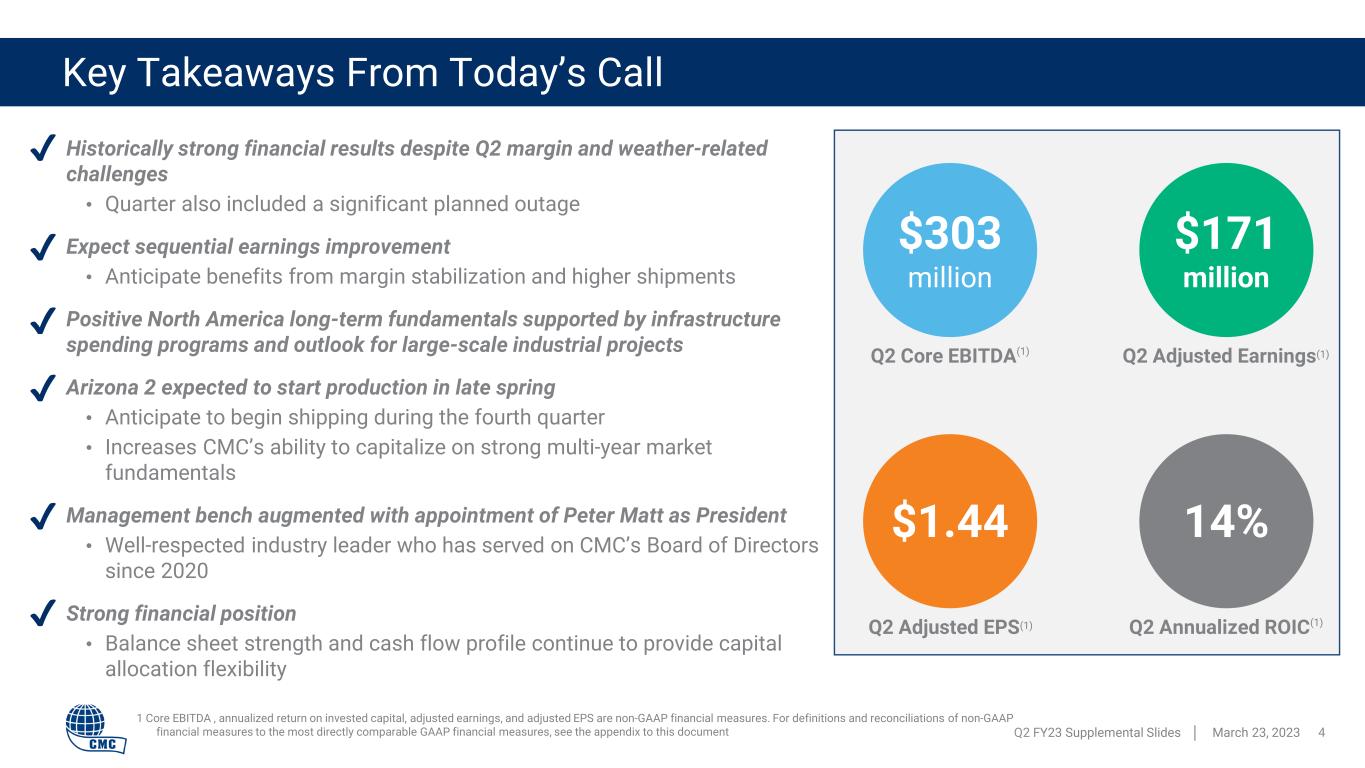
Historically strong financial results despite Q2 margin and weather-related challenges • Quarter also included a significant planned outage Expect sequential earnings improvement • Anticipate benefits from margin stabilization and higher shipments Positive North America long-term fundamentals supported by infrastructure spending programs and outlook for large-scale industrial projects Arizona 2 expected to start production in late spring • Anticipate to begin shipping during the fourth quarter • Increases CMC’s ability to capitalize on strong multi-year market fundamentals Management bench augmented with appointment of Peter Matt as President • Well-respected industry leader who has served on CMC’s Board of Directors since 2020 Strong financial position • Balance sheet strength and cash flow profile continue to provide capital allocation flexibility Key Takeaways From Today’s Call Q2 FY23 Supplemental Slides │ March 23, 2023 4 $303 million Q2 Core EBITDA(1) 1 Core EBITDA , annualized return on invested capital, adjusted earnings, and adjusted EPS are non-GAAP financial measures. For definitions and reconciliations of non-GAAP financial measures to the most directly comparable GAAP financial measures, see the appendix to this document $171 million $1.44 14% Q2 Adjusted Earnings(1) Q2 Adjusted EPS(1) Q2 Annualized ROIC(1) ✔ ✔ ✔ ✔ ✔ ✔
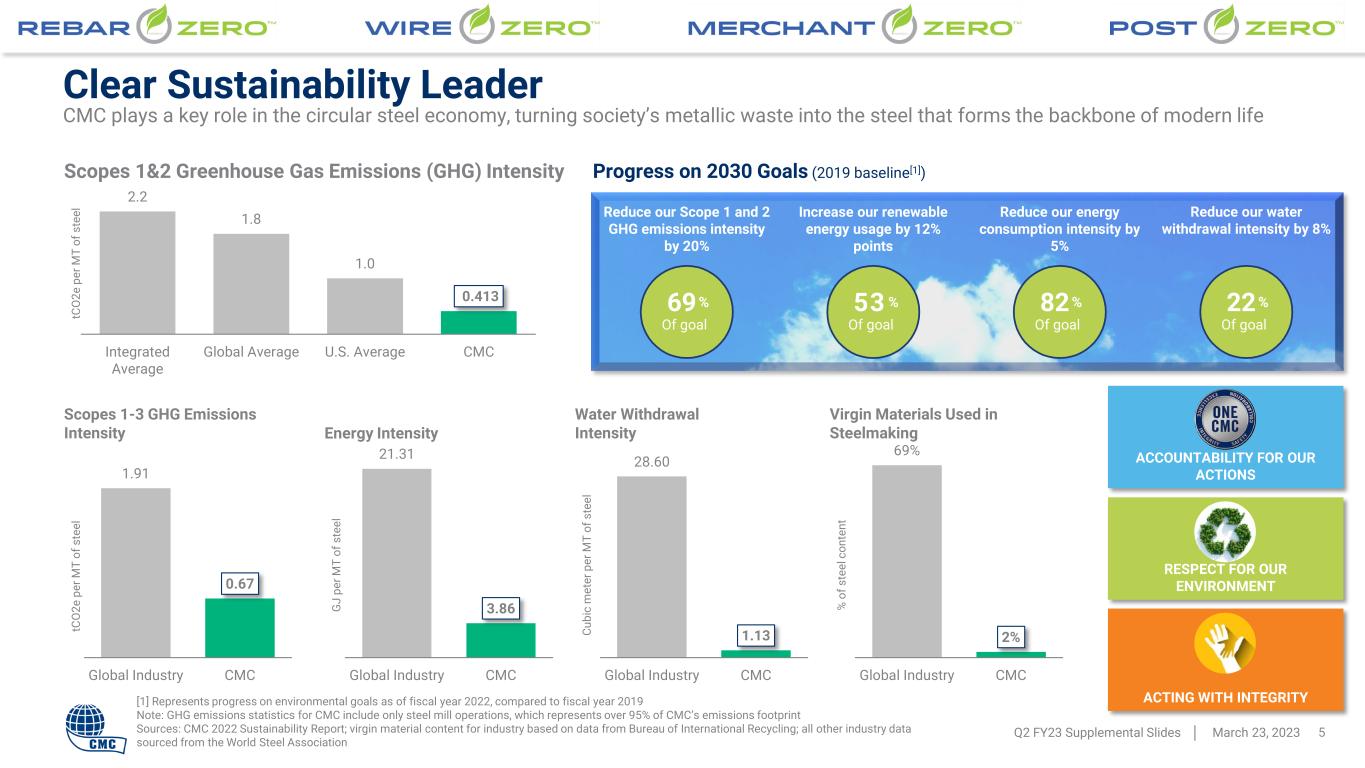
69% Of goal Clear Sustainability Leader Q2 FY23 Supplemental Slides │ March 23, 2023 5 [1] Represents progress on environmental goals as of fiscal year 2022, compared to fiscal year 2019 Note: GHG emissions statistics for CMC include only steel mill operations, which represents over 95% of CMC’s emissions footprint Sources: CMC 2022 Sustainability Report; virgin material content for industry based on data from Bureau of International Recycling; all other industry data sourced from the World Steel Association CMC plays a key role in the circular steel economy, turning society’s metallic waste into the steel that forms the backbone of modern life ACCOUNTABILITY FOR OUR ACTIONS RESPECT FOR OUR ENVIRONMENT ACTING WITH INTEGRITY 2.2 1.8 1.0 0.413 Integrated Average Global Average U.S. Average CMC Scopes 1&2 Greenhouse Gas Emissions (GHG) Intensity tC O 2e p er M T of s te el 1.91 0.67 Global Industry CMC 21.31 3.86 Global Industry CMC 28.60 1.13 Global Industry CMC 69% 2% Global Industry CMC Reduce our Scope 1 and 2 GHG emissions intensity by 20% Increase our renewable energy usage by 12% points Reduce our energy consumption intensity by 5% Reduce our water withdrawal intensity by 8% 5 3 % Of goal 82% Of goal 22% Of goal Progress on 2030 Goals (2019 baseline[1]) Scopes 1-3 GHG Emissions Intensity tC O 2e p er M T of s te el Energy Intensity G J pe r M T of s te el Water Withdrawal Intensity Cu bi c m et er p er M T of s te el Virgin Materials Used in Steelmaking % o f s te el c on te nt
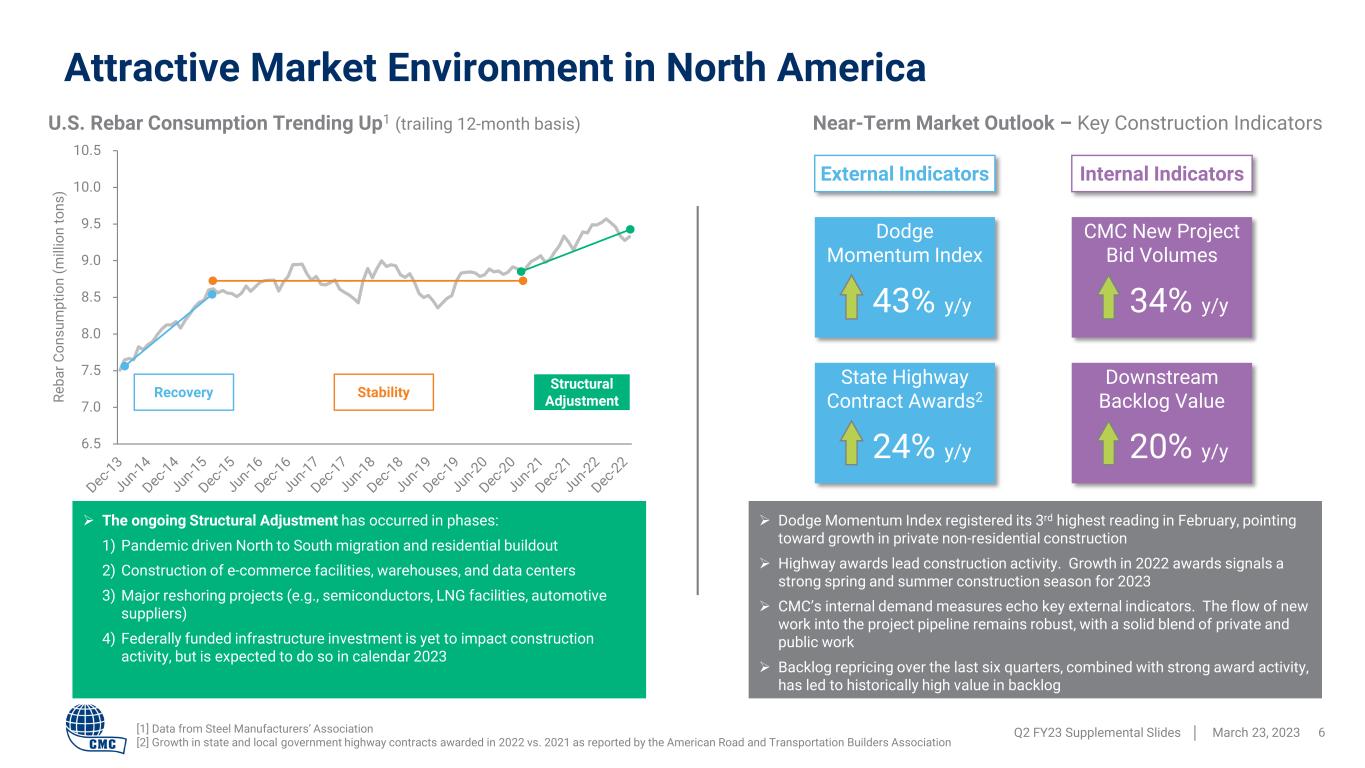
6.5 7.0 7.5 8.0 8.5 9.0 9.5 10.0 10.5 Recovery Stability Structural Adjustment Attractive Market Environment in North America Dodge Momentum Index registered its 3rd highest reading in February, pointing toward growth in private non-residential construction Highway awards lead construction activity. Growth in 2022 awards signals a strong spring and summer construction season for 2023 CMC’s internal demand measures echo key external indicators. The flow of new work into the project pipeline remains robust, with a solid blend of private and public work Backlog repricing over the last six quarters, combined with strong award activity, has led to historically high value in backlog Q2 FY23 Supplemental Slides │ March 23, 2023 6 The ongoing Structural Adjustment has occurred in phases: 1) Pandemic driven North to South migration and residential buildout 2) Construction of e-commerce facilities, warehouses, and data centers 3) Major reshoring projects (e.g., semiconductors, LNG facilities, automotive suppliers) 4) Federally funded infrastructure investment is yet to impact construction activity, but is expected to do so in calendar 2023 Re ba r C on su m pt io n (m ill io n to ns ) U.S. Rebar Consumption Trending Up1 (trailing 12-month basis) [1] Data from Steel Manufacturers’ Association [2] Growth in state and local government highway contracts awarded in 2022 vs. 2021 as reported by the American Road and Transportation Builders Association Dodge Momentum Index 43% y/y State Highway Contract Awards2 24% y/y CMC New Project Bid Volumes 34% y/y Downstream Backlog Value 20% y/y Near-Term Market Outlook – Key Construction Indicators External Indicators Internal Indicators
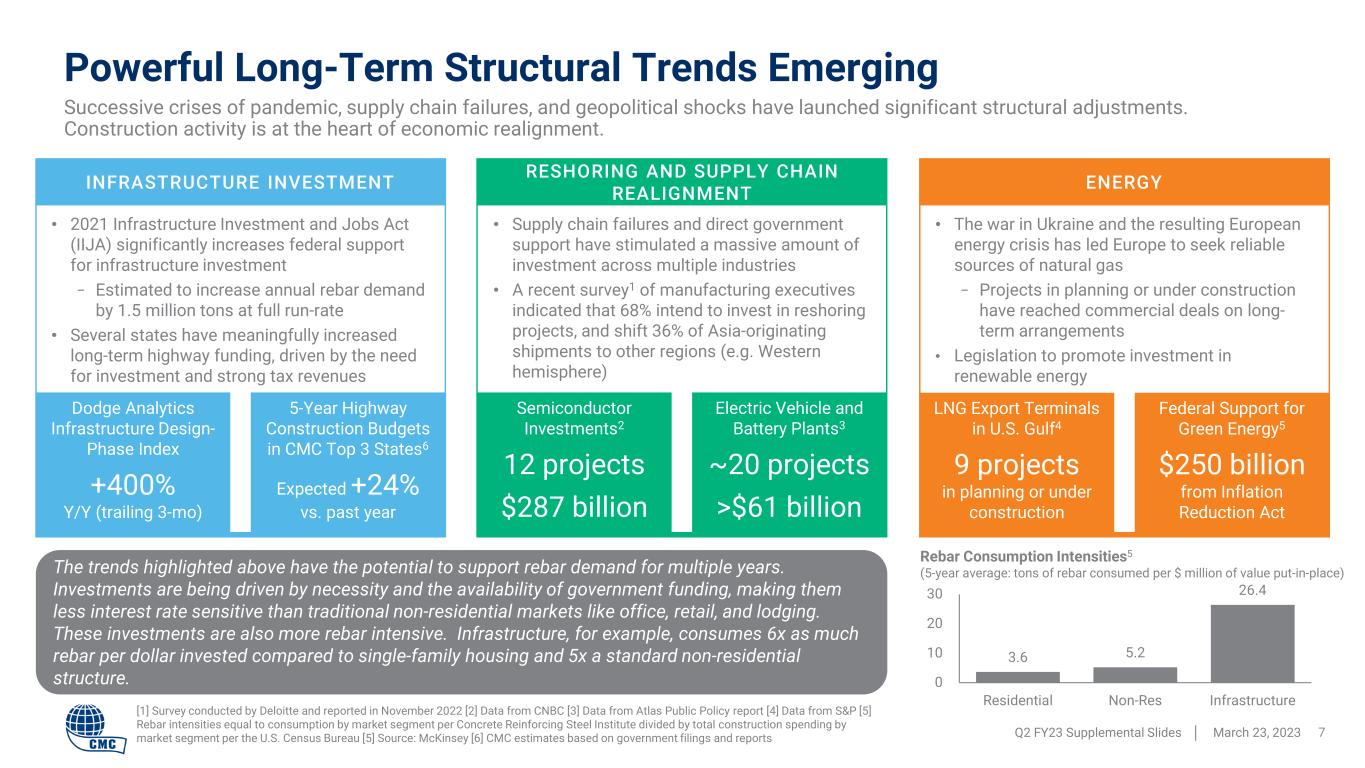
Powerful Long-Term Structural Trends Emerging • 2021 Infrastructure Investment and Jobs Act (IIJA) significantly increases federal support for infrastructure investment − Estimated to increase annual rebar demand by 1.5 million tons at full run-rate • Several states have meaningfully increased long-term highway funding, driven by the need for investment and strong tax revenues INFRASTRUCTURE INVESTMENT 7Q2 FY23 Supplemental Slides │ March 23, 2023 • Supply chain failures and direct government support have stimulated a massive amount of investment across multiple industries • A recent survey1 of manufacturing executives indicated that 68% intend to invest in reshoring projects, and shift 36% of Asia-originating shipments to other regions (e.g. Western hemisphere) RESHORING AND SUPPLY CHAIN REALIGNMENT • The war in Ukraine and the resulting European energy crisis has led Europe to seek reliable sources of natural gas − Projects in planning or under construction have reached commercial deals on long- term arrangements • Legislation to promote investment in renewable energy ENERGY Successive crises of pandemic, supply chain failures, and geopolitical shocks have launched significant structural adjustments. Construction activity is at the heart of economic realignment. Dodge Analytics Infrastructure Design- Phase Index +400% Y/Y (trailing 3-mo) 5-Year Highway Construction Budgets in CMC Top 3 States6 Expected +24% vs. past year Semiconductor Investments2 12 projects $287 billion Electric Vehicle and Battery Plants3 ~20 projects >$61 billion LNG Export Terminals in U.S. Gulf4 9 projects in planning or under construction The trends highlighted above have the potential to support rebar demand for multiple years. Investments are being driven by necessity and the availability of government funding, making them less interest rate sensitive than traditional non-residential markets like office, retail, and lodging. These investments are also more rebar intensive. Infrastructure, for example, consumes 6x as much rebar per dollar invested compared to single-family housing and 5x a standard non-residential structure. 3.6 5.2 26.4 0 10 20 30 Residential Non-Res Infrastructure Rebar Consumption Intensities5 (5-year average: tons of rebar consumed per $ million of value put-in-place) [1] Survey conducted by Deloitte and reported in November 2022 [2] Data from CNBC [3] Data from Atlas Public Policy report [4] Data from S&P [5] Rebar intensities equal to consumption by market segment per Concrete Reinforcing Steel Institute divided by total construction spending by market segment per the U.S. Census Bureau [5] Source: McKinsey [6] CMC estimates based on government filings and reports Federal Support for Green Energy5 $250 billion from Inflation Reduction Act
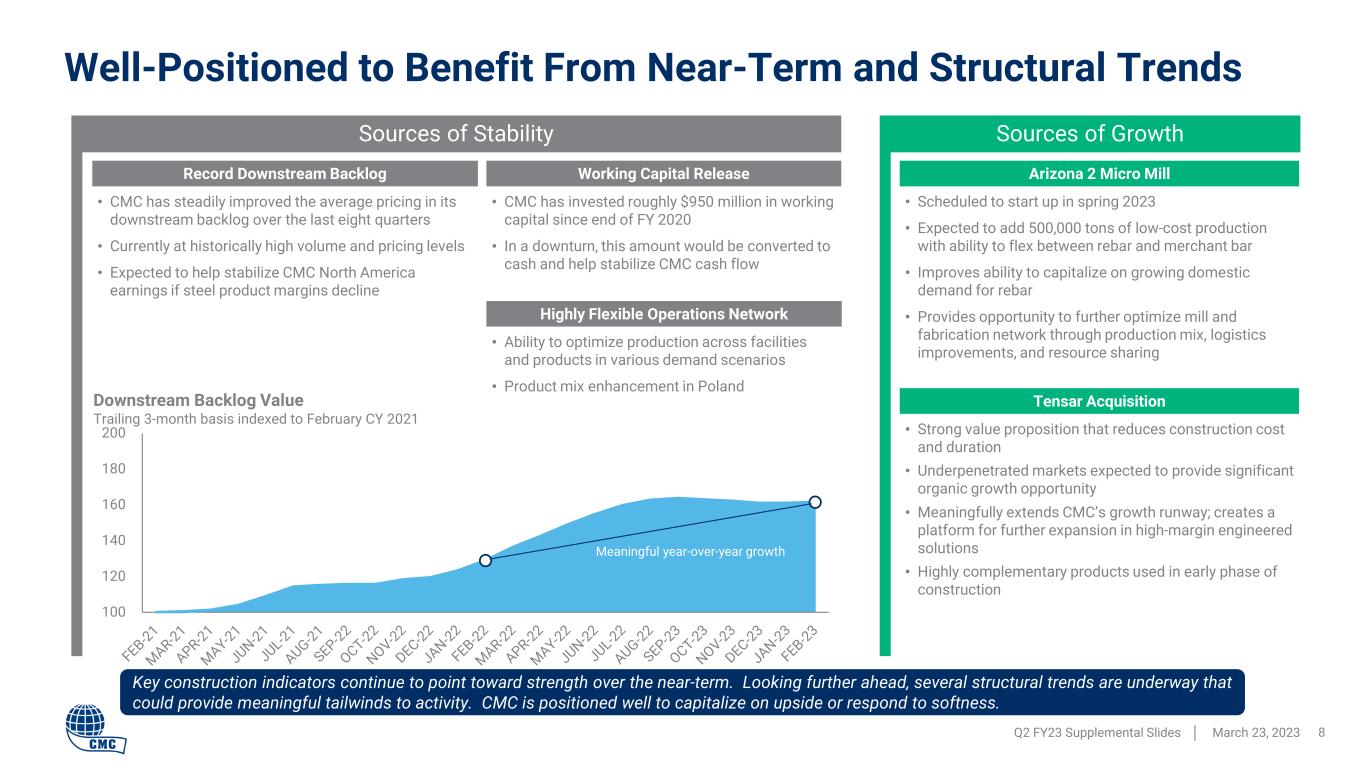
100 120 140 160 180 200 Well-Positioned to Benefit From Near-Term and Structural Trends Key construction indicators continue to point toward strength over the near-term. Looking further ahead, several structural trends are underway that could provide meaningful tailwinds to activity. CMC is positioned well to capitalize on upside or respond to softness. Q2 FY23 Supplemental Slides │ March 23, 2023 8 Arizona 2 Micro Mill • Scheduled to start up in spring 2023 • Expected to add 500,000 tons of low-cost production with ability to flex between rebar and merchant bar • Improves ability to capitalize on growing domestic demand for rebar • Provides opportunity to further optimize mill and fabrication network through production mix, logistics improvements, and resource sharing Tensar Acquisition • Strong value proposition that reduces construction cost and duration • Underpenetrated markets expected to provide significant organic growth opportunity • Meaningfully extends CMC’s growth runway; creates a platform for further expansion in high-margin engineered solutions • Highly complementary products used in early phase of construction Record Downstream Backlog • CMC has steadily improved the average pricing in its downstream backlog over the last eight quarters • Currently at historically high volume and pricing levels • Expected to help stabilize CMC North America earnings if steel product margins decline Working Capital Release • CMC has invested roughly $950 million in working capital since end of FY 2020 • In a downturn, this amount would be converted to cash and help stabilize CMC cash flow Highly Flexible Operations Network • Ability to optimize production across facilities and products in various demand scenarios • Product mix enhancement in Poland Sources of GrowthSources of Stability Downstream Backlog Value Trailing 3-month basis indexed to February CY 2021 Meaningful year-over-year growth
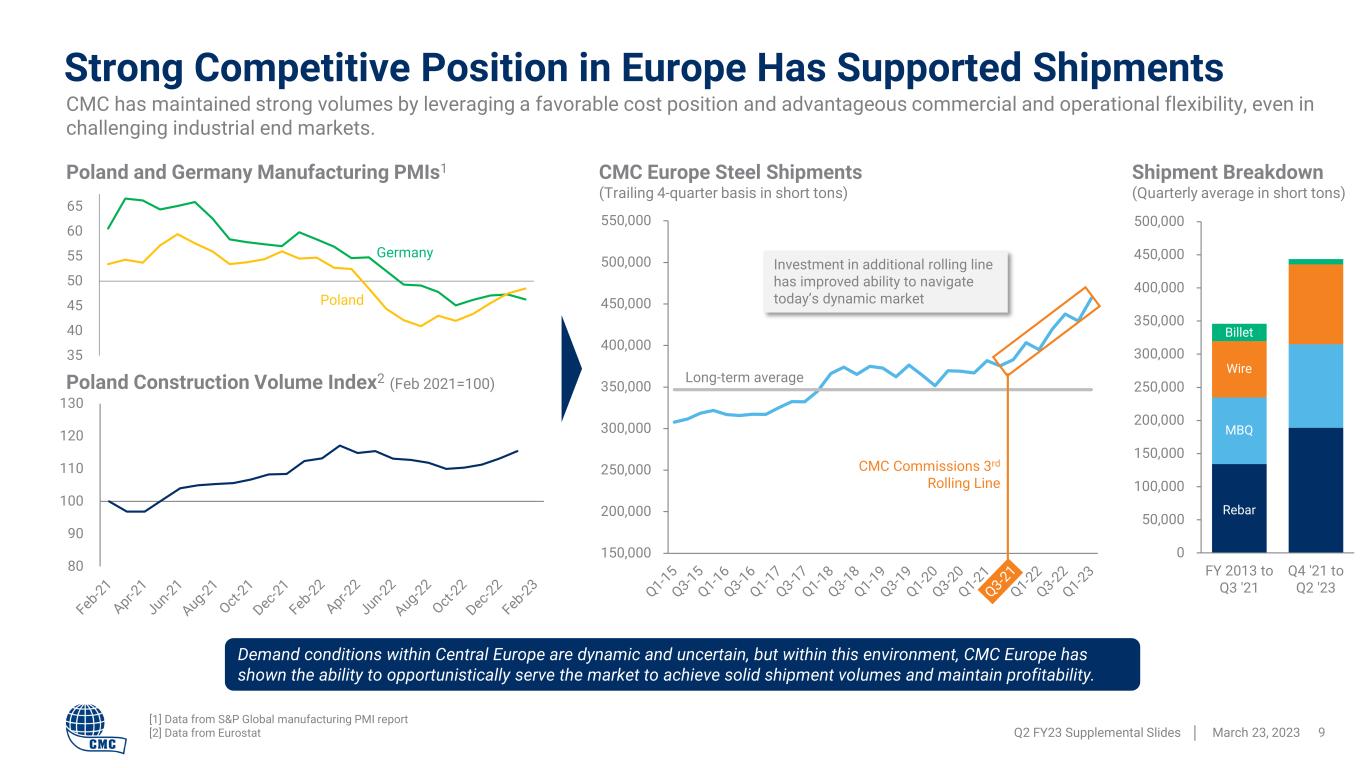
0 50,000 100,000 150,000 200,000 250,000 300,000 350,000 400,000 450,000 500,000 FY 2013 to Q3 '21 Q4 '21 to Q2 '23 35 40 45 50 55 60 65 150,000 200,000 250,000 300,000 350,000 400,000 450,000 500,000 550,000 Strong Competitive Position in Europe Has Supported Shipments Q2 FY23 Supplemental Slides │ March 23, 2023 9 Poland and Germany Manufacturing PMIs1 [1] Data from S&P Global manufacturing PMI report [2] Data from Eurostat Long-term average CMC Commissions 3rd Rolling Line CMC Europe Steel Shipments (Trailing 4-quarter basis in short tons) Rebar MBQ Wire Billet Shipment Breakdown (Quarterly average in short tons) Demand conditions within Central Europe are dynamic and uncertain, but within this environment, CMC Europe has shown the ability to opportunistically serve the market to achieve solid shipment volumes and maintain profitability. 80 90 100 110 120 130 Poland Construction Volume Index2 (Feb 2021=100) CMC has maintained strong volumes by leveraging a favorable cost position and advantageous commercial and operational flexibility, even in challenging industrial end markets. Investment in additional rolling line has improved ability to navigate today’s dynamic market Germany Poland
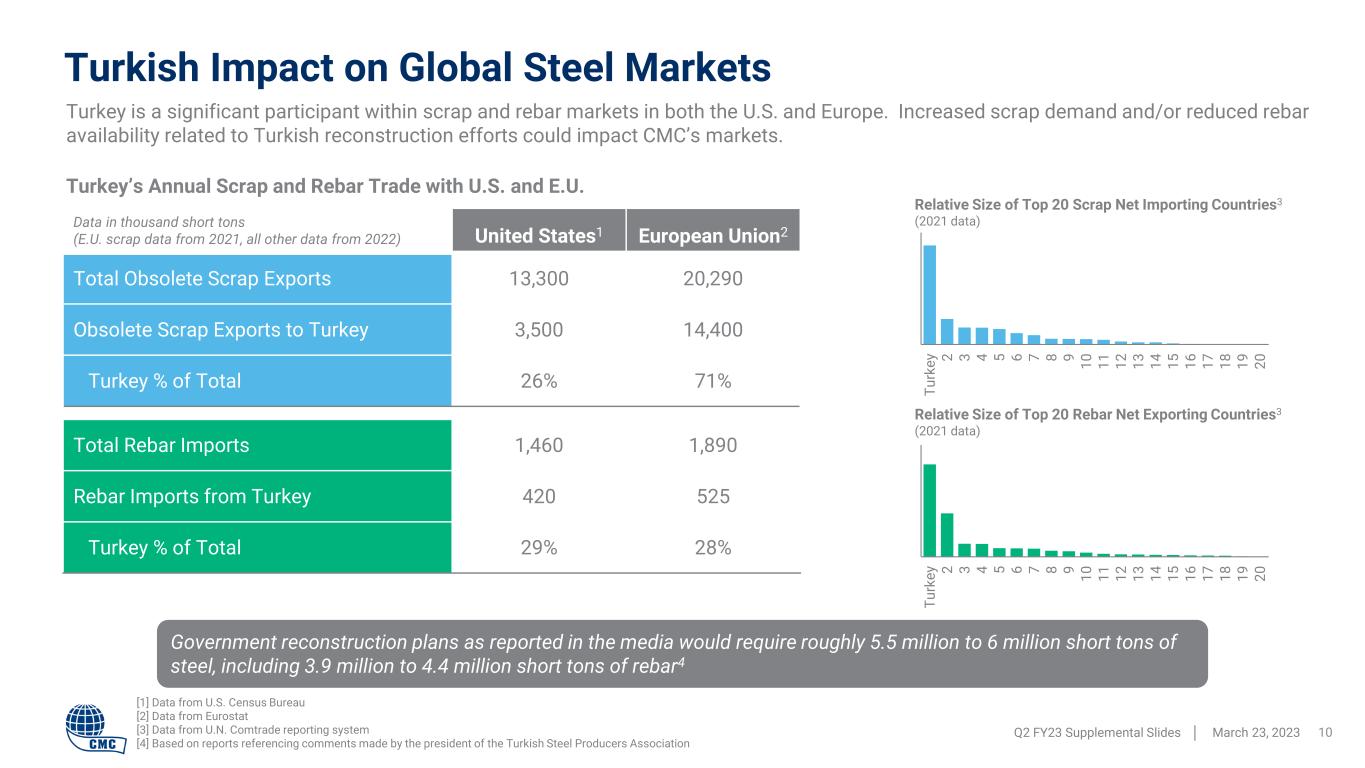
Turkish Impact on Global Steel Markets Q2 FY23 Supplemental Slides │ March 23, 2023 10 [1] Data from U.S. Census Bureau [2] Data from Eurostat [3] Data from U.N. Comtrade reporting system [4] Based on reports referencing comments made by the president of the Turkish Steel Producers Association Turkey is a significant participant within scrap and rebar markets in both the U.S. and Europe. Increased scrap demand and/or reduced rebar availability related to Turkish reconstruction efforts could impact CMC’s markets. Data in thousand short tons (E.U. scrap data from 2021, all other data from 2022) United States1 European Union2 Total Obsolete Scrap Exports 13,300 20,290 Obsolete Scrap Exports to Turkey 3,500 14,400 Turkey % of Total 26% 71% Total Rebar Imports 1,460 1,890 Rebar Imports from Turkey 420 525 Turkey % of Total 29% 28% Government reconstruction plans as reported in the media would require roughly 5.5 million to 6 million short tons of steel, including 3.9 million to 4.4 million short tons of rebar4 Tu rk ey 2 3 4 5 6 7 8 9 10 11 12 13 14 15 16 17 18 19 20 Tu rk ey 2 3 4 5 6 7 8 9 10 11 12 13 14 15 16 17 18 19 20 Relative Size of Top 20 Scrap Net Importing Countries3 (2021 data) Relative Size of Top 20 Rebar Net Exporting Countries3 (2021 data) Turkey’s Annual Scrap and Rebar Trade with U.S. and E.U.
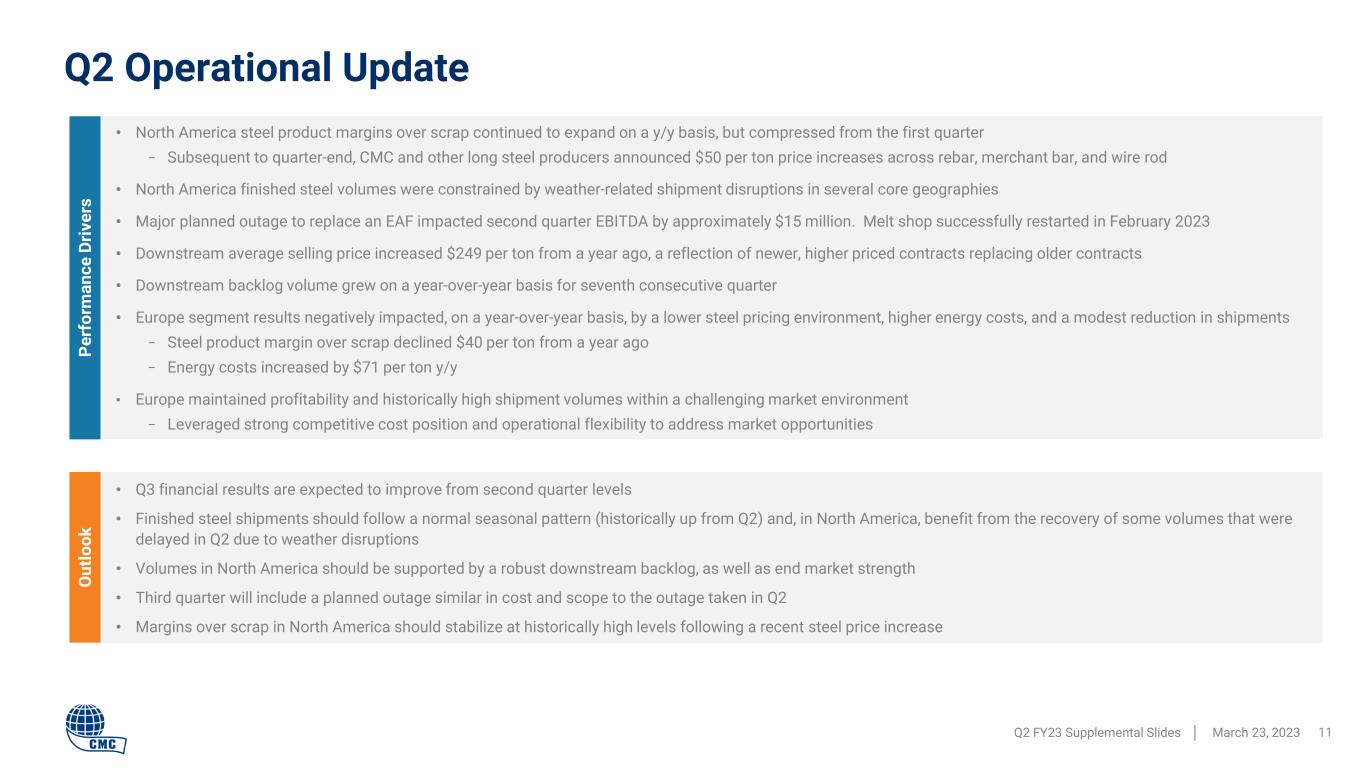
• North America steel product margins over scrap continued to expand on a y/y basis, but compressed from the first quarter − Subsequent to quarter-end, CMC and other long steel producers announced $50 per ton price increases across rebar, merchant bar, and wire rod • North America finished steel volumes were constrained by weather-related shipment disruptions in several core geographies • Major planned outage to replace an EAF impacted second quarter EBITDA by approximately $15 million. Melt shop successfully restarted in February 2023 • Downstream average selling price increased $249 per ton from a year ago, a reflection of newer, higher priced contracts replacing older contracts • Downstream backlog volume grew on a year-over-year basis for seventh consecutive quarter • Europe segment results negatively impacted, on a year-over-year basis, by a lower steel pricing environment, higher energy costs, and a modest reduction in shipments − Steel product margin over scrap declined $40 per ton from a year ago − Energy costs increased by $71 per ton y/y • Europe maintained profitability and historically high shipment volumes within a challenging market environment − Leveraged strong competitive cost position and operational flexibility to address market opportunities • Q3 financial results are expected to improve from second quarter levels • Finished steel shipments should follow a normal seasonal pattern (historically up from Q2) and, in North America, benefit from the recovery of some volumes that were delayed in Q2 due to weather disruptions • Volumes in North America should be supported by a robust downstream backlog, as well as end market strength • Third quarter will include a planned outage similar in cost and scope to the outage taken in Q2 • Margins over scrap in North America should stabilize at historically high levels following a recent steel price increase Pe rf or m an ce D riv er s O ut lo ok Q2 Operational Update Q2 FY23 Supplemental Slides │ March 23, 2023 11
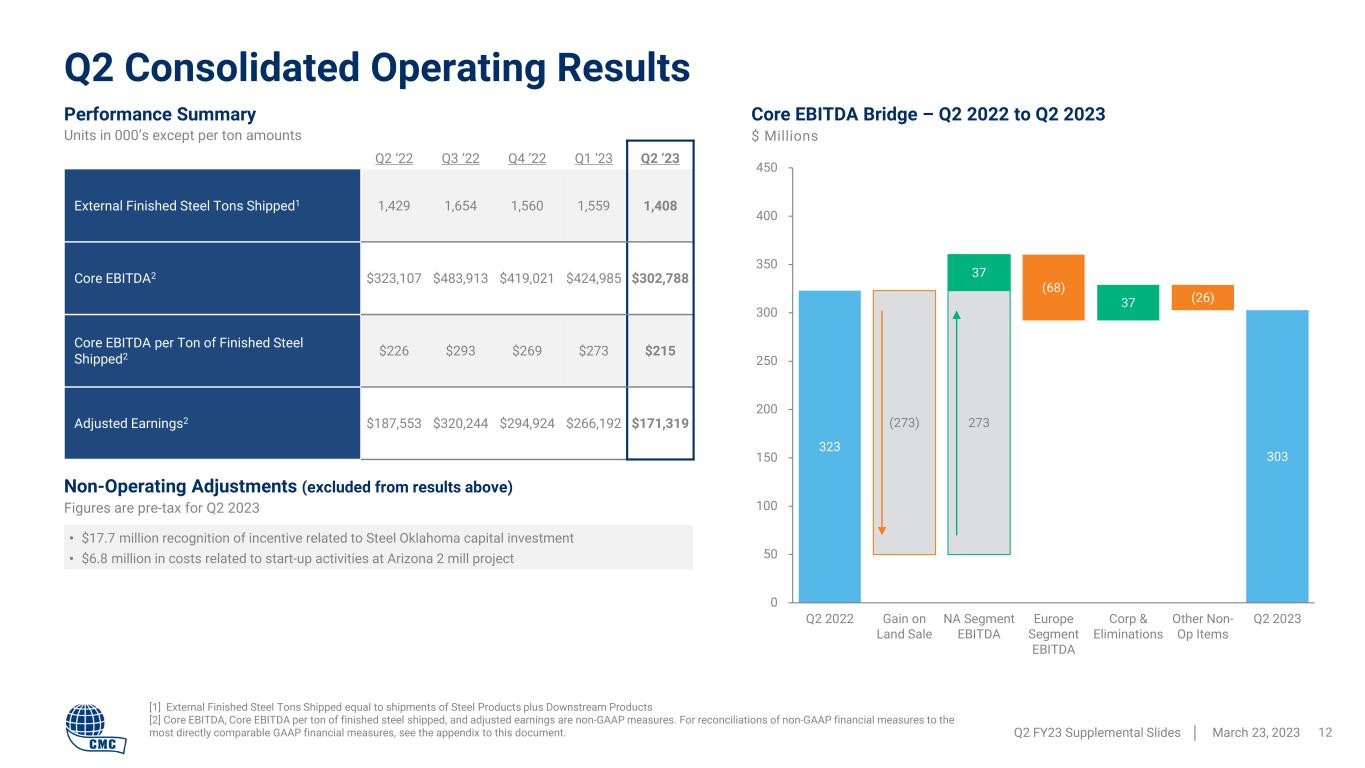
Q2 Consolidated Operating Results Q2 FY23 Supplemental Slides │ March 23, 2023 12 Q2 ‘22 Q3 ‘22 Q4 ’22 Q1 ’23 Q2 ’23 External Finished Steel Tons Shipped1 1,429 1,654 1,560 1,559 1,408 Core EBITDA2 $323,107 $483,913 $419,021 $424,985 $302,788 Core EBITDA per Ton of Finished Steel Shipped2 $226 $293 $269 $273 $215 Adjusted Earnings2 $187,553 $320,244 $294,924 $266,192 $171,319 Performance Summary Units in 000’s except per ton amounts • $17.7 million recognition of incentive related to Steel Oklahoma capital investment • $6.8 million in costs related to start-up activities at Arizona 2 mill project Non-Operating Adjustments (excluded from results above) Figures are pre-tax for Q2 2023 [1] External Finished Steel Tons Shipped equal to shipments of Steel Products plus Downstream Products [2] Core EBITDA, Core EBITDA per ton of finished steel shipped, and adjusted earnings are non-GAAP measures. For reconciliations of non-GAAP financial measures to the most directly comparable GAAP financial measures, see the appendix to this document. Core EBITDA Bridge – Q2 2022 to Q2 2023 $ Millions 323 303 (273) 273 37 (68) 37 (26) 0 50 100 150 200 250 300 350 400 450 Q2 2022 Gain on Land Sale NA Segment EBITDA Europe Segment EBITDA Corp & Eliminations Other Non- Op Items Q2 2023
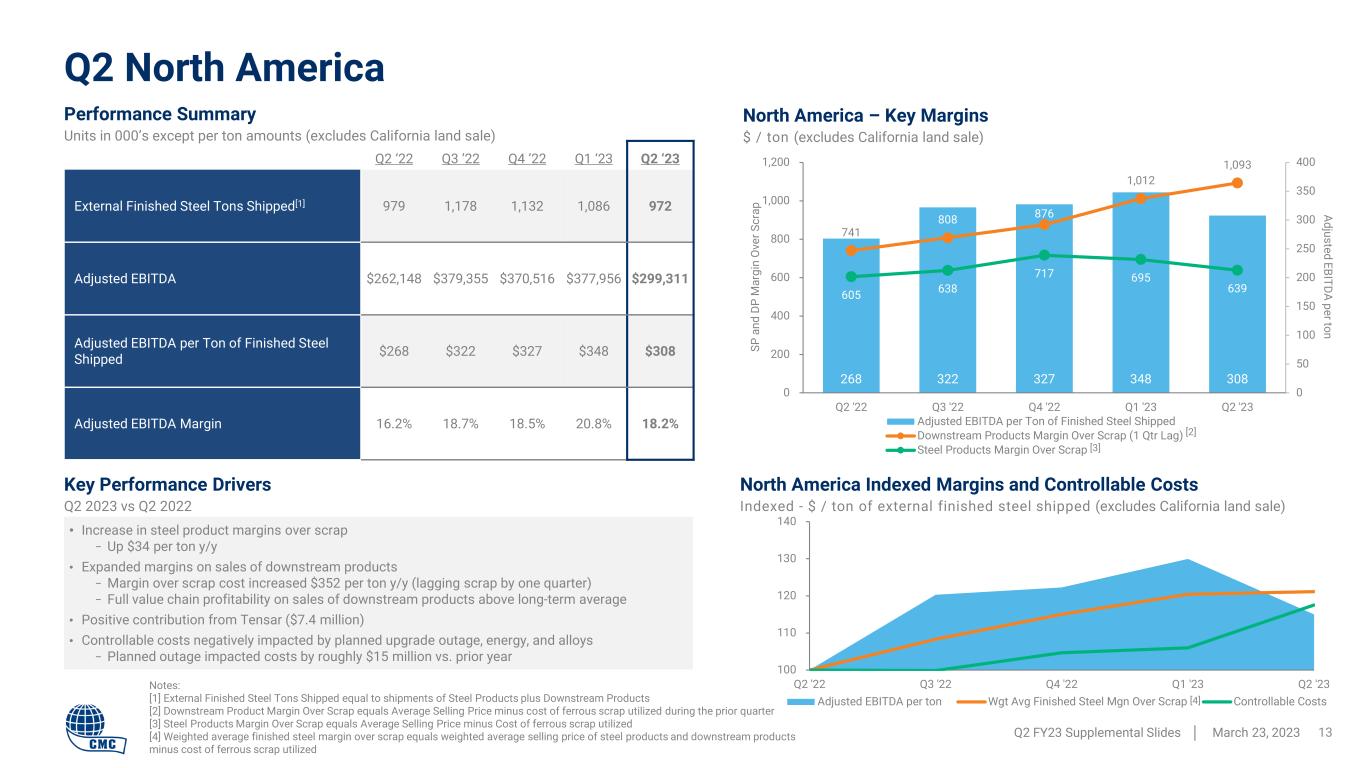
100 110 120 130 140 Q2 '22 Q3 '22 Q4 '22 Q1 '23 Q2 '23 Adjusted EBITDA per ton Wgt Avg Finished Steel Mgn Over Scrap Controllable Costs 268 322 327 348 308 741 808 876 1,012 1,093 605 638 717 695 639 0 50 100 150 200 250 300 350 400 0 200 400 600 800 1,000 1,200 Q2 '22 Q3 '22 Q4 '22 Q1 '23 Q2 '23 Adjusted EBITDA per Ton of Finished Steel Shipped Downstream Products Margin Over Scrap (1 Qtr Lag) Steel Products Margin Over Scrap Key Performance Drivers Q2 2023 vs Q2 2022 Q2 North America Q2 FY23 Supplemental Slides │ March 23, 2023 13 Q2 ‘22 Q3 ’22 Q4 ’22 Q1 ‘23 Q2 ‘23 External Finished Steel Tons Shipped[1] 979 1,178 1,132 1,086 972 Adjusted EBITDA $262,148 $379,355 $370,516 $377,956 $299,311 Adjusted EBITDA per Ton of Finished Steel Shipped $268 $322 $327 $348 $308 Adjusted EBITDA Margin 16.2% 18.7% 18.5% 20.8% 18.2% Performance Summary Units in 000’s except per ton amounts (excludes California land sale) • Increase in steel product margins over scrap − Up $34 per ton y/y • Expanded margins on sales of downstream products − Margin over scrap cost increased $352 per ton y/y (lagging scrap by one quarter) − Full value chain profitability on sales of downstream products above long-term average • Positive contribution from Tensar ($7.4 million) • Controllable costs negatively impacted by planned upgrade outage, energy, and alloys − Planned outage impacted costs by roughly $15 million vs. prior year Notes: [1] External Finished Steel Tons Shipped equal to shipments of Steel Products plus Downstream Products [2] Downstream Product Margin Over Scrap equals Average Selling Price minus cost of ferrous scrap utilized during the prior quarter [3] Steel Products Margin Over Scrap equals Average Selling Price minus Cost of ferrous scrap utilized [4] Weighted average finished steel margin over scrap equals weighted average selling price of steel products and downstream products minus cost of ferrous scrap utilized North America – Key Margins $ / ton (excludes California land sale) SP a nd D P M ar gi n O ve r S cr ap Adjusted EBITDA per ton North America Indexed Margins and Controllable Costs Indexed - $ / ton of external finished steel shipped (excludes California land sale) [2] [4] [3]
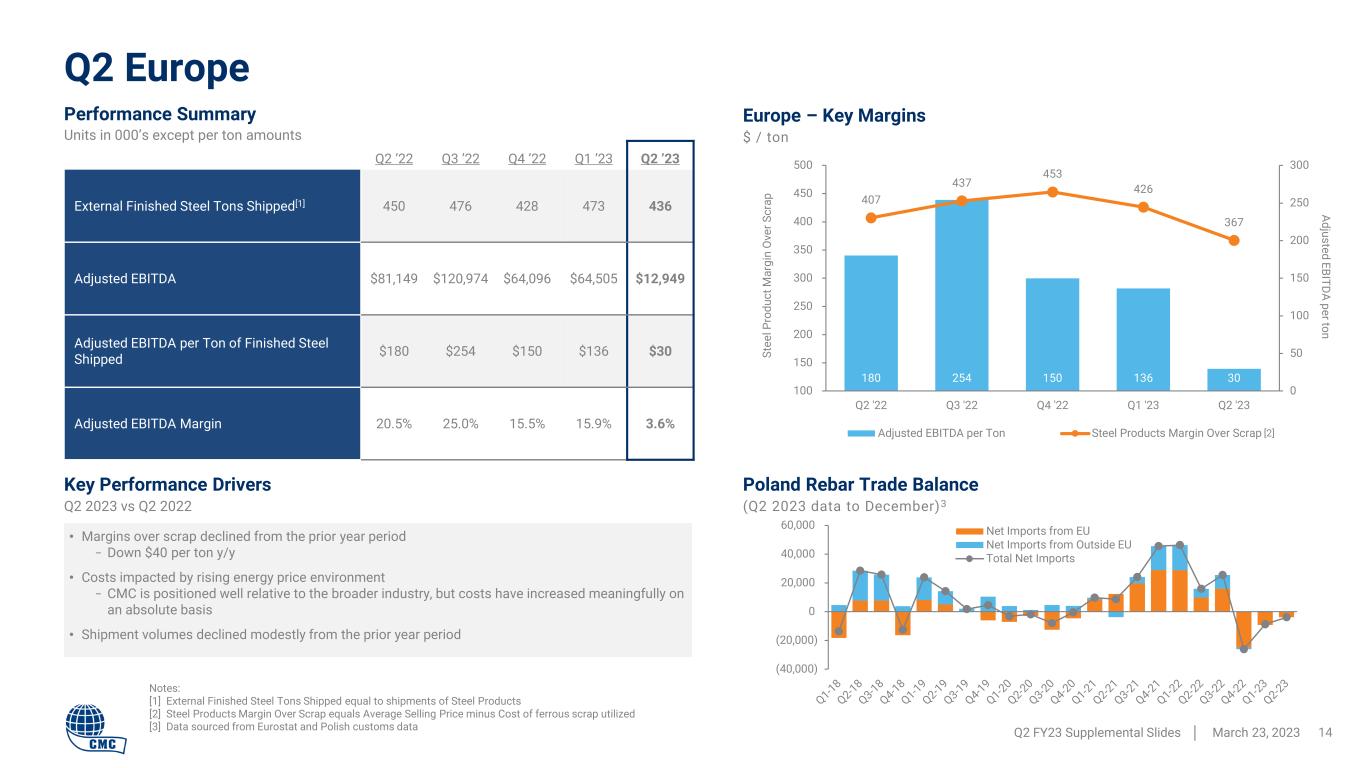
(40,000) (20,000) 0 20,000 40,000 60,000 Net Imports from EU Net Imports from Outside EU Total Net Imports 180 254 150 136 30 407 437 453 426 367 0 50 100 150 200 250 300 100 150 200 250 300 350 400 450 500 Q2 '22 Q3 '22 Q4 '22 Q1 '23 Q2 '23 Adjusted EBITDA per Ton Steel Products Margin Over Scrap Key Performance Drivers Q2 2023 vs Q2 2022 Q2 Europe Q2 FY23 Supplemental Slides │ March 23, 2023 14 Q2 ’22 Q3 ’22 Q4 ’22 Q1 ’23 Q2 ’23 External Finished Steel Tons Shipped[1] 450 476 428 473 436 Adjusted EBITDA $81,149 $120,974 $64,096 $64,505 $12,949 Adjusted EBITDA per Ton of Finished Steel Shipped $180 $254 $150 $136 $30 Adjusted EBITDA Margin 20.5% 25.0% 15.5% 15.9% 3.6% Performance Summary Units in 000’s except per ton amounts • Margins over scrap declined from the prior year period − Down $40 per ton y/y • Costs impacted by rising energy price environment − CMC is positioned well relative to the broader industry, but costs have increased meaningfully on an absolute basis • Shipment volumes declined modestly from the prior year period Europe – Key Margins $ / ton Adjusted EBITDA per ton Poland Rebar Trade Balance (Q2 2023 data to December) [2] Notes: [1] External Finished Steel Tons Shipped equal to shipments of Steel Products [2] Steel Products Margin Over Scrap equals Average Selling Price minus Cost of ferrous scrap utilized [3] Data sourced from Eurostat and Polish customs data St ee l P ro du ct M ar gi n O ve r S cr ap 3
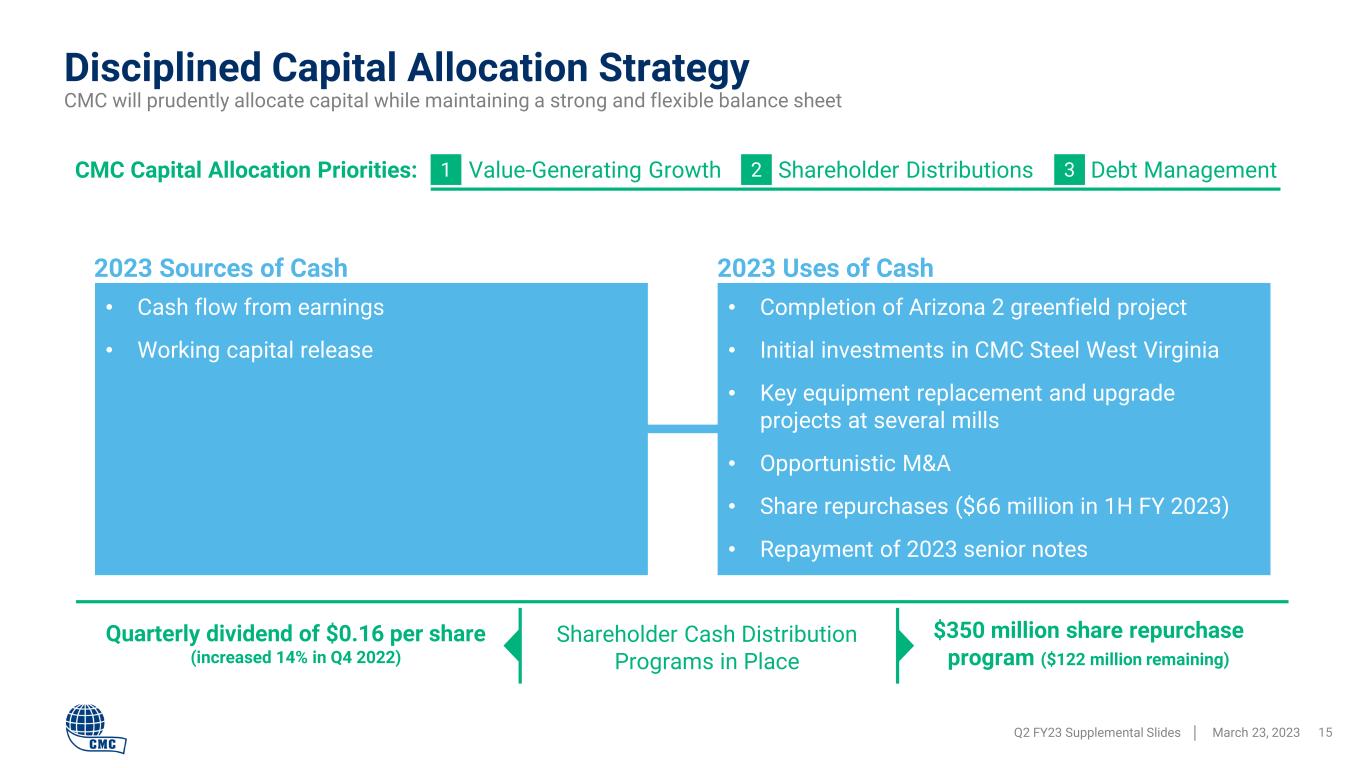
2 31 Disciplined Capital Allocation Strategy Q2 FY23 Supplemental Slides │ March 23, 2023 15 CMC Capital Allocation Priorities: $350 million share repurchase program ($122 million remaining) Quarterly dividend of $0.16 per share (increased 14% in Q4 2022) Shareholder Cash Distribution Programs in Place • Cash flow from earnings • Working capital release • Completion of Arizona 2 greenfield project • Initial investments in CMC Steel West Virginia • Key equipment replacement and upgrade projects at several mills • Opportunistic M&A • Share repurchases ($66 million in 1H FY 2023) • Repayment of 2023 senior notes Value-Generating Growth Shareholder Distributions Debt Management CMC will prudently allocate capital while maintaining a strong and flexible balance sheet 2023 Sources of Cash 2023 Uses of Cash
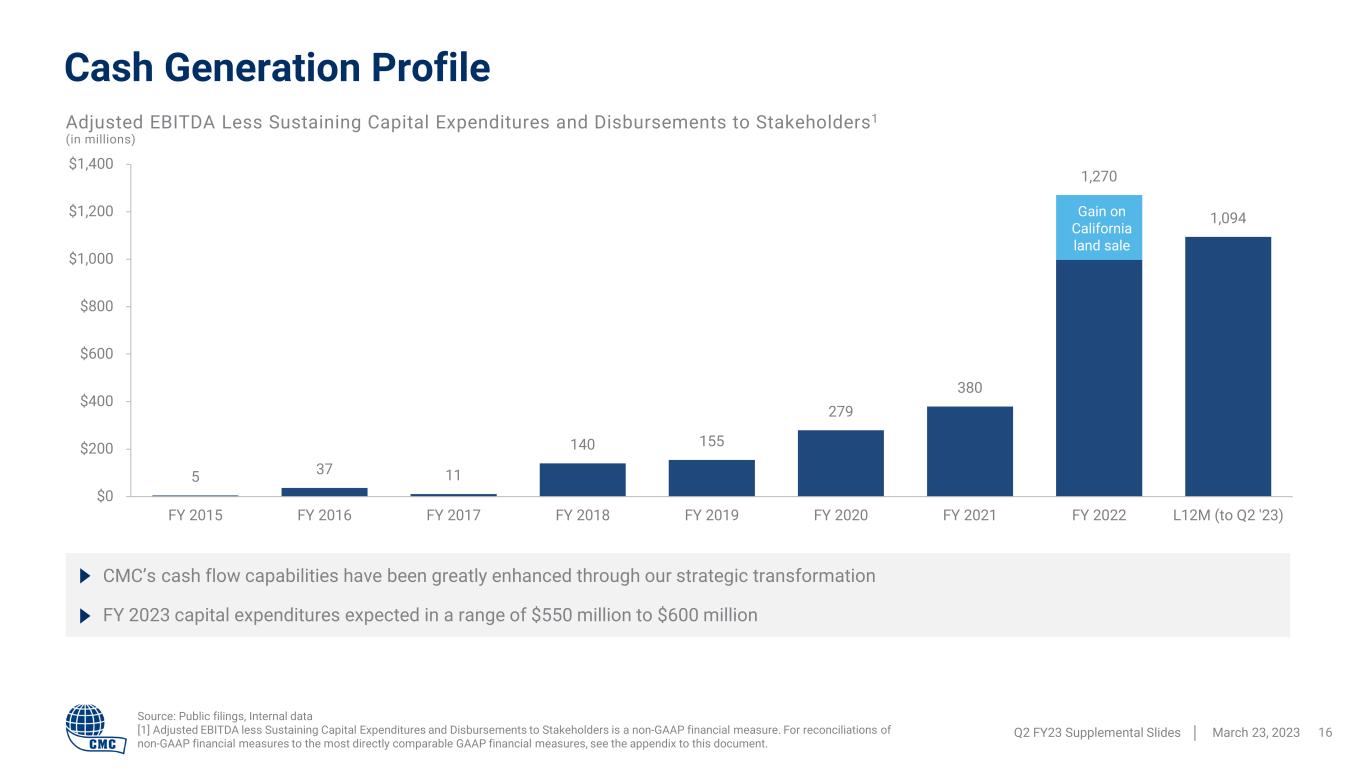
5 37 11 140 155 279 380 1,270 1,094 $0 $200 $400 $600 $800 $1,000 $1,200 $1,400 FY 2015 FY 2016 FY 2017 FY 2018 FY 2019 FY 2020 FY 2021 FY 2022 L12M (to Q2 '23) Cash Generation Profile Q2 FY23 Supplemental Slides │ March 23, 2023 16 Adjusted EBITDA Less Sustaining Capital Expenditures and Disbursements to Stakeholders1 (in millions) CMC’s cash flow capabilities have been greatly enhanced through our strategic transformation FY 2023 capital expenditures expected in a range of $550 million to $600 million Source: Public filings, Internal data [1] Adjusted EBITDA less Sustaining Capital Expenditures and Disbursements to Stakeholders is a non-GAAP financial measure. For reconciliations of non-GAAP financial measures to the most directly comparable GAAP financial measures, see the appendix to this document. Gain on California land sale
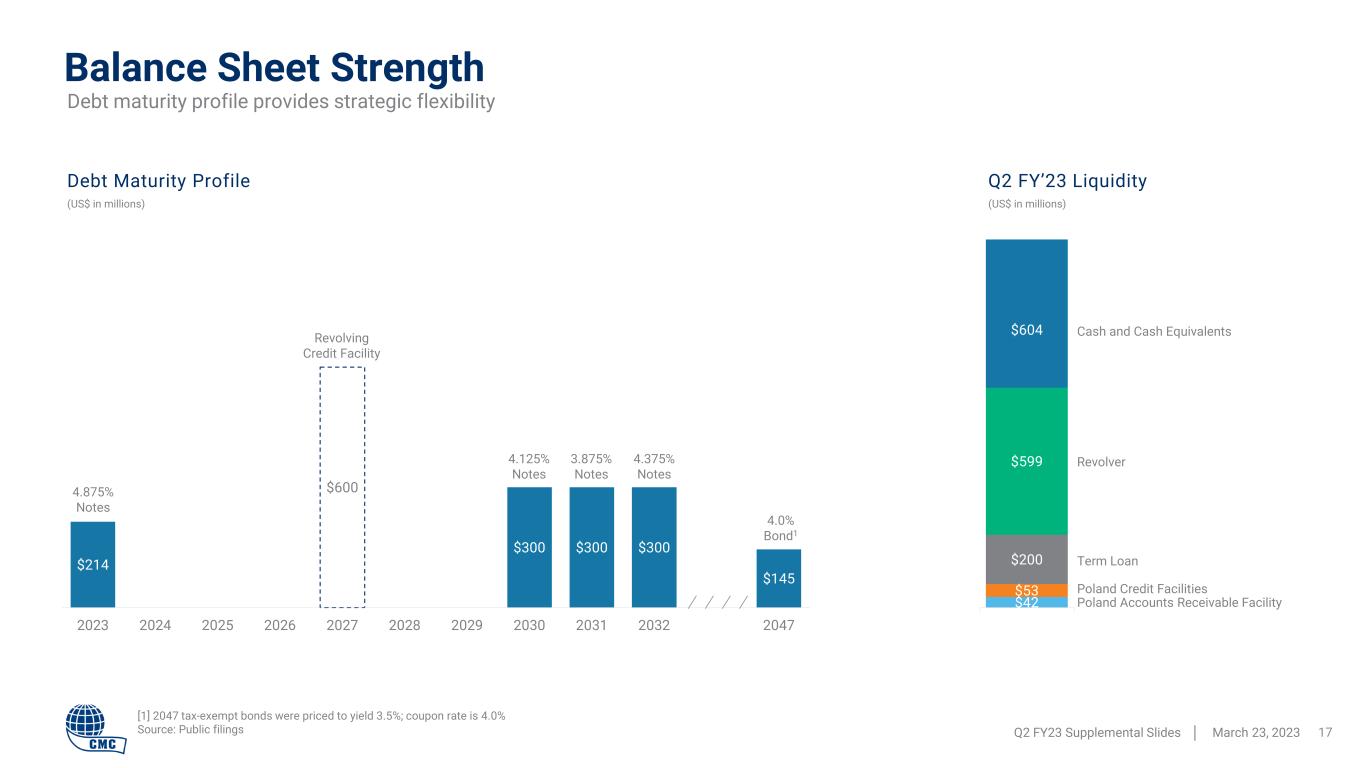
$214 $300 $300 $300 $145 $600 2023 2024 2025 2026 2027 2028 2029 2030 2031 2032 2047 $42 $53 $200 $599 $604 Balance Sheet Strength Q2 FY23 Supplemental Slides │ March 23, 2023 17 [1] 2047 tax-exempt bonds were priced to yield 3.5%; coupon rate is 4.0% Source: Public filings Revolver Term Loan Poland Credit Facilities (US$ in millions) Revolving Credit Facility 4.125% Notes Cash and Cash Equivalents 4.875% Notes 3.875% Notes Debt maturity profile provides strategic flexibility Debt Maturity Profile Q2 FY’23 Liquidity (US$ in millions) 4.375% Notes 4.0% Bond1 Poland Accounts Receivable Facility
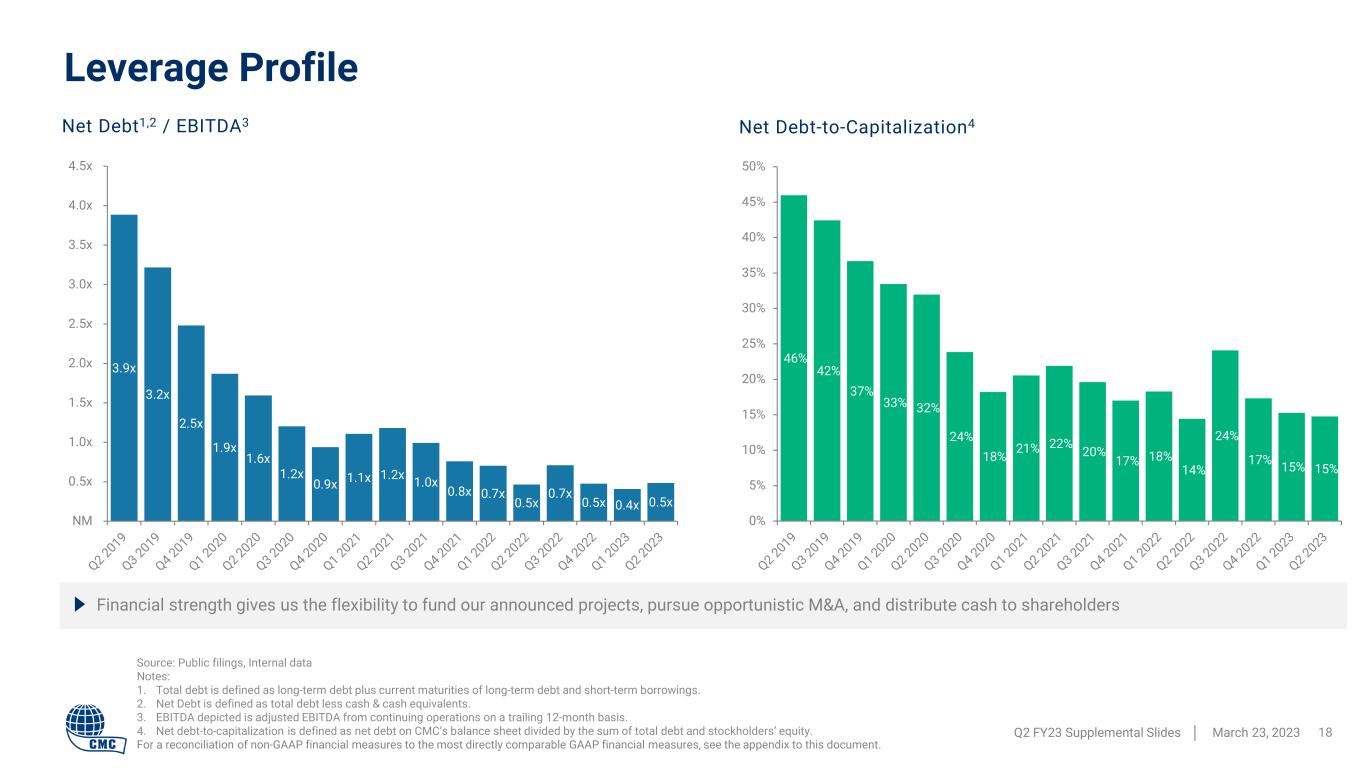
46% 42% 37% 33% 32% 24% 18% 21% 22% 20% 17% 18% 14% 24% 17% 15% 15% 0% 5% 10% 15% 20% 25% 30% 35% 40% 45% 50% 3.9x 3.2x 2.5x 1.9x 1.6x 1.2x 0.9x 1.1x 1.2x 1.0x 0.8x 0.7x 0.5x 0.7x 0.5x 0.4x 0.5x NM 0.5x 1.0x 1.5x 2.0x 2.5x 3.0x 3.5x 4.0x 4.5x Leverage Profile Q2 FY23 Supplemental Slides │ March 23, 2023 18 Source: Public filings, Internal data Notes: 1. Total debt is defined as long-term debt plus current maturities of long-term debt and short-term borrowings. 2. Net Debt is defined as total debt less cash & cash equivalents. 3. EBITDA depicted is adjusted EBITDA from continuing operations on a trailing 12-month basis. 4. Net debt-to-capitalization is defined as net debt on CMC’s balance sheet divided by the sum of total debt and stockholders’ equity. For a reconciliation of non-GAAP financial measures to the most directly comparable GAAP financial measures, see the appendix to this document. Financial strength gives us the flexibility to fund our announced projects, pursue opportunistic M&A, and distribute cash to shareholders Net Debt1,2 / EBITDA3 Net Debt-to-Capitalization4

Q2 FY23 Supplemental Slides │ March 23, 2023 19 Appendix: Non-GAAP Financial Reconciliations
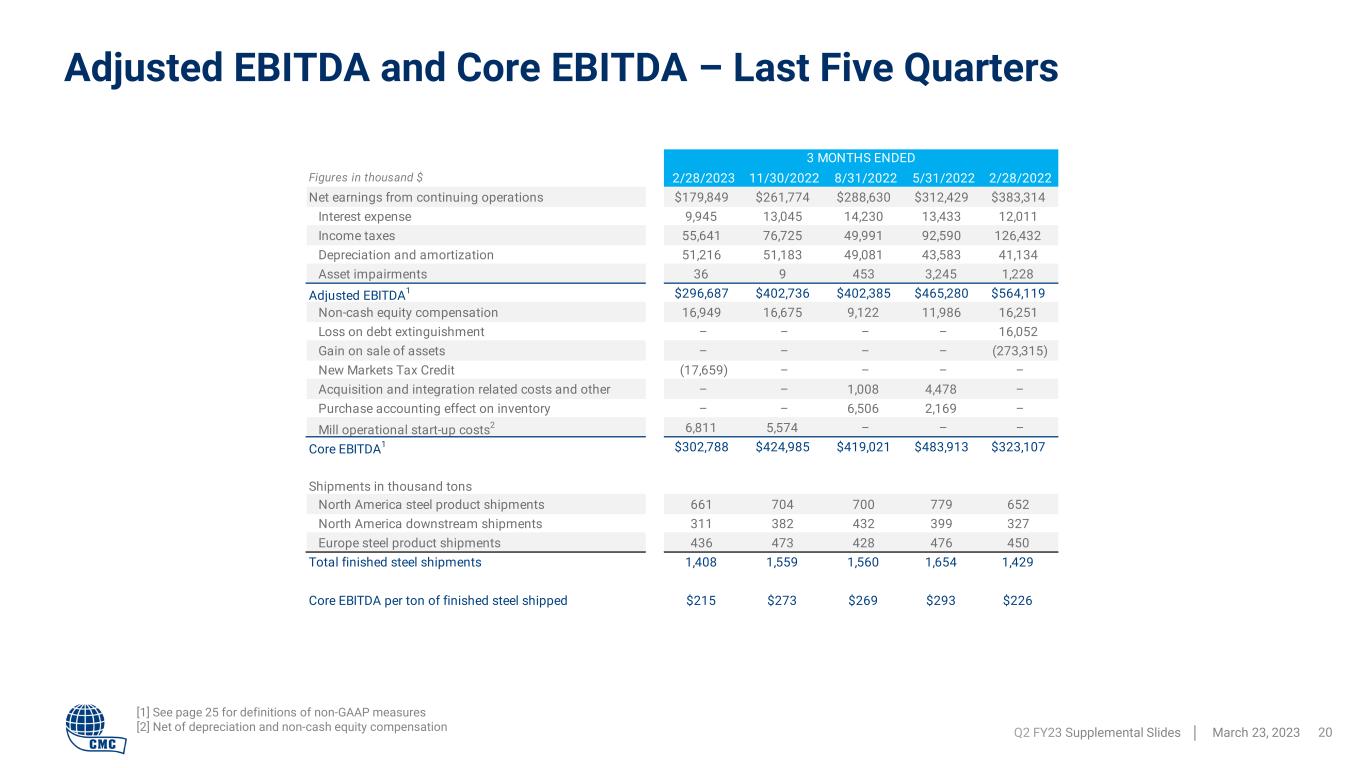
Figures in thousand $ 2/28/2023 11/30/2022 8/31/2022 5/31/2022 2/28/2022 Net earnings from continuing operations $179,849 $261,774 $288,630 $312,429 $383,314 Interest expense 9,945 13,045 14,230 13,433 12,011 Income taxes 55,641 76,725 49,991 92,590 126,432 Depreciation and amortization 51,216 51,183 49,081 43,583 41,134 Asset impairments 36 9 453 3,245 1,228 Adjusted EBITDA1 $296,687 $402,736 $402,385 $465,280 $564,119 Non-cash equity compensation 16,949 16,675 9,122 11,986 16,251 Loss on debt extinguishment – – – – 16,052 Gain on sale of assets – – – – (273,315) New Markets Tax Credit (17,659) – – – – Acquisition and integration related costs and other – – 1,008 4,478 – Purchase accounting effect on inventory – – 6,506 2,169 – Mill operational start-up costs2 6,811 5,574 – – – Core EBITDA1 $302,788 $424,985 $419,021 $483,913 $323,107 Shipments in thousand tons North America steel product shipments 661 704 700 779 652 North America downstream shipments 311 382 432 399 327 Europe steel product shipments 436 473 428 476 450 Total finished steel shipments 1,408 1,559 1,560 1,654 1,429 Core EBITDA per ton of finished steel shipped $215 $273 $269 $293 $226 3 MONTHS ENDED Adjusted EBITDA and Core EBITDA – Last Five Quarters Q2 FY23 Supplemental Slides │ March 23, 2023 20 [1] See page 25 for definitions of non-GAAP measures [2] Net of depreciation and non-cash equity compensation
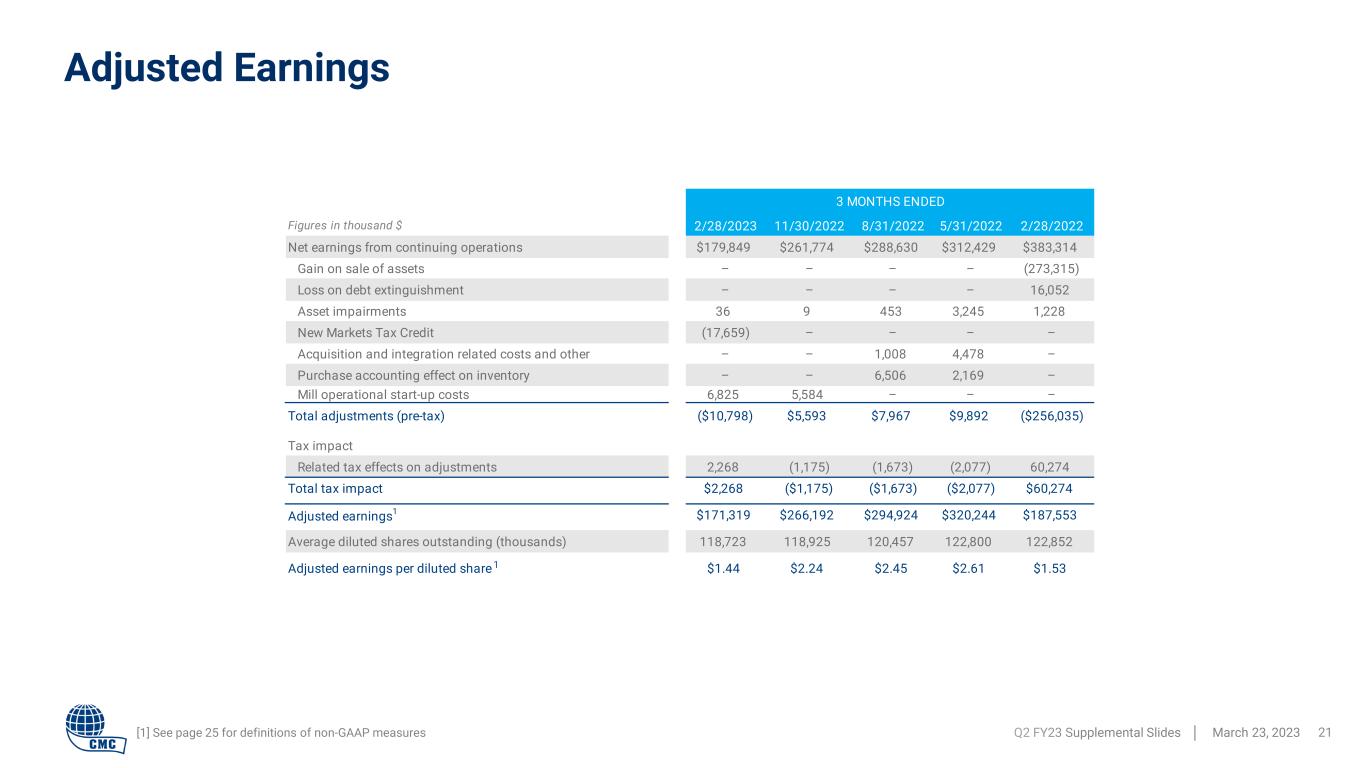
Figures in thousand $ 2/28/2023 11/30/2022 8/31/2022 5/31/2022 2/28/2022 Net earnings from continuing operations $179,849 $261,774 $288,630 $312,429 $383,314 Gain on sale of assets – – – – (273,315) Loss on debt extinguishment – – – – 16,052 Asset impairments 36 9 453 3,245 1,228 New Markets Tax Credit (17,659) – – – – Acquisition and integration related costs and other – – 1,008 4,478 – Purchase accounting effect on inventory – – 6,506 2,169 – Mill operational start-up costs 6,825 5,584 – – – Total adjustments (pre-tax) ($10,798) $5,593 $7,967 $9,892 ($256,035) Tax impact Related tax effects on adjustments 2,268 (1,175) (1,673) (2,077) 60,274 Total tax impact $2,268 ($1,175) ($1,673) ($2,077) $60,274 Adjusted earnings1 $171,319 $266,192 $294,924 $320,244 $187,553 Average diluted shares outstanding (thousands) 118,723 118,925 120,457 122,800 122,852 Adjusted earnings per diluted share $1.44 $2.24 $2.45 $2.61 $1.53 3 MONTHS ENDED Adjusted Earnings Q2 FY23 Supplemental Slides │ March 23, 2023 21[1] See page 25 for definitions of non-GAAP measures 1
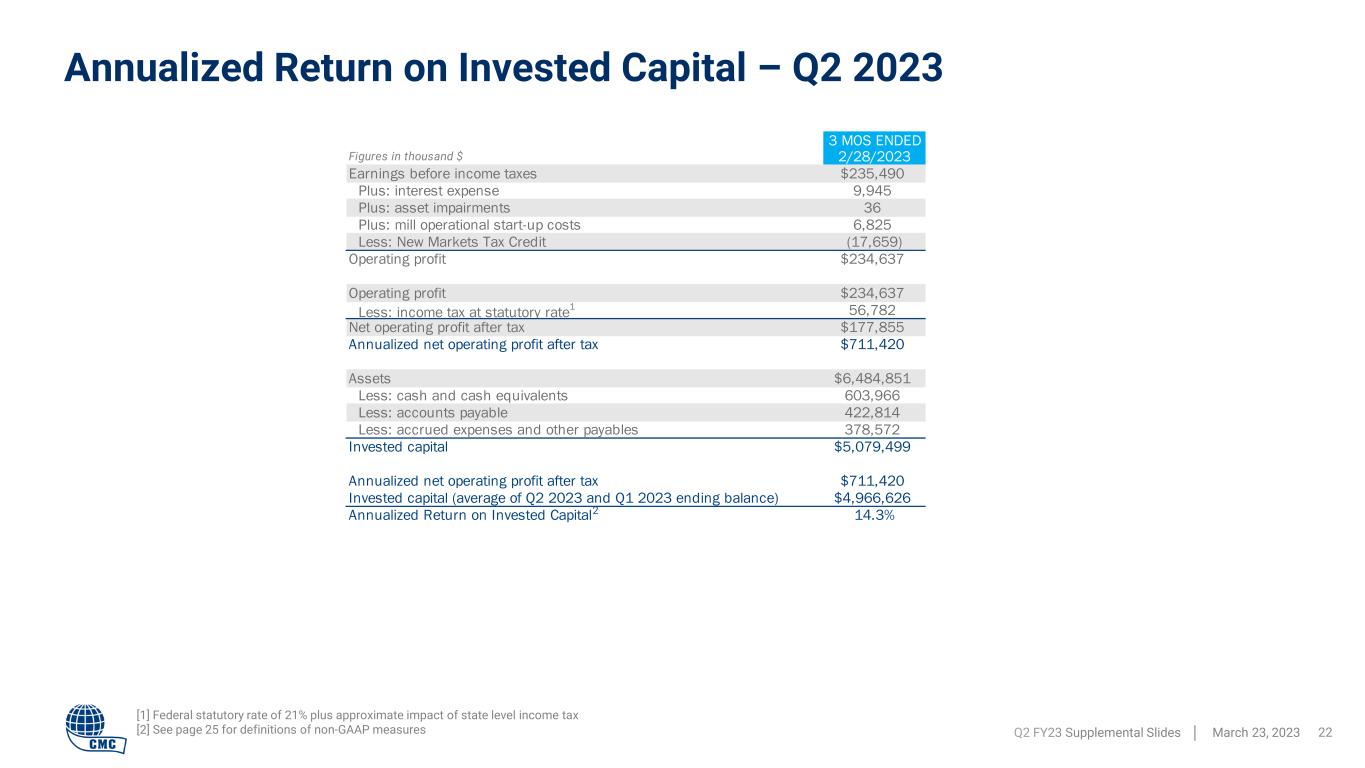
3 MOS ENDED Figures in thousand $ 2/28/2023 Earnings before income taxes $235,490 Plus: interest expense 9,945 Plus: asset impairments 36 Plus: mill operational start-up costs 6,825 Less: New Markets Tax Credit (17,659) Operating profit $234,637 Operating profit $234,637 Less: income tax at statutory rate1 56,782 Net operating profit after tax $177,855 Annualized net operating profit after tax $711,420 Assets $6,484,851 Less: cash and cash equivalents 603,966 Less: accounts payable 422,814 Less: accrued expenses and other payables 378,572 Invested capital $5,079,499 Annualized net operating profit after tax $711,420 Invested capital (average of Q2 2023 and Q1 2023 ending balance) $4,966,626 Annualized Return on Invested Capital 14.3% Annualized Return on Invested Capital – Q2 2023 Q2 FY23 Supplemental Slides │ March 23, 2023 22 [1] Federal statutory rate of 21% plus approximate impact of state level income tax [2] See page 25 for definitions of non-GAAP measures 2
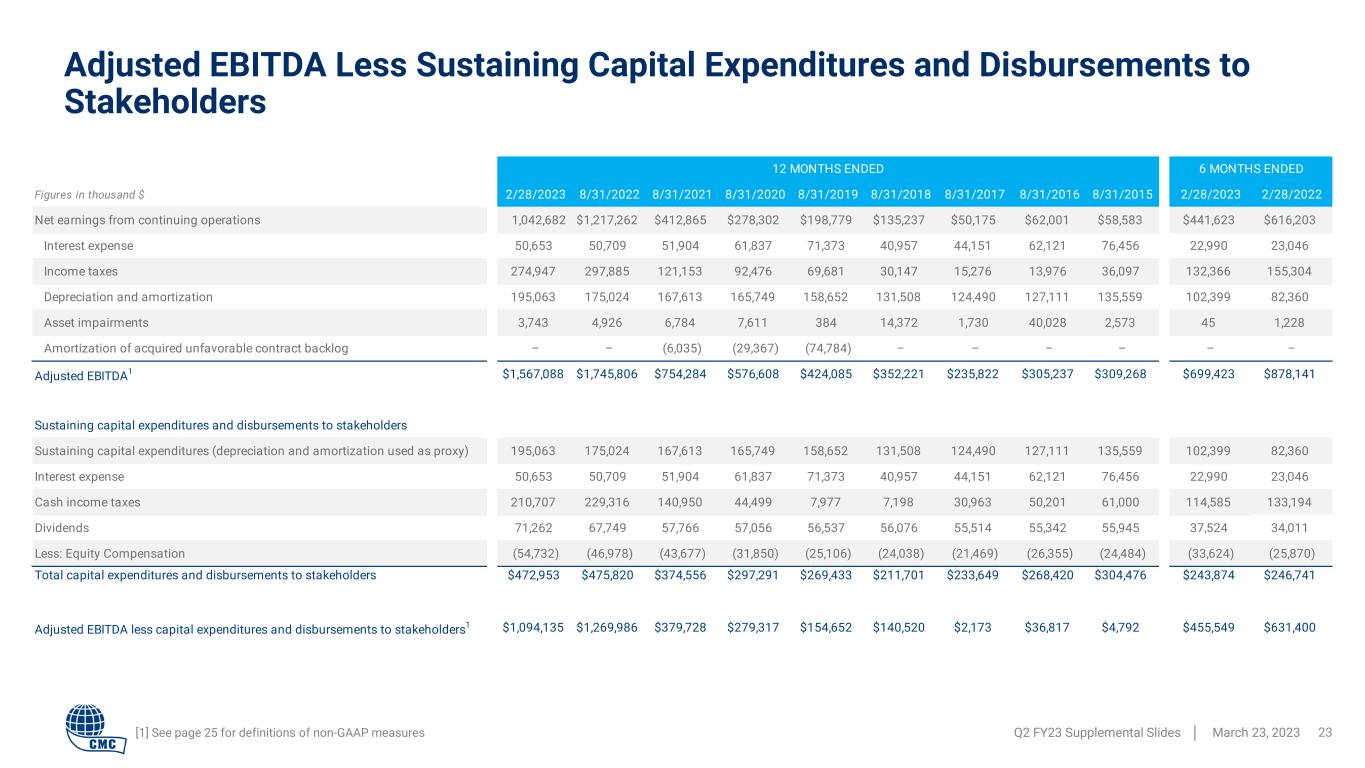
Figures in thousand $ 2/28/2023 8/31/2022 8/31/2021 8/31/2020 8/31/2019 8/31/2018 8/31/2017 8/31/2016 8/31/2015 2/28/2023 2/28/2022 Net earnings from continuing operations 1,042,682 $1,217,262 $412,865 $278,302 $198,779 $135,237 $50,175 $62,001 $58,583 $441,623 $616,203 Interest expense 50,653 50,709 51,904 61,837 71,373 40,957 44,151 62,121 76,456 22,990 23,046 Income taxes 274,947 297,885 121,153 92,476 69,681 30,147 15,276 13,976 36,097 132,366 155,304 Depreciation and amortization 195,063 175,024 167,613 165,749 158,652 131,508 124,490 127,111 135,559 102,399 82,360 Asset impairments 3,743 4,926 6,784 7,611 384 14,372 1,730 40,028 2,573 45 1,228 Amortization of acquired unfavorable contract backlog – – (6,035) (29,367) (74,784) – – – – – – Adjusted EBITDA1 $1,567,088 $1,745,806 $754,284 $576,608 $424,085 $352,221 $235,822 $305,237 $309,268 $699,423 $878,141 Sustaining capital expenditures and disbursements to stakeholders Sustaining capital expenditures (depreciation and amortization used as proxy) 195,063 175,024 167,613 165,749 158,652 131,508 124,490 127,111 135,559 102,399 82,360 Interest expense 50,653 50,709 51,904 61,837 71,373 40,957 44,151 62,121 76,456 22,990 23,046 Cash income taxes 210,707 229,316 140,950 44,499 7,977 7,198 30,963 50,201 61,000 114,585 133,194 Dividends 71,262 67,749 57,766 57,056 56,537 56,076 55,514 55,342 55,945 37,524 34,011 Less: Equity Compensation (54,732) (46,978) (43,677) (31,850) (25,106) (24,038) (21,469) (26,355) (24,484) (33,624) (25,870) Total capital expenditures and disbursements to stakeholders $472,953 $475,820 $374,556 $297,291 $269,433 $211,701 $233,649 $268,420 $304,476 $243,874 $246,741 Adjusted EBITDA less capital expenditures and disbursements to stakeholders1 $1,094,135 $1,269,986 $379,728 $279,317 $154,652 $140,520 $2,173 $36,817 $4,792 $455,549 $631,400 12 MONTHS ENDED 6 MONTHS ENDED [1] See page 25 for definitions of non-GAAP measures Adjusted EBITDA Less Sustaining Capital Expenditures and Disbursements to Stakeholders Q2 FY23 Supplemental Slides │ March 23, 2023 23
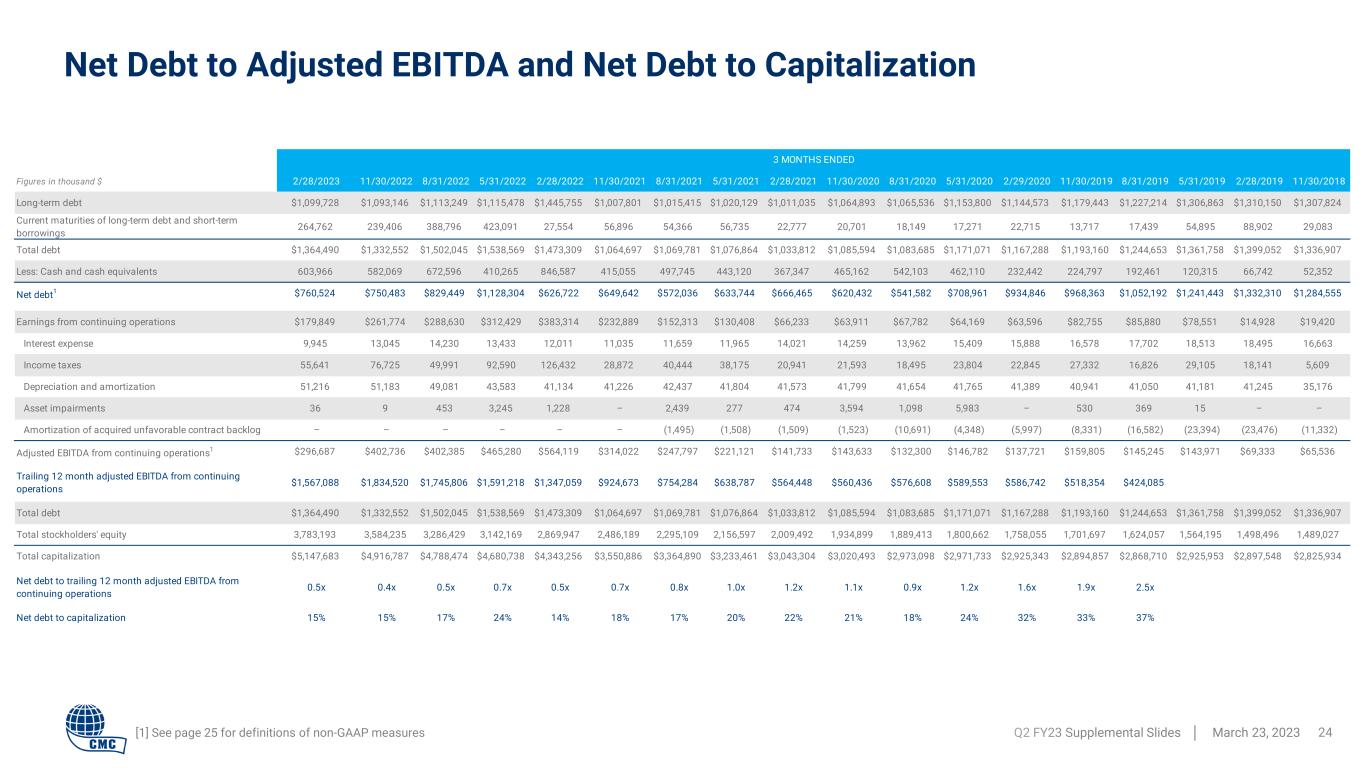
Figures in thousand $ 2/28/2023 11/30/2022 8/31/2022 5/31/2022 2/28/2022 11/30/2021 8/31/2021 5/31/2021 2/28/2021 11/30/2020 8/31/2020 5/31/2020 2/29/2020 11/30/2019 8/31/2019 5/31/2019 2/28/2019 11/30/2018 Long-term debt $1,099,728 $1,093,146 $1,113,249 $1,115,478 $1,445,755 $1,007,801 $1,015,415 $1,020,129 $1,011,035 $1,064,893 $1,065,536 $1,153,800 $1,144,573 $1,179,443 $1,227,214 $1,306,863 $1,310,150 $1,307,824 Current maturities of long-term debt and short-term borrowings 264,762 239,406 388,796 423,091 27,554 56,896 54,366 56,735 22,777 20,701 18,149 17,271 22,715 13,717 17,439 54,895 88,902 29,083 Total debt $1,364,490 $1,332,552 $1,502,045 $1,538,569 $1,473,309 $1,064,697 $1,069,781 $1,076,864 $1,033,812 $1,085,594 $1,083,685 $1,171,071 $1,167,288 $1,193,160 $1,244,653 $1,361,758 $1,399,052 $1,336,907 Less: Cash and cash equivalents 603,966 582,069 672,596 410,265 846,587 415,055 497,745 443,120 367,347 465,162 542,103 462,110 232,442 224,797 192,461 120,315 66,742 52,352 Net debt1 $760,524 $750,483 $829,449 $1,128,304 $626,722 $649,642 $572,036 $633,744 $666,465 $620,432 $541,582 $708,961 $934,846 $968,363 $1,052,192 $1,241,443 $1,332,310 $1,284,555 Earnings from continuing operations $179,849 $261,774 $288,630 $312,429 $383,314 $232,889 $152,313 $130,408 $66,233 $63,911 $67,782 $64,169 $63,596 $82,755 $85,880 $78,551 $14,928 $19,420 Interest expense 9,945 13,045 14,230 13,433 12,011 11,035 11,659 11,965 14,021 14,259 13,962 15,409 15,888 16,578 17,702 18,513 18,495 16,663 Income taxes 55,641 76,725 49,991 92,590 126,432 28,872 40,444 38,175 20,941 21,593 18,495 23,804 22,845 27,332 16,826 29,105 18,141 5,609 Depreciation and amortization 51,216 51,183 49,081 43,583 41,134 41,226 42,437 41,804 41,573 41,799 41,654 41,765 41,389 40,941 41,050 41,181 41,245 35,176 Asset impairments 36 9 453 3,245 1,228 – 2,439 277 474 3,594 1,098 5,983 – 530 369 15 – – Amortization of acquired unfavorable contract backlog – – – – – – (1,495) (1,508) (1,509) (1,523) (10,691) (4,348) (5,997) (8,331) (16,582) (23,394) (23,476) (11,332) Adjusted EBITDA from continuing operations1 $296,687 $402,736 $402,385 $465,280 $564,119 $314,022 $247,797 $221,121 $141,733 $143,633 $132,300 $146,782 $137,721 $159,805 $145,245 $143,971 $69,333 $65,536 Trailing 12 month adjusted EBITDA from continuing operations $1,567,088 $1,834,520 $1,745,806 $1,591,218 $1,347,059 $924,673 $754,284 $638,787 $564,448 $560,436 $576,608 $589,553 $586,742 $518,354 $424,085 Total debt $1,364,490 $1,332,552 $1,502,045 $1,538,569 $1,473,309 $1,064,697 $1,069,781 $1,076,864 $1,033,812 $1,085,594 $1,083,685 $1,171,071 $1,167,288 $1,193,160 $1,244,653 $1,361,758 $1,399,052 $1,336,907 Total stockholders' equity 3,783,193 3,584,235 3,286,429 3,142,169 2,869,947 2,486,189 2,295,109 2,156,597 2,009,492 1,934,899 1,889,413 1,800,662 1,758,055 1,701,697 1,624,057 1,564,195 1,498,496 1,489,027 Total capitalization $5,147,683 $4,916,787 $4,788,474 $4,680,738 $4,343,256 $3,550,886 $3,364,890 $3,233,461 $3,043,304 $3,020,493 $2,973,098 $2,971,733 $2,925,343 $2,894,857 $2,868,710 $2,925,953 $2,897,548 $2,825,934 Net debt to trailing 12 month adjusted EBITDA from continuing operations 0.5x 0.4x 0.5x 0.7x 0.5x 0.7x 0.8x 1.0x 1.2x 1.1x 0.9x 1.2x 1.6x 1.9x 2.5x Net debt to capitalization 15% 15% 17% 24% 14% 18% 17% 20% 22% 21% 18% 24% 32% 33% 37% 3 MONTHS ENDED Net Debt to Adjusted EBITDA and Net Debt to Capitalization Q2 FY23 Supplemental Slides │ March 23, 2023 24[1] See page 25 for definitions of non-GAAP measures
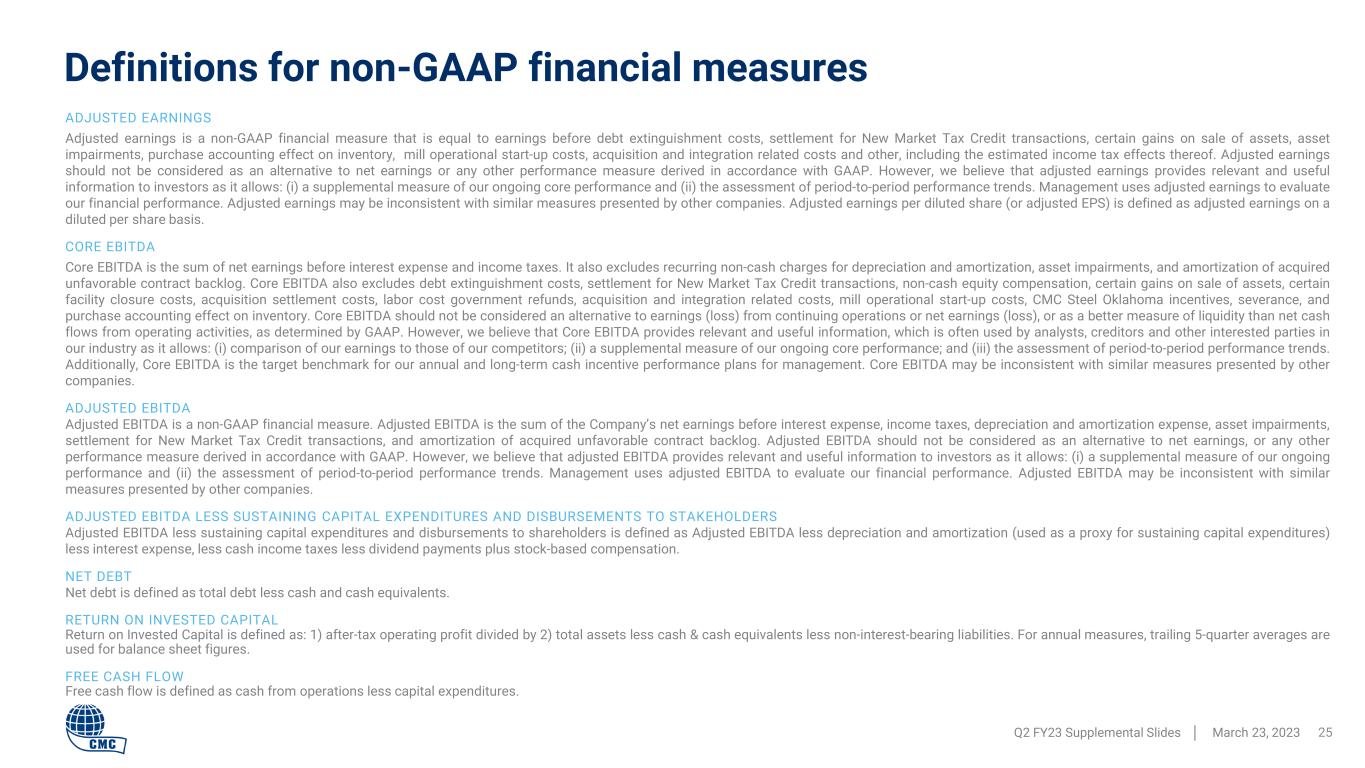
Definitions for non-GAAP financial measures Q2 FY23 Supplemental Slides │ March 23, 2023 25 ADJUSTED EARNINGS Adjusted earnings is a non-GAAP financial measure that is equal to earnings before debt extinguishment costs, settlement for New Market Tax Credit transactions, certain gains on sale of assets, asset impairments, purchase accounting effect on inventory, mill operational start-up costs, acquisition and integration related costs and other, including the estimated income tax effects thereof. Adjusted earnings should not be considered as an alternative to net earnings or any other performance measure derived in accordance with GAAP. However, we believe that adjusted earnings provides relevant and useful information to investors as it allows: (i) a supplemental measure of our ongoing core performance and (ii) the assessment of period-to-period performance trends. Management uses adjusted earnings to evaluate our financial performance. Adjusted earnings may be inconsistent with similar measures presented by other companies. Adjusted earnings per diluted share (or adjusted EPS) is defined as adjusted earnings on a diluted per share basis. CORE EBITDA Core EBITDA is the sum of net earnings before interest expense and income taxes. It also excludes recurring non-cash charges for depreciation and amortization, asset impairments, and amortization of acquired unfavorable contract backlog. Core EBITDA also excludes debt extinguishment costs, settlement for New Market Tax Credit transactions, non-cash equity compensation, certain gains on sale of assets, certain facility closure costs, acquisition settlement costs, labor cost government refunds, acquisition and integration related costs, mill operational start-up costs, CMC Steel Oklahoma incentives, severance, and purchase accounting effect on inventory. Core EBITDA should not be considered an alternative to earnings (loss) from continuing operations or net earnings (loss), or as a better measure of liquidity than net cash flows from operating activities, as determined by GAAP. However, we believe that Core EBITDA provides relevant and useful information, which is often used by analysts, creditors and other interested parties in our industry as it allows: (i) comparison of our earnings to those of our competitors; (ii) a supplemental measure of our ongoing core performance; and (iii) the assessment of period-to-period performance trends. Additionally, Core EBITDA is the target benchmark for our annual and long-term cash incentive performance plans for management. Core EBITDA may be inconsistent with similar measures presented by other companies. ADJUSTED EBITDA Adjusted EBITDA is a non-GAAP financial measure. Adjusted EBITDA is the sum of the Company’s net earnings before interest expense, income taxes, depreciation and amortization expense, asset impairments, settlement for New Market Tax Credit transactions, and amortization of acquired unfavorable contract backlog. Adjusted EBITDA should not be considered as an alternative to net earnings, or any other performance measure derived in accordance with GAAP. However, we believe that adjusted EBITDA provides relevant and useful information to investors as it allows: (i) a supplemental measure of our ongoing performance and (ii) the assessment of period-to-period performance trends. Management uses adjusted EBITDA to evaluate our financial performance. Adjusted EBITDA may be inconsistent with similar measures presented by other companies. ADJUSTED EBITDA LESS SUSTAINING CAPITAL EXPENDITURES AND DISBURSEMENTS TO STAKEHOLDERS Adjusted EBITDA less sustaining capital expenditures and disbursements to shareholders is defined as Adjusted EBITDA less depreciation and amortization (used as a proxy for sustaining capital expenditures) less interest expense, less cash income taxes less dividend payments plus stock-based compensation. NET DEBT Net debt is defined as total debt less cash and cash equivalents. RETURN ON INVESTED CAPITAL Return on Invested Capital is defined as: 1) after-tax operating profit divided by 2) total assets less cash & cash equivalents less non-interest-bearing liabilities. For annual measures, trailing 5-quarter averages are used for balance sheet figures. FREE CASH FLOW Free cash flow is defined as cash from operations less capital expenditures.
Q2 FY23 Supplemental Slides │ March 23, 2023 26 Thank You