
DASH 8-K
DoorDash, Inc. (DASH)
8-K
2023-11-01
For: 2023-11-01
View Original
Added on
April 11, 2026
UNITED STATES
SECURITIES AND EXCHANGE COMMISSION
Washington, D.C. 20549
____________________________________
FORM 8-K
____________________________________
CURRENT REPORT
Pursuant to Section 13 or 15(d) of the Securities Exchange Act of 1934
Date of Report (Date of earliest event reported):
____________________________________
(Exact name of registrant as specified in its charter)
____________________________________
(State or other jurisdiction of incorporation) | (Commission File Number) | (I.R.S. Employer Identification No.) | ||||||
(Address of principal executive offices) (Zip Code)
(650 ) 487-3970
(Registrant’s telephone number, including area code)
Not Applicable
(Former name or former address, if changed since last report)
____________________________________
Check the appropriate box below if the Form 8-K filing is intended to simultaneously satisfy the filing obligation of the registrant under any of the following provisions:
Securities registered pursuant to Section 12(b) of the Act:
| Title of each class | Trading Symbol(s) | Name of each exchange on which registered | ||||||
Indicate by check mark whether the registrant is an emerging growth company as defined in Rule 405 of the Securities Act of 1933 (17 CFR §230.405) or Rule 12b-2 of the Securities Exchange Act of 1934 (17 CFR §240.12b-2).
Emerging growth company ☐
If an emerging growth company, indicate by check mark if the registrant has elected not to use the extended transition period for complying with any new or revised financial accounting standards provided pursuant to Section 13(a) of the Exchange Act. ☐
Item 2.02 Results of Operations and Financial Condition.
On November 1, 2023 , DoorDash, Inc. ("DoorDash") issued a press release announcing its financial results for the quarter ended September 30, 2023. DoorDash also issued a Letter to Shareholders to provide additional information about DoorDash and its performance. Copies of the press release and Letter to Shareholders are attached as Exhibit 99.1 and Exhibit 99.2, respectively, to this Current Report on Form 8-K and are incorporated herein by reference.
Item 7.01 Regulation FD Disclosure.
On November 1, 2023 , DoorDash posted supplemental investor materials on the investor relations section of its website (ir.doordash.com). DoorDash announces material information to the public about DoorDash, its products and services, and other matters through a variety of means, including filings with the Securities and Exchange Commission, press releases, public conference calls, webcasts, the investor relations section of its website (ir.doordash.com), its blog (doordash.news) and its X account (@DoorDash) in order to achieve broad, non-exclusionary distribution of information to the public and for complying with its disclosure obligations under Regulation FD.
The information in Item 2.02 and Item 7.01 of this Current Report on Form 8-K, and Exhibit 99.1 and Exhibit 99.2 attached hereto, shall not be deemed “filed” for purposes of Section 18 of the Securities Exchange Act of 1934, as amended (the “Exchange Act”) or otherwise subject to the liabilities of that section, nor shall it be deemed incorporated by reference in any filing under the Securities Act of 1933, as amended, or the Exchange Act, except as shall be expressly set forth by specific reference in such a filing.
Item 9.01 Financial Statements and Exhibits.
(d) Exhibits.
| Exhibit No. | Description | ||||
| 99.1 | |||||
| 99.2 | |||||
| 104 | Cover Page Interactive Data File (embedded within the Inline XBRL document) | ||||
SIGNATURE
Pursuant to the requirements of the Securities Exchange Act of 1934, as amended, the registrant has duly caused this report to be signed on its behalf by the undersigned hereunto duly authorized.
| DOORDASH INC. | |||||
| Date: November 1, 2023 | /s/ Tony Xu | ||||
| Tony Xu | |||||
| Chief Executive Officer | |||||

Exhibit 99.1
DoorDash Releases Third Quarter 2023 Financial Results
November 1, 2023
SAN FRANCISCO--(BUSINESS WIRE)-- DoorDash Inc. (NASDAQ: DASH) today announced its financial results for the quarter ended September 30, 2023. In addition to our financial results below, our letter to shareholders is available on the DoorDash investor relations website at http://ir.doordash.com.
Excellent execution and continued investment allowed us to serve more consumers on more occasions than at any time in our history in Q3 2023, which drove strong year-over-year growth in Total Orders, Marketplace GOV, and revenue in the quarter. Our broad-based growth and continued focus on expense discipline drove an improvement to our Q3 2023 GAAP net loss including redeemable non-controlling interests versus Q3 2022, while Adjusted EBITDA reached an all-time high. We are excited by our progress so far in 2023, and even more so by the opportunity we have to further expand the scale, breadth, and impact of our business going forward.
Third Quarter 2023 Key Financial Metrics
•Total Orders increased 24% year-over-year (Y/Y) to 543 million and Marketplace GOV increased 24% Y/Y to $16.8 billion.
•Revenue increased 27% Y/Y to $2.2 billion and Net Revenue Margin increased to 12.9% from 12.6% in Q3 2022.
•GAAP net loss including redeemable non-controlling interests was $75 million compared to $296 million in Q3 2022, and Adjusted EBITDA increased to $344 million from $87 million in Q3 2022.
| Three Months Ended | ||||||||||||||||||||||||||||||||
| (in millions, except percentages) | Sept. 30, 2022 | Dec. 31, 2022 | Mar. 31, 2023 | Jun. 30, 2023 | Sept. 30, 2023 | |||||||||||||||||||||||||||
| Total Orders | 439 | 467 | 512 | 532 | 543 | |||||||||||||||||||||||||||
| Total Orders Y/Y growth | 27 | % | 27 | % | 27 | % | 25 | % | 24 | % | ||||||||||||||||||||||
| Marketplace GOV | $ | 13,534 | $ | 14,446 | $ | 15,913 | $ | 16,468 | $ | 16,751 | ||||||||||||||||||||||
| Marketplace GOV Y/Y growth | 30 | % | 29 | % | 29 | % | 26 | % | 24 | % | ||||||||||||||||||||||
| Revenue | $ | 1,701 | $ | 1,818 | $ | 2,035 | $ | 2,133 | $ | 2,164 | ||||||||||||||||||||||
| Revenue Y/Y growth | 33 | % | 40 | % | 40 | % | 33 | % | 27 | % | ||||||||||||||||||||||
| Net Revenue Margin | 12.6 | % | 12.6 | % | 12.8 | % | 13.0 | % | 12.9 | % | ||||||||||||||||||||||
| GAAP gross profit | $ | 714 | $ | 762 | $ | 921 | $ | 951 | $ | 962 | ||||||||||||||||||||||
| GAAP gross profit as a % of Marketplace GOV | 5.3 | % | 5.3 | % | 5.8 | % | 5.8 | % | 5.7 | % | ||||||||||||||||||||||
| Contribution Profit | $ | 420 | $ | 447 | $ | 533 | $ | 620 | $ | 640 | ||||||||||||||||||||||
| Contribution Profit as a % of Marketplace GOV | 3.1 | % | 3.1 | % | 3.3 | % | 3.8 | % | 3.8 | % | ||||||||||||||||||||||
| GAAP net loss including redeemable non-controlling interests | $ | (296) | $ | (642) | $ | (162) | $ | (172) | $ | (75) | ||||||||||||||||||||||
| GAAP net loss including redeemable non-controlling interests as a % of Marketplace GOV | (2.2) | % | (4.4) | % | (1.0) | % | (1.0) | % | (0.4) | % | ||||||||||||||||||||||
| Adjusted EBITDA | $ | 87 | $ | 117 | $ | 204 | $ | 279 | $ | 344 | ||||||||||||||||||||||
| Adjusted EBITDA as a % of Marketplace GOV | 0.6 | % | 0.8 | % | 1.3 | % | 1.7 | % | 2.1 | % | ||||||||||||||||||||||
| Basic shares, options and RSUs outstanding as of period end | 446 | 452 | 444 | 449 | 450 | |||||||||||||||||||||||||||
1  | ||||||||
Our Performance in Q3 2023
Q3 2023 was our best quarter as a public company for Marketplace GOV, revenue, GAAP net loss including redeemable non-controlling interests, and Adjusted EBITDA. In Q3 2023, effective execution, ongoing investments throughout our business, and strong consumer demand drove Total Orders up 24% Y/Y, Marketplace GOV up 24% Y/Y, and revenue up 27% Y/Y.
In our U.S. marketplace, Y/Y growth in Total Orders accelerated in Q3 2023 compared to Q2 2023 in both our restaurant and non-restaurant categories. Y/Y growth in Total Orders also accelerated in Q3 2023 compared to Q2 2023 in our international marketplaces1 and in our Platform Services.
We grew monthly active users2 in September at a double-digit Y/Y rate, with strong contributions from both our domestic and international markets. We also grew Q3-ending members in DashPass and Wolt+ on both a Y/Y and quarter-over-quarter (Q/Q) basis. Y/Y growth in order frequency accelerated slightly in Q3 2023 compared to Q2 2023.
In addition to strong growth in Total Orders and Marketplace GOV in Q3 2023, improvements to logistics efficiency and a growing contribution from advertising helped drive revenue up 27% Y/Y in Q3 2023.
The combination of efficiency gains and disciplined fixed cost management improved GAAP net loss including redeemable non-controlling interests to $75 million in Q3 2023 compared to a GAAP net loss including redeemable non-controlling interests of $296 million in Q3 2022. Adjusted EBITDA reached an all-time high in Q3 2023 of $344 million compared to $87 million in Q3 2022.
GAAP cost of revenue was $1.2 billion in Q3 2023, up 24% Y/Y and 2% Q/Q. As a percentage of Marketplace GOV, GAAP cost of revenue was 6.9% in Q3 2023, compared to 6.9% in both Q3 2022 and Q2 2023.
GAAP sales and marketing expense was $449 million in Q3 2023, up 7% Y/Y and down 5% Q/Q. Dasher acquisition costs declined on both a Y/Y and Q/Q basis in Q3 2023, while other sales and marketing expenses increased Y/Y and were roughly flat Q/Q.
We continued to manage operating expenses with discipline in Q3 2023. Combined, GAAP research and development expense and GAAP general and administrative expense was $539 million in Q3 2023, up very slightly from $537 million in Q3 2022, and down 12% from $610 million in Q2 2023. Compared to Q2 2023, Q3 2023 GAAP general and administrative expense benefited from the combination of a reallocation of certain automotive liabilities to cost of revenue, changes in tax-related items, and a seasonal decline in compensation expenses.
In Q3 2023, operating cash flow was $398 million and Free Cash Flow was $324 million. On a trailing 12-month basis, we generated operating cash flow of $1.2 billion and Free Cash Flow of $878 million.
In February 2023, our board of directors authorized the repurchase of up to $750 million of our Class A common stock. Year-to-date, we repurchased a total of 12.0 million shares of our Class A common stock for $750 million, which completed repurchases under the February authorization. Based on our current forecast for stock issuances, we now expect to exit 2023 with total basic shares, options, and RSUs outstanding between 450 million and 455 million.
1 Y/Y growth in Total Orders in our international marketplaces are calculated on a pro forma basis, including the results from Wolt for all periods.
2 Based on the number of individual consumer accounts that have completed an order on our Marketplaces in the past month, measured as of the end of the applicable period.
2 | ||||||||
Financial Outlook
| Period | Marketplace GOV | Adj. EBITDA | ||||||
| Q4 | $17.0 billion - $17.4 billion | $320 million - $380 million | ||||||
Our outlook assumes that key foreign currency rates remain relatively stable at current levels. Our outlook also anticipates significant levels of ongoing investment in new categories and international markets. We caution investors that consumer spending in any of our geographies could deteriorate relative to our outlook, which could drive results below our expectations. Additionally, our increasing international exposure heightens risks associated with operating in foreign markets, including geopolitical and currency risks. Changes in the international operating environment could negatively impact results versus our current outlook.
We have not provided GAAP net loss including redeemable non-controlling interests outlook or a reconciliation of Adjusted EBITDA to GAAP net loss including redeemable non-controlling interests as a result of the uncertainty regarding, and the potential variability of, reconciling items such as taxes and other items. Accordingly, a reconciliation of Adjusted EBITDA to GAAP net loss including redeemable non-controlling interests is not available without unreasonable effort. However, it is important to note that material changes to reconciling items could have a significant effect on future GAAP results. We have provided historical reconciliations of GAAP to non-GAAP metrics in tables at the end of this release. For more information regarding the non-GAAP financial measures discussed in this release, please see "Non-GAAP Financial Measures" below.
A Note On Our Financial Outlook Going Forward
In our Q4 2023 earnings release, we intend to provide our outlook for Marketplace GOV and Adjusted EBITDA for Q1 2024 as well as full-year 2024. However, beginning with our Q1 2024 earnings release, we intend to discontinue providing any full-year financial outlooks. We intend to continue providing quarterly outlooks for Marketplace GOV and Adjusted EBITDA in our earnings releases.
| Reporting period | Q4 2023 | Q1 2024 | Q2 2024 | Q3 2024 | Q4 2024 | ||||||||||||
| Intended outlook periods | Q1 2024 & Full year 2024 | Q2 2024 | Q3 2024 | Q4 2024 | Q1 2025 | ||||||||||||
Analyst and Investor Conference Call and Earnings Webcast
DoorDash will host a conference call and webcast to discuss our quarterly results today at 2:00 p.m. Pacific Time (5:00 p.m. Eastern Time). Those interested in listening to the call can register and attend by visiting our Investor Relations page at https://ir.doordash.com. An archived webcast will be available on our Investor Relations page shortly after the call.
Available Information
We announce material information to the public about us, our products and services, and other matters through a variety of means, including filings with the U.S. Securities and Exchange Commission (the "SEC"), press releases, public conference calls, webcasts, the investor relations section of our website (ir.doordash.com), our blog (doordash.news), and our X account (@DoorDash) in order to achieve broad, non-exclusionary distribution of information to the public and for complying with our disclosure obligations under Regulation FD.
3 | ||||||||
Forward-Looking Statements
This release contains forward-looking statements within the meaning of Section 27A of the Securities Act of 1933, as amended, and Section 21E of the Securities Exchange Act of 1934, as amended, which statements involve substantial risks and uncertainties. Forward-looking statements generally relate to future events or our future financial or operating performance. In some cases, you can identify forward-looking statements because they contain words such as “may,” “will,” “should,” “expect,” “plan,” “anticipate,” “could,” “would,” “intend,” “target,” “project,” “contemplate,” “believe,” “estimate,” "aim", "try", “predict,” “potential” or “continue” or the negative of these words or other similar terms or expressions that concern our expectations, strategies, plans, or intentions. Forward-looking statements in this release include, but are not limited to, our expectations regarding our financial position and operating performance, including our outlook and guidance for future periods, our expectations regarding our international business, our plans and expectations regarding our investment approach, our ability to manage our expenses, including stock-based compensation expense, our expectations regarding our local commerce opportunity, trends in our business, including the effect of the macroeconomic environment, consumer spending, demand for our platform and for local commerce platforms in general, our expectations regarding our disclosure of financial outlooks, and our plans and expectations regarding share dilution, including our share repurchase authorization, and our ability to manage dilution. Our expectations and beliefs regarding these matters may not materialize, and actual results in future periods are subject to risks and uncertainties that could cause actual results to differ materially from those projected, including risks and uncertainties related to: competition, managing our growth and corporate culture, financial performance, including our ability to forecast our performance due to our limited operating history, investments in new geographies, products, or offerings, our ability to attract merchants, consumers, and Dashers to our platform, legal proceedings and regulatory matters and developments, any future changes to our business or our financial or operating model, and our brand and reputation. The forward-looking statements contained in this release are also subject to other risks and uncertainties that could cause actual results to differ from the results predicted, including those more fully described in our filings with the SEC Commission, including our Annual Report on Form 10-K for the year ended December 31, 2022 and our quarterly reports on Form 10-Q. All forward-looking statements in this release are based on information available to DoorDash and assumptions and beliefs as of the date hereof, and we disclaim any obligation to update any forward-looking statements, except as required by law.
Use of Non-GAAP Financial Measures
To supplement our financial information presented in accordance with U.S. generally accepted accounting principles ("GAAP"), we consider certain financial measures that are not prepared in accordance with GAAP, including adjusted cost of revenue, adjusted sales and marketing expense, adjusted research and development expense, adjusted general and administrative expense, Contribution Profit, Contribution Margin, Adjusted Gross Profit, Adjusted Gross Margin, Adjusted EBITDA, and Free Cash Flow. We use these financial measures in conjunction with GAAP measures as part of our overall assessment of our performance, including the preparation of our annual operating budget and quarterly forecasts, to evaluate the effectiveness of our business strategies, and to communicate with our board of directors concerning our business and financial performance. We believe that these non-GAAP financial measures provide useful information to investors about our business and financial performance, enhance their overall understanding of our past performance and future prospects, and allow for greater transparency with respect to metrics used by our management in their financial and operational decision making. We are presenting these non-GAAP financial measures to assist investors in seeing our business and financial performance through the eyes of management, and because we believe that these non-GAAP financial measures provide an additional tool for investors to use in comparing results of operations of our business over multiple periods with other companies in our industry.
4 | ||||||||
We define adjusted cost of revenue as cost of revenue, exclusive of depreciation and amortization, excluding stock-based compensation expense and certain payroll tax expense, allocated overhead, and inventory write off related to restructuring. Allocated overhead is determined based on an allocation of shared costs, such as facilities (including rent and utilities) and information technology costs, among all departments based on employee headcount. We define adjusted sales and marketing expense as sales and marketing expenses excluding stock-based compensation expense and certain payroll tax expense, and allocated overhead. We define adjusted research and development expense as research and development expenses excluding stock-based compensation expense and certain payroll tax expense, and allocated overhead. We define adjusted general and administrative expense as general and administrative expenses excluding stock-based compensation expense and certain payroll tax expense, certain legal, tax, and regulatory settlements, reserves, and expenses, transaction-related costs (primarily consists of acquisition, integration, and investment related costs), impairment expenses, and including allocated overhead from cost of revenue, sales and marketing, and research and development.
We define Adjusted Gross Profit as gross profit plus (i) depreciation and amortization expense related to cost of revenue, (ii) stock-based compensation expense and certain payroll tax expense included in cost of revenue, (iii) allocated overhead included in cost of revenue, and (iv) inventory write off related to restructuring. Gross profit is defined as revenue less (i) cost of revenue, exclusive of depreciation and amortization and (ii) depreciation and amortization related to cost of revenue. Adjusted Gross Margin is defined as Adjusted Gross Profit as a percentage of revenue for the same period.
We define Contribution Profit as our gross profit less sales and marketing expense plus (i) depreciation and amortization expense related to cost of revenue, (ii) stock-based compensation expense and certain payroll tax expense included in cost of revenue and sales and marketing expenses, (iii) allocated overhead included in cost of revenue and sales and marketing expenses, and (iv) inventory write off related to restructuring. We define gross margin as gross profit as a percentage of revenue for the same period and we define Contribution Margin as Contribution Profit as a percentage of revenue for the same period.
Adjusted EBITDA is a measure that we use to assess our operating performance and the operating leverage in our business. We define Adjusted EBITDA as net income (loss) including redeemable non-controlling interests, adjusted to exclude (i) certain legal, tax, and regulatory settlements, reserves, and expenses, (ii) loss on disposal of property and equipment, (iii) transaction-related costs (primarily consists of acquisition, integration, and investment related costs), (iv) impairment expenses, (v) restructuring charges, (vi) inventory write off related to restructuring, (vii) provision for (benefit from) income taxes, (viii) interest income, net, (ix) other expense, net, (x) stock-based compensation expense and certain payroll tax expense, and (xi) depreciation and amortization expense.
We define Free Cash Flow as cash flows from operating activities less purchases of property and equipment and capitalized software and website development costs.
We define Total Orders as all orders completed through our marketplaces and platform services businesses over the period of measurement.
We define Marketplace GOV as the total dollar value of orders completed on our marketplaces, including taxes, tips, and any applicable consumer fees, including membership fees related to DashPass and Wolt+. Marketplace orders include orders completed through Pickup and DoorDash for Work. Marketplace GOV does not include the dollar value of orders, taxes and tips, or fees charged to merchants, for orders fulfilled through Drive, Storefront, or Bbot.
We define Net Revenue Margin as revenue expressed as a percentage of Marketplace GOV.
5 | ||||||||
Our definitions may differ from the definitions used by other companies and therefore comparability may be limited. In addition, other companies may not publish these or similar metrics. Further, these metrics have certain limitations in that they do not include the impact of certain expenses that are reflected in our condensed consolidated statements of operations. Thus, our adjusted cost of revenue, adjusted sales and marketing expense, adjusted research and development expense, adjusted general and administrative expense, Contribution Profit, Contribution Margin, Adjusted Gross Profit, Adjusted Gross Margin, Adjusted EBITDA, and Free Cash Flow should be considered in addition to, not as substitutes for, or in isolation from, measures prepared in accordance with GAAP.
6 | ||||||||
DOORDASH, INC.
CONDENSED CONSOLIDATED BALANCE SHEETS
(In millions)
(Unaudited)
| December 31, 2022 | September 30, 2023 | ||||||||||
| Assets | |||||||||||
| Current assets: | |||||||||||
| Cash and cash equivalents | $ | 1,977 | $ | 2,344 | |||||||
| Short-term marketable securities | 1,544 | 1,477 | |||||||||
| Funds held at payment processors | 441 | 385 | |||||||||
| Accounts receivable, net | 400 | 417 | |||||||||
| Prepaid expenses and other current assets | 358 | 519 | |||||||||
| Total current assets | 4,720 | 5,142 | |||||||||
| Long-term restricted cash | 211 | 11 | |||||||||
| Long-term marketable securities | 397 | 474 | |||||||||
| Operating lease right-of-use assets | 436 | 406 | |||||||||
| Property and equipment, net | 637 | 690 | |||||||||
| Intangible assets, net | 765 | 663 | |||||||||
| Goodwill | 2,370 | 2,345 | |||||||||
| Non-marketable equity securities | 124 | 142 | |||||||||
| Other assets | 129 | 140 | |||||||||
| Total assets | $ | 9,789 | $ | 10,013 | |||||||
| Liabilities, Redeemable Non-controlling Interests and Stockholders’ Equity | |||||||||||
| Current liabilities: | |||||||||||
| Accounts payable | $ | 157 | $ | 149 | |||||||
| Operating lease liabilities | 55 | 63 | |||||||||
| Accrued expenses and other current liabilities | 2,332 | 2,774 | |||||||||
| Total current liabilities | 2,544 | 2,986 | |||||||||
| Operating lease liabilities | 456 | 430 | |||||||||
| Other liabilities | 21 | 29 | |||||||||
| Total liabilities | 3,021 | 3,445 | |||||||||
| Redeemable non-controlling interests | 14 | 9 | |||||||||
| Stockholders’ equity: | |||||||||||
| Common stock | — | — | |||||||||
| Additional paid-in capital | 10,633 | 11,576 | |||||||||
| Accumulated other comprehensive loss | (33) | (68) | |||||||||
| Accumulated deficit | (3,846) | (4,949) | |||||||||
| Total stockholders’ equity | 6,754 | 6,559 | |||||||||
| Total liabilities, redeemable non-controlling interests and stockholders’ equity | $ | 9,789 | $ | 10,013 | |||||||
7 | ||||||||
DOORDASH, INC.
CONDENSED CONSOLIDATED STATEMENTS OF OPERATIONS
(In millions, except share amounts which are reflected in thousands, and per share data)
(Unaudited)
| Three Months Ended September 30, | Nine Months Ended September 30, | ||||||||||||||||||||||
| 2022 | 2023 | 2022 | 2023 | ||||||||||||||||||||
| Revenue | $ | 1,701 | $ | 2,164 | $ | 4,765 | $ | 6,332 | |||||||||||||||
| Costs and expenses: | |||||||||||||||||||||||
| Cost of revenue, exclusive of depreciation and amortization shown separately below | 931 | 1,156 | 2,574 | 3,360 | |||||||||||||||||||
| Sales and marketing | 418 | 449 | 1,253 | 1,416 | |||||||||||||||||||
| Research and development | 226 | 250 | 579 | 750 | |||||||||||||||||||
| General and administrative | 311 | 289 | 847 | 915 | |||||||||||||||||||
| Depreciation and amortization | 118 | 128 | 258 | 379 | |||||||||||||||||||
| Restructuring charges | 5 | — | 8 | 2 | |||||||||||||||||||
| Total costs and expenses | 2,009 | 2,272 | 5,519 | 6,822 | |||||||||||||||||||
| Loss from operations | (308) | (108) | (754) | (490) | |||||||||||||||||||
| Interest income, net | 9 | 40 | 14 | 101 | |||||||||||||||||||
| Other expense, net | (2) | (1) | — | (6) | |||||||||||||||||||
| Loss before income taxes | (301) | (69) | (740) | (395) | |||||||||||||||||||
| Provision for (benefit from) income taxes | (5) | 6 | (14) | 14 | |||||||||||||||||||
| Net loss including redeemable non-controlling interests | (296) | (75) | (726) | (409) | |||||||||||||||||||
| Less: net loss attributable to redeemable non-controlling interests | (1) | (2) | (1) | (5) | |||||||||||||||||||
| Net loss attributable to DoorDash, Inc. common stockholders | $ | (295) | $ | (73) | $ | (725) | $ | (404) | |||||||||||||||
| Net loss per share attributable to DoorDash, Inc. common stockholders, basic and diluted | $ | (0.77) | $ | (0.19) | $ | (1.98) | $ | (1.03) | |||||||||||||||
| Weighted-average number of shares outstanding used to compute net loss per share attributable to DoorDash, Inc. common stockholders, basic and diluted | 384,756 | 393,217 | 366,107 | 390,794 | |||||||||||||||||||
8 | ||||||||
DOORDASH, INC.
CONDENSED CONSOLIDATED STATEMENTS OF CASH FLOWS
(In millions)
(Unaudited)
| Nine Months Ended September 30, | |||||||||||
| 2022 | 2023 | ||||||||||
| Cash flows from operating activities | |||||||||||
| Net loss including redeemable non-controlling interests | $ | (726) | $ | (409) | |||||||
| Adjustments to reconcile net loss to net cash provided by operating activities: | |||||||||||
| Depreciation and amortization | 258 | 379 | |||||||||
| Stock-based compensation | 609 | 819 | |||||||||
| Reduction of operating lease right-of-use assets and accretion of operating lease liabilities | 58 | 84 | |||||||||
| Other | 24 | 23 | |||||||||
| Changes in assets and liabilities, net of assets acquired and liabilities assumed from acquisitions: | |||||||||||
| Funds held at payment processors | 103 | 52 | |||||||||
| Accounts receivable, net | 41 | (26) | |||||||||
| Prepaid expenses and other current assets | (109) | (84) | |||||||||
| Other assets | (66) | (45) | |||||||||
| Accounts payable | 66 | 6 | |||||||||
| Accrued expenses and other current liabilities | 156 | 469 | |||||||||
| Payments for operating lease liabilities | (53) | (88) | |||||||||
| Other liabilities | (17) | 8 | |||||||||
| Net cash provided by operating activities | 344 | 1,188 | |||||||||
| Cash flows from investing activities | |||||||||||
| Purchases of property and equipment | (131) | (94) | |||||||||
| Capitalized software and website development costs | (119) | (143) | |||||||||
| Purchases of marketable securities | (1,581) | (1,555) | |||||||||
| Maturities of marketable securities | 1,330 | 1,581 | |||||||||
| Sales of marketable securities | 311 | 6 | |||||||||
| Purchases of non-marketable equity securities | — | (16) | |||||||||
| Net cash acquired in acquisitions | 71 | — | |||||||||
| Other investing activities | — | (2) | |||||||||
| Net cash used in investing activities | (119) | (223) | |||||||||
| Cash flows from financing activities | |||||||||||
| Proceeds from exercise of stock options | 10 | 5 | |||||||||
| Repurchase of common stock | (400) | (699) | |||||||||
| Other financing activities | 14 | (8) | |||||||||
| Net cash used in financing activities | (376) | (702) | |||||||||
| Foreign currency effect on cash, cash equivalents, and restricted cash | (28) | (16) | |||||||||
| Net (decrease) increase in cash, cash equivalents, and restricted cash | (179) | 247 | |||||||||
| Cash, cash equivalents, and restricted cash | |||||||||||
| Cash, cash equivalents, and restricted cash, beginning of period | 2,506 | 2,188 | |||||||||
| Cash, cash equivalents, and restricted cash, end of period | $ | 2,327 | $ | 2,435 | |||||||
| Reconciliation of cash, cash equivalents, and restricted cash to the condensed consolidated balance sheets | |||||||||||
| Cash and cash equivalents | $ | 2,320 | $ | 2,344 | |||||||
| Restricted cash included in prepaid expenses and other current assets | — | 80 | |||||||||
| Long-term restricted cash | 7 | 11 | |||||||||
| Total cash, cash equivalents, and restricted cash | $ | 2,327 | $ | 2,435 | |||||||
| Non-cash investing and financing activities | |||||||||||
| Purchases of property and equipment not yet settled | $ | 42 | $ | 18 | |||||||
| Stock-based compensation included in capitalized software and website development costs | $ | 99 | $ | 119 | |||||||
9 | ||||||||
DOORDASH, INC.
NON-GAAP FINANCIAL MEASURES
(Unaudited)
| Three Months Ended | ||||||||||||||||||||||||||||||||
| (In millions) | Sept. 30, 2022 | Dec. 31, 2022 | Mar. 31, 2023 | Jun. 30, 2023 | Sept. 30, 2023 | |||||||||||||||||||||||||||
| Cost of revenue, exclusive of depreciation and amortization | $ | 931 | $ | 1,014 | $ | 1,069 | $ | 1,135 | $ | 1,156 | ||||||||||||||||||||||
| Adjusted to exclude the following: | ||||||||||||||||||||||||||||||||
| Stock-based compensation expense and certain payroll tax expense | (29) | (31) | (24) | (43) | (37) | |||||||||||||||||||||||||||
| Allocated overhead | (7) | (8) | (9) | (8) | (8) | |||||||||||||||||||||||||||
| Adjusted cost of revenue | $ | 895 | $ | 975 | $ | 1,036 | $ | 1,084 | $ | 1,111 | ||||||||||||||||||||||
| Sales and marketing | $ | 418 | $ | 429 | $ | 496 | $ | 471 | $ | 449 | ||||||||||||||||||||||
| Adjusted to exclude the following: | ||||||||||||||||||||||||||||||||
| Stock-based compensation expense and certain payroll tax expense | (27) | (28) | (24) | (36) | (30) | |||||||||||||||||||||||||||
| Allocated overhead | (5) | (5) | (6) | (6) | (6) | |||||||||||||||||||||||||||
| Adjusted sales and marketing | $ | 386 | $ | 396 | $ | 466 | $ | 429 | $ | 413 | ||||||||||||||||||||||
| Research and development | $ | 226 | $ | 250 | $ | 231 | $ | 269 | $ | 250 | ||||||||||||||||||||||
| Adjusted to exclude the following: | ||||||||||||||||||||||||||||||||
| Stock-based compensation expense and certain payroll tax expense | (99) | (116) | (98) | (134) | (119) | |||||||||||||||||||||||||||
| Allocated overhead | (5) | (3) | (4) | (5) | (5) | |||||||||||||||||||||||||||
| Adjusted research and development | $ | 122 | $ | 131 | $ | 129 | $ | 130 | $ | 126 | ||||||||||||||||||||||
| General and administrative | $ | 311 | $ | 300 | $ | 285 | $ | 341 | $ | 289 | ||||||||||||||||||||||
| Adjusted to exclude the following: | ||||||||||||||||||||||||||||||||
| Stock-based compensation expense and certain payroll tax expense | (96) | (93) | (84) | (99) | (94) | |||||||||||||||||||||||||||
Certain legal, tax, and regulatory settlements, reserves, and expenses(1) | (14) | (19) | (19) | (49) | (44) | |||||||||||||||||||||||||||
Transaction-related costs(2) | (7) | (3) | (1) | (1) | — | |||||||||||||||||||||||||||
Impairment expenses(3) | — | (2) | — | — | — | |||||||||||||||||||||||||||
| Allocated overhead from cost of revenue, sales and marketing, and research and development | 17 | 16 | 19 | 19 | 19 | |||||||||||||||||||||||||||
| Adjusted general and administrative | $ | 211 | $ | 199 | $ | 200 | $ | 211 | $ | 170 | ||||||||||||||||||||||
(1)We exclude certain costs and expenses from our calculation of adjusted general and administrative expense because management believes that these costs and expenses are not indicative of our core operating performance, do not reflect the underlying economics of our business, and are not necessary to operate our business. These excluded costs and expenses consist of (i) certain legal costs, primarily related to worker classification matters, as well as a settlement entered into in connection with an initiative to serve underrepresented communities, (ii) reserves and settlements or other resolutions for or related to the collection of sales, indirect, and other taxes that we do not expect to incur on a recurring basis, (iii) expenses related to supporting various policy matters, including those related to worker classification, other labor law matters, and price controls, and (iv) donations as part of our relief efforts in connection with the COVID-19 pandemic. We believe it is appropriate to exclude the foregoing matters from our calculation of adjusted general and administrative expense because (1) the timing and magnitude of such expenses are unpredictable and thus not part of management’s budgeting or forecasting process, and (2) with respect to worker classification matters, management currently expects such expenses will not be material to our results of operations over the long term as a result of increasing legislative and regulatory certainty in this area, including as a result of Proposition 22 in California and similar legislation.
(2)Consists of acquisition, integration, and investment related costs, primarily related to Wolt acquisition.
(3)Consists of impairment expense related to an operating lease right-of-use asset associated with our former headquarters.
10 | ||||||||
Reconciliation of gross profit to Contribution Profit
| Three Months Ended | ||||||||||||||||||||||||||||||||
| (In millions, except percentages) | Sept. 30, 2022 | Dec. 31, 2022 | Mar. 31, 2023 | Jun. 30, 2023 | Sept. 30, 2023 | |||||||||||||||||||||||||||
| Revenue | $ | 1,701 | $ | 1,818 | $ | 2,035 | $ | 2,133 | $ | 2,164 | ||||||||||||||||||||||
| Less: Cost of revenue, exclusive of depreciation and amortization | (931) | (1,014) | (1,069) | (1,135) | (1,156) | |||||||||||||||||||||||||||
| Less: Depreciation and amortization related to cost of revenue | (56) | (42) | (45) | (47) | (46) | |||||||||||||||||||||||||||
| Gross profit | $ | 714 | $ | 762 | $ | 921 | $ | 951 | $ | 962 | ||||||||||||||||||||||
| Gross Margin | 42.0 | % | 41.9 | % | 45.3 | % | 44.6 | % | 44.5 | % | ||||||||||||||||||||||
| Less: Sales and marketing | $ | (418) | $ | (429) | $ | (496) | $ | (471) | $ | (449) | ||||||||||||||||||||||
| Add: Depreciation and amortization related to cost of revenue | 56 | 42 | 45 | 47 | 46 | |||||||||||||||||||||||||||
| Add: Stock-based compensation expense and certain payroll tax expense included in cost of revenue and sales and marketing | 56 | 59 | 48 | 79 | 67 | |||||||||||||||||||||||||||
| Add: Allocated overhead included in cost of revenue and sales and marketing | 12 | 13 | 15 | 14 | 14 | |||||||||||||||||||||||||||
| Contribution Profit | $ | 420 | $ | 447 | $ | 533 | $ | 620 | $ | 640 | ||||||||||||||||||||||
| Contribution Margin | 24.7 | % | 24.6 | % | 26.2 | % | 29.1 | % | 29.6 | % | ||||||||||||||||||||||
Reconciliation of gross profit to Adjusted Gross Profit
| Three Months Ended | ||||||||||||||||||||||||||||||||
| (In millions, except percentages) | Sept. 30, 2022 | Dec. 31, 2022 | Mar. 31, 2023 | Jun. 30, 2023 | Sept. 30, 2023 | |||||||||||||||||||||||||||
| Gross profit | $ | 714 | $ | 762 | $ | 921 | $ | 951 | $ | 962 | ||||||||||||||||||||||
| Add: Depreciation and amortization related to cost of revenue | 56 | 42 | 45 | 47 | 46 | |||||||||||||||||||||||||||
| Add: Stock-based compensation expense and certain payroll tax expense included in cost of revenue | 29 | 31 | 24 | 43 | 37 | |||||||||||||||||||||||||||
| Add: Allocated overhead included in cost of revenue | 7 | 8 | 9 | 8 | 8 | |||||||||||||||||||||||||||
| Adjusted Gross Profit | $ | 806 | $ | 843 | $ | 999 | $ | 1,049 | $ | 1,053 | ||||||||||||||||||||||
| Adjusted Gross Margin | 47.4 | % | 46.4 | % | 49.1 | % | 49.2 | % | 48.7 | % | ||||||||||||||||||||||
Reconciliation of net loss including redeemable non-controlling interests to Adjusted EBITDA
| Three Months Ended | ||||||||||||||||||||||||||||||||
| (In millions) | Sept. 30, 2022 | Dec. 31, 2022 | Mar. 31, 2023 | Jun. 30, 2023 | Sept. 30, 2023 | |||||||||||||||||||||||||||
| Net loss including redeemable non-controlling interests | $ | (296) | $ | (642) | $ | (162) | $ | (172) | $ | (75) | ||||||||||||||||||||||
Certain legal, tax, and regulatory settlements, reserves, and expenses(1) | 14 | 19 | 19 | 49 | 44 | |||||||||||||||||||||||||||
Transaction-related costs(2) | 7 | 3 | 1 | 1 | — | |||||||||||||||||||||||||||
| Restructuring charges | 5 | 84 | 2 | — | — | |||||||||||||||||||||||||||
Impairment expenses(3) | — | 2 | — | — | — | |||||||||||||||||||||||||||
| Provision for (benefit from) income taxes | (5) | (17) | 17 | (9) | 6 | |||||||||||||||||||||||||||
| Interest income, net | (9) | (16) | (27) | (34) | (40) | |||||||||||||||||||||||||||
Other expense, net(4) | 2 | 305 | 1 | 4 | 1 | |||||||||||||||||||||||||||
Stock-based compensation expense and certain payroll tax expense(5) | 251 | 268 | 230 | 312 | 280 | |||||||||||||||||||||||||||
| Depreciation and amortization expense | 118 | 111 | 123 | 128 | 128 | |||||||||||||||||||||||||||
| Adjusted EBITDA | $ | 87 | $ | 117 | $ | 204 | $ | 279 | $ | 344 | ||||||||||||||||||||||
(1)We exclude certain costs and expenses from our calculation of Adjusted EBITDA because management believes that these costs and expenses are not indicative of our core operating performance, do not reflect the underlying economics of our business, and are not necessary to operate our business. These excluded costs and expenses consist of (i) certain legal costs primarily related to worker classification matters, as well as a settlement entered into in connection with an initiative to serve underrepresented communities, (ii) reserves and settlements or other resolutions for or related to the collection of sales, indirect, and other taxes that we do not expect to incur on a recurring basis, (iii) expenses related to
11 | ||||||||
supporting various policy matters, including those related to worker classification, other labor law matters, and price controls, and (iv) donations as part of our relief efforts in connection with the COVID-19 pandemic. We believe it is appropriate to exclude the foregoing matters from our calculation of Adjusted EBITDA because (1) the timing and magnitude of such expenses are unpredictable and thus not part of management’s budgeting or forecasting process, and (2) with respect to worker classification matters, management currently expects such expenses will not be material to our results of operations over the long term as a result of increasing legislative and regulatory certainty in this area, including as a result of Proposition 22 in California and similar legislation.
(2)Consists of acquisition, integration, and investment related costs, primarily related to Wolt acquisition.
(3)Consists of impairment expense related to an operating lease right-of-use asset associated with our former headquarters.
(4)Consists primarily of adjustments to non-marketable equity securities, including impairment, for the three months ended December 31, 2022.
(5)Excludes stock-based compensation related to restructuring, which is included in restructuring charges in the table above.
Estimate of Certain Components of Stock-Based Compensation Expense
| (in millions) | 2022 | 2023 | 2024 | 2025 | 2026 | |||||||||||||||||||||||||||
2020 CEO performance award(1) | $ | 112 | $ | 104 | $ | 67 | $ | 7 | $ | — | ||||||||||||||||||||||
| Wolt retention and revesting | 93 | 150 | 145 | 140 | 54 | |||||||||||||||||||||||||||
Pre-IPO RSUs: amortization of stepped-up value(2) | 88 | 68 | 54 | 3 | — | |||||||||||||||||||||||||||
| New hire, continuing employee, and other grants | 596 | 789 - 799 | NA | NA | NA | |||||||||||||||||||||||||||
| Total stock-based compensation | $ | 889 | $1,111 - 1,121 | NA | NA | NA | ||||||||||||||||||||||||||
(1)In November 2020, our board of directors granted restricted stock units ("RSUs") to our Chief Executive Officer, Tony Xu, covering 10,379,000 shares of our Class A common stock, which we refer to here as the 2020 CEO Performance Award. The award is intended to be the exclusive equity award to Mr. Xu over a seven year performance period, which ends November 23, 2027. The award has nine tranches that are eligible to vest based on the achievement of stock price goals ranging from $187.60 to $501.00, measured using an average of our stock price over a consecutive 180-day period during the performance period. For more information on the 2020 CEO Performance Award, please refer to our annual proxy statement.
(2)Certain RSUs awarded prior to or around the time of our initial public offering have grant-date fair values that significantly exceed the fair value of the awards (“409A value”) prevailing at the time they were committed to employees. The amounts included here represent the stock based compensation associated with the excess amount of the grant-date fair value over the 409A value.
Reconciliation of net cash provided by operating activities to Free Cash Flow
| Trailing Twelve Months Ended | ||||||||||||||||||||||||||||||||
| (in millions) | Sept. 30, 2022 | Dec. 31, 2022 | Mar. 31, 2023 | Jun. 30, 2023 | Sept. 30, 2023 | |||||||||||||||||||||||||||
| Net cash provided by operating activities | $ | 511 | $ | 367 | $ | 784 | $ | 1,012 | $ | 1,211 | ||||||||||||||||||||||
| Purchases of property and equipment | (166) | (176) | (183) | (165) | (139) | |||||||||||||||||||||||||||
| Capitalized software and website development costs | (154) | (170) | (173) | (194) | (194) | |||||||||||||||||||||||||||
| Free Cash Flow | $ | 191 | $ | 21 | $ | 428 | $ | 653 | $ | 878 | ||||||||||||||||||||||
IR Contact: | PR Contact: | ||||
12 | ||||||||

Exhibit 99.2
November 1, 2023
Dear Fellow Shareholders,
Our mission is to grow and empower local economies and our primary financial goal is to maximize long-term free cash flow per share. The local commerce market is very large and we believe we are in the early stages of what will likely be a decades-long transition to omni-channel retail. While this provides a significant opportunity, we face a host of external challenges to building the business we envision, including: stout competition, rising consumer expectations, shifts in regulation, changing macroeconomic backdrops, and the inherent difficulty of building in a new paradigm. Just as importantly, like many growing business, we face internal challenges like distraction, indecisiveness, and complacency.
We manage through both our internal and external challenges in part by focusing on and executing to the most fundamental elements in our business we know of. This process creates a natural cycle of learning, iteration, and concentration that inspires decisiveness, while keeping us humble to changes and new information. It also allows us to integrate feedback from external factors without becoming engrossed in them unnecessarily.
Success in this process can be found daily and is measured in increments of improvement more than achievement of high level outcomes. When we execute well, we are able to consistently improve the experiences we provide, which delights more consumers, generates more sales for our merchant partners and more earnings for Dashers, and we believe, makes our business more durable.
We believe we have executed well so far in 2023 and are proud that in Q3 2023, we drove 24% year-over-year (Y/Y) growth in Marketplace GOV, 27% Y/Y growth in revenue, improved our GAAP net loss including redeemable non-controlling interests to $75 million from $296 million in Q3 2022, and drove Adjusted EBITDA to $344 million from $87 million in Q3 2022. We believe our consistent execution to and ongoing investments are increasing our potential and expanding the scale of local commerce in the communities we serve.
A (Not So) Simple Business
At a high level, our business is fairly simple. In order to empower local economies and maximize long-term free cash flow production, we must: a) create experiences our audiences love, b) generate sound unit economics, c) manage our fixed costs efficiently, and then d) drive as much volume as we can within a set of discipline parameters that we establish. Unfortunately, these are largely outputs, which means we cannot execute directly to them. In order to be effective, we must look deeper in the business and execute to the fundamental variables that most efficiently create the results we want.
The first step in this process is to identify the variables that matter, which is a lot less obvious than it might seem. We work with a large number of variables that can influence the experiences we provide, and each one has different impacts, different limitations in our ability to influence it, and different interplays with other aspects of our business, all of which can change over time or with capital applied. It is quite easy to get stuck on variables that sound impactful but do not generate the anticipated results, or lured by variables that have clear short-term benefits but are inefficient in the long-term.
As managers, one of our key roles is simply to understand these dynamics, so that we can direct our efforts toward the aspects of our services that will drive the greatest long-term benefit for our audiences. Because we are building new services, we are often naive and regularly make mistakes. We are comfortable with that and consider it an essential component of a process in which learning and iteration are critical to progress.
One area where our process has been impactful is in the consumer experience we offer. Although consumer penetration in our markets remains relatively low, consumers have tremendous choice and are extremely demanding, which means
1
we must earn every consumer we attract and every order they place. If we innovate and execute effectively, we can increase the value we provide to consumers and they will order more. If we don’t, they won’t.
Fortunately, our cumulative learnings have helped us identify, measure, and execute to new variables that have allowed us to steadily improve our consumer value proposition. This is evident in a few areas. First, our Marketplaces have continued to attract new consumers, which has driven double-digit Y/Y growth in monthly active users1 throughout 2023. Second, our new consumer cohorts2 are highly engaged. Through nine months, Marketplace GOV retention for our January 2023 cohort is the second highest out of the last seven January cohorts (only behind the COVID affected January 2020 cohort), and we have seen similar trends for our other monthly cohorts so far this year. Third, engagement among our existing consumers has grown consistently. Marketplace GOV in each of our last seven annual cohorts, including the COVID-impacted 2020 cohort, has grown every year they have existed. This has continued so far in 20233, which has contributed to our overall growth and improving operating leverage through the year.
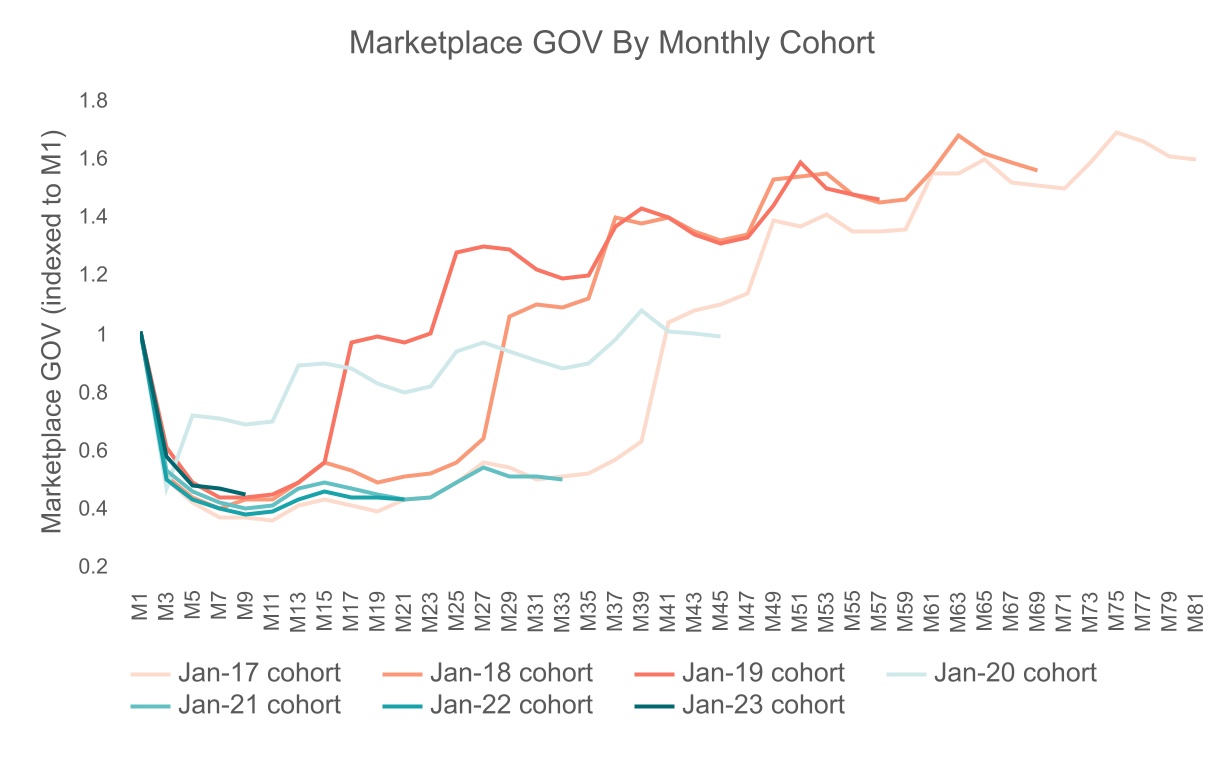
Importantly, our approach has been effective in many areas outside of the consumer experience and in a wide variety of environments. We always aspire for more, but we view our solid performance through what has been a volatile few years as an indication that we have identified variables that are important to consumers, merchants, and Dashers and are executing against those at a high level.
Our long-term vision and strategy have not changed over the last decade and are unlikely to change in the next one. But, at times, pushing on certain variables in our business becomes less effective, while pushing on others may become more so. These changes to input sensitivity often prompt us to adapt our tactics, so that we apply our effort and capital to the
1 Based on the number of individual consumer accounts that have completed an order on our Marketplaces in the past month, measured as of the end of the applicable period.
2 As discussed in this shareholder letter, “cohorts” refer to cohorts of consumers on our DoorDash Marketplace only, excluding consumers on our Wolt Marketplace and our other products and services.
3 Reflects growth in Marketplace GOV for each annual cohort in the first nine months of 2023 relative to the comparable period in 2022.
2
variables that we believe will be the most effective at the time. In an environment of constant change, we believe focusing on core fundamentals, constant experimentation, and first principles based problem solving allow us to consistently improve the experience we offer to consumers, merchants, and Dashers, even if only by a little bit at a time. Those gains then have the potential to compound, which can increase the scale and efficiency of our business much more significantly in the long-term.
Despite our ability to improve execution and appeal to more consumers, merchants, and Dashers in recent years, we are nowhere near where we aim to be. There are still hundreds of millions of consumers who do not regularly use our service, tens of millions of people that could benefit from dashing who have not yet tried it, and at least hundreds of thousands of merchants we believe we can help. These are clear signs that we have much more to learn, new variables to find, and significant room to improve our execution. We are excited by the opportunity.
Conclusion
An investor we were speaking with recently described our business as 3-D chess. We think of it more like learning to be a great jazz band. Our technical skills must be exceptional, and we are constantly working to improve them so that we’re not constrained by our own lack of ability. At the same time, we must master the art of listening while we play.
We are proud of our recent performance, as it is an output of several years of our team’s daily successes. However, our focus remains on the long-term. To generate the impact on local economies we aspire to and the financial results we expect, we must continue taking risks, focusing on the most fundamental variables we know of, and finding new ways to surpass our current limitations. Our expectations of ourselves are high. We will do our best to exceed them.
We could not be more grateful to our employees and stakeholders for the confidence they place in us, or more humbled by our shareholders who entrust us with their capital. Thank you for making this journey possible.
Sincerely,
Tony Xu, Co-founder, CEO and Board Chair, and Ravi Inukonda, CFO
PS. Q4 2023 will be our 13th earnings release as a public company and we intend to write our 13th letter to shareholders when we report Q4 earnings. Beginning in 2024, we expect to write letters on an annual basis, rather than quarterly. Our intention with shareholder letters is to provide insights into our business, and even more than that, to share details that help you better understand our processes, our approach, and how we think. To those that have read all of our letters so far, we greatly appreciate your time and attention. We hope you consider it time well spent.
3
Forward-Looking Statements
This shareholder letter contains forward-looking statements within the meaning of Section 27A of the Securities Act of 1933, as amended, and Section 21E of the Securities Exchange Act of 1934, as amended, which statements involve substantial risks and uncertainties. Forward-looking statements generally relate to future events or our future financial or operating performance. In some cases, you can identify forward-looking statements because they contain words such as “may,” "aim," “will,” “should,” “expect,” “plan,” "try," “anticipate,” “could,” “would,” “intend,” “target,” “project,” “contemplate,” “believe,” “estimate,” “predict,” “potential” or “continue” or the negative of these words or other similar terms or expressions that concern our expectations, strategies, plans, or intentions. Forward-looking statements in this shareholder letter include, but are not limited to, our expectations regarding our financial position and operating performance, our plans and expectations regarding our business and investment approach, our expectations regarding our local commerce opportunity, trends in our business, including the effects of the macroeconomic environment, our future plans for communications to our shareholders, and demand for our platform and for local commerce platforms in general. Our expectations and beliefs regarding these matters may not materialize, and actual results in future periods are subject to risks and uncertainties that could cause actual results to differ materially from those projected, including risks and uncertainties related to: competition, managing our growth and corporate culture, financial performance, including our ability to forecast our performance due to our limited operating history, investments in new geographies, products, or offerings, our ability to attract merchants, consumers, and Dashers to our platform, legal proceedings and regulatory matters and developments, any future changes to our business or our financial or operating model, and our brand and reputation. The forward-looking statements contained in this shareholder letter are also subject to other risks and uncertainties that could cause actual results to differ from the results predicted, including those more fully described in our filings with the SEC, including our Annual Report on Form 10-K for the year ended December 31, 2022 and our quarterly reports on Form 10-Q. All forward-looking statements in this shareholder letter are based on information available to DoorDash and assumptions and beliefs as of the date hereof, and we disclaim any obligation to update any forward-looking statements, except as required by law.
Use of Non-GAAP Financial Measures
To supplement our financial information presented in accordance with U.S. generally accepted accounting principles ("GAAP"), we consider certain financial measures that are not prepared in accordance with GAAP, including Adjusted EBITDA. We use non-GAAP financial measures in conjunction with GAAP measures as part of our overall assessment of our performance, including the preparation of our annual operating budget and quarterly forecasts, to evaluate the effectiveness of our business strategies, and to communicate with our board of directors concerning our business and financial performance. We believe that these non-GAAP financial measures provide useful information to investors about our business and financial performance, enhance their overall understanding of our past performance and future prospects, and allow for greater transparency with respect to metrics used by our management in their financial and operational decision making. We are presenting Adjusted EBITDA, a non-GAAP financial measure, to assist investors in seeing our business and financial performance through the eyes of management, and because we believe that Adjusted EBITDA, and certain other non-GAAP financial measures, provide an additional tool for investors to use in comparing results of operations of our business over multiple periods with other companies in our industry.
Adjusted EBITDA is a measure that we use to assess our operating performance and the operating leverage in our business. We define Adjusted EBITDA as net income (loss) including redeemable non-controlling interests, adjusted to exclude (i) certain legal, tax, and regulatory settlements, reserves, and expenses, (ii) loss on disposal of property and equipment, (iii) transaction-related costs (primarily consists of acquisition, integration, and investment related costs), (iv) impairment expenses, (v) restructuring charges, (vi) inventory write-off related to restructuring, (vii) provision for (benefit from) income taxes, (viii) interest income, net, (ix) other expense, net, (x) stock-based compensation expense and certain payroll tax expense, and (xi) depreciation and amortization expense.
Our definition of Adjusted EBITDA may differ from the definition used by other companies and therefore comparability may be limited. In addition, other companies may not publish a similar metric. The use of Adjusted EBITDA may be further limited in that it does not include the impact of certain expenses that are reflected in our consolidated statements of operations. Thus, our non-GAAP financial measures, including Adjusted EBITDA, should be considered in addition to, not as substitutes for, or in isolation from, measures prepared in accordance with GAAP.
4