
DASH 8-K
DoorDash, Inc. (DASH)
8-K
2023-05-04
For: 2023-05-04
View Original
Added on
April 11, 2026
UNITED STATES
SECURITIES AND EXCHANGE COMMISSION
Washington, D.C. 20549
____________________________________
FORM 8-K
____________________________________
CURRENT REPORT
Pursuant to Section 13 or 15(d) of the Securities Exchange Act of 1934
Date of Report (date of earliest event reported):
____________________________________
(Exact name of registrant as specified in its charter)
____________________________________
(State or other jurisdiction of incorporation or organization) | (Commission File Number) | (I.R.S. Employer Identification No.) | ||||||
(Address of principal executive offices, including zip code)
(650 ) 487-3970
(Registrant’s telephone number, including area code)
Not Applicable
(Former name or former address, if changed since last report)
____________________________________
Check the appropriate box below if the Form 8-K filing is intended to simultaneously satisfy the filing obligation of the registrant under any of the following provisions:
Securities registered pursuant to Section 12(b) of the Act:
| Title of each class | Trading Symbol(s) | Name of each exchange on which registered | ||||||
Indicate by check mark whether the registrant is an emerging growth company as defined in Rule 405 of the Securities Act of 1933 (17 CFR §230.405) or Rule 12b-2 of the Securities Exchange Act of 1934 (17 CFR §240.12b-2).
Emerging growth company ☐
If an emerging growth company, indicate by check mark if the registrant has elected not to use the extended transition period for complying with any new or revised financial accounting standards provided pursuant to Section 13(a) of the Exchange Act. ☐
Item 2.02 Results of Operations and Financial Condition.
On May 4, 2023 , DoorDash, Inc. ("DoorDash") issued a press release announcing its financial results for the quarter ended March 31, 2023. DoorDash also issued a Letter to Shareholders to provide additional information about DoorDash and its performance. Copies of the press release and Letter to Shareholders are attached as Exhibit 99.1 and Exhibit 99.2, respectively, to this Current Report on Form 8-K and are incorporated herein by reference.
Item 7.01 Regulation FD Disclosure.
On May 4, 2023 , DoorDash posted supplemental investor materials on the investor relations section of its website (ir.doordash.com). DoorDash announces material information to the public about DoorDash, its products and services, and other matters through a variety of means, including filings with the Securities and Exchange Commission, press releases, public conference calls, webcasts, the investor relations section of its website (ir.doordash.com), its blog (doordash.news) and its Twitter account (@DoorDash) in order to achieve broad, non-exclusionary distribution of information to the public and for complying with its disclosure obligations under Regulation FD.
The information in Item 2.02 and Item 7.01 of this Current Report on Form 8-K, and Exhibit 99.1 and Exhibit 99.2 attached hereto, shall not be deemed “filed” for purposes of Section 18 of the Securities Exchange Act of 1934, as amended (the “Exchange Act”) or otherwise subject to the liabilities of that section, nor shall it be deemed incorporated by reference in any filing under the Securities Act of 1933, as amended, or the Exchange Act, except as shall be expressly set forth by specific reference in such a filing.
Item 9.01 Financial Statements and Exhibits.
(d) Exhibits.
| Exhibit No. | Description | ||||
| 99.1 | |||||
| 99.2 | |||||
| 104 | Cover Page Interactive Data File (embedded within the Inline XBRL document) | ||||
SIGNATURE
Pursuant to the requirements of the Securities Exchange Act of 1934, as amended, the registrant has duly caused this report to be signed on its behalf by the undersigned hereunto duly authorized.
| DOORDASH INC. | |||||
| Date: May 4, 2023 | /s/ Tony Xu | ||||
| Tony Xu | |||||
| Chief Executive Officer | |||||

Exhibit 99.1
DoorDash Releases First Quarter 2023 Financial Results
May 4, 2023
SAN FRANCISCO--(BUSINESS WIRE)-- DoorDash Inc. (NYSE: DASH) today announced its financial results for the quarter ended March 31, 2023. In addition to our financial results below, our letter to shareholders is available on the DoorDash investor relations website at http://ir.doordash.com.
DoorDash continued to execute extremely well in Q1 2023 and we are proud of our team's outstanding performance in service of our stakeholders. In Q1 2023, our focus on inputs and deep attention to detail drove strong and stable growth in our U.S. restaurant category, outsized growth in our non-restaurant categories and international markets, improved operating efficiency in many areas of our business, and disciplined expense management.
First Quarter 2023 Key Financial Metrics
•Total Orders increased 27% year-over-year (Y/Y) to 512 million and Marketplace GOV increased 29% Y/Y to $15.9 billion.
•Revenue increased 40% Y/Y to $2.0 billion and Net Revenue Margin increased to 12.8% from 11.8% in Q1 2022.
•GAAP Net Loss including redeemable non-controlling interests was $162 million compared to $167 million in Q1 2022, and Adjusted EBITDA increased to $204 million from $54 million in Q1 2022.
| Three Months Ended | ||||||||||||||||||||||||||||||||
| (in millions, except percentages) | Mar. 31, 2022 | Jun. 30, 2022 | Sept. 30, 2022 | Dec. 31, 2022 | Mar. 31, 2023 | |||||||||||||||||||||||||||
| Total Orders | 404 | 426 | 439 | 467 | 512 | |||||||||||||||||||||||||||
| Total Orders Y/Y growth | 23 | % | 23 | % | 27 | % | 27 | % | 27 | % | ||||||||||||||||||||||
| Marketplace GOV | $ | 12,353 | $ | 13,081 | $ | 13,534 | $ | 14,446 | $ | 15,913 | ||||||||||||||||||||||
| Marketplace GOV Y/Y growth | 25 | % | 25 | % | 30 | % | 29 | % | 29 | % | ||||||||||||||||||||||
| Revenue | $ | 1,456 | $ | 1,608 | $ | 1,701 | $ | 1,818 | $ | 2,035 | ||||||||||||||||||||||
| Revenue Y/Y growth | 35 | % | 30 | % | 33 | % | 40 | % | 40 | % | ||||||||||||||||||||||
| Net Revenue Margin | 11.8 | % | 12.3 | % | 12.6 | % | 12.6 | % | 12.8 | % | ||||||||||||||||||||||
| GAAP Gross Profit | $ | 662 | $ | 686 | $ | 714 | $ | 762 | $ | 921 | ||||||||||||||||||||||
| GAAP Gross Profit as a % of Marketplace GOV | 5.4 | % | 5.2 | % | 5.3 | % | 5.3 | % | 5.8 | % | ||||||||||||||||||||||
| Contribution Profit | $ | 319 | $ | 381 | $ | 420 | $ | 447 | $ | 533 | ||||||||||||||||||||||
| Contribution Profit as a % of Marketplace GOV | 2.6 | % | 2.9 | % | 3.1 | % | 3.1 | % | 3.3 | % | ||||||||||||||||||||||
| GAAP Net Loss including redeemable non-controlling interests | $ | (167) | $ | (263) | $ | (296) | $ | (642) | $ | (162) | ||||||||||||||||||||||
| GAAP Net Loss including redeemable non-controlling interests as a % of Marketplace GOV | (1.4) | % | (2.0) | % | (2.2) | % | (4.4) | % | (1.0) | % | ||||||||||||||||||||||
| Adjusted EBITDA | $ | 54 | $ | 103 | $ | 87 | $ | 117 | $ | 204 | ||||||||||||||||||||||
| Adjusted EBITDA as a % of Marketplace GOV | 0.4 | % | 0.8 | % | 0.6 | % | 0.8 | % | 1.3 | % | ||||||||||||||||||||||
| Basic shares, options and RSUs outstanding as of period end | 395 | 448 | 446 | 452 | 444 | |||||||||||||||||||||||||||
1  | ||||||||
Our Performance in Q1 2023
Rigorous execution and continued investment helped drive progress against many of our key strategic and financial goals in Q1 2023. On a reported basis, we drove Total Orders up 27% Y/Y and Marketplace GOV up 29% Y/Y in Q1 2023. On a pro forma basis, including the results from Wolt for both periods, we drove Total Orders up 17% Y/Y and Marketplace GOV up 20% Y/Y in Q1 2023, with contributions from many categories and countries.
In our U.S. restaurant category in Q1 2023, we drove Y/Y growth in Total Orders that accelerated slightly compared to Q4 2022, and Y/Y growth in Marketplace GOV that was consistent with Q4 2022. The growth in the U.S. restaurant category in Q1 2023 was driven by strong underlying consumer behavior, as retention increased compared to Q4 2022 and order frequency reached an all-time high. Based on third-party data, we believe we gained share in the U.S. restaurant category in the quarter.
We continued to make significant investments to improve the experience we offer in our non-restaurant categories and international markets in Q1 2023. Y/Y growth in Total Orders from our non-restaurant categories in Q1 2023 remained significantly higher than Y/Y growth in our U.S. restaurant category. Based on third-party data, we believe we gained category share in the U.S. convenience and U.S. grocery categories during the quarter. Marketplace GOV in our international markets grew by double-digits quarter-over-quarter (Q/Q)1 in Q1 2023 and, based on third-party data, we believe we grew faster than many of our peers and gained category share in many individual markets and in our international markets as a whole in the quarter.
In addition to strong growth, we drove improved operating efficiency in many areas of our business in Q1 2023. Our U.S. restaurant category, new verticals categories, and international markets all contributed to Y/Y and Q/Q improvements to Contribution Profit as a percentage of Marketplace GOV.
We managed operating expenses with discipline in Q1 2023. Combined, GAAP research and development expenses and GAAP general and administrative expenses increased 31% Y/Y to $516 million in Q1 2023 from $393 million in Q1 2022, but decreased 6% Q/Q from $550 million in Q4 2022. Our goal is to continue managing operating expenses with discipline, while ensuring we support the growth in our business.
In February 2023, our board of directors authorized the repurchase of up to $750 million shares of our Class A common stock. At recent prices, we believe repurchasing our stock is an attractive use of capital. To date, we have repurchased a total of 8.5 million shares of our Class A common stock for $500 million under the board's authorization. Based on our current forecast for stock issuances, we now expect net dilution in 2023 to be around 1%, prior to any additional potential stock repurchases. There is currently $250 million remaining under the current stock repurchase authorization. We may or may not repurchase any portion of the remaining amount.
We have substantially expanded the scale and scope of our platform in recent years and we are proud of the important progress we made in many key areas in Q1 2023. We look forward to continuing to execute against the inputs in our business, and hope our efforts create strong outputs for consumers, merchants, Dashers, and our shareholders.
Financial Outlook
| Period | Marketplace GOV | Adj. EBITDA | ||||||
| Q2 | $15.9 billion - $16.2 billion | $180 million - $230 million | ||||||
| 2023 | $63.0 billion - $64.5 billion | $600 million - $900 million | ||||||
Our outlook assumes that key foreign currency rates remain relatively stable at current levels. Our outlook also anticipates significant levels of ongoing investment in new categories and international markets. We caution investors that consumer
1 On a Y/Y basis, Marketplace GOV in our international markets increased by well over 200%, due largely to the acquisition of Wolt in May 2022.
2 | ||||||||
spending in any of our geographies could deteriorate relative to our outlook, which could drive results below our expectations. Additionally, our increasing international exposure heightens risks associated with operating in foreign markets, including geopolitical and currency risks. Changes in the international operating environment could negatively impact results versus our current outlook.
We have not provided GAAP net loss outlook or a reconciliation of Adjusted EBITDA to GAAP net loss as a result of the uncertainty regarding, and the potential variability of, reconciling items such as stock-based compensation, taxes and other items. Accordingly, a reconciliation of Adjusted EBITDA to GAAP net loss is not available without unreasonable effort. However, it is important to note that material changes to reconciling items could have a significant effect on future GAAP results. We have provided historical reconciliations of GAAP to non-GAAP metrics in tables at the end of this release. For more information regarding the non-GAAP financial measures discussed in this release, please see "Non-GAAP Financial Measures" below.
Q1 2023 Financial and Operational Highlights
In Q1 2023, Total Orders increased 27% Y/Y to 512 million from 404 million in Q1 2022. Growth in Total Orders was driven by Y/Y growth in consumers and consumer engagement and the addition of Wolt.
Marketplace GOV increased 29% Y/Y to $15.9 billion in Q1 2023 from $12.4 billion in Q1 2022. The Y/Y growth in Marketplace GOV was driven primarily by organic growth in Total Orders and the addition of Wolt.
Revenue increased 40% Y/Y to $2.0 billion in Q1 2023 from $1.5 billion in Q1 2022, driven by growth in Marketplace GOV, the addition of Wolt, improved logistics efficiency, and lower credits and refunds as a percentage of Marketplace GOV. Net Revenue Margin, defined as revenue as a percentage of Marketplace GOV, increased to 12.8% in Q1 2023 from 11.8% in Q1 2022.
GAAP cost of revenue, exclusive of depreciation and amortization, increased 40% to $1.1 billion in Q1 2023 from $763 million in Q1 2022. Adjusted cost of revenue increased by 40% Y/Y to $1.0 billion in Q1 2023 from $742 million in Q1 2022. The increase in adjusted cost of revenue was driven by growth in Total Orders, increased insurance reserves, and costs associated with our first party distribution business, as well as an increase in headcount.
GAAP gross profit increased 39% to $921 million in Q1 2023 from $662 million in Q1 2022. GAAP gross profit as a
percentage of Marketplace GOV increased to 5.8% in Q1 2023 from 5.4% in Q1 2022. Q1 2023 Adjusted Gross Profit increased 40% Y/Y to $999 million. Adjusted Gross Profit as a percentage of Marketplace GOV increased to 6.3% in Q1 2023 from 5.8% in Q1 2022 due primarily to the increase in Net Revenue Margin.
GAAP sales and marketing expenses increased 20% to $496 million in Q1 2023 from $414 million in Q1 2022. Q1 2023 adjusted sales and marketing expense increased 18% Y/Y to $466 million, driven by an increase in advertising costs and an increase in headcount, including advertising costs and headcount associated with the addition of Wolt.
Contribution Profit increased 67% Y/Y to $533 million in Q1 2023 from $319 million in Q1 2022. Contribution Profit as a percentage of Marketplace GOV increased to 3.3% in Q1 2023 from 2.6% in Q1 2022.
GAAP research and development expenses increased 56% to $231 million in Q1 2023 from $148 million in Q1 2022. Q1 2023 adjusted research and development expenses increased 47% Y/Y to $129 million, driven by growth in headcount, including headcount associated with the addition of Wolt.
GAAP general and administrative expenses increased 16% to $285 million in Q1 2023 from $245 million in Q1 2022. Q1 2023 adjusted general and administrative expenses increased 13% Y/Y to $200 million, driven primarily by growth in headcount, including headcount associated with the addition of Wolt.
GAAP net loss including redeemable non-controlling interests was $162 million in Q1 2023 compared to a GAAP net loss including redeemable non-controlling interests of $167 million in Q1 2022. Q1 2023 Adjusted EBITDA was $204 million compared to $54 million for Q1 2022.
3 | ||||||||
Operating cash flow in Q1 2023 was $397 million and Free Cash Flow was $316 million. On a trailing 12-month basis, we generated operating cash flow of $784 million and Free Cash Flow of $428 million.
Analyst and Investor Conference Call and Earnings Webcast
DoorDash will host a conference call and webcast to discuss our quarterly results today at 2:00 p.m. Pacific Time (5:00 p.m. Eastern Time). Those interested in listening to the call can register and attend by visiting our Investor Relations page at https://ir.doordash.com. An archived webcast will be available on our Investor Relations page shortly after the call.
Available Information
We announce material information to the public about us, our products and services, and other matters through a variety of means, including filings with the SEC, press releases, public conference calls, webcasts, the investor relations section of our website (ir.doordash.com), our blog (doordash.news), and our Twitter account (@DoorDash) in order to achieve broad, non-exclusionary distribution of information to the public and for complying with our disclosure obligations under Regulation FD.
Forward-Looking Statements
This release contains forward-looking statements within the meaning of Section 27A of the Securities Act of 1933, as amended, and Section 21E of the Securities Exchange Act of 1934, as amended, which statements involve substantial risks and uncertainties. Forward-looking statements generally relate to future events or our future financial or operating performance. In some cases, you can identify forward-looking statements because they contain words such as “may,” “will,” “should,” “expect,” “plan,” “anticipate,” “could,” “would,” “intend,” “target,” “project,” “contemplate,” “believe,” “estimate,” "aim", "try", “predict,” “potential” or “continue” or the negative of these words or other similar terms or expressions that concern our expectations, strategy, plans, or intentions. Forward-looking statements in this release include, but are not limited to, our expectations regarding our financial position and operating performance, including our outlook and guidance for the second quarter and full year 2023, our expectations regarding the Wolt business and our international business, our plans and expectations regarding our investment approach, our expectations regarding our local commerce opportunity, trends in our business, including the effect of the macroeconomic environment, inflation, consumer spending, and demand for our platform and for local commerce platforms in general, and our plans and expectations regarding share dilution, including our share repurchase authorization, and our ability to manage dilution. Our expectations and beliefs regarding these matters may not materialize, and actual results in future periods are subject to risks and uncertainties that could cause actual results to differ materially from those projected, including risks and uncertainties related to: competition, managing our growth and corporate culture, financial performance, including our ability to forecast our performance due to our limited operating history, investments in new geographies, products, or offerings, our ability to attract merchants, consumers, and Dashers to our platform, legal proceedings and regulatory matters and developments, any future changes to our business or our financial or operating model, and our brand and reputation. The forward-looking statements contained in this release are also subject to other risks and uncertainties that could cause actual results to differ from the results predicted, including those more fully described in our filings with the SEC, including our Annual Report on Form 10-K for the year ended December 31, 2022 and our quarterly reports on Form 10-Q. All forward-looking statements in this release are based on information available to DoorDash and assumptions and beliefs as of the date hereof, and we disclaim any obligation to update any forward-looking statements, except as required by law.
Use of Non-GAAP Financial Measures
To supplement our financial information presented in accordance with U.S. generally accepted accounting principles ("GAAP"), we consider certain financial measures that are not prepared in accordance with GAAP, including adjusted cost of revenue, adjusted sales and marketing expense, adjusted research and development expense, adjusted general and
4 | ||||||||
administrative expense, Contribution Profit (Loss), Contribution Margin, Adjusted Gross Profit (Loss), Adjusted Gross Margin, Adjusted EBITDA, and Free Cash Flow. We use these financial measures in conjunction with GAAP measures as part of our overall assessment of our performance, including the preparation of our annual operating budget and quarterly forecasts, to evaluate the effectiveness of our business strategies, and to communicate with our board of directors concerning our business and financial performance. We believe that these non-GAAP financial measures provide useful information to investors about our business and financial performance, enhance their overall understanding of our past performance and future prospects, and allow for greater transparency with respect to metrics used by our management in their financial and operational decision making. We are presenting these non-GAAP financial measures to assist investors in seeing our business and financial performance through the eyes of management, and because we believe that these non-GAAP financial measures provide an additional tool for investors to use in comparing results of operations of our business over multiple periods with other companies in our industry.
We define adjusted cost of revenue as cost of revenue, exclusive of depreciation and amortization, excluding stock-based compensation expense and certain payroll tax expense, allocated overhead, and inventory write off related to restructuring. Allocated overhead is determined based on an allocation of shared costs, such as facilities (including rent and utilities) and information technology costs, among all departments based on employee headcount. We define adjusted sales and marketing expense as sales and marketing expenses excluding stock-based compensation expense and certain payroll tax expense, and allocated overhead. We define adjusted research and development expense as research and development expenses excluding stock-based compensation expense and certain payroll tax expense, and allocated overhead. We define adjusted general and administrative expense as general and administrative expenses excluding stock-based compensation expense and certain payroll tax expense, certain legal, tax, and regulatory settlements, reserves, and expenses, transaction-related costs (primarily consists of acquisition, integration, and investment related costs), impairment expenses, and including allocated overhead from cost of revenue, sales and marketing, and research and development.
We define Adjusted Gross Profit (Loss) as gross profit (loss) plus (i) depreciation and amortization expense related to cost of revenue, (ii) stock-based compensation expense and certain payroll tax expense included in cost of revenue, (iii) allocated overhead included in cost of revenue, and (iv) inventory write off related to restructuring. Gross profit (loss) is defined as revenue less (i) cost of revenue, exclusive of depreciation and amortization and (ii) depreciation and amortization related to cost of revenue. Adjusted Gross Margin is defined as Adjusted Gross Profit (Loss) as a percentage of revenue for the same period.
We define Contribution Profit (Loss) as our gross profit (loss) less sales and marketing expense plus (i) depreciation and amortization expense related to cost of revenue, (ii) stock-based compensation expense and certain payroll tax expense included in cost of revenue and sales and marketing expenses, (iii) allocated overhead included in cost of revenue and sales and marketing expenses, and (iv) inventory write off related to restructuring. We define gross margin as gross profit (loss) as a percentage of revenue for the same period and we define Contribution Margin as Contribution Profit (Loss) as a percentage of revenue for the same period. Wolt Contribution Profit (Loss) is defined in the same manner, but relates only to Wolt financial results.
Adjusted EBITDA is a measure that we use to assess our operating performance and the operating leverage in our business. We define Adjusted EBITDA as net income (loss) including redeemable non-controlling interests, adjusted to exclude (i) certain legal, tax, and regulatory settlements, reserves, and expenses, (ii) loss on disposal of property and equipment, (iii) transaction-related costs (primarily consists of acquisition, integration, and investment related costs), (iv) impairment expenses, (v) restructuring charges, (vi) inventory write off related to restructuring, (vii) provision for (benefit from) income taxes, (viii) interest (income) expense, net, (ix) other (income) expense, net, (x) stock-based compensation expense and certain payroll tax expense, and (xi) depreciation and amortization expense.
We define Free Cash Flow as cash flows from operating activities less purchases of property and equipment and capitalized software and website development costs.
5 | ||||||||
We define Total Orders as all orders completed through our marketplaces and platform services businesses over the period of measurement.
We define Marketplace GOV as the total dollar value of orders completed on our marketplaces, including taxes, tips, and any applicable consumer fees, including membership fees related to DashPass and Wolt+. Marketplace orders include orders completed through Pickup and DoorDash for Work. Marketplace GOV does not include the dollar value of orders, taxes and tips, or fees charged to merchants, for orders fulfilled through Drive, Storefront, or Bbot.
Our definitions may differ from the definitions used by other companies and therefore comparability may be limited. In addition, other companies may not publish these or similar metrics. Further, these metrics have certain limitations in that they do not include the impact of certain expenses that are reflected in our consolidated statements of operations. Thus, our adjusted cost of revenue, adjusted sales and marketing expense, adjusted research and development expense, adjusted general and administrative expense, Contribution Profit (Loss), Contribution Margin, Adjusted Gross Profit (Loss), Adjusted Gross Margin, Adjusted EBITDA, and Free Cash Flow should be considered in addition to, not as substitutes for, or in isolation from, measures prepared in accordance with GAAP.
6 | ||||||||
DOORDASH, INC.
CONDENSED CONSOLIDATED BALANCE SHEETS
(In millions)
(Unaudited)
| December 31, 2022 | March 31, 2023 | ||||||||||
| Assets | |||||||||||
| Current assets: | |||||||||||
| Cash and cash equivalents | $ | 1,977 | $ | 1,833 | |||||||
| Short-term marketable securities | 1,544 | 1,573 | |||||||||
| Funds held at payment processors | 441 | 290 | |||||||||
| Accounts receivable, net | 400 | 382 | |||||||||
| Prepaid expenses and other current assets | 358 | 509 | |||||||||
| Total current assets | 4,720 | 4,587 | |||||||||
| Long-term restricted cash | 211 | 278 | |||||||||
| Long-term marketable securities | 397 | 314 | |||||||||
| Operating lease right-of-use assets | 436 | 414 | |||||||||
| Property and equipment, net | 637 | 656 | |||||||||
| Intangible assets, net | 765 | 743 | |||||||||
| Goodwill | 2,370 | 2,403 | |||||||||
| Non-marketable equity securities | 124 | 125 | |||||||||
| Other assets | 129 | 126 | |||||||||
| Total assets | $ | 9,789 | $ | 9,646 | |||||||
| Liabilities and Stockholders’ Equity | |||||||||||
| Current liabilities: | |||||||||||
| Accounts payable | $ | 157 | $ | 208 | |||||||
| Operating lease liabilities | 55 | 55 | |||||||||
| Accrued expenses and other current liabilities | 2,332 | 2,388 | |||||||||
| Total current liabilities | 2,544 | 2,651 | |||||||||
| Operating lease liabilities | 456 | 437 | |||||||||
| Other liabilities | 21 | 27 | |||||||||
| Total liabilities | 3,021 | 3,115 | |||||||||
| Redeemable non-controlling interests | 14 | 13 | |||||||||
| Stockholders’ equity: | |||||||||||
| Common stock | — | — | |||||||||
| Additional paid-in capital | 10,633 | 10,900 | |||||||||
| Accumulated other comprehensive (loss) income | (33) | 18 | |||||||||
| Accumulated deficit | (3,846) | (4,400) | |||||||||
| Total stockholders’ equity | 6,754 | 6,518 | |||||||||
| Total liabilities, redeemable non-controlling interests and stockholders’ equity | $ | 9,789 | $ | 9,646 | |||||||
7 | ||||||||
DOORDASH, INC.
CONDENSED CONSOLIDATED STATEMENTS OF OPERATIONS
(In millions, except share amounts which are reflected in thousands, and per share data)
(Unaudited)
| Three Months Ended March 31, | |||||||||||
| 2022 | 2023 | ||||||||||
| Revenue | $ | 1,456 | $ | 2,035 | |||||||
| Costs and expenses: | |||||||||||
| Cost of revenue, exclusive of depreciation and amortization shown separately below | 763 | 1,069 | |||||||||
| Sales and marketing | 414 | 496 | |||||||||
| Research and development | 148 | 231 | |||||||||
| General and administrative | 245 | 285 | |||||||||
| Depreciation and amortization | 59 | 123 | |||||||||
| Restructuring charges | — | 2 | |||||||||
| Total costs and expenses | 1,629 | 2,206 | |||||||||
| Loss from operations | (173) | (171) | |||||||||
| Interest income | 1 | 28 | |||||||||
| Interest expense | — | (1) | |||||||||
| Other income (expense), net | 5 | (1) | |||||||||
| Loss before income taxes | (167) | (145) | |||||||||
| Provision for income taxes | — | 17 | |||||||||
| Net loss including redeemable non-controlling interests | (167) | (162) | |||||||||
| Less: net loss attributable to redeemable non-controlling interests | — | (1) | |||||||||
| Net loss attributable to DoorDash, Inc. common stockholders | $ | (167) | $ | (161) | |||||||
| Net loss per share attributable to DoorDash, Inc. common stockholders, basic and diluted | $ | (0.48) | $ | (0.41) | |||||||
| Weighted-average number of shares outstanding used to compute net loss per share attributable to DoorDash, Inc. common stockholders, basic and diluted | 349,219 | 390,397 | |||||||||
8 | ||||||||
DOORDASH, INC.
CONDENSED CONSOLIDATED STATEMENTS OF CASH FLOWS
(In millions)
(Unaudited)
| Three Months Ended March 31, | |||||||||||
| 2022 | 2023 | ||||||||||
| Cash flows from operating activities | |||||||||||
| Net loss including redeemable non-controlling interests | $ | (167) | $ | (162) | |||||||
| Adjustments to reconcile net loss to net cash (used in) provided by operating activities: | |||||||||||
| Depreciation and amortization | 59 | 123 | |||||||||
| Stock-based compensation | 129 | 230 | |||||||||
| Reduction of operating lease right-of-use assets and accretion of operating lease liabilities | 16 | 32 | |||||||||
| Other | 3 | 4 | |||||||||
| Changes in assets and liabilities, net of assets acquired and liabilities assumed from acquisitions: | |||||||||||
| Funds held at payment processors | 30 | 151 | |||||||||
| Accounts receivable, net | 25 | 17 | |||||||||
| Prepaid expenses and other current assets | (68) | (75) | |||||||||
| Other assets | (23) | (8) | |||||||||
| Accounts payable | 34 | 61 | |||||||||
| Accrued expenses and other current liabilities | (44) | 51 | |||||||||
| Payments for operating lease liabilities | (14) | (32) | |||||||||
| Other liabilities | — | 5 | |||||||||
| Net cash (used in) provided by operating activities | (20) | 397 | |||||||||
| Cash flows from investing activities | |||||||||||
| Purchases of property and equipment | (32) | (39) | |||||||||
| Capitalized software and website development costs | (39) | (42) | |||||||||
| Purchases of marketable securities | (656) | (434) | |||||||||
| Maturities of marketable securities | 351 | 504 | |||||||||
| Sales of marketable securities | 201 | 2 | |||||||||
| Net cash used in acquisitions | (71) | — | |||||||||
| Other investing activities | — | (1) | |||||||||
| Net cash used in investing activities | (246) | (10) | |||||||||
| Cash flows from financing activities | |||||||||||
| Proceeds from exercise of stock options | 5 | 2 | |||||||||
| Repurchase of common stock | — | (392) | |||||||||
| Net cash provided by (used in) financing activities | 5 | (390) | |||||||||
| Foreign currency effect on cash, cash equivalents, and restricted cash | 1 | 1 | |||||||||
| Net decrease in cash, cash equivalents, and restricted cash | (260) | (2) | |||||||||
| Cash, cash equivalents, and restricted cash | |||||||||||
| Cash, cash equivalents, and restricted cash, beginning of period | 2,506 | 2,188 | |||||||||
| Cash, cash equivalents, and restricted cash, end of period | $ | 2,246 | $ | 2,186 | |||||||
| Reconciliation of cash, cash equivalents, and restricted cash to the condensed consolidated balance sheets | |||||||||||
| Cash and cash equivalents | $ | 2,243 | $ | 1,833 | |||||||
| Restricted cash included in prepaid expenses and other current assets | — | 75 | |||||||||
| Long-term restricted cash | 3 | 278 | |||||||||
| Total cash, cash equivalents, and restricted cash | $ | 2,246 | $ | 2,186 | |||||||
| Non-cash investing and financing activities | |||||||||||
| Purchases of property and equipment not yet settled | $ | 33 | $ | 27 | |||||||
| Stock-based compensation included in capitalized software and website development costs | $ | 28 | $ | 35 | |||||||
9 | ||||||||
DOORDASH, INC.
NON-GAAP FINANCIAL MEASURES
(Unaudited)
| Three Months Ended | ||||||||||||||||||||||||||||||||
| (In millions) | Mar. 31, 2022 | Jun. 30, 2022 | Sept. 30, 2022 | Dec. 31, 2022 | Mar. 31, 2023 | |||||||||||||||||||||||||||
| Cost of revenue, exclusive of depreciation and amortization | $ | 763 | $ | 880 | $ | 931 | $ | 1,014 | $ | 1,069 | ||||||||||||||||||||||
| Adjusted to exclude the following: | ||||||||||||||||||||||||||||||||
| Stock-based compensation expense and certain payroll tax expense | (12) | (31) | (29) | (31) | (24) | |||||||||||||||||||||||||||
| Allocated overhead | (9) | (8) | (7) | (8) | (9) | |||||||||||||||||||||||||||
| Inventory write-off related to restructuring | — | (2) | — | — | — | |||||||||||||||||||||||||||
| Adjusted cost of revenue | $ | 742 | $ | 839 | $ | 895 | $ | 975 | $ | 1,036 | ||||||||||||||||||||||
| Sales and marketing | $ | 414 | $ | 421 | $ | 418 | $ | 429 | $ | 496 | ||||||||||||||||||||||
| Adjusted to exclude the following: | ||||||||||||||||||||||||||||||||
| Stock-based compensation expense and certain payroll tax expense | (14) | (29) | (27) | (28) | (24) | |||||||||||||||||||||||||||
| Allocated overhead | (5) | (4) | (5) | (5) | (6) | |||||||||||||||||||||||||||
| Adjusted sales and marketing | $ | 395 | $ | 388 | $ | 386 | $ | 396 | $ | 466 | ||||||||||||||||||||||
| Research and development | $ | 148 | $ | 205 | $ | 226 | $ | 250 | $ | 231 | ||||||||||||||||||||||
| Adjusted to exclude the following: | ||||||||||||||||||||||||||||||||
| Stock-based compensation expense and certain payroll tax expense | (56) | (95) | (99) | (116) | (98) | |||||||||||||||||||||||||||
| Allocated overhead | (4) | (4) | (5) | (3) | (4) | |||||||||||||||||||||||||||
| Adjusted research and development | $ | 88 | $ | 106 | $ | 122 | $ | 131 | $ | 129 | ||||||||||||||||||||||
| General and administrative | $ | 245 | $ | 291 | $ | 311 | $ | 300 | $ | 285 | ||||||||||||||||||||||
| Adjusted to exclude the following: | ||||||||||||||||||||||||||||||||
| Stock-based compensation expense and certain payroll tax expense | (48) | (76) | (96) | (93) | (84) | |||||||||||||||||||||||||||
Certain legal, tax, and regulatory settlements, reserves, and expenses(1) | (24) | (15) | (14) | (19) | (19) | |||||||||||||||||||||||||||
Transaction-related costs(2) | (14) | (44) | (7) | (3) | (1) | |||||||||||||||||||||||||||
Impairment expenses(3) | — | — | — | (2) | — | |||||||||||||||||||||||||||
| Allocated overhead from cost of revenue, sales and marketing, and research and development | 18 | 16 | 17 | 16 | 19 | |||||||||||||||||||||||||||
| Adjusted general and administrative | $ | 177 | $ | 172 | $ | 211 | $ | 199 | $ | 200 | ||||||||||||||||||||||
(1)We exclude certain costs and expenses from our calculation of adjusted general and administrative expense because management believes that these costs and expenses are not indicative of our core operating performance, do not reflect the underlying economics of our business, and are not necessary to operate our business. These excluded costs and expenses consist of (i) certain legal costs primarily related to worker classification matters, (ii) reserves and settlements or other resolutions for or related to the collection of sales, indirect, and other taxes that we do not expect to incur on a recurring basis, (iii) costs related to the settlement of an intellectual property matter, (iv) expenses related to supporting various policy matters, including those related to worker classification and price controls, and (v) donations as part of our relief efforts in connection with the COVID-19 pandemic and Russia's invasion of Ukraine. We believe it is appropriate to exclude the foregoing matters from our calculation of adjusted general and administrative expense because (1) the timing and magnitude of such expenses are unpredictable and thus not part of management’s budgeting or forecasting process, and (2) with respect to worker classification matters, management currently expects such expenses will not be material to our results of operations over the long term as a result of increasing legislative and regulatory certainty in this area, including as a result of Proposition 22 in California and similar legislation.
(2)Consists of acquisition, integration, and investment related costs, primarily related to Wolt acquisition.
(3)Consists of impairment expense related to an operating lease right-of-use asset associated with our former headquarters.
10 | ||||||||
Reconciliation of gross profit to Contribution Profit
| Three Months Ended | ||||||||||||||||||||||||||||||||
| (In millions, except percentages) | Mar. 31, 2022 | Jun. 30, 2022 | Sept. 30, 2022 | Dec. 31, 2022 | Mar. 31, 2023 | |||||||||||||||||||||||||||
| Revenue | $ | 1,456 | $ | 1,608 | $ | 1,701 | $ | 1,818 | $ | 2,035 | ||||||||||||||||||||||
| Less: Cost of revenue, exclusive of depreciation and amortization | (763) | (880) | (931) | (1,014) | (1,069) | |||||||||||||||||||||||||||
| Less: Depreciation and amortization related to cost of revenue | (31) | (42) | (56) | (42) | (45) | |||||||||||||||||||||||||||
| Gross profit | $ | 662 | $ | 686 | $ | 714 | $ | 762 | $ | 921 | ||||||||||||||||||||||
| Gross Margin | 45.5 | % | 42.7 | % | 42.0 | % | 41.9 | % | 45.3 | % | ||||||||||||||||||||||
| Less: Sales and marketing | $ | (414) | $ | (421) | $ | (418) | $ | (429) | $ | (496) | ||||||||||||||||||||||
| Add: Depreciation and amortization related to cost of revenue | 31 | 42 | 56 | 42 | 45 | |||||||||||||||||||||||||||
| Add: Stock-based compensation expense and certain payroll tax expense included in cost of revenue and sales and marketing | 26 | 60 | 56 | 59 | 48 | |||||||||||||||||||||||||||
| Add: Allocated overhead included in cost of revenue and sales and marketing | 14 | 12 | 12 | 13 | 15 | |||||||||||||||||||||||||||
| Add: Inventory write-off related to restructuring | — | 2 | — | — | — | |||||||||||||||||||||||||||
| Contribution Profit | $ | 319 | $ | 381 | $ | 420 | $ | 447 | $ | 533 | ||||||||||||||||||||||
| Contribution Margin | 21.9 | % | 23.7 | % | 24.7 | % | 24.6 | % | 26.2 | % | ||||||||||||||||||||||
Reconciliation of gross profit to Adjusted Gross Profit
| Three Months Ended | ||||||||||||||||||||||||||||||||
| (In millions, except percentages) | Mar. 31, 2022 | Jun. 30, 2022 | Sept. 30, 2022 | Dec. 31, 2022 | Mar. 31, 2023 | |||||||||||||||||||||||||||
| Gross profit | $ | 662 | $ | 686 | $ | 714 | $ | 762 | $ | 921 | ||||||||||||||||||||||
| Add: Depreciation and amortization related to cost of revenue | 31 | 42 | 56 | 42 | 45 | |||||||||||||||||||||||||||
| Add: Stock-based compensation expense and certain payroll tax expense included in cost of revenue | 12 | 31 | 29 | 31 | 24 | |||||||||||||||||||||||||||
| Add: Allocated overhead included in cost of revenue | 9 | 8 | 7 | 8 | 9 | |||||||||||||||||||||||||||
| Add: Inventory write-off related to restructuring | — | 2 | — | — | — | |||||||||||||||||||||||||||
| Adjusted Gross Profit | $ | 714 | $ | 769 | $ | 806 | $ | 843 | $ | 999 | ||||||||||||||||||||||
| Adjusted Gross Margin | 49.0 | % | 47.8 | % | 47.4 | % | 46.4 | % | 49.1 | % | ||||||||||||||||||||||
11 | ||||||||
Reconciliation of net loss including redeemable non-controlling interests to Adjusted EBITDA
| Three Months Ended | ||||||||||||||||||||||||||||||||
| (In millions) | Mar. 31, 2022 | Jun. 30, 2022 | Sept. 30, 2022 | Dec. 31, 2022 | Mar. 31, 2023 | |||||||||||||||||||||||||||
| Net loss including redeemable non-controlling interests | $ | (167) | $ | (263) | $ | (296) | $ | (642) | $ | (162) | ||||||||||||||||||||||
Certain legal, tax, and regulatory settlements, reserves, and expenses(1) | 24 | 15 | 14 | 19 | 19 | |||||||||||||||||||||||||||
Transaction-related costs(2) | 14 | 44 | 7 | 3 | 1 | |||||||||||||||||||||||||||
| Restructuring charges | — | 3 | 5 | 84 | 2 | |||||||||||||||||||||||||||
| Inventory write-off related to restructuring | — | 2 | — | — | — | |||||||||||||||||||||||||||
Impairment expenses(3) | — | — | — | 2 | — | |||||||||||||||||||||||||||
| Provision for (benefit from) income taxes | — | (9) | (5) | (17) | 17 | |||||||||||||||||||||||||||
| Interest (income) expense, net | (1) | (4) | (9) | (16) | (27) | |||||||||||||||||||||||||||
Other (income) expense, net(4) | (5) | 3 | 2 | 305 | 1 | |||||||||||||||||||||||||||
Stock-based compensation expense and certain payroll tax expense(5) | 130 | 231 | 251 | 268 | 230 | |||||||||||||||||||||||||||
| Depreciation and amortization expense | 59 | 81 | 118 | 111 | 123 | |||||||||||||||||||||||||||
| Adjusted EBITDA | $ | 54 | $ | 103 | $ | 87 | $ | 117 | $ | 204 | ||||||||||||||||||||||
(1)We exclude certain costs and expenses from our calculation of Adjusted EBITDA because management believes that these costs and expenses are not indicative of our core operating performance, do not reflect the underlying economics of our business, and are not necessary to operate our business. These excluded costs and expenses consist of (i) certain legal costs primarily related to worker classification matters, (ii) reserves and settlements or other resolutions for or related to the collection of sales, indirect, and other taxes that we do not expect to incur on a recurring basis, (iii) costs related to the settlement of an intellectual property matter, (iv) expenses related to supporting various policy matters, including those related to worker classification and price controls, and (v) donations as part of our relief efforts in connection with the COVID-19 pandemic and Russia's invasion of Ukraine. We believe it is appropriate to exclude the foregoing matters from our calculation of Adjusted EBITDA because (1) the timing and magnitude of such expenses are unpredictable and thus not part of management’s budgeting or forecasting process, and (2) with respect to worker classification matters, management currently expects such expenses will not be material to our results of operations over the long term as a result of increasing legislative and regulatory certainty in this area, including as a result of Proposition 22 in California and similar legislation.
(2)Consists of acquisition, integration, and investment related costs, primarily related to Wolt acquisition.
(3)Consists of impairment expense related to an operating lease right-of-use asset associated with our former headquarters.
(4)Consists primarily of adjustments to non-marketable equity securities, including impairment, for the three months ended December 31, 2022.
(5)Excludes stock-based compensation related to restructuring, which is included in restructuring charges in the table above.
Reconciliation of net cash provided by operating activities to Free Cash Flow
| Trailing Twelve Months Ended | ||||||||||||||||||||||||||||||||
| (in millions) | Mar. 31, 2022 | Jun. 30, 2022 | Sept. 30, 2022 | Dec. 31, 2022 | Mar. 31, 2023 | |||||||||||||||||||||||||||
| Net cash provided by operating activities | $ | 506 | $ | 419 | $ | 511 | $ | 367 | $ | 784 | ||||||||||||||||||||||
| Purchases of property and equipment | (129) | (143) | (166) | (176) | (183) | |||||||||||||||||||||||||||
| Capitalized software and website development costs | (125) | (136) | (154) | (170) | (173) | |||||||||||||||||||||||||||
| Free Cash Flow | $ | 252 | $ | 140 | $ | 191 | $ | 21 | $ | 428 | ||||||||||||||||||||||
IR Contact: | PR Contact: | ||||
12 | ||||||||

Exhibit 99.2
May 4, 2023
Dear Fellow Shareholders,
DoorDash’s mission to grow and empower local economies requires continuous effort and innovation. We try to live up to our mission primarily by building products and services that reduce friction in local commerce and provide incremental earnings opportunities. We believe we have executed well in recent years, as our work and investments have increased sales to merchants, added more merchants across more categories, increased earnings to Dashers, attracted a larger number of Dashers, and driven higher engagement among a growing number of consumers around the world.
We expect the transition to omni-channel local commerce to take decades and many of our initiatives are still quite early. As we pursue our mission, our success as a business is aligned with the success of our stakeholders. If we execute at a world-class level, we expect to increase choice for consumers, drive greater sales for local merchants, increase earnings opportunities for Dashers, and increase the value we create for our shareholders.
Restaurants
We like to think we’re nice people to work with, but we believe most merchants partner with us to generate profitable sales and growth. Since the beginning of 2020, our Marketplaces1 have driven nearly $100 billion in sales for local merchants, over half of which came in the last 15 months. We believe this highlights the value of our Marketplaces as a persistent and improving tool for local merchants to build and grow their businesses in any environment.
We started in restaurants, and the majority of sales we have driven for local merchants to date has gone to our restaurant partners. Despite sustained growth in the restaurant category, we remain a small part of the industry and we must continue to earn restaurants’ partnership every day. To do this, we invest significantly across our Marketplaces, with the ultimate goal of reducing transaction friction and bringing more consumers to restaurants more often. We believe we have made significant progress against this goal, which has driven increased cohort level order frequency in the restaurant category2 and growing sales for restaurants; in Q1 2023, we generated double-digit same-store sales growth for restaurants on the DoorDash Marketplace.
1 Our Marketplaces include the DoorDash Marketplace and the Wolt Marketplace.
2 Monthly restaurant cohorts are defined based on the month the consumer placed their first order in the restaurant category on the DoorDash Marketplace.
1
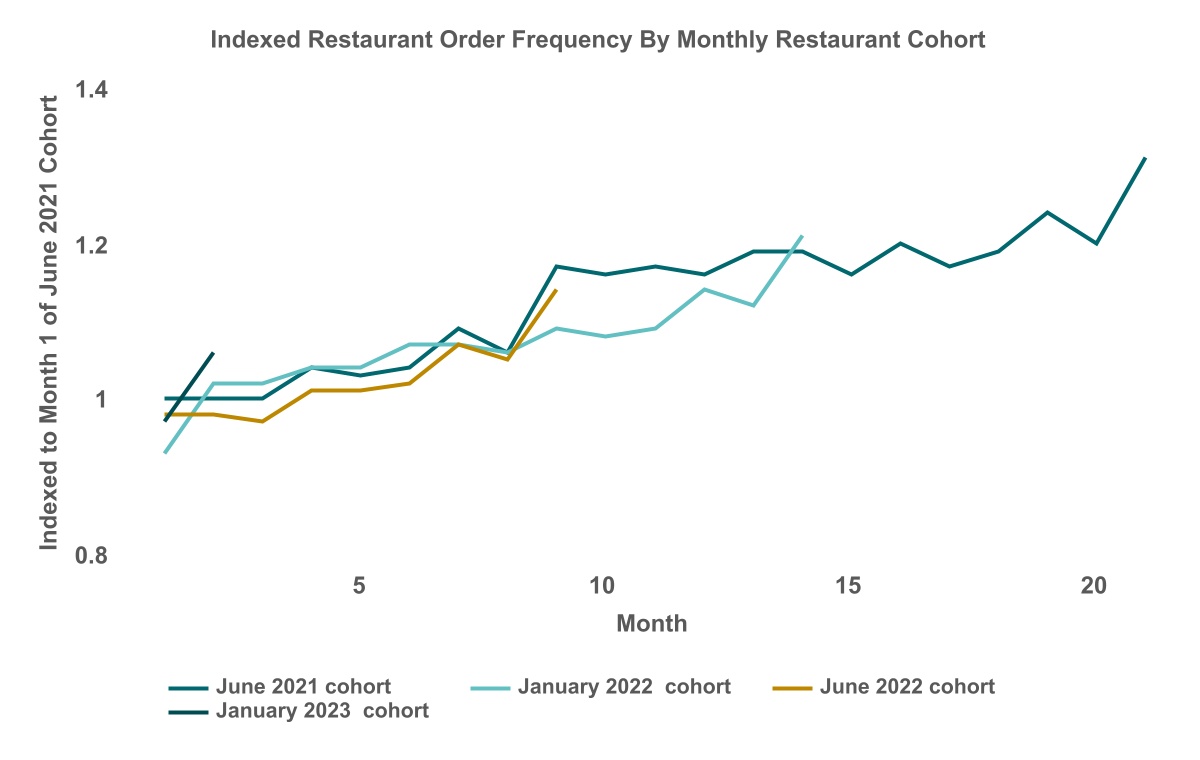
Source: DoorDash internal data
In the 12 months through March 2023, we spent well over $13 billion on research and development, sales and marketing, and direct costs associated with processing, fulfilling, and supporting orders for our merchant partners, while collecting less than $8 billion in merchant commissions. We believe the tremendous value restaurants see in their commission dollars is evident in the growing number of restaurants that choose to be on our Marketplaces, the growth in sales for our restaurant partners, and the increases in our U.S. merchant net promoter score3, which recently reached an all time high.
We are proud that we have driven growth in consumers and sales for restaurants on our Marketplaces, and pleased with the growth and margin improvement in our U.S. restaurant category. Our intention is to continue investing in the category to drive our combined success for many years to come.
New Verticals
While we started in restaurants, our mission has always been to support local merchants of all types. We formally launched our first non-restaurant category, convenience, in 2020 and have since expanded to grocery, alcohol, pets, flowers, beauty, and retail. These efforts remain early, and we have significant room to improve the quality of experience we offer. Given the complexity of each of these categories, progress is more likely to come in small increments than large breakthroughs. Our teams are comfortable with this dynamic, as it is the nature of operating across the physical and digital worlds and is similar to what we face in restaurants.
Since launching each of our new vertical categories, we have worked hard to improve the underlying quality of experience we offer, which is beginning to show positive results. In the U.S. grocery category, we have made double-digit percentage
3 Merchant net promoter score is based on responses to a weekly survey question “How likely are you to recommend DoorDash to another business?”, with answers given on a scale of 0 through 10. It is calculated as the percentage of survey respondents who choose 9 or 10 minus the percentage of respondents who choose 0 through 6. Merchant net promoter score can range from -100 to +100.
2
improvements in a number of our key quality and efficiency metrics over the last year. We made many similar improvements in our other new vertical categories.
These improvements are helping Dashers fulfill orders more consistently and more efficiently, and making it easier and more effective for merchants to leverage our platform, which attracts more merchants. Quality improvements also increase value for consumers, which we believe is contributing to growing cohort level order frequency in our non-restaurant categories4. This further enhances the value for merchants by driving incremental sales and the value for Dashers by creating more earning opportunities.
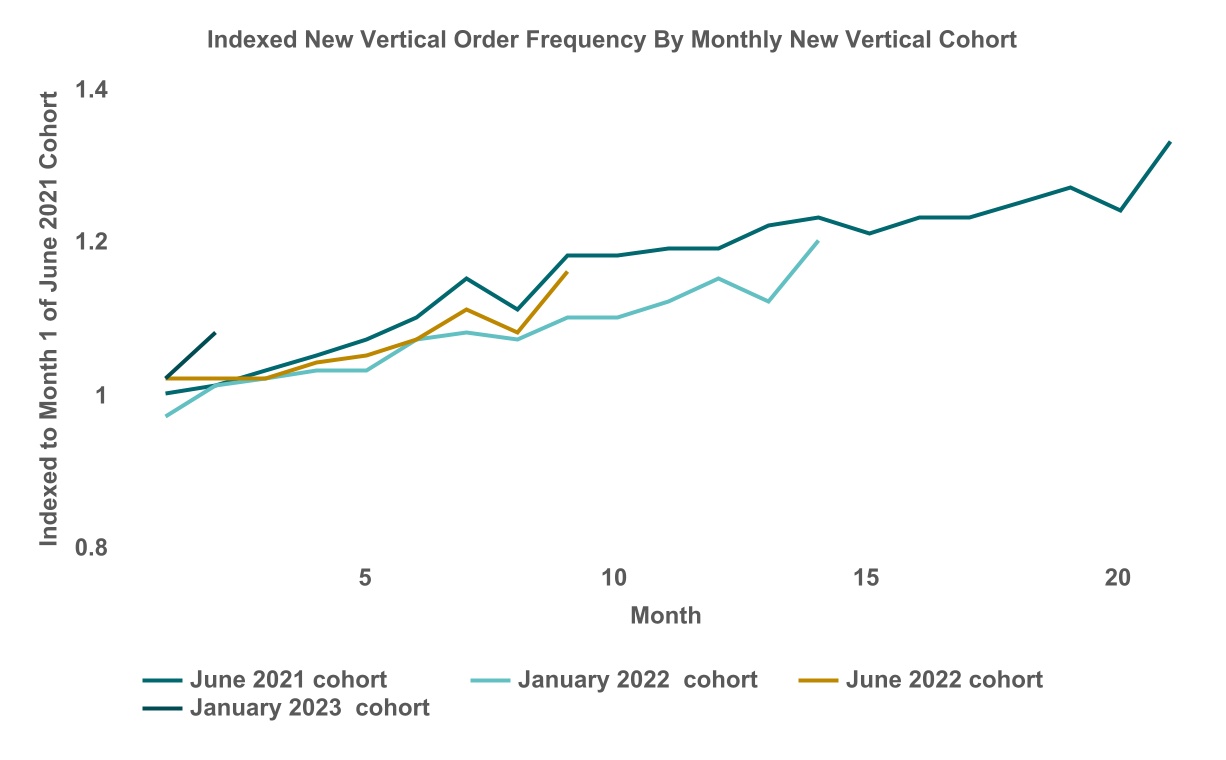
Source: DoorDash internal data
As is often the case, the progress we make in improving the experience we provide to consumers, merchants, and Dashers also benefits our own operating efficiency. In Q1 2023, we drove Q/Q and Y/Y increases in variable profit5 as a percentage of Marketplace GOV in our U.S. new verticals as a whole.
Dashers
In order to succeed as a business, we must make dashing attractive. Since our founding, we have worked hard to make dashing more accessible, easier to use, and more rewarding. This has attracted a growing number of Dashers, which has contributed to healthy supply in recent quarters. It has also contributed to improved quality and efficiency in our local logistics network. We are incredibly proud that dashing has become an earnings tool that millions of people choose to use each quarter, and a logistics tool that millions of consumers rely on to connect with their favorite local merchants.
4 Monthly new vertical cohorts are defined based on the month the consumer placed their first order in a non-restaurant category on the DoorDash Marketplace.
5 Variable profit is a metric used internally to evaluate the performance of certain categories prior to allocation of shared-use fixed costs. It is defined as revenue minus order management and support costs.
3
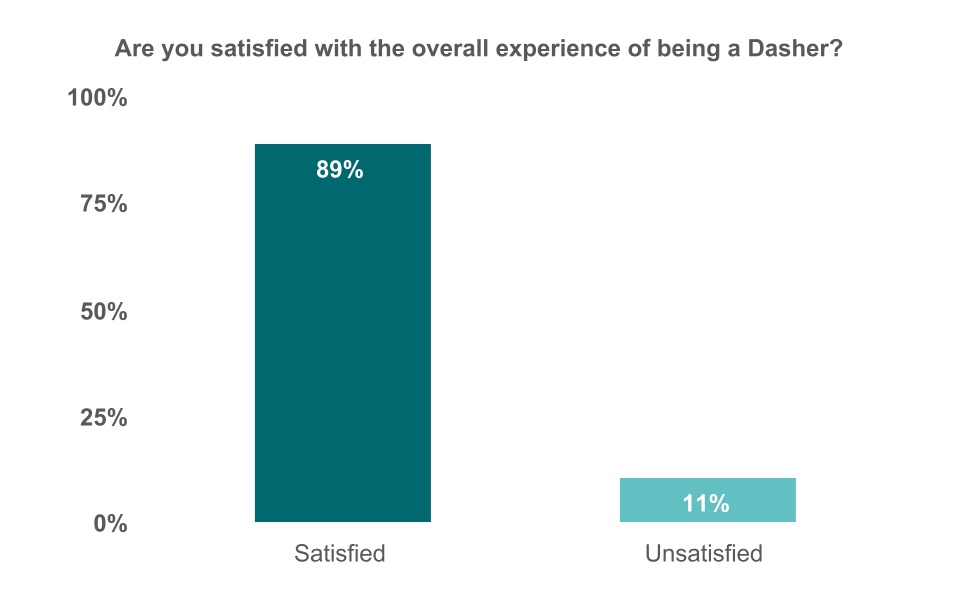
Source: March 2023 survey of 6,785 U.S. Dashers
Despite growing awareness for dashing, we believe it remains misunderstood and the subject of misinformation in some quarters, as many people struggle to assess the value of something that does not fit their existing notions. Dashing aims to provide as many people as possible the opportunity to earn income whenever they want, which is a contrast to most traditional work, which aims to provide a select number and type of people a fixed amount of work at specified periods.
Dashing has very low barriers-to-entry, even lower barriers-to-exit, and Dashers can choose whether to use our platform at any time, which means we must earn Dashers’ time and effort with every order. We do this by providing a combination of ease, accessibility, flexibility, and scale that allows people to generate income around the other commitments they have in their lives. In our March 2023 survey of 6,785 U.S. Dashers, 84% of respondents indicated they had other jobs, other responsibilities like being stay-at-home parents or students, or were retired.
In addition to fitting around people’s lives, dashing’s accessibility and flexibility allow people to meet short-term financial goals in ways that traditional jobs and other independent contractor work are often poorly suited for. This helps Dashers better manage their financial lives. In our March 2023 survey, 86% of Dashers indicated dashing makes them feel more in control of their circumstances, and 76% said they feel less stressed and anxious about their financial situation because they can dash whenever they need. For some Dashers, the short-term goal is to avoid government assistance or punitive loans; in that same survey, 17% of Dashers said they have dashed to avoid applying for food stamps, unemployment insurance, or other government assistance, and 25% of Dashers said dashing helped them avoid taking out a payday loan. We believe having the choice to earn incremental income is empowering financially and psychologically, and we are very proud that dashing appears to provide this for so many.
In addition to Dashing’s value and incrementality to individuals, we believe its differences from other types of work allow it to be incremental to the broader labor market. Over the last 12 months in the United States, the unemployment rate has been near historic lows and there have been an average of more than 10 million job openings compared to an average of less than six million people looking for work. Despite the plethora of traditional job openings, more than 2% of the U.S. adult population6 chose to dash over the last year, earning well over $10 billion. This suggests dashing addresses incremental demand in the labor market that is not being met by traditional jobs, unlocks incremental productive capacity, and increases overall income.
Regardless of one's perception of work, its purpose is to help people achieve certain financial goals and live fulfilling lives. Dashing seems to help millions of people with this. We hope pundits and policymakers looking to shape future policies
6 Based on data collected from the United States Census Bureau in the 2020 Census.
4
around work consider what Dashers say and do, the value of choice, and the goal of supporting individuals and families in achieving their goals.
Conclusion
DoorDash only works when it works for everyone. We believe removing friction and adding choice for all of our stakeholders are the best ways to grow and empower local economies, which, in turn, is the best way for us to build a large and durable business. Since our founding, we have invested aggressively to provide services that give merchants more ways to build and grow their businesses, provide a larger number of earnings opportunities that are accessible, flexible, and attractive, and allow more consumers to discover and buy from their favorite local merchants. This has also driven substantial growth in the scale of our business.
There is an enormous amount of work still to be done if we are to live up to our mission and drive the value for shareholders that we expect. We are proud of the impact we have made so far and even more excited about the process and progress that is to come. Our expectations of ourselves are high. We will do our best to exceed them.
We could not be more grateful to our employees and stakeholders for the confidence they place in us, or more humbled by our shareholders who entrust us with their capital. Thank you for making this journey possible.
Sincerely,
Tony Xu, Co-founder, CEO and Board Chair, and Ravi Inukonda, CFO
5
Forward-Looking Statements
This investor letter contains forward-looking statements within the meaning of Section 27A of the Securities Act of 1933, as amended, and Section 21E of the Securities Exchange Act of 1934, as amended, which statements involve substantial risks and uncertainties. Forward-looking statements generally relate to future events or our future financial or operating performance. In some cases, you can identify forward-looking statements because they contain words such as “may,” "aim," “will,” “should,” “expect,” “plan,” "try," “anticipate,” “could,” “would,” “intend,” “target,” “project,” “contemplate,” “believe,” “estimate,” “predict,” “potential” or “continue” or the negative of these words or other similar terms or expressions that concern our expectations, strategies, plans, or intentions. Forward-looking statements in this investor letter include, but are not limited to, our expectations regarding our financial position and operating performance, our expectations regarding Wolt and our international business, our plans and expectations regarding our investment approach, our expectations regarding our local commerce opportunity, trends in our business, including the effects of the macroeconomic environment, inflation, consumer spending, and demand for our platform and for local commerce platforms in general. Our expectations and beliefs regarding these matters may not materialize, and actual results in future periods are subject to risks and uncertainties that could cause actual results to differ materially from those projected, including risks and uncertainties related to: competition, managing our growth and corporate culture, financial performance, including our ability to forecast our performance due to our limited operating history , investments in new geographies, products, or offerings, our ability to attract merchants, consumers, and Dashers to our platform, legal proceedings and regulatory matters and developments, any future changes to our business or our financial or operating model, and our brand and reputation. The forward-looking statements contained in this investor letter are also subject to other risks and uncertainties that could cause actual results to differ from the results predicted, including those more fully described in our filings with the SEC, including our Annual Report on Form 10-K for the year ended December 31, 2022 and our quarterly reports on Form 10-Q. All forward-looking statements in this investor letter are based on information available to DoorDash and assumptions and beliefs as of the date hereof, and we disclaim any obligation to update any forward-looking statements, except as required by law.
6