
DFDV 10-K
DeFi Development Corp. (DFDV)
10-K
2026-03-30
For: 2025-12-31
View Original
Added on
April 07, 2026
UNITED STATES
SECURITIES AND EXCHANGE COMMISSION
Washington, D.C. 20549
____________________
FORM 10-K
____________________
(Mark One)
ANNUAL REPORT PURSUANT TO SECTION 13 OR 15(d) OF THE SECURITIES EXCHANGE ACT OF 1934 | |||||
For the fiscal year ended December 31 , 2025
OR
TRANSITION REPORT PURSUANT TO SECTION 13 OR 15(d) OF THE SECURITIES EXCHANGE ACT OF 1934 FOR THE TRANSITION PERIOD FROM TO | |||||
Commission File Number 001-41748
____________________
(Exact name of Registrant as specified in its Charter)
____________________
(State or other jurisdiction of incorporation or organization) | (I.R.S. Employer Identification No.) | ||||
| (Address of principal executive offices) | (Zip Code) | ||||
Registrant’s telephone number, including area code: (561 ) 559-4111
____________________
Securities registered pursuant to Section 12(b) of the Act:
| Title of each class | Trading Symbol(s) | Name of each exchange on which registered | ||||||
The | ||||||||
The | ||||||||
Securities registered pursuant to Section 12(g) of the Act: None
Indicate by check mark if the Registrant is a well-known seasoned issuer, as defined in Rule 405 of the Securities Act. Yes ☐ No ☒
Indicate by check mark if the Registrant is not required to file reports pursuant to Section 13 or 15(d) of the Act. Yes ☐ No ☒
Indicate by check mark whether the Registrant: (1) has filed all reports required to be filed by Section 13 or 15(d) of the Securities Exchange Act of 1934 during the preceding 12 months (or for such shorter period that the Registrant was required to file such reports), and (2) has been subject to such filing requirements for the past 90 days. Yes ☒ No ☐
Indicate by check mark whether the Registrant has submitted electronically every Interactive Data File required to be submitted pursuant to Rule 405 of Regulation S-T (§232.405 of this chapter) during the preceding 12 months (or for such shorter period that the Registrant was required to submit such files). Yes ☒ No ☐
Indicate by check mark whether the registrant is a large accelerated filer, an accelerated filer, a non-accelerated filer, smaller reporting company, or an emerging growth company. See the definitions of “large accelerated filer,” “accelerated filer,” “smaller reporting company,” and “emerging growth company” in Rule 12b-2 of the Exchange Act.
| Large accelerated filer | ☐ | Accelerated filer | ☐ | ||||||||
| ☒ | Smaller reporting company | ||||||||||
| Emerging growth company | |||||||||||
If an emerging growth company, indicate by check mark if the registrant has elected not to use the extended transition period for complying with any new or revised financial accounting standards provided pursuant to Section 13(a) of the Exchange Act. o
Indicate by check mark whether the registrant has filed a report on and attestation to its management’s assessment of the effectiveness of its internal control over financial reporting under Section 404(b) of the Sarbanes-Oxley Act (15 U.S.C. 7262(b)) by the registered public accounting firm that prepared or issued its audit report. ☐
If securities are registered pursuant to Section 12(b) of the Act, indicate by check mark whether the financial statements of the registrant included in the filing reflect the correction of an error to previously issued financial statements. ☒
Indicate by check mark whether any of those error corrections are restatements that required a recovery analysis of incentive-based compensation received by any of the registrant’s executive officers during the relevant recovery period pursuant to §240.10D-1(b). o
Indicate by check mark whether the Registrant is a shell company (as defined in Rule 12b-2 of the Exchange Act). Yes ☐ No ☒
The aggregate market value of common stock held by non-affiliates of the Registrant, as of June 30, 2025, was approximately $248,448,542 . The number of shares of Registrant’s Common Stock outstanding as of March 30, 2026 was 29,497,394 .
DOCUMENTS INCORPORATED BY REFERENCE
None.
Table of Contents
| Page | ||||||||
Trademarks, Trade Names and Service Marks
This Annual Report on Form 10-K contains trademarks, service marks and trade names owned by us, as well as those owned by others. The use or display of other companies’ trade names, trademarks or service marks does not imply our endorsement or sponsorship of, or a relation with these companies.
 | i | ||||
PART I
FORWARD-LOOKING STATEMENTS
This Annual Report on Form 10-K (this “Annual Report”) contains forward-looking statements within the meaning of the Private Securities Litigation Reform Act of 1995, Section 27A of the Securities Act of 1933, as amended (the “Securities Act”) and Section 21E of the Securities Exchange Act of 1934, as amended (the “Exchange Act”), including statements that involve expectations, plans, or intentions. These statements include but are not limited to discussions on our strategy, future operations, future revenue, projected costs, prospects, plans and objectives of management. These forward-looking statements can be identified by words such as "may," "will," "would," "should," "could," "expect," "anticipate," "believe," "estimate," "might," "intend," "continue," "strategy," "future," "opportunity," "plan," "predict," "project," "target," "potential", "forecast," and other similar expressions. These forward-looking statements involve known and unknown risks and uncertainties that may cause our actual results and financial condition to significantly differ from those expressed or implied in our forward-looking statements. We discuss such risks and uncertainties in this Annual Report on Form 10-K below in Item 1A, Risk Factors, as well as in our consolidated financial statements, related notes, and the other information appearing in this Annual Report and our other filings with the Securities and Exchange Commission (“SEC”). We do not intend, and assume no obligation except as required by law, to update any of our forward-looking statements after the date of this Annual Report to reflect actual results, new information, or future events or circumstances. Readers are cautioned not to place undue reliance on such forward-looking statements.
ITEM 1. BUSINESS.
OVERVIEW
DeFi Development Corp. ("we," "our," "DeFi Dev," "us," or the "Company") is a publicly traded company focused on building and managing a digital asset treasury strategy centered on the Solana blockchain ecosystem. We also provide an artificial intelligence (“AI”) platform that connects commercial mortgage and small business borrowers looking for debt to refinance, build, or buy commercial property, including apartment buildings, to commercial property lenders.
During 2025, we pivoted our primary business strategy to the acquisition, long-term holding, and active management of Solana ("SOL") and SOL-related digital assets. Our treasury strategy includes accumulating SOL, locked SOL, liquid staking tokens such as dfdvSOL, and other SOL-denominated or SOL-native positions, and actively supporting the Solana ecosystem. We also operate and manage Solana validators and delegate our digital asset holdings with external validators, enabling us to participate directly in the Solana proof-of-stake consensus mechanism and generate staking rewards.
We consider these our two operating segments:
•Digital Asset Treasury: focuses on executing and managing our treasury strategy. Also includes our owned and managed SOL validators. This segment continuously evaluates capital market conditions, the broader cryptoeconomy, and macroeconomic factors in determining the timing and structure of financing transactions used to support the digital asset treasury strategy. The primary objective is to expand exposure to the Solana ecosystem over the long term.
•Real Estate Platform: operates our commercial real estate technology platform, which provides data, software subscriptions, and value-added services connecting commercial property borrowers and lenders, including banks, credit unions, real estate investment trusts (“REITs”), debt funds, and other institutional capital providers.
RECENT BUSINESS DEVELOPMENTS
CHANGE OF CONTROL
We were originally formed as a limited liability company, Janover Ventures, LLC, on November 28, 2018, in the State of Florida and converted to a corporation as Janover Inc., incorporated in the State of Delaware on March 9, 2021.
| 1 | ||||
On April 4, 2025, Blake Janover, then Chief Executive Officer and Chairman of DeFi Development Corp. (formerly Janover Inc.), entered into a Stock Purchase Agreement (“Purchase Agreement”) with DeFi Dev LLC, a Delaware limited liability company, and 3277447 Nova Scotia Ltd, a corporation formed under the laws of Nova Scotia, Canada (“NS Corp”) to sell 5,100,424 shares of common stock of the Company (“Common Stock”), with each share of common stock entitled to one vote per share and representing approximately 51.0% of the Company’s issued and outstanding shares of Common Stock, and 10,000 shares of Series A preferred stock of the Company, with each share of Series A preferred stock entitled to 10,000 votes per share on all matters entitled to be voted upon by the holders of Common Stock, unless otherwise prohibited by law. DeFi Dev LLC and NS Corp were previously unaffiliated parties to the Company. The transactions under the Purchase Agreement constituted a change in control of the Company.
On April 17, 2025, the Company changed its name from “Janover Inc.” to “DeFi Development Corp.”. Additionally, in April 2025, our board of directors adopted a new treasury policy, which updated our treasury management to include digital assets.
DIGITAL ASSET STRATEGY
In April 2025, we implemented a digital asset treasury strategy in accordance with our updated treasury policy to diversify our treasury holdings through the acquisition and management of digital assets. Our initial focus under this strategy is to accumulate and hold SOL, the native token of the Solana Network. We acquire SOL with cash on hand and from issuing debt or equity securities through capital raises, subject to market conditions. We do not currently maintain a specific target for the amount or type of digital assets we intend to acquire or hold, and we do not presently have plans to acquire a significant amount of any cryptocurrency other than SOL and SOL-related digital assets.
We believe that investing in the Solana Network through its native token provides an opportunity for us to create value for our shareholders due to the continuous disruptive innovation the network offers.
Solana Network and SOL
Solana is a decentralized open-source Layer-1 blockchain optimized for speed, cost-efficiency, and scalability. No single entity owns or operates the network, which is maintained by the decentralized user base. It is an integrated, high-performance global network that enables fast, secure, and low-cost digital transactions. The network enables users to instantly send money globally through Solana Pay, trade digital assets, utilize smart contracts, and buy or sell fungible and non-fungible tokens at a fraction of a cent in fees.
The Solana Network was developed to solve scalability and transaction speed issues experienced with traditional blockchains by using an innovative blockchain architecture. This architecture combines Proof-of-History (“PoH”) with Proof-of-Stake (“PoS”) to reduce the time and overhead required for validators to reach consensus on transaction order. PoH is a digital timestamp mechanism that enables the network to track the time and order of transactions. PoH provides faster transaction processing speeds and larger transaction capacity than other blockchain networks like Bitcoin and Ethereum. PoS is used to incentivize SOL holders to validate transactions through staking. Users of the network initiate transactions that are timestamped, verified by validators and recorded on the blockchain ledger for a low transaction fee.
Transaction fees include base fees and priority fees. Each transaction includes a base fee, which is a fixed charge used to compensate validators. Users of the Solana Network may also pay an optional priority fee to expedite transaction validation during periods of increased network activity. All transaction fees are paid with the network’s native token, SOL, and a portion of each fee is permanently destroyed.
The native token is also used in staking, for participation in the network’s governance, and as payment to validators for securing the network and processing transactions.
The Solana Protocol was initially developed by Anatoly Yakovenko in a 2017 whitepaper with the first mainnet launched in March 2020. Development of the Solana Network is overseen by the Solana Foundation (the “Foundation”), a non-profit organization based in Switzerland, and Solana Labs, Inc. (“Solana Labs”), a Delaware corporation, which administered the initial launch of the network and token distribution. Although the Foundation and Solana Labs have some influence over the developmental direction of the Solana Network, changes to the protocol must be accepted by validators that collectively represent a supermajority (two-thirds) of the cumulative validations on the Solana blockchain.
2 | | ||||
Proof-of-Stake
As previously mentioned, the Solana Network utilizes a PoS consensus mechanism, which enables SOL token holders to earn rewards by participating in securing the network through a validation process commonly known as staking. Staking is performed by network node operators, known as validators, to ensure that transactions are verified and properly recorded on the blockchain network. In order to become a validator, each node operator must meet certain hardware and technical requirements, install Solana Network software protocols, and delegate SOL onto the validator. Validators are rewarded with newly minted SOL for staking on the Solana Network. The amount of rewards received varies and is based on the Solana Network’s annual inflationary rate of 4.2%, validator performance, and total SOL staked to the validator as compared to the total Solana Network. Generally, the greater the amount of SOL delegated, the higher the probability of being selected to validate transactions and earn rewards. To increase the probability of being selected, validators will offer staking services to institutions and individuals through crypto exchange platforms, such as Coinbase, and partnerships for a commission.
The Solana Network was created with economic incentives in place to discourage malicious behavior. While programmatic slashing, as implemented in other networks such as Ethereum, is not currently active on Solana, it may be introduced in the future. Currently, slashing on the Solana Network is determined through social consensus in response to network halts caused by validator misconduct or “safety violations.”
Staking is widely used as an alternative to proof-of-work (“PoW”) mining and is generally viewed as more energy-efficient and accessible, as it does not require specialized hardware or high electricity consumption. Instead, staking leverages ownership of digital assets to help secure the network and validate transactions.
Solana Tokeneconomics
The Solana Network protocol follows a declining inflationary model to reward validators. At network launch, the inflationary rate was approximately 8.0%. That rate declines by 15% each epoch-year, approximately 180 epochs (generally 365 calendar days), until it reaches a long-term terminal rate of 1.5%. As of December 31, 2025, Solana’s inflationary rate was approximately 4.2%. In addition to inflationary rewards, validator and delegator income includes transaction fees, priority fees, and maximal extractable value (“MEV”) captured by the network.
Solana Supply
The Solana Network launched with a circulating supply of 8.0 million SOL tokens, which has grown to 567.4 million SOL tokens as of December 31, 2025. SOL does not have a fixed maximum supply, with new SOL tokens introduced primarily through inflationary rewards distributed to validators and delegators. However, the Solana Protocol features a burn mechanism where a portion of all transaction fees is permanently destroyed, creating the potential for the network to become deflationary with sufficient usage. As of December 31, 2025, SOL had a market capitalization, according to Coinbase, of over $70.0 billion and an average daily trading volume of approximately $5.6 billion in 2025.
Solana Price
The price of SOL has historically been highly volatile and will likely continue to be volatile. SOL’s price may fluctuate significantly in a short period of time. The price of SOL is impacted by, but not limited to, the usage levels on the Solana Network, market speculation of SOL and the cryptoeconomy, and investment and trading activities of large investors that invest directly or indirectly in SOL. The price of SOL is also affected by interruptions in service from, closures or failures of major digital asset exchange platforms, such as FTX. The price of SOL may be adversely impacted by changes to the regulatory environment. We do not currently hedge our exposure to SOL price fluctuations, but may do so in the future.
Solana Use Cases
Solana Pay. Enables users to instantly send money globally. Solana Pay is an open-source protocol built on the Solana blockchain — anyone can build on or transact with Solana Pay. Per Solana’s website, as of December 31, 2025, Solana Pay had $695.0 million USDC in circulation on the network and over 280.0 thousand active daily accounts.
Decentralized Exchanges (“DEXs"). Enables users to trade digital assets through decentralized exchanges built on the Solana Network, such as Orca and Raydium. As of December 31, 2025, the average daily DEX volume was approximately $4.0 billion.
| 3 | ||||
Smart Contracts. Enable users through platforms such as Jupiter and Kamino, to enter into lending, borrowing, and staking transactions. As of December 31, 2025, Jupiter was the current leader in total locked value on the Solana Network at $2.1 billion.
Fungible and Non-fungible Tokens (“NFTs”). Infrastructures built on the Solana Network, such as Metaplex, enable users to create, sell, and manage NFTs on the Solana blockchain. The Solana Network enables users to buy and sell fungible tokens that are integrated into the network, such as Circle’s USDC and Tether’s USDT. As of December 31, 2025, the current average daily NFT volume was approximately $0.7 million, and stablecoins had a market capitalization of approximately $14.9 billion.
Agentic AI Applications. Solana is emerging as a preferred settlement layer for autonomous AI agents due to its high throughput, sub-second finality, and ultra-low transaction costs, enabling seamless machine-to-machine payments, DeFi interactions, and onchain economic coordination at scale. As agentic AI ecosystems grow—facilitating tasks like automated trading, data verification, and cross-protocol orchestration—structural demand for SOL is expected to increase significantly as agents require frequent, efficient blockchain access. Research from DeFi Development Corp. estimates a base-case scenario of $27.0 billion in SOL demand driven solely by agentic finance applications in the coming years.
DESCRIPTION OF OUR BUSINESSES
DIGITAL ASSET TREASURY
OVERVIEW
The digital asset treasury segment executes and manages the Company’s treasury policy with the purpose of purchasing, holding and compounding our digital asset holdings through staking and operating validators. Revenue is primarily generated through delegating our digital asset holdings with external staking providers. We also generate revenue from operating five Solana validators, including the two validators we own.
External Staking
Our digital asset treasury strategy includes the delegation of SOL holdings to external validators with the objective of generating yield while supporting the Solana ecosystem validation process. In exchange for delegating our digital assets to validators, we receive a portion of the validators’ total earned rewards in the form of SOL, net of any commission fees. The amount of revenue received varies and is based on the Solana Network’s annual inflationary rate, validator performance, total SOL staked to the validator as compared to the total Solana Network and overall network conditions. The commissions that we pay, if any, for external staking services vary per validator, as each establishes its own rate.
All Solana validators have a bonding and unbonding period of one epoch, which lasts approximately three days. During the bonding and unbonding periods, and while staked, we are not able to withdraw or liquidate our staked SOL. The Solana protocol also imposes a limit on the total amount of SOL that can be staked or unstaked in a single epoch to prevent large and sudden network staking activity. We believe the illiquidity that may result from the previously mentioned items would have a minimal impact on our financial condition.
To date, we have not set a minimum or maximum amount of SOL holdings that may be staked to external validators. We intend to reinvest earned staking revenue into external staking platforms; however, we may from time to time monetize staking rewards for cash to fund operating and working capital requirements.
Validator
Our owned and managed validators participate in securing the Solana Network through creating and validating transactions on the blockchain, known as the PoS consensus protocol. In exchange for providing these services, we receive revenue in the form of Solana, and the amount varies based on several factors including an annual inflationary rate, the performance of owned and managed validators, and the amount of SOL that is delegated on the validators as compared to the Solana Network, which may include our own SOL holdings. As of December 31, 2025, we had approximately 0.4 million SOL tokens staked to our validators of which none represented our own holdings. We receive revenue for services provided at the end of each Solana epoch, which is less than three days, and may include staking rewards from our own SOL holdings. Our validator operations require us to actively manage hardware equipment and run software. These operating costs are de minimis, and do not materially impact the profitability of our validator operations.
4 | | ||||
To date, we have not set a minimum or maximum amount of SOL holdings that may be staked to our owned validators. We intend to reinvest earned validator revenue into our validators where it will continue to generate rewards and support validator operations; however, we may from time to time monetize staking rewards for cash to fund operating and working capital requirements.
DIGITAL ASSET ACQUISITION CHANNELS
To facilitate our staking program, we acquire SOL primarily through over-the-counter (“OTC”) and spot trading platforms, as well as from earning SOL from our validator operations. We also enter trading transactions for locked or vesting SOL blocks, as these are typically sold at prices lower than the current spot rate due to transfer restrictions.
COUNTERPARTY
Our primary trading and custodial counterparties include Payward Inc (“Kraken”), BitGo Trust Company, Inc. (“BitGo”), and Galaxy Digital Inc. (“Galaxy”), which safeguard our digital asset holdings and/or execute trading on our behalf. Management performs due diligence reviews and selects counterparties that offer institutional-level services and products, are insured and regulated, have implemented strict security protocols, and have proven regulatory compliance.
We use Kraken hot wallets, which are wallets connected to the internet and allow transaction broadcasting, to execute approximately 95% of our Solana spot trading transactions. Kraken has entities registered as money service businesses with the Financial Crimes Enforcement Network (“FinCEN”), is licensed as a money transmitter in various states across the U.S. and chartered as a Special Purpose Depository Institution by the Wyoming Division of Banking. Kraken’s terms of service, as stated on their website, are open-ended and may be terminated by either party without prior notice.
We have a custody agreement with BitGo, under which BitGo provided to us customary qualified custody services. BitGo Trust is a South Dakota trust company licensed to act as a custodian, safeguarding approximately 20%-50%, depending on trading and staking activity, of our SOL holdings in segregated cold wallets, which are wallets that are offline and generally used for storage solutions. BitGo wallets are supported by a $250 million insurance policy issued by a syndicate of insurers in the Lloyd’s of London and European Marketplace.
We use Galaxy’s institutional product, GalaxyOne Institutional (“GalaxyOne”), which, depending on trading and staking activity, holds approximately 20%-40% of our SOL holdings in a hot wallet. GalaxyOne provides a gateway for institutions to trade, custody, stake, and manage digital assets. It is operated under GalaxyOne Prime LLC (“GalaxyOne Prime”), a FinCEN-registered money service business. GalaxyOne Prime partnered with Paxos Trust Company, LLC to custody digital assets on behalf of its clients. Paxos is a New York State-chartered trust company, overseen by the New York Department of Financial Services. GalaxyOne Prime’s terms of service, as stated on their website, are open-ended and may be terminated by either party without prior notice.
NETWORK AND TECHNOLOGY
Our digital asset treasury operations are dependent on the continued development, adoption and functionality of the Solana Network. Changes to the Solana Network, including upgrades, protocol changes and governance decisions, may impact staking mechanics, reward rates, validator economics or network participation requirements.
Our staking operations rely on external service providers to operate validator infrastructure, monitor performance, manage staking activities and safeguard delegated digital assets. These external staking service providers are subject to risks associated with cybersecurity attacks, network disruptions and evolving technical standards.
Operating our owned validators requires us to actively manage hardware equipment and run software. We monitor and periodically enhance our validator infrastructures to ensure compatibility with the Solana ecosystem. Our owned validators are also subject to risks associated with cybersecurity attacks, network disruptions and evolving technical standards.
| 5 | ||||
COMPETITION
Our digital asset treasury strategy segment operates in a highly competitive and ever-changing crypto landscape and faces significant competition, including but not limited to, larger digital asset treasury companies, digital asset trading platforms, and independent validator operators. The cryptoeconomy is continuously expanding, and we expect to face competition from new entrants in the future as the adoption of digital assets continues to grow.
SEASONALITY
Results for our validators may be subject to cyclical impacts related to period-over-period variability as Solana epochs may not coincide with calendar days, months, or years. Network activity, staking participation, transaction volumes and digital asset prices may be impacted by broader market conditions, protocol changes, investor sentiment, and macroeconomic factors which may vary our digital asset treasury segment results from period to period.
REAL ESTATE PLATFORM
OVERVIEW
We have developed a platform that connects commercial mortgage and small business borrowers looking for debt to refinance, build, or buy commercial property, including apartment buildings, to commercial property lenders. These property lenders include traditional banks, credit unions, REITs, debt funds, and other financial institutions looking to deploy capital into commercial mortgages. The platform connects borrowers to our internal capital markets advisors who guide the borrower through the process and connect them with the right loan product and lender.
As previously announced, in September 2025, we disposed of Janover Pro (“JPro”), one of our technology and software as a service platforms (“SaaS”), which provided users detailed information about lenders based on user criteria and allows them to connect directly with those lenders to secure financing.
Platform
The real estate segment derives its revenue primarily from platform fees. Platform fees include referral and advisory fees generated from multifamily and commercial real estate and small business debt transactions. We earn platform revenue from fees charged to our customers that utilize our platform and our capital markets advisor sales team, who will assist in the match between lenders and borrowers. These fees include a share of the revenue per transaction by the lender, typically 1% of the loan amount, and in some cases a fixed negotiated fee from the borrower.
We also derive revenue from our SaaS offering for real estate investors raising equity, through the Company’s wholly owned subsidiary, Groundbreaker Tech Inc. The SaaS offering, rebranded as Janover Connect, streamlines the capital raising process by providing a professional investor portal where potential investors can analyze opportunities, sign documents, make investments, and track their investment portfolios. This SaaS offering is subscription based, generally over a period of one year, and the majority is paid monthly.
Our platform provides tools to help stakeholders navigate the most complex components of the multifamily and commercial property lifecycles – debt (Janover Capital Markets), insurance (Janover Insurance), and equity (Janover Connect, Janover Engage).
NETWORK AND TECHNOLOGY
Our real estate platform operations are dependent on the functionality of our lender and borrower data sources and our customer relationship management which are both powered by HubSpot. Our Janover Connect SaaS offering is a developed technology which utilizes the Amazon Web Services platform. These platforms may be subject to risks associated with cybersecurity attacks, network disruptions and evolving technical standards.
COMPETITION
We believe there are three categories of competitors for our real estate platform which include: commercial mortgage brokers, commercial mortgage lenders, and established technology companies such as LendingTree, Upstart, and NerdWallet that currently focus on consumer, residential and small business finance.
6 | | ||||
SEASONALITY
The commercial real estate market tends to be seasonal in nature, with the first and fourth fiscal quarters being more active than the second and third fiscal quarters. Such fluctuations have to be considered by investors since quarterly results may not be indicative of the segment’s fiscal year results.
GOVERNMENT REGULATIONS
DIGITAL ASSET TREASURY
Our digital asset treasury segment operates in a complex and constantly evolving regulatory environment. It is subject to various federal, state and local laws and regulations in the United States as well as the laws of other jurisdictions in which we may be deemed to do business. The laws and regulations that we are primarily subject to include securities laws and laws applicable to digital asset and cryptocurrency activities established by the relevant jurisdictions, and failure to comply with such laws (both those currently in effect and future legislation) could expose us to fines and penalties under such laws.
Regulatory authorities, including the SEC, the Commodity Futures Trading Commission (“CFTC”), the U.S. Department of the Treasury, and the Internal Revenue Service (“IRS”), may determine that certain digital assets, staking arrangements, validator activities or related economic interests constitute securities, commodities or other regulated financial instruments. In addition, the U.S. Congress is considering comprehensive market structure legislation for digital assets, which may define digital assets in a manner that would result in heightened regulatory requirements. Any such regulatory or legislative changes could subject us to additional registration, disclosure, compliance or reporting requirements, restrict our ability to hold or stake digital assets, or require changes to our business model.
SECURITIES AND INVESTMENT COMPANY REGULATION
We are subject to the Securities Act and the Exchange Act with respect to our public reporting obligations and securities transactions. We monitor our activities for purposes of the Investment Company Act of 1940, as amended (the “Investment Company Act”), and believe that our digital asset holdings and validator operations are conducted in furtherance of our operating business and treasury management strategy, rather than as an investment company engaged primarily in investing or trading securities.
However, the application of the Investment Company Act and related securities laws to digital asset treasury companies is subject to evolving regulatory interpretation. An adverse determination could require us to restructure our operations, limit the composition of our assets, or register under one or more regulatory regimes.
In March 2026, the SEC issued an interpretation regarding the application of Federal securities laws to certain types of crypto assets (the “Crypto Asset Interpretation”). The SEC’s interpretation confirmed that the SEC views digital commodities, including SOL, as commodities and not as securities. The interpretation also discusses situations in which a non-security digital commodity could become subject to an investment contract that is a security.
STAKING AND VALIDATOR OPERATIONS
We operate validators and participate in the Solana Network's PoS consensus mechanism by staking SOL. Validator operations are governed by protocol-level rules and subject to network-specific requirements relating to performance, uptime and participation. Future laws, regulations, or enforcement actions could impose additional compliance obligations, restrict staking activities, or subject validator operations to licensing or registration requirements. Changes in protocol or regulatory rules could adversely affect the operational results of our validator operations. Additionally, regulators have increasingly scrutinized staking activities, specifically relating to external service providers marketing it as a yield-generating product.
TAXATION
The U.S. federal income tax treatment of digital assets, including staking rewards and validator income, remains subject to limited guidance and evolving interpretation. The IRS has issued guidance addressing certain aspects of digital asset taxation, but additional guidance or legislative changes could affect the timing, character, or
| 7 | ||||
amount of taxable income we recognize. Changes in tax laws or interpretations could materially affect our effective tax rate and results of operations.
CYBERSECURITY AND DATA PROTECTION
Our operations depend on secure digital infrastructure and key management systems. We are subject to federal and state laws and regulations relating to data protection, cybersecurity, and the safeguarding of sensitive information. Cybersecurity incidents, security breaches, or failures of internal controls could result in regulatory scrutiny, enforcement actions, financial loss, or reputational harm.
REAL ESTATE PLATFORM
Our real estate platform segment is subject to various federal, state and local laws and regulations in the United States. The real estate platform segment generally operates as a SaaS platform and does not originate loans, underwrite insurance, act as a broker-dealer, or provide investment advice. Laws and regulations that we may be subject to include financial service and lending-related regulations, data privacy, cybersecurity, customer protection, intellectual property and technology regulations.
MARKET REGULATION
Our equity marketplace platform is designed to support offerings conducted pursuant to Rule 506(c) of Regulation D under the Securities Act by enabling issuers to market offerings to accredited investors and providing tools to showcase such offerings. We do not structure offerings, negotiate terms, provide investment recommendations, determine investor suitability, or receive transaction-based compensation tied to securities transactions. We believe these structural safeguards are designed to avoid classification as a broker-dealer under the Exchange Act or as an investment adviser under the Investment Advisers Act of 1940, as amended (the “Advisers Act”). However, regulatory interpretations in this area are subject to change, and regulators may assert that certain activities require registration or additional compliance obligations.
Our real estate syndication software and investor portal facilitates administrative functions, including investor communications, document sharing, and capital administration. While we do not act as an issuer, placement agent, or investment adviser, the use of our platform by customers in connection with securities offerings may subject us to regulatory scrutiny under federal and state securities laws.
LOAN MARKETPLACE AND FINANCIAL SERVICES REGULATION
Our online loan marketplace platform provides a technology-enabled matching service that allows borrowers and brokers to identify potential lenders for multifamily and commercial real estate loans. We do not originate loans, make credit decisions, underwrite loans, or extend credit. Nevertheless, our activities may implicate federal laws and regulations applicable to financial services technology platforms, including consumer protection, data security, and anti-money laundering regulations, depending on the nature and scope of platform functionality.
Although our loan marketplace primarily serves commercial and multifamily customers rather than consumers, certain federal consumer protection laws, including the Consumer Financial Protection Act and regulations enforced by the Federal Trade Commission (“FTC”), may apply to our marketing practices, disclosures, and handling of customer information.
INSURANCE REGULATION
Our insurance technology subsidiary operates in a regulatory environment governed primarily by state insurance laws pursuant to the McCarran-Ferguson Act. In addition, our insurance-related operations are subject to applicable federal laws, including federal consumer protection statutes and data privacy and security requirements.
DATA PRIVACY AND CYBERSECURITY
Our operations involve the collection, processing, storage, and transmission of sensitive business, financial, and personal information. Accordingly, we are subject to various federal data privacy and cybersecurity laws and regulations, including the Gramm-Leach-Bliley Act and the FTC Safeguards Rule, as well as state privacy and data protection laws. We maintain administrative, technical, and physical safeguards designed to protect
8 | | ||||
customer information and mitigate cybersecurity risks. However, cybersecurity threats are rapidly evolving, and no system can be completely secure.
ARTIFICIAL INTELLIGENCE AND EMERGING TECHNOLOGY REGULATION
Our AI-platform is designed to analyze and synthesize information related to commercial real estate capital markets. While there is currently no comprehensive federal regulatory framework governing artificial intelligence, our use of AI technologies is subject to existing laws and regulations relating to consumer protection, data privacy, intellectual property, and unfair or deceptive acts or practices. Regulatory scrutiny of artificial intelligence technologies continues to increase, and future legislation or regulatory guidance could impose additional compliance obligations or restrict certain uses of AI.
HUMAN CAPITAL
As of December 31, 2025, we had a total of 16 full-time employees.
AVAILABLE INFORMATION
Our internet address is www.dfdv.com. From time to time, we may use our investor relations site and other online and social media outlets, including http://youtube.com/@defidevcorp and http://x.com/defidevcorp, as a means of disclosing information about the Company, including information that could be deemed to be material to investors.
Our Form 10-K, quarterly reports on Form 10-Q, current reports on Form 8-K, and amendments to those reports, if any, are available free of charge on our investor relations website, http://defidevcorp.com/investor, as soon as reasonably practicable after they are electronically filed with, or furnished to, the SEC. The SEC maintains an internet site that contains reports, proxy and information statements, and other information regarding issuers that file electronically with the SEC at http://www.sec.gov.
The information found on these websites is not part of, or incorporated by reference into, this or any other report we file with, or furnish to, the SEC.
ITEM 1A. RISK FACTORS.
Our financial results and the market price of our Common Stock may be affected by the prices of digital assets that we hold.
As part of our capital allocation strategy for assets that are not required to provide working capital for our ongoing operations, we have invested and will continue to invest in SOL and other digital assets. The price of digital assets has historically been subject to dramatic price fluctuations and is highly volatile. Moreover, digital assets, such as SOL, are relatively novel and the application of securities laws and other regulations to such assets is unclear in many respects. It is possible that new legislation, or change in regulatory interpretation of existing law, may adversely affect the liquidity or value of digital assets.
Any decrease in the fair value of digital assets below our carrying value for such assets currently would require us to incur a loss due to the decrease in fair market value, and such charge could be material to our financial results for the applicable reporting period, which may create significant volatility in our reported earnings. Any decrease in reported earnings or increased volatility of such earnings could have a material adverse effect on the market price of our Common Stock. In addition, the application of generally accepted accounting principles in the United States, with respect to digital assets, may change in the future and could have a material adverse effect on our financial results and the market price of our Common Stock.
In addition, if investors view the value of our Common Stock as dependent upon or linked to the value or change in the value of our digital asset holdings, the price of digital assets may significantly influence the market price of our Common Stock.
| 9 | ||||
The price of our Common Stock has been and may continue to be volatile and fluctuate substantially, which could result in substantial losses for purchasers of our Common Stock.
Our stock price has been and is likely to continue to be volatile. The stock market in general has experienced extreme volatility that has often been unrelated to the operating performance of particular companies. With the adoption of our new SOL treasury strategy, we expect to see additional volatility. As a result of this volatility, you may not be able to sell your Common Stock. The market price for our Common Stock may be influenced by many factors, including:
•our digital asset treasury strategy;
•the Solana developer community and whether people continue to engage in building;
•the recruitment or departure of key personnel within the Solana ecosystem;
•downtime and congestion of the Solana Network;
•changes in staking rewards or validator incentives in the Solana ecosystem;
•the success of competitive products to SOL, alternative services or technologies in the blockchain and technology community;
•regulatory or legal developments in the United States and other countries related to digital assets, blockchain and AI;
•variations in our financial results or those of companies that are perceived to be similar to us that also have a SOL treasury strategy;
•the inclusion, exclusion or deletion of our Common Stock from any trading indices;
•issuance of new or updated research or reports by securities analysts;
•sales of our Common Stock and other securities by us or our stockholders;
•general economic, industry and market conditions in the cryptocurrency industry and broader macroeconomic trends related to the digital asset industry; and
•the other factors described in this ‘‘Risk Factors’’ section and in the “Risk Factors” section of our other SEC filings.
Our management may invest or otherwise use the proceeds of any offering by the Company in ways with which you may not agree or in ways that may not yield a return.
Our management will have broad discretion in the application of the net proceeds from any offering by the Company and could use the proceeds in ways that do not improve our results of operations or enhance the value of our Common Stock. The failure by our management to apply these funds effectively could result in financial losses that could cause the price of our Common Stock to decline and delay the development of additional products and services or our pursuit of our new SOL strategy. Pending their use, we may invest the net proceeds from any offering in a manner that does not produce income or that loses value. We will not receive any proceeds from sales by the Selling Stockholders.
Our digital asset holdings are less liquid than our existing cash and cash equivalents and may not be able to serve as a source of liquidity for us to the same extent as cash and cash equivalents. We are also subject to the credit risk of custodians.
Historically, crypto markets have been characterized by significant volatility in price, limited liquidity and trading volumes compared to sovereign currencies markets, relative anonymity, a developing regulatory landscape, potential susceptibility to market abuse and manipulation, compliance and internal control failures at exchanges, and various other risks inherent in their entirely electronic, virtual form and decentralized network. During times of market instability, we may not be able to sell our digital asset holdings at favorable prices or at all. Further, we maintain substantially all of our proprietary digital asset holdings with centralized custodians and transact with trade execution partners. These entities do not have the same protections as are available to cash or securities deposited with or transacted by institutions subject to regulation. For example, U.S. banks are insured by the Federal Deposit Insurance Corporation (“FDIC”) up to $250,000 per depositor in the case of the bank’s insolvency. U.S. broker-dealers are covered by the Securities Investor Protection Corporation (“SIPC”), which ensures recovery of the securities by the depositor. In contrast, cryptocurrency custodians do not offer such protections. If a custodian were to become insolvent, it is possible that we would face delays or difficulties obtaining our digital assets. Moreover, there have been a number of instances in which custodians have used
10 | | ||||
customer funds to fund their own operations. If that were the case with our custodian and the custodian were to become insolvent and file for bankruptcy, we may not be able to obtain all of the digital assets that we had deposited with the custodian. Even if we were to obtain our digital assets, it may require a considerable amount of time and expense, which could adversely impact our financial stability.
Apart from the risk of insolvency of the custodian, there is also a risk of custodians freezing withdrawals, typically in connection with a security incident, regulatory compliance or technical issues, and may be unresponsive to customers attempting to retrieve their funds. In such events, it may be difficult to reach a representative to assist with unfreezing assets and we may not be able to sell or use our digital assets.
Additionally, the secondary market for borrowing against digital assets is not well developed. We may be unable to enter into term loans or other capital raising transactions collateralized by our unencumbered digital assets or otherwise generate funds using our digital assets, especially during times of market instability or when the price of digital assets has declined significantly. If we are unable to sell our digital assets, enter into additional capital raising transactions using digital assets as collateral, or otherwise generate funds using our digital assets or if we are forced to sell our digital assets at a significant loss in order to meet our working capital requirements, our business and financial condition could be negatively impacted.
We may be subject to regulatory developments related to crypto assets and crypto asset markets, which could adversely affect our business, financial condition, and results of operations.
As SOL and other digital assets are relatively novel and the application of state and federal securities laws and other laws and regulations to digital assets is unclear in certain respects, it is possible that regulators in the United States or foreign countries may interpret or apply existing laws and regulations in a manner that adversely affects the price of digital assets. The U.S. federal government, states, regulatory agencies, and foreign countries may also enact new laws and regulations, or pursue regulatory, legislative, enforcement or judicial actions, that could materially impact the price of digital assets or the ability of individuals or institutions such as us to own or transfer digital assets.
There are currently bills introduced into the U.S. Congress that, if they pass, may provide clarity on the market structure of whether digital assets are securities or commodities. If digital assets or related activities, such as staking arrangements, are determined to constitute investment contracts, and therefore securities, for purposes of the federal securities laws, the additional regulatory restrictions imposed by such a determination could adversely affect the market price of digital assets and, in turn, adversely affect the market price of our Common Stock.
Our SOL treasury strategy could create complications with external service providers, such as insurance companies, banking entities and auditors, which could have a materially adverse impact on our business.
Our SOL treasury strategy could create complications with external service providers that may place a high risk on companies engaging in such a treasury strategy. For example, in 2023, the Office of the Comptroller of the Currency, the Federal Reserve and the FDIC issued supervisory statements that digital assets were a “significant risk” to banking organizations. Similarly, external service providers began placing a high degree of risk on digital asset companies, including third-party providers such as insurance companies, banking entities, auditors, payment processors, compliance vendors and public relationship firms.
While the current administration has undertaken a coordinated policy shift across key financial regulatory agencies with respect to regulations of digital assets, the implications of such proposed and future policy changes are uncertain at this time. If future regulations and policy changes were to impose similar limitations as those in 2023, our service providers may refuse to enter into commercially acceptable contracts with us and other companies that engage in similar treasury strategies with digital assets. This could have a number of adverse impacts on the operation of our business. For example, with respect to insurance companies, the cost of our insurance may also increase or our insurers may refuse to underwrite policies or exclude digital asset liabilities from coverage. In the event that we are unable to obtain directors and officers liability insurance on acceptable terms, our directors and officers may be exposed to personal liability in connection with securities class actions, regulatory investigations and other legal proceedings. This could also deter us from retaining key employees or may prevent us from hiring talent. If we were to lose our banking services, it would severely disrupt our ability to maintain liquidity, process payroll, pay vendors or access fiat currency, which would have a significantly adverse impact on our business, financial condition and results of operations. Certain auditors may
| 11 | ||||
also consider custody, fair market valuation, impairment testing and other controls as high-risk. If our auditor determined that it was unable to issue an unqualified opinion or could not engage with us altogether, it may adversely affect our ability to meet our periodic reporting obligations under the Exchange Act and significantly affect our business, financial condition and the ability to raise capital in the public markets.
Regulatory change reclassifying SOL as a security could lead to our falling within the definition of “investment company” under the Investment Company Act of 1940, as amended, or the 1940 Act, and could adversely affect the market price of SOL and the market price of our Common Stock.
Under Sections 3(a)(1)(A) and (C) of the Investment Company Act, a company generally will be deemed to be an “investment company” for purposes of the Investment Company Act if (1) it is, or holds itself out as being, engaged primarily, or proposes to engage primarily, in the business of investing, reinvesting or trading in securities or (2) it is engaged, or proposes to engage, in the business of investing, reinvesting, owning, holding or trading in securities and it owns or proposes to acquire investment securities having a value exceeding 40% of the value of its total assets (exclusive of U.S. government securities and cash items) on an unconsolidated basis. We do not believe that we are an “investment company,” as such term is defined in the Investment Company Act, and are not registered as an “investment company” under the Investment Company Act.
In the Crypto Asset Interpretation, the SEC concluded that SOL is not a “security” for purposes of the federal securities laws. The Crypto Asset Interpretation also identified situations in which a digital commodity, such as SOL, could become subject to an investment contract that would be a “security” for purposes of the federal securities laws. A determination by the SEC or a court of competent jurisdiction that SOL is a security or that SOL that we hold is subject to an investment contract and therefore is a security could lead to our meeting the definition of “investment company” under the Investment Company Act, if the portion of our assets that consists of investments in securities exceeds the 40% limit prescribed in the Investment Company Act, which would subject us to significant additional regulatory requirements that could have a material adverse effect on our business and operations and may also require us to change the manner in which we conduct our business.
We monitor our assets and income in order to conduct our business activities in a manner such that we either do not fall within the definition of “investment company” under the Investment Company Act or would qualify under one of the exemptions or exclusions provided by the Investment Company Act and corresponding SEC rules. If SOL is determined to be a security for purposes of the federal securities laws or SOL that we hold is determined to be subject to an investment contract, we would take steps to reduce our holdings of SOL or such SOL that is subject to investment contracts as a percentage of our total assets. These steps may include, among others, selling SOL that we might otherwise hold for the long term and deploying our cash in assets that are not considered to be investment securities under the Investment Company Act, in which case we may be forced to sell our SOL at unattractive prices. We may also seek to acquire additional assets that are not considered to be investment securities under the Investment Company Act, and we may need to incur debt, issue additional equity or enter into other financing arrangements that are not otherwise attractive to our business. Any of these actions could have a material adverse effect on our results of operations and financial condition. Moreover, we can make no assurance that we would successfully be able to take the necessary steps to avoid meeting the definition of “investment company” under the Investment Company Act and becoming subject to its requirements. If SOL is determined to constitute a security for purposes of the federal securities laws, and if we are not able to come within an available exemption or exclusion under the Investment Company Act, then we would have to register as an investment company, which would require us to change the manner in which we conduct our business. In addition, such a determination could adversely affect the market price of SOL and in turn adversely affect the market price of our Common Stock.
If SOL were considered a security, U.S. exchanges that list SOL would either have to register as a national securities exchange or de-list SOL. The delisting of SOL would have a significantly adverse impact on the liquidity of SOL, which would likely have a material adverse impact on our SOL treasury strategy and our business. Further, we may be forced to liquidate our holdings of SOL at unfavorable prices and change our SOL treasury strategy in the event that SOL is classified as a security.
We are not subject to legal and regulatory obligations that apply to investment companies such as mutual funds and funds, or to obligations applicable to investment advisers.
Mutual funds, exchange-traded funds and their directors and management are subject to extensive regulation as “investment companies” and “investment advisers” under U.S. federal and state law; this regulation is
12 | | ||||
intended for the benefit and protection of investors. We are not subject to, and do not otherwise voluntarily comply with, these laws and regulations. This means, among other things, that the execution of or changes to our Treasury Reserve Policy or our SOL strategy, our use of leverage, the manner in which our SOL is custodied, our ability to engage in transactions with affiliated parties and our operating and investment activities generally are not subject to the extensive legal and regulatory requirements and prohibitions that apply to investment companies and investment advisers. For example, although a significant change to our Treasury Reserve Policy would require the approval of our board of directors, no stockholder or regulatory approval would be necessary. Consequently, our board of directors has broad discretion over the investment, leverage and cash management policies it authorizes, whether in respect of our SOL or other activities we may pursue, and has the power to change our current policies, including our strategy of acquiring and holding SOL. As a result, investors in our company may be exposed to greater volatility, concentration risk and governance discretion than they would be if we were subject to the protections afforded to regulated investment companies or investments managed by investment advisers subject to the provisions of the Advisers Act.
If we or our service providers experience a security breach or cyberattack and unauthorized parties obtain access to our digital assets, or if our private keys are lost or destroyed, or other similar circumstances or events occur, we may lose some or all of our digital assets and our financial condition and results of operations could be materially adversely affected.
Substantially all of the digital assets we own are held in custody accounts at U.S. institutional digital asset custodians. Security breaches and cyberattacks are of particular concern with respect to our digital assets. Solana and other blockchain cryptocurrencies and the entities that provide services to participants in the Solana ecosystem have been, and may in the future be, subject to security breaches, cyberattacks, or other malicious activities. For example, in October 2021 it was reported that hackers exploited a flaw in the account recovery process and stole from the accounts of at least 6,000 customers of the Coinbase exchange, although the flaw was subsequently fixed and Coinbase reimbursed affected customers. Similarly, in November 2022, hackers exploited weaknesses in the security architecture of the FTX Trading digital asset exchange and reportedly stole over $400 million in digital assets from customers. A successful security breach or cyberattack could result in:
•a partial or total loss of our digital assets in a manner that may not be covered by insurance or the liability provisions of the custody agreements with the custodians who hold our digital assets;
•harm to our reputation and brand;
•improper disclosure of data and violations of applicable data privacy and other laws; or
•significant regulatory scrutiny, investigations, fines, penalties, and other legal, regulatory, contractual and financial exposure.
Further, any actual or perceived data security breach or cybersecurity attack directed at other companies with digital assets or companies that operate digital asset networks, regardless of whether we are directly impacted, could lead to a general loss of confidence in the broader Solana ecosystem or in the use of the Solana Network to conduct financial transactions, which could negatively impact us.
Attacks upon systems across a variety of industries, including industries related to Solana, are increasing in frequency, persistence, and sophistication, and, in many cases, are being conducted by sophisticated, well organized groups and individuals, including state actors. The techniques used to obtain unauthorized, improper or illegal access to systems and information (including personal data and digital assets), disable or degrade services, or sabotage systems are constantly evolving, may be difficult to detect quickly, and often are not recognized or detected until after they have been launched against a target. These attacks may occur on our systems or those of our third-party service providers or partners. We may experience breaches of our security measures due to human error, malfeasance, insider threats, system errors or vulnerabilities or other irregularities. In particular, we expect that unauthorized parties will attempt to gain access to our systems and facilities, as well as those of our partners and third-party service providers, through various means, such as hacking, social engineering, phishing and fraud. Threats can come from a variety of sources, including criminal hackers, hacktivists, state intrusions, industrial espionage, and insiders. In addition, certain types of attacks could harm us even if our systems are left undisturbed. For example, certain threats are designed to remain dormant or undetectable, sometimes for extended periods of time, or until launched against a target and we may not be able to implement adequate preventative measures. Further, there has been an increase in such activities due to the increase in remote work arrangements. The risk of cyberattacks could also be increased by
| 13 | ||||
cyberwarfare in connection with the conflicts in Ukraine, the Middle East or elsewhere, or other future conflicts, including potential proliferation of malware into systems unrelated to such conflicts. Any future breach of our operations or those of others in the Solana industry, including third-party services on which we rely, could materially and adversely affect our financial condition and results of operations.
We face other risks related to our digital asset treasury reserve business model.
Our digital asset treasury reserve business model exposes us to various risks, including the following:
•SOL and other digital assets are subject to significant legal, commercial, regulatory, and technical uncertainty, and our SOL strategy subjects us to enhanced regulatory oversight;
•regulatory changes could impact our ability to operate validators or receive rewards;
•regulatory scrutiny of the Company’s activities may increase, potentially limiting our operations;
•potential litigation risks exist related to smart contract vulnerabilities, validator operations, or our business activities;
•uncertainty around digital assets, including SOL’s, regulatory status may impact our ability to list on certain exchanges;
•changes in political administration may not guarantee a favorable regulatory environment for digital assets;
•future SEC or CFTC actions or court decisions could retroactively classify digital assets as a security, potentially leading to penalties or forced unwinding of transactions; and
•increased regulatory focus on Layer-1 blockchains beyond Bitcoin and Ethereum could result in new compliance requirements.
We may engage in leveraged digital asset financing strategies, in which we will leverage our digital asset holdings to acquire additional amounts of the same leveraged digital assets, and may do so on a compounded basis, which will increase our exposure to smart-contract, operational, and counterparty risks.
We may engage in digital asset leverage strategies to acquire additional amounts of SOL. As part of this strategy, we may borrow digital assets by pledging our own SOL holdings as collateral, deploy these borrowed assets to acquire additional amounts of SOL, and subsequently re-pledge the newly acquired SOL to further engage in these leveraged transactions. As each of these transactions will be effectuated on chain, the strategy may expose us to significant smart-contract vulnerabilities and operational risks. The smart contracts that are used for purposes of these transactions may contain undiscovered bugs, logical errors or economic vulnerabilities that could be exploited by malicious actors or that could cause the contracts to perform in unintended ways, resulting in partial or total loss of our collateral and borrowed assets. In addition, the strategy may subject us to counterparty risk through the platforms we utilize to facilitate leveraging strategies including, among others, insolvency of the platform, coding errors, and cyberattacks. Finally, lenders customarily require that collateral ratios be maintained within narrowly defined thresholds and may exercise broad contractual discretion to impose additional margin requirements or to liquidate collateral without notice when those thresholds are breached. We may also incur losses if the interest that accrues on our borrowings significantly exceeds the revenue generated by the borrowed SOL.
Due to collateralization of leveraged digital asset financing strategies, declines in the market price of the underlying digital asset may result in a reduction in the value of posted collateral. If the value of such collateral falls below required thresholds, we may be subject to margin calls, forced liquidation or required to post additional collateral. In volatile market conditions, we may be unable to meet such requirements in a timely or cost-effective manner, resulting in liquidation of positions at unfavorable prices.
Additionally price volatility in digital assets, has historically been significant and unpredictable, and sudden and severe market movements could result in substantial or total loss of leveraged positions. We may also incur losses if the interest or fees associated with these leveraged borrowings exceeds the returns generated by the additional digital assets acquired, particularly in periods of declining prices in digital assets.
14 | | ||||
SOL faces unique technical, governance and concentration risks that could materially affect its long-term viability.
The Solana Network is a high-throughput Layer-1 blockchain with architectural features that differ significantly from other blockchains, such as Ethereum. While these features allow for rapid processing of transactions, they introduce risks that could adversely impact the value of SOL and the stability of the Solana Network. Historically, the Solana Network has suffered network outages, slow operations and validator coordination failures. If such challenges were to persist, the confidence of the Solana development community and its users will be adversely affected, which could cause a rapid decline in the value of SOL. In addition, Solana’s consensus mechanism (PoH combined with PoS) is novel and relatively untested at a large scale over time. Structural flaws could emerge that require a fork, which may have an adverse impact on the Solana Network and our holdings.
Solana validators are relatively small in number, which may lead to coordinated censorship.
SOL requires high-performing computing hardware and internet connectivity to operate a validator node. These substantial infrastructure demands create a barrier of entry for validators, leading to a high concentration of validators that must be well capitalized. A significant portion of staked SOL tokens may be delegated to a few validators, resulting in a centralized block production environment. This concentration and centralization could lead to the risk of coordinated censorship, which validators or node operators could delay or exclude transactions or blocks from being confirmed and recorded on the blockchain, severely undermining neutrality and causing an erosion of the integrity of the Solana Network. In particular, Blue Moose Systems, a Solana validator that we have acquired, is one of the top-performing Solana validators that also controls a significant share of stake on SOL, which presents additional centralization risk.
Our Solana validator reward yield is expected to decline over time and could have a material adverse effect on our financial results.
We currently earn rewards from the Solana Network through operating two validator nodes. Solana’s current protocol distributes rewards to validators based on a declining inflation model. This model reduces the total amount of Solana rewards available to distribute to validators by 15% each year until it reaches a long-term rate of 1.5%. A significant reduction in validator reward yield could negatively impact our business and results of operations.
Our SOL treasury strategy is dependent on the Solana Foundation and core development team.
The Solana Network is more centralized than other blockchain protocols such as Bitcoin and Ethereum. The Solana Foundation and a relatively small group of core developers play a significant role in the governance, maintenance, and technical direction of the Solana protocol. If one or more key individuals that is responsible for the core development or leadership were to depart, become incapacitated or otherwise decide not to participate, the health of the Solana network will be significantly affected and would result in a material adverse impact on the value of SOL. Further, if the Solana Foundation were to become subject to a reputational event, it could lead to reduced developer engagement and adversely affect the functionality and value of the Solana Network.
SOL is subject to technological obsolescence, including competition from emerging blockchain and artificial intelligence protocols.
The digital asset ecosystem is characterized by rapid technological innovation, short development cycles, and intense competition among Layer-1 blockchains and related infrastructure providers. Solana faces intense competition among existing protocols, such as Aptos and Sei, and new entrants that are currently being developed. Competitors may offer superior scalability, security, interoperability, decentralization, programmability and adoption, and may attract developers away from the SOL ecosystem. Advancements in AI and blockchain technology are likely to accelerate the development of such protocols, including the development of additional networks that natively integrate AI into consensus mechanisms and other core features. If SOL is unable to evolve to address such increased competition or if Layer-2 networks believe that Solana’s core technology stack is outdated or less attractive compared with other Layer-1 networks, Solana may be considered technologically obsolete by the next-generation of protocols. The decline in the Solana Network would materially impact the market value of SOL and adversely affect the value of our SOL treasury holdings and our stock price.
| 15 | ||||
We may be subject to additional tax liability if regulation or policy changes adversely affect the tax treatment of rewards from staking SOL.
The U.S. federal income tax treatment of rewards from staking digital assets such as SOL remains uncertain and is currently the subject of debate and regulatory attention. Under current guidance by the IRS, staking rewards are generally treated as ordinary income upon receipt. However, the Company has taken a position for tax purposes that inflationary rewards (i.e., new SOL tokens minted by the Solana Protocol) are not required to be recognized as income upon receipt, but rather upon use or disposal. This conclusion is based on the view that generally the Internal Revenue Code provides that gross income from dealings in property is recognized at the time of disposition rather than at the time of acquisition. Accordingly, the Company is taking the position that it is not required to recognize income on inflationary rewards until such time that they are used or disposed. If regulation or policy changes, or the interpretation or enforcement thereof, results in adverse tax treatment of rewards from staking SOL, we could be subject to additional tax liabilities.
A majority of our Real Estate Platform revenue is derived from transaction fees, which are not long-term contracted sources of recurring revenue and are subject to external economic conditions and declines in those engagements could have a material adverse effect on its financial condition and results of operations.
Our Real Estate Platform segment historically has earned principally all of its revenue from success fees when transactions close on the platform or through a match it curated. We expect that our segment will continue to rely heavily on revenue from these sources for substantially all of its revenue for the foreseeable future. A decline in the number of transactions completed or in the value of the commercial real estate it finances could significantly decrease our revenues, which would adversely affect our business, financial condition and results of operations.
Our Real Estate Platform segment faces risks in its electronic payment services business that could adversely affect its business and/or results of operations.
Our electronic payment services business facilitates the processing of inbound and outbound payments for our SaaS customers. These payments are settled through our sponsoring clearing bank, licensed money transmitters, card payment processors and other third-party electronic payment services providers that we contract with from time to time. With respect to these service providers, we have significantly less control over the systems and processes than if we were to maintain and operate those systems and processes ourselves. In some cases, functions necessary to our business are performed on proprietary external systems and software to which we have no access. Our segment also generally does not have long-term contracts with these service providers. Moreover, we rely on a limited number of external electronic payment services providers and, in some instances, do not have a backup provider in place for a specific service. Accordingly, the failure of these service providers to renew their contracts with us or to fulfill their contractual obligations and perform satisfactorily could result in significant disruptions to our operations and adversely affect our operating results.
Our segment is and will continue to be subject to risks arising from or related to the settlement of payment transactions, including with respect to prefunding and chargeback requests as well as human or processing errors. Users are ultimately responsible for fulfilling their obligations to fund transactions; however, in instances where there are returns or chargebacks, we attempt to collect these funds from our customers. If we were unable to collect such amounts from our customers, we bear the risk of loss for the amount of the return or chargeback. While we have not experienced material losses resulting from payment returns or chargebacks in the past, there can be no assurance that we will not experience significant losses in the future. Any increase in returns or chargebacks that we are not able to recover from our customers may adversely affect our financial condition and results of operations. In addition, if transactions or settlement reconciliations are not performed timely or are inaccurate due to human or processing errors, we could experience significant financial loss that could have an adverse effect on our business and operating results.
Our electronic payment services business also exposes us to risk in connection with theft, fraud and other malicious activity by our employees, external service providers’ employees, or external parties who improperly gain access to our systems or our customers’ systems. In the event of such activity, we may incur liability to compensate our customers, our customers’ stakeholders, or external electronic payment service providers for losses incurred. While we take reasonable measures to secure our systems and payments infrastructure, it is not possible to entirely eliminate the risk of intentional wrongdoing. In the past, third-party bad actors have gained improper access to our systems and our customers’ systems and we experienced financial loss as a result. If external bad actors again gain access to our systems or our customers’ systems, or our employees or
16 | | ||||
external service providers’ employees misuse our payment systems for malicious purposes, we could experience material financial loss that may affect our operating results.
ITEM 1B. UNRESOLVED STAFF COMMENTS.
Not applicable.
ITEM 1C. CYBERSECURITY.
RISK MANAGEMENT AND STRATEGY
The Company’s cybersecurity risk management processes include, among other things:
•the use of external institutional digital asset custodians for the storage of substantially all of our digital assets, rather than self-custody;
•contractual arrangements with custodians that include security, compliance and reporting obligations;
•internal policies and procedures governing access controls, authentication, and segregation of duties for systems that interface with digital assets or financial reporting;
•monitoring of cybersecurity developments and threat environments relevant to digital asset markets and financial systems, and
•monitoring of validator uptime, network activity, and system performance to identify anomalies or potential threats
Despite these efforts, cybersecurity risks cannot be eliminated, and our processes may not be effective in preventing or detecting all cybersecurity incidents.
Refer to “Item 1A. Risk factors” in this Annual Report for additional information about cybersecurity-related risks.
GOVERNANCE
We do not maintain a designation function or role with the primary responsibility for cybersecurity risk. Instead, it is a shared responsibility across our entire management team. Management is responsible for implementing and executing our information security strategy and structure, including securing digital assets held on our validators and those held at external custodians and exchanges, securing customer data and monitoring owned and managed validator activity. Management’s day-to-day responsibilities include, among others, the
| 17 | ||||
identification, monitoring and management of cybersecurity risks of our information systems, digital asset custodians and our real estate product platforms. Management also consults with external consultants, as needed, with experience and expertise in cybersecurity risk management strategies, execution and operations with operational technology security and cybersecurity incident response.
CYBERSECURITY INCIDENTS
ITEM 2. PROPERTIES.
The Company operates under a remote-first business model and does not maintain significant leased or owned real property. Substantially all of our employees perform their duties remotely from various geographical locations.
Our principal executive office is located in Boca Raton, Florida at 6401 Congress Avenue, Suite 250, and serves as our registered corporate address and principal place of business for legal, administrative and regulatory purposes.
We believe that our current facilities and remote infrastructure are adequate to support our operations and that suitable additional space will be available on commercially reasonable terms if required in the future.
ITEM 3. LEGAL PROCEEDINGS.
The information set forth under Note 16—Commitments and Contingencies of the Notes to the Consolidated Financial Statements included in Part II, Item 8 of this Annual Report, is incorporated herein by reference.
ITEM 4. MINE SAFETY DISCLOSURES.
Not applicable.
18 | | ||||
PART II
ITEM 5. MARKET FOR REGISTRANT’S COMMON EQUITY, RELATED STOCKHOLDER MATTERS AND ISSUER PURCHASES OF EQUITY SECURITIES.
COMMON STOCK
Our common stock is listed on The Nasdaq Stock Market LLC under the ticker symbol "DFDV".
HOLDERS
As of March 16, 2026, there were approximately 2,492 holders of record of our common stock.
DIVIDEND POLICY
We have not declared or paid any cash dividends and do not anticipate to do so in the foreseeable future.
STOCK REPURCHASE ACTIVITY
The table below summarizes the stock repurchase activity under our stock repurchase program during the three months ended December 31, 2025:
| (in thousands, except per share amounts) | Total Number of Shares Purchased (a) | Average Price Paid per Share(b) | Total Number of Shares Purchased as Part of Publicly Announced Plans or Programs | Approximate Dollar Value of Shares that May Yet Be Purchased Under the Plans or Programs | ||||||||||
| Balance as of September 30, 2025 | — | $ | — | — | $ | 99,995 | ||||||||
| October 1, 2025 through October 31, 2025 | — | — | — | — | ||||||||||
| November 1, 2025 through November 30, 2025 | — | — | — | — | ||||||||||
| December 1, 2025 through December 31, 2025 | 2,049 | 5.62 | 2,049 | 88,474 | ||||||||||
Balance as of December 31, 2025 | 2,049 | $ | 5.62 | 2,049 | $ | 88,474 | ||||||||
(a)On November 16, 2023, our Board of Directors announced that they had authorized a stock repurchase program that provides for the repurchase of up to $1.0 million of our common stock, with no expiration from the date of authorization. In September 2025, our Board of Directors authorized an increase to the current stock repurchase program to provide for the repurchase of up to $100.0 million of our common stock. Under this authorization, an initial $10.0 million threshold has been established, and management must obtain Board approval before making any additional repurchases. Subsequently, on January 8, 2026, the Board of Directors increased the previously mentioned threshold by $15.0 million to $25.0 million. Share repurchases under our stock repurchase program may be made through open market transactions or pursuant to a Rule 10b5-1 trading plan, subject to market conditions. Repurchases will be funded from our working capital or other financing alternatives.
(b)Average price paid per share for open market purchases includes broker commissions.
ITEM 6. [RESERVED]
ITEM 7. MANAGEMENT’S DISCUSSION AND ANALYSIS OF FINANCIAL CONDITION AND RESULTS OF OPERATIONS.
You should read the following “Management’s Discussion and Analysis of Financial Condition and Results of Operations” in conjunction with the audited consolidated financial statements and the related notes that appear in this Annual Report. All references to "we," "us," "our," "the Company," and "DeFi Dev" refer to DeFi Development Corp. and its consolidated subsidiaries, unless otherwise noted.
This Management's Discussion and Analysis of Financial Condition and Results of Operations centers on a discussion of 2025 results as compared to 2024 results.
| 19 | ||||
OVERVIEW
OUR COMPANY AND OUR BUSINESS
During 2025, we pivoted our primary business strategy to the acquisition, long-term holding, and active management of SOL and SOL-related digital assets. Our treasury strategy includes accumulating SOL, locked SOL, liquid staking tokens such as dfdvSOL, and other SOL-denominated or SOL-native positions. We also operate Solana validators, enabling us to participate directly in the Solana proof-of-stake consensus mechanism and generate staking rewards.
We continuously evaluate capital market conditions, the broader cryptoeconomy, and macroeconomic factors in determining the timing and structure of financing transactions used to support our digital asset treasury strategy. Our objective is to expand our exposure to the Solana ecosystem over the long term.
In addition to our digital asset treasury operations, we continue to operate our commercial real estate technology platform, which provides data, software subscriptions, and value-added services connecting commercial property borrowers and lenders, including banks, credit unions, REITs, debt funds, and other institutional capital providers.
As a result of expanding our treasury strategy we consider these our two operating segments: “Digital Asset Treasury” and the “Real Estate Platform”.
2025 SIGNIFICANT DEVELOPMENTS
The following are the more significant developments in our business during 2025:
•On April 4, 2025, our previous Chief Executive Officer entered into a Stock Purchase Agreement with DeFi Dev LLC and 3277447 Nova Scotia Ltd where he sold approximately 51.0% of the Company's outstanding shares of common stock and all off the issued and outstanding Series A preferred stock for an aggregate purchase price of $4.0 million.
•On April 17, 2025, the Company changed its name from “Janover Inc.” to “DeFi Development Corp.” We also changed the ticker symbol for our common stock to “DFDV” on the Nasdaq Capital Market on May 5, 2025.
•The Board of Directors approved and we adopted a new treasury policy on April 4, 2025, authorizing the long-term accumulation of SOL.
•On May 1, 2025, under the terms of an asset purchase agreement, we acquired two validator nodes from Solsync Solutions Partnership, a SOL validator business owned by our current Chief Operating and Investment Officer for $3.6 million.
•We received net proceeds of $378.5 million through various financing transactions and used the proceeds to purchase digital assets and for working capital purposes.
•We received proceeds from digital asset financing arrangements of $172.0 million and repaid $85.7 million.
•On October 27, 2025 the Company issued approximately 3.9 million of warrant dividends.
•We repurchased a total of 2.0 million shares of our common stock for $11.5 million under our stock repurchase program.
20 | | ||||
SELECTED CONSOLIDATED OPERATING RESULTS
| (in thousands) | 2025 | 2024 | $ Change | % Change | ||||||||||
| Revenue | $ | 11,386 | $ | 2,100 | $ | 9,286 | 442.2 | % | ||||||
| Net loss (gain) on digital assets | $ | 26,994 | $ | — | $ | 26,994 | NM | |||||||
Operating expenses(a) | $ | 20,790 | $ | 5,103 | $ | 15,687 | 307.4 | % | ||||||
| Operating (loss) income | $ | (36,398) | $ | (3,003) | $ | (33,395) | (1,112.1 | %) | ||||||
| Interest expense | $ | 8,931 | $ | — | $ | 8,931 | NM | |||||||
| (Loss) gain from derivative instruments | $ | (19,763) | $ | — | $ | (19,763) | NM | |||||||
| Investment and other (expense) income, net | $ | (8,687) | $ | 276 | $ | (8,963) | (3,247.5 | %) | ||||||
| Income tax (expense) benefit | $ | (9) | $ | — | $ | (9) | NM | |||||||
| Net (loss) income | $ | (73,788) | $ | (2,727) | $ | (71,061) | (2,605.8 | %) | ||||||
| (a) Excludes net loss (gain) on digital assets. | ||||||||||||||
| NM-Amounts are not meaningful. | ||||||||||||||
Consolidated Revenue
Our consolidated revenue increased $9.3 million, or 442.2%, in 2025 compared to 2024 primarily due to digital asset revenue generated from our treasury strategy, which began in the second quarter 2025, and was driven by rewards from staking our digital asset holdings.
Consolidated Net Loss (Gain) on Digital Assets
Consolidated net loss (gain) on digital assets was $27.0 million in 2025 primarily due to impairment charges of $36.8 million driven by liquid staking tokens and declines in the fair value of SOL relative to the U.S. Dollar, which was partially offset by realized gains resulting from converting a portion of our SOL holdings into locked SOL and liquid staking tokens.
Consolidated Operating Expenses
Our consolidated operating expenses increased $15.7 million, or 307.4%, in 2025 compared to 2024 primarily due to general and administrative expenses related to professional fees for legal and accounting services, employee-related costs and due to a $2.0 million loss on the disposition of JPro at our real estate platform segment.
The following graphs illustrate the primary components contributing to the change in consolidated operating expenses in 2025 compared to 2024 as well as consolidated general and administrative expenses.
Consolidated Operating Expenses ($ thousands) | Consolidated General & Administrative Expenses ($ thousands) | |||||||||||||
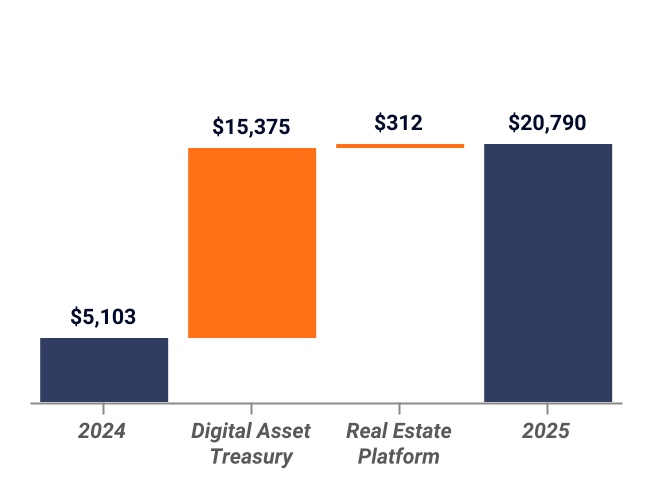
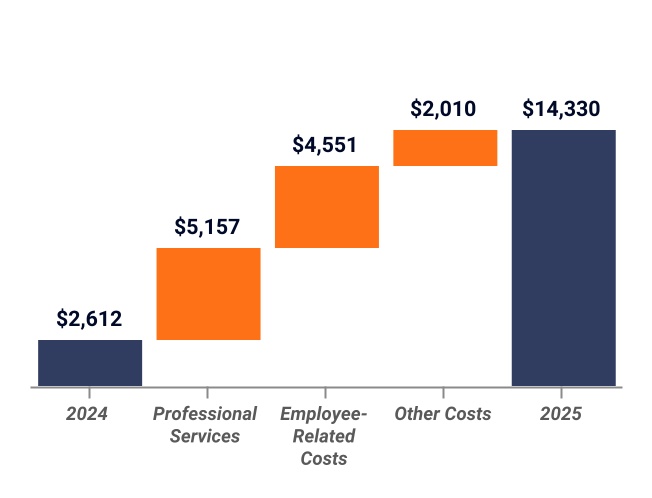
| 21 | ||||
Consolidated Interest Expense
Consolidated interest expense was $8.9 million in 2025, which was primarily comprised of $5.0 million attributable to the July 2030 convertible notes, $2.0 million attributable to our April 2030 convertible notes and $1.8 million attributable to borrowing fees related to digital asset financing arrangements.
The following graph illustrates the primary components contributing to the change in interest expense in 2025 compared to 2024.
Consolidated Interest Expense ($ thousands) | ||||||||||||||
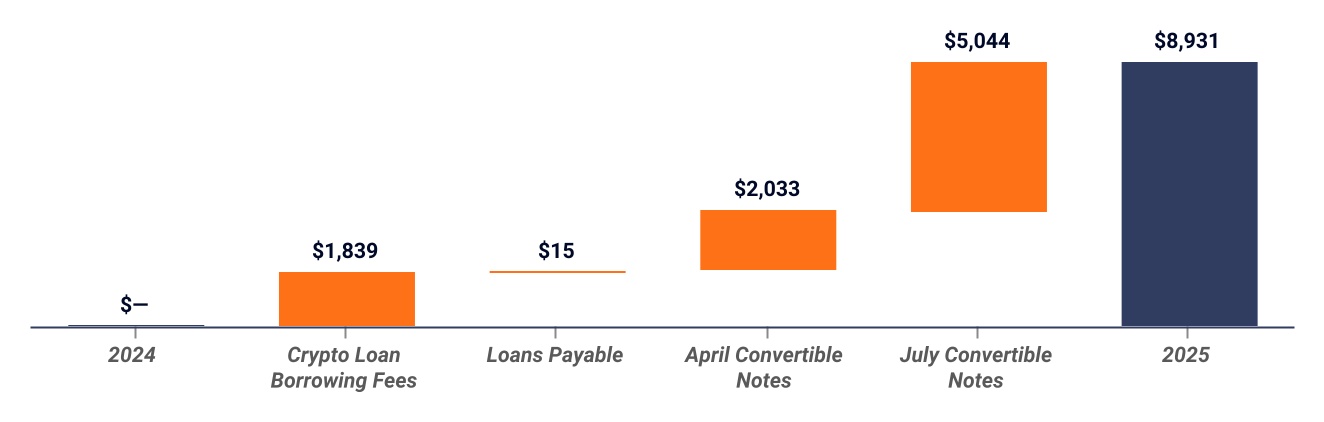
Consolidated (Loss) Gain From Derivative Instruments
Our consolidated (loss) gain from derivative instruments was $19.8 million in 2025, and included losses of $38.5 million related to declines in the fair value of collateral related to our digital asset financing arrangements, which was partially offset by $18.8 million of gains related to declines in the fair value of our digital asset financing arrangements.
Consolidated Investment and Other (Expense) Income, Net
Consolidated investment and other (expense) income, net decreased $9.0 million in 2025 compared to 2024 primarily due to $5.2 million of commitment fees related to an equity line of credit and $3.9 million of losses related to our investments, which was partially offset by interest and options trading income.
Consolidated Net (Loss) Income
We had a consolidated net loss of $73.8 million in 2025 compared to a consolidated net loss of $2.7 million in 2024 primarily due to impairments on our liquid staking tokens, increases in operating expenses related to general and administrative expenses and losses from our derivative instruments.
SEGMENT OPERATING RESULTS
Our segment operating results are presented based on how management evaluates operating performance and internally reports financial information. See Note 5—Segments, of the Notes to the Consolidated Financial Statements included in Part II, Item 8 of this Annual Report, for further discussion on our segments.
DIGITAL ASSET TREASURY
In April 2025, our Board of Directors adopted a new treasury policy, which updated our treasury management to include digital assets, starting with Solana’s native token, SOL. We believe acquiring and holding SOL long-term provides diversification of our treasury holdings and additional growth opportunities through operating validators and staking rewards. We believe that investing in the Solana Network through its native token provides an opportunity for us to create value for our shareholders due to the continuous disruptive innovation
22 | | ||||
the network offers to various industries. Currently, Solana is a category leader in decentralized finance, gaming and metaverse, decentralized physical infrastructure networks, asset tokenization, payment processing, and global value transfer.
Our digital asset treasury strategy is primarily funded through various financing transactions including, among others, issuing common stock, and to a lesser extent, cash on hand from our operations. Management continuously evaluates current market conditions of the overall cryptoeconomy, capital market conditions, and macroeconomic conditions to determine whether to enter into additional financing transactions. Management intends to focus on accumulating digital assets, focusing on SOL, and holding it long-term. We do not currently maintain a specific target for the amount or type of digital assets we intend to acquire or hold, and we do not presently have plans to acquire a significant amount of any cryptocurrency other than SOL. From time to time, management may evaluate potential opportunities to acquire or hold other digital assets, which would depend on a variety of factors including but not limited to, market conditions, risk considerations and any necessary approval through our governance process.
Our operating results and financial condition is and will continue to be impacted by price volatility in digital asset markets, specifically SOL, which may cause significant fluctuations from period to period and may not be necessarily indicative of future performance. In addition, our revenue may vary due to changes in staking reward yields and Solana protocol defined reward structures, including its annual inflationary rate.
| (in thousands) | 2025 | 2024 | ||||||
| Revenue | $ | 9,188 | $ | — | ||||
| Operating expenses: | ||||||||
| Cost of revenue | 221 | — | ||||||
| Sales and marketing | 584 | — | ||||||
| Research and development | 672 | — | ||||||
| General and administrative | 13,088 | — | ||||||
| Depreciation and amortization | 810 | — | ||||||
| Net loss (gain) on digital assets | 26,994 | — | ||||||
| Total operating expenses | $ | 42,369 | $ | — | ||||
| Segment operating (loss) income | $ | (33,181) | $ | — | ||||
Revenue
Revenue was $9.2 million in 2025 which was primarily driven by rewards earned from staking our digital asset holdings and to a lesser extent from operating our owned and managed validators.
Operating Expenses
General and Administrative
General and administrative expenses in 2025 was $13.1 million, which was primarily driven by $5.5 million of professional fees for legal and accounting services and $5.3 million of employee-related costs.
Net Loss (Gain) on Digital Assets
Net loss (gain) on digital assets generated in 2025 was $27.0 million, which primarily reflects $36.8 million of impairments driven by liquid staking tokens and losses due to declines in the fair value of SOL relative to the U.S. Dollar, which was partially offset by realized gains resulting from converting a portion of our SOL holdings into locked SOL and liquid staking tokens.
REAL ESTATE PLATFORM
We have developed a platform that connects commercial mortgage and small business borrowers looking for debt to refinance, build, or buy commercial property, including apartment buildings, to commercial property lenders. These property lenders include traditional banks, credit unions, REITs, debt funds, and other financial
| 23 | ||||
institutions looking to deploy capital into commercial mortgages. The platform connects borrowers to our internal capital markets advisors who guide the borrower through the process and connect them with the right loan product and lender.
The real estate segment derives its revenue primarily from platform fees and subscription revenue. Platform fees include referral and advisory fees generated from multifamily and commercial real estate and small business debt transactions. We earn platform revenue from fees charged to our customers that utilize our platform and our capital markets advisor sales team, who will assist in the match between lenders and borrowers. These fees include a share of the revenue per transaction by the lender, typically 1% of the loan amount, and in some cases a fixed negotiated fee from the borrower.
Our data and software offerings are generally offered on a subscription basis. We provide data, transparency, and tools, generally as annual software subscriptions, to help stakeholders navigate the most complex components of the multifamily and commercial property lifecycles – debt (Janover Capital Markets), insurance (Janover Insurance), and equity (Janover Connect, Janover Engage).
| (in thousands) | 2025 | 2024 | $ Change | % Change | ||||||||||
| Revenue | $ | 2,198 | $ | 2,100 | $ | 98 | 4.7 | % | ||||||
| Operating expenses: | ||||||||||||||
| Cost of revenue | 28 | 32 | (4) | (12.5) | % | |||||||||
| Sales and marketing | 1,661 | 1,497 | 164 | 11.0 | % | |||||||||
| Research and development | 470 | 655 | (185) | (28.2) | % | |||||||||
| General and administrative | 1,242 | 2,612 | (1,370) | (52.5) | % | |||||||||
| Depreciation and amortization | 235 | 307 | (72) | (23.5) | % | |||||||||
| Loss on the disposition of Janover Pro | 1,958 | — | 1,958 | NM | ||||||||||
| (Gain) from changes in fair value of contingent consideration | (179) | — | (179) | NM | ||||||||||
| Total operating expenses | $ | 5,415 | $ | 5,103 | $ | 312 | 6.1 | % | ||||||
| Segment operating (loss) income | $ | (3,217) | $ | (3,003) | $ | (214) | (7.1) | % | ||||||
Revenue
Real estate revenue increased $98.0 thousand, or 4.7%, in 2025 compared to 2024 primarily due to increased SaaS subscription revenue, partially offset by a decrease in our platform revenue. SaaS subscription revenue in 2025 was approximately $1.3 million, compared to $480.0 thousand for the same period in the prior year, an increase of 172.2%. We expect our SaaS subscription revenue to decline in fiscal 2026, after the sale of the JPro business unit in September 2025, which represented the majority of our subscription revenue in fiscal 2025.
Operating Expenses
Research and Development
Research and development expenses decreased $185.0 thousand, or 28.2%, in 2025 compared to 2024 primarily due to a reduction in employee-related costs and expenses related to contractors resulting from the disposition of JPro.
General and Administrative
General and administrative expenses decreased $1.4 million, or 52.5%, in 2025 compared to 2024 due to a reduction in employee-related costs, related to contractors, resulting from the disposition of JPro.
Loss on the Disposition of Janover Pro
We incurred a $2.0 million loss in 2025, resulting from the disposition of the assets and liabilities of JPro. See Note 7—Acquisitions and Dispositions, of the Notes to the Consolidated Financial Statements included in Part II, Item 8 of this Annual Report, for further discussion.
24 | | ||||
(Gain) From Changes in Fair Value of Contingent Consideration
In 2025, we recognized a gain of $179.0 thousand on contingent consideration related to the Groundbreaker acquisition. The gain was a result of fair value changes due to lower revenue projects, which determined that the milestones under the terms of the agreement could no longer be achieved.
LIQUIDITY AND CAPITAL RESOURCES
| (in thousands) | 2025 | 2024 | ||||||
| Sources of Liquidity: | ||||||||
| Cash and cash equivalents | $ | 5,920 | $ | 2,517 | ||||
| Marketable securities | $ | 698 | $ | 340 | ||||
| Accounts receivable (current and noncurrent) | $ | 52 | $ | 237 | ||||
| Obligations: | ||||||||
| Loans payable | $ | 107 | $ | — | ||||
| Digital asset financing arrangements | $ | 67,521 | $ | — | ||||
| Long-term debt, net | $ | 127,361 | $ | — | ||||
We rely substantially on access to equity and debt capital markets, digital asset financing arrangements and inflows generated from participation in the Solana ecosystem, including staking rewards, our validator operations and other Solana protocol-level incentives, to fund working capital needs, interest payments related to our convertible notes and other financial obligations.
We believe that the sources of liquidity discussed below are and will be sufficient in both the short and long term to meet our working capital requirements and future obligations.
SOURCES OF LIQUIDITY
Principal Sources of Liquidity
In 2025, our principal sources of liquidity consisted of cash and cash equivalents, marketable securities and accounts receivable.
•Cash and cash equivalents: represents our most immediately available source of liquidity and consisted of demand deposits and money market instruments.
•Marketable securities: consist of publicly-held equity securities, which are held at fair value and may be liquidated to generate cash, subject to market conditions.
•Accounts receivable: represents amounts due from customers that are expected to be collected and is impacted by the timing of collection.
Potential Sources of Liquidity
Equity Line of Credit
On June 11, 2025, we entered into a share purchase agreement that provided us with an equity line of credit (“ELOC”), where we have the right, but not the obligation, to sell up to $1.0 billion of our common stock over a 36 month period, subject to the terms and conditions of the agreement. We may request a one-time increase in the commitment amount up to an aggregate of $5.0 billion, subject to certain conditions.
The amount and timing of proceeds are at our discretion and are dependent on several factors, including the market price and trading volume of our common stock, current market conditions and compliance with contractual and regulatory limitations. Although the ELOC represents a significant potential source of liquidity, it does not constitute a committed source of cash, and we may not be able to access the facility on favorable terms, or at all, at the times or in the amounts desired.
| 25 | ||||
During periods when market conditions are favorable, we expect to utilize the ELOC as an important component of our external liquidity strategy to fund working capital requirements, strategic initiatives and digital asset treasury activities. As of December 31, 2025, approximately $933.4 million remained available under the ELOC, subject to the terms and conditions of the agreement. See Note 11—Stockholders’ Equity, of the Notes to the Consolidated Financial Statements included in Part II, Item 8 of this Annual Report, for further discussion.
Digital Assets
As of December 31, 2025, our digital asset holdings were $181.8 million, and had an aggregate fair value of $184.1 million (using exchange rates as of the balance sheet date), of which $76.9 million is unencumbered, and may be sold to generate liquidity. Management may from time to time, if necessary, and subject to crypto market conditions, monetize the digital assets we receive from staking activities and validator operations to meet liquidity needs. See Note 6—Digital Assets, of the Notes to the Consolidated Financial Statements included in Part II, Item 8 of this Annual Report, for further discussion.
CASH FLOWS
The following table summarizes our cash flows from operating, investing, and financing activities:
| (in thousands) | 2025 | 2024 | ||||||
| Net cash used in operating activities | $ | (17,967) | $ | (2,418) | ||||
| Net cash used in investing activities | $ | (221,543) | $ | (23) | ||||
| Net cash provided by (used in) financing activities | $ | 242,913 | $ | (118) | ||||
Net cash used in operating activities was $18.0 million in 2025 primarily due to payments for professional services and employee-related costs and payments for interest on our debt, which was partially offset by timing of our accounts payable.
Net cash used in investing activities was $221.5 million in 2025 primarily due to purchases of SOL and settlement of option contracts, which was partially offset by sales of digital assets.
Net cash provided by financing activities was $242.9 million in 2025 due to proceeds received from our convertible note offerings, proceeds from the issuance of our common stock and proceeds received from pre-funded warrants, which were partially offset by the payment for a prepaid forward stock purchase as part of our July 2030 convertible notes offerings and repurchases of shares of our common stock under our share repurchase program.
OBLIGATIONS
The following table summarizes payments due for our obligations by fiscal year as of December 31, 2025:
| (in thousands) | 2026 | Thereafter | Total | ||||||||
| Short-term debt | $ | 107 | $ | — | $ | 107 | |||||
| Digital asset financing arrangements | $ | 67,521 | $ | — | $ | 67,521 | |||||
| Long-term debt: | |||||||||||
| Principal payments | $ | — | $ | 133,971 | $ | 133,971 | |||||
| Interest payments | $ | 7,025 | $ | 24,513 | $ | 31,538 | |||||
Short-Term Obligations
Our short-term obligations include working capital requirements, short-term debt, digital asset financing arrangements, interest payments related to our 2030 convertible notes and an ELOC commitment fee.
•Short-term debt: In April 2025, we financed a portion of insurance premium related to Director and Officer insurance, payable over ten months with a contractual interest rate of 7.1%.
26 | | ||||
•Digital asset financing arrangements: During 2025, we entered into several digital asset financing arrangements where we borrowed SOL, with annual contractual borrowing fees ranging from 12.5% to 13.0% payable on the loan maturity date. These arrangements require us to provide collateral denominated in SOL with initial levels of 250% to 300% of the total loan value and must maintain a minimum collateral coverage of 200%. If the value of the posted collateral falls below this threshold we may be required to post additional SOL. If the collateral coverage declines to 150% or lower and is not remediated in a timely manner, the lender has the right to liquidate some or all of the posted collateral. Repayments of our digital asset financing arrangements is required to be settled in SOL. Our ability to repay the loans and comply with collateral requirements is subject to availability of SOL in our digital asset treasury and the fluctuations in the price of SOL. See Note 10—Derivatives, of the Notes to the Consolidated Financial Statements included in Part II, Item 8 of this Annual Report, for further discussion.
•Interest payments on long-term debt: Under the terms of our 2030 convertible notes, we are required to make periodic interest payments. The April 2030 convertible notes have an interest rate of 2.5%, which accrues daily and is required to be paid quarterly in arrears on March 31, June 30, September 30 and December 31 each year. Our July 2030 convertible notes have an interest rate of 5.5%, which is calculated based on a 360-day year and is required to be paid semi-annually in arrears on January 1 and July 1 of each year. See Note 9—Debt, of the Notes to the Consolidated Financial Statements included in Part II, Item 8 of this Annual Report, for further discussion.
•ELOC commitment fee: Under the terms of the ELOC agreement, we agreed to pay a commitment fee of $12.5 million over a twelve month period, in the form of our common stock. See Note 11—Stockholders’ Equity, of the Notes to the Consolidated Financial Statements included in Part II, Item 8 of this Annual Report, for further discussion.
Long-Term Obligations
Our long-term obligations include outstanding principal repayments of our long-term debt and interest payments related to that debt, as well as funding commitments under a revolving credit facility to our equity method investee.
•Long-term debt: The outstanding principal balance on our convertible notes have maturity dates of April 6, 2030 and July 1, 2030. As of December 31, 2025, the outstanding principal balances on these convertible notes were $11.5 million and $122.5 million, respectively. See Note 9—Debt, of the Notes to the Consolidated Financial Statements included in Part II, Item 8 of this Annual Report, for further discussion.
•Revolving credit facility: On January 24, 2026, we entered into a Revolving Credit Facility Agreement (the “Revolver”) with our equity method investee. Under the terms of the agreement we committed to provide a revolving credit facility of up to $4.75 million for 36 months. The credit facility bears an annual interest rate of 10%, which accrues daily based on a 360-day year. The first interest payment is due to us 18 months after the date of the Revolver.
SHARE REPURCHASES AND DIVIDENDS
In November 2023, our Board of Directors authorized a share repurchase program that provided for the repurchase of up to $1.0 million of our common stock, with no expiration from the date of authorization. In September 2025, our Board of Directors authorized an increase to the current share repurchase program up to $100.0 million. As of December 31, 2025, we had $88.5 million remaining under the authorization.
We expect to repurchase additional shares of our common stock under the authorization in the open market or in private transactions. The timing, method, and amount of future repurchases will be determined by management based on its evaluation of market conditions and other factors. The repurchase program does not obligate the Company to acquire any particular amount of common stock, and it may be modified, suspended, or discontinued at any time.
In October 2025, our Board of Directors declared a special dividend of warrants to holders of record as of October 23, 2025. Each holder of record received one warrant for each ten shares of common stock held as of
| 27 | ||||
the record date with an exercise price of $22.50 per share until January 21, 2028. We do not expect to continue to distribute dividends but may do so in the future, subject to approval by our Board of Directors.
The following charts summarize stock repurchases and distributed dividends and weighted-average common shares outstanding on a diluted basis for 2025 and 2024.
| Stock Repurchases Under Share Repurchase Program and Distributed Dividends ($ thousands) | Diluted Weighted-Average of Common Shares Outstanding (in thousands) | |||||||||||||
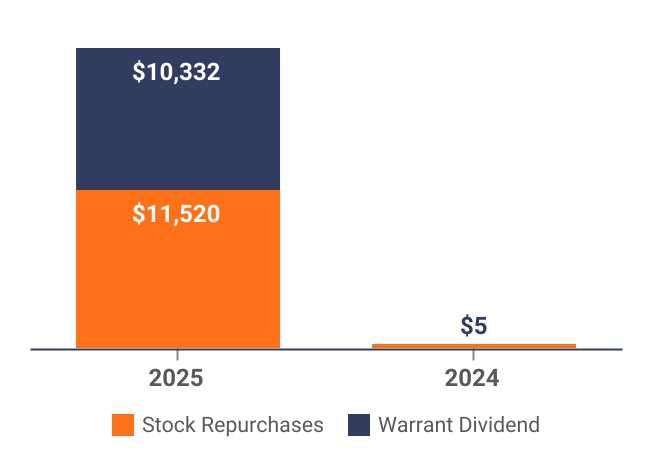
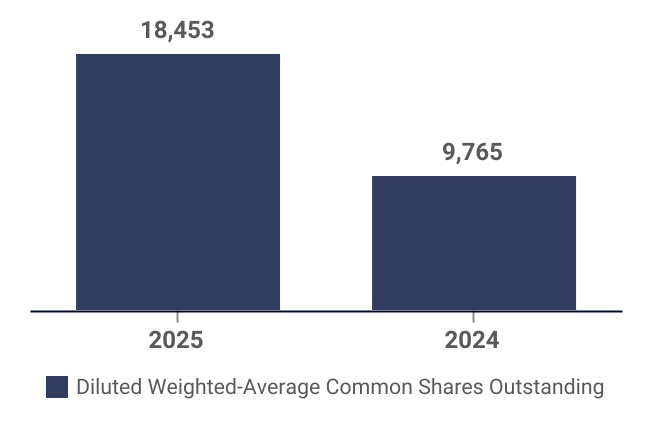
CRITICAL ACCOUNTING ESTIMATES
The preparation of our consolidated financial statements in conformity with U.S. generally accepted accounting principles requires management to make estimates and assumptions that directly affect our reported financial condition and results of operations. We base our estimates on historical data and various other assumptions that management believes to be reasonable given the facts and circumstances. Actual results may differ significantly from these estimates and assumptions and may affect future results of our financial condition and results of operations.
Our significant accounting policies, including recent accounting pronouncements, are described in Note 1—Overview and Significant Accounting Policies of the Notes to the Consolidated Financial Statements included in Part II, Item 8 of this Annual Report. The below discussion includes the accounting estimates and assumptions that we consider to be the most critical to our financial statements. We consider accounting estimates and assumptions critical if they require significant levels of judgment, involve inherent uncertainty and have the potential to materially impact our financial condition and results of operations.
Accounting for Income Taxes
We are subject to income taxes in the U.S. and in the various jurisdictions in which we operate. The accounting for income taxes requires significant judgment by management in determining our income tax provision, which includes deferred tax assets and liabilities, valuation allowance recorded against deferred tax assets and evaluating uncertain tax positions.
Deferred tax assets and liabilities are recognized for temporary differences between the financial reporting basis and income tax basis of assets and liabilities, based on enacted tax laws and statutory rates applicable to the periods in which we expect the temporary differences to reverse. We established a valuation allowance for deferred tax assets when it is not expected to be realized. The determination of the reversal of deferred taxes and the valuation allowance for deferred tax assets requires management to make certain judgments and assumptions, including forecasted taxable income, historical experience and tax planning strategies.
We recognize and measure uncertain tax positions when we determine the tax benefit from an uncertain tax position is more likely than not that the tax position will be sustained upon examination by taxing authorities.
28 | | ||||
The amount of benefit we recognize represents the portion that has a greater than fifty percent likelihood of being realized upon settlement.
Our income tax provision is significantly affected by tax laws related to the treatment of digital asset transactions. We evaluate estimates and assumptions quarterly and adjust tax positions as new information becomes available. If these estimates and assumptions materially change, or if actual facts and circumstances differ materially from those in the assumptions, our financial condition and results of operations could be materially impacted.
An increase or decrease in our effective tax rate by one percentage point would have resulted in an increase or decrease in our income tax expense of $0.7 million.
Valuation of Financial Instruments and Share-Based Compensation
We estimate the fair value of certain financial instruments, including convertible notes and warrants, as well as share-based compensation awards, using valuation models that incorporate significant assumptions. These assumptions include but are not limited to determining the appropriate valuation methodology and/or model, determining model inputs based on the evaluation of observable market data, such as risk-free interest rates and determining appropriate valuation adjustments such as stock price volatility and discount rates.
In conjunction with the 2030 April convertible note offering we issued warrants which we determined to be free-standing equity-linked instruments under generally accepted accounting principles and requires the proceeds to be allocated between the relative fair value of the convertible notes and warrants on the date of issuance. We used the Monte Carlo simulation to determine the fair value of the convertible notes and the Black-Scholes Options model for the valuation of the warrants. Each of the previously mentioned valuation models use significant judgment to determine model inputs. Changes in assumptions may result in different estimates of fair value, which would affect the allocation of proceeds between the convertible notes and warrants and, consequently, the initial carrying value of the debt, the resulting debt discount, and the amount of interest expense recognized over the term of the notes. In addition, substantially similar valuation methodologies and judgments were applied in connection with the evaluation of debt modifications. See Note 15—Fair Value Measurements of the Notes to the Consolidated Financial Statements included in Part II, Item 8 of this Annual Report, for further discussion on inputs used in the valuation models.
We issued warrants as a form of non-cash dividend to holders of our common stock, holders of our notes and other security holders. We accounted for these warrant dividends as equity-classified instruments under generally accepted accounting principles and are measured at fair value on grant date. We determined the fair value of the warrant dividend using the Monte Carlo simulation, which incorporates the probability of a range of possible outcomes appropriate for the instrument being valued, including but not limited to, future stock price outcomes. The model requires significant judgment, including expected volatility, expected term and simulated stock price paths. Changes in these assumptions would increase or decrease the amount recognized in retained earnings for the fair value of the warrant dividend. See Note 15—Fair Value Measurements of the Notes to the Consolidated Financial Statements included in Part II, Item 8 of this Annual Report, for further discussion on inputs used in the valuation models.
Accounting for share-based compensation awards under generally accepted accounting principles requires the measurement and recognition of compensation expense based on the fair value of the awards on the grant-date. We determine the fair value of share-based compensation using the Black-Scholes Option model. The Black-Scholes Option model uses significant judgments to determine model inputs, including but not limited to the expected volatility of our common stock. Changes in assumptions used would impact the amount of expense recognized over the vesting period. See Note 12—Share-Based Compensation of the Notes to the Consolidated Financial Statements included in Part II, Item 8 of this Annual Report, for further discussion on inputs used in the valuation of our share-based compensation.
ITEM 7A. QUANTITATIVE AND QUALITATIVE DISCLOSURES ABOUT MARKET RISK.
We are a "smaller reporting company" as defined by §229.10(f) of Regulation S-K and are not required to provide the information required by this Item.
| 29 | ||||
ITEM 8. FINANCIAL STATEMENTS AND SUPPLEMENTARY DATA.
INDEX TO CONSOLIDATED FINANCIAL STATEMENTS
30 | | ||||
Report of Independent Registered Public Accounting Firm
To the Stockholders and the Board of Directors of DeFi Development Corp.
Opinion on the Financial Statements
We have audited the accompanying consolidated balance sheet of DeFi Development Corp. (the Company) as of December 31, 2025, the related consolidated statements of operations, comprehensive (loss) income, stockholders’ equity and cash flows for the year then ended, and the related notes (collectively, the "financial statements"). In our opinion, the financial statements present fairly, in all material respects, the financial position of the Company as of December 31, 2025, and the results of its operations and its cash flows for the year then ended in conformity with accounting principles generally accepted in the United States of America.
Basis for Opinion
These financial statements are the responsibility of the Company's management. Our responsibility is to express an opinion on the Company's financial statements based on our audit. We are a public accounting firm registered with the Public Company Accounting Oversight Board (United States) (PCAOB) and are required to be independent with respect to the Company in accordance with U.S. federal securities laws and the applicable rules and regulations of the Securities and Exchange Commission and the PCAOB.
We conducted our audit in accordance with the standards of the PCAOB. Those standards require that we plan and perform the audit to obtain reasonable assurance about whether the financial statements are free of material misstatement, whether due to error or fraud. The Company is not required to have, nor were we engaged to perform, an audit of its internal control over financial reporting. As part of our audit we are required to obtain an understanding of internal control over financial reporting but not for the purpose of expressing an opinion on the effectiveness of the Company’s internal control over financial reporting. Accordingly, we express no such opinion.
Our audit included performing procedures to assess the risks of material misstatement of the financial statements, whether due to error or fraud, and performing procedures that respond to those risks. Such procedures included examining, on a test basis, evidence regarding the amounts and disclosures in the financial statements. Our audit also included evaluating the accounting principles used and significant estimates made by management, as well as evaluating the overall presentation of the financial statements. We believe that our audit provides a reasonable basis for our opinion.
/s/ Wolf & Company, P.C.
We have served as the Company's auditor since 2025.
March 30, 2026
| 31 | ||||
REPORT OF INDEPENDENT REGISTERED PUBLIC ACCOUNTING FIRM
To the Board of Directors and
Stockholders of DeFi Development Corp.
Stockholders of DeFi Development Corp.
Opinion on the Financial Statements
We have audited the accompanying consolidated balance sheet of DeFi Development Corp. (the “Company”, formerly known as Janover Inc.) as of December 31, 2024, the related consolidated statements of operations, comprehensive (loss) income, stockholders’ equity, and cash flows for the year then ended, and the related notes (collectively referred to as the “financial statements”). In our opinion, the financial statements present fairly, in all material respects, the financial position of the Company as of December 31, 2024, and the results of its operations and its cash flows for the year then ended, in conformity with accounting principles generally accepted in the United States of America.
Basis for Opinion
These financial statements are the responsibility of the Company’s management. Our responsibility is to express an opinion on the Company’s financial statements based on our audits. We are a public accounting firm registered with the Public Company Accounting Oversight Board (United States) (PCAOB) and are required to be independent with respect to the Company in accordance with the U.S. federal securities laws and the applicable rules and regulations of the Securities and Exchange Commission and the PCAOB.
We conducted our audit in accordance with the standards of the PCAOB. Those standards require that we plan and perform the audit to obtain reasonable assurance about whether the financial statements are free of material misstatement, whether due to error or fraud. The Company is not required to have, nor were we engaged to perform, an audit of its internal control over financial reporting. As part of our audit, we are required to obtain an understanding of internal control over financial reporting, but not for the purpose of expressing an opinion on the effectiveness of the Company’s internal control over financial reporting. Accordingly, we express no such opinion.
Our audit included performing procedures to assess the risks of material misstatement of the financial statements, whether due to error or fraud, and performing procedures that respond to those risks. Such procedures included examining, on a test basis, evidence regarding the amounts and disclosures in the financial statements. Our audit also included evaluating the accounting principles used and significant estimates made by management, as well as evaluating the overall presentation of the financial statements. We believe that our audit provides a reasonable basis for our opinion.
/s/ dbbmckennon
Newport Beach, California
March 30, 2025
We served as the Company’s auditor from 2022 to 2025
32 | | ||||
DEFI DEVELOPMENT CORP.
CONSOLIDATED BALANCE SHEETS
| December 31 (in thousands, except share data) | 2025 | 2024 | ||||||
| ASSETS | ||||||||
| Current assets: | ||||||||
| Cash and cash equivalents | $ | $ | ||||||
| Accounts receivable | ||||||||
| Prepaid expenses | ||||||||
| Investments | ||||||||
| Digital assets pledged as collateral | ||||||||
| Deferred offering costs | ||||||||
| Other current assets | ||||||||
| Total current assets | ||||||||
| Accounts receivable, non-current | ||||||||
| Property and equipment, net | ||||||||
| Digital assets, at fair value | ||||||||
| Digital assets, at carrying value, net | ||||||||
| Goodwill | ||||||||
| Intangible assets, net | ||||||||
| Other assets | ||||||||
| Total assets | $ | $ | ||||||
| LIABILITIES AND STOCKHOLDERS’ EQUITY | ||||||||
| Current liabilities: | ||||||||
| Accounts payable and accrued expenses | $ | $ | ||||||
| Digital asset financing arrangements | ||||||||
| Loans payable | ||||||||
| Deferred revenue | ||||||||
| Other current liabilities | ||||||||
| Total current liabilities | ||||||||
| Long-term debt, net | ||||||||
| Contingent consideration | ||||||||
| Deferred revenue, non-current | ||||||||
| Total liabilities | ||||||||
Commitments and contingencies (Note 16) | ||||||||
| Stockholders' equity: | ||||||||
Preferred stock, undesignated, $ | ||||||||
Series A Preferred stock, $ | ||||||||
Series B Preferred stock, $ | ||||||||
Common stock, $ | ||||||||
| Additional paid-in capital | ||||||||
| Treasury stock | ( | |||||||
| Accumulated other comprehensive (loss) income | ( | |||||||
| Accumulated (deficit) | ( | ( | ||||||
| Total stockholders’ equity | ||||||||
| Total liabilities and stockholders’ equity | $ | $ | ||||||
See the accompanying notes to the consolidated financial statements.
| 33 | ||||
DEFI DEVELOPMENT CORP.
CONSOLIDATED STATEMENTS OF OPERATIONS
| Year ended December 31 (in thousands, except per share data) | 2025 | 2024 | |||||||||
| Revenue | $ | $ | |||||||||
| Operating expenses: | |||||||||||
| Cost of revenue | |||||||||||
| Sales and marketing | |||||||||||
| Research and development | |||||||||||
| General and administrative | |||||||||||
| Depreciation and amortization | |||||||||||
| Net loss (gain) on digital assets | |||||||||||
| Loss on disposition of Janover Pro | |||||||||||
| (Gain) from changes in fair value of contingent consideration | ( | ||||||||||
| Total operating expenses | |||||||||||
| Operating (loss) income | ( | ( | |||||||||
| Interest expense | ( | ||||||||||
| (Loss) gain from derivative instruments | ( | ||||||||||
| Investment and other (expense) income, net | ( | ||||||||||
| (Loss) income before income taxes | ( | ( | |||||||||
| Income tax (expense) benefit | ( | ||||||||||
| Net (loss) income | $ | ( | $ | ( | |||||||
| Net (loss) income per share: | |||||||||||
| Basic and diluted | $ | ( | $ | ( | |||||||
| Weighted-average shares outstanding: | |||||||||||
| Basic and diluted | |||||||||||
See the accompanying notes to the consolidated financial statements.
34 | | ||||
DEFI DEVELOPMENT CORP.
CONSOLIDATED STATEMENTS OF COMPREHENSIVE (LOSS) INCOME
| Year ended December 31 (in thousands) | 2025 | 2024 | |||||||||
| Net (loss) income | $ | ( | $ | ( | |||||||
| Other comprehensive (loss) income, net of income taxes: | |||||||||||
| Cumulative translation adjustment | ( | ||||||||||
| Other comprehensive (loss) income, net of income taxes | ( | ||||||||||
| Comprehensive (loss) income | $ | ( | $ | ( | |||||||
See the accompanying notes to the consolidated financial statements.
| 35 | ||||
DEFI DEVELOPMENT CORP.
CONSOLIDATED STATEMENTS OF STOCKHOLDERS’ EQUITY
| Series A Preferred Stock | Common Stock | Additional Paid-in Capital | Treasury Stock | Accumulated Other Comprehensive (Loss) Income | Accumulated (Deficit) | Total Stockholders’ Equity | |||||||||||||||||||||||||||||||||||||||||||||||||||||
| (in thousands, except share data) | Shares | Amount | Shares | Amount | |||||||||||||||||||||||||||||||||||||||||||||||||||||||
| Balances at December 31, 2023 | $ | $ | $ | $ | $ | $ | ( | $ | |||||||||||||||||||||||||||||||||||||||||||||||||||
| Issuance of common stock, net of offering costs | — | — | — | — | — | — | |||||||||||||||||||||||||||||||||||||||||||||||||||||
| Issuance of common stock for services performed | — | — | — | — | — | — | |||||||||||||||||||||||||||||||||||||||||||||||||||||
| Repurchase of common stock | — | — | ( | — | ( | — | — | — | ( | ||||||||||||||||||||||||||||||||||||||||||||||||||
| Effect of stock split | — | — | — | — | — | — | — | — | |||||||||||||||||||||||||||||||||||||||||||||||||||
| Share-based compensation | — | — | — | — | — | — | — | ||||||||||||||||||||||||||||||||||||||||||||||||||||
| Net (loss) income | — | — | — | — | — | — | — | ( | ( | ||||||||||||||||||||||||||||||||||||||||||||||||||
| Balances at December 31, 2024 | $ | $ | $ | $ | $ | $ | ( | $ | |||||||||||||||||||||||||||||||||||||||||||||||||||
| Issuance of common stock and warrants, net of offering costs | — | — | — | — | — | — | |||||||||||||||||||||||||||||||||||||||||||||||||||||
| Issuance of common stock for asset acquisition | — | — | — | — | — | — | |||||||||||||||||||||||||||||||||||||||||||||||||||||
| Prepaid forward stock purchase | — | — | — | — | ( | — | — | — | ( | ||||||||||||||||||||||||||||||||||||||||||||||||||
| Exercises under employee stock plans | — | — | — | — | — | — | |||||||||||||||||||||||||||||||||||||||||||||||||||||
| Repurchase of common stock | — | — | ( | — | — | ( | — | — | ( | ||||||||||||||||||||||||||||||||||||||||||||||||||
| Share-based compensation | — | — | — | — | — | — | — | ||||||||||||||||||||||||||||||||||||||||||||||||||||
| Discount on convertible notes | — | — | — | — | — | — | — | ||||||||||||||||||||||||||||||||||||||||||||||||||||
| Warrants exercised | — | — | — | — | — | — | |||||||||||||||||||||||||||||||||||||||||||||||||||||
| Warrant dividend distribution | — | — | — | — | — | — | ( | ||||||||||||||||||||||||||||||||||||||||||||||||||||
| Conversion of convertible notes | — | — | — | — | — | — | |||||||||||||||||||||||||||||||||||||||||||||||||||||
| Translation adjustments | — | — | — | — | — | — | ( | — | ( | ||||||||||||||||||||||||||||||||||||||||||||||||||
| Net (loss) income | — | — | — | — | — | — | — | ( | ( | ||||||||||||||||||||||||||||||||||||||||||||||||||
| Balances at December 31, 2025 | $ | $ | $ | $ | ( | $ | ( | $ | ( | $ | |||||||||||||||||||||||||||||||||||||||||||||||||
See the accompanying notes to the consolidated financial statements.
36 | | ||||
DEFI DEVELOPMENT CORP.
CONSOLIDATED STATEMENTS OF CASH FLOWS
| Year ended December 31 (in thousands) | 2025 | 2024 | ||||||||||||
| Operating Activities | ||||||||||||||
| Net (loss) income | $ | ( | $ | ( | ||||||||||
| Adjustments to reconcile net (loss) income to net cash used in operating activities: | ||||||||||||||
| Digital assets received as revenue | ( | |||||||||||||
| Marketable securities received as revenue | ( | |||||||||||||
| Digital assets paid for expenses | ||||||||||||||
| Depreciation and amortization | ||||||||||||||
| Amortization of debt discount | ||||||||||||||
| Share-based compensation | ||||||||||||||
| Net loss (gain) on digital assets | ||||||||||||||
| Loss (gain) from derivative instruments | ||||||||||||||
| (Gain) from changes in fair value of contingent consideration | ( | |||||||||||||
| Net (gain) loss on investment activity | ( | |||||||||||||
| Loss on disposition of Janover Pro | ||||||||||||||
| Other | ||||||||||||||
| Changes in operating assets and liabilities: | ||||||||||||||
| Accounts receivable | ( | ( | ||||||||||||
| Prepaid expenses | ||||||||||||||
| Other assets | ( | ( | ||||||||||||
| Accounts payable and accrued expenses | ( | |||||||||||||
| Deferred revenue | ||||||||||||||
| Other liabilities | ( | |||||||||||||
| Net cash used in operating activities | ( | ( | ||||||||||||
| Investing Activities | ||||||||||||||
| Purchase of digital assets | ( | |||||||||||||
| Proceeds from sale of digital assets | ||||||||||||||
| Settlement of option contracts | ( | |||||||||||||
| Proceeds from the settlement of convertible notes | ||||||||||||||
| Disposition of Janover Pro | ( | |||||||||||||
| Acquired intangible assets | ( | |||||||||||||
| Purchase of investments | ( | |||||||||||||
| Purchases of property and equipment | ( | ( | ||||||||||||
| Net cash used in investing activities | ( | ( | ||||||||||||
| Financing Activities | ||||||||||||||
| Repayments of short-term debt | ( | |||||||||||||
| Proceeds from convertible notes | ||||||||||||||
| Proceeds from issuance of common stock, net of offering costs | ||||||||||||||
| Proceeds from pre-funded warrants | ||||||||||||||
| Proceeds from warrant exercises | ||||||||||||||
| Proceeds from issuance of common stock under employee stock plans | ||||||||||||||
| Payment for prepaid forward stock purchase | ( | |||||||||||||
| Repurchase of common stock under repurchase program | ( | ( | ||||||||||||
| Payments of offering costs | ( | ( | ||||||||||||
| Net cash provided by (used in) financing activities | ( | |||||||||||||
| Net increase (decrease) in cash and cash equivalents | ( | |||||||||||||
| Cash and cash equivalents, at beginning of period | ||||||||||||||
| Cash and cash equivalents, at end of period | $ | $ | ||||||||||||
See the accompanying notes to the consolidated financial statements.
| 37 | ||||
DEFI DEVELOPMENT CORP.
CONSOLIDATED STATEMENTS OF CASH FLOWS-CONTINUED
| Year ended December 31 (in thousands) | 2025 | 2024 | |||||||||||||||
| Supplemental Information of Cash Paid Information | |||||||||||||||||
| Cash paid for interest | $ | $ | |||||||||||||||
| Income taxes paid (net of refunds received) | $ | $ | |||||||||||||||
| Supplemental Schedule of Non-cash Investing and Financing Activities | |||||||||||||||||
| Common stock issued for asset acquisition | $ | $ | |||||||||||||||
| Debt securities purchased with digital assets | $ | $ | |||||||||||||||
| Digital assets received for settlement of debt securities | $ | $ | |||||||||||||||
| Marketable securities received for settlement of debt securities | $ | $ | |||||||||||||||
| Digital asset financing arrangement borrowings | $ | $ | |||||||||||||||
| Repayments of digital asset financing arrangements | $ | $ | |||||||||||||||
| Digital assets received from convertible notes and warrants | $ | $ | |||||||||||||||
| Warrant dividend distribution | $ | $ | |||||||||||||||
| Digital assets received from common stock issuances | $ | $ | |||||||||||||||
| Conversion of convertible notes to common stock | $ | $ | |||||||||||||||
| Common stock issuance in connection with equity line of credit commitment fee | $ | $ | |||||||||||||||
| Financing of prepaid insurance premiums | $ | $ | |||||||||||||||
| Issuance of common stock for prepaid and accrued services | $ | $ | |||||||||||||||
See the accompanying notes to the consolidated financial statements.
38 | | ||||
NOTE 1—OVERVIEW AND SIGNIFICANT ACCOUNTING POLICIES
OVERVIEW
DeFi Development Corp. (“DeFi Dev", the “Company”, "we", "our", "us") is a company focused on building and managing a digital asset treasury centered on the Solana blockchain ecosystem. We also provide an online platform that connects the commercial real estate industry by providing data and software subscriptions as well as value-add services to multifamily and commercial property professionals.
Change of Control
On April 4, 2025, Blake Janover, then Chief Executive Officer and Chairman of DeFi Development Corp. (formerly Janover Inc.), entered into a Stock Purchase Agreement (“Purchase Agreement”) with DeFi Dev LLC, a Delaware limited liability company, and 3277447 Nova Scotia Ltd, a corporation formed under the laws of Nova Scotia, Canada (“NS Corp”) to sell 5,100,424 shares of common stock, with each share of common stock entitled to one vote per share and representing approximately 51.0 % of the Company’s 9,999,248 10,000 shares of Series A preferred stock of the Company, with each share of Series A preferred stock entitled to 10,000 votes per share on all matters entitled to be voted upon by the common stock unless otherwise prohibited by law. DeFi Dev LLC and NS Corp were previously unaffiliated parties to the Company. DeFi Dev LLC purchased 412,041 shares of common stock and 5,500 shares of Series A preferred stock for $2.3 million utilizing funds contributed by its managing member and other members. A portion of the funds for the purchase of shares by DeFi Dev LLC came from a loan from Joseph Onorati, current Chief Executive Officer of DeFi Dev. NS Corp purchased 316,591 shares of common stock and 4,500 shares of Series A preferred stock for $1.7 million utilizing funds contributed by its controlling stockholder. The aggregate purchase price was $4.0 million. The transactions under the Purchase Agreement constituted a change in control of the Company.
The change of control is considered a business combination under Accounting Standards Codification Topic 805, Business Combinations ("ASC 805"), with DeFi Dev LLC and NS Corp identified as the accounting acquirer and us the acquiree. We have elected not to apply pushdown accounting as allowed under ASC 805 which is irrevocable once elected. As a result, our assets and liabilities continue to be presented at historical carrying amounts and no fair value adjustments or goodwill were recorded in our consolidated financial statements.
SIGNIFICANT ACCOUNTING POLICIES
Basis of Presentation
The consolidated financial statements and accompanying notes have been prepared in accordance with generally accepted accounting principles in the United States (“U.S. GAAP”).
Principles of Consolidation
The accompanying consolidated financial statements include the accounts of DeFi Dev and its wholly owned subsidiaries. All intercompany accounts and transactions are eliminated in consolidation.
Reclassifications
Reclassifications have been made to prior periods to conform to classifications used in the current period. Such reclassifications had no effect on previously reported results.
Revision of Unaudited Consolidated Financial Information
During the preparation of the Company’s annual financial statements, management identified errors in the calculation of earnings-per-share (“EPS”) in our previously issued unaudited condensed consolidated financial statements as of and for the three and nine month ended September 30, 2025. See Note 2—Revision of Interim Financial Information (Unaudited) for further discussion.
Change in Operating Segments
In the second quarter of 2025, management re-evaluated our segment reporting structure and determined that we now operate in two reportable segments. Historically, we operated as a single operating segment focused
| 39 | ||||
on our real estate technology platform. The change in reportable segments had no effect on previously reported results. See Note 5—Segments for further discussion.
Stock Splits
Effective December 30, 2024, we had a one-for-eight reverse stock split of the Company's common stock. Additionally, on May 6, 2025, our Board of Directors approved a seven -for-one forward stock split of the Company's common stock to shareholders of record as of the close of business on May 19, 2025. All share, per share data and related pricing have been adjusted to reflect the previously mentioned stock splits for all periods presented.
Treasury Stock
We account for repurchased shares in accordance with Accounting Standards Codification Topic 505-30, Treasury Stock ("ASC 505") using the cost method, under which the acquired shares are recorded at the cost paid to reacquire the shares, which includes brokerage commissions and other direct transaction costs. Treasury stock is presented as a reduction of total stockholder’s equity. Repurchased shares are not considered outstanding for purposes of EPS calculations from the date of repurchase. See Note 11—Stockholders’ Equity for further discussion.
Use of Estimates
The preparation of our consolidated financial statements in conformity with U.S. GAAP requires management to make estimates and assumptions that affect the reported amounts of assets, liabilities and disclosure of contingent assets and liabilities and the reported amounts of revenue and expenses during the reported period. Actual results may differ significantly from these estimates and assumptions. Our most significant estimates and assumptions relate to valuation of financial instruments, valuation of share-based compensation and our valuation allowances on deferred taxes. Management evaluates these estimates and assumptions on an ongoing basis using the most current information available and changes are made in the period they are known.
Fair Value Measurements
We determine fair value measurements for certain assets and liabilities in accordance with Accounting Standards Codification Topic 820, Fair Value Measurements ("ASC 820"), which defines fair value as the exit price that would be received to sell an asset or paid to transfer a liability in an ordinary transaction between market participants. ASC 820 establishes a framework for valuation techniques, prioritized by reliability, according to the following tiers:
| Level 1 | Unadjusted quoted prices in active markets for identical assets and liabilities | ||||
| Level 2 | Quoted prices for similar assets and liabilities in active markets; quoted prices for similar or identical assets and liabilities in markets that are not active; valuation models in which all significant inputs are derived from observable market data | ||||
| Level 3 | Unobservable valuation model inputs for assets and liabilities such as discounted cash flow models or similar techniques; inputs for fair value instruments; includes assumptions and may require significant judgment and estimation by management | ||||
We use this framework to measure the fair value of certain financial instruments on a recurring basis, such as our cash and cash equivalents, debt securities, marketable securities, digital assets pledged as collateral, digital assets at fair value, digital asset financing arrangements, as well as on a non-recurring basis for our acquisitions and impairment testing on our property and equipment, intangible assets and digital assets, at carrying value, convertible notes and pre-funded warrants. We also use this framework for disclosure purposes related to certain items, such as debt and our off-balance sheet transactions. See Note 15—Fair Value Measurements for further discussion.
Cash and Cash Equivalents
Our cash and cash equivalents consist of money market and demand deposit accounts held at various financial institutions and at digital asset platforms. The carrying amounts of our cash and cash equivalents approximate their fair value.
40 | | ||||
Stablecoins
Stablecoins are digital assets that are backed by reserves secured through demand deposits, cash equivalents, or other highly liquid assets and are redeemable for the underlying fiat currency on a one-to-one basis. We consider stablecoins to be financial instruments and have elected the fair value option under Accounting Standards Codification Topic 825, Financial Instruments (“ASC 825”). Under ASC 825, this election is irrevocable, unless a new election date occurs. Stablecoins are initially record at cost, within Other assets as stated on our Consolidated Balance Sheets, and are then subsequently remeasured at fair value, as of each balance sheet date with changes from remeasurement recognized in earnings. The fair value of stablecoins is determined using Level 1 inputs, as defined by ASC 820 and account for changes from remeasurement within Net loss (gain) on digital assets, as stated on our Consolidated Statements of Operations.
Deferred Offering Costs
Digital Assets
Digital assets are considered intangible assets under Accounting Standards Codification Subtopic 350-60, Intangibles—Goodwill and Other—Crypto Assets ("ASC 350-60"). Under ASC 350-60, digital assets that meet the definition of intangible assets, among other criteria, are initially recorded at cost and are then subsequently remeasured at fair value, as of the balance sheet date with changes from remeasurement recognized in earnings. The fair value for digital assets that are unrestricted ("liquid") and freely tradable are determined using Level 1 inputs as defined in ASC 820. Conversely, fair value for digital assets that are restricted ("locked") due to vesting schedules or contractual restrictions are determined based on Level 1 inputs adjusted for the impact of such restrictions based on Level 2 inputs, in accordance with ASC 820. We account for changes from remeasurement within Net loss (gain) on digital assets, as stated on our Consolidated Statements of Operations.
Digital assets that we hold that do not meet the criteria under ASC 350-60 are accounted for as intangible assets with indefinite useful lives and are initially recorded at cost and are not amortized but instead are tested for impairment at least annually, or more frequently, if events or changes in circumstances indicate that it is more likely than not that the asset is impaired. As such, these digital assets are reflected in our Consolidated Balance Sheets, at cost net of any impairments within Digital assets, at carrying value. We evaluate impairments on these digital assets on at least an annual basis, or more frequently if events or changes in circumstances occur and use Level 1 inputs, unadjusted quoted prices in active markets, for the fair value to determine if an impairment has occurred. If unadjusted quoted prices in active markets for our digital assets are lower than the carrying value recorded, then we will record an impairment charge equal to the difference between the carrying value and the fair value. Impairment charges are recognized within Net loss (gain) on digital assets, as stated on our Consolidated Statements of Operations.
When we receive digital assets earned on external staking platforms or from operating and managing validator nodes, we will initially record them at fair value on the date the digital assets are received. Upon the disposal of digital assets, any gains or losses are recognized in Net loss (gain) on digital assets, as stated on our Consolidated Statements of Operations, and are calculated as the difference between the selling price and our carrying value, using the specific identification method. See Note 6—Digital Assets for further discussion.
Intangible Assets
We account for finite-lived intangible assets in accordance with Accounting Standards Codification Topic 350, Intangibles ("ASC 350"). Under ASC 350, finite-lived intangible assets are amortized and consist of our validators, developed technology and customer database. These intangible assets are amortized on a straight-line basis over their estimated useful life. We periodically review the appropriateness of the estimated useful life
| 41 | ||||
of our finite-lived intangible assets. Additionally, we will evaluate these assets for impairments whenever events or circumstances indicate that the carrying amount may not be recoverable over the remaining life of the asset.
We have an indefinite-lived intangible asset and account for it in accordance with ASC 350. Under ASC 350, the indefinite-lived intangible asset is not amortizable and consists of our domain name. Our indefinite-lived intangible asset is tested for impairment at least annually or whenever events or circumstances indicate an impairment may have occurred. If we determine that the fair value is lower than the carrying value recorded, then it is more likely than not that our domain name is impaired, and we will record a charge equal to the difference between the carrying value and the fair value within Depreciation and amortization, as stated on our Consolidated Statements of Operations, unless stated separately.
See Note 8—Goodwill and Intangible Assets for further discussion.
Goodwill
Goodwill is calculated as the excess of the purchase price of an acquisition over the identifiable net assets acquired. We account for goodwill in accordance with Accounting Standards Codification Topic 350, Intangibles—Goodwill and Other. Under ASC 350, it is not subject to amortization but is instead tested at least annually for impairment at the reporting unit level. We test for goodwill impairment in the fourth quarter of each fiscal year or whenever events or circumstances indicate an impairment may have occurred. ASC 350 permits us to first assess qualitative factors, to determine whether it is necessary to perform a quantitative impairment test for our reporting units. The quantitative impairment test is required only if we conclude that it is more likely than not that the reporting unit's fair value is less than its carrying amount. We will perform the quantitative test, if necessary, using Level 2 and Level 3 inputs including, among other models, the discounted future cash flows method to determine the fair value. If the fair value of the reporting unit exceeds the carrying amount then goodwill is considered not to be impaired. However, if the carrying value amount of the reporting unit exceeds the fair value then an impairment charge is recognized in an amount equal to that excess, limited to the total amount of goodwill allocated to that reporting unit. See Note 8—Goodwill and Intangible Assets for further discussion.
Derivative Instruments
We primarily enter into two types of derivative instruments, digital asset financing arrangements and option contracts. We evaluate and account for these derivative instruments under Accounting Standards Codification Topic 815, Derivatives and Hedging ("ASC 815"). Under ASC 815 we are required to recognize derivatives as either assets or liabilities on our Consolidated Balance Sheets. Derivatives are recorded initially and subsequently at fair value, with changes recognized in earnings within (Loss) gain from derivative instruments as stated on our Consolidated Statements of Operations, as our derivatives are not designated and do not qualify for hedge accounting. See Note 10—Derivatives for further discussion.
Revenue
We recognize revenue in accordance with the five-step model outlined in Accounting Standards Codification Topic 606—Revenue from Contracts with Customers ("ASC 606"). This model helps us identify the contract we have with our customers, identify the performance obligation in the contract, determine the transaction price, allocate the transaction price to the performance obligation and recognize revenue as the performance obligation is satisfied. We earn revenue from our digital asset treasury strategy and by providing our real estate platform and products to customers. See Note 3—Revenue for further discussion.
Cost of Revenue
Sales and Marketing
42 | | ||||
Research and Development
Research and development includes employee-related costs, consisting of wages and salaries and share-based compensation expense and costs to develop and refine technological processes used to carry out business operations, including personnel costs for website and non-capitalizable software design and development functions and related software and hosting costs. These are expensed when incurred unless recognition or measurement is governed by other applicable U.S. GAAP, such as share-based compensation.
General and Administrative
Income Taxes
We account for income taxes using the asset and liability method, which requires the recognition of deferred tax assets and liabilities for the expected future tax consequences of events that have been recognized in the consolidated financial statements or in tax returns. The measurement of deferred tax assets and liabilities are determined based on the difference between the financial statement and tax bases, using enacted tax rates expected to be applied in the periods in which those temporary differences are expected to affect taxable income. Deferred tax assets are evaluated for realizability, and a valuation allowance is established when, management estimates that it is more likely than not that some portion or all of the deferred tax asset will not be realized. Management determines the realization of deferred tax assets upon forecasted taxable income, the reversal of temporary differences between financial statement and tax income, and the expected tax rates in future periods.
We are required to evaluate the effect of tax positions only if those positions are more likely than not to be sustained by the applicable tax authority. Tax benefits of positions not deemed to meet the “more likely than not” threshold would be recorded as a tax expense in the current year. The amount recognized is subject to estimate and management judgment with respect to the likely outcome of each uncertain tax position. The amount that is ultimately sustained for an individual uncertain tax position or for all uncertain tax positions in the aggregate could differ from the amount that is initially recognized. We record interest and penalties related to uncertain tax positions within income tax expense.
For U.S. federal income tax purposes, digital assets are generally treated on the same tax principles as property transactions. Accordingly, transactions involving the purchase, exchange or sale of digital assets may result in taxable income, capital gains or losses or ordinary income, depending on the nature of the transaction and the applicable tax law.
Share-Based Compensation
We account for share-based compensation in accordance with Accounting Standards Codification Topic 718, Compensation—Stock Compensation ("ASC 718"). We measure all share-based awards granted to employees, directors and non-employee consultants based on the grant date fair value using the Black-Scholes Option valuation model on a straight-line basis over the vesting period of the respective award, net of any forfeitures. For awards with performance-based vesting conditions, the Company records the expense if and when the Company concludes that it is probable that the performance condition will be achieved. See Note 12—Share-Based Compensation for further discussion.
Concentrations of Risk
Financial instruments that potentially subject the Company to concentrations of credit risk consist principally of cash and cash equivalents. The Company generally maintains balances in various operating accounts at financial institutions that management believes to be of high credit quality, in amounts that may exceed the Federal Deposit Insurance Limit of $250,000. The Company has not experienced any losses related to its cash and cash equivalents and does not believe that it is subject to unusual credit risk beyond the normal credit risk associated with commercial banking relationships. As of December 31, 2025 and 2024, the Company’s cash and cash equivalents were held at financial institutions.
| 43 | ||||
During 2025, one lender accounted for 14 %, of our real estate platform revenue. The segment may be negatively affected by the loss of this lender. There were no lenders in 2024 that accounted for 10% or more of the total revenue of our real estate platform.
Market Risk
We are exposed to market risk related to our digital asset holdings, collateral associated with our digital asset financing arrangements and digital asset financing arrangements, which are impacted by the market value of the respective underlying digital asset. We performed a sensitivity analysis assuming a hypothetical 10 % increase or decrease in the fair value of these digital assets to demonstrate the potential impact on our financial results.
The following table presents the hypothetical market risk impact on our digital asset holdings:
| (in thousands) | 2025 | ||||
| Digital assets, at fair value | $ | ||||
| Digital assets, at carrying value | |||||
| Digital assets pledged as collateral | |||||
| Digital asset financing arrangements | ( | ||||
| Total hypothetical impact on (loss) income before income taxes | $ | ||||
RECENTLY ISSUED ACCOUNTING PRONOUNCEMENTS
Credit Losses
In July 2025, Financial Accounting Standards Board (“FASB”) issued Accounting Standards Update No. 2025-05 Financial Instruments—Credit Losses ("ASU 2025-05"), which provides a practical expedient that can be elected to be applied to accounts receivable and contract assets, which would allow entities to assume that current conditions as of the balance sheet date do not change for the remaining life of the assets when estimating expected credit losses for such assets. ASU 2025-05 applies to public entities with annual reporting periods beginning after December 15, 2025, and interim reporting periods within those annual reporting periods. Early adoption is permitted in both interim and annual reporting periods in which financial statements have not yet been issued or made available for issuance. We are evaluating the impact this guidance may have on our consolidated financial statements.
Expense Disaggregation Disclosure
In November 2024, FASB issued Accounting Standards Update No. 2024-03, Income Statement—Reporting Comprehensive Income—Expense Disaggregation Disclosures ("ASU 2024-03"), which enhances transparency by requiring public entities to disclose more detailed information about their income statement expenses. This includes disaggregating specific natural expense categories, like employee compensation and depreciation, within certain expense captions. ASU 2024-03 applies to public entities with annual reporting periods beginning after December 15, 2026, and interim reporting periods beginning after December 15, 2027, early adoption is permitted. We are evaluating the impact this amended guidance may have on the notes to our consolidated financial statements.
Management does not believe that any other new accounting pronouncements issued or effective during the period had or is expected to have a material effect on the accompanying consolidated financial statements. As new accounting pronouncements are issued, the Company will adopt those that are applicable under the circumstances.
44 | | ||||
RECENTLY ADOPTED ACCOUNTING PRONOUNCEMENTS
Income Taxes
In December 2023, the FASB issued Accounting Standards Update No. 2023-09, Income Taxes—Improvements to Income Tax Disclosures (Topic 740) which enhances income tax disclosures related to the effective tax rate reconciliation and income taxes paid information among other disclosures. The update improves the transparency of income tax disclosures by requiring consistent categories and greater disaggregation of information in the rate reconciliation and income taxes paid disaggregated by jurisdiction as well as adding disclosures of pretax income or loss and income tax expense or benefit to be consistent with Regulation S-X 210.4-08(h), Rules of General Application—General Notes to Financial Statements: Income Tax Expense, and removing disclosures that no longer are considered cost beneficial or relevant. The amended guidance is effective for annual periods beginning after December 15, 2024. We adopted this guidance prospectively for the annual period ended December 31, 2025.
NOTE 2—REVISION OF INTERIM FINANCIAL INFORMATION (UNAUDITED)
Management evaluated the error in accordance with Accounting Standards Codification Topic 250, Accounting Changes and Error Corrections and Staff Accounting Bulletin No. 99, Materiality. The evaluation considered both quantitative and qualitative factors for assessing the impact of the error on previously issued interim consolidated financial statements. Based on the evaluation, management concluded that the error was not material to the Company’s previously issued interim consolidated financial statements as the error only affected the weighted-average number of shares outstanding denominator used in the calculation of EPS. The error did not affect our previously reported unaudited Condensed Consolidated Balance Sheets, Statements of Operations, Cash Flows or Stockholders’ Equity.
The following tables present the amounts previously reported, the revision impact and the revised amounts for the affected items in the presentation of EPS:
| Three Months Ended | |||||||||||
| September 30, 2025 | |||||||||||
| (in thousands, except per share data) | As Previously Reported | Adjustment | As Revised | ||||||||
| Net income (loss) per share: | |||||||||||
| Basic | $ | $ | $ | ||||||||
| Diluted | $ | $ | $ | ||||||||
| Weighted-average shares outstanding: | |||||||||||
| Basic | ( | ||||||||||
| Diluted | ( | ||||||||||
| 45 | ||||
| Nine Months Ended | |||||||||||
| September 30, 2025 | |||||||||||
| (in thousands, except per share data) | As Previously Reported | Adjustment | As Revised | ||||||||
| Net income (loss) per share: | |||||||||||
| Basic | $ | $ | $ | ||||||||
| Diluted | $ | $ | $ | ||||||||
| Weighted-average shares outstanding: | |||||||||||
| Basic | ( | ||||||||||
| Diluted | ( | ||||||||||
The following tables provide the impact related to computation of basic and diluted net income (loss) per share for the periods presented:
| Three Months Ended | |||||||||||
| September 30, 2025 | |||||||||||
| (in thousands, except per share data) | As Previously Reported | Adjustment | As Revised | ||||||||
| Numerator | |||||||||||
| Net income (loss), basic | $ | $ | $ | ||||||||
| Add: interest expense attributable to convertible debt | |||||||||||
| Net income (loss), diluted | $ | $ | $ | ||||||||
| Denominator | |||||||||||
| Weighted-average common shares outstanding, basic | ( | ||||||||||
| Dilutive effect of shares: | |||||||||||
| ELOC commitment shares | |||||||||||
| Weighted-average of common shares outstanding, diluted | ( | ||||||||||
46 | | ||||
| Nine Months Ended | |||||||||||
| September 30, 2025 | |||||||||||
| (in thousands, except per share data) | As Previously Reported | Adjustment | As Revised | ||||||||
| Numerator | |||||||||||
| Net income (loss), basic | $ | $ | $ | ||||||||
| Add: interest expense attributable to convertible debt | |||||||||||
| Net income (loss), diluted | $ | $ | $ | ||||||||
| Denominator | |||||||||||
| Weighted-average common shares outstanding, basic | ( | ||||||||||
| Dilutive effect of shares: | |||||||||||
| ELOC commitment shares | |||||||||||
| Weighted-average of common shares outstanding, diluted | ( | ||||||||||
NOTE 3—REVENUE
We earn revenue from digital assets through our treasury strategy and from providing customers with our AI-powered online real estate platform and from other value-added products and services.
DIGITAL ASSET TREASURY
We earn reward revenue from participating in securing the Solana Network through external staking providers and from our owned and managed validators. Securing the Solana Network, known as the proof-of-stake consensus protocol, involves creating and validating transactions on the blockchain. This validation process is done through a validator infrastructure called a validator node. In exchange for providing these services, a validator will receive reward revenue in the form of SOL. The amount of reward revenue a validator will receive varies based on several factors including, the Solana Network’s annual inflationary rate, validator performance, and the amount of SOL that is delegated to the validator compared to the total Solana Network. Reward revenue is typically received at the end of each Solana epoch, which is less than three days .
External Staking Revenue
We delegate (“stake”) a portion of our SOL holdings, primarily consisting of locked SOL, to external validators. Our staked SOL holdings are subject to a bonding period of one epoch and may be unstaked at our discretion subject to an unbonding period also of one epoch. Under these staking arrangements, we provide a right to the validator to utilize our staked SOL holdings, while maintaining ownership, to perform the validation process on our behalf. In exchange, we will receive a portion of the validator’s total earned rewards in the form of SOL, net of any commission fees. We evaluated these arrangements under the principal versus agent guidance in ASC 606 and determined that we act as an agent and recognize revenue on a net basis. As an agent to these arrangements, we do not have the ability to control the validation services provided to the Solana Network. The amount of revenue recorded is equal to the fair value on the date the SOL is received.
Validator Revenue
We receive rewards, in the form of SOL, from providing validation services directly to the Solana Network through our owned validators. Rewards for validation services provided are received at the end of each epoch. We evaluated this arrangement under the principal versus agent guidance in ASC 606 and determined that we act as a principal and recognize the rewards received on a gross basis, including rewards generated from tokens staked by us, if any. As a principal in this arrangement, we control the operations of our validators and are responsible for fulfilling the validation services to the Solana Network. The amount of revenue recorded is equal to the fair value on the date the SOL is received.
| 47 | ||||
Additionally, we also manage the operations of several validators for a fee, as specified under the service arrangement, which is received in SOL. Under these service arrangements we are responsible for performing the act of providing validation services to the Solana Network. We evaluated these service arrangements under the principal versus agent guidance in ASC 606 and determined that we act as a principal and recognize the fee received, under the arrangement, on a gross basis. As a principal in this arrangement, we control the fulfillment of providing the validation services to the Solana Network. The amount of revenue recorded is equal to the fair value on the date the SOL is received.
REAL ESTATE PLATFORM
We earn platform revenue from fees charged to our customers that utilize our technology platform which matches lenders and borrowers. These fees include a share of the revenue per transaction by the lender, typically 1 % of the loan amount, and in some cases a fixed negotiated fee from the borrower. We have evaluated the terms of the contract with these customers and have determined that we act as an agent and recognize revenue on a net basis at the time the lending transaction is fully funded and closed.
We also derive revenue from our software as a service ("SaaS") offerings which provide data, transparency and other tools to help customers navigate the complex components of the multifamily and commercial property lifecycles and includes debt, equity, insurance and technology. Contracts with customers utilizing our SaaS offerings are subscription based and last between to three years . We act as the principal in these contracts and recognize revenue ratably over the contract term on a gross basis. The amount of revenue earned is equal to the annual rate per the contract or when the services are performed throughout the contractual period.
DISAGGREGATION OF REVENUE
The following table shows the disaggregation of revenue for the periods presented:
| Year ended December 31 (in thousands) | 2025 | 2024 | ||||||||||||
| Digital asset treasury | $ | $ | ||||||||||||
| Real estate platform | ||||||||||||||
| Total revenue | $ | $ | ||||||||||||
DEFERRED REVENUE
The following table presents changes in both current and noncurrent deferred revenue for the periods presented:
| December 31 (in thousands) | 2025 | 2024 | ||||||||||||
| Beginning balance | $ | $ | ||||||||||||
| Deferred revenue additions | ||||||||||||||
| Revenue recognized | ( | ( | ||||||||||||
| Janover Pro disposition | ( | |||||||||||||
| Ending balance | $ | $ | ||||||||||||
As of December 31, 2025, we had no deferred revenue related to contracts greater than one year. Deferred revenue decreased for the year ended December 31, 2025 due to the disposal of JPro, see Note 7—Acquisitions and Dispositions for further discussion.
NOTE 4—NET (LOSS) INCOME PER SHARE
We computed basic Net (loss) income per common share by dividing Net (loss) income by the weighted-average number of common shares outstanding during the relevant period. Diluted net (loss) income per common share is calculated by dividing Net (loss) income by the weighted average of common shares outstanding during the relevant period plus the effect of dilutive shares using the treasury stock method, which excludes shares that would have an antidilutive effect, for share-based awards and warrants and the if-converted method for the effect of shares issuable under our convertible debt instruments. In periods where we report net loss, diluted net loss per share is the same as basic net loss per share because the effects of potentially dilutive items would decrease the net loss per share.
48 | | ||||
The following table provides the computation of basic and diluted Net (loss) income per share for the periods presented:
| Year ended December 31 (in thousands, except per share data) | 2025 | 2024 | ||||||||||||
| Numerator | ||||||||||||||
| Net (loss) income, basic and diluted | $ | ( | $ | ( | ||||||||||
| Denominator | ||||||||||||||
| Weighted-average of common shares outstanding, basic and diluted | ||||||||||||||
| Antidilutive shares | ||||||||||||||
| Net (loss) income per share | ||||||||||||||
| Basic and diluted | $ | ( | $ | ( | ||||||||||
NOTE 5—SEGMENTS
We determine operating segments based on metrics that our Chief Operating Decision Maker (“CODM”) reviews internally to manage our business, including resource allocation and performance assessment. Our CODM is the , who regularly reviews financial results based on two operating segments consisting of Digital Asset Treasury and Real Estate Platform.
•Digital Asset Treasury ("Treasury"): This segment is responsible for executing and managing the Company’s treasury policy, including our owned validators.
•Real Estate Platform ("Real Estate"): This segment is responsible for providing a technology platform that connects commercial mortgage and small business borrowers looking for debt to refinance, build, or buy commercial property including apartment buildings to commercial property lenders. These property lenders include traditional banks, credit unions, REITs, debt funds, and other financial institutions looking to deploy capital into commercial mortgages.
The CODM uses Segment operating (loss) income to evaluate operating segment performance and allocate resources, including current period to prior period variances on a quarterly basis. Segment operating (loss) income excludes the impact of income taxes, interest expense and investment and other (expense) income items, as these are managed at the corporate level. We do not prepare separate balance sheets by operating segment for the CODM, as such, assets are not evaluated as part of operating segment performance and resource allocation. We provide the CODM depreciation and amortization expense and impairment charges that are generated from operating segment-specific assets, as these are included in Segment operating (loss) income.
Accounting policies associated with our operating segment are the same as those previously described in Note 1—Overview and Significant Accounting Policies, including transactions between segments. Transactions between segments are reported as if each were a stand-alone business and are eliminated in consolidations.
| 49 | ||||
The table below shows our Segment operating (loss) income for the periods presented:
| 2025 | 2024 | ||||||||||||||||||||||||||||
| Year ended December 31 (in thousands) | Treasury | Real Estate | Treasury | Real Estate | |||||||||||||||||||||||||
| Segment revenue | $ | $ | $ | $ | |||||||||||||||||||||||||
| Cost of revenue | |||||||||||||||||||||||||||||
| Sales and marketing | |||||||||||||||||||||||||||||
| Research and development | |||||||||||||||||||||||||||||
| General and administrative | |||||||||||||||||||||||||||||
| Depreciation and amortization | |||||||||||||||||||||||||||||
| Net loss (gain) on digital assets | |||||||||||||||||||||||||||||
| Loss on disposition of Janover Pro | |||||||||||||||||||||||||||||
| (Gain) loss from changes in fair value of contingent consideration | ( | ||||||||||||||||||||||||||||
| Total segment operating expenses | |||||||||||||||||||||||||||||
| Segment operating (loss) income | $ | ( | $ | ( | $ | $ | ( | ||||||||||||||||||||||
The below table reconciles Segment (loss) income to consolidated (loss) income before income taxes for the periods presented:
| 2025 | 2024 | ||||||||||||||||||||||||||||||||||||||||||||||||||||
| Year ended December 31 (in thousands) | Treasury | Real Estate | Corporate | Total | Treasury | Real Estate | Corporate | Total | |||||||||||||||||||||||||||||||||||||||||||||
| Revenue | $ | $ | $ | $ | $ | $ | $ | $ | |||||||||||||||||||||||||||||||||||||||||||||
| Cost of revenue | |||||||||||||||||||||||||||||||||||||||||||||||||||||
| Sales and marketing | |||||||||||||||||||||||||||||||||||||||||||||||||||||
| Research and development | |||||||||||||||||||||||||||||||||||||||||||||||||||||
| General and administrative | |||||||||||||||||||||||||||||||||||||||||||||||||||||
| Depreciation and amortization | |||||||||||||||||||||||||||||||||||||||||||||||||||||
| Net loss (gain) on digital assets | |||||||||||||||||||||||||||||||||||||||||||||||||||||
| Loss on disposition of Janover Pro | |||||||||||||||||||||||||||||||||||||||||||||||||||||
| (Gain) loss from changes in fair value of contingent consideration | ( | ( | |||||||||||||||||||||||||||||||||||||||||||||||||||
| Total operating expenses | |||||||||||||||||||||||||||||||||||||||||||||||||||||
| Operating (loss) income | ( | ( | ( | ( | ( | ||||||||||||||||||||||||||||||||||||||||||||||||
| Interest expense | ( | ( | |||||||||||||||||||||||||||||||||||||||||||||||||||
| (Loss) gain from derivative instruments | ( | ( | |||||||||||||||||||||||||||||||||||||||||||||||||||
| Investment and other (expense) income, net | ( | ( | |||||||||||||||||||||||||||||||||||||||||||||||||||
| (Loss) income before income taxes | $ | ( | $ | ( | $ | ( | $ | ( | $ | $ | ( | $ | $ | ( | |||||||||||||||||||||||||||||||||||||||
NOTE 6—DIGITAL ASSETS
DIGITAL ASSETS, AT FAIR VALUE
The table below details the components of our digital assets, at fair value with units, cost basis amounts and fair value based on Level 1 inputs that use unadjusted quoted prices from active markets. We did not hold any digital assets, at fair value as of December 31, 2024:
| 2025 | ||||||||||||||
| December 31 (in thousands) | Units | Cost Basis | Fair Value | |||||||||||
| Solana (SOL) | $ | $ | ||||||||||||
| Total digital assets, at fair value | $ | $ | ||||||||||||
50 | | ||||
Locked SOL
A portion of our digital assets at fair value includes locked SOL, which we purchase below the spot rate, and cannot be withdrawn from the custodial accounts in which it is held for a predetermined period. Locked SOL may be staked to earn rewards and used as collateral while subject to vesting restrictions.
The table below details the future release of our locked SOL, in notional amounts, which also includes collateral related to digital asset financing arrangement term loans of 607.5 thousand tokens:
| (in thousands) | ||||||||
| 2026 | ||||||||
| 2027 | ||||||||
| 2028 | ||||||||
The table below shows a reconciliation of activity of our digital assets, at fair value. We did not hold any digital assets, at fair value as of December 31, 2024:
| (in thousands) | 2025 | |||||||
| Beginning balance | $ | |||||||
| Purchases of Solana | ||||||||
| Additions from validator, staking rewards and other | ||||||||
| Additions from convertible notes | ||||||||
| Additions from digital asset term loans | ||||||||
| Additions from collateralized financing arrangements | ||||||||
| Additions from the settlement of debt securities | ||||||||
| Return of collateral on digital asset financing arrangements | ||||||||
| Dispositions from purchase of debt securities | ( | |||||||
| Dispositions from the sale of Solana | ( | |||||||
| Repayments of digital asset term loans | ( | |||||||
| Repayments of collateralized financing arrangements | ( | |||||||
| Dispositions from collateral for digital asset financing arrangements | ( | |||||||
| Net conversion activity and payments for expenses | ( | |||||||
Unrealized losses from changes in fair value of digital assets(a) | ( | |||||||
Unrealized gains from changes in fair value of digital assets(a) | ||||||||
Realized loss from disposition activities(a) | ( | |||||||
Realized gain from disposition activities(a) | ||||||||
| Ending balance | $ | |||||||
(a)These amounts are included within Net loss (gain) on digital assets as stated on our Consolidated Statements of Operations.
DIGITAL ASSETS, AT CARRYING VALUE
The tables below summarize our digital assets, at carrying value with the respective gross and net carrying amounts, as well as fair value based on Level 1 inputs that use unadjusted quoted prices from active markets. We did not hold any digital assets, at carrying value as of December 31, 2024:
| 2025 | |||||||||||||||||||||||||||||
| December 31 (in thousands) | Gross Carrying Amount | Accumulated Impairments | Net Carrying Amount | Fair Value | |||||||||||||||||||||||||
| DFDV Staked SOL (dfdvSOL) | $ | $ | ( | $ | $ | ||||||||||||||||||||||||
Other(a) | ( | ||||||||||||||||||||||||||||
| Total digital assets, at carrying value | $ | $ | ( | $ | $ | ||||||||||||||||||||||||
(a)No other digital asset accounted for 10 % or more of the total balance.
| 51 | ||||
NOTE 7—ACQUISITIONS AND DISPOSITIONS
DISPOSITION
On September 16, 2025, our real estate segment entered into an asset purchase agreement to dispose of JPro, a technology and software as a service business, to JPro Labs, LLC ("JPro Labs"), whose sole member is Blake Janover, our Chief Commercial Officer and a member of our Board of Directors. As part of the transaction, we paid cash consideration of $1.4 million to JPro Labs to assume the assets and liabilities of JPro. The real estate segment recorded a loss on the disposition of $2.0 million during the third quarter 2025. The JPro disposition did not meet the criteria to be reported as discontinued operations in the consolidated financial statements as our decision to divest the related assets and liabilities did not represent a strategic shift that will have a major effect on our operations and financial results. See Note 18—Related Party Transactions for further discussion.
ASSET ACQUISITION
Solsync Solutions Partnership
NOTE 8—GOODWILL AND INTANGIBLE ASSETS
GOODWILL
The table below shows the changes in the carrying value of goodwill:
| (in thousands) | ||||||||
| Balance, December 31, 2024 | $ | |||||||
| Acquired goodwill | ||||||||
| Accumulated impairments | ||||||||
| Balance, December 31, 2025 | $ | |||||||
INTANGIBLE ASSETS, NET
The following table shows the components of intangible assets, net for the periods presented:
2025(a) | 2024 | ||||||||||||||||||||||||||||||||||||||||
| December 31 (in thousands) | Useful Lives | Gross Carrying Amount | Accumulated Amortization | Net Carrying Amount | Gross Carrying Amount | Accumulated Amortization | Net Carrying Amount | ||||||||||||||||||||||||||||||||||
| Finite-lived: | |||||||||||||||||||||||||||||||||||||||||
| Validators | $ | $ | ( | $ | $ | $ | $ | ||||||||||||||||||||||||||||||||||
| Developed technology | ( | ( | |||||||||||||||||||||||||||||||||||||||
| Customer database | ( | ( | |||||||||||||||||||||||||||||||||||||||
| Indefinite-lived: | |||||||||||||||||||||||||||||||||||||||||
| Domain name | |||||||||||||||||||||||||||||||||||||||||
| Total intangibles, net | $ | $ | ( | $ | $ | $ | ( | $ | |||||||||||||||||||||||||||||||||
(a)On May 1, 2025, we recorded intangible assets as a result of an asset acquisition, which consisted of validators. See Note 7—Acquisitions and Dispositions for further discussion.
52 | | ||||
The following table shows the estimated amortization expense related to the net carrying amount of finite-lived intangible assets:
| (in thousands) | ||||||||
| 2026 | $ | |||||||
| 2027 | $ | |||||||
| 2028 | $ | |||||||
| 2029 and thereafter | $ | |||||||
NOTE 9—DEBT
The table below summarizes our debt outstanding, we had no debt outstanding as of December 31, 2024:
| December 31 (in thousands) | Effective Interest Rate | Contractual Interest Rate | 2025 | |||||||||||
| Short-term debt: | ||||||||||||||
| Loans payable | % | % | $ | |||||||||||
| Total short-term debt | $ | |||||||||||||
| Long-term debt: | ||||||||||||||
| April 2030 convertible notes | % | % | $ | |||||||||||
| July 2030 convertible notes | % | % | ||||||||||||
| Less: unamortized discount and issuance costs | ( | |||||||||||||
| Total long-term debt, net of unamortized discount and issuance costs | $ | |||||||||||||
| Total debt | $ | |||||||||||||
As of December 31, 2025, the estimated fair value of our debt was approximately $119.5 million. The estimated fair value of our long-term convertible notes is based on Level 3 inputs utilizing the discounted cash flow model. The discount rate applied in the valuation model is based on the yield of U.S Treasury securities with similar remaining contractual terms, plus a credit spread derived from the Intercontinental Exchange Bank of America U.S. corporate bond option-adjusted spread indices for issuers with similar credit risk profiles.
The total interest expense on our debt was $5.4 million with contractual interest rate expense of $3.7 million and amortization of debt discount and issuance costs of $1.7 million. Additionally, we recognized interest expense of $1.7 million related to warrant dividends issued to holders of the notes. There was no debt outstanding as of December 31, 2024.
SHORT-TERM DEBT
In April 2025, we entered into a Director and Officer insurance policy for $666.3 thousand, where we borrowed a total of $516.5 thousand. The financed insurance premiums are payable over ten months and have a contractual annual interest rate of 7.1 % which is calculated using a 365-day calendar year. During 2025, we paid a total of $426.7 thousand related to the insurance policy borrowings.
LONG-TERM DEBT
July 2030 Convertible Notes
On July 7, 2025, we issued $112.5 million in aggregate principal amount, in a private offering, of 5.5 % convertible senior notes due 2030 ("July Notes"). The July Notes bear interest at an annual rate of 5.5 % which is calculated based on a 360-day year, payable semiannually in arrears. The July Notes mature on July 1, 2030, unless we redeem or the notes are converted according to the terms of the agreement. In connection with the issuance of the July Notes, we entered into an indenture with U.S. Bank Trust Company, National Association, as trustee. We received $108.1 million in net proceeds, of which approximately $75.6 million was used to
| 53 | ||||
repurchase shares of the Company's common stock in the form of a prepaid forward stock purchase transaction with the remaining used for general corporate purposes, including the acquisition of SOL.
We determined that the prepaid forward stock purchase is an equity contract on our common shares requiring physical settlement in common shares of the Company. As such, we recorded the prepaid forward stock purchase as a reduction to Additional paid-in capital.
On July 9, 2025, the initial purchasers of the private offering exercised the right to purchase additional July Notes, as granted under the terms of the private offering, resulting in an additional issuance of $10.0 million in aggregate principal amount of the July Notes. We received $9.7 million in net proceeds which was used for general corporate purposes, including the acquisition of SOL.
Prior to January 1, 2030, the July Notes are convertible only upon the occurrence of certain events. On or after January 1, 2030 and until the close of business on the second scheduled trading day immediately preceding the maturity date of the July Notes, holders may convert the July Notes at any time. The previously mentioned notes are convertible into cash, shares of the common stock or a combination of cash and shares of the common stock, at our election, subject to certain restrictions. The initial conversion rate of the July Notes is 43.2694 shares per $1,000 principal amount of notes (equivalent to an initial conversion price of approximately $23.11 per share of common stock). The conversion rate is subject to customary anti-dilution adjustments. In addition, following certain events that occur prior to the maturity date or if the Company delivers a notice of redemption, we will increase the conversion rate for a holder who elects to convert its notes in connection with such corporate event or notice of redemption, as the case may be, in certain circumstances as provided in the indenture.
Prior to July 5, 2026, we may not redeem the July Notes. We may redeem for cash all or any portion of the notes, at our option, on or after July 5, 2026 if the last reported sale price of our common stock has been at least 150 % of the conversion price then in effect for at least 20 trading days (whether or not consecutive), including the trading day immediately preceding the date on which we provide a notice of redemption, during any 30 consecutive trading day period ending on, and including, the trading day immediately preceding the date on which we provide notice of redemption. The redemption price will be equal to 100 % of the principal amount of the July Notes to be redeemed, plus accrued and unpaid interest, if any, to but excluding, the redemption date.
If the Company undergoes a “fundamental change,” as defined in the indenture, prior to maturity, subject to certain conditions, holders may require the Company to repurchase for cash all or any portion of their July Notes at a fundamental change repurchase price equal to 100 % of the principal amount of the July Notes to be repurchased, plus any accrued and unpaid interest to, but excluding, the fundamental change repurchase date.
The indenture contains customary terms and covenants, including that upon certain events of default occurring and continuing, either the Trustee or the holders of at least 25 % in principal amount of the outstanding July Notes may declare 100 % of the principal of and accrued and unpaid interest, if any, on all the outstanding notes to be due and payable.
We evaluated the embedded conversion features of the July Notes under ASC 815 and concluded that the embedded conversion features qualify for the derivatives scope exception in ASC 815. As such, the embedded conversion options do not require bifurcation from the host instrument. Additionally, we evaluated whether the redemption features of the July Notes were considered embedded derivatives under ASC 815 that should be bifurcated and accounted for separately. We determined the redemption features are clearly and closely related to the debt host contract and do not require bifurcation under ASC 815.
April 2030 Convertible Notes
On April 4, 2025, we entered into several Securities Purchase Agreements (the “Notes Agreement”) with a syndicate of investors (the "Investors"), in which we agreed to, among other things, issue Convertible Notes (the "April Notes") totaling approximately $42.0 million in aggregate principal due April 6, 2030 ("Maturity Date"). The April Notes have an interest rate of 2.5 % per year, accrued daily and payable quarterly in arrears on March 31, June 30, September 30 and December 31 each year. The April Notes are convertible at any time prior to and or on the Maturity Date, conditioned that the Company’s market capitalization equals or exceeds $100 million on the day prior to the conversion date (“Market Capitalization Condition”). The conversion price for the April Notes
54 | | ||||
shall equal the last reported sale price of the Company’s common stock on NASDAQ on the date the Market Capitalization Condition is met. The conversion price will not be adjusted, except for customary anti-dilution and dividend protection. Conversion of the April Notes, together with any accrued and unpaid interest, if any, at the time of conversion will be settled in shares of common stock.
Holders of the April Notes have the right to require us to repurchase the April Notes at a price equal to 100 % of par plus accrued and unpaid interest, if any, on April 6, 2028. In addition, the Company may redeem the April Notes on or after April 6, 2028, if the last reported sale price of the common stock has been at least 130 % of the conversion price for at least 20 trading days during a period of 30 consecutive trading days at a price equal to 100 % of par plus accrued and unpaid interest, if any.
The April Notes provide that the holder may not convert any portion of such holder's April Notes to the extent that the holder, together with its affiliates, would beneficially own more than 4.99 % (or, at the election of the holder, 9.99 %) of our outstanding shares of common stock immediately after conversion, except that upon at least 61 days' prior notice from the holder to us, the holder may increase the beneficial ownership limitation to up to 9.99 % of the number of shares of common stock outstanding immediately after giving effect to the conversion. The April Notes contain certain other customary covenants and customary events of default provisions.
We evaluated the embedded conversion features of the April Notes under ASC 815 and concluded that the embedded conversion features qualify for the derivatives scope exception in ASC 815. As such, the embedded conversion options do not require bifurcation from the host instrument.
In connection with the issuance of the April Notes, we issued two series of detachable stock warrants for each $1,000 in principal amount of the April Notes to purchase approximately 58.34 shares of our common stock at an exercise price of $17.14 per share in one series and approximately 46.66 shares of our common stock at an exercise price of $21.43 per share in the second series.
We determined that the warrants issued in connection with the April Notes are freestanding equity-linked instruments and have allocated the proceeds based on the relative fair values of the April Notes and warrants. The fair value of the April Notes of $34.1 million was estimated using a Monte Carlo simulation. The fair value of the warrants of $7.9 million was estimated using Black-Scholes Option model. The allocation of proceeds between the April Notes and the warrants resulted in a discount on the April Notes of $7.9 million. The discount will be amortized as interest expense over the contractual term of the April Notes using the effective interest method. In addition, the fair value of the warrants was recorded in Additional paid-in capital, as stated on our Consolidated Balance Sheets. See Note 11—Stockholders’ Equity and Note 15—Fair Value Measurements for further discussion.
On April 15, 2025, the Company triggered the Market Capitalization Condition and accordingly the conversion price on the April Notes was set to equal the last reported sale price of common stock on NASDAQ on that day of $10.64 per share. On the same day, we reached an agreement with the Investors and provided them notice that the conversion price would be set at $9.74 per share (the “Conversion Price Reduction”), which was not in alignment with the terms of the April Notes agreements. We performed an assessment in accordance with the modifications and extinguishments guidance under Accounting Standards Codification Topic 470, Debt (“ASC 470”) to determine whether the Conversion Price Reduction resulted in terms substantially different from the Notes Agreement. The Conversion Price Reduction was considered a debt modification as the contractual cash flows of the April Notes did not change, and the $3.3 million increase in the fair value of the embedded conversion option as a result of the modification was less than 10 % of the carrying value of the April Notes on the date of the modification. Accordingly, the Company recorded an additional discount of $3.3 million on the April Notes with a corresponding increase in Additional paid-in capital in accordance with ASC 470, and reset the effective interest rate used to amortize the discount on the date of the Conversion Price Reduction. See Note 15—Fair Value Measurements for further discussion.
As a result of meeting the market capitalization condition, the share impact from the April Notes that have not yet been converted are included in the calculation for diluted earnings per share. See Note 4—Net (Loss) Income Per Share for further discussion. During 2025, approximately $30.5 million of the April Notes were converted to common stock, resulting in a reduction of $7.4 million of the unamortized discount on the April Notes associated with the conversion.
| 55 | ||||
The table below shows the future principal payments associated with our long-term debt as of December 31, 2025:
| (in thousands) | ||||||||
| 2026 to 2029 | $ | |||||||
| 2030 and thereafter | $ | |||||||
Holders of the previously mentioned notes, in lieu of an adjustment to the conversion rate, received, at the same time and on the same terms as holders of our common stock, warrant dividends, without having to convert such holder’s notes, as if the holder held a number of shares of our common stock, equal to the product of the conversion rate applicable to the notes in effect on the record date and the aggregate principal amount (expressed in thousands) of the notes held by such holder on the record date. On October 27, 2025, holders of the notes were issued 647,798 of warrant dividends. See Note 11—Stockholders’ Equity for further discussion.
NOTE 10—DERIVATIVES
The table below presents our derivative assets and liabilities as shown on our Consolidated Balance Sheets. We did not have derivative instruments as of December 31, 2024:
| December 31 (in thousands) | 2025 | ||||||||||||||||
| Classification | Assets | Liabilities | |||||||||||||||
| Derivatives not designated as hedges: | |||||||||||||||||
| Digital assets pledged as collateral | $ | $ | |||||||||||||||
| Digital asset financing arrangements | |||||||||||||||||
| Accrued crypto loan borrowing fees | Accounts payable and accrued expenses | ||||||||||||||||
| Total | $ | $ | |||||||||||||||
The table below presents the effect of derivative instruments, included within (Loss) gain from derivative instruments as stated on our Consolidated Statements of Operations:
| Year ended December 31 (in thousands) | 2025 | |||||||
| Digital assets pledged as collateral | $ | ( | ||||||
| Digital asset financing arrangements | ||||||||
| Total | $ | ( | ||||||
DIGITAL ASSET FINANCING ARRANGEMENTS
We evaluated and accounted for digital asset financing arrangements as hybrid instruments, with a liability host contract that contains an embedded derivative, based on changes in fair value of the borrowed digital assets under ASC 815. These instruments are recorded as liabilities within Digital asset financing arrangements as stated on our Consolidated Balance Sheets with changes in fair value recognized in (Loss) gain from derivative instruments as stated on our Consolidated Statements of Operations.
Term Loans
On July 25, 2025, we entered into a master loan agreement under which we may borrow digital assets or cash. Each loan is documented in a separate loan request which sets forth the specific terms, including principal amount, fees, collateral requirements, and the date on which the loan is to commence and mature. The terms of the master loan agreement last one year and automatically renew for successive one year terms annually, unless terminated by either party. Under the terms of the agreement, we do not have the right to offset the borrowed amount with posted collateral, as such we present these derivative transactions on a gross basis.
During 2025, we entered into several loan requests under the master loan agreement, where we borrowed 320 thousand SOL or $60.7 million (using exchange rates as of the date the SOL was borrowed) and repaid a total of $25.4 million (using exchange rates as of the date the SOL was repaid). We primarily used the proceeds from
56 | | ||||
the loan requests for SOL decentralized finance (“DeFi”) activities. The previously mentioned loan requests have one to four month maturities with annual contractual borrowing fees ranging from 12.5 % to 13.0 %, which is calculated daily based on 360-days and payable on the loan maturity date. Under the terms of the loan request, we are required to post collateral in the form of the digital asset borrowed or cash, which is calculated as a percentage of the total loan value, ranging from 250 % to 300 % and maintain a minimum collateral coverage of 200 %. If the collateral coverage declines to 150 % or lower and is not remediated in a timely manner, the lender has the right to liquidate some or all of the posted collateral. The lender has a security interest in the collateral assets through repayment of the loan. We derecognize the SOL provided as collateral and record an asset on our Consolidated Balance Sheets. In the event we repay the loan prior to the maturity date, we shall pay the lender a fee equal to 20 % of the borrowing fee that would have accrued from the date of the repayment until the maturity date of the loan. SOL that we borrow is included in Digital assets, at fair value as stated on our Consolidated Balance Sheets.
As of December 31, 2025, digital asset term loans outstanding were $20.5 million and we had $57.0 million of posted collateral, which is recorded within Digital assets pledged as collateral as stated on our Consolidated Balance Sheets. Since the value of the posted collateral exceeded the associated liability, our net economic exposure is effectively zero. During 2025, total borrowing fees recognized within Interest expense, as stated on our Consolidated Statements of Operations, was $1.8 million.
Collateralized Financing Arrangements
We enter into digital asset financing arrangements through DeFi protocols that allow digital assets to be deposited as collateral in order to obtain borrowings of additional digital assets. We may redeposit these borrowed assets into lending protocols and subsequently borrow additional assets against those deposits. This strategy is intended to increase our exposure to staking rewards, lending yields and other protocol incentives. The borrowed digital assets do not have a specified maturity date and are repayable at our option at any time. The interest rate on these borrowings are established by each DeFi protocol and are variable. The interest rate is determined based on the borrow demand for each digital asset on the DeFi protocol. Interest is calculated daily and payable on the date repayment is made. We do not have an explicit right of offset under the terms of the collateralized financing arrangements and present the associated liabilities and assets on a gross basis. During 2025, we received proceeds of $111.3 million (using exchange rates as of the date the digital assets were borrowed) and repaid a total of $56.8 million (using exchange rates as of the date the digital assets were repaid). We used the proceeds from these collateralized financing arrangements for SOL DeFi activities.
We derecognize the digital assets provided as collateral related to these borrowings and record an asset on our Consolidated Balance Sheets. As of December 31, 2025, we had $47.0 million of posted collateral relating to our collateralized financing arrangements which is recorded within Digital assets pledged as collateral as stated on our Consolidated Balance Sheets. Our net economic impact related to our collateralized financing arrangements was zero as the outstanding balance and related collateral are the same amount.
The table below shows our outstanding collateralized financing arrangements as of December 31, 2025. We did not have collateralized financing arrangements in 2024:
| December 31 (in thousands) | 2025 | ||||
| Solana (SOL) | $ | ||||
| PayPal USD (PYUSD) | |||||
Other(a) | |||||
| Total | $ | ||||
| (a) No other digital asset or stablecoin accounted for 10% or more of total collateralized financing arrangements. | |||||
OPTION CONTRACTS
From time to time we may enter into option contract agreements, where we buy or sell the right, but not the obligation, to buy or sell a quantity of digital assets for a preset price on a future date, at our option or that of the holder. In exchange for writing option contract agreements we receive a premium payment from the holder on the contract date. Conversely, we pay a premium for options contract agreements we purchase. If the option
| 57 | ||||
is exercised before the expiration date we will recognize a gain or loss equal to the difference between the fair value on the settlement date and the strike price.
We consider option contracts freestanding derivatives under ASC 815 which requires us to recognize option contracts, including option premiums, at fair value, net of any collateral posted when a legal right of offset exists, and subsequently record and measure the agreements on the balance sheet at fair value each reporting period with changes in fair value recognized within (Loss) gain from derivative instruments as stated on our Consolidated Statements of Operations.
During 2025, we entered into several option contracts totaling a notional amount of $31.2 million (using exchange rates as of the date the option contract was entered) and received $149.8 thousand in premiums. We recognize premiums within Investment and other (expense) income, net as stated on our Consolidated Statements of Operations.
As of December 31, 2025, there were no outstanding option contracts.
NOTE 11—STOCKHOLDERS’ EQUITY
On December 18, 2025, our shareholders approved an amendment to the Company’s Amended and Restated Certificate of Incorporation to increase the number of authorized shares from 110.0 million to 2.0 billion shares. The amendment became effective upon filing with the Secretary of State of Delaware on December 23, 2025.
We have two classes of stock, preferred stock and common stock. We are authorized to issue 2.0 billion total shares of stock, of which 1.0 billion shares are designated as preferred shares and 1.0 billion are designated as common shares. Preferred stock consists of 100,000 shares of Series A. Our preferred stock and common stock have a par value of $0.00001
PREFERRED STOCK
Our preferred stock may be issued in one or more series, with rights and privileges as approved by our Board of Directors. To date we have one series of preferred stock, consisting of Series A.
In the event of a voluntary or involuntary liquidation event, dissolution or winding up of the Company, each series of preferred shareholder will receive preference in the Company assets or proceeds available for distribution in an amount equal to the initial stated value which equals par value, of the Company's preferred stock.
Series A Preferred Stock
Each share of Series A Preferred Stock is entitled to 10,000 votes per share when voting on matters with the Company’s common shareholders.
Series B Preferred Stock
All of our issued and outstanding Series B preferred stock were converted to common stock as a result of our initial public offering in July 2023. As of December 31, 2025, there are no
COMMON STOCK
Common stock is entitled to receive one vote per share and does not have cumulative voting rights. Common stockholders are also entitled to receive dividends, if and when they are declared by our Board of Directors.
In the event of a voluntary or involuntary liquidation, dissolution or winding up of the Company, common shareholders will receive the remainder of the Company assets available for distribution only after preferred shareholders based on a pro rata basis on the number of shares of common stock held by each holder.
Share Repurchases
We repurchased 2,049,113 shares of our common stock for approximately $11.5 million through December 31, 2025, under our share repurchase program.
58 | | ||||
Warrant Dividend
On October 8, 2025, our Board of Directors declared a special dividend of warrants to holders of record as of October 23, 2025. Each holder of record received one warrant for each ten shares of common stock held as of the record date. On October 27, 2025, we issued 3.9 million of warrant dividends, or $10.3 million, to our common stock holders, holders of our convertible notes and to pre-funded warrant holders, which have an exercise price of $22.50 per share and expire on January 21, 2028. See Note 15—Fair Value Measurements for further discussion.
COMMON STOCK WARRANTS
We issued the following common stock warrants in connection with various financing arrangements. These warrants are generally exercisable for a stated exercise price and may be exercised immediately or over a defined contractual term.
We evaluated the issued common stock warrants in accordance with Accounting Standards Codification Topic 480, Distinguishing Liabilities from Equity (“ASC 480”) and ASC 815, to determine whether the warrants should be classified as liabilities or equity. We have determined that the warrants below are equity-linked contracts, which are linked to the price of our common stock and must be settled in shares thus meeting the equity classification criteria. Accordingly, the proceeds received were recorded in Additional paid-in capital, as stated on our Consolidated Balance Sheets.
Convertible Note Warrants
Contemporaneously with the Notes Agreement, we issued two series of warrants for each $1,000 in principal amount of convertible notes that provided Investors the right to purchase approximately 58.34 shares (2.4 million shares in total) of our common stock at an exercise price of $17.14 per share in one series and approximately 46.66 shares of our common stock (2.0 million shares in total) at an exercise price of $21.43 per share in the second series. The warrants were exercisable immediately upon issuance and have a term of five years from the date of issuance. As of December 31, 2025, all warrants issued in connection with these convertible notes remained unexercised and outstanding. See Note 9—Debt for further discussion.
Pre-Funded Warrants
On August 24, 2025, we entered into Subscription Agreements with certain institutional and accredited investors (“Investors”) pursuant to which the Company, subject to the restrictions and satisfaction of the conditions in the Subscription Agreements, agreed to sell in a private placement to the Investors an aggregate of 4,187,953 5,812,089 shares of common stock at an exercise price of $0.0001 per share. The purchase price for one share of common stock was $12.50 and the purchase price for one pre-funded warrant was $12.4999 per share. We received proceeds of $124.4 million for the shares and the pre-funded warrants, which consisted of $92.5 million in cash and $32.0 million in locked SOL. As of December 31, 2025, 4.9 million warrants were exercised and 0.9 million were outstanding.
On May 1, 2025, we entered into a Securities Purchase Agreement ("PIPE Agreement") with a syndicate of investors ("the PIPE Investors"), where we agreed to, among other things, enter into a related Registration Rights Agreement ("RRA") in connection with the issuance and sale, in a private placement, of the following securities to the PIPE Investors for gross proceeds of approximately $24.0 million: 2,210,866 shares of our common stock and pre-funded warrants to purchase up to 1,453,753 of our common stock at an exercise price of approximately $0.0014 per share. The purchase price for one share of common stock or pre-funded warrant was approximately $6.57 . The pre-funded warrants became exercisable 21 days after we filed the Definitive Information Statement on Schedule 14C on June 2, 2025 regarding stockholder approval of the issuance of shares subject to pre-funded warrants in accordance with Nasdaq listing requirements. The exercise price and number of pre-funded warrant shares issuable upon exercise of the pre-funded warrant are subject to appropriate adjustment in the event of stock dividends, stock splits, reorganizations or similar events affecting our common stock and the exercise price. The pre-funded warrants may be exercised, in whole or in part, at any time by means of a “cashless exercise". At issuance, we determined the fair value of the pre-funded warrants to be $14.9 million. Through December 31, 2025, 1.5 million warrants were exercised and none were outstanding. See Note 15—Fair Value Measurements for further discussion.
| 59 | ||||
Holders of the pre-funded warrants received, at the same time and on the same terms as holders of our common stock, warrant dividends, without having to convert such holder’s pre-funded warrants, one warrant for each ten shares of common stock underlying their pre-funded warrants. On October 27, 2025, holders of the pre-funded warrants received 239,733 of warrant dividends.
Underwriter Warrants
In connection with our initial public offering, we granted an aggregate of 8,830 warrants to purchase common stock to the underwriters at an exercise price of $35.20 , which was equal to 110 % of the offering price. The warrants were exercisable from January 25, 2024 until July 24, 2028. These warrants have all been exercised as of December 31, 2025.
EQUITY LINE OF CREDIT
On June 11, 2025, we entered into an Equity Line of Credit Agreement with RK Capital ("RK"), under which RK has agreed to purchase, from time to time, up to an aggregate of $1.0 billion ("Initial Commitment") of our common stock over the term of the agreement. Subject to certain conditions the Initial Commitment may be increased to $5.0 billion. The Company filed with the SEC a registration statement to register for resale under the Securities Act on June 16, 2025, so the registered shares may be issued to RK. In connection with the ELOC, we agreed to pay a commitment fee of $12.5 million, over a twelve month period, in the form of common stock. During 2025, we recorded $6.2 million in commitment fees, of which $5.2 million is included within Investment and other (loss) income, net and $1.0 million in stockholders’ equity.
The ELOC was determined to represent a combination of a purchased put option on the Company’s common stock (prior to an advance, the “ELOC Option”) as well as a forward contract to deliver the Company’s common stock (after an advance, but prior to delivery of shares). The ELOC Option was determined to be a freestanding financial instrument which met the criteria to be recognized within stockholders’ equity.
We started to issue shares under the ELOC on July 8, 2025, once the registration statement was deemed effective. As of December 31, 2025, we issued 2.9 million shares of common stock for approximately $58.2 million in net proceeds related to the ELOC and issued 538.9 thousand shares for the commitment fee. See Note 19—Subsequent Events for discussion on activity that occurred after the balance sheet date under the ELOC.
REGISTRATION STATEMENT AND AT-MARKET-OFFERING
During 2025, we issued approximately 1.4 million shares of common stock for $12.4 million, under a registration statement and an at-market-offering agreement from August 2024.
ACCUMULATED OTHER COMPREHENSIVE (LOSS) INCOME
All cumulative translation adjustments recorded in Accumulated other comprehensive (loss) income arise from changes in foreign currency exchange rates on our foreign operations. No deferred taxes have been provided as we have elected to permanently reinvest such earnings in the respective foreign jurisdiction. The table below presents information on the changes in the components of Accumulated other comprehensive (loss) income:
| (in thousands) | |||||
| Balance December 31, 2024 | $ | ||||
| Cumulative translation adjustments | $ | ( | |||
| Balance December 31, 2025 | $ | ( | |||
NOTE 12—SHARE-BASED COMPENSATION
We maintain two share-based compensation plans, which combined authorize us to grant up to 5.0 million shares under which incentive stock options, nonqualified stock options, stock appreciation rights, restricted stock, restricted stock units, performance shares, performance units and other awards may be granted to employees, directors or consultants. Shares under the plan may either be unissued shares or reacquired shares.
60 | | ||||
Options to purchase shares of common stock have exercise prices equal to the fair market value of the shares as of the grant date and are exercisable in installments over the respective vesting period as agreed to under the terms of the Options Agreement, typically between to four years from the grant date. Share-based awards will be considered vested when the respective time vesting or performance criteria is met. Options have a maximum ten year term under both plans. All options will become vested prior to a change of control event as described under the terms of the plans. The 2023 Equity Incentive Plan contains an automatic share reserve increase clause which annually provides additional shares available to be issued under the plan.
In April 2025, previously granted options were fully vested as a result of the Company's change of control, see Note 1—Overview and Significant Accounting Policies for further discussion.
On April 9, 2025, the Board of Directors approved to increase the 2023 Plan to 3.5 million shares, which was subsequently approved by our shareholders. On December 18, 2025, the Company’s shareholders approved an amendment to our 2023 Equity Incentive Plan to increase the total number of shares of the Company’s stock available for issuance by 1.5 million shares.
VALUATION INPUTS
The table below shows the weighted average inputs that were used for the valuation of share-based compensation awards granted under our plans:
| December 31 | 2025 | 2024 | ||||||
| Stock options weighted average grant date fair value | $ | $ | ||||||
| Restricted stock weighted average grant date fair value | $ | $ | ||||||
| Share-based compensation valuation inputs: | ||||||||
| Weighted average expected life (in years) | ||||||||
| Dividend yield | % | % | ||||||
| Volatility | ||||||||
| Weighted-average volatility | % | % | ||||||
| Risk-free interest rate | ||||||||
SHARE-BASED COMPENSATION EXPENSE
The table below shows the total pre-tax share-based compensation expense recorded for the periods presented:
| Year ended December 31 (in thousands) | 2025 | 2024 | |||||||||||||||
| Sales and marketing | $ | $ | |||||||||||||||
| Research and development | |||||||||||||||||
| General and administrative | |||||||||||||||||
| Total | $ | $ | |||||||||||||||
| Income tax benefit on total share-based compensation expense | $ | $ | |||||||||||||||
| Income tax benefit realized related to award exercised or vested | $ | $ | |||||||||||||||
| 61 | ||||
STOCK OPTIONS
The table below shows activity related to stock options:
| Options | Weighted Average Exercise Price | |||||||||||||
| Outstanding as of December 31, 2024 | $ | |||||||||||||
| Granted | ||||||||||||||
| Exercised | ( | |||||||||||||
| Forfeited | ( | |||||||||||||
| Outstanding as of December 31, 2025 | $ | |||||||||||||
| Exercisable December 31, 2025 | $ | |||||||||||||
As of December 31, 2025, unrecognized pretax compensation of $2.9 million related to stock options will be recognized over a weighted average period of approximately 3.6 years.
RESTRICTED STOCK UNITS
The table below shows the activity for our restricted stock:
| Units | Weighted Average Fair Value | |||||||||||||
| Nonvested as of December 31, 2024 | $ | |||||||||||||
| Granted | ||||||||||||||
| Vested | ( | |||||||||||||
| Nonvested as of December 31, 2025 | $ | |||||||||||||
As of December 31, 2025, unrecognized pretax compensation of $2.4 million related to restricted stock units will be recognized over a weighted average period of approximately 3.3 years.
EMPLOYEE STOCK PURCHASE PLAN
62 | | ||||
NOTE 13—INVESTMENTS
The following table provides the components of Investment and other (expense) income, net:
| Year ended December 31 (in thousands) | 2025 | 2024 | |||||||||
| Realized and unrealized (loss) gain on debt securities, net | $ | ( | $ | ||||||||
| Equity in net (loss) income of investees, net | ( | ||||||||||
| Realized and unrealized gain (loss) on equity securities, net | |||||||||||
| Other (expense) income, net | ( | ||||||||||
| Investment and other (loss) income, net | $ | ( | $ | ||||||||
Other (expense) income, net in the above table primarily consists of $5.2 million of expense related to the ELOC commitment fee.
The table below shows the components of our investments:
| December 31 (in thousands) | 2025 | 2024 | |||||||||
| Equity method securities | $ | $ | |||||||||
| Debt securities | |||||||||||
| Marketable securities | |||||||||||
| Total | $ | $ | |||||||||
Our investments include debt securities, marketable equity securities and investments which are accounted for under the equity method in accordance with Accounting Standards Codification, Topic 320, Investments—Debt Securities ("ASC 320"), Accounting Standards Codification, Topic 321, Investments—Equity Securities ("ASC 321") and Accounting Standards Codification, Topic 323, Investments—Equity Method and Joint Ventures ("ASC 323").
EQUITY METHOD SECURITIES
Investments in which we have the ability to exercise significant influence over operating and financial policies of an investee while holding less than 50% of the investee's common stock are accounted for under ASC 323. These investments, under ASC 323, are initially recorded at cost and are subsequently remeasured to recognize our share of their earnings, dividends and distributions received, contributions made, as well as any impairments from other-than-temporary declines in fair value where the carrying value exceeds the fair value of the investment. Gains or losses resulting from the sale of an equity method investment are recorded within Investment and other (expense) income, net as stated on our Consolidated Statements of Operations. Cash distributions that we receive from equity investments are considered a return on capital and are shown in operating activities on our Consolidated Statements of Cash Flows. Conversely, distributions received in excess of the accumulated earnings of the investee are shown in investing activities on our Consolidated Statements of Cash Flows, as those are considered a return of capital.
On August 27, 2025, we entered into a subscription agreement with Cykel AI where we agreed to purchase 10.4 million of prepaid warrants for £1.25 million, or $1.7 million (using exchange rates as of the agreement date). Under the terms of the subscription agreement, we will be granted an additional 10.4 million of cash warrants exercisable at a 10 % premium to the price per share stated in the Second Capital Raise per cash warrant. As of December 31, 2025 the Second Capital Raise has not occurred. Additionally, we have the right to appoint two board members to the Company and an additional board member once the Second Capital Raise closes. Subsequently, on December 5, 2025, we amended the terms of the Second Capital Raise, to extend its timing and concurrently exercised the prepaid warrants upon finalization of the instrument terms. We concluded that the investment qualifies for equity method accounting under ASC 323, as the prepaid warrants represent in-substance common stock and we have the ability to exercise significant influence.
| 63 | ||||
For the year ended December 31, 2025 we recognized a $153.5 thousand loss resulting from our share of earnings in the investee, which was recorded in Investment and other (expense) income, net as stated on our Consolidated Statements of Operations.
DEBT SECURITIES
Our debt securities consist of convertible notes. We account for these debt securities in accordance with Accounting Standards Codification Topic 320, Investments—Debt Securities ("ASC 320"). Under ASC 320, we selected the fair value option and recorded the convertible notes at its fair value, which management determined was the transaction price, on our Consolidated Balance Sheets. Subsequently, we remeasure these convertible notes at fair value at each balance sheet date. We determine the fair value in accordance with ASC 820 based on Level 1 inputs that use unadjusted quoted market prices from active markets. Changes from remeasurement are recorded within Investment and other (expense) income, net as stated on our Consolidated Statements of Operations.
On September 19, 2025, we entered into a Securities Purchase Agreement with Flora Growth Corp. (“Flora”) in which we agreed to, among other things, purchase convertible notes for 93.3 thousand SOL, or $23.1 million (using the exchange rate as of the agreement date) due September 2030, contingent upon certain closing conditions as described in the agreement. The convertible notes have an interest rate of 8.0 % per year, accrued daily and payable in SOL on a quarterly basis, in arrears, on March 31, June 30, September 30 and December 31 each year. On October 24, 2025, the closing conditions were met.
Subsequently, on December 29, 2025, we entered into a Note Settlement Agreement with Flora, where we agreed to settle the aforementioned convertible notes, including principal, accrued interest and fees, for approximately $11.0 million in SOL (using exchange rates as of the date the SOL was received), $1.75 million in cash and approximately $0.8 million worth of common shares of Flora. We accounted for the settlement in accordance with the extinguishment guidance in Accounting Standards Codification Topic 470, Debt ("ASC 470"). Under 470, we derecognized the debt security investment and recorded a gain of approximately $2.1 million, in Investment and other (expense) income, net as stated on our Consolidated Statements of Operations, which represented the difference between the consideration received and the carrying value of the investment immediately prior to the settlement.
MARKETABLE EQUITY SECURITIES
Our marketable securities are comprised of publicly traded stock. We account for these marketable securities in accordance with Accounting Standards Codification Topic 321, Investments—Equity Securities ("ASC 321"). Under ASC 321, we initially record these marketable securities at cost on our Consolidated Balance Sheets and then subsequently remeasure at fair value at each balance sheet date. We determine the fair value in accordance with ASC 820 based on Level 1 inputs that use unadjusted quoted market prices from active markets. Changes from remeasurement are recorded within Investment and other (expense) income, net as stated on our Consolidated Statements of Operations.
In December 2025, we received shares of common stock in Flora as part of the previously mentioned Note Settlement Agreement. We initially recorded the common shares at fair value as of the settlement date and have subsequently remeasured to fair value as of the balance sheet date.
In August 2024, we entered into a contract with one of our customers where we received common shares of the customer in exchange for our services. We initially recorded the common shares at fair value of the contracted services and have subsequently remeasured to fair value as of each balance sheet date.
64 | | ||||
NOTE 14—INCOME TAXES
The table below presents the components of our (loss) income from operations before income taxes:
| Year ended December 31 (in thousands) | 2025 | 2024 | ||||||
| United States | $ | ( | $ | ( | ||||
| Foreign | ||||||||
| Total | $ | ( | $ | ( | ||||
Income tax (benefit) expense from operations consisted of the following:
| Year ended December 31 (in thousands) | 2025 | 2024 | ||||||
| Current: | ||||||||
| Federal | $ | $ | ||||||
| State | ||||||||
| Foreign | ||||||||
| Total current tax (benefit) expense | $ | $ | ||||||
| Deferred: | ||||||||
| Federal | $ | $ | ||||||
| State | ||||||||
| Foreign | ||||||||
| Total deferred tax (benefit) expense | $ | $ | ||||||
| Total income tax (benefit) expense | $ | $ | ||||||
EFFECTIVE TAX RATE
A reconciliation of the provision for income taxes to the amount computed by applying the 21 % statutory U.S. federal income tax rate to income before income taxes for years after the adoption of ASU 2023-09 is as follows:
| Year ended December 31 (in thousands) | 2025 | |||||||
| Federal statutory income tax rate | $ | ( | % | |||||
State income taxes, net of federal benefit(a) | ( | |||||||
Changes in valuation allowance(b) | ( | |||||||
| Nontaxable or nondeductible items | ||||||||
| Share based compensation | ( | |||||||
| Transaction Costs | ( | |||||||
| Other | ( | |||||||
| Other Adjustments | ( | |||||||
| Total | $ | ( | % | |||||
(a)The states and local jurisdictions that contributes to the majority (greater than 50%) of the tax effect in this category is Texas.
(b)Represents changes in federal valuation allowance.
A reconciliation of the provision for income taxes to the amount computed by applying the 21.0 % statutory U.S. federal income tax rate to income before income taxes for years prior to the adoption of ASU 2023-09 is as follows:
| 65 | ||||
| Year ended December 31 | 2024 | ||||
| Federal statutory income tax rate | % | ||||
| State income taxes, net of federal benefit | |||||
| Change in valuation allowance | ( | ||||
| Provision for income taxes | % | ||||
INCOME TAXES PAID (NET OF REFUNDS RECEIVED)
The following table presents supplemental cash flow information related to income taxes paid, net of any refunds received:
| Year ended December 31 (in thousands) | 2025 | ||||
| Federal | $ | ||||
| State and local | |||||
| Georgia | |||||
| New Jersey | |||||
| Total income taxes paid (net of refunds) | $ | ||||
DEFERRED INCOME TAXES
| December 31 (in thousands) | 2025 | 2024 | ||||||
| Deferred tax asset: | ||||||||
| Net operating loss carryforwards | $ | $ | ||||||
| Cryptocurrency investments | ||||||||
| Unrealized loss on derivative assets | ||||||||
| Unrealized loss on digital assets | ||||||||
| Other deferred tax assets | ||||||||
| Gross deferred tax assets | ||||||||
| Valuation allowance | ( | ( | ||||||
| Total deferred income tax asset | $ | $ | ||||||
| Deferred tax liability: | ||||||||
| Depreciation and amortization | $ | ( | $ | |||||
| Other deferred tax liabilities | ( | |||||||
| Total deferred income tax liability | $ | ( | $ | |||||
| Net deferred tax asset (liability) | $ | $ | ||||||
DEFERRED TAX VALUATION ALLOWANCE
| December 31 (in thousands) | 2025 | 2024 | ||||||
| Balance January 1 | $ | $ | ||||||
Additions(a) | ||||||||
| Balance December 31 | $ | $ | ||||||
66 | | ||||
UNRECOGNIZED TAX BENEFITS
| (in thousands) | 2025 | 2024 | ||||||
| Balance January 1 | $ | $ | ||||||
| Additions | ||||||||
| Settlements | ||||||||
| Balance December 31 | $ | $ | ||||||
In evaluating its ability to realize the net deferred tax assets, the Company considers all available positive and negative evidence, including future reversals of existing taxable temporary differences, projected future taxable income, tax-planning strategies, and results of recent operations. The Company assessed the need for a valuation allowance against its net deferred tax assets and determined a full valuation allowance is required due to cumulative losses through December 31, 2025. Therefore, a valuation allowance of approximately $19.2 million and $1.7 million was recorded as of December 31, 2025 and 2024, respectively.
The Company’s ability to utilize net operating loss carryforwards will depend on its ability to generate adequate future taxable income. At December 31, 2025, the Company had federal net operating loss carryforwards and state net operating loss carryforwards available to offset future taxable income in the amounts of approximately $6.4 million and $3.4 million, respectively. Federal net operating loss carryforwards can be carried forward indefinitely while the state net operating loss carryforwards begin to expire in 2042. At December 31, 2025, the Company had federal tax credit carryforwards of approximately $0.2 million that begin to expire in 2042. Certain changes in ownership can result in a limitation on the amount of net operating loss and tax credit carryovers that can be utilized each year. During the year ended December 31, 2025, the Company experienced a change in ownership and as such, the Company's net operating loss and tax credit carryforwards are subject to limitations under Section 382 and Section 383 of the Internal Revenue Code.
The Company has evaluated its income tax positions and has determined that it does not have any uncertain tax positions. The Company will recognize interest and penalties related to any uncertain tax positions through its income tax expense.
The Company is subject to taxation in the U.S. and various state jurisdictions. The Company is not presently subject to any income tax audit in any taxing jurisdiction, though all tax years from 2022 on remain open to examination.
TAX LEGISLATION
On July 4, 2025, the new U.S. tax legislation was signed into law (known as the "One Big Beautiful Bill Act" or "OBBBA") which makes permanent many of the tax provisions enacted in 2017 as part of the Tax Cuts and Jobs Act that were set to expire at the end of 2025. In addition, the OBBBA makes changes to certain U.S. corporate tax provisions, but many are generally not effective until 2026. We are currently evaluating the impact of the new legislation but we do not expect it to have a material impact on the results of operations.
| 67 | ||||
NOTE 15—FAIR VALUE MEASUREMENTS
ASSETS AND LIABILITIES MEASURED AT FAIR VALUE ON A RECURRING BASIS
The Company’s financial assets and liabilities subject to fair value measurements on a recurring basis and the level of inputs used for such measurements were as follows:
| 2025 | |||||||||||||||||||||||||||||||||||
| Fair Value | |||||||||||||||||||||||||||||||||||
| December 31 (in thousands) | Carrying Value | Level 1 | Level 2 | Level 3 | Total | ||||||||||||||||||||||||||||||
| Assets: | |||||||||||||||||||||||||||||||||||
| Digital assets, at fair value | $ | $ | $ | $ | $ | ||||||||||||||||||||||||||||||
| Digital assets pledged as collateral | |||||||||||||||||||||||||||||||||||
Stablecoins(a) | |||||||||||||||||||||||||||||||||||
Debt securities(b) | |||||||||||||||||||||||||||||||||||
Marketable securities(b) | |||||||||||||||||||||||||||||||||||
| Total assets | $ | $ | $ | $ | $ | ||||||||||||||||||||||||||||||
| Liabilities: | |||||||||||||||||||||||||||||||||||
| Digital asset financing arrangements | $ | $ | $ | $ | $ | ||||||||||||||||||||||||||||||
Accrued crypto loan borrowing fees(c) | |||||||||||||||||||||||||||||||||||
| Total liabilities | $ | $ | $ | $ | $ | ||||||||||||||||||||||||||||||
| 2024 | ||||||||||||||||||||||||||||||||
| Fair Value | ||||||||||||||||||||||||||||||||
| December 31 (in thousands) | Carrying Value | Level 1 | Level 2 | Level 3 | Total | |||||||||||||||||||||||||||
| Assets: | ||||||||||||||||||||||||||||||||
Marketable securities(b) | $ | $ | $ | $ | $ | |||||||||||||||||||||||||||
| Total | $ | $ | $ | $ | $ | |||||||||||||||||||||||||||
| Liabilities: | ||||||||||||||||||||||||||||||||
| Contingent consideration | $ | $ | $ | $ | $ | |||||||||||||||||||||||||||
| Total | $ | $ | $ | $ | $ | |||||||||||||||||||||||||||
| (a) Amounts are included within Other current assets as stated on our Consolidated Balance Sheets. | ||||||||||||||||||||||||||||||||
| (b) Amounts are included within Investments as stated on our Consolidated Balance Sheets. | ||||||||||||||||||||||||||||||||
| (c) Amounts are included within Accounts payable and accrued expenses as stated on our Consolidated Balance Sheets. | ||||||||||||||||||||||||||||||||
Financial assets and liabilities classified within Level 1 are valued using unadjusted quoted prices for identical assets and liabilities in active markets. There are no active markets for our locked SOL holdings. Accordingly, we have valued the locked SOL holdings using unadjusted quoted price on the active market we identified as the principal market, and adjusted for Level 2 inputs, which incorporate observable market transactions executed by public companies comparable to our Digital Asset Treasury segment and those transactions entered into by us.
Our derivative instruments are primarily comprised of digital asset financing arrangements and digital assets pledged as collateral for those financing arrangements and are valued based on the underlying digital asset. Derivative instruments that are classified within Level 1 are valued using unadjusted quoted prices on the active exchange that we have identified as the principal market for the underlying digital asset. For derivative
68 | | ||||
instruments classified within Level 2 we determine the value using quoted prices for identical tokens in markets that are not active.
Contingent Consideration
The fair value of the contingent consideration related to the 2023 Groundbreaker acquisition was determined based on Level 3 inputs using an industry revenue growth rate of 1 %, revenue volatility of 148 % and a discount rate of 13.9 % over the three year term. Significant increases or decreases in any of these inputs may significantly fluctuate the fair value. Changes in the fair value of our contingent consideration is reflected in our results of operations in the period in which they are known. For the year ended December 31, 2025, we recorded $178.8 thousand in fair values changes due to lower adjusted revenue targets based on revised forecasts and historical results and determined that the milestones under the terms of the agreement could no longer be achieved.
| (in thousands) | 2025 | 2024 | ||||||||||||
| Beginning balance | $ | $ | ||||||||||||
| ( | ||||||||||||||
| Ending balance | $ | $ | ||||||||||||
ASSETS AND LIABILITIES MEASURED AT FAIR VALUE ON A NONRECURRING BASIS
In addition to assets and liabilities that are recorded at fair value on a recurring basis, under the ASC 820 framework, we are also required to record assets and liabilities at fair value on a nonrecurring basis for items such as acquisitions, impairment testing on property and equipment and intangible assets and valuation of convertible notes and warrants.
Property and Equipment
During 2025, we determined that our property and equipment was impaired and recognized a charge of $50.5 thousand within Depreciation and amortization as stated on our Consolidated Statements of Operations.
Intangibles
In 2024, as part of our annual impairment testing of our intangible assets, we determined that the Groundbreaker brand name was impaired and recognized a charge of $83.0 thousand within Depreciation and amortization as stated on our . We used undiscounted expected future cash flows to determine the fair value, which utilizes Level 3 inputs, and determined that there are no future cash flows expected from the brand name.
Convertible Notes
The fair value of our April Notes was determined based on Level 2 and Level 3 inputs in the Monte Carlo simulation model and determined the fair value of the convertible notes was approximately $34.1 million. Additionally, the fair value of the warrants associated with our April Notes was determined using Level 2 inputs in the Black-Scholes Option model and was determined to be $7.9 million. See Note 9—Debt for further discussion.
| 69 | ||||
The table below shows the Monte Carlo simulation inputs that were used for the valuation of the April Notes:
| 2025 | |||||
| Fair value of Company’s common stock on the issuance date | $ | ||||
| Estimated equity volatility | % | ||||
| Remaining term (in years) | |||||
| Risk-free rate | % | ||||
| Discount rate | % | ||||
| Contractual interest rate | % | ||||
| Company’s market capitalization (as of issuance date) (in millions) | $ | ||||
| Market Capitalization Condition (in millions) | $ | ||||
The table below shows the Black-Scholes Model inputs that were used for the valuation of the warrants associated with the April Notes:
| 2025 | |||||
| Fair value of Company’s common stock on the issuance date | $ | ||||
| Remaining term (in years) | |||||
| Estimated equity volatility | % | ||||
| Risk-free rate | % | ||||
Subsequently, on April 15, 2025, as a result of the debt modification on the notes, we performed a valuation of the fair value of the embedded conversion option before and after the Conversion Price Reduction. The fair value of the conversion option on April 15, 2025 immediately before the Conversion Price Reduction of approximately $28.0 million was estimated using the Black-Scholes Option model with the following key inputs: the unmodified conversion price of $10.64 ; the fair value of the Company’s common stock per share of $10.64 ; remaining term of 4.98 years; equity volatility of 81.0 %; and a risk-free interest rate of 4.0 %. The fair value of the conversion option on April 15, 2025 immediately after the Conversion Price Reduction of approximately $31.3 million was also estimated using the Black-Scholes Option model with the same inputs apart from the modified conversion price of $9.74 , resulting in a $3.3 million increase in the fair value of the embedded conversion option. See Note 9—Debt for further discussion.
Pre-Funded Warrants
In connection with the Securities Purchase Agreement, entered into on May 1, 2025, we issued pre-funded warrants to purchase up to 1,453,753 shares of our common stock at an exercise price of $0.0014 per share. We determined the fair value of the pre-funded warrants at the date of issuance to be $14.9 million, which was recorded as a component of stockholders’ equity. The fair value was determined using the Black-Scholes Option model, which utilizes significant inputs, or level 3 inputs, as defined by the fair value hierarchy. See Note 11—Stockholders’ Equity for further discussion.
The table below shows the inputs that were used for the valuation:
| 2025 | |||||||||||
| Stock price | $ | ||||||||||
| Strike price | $ | ||||||||||
| Time until expiration (in years) | |||||||||||
| Volatility | % | ||||||||||
| Risk-free rate | % | ||||||||||
70 | | ||||
Warrant Dividend
We determined the fair value of our warrant dividend to be $10.3 million in total, representing a $2.65 price per warrant. The fair value was determined using the Monte Carlo simulation, which utilizes significant inputs, or level 3 inputs, as defined by the fair value hierarchy. See Note 11—Stockholders’ Equity for further discussion.
The table below shows the inputs that were used for the valuation:
| 2025 | |||||||||||
| Starting stock price | $ | ||||||||||
| Period between days | 1/252 | ||||||||||
| Risk-free rate (discrete) | % | ||||||||||
| Risk-free rate (continuously compounded) | % | ||||||||||
| Volatility (rounded) | % | ||||||||||
| Number of iterations | |||||||||||
OTHER FINANCIAL INSTRUMENTS
The carrying value of our cash and cash equivalents, accounts receivable and accounts payable approximates fair value as of December 31, 2025 and 2024, respectively, due to the short-term nature of these instruments.
NOTE 16—COMMITMENTS AND CONTINGENCIES
LITIGATION AND REGULATORY
We may become subject to legal proceedings, regulatory investigations and claims that arise in the ordinary course of business. If this occurs we will review each proceeding, investigation and claim on a case by case basis and determine the probability of losses after considering, among other things, opinions and views of legal counsel and outcomes of similar cases and circumstances. There is significant judgment in making these estimates and actual results may differ significantly from these estimates.
COMMITMENTS
Lease Commitments
In February 2022, the Company entered into a lease agreement for office space in Boca Raton, Florida. The lease, as amended, commenced on April 1, 2022, and expires on March 1, 2026, with monthly base rent ranging from approximately $4.0 thousand to $5.0 thousand. The lease required a deposit of approximately $7.0 thousand, which is included in other assets in the Consolidated Balance Sheets. Upon lease commencement, the Company recognized a and of approximately $143.0 6.0 not have any material lease commitments, see Note 7—Acquisitions and Dispositions for further discussion.
Lease expense was approximately $65.7 thousand and $95.0 thousand for the years ended December 31, 2025 and 2024, respectively.
Revolving Credit Facility
On January 24, 2026, we entered into a revolver with our equity method investee. Under the terms of the agreement we committed to provide a revolving credit facility of up to $4.75 million for 36 months. The credit facility bears an annual interest rate of 10 %, which accrues daily based on a 360-day year. The first interest payment is due to us 18 months after the date of the Revolver.
NOTE 17—OFF BALANCE SHEET TRANSACTIONS
As of December 31, 2025, external holders delegated 374.0 thousand SOL tokens or $46.7 million (using exchange rates as of the balance sheet date) to our validators. These amounts are not presented on our Consolidated Balance Sheets as we do not control the staked SOL.
| 71 | ||||
NOTE 18—RELATED PARTY TRANSACTIONS
On September 16, 2025, our real estate segment entered into an Asset Purchase Agreement to dispose of JPro, a technology and software as a service business, to JPro Labs, whose sole member is Blake Janover, our Chief Commercial Officer and a member of our Board of Directors. See Note 7—Acquisitions and Dispositions for further discussion.
As previously disclosed in Note 7—Acquisitions and Dispositions, we entered into an Asset Purchase Agreement with Solsync Solutions Partnership, owned by our Chief Operating Officer, where we acquired two validator nodes for total consideration, including transaction-related costs, of $3.6 million.
On January 24, 2026, we entered into a revolver with one our equity method investees. See Note 16—Commitments and Contingencies for further discussion.
NOTE 19—SUBSEQUENT EVENTS
We have evaluated events and transactions that occurred after the balance date through March 30, 2026, the date the consolidated financial statements were available to be issued, we concluded the following events required disclosure to the Notes to the Consolidated Financial Statements, expect as disclosed in Note 16—Commitments and Contingencies and Note 18—Related Party Transactions.
SHARE REPURCHASES
We repurchased 1,601,747 shares of our common stock for approximately $10.5 million through March 30, 2026.
ELOC
We issued 460.0 thousand shares of common stock for approximately $1.9 million under our ELOC agreement and issued 702.1 thousand shares representing three months of commitment fee payments.
DIGITAL ASSET FINANCING ARRANGEMENTS
During February 2026, the Company entered into an open-term loan arrangement bearing interest at 10 % annually. The loan is payable on demand by the lender and is collateralized by a portion of the Company’s digital assets. Approximately $4.0 million was outstanding as of March 30, 2026.
ITEM 9. CHANGES IN AND DISAGREEMENTS WITH ACCOUNTANTS ON ACCOUNTING AND FINANCIAL DISCLOSURE.
None.
ITEM 9A. CONTROLS AND PROCEDURES.
DISCLOSURE CONTROLS AND PROCEDURES
Our management, including our Chief Executive Officer and Chief Financial Officer, evaluated the effectiveness of our disclosure procedures and controls (as defined in Rule 13a-15(e) and 15d-15(e)) under the Securities Exchange Act of 1934, as amended, or the Exchange Act) as of December 31, 2025.
Disclosure controls and procedures are designed to provide reasonable assurance that the information we are required to disclose in reports that we file or submit under the Exchange Act is recorded, processed, summarized and reported within the time periods specified in the SEC rules and forms, and that such information is accumulated and communicated to our management, including our Chief Executive Officer and our Chief Financial Officer, as appropriate, to allow timely decisions regarding required disclosures.
72 | | ||||
Based on the evaluation, the Chief Executive Officer and Chief Financial Officer have concluded that these disclosure controls and procedures were not effective as of December 31, 2025 due to material weaknesses in our internal control over financial reporting as described below.
INTERNAL CONTROL OVER FINANCIAL REPORTING
MANAGEMENT'S ANNUAL REPORT ON INTERNAL CONTROL OVER FINANCIAL REPORTING
Our management is responsible for establishing and maintaining adequate internal control over financial reporting for the Company. Internal control over financial reporting is designed to provide reasonable assurance regarding the reliability of our financial reporting for external purposes in accordance with accounting principles generally accepted in the United States of America. Internal control over financial reporting, as defined in Rules 13a-15(f) and 15d-15(f) under the Securities Exchange Act of 1934, includes those policies and procedures that pertain to the maintenance of records that, in reasonable detail, accurately and fairly reflect our transactions; provide reasonable assurance that transactions are recorded as necessary for preparation of our consolidated financial statements; provide reasonable assurance that receipts and expenditures of company assets are made in accordance with management authorization; and provide reasonable assurance regarding prevention or timely detection of unauthorized acquisition, disposition or use of Company assets that could have a material effect on the consolidated financial statements.
Our management, including our Chief Executive Officer and our Chief Financial Officer, conducted an evaluation of the effectiveness of our internal control over financial reporting based on the criteria set forth in Internal Control - Integrated Framework (2013) issued by the Committee of Sponsoring Organizations of the Treadway Commission. Based on its evaluation under the framework in Internal Control - Integrated Framework, our management concluded that our internal control over financial reporting was not effective as of December 31, 2025 due to material weaknesses.
A material weakness is a deficiency or a combination of deficiencies in internal controls over financial reporting such that there is a reasonable possibility that a material misstatement of the annual or interim consolidated financial statements will not be prevented or detected on a timely basis. Management identified the following material weaknesses:
•The Company did not have a formalized system of internal control over financial reporting in place to ensure that risks are properly assessed, controls are properly designed and implemented, and internal controls are properly monitored and operating effectively.
•The Company did not maintain a sufficient complement of formally documented general Information Technology controls over access, segregation of duties, security, and change management.
•The Company does not have sufficient accounting personnel to ensure adequate segregation of duties and restricts our ability to properly review information related to financial reporting, including applying complex accounting principles and calculations, in a timely manner.
Planned Remediation
Management continues to work to improve its controls related to the material weaknesses described above, including enhancing our overall internal control framework, strengthening information technology controls, expanding our accounting and financial reporting resources and implementing enhanced financial reporting review controls.
Enhancement of Internal Control Framework
Management has engaged an external consultant to assist in enhancing and formalizing our internal control over financial reporting framework in accordance with the criteria set forth in the Internal Control - Integrated Framework (2013) issued by the Committee of Sponsoring Organizations of the Treadway Commission. This includes, but is not limited to, documenting key financial reporting controls and establishing monitoring procedures designed to ensure that controls are appropriately designed and operating effectively.
Strengthening Information Technology Controls
Management, with the assistance of the external consultant, will implement formalized information technology controls over systems that we utilize for financial reporting. These controls included, but are not limited to,
| 73 | ||||
documented policy and procedures related to user access management, segregation of duties, system security and change management processes.
Accounting and Financial Reporting Resources and Review Controls
Management intends to focus on hiring experienced finance and accounting personnel or expand consulting services in areas focused around technical accounting and internal controls, subject to fiscal feasibility. Management intends to enhance current review procedures by engaging an external consultant to perform independent reviews over the preparation and analysis of financial information and complex calculations. Additionally, engage external specialist as needed to provide assistance in accounting for significant or complex transactions.
CHANGES IN INTERNAL CONTROL OVER FINANCIAL REPORTING
The following changes in internal control over financial reporting were made during the three months ended December 31, 2025:
•The Company hired an employee with extensive experience in financial reporting.
•Additionally, the Company increased personnel with expertise in SEC reporting requirements.
•Management also engaged an external consultant to assist in designing, testing and monitoring internal controls over financial reporting in compliance with the Sarbanes-Oxley Act.
INHERENT LIMITATIONS ON EFFECTIVENESS OF CONTROLS
Our management, including our Chief Executive Officer and our Chief Financial Officer, does not expect that our disclosure controls and procedures or our internal control over financial reporting, will prevent all misstatements, errors and fraud. Because of inherent limitations, these control systems are intended to provide only reasonable, not absolute assurance that the objectives of the controls systems are met.
ATTESTATION REPORT OF THE REGISTERED PUBLIC ACCOUNTING FIRM
We are considered an "emerging growth company" as defined in Rule 405 of the Securities Act of 1933 (§230.405) or Rule 12b-2 of the Securities Exchange Act of 1934 and not required to provide the information required by Item 308(b).
ITEM 9B. OTHER INFORMATION.
INSIDER TRADING ARRANGEMENTS
During the three months ended December 31, 2025, none of the Company’s directors or executive officers adopted terminated
ITEM 9C. DISCLOSURE REGARDING FOREIGN JURISDICTIONS THAT PREVENT INSPECTIONS.
None.
74 | | ||||
PART III
ITEM 10. DIRECTORS, EXECUTIVE OFFICERS AND CORPORATE GOVERNANCE.
IDENTIFICATION OF DIRECTORS
| Name | Age | Director Since | Occupation | Other Public Company Boards | ||||||||||
| Joseph Onorati | 42 | 2025 | Chief Executive Officer and Chairman of the Board (Principal Executive Officer), DeFi Development Corp. | — | ||||||||||
William Caragol†* | 59 | 2023 | Chief Financial Officer, Mainz Biomed and Director and Chief Financial Officer, Iron Horse II Acquisition Corp. | 2 | ||||||||||
| Blake Janover | 43 | 2023 | Chief Commercial Officer and Director, DeFi Development Corp. | 2 | ||||||||||
Zachary Tai†• | 38 | 2025 | Vice President of Operations and Strategy, Everclear | — | ||||||||||
Thomas Perfumo† | 33 | 2025 | Chief Economist, Kraken Digital Asset Exchange | — | ||||||||||
Hadley Stern† | 54 | 2026 | Advisor, Marinade Labs | — | ||||||||||
†Independent director and member of audit, compensation and nominating committee
*Audit and nominating committee chair
•Compensation committee chair
Joseph Onorati was appointed the Chief Executive Officer and Chairman of the Board of the Company on April 4, 2025. Mr. Onorati served as chief strategy officer at Kraken Digital Asset Exchange (“Kraken”), working at Kraken from 2016 to 2024. Previously, he was at CaVirtEx, the first Bitcoin exchange in Canada, from 2013 to 2015 where he was appointed as interim CEO, until he sold the company to Coinsetter, which was later acquired by Kraken. With a master’s degree in economics, with a focus on monetary theory, and a background in public policy, think tanks and advisory roles for crypto companies, he’s been a DeFi yield farmer since 2020.
We believe Mr. Onorati’s vast experience in the digital-asset industry qualifies him to serve as the Chairman of the Board.
William Caragol was appointed to the Board of the Company effective July 24, 2023. From 2018 to the present, Mr. Caragol has been Managing Director of Quidem LLC, a corporate advisory firm. Since July 2021, Mr. Caragol has been the Chief Financial Officer of Mainz Biomed, N.V. (NASDAQ: QUCY) and served on the Board of Directors of Worksport Ltd. (NASDAQ: WKSP), an emerging company in the electric vehicle and alternative energy sector. From November 2021 to September 2025, Mr. Caragol served as the Chief Operating and Financial Officer of Iron Horse Acquisitions Corp. (NASDAQ: IROH). Since November 2024 to the present, Mr. Caragol is a director and Chief Financial Officer of Iron Horse Acquisition II Corp. (NASDAQ: IRHO). Mr. Caragol also served on the board of directors of Greenbox POS (NASDAQ: GBOX) from 2021 to April 2023. Mr. Caragol earned a B.S. in business administration and accounting from Washington and Lee University and is a member of the American Institute of Certified Public Accountants.
We believe that Mr. Caragol’s vast experience as a member of several publicly traded companies’ board of directors, his education, and professional credentials qualify him to serve as a member of the Company’s Board.
Blake Janover was appointed the Chief Commercial Officer and Director of the Company effective April 4, 2025, and has been a member of the Board of Director since 2022. Mr. Janover is the Founder, Chairman and Chief Executive Officer of J2 Labs Inc., since 2025. He currently has more than 20 years of experience as an entrepreneur and a history of running multiple businesses relating to multifamily and commercial property finance, technology, and consulting. Before founding the Company in November 2018, from 2004 to 2019, Mr. Janover was involved in various multifamily and real estate projects and ran the B. Elliot Companies. Mr. Janover has been involved in billions of dollars of multifamily and commercial property transactions in his career while also building and operating proptech, AI, and other fintech businesses. Mr. Janover was an Official Member of the Forbes Real Estate Council and an On Deck Proptech and Scale Fellow. He graduated the
| 75 | ||||
Harvard Business School’s Owner/President Management Program 60 cohort in November 2023 and is currently an Entrepreneur in Residence at Florida Atlantic University as well as a NATSEC Fellow at the National War College Alumni Association. Mr. Janover also serves on the Board of Directors of Soulpower Acquisition Corp (NYSE: SOUL) since August 2024 and Deep Fission (reporting entity with no ticker symbol) since December 2025.
We believe that Mr. Janover’s vast experience as a member of several publicly traded companies’ board of directors, his education, and professional credentials qualify him to serve as a member of the Company’s Board.
Zachary Tai was appointed to the Board of the Company effective April 4, 2025. Mr. Tai most recently held a role as VP of Operations & Strategy at Everclear, a blockchain infrastructure protocol, overseeing broader finance, legal, operations, and strategy functions. Prior to that, Mr. Tai spent over 4 years as a Director of Strategy and Business Operations at Kraken, spearheading various corporate strategy and scaling initiatives. Prior to Kraken, Mr. Tai held several roles in private equity, including 5 years at Cerberus Capital Management focused on frontier and emerging market investments, often residing across a wide array of developing markets.
We believe Mr. Tai is qualified to serve as a member of the Company’s Board because of his extensive experience in building and scaling businesses in emerging markets, including blockchain.
Thomas Perfumo was appointed to the Board of the Company effective October 21, 2025. Mr. Perfumo is the Chief Economist for Kraken, a leading global cryptocurrency platform and digital asset exchange. During his 8-year tenure at Kraken, he has served multiple roles, including as Head of Strategy and Senior Principal of Business Operations, where he was responsible for the development and execution of Kraken’s global corporate strategy. Prior to Kraken, Mr. Perfumo was an equity long/short analyst for 3 years at Moore Capital Management, where he focused on both public and private equity investment opportunities. There he developed an expertise in event-driven or special situations investment strategies. Mr. Perfumo has been a Chartered Financial Analyst (CFA) charterholder since 2018.
We believe Mr. Perfumo is qualified to serve as a member of the Company’s Board because of his extensive experience across both the cryptocurrency industry and the traditional equity capital markets, including with respect to evaluating, building, and scaling businesses.
Hadley Stern was appointed the Director of the Company on January 27, 2026. Mr. Stern has more than a decade of leadership experience across digital assets, blockchain infrastructure, custody, compliance, and institutional adoption. He has worked in cryptoassets since 2014, where, as Senior Vice President at Fidelity Labs he launched the firm’s blockchain-specific incubator and digital currency group and later founded Fidelity Digital Asset Services in 2016. In 2018, he was named Chief Operating Officer of blockchain infrastructure company Bloq, before leading the AWS Innovation Lab focused on enterprise applications of emerging technologies, including blockchain, artificial intelligence, and quantum computing. Most recently, Mr. Stern served as Chief Compliance Officer at Marinade Labs, liaising with global institutions exploring Solana staking and onchain yield strategies, and now continues to support Marinade as an advisor. Prior to Marinade, he served as Head of Global Digital Asset Custody at The Bank of New York Mellon, where he launched the industry’s first bank-grade digital asset custody platform for Bitcoin and Ethereum.
We believe Mr. Stern is qualified to serve as a member of the Company’s Board because of his extensive experience across the cryptocurrency industry.
IDENTIFICATION OF EXECUTIVE OFFICERS
| Name | Age | Officer Since | Position with DFDV | ||||||||
| Joseph Onorati | 42 | 2025 | Chief Executive Officer and Chairman of the Board (Principal Executive Officer) | ||||||||
| Fei (John) Han | 38 | 2025 | Chief Financial Officer (Principal Financial Officer/Principal Accounting Officer) | ||||||||
| Parker White | 32 | 2025 | Chief Operating Officer and Chief Investment Officer | ||||||||
| Daniel Kang | 34 | 2025 | Chief Strategy Officer | ||||||||
76 | | ||||
Joseph Onorati see above.
Fei (John) Han was appointed Chief Financial Officer of the Company on April 17, 2025. Mr. Han brings over 15 years of experience across traditional finance and crypto, with a track record of leadership at some of the crypto industry’s most recognized institutions. Most recently, he served as CFO at blockchain-company Provable, and prior to that, held multiple senior roles at Binance including Vice President of Finance and Head of Finance for Europe, the Middle East, Africa, LATAM, and Canada. Earlier in his career, he led Strategic Finance at Kraken, where he worked closely with Mr. White and Mr. Onorati and played a key role in scaling the business during a period of rapid growth. Mr. Han began his career in equity research at Goldman Sachs and later served as an investor at Nezu Asia Capital and Driehaus Capital.
Parker White was appointed the Chief Operating Officer and Chief Investment Officer of the Company on April 4, 2025. Mr. White served as an Engineering Director at Kraken Digital Asset Exchange from December 2018 to March 2025. He also ran a Solana validator with $75 million in delegated stake, which he sold to the Company. Earlier in his career, Mr. White served as the Director of Research and Trading for TCG Advisors, a $2 billion institutional asset manager, from May 2014 to December 2018. After receiving his CFA, Mr. White entered the Crypto space in 2017, running an algo trading startup throughout 2018. Mr. White has been active in Solana since 2021, has been an angel investor in Crypto since 2020, and sits on the Advisor Board at TVP for the Bitcoin Venture Fund Series (BVF 1 & BVF 2).
Daniel Kang was appointed Chief Strategy Officer of the Company in September 2025. From April 2025 to September 2025, he served as Head of Investor Relations. Prior to joining the Company, Mr. Kang was on the Corporate Strategy team at Kraken Digital Asset Exchange from April 2022 to March 2025, most recently as Head of Strategy. Earlier in his career, he served on Snap Inc.’s Strategy & Corporate Development team from August 2020 to January 2021 and held Senior Long/Short Equity Analyst roles at AO Asset Management from 2015 to 2022, both before and after his time at Snap.
IDENTIFICATION OF CERTAIN SIGNIFICANT EMPLOYEES
None.
FAMILY RELATIONSHIPS
There are no family relationships between any of our directors or executive officers.
INVOLVEMENT IN CERTAIN LEGAL PROCEEDINGS
To our knowledge none of our current directors or executive officers has, during the past ten years:
•had any bankruptcy petition filed by or against the individual, or the appointment of a receiver or similar officer for the business or property of the individual, any partnership in which the individual was a general partner, or any corporation or business association for which the individual served as an executive officer within the prior two years;
•been convicted in a criminal proceeding or is a named subject of a pending criminal proceeding;
•had any order, judgment, or decree of a court of competent jurisdiction, not subsequently reversed, suspended, or vacated, that permanently or temporarily enjoins or otherwise limits the individual from acting in certain regulated financial capacities, engaging in business practices, or participating in activities related to the purchase or sale of securities or commodities or violations of federal or state securities or commodities laws;
•was the subject of any order, judgment or decree, not subsequently reversed, suspended or vacated, of any Federal or State authority barring, suspending or otherwise limiting for more than 60 days the right to engage in any activities previously described above, or be associated with persons engaged in those activities;
•been found by a court of competent jurisdiction in a civil action or by the SEC or the Commodity Futures Trading Commission to have violated a federal or state securities or commodities law, and the judgment has not been reversed, suspended, or vacated;
| 77 | ||||
•been the subject of, or a party to, any federal or state judicial or administrative order, judgment, decree, or finding, not subsequently reversed, suspended or vacated (not including any settlement of a civil proceeding among private litigants), relating to an alleged violation of any federal or state securities or commodities law or regulation, any law or regulation respecting financial institutions or insurance companies including, but not limited to, a temporary or permanent injunction, order of disgorgement or restitution, civil money penalty or temporary or permanent cease-and-desist order, or removal or prohibition order, or any law or regulation prohibiting mail or wire fraud or fraud in connection with any business entity; or
•been the subject of, or a party to, any sanction or order, not subsequently reversed, suspended or vacated, of any self-regulatory organization (as defined in Section 3(a)(26) of the Exchange Act), any registered entity (as defined in Section 1(a)(29) of the Commodity Exchange Act), or any equivalent exchange, association, entity or organization that has disciplinary authority over its members or persons associated with a member.
DELINQUENT SECTION 16(a) REPORTS
Section 16(a) of the Exchange Act, as amended, requires our officers, directors and persons who beneficially own more than ten percent of our common stock to file reports of ownership and changes in ownership with the SEC. Based solely upon a review of such forms and written representations received by the Company from certain reporting persons, we believe that all Section 16(a) filing requirements were complied in a timely manner during 2025, except for one Form 4 for each of William Caragol, Ned Siegel, Marcelo Lemos and Samuel Haskell and one Form 3 for Zachary Tai, which was filed late in connection with one reportable transaction due to administrative oversight by the Company.
CODE OF CONDUCT
Our Code of Conduct applicable to employees, including executive officers and directors, is available on the Investor Relations portion of our website, under Corporate Governance, at www.dfdv.com.
MATERIAL CHANGES TO PROCEDURES FOR RECOMMENDING DIRECTORS
There have been no material changes to procedures for shareholders to recommend nominees to our Board of Directors since we last provided such disclosure.
IDENTIFICATION OF AUDIT COMMITTEE AND FINANCIAL EXPERTS
The Audit Committee (“AC”) operates under a written charter adopted by the Board of Directors. The AC has four directors composed of Mr. Caragol, Mr. Perfumo, Mr. Tai and Mr. Stern. Each member of the AC meets the independence requirements of Nasdaq and the SEC, and otherwise satisfies the requirements to serve on the AC as stated by the Securities Exchange Act of 1934. In addition, our Board of Directors determined that each of the four members of the AC is a “financial expert” as defined under applicable SEC rules.
Our Insider Trading Policy governs transactions in our securities and applies to the Board and our employees, contractors and consultants. We believe our Insider Trading Policy is reasonably designed to comply with insider trading laws, rules and regulations applicable to us, including transactions related to open market repurchases of our common stock. Section 16 directors and officers must obtain pre-clearance before trading in our stock.
Our Insider Trading Policy prohibits all directors, officers, employees, contractors and consultants from entering into any hedging or derivative security transactions relating to our securities, including but not limited to trading in options, puts, calls, or other derivative instruments. Additionally, our policy also prohibits the use of our securities as collateral in margin accounts, pledging our securities as collateral for a loan, gifts or short sales.
78 | | ||||
ITEM 11. EXECUTIVE COMPENSATION.
EXECUTIVE COMPENSATION
The following is a summary compensation table for our named executive officers paid during 2025 and 2024:
| Name and Principal Position | Year | Salary ($) | Bonus ($) | Stock Awards(1) ($) | Option Awards(2) ($) | Nonequity Incentive Plan Compensation | All Other Compensation ($) | Total ($) | ||||||||||||||||||
Joseph Onorati, Chief Executive Officer and President (Principal Executive Officer)(3) | 2025 | 439,596 | — | — | 1,037,758 | — | — | 1,477,354 | ||||||||||||||||||
Fei (John) Han, Chief Financial Officer (Principal Financial Officer)(4) | 2025 | 321,923 | — | — | 844,705 | — | 1,385(8) | 1,168,013 | ||||||||||||||||||
Parker White, Chief Operating Officer and Chief Information Officer(3) | 2025 | 320,995 | — | — | 660,259 | — | — | 981,254 | ||||||||||||||||||
Daniel Kang, Chief Strategy Officer(5) | 2025 | 229,615 | — | — | 1,087,655 | — | 6,492(8) | 1,323,762 | ||||||||||||||||||
Blake Janover, Former Chief Executive Officer and President and current Chief Commercial Officer(6) | 2025 | 475,000 | — | 273,700 | — | — | 19,069(8) | 787,769 | ||||||||||||||||||
| 2024 | 478,654 | 20,000 | — | — | — | 13,800(8) | 512,454 | |||||||||||||||||||
Bruce Rosenbloom, Former Chief Financial Officer(7) | 2025 | 310,000 | — | 1,225,700 | 86,476 | — | 642,608(9) | 2,264,784 | ||||||||||||||||||
| 2024 | 251,923 | 30,000 | — | — | — | 10,960(8) | 292,883 | |||||||||||||||||||
(1)Amounts reflect the aggregate grant date fair value of the restricted stock units granted, computed as of the grant date in accordance with Financial Accounting Standards Board Accounting Standards Codification Topic 718 — Stock Compensation (“FASB ASC Topic 718”). The valuation of the restricted stock units is based on the closing market price of our Common Stock on the grant date.
(2)The determination of the value of option awards is based upon the Black-Scholes option pricing model, computed in accordance with FASB ASC Topic 718, and based on the following assumptions for 2025: risk-free interest rate: 3.78%-4.38%; weighted average expected term (in years): 6.27; expected volatility: 36.78%-41.21%; and expected dividend yield: 0%.
(3)Mr. Onorati was appointed on April 4, 2025.
(4)Mr. Han was appointed on April 17, 2025.
(5)Mr. Kang was appointed on September 19, 2025.
(6)Mr. Janover, former Chief Executive Officer and President of the Company, was appointed Chief Commercial Officer on April 4, 2025.
(7)Mr. Rosenbloom, former Chief Financial Officer of the Company, was appointed EVP of Finance on April 17, 2025.
(8)Represents a 401(k) match paid by the Company.
(9)Represents a $630,000 severance payment paid in accordance with Mr. Rosenbloom’s employment agreement and $12,608 in 401(k) match paid by the Company.
The Board of Directors does not grant stock options within four business days before or one business day after the release of a Form 10-Q, 10-K or 8-K that discloses material nonpublic information.
EMPLOYMENT AGREEMENTS
Joseph Onorati Employment Agreement
On April 4, 2025, Joseph Onorati was appointed as the Chief Executive Officer. We entered into an Employment Agreement with Mr. Onorati effective April 15, 2025. The material terms of the Employment Agreement were approved by the Compensation Committee and the Board on April 9, 2025. Pursuant to the agreement, Mr. Onorati receives an annual base salary of $574,000 and is eligible to receive an annual performance-based cash bonus with a target amount equal to 65% of his base salary and equity awards as determined from time to time by the Compensation Committee of the Board.
If Mr. Onorati’s employment is terminated by the Company without cause or by Mr. Onorati for good reason (each as defined in the agreement), he will be entitled to the amount equal to the sum of: (i) the base salary earned but not paid through the date of termination of employment, (ii) any business and related expenses and allowances incurred by Mr. Onorati or to which he is otherwise entitled, subject to certain limitations, and (iii)
| 79 | ||||
any other supplemental compensation, insurance, retirement or other benefits due and payable or otherwise required to be provided (the “Final Compensation”). In addition to the Final Compensation, Mr. Onorati will be entitled to receive payment of any earned but unpaid bonus for the prior calendar year, if the termination occurs after the end of such year but before the bonus is paid. If Mr. Onorati’s employment is terminated by the Company without cause or by Mr. Onorati for good reason within six months following a change in control (as defined in the agreement), he will be entitled to a lump sum payment equal to two times his base salary, full acceleration of all unvested equity awards, and continued health insurance coverage for 12 months. Mr. Onorati is also subject to certain restrictive covenants set forth in the Employment Agreement.
Fei (John) Han Employment Agreement
We entered into an Employment Agreement with Mr. Han effective April 17, 2025, which entitles Mr. Han to an annual base salary of $450,000. Mr. Han is also eligible to receive an annual performance-based cash bonus with a target amount equal to 65% of his base salary and equity awards as determined from time to time by the Compensation Committee of the Board.
If Mr. Han’s employment is terminated by the Company without cause or by Mr. Han for good reason (each as defined in the agreement), he will be entitled to the amount equal to the sum of: (i) the base salary earned but not paid through the date of termination of employment, (ii) any business and related expenses and allowances incurred by Mr. Han or to which he is otherwise entitled, subject to certain limitations, and (iii) any other supplemental compensation, insurance, retirement or other benefits due and payable or otherwise required to be provided (the “Final Compensation”). In addition to the Final Compensation, he will be entitled to receive payment of any earned but unpaid bonus for the prior calendar year, if the termination occurs after the end of such year but before the bonus is paid. If Mr. Han’s employment is terminated by the Company without cause or by Mr. Han for good reason within six months following a change in control (as defined in the agreement), he will be entitled to a lump sum payment equal to two times his base salary, full acceleration of all unvested equity awards, and continued health insurance coverage for 12 months. Mr. Han is also subject to certain restrictive covenants set forth in the Employment Agreement.
Parker White Employment Agreement
On April 4, 2025, Parker White was appointed as the Chief Operating Officer and Chief Investment Officer of the Company. We entered into an Employment Agreement with Mr. White effective April 15, 2025, which entitles him to an annual base salary of $443,000. Mr. White is also eligible to receive an annual performance-based cash bonus with a target amount equal to 65% of his base salary and equity awards as determined from time to time by the Compensation Committee of the Board.
If Mr. White’s employment is terminated by the Company without cause or by Mr. White for good reason (each as defined in the agreement), he will be entitled to the amount equal to the sum of: (i) the base salary earned but not paid through the date of termination of employment, (ii) any business and related expenses and allowances incurred by Mr. White or to which he is otherwise entitled, subject to certain limitations, and (iii) any other supplemental compensation, insurance, retirement or other benefits due and payable or otherwise required to be provided (the “Final Compensation”). In addition to the Final Compensation, Mr. White will be entitled to receive payment of any earned but unpaid bonus for the prior calendar year, if the termination occurs after the end of such year but before the bonus is paid. If Mr. White’s employment is terminated by the Company without cause or by Mr. White for good reason within six months following a change in control (as defined in the agreement), he will be entitled to a lump sum payment equal to two times his base salary, full acceleration of all unvested equity awards, and continued health insurance coverage for 12 months. Mr. White is also subject to certain restrictive covenants set forth in the Employment Agreement.
Daniel Kang Employment Agreement
On September 19, 2025, Daniel Kang was appointed as the Chief Strategy Officer of the Company. We entered into an Employment Agreement with Mr. Kang effective September 19, 2025, which entitles Mr. Kang to an annual base salary of $460,000. Mr. Kang is also eligible to receive an annual performance-based cash bonus with a target amount equal to 65% of his base salary and equity awards as determined from time to time by the Compensation Committee of the Board.
If Mr. Kang’s employment is terminated by the Company without cause or by Mr. Kang for good reason (each as defined in the agreement), he will be entitled to the amount equal to the sum of: (i) the base salary earned but
80 | | ||||
not paid through the date of termination of employment, (ii) any business and related expenses and allowances incurred by Mr. Kang or to which he is otherwise entitled, subject to certain limitations, and (iii) any other supplemental compensation, insurance, retirement or other benefits due and payable or otherwise required to be provided (the “Final Compensation”). In addition to the Final Compensation, he will be entitled to receive payment of any earned but unpaid bonus for the prior calendar year, if the termination occurs after the end of such year but before the bonus is paid. If Mr. Kang’s employment is terminated by the Company without cause or by Mr. Kang for good reason within six months following a change in control (as defined in the agreement), he will be entitled to a lump sum payment equal to two times his base salary, full acceleration of all unvested equity awards, and continued health insurance coverage for 12 months. Mr. Kang is also subject to certain restrictive covenants set forth in the Employment Agreement.
Blake Janover Employment Agreement
On October 10, 2022, we entered into an Employment Agreement with Blake Janover pursuant to which Mr. Janover agreed to serve as the Chief Executive Officer and Chairman of the Board of the Company. The term of the Employment Agreement commenced with the closing date of our initial public offering (the “Effective Date”) and continued until the second (2nd) anniversary thereof (the “Initial Term”), unless terminated earlier pursuant to the terms of the Employment Agreement; provided that, on such second (2nd) anniversary of the Effective Date and each one (1) year annual anniversary thereafter (such date and each annual anniversary thereof, a “Renewal Date”), the Agreement shall be deemed to be automatically extended, upon the same terms and conditions, for successive periods of one (1) years (each “Renewal Term” and collectively, the “Term”), unless either party provides written notice of its intention not to extend the term of the Agreement at least 90 days prior to the applicable Renewal Date. The Employment Agreement remains effective following Mr. Janover’s appointment as Chief Commercial Officer of the Company.
For services performed by Mr. Janover under the Employment Agreement, the Company agreed to pay Mr. Janover an annual base salary during the Initial Term at the rate of $375,000 and $475,000 for the subsequent year, subject to the recommendation of the Compensation Committee and approval of the Board (with Mr. Janover recusing himself from such vote) (the “Base Salary”). During the remainder of the Term, the Base Salary was to be reviewed by the Compensation Committee and/or the Board each year, and the Board could, from time to time, increase such Base Salary.
For each fiscal year of the Company during the Term, Mr. Janover is eligible to earn an incentive bonus equal to fifty percent (50%) of the Base Salary for such fiscal year, which shall be payable to the extent the applicable performance goals were achieved (which goals and payment matrices are set by the Compensation Committee of the Board in its discretion). Also, during the Term, Mr. Janover was entitled to receive equity awards either now or in the future, on terms and conditions similar to those applicable to other executive officers of the Company generally. The amount and terms of the long-term incentive awards awarded to Mr. Janover shall be set by the Compensation Committee in its discretion.
During the Term, if a Change in Control (as defined in the agreement) occurred, Mr. Janover was to be paid a bonus (the “Change in Control Transaction Bonus”), in cash, equal to two (2) times the Base Salary as in effect immediately before such Change in Control. If applicable, the Change in Control Transaction Bonus was to be paid in a lump sum within fifteen (15) days after the consummation of such Change in Control.
The Company could terminate the Employment Agreement due to Mr. Janover’s death or disability. The Company could also terminate the Employment Agreement with or without “Cause”, as defined by the agreement. Mr. Janover could also terminate the Employment Agreement with or without “Good Reason.”
“Good Reason” means, without Mr. Janover’s express written consent: (i) a material reduction in the Base Salary, then in effect, except a material diminution generally affecting all of the members of the Company’s management, (ii) a material reduction in job title, position or responsibility, (iii) a material breach of any term or condition contained in the Employment Agreement, or (iv) a relocation of Mr. Janover’s principal worksite that is more than fifty (50) miles from Mr. Janover’s principal worksite as of the Effective Date. However, none of the foregoing events or conditions would constitute “Good Reason” unless (i) Mr. Janover provided the Company with written notice of the existence of Good Reason within ninety (90) days following the occurrence thereof, (ii) the Company did not reverse or otherwise cure the event or condition within thirty (30) days of receiving that written notice, and (iii) Mr. Janover resigned his employment within thirty (30) days following the expiration of that cure period.
| 81 | ||||
If the Company terminated the Employment Agreement for Cause, Mr. Janover would receive his earned but unpaid Base Salary and unreimbursed expenses. Except as provided herein, the Company would have no further obligation to Mr. Janover upon the termination of his employment.
In the event of a termination of Mr. Janover’s employment without Cause, in addition to the final compensation, Mr. Janover would receive:
(1) continuation of the Base Salary, at the rate in effect as of the date immediately preceding the date of termination, until the earlier of: (x) the Term end date and (y) the first anniversary of the date of termination (provided, however, if the date of termination is after the first anniversary of the Effective Date, the period pursuant to this subsection shall be eighteen (18) months after the date of termination);
(2) if the date of termination occurs after the end of a calendar year but prior to the date of payment of a bonus under the Employment Agreement, the bonus; and
(3) payment of a pro-rata portion of the amount of the bonus for the year in which termination occurs that would have been payable based on actual performance determined under the terms of the bonus as then in effect for such year.
Bruce Rosenbloom Employment Agreements
Prior Employment Agreement with Mr. Rosenbloom
We entered into an Employment Agreement with Mr. Rosenbloom effective September 7, 2023 (the “Effective Date”) that has now been replaced in its entirety with a new employment agreement, described below. Under Mr. Rosenbloom’s original Employment Agreement, Mr. Rosenbloom was entitled to an annual base salary of (i) $200,000 from the Effective Date through December 31, 2023, (ii) $250,000 from January 1, 2024 through December 31, 2024, and (iii) $300,000 from January 1, 2025 through December 31, 2025, all subject to any applicable revision by the Board. Mr. Rosenbloom was also eligible for a target annual discretionary performance bonus of up to 40% of his applicable annual base salary, based on individual and corporate performance goals set by the Board. Pursuant to the terms of the Employment Agreement, Mr. Rosenbloom was granted, effective as of his first day of employment with the Company (the “Grant Date”), a restricted stock unit award for 196,875 shares of the Company’s Common Stock pursuant to the terms of a RSU grant notice and form award agreement (the “RSU Award”) under the Company’s 2023 Equity Incentive Plan. The RSU Award vested as to 25% of the shares underlying the RSU Award on the first anniversary of the Grant Date, and the remaining shares vest in equal monthly installments on the last day of each full month over the next thirty-six (36) months following the first anniversary of Grant Date, subject to his continued service. If during Mr. Rosenbloom’s employment with the Company, the Company consummated a Change in Control (as defined in the Employment Agreement), then 100% of the unvested portion of the RSU Award would fully vest immediately at the effectiveness of such Change in Control.
If Mr. Rosenbloom’s employment was terminated (i) by the Company for any reason other than “Cause” (as defined in the Employment Agreement) or (ii) for “Good Reason” (as defined in the Employment Agreement) the Company was to provide Mr. Rosenbloom with the following benefits and rights: (a) a severance payment in an amount equal to (i) six (6) months of Mr. Rosenbloom’s then-current base salary (if effected after the first anniversary of the Effective Date), or (ii) twelve (12) months of Mr. Rosenbloom’s then-current base salary (if effected after the second anniversary of the Effective Date), (b) a pro-rata portion of the amount of bonus for the year in which termination occurs, and (c) COBRA coverage for twelve (12) months from the termination date, or for six (6) months from the termination date, if such termination is after the first anniversary of the Effective Date, subject to effectiveness of a release of claims. In the event of a Change in Control and on or during the following twenty-four (24) months, Mr. Rosenbloom was terminated for any reason other than Cause (as defined in the Employment Agreement) or Disability (as defined in the Employment Agreement) or Mr. Rosenbloom terminated for Good Reason (as defined in the Employment Agreement), the Company was to pay a severance benefit of two times the sum of Mr. Rosenbloom’s then base salary and the full, non-pro-rated bonus for the year of termination, in addition to the immediate vesting of his RSU Award. Mr. Rosenbloom is also subject to certain restrictive covenants set forth in the Employment Agreement.
82 | | ||||
New Employment Agreement with Mr. Rosenbloom
On May 30, 2025, we entered into a new employment agreement with Mr. Rosenbloom (the “New Employment Agreement”). Mr. Rosenbloom stepped down as the Chief Financial Officer of the Company on April 17, 2025, and continues to serve in a senior advisory role as Executive Vice President of Finance.
Pursuant to the New Employment Agreement, Mr. Rosenbloom will receive an annual base salary of $330,000 and is eligible to receive an annual performance-based cash bonus with a target amount equal to 40% of his base salary. Pursuant to the terms of the New Employment Agreement, Mr. Rosenbloom was granted an RSU award for 70,000 shares of the Company’s Common Stock pursuant to the terms of an RSU grant notice and form award agreement (the “Rosenbloom RSU Award”) under the Company’s 2023 Equity Incentive Plan with a vesting commencement date of May 30, 2025 (the “Vesting Commencement Date”). The Rosenbloom RSU Award vests as to 25% of the shares underlying the Rosenbloom RSU Award on the first anniversary of the Vesting Commencement Date and then in equal monthly installments on the last day of each full month over the next thirty-six (36) months following the first anniversary of Vesting Commencement Date, subject to his continued service. If during Mr. Rosenbloom’s employment with the Company, the Company consummates a Change in Control (as defined in the New Employment Agreement), then 100% of the unvested portion of the Rosenbloom RSU Award will fully vest immediately at the effectiveness of such Change in Control. Mr. Rosenbloom also received a lump-sum payment in the amount of $630,000 under his previous Employment Agreement in connection with his resignation as Chief Financial Officer.
The New Employment Agreement provides that, in the event Mr. Rosenbloom’s employment is terminated by the Company without Cause or by Mr. Rosenbloom for Good Reason (each as defined in the New Employment Agreement), in addition to Final Compensation (as defined in the New Employment Agreement), and subject to effectiveness of a release of claims, he will be entitled to receive payment of any earned but unpaid bonus for the prior calendar year, if the termination occurs after the end of such year but before the bonus is paid. If Mr. Rosenbloom’s employment is terminated by the Company without Cause or by Mr. Rosenbloom for Good Reason within six months following a Change in Control (as defined in the New Employment Agreement), he will be entitled to a lump sum payment equal to two times his base salary, full acceleration of all unvested equity awards and continued health insurance coverage for 12 months. Mr. Rosenbloom is also subject to certain restrictive covenants under the New Employment Agreement.
| 83 | ||||
OUTSTANDING EQUITY AWARDS AT FISCAL YEAR-END
| Name | Option Awards | Stock Awards | |||||||||||||||||||||||||||
| Number of Securities Underlying Unexercised Options Exercisable | Number of Securities Underlying Unexercised Options Unexercisable | Equity Incentive Plan Awards: Number of Securities Underlying Unexercised Unearned Options | Option Exercise Price ($) | Option Expiration Date | Number of shares or units of stock that have not vested | Market value of shares or units of stock that have not vested | Equity incentive plan awards: Number of unearned share, units or other rights that have not vested | Equity incentive plan awards: Market or payout value of unearned shares, units or other rights that have not vested | |||||||||||||||||||||
| Joseph Onorati | — | 301,980(1) | — | $ | 3.91 | 4/9/2035 | — | — | — | — | |||||||||||||||||||
| — | 214,659(2) | — | $ | 4.97 | 12/17/2035 | — | — | — | — | ||||||||||||||||||||
| Fei (John) Han | — | 180,985(1) | — | $ | 3.91 | 4/9/2035 | — | — | — | — | |||||||||||||||||||
| — | 226,703(2) | — | $ | 4.97 | 12/17/2035 | — | — | — | — | ||||||||||||||||||||
| Parker White | — | 191,989(1) | — | $ | 3.91 | 4/9/2035 | — | — | — | — | |||||||||||||||||||
| — | 136,687(2) | — | $ | 4.97 | 12/17/2035 | — | — | — | — | ||||||||||||||||||||
| Daniel Kang | — | 122,500(1) | — | $ | 3.91 | 4/9/2035 | — | — | — | — | |||||||||||||||||||
| — | 57,500(1) | — | $ | 16.93 | 9/19/2035 | — | — | — | — | ||||||||||||||||||||
| — | 182,616(2) | — | $ | 4.97 | 12/17/2035 | — | — | — | — | ||||||||||||||||||||
| Blake Janover | — | — | — | $ | — | — | 70,000(3) | 350,000 | — | — | |||||||||||||||||||
| Bruce Rosenbloom | — | 35,000(1) | — | $ | 4.97 | 4/9/2035 | — | — | — | — | |||||||||||||||||||
| — | 10,000(2) | — | $ | 17.51 | 12/17/2035 | — | — | — | — | ||||||||||||||||||||
| — | — | — | $ | — | — | 70,000(3) | 350,000 | — | — | ||||||||||||||||||||
(1)One-fourth of the option shares will vest on the first anniversary of the grant date of April 9, 2025 and in monthly installments thereafter for the next three years, subject to continuous employment or service on a vesting date, except that the grant date is September 19, 2025 for the option granted to Mr. Kang with a September 19, 2035 expiration date.
(2)Option vests monthly over four years from the grant date of December 17, 2025, subject to continuous employment or service on a vesting date.
(3)One-fourth of the RSUs will vest on the first anniversary of the grant date and in monthly installments thereafter for the next three years, subject to continuous employment or service on a vesting date. The grant date was April 9, 2025 for Mr. Janover’s RSUs and May 30, 2025 for Mr. Rosenbloom’s RSUs.
84 | | ||||
DIRECTOR COMPENSATION
The following table discloses the cash and non-cash compensation awarded to, earned by or paid to each of the Company’s current and former non-employee directors during the year ended December 31, 2025:
| Name | Fees earned or paid in cash ($) | Stock awards ($)(1) | Option awards ($)(1) | Non-equity incentive plan compensation ($) | All other compensation ($) | Total ($) | ||||||||||||||
| William Caragol | 68,000 | 85,531 | 30,946 | — | — | 184,477 | ||||||||||||||
Marco Santori(2) | — | 273,700 | — | — | — | 273,700 | ||||||||||||||
| Zachary Tai | 24,000 | 63,270 | — | — | — | 87,270 | ||||||||||||||
| Thomas Perfumo | — | 101,150 | — | — | — | 101,150 | ||||||||||||||
Marcelo Lemos(3) | 23,000 | — | 24,633 | — | — | 47,633 | ||||||||||||||
Samuel Haskell(3) | 16,000 | — | 3,714 | — | — | 19,714 | ||||||||||||||
Ned Siegel(3) | 19,000 | — | 6,189 | — | — | 25,189 | ||||||||||||||
Hadley Stern(4) | — | — | — | — | — | — | ||||||||||||||
(1)Amounts reflect the aggregate grant date fair value of restricted stock units and options granted, computed as of the grant date in accordance with FASB ASC Topic 718, rather than the amounts paid to or realized by the non-employee director. The valuations of the restricted stock units are based on the closing market price of our Common Stock on the grant date. As of December 31, 2025, the following non-employee directors held equity awards for the following number of shares: Mr. Caragol: 175,000 option shares and 21,875 RSUs; Mr. Tai: 7,000 RSUs; Mr. Perfumo: 7,000 RSUs; and Mr. Lemos: 39,650 option shares. No other directors held equity awards as of fiscal year-end.
(2)Mr. Santori resigned on September 18, 2025.
(3)Mr. Lemos, Mr. Haskell and Mr. Siegel resigned on April 4, 2025.
(4)Mr. Stern was appointed on January 27, 2026.
We do not have any compensation arrangements or agreements with any of our directors or director nominees relating to their service as a director other than the agreements described below. All equity awards were granted under the 2023 Plan.
•On February 10, 2025, the Company granted William Caragol, an independent director, non-qualified stock options exercisable for 87,500 shares of Common Stock for $0.76 per share. The stock options became fully vested on April 4, 2025. On April 9, 2025, the Company also granted Mr. Caragol 21,875 RSUs. The RSUs will vest over a period of 4 years. Mr. Caragol is eligible to receive a quarterly cash fee of $17,000.
•On April 9, 2025, the Company granted Joseph Onorati, Chairman of the Board and Chief Executive Officer, incentive stock options exercisable for 301,980 shares of Common Stock for $3.91 per share. The stock options will vest over a period of 4 years.
•On April 9, 2025, the Company granted Blake Janover, a director and Chief Commercial Officer, 70,000 RSUs. The RSUs will vest over a period of 4 years.
•On April 9, 2025, the Company granted Marco Santori, a former independent director, 70,000 RSUs. The RSUs vested upon issuance.
•On April 9, 2025, the Company granted Zachary Tai, an independent director, 7,000 RSUs. The RSUs will vest over a period of 4 years. On July 31, the Company also granted Mr. Tai 2,500 RSUs. The RSUs vested upon issuance. Mr. Tai is eligible to receive a quarterly cash fee of $8,000.
•On October 21, 2025, the Company granted Thomas Perfumo, an independent director, 7,000 RSUs. The RSUs will vest quarterly, over a period of 1 year.
•On February 10, 2025, the Company granted Marcelo Lemos, a former independent director, non-qualified stock options exercisable for 69,650 shares of Common Stock for $0.76 per share.
| 85 | ||||
•On February 10, 2025, the Company granted Samuel Haskell, a former independent director, non-qualified stock options exercisable for 10,500 shares of Common Stock for $0.76 per share.
•On February 10, 2025, the Company granted Ned Siegel, a former independent director, non-qualified stock options exercisable for 17,500 shares of Common Stock for $0.76 per share.
•On January 27, 2026, the Company granted Hadley Stern, an independent director, 16,500 RSUs. The RSUs will vest quarterly over a period of one year. Mr. Stern is eligible to receive a quarterly cash fee of $7,000.
ITEM 12. SECURITY OWNERSHIP OF CERTAIN BENEFICIAL OWNERS AND MANAGEMENT AND RELATED STOCKHOLDER MATTERS.
OWNERSHIP OF DEFI DEVELOPMENT CORP SECURITIES
The following table sets forth certain information with respect to the beneficial ownership of our Common Stock as of December 31, 2025, for each of our named executive officers and directors, all of our named executive officers and directors as a group, and each other stockholder known by us to be the beneficial owner of more than 5% of our outstanding Common Stock.
Beneficial ownership is determined in accordance with SEC rules and generally includes voting or investment power with respect to securities. For purposes of this table, a person or group of persons is deemed to have “beneficial ownership” of any shares that such person or any member of such group has the right to acquire within sixty (60) days, including warrants. For purposes of computing the percentage of outstanding shares of our Common Stock held by each person or group of persons named above, any shares that such person or persons have the right to acquire within sixty (60) days of December 31, 2025, are deemed to be outstanding for such person, but not deemed to be outstanding to compute the percentage ownership of any other person. The inclusion herein of any shares listed as beneficially owned does not constitute an admission of beneficial ownership by any person.
Unless otherwise indicated, the address of each beneficial owner listed in the table below is c/o DeFi Development Corp., 6401 Congress Avenue, Suite 250, Boca Raton, Florida 33487.
| Common Stock | Series A Preferred Stock | Voting Power | |||||||||||||||||||||
| Name of Beneficial Owner | Shares | %(1) | Shares | %(2) | |||||||||||||||||||
| Officers and Directors | |||||||||||||||||||||||
Joseph Onorati, Chairman and Chief Executive Officer(3) | 2,225,081 | 7.44 | % | 4,500 | 45.00 | % | 36.36 | % | |||||||||||||||
Fei (John) Han, Chief Financial Officer(4) | 524,815 | 1.75 | % | 1,000 | 10.00 | % | 8.10 | % | |||||||||||||||
Parker White, Chief Operating Officer and Chief Investment Officer(5) | 3,650,332 | 12.10 | % | 4,500 | 45.00 | % | 37.37 | % | |||||||||||||||
Blake Janover, Chief Commercial Officer and Director(6) | 9,109 | * | — | — | % | * | |||||||||||||||||
William Caragol, Director(7) | 208,687 | * | — | — | % | * | |||||||||||||||||
Zachary Tai, Director(8) | 2,750 | * | — | — | % | * | |||||||||||||||||
Thomas Perfumo, Director(9) | 1,750 | * | — | — | % | * | |||||||||||||||||
Hadley Stern, Director(10) | — | * | — | — | % | * | |||||||||||||||||
Daniel Kang, Chief Strategy Officer(11) | 66,626 | * | — | — | % | * | |||||||||||||||||
| All executive officers and directors (9 persons) | 6,689,150 | 21.98 | % | 10,000 | 100.00 | % | 81.79 | % | |||||||||||||||
| 5% or more Shareholders | |||||||||||||||||||||||
Defi Dev LLC(12) | 2,488,992 | 8.33 | % | 5,500 | 55.00 | % | 44.26 | % | |||||||||||||||
3277447 Nova Scotia Ltd. (13) | 2,216,137 | 7.41 | % | 4,500 | 45.00 | % | 36.35 | % | |||||||||||||||
*Less than 1%
(1)Based on 29,892,800 shares of Common Stock outstanding as of December 31, 2025.
86 | | ||||
(2)Based on 10,000 shares of Series A Preferred Stock outstanding as of December 10, 2025. Each share of Series A Preferred Stock is entitled to 10,000 votes per share on all matters entitled to be voted upon by the Common Stock unless otherwise prohibited by law.
(3)Consists of 2,216,137 shares of Common Stock and 8,944 shares of Common Stock issuable pursuant to stock options that will vest within 60 days of December 31, 2025. 2,216,137 shares are held by 3277447 Nova Scotia Ltd, of which Mr. Onorati is the president and director. Does not include 507,695 shares of Common Stock issuable pursuant to an unvested stock option. The shares of Series A Preferred Stock are held by 3277447 Nova Scotia Ltd, of which Mr. Onorati is the president and director.
(4)Includes 46,852 shares of Common Stock issuable pursuant to outstanding exercisable warrants and 9,446 shares of Common Stock issuable pursuant to outstanding vested stock options. Does not include 398,242 shares issuable pursuant to an unvested stock option. The shares of Series A Preferred Stock are held by DeFi Dev LLC, of which Mr. Han is a member and through which Mr. Han has voting control of such shares of Series A Preferred Stock.
(5)Consists of 3,363,751 shares of Common Stock and 280,885 shares of Common Stock issuable pursuant to outstanding exercisable warrants and 5,696 shares of Common Stock issuable pursuant to stock options that will vest within 60 days of December 31, 2025. 604,884 shares of Common Stock and 60,448 shares of Common Stock issuable pursuant to outstanding exercisable warrants are held by SolSync Solutions Partnership of which Mr. White is the sole partner and 2,488,992 shares of Common Stock are held by DeFi Dev LLC of which Mr. White serves as manager. Does not include 322,980 shares of Common Stock issuable upon pursuant to an unvested stock option. The shares of Series A Preferred Stock are held by DeFi Dev LLC, of which Mr. White is the manager and through which Mr. White has voting control of such shares of Series A Preferred Stock.
(6)Consists of 8,281 shares of Common Stock and 828 shares of Common Stock issuable pursuant to outstanding exercisable warrants. Does not include 70,000 shares of Common Stock issuable upon the vesting of RSUs.
(7)Consists of 30,625 shares of Common Stock, 3,062 shares of Common Stock issuable pursuant to outstanding exercisable warrants, and 175,000 shares of Common Stock issuable pursuant to outstanding stock options. Does not include 21,875 shares of Common Stock issuable upon the vesting of RSUs.
(8)Includes 250 shares of Common Stock issuable pursuant to outstanding exercisable warrants. Does not include 7,000 shares of Common Stock issuable upon the vesting of RSUs.
(9)Includes 1,750 shares of Common Stock issuable upon vesting of RSUs that vest within 60 days of December 31, 2025. Does not include 5,250 shares of Common Stock issuable upon the vesting of RSUs.
(10)Mr. Stern was appointed to the Board of the Company effective January 27, 2026.
(11)Includes 4,983 shares of Common Stock issuable pursuant to outstanding exercisable warrants and 7,610 shares of Common Stock issuable pursuant to stock options that will vest within 60 days of December 31, 2025. Does not include 355,006 shares issuable pursuant to an unvested stock option.
(12)DeFi Dev LLC listed its address as 1530 P B Ln W5205, Wichita Falls, TX 76302. DeFi Dev LLC is a manager-managed limited liability company, with Parker White serving as manager.
(13)3277447 Nova Scotia Ltd. listed its address as Box 287, Port Williams, Nova Scotia, B0P1T0, Canada. Joseph Onorati is the president and director of 3277447 Nova Scotia Ltd.
SECURITIES AUTHORIZED FOR ISSUANCE UNDER EQUITY COMPENSATION PLANS
The following table provides information regarding our equity compensation plans as of December 31, 2025:
| Plan Category (securities in thousands) | Number of Securities to be Issued Upon Exercise of Outstanding Options, Warrants and Rights | Weighted- Average Exercise Price of Outstanding Options, Warrants and Rights | Number of Securities Remaining Available for Future Issuance Under Equity Compensation Plans (Excluding Securities Reflected in Column (a)) | ||||||||
| (a) | (b) | (c) | |||||||||
| Equity compensation plans approved by security holders | 2,675 | $ | 4.61 | 1,750(1) | |||||||
| Equity compensation plans not approved by security holders | — | $ | — | — | |||||||
| Total | 2,675 | $ | 4.61 | 1,750(1) | |||||||
(1) Includes 250,000 shares of common stock reserved for future issuance under our Employee Stock Purchase Plan, which was approved by our shareholders on December 18, 2025.
ITEM 13. CERTAIN RELATIONSHIPS AND RELATED TRANSACTIONS, AND DIRECTOR INDEPENDENCE.
REVIEW, APPROVAL OR RATIFICATION OF TRANSACTIONS WITH RELATED PERSONS
Our code of conduct includes a conflict of interest policy, which states that employees, officers and directors must avoid activity that conflicts with or appears to conflict with the interests of the Company. Our Board of
| 87 | ||||
Directors oversees the review and approval of related party and conflicts of interest transactions pursuant to Item 404 of Regulation S-K.
Our Board of Directors has adopted a written policy governing the review and approval of related party transactions. The policy, which is overseen by the Audit Committee, applies to any transaction, arrangement, or relationship that the Company or any of its subsidiaries is or will be a participant, any related party has or will have a direct or indirect material interest and is or may be expected to be more than $120,000. The policy defines a “related party” to include directors, director nominees, executive officers, a significant shareholder, beneficial owners of more than 5% of DeFi Dev’s outstanding stock, or an immediate family member of any of these parties.
Transaction requiring review, under the policy, must be submitted to our Chief Financial Officer or Compliance Officer for his or her determination of the approvals required under the related party policy. Once the determination is made it is referred to the Audit Committee for pre-approval, ratification, or other action. The Chief Financial Officer or Compliance Officer will provide the Audit Committee with a description of any related party transaction proposed to be approved or ratified, including relevant terms of the transactions, the related party’s relationship to the Company, the rationale for the proposed transaction and any other relevant information with respect to the proposed transaction. In determining whether to approve or ratify a related party transaction, the Audit Committee will take into account any relevant information and considerations, including the impact on a director’s independence if the related party is a director, their immediate family member or an entity with which a director is affiliated. The Audit Committee may impose such conditions as it deems appropriate on the Company or on the related party in connection with approving the proposed transaction.
A copy of the Company’s code of conduct is posted under the “Corporate Governance” section on our investor relations website, https://defidevcorp.com/investor.
TRANSACTIONS WITH RELATED PERSONS
On January 24, 2026, we entered into a revolver with our equity method investees. Under the terms of the agreement we committed to provide a revolving credit facility of up to $4.75 million for 36 months. The credit facility bears an annual interest rate of 10%, which accrues daily based on a 360-day year. The first interest payment is due to us 18 months after the date of the Revolver.
On September 16, 2025, our real estate segment entered into an Asset Purchase Agreement to dispose of JPro, a technology and software as a service business, to JPro Labs, whose sole member is Blake Janover, our Chief Commercial Officer and a member of our Board of Directors. As part of the transaction, we paid cash consideration of $1.4 million to JPro Labs to assume the assets and liabilities of JPro.
On May 1, 2025, under the terms of the Asset Purchase Agreement, we acquired two validator nodes from Solsync Solutions Partnership, a SOL validator business owned by Parker White, our Chief Operating Officer and Chief Investment Officer, for a total consideration, including transaction-related costs, of $3.6 million, consisting of $0.6 million in cash and $3.0 million, or 604,884 shares, in restricted common stock.
IDENTIFICATION OF PARENT
DeFi Dev LLC, a Delaware limited liability company, of which our Chief Operating Officer serves as a managing member and exercises control and NS Corp, a corporation formed under the laws of Nova Scotia, Canada, of which our Chief Executive Officer serves as the President and Director and exercises control, are parents of the Company.
Collectively these entities own over 51% of the Company’s outstanding stock and voting power and 10,000 shares of Series A preferred stock, with each share of Series A preferred stock entitled to 10,000 votes per share. These entities have the ability to control the election of directors and the direction of management and policies of the Company.
88 | | ||||
ITEM 14. PRINCIPAL ACCOUNTING FEES AND SERVICES.
AUDIT AND OTHER PROFESSIONAL FEES
Wolf & Company, P.C (PCAOB ID: 392 ) and dbbmckennon (PCAOB ID: 3501) served as the Company’s independent registered public accounting firms for fiscal 2025 and 2024, respectively. The following table is a summary of fees billed or expected to be billed by Wolf & Company, P.C. for fiscal 2025, and fees billed by dbbmckennon for fiscal 2024, for audit, audit-related, tax and all other fees during each fiscal year:
December 31 (in thousands) | 2025 | 2024 | ||||||
| Audit fees | $ | 1,389 | $ | 138 | ||||
| Audit-related fees | — | — | ||||||
| Tax fees | — | — | ||||||
| All other fees | — | — | ||||||
| Total | $ | 1,389 | $ | 138 | ||||
“Audit fees” include fees for services provided in connection with the audit of our annual financial statements, the review of our quarterly financial statements included in our quarterly reports on Form 10-Q, comfort letters and consents.
“Audit-related fees” are fees for assurance and related services that are reasonably related to the performance of the audit or review of our consolidated financial statements and are not included in “Audit fees”.
“Tax fees” include fees for tax services, which include tax planning, compliance and advice.
“All other fees” are fees for permitted services and products that do not meet the “Audit fees”, “Audit-related fees” and “Tax fees” category description.
AUDIT COMMITTEE PRE-APPROVAL POLICY AND PROCEDURE
The Audit Committee of the Board has adopted policies and procedures for the pre-approval of all audit services and permissible non-audit services rendered by our independent registered public accounting firm. These services may include audit services, audit-related services, tax services and other services. Pre-approval of services is typically provided for a period of up to one year, detailed by the service or category of services that will be rendered, and subject to a specified budget. Our independent registered public accounting firm is required to report periodically to the Audit Committee regarding the extent of services provided in accordance with each pre-approval and the fees for such services provided to date. The Audit Committee may also pre-approve specific services, as needed.
| 89 | ||||
PART IV
ITEM 15. EXHIBITS, FINANCIAL STATEMENT SCHEDULES.
Our consolidated financial statements are set forth under Part II, Item 8 of this Form 10-K, as indexed below. Financial statement schedules, other than the schedule listed below, have been omitted since they either are not required, not applicable, or the information is otherwise included.
(a).Consolidated Financial Statements
(b). Required by Item 601 of Regulation S-K
ITEM 16. FORM 10-K SUMMARY
None.
Exhibit Index
| Incorporated by Reference | |||||||||||||||||
Exhibit Number | Description | Schedule/Form | Exhibit | Filing Date | |||||||||||||
| 3.1 | S-1 | 3.1 | 7/14/2023 | ||||||||||||||
| 3.2 | 8-K | 3.2 | 4/23/2025 | ||||||||||||||
| 3.3 | S-1 | 3.5 | 7/14/2023 | ||||||||||||||
| 3.4 | 8-K | 3.1 | 4/23/2025 | ||||||||||||||
| 3.5 | 8-K | 3.1 | 5/21/2025 | ||||||||||||||
| 3.6 | 8-K | 3.1 | 12/23/2025 | ||||||||||||||
| 3.7 | S-1 | 3.2 | 7/14/2023 | ||||||||||||||
| 4.1 | 8-K | 4.1 | 4/7/2025 | ||||||||||||||
| 4.2 | 8-K | 4.2 | 4/7/2025 | ||||||||||||||
| 4.3 | 8-K | 4.3 | 4/7/2025 | ||||||||||||||
90 | | ||||
| 4.4 | 8-K | 4.1 | 5/5/2025 | ||||||||||||||
| 4.5 | 8-K | 4.1 | 7/7/2025 | ||||||||||||||
| 4.6* | |||||||||||||||||
| 4.7 | 8-K | 4.2 | 7/7/2025 | ||||||||||||||
| 4.8 | 8-K | 4.1 | 8/26/2025 | ||||||||||||||
10.1† | 8-K | 10.1 | 12/23/2025 | ||||||||||||||
10.2† | 8-K | 10.2 | 12/23/2025 | ||||||||||||||
10.3† | 10-Q | 10.2 | 8/14/2025 | ||||||||||||||
| 10.4 | 8-K | 10.1 | 4/7/2025 | ||||||||||||||
| 10.5 | 8-K | 10.1 | 7/7/2025 | ||||||||||||||
| 10.6 | 8-K | 10.1 | 7/31/2025 | ||||||||||||||
| 10.7 | 8-K | 10.1 | 8/26/2025 | ||||||||||||||
| 10.8 | 8-K | 10.2 | 8/26/2025 | ||||||||||||||
10.9† | 8-K | 10.1 | 4/15/2025 | ||||||||||||||
10.10† | 8-K | 10.2 | 4/15/2025 | ||||||||||||||
10.11† | 8-K | 10.1 | 4/23/2025 | ||||||||||||||
| 10.12 | 8-K | 10.1 | 5/5/2025 | ||||||||||||||
| 10.13 | 8-K | 10.2 | 5/5/2025 | ||||||||||||||
| 10.14 | 8-K | 2.1 | 5/5/2025 | ||||||||||||||
| 10.15 | 8-K | 10.1 | 5/5/2025 | ||||||||||||||
| 10.16 | 8-K | 10.2 | 5/5/2025 | ||||||||||||||
10.17† | 8-K | 10.1 | 6/5/2025 | ||||||||||||||
| 10.18 | 8-K | 10.1 | 6/12/2025 | ||||||||||||||
| 10.19 | 8-K | 10.2 | 6/12/2025 | ||||||||||||||
10.20*† | |||||||||||||||||
| 14.1 | |||||||||||||||||
| 91 | ||||
| 16.1 | 8-K | 16.1 | 4/24/2025 | ||||||||||||||
| 19.1* | |||||||||||||||||
| 21.1* | |||||||||||||||||
| 23.1* | |||||||||||||||||
| 23.2* | |||||||||||||||||
| 31.1* | |||||||||||||||||
| 31.2* | |||||||||||||||||
| 32.1* | |||||||||||||||||
| 97.1* | |||||||||||||||||
| 101.INS | Inline XBRL Instance Document – the instance document does not appear in the Interactive Data File because XBRL tags are embedded within the Inline XBRL document. | ||||||||||||||||
| 101.SCH | Inline XBRL Taxonomy Extension Schema With Embedded Linkbase Documents | ||||||||||||||||
| 104 | Cover Page Interactive Data File (embedded within the Inline XBRL document) | ||||||||||||||||
_____________
*Filed herewith.
†Indicates a management contract or compensatory plan or arrangement.
92 | | ||||
SIGNATURES
Pursuant to the requirements of Section 13 or 15(d) of the Securities Exchange Act of 1934, as amended, the Registrant has duly caused this Report to be signed on its behalf by the undersigned, thereunto duly authorized.
| DeFi Development Corp. | ||||||||
| Date: | By: | /s/Joseph Onorati | ||||||
| Chief Executive Officer, President and Chairman of the Board of Directors (Principal Executive Officer) | ||||||||
Pursuant to the requirements of the Securities Exchange Act of 1934, as amended, this Report has been signed below by the following persons on behalf of the Registrant in the capacities and on the dates indicated.
| Name | Title | Date | ||||||||||||
/s/ Joseph Onorati | Chief Executive Officer, President and Chairman of the Board of Directors (Principal Executive Officer) | March 30, 2026 | ||||||||||||
/s/ Fei (John) Han | Chief Financial Officer (Principal Financial and Accounting Officer) | March 30, 2026 | ||||||||||||
/s/ William Caragol | Director | March 30, 2026 | ||||||||||||
/s/ Zachary Tai | Director | March 30, 2026 | ||||||||||||
/s/ Thomas Perfumo | Director | March 30, 2026 | ||||||||||||
/s/ Blake Janover | Director | March 30, 2026 | ||||||||||||
/s/ Hadley Stern | Director | March 30, 2026 | ||||||||||||
| 93 | ||||
Exhibit 4.6
DESCRIPTION OF SECURITIES REGISTERED PURSUANT TO SECTION 12 OF THE SECURITIES EXCHANGE ACT OF 1934
The following summary describes the material terms of the securities of DeFi Development Corp. (the “Company”) that are registered under Section 12 of the Securities Exchange Act of 1934, as amended (the “Exchange Act”). This summary does not purport to be complete and is qualified in its entirety by reference to the Company’s Amended and Restated Certificate of Incorporation (the “Certificate of Incorporation”) and Amended and Restated Bylaws (the “Bylaws”), each of which is included as an exhibit to this Annual Report on Form 10-K.
Common Stock
The Company is authorized to issue 1,000,000,000 shares of common stock, par value $.00001 per share. Each holder of common stock is entitled to one vote per share on all matters submitted to a vote of stockholders. The common stock does not have cumulative voting rights. The holders of common stock are entitled to receive dividends when, as, and if declared by the Company’s Board of Directors out of assets or funds legally available therefor, subject to any preferential rights of any outstanding preferred stock. In the event of a voluntary or involuntary liquidation event, dissolution or winding up of the Company, the common stock is subordinate to the preferred stock. As of December 31, 2025, there were 29,892,800 shares of common stock outstanding.
Preferred Stock
The Company is authorized to issue 1,000,000,000 shares of preferred stock, par value $.00001 per share, in one or more series. The Board of Directors has the authority to establish the rights, preferences, privileges, and restrictions of each series of preferred stock without further stockholder approval. There is no restriction on the repurchase or redemption of preferred stock by the Company while there is any arrearage in the payment of dividends or sinking fund installment. We have one series of outstanding preferred stock, consisting of Series A Preferred Stock. As of December 31, 2025, there were no shares of undesignated preferred stock outstanding.
Series A Preferred Stock - The Company is authorized to issue 100,000 shares of Series A Preferred Stock, par value $.00001 per share. Each share of Series A Preferred Stock is entitled to 10,000 votes per share when voting on matters of the Company’s common shareholders. The holders of shares of Series A Preferred Stock are entitled to vote on all matters on which the Company’s Common Stock shall be entitled to vote unless prohibited by law or as set forth in the Certificate of Designation. So long as any shares of Series A Preferred Stock are outstanding, the Company shall not, without the affirmative vote of each of the holders of the Series A Preferred Stock then outstanding, (i) alter or change adversely the powers, preferences or rights given to the Series A Preferred Stock, (ii) alter or amend the certificate of designation, (iii) authorize or create any class of stock ranking as to dividends or distribution of assets upon a liquidation event or otherwise senior to or pari passu with the Series A Preferred Stock, (iv) amend its certificate of incorporation, bylaws or other charter documents so as to affect adversely any rights of any holders of the Series A Preferred Stock, (v) increase the authorized or designated number of shares of Series A Preferred Stock, (vi) issue any additional shares of Series A Preferred Stock (including the reissuance of any shares of Series A Preferred Stock converted for Common Stock) or (vii) enter into any agreement with respect to the foregoing. The holders of the Series A Preferred Stock are not entitled to dividends. Upon the event of liquidation, dissolution or winding up of the Company, voluntary or involuntary, the holders of the Company’s Series A Preferred Stock would be entitled to receive the initial stated value of the preferred stock. As of December 31, 2025, there were 10,000 shares of Series A Preferred Stock issued and outstanding.
Dividend Warrants
The Company is authorized to issue 3,898,856 warrants; each warrant is exercisable for one share of common stock. The warrants have an exercise price of $22.50 per share and expire on January 21, 2028, subject to acceleration upon the occurrence of certain conditions. As of December 31, 2025, there were 3,898,854 warrants outstanding.
Listing
The Company’s common stock is listed on Nasdaq Capital Markets under the trading symbol “DFDV.” The Company’s warrants are listed on Nasdaq Capital Markets under the trading symbol “DFDVW.”
Transfer Agent and Registrar
The transfer agent and registrar for the Company’s securities is Colonial Stock Transfer Co, Inc., located at 7540 S. 700 E, Sandy, UT 84070.
Exhibit 10.20
EMPLOYMENT AGREEMENT
This Employment Agreement, dated as of September 19, 2025 (this “Agreement”), is made and entered into by and between DeFi Development Corp., a Delaware corporation (“Company”), and Daniel Kang (the “Executive” and together with the Company, the “Parties” and each individually a “Party”). Capitalized terms used herein and not otherwise defined shall have the meanings set forth in Section 11.
RECITALS
WHEREAS, subject to the terms and conditions hereinafter set forth, Company wishes to employ Executive as its Chief Strategy Officer and Executive wishes to be employed by Company as its Chief Strategy Officer.
NOW, THEREFORE, in consideration of the foregoing premises and the mutual promises, terms, provisions, and conditions set forth in this Agreement, the adequacy and sufficiency of which are hereby acknowledged, the Parties hereto, intending to be legally bound, hereby agree as follows:
AGREEMENT
1.Employment. Subject to the terms and conditions set forth in this Agreement, Company hereby offers, and Executive hereby accepts employment with Company, as of the date first written above (the “Effective Date”).
2.Term. At-Will Employment. The Executive’s employment hereunder shall be effective as of the Effective Date and shall remain in effect until it is terminated in accordance with Sections 5 and 6 below (the “Term”). Executive’s employment with the Company will be “at will.”
3.Capacity and Performance.
(a)During the Term, the Executive shall be employed by Company on a full-time basis as its Chief Financial Officer. Executive shall perform such duties and responsibilities as directed by the Board of Directors of the Company (the “Board”), consistent with Executive’s position on behalf of Company.
(b)Executive shall devote his full business time, attention, skill, and best efforts to the performance of his duties under this Agreement and shall not engage in any other business or occupation during the Term, including, without limitation, any activity that: (x) conflicts with the interests of the Company or any other member of the Company Group, (y) interferes with the proper and efficient performance of Executive’s duties for the Company, or (z) interferes with Executive’s exercise of judgment in the Company’s best interests. Notwithstanding the foregoing, nothing herein shall preclude Executive from: (i) serving, with the prior written consent of the Board, as a member of the Board of Directors or Advisory Board (or the equivalent in the case of a non-corporate entity) of a noncompeting for-profit business and one or more charitable organizations, (ii) engaging in charitable activities and community affairs, and (iii) managing Executive’s personal investments and affairs; provided, however, that the activities set out in clauses (i), (ii), and (iii) shall be limited by Executive so as not to materially interfere, individually or in the aggregate, with the performance of his duties and responsibilities hereunder.
(c)Executive’s employment with Company shall be exclusive with respect to the business of Company. Accordingly, during the Term, Executive shall devote Executive’s full business time and Executive’s best efforts, business judgment, skill and knowledge to the advancement of the business and interests of Company and the discharge of Executive’s duties and responsibilities hereunder, except for permitted vacation (and other paid time off) periods, reasonable periods of illness or incapacity, and reasonable and customary time spent on civic, charitable and religious activities, in each case such activities shall not interfere in any material respect with Executive’s duties and responsibilities hereunder.
(d)During the Term, the Executive will report directly to the Chief Executive Officer.
(e)The Board has appointed Executive as the Chief Strategy Officer on September 19, 2025.
4.Compensation and Benefits.
(a)Base Salary. For services performed by Executive under this Agreement, Company shall pay Executive an annual base salary of $460,000, minus applicable withholdings and deductions, payable at the same times as salaries are payable to other executives of Company (the “Base Salary”). During the Term, the Base Salary shall be reviewed by the Compensation Committee of the Board (the “Compensation Committee”) and/or the Board each year, and the Compensation Committee and/or the Board may, from time to time, increase or decrease such Base Salary and any reference to “Base Salary” herein shall refer to such Base Salary, as increased or decreased.
(b)Annual Bonus. For each fiscal year of the Company during the Term, the Company shall afford Executive the opportunity to earn an incentive bonus (“Bonus”) as described in this Section 4(b). The aggregate target Bonus payable to Executive under such program(s) shall be 65% of the Base Salary for 2025, and for future years, shall be any other target amount set by the Board or the Compensation Committee in its discretion. The Bonus shall be payable to the extent the applicable performance goals are achieved (which goals and payment matrices shall be set by the Board and/or the Compensation Committee of the Board in its discretion and for 2025 are based on growth in Solana per Share structure approved by the Board on May 14, 2025). The amount of the Bonus will be determined by certification by the Board and/or the Compensation Committee that the applicable goals have been achieved, and the Board and/or the Compensation Committee shall promptly provide such certification following the achievement of the applicable goals. Any Bonus achieved will be earned by Executive if Executive remains employed with the Company through the last day of the performance period to which the Bonus relates (April 30, 2026 for the 2025 Bonus opportunity) and shall be paid at the same time paid to other participating executives in the bonus program, but in no event later than March 15th of the calendar year following the calendar year to which the Bonus relates .
(c)Equity Awards. Subject to approval by the Compensation Committee, Executive shall be granted an award of 57,500 stock options of the Company (the “Options”), which Options shall vest twenty-five percent (25%) on the one-year anniversary of the vesting commencement date of September 19, 2025 and thereafter over the ensuing three (3) years in a series of thirty-six (36) successive equal monthly installments, subject to Executive’s continuous service on each vesting date. The Options shall be subject to the terms of the Company’s 2023 Equity Incentive Plan, as amended from time to time (or any successor plan thereto) (the “Equity Plan”), and the Company’s standard form of Option agreement. In addition, during the Term, the Executive shall be entitled to receive equity awards (the “Other Equity Awards”) either now or in the future, on terms and conditions similar to those applicable to other executive officers of the Company generally. The amount and terms of the Equity Awards awarded to the Executive shall be set by the Compensation Committee in its discretion. The Equity Awards will be evidenced by a restricted stock unit award agreement, a stock option agreement, or any other form of equity award agreement under the Equity Plan, and will be subject to the terms and conditions of such agreements and the Equity Plan.
(d)Change in Control. To the extent not already vested, the Options and Other Equity Awards granted to Executive will fully vest upon (i) a Change of Control Severance Event (as defined below) or (ii) a Change in Control followed by a change in job title or position. For the avoidance of doubt and notwithstanding anything herein to the contrary, if unvested Options or Other Equity Awards are not assumed or substituted in connection with the Change in Control, then the value of the unvested Options and Other Equity Awards as of the consummation of the Change in Control (determined as though such Options and Other Equity Awards were vested as of immediately prior to the Change in Control) will be payable to Executive upon either of the triggers described in the previous sentence.
(e)Other Executive Benefits. During the Term, the Executive shall be entitled to participate in all executive benefit plans, including health and 401(k) plans, from time to time generally in effect for Company’s executives (collectively, “Benefit Plans”). Such participation and receipt of benefits under any such Benefit Plans shall be on the same terms (including cost-sharing between Company and Executive) as are
2
applicable to other Company executives and shall be subject to the terms of the applicable plan documents and generally applicable Company policies. The Company may alter, modify, add to or delete the Benefit Plans in a manner nondiscriminatory to Executive at any time in accordance with applicable plan rules.
(f)Vacation. The Executive shall be entitled to an annual vacation of 20 days plus ten established holiday days per full calendar year of his employment with the Company hereunder. Any unused vacation in one accrued calendar year may not be carried over to any subsequent calendar year. Notwithstanding the foregoing, if the Company adopts a PTO policy or practice that would provide more favorable terms to Executive than those provided in the previous sentences of this subsection (f) if Executive were eligible to participate in such PTO policy or practice, then the more favorable terms of such policy or practice shall also apply to Executive.
(g)Business and Travel Expenses. Company shall pay or reimburse Executive for all reasonable, customary and necessary business expenses (including travel, lodging, networking, and entertainment expenses) which are correctly documented and incurred or paid by Executive in the performance of Executive’s duties and responsibilities hereunder, subject to the rules, regulations, and procedures of Company and in effect from time to time.
5.Termination of Employment; Severance Benefits. Notwithstanding the provisions of Section 2, the Executive’s employment hereunder shall terminate under the following circumstances:
(a)Death. If Executive’s dies during the Term, Executive’s employment hereunder shall immediately and automatically terminate. In such event, Company shall pay to Executive’s designated beneficiary or, if no beneficiary has been selected by Executive, to Executive’s estate, the Final Compensation. Company shall have no further obligation hereunder to Executive, Executive’s beneficiary, or Executive’s estate upon the termination of Executive’s employment under this Section 5(a) including, specifically, that the provisions of Section 5(d) shall not apply.
(b)Disability.
(i)Company may terminate Executive’s employment hereunder due to Executive’s Disability during the Term by giving Executive thirty (30) days’ written notice of its intent to terminate, but in no event shall such termination be effective prior to the expiration of the time periods in the definition of “Disability.” Notwithstanding the foregoing, Company will, after engaging in an interactive process with Executive to discern whether reasonable accommodation(s) can be provided without undue hardship upon Company, offer Executive reasonable accommodation(s) to enable Executive to perform the essential functions of Executive’s position to the extent required by applicable law (if any) before terminating Executive’s employment hereunder. Executive may decline such reasonable accommodation, in which case Executive’s employment hereunder will terminate as provided in this subsection.
(ii)In the event of such termination for Disability, Executive will receive Executive’s Final Compensation. Company shall have no further obligation hereunder to Executive upon termination of Executive’s employment under this Section 5(d), including, specifically, that the provisions of Section 5(d) shall not apply.
(iii)Subject to Executive’s rights under the Family and Medical Leave Act (FMLA) and the Americans with Disabilities Act (ADA), Company may designate another Executive to act in Executive’s place during any period of Executive’s Disability during which Executive is unable to perform the essential functions of Executive’s position with or without reasonable accommodation. Notwithstanding any such designation, Executive shall continue to receive the Base Salary in accordance with Section 4(a) and coverage under the Benefit Plans in accordance with Section 4(b), to the extent permitted by the then-current terms of the applicable benefit plans and as provided under the FMLA, if applicable, until the earliest to occur of: (A) Executive becomes eligible for disability income benefits under Company’s disability income plan, or (B) the termination of Executive’s employment.
(iv)While receiving disability income payments under Company’s disability income plan (if applicable), Company will continue to pay Executive’s Base Salary under Section 4(a), but may offset any such
3
disability income payments Executive receives against the Base Salary payments. Executive will also continue to participate in the Benefit Plans in accordance with Section 4(e) and the terms of such Benefit Plans, until the termination of Executive’s employment.
(v)If any question arises as to whether during any period Executive has a Disability as defined herein, Executive may, and at the request of Company shall, submit to a medical examination by a qualified, unbiased physician selected by Company and reasonably acceptable to Executive or Executive’s duly appointed guardian, if any, to determine whether Executive has a Disability and such determination shall for the purposes of this Agreement be conclusive of the issue.
(c)By Company for Cause. Company may terminate Executive’s employment hereunder for Cause at any time upon notice to Executive setting forth in reasonable detail the nature of such Cause. Upon the giving of notice of termination of Executive’s employment hereunder for Cause, Executive will receive Executive’s Final Compensation. Except as provided herein, Company will have no further obligation to Executive upon termination of Executive’s employment under this Section 5(c). Any notice of termination of Executive’s employment hereunder for Cause, or any notice to Executive regarding any event, condition or circumstance that, if not cured, if applicable, in accordance with the above, could give rise to a termination of Executive’s employment hereunder for Cause, shall set forth in detail the applicable event(s), condition(s) or circumstance(s) constituting reason(s) or potential reason(s) for such termination hereunder.
(d)By Company Other than for Cause or by Executive for Good Reason. Company may terminate Executive’s employment hereunder other than for Cause at any time upon thirty (30) days’ written notice to Executive and Executive may terminate Executive’s employment hereunder for Good Reason at any time upon thirty (30) days’ written notice to Company.
(i)In the event of a termination of Executive’s employment under this Section 5(d), in addition to the Final Compensation, Executive shall receive payment of such Bonus as determined under Section 4(b) shall be at the time proscribed by Section 4(b), if the date of termination occurs after the end of a calendar year but prior to the date on which a Bonus is paid under Section 4(b).
(ii)Any obligation of Company to Executive under this Section 5(d) (other than for the Final Compensation or for benefits required by law) is conditioned upon Executive’s execution and delivery to Company and the expiration of all applicable statutory revocation periods of a release of claims, to become effective within sixty (60) days of termination of Executive’s employment, in the form attached hereto as Exhibit A (the “Executive Release”), provided, that the terms of such Executive Release shall be subject to modification to the extent necessary to comply with: (a) the fact that Company is simultaneously terminating more than one executive as part of a group termination decision or (b) changes in applicable law, if any, occurring after the date hereof, and prior to the date such Executive Release is executed.
(e) By Executive Other than for Good Reason. Executive may terminate Executive’s employment hereunder other than for Good Reason at any time upon thirty (30) days’ written notice to the Company, and in such case Executive shall be entitled only to the Final Compensation, and will forfeit (i) payment of any Bonus under Section 4(b) and (ii) all Equity Awards, awards of restricted stock, restricted stock units, or other awards that have not been vested until such termination date.
(f)Change in Control Severance. Except as otherwise set forth herein, if a Change in Control occurs, and on, or at any time during the 6 months following, the Change in Control, (i) the Company terminates Executive’s employment for any reason other than Cause or Disability, or (ii) Executive terminates Executive’s employment for Good Reason (a “Change of Control Severance Event”), Executive shall be entitled to the following benefits:
(i)The Company or its successor shall pay Executive, in a lump sum within 60 days following termination of Executive’s employment, severance equal to two times the sum of Executive’s Base Salary.
(ii)Executive also shall be entitled to receive any and all vested benefits accrued under any other incentive plans to the date of termination of employment, the amount, entitlement to, form, and time of payment
4
of such benefits to be determined by the terms of such incentive plans. For purposes of calculating Executive’s benefits under the incentive plans, Executive’s employment shall be deemed to have terminated under circumstances that have the most favorable result for Executive under the applicable incentive plan.
(iii)If, upon the date of termination of Executive’s employment, Executive holds any awards with respect to securities of the Company, (i) all such awards that are restricted stock units/options shall immediately become vested and exercisable upon such date and shall be exercisable thereafter until expiration of the full term of the restricted stock units/options; (ii) all restrictions on any such awards of restricted stock, restricted stock units or other awards shall terminate or lapse, and all such awards of restricted stock, restricted stock units or other awards shall be vested and payable; and (iii) all performance goals applicable to any such performance-based awards that are “in cycle” (i.e., the performance period is not yet complete) shall be deemed satisfied at the “target” level (assuming 100% payout), and (iv) all such awards shall be paid in accordance with the terms of the applicable award agreement. The provisions of this subsection shall be subject (and defer) to the provisions of any incentive plan, award agreement or other agreement as it relates to an individual award to the extent such provisions provide treatment that is more favorable to Executive than the treatment described in this subsection and such more favorable provisions in such incentive plan, award agreement or other agreement shall supersede any inconsistent or contrary provision of this subsection. All of Executive’s awards with respect to securities of the Company that are outstanding upon the date of termination of Executive’s employment shall otherwise continue to be subject to, and enjoy the benefits and protections under, the terms of the incentive plan, the award agreement and any other plan, agreement, policy or other arrangement to which such awards are subject as of the effective date of Executive’s participation, including any employment security agreement or other written compensation arrangement (even if the remaining terms thereof are waived), without application of this subsection.
(iv)Executive and Executive’s spouse and other qualified beneficiaries shall be eligible for continued coverage as follows:
(A)If the Executive, Executive’s spouse and/or Executive’s other qualified beneficiaries are enrolled under a group health plan as defined by the Consolidated Omnibus Budget Reconciliation Act (“COBRA”), on the date of termination of Executive’s employment, Executive, Executive’s spouse and/or Executive’s qualified beneficiaries may elect to continue such coverage under COBRA, except that the maximum coverage period shall be extended to no less than the Severance Period (but no more than 1 year) for that Executive, unless, after electing COBRA, the individual attains age 65 and becomes eligible for Medicare, in which case COBRA shall end for that individual. If Executive, Executive’s spouse and/or Executive’s other qualified beneficiaries elect COBRA coverage, the Company shall pay a portion of the COBRA costs for the Severance Period for that Executive (subject to any earlier termination of COBRA). The portion to be paid by the Company shall equal the amount necessary so that the total of the COBRA costs paid by Executive is equal to the costs that would have been paid by Executive for such coverage as an active employee immediately prior to termination of Executive’s employment or, if less, prior to the Change in Control. The cost of COBRA coverage paid by the Company may be taxable income to the Executive and reported on Executive’s Internal Revenue Service Form W-2. Executive, Executive’s spouse and/or Executive’s qualified beneficiaries may continue coverage under COBRA after the Severance Period for that Executive, provided they pay the full COBRA costs and COBRA otherwise remains available.
(B)The benefits and/or extended coverage provided under this subsection shall cease prior to the date such benefits and/or extended coverage would otherwise end under subsection if and when Executive (A) obtains employment with another employer during the Severance Period and becomes eligible for coverage under any substantially similar plan provided by his/her new employer or (B) fails to pay the required active employee portion of the cost of coverage provided under this subsection in the time and manner specified by the Company or its designee.
5
(v)Executive shall be entitled to payment for any accrued but unused vacation in accordance with the Company’s policy in effect at the time of termination of Executive’s employment, in a lump sum within 60 days following such termination. Executive shall not be entitled to receive any payments or other compensation attributable to vacation that would have been earned had Executive’s employment continued during the Severance Period, and Executive waives any right to receive any such compensation.
(vi)Executive shall not be entitled to reimbursement for any other fringe benefits or perquisite payments during the Severance Period, including but not limited to dues and expenses related to club memberships, automobile, cell phone, expenses for professional services, executive physicals, and other similar perquisites.
6.Effect of Termination.
(a)Upon termination of Executive’s employment hereunder and subject to the provisions of Section 5 and Section 6(c), Company’s entire obligation to Executive shall be payment of Final Compensation.
(b)In connection with the cessation of Executive’s service as Chief Strategy Officer of Company for any reason, except as may otherwise be requested by the Company in writing and agreed upon in writing by Executive, Executive shall be deemed to have resigned from any and all directorships, committee memberships, and any other positions Executive holds with the Company or any other member of the Company Group and any Affiliate or subsidiary thereof. Executive hereby agrees that no further action is required by Executive or any of the preceding to make the transitions and resignations provided for in this paragraph effective, but Executive nonetheless agrees to execute any documentation Company reasonably requests at the time to confirm it and to not reassume any such service or position without the written consent of Company.
(c)Except as otherwise required by COBRA or any similar federal or state law, benefits shall continue or terminate pursuant to the terms of the applicable benefit plan or agreement, without regard to any continuation of Base Salary or other payment to Executive following such date of termination.
(d)The provisions of this Section 6 shall apply to any termination of employment. Provisions of this Agreement will survive any termination if so provided herein or if necessary or desirable to accomplish the purposes of other surviving provisions, including, without limitation, the obligations of Executive under Section 7 through Section 9.
(e)Upon termination of the Executive’s employment or upon the Company’s request at any other time, the Executive will deliver to the Company all of the Company’s property, equipment, and documents, together with all copies thereof, and any other material containing or disclosing any Intellectual Property or Confidential Information and certify in writing that the Executive has fully complied with the foregoing obligation. The Executive agrees that the Executive will not copy, delete, or alter any Company computer equipment information before the Executive returns it to the Company. In addition, if the Executive has used any personal computer, server, or email system to receive, store, review, prepare or transmit any Company information, including but not limited to, Confidential Information, the Executive agrees to provide the Company with a computer-usable copy of all such Confidential Information and then permanently delete and expunge such Confidential Information from those systems; and the Executive agrees to provide the Company access to the Executive’s system as reasonably requested to verify that the necessary copying and/or deletion is completed.
7.Confidential Information.
(a)Executive acknowledges that Company continually develops Confidential Information, that Executive may develop Confidential Information for Company and that Executive may learn of Confidential Information during the course of employment with Company. Executive will comply with the policies and procedures of Company for protecting Confidential Information and shall not disclose to any Person or use, other than as required by applicable law, regulation or process or for the proper performance of Executive’s duties and
6
responsibilities to Company, and except to the extent Executive is engaged in legally protected whistleblower activity, any Confidential Information obtained by Executive incidental to Executive’s employment or other association with Company. Executive understands that this restriction shall continue to apply after Executive’s employment terminates, regardless of the reason for such termination.
(b)Notwithstanding anything contained in this Section 7 to the contrary, nothing contained herein shall limit Executive’s rights to engage in protected whistleblower activity under Section 21F of the Exchange Act or prevent Executive from disclosing any Confidential Information required by law, subpoena, court order or other legal processes to be disclosed; provided, that, except to the extent Executive is engaging in protected whistleblower activity, Executive shall give prompt written notice to Company of such requirement, disclose no more information than is so required and cooperate, at Company’s cost and expense, with any attempt by Company to obtain a protective order or similar treatment with respect to such information.
(c)Pursuant to the Defend Trade Secrets Act of 2016, Executive understands that:
(i)Executive may not be held criminally or civilly liable under any federal or state trade secret law for the disclosure of a trade secret that is made in confidence to a federal, state, or local government official, either directly or indirectly, or to an attorney and solely for the purpose of reporting or investigating a suspected violation of law; or is made in a complaint or other document that is filed under seal in a lawsuit or other proceeding; and
(ii)if Executive files a lawsuit for retaliation by the Company for reporting a suspected violation of law, Executive may disclose the employer’s trade secrets to Executive’s attorney and use the trade secret information in the court proceeding if Executive files any document containing the trade secret under seal and does not disclose the trade secret, except pursuant to court order.
8.Assignment of Rights to Intellectual Property. Executive shall promptly and fully disclose to Company all Intellectual Property developed for the benefit of Company in the course of Executive’s employment by Company. Executive hereby assigns and agrees to assign to Company (or as otherwise directed by Company) Executive’s full right, title, and interest in and to all such Intellectual Property. Executive agrees to execute any and all applications for domestic and foreign patents, copyrights or other proprietary rights and to do such other acts (including without limitation the execution and delivery of instruments of further assurance or confirmation) requested by Company (at Company’s expense) to assign to Company the Intellectual Property developed for the benefit of Company in the course of Executive’s employment by Company and to permit Company to enforce any patents, copyrights or other proprietary rights to the Intellectual Property. Executive will not charge Company for time spent in complying with these obligations. All copyrightable works that Executive creates developed for the benefit of Company in the course of Executive’s employment by Company shall be considered “work made for hire.”
9.Restricted Activities. Executive agrees that the restrictions on Executive’s activities during and after Executive’s employment set forth below are necessary to protect the goodwill, Confidential Information and other legitimate interests of Company and its successors and assigns:
(a)During the Term of this Agreement and during the Restricted Period following termination of employment, Executive will not, without the prior written consent of Company, directly or indirectly, and whether as principal or investor or as an Executive, officer, director, manager, partner, consultant, agent, or otherwise, alone or in association with any other Person, firm, corporation, or other business organization, engage or otherwise become involved in a Competing Business (as defined below) in any country in which the Company conducted business during the Term; provided, however, that the provisions of this Section 9 shall apply solely to those activities of a Competing Business which are congruent with those activities with which Executive was personally involved or for which Executive was responsible while employed by the Company or its subsidiaries during the twelve (12) month period preceding termination of Executive’s employment. This Section 9 will not be violated, however, by Executive’s investment of up to $500,000 in the aggregate in one or more publicly-traded companies that engage in a Competing Business. “Competing Business” means a business or enterprise (other than Company or its subsidiaries) engaged in a Solana treasury accumulation strategy for which Solana constitutes, or is intended to constitute, a significant asset under such strategy, and any other business directly competing with the business of the Company as
7
currently conducted or otherwise conducted by the Company during the Term (the “Restricted Activities”). “Restricted Period” means twenty-four (24) months.
(b)During the Term of this Agreement and during the Restricted Period (as defined above), Executive will not engage in any Wrongful Solicitation. A “Wrongful Solicitation” shall be deemed to occur when Executive directly or indirectly (except in the course of Executive’s employment with Company), for the purpose of conducting or engaging in a Competing Business, calls upon, solicits, advises or otherwise does, or attempts to do, business with any Person who is, or was, during the then most recent 12-month period, a customer of Company or any of its subsidiaries, or takes away or interferes or attempts to take away or interfere with any custom, trade, business, patronage or affairs of Company or any of its subsidiaries, or hires or attempts to hire any Person who is, or was during the most recent 12-month period, an executive, officer, representative or agent of Company or any of its subsidiaries, or solicits, induces, or attempts to solicit or induce any Person who is an executive, officer, representative or agent of Company or any of its subsidiaries to leave the employ or agency of the Company or any of its subsidiaries, or violate the terms of their contract, or any employment consulting or agent agreement, with it.
(c)It is expressly understood and agreed that although Executive and Company consider the restrictions contained in this Section 9 to be reasonable if a court makes a final judicial determination of competent jurisdiction that the time or territory or any other restriction contained in this Agreement is an unenforceable restriction against Executive, the provisions of this Agreement shall not be rendered void but shall be deemed amended to apply as to such maximum time and territory and to such maximum extent as the court may judicially determine or indicate to be enforceable. Alternatively, if any court of competent jurisdiction finds that any restriction contained in this Agreement is unenforceable, and such restriction cannot be amended so as to make it enforceable, such finding shall not affect the enforceability of any of the other restrictions contained herein.
(d)Executive expressly understands that in the event of a violation of any period specified in this Section 9, such period shall be extended by a period of time equal to that period beginning with the commencement of any such violation and ending when such violation shall have been finally terminated in good faith.
10.Enforcement of Covenants. Executive acknowledges that Executive has carefully read and considered all the terms and conditions of this Agreement, including the restraints imposed upon Executive pursuant to Sections 7, 8 and 9, and Executive agrees that these restraints are necessary for the reasonable and proper protection of Company and its successors and assigns and that each and every one of the restraints is reasonable in respect to the subject matter, length of time and geographic area. Executive further acknowledges that, were Executive to breach any of the covenants in Section 7, Section 8 and/or Section 9 the damage to the Company would be irreparable. Executive therefore agrees that Company, in addition to any other remedies available to it, shall be entitled to preliminary and permanent injunctive relief against any breach or threatened breach by Executive of any of the covenants herein, without any requirement to post a bond or similar security. The Parties further agree that in the event that any provision of Section 7, Section 8 and/or Section 9 shall be determined by any court of competent jurisdiction to be unenforceable by reason of its being extended over too great a time, too large a geographic area or too great a range of activities, such provision shall be deemed to be modified to permit its enforcement to the maximum extent permitted by law.
11.Definitions. Words or phrases that are initially capitalized or within quotation marks shall have the meanings provided in this Section 11 and as provided elsewhere. For purposes of this Agreement, the following definitions apply:
(a)“$” refers to U.S. Dollars.
(b)“Affiliate” means, with respect to any specified Person, any other Person which directly or indirectly through one or more intermediaries controls, or is controlled by, or is under common control with, such specified Person (for the purposes of this definition, “control” (including, with correlative meanings, the terms “controlling,” “controlled by” and “under common control with”), as used with respect to any Person, means the possession, directly or indirectly, of the power to either: (i) direct or cause the direction of the management or policies of such Person, whether through the ownership of voting securities, by agreement or otherwise, or (ii) vote at least fifty percent (50%) or more of the securities having voting
8
power for the election of a majority of the directors (or Persons performing similar functions) of such Person.
(c)“Cause” means if Executive is discharged by Company on account of the occurrence of one or more of the following events:
(i)Executive’s continued refusal or failure to perform (other than by reason of Disability) Executive’s material duties and responsibilities to Company if such refusal or failure is not cured within thirty (30) days following written notice of such refusal or failure by Company to Executive, or Executive’s continued refusal or failure to follow any reasonable lawful direction of the Board if such refusal or failure is not cured within thirty (30) days following written notice of such refusal or failure by Company to Executive;
(ii)willful, grossly negligent or unlawful misconduct by Executive which causes material harm to Company or its reputation;
(iii)the Company is directed in writing by regulatory or governmental authorities to terminate the employment of Executive or Executive engages in activities that: (i) are not approved or authorized by the Board, and (ii) cause actions to be taken by regulatory or governmental authorities that have a material adverse effect on Company; or
(iv)a conviction, plea of guilty, or plea of nolo contendere by Executive, of or with respect to a criminal offense which is a felony or other crime involving dishonesty, disloyalty, fraud, embezzlement, theft, or similar action(s) (including, without limitation, acceptance of bribes, kickbacks or self-dealing), or the material breach of Executive’s fiduciary duties with respect to Company.
(d)“Change in Control” means the occurrence, in a single transaction or in a series of related transactions, of any one or more of the following events:
(i)A transaction or series of transactions (other than an offering of common stock to the general public through a registration statement filed by the Company with the Securities and Exchange Commission) whereby any “Person” or related “group” of “persons” (as such terms are used in Sections 13(d) and 14(d)(2) of the Exchange Act) (other than the Company, any of its subsidiaries, an Executive benefit plan maintained by the Company or any of its subsidiaries or a “Person” that, prior to such transaction, directly or indirectly controls, is controlled by, or is under common control with, the Company) directly or indirectly acquires beneficial ownership (within the meaning of Rule 13(d)(3) under the Exchange Act) of securities of the Company possessing more than fifty percent (50%) of the total combined voting power of the Company’s securities outstanding immediately after such acquisition;
(ii)The consummation by the Company (whether directly involving the Company or indirectly involving the Company through one or more intermediaries) of (x) a merger, consolidation, reorganization, or business combination, or (y) a sale or other disposition of all or substantially all of the Company’s assets in any single transaction or series of related transactions:
(A) which results in the Company’s voting securities outstanding immediately before the transaction continuing to represent (either by remaining outstanding or by being converted into voting securities of the Company or the Person that, as a result of the transaction, controls, directly or indirectly, the Company or owns, directly or indirectly, all or substantially all of the Company’s assets or otherwise succeeds to the business of the Company (the Company or such Person, the “Successor Entity”) directly or indirectly, at least a majority of the combined voting power of the Successor Entity’s outstanding voting securities immediately after the transaction, and
(B)after which no Person or group beneficially owns voting securities representing fifty percent (50%) or more of the combined voting power of the Successor Entity; provided, however, that no Person or group shall be treated for purposes of this Section 11(d) as beneficially owning fifty percent (50%) or more of the combined voting power of the Successor Entity solely as a result of the voting power held in the Company prior to the consummation of the transaction.
9
A transaction shall not constitute a Change in Control if its sole purpose is to change the State of the Company’s incorporation or to create a holding company that will be owned in substantially the same proportions by the persons who held the Company’s securities immediately before such transaction.
(e)“Code” means the Internal Revenue Code of 1986, as amended.
(f)“Company” has the meaning ascribed to it in the preamble of this Agreement.
(g)“Company Group” shall mean the Company together with any of its direct or indirect subsidiaries.
(h)“Compensation Committee” shall mean the committee of the Board designated to make compensation decisions relating to senior executive officers of the Company.
(i)“Confidential Information” means any and all nonpublic information of the Company. Confidential Information includes, without limitation, such information relating to (i) the development, research, testing, manufacturing, marketing, and financial activities of the Company, (ii) the Services, (iii) the costs, sources of supply, financial performance, and strategic and/or business plans of Company, (iv) the identity and special needs of the customers and prospective customers of Company, and (v) the people and organizations with whom Company has business relationships and those relationships. Confidential Information also includes any information that Company has received, or may receive hereafter, belonging to customers or others with any understanding, express or implied, that the information would not be disclosed. Notwithstanding the foregoing, “Confidential Information” does not include (x) any information that is or becomes generally known to the industry or the public through no wrongful act of Executive or any representative of Executive and (y) any information that is made legitimately available to Executive by a third Party without breach of any confidentiality obligation.
(j)“Disability” means Executive’s inability, due to any illness, injury, accident or condition of either a physical or psychological nature, to substantially perform Executive’s duties and responsibilities hereunder for a period of one hundred twenty (120) consecutive days, or for any one hundred and eighty (180) days during any period of three hundred and sixty-five (365) consecutive calendar days, exclusive of any leave Executive may take under the Family and Medical Leave Act, 29 U.S.C. § 12101 et seq. (“FMLA”) or as a reasonable accommodation under the Americans with Disabilities Act, 29 U.S.C. § 2601 et seq. (“ADA”).
(k)“Final Compensation” means the amount equal to the sum of: (i) the Base Salary earned but not paid through the date of termination of employment, payable not later than the next scheduled payroll date, (ii) any business and related expenses and allowances incurred by Executive or to which Executive is entitled under Section 4(g) but unreimbursed on the date of termination of employment; provided that with respect to business expenses unreimbursed under Section 4(g), such expenses and required substantiation and documentation are submitted within one hundred eighty (180) days of termination in the case of termination on account of Executive’s death, or thirty (30) days on account of termination for any reason other than death, and that such expenses are reimbursable under Company’s applicable reimbursement policy, and (iii) any earned but unpaid Bonus under Section 4(f) and (iv) any other supplemental compensation, insurance, retirement or other benefits due and payable or otherwise required to be provided under Section 4 in accordance with the terms and conditions of the applicable plan or agreement.
(l)“Good Reason” means, without Executive’s express written consent: (i) a material reduction in the Base Salary, then in effect, except a material diminution generally affecting all of the members of the Company’s management, (ii) a material reduction in job title, position or responsibility, or (iii) a material breach of any term or condition contained in this Agreement. However, none of the foregoing events or conditions will constitute “Good Reason” unless (i) Executive provides Company with written notice of the existence of Good Reason within ninety (90) days following the occurrence thereof, (ii) Company does not reverse or otherwise cure the event or condition within thirty (30) days of receiving that written notice, and (iii) Executive resigns Executive’s employment within thirty (30) days following the expiration of that cure period.
(m)“Intellectual Property” means inventions, discoveries, developments, methods, processes, compositions, works, concepts and ideas (whether or not patentable or copyrightable or constituting trade secrets) conceived, made, created, developed or reduced to practice by Executive (whether alone or with
10
others, whether or not during normal business hours or on or off Company premises) during Executive’s employment that relate to either the Services or any prospective activity of Company or that make use of Confidential Information or any of the equipment or facilities of Company.
(n)“Person” means an individual, a corporation, a limited liability company, an association, a partnership, an estate, a trust, and any other entity or organization other than Company.
(o)“Sale of Company” means the sale of Company to an independent third Party or group of independent third Parties pursuant to which such Party or Parties acquire: (i) equity interests possessing the voting power under normal circumstances to elect a majority of the Board of Directors or similar governing body of Company (whether by merger, consolidation or sale or transfer of such equity interests), or (ii) all or substantially all of Company’s assets determined on a consolidated basis.
(p)“Services” means all services planned, researched, developed, tested, manufactured, sold, licensed, leased or otherwise distributed or put into use by Company, together with all products provided or planned by Company, during Executive’s employment.
(q)“Severance Period” shall mean that number of years or partial years following termination of Executive’s employment equal to the number of years or partial years of Base Salary that the Executive receives under Section 5(f).
12.Withholding. All payments made by Company under this Agreement may be reduced by any tax or other amounts required to be withheld by Company under applicable law or by any amounts authorized in writing by Executive.
13.Assignment. Neither Company nor Executive may make any assignment of this Agreement or any interest herein, by operation of law or otherwise, without the prior written consent of the other; provided, however, that Company may assign its rights and obligations under this Agreement without the consent of Executive in the event of a Sale of Company. This Agreement shall inure to the benefit of and be binding upon Company and Executive, their respective successors, executors, administrators, heirs and permitted assigns.
14.Compliance with Code Section 409A.
(a)Notwithstanding any provision of this Agreement to the contrary, Executive’s employment will be deemed to have terminated on the date of Executive “separation from service” (within the meaning of Treas. Reg. Section 1.409A-1(h)) with Company.
(b)It is intended that all compensation, benefits, and other amounts payable or provide to Executive under this Agreement first be exempt from the requirements of Section 409A of the Code, and any regulations and guideline issued thereunder (“Section 409A”) to the maximum permissible extent. To the extent that any compensation and benefits provided hereunder constitute deferred compensation subject to Section 409A, then all such payments are intended to be paid or provided in compliance with Section 409A such that there will be no adverse tax consequences, interest, or penalties for Executive under Section. This Agreement shall be interpreted on a basis consistent with this intent. The Parties will negotiate in good faith to amend this Agreement as necessary to comply with Section 409A in a manner that preserves the original intent of the Parties to the extent reasonably possible. No action or failure to act, pursuant to this Section 14 shall subject Company to any claim, liability, or expense, and Company shall not have any obligation to indemnify or otherwise protect Executive from the obligation to pay any taxes pursuant to Section 409A of the Code.
(c)For purposes of the application of Treas. Reg. § 1.409A-1(b)(4)(or any successor provision), each payment in a series of payments will be deemed a separate payment.
(d)To the extent any payment under this Agreement is deferred compensation subject to Section 409A and is contingent upon Executive signing and not revoking a general release of claims, and if the specified period during which such release of claims may be returned and become effective spans two calendar years, then no such payments shall be paid earlier than the first day of the second calendar year.
11
(e)Notwithstanding anything in this Agreement to the contrary, if any amount or benefit that would constitute deferred compensation for purposes of Section 409A of the Code would otherwise be payable or distributable under this Agreement by reason of Executive’s separation from service during a period in which Executive is a “specified Executive” (as defined under Code Section 409A and the final regulations thereunder), then, subject to any permissible acceleration of payment by Company under Treas. Reg. Section 1.409A-3(j)(4)(ii) (domestic relations order), (j)(4)(iii) (conflicts of interest), or (j)(4)(vi) (payment of employment taxes):
(i)if the payment or distribution is payable in a lump sum, the Executive’s right to receive payment or distribution of such non-exempt deferred compensation will be delayed until the earlier of Executive’s death or the first day of the seventh month following Executive’s separation from service; and
(ii)if the payment or distribution is payable over time, the amount of such non-exempt deferred compensation that would otherwise be payable during the six months immediately following Executive’s separation from service will be accumulated, and the Executive’s right to receive payment or distribution of such accumulated amount will be delayed until the earlier of Executive’s death or the first day of the seventh month following Executive’s separation from service, whereupon the accumulated amount will be paid or distributed to Executive and the normal payment or distribution schedule for any remaining payments or distributions will resume.
This Section 14(d) should not be construed to prevent the application of Treas. Reg § 1.409A-1(b)(9)(iii)(or any successor provision) to amounts payable hereunder (or any portion thereof).
15.Golden Parachute Limitation. Notwithstanding anything in this Section or elsewhere in this Agreement to the contrary, in the event the payments and benefits payable hereunder to or on behalf of Executive (which the Parties agree will not include any portion of payments allocated to the non-competition and non-solicitation provisions of Section 9) that, when added to all other amounts and benefits payable to or on behalf of Executive, would result in the loss of a deduction under Code Section 280G, or the imposition of an excise tax under Code Section 4999, but for this Section 15, the amounts and benefits payable hereunder shall be reduced to the minimum extent necessary to avoid such loss of deduction or imposition of excise tax, provided, however, that such reduction shall only occur if, after taking into account the applicable federal, state and local income taxes and the excise tax imposed by Code Section 4999, such reduction results in Executive’s receipt, on an after-tax basis, of a greater amount of payments, notwithstanding that all or some portion of such payments may be taxable under Section 4999. In applying this principle, any reduction shall be made in a manner consistent with the requirements of Code Section 409A and where two or more economically equivalent amounts are subject to reduction, but payable at different times, such amounts shall be reduced on a pro-rata basis. All calculations required to be made under this subsection will be made by the Company’s independent public accountants, subject to the right of Executive’s professional advisors to review the same. Notwithstanding the foregoing, if at the relevant time the Company is eligible for the shareholder approval exemption described in Code Section 280G(b)(5), then if requested by Executive, the Company shall seek approval from the Company’s shareholders of the portion of Executive’s payments that would or may exceed one dollar less than three times Executive’s “base amount” (as such term is defined in Code Section 280G(b)(3)) in accordance with the requirements of Code Section 280G(b)(5) and Treasury Regulation Section 1.280G-1, Q&A 7. The Parties recognize that the actual implementation of the provisions of this subsection are complex and agree to deal with each other in good faith to resolve any questions or disagreements arising hereunder.
16.Successors.
(a)Company’s Successors. Subject to Section 5(f), any successor to the Company (whether direct or indirect and whether by purchase, merger, consolidation, liquidation or otherwise) to all or substantially all of the Company’s business and/or assets shall assume the obligations under this Agreement and agree expressly to perform the obligations under this Agreement in the same manner and to the same extent as the Company would be required to perform such obligations in the absence of a succession. For all purposes under this Agreement, the term “Company” shall include any successor to the Company’s business and/or assets
12
which executes and delivers the assumption agreement described in this Section 16 or which becomes bound by the terms of this Agreement by operation of law.
(b)Executive’s Successors. The terms of this Agreement and all rights of Executive hereunder shall inure to the benefit of, and be enforceable by, Executive’s personal or legal representatives, executors, administrators, successors, heirs, distributees, devisees and legatees
17.Clawback Provisions. Any amounts payable under this Agreement are subject to any policy (whether in existence as of the Effective Date or later adopted) established by the Company providing for clawback or recovery of amounts that were paid to the Executive. The Company will make any determination for clawback or recovery in its reasonable, good faith discretion and in accordance with any applicable policy, law or regulation.
18.Indemnification. Company will indemnify Executive to the fullest extent permitted by law, for all amounts (including, without limitation, judgments, fines, settlement payments, expenses and reasonable out-of-pocket attorneys’ fees) incurred or paid by Executive in connection with any action, suit, investigation or proceeding, or threatened action, suit, investigation or proceeding, arising out of or relating to the performance by Executive of services for, or the acting by Executive as a director, officer or Executive of, Company, or any subsidiary of Company, including, without limitation, with respect to services to other companies relating in any way to the DFDV Treasury Accelerator initiative. Any fees or other necessary expenses incurred by Executive in defending any such action, suit, investigation or proceeding shall be paid by Company in advance, subject to Company’s right to seek repayment from Executive if a determination is made that Executive was not entitled to indemnification.
19.Severability. If any portion or provision of this Agreement shall to any extent be declared illegal or unenforceable by a court of competent jurisdiction, then the remainder of this Agreement, or the application of such portion or provision in the circumstances other than those as to which it is so declared illegal or unenforceable, shall not be affected thereby, and each portion and provision of this Agreement shall be valid and enforceable to the fullest extent permitted by law.
20.Waiver. No waiver of any provision hereof shall be effective unless made in writing and signed by the waiving Party. The failure of either Party to require the performance of any term or obligation of this Agreement, or the waiver by either Party of any breach of this Agreement, shall not prevent any subsequent enforcement of such term or obligation or be deemed a waiver of any subsequent breach.
21.Survival. Section 6 through and including Section 32 shall survive and continue in full force in accordance with their terms notwithstanding the termination of Executive’s employment (and hence the Term of this Agreement) for any reason.
22.Notices. Any and all notices, requests, demands and other communications provided for by this Agreement shall be in writing and shall be effective when delivered in Person, with respect to notices delivered personally, or upon confirmed receipt when delivered by facsimile or deposited with a reputable, nationally recognized overnight courier service and addressed or faxed to Executive at Executive’s last known address on the books of Company or, in the case of Company, at its principal place of business, attention: Secretary, Board of Directors.
23.Entire Agreement. This Agreement constitutes the entire agreement between the Parties (including with respect to Company, its successors and assigns) with respect to Executive’s employment and supersedes all prior communications, agreements and understandings, written or oral, with respect to the terms and conditions of Executive’s employment.
24.Amendment. This Agreement may be amended or modified only by a written instrument signed by Executive and by an expressly authorized representative of Company.
25.Headings. The headings and captions in this Agreement are for convenience only and in no way define or describe the scope or content of any provision of this Agreement.
13
26.Counterparts. This Agreement may be executed in two or more counterparts, each of which shall be an original and all of which together shall constitute one and the same instrument. Furthermore, the delivery of a copy of such signature by facsimile transmission or other electronic exchange methodology shall constitute a valid and binding execution and delivery of this Agreement by such Party, and such electronic copy shall constitute an enforceable original document. Counterpart signatures need not be on the same page and shall be deemed effective upon receipt.
27.Additional Obligations. Without implication that the contrary would otherwise be true, Executive’s obligations under Section 7, Section 8 and Section 9 are in addition to, and not in limitation of, any obligations that Executive may have under applicable law (including any law regarding trade secrets, duty of loyalty, fiduciary duty, unfair competition, unjust enrichment, slander, libel, conversion, misappropriation and fraud).
28.Attorneys’ Fees. In any action or proceeding brought to enforce any provision of this Agreement, the prevailing Party shall be entitled to recover reasonable attorneys’ fees, costs, and expenses from the other Party to the action or proceeding. For purposes of this Agreement, the “prevailing Party” shall be deemed to be that Party who obtains substantially the result sought, whether by settlement, mediation, judgment or otherwise, and “attorneys’ fees” shall include, without limitation, the reasonable out-of-pocket attorneys’ fees incurred in retaining counsel for advice, negotiations, suit, appeal or other legal proceeding, including mediation and arbitration.
29.Confidentiality. The Parties acknowledge and agree that this Agreement and each of its provisions are and shall be treated strictly confidential. During the Term and thereafter, Executive shall not disclose any terms of this Agreement to any Person or entity without the prior written consent of Company, with the exception of Executive’s tax, legal or accounting advisors or for legitimate business purposes of Executive, or as otherwise required by law.
30.No Rule of Construction. This Agreement shall be construed to be neither against nor in favor of any Party hereto based upon any Party’s role in drafting this Agreement, but rather in accordance with the fair meaning hereof.
31.Governing Law. The validity, interpretation, construction and performance of this Agreement shall be governed by the laws of the state of Florida.
32.WAIVER OF JURY TRIAL. EXECUTIVE AND THE COMPANY EXPRESSLY WAIVE ANY RIGHT EITHER MAY HAVE TO A JURY TRIAL CONCERNING ANY CIVIL ACTION THAT MAY ARISE FROM THIS AGREEMENT OR THE RELATIONSHIP OF THE PARTIES HERETO.
33.Conditions. This Agreement and the Executive’s continued employment hereunder is conditional on the Company’s satisfaction (determined in the Company’s sole discretion) that the Executive has met the legal requirements to perform the Executive’s role, including but not limited to satisfactory results of a background and/or credit search or any other applicable security clearance checks and criminal record checks and other reference checks that the Company performs. The Executive acknowledges and agrees that in signing this Agreement, and providing the Company with the necessary documentation to perform the checks required for the Executive’s role and with references, the Executive is providing consent to the Company or its agent, to performs such checks and contact the references the Executive provided to the Company.
34.Prior Restrictions. By signing below, the Executive represents that the Executive is not bound by the terms of any agreement with any Person which restricts in any way the Executive’s hiring by the Company and the performance of the Executive’s expected job duties; the Executive also represents that, during the Executive’s employment with the Company, the Executive shall not disclose or make use of any confidential information of any other persons or entities in violation of any of their applicable policies or agreements and/or applicable law.
35.Independent Legal Counsel. By signing below, the Executive hereby acknowledges that the Executive has been encouraged to obtain independent legal advice regarding the execution of this Agreement, and that the Executive has either obtained such advice or voluntarily chosen not to do so, and hereby waives any objections or claims the Executive may make resulting from any failure on the Executive’s part to obtain such advice.
14
36.Counterparts. This Agreement may be executed in one or more counterparts, each of which shall be deemed an original when executed, but all of which taken together shall constitute the same Agreement. Delivery of an executed counterpart of a signature page to this Agreement by electronic transmission, including in portable document format (.pdf), shall be deemed as effective as delivery of an original executed counterpart of this Agreement.
[SIGNATURE PAGE FOLLOWS]
15
IN WITNESS WHEREOF, this Agreement has been executed by Company (by its duly authorized representative) and by Executive, as of the date first above written.
| DEFI DEVELOPMENT CORP. | ||||||||
| By: | ||||||||
| Name: Joseph Onorati | ||||||||
| Title: Chief Executive Officer | ||||||||
EXECUTIVE: | ||||||||
| DANIEL KANG | ||||||||
16
EXHIBIT A
Release of Claims
FOR AND IN CONSIDERATION OF the benefits to be provided me in connection with the termination of my employment, as set forth in that certain Employment Agreement, dated as of September 19, 2025 (the “Agreement”), between me and DeFi Development Corp. (the “Company”), or under any severance pay plan applicable to me, which benefits are conditioned on my signing this Release of Claims and to which I am not otherwise entitled, and for other good and valuable consideration, the receipt and sufficiency of which is hereby acknowledged, I, on my own behalf and on behalf of my heirs, executors, administrators, beneficiaries, representatives and assigns, and all others connected with me, hereby release and forever discharge Company and any of its subsidiaries and Affiliates (as that term is defined in Section 11(b) of the Agreement) and all of their respective past, present and future officers, directors, trustees, equity holders, executives, agents, managers, joint venturers, representatives, successors and assigns, and all others connected with any of them (collectively, the “Released Parties”), both individually and in their official capacities, from any and all causes of action, rights and claims of any type or description, known or unknown, which I have had in the past, now have, or might now have, through the date of my signing of this Release of Claims, in any way resulting from, arising out of or connected with my employment by the Company or any of its Affiliates or the termination of that employment, including, but not limited to, any allegation, claim or violation arising under: Title VII of the Civil Rights Act of 1964, as amended; the Civil Rights Act of 1991; the Age Discrimination in Employment Act of 1967, as amended (including the Older Worker Benefit Protection Act); the Equal Pay Act of 1963, as amended; the Americans with Disabilities Act of 1990; the Family and Medical Leave Act of 1993; the Worker Adjustment Retraining and Notification Act; Executive Retirement Income Security Act of 1974; the Fair Labor Standards Act; any applicable Executive Orders; or their state or local counterparts; or under any other federal, state or local civil or human rights law, or under any other federal, state or local law, regulation or ordinance; or under any public policy, contract or tort, or under common law; or arising under any policies, practices or procedures of the Company; or any claim for wrongful discharge, breach of contract, intentional infliction of emotional distress or defamation; or any claim for costs, fees or other expenses, including attorneys’ fees incurred in these matters (all of the foregoing collectively referred to herein as “Claims”), other than (i) the right to payment of any vested or accrued benefits under any supplemental compensation, insurance, retirement and/or other benefit plan or agreement applicable to Executive, (ii) the right to payment of any amounts owed to me by Company pursuant to Section 5 of the Agreement, (iii) any rights under applicable workers compensation or unemployment compensation laws, (iv) any rights that survive termination of my employment pursuant to an restricted stock units/options grant agreement or certificate to purchase the Company’s (or an Affiliate’s) capital stock, (v) any rights with respect to the Company’s (or an Affiliate’s) capital stock owned by Executive, or (vi) any rights to indemnification under the Agreement, the Company’s by-laws or any other applicable law.
In signing this Release of Claims, I acknowledge my understanding that I may not sign it prior to the termination of my employment, but that I may consider the terms of this Release of Claims for up to twenty-one (21) days (or such longer period as the Company may specify) from the later of the date my employment with the Company terminates or the date I receive this Release of Claims. I also acknowledge that I am advised by the Company and its Affiliates to seek the advice of an attorney prior to signing this Release of Claims; that I have had sufficient time to consider this Release of Claims and to consult with an attorney, if I wished to do so, or to consult with any other Person of my choosing before signing; and that I am signing this Release of Claims voluntarily and with a full understanding of its terms.
I represent that I have not filed against the Released Parties any complaints, charges, or lawsuits arising out of my employment, or any other matter arising on or prior to the date of this Release of Claims, and covenant and agree that I will never individually or with any Person file, or commence the filing of, any charges, lawsuits, complaints or proceedings with any governmental agency, or against the Released Parties with respect to any of the matters released by me pursuant to this Release of Claims.
A-1
I further acknowledge that, in signing this Release of Claims, I have not relied on any promises or representations, express or implied, that are not set forth expressly in the Agreement. I understand that I may revoke this Release of Claims at any time within seven (7) days of the date of my signing by written notice to the Secretary, Board of Directors of the Company (or such other Person as the Company may specify by notice to me given in accordance with the Agreement) and that this Release of Claims will take effect only upon the expiration of such seven-day revocation period and only if I have not timely revoked it.
Intending to be legally bound, I have signed this Release of Claims as of the date written below.
| Signature: | ||||||||
| Name: | ||||||||
| Date Signed: | ||||||||
A-2
CODE OF ETHICS AND BUSINESS CONDUCT DEFI DEVELOPMENT CORP. (“JANOVER INC.”)
Adopted by the Board of Directors on October 5, 2022
I.Covered Persons and Purpose
This Code Of Ethics And Business Conduct (this “Code”) for DeFi Development Corp. (“Janover Inc.,”) a Delaware Corporation (the “Company”), applies to the Company’s directors, officers, controllers, consultants and employees (collectively, the “Covered Persons”) and shall be publicly available for the purpose of promoting:
•honest and ethical conduct, including the ethical handling of actual or apparent conflicts of interest between personal and professional relationships;
•full, fair, accurate, timely and understandable disclosure in reports and documents that the Company files with, or submits to, the Securities and Exchange Commission (“SEC”) and the Nasdaq Capital Market (“NASDAQ”) and in other public communications made by the Company;
•compliance with applicable laws and governmental rules and regulations;
•the prompt internal reporting of violations of this Code to an appropriate person or persons identified in this Code; and
•accountability for adherence to this Code.
Each Covered Person should adhere to a high standard of business ethics and should be sensitive to situations that may give rise to actual as well as apparent conflicts of interest. This Code is intended to comply with the requirements of SEC Regulation S-K, Item 406 as well as SEC Rule 10A-3(b)(3) and NASDAQ Listing Rule 5610.
II.Compliance with Law
The Company requires that all Covered Persons strictly adhere to all applicable local, state, and federal laws. If a Covered Person has questions about what laws we are subject to, or about how to comply with certain laws, it is important that such Covered Person shall alert an officer of the Company to regarding such question. The Company relies on Covered Persons not only to act ethically, but also to assist fellow Covered Persons in following the law.
When appropriate, the Company will provide information and training to promote compliance with laws, rules and regulations, including insider-trading laws.
I.Conflicts of Interest
The Company’s Covered Persons are expected to make or participate in business decisions and actions based on the best interests of the Company as a whole, and not based on personal relationships or personal gain. A “conflict of interest” exists when a person’s private interest interferes in any way with the interest of the Company, or even when a private interest creates an appearance of impropriety. A conflict situation can arise when Covered Persons have interests that make it difficult for Covered Persons to perform their work objectively, or when a Covered Person receives improper personal benefits as a result of his or her position with the Company.
•It is almost always a conflict of interest for a Covered Person to work simultaneously for a competitor, customer, or supplier.
•It is also almost always a conflict of interest for a full-time Company employee to have a second job elsewhere, whether or not with a competitor, customer or supplier unless you have notified the president of Company of the second job, and the president approves.
Covered Persons should avoid any relationship that would cause a conflict of interest with their duties and responsibilities at the Company. All Covered Persons are expected to disclose to management any situations that may involve inappropriate or improper conflicts of interests affecting them personally or affecting other Covered Persons.
Members of the Company’s Board of Directors have a special responsibility to the Company and the Stockholders. To avoid conflicts of interest, directors are required to disclose to their fellow directors any personal interest they may have in a transaction being considered by the Board of Directors and, when appropriate, to recuse themselves from any decision involving a conflict of interest. Unless and until such responsibility is delegated to a committee of the Board of Directors, the Board of Directors as a whole is charged with reviewing and approving all related party transactions and potential conflict of interest situations. Waivers of a conflict of interest or this Code involving executive officers and directors require approval by the Board of Directors. Any such waiver will be disclosed to our stockholders within four (4) business days, along with the reasons for the waiver, through the filing of a Form 8-K.
Each Covered Person must not:
•use his personal influence or personal relationships improperly to influence decisions or financial reporting by the Company whereby the Covered Person would benefit personally to the detriment of the Company;
•cause the Company to take action, or fail to take action, for the individual personal benefit of the Covered Person rather than for the benefit of the Company; or
•use material non-public knowledge to trade personally, or cause others to trade personally, in contemplation of the market effect of such non-public knowledge.
Covered Persons should be aware that conflicts are also likely to exist where a member of his or her family engages in an act or has a relationship that would present a conflict for such Covered Person.
Any discovery of a potential or existing conflict of interest should be immediately disclosed to management.
IV.Disclosure and Compliance
Each Covered Person:
•should be familiar with the disclosure requirements generally applicable to the Company;
•should not knowingly misrepresent, or cause others to misrepresent, facts about the Company to others, whether within or outside the Company, including to the Company’s directors and auditors, and to governmental regulators, and self-regulatory organizations;
•should, to the extent appropriate within his/her area of responsibility, consult with other officers and employees of the Company and the Company’s investment adviser or sub-adviser with the goal of promoting full, fair, accurate, timely and understandable disclosure in the reports and documents the Company files with, or submits to, the SEC or NASDAQ and in other public communications made by the Company; and
•has the responsibility to promote compliance with the standards and restrictions imposed by applicable laws, rules and regulations.
Each Covered Person must:
•upon adoption of this Code (or thereafter as applicable, upon becoming a Covered Person), affirm in writing to the Board of Directors that he/she has received, read, and understands this Code;
•annually thereafter affirm in writing to the Board of Directors that he/she has complied with the requirements of this Code;
•not retaliate against any of the Company’s or its Service Providers’ employees or any other Covered Person or their affiliated persons for reports of potential violations of this Code that are made in good faith;
•notify the Audit committee promptly if he/she knows or learns of any violation of this Code. Failure to do so is itself a violation of this Code; and
•report promptly any change in his/her affiliations.
The audit committee of the Board of Directors (the “Committee”) is responsible for granting waivers and determining sanctions, as appropriate, provided that any approvals, interpretations or waivers
sought by the Company’s principal executive officers or directors will be considered by the Board of Directors.
The Company will follow these procedures in investigating and enforcing this Code:
•the audit committee will take any action it considers appropriate to investigate any actual or potential violations reported to it;
•if, after such investigation, the audit committee believes that no violation has occurred, the audit committee shall meet with or contact the person reporting the violation for the purposes of informing such person of the reason for not taking action;
•any matter that the audit committee concludes is a violation will be reported to the Board of Directors. If the committee concludes that a violation has occurred, it will inform and make a recommendation to the full Board of Directors, which will consider appropriate action, which may include review of, and appropriate modifications to: applicable policies and procedures; notification to appropriate personnel, Covered Person, or a third party; a recommendation to a third party to dismiss the Covered Person; or dismissal of the Covered Person as an officer of the Company;
•the audit committee will be responsible for granting waivers, as appropriate; and
•any changes to, or waivers of, this Code will, to the extent required, be disclosed as provided by SEC rules.
The audit committee, in determining whether waivers should be granted and whether violations have occurred, and the Board of Directors, in rendering decisions and interpretations and in conducting investigations of potential violations under this Code, may, at their discretion, consult with such other persons as they may determine to be appropriate, including a senior legal officer of the Company or its investment adviser, counsel to the Company, independent auditors or other consultants, subject to any requirement to seek pre-approval from the Committee for the retention of independent auditors to perform permissible non-audit services.
V. Waivers
A Covered Person may request a waiver of any of the provisions of this Code by submitting a written request for such waiver to the Committee setting forth the basis for such request and explaining how the waiver would be consistent with the standards of conduct described herein. The committee shall review such request and make a determination thereon in writing, which shall be binding, and shall inform the Board of Directors of the granting of any waiver.
In determining whether to waive any provisions of this Code, the Committee shall consider whether the proposed waiver is consistent with honest and ethical conduct.
The audit committee shall submit an annual report to the Board of Directors regarding waivers
granted.
VI. Other Policies and Procedures
This Code shall be the sole “code of ethics” adopted by the Company for purposes of Section 406
of the Sarbanes-Oxley Act of 2002, as amended, and the rules and forms applicable to it thereunder and the sole “code of conduct” adopted by the Company under Rule 5610 of the NASDAQ listing rules. Insofar as other policies or procedures of the Company govern or purport to govern the behavior or activities of the Covered Persons who are subject to this Code, they are superseded by this Code to the extent that they overlap or conflict with the provisions of this Code.
Any amendments to this Code must be approved or ratified by a majority vote of the Board of Directors, including a majority of independent directors.
This Code is intended solely for the internal use by the Company and does not constitute an admission, by or on behalf of any person, as to any fact, circumstance or legal conclusion.
VII.Confidentiality
All reports and records prepared or maintained pursuant to this Code will be considered confidential and shall be maintained and protected accordingly. Except as otherwise required by law, regulation or this Code, such matters shall not be disclosed to anyone other than the Board of Directors and its counsel or independent auditors, attorneys, or other consultants retained by the Board of Directors.
Exhibit 19.1
DEFI DEVELOPMENT CORP.
Amended and Restated Insider Trading Policy Adopted and Effective as of December 30, 2025
This Amended and Restated Insider Trading Policy amends, restates and replaces the Company’s previous policy.
THIS memorandum sets forth the policy of DeFi Development Corp. and its subsidiaries (collectively, the “Company”) regarding trading in the Company’s securities as described below and the disclosure of information concerning the Company. This Amended and Restated Insider Trading Policy (this “Policy”) is designed to prevent insider trading or the appearance of impropriety, to satisfy the Company’s obligation to reasonably supervise the activities of Company personnel, and to help Company personnel avoid the severe consequences associated with violations of insider trading laws. It is your obligation to understand and comply with this Policy.
PART I. OVERVIEW
A.To Whom Does this Policy Apply?
This Policy is applicable to the Company’s directors, officers, employees and consultants and applies to any and all transactions by such persons and their Affiliated Persons (as defined below) in the Company’s securities, including its common stock, options to purchase common stock, any other type of securities that the Company may issue (such as preferred stock, convertible debentures, warrants, exchange-traded options or other derivative securities), and any derivative securities that provide the economic equivalent of ownership of any of the Company’s securities or an opportunity, direct or indirect, to profit from any change in the value of the Company’s securities.
In addition, all directors, designated officers, employees and consultants must comply with the Trading Procedures set forth in Part II of this Policy (the “Trading Procedures”) (collectively, and solely for the purposes of this Policy, these persons are referred to as “Insiders”) provided that, except as otherwise indicated, the pre-clearance procedures set forth in Part II, Section B herein only apply to Access Persons (as defined below). Generally, the Trading Procedures establish trading windows outside of which the persons covered by the Trading Procedures will be restricted from trading in the Company’s securities.
This Policy, including, if applicable, the Trading Procedures contained herein, also applies to the following persons (collectively, these persons and entities are referred to as “Affiliated Persons”):
•your spouse or domestic partner, children, stepchildren, grandchildren, parents, stepparents, grandparents, siblings and in-laws who reside in the same household as you;
•your children or your spouse’s children who do not reside in the same household as you but are financially dependent on you;
•any of your other family members who do not reside in your household but whose transactions are directed by you;
•any other individual over whose account you have control and to whose financial support you materially contribute. (Materially contributing to financial support would include, for example, paying an individual’s rent but not just a phone bill);
•all trusts, family partnerships and other types of entities formed for your benefit or for the benefit of a member of your family and over which you have the ability to influence or direct investment decisions concerning securities;
•all persons who execute trades on your behalf; and
all investment funds, trusts, retirement plans, partnerships, corporations and other types of entities over which you have the ability to influence or direct investment decisions concerning securities; provided, however, that the Trading Procedures do not apply to any such entity that engages in the investment of securities in the ordinary course of its business (e.g., an investment fund or partnership) if such entity has established its own insider trading controls and procedures in compliance with applicable securities laws and it (or an affiliated
DeFi Development Corp. – A&R Insider Trading Policy 1 | ||
entity) has represented to the Company that such entity and its affiliated entities: (a) engage in the investment of securities in the ordinary course of their respective businesses; (b) have established insider trading controls and procedures in compliance with applicable securities laws; and (c) are aware such securities laws prohibit any person or entity who has material, nonpublic information concerning the Company from purchasing or selling securities of the Company or from communicating such information to any other person under circumstances in which it is reasonably foreseeable that such person is likely to purchase or sell securities.
You are responsible for ensuring compliance with this Policy, including the Trading Procedures contained herein, by all of your Affiliated Persons.
In the event that you leave the Company for any reason, this Policy, including, if applicable, the Trading Procedures contained herein, will continue to apply to you and your Affiliated Persons until the later of: (1) the first full trading day following the public release of earnings for the fiscal quarter in which you leave the Company or (2) the first full trading day after any material nonpublic information known to you has become public or is no longer material.
B.What is Prohibited by this Policy?
It is generally illegal for you to trade in the securities of the Company, whether for your account or for the account of another, while in the possession of material, nonpublic information about the Company. It is also generally illegal for you to disclose material, nonpublic information about the Company to others who may trade on the basis of that information. These illegal activities are commonly referred to as “insider trading.”
Prohibition on Trading in Company Securities
When you know or are in possession of material, nonpublic information about the Company, whether positive or negative, you are prohibited from the following activities:
•trading (whether for your account or for the account of another) in the Company’s securities, which includes common stock, options to purchase common stock, any other type of securities that the Company may issue (such as preferred stock, convertible debentures, warrants, exchange-traded options or other derivative securities), and any derivative securities that provide the economic equivalent of ownership of any of the Company’s securities or an opportunity, direct or indirect, to profit from any change in the value of the Company’s securities, except for trades made in compliance with the affirmative defense of Rule 10b5-1 under the Securities Exchange Act of 1934, as amended (the “Exchange Act”), such as when trades are made pursuant to a pre-approved written plan that was adopted, or trading instructions that were given, before you knew or had possession of such material, nonpublic information and certain other conditions are satisfied;
•giving trading advice of any kind about the Company; and
•disclosing such material, nonpublic information about the Company, whether positive or negative, to anyone else (commonly known as “tipping”).
These prohibitions continue whenever and for as long as you know or are in possession of material, nonpublic information. Remember, anyone scrutinizing your transactions will be doing so after the fact, with the benefit of hindsight. As a practical matter, before engaging in any transaction, you should carefully consider how enforcement authorities and others might view the transaction in hindsight.
Transactions under Employee Benefit Plans
Exercise of Stock Options. This Policy does not apply to the exercise of an option to purchase Company securities with payment in cash. However, the Company securities acquired upon the exercise of an option are subject to all of the requirements of this Policy, including the Trading Procedures contained herein. Moreover, the Trading Procedures apply to the use of outstanding Company securities to pay part or all of the exercise price of an option, any net option exercise, any exercise of a stock appreciation right, share withholding, any sale of stock as part of a broker-assisted cashless exercise of an option, or any other market sale for the purpose of generating the cash needed to pay the exercise price of an option or to satisfy tax withholding requirements.
DeFi Development Corp. – A&R Insider Trading Policy 2 | ||
Tax Withholding on Restricted Stock and Restricted Stock Units. This Policy does not apply to the (i) withholding by the Company of shares of stock upon vesting of restricted stock or upon settlement of restricted stock units to satisfy applicable tax withholding requirements if (a) such withholding is required by the applicable plan or award agreement or (b) the election to exercise such tax withholding right was made by the Insider in compliance with the Trading Procedures. This Policy does apply to the sale of shares of stock in connection with the vesting of restricted stock or upon settlement of restricted stock units solely to satisfy applicable tax withholding requirements.
Employee Stock Purchase Plan. This Policy does not apply to periodic wage withholding contributions by employees of the Company which are used to purchase the Company’s securities pursuant to the employees’ advance instructions under the Company’s Employee Stock Purchase Plan or (ii) or to purchases of securities under such plan. However, elections or withdrawals with respect to participation in the Company’s Employee Stock Purchase Plan (if share purchases are funded by open market purchases) and any sale of securities acquired under such plan is subject to the prohibitions and restrictions of this Policy,
Prohibition on Tipping
Providing material nonpublic information about the Company to another person who may trade or advise others to trade on the basis of that information is known as “tipping” and is illegal. You are prohibited from providing material nonpublic information about the Company to a friend, relative, or anyone else who might buy or sell a security or other financial instrument on the basis of that information, whether or not you intend to or actually do realize a profit (or any other benefit) from such tipping. Additionally, you are prohibited from recommending to any person that such person engage in or refrain from engaging in any transaction involving the Company’s securities, or otherwise give trading advice concerning the Company’s securities, if you are in possession of material nonpublic information about the Company.
C.What is Material, Nonpublic Information?
This Policy prohibits you from trading in the Company’s securities if you are in possession of information about the Company that is both “material” and “nonpublic.” If you have a question whether certain information you are aware of is material or has been made public, you are encouraged to consult with the Compliance Officer. The Compliance Officer shall be the Company’s then-serving General Counsel, or an equivalent outside counsel, or other person so designated by the Company.
“Material” Information
Information about the Company is “material” if it could reasonably be expected to affect the investment or voting decisions of a stockholder or investor, or if the disclosure of the information could reasonably be expected to significantly alter the total mix of information in the marketplace about the Company. In simple terms, material information is any type of information that could reasonably be expected to affect the market price of the Company’s securities. Both positive and negative information may be material. While it is not possible to identify all information that would be deemed “material,” the following items are types of information that should be considered carefully to determine whether they are material:
•projections of future earnings or losses, or other earnings guidance;
•earnings or revenue that are inconsistent with the consensus expectations of the investment community;
•potential restatements of the Company’s financial statements, changes in auditors or auditor notification that the Company may no longer rely on an auditor’s audit report;
•pending or proposed corporate mergers, acquisitions, tender offers, joint ventures or dispositions of significant assets;
•changes in management or the Board of Directors of the Company (the “Board of Directors”);
•significant actual or threatened litigation or governmental investigations or major developments in such matters;
•a cybersecurity or data privacy incident;
•significant developments regarding products, customers, suppliers, orders, contracts or financing sources (e.g., the acquisition or loss of a contract);
•changes in dividend policy, declarations of stock splits, or public or private sales of additional securities;
DeFi Development Corp. – A&R Insider Trading Policy 3 | ||
•potential defaults under the Company’s credit agreements or indentures, or the existence of material liquidity deficiencies; and bankruptcies or receiverships.
By including the list above, the Company does not mean to imply that each of these items above is per se material. The information and events on this list still require determinations as to their materiality (although some determinations will be reached more easily than others). For example, some new products or contracts may clearly be material to an issuer; yet that does not mean that all product developments or contracts will be material. This demonstrates, in our view, why no “bright-line” standard or list of items can adequately address the range of situations that may arise. Furthermore, the Company cannot create an exclusive list of events and information that have a higher probability of being considered material.
The Securities and Exchange Commission (the “SEC”) has stated that there is no fixed quantitative threshold amount for determining materiality, and that even very small quantitative changes can be qualitatively material if they would result in a movement in the price of the Company’s securities.
“Nonpublic” Information
Material information is “nonpublic” if it has not been disseminated in a manner making it available to investors generally. To show that information is public, it is necessary to point to some fact that establishes that the information has become publicly available, such as the filing of a report with the SEC, the distribution of a press release through a widely disseminated news or wire service, or by other means that are reasonably designed to provide broad public access. Before a person who possesses material, nonpublic information can trade, there also must be adequate time for the market as a whole to absorb the information that has been disclosed. For the purposes of this Policy, information will be considered public upon (i) the lapse of that number of total trading hours equivalent to a full trading day following the time of public disclosure of such information and (ii), if the public disclosure occurs on a Friday, the commencement of the next trading day (such time, as applicable, the “Clearance Time”).
For example, if the Company announces material nonpublic information of which you are aware at 8:00 a.m. before trading begins on a Tuesday, the first time you can buy or sell Company securities is the opening of the market on Wednesday, if each of Tuesday and Wednesday were trading days on the stock exchanges. However, if the Company announces this material information after trading begins on that Tuesday at 11:00 a.m., the first time that you can buy or sell Company securities is at 11:00 a.m. on the next day, Wednesday, if the stock exchanges were open for trading on each such day.
D.What are the Penalties for Insider Trading and Noncompliance with this Policy?
Both the SEC and the national securities exchanges, through the Financial Industry Regulatory Authority (“FINRA”), investigate and are very effective at detecting insider trading. The SEC, together with the U.S. Attorneys, pursue insider trading violations vigorously. For instance, cases have been successfully prosecuted against trading by employees in foreign accounts, trading by family members and friends, and trading involving only a small number of shares.
The penalties for violating insider trading or tipping rules can be severe and include:
•disgorgement of the profit gained or loss avoided by the trading;
•payment of the loss suffered by the persons who, contemporaneously with the purchase or sale of securities that are subject of such violation, have purchased or sold, as applicable, securities of the same class;
•payment of criminal penalties of up to $5,000,000;
•payment of civil penalties of up to three times the profit made or loss avoided; and
•imprisonment for up to 20 years.
The Company and/or the supervisors of the person engaged in insider trading may also be required to pay civil penalties or fines of $2 million or more, up to three times the profit made or loss avoided, as well as criminal penalties of up to
$25,000,000, and could under certain circumstances be subject to private lawsuits.
DeFi Development Corp. – A&R Insider Trading Policy 4 | ||
Violation of this Policy or any federal or state insider trading laws may subject the person violating such policy or laws to disciplinary action by the Company up to and including termination. The Company reserves the right to determine, in its own discretion and on the basis of the information available to it, whether this Policy has been violated. The Company may determine that specific conduct violates this Policy, whether or not the conduct also violates the law. It is not necessary for the Company to await the filing or conclusion of a civil or criminal action against the alleged violator before taking disciplinary action.
E.How Do You Report a Violation of this Policy?
If you have a question about this Policy, including whether certain information you are aware of is material or has been made public, you are encouraged to consult with the Compliance Officer. In addition, if you violate this Policy or any federal or state laws governing insider trading, or know of any such violation by any director, officer or employee of the Company, you should report the violation immediately to the Compliance Officer.
PART II. TRADING PROCEDURES
A.Special Trading Restrictions Applicable to Insiders
In addition to the restrictions on trading in Company securities set forth above, Insiders and their Affiliated Persons are subject to the following special trading restrictions:
1.No Trading Except During Trading Windows.
The announcement of the Company’s quarterly financial results almost always has the potential to have a material effect on the market for the Company’s securities. Although an Insider may not know the financial results prior to public announcement, if an Insider engages in a trade before the financial results are disclosed to the public, such trades may give an appearance of impropriety that could subject the Insider and the Company to a charge of insider trading. Therefore, subject to limited exceptions described herein, Insiders may trade in Company securities only during four quarterly trading windows and then, to the extent required by this Policy for certain Insiders, only after obtaining pre-clearance from the Compliance Officer in accordance with the procedures set forth below. Unless otherwise advised, the four trading windows consist of the periods that begin after the Clearance Time following the Company’s issuance of a press release (or other method of broad public dissemination) containing certain information relating to the Company’s SOL holdings, financial statement impacts of its SOL holdings and changes in capital structure as of the end of the prior fiscal quarter and end at the close of business on the last trading day of the then-current quarter. Insiders may be allowed to trade outside of a trading window only (a) pursuant to a pre-approved Rule 10b5-1 Plan as described below or (b) in accordance with the procedure for waivers as described below.
2.Special Closed Trading Periods.
The Compliance Officer may designate, from time to time, a “Special Closed Window” during what would be a permitted trading window. During a Special Closed Window, designated Insiders (which could be all Insiders or a subset of them) may not trade in the Company’s securities. The Compliance Officer may also impose a Special Closed Window on Insiders or a subset of them to prohibit trading in the securities of other companies, including specified peers or competitors of the Company. The imposition of a Special Closed Window will not be announced to the Company generally, should not be communicated to any other person, and may itself be considered under this Policy to be material nonpublic information about the Company.
3.Prohibited Transactions.
•No Short Sales. No Insider may at any time sell any securities of the Company that are not owned by such Insider at the time of the sale (a “short sale”).
•No Purchases or Sales of Derivative Securities or Hedging Transactions. No Insider may buy or sell puts, calls, other derivative securities of the Company or any derivative securities that provide the economic equivalent of ownership of any of the Company’s securities or an opportunity, direct or indirect, to profit from any change in the value of the Company’s securities or engage in any other hedging transaction with respect to the Company’s securities, at any time.
DeFi Development Corp. – A&R Insider Trading Policy 5 | ||
•No Company Securities Subject to Margin Calls. No Insider may use the Company’s securities as collateral in a margin account.
•No Pledges. No Insider may pledge Company securities as collateral for a loan (or modify an existing pledge).
4.Gifts.
No Insider may give or make any other transfer of Company securities without consideration (e.g., a gift) during a period when the Insider is not permitted to trade unless the donee agrees not to sell the shares until such time as the Insider can sell.
5.Lending Company Securities.
The lending of Company securities may be permitted outside of a permitted trading window or while in possession of material, nonpublic information about the Company provided such Insider has previously entered into a securities lending agreement and such agreement (i) is not executed or terminated outside of a permitted trading window or while the Insider is in possession of material, nonpublic information and (ii) delegates full discretionary authority to a third party broker to determine when and under what conditions such lending of securities may be executed. Any securities lending agreements entered into by Insiders must be pre-approved by the Compliance Officer.
B.Pre-Clearance Procedures for Access Persons
All directors and officers designated as officers subject to Section 16 of the Exchange Act, as designated by the Board of Directors (the “Section 16 Officers” and together with the directors, the “Section 16 Persons”), and certain designated employees, consultants, contractors and other service providers of the Company as set forth in Exhibit A, who in the ordinary course of the performance of their duties have access to material, nonpublic information regarding the Company are “Access Persons.” You will be notified if you are an Access Person.
Access Persons may only trade in Company securities if the trade has been approved by the Compliance Officer in accordance with the procedures set forth below. The Compliance Officer will review and either approve or prohibit all proposed trades by Access Persons in accordance with the procedures set forth below. The Compliance Officer may consult with the Company’s other officers and/or outside legal counsel and will receive approval for his/her/their own trades from the Chief Financial Officer.
1.Procedures. No Access Person may trade in Company securities until:
•The Access Person has notified the Compliance Officer of the amount and nature of the proposed trade(s) using a preclearance form developed by the Compliance Officer (the “Preclearance Form”). In order to provide adequate time for the preparation of any required reports under Section 16 of the Exchange Act, a Preclearance Form should, if practicable, be received by the Compliance Officer no more than five (5) but no less than one (1) business days prior to the intended trade date;
•The Access Person has certified to the Compliance Officer in writing prior to the proposed trade(s) that the Access Person is not in possession of material, nonpublic information concerning the Company;
•If the Access Person is also a Section 16 Person, the Access Person has informed the Compliance Officer, using the Preclearance Form, whether, to the Access Person’s best knowledge, the Access Person has (or is deemed to have) engaged in any opposite way transactions within the previous six months that were not exempt from Section 16(b) of the Exchange Act;
•If the transaction involves a sale by an “affiliate” of the Company or of “restricted securities” (as such terms are defined under Rule 144 under the Securities Act of 1933, as amended (“Rule 144”)), the Access Person has informed the Compliance Officer, using the Preclearance Form, whether the transaction meets all of the applicable conditions of Rule 144; and
•The Compliance Officer or his, her or their designee has approved the trade(s) and has certified such approval in writing. Such certification may be made via digitally signed electronic mail or other secure electronic means.
The Compliance Officer does not assume the responsibility for the consequences of prohibited insider trading. Compliance with insider trading laws remains an individual responsibility.
DeFi Development Corp. – A&R Insider Trading Policy 6 | ||
2.Additional Information
Access Persons shall provide to the Compliance Officer any documentation reasonably requested by him or her in furtherance of the foregoing procedures. Any failure to provide such requested information will be grounds for denial of approval by the Compliance Officer.
3.No Obligation to Approve Trades
The existence of the foregoing approval procedures does not in any way obligate the Compliance Officer to approve any trade or transaction requested by an Access Person. The Compliance Officer may reject any trading or transaction request at his, her or their sole discretion.
From time to time, an event may occur that is material to the Company and is known by only a few directors or executives. Access Persons may not trade in Company securities if they are notified by the Compliance Officer that a proposed trade has not been cleared because of the existence of a material, nonpublic development. Even if that particular Access Person is not aware of the material, nonpublic development involving the Company, if any Access Person engages in a trade before a material, nonpublic development is disclosed to the public or resolved, the Access Person and the Company might be exposed to a charge of insider trading that could be costly and difficult to refute even if the Access Person was unaware of the development. So long as the event remains material and nonpublic, the Compliance Officer may determine not to approve any transactions in the Company’s securities. The Compliance Officer will subsequently notify the Access Person once the material, nonpublic development is disclosed to the public or resolved. If an Access Person requests clearance to trade in the Company’s securities during the pendency of such an event, the Compliance Officer may reject the trading request without disclosing the reason.
4.Completion of Trades
After receiving written clearance to engage in a trade signed by the Compliance Officer, an Access Person must complete the proposed trade within five (5) business days or make a new trading request. Even if an Access Person has received clearance, the Access Person may not engage in a trade if (i) such clearance has been rescinded by the Compliance Officer, (ii) the Access Person has otherwise received notice that the trading window has closed or (iii) the Access Person has or acquires material nonpublic information.
5.Post-Trade Reporting
Any transactions in the Company’s securities by a Section 16 Person (including any gifts and any transactions effected pursuant to a Rule 10b5-1 Plan (as defined below)) must be reported to the Compliance Officer on the same day on which such transaction occurs. Each report a Section 16 Person makes to the Compliance Officer should include the date of the transaction, quantity of shares, price and broker-dealer through which the transaction was effected. This reporting requirement may be satisfied by sending (or having such Section 16 Person’s broker send) duplicate confirmations of trades to the Compliance Officer if such information is received by the Compliance Officer on or before the required date. Compliance with this provision is imperative given the requirement of Section 16 of the Exchange Act that these persons generally must report changes in ownership of Company securities within two (2) business days. The sanctions for noncompliance with this reporting deadline include mandatory disclosure in the Company’s proxy statement for the next annual meeting of stockholders, as well as possible civil or criminal sanctions for chronic or egregious violators.
C.Pre-Approved Rule 10b5-1 Plan
Transactions effected pursuant to a Rule 10b5-1 Plan (as defined below) will not be subject to the Company’s trading windows or pre-clearance procedures, and Access Persons are not required to complete a Preclearance Form for such transactions. Rule 10b5-1 of the Exchange Act provides an affirmative defense from insider trading liability under the federal securities laws for trading plans, arrangements or instructions that meet certain requirements. A trading plan, arrangement or instruction that meets the requirements of Rule 10b5-1 (a “Rule
DeFi Development Corp. – A&R Insider Trading Policy 7 | ||
10b5-1 Plan”) enables Access Persons to establish arrangements to trade in Company securities outside of the Company’s trading windows, even when in possession of material, nonpublic information.
No trade under a Rule 10b5-1 Plan may be triggered earlier than the later to occur of (x) 90 days after the date the Rule 10b5-1 Plan is executed, or (y) 2 business days after the filing of the Company’s Form 10-Q (or Form 10-K for any plan executed during the fourth fiscal quarter) for the fiscal quarter in which the plan was executed, up to a maximum of 120 days after the date the plan is executed. In addition, any Rule 10b5-1 Plan must be (I) the sole outstanding Rule 10b5-1 Plan for such insider, unless an exception is approved in advance by the Company’s Compliance Officer (or equivalent), after evaluating whether any such additional plan would be permitted by Rule 10b5-1, and (II) if such Rule 10b5-1 Plan is a single-trade plan, the sole single-trade plan within any consecutive 12-month period. Note that trades made pursuant to Rule 10b5-1 Plans by Section 16 Persons must still be reported to the Compliance Officer (or equivalent).
D.Waivers
A waiver of any provision of this Policy, or the Trading Procedures contained herein, in a specific instance may be authorized in writing by the Audit Committee of the Board of Directors, and any such waiver shall be reported to the Board of Directors.
PART III. ACKNOWLEDGEMENT
This Policy will be delivered to all current Insiders and to all directors, officers, employees and consultants at the start of their employment or relationship with the Company, and acknowledged by the recipient in the manner prescribed by the Company. Such acknowledgment will constitute consent for the Company to impose sanctions for violation of this Policy, including the Trading Procedures, and to issue any necessary stop-transfer orders to the Company’s transfer agent to ensure compliance.
An individual will be deemed to have acknowledged and agreed to comply with this Policy, as amended from time to time, when copies of such items have been made available to the recipients.
* * * ** * *
Questions regarding this Amended and Restated Insider Trading Policy are encouraged and may be directed to the Compliance Officer.
DeFi Development Corp. – A&R Insider Trading Policy 8 | ||
EXHIBIT A: ACCESS PERSONS
1.DIRECTORS
All serving members of the board of directors of the Company at any time.
2.OFFICERS (including officers who are also directors) Title
All Section 16 Officers as identified from time to time.
3.OTHER ACCESS PERSONS
As designated by the Compliance Officer from time to time.
DeFi Development Corp. – A&R Insider Trading Policy 9 | ||
CERTIFICATION
I certify that:
1.I have read and understand this Amended and Restated Insider Trading Policy of DeFi Development Corp. (the “Policy”).
2.Since the date the Policy became effective, or such shorter period of time that I have been an employee of the Company or other person subject to the Policy, I have complied with the Policy.
3.I will continue to comply with the Policy for as long as I am subject to the Policy.
Print Name:
Signature:
Date:
DeFi Development Corp. – A&R Insider Trading Policy 10 | ||
Exhibit 21.1
SUBSIDIARIES OF THE REGISTRANT
DEFI DEVELOPMENT CORP.*
Subsidiaries Wholly-Owned by Defi Development Corp. (“Company”)
Entity Name Jurisdiction of Incorporation
Groundbreaker Tech Inc. Delaware, United States of America
Janover Insurance Group Inc. Delaware. United States of America
Janover Tech, Inc. Nevada, United States of America
*Pursuant to Item 601(b)(21)(ii) of Regulation S-K, the names of other subsidiaries of DeFi Development Corp. are omitted because, considered in the aggregate, they would not constitute a significant subsidiary as of the end of the year covered by this Annual Report.
Exhibit 23.1
CONSENT OF INDEPENDENT REGISTERED PUBLIC ACCOUNTING FIRM
We consent to the incorporation by reference in Registration Statement Nos. 333-293054, 333-290116 and 333-289974 on Form S-8, Registration Statement Nos. 333-291128, 333-290133, 333-288067 and 333-287964 on Form S-1, and Registration Statement No. 333-281185 on Form S-3 of our report dated March 30, 2026, relating to the consolidated financial statements of DeFi Development Corp. appearing in this Annual Report on Form 10-K of DeFi Development Corp. for the year ended December 31, 2025.
/s/ Wolf & Company, P.C.
Wolf & Company, P.C.
Boston, Massachusetts
Boston, Massachusetts
March 30, 2026
EXHIBIT 23.2
CONSENT OF INDEPENDENT REGISTERED PUBLIC ACCOUNTING FIRM
We hereby consent to the incorporation by reference in the Registration Statements on Form S-1 (Nos. 333-287964, 333-288067, 333-290133, and 333-291128), Form S-3 (No. 333-281185) and Form S-8 (Nos. 333-289974, 333-293054, and 333-290116) of DeFi Development Corp. (formerly known as Janover Inc.) of our report dated March 27, 2025 relating to the consolidated financial statements, which appears in this Annual Report on Form 10-K.
/s/ dbbmckennon
Newport Beach
March 30, 2026
Exhibit 31.1
CERTIFICATION
I, Joseph Onorati, certify that:
1.I have reviewed this Annual Report on Form 10-K of DeFi Development Corp.;
2.Based on my knowledge, this report does not contain any untrue statement of a material fact or omit to state a material fact necessary to make the statements made, in light of the circumstances under which such statements were made, not misleading with respect to the period covered by this report;
3.Based on my knowledge, the financial statements, and other financial information included in this report, fairly present in all material respects the financial condition, results of operations and cash flows of the registrant as of, and for, the periods presented in this report;
4.The registrant’s other certifying officer(s) and I are responsible for establishing and maintaining disclosure controls and procedures (as defined in Exchange Act Rules 13a-15(e) and 15d-15(e)) and internal control over financial reporting (as defined in Exchange Act Rules 13a-15(f) and 15d-15(f)) for the registrant and have:
(a)Designed such disclosure controls and procedures, or caused such disclosure controls and procedures to be designed under our supervision, to ensure that material information relating to the registrant, including its consolidated subsidiaries, is made known to us by others within those entities, particularly during the period in which this report is being prepared;
(b)Designed such internal control over financial reporting, or caused such internal control over financial reporting to be designed under our supervision, to provide reasonable assurance regarding the reliability of financial reporting and the preparation of financial statements for external purposes in accordance with generally accepted accounting principles;
(c)Evaluated the effectiveness of the registrant’s disclosure controls and procedures and presented in this report our conclusions about the effectiveness of the disclosure controls and procedures, as of the end of the period covered by this report based on such evaluation; and
(d)Disclosed in this report any change in the registrant’s internal control over financial reporting that occurred during the registrant’s most recent fiscal quarter (the registrant’s fourth fiscal quarter in the case of an annual report) that has materially affected, or is reasonably likely to materially affect, the registrant’s internal control over financial reporting; and
5.The registrant’s other certifying officer(s) and I have disclosed, based on our most recent evaluation of internal control over financial reporting, to the registrant’s auditors and the audit committee of the registrant’s board of directors (or persons performing the equivalent functions):
(a)All significant deficiencies and material weaknesses in the design or operation of internal control over financial reporting which are reasonably likely to adversely affect the registrant’s ability to record, process, summarize and report financial information; and
(b)Any fraud, whether or not material, that involves management or other employees who have a significant role in the registrant’s internal control over financial reporting.
Date: March 30, 2026 | By: | /s/ Joseph Onorati | ||||||
| Name: | Joseph Onorati | |||||||
| Title: | Chief Executive Officer and Chairman of the Board of Directors | |||||||
| (Principal Executive Officer) | ||||||||
Exhibit 31.2
CERTIFICATION
I, Fei (John) Han, certify that:
1.I have reviewed this Annual Report on Form 10-K of DeFi Development Corp.;
2.Based on my knowledge, this report does not contain any untrue statement of a material fact or omit to state a material fact necessary to make the statements made, in light of the circumstances under which such statements were made, not misleading with respect to the period covered by this report;
3.Based on my knowledge, the financial statements, and other financial information included in this report, fairly present in all material respects the financial condition, results of operations and cash flows of the registrant as of, and for, the periods presented in this report;
4.The registrant’s other certifying officer(s) and I are responsible for establishing and maintaining disclosure controls and procedures (as defined in Exchange Act Rules 13a-15(e) and 15d-15(e)) and internal control over financial reporting (as defined in Exchange Act Rules 13a-15(f) and 15d-15(f)) for the registrant and have:
(a)Designed such disclosure controls and procedures, or caused such disclosure controls and procedures to be designed under our supervision, to ensure that material information relating to the registrant, including its consolidated subsidiaries, is made known to us by others within those entities, particularly during the period in which this report is being prepared;
(b)Designed such internal control over financial reporting, or caused such internal control over financial reporting to be designed under our supervision, to provide reasonable assurance regarding the reliability of financial reporting and the preparation of financial statements for external purposes in accordance with generally accepted accounting principles;
(c)Evaluated the effectiveness of the registrant’s disclosure controls and procedures and presented in this report our conclusions about the effectiveness of the disclosure controls and procedures, as of the end of the period covered by this report based on such evaluation; and
(d)Disclosed in this report any change in the registrant’s internal control over financial reporting that occurred during the registrant’s most recent fiscal quarter (the registrant’s fourth fiscal quarter in the case of an annual report) that has materially affected, or is reasonably likely to materially affect, the registrant’s internal control over financial reporting; and
5.The registrant’s other certifying officer(s) and I have disclosed, based on our most recent evaluation of internal control over financial reporting, to the registrant’s auditors and the audit committee of the registrant’s board of directors (or persons performing the equivalent functions):
(a)All significant deficiencies and material weaknesses in the design or operation of internal control over financial reporting which are reasonably likely to adversely affect the registrant’s ability to record, process, summarize and report financial information; and
(b)Any fraud, whether or not material, that involves management or other employees who have a significant role in the registrant’s internal control over financial reporting.
Date: March 30, 2026 | By: | /s/ Fei (John) Han | ||||||
| Name: | Fei (John) Han | |||||||
| Title: | Chief Financial Officer | |||||||
| (Principal Financial and Accounting Officer) | ||||||||
Exhibit 32.1
CERTIFICATION OF PRINCIPAL EXECUTIVE OFFICER AND PRINCIPAL FINANCIAL OFFICER,
AS REQUIRED BY SECTION 906 OF THE SARBANES-OXLEY ACT OF 2002.
Joseph Onorati, Chief Executive Officer, and Fei (John) Han, Chief Financial Officer, each certify pursuant to 18 U.S.C. Section 1350 adopted pursuant to Section 906 of the Sarbanes-Oxley Act of 2002, that, to the best of his knowledge that:
(1)The accompanying Annual Report on Form 10-K for the year ended December 31, 2025, fully complies with the requirements of Section 13(a) or Section 15(d) of the Securities Exchange Act of 1934, as amended; and
(2)The information contained in such report fairly presents, in all material respects, the financial condition and results of operations of DeFi Development Corp.
Date: March 30, 2026 | By: | /s/Joseph Onorati | ||||||
| Name: | Joseph Onorati | |||||||
| Title: | Chief Executive Officer | |||||||
| (Principal Executive Officer) | ||||||||
| By: | /s/Fei (John) Han | |||||||
| Name: | Fei (John) Han | |||||||
| Title: | Chief Financial Officer | |||||||
| (Principal Financial and Accounting Officer) | ||||||||
Exhibit 97.1
DEFI DEVELOPMENT CORP.
CLAWBACK POLICY
Introduction
The Board of Directors (“Board”) of Defi Development Corp. (formerly Janover Inc.) (the “Company”) believes that it is in the best interests of the Company and its shareholders to adopt this policy which provides for the recoupment of certain executive compensation in the event of an accounting restatement resulting from material noncompliance with financial reporting requirements under the federal securities laws (the “Policy”). This Policy is designed to comply with Section 10D of the Securities Exchange Act of 1934, as amended (the “Exchange Act”), Rule 10D-1 promulgated under the Exchange Act (“Rule 10D-1”) and Listing Rule 5608 of The Nasdaq Stock Market LLC (“Nasdaq”).
Administration
This Policy shall be administered by the Board or, if so designated by the Board, the Compensation Committee of the Board (the “Compensation Committee”) or the Audit Committee of the Board (the “Audit Committee”), or any special committee comprised of members of the Compensation Committee or Audit Committee (the “Administrator”). Any determinations made by the Administrator shall be final and binding on all affected individuals. Subject to any limitation at applicable law, the Administrator may authorize and empower any officer or employee of the Company to take any and all actions necessary or appropriate to carry out the purpose and intent of this Policy (other than with respect to any recovery under this Policy involving such officer or employee).
Covered Executives
This Policy applies to the Company’s current and former executive officers, as determined by the Administrator in accordance with Section 10D of the Exchange Act and the listing standards of the national securities exchange on which the Company’s securities are listed, and such other senior executives/employees who may from time to time be deemed subject to the Policy by the Administrator (each, a “Covered Executive”).
For the purposes of this Policy, “executive officers” shall include persons subject to reporting and short-swing liability provisions of Section 16 under the Exchange Act. This shall include the Company’s president, principal financial officer, principal accounting officer (or if there is no such accounting officer, the controller), any vice president in charge of a principal business unit, division, or function (such as sales, administration, or finance), any other officer who performs a policy-making function, or any other person who performs similar policy-making functions for the Company and any person identified under Regulation S-K Rule 401(b) in the Company’s annual reports and proxy statements. Executive officers of a parent or subsidiary are deemed executive officers of the listed company if they perform such policy-making functions for the listed company or such parent or subsidiary. The policy-making function is not intended to include policy-making functions that are not significant.
Recoupment; Accounting Restatement
In the event the Company is required to prepare an accounting restatement of its financial statements due to the Company's material noncompliance with any financial reporting requirement under the securities laws, including any required accounting restatement to correct an error in previously issued financial statements that is material to the previously issued financial statements, or that would result in a material misstatement if the error were corrected in the current period or left uncorrected in the current period, the Administrator will require, as promptly as it reasonably can, reimbursement or forfeiture of any Incentive Compensation, as defined below, received by any Covered Executive during the three completed fiscal years immediately preceding the date on which the Company is required to prepare an accounting restatement (the “Restatement Date”), so long as the Incentive Compensation received by such Covered Executive is in excess of what would have been awarded or vested after giving effect to the accounting restatement. The amount to be recovered will be the excess of Incentive Compensation paid to the Covered Executive based on the erroneous data in the original financial statements over the Incentive Compensation
1
that would have been paid to the Covered Executive had it been based on the restated results, without respect to any taxes paid.
The Restatement Date is defined as the earlier of (i) the date the Board, a Board committee, or management (if no Board action is required) concludes, or reasonably should have concluded, that the Company is required to prepare an accounting restatement or (ii) the date a court, regulator, or other legally authorized body directs the Company to prepare an accounting restatement.
Incentive Compensation
For purposes of this Policy, “Incentive Compensation” means any of the following; provided that, such compensation is granted, earned, or vested based wholly or in part on the attainment of a financial reporting measure:
•Annual bonuses and other short- and long-term cash incentives.
•Stock options.
•Stock appreciation rights.
•Restricted stock.
•Restricted stock units.
•Performance shares.
•Performance units.
•Non-equity incentive plan awards.
Financial reporting measures include any measure that is determined and presented in accordance with the accounting principles used in preparing the Company’s financial statements, and any measure that is derived wholly or in-part from such measure. The following examples (and any measures derived therefrom) are non-exhaustive:
•Company stock price.
•Total shareholder return.
•Revenues.
•Net income.
•Operating income.
•Earnings before interest, taxes, depreciation, and amortization (EBITDA).
•Funds from operations and adjusted funds from operations.
•Liquidity measures such as working capital or operating cash flow.
•Return measures such as return on invested capital or return on assets.
•Earnings measures such as earnings per share.
•Profitability of one or more reportable segments.
•Financial Ratios such as accounts receivable turnover and inventory turnover rates.
2
•Sales per square foot or same store sales, where sales is subject to an accounting restatement.
•Revenue per user or average revenue per user.
•Cost per employee, where cost is subject to any accounting restatement.
•Any of such financial reporting measures relative to a peer group, where the Company’s financial reporting measure is subject to an accounting restatement; and tax basis income.
•Capital raised through debt or equity financing.
•Reductions in accounts receivables.
•For the avoidance of doubt, Incentive Compensation does not include annual salary, compensation awarded based on completion of a specified period of service, or compensation awarded based on subjective standards, strategic measures, or operational measures.
•Incentive Compensation includes incentive-based compensation received by a person:
•after beginning service as an executive officer;
•who serves as an executive officer at any time during the performance period for the incentive-based compensation;
•who served as an executive officer while the Company has a class of securities listed on a national securities exchange; and
•who serves as an executive officer during the three fiscal years preceding the Restatement Date).
•For the avoidance of doubt, subsequent changes in a Covered Executive’s employment status, including retirement or termination of employment, do not affect the Company’s rights to recover Incentive-Based Compensation pursuant to this Policy.
Excess Incentive Compensation: Amount Subject to Recovery
The amount to be recovered will be the excess of the Incentive Compensation paid to the Covered Executive based on the erroneous data over the Incentive Compensation that would have been paid to the Covered Executive had it been based on the restated results, as determined by the Administrator. Incentive Compensation is deemed “received” during the fiscal period during which the financial reporting measure specified in the incentive-based compensation award is attained, even if payment or grant of the Incentive Compensation occurs after the end of the period.
If the Administrator cannot determine the amount of excess Incentive Compensation received by the Covered Executive directly from the information in the accounting restatement, then it will make its determination based on a reasonable estimate of the effect of the accounting restatement.
Method of Recoupment
The Administrator will determine, in its sole discretion, the method for recouping excess Incentive Compensation hereunder, which may include, without limitation:
(a) requiring reimbursement of cash Incentive Compensation previously paid;
(b) seeking recovery of any gain realized on the vesting, exercise, settlement, sale, transfer, or other disposition of any equity-based awards;
3
(c) offsetting the recouped amount from any compensation otherwise owed by the Company to the Covered Executive;
(d) cancelling outstanding vested or unvested equity awards; and/or
(e) taking any other remedial and recovery action permitted by law, as determined by the Administrator.
No Indemnification of Covered Executives
The Company shall not indemnify any current or former Covered Executive against the loss of any incorrectly awarded Incentive Compensation, and shall not pay, or reimburse any Covered Executive for premiums for any insurance policy to fund such executive’s potential recovery obligations.
Indemnification of the Administrator
Any members of the Administrator who assist in the administration of this Policy, shall not be personally liable for any action, determination, or interpretation made with respect to this Policy and shall be fully indemnified by the Company to the fullest extent under applicable law and Company policy with respect to any such action, determination or interpretation. The foregoing sentence shall not limit any other rights to indemnification of the Administrator under applicable law or Company policy.
Interpretation
The Administrator is authorized to interpret and construe this Policy and to make all determinations necessary, appropriate, or advisable for the administration of this Policy. It is intended that this Policy be interpreted in a manner that is consistent with the requirements of Section 10D of the Exchange Act, Rule 10D-1, Nasdaq Listing Rule 5608, and any other applicable rules or standards adopted by the Securities and Exchange Commission or any national securities exchange on which the Company's securities are then listed.
Effective Date
This Policy shall be effective as of the date it is adopted by the Administrator (the “Effective Date”) and shall apply to Incentive Compensation that is approved, awarded, or granted to any Covered Executive on or after that date.
Amendment; Termination
The Board may amend this Policy from time to time in its discretion and shall amend this Policy as it deems necessary to reflect final regulations adopted by the Securities and Exchange Commission under Section 10D of the Exchange Act, Rule 10D-1 and Nasdaq Listing Rule 5608 and to comply with any other rules or standards adopted by a national securities exchange on which the Company’s securities are then listed. The Board may terminate this Policy at any time.
Other Recoupment Rights
The Administrator intends that this Policy will be applied to the fullest extent of the law. The Administrator may require that any employment agreement, equity award agreement, or similar agreement entered into on or after the Effective Date shall, as a condition to the grant of any benefit thereunder, require a Covered Executive to agree to abide by the terms of this Policy. Any right of recoupment under this Policy is in addition to, and not in lieu of, any other remedies or rights of recoupment that may be available to the Company pursuant to the terms of any similar policy in any employment agreement, equity award agreement, or similar agreement and any other legal remedies available to the Company.
4
Impracticability
The Administrator shall recover any excess Incentive Compensation in accordance with this Policy unless such recovery would be impracticable, as determined by the Administrator in accordance with Rule 10D-1 of the Exchange Act and the listing standards of the national securities exchange on which the Company's securities are listed.
Successors
This Policy shall be binding and enforceable against all Covered Executives and their beneficiaries, heirs, executors, administrators or other legal representatives.
Exhibit Filing Requirement
A copy of this Policy and any amendments thereto shall be posted on the Company’s website and filed as an exhibit to the Company’s Annual Report on Form 10-K.
5