
DUK 8-K
Duke Energy CORP (DUK)
UNITED STATES
SECURITIES AND EXCHANGE COMMISSION
Washington, D.C. 20549
FORM
CURRENT REPORT
Pursuant to Section 13 or 15(d) of the
Securities Exchange Act of 1934
Date of Report (Date of earliest event reported):
| Commission File Number | Exact
Name of Registrant as Specified in its Charter, State or other Jurisdiction |
IRS Employer Identification No. |
 |
||
|
(a
|
||
(a |
Check the appropriate box below if the Form 8-K filing is intended to simultaneously satisfy the filing obligation of the registrant under any of the following provisions:
SECURITIES REGISTERED PURSUANT TO SECTION 12(b) OF THE ACT:
| Registrant | Title of each class | Trading
Symbol(s) |
Name
of each exchange on which registered |
| Duke Energy | |||
| Duke Energy | |||
| Duke Energy | each representing a 1/1,000th interest in a share of 5.75% Series A Cumulative Redeemable Perpetual Preferred Stock, par value $0.001 per share | ||
| Duke Energy | |||
| Duke Energy | |||
| Duke Energy |
Indicate by check mark whether the registrant is an emerging growth company as defined in Rule 405 of the Securities Act of 1933 (§230.405 of this chapter) or Rule 12b-2 of the Securities Exchange Act of 1934 (§240.12b-2 of this chapter).
Emerging growth company
If an emerging growth company, indicate by check mark if the registrant has elected not to use the extended transition period for complying with any new or revised financial accounting standards provided pursuant to Section 13(a) of the Exchange Act. ¨
Item 1.01. Entry into a Material Definitive Agreement.
On July 27, 2025, Piedmont Natural Gas Company, Inc., a North Carolina corporation (“Piedmont”) and wholly owned subsidiary of Duke Energy Corporation (“Duke Energy”), entered into an Asset Purchase Agreement (the “Purchase Agreement”) by and between Piedmont and Spire Inc., a Missouri corporation (“Buyer”), pursuant to which Piedmont has agreed to sell its Tennessee natural gas local distribution company business (the “Business”) to Buyer (the “Transaction”).
The purchase price for the Business is $2.48 billion and subject to adjustment as set forth in the Purchase Agreement, including adjustments based on net working capital, regulatory assets and liabilities and capital expenditures at closing.
The completion of the Transaction is subject to customary closing conditions, including (i) the expiration or termination of the applicable waiting period under the Hart-Scott-Rodino Antitrust Improvements Act of 1976, as amended, (ii) approval of the Tennessee Public Utility Commission, (iii) no Material Adverse Effect (as defined in the Purchase Agreement) having occurred since the date of the Purchase Agreement, and (iv) customary conditions regarding the accuracy of the representations and warranties and compliance by the parties with their respective obligations under the Purchase Agreement. The Transaction is not subject to a financing condition and is expected to close in the first quarter of 2026, subject to satisfaction of the foregoing conditions.
The Purchase Agreement contains customary representations, warranties and covenants related to the Business and the Transaction. Between the date of the Purchase Agreement and the completion of the Transaction, Piedmont has agreed to cause the Business to operate in the ordinary course of business and has agreed to certain other operating covenants with respect to the Business as set forth in the Purchase Agreement. The Purchase Agreement includes customary termination provisions, including if the closing of the Transaction has not occurred by April 27, 2026 (or within three months thereafter if the only remaining closing conditions relate to regulatory approval), and provides for a termination fee payable by Buyer in certain circumstances as set forth in the Purchase Agreement.
The foregoing summary of the Purchase Agreement and the transactions contemplated thereby is subject to, and is qualified in its entirety by, the full terms of the Purchase Agreement, which will be filed with Duke Energy’s and Piedmont’s Quarterly Report on Form 10-Q for the period ended September 30, 2025.
Item 7.01. Regulation FD Disclosure.
On July 29, 2025, Duke Energy issued a press release announcing the Transaction, which is furnished as Exhibit 99.1 hereto and is incorporated herein by reference. In addition, Duke Energy released an overview providing additional detail on the Transaction, which is furnished as Exhibit 99.2 hereto and is incorporated herein by reference.
The information provided in this Item 7.01 (including Exhibit 99.1 and Exhibit 99.2) shall not be deemed “filed” for purposes of Section 18 of the Securities Exchange Act of 1934, as amended (the “Exchange Act”) or otherwise subject to the liabilities under that Section and shall not be deemed to be incorporated by reference into any filing under the Securities Act of 1933, as amended (the “Securities Act”), or the Exchange Act, except as expressly set forth by specific reference in such filing.
Forward-Looking Information
This document includes forward-looking statements within the meaning of Section 27A of the Securities Act and Section 21E of the Exchange Act. Forward-looking statements are based on management’s beliefs and assumptions and can often be identified by terms and phrases that include “anticipate,” “believe,” “intend,” “estimate,” “expect,” “continue,” “should,” “could,” “may,” “plan,” “project,” “predict,” “will,” “potential,” “forecast,” “target,” “guidance,” “outlook” or other similar terminology. Various factors may cause actual results to be materially different than the suggested outcomes within forward-looking statements; accordingly, there is no assurance that such results will be realized. These factors include, but are not limited to:
| o | The ability to implement our business strategy, including meeting forecasted load growth demand, grid and fleet modernization objectives, and our carbon emission reduction goals, while balancing customer reliability and affordability; |
| o | State, federal and foreign legislative and regulatory initiatives, including costs of compliance with existing and future environmental requirements and/or uncertainty of applicability or changes to such legislative and regulatory initiatives, including those related to climate change, as well as rulings that affect cost and investment recovery or have an impact on rate structures or market prices; |
| o | The extent and timing of costs and liabilities to comply with federal and state laws, regulations and legal requirements related to coal ash remediation, including amounts for required closure of certain ash impoundments, are uncertain and difficult to estimate; |
| o | The ability to timely recover eligible costs, including amounts associated with coal ash impoundment retirement obligations, asset retirement and construction costs related to carbon emissions reductions, and costs related to significant weather events, and to earn an adequate return on investment through rate case proceedings and the regulatory process; |
| o | The costs of decommissioning nuclear facilities could prove to be more extensive than amounts estimated and all costs may not be fully recoverable through the regulatory process; |
| o | The impact of extraordinary external events, such as a global pandemic or military conflict, and their collateral consequences, including the disruption of global supply chains or the economic activity in our service territories; |
| o | Costs and effects of legal and administrative proceedings, settlements, investigations and claims; |
| o | Industrial, commercial and residential decline in service territories or customer bases resulting from sustained downturns of the economy, storm damage, reduced customer usage due to cost pressures from inflation, tariffs, or fuel costs, worsening economic health of our service territories, reductions in customer usage patterns, or lower than anticipated load growth, particularly if usage of electricity by data centers is less than currently projected, energy efficiency efforts, natural gas building and appliance electrification, and use of alternative energy sources, such as self-generation and distributed generation technologies; |
| o | Federal and state regulations, laws and other efforts designed to promote and expand the use of energy efficiency measures, natural gas electrification, and distributed generation technologies, such as private solar and battery storage, in Duke Energy service territories could result in a reduced number of customers, excess generation resources as well as stranded costs; |
| o | Advancements in technology, including artificial intelligence; |
| o | Additional competition in electric and natural gas markets and continued industry consolidation; |
| o | The influence of weather and other natural phenomena on operations, financial position, and cash flows, including the economic, operational and other effects of severe storms, hurricanes, droughts, earthquakes and tornadoes, including extreme weather associated with climate change; |
| o | Changing or conflicting investor, customer and other stakeholder expectations and demands, particularly regarding environmental, social and governance matters and costs related thereto; |
| o | The ability to successfully operate electric generating facilities and deliver electricity to customers including direct or indirect effects to Duke Energy resulting from an incident that affects the United States electric grid or generating resources; |
| o | Operational interruptions to our natural gas distribution and transmission activities; |
| o | The availability of adequate interstate pipeline transportation capacity and natural gas supply; |
| o | The impact on facilities and business from a terrorist or other attack, war, vandalism, cybersecurity threats, data security breaches, operational events, information technology failures or other catastrophic events, such as severe storms, fires, explosions, pandemic health events or other similar occurrences; |
| o | The inherent risks associated with the operation of nuclear facilities, including environmental, health, safety, regulatory and financial risks, including the financial stability of third-party service providers; |
| o | The timing and extent of changes in commodity prices, including any impact from increased tariffs and interest rates, and the ability to timely recover such costs through the regulatory process, where appropriate, and their impact on liquidity positions and the value of underlying assets; |
| o | The results of financing efforts, including the ability to obtain financing on favorable terms, which can be affected by various factors, including credit ratings, interest rate fluctuations, compliance with debt covenants and conditions, an individual utility’s generation portfolio, and general market and economic conditions; |
| o | Credit ratings of the Duke Energy Registrants may be different from what is expected; |
| o | Declines in the market prices of equity and fixed-income securities and resultant cash funding requirements for defined benefit pension plans, other post-retirement benefit plans and nuclear decommissioning trust funds; |
| o | Construction and development risks associated with the completion of the Duke Energy Registrants’ capital investment projects, including risks related to financing, timing and receipt of necessary regulatory approvals, obtaining and complying with terms of permits, meeting construction budgets and schedules and satisfying operating and environmental performance standards, as well as the ability to recover costs from customers in a timely manner, or at all; |
| o | Changes in rules for regional transmission organizations, including changes in rate designs and new and evolving capacity markets, and risks related to obligations created by the default of other participants; |
| o | The ability to control operation and maintenance costs; |
| o | The level of creditworthiness of counterparties to transactions; |
| o | The ability to obtain adequate insurance at acceptable costs and recover on claims made; |
| o | Employee workforce factors, including the potential inability to attract and retain key personnel; |
| o | The ability of subsidiaries to pay dividends or distributions to Duke Energy (the Parent); |
| o | The performance of projects undertaken by our businesses and the success of efforts to invest in and develop new opportunities; |
| o | The effect of accounting and reporting pronouncements issued periodically by accounting standard-setting bodies and the SEC; |
| o | The impact of United States tax legislation to our financial condition, results of operations or cash flows and our credit ratings; |
| o | The impacts from potential impairments of goodwill or investment carrying values; |
| o | Asset or business acquisitions and dispositions may not yield the anticipated benefits; and |
| o | The actions of activist shareholders could disrupt our operations, impact our ability to execute on our business strategy or cause fluctuations in the trading price of our common stock. |
Additional risks and uncertainties are identified and discussed in the Duke Energy Registrants’ reports filed with the Securities and Exchange Commission and available at its website at sec.gov. In light of these risks, uncertainties and assumptions, the events described in the forward-looking statements might not occur or might occur to a different extent or at a different time than described. Forward-looking statements speak only as of the date they are made and the Duke Energy Registrants expressly disclaim an obligation to publicly update or revise any forward-looking statements, whether as a result of new information, future events or otherwise.
Item 9.01. Financial Statements and Exhibits.
(d) Exhibits.
| 99.1 | Duke Energy Corporation Press Release, dated July 29, 2025 |
| 99.2 | Duke Energy Piedmont Tennessee LDC: Transaction Summary, dated July 29, 2025 |
| 104 | Cover Page Interactive Data File (embedded within the Inline XBRL document) |
SIGNATURE
Pursuant to the requirements of the Securities Exchange Act of 1934, the registrant has duly caused this report to be signed on its behalf by the undersigned hereunto duly authorized.
| DUKE ENERGY CORPORATION | ||
| PIEDMONT NATURAL GAS COMPANY, INC. | ||
| Date: July 29, 2025 | By: | /s/ David S. Maltz |
| David S. Maltz | ||
| Vice President, Legal, Chief Governance Officer and Corporate Secretary | ||
Exhibit 99.1


Media Contact: Gillian Moore
24-Hour: 800.559.3853
Analysts Contact: Abby Motsinger
Office: 704.382.7624
July 29, 2025
Duke Energy announces sale of its Tennessee Piedmont Natural Gas business to Spire for $2.48 billion
| · | Transaction expected to close Q1 2026 |
| · | Proceeds help efficiently fund Duke Energy’s $83 billion five-year capital plan |
CHARLOTTE, N.C. – Duke Energy (NYSE: DUK) today announced it reached an agreement to sell its Piedmont Natural Gas Tennessee local distribution company business for $2.48 billion in cash to Spire Inc. (“Spire”) – one of the largest publicly traded natural gas companies in the country.
The sale price represents a 1.8x multiple of 2024 year-end rate base and a 24x multiple of 2024 earnings – a significant premium to Duke Energy’s common stock. Approximately $800 million of the proceeds will be used to offset debt at Piedmont Natural Gas to maintain its capital structure, and Duke Energy expects to utilize existing tax credits to offset a majority of the cash taxes resulting from the transaction. The remaining net proceeds of $1.5 billion will help efficiently fund Duke Energy’s $83 billion five-year capital plan – a plan that is focused on energy modernization investments to deliver value for customers and shareholders.
“The transaction allows us to efficiently fund accelerating investment opportunities driven by record customer growth and a deepening economic development pipeline,” said Harry Sideris, Duke Energy president and chief executive officer. “We’re confident Spire will support the continued growth and success of the Tennessee natural gas business and serve as an incredible operator for the benefit of employees, customers and communities.”
Sideris added, “I want to thank our customers and the Nashville community for allowing us to serve as their trusted energy partner, regional supporter and neighbor for more than 40 years. I also want to recognize the entire Piedmont Natural Gas team who support the Tennessee business for their unwavering commitment to our customers, operational excellence and industry-leading service. They have set the bar for what it means to be a best-in-class natural gas business and will continue to do so for many years to come.”
The sale agreement for the Piedmont Natural Gas Tennessee business includes nearly 3,800 miles of distribution and transmission pipelines and a liquefied natural gas facility serving approximately 205,000 customers. The primary operations will remain in the Greater Nashville area, and the Duke Energy employees who primarily support the business will transition over to Spire to maintain business continuity for its operations and customers.
"This acquisition is a natural fit for Spire, allowing us to expand our core utility business and increase our utility customer base to nearly two million homes and businesses," said Scott Doyle, president and chief executive officer of Spire. “We look forward to serving customers in the Nashville area and safely delivering the energy they need.”
Doyle said Duke Energy and Piedmont Natural Gas share Spire’s core value of safety and a commitment to serving and supporting the community.
“We’re eager to build on the foundation of exceptional customer service and community engagement that Piedmont Natural Gas customers in Tennessee have enjoyed for years,” said Doyle. "We look forward to welcoming their employees and customers, and becoming an active participant in the growing Nashville business community.”
The transaction is subject to customary closing conditions, including regulatory approval by the Tennessee Public Utility Commission and the expiration or termination of the waiting period under the Hart-Scott-Rodino Act. The sale is expected to close in the first quarter of 2026.
JP Morgan Securities LLC and RBC Capital Markets LLC served as Duke Energy’s financial advisors. Skadden, Arps, Slate, Meagher & Flom LLP served as Duke Energy’s transactional legal advisor. In addition, Duke Energy received legal support on certain regulatory matters from McGuireWoods and Holland & Knight.
Duke Energy
Duke Energy is executing an ambitious energy transition, keeping customer reliability and value at the forefront as it builds a smarter energy future. The company is investing in major electric grid upgrades and cleaner generation, including natural gas, nuclear, renewables and energy storage.
More information is available at duke-energy.com and the Duke Energy News Center. Follow Duke Energy on X, LinkedIn, Instagram and Facebook, and visit illumination for stories about the people and innovations powering our energy transition.
Piedmont Natural Gas
Piedmont Natural Gas, a subsidiary of Duke Energy, distributes natural gas to more than 1.2 million residential, commercial, industrial and power generation customers in North Carolina, South Carolina and Tennessee. Piedmont Natural Gas earned the No. 1 spot in customer satisfaction with residential natural gas service in the South among large utilities, according to the J.D. Power 2024 U.S. Gas Utility Residential Customer Satisfaction Study. More information: piedmontng.com. Follow Piedmont Natural Gas: X, Facebook.
Spire
Spire Inc. (NYSE: SR) believes energy exists to help make people's lives better. It's a simple idea, but one that's at the heart of Spire’s company. Every day Spire serves 1.7 million homes and businesses making it one of the largest publicly traded natural gas companies in the country. Spire helps families and business owners fuel their daily lives through its gas utilities serving Alabama, Mississippi and Missouri. Its natural gas-related businesses include Spire Marketing and Spire Midstream. Spire is committed to transforming its business through growing organically, investing in infrastructure, and advancing through innovation. Learn more at SpireEnergy.com.
Forward-Looking Information
This document includes forward-looking statements within the meaning of Section 27A of the Securities Act of 1933 and Section 21E of the Securities Exchange Act of 1934. Forward-looking statements are based on management’s beliefs and assumptions and can often be identified by terms and phrases that include “anticipate,” “believe,” “intend,” “estimate,” “expect,” “continue,” “should,” “could,” “may,” “plan,” “project,” “predict,” “will,” “potential,” “forecast,” “target,” “guidance,” “outlook” or other similar terminology. Various factors may cause actual results to be materially different than the suggested outcomes within forward-looking statements; accordingly, there is no assurance that such results will be realized. These factors include, but are not limited to:
| ◦ | The ability to implement our business strategy, including meeting forecasted load growth demand, grid and fleet modernization objectives, and our carbon emission reduction goals, while balancing customer reliability and affordability; |
| ◦ | State, federal and foreign legislative and regulatory initiatives, including costs of compliance with existing and future environmental requirements and/or uncertainty of applicability or changes to such legislative and regulatory initiatives, including those related to climate change, as well as rulings that affect cost and investment recovery or have an impact on rate structures or market prices; |
| ◦ | The extent and timing of costs and liabilities to comply with federal and state laws, regulations and legal requirements related to coal ash remediation, including amounts for required closure of certain ash impoundments, are uncertain and difficult to estimate; |
| ◦ | The ability to timely recover eligible costs, including amounts associated with coal ash impoundment retirement obligations, asset retirement and construction costs related to carbon emissions reductions, and costs related to significant weather events, and to earn an adequate return on investment through rate case proceedings and the regulatory process; |
| ◦ | The costs of decommissioning nuclear facilities could prove to be more extensive than amounts estimated and all costs may not be fully recoverable through the regulatory process; |
| ◦ | The impact of extraordinary external events, such as a global pandemic or military conflict, and their collateral consequences, including the disruption of global supply chains or the economic activity in our service territories; |
| ◦ | Costs and effects of legal and administrative proceedings, settlements, investigations and claims; |
| ◦ | Industrial, commercial and residential decline in service territories or customer bases resulting from sustained downturns of the economy, storm damage, reduced customer usage due to cost pressures from inflation, tariffs, or fuel costs, worsening economic health of our service territories, reductions in customer usage patterns, or lower than anticipated load growth, particularly if usage of electricity by data centers is less than currently projected, energy efficiency efforts, natural gas building and appliance electrification, and use of alternative energy sources, such as self-generation and distributed generation technologies; |
| ◦ | Federal and state regulations, laws and other efforts designed to promote and expand the use of energy efficiency measures, natural gas electrification, and distributed generation technologies, such as private solar and battery storage, in Duke Energy service territories could result in a reduced number of customers, excess generation resources as well as stranded costs; |
| ◦ | Advancements in technology, including artificial intelligence; |
| ◦ | Additional competition in electric and natural gas markets and continued industry consolidation; |
| ◦ | The influence of weather and other natural phenomena on operations, financial position, and cash flows, including the economic, operational and other effects of severe storms, hurricanes, droughts, earthquakes and tornadoes, including extreme weather associated with climate change; |
| ◦ | Changing or conflicting investor, customer and other stakeholder expectations and demands, particularly regarding environmental, social and governance matters and costs related thereto; |
| ◦ | The ability to successfully operate electric generating facilities and deliver electricity to customers including direct or indirect effects to the Company resulting from an incident that affects the United States electric grid or generating resources; |
| ◦ | Operational interruptions to our natural gas distribution and transmission activities; |
| ◦ | The availability of adequate interstate pipeline transportation capacity and natural gas supply; |
| ◦ | The impact on facilities and business from a terrorist or other attack, war, vandalism, cybersecurity threats, data security breaches, operational events, information technology failures or other catastrophic events, such as severe storms, fires, explosions, pandemic health events or other similar occurrences; |
| ◦ | The inherent risks associated with the operation of nuclear facilities, including environmental, health, safety, regulatory and financial risks, including the financial stability of third-party service providers; |
| ◦ | The timing and extent of changes in commodity prices, including any impact from increased tariffs and interest rates, and the ability to timely recover such costs through the regulatory process, where appropriate, and their impact on liquidity positions and the value of underlying assets; |
| ◦ | The results of financing efforts, including the ability to obtain financing on favorable terms, which can be affected by various factors, including credit ratings, interest rate fluctuations, compliance with debt covenants and conditions, an individual utility’s generation portfolio, and general market and economic conditions; |
| ◦ | Credit ratings of the Duke Energy Registrants may be different from what is expected; |
| ◦ | Declines in the market prices of equity and fixed-income securities and resultant cash funding requirements for defined benefit pension plans, other post-retirement benefit plans and nuclear decommissioning trust funds; |
| ◦ | Construction and development risks associated with the completion of the Duke Energy Registrants’ capital investment projects, including risks related to financing, timing and receipt of necessary regulatory approvals, obtaining and complying with terms of permits, meeting construction budgets and schedules and satisfying operating and environmental performance standards, as well as the ability to recover costs from customers in a timely manner, or at all; |
| ◦ | Changes in rules for regional transmission organizations, including changes in rate designs and new and evolving capacity markets, and risks related to obligations created by the default of other participants; |
| ◦ | The ability to control operation and maintenance costs; |
| ◦ | The level of creditworthiness of counterparties to transactions; |
| ◦ | The ability to obtain adequate insurance at acceptable costs and recover on claims made; |
| ◦ | Employee workforce factors, including the potential inability to attract and retain key personnel; |
| ◦ | The ability of subsidiaries to pay dividends or distributions to Duke Energy Corporation holding company (the Parent); |
| ◦ | The performance of projects undertaken by our businesses and the success of efforts to invest in and develop new opportunities; |
| ◦ | The effect of accounting and reporting pronouncements issued periodically by accounting standard-setting bodies and the SEC; |
| ◦ | The impact of United States tax legislation to our financial condition, results of operations or cash flows and our credit ratings; |
| ◦ | The impacts from potential impairments of goodwill or investment carrying values; |
| ◦ | Asset or business acquisitions and dispositions may not yield the anticipated benefits; and |
| ◦ | The actions of activist shareholders could disrupt our operations, impact our ability to execute on our business strategy, or cause fluctuations in the trading price of our common stock. |
Additional risks and uncertainties are identified and discussed in the Duke Energy Registrants' reports filed with the SEC and available at the SEC's website at sec.gov. In light of these risks, uncertainties and assumptions, the events described in the forward-looking statements might not occur or might occur to a different extent or at a different time than described. Forward-looking statements speak only as of the date they are made and the Duke Energy Registrants expressly disclaim an obligation to publicly update or revise any forward-looking statements, whether as a result of new information, future events or otherwise.
###
Exhibit 99.2
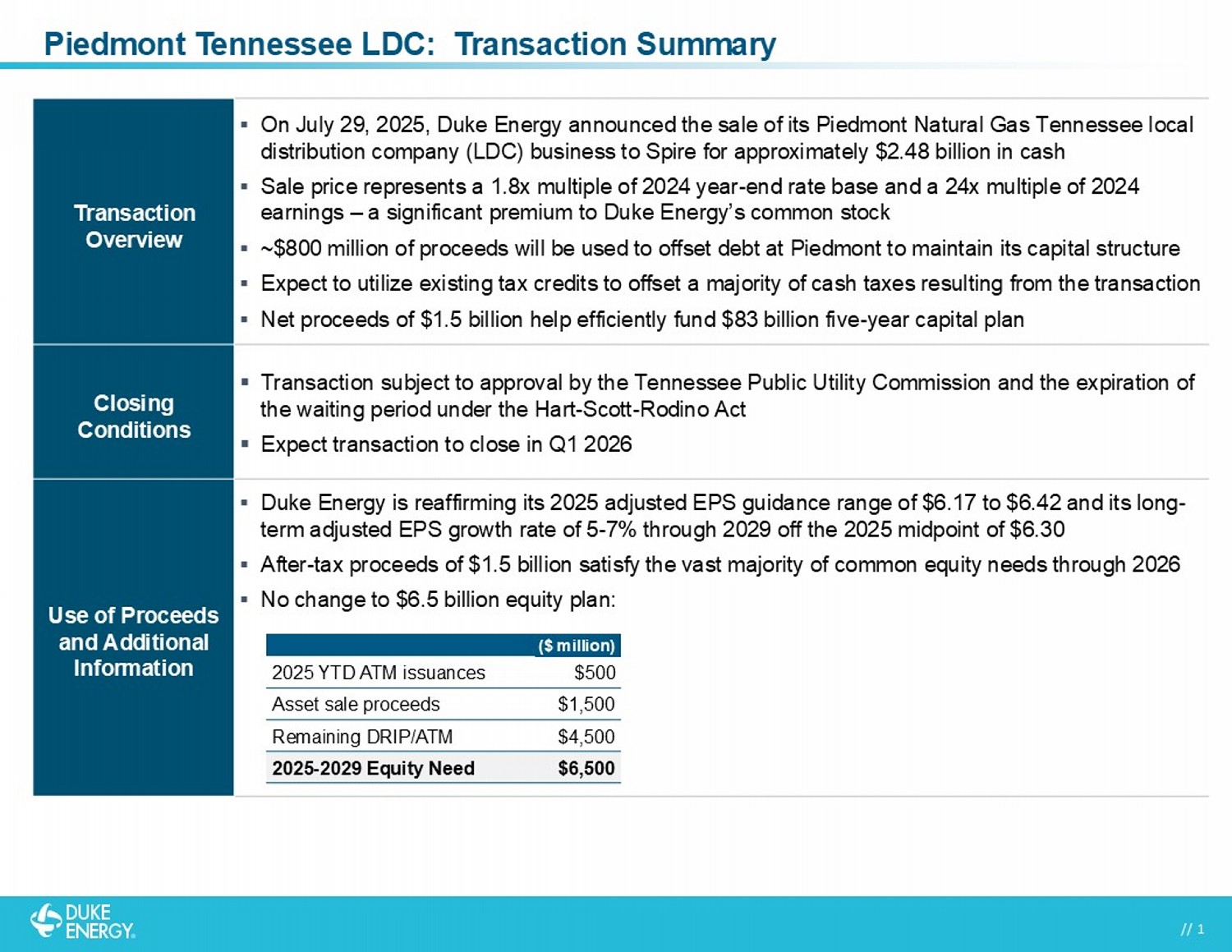
1 // 1 Piedmont Tennessee LDC: Transaction Summary ▪ On July 29, 2025, Duke Energy announced the sale of its Piedmont Natural Gas Tennessee local distribution company (LDC) business to Spire for approximately $2.48 billion in cash ▪ Sale price represents a 1.8x multiple of 2024 year - end rate base and a 24x multiple of 2024 earnings – a significant premium to Duke Energy’s common stock ▪ ~$800 million of proceeds will be used to offset debt at Piedmont to maintain its capital structure ▪ Expect to utilize existing tax credits to offset a majority of cash taxes resulting from the transaction ▪ Net proceeds of $1.5 billion help efficiently fund $83 billion five - year capital plan Transaction Overview ▪ Transaction subject to approval by the Tennessee Public Utility Commission and the expiration of the waiting period under the Hart - Scott - Rodino Act ▪ Expect transaction to close in Q1 2026 Closing Conditions ▪ Duke Energy is reaffirming its 2025 adjusted EPS guidance range of $6.17 to $6.42 and its long - term adjusted EPS growth rate of 5 - 7% through 2029 off the 2025 midpoint of $6.30 ▪ After - tax proceeds of $1.5 billion satisfy the vast majority of common equity needs through 2026 ▪ No change to $6.5 billion equity plan: Use of Proceeds and Additional Information ($ million) $500 2025 YTD ATM issuances $1,500 Asset sale proceeds $4,500 Remaining DRIP/ATM $6,500 2025 - 2029 Equity Need
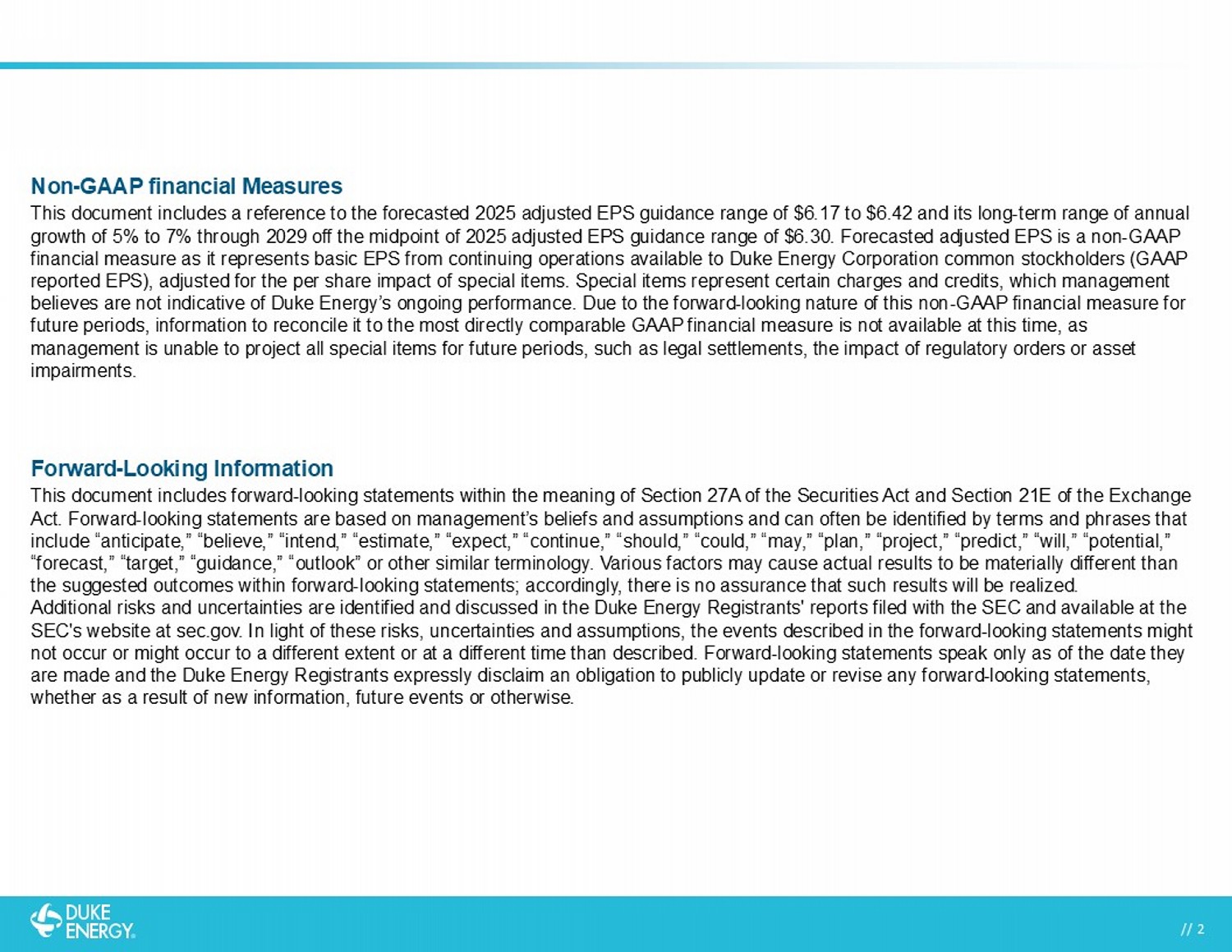
2 // 2 Non - GAAP financial Measures This document includes a reference to the forecasted 2025 adjusted EPS guidance range of $6.17 to $6.42 and its long - term range of annual growth of 5% to 7% through 2029 off the midpoint of 2025 adjusted EPS guidance range of $6.30. Forecasted adjusted EPS is a n on - GAAP financial measure as it represents basic EPS from continuing operations available to Duke Energy Corporation common stockhold ers (GAAP reported EPS), adjusted for the per share impact of special items. Special items represent certain charges and credits, which ma nagement believes are not indicative of Duke Energy’s ongoing performance. Due to the forward - looking nature of this non - GAAP financial m easure for future periods, information to reconcile it to the most directly comparable GAAP financial measure is not available at this t ime , as management is unable to project all special items for future periods, such as legal settlements, the impact of regulatory ord ers or asset impairments. Forward - Looking Information This document includes forward - looking statements within the meaning of Section 27A of the Securities Act and Section 21E of the Exchange Act. Forward - looking statements are based on management’s beliefs and assumptions and can often be identified by terms and phras es that include “anticipate,” “believe,” “intend,” “estimate,” “expect,” “continue,” “should,” “could,” “may,” “plan,” “project,” “pr edi ct,” “will,” “potential,” “forecast,” “target,” “guidance,” “outlook” or other similar terminology. Various factors may cause actual results to be mate ria lly different than the suggested outcomes within forward - looking statements; accordingly, there is no assurance that such results will be realized. Additional risks and uncertainties are identified and discussed in the Duke Energy Registrants' reports filed with the SEC an d a vailable at the SEC's website at sec.gov. In light of these risks, uncertainties and assumptions, the events described in the forward - looking st atements might not occur or might occur to a different extent or at a different time than described. Forward - looking statements speak only as o f the date they are made and the Duke Energy Registrants expressly disclaim an obligation to publicly update or revise any forward - looking state ments, whether as a result of new information, future events or otherwise.