
EVER 8-K
EverQuote, Inc. (EVER)
UNITED STATES
SECURITIES AND EXCHANGE COMMISSION
WASHINGTON, D.C. 20549
FORM 8-K
CURRENT REPORT
Pursuant to Section 13 or 15(d)
of the Securities Exchange Act of 1934
Date of Report (Date of earliest event reported): February 24, 2020
EverQuote, Inc.
(Exact Name of Registrant as Specified in its Charter)
| Delaware | 001-38549 | 26-3101161 | ||
| (State or Other Jurisdiction of Incorporation) |
(Commission File Number) |
(IRS Employer Identification No.) | ||
| 210 Broadway Cambridge, Massachusetts |
02139 | |||
| (Address of Principal Executive Offices) | (Zip Code) | |||
Registrant’s telephone number, including area code: (855) 522-3444
(Former Name or Former Address, if Changed Since Last Report)
Check the appropriate box below if the Form 8-K filing is intended to simultaneously satisfy the filing obligation of the registrant under any of the following provisions (see General Instruction A.2. below):
| ☐ | Written communications pursuant to Rule 425 under the Securities Act (17 CFR 230.425) |
| ☐ | Soliciting material pursuant to Rule 14a-12 under the Exchange Act (17 CFR 240.14a-12) |
| ☐ | Pre-commencement communications pursuant to Rule 14d-2(b) under the Exchange Act (17 CFR 240.14d-2(b)) |
| ☐ | Pre-commencement communications pursuant to Rule 13e-4(c) under the Exchange Act (17 CFR 240.13e-4(c)) |
Securities registered pursuant to Section 12(b) of the Act:
| Title of each class |
Trading Symbol(s) |
Name of each exchange on which registered | ||
| Class A Common Stock, $0.001 par value per share | EVER | The Nasdaq Stock Market LLC |
Indicate by check mark whether the registrant is an emerging growth company as defined in Rule 405 of the Securities Act of 1933 (§230.405 of this chapter) or Rule 12b-2 of the Securities Exchange Act of 1934 (§240.12b-2 of this chapter).
Emerging growth company ☒
If an emerging growth company, indicate by check mark if the registrant has elected not to use the extended transition period for complying with any new or revised financial accounting standards provided pursuant to Section 13(a) of the Exchange Act. ☐
| Item 2.02 | Results of Operations and Financial Condition. |
On February 24, 2020, EverQuote, Inc. (the “Company”) issued a press release reporting financial results for the fiscal quarter and full year ended December 31, 2019. The full text of the press release is furnished as Exhibit 99.1 to this Current Report on Form 8-K.
The information contained in Item 2.02 in this Current Report on Form 8-K (including Exhibit 99.1) shall not be deemed “filed” for purposes of Section 18 of the Securities Exchange Act of 1934, as amended (the “Exchange Act”), or otherwise subject to the liabilities of that section, nor shall it be deemed incorporated by reference in any filing under the Securities Act of 1933, as amended (the “Securities Act”), or the Exchange Act, except as expressly set forth by specific reference in such a filing.
| Item 7.01 | Regulation FD Disclosure. |
On February 24, 2020, the Company posted an investor presentation and a study titled, “The Insurance Industry – Secular Shift Towards Online Shopping” to its website (www.everquote.com). Copies of the investor presentation and study are furnished as Exhibits 99.2 and 99.3, respectively, to this Current Report on Form 8-K.
The information contained in Item 7.01 in this Current Report on Form 8-K (including Exhibits 99.2 and 99.3) shall not be deemed to be “filed” for purposes of Section 18 of the Exchange Act or otherwise subject to the liability of that section, and shall not be incorporated by reference into any registration statement or other document filed under the Securities Act or the Exchange Act, except as shall be expressly set forth by specific reference in such filing.
| Item 9.01 | Financial Statements and Exhibits. |
(d) Exhibits
EXHIBIT INDEX
| Exhibit |
Description | |
| 99.1 | Press release dated February 24, 2020 | |
| 99.2 | Investor Presentation dated February 24, 2020 | |
| 99.3 | Study titled, “The Insurance Industry – Secular Shift Towards Online Shopping” | |
SIGNATURES
Pursuant to the requirements of the Securities Exchange Act of 1934, as amended, the registrant has duly caused this report to be signed on its behalf by the undersigned hereunto duly authorized.
| EVERQUOTE, INC. | ||||||
| Date: February 24, 2020 | By: | /s/ David Mason | ||||
| David Mason | ||||||
| Secretary and General Counsel | ||||||
Exhibit 99.1
EverQuote Announces Fourth Quarter and Full Year 2019 Financial Results
| • | Fourth Quarter Revenue Increased 86% Year-Over-Year to $73.8 Million |
| • | Fourth Quarter Variable Marketing Margin Increased 113% Year-Over-Year to $21.8 Million |
| • | Full Year 2019 Revenue Increased 52% Year-Over-Year to $248.8 Million |
| • | Full Year 2019 Variable Marketing Margin Increased 59% Year-Over-Year to $73.3 Million |
| • | Full Year 2019 Net Loss of $7.1 million |
| • | Full Year 2019 Adjusted EBITDA of $8.3 Million |
CAMBRIDGE, Mass., February 24, 2020 — EverQuote, Inc. (NASDAQ: EVER)(“EverQuote” or “the Company”), a leading online insurance marketplace, today announced financial results for the fourth quarter and full year ended December 31, 2019.
“We are pleased to report strong fourth quarter results across all of our key financial metrics - delivering year-over-year revenue growth of 86% in the fourth quarter, and 52% for the full year,” said Seth Birnbaum, CEO and Co-Founder of EverQuote. “We delivered growth across all of our verticals, and we continue to scale the business with fourth quarter variable marketing margin up 113% year-over-year. We are executing across our key growth levers and investing in the business to capitalize on our large and expanding market opportunity.
“2019 was a record year that exceeded our expectations across the board, and I am extremely proud of the strong results generated by our talented and dedicated team. During the year, we launched our renters, health and commercial insurance verticals. We continue to make excellent progress on our mission to be the largest source of online insurance policies in the world and are bullish on the long-term prospects for our business. We achieved Adjusted EBITDA profitability for the full year 2019 and believe we have set the stage for continued growth and profitability in 2020 and beyond,” concluded Mr. Birnbaum.
Fourth Quarter 2019 Financial Highlights:
(All comparisons are relative to the fourth quarter of 2018):
| • | Total revenue of $73.8 million, an increase of 86% driven by strength in consumer quote request volume and more favorable monetization. |
| • | Automotive insurance vertical revenue of $60.2 million, an increase of 78%. |
| • | Revenue from our other insurance verticals, which includes home and renters, life, commercial and health insurance, increased 130% to $13.6 million. |
| • | Variable Marketing Margin of $21.8 million, an increase of 113%. |
| • | GAAP net loss of $0.9 million, compared to a GAAP net loss of $6.9 million. |
| • | Adjusted EBITDA of $4.2 million, compared to Adjusted EBITDA of $(3.5) million. |
| • | The Company reached a preliminary settlement of class action securities litigation related to Company’s initial public offering. The Company recorded a charge of $1.2 million for the settlement amount, net of insurance coverage, which is not included in the calculation of Adjusted EBITDA. |
Fourth Quarter 2019 Business Highlights:
| • | The Company’s distribution growth and traffic optimization initiatives led to a 79% year-over-year increase in quote requests. |
| • | EverQuote added 22 new technology integrations, which improve the consumer shopping experience. |
Full Year 2019 Financial Highlights:
(All comparisons are relative to the full year of 2018):
| • | Total revenue of $248.8 million, an increase of 52% driven by strength in converting consumer arrivals to the marketplace into quote requests. |
| • | Automotive insurance vertical revenue of $212.3 million, an increase of 50%. |
| • | Revenue from our other insurance verticals, which includes home and renters, life, commercial and health insurance, increased 65% to $36.5 million. |
| • | Variable Marketing Margin of $73.3 million, an increase of 59%. |
| • | GAAP net loss of $7.1 million, compared to a GAAP net loss of $13.8 million. |
| • | Adjusted EBITDA of $8.3 million, compared to Adjusted EBITDA of ($5.5) million. |
Full Year 2019 Business Highlights:
| • | The Company launched renters, health and commercial verticals. |
| • | The Company’s distribution growth and traffic optimization led to a 56% growth in quote request volume over the prior year. |
| • | EverQuote welcomed several senior leaders to help scale our business and drive operational efficiencies. |
First Quarter and Full-Year 2020 Guidance:
EverQuote anticipates Revenue, Variable Marketing Margin and Adjusted EBITDA to be in the following ranges:
First quarter 2020:
| • | Revenue of $77.0 - $79.0 million. |
| • | Variable Marketing Margin of $22.0 - $23.5 million. |
| • | Adjusted EBITDA in the range of $2.0 - $3.5 million. |
Full year 2020:
| • | Revenue of $315.0 - $325.0 million. |
| • | Variable Marketing Margin of $92.0 - $98.0 million. |
| • | Adjusted EBITDA in the range of $10.0 - $15.0 million. |
With respect to the Company’s expectations under “First Quarter and Full Year 2020 Guidance” above, the Company has not reconciled the non-GAAP measure Adjusted EBITDA to the GAAP measure net income (loss) in this press release because the Company does not provide guidance for stock-based compensation expense, depreciation and amortization expense, legal settlement interest income and expense, and the provision for (benefit from) income taxes on a consistent basis as the Company is unable to quantify these amounts without unreasonable efforts, which would be required to include a reconciliation of Adjusted EBITDA to GAAP net income (loss). In addition, the Company believes such a reconciliation would imply a degree of precision that could be confusing or misleading to investors.
Insurance Industry Study – Secular Shift of Insurance Online
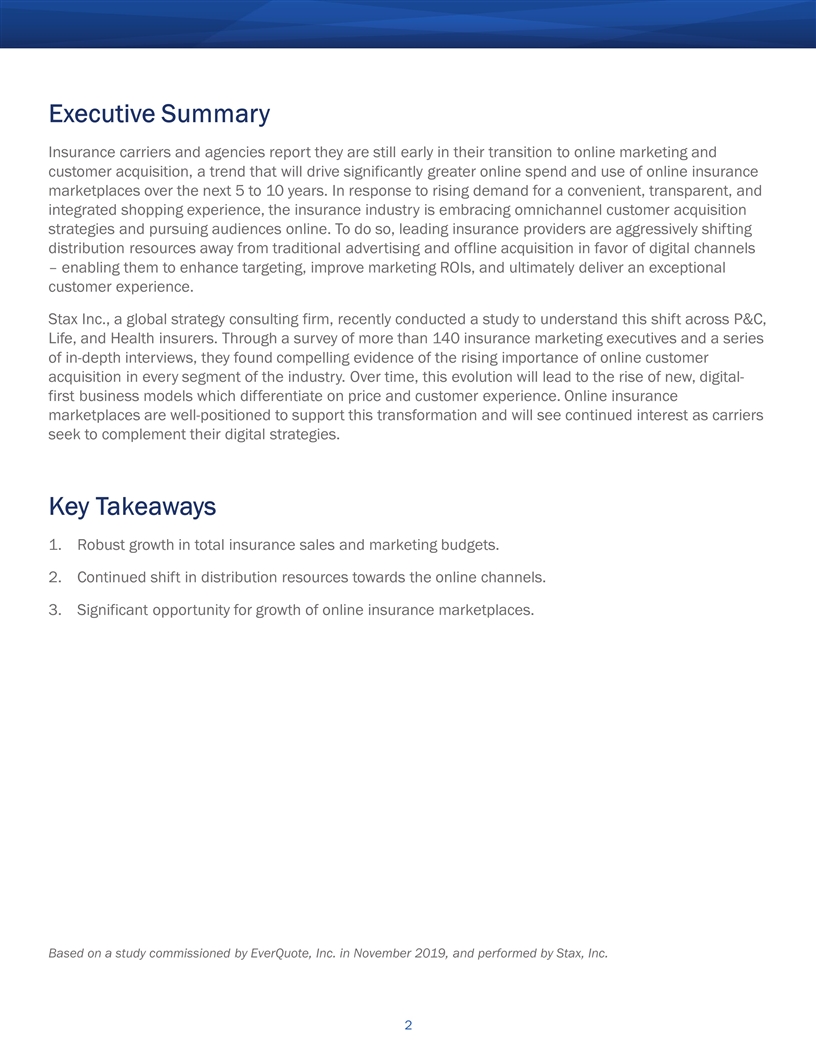
The Company today also published a study analyzing the secular shift of the insurance industry, based on a survey of more than 140 insurance marketing executives and a series of in-depth interviews conducted by Stax, Inc., a global strategy consulting firm. The study estimates that the insurance industry spent $146 billion in 2019 on commissions and customer acquisition resources and is in the early stages of undergoing a sizeable shift in favor of online channels and digital offerings. As a leading online insurance marketplace, the Company believes that it is well-positioned to scale and expand alongside its carrier and agency partners as it supports their ongoing transition to online marketing and sales. The study is available on the “Investors” portion of our website.
Conference Call and Webcast Information
EverQuote will host a conference call and live webcast to discuss its fourth quarter and full year 2019 financial results and outlook at 4:30 p.m. Eastern Time today, February 24, 2020. To access the conference call, dial (877) 273-5005 for the U.S. or Canada, or (647) 689-5410 for international callers and provide conference ID 6495447. The webcast will be available live on the Investors section of the Company’s website at https://investors.everquote.com.
An audio replay of the call will also be available to investors beginning at approximately 6:30 p.m. Eastern Time on February 24, 2020, until 11:59 p.m. Eastern Time on March 2, 2020, by dialing (800) 585-8367 for the U.S. or Canada, or (416) 621-4642 for international callers, and entering passcode 6495447. In addition, an archived webcast will be available on the Investors section of the Company’s website at: https://investors.everquote.com.
Safe Harbor Statement
Any statements in this press release about future expectations, plans and prospects for EverQuote, Inc. (“EverQuote” or the “Company”), including statements about future results of operations or the future financial position of the Company, including financial targets, business strategy, plans and objectives for future operations and other statements containing the words “anticipates,” “believes,” “expects,” “plans,” and similar expressions, constitute forward-looking statements within the meaning of The Private Securities Litigation Reform Act of 1995. Actual results may differ materially from those indicated by such forward-looking statements as a result of various important factors, including: (1) the Company’s ability to attract and retain consumers and insurance providers using the Company’s marketplace; (2) the Company’s ability to maintain or increase the amount providers spend per quote request; (3) the effectiveness of the Company’s growth strategies and its ability to effectively manage growth; (4) the Company’s ability to maintain and build its brand; (5) the Company’s reliance on its third-party service providers; (6) the Company’s ability to develop new and enhanced products and services to attract and retain consumers and insurance providers, and the Company’s ability to successfully monetize them; (7) the impact of competition in the Company’s industry and innovation by the Company’s competitors; (8) the Company’s expected use of proceeds from its initial public offering; (9) the Company’s expectations regarding the insurance industry and the transition to online marketing; and (10) other factors discussed in the “Risk Factors” section of the Company’s most recent Quarterly Report on Form 10-Q, which is on file with the Securities and Exchange Commission. In addition, the forward-looking statements included in this press release represent the Company’s views as of the date of this press release. The Company anticipates that subsequent events and developments will cause the Company’s views to change. However,
while the Company may elect to update these forward-looking statements at some point in the future, the Company specifically disclaims any obligation to do so. These forward-looking statements should not be relied upon as representing the Company’s views as of any date subsequent to the date of this press release.
About EverQuote
EverQuote operates a leading online insurance marketplace in the U.S., connecting consumers with insurance providers. The company’s data & technology platform matches and connects consumers seeking to purchase insurance with relevant options from the company’s broad direct network of insurance providers, saving consumers and providers time and money. EverQuote was founded with the vision to empower customers to better protect life’s most important assets—their family, property, and future.
EVERQUOTE, INC.
STATEMENTS OF OPERATIONS
| Three Months Ended December 31, |
Year Ended December 31, |
|||||||||||||||
| 2019 | 2018 | 2019 | 2018 | |||||||||||||
| (in thousands except per share data) | ||||||||||||||||
| Revenue |
$ | 73,799 | $ | 39,779 | $ | 248,811 | $ | 163,349 | ||||||||
|
|
|
|
|
|
|
|
|
|||||||||
| Cost and operating expenses(1): |
||||||||||||||||
| Cost of revenue |
4,681 | 3,075 | 15,903 | 11,678 | ||||||||||||
| Sales and marketing |
59,331 | 35,638 | 202,689 | 140,743 | ||||||||||||
| Research and development |
5,529 | 4,255 | 20,214 | 14,173 | ||||||||||||
| General and administrative |
4,186 | 3,925 | 16,827 | 10,667 | ||||||||||||
| Legal settlement |
1,227 | — | 1,227 | — | ||||||||||||
|
|
|
|
|
|
|
|
|
|||||||||
| Total cost and operating expenses |
74,954 | 46,893 | 256,860 | 177,261 | ||||||||||||
|
|
|
|
|
|
|
|
|
|||||||||
| Loss from operations |
(1,155 | ) | (7,114 | ) | (8,049 | ) | (13,912 | ) | ||||||||
| Other income (expense): |
||||||||||||||||
| Interest income (expense), net |
133 | 189 | 669 | 121 | ||||||||||||
| Other income |
88 | — | 263 | — | ||||||||||||
|
|
|
|
|
|
|
|
|
|||||||||
| Total other income (expense), net |
221 | 189 | 932 | 121 | ||||||||||||
|
|
|
|
|
|
|
|
|
|||||||||
| Net loss |
(934 | ) | (6,925 | ) | (7,117 | ) | (13,791 | ) | ||||||||
| Accretion of redeemable convertible preferred stock to redemption value |
— | — | — | (37,415 | ) | |||||||||||
|
|
|
|
|
|
|
|
|
|||||||||
| Net loss attributable to common stockholders |
$ | (934 | ) | $ | (6,925 | ) | $ | (7,117 | ) | $ | (51,206 | ) | ||||
|
|
|
|
|
|
|
|
|
|||||||||
| Net loss per share attributable to common stockholders, basic and diluted |
$ | (0.04 | ) | $ | (0.28 | ) | $ | (0.28 | ) | $ | (3.03 | ) | ||||
|
|
|
|
|
|
|
|
|
|||||||||
| Weighted average common shares outstanding, basic and diluted |
26,240 | 25,038 | 25,759 | 16,922 | ||||||||||||
|
|
|
|
|
|
|
|
|
|||||||||
| (1) | Amounts include stock-based compensation expense, as follows: |
| Three Months Ended December 31, |
Year Ended December 31, |
|||||||||||||||
| 2019 | 2018 | 2019 | 2018 | |||||||||||||
| (in thousands) | ||||||||||||||||
| Cost of revenue |
$ | 54 | $ | 13 | $ | 193 | $ | 42 | ||||||||
| Sales and marketing |
1,129 | 678 | 3,805 | 1,955 | ||||||||||||
| Research and development |
1,053 | 861 | 3,967 | 2,011 | ||||||||||||
| General and administrative |
1,228 | 1,693 | 4,756 | 3,113 | ||||||||||||
|
|
|
|
|
|
|
|
|
|||||||||
| $ | 3,464 | $ | 3,245 | $ | 12,721 | $ | 7,121 | |||||||||
|
|
|
|
|
|
|
|
|
|||||||||
EVERQUOTE, INC.
BALANCE SHEET DATA
| December 31, | ||||||||
| 2019 | 2018 | |||||||
| (in thousands) | ||||||||
| Cash and cash equivalents |
$ | 46,054 | $ | 41,634 | ||||
| Working capital |
46,944 | 39,185 | ||||||
| Total assets |
91,221 | 65,746 | ||||||
| Total liabilities |
39,451 | 22,562 | ||||||
| Total stockholders’ equity |
51,770 | 43,184 | ||||||
EVERQUOTE, INC.
STATEMENTS OF CASH FLOWS
| Year Ended December 31, | ||||||||
| 2019 | 2018 | |||||||
| (in thousands) | ||||||||
| Cash flows from operating activities: |
||||||||
| Net loss |
$ | (7,117 | ) | $ | (13,791 | ) | ||
| Adjustments to reconcile net loss to net cash provided by (used in) operating activities: |
||||||||
| Depreciation and amortization |
2,186 | 1,341 | ||||||
| Loss on disposal of equipment |
98 | — | ||||||
| Stock-based compensation expense |
12,721 | 7,121 | ||||||
| Noncash interest expense |
— | 14 | ||||||
| Provision for bad debt |
478 | — | ||||||
| Deferred rent |
(135 | ) | 337 | |||||
| Changes in operating assets and liabilities: |
||||||||
| Accounts receivable |
(15,232 | ) | (2,766 | ) | ||||
| Prepaid expenses and other current assets |
(5,609 | ) | (863 | ) | ||||
| Other assets |
(1 | ) | — | |||||
| Accounts payable |
6,837 | 4,932 | ||||||
| Accrued expenses and other current liabilities |
10,126 | 1,324 | ||||||
| Deferred revenue |
61 | 454 | ||||||
|
|
|
|
|
|||||
| Net cash provided by (used in) operating activities |
4,413 | (1,897 | ) | |||||
|
|
|
|
|
|||||
| Cash flows from investing activities: |
||||||||
| Acquisition of property and equipment, including costs capitalized for development of internal-use software |
(2,975 | ) | (3,668 | ) | ||||
|
|
|
|
|
|||||
| Net cash used in investing activities |
(2,975 | ) | (3,668 | ) | ||||
|
|
|
|
|
|||||
| Cash flows from financing activities: |
||||||||
| Proceeds from initial public offering, net of underwriting discounts and commissions |
— | 52,313 | ||||||
| Proceeds from exercise of stock options |
2,982 | 861 | ||||||
| Proceeds from borrowings on line of credit |
— | 22,729 | ||||||
| Repayments of borrowings on line of credit |
— | (24,729 | ) | |||||
| Repayments of term loan |
— | (2,625 | ) | |||||
| Payments of initial public offering costs |
— | (3,713 | ) | |||||
|
|
|
|
|
|||||
| Net cash provided by financing activities |
2,982 | 44,836 | ||||||
|
|
|
|
|
|||||
| Net increase in cash, cash equivalents and restricted cash |
4,420 | 39,271 | ||||||
| Cash, cash equivalents and restricted cash at beginning of period |
41,884 | 2,613 | ||||||
|
|
|
|
|
|||||
| Cash, cash equivalents and restricted cash at end of period |
$ | 46,304 | $ | 41,884 | ||||
|
|
|
|
|
|||||
EVERQUOTE, INC.
FINANCIAL AND OPERATING METRICS
Revenue by vertical:
| Three Months Ended December 31, | Change | |||||||||||
| 2019 | 2018 | % | ||||||||||
| (in thousands) | ||||||||||||
| Automotive |
$ | 60,192 | $ | 33,853 | 77.8 | % | ||||||
| Other |
13,607 | 5,926 | 129.6 | % | ||||||||
|
|
|
|
|
|||||||||
| Total Revenue |
$ | 73,799 | $ | 39,779 | 85.5 | % | ||||||
|
|
|
|
|
|||||||||
| Year Ended December 31, | Change | |||||||||||
| 2019 | 2018 | % | ||||||||||
| (in thousands) | ||||||||||||
| Automotive |
$ | 212,300 | $ | 141,187 | 50.4 | % | ||||||
| Other |
36,511 | 22,162 | 64.7 | % | ||||||||
|
|
|
|
|
|||||||||
| Total Revenue |
$ | 248,811 | $ | 163,349 | 52.3 | % | ||||||
|
|
|
|
|
|||||||||
Other financial and non-financial metrics:
| Three Months Ended December 31, | Change | |||||||||||
| 2019 | 2018 | % | ||||||||||
| (in thousands) | ||||||||||||
| Loss from operations |
$ | (1,155 | ) | $ | (7,114 | ) | -83.8 | % | ||||
| Net loss |
$ | (934 | ) | $ | (6,925 | ) | -86.5 | % | ||||
| Quote requests |
5,863 | 3,284 | 78.5 | % | ||||||||
| Variable Marketing Margin(1) |
$ | 21,836 | $ | 10,240 | 113.2 | % | ||||||
| Adjusted EBITDA(2) |
$ | 4,217 | $ | (3,482 | ) | -221.1 | % | |||||
| Year Ended December 31, | Change | |||||||||||
| 2019 | 2018 | % | ||||||||||
| (in thousands) | ||||||||||||
| Loss from operations |
$ | (8,049 | ) | $ | (13,912 | ) | -42.1 | % | ||||
| Net loss |
$ | (7,117 | ) | $ | (13,791 | ) | -48.4 | % | ||||
| Quote requests |
20,011 | 12,803 | 56.3 | % | ||||||||
| Variable Marketing Margin(1) |
$ | 73,316 | $ | 46,075 | 59.1 | % | ||||||
| Adjusted EBITDA(2) |
$ | 8,348 | $ | (5,450 | ) | -253.2 | % | |||||
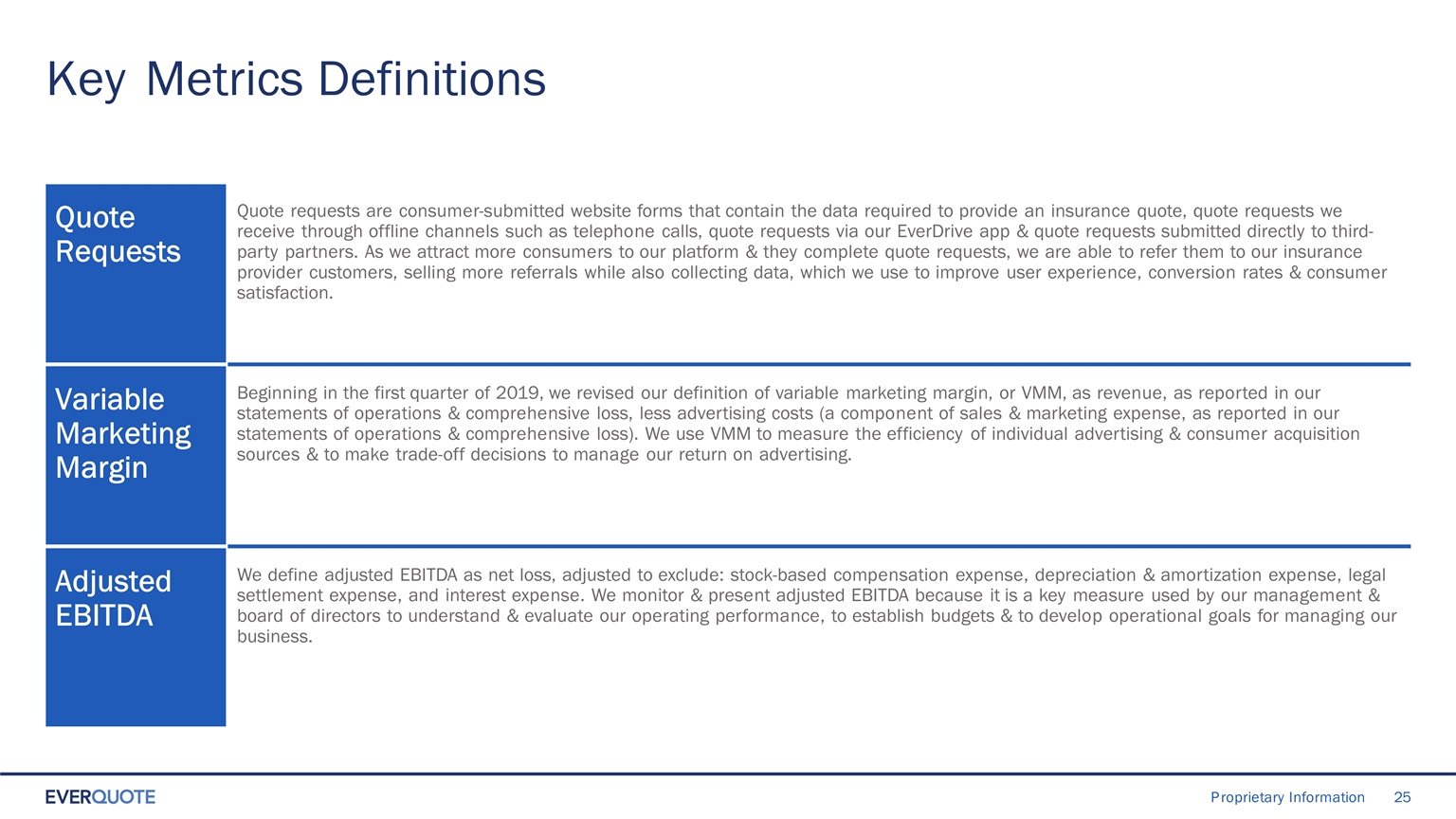
| (1) | Beginning in the first quarter of 2019, we revised our definition of variable marketing margin, or VMM, as revenue, as reported in our statements of operations and comprehensive income (loss), less advertising costs (a component of sales and marketing expense, as reported in our statements of operations and comprehensive income (loss)). We use VMM to measure the efficiency of individual advertising and consumer acquisition sources and to make trade-off decisions to manage our return on advertising. Under our previous definition of VMM, our VMM for the year ended December 31, 2018 was $48.0 million, as advertising costs used in our previously defined VMM calculation excluded advertising costs related to our EverDrive app and advertising costs not related to obtaining quote requests. |
| (2) | Adjusted EBITDA is a non-GAAP measure. Please see “EverQuote, Inc. Reconciliation of Non-GAAP Measures to GAAP” below for more information. |
EVERQUOTE, INC.
NON-GAAP FINANCIAL MEASURES
To supplement the Company’s financial statements presented in accordance with GAAP and to provide investors with additional information regarding EverQuote’s financial results, the Company has presented adjusted EBITDA as a non-GAAP financial measure. This non-GAAP financial measure is not based on any standardized methodology prescribed by GAAP and is not necessarily comparable to similarly titled measures presented by other companies.
The Company defines adjusted EBITDA as net income (loss), excluding the impact of stock-based compensation expense; depreciation and amortization expense; legal settlement; interest income and interest expense; and the provision for (benefit from) income taxes. The most directly comparable GAAP measure is net income (loss). The Company monitors and presents adjusted EBITDA because it is a key measure used by management and the board of directors to understand and evaluate operating performance, to establish budgets and to develop operational goals for managing EverQuote’s business. In particular, the Company believes that excluding the impact of these items in calculating adjusted EBITDA can provide a useful measure for period-to-period comparisons of EverQuote’s core operating performance.
The Company uses adjusted EBITDA to evaluate EverQuote’s operating performance and trends and make planning decisions. The Company believes that this non-GAAP financial measure helps identify underlying trends in EverQuote’s business that could otherwise be masked by the effect of the items that the Company excludes in the calculations of adjusted EBITDA. Accordingly, the Company believes that this financial measure provides useful information to investors and others in understanding and evaluating EverQuote’s operating results, enhancing the overall understanding of the Company’s past performance and future prospects.
The Company’s non-GAAP financial measures are not prepared in accordance with GAAP and should not be considered in isolation of, or as an alternative to, measures prepared in accordance with GAAP. There are a number of limitations related to the use of adjusted EBITDA rather than net income (loss), which is the most directly comparable financial measure calculated and presented in accordance with GAAP. In addition, other companies may use other measures to evaluate their performance, which could reduce the usefulness of the Company’s non-GAAP financial measures as tools for comparison.
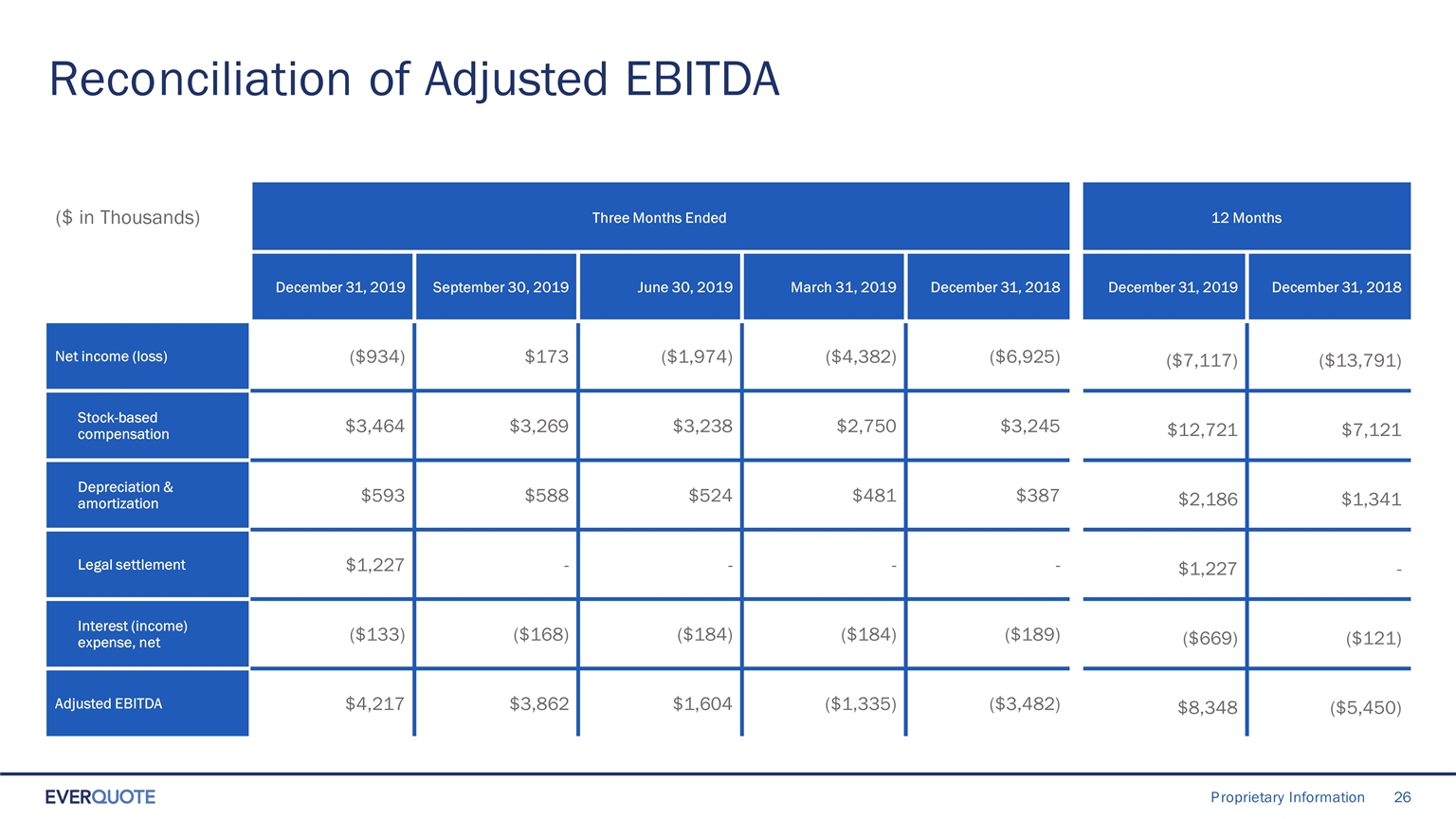
The following table reconciles adjusted EBITDA to net income (loss), the most directly comparable financial measure calculated and presented in accordance with GAAP.
EVERQUOTE, INC.
RECONCILIATION OF NON-GAAP MEASURES TO GAAP
| Three Months Ended December 31, |
Year Ended December 31, |
|||||||||||||||
| 2019 | 2018 | 2019 | 2018 | |||||||||||||
| (in thousands) | ||||||||||||||||
| Net loss |
$ | (934 | ) | $ | (6,925 | ) | $ | (7,117 | ) | $ | (13,791 | ) | ||||
| Stock-based compensation |
3,464 | 3,245 | 12,721 | 7,121 | ||||||||||||
| Depreciation and amortization |
593 | 387 | 2,186 | 1,341 | ||||||||||||
| Legal settlement |
1,227 | — | 1,227 | — | ||||||||||||
| Interest (income) expense, net |
(133 | ) | (189 | ) | (669 | ) | (121 | ) | ||||||||
|
|
|
|
|
|
|
|
|
|||||||||
| Adjusted EBITDA |
$ | 4,217 | $ | (3,482 | ) | $ | 8,348 | $ | (5,450 | ) | ||||||
|
|
|
|
|
|
|
|
|
|||||||||
Investor Relations Contact:
Brinlea Johnson
The Blueshirt Group
212-331-8424
Or
Allise Furlani
The Blueshirt Group
212-331-8433
SOURCE: EverQuote, Inc.
Investor Presentation February 2020 Exhibit 99.2
Disclaimer This presentation contains forward-looking statements. All statements other than statements of historical facts contained in this presentation, including statements regarding possible or assumed future results of operations, business strategies, development plans, regulatory activities, competitive position, potential growth opportunities, & the effects of competition are forward-looking statements. These statements involve known & unknown risks, uncertainties & other important factors that may cause actual results, performance or achievements of EverQuote, Inc. (“the Company”) to be materially different from any future results, performance or achievements expressed or implied by the forward-looking statements. In some cases, you can identify forward-looking statements by terms such as “may,” “should,” “expect,” “plan,” “project,” “estimate,” or “potential” or the negative of these terms or other similar expressions. The forward-looking statements in this presentation are only predictions. The Company has based these forward-looking statements largely on its current expectations & projections about future events & financial trends that it believes may affect the Company’s business, financial condition & results of operations. These forward-looking statements speak only as of the date of this presentation & are subject to a number of risks, uncertainties & assumptions, some of which cannot be predicted or quantified & some of which are beyond the Company’s control. The events & circumstances reflected in the Company’s forward-looking statements may not be achieved or occur, & actual results could differ materially from those projected in the forward-looking statements, including as a result of: (1) the Company’s ability to attract and retain consumers and insurance providers using the Company’s marketplace; (2) the Company’s ability to maintain or increase the amount providers spend per quote request; (3) the effectiveness of the Company’s growth strategies and its ability to effectively manage growth; (4) the Company’s ability to maintain and build its brand; (5) the Company’s reliance on its third-party service providers; (6) the Company’s ability to develop new and enhanced products and services to attract and retain consumers and insurance providers, and the Company’s ability to successfully monetize them; (7) the impact of competition in the Company’s industry and innovation by the Company’s competitors; (8) the Company’s expected use of proceeds from its initial public offering; and (9)as a result of the risks described in the “Risk Factors” section of the Company’s most recent Annual Report on Form 10-K, Quarterly Report on Form 10-Q & the other filings that the Company makes with the Securities & Exchange Commission from time to time. Moreover, new risk factors & uncertainties may emerge from time to time, & it is not possible for management to predict all risk factors & uncertainties that the Company may face. Except as required by applicable law, the Company does not plan to publicly update or revise any forward-looking statements contained herein, whether as a result of any new information, future events, changed circumstances or otherwise. The Company’s presentation also contains estimates, projections, & other information concerning the Company’s industry, the Company’s business & the markets for certain of the Company’s products & services, including data regarding the estimated size of those markets. Information that is based on estimates, forecasts, projections, market research, or similar methodologies is inherently subject to uncertainties & actual events or circumstances may differ materially from events & circumstances reflected in this information. Unless otherwise expressly stated, the Company obtained this industry, business, market & other data from reports, research surveys, studies & similar data prepared by market research firms & other third parties, from industry, general publications, & from government data & similar sources. We present adjusted EBITDA as a non-GAAP measure, which is not a substitute for or superior to, other measures of financial performance prepared in accordance with U.S. GAAP. A reconciliation of adjusted EBITDA to the most directly comparable GAAP measure is included in the Appendix to these slides.
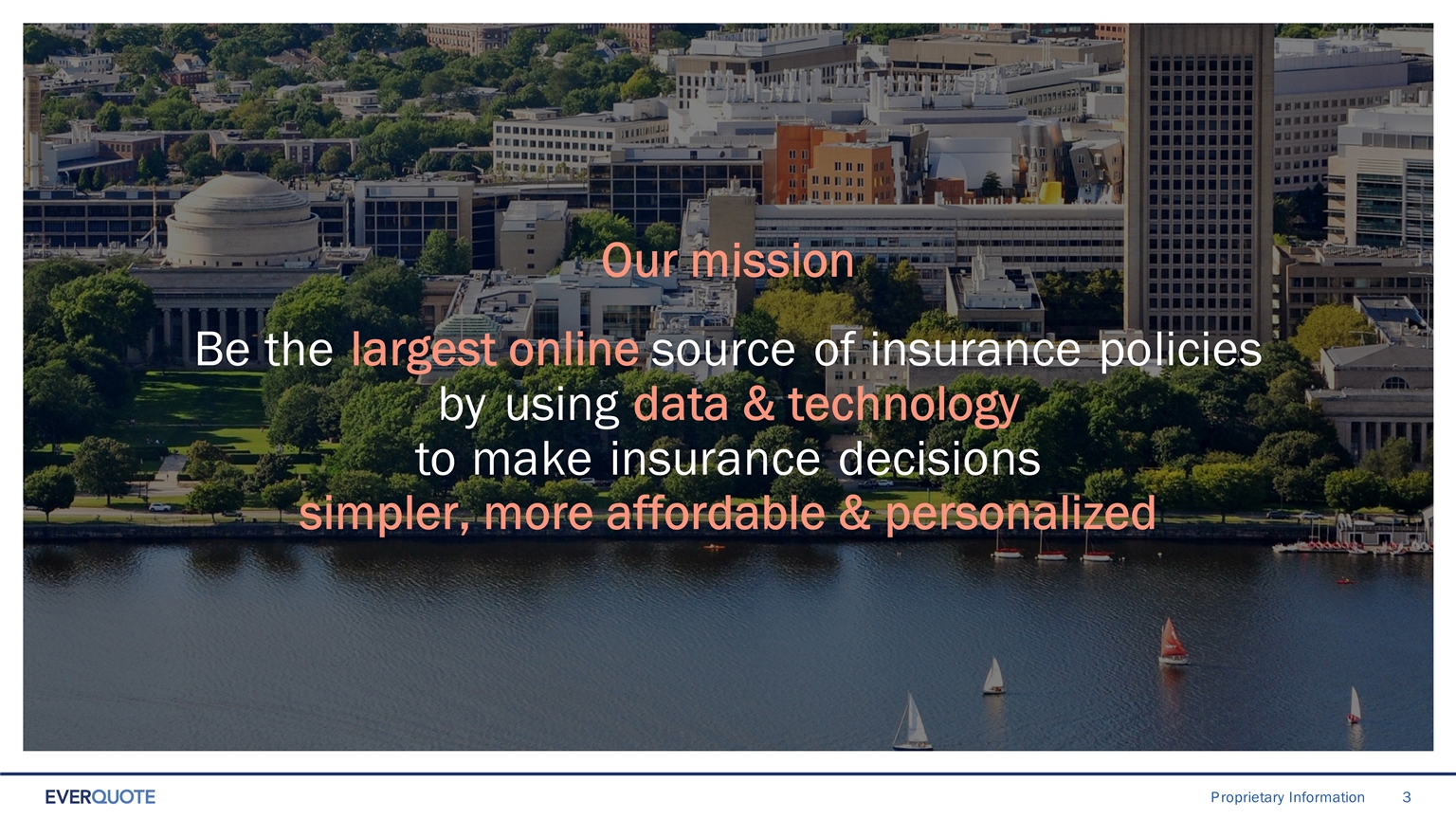
Our mission Be the largest online source of insurance policies by using data & technology to make insurance decisions simpler, more affordable & personalized
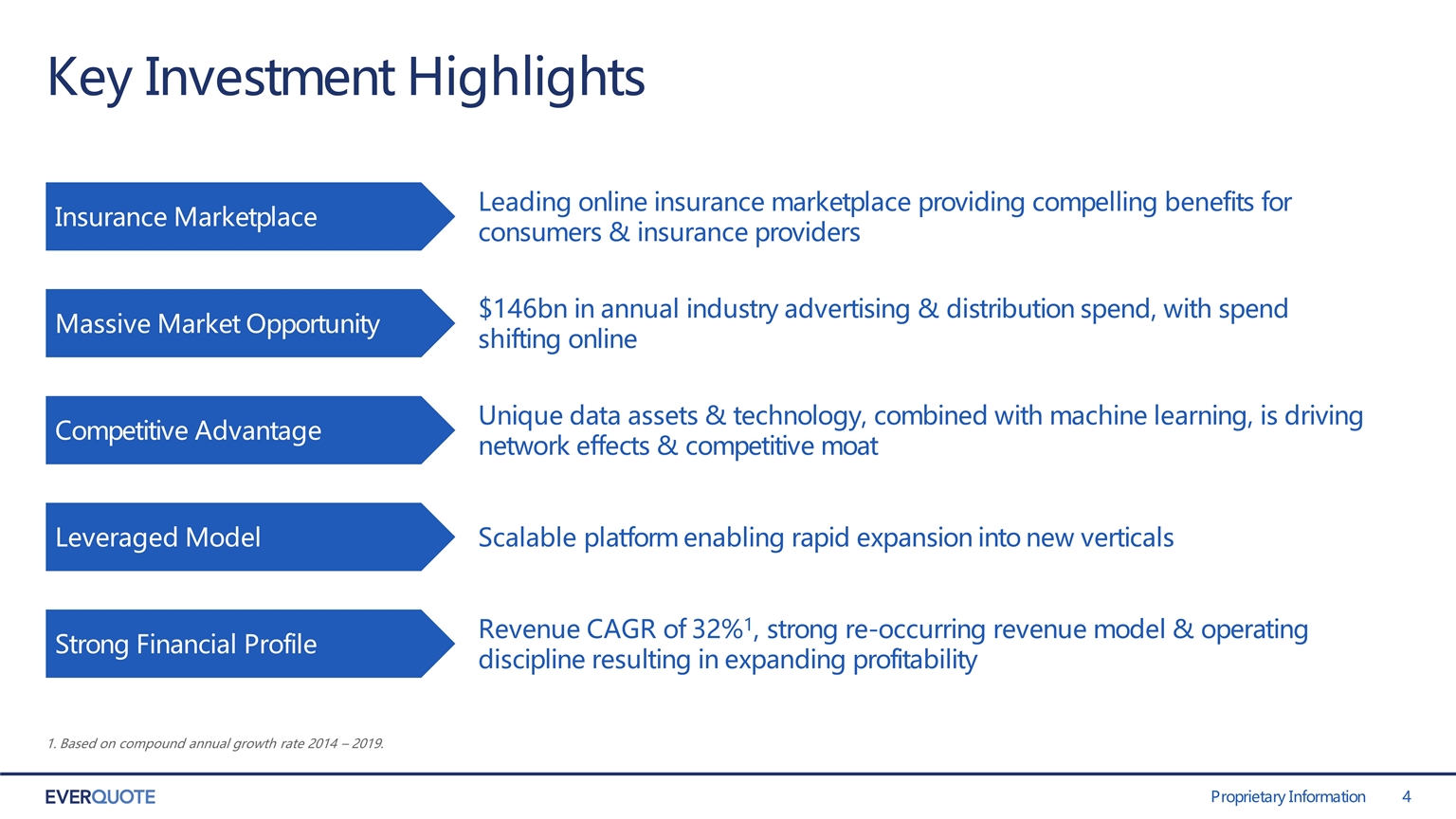
Key Investment Highlights Leading online insurance marketplace providing compelling benefits for consumers & insurance providers Revenue CAGR of 32%1, strong re-occurring revenue model & operating discipline resulting in expanding profitability Insurance Marketplace $146bn in annual industry advertising & distribution spend, with spend shifting online Massive Market Opportunity Unique data assets & technology, combined with machine learning, is driving network effects & competitive moat Competitive Advantage Scalable platform enabling rapid expansion into new verticals Leveraged Model Strong Financial Profile Based on compound annual growth rate 2014 – 2019.
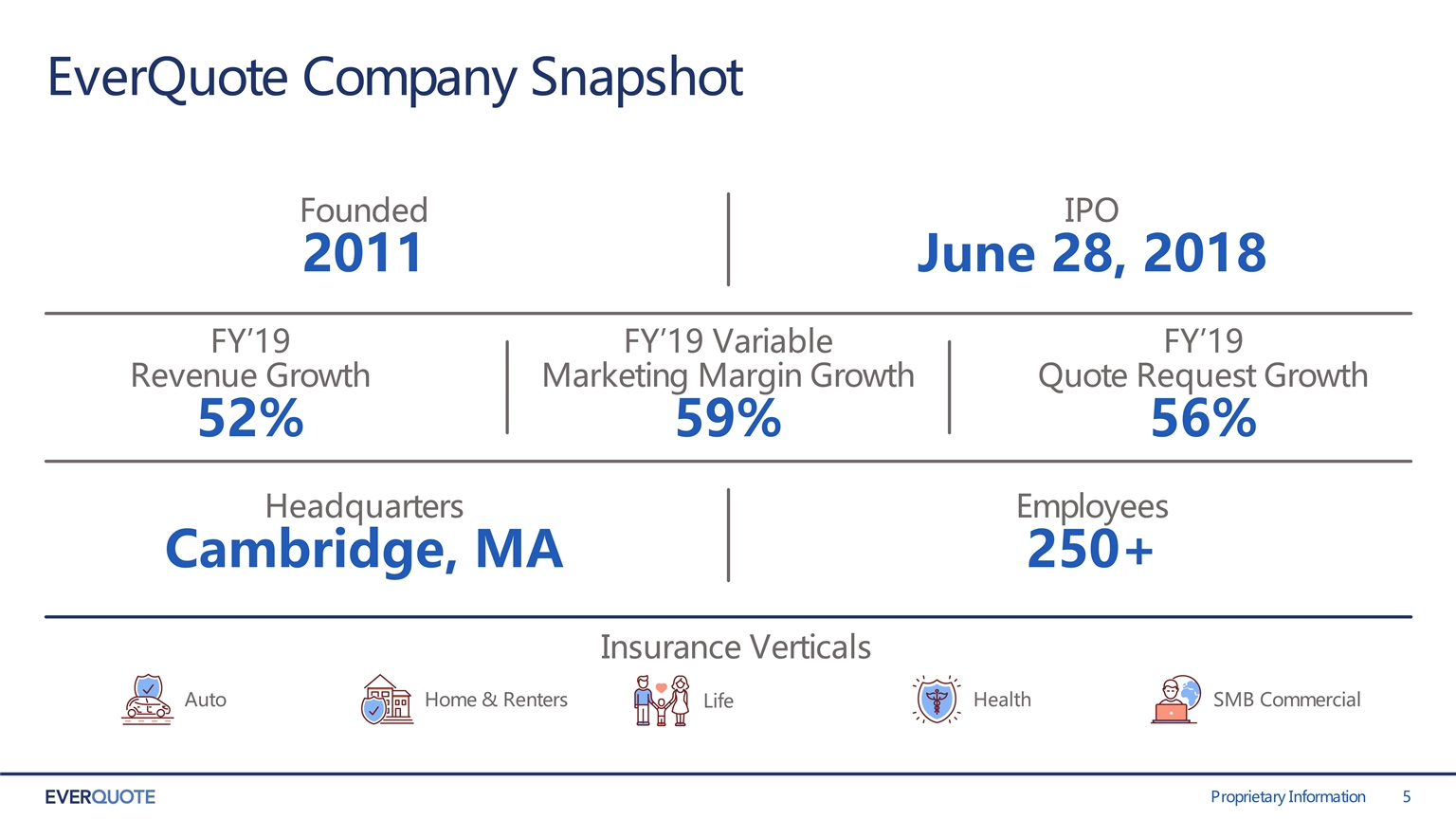
EverQuote Company Snapshot Founded 2011 FY’19 Revenue Growth 52% FY’19 Quote Request Growth 56% Employees 250+ IPO June 28, 2018 FY’19 Variable Marketing Margin Growth 59% Headquarters Cambridge, MA Auto Home & Renters Life Health SMB Commercial Insurance Verticals
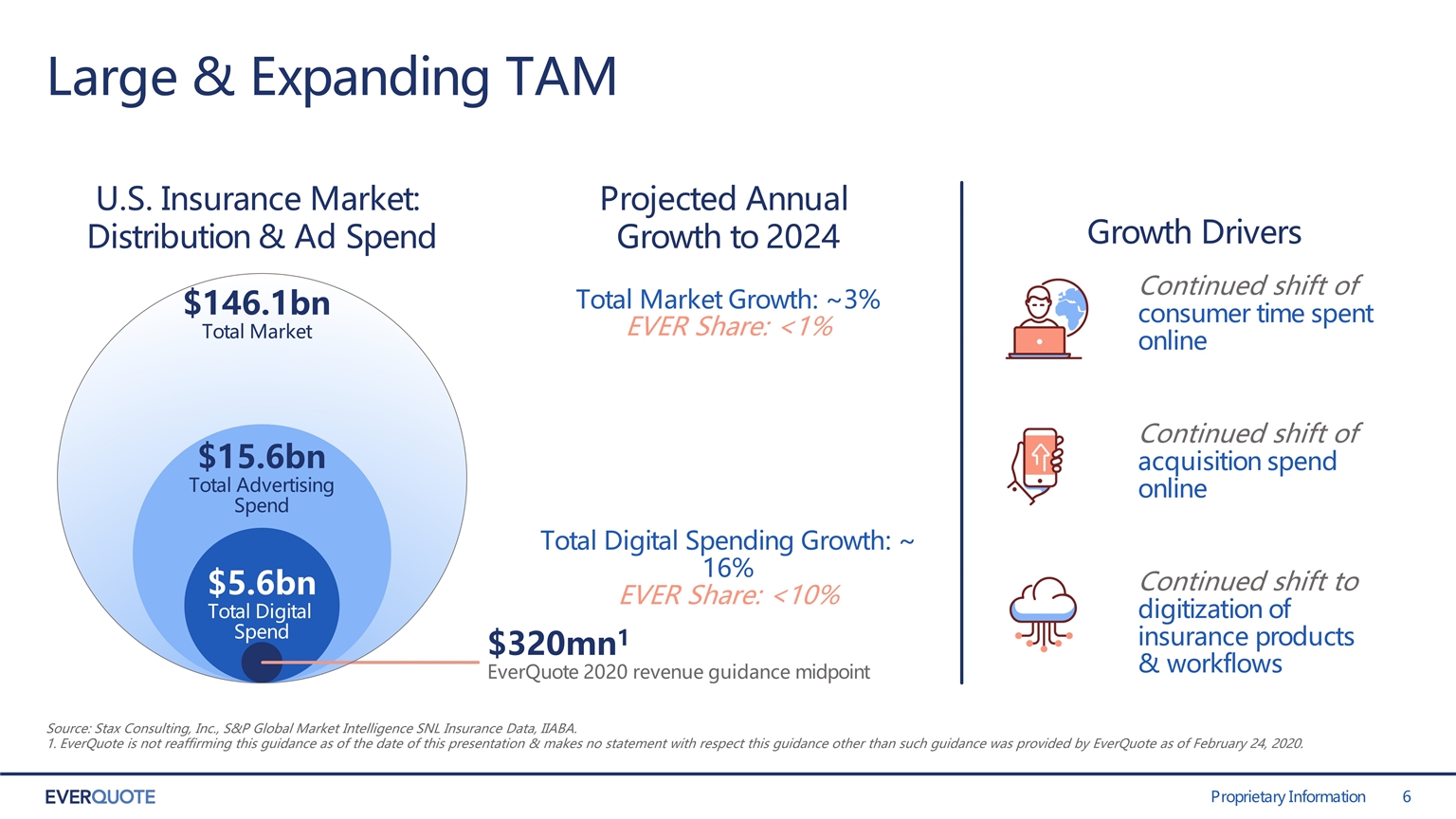
Large & Expanding TAM Total Digital Spending Growth: ~ 16% EVER Share: <10% Projected Annual Growth to 2024 Continued shift of consumer time spent online Continued shift of acquisition spend online Continued shift to digitization of insurance products & workflows Growth Drivers U.S. Insurance Market: Distribution & Ad Spend Total Market Growth: ~3% EVER Share: <1% Source: Stax Consulting, Inc., S&P Global Market Intelligence SNL Insurance Data, IIABA. EverQuote is not reaffirming this guidance as of the date of this presentation & makes no statement with respect this guidance other than such guidance was provided by EverQuote as of February 24, 2020. $320mn1 EverQuote 2020 revenue guidance midpoint $146.1bn Total Market $15.6bn Total Advertising Spend $5.6bn Total Digital Spend
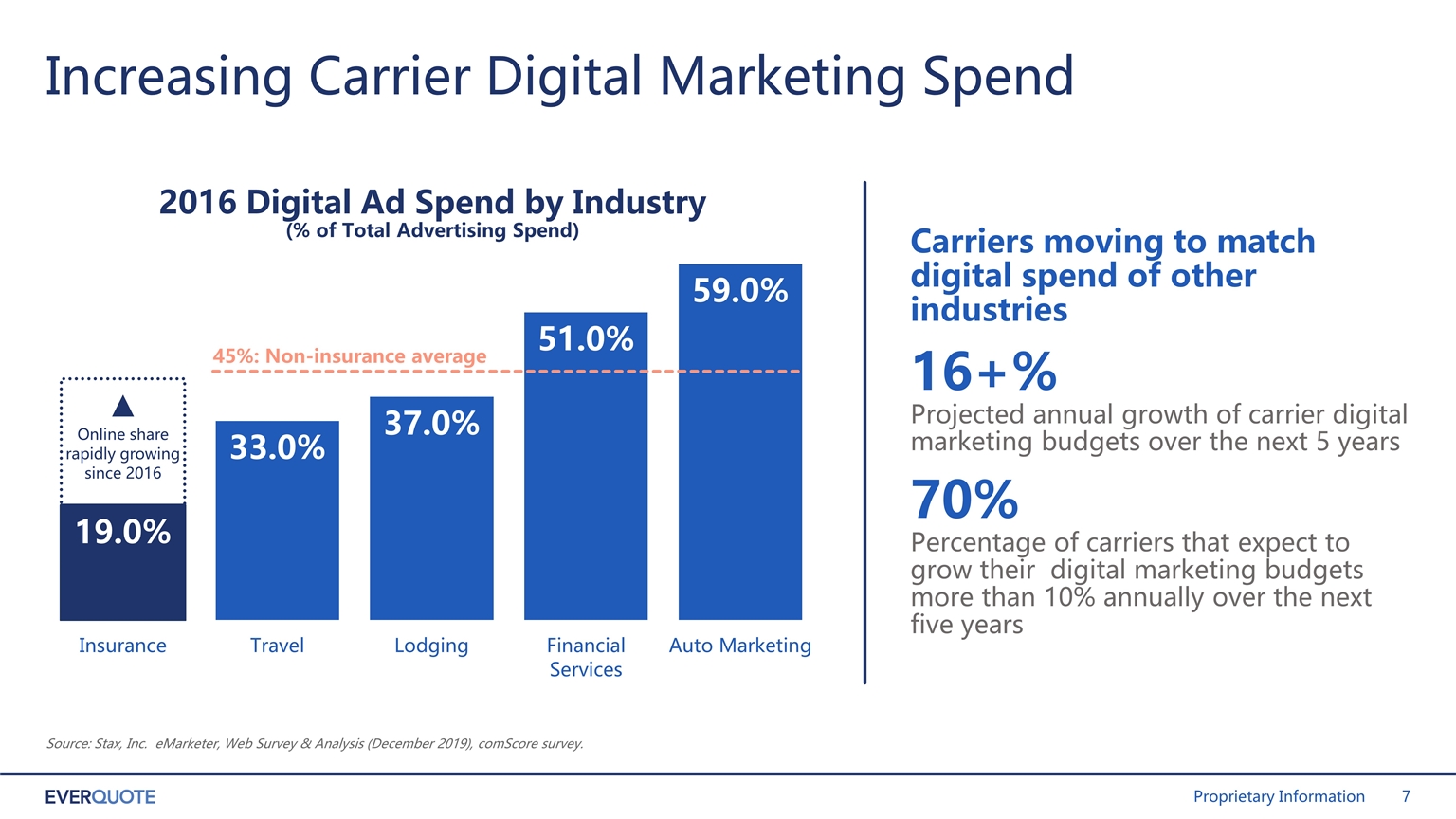
2016 Digital Ad Spend by Industry (% of Total Advertising Spend) Increasing Carrier Digital Marketing Spend Source: Stax, Inc. eMarketer, Web Survey & Analysis (December 2019), comScore survey. Carriers moving to match digital spend of other industries 16+% Projected annual growth of carrier digital marketing budgets over the next 5 years 70% Percentage of carriers that expect to grow their digital marketing budgets more than 10% annually over the next five years 45%: Non-insurance average
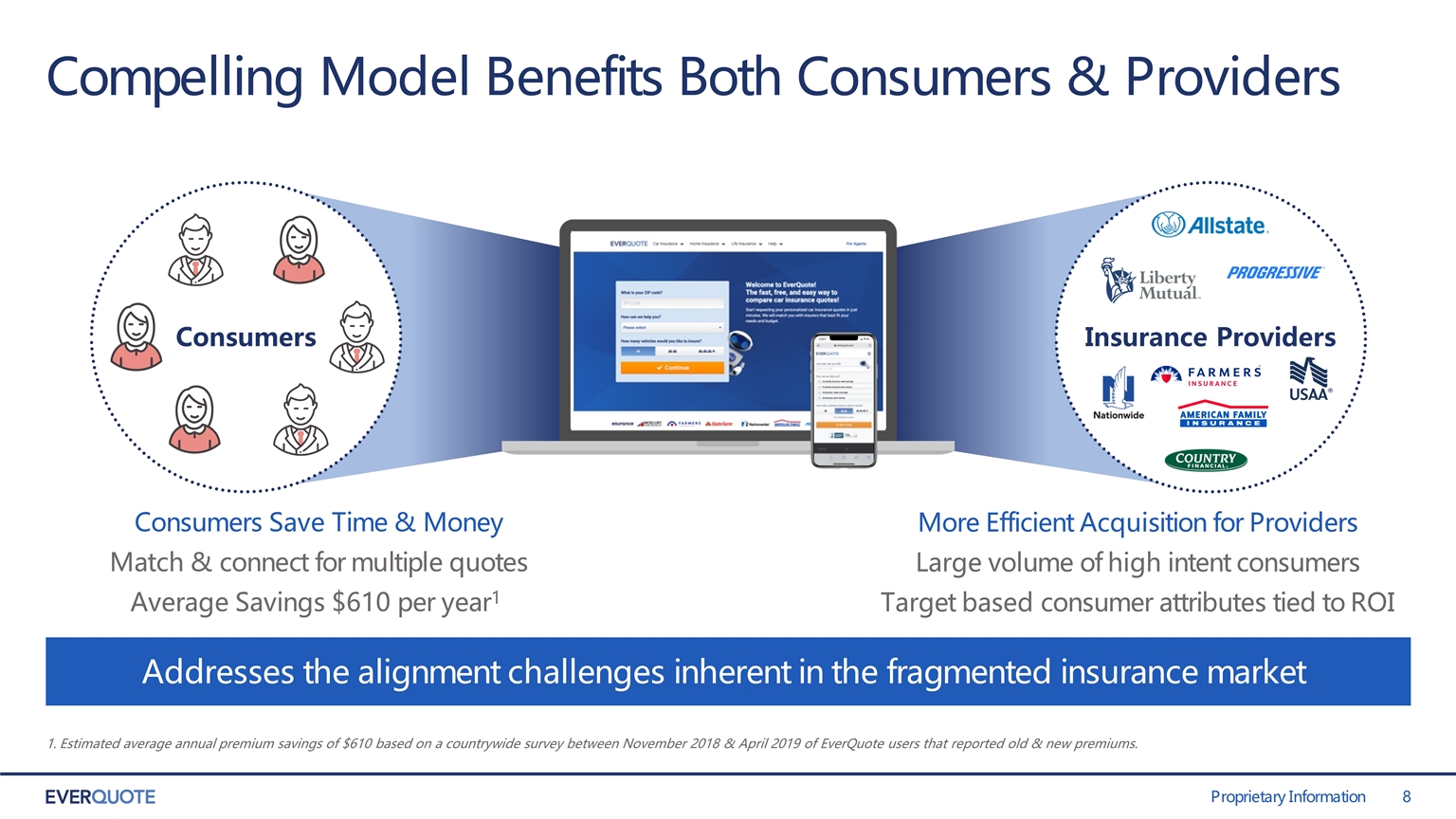
Compelling Model Benefits Both Consumers & Providers More Efficient Acquisition for Providers Large volume of high intent consumers Target based consumer attributes tied to ROI Consumers Save Time & Money Match & connect for multiple quotes Average Savings $610 per year1 Consumers Insurance Providers Addresses the alignment challenges inherent in the fragmented insurance market Estimated average annual premium savings of $610 based on a countrywide survey between November 2018 & April 2019 of EverQuote users that reported old & new premiums.
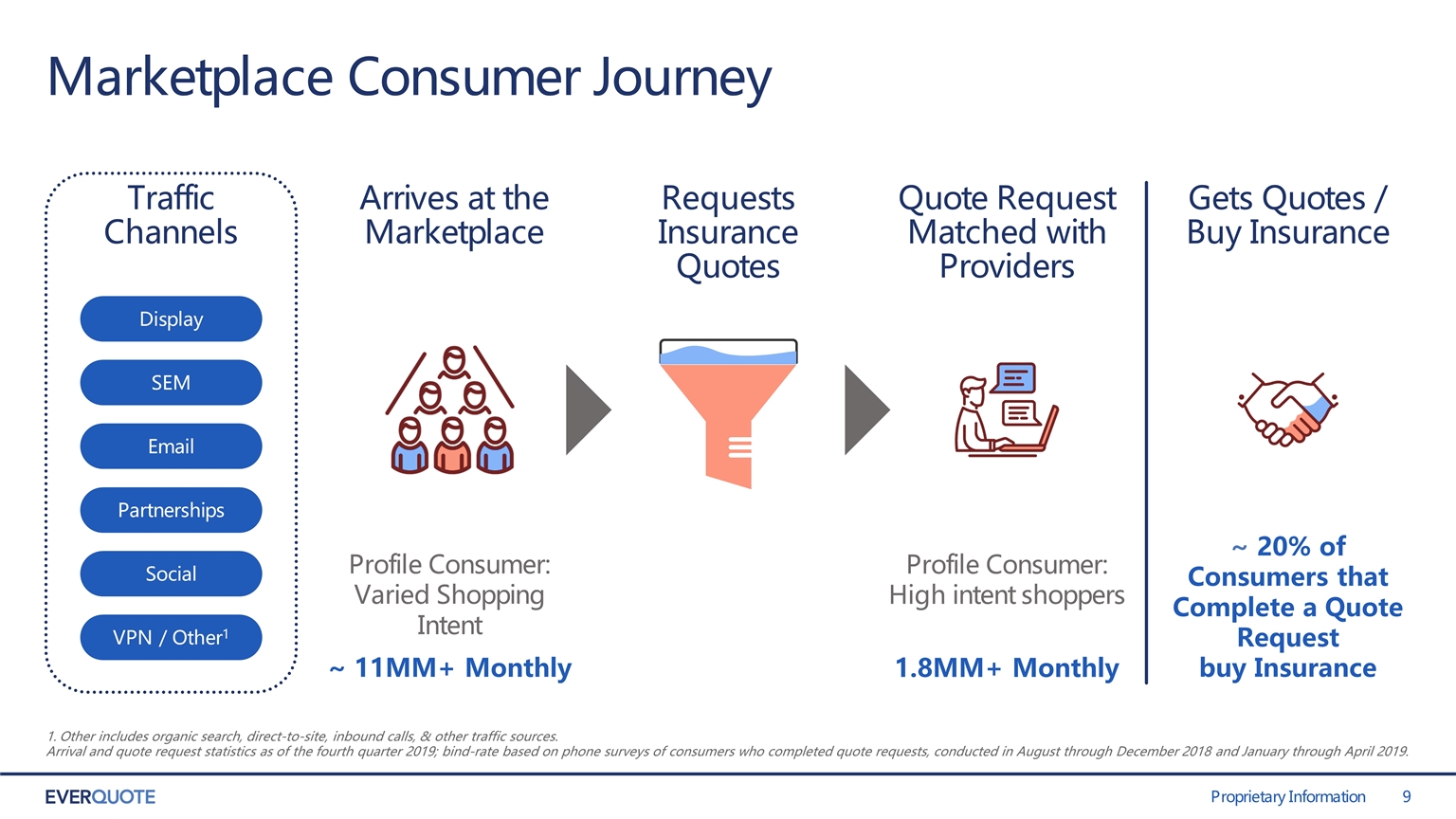
Marketplace Consumer Journey Profile Consumer: High intent shoppers 1.8MM+ Monthly Display Email Partnerships Social SEM VPN / Other1 Gets Quotes / Buy Insurance Traffic Channels Quote Request Matched with Providers Profile Consumer: Varied Shopping Intent ~ 11MM+ Monthly Arrives at the Marketplace Requests Insurance Quotes ~ 20% of Consumers that Complete a Quote Request buy Insurance Other includes organic search, direct-to-site, inbound calls, & other traffic sources. Arrival and quote request statistics as of the fourth quarter 2019; bind-rate based on phone surveys of consumers who completed quote requests, conducted in August through December 2018 and January through April 2019.
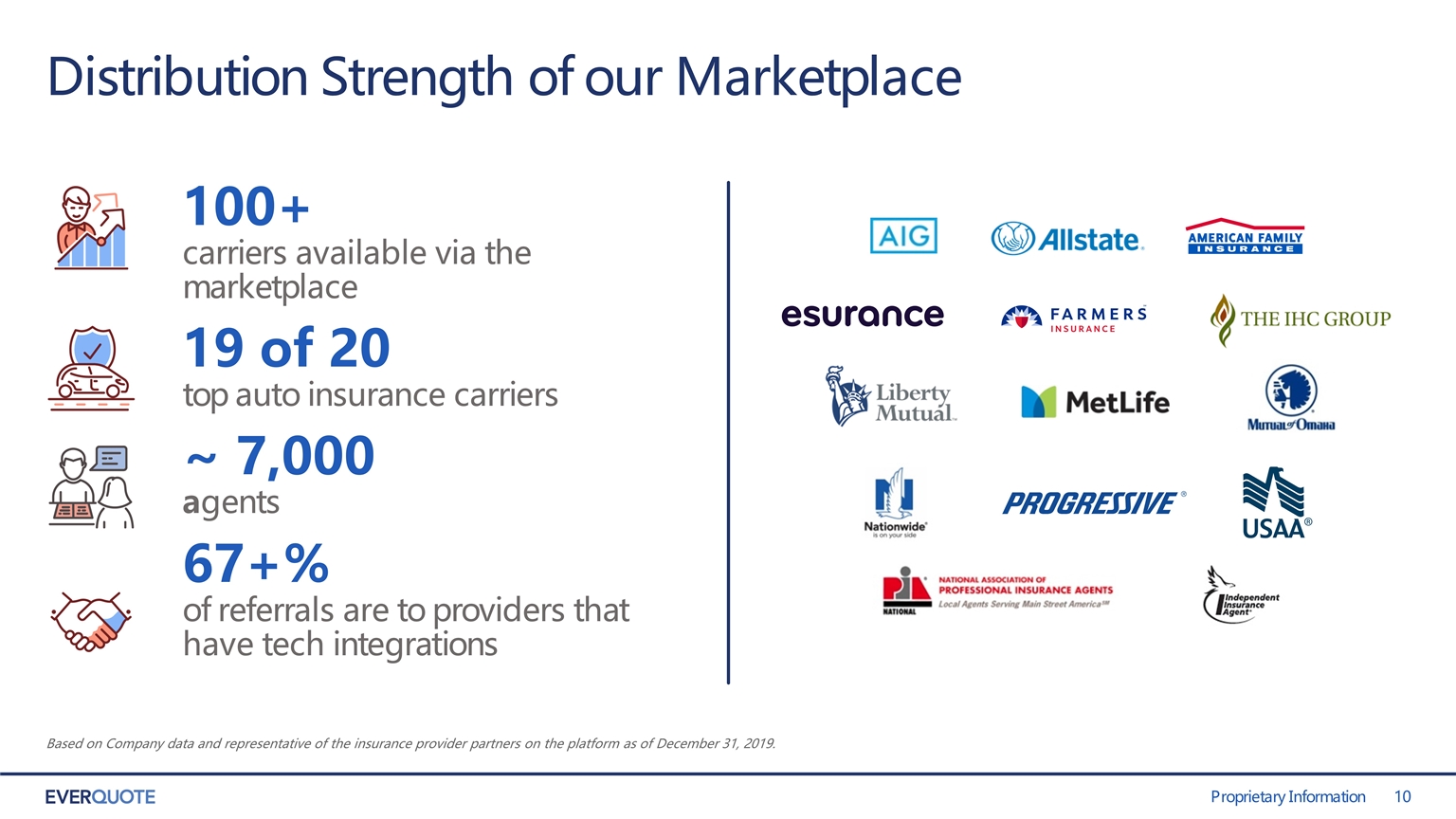
Distribution Strength of our Marketplace 100+ carriers available via the marketplace 19 of 20 top auto insurance carriers ~ 7,000 agents 67+% of referrals are to providers that have tech integrations Based on Company data and representative of the insurance provider partners on the platform as of December 31, 2019.
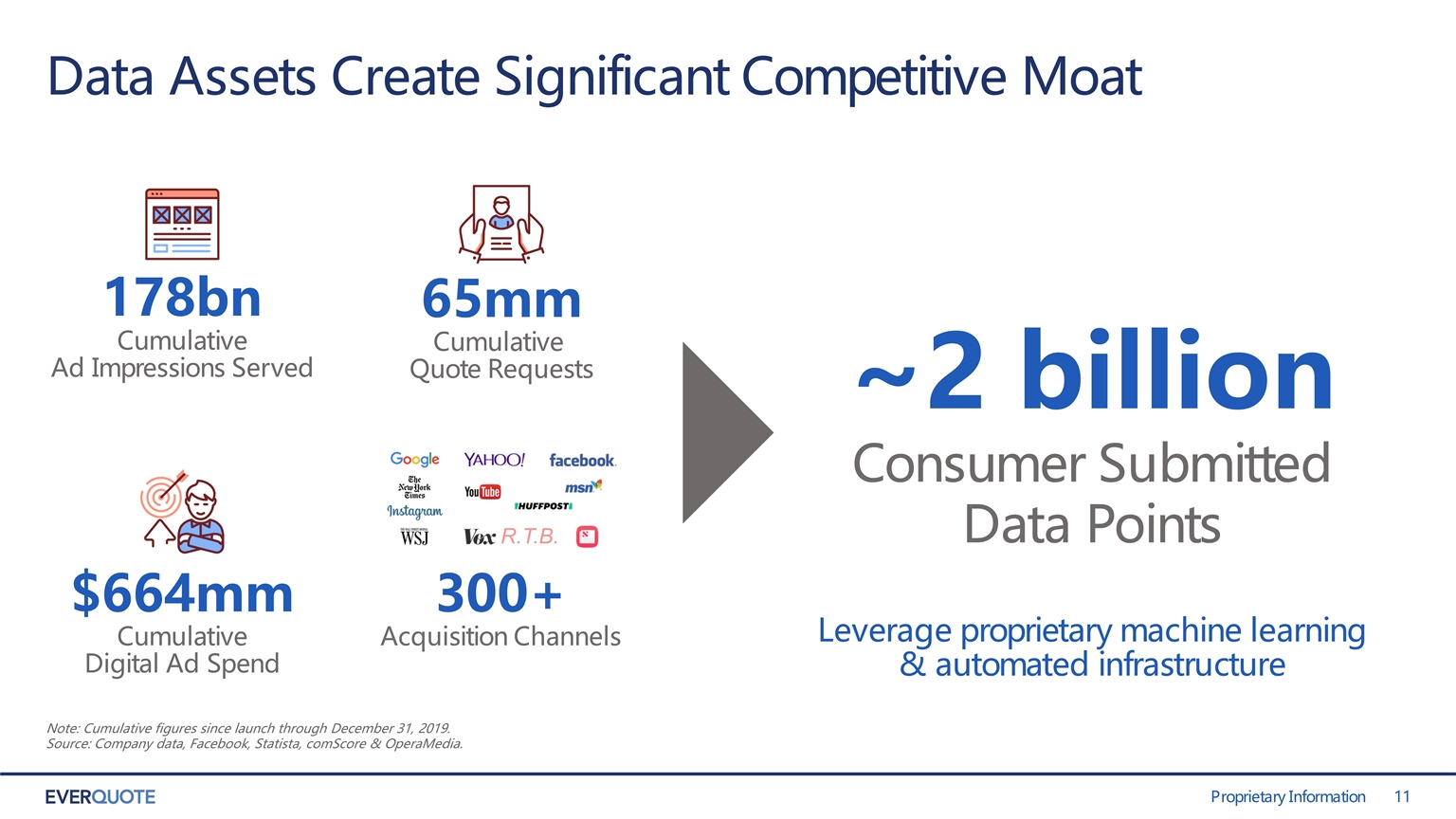
Data Assets Create Significant Competitive Moat R.T.B. 300+ Acquisition Channels 178bn Cumulative Ad Impressions Served $664mm Cumulative Digital Ad Spend 65mm Cumulative Quote Requests ~2 billion Consumer Submitted Data Points Leverage proprietary machine learning & automated infrastructure Note: Cumulative figures since launch through December 31, 2019. Source: Company data, Facebook, Statista, comScore & OperaMedia.
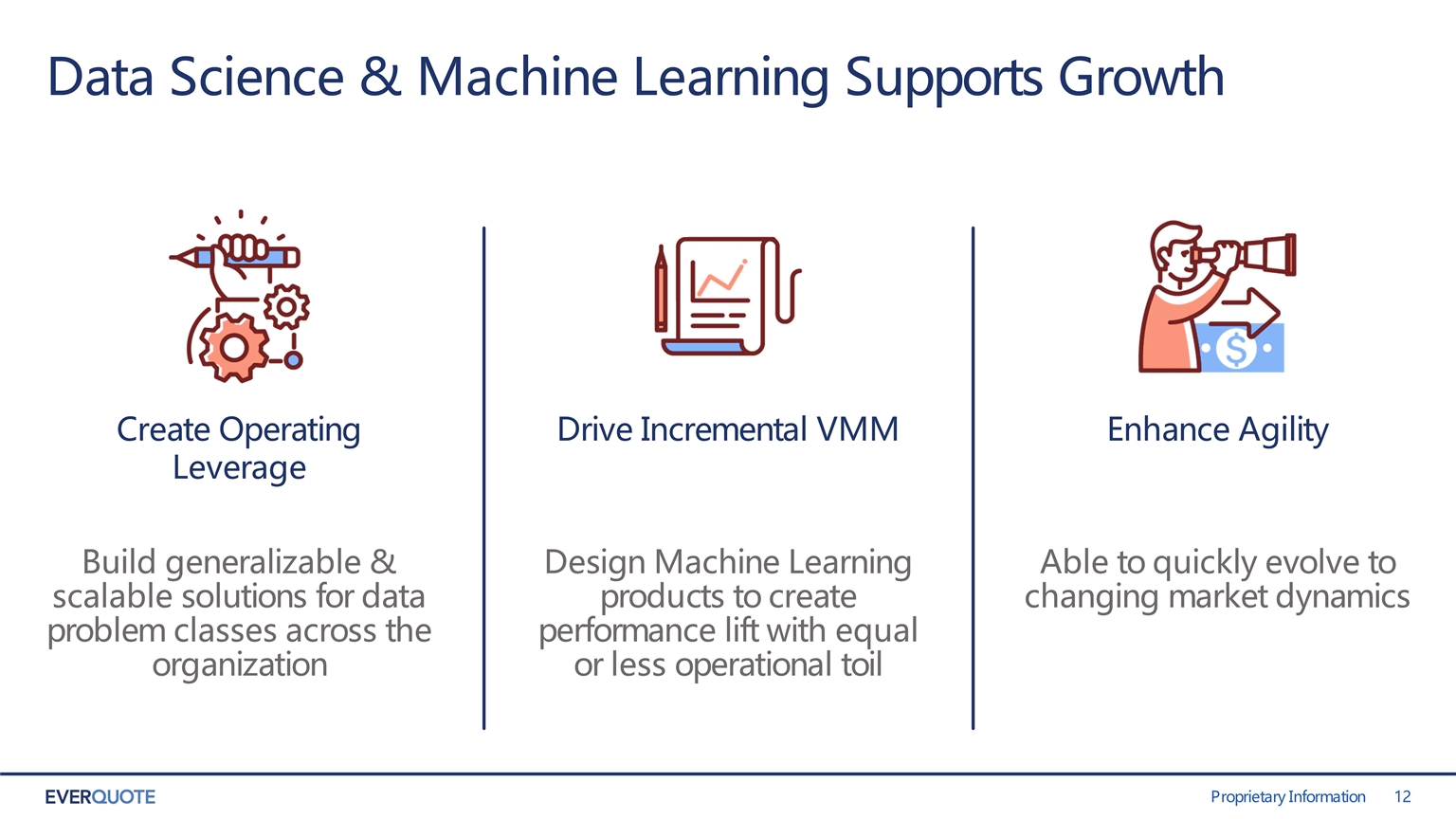
Data Science & Machine Learning Supports Growth Build generalizable & scalable solutions for data problem classes across the organization Able to quickly evolve to changing market dynamics Create Operating Leverage Enhance Agility Drive Incremental VMM Design Machine Learning products to create performance lift with equal or less operational toil
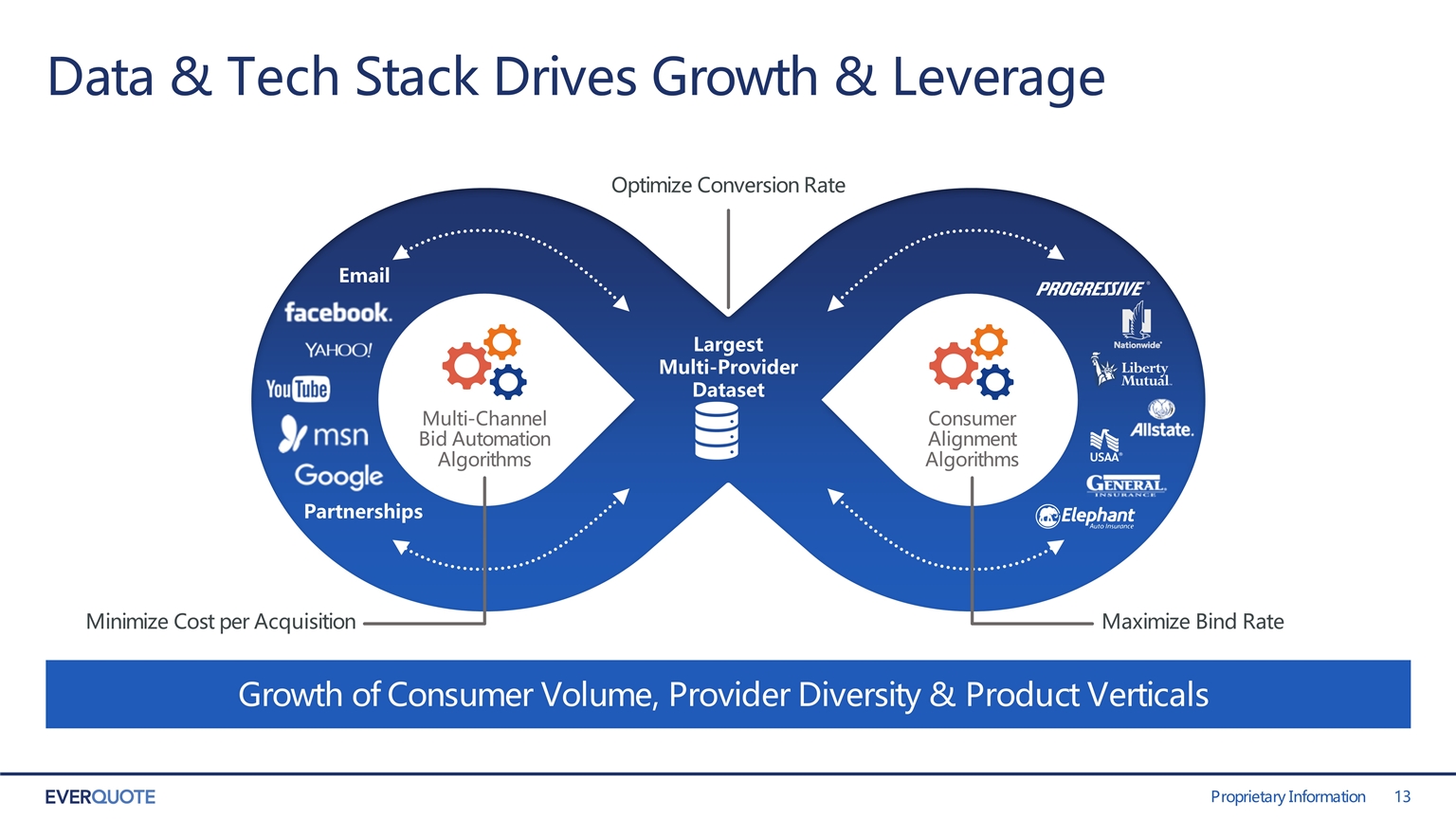
Consumer Alignment Algorithms Multi-Channel Bid Automation Algorithms Optimize Conversion Rate Email Largest Multi-Provider Dataset Partnerships Data & Tech Stack Drives Growth & Leverage Minimize Cost per Acquisition Bring back higher rez logos for providers Maximize Bind Rate Growth of Consumer Volume, Provider Diversity & Product Verticals
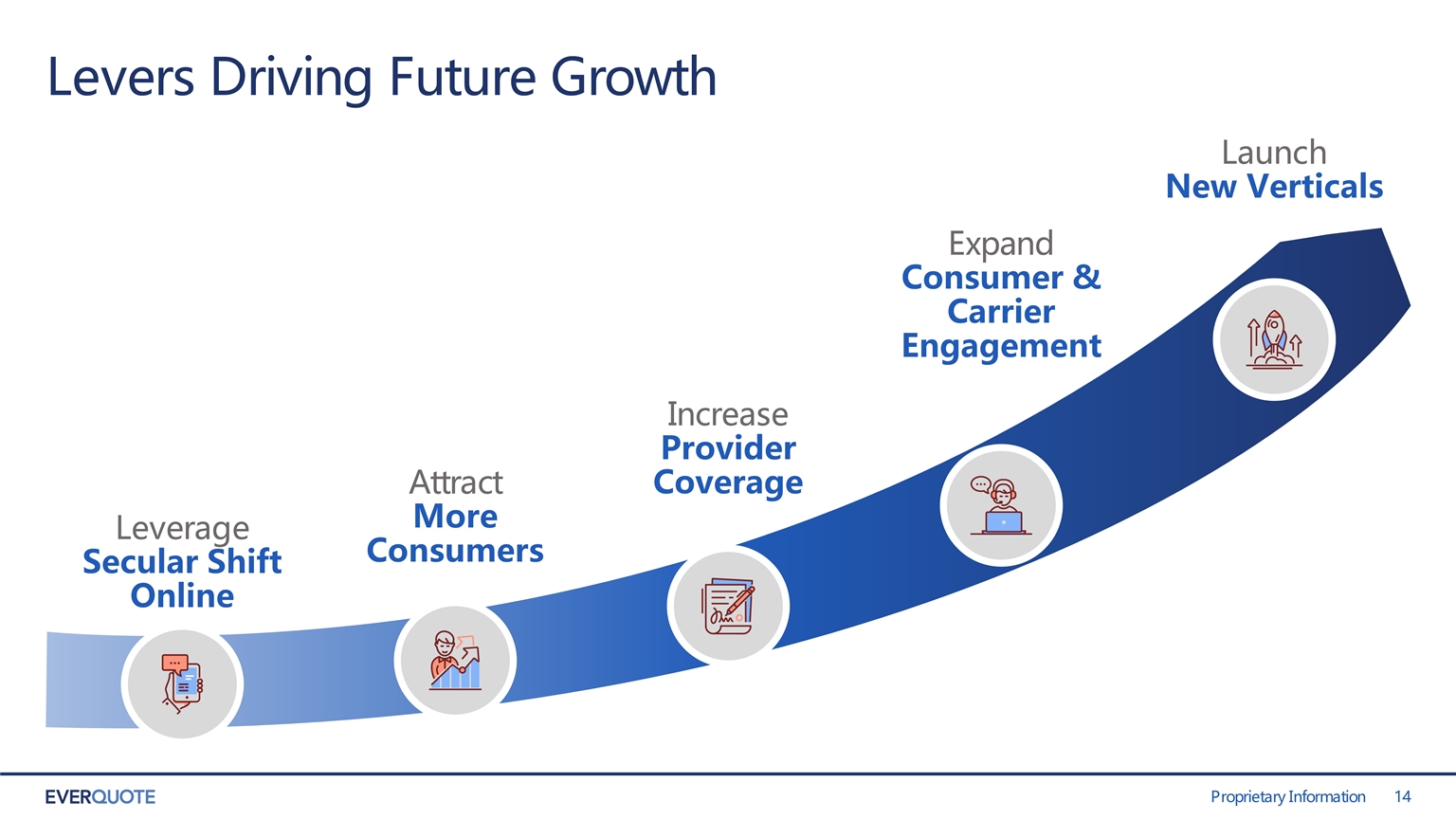
Levers Driving Future Growth Attract More Consumers Leverage Secular Shift Online Increase Provider Coverage Expand Consumer & Carrier Engagement Launch New Verticals
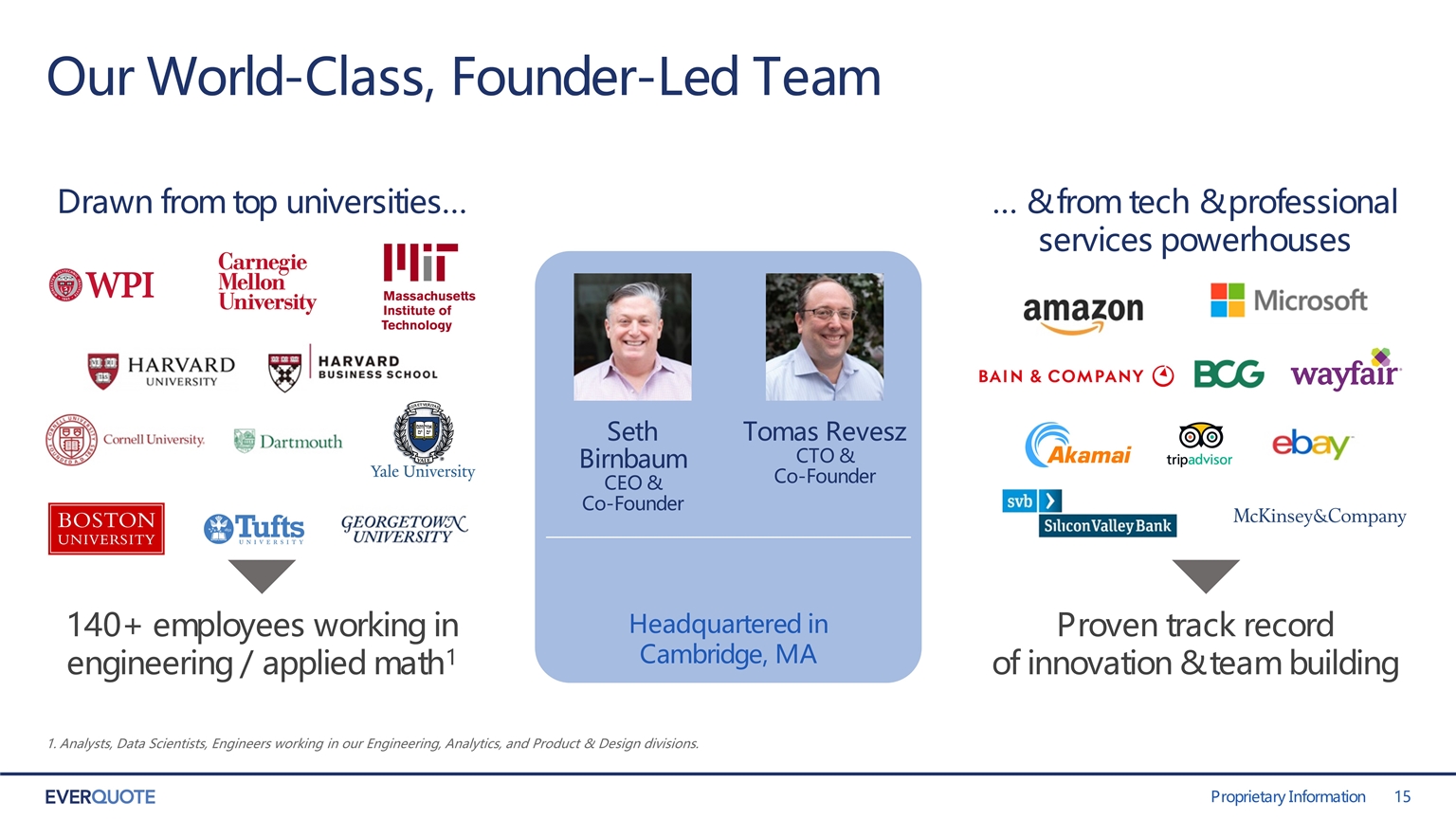
Proven track record of innovation & team building Our World-Class, Founder-Led Team Drawn from top universities… 140+ employees working in engineering / applied math1 Analysts, Data Scientists, Engineers working in our Engineering, Analytics, and Product & Design divisions. … & from tech & professional services powerhouses Headquartered in Cambridge, MA Seth Birnbaum CEO & Co-Founder Tomas Revesz CTO & Co-Founder
Financial Overview
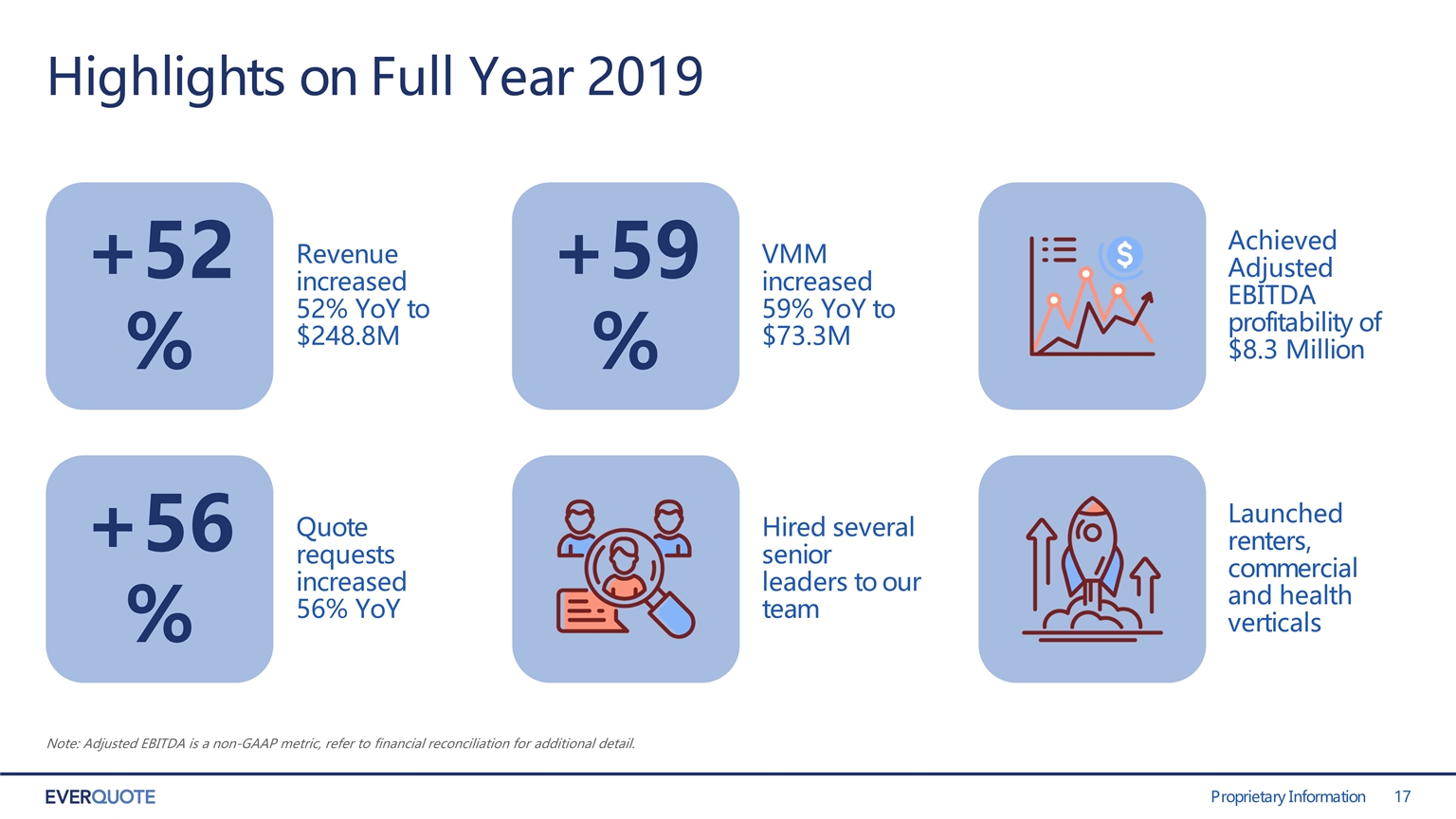
Note: Adjusted EBITDA is a non-GAAP metric, refer to financial reconciliation for additional detail. Highlights on Full Year 2019 Revenue increased 52% YoY to $248.8M +52% Quote requests increased 56% YoY +56% VMM increased 59% YoY to $73.3M +59% Launched renters, commercial and health verticals Hired several senior leaders to our team Achieved Adjusted EBITDA profitability of $8.3 Million
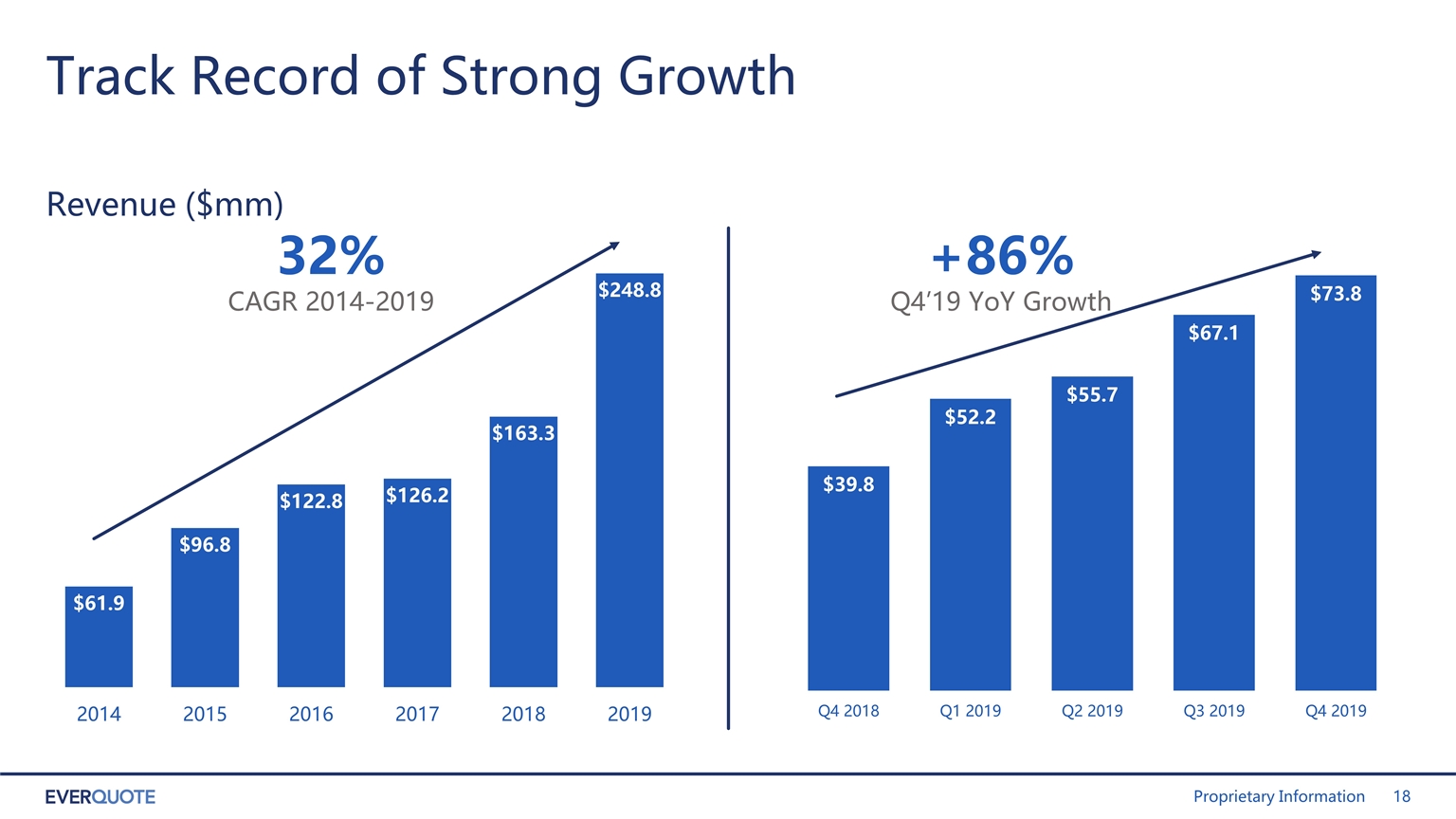
Revenue ($mm) 32% CAGR 2014-2019 Track Record of Strong Growth Track Record of Strong Growth +86% Q4’19 YoY Growth
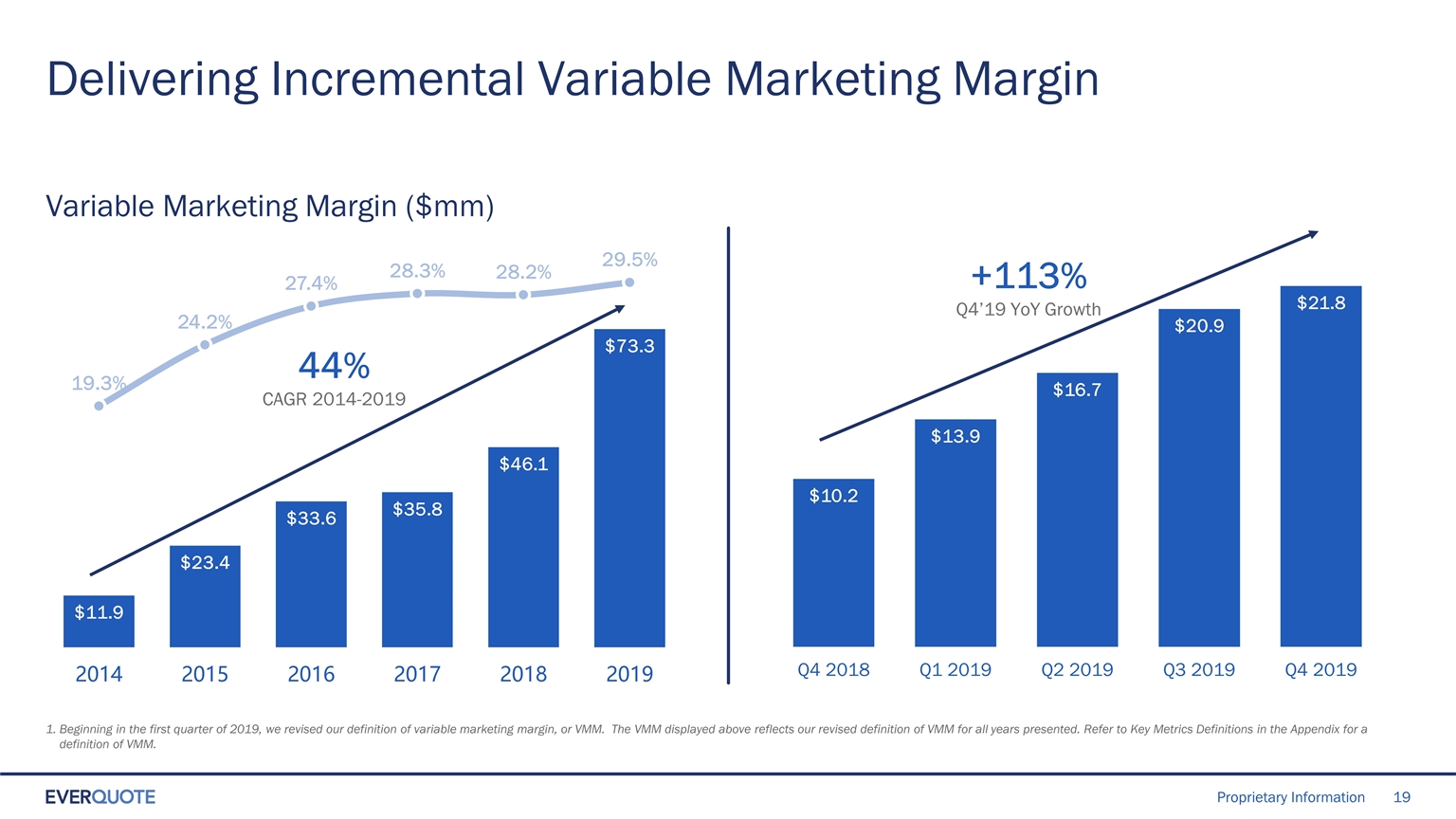
Delivering Incremental Variable Marketing Margin 44% CAGR 2014-2019 Variable Marketing Margin ($mm) Beginning in the first quarter of 2019, we revised our definition of variable marketing margin, or VMM. The VMM displayed above reflects our revised definition of VMM for all years presented. Refer to Key Metrics Definitions in the Appendix for a definition of VMM. +113% Q4’19 YoY Growth
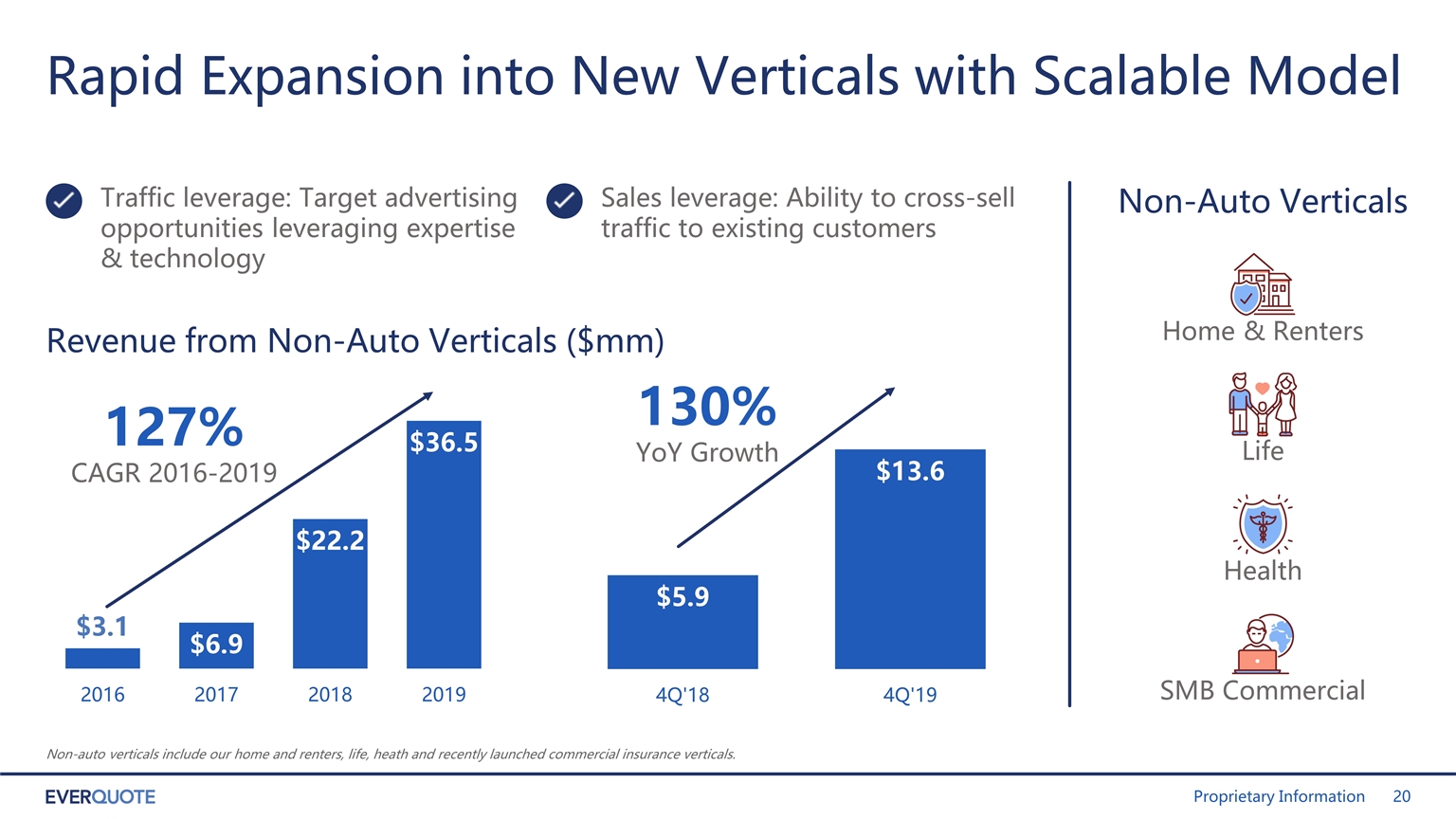
Non-auto verticals include our home and renters, life, heath and recently launched commercial insurance verticals. Rapid Expansion into New Verticals with Scalable Model Revenue from Non-Auto Verticals ($mm) Traffic leverage: Target advertising opportunities leveraging expertise & technology Sales leverage: Ability to cross-sell traffic to existing customers 127% CAGR 2016-2019 130% YoY Growth Non-Auto Verticals Home & Renters Life Health SMB Commercial
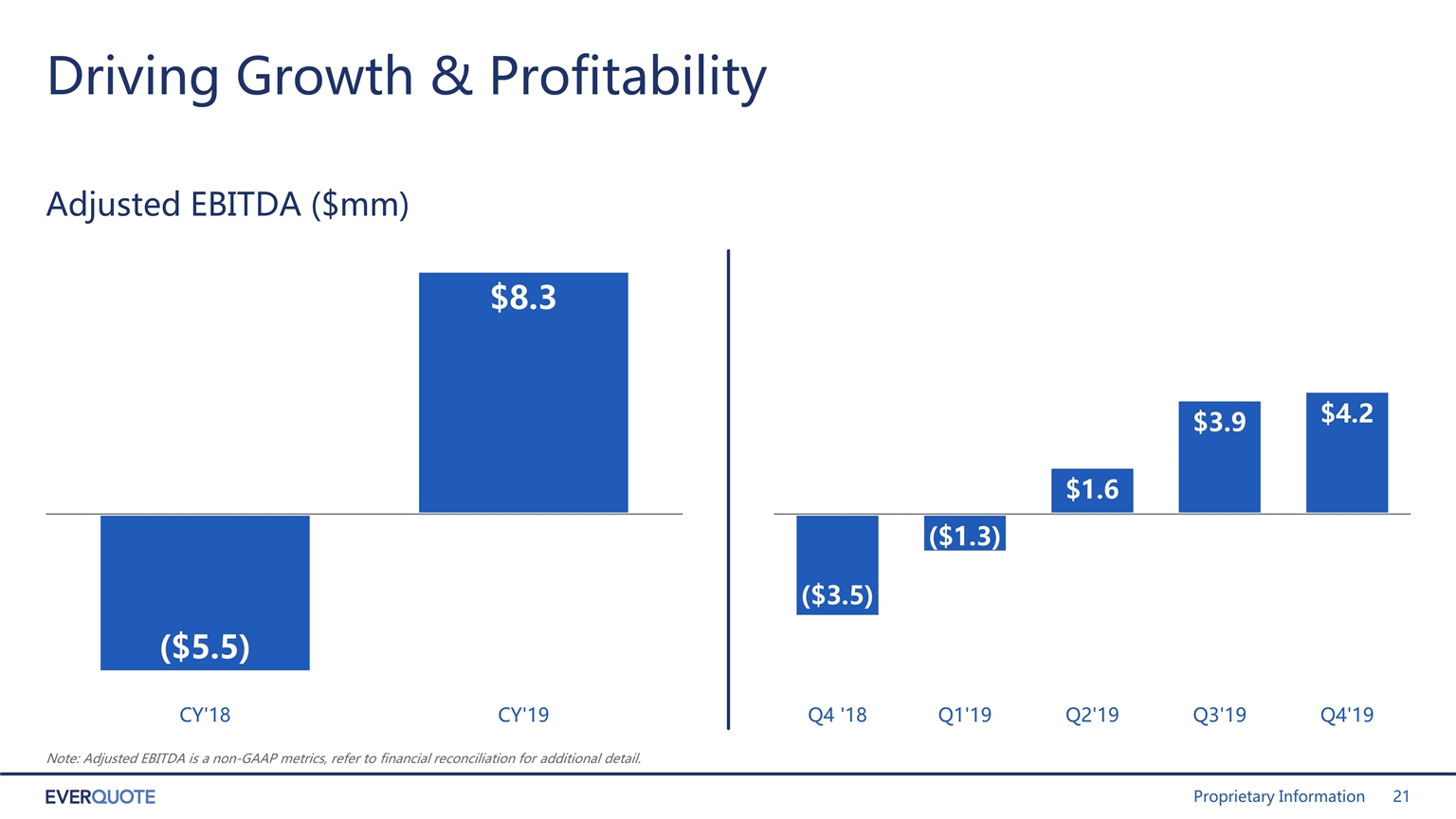
Driving Growth & Profitability Adjusted EBITDA ($mm) Note: Adjusted EBITDA is a non-GAAP metrics, refer to financial reconciliation for additional detail.
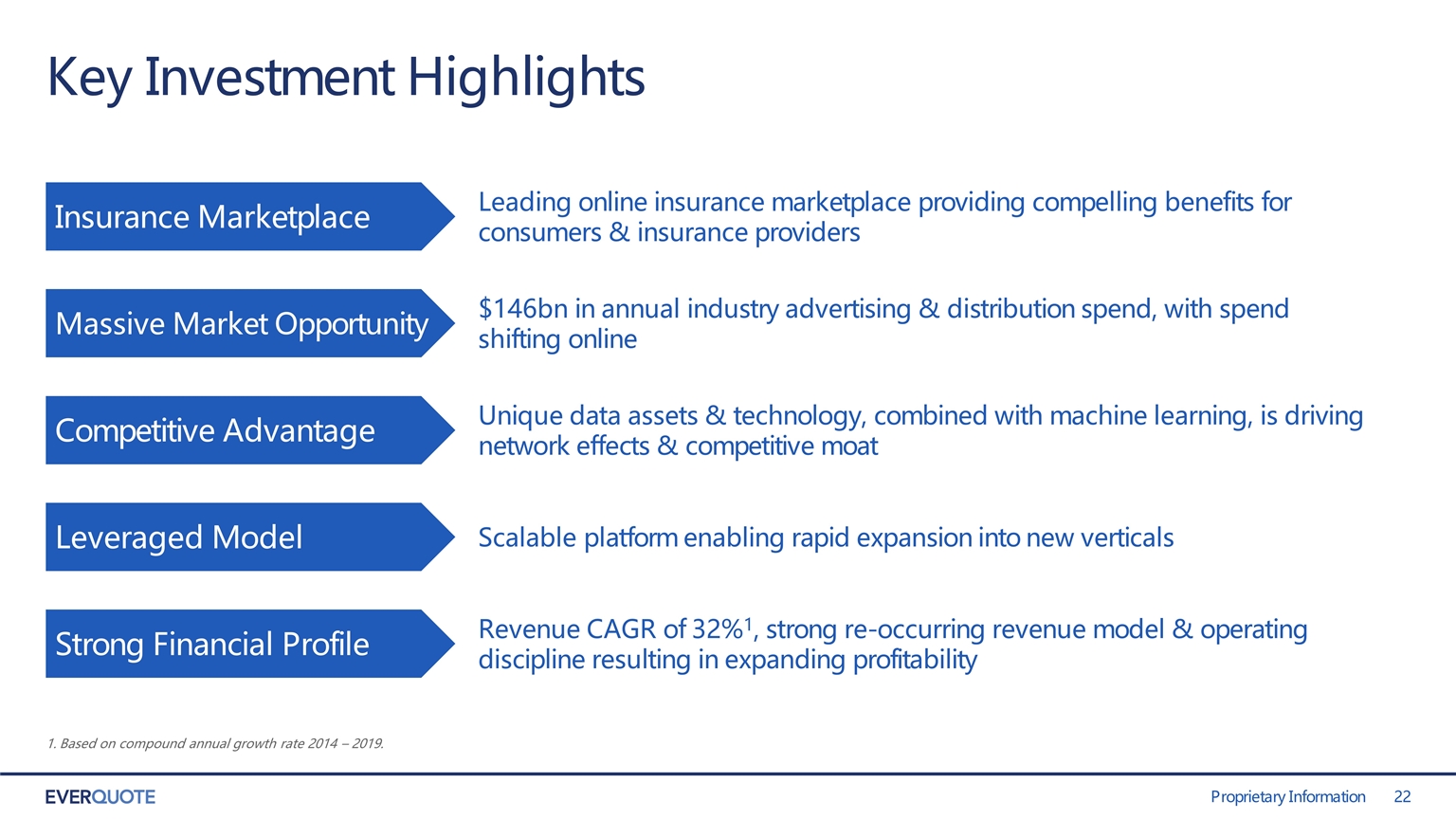
Key Investment Highlights Leading online insurance marketplace providing compelling benefits for consumers & insurance providers Revenue CAGR of 32%1, strong re-occurring revenue model & operating discipline resulting in expanding profitability Insurance Marketplace $146bn in annual industry advertising & distribution spend, with spend shifting online Massive Market Opportunity Unique data assets & technology, combined with machine learning, is driving network effects & competitive moat Competitive Advantage Scalable platform enabling rapid expansion into new verticals Leveraged Model Strong Financial Profile Based on compound annual growth rate 2014 – 2019.
NASDAQ: EVER
Appendix
Key Metrics Definitions Quote Requests Quote requests are consumer-submitted website forms that contain the data required to provide an insurance quote, quote requests we receive through offline channels such as telephone calls, quote requests via our EverDrive app & quote requests submitted directly to third-party partners. As we attract more consumers to our platform & they complete quote requests, we are able to refer them to our insurance provider customers, selling more referrals while also collecting data, which we use to improve user experience, conversion rates & consumer satisfaction. Variable Marketing Margin Beginning in the first quarter of 2019, we revised our definition of variable marketing margin, or VMM, as revenue, as reported in our statements of operations & comprehensive loss, less advertising costs (a component of sales & marketing expense, as reported in our statements of operations & comprehensive loss). We use VMM to measure the efficiency of individual advertising & consumer acquisition sources & to make trade-off decisions to manage our return on advertising. Adjusted EBITDA We define adjusted EBITDA as net loss, adjusted to exclude: stock-based compensation expense, depreciation & amortization expense, legal settlement expense, and interest expense. We monitor & present adjusted EBITDA because it is a key measure used by our management & board of directors to understand & evaluate our operating performance, to establish budgets & to develop operational goals for managing our business.
Reconciliation of Adjusted EBITDA Three Months Ended 12 Months December 31, 2019 September 30, 2019 June 30, 2019 March 31, 2019 December 31, 2018 December 31, 2019 December 31, 2018 Net income (loss) ($934) $173 ($1,974) ($4,382) ($6,925) ($7,117) ($13,791) Stock-based compensation $3,464 $3,269 $3,238 $2,750 $3,245 $12,721 $7,121 Depreciation & amortization $593 $588 $524 $481 $387 $2,186 $1,341 Legal settlement $1,227 - - - - $1,227 - Interest (income) expense, net ($133) ($168) ($184) ($184) ($189) ($669) ($121) Adjusted EBITDA $4,217 $3,862 $1,604 ($1,335) ($3,482) $8,348 ($5,450) ($ in Thousands)
THE INSURANCE INDUSTRY Secular Shift Towards Online Shopping $146 billion in annual U.S. insurance industry commission and advertising spend; long-term trend of switching budgets to digital and tech-enabled alternatives Exhibit 99.3
Executive Summary Insurance carriers and agencies report they are still early in their transition to online marketing and customer acquisition, a trend that will drive significantly greater online spend and use of online insurance marketplaces over the next 5 to 10 years. In response to rising demand for a convenient, transparent, and integrated shopping experience, the insurance industry is embracing omnichannel customer acquisition strategies and pursuing audiences online. To do so, leading insurance providers are aggressively shifting distribution resources away from traditional advertising and offline acquisition in favor of digital channels – enabling them to enhance targeting, improve marketing ROIs, and ultimately deliver an exceptional customer experience. Stax Inc., a global strategy consulting firm, recently conducted a study to understand this shift across P&C, Life, and Health insurers. Through a survey of more than 140 insurance marketing executives and a series of in-depth interviews, they found compelling evidence of the rising importance of online customer acquisition in every segment of the industry. Over time, this evolution will lead to the rise of new, digital-first business models which differentiate on price and customer experience. Online insurance marketplaces are well-positioned to support this transformation and will see continued interest as carriers seek to complement their digital strategies. Key Takeaways Robust growth in total insurance sales and marketing budgets. Continued shift in distribution resources towards the online channels. Significant opportunity for growth of online insurance marketplaces. Based on a study commissioned by EverQuote, Inc. in November 2019, and performed by Stax, Inc.
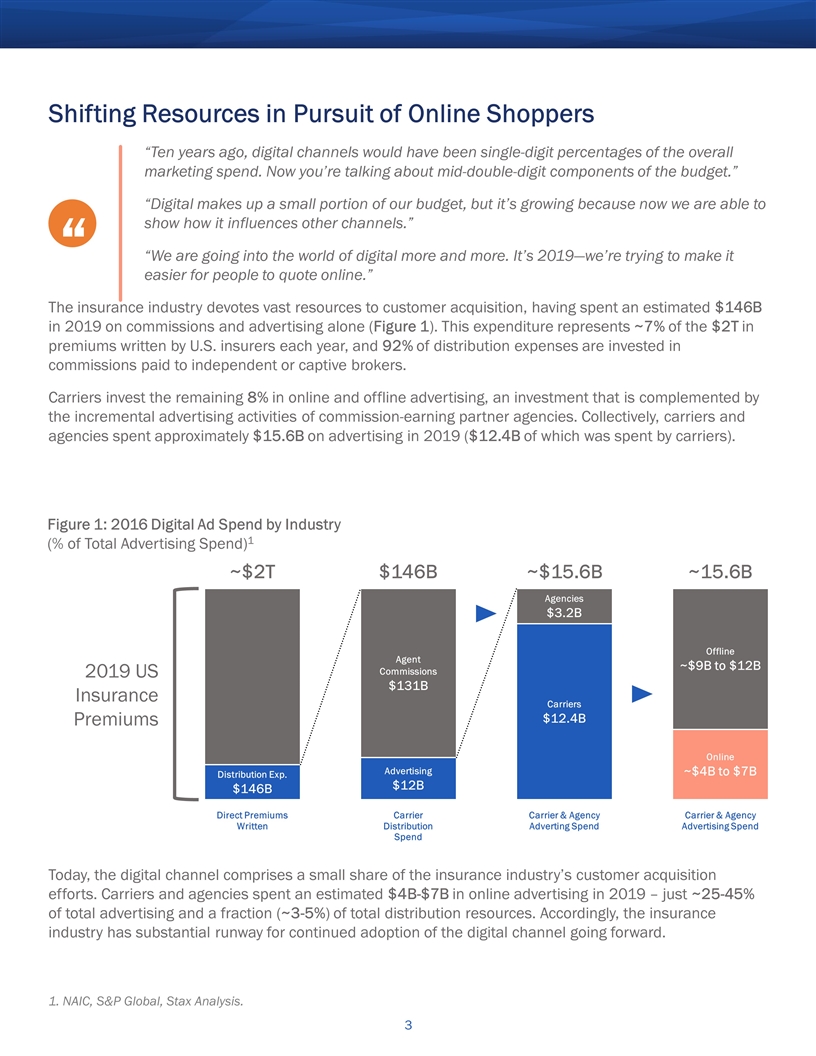
Shifting Resources in Pursuit of Online Shoppers “Ten years ago, digital channels would have been single-digit percentages of the overall marketing spend. Now you’re talking about mid-double-digit components of the budget.” “Digital makes up a small portion of our budget, but it’s growing because now we are able to show how it influences other channels.” “We are going into the world of digital more and more. It’s 2019—we’re trying to make it easier for people to quote online.” The insurance industry devotes vast resources to customer acquisition, having spent an estimated $146B in 2019 on commissions and advertising alone (Figure 1). This expenditure represents ~7% of the $2T in premiums written by U.S. insurers each year, and 92% of distribution expenses are invested in commissions paid to independent or captive brokers. Carriers invest the remaining 8% in online and offline advertising, an investment that is complemented by the incremental advertising activities of commission-earning partner agencies. Collectively, carriers and agencies spent approximately $15.6B on advertising in 2019 ($12.4B of which was spent by carriers). “ 2019 US Insurance Premiums Agent Commissions $131B Agencies $3.2B Offline ~$9B to $12B Distribution Exp. $146B Advertising $12B Carriers $12.4B Online ~$4B to $7B Direct Premiums Written Carrier Distribution Spend Carrier & Agency Adverting Spend Carrier & Agency Advertising Spend ~$2T $146B ~$15.6B ~15.6B Today, the digital channel comprises a small share of the insurance industry’s customer acquisition efforts. Carriers and agencies spent an estimated $4B-$7B in online advertising in 2019 – just ~25-45% of total advertising and a fraction (~3-5%) of total distribution resources. Accordingly, the insurance industry has substantial runway for continued adoption of the digital channel going forward. NAIC, S&P Global, Stax Analysis. Figure 1: 2016 Digital Ad Spend by Industry (% of Total Advertising Spend)1
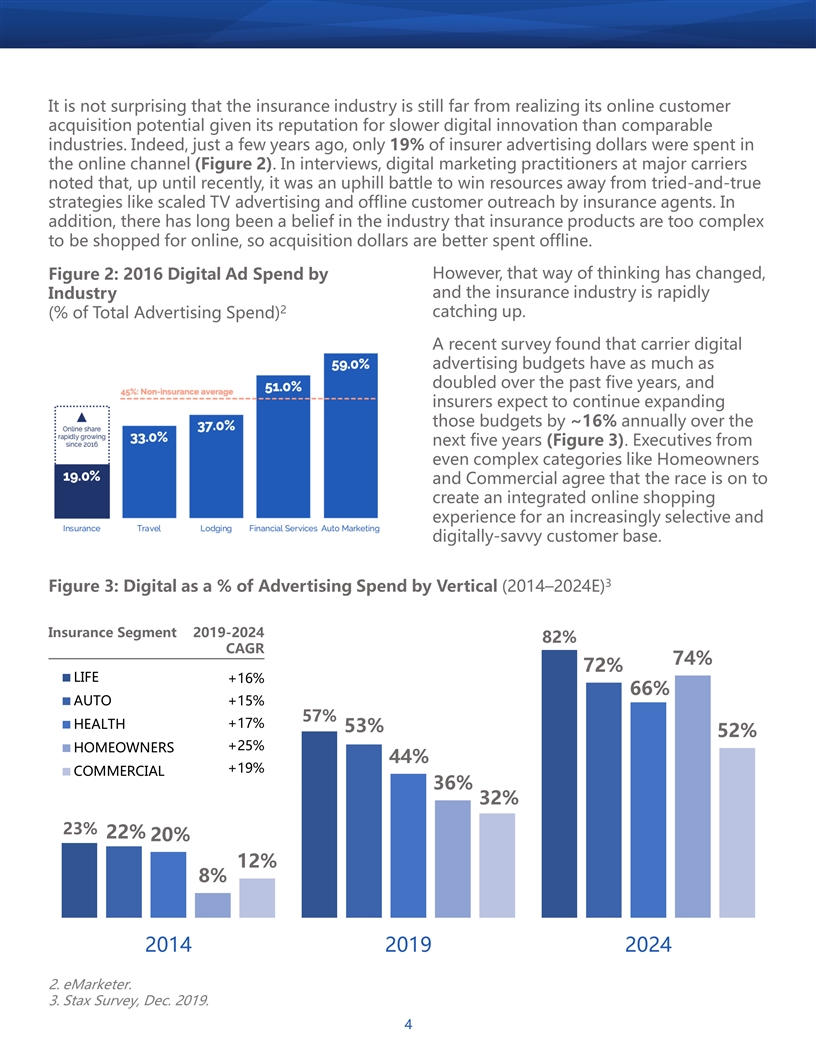
It is not surprising that the insurance industry is still far from realizing its online customer acquisition potential given its reputation for slower digital innovation than comparable industries. Indeed, just a few years ago, only 19% of insurer advertising dollars were spent in the online channel (Figure 2). In interviews, digital marketing practitioners at major carriers noted that, up until recently, it was an uphill battle to win resources away from tried-and-true strategies like scaled TV advertising and offline customer outreach by insurance agents. In addition, there has long been a belief in the industry that insurance products are too complex to be shopped for online, so acquisition dollars are better spent offline. However, that way of thinking has changed, and the insurance industry is rapidly catching up. A recent survey found that carrier digital advertising budgets have as much as doubled over the past five years, and insurers expect to continue expanding those budgets by ~16% annually over the next five years (Figure 3). Executives from even complex categories like Homeowners and Commercial agree that the race is on to create an integrated online shopping experience for an increasingly selective and digitally-savvy customer base. Figure 2: 2016 Digital Ad Spend by Industry (% of Total Advertising Spend)2 Figure 3: Digital as a % of Advertising Spend by Vertical (2014–2024E)3 +16% +15% +17% +25% +19% 2019-2024 CAGR Insurance Segment eMarketer. Stax Survey, Dec. 2019.
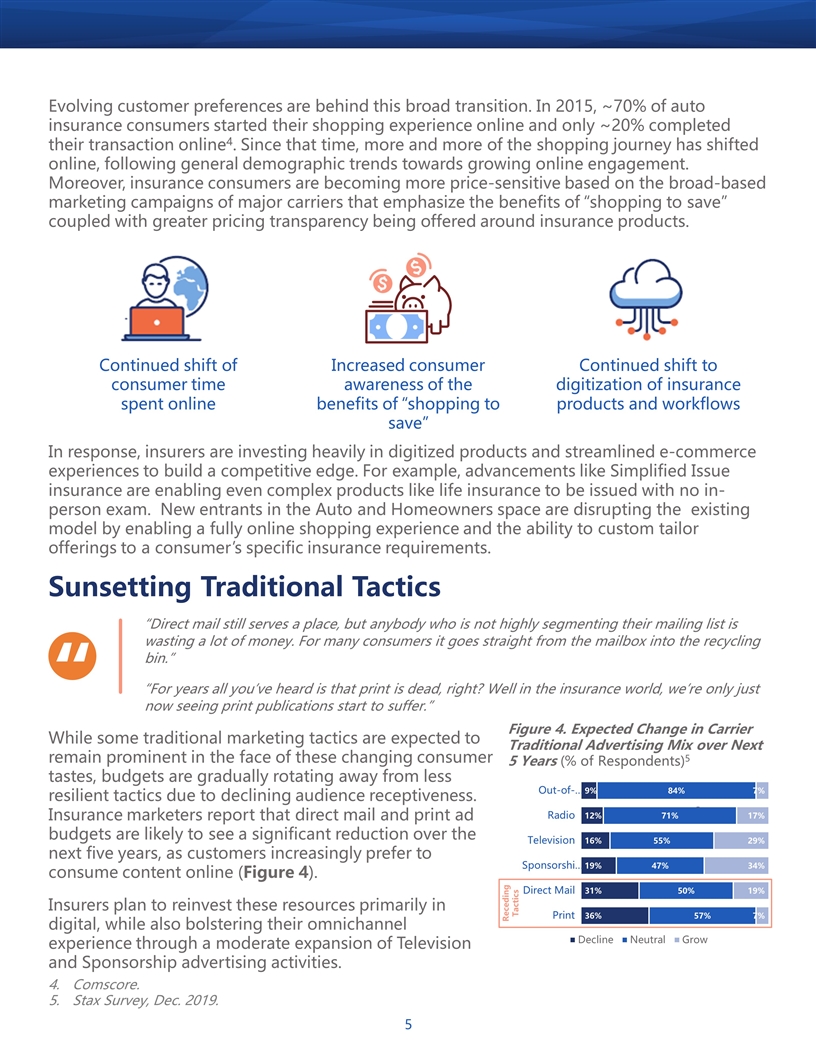
In response, insurers are investing heavily in digitized products and streamlined e-commerce experiences to build a competitive edge. For example, advancements like Simplified Issue insurance are enabling even complex products like life insurance to be issued with no in-person exam. New entrants in the Auto and Homeowners space are disrupting the existing model by enabling a fully online shopping experience and the ability to custom tailor offerings to a consumer’s specific insurance requirements. Sunsetting Traditional Tactics “Direct mail still serves a place, but anybody who is not highly segmenting their mailing list is wasting a lot of money. For many consumers it goes straight from the mailbox into the recycling bin.” “For years all you’ve heard is that print is dead, right? Well in the insurance world, we’re only just now seeing print publications start to suffer.” While some traditional marketing tactics are expected to remain prominent in the face of these changing consumer tastes, budgets are gradually rotating away from less resilient tactics due to declining audience receptiveness. Insurance marketers report that direct mail and print ad budgets are likely to see a significant reduction over the next five years, as customers increasingly prefer to consume content online (Figure 4). Insurers plan to reinvest these resources primarily in digital, while also bolstering their omnichannel experience through a moderate expansion of Television and Sponsorship advertising activities. Figure 4. Expected Change in Carrier Traditional Advertising Mix over Next 5 Years (% of Respondents)5 Receding Tactics Continued shift of consumer time spent online Increased consumer awareness of the benefits of “shopping to save” Continued shift to digitization of insurance products and workflows Evolving customer preferences are behind this broad transition. In 2015, ~70% of auto insurance consumers started their shopping experience online and only ~20% completed their transaction online4. Since that time, more and more of the shopping journey has shifted online, following general demographic trends towards growing online engagement. Moreover, insurance consumers are becoming more price-sensitive based on the broad-based marketing campaigns of major carriers that emphasize the benefits of “shopping to save” coupled with greater pricing transparency being offered around insurance products. “ Comscore. Stax Survey, Dec. 2019.
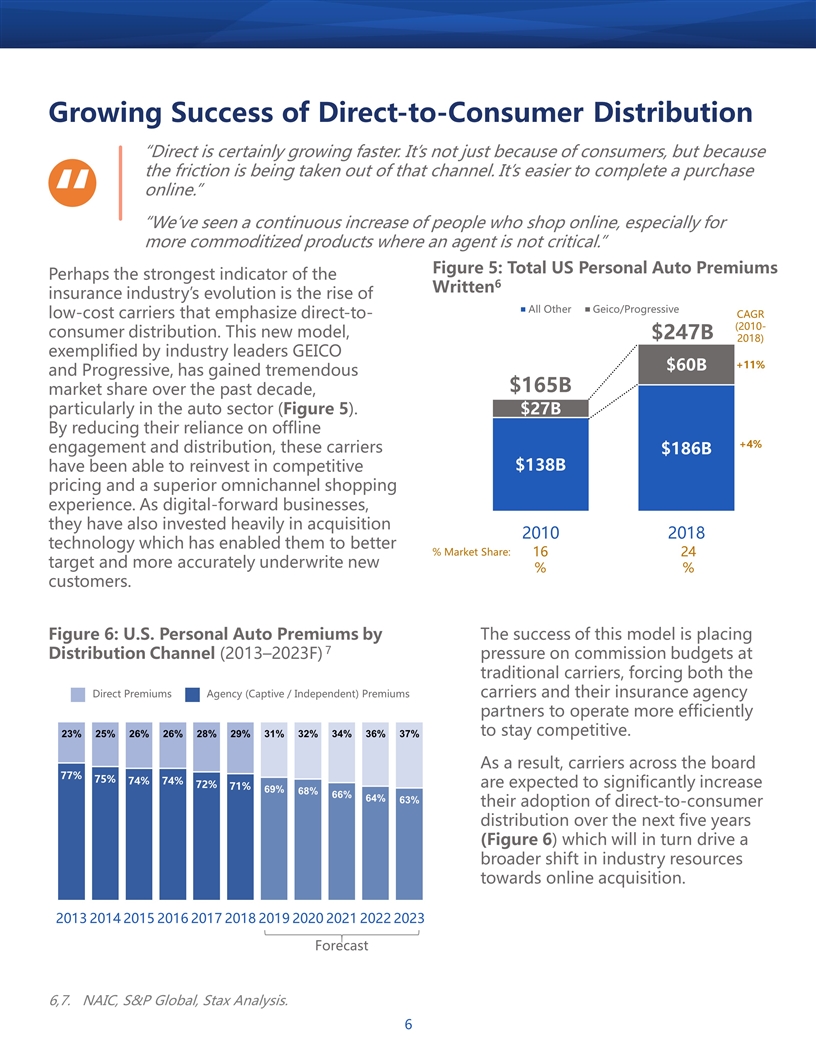
Growing Success of Direct-to-Consumer Distribution “Direct is certainly growing faster. It’s not just because of consumers, but because the friction is being taken out of that channel. It’s easier to complete a purchase online.” “We’ve seen a continuous increase of people who shop online, especially for more commoditized products where an agent is not critical.” Perhaps the strongest indicator of the insurance industry’s evolution is the rise of low-cost carriers that emphasize direct-to- consumer distribution. This new model, exemplified by industry leaders GEICO and Progressive, has gained tremendous market share over the past decade, particularly in the auto sector (Figure 5). By reducing their reliance on offline engagement and distribution, these carriers have been able to reinvest in competitive pricing and a superior omnichannel shopping experience. As digital-forward businesses, they have also invested heavily in acquisition technology which has enabled them to better target and more accurately underwrite new customers. Figure 6: U.S. Personal Auto Premiums by Distribution Channel (2013–2023F) 7 Direct Premiums Agency (Captive / Independent) Premiums Forecast The success of this model is placing pressure on commission budgets at traditional carriers, forcing both the carriers and their insurance agency partners to operate more efficiently to stay competitive. As a result, carriers across the board are expected to significantly increase their adoption of direct-to-consumer distribution over the next five years (Figure 6) which will in turn drive a broader shift in industry resources towards online acquisition. “ 6,7.NAIC, S&P Global, Stax Analysis. +11% +4% $165B $247B CAGR (2010-2018) 16% % Market Share: 24% Figure 5: Total US Personal Auto Premiums Written6
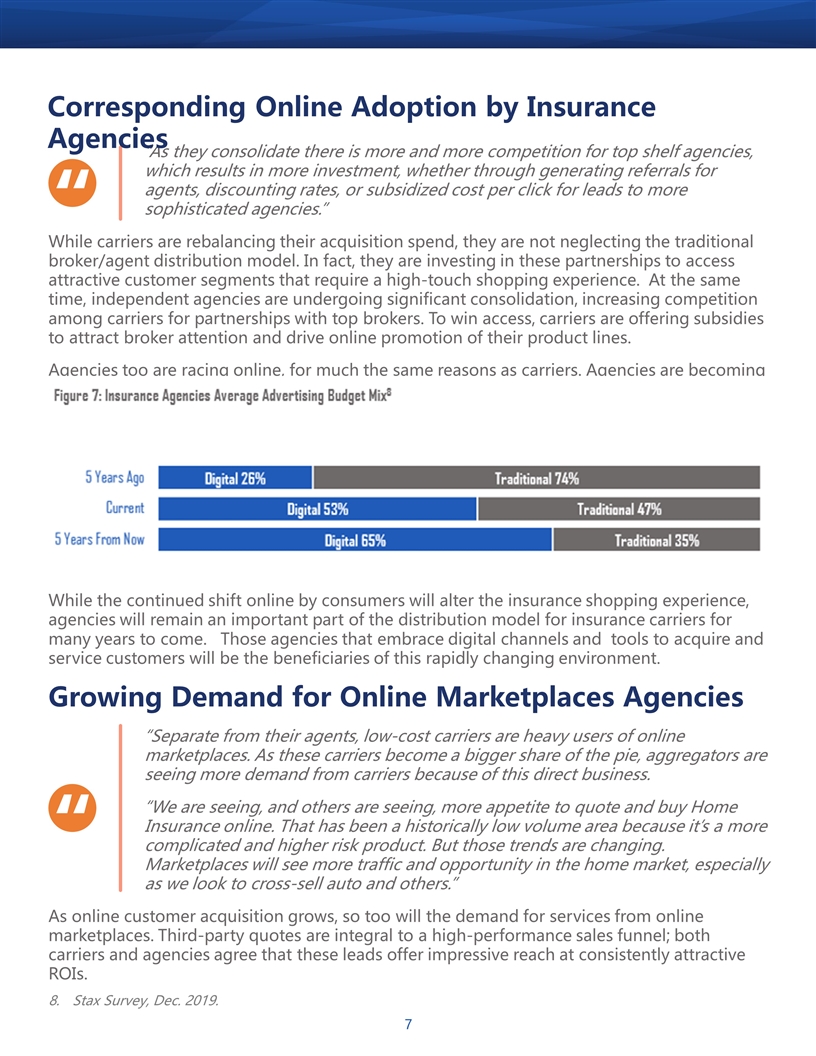
While the continued shift online by consumers will alter the insurance shopping experience, agencies will remain an important part of the distribution model for insurance carriers for many years to come. Those agencies that embrace digital channels and tools to acquire and service customers will be the beneficiaries of this rapidly changing environment. Growing Demand for Online Marketplaces Agencies “Separate from their agents, low-cost carriers are heavy users of online marketplaces. As these carriers become a bigger share of the pie, aggregators are seeing more demand from carriers because of this direct business. “We are seeing, and others are seeing, more appetite to quote and buy Home Insurance online. That has been a historically low volume area because it’s a more complicated and higher risk product. But those trends are changing. Marketplaces will see more traffic and opportunity in the home market, especially as we look to cross-sell auto and others.” As online customer acquisition grows, so too will the demand for services from online marketplaces. Third-party quotes are integral to a high-performance sales funnel; both carriers and agencies agree that these leads offer impressive reach at consistently attractive ROIs. “As they consolidate there is more and more competition for top shelf agencies, which results in more investment, whether through generating referrals for agents, discounting rates, or subsidized cost per click for leads to more sophisticated agencies.” While carriers are rebalancing their acquisition spend, they are not neglecting the traditional broker/agent distribution model. In fact, they are investing in these partnerships to access attractive customer segments that require a high-touch shopping experience. At the same time, independent agencies are undergoing significant consolidation, increasing competition among carriers for partnerships with top brokers. To win access, carriers are offering subsidies to attract broker attention and drive online promotion of their product lines. Agencies too are racing online, for much the same reasons as carriers. Agencies are becoming more sophisticated, especially as the market concentrates in top performers. Like carriers, insurance agencies have doubled online spend over the past five years, and a recent survey indicates that half of their advertising budgets are now dedicated to online channels (Figure 7). “ “ Stax Survey, Dec. 2019. Corresponding Online Adoption by Insurance Agencies
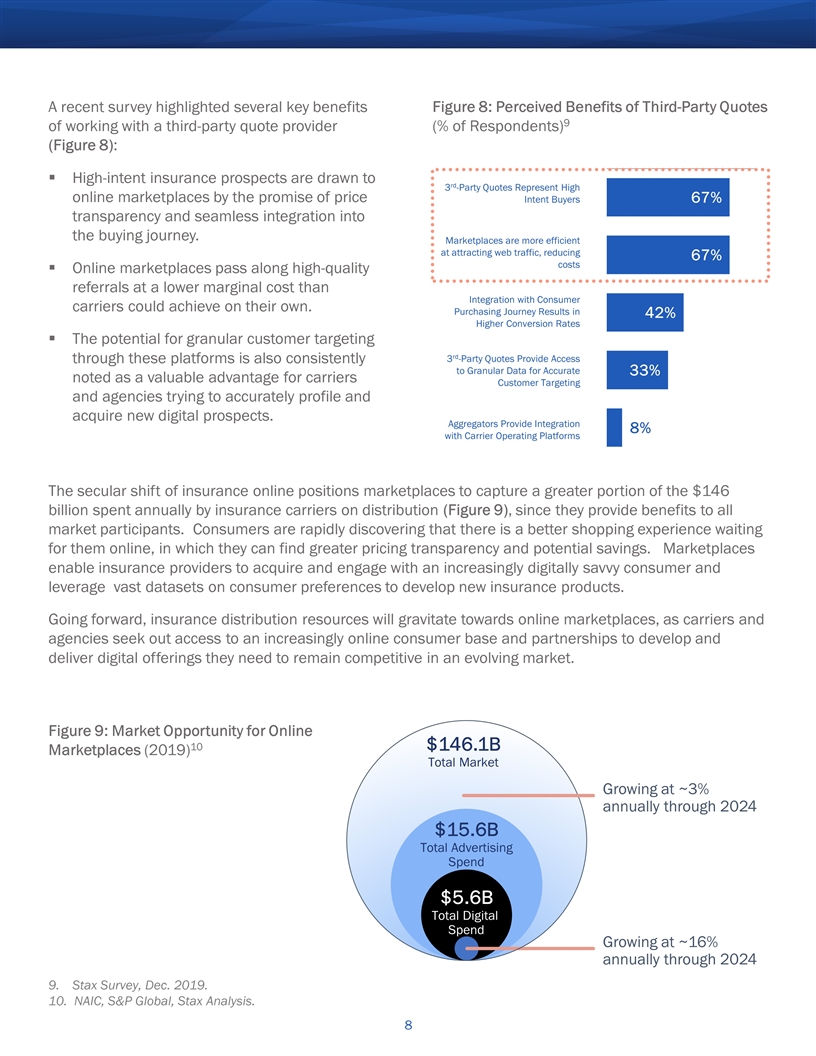
Figure 9: Market Opportunity for Online Marketplaces (2019)10 Growing at ~16% annually through 2024 $146.1B Total Market $15.6B Total Advertising Spend $5.6B Total Digital Spend The secular shift of insurance online positions marketplaces to capture a greater portion of the $146 billion spent annually by insurance carriers on distribution (Figure 9), since they provide benefits to all market participants. Consumers are rapidly discovering that there is a better shopping experience waiting for them online, in which they can find greater pricing transparency and potential savings. Marketplaces enable insurance providers to acquire and engage with an increasingly digitally savvy consumer and leverage vast datasets on consumer preferences to develop new insurance products. Going forward, insurance distribution resources will gravitate towards online marketplaces, as carriers and agencies seek out access to an increasingly online consumer base and partnerships to develop and deliver digital offerings they need to remain competitive in an evolving market. 3rd-Party Quotes Represent High Intent Buyers Marketplaces are more efficient at attracting web traffic, reducing costs Integration with Consumer Purchasing Journey Results in Higher Conversion Rates 3rd-Party Quotes Provide Access to Granular Data for Accurate Customer Targeting Aggregators Provide Integration with Carrier Operating Platforms A recent survey highlighted several key benefits of working with a third-party quote provider (Figure 8): High-intent insurance prospects are drawn to online marketplaces by the promise of price transparency and seamless integration into the buying journey. Online marketplaces pass along high-quality referrals at a lower marginal cost than carriers could achieve on their own. The potential for granular customer targeting through these platforms is also consistently noted as a valuable advantage for carriers and agencies trying to accurately profile and acquire new digital prospects. Growing at ~3% annually through 2024 Figure 8: Perceived Benefits of Third-Party Quotes (% of Respondents)9 Stax Survey, Dec. 2019. 10. NAIC, S&P Global, Stax Analysis.
Summary The secular trend towards online shopping for insurance – driven by changing consumer preferences, expanding digitization of insurance products and workflows and new distribution models – is pressuring insurance market participants to rethink their marketing strategies and allocation of their distribution resources. The $146 billion in acquisition resources that insurers put to work each year is undergoing a seismic mix shift in favor of online channels and digital offerings, and we have only just arrived at the early stages of this transition. Going forward, carriers and agencies will continue to build on early successes in online customer acquisition and engagement, empowering the consumer journey for an even broader range of insurance products, as even the most complex insurance offerings evolve to online. As carriers and agencies undergo this business model evolution, online marketplaces are well positioned to support providers’ digital ambitions through enhanced online services and efficient customer access. These platforms are on track to rapidly expand over the next 5 to 10 years as they benefit from the reallocation of the massive market of $146 billon spent annually by insurers on distribution. About EverQuote EverQuote operates a leading online insurance marketplace connecting consumers with insurance providers. The company's data & technology platform matches and connects consumers seeking to purchase insurance with relevant options from the company's broad direct network of insurance providers, saving consumers and providers time and money. EverQuote was founded with the vision to empower customers to better protect life's most important assets—their family, property, and future. For more information, visit EverQuote.com and follow on Twitter @EverQuoteInsure.
Disclaimer This study contains forward-looking statements. All statements other than statements of historical facts contained in this study, including statements regarding possible or assumed future results of operations, market conditions, business strategies, development plans, regulatory activities, competitive position, potential growth opportunities, & the effects of competition are forward-looking statements. These statements involve known & unknown risks, uncertainties & other important factors that may cause actual results, performance or achievements of EverQuote, Inc. (“the Company”) to be materially different from any future results, performance or achievements expressed or implied by the forward-looking statements. In some cases, you can identify forward-looking statements by terms such as “may,” “should,” “expect,” “plan,” “project,” “estimate,” or “potential” or the negative of these terms or other similar expressions. The forward-looking statements in this study are only predictions. The Company has based these forward-looking statements largely on its current expectations & projections about future events & financial trends that it believes may affect the Company’s business, market, financial condition & results of operations. These forward-looking statements speak only as of the date of this study & are subject to a number of risks, uncertainties & assumptions, some of which cannot be predicted or quantified & some of which are beyond the Company’s control. The events & circumstances reflected in these forward looking statements may not be achieved or occur, & actual results could differ materially from those projected in the forward-looking statements, including as a result of: (1) changes in insurance market conditions, including how insurance providers advertise and acquire consumers; (2) the Company’s ability to attract and retain consumers and insurance providers using the Company’s marketplace; (3) the Company’s ability to maintain or increase the amount providers spend per quote request; (4) the effectiveness of the Company’s growth strategies and its ability to effectively manage growth; (5) the Company’s ability to maintain and build its brand; (6) the Company’s reliance on its third-party service providers; (7) the Company’s ability to develop new and enhanced products and services to attract and retain consumers and insurance providers, and the Company’s ability to successfully monetize them; (8) the impact of competition in the Company’s industry and innovation by the Company’s competitors; and (9) as a result of the risks described in the “Risk Factors” section of the Company’s most recent Annual Report on Form 10-K, Quarterly Report on Form 10-Q & the other filings that the Company makes with the Securities & Exchange Commission from time to time. Moreover, new risk factors & uncertainties may emerge from time to time, & it is not possible for management to predict all risk factors & uncertainties that the Company may face. Except as required by applicable law, the Company does not plan to publicly update or revise any forward-looking statements contained herein, whether as a result of any new information, future events, changed circumstances or otherwise. This study also contains estimates, projections, & other information concerning the Company’s industry, the Company’s business & the markets for certain of the Company’s products & services, including data regarding the estimated size of those markets. Information that is based on estimates, forecasts, projections, market research, or similar methodologies is inherently subject to uncertainties & actual events or circumstances may differ materially from events & circumstances reflected in this information. Unless otherwise expressly stated, the Company obtained this industry, business, market & other data from reports, research surveys, studies & similar data prepared by market research firms & other third parties, from industry, general publications, & from government data & similar sources.