
FCN 8-K
Fti Consulting, Inc (FCN)
UNITED STATES
SECURITIES AND EXCHANGE COMMISSION
WASHINGTON, D.C. 20549
FORM
CURRENT REPORT
Pursuant to Section 13 or 15(d)
of the Securities Exchange Act of 1934
Date of Report (Date of earliest event reported):
(Exact Name of Registrant as Specified in Its Charter)
| (State or Other Jurisdiction of Incorporation) |
(Commission File Number) |
(I.R.S. Employer Identification No.) |
| (Address of principal executive offices) (Zip Code) |
Registrant’s telephone number, including area code:
(Former name or former address, if changed since last report)
Check the appropriate box below if the Form 8-K filing is intended to simultaneously satisfy the filing obligation of the registrant under any of the following provisions:
| Written communications pursuant to Rule 425 under the Securities Act (17 CFR 230.425) |
| Soliciting material pursuant to Rule 14a-12 under the Exchange Act (17 CFR 240.14a-12) |
| Pre-commencement communications pursuant to Rule 14d-2(b) under the Exchange Act (17 CFR 240.14d-2(b)) |
| Pre-commencement communications pursuant to Rule 13e-4(c) under the Exchange Act (17 CFR 240.13e-4(c)) |
Securities registered pursuant to Section 12(b) of the Act:
| Title of each class |
Trading Symbol(s) |
Name of each Exchange on which Registered | ||
Indicate by check mark whether the registrant is an emerging growth company as defined in Rule 405 of the Securities Act of 1933 (§230.405 of this chapter) or Rule 12b-2 of the Securities Exchange Act of 1934 (§240.12b-2 of this chapter).
Emerging growth company
If an emerging growth company, indicate by check mark if the registrant has elected not to use the extended transition period for complying with any new or revised financial accounting standards provided pursuant to Section 13(a) of the Exchange Act. ☐
| ITEM 2.02. | Results of Operations and Financial Condition |
FTI Consulting, Inc. (“FTI Consulting” or the “Company”) uses a presentation from time to time in its discussions with investors and analysts (the “Presentation”). The Presentation includes FTI Consulting’s past and present financial results, operating data and other information. A copy of the Presentation is furnished as Exhibit 99.1 and has been posted to the FTI Consulting website at www.fticonsulting.com.
| ITEM 7.01. | Regulation FD Disclosure |
In the Presentation, FTI Consulting uses information derived from consolidated and segment financial information that may not be presented in its financial statements or prepared in accordance with generally accepted accounting principles in the United States (“GAAP”). Certain of these measures are considered “non-GAAP financial measures” under rules promulgated by the Securities and Exchange Commission. Specifically, the Company may have referred to the following non-GAAP financial measures:
| • | Total Segment Operating Income |
| • | Adjusted Segment EBITDA |
| • | Total Adjusted Segment EBITDA |
| • | Adjusted EBITDA |
| • | Adjusted EBITDA Margin |
| • | Adjusted Net Income |
| • | Adjusted Earnings per Diluted Share |
| • | Free Cash Flow |
FTI Consulting has included the definition of Segment Operating Income, which is a GAAP financial measure, below in order to more fully define the components of certain non-GAAP financial measures in the accompanying analysis of financial information.
FTI Consulting defines Segment Operating Income as a segment’s share of consolidated operating income. FTI Consulting defines Total Segment Operating Income, which is a non-GAAP financial measure, as the total of Segment Operating Income for all segments, which excludes unallocated corporate expenses. The Company uses Segment Operating Income for the purpose of calculating Adjusted Segment EBITDA, which is a non-GAAP financial measure. FTI Consulting defines Adjusted Segment EBITDA as Segment Operating Income before depreciation, amortization of intangible assets, remeasurement of acquisition-related contingent consideration, special charges and goodwill impairment charges. The Company uses Adjusted Segment EBITDA as a basis to internally evaluate the financial performance of its segments because the Company believes it reflects core operating performance and provides an indicator of the segment’s ability to generate cash. FTI Consulting defines Total Adjusted Segment EBITDA, which is a non-GAAP financial measure, as the total of Adjusted Segment EBITDA for all segments, which excludes unallocated corporate expenses.
FTI Consulting defines Adjusted EBITDA, which is a non-GAAP financial measure, as consolidated net income before income tax provision, other non-operating income (expense), depreciation, amortization of intangible assets, remeasurement of acquisition-related contingent consideration, special charges, goodwill impairment charges, gain or loss on sale of a business and losses on early extinguishment of debt. FTI Consulting defines Adjusted EBITDA Margin, which is a non-GAAP financial measure, as Adjusted EBITDA as a percentage of total revenues. The Company believes that these non-GAAP financial measures, when considered together with its GAAP financial results and GAAP financial measures, provide management and investors with a more complete understanding of FTI Consulting’s operating results, including underlying trends. In addition, EBITDA is a common alternative measure of operating performance used by many of FTI Consulting’s competitors. It is used by investors, financial analysts, rating agencies and others to value and compare the financial performance of companies in FTI Consulting’s industry. Therefore, the Company also believes that these non-GAAP financial measures, considered along with corresponding GAAP financial measures, provide management and investors with useful supplemental information.
FTI Consulting defines Adjusted Net Income and Adjusted Earnings per Diluted Share (“Adjusted EPS”), which are non-GAAP financial measures, as net income and earnings per diluted share (“EPS”), respectively, excluding the impact of remeasurement of acquisition-related contingent consideration, special charges, goodwill impairment charges, the gain or loss on sale of a business, and losses on early extinguishment of debt. The Company uses Adjusted Net Income for the purpose of calculating Adjusted EPS. Management uses Adjusted EPS to assess total Company operating performance on a consistent basis. The Company believes that these non-GAAP financial measures, when considered together with its GAAP financial results and GAAP financial measures, provide management and investors with useful supplemental information on its business operating results, including underlying trends.
FTI Consulting defines Free Cash Flow, which is a non-GAAP financial measure, as net cash used in operating activities less cash payments for purchases of property and equipment. The Company believes this non-GAAP financial measure, when considered together with its GAAP financial results, provides management and investors with useful supplemental information on the Company’s ability to generate cash for ongoing business operations and capital deployment.
1
Non-GAAP financial measures are not defined in the same manner by all companies and may not be comparable with other similarly titled measures of other companies. Non-GAAP financial measures should be considered in addition to, but not as a substitute for or superior to, the information contained in FTI Consulting’s Condensed Consolidated Statements of Comprehensive Income and Condensed Consolidated Statements of Cash Flows. Reconciliations of non-GAAP financial measures to the most directly comparable GAAP financial measures are included in the Presentation.
The information included herein, including Exhibit 99.1 furnished herewith, shall not be deemed to be “filed” for purposes of Section 18 of the Securities Exchange Act of 1934, as amended (the “Exchange Act”), or otherwise subject to the liabilities of that section, nor shall it be incorporated by reference into any filing pursuant to the Securities Act of 1933, as amended, or the Exchange Act, regardless of any incorporation by reference language in any such filing, except as expressly set forth by specific reference in such filing.
| ITEM 9.01. | Financial Statements and Exhibits |
(d) Exhibits
| 99.1 | 2025 First Quarter Investor Presentation of FTI Consulting, Inc. | |
| 104 | The Cover Page from FTI Consulting’s Current Report on Form 8-K dated April 24, 2025, formatted in Inline XBRL. | |
2
SIGNATURES
Pursuant to the requirements of the Securities Exchange Act of 1934, as amended, FTI Consulting, Inc. has duly caused this report to be signed on its behalf by the undersigned hereunto duly authorized.
| FTI CONSULTING, INC. | ||||||
| Dated: April 25, 2025 |
By: | /s/ CURTIS P. LU | ||||
| Name: | Curtis P. Lu | |||||
| Title: | General Counsel | |||||
3
First Quarter 2025 Earnings Conference Call FTI Consulting, Inc. April 24, 2025 Exhibit 99.1
Cautionary Note About Forward-Looking Statements This presentation includes "forward-looking statements" within the meaning of Section 27A of the Securities Act of 1933, as amended, and Section 21E of the Securities Exchange Act of 1934, as amended, that involve uncertainties and risks. Forward-looking statements include statements concerning our plans, initiatives, projections, prospects, policies, processes and practices, objectives, goals, commitments, strategies, future events, future revenues, future results and performance, future capital allocations and expenditures, expectations, plans or intentions relating to acquisitions, share repurchases and other matters, business trends, new, or changes to, laws and regulations, including U.S. and foreign tax laws, scientific or technological developments, including relating to new and emerging technologies, such as artificial intelligence and machine learning and other information that is not historical. Forward-looking statements often contain words such as "estimates," "expects," "anticipates," "projects," "plans," "intends," "believes," "commits," "aspires," "forecasts," "future," "goal," "seeks" and variations of such words or similar expressions. All forward-looking statements, including, without limitation, management’s financial guidance and examination of operating trends, are based upon our historical performance and our current plans, estimates, intentions and expectations at the time we make them, and various assumptions. Our actual financial results, performance or achievements and outcomes could differ materially from those expressed in, or implied by, any forward-looking statements. Further, unaudited quarterly results are subject to normal year-end adjustments. The Company has experienced fluctuating revenues, operating income and cash flows in prior periods and expects that this will occur from time to time in the future. Other factors that could cause such differences include declines in demand for, or changes in, the mix of services and products that we offer; the mix of the geographic locations where our clients are located or where services are performed; fluctuations in the price per share of our common stock; adverse financial, real estate or other market and general economic conditions; the impact of public health crises and related events that are beyond our control, which could affect our segments, practices and the geographic regions in which we conduct business differently and adversely; and other future events, which could impact each of our segments, practices and the geographic regions in which we conduct business differently and could be outside of our control; the pace and timing of the consummation and integration of future acquisitions; the Company’s ability to realize cost savings and efficiencies; competitive and general economic conditions; retention of staff and clients; new laws and regulations or changes thereto; and other risks described under the heading "Item 1A, Risk Factors" in the Company’s Annual Report on Form 10-K for the year ended December 31, 2024 filed with the SEC on February 20, 2025 and in the Company’s other filings with the SEC. We are under no duty to update any of the forward-looking statements to conform such statements to actual results or events and do not intend to do so.
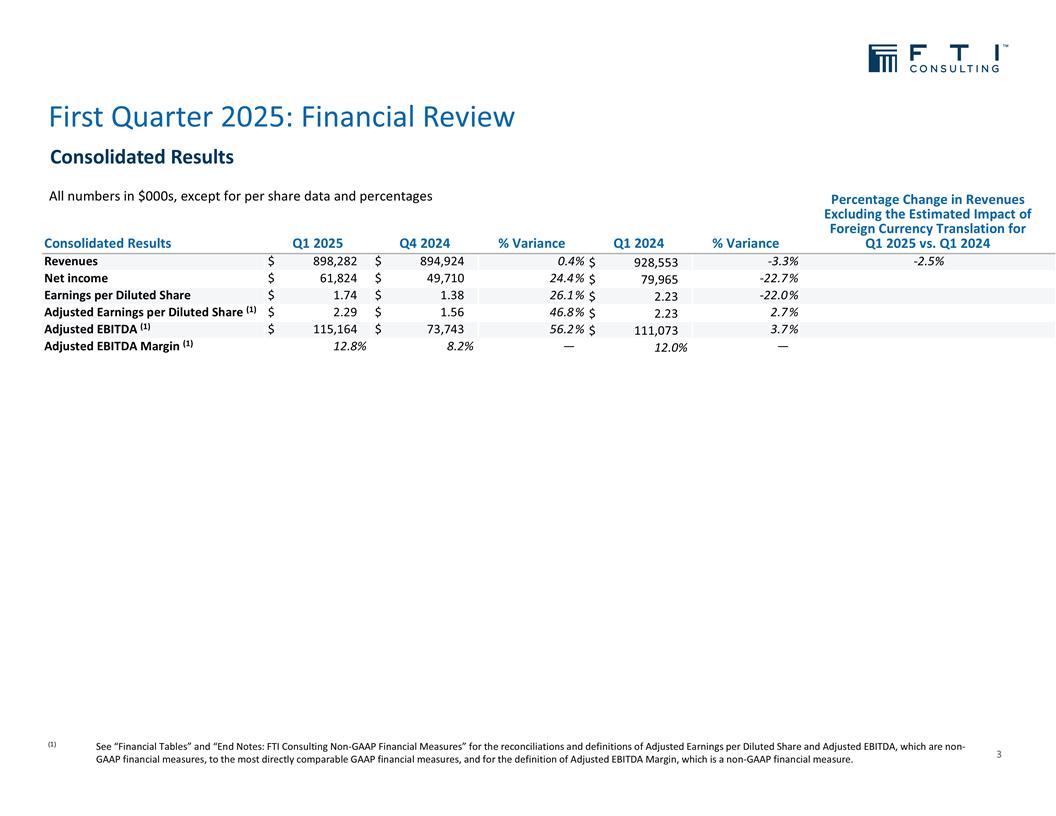
First Quarter 2025: Financial Review (1)See “Financial Tables” and “End Notes: FTI Consulting Non-GAAP Financial Measures” for the reconciliations and definitions of Adjusted Earnings per Diluted Share and Adjusted EBITDA, which are non-GAAP financial measures, to the most directly comparable GAAP financial measures, and for the definition of Adjusted EBITDA Margin, which is a non-GAAP financial measure. Consolidated Results Q1 2025 Q4 2024 % Variance Q1 2024 % Variance Percentage Change in Revenues Excluding the Estimated Impact of Foreign Currency Translation for Q1 2025 vs. Q1 2024 Revenues $898,282 $894,924 0.4% $928,553 -3.3% -2.5% Net income $61,824 $49,710 24.4% $79,965 -22.7% Earnings per Diluted Share $1.74 $1.38 26.1% $2.23 -22.0% Adjusted Earnings per Diluted Share (1) $2.29 $1.56 46.8% $2.23 2.7% Adjusted EBITDA (1) $115,164 $73,743 56.2% $111,073 3.7% Adjusted EBITDA Margin (1) 12.8% 8.2% — 12.0% — All numbers in $000s, except for per share data and percentages Consolidated Results
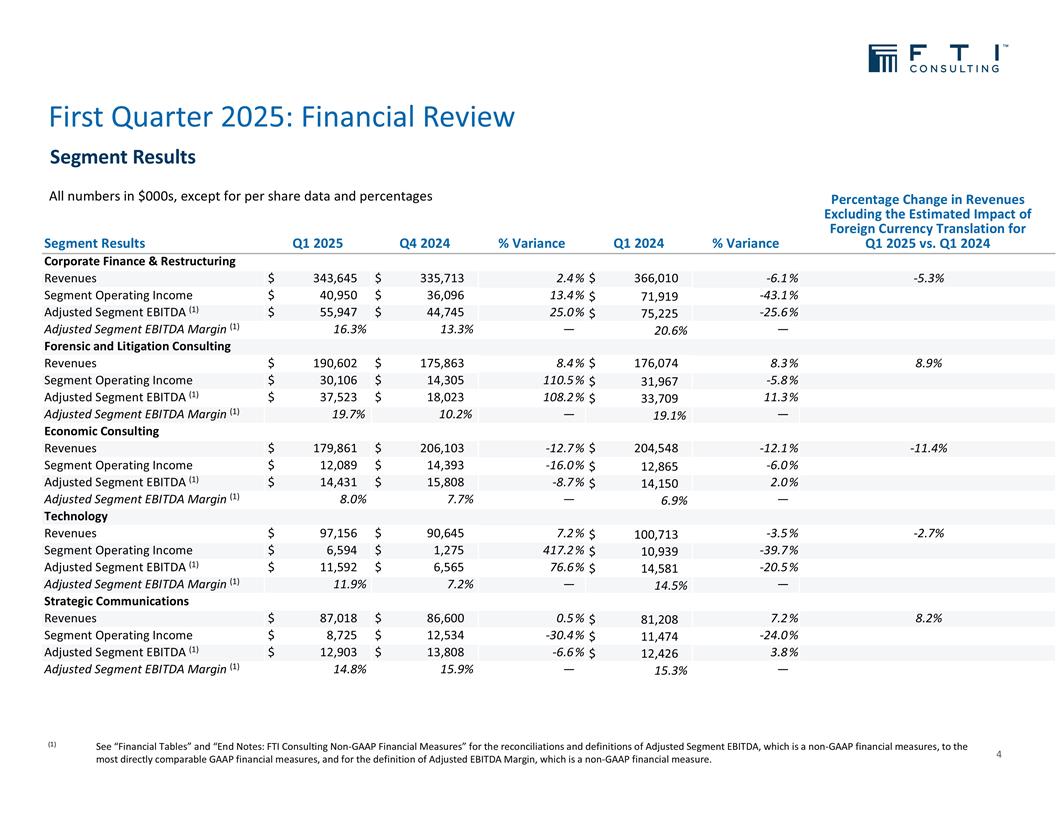
First Quarter 2025: Financial Review (1)See “Financial Tables” and “End Notes: FTI Consulting Non-GAAP Financial Measures” for the reconciliations and definitions of Adjusted Segment EBITDA, which is a non-GAAP financial measures, to the most directly comparable GAAP financial measures, and for the definition of Adjusted EBITDA Margin, which is a non-GAAP financial measure. Segment Results Q1 2025 Q4 2024 % Variance Q1 2024 % Variance Percentage Change in Revenues Excluding the Estimated Impact of Foreign Currency Translation for Q1 2025 vs. Q1 2024 Corporate Finance & Restructuring Revenues $343,645 $335,713 2.4% $366,010 -6.1% -5.3% Segment Operating Income $40,950 $36,096 13.4% $71,919 -43.1% Adjusted Segment EBITDA (1) $55,947 $44,745 25.0% $75,225 -25.6% Adjusted Segment EBITDA Margin (1) 16.3% 13.3% — 20.6% — Forensic and Litigation Consulting Revenues $190,602 $175,863 8.4% $176,074 8.3% 8.9% Segment Operating Income $30,106 $14,305 110.5% $31,967 -5.8% Adjusted Segment EBITDA (1) $37,523 $18,023 108.2% $33,709 11.3% Adjusted Segment EBITDA Margin (1) 19.7% 10.2% — 19.1% — Economic Consulting Revenues $179,861 $206,103 -12.7% $204,548 -12.1% -11.4% Segment Operating Income $12,089 $14,393 -16.0% $12,865 -6.0% Adjusted Segment EBITDA (1) $14,431 $15,808 -8.7% $14,150 2.0% Adjusted Segment EBITDA Margin (1) 8.0% 7.7% — 6.9% — Technology Revenues $97,156 $90,645 7.2% $100,713 -3.5% -2.7% Segment Operating Income $6,594 $1,275 417.2% $10,939 -39.7% Adjusted Segment EBITDA (1) $11,592 $6,565 76.6% $14,581 -20.5% Adjusted Segment EBITDA Margin (1) 11.9% 7.2% — 14.5% — Strategic Communications Revenues $87,018 $86,600 0.5% $81,208 7.2% 8.2% Segment Operating Income $8,725 $12,534 -30.4% $11,474 -24.0% Adjusted Segment EBITDA (1) $12,903 $13,808 -6.6% $12,426 3.8% Adjusted Segment EBITDA Margin (1) 14.8% 15.9% — 15.3% — All numbers in $000s, except for per share data and percentages Segment Results
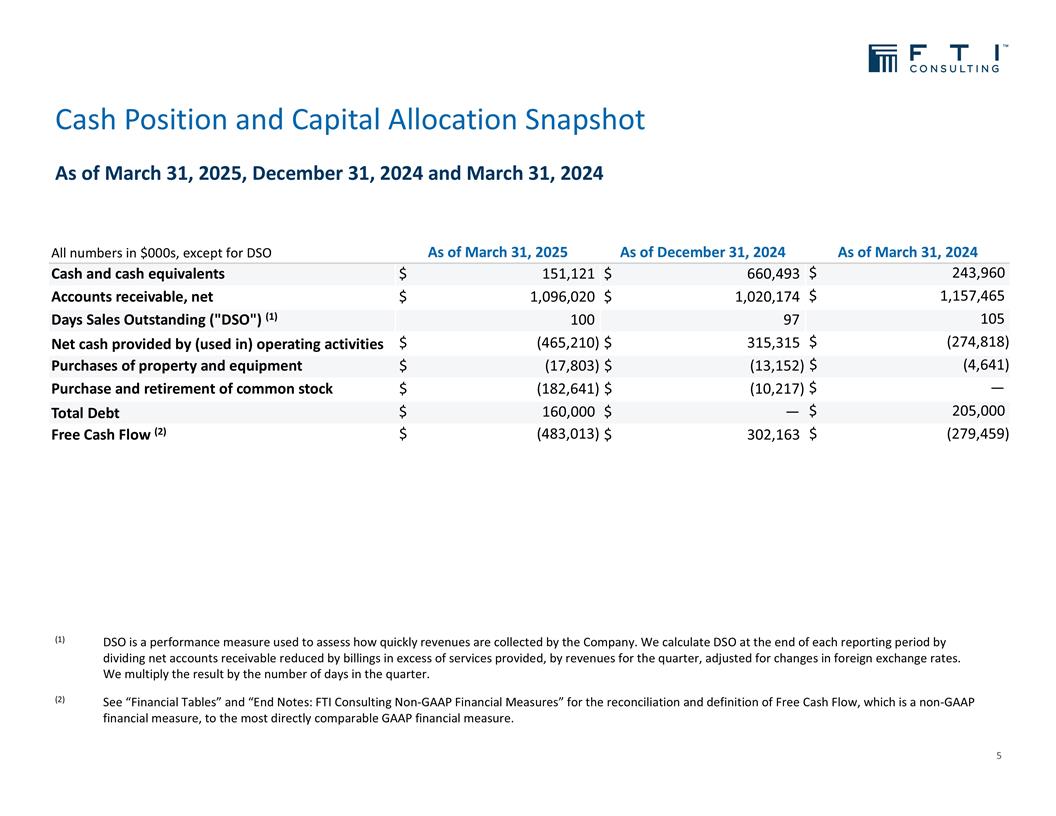
Cash Position and Capital Allocation Snapshot As of March 31, 2025, December 31, 2024 and March 31, 2024 (1)DSO is a performance measure used to assess how quickly revenues are collected by the Company. We calculate DSO at the end of each reporting period by dividing net accounts receivable reduced by billings in excess of services provided, by revenues for the quarter, adjusted for changes in foreign exchange rates. We multiply the result by the number of days in the quarter. (2)See “Financial Tables” and “End Notes: FTI Consulting Non-GAAP Financial Measures” for the reconciliation and definition of Free Cash Flow, which is a non-GAAP financial measure, to the most directly comparable GAAP financial measure. All numbers in $000s, except for DSO As of March 31, 2025 As of December 31, 2024 As of March 31, 2024 Cash and cash equivalents $151,121 $660,493 $243,960 Accounts receivable, net $1,096,020 $1,020,174 $1,157,465 Days Sales Outstanding ("DSO") (1) 100 97 105 Net cash provided by (used in) operating activities $(465,210) $315,315 $(274,818) Purchases of property and equipment $(17,803) $(13,152) $(4,641) Purchase and retirement of common stock $(182,641) $(10,217) $— Total Debt $160,000 $— $205,000 Free Cash Flow (2) $(483,013) $302,163 $(279,459)
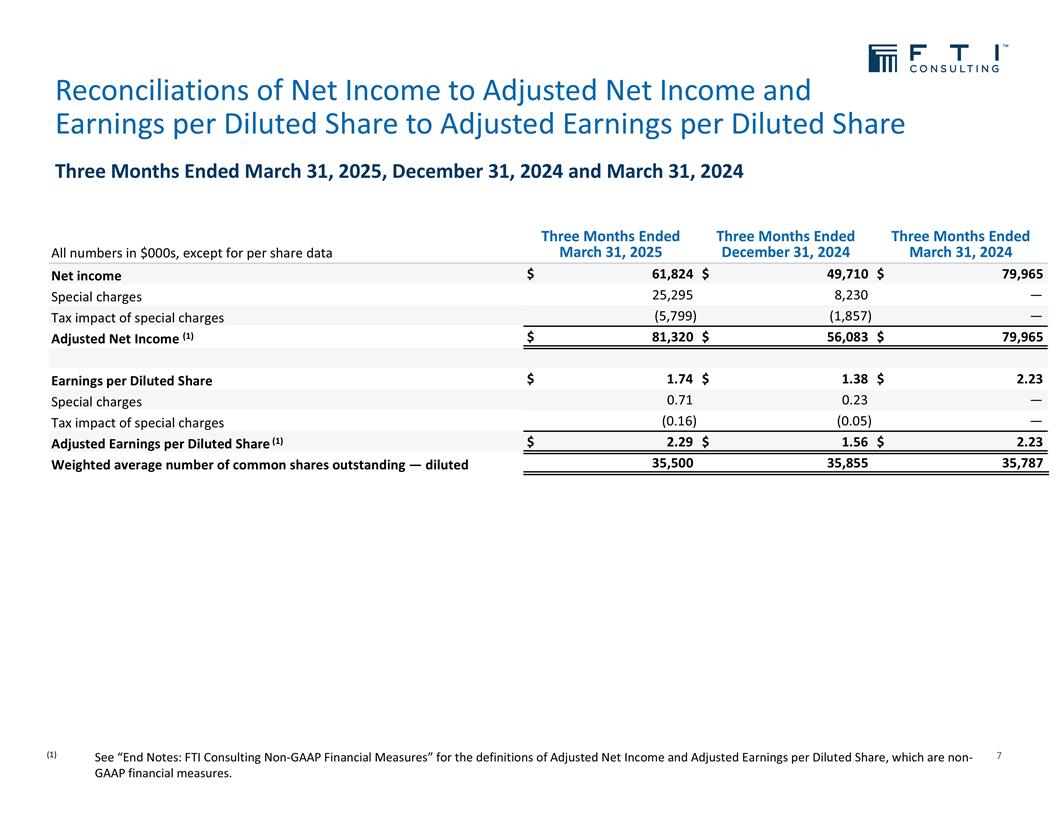
Three Months Ended March 31, 2025, December 31, 2024 and March 31, 2024 Reconciliations of Net Income to Adjusted Net Income and Earnings per Diluted Share to Adjusted Earnings per Diluted Share (1)See “End Notes: FTI Consulting Non-GAAP Financial Measures” for the definitions of Adjusted Net Income and Adjusted Earnings per Diluted Share, which are non-GAAP financial measures. All numbers in $000s, except for per share data Three Months Ended March 31, 2025 Three Months Ended December 31, 2024 Three Months Ended March 31, 2024 Net income $61,824 $49,710 $79,965 Special charges 25,295 8,230 — Tax impact of special charges (5,799) (1,857) — Adjusted Net Income (1) $81,320 $56,083 $79,965 Earnings per Diluted Share $1.74 $1.38 $2.23 Special charges 0.71 0.23 — Tax impact of special charges (0.16) (0.05) — Adjusted Earnings per Diluted Share (1) $2.29 $1.56 $2.23 Weighted average number of common shares outstanding — diluted 35,500 35,855 35,787
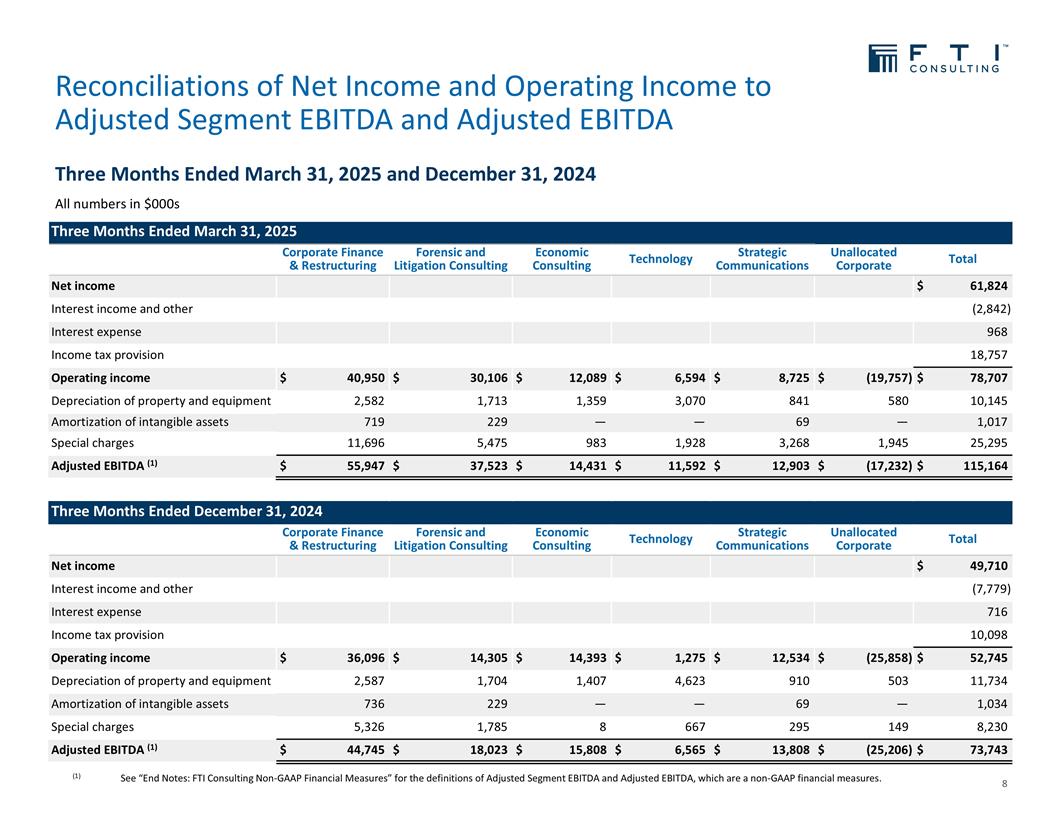
Three Months Ended March 31, 2025 and December 31, 2024 Reconciliations of Net Income and Operating Income to Adjusted Segment EBITDA and Adjusted EBITDA All numbers in $000s (1)See “End Notes: FTI Consulting Non-GAAP Financial Measures” for the definitions of Adjusted Segment EBITDA and Adjusted EBITDA, which are a non-GAAP financial measures. Three Months Ended March 31, 2025 Corporate Finance & Restructuring Forensic and Litigation Consulting Economic Consulting Technology Strategic Communications Unallocated Corporate Total Net income $61,824 Interest income and other (2,842) Interest expense 968 Income tax provision 18,757 Operating income $40,950 $30,106 $12,089 $6,594 $8,725 $(19,757) $78,707 Depreciation of property and equipment 2,582 1,713 1,359 3,070 841 580 10,145 Amortization of intangible assets 719 229 — — 69 — 1,017 Special charges 11,696 5,475 983 1,928 3,268 1,945 25,295 Adjusted EBITDA (1) $55,947 $37,523 $14,431 $11,592 $12,903 $(17,232) $115,164 Three Months Ended December 31, 2024 Corporate Finance & Restructuring Forensic and Litigation Consulting Economic Consulting Technology Strategic Communications Unallocated Corporate Total Net income $49,710 Interest income and other (7,779) Interest expense 716 Income tax provision 10,098 Operating income $36,096 $14,305 $14,393 $1,275 $12,534 $(25,858) $52,745 Depreciation of property and equipment 2,587 1,704 1,407 4,623 910 503 11,734 Amortization of intangible assets 736 229 — — 69 — 1,034 Special charges 5,326 1,785 8 667 295 149 8,230 Adjusted EBITDA (1) $44,745 $18,023 $15,808 $6,565 $13,808 $(25,206) $73,743
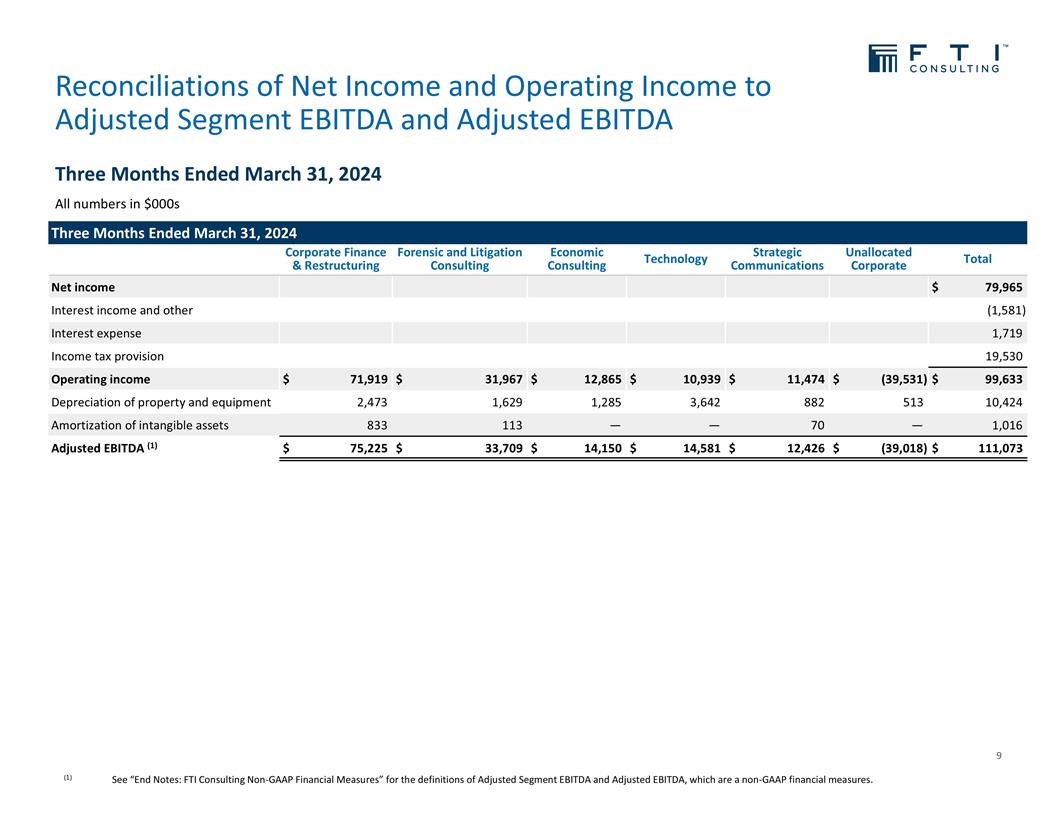
Three Months Ended March 31, 2024 Reconciliations of Net Income and Operating Income to Adjusted Segment EBITDA and Adjusted EBITDA All numbers in $000s Three Months Ended March 31, 2024 Corporate Finance & Restructuring Forensic and Litigation Consulting Economic Consulting Technology Strategic Communications Unallocated Corporate Total Net income $79,965 Interest income and other (1,581) Interest expense 1,719 Income tax provision 19,530 Operating income $71,919 $31,967 $12,865 $10,939 $11,474 $(39,531) $99,633 Depreciation of property and equipment 2,473 1,629 1,285 3,642 882 513 10,424 Amortization of intangible assets 833 113 — — 70 — 1,016 Adjusted EBITDA (1) $75,225 $33,709 $14,150 $14,581 $12,426 $(39,018) $111,073 (1)See “End Notes: FTI Consulting Non-GAAP Financial Measures” for the definitions of Adjusted Segment EBITDA and Adjusted EBITDA, which are a non-GAAP financial measures.
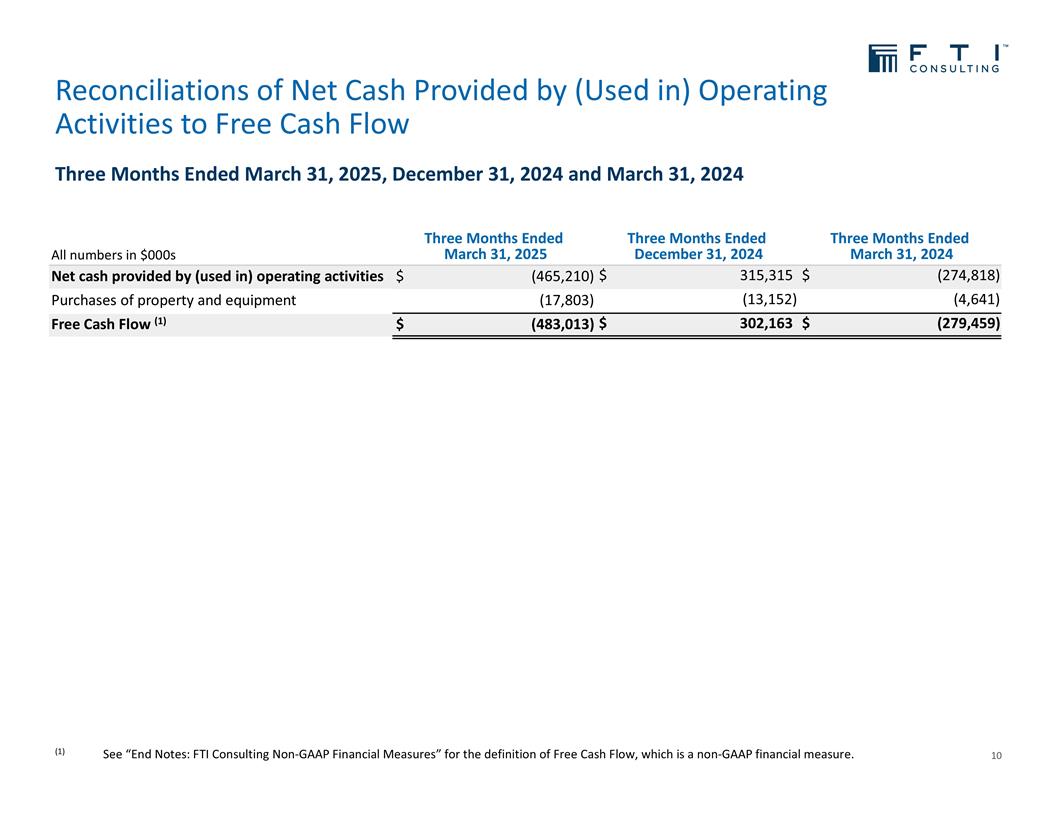
Three Months Ended March 31, 2025, December 31, 2024 and March 31, 2024 Reconciliations of Net Cash Provided by (Used in) Operating Activities to Free Cash Flow (1)See “End Notes: FTI Consulting Non-GAAP Financial Measures” for the definition of Free Cash Flow, which is a non-GAAP financial measure. All numbers in $000s Three Months Ended March 31, 2025 Three Months Ended December 31, 2024 Three Months Ended March 31, 2024 Net cash provided by (used in) operating activities $(465,210) $315,315 $(274,818) Purchases of property and equipment (17,803) (13,152) (4,641) Free Cash Flow (1) $(483,013) $302,163 $(279,459)
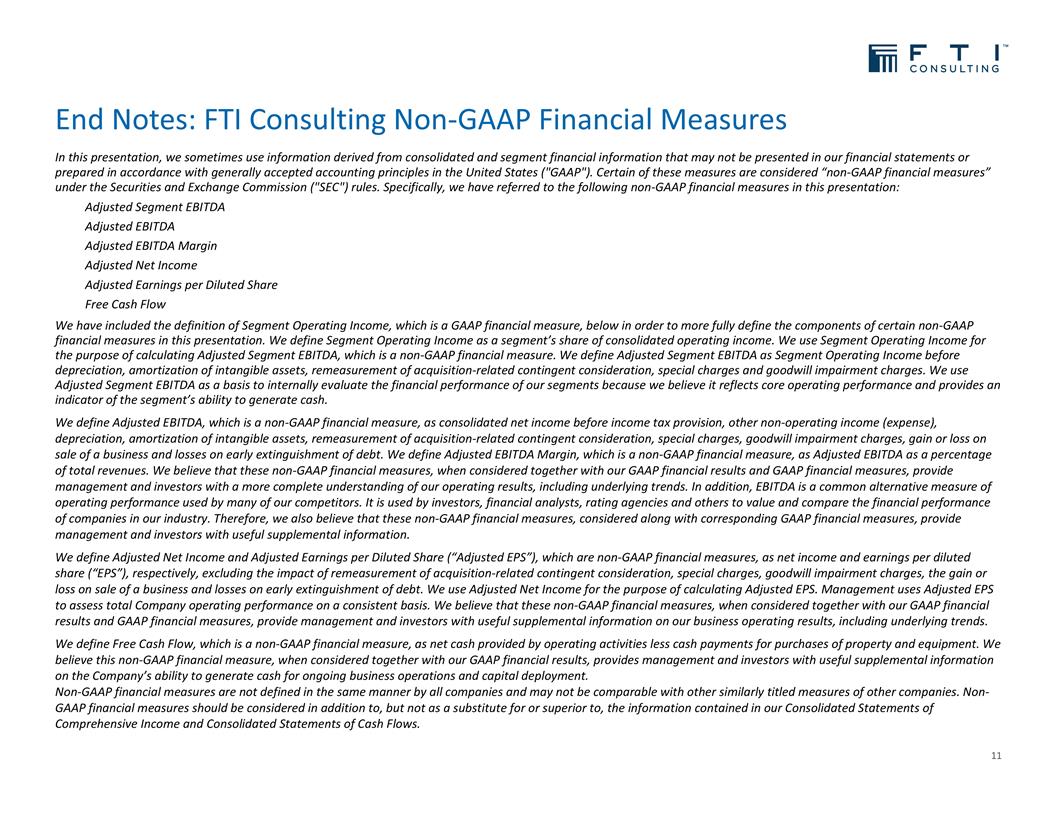
End Notes: FTI Consulting Non-GAAP Financial Measures In this presentation, we sometimes use information derived from consolidated and segment financial information that may not be presented in our financial statements or prepared in accordance with generally accepted accounting principles in the United States ("GAAP"). Certain of these measures are considered “non-GAAP financial measures” under the Securities and Exchange Commission ("SEC") rules. Specifically, we have referred to the following non-GAAP financial measures in this presentation: Adjusted Segment EBITDA Adjusted EBITDA Adjusted EBITDA Margin Adjusted Net Income Adjusted Earnings per Diluted Share Free Cash Flow We have included the definition of Segment Operating Income, which is a GAAP financial measure, below in order to more fully define the components of certain non-GAAP financial measures in this presentation. We define Segment Operating Income as a segment’s share of consolidated operating income. We use Segment Operating Income for the purpose of calculating Adjusted Segment EBITDA, which is a non-GAAP financial measure. We define Adjusted Segment EBITDA as Segment Operating Income before depreciation, amortization of intangible assets, remeasurement of acquisition-related contingent consideration, special charges and goodwill impairment charges. We use Adjusted Segment EBITDA as a basis to internally evaluate the financial performance of our segments because we believe it reflects core operating performance and provides an indicator of the segment’s ability to generate cash. We define Adjusted EBITDA, which is a non-GAAP financial measure, as consolidated net income before income tax provision, other non-operating income (expense), depreciation, amortization of intangible assets, remeasurement of acquisition-related contingent consideration, special charges, goodwill impairment charges, gain or loss on sale of a business and losses on early extinguishment of debt. We define Adjusted EBITDA Margin, which is a non-GAAP financial measure, as Adjusted EBITDA as a percentage of total revenues. We believe that these non-GAAP financial measures, when considered together with our GAAP financial results and GAAP financial measures, provide management and investors with a more complete understanding of our operating results, including underlying trends. In addition, EBITDA is a common alternative measure of operating performance used by many of our competitors. It is used by investors, financial analysts, rating agencies and others to value and compare the financial performance of companies in our industry. Therefore, we also believe that these non-GAAP financial measures, considered along with corresponding GAAP financial measures, provide management and investors with useful supplemental information. We define Adjusted Net Income and Adjusted Earnings per Diluted Share (“Adjusted EPS”), which are non-GAAP financial measures, as net income and earnings per diluted share (“EPS”), respectively, excluding the impact of remeasurement of acquisition-related contingent consideration, special charges, goodwill impairment charges, the gain or loss on sale of a business and losses on early extinguishment of debt. We use Adjusted Net Income for the purpose of calculating Adjusted EPS. Management uses Adjusted EPS to assess total Company operating performance on a consistent basis. We believe that these non-GAAP financial measures, when considered together with our GAAP financial results and GAAP financial measures, provide management and investors with useful supplemental information on our business operating results, including underlying trends. We define Free Cash Flow, which is a non-GAAP financial measure, as net cash provided by operating activities less cash payments for purchases of property and equipment. We believe this non-GAAP financial measure, when considered together with our GAAP financial results, provides management and investors with useful supplemental information on the Company’s ability to generate cash for ongoing business operations and capital deployment. Non-GAAP financial measures are not defined in the same manner by all companies and may not be comparable with other similarly titled measures of other companies. Non-GAAP financial measures should be considered in addition to, but not as a substitute for or superior to, the information contained in our Consolidated Statements of Comprehensive Income and Consolidated Statements of Cash Flows.
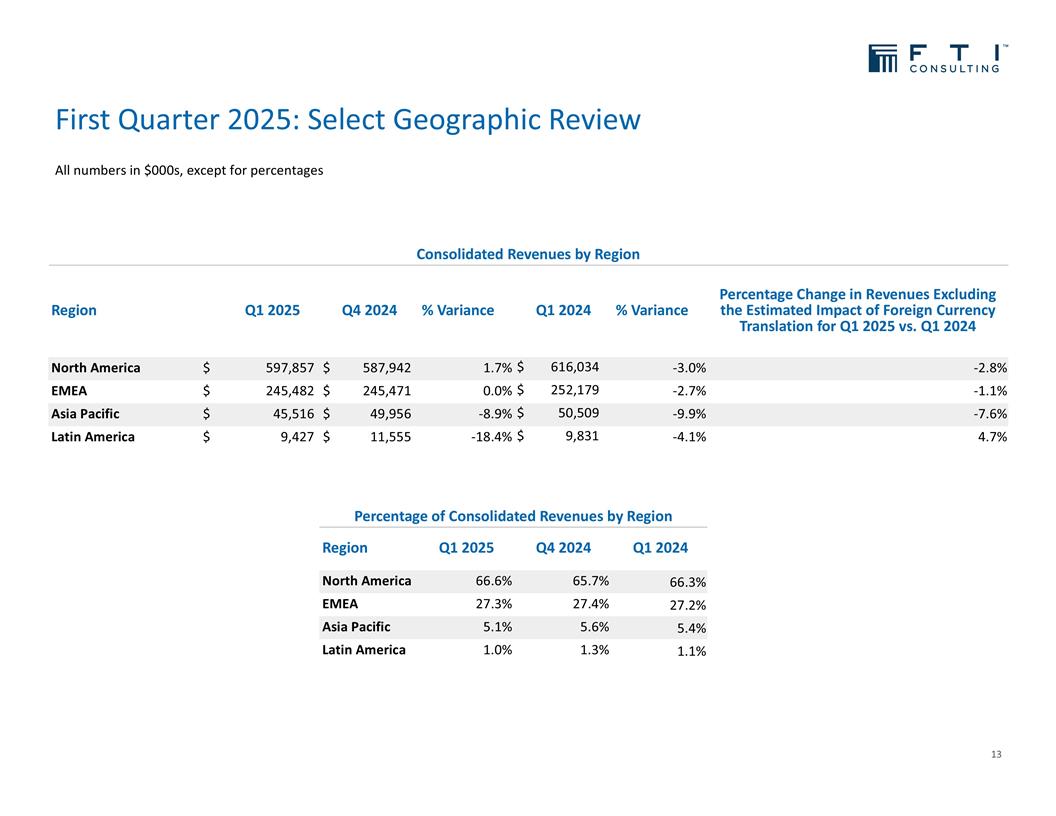
First Quarter 2025: Select Geographic Review Consolidated Revenues by Region Region Q1 2025 Q4 2024 % Variance Q1 2024 % Variance Percentage Change in Revenues Excluding the Estimated Impact of Foreign Currency Translation for Q1 2025 vs. Q1 2024 North America $597,857 $587,942 1.7% $616,034 -3.0% -2.8% EMEA $245,482 $245,471 0.0% $252,179 -2.7% -1.1% Asia Pacific $45,516 $49,956 -8.9% $50,509 -9.9% -7.6% Latin America $9,427 $11,555 -18.4% $9,831 -4.1% 4.7% Percentage of Consolidated Revenues by Region Region Q1 2025 Q4 2024 Q1 2024 North America 66.6% 65.7% 66.3% EMEA 27.3% 27.4% 27.2% Asia Pacific 5.1% 5.6% 5.4% Latin America 1.0% 1.3% 1.1% All numbers in $000s, except for percentages
First Quarter 2025

Experts with Impact TM