
HCAI 6-K
Huachen AI Parking Management Technology Holding Co., Ltd (HCAI)
UNITED STATES
SECURITIES AND EXCHANGE COMMISSION
Washington, D.C. 20549
Form
REPORT OF FOREIGN PRIVATE ISSUER PURSUANT TO
RULE 13a-16 OR 15d-16
UNDER THE SECURITIES EXCHANGE ACT OF 1934
For the month of September
Commission File Number:
(Translation of registrant’s name into English)
No.1018 Haihe Road, Dushangang Town,
Pinghu City, Jiaxing, Zhejiang Province,
China, 314205
(Address of principal executive office)
Indicate by check mark whether the registrant files or will file annual reports under cover of Form 20-F or Form 40-F.
Form 20-F ☒ Form 40-F ☐
INFORMATION CONTAINED IN THIS FORM 6-K REPORT
Huachen AI Parking Management Technology Holding Co., Ltd (the “Company”) is hereby furnishing this report on Form 6-K (the “Report”) to provide the Unaudited Interim Condensed Consolidated Financial Statements of the Company as of and for the six months ended June 30, 2025, included as Exhibit 99.1 of this Report, and the Management’s Discussion and Analysis of Financial Condition and Results of Operations as of and for the six months ended June 30, 2025, included as Exhibit 99.2 of this Report.
Exhibits.
The following exhibits are being filed herewith:
| Exhibit No. | Description | |
| 99.1 | Unaudited Interim Condensed Consolidated Financial Statements for the Six Months Ended June 30, 2025 | |
| 99.2 | Management’s Discussion and Analysis of Financial Condition and Results of Operations for the Six Months Ended June 30, 2025 | |
| 101.INS | Inline XBRL Instance Document. | |
| 101.SCH | Inline XBRL Taxonomy Extension Schema Document. | |
| 101.CAL | Inline XBRL Taxonomy Extension Calculation Linkbase Document. | |
| 101.DEF | Inline XBRL Taxonomy Extension Definition Linkbase Document. | |
| 101.LAB | Inline XBRL Taxonomy Extension Label Linkbase Document. | |
| 101.PRE | Inline XBRL Taxonomy Extension Presentation Linkbase Document. | |
| 104 | Cover Page Interactive Data File (formatted as Inline XBRL and contained in Exhibit 101). |
1
SIGNATURES
Pursuant to the requirements of the Securities Exchange Act of 1934, the registrant has duly caused this report to be signed on its behalf by the undersigned, thereunto duly authorized.
| Date: September 19, 2025 | Huachen AI Parking Management Technology Holding Co., Ltd, | |
| By: | /s/ Bin Lu | |
| Name: | Bin Lu | |
| Title: | Chief Executive Officer | |
2
Exhibit 99.1
Huachen AI Parking Management Technology Holding Co., Ltd
CONDENSED CONSOLIDATED BALANCE SHEETS
(Expressed in U.S. Dollars, except for the number of shares)
| As of | ||||||||
| June 30, 2025 | December 31, 2024 | |||||||
Unaudited US$ | US$ | |||||||
| ASSETS | ||||||||
| Current assets | ||||||||
| Cash and cash equivalents | ||||||||
| Accounts receivable, net | ||||||||
| Other receivables - related parties | ||||||||
| Other receivables, net | ||||||||
| Prepayments | ||||||||
| Inventories, net | ||||||||
| Total current assets | ||||||||
| Non-current assets | ||||||||
| Plant and equipment, net | ||||||||
| Right-of-use assets, net | ||||||||
| Deferred tax assets | ||||||||
| Land-use rights, net | ||||||||
| Intangible assets, net | ||||||||
| Total non-current assets | ||||||||
| TOTAL ASSETS | ||||||||
| LIABILITIES AND SHAREHOLDERS’ EQUITY | ||||||||
| Current liabilities | ||||||||
| Short-term bank loans | ||||||||
| Accounts payable | ||||||||
| Accrued liabilities and other payables | ||||||||
| Contract liabilities | ||||||||
| Taxes payable | ||||||||
| Other payables - related parties | ||||||||
| Lease liabilities | ||||||||
| Total current liabilities | ||||||||
| Non-current liabilities | ||||||||
| Long-term bank loan | ||||||||
| Long-term account payable | ||||||||
| Total non-current liabilities | ||||||||
| TOTAL LIABILITIES | ||||||||
| Shareholders’ equity | ||||||||
| Class A ordinary shares (par value of US$ | ||||||||
| Class B ordinary shares (par value of US$ | ||||||||
| Additional paid-in capital | ||||||||
| Statutory reserves | ||||||||
| Retained earnings | ||||||||
| Accumulated other comprehensive loss | ( | ) | ( | ) | ||||
| TOTAL HUACHEN CAYMAN SHAREHOLDERS’ EQUITY | ||||||||
| Non-controlling interest | ||||||||
| TOTAL SHAREHOLDERS’ EQUITY | ||||||||
| TOTAL LIABILITIES AND SHAREHOLDERS’ EQUITY | ||||||||
Huachen AI Parking Management Technology Holding Co., Ltd
UNAUDITED CONDENSED CONSOLIDATED STATEMENTS OF INCOME
(Expressed in U.S. Dollars, except for the number of shares)
| For the six months ended, June 30 | ||||||||
| 2025 | 2024 | |||||||
| Unaudited | Unaudited | |||||||
| US$ | US$ | |||||||
| Revenues | ||||||||
| Cost of revenues | ( | ) | ( | ) | ||||
| Gross profit | ||||||||
| Operating expenses | ||||||||
| Selling and marketing expenses | ( | ) | ( | ) | ||||
| General and administrative expenses | ( | ) | ( | ) | ||||
| Research and development expenses | ( | ) | ( | ) | ||||
| Total operating expenses | ( | ) | ( | ) | ||||
| Income from operations | ||||||||
| Other expenses, net | ||||||||
| Interest expense, net | ( | ) | ( | ) | ||||
| Other (expenses) income, net | ( | ) | ||||||
| Total other expenses, net | ( | ) | ( | ) | ||||
| Income before income taxes | ||||||||
| Income tax expenses | ( | ) | ||||||
| Net income | ||||||||
| Net income attributable to the noncontrolling interest | ||||||||
| Net income attributable to common shareholders | ||||||||
| OTHER COMPREHENSIVE INCOME | ||||||||
| Foreign currency translation income (loss) | ( | ) | ||||||
| Other comprehensive income (loss), net of tax | ( | ) | ||||||
| Total comprehensive income | ||||||||
| Net profit per share - Basic and diluted | ||||||||
| Weighted average shares outstanding used in calculating basic and diluted earnings per share | ||||||||
2
Huachen AI Parking Management Technology Holding Co., Ltd
UNAUDITED CONDENSED CONSOLIDATED STATEMENTS OF CHANGES IN SHAREHOLDERS’ EQUITY
(Expressed in U.S. Dollars, except for the number of shares)
| Accumulated | ||||||||||||||||||||||||||||||||||||||||
| Class A Ordinary Shares | Class
B | Additional Paid in | Statutory | Other Retained | Non- Comprehensive | Controlling | ||||||||||||||||||||||||||||||||||
| Shares* | Amount | Shares | Amount | Capital | Reserves | Earnings | Income (Loss) | Interests | Total | |||||||||||||||||||||||||||||||
| Balance as of December 31, 2023 | $ | $ | $ | $ | $ | ( | ) | $ | $ | |||||||||||||||||||||||||||||||
| Net income | - | - | ||||||||||||||||||||||||||||||||||||||
| Allocation to non-controlling interests | - | - | ||||||||||||||||||||||||||||||||||||||
| Foreign currency translation gain | - | - | ( | ) | ( | ) | ||||||||||||||||||||||||||||||||||
| Balance as of June 30, 2024 (Unaudited) | $ | $ | $ | $ | $ | ( | ) | $ | $ | |||||||||||||||||||||||||||||||
| Balance as of December 31, 2024 | ( | ) | ||||||||||||||||||||||||||||||||||||||
| Net income | - | |||||||||||||||||||||||||||||||||||||||
| Issuance of shares for cash | - | |||||||||||||||||||||||||||||||||||||||
| Re-designation of shares | ( | ) | ( | ) | ||||||||||||||||||||||||||||||||||||
| Additional Paid-in Capital | - | - | ||||||||||||||||||||||||||||||||||||||
| Allocation to non-controlling interests | - | - | ||||||||||||||||||||||||||||||||||||||
| Foreign currency translation gain | - | - | ||||||||||||||||||||||||||||||||||||||
| Balance as of June 30, 2025 (Unaudited) | ( | ) | ||||||||||||||||||||||||||||||||||||||
3
Huachen AI Parking Management Technology Holding Co., Ltd
UNAUDITED CONDENSED CONSOLIDATED STATEMENTS OF CASH FLOWS
(Expressed in U.S. Dollars, except for the number of shares)
| For the Six Months Ended June 30, | ||||||||
| 2025 (Unaudited) | 2024 (Unaudited) | |||||||
| Cash flows from operating activities: | ||||||||
| Net income | $ | $ | ||||||
| Adjustments to reconcile net income to net cash provided by (used in) operating activities: | ||||||||
| Depreciation of plant and equipment | ||||||||
| Amortization of intangible assets and land-use rights | ||||||||
| Amortization of right-of-use assets | ||||||||
| Reversal of allowance for credit losses | ( | ) | ( | ) | ||||
| (Reversal) provision of allowance for inventory impairment | ( | ) | ||||||
| Changes in operating assets and liabilities: | ||||||||
| Accounts receivable | ( | ) | ( | ) | ||||
| Other receivables | ( | ) | ( | ) | ||||
| Other receivables - related parties | ( | ) | ( | ) | ||||
| Inventories | ( | ) | ||||||
| Prepayments | ( | ) | ( | ) | ||||
| Accounts payables | ||||||||
| Accrued liabilities and other payables | ||||||||
| Lease liabilities | ( | ) | ( | ) | ||||
| Contract liabilities | ||||||||
| Taxes payable | ||||||||
| Net cash (used in) provided by operating activities | ( | ) | ||||||
| Cash flows from investing activity: | ||||||||
| Purchase of plant and equipment | ( | ) | ||||||
| Net cash used in investing activity | ( | ) | ||||||
| Cash flows from financing activity: | ||||||||
| Repayments of short-term bank loans | ( | ) | ( | ) | ||||
| Proceeds from additional paid-in capital | ||||||||
| Net cash (used in) provided by financing activity | ( | ) | ||||||
| Effect of exchange rate changes on cash | ||||||||
| Net increase (decrease) in cash and cash equivalents | ( | ) | ||||||
| Cash and cash equivalents at beginning of period | ||||||||
| Cash and cash equivalents at end of period | $ | $ | ||||||
| Supplemental disclosure of cash flow information: | ||||||||
| Cash paid for interest | $ | $ | ||||||
4
Huachen AI Parking Management Technology Holding Co., Ltd AND SUBSIDIARIES
NOTES TO UNAUDITED CONSOLIDATED FINANCIAL STATEMENTS
For the Six Months Ended June 30, 2025 and 2024
Note 1 — ORGANIZATION AND BUSINESS DESCRIPTION
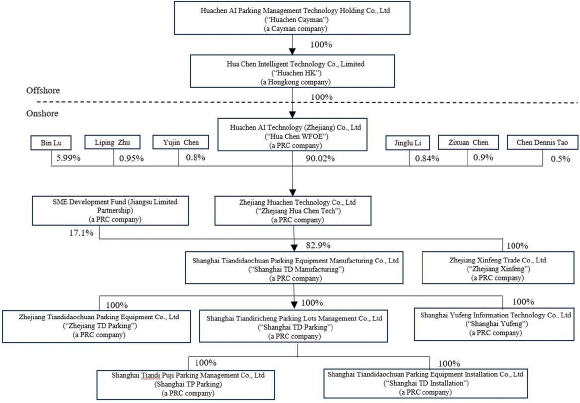
Huachen AI Parking Management Technology Holding Co., Ltd (“Huachen” or the “Company”) is a company that was established under the laws of Cayman Islands as a holding company on September 30, 2021. Our main business operations are conducted through our subsidiaries in the People’s Republic of China. We are a technology company related to design, manufacture, sales, installation and maintenance of intelligent cubic parking garage and equipment.
As of June 30, 2025, the Company’s subsidiaries are as follows:
| Percentage of | ||||||||
| direct/indirect | ||||||||
| Date of | Jurisdiction of | Economic | ||||||
| Subsidiaries | Incorporation | Formation | Ownership | |||||
| Hua Chen Intelligent Technology Co., Limited (“Huachen HK”) | % | |||||||
| Huachen AI Technology (Zhejiang) Co., Ltd (“Hua Chen WFOE”) | % | |||||||
| Zhejiang Huachen Technology Co., Ltd (“Zhejiang Hua Chen Tech”) | % | |||||||
| Shanghai Tiandidaochuan Parking Equipment Manufacturing Co., Ltd (“Shanghai TD Manufacturing”) | % | |||||||
| Shanghai Tiandiricheng Parking Lots Management Co., Ltd (“Shanghai TD Parking”) | % | |||||||
| Zhejiang Tiandidaochuan Parking Equipment Co., Ltd (“Zhejiang TD Parking”) | % | |||||||
| Shanghai Yufeng Information Technology Co., Ltd (“Shanghai Yufeng”) | % | |||||||
| Shanghai Tiandi Puji Parking Management Co., Ltd (“Shanghai TP Parking”) | % | |||||||
| Shanghai Tiandi Daochuan Parking Equipment Installation Co., Ltd (“Shanghai TD Installation”) | % | |||||||
| Zhejiang Xinfeng Trade Co., Ltd (“Zhejiang Xinfeng”) | % | |||||||
5
The Company, through a series of transactions which are accounted for as a reorganization of entities under common control (the “Reorganization”), became the ultimate parent of its subsidiaries. The reorganization involved: the formation of the Company’s wholly-owned subsidiary-Huachen HK and Huachen HK’s wholly owned subsidiary — Hua Chen WFOE.
Before and after the reorganization, the Company, together with its subsidiaries, is effectively controlled by the same shareholders, and therefore the reorganization is considered as a recapitalization of entities under common control in accordance with Accounting Standards Codification (“ASC”) 805-50-25. The consolidation of the Company and its subsidiaries have been accounted for at historical cost and prepared on the basis as if the aforementioned transactions had become effective as of the beginning of the first period presented in the accompanying consolidated financial statements in accordance with ASC 805-50-45-5.
Note 2 — SUMMARY OF SIGNIFICANT ACCOUNTING POLICIES
Method of accounting
The accompanying audited consolidated financial statements include the accounts of the Company and its subsidiaries (collectively the “Company”). Management has eliminated all significant inter-company balances and transactions in preparing the accompanying audited consolidated financial statements.
Management has prepared the accompanying audited consolidated financial statements and these notes in accordance to generally accepted accounting principles in the United States (“US GAAP”). The Company maintains its general ledger and journals with the accrual method accounting.
Principles of consolidation
The consolidated financial statements include the financial statements of the Company and its subsidiaries. All intercompany transactions and balances are eliminated upon consolidation. All intercompany transactions and balances between the Company and its subsidiaries are eliminated upon consolidation.
Subsidiaries are those entities in which the Company, directly or indirectly, controls more than one half of the voting power; or has the power to govern the financial and operating policies, to appoint or remove the majority of the members of the board of directors, or to cast a majority of votes at the meeting of directors.
Non-controlling interest represents the portion of the net assets of subsidiaries attributable to interests that are not owned by the Company. The non-controlling interest is presented in the consolidated balance sheets, separately from equity attributable to the shareholders of the Company. Non-controlling interest’s operating result is presented on the face of the consolidated statements of income and comprehensive income as an allocation of the total income for the year between non-controlling shareholders and the shareholders of the Company.
6
Uses of estimates
In preparing the consolidated financial statements in conformity with US GAAP, management makes estimates and assumptions that affect the reported amounts of assets and liabilities and disclosure of contingent assets and liabilities at the date of the financial statements and the reported amounts of revenues and expenses during the reporting period. These estimates are based on information as of the date of the consolidated financial statements. Significant estimates required to be made by management include, but are not limited to, the valuation of accounts receivable and inventories, useful lives of plant and equipment, land use right, the recoverability of long-lived assets, provision necessary for contingent liabilities, and realization of deferred tax assets. Actual results could differ from those estimates.
Cash and cash equivalents
The Company considers all highly liquid investment instruments with an original maturity of three months or less from the date of purchase to be cash equivalents. The Company maintains most of its bank accounts in the PRC.
Accounts receivable, net
Accounts receivable, net are recorded at the gross billing amount less an allowance for expected credit losses from the customers. Accounts receivable do not bear interest.
Since July 1, 2022, the Company adopted Accounting Standards Update (“ASU”) No. 2016-13, Financial Instruments-Credit Losses (Topic 326): Measurement of Credit Losses on Financial Instruments (“ASU 2016-13”), using the modified retrospective transition method. ASU 2016-13 replaces the existing incurred loss impairment model with an expected loss methodology, which will result in more timely recognition of credit losses. Upon adoption, the Company changed the impairment model to utilize a forward-looking current expected credit losses (CECL) model in place of the incurred loss methodology for financial instruments measured at amortized cost and receivables resulting from the application of ASC 606.
The Company maintains an allowance for credit losses in accordance with ASC Topic 326, Credit Losses (“ASC 326”) and records the allowance for credit losses as an offset to accounts receivable, and the estimated credit losses charged to the allowance in the combined statements of operations and comprehensive income (loss). The Company assesses collectability by reviewing accounts receivable on a collective basis where similar characteristics exist, primarily based on similar business lines, services or product offerings and on an individual basis when the Company identifies specific customers with known disputes or collectability issues. In determining the amount of the allowance for credit losses, the Company considers historical collectability based on past due status, the age of the accounts receivable balances, credit quality of the Company’s customers based on ongoing credit evaluations, current economic conditions, reasonable and supportable forecasts of future economic conditions, and other factors that may affect the Company’s ability to collect from customer.
7
As of June 30, 2025 and December 31, 2024, allowance
for credit losses balances amounted to $
Inventories
Inventories are stated at the lower of cost or net realizable value. Costs include the cost of raw materials, freight, direct labor and related production overhead. The cost of inventories is calculated using the weighted average method. Any excess of the cost over net realizable value of each item of inventories is recognized as a provision for diminution in the value of inventories. Net realizable value is estimated using selling price in the normal course of business less any costs to Complete and sell products. The Company evaluates inventories on a quarterly basis for its realizable value adjustments and reduces the carrying value of those inventories that are obsoletes or in excess of the forecasted usage to their estimated net realizable value based on various factors including aging and future demand of each type of inventories.
Prepayments
Prepayments consist of balances paid to suppliers for services and materials that have not been provided or received. Advance to suppliers is short-term in nature and is reviewed periodically to determine whether their carrying value has become impaired.
Plant and equipment, net
Plant and equipment are stated at cost less accumulated
depreciation.
| Useful life | ||
| Office equipment and furniture | ||
| Transportation vehicles | ||
| Mechanical equipment | ||
| Buildings |
Repair and maintenance costs are charged to expenses as incurred, whereas the cost of renewals and betterments that extend the useful lives of property and equipment are capitalized as additions to the related assets. Retirements, sales and disposals of assets are recorded by removing the costs, accumulated depreciation and impairment with any resulting gain or loss recognized in the consolidated statements of income in other income or expenses.
8
Intangible Assets, net
Intangible assets consist primarily of software
and membership. Intangible assets are stated at cost less accumulated amortization.
| Useful life | ||
| ERP- Zhituo software | ||
| Nasdaq membership |
The software is amortized on a monthly basis. Its cost was recorded
as an asset in January 2019 with the original purchase value approximately $
Land use rights, net
Under the PRC law, all land in the PRC is owned
by the government and cannot be sold to an individual or company. The government grants individuals and companies the right to use the
parcels of land for specified periods of time. These land use rights are sometimes referred to informally as “ownership.”
Land use rights are stated at cost less accumulated amortization. The estimated useful life for land use right is
The land use rights were recorded as an asset in March 2018 with the
original value approximately $
Leases
From January 1, 2022, the Company adopted Accounting Standards Update (“ASU”) 2016-02, Lease (FASB ASC Topic 842). The adoption of Topic 842 resulted in the presentation of operating lease right-of-use (“ROU”) assets and operating lease liabilities on the consolidated balance sheet. The Company has elected the package of practical expedients, which allows the Company not to reassess (1) whether any expired or existing contracts as of the adoption date are or contain a lease, (2) lease classification for any expired or existing leases as of the adoption date and (3) initial direct costs for any expired or existing leases as of the adoption date. Lastly, the Company elected the short-term lease exemption for all contracts with lease terms of 12 months or less.
At inception of a contract, the Company assesses whether a contract is, or contains, a lease. A contract is or contains a lease if it conveys the right to control the use of an identified asset for a period of time in exchange of a consideration. To assess whether a contract is or contains a lease, the Company assess whether the contract involves the use of an identified asset, whether it has the right to obtain substantially all the economic benefits from the use of the asset and whether it has the right to control the use of the asset.
The right-of-use assets and related lease liabilities are recognized at the lease commencement date. The Company recognizes operating lease expenses on a straight-line basis over the lease term.
9
Right-of-use of assets
The Company recognises right-of-use assets at the commencement date of the lease (i.e. the date the underlying asset is available for use). Right-of-use assets are measured at cost, less any accumulated depreciation and impairment losses and adjusted for any remeasurement of lease liabilities. The cost of right-of-use assets includes the amount of lease liabilities recognised, initial direct costs incurred, and lease payments made at or before the commencement date less any lease incentives received. Right-of-use assets are depreciated on a straight-line basis over the shorter of the lease term and the estimated useful lives of the assets. All right-of-use assets are reviewed for impairment annually. There was no impairment for right-of-use lease assets for the years ended December 31, 2024.
Lease liabilities
Lease liability is initially measured at the present value of the outstanding lease payments at the commencement date, discounted using the Company’s incremental borrowing rate. Lease payments included in the measurement of the lease liability comprise fixed lease payments, variable lease payments that depend on an index or a rate, amounts expected to be payable under a residual value guarantee and any exercise price under a purchase option that the Company is reasonably certain to exercise. Lease liability is measured at amortized cost using the effective interest rate method. It is re-measured when there is a change in future lease payments, if there is a change in the estimate of the amount expected to be payable under a residual value guarantee, or if there is any change in the Company assessment of option purchases, contract extensions or termination options.
As of June 30, 2025 and December 31, 2024, there
were approximately $ and $
Impairment of Long-lived Assets
The Company reviews long-lived assets, including definitive-lived intangible assets, for impairment whenever events or changes in circumstances indicate that the carrying amount of an asset may not be recoverable. If the estimated cash flows from the use of the asset and its eventual disposition below are the asset’s carrying value, then the asset is deemed to be impaired and written down to its fair value. There were impairments of these assets as of December 31, 2024, 2023 and 2022.
10
Fair value of financial instruments
Fair value is defined as the price that would be received to sell an asset or paid to transfer a liability in an orderly transaction between market participants at the measurement date. A three-level fair value hierarchy prioritizes the inputs used to measure fair value. The hierarchy requires entities to maximize the use of observable inputs and minimize the use of unobservable inputs. The three levels of inputs used to measure fair value are as follows:
| ● | Level 1 — inputs to the valuation methodology are quoted prices (unadjusted) for identical assets or liabilities in active markets. |
| ● | Level 2 — inputs to the valuation methodology include quoted prices for similar assets and liabilities in active markets, quoted market prices for identical or similar assets in markets that are not active, inputs other than quoted prices that are observable and inputs derived from or corroborated by observable market data. |
| ● | Level 3 — inputs to the valuation methodology are unobservable. |
Unless otherwise disclosed, the fair value of the Company’s financial instruments, including cash, short-term investments, accounts receivable, due from related parties, accounts payable, due to related parties, accrued liabilities and other payable, taxes payable and short-term bank loans, approximate the fair value of the respective assets and liabilities as of June 30, 2025 and December 31, 2024 based upon the short-term nature of the assets and liabilities.
Bank borrowings and unsecured senior notes
Bank borrowings and unsecured senior notes are recognized initially at fair value, net of upfront fees, debt discounts or premiums, debt issuance costs and other incidental fees. Upfront fees, debt discounts or premiums, debt issuance costs and other incidental fees are recorded as a reduction of the proceeds received and the related accretion is recorded as interest expense in the consolidated income statements over the estimated term of the facilities using the effective interest method.
Revenue recognition
The Company adopted ASC 606 “Revenue Recognition.” It recognizes revenue when control of the promised goods or services is transferred to customers, in an amount that reflects the consideration we expect to be entitled to in exchange for those goods or services. The Company recognizes revenue based on the consideration specified in the applicable agreement.
Revenue from contracts with customers is recognized using the following five steps:
| 1. | Identify the contract(s) with a customer; |
| 2. | Identify the performance obligations in the contract; |
| 3. | Determine the transaction price; |
| 4. | Allocate the transaction price to the performance obligations in the contract; and |
| 5. | Recognize revenue when (or as) the entity satisfies a performance obligation. |
11
Generally, revenues are recognized when the Company has negotiated the terms of the transaction, which includes determining either the overall price, or price for each performance obligation in the form of a service or a product, the service or product has been delivered to the customer, no obligation is outstanding regarding that service or product, and the Company is reasonably assured that funds have been or will be collected from the customer.
A summary of each of the Company’s revenue streams under ASC 606 is as follows:
Performance obligations satisfied at a point in time
Equipment structural parts income
Revenue from sales of equipment structural parts is recognized when the products are delivered and accepted by customers, which is the point when title has transferred and risk of ownership has passed. Return allowances is determined by an estimate of expected customer merchandise returns, which is calculated based on historical return patterns, and recorded as a refund liability included in accrued expenses and other liabilities.
For equipment structural parts sales, the Company passed the control of the goods to the customers at a point in time, typically occurs at the delivery. Revenue from sales of equipment structural parts is recognized when the products are delivered and accepted by customers, which is the point when title has transferred and risk of ownership has passed. There are no other performance obligations in the contract, so we consider there is only one performance obligation for each contract.
For equipment structural parts sales, the transaction price was set up when customer places the purchase order, which in some cases are governed by master sales agreements. Total amount of each transaction was determined based on the unit price multiplied with the delivery quantity of the products ordered, or based on the services priced that was agreed between the parties.
For equipment sales, the Company’s payment terms are generally less than one year. The Company has elected the practical expedient under ASC 606-10-32-18 to not assess whether a contract has a significant financing component.
Cubic parking garage income
This revenue is recognized after the garage project has been completed and successfully accepted by the client.
According to 5-Step revenue analysis, the Company considers customer purchase orders, which in some cases are governed by master sales agreements, to be the contracts with a customer. This purchase order determination guided both product (garage and equipment) sales and maintenance service sales. The Company signs master agreement with its customers which include the customer’s name, the products’ specifications, or service type if for maintenance service, payment terms, product acceptance criteria, or service acceptance criteria, and other necessary information. The purchase orders, both product or service, which in some cases are governed by master sales agreements, would be sent to the Company at each time of the purchase. For product (garage and equipment), the PO (purchase order) includes types and quantities of goods to be purchased, the place of delivery, and other information relating to the purchase. The master agreement and purchase order signed between the parties create enforceable rights and obligations.
12
From time to time, the Company and its customers may renegotiate existing contracts to reflect changes of price and other terms. Such modifications are treated as separate contract if both of the following conditions are met:
| ● | The scope of the contract increases because of the addition of promised goods or services that are distinct. |
| ● | The price of the contract increases by an amount of consideration that reflects the entity’s standalone selling prices of the additional promised goods or services and any appropriate adjustments to that price to reflect the circumstances of the particular contract. |
The Company considers customer purchase orders, which in some cases are governed by master sales agreements, to be the contracts with a customer. As part of its consideration of the contract, the Company evaluates certain factors including the customer’s ability to pay (or credit risk). For each contract, the Company considers the promise to transfer products or service delivery, each of which are distinct, to be the identified performance obligations.
For cubic parking garage, when the contract was signed, the garage project began to be executed. First, the equipment selection was made according to the design institute drawings, and then the construction and installation were carried out on site. Revenues from the installation and sale of garage equipment are combined and treated as one performance obligation. The commitments for garage equipment and installation are not separately identifiable, as evidenced by the fact that the customer does not acquire control of the garage until after acceptance of the completed garage installation, and the customer can only utilize and benefit from the garage after the installation is completed, and the customer cannot benefit from a single element. The Company does not currently have any contract modifications and the contract does not currently have any variable consideration. The transaction price is clearly identifiable within the Company’s sales and installation contracts in the context of the Company’s performance obligations for equipment and installation revenues. When the project is completed, the customer accepts the garage. Once the customer acceptance is complete, the Company recognizes revenue for this contract. According to ASC 606-10-25-27, first, the customer simultaneously does not receive and consume the benefits provided by the Company’s performance. Second, the Company’s performance does not create or enhance an asset that the customer controls as the asset is created or enhanced. Third, the Company’s performance does create an asset with an alternative use (selling to a different customer) to the Company. In summary, the Company recognizes cubic parking garage income at a point in time.
The Company negotiates with customers for agreed-upon specifications for products or services customer ordered, and such agreed-upon terms are usually documented in the master sales agreement between the Company and its customers.
13
For product, the Company typically provides
For cubic parking garage price, the Company will consider the cost of the civil foundation, the cost of the mechanical parking equipment, the cost of the installation of the parking equipment, the cost of the construction and installation of the parking equipment, and the cost of the maintenance of the garage. The price of the price parking garage depends on the supply and demand relationship between the number of parking spaces demanded and the number of cubic garage manufacturers, and also depends on the number of floors and configuration of the cubic garage. The more layers of the garage, the higher the price of the garage, while the higher the configuration of the garage, the higher the price of the garage.
For cubic garage, The Company’s payment
terms are normally
For product sales (garage or equipment), the transaction price of a contract is allocated to each distinct goods stated in the purchase order. The price of each distinct goods is determined by the ordered quantities and price quotation.
Performance obligations satisfied over time
Maintenance services income
Garage maintenance service contracts require our company to perform repairs or maintenance on any equipment failures during the contract maintenance period, typically ranging from to years. The transfer of control of maintenance services occurs at the time the services are provided; this is the moment when the customer benefits and assumes the risks and rewards associated with the services. This forms the basis for the recognition of revenue from maintenance services, which are recognized on a straight-line basis over the coverage period for garage repairs.
Our maintenance services are governed by contracts that are independently executed, separate from any other contractual arrangements. The maintenance service contracts are specifically tailored to meet the unique needs of our clients. The maintenance services for such contracts can be distinctly identified and are determined as separate performance obligations within the contracts
14
The summary of the Company’s total revenues by product categories for the six months ended June 30, 2025 and 2024 was as follows:
| For the Six Months Ended | ||||||||
| June 30, | ||||||||
| 2025 | 2024 | |||||||
| Equipment structural parts | $ | |||||||
| Cubic parking garage | ||||||||
| Maintenance services | ||||||||
| Others | ||||||||
| Total revenue | $ | $ | ||||||
| Timing of Revenue Recognition: | ||||||||
| Performance obligations satisfied over time | $ | $ | ||||||
| Performance obligations satisfied at a point in time | ||||||||
| Total Revenue | $ | $ | ||||||
Research and development expenses
In connection with the design and development
of cubic parking garage and related equipment products, the Company expense all internal research costs as incurred, which primarily comprise
employee costs, internal and external costs related to execution of studies, including manufacturing costs, facility costs of the research
center, amortization to intangible assets, and depreciation to plant and equipment used in the research and development activities. For
the six months ended June 30, 2025 and 2024, research and development expenses were $
Income taxes
The Company accounts for current income taxes in accordance with the laws of the relevant tax authorities. Deferred income taxes are recognized when temporary differences exist between the tax bases of assets and liabilities and their reported amounts in the consolidated financial statements. Deferred tax assets and liabilities are measured using enacted tax rates expected to apply to taxable income in the years in which those temporary differences are expected to be recovered or settled. The effect on deferred tax assets and liabilities of a change in tax rates is recognized in income in the period including the enactment date. Valuation allowances are established, when necessary, to reduce deferred tax assets to the amount expected to be realized.
An uncertain tax position is recognized as a benefit
only if it is “more likely than not” that the tax position would be sustained in a tax examination. The amount recognized
is the largest amount of tax benefit that is greater than
15
The Company’s subsidiaries in China are subject to the income tax laws of the PRC. income was generated outside the PRC for the six months ended June 30, 2025 and 2024. As of June 30, 2025 and December 31, 2024, all of the Company’s tax returns of its PRC operating entities remain open for statutory examination by PRC tax authorities.
Value added tax (“VAT”)
Sales revenue is reported net of VAT. The VAT
is based on gross sales price and VAT rates range up to
Earnings per Share
The Company computes earnings per share (“EPS”) in accordance with ASC 260, “Earnings per Share” (“ASC 260”). ASC 260 requires companies with complex capital structures to present basic and diluted EPS. Basic EPS is measured as net income divided by the weighted average common shares outstanding for the period. Diluted presents the dilutive effect on a per share basis of potential common shares (e.g., convertible securities, options and warrants) as if they had been converted at the beginning of the periods presented, or issuance date, if later. Potential common shares that have an anti-dilutive effect (i.e., those that increase income per share or decrease loss per share) are excluded from the calculation of diluted EPS. For the six months ended June 30, 2025 and 2024, there were dilutive shares.
Foreign currency translation
Since the Company operates all in the PRC, the Company’s functional currency is the Chinese Yuan (“RMB”). The Company’s consolidated financial statements have been translated into the reporting currency U.S. Dollars (“US$”). Assets and liabilities of the Company are translated at the exchange rate at each reporting period end date. Equity is translated at historical rates. Income and expense accounts are translated at the average rate of exchange during the reporting period. The resulting translation adjustments are reported under other comprehensive income (loss). Gains and losses resulting from the translations of foreign currency transactions and balances are reflected in the results of operations.
The RMB is not freely convertible into foreign currency and all foreign exchange transactions must take place through authorized institutions. No representation is made that the RMB amounts could have been, or could be, converted into US$ at the rates used in translation.
The following table outlines the currency exchange rates that were used in creating the consolidated financial statements in this report:
| For the Six Months Ended | ||||||||
| June 30, | ||||||||
| 2025 | 2024 | |||||||
| Year-end spot rate | US$1=RMB |
US$1=RMB |
||||||
| Average rate | US$1=RMB |
US$1=RMB |
||||||
16
Comprehensive income
Comprehensive income consists of two components, net income/(loss) and other comprehensive income /(loss). Other comprehensive income/(loss) refers to revenue, expenses, gains and losses that under GAAP are recorded as an element of shareholders’ equity but are excluded from net income. Other comprehensive income consists of a foreign currency translation adjustment resulting from the Company not using US$ as its functional currency.
Risks and uncertainties
The main operation of the Company is located in the PRC. Accordingly, the Company’s business, financial condition, and results of operations may be influenced by political, economic, and legal environments in the PRC, as well as by the general state of the PRC economy. The Company’s results may be adversely affected by changes in the political, regulatory and social conditions in the PRC. Although the Company has not experienced losses from these situations and believes that it is in compliance with existing laws and regulations including its organization and structure disclosed in Note 1, this may not be indicative of future results.
The Company’s business, financial condition and results of operations may also be negatively impacted by risks related to natural disasters, extreme weather conditions, health epidemics and other catastrophic incidents, which could significantly disrupt the Company’s operations.
In December 2019, a sudden coronavirus epidemic swept through China and then spread to the rest of the world. For parking field, whether parking equipment manufacturing enterprises or parking management and operation enterprises, due to the significant delay in the working time, normal production cannot be produced, resulting in a decrease in the order volume of parking equipment manufacturing enterprises. Due to the basic stop of travel, parking income has been greatly reduced, and some cities have reduced parking fees, which has further extended the impact on parking income. The extent of the impact on the Company’s future financial results will be dependent on future developments such as the length and severity of the crisis, the potential resurgence of the crisis, future government actions in response to the crisis and the overall impact of the COVID-19 pandemic on the global economy and capital markets, among many other factors, all of which remain highly uncertain and unpredictable. Given this uncertainty, the Company is currently unable to quantify the expected impact of the COVID-19 pandemic on its future operations, financial condition, liquidity and results of operations if the current situation continues.
Recent accounting pronouncements
We consider the applicability and impact of all accounting standards updates (“ASUs”). Management periodically reviews new accounting standards that are issued.
17
In May 2025, the FASB issued ASU No. 2025-04, Compensation — Stock Compensation (Topic 718) and Revenue from Contracts with Customers (Topic 606): Clarifications to Share-Based Consideration Payable to a Customer. The amendments revise the ASC Master Glossary definition of the term performance condition for share-based consideration payable to a customer, incorporating conditions that are based on the volume or monetary amount of a customer’s purchases (or potential purchases) of goods or services from the grantor, and performance targets based on purchases made by other parties that purchase the grantor’s goods or services from the grantor’s customers. For awards with service conditions, the amendments of the ASU eliminate the policy election permitting a grantor to account for forfeitures as they occur; thus, a grantor will be required to estimate the number of expected forfeitures when measuring share-based consideration payable to a customer. The ASU clarifies that share-based consideration encompasses the same instruments as share-based payment arrangements, but the grantee does not need to be a supplier of goods or services to the grantor. The ASU also clarifies that a grantor should not apply the guidance in Topic 606 on constraining estimates of variable consideration to share-based consideration payable to a customer; only to assess the probability that an award will vest using the guidance in Topic 718. The ASU is effective for all entities for fiscal years beginning after December 15, 2026. The Company plans to adopt this guidance effective January 1, 2027, and the adoption of this ASU is not expected to have a material impact on its financial statements.
In May 2025, the FASB issued No. 2025-03, Business Combinations (Topic 805) and Consolidation (Topic 810): Determining the Accounting Acquirer in the Acquisition of a Variable Interest Entity. This ASU was issued to revise current guidance for determining the accounting acquirer for a transaction effected primarily by exchanging equity interests in which the legal acquiree is a variable interest entity (VIE) that meets the definition of a business. The amendments of the ASU require that an entity involved in this type of transaction consider the same factors currently required for determining which entity is the accounting acquirer in other acquisition transactions, as provided in ASC 805-10-55-12 through 55-15. The ASU is effective for all entities for fiscal years beginning after December 15, 2026. The Company plans to adopt this guidance effective January 1, 2027. The Company believes the future adoption of this ASU is not expected to have a material impact on its financial statements.
In March 2025, the FASB issued No. 2025-02, Liabilities (405): Amendments to SEC Paragraphs Pursuant to SEC Staff Accounting Bulletin No. 122. This ASU was issued pursuant to SEC Staff Accounting Bulletin No. 122, which rescinds the interpretive guidance included in Section FF of Topic 5 in the Staff Accounting Bulletin Series entitled Accounting for Obligations to Safeguard Crypto-Assets an Entity Holds for its Platform Users. This ASU has no impact on non-PBEs. The amendments in this update are effective for fiscal years beginning after December 15, 2024. The Company plans to adopt this guidance effective January 1, 2025, and the adoption of this ASU is not expected to have a material impact on its financial statements.
In January 2025, the FASB issued ASU No. 2025-01, Income Statement—Reporting Comprehensive Income—Expense Disaggregation Disclosures (Subtopic 220-40): Clarifying the Effective Date. This ASU amends the effective date of ASU 2024-03 to clarify that all public business entities are required to adopt the guidance in annual reporting periods beginning after December 15, 2026, and interim periods within annual reporting periods beginning after December 15, 2027. Early adoption of Update 2024-03 is permitted. The Company plans to adopt this guidance effective January 1, 2025, and the adoption of this ASU is not expected to have a material impact on its financial statements.
18
In November 2024, the FASB issued No. 2024-04, Debt—Debt with Conversion and Other Options (Subtopic 470-20): Induced Conversions of Convertible Debt Instruments. This ASU clarify the requirements for determining whether certain settlements of convertible debt instruments should be accounted for as an induced conversion. The ASU is effective for all entities for annual reporting periods beginning after December 15, 2025, and interim reporting periods within those annual reporting periods. The Company believes the future adoption of this ASU is not expected to have a material impact on its financial statements.
In November 2024, the FASB issued No. 2024-03, Income Statement—Reporting Comprehensive Income—Expense Disaggregation Disclosures (Subtopic 220-40): Disaggregation of Income Statement Expenses. The ASU requires Public Business Entities (PBEs) to make detailed disclosure of relevant expense captions presented on the face of the income statement within continuing operations into specified categories in the notes to financial statements within a new tabular disclosure requirement. The amendments in this Update are effective for annual reporting periods beginning after December 15, 2026, and interim reporting periods beginning after December 15, 2027. Early adoption is permitted. The Company plans to adopt this guidance effective January 1, 2025, and the adoption of this ASU is not expected to have a material impact on its financial statements.
In March 2024, the FASB issued ASU 2024-02, “Codification Improvements — Amendments to Remove References to the Concepts Statements”. This update contains amendments to the Codification that remove references to various FASB Concepts Statements. These changes remove references to various Concepts Statements and the amendments apply to all reporting entities within the scope of the affected accounting guidance. The amendments in this Update are effective for public business entities for fiscal years beginning after December 15, 2024. Early application of the amendments in this Update is permitted for any fiscal year or interim period for which financial statements have not yet been issued (or made available for issuance). The Company believes the future adoption of this ASU is not expected to have a material impact on its financial statements.
We do not believe other recently issued but not yet effective accounting standards, if currently adopted, would have a material effect on the unaudited condensed consolidated financial position, statements of operations and cash flows.
NOTE 3 — ACCOUNTS RECEIVABLE, NET
Accounts receivable consist of the following:
| As of | ||||||||
| June 30, | December 31, | |||||||
| 2025 | 2024 | |||||||
| Accounts receivable: | $ | $ | ||||||
| Retention receivable | ||||||||
| Less: allowance for credit losses | ( | ) | ( | ) | ||||
| Accounts receivable, net | $ | $ | ||||||
19
As of June 30, 2025, accounts receivable, net
were approximately $
For accounts receivable, approximately
Allowance for credit losses movement:
As of | ||||||||
| June 30, | December 31, | |||||||
| 2025 | 2024 | |||||||
| Beginning balance | $ | $ | ||||||
| Additions/(reversal) | ( | ) | ||||||
| Exchange rate effect | ( | ) | ||||||
| Ending balance | $ | $ | ||||||
The expenses of allowances for credit losses was
$
NOTE 4 — INVENTORIES, NET
Inventories consist of the following:
| As of | ||||||||
| June 30, | December 31, | |||||||
| 2025 | 2024 | |||||||
| Raw materials | $ | $ | ||||||
| Working in process | ||||||||
| Finished goods | ||||||||
| Total | $ | $ | ||||||
As of June 30, 2025 inventories, net were approximately
$
20
The Company has inventory falling price reserve
policy. According to it, the inventory falling price will be accrued by
Inventories, net consist of the following:
As of | ||||||||
| June 30, | December 31, | |||||||
| 2025 | 2024 | |||||||
| Gross inventories | $ | $ | ||||||
| Less: allowance for impairment | ( | ) | ( | ) | ||||
| Inventories, net | $ | $ | ||||||
Allowance for impairment movement:
| As of | ||||||||
| June 30, | December 31, | |||||||
| 2025 | 2024 | |||||||
| Beginning balance | $ | $ | ||||||
| (Reversal) /additions | ( | ) | ( | ) | ||||
| Exchange rate effect | ( | ) | ||||||
| Ending balance | $ | $ | ||||||
NOTE 5 — OTHER RECEIVABLES
Other receivables consist of the following:
| As of | ||||||||
| June 30, | December 31, | |||||||
| 2025 | 2024 | |||||||
| Other receivables | ||||||||
| Short-term capital borrowing | $ | $ | ||||||
| Reserve fund | ||||||||
| Deposit | ||||||||
| Trade accounts | ||||||||
| Total | $ | $ | ||||||
21
Other receivables are mainly composed of short-term
capital loans, financial lease deposits, financial leases, bankers’ acceptances, temporary borrowings for employees, consulting
fees and other items. The largest proportion is short-term capital borrowing with customers and suppliers in their daily operations, accounting
for
For other receivables, approximately
NOTE 6 — PLANT AND EQUIPMENT, NET
Plant and equipment, net, consist of the following:
| As of | ||||||||
| June 30, 2025 | December 31, 2024 | |||||||
| Office equipment and furniture | $ | $ | ||||||
| Transportation vehicles | ||||||||
| Mechanical equipment | ||||||||
| Building | ||||||||
| Subtotal | ||||||||
| Less: accumulated depreciation | ( | ) | ( | ) | ||||
| Plant and equipment, net | $ | $ | ||||||
Depreciation expense were $
NOTE 7 — INTANGIBLE ASSETS, NET
Intangible assets, net, consisted of the following:
| As of | ||||||||
| June 30, | December 31, | |||||||
| 2025 | 2024 | |||||||
| ERP-Zhituo software | ||||||||
| Nasdaq membership | ||||||||
| Less: accumulated amortization | ( | ) | ( | ) | ||||
| Intangible assets, net | $ | $ | ||||||
For the six months ended June 30, 2025 and 2024,
the Company amortized approximately $
22
NOTE 8 — LAND-USE RIGHTS, NET
Land-use rights, net, consisted of the following:
| As of | ||||||||
| June 30, | December 31, | |||||||
| 2025 | 2024 | |||||||
| Land-use rights | $ | $ | ||||||
| Less: accumulated amortization | ( | ) | ( | ) | ||||
| Land-use rights, net | $ | $ | ||||||
For the six months ended June 30, 2025 and 2024,
the Company amortized approximately $
Estimated future amortization expenses are as follows:
| Amortization | ||||
| expenses | ||||
| Fiscal year 2025 | ||||
| Fiscal year 2026 | ||||
| Fiscal year 2027 | ||||
| Thereafter | ||||
| Total | $ | |||
NOTE 9 — LEASE
The Company has two lease contracts were for the
company’s office space, located on the same floor in Yangpu District of Shanghai, the original leases are from February 1, 2020
to January 31, 2023, and the leaseholders are both Aml Fong (Shanghai) Co., LTD. The Company resigned the agreement and the leases are
from February 1, 2023 to January 31, 2025. In January 2025, the Company entered into a new lease agreement for office space located in
Pudong New Area, Shanghai. The lease term runs from January 11, 2025, to January 10, 2026. The leaseholder is Shanghai TaiRun Investment
Group Co., Ltd. Given that the lease term is
23
Supplemental balance sheet information related to operating leases was as follows:
| As of | ||||||||
| June 30, | December 31, | |||||||
| 2025 | 2024 | |||||||
| Right-of-use assets, net | $ | $ | ||||||
| Operating lease liabilities – current | ||||||||
| Operating lease liabilities – non-current | ||||||||
| Total | $ | $ | ||||||
The weighted average discount rates and lease cost for all of operating leases were as follows as of June 30, 2025
| For the Six Months Ended | ||||||||
| June 30 | June 30 | |||||||
| Weighted average discount rates and lease cost: | 2025 | 2024 | ||||||
| Weighted average discount rate | % | % | ||||||
| Operating lease cost | ||||||||
Lease Commitment:
In January 2025, the Company entered into a lease of offices in an
area of
24
NOTE 10 — SHORT-TERM BANK LOAN
Short-term bank loans consist of the following:
| As of | ||||||||||
| June 30, | December 31, | |||||||||
| Note | 2025 | 2024 | ||||||||
| Loans payable to Zhejiang Rural Commercial Bank | (1) | |||||||||
| Loan payable to Beijing Bank | (2) | |||||||||
| Loan payable to Jiaxing Bank | (3) | |||||||||
| Loan payable to Shanghai Bank | (4) | |||||||||
| Loan payable to China Merchants Bank | (5) | |||||||||
| Loan payable to Mingtai Bank | (6) | |||||||||
| Car loan (Due on October 31, 2025) | (7) | |||||||||
| Total short-term loans | $ | $ | ||||||||
| (1) |
| (2) |
| (3) | On
On |
25
| (4) |
| (5) |
| (6) |
| (7) |
NOTE 11 — LONG-TERM BANK LOANS
| As of | ||||||||||
| June 30, | December 31, | |||||||||
| Note | 2025 | 2024 | ||||||||
| Loan from Jiaxing Bank (Effective interest rate at | (1) | |||||||||
| Car loan (Due on | (2) | |||||||||
| Total | ||||||||||
| (1) |
| (2) |
26
NOTE 12 — RELATED PARTY TRANSACTIONS
Due from related parties consists of the following:
| As of | ||||||||||
| Name | Related party relationship | June 30, 2025 | December 31, 2024 | |||||||
| Zhaohui Chen | $ | $ | ||||||||
| Yun Zhang | ||||||||||
| Qi Qin | ||||||||||
| Shanghai Muling Industry Co., LTD | ||||||||||
| Total due from related parties | $ | $ | ||||||||
The Company has, in the past, advanced cash to related parties for business purpose and recorded advances as due from related parties in the consolidated financial statements. Such advances are non-interest bearing and due upon demand. Since the large amount is recovered, there is no impairment. As of June 30, 2025, all of the balance of other receivable from related party have been subsequently collected.
Due to related parties consists of the following:
| As of | ||||||||||
| Name | Related party relationship | June 30, 2025 | December 31, 2024 | |||||||
| Yue Xu | $ | $ | ||||||||
| Jiling Cheng | ||||||||||
| Zhejiang Xinghang Precision Machinery Co., LTD | ||||||||||
| Shanghai Liqing Information Technology Co. LTD | ||||||||||
| Bin Lu | ||||||||||
| Total due to related parties | $ | $ | ||||||||
As of June 30, 2025 and December 31, 2024, the balance due to related parties was used for working capital during the Company’s normal course of business. These advances are non-interest bearing and due on demand.
27
NOTE 13 — TAXES
Corporate Income Taxes (“CIT”)
The Company is subject to income taxes on an entity basis on income arising in or derived from the tax jurisdiction in which each entity is domiciled.
Under the current laws of the Cayman Islands, the Company is not subject to tax on income or capital gain. In addition, no Cayman Islands withholding tax will be imposed upon the payment of dividends by the Company to its shareholders.
Huachen HK is subject to Hong Kong profits tax
at a rate of
Other subsidiaries are incorporated in the PRC,
and are subject to the PRC Enterprise Income Tax. Under the Enterprise Income Tax (“EIT”) Law of PRC, domestic enterprises
and Foreign Investment Enterprises (“FIE”) are subject to a unified
According to the Law of Company income, the company
belong to the general taxpayer, the VAT tax rate is
Allowable VAT on purchases = purchase price *
rate. VAT on sales = sales price * rate. For medium and large company, the tax rate is
28
Taxes payable consist of the following:
| As of | ||||||||
| June 30, | December 31, | |||||||
| 2025 | 2024 | |||||||
| Income tax payable | $ | $ | ||||||
| Other taxes payable | ||||||||
| Total taxes payable | $ | $ | ||||||
Deferred tax assets consist of the following:
| As of | ||||||||
| June 30, | December 31, | |||||||
| 2025 | 2024 | |||||||
| Deferred tax assets | $ | $ | ||||||
Income tax expenses consist of the following:
For the Six Months Ended | ||||||||
| June 30, | June 30, | |||||||
| 2025 | 2024 | |||||||
| Income tax expense | $ | $ | ||||||
29
NOTE 14 — CONCENTRATIONS
The Company’s revenue and expense transactions are denominated in RMB and of the Company and its subsidiaries’ assets and liabilities are denominated in RMB. RMB is not freely convertible into foreign currencies. In the PRC, foreign exchange transactions are required by law to be transacted only by authorized financial institutions at exchange rates set by the People’s Bank of China (“PBOC”). Remittances in currencies other than RMB may require certain supporting documentation to affect the remittance.
As of June 30, 2025 and December 31, 2024, $
As of June 30, 2025 and December 31, 2024, there is no restricted cash was on deposit at financial institutions in the PRC. Restricted cash represents cash that cannot be withdrawn without the permission of third parties. The Company’s restricted cash is substantially a cash balance on deposit required by its business partners and commercial banks.
As of June 30, 2025, four suppliers accounted
for approximately
As of June 30, 2025, four customers accounted
for
NOTE 15 — SHAREHOLDERS’ EQUITY
Ordinary Shares
Huachen Cayman was established under the laws
of the Cayman Islands on September 30, 2021. The original authorized number of Ordinary Shares was
On August 12, 2024, Huachen Cayman effected a
30
Immediately upon the completion of the forward
split, cancellation of authorized but unissued Ordinary Shares and diminution of authorized share capital, the board of directors of the
Company approved the surrender of a total of
On
February 4, 2025, the Company entered into an underwriting agreement (the “Underwriting
Agreement”) with Benjamin Securities, Inc., as the representative
of the underwriters listed on Schedule 1 thereto, in connection with the initial public of
On March 7, 2025, the underwriters fully exercised
the Over-Allotment Option to purchase an additional
On
May 20, 2025, the Company decided to increase the Company’s authorized share capital from $
As of June 30, 2025 and December 31, 2024, the Company had
Statutory reserve
The Company is required to make appropriations
to certain reserve funds, comprising the statutory surplus reserve and the discretionary surplus reserve, based on after-tax net income
determined in accordance with generally accepted accounting principles of the PRC (“PRC GAAP”). Appropriations to the statutory
surplus reserve are required to be at least
31
NOTE 16 — SEGMENT REPORTING
An operating segment is a component of the Company that engages in business activities from which it may earn revenues and incur expenses, and is identified on the basis of the internal financial reports that are provided to and regularly reviewed by the Company’s chief operating decision maker in order to allocate resources and assess performance of the segment.
NOTE 17 — COMMITMENTS AND CONTINGENCIES
The Company may be involved in certain legal proceedings, claims and other disputes arising from the commercial operations, projects, employees and other matters which, in general, are subject to uncertainties and in which the outcomes are not predictable. The Company determine whether an estimated loss from a contingency should be accrued by assessing whether a loss is deemed probable and can be reasonably estimated. Although the outcomes of these legal proceedings cannot be predicted, the Company does not believe these actions, in the aggregate, will have a material adverse impact on its financial position, results of operations or liquidity.
Lease Commitments
The company’s subsidiary, Shanghai TD Parking
has entered into
The total future minimum lease payments of property management fee and short-term lease under the non-cancellable operating lease with respect to the office as of June 30, 2025 are payable as follows:
| Lease Commitment | ||||
| Within 1 year | $ | |||
| Total | $ | |||
NOTE 18 — SUBSEQUENT EVENTS
The Company has evaluated subsequent events through September 19, 2025, the date the financial statements were issued and filed with the U.S. Securities and Exchange Commission. Based on the Company’s evaluation, except as disclosed in the financial statements, no other event has occurred requiring adjustment or disclosure in the notes to the consolidated financial statements.
32
Exhibit 99.2
OPERATING AND FINANCIAL REVIEW AND PROSPECTS
IN CONNECTION WITH THE UNAUDITED CONDENSED CONSOLIDATED FINANCIAL STATEMENTS
FOR THE SIX MONTHS ENDED JUNE 30, 2025 AND 2024
The information in this report contains forward-looking statements. The following discussion and analysis of our financial condition and results of operations should be read in conjunction with our condensed consolidated financial statements and the related notes included elsewhere and incorporated by reference in this report. This discussion contains forward-looking statements reflecting our current expectations that involve risks and uncertainties. See “Disclosure Regarding Forward-Looking Statements” for a discussion of the uncertainties, risks, and assumptions associated with these statements. Actual results and the timing of events could differ materially from those discussed in our forward-looking statements as a result of many factors.
Throughout this report, unless the context indicates otherwise, references to “we,” “us,” “our,” “Huachen Cayman,” “our Company,” and the “Company” are to Huachen AI Parking Management Technology Holding Co., Ltd, a Cayman Islands exempted company, and when describing Huachen Cayman’s consolidated financial information for the six months ended June 30, 2025 and 2024, also include Huachen Cayman’s subsidiaries. References to “PRC subsidiaries” are to Huachen Cayman’s subsidiaries established under the laws of the PRC. References to “Operating Subsidiaries” are to Zhejiang Hua Chen Tech, Shanghai TD Manufacturing, Shanghai TD Parking, Shanghai TD Parking, Shanghai Yufeng, Shanghai TP Parking, and Shanghai TD Installation.
| ● | Huachen HK refers to Hua Chen Intelligent Technology Co. Limited, an entity incorporated under the laws and regulations in Hong Kong and a wholly-owned subsidiary of Huachen Cayman. | |
| ● | “Hua Chen WFOE” refers to Huachen AI Technology (Zhejiang) Co., Ltd. (华谌人工智能科技(浙江)有限公司), a limited liability company organized under the laws of the PRC and a wholly-owned subsidiary of Hua Chen Intelligent Technology Co. Limited. | |
| ● | “Ordinary Shares” refers to ordinary shares of Huachen Cayman with par value $0.00000125 per share. | |
| ● | “RMB” refers to Renminbi, or the legal currency of the PRC. | |
| ● | “Shanghai TD Manufacturing” refers to Shanghai Tiandidaochuan Parking Equipment Manufacturing Co., Ltd. (上海天地岛川停车设备制造有限公司), a limited liability company organized under the laws of the PRC and a majority-owned subsidiary of Zhejiang Huachen Technology Co., Ltd (浙江华谌科技有限公司). | |
| ● | “Shanghai TD Parking” refers to Shanghai Tiandiricheng Parking Lots Management Co., Ltd. (上海天地日成停车场管理有限公司), a limited liability company organized under the laws of the PRC and a wholly-owned subsidiary of Shanghai TD Manufacturing. |
| ● | “Shanghai Yufeng” refers to Shanghai Yufeng Information Technology Co., Ltd. (上海舆丰信息科技有限公司), a limited liability company organized under the laws of the PRC and a wholly-owned subsidiary of Shanghai TD Manufacturing. | |
| ● | “Shanghai TP Parking” refers to Shanghai Tiandi Puji Parking Management Co., Ltd. (上海天地浦机停车场管理有限公司), a limited liability company organized under the laws of the PRC and a wholly -owned subsidiary of Shanghai TD Parking. | |
| ● | “Shanghai TD Installation” refers to Shanghai Tiandidaochuan Parking Equipment Installation Co., Ltd. (上海天地岛川停车设备安装有限公司), a limited liability company organized under the laws of the PRC and a wholly-owned subsidiary of Shanghai TD Parking. |
| ● | “Zhejiang Xinfeng” refers to Zhejiang Xinfeng Trade Co., Ltd. (浙江馨丰贸易有限公司), a limited liability company organized under the laws of the PRC and a majority-owned subsidiary of Zhejiang Huachen Technology Co., Ltd (浙江华谌科技有限公司). | |
| ● | “U.S. dollars,” “$,” and “USD” refer to the legal currency of the United States. | |
| ● | “WFOE” refers to a wholly foreign-owned enterprise. | |
| ● | “Zhejiang Hua Chen Tech” refers to Zhejiang Huachen Technology Co., Ltd., a limited liability company organized under the laws of the PRC and a majority-owned subsidiary of Hua Chen WFOE. | |
| ● | “Zhejiang TD Parking” refers to Zhejiang Tiandidaochuan Parking Equipment Co., Ltd. (浙江天地岛川停车设备有限公司), a limited liability company organized under the laws of the PRC and a wholly-owned subsidiary of Shanghai TD Manufacturing. |
Overview
We are a comprehensive smart parking solutions and equipment structural parts provider and conduct all our operations through our Operating Subsidiaries in China. The Operating Subsidiaries provide customized parking solutions to optimize efficiency in limited parking spaces, covering smart cubic parking garage design, cubic parking equipment manufacturing, sales, installation, and maintenance. To cater the customers’ different parking needs, the Operating Subsidiaries manufacture and offer various cubic parking garage products by employing various working principles, such as lifting and shifting, convenient lifting, vertical circulation, vertical lifting, plane moving, alley stacking, multi-layer cycle, horizontal cycle, and car lift. Additionally, we also offer design, repair and maintenance services to ensure the continued functionality of our parking solutions. Customers for comprehensive parking solutions are government departments, hospitals, property management companies, real estate companies, institutions, residential communities, and other businesses with parking lots or garages. With the production qualification and market presence, the Operating Subsidiaries’ smart parking system addresses parking challenges in urban areas in China experiencing rapid development.
The Operating Subsidiaries also offer equipment structural parts, including (i) product structural parts, (ii) garage structural parts, (iii) materials such as customized steel and load-bearing steel plates for cubic parking equipment, and (iv) railroad accessories. Customers of equipment structural parts, including are industrial manufacturing companies, such as producers of mining haulers, industrial conveyors, railroad tracks, and other products.
Our revenues were $8.15 million and $29.91 million for the six months ended June 30, 2025 and 2024, respectively. We, through our Operating Subsidiaries, incurred net income of $1.15 million and $2.50 million for the six months ended June 30, 2025 and 2024, respectively. The net income decreased by $1.25 million was primarily affected by a decrease in revenues as a result of the slow-down of the equipment structural parts business and an increase in general and administrative expenses. To protect overall profitability, the Company has had to accept fewer orders in this segment. Moreover, it is actively considering exiting the business entirely in favor of transitioning to new-energy operations.
We plan to keep the growth of our cubic parking garage business and maintenance services business. Meanwhile, we are gradually phasing out our equipment structural parts business and entering the new energy charging field.
Recent Developments
Share Capital Restructure
On May 20, 2025, as approved at the annual meeting of shareholders, the Company increases its authorized share capital from $250 divided into 200,000,000 ordinary shares of a par value of $0.00000125 each to $500 divided into 400,000,000 ordinary shares, by the creation of 200,000,000 new ordinary shares; re-designated all of the issued and outstanding ordinary shares s into class A ordinary shares of a par value of $0.00000125 each, each having one (1) vote per share and the other rights attached to it as set out in the Company’s amended and restated memorandum and articles of association (“Class A Ordinary Shares”) on a one-for-one basis, re-designated 50,000,000 of the authorized but unissued Ordinary Shares into class B ordinary shares of a par value of $0.00000125 each, each having thirty (30) votes per share and the other rights attached to it as set out in the Company’s amended and restated memorandum and articles of association (“Class B Ordinary Shares”) on a one-for-one basis; re-designated all of the remaining authorized but unissued Ordinary Shares into Class A Ordinary Shares on a one-for-one basis; and repurchased 16,000,000 ordinary shares (re-designated as 16,000,000 Class A Ordinary Shares) held by a certain shareholder and issued 16,000,000 Class B Ordinary Shares to the same shareholder..
2
Cooperative Agreement
On June 30, 2025, the Company announce the entry into a non-binding cooperative agreement with Hangzhou Qianhui Electric Technology Co., Ltd, a company that is involved in the two-wheeled e-charging business.
The objective of this cooperative relationship is to firstly acquire, develop, build and operate two-wheeled e-charging stations, with the goal of eventually fostering a larger-scale operation of two-wheeled e-charging stations. This initiative is designed to address the increasing demand for convenient and efficient charging solutions for electric two-wheelers, thereby contributing to the advancement of the urban transportation systems.
Nasdaq Minimum Bid Price Non-compliance
On August 4, 2025, the Company received a letter from the Listings Qualifications Department of The Nasdaq Capital Market (“Nasdaq”) notifying the Company that the minimum closing bid price per share for its Class A Ordinary Shares was below $1.00 for a period of 30 consecutive business days and that the Company did not meet the minimum bid price requirement set forth in Nasdaq Listing Rule 5550(a)(2). The Nasdaq notification letter does not result in the immediate delisting of the Company’s Ordinary Shares, and the Ordinary Shares will continue to trade uninterrupted under the symbol “HCAI.”
Pursuant to Nasdaq Listing Rule 5810(c)(3)(A), the Company has a compliance period of one hundred eighty (180) calendar days, or until February 2, 2026 (the “Compliance Period”), to regain compliance with Nasdaq’s minimum bid price requirement. If at any time during the Compliance Period, the closing bid price per share of the Company’s Ordinary Shares is at least $1.00 for a minimum of ten (10) consecutive business days, Nasdaq will provide the Company with written confirmation of compliance and the matter will be closed.
In the event the Company does not regain compliance by February 2, 2026, the Company may be eligible for an additional 180 calendar day grace period. To qualify, the Company will be required to meet the continued listing requirement for market value of publicly held shares and all other initial listing standards for the Nasdaq Capital Market, with the exception of the bid price requirement, and will need to provide written notice of its intention to cure the deficiency during the second compliance period, including by effecting a reverse stock split, if necessary. If Nasdaq determines that the Company will not be able to cure the deficiency, or if the Company is otherwise not eligible for the additional compliance period, Nasdaq will provide notice that the Ordinary Shares will be subject to delisting. The Company would have the right to appeal a determination to delist its Ordinary Shares to a hearings panel.
A. Operating Results.
Factors Affecting Our Results of Operations
The growth and future success of the business depends on many factors. While each of these factors presents significant opportunities for the business, they also present challenges. We must meet these challenges to sustain our growth and improve our operating results.
Ability to develop new products to meet the increasing needs of existing customers
The smart cubic parking systems developed by the Operating Subsidiaries encompass a variety of tower type, storage type, lifting and transverse movement type, simple lifting type, roadway stacking type, multi-layer circulation type. The Company’s smart cubic parking systems address the growing challenge of parking scarcity in urban area. As cities continue to expand rapidly, the demand for smarter and more space-efficient parking solutions is intensifying. To meet this demand, the Operating Subsidiaries are continuously developing technologies that enhance parking management and optimization. Leveraging 5G+, the Operating Subsidiaries aim to improve the accuracy of fault prediction and monitoring systems while streamlining unattended remote management operations. The ability to pioneer new parking solutions will have a substantial impact on the operational performance.
3
Ability to develop new customers
The current smart parking solutions of the Operating Subsidiaries are primarily utilized in residential communities, office buildings, and certain social public parking lots. The business operations are predominantly concentrated in East and Central China, encompassing cities like Shanghai, Wuhan, and Zhengzhou. To propel business growth, the Operating Subsidiaries must strategically expand the product applications into new domains, including hospitals, schools, and government procurement initiatives. Additionally, the Operating Subsidiaries aim to broaden the BOT (Build, Operate, Transfer) mode and introduce smart parking solutions such as plane mobility and vertical lifting systems. Aligning ourselves with new region development in the central provinces will further enhance the market presence.
Ability to attract top technical talents
The products rely on advanced technology, demanding collaboration among IT, electrical, and mechanical modules. This intricate interplay necessitates a highly skilled workforce comprising talents in these fields. The Operating Subsidiaries have a distinguished team of technical quality control and R&D technical personnel, having obtained 26 utility models and 39 software copyrights. These advanced technologies make the products very competitive. Retaining the existing elite team and attracting more outstanding talents has become paramount to the success of the Operating Subsidiaries. The ability to attract talent has also become a critical factor affecting our company’s operating results.
Ability to control costs and expenses
The production costs, including raw materials, direct labor and related production expenses, have a direct impact on our profitability. The raw materials used to produce the products are susceptible to price fluctuations and inflationary pressures. The success of the Operating Subsidiaries depends in part on the ability to mitigate the risk of these cost increases in a variety of ways while maintaining and improving margins and market share. In addition, the research and development expenses, including salary and benefits expenses, also have a direct impact on the profitability. The ability to improve employee productivity impacts our profitability. If the Operating Subsidiaries incur higher-than-anticipated costs in compensating suppliers and employees, the profits may be adversely affected. If the Operating Subsidiaries fail to take steps to control costs and improve the efficiency of the operations over time, the profitability will be negatively impacted.
4
Key Components of Results of Operations
We review the following indicators to measure our performance, identify trends affecting our business, formulate business plans, and make strategic decisions. The following table summarizes the key performance indicators that we use to evaluate our business for the six months ended June 30, 2025 and 2024.
| For the Six Months Ended | ||||||||||||||||
| June 30, | % | |||||||||||||||
| 2025 | 2024 | Change | Change | |||||||||||||
| REVENUE | 8,145,257 | 29,913,040 | (21,767,783 | ) | (73 | )% | ||||||||||
| COST OF REVENUE | 5,576,746 | 26,094,827 | (20,518,081 | ) | (79 | )% | ||||||||||
| GROSS PROFIT | 2,568,511 | 3,818,213 | (1,249,702 | ) | (33 | )% | ||||||||||
| OPERATING EXPENSES | 1,292,220 | 1,201,938 | 90,282 | 8 | % | |||||||||||
| GROSS PROFIT MARGIN | 32 | % | 13 | % | 19 | % | 147 | % | ||||||||
Revenues
Our revenues consist of equipment structural parts, cubic parking garage, and maintenance services revenues, trading gains, interest income, and others. The following table sets forth the breakdown of total revenues by category of activity for the six months ended June 30, 2025, and 2024.
| For the Six Months Ended June 30, | ||||||||||||||||
| 2025 | 2024 | |||||||||||||||
| US$ | % | US$ | % | |||||||||||||
| Revenues: | ||||||||||||||||
| Equipment structural parts | 1,840,487 | 22.60 | 26,584,812 | 88.87 | ||||||||||||
| Cubic parking garage | 6,240,539 | 76.62 | 3,136,189 | 10.48 | ||||||||||||
| Maintenance services | 60,748 | 0.75 | 180,149 | 0.60 | ||||||||||||
| Others | 3,483 | 0.04 | 11,890 | 0.04 | ||||||||||||
| Total revenues | 8,145,257 | 100.00 | 29,913,040 | 100.00 | ||||||||||||
5
Revenue decreased by approximately $21.77 million, or 72.8%, from approximately $29.91 million for the six months ended June 30, 2024, to approximately $8.15 million for the six months ended June 30, 2025, primarily attributable to (i) Revenues from equipment structural parts decreased by $24.74 million, or 93.1%, from $26.58 million for the six months ended June 30, 2024 to $1.84 million for the six months ended June 30, 2025, which due to competitive pressure in the equipment structural parts market. To protect overall profitability, the Company has had to accept fewer orders in this segment. Moreover, it is actively considering exiting the business entirely in favor of transitioning to new-energy operations. (ii) Revenues from cubic parking garage increased by 99.0%, from $3.14 million for the six months ended June 30, 2024 to $6.24 million for the six months ended June 30, 2025, which was primary due to two contracts signed before October 2024 were delivered and the revenue recognized in the first half of 2025 due to postponed delivery. Excluding this effect, revenue from this segment was essentially flat year-on-year. (iii) Revenues from maintenance services decreased by $0.12 million, or 66.3%, from $0.18 million for the six months ended June 30, 2024 to $0.06 million for the six months ended June 30, 2025. Revenue from maintenance contracts has not yet been recognized, as the settlement period has not arrived.
Cost of Revenues
Cost of revenues decreased by $20.51 million, or 78.6%, from $26.09 million for the six months ended June 30, 2024 to $5.58 million for the six months ended June 30, 2025 primarily attributable to (i) Our cost of revenues for equipment structural parts decreased by approximately $22.3 million, or 93.3%, from $23.89 million for the six months ended June 30, 204 to $1.59 million for the six months ended June 30, 2025 which was in line with the decrease in equipment structural parts revenues.(ii) Our cost of revenues for cubic parking garage increased by approximately $1.84 million, or 87.4%, from $2.10 million for the six months ended June 30, 2024 to $3.93 million for the six months ended June 30, 2025 which was in line with the increase in cubic parking garage revenues. (iii) Our cost of revenues for maintenance services decreased by approximately $0.05 million, or 47.1%, from $0.10 million for the six months ended June 30, 2024 to $0.05 million for the six months ended June 30, 2025. The decrease was in line with the decrease in revenues from maintenance services.
Gross Profit and Margin
Our gross profit decreased by 1.26 million, or 32.8%, from $3.82 million for the six months ended June 30, 2024 to $2.57 million for the six months ended June 30, 2025. The overall gross profit margin increased from 12.8% to 31.5% during the same period primarily attributable to (i) Gross profit margin of equipment structural parts increased from 10.1% for the six months ended June 30, 2024 to 13.7% for the six months ended June 30, 2025. The increase was a short-term financial effect: as the equipment structural parts business continues to decrease, most of the associated fixed costs have been eliminated, lowering the cost base and temporarily lifting the gross margin. (ii) Gross profit margin of cubic parking garage increased from 33.1% for the six months ended June 30, 2024 to 37.0% for the six months ended June 30, 2025 which was primary due to the decline of the prices of steel. (iii) Gross profit margin of maintenance services decreased from 44.4% for the six months ended June 30, 2024 to 12.7% for the six months ended June 30, 2025, which was primary due to a portion of maintenance revenue has not yet been recognized because the settlement period has not arrived, while certain fixed costs have already been incurred, resulting in a lower gross margin.
6
Operating Expenses
Operating expenses increased from $1.2 million for the six months ended June 30, 2024 to $1.3 million for the six months ended June 30, 2025, representing a growth of 7.8%. This increase was primarily attributable to the slightly decreases in selling and marketing expense, significantly increased in general and administrative expenses.
| For the six months ended June 30, | ||||||||||||||||||||
| 2025 | 2024 | Variance | ||||||||||||||||||
| US$ | % | US$ | % | % | ||||||||||||||||
| Unaudited | ||||||||||||||||||||
| Operating expenses | ||||||||||||||||||||
| Selling and marketing expenses | 485 | 0.04 | 100,999 | 8.40 | (99.52 | ) | ||||||||||||||
| General and administrative expenses | 1,247,875 | 96.57 | 992,425 | 82.57 | 25.74 | |||||||||||||||
| Research and development expenses | 43,860 | 3.39 | 108,514 | 9.03 | (59.58 | ) | ||||||||||||||
| Operating expenses | 1,292,220 | 100.0 | 1,201,938 | 100.0 | 7.51 | |||||||||||||||
Selling and marketing expenses
Selling and marketing expenses decreased by $100,514 or 99.52% from $100,999 for the six months ended June 30, 2024 to $485 for the six months ended June 30, 2025. The decrease in business volume for equipment structural parts has led to a corresponding reduction in related marketing expenses, such as sales service fees, travel costs, and business expenses.
General and administrative expenses
General and administrative expenses increased by $0.25 million or 25.74% from $0.99 million for the six months ended June 30, 2024 to $1.25 million for the six months ended June 30, 2025, which was primarily attributable to (i) A strategic increase of $0.62 million in professional fees representing relating to IPO preparation and regulatory compliance. (ii)For the six months ended June 30, 2025, the reduction in management salaries and leasing expenses partially offset the aforementioned increases.
Research and development expenses
Our research and development expenses primarily consist of salaries, welfare and insurance expenses paid to our employees involved in the research and development activities, materials and supplies used in the development and testing new products, depreciation and other miscellaneous expenses. Research and development expenses decreased by $0.06 million or 59.58% from $0.10 million for the six months ended June 30, 2024 to $0.06 million for the six months ended June 30, 2025. As we continue to develop new products and diversify the product offerings to satisfy customer demand, we expect our research and development expenses to continue to increase in the foreseeable future.
7
Taxation
Cayman Islands, British Virgin Islands and Hong Kong
Under the current laws of the Cayman Islands, British Virgin Islands and Hong Kong, we are not subject to tax on income or capital gains. Cayman Islands, British Virgin Islands, and Hong Kong withholding tax will not be imposed upon payments of dividends to our shareholders.
China Mainland
Dividend Withholding Tax
Generally, dividend income is subject to a withholding tax rate of 10%. However, if a tax treaty between China and another country provides for a lower rate, the treaty rate may be applied.
Corporate Income Tax
The basic corporate income tax rate is 25%. For small and micro-sized enterprises with annual taxable income not exceeding RMB 3 million, the taxable income is uniformly reduced to 25% and is subject to a tax rate of 20%. High-tech enterprises that are key targets of national support are subject to a reduced tax rate of 15%.
Value-Added Tax
Generally, the tax rate is 13% for the sale of goods, processing, repair and maintenance services, tangible movable property leasing services, and imported goods, unless otherwise specified. The tax rate is 9% for the sale of transportation, postal, basic telecommunications, construction, real estate leasing services, sale of real estate, transfer of land use rights, and the sale or import of specific goods such as agricultural products, edible vegetable oils, and edible salt. The tax rate is 6% for the sale of services and intangible assets (except as otherwise provided above). The tax rate is 0% for the export of goods (unless otherwise specified by the State Council), cross-border sales of services and intangible assets within the scope specified by the State Council.
8
Results of Operations
The following table sets forth a summary of our consolidated results of operations for the six months ended June 30, 2025 and 2024 as indicated and provides information regarding the dollar and percentage increase or (decrease) during such periods. This information should be read together with our unaudited condensed consolidated financial statements and related notes included elsewhere in this report. The operating results in any period are not necessarily indicative of the results that may be expected for any future trends.
| For the six months ended | ||||||||||||||||
| June 30, | Change | |||||||||||||||
| 2025 | 2024 | Amount | % | |||||||||||||
| Revenues – Equipment structural parts | $ | 1,840,487 | 26,584,812 | (24,744,325 | ) | (93.1 | ) | |||||||||
| Revenues – Cubic parking garage | 6,240,539 | 3,136,189 | 3,104,350 | 99.0 | ||||||||||||
| Revenues – Maintenance services | 60,748 | 180,149 | (119,401 | ) | (66.3 | ) | ||||||||||
| Revenues – Others | 3,483 | 11,890 | (8,407 | ) | (70.7 | ) | ||||||||||
| Total revenues | 8,145,257 | 29,913,040 | (21,767,783 | ) | (72.8 | ) | ||||||||||
| Cost of Revenues and related tax | 5,576,746 | 26,094,827 | (20,518,081 | ) | (78.6 | ) | ||||||||||
| Gross profit | 2,568,511 | 3,818,213 | (1,249,702 | ) | (32.7 | ) | ||||||||||
| Operating expenses | ||||||||||||||||
| Selling and marketing expenses | 485 | 100,999 | (100,514 | ) | (99.5 | ) | ||||||||||
| General and administrative expenses | 1,247,875 | 992,425 | 255,450 | 25.7 | ||||||||||||
| Research and development expenses | 43,860 | 108,514 | (64,654 | ) | (59.6 | ) | ||||||||||
| Total operating expenses | 1,292,220 | 1,201,938 | 90,282 | 7.5 | ||||||||||||
| Income from operations | 1,276,291 | 2,616,275 | (1,339,984 | ) | (51.2 | ) | ||||||||||
| Other (expenses) income | ||||||||||||||||
| Interest expense, net | (22,900 | ) | (433,718 | ) | (410,784 | ) | 94.7 | |||||||||
| Other (expenses) income, net | (5,625 | ) | 314,947 | (320,572 | ) | (101.8 | ) | |||||||||
| Total other expenses, net | (28,525 | ) | (118,771 | ) | 90,246 | 76.0 | ||||||||||
| Income before income tax provisions | 1,247,766 | 2,497,504 | (1,249,738 | ) | (50.0 | ) | ||||||||||
| Income tax expenses | (6 | ) | - | (6 | ) | - | ||||||||||
| Net Income | 1,247,760 | 2,497,504 | (1,249,744 | ) | (50.0 | ) | ||||||||||
Total other expense, net
Total other expenses, net primarily consists of interest expense, net and other (expense)income, net.
Other (expense)income, net decreased by $320,572 (101.8%) from $314,947 for the six months ended June 30, 2024 to $(5,625) for the six months ended June 30, 2025 which was primarily attributable to a decrease in VAT plus deduction.
Interest expense, net primarily consists of interest expense and interest income. Interest income increased by 8.7% from $212 for the six months ended June 30, 2024 to $195 for the six months ended June 30, 2025. Interest expense decreased by 94.7 from $433,913 for the six months ended June 30, 2024 to $23,112 for the six months ended June 30, 2025 which was primarily attributable to the decreased average loan balances due to new bank loans obtained.
Income taxes expenses
Income taxes expense was $6 in the six months ended June 30, 2025 compared to an income taxes expense of nil for the six months ended June 30, 2024. According to PRC tax regulations, 100% of current year R&D expense approved by the local tax authority may be deducted from tax income for the six months ended June 30, 2025 and 2024. Under the Income Tax Laws of the PRC, companies are generally subject to income tax at a rate of 25%. However, Shanghai TD Installation, the Company’s main operating subsidiary in PRC, obtained the “high-tech enterprise” tax status, which reduced its statutory income tax rate to 15%.
9
Net income
As a result of the foregoing, our net income decreased by $1.25 million, or 50.0%, from $2.50 million for the six months ended June 30, 2024 to $1.25 million for the six months ended June 30, 2024.
Basic and diluted EPS
Basic and diluted EPS were approximately $0.04 per ordinary share for the six months ended June 30, 2025, as compared to $0.08 per ordinary share for the six months ended June 30, 2024, respectively.
Discussion of Certain Balance Sheet Items
The following table sets forth selected information from our consolidated balance sheets as of June 30, 2025 and December 31, 2024. This information should be read together with our unaudited condensed consolidated financial statements and related notes included elsewhere in this report.
| As of | ||||||||
| June 30, 2025 | December 31, 2024 | |||||||
| Assets | ||||||||
| Cash and cash equivalents | $ | 47,495 | $ | 28,654 | ||||
| Accounts receivable, net | 30,412,552 | 19,498,525 | ||||||
| Other receivables - related parties | - | 1,204,797 | ||||||
| Other receivables | 3,732,256 | 3,857,418 | ||||||
| Prepayments | 8,868,278 | 8,650,189 | ||||||
| Inventories, net | 3,577,925 | 1,427,716 | ||||||
| Plant and equipment, net | 8,607,438 | 8,904,131 | ||||||
| Right-of-use assets, net | - | 13,826 | ||||||
| Deferred tax assets | 190,942 | 187,392 | ||||||
| Land-use rights, net | 2,083,056 | 2,068,275 | ||||||
| Intangible assets, net | 60,607 | 11,849 | ||||||
| Total assets | $ | 57,580,549 | $ | 45,852,772 | ||||
| Liabilities and shareholders’ equity | ||||||||
| Short-term bank loans | $ | 8,248,999 | $ | 8,624,210 | ||||
| Accounts payable | 5,549,108 | 2,680,301 | ||||||
| Accrued expenses and other liabilities | 1,747,147 | 1,139,018 | ||||||
| Deposit received | 138,811 | 29,275 | ||||||
| Taxes payable | 1,483,772 | 842,332 | ||||||
| Other payables - related parties | - | 102,820 | ||||||
| Lease liabilities-current | - | 14,770 | ||||||
| Long-term bank loan | 2,809,342 | 2,920,942 | ||||||
| Long-term account payable | 1,675,154 | 1,654,129 | ||||||
| Total liabilities | $ | 21,652,333 | $ | 18,007,797 | ||||
10
Cash and cash equivalents
Cash and cash equivalents consist of funds deposited with banks, which are highly liquid and are unrestricted as to withdrawal or use. The total balance of cash and cash equivalents increased from $28,654 as of December 31, 2024 to $47,495 as of June 30, 2025, primarily as a result of net cash of $5.45 million used in operating activities, net cash of $49,429 used in investing activities, and net cash of $4.66 million provided by financing activities.
Accounts receivable, net
The total amount of accounts receivable is the sum of the amounts that the Company has not yet collected after selling goods or providing services. After deducting the amounts that are expected to be uncollectible (i.e., the allowance for doubtful accounts), the actual amount of accounts receivable that can be collected is referred to as the accounts receivable, net. As compared with the balance as of December 31, 2024, the accounts receivable, net increased by 56.0% to $30.41 million as of June 30, 2025. The increase in the balance as of June 30, 2025 was caused by delayed collection from customers.
Other receivables
Other receivables mainly consist of bid bonds, deposits, and various advances to be collected from employees. Our other receivable decreased by 3.2% from $3.86 million as of December 31, 2024 to $3.73 million as of June 30, 2025, mainly due to daily payment to employees.
Prepayments
Prepayments refer to the payments that the Company makes in advance to suppliers or service providers, as stipulated in the contract, to ensure the supply of raw materials, goods, or services. Our prepayment increased by 5.7% from $8.65 million as of December 31, 2024 to $8.86 million as of June 30, 2025 mainly due to daily prepayment to suppliers.
Short-term bank loans
Short-term bank loans refer to loans that the Company borrow from banks in China with a term of one year or less (including one year). These loans are mainly used to meet the short-term capital needs of the Company, such as supplementing working capital, paying short-term debts, or supporting daily operational activities. As of June 30, 2025 and December 31, 2024, we had outstanding short-term bank loans of $8.25 million and $8.62 million due to some of the loans had not yet matured and remained unpaid.
11
Accounts payable
Accounts payable refers to the amounts that the Company owes to the suppliers for the purchase of materials, goods, or the receipt of services. It is a short-term liability of the Company. The balance as of June 30, 2025 was $5.55 million, an increase of $2.87 million, or 107.0%, from the balance as of December 31, 2024. The increase corresponded to some of payments of raw materials had not yet matured and remained unpaid during the first half of the year.
B. Liquidity and Capital Resources.
We fund our operations primarily through operating cash flow and, where necessary, bank loans. We plan to support our future operations primarily from cash flows from operating activities and cash on hand.
Almost all of our business is conducted in China, and all of our income, expenses, cash and cash equivalents are denominated in RMB, which is not freely convertible into foreign currency. All foreign exchange transactions are conducted through People’s Bank of China or other banks authorized to buy and sell foreign exchange at the People’s Bank of China published exchange rate. When People’s Bank of China or other regulatory authorities approve foreign currency payments, payment application forms, supplier invoices, shipping documents, and signed contracts are required. These foreign exchange control procedures imposed by the Chinese government authorities may limit the ability of our PRC operating entities to transfer their net assets to us through loans, advances or cash dividends. In addition, as an offshore holding company with a Chinese entity, we can only transfer funds to or fund our Chinese operating entity through loans or capital contributions. Any capital contributions or loans we make to operating entities in China, including proceeds from this offering, are subject to PRC regulations and approvals.
In assessing our liquidity, we monitor and analyze our cash on hand, our ability to generate sufficient revenue sources in the future and our operating and capital expenditure commitments. As of June 30, 2025, we had cash and cash equivalents of approximately $47,495. Our current assets were approximately $46.64 million, and our current liabilities were approximately $17.17 million, which resulted in a working capital of $29.47 million. Our operating cash outflow was $5.45 million for the six months ended June 30, 2025. Historically, our working capital comes primarily from operations, bank loans, customer advances and shareholder contributions. Our working capital are affected by operational efficiency, the number and dollar value of revenue contracts, the progress or execution of customer contracts, and the timing of accounts receivable collection. Our management believes that current levels of cash and operating cash flow will be sufficient to meet our anticipated cash requirements for at least the next 12 months as of the date of this report. However, we may require additional cash resources if we experience changing business conditions or other developments, and we may also require additional cash resources if we wish to pursue opportunities for investments, acquisitions, strategic partnerships or other similar actions. If we determine that our cash needs exceed the amount of cash we have on hand, we may seek to issue debt or equity securities or obtain credit facilities.
12
Cash Flows
| For the Six Months Ended June 30, | ||||||||
| 2025 | 2024 | |||||||
| Net cash (used in) provided by operating activities | $ | (5,451,079 | ) | $ | 114,250 | |||
| Net cash used in investing activities | - | (4,416 | ) | |||||
| Net cash provided by (used in) financing activities | 4,657,078 | (1,118,765 | ) | |||||
| Effect of exchange rates on cash and cash equivalents | 812,843 | 528,459 | ||||||
| Net increase (decrease) in cash and cash equivalents | 18,841 | (480,473 | ) | |||||
| Cash and cash equivalents, beginning of period | 28,654 | 499,745 | ||||||
| Cash and cash equivalents, end of period | $ | 47,495 | $ | 19,272 | ||||
Operating activities
Net cash used in operating activities was $5,451,079 for the ended June 30, 2025, mainly derived from a net income of $1,247,760 for the period, and net changes in our operating assets and liabilities, which mainly included an increase in (a) accounts receivable balance of $9,502,813 mainly due to the fact that Shanghai TD Manufacturing’s accounts receivable increased significantly in 2025, (b) Other receivables-related parties balance of $234,616, (c) accounts payable balance of $4,199,054, (d) Accrued liabilities and other payables balance of $1,904,880, (e) Other receivables balance of $1,211,974, and (e) inventories balance of $2,090,726. Higher prepayments also resulted in higher net cash used in operating activities. Other receivables of Shanghai TD Manufacturing increased significantly in 2025. Accounts payable of Zhejiang Huachen Technology and Zhejiang TD Parking increased significantly.
Net cash provided by operating activities was $114,250 for the ended June 30, 2024, mainly derived from a net income of $2,497,504 for the period, and net changes in our operating assets and liabilities, which mainly included an increase in (a) accounts receivable balance of $7,789,903 mainly due to the fact that Zhejiang Huachen Technology’s accounts receivable increased significantly in 2024, (b) Other receivables-related parties balance of $5,320,208, (c) accounts payable balance of $7,226,428, (d) Accrued liabilities and other payables balance of $1,767,057, (e) Other receivables balance of $1,118,164, and (e) contract liabilities balance of $2,087,048. Higher prepayments also resulted in higher net cash used in operating activities. The increase was partially offset by a decrease in inventories of $256,201. Other receivables of Shanghai TD Manufacturing increased significantly in 2024. Accounts payable of Zhejiang Huachen Technology and Zhejiang TD Parking increased significantly.
Investing activities
There is no investing activities for the six months ended June 30, 2025. Net cash used in investing activities were approximately $4,416 for the six months ended June 30, 2024. Cash used in investing activities was due to purchase of plant and equipment of approximately $4,416 during the six months ended June 30, 2024.
13
Financing activities
Net cash provided by financing activities was approximately $4,657,078 for the six months ended June 30, 2025, proceeds from issuance of common stock of approximately $5,353,931. Repayments of short-term loans – bank of approximately $696,853. Net cash used in financing activities was approximately $1,118,765 million for the six months ended June 30, 2024 repayments of a short-term bank loan of approximately $1,118,765.
Off-Balance Sheet Commitments and Arrangements
We have not entered into any derivative contracts that are indexed to our shares and classified as shareholders’ equity or that are not reflected in our unaudited condensed consolidated financial statements. Moreover, we do not have any retained or contingent interest in assets transferred to an unconsolidated entity that serves as credit, liquidity or market risk support to such entity. We do not have any variable interest in any unconsolidated entity that provides financing, liquidity, market risk or credit support to us or engages in leasing, hedging or product development services with us.
C. Research and Development, Patent and Licenses, etc.
Please refer to “Item 4. Information on the Company – D. Property, Plant and Equipment – Intellectual Property.”
D. Trend Information.
We are not aware of any trends, uncertainties, demands, commitments or events that are reasonably likely to have a material effect on our net revenues, income from continuing operations, profitability, liquidity or capital resources, or that would cause reported financial information not necessarily to be indicative of future operating results or financial condition or results of operations.
E. Critical Accounting Estimates.
Uses of estimates
In preparing the unaudited condensed consolidated financial statements in conformity with accounting principles generally accepted in the United States of America (“US GAAP”), management makes estimates and assumptions that affect the reported amounts of assets and liabilities and disclosure of contingent assets and liabilities at the date of the financial statements and the reported amounts of revenues and expenses during the reporting period. These estimates are based on information as of the date of the unaudited condensed consolidated financial statements. Significant estimates required to be made by management include, but are not limited to, the valuation of accounts receivable and inventories, useful lives of property, plant and equipment and land use right, the recoverability of long-lived assets, and realization of deferred tax assets. Actual results could differ from those estimates.
14
Cash and cash equivalents
We consider cash, bank deposit and all highly liquid investments with original maturities of three months or less when purchased to be cash and cash equivalents. Cash consists primarily of cash in accounts held at a financial institution.
Lease
From January 1, 2022, the Company adopted Accounting Standards Update (“ASU”) 2016-02, Lease (FASB ASC Topic 842). The adoption of Topic 842 resulted in the presentation of operating lease right-of-use (“ROU”) assets and operating lease liabilities on the consolidated balance sheet. The Company has elected the package of practical expedients, which allows the Company not to reassess (1) whether any expired or existing contracts as of the adoption date are or contain a lease, (2) lease classification for any expired or existing leases as of the adoption date and (3) initial direct costs for any expired or existing leases as of the adoption date. Lastly, the Company elected the short-term lease exemption for all contracts with lease terms of 12 months or less.
At inception of a contract, the Company assesses whether a contract is, or contains, a lease. A contract is or contains a lease if it conveys the right to control the use of an identified asset for a period of time in exchange of a consideration. To assess whether a contract is or contains a lease, the Company assess whether the contract involves the use of an identified asset, whether it has the right to obtain substantially all the economic benefits from the use of the asset and whether it has the right to control the use of the asset.
The right-of-use assets and related lease liabilities are recognized at the lease commencement date. The Company recognizes operating lease expenses on a straight-line basis over the lease term.
Right-of-use of assets
The Company recognises right-of-use assets at the commencement date of the lease (i.e. the date the underlying asset is available for use). Right-of-use assets are measured at cost, less any accumulated depreciation and impairment losses and adjusted for any remeasurement of lease liabilities. The cost of right-of-use assets includes the amount of lease liabilities recognised, initial direct costs incurred, and lease payments made at or before the commencement date less any lease incentives received. Right-of-use assets are depreciated on a straight-line basis over the shorter of the lease term and the estimated useful lives of the assets. All right-of-use assets are reviewed for impairment annually. There was no impairment for right-of-use lease assets for the years ended December 31, 2024.
Lease liabilities
Lease liability is initially measured at the present value of the outstanding lease payments at the commencement date, discounted using the Company’s incremental borrowing rate. Lease payments included in the measurement of the lease liability comprise fixed lease payments, variable lease payments that depend on an index or a rate, amounts expected to be payable under a residual value guarantee and any exercise price under a purchase option that the Company is reasonably certain to exercise. Lease liability is measured at amortized cost using the effective interest rate method. It is re-measured when there is a change in future lease payments, if there is a change in the estimate of the amount expected to be payable under a residual value guarantee, or if there is any change in the Company assessment of option purchases, contract extensions or termination options.
15
As of June 30, 2025 and December 31, 2024, there were approximately $nil and $13,826 right of use (“ROU”) assets and approximately $nil million and $14,770 lease liabilities respectively based on the present value of the future minimum rental payments of leases, respectively. The Company’s management believes that 6.2% was the most indicative rate of the Company’s borrowing cost for the calculation of the present value of the lease payments.
Inventories
Inventories are stated at the lower of cost or net realizable value. Costs include the cost of raw materials, freight, direct labor and related production overhead. The cost of inventories is calculated using the weighted average method. Any excess of the cost over net realizable value of each item of inventories is recognized in the value of inventories. Net realizable value is estimated using selling price in the normal course of business less any costs to complete and sell products.
Revenue recognition
We generate our revenues primarily through sales of products. We early adopted Accounting Standards Codification (“ASC”) 606 using the modified retrospective approach. The adoption of this standard did not have a material impact on our unaudited condensed consolidated financial statements. Therefore, no adjustments to opening retained earnings were necessary.
ASC 606, “Revenue from Contracts with Customers,” establishes principles for reporting information about the nature, amount, timing and uncertainty of revenue and cash flows arising from the entity’s contracts to provide goods or services to customers. The core principle requires an entity to recognize revenue to depict the transfer of goods or services to customers in an amount that reflects the consideration that it expects to be entitled to receive in exchange for those goods or services recognized as performance obligations are satisfied.
ASC 606 requires the use of a new five-step model to recognize revenue from customer contracts. The five-step model requires that the Company (i) identify the contract with the customer, (ii) identify the performance obligations in the contract, (iii) determine the transaction price, including variable consideration to the extent that it is probable that a significant future reversal will not occur, (iv) allocate the transaction price to the respective performance obligations in the contract, and (v) recognize revenue when (or as) the Company satisfies the performance obligation. The application of the five-step model to the revenue streams compared to the prior guidance did not result in significant changes in the way we record our revenue.
16
Income taxes
The Company accounts for current income taxes in accordance with the laws of the relevant tax authorities. Deferred income taxes are recognized when temporary differences exist between the tax bases of assets and liabilities and their reported amounts in the consolidated financial statements. Deferred tax assets and liabilities are measured using enacted tax rates expected to apply to taxable income in the years in which those temporary differences are expected to be recovered or settled. The effect on deferred tax assets and liabilities of a change in tax rates is recognized in income in the period including the enactment date. Valuation allowances are established, when necessary, to reduce deferred tax assets to the amount expected to be realized.
An uncertain tax position is recognized as a benefit only if it is “more likely than not” that the tax position would be sustained in a tax examination. The amount recognized is the largest amount of tax benefit that is greater than 50% likely of being realized on examination. For tax positions not meeting the “more likely than not” test, no tax benefit is recorded. Penalties and interest incurred related to underpayment of income tax are classified as income tax expense in the period incurred. No significant penalties or interest relating to income taxes have been incurred during the six months ended June 30, 2025 and 2024. As of June 30, 2025, the tax years ended December 31, 2015 through June 30, 2025 for the Company’s PRC subsidiaries remain open for statutory examination by PRC tax authorities.
Recent Accounting Pronouncements
We consider the applicability and impact of all accounting standards updates (“ASUs”). Management periodically reviews new accounting standards that are issued.
In May 2025, the FASB issued ASU No. 2025-04, Compensation — Stock Compensation (Topic 718) and Revenue from Contracts with Customers (Topic 606): Clarifications to Share-Based Consideration Payable to a Customer. The amendments revise the ASC Master Glossary definition of the term performance condition for share-based consideration payable to a customer, incorporating conditions that are based on the volume or monetary amount of a customer’s purchases (or potential purchases) of goods or services from the grantor, and performance targets based on purchases made by other parties that purchase the grantor’s goods or services from the grantor’s customers. For awards with service conditions, the amendments of the ASU eliminate the policy election permitting a grantor to account for forfeitures as they occur; thus, a grantor will be required to estimate the number of expected forfeitures when measuring share-based consideration payable to a customer. The ASU clarifies that share-based consideration encompasses the same instruments as share-based payment arrangements, but the grantee does not need to be a supplier of goods or services to the grantor. The ASU also clarifies that a grantor should not apply the guidance in Topic 606 on constraining estimates of variable consideration to share-based consideration payable to a customer; only to assess the probability that an award will vest using the guidance in Topic 718. The ASU is effective for all entities for fiscal years beginning after December 15, 2026. The Company plans to adopt this guidance effective January 1, 2027, and the adoption of this ASU is not expected to have a material impact on its financial statements.
In May 2025, the FASB issued No. 2025-03, Business Combinations (Topic 805) and Consolidation (Topic 810): Determining the Accounting Acquirer in the Acquisition of a Variable Interest Entity. This ASU was issued to revise current guidance for determining the accounting acquirer for a transaction effected primarily by exchanging equity interests in which the legal acquiree is a variable interest entity (VIE) that meets the definition of a business. The amendments of the ASU require that an entity involved in this type of transaction consider the same factors currently required for determining which entity is the accounting acquirer in other acquisition transactions, as provided in ASC 805-10-55-12 through 55-15. The ASU is effective for all entities for fiscal years beginning after December 15, 2026. The Company plans to adopt this guidance effective January 1, 2027. The Company believes the future adoption of this ASU is not expected to have a material impact on its financial statements.
17
In March 2025, the FASB issued No. 2025-02, Liabilities (405): Amendments to SEC Paragraphs Pursuant to SEC Staff Accounting Bulletin No. 122. This ASU was issued pursuant to SEC Staff Accounting Bulletin No. 122, which rescinds the interpretive guidance included in Section FF of Topic 5 in the Staff Accounting Bulletin Series entitled Accounting for Obligations to Safeguard Crypto-Assets an Entity Holds for its Platform Users. This ASU has no impact on non-PBEs. The amendments in this update are effective for fiscal years beginning after December 15, 2024. The Company plans to adopt this guidance effective January 1, 2025, and the adoption of this ASU is not expected to have a material impact on its financial statements.
In January 2025, the FASB issued ASU No. 2025-01, Income Statement—Reporting Comprehensive Income—Expense Disaggregation Disclosures (Subtopic 220-40): Clarifying the Effective Date. This ASU amends the effective date of ASU 2024-03 to clarify that all public business entities are required to adopt the guidance in annual reporting periods beginning after December 15, 2026, and interim periods within annual reporting periods beginning after December 15, 2027. Early adoption of Update 2024-03 is permitted. The Company plans to adopt this guidance effective January 1, 2025, and the adoption of this ASU is not expected to have a material impact on its financial statements.
In November 2024, the FASB issued No. 2024-04, Debt—Debt with Conversion and Other Options (Subtopic 470-20): Induced Conversions of Convertible Debt Instruments. This ASU clarify the requirements for determining whether certain settlements of convertible debt instruments should be accounted for as an induced conversion. The ASU is effective for all entities for annual reporting periods beginning after December 15, 2025, and interim reporting periods within those annual reporting periods. The Company believes the future adoption of this ASU is not expected to have a material impact on its financial statements.
In November 2024, the FASB issued No. 2024-03, Income Statement—Reporting Comprehensive Income—Expense Disaggregation Disclosures (Subtopic 220-40): Disaggregation of Income Statement Expenses. The ASU requires Public Business Entities (PBEs) to make detailed disclosure of relevant expense captions presented on the face of the income statement within continuing operations into specified categories in the notes to financial statements within a new tabular disclosure requirement. The amendments in this Update are effective for annual reporting periods beginning after December 15, 2026, and interim reporting periods beginning after December 15, 2027. Early adoption is permitted. The Company plans to adopt this guidance effective January 1, 2025, and the adoption of this ASU is not expected to have a material impact on its financial statements.
18
In March 2024, the FASB issued ASU 2024-02, “Codification Improvements — Amendments to Remove References to the Concepts Statements”. This update contains amendments to the Codification that remove references to various FASB Concepts Statements. These changes remove references to various Concepts Statements and the amendments apply to all reporting entities within the scope of the affected accounting guidance. The amendments in this Update are effective for public business entities for fiscal years beginning after December 15, 2024. Early application of the amendments in this Update is permitted for any fiscal year or interim period for which financial statements have not yet been issued (or made available for issuance). The Company believes the future adoption of this ASU is not expected to have a material impact on its financial statements.
We do not believe other recently issued but not yet effective accounting standards, if currently adopted, would have a material effect on the unaudited condensed consolidated financial position, statements of operations and cash flows.
Holding Company Structure
Huachen Cayman is a holding company with no material operation. The Operating Subsidiaries conduct operations in China. Huachen Cayman may rely on dividends to be paid by the PRC subsidiaries to fund its cash and financing requirements, including the funds necessary to pay dividends and other cash distributions to our shareholders, to service any debt it may incur and to pay its operating expenses. If the PRC subsidiaries incur debt on their own behalf in the future, the instruments governing the debt may restrict their ability to pay dividends or make other distributions to Huachen Cayman.
Inflation
Inflation does not materially affect our business or the results of our operations.
19