LUV 8-K
Southwest Airlines Co (LUV)
8-K
2025-07-23
For: 2025-07-23
View Original
Added on
April 10, 2026
UNITED STATES
SECURITIES AND EXCHANGE COMMISSION
Washington, D.C. 20549
FORM 8-K
CURRENT REPORT
Pursuant to Section 13 or 15(d) of The Securities Exchange Act of 1934
Date of Report (Date of earliest event reported): July 23, 2025

| (Exact name of registrant as specified in its charter) | ||
| (State or other jurisdiction | (Commission | (I.R.S. Employer | ||||||||||||
| of incorporation) | File Number) | Identification No.) | ||||||||||||
| (Address of principal executive offices) | (Zip Code) | ||||||||||
Registrant's telephone number, including area code: (214 ) 792-4000
| Not Applicable | ||
| (Former name or former address, if changed since last report) | ||
Check the appropriate box below if the Form 8-K filing is intended to simultaneously satisfy the
filing obligation of the registrant under any of the following provisions:
(17 CFR 230.425)
CFR 240.14a-12)
Exchange Act (17 CFR 240.14d-2(b))
Exchange Act (17 CFR 240.13e-4(c))
Securities registered pursuant to Section 12(b) of the Act:
| Title of each class | Trading Symbol | Name of each exchange on which registered | ||||||
Indicate by check mark whether the registrant is an emerging growth company as defined in Rule 405 of the Securities Act of 1933 (17 CFR 230.405) or Rule 12b-2 of the Securities Exchange Act of 1934 (17 CFR 240.12b-2).
Emerging growth company ☐
If an emerging growth company, indicate by check mark if the registrant has elected not to use the extended transition period for complying with any new or revised financial accounting standards provided pursuant to Section 13(a) of the Exchange Act. ☐
Item 2.02 Results of Operations and Financial Condition.
On July 23, 2025 , the Registrant issued a press release (the "Earnings Press Release") announcing its financial results for second quarter 2025. The Earnings Press Release is furnished herewith as Exhibit 99.1 and is incorporated by reference into this Item 2.02.
Item 7.01 Regulation FD Disclosure.
The Registrant is announcing today that its Board of Directors has authorized a new $2.0 billion share repurchase program. Purchases by the Registrant under the new share repurchase program may, in management’s discretion, be made from time to time in open market or private transactions in such manner as may be deemed advisable by management from time to time (including, without limitation, pursuant to one or more 10b5-1 trading plans, accelerated share repurchase programs, and any other method that management may deem advisable) and may be discontinued at any time.
On July 23, 2025 , the Registrant also posted on its investor relations website at www.southwestairlinesinvestorrelations.com a supplemental presentation (the "Supplemental Information") providing additional information with respect to its planned initiatives and financial outlook. The Supplemental Financial Information is furnished herewith as Exhibit 99.2 and is incorporated by reference into this Item 7.01. The Supplemental Information should be read in conjunction with the Earnings Press Release.
The information furnished in Items 2.02 and 7.01, including Exhibit 99.1 and Exhibit 99.2, shall not be deemed “filed” for purposes of Section 18 of the Securities Exchange Act of 1934, as amended, or otherwise subject to the liabilities of that section, nor shall such information be deemed incorporated by reference in any filing under the Securities Act of 1933, as amended, regardless of any general incorporation language in such filing, except as shall be expressly set forth by specific reference in such filing.
Item 9.01 Financial Statements and Exhibits.
(d) Exhibits:
104 Cover Page Interactive Data File (embedded within the Inline XBRL document).
SIGNATURES
Pursuant to the requirements of the Securities Exchange Act of 1934, the registrant has duly caused this report to be signed on its behalf by the undersigned hereunto duly authorized.
| SOUTHWEST AIRLINES CO. | ||||||||
| By: | /s/ Tom Doxey | |||||||
| Tom Doxey | ||||||||
| Executive Vice President & Chief Financial Officer | ||||||||
| (Principal Financial Officer) | ||||||||
SOUTHWEST AIRLINES REPORTS SECOND QUARTER 2025 RESULTS
DALLAS, TEXAS - July 23, 2025 - Southwest Airlines Co. (NYSE: LUV) (the "Company") today reported its second quarter 2025 financial results and Company highlights:
•Net income of $213 million, or $0.39 income per diluted share
•Net income, excluding special items1, of $230 million, or $0.43 income per diluted share
•Returned $1.6 billion to Shareholders through a combination of share repurchases and dividends
•Launched bag fees with financial benefit exceeding expectations and no negative operational impact
•Rolled out new basic economy product structure, laying the foundation for future product differentiation
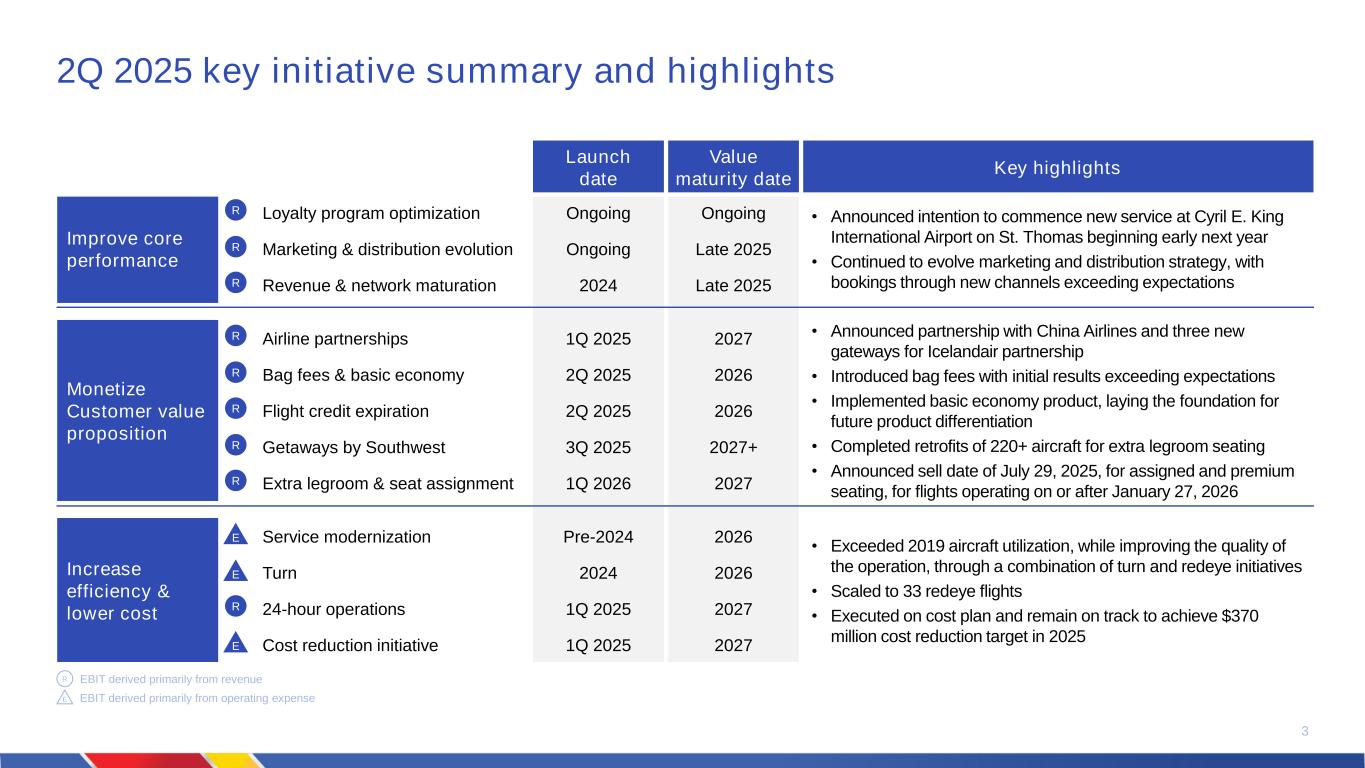
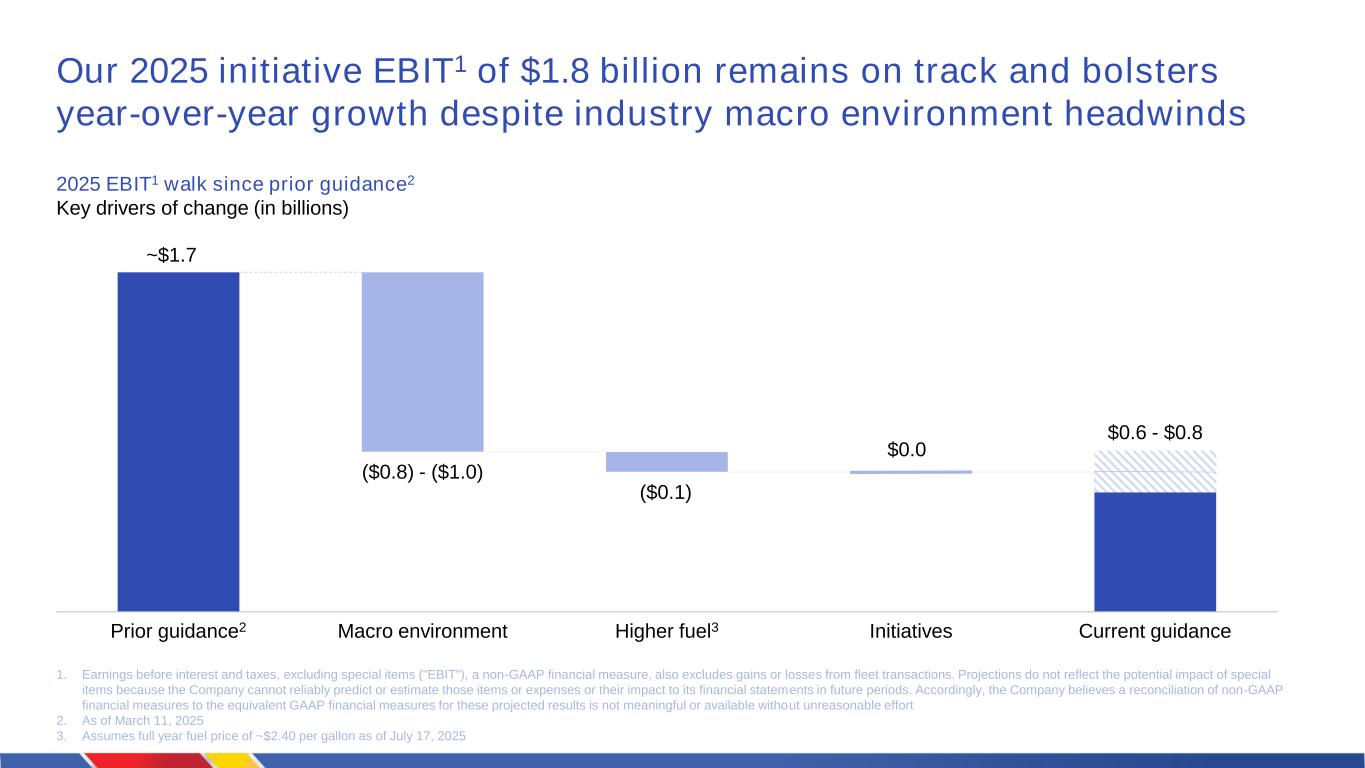
•Maintaining targets of $1.8 billion full year 2025 and $4.3 billion full year 2026 incremental earnings before interest and taxes, excluding special items ("EBIT"2) contribution from slate of initiatives
•While early, recent industry demand shows signs of improvement off of depressed second quarter 2025 levels, which combined with moderated capacity across the industry and Southwest-specific initiatives, creates a constructive backdrop for the second half of the year
•Providing updated full year 2025 guidance for EBIT2 in the range of $600 million to $800 million
•Board of Directors authorized a new $2.0 billion share repurchase program expected to be completed over a period of up to two years
Bob Jordan, President, Chief Executive Officer, & Vice Chairman of the Board of Directors, stated, "We continued to make meaningful progress against our transformational plan in second quarter, most notably implementing bag fees and a basic economy product. We had an exceptional operational rollout and continued to deliver outstanding service—a testament to our People. These initiatives are coming online quickly, and we are pleased with performance thus far, including bag fee revenue exceeding expectations. We are encouraged by the incremental fare product buy up that is already occurring at this early stage and in advance of assigned and premium seating that we will begin selling next week for flights beginning January 2026. We have already realized approximately one-third of our $1.8 billion 2025 initiative EBIT2 target in first half 2025 and remain highly confident in our ability to realize the remaining amount during the second half of the year, according to our plan. The value of these initiatives accelerates throughout second half 2025 and even more meaningfully into 2026. Underscoring belief in our transformational plan, strong management execution, and the ability to
1
deliver significant value for Shareholders, our Board of Directors has authorized a new $2.0 billion share repurchase program, expected to be completed over a period of up to two years."
2
Guidance and Outlook:
The following tables provide select financial guidance for third quarter 2025 and full year 2025, and select full year 2025 and 2026 targets.
| 3Q 2025 Estimation | ||||||||
| RASM (a), year-over-year | Down 2% to up 2% | |||||||
| ASMs (b), year-over-year | ~Flat | |||||||
Fuel cost per gallon3 | $2.40 to $2.50 | |||||||
| ASMs per gallon (fuel efficiency) | 82 to 84 | |||||||
CASM-X (c), year-over-year1,4 | Up 3.5% to 5.5% | |||||||
| Scheduled debt repayments (millions) | ~$6 | |||||||
| Interest expense (millions) | ~$35 | |||||||
| 2025 Estimation | ||||||||
EBIT2 (millions) | $600 to $800 | |||||||
| 2025 Target | 2026 Target | ||||||||||
EBIT2 contribution from initiatives (billions) | ~$1.8 | ~$4.3 | |||||||||
(a) Operating revenue per available seat mile ("RASM" or "unit revenues").
(b) Available seat miles ("ASMs" or "capacity").
(c) Operating expenses per available seat mile, excluding fuel and oil expense, special items, and profit sharing ("CASM-X" or "unit costs").
Key Initiative Highlights:
•Introduced bag fees with initial financial benefit exceeding expectations
•Implemented basic economy product, laying the foundation for future product differentiation
•Reintroduced flight credit expiration
•Announced partnership with China Airlines and three new gateways for Icelandair partnership
•Completed retrofits of more than 220 aircraft for extra legroom seating
•Announced sell date of July 29, 2025, for assigned and premium seating, for travel beginning January 27, 2026
•Announced intention to commence new service at Cyril E. King International Airport on St. Thomas beginning early next year
•Completed the September 2024 $2.5 billion share repurchase authorization in second quarter 2025, repurchasing the remaining $1.5 billion through an accelerated share repurchase program. Final settlement of shares purchased through the second quarter 2025 accelerated share repurchase program is expected to occur by the end of July 2025
3
Revenue Results and Outlook:
•Second quarter 2025 passenger revenues were $6.6 billion, a 1.3 percent decrease, year-over-year
•Second quarter 2025 operating revenues were $7.2 billion, a 1.5 percent decrease, year-over-year
•Second quarter 2025 RASM decreased 3.1 percent on capacity up 1.6 percent, both year-over-year—in line with the Company's previous guidance range
Domestic leisure travel stabilized during second quarter 2025, with recent trends showing signs of improvement, and the Company once again outperformed its large industry peers on domestic unit revenue. The Company's portfolio of recently implemented initiatives provided incremental revenue in second quarter 2025 that is expected to ramp up as the year progresses.
Following the May 28, 2025 launch of its basic economy product, the Company experienced a temporary reduction in the conversion rate of basic economy on its website. The Company took swift action and refined its booking flow and marketing approach in an effort to reduce friction, as well as offer additional promotional activity, and bookings and conversion rates quickly returned to expected levels. This resulted in an impact to second quarter 2025 year-over-year RASM of nearly one-half point, and an estimated impact to third quarter 2025 year-over-year RASM of approximately one point.
The Company expects third quarter 2025 unit revenues to be in the range of down 2 percent to up 2 percent on roughly flat capacity, both on a year-over-year basis. This guidance range assumes a modest sequential improvement in demand. Company-specific initiatives provide a unique offset to the broader industry revenue impact, and will continue to accelerate throughout third quarter 2025. Third quarter 2024 RASM included approximately one point of positive year-over-year impact from the CrowdStrike industry event.
The Company has provided full year 2025 EBIT2 guidance, as well as a reconciliation to its previous full year guide included in the materials accompanying this release. The Company's EBIT2 guidance assumes further sequential improvement from third quarter 2025, driven by accelerating incremental revenue from Company-specific initiatives, the recovery of the temporary basic economy optimization impact, and anticipated improvement in domestic leisure travel trends.
Non-Fuel Costs and Outlook:
•Second quarter 2025 operating expenses increased 0.9 percent, year-over-year, to $7.0 billion
4
•Second quarter 2025 operating expenses, excluding fuel and oil expense, special items, and profit sharing1, increased 6.4 percent, year-over-year
•Second quarter 2025 CASM-X increased 4.7 percent, year-over-year—in line with the Company's previous guidance range
The Company's second quarter 2025 CASM-X year-over-year increase included an approximate one-half point headwind from a non-cash mark-to-market adjustment for nonqualified deferred compensation plans which was driven by recent strong stock market performance.
The Company continues to expect to achieve its $370 million cost reduction target this year. The Company anticipates third quarter 2025 CASM-X to increase in the range of 3.5 percent to 5.5 percent, on roughly flat capacity, both on a year-over-year basis. This increase is driven primarily by the continuation of inflationary pressures, including those associated with labor contracts ratified in 2024, as well as approximately one point from the timing of engine overhaul expenses and one-half point from aircraft retrofit costs in advance of extra legroom seating launching in January 2026. Excluding the impact of book gains from fleet transactions in the fourth quarter of both years, the Company continues to expect fourth quarter 2025 CASM-X to be up low-single digits, year-over-year. The Company remains focused on driving efficiencies to offset overall inflationary cost pressures and achieve its multi-year cost reduction targets.
Fuel Costs and Outlook:
•Second quarter 2025 fuel costs were $2.32 per gallon—slightly above the Company's previous guidance range
•Second quarter 2025 fuel efficiency improved 2.9 percent, year-over-year, primarily due to operating more Boeing 737-8 ("-8") aircraft, the Company's most fuel-efficient aircraft, as a percentage of its fleet
During second quarter 2025, the Company terminated its remaining portfolio of fuel hedging contracts, which were scheduled to settle through 2027, to effectively close its fuel hedging portfolio. The cash proceeds from this transaction totaled approximately $40 million, which will reduce future premium costs. The remaining net premium costs of approximately $209 million will be recognized as an increase to Fuel and oil expense in the periods the originally forecasted transactions occur, specifically $72 million in the second half of 2025, $115 million in 2026, and $22 million in 2027. As of June 30, 2025, the Company had no fuel hedging contracts outstanding and its fuel hedging program has been discontinued.
5
Capacity, Fleet, and Capital Spending:
•Second quarter 2025 capacity increased 1.6 percent, year-over-year—in line with the Company's previous guidance range
•The Company received 17 -8 aircraft and retired seven Boeing 737-700 aircraft in second quarter 2025, ending the quarter with 810 aircraft
•Second quarter 2025 capital expenditures were $635 million, driven primarily by aircraft-related capital spending, as well as technology, facilities, and operational investments
The Company previously announced proactive capacity reductions in the second half of 2025 in an effort to better accommodate the current demand environment and capture associated cost savings, and continues to expect full year 2025 capacity to be up roughly 1 percent, year-over-year. This modest growth is driven entirely by an increase in aircraft utilization provided by redeye flying and turn time reduction initiatives.
The Company has updated its fleet planning assumptions to 47 Boeing -8 aircraft deliveries in 2025, from its prior estimate of 38, as The Boeing Company ("Boeing") continues to ramp up production. With these incremental deliveries, the Company now expects to retire approximately 55 aircraft in 2025, compared with its previous estimate of approximately 50 retirements this year. This includes the sale of five Boeing 737-800 ("-800") aircraft expected to occur in the second half of 2025. The Company continues to expect additional new aircraft deliveries to facilitate the retirement of aircraft from its existing fleet in support of its fleet monetization and capital allocation strategies.
The Company continues to expect its 2025 capital spending to be in the range of $2.5 billion to $3.0 billion, including the additional aircraft deliveries now expected, as well as the impact of the expected sale of five -800 aircraft this year.
Liquidity and Capital Deployment:
•The Company paid off $1.6 billion of convertible notes in cash and prepaid $976 million for the first tranche of the Payroll Support Program notes in second quarter 2025
•The Company ended second quarter 2025 with $3.8 billion in cash and cash equivalents and short-term investments, and a fully available revolving credit line of $1.0 billion
•The Company returned $1.6 billion to its Shareholders during second quarter 2025, comprised of $103 million of dividends and $1.5 billion of share repurchases
The Company completed its September 2024 $2.5 billion share repurchase authorization in second quarter 2025, repurchasing the remaining $1.5 billion through an accelerated share repurchase
6
program. Final settlement of shares purchased through the second quarter 2025 accelerated share repurchase program is expected to occur by the end of July 2025.
The Company's capital allocation framework supports its continued commitment to a strong and efficient investment-grade balance sheet. Moving forward, the Company will target liquidity of approximately $4.5 billion, comprised of cash and cash equivalents, short-term investments, and a revolving credit line, which was recently increased to $1.5 billion. The Company will target leverage1,5 in the range of 1.0x to 2.5x adjusted debt to adjusted EBITDAR1,5. The Company continues to have a large base of unencumbered aircraft and primarily aircraft-related assets with a net book value of approximately $16.6 billion. The Company's Board of Directors recently approved a $2.0 billion share repurchase authorization expected to be completed over a period of up to two years, which is supported by this framework and expected ramp up in initiative benefit.
7
Supplemental Information:
The Company has provided a summary on progress against initiative development and detail on its full year 2025 EBIT2 guidance on the Investor Relations website at https://www.southwestairlinesinvestorrelations.com.
Conference Call:
The Company will discuss its second quarter 2025 results on a conference call at 12:30 p.m. Eastern Time on July 24, 2025. To listen to a live broadcast of the conference call, please go to
https://www.southwestairlinesinvestorrelations.com.
Footnotes
1See Note Regarding Use of Non-GAAP Financial Measures for additional information on special items. In addition, information regarding special items and economic results is included in the accompanying table Reconciliation of Reported Amounts to Non-GAAP Measures (also referred to as "excluding special items").
2Earnings before interest and taxes, excluding special items ("EBIT"), a non-GAAP financial measure, also excludes gains or losses from fleet transactions. Projections do not reflect the potential impact of special items because the Company cannot reliably predict or estimate those items or expenses or their impact to its financial statements in future periods. Accordingly, the Company believes a reconciliation of non-GAAP financial measures to the equivalent GAAP financial measures for these projected results is not meaningful or available without unreasonable effort.
3Based on market prices as of July 17, 2025. Fuel cost per gallon includes fuel taxes and fuel hedging net premium expense of $0.07 per gallon related to terminated fuel derivative contracts.
4Projections do not reflect the potential impact of fuel and oil expense, special items, and profit sharing because the Company cannot reliably predict or estimate those items or expenses or their impact to its financial statements in future periods, especially considering the significant volatility of the fuel and oil expense line item. Accordingly, the Company believes a reconciliation of non-GAAP financial measures to the equivalent GAAP financial measures for these projected results is not meaningful or available without unreasonable effort.
5Leverage, adjusted debt, and adjusted EBITDAR are each non-GAAP financial measures. Leverage is calculated as adjusted debt divided by trailing twelve month adjusted EBITDAR. Adjusted EBITDAR is calculated as earnings before interest and taxes, and non-operating other (gains) losses, net, excluding special items, and adjusted by adding depreciation and amortization and the fixed portion of operating lease expense ("adjusted EBITDAR"). Adjusted debt includes current and long-term debt, finance lease obligations, and operating lease liabilities (including fleet, ground, and other). While the Company has provided reconciliations of historical leverage, adjusted debt, and adjusted EBITDAR below, it does not provide reconciliations of projections of these measures as the Company believes a reconciliation of non-GAAP financial measures to the equivalent GAAP financial measures for these projected results is not meaningful or available without unreasonable effort.
Cautionary Statement Regarding Forward-Looking Statements
This news release contains forward-looking statements within the meaning of Section 27A of the Securities Act of 1933, as amended, and Section 21E of the Securities Exchange Act of 1934, as amended. Specific forward-looking statements include, without limitation, statements related to (i) the Company’s initiatives, strategic priorities and focus areas, goals, and opportunities, including with respect to assigned and premium seating, cost reductions, the Company’s transformational plan, commercial offering, product differentiation, bag fees, financial performance, providing value for Customers and Shareholders, and driving cost efficiencies; (ii) the Company's financial and operational outlook, expectations, goals, plans, and projected results of operations, including with respect to its initiatives, and including factors and assumptions underlying the Company's expectations and projections; (iii) the Company’s expectations with respect to passenger demand and bookings; (iv) the Company’s capacity plans and expectations; (v) the Company’s plans and expectations with respect to share repurchases and other shareholder returns; (vi) the Company's expectations with respect to fuel costs and fuel efficiency, and the Company's related management of risks associated with changing jet fuel prices, including factors underlying the Company's expectations; (vii) the Company's plans, estimates, and assumptions related to repayment of debt obligations, interest expense, and capital spending, including factors and assumptions underlying the Company's expectations and projections; (viii) the Company’s plans and the Company’s network plans and expectations; (ix) the Company’s plans and expectations with respect to fleet transactions; (x) the Company’s
8
plans and expectations with respect to redeye flying and reducing turn times; (xi) the Company’s fleet plans and expectations, including with respect to its fleet order book, fleet utilization, fleet retrofits, fleet modernization, fleet transactions, flexibility, and expected fleet deliveries and retirements, and including factors and assumptions underlying the Company's plans and expectations; (xii) the Company’s plans and expectations with respect to its balance sheet; and (xiii) the Company’s plans, expectations, and targets with respect to liquidity and leverage. These forward-looking statements are based on the Company's current estimates, intentions, beliefs, expectations, goals, strategies, and projections for the future and are not guarantees of future performance. Forward-looking statements involve risks, uncertainties, assumptions, and other factors that are difficult to predict and that could cause actual results to vary materially from those expressed in or indicated by them. Factors include, among others, (i) the impact of fears or actual outbreaks of diseases, extreme or severe weather and natural disasters, actions of competitors (including, without limitation, pricing, scheduling, capacity, and network decisions, and consolidation and alliance activities), governmental actions, consumer perception, consumer uncertainties with respect to trade policies (including the imposition of tariffs), economic conditions, banking conditions, fears or actual acts of terrorism or war, sociodemographic trends, and other factors beyond the Company's control, on consumer behavior and the Company's results of operations and business decisions, plans, strategies, and results; (ii) the Company's ability to timely and effectively implement, transition, operate, and maintain the necessary information technology systems and infrastructure to support its operations and initiatives, including with respect to revenue management and assigned and premium seating; (iii) consumer behavior and response with respect to the Company's new commercial products and policies; (iv) the impact of fuel price changes, fuel price volatility, and fuel availability on the Company's business plans and results of operations; (v) the Company's dependence on The Boeing Company (“Boeing”) and Boeing suppliers with respect to the Company's aircraft deliveries, Boeing MAX 7 aircraft certifications, fleet and capacity plans, operations, maintenance, strategies, and goals; (vi) the Company's dependence on the Federal Aviation Administration with respect to, among other things, the certification of the Boeing MAX 7 aircraft; (vii) the Company's dependence on other third parties, in particular with respect to its technology plans, its plans and expectations related to revenue management, online travel agencies, operational reliability, fuel supply, maintenance, Global Distribution Systems, environmental sustainability, and the impact on the Company's operations and results of operations of any third party delays or nonperformance; (viii) the Company’s ability to timely and effectively prioritize its initiatives and focus areas and related expenditures; (ix) the impact of labor matters on the Company's business decisions, plans, strategies, and results; (x) the impact of governmental regulations and other governmental actions, as well as the Company’s ability to obtain any required governmental approvals, on the Company's business plans, results, and operations; (xi) the Company's ability to obtain and maintain adequate infrastructure and equipment to support its operations and initiatives; (xii) the Company's dependence on its workforce, including its ability to employ and retain sufficient numbers of qualified Employees with appropriate skills and expertise to effectively and efficiently maintain its operations and execute the Company’s plans, strategies, and initiatives; (xiii) the cost and effects of the actions of activist shareholders; and (xiv) other factors, as described in the Company's filings with the Securities and Exchange Commission, including the detailed factors discussed under the heading "Risk Factors" in the Company's Annual Report on Form 10-K for the fiscal year ended December 31, 2024.
Investor Contact:
Southwest Airlines Investor Relations
Media Contact:
Southwest Airlines Media Relations
214-792-4847
SW-QFS
9
Southwest Airlines Co.
Condensed Consolidated Statement of Income
(in millions, except per share amounts)
(unaudited)
| Three months ended | Six months ended | ||||||||||||||||||||||||||||||||||
| June 30, | June 30, | ||||||||||||||||||||||||||||||||||
| 2025 | 2024 | Percent Change | 2025 | 2024 | Percent Change | ||||||||||||||||||||||||||||||
| OPERATING REVENUES: | |||||||||||||||||||||||||||||||||||
| Passenger | $ | 6,627 | $ | 6,712 | (1.3) | $ | 12,438 | $ | 12,424 | 0.1 | |||||||||||||||||||||||||
| Freight | 44 | 45 | (2.2) | 86 | 87 | (1.1) | |||||||||||||||||||||||||||||
| Other | 573 | 597 | (4.0) | 1,148 | 1,172 | (2.0) | |||||||||||||||||||||||||||||
| Total operating revenues | 7,244 | 7,354 | (1.5) | 13,672 | 13,683 | (0.1) | |||||||||||||||||||||||||||||
| OPERATING EXPENSES: | |||||||||||||||||||||||||||||||||||
| Salaries, wages, and benefits | 3,262 | 2,999 | 8.8 | 6,364 | 5,939 | 7.2 | |||||||||||||||||||||||||||||
| Fuel and oil | 1,326 | 1,599 | (17.1) | 2,575 | 3,130 | (17.7) | |||||||||||||||||||||||||||||
| Maintenance materials and repairs | 331 | 350 | (5.4) | 623 | 711 | (12.4) | |||||||||||||||||||||||||||||
| Landing fees and airport rentals | 567 | 511 | 11.0 | 1,090 | 975 | 11.8 | |||||||||||||||||||||||||||||
| Depreciation and amortization | 400 | 404 | (1.0) | 795 | 812 | (2.1) | |||||||||||||||||||||||||||||
| Other operating expenses | 1,133 | 1,093 | 3.7 | 2,223 | 2,110 | 5.4 | |||||||||||||||||||||||||||||
| Total operating expenses | 7,019 | 6,956 | 0.9 | 13,670 | 13,677 | (0.1) | |||||||||||||||||||||||||||||
| OPERATING INCOME | 225 | 398 | (43.5) | 2 | 6 | (66.7) | |||||||||||||||||||||||||||||
| NON-OPERATING EXPENSES (INCOME): | |||||||||||||||||||||||||||||||||||
| Interest expense | 39 | 63 | (38.1) | 85 | 128 | (33.6) | |||||||||||||||||||||||||||||
| Capitalized interest | (13) | (8) | 62.5 | (24) | (15) | 60.0 | |||||||||||||||||||||||||||||
| Interest income | (54) | (130) | (58.5) | (138) | (271) | (49.1) | |||||||||||||||||||||||||||||
| Other (gains) losses, net | (27) | (5) | n.m. | (9) | (17) | (47.1) | |||||||||||||||||||||||||||||
| Total non-operating income | (55) | (80) | (31.3) | (86) | (175) | (50.9) | |||||||||||||||||||||||||||||
| INCOME BEFORE INCOME TAXES | 280 | 478 | (41.4) | 88 | 181 | (51.4) | |||||||||||||||||||||||||||||
| PROVISION FOR INCOME TAXES | 67 | 111 | (39.6) | 24 | 44 | (45.5) | |||||||||||||||||||||||||||||
| NET INCOME | $ | 213 | $ | 367 | (42.0) | $ | 64 | $ | 137 | (53.3) | |||||||||||||||||||||||||
| NET INCOME PER SHARE: | |||||||||||||||||||||||||||||||||||
| Basic | $ | 0.40 | $ | 0.61 | (34.4) | $ | 0.11 | $ | 0.23 | (52.2) | |||||||||||||||||||||||||
| Diluted | $ | 0.39 | $ | 0.58 | (32.8) | $ | 0.11 | $ | 0.23 | (52.2) | |||||||||||||||||||||||||
| WEIGHTED AVERAGE SHARES OUTSTANDING: | |||||||||||||||||||||||||||||||||||
| Basic | 538 | 599 | (10.2) | 561 | 598 | (6.2) | |||||||||||||||||||||||||||||
| Diluted | 541 | 643 | (15.9) | 564 | 643 | (12.3) | |||||||||||||||||||||||||||||
10
Southwest Airlines Co.
Reconciliation of Reported Amounts to Non-GAAP Financial Measures (excluding special items)
(See Note Regarding Use of Non-GAAP Financial Measures)
(in millions, except per share and per ASM amounts)(unaudited)
| Three months ended | Six months ended | ||||||||||||||||||||||||||||||||||
| June 30, | Percent | June 30, | Percent | ||||||||||||||||||||||||||||||||
| 2025 | 2024 | Change | 2025 | 2024 | Change | ||||||||||||||||||||||||||||||
| Fuel and oil expense, unhedged | $ | 1,290 | $ | 1,581 | $ | 2,502 | $ | 3,091 | |||||||||||||||||||||||||||
| Add: Premium cost of fuel contracts designated as hedges (a) | 36 | 40 | 73 | 79 | |||||||||||||||||||||||||||||||
| Deduct: Fuel hedge gains included in Fuel and oil expense, net | — | (22) | — | (40) | |||||||||||||||||||||||||||||||
| Fuel and oil expense, as reported | $ | 1,326 | $ | 1,599 | (17.1) | $ | 2,575 | $ | 3,130 | (17.7) | |||||||||||||||||||||||||
| Add: Fuel hedge contracts settling in the current period, but for which losses were reclassified from AOCI | — | 1 | — | 2 | |||||||||||||||||||||||||||||||
| Deduct: Premium benefit of fuel contracts not designated as hedges | — | (1) | — | (1) | |||||||||||||||||||||||||||||||
| Fuel and oil expense, excluding special items (economic) | $ | 1,326 | $ | 1,599 | (17.1) | $ | 2,575 | $ | 3,131 | (17.8) | |||||||||||||||||||||||||
| Total operating expenses, as reported | $ | 7,019 | $ | 6,956 | $ | 13,670 | $ | 13,677 | |||||||||||||||||||||||||||
| Deduct: Labor contract adjustment | — | — | — | (9) | |||||||||||||||||||||||||||||||
| Add: Fuel hedge contracts settling in the current period, but for which losses were reclassified from AOCI | — | 1 | — | 2 | |||||||||||||||||||||||||||||||
| Deduct: Premium benefit of fuel contracts not designated as hedges | — | (1) | — | (1) | |||||||||||||||||||||||||||||||
| Deduct: Impairment of long-lived assets | (8) | — | (8) | — | |||||||||||||||||||||||||||||||
| Deduct: Litigation accruals | — | — | (19) | (7) | |||||||||||||||||||||||||||||||
| Deduct: Transformation costs | (12) | — | (26) | — | |||||||||||||||||||||||||||||||
| Deduct: Severance and related costs (b) | — | — | (62) | — | |||||||||||||||||||||||||||||||
| Deduct: Professional advisory fees | — | (7) | — | (7) | |||||||||||||||||||||||||||||||
| Total operating expenses, excluding special items | $ | 6,999 | $ | 6,949 | 0.7 | $ | 13,555 | $ | 13,655 | (0.7) | |||||||||||||||||||||||||
| Deduct: Fuel and oil expense, excluding special items (economic) | (1,326) | (1,599) | (2,575) | (3,131) | |||||||||||||||||||||||||||||||
| Operating expenses, excluding Fuel and oil expense and special items | $ | 5,673 | $ | 5,350 | 6.0 | $ | 10,980 | $ | 10,524 | 4.3 | |||||||||||||||||||||||||
| Deduct: Profit-sharing expense | (14) | (31) | (14) | (31) | |||||||||||||||||||||||||||||||
| Operating expenses, excluding Fuel and oil expense, special items, and profit sharing | $ | 5,659 | $ | 5,319 | 6.4 | $ | 10,966 | $ | 10,493 | 4.5 | |||||||||||||||||||||||||
| Operating income, as reported | $ | 225 | $ | 398 | $ | 2 | $ | 6 | |||||||||||||||||||||||||||
| Add: Labor contract adjustment | — | — | — | 9 | |||||||||||||||||||||||||||||||
| Deduct: Fuel hedge contracts settling in the current period, but for which losses were reclassified from AOCI | — | (1) | — | (2) | |||||||||||||||||||||||||||||||
| Add: Premium benefit of fuel contracts not designated as hedges | — | 1 | — | 1 | |||||||||||||||||||||||||||||||
| Add: Impairment of long-lived assets | 8 | — | 8 | — | |||||||||||||||||||||||||||||||
| Add: Litigation accruals | — | — | 19 | 7 | |||||||||||||||||||||||||||||||
| Add: Transformation costs | 12 | — | 26 | — | |||||||||||||||||||||||||||||||
| Add: Severance and related costs (b) | — | — | 62 | — | |||||||||||||||||||||||||||||||
11
| Three months ended | Six months ended | ||||||||||||||||||||||||||||||||||
| June 30, | Percent | June 30, | Percent | ||||||||||||||||||||||||||||||||
| 2025 | 2024 | Change | 2025 | 2024 | Change | ||||||||||||||||||||||||||||||
| Add: Professional advisory fees | — | 7 | — | 7 | |||||||||||||||||||||||||||||||
| Operating income, excluding special items | $ | 245 | $ | 405 | (39.5) | $ | 117 | $ | 28 | 317.9 | |||||||||||||||||||||||||
| Other gains, net, as reported | $ | (27) | $ | (5) | $ | (9) | $ | (17) | |||||||||||||||||||||||||||
| Deduct: Mark-to-market impact from fuel contracts settling in future periods | — | (2) | — | (3) | |||||||||||||||||||||||||||||||
| Add: Premium benefit of fuel contracts not designated as hedges | — | 1 | — | 1 | |||||||||||||||||||||||||||||||
| Other gains, net, excluding special items | $ | (27) | $ | (6) | n.m. | $ | (9) | $ | (19) | (52.6) | |||||||||||||||||||||||||
| Income before income taxes, as reported | $ | 280 | $ | 478 | $ | 88 | $ | 181 | |||||||||||||||||||||||||||
| Add: Labor contract adjustment | — | — | — | 9 | |||||||||||||||||||||||||||||||
| Deduct: Fuel hedge contracts settling in the current period, but for which losses were reclassified from AOCI | — | (1) | — | (2) | |||||||||||||||||||||||||||||||
| Add: Mark-to-market impact from fuel contracts settling in future periods | — | 2 | — | 3 | |||||||||||||||||||||||||||||||
| Add: Litigation accruals | — | — | 19 | 7 | |||||||||||||||||||||||||||||||
| Add: Transformation costs | 12 | — | 26 | — | |||||||||||||||||||||||||||||||
| Add: Severance and related costs (b) | — | — | 62 | — | |||||||||||||||||||||||||||||||
| Add: Professional advisory fees | — | 7 | — | 7 | |||||||||||||||||||||||||||||||
| Add: Impairment of long-lived assets | 8 | — | 8 | — | |||||||||||||||||||||||||||||||
| Income before income taxes, excluding special items | $ | 300 | $ | 486 | (38.3) | $ | 203 | $ | 205 | (1.0) | |||||||||||||||||||||||||
| Provision for income taxes, as reported | $ | 67 | $ | 111 | $ | 24 | $ | 44 | |||||||||||||||||||||||||||
| Add: Net income tax impact of fuel and special items (c) | 3 | 5 | 26 | 9 | |||||||||||||||||||||||||||||||
| Provision for income taxes, net, excluding special items | $ | 70 | $ | 116 | (39.7) | $ | 50 | $ | 53 | (5.7) | |||||||||||||||||||||||||
| Net income, as reported | $ | 213 | $ | 367 | $ | 64 | $ | 137 | |||||||||||||||||||||||||||
| Add: Labor contract adjustment | — | — | — | 9 | |||||||||||||||||||||||||||||||
| Deduct: Fuel hedge contracts settling in the current period, but for which losses were reclassified from AOCI | — | (1) | — | (2) | |||||||||||||||||||||||||||||||
| Add: Mark-to-market impact from fuel contracts settling in future periods | — | 2 | — | 3 | |||||||||||||||||||||||||||||||
| Add: Litigation accruals | — | — | 19 | 7 | |||||||||||||||||||||||||||||||
| Add: Transformation costs | 12 | — | 26 | — | |||||||||||||||||||||||||||||||
| Add: Severance and related costs (b) | — | — | 62 | — | |||||||||||||||||||||||||||||||
| Add: Professional advisory fees | — | 7 | — | 7 | |||||||||||||||||||||||||||||||
| Add: Impairment of long-lived assets | 8 | — | 8 | — | |||||||||||||||||||||||||||||||
| Deduct: Net income tax impact of special items (c) | (3) | (5) | (26) | (9) | |||||||||||||||||||||||||||||||
| Net income, excluding special items | $ | 230 | $ | 370 | (37.8) | $ | 153 | $ | 152 | 0.7 | |||||||||||||||||||||||||
12
| Three months ended | Six months ended | ||||||||||||||||||||||||||||||||||
| June 30, | Percent | June 30, | Percent | ||||||||||||||||||||||||||||||||
| 2025 | 2024 | Change | 2025 | 2024 | Change | ||||||||||||||||||||||||||||||
| Net income per share, diluted, as reported | $ | 0.39 | $ | 0.58 | $ | 0.11 | $ | 0.23 | |||||||||||||||||||||||||||
| Add: Impact of special items | 0.05 | 0.01 | 0.21 | 0.03 | |||||||||||||||||||||||||||||||
| Deduct: Net income tax impact of special items (c) | (0.01) | (0.01) | (0.05) | (0.01) | |||||||||||||||||||||||||||||||
| Net income per share, diluted, excluding special items | $ | 0.43 | $ | 0.58 | (25.9) | $ | 0.27 | $ | 0.25 | 8.0 | |||||||||||||||||||||||||
| Operating expenses per ASM (cents) | ¢ | 14.94 | ¢ | 15.04 | ¢ | 15.46 | ¢ | 15.46 | |||||||||||||||||||||||||||
| Deduct: Impact of special items | (0.04) | (0.02) | (0.13) | (0.02) | |||||||||||||||||||||||||||||||
| Deduct: Fuel and oil expense divided by ASMs | (2.83) | (3.46) | (2.91) | (3.54) | |||||||||||||||||||||||||||||||
| Deduct: Profit-sharing expense divided by ASMs | (0.03) | (0.06) | (0.02) | (0.04) | |||||||||||||||||||||||||||||||
| Operating expenses per ASM, excluding Fuel and oil expense, special items, and profit sharing (cents) | ¢ | 12.04 | ¢ | 11.50 | 4.7 | ¢ | 12.40 | ¢ | 11.86 | 4.6 | |||||||||||||||||||||||||
(a) Includes amounts reclassified from Accumulated Other Comprehensive Income associated with hedges previously terminated.
(b) Represents Employee severance payments and related professional fees resulting from the workforce reduction in February 2025 ($53 million in Salaries, wages, and benefits and $9 million in Other operating expenses).
(c) Tax amounts for each individual special item are calculated at the Company's effective rate for the applicable period and totaled in this line item.
13
Southwest Airlines Co.
Comparative Consolidated Operating Statistics
(unaudited)
Relevant comparative operating statistics for the three and six months ended June 30, 2025 and 2024 are included below. The Company provides these operating statistics because they are commonly used in the airline industry and, as such, allow readers to compare the Company’s performance against its results for the prior year period, as well as against the performance of the Company’s peers.
| Three months ended | Six months ended | ||||||||||||||||||||||||||||||||||
| June 30, | Percent | June 30, | Percent | ||||||||||||||||||||||||||||||||
| 2025 | 2024 | Change | 2025 | 2024 | Change | ||||||||||||||||||||||||||||||
| Revenue passengers carried (000s) | 35,507 | 37,509 | (5.3) | 65,497 | 70,381 | (6.9) | |||||||||||||||||||||||||||||
| Enplaned passengers (000s) | 44,385 | 47,267 | (6.1) | 81,524 | 88,164 | (7.5) | |||||||||||||||||||||||||||||
| Revenue passenger miles (RPMs) (in millions) (a) | 36,885 | 38,221 | (3.5) | 67,513 | 71,308 | (5.3) | |||||||||||||||||||||||||||||
| Available seat miles (ASMs) (in millions) (b) | 46,996 | 46,250 | 1.6 | 88,427 | 88,497 | (0.1) | |||||||||||||||||||||||||||||
| Load factor (c) | 78.5 | % | 82.6 | % | (4.1) pts. | 76.3 | % | 80.6 | % | (4.3) pts. | |||||||||||||||||||||||||
| Average length of passenger haul (miles) | 1,039 | 1,019 | 2.0 | 1,031 | 1,013 | 1.8 | |||||||||||||||||||||||||||||
| Average aircraft stage length (miles) | 786 | 766 | 2.6 | 779 | 760 | 2.5 | |||||||||||||||||||||||||||||
| Trips flown | 367,952 | 375,749 | (2.1) | 699,838 | 725,728 | (3.6) | |||||||||||||||||||||||||||||
| Seats flown (000s) (d) | 59,265 | 59,775 | (0.9) | 112,502 | 115,469 | (2.6) | |||||||||||||||||||||||||||||
| Seats per trip (e) | 161.1 | 159.1 | 1.3 | 160.8 | 159.1 | 1.1 | |||||||||||||||||||||||||||||
| Average passenger fare | $ | 186.65 | $ | 178.94 | 4.3 | $ | 189.90 | $ | 176.52 | 7.6 | |||||||||||||||||||||||||
| Passenger revenue yield per RPM (cents) (f) | 17.97 | 17.56 | 2.3 | 18.42 | 17.42 | 5.7 | |||||||||||||||||||||||||||||
| RASM (cents) (g) | 15.41 | 15.90 | (3.1) | 15.46 | 15.46 | — | |||||||||||||||||||||||||||||
| PRASM (cents) (h) | 14.10 | 14.51 | (2.8) | 14.07 | 14.04 | 0.2 | |||||||||||||||||||||||||||||
| CASM (cents) (i) | 14.94 | 15.04 | (0.7) | 15.46 | 15.46 | — | |||||||||||||||||||||||||||||
| CASM, excluding Fuel and oil expense (cents) | 12.11 | 11.58 | 4.6 | 12.55 | 11.92 | 5.3 | |||||||||||||||||||||||||||||
| CASM, excluding special items (cents) | 14.89 | 15.03 | (0.9) | 15.33 | 15.43 | (0.6) | |||||||||||||||||||||||||||||
| CASM, excluding Fuel and oil expense and special items (cents) | 12.07 | 11.57 | 4.3 | 12.42 | 11.89 | 4.5 | |||||||||||||||||||||||||||||
| CASM, excluding Fuel and oil expense, special items, and profit sharing (cents) | 12.04 | 11.50 | 4.7 | 12.40 | 11.86 | 4.6 | |||||||||||||||||||||||||||||
| Fuel costs per gallon, including fuel tax (unhedged) | $ | 2.26 | $ | 2.73 | (17.3) | $ | 2.33 | $ | 2.80 | (16.7) | |||||||||||||||||||||||||
| Fuel costs per gallon, including fuel tax | $ | 2.32 | $ | 2.76 | (15.9) | $ | 2.40 | $ | 2.84 | (15.5) | |||||||||||||||||||||||||
| Fuel costs per gallon, including fuel tax (economic) | $ | 2.32 | $ | 2.76 | (15.9) | $ | 2.40 | $ | 2.84 | (15.5) | |||||||||||||||||||||||||
| Fuel consumed, in gallons (millions) | 570 | 577 | (1.2) | 1,071 | 1,101 | (2.7) | |||||||||||||||||||||||||||||
| Active fulltime equivalent Employees | 72,242 | 74,081 | (2.5) | 72,242 | 74,081 | (2.5) | |||||||||||||||||||||||||||||
| Aircraft at end of period | 810 | 817 | (0.9) | 810 | 817 | (0.9) | |||||||||||||||||||||||||||||
(a) A revenue passenger mile is one paying passenger flown one mile. Also referred to as "traffic," which is a measure of demand for a given period.
(b) An available seat mile is one seat (empty or full) flown one mile. Also referred to as "capacity," which is a measure of the space available to carry passengers in a given period.
(c) Revenue passenger miles divided by available seat miles.
(d) Seats flown is calculated using total number of seats available by aircraft type multiplied by the total trips flown by the same aircraft type during a particular period.
(e) Seats per trip is calculated by dividing seats flown by trips flown.
(f) Calculated as passenger revenue divided by revenue passenger miles. Also referred to as "yield," this is the average cost paid by a paying passenger to fly one mile, which is a measure of revenue production and fares.
(g) RASM (unit revenue) - Operating revenue yield per ASM, calculated as operating revenue divided by available seat miles. Also referred to as "operating unit revenues," this is a measure of operating revenue production based on the total available seat miles flown during a particular period.
(h) PRASM (Passenger unit revenue) - Passenger revenue yield per ASM, calculated as passenger revenue divided by available seat miles. Also referred to as “passenger unit revenues,” this is a measure of passenger revenue production based on the total available seat miles flown during a particular period.
(i) CASM (unit costs) - Operating expenses per ASM, calculated as operating expenses divided by available seat miles. Also referred to as "unit costs" or "cost per available seat mile," this is the average cost to fly an aircraft seat (empty or full) one mile, which is a measure of cost efficiencies.
14
Southwest Airlines Co.
Non-GAAP Return on Invested Capital (ROIC)
(See Note Regarding Use of Non-GAAP Financial Measures)
(in millions)
(unaudited)
| Twelve months ended | Twelve months ended | |||||||||||||
| June 30, 2025 | June 30, 2024 | |||||||||||||
| Operating income (loss), as reported | $ | 318 | $ | (281) | ||||||||||
| Breakage revenue adjustment | 116 | — | ||||||||||||
| Severance and related costs | 62 | — | ||||||||||||
| Voluntary Employee programs | 5 | — | ||||||||||||
| TWU 555 contract adjustment | — | 9 | ||||||||||||
| TWU 556 contract adjustment | — | 95 | ||||||||||||
| SWAPA contract adjustment | — | 354 | ||||||||||||
| Net impact from fuel contracts | (43) | 16 | ||||||||||||
| Professional advisory fees | 30 | 7 | ||||||||||||
| Transformation costs | 30 | — | ||||||||||||
| DOT settlement | — | 107 | ||||||||||||
| Litigation accruals | 19 | 7 | ||||||||||||
| Impairments | 8 | — | ||||||||||||
| Operating income, non-GAAP | $ | 545 | $ | 314 | ||||||||||
| Net adjustment for aircraft leases (a) | 182 | 127 | ||||||||||||
| Adjusted operating income, non-GAAP (A) | $ | 727 | $ | 441 | ||||||||||
| Non-GAAP tax rate (B) | 22.6 | % | (d) | 23.8 | % | (e) | ||||||||
| Net operating profit after-tax, NOPAT (A* (1-B) = C) | $ | 563 | $ | 336 | ||||||||||
| Debt, including finance leases (b) | $ | 6,699 | $ | 8,008 | ||||||||||
| Equity (b) | 9,718 | 10,604 | ||||||||||||
| Net present value of aircraft operating leases (b) | 967 | 949 | ||||||||||||
| Average invested capital | $ | 17,384 | $ | 19,561 | ||||||||||
| Equity adjustment for hedge accounting (c) | 31 | (61) | ||||||||||||
| Adjusted average invested capital (D) | $ | 17,415 | $ | 19,500 | ||||||||||
| Non-GAAP ROIC, pre-tax (A/D) | 4.2 | % | 2.3 | % | ||||||||||
| Non-GAAP ROIC, after-tax (C/D) | 3.2 | % | 1.7 | % | ||||||||||
(a) Net adjustment to reflect all aircraft in fleet as owned (i.e., the impact of eliminating aircraft rent expense and replacing with estimated depreciation expense for those same aircraft). The Company makes this adjustment to enhance comparability to other entities that have different capital structures by utilizing alternative financing decisions.
(b) Calculated as an average of the five most recent quarter end balances or remaining obligations. The Net present value of aircraft operating leases represents the assumption that all aircraft in the Company’s fleet are owned, as it reflects the remaining contractual commitments discounted at the Company's estimated incremental borrowing rate as of the time each individual lease was signed.
(c) The Equity adjustment in the denominator adjusts for the cumulative impacts, in Accumulated other comprehensive income and Retained earnings, of gains and/or losses that will settle in future periods, including those associated with the Company's terminated fuel hedges. The current period impact of these gains and/or losses is reflected in the Net impact from fuel contracts in the numerator.
15
(d) The GAAP twelve month rolling tax rate as of June 30, 2025, was 22.3 percent, and the Non-GAAP twelve month rolling tax rate was 22.6 percent. See Note Regarding Use of Non-GAAP Financial Measures for additional information.
(e) The GAAP twelve month rolling tax rate as of June 30, 2024, was 41.0 percent, and the Non-GAAP twelve month rolling tax rate was 23.8 percent. See Note Regarding Use of Non-GAAP Financial Measures for additional information.
16
Southwest Airlines Co.
Condensed Consolidated Balance Sheet
(in millions)
(unaudited)
| June 30, 2025 | December 31, 2024 | ||||||||||
| ASSETS | |||||||||||
| Current assets: | |||||||||||
| Cash and cash equivalents | $ | 3,475 | $ | 7,509 | |||||||
| Short-term investments | 364 | 1,216 | |||||||||
| Accounts and other receivables | 1,013 | 1,110 | |||||||||
| Inventories of parts and supplies, at cost | 773 | 800 | |||||||||
| Prepaid expenses and other current assets | 467 | 639 | |||||||||
| Total current assets | 6,092 | 11,274 | |||||||||
| Property and equipment, at cost: | |||||||||||
| Flight equipment | 25,858 | 25,202 | |||||||||
| Ground property and equipment | 8,656 | 8,244 | |||||||||
| Deposits on flight equipment purchase contracts | 221 | 413 | |||||||||
| Assets constructed for others | 88 | 88 | |||||||||
| 34,823 | 33,947 | ||||||||||
| Less allowance for depreciation and amortization | 15,422 | 14,891 | |||||||||
| 19,401 | 19,056 | ||||||||||
| Goodwill | 970 | 970 | |||||||||
| Operating lease right-of-use assets | 1,243 | 1,369 | |||||||||
| Other assets | 1,006 | 1,081 | |||||||||
| $ | 28,712 | $ | 33,750 | ||||||||
| LIABILITIES AND STOCKHOLDERS' EQUITY | |||||||||||
| Current liabilities: | |||||||||||
| Accounts payable | $ | 1,811 | $ | 1,818 | |||||||
| Accrued liabilities | 2,040 | 2,206 | |||||||||
| Current operating lease liabilities | 323 | 328 | |||||||||
| Air traffic liability | 6,696 | 6,294 | |||||||||
| Current maturities of long-term debt | 22 | 1,630 | |||||||||
| Total current liabilities | 10,892 | 12,276 | |||||||||
| Long-term debt less current maturities | 4,081 | 5,069 | |||||||||
| Air traffic liability - noncurrent | 1,600 | 1,948 | |||||||||
| Deferred income taxes | 2,186 | 2,167 | |||||||||
| Noncurrent operating lease liabilities | 915 | 1,031 | |||||||||
| Other noncurrent liabilities | 1,038 | 909 | |||||||||
| Stockholders' equity: | |||||||||||
| Common stock | 888 | 888 | |||||||||
| Capital in excess of par value | 4,247 | 4,199 | |||||||||
| Retained earnings | 16,199 | 16,332 | |||||||||
| Accumulated other comprehensive loss | (35) | (25) | |||||||||
| Treasury stock, at cost | (13,299) | (11,044) | |||||||||
| Total stockholders' equity | 8,000 | 10,350 | |||||||||
| $ | 28,712 | $ | 33,750 | ||||||||
17
Southwest Airlines Co.
Condensed Consolidated Statement of Cash Flows
(in millions) (unaudited)
| Three months ended June 30, | Six months ended June 30, | ||||||||||||||||||||||
| 2025 | 2024 | 2025 | 2024 | ||||||||||||||||||||
| CASH FLOWS FROM OPERATING ACTIVITIES: | |||||||||||||||||||||||
| Net income | $ | 213 | $ | 367 | $ | 64 | $ | 137 | |||||||||||||||
| Adjustments to reconcile net income to net cash provided by (used in) operating activities: | |||||||||||||||||||||||
| Depreciation and amortization | 400 | 404 | 795 | 812 | |||||||||||||||||||
| Impairment of long-lived assets | 8 | — | 8 | — | |||||||||||||||||||
| Unrealized/realized loss on fuel derivative instruments | — | 1 | — | 2 | |||||||||||||||||||
| Deferred income taxes | 66 | 110 | 23 | 43 | |||||||||||||||||||
| Gain on sale-leaseback transactions | — | — | (3) | — | |||||||||||||||||||
| Changes in certain assets and liabilities: | |||||||||||||||||||||||
| Accounts and other receivables | 90 | 34 | 146 | (274) | |||||||||||||||||||
| Other assets | 212 | 32 | 357 | 18 | |||||||||||||||||||
| Accounts payable and accrued liabilities | (95) | (576) | (220) | (1,473) | |||||||||||||||||||
| Air traffic liability | (606) | (317) | 55 | 798 | |||||||||||||||||||
| Other liabilities | 28 | (45) | (35) | (117) | |||||||||||||||||||
| Cash collateral provided to derivative counterparties | — | (20) | (22) | (20) | |||||||||||||||||||
| Other, net | 85 | (13) | 93 | (54) | |||||||||||||||||||
| Net cash provided by (used in) operating activities | 401 | (23) | 1,261 | (128) | |||||||||||||||||||
| CASH FLOWS FROM INVESTING ACTIVITIES: | |||||||||||||||||||||||
| Capital expenditures | (635) | (494) | (1,136) | (1,077) | |||||||||||||||||||
| Assets constructed for others | — | (6) | — | (16) | |||||||||||||||||||
| Proceeds from sale-leaseback transactions | — | — | 24 | — | |||||||||||||||||||
| Purchases of short-term investments | (319) | (1,532) | (370) | (3,210) | |||||||||||||||||||
| Proceeds from sales of short-term and other investments | 72 | 1,820 | 1,226 | 3,540 | |||||||||||||||||||
| Other, net | — | 6 | (3) | (28) | |||||||||||||||||||
| Net cash used in investing activities | (882) | (206) | (259) | (791) | |||||||||||||||||||
| CASH FLOWS FROM FINANCING ACTIVITIES: | |||||||||||||||||||||||
| Payroll Support Program stock warrants repurchase | — | (6) | — | (6) | |||||||||||||||||||
| Proceeds from Employee stock plans | 15 | 15 | 32 | 30 | |||||||||||||||||||
| Repurchase of common stock | (1,500) | — | (2,250) | — | |||||||||||||||||||
| Payments of long-term debt and finance lease obligations | (2,592) | (8) | (2,598) | (16) | |||||||||||||||||||
| Payments of cash dividends | (103) | — | (210) | (215) | |||||||||||||||||||
| Other, net | 2 | 3 | (10) | (20) | |||||||||||||||||||
| Net cash provided by (used in) financing activities | (4,178) | 4 | (5,036) | (227) | |||||||||||||||||||
| NET CHANGE IN CASH AND CASH EQUIVALENTS | (4,659) | (225) | (4,034) | (1,146) | |||||||||||||||||||
| CASH AND CASH EQUIVALENTS AT BEGINNING OF PERIOD | 8,134 | 8,367 | 7,509 | 9,288 | |||||||||||||||||||
| CASH AND CASH EQUIVALENTS AT END OF PERIOD | $ | 3,475 | $ | 8,142 | $ | 3,475 | $ | 8,142 | |||||||||||||||
18
NOTE REGARDING USE OF NON-GAAP FINANCIAL MEASURES
The Company's unaudited Condensed Consolidated Financial Statements are prepared in accordance with accounting principles generally accepted in the United States ("GAAP"). These GAAP financial statements may include (i) unrealized noncash adjustments and reclassifications, which can be significant, as a result of accounting requirements and elections made under accounting pronouncements relating to derivative instruments and hedging and (ii) other charges and benefits the Company believes are unusual and/or infrequent in nature and thus may make comparisons to its prior or future performance difficult.
As a result, the Company also provides financial information in this release that was not prepared in accordance with GAAP and should not be considered as an alternative to the information prepared in accordance with GAAP. The Company provides supplemental non-GAAP financial information (also referred to as "excluding special items"), including results that it refers to as "economic," which the Company's management utilizes to evaluate its ongoing financial performance and the Company believes provides additional insight to investors as supplemental information to its GAAP results. The non-GAAP measures provided that relate to the Company’s performance on an economic fuel cost basis include Total operating expenses, non-GAAP; Operating expenses, non-GAAP excluding Fuel and oil expense; Operating expenses, non-GAAP excluding Fuel and oil expense and profit sharing; Operating income, non-GAAP; Adjusted Operating income, non-GAAP; Other (gains) losses, net, non-GAAP; Income before income taxes, non-GAAP; Provision for income taxes, net, non-GAAP; Net income, non-GAAP; Net income per share, diluted, non-GAAP; Operating expenses per ASM, non-GAAP, excluding Fuel and oil expense and profit sharing (cents), Return on invested capital, non-GAAP; and Adjusted debt to adjusted EBITDAR. For periods in which fuel hedge contracts are utilized, the Company's economic Fuel and oil expense results differ from GAAP results in that they only include the actual cash settlements from fuel hedge contracts - all reflected within Fuel and oil expense in the period of settlement. Thus, Fuel and oil expense on an economic basis has historically been utilized by the Company, as well as some of the other airlines that utilize fuel hedging, as it reflects the Company’s actual net cash outlays for fuel during the applicable period, inclusive of settled fuel derivative contracts. Any net fuel hedging premium costs paid related to option contracts that are designated as hedges are reflected as a component of Fuel and oil expense, for both GAAP and non-GAAP (including economic) purposes in the period of contract settlement. The Company believes these economic results provide further insight into the impact of the Company's fuel hedges on its operating performance and liquidity since they exclude the unrealized, noncash adjustments and reclassifications that are recorded in GAAP results in accordance with accounting guidance relating to derivative instruments, and they reflect all cash settlements related to fuel derivative contracts within Fuel and oil expense. This enables the Company's management, as well as investors and analysts, to consistently assess the Company's operating performance on a year-over-year or quarter-over-quarter basis after considering all efforts in place to manage fuel expense. However, because these measures are not determined in accordance with GAAP, such measures are susceptible to varying calculations, and not all companies calculate the measures in the same manner. As a result, the aforementioned measures, as presented, may not be directly comparable to similarly titled measures presented by other companies.
Further information on (i) the Company's fuel hedging program, (ii) the requirements of accounting for derivative instruments, and (iii) the causes of hedge ineffectiveness and/or mark-to-market gains or losses from derivative instruments is included in the Company’s Annual Report on Form 10-K for the fiscal year ended December 31, 2024. During second quarter 2025, the Company terminated its remaining portfolio of fuel hedging contracts, which were scheduled to settle through 2027, to effectively close its fuel hedging portfolio.
The Company’s GAAP results in the applicable periods may include other charges or benefits that are also deemed "special items," that the Company believes make its results difficult to compare to prior periods, anticipated future periods, or industry trends. Financial measures identified as non-GAAP (or as excluding special items) have been adjusted to exclude special items. For the periods presented, in addition to the items discussed above, special items include:
1.Incremental expense associated with contract ratification bonuses for various workgroups related to additional compensation for services performed by Employees outside the applicable fiscal period;
2.Charges associated with tentative litigation settlements regarding paid short-term military leave to certain Employees, certain California state meal-and-rest break regulations for Flight Attendants, and an arbitration award in favor of the Company's Pilots relating to a collective-bargaining matter;
3.Expenses associated with professional advisory fees related to the Company's implementation of its comprehensive transformational plan;
19
4.Charges associated with severance, post-employment benefits, and professional fees as a result of the Company's reduction in workforce;
5.Reversal of breakage revenue recorded in prior years related to a portion of flight credits issued to Customers during 2022 and prior that have either been redeemed or are expected to be redeemed in future periods. The majority of these flight credits were issued during the COVID-19 pandemic as the Company was making significant changes to its flight schedules based on fluctuating demand, which made it difficult to estimate future redemption patterns when compared against historical Customer behavior;
6.Incremental expense associated with a voluntary separation program that allowed eligible Employees the opportunity to voluntarily separate from the Company in exchange for severance, medical/dental coverage for a specified period of time, and travel privileges based on years of service;
7.Expenses associated with incremental professional advisory fees related to activist investor activities, which were not budgeted by the Company or associated with the ongoing operation of the airline;
8.A charge associated with a settlement reached with the DOT as a result of the Company's December 2022 operational disruption; and
9.Non-cash impairment charges to remove certain assets from the unaudited Condensed Consolidated Balance Sheet that are no longer in use.
Because management believes special items can distort the trends associated with the Company’s ongoing performance as an airline, the Company believes that evaluation of its financial performance can be enhanced by a supplemental presentation of results that exclude the impact of special items in order to enhance consistency and comparativeness with results in prior periods that do not include such items and as a basis for evaluating operating results in future periods. The following measures are often provided, excluding special items, and utilized by the Company’s management, analysts, and investors to enhance comparability of year-over-year results, as well as to industry trends: Total operating expenses, non-GAAP; Operating expenses, non-GAAP excluding Fuel and oil expense; Operating expenses, non-GAAP excluding Fuel and oil expense and profit sharing; Operating income, non-GAAP; Adjusted Operating income, non-GAAP; Other (gains) losses, net, non-GAAP; Income before income taxes, non-GAAP; Provision for income taxes, net, non-GAAP; Net income, non-GAAP; Net income per share, diluted, non-GAAP; Operating expenses per ASM, non-GAAP, excluding Fuel and oil expense and profit sharing (cents), Return on invested capital, non-GAAP; and Adjusted debt to adjusted EBITDAR.
The Company has also provided its calculation of return on invested capital ("ROIC"), which is a measure of financial performance used by management to evaluate its investment returns on capital. ROIC is not a substitute for financial results as reported in accordance with GAAP and should not be utilized in place of such GAAP results. Although ROIC is not a measure defined by GAAP, it is calculated by the Company, in part, using non-GAAP financial measures. Those non-GAAP financial measures are utilized for the same reasons as those noted above for Net income, non-GAAP and Operating income, non-GAAP. The comparable GAAP measures include charges or benefits that are deemed "special items" that the Company believes make its results difficult to compare to prior periods, anticipated future periods, or industry trends, and the Company’s profitability targets and estimates, both internally and externally, are based on non-GAAP results since "special items" cannot be reliably predicted or estimated. The Company believes non-GAAP ROIC is a meaningful measure because it quantifies the Company's effectiveness in generating returns relative to the capital it has invested in its business. Although ROIC is commonly used as a measure of capital efficiency, definitions of return on invested capital differ; therefore, the Company is providing an explanation of its calculation for non-GAAP ROIC in the accompanying reconciliation in order to allow investors to compare and contrast its calculation to the calculations provided by other companies.
The Company has also provided adjusted debt, adjusted EBITDAR, and adjusted debt to adjusted EBITDAR (leverage), which are non-GAAP measures of financial performance. Management believes these supplemental measures can provide a more accurate view of the Company's leverage and risk, since they consider the Company’s debt and debt-like obligation profile. Leverage ratios are widely used by investors, analysts, and rating agencies in the valuation, comparison, rating, and investment recommendations of companies. Although adjusted debt, adjusted EBITDAR, and leverage ratios are commonly-used financial measures, definitions of each differ; therefore, the Company is providing an explanation of its calculations for non-GAAP adjusted debt and adjusted
20
EBITDAR in the accompanying reconciliation below in order to allow investors to compare and contrast its calculations to the calculations provided by other companies.
| June 30, 2025 | |||||
| (in millions) | |||||
| Current maturities of long-term debt, as reported | $ | 22 | |||
| Long-term debt less current maturities, as reported | 4,081 | ||||
| Total debt, including finance leases (A) | 4,103 | ||||
| Add: Current operating lease liabilities, as reported | 323 | ||||
| Add: Noncurrent operating lease liabilities, as reported | 915 | ||||
| Adjusted debt (B) | $ | 5,341 | |||
| Twelve Months Ended | |||||
| June 30, 2025 | |||||
| Net income, as reported (C) | $ | 392 | |||
| Interest expense (income), net of capitalized interest, as reported | (201) | ||||
| Income tax expense (benefit), as reported | 114 | ||||
| Non-operating other (gains) losses, net, as reported | 13 | ||||
| Operating income, as reported | 318 | ||||
| Impact of special items | 227 | ||||
| Operating income, non-GAAP | 545 | ||||
| Depreciation and amortization | 1,640 | ||||
| Fixed portion of operating lease expense | 316 | ||||
| Adjusted EBITDAR (D) | $ | 2,501 | |||
| Total debt to Net income (A/C) | 10.5x | ||||
| Adjusted debt to adjusted EBITDAR (B/D) | 2.1x | ||||
21
2Q 2025 Earnings July 23, 2025
2 Cautionary statement regarding forward-looking statements This Investor Update contains forward-looking statements within the meaning of Section 27A of the Securities Act of 1933, as amended, and Section 21E of the Securities Exchange Act of 1934, as amended. Specific forward-looking statements include, without limitation, statements related to (i) the Company’s initiatives, strategic priorities and focus areas, plans, goals, expectations, and opportunities, including timing expectations, with respect to (a) the optimization of the Company’s Chase cobranded credit card agreement and the Company’s loyalty program earn and burn rates, (b) marketing and distribution evolution, (c) revenue and network maturation, (d) airline partnerships, (e) bag fees, (f) basic economy fares, (g) flight credit expiration, (h) extra legroom seating, (i) seat assignments, (j) vacation products and Getaways by Southwest, (k) service modernization, (l) aircraft turn time, (m) 24-hour operations, and (n) cost reductions and cost efficiencies; (ii) the Company’s network plans and expectations; and (iii) the Company's financial and operational outlook, expectations, goals, plans, strategies, targets, and projected results of operations, including with respect to its initiatives, and including factors and assumptions underlying the Company's expectations and projections. These forward-looking statements are based on the Company's current estimates, intentions, beliefs, expectations, goals, strategies, and projections for the future and are not guarantees of future performance. Forward-looking statements involve risks, uncertainties, assumptions, and other factors that are difficult to predict and that could cause actual results to vary materially from those expressed in or indicated by them. Factors include, among others, (i) the impact of fears or actual outbreaks of diseases, extreme or severe weather and natural disasters, actions of competitors (including, without limitation, pricing, scheduling, capacity, and network decisions, and consolidation and alliance activities), governmental actions, consumer perception, consumer uncertainties with respect to trade policies (including the imposition of tariffs), economic conditions, banking conditions, fears or actual acts of terrorism or war, sociodemographic trends, and other factors beyond the Company's control, on consumer behavior and the Company's results of operations and business decisions, plans, strategies, and results; (ii) the Company's ability to timely and effectively implement, transition, operate, and maintain the necessary information technology systems and infrastructure to support its operations and initiatives, including with respect to revenue management and assigned and premium seating; (iii) consumer behavior and response with respect to the Company's new commercial products and policies; (iv) the impact of fuel price changes, fuel price volatility, and fuel availability on the Company's business plans and results of operations; (v) the Company's dependence on The Boeing Company (“Boeing”) and Boeing suppliers with respect to the Company's aircraft deliveries, Boeing MAX 7 aircraft certifications, fleet and capacity plans, operations, maintenance, strategies, and goals; (vi) the Company's dependence on the Federal Aviation Administration with respect to, among other things, the certification of the Boeing MAX 7 aircraft; (vii) the Company's dependence on other third parties, in particular with respect to its technology plans, its plans and expectations related to revenue management, online travel agencies, operational reliability, fuel supply, maintenance, Global Distribution Systems, environmental sustainability, and the impact on the Company's operations and results of operations of any third party delays or nonperformance; (viii) the Company’s ability to timely and effectively prioritize its initiatives and focus areas and related expenditures; (ix) the impact of labor matters on the Company's business decisions, plans, strategies, and results; (x) the impact of governmental regulations and other governmental actions, as well as the Company’s ability to obtain any required governmental approvals, on the Company's business plans, results, and operations; (xi) the Company's ability to obtain and maintain adequate infrastructure and equipment to support its operations and initiatives; (xii) the Company's dependence on its workforce, including its ability to employ and retain sufficient numbers of qualified Employees with appropriate skills and expertise to effectively and efficiently maintain its operations and execute the Company’s plans, strategies, and initiatives; (xiii) the cost and effects of the actions of activist shareholders; and (xiv) other factors, as described in the Company's filings with the Securities and Exchange Commission, including the detailed factors discussed under the heading "Risk Factors" in the Company's Annual Report on Form 10-K for the fiscal year ended December 31, 2024.
2Q 2025 key initiative summary and highlights 3 EBIT derived primarily from revenue EBIT derived primarily from operating expenseE R Launch date Value maturity date Key highlights Improve core performance Loyalty program optimization Ongoing Ongoing • Announced intention to commence new service at Cyril E. King International Airport on St. Thomas beginning early next year • Continued to evolve marketing and distribution strategy, with bookings through new channels exceeding expectations Marketing & distribution evolution Ongoing Late 2025 Revenue & network maturation 2024 Late 2025 Monetize Customer value proposition Airline partnerships 1Q 2025 2027 • Announced partnership with China Airlines and three new gateways for Icelandair partnership • Introduced bag fees with initial results exceeding expectations • Implemented basic economy product, laying the foundation for future product differentiation • Completed retrofits of 220+ aircraft for extra legroom seating • Announced sell date of July 29, 2025, for assigned and premium seating, for flights operating on or after January 27, 2026 Bag fees & basic economy 2Q 2025 2026 Flight credit expiration 2Q 2025 2026 Getaways by Southwest 3Q 2025 2027+ Extra legroom & seat assignment 1Q 2026 2027 Increase efficiency & lower cost Service modernization Pre-2024 2026 • Exceeded 2019 aircraft utilization, while improving the quality of the operation, through a combination of turn and redeye initiatives • Scaled to 33 redeye flights • Executed on cost plan and remain on track to achieve $370 million cost reduction target in 2025 Turn 2024 2026 24-hour operations 1Q 2025 2027 Cost reduction initiative 1Q 2025 2027 E E R E R R R R R R R R
Our 2025 initiative EBIT1 of $1.8 billion remains on track and bolsters year-over-year growth despite industry macro environment headwinds 1. Earnings before interest and taxes, excluding special items ("EBIT"), a non-GAAP financial measure, also excludes gains or losses from fleet transactions. Projections do not reflect the potential impact of special items because the Company cannot reliably predict or estimate those items or expenses or their impact to its financial statements in future periods. Accordingly, the Company believes a reconciliation of non-GAAP financial measures to the equivalent GAAP financial measures for these projected results is not meaningful or available without unreasonable effort 2. As of March 11, 2025 3. Assumes full year fuel price of ~$2.40 per gallon as of July 17, 2025 Prior guidance2 Macro environment Higher fuel3 Initiatives Current guidance ~$1.7 ($0.8) - ($1.0) ($0.1) $0.6 - $0.8 2025 EBIT1 walk since prior guidance2 Key drivers of change (in billions) $0.0