
MMS 8-K
Maximus, Inc. (MMS)
8-K
2022-02-07
For: 2022-02-03
View Original
Added on
April 10, 2026
UNITED STATES
SECURITIES AND EXCHANGE COMMISSION
Washington, D.C. 20549
FORM 8-K
CURRENT REPORT PURSUANT TO SECTION 13 OR 15(d)
OF THE SECURITIES EXCHANGE ACT OF 1934
Date of Report (Date of earliest event reported): February 3, 2022
| (Exact name of registrant as specified in its charter) | |||||||||||||||||||||||||||||
(State or other jurisdiction of incorporation) | (Commission File Number) | (I.R.S. Employer Identification No.) | |||||||||||||||||||||||||||
| , | |||||||||||||||||||||||||||||
(Address of principal executive offices) | (Zip Code) | ||||||||||||||||||||||||||||
| Registrant's telephone number, including the area code | ( | ) | |||||||||||||||||||||||||||
| No Change | |||||||||||||||||||||||||||||
| (Former name or former address, if changed since last report) | |||||||||||||||||||||||||||||
Check the appropriate box below if the Form 8-K filing is intended to simultaneously satisfy the filing obligation of the registrant under any of the following provisions:
Securities registered pursuant to Section 12(b) of the Act:
| Title of each class | Trading Symbol(s) | Name of each exchange on which registered | ||||||||||||
Indicate by check mark whether the registrant is an emerging growth company as defined in Rule 405 of the Securities Act of 1933 (§230.405 of this chapter) or Rule 12b-2 of the Securities Exchange Act of 1934 (§240.12b-2 of this chapter).
Emerging growth company ☐
If an emerging growth company, indicate by check mark if the registrant has elected not to use the extended transition period for complying with any new or revised financial accounting standards provided pursuant to Section 13(a) of the Exchange Act. ☐
Item 2.02 Results of Operations and Financial Condition.
On February 3, 2022, the Company issued a press release announcing its financial results for the quarter ended December 31, 2021. The full text of the press release is furnished as Exhibit 99.1 to this Current Report on Form 8-K and incorporated by reference into this Item 2.02.
On February 3, 2022, the Company held a conference call with respect to these financial results. The conference call was open to the public. The transcript and slide presentation that accompanied the call are furnished as Exhibit 99.2 and Exhibit 99.3 to this Current Report on Form 8-K and incorporated by reference into this Item 2.02.
Item 9.01 Financial Statements and Exhibits.
(d) Exhibits. The following exhibits are being furnished pursuant to Item 2.02 above.
| Exhibit No. | Description | ||||
| Press release dated February 3, 2022 | |||||
| Conference call transcript for Earnings Call - February 3, 2022 | |||||
| Conference call slide presentation for Earnings Call - February 3, 2022 | |||||
1
SIGNATURES
Pursuant to the requirements of the Securities Exchange Act of 1934, the registrant has duly caused this report to be signed on its behalf by the undersigned hereunto duly authorized.
| Maximus, Inc. | ||||||||
| (Registrant) | ||||||||
| Date: February 7, 2022 | /s/ David R. Francis | |||||||
| David R. Francis | ||||||||
| General Counsel and Secretary | ||||||||
2

| FOR IMMEDIATE RELEASE | CONTACT: | James Francis 703.251.8526 | |||||||||
| [email protected] | |||||||||||
| Date: February 3, 2022 | Madison West 703.251.8443 | ||||||||||
| [email protected] | |||||||||||
Maximus Reports Fiscal Year 2022 First Quarter Results
- Company Raises Fiscal 2022 Revenue Guidance -
(RESTON, Va. - February 3, 2022) - Maximus (NYSE: MMS), a leading provider of government services worldwide, reported financial results for the three months ended December 31, 2021.
Highlights for the first quarter of fiscal 2022 include:
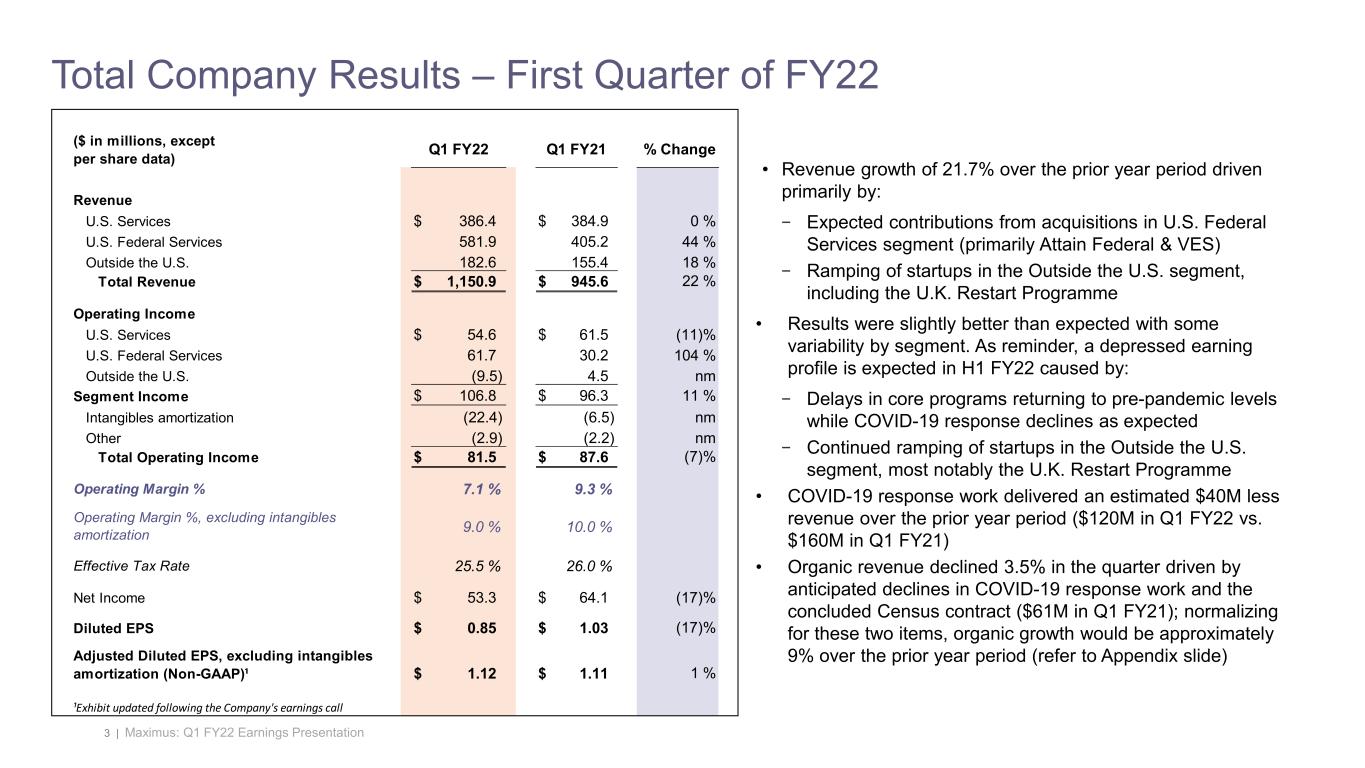
•Revenue increased 21.7% to $1.15 billion driven by expected contributions from the acquisitions in the U.S. Federal Services segment and growth from startups ramping in the Outside the U.S. segment.
•Operating margin was 7.1%, or 9.0% adjusting for amortization of intangible assets. Diluted earnings per share were $0.85, or $1.12 adjusting for amortization of intangible assets.
•The Company is raising revenue guidance for fiscal 2022 to $4.5 billion to $4.7 billion and maintaining diluted earnings per share guidance of $4.00 to $4.30 per share, or $5.07 to $5.37 per share adjusting for amortization of intangible assets.
•A quarterly cash dividend of $0.28 per share payable on February 28, 2022, to shareholders of record on February 15, 2022.
"Entering fiscal year 2022, we expected a lower earnings profile in the first half of the year. More importantly, we continue to anticipate a solid second half of fiscal year 2022, creating positive momentum into fiscal year 2023," shared Bruce Caswell, President and Chief Executive Officer. "While our first quarter results underscore our continued critical role as a partner to governments navigating an evolving pandemic, we are particularly pleased with the integration of our recent acquisitions as we invest in technology and people, execute on new opportunities and bids, and position our teams to best serve the longer-term needs of our clients."
First Quarter Results
Revenue for the first quarter of fiscal year 2022 increased 21.7% to $1.15 billion, compared to $945.6 million for the prior year period. The $205.3 million increase was principally driven by anticipated contributions from the acquisitions in the U.S. Federal Services Segment. Additionally, ramping of the startups in the Outside the U.S. Segment, including the U.K. Restart Programme, contributed to growth over the prior year period.
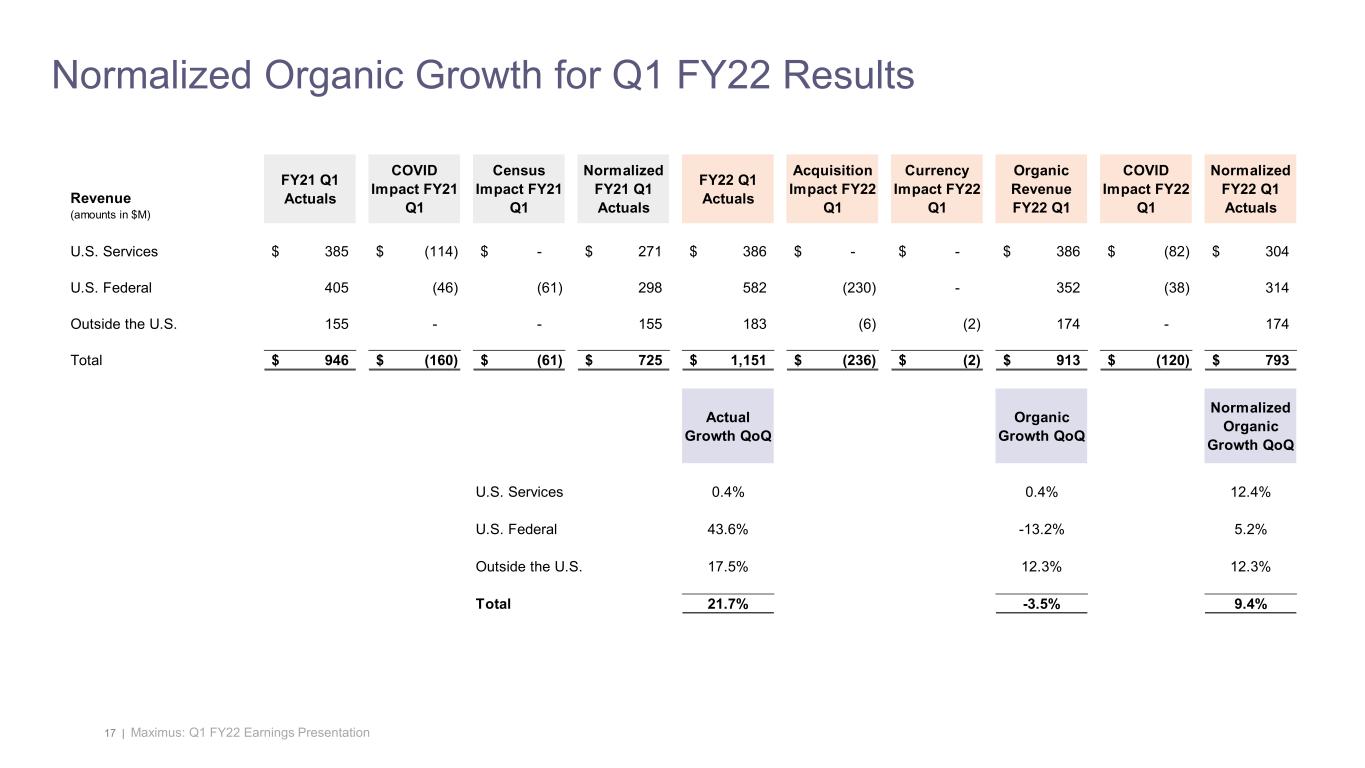
These increases were offset by COVID-19 response work which declined as expected, delivering an estimated $120 million of revenue in the first quarter of fiscal 2022, or $40 million less revenue than the prior year period. As a result, organic revenue for the first quarter of fiscal 2022 declined 3.5%. Adjusting for COVID-19 response work and the concluded Census contract, normalized organic growth would be approximately 9% over the prior year period.
For the first quarter of fiscal 2022, operating income totaled $81.5 million yielding an operating margin of 7.1%, or 9.0% adjusting for amortization of intangible assets. This compares to an operating margin of 9.3% for the prior year, or 10.0% adjusting for amortization. Diluted earnings per share were $0.85, or $1.12 adjusting for amortization as compared to $1.03 per share, or $1.11 adjusting for amortization, for the prior year period.
1

U.S. Services Segment
The U.S. Services Segment reported revenue of $386.4 million for the first quarter of fiscal year 2022 compared to $384.9 million reported in the prior year period. COVID-19 response work declined by an estimated $32 million over the prior year period. Adjusting for this work, normalized organic growth in the segment would be approximately 12% driven by new longer-term work.
Operating margin for the first quarter of fiscal year 2022 was 14.1% for the segment compared to 16.0% reported for the prior year period. COVID-19 response work drove better than expected results in the quarter while the redetermination activities tied to the Public Health Emergency (PHE) remain paused.
U.S. Federal Services Segment
U.S. Federal Services Segment revenue for the first quarter of fiscal year 2022 increased 43.6% to $581.9 million, compared to $405.2 million reported for the prior year. Growth was driven by expected contributions from the acquisitions, primarily Attain Federal and VES, which occurred in the second and third quarter, respectively, of fiscal 2021. COVID-19 response work declined by an estimated $8 million as compared to the prior year period. Organic revenue in the segment for the first quarter of fiscal 2022 declined approximately 13%. Adjusting for COVID-19 response work and the concluded Census contract, normalized organic growth in the segment would be approximately 5% over the prior year period.
The operating margin for the first quarter of fiscal year 2022 was 10.6% for the segment as compared to 7.5% reported for the prior year period. As anticipated, the acquisitions contribute to improved margins in the segment.
Outside the U.S. Segment
Outside the U.S. Segment revenue for the first quarter of fiscal year 2022 increased 17.5% to $182.6 million as compared to $155.4 million reported for the prior year. The primary driver of growth was ramping of the startups in this segment, most notably the U.K. Restart Programme.
The segment realized an operating loss of $9.5 million for the first quarter of fiscal 2022 as compared to operating income of $4.5 million for the prior year period. Startups in this segment, most notably the U.K. Restart Programme, are currently planned losses in the first half of fiscal 2022. Additionally, the prior year period benefited from above average performance in Australia.
Sales and Pipeline
Year-to-date signed contract awards at December 31, 2021, totaled $454 million and contracts pending (awarded but unsigned) totaled $1.16 billion.
The sales pipeline at December 31, 2021, was $33.2 billion (comprised of approximately $8.9 billion in proposals pending, $2.4 billion in proposals in preparation, and $21.8 billion in opportunities tracking). New work opportunities represent 62% of the total sales pipeline.
Balance Sheet and Cash Flows
At December 31, 2021, cash and cash equivalents totaled $181.8 million and gross debt was $1.61 billion. The ratio of debt, net of allowed cash, to pro-forma EBITDA for the quarter ended December 31, 2021, as calculated in accordance with our credit agreement, was 2.5x. This compares to 2.3x as of September 30, 2021.
For the first quarter of fiscal year 2022, cash used in operating activities totaled $2.9 million and free cash flow used was $9.2 million. This compares to cash provided by operating activities of $98.1 million and free cash flow of $89.0 million in the prior year period. Cash flows this quarter reflected the anticipated increase in working capital requirements, including the payroll tax deferral, which was contemplated in the Company's fiscal 2022 cash flow guidance.
As of December 31, 2021, DSO were 67 days and within the Company's typical range of 65 to 80 days.
On January 7, 2022, our Board of Directors declared a quarterly cash dividend of $0.28 for each share of our common stock outstanding. The dividend is payable on February 28, 2022, to shareholders of record on February 15, 2022.
2
Increased Revenue Outlook
The Company is raising revenue guidance for fiscal year 2022 with revenue expected to range between $4.5 billion and $4.7 billion. The increase is driven by higher than anticipated levels of COVID-19 response work in the first half of the year.
Diluted earnings per share is expected to range between $4.00 and $4.30 per share, or between $5.07 and $5.37 per share adjusting for amortization of intangible assets. Cash flows from operations are expected to range between $275 million and $325 million, and free cash flow to range between $225 million and $275 million in fiscal year 2022.
For fiscal year 2022, the effective income tax rate is expected to range between 25% and 26%, weighted average shares outstanding to range between 62.5 million and 62.6 million, absent significant share purchase activity, and interest expense to range between $33 million and $35 million.
While the timing remains uncertain, the Company's outlook for fiscal year 2022 assumes the PHE will conclude and enable Medicaid redetermination activities in the U.S. Services Segment to commence on or around May 1, 2022.
"While our COVID response work is declining as anticipated, we are seeing positive proof points behind our strategy of evolving this work into new scope and extended relationships,” Caswell continued. "We continue to position ourselves as a long-term public health partner as government, constituents, and businesses learn to operate in this evolving pandemic. Likewise, Maximus continues to actively monitor CDC guidance and update our procedures accordingly, as we have throughout the pandemic, prioritizing the safety and wellbeing of our colleagues."
Conference Call and Webcast Information
Maximus will host a conference call this morning, February 3, 2022, at 9:00 a.m. (ET).
The call is open to the public and available by webcast or by phone at:
877.407.8289 (Domestic) / +1.201.689.8341 (International)
For those unable to listen to the live call, a recording of the webcast will be available on investor.maximus.com.
About Maximus
Since 1975, Maximus has operated under its founding mission of Helping Government Serve the People®, enabling citizens around the globe to successfully engage with their governments at all levels and across a variety of health and human services programs. Maximus delivers innovative business process management and technology solutions that contribute to improved outcomes for citizens and higher levels of productivity, accuracy, accountability, and efficiency of government-sponsored programs. With more than 35,000 employees worldwide, Maximus is a proud partner to government agencies in the United States, Australia, Canada, Italy, Saudi Arabia, Singapore, South Korea, Sweden, and the United Kingdom. For more information, visit maximus.com.
Non-GAAP Measures and Risk Factors
This release refers to non-GAAP measures and other indicators, including free cash flow, operating income and EPS adjusted for amortization of intangible assets and other non-GAAP measures.
A description of these non-GAAP measures, the reasons why we use and present them, and details as to how they are calculated are included in our forthcoming Form 10-Q.
The presentation of these non-GAAP numbers is not meant to be considered in isolation, nor as alternatives to cash flows from operations, revenue growth, or net income as measures of performance. These non-GAAP financial measures, as determined and presented by us, may not be comparable to related or similarly titled measures presented by other companies.
3
Statements that are not historical facts, including statements about the Company’s confidence and strategies, and the Company’s expectations about revenues, results of operations, profitability, future contracts, market opportunities, market demand, or acceptance of the Company’s products are forward-looking statements that involve risks and uncertainties.
These risks could cause the Company’s actual results to differ materially from those indicated by such forward-looking statements. A summary of risk factors can be found in Item 1A, "Risk Factors" in our Annual Report on Form 10-K for the year ended September 30, 2021, which was filed with the Securities and Exchange Commission (SEC) on November 18, 2021. The Company's SEC reports are accessible on maximus.com.
4
Maximus, Inc.
Consolidated Statements of Operations
(Unaudited)
| For the Three Months Ended | |||||||||||
| December 31, 2021 | December 31, 2020 | ||||||||||
| (in thousands, except per share amounts) | |||||||||||
| Revenue | $ | 1,150,876 | $ | 945,554 | |||||||
| Cost of revenue | 922,721 | 739,499 | |||||||||
| Gross profit | 228,155 | 206,055 | |||||||||
| Selling, general, and administrative expenses | 124,221 | 111,967 | |||||||||
| Amortization of intangible assets | 22,405 | 6,516 | |||||||||
| Operating income | 81,529 | 87,572 | |||||||||
| Interest expense | (9,638) | (206) | |||||||||
| Other (expense)/income, net | (311) | (775) | |||||||||
| Income before income taxes | 71,580 | 86,591 | |||||||||
| Provision for income taxes | 18,250 | 22,514 | |||||||||
| Net income | $ | 53,330 | $ | 64,077 | |||||||
| Earnings per share: | |||||||||||
| Basic | $ | 0.86 | $ | 1.03 | |||||||
| Diluted | $ | 0.85 | $ | 1.03 | |||||||
| Weighted average shares outstanding: | |||||||||||
| Basic | 62,262 | 62,038 | |||||||||
| Diluted | 62,445 | 62,135 | |||||||||
| Dividends declared per share | $ | 0.28 | $ | 0.28 | |||||||
5
Maximus, Inc.
Consolidated Balance Sheets
| December 31, 2021 | September 30, 2021 | ||||||||||
| (unaudited) | |||||||||||
| (in thousands) | |||||||||||
| Assets: | |||||||||||
| Cash and cash equivalents | $ | 181,790 | $ | 135,061 | |||||||
| Accounts receivable, net | 849,410 | 834,819 | |||||||||
| Income taxes receivable | 2,826 | 5,413 | |||||||||
| Prepaid expenses and other current assets | 114,303 | 104,201 | |||||||||
| Total current assets | 1,148,329 | 1,079,494 | |||||||||
| Property and equipment, net | 53,627 | 62,627 | |||||||||
| Capitalized software, net | 40,349 | 42,868 | |||||||||
| Operating lease right-of-use assets | 177,866 | 179,349 | |||||||||
| Goodwill | 1,776,239 | 1,774,406 | |||||||||
| Intangible assets, net | 871,761 | 879,168 | |||||||||
| Deferred contract costs, net | 43,319 | 36,486 | |||||||||
| Deferred compensation plan assets | 49,376 | 46,738 | |||||||||
| Deferred income taxes | 1,745 | 990 | |||||||||
| Other assets | 19,257 | 16,839 | |||||||||
| Total assets | $ | 4,181,868 | $ | 4,118,965 | |||||||
| Liabilities and Shareholders' Equity: | |||||||||||
| Liabilities: | |||||||||||
| Accounts payable and accrued liabilities | $ | 273,289 | $ | 305,565 | |||||||
| Accrued compensation and benefits | 118,891 | 186,809 | |||||||||
| Deferred revenue, current portion | 111,578 | 98,588 | |||||||||
| Income taxes payable | 14,897 | 6,782 | |||||||||
| Long-term debt, current portion | 78,703 | 80,555 | |||||||||
| Operating lease liabilities, current portion | 70,345 | 76,077 | |||||||||
| Other current liabilities | 43,089 | 35,057 | |||||||||
| Total current liabilities | 710,792 | 789,433 | |||||||||
| Deferred revenue, non-current portion | 29,072 | 35,932 | |||||||||
| Deferred income taxes | 196,144 | 194,638 | |||||||||
| Long-term debt, non-current portion | 1,515,089 | 1,429,137 | |||||||||
| Deferred compensation plan liabilities, non-current portion | 53,013 | 47,405 | |||||||||
| Operating lease liabilities, non-current portion | 119,654 | 121,771 | |||||||||
| Other liabilities | 29,678 | 20,320 | |||||||||
| Total liabilities | 2,653,442 | 2,638,636 | |||||||||
| Shareholders' equity: | |||||||||||
Common stock, no par value; 100,000 shares authorized; 61,936 and 61,954 shares issued and outstanding as of September 30, 2021 and 2020, respectively (shares in thousands) | 543,032 | 532,411 | |||||||||
| Accumulated other comprehensive loss | (36,764) | (39,908) | |||||||||
| Retained earnings | 1,022,158 | 987,826 | |||||||||
| Total shareholders' equity | 1,528,426 | 1,480,329 | |||||||||
| Total liabilities and shareholders' equity | $ | 4,181,868 | $ | 4,118,965 | |||||||
6
Maximus, Inc.
Consolidated Statements of Cash Flows
(Unaudited)
| For the Three Months Ended | |||||||||||
| December 31, 2021 | December 31, 2020 | ||||||||||
| (in thousands) | |||||||||||
| Cash flows from operating activities: | |||||||||||
| Net income | $ | 53,330 | $ | 64,077 | |||||||
| Adjustments to reconcile net income to cash flows from operating activities: | |||||||||||
| Depreciation and amortization of property, equipment and capitalized software | 11,365 | 11,817 | |||||||||
| Amortization of intangible assets | 22,405 | 6,516 | |||||||||
| Amortization of debt issuance costs and debt discount | 649 | — | |||||||||
| Deferred income taxes | (229) | 1,298 | |||||||||
| Stock compensation expense | 8,248 | 6,062 | |||||||||
| Change in assets and liabilities, net of effects of business combinations | |||||||||||
| Accounts receivable | (14,114) | 7,809 | |||||||||
| Prepaid expenses and other current assets | (5,115) | 4,893 | |||||||||
| Deferred contract costs | (6,811) | (205) | |||||||||
| Accounts payable and accrued liabilities | (32,452) | 11,199 | |||||||||
| Accrued compensation and benefits | (56,305) | (35,682) | |||||||||
| Deferred revenue | 5,929 | 5,757 | |||||||||
| Income taxes | 10,321 | 16,947 | |||||||||
| Operating lease right-of-use assets and liabilities | (6,370) | (4,927) | |||||||||
| Other assets and liabilities | 6,230 | 2,554 | |||||||||
| Net cash (used in)/provided by operating activities | (2,919) | 98,115 | |||||||||
| Cash flows from investing activities: | |||||||||||
| Purchases of property and equipment and capitalized software costs | (6,327) | (9,094) | |||||||||
| Other | — | (159) | |||||||||
| Net cash used in investing activities | (6,327) | (9,253) | |||||||||
| Cash flows from financing activities: | |||||||||||
| Cash dividends paid to Maximus shareholders | (17,347) | (17,207) | |||||||||
| Purchases of Maximus common stock | (1,379) | (3,363) | |||||||||
| Tax withholding related to RSU vesting | (9,673) | (9,818) | |||||||||
| Proceeds from borrowings | 100,000 | 147,852 | |||||||||
| Principal payments for debt | (16,685) | (146,188) | |||||||||
| Other | — | (2,763) | |||||||||
| Net cash provided by/(used in) financing activities | 54,916 | (31,487) | |||||||||
| Effect of exchange rate changes on cash, cash equivalents, and restricted cash | 372 | 3,882 | |||||||||
| Net change in cash, cash equivalents, and restricted cash | 46,042 | 61,257 | |||||||||
| Cash, cash equivalents and restricted cash, beginning of period | 156,570 | 88,561 | |||||||||
| Cash, cash equivalents and restricted cash, end of period | $ | 202,612 | $ | 149,818 | |||||||
7
Maximus, Inc.
Consolidated Results of Operations by Segment
(Unaudited)
| For the Three Months Ended | |||||||||||||||||||||||
| December 31, 2021 | December 31, 2020 | ||||||||||||||||||||||
| Amount (1) | % (2) | Amount (1) | % (2) | ||||||||||||||||||||
| (dollars in thousands) | |||||||||||||||||||||||
| Revenue: | |||||||||||||||||||||||
| U.S. Services | $ | 386,417 | $ | 384,934 | |||||||||||||||||||
| U.S. Federal Services | 581,871 | 405,245 | |||||||||||||||||||||
| Outside the U.S. | 182,588 | 155,375 | |||||||||||||||||||||
| Revenue | $ | 1,150,876 | $ | 945,554 | |||||||||||||||||||
| Gross Profit: | |||||||||||||||||||||||
| U.S. Services | $ | 89,699 | 23.2 % | $ | 99,002 | 25.7 % | |||||||||||||||||
| U.S. Federal Services | 126,576 | 21.8 % | 82,496 | 20.4 % | |||||||||||||||||||
| Outside the U.S. | 11,880 | 6.5 % | 24,557 | 15.8 % | |||||||||||||||||||
| Gross Profit | $ | 228,155 | 19.8 % | $ | 206,055 | 21.8 % | |||||||||||||||||
| Selling, general, and administrative expenses: | |||||||||||||||||||||||
| U.S. Services | $ | 35,102 | 9.1 % | $ | 37,456 | 9.7 % | |||||||||||||||||
| U.S. Federal Services | 64,925 | 11.2 % | 52,252 | 12.9 % | |||||||||||||||||||
| Outside the U.S. | 21,340 | 11.7 % | 20,032 | 12.9 % | |||||||||||||||||||
| Other (3) | 2,854 | NM | 2,227 | NM | |||||||||||||||||||
| Selling, general and administrative expenses | $ | 124,221 | 10.8 % | $ | 111,967 | 11.8% | |||||||||||||||||
| Operating income: | |||||||||||||||||||||||
| U.S. Services | $ | 54,597 | 14.1 % | $ | 61,546 | 16.0 % | |||||||||||||||||
| U.S. Federal Services | 61,651 | 10.6 % | 30,244 | 7.5 % | |||||||||||||||||||
| Outside the U.S. | (9,460) | (5.2) % | 4,525 | 2.9 % | |||||||||||||||||||
| Amortization of intangible assets | (22,405) | NM | (6,516) | NM | |||||||||||||||||||
| Other (3) | (2,854) | NM | (2,227) | NM | |||||||||||||||||||
| Operating income | $ | 81,529 | 7.1 % | $ | 87,572 | 9.3 % | |||||||||||||||||
(1)Expenses that are not specifically included in the segments are included in other categories, including amortization of intangible assets and the direct costs of acquisitions. These costs are excluded from measuring each segment's operating performance.
(2)Percentage of respective segment revenue. Percentages not considered meaningful are marked "NM."
(3)Other selling, general, and administrative expenses includes costs that are not allocated to a particular segment. This includes expenses incurred as part of our acquisitions, as well as potential acquisitions which have not been or may not be completed.
8
Maximus, Inc.
Consolidated Free Cash Flows - Non-GAAP
(Unaudited)
| For the Three Months Ended | |||||||||||
| December 31, 2021 | December 31, 2020 | ||||||||||
| (in thousands) | |||||||||||
| Net cash (used in)/provided by operations | $ | (2,919) | $ | 98,115 | |||||||
| Purchases of property and equipment and capitalized software costs | (6,327) | (9,094) | |||||||||
| Free cash flow (Non-GAAP) | $ | (9,246) | $ | 89,021 | |||||||
Maximus, Inc.
Non-GAAP Adjusted Results Excluding Amortization of Intangible Assets
(Unaudited)
| For the Three Months Ended | |||||||||||
| December 31, 2021 | December 31, 2020 | ||||||||||
| (dollars in thousands, except per share data) | |||||||||||
| Operating income | $ | 81,529 | $ | 87,572 | |||||||
| Add back: Amortization of intangible assets | 22,405 | 6,516 | |||||||||
| Adjusted operating income excluding amortization of intangible assets (Non-GAAP) | $ | 103,934 | $ | 94,088 | |||||||
| Adjusted operating income margin excluding amortization of intangible assets (Non-GAAP) | 9.0 | % | 10.0 | % | |||||||
| Net income | $ | 53,330 | $ | 64,077 | |||||||
| Add back: Amortization of intangible assets, net of tax | 16,530 | 4,822 | |||||||||
| Adjusted net income excluding amortization of intangible assets (Non-GAAP) | $ | 69,860 | $ | 68,899 | |||||||
| Diluted earnings per share | $ | 0.85 | $ | 1.03 | |||||||
| Add back: Effect of amortization of intangible assets on diluted earnings per share | 0.27 | 0.08 | |||||||||
| Adjusted diluted earnings per share excluding amortization of intangible assets (Non-GAAP) | $ | 1.12 | $ | 1.11 | |||||||
9
Maximus Fiscal 2022 First Quarter Earnings Call February 3, 2022 Page 1 of 13 Operator Greetings, and welcome to the Maximus Fiscal 2022 First Quarter Earnings Conference Call. At this time, all participants are on a listen-only mode. A brief question-and-answer session will follow the formal presentation. If anyone should require operator assistance during the conference, please press “*”, “0” on your telephone keypad. As a reminder, this conference is being recorded. It is now my pleasure to introduce your host, Madison West, Vice President of Investor Relations and ESG for Maximus. Thank you, Ms. West. Please go ahead. Madison West Good morning and thank you for joining us. With me today is Bruce Caswell, President and CEO; David Mutryn, CFO; and James Francis, Vice President of Investor Relations. I’d like to remind everyone that a number of statements being made, today, will be forward-looking in nature. Please remember that such statements are only predictions. Actual events and results may differ materially, including those discussed in Item 1A of our most recent Forms 10-Q and 10-K. We encourage you to review the information contained in our most recent filings with the SEC and our earnings press release today. The company does not assume any obligation to revise or update these forward- looking statements to reflect subsequent events or circumstances, except as required by law. Today’s presentation also contains non-GAAP financial information. Management uses this information internally to analyze results and believes it may be informative to investors in gauging the quality of our financial performance, identifying trends, and providing meaningful period-to-period comparisons. For a reconciliation of the non-GAAP measures presented, please see the company’s most recent Forms 10-Q and 10-K. And with that, I’ll hand the call over to David. David Mutryn Thanks, Madison. This morning, Maximus reported revenue for the first quarter of fiscal year 2022, which increased 21.7%, year-over-year, to $1.15 billion. As expected, top line growth was driven primarily by the contributions from acquisitions in the U.S. Federal Services Segment and to a lesser extent, ramping of the start-ups in the Outside the U.S. Segment, which includes the U.K. Restart Programme. On the bottom line for the first quarter of fiscal 2022, the operating income margin was 7.1%, or 9.0%, excluding the expense for intangibles amortization. Diluted earnings per share were $0.85, or $1.12, excluding the amortization expense. Our first quarter results were slightly better than anticipated, with some variability by segment. As a reminder, we expect a depressed earnings profile in the first half of the fiscal year, caused by delays in our core programs returning to pre-pandemic levels, as the COVID response work declines.
Maximus Fiscal 2022 First Quarter Earnings Call February 3, 2022 Page 2 of 13 Also, as previously noted, start-ups in the Outside the U.S. Segment, most notably, the U.K. Restart Programme, will continue to ramp with operating losses in the first half of fiscal 2022. COVID response work delivered about $120 million in the first quarter of fiscal 2022, or about $40 million less than in the prior-year period. While our organic revenue declined 3.5% in the quarter, adjusting for the COVID response work and the concluded Census contract, normalized organic growth would be approximately 9%, year-over-year. Let me pause here for a housekeeping item. Over the past two years, we’ve estimated revenue associated with COVID response work, recognizing that the large volume and the temporary nature are important to investors’ understanding of our business. As the COVID pandemic continues and seems to be transitioning to an endemic, we are seeing some of this temporary work transition to longer-term work supporting our customers, in some cases, beyond work, specifically, supporting COVID response. Given this evolution and with the large bubble of short-term work behind us, we will be gradually moving away from tracking and estimating this in such detail. I will now review financial results for the segments. The U.S. Services Segment delivered revenue of $386.4 million for the quarter, which was relatively flat year-over-year. COVID response work in the segment declined approximately $32 million from the prior-year period. Normalized for the COVID work, revenue grew 12%. This was all organic and driven by ramping of new longer- term work. The segment operating income margin was 14.1%, as compared to 16.0% in the prior year. This segment exceeded our expectations modestly in the quarter, driven primarily by more short-term COVID response work. Medicaid redeterminations remain paused due to the most recent public health emergency extension, which occurred on January 14 and will remain in effect for 90 days. Despite the extension, we still anticipate that redetermination activities should begin to resume in fiscal 2022. We have assumed a 1-month delay from our previous projection, meaning our outlook today assumes starting this work in the month of May, 2022. For the U.S. Federal Services Segment, first quarter fiscal 2022 revenue increased 43.6% to $581.9 million, driven primarily by contributions from the Attain Federal and VES acquisitions. The acquisitions occurred in the second and third quarter, respectively, of fiscal 2021. COVID response work in the segment declined approximately $8 million from the prior-year period. On an organic basis, revenue declined 13% in the quarter. Adjusting for COVID response work and the concluded Census contract, normalized organic growth in the segment would be about 5% over the prior-year period.
Maximus Fiscal 2022 First Quarter Earnings Call February 3, 2022 Page 3 of 13 The operating income margin for U.S. Federal Services was 10.6% in the first quarter of fiscal 2022, as compared to 7.5% in the prior year period. As expected, the recent acquisitions helped blend up the operating margin for the segment. Turning to Outside the U.S. Segment. First quarter revenue increased 17.5% to $182.6 million. Ramping of the start-ups, including the U.K. Restart Programme, were the primary contributor to growth in the segment. The segment realized an operating loss of $9.5 million for the first quarter, as compared to operating income of $4.5 million in the first quarter of fiscal 2021. The prior-year period was bolstered by above-average performance on job placement activities in Australia, as that country began to emerge from the pandemic. In this quarter, the start-ups that have planned losses upfront continue to ramp and are still projected to reach breakeven at the midpoint of fiscal 2022. This includes the U.K. Restart Programme, and Bruce will provide an update in his prepared remarks. Let me touch on the balance sheet and cash flow items. As of December 31, 2021, we had gross debt of $1.61 billion, and we had unrestricted cash and cash equivalents of $182 million. The ratio of debt net of allowed cash to pro forma EBITDA, as calculated in accordance with our credit agreement, is 2.5x. This compares to 2.3x at September 30, 2021. Cash used in operations totaled $3 million, and free cash flow used was $9 million for the first quarter of fiscal 2022. These results reflect the anticipated increase in working capital, which included the payment of deferred payroll tax and was contemplated in our fiscal 2022 cash flow guidance. We had good cash collections, and our DSO at December 31 was 67 days, putting us at the lower end of our target range of 65 to 80 days. In terms of capital allocation, we continue to favor M&A as a means to drive long-term organic growth. Our M&A program continues to evaluate prospects while we remain prudent stewards of capital. This means being selective in our evaluations and maintaining our goal of reducing debt. We believe that our balance sheet and cash from operations provide us with good access to capital to fund acquisitions. Finally, we remain committed to future quarterly cash dividends and share purchases will continue to be made, opportunistically. Let’s go to fiscal 2022 guidance and assumptions. We are raising top line guidance and now project revenue to be between $4.5 billion and $4.7 billion for the full fiscal year. Our earnings guidance remains unchanged. We expect diluted EPS to be between $4 and $4.30 and adjusted diluted EPS, which excludes intangibles amortization expense, to be between $5.07 and $5.37. Our intangibles amortization expense is projected to be approximately $90 million in fiscal 2022. Our cash flow guidance is unchanged, with cash flows from operations expected to range between $275 million and $325 million and free cash flow between $225 million and $275 million.
Maximus Fiscal 2022 First Quarter Earnings Call February 3, 2022 Page 4 of 13 We anticipate interest expense to be between $33 million and $35 million, the effective income tax rate between 25% and 26%, and weighted average shares, absent share purchases, to be between $62.5 million and $62.6 million. Our expectations for margins in the domestic segments are unchanged, with the U.S. Services Segment expected to be in the 13% to 14% range and the U.S. Federal Services margin to be in the 10% to 11% range for fiscal year 2022. For the Outside the U.S. Segment, we now expect the margin to be in the 1% to 3% range for the full year, reflecting our expectation that margin will improve in the second half of the fiscal year. Let me provide some commentary on the updated guidance. Our top line forecast has increased, thanks largely to more COVID response work that we anticipate will benefit the first half of fiscal 2022. This stacks on top of the core business revenue projection and the assumed acquisition contribution, all of which remain largely unchanged from last quarter, reiterating our belief that the core business growth engine is running well. On the bottom line, the contribution from more COVID response work has been offset by some bottom-line headwinds in our core business. In particular, the start to redeterminations is now expected to resume on or around May 1, as I mentioned. Also, new core work related to fiscal 2021 awards is still on track to contribute revenue in fiscal 2022 but ramp at a more gradual rate. In addition, our employment services contracts in the U.K. and Australia have a reduced volume forecast, due to the strength of the current labor markets. The current earnings guidance can accommodate these dynamics, but we still face risk of further delays, in particular, related to the start of redetermination activities, which are outside of our control and may cause revenue and earnings to move to the right. We currently project that the quarterly earnings profile is a little less steep than we estimated last quarter. We now forecast about 60% of our operating income and earnings to be realized in the second half of the fiscal year. This means we still expect depressed earnings in the second fiscal quarter, as COVID response work continues to taper down and the resumption of core programs remains delayed. We still expect to exit the year at a higher run rate, following improved performance in the back half of fiscal 2022. In closing, we remain optimistic about the future growth of the business, bolstered by our 2021 acquisition. While the COVID response work will continue to make for tougher year-over-year comparisons in the near term, underlying growth is accelerating, as evidenced by the normalized organic growth of 9% in the quarter. And although exact timing is not entirely in our control, there remains a clear line of sight to margin improvement in all three segments. And with that, I’ll turn the call over to Bruce.
Maximus Fiscal 2022 First Quarter Earnings Call February 3, 2022 Page 5 of 13 Bruce Caswell Thank you, David, and good morning, everyone. As David noted, we are seeing some additional COVID extension work in light of the Omicron variant and extended public health emergency, or PHE. This includes a recent CDC task order under our prior award, illustrating how we are a vendor of choice when there’s an urgent, albeit short-term, need from our clients. Overall, however, the nature of this work is changing and is providing positive proof points for our strategy of evolving COVID response work into new scope and extended relationships. We continue to position ourselves as a long-term public health partner as government, constituents, and businesses learn to live with this ongoing pandemic. For instance, I’m pleased to share that included in our planned new work for fiscal year ’22 is an award for a multi-year unemployment insurance contract with a state client, with an estimated total contract value or, TCV, of more than $100 million. Awards of this nature are underpinning the organic growth we are seeing in our core business. As a further example, in the first quarter, we were awarded a new contract to support eligibility operations, including changes, intake, and renewals for Medicaid by the Arkansas Department of Human Services. With a potential expansion to additional benefit program cases through the state’s phased migration implementation effort. This contract, which has a $68 million total contract value over one base year and six option years, is forecasted to contribute revenue beginning in the second quarter of fiscal year 2022. Our past work helping the state address the eligibility case inventory positioned us for this opportunity. Illustrating the strength of our brand as the go-to partner for government, awards such as this further position us to support states with the forthcoming end of the PHE, or unwinding, as it has come to be known. Let me give a brief update on the Outside the U.S. Segment, where, as David mentioned, we are seeing varying conditions in the major economies in which we operate, such as the U.K. and Australia. Certain elements of our businesses outside the U.S. are operating at depressed levels as a result of the rise of the Omicron variant. Government policies, in many cases, suspend job seeker engagement obligations in these conditions, particularly for higher-risk populations such as the disabled, leading to lower labor force participation rates. In other cases, economic recovery has outpaced the models on which the programs were based, resulting in lower than anticipated unemployment rates. Taken together, employment services programs in some countries are seeing a reduced volume forecast due to these dynamics, and this includes the U.K. Restart and Australian jobactive programs. However, the first quarter illustrated that our Restart team is executing well, despite these uncontrollable labor market challenges. Presently, referral volumes and job starts are performing across the market, above our customers’ revised expectations. As a result, we continue to expect to achieve breakeven in the second half of fiscal year ’22.
Maximus Fiscal 2022 First Quarter Earnings Call February 3, 2022 Page 6 of 13 Together with other suppliers, we will continue to work with our customer in the coming months to bring clarity to this dynamic situation and the longer-term expectations for the program. I will now turn to new awards and pipeline as of December 31. For the first quarter of fiscal 2022, signed awards were $454 million of total contract value at December 31, 2021, of which only a small portion includes short-term COVID work. Further, at December 31, there were another $1.16 billion worth of contracts that have been awarded but not yet signed. Let’s turn our attention to our pipeline of addressable sales opportunities. Our total contract value pipeline at December 31 was $33.2 billion, compared to $33.9 billion reported in the fourth quarter of fiscal 2021. The December 31 pipeline is comprised of approximately $8.9 billion in proposals pending, $2.4 billion in proposals in preparation, and $21.8 billion in opportunities tracking. Of our total pipeline of sales opportunities, 62% represents new work. We continue to be pleased with the integration of our recent acquisitions. We’re investing in VES with technology and people to support addressing the inventory of exams and future anticipated demand. Our team is focused on enhancing the veteran experience by working with partners on implementing best practices across the program. As for the Attain Federal acquisition, we are executing on technology bids through the Alliant 2 contract vehicle, which is precisely what we hope to see by merging our two companies. Attain brought additional technology capabilities, while Maximus offers access to desirable contract vehicles that enable us to expand the business together. Turning to Aidvantage, the delayed resumption of federal student loan repayment obligations now scheduled for May 1 helps us further prepare to support student loan borrowers and the FSA when the extended pause ends. In the meantime, we are, number one, training employees and establishing protocols that will help us meet or exceed new higher performance standards established by the FSA, and number two, reviewing and processing work on loans being transferred to Aidvantage to better ensure accuracy and ease the borrower transition to return to repayment experience. We are seeing these acquisitions, together with organic growth, in areas like Medicaid long-term care assessments, as evidence of successful execution on our 3-pronged strategy, established in mid-2018. As I mentioned last quarter, we are simultaneously looking forward at how we can further leverage our capabilities and expand our total addressable market. As a result, leadership across Maximus has been working diligently on the evolution of our longer-term (3- to 5- year) strategy. We aim to ensure our strategic pillars, operational capabilities and organizational model are congruent with our plan to deliver ongoing shareholder value through reliable organic growth and margin expansion in the coming years.
Maximus Fiscal 2022 First Quarter Earnings Call February 3, 2022 Page 7 of 13 You can expect to see the next phase of our current strategy incorporate a continuation of key elements, such as digital solutions to enhance the customer experience and clinical services to address evolving government priorities. We also will provide additional clarity around our expanded vision for Maximus as a sought-after provider of innovative technology solutions that address the mission priorities of our government customers, particularly in the federal marketplace. I’m excited to share in more detail the next phase of our strategic growth plan at our upcoming Investor Day, which will shortly follow our second quarter fiscal year ’22 earnings call. We continue to expect a solid second half of fiscal year ’22, creating positive momentum into fiscal year ’23. As David has noted, we continue to operate in a very dynamic environment, compared to the pre-pandemic period. While our expectations for fiscal 2022, would be negatively impacted by potential further changes in the timeline to unwind the PHE, so, too, are positive opportunities created to respond to the changing needs of our customers, as was evidenced in this first quarter. In light of the Omicron variant and a hold on the Biden administration’s vaccine mandate for businesses with more than 100 employees, we continue to prioritize employee and workplace safety and well-being, as well as actively monitor guidance and update our procedures accordingly, as we have throughout the pandemic. Additionally, over fiscal year 2021 and 2022, as many industries face labor market competition, including ours, we have invested in employee benefit enhancements, including our increased 401(k) match, expanded health benefits, and our newly launched employee assistance fund to provide financial assistance, when the unexpected occurs. And with that, we will open the line for Q&A. Operator. Operator Thank you. The floor is now open for questions. If you would like to ask a question, please press “*”, “1” on your telephone keypad. A confirmation tone will indicate that your line is in the question queue. You may press “*”, “2” if you would like to remove your question from the queue. We do ask that you please limit yourself to one follow-up question so that others may have an opportunity to ask a question. You may re-enter the queue, by pressing “*”, “1”. Our first question today is coming from Charlie Strauzer of CJS Securities. Please go ahead. Charles Strauzer Hey, good morning. Bruce Caswell Good morning, Charlie.
Maximus Fiscal 2022 First Quarter Earnings Call February 3, 2022 Page 8 of 13 Charles Strauzer Good morning. I was wondering if you could walk us through a little bit more about the guidance. Obviously, you’ve got some increased revenue on the top line, but you kept EPS the same. I know you talked about some various factors underlying the kind of keeping that flat versus prior guidance. Maybe you could expand a little bit further on that and give us a little more color there. Bruce Caswell Sure, Charlie, it’s Bruce. Absolutely. David Mutryn will take that. David Mutryn Sure. Hey, Charlie. As I mentioned on the call, the increase in revenue guidance is really driven by more contribution from COVID response work. And these have been offset on the bottom line by several headwinds in the core business. It’s worth pointing out that the headwinds I mentioned tend to have a disproportionate bottom-line impact. And those would include the delay in redeterminations caused by the PHE extension; the new non-COVID-related work that has started but is ramping at a slower rate; and third, the reduced forecast for employment services programs in the U.K. and Australia. That forecast was really the main driver behind us reducing the Outside the U.S. full year margin guidance, which is now in the 1% to 3% range. James Francis Thanks, Charlie, do you have a follow-up? Charles Strauzer Yes. On the PHE expansion into, what I think you said, May, how are you factoring in further potential delays in your guidance? And how could that potentially impact guidance going forward, if this was delayed? Bruce Caswell So Charlie, it’s Bruce. Why don’t I start by just providing some context and a bit of an update. The PHE extension has gotten a lot of coverage recently. Most recently, in fact, on Tuesday, Politico ran a great article about this, talking about how 15 million Americans that are on Medicaid presently could face reductions in coverage. So let me catch folks up in terms of what we’ve been up to and what we’re doing. Since the last quarter, we’ve spent a significant amount of time with our current state customers and others really assessing the state of readiness for what’s become known now as – in the jargon in the community – as a PHE unwinding. We’ve also engaged with CMS directly, as this is a big priority for the Biden administration. And what we’re seeing interestingly is that a number of states are taking initial steps to prepare for the unwinding by verifying beneficiary information such as address and so forth through mailings and outreach and engagement without processing any case changes, with the expectation that case changes – you wouldn’t be able to begin processing case changes until the first of May.
Maximus Fiscal 2022 First Quarter Earnings Call February 3, 2022 Page 9 of 13 Because as you know, the current extension would extend through, I think, mid-April, April 16. The level of activity that we’re seeing across states is consistent, with an expectation that the PHE will unwind as of April 16. States will begin processing case actions as early as May, and that ultimately, they can draw down, as you may recall, the enhanced federal matching funds, which were bumped up by 6.2% to the end of the quarter in which the PHE is unwound. Interestingly, I saw some press yesterday where there was talk about like, let’s get on with this, let’s get – let’s unwind the PHE and even some discussion about whether Congress might decouple the Medicaid requirement for what’s really – underlying this is the maintenance investment requirement for Medicaid as part of the public health emergency, that Congress could consider decoupling that from other elements of the public health emergency so that states could proceed. What states have asked for more than anything is clarity on when the date – what the date certain will be when they begin to take these actions. Now, how will states respond? Some states will work quickly to complete case actions and eligibility redeterminations to ensure program integrity of their Medicaid roles and move individuals off Medicaid if they no longer qualify. So I mean, a very short amount of time. Other states that we’ve talked to have said we’re going to run this as we would a normal redetermination process in any year and spread it out over 12 months. So, that there’s not a bulge in work for our workforce. All the while, it will be a significant increase in work. They want to level load it, if you will, over the course of the year. The other final element to keep in mind is that the state systems that support the eligibility processes had to be modified in order to accommodate this suspension. And then they have to be, obviously, modified again to reactivate the processes and workflows and so forth to get redeterminations going. Often, it’s easier for states to effectively restart a process that was well-established previously that may be level loaded over 12 months than necessarily modify systems even further to handle something in a short amount of time. So, with all that, it’s a bit of a mixed bag in terms of state timing. I think the big lesson that we’ve been picking up is that this work is something that’s going to extend through, in many instances, through the end of this fiscal year and into next year. So with that as background, I’ll turn it over to David for more color, financially. David Mutryn Yeah. Thanks, Bruce. So first, I would say, at this point in the year, another extension would likely put us at risk of not making guidance, given the short runway we have. So as we saw this quarter, higher levels of COVID response work helped offset the most recent delay, which was effectively a 1-month change from our prior assumption.
Maximus Fiscal 2022 First Quarter Earnings Call February 3, 2022 Page 10 of 13 We have cautioned that the PHE delay and the COVID response work are not necessarily two factors that coincide in timing. We do continue to view extensions as only delays to resuming the core work, recognizing that the redeterminations are really a fundamental part of the Medicaid programs. And then I’d echo what Bruce said that we see it now less of a short-term surge that we would expect, but more of a phasing in that would carry it well into 2023. James Francis Thanks, Charlie. Operator, back to you. Next question please. Operator Thank you. Once again, it is “*”, “1” if you would like to register a question. Our next question is coming from Donald Hooker of KeyBanc Capital Markets. Please go ahead. Donald, please make sure your phone is not on mute on your side. Donald Hooker I’m sorry, I was on mute. I apologize about that. Good morning, everyone. I hope you can hear me now. I wanted to kind of step back and hear your perspective on kind of maybe – kind of the, maybe the bigger picture growth rate you expect Maximus to be able to generate. I’m hearing from your prepared comments that it sounds like you’re getting some nice conversion of some of that temporary COVID work into permanent work in some new areas with states. And I’m wondering, I mean, to what extent you can kind of maybe quote me in on maybe, directionally, kind of give us some direction around kind of what the right growth rate is for Maximus coming out of COVID? Bruce Caswell Absolutely. Don, it’s Bruce. Why don’t I begin again by kind of setting the context and then ask David to provide some more specificity in terms of the growth rate itself. I’d begin by telling you that my bullishness on growth in our U.S. Federal Services Segment has not changed. We’ve already seen year-over-year organic growth from VES, and we expect that Attain is going to continue to grow as planned, as they have access to broader contract vehicles like Alliant 2, as I mentioned in my prepared remarks. Federal Marketplace is also the largest marketplace in the world, and we think there is meaningful open space for us to grow into. More recently, I’ve also been very pleased with the organic growth that we’ve been able to generate in the U.S. Services Segment. And certainly, if we were to compare this to the pre-pandemic period. We’ve been capitalizing on new relationships and contracts over the past several years. As we’ve said before, we were able to pick up work with 15 different states doing unemployment insurance work. A good bit of that work has recently transitioned into more of a longer-term work, such as I mentioned in my prepared remarks.
Maximus Fiscal 2022 First Quarter Earnings Call February 3, 2022 Page 11 of 13 So, those longer-term opportunities become a bit of the engine of organic growth in the U.S. Services Segment. I’m also sensing that states are becoming more and more comfortable with the variable cost model that we provide and the accountability that we have to deliver outcomes, and we then become kind of top of mind for further work. So, for example, historically, the labor departments really didn’t work a lot with private partners like Maximus. And then, with the pandemic, they were enabled to do that through legislation that allows them the flexibility to contract with private partners. And now that they’ve had that experience, given what we see in the economy with tighter labor markets, a workforce at the state level that is retiring or perhaps, disproportionately to other industries, inability, sometimes, to hire a more permanent workforce to handle seasonal demands, and so forth, for these programs, create a great environment for Maximus to help out. And I would say that the work, for example, that we’ve been able to do in Arkansas is a direct reflection of, number one, successful prior work we did for that client, but also the core skill set that we have in areas related to citizen engagement, eligibility, data collection and eligibility determination for state programs which, of course, are core needs of this PHE unwinding and will be on an ongoing basis in Medicaid and other programs, well into the future. So, I’d summarize that by saying I don’t think it’s just current conditions that have created that growth--that organic growth opportunity in the U.S. Services Segment, but more of a bit of a structural shift that’s enabled states to become more comfortable with and desire contracting with a partner like Maximus. And I think that has the potential to deepen, given those underlying kind of policy, demographic, economic, and labor market conditions that we see going forward. So now, what does that mean in terms of growth rate, I’ll turn it over to David. David Mutryn Sure. Thanks. I’ll just add that we continue to target sustainable mid-single-digit organic growth in the long term, which we do believe our markets and our positioning support. That said, the normalized organic growth of 9% in the December quarter, as well as our fiscal year ’22 guidance, suggests that we have line of sight to exceeding that level in the near term, albeit that’s adjusted for the runoff of the short-term COVID work. James Francis Thanks, Don. Do you have a follow-up? Donald Hooker Yeah, I’ll ask one more. On the cost side, how – can you just maybe walk through your various contract structures and how you’re protected against maybe some of the inflationary pressures we’re seeing across a lot of the companies we cover?
Maximus Fiscal 2022 First Quarter Earnings Call February 3, 2022 Page 12 of 13 Bruce Caswell Sure. We’d be happy to do that, Don. And in fact, why don’t I begin by, again, providing a little market context and I’ll focus on labor market challenges, right. That’s really the main area of process. So for us, right, it’s a – labor strictly is our current lifestyle. Donald Hooker Exactly. Bruce Caswell So in some – and then David will add some more color. In some areas, we are seeing tightness in the labor market that’s impacting our ability to attract and retain talent. It’s more of the case, we are finding with technical skills and clinical skills and less so in the core call center business and labor – customer service representatives and so forth. There’s a well-known nursing shortage, for example, out there that’s very well documented. At the same time, I think Maximus has very much established itself as a very strong talent brand. And if anything, we’ve strengthened that, over the last year, with the benefits and programs that we quickly implemented to support and protect our people. We’ve been imagining new ways and implementing new ways of working that leverage our footprint differently, enable people to have a lot more flexibility and work from home in many instances. And I think that better positions us, over the longer term, to be a very attractive employer for that kind of talent. I look for proof points and evidence of this all the time. And for example, we recently – I mentioned briefly, we recently took on some additional work under our CDC contract to support the administration’s priorities and we needed to, in the course of a week, hire 850 to 1,000 agents in a work-from-home model and manage them to handle calls, and that was not a problem, whatsoever. So, I feel good about our ability to attract talent. I will say that we have to continually monitor and evaluate our risks and opportunities related to the labor market, and we focus on our human resources investment, try to position ourselves well as the employer of choice. But it is a more challenging market, as it relates to technical consulting skills and clinical skills, we are seeing. David? David Mutryn Yeah, the first thing I should add is that we did consider pressure from rising wages in our guidance range. The fact is that wages are rising across industries and our competitors face the same pressures, which does suggest that we should be able to price in higher wages over time. As far as the impact on our business, it does depend a bit on the skill set in question. On the technical talent side, the impact, generally, is the opportunity cost of lost billable hours on time and material contracts if not able to hire, quickly.
Maximus Fiscal 2022 First Quarter Earnings Call February 3, 2022 Page 13 of 13 Whereas on the clinical side, the wage pressures and shortages of staff carry both the opportunity cost of foregone assessment volumes, which, generally, would just move to the right and, in some cases, margin pressure due to previously negotiated fixed unit rate. Again, to the best of our ability, we baked this into our guidance that we provided. James Francis And thanks, Don. We’re happy to take one more from you at this time. Otherwise, if you’re good, I’ll go back to the operator. We don’t see anyone in the queue. Donald Hooker I think I’m good for now. Thank you. James Francis Great, thank you. Operator, back to you. Operator Thank you. Ladies and gentlemen, thank you for your participation and interest in Maximus. You may disconnect your lines or log off the webcast at this time and enjoy the rest of your day.

1 | Maximus: Q1 FY22 Earnings Presentation David Mutryn Chief Financial Officer Fiscal 2022 First Quarter Earnings Call February 3, 2022
2 | Maximus: Q1 FY22 Earnings Presentation These slides should be read in conjunction with the Company’s most recent quarterly earnings press release, along with listening to or reading a transcript of the comments of Company management from our most recent quarterly earnings conference call. This document may contain non-GAAP financial information. Management uses this information in its internal analysis of results and believes that this information may be informative to investors in gauging the quality of our financial performance, identifying trends in our results, and providing meaningful period-to-period comparisons. These measures should be used in conjunction with, rather than instead of, their comparable GAAP measures. For a reconciliation of non-GAAP measures to the comparable GAAP measures presented in this document, see the Company’s most recent quarterly earnings press release. In this presentation, we use terms such as “normalized organic growth.” We calculate this number by removing the effects of the U.S. Census contract, the estimated revenues from COVID-19 response work, the benefit from our acquisitions and the period-over-period currency effects from our revenue. We believe normalized organic growth allows our investors to understand the effect on our revenue and revenue growth of various key drivers whose effects will vary from year to year. It should be used to complement analysis of our revenue and revenue growth. Included in this presentation are forward-looking statements within the meaning of the safe harbor provisions of the United States Private Securities Litigation Reform Act of 1995. Forward-looking statements can be identified by words such as: “anticipate,” “intend,” “plan,” “goal,” “seek,” “opportunity,” “could,” “potential,” “believe,” “project,” “estimate,” “expect,” “strategy,” “future,” “likely,” “may,” “should,” “will,” and similar references to future periods. Forward-looking statements that are not historical facts, including statements about our confidence, strategies and initiatives and our expectations about revenues, results of operations, profitability, liquidity, market demand or the impact of the pandemic are forward-looking statements that involve risks and uncertainties such as those related to the impact of the pandemic and our recently-completed acquisitions. These risks could cause the Company’s actual results to differ materially from those indicated by such forward-looking statements. A summary of risk factors can be found in Item 1A, "Risk Factors" in our Annual Report on Form 10-K for the year ended September 30, 2021, which was filed with the Securities and Exchange Commission (SEC) on November 18, 2021. Any forward-looking statement made by us in this report is based only on information currently available to us and speaks only as of the date on which it is made. We undertake no obligation to publicly update any forward-looking statement, whether written or oral, that may be made from time to time, whether as a result of new information, future developments or otherwise. Throughout this presentation, numbers may not add due to rounding. Forward-looking Statements & Non-GAAP Information
3 | Maximus: Q1 FY22 Earnings Presentation Total Company Results – First Quarter of FY22 • Revenue growth of 21.7% over the prior year period driven primarily by: − Expected contributions from acquisitions in U.S. Federal Services segment (primarily Attain Federal & VES) − Ramping of startups in the Outside the U.S. segment, including the U.K. Restart Programme • Results were slightly better than expected with some variability by segment. As reminder, a depressed earning profile is expected in H1 FY22 caused by: − Delays in core programs returning to pre-pandemic levels while COVID-19 response declines as expected − Continued ramping of startups in the Outside the U.S. segment, most notably the U.K. Restart Programme • COVID-19 response work delivered an estimated $40M less revenue over the prior year period ($120M in Q1 FY22 vs. $160M in Q1 FY21) • Organic revenue declined 3.5% in the quarter driven by anticipated declines in COVID-19 response work and the concluded Census contract ($61M in Q1 FY21); normalizing for these two items, organic growth would be approximately 9% over the prior year period (refer to Appendix slide) ($ in millions, except per share data) Q1 FY22 Q1 FY21 % Change Revenue U.S. Services $ 386.4 $ 384.9 0 % U.S. Federal Services 581.9 405.2 44 % Outside the U.S. 182.6 155.4 18 % Total Revenue $ 1,150.9 $ 945.6 22 % Operating Income U.S. Services $ 54.6 $ 61.5 (11)% U.S. Federal Services 61.7 30.2 104 % Outside the U.S. (9.5) 4.5 nm Segment Income $ 106.8 $ 96.3 11 % Intangibles amortization (22.4) (6.5) nm Other (2.9) (2.2) nm Total Operating Income $ 81.5 $ 87.6 (7)% Operating Margin % 7.1 % 9.3 % Operating Margin %, excluding intangibles amortization 9.0 % 10.0 % Effective Tax Rate 25.5 % 26.0 % Net Income $ 53.3 $ 64.1 (17)% Diluted EPS $ 0.85 $ 1.03 (17)% Adjusted Diluted EPS, excluding intangibles amortization (Non-GAAP)¹ $ 1.12 $ 1.11 1 % ¹Exhibit updated following the Company's earnings call
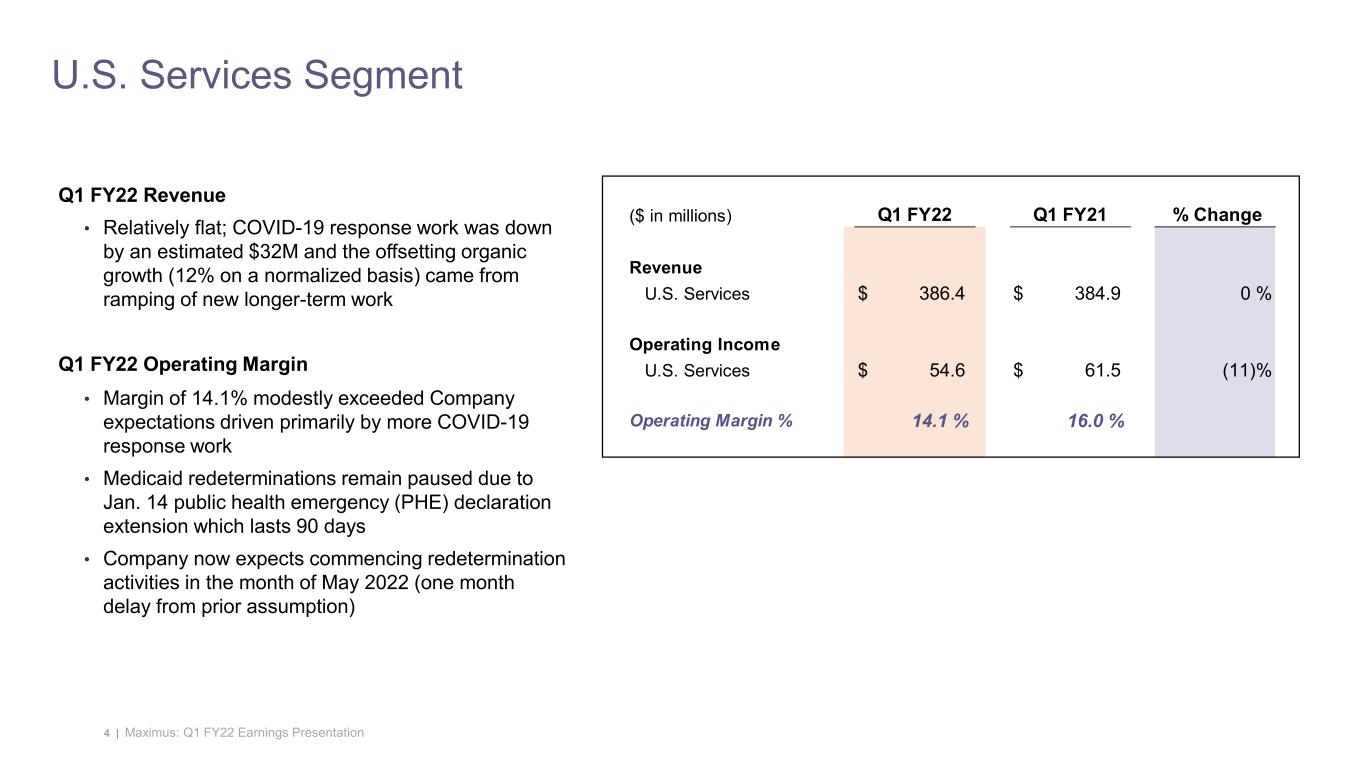
4 | Maximus: Q1 FY22 Earnings Presentation Q1 FY22 Revenue • Relatively flat; COVID-19 response work was down by an estimated $32M and the offsetting organic growth (12% on a normalized basis) came from ramping of new longer-term work Q1 FY22 Operating Margin • Margin of 14.1% modestly exceeded Company expectations driven primarily by more COVID-19 response work • Medicaid redeterminations remain paused due to Jan. 14 public health emergency (PHE) declaration extension which lasts 90 days • Company now expects commencing redetermination activities in the month of May 2022 (one month delay from prior assumption) U.S. Services Segment ($ in millions) Q1 FY22 Q1 FY21 % Change Revenue U.S. Services $ 386.4 $ 384.9 0 % Operating Income U.S. Services $ 54.6 $ 61.5 (11)% Operating Margin % 14.1 % 16.0 %
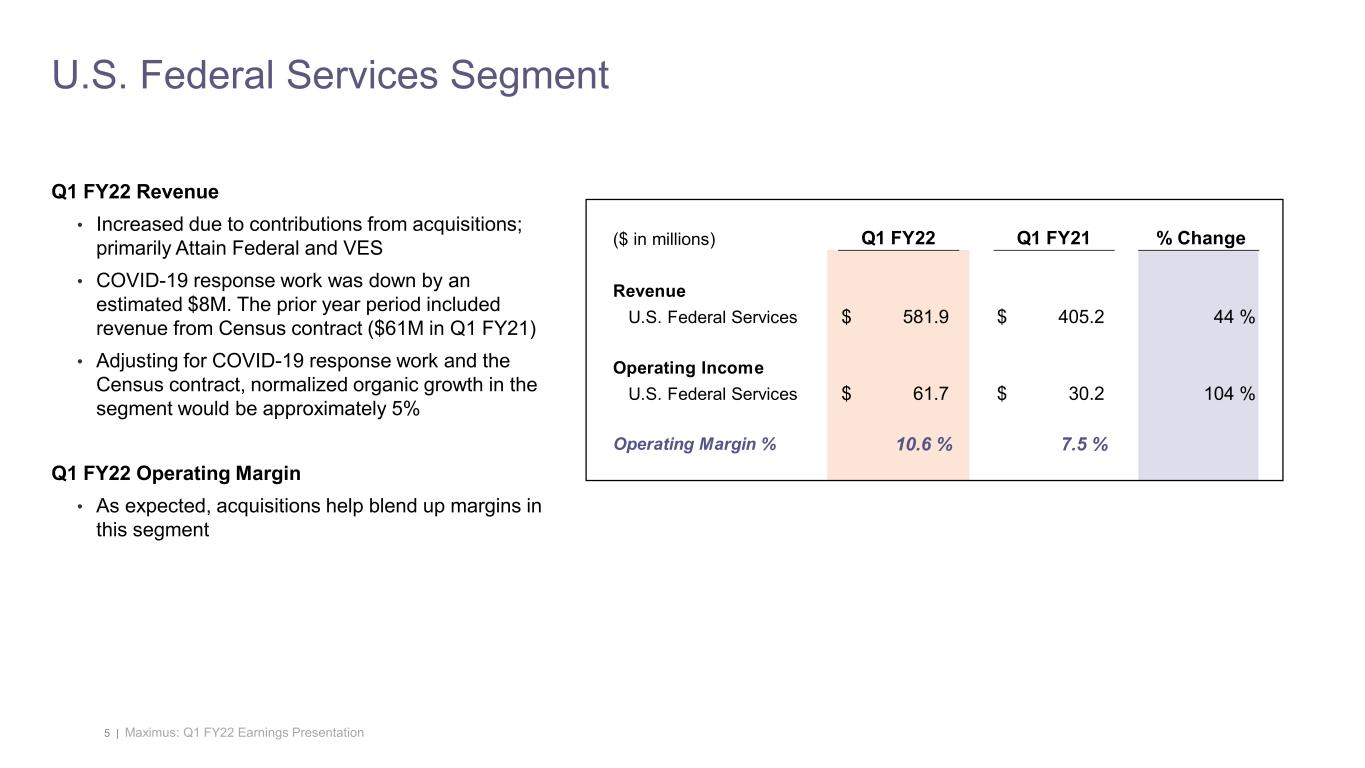
5 | Maximus: Q1 FY22 Earnings Presentation U.S. Federal Services Segment Q1 FY22 Revenue • Increased due to contributions from acquisitions; primarily Attain Federal and VES • COVID-19 response work was down by an estimated $8M. The prior year period included revenue from Census contract ($61M in Q1 FY21) • Adjusting for COVID-19 response work and the Census contract, normalized organic growth in the segment would be approximately 5% Q1 FY22 Operating Margin • As expected, acquisitions help blend up margins in this segment ($ in millions) Q1 FY22 Q1 FY21 % Change Revenue U.S. Federal Services $ 581.9 $ 405.2 44 % Operating Income U.S. Federal Services $ 61.7 $ 30.2 104 % Operating Margin % 10.6 % 7.5 %
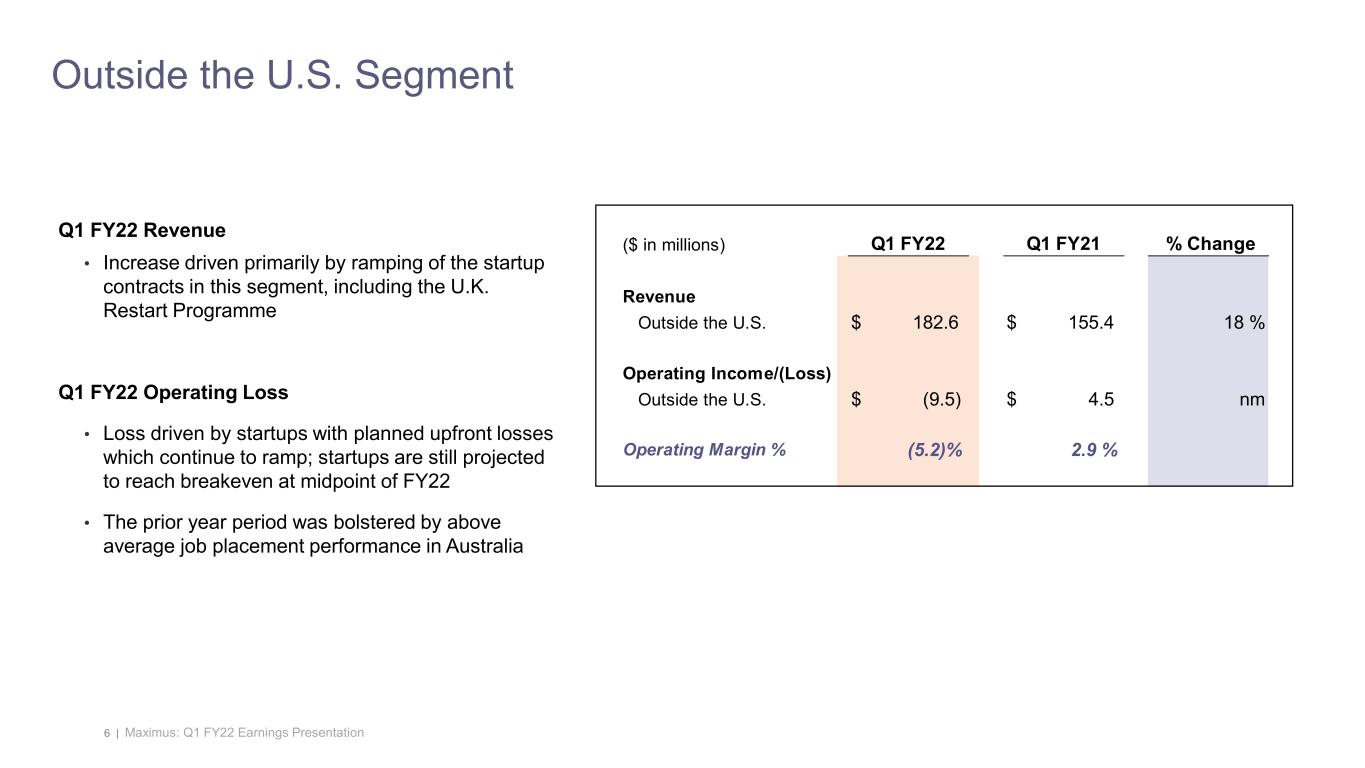
6 | Maximus: Q1 FY22 Earnings Presentation Outside the U.S. Segment Q1 FY22 Revenue • Increase driven primarily by ramping of the startup contracts in this segment, including the U.K. Restart Programme Q1 FY22 Operating Loss • Loss driven by startups with planned upfront losses which continue to ramp; startups are still projected to reach breakeven at midpoint of FY22 • The prior year period was bolstered by above average job placement performance in Australia ($ in millions) Q1 FY22 Q1 FY21 % Change Revenue Outside the U.S. $ 182.6 $ 155.4 18 % Operating Income/(Loss) Outside the U.S. $ (9.5) $ 4.5 nm Operating Margin % (5.2)% 2.9 %
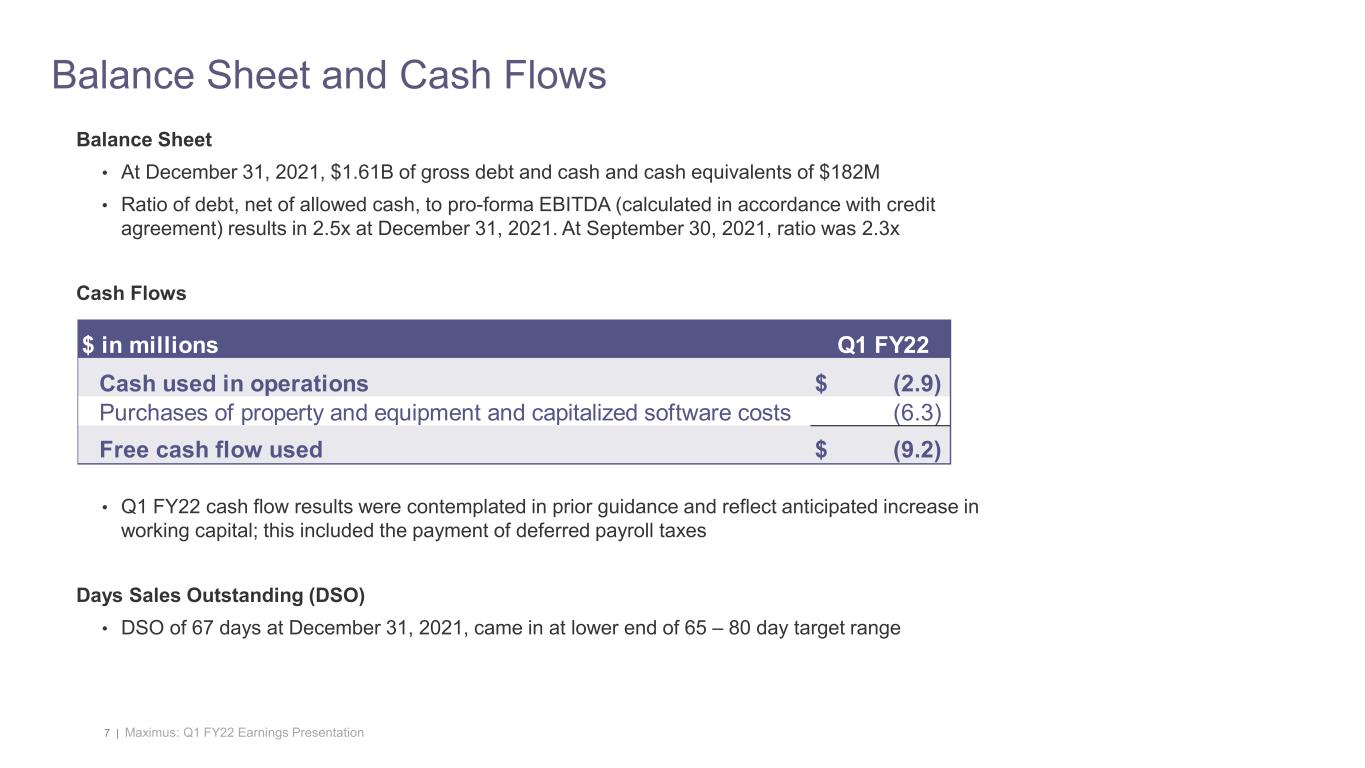
7 | Maximus: Q1 FY22 Earnings Presentation Balance Sheet • At December 31, 2021, $1.61B of gross debt and cash and cash equivalents of $182M • Ratio of debt, net of allowed cash, to pro-forma EBITDA (calculated in accordance with credit agreement) results in 2.5x at December 31, 2021. At September 30, 2021, ratio was 2.3x Cash Flows • Q1 FY22 cash flow results were contemplated in prior guidance and reflect anticipated increase in working capital; this included the payment of deferred payroll taxes Days Sales Outstanding (DSO) • DSO of 67 days at December 31, 2021, came in at lower end of 65 – 80 day target range Balance Sheet and Cash Flows $ in millions Q1 FY22 Cash used in operations $ (2.9) Purchases of property and equipment and capitalized software costs (6.3) Free cash flow used $ (9.2)
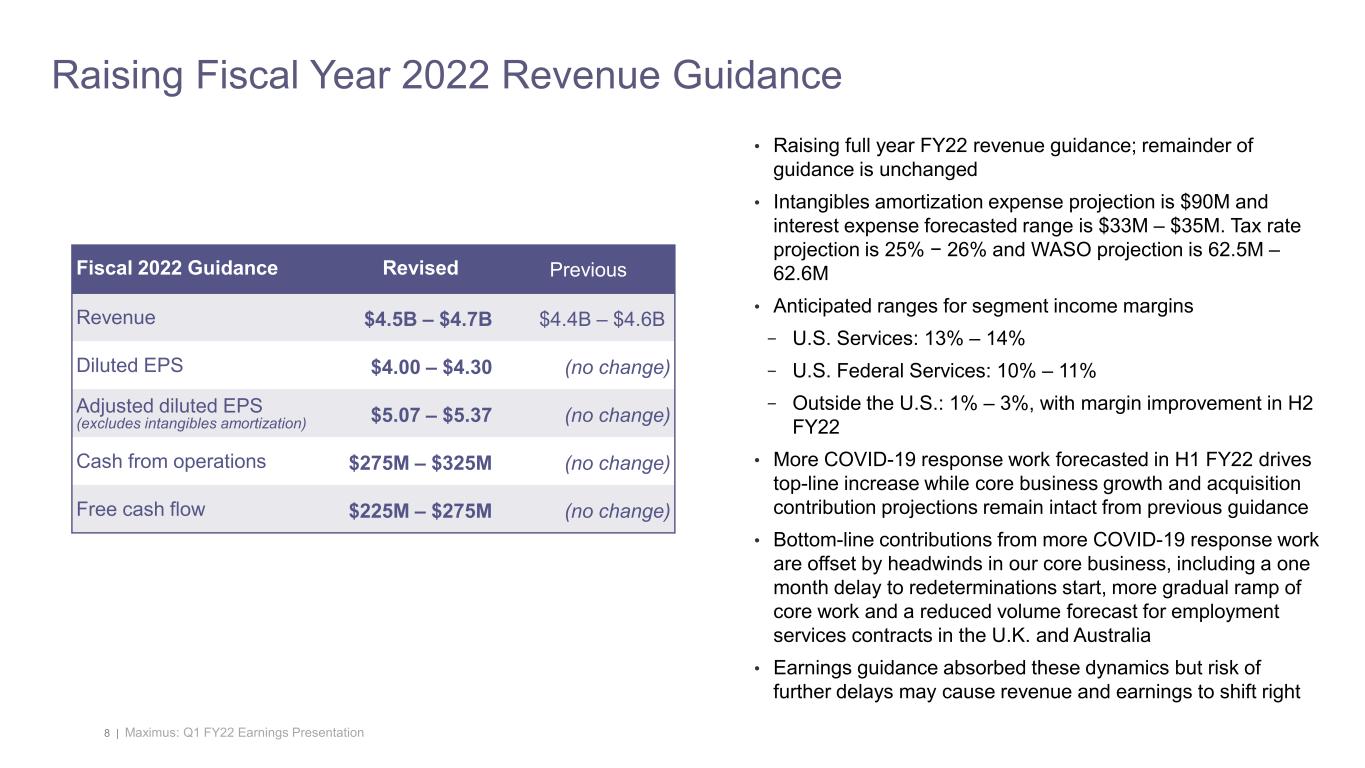
8 | Maximus: Q1 FY22 Earnings Presentation Raising Fiscal Year 2022 Revenue Guidance • Raising full year FY22 revenue guidance; remainder of guidance is unchanged • Intangibles amortization expense projection is $90M and interest expense forecasted range is $33M – $35M. Tax rate projection is 25% − 26% and WASO projection is 62.5M – 62.6M • Anticipated ranges for segment income margins − U.S. Services: 13% – 14% − U.S. Federal Services: 10% – 11% − Outside the U.S.: 1% – 3%, with margin improvement in H2 FY22 • More COVID-19 response work forecasted in H1 FY22 drives top-line increase while core business growth and acquisition contribution projections remain intact from previous guidance • Bottom-line contributions from more COVID-19 response work are offset by headwinds in our core business, including a one month delay to redeterminations start, more gradual ramp of core work and a reduced volume forecast for employment services contracts in the U.K. and Australia • Earnings guidance absorbed these dynamics but risk of further delays may cause revenue and earnings to shift right Fiscal 2022 Guidance Revised Previous Revenue $4.5B – $4.7B $4.4B – $4.6B Diluted EPS $4.00 – $4.30 (no change) Adjusted diluted EPS (excludes intangibles amortization) $5.07 – $5.37 (no change) Cash from operations $275M – $325M (no change) Free cash flow $225M – $275M (no change)
9 | Maximus: Q1 FY22 Earnings Presentation Bruce Caswell President & Chief Executive Officer Fiscal 2022 First Quarter Earnings Call February 3, 2022
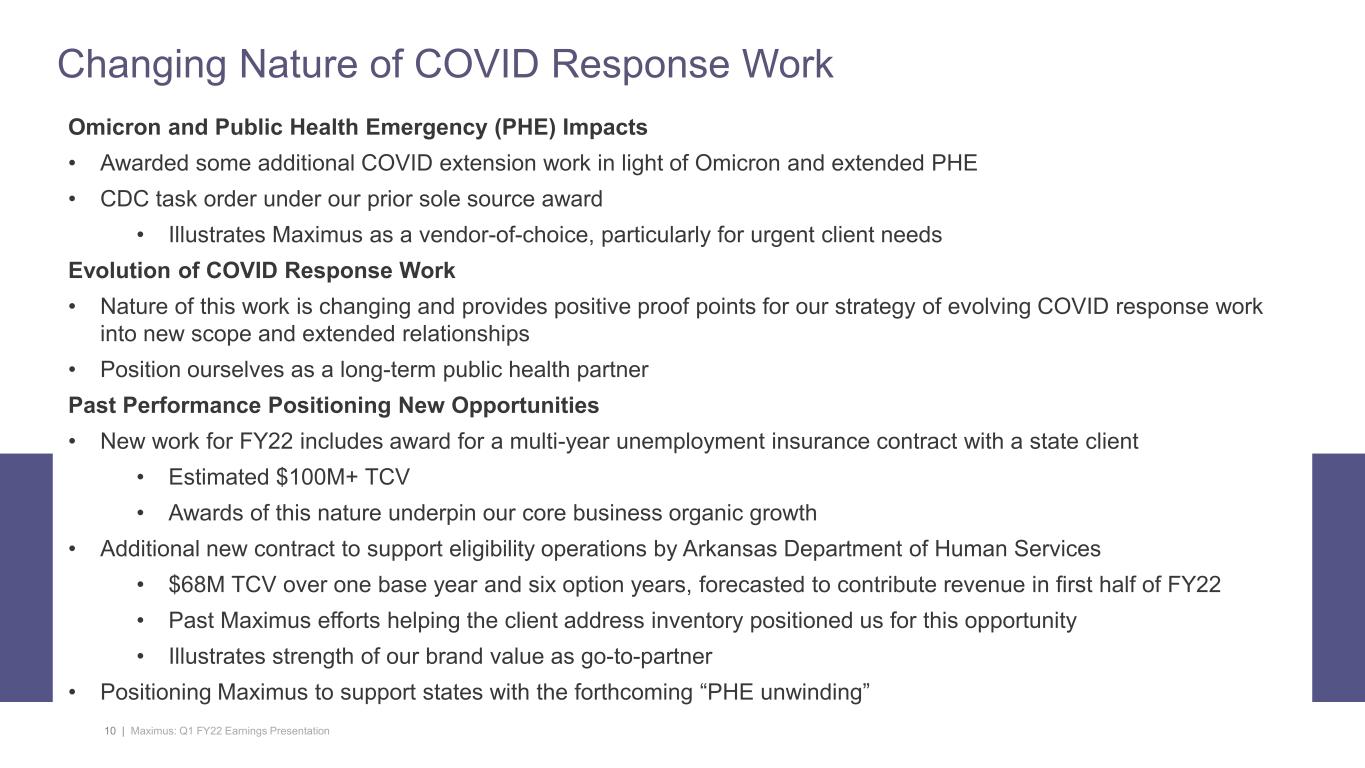
10 | Maximus: Q1 FY22 Earnings Presentation Changing Nature of COVID Response Work Omicron and Public Health Emergency (PHE) Impacts • Awarded some additional COVID extension work in light of Omicron and extended PHE • CDC task order under our prior sole source award • Illustrates Maximus as a vendor-of-choice, particularly for urgent client needs Evolution of COVID Response Work • Nature of this work is changing and provides positive proof points for our strategy of evolving COVID response work into new scope and extended relationships • Position ourselves as a long-term public health partner Past Performance Positioning New Opportunities • New work for FY22 includes award for a multi-year unemployment insurance contract with a state client • Estimated $100M+ TCV • Awards of this nature underpin our core business organic growth • Additional new contract to support eligibility operations by Arkansas Department of Human Services • $68M TCV over one base year and six option years, forecasted to contribute revenue in first half of FY22 • Past Maximus efforts helping the client address inventory positioned us for this opportunity • Illustrates strength of our brand value as go-to-partner • Positioning Maximus to support states with the forthcoming “PHE unwinding”
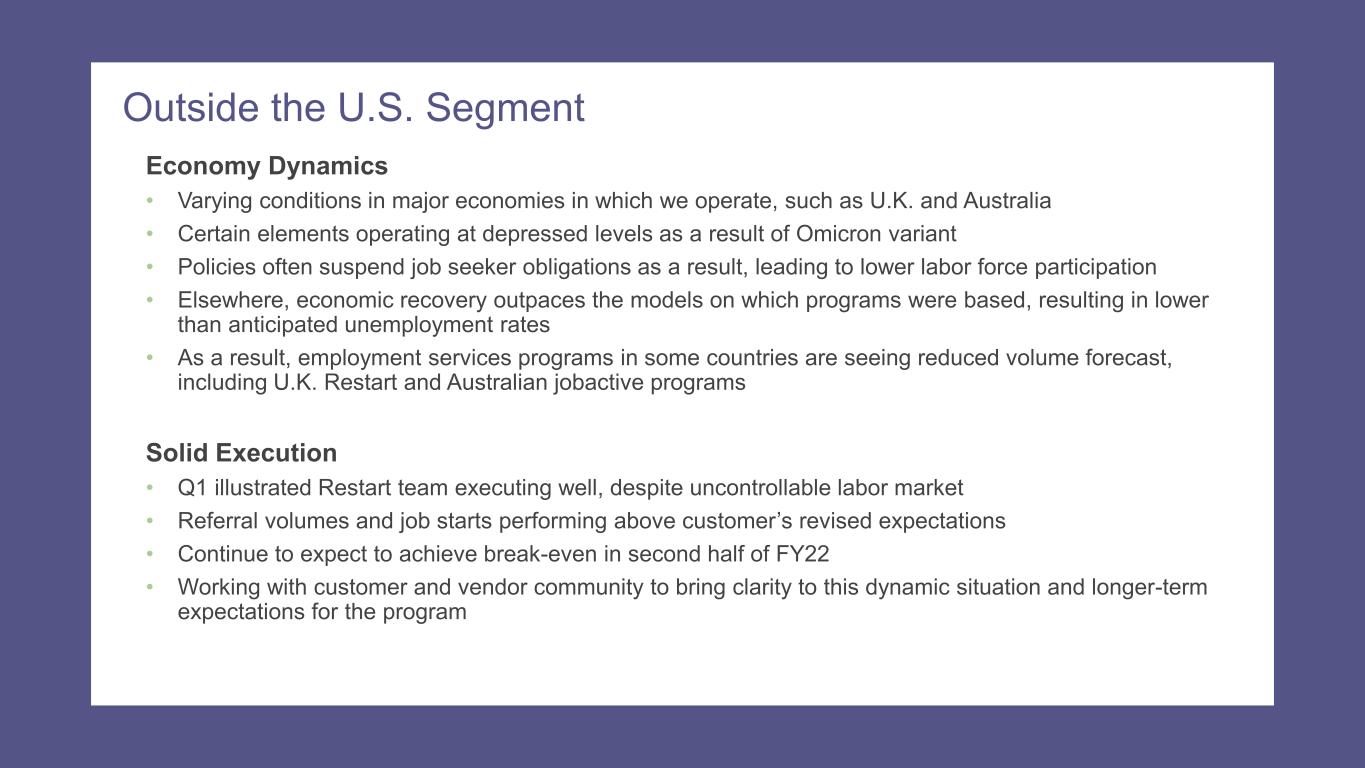
11 | Maximus: Q1 FY22 Earnings Presentation Economy Dynamics • Varying conditions in major economies in which we operate, such as U.K. and Australia • Certain elements operating at depressed levels as a result of Omicron variant • Policies often suspend job seeker obligations as a result, leading to lower labor force participation • Elsewhere, economic recovery outpaces the models on which programs were based, resulting in lower than anticipated unemployment rates • As a result, employment services programs in some countries are seeing reduced volume forecast, including U.K. Restart and Australian jobactive programs Solid Execution • Q1 illustrated Restart team executing well, despite uncontrollable labor market • Referral volumes and job starts performing above customer’s revised expectations • Continue to expect to achieve break-even in second half of FY22 • Working with customer and vendor community to bring clarity to this dynamic situation and longer-term expectations for the program Outside the U.S. Segment
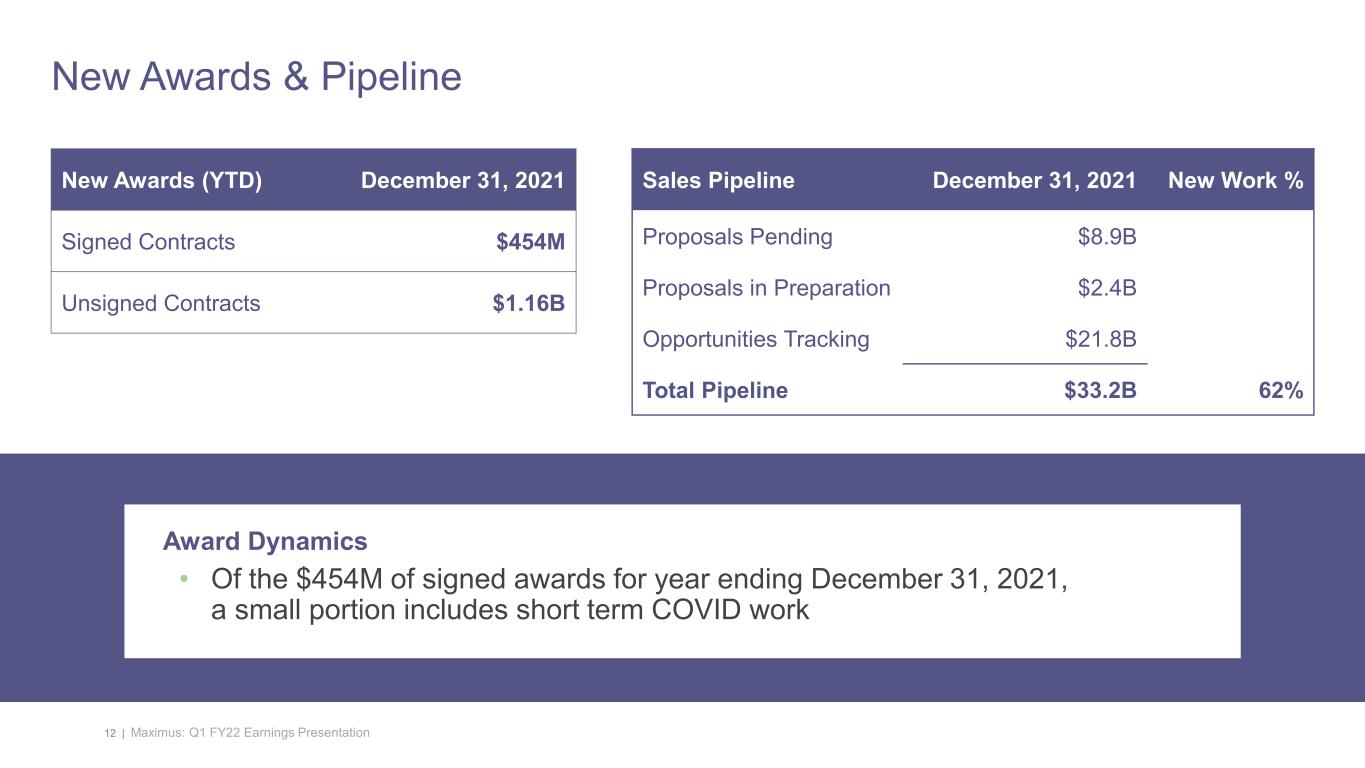
12 | Maximus: Q1 FY22 Earnings Presentation Sales Pipeline December 31, 2021 New Work % Proposals Pending $8.9B Proposals in Preparation $2.4B Opportunities Tracking $21.8B Total Pipeline $33.2B 62% New Awards (YTD) December 31, 2021 Signed Contracts $454M Unsigned Contracts $1.16B New Awards & Pipeline Award Dynamics • Of the $454M of signed awards for year ending December 31, 2021, a small portion includes short term COVID work
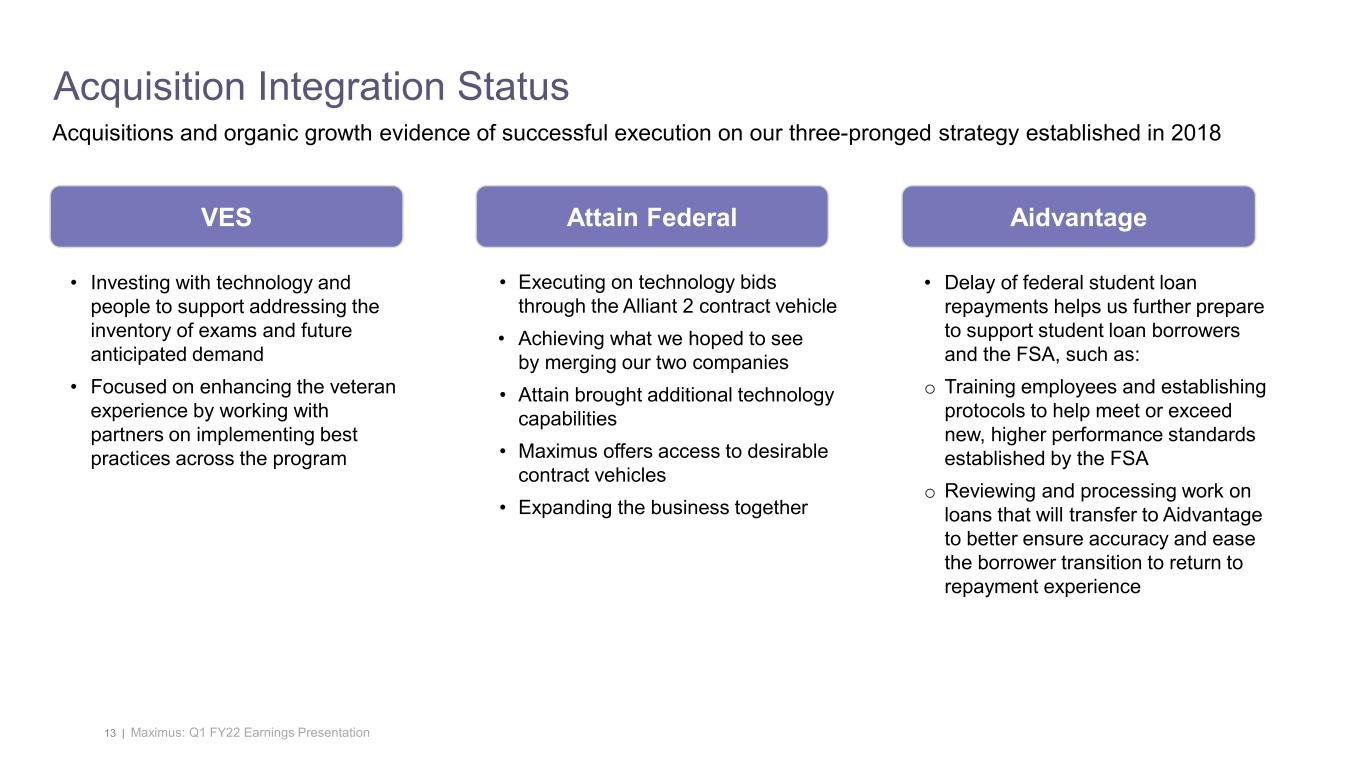
13 | Maximus: Q1 FY22 Earnings Presentation Acquisition Integration Status VES • Investing with technology and people to support addressing the inventory of exams and future anticipated demand • Focused on enhancing the veteran experience by working with partners on implementing best practices across the program Attain Federal • Executing on technology bids through the Alliant 2 contract vehicle • Achieving what we hoped to see by merging our two companies • Attain brought additional technology capabilities • Maximus offers access to desirable contract vehicles • Expanding the business together Aidvantage • Delay of federal student loan repayments helps us further prepare to support student loan borrowers and the FSA, such as: o Training employees and establishing protocols to help meet or exceed new, higher performance standards established by the FSA o Reviewing and processing work on loans that will transfer to Aidvantage to better ensure accuracy and ease the borrower transition to return to repayment experience Acquisitions and organic growth evidence of successful execution on our three-pronged strategy established in 2018
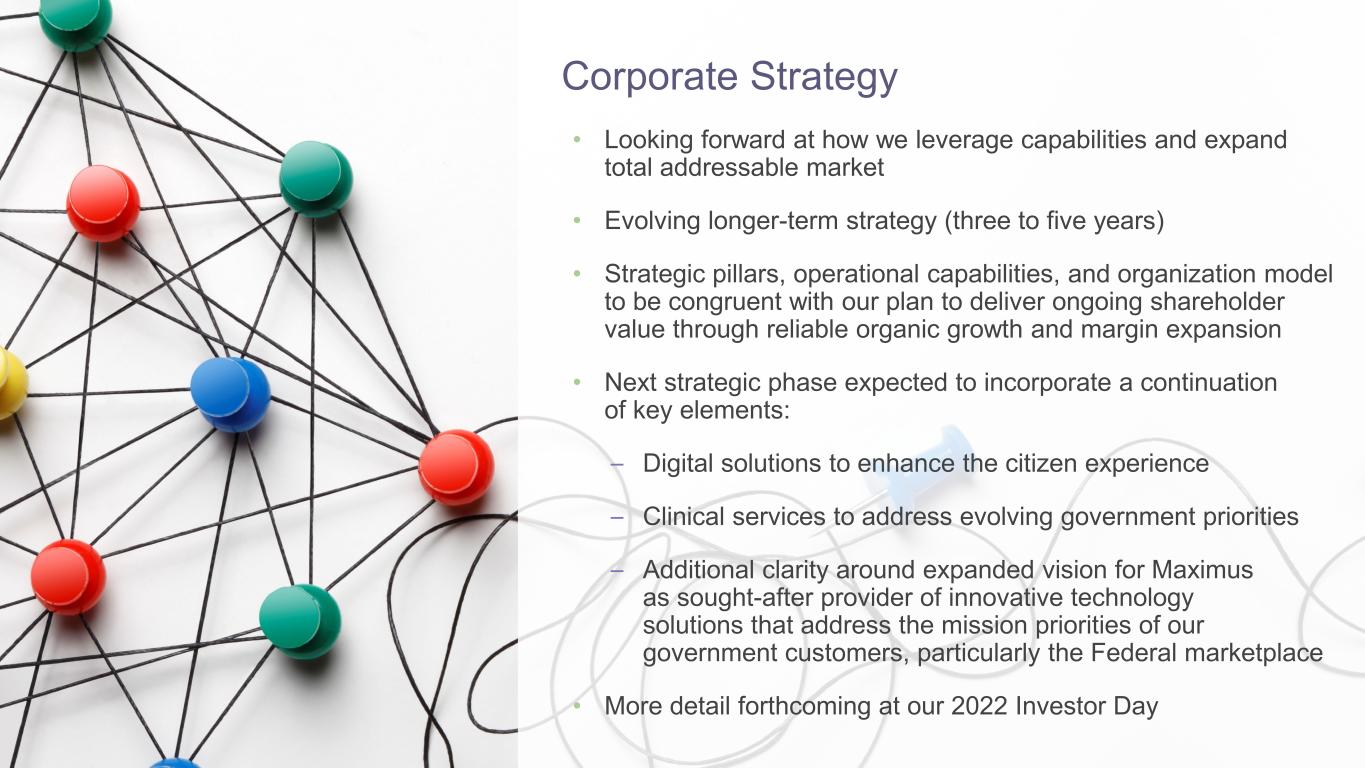
14 | Maximus: Q1 FY22 Earnings Presentation • Looking forward at how we leverage capabilities and expand total addressable market • Evolving longer-term strategy (three to five years) • Strategic pillars, operational capabilities, and organization model to be congruent with our plan to deliver ongoing shareholder value through reliable organic growth and margin expansion • Next strategic phase expected to incorporate a continuation of key elements: – Digital solutions to enhance the citizen experience – Clinical services to address evolving government priorities – Additional clarity around expanded vision for Maximus as sought-after provider of innovative technology solutions that address the mission priorities of our government customers, particularly the Federal marketplace • More detail forthcoming at our 2022 Investor Day Corporate Strategy
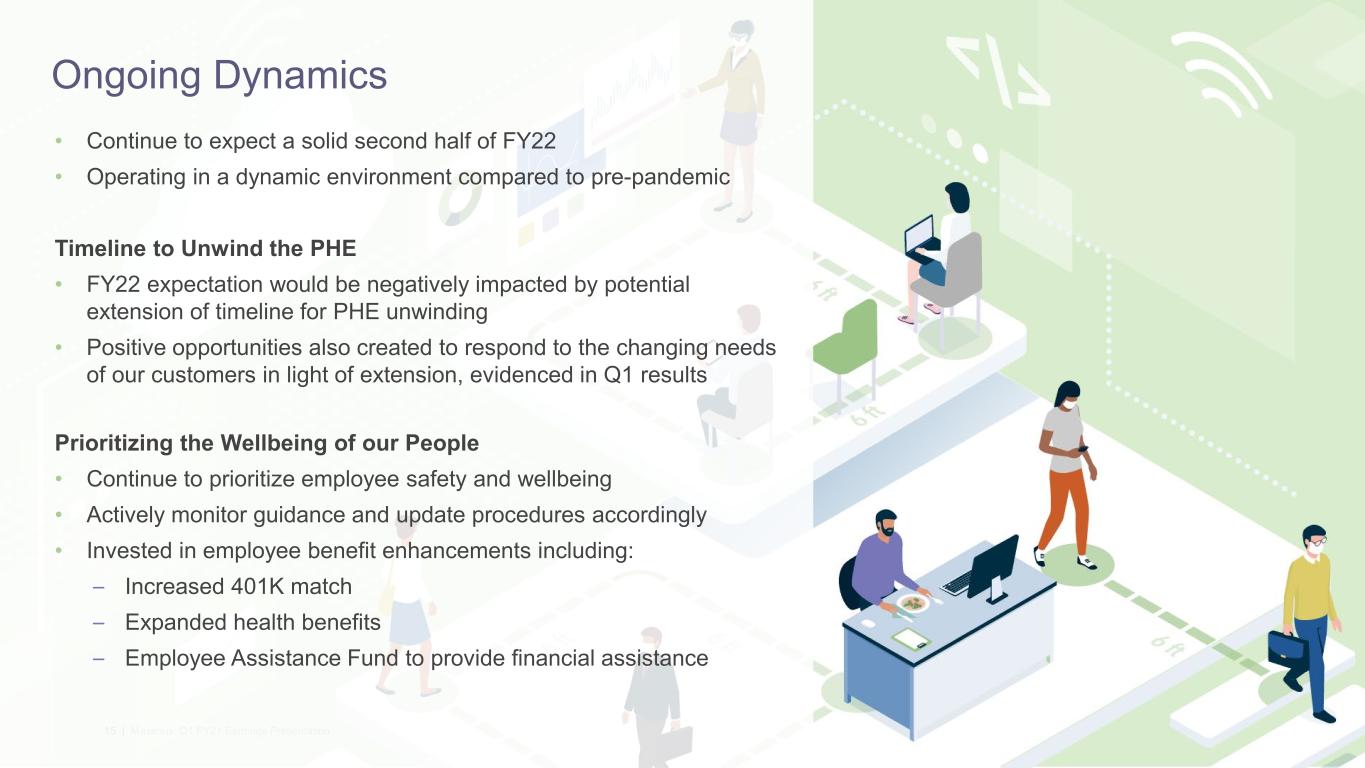
15 | Maximus: Q1 FY21 Earnings Presentation • Continue to expect a solid second half of FY22 • Operating in a dynamic environment compared to pre-pandemic Timeline to Unwind the PHE • FY22 expectation would be negatively impacted by potential extension of timeline for PHE unwinding • Positive opportunities also created to respond to the changing needs of our customers in light of extension, evidenced in Q1 results Prioritizing the Wellbeing of our People • Continue to prioritize employee safety and wellbeing • Actively monitor guidance and update procedures accordingly • Invested in employee benefit enhancements including: – Increased 401K match – Expanded health benefits – Employee Assistance Fund to provide financial assistance Ongoing Dynamics
16 | Maximus: Q1 FY22 Earnings Presentation Appendix
17 | Maximus: Q1 FY22 Earnings Presentation Normalized Organic Growth for Q1 FY22 Results Revenue (amounts in $M) FY21 Q1 Actuals COVID Impact FY21 Q1 Census Impact FY21 Q1 Normalized FY21 Q1 Actuals FY22 Q1 Actuals Acquisition Impact FY22 Q1 Currency Impact FY22 Q1 Organic Revenue FY22 Q1 COVID Impact FY22 Q1 Normalized FY22 Q1 Actuals U.S. Services 385$ (114)$ -$ 271$ 386$ -$ -$ 386$ (82)$ 304$ U.S. Federal 405 (46) (61) 298 582 (230) - 352 (38) 314 Outside the U.S. 155 - - 155 183 (6) (2) 174 - 174 Total 946$ (160)$ (61)$ 725$ 1,151$ (236)$ (2)$ 913$ (120)$ 793$ Actual Growth QoQ Organic Growth QoQ Normalized Organic Growth QoQ U.S. Services 0.4% 0.4% 12.4% U.S. Federal 43.6% -13.2% 5.2% Outside the U.S. 17.5% 12.3% 12.3% Total 21.7% -3.5% 9.4%