
MMS 8-K
Maximus, Inc. (MMS)
8-K
2021-05-10
For: 2021-05-10
View Original
Added on
April 10, 2026
UNITED STATES
SECURITIES AND EXCHANGE COMMISSION
Washington, D.C. 20549
___________
FORM 8-K
CURRENT REPORT
Pursuant to Section 13 or 15(d) of the Securities Exchange Act of 1934
Date of report: May 10, 2021
Date of earliest event reported: May 6, 2021
___________
(Exact name of registrant as specified in its charter)
(State or other jurisdiction of incorporation) | (Commission File Number) | (I.R.S. Employer Identification No.) | |||||||||
(Address of principal executive offices) | (Zip Code) | ||||||||||
Registrant’s telephone number, including area code: (703 ) 251-8500
Not Applicable
(Former name or former address, if changed since last report)
Check the appropriate box below if the Form 8-K filing is intended to simultaneously satisfy the filing obligation of the registrant under any of the following provisions:
Securities registered pursuant to Section 12(b) of the Act:
Title of each class | Trading Symbol(s) | Name of each exchange on which registered | ||||||||||||
Indicate by check mark whether the registrant is an emerging growth company as defined in Rule 405 of the Securities Act of 1933 (§230.405 of this chapter) or Rule 12b-2 of the Securities Exchange Act of 1934 (§240.12b-2 of this chapter).
Emerging growth company ☐
If an emerging growth company, indicate by check mark if the registrant has elected not to use the extended transition period for complying with any new or revised financial accounting standards provided pursuant to Section 13(a) of the Exchange Act. ☐
Item 2.02 Results of Operations and Financial Condition.
On May 6, 2021, the Company issued a press release announcing its financial results for the quarter ended March 31, 2021. The full text of the press release is furnished as Exhibit 99.1 to this Current Report on Form 8-K and incorporated by reference into this Item 2.02.
On May 6, 2021, the Company held a conference call with respect to these financial results. The conference call was open to the public. The transcript and slide presentation that accompanied the call are furnished as Exhibit 99.2 and Exhibit 99.3 to this Current Report on Form 8-K and incorporated by reference into this Item 2.02.
Item 9.01 Financial Statements and Exhibits.
(d) Exhibits. The following exhibits are being furnished pursuant to Item 2.02 above.
| Exhibit No. | Description | ||||
| Press release dated May 6, 2021 | |||||
| Conference call transcript for Earnings Call - May 6, 2021 | |||||
| Conference call slide presentation for Earnings Call - May 6, 2021 | |||||
SIGNATURES
Pursuant to the requirements of the Securities Exchange Act of 1934, the registrant has duly caused this report to be signed on its behalf by the undersigned hereunto duly authorized.
| Maximus, Inc. | ||||||||||||||
| Date: May 10, 2021 | By: | /s/ David R. Francis | ||||||||||||
| David R. Francis | ||||||||||||||
| General Counsel and Secretary | ||||||||||||||

| FOR IMMEDIATE RELEASE | CONTACT: | James Francis 703.251.8526 | |||||||||
| [email protected] | |||||||||||
| Date: May 6, 2021 | |||||||||||
Maximus Reports Fiscal Year 2021 Second Quarter Results
- Strong Demand for COVID-19 Response Work Improves Full-Year Outlook -
(RESTON, Va. - May 6, 2021) - Maximus (NYSE: MMS), a leading provider of government services worldwide, reported financial results for the three and six months ended March 31, 2021.
Highlights for the second quarter of fiscal 2021 include:
•Revenue increased 17.3% compared to the prior-year period driven by new COVID-19 response work such as vaccination distribution support services, unemployment insurance program support, disease investigation, contact tracing, and other key initiatives.
•Operating income margin was 11.8% and diluted earnings per share were $1.29.
•Results for the quarter were better than Company expectations due to higher level of COVID-19 response work in the U.S. segments, most notably U.S. Services, and employment services work in Australia.
•The Company is raising guidance for fiscal 2021 as a result of the improved COVID-19 response work forecast and following the recently announced acquisitions of the Federal division of Attain, LLC and Veterans Evaluation Services, Inc. (VES). Revenue is expected to range between $4.0 billion and $4.2 billion and diluted earnings per share to range between $4.20 and $4.40 per share including the expected impact of the two acquisitions.
•A quarterly cash dividend of $0.28 per share payable on May 28, 2021, to shareholders of record on May 14, 2021.
"Over the past year, Maximus has served at the forefront of government efforts to control the spread and address the challenges of the global pandemic as our team has rallied to keep our employees safe and help citizens secure needed support," shared Bruce Caswell, President and Chief Executive Officer. "Now, more than ever, governments desire flexibility to adapt quickly to the changing economic, health, and employment needs of individuals and families. We are proud that our customers rely on our proven agility and scalability in providing secure and effective solutions to meet these demands."
Second Quarter Results
For the second quarter of fiscal 2021, revenue increased 17.3% to $959.3 million as compared to $818.1 million reported for the prior-year period driven by COVID-19 response work including vaccination distribution support services, unemployment insurance program support, disease investigation, contact tracing, and other key initiatives.
Organic growth excluding the effects of currency for the second quarter of fiscal 2021 was 12.8%, or 29.0% excluding the expected wind-down of the Census contract. COVID-19 response work contributed approximately $242 million and $402 million for the three and six months ended March 31, 2021, respectively.

For the second quarter of fiscal 2021, operating income totaled $113 million, yielding an operating margin of 11.8%. This compares to an operating margin of 4.6% for the prior-year period.
Results for the quarter included Attain operations from the acquisition date of March 1, 2021, which contributed revenue of $19.9 million and operating income, including amortization of intangible assets, of $3.0 million.
U.S. Services Segment
U.S. Services Segment revenue for the second quarter of fiscal 2021 increased 45% to $448.2 million as compared to $308.7 million reported for the prior-year period. An estimated $175 million of COVID-19 response work contributed to the segment's revenue.
Operating margin for the second quarter of fiscal 2021 was 18.5% compared to 15.0% reported for the prior-year period. The operating margin reflects better than expected operating results from the COVID-19 response work, offsetting the significant revenue and profit headwinds experienced on some of this segment's core programs. In order to continue receiving enhanced U.S. federal matching funds for Medicaid, state customers paused Medicaid redeterminations to ensure beneficiaries have continued access to vital healthcare services during the global public health crisis. The pause continues to affect the segment making the timing of the return of some core programs to pre-pandemic levels uncertain. The Company cannot predict the relationship between the natural conclusion of the COVID-19 response work and core program improvement.
The Company expects this segment to deliver an operating income margin in the range of 17% to 18% for fiscal 2021.
U.S. Federal Services Segment
U.S. Federal Services Segment revenue for the second quarter of fiscal 2021 decreased to $330.1 million as compared to $393.4 million reported for the prior-year period. As expected, the Census contract contributed $133.1 million less revenue in the period as compared to the prior-year period. Excluding the Census contract, organic growth for this segment was 13.0% and driven principally by an estimated $56.0 million of revenue from COVID-19 response work. Segment results included one month contribution of revenue totaling $19.9 million from Attain.
The operating margin for the second quarter of fiscal 2021 was 7.0% as compared to 7.7% reported for the prior-year period. COVID-19 response work continues to backfill some of the temporary shortfalls created by reduced volumes, revenue, and profit from accretive, performance-based contracts in this segment.
The Company recently announced two acquisitions for the U.S. Federal Services Segment. The acquisition of Attain is expected to contribute $120 million to $140 million of revenue and be accretive for the seven months of fiscal 2021 following the acquisition date. For the trailing twelve months ended March 31, 2021, the pro-forma adjusted EBITDA for Attain was approximately $32 million. Adjusted EBITDA is presented in the Management's Discussion and Analysis section of the Company's Forms 10-Q and 10-K.
The acquisition of VES was announced on April 21, 2021, and is expected to close in the Company's third quarter of fiscal 2021. VES is expected to contribute $160 million to $175 million for the four months of fiscal 2021, assuming the transaction closes in early June.
Following second quarter results and the Attain acquisition, the full year margin forecast improved to approximately 8% before consideration of VES. The fixed price nature of the VES contracts naturally carry operating income margins greater than the U.S. federal historical average over the past three years. The Company expects the U.S. Federal Services Segment to deliver an operating margin in the range of 9% to 10% after the acquisition of VES, assuming the transaction closes in early June.
Outside the U.S. Segment
Outside the U.S. Segment revenue for the second quarter of fiscal 2021 increased to $180.9 million as compared to $116.0 million reported for the prior-year period. Operating income for the second quarter of fiscal 2021 was $15.1 million which yielded an operating margin of 8.3%. This compares to an operating loss of $26.7 million reported for the prior-year period as a result of this segment experiencing the most pronounced impacts from the pandemic. Results for the second quarter of fiscal 2021 were better than Company expectations largely due to efficient operations in Australia where market conditions continued to create and sustain job opportunities.
The Company is seeing stronger demand than previously forecasted for employment services in the Outside the U.S. Segment. On April 26, 2021, a large win covering two regions to deliver the U.K. Restart programme was announced. In addition, there are new employment services programs in place in Saudi Arabia, Sweden, South Korea, and Italy.
Employment services programs typically experience startup losses in the early phase of operations which are expected to impact this segment's third and fourth quarters of fiscal 2021. The two-region win on the U.K. Restart programme is responsible for the largest share of the estimated startup losses which are more heavily weighted to the fourth quarter. The programs in startup are expected to exceed 10% operating income margin over the life of each contract, ranging from one to six years, given the performance-based nature and strong demand for employment services.
The Company expects the Outside the U.S. Segment to deliver an operating margin in the low single digits primarily as a result of the startup losses. The fourth quarter for this segment is expected to realize an operating loss due to the U.K. Restart programme.
Sales and Pipeline
Year-to-date signed contract awards at March 31, 2021, totaled $1.1 billion and contracts pending (awarded but unsigned) totaled $1.3 billion. These awards reflect total contract value. The previously-announced U.K. Restart award and recently-posted CDC Vaccination Hotline award were subsequent to March 31, 2021.
The sales pipeline at March 31, 2021, was $35.6 billion (comprised of approximately $6.9 billion in proposals pending, $1.6 billion in proposals in preparation, and $27.0 billion in opportunities tracking) and includes contributions from the Attain acquisition.
Mr. Caswell continued, "The ongoing value of partners like Maximus has been evidenced during the pandemic through our ability to maintain continuity of vital programs and to support new economic relief and public health initiatives. I am proud of our teams who continue to support these new initiatives which tend to have an extremely quick turnaround between the proposal, award, and delivery. Looking further down the road, our new work pipeline continues to be strong, representing about 67% of the total pipeline, with all three segments contributing good opportunities."
Balance Sheet and Cash Flows
Cash and cash equivalents at March 31, 2021, totaled $101.7 million. At March 31, 2021, there was $240 million of outstanding draws on the Company's $400 million corporate credit facility.
For the three months ended March 31, 2021, cash from operations totaled $181.6 million and free cash flow was $167.1 million. Days sales outstanding (DSO) were 70 days at March 31, 2021, including Attain on a pro-forma basis.
On April 9, 2021, our Board of Directors declared a quarterly cash dividend of $0.28 for each share of our common stock outstanding. The dividend is payable on May 28, 2021, to shareholders of record on May 14, 2021.
Increased Outlook
For the second consecutive quarter, Maximus is increasing revenue, earnings, and cash flow guidance for fiscal 2021 following recent awards, scope increases, and contract extensions related to COVID-19 response work. The Company anticipates fiscal 2021 revenue will range between $4.0 billion and $4.2 billion and diluted earnings per share will range between $4.20 and $4.40 per share including the impact of the two recently announced acquisitions.
For the second consecutive quarter, Maximus is increasing revenue, earnings, and cash flow guidance for fiscal 2021 following recent awards, scope increases, and contract extensions related to COVID-19 response work. The Company anticipates fiscal 2021 revenue will range between $4.0 billion and $4.2 billion and diluted earnings per share will range between $4.20 and $4.40 per share including the impact of the two recently announced acquisitions.
For fiscal 2021, cash from operations is expected to range between $400 million and $450 million and free cash flow between $360 million and $410 million. The effective tax rate is expected to range between 26% and 27% and weighted average shares outstanding to range between 62.2 million and 62.3 million.
Revenue attributable to COVID-19 response work is anticipated to range between $800 million and $850 million for fiscal 2021. The COVID-19 response work is expected to diminish over time, resulting in a lower fourth quarter as compared to the third quarter. The fourth quarter is further impacted by the planned startup losses in the Outside the U.S. Segment. The VES acquisition is assumed to be slightly dilutive to the Company's fiscal 2021 diluted earnings per share.
The negative impacts from the temporary changes to some core programs as a result of the pandemic are expected to persist through the remainder of fiscal 2021. The Company assumes the Public Health Emergency (PHE) will continue past fiscal 2021 year-end.
Mr. Caswell added, "The impressive accomplishments achieved halfway through fiscal year 2021 are a testament to our long-term strategy and the dedication of our team. We continue to demonstrate our ability to quickly respond to evolving customer needs to combat the global health crisis, including new contracts supporting vaccination administration efforts, while continuing strong support for core program operations that themselves have adapted to changing government policy. We have had an exciting and busy second quarter with two acquisitions furthering all three pillars of our long-term strategic plan. Moreover, our recognition as an industry leader in the employment services market resulted in the U.K. Restart win among other startup programs in the Outside the U.S. Segment."
Conference Call and Webcast Information
Maximus will host a conference call this morning, May 6, 2021, at 9:00 a.m. (ET).
The call is open to the public and available by webcast or by phone at:
877.407.8289 (Domestic) / +1.201.689.8341 (International)
For those unable to listen to the live call, a recording of the webcast will be available on investor.maximus.com.
About Maximus
Since 1975, Maximus has operated under its founding mission of Helping Government Serve the People®, enabling citizens around the globe to successfully engage with their governments at all levels and across a variety of health and human services programs. Maximus delivers innovative business process management and technology solutions that contribute to improved outcomes for citizens and higher levels of productivity, accuracy, accountability, and efficiency of government-sponsored programs. With approximately 34,000 employees worldwide, Maximus is a proud partner to government agencies in the United States, Australia, Canada, Italy, Saudi Arabia, Singapore, South Korea, Sweden, and the United Kingdom. For more information, visit maximus.com.
Non-GAAP Measures
This release refers to non-GAAP measures and other indicators, including organic growth, free cash flow, and days sales outstanding.
A description of these non-GAAP measures, the reasons why we use and present them, and details as to how they are calculated are included in our Annual Report on Form 10-K.
The presentation of these non-GAAP numbers is not meant to be considered in isolation, nor as alternatives to cash flows from operations, revenue growth, or net income as measures of performance. These non-GAAP financial measures, as determined and presented by us, may not be comparable to related or similarly titled measures presented by other companies.
Statements that are not historical facts, including statements about the Company’s confidence and strategies, and the Company’s expectations about revenues, results of operations, profitability, future contracts, market opportunities, market demand, or acceptance of the Company’s products are forward-looking statements that involve risks and uncertainties such as those related to the impact of the pandemic and our recently-completed and announced acquisitions including but not limited to:
•Completing the acquisition of VES Group, Inc. ("VES") within the timeframe anticipated or at all, difficulties in integrating VES and the Federal business of Attain, LLC (“Attain”) including realization of the expected benefits, and adverse effects on the business including the ability to meet obligations resulting from indebtedness required to complete the VES acquisition
•The ultimate duration of the pandemic
•The threat of further negative pandemic-related impacts
•Delays in our core programs returning to normal volumes and operations
•The potential impacts resulting from budget challenges with our government clients
•The possibility of delayed or missed payments by customers
•The potential for further supply chain disruptions impacting IT or safety equipment
•The impact of further legislation and government policies on the programs we operate
These risks could cause the Company’s actual results to differ materially from those indicated by such forward-looking statements. A summary of risk factors can be found in Item 1A, "Risk Factors" in our Annual Report on Form 10-K for the year ended September 30, 2020, which was filed with the Securities and Exchange Commission (SEC) on November 19, 2020. A supplemental description of risk factors related to the Company's completed acquisition of the Federal business of Attain and proposed acquisition of VES are included in our Quarterly Report on Form 10-Q for the quarter ended March 31, 2021 to be filed shortly. The Company's SEC reports are accessible on maximus.com.
Maximus, Inc.
CONSOLIDATED STATEMENTS OF OPERATIONS
(Amounts in thousands, except per share data)
(Unaudited)
| Three Months Ended March 31, | Six Months Ended March 31, | ||||||||||||||||||||||
| 2021 | 2020 | 2021 | 2020 | ||||||||||||||||||||
| Revenue | $ | 959,280 | $ | 818,135 | $ | 1,904,834 | $ | 1,636,364 | |||||||||||||||
| Cost of revenue | 728,622 | 665,037 | 1,468,121 | 1,307,816 | |||||||||||||||||||
| Gross profit | 230,658 | 153,098 | 436,713 | 328,548 | |||||||||||||||||||
| Selling, general, and administrative expenses | 112,402 | 106,853 | 224,369 | 194,080 | |||||||||||||||||||
| Amortization of intangible assets | 5,070 | 8,934 | 11,586 | 18,022 | |||||||||||||||||||
| Operating income | 113,186 | 37,311 | 200,758 | 116,446 | |||||||||||||||||||
| Interest expense | 756 | 465 | 962 | 949 | |||||||||||||||||||
| Other (expense)/income, net | (520) | 573 | (1,295) | 1,292 | |||||||||||||||||||
| Income before income taxes | 111,910 | 37,419 | 198,501 | 116,789 | |||||||||||||||||||
| Provision for income taxes | 31,296 | 9,769 | 53,810 | 30,405 | |||||||||||||||||||
| Net income | $ | 80,614 | 27,650 | $ | 144,691 | $ | 86,384 | ||||||||||||||||
| Basic earnings per share | $ | 1.30 | $ | 0.43 | $ | 2.33 | $ | 1.34 | |||||||||||||||
| Diluted earnings per share | $ | 1.29 | $ | 0.43 | $ | 2.33 | $ | 1.34 | |||||||||||||||
| Dividends paid per share | $ | 0.28 | $ | 0.28 | $ | 0.56 | $ | 0.56 | |||||||||||||||
| Weighted average shares outstanding: | |||||||||||||||||||||||
| Basic | 62,026 | 63,934 | 62,022 | 64,264 | |||||||||||||||||||
| Diluted | 62,294 | 64,125 | 62,212 | 64,446 | |||||||||||||||||||
Maximus, Inc.
CONSOLIDATED BALANCE SHEETS
(Amounts in thousands)
| March 31, 2021 | September 30, 2020 | ||||||||||
| (unaudited) | |||||||||||
| ASSETS | |||||||||||
| Current assets: | |||||||||||
| Cash and cash equivalents | $ | 101,683 | $ | 71,737 | |||||||
| Accounts receivable — billed and billable, net of allowance of $6,821 and $6,051 | 582,474 | 622,871 | |||||||||
| Accounts receivable — unbilled | 177,938 | 163,332 | |||||||||
| Income taxes receivable | 1,685 | 2,075 | |||||||||
| Prepaid expenses and other current assets | 68,357 | 72,543 | |||||||||
| Total current assets | 932,137 | 932,558 | |||||||||
| Property and equipment, net | 62,087 | 66,721 | |||||||||
| Capitalized software, net | 45,351 | 38,033 | |||||||||
| Operating lease right-of-use assets | 176,826 | 177,159 | |||||||||
| Goodwill | 899,796 | 593,129 | |||||||||
| Intangible assets, net | 240,463 | 145,893 | |||||||||
| Deferred contract costs, net | 30,309 | 20,891 | |||||||||
| Deferred compensation plan assets | 43,747 | 36,819 | |||||||||
| Deferred income taxes | 222 | 1,915 | |||||||||
| Other assets | 10,457 | 11,584 | |||||||||
| Total assets | $ | 2,441,395 | $ | 2,024,702 | |||||||
| LIABILITIES AND SHAREHOLDERS’ EQUITY | |||||||||||
| Current liabilities: | |||||||||||
| Accounts payable and accrued liabilities | $ | 278,629 | $ | 253,338 | |||||||
| Accrued compensation and benefits | 124,279 | 137,101 | |||||||||
| Deferred revenue | 61,475 | 51,655 | |||||||||
| Income taxes payable | 8,051 | 5,377 | |||||||||
| Current portion of long-term debt and other borrowings | 16,551 | 10,878 | |||||||||
| Operating lease liabilities | 79,430 | 80,748 | |||||||||
| Other current liabilities | 25,309 | 22,071 | |||||||||
| Total current liabilities | 593,724 | 561,168 | |||||||||
| Deferred revenue, less current portion | 32,926 | 27,311 | |||||||||
| Deferred income taxes | 31,044 | 24,737 | |||||||||
| Long-term debt, less current portion | 250,601 | 18,017 | |||||||||
| Deferred compensation plan liabilities, less current portion | 44,076 | 38,654 | |||||||||
| Operating lease liabilities, less current portion | 110,124 | 104,011 | |||||||||
| Other liabilities | 8,995 | 8,985 | |||||||||
| Total liabilities | 1,071,490 | 782,883 | |||||||||
| Shareholders’ equity: | |||||||||||
| Common stock, no par value; 100,000 shares authorized; 61,472 and 61,504 shares issued and outstanding at March 31, 2021, and September 30, 2020, respectively | 528,205 | 513,959 | |||||||||
| Accumulated other comprehensive loss | (34,945) | (42,638) | |||||||||
| Retained earnings | 876,645 | 770,498 | |||||||||
| Total shareholders' equity | 1,369,905 | 1,241,819 | |||||||||
| Total liabilities and shareholders' equity | $ | 2,441,395 | $ | 2,024,702 | |||||||
Maximus, Inc.
CONSOLIDATED STATEMENTS OF CASH FLOWS
(Amounts in thousands)
(Unaudited)
| Three Months Ended March 31, | Six Months Ended March 31, | ||||||||||||||||||||||
| 2021 | 2020 | 2021 | 2020 | ||||||||||||||||||||
| Cash flows from operations: | |||||||||||||||||||||||
| Net income | $ | 80,614 | $ | 27,650 | $ | 144,691 | $ | 86,384 | |||||||||||||||
| Adjustments to reconcile net income to cash flows from operations: | |||||||||||||||||||||||
| Depreciation and amortization of property and equipment and capitalized software | 11,018 | 15,900 | 22,835 | 31,218 | |||||||||||||||||||
| Amortization of intangible assets | 5,070 | 8,934 | 11,586 | 18,022 | |||||||||||||||||||
| Deferred income taxes | 6,653 | 2,616 | 7,951 | 3,038 | |||||||||||||||||||
| Stock compensation expense | 7,417 | 6,403 | 13,479 | 11,800 | |||||||||||||||||||
| Change in assets and liabilities, net of effects of business combinations | |||||||||||||||||||||||
| Accounts receivable — billed and billable | 119,440 | (21,854) | 83,711 | (52,870) | |||||||||||||||||||
| Accounts receivable — unbilled | (57,032) | 276 | (13,494) | 2,289 | |||||||||||||||||||
| Prepaid expenses and other current assets | 3,181 | 199 | 8,074 | 4,262 | |||||||||||||||||||
| Deferred contract costs | (8,979) | (1,345) | (9,184) | (497) | |||||||||||||||||||
| Accounts payable and accrued liabilities | 1,196 | 19,919 | 12,395 | 22,322 | |||||||||||||||||||
| Accrued compensation and benefits | 18,921 | (3,003) | (16,761) | 3,839 | |||||||||||||||||||
| Deferred revenue | 7,539 | 6,645 | 13,296 | 5,300 | |||||||||||||||||||
| Income taxes | (13,717) | (41,690) | 3,230 | (27,706) | |||||||||||||||||||
| Operating lease right-of-use assets and liabilities | 4,513 | 1,788 | (414) | 166 | |||||||||||||||||||
| Other assets and liabilities | (4,251) | (433) | (1,697) | 1,705 | |||||||||||||||||||
| Cash flows from operations | 181,583 | 22,005 | 279,698 | 109,272 | |||||||||||||||||||
| Cash flows from investing activities: | |||||||||||||||||||||||
| Purchases of property and equipment and capitalized software costs | (14,490) | (8,635) | (23,584) | (19,122) | |||||||||||||||||||
| Acquisitions of businesses, net of cash acquired | (413,781) | (2,551) | (413,940) | (2,551) | |||||||||||||||||||
| Other | — | 73 | — | 98 | |||||||||||||||||||
| Cash used in investing activities | (428,271) | (11,113) | (437,524) | (21,575) | |||||||||||||||||||
| Cash flows from financing activities: | |||||||||||||||||||||||
| Cash dividends paid to Maximus shareholders | (17,207) | (17,900) | (34,414) | (35,813) | |||||||||||||||||||
| Purchases of Maximus common stock | — | (165,061) | (3,363) | (166,959) | |||||||||||||||||||
| Tax withholding related to RSU vesting | — | — | (9,818) | (10,614) | |||||||||||||||||||
| Borrowings of debt | 352,310 | 258,296 | 500,162 | 341,715 | |||||||||||||||||||
| Repayment of debt | (117,650) | (104,955) | (263,838) | (191,256) | |||||||||||||||||||
| Other | 1 | (159) | (2,762) | (652) | |||||||||||||||||||
| Cash provided by/(used in) financing activities | 217,454 | (29,779) | 185,967 | (63,579) | |||||||||||||||||||
| Effect of exchange rate changes on cash, cash equivalents, and restricted cash | (619) | (3,320) | 3,263 | (1,868) | |||||||||||||||||||
| Net increase in cash, cash equivalents, and restricted cash | (29,853) | (22,207) | 31,404 | 22,250 | |||||||||||||||||||
| Cash, cash equivalents, and restricted cash, beginning of period | 149,818 | 160,949 | 88,561 | 116,492 | |||||||||||||||||||
| Cash, cash equivalents, and restricted cash, end of period | $ | 119,965 | $ | 138,742 | $ | 119,965 | $ | 138,742 | |||||||||||||||
Maximus, Inc.
SEGMENT INFORMATION
(Amounts in thousands)
(Unaudited)
| Three Months Ended March 31, | Six Months Ended March 31, | |||||||||||||||||||||||||||||||||||||||||||||||||
| 2021 | % (1) | 2020 | % (1) | 2021 | % (1) | 2020 | % (1) | |||||||||||||||||||||||||||||||||||||||||||
| Revenue: | ||||||||||||||||||||||||||||||||||||||||||||||||||
| U.S. Services | $ | 448,215 | $ | 308,698 | $ | 833,149 | $ | 620,979 | ||||||||||||||||||||||||||||||||||||||||||
| U.S. Federal Services | 330,136 | 393,391 | 735,381 | 759,962 | ||||||||||||||||||||||||||||||||||||||||||||||
| Outside the U.S. | 180,929 | 116,046 | 336,304 | 255,423 | ||||||||||||||||||||||||||||||||||||||||||||||
| Total | $ | 959,280 | $ | 818,135 | $ | 1,904,834 | $ | 1,636,364 | ||||||||||||||||||||||||||||||||||||||||||
| Gross Profit: | ||||||||||||||||||||||||||||||||||||||||||||||||||
| U.S. Services | $ | 119,440 | 26.6 | % | $ | 85,454 | 27.7 | % | $ | 218,442 | 26.2 | % | $ | 175,044 | 28.2 | % | ||||||||||||||||||||||||||||||||||
| U.S. Federal Services | 74,133 | 22.5 | % | 76,958 | 19.6 | % | 156,629 | 21.3 | % | 147,779 | 19.4 | % | ||||||||||||||||||||||||||||||||||||||
| Outside the U.S. | 37,085 | 20.5 | % | (9,314) | (8.0) | % | 61,642 | 18.3 | % | 5,725 | 2.2 | % | ||||||||||||||||||||||||||||||||||||||
| Total | $ | 230,658 | 24.0 | % | $ | 153,098 | 18.7 | % | $ | 436,713 | 22.9 | % | $ | 328,548 | 20.1 | % | ||||||||||||||||||||||||||||||||||
| Selling, general, and administrative expense: | ||||||||||||||||||||||||||||||||||||||||||||||||||
| U.S. Services | $ | 36,593 | 8.2 | % | $ | 39,239 | 12.7 | % | $ | 74,049 | 8.9 | % | $ | 70,637 | 11.4 | % | ||||||||||||||||||||||||||||||||||
| U.S. Federal Services | 50,978 | 15.4 | % | 46,726 | 11.9 | % | 103,230 | 14.0 | % | 85,965 | 11.3 | % | ||||||||||||||||||||||||||||||||||||||
| Outside the U.S. | 22,013 | 12.2 | % | 17,404 | 15.0 | % | 42,045 | 12.5 | % | 33,457 | 13.1 | % | ||||||||||||||||||||||||||||||||||||||
| Other (2) | 2,818 | NM | 3,484 | NM | 5,045 | NM | 4,021 | NM | ||||||||||||||||||||||||||||||||||||||||||
| Total | $ | 112,402 | 11.7 | % | $ | 106,853 | 13.1 | % | $ | 224,369 | 11.8 | % | $ | 194,080 | 11.9 | % | ||||||||||||||||||||||||||||||||||
| Operating income: | ||||||||||||||||||||||||||||||||||||||||||||||||||
| U.S. Services | $ | 82,847 | 18.5 | % | $ | 46,215 | 15.0 | % | $ | 144,393 | 17.3 | % | $ | 104,407 | 16.8 | % | ||||||||||||||||||||||||||||||||||
| U.S. Federal Services | 23,155 | 7.0 | % | 30,232 | 7.7 | % | 53,399 | 7.3 | % | 61,814 | 8.1 | % | ||||||||||||||||||||||||||||||||||||||
| Outside the U.S. | 15,072 | 8.3 | % | (26,718) | (23.0) | % | 19,597 | 5.8 | % | (27,732) | (10.9) | % | ||||||||||||||||||||||||||||||||||||||
| Amortization of intangible assets | (5,070) | NM | (8,934) | NM | (11,586) | NM | (18,022) | NM | ||||||||||||||||||||||||||||||||||||||||||
| Other (2) | (2,818) | NM | (3,484) | NM | (5,045) | NM | (4,021) | NM | ||||||||||||||||||||||||||||||||||||||||||
| Total | $ | 113,186 | 11.8 | % | $ | 37,311 | 4.6 | % | $ | 200,758 | 10.5 | % | $ | 116,446 | 7.1 | % | ||||||||||||||||||||||||||||||||||
(1) Percentage of respective segment revenue. Percentages not considered meaningful are marked “NM.”
(2) Other selling, general, and administrative expenses includes credits and costs that are not allocated to a particular segment. This includes expenses incurred as part of our acquisitions, as well as potential acquisitions which have not been or may not be completed. Our results for the three and six months ended March 31, 2021, included $2.5 million and $4.3 million, respectively, of expenses relating to the acquisitions of Attain, LLC, and VES Group, Inc., as well as the benefit of a reversal of acquisition-related contingent consideration.
Maximus, Inc.
FREE CASH FLOW
(Non-GAAP measure)
(Amounts in thousands)
(Unaudited)
| Three Months Ended March 31, | Six Months Ended March 31, | |||||||||||||||||||||||||
| 2021 | 2020 | 2021 | 2020 | |||||||||||||||||||||||
| Cash flows from operations | $ | 181,583 | $ | 22,005 | $ | 279,698 | $ | 109,272 | ||||||||||||||||||
| Purchases of property and equipment and capitalized software costs | (14,490) | (8,635) | (23,584) | (19,122) | ||||||||||||||||||||||
| Free cash flow | $ | 167,093 | $ | 13,370 | $ | 256,114 | $ | 90,150 | ||||||||||||||||||
-XXX-
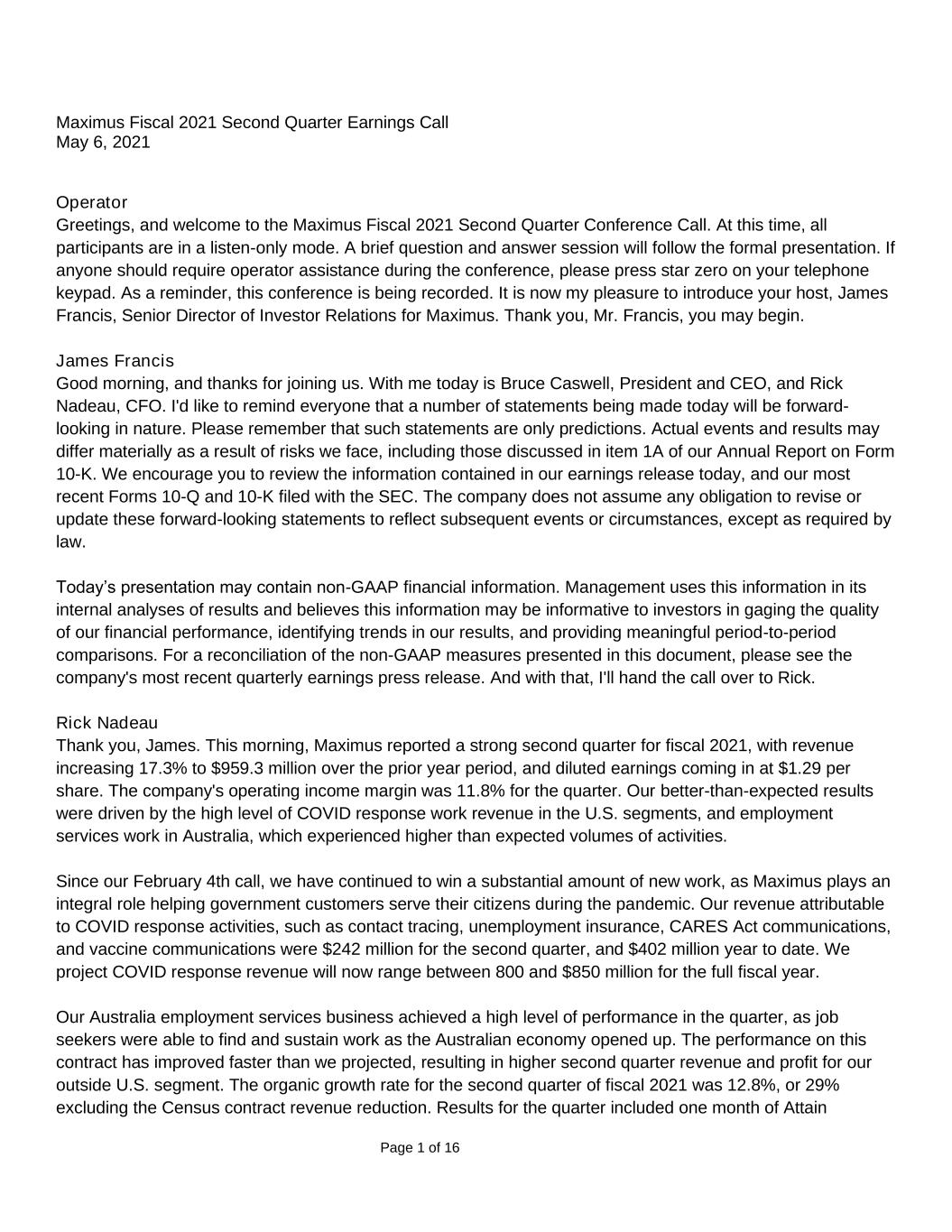
Maximus Fiscal 2021 Second Quarter Earnings Call May 6, 2021 Page 1 of 16 Operator Greetings, and welcome to the Maximus Fiscal 2021 Second Quarter Conference Call. At this time, all participants are in a listen-only mode. A brief question and answer session will follow the formal presentation. If anyone should require operator assistance during the conference, please press star zero on your telephone keypad. As a reminder, this conference is being recorded. It is now my pleasure to introduce your host, James Francis, Senior Director of Investor Relations for Maximus. Thank you, Mr. Francis, you may begin. James Francis Good morning, and thanks for joining us. With me today is Bruce Caswell, President and CEO, and Rick Nadeau, CFO. I'd like to remind everyone that a number of statements being made today will be forward- looking in nature. Please remember that such statements are only predictions. Actual events and results may differ materially as a result of risks we face, including those discussed in item 1A of our Annual Report on Form 10-K. We encourage you to review the information contained in our earnings release today, and our most recent Forms 10-Q and 10-K filed with the SEC. The company does not assume any obligation to revise or update these forward-looking statements to reflect subsequent events or circumstances, except as required by law. Today’s presentation may contain non-GAAP financial information. Management uses this information in its internal analyses of results and believes this information may be informative to investors in gaging the quality of our financial performance, identifying trends in our results, and providing meaningful period-to-period comparisons. For a reconciliation of the non-GAAP measures presented in this document, please see the company's most recent quarterly earnings press release. And with that, I'll hand the call over to Rick. Rick Nadeau Thank you, James. This morning, Maximus reported a strong second quarter for fiscal 2021, with revenue increasing 17.3% to $959.3 million over the prior year period, and diluted earnings coming in at $1.29 per share. The company's operating income margin was 11.8% for the quarter. Our better-than-expected results were driven by the high level of COVID response work revenue in the U.S. segments, and employment services work in Australia, which experienced higher than expected volumes of activities. Since our February 4th call, we have continued to win a substantial amount of new work, as Maximus plays an integral role helping government customers serve their citizens during the pandemic. Our revenue attributable to COVID response activities, such as contact tracing, unemployment insurance, CARES Act communications, and vaccine communications were $242 million for the second quarter, and $402 million year to date. We project COVID response revenue will now range between 800 and $850 million for the full fiscal year. Our Australia employment services business achieved a high level of performance in the quarter, as job seekers were able to find and sustain work as the Australian economy opened up. The performance on this contract has improved faster than we projected, resulting in higher second quarter revenue and profit for our outside U.S. segment. The organic growth rate for the second quarter of fiscal 2021 was 12.8%, or 29% excluding the Census contract revenue reduction. Results for the quarter included one month of Attain
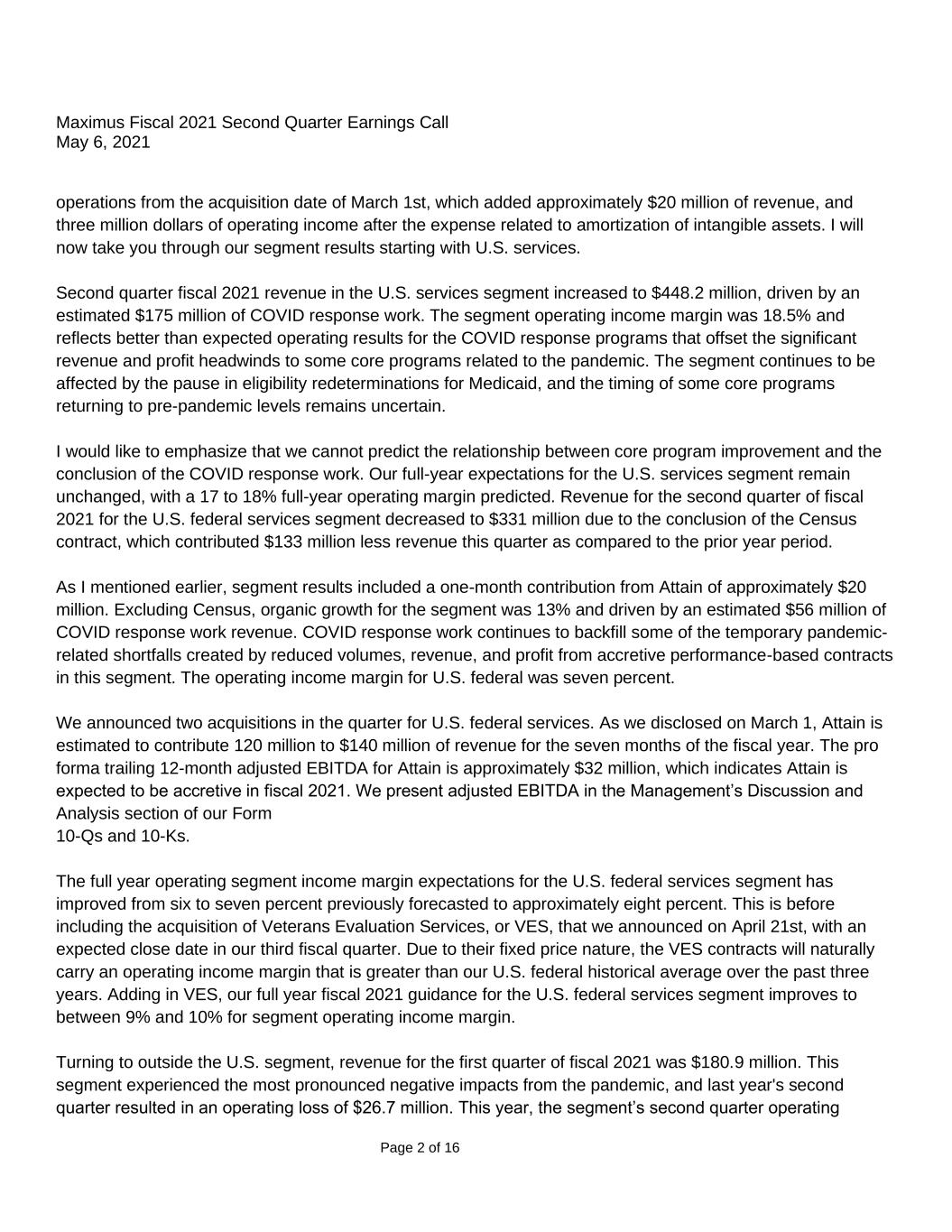
Maximus Fiscal 2021 Second Quarter Earnings Call May 6, 2021 Page 2 of 16 operations from the acquisition date of March 1st, which added approximately $20 million of revenue, and three million dollars of operating income after the expense related to amortization of intangible assets. I will now take you through our segment results starting with U.S. services. Second quarter fiscal 2021 revenue in the U.S. services segment increased to $448.2 million, driven by an estimated $175 million of COVID response work. The segment operating income margin was 18.5% and reflects better than expected operating results for the COVID response programs that offset the significant revenue and profit headwinds to some core programs related to the pandemic. The segment continues to be affected by the pause in eligibility redeterminations for Medicaid, and the timing of some core programs returning to pre-pandemic levels remains uncertain. I would like to emphasize that we cannot predict the relationship between core program improvement and the conclusion of the COVID response work. Our full-year expectations for the U.S. services segment remain unchanged, with a 17 to 18% full-year operating margin predicted. Revenue for the second quarter of fiscal 2021 for the U.S. federal services segment decreased to $331 million due to the conclusion of the Census contract, which contributed $133 million less revenue this quarter as compared to the prior year period. As I mentioned earlier, segment results included a one-month contribution from Attain of approximately $20 million. Excluding Census, organic growth for the segment was 13% and driven by an estimated $56 million of COVID response work revenue. COVID response work continues to backfill some of the temporary pandemic- related shortfalls created by reduced volumes, revenue, and profit from accretive performance-based contracts in this segment. The operating income margin for U.S. federal was seven percent. We announced two acquisitions in the quarter for U.S. federal services. As we disclosed on March 1, Attain is estimated to contribute 120 million to $140 million of revenue for the seven months of the fiscal year. The pro forma trailing 12-month adjusted EBITDA for Attain is approximately $32 million, which indicates Attain is expected to be accretive in fiscal 2021. We present adjusted EBITDA in the Management’s Discussion and Analysis section of our Form 10-Qs and 10-Ks. The full year operating segment income margin expectations for the U.S. federal services segment has improved from six to seven percent previously forecasted to approximately eight percent. This is before including the acquisition of Veterans Evaluation Services, or VES, that we announced on April 21st, with an expected close date in our third fiscal quarter. Due to their fixed price nature, the VES contracts will naturally carry an operating income margin that is greater than our U.S. federal historical average over the past three years. Adding in VES, our full year fiscal 2021 guidance for the U.S. federal services segment improves to between 9% and 10% for segment operating income margin. Turning to outside the U.S. segment, revenue for the first quarter of fiscal 2021 was $180.9 million. This segment experienced the most pronounced negative impacts from the pandemic, and last year's second quarter resulted in an operating loss of $26.7 million. This year, the segment’s second quarter operating
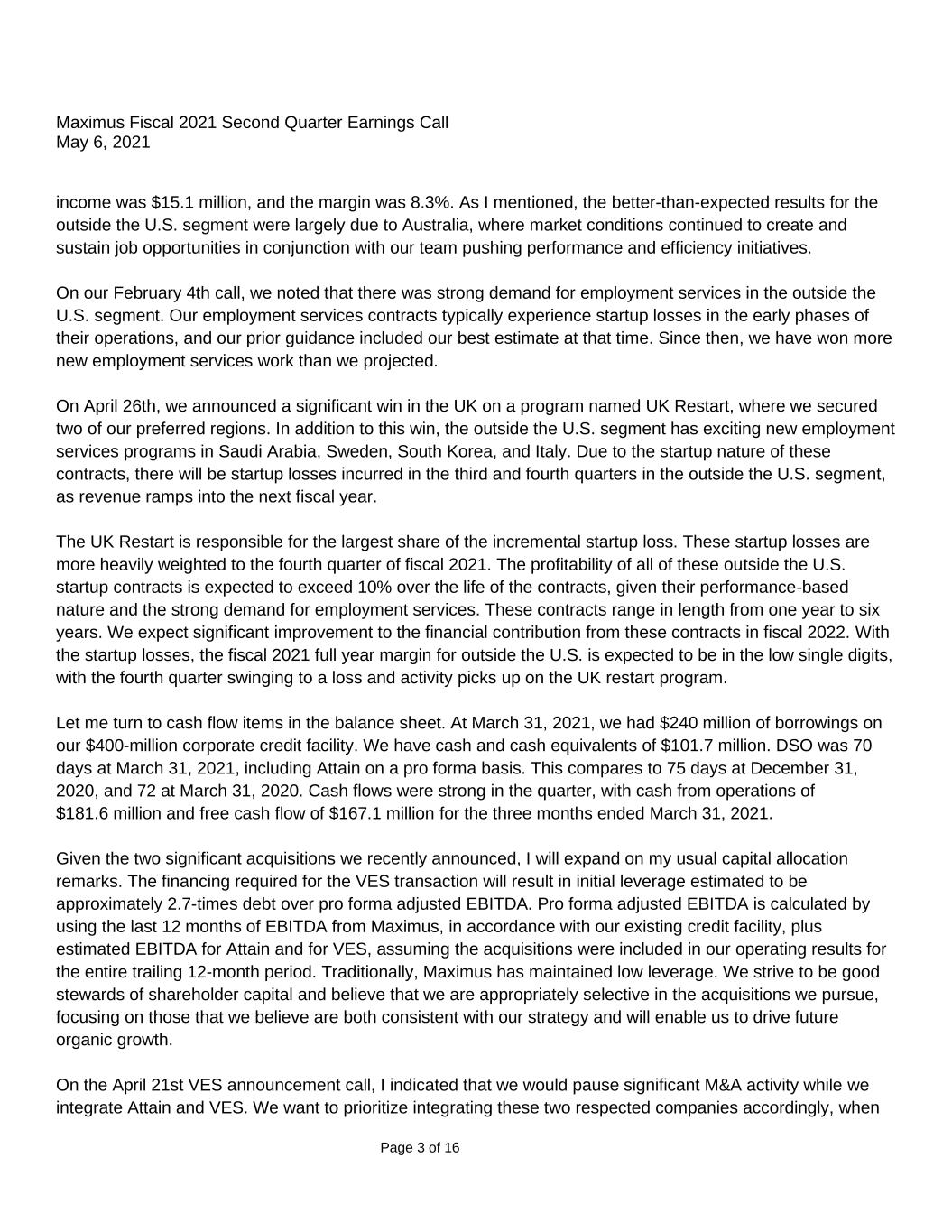
Maximus Fiscal 2021 Second Quarter Earnings Call May 6, 2021 Page 3 of 16 income was $15.1 million, and the margin was 8.3%. As I mentioned, the better-than-expected results for the outside the U.S. segment were largely due to Australia, where market conditions continued to create and sustain job opportunities in conjunction with our team pushing performance and efficiency initiatives. On our February 4th call, we noted that there was strong demand for employment services in the outside the U.S. segment. Our employment services contracts typically experience startup losses in the early phases of their operations, and our prior guidance included our best estimate at that time. Since then, we have won more new employment services work than we projected. On April 26th, we announced a significant win in the UK on a program named UK Restart, where we secured two of our preferred regions. In addition to this win, the outside the U.S. segment has exciting new employment services programs in Saudi Arabia, Sweden, South Korea, and Italy. Due to the startup nature of these contracts, there will be startup losses incurred in the third and fourth quarters in the outside the U.S. segment, as revenue ramps into the next fiscal year. The UK Restart is responsible for the largest share of the incremental startup loss. These startup losses are more heavily weighted to the fourth quarter of fiscal 2021. The profitability of all of these outside the U.S. startup contracts is expected to exceed 10% over the life of the contracts, given their performance-based nature and the strong demand for employment services. These contracts range in length from one year to six years. We expect significant improvement to the financial contribution from these contracts in fiscal 2022. With the startup losses, the fiscal 2021 full year margin for outside the U.S. is expected to be in the low single digits, with the fourth quarter swinging to a loss and activity picks up on the UK restart program. Let me turn to cash flow items in the balance sheet. At March 31, 2021, we had $240 million of borrowings on our $400-million corporate credit facility. We have cash and cash equivalents of $101.7 million. DSO was 70 days at March 31, 2021, including Attain on a pro forma basis. This compares to 75 days at December 31, 2020, and 72 at March 31, 2020. Cash flows were strong in the quarter, with cash from operations of $181.6 million and free cash flow of $167.1 million for the three months ended March 31, 2021. Given the two significant acquisitions we recently announced, I will expand on my usual capital allocation remarks. The financing required for the VES transaction will result in initial leverage estimated to be approximately 2.7-times debt over pro forma adjusted EBITDA. Pro forma adjusted EBITDA is calculated by using the last 12 months of EBITDA from Maximus, in accordance with our existing credit facility, plus estimated EBITDA for Attain and for VES, assuming the acquisitions were included in our operating results for the entire trailing 12-month period. Traditionally, Maximus has maintained low leverage. We strive to be good stewards of shareholder capital and believe that we are appropriately selective in the acquisitions we pursue, focusing on those that we believe are both consistent with our strategy and will enable us to drive future organic growth. On the April 21st VES announcement call, I indicated that we would pause significant M&A activity while we integrate Attain and VES. We want to prioritize integrating these two respected companies accordingly, when
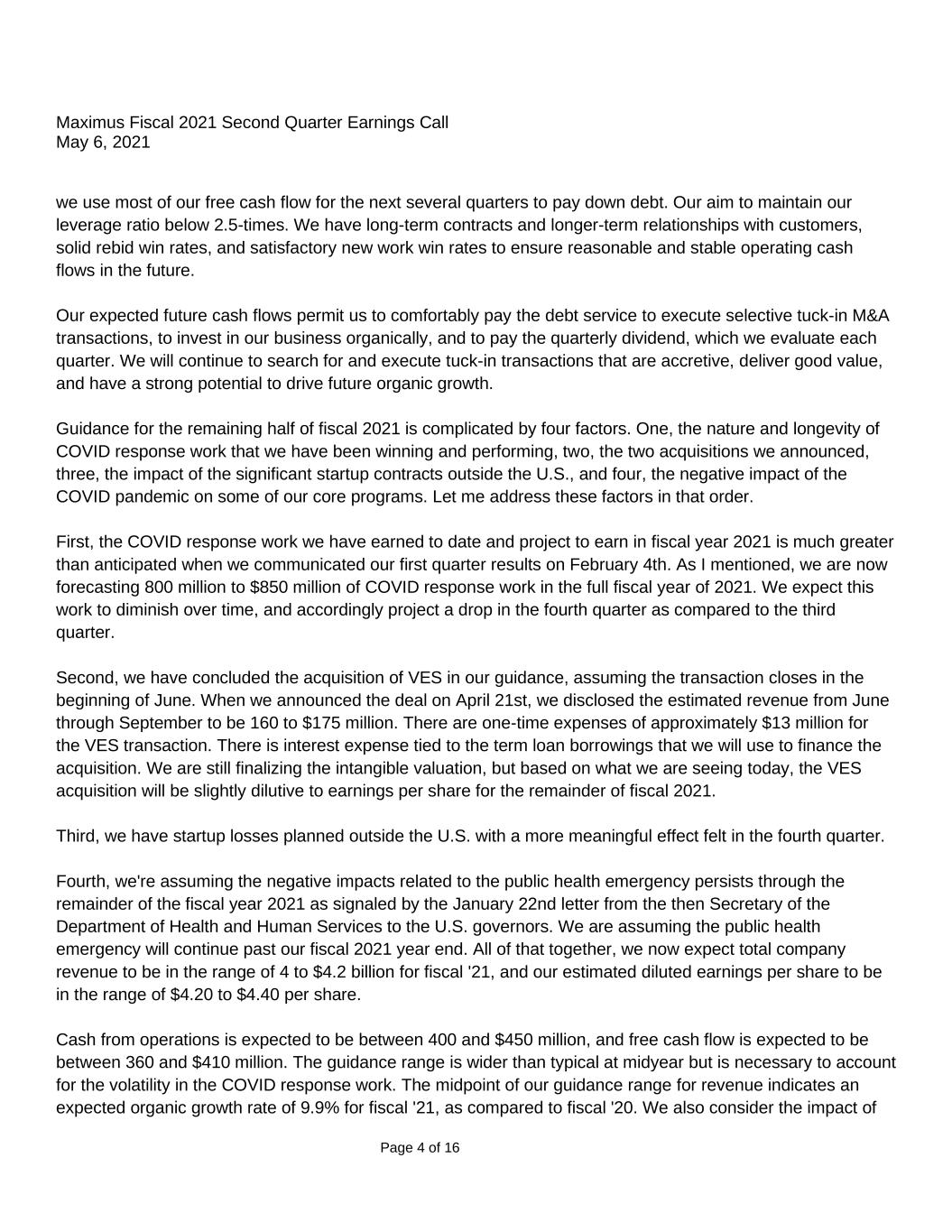
Maximus Fiscal 2021 Second Quarter Earnings Call May 6, 2021 Page 4 of 16 we use most of our free cash flow for the next several quarters to pay down debt. Our aim to maintain our leverage ratio below 2.5-times. We have long-term contracts and longer-term relationships with customers, solid rebid win rates, and satisfactory new work win rates to ensure reasonable and stable operating cash flows in the future. Our expected future cash flows permit us to comfortably pay the debt service to execute selective tuck-in M&A transactions, to invest in our business organically, and to pay the quarterly dividend, which we evaluate each quarter. We will continue to search for and execute tuck-in transactions that are accretive, deliver good value, and have a strong potential to drive future organic growth. Guidance for the remaining half of fiscal 2021 is complicated by four factors. One, the nature and longevity of COVID response work that we have been winning and performing, two, the two acquisitions we announced, three, the impact of the significant startup contracts outside the U.S., and four, the negative impact of the COVID pandemic on some of our core programs. Let me address these factors in that order. First, the COVID response work we have earned to date and project to earn in fiscal year 2021 is much greater than anticipated when we communicated our first quarter results on February 4th. As I mentioned, we are now forecasting 800 million to $850 million of COVID response work in the full fiscal year of 2021. We expect this work to diminish over time, and accordingly project a drop in the fourth quarter as compared to the third quarter. Second, we have concluded the acquisition of VES in our guidance, assuming the transaction closes in the beginning of June. When we announced the deal on April 21st, we disclosed the estimated revenue from June through September to be 160 to $175 million. There are one-time expenses of approximately $13 million for the VES transaction. There is interest expense tied to the term loan borrowings that we will use to finance the acquisition. We are still finalizing the intangible valuation, but based on what we are seeing today, the VES acquisition will be slightly dilutive to earnings per share for the remainder of fiscal 2021. Third, we have startup losses planned outside the U.S. with a more meaningful effect felt in the fourth quarter. Fourth, we're assuming the negative impacts related to the public health emergency persists through the remainder of the fiscal year 2021 as signaled by the January 22nd letter from the then Secretary of the Department of Health and Human Services to the U.S. governors. We are assuming the public health emergency will continue past our fiscal 2021 year end. All of that together, we now expect total company revenue to be in the range of 4 to $4.2 billion for fiscal '21, and our estimated diluted earnings per share to be in the range of $4.20 to $4.40 per share. Cash from operations is expected to be between 400 and $450 million, and free cash flow is expected to be between 360 and $410 million. The guidance range is wider than typical at midyear but is necessary to account for the volatility in the COVID response work. The midpoint of our guidance range for revenue indicates an expected organic growth rate of 9.9% for fiscal '21, as compared to fiscal '20. We also consider the impact of
Maximus Fiscal 2021 Second Quarter Earnings Call May 6, 2021 Page 5 of 16 the COVID response work and the Census contract and calculated an expected adjusted organic growth rate of approximately 6% for fiscal '21. Our effective income tax rate should be in the range of 26 to 27% for the full fiscal year 2021, and weighted average shares outstanding in the range of 62.2 million and 62.3 million shares. Our effective income tax rate is being impacted by the high level of income in Australia, and the reduced income in the UK caused by the startup contracts. The $4.30 midpoint of updated guidance implies reduced earnings in the second half of fiscal 2021, as compared to the first half. We anticipate a step-down of third quarter earnings compared to second quarter results, which is primarily driven by some one-time costs for the VES transaction. We anticipate an additional step-down of fourth quarter earnings compared to the third quarter created by the increased impact of the startup contracts in the outside the U.S. segment, and the reduced forecasted levels of COVID response work. Let me make a few comments as we consider fiscal 2022. The amount of revenue we expect from the two acquisitions is estimated to be between 700 and $750 million. While we do expect some of the COVID response work to continue into fiscal year 2022, it is extremely difficult to predict. Equally hard to predict is the timing and impact of the public health emergency on Medicaid redeterminations, and the resulting increase to Maximus revenue. Our forecasting precision remains limited due to ongoing volatility created by the pandemic, as you see with the results announced today, as compared to our estimates three months ago. Bruce and I are grateful to our busy and hardworking teams around the world. We are responding quickly to customers needing help with vaccine administration, working hard on large-scale existing and new employment services programs, and beginning to integrate two important acquisitions with valued team members. And with that, I will turn the call over to Bruce. Bruce Caswell Thank you, Rick, and good morning, everyone. Since I transitioned into the CEO role in 2018, I've spoken about our three-pronged strategy to accelerate our progress and drive the next phase of our growth through, first, digital transformation within the government services market, enabling new solution offerings to address the mission requirements of our customers, and improve overall service delivery across our operations. This began with improved tools for citizen engagement and process automation and is evolving to include new capabilities in artificial intelligence and machine learning, natural language processing, and advanced analytics to enhance our competitive position. Second, clinical evolution to address long-term macro trends driving demand for independent and conflict-free business process management, or BPM services, with a more clinical dimension, while maintaining the foundational elements of our business, operating customer engagement centers, and providing case management services. And third, market expansion as we evaluate adjacent and emerging markets, organically grow the portfolio, and acquire capabilities and contracts to establish a foothold in these markets.
Maximus Fiscal 2021 Second Quarter Earnings Call May 6, 2021 Page 6 of 16 We also consider our customers' longer-term visions for reengineering social program delivery models, and of course, macro trends. We aim for expansion that's a natural complement to our core services globally. Today, I will focus on how recent efforts are aligning with these three strategic priorities, including the two acquisitions, recent wins, and COVID-19 implications. As you know, in March, we announced the acquisition of the federal business of Attain, furthering two of our primary strategic pillars by, first, accelerating our digital transformation by strengthening our technology capabilities in application development and modernization, enterprise business solutions, cybersecurity, and the data sciences, including advanced analytics and machine learning. These capabilities address federal IT spending imperatives and priorities, while also being applicable to our BPM solutions. And secondly, expanding further in the U.S. federal market into new departments and agencies such as the Securities and Exchange Commission and Department of Homeland Security, as well as within our common clients, such as the Department of Health and Human Services. While our integration is still in our early days, already I am pleased to see how our teams are working together to address pipeline opportunities with our strongest capabilities, and to share experience and skills to improve the solutions we are delivering to our federal customers. As I spoke of briefly when we first announced the transaction, Attain brings innovation and experience and many competencies that are in greatest demand in federal, while Maximus brought scale and highly desirable contract vehicles like Alliant 2. Together, we can now address opportunities where neither company would have previously been competitive. Further executing on our strategy, we most recently announced an agreement to acquire privately-held Veterans Evaluation Services, or VES, a premier provider of medical disability examinations, or MDEs, to the U.S. Department of Veterans Affairs, the VA. This significantly advances our strategic aim of clinical evolution, while meaningfully expanding our presence in the VA. As Rick stated, we expect to close this transaction in the third quarter. While our independent clinical assessments business has been growing at the U.S. state level through our 2016 acquisition of Ascend and subsequent organic growth, primarily in Medicaid-related long-term care assessments, VES' expertise will create an opportunity for such growth at the federal level. As a result, the independent health and disability assessments and appeals portion of our business will comprise a larger share of our overall portfolio and pipeline, lending further credibility to our organic growth efforts with other federal departments and in non- federal markets. The acquisition comes at an important time for the VA, as the Veterans Benefits Administration, or VBA, has been focused on reducing the inventory of exams that naturally has grown during the pandemic, while preparing for the future needs of veterans with qualifying conditions. To that end, and as they've done periodically in the past, the VBA recently launched a market assessment to better understand industry capacity and capabilities. Through our combination, we believe Maximus and VES bring the credibility and quality of an
Maximus Fiscal 2021 Second Quarter Earnings Call May 6, 2021 Page 7 of 16 established partner, and ability to rapidly add clinical capacity and invest in technology innovation that will benefit veterans and the VBA. Our goal is to both contribute to the timely reduction of pandemic-related inventory and be the partner of choice as the MDE program continues to develop. Our acquisitions of Attain and VES, as well as Acentia in 2015 and Citizen Engagement Center operations from GDIT in 2018, help us play a more meaningful role in the U.S. federal market as we build scale, expand, and diversify our customer base, and improve our competitive advantage. Concurrent with these acquisition efforts, we continue to win COVID-19 related work at the state and federal level, as Rick discussed in his remarks. This includes the recently posted CDC Vaccination Hotline Award, illustrating the trust that government places in Maximus based on our historical performance. While COVID-19 work is generally planned to be shorter term in nature, we remain well positioned to adjust as the pandemic- related needs of our customers continue to evolve. These efforts also allow us to meet new customers, expand into new areas of service with existing customers, and increase our impact on their behalf. Through this work, we build longer term references and past performance credentials that are advantageous in future bidding. For instance, in areas like unemployment insurance, the demonstrated value of our model is creating opportunity for longer term relationships with state departments of labor, as they see the benefits of the flexibility and accountability, we can provide in delivering outcomes that matter in more routine program areas. Further, our ability to stand up solutions quickly during challenging times, using effectively our modular capabilities, makes event-driven work a beneficial element of our business model, in response to less predictable but regularly recurring government needs. Our investment in the digital transformation of citizen services, coupled with our decades-long experience, have been recognized by our government customers during this pandemic, as we responded to real-time requests to quickly deliver support and services. Our outside the U.S. teams are securing some exciting new wins as well. As Rick mentioned, in the United Kingdom, we were recently awarded two prime contracts in our preferred regions to deliver the Restart program, which provides 12 months of tailored and community-based support for people that have been unemployed long term and directly impacted by the pandemic. This contract was procured through the CAEHRS framework, which I mentioned in my remarks in the fourth quarter of the last fiscal year, and is used for contracting national employment support programs. Adding emphasis to Rick's earlier point, startup costs are typical with significant new contracts like this one. Therefore, we anticipate Q3 and then Q4 earnings will step down sequentially as a result, followed by a subsequent rebound, driving earnings estimates upward in fiscal year 2022. These programs create long-term shareholder value and will operate within our expected corporate range of profitability. This is not the first time we've accepted start-up losses for a longer term and more significant future benefit. In total, the two contracts, the maximum that could be won by a single provider, are valued at more than $960 million, 690 million British
Maximus Fiscal 2021 Second Quarter Earnings Call May 6, 2021 Page 8 of 16 pounds sterling, over the base and option periods, totaling six years. Maximus UK will be recruiting more than 1,500 people to deliver the program. We have a long history of supporting workforce services in the UK, establishing our foothold in the UK employment and training marketplace in 2008, during the economic recession. This solid platform, history of excellent performance, and strong client relationships have provided the necessary credentials to expand employment focused programs, as illustrated by this award. While this new work has provided some positive offset, our core operations in the UK continue to face disruption as a result of the pandemic. This negative impact continues to be driven by temporary volume and revenue declines, as well as a pause on face-to-face assessments. Although we continue to face decreased volume across some of our geographies, in Australia, we are seeing strong volumes as the economy reopens. Demand is holding more than we anticipated during the holiday season and serves as an example of anticipated volume return as certain countries slowly begin to emerge from the pandemic. All in all, we will remain dedicated to addressing COVID-19 implications with our customers while driving organic growth opportunities across the business. In that spirit, I will now turn to new awards and pipeline as of March 31st. As of the second quarter of fiscal 2021, signed awards were $1.11 billion of total contract value at March 31st. Further, at March 31st, there were another $1.28 billion worth of contracts that have been awarded but not yet signed. I should note that the CDC vaccination hotline and UK Restart contract awards were subsequent to our March 31st cutoff. Let's turn our attention to our pipeline of addressable sales opportunities. Our total contract value pipeline at March 31st was $35.6 billion, compared to $31.6 billion reported in the first quarter of fiscal 2021. Of our total pipeline of sales opportunities, 67.4% represents new work. On a final note, I'm excited to welcome our newest team members from Attain, and I'm looking forward to doing the same for our prospective colleagues from VES when the transaction closes. The hardest thing to get right in any integration is culture, and we've been very focused as an integrated leadership team on getting that right for all employees. Our goal for our colleagues from both Attain and VES is that you will have more opportunities to take on new challenges to advance your careers, and to be rewarded for quality work. I want to congratulate and thank the Maximus team around the globe for their ongoing efforts during the pandemic to keep our employees safe, providing high quality and innovative solutions to our customers, and best-in-class service to the individuals and families we serve. We have been fortunate to have been well- positioned to respond to the needs of government at a very challenging time. This has been possible only through the efforts of more than 35,000 colleagues worldwide, and tens of thousands of delivery partner staff. On behalf of the entire Maximus leadership team, we thank you. And with that, we will open the line for Q&A. Operator?
Maximus Fiscal 2021 Second Quarter Earnings Call May 6, 2021 Page 9 of 16 Operator Thank you. We will now be conducting a question and answer session. If you would like to ask a question, please press star one on your telephone keypad. A confirmation tone will indicate your line is in the question queue. You may press star two if you would like to remove your question from the queue. We ask that you limit your follow-up questions to one so that others may have an opportunity to ask questions. You may reenter the queue by pressing star one. For participants using speaker equipment, it may be necessary to pick up your handset before pressing the star keys. One moment please while we poll for questions. Thank you. Our first question comes from the line of Charlie Strauzer with CJS Securities. Please proceed with your question. Brendan Popson Good morning. This is Brendan Popson on for Charlie. Fantastic quarter, obviously, and I wanted to dig into the outside the U.S. performance. And you guys had alluded to this, talking about Australia. But the high single-digit margin was not expected. And I know you talked about the employment services, you know, being strong, and high retainment going on with the employees. I wanted to ask just like how sustainable that margin is, and if you could just dig more into the puts and takes there, and what we could see down the road? Bruce Caswell Hey, Brendan. Good morning, it's Bruce. Thanks so much for the question. I'm going to turn it over to Rick to address, and I'll add a little color commentary perhaps at the end. Thanks so much. Rick Nadeau Yes, thank you. You know, with respect to Australia first, you know, the first quarter we told you that they were coming out of a lockdown, and they had strong demand during that Christmas period, due to the fact that there was a lot of pent-up demand from the employers who needed to quickly fill some of those retail and travel- related jobs. Those are industries that we typically place a lot of people in. In Q2, our fiscal year Q2, they also achieved good financial performance on their caseload metrics and sustainments, or what we also call, you know, retentions. This really means that more people that we've placed in there were able to sustain their jobs or retain them. And that shows that Australia's really come out of their pandemic better than other countries around the world. You know, a macro trend should really be in our favor down there. There is difficulty though in predicting, you know, what happens quarter to quarter due to the pandemic, but Australia looks very good and is doing really well. I think embedded in your question is really, also, about this OUS startups, the outside U.S. startups. Now, those are in multiple geographies, some of which are countries we've operated in for several years, and others which, you know, are newer to us. Those are outcomes-based contracts. We typically take the time to build up the volumes. This gives you economies of scale over time. However, in the early phases of a contract, our costs ramp up at a quicker rate, and that will create initial losses. So, the revenues will come slower than the costs that ramp up.
Maximus Fiscal 2021 Second Quarter Earnings Call May 6, 2021 Page 10 of 16 So, we anticipate several quarters of losses on these contracts before they turn profitable. This would be a bit of a drag to the OUS segment results in FY'21. And as I noted, I think these startup contracts will drive an operating loss in the fourth quarter of our fiscal 2021. As Bruce mentioned, we do believe that these contracts are a good investment for us. They make sense due to the overall favorable economics over the life of these contracts. We do expect these contracts to deliver 10% post operating income margins over their life. Does that answer your question, Brendan? Brendan Popson Yes. Yeah, that's great. I also want to ask about the pipeline Bruce was talking about with, you know, the increase obviously from VES and Attain. And what's assumed in the pipeline from that? And then, more than that, I guess, what's the potential pipeline expansion from the acquisitions? Bruce Caswell Sure. Brendan, I'll take that to begin with, and ask Rick to chime in as well. I importantly want to note that there's no VES in the pipeline, because this transaction has not closed, right? And also-- Brendan Popson --Yes. Bruce Caswell Historically, I can--just to give you a little more color, historically, VES really hasn't had kind of a business development function. They have been completely focused on serving their VA customers, well, you could imagine. And so, if there's deals that would be additive to the pipeline once the transaction closes, it'll likely be synergy opportunities that we've identified as part of the process of getting to know VES, understand their capabilities, and taking a longer-term view of where their capabilities could be applied to other kind of areas of whitespace in the federal government. I want to also, however, say that likely, those pipeline opportunities would be more like two to four years out, and not immediate, because we are absolutely 100% focused as we come together with VES in working with the VBA on the inventory, as I mentioned in my prepared remarks, that's built up during the COVID pandemic period. And also to ensure that they're very well positioned to address the needs of veterans, for whom, if—you know, it's a dynamic program, and periodically Congress will authorize new benefit categories, and that creates demand that needs to be addressed. So, that is absolutely our focus, which is bringing capacity and scalability and further capabilities to serve the VA. And then, we would hope that over time, in due course and in an appropriate time, there would be additional pipeline opportunities for us to pursue. So, that's the VES piece. Rick mentioned that we did see a meaningful uptick, you know, a small uptick in our pipeline as we came together with Attain. You can imagine the process is that the companies went through and scrubbed the pipeline to make sure that if there are any deals that overlapped, that we are both pursuing and looking at, we eliminated the overlaps. And then we looked at the
Maximus Fiscal 2021 Second Quarter Earnings Call May 6, 2021 Page 11 of 16 pipeline that Attain brought over. And then we also looked at, are there deals now that we will be able to, as I mentioned in my remarks, be able to pursue because of the combined capabilities of Maximus and Attain? I would say that the pipeline reflects a minimal number of those presently, because we're still only getting started with Attain and really understanding kind of what the combined capabilities now mean in terms of larger deals that we can bid, and competitors that we can go against. So, the additive component to the pipeline would be really just what came over as—that was in Attain's pipeline at the time of the transaction, which was not insubstantial, and I'm very pleased with. And I think the team's done a great job of positioning for those deals. You know, just to give you a little more sense of behind the scenes, you know, we make sure that if teams have been both looking at opportunities, we're looking at which team is best positioned in terms of customer relationships, and you know, teaming agreements that may have been developed and so forth, to capture the deal. And there's been just a great level of collaboration between the legacy Attain and Maximus teams in that regard. Hope that answers your question, Brendan. Is there anything further? Brendan Popson Yeah, definitely. I'll hop back in the queue. Thank you. James Francis Great. Thanks, Brendan. Operator, next question, please. Operator Our next question comes from the line of Donald Hooker with KeyBanc Capital Markets. Please proceed with your question. Donald Hooker Great. Good morning. A lot of moving parts here. I guess maybe I'll ask a question about the state Medicaid redetermination, sort of a pause there. Can you help us think through kind of—I'm sort of imagining that there will be a release of work for you, some sort of bullish release of work for you at some point, maybe in fiscal— maybe next year. I don't know. But can you help us think through kind of what that could look like? I mean, how do you see these Medicaid programs getting back to sort of normal operations with these redeterminations? Bruce Caswell Sure. Don, it's Bruce. Why don't I go ahead and begin, and then ask Rick to add to this. On, I want to say it was January 22nd, there was a letter that was sent by the then Acting Secretary of HHS to all the governors, indicating the intent of the Biden administration to extend the public health emergency through the end of calendar year 2021. We are taking our guide off of that, if you will, which would—and therefore, everything that we've spoken to in terms of our view of when redeterminations would resume and the impact on the fiscal year is that this public health emergency will extend through the end of the calendar year, at the very, I guess,
Maximus Fiscal 2021 Second Quarter Earnings Call May 6, 2021 Page 12 of 16 earliest, given what's been said publicly. You could imagine that there will be then a period of a couple of months, probably, you know, after the end of the calendar year as things ramp up and get going again. Our view would be that certainly there's a backlog that has been building up, because common practice is to redetermine, you know, eligibility for certain tranches of the existing population on a periodic basis, and with that not having been done it needs to be caught up. And so, we would expect there to be some backlog related to that that will need to be worked through as we turn the corner into the next calendar year. That work historically has benefitted from the scale economies of our operations. In other words, once we've already stood up an operational center that has, you know, a back office processing capability, a mailroom, you know, document sorting and [sound interference] function, eligibility staff that review applications but can also do redeterminations. You can imagine that incremental volume related to redeterminations can be handled with a lot of existing infrastructure. So, we expect that work to be more accretive in nature when it comes back on than the standard kind of base eligibility work that we do. But Rick, would you add anything further? Rick Nadeau Yeah, just three quick—really quick things. First off, you know, we are assuming—we are not assuming the pandemic-related headwinds abate during the remainder of this fiscal year. So, we are assuming that it does not help this fiscal year. Logic does tell us that there should be backlog. When this becomes work for us is really tough to determine. But Bruce is right, when that does occur, that should be profitable work, whenever that catch-up happens. Donald Hooker Okay. And then, in terms of—you guys mentioned some employment services work in the outside of the U.S. segment. I think you mentioned some countries that I'm not familiar with Maximus being involved in, catch me if I'm wrong, I think Sweden, South Korea, Italy. I think you have some work in Saudi Arabia. But are these new geographies for you? Does this open up potentially new doors for Maximus over the next few years in these countries? Bruce Caswell Yeah, Don, let me catch you up a little bit on that, and then ask Rick again to comment. So, to begin, the significant opportunity that we're seeing, obviously we spoke to the UK Restart opportunity. But we do—we had completed previously, and it gets maybe lost in the—you know, like you say, a lot of moving parts here, a small tuck-in acquisition in South Korea. And that small tuck-in acquisition was in, you know, response to a market trend that we identified where the government was going to be requiring companies of much larger sizes than had been required historically to use privately provided employment service providers to place displaced workers back into employment. So, we always look at—and kind of going back to conversations we had with Rich Montoni, not just the propensity of the outsource but a change in the propensity of the outsource. And that policy signaled a shift.
Maximus Fiscal 2021 Second Quarter Earnings Call May 6, 2021 Page 13 of 16 The reason we approached it with a tuck-in acquisition is that time was of the essence. Because that policy was being implemented quicky, we didn't have the opportunity to enter organically. As—by contrast, while we did recently organically begin operations in Sweden. And that was in direct response to the major policy plank of the coalition—the primary and majority party of the coalition government that had really run on a premise or principle of reforming the public employment system, which they felt was not successful for Sweden. So, there's an existing program, but also a new program that is being administered where cases are being transferred to the new one, the program's being expanded. And we felt as we looked at that situation, we had the ability to create the business and build the business organically, and that's exactly what we've done. As it relates to Saudi Arabia, we have had a strong business in Saudi Arabia historically that has primarily focused on employment services. We've seen an opportunity there recently to grow that business, as the government is both focused on driving reemployment of Saudis in a post-pandemic era, but also continuing to advance the Saudization of policy, an initiative which is to provide, primarily, you know, primary employment opportunities to Saudi citizens in lieu of historical policy that also had a significant portion of foreign workers in the workforce. In response to those trends and also the government's desire to continue to think about training and upskilling their citizens to take on kind of jobs of the future, we've seen opportunities develop in Saudi Arabia as well. I think the last one that we haven't talked about is Italy. Italy, we similarly were following really a shift in policy that signaled an opportunity to do some work there, and that related back to the historic use of European Social Fund money, or ESF funds to fund employment services. Without dragging you through the weeds of the policy change, we saw an opportunity to enter the market. We began, again, organically with a small business in Emilia-Romagna, and we've been able to expand into Lombardy as well--actually I reversed the two, it began in Lombardy and then went to Emilia-Romagna. And we're pleased with the operation of that program presently, given the overlay of the pandemic. You know, that—it certainly—Italy, as you well know, was extremely hard hit by the pandemic, and it's taken some time to recover. But that method of privately provided employment services still remains a great priority of the government. I lay all that out to say, we are very, very deliberate, always extremely deliberate about decisions to begin businesses in new countries. And it is not our policy or our plan around here to plant flags, but rather to look at the market very carefully, evaluate it across a broad number of risk factors, and only move into a new market area when we believe it has the potential to deliver long-term growth for our shareholders, and to support multiple business lines for Maximus. So, not just in the employment services space but also in the health- related areas over time. So, sorry for the long answer, but that's kind of the strategy as we're executing it and catch you up on those. Rick, is there anything further you'd want to add? Rick Nadeau No, that's a very complete answer.
Maximus Fiscal 2021 Second Quarter Earnings Call May 6, 2021 Page 14 of 16 Donald Hooker No, that's--yeah, that's-- Bruce Caswell --Alright--. Donald Hooker --Super helpful background. Thank you. Thank you so much. Bruce Caswell Sure. James Francis Hey, Don, we'll keep your line open. Do you have any other questions for us? Donald Hooker Sure. And then maybe, for the—have you all quantified sort of as we think about fiscal '22, some of the UK deals, the Restart program, when that sort of ramps—it's a big, big program for you guys, when that would sort of hit full run rate? Is it a year, two years, three years? It's a multi-year program, so when would that hit full run rate and margin? Rick Nadeau Yeah, you know, that's obviously hard to gauge. We're generally thinking it takes us a while to get that going. But I would think the second half of fiscal year '22 would be when you would see those revenues catch up. What you really have happening here, Don, is that the costs ramp up, and you're serving the citizenry, but the volumes take a while to catch up with that. So, I think it's about four quarters, the second half of fiscal year '22. Donald Hooker Okay, great. Thank you. Thank you. James Francis Thanks, Don. Operator, back to you. Operator As a reminder, if you would like to ask a question, press star one on your telephone keypad. Our next question is a follow-up from Brendan Popson with CJS Securities. Please proceed with your question. Brendan Popson Thank you. Just want to ask real quick on the redeterminations. Are there—obviously, there's different—you know, there's different policies that different states are following. And you know, some states have more restrictions than other states. Is there a difference in some—are some of your states going to come back
Maximus Fiscal 2021 Second Quarter Earnings Call May 6, 2021 Page 15 of 16 sooner than others, or is it kind of—is there some kind of central authority that means that not much of it will come back until after the public health emergency is, you know, over? Bruce Caswell Yeah, it's the latter, Brendan. The way it works is that in order for states to continue to receive enhanced federal matching funds during the pandemic, they have to agree to what historically has been referred to as kind of MOE, or maintenance of effort on the program. That means they can't erode any types of services that they're providing or diminish any services they're providing. And that means they need to do everything they can to keep existing Medicaid beneficiaries on the rolls. There are some mechanics that we can share with you, maybe offline it would be best in terms of, once the public health emergency has been declared to be over, there is a period then when they can resume these activities. As I mentioned previously, it's not absolute immediate, and I think it's actually tied to when they last received funding related to the program, but we'll clarify that for you. The point being though that all states have to follow that same set of rules that have been laid out by CMS. And you're right, while there are differences in the way states administer their programs, in this specific instance, as it relates to this population, they can't, you know—I guess they theoretically could jump the gun and begin the process sooner, but they would lose out on the enhanced federal money, and nobody really wants to do that. Brendan Popson Okay, yeah. Yeah, that makes sense. And then, I just want to ask about--a capital allocation question. You guys talked about your pro forma leverage. What's your view on deleveraging? Is that going to be a main priority? Are you comfortable letting EBITDA grow into it, or what's your priority there? Rick Nadeau Yeah, Don, it's Rick—or, I'm sorry, Brendan, it's Rick. Yeah, there are two respected companies that we want to do a very good job on with integration. This integration is going to take us a while, I think, say, at least two quarters to really get it done. We have good free cash flow each quarter. And I would say that we will pause significant M&A, get the integration done right, and have our debt paid down below a 2.5x. That is really our aim, is to keep our leverage below 2.5x. I mean, we're starting off at an area of 2.7x that we're comfortable with, but I think overall, over the long term, staying below 2.5x would be our aim. Brendan Popson Great. Okay. Rick Nadeau Thanks, Brendan. Brendan Popson Yep.
Maximus Fiscal 2021 Second Quarter Earnings Call May 6, 2021 Page 16 of 16 James Francis Operator, back to you. Next question, please. Operator Our next question is a follow-up from Donald Hooker with KeyBanc Capital Markets. Please proceed with your question. Donald Hooker Great. Yeah, one question I meant to ask; I appreciate your time here. In the federal services segment, you mentioned that the addition of VES would sort of create a close to 10% margin I guess for the full year if you include that. That looks like you're signaling a fairly large step-up in operating margin, I guess in the fiscal and September quarter. So, I guess as we go into next year, can we think about like—can you help us think about what a normalized pro forma operating margin would be for the federal services with the higher margin VES business? I'm thinking that's a pretty material change for next year. Rick Nadeau Yes, Donald. Yeah, I do think that as we look forward, that should be able to give us a 10% or better operating income margin. I would say that you have to always recall that we have a large cost reimbursement style contract in that 1-800-MEDICARE contract, that carries a lower margin. But yes, we should have higher margins from both Attain and VES, and some of our legacy work has also been somewhat tamped down by the pandemic, and that should come back. So, you know, we should have 10% plus operating income margins in U.S. federal in fiscal year '22. Donald Hooker Okay, thank you. James Francis Thanks, Don. Any more questions? If not, we'll go back to the operator. Operator Thank you. Ladies and gentlemen, we have reached the end of the question and answer session and are out of time for today's call. Maximus thanks you for your time and participation today. You may disconnect your lines at this time.

1 | Maximus: Q3 FY20 Earnings Presentation Rick Nadeau Chief Financial Officer Fiscal 2021 Second Quarter Earnings Call May 6, 2021
2 | Maximus: Q1 FY21 Earnings Presentation These slides should be read in conjunction with the Company’s most recent quarterly earnings press release, along with listening to or reading a transcript of the comments of Company management from our most recent quarterly earnings conference call. This document may contain non-GAAP financial information. Management uses this information in its internal analysis of results and believes that this information may be informative to investors in gauging the quality of our financial performance, identifying trends in our results, and providing meaningful period-to-period comparisons. These measures should be used in conjunction with, rather than instead of, their comparable GAAP measures. For a reconciliation of non-GAAP measures to the comparable GAAP measures presented in this document, see the Company’s most recent quarterly earnings press release. Throughout this presentation, numbers may not add due to rounding. Included in this presentation are forward-looking statements within the meaning of the safe harbor provisions of the United States Private Securities Litigation Reform Act of 1995. Forward-looking statements can be identified by words such as: “anticipate,” “intend,” “plan,” “goal,” “seek,” “opportunity,” “could,” “potential,” “believe,” “project,” “estimate,” “expect,” “strategy,” “future,” “likely,” “may,” “should,” “will” and similar references to future periods. Forward-looking statements that are not historical facts, including statements about our confidence, strategies and initiatives and our expectations about revenues, results of operations, profitability, liquidity, market demand or the impact of the pandemic are forward-looking statements that involve risks and uncertainties such as those related to the impact of the pandemic and our recently-completed and announced acquisitions including but not limited to: • Completing the acquisition of VES Group, Inc. ("VES") within the timeframe anticipated or at all, difficulties in integrating VES and the Federal business of Attain, LLC (“Attain”) including realization of the expected benefits, and adverse effects on the business including the ability to meet obligations resulting from indebtedness required to complete the VES acquisition • The ultimate duration of the pandemic • The threat of further negative pandemic-related impacts These risks could cause the Company’s actual results to differ materially from those indicated by such forward-looking statements. A summary of risk factors can be found in Item 1A, "Risk Factors" in our Annual Report on Form 10-K for the year ended September 30, 2020, which was filed with the Securities and Exchange Commission (SEC) on November 19, 2020. A supplemental description of risk factors related to the Company's completed acquisition of the Federal business of Attain and proposed acquisition of VES are included in our Quarterly Report on Form 10-Q for the quarter ended March 31, 2021, to be filed shortly. The Company's SEC reports are accessible on maximus.com. Any forward-looking statement made by us in this report is based only on information currently available to us and speaks only as of the date on which it is made. We undertake no obligation to publicly update any forward-looking statement, whether written or oral, that may be made from time to time, whether as a result of new information, future developments or otherwise. Forward-looking Statements & Non-GAAP Information • Delays in our core programs returning to normal volumes and operations • The potential impacts resulting from budget challenges with our government clients • The possibility of delayed or missed payments by customers • The potential for further supply chain disruptions impacting IT or safety equipment • The impact of further legislation and government policies on the programs we operate
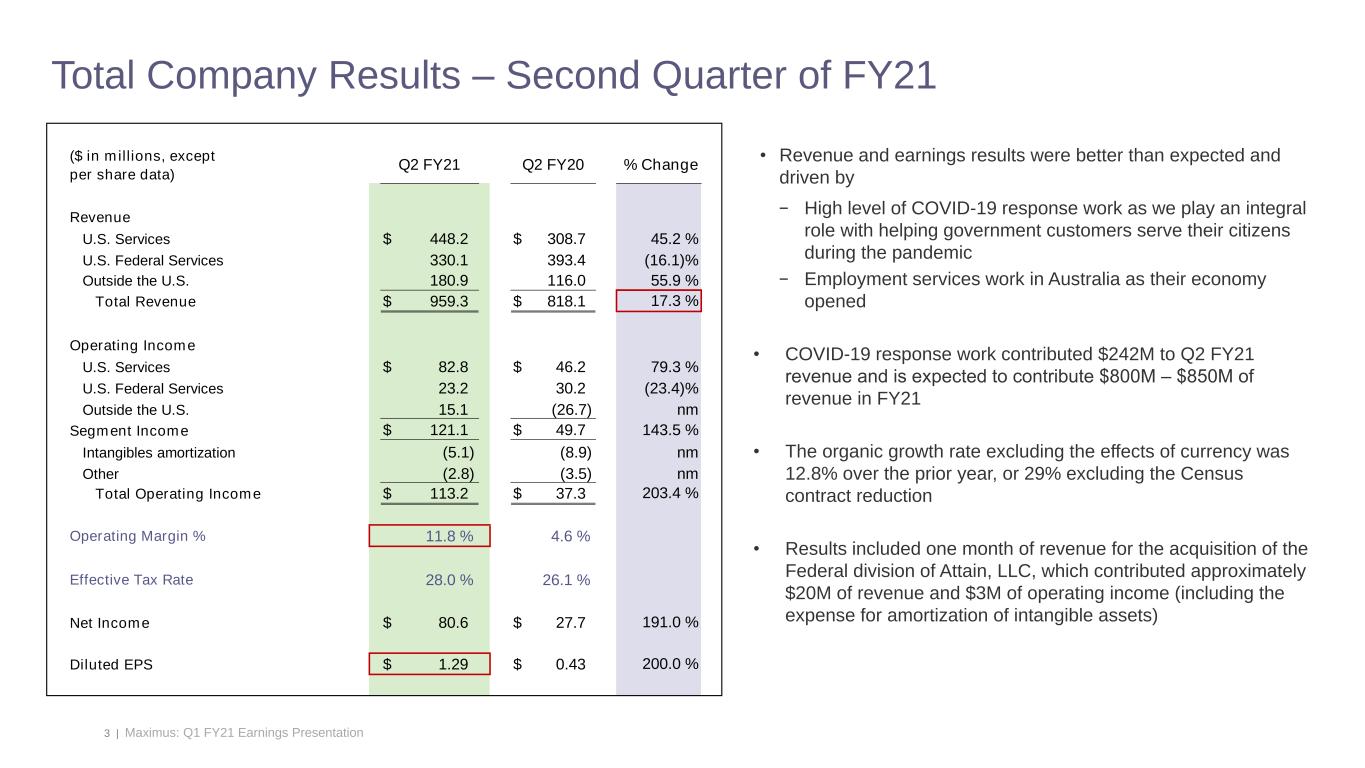
3 | Maximus: Q1 FY21 Earnings Presentation Total Company Results – Second Quarter of FY21 • Revenue and earnings results were better than expected and driven by − High level of COVID-19 response work as we play an integral role with helping government customers serve their citizens during the pandemic − Employment services work in Australia as their economy opened • COVID-19 response work contributed $242M to Q2 FY21 revenue and is expected to contribute $800M ‒ $850M of revenue in FY21 • The organic growth rate excluding the effects of currency was 12.8% over the prior year, or 29% excluding the Census contract reduction • Results included one month of revenue for the acquisition of the Federal division of Attain, LLC, which contributed approximately $20M of revenue and $3M of operating income (including the expense for amortization of intangible assets) ($ in millions, except per share data) Q2 FY21 Q2 FY20 % Change Revenue U.S. Services $ 448.2 $ 308.7 45.2 % U.S. Federal Services 330.1 393.4 (16.1)% Outside the U.S. 180.9 116.0 55.9 % Total Revenue $ 959.3 $ 818.1 17.3 % Operating Income U.S. Services $ 82.8 $ 46.2 79.3 % U.S. Federal Services 23.2 30.2 (23.4)% Outside the U.S. 15.1 (26.7) nm Segment Income $ 121.1 $ 49.7 143.5 % Intangibles amortization (5.1) (8.9) nm Other (2.8) (3.5) nm Total Operating Income $ 113.2 $ 37.3 203.4 % Operating Margin % 11.8 % 4.6 % Effective Tax Rate 28.0 % 26.1 % Net Income $ 80.6 $ 27.7 191.0 % Diluted EPS $ 1.29 $ 0.43 200.0 %
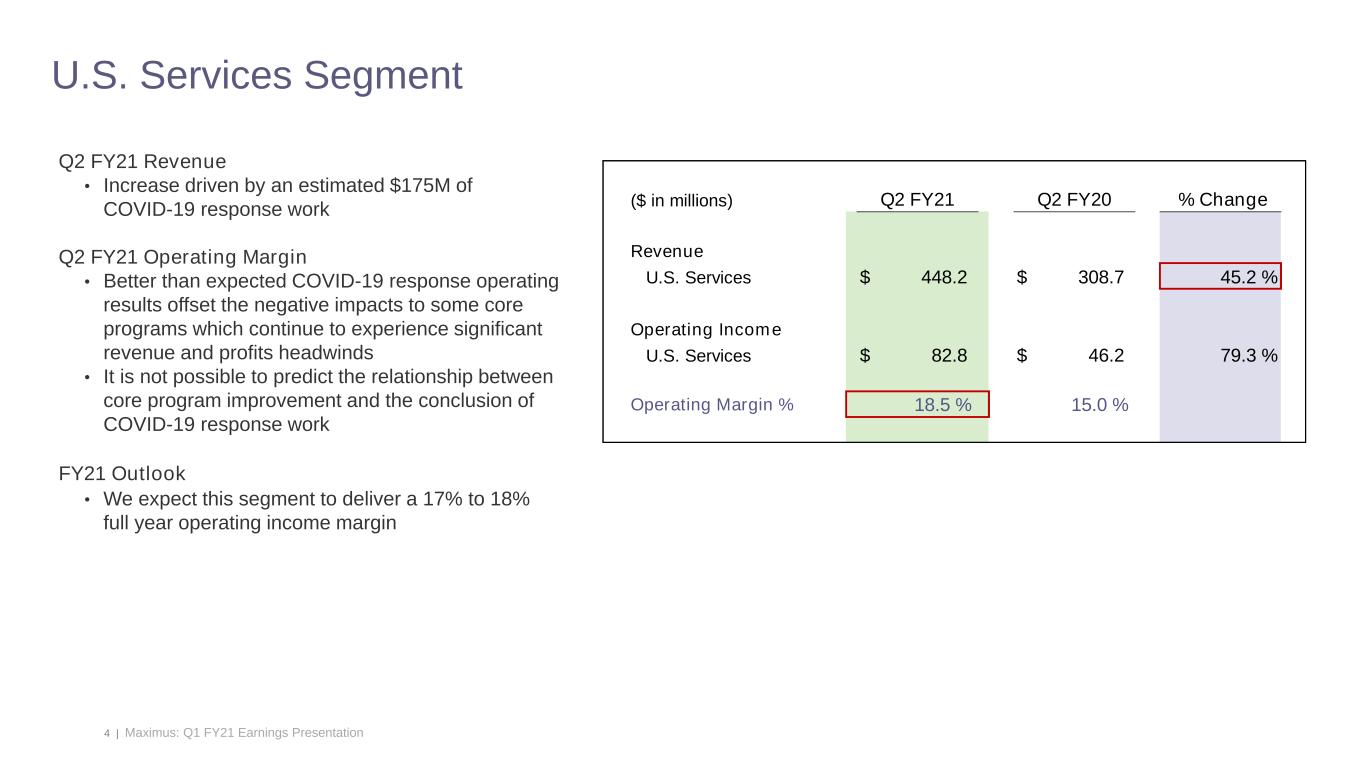
4 | Maximus: Q1 FY21 Earnings Presentation Q2 FY21 Revenue • Increase driven by an estimated $175M of COVID-19 response work Q2 FY21 Operating Margin • Better than expected COVID-19 response operating results offset the negative impacts to some core programs which continue to experience significant revenue and profits headwinds • It is not possible to predict the relationship between core program improvement and the conclusion of COVID-19 response work FY21 Outlook • We expect this segment to deliver a 17% to 18% full year operating income margin U.S. Services Segment ($ in millions) Q2 FY21 Q2 FY20 % Change Revenue U.S. Services $ 448.2 $ 308.7 45.2 % Operating Income U.S. Services $ 82.8 $ 46.2 79.3 % Operating Margin % 18.5 % 15.0 %

5 | Maximus: Q1 FY21 Earnings Presentation U.S. Federal Services Segment Q2 FY21 Revenue & Operating Margin • Decreased due the expected conclusion of the Census contract which contributed $133M less revenue in Q2 FY21 as compared to Q2 FY20 • Excluding Census, organic revenue growth was 13% and driven by $56M of COVID-19 response work Attain Acquisition • Attain contributed approximately $20M of revenue for the month of March FY21 and is expected to contribute $120M to $140M of revenue in FY21 • The pro-forma TTM adjusted EBITDA for Attain is approximately $32M (adjusted EBITDA presented in MD&A section of Forms 10-Q and 10-K for Maximus) FY21 Outlook • Acquisition of Veterans Evaluation Services (“VES”) Group, Inc. expected to close in third quarter of FY21 • We would expect the segment to yield full year operating income margin of approximately 8%, before VES • Including VES, the full year operating income margin expectation is 9% to 10% ($ in millions) Q2 FY21 Q2 FY20 % Change Revenue U.S. Federal Services $ 330.1 $ 393.4 (16.1)% Operating Income U.S. Federal Services $ 23.2 $ 30.2 (23.4)% Operating Margin % 7.0 % 7.7 %
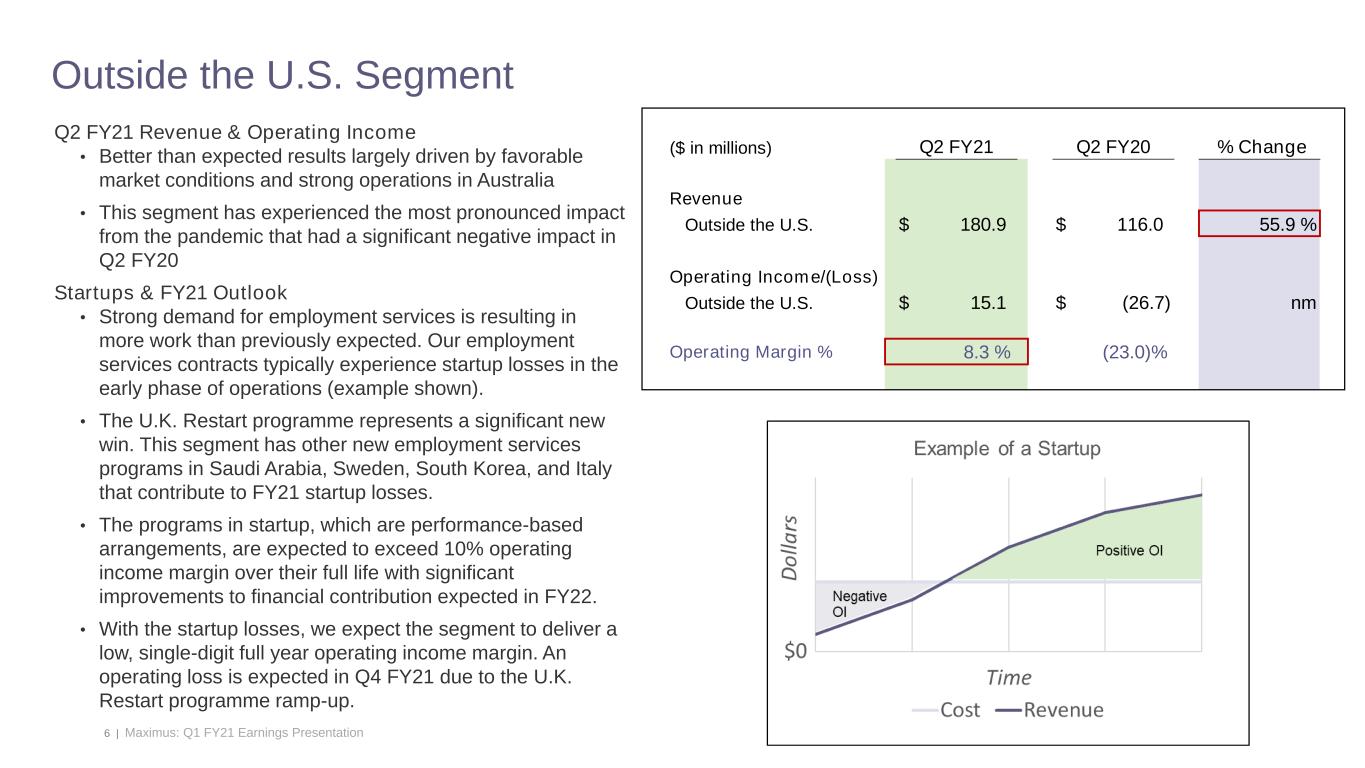
6 | Maximus: Q1 FY21 Earnings Presentation Outside the U.S. Segment Q2 FY21 Revenue & Operating Income • Better than expected results largely driven by favorable market conditions and strong operations in Australia • This segment has experienced the most pronounced impact from the pandemic that had a significant negative impact in Q2 FY20 Startups & FY21 Outlook • Strong demand for employment services is resulting in more work than previously expected. Our employment services contracts typically experience startup losses in the early phase of operations (example shown). • The U.K. Restart programme represents a significant new win. This segment has other new employment services programs in Saudi Arabia, Sweden, South Korea, and Italy that contribute to FY21 startup losses. • The programs in startup, which are performance-based arrangements, are expected to exceed 10% operating income margin over their full life with significant improvements to financial contribution expected in FY22. • With the startup losses, we expect the segment to deliver a low, single-digit full year operating income margin. An operating loss is expected in Q4 FY21 due to the U.K. Restart programme ramp-up. ($ in millions) Q2 FY21 Q2 FY20 % Change Revenue Outside the U.S. $ 180.9 $ 116.0 55.9 % Operating Income/(Loss) Outside the U.S. $ 15.1 $ (26.7) nm Operating Margin % 8.3 % (23.0)%
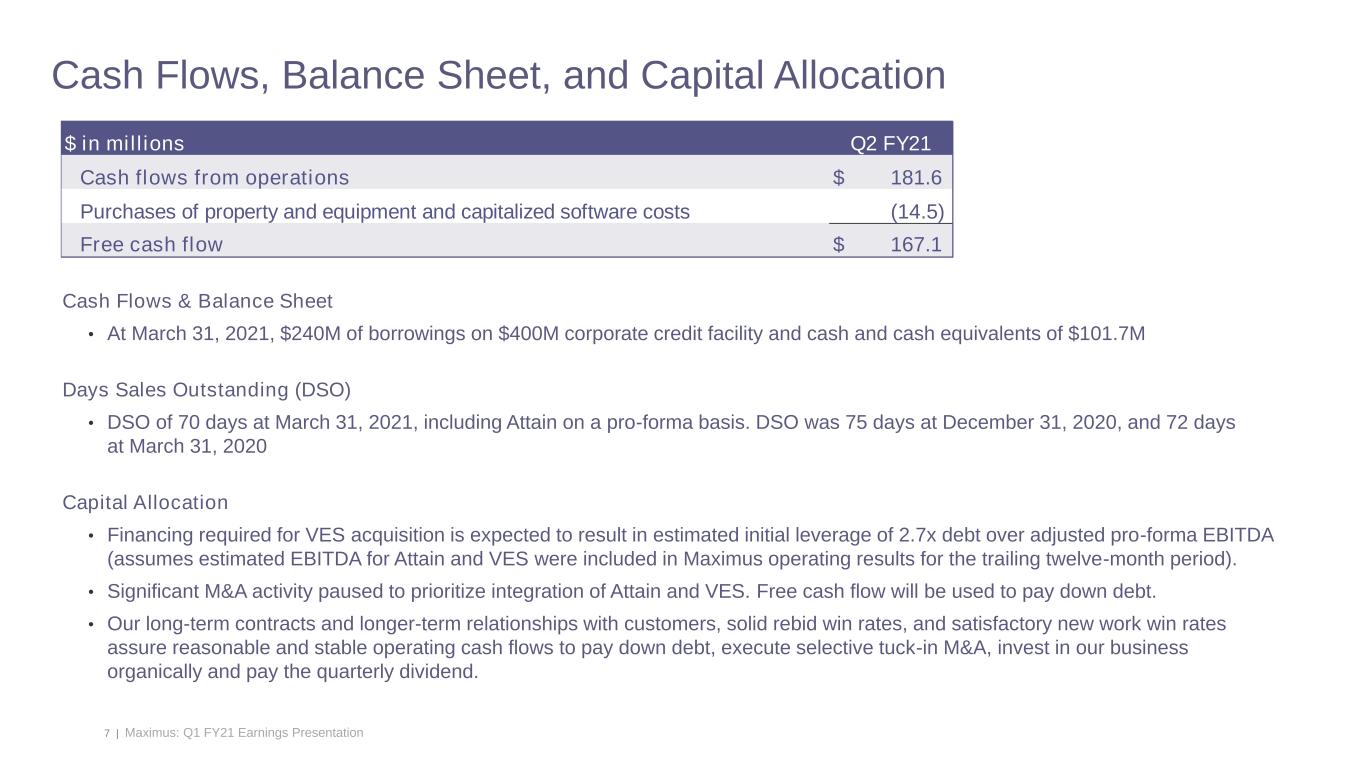
7 | Maximus: Q1 FY21 Earnings Presentation Cash Flows & Balance Sheet • At March 31, 2021, $240M of borrowings on $400M corporate credit facility and cash and cash equivalents of $101.7M Days Sales Outstanding (DSO) • DSO of 70 days at March 31, 2021, including Attain on a pro-forma basis. DSO was 75 days at December 31, 2020, and 72 days at March 31, 2020 Capital Allocation • Financing required for VES acquisition is expected to result in estimated initial leverage of 2.7x debt over adjusted pro-forma EBITDA (assumes estimated EBITDA for Attain and VES were included in Maximus operating results for the trailing twelve-month period). • Significant M&A activity paused to prioritize integration of Attain and VES. Free cash flow will be used to pay down debt. • Our long-term contracts and longer-term relationships with customers, solid rebid win rates, and satisfactory new work win rates assure reasonable and stable operating cash flows to pay down debt, execute selective tuck-in M&A, invest in our business organically and pay the quarterly dividend. Cash Flows, Balance Sheet, and Capital Allocation $ in millions Q2 FY21 Cash flows from operations $ 181.6 Purchases of property and equipment and capitalized software costs (14.5) Free cash flow $ 167.1
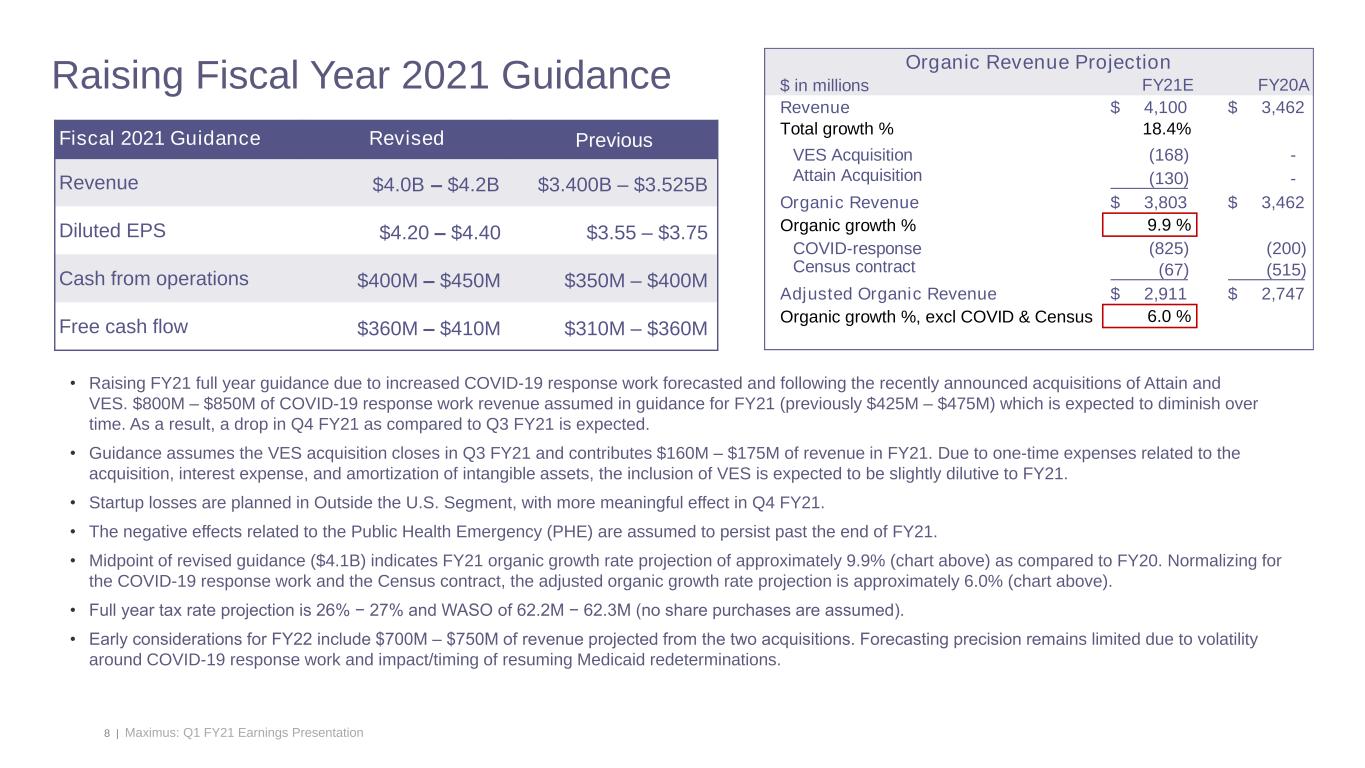
8 | Maximus: Q1 FY21 Earnings Presentation Raising Fiscal Year 2021 Guidance Fiscal 2021 Guidance Revised Previous Revenue $4.0B – $4.2B $3.400B – $3.525B Diluted EPS $4.20 – $4.40 $3.55 – $3.75 Cash from operations $400M – $450M $350M – $400M Free cash flow $360M – $410M $310M – $360M • Raising FY21 full year guidance due to increased COVID-19 response work forecasted and following the recently announced acquisitions of Attain and VES. $800M – $850M of COVID-19 response work revenue assumed in guidance for FY21 (previously $425M – $475M) which is expected to diminish over time. As a result, a drop in Q4 FY21 as compared to Q3 FY21 is expected. • Guidance assumes the VES acquisition closes in Q3 FY21 and contributes $160M – $175M of revenue in FY21. Due to one-time expenses related to the acquisition, interest expense, and amortization of intangible assets, the inclusion of VES is expected to be slightly dilutive to FY21. • Startup losses are planned in Outside the U.S. Segment, with more meaningful effect in Q4 FY21. • The negative effects related to the Public Health Emergency (PHE) are assumed to persist past the end of FY21. • Midpoint of revised guidance ($4.1B) indicates FY21 organic growth rate projection of approximately 9.9% (chart above) as compared to FY20. Normalizing for the COVID-19 response work and the Census contract, the adjusted organic growth rate projection is approximately 6.0% (chart above). • Full year tax rate projection is 26% − 27% and WASO of 62.2M − 62.3M (no share purchases are assumed). • Early considerations for FY22 include $700M ‒ $750M of revenue projected from the two acquisitions. Forecasting precision remains limited due to volatility around COVID-19 response work and impact/timing of resuming Medicaid redeterminations. $ in millions FY21E FY20A Revenue $ 4,100 $ 3,462 Total growth % 18.4% VES Acquisition (168) - Attain Acquisition (130) - Organic Revenue $ 3,803 $ 3,462 Organic growth % 9.9 % COVID-response (825) (200) Census contract (67) (515) Adjusted Organic Revenue $ 2,911 $ 2,747 Organic growth %, excl COVID & Census 6.0 % Organic Revenue Projection
9 | Maximus: Q1 FY21 Earnings Presentation Bruce Caswell President & Chief Executive Officer Fiscal 2021 Second Quarter Earnings Call May 6, 2021
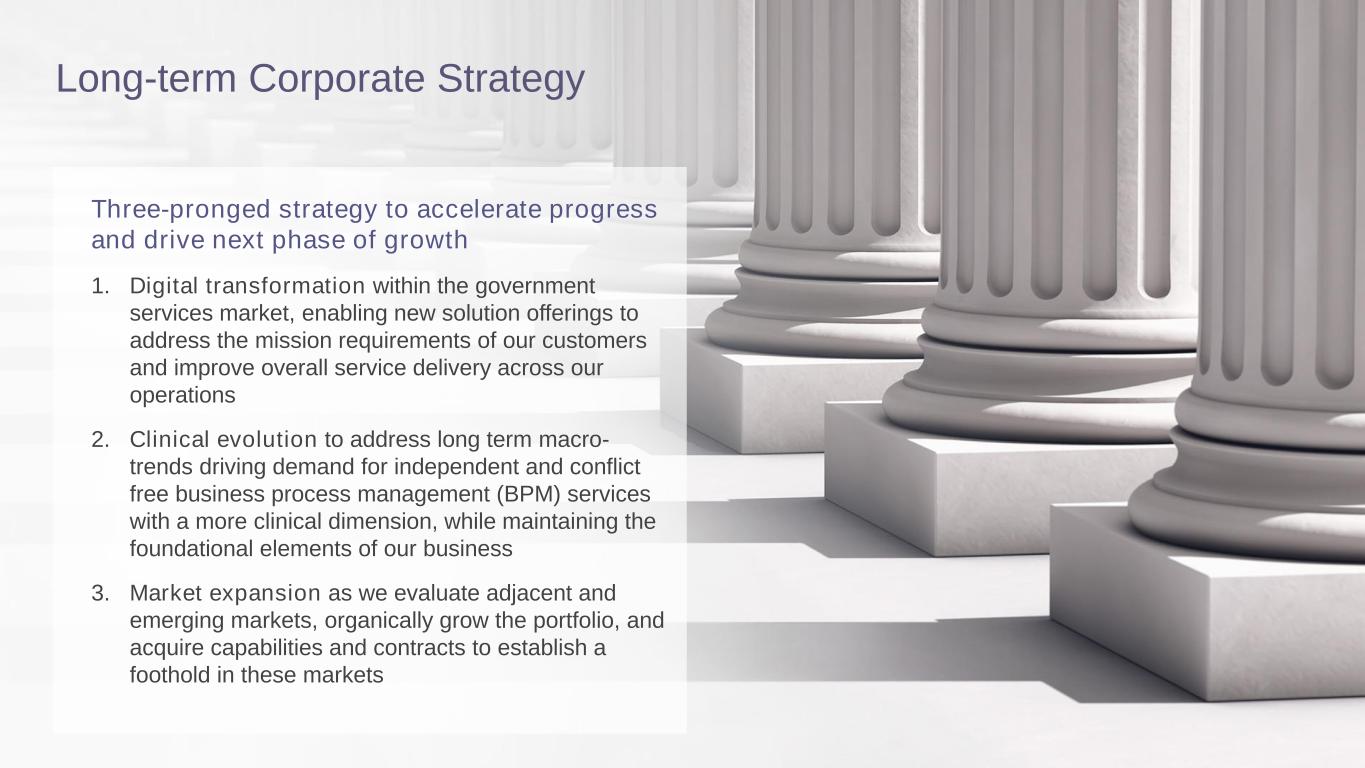
10 | Maximus: Q1 FY21 Earnings Presentation Long-term Corporate Strategy Three-pronged strategy to accelerate progress and drive next phase of growth 1. Digital transformation within the government services market, enabling new solution offerings to address the mission requirements of our customers and improve overall service delivery across our operations 2. Clinical evolution to address long term macro- trends driving demand for independent and conflict free business process management (BPM) services with a more clinical dimension, while maintaining the foundational elements of our business 3. Market expansion as we evaluate adjacent and emerging markets, organically grow the portfolio, and acquire capabilities and contracts to establish a foothold in these markets

11 | Maximus: Q1 FY21 Earnings Presentation ▪ Furthers two primary strategic pillars: • Digital transformation – application development & modernization – enterprise business solutions – cybersecurity – data sciences (advanced analytics & machine learning) • Expanding U.S. federal market – Securities & Exchange Commission – Department of Homeland Security – Department of Health & Human Services ▪ Our teams are working together on pipeline opportunities with shared experience and skills for our federal customers ▪ Attain brings innovation and experience while Maximus offers scale and highly desirable contract vehicles ▪ Together, we can now address opportunities where neither company would have previously been competitive Attain Acquisition
12 | Maximus: Q3 FY20 Earnings Presentation • Premier provider of Medical Disability Examinations (MDE) to the U.S. Department of Veterans Affairs (VA) • Significantly advances our clinical evolution, while meaningfully expanding our presence in the VA • Clinical assessments business (state level growth through acquisition of Ascend [2016]) VES expertise creates opportunity federal level growth • Independent health and disability assessments and appeals will comprise a larger share of our overall portfolio and pipeline, federal and non-federal markets • An important time as the Veterans Benefits Administration (or VBA) has been focused on reducing the inventory of pandemic-related exams while preparing for the future needs of Veterans with qualifying conditions • The VBA recently launched a market assessment to better understand industry capacity and capabilities • Maximus and VES bring the credibility and quality of an established partner increasing capacity and improving technology to benefit Veterans and the VBA • Our goal: contribute to the timely reduction of pandemic-related inventory and be the partner of choice in MDE services • Adding Attain and VES, with Acentia [2015] and GDIT [citizen engagement center operations, 2018] helps us play a more meaningful role in the U.S. federal market, improving our competitive advantage Veterans Evaluation Services Acquisition* * expected to close in Q3 FY21
13 | Maximus: Q1 FY21 Earnings Presentation COVID-19 related new wins • Pandemic-related needs continue to evolve, resulting in new wins for related work at the state and federal level (CDC Vaccination Hotline award) • Expand into new areas of service with existing customers, and increase our impact on their behalf • Unemployment insurance has demonstrated the value of our model to long term relationships with state departments of labor • “modular” capabilities — makes this event- driven work a beneficial element of our business model • Digital transformation plus decades of experience equals real time support during pandemic Addressing the Pandemic-related Needs of our Customers United Kingdom • Two new prime contracts: Restart programme (through CAEHRS framework), provides tailored community-based support for people facing long-term unemployment • Startup costs are typical with significant new contracts so Q3 and then Q4 earnings may step down sequentially, with rebound estimates in FY22 • Total value: more than $960M (£690 million British Pounds Sterling) over base and option periods totaling 6 years; hiring more than 1,500 people • Core operations in the U.K. continue to face disruption from pandemic-related volume and revenue declines Australia • With decreased volume in some geographies, seeing strong volumes as economy re-opens • Demand is holding more than anticipated during the holiday season and serves as an example of anticipated volume return
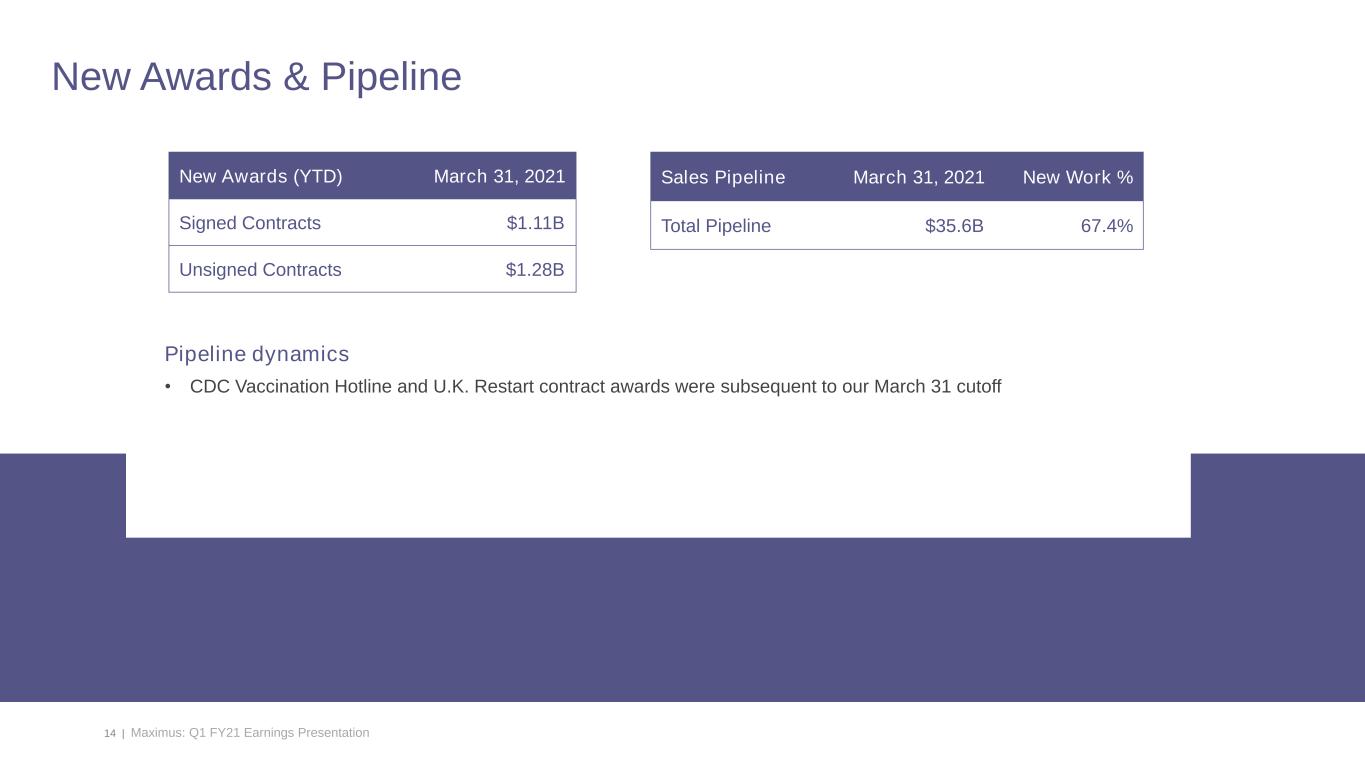
14 | Maximus: Q1 FY21 Earnings Presentation Sales Pipeline March 31, 2021 New Work % Total Pipeline $35.6B 67.4% New Awards (YTD) March 31, 2021 Signed Contracts $1.11B Unsigned Contracts $1.28B New Awards & Pipeline Pipeline dynamics • CDC Vaccination Hotline and U.K. Restart contract awards were subsequent to our March 31 cutoff
15 | Maximus: Q1 FY21 Earnings Presentation Welcome • Attain employees and prospective colleagues from VES • We are very focused on corporate culture as an integration leadership team • Our goal for Attain and VES is to have more opportunities, take on new challenges, advance your careers, and be rewarded for quality work Thank you • Congratulations and thanks to the global Maximus team for ongoing efforts during the pandemic for best-in-class service to the individuals and families we serve • We are well-positioned to respond to the needs of government at a very challenging time through the efforts of our colleagues and delivery-partner staff worldwide Conclusion