
MMS 8-K
Maximus, Inc. (MMS)
8-K
2020-11-23
For: 2020-11-23
View Original
Added on
April 10, 2026
UNITED STATES
SECURITIES AND EXCHANGE COMMISSION
Washington, D.C. 20549
___________
FORM 8-K
CURRENT REPORT
Pursuant to Section 13 or 15(d) of the Securities Exchange Act of 1934
Date of report: November 23, 2020
Date of earliest event reported: November 19, 2020
___________
(Exact name of registrant as specified in its charter)
(State or other jurisdiction of incorporation) | (Commission File Number) | (I.R.S. Employer Identification No.) | |||||||||
(Address of principal executive offices) | (Zip Code) | ||||||||||
Registrant’s telephone number, including area code: (703 ) 251-8500
Not Applicable
(Former name or former address, if changed since last report)
Check the appropriate box below if the Form 8-K filing is intended to simultaneously satisfy the filing obligation of the registrant under any of the following provisions:
Securities registered pursuant to Section 12(b) of the Act:
Title of each class | Trading Symbol(s) | Name of each exchange on which registered | ||||||||||||
Indicate by check mark whether the registrant is an emerging growth company as defined in Rule 405 of the Securities Act of 1933 (§230.405 of this chapter) or Rule 12b-2 of the Securities Exchange Act of 1934 (§240.12b-2 of this chapter).
Emerging growth company ☐
If an emerging growth company, indicate by check mark if the registrant has elected not to use the extended transition period for complying with any new or revised financial accounting standards provided pursuant to Section 13(a) of the Exchange Act. ☐
Item 2.02 Results of Operations and Financial Condition.
On November 19, 2020, the Company issued a press release announcing its financial results for the quarter and year ended September 30, 2020. The full text of the press release is furnished as Exhibit 99.1 to this Current Report on Form 8-K and incorporated by reference into this Item 2.02.
On November 19, 2020, the Company held a conference call with respect to these financial results. The conference call was open to the public. The transcript and slide presentation that accompanied the call are furnished as Exhibit 99.2 and Exhibit 99.3 to this Current Report on Form 8-K and incorporated by reference into this Item 2.02.
Item 9.01 Financial Statements and Exhibits.
(d) Exhibits. The following exhibits are being furnished pursuant to Item 2.02 above.
| Exhibit No. | Description | ||||
| Press release dated November 19, 2020 | |||||
| Conference call transcript for Earnings Call - November 19, 2020 | |||||
| Conference call slide presentation for Earnings Call - November 19, 2020 | |||||
SIGNATURES
Pursuant to the requirements of the Securities Exchange Act of 1934, the registrant has duly caused this report to be signed on its behalf by the undersigned hereunto duly authorized.
| Maximus, Inc. | ||||||||||||||
| Date: November 23, 2020 | By: | /s/ David R. Francis | ||||||||||||
| David R. Francis | ||||||||||||||
| General Counsel and Secretary | ||||||||||||||

| FOR IMMEDIATE RELEASE | CONTACT: | Lisa Miles 703.251.8637 | |||||||||
| [email protected] | |||||||||||
| Date: November 19, 2020 | |||||||||||
Maximus Reports Fourth Quarter and Full Year Results for Fiscal Year 2020
- Establishes Guidance for Fiscal Year 2021 -
(RESTON, Va. - November 19, 2020) - Maximus (NYSE: MMS), a leading provider of government services worldwide, reported financial results for the three months and year ended September 30, 2020.
Highlights for fiscal 2020 include:
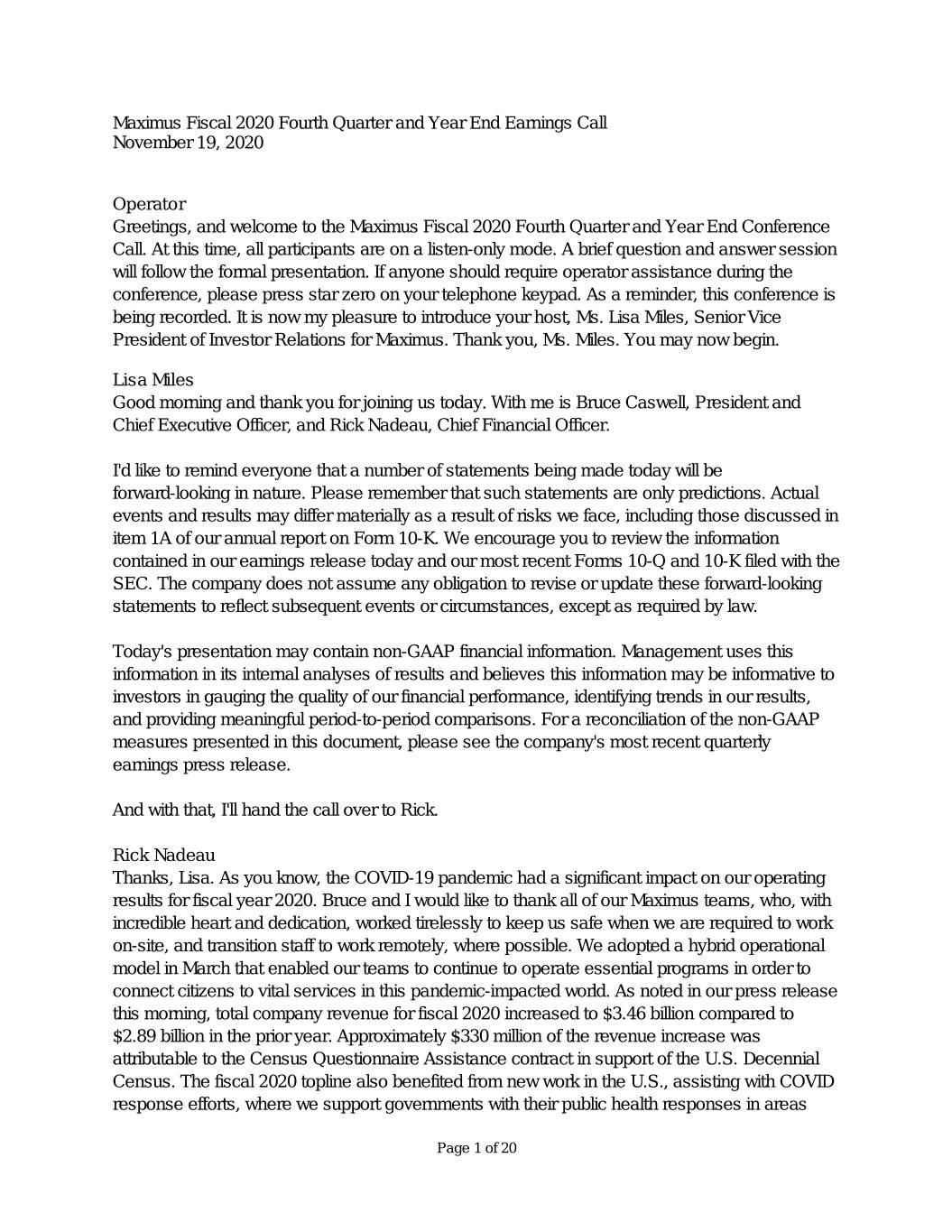
•Revenue increased to $3.46 billion compared to $2.89 billion reported for the same period last year, driven by the Census contract in the U.S. Federal Services Segment and new COVID-19 response work to assist governments in supporting individuals and families during the global pandemic
•Organic growth of 15.7% in fiscal 2020, or 4.6% excluding the Census contract
•Operating margin of 8.3% and diluted earnings per share of $3.39 for fiscal 2020 were lower compared to the prior year. Reduced volumes on core programs in the U.S. where pandemic-related program changes were instituted at the direction of our state and federal clients, a greater mix of cost-plus work in fiscal 2020, and unfavorable pandemic-related impacts in operations outside the U.S.
•Renamed the U.S. Health & Human Services Segment to the U.S. Services Segment
•A quarterly cash dividend of $0.28 for each share of our common stock outstanding payable on November 30, 2020, to shareholders of record on November 13, 2020
"Fiscal year 2020 demonstrated our ability to quickly respond and rapidly scale operations in order to support the significant increase in demand from governments to address the extraordinary needs of citizens in the wake of the pandemic. Our ongoing investments in technology and digital capabilities allowed us to enable thousands of employees into remote work environments in a span of weeks," shared Bruce Caswell, President and Chief Executive Officer.

Consolidated FY20 Results
Revenue for fiscal 2020 increased to $3.46 billion, compared to $2.89 billion reported for the prior year driven by the Census contract in the U.S. Federal Services Segment and COVID-19 response work. The Company is supporting governments with their public health responses in areas such as contact tracing, disease investigation, COVID-19 information lines, unemployment insurance claims processing, and other COVID-related assistance. Organic growth for fiscal 2020 was 15.7%, or 4.6% excluding the Census contract, and tempered by declines in the Outside the U.S. Segment.
Operating income for fiscal 2020 totaled $288.3 million, yielding an operating margin of 8.3%. This compares to $317.1 million and 11.0%, respectively, for the prior fiscal year. For fiscal 2020, net income attributable to Maximus totaled $214.5 million, or $3.39 of diluted earnings per share, compared to $240.8 million and $3.72, respectively, for the prior fiscal year.
Fiscal 2020 earnings were lower due to three primary areas of impact: 1) reduced volumes on large U.S. programs where state and federal government clients temporarily instituted changes in response to the COVID-19 pandemic to ensure that individuals and families retain access to vital programs, 2) a greater mix of cost-plus work in fiscal 2020 driven by the Census contract in the U.S. Federal Services Segment, and 3) COVID-related impacts outside the United States.
The effective tax rate for fiscal 2020 was 25.3%, compared to 24.2% in the prior fiscal year. The higher rate was attributable to normal course vesting of stock compensation which had a reduced benefit tied to a lower share price.
U.S. Services Segment
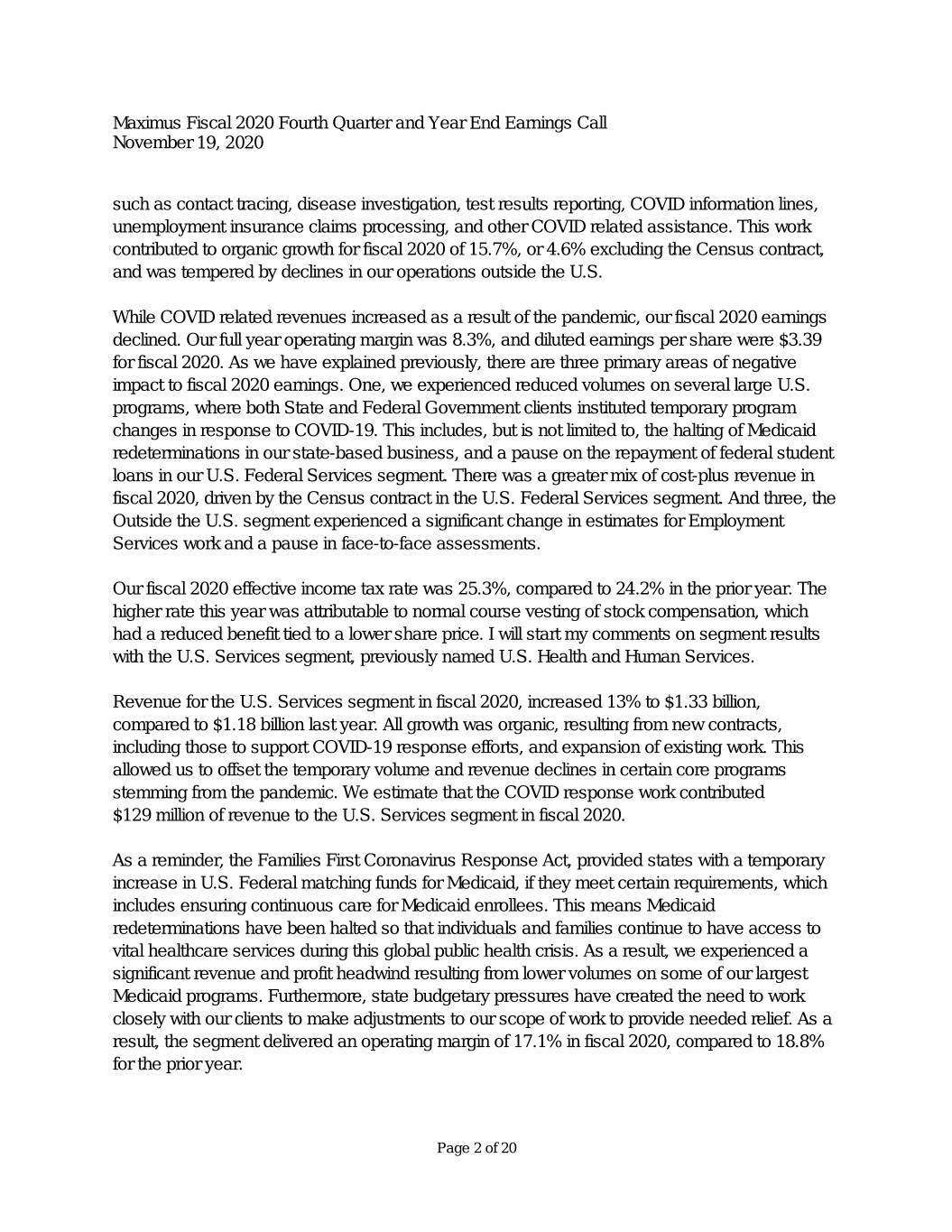
U.S. Services Segment revenue for fiscal 2020 increased 13% to $1.33 billion, compared to $1.18 billion reported in the prior fiscal year. All growth in this segment was organic and attributable to new work, including COVID-19 response efforts, and the expansion of existing contracts which offset temporary volume and revenue declines in certain core programs stemming from the pandemic. An estimated $129 million of revenue was attributable to COVID-19 response work in this segment for fiscal 2020.
The Families First Coronavirus Response Act provided states with a temporary increase to federal matching funds for Medicaid in exchange for meeting certain requirements, including ensuring continuous care for current Medicaid enrollees. As a result, Medicaid redeterminations have halted on some of our largest Medicaid programs and the reduced activity caused a significant revenue and earnings headwind for this segment in fiscal 2020. In addition, state budgetary pressures have created the need to work closely with clients to provide needed relief through adjustments to scope of work on certain contracts.
These impacts contributed to an operating margin of 17.1% for the U.S. Services Segment in fiscal 2020. Operating margin for this segment was 18.8% in the prior fiscal year.
U.S. Federal Services Segment
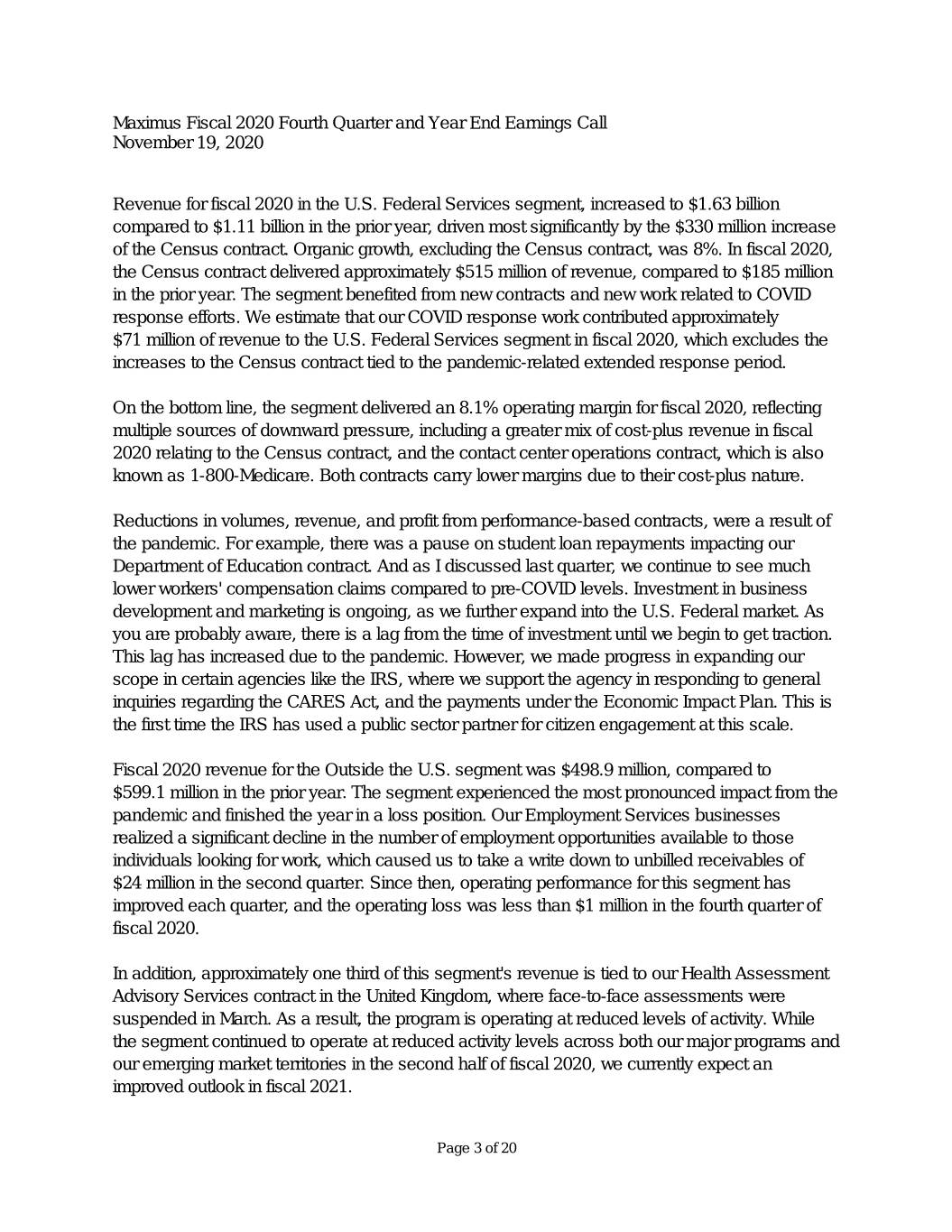
U.S. Federal Services Segment revenue for fiscal 2020 increased to $1.63 billion, compared to $1.11 billion reported in the prior fiscal year, driven most significantly by the $330 million increase of the Census contract. Organic growth excluding the Census contract was 8.0%. The Census contract delivered approximately $515 million of total revenue for fiscal 2020, compared to $185 million in the prior fiscal year.
Additionally, this segment realized growth from new contracts and new work related to the COVID-19 response efforts. An estimated $71.0 million of revenue was attributable to COVID-19 response work in the U.S. Federal Services Segment for fiscal 2020, which excludes the increases to the Census contract also tied to the pandemic-related extended response period.
The segment's operating income was tempered by: 1) a greater mix of cost-plus revenue related primarily to the Census contract and the Contact Center Operations (CCO) contract, also known as 1-800-MEDICARE, which carry lower margins, 2) a reduction in volumes, revenue, and profit on performance-based contracts as a result of the pandemic, and 3) ongoing investment in business development and marketing to support further expansion into the U.S. federal market.
As a result of these pressures, operating margin for the U.S. Federal Services Segment was 8.1% for fiscal 2020. Operating margin for this segment was 10.4% in the prior fiscal year.
"It is expected that business development and marketing activities take time to gain traction, and the pandemic has added to this timeline," commented Mr. Caswell. "But I am pleased that progress has been made in expanding scope in certain agencies such as the IRS. We are supporting the agency in responding to general inquiries regarding the CARES Act and the Economic Impact Plan. This is the first time the IRS has used a public sector partner for citizen engagement to this scale. We are extremely proud to be entrusted with this work."
Outside the U.S. Segment
Outside the U.S. Segment revenue for fiscal 2020 decreased to $498.9 million, compared to $599.1 million reported in the prior fiscal year. Operating loss for fiscal 2020 was $34.1 million, compared to an operating profit of $16.1 million and an operating margin of 2.7% reported in the prior fiscal year.
The segment experienced the most pronounced impact from the pandemic in fiscal 2020. The employment services contracts realized a significant decline in the number of employment opportunities available to those individuals looking for work. As a result, in the second quarter of fiscal 2020, the Company took a write-down of approximately $24 million or $0.28 of diluted earnings per share, which related to a decline in estimates for future period outcomes-based payments. Operating performance for the Outside the U.S. Segment improved in subsequent quarters and the fourth quarter of fiscal 2020 reported a loss of $0.6 million.
Approximately one-third of revenues for this segment are realized from the Health Assessment Advisory Service contract in the U.K. In March, the Department for Work and Pensions halted all face-to-face assessments, resulting in reduced activity levels and financial performance.
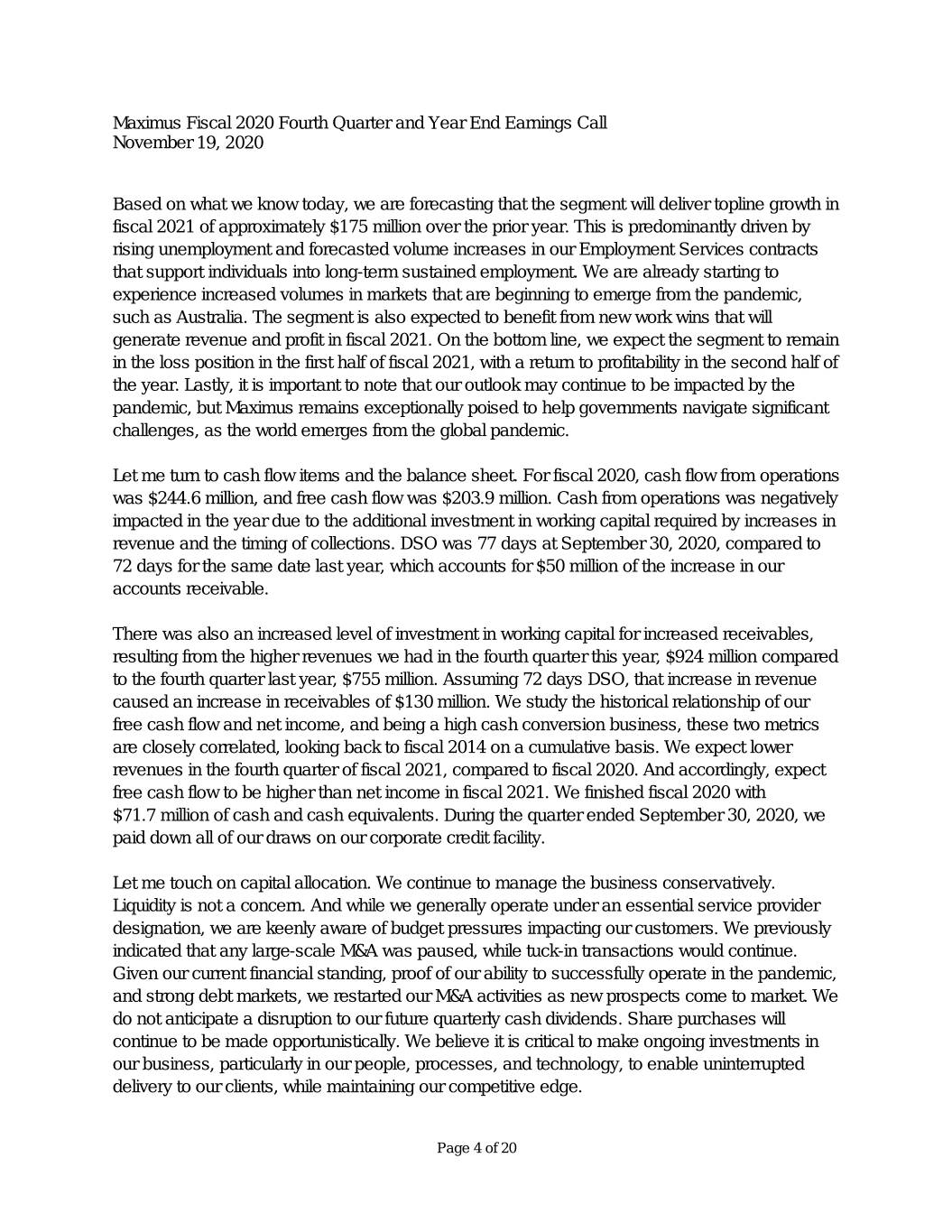
An improved outlook for this segment is expected in fiscal 2021 with forecasted revenue growth of $175 million, compared to fiscal 2020. The predominant driver of this growth is rising unemployment which is leading to increasing volumes on the Company's employment services contracts that support individuals back into long-term, sustained employment. The Company is already experiencing a rise in volumes in markets where economies have started to emerge from the global pandemic, such as Australia. This segment will also benefit from new work wins that will begin to monetize in fiscal 2021.
This segment is forecasted to be profitable in fiscal 2021, remaining in a loss position for the first half of the year and returning to profit in the second half of the year. The outlook may continue to be adversely impacted by the pandemic, but the Company remains poised to help governments navigate significant challenges as the world emerges from the global pandemic.
Sales and Pipeline
Signed contract awards for the year-ended September 30, 2020, totaled $2.7 billion and contracts pending (awarded but unsigned) totaled $744 million. These awards reflect total contract value.
The sales pipeline at September 30, 2020, was $33.0 billion (comprised of approximately $2.0 billion in proposals pending, $1.5 billion in proposals in preparation, and $29.6 billion in opportunities tracking).
Balance Sheet and Cash Flows
Cash and cash equivalents at September 30, 2020, totaled $71.7 million and excludes $16.8 million of restricted cash included in the Consolidated Statement of Cash Flows. At September 30, 2020, there were no outstanding draws on the Company's corporate credit facility, leaving $400 million of available capacity, and draws of $28.4 million in smaller facilities outside the U.S.
For fiscal 2020, cash from operations totaled $244.6 million and free cash flow was $203.9 million. Cash from operations was negatively impacted in the year due to the additional investment in working capital required by full year increases to revenue in fiscal 2020 and the timing of collections.
At September 30, 2020, DSO were 77 days and within the Company's typical range of 65 to 80 days.
On October 2, 2020, our Board of Directors declared a quarterly cash dividend of $0.28 for each share of our common stock outstanding. The dividend is payable on November 30, 2020, to shareholders of record on November 13, 2020.
Outlook
Maximus is establishing fiscal 2021 guidance. The Company expects revenue to range between $3.20 billion and $3.40 billion. Diluted earnings per share is expected to range between $3.45 and $3.70. Cash from operations is expected to range between $340 million and $390 million, and free cash flow to range between $300 million and $350 million.
Maximus is establishing fiscal 2021 guidance. The Company expects revenue to range between $3.20 billion and $3.40 billion. Diluted earnings per share is expected to range between $3.45 and $3.70. Cash from operations is expected to range between $340 million and $390 million, and free cash flow to range between $300 million and $350 million.
For fiscal 2021, the effective income tax rate is expected to range between 25.75% and 26.50% and weighted average shares outstanding to range between 62.1 million and 62.2 million, absent significant share purchase activity.
Revenue and earnings guidance is a wider range than in prior years due to the uncertainty related to the duration of COVID-19 response work and the length of disruption to core programs. Forecasted earnings for fiscal 2021 reflect the challenges faced when operating during the pandemic, including lower volumes in many core programs primarily in the United States. This is expected to be offset by increased revenue and profit from operations outside the United States where some economies have started to emerge from the global pandemic.
Mr. Caswell added, "We will continue to support our clients' evolving needs and we stand ready to provide additional support as governments strive to slow the global pandemic. As we look into fiscal 2021, we anticipate that we will begin to benefit from increasing caseloads in our employment services markets outside the United States. Our continued strong execution, healthy financial condition, robust cash flow and reliable delivery, positions Maximus for future pent-up demand as governments seek much needed assistance from private sector partners to support, operate, and scale critical safety-net programs."
Conference Call and Webcast Information
Maximus will host a conference call this morning, November 19, 2020, at 9:00 a.m. (ET).
The call is open to the public and available by webcast or by phone at:
877.407.8289 (Domestic) / +1.201.689.8341 (International)
For those unable to listen to the live call, a recording of the webcast will be available on investor.maximus.com.
About Maximus
Since 1975, Maximus has operated under its founding mission of Helping Government Serve the People®, enabling citizens around the globe to successfully engage with their governments at all levels and across a variety of health and human services programs. Maximus delivers innovative business process management and technology solutions that contribute to improved outcomes for citizens and higher levels of productivity, accuracy, accountability, and efficiency of government-sponsored programs. With more than 30,000 employees worldwide, Maximus is a proud partner to government agencies in the United States, Australia, Canada, Italy, Saudi Arabia, Singapore, South Korea, Sweden, and the United Kingdom. For more information, visit maximus.com.
Non-GAAP Measures
This release refers to non-GAAP measures and other indicators, including organic growth, free cash flow, and days sales outstanding.
We have provided a reconciliation of free cash flow to cash flows from operations.
A description of these non-GAAP measures, the reasons why we use and present them, and details as to how they are calculated are included in our Annual Report on Form 10-K.
The presentation of these non-GAAP numbers is not meant to be considered in isolation, nor as alternatives to cash flows from operations, revenue growth, or net income as measures of performance. These non-GAAP financial measures, as determined and presented by us, may not be comparable to related or similarly titled measures presented by other companies.
Statements that are not historical facts, including statements about the Company’s confidence and strategies, and the Company’s expectations about revenues, results of operations, profitability, future contracts, market opportunities, market demand, or acceptance of the Company’s products are forward-looking statements that involve risks and uncertainties such as those related to the impact of the COVID-19 pandemic including but not limited to:
•The ultimate duration of the pandemic
•The threat of further negative pandemic-related impacts
•Delays in our core programs returning to normal volumes and operations
•The potential impacts resulting from budget challenges with our government clients
•The possibility of delayed or missed payments by customers
•The potential for further supply chain disruptions impacting IT or safety equipment
•The impact of further legislation and government policies on the programs we operate
These risks could cause the Company’s actual results to differ materially from those indicated by such forward-looking statements. A summary of risk factors can be found in Item 1A of our Annual Report on Form 10-K to be filed shortly with the Securities and Exchange Commission and found on maximus.com.
Maximus, Inc.
CONSOLIDATED STATEMENTS OF OPERATIONS
(Amounts in thousands, except per share data)
| Three Months Ended September 30, | Twelve Months Ended September 30, | ||||||||||||||||||||||
| 2020 | 2019 | 2020 | 2019 | ||||||||||||||||||||
| (Unaudited) | (Unaudited) | (Unaudited) | |||||||||||||||||||||
| Revenue | $ | 923,836 | $ | 754,966 | $ | 3,461,537 | $ | 2,886,815 | |||||||||||||||
| Cost of revenue | 726,985 | 586,716 | 2,750,535 | 2,215,631 | |||||||||||||||||||
| Gross profit | 196,851 | 168,250 | 711,002 | 671,184 | |||||||||||||||||||
| Selling, general and administrative expenses | 103,428 | 81,646 | 387,090 | 321,023 | |||||||||||||||||||
| Amortization of intangible assets | 8,900 | 9,028 | 35,634 | 33,054 | |||||||||||||||||||
| Operating income | 84,523 | 77,576 | 288,278 | 317,107 | |||||||||||||||||||
| Interest expense | 494 | 343 | 2,059 | 2,957 | |||||||||||||||||||
| Other income, net | 222 | 122 | 843 | 3,170 | |||||||||||||||||||
| Income before income taxes | 84,251 | 77,355 | 287,062 | 317,320 | |||||||||||||||||||
| Provision for income taxes | 20,590 | 17,314 | 72,553 | 76,825 | |||||||||||||||||||
| Net income | 63,661 | 60,041 | 214,509 | 240,495 | |||||||||||||||||||
| Loss attributable to noncontrolling interests | — | (48) | — | (329) | |||||||||||||||||||
| Net income attributable to Maximus | $ | 63,661 | $ | 60,089 | $ | 214,509 | $ | 240,824 | |||||||||||||||
| Basic earnings per share | $ | 1.03 | $ | 0.93 | $ | 3.40 | $ | 3.73 | |||||||||||||||
| Diluted earnings per share | $ | 1.02 | $ | 0.93 | $ | 3.39 | $ | 3.72 | |||||||||||||||
| Dividends per share | $ | 0.28 | $ | 0.25 | $ | 1.12 | $ | 1.00 | |||||||||||||||
| Weighted average shares outstanding: | |||||||||||||||||||||||
| Basic | 61,874 | 64,397 | 63,062 | 64,498 | |||||||||||||||||||
| Diluted | 62,256 | 64,848 | 63,322 | 64,820 | |||||||||||||||||||
Maximus, Inc.
CONSOLIDATED BALANCE SHEETS
(Amounts in thousands)
| September 30, 2020 | September 30, 2019 | ||||||||||
| (unaudited) | |||||||||||
| ASSETS | |||||||||||
| Current assets: | |||||||||||
| Cash and cash equivalents | $ | 71,737 | $ | 105,565 | |||||||
| Accounts receivable — billed and billable, net | 622,871 | 476,690 | |||||||||
| Accounts receivable — unbilled | 163,332 | 123,884 | |||||||||
| Income taxes receivable | 2,075 | 20,805 | |||||||||
| Prepaid expenses and other current assets | 72,543 | 62,481 | |||||||||
| Total current assets | 932,558 | 789,425 | |||||||||
| Property and equipment, net | 66,721 | 99,589 | |||||||||
| Capitalized software, net | 38,033 | 32,369 | |||||||||
| Operating lease right-of-use assets | 177,159 | — | |||||||||
| Goodwill | 593,129 | 584,469 | |||||||||
| Intangible assets, net | 145,893 | 179,250 | |||||||||
| Deferred contract costs, net | 20,891 | 18,921 | |||||||||
| Deferred compensation plan assets | 36,819 | 32,908 | |||||||||
| Deferred income taxes | 1,915 | 186 | |||||||||
| Other assets | 11,584 | 8,615 | |||||||||
| Total assets | $ | 2,024,702 | $ | 1,745,732 | |||||||
| LIABILITIES AND SHAREHOLDERS' EQUITY | |||||||||||
| Current liabilities: | |||||||||||
| Accounts payable and accrued liabilities | $ | 253,338 | $ | 177,786 | |||||||
| Accrued compensation and benefits | 137,101 | 106,789 | |||||||||
| Deferred revenue | 51,655 | 43,344 | |||||||||
| Income taxes payable | 5,377 | 13,952 | |||||||||
| Current portion of long-term debt and other borrowings | 10,878 | 9,658 | |||||||||
| Operating lease liabilities | 80,748 | — | |||||||||
| Other current liabilities | 22,071 | 12,709 | |||||||||
| Total current liabilities | 561,168 | 364,238 | |||||||||
| Deferred revenue, less current portion | 27,311 | 32,341 | |||||||||
| Deferred income taxes | 24,737 | 46,560 | |||||||||
| Long-term debt, less current portion | 18,017 | 231 | |||||||||
| Deferred compensation plan liabilities, less current portion | 38,654 | 34,079 | |||||||||
| Operating lease liabilities, less current portion | 104,011 | — | |||||||||
| Other liabilities | 8,985 | 20,082 | |||||||||
| Total liabilities | 782,883 | 497,531 | |||||||||
| Commitments and contingencies | |||||||||||
| Shareholders' equity: | |||||||||||
| Common stock, no par value; 100,000 shares authorized; 61,504 and 63,979 shares issued and outstanding at September 30, 2020 and 2019, at stated amount, respectively | 513,959 | 498,433 | |||||||||
| Accumulated other comprehensive loss | (42,638) | (45,380) | |||||||||
| Retained earnings | 770,498 | 794,739 | |||||||||
| Total Maximus shareholders' equity | 1,241,819 | 1,247,792 | |||||||||
| Noncontrolling interests | — | 409 | |||||||||
| Total equity | $ | 1,241,819 | $ | 1,248,201 | |||||||
| Total liabilities and equity | $ | 2,024,702 | $ | 1,745,732 | |||||||
Maximus, Inc.
CONSOLIDATED STATEMENTS OF CASH FLOWS
(Amounts in thousands)
| Three Months Ended September 30, 2020 | Twelve Months Ended September 30, 2020 | ||||||||||||||||||||||
| 2020 | 2019 | 2020 | 2019 | ||||||||||||||||||||
| (Unaudited) | (Unaudited) | (Unaudited) | |||||||||||||||||||||
| Cash flows from operations: | |||||||||||||||||||||||
| Net income | $ | 63,661 | $ | 60,041 | $ | 214,509 | $ | 240,495 | |||||||||||||||
| Adjustments to reconcile net income to cash flows from operations: | |||||||||||||||||||||||
| Depreciation and amortization of property and equipment and capitalized software | 17,031 | 17,816 | 64,527 | 52,404 | |||||||||||||||||||
| Amortization of intangible assets | 8,900 | 9,028 | 35,634 | 33,054 | |||||||||||||||||||
| Deferred income taxes | (13,935) | 1,465 | (19,145) | 12,661 | |||||||||||||||||||
| Stock compensation expense | 6,150 | 5,451 | 23,708 | 20,774 | |||||||||||||||||||
| Gain on sale of a business | (12) | — | (1,718) | — | |||||||||||||||||||
| Changes in assets and liabilities, net of effects of business combinations | |||||||||||||||||||||||
| Accounts receivable — billed and billable | 5,784 | 47,818 | (141,842) | (60,313) | |||||||||||||||||||
| Accounts receivable — unbilled | 41,362 | (31,354) | (38,905) | 14,818 | |||||||||||||||||||
| Prepaid expenses and other current assets | (10,368) | (12,650) | (9,839) | (15,583) | |||||||||||||||||||
| Deferred contract costs | (515) | 3,472 | (1,911) | (4,670) | |||||||||||||||||||
| Accounts payable and accrued liabilities | 31,308 | (5,882) | 79,930 | 47,580 | |||||||||||||||||||
| Accrued compensation and benefits | (4,163) | (6,994) | 29,484 | 2,288 | |||||||||||||||||||
| Deferred revenue | (415) | 8,631 | 2,391 | 16,488 | |||||||||||||||||||
| Income taxes | 2,927 | (7,859) | 3,490 | (4,720) | |||||||||||||||||||
| Operating lease right-of-use assets and liabilities | 515 | — | (556) | — | |||||||||||||||||||
| Other assets and liabilities | 279 | 4,033 | 4,835 | 1,451 | |||||||||||||||||||
| Cash flows from operations | 148,509 | 93,016 | 244,592 | 356,727 | |||||||||||||||||||
| Cash flows from investing activities: | |||||||||||||||||||||||
| Purchases of property and equipment and capitalized software costs | (12,271) | (27,813) | (40,707) | (66,846) | |||||||||||||||||||
| Acquisition of businesses, net of cash acquired | (4,455) | (14,790) | (7,066) | (436,839) | |||||||||||||||||||
| Acquisition of noncontrolling interests | — | (647) | — | (647) | |||||||||||||||||||
| Proceeds from the sale of a business | — | — | 3,250 | — | |||||||||||||||||||
| Maturities of short-term investments | — | — | — | 19,996 | |||||||||||||||||||
| Other | — | 73 | 385 | 453 | |||||||||||||||||||
| Cash used in investing activities | (16,726) | (43,177) | (44,138) | (483,883) | |||||||||||||||||||
| Cash flows from financing activities: | |||||||||||||||||||||||
| Cash dividends paid to Maximus shareholders | (17,167) | (15,951) | (70,155) | (63,887) | |||||||||||||||||||
| Purchases of Maximus common stock | — | (1,378) | (166,959) | (47,446) | |||||||||||||||||||
| Tax withholding related to RSU vesting | — | — | (10,614) | (8,915) | |||||||||||||||||||
| Borrowings of debt | 216,560 | 94,616 | 638,048 | 414,664 | |||||||||||||||||||
| Repayment of debt | (340,474) | (88,545) | (619,445) | (405,142) | |||||||||||||||||||
| Other | (8) | — | (965) | (133) | |||||||||||||||||||
| Cash used in financing activities | (141,089) | (11,258) | (230,090) | (110,859) | |||||||||||||||||||
| Effect of exchange rate changes on cash, cash equivalents and restricted cash | 1,879 | (1,058) | 1,705 | (2,052) | |||||||||||||||||||
| Net (decrease)/increase in cash, cash equivalents and restricted cash | (7,427) | 37,523 | (27,931) | (240,067) | |||||||||||||||||||
| Cash, cash equivalents and restricted cash, beginning of period | 95,988 | 78,969 | 116,492 | 356,559 | |||||||||||||||||||
| Cash, cash equivalents and restricted cash, end of period | $ | 88,561 | $ | 116,492 | $ | 88,561 | $ | 116,492 | |||||||||||||||
Maximus, Inc.
SEGMENT INFORMATION
(Amounts in thousands)
(Unaudited)
| Three Months Ended September 30, 2020 | Twelve Months Ended September 30, 2020 | |||||||||||||||||||||||||||||||||||||||||||||||||
| 2020 | % (1) | 2019 | % (1) | 2020 | % (1) | 2019 | % (1) | |||||||||||||||||||||||||||||||||||||||||||
| Revenue: | ||||||||||||||||||||||||||||||||||||||||||||||||||
| U.S. Services | $ | 371,345 | $ | 300,406 | $ | 1,329,274 | $ | 1,176,488 | ||||||||||||||||||||||||||||||||||||||||||
| U.S. Federal Services | 423,232 | 312,179 | 1,633,337 | 1,111,197 | ||||||||||||||||||||||||||||||||||||||||||||||
| Outside the U.S. | 129,259 | 142,381 | 498,926 | 599,130 | ||||||||||||||||||||||||||||||||||||||||||||||
| Total | $ | 923,836 | $ | 754,966 | $ | 3,461,537 | $ | 2,886,815 | ||||||||||||||||||||||||||||||||||||||||||
| Gross profit: | ||||||||||||||||||||||||||||||||||||||||||||||||||
| U.S. Services | $ | 92,199 | 24.8 | % | $ | 83,154 | 27.7 | % | $ | 360,272 | 27.1 | % | $ | 344,109 | 29.2 | % | ||||||||||||||||||||||||||||||||||
| U.S. Federal Services | 86,423 | 20.4 | % | 66,586 | 21.3 | % | 318,925 | 19.5 | % | 242,070 | 21.8 | % | ||||||||||||||||||||||||||||||||||||||
| Outside the U.S. | 18,229 | 14.1 | % | 18,510 | 13.0 | % | 31,805 | 6.4 | % | 85,005 | 14.2 | % | ||||||||||||||||||||||||||||||||||||||
| Total | $ | 196,851 | 21.3 | % | $ | 168,250 | 22.3 | % | $ | 711,002 | 20.5 | % | $ | 671,184 | 23.2 | % | ||||||||||||||||||||||||||||||||||
| Selling, general and administrative expense: | ||||||||||||||||||||||||||||||||||||||||||||||||||
| U.S. Services | $ | 29,856 | 8.0 | % | $ | 29,322 | 9.8 | % | $ | 132,489 | 10.0 | % | $ | 123,275 | 10.5 | % | ||||||||||||||||||||||||||||||||||
| U.S. Federal Services | 54,568 | 12.9 | % | 35,496 | 11.4 | % | 186,023 | 11.4 | % | 126,128 | 11.4 | % | ||||||||||||||||||||||||||||||||||||||
| Outside the U.S. | 18,813 | 14.6 | % | 16,353 | 11.5 | % | 65,938 | 13.2 | % | 68,944 | 11.5 | % | ||||||||||||||||||||||||||||||||||||||
| Gain on sale of a business (2) | (12) | NM | — | NM | (1,718) | NM | — | NM | ||||||||||||||||||||||||||||||||||||||||||
| Other (3) | 203 | NM | 475 | NM | 4,358 | NM | 2,676 | NM | ||||||||||||||||||||||||||||||||||||||||||
| Total | $ | 103,428 | 11.2 | % | $ | 81,646 | 81646000 | 10.8 | % | $ | 387,090 | 11.2 | % | $ | 321,023 | 11.1 | % | |||||||||||||||||||||||||||||||||
| Operating income: | ||||||||||||||||||||||||||||||||||||||||||||||||||
| U.S. Services | $ | 62,343 | 16.8 | % | $ | 53,832 | 17.9 | % | $ | 227,783 | 17.1 | % | $ | 220,834 | 18.8 | % | ||||||||||||||||||||||||||||||||||
| U.S. Federal Services | 31,855 | 7.5 | % | 31,090 | 10.0 | % | 132,902 | 8.1 | % | 115,942 | 10.4 | % | ||||||||||||||||||||||||||||||||||||||
| Outside the U.S. | (584) | (0.5) | % | 2,157 | 1.5 | % | (34,133) | (6.8) | % | 16,061 | 2.7 | % | ||||||||||||||||||||||||||||||||||||||
| Amortization of intangible assets | (8,900) | NM | (9,028) | NM | (35,634) | NM | (33,054) | NM | ||||||||||||||||||||||||||||||||||||||||||
| Acquisition-related expenses (4) | (459) | NM | — | NM | (4,621) | NM | (2,691) | NM | ||||||||||||||||||||||||||||||||||||||||||
| Gain on sale of a business (2) | 12 | NM | — | NM | $ | 1,718 | NM | — | NM | |||||||||||||||||||||||||||||||||||||||||
| Other | 256 | NM | (475) | NM | 263 | NM | 15 | NM | ||||||||||||||||||||||||||||||||||||||||||
| Total | $ | 84,523 | 9.1 | % | $ | 77,576 | 10.3 | % | $ | 288,278 | 8.3 | % | $ | 317,107 | 11.0 | % | ||||||||||||||||||||||||||||||||||
(1) Percentage of respective segment revenue. Percentages not considered meaningful are marked “NM.”
(2) During fiscal year 2020, we sold Q2 Administrators LLC, a subsidiary within our U.S. Federal Services Segment, resulting in a gain.
(3) Other selling, general and administrative expenses includes credits and costs that are not allocated to a particular segment.
(4) Acquisition-related expenses are costs of completed business combinations as well as the costs of any unsuccessful transactions.
Maximus, Inc.
FREE CASH FLOW
(Non-GAAP measure)
(Amounts in thousands)
(Unaudited)
| Three Months Ended September 30, | Twelve Months Ended September 30, | ||||||||||||||||||||||
| 2020 | 2019 | 2020 | 2019 | ||||||||||||||||||||
| Cash from operations | $ | 148,509 | $ | 93,016 | $ | 244,592 | $ | 356,727 | |||||||||||||||
| Purchases of property and equipment and capitalized software costs | (12,271) | (27,813) | (40,707) | (66,846) | |||||||||||||||||||
| Capital expenditure as a result of acquisition (1) | — | — | — | 4,542 | |||||||||||||||||||
| Free cash flow | $ | 136,238 | $ | 65,203 | $ | 203,885 | $ | 294,423 | |||||||||||||||
(1) Purchases of property and equipment and capitalized software costs included $4.5 million in one-time payments to cover software
licenses required for employees joining us through the citizen engagement centers acquisition in November 2018.
-XXX-
Maximus Fiscal 2020 Fourth Quarter and Year End Earnings Call November 19, 2020 Operator Greetings, and welcome to the Maximus Fiscal 2020 Fourth Quarter and Year End Conference Call. At this time, all participants are on a listen-only mode. A brief question and answer session will follow the formal presentation. If anyone should require operator assistance during the conference, please press star zero on your telephone keypad. As a reminder, this conference is being recorded. It is now my pleasure to introduce your host, Ms. Lisa Miles, Senior Vice President of Investor Relations for Maximus. Thank you, Ms. Miles. You may now begin. Lisa Miles Good morning and thank you for joining us today. With me is Bruce Caswell, President and Chief Executive Officer, and Rick Nadeau, Chief Financial Officer. I'd like to remind everyone that a number of statements being made today will be forward-looking in nature. Please remember that such statements are only predictions. Actual events and results may differ materially as a result of risks we face, including those discussed in item 1A of our annual report on Form 10-K. We encourage you to review the information contained in our earnings release today and our most recent Forms 10-Q and 10-K filed with the SEC. The company does not assume any obligation to revise or update these forward-looking statements to reflect subsequent events or circumstances, except as required by law. Today's presentation may contain non-GAAP financial information. Management uses this information in its internal analyses of results and believes this information may be informative to investors in gauging the quality of our financial performance, identifying trends in our results, and providing meaningful period-to-period comparisons. For a reconciliation of the non-GAAP measures presented in this document, please see the company's most recent quarterly earnings press release. And with that, I'll hand the call over to Rick. Rick Nadeau Thanks, Lisa. As you know, the COVID-19 pandemic had a significant impact on our operating results for fiscal year 2020. Bruce and I would like to thank all of our Maximus teams, who, with incredible heart and dedication, worked tirelessly to keep us safe when we are required to work on-site, and transition staff to work remotely, where possible. We adopted a hybrid operational model in March that enabled our teams to continue to operate essential programs in order to connect citizens to vital services in this pandemic-impacted world. As noted in our press release this morning, total company revenue for fiscal 2020 increased to $3.46 billion compared to $2.89 billion in the prior year. Approximately $330 million of the revenue increase was attributable to the Census Questionnaire Assistance contract in support of the U.S. Decennial Census. The fiscal 2020 topline also benefited from new work in the U.S., assisting with COVID response efforts, where we support governments with their public health responses in areas Page 1 of 20
Maximus Fiscal 2020 Fourth Quarter and Year End Earnings Call November 19, 2020 such as contact tracing, disease investigation, test results reporting, COVID information lines, unemployment insurance claims processing, and other COVID related assistance. This work contributed to organic growth for fiscal 2020 of 15.7%, or 4.6% excluding the Census contract, and was tempered by declines in our operations outside the U.S. While COVID related revenues increased as a result of the pandemic, our fiscal 2020 earnings declined. Our full year operating margin was 8.3%, and diluted earnings per share were $3.39 for fiscal 2020. As we have explained previously, there are three primary areas of negative impact to fiscal 2020 earnings. One, we experienced reduced volumes on several large U.S. programs, where both State and Federal Government clients instituted temporary program changes in response to COVID-19. This includes, but is not limited to, the halting of Medicaid redeterminations in our state-based business, and a pause on the repayment of federal student loans in our U.S. Federal Services segment. There was a greater mix of cost-plus revenue in fiscal 2020, driven by the Census contract in the U.S. Federal Services segment. And three, the Outside the U.S. segment experienced a significant change in estimates for Employment Services work and a pause in face-to-face assessments. Our fiscal 2020 effective income tax rate was 25.3%, compared to 24.2% in the prior year. The higher rate this year was attributable to normal course vesting of stock compensation, which had a reduced benefit tied to a lower share price. I will start my comments on segment results with the U.S. Services segment, previously named U.S. Health and Human Services. Revenue for the U.S. Services segment in fiscal 2020, increased 13% to $1.33 billion, compared to $1.18 billion last year. All growth was organic, resulting from new contracts, including those to support COVID-19 response efforts, and expansion of existing work. This allowed us to offset the temporary volume and revenue declines in certain core programs stemming from the pandemic. We estimate that the COVID response work contributed $129 million of revenue to the U.S. Services segment in fiscal 2020. As a reminder, the Families First Coronavirus Response Act, provided states with a temporary increase in U.S. Federal matching funds for Medicaid, if they meet certain requirements, which includes ensuring continuous care for Medicaid enrollees. This means Medicaid redeterminations have been halted so that individuals and families continue to have access to vital healthcare services during this global public health crisis. As a result, we experienced a significant revenue and profit headwind resulting from lower volumes on some of our largest Medicaid programs. Furthermore, state budgetary pressures have created the need to work closely with our clients to make adjustments to our scope of work to provide needed relief. As a result, the segment delivered an operating margin of 17.1% in fiscal 2020, compared to 18.8% for the prior year. Page 2 of 20
Maximus Fiscal 2020 Fourth Quarter and Year End Earnings Call November 19, 2020 Revenue for fiscal 2020 in the U.S. Federal Services segment, increased to $1.63 billion compared to $1.11 billion in the prior year, driven most significantly by the $330 million increase of the Census contract. Organic growth, excluding the Census contract, was 8%. In fiscal 2020, the Census contract delivered approximately $515 million of revenue, compared to $185 million in the prior year. The segment benefited from new contracts and new work related to COVID response efforts. We estimate that our COVID response work contributed approximately $71 million of revenue to the U.S. Federal Services segment in fiscal 2020, which excludes the increases to the Census contract tied to the pandemic-related extended response period. On the bottom line, the segment delivered an 8.1% operating margin for fiscal 2020, reflecting multiple sources of downward pressure, including a greater mix of cost-plus revenue in fiscal 2020 relating to the Census contract, and the contact center operations contract, which is also known as 1-800-Medicare. Both contracts carry lower margins due to their cost-plus nature. Reductions in volumes, revenue, and profit from performance-based contracts, were a result of the pandemic. For example, there was a pause on student loan repayments impacting our Department of Education contract. And as I discussed last quarter, we continue to see much lower workers' compensation claims compared to pre-COVID levels. Investment in business development and marketing is ongoing, as we further expand into the U.S. Federal market. As you are probably aware, there is a lag from the time of investment until we begin to get traction. This lag has increased due to the pandemic. However, we made progress in expanding our scope in certain agencies like the IRS, where we support the agency in responding to general inquiries regarding the CARES Act, and the payments under the Economic Impact Plan. This is the first time the IRS has used a public sector partner for citizen engagement at this scale. Fiscal 2020 revenue for the Outside the U.S. segment was $498.9 million, compared to $599.1 million in the prior year. The segment experienced the most pronounced impact from the pandemic and finished the year in a loss position. Our Employment Services businesses realized a significant decline in the number of employment opportunities available to those individuals looking for work, which caused us to take a write down to unbilled receivables of $24 million in the second quarter. Since then, operating performance for this segment has improved each quarter, and the operating loss was less than $1 million in the fourth quarter of fiscal 2020. In addition, approximately one third of this segment's revenue is tied to our Health Assessment Advisory Services contract in the United Kingdom, where face-to-face assessments were suspended in March. As a result, the program is operating at reduced levels of activity. While the segment continued to operate at reduced activity levels across both our major programs and our emerging market territories in the second half of fiscal 2020, we currently expect an improved outlook in fiscal 2021. Page 3 of 20
Maximus Fiscal 2020 Fourth Quarter and Year End Earnings Call November 19, 2020 Based on what we know today, we are forecasting that the segment will deliver topline growth in fiscal 2021 of approximately $175 million over the prior year. This is predominantly driven by rising unemployment and forecasted volume increases in our Employment Services contracts that support individuals into long-term sustained employment. We are already starting to experience increased volumes in markets that are beginning to emerge from the pandemic, such as Australia. The segment is also expected to benefit from new work wins that will generate revenue and profit in fiscal 2021. On the bottom line, we expect the segment to remain in the loss position in the first half of fiscal 2021, with a return to profitability in the second half of the year. Lastly, it is important to note that our outlook may continue to be impacted by the pandemic, but Maximus remains exceptionally poised to help governments navigate significant challenges, as the world emerges from the global pandemic. Let me turn to cash flow items and the balance sheet. For fiscal 2020, cash flow from operations was $244.6 million, and free cash flow was $203.9 million. Cash from operations was negatively impacted in the year due to the additional investment in working capital required by increases in revenue and the timing of collections. DSO was 77 days at September 30, 2020, compared to 72 days for the same date last year, which accounts for $50 million of the increase in our accounts receivable. There was also an increased level of investment in working capital for increased receivables, resulting from the higher revenues we had in the fourth quarter this year, $924 million compared to the fourth quarter last year, $755 million. Assuming 72 days DSO, that increase in revenue caused an increase in receivables of $130 million. We study the historical relationship of our free cash flow and net income, and being a high cash conversion business, these two metrics are closely correlated, looking back to fiscal 2014 on a cumulative basis. We expect lower revenues in the fourth quarter of fiscal 2021, compared to fiscal 2020. And accordingly, expect free cash flow to be higher than net income in fiscal 2021. We finished fiscal 2020 with $71.7 million of cash and cash equivalents. During the quarter ended September 30, 2020, we paid down all of our draws on our corporate credit facility. Let me touch on capital allocation. We continue to manage the business conservatively. Liquidity is not a concern. And while we generally operate under an essential service provider designation, we are keenly aware of budget pressures impacting our customers. We previously indicated that any large-scale M&A was paused, while tuck-in transactions would continue. Given our current financial standing, proof of our ability to successfully operate in the pandemic, and strong debt markets, we restarted our M&A activities as new prospects come to market. We do not anticipate a disruption to our future quarterly cash dividends. Share purchases will continue to be made opportunistically. We believe it is critical to make ongoing investments in our business, particularly in our people, processes, and technology, to enable uninterrupted delivery to our clients, while maintaining our competitive edge. Page 4 of 20
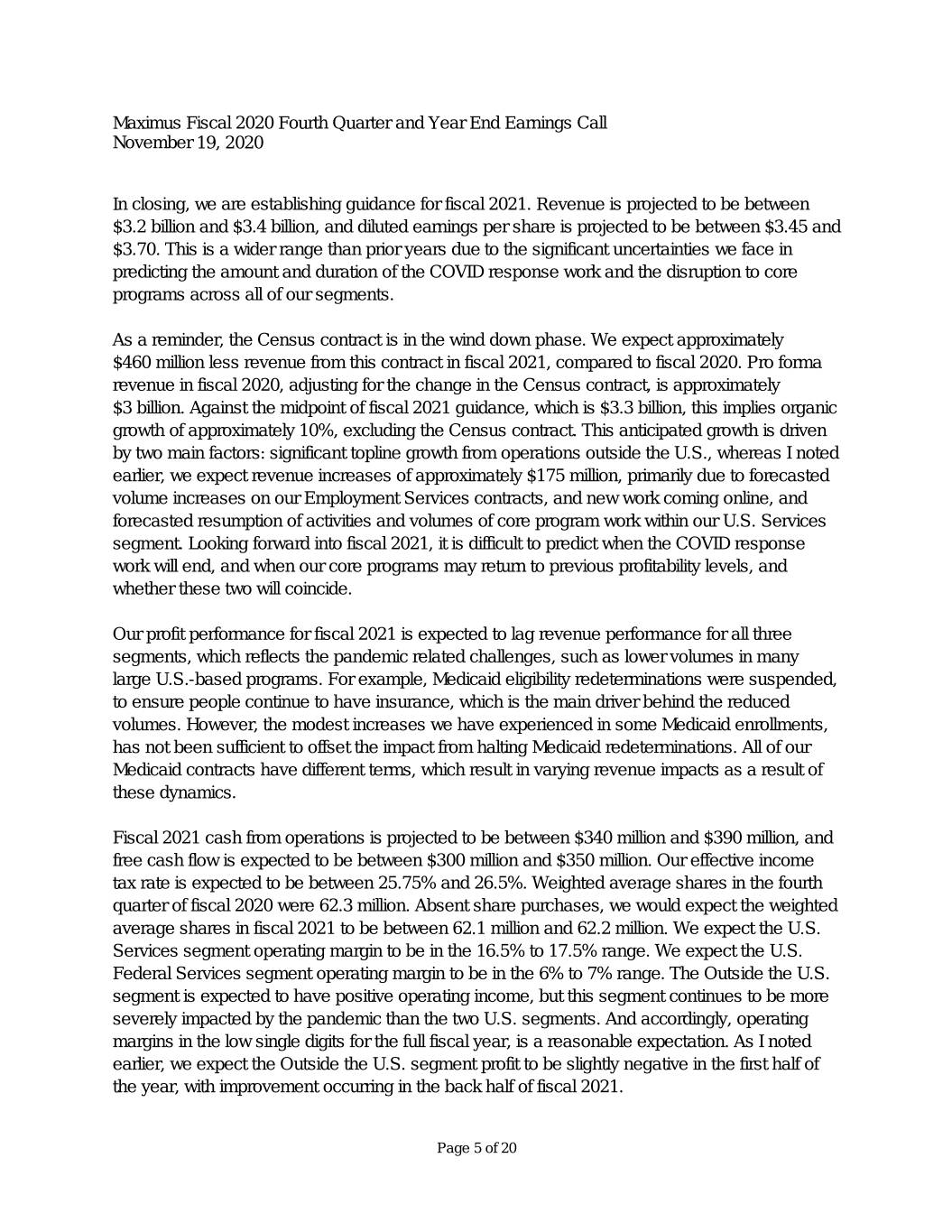
Maximus Fiscal 2020 Fourth Quarter and Year End Earnings Call November 19, 2020 In closing, we are establishing guidance for fiscal 2021. Revenue is projected to be between $3.2 billion and $3.4 billion, and diluted earnings per share is projected to be between $3.45 and $3.70. This is a wider range than prior years due to the significant uncertainties we face in predicting the amount and duration of the COVID response work and the disruption to core programs across all of our segments. As a reminder, the Census contract is in the wind down phase. We expect approximately $460 million less revenue from this contract in fiscal 2021, compared to fiscal 2020. Pro forma revenue in fiscal 2020, adjusting for the change in the Census contract, is approximately $3 billion. Against the midpoint of fiscal 2021 guidance, which is $3.3 billion, this implies organic growth of approximately 10%, excluding the Census contract. This anticipated growth is driven by two main factors: significant topline growth from operations outside the U.S., whereas I noted earlier, we expect revenue increases of approximately $175 million, primarily due to forecasted volume increases on our Employment Services contracts, and new work coming online, and forecasted resumption of activities and volumes of core program work within our U.S. Services segment. Looking forward into fiscal 2021, it is difficult to predict when the COVID response work will end, and when our core programs may return to previous profitability levels, and whether these two will coincide. Our profit performance for fiscal 2021 is expected to lag revenue performance for all three segments, which reflects the pandemic related challenges, such as lower volumes in many large U.S.-based programs. For example, Medicaid eligibility redeterminations were suspended, to ensure people continue to have insurance, which is the main driver behind the reduced volumes. However, the modest increases we have experienced in some Medicaid enrollments, has not been sufficient to offset the impact from halting Medicaid redeterminations. All of our Medicaid contracts have different terms, which result in varying revenue impacts as a result of these dynamics. Fiscal 2021 cash from operations is projected to be between $340 million and $390 million, and free cash flow is expected to be between $300 million and $350 million. Our effective income tax rate is expected to be between 25.75% and 26.5%. Weighted average shares in the fourth quarter of fiscal 2020 were 62.3 million. Absent share purchases, we would expect the weighted average shares in fiscal 2021 to be between 62.1 million and 62.2 million. We expect the U.S. Services segment operating margin to be in the 16.5% to 17.5% range. We expect the U.S. Federal Services segment operating margin to be in the 6% to 7% range. The Outside the U.S. segment is expected to have positive operating income, but this segment continues to be more severely impacted by the pandemic than the two U.S. segments. And accordingly, operating margins in the low single digits for the full fiscal year, is a reasonable expectation. As I noted earlier, we expect the Outside the U.S. segment profit to be slightly negative in the first half of the year, with improvement occurring in the back half of fiscal 2021. Page 5 of 20
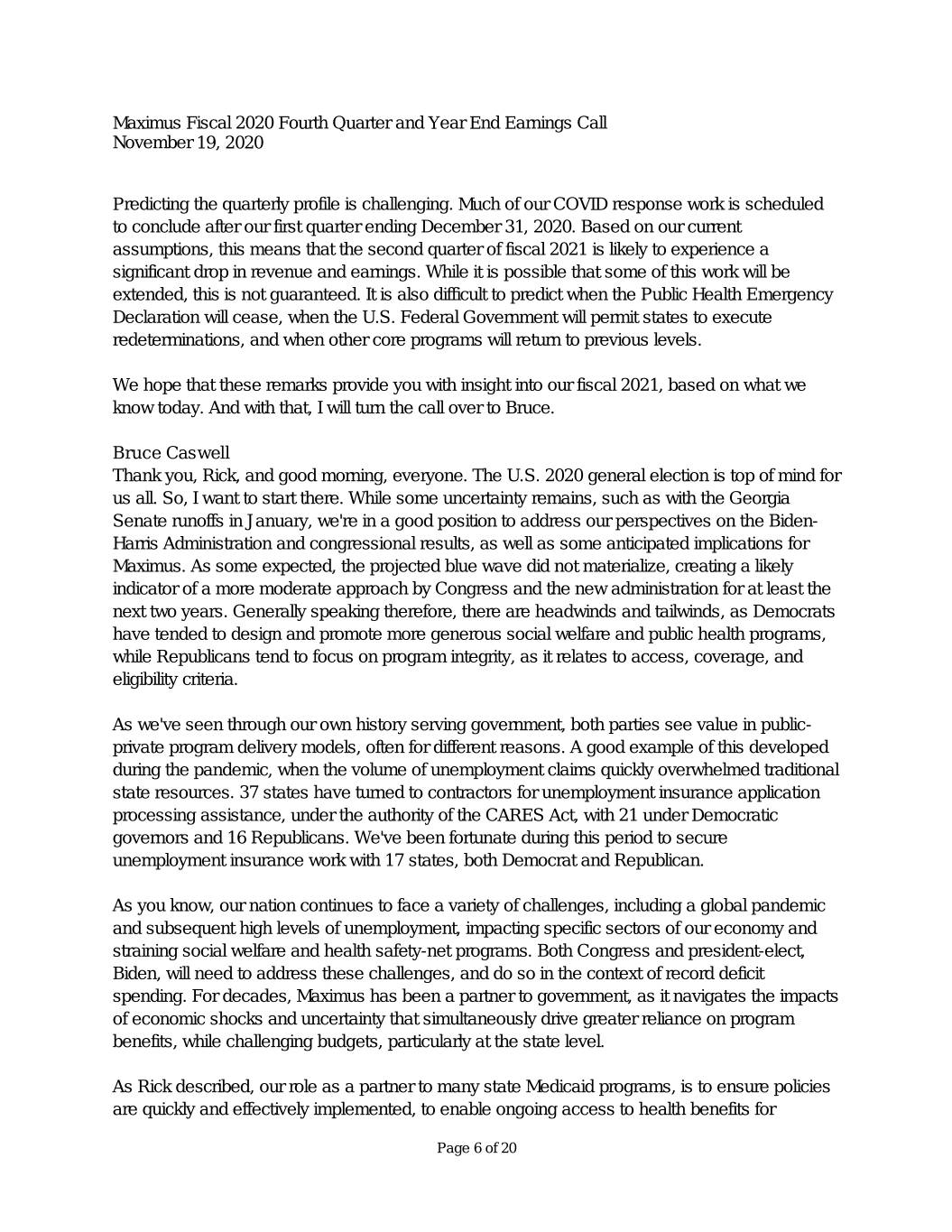
Maximus Fiscal 2020 Fourth Quarter and Year End Earnings Call November 19, 2020 Predicting the quarterly profile is challenging. Much of our COVID response work is scheduled to conclude after our first quarter ending December 31, 2020. Based on our current assumptions, this means that the second quarter of fiscal 2021 is likely to experience a significant drop in revenue and earnings. While it is possible that some of this work will be extended, this is not guaranteed. It is also difficult to predict when the Public Health Emergency Declaration will cease, when the U.S. Federal Government will permit states to execute redeterminations, and when other core programs will return to previous levels. We hope that these remarks provide you with insight into our fiscal 2021, based on what we know today. And with that, I will turn the call over to Bruce. Bruce Caswell Thank you, Rick, and good morning, everyone. The U.S. 2020 general election is top of mind for us all. So, I want to start there. While some uncertainty remains, such as with the Georgia Senate runoffs in January, we're in a good position to address our perspectives on the Biden- Harris Administration and congressional results, as well as some anticipated implications for Maximus. As some expected, the projected blue wave did not materialize, creating a likely indicator of a more moderate approach by Congress and the new administration for at least the next two years. Generally speaking therefore, there are headwinds and tailwinds, as Democrats have tended to design and promote more generous social welfare and public health programs, while Republicans tend to focus on program integrity, as it relates to access, coverage, and eligibility criteria. As we've seen through our own history serving government, both parties see value in public- private program delivery models, often for different reasons. A good example of this developed during the pandemic, when the volume of unemployment claims quickly overwhelmed traditional state resources. 37 states have turned to contractors for unemployment insurance application processing assistance, under the authority of the CARES Act, with 21 under Democratic governors and 16 Republicans. We've been fortunate during this period to secure unemployment insurance work with 17 states, both Democrat and Republican. As you know, our nation continues to face a variety of challenges, including a global pandemic and subsequent high levels of unemployment, impacting specific sectors of our economy and straining social welfare and health safety-net programs. Both Congress and president-elect, Biden, will need to address these challenges, and do so in the context of record deficit spending. For decades, Maximus has been a partner to government, as it navigates the impacts of economic shocks and uncertainty that simultaneously drive greater reliance on program benefits, while challenging budgets, particularly at the state level. As Rick described, our role as a partner to many state Medicaid programs, is to ensure policies are quickly and effectively implemented, to enable ongoing access to health benefits for Page 6 of 20
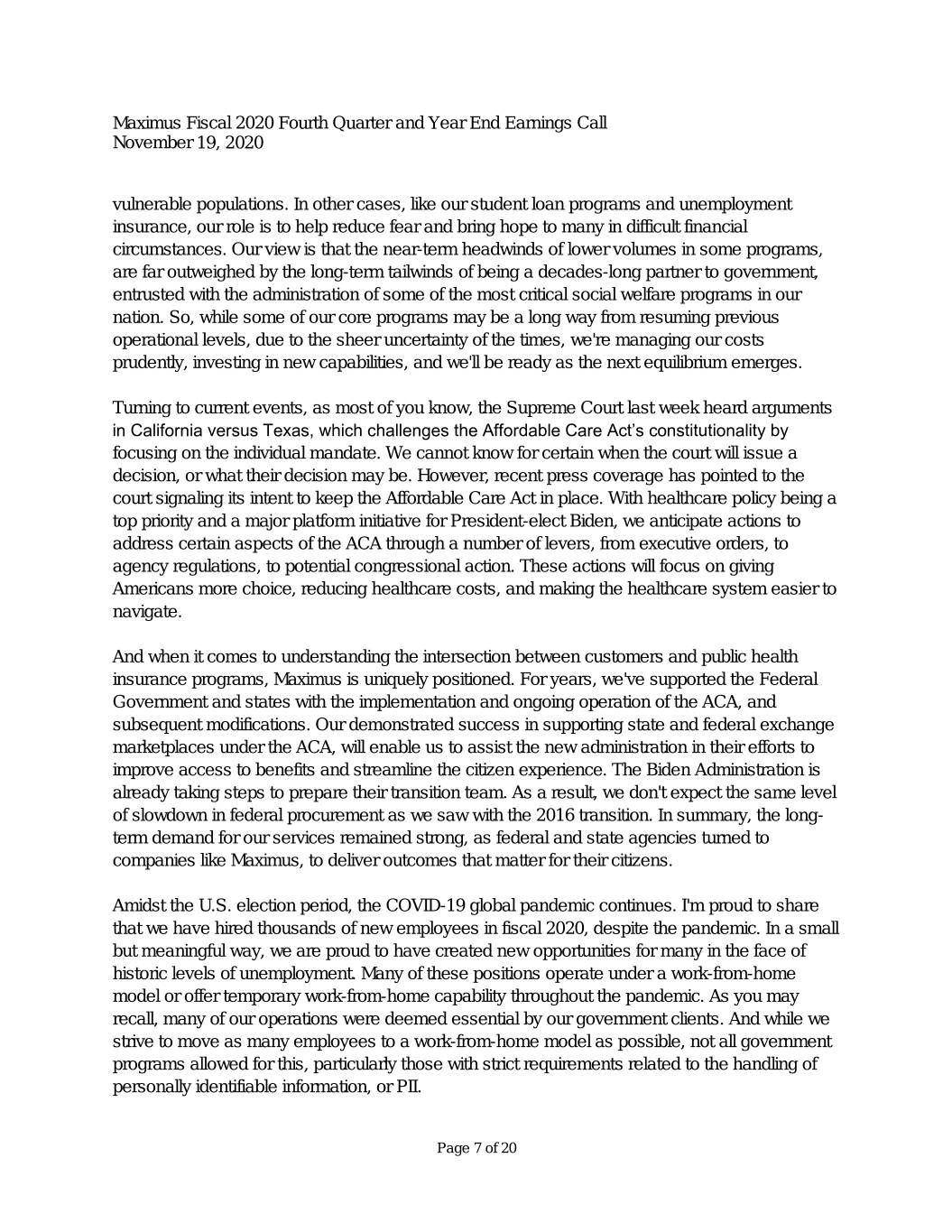
Maximus Fiscal 2020 Fourth Quarter and Year End Earnings Call November 19, 2020 vulnerable populations. In other cases, like our student loan programs and unemployment insurance, our role is to help reduce fear and bring hope to many in difficult financial circumstances. Our view is that the near-term headwinds of lower volumes in some programs, are far outweighed by the long-term tailwinds of being a decades-long partner to government, entrusted with the administration of some of the most critical social welfare programs in our nation. So, while some of our core programs may be a long way from resuming previous operational levels, due to the sheer uncertainty of the times, we're managing our costs prudently, investing in new capabilities, and we'll be ready as the next equilibrium emerges. Turning to current events, as most of you know, the Supreme Court last week heard arguments in California versus Texas, which challenges the Affordable Care Act’s constitutionality by focusing on the individual mandate. We cannot know for certain when the court will issue a decision, or what their decision may be. However, recent press coverage has pointed to the court signaling its intent to keep the Affordable Care Act in place. With healthcare policy being a top priority and a major platform initiative for President-elect Biden, we anticipate actions to address certain aspects of the ACA through a number of levers, from executive orders, to agency regulations, to potential congressional action. These actions will focus on giving Americans more choice, reducing healthcare costs, and making the healthcare system easier to navigate. And when it comes to understanding the intersection between customers and public health insurance programs, Maximus is uniquely positioned. For years, we've supported the Federal Government and states with the implementation and ongoing operation of the ACA, and subsequent modifications. Our demonstrated success in supporting state and federal exchange marketplaces under the ACA, will enable us to assist the new administration in their efforts to improve access to benefits and streamline the citizen experience. The Biden Administration is already taking steps to prepare their transition team. As a result, we don't expect the same level of slowdown in federal procurement as we saw with the 2016 transition. In summary, the long- term demand for our services remained strong, as federal and state agencies turned to companies like Maximus, to deliver outcomes that matter for their citizens. Amidst the U.S. election period, the COVID-19 global pandemic continues. I'm proud to share that we have hired thousands of new employees in fiscal 2020, despite the pandemic. In a small but meaningful way, we are proud to have created new opportunities for many in the face of historic levels of unemployment. Many of these positions operate under a work-from-home model or offer temporary work-from-home capability throughout the pandemic. As you may recall, many of our operations were deemed essential by our government clients. And while we strive to move as many employees to a work-from-home model as possible, not all government programs allowed for this, particularly those with strict requirements related to the handling of personally identifiable information, or PII. Page 7 of 20
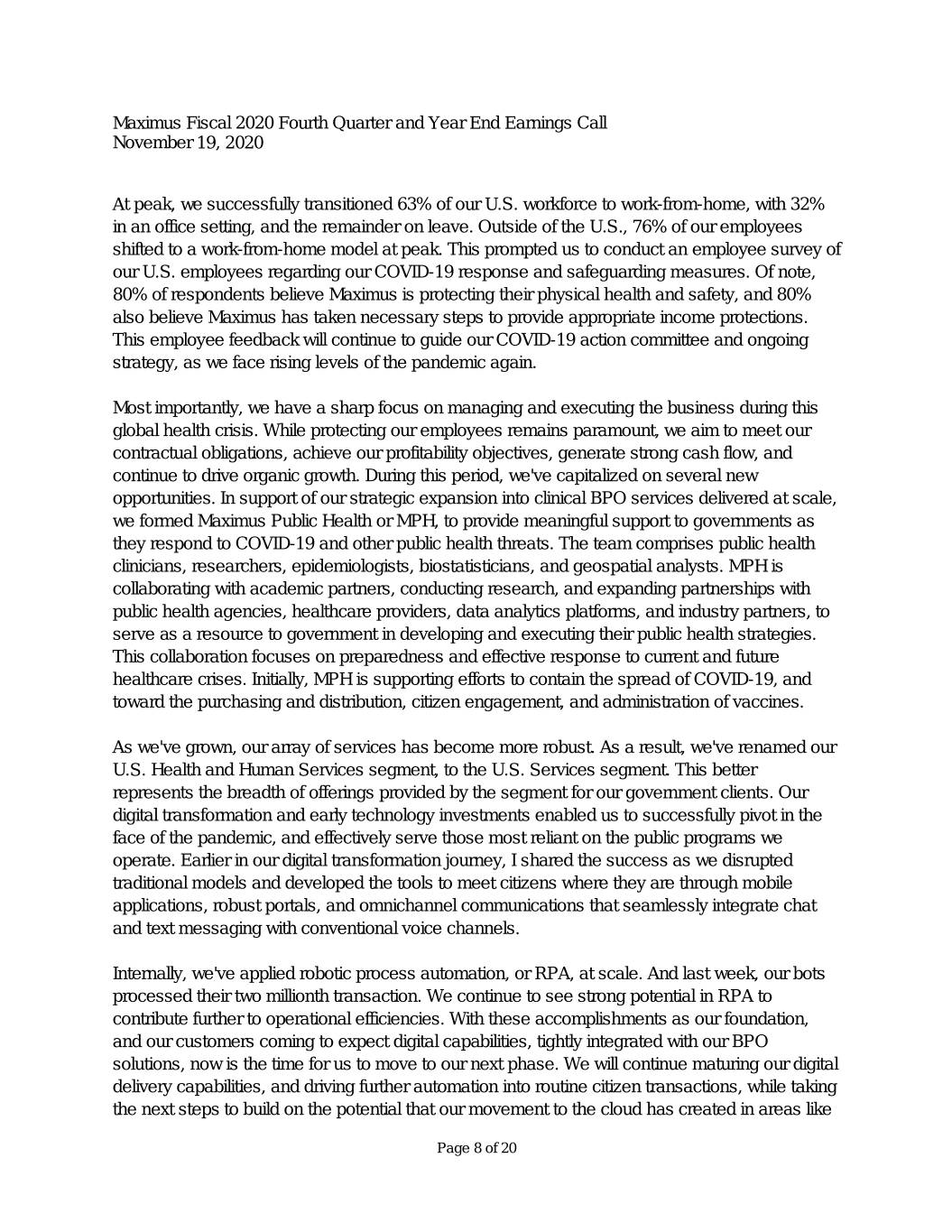
Maximus Fiscal 2020 Fourth Quarter and Year End Earnings Call November 19, 2020 At peak, we successfully transitioned 63% of our U.S. workforce to work-from-home, with 32% in an office setting, and the remainder on leave. Outside of the U.S., 76% of our employees shifted to a work-from-home model at peak. This prompted us to conduct an employee survey of our U.S. employees regarding our COVID-19 response and safeguarding measures. Of note, 80% of respondents believe Maximus is protecting their physical health and safety, and 80% also believe Maximus has taken necessary steps to provide appropriate income protections. This employee feedback will continue to guide our COVID-19 action committee and ongoing strategy, as we face rising levels of the pandemic again. Most importantly, we have a sharp focus on managing and executing the business during this global health crisis. While protecting our employees remains paramount, we aim to meet our contractual obligations, achieve our profitability objectives, generate strong cash flow, and continue to drive organic growth. During this period, we've capitalized on several new opportunities. In support of our strategic expansion into clinical BPO services delivered at scale, we formed Maximus Public Health or MPH, to provide meaningful support to governments as they respond to COVID-19 and other public health threats. The team comprises public health clinicians, researchers, epidemiologists, biostatisticians, and geospatial analysts. MPH is collaborating with academic partners, conducting research, and expanding partnerships with public health agencies, healthcare providers, data analytics platforms, and industry partners, to serve as a resource to government in developing and executing their public health strategies. This collaboration focuses on preparedness and effective response to current and future healthcare crises. Initially, MPH is supporting efforts to contain the spread of COVID-19, and toward the purchasing and distribution, citizen engagement, and administration of vaccines. As we've grown, our array of services has become more robust. As a result, we've renamed our U.S. Health and Human Services segment, to the U.S. Services segment. This better represents the breadth of offerings provided by the segment for our government clients. Our digital transformation and early technology investments enabled us to successfully pivot in the face of the pandemic, and effectively serve those most reliant on the public programs we operate. Earlier in our digital transformation journey, I shared the success as we disrupted traditional models and developed the tools to meet citizens where they are through mobile applications, robust portals, and omnichannel communications that seamlessly integrate chat and text messaging with conventional voice channels. Internally, we've applied robotic process automation, or RPA, at scale. And last week, our bots processed their two millionth transaction. We continue to see strong potential in RPA to contribute further to operational efficiencies. With these accomplishments as our foundation, and our customers coming to expect digital capabilities, tightly integrated with our BPO solutions, now is the time for us to move to our next phase. We will continue maturing our digital delivery capabilities, and driving further automation into routine citizen transactions, while taking the next steps to build on the potential that our movement to the cloud has created in areas like Page 8 of 20
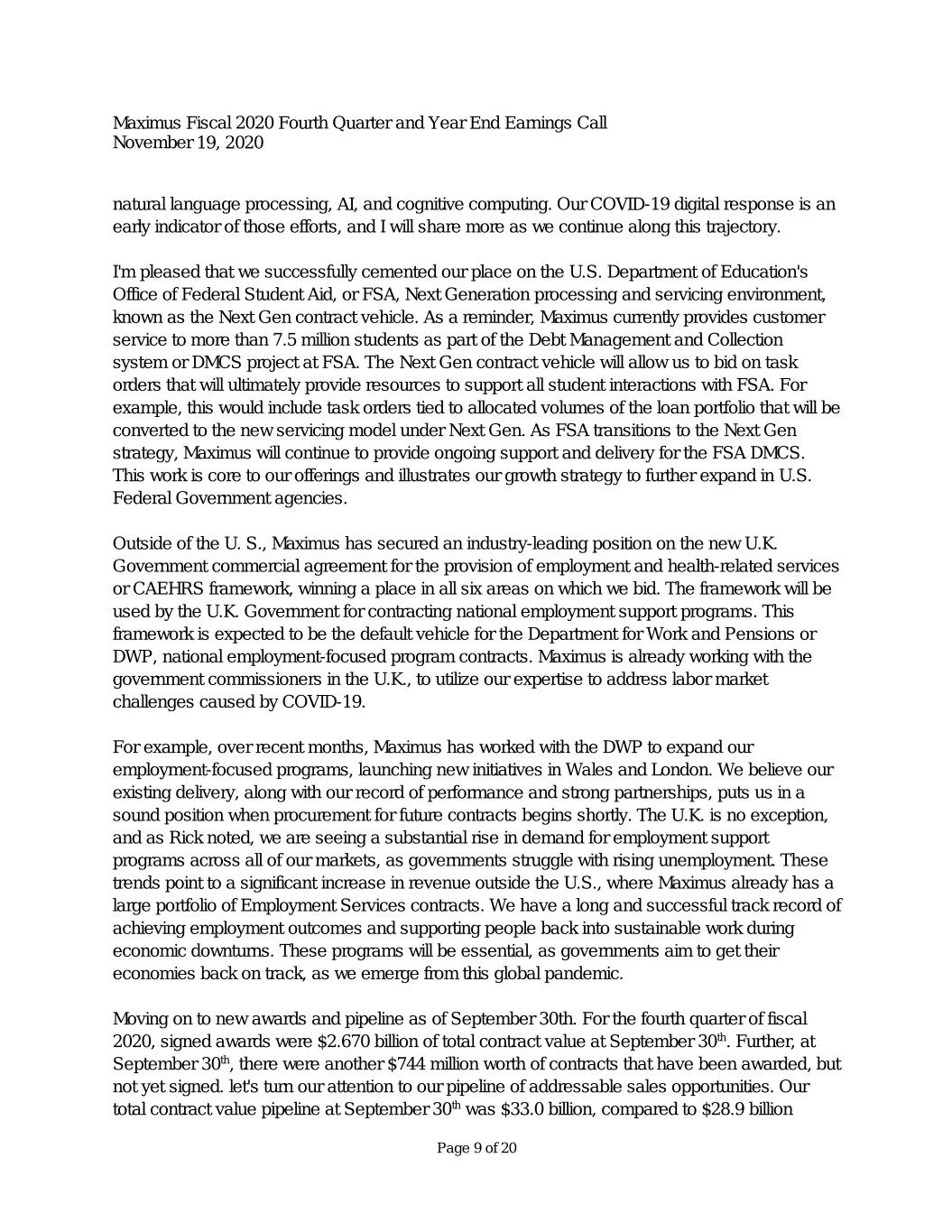
Maximus Fiscal 2020 Fourth Quarter and Year End Earnings Call November 19, 2020 natural language processing, AI, and cognitive computing. Our COVID-19 digital response is an early indicator of those efforts, and I will share more as we continue along this trajectory. I'm pleased that we successfully cemented our place on the U.S. Department of Education's Office of Federal Student Aid, or FSA, Next Generation processing and servicing environment, known as the Next Gen contract vehicle. As a reminder, Maximus currently provides customer service to more than 7.5 million students as part of the Debt Management and Collection system or DMCS project at FSA. The Next Gen contract vehicle will allow us to bid on task orders that will ultimately provide resources to support all student interactions with FSA. For example, this would include task orders tied to allocated volumes of the loan portfolio that will be converted to the new servicing model under Next Gen. As FSA transitions to the Next Gen strategy, Maximus will continue to provide ongoing support and delivery for the FSA DMCS. This work is core to our offerings and illustrates our growth strategy to further expand in U.S. Federal Government agencies. Outside of the U. S., Maximus has secured an industry-leading position on the new U.K. Government commercial agreement for the provision of employment and health-related services or CAEHRS framework, winning a place in all six areas on which we bid. The framework will be used by the U.K. Government for contracting national employment support programs. This framework is expected to be the default vehicle for the Department for Work and Pensions or DWP, national employment-focused program contracts. Maximus is already working with the government commissioners in the U.K., to utilize our expertise to address labor market challenges caused by COVID-19. For example, over recent months, Maximus has worked with the DWP to expand our employment-focused programs, launching new initiatives in Wales and London. We believe our existing delivery, along with our record of performance and strong partnerships, puts us in a sound position when procurement for future contracts begins shortly. The U.K. is no exception, and as Rick noted, we are seeing a substantial rise in demand for employment support programs across all of our markets, as governments struggle with rising unemployment. These trends point to a significant increase in revenue outside the U.S., where Maximus already has a large portfolio of Employment Services contracts. We have a long and successful track record of achieving employment outcomes and supporting people back into sustainable work during economic downturns. These programs will be essential, as governments aim to get their economies back on track, as we emerge from this global pandemic. Moving on to new awards and pipeline as of September 30th. For the fourth quarter of fiscal 2020, signed awards were $2.670 billion of total contract value at September 30th. Further, at September 30th, there were another $744 million worth of contracts that have been awarded, but not yet signed. let's turn our attention to our pipeline of addressable sales opportunities. Our total contract value pipeline at September 30th was $33.0 billion, compared to $28.9 billion Page 9 of 20
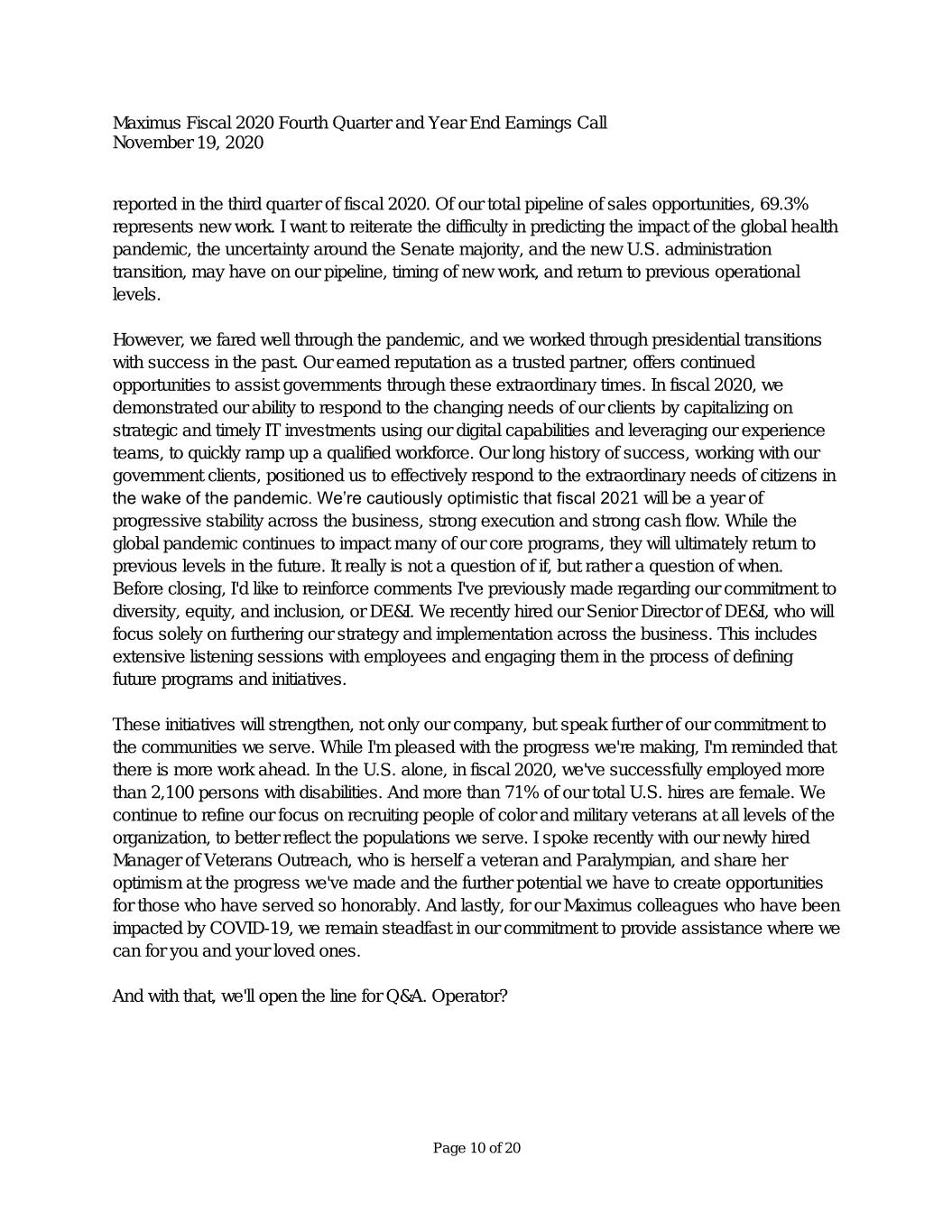
Maximus Fiscal 2020 Fourth Quarter and Year End Earnings Call November 19, 2020 reported in the third quarter of fiscal 2020. Of our total pipeline of sales opportunities, 69.3% represents new work. I want to reiterate the difficulty in predicting the impact of the global health pandemic, the uncertainty around the Senate majority, and the new U.S. administration transition, may have on our pipeline, timing of new work, and return to previous operational levels. However, we fared well through the pandemic, and we worked through presidential transitions with success in the past. Our earned reputation as a trusted partner, offers continued opportunities to assist governments through these extraordinary times. In fiscal 2020, we demonstrated our ability to respond to the changing needs of our clients by capitalizing on strategic and timely IT investments using our digital capabilities and leveraging our experience teams, to quickly ramp up a qualified workforce. Our long history of success, working with our government clients, positioned us to effectively respond to the extraordinary needs of citizens in the wake of the pandemic. We’re cautiously optimistic that fiscal 2021 will be a year of progressive stability across the business, strong execution and strong cash flow. While the global pandemic continues to impact many of our core programs, they will ultimately return to previous levels in the future. It really is not a question of if, but rather a question of when. Before closing, I'd like to reinforce comments I've previously made regarding our commitment to diversity, equity, and inclusion, or DE&I. We recently hired our Senior Director of DE&I, who will focus solely on furthering our strategy and implementation across the business. This includes extensive listening sessions with employees and engaging them in the process of defining future programs and initiatives. These initiatives will strengthen, not only our company, but speak further of our commitment to the communities we serve. While I'm pleased with the progress we're making, I'm reminded that there is more work ahead. In the U.S. alone, in fiscal 2020, we've successfully employed more than 2,100 persons with disabilities. And more than 71% of our total U.S. hires are female. We continue to refine our focus on recruiting people of color and military veterans at all levels of the organization, to better reflect the populations we serve. I spoke recently with our newly hired Manager of Veterans Outreach, who is herself a veteran and Paralympian, and share her optimism at the progress we've made and the further potential we have to create opportunities for those who have served so honorably. And lastly, for our Maximus colleagues who have been impacted by COVID-19, we remain steadfast in our commitment to provide assistance where we can for you and your loved ones. And with that, we'll open the line for Q&A. Operator? Page 10 of 20
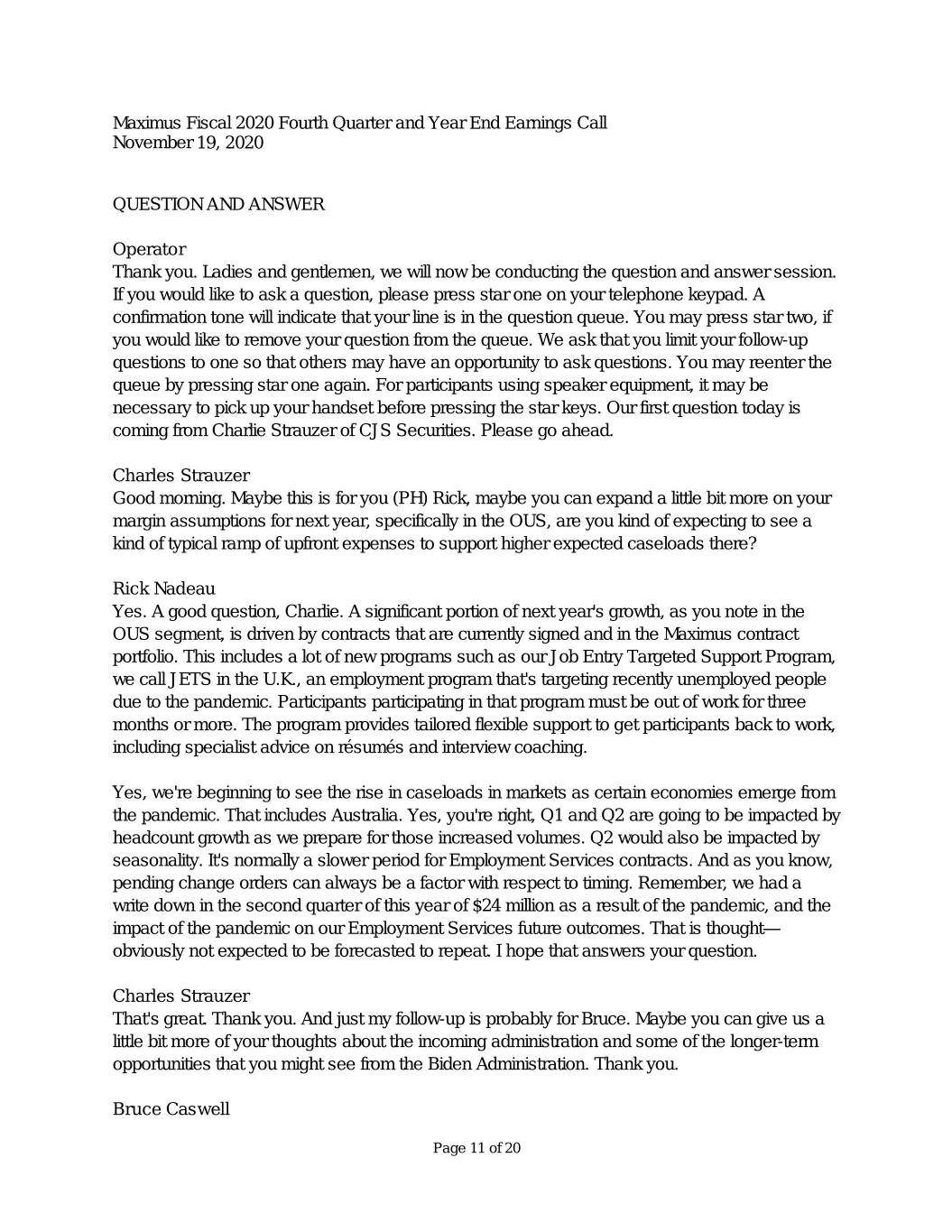
Maximus Fiscal 2020 Fourth Quarter and Year End Earnings Call November 19, 2020 QUESTION AND ANSWER Operator Thank you. Ladies and gentlemen, we will now be conducting the question and answer session. If you would like to ask a question, please press star one on your telephone keypad. A confirmation tone will indicate that your line is in the question queue. You may press star two, if you would like to remove your question from the queue. We ask that you limit your follow-up questions to one so that others may have an opportunity to ask questions. You may reenter the queue by pressing star one again. For participants using speaker equipment, it may be necessary to pick up your handset before pressing the star keys. Our first question today is coming from Charlie Strauzer of CJS Securities. Please go ahead. Charles Strauzer Good morning. Maybe this is for you (PH) Rick, maybe you can expand a little bit more on your margin assumptions for next year, specifically in the OUS, are you kind of expecting to see a kind of typical ramp of upfront expenses to support higher expected caseloads there? Rick Nadeau Yes. A good question, Charlie. A significant portion of next year's growth, as you note in the OUS segment, is driven by contracts that are currently signed and in the Maximus contract portfolio. This includes a lot of new programs such as our Job Entry Targeted Support Program, we call JETS in the U.K., an employment program that's targeting recently unemployed people due to the pandemic. Participants participating in that program must be out of work for three months or more. The program provides tailored flexible support to get participants back to work, including specialist advice on résumés and interview coaching. Yes, we're beginning to see the rise in caseloads in markets as certain economies emerge from the pandemic. That includes Australia. Yes, you're right, Q1 and Q2 are going to be impacted by headcount growth as we prepare for those increased volumes. Q2 would also be impacted by seasonality. It's normally a slower period for Employment Services contracts. And as you know, pending change orders can always be a factor with respect to timing. Remember, we had a write down in the second quarter of this year of $24 million as a result of the pandemic, and the impact of the pandemic on our Employment Services future outcomes. That is thought— obviously not expected to be forecasted to repeat. I hope that answers your question. Charles Strauzer That's great. Thank you. And just my follow-up is probably for Bruce. Maybe you can give us a little bit more of your thoughts about the incoming administration and some of the longer-term opportunities that you might see from the Biden Administration. Thank you. Bruce Caswell Page 11 of 20
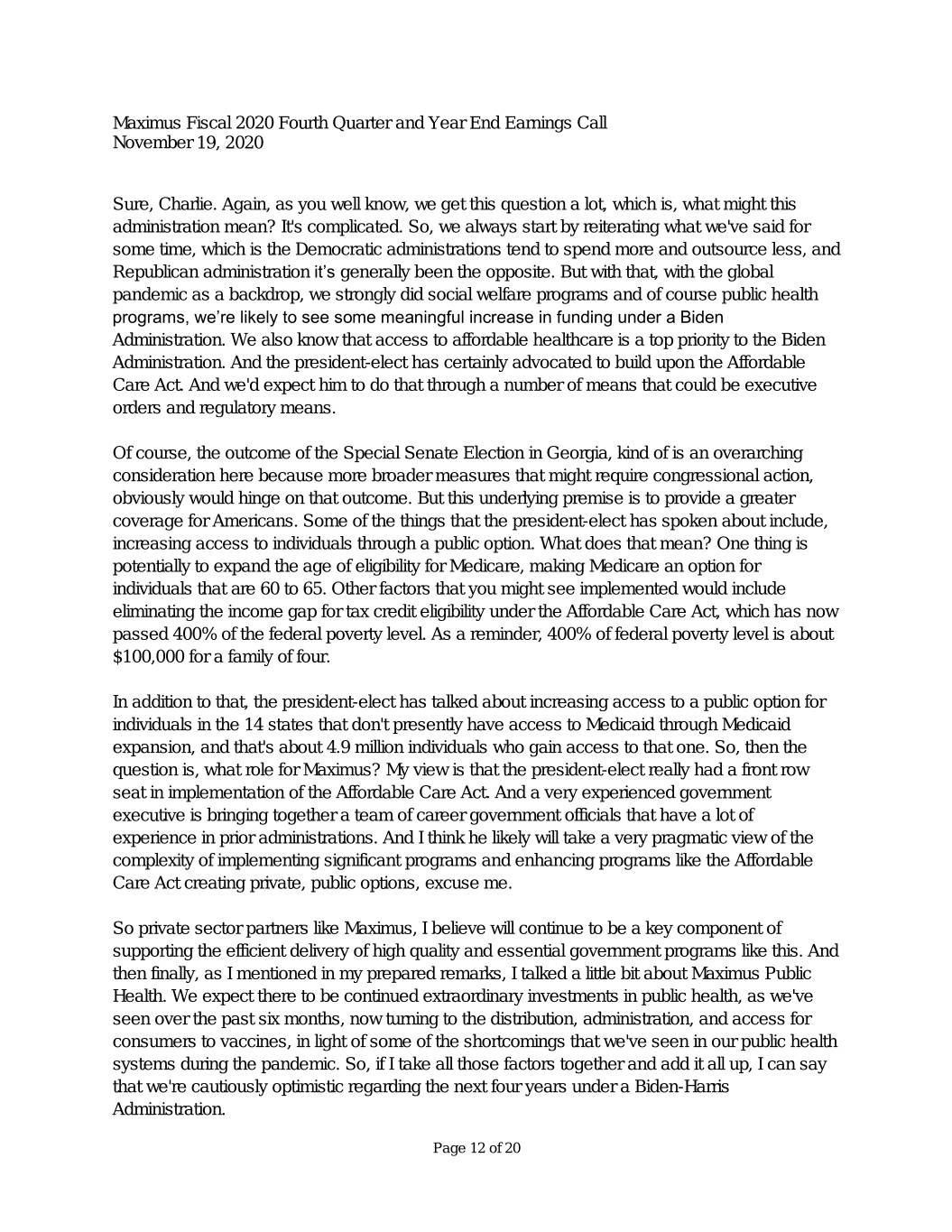
Maximus Fiscal 2020 Fourth Quarter and Year End Earnings Call November 19, 2020 Sure, Charlie. Again, as you well know, we get this question a lot, which is, what might this administration mean? It's complicated. So, we always start by reiterating what we've said for some time, which is the Democratic administrations tend to spend more and outsource less, and Republican administration it’s generally been the opposite. But with that, with the global pandemic as a backdrop, we strongly did social welfare programs and of course public health programs, we’re likely to see some meaningful increase in funding under a Biden Administration. We also know that access to affordable healthcare is a top priority to the Biden Administration. And the president-elect has certainly advocated to build upon the Affordable Care Act. And we'd expect him to do that through a number of means that could be executive orders and regulatory means. Of course, the outcome of the Special Senate Election in Georgia, kind of is an overarching consideration here because more broader measures that might require congressional action, obviously would hinge on that outcome. But this underlying premise is to provide a greater coverage for Americans. Some of the things that the president-elect has spoken about include, increasing access to individuals through a public option. What does that mean? One thing is potentially to expand the age of eligibility for Medicare, making Medicare an option for individuals that are 60 to 65. Other factors that you might see implemented would include eliminating the income gap for tax credit eligibility under the Affordable Care Act, which has now passed 400% of the federal poverty level. As a reminder, 400% of federal poverty level is about $100,000 for a family of four. In addition to that, the president-elect has talked about increasing access to a public option for individuals in the 14 states that don't presently have access to Medicaid through Medicaid expansion, and that's about 4.9 million individuals who gain access to that one. So, then the question is, what role for Maximus? My view is that the president-elect really had a front row seat in implementation of the Affordable Care Act. And a very experienced government executive is bringing together a team of career government officials that have a lot of experience in prior administrations. And I think he likely will take a very pragmatic view of the complexity of implementing significant programs and enhancing programs like the Affordable Care Act creating private, public options, excuse me. So private sector partners like Maximus, I believe will continue to be a key component of supporting the efficient delivery of high quality and essential government programs like this. And then finally, as I mentioned in my prepared remarks, I talked a little bit about Maximus Public Health. We expect there to be continued extraordinary investments in public health, as we've seen over the past six months, now turning to the distribution, administration, and access for consumers to vaccines, in light of some of the shortcomings that we've seen in our public health systems during the pandemic. So, if I take all those factors together and add it all up, I can say that we're cautiously optimistic regarding the next four years under a Biden-Harris Administration. Page 12 of 20
Maximus Fiscal 2020 Fourth Quarter and Year End Earnings Call November 19, 2020 Charles Strauzer Thank you very much. Lisa Miles Thanks, Charlie. Next question, please. Operator Thank you. Our next question is coming from Donald Hooker of KeyBanc Capital Markets. Please go ahead. Donald Hooker Great, good morning. Thank you for the questions. So, I wanted to dive into sort of the Medicaid challenges that you're facing and try to understand the dynamics here. I understand the redeterminations. Does this sort of—is this is some—is this going to snap back perhaps next year? How does this work? Is this all linked to the Public Health Emergency? So, at some point, that's lifted and then you guys see sort of a snap back in work, maybe even catch-up work over relating to the sort of Medicaid redeterminations that have been suspended. Can you walk me through that? Bruce Caswell Sure, I will, first of all, give you a quick answer to the end part of your questions. Yes. We believe that the redeterminations that are building up now in backlog, will have to be addressed at some point in the future. So, like we said during my prepared remarks, it's really not a question of if, but when as it relates to that. Now, a few things quickly on the redetermination. Another word for this is kind of maintenance of effort. States have to maintain their current level of effort on Medicaid, and that's providing access to individuals for health benefits during this Public Health Emergency. An interesting kind of nuance is that the enhanced federal matching money, the 6.2% that states are getting during this Public Health Emergency, extends through the end of the order in which the Public Health Emergency ends. So presently, Secretary Azar, announced a 90-day renewal of the declaration. That takes the Public Health Emergency through the end of January— actually through January 20th of 2021. The funding, therefore, would be available to stay through the end of March. The maintenance and effort requirements, however, end in the month in which the Public Health Emergency ends. So, it would end in January of 2021. So, they get some additional funding, but they could resume redeterminations in that quarter. The other question is, what's happening with Medicaid enrollment? I think, you know, and we've talked about this before, Don. We’ve been studying very closely the relationships between unemployment and Medicaid enrollments, and a couple of interesting facts. One is that Page 13 of 20
Maximus Fiscal 2020 Fourth Quarter and Year End Earnings Call November 19, 2020 Medicaid enrollment has increased between August of 2019 and July of 2020, which is the period for which the most recent data bill, by about 4.2 million individuals or 6.6%. Interestingly, for adults, it increased 8.4%. So we have already seen some enrollment increases in our state Medicaid contracts, but as we indicated during our prepared remarks, the tailwind of these increased enrollments, which nationally has been about 1.6% to 1.2% per month, has not yet been sufficient to overcome the headwinds from the reduction, or I would rather call it the temporary suspension of redeterminations. But there will come a point, right, where that flips, and redetermination backlogs are there that then need to be worked. Hope that helps. Donald Hooker Yes. I guess maybe just, can you give us a sense as to maybe roughly quantify that? Is there going to be sort of a step up that occurs? I mean, who knows when the Public Health Emergency ends, but is there—what was the headwind from that pause in redeterminations? It feels like much— Bruce Caswell Well, I guess what I have to say—yeah, I would point you just back to the guidance that we just provided. We bake that into our views for FY ‘21 based on the current end date for the Public Health Emergency that I mentioned. And so, if there's going to be any increase in the work related to redeterminations and further eligibility in enrollment work, that would be incorporated obviously in the second half of the year in our guidance. Donald Hooker Okay. Thank you so much. Lisa Miles Thanks, Don. Next question, please. Operator Thank you. Our next question is coming from Richard Close, of Canaccord Genuity. Please go ahead. Richard Close Great. Thanks. Congratulations on the year, given everything that's been going on. First question maybe to dive in a little bit deeper on the Outside the U.S., Rick, I appreciate your comments on the profitability there, but you know as we think about Employment Services, whether it's the U.K. or Australia, and it has been challenging maybe over the last five years or so, with that programs changing and whatnot. Can you just talk a little bit about your confidence with respect to the new contracts that you're seeing and then the opportunity on the Employment Services? You mentioned Australia improving some. Just trying to gauge what your confidence level is with respect to that business? Page 14 of 20
Maximus Fiscal 2020 Fourth Quarter and Year End Earnings Call November 19, 2020 Rick Nadeau Sure, Richard, and all good questions. And yes, you're right. We have struggled with the high employment rates and the low unemployment rates historically. The contracts that we have— 50% of our work outside of the U.S. is in that Employment Services area. And as you know, they're volume-based contracts where we get paid for outcomes. When you have low unemployment rates, you're going to be struggling with the level of activity and volumes. And so that has been our historical issue. Unemployment rates are rising now, but that's as a result of the pandemic and we've had closed economies. We are beginning to see the volumes appear, and we are beginning to do our hiring in advance of those unemployment volumes. So, yes, I mean, these are contracts that are in the portfolio and signed today, and we're beginning to see the signs of the volumes appearing, and we are starting to do the hiring that we're going to need to service those volumes. Does that answer your question? Richard Close Yes, I guess. Moving on. Rick Nadeau Give me a follow up then. Richard Close Well, I mean, I can get with you. I mean, the contracts or the programs, I should say, have changed over the years, and maybe especially in the U.K. And I'm just trying to gauge, are we going to start this program and then after a year or so, they're going to say, “We're moving onto something different?” There’s just been a lot of changes, and it seems like it's created a lot of noise over the last four or five years. Rick Nadeau Yes. Okay. Well, two points. One, by the way, in the United Kingdom, we are on cost reimbursement at this particular point, which was good for us. We typically prefer pay for results, but obviously in the pandemic world, that was helpful to us. And they did change the payment structure in Australia, to help us. So, there was a little less payment results oriented. So, as we go forward, I mean, I think if we continue with reasonably high unemployment rates, then the programs that we have are going to be required. And I think that we're going to be called upon to service those. If we get back into low unemployment rates in 2023, 2024, you've seen history. History told the—had the governments tell us to begin to work on other types of things in harder to serve populations. And so, it'll be more challenging for us. Richard Close Okay. That's helpful. Do I get to ask a follow-up or did I use that? Page 15 of 20
Maximus Fiscal 2020 Fourth Quarter and Year End Earnings Call November 19, 2020 Rick Nadeau Sure. Lisa Miles Absolutely, Richard. Richard Close Okay. So, maybe not to be negative, but on Maximus Public Health, obviously that's a great opportunity for you, I think, given everything that's going on and vaccines and whatnot. But if I look at the Census, obviously there was some investor interest in the drop-off Census once that program comes to an end. So, as I think about Maximus Public Health, at some point, hopefully this COVID situation comes to an end. Bruce, I'm curious your thoughts in terms of investing in the buildup of MPH and the opportunities that exist there, and then thoughts of what happens after the water's under the bridge or over the bridge, whatnot, with respect to the need for the Maximus Public Health business. Bruce Caswell Absolutely, Richard. And I can say, you're characterizing it correctly. The water right now is over the bridge and hopefully it will come back down. Our intent in making this investment is that it is actually a component of our long-term strategy to become more clinical as a company. And so I'm glad you asked the question because it's not a knee-jerk reaction to a one-time crisis, but rather an investment that gives us a team of folks with an incredibly diverse set of skills and backgrounds that can help our customers as they, not only attack the current global pandemic, but one of the big lessons learned from this pandemic was, a lot of people that just weren't ready. And so, we do need to be mindful of the fact that there could be further pandemic situations, hopefully not at the size that we're seeing presently, but over the course of the next several decades. Number two, this is a team that has tremendous experience and background in a lot of areas of public health. And public health crises are significant around the world, in particular the percentage of populations with non-communicable disease states and chronic conditions and co-morbidities. And so, we've actually—we're having this public health team be a resident within our federal organization, but it's really an asset to the entire company. And as I've spent the last few days on our business development calls going around the world, we've had representatives from the public health team on the phone, talking with folks in our Asia Pacific region, in our Gulf region and so forth, about the public health crises that a lot of those governments are facing, whether—candidly, during the COVID period, access to appropriate mental health services for large populations is becoming more and more important. But then there are also countries that have a significant public health issues as it relates to diabetes and obesity and other chronic conditions. Page 16 of 20
Maximus Fiscal 2020 Fourth Quarter and Year End Earnings Call November 19, 2020 So this is an organization that is incredibly well equipped in the near term, because for example, its leader, Dr. Andrew Sommers, previously worked in the Office of Health Policy for the Secretary of Planning and Evaluation at HHS, and worked on things like Zika and Ebola, prior pandemics. But the team is broad enough and their experience is deep enough that they can certainly help us on the broader public health mission that we're executing on, which is part of our clinical evolution strategic process that's coming. Richard Close That's a great answer. Thank you very much for allowing me to ask that question. Congratulations. Lisa Miles Thanks, Richard. Next question, please. Operator Thank you. Once again ladies and gentlemen, if you would like to ask a question, you may do so by pressing star one on your telephone keypad. Our next question is coming from Dave Styblo of Jefferies. Please go ahead. Dave Styblo Hi there. Good morning. Glad to see Richard got a mulligan in. That’s fair. First question I had, and I missed the first 40 minutes, so I apologize if you've covered this already, but to circle back to the guidance, the revenue outlook, $3.3 billion at the midpoint seems quite a bit higher than what you were signaling during the last call. Although the EPS seems pretty consistent and you were trying to talk that down from where consensus was, and consensus listened to some extent. So, I'm curious why aren't we seeing the same EPS flow-through as we are on revenue being higher than what we were thinking it should be? It sounds like maybe there was some investments. Is that the overhang right now, or are there other explanations for that? Rick Nadeau Dave, Rick. How are you doing? Yeah, it's a good question, and we are looking at it, and obviously the answer is, that is many different factors. We are seeing some revenue reductions on performance-based contracts resulting from the COVID pandemic. As I indicated in my prepared remarks, we have seen some pause in student loan repayments, which have impacted our debt management contract. Last quarter, I provided the example of the impact of workers' compensation claims in California on our independent medical records review on workers' compensation claims. We did talk about the suspension of redeterminations in the United States on the Medicaid. When we do--we are filling in a lot of things with the COVID response work. That is accretive work, but it's coming in at margins that are less than our average, and it puts some downward pressure on us there. Page 17 of 20
Maximus Fiscal 2020 Fourth Quarter and Year End Earnings Call November 19, 2020 We’ve talked previously and continue to put effort on business development and marketing, particularly in our U.S. Federal segment, which we believe can be a growth area for us. And we also previously talked about developing technical capabilities that are tied to those growth initiatives. So, I think what you're seeing is, yes, lower margins with better revenue. And I really blame it on the pressure, on some of our core work during the pandemic, and then us filling in the topline with that COVID response work, which really doesn't have as good a margin, but is accretive as those core programs. Dave Styblo Got it. Okay. And then my one follow-up would be on the new work in the pipeline, that looks like to me, using some back-of-the-envelope math there, that it's up about 17% sequentially from the fiscal third quarter. Looks like most of that is in RFPs that haven't dropped yet. But I'm curious just to, one, confirm that, and two, understand if you could provide any color if that's related to maybe just a couple of contracts that have larger dollar revenue opportunities, or if there was just a series of contracts that are now coming to market in the RFPs? Bruce Caswell Dave, it’s Bruce. Why don’t I start and then ask Rick to add some color commentary as well. So, we’ve provided a little bit of color on the pipeline and new work in our presentation, obviously, and the press release as well. And I would say that if I look at kind of the composition of the pipeline, it's interesting. About three, four months ago, I would have told you that the Federal Government pipeline was largely kind of unchanged. Deals were flowing through. Most of the disruptions, if were, were at the state level, because states were shifting so far to do kind of emergency pandemic-related procurements. And in addition to that, outside the U.S., we saw some slowdowns in some particular areas, but otherwise kind of moving ahead. The answer now is that the Federal Government still and a few agencies, has had to prioritize the pandemic themselves. And so, if I look at CMS, some of the deals that we would have seen in the pipeline this year, are being pushed out at least a year. Now, that's good to be the incumbent, you're just getting contract extensions, but if you're hoping to go after it, it's not. Other agencies, it's a little bit more mixed, like at the IRS, on the one hand, we've benefited from the procurement in the customer contact center environment, which was the first of a kind at the IRS and a government agency that we've been hoping to serve for years, are proud to serve now. But there were other procurements that were delayed as well. So at the federal level, I guess the final point I'd make would be, it's been good to see that some of the transformational procurements that are the larger kind of longer term ones, have continued apace, and the FSA Next Gen one being probably the best example that we've recently won a seat on. So, with that as a bit of the backdrop, the composition of the pipeline still remains strong. We've seen, I would say, additional RFP opportunities still coming out as it relates to contact tracing work. As the second wave has hit, at the U.S. Services level, it seems Page 18 of 20
Maximus Fiscal 2020 Fourth Quarter and Year End Earnings Call November 19, 2020 like there have been some RFPs that were developed and kind of waiting to be launched, that are now coming out, that have the potential to extend the contact tracing work further into the year than we might have anticipated. And then from an Outside the U.S. perspective, I guess the key point I'd make there is that a number of geographies like the Gulf region and Australia, are in a much better condition compared to obviously the U.K. or the United States as it relates to COVID. And so, procurements have actually moved ahead nicely, and the pipeline is interestingly, quite robust. I will also say finally, on the Outside the U.S., there are customers that have seen the pandemic as an opportunity to rethink and reshape their programs. And they’ve thought in a very transformational way about it and said, “We're going to move to more digital solutions. We're going to change the way we deliver our programs.” And we even have examples where our fees have been accelerated because they want to capitalize on the moment. So, I hope that provides a bit more color. And Rick, is there anything pertinent you’d add? Rick Nadeau No. Sure. I just want to just make sure that we say again, I mean, all of this has been built into our guidance. The amount of uncertainty that we face at this particular time is unprecedented in our recent history. And that's both upside and downside. So, we've done the best we can to put all of that in our guidance. You need a mulligan, Dave? Dave Styblo That's good. Thanks. I'll let others go. Lisa Miles Thanks, Dave. Operator, next question, please. Operator Thank you. Our next question is coming from Richard Close, of Canaccord Genuity. Please go ahead. Richard Close Yes, thanks. I'll keep it quick here. With respect to the employees, I think it’s Slide 12, 80% survey on your employees. Can you talk a little bit about who's required to be in the office? And maybe just give us a little bit of an update with respect to that and the 80%. Do you do these surveys on a regular basis, and any thoughts in and around those metrics? Bruce Caswell Sure. As I mentioned during my prepared remarks, at our peak, we were able to transition 63% of our U.S. workforce to work-from-home, and Outside the U.S. is actually 76%. Not all customers are able to have us work in a model with everybody working from home. So, in some Page 19 of 20
Maximus Fiscal 2020 Fourth Quarter and Year End Earnings Call November 19, 2020 instances, for example, supervisors need to be in the office to remotely monitor and manage the employees that are working from home. Another factor is training. We’ve found that over time in a number of our programs, training is best delivered initially in an on-site manner, and that gives individuals an opportunity to not just learn the material, but ask questions and then go through what we call a “nesting process,” where they're taking their initial calls in a very closely monitored environment. And then they can develop to the point where they may be able to then go and work from home. So in every instance, we've obviously been super careful to maintain appropriate protocols in all the facilities so that we're staffing at appropriate levels, given local conditions and rules, because often local governments limit the kind of percentage occupancy in facilities and so forth, and ensure that we're keeping our employees safe. You had asked about how frequently we survey our employees. We've surveyed them more frequently during COVID than maybe historically, because we really want to get a sense of how we're doing by them. We want to make sure that they feel that they're being protected in the workspace, and that their income is being protected appropriately as well. And hence the statistics that we offered during the call. We’re moving as a company toward an annual employee survey where we'll look at effectively kind of a Net Promoter Score number that will give us an indication of employee satisfaction with what we're doing. And we began this actually shortly after my becoming CEO, and we’ve really worked hard to address factors that are so critical to our employees, like the feeling of whether they're supported by their supervisor, whether they're getting adequate opportunities for career development and so forth. So, employee engagement is a very important factor, and close cut into that courses in the area of diversity, equity, inclusion that I mentioned during my remarks. Hope that helps. Richard Close Okay, thank you. Yes. Lisa Miles Thanks, Richard. Operator, do we have any further questions? Operator We do not have questions at this time. Ladies and gentlemen, we have reached the end of the question and answer session and are out of time for today's call. Maximus thanks you for your time and participation, and you may disconnect your lines at this time. Page 20 of 20
Fiscal 2020 Fourth Quarter & Year End Earnings Call Rick Nadeau Chief Financial Officer November 19, 2020 1 | Maximus: Q4 FY20 Earnings Presentation
Forward-looking Statements & Non-GAAP Information These slides should be read in conjunction with the Company’s most recent quarterly earnings press release, along with listening to or reading a transcript of the comments of Company management from our most recent quarterly earnings conference call. This document may contain non-GAAP financial information. Management uses this information in its internal analysis of results and believes that this information may be informative to investors in gauging the quality of our financial performance, identifying trends in our re sults, and providing meaningful period- to-period comparisons. These measures should be used in conjunction with, rather than instead of, their comparable GAAP measures. For a reconciliation of non-GAAP measures to the comparable GAAP measures presented in this document, see the Company’s most recent quarterly earnings press release. Throughout this presentation, numbers may not add due to rounding. Included in this presentation are forward-looking statements within the meaning of the safe harbor provisions of the United States Private Securities Litigation Reform Act of 1995. Forward-looking statements can be identified by words such as: “anticipate,” “intend,” “plan,” “goal,” “seek,” “opportunity,” “could,” “potential,” “believe,” “project,” “estimate,” “expect,” “strategy,” “future,” “likely,” “may,” “should,” “will” and similar references to future periods. Forward-looking statements that are not historical facts, including statements about our confidence, strategies and initiatives and our expectations about revenues, results of operations, profitability, liquidity, market demand or the impact of the COVID-19 pandemic are forward-looking statements that involve risks and uncertainties such as those related to impact of the COVID-19 pandemic including but not limited to: • The ultimate duration of the pandemic • The threat of further negative pandemic-related impacts • Delays in our core programs returning to normal volumes and operations • The potential impacts resulting from budget challenges with our government clients • The possibility of delayed or missed payments by customers • The potential for further supply chain disruptions impacting IT or safety equipment • The impact of further legislation and government policies on the programs we operate These risks could cause our actual results to differ materially from those indicated by such forward-looking statements. Therefore, you should not rely on any of these forward-looking statements. Important factors that could cause our actual results and financial condition to differ materially from those indicated in the forward -looking statements include, among others, factors set forth in Item 1A of our Annual Report on Form 10-K, for the year ended September 30, 2020, to be filed shortly with the Securities and Exchange Commission and found on maximus.com. Any forward-looking statement made by us in this report is based only on information currently available to us and speaks only as of the date on which it is made. We undertake no obligation to publicly update any forward-looking statement, whether written or oral, that may be made from time to time, whether as a result of new information, future developments or otherwise. 2 | Maximus: Q4 FY20 Earnings Presentation
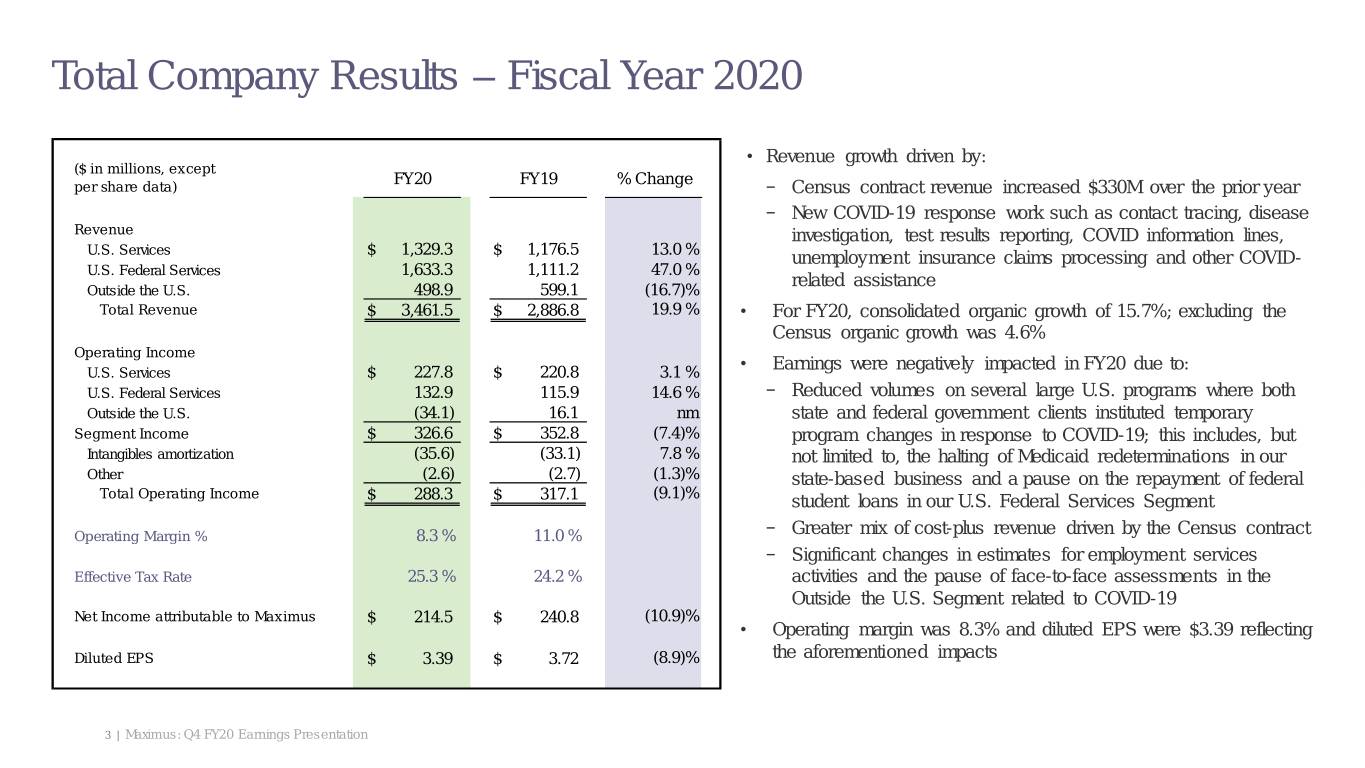
Total Company Results – Fiscal Year 2020 • Revenue growth driven by: ($ in millions, except FY20 FY19 % Change per share data) − Census contract revenue increased $330M over the prior year − New COVID-19 response work such as contact tracing, disease Revenue investigation, test results reporting, COVID information lines, U.S. Services $ 1,329.3 $ 1,176.5 13.0 % unemployment insurance claims processing and other COVID- U.S. Federal Services 1,633.3 1,111.2 47.0 % related assistance Outside the U.S. 498.9 599.1 (16.7)% Total Revenue $ 3,461.5 $ 2,886.8 19.9 % • For FY20, consolidated organic growth of 15.7%; excluding the Census organic growth was 4.6% Operating Income • Earnings were negatively impacted in FY20 due to: U.S. Services $ 227.8 $ 220.8 3.1 % U.S. Federal Services 132.9 115.9 14.6 % − Reduced volumes on several large U.S. programs where both Outside the U.S. (34.1) 16.1 nm state and federal government clients instituted temporary Segment Income $ 326.6 $ 352.8 (7.4)% program changes in response to COVID-19; this includes, but Intangibles amortization (35.6) (33.1) 7.8 % not limited to, the halting of Medicaid redeterminations in our Other (2.6) (2.7) (1.3)% state-based business and a pause on the repayment of federal Total Operating Income $ 288.3 $ 317.1 (9.1)% student loans in our U.S. Federal Services Segment Operating Margin % 8.3 % 11.0 % − Greater mix of cost-plus revenue driven by the Census contract − Significant changes in estimates for employment services Effective Tax Rate 25.3 % 24.2 % activities and the pause of face-to-face assessments in the Outside the U.S. Segment related to COVID-19 Net Income attributable to Maximus $ 214.5 $ 240.8 (10.9)% • Operating margin was 8.3% and diluted EPS were $3.39 reflecting Diluted EPS $ 3.39 $ 3.72 (8.9)% the aforementioned impacts 3 | Maximus: Q4 FY20 Earnings Presentation
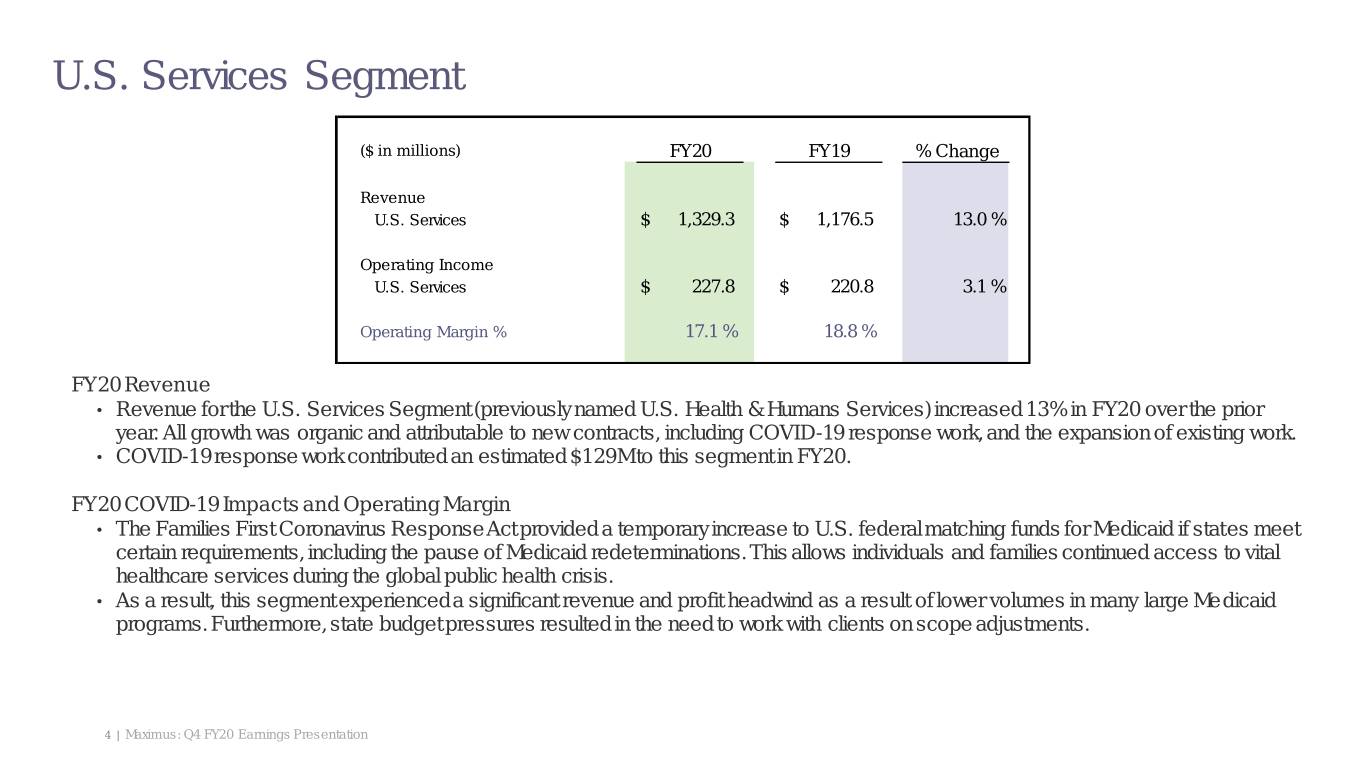
U.S. Services Segment ($ in millions) FY20 FY19 % Change Revenue U.S. Services $ 1,329.3 $ 1,176.5 13.0 % Operating Income U.S. Services $ 227.8 $ 220.8 3.1 % Operating Margin % 17.1 % 18.8 % FY20 Revenue • Revenue for the U.S. Services Segment (previously named U.S. Health & Humans Services) increased 13% in FY20 over the prior year. All growth was organic and attributable to new contracts, including COVID-19 response work, and the expansion of existing work. • COVID-19 response work contributed an estimated $129M to this segment in FY20. FY20 COVID-19 Impacts and Operating Margin • The Families First Coronavirus Response Act provided a temporary increase to U.S. federal matching funds for Medicaid if states meet certain requirements, including the pause of Medicaid redeterminations. This allows individuals and families continued access to vital healthcare services during the global public health crisis. • As a result, this segment experienced a significant revenue and profit headwind as a result of lower volumes in many large Medicaid programs. Furthermore, state budget pressures resulted in the need to work with clients on scope adjustments. 4 | Maximus: Q4 FY20 Earnings Presentation
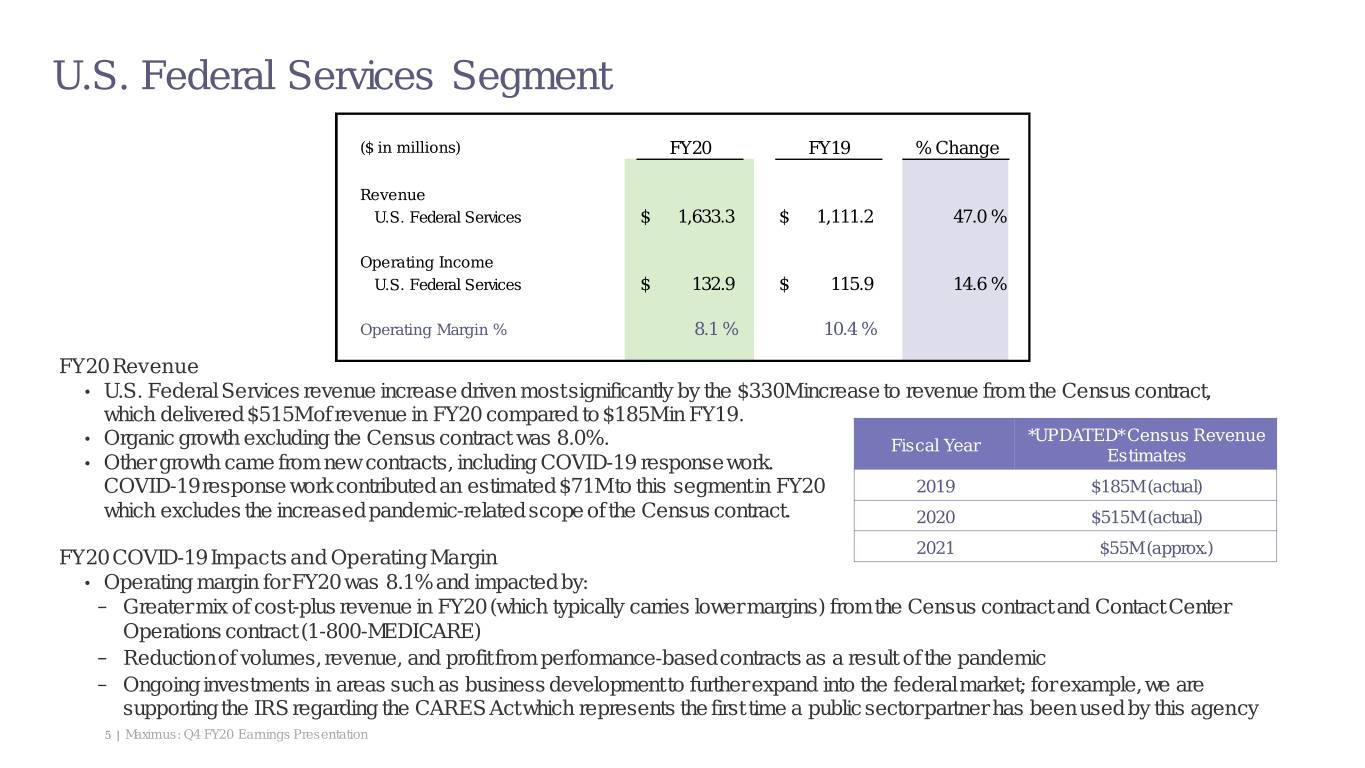
U.S. Federal Services Segment ($ in millions) FY20 FY19 % Change Revenue U.S. Federal Services $ 1,633.3 $ 1,111.2 47.0 % Operating Income U.S. Federal Services $ 132.9 $ 115.9 14.6 % Operating Margin % 8.1 % 10.4 % FY20 Revenue • U.S. Federal Services revenue increase driven most significantly by the $330M increase to revenue from the Census contract, which delivered $515M of revenue in FY20 compared to $185M in FY19. *UPDATED* Census Revenue • Organic growth excluding the Census contract was 8.0%. Fiscal Year • Other growth came from new contracts, including COVID-19 response work. Estimates COVID-19response work contributed an estimated $71M to this segment in FY20 2019 $185M (actual) which excludes the increased pandemic-related scope of the Census contract. 2020 $515M (actual) FY20 COVID-19 Impacts and Operating Margin 2021 $55M (approx.) • Operating margin for FY20 was 8.1% and impacted by: − Greater mix of cost-plus revenue in FY20 (which typically carries lower margins) from the Census contract and Contact Center Operations contract (1-800-MEDICARE) − Reduction of volumes, revenue, and profit from performance-based contracts as a result of the pandemic − Ongoing investments in areas such as business development to further expand into the federal market; for example, we are supporting the IRS regarding the CARES Act which represents the first time a public sector partner has been used by this agency 5 | Maximus: Q4 FY20 Earnings Presentation
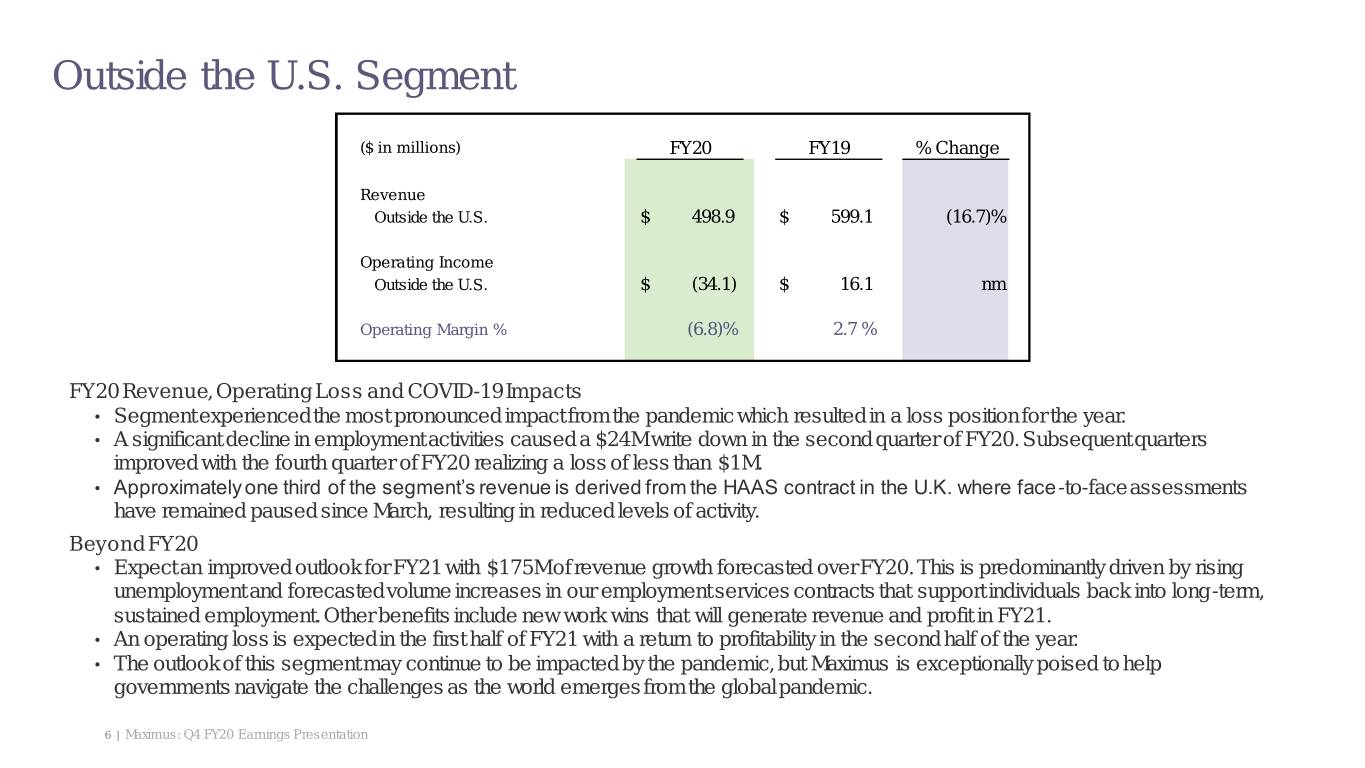
Outside the U.S. Segment ($ in millions) FY20 FY19 % Change Revenue Outside the U.S. $ 498.9 $ 599.1 (16.7)% Operating Income Outside the U.S. $ (34.1) $ 16.1 nm Operating Margin % (6.8)% 2.7 % FY20 Revenue, Operating Loss and COVID-19 Impacts • Segment experienced the most pronounced impact from the pandemic which resulted in a loss position for the year. • A significant decline in employment activities caused a $24M write down in the second quarter of FY20. Subsequent quarters improved with the fourth quarter of FY20 realizing a loss of less than $1M. • Approximately one third of the segment’s revenue is derived from the HAAS contract in the U.K. where face-to-face assessments have remained paused since March, resulting in reduced levels of activity. Beyond FY20 • Expect an improved outlook for FY21 with $175M of revenue growth forecasted over FY20. This is predominantly driven by rising unemployment and forecasted volume increases in our employment services contracts that support individuals back into long-term, sustained employment. Other benefits include new work wins that will generate revenue and profit in FY21. • An operating loss is expected in the first half of FY21 with a return to profitability in the second half of the year. • The outlook of this segment may continue to be impacted by the pandemic, but Maximus is exceptionally poised to help governments navigate the challenges as the world emerges from the global pandemic. 6 | Maximus: Q4 FY20 Earnings Presentation
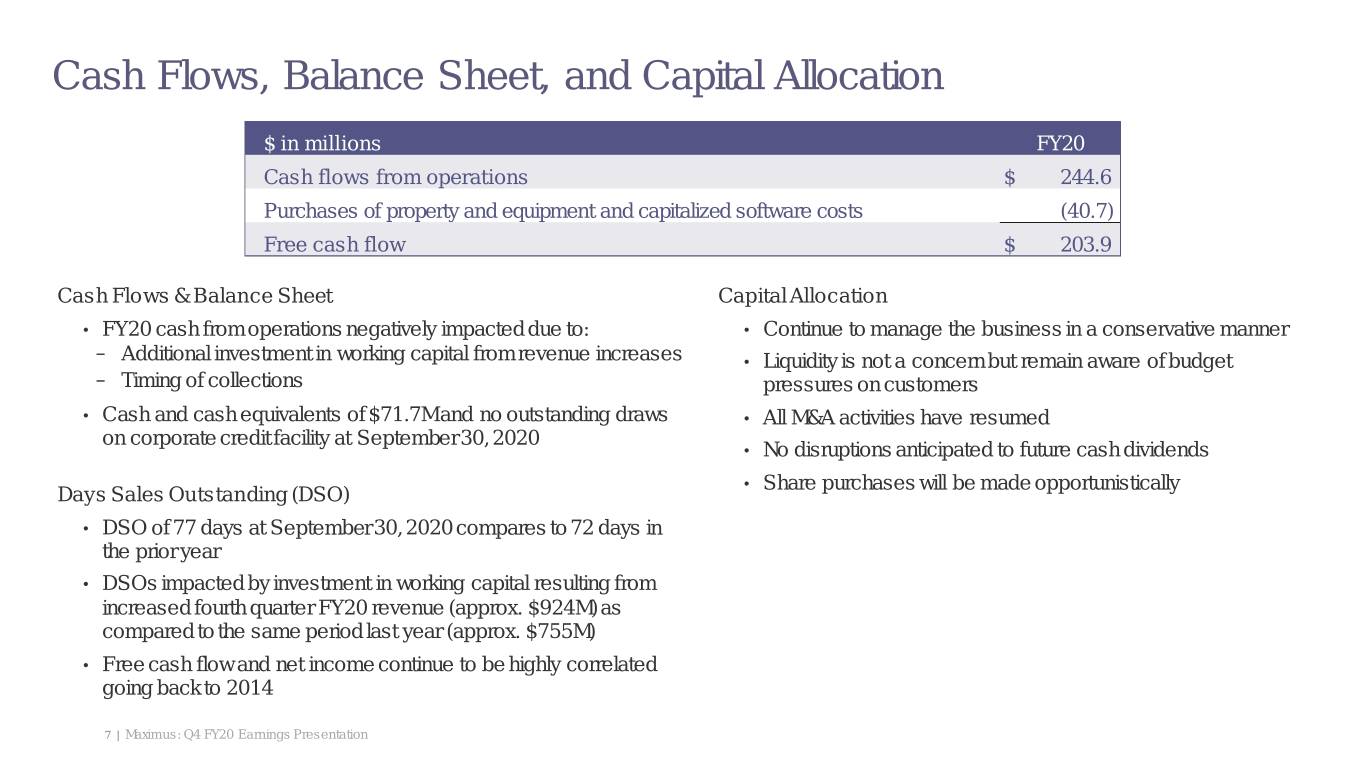
Cash Flows, Balance Sheet, and Capital Allocation $ in millions FY20 Cash flows from operations $ 244.6 Purchases of property and equipment and capitalized software costs (40.7) Free cash flow $ 203.9 Cash Flows & Balance Sheet Capital Allocation • FY20 cash from operations negatively impacted due to: • Continue to manage the business in a conservative manner − Additional investment in working capital from revenue increases • Liquidity is not a concern but remain aware of budget − Timing of collections pressures on customers • Cash and cash equivalents of $71.7M and no outstanding draws • All M&A activities have resumed on corporate credit facility at September 30, 2020 • No disruptions anticipated to future cash dividends • Share purchases will be made opportunistically Days Sales Outstanding (DSO) • DSO of 77 days at September 30, 2020 compares to 72 days in the prior year • DSOs impacted by investment in working capital resulting from increased fourth quarter FY20 revenue (approx. $924M) as compared to the same period last year (approx. $755M) • Free cash flow and net income continue to be highly correlated going back to 2014 7 | Maximus: Q4 FY20 Earnings Presentation
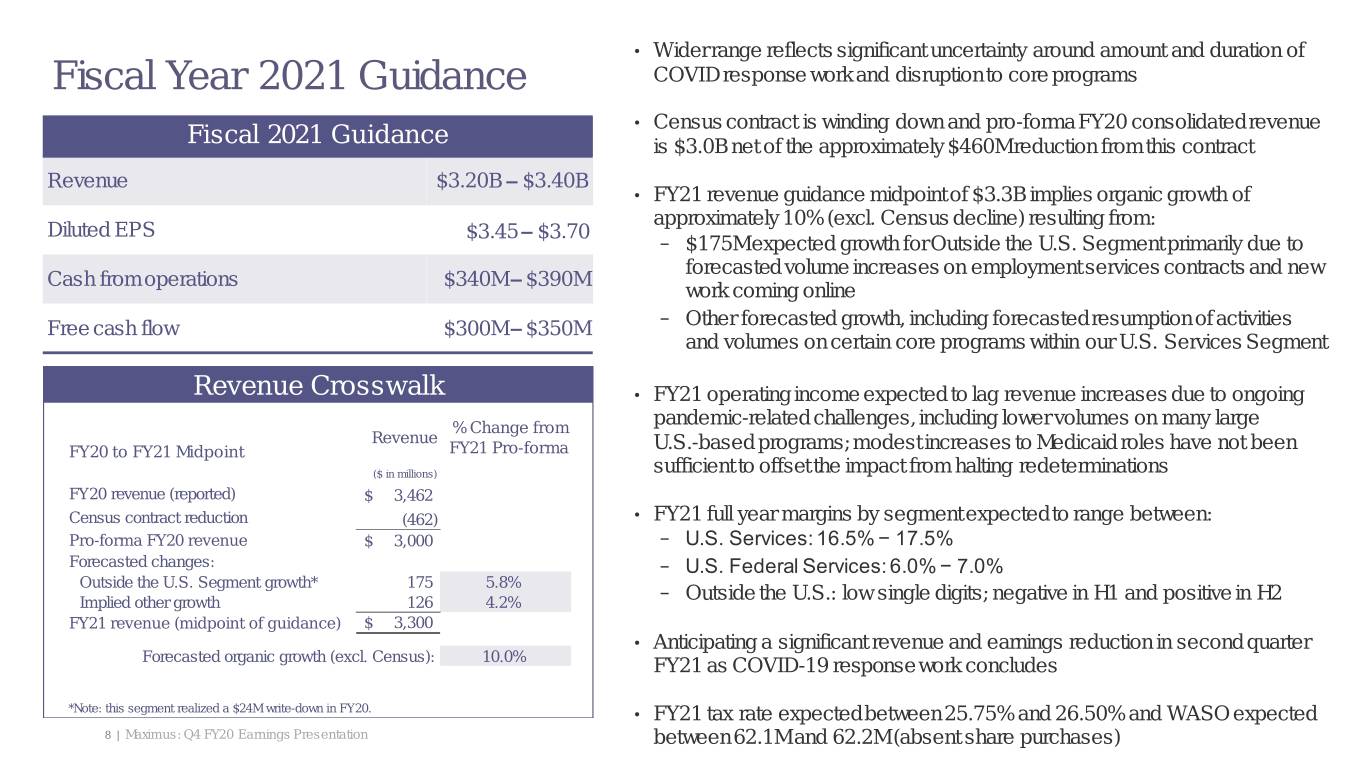
• Wider range reflects significant uncertainty around amount and duration of Fiscal Year 2021 Guidance COVID response work and disruption to core programs • Census contract is winding down and pro-forma FY20 consolidated revenue Fiscal 2021 Guidance is $3.0B net of the approximately $460M reduction from this contract Revenue $3.20B – $3.40B • FY21 revenue guidance midpoint of $3.3B implies organic growth of approximately 10% (excl. Census decline) resulting from: Diluted EPS $3.45 – $3.70 − $175M expected growth for Outside the U.S. Segment primarily due to forecasted volume increases on employment services contracts and new Cash from operations $340M – $390M work coming online Free cash flow $300M – $350M − Other forecasted growth, including forecasted resumption of activities and volumes on certain core programs within our U.S. Services Segment Revenue Crosswalk • FY21 operating income expected to lag revenue increases due to ongoing % Change from pandemic-related challenges, including lower volumes on many large Revenue FY20 to FY21 Midpoint FY21 Pro-forma U.S.-based programs; modest increases to Medicaid roles have not been ($ in millions) sufficient to offset the impact from halting redeterminations FY20 revenue (reported) $ 3,462 Census contract reduction (462) • FY21 full year margins by segment expected to range between: Pro-forma FY20 revenue $ 3,000 − U.S. Services: 16.5% − 17.5% Forecasted changes: − U.S. Federal Services: 6.0% − 7.0% Outside the U.S. Segment growth* 175 5.8% − Implied other growth 126 4.2% Outside the U.S.: low single digits; negative in H1 and positive in H2 FY21 revenue (midpoint of guidance) $ 3,300 • Anticipating a significant revenue and earnings reduction in second quarter Forecasted organic growth (excl. Census): 10.0% FY21 as COVID-19 response work concludes *Note: this segment realized a $24M write-down in FY20. • FY21 tax rate expected between 25.75% and 26.50% and WASO expected 8 | Maximus: Q4 FY20 Earnings Presentation between 62.1M and 62.2M (absent share purchases)

Fiscal 2020 Fourth Quarter & Year End Earnings Call Bruce Caswell President & Chief Executive Officer November 19, 2020 9 | Maximus: Q3 FY20 Earnings Presentation
U.S. 2020 Presidential and General Election Anticipated implications • Projected “blue wave” did not materialize, a likely indicator of a more moderate approach by Congress and the new Administration for at least the next two years • Headwinds and tailwinds as Democrats tend to design and promote more generous social programs while Republicans tend to focus on program integrity as it relates to access, coverage, and eligibility criteria • Both parties see value in public-private delivery models, often for different reasons • For decades, Maximus has partnered with government as it navigates the impacts of economic shocks and uncertainty that simultaneously drive greater reliance on program benefits while challenging budgets, notably at the state level • Near-term headwinds of lower volumes in some programs are far outweighed by the long-term tailwinds of being a decades-long partner to government, entrusted with the administration of critical social welfare programs in our nation • While some of our core programs may be a long way from resuming previous operational levels due to the sheer uncertainty of the times, we are managing our costs prudently, investing in new capabilities, and will be ready as a next equilibrium emerges 10 | Maximus: Q4 FY20 Earnings Presentation
Biden Administration Healthcare • Healthcare policy is a top priority for President-elect Biden who is expected to leverage ACA and address certain aspects through Executive Orders, agency orders, and potential Congressional action • Anticipate a focus by the new Administration on choice, reducing costs, and making the healthcare system easier to navigate • We understand the intersection between customers and public health insurance programs which uniquely position Maximus • Our demonstrated success in supporting state and federal exchange marketplaces under the ACA will enable us to assist the new administration in its core healthcare policy initiatives Transition • We do not expect the same level of slowdown in federal procurement as we saw with the 2016 transition In summary • Long-term demand for our services remains strong; governments turn to companies like Maximus to deliver outcomes that matter 11 | Maximus: Q4 FY20 Earnings Presentation
Operating in a Global Pandemic Ongoing safety response • Many of our operations were deemed “essential” by our government clients • Shifted as many employees to a work from home model as possible – Not all government programs allowed for this, particularly those with strict requirements related to the handling of PII • At peak, we successfully transitioned 63% of our U.S. workforce to work from home with 32% in an office setting and the remainder on leave • Outside of the U.S., 76% of our employees shifted to a work from home model at peak U.S. employee survey regarding COVID-19 measures • 80% of respondents believe we are protecting their health and safety • 80% also believe Maximus has taken necessary steps to provide appropriate income protections • Employee feedback continues to guide our COVID-19 action committee and ongoing strategy as we face rising levels of the pandemic again Ongoing management and execution of the business • While protecting our employees remains paramount, we aim to achieve our profitability objectives, generate strong cash flow, meet our contractual obligations, and continue to drive organic growth 12 | Maximus: Q4 FY20 Earnings Presentation
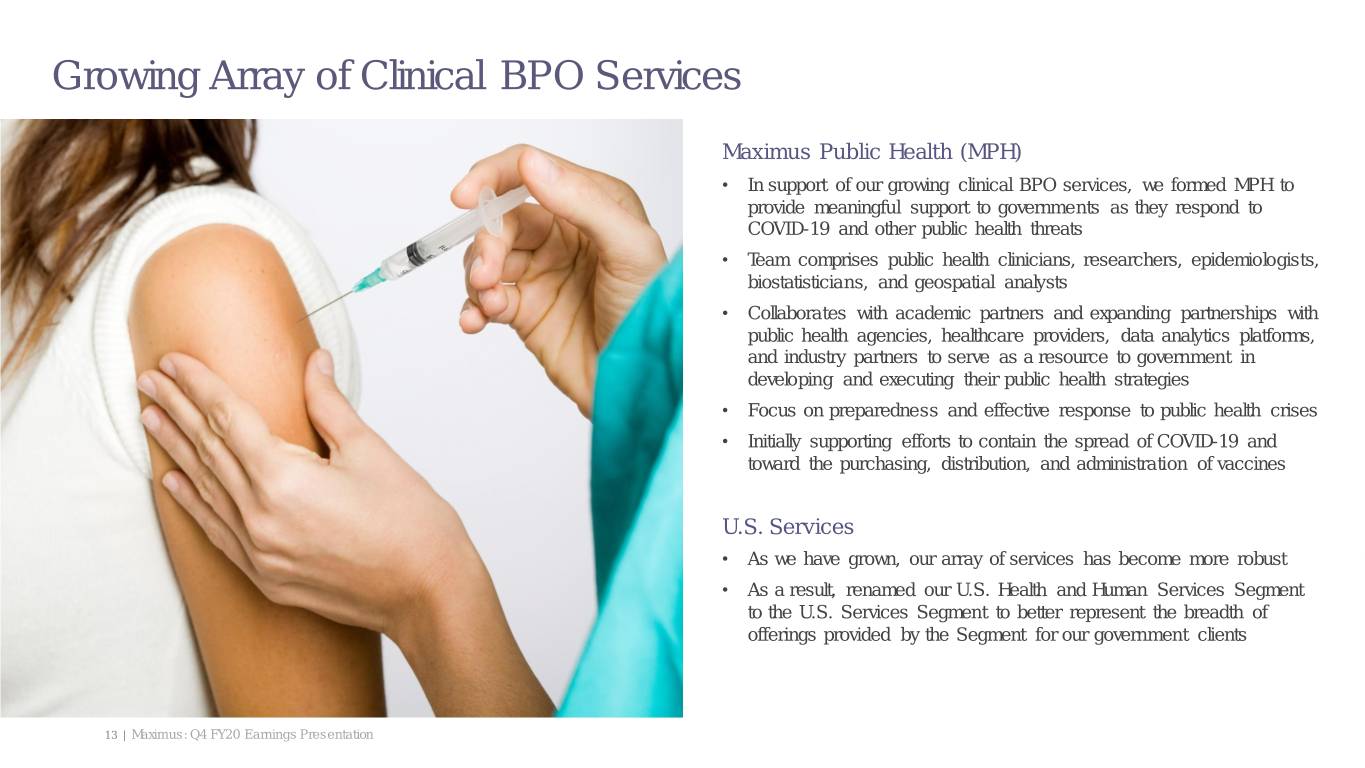
Growing Array of Clinical BPO Services Maximus Public Health (MPH) • In support of our growing clinical BPO services, we formed MPH to provide meaningful support to governments as they respond to COVID-19 and other public health threats • Team comprises public health clinicians, researchers, epidemiologists, biostatisticians, and geospatial analysts • Collaborates with academic partners and expanding partnerships with public health agencies, healthcare providers, data analytics platforms, and industry partners to serve as a resource to government in developing and executing their public health strategies • Focus on preparedness and effective response to public health crises • Initially supporting efforts to contain the spread of COVID-19 and toward the purchasing, distribution, and administration of vaccines U.S. Services • As we have grown, our array of services has become more robust • As a result, renamed our U.S. Health and Human Services Segment to the U.S. Services Segment to better represent the breadth of offerings provided by the Segment for our government clients 13 | Maximus: Q4 FY20 Earnings Presentation
Forward Momentum on Digital Transformation Earlier stages • Our digital transformation and early technology investments enabled us to successfully pivot and effectively serve those most reliant on the public programs we operate during the pandemic • Earlier in our digital transformation journey, we disrupted traditional models and developed the tools to meet citizens where they are, through mobile applications, robust portals, and omnichannel communications that seamlessly integrate chat and text messaging with conventional voice channels • Internally, applied robotic process automation or RPA at scale, furthering operational efficiencies Moving to the next stage • Continue maturing our digital delivery capabilities, and driving further automation into routine citizen transactions, while taking the next steps to build on the potential that our movement to the cloud has created in areas like natural language processing, AI, and cognitive computing • Our COVID-19 digital response is an early indicator of those efforts and I will share more as we continue along this trajectory 14 | Maximus: Q4 FY20 Earnings Presentation
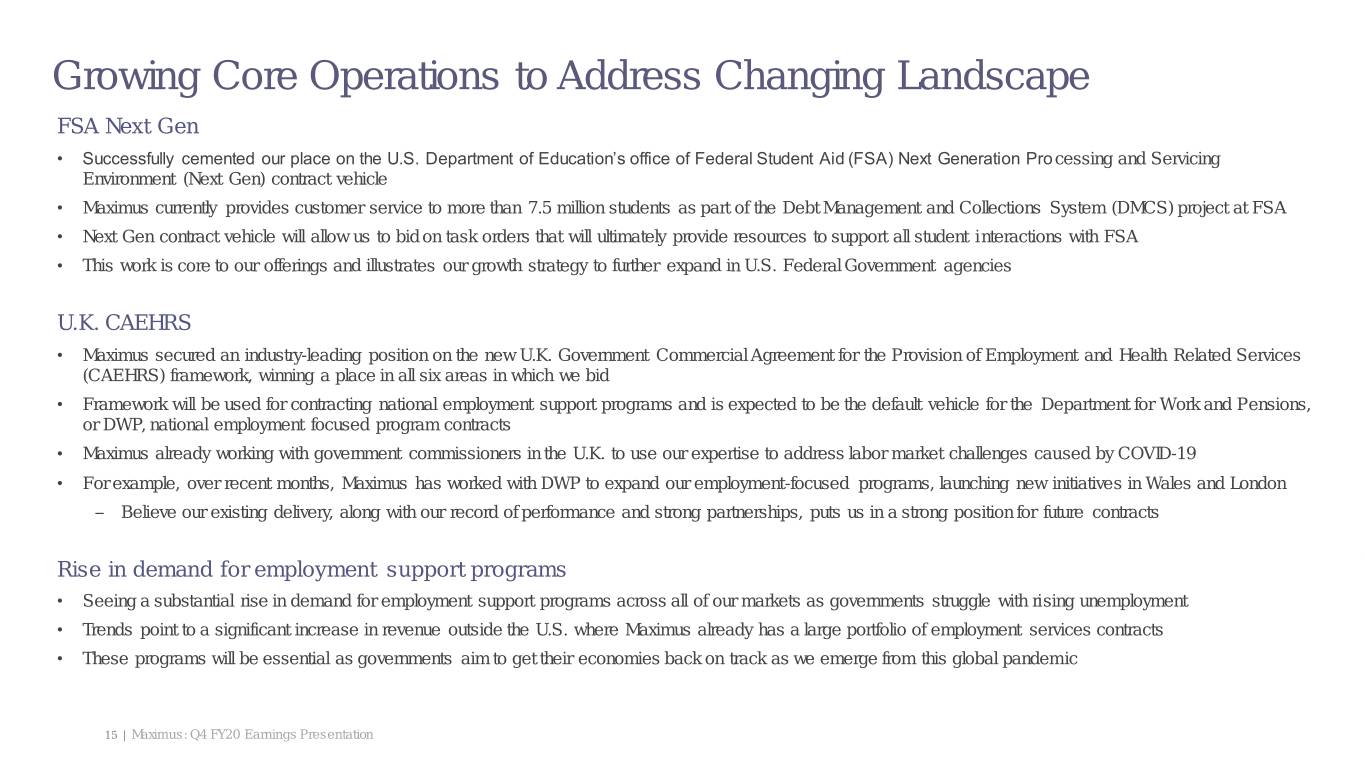
Growing Core Operations to Address Changing Landscape FSA Next Gen • Successfully cemented our place on the U.S. Department of Education’s office of Federal Student Aid (FSA) Next Generation Pro cessing and Servicing Environment (Next Gen) contract vehicle • Maximus currently provides customer service to more than 7.5 million students as part of the Debt Management and Collections System (DMCS) project at FSA • Next Gen contract vehicle will allow us to bid on task orders that will ultimately provide resources to support all student i nteractions with FSA • This work is core to our offerings and illustrates our growth strategy to further expand in U.S. Federal Government agencies U.K. CAEHRS • Maximus secured an industry-leading position on the new U.K. Government Commercial Agreement for the Provision of Employment and Health Related Services (CAEHRS) framework, winning a place in all six areas in which we bid • Framework will be used for contracting national employment support programs and is expected to be the default vehicle for the Department for Work and Pensions, or DWP, national employment focused program contracts • Maximus already working with government commissioners in the U.K. to use our expertise to address labor market challenges caused by COVID-19 • For example, over recent months, Maximus has worked with DWP to expand our employment-focused programs, launching new initiatives in Wales and London – Believe our existing delivery, along with our record of performance and strong partnerships, puts us in a strong position for future contracts Rise in demand for employment support programs • Seeing a substantial rise in demand for employment support programs across all of our markets as governments struggle with rising unemployment • Trends point to a significant increase in revenue outside the U.S. where Maximus already has a large portfolio of employment services contracts • These programs will be essential as governments aim to get their economies back on track as we emerge from this global pandemic 15 | Maximus: Q4 FY20 Earnings Presentation
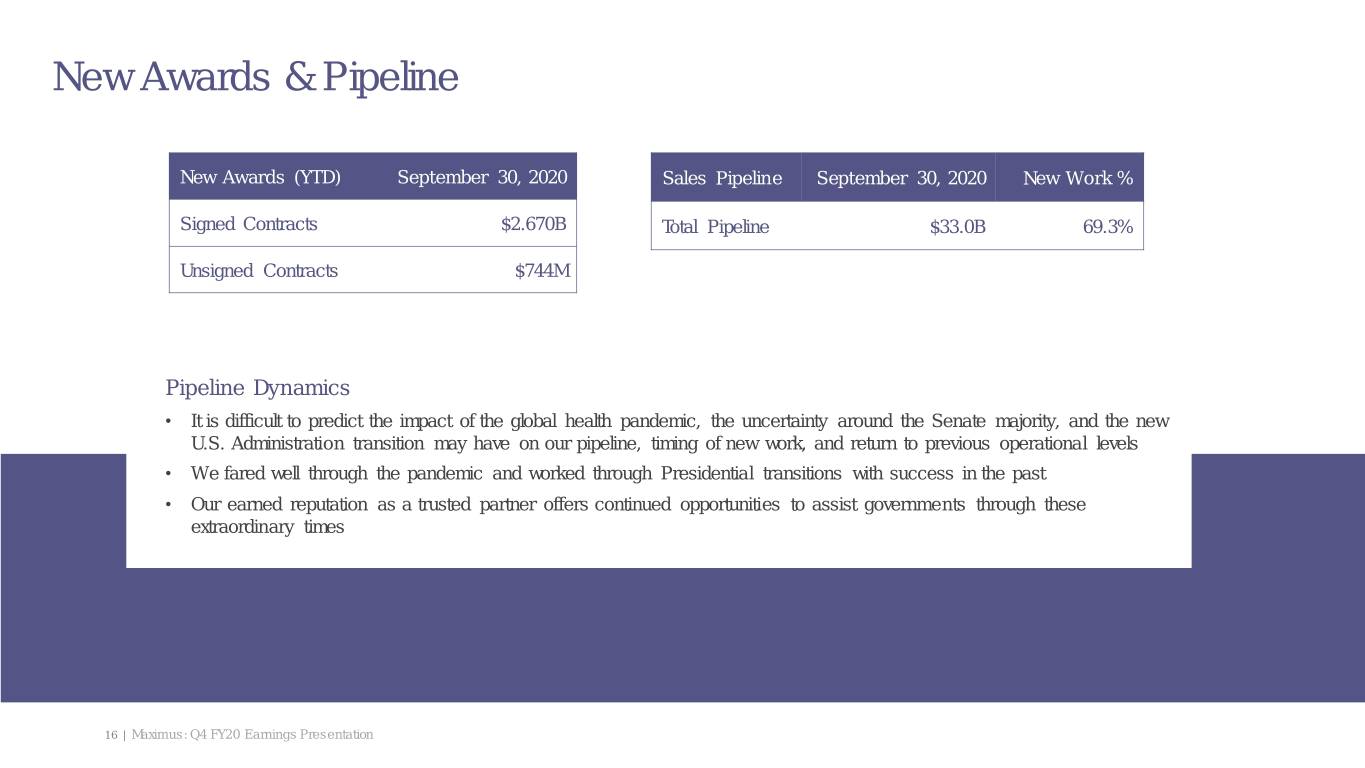
New Awards & Pipeline New Awards (YTD) September 30, 2020 Sales Pipeline September 30, 2020 New Work % Signed Contracts $2.670B Total Pipeline $33.0B 69.3% Unsigned Contracts $744M Pipeline Dynamics • It is difficult to predict the impact of the global health pandemic, the uncertainty around the Senate majority, and the new U.S. Administration transition may have on our pipeline, timing of new work, and return to previous operational levels • We fared well through the pandemic and worked through Presidential transitions with success in the past • Our earned reputation as a trusted partner offers continued opportunities to assist governments through these extraordinary times 16 | Maximus: Q4 FY20 Earnings Presentation
Conclusion • In fiscal 2020, we demonstrated our ability to respond to the changing needs of our clients by capitalizing on strategic and timely IT investments, using our digital capabilities, and leveraging our experienced teams to quickly ramp up a qualified workforce • We are cautiously optimistic that fiscal 2021 will be a year of progressive stability across the business, strong execution, and strong cash flow • While the global pandemic continues to impact many of our core programs, they will ultimately return to previous levels in the future; not a question of “if,” but rather a question of “when” • We remain committed to our diversity, equity, and inclusion strategy which includes extensive listening sessions with employees and engaging them in the process of defining future programs and initiatives – While I am pleased with the DE&I progress being made, I am reminded that there is more work ahead 17 | Maximus: Q4 FY20 Earnings Presentation