
MMS 8-K
Maximus, Inc. (MMS)
8-K
2020-08-11
For: 2020-08-11
View Original
Added on
April 10, 2026
UNITED STATES
SECURITIES AND EXCHANGE COMMISSION
Washington, D.C. 20549
___________
FORM 8-K
CURRENT REPORT
Pursuant to Section 13 or 15(d) of the Securities Exchange Act of 1934
Date of report: August 11, 2020
Date of earliest event reported: August 6, 2020
___________
(Exact name of registrant as specified in its charter)
(State or other jurisdiction of incorporation) | (Commission File Number) | (I.R.S. Employer Identification No.) | |||||||||
(Address of principal executive offices) | (Zip Code) | ||||||||||
Registrant’s telephone number, including area code: (703 ) 251-8500
Not Applicable
(Former name or former address, if changed since last report)
Check the appropriate box below if the Form 8-K filing is intended to simultaneously satisfy the filing obligation of the registrant under any of the following provisions:
Securities registered pursuant to Section 12(b) of the Act:
Title of each class | Trading Symbol(s) | Name of each exchange on which registered | ||||||||||||
Indicate by check mark whether the registrant is an emerging growth company as defined in Rule 405 of the Securities Act of 1933 (§230.405 of this chapter) or Rule 12b-2 of the Securities Exchange Act of 1934 (§240.12b-2 of this chapter).
Emerging growth company ☐
If an emerging growth company, indicate by check mark if the registrant has elected not to use the extended transition period for complying with any new or revised financial accounting standards provided pursuant to Section 13(a) of the Exchange Act. ☐
Item 2.02 Results of Operations and Financial Condition.
On August 6, 2020, the Company issued a press release announcing its financial results for the quarter ended June 30, 2020. The full text of the press release is furnished as Exhibit 99.1 to this Current Report on Form 8-K and incorporated by reference into this Item 2.02.
On August 6, 2020, the Company held a conference call with respect to these financial results. The conference call was open to the public. The transcript and slide presentation that accompanied the call are furnished as Exhibit 99.2 and Exhibit 99.3 to this Current Report on Form 8-K and incorporated by reference into this Item 2.02.
Item 9.01 Financial Statements and Exhibits.
(d) Exhibits. The following exhibits are being furnished pursuant to Item 2.02 above.
| Exhibit No. | Description | ||||
| Press release dated August 6, 2020 | |||||
| Conference call transcript for Earnings Call - August 6, 2020 | |||||
| Conference call slide presentation for Earnings Call - August 6, 2020 | |||||
SIGNATURES
Pursuant to the requirements of the Securities Exchange Act of 1934, the registrant has duly caused this report to be signed on its behalf by the undersigned hereunto duly authorized.
| Maximus, Inc. | ||||||||||||||
| Date: August 11, 2020 | By: | /s/ David R. Francis | ||||||||||||
| David R. Francis | ||||||||||||||
| General Counsel and Secretary | ||||||||||||||

| FOR IMMEDIATE RELEASE | CONTACT: | Lisa Miles 703.251.8637 | |||||||||
| [email protected] | |||||||||||
| Date: August 6, 2020 | |||||||||||
Maximus Reports Fiscal Year 2020 Third Quarter Results
- Company Raises Guidance While COVID-19 Disruptions Persist -
(RESTON, Va. - August 6, 2020) - Maximus (NYSE: MMS), a leading provider of government services worldwide, reported financial results for the three and nine months ended June 30, 2020.
Highlights for the third quarter of fiscal 2020 include:
•The Company’s continued focus on safeguarding employees and strategic technology investments have enabled continued support of our customers and citizens through the COVID-19 pandemic
•Revenue increased to $901.3 million as compared to $730.7 million reported for the same period last year, driven by the Census contract in the U.S. Federal Services Segment and new COVID-19 response work such as contact tracing and assistance with unemployment benefits
•Diluted earnings per share were $1.04 and benefited from a previously disclosed change order totaling $0.11 per diluted share
•Revenue and earnings were better than expected principally due to new work and the expansion of existing contracts as a result of COVID-19, and an improved outlook in our Australia operations. As a result, the Company increased revenue and earnings guidance for fiscal 2020 with revenue expected to range between $3.375 billion and $3.425 billion and diluted earnings per share to range between $3.20 and $3.30 per share
•A quarterly cash dividend of $0.28 for each share of our common stock outstanding payable on August 31, 2020, to shareholders of record on August 14, 2020.
COVID-19 Status Update
Overall, the Company is navigating the COVID-19 pandemic using a hybrid operational model which maintains delivery of services through a mix of safe, on-site working arrangements and work-from-home arrangements. The pandemic continues to impact all segments. The Outside the U.S. Segment remains impacted by the temporary halt on face-to-face health assessments and a general pandemic related slowdown in employment services. Within U.S. operations, disruptions persist on several performance-based contracts from ongoing COVID-19 response efforts by our government clients. For example, these programs have relaxed certain program requirements to allow vulnerable citizens continued access to vital services resulting in lower volumes and revenues.
These negative impacts have been offset by new COVID-19 response work, the restructuring of certain employment services contracts Outside the U.S. to reflect more equitable pay models, and an increase in expected revenue and earnings from the Census contract in the U.S. Federal Services Segment.

"Our employees have shown true resilience, working tirelessly to help citizens navigate challenging circumstances as governments have responded. The necessity of the health and human services programs we are entrusted to administer is no more apparent than during an economic crisis precipitated by the current global pandemic," shared Bruce Caswell, President and Chief Executive Officer. "Meanwhile, we continue to execute upon our three goals of Digital Transformation, which has helped us quickly transition to a hybrid operational model, Clinical Evolution, and the expansion of clinical BPO support services in response to COVID-19, and Market Expansion, supporting our strategic trajectory in the face of this global disruption."
Third Quarter Results
For the third quarter of fiscal 2020, revenue increased to $901.3 million as compared to $730.7 million reported for the prior-year period last year driven by the Census contract in the U.S. Federal Services Segment and COVID-19 response work such, as contact tracing and assistance with unemployment benefits. Excluding the citizen engagement centers business acquired in November 2018, which includes the Census contract, organic growth for the third quarter of fiscal 2020 was 3.5% compared to the prior-year period and tempered by declines in the Outside the U.S. Segment.
For the third quarter of fiscal 2020, operating income totaled $87.3 million, yielding an operating margin of 9.7%. This compares to 11.4% for the same period last year. The operating margin was lower due to decreased revenue from performance-based contracts and a greater mix of lower margin, cost-plus work related to the Census contract.
For the third quarter of fiscal 2020, net income attributable to Maximus totaled $64.5 million, or $1.04 of diluted earnings per share, which includes a $9 million change order that benefited results by $0.11 per diluted share. This compares to the third quarter of fiscal 2019 diluted earnings per share of $0.97.
U.S. Health & Human Services Segment
Revenue in the U.S. Health & Human Services Segment for the third quarter of fiscal 2020 increased 15.7% to $337.0 million compared to $291.1 million reported for the same period last year. All growth in this segment was organic and attributable to new work, including work tied to COVID-19 response efforts, and the expansion of existing contracts.
Operating margin for the third quarter of fiscal 2020 was 18.1% compared to 18.6% reported for the prior-year period. Operating margin for the third quarter of fiscal 2020 was 15.9% without the benefit of the aforementioned change order. The operating margin was impacted by operational disruptions related to the pandemic. As an example, the Company has experienced lower revenue and earnings on a significant performance-based state Medicaid program, where our government client paused renewals to ensure that individuals and families retain vital access to healthcare.
Continued disruptions are expected in the U.S. Health & Human Services Segment while still forecasted to deliver an operating margin between 17% and 18% for the full year.
U.S. Federal Services Segment
U.S. Federal Services Segment revenue for the third quarter of fiscal 2020 increased to $450.1 million compared to $292.3 million reported for the same period last year. All revenue growth in this segment was organic. Excluding the citizen engagement centers business, organic revenue growth was 4.1% driven by new work, including that tied to COVID-19 response efforts, and growth on existing contracts.
Operating margin for the third quarter of fiscal 2020 was 8.7% compared to 11.6% reported for the prior-year period and was impacted by a combination of reduced volumes and revenue on certain performance-based contracts and a greater mix of cost-plus contracts which typically have lower operating margins. For example,
the volume of independent medical reviews has decreased significantly due to a precipitous drop in workers' compensation claims.
The Census contract continued to operate at peak levels in the quarter due to the Census Bureau's extended response period. This contract delivered approximately $170 million and $380 million of revenue for the three and nine months ended June 30, 2020, respectively, and is expected to deliver approximately $500 million of revenue in fiscal year 2020.
The U.S. Federal Services Segment is expected to deliver an operating margin between 8% and 9% for the full year with a bias toward the lower end of the range.
Outside the U.S. Segment
Outside the U.S. Segment revenue for the third quarter of fiscal 2020 decreased to $114.2 million compared to $147.3 million reported for the same period last year. Operating loss for the third quarter of fiscal 2020 was $5.8 million compared to an operating profit of $5.0 million and an operating margin of 3.4% reported for the prior-year period. This segment contains several significant employment services contracts, most notably in the U.K. and Australia, and the Health Assessment Advisory Service (HAAS) contract in the U.K., which all continue to operate at reduced levels.
The operating loss for the third quarter of fiscal 2020 is less than previously forecasted due to greater visibility of future outcome payments on the employment services contracts. The Company also successfully modified the contractual terms on certain employment services contracts to allow for more equitable pay points or cost reimbursement arrangements.
The Segment is still expected to end the full year in an operating loss position, although a significant loss is not expected in the fourth quarter of fiscal 2020. Face-to-face assessments on the HAAS contract remain suspended and other programs continue to be impacted by COVID-19. However, in fiscal 2021, the Company anticipates an expanded need and pent-up demand for employment services as geographies begin to emerge from the pandemic and may face unprecedented unemployment levels.
Sales and Pipeline
Year-to-date signed contract awards at June 30, 2020, totaled $1.5 billion and contracts pending (awarded but unsigned) totaled $672 million. These awards reflect total contract value.
The sales pipeline at June 30, 2020, was $28.9 billion (comprised of approximately $1.9 billion in proposals pending, $1.9 billion in proposals in preparation, and $25.1 billion in opportunities tracking).
Mr. Caswell continued, "The pipeline dynamics continue to be unique since the pandemic began in March. We still see procurements being completed in record time for efforts to support COVID-19. As you would expect, that focus has taken away from previously planned, normal course procurements. It continues to be a fluid situation that is changing daily where we anticipate both positive and negative impacts."
Balance Sheet and Cash Flows
Cash and cash equivalents at June 30, 2020, totaled $81.5 million and excludes $14.4 million of restricted cash included in the Consolidated Statement of Cash Flows. Outstanding draws on the Company's credit facility totaled $145.0 million at the end of the third quarter, leaving $255.0 million of available capacity.
For the nine months ended June 30, 2020, cash from operations totaled $96.1 million and free cash flow was $67.6 million. Year-to-date cash from operations has been negatively impacted due to the additional investment in working capital required by increases to revenue, the timing of collections, and lower income attributable to the Outside the U.S. Segment. Days sales outstanding (DSO) of 84 days at June 30, 2020, caused negative cash flows for the three months ended June 30, 2020.
At June 30, 2020, DSO were 84 days and outside the Company's typical range of 65 to 80 days. Subsequent to June 30, 2020, more than $90 million of accounts receivable were collected and DSO would have been 74 days with those payments included.
On July 3, 2020, our Board of Directors declared a quarterly cash dividend of $0.28 for each share of our common stock outstanding. The dividend is payable on August 31, 2020, to shareholders of record on August 14, 2020.
Outlook
Maximus is increasing revenue and earnings guidance for fiscal 2020 following new work wins and the expansion of existing work tied to the COVID-19 response, including the extension of the Census contract. The Company anticipates fiscal 2020 revenue will range between $3.375 and $3.425 billion and diluted earnings per share will range between $3.20 and $3.30 per share. Cash flows from operations are expected to range between $200 and $220 million and free cash flow between $180 and $200 million.
Mr. Caswell added, "We are proud that our customers trust our experience and abilities to provide solutions and continued support during this critical time. We cannot predict with certainty how long the pandemic will last but we feel prepared to continue operating in our current manner and our strong financial standing furthers that ability."
Conference Call and Webcast Information
Maximus will host a conference call this morning, August 6, 2020, at 9:00 a.m. (ET).
The call is open to the public and available by webcast.
To receive dial-in details, participants must register prior to the call. Once registered, dial-in details will be sent to the participant by email.
For those unable to listen to the live call, a recording of the webcast will be available on investor.maximus.com.
About Maximus
Since 1975, Maximus has operated under its founding mission of Helping Government Serve the People®, enabling citizens around the globe to successfully engage with their governments at all levels and across a variety of health and human services programs. Maximus delivers innovative business process management and technology solutions that contribute to improved outcomes for citizens and higher levels of productivity, accuracy, accountability and efficiency of government-sponsored programs. With more than 30,000 employees worldwide, Maximus is a proud partner to government agencies in the United States, Australia, Canada, Italy, Saudi Arabia, Singapore, Sweden, and the United Kingdom. For more information, visit maximus.com.
Non-GAAP Measures
This release refers to non-GAAP financial measures, including free cash flow, constant currency, and days sales outstanding.
We have provided a reconciliation of free cash flow to cash flows from operations.
A description of these non-GAAP measures, the reasons why we use and present them and details as to how they are calculated are included in our Annual Report on Form 10-K.
The presentation of these non-GAAP numbers is not meant to be considered in isolation, nor as alternatives to cash flows from operations, revenue growth or net income as measures of performance. These non-GAAP financial measures, as determined and presented by us, may not be comparable to related or similarly titled measures presented by other companies.
Statements that are not historical facts, including statements about the Company’s confidence and strategies and the Company’s expectations about revenues, results of operations, profitability, future contracts, market opportunities, market demand, or acceptance of the Company’s products are forward-looking statements that involve risks and uncertainties such as those related to impact of the COVID-19 pandemic including but not limited to:
•The ultimate duration of the pandemic
•The threat of further negative pandemic-related impacts
•Delays in our core programs returning to normal volumes and operations
•The potential impacts resulting from budget challenges with our government clients
•The possibility of delayed or missed payments by customers
•The potential for further supply chain disruptions impacting IT or safety equipment
•The impact of further legislation and government policies on the programs we operate
These risks could cause the Company’s actual results to differ materially from those indicated by such forward-looking statements. A summary of risk factors can be found in Exhibit 99.1 to the Company’s most recent Annual Report filed with the Securities and Exchange Commission, found on maximus.com.
Maximus, Inc.
CONSOLIDATED STATEMENTS OF OPERATIONS
(Amounts in thousands, except per share data)
(Unaudited)
| Three Months Ended June 30, | Nine Months Ended June 30, | ||||||||||||||||||||||
| 2020 | 2019 | 2020 | 2019 | ||||||||||||||||||||
| Revenue | $ | 901,337 | $ | 730,710 | $ | 2,537,701 | $ | 2,131,849 | |||||||||||||||
| Cost of revenue | 715,734 | 556,463 | 2,023,550 | 1,628,915 | |||||||||||||||||||
| Gross profit | 185,603 | 174,247 | 514,151 | 502,934 | |||||||||||||||||||
| Selling, general and administrative expenses | 89,582 | 81,604 | 283,662 | 239,377 | |||||||||||||||||||
| Amortization of intangible assets | 8,712 | 9,049 | 26,734 | 24,026 | |||||||||||||||||||
| Operating income | 87,309 | 83,594 | 203,755 | 239,531 | |||||||||||||||||||
| Interest expense | 616 | 420 | 1,565 | 2,614 | |||||||||||||||||||
| Other (expense)/income, net | (671) | 556 | 621 | 3,048 | |||||||||||||||||||
| Income before income taxes | 86,022 | 83,730 | 202,811 | 239,965 | |||||||||||||||||||
| Provision for income taxes | 21,558 | 20,765 | 51,963 | 59,511 | |||||||||||||||||||
| Net income | 64,464 | 62,965 | 150,848 | 180,454 | |||||||||||||||||||
| Income/(loss) attributable to noncontrolling interests | — | 67 | — | (281) | |||||||||||||||||||
| Net income attributable to Maximus | $ | 64,464 | $ | 62,898 | $ | 150,848 | $ | 180,735 | |||||||||||||||
| Basic earnings per share | $ | 1.04 | $ | 0.98 | $ | 2.38 | $ | 2.80 | |||||||||||||||
| Diluted earnings per share | $ | 1.04 | $ | 0.97 | $ | 2.37 | $ | 2.79 | |||||||||||||||
| Dividends paid per share | $ | 0.28 | $ | 0.25 | $ | 0.84 | $ | 0.75 | |||||||||||||||
| Weighted average shares outstanding: | |||||||||||||||||||||||
| Basic | 61,882 | 64,405 | 63,463 | 64,534 | |||||||||||||||||||
| Diluted | 62,102 | 64,759 | 63,666 | 64,800 | |||||||||||||||||||
Maximus, Inc.
CONSOLIDATED BALANCE SHEETS
(Amounts in thousands)
| June 30, 2020 | September 30, 2019 | ||||||||||
| (unaudited) | |||||||||||
| ASSETS | |||||||||||
| Current assets: | |||||||||||
| Cash and cash equivalents | $ | 81,548 | $ | 105,565 | |||||||
| Accounts receivable — billed and billable, net of reserves of $13,031 and $5,382 | 626,471 | 476,690 | |||||||||
| Accounts receivable — unbilled | 203,267 | 123,884 | |||||||||
| Income taxes receivable | 8,284 | 20,805 | |||||||||
| Prepaid expenses and other current assets | 59,942 | 62,481 | |||||||||
| Total current assets | 979,512 | 789,425 | |||||||||
| Property and equipment, net | 73,319 | 99,589 | |||||||||
| Capitalized software, net | 35,447 | 32,369 | |||||||||
| Operating lease right-of-use assets | 171,041 | — | |||||||||
| Goodwill | 586,757 | 584,469 | |||||||||
| Intangible assets, net | 151,115 | 179,250 | |||||||||
| Deferred contract costs, net | 20,267 | 18,921 | |||||||||
| Deferred compensation plan assets | 33,834 | 32,908 | |||||||||
| Deferred income taxes | 3,450 | 186 | |||||||||
| Other assets | 8,244 | 8,615 | |||||||||
| Total assets | $ | 2,062,986 | $ | 1,745,732 | |||||||
| LIABILITIES AND SHAREHOLDERS’ EQUITY | |||||||||||
| Current liabilities: | |||||||||||
| Accounts payable and accrued liabilities | $ | 217,831 | $ | 177,786 | |||||||
| Accrued compensation and benefits | 130,396 | 106,789 | |||||||||
| Deferred revenue | 48,743 | 43,344 | |||||||||
| Income taxes payable | 4,725 | 13,952 | |||||||||
| Current portion of long-term debt and other borrowings | 7,000 | 9,658 | |||||||||
| Operating lease liabilities | 74,878 | — | |||||||||
| Other liabilities | 18,971 | 12,709 | |||||||||
| Total current liabilities | 502,544 | 364,238 | |||||||||
| Deferred revenue, less current portion | 30,090 | 32,341 | |||||||||
| Deferred income taxes | 44,532 | 46,560 | |||||||||
| Long-term debt, less current portion | 145,161 | 231 | |||||||||
| Deferred compensation plan liabilities, less current portion | 34,302 | 34,079 | |||||||||
| Operating lease liabilities, less current portion | 103,236 | — | |||||||||
| Other liabilities | 8,174 | 20,082 | |||||||||
| Total liabilities | 868,039 | 497,531 | |||||||||
| Shareholders’ equity: | |||||||||||
| Common stock, no par value; 100,000 shares authorized; 61,313 and 63,979 shares issued and outstanding at June 30, 2020, and September 30, 2019, at stated amount, respectively | 517,200 | 498,433 | |||||||||
| Accumulated other comprehensive loss | (46,684) | (45,380) | |||||||||
| Retained earnings | 724,431 | 794,739 | |||||||||
| Total Maximus shareholders' equity | 1,194,947 | 1,247,792 | |||||||||
| Noncontrolling interests | — | 409 | |||||||||
| Total equity | 1,194,947 | 1,248,201 | |||||||||
| Total liabilities and equity | $ | 2,062,986 | $ | 1,745,732 | |||||||
Maximus, Inc.
CONSOLIDATED STATEMENTS OF CASH FLOWS
(Amounts in thousands)
(Unaudited)
| Three Months Ended June 30, | Nine Months Ended June 30, | ||||||||||||||||||||||
| 2020 | 2019 | 2020 | 2019 | ||||||||||||||||||||
| Cash flows from operations: | |||||||||||||||||||||||
| Net income | $ | 64,464 | $ | 62,965 | $ | 150,848 | $ | 180,454 | |||||||||||||||
| Adjustments to reconcile net income to cash flows from operations: | |||||||||||||||||||||||
| Depreciation and amortization of property, equipment and capitalized software | 16,278 | 12,181 | 47,496 | 34,588 | |||||||||||||||||||
| Amortization of intangible assets | 8,712 | 9,049 | 26,734 | 24,026 | |||||||||||||||||||
| Deferred income taxes | (8,248) | (6,568) | (5,210) | 11,196 | |||||||||||||||||||
| Stock compensation expense | 5,758 | 5,419 | 17,558 | 15,323 | |||||||||||||||||||
| Gain on sale of a business | (1,706) | — | (1,706) | — | |||||||||||||||||||
| Change in assets and liabilities net of effects of business combinations: | |||||||||||||||||||||||
| Accounts receivable — billed and billable | (94,756) | (35,411) | (147,626) | (108,131) | |||||||||||||||||||
| Accounts receivable — unbilled | (82,556) | 36,983 | (80,267) | 46,172 | |||||||||||||||||||
| Prepaid expenses and other current assets | (3,733) | 2,185 | 529 | (2,933) | |||||||||||||||||||
| Deferred contract costs | (899) | (2,727) | (1,396) | (8,142) | |||||||||||||||||||
| Accounts payable and accrued liabilities | 26,300 | 11,382 | 48,622 | 53,462 | |||||||||||||||||||
| Accrued compensation and benefits | 29,808 | 16,725 | 33,647 | 9,282 | |||||||||||||||||||
| Deferred revenue | (2,494) | 3,422 | 2,806 | 7,857 | |||||||||||||||||||
| Income taxes | 28,269 | 19,635 | 563 | 3,139 | |||||||||||||||||||
| Operating lease right-of-use assets and liabilities | (1,237) | — | (1,071) | — | |||||||||||||||||||
| Other assets and liabilities | 2,851 | 1,260 | 4,556 | (2,582) | |||||||||||||||||||
| Cash flows (used in)/from operations | (13,189) | 136,500 | 96,083 | 263,711 | |||||||||||||||||||
| Cash flows from investing activities: | |||||||||||||||||||||||
| Purchases of property and equipment and capitalized software costs | (9,314) | (20,492) | (28,436) | (39,033) | |||||||||||||||||||
| Acquisitions of businesses, net of cash acquired | (60) | (240) | (2,611) | (422,049) | |||||||||||||||||||
| Proceeds from the sale of a business | 3,250 | — | 3,250 | — | |||||||||||||||||||
| Maturities of short-term investments | — | — | — | 19,996 | |||||||||||||||||||
| Other | 287 | 96 | 385 | 380 | |||||||||||||||||||
| Cash used in investing activities | (5,837) | (20,636) | (27,412) | (440,706) | |||||||||||||||||||
| Cash flows from financing activities: | |||||||||||||||||||||||
| Cash dividends paid to Maximus shareholders | (17,175) | (15,953) | (52,988) | (47,936) | |||||||||||||||||||
| Purchases of Maximus common stock | — | — | (166,959) | (46,068) | |||||||||||||||||||
| Tax withholding related to RSU vesting | — | — | (10,614) | (8,915) | |||||||||||||||||||
| Borrowings under credit facility and other loan agreements | 79,773 | — | 421,488 | 320,048 | |||||||||||||||||||
| Repayment of credit facility and other long-term debt | (87,715) | (75,058) | (278,971) | (316,597) | |||||||||||||||||||
| Other | (305) | — | (957) | (133) | |||||||||||||||||||
| Cash used in financing activities | (25,422) | (91,011) | (89,001) | (99,601) | |||||||||||||||||||
| Effect of exchange rate changes on cash, cash equivalents and restricted cash | 1,694 | (362) | (174) | (994) | |||||||||||||||||||
| Net (decrease)/increase in cash, cash equivalents and restricted cash | (42,754) | 24,491 | (20,504) | (277,590) | |||||||||||||||||||
| Cash, cash equivalents and restricted cash, beginning of period | 138,742 | 54,478 | 116,492 | 356,559 | |||||||||||||||||||
| Cash, cash equivalents and restricted cash, end of period | $ | 95,988 | $ | 78,969 | $ | 95,988 | $ | 78,969 | |||||||||||||||
Maximus, Inc.
SEGMENT INFORMATION
(Amounts in thousands)
(Unaudited)
| Three Months Ended June 30, | Nine Months Ended June 30, | |||||||||||||||||||||||||||||||||||||||||||||||||
| 2020 | % (1) | 2019 | % (1) | 2020 | % (1) | 2019 | % (1) | |||||||||||||||||||||||||||||||||||||||||||
| Revenue: | ||||||||||||||||||||||||||||||||||||||||||||||||||
| U.S. Health & Human Services | $ | 336,950 | $ | 291,132 | $ | 957,929 | $ | 876,082 | ||||||||||||||||||||||||||||||||||||||||||
| U.S. Federal Services | 450,143 | 292,295 | 1,210,105 | 799,018 | ||||||||||||||||||||||||||||||||||||||||||||||
| Outside the U.S. | 114,244 | 147,283 | 369,667 | 456,749 | ||||||||||||||||||||||||||||||||||||||||||||||
| Total | $ | 901,337 | $ | 730,710 | $ | 2,537,701 | $ | 2,131,849 | ||||||||||||||||||||||||||||||||||||||||||
| Gross Profit: | ||||||||||||||||||||||||||||||||||||||||||||||||||
| U.S. Health & Human Services | $ | 93,029 | 27.6 | % | $ | 86,664 | 29.8 | % | $ | 268,073 | 28.0 | % | $ | 260,955 | 29.8 | % | ||||||||||||||||||||||||||||||||||
| U.S. Federal Services | 84,723 | 18.8 | % | 66,803 | 22.9 | % | 232,502 | 19.2 | % | 175,484 | 22.0 | % | ||||||||||||||||||||||||||||||||||||||
| Outside the U.S. | 7,851 | 6.9 | % | 20,780 | 14.1 | % | 13,576 | 3.7 | % | 66,495 | 14.6 | % | ||||||||||||||||||||||||||||||||||||||
| Total | $ | 185,603 | 20.6 | % | $ | 174,247 | 23.8 | % | $ | 514,151 | 20.3 | % | $ | 502,934 | 23.6 | % | ||||||||||||||||||||||||||||||||||
| Selling, general, and administrative expense: | ||||||||||||||||||||||||||||||||||||||||||||||||||
| U.S. Health & Human Services | $ | 31,996 | 9.5 | % | $ | 32,414 | 11.1 | % | $ | 102,633 | 10.7 | % | $ | 93,953 | 10.7 | % | ||||||||||||||||||||||||||||||||||
| U.S. Federal Services | 45,490 | 10.1 | % | 32,896 | 11.3 | % | 131,455 | 10.9 | % | 90,632 | 11.3 | % | ||||||||||||||||||||||||||||||||||||||
| Outside the U.S. | 13,668 | 12.0 | % | 15,791 | 10.7 | % | 47,125 | 12.7 | % | 52,591 | 11.5 | % | ||||||||||||||||||||||||||||||||||||||
| Gain on sale of a business (3) | (1,706) | NM | — | NM | (1,706) | NM | — | NM | ||||||||||||||||||||||||||||||||||||||||||
| Other (2) | 134 | NM | 503 | NM | 4,155 | NM | 2,201 | NM | ||||||||||||||||||||||||||||||||||||||||||
| Total | $ | 89,582 | 9.9 | % | $ | 81,604 | 11.2 | % | $ | 283,662 | 11.2 | % | $ | 239,377 | 11.2 | % | ||||||||||||||||||||||||||||||||||
| Operating income: | ||||||||||||||||||||||||||||||||||||||||||||||||||
| U.S. Health & Human Services | $ | 61,033 | 18.1 | % | $ | 54,250 | 18.6 | % | $ | 165,440 | 17.3 | % | $ | 167,002 | 19.1 | % | ||||||||||||||||||||||||||||||||||
| U.S. Federal Services | 39,233 | 8.7 | % | 33,907 | 11.6 | % | 101,047 | 8.4 | % | 84,852 | 10.6 | % | ||||||||||||||||||||||||||||||||||||||
| Outside the U.S. | (5,817) | (5.1) | % | 4,989 | 3.4 | % | (33,549) | (9.1) | % | 13,904 | 3.0 | % | ||||||||||||||||||||||||||||||||||||||
| Amortization of intangible assets | (8,712) | NM | (9,049) | NM | (26,734) | NM | (24,026) | NM | ||||||||||||||||||||||||||||||||||||||||||
| Gain on sale of a business (3) | 1,706 | NM | — | NM | 1,706 | NM | — | NM | ||||||||||||||||||||||||||||||||||||||||||
| Other (2) | (134) | NM | (503) | NM | (4,155) | NM | (2,201) | NM | ||||||||||||||||||||||||||||||||||||||||||
| Total | $ | 87,309 | 9.7 | % | $ | 83,594 | 11.4 | % | $ | 203,755 | 8.0 | % | $ | 239,531 | 11.2 | % | ||||||||||||||||||||||||||||||||||
(1) Percentage of respective segment revenue. Percentages not considered meaningful are marked “NM.”
(2) Other selling, general and administrative expenses includes credits and costs that are not allocated to a particular segment, including the
costs for actual and potential acquisitions of other businesses.
(3) During fiscal year 2020, we sold Q2 Administrators LLC, a subsidiary within our U.S. Federal Services Segment, resulting in a gain.
Maximus, Inc.
FREE CASH FLOW
(Non-GAAP measure)
(Amounts in thousands)
(Unaudited)
| Three Months Ended June 30, | Nine Months Ended June 30, | ||||||||||||||||||||||
| 2020 | 2019 | 2020 | 2019 | ||||||||||||||||||||
| Cash flows (used in)/from operations | $ | (13,189) | $ | 136,500 | $ | 96,083 | $ | 263,711 | |||||||||||||||
| Purchases of property and equipment and capitalized software costs | (9,314) | (20,492) | (28,436) | (39,033) | |||||||||||||||||||
| Capital expenditure as a result of acquisition (1) | — | — | — | 4,542 | |||||||||||||||||||
| Free cash flow | $ | (22,503) | $ | 116,008 | $ | 67,647 | $ | 229,220 | |||||||||||||||
(1) Purchases of property and equipment and capitalized software costs included $4.5 million in one-time payments to cover software
licenses required for employees joining us through the citizen engagement centers acquisition in November 2018.
-XXX-
Maximus Fiscal 2020 Third Quarter Earnings Conference Call August 6, 2020 Operator Ladies and gentlemen, thank you for standing by, and welcome to the Q3 FY20 Maximus Earning Conference Call. At this time, all participants are in listen-only mode. After the speaker's presentation, there will be a question-and-answer session. To ask a question during the session, you will need to press star, one on your phone. Please be advised that today's conference is being recorded. If you require any further assistance, please press star, zero. I will now like to hand the conference over to your speaker for this morning, Ms. Lisa Miles, Senior Vice President of Investor Relations. Thank you. You may go ahead, Madam. Lisa Miles Good morning, and thanks for joining us. With me today is Bruce Caswell, President and CEO, and Rick Nadeau, Chief Financial Officer. I'd like to remind everyone that a number of statements being made today will be forward-looking in nature. Please remember that such statements are only predictions. Actual events and results may differ materially as a result of risks we face, including those discussed in Exhibit 99.1 of our SEC filings. We encourage you to review the information contained in our earnings release today and our most recent forms 10-Q and 10-K filed with the SEC. The Company does not assume any obligation to revise or update these forward-looking statements to reflect subsequent events or circumstances, except as required by law. Today's presentation may contain non-GAAP financial information. Management uses this information in its internal analyses of results and believes this information may be informative to investors engaging the quality of our financial performance, identifying trends in our results, and providing meaningful period to period comparisons. For a reconciliation of the non-GAAP measures presented in this document, please see the Company's most recent quarterly earnings press release. With that, I'll hand the call over to Rick. Rick Nadeau Thank you, Lisa. We continue to operate in a world affected by the COVID-19 pandemic. We are successfully working under a hybrid operational model, which maintains delivery of our services through a mix of safe onsite working arrangements and work from home arrangements. The model enables continuity for our government customers and uninterrupted assistance for citizens at a time when their need for healthcare and safety-net programs is crucial. Not surprisingly, we have been subjected to both headwinds and tailwinds stemming from the pandemic. Our Outside the U.S. Segment continues to experience the greatest headwinds resulting from a temporary halt on face-to-face assessments and a general pandemic related slowdown in employment services. In our U.S. operations, we are experiencing headwinds on various performance-based contracts as volumes and revenues are lower. Corrected Transcript Page 1 of 18
Maximus Fiscal 2020 Third Quarter Earnings Conference Call August 6, 2020 This is resulting from COVID-19 response efforts by our government clients, who have laxed certain program requirements in order to ensure that the most vulnerable citizens continue to access the vital services they need. We also have a multitude of tailwinds that have provided a favorable uptick, most notably new COVID-19 response work, and the extension of the Census contract in response to COVID-19. We have made meaningful progress in securing more appropriate contract terms on some employment services contracts to support the goals of our customers as economies gradually reopen and program operations resume. The net result of these puts and takes is a positive update to our revenue and earnings guidance. Revenue and earnings were better than expected principally due to new work and the expansion of the existing work tied to the COVID-19 response, including the extension of the Census contract, as well as an approved outlook for Australia employment services operations. As a result, we now expect revenue will range between $3.375 billion and $3.425 billion, and diluted earnings per share to range between $3.20 to $3.30 per share. We expect cash from operations to range between $200 million and $220 million, and free cash flow between $180 million and $200 million. Cash from operations and free cash flow are being guided downward, primarily due to the increased requirement for investment and working capital as a result of increased revenue. As previously noted, delays in collections of receivables can cause significant cashflow variation at quarter or year end. Nevertheless, we're extremely pleased that the teams were able to win and onboard a significant amount of new work to offset the unfavorable impacts. This demonstrates the trust the clients put in us to bring forth our expertise, stand up large operations in tight timeframes, and provide high quality critical services even in the most challenging times. I will now cover third quarter results and related COVID-19 impacts. Revenue for the third quarter of fiscal 2020 increased to $901.3 million compared to $730.7 million in the prior period, driven by the Census contract and new COVID-19 response work such as contact-tracing, and assistance with unemployment benefits. Excluding the citizen engagement center contracts, which includes the Census contract, organic growth for the third quarter of fiscal 2020 was 3.5% and was tempered by our Outside the U.S. Segment. Operating margin for the third quarter of fiscal 2020 was 9.7%, reflecting lower revenue from performance-based contracts and a greater mix of cost-plus work from the Census contract. Diluted earnings per share were $1.4 and benefited from a change order worth $9 million or $0.11 per share. As expected, the change order was signed in the third quarter, but the costs were incurred in the prior periods. Now moving on to the segments. Third quarter revenue for the U.S. Health and Human Services Segment totaled $337 million, representing a 15.7% increase over the prior period. All growth was organic resulting from new contracts, including those tied to the COVID-19 response and expansion of existing work. Operating margin for the U.S. Health and Human Services Segment was 18.1% and benefited from the aforementioned change order. Excluding the change order, segment operating margin was Corrected Transcript Page 2 of 18
Maximus Fiscal 2020 Third Quarter Earnings Conference Call August 6, 2020 15.9%. Operational disruptions related to the pandemic unfavorably impacted the segment and tempered the segment operating margin this quarter. As an example, on a significant performance based Medicaid contract, the customer paused renewals to ensure that individuals and families retained access to healthcare, reducing our volumes and revenues. For the remainder of the year, continued disruptions are expected, but we believe we are still on track for an operating margin between 17% and 18% for the full year for this segment. Third quarter revenue for the U.S. Federal Services Segment increased to $450.1 million compared to $292.3 million in the prior year period. All growth in the segment was organic. Excluding the Census contract and the remainder of the citizen engagement centers contracts, organic growth was 4.1% driven by new work, including those tied to the COVID-19 response and growth on existing contracts. The operating margin for the U.S. Federal Services Segment was 8.7% for the third quarter of fiscal 2020. Operating margin for this segment is lower on a comparative basis due to volume and revenue reductions on several performance-based contracts and the greater mix of cost-plus contracts this fiscal year, which typically carry lower margins. Let me give an example of reduced volumes, which stem from the pandemic. We experienced a significant decline in volumes of independent medical reviews due to a precipitous drop in workers' compensation claims. In California, overall workers' compensation claims have plummeted to approximately 1,100 in May compared to more than 50,000 claims in January. On a positive note, the Census contract continued to operate at a peak level of operations due to the Census Bureau's extended response period. This contract delivered $170 million of revenue in the third quarter yielding year-to-date revenue of approximately $380 million. We continue to support the Census Bureau and estimate that this contract will deliver approximately $500 million of revenue for the full fiscal year 2020, which improves upon the previous revenue forecast of between $430 million and $450 million. The U.S. Federal Services Segment is still estimated to deliver a full year operating margin between 8% and 9% with a bias toward the lower end of the range. The COVID-19 pandemic continues to have the most pronounced effect on our Outside the U.S. Segment. Third quarter revenue was $114.2 million, and the segment had a loss of $5.8 million. This segment has several significant employment services contracts, most notably, the U.K. and Australia and the Health Assessment Advisory Service, or HAAS, contract in the U.K., all of which continue to operate at reduced levels as these economies wrestle to emerge from the pandemic. The operating loss for the third quarter of fiscal 2020 is a better result than we previously forecast, primarily related to an improved outlook and greater visibility of future outcome payments in Australia. In Australia, we modified certain contractual terms to reflect more equitable pay points, which will put the segment on an improved trajectory. As we mentioned last quarter, we modified U.K. contracts to a cost reimbursement model. However, other disruptions persist in the segment, including the suspension of face-to-face assessments on the HAAS contract in the U.K., as our customer navigates toward the optimal path to safely resume this volume of work. This segment is expected to end the full year in an operating loss position with the fourth quarter improving on the third quarter results and coming in slightly below breakeven. Corrected Transcript Page 3 of 18
Maximus Fiscal 2020 Third Quarter Earnings Conference Call August 6, 2020 As we look to FY21, we believe that as different geographies emerge from the pandemic at different paces, there will be an expanded need for our services and pent up demand for our role to help governments provide their citizens employment opportunities. Turning to the balance sheet. We finished the third quarter with cash and cash equivalents of approximately $81.5 million. Outstanding draws on our credit facility totaled $145 million, leaving $255 million available for borrowing. Cash from operations were $96.1 million and free cash flow was $67.6 million for the nine months ended June 30. Year-to-date cash from operations has been negatively impacted due to the additional investment in working capital required by increases to revenue, the timing of collections, and lower income attributable to the Outside the U.S. Segment. DSOs of 84 days at June 30, 2020, caused negative cash flows for the third quarter. DSOs were outside our typical range at 84 days due to delays in two large payments from significant customers. Shortly after the quarter, we collected more than $90 million of accounts receivable. DSOs would have been 74 days within our typical range of 65 to 80 days if those payments had been included. We are continuing to monitor collections closely, and as a reminder, one day of DSO is between $9 million and $10 million of receivables and directly impacts our estimates of cash from operations and free cash flow. We are committed to managing the business in a conservative manner with a focus on liquidity and the ability to remain flexible. We still face uncertainties, including state budgetary pressures, and recognize that our customers continue to experience significant disruptions to their tax receipts. As I have noted before, our historical experience during economic downturns is that our designation as an essential service provider in the United States puts us in a favorable position in working with our clients on invoicing and payments. The management team and the Board of Directors have not wavered in taking a prudent and constructive approach to cash deployment for the remainder of our fiscal year and likely beyond. Currently, we do not anticipate a disruption to our future quarterly cash dividends but share purchases and significant M&A activity remain paused. Tuck-in transactions that will support future organic growth in a meaningful way, will continue in a judicious manner. In closing, let me briefly touch on fiscal year 2021. We thought it was important to provide some color and transparency around our preliminary thoughts. As we contemplate 2021, there was clearly more uncertainty and accordingly more volatility than normal. We currently expect ongoing benefits from the COVID-19 response work into fiscal 2021. We also anticipate improvements in operations outside the U.S. where we expect favorable tailwinds in our employment services business as the need for support and to work will be a key driver to economic recoveries around the world. Lastly, we recognize opportunities for increases to the core health program benefits we administer, particularly in the U.S. These favorable tailwinds are expected to be at least partially offset by temporary program changes on some of our larger performance-based contracts. It is impossible to Corrected Transcript Page 4 of 18
Maximus Fiscal 2020 Third Quarter Earnings Conference Call August 6, 2020 predict with certainty when some of these core programs will resume to somewhat normal operations. These dynamics, both positive and negative, are highly dependent on the following: the ultimate duration of the pandemic, the threat of further negative pandemic related impacts, the recovery pattern of our core programs, the potential impacts resulting from budget challenges with our government clients, the possibility of delayed or missed payments by customers, the potential for further supply chain disruptions impacting IT or safety equipment, the impact of further legislation or government policies on programs we operate and, particularly in the U.S., the correlation between unemployment and volumes in core benefit programs such as Medicaid and the health benefit exchanges. Additionally, we have noted in the past the portfolio experiences normal course erosion each year, and we count on new work winds to backfill. The Census contract will wind down next year as expected, delivering less than $70 million of revenue in fiscal 2021 as compared to approximately $500 million of expected revenue for fiscal 2020. We think it is useful to review the analyst consensus estimates for fiscal 2021. On the top line, we are cautiously optimistic that we can exceed the consensus revenue estimate of approximately $2.95 billion. However, on the bottom line, we acknowledge continued uncertainty tied to temporary program changes from the COVID-19 responses of various governments. Therefore, earnings consensus estimates of $3.71 per share is achievable, but a bit optimistic. At this time, we believe there is a wide range of possible outcomes as we look into next year. As is our normal practice, we will provide formal guidance during our year-end call in November. Bruce and I remain optimistic that Maximus will emerge from this disruption as a stronger company. We believe that our efforts since March have demonstrated our ability to quickly deploy a hybrid operational model, safeguard our employees, operate and execute under less than ideal conditions, and be a dependable partner for the wide range of needs of our customers and the citizens we are proud to support. With that, I will turn the call over to Bruce Caswell. Bruce Caswell Thank you, Rick, and good morning, everyone, and thank you for joining us. Despite the great uncertainty and significant economic disruption in the global economy as a result of COVID-19, we are pleased today to be raising revenue and diluted earnings per share guidance as a result of our demonstrated ability to modify and scale operations, respond to the priorities of our government clients, and ensure that individuals and families receive uninterrupted access to needed services. At the same time, we are conscious of the fact, as Rick stated, that no one can predict the trajectory of the pandemic. While some governments are experiencing fiscal challenges with more limited budgets and yet higher demand for services, this impact has primarily been felt at the state level, while federal funding continues to support the administration of many essential benefit programs and has been a critical lifeline to states to provide COVID-19 services, such as expanded unemployment insurance, contact tracing, and testing. Corrected Transcript Page 5 of 18
Maximus Fiscal 2020 Third Quarter Earnings Conference Call August 6, 2020 As a consequence, while we've experienced disruption in our U.S. Health and Human Services, and U.S. Federal Services segments, these are related more to policy changes and the downstream economic consequences of the pandemic and less to fiscal challenges. That said, I'm pleased that these headwinds have been tempered in the near term, by our new COVID-19 work and the Census contract. From a procurement perspective, we've fortunately seen only isolated delays on a global basis. As you can appreciate, many U.S. state customers shifted priorities to COVID-19 emergency procurements undertaken at unprecedented speeds, and from which we have benefited. For certain customers, this has meant delaying previously planned RFPs and awards. In some cases, these delays have been a net positive for Maximus leading to extended contracts and additional option year periods. At the federal level, there's been no material change in the pipeline flow as COVID-19 related emergency procurements have been absorbed into existing agency processes and capacity. Finally, Outside the U.S. where our delivery model is more direct and citizen-facing, some procurements have been paused or even canceled as governments rethink policy, program design, and procurement strategy. Taken collectively, these dynamics cause us to be cautiously optimistic that the global pipeline for government services addressable by Maximus will remain robust. Although we're not immune to economic slowdowns, our services have historically been counter cyclical in nature, as the demand for income, health, and employment support, rose during times of economic decline. The necessity of these health and human services programs is no more apparent than during a health crisis, resulting in increased unemployment and needed access to vital services. The unpredictable nature of this pandemic and the disruption it continues to create for economies, governments, and in the lives of individuals and families, underscores the importance of our business model. On the one hand, we must continue to deliver critical programs at our core, such as Medicaid, Medicare, and employment services, through a highly modified hybrid model. On the other hand, our significant technology investments, coupled with core capabilities and citizen engagement, and complex program administration have enabled us to pivot to new areas and support new government priorities. As we look to the future, as Rick noted, we see opportunities to provide greater value and to remain more than ever, the trusted partner of governments as they administer essential citizen services. Last quarter, I provided updates on some of our new work as a result of COVID-19, as well as highlighted our ongoing efforts to prioritize employee safety and welfare. I want to provide a bit more color in these areas as more understanding and transparency has developed over the past few months of this pandemic. I want to reinforce that our commitment to the safety and wellbeing of our employees remains our top priority. We continue to rapidly evolve in line with CDC and EPA guidelines with new policies and procedures, continued paid leave opportunities, and expanded work-from-home policy, mandated social distancing and face coverings, and ongoing enhanced cleaning regimens. Corrected Transcript Page 6 of 18
Maximus Fiscal 2020 Third Quarter Earnings Conference Call August 6, 2020 As we've mentioned, we've responded to increased demand for services by quickly standing up and operating turnkey citizen engagement centers with both onsite, but predominantly home-based service agents. Our ability to recruit, hire, train, and manage service agents enables us to scale and augment program staff quickly and effectively in response to unprecedented demand. We've compared notes with others in related industries and believe that we have accomplished one of the most significant pivots to work from home, with more than 18,000 agents on Amazon WorkSpaces, and another nearly 10,000 individuals connecting through Virtual Desktop or Virtual Private Network connections. Our efforts to design a highly secure remote model that supports both corporate provided and bring your own device assets began prior to COVID-19. In addition to the contact tracing award in Indiana we announced last quarter, we added new contracts in Pima County, Arizona; Florida, Kentucky, and North Carolina. In Florida, we're providing search capacity for the state's contact tracing efforts. The total contract value is $73 million over six months, which covers two separate statements of work managed by Florida Department of Health. In Pima County, Arizona, we provide a team of case investigators to augment the county's disease investigation activities related to COVID-19, and contact tracers to follow up on contacts identified as part of the disease investigation process. The total contract value is $10 million with a six-month base term and three six-month option periods. Contact tracing is important work as we continue to evolve our clinical BPO strategy and demonstrate our ability to deliver clinical services at scale. As part of this effort, we've made several key hires of national experts in public health monitoring, data science, and epidemiology. These resources are available to our state and local clients to augment the efforts of health department officials and staff. We're now also helping 12 states manage the surge in unemployment insurance and pandemic unemployment assistance claim, having expanded into Delaware, Idaho, Louisiana, New Hampshire, Pennsylvania, South Carolina, and Virginia, most recently. Within the Federal Segment, we're supporting the IRS Wage and Investment Division to respond to general inquiries regarding the Coronavirus Aid Relief and Economic Security or CARES Act, and Economic Impact Payment, or EIP, Service Plan. EIP program provides stimulus payments to households based on a number of factors. We were initially tasked with providing up to 500 call agents and have since expanded to approximately 1,600. This is the first time the IRS has used contracted agents on this large of a scale and we're pleased to have been entrusted with this effort. This contract is valued at $26 million over six months. As Rick noted, we've experienced lower than normal volume levels on certain performance-based contracts domestically, particularly those where government has loosened program participation requirements as a result of COVID-19. As a result of these puts and takes, we've experienced less disruption in meaningful near term organic growth in both of our U.S. segments. Meanwhile, as Rick noted, our Outside the U.S. Segment has experienced a negative impact from the pandemic within our HAAS and workforce services contracts. We believe that the pandemic- driven cause and employment placement efforts is creating a backlog of demand for governments to Corrected Transcript Page 7 of 18
Maximus Fiscal 2020 Third Quarter Earnings Conference Call August 6, 2020 support more job seekers down the road, creating opportunities for our role as we emerge out of this health crisis. As you're likely personally experiencing during a time of social distancing; flexible and scalable technology and digital capabilities are more important than ever before. Before the pandemic, we were already transitioning operational infrastructure to the cloud, to help government agencies benefit from the security, scalability, and flexibility through a singular platform solution. This encompassed both our core application environments, such as the micro services effort that I mentioned on prior calls, and a major investment in enterprise-wide, cloud-based telephony. This gives us the ability to not only dynamically scale and allocate capacity in response to demand, but also to provide a true omnichannel customer experience. This means being able to integrate calls, emails, chats, messages, and social comments into one uninterrupted conversation, including leveraging more than one channel at a time for multimodal communications and customer convenience, all without losing critical context. In light of COVID-19, this platform also enables agencies to handle surges and inquiry volumes as seen in the recent unemployment insurance state programs, and equip a remote workforce accommodating not only more flexible, diverse, and inclusive workforce structure, but also ensuring additional health and safety protections during the pandemic, all while providing essential services without disruption. In fact, the IRS contract I mentioned earlier, supporting the CARES Act and EIP Service Plan, was migrated to our cloud-based infrastructure, enabling us to provide a work-from-home workforce and to seamlessly route specific calls to higher level agents at IRS contact centers. Of course, vital government work continues amidst the global health crisis. The Government of Alberta recently awarded Maximus Canada Services, the Enabling New Models of Care or ENMOC program to replace their old mainframe with a new, flexible, and configurable solution to better support new models of healthcare. This has an estimated total contract value of $75 million over an 81-month base, and five one-year option periods. This is an important new client for Maximus and the first large sized Canadian jurisdiction to undertake this type of modernization of its provincial health insurance technical platform. This program will help reinforce Maximus as a leader in digital transformation throughout Canada, and a primary option for other large jurisdictions. Turning state-side, the California Department of Health Care Services re-awarded Maximus their Optional Targeted Low Income Children Program, the state's Children's Health Insurance Program, or CHIP, funded Medicaid program for children from birth to age 19. We would have been eligible for the California Healthy Families Program before it was merged into Medical. An important rebid for Maximus, this is a five-year base contract with three one-year options to renew for a total contract value of $136 million, if all options are exercised. Moving on to new awards and pipeline as of June 30. For the third quarter of fiscal year 2020, signed awards were $1.466 billion of total contract value at June 30. Further at June 30, there were another $672 million worth of contracts that had been awarded, but not yet signed. Corrected Transcript Page 8 of 18
Maximus Fiscal 2020 Third Quarter Earnings Conference Call August 6, 2020 Let's turn our attention to our pipeline of addressable sales opportunity. Our total contract value pipeline at June 30 was $28.9 billion compared to $29.2 billion reported in the second quarter of FY20. Of our total pipeline sales opportunities, 67.7% represents new work. As I mentioned in my opening remarks regarding pipeline dynamics amid this global health pandemic, we are cautiously optimistic. However, I want to reiterate the difficulty in predicting the impact these events may have on erosion, timing on new work, and simply getting some of our operations back to more of normal cadence. As Rick mentioned, the new COVID related work is temporary in nature and it's difficult to predict how long some of this work will continue. It's also important to point out that some of this new work is backfilling the unfavorable impacts we are experiencing on some programs where volumes are lower due to COVID relief efforts. Our earned reputation as an effective and cost-efficient partner to government lends credence to our strength and success despite the challenging environment. Lastly, I want to take a moment to discuss current events and our responsibility to be a leader through employee engagement and direct action. Our people are our business. They provide essential services, serving the frontlines they support and working hand-in-hand with government customers. Their diverse backgrounds, experience, and insight enable us to represent the citizens and communities we serve, provide compassionate and empathetic service in a time of great uncertainty, and continue to be transformational and impactful for clients and customers. At the same time, many of our employees come from communities that have been disproportionately affected by the pandemic. Our commitment to the safety and wellbeing of all employees remains paramount. Diversity, equity, and inclusion are central to our company identity. Empathy is a mainstay of our relationships and positively impacting and contributing to our communities is embedded in our mission. In light of recent events, I'm reminded that we have an opportunity to further lead by example. Maximus can and will do more. To start, we're looking inward and listening to our people. For instance, we recently held our first U.S. diversity, equity, and inclusion town hall, where I was joined by our new Chief Human Resources Officer, Michelle Link, as part of our developing strategy to listen to employees and continue crucial discussions that will inform and guide our ongoing efforts. Additionally, I was moved by our employees’ record-breaking rates of participation and acts of solidarity, making it possible for us to donate more than $150,000 to the NAACP Legal Defense and Education Fund. I look forward to sharing more about our ongoing efforts in the coming months. Our government clients are facing hard choices in an increasingly challenging environment due to the global and uncontained health pandemic. At the same time, people are looking to government to lead the way to recovery as we emerge from this crisis. As a result, Maximus is well positioned during these unprecedented times. Our reputation for quality and accountable service earned over decades, combined with the investments we've made in transforming our delivery capabilities, underscores the resilience of our business model and positions us as a continued trusted partner to government and the people we serve. Corrected Transcript Page 9 of 18
Maximus Fiscal 2020 Third Quarter Earnings Conference Call August 6, 2020 Meanwhile, we'll continue to execute upon our three strategic goals of digital transformation, clinical evolution, and market expansion, the importance and value of which has been underscored in the face of this global pandemic. As Rick mentioned, our employees have worked tirelessly to help consumers navigate challenging circumstances and to continue to drive the business forward. The Board of Directors and I are extremely impressed by, and deeply appreciative of our Maximus team. Together, we will emerge a more resilient, cohesive, and capable organization. With that, we'll open up the line for Q&A. Operator? Lisa Miles Please hold while the Operator keys up the first question. Thank you. Operator Okay. The first question comes from Dave Styblo. Dave Styblo [Jefferies] Hi, there. Good morning. Bruce Caswell Hi, Dave. Good morning. Dave Styblo Can you guys hear me okay? Bruce Caswell Yes, that's fine. Dave Styblo Okay, great. Thanks for all the color today. Very comprehensive, I appreciate all that, and I certainly appreciate how challenging it is to give us an update forward-looking for all the uncertainty. That said, I'm wondering if you can help us understand how much of the revenue increased this year? The $200 million was perhaps more temporary in nature, or maybe even an aggregate for the full year. How much of the revenue was temporary in nature versus something that has more durability? Obviously, COVID has some positive impacts for higher unemployment for your job services, but then there's other things where as you guys talked about, there's a few contracts that are shorter terminates or so. Any way to quantify that as we're thinking about the bridge from this year to next year? Bruce Caswell Yes, Dave. Rick will take that here. Rick Nadeau Yes. Dave, it's a good question. I talked and used the term COVID response type of work. It's coming in every day and our estimates change, but I think it will be something in the $150 million to $200 million of revenue for this year. Corrected Transcript Page 10 of 18
Maximus Fiscal 2020 Third Quarter Earnings Conference Call August 6, 2020 The awards number that Bruce gave you was comprehensive in that it goes past FY20 year end and it goes into FY21. We will have some of this in both years, but that really is basically the level that we're talking about, but this work is coming in. RFPs are coming in everyday and we're bidding them every day. I mean, this is part of what, when I talk about the uncertainty and the variability that we face, this is a very dynamic situation. Does that help you? Dave Styblo It does, sure. I'm just trying to think, I think investors oftentimes are trying to understand when things do hopefully return to normal sooner than later, what does the earnings power look like and what are some of the contracts that are under the most pressure right now? What's the rebound on those? I guess from my outside view, I think the HAAS contract might be the one that could be the biggest move. Or maybe you guys have a different view and could share that, but maybe at least on that one, what is embedded in guidance this year for the earnings drag on that contract? Is there any early view on how that might progress to improving some face-to-face meetings in the U.K., or are we still in a total standstill on that contract for now? Rick Nadeau Well, Dave, that's a very complex question. So, let me make sure I get them all and Bruce will help me with some of that. In my prepared remarks, I noted that there are positive and negative dynamics that we're facing as we go into FY21. As I said more than once, compared to our prior year experiences, we are facing a wider range of possible scenarios, and much of this is COVID related. With the ultimate duration of the pandemic, let me give you an example. We're providing unemployment insurance assistance and contact tracing. We're sitting here asking ourselves how long is this going to last, and we're asking ourselves, how much more work are we actually going to win in this area? There's a threat of worsening unfavorable pandemic related impacts. In my prepared remarks, I mentioned a significant drop in workers' compensation claims. I think also in my prepared remarks, I talked about states that are pausing renewals and allowing citizens to stay on the health benefit programs without being challenged as to their eligibility. So, those are some of the core programs that we have that we would expect to return to normal volumes at some point, but we really can't predict when they will. You can talk about student loans. I mean, there are people who are in default of their student loans, but they're not being challenged at this point; another example. We really don't know what kind of budget challenges we're going to face from our customers. Our customers tax receipts are under great pressure and that sometimes can impact us with respect to how much work they can give us. I mean there is some discretionary work that makes sense for them to do, but if the budget isn't there, then they can't do that. There are risks of supply chain disruptions, including IT, and personal protective equipment, and obviously legislation and government policies. The HAAS is a great question. We've wrestled with that. We gave you guidance for FY20, and I think we've got a pretty good sense of what this next quarter is going to be until through September 30. After that, it's more of a question mark in our mind. Corrected Transcript Page 11 of 18
Maximus Fiscal 2020 Third Quarter Earnings Conference Call August 6, 2020 Bruce, do you want talk to the class a little bit? Bruce Caswell Yes. To add a little more color. Obviously, for all these programs, it's going to be a function of the pace at which these economies can reopen, obviously, and the progression of the pandemic, and there's so much uncertainty around what the fall and winter might bring. It's difficult to speculate. But when you think about HAAS, it's a program that's historically been delivered on a three-fourths is face-to-face, one-fourth, paper-based, and 0% basically, telephonic or video based. It's a program that's delivered through about 150 clinical locations, many which could have narrow corridors and adjacent assessment rooms, where obviously operating at any kind of volume in waiting rooms where people have to congregate, where it's very difficult to operate at volume with respect to social distancing. I'm pleased that we've been able to work with our customers to think through alternate delivery models and actually move a number of assessment types to telephonic-based assessments. We've been piloting that for the first time ever in the program. Another historical constraint that we may have spoken to you about when we talked about video- based assessments, was that historically the networks into our assessment centers have not been sufficient to support a video assessment model, and so there's a kind of a complicated mix, if you will, between operating procedures, IT infrastructure, and then the third piece, I'd make it policy, that have to support a movement like this or a shift to more of a remote model. Now, it could be an excellent model for this program because some of the most vulnerable populations that are served through the HAAS program are the long-term sick, and it's difficult for them to often get into the locations. I think that we're on the cusp of reinventing the model of this, but it's going to take some time. The technology will be there first, but the policy has to catch up as well. The final point I'd make in that regard is that historically, final determinations of an outcome of an assessment could not be made, is my understanding, based on just a telephonic assessment for certain categories of individuals. The policy has to be modified and then the operating model, and then obviously the technology has to be in place. But I think that's the path toward resuming some level of volume in the program in combination with socially distance face-to-face assessment at the appropriate time. Dave Styblo Got it. Thanks, and at least I'd like to give it to you. So I'll yield. Bruce Caswell Thanks, Dave. Lisa Miles Thank you, Dave. Operator, next question, please. Operator Okay. Next question comes from Charlie Strauzer. Corrected Transcript Page 12 of 18
Maximus Fiscal 2020 Third Quarter Earnings Conference Call August 6, 2020 Bruce Caswell Good morning, Charlie. Brendan Popson [CJS Securities] Good morning. This is Brendan on for Charlie. Bruce Caswell Okay. Brendan Popson Just looking at Health and Human Services first, it'd be a model by probably $30 million, $40-ish million on the top line. Is there any way you could talk about—break down, I guess, reading versus your own expectations, what you thought for the quarter, how much was new COVID work for contract tracing or other things, versus just an expansion within current Medicaid work, just because of the spike in unemployment, etc., more people looking for Medicaid? Rick Nadeau Yes. You're talking about U.S. Health and Human Services. Yes, that COVID response work was about $35 million to $40 million in the quarter. Brendan Popson Okay, and then follow up to that, what did you see with the Medicaid work? I know you did call out one customer who stopped doing renewals. Is there some push and pull there with Medicaid? Bruce Caswell Let me just give you a little more color on that, Brendan, if I can. You may be aware that under the Federal Legislation, states were eligible for an increased match, we call it the Federal Matching Rater FMAP Rate, of 6.2 points. In order to do that, they had to suspend renewals. There were a number of conditions that had to be met, but the suspension of renewals was one of them. It's not uncommon to some of the things we've seen historically, where when in exchange for enhanced funding, there's like a maintenance of effort requirements so you can't degrade the program in any way. That was a string that was attached to the 6.2% increase in FMAPs. The question then is, okay, how long will that last? Well, the 6.2—I think the 6.2% increases presently in place through December 31st of this year. There's some cases—in some instances, it could be, in our scenarios, it could be extended. That was clearly linked to federal policy and it's the right thing to do. You want to keep as many people on the program as you can. It also means that as we go through a period where folks transition from unemployment and the loss of employer sponsored insurance into other types of health supports like Medicaid, we likely will see a period of relaxed eligibility rules, which could lead to backlogs in eligibility support requirements, and ultimately program integrity, down the road, way down the road, as the economy recovers. That's the color on that, and it was really just in one specific contract where that policy impacted the renewal volumes substantially. The only other kind of Medicaid card I give you is, historically, our work in Medicaid is a very small component of total state Medicaid budgets. Often less than 10% is spent on administration. Corrected Transcript Page 13 of 18
Maximus Fiscal 2020 Third Quarter Earnings Conference Call August 6, 2020 As you well know, the money's in the benefits, and so states will pull a number of levers, and we saw this during the global financial crisis and the response to that. The first levers they'll turn to is the benefit packages. Maybe they'll look at prescription drug coverage, maybe they'll look at other benefit enhancements like dental, and vision, and stuff like that, that they've added into programs. They may also look at expanded populations that they've offered benefits to through higher income levels. Some of the states that have richer Medicaid programs might cut back on coverage models or create waiting lists. Lastly, of course, in states, there's been some talk about this may want to renegotiate provider reimbursement rates, whether it's directly in a fee for service model or through their capitated arrangements with our MCOs. I feel like generally, the work that we do is kind of one of the last things they turn to, and as a consequence we, like I said in my prepared remarks, are affected more by policy effects than necessarily kind of client negotiations for extreme changes in programs. Lisa Miles Brendan, does that address your question? Brendan Popson Yes, it does. Lisa Miles Great. Excellent. Thank you. Next question, please. Operator Okay. If you would like to ask a question, simply press star, then the number one on your telephone keypad. Again, that is star, and the number one. We'll pause for just a moment. Okay. We have a question from Richard Close. Richard Close [Canaccord Genuity] Great. Thank you. With respect to the Census, and I appreciate you giving the expected contribution through the remaining of the year, does that include the recent chatter this week in terms of possibly ending the Census count early? Just curious your thoughts there. Bruce Caswell Yes. Richard, I'll take that. Well, there's been talk about, as you've noted, about having the Census complete one month earlier, one month earlier than was previously discussed. We're in dialogue with our customer and we've not been instructed at this time to make any kind of programmatic changes, and we'll follow their lead as that develops. It's important to note also though that two other dynamics, one is that, we don't handle the boots-on- the-ground work, the door knocking efforts, what they call the enumeration work. To that end, we could be asked actually to ramp up outbound calling and/or retain staff a little longer as they would push toward that revised deadline in order to ensure they get the participation rates that they're seeking to achieve. Corrected Transcript Page 14 of 18
Maximus Fiscal 2020 Third Quarter Earnings Conference Call August 6, 2020 Also, the second point I noted that it's a cost reimbursement contract, and so any modifications to our timelines, that it could ultimately trigger through the warn act notices and severance for employees would be considered reimbursable costs. At this point, it's too early to really say what the financial impact might be, and we'll continue to take guidance from our customer. Richard Close Okay. That's helpful. Rick, just talking about the financial uncertainty with states that you just mentioned with respect to continued work or new work. Think about cash flows and DSOs and whatnot, any thoughts there in terms of the financial uncertainty in the states, and potential impact the cash flows maybe longer term? I know you adjusted your expectations for this fiscal year, but obviously, there's a log jam on the federal side in terms of whether to give support to states, so just thoughts in and around that would be helpful. Rick Nadeau Sure. One thing I do feel good about is our liquidity. As of today, our draws on our credit facility are $105 million, and that gives us a lot of liquidity. So, if our states are struggling, I don't think that will impact ultimately our liquidity. Now, you obviously saw our DSOs grow and so they're getting a little slower in some of the payments. I think that the thing I look to and that makes me feel good is that most of what we do is deemed essential, and so they're going to have to use us for a great variety of the work that they do. Now, obviously, some of the work is discretionary as I indicated during a prior answer. That will impact us going the other way. The Medicaid program is a program that is administered on a state by state basis. I think it's going to get into some policy issues as Bruce talked about, but in the long term, obviously, it's early days, but I think the fact that these are essential programs give us some degree of insulation. Will our DSO continue to be higher? Yes, that's possible, but it's only $9 million to $10 million per day. If it grows and it’s $100 million worse, that's obviously not a good answer, but the interest on that is not a devastating impact to us. I do expect some slowness, but I do think that it's not going to affect our liquidity, which is ultimately what I think people should be most mindful of. Richard Close Okay. Thank you. Lisa Miles Is that all of your questions, Richard? Richard Close Well, one last one. In terms of the 3.5% organic growth, excluding I guess the Census contract, whatever the dynamics are there. Was that compared to negative 0.5% in the immediately preceding quarter? It's just I want to add some samples. Rick Nadeau Richard, we're going to file our Form 10-Q shortly after this call. There was an excellent table that is in the MD&A section that shows you exactly how we do that calculation. It starts with the revenue in the comparable period. It shows you what the acquisitions—and we do it by segment. Corrected Transcript Page 15 of 18
Maximus Fiscal 2020 Third Quarter Earnings Conference Call August 6, 2020 It shows you what the acquired revenue is. It shows you what the currency impact is, and the plug is obviously, the organic. I think that that is a very—that's something that we've done for several years now, but I think that'll give you exactly how we calculated that number. Richard Close Okay. Thank you. Lisa Miles Thank you, Richard. Next question, please. Operator Next question comes from Donald Hooker. Donald Hooker [KeyBanc] Good morning, everyone. Thank you for taking my question. I'll go a little bit off-script here. I don't think you guys talked about the November election. I know you've been asked this question in the past but it's always good to revisit it because it's an important question. When you look at your portfolio of projects, what would you guess would be the percentage that are discretionary or administration specific if there were a change in President? Bruce Caswell Donald, its Bruce. Thanks for the question. Yes, we've actually thought about that very question and not specifically offered percentages as much as maybe some guidance as a way to think about it. As Rick said, a very large percentage of the programs that we administer are entitlement programs. They're essential programs that trace back to very large pieces of legislation, going back 40, 50 years, and some more recently with the Affordable Care Act. We just take great comfort in that. There are other programs I would say, probably more related to the IT services part of our business in the U.S. Federal area that might be seen as more discretionary or priorities of existing administration, cabinet secretaries, or undersecretaries, but that's a much smaller portion of our total revenue as a business. I thought I might just take a moment and talk about our thinking in the event of a Biden administration, and walk through just a couple of points. We've—since you opened the ultimate topic—we've always said that Democratic administrations tend to spend more and outsource less and Republican administrations is kind of the opposite. So generally, our sense is that social welfare and importantly public health programs would likely see an increase in funding under a Biden administration. These are far from normal times, and there are a number of important macro issues to consider such as what will the greatest priorities of government be at that time? How will demand for accountability in government execution shape the decision making? How will budget constraints, particularly the state level, like we've talked about affect procurement decisions, and what role could the private sector have, therefore, as a partner in achieving those priorities in an accountable fashion? We know that access to affordable healthcare is and remains a priority of the former Vice President. He certainly advocated publicly to build on the Affordable Care Corrected Transcript Page 16 of 18
Maximus Fiscal 2020 Third Quarter Earnings Conference Call August 6, 2020 Act and consider something like a public option as opposed to something like Medicare for all. I see the former Vice President being very pragmatic in this area and like President Obama, we expect that he would have the view of leveraging the private sector to meet the health insurance coverage goals, but probably not emphasize that. The Affordable Care Act created a number of opportunities for us at the federal level and the state level. We think that the course informed at a Biden health policy would take, obviously depends on a number of factors that probably the most important one is the outcome of the Senate in November as well. But if we think about what form that could take, some of the levers that might be pulled could include, rolling back certain measures that were instituted during the current administration, like winding down navigator programs, restricting funding for marketing, and shortening open enrollment periods. Secondly, providing maybe more certainty to governors, considering Medicaid expansion funding, and enhanced federal funding, as well as maybe continuing the CARES Act enhancement of the FMAP that I mentioned earlier, and lastly continuing the extraordinary investments in public health that we've seen over the past six months. I see a Biden administration probably being focused on public health, like we said, covered expansion, and with all those factors taken together, we feel like we're in a solid position in the event that the election goes in favor of the former Vice President. Does that help? Donald Hooker Yeah, and maybe just pigging back on that. Has there been any sense from you in anything that Biden has said publicly that he might roll back the OPM memo? I think there was some optimism over the long term that the Trump administration is giving states more flexibility to outsource, I think. We talked about this in prior calls, that memo. Has there been any commentary from the other side around the state of that or not? Bruce Caswell The short answer is no. I think the point I would make there is in these times of tough budgets, it's obvious that kind of keeping as many of your costs variable as possible and not making long-term commitments to significantly enhance workforces to handle the kind of surge in demand that we're seeing across these programs, is important. That type of flexibility is critical. Don't forget, the OPM memo talks about giving governors the option, the flexibility to either continue kind of current course and speed or use the private sector partners. It's also worth noting that under the CARES Act, there was explicit language included to clarify that states could use private partners to help with unemployment insurance benefits administration. In fact, to date, I think the total number of states is upwards of 33 with I think, a recent count 19 democratic states and 14 republican states that have implemented unemployment insurance expansion contracts using private partners. So, my view is that our model is a model that really should enjoy bipartisan support because it's an effective model for the taxpayer and the citizens that are getting served. Donald Hooker Super. Thank you for the commentary. Corrected Transcript Page 17 of 18
Maximus Fiscal 2020 Third Quarter Earnings Conference Call August 6, 2020 Lisa Miles Next question, please. Operator Okay. Next question comes from Brendan Popson. Bruce Caswell Hi, Brendan. Brendan Popson Hi. Just a quick follow-up. You gave some thoughts on FY21. Could you just speak to the organic growth X Census, kind of what your expectations are given the color you guys provided? Rick Nadeau Sure. It's Rick. Let me walk you through the baseline math that is in our thinking. I think if you take the midpoint of the FY20 revenue guidance, that number would be $3.4 billion. If you normalize for the Census contract, which is expected to deliver $500 million of revenue in fiscal year ‘20 and less than $70 million of revenue in FY21, you really have a baseline of $2.97 billion. We are seeing some modest organic growth potential in FY21. I said that our expectations as compared to the consensus was that we could beat that revenue number that was in that consensus, but you'll have to bear in mind that the next fiscal year will be significantly influenced by volumes and the cadence of opportunities and possible erosion that we have. We do know that we will have COVID-19 related work. We do note that that is temporary, but I think we have expectations for modest growth next year. Lisa Miles Thanks, Brendan, did you have another follow-up? Brendan Popson Nope, that's it. Thank you. Lisa Miles Great. Thanks. Before we wrap up the call, I just want to thank everyone for their patience this morning in dealing with some of the technical difficulties that we had early on in the call. Thanks again for the support. With that, that wraps up our call for today and have a great day. Operator Ladies and gentlemen, this concludes today's conference. Thank you for participating. You all may now disconnect. Corrected Transcript Page 18 of 18

Fiscal 2020 Third Quarter Earnings Call Rick Nadeau Chief Financial Officer August 6, 2020 1 | Maximus: Q3 FY20 Earnings Presentation
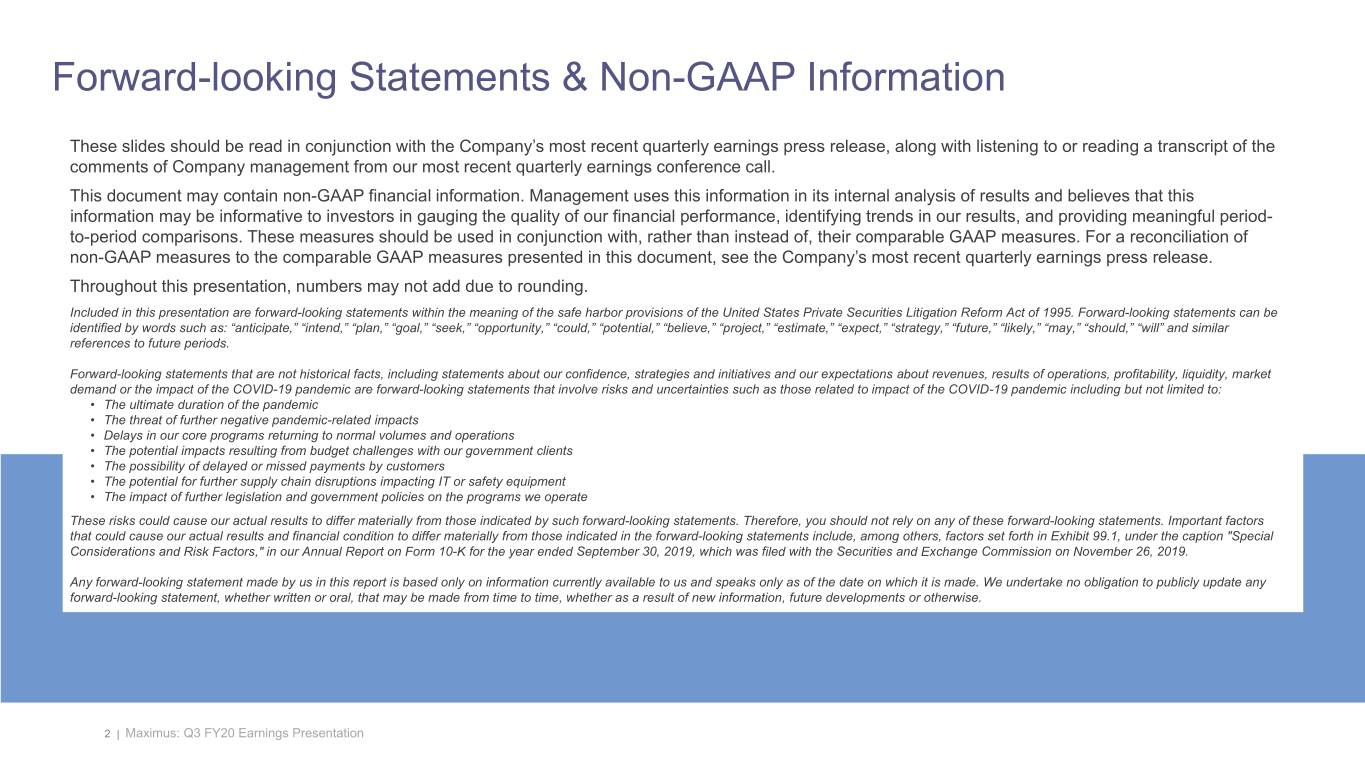
Forward-looking Statements & Non-GAAP Information These slides should be read in conjunction with the Company’s most recent quarterly earnings press release, along with listening to or reading a transcript of the comments of Company management from our most recent quarterly earnings conference call. This document may contain non-GAAP financial information. Management uses this information in its internal analysis of results and believes that this information may be informative to investors in gauging the quality of our financial performance, identifying trends in our results, and providing meaningful period- to-period comparisons. These measures should be used in conjunction with, rather than instead of, their comparable GAAP measures. For a reconciliation of non-GAAP measures to the comparable GAAP measures presented in this document, see the Company’s most recent quarterly earnings press release. Throughout this presentation, numbers may not add due to rounding. Included in this presentation are forward-looking statements within the meaning of the safe harbor provisions of the United States Private Securities Litigation Reform Act of 1995. Forward-looking statements can be identified by words such as: “anticipate,” “intend,” “plan,” “goal,” “seek,” “opportunity,” “could,” “potential,” “believe,” “project,” “estimate,” “expect,” “strategy,” “future,” “likely,” “may,” “should,” “will” and similar references to future periods. Forward-looking statements that are not historical facts, including statements about our confidence, strategies and initiatives and our expectations about revenues, results of operations, profitability, liquidity, market demand or the impact of the COVID-19 pandemic are forward-looking statements that involve risks and uncertainties such as those related to impact of the COVID-19 pandemic including but not limited to: • The ultimate duration of the pandemic • The threat of further negative pandemic-related impacts • Delays in our core programs returning to normal volumes and operations • The potential impacts resulting from budget challenges with our government clients • The possibility of delayed or missed payments by customers • The potential for further supply chain disruptions impacting IT or safety equipment • The impact of further legislation and government policies on the programs we operate These risks could cause our actual results to differ materially from those indicated by such forward-looking statements. Therefore, you should not rely on any of these forward-looking statements. Important factors that could cause our actual results and financial condition to differ materially from those indicated in the forward-looking statements include, among others, factors set forth in Exhibit 99.1, under the caption "Special Considerations and Risk Factors," in our Annual Report on Form 10-K for the year ended September 30, 2019, which was filed with the Securities and Exchange Commission on November 26, 2019. Any forward-looking statement made by us in this report is based only on information currently available to us and speaks only as of the date on which it is made. We undertake no obligation to publicly update any forward-looking statement, whether written or oral, that may be made from time to time, whether as a result of new information, future developments or otherwise. 2 | Maximus: Q3 FY20 Earnings Presentation
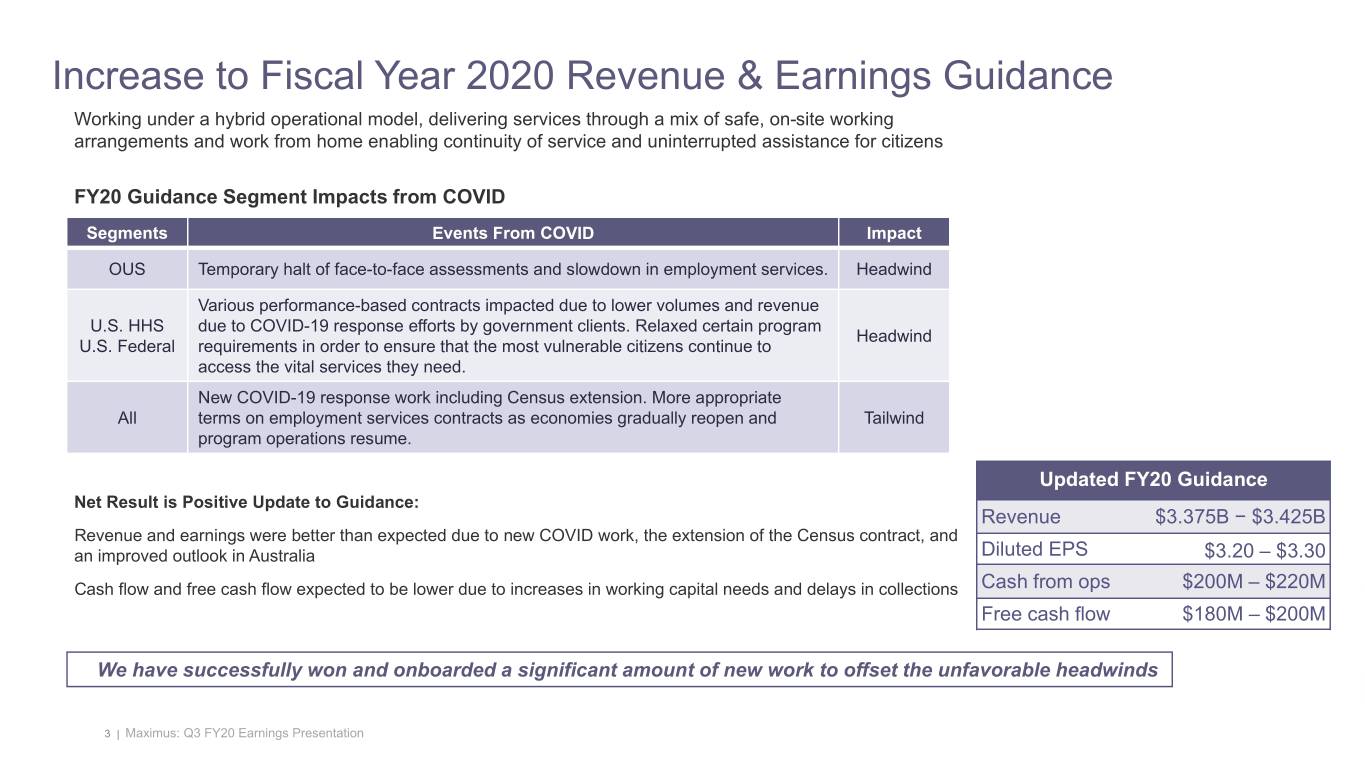
Increase to Fiscal Year 2020 Revenue & Earnings Guidance Working under a hybrid operational model, delivering services through a mix of safe, on-site working arrangements and work from home enabling continuity of service and uninterrupted assistance for citizens FY20 Guidance Segment Impacts from COVID Segments Events From COVID Impact OUS Temporary halt of face-to-face assessments and slowdown in employment services. Headwind Various performance-based contracts impacted due to lower volumes and revenue U.S. HHS due to COVID-19 response efforts by government clients. Relaxed certain program Headwind U.S. Federal requirements in order to ensure that the most vulnerable citizens continue to access the vital services they need. New COVID-19 response work including Census extension. More appropriate All terms on employment services contracts as economies gradually reopen and Tailwind program operations resume. Updated FY20 Guidance Net Result is Positive Update to Guidance: Revenue $3.375B − $3.425B Revenue and earnings were better than expected due to new COVID work, the extension of the Census contract, and an improved outlook in Australia Diluted EPS $3.20 – $3.30 Cash flow and free cash flow expected to be lower due to increases in working capital needs and delays in collections Cash from ops $200M – $220M Free cash flow $180M – $200M We have successfully won and onboarded a significant amount of new work to offset the unfavorable headwinds 3 | Maximus: Q3 FY20 Earnings Presentation
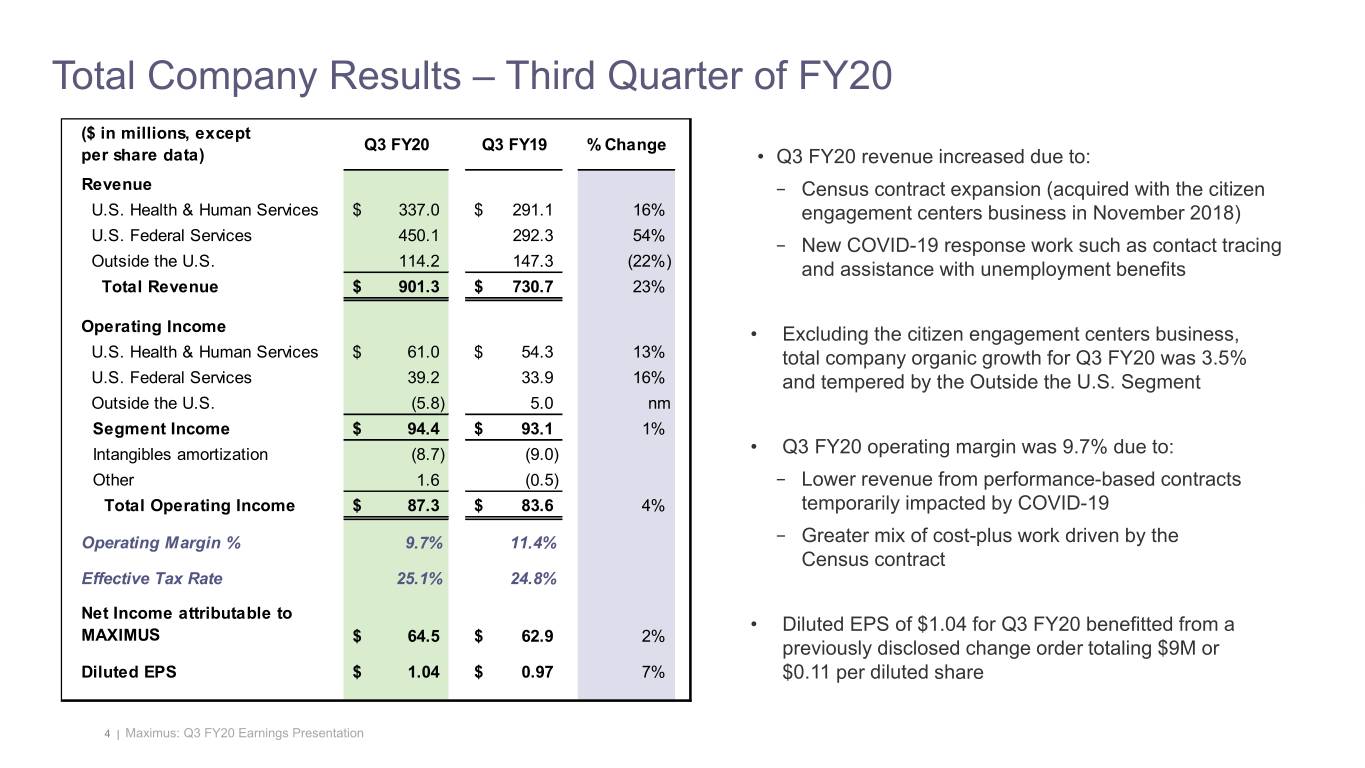
Total Company Results – Third Quarter of FY20 ($ in millions, except Q3 FY20 Q3 FY19 % Change per share data) • Q3 FY20 revenue increased due to: Revenue − Census contract expansion (acquired with the citizen U.S. Health & Human Services $ 337.0 $ 291.1 16% engagement centers business in November 2018) U.S. Federal Services 450.1 292.3 54% − New COVID-19 response work such as contact tracing Outside the U.S. 114.2 147.3 (22%) and assistance with unemployment benefits Total Revenue $ 901.3 $ 730.7 23% Operating Income • Excluding the citizen engagement centers business, U.S. Health & Human Services $ 61.0 $ 54.3 13% total company organic growth for Q3 FY20 was 3.5% U.S. Federal Services 39.2 33.9 16% and tempered by the Outside the U.S. Segment Outside the U.S. (5.8) 5.0 nm Segment Income $ 94.4 $ 93.1 1% Intangibles amortization (8.7) (9.0) • Q3 FY20 operating margin was 9.7% due to: Other 1.6 (0.5) − Lower revenue from performance-based contracts Total Operating Income $ 87.3 $ 83.6 4% temporarily impacted by COVID-19 Operating Margin % 9.7% 11.4% − Greater mix of cost-plus work driven by the Census contract Effective Tax Rate 25.1% 24.8% Net Income attributable to • Diluted EPS of $1.04 for Q3 FY20 benefitted from a MAXIMUS $ 64.5 $ 62.9 2% previously disclosed change order totaling $9M or Diluted EPS $ 1.04 $ 0.97 7% $0.11 per diluted share 4 | Maximus: Q3 FY20 Earnings Presentation
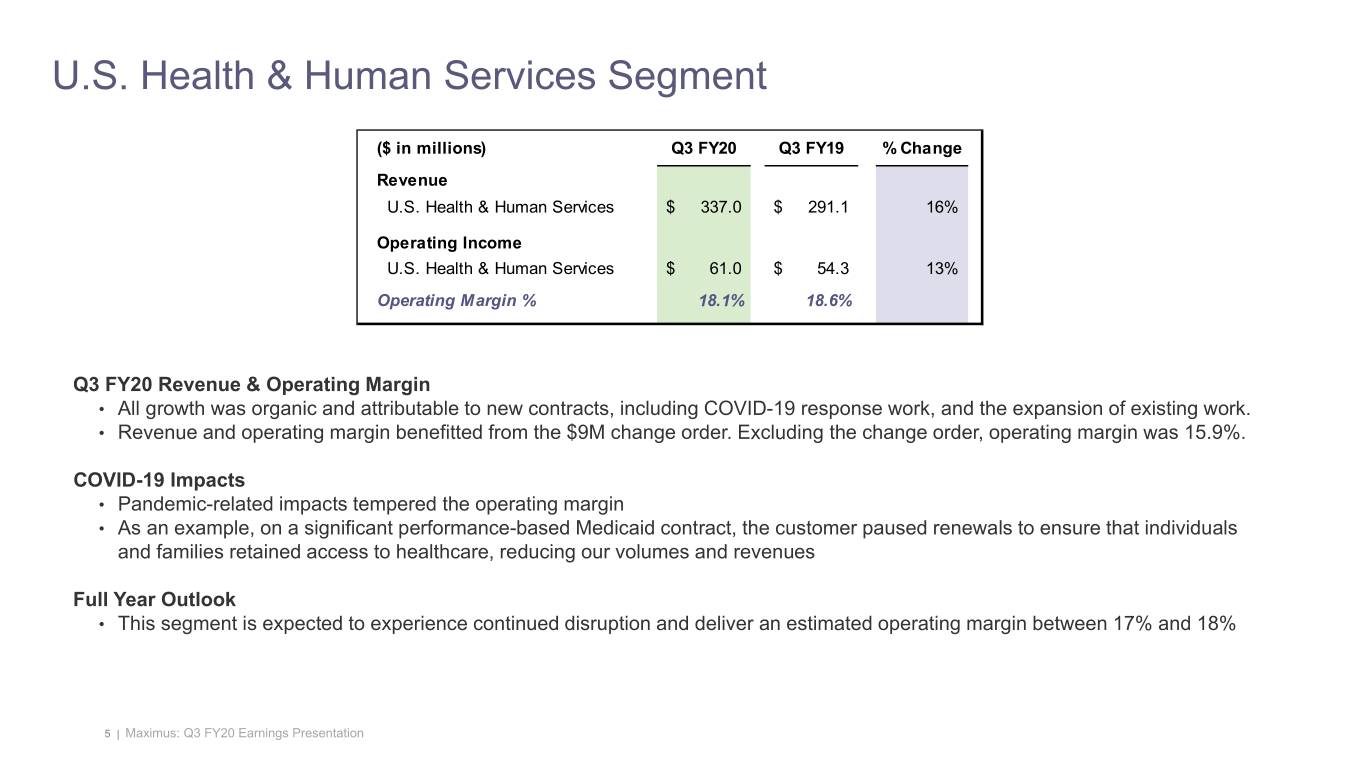
U.S. Health & Human Services Segment ($ in millions) Q3 FY20 Q3 FY19 % Change Revenue U.S. Health & Human Services $ 337.0 $ 291.1 16% Operating Income U.S. Health & Human Services $ 61.0 $ 54.3 13% Operating Margin % 18.1% 18.6% Q3 FY20 Revenue & Operating Margin • All growth was organic and attributable to new contracts, including COVID-19 response work, and the expansion of existing work. • Revenue and operating margin benefitted from the $9M change order. Excluding the change order, operating margin was 15.9%. COVID-19 Impacts • Pandemic-related impacts tempered the operating margin • As an example, on a significant performance-based Medicaid contract, the customer paused renewals to ensure that individuals and families retained access to healthcare, reducing our volumes and revenues Full Year Outlook • This segment is expected to experience continued disruption and deliver an estimated operating margin between 17% and 18% 5 | Maximus: Q3 FY20 Earnings Presentation
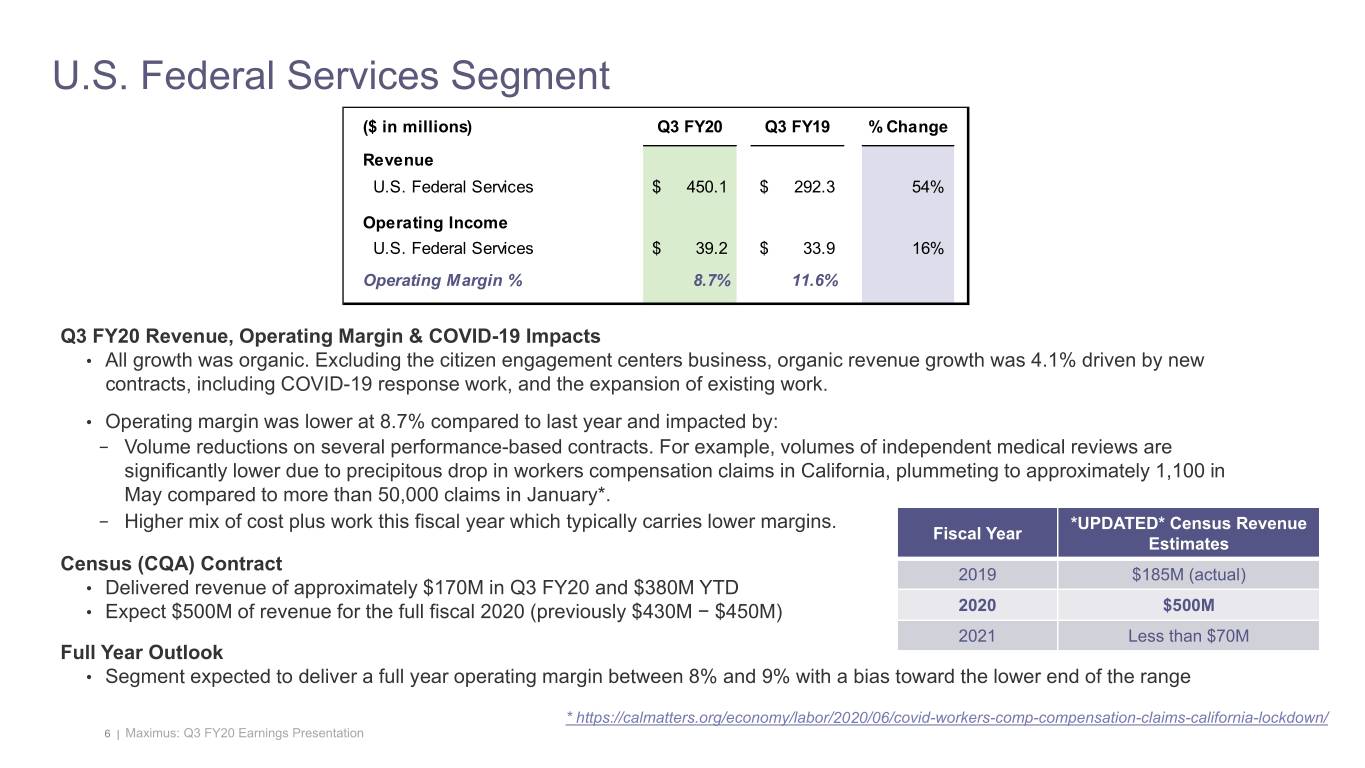
U.S. Federal Services Segment ($ in millions) Q3 FY20 Q3 FY19 % Change Revenue U.S. Federal Services $ 450.1 $ 292.3 54% Operating Income U.S. Federal Services $ 39.2 $ 33.9 16% Operating Margin % 8.7% 11.6% Q3 FY20 Revenue, Operating Margin & COVID-19 Impacts • All growth was organic. Excluding the citizen engagement centers business, organic revenue growth was 4.1% driven by new contracts, including COVID-19 response work, and the expansion of existing work. • Operating margin was lower at 8.7% compared to last year and impacted by: − Volume reductions on several performance-based contracts. For example, volumes of independent medical reviews are significantly lower due to precipitous drop in workers compensation claims in California, plummeting to approximately 1,100 in May compared to more than 50,000 claims in January*. − Higher mix of cost plus work this fiscal year which typically carries lower margins. *UPDATED* Census Revenue Fiscal Year Estimates Census (CQA) Contract 2019 $185M (actual) • Delivered revenue of approximately $170M in Q3 FY20 and $380M YTD • Expect $500M of revenue for the full fiscal 2020 (previously $430M − $450M) 2020 $500M 2021 Less than $70M Full Year Outlook • Segment expected to deliver a full year operating margin between 8% and 9% with a bias toward the lower end of the range * https://calmatters.org/economy/labor/2020/06/covid-workers-comp-compensation-claims-california-lockdown/ 6 | Maximus: Q3 FY20 Earnings Presentation
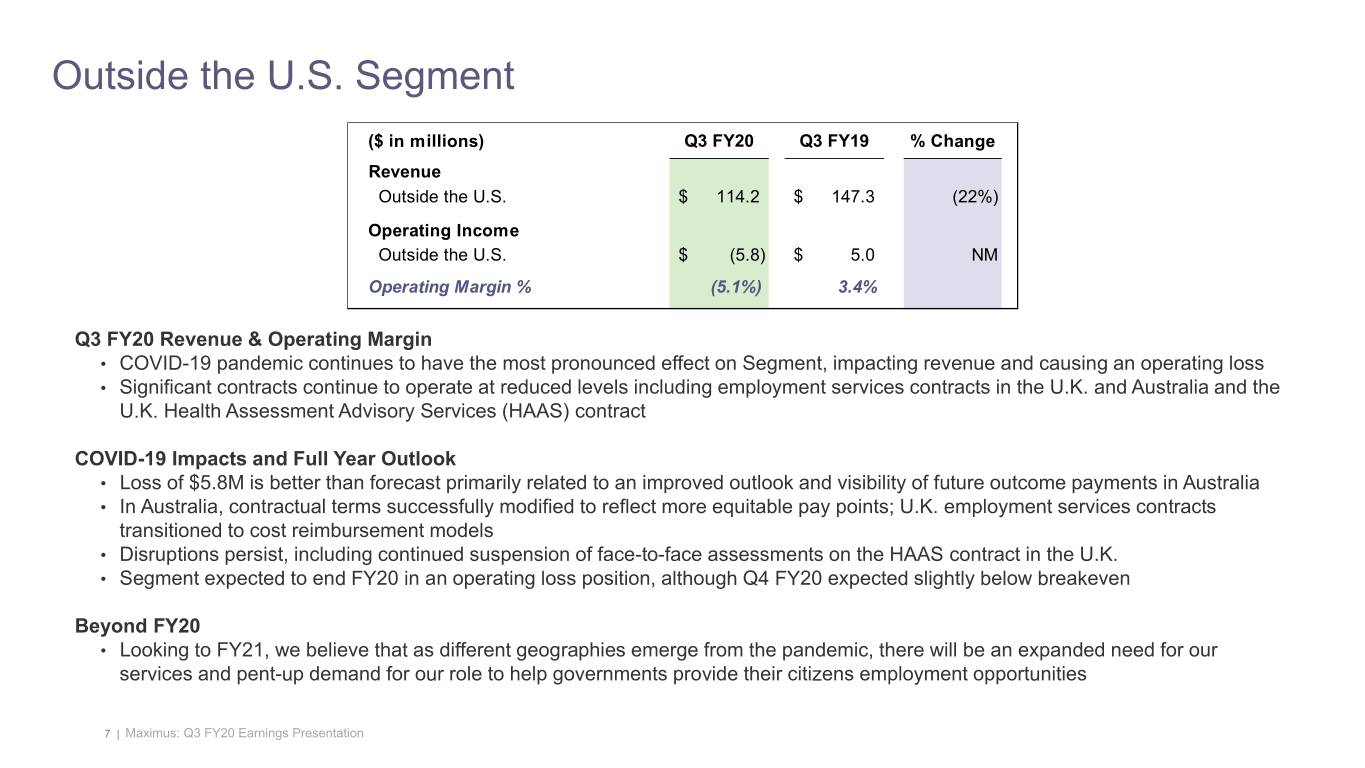
Outside the U.S. Segment ($ in millions) Q3 FY20 Q3 FY19 % Change Revenue Outside the U.S. $ 114.2 $ 147.3 (22%) Operating Income Outside the U.S. $ (5.8) $ 5.0 NM Operating Margin % (5.1%) 3.4% Q3 FY20 Revenue & Operating Margin • COVID-19 pandemic continues to have the most pronounced effect on Segment, impacting revenue and causing an operating loss • Significant contracts continue to operate at reduced levels including employment services contracts in the U.K. and Australia and the U.K. Health Assessment Advisory Services (HAAS) contract COVID-19 Impacts and Full Year Outlook • Loss of $5.8M is better than forecast primarily related to an improved outlook and visibility of future outcome payments in Australia • In Australia, contractual terms successfully modified to reflect more equitable pay points; U.K. employment services contracts transitioned to cost reimbursement models • Disruptions persist, including continued suspension of face-to-face assessments on the HAAS contract in the U.K. • Segment expected to end FY20 in an operating loss position, although Q4 FY20 expected slightly below breakeven Beyond FY20 • Looking to FY21, we believe that as different geographies emerge from the pandemic, there will be an expanded need for our services and pent-up demand for our role to help governments provide their citizens employment opportunities 7 | Maximus: Q3 FY20 Earnings Presentation
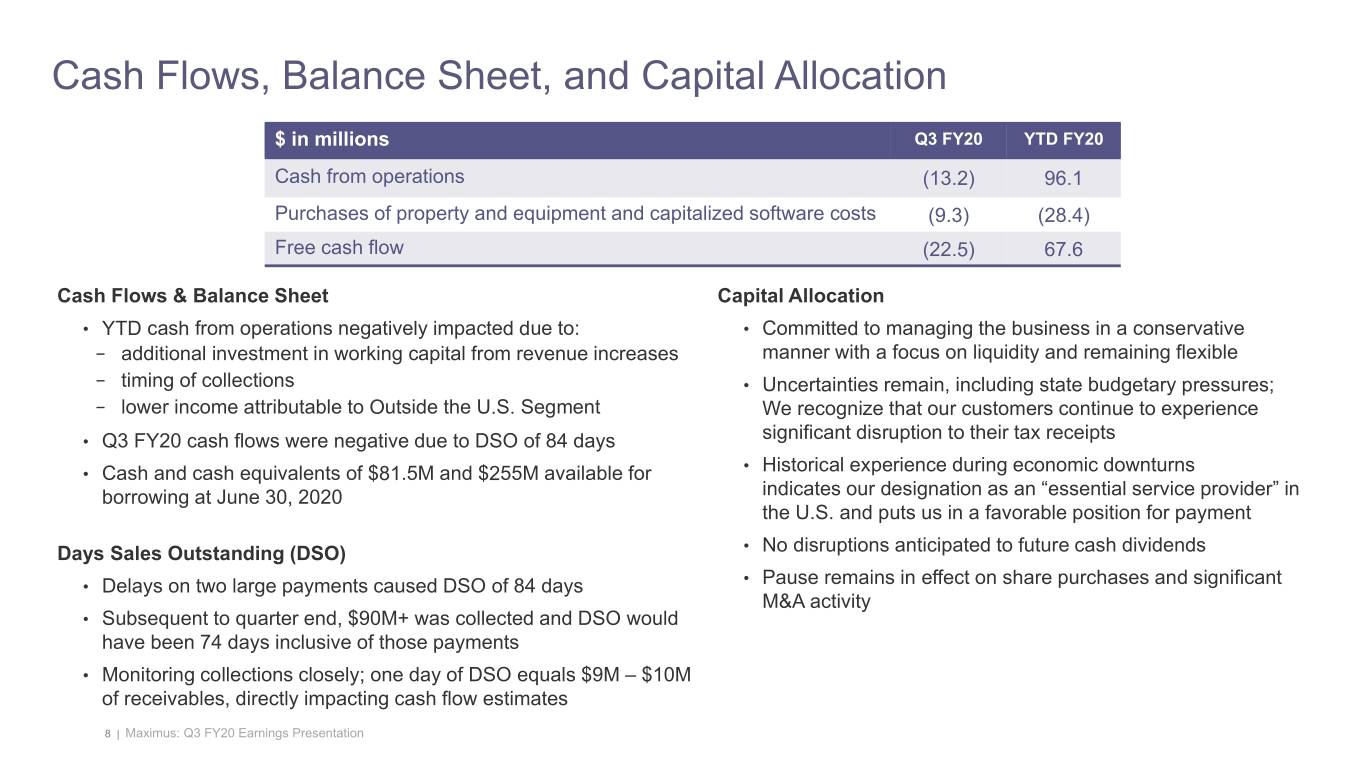
Cash Flows, Balance Sheet, and Capital Allocation $ in millions Q3 FY20 YTD FY20 Cash from operations (13.2) 96.1 Purchases of property and equipment and capitalized software costs (9.3) (28.4) Free cash flow (22.5) 67.6 Cash Flows & Balance Sheet Capital Allocation • YTD cash from operations negatively impacted due to: • Committed to managing the business in a conservative − additional investment in working capital from revenue increases manner with a focus on liquidity and remaining flexible − timing of collections • Uncertainties remain, including state budgetary pressures; − lower income attributable to Outside the U.S. Segment We recognize that our customers continue to experience • Q3 FY20 cash flows were negative due to DSO of 84 days significant disruption to their tax receipts • Cash and cash equivalents of $81.5M and $255M available for • Historical experience during economic downturns borrowing at June 30, 2020 indicates our designation as an “essential service provider” in the U.S. and puts us in a favorable position for payment Days Sales Outstanding (DSO) • No disruptions anticipated to future cash dividends • Delays on two large payments caused DSO of 84 days • Pause remains in effect on share purchases and significant M&A activity • Subsequent to quarter end, $90M+ was collected and DSO would have been 74 days inclusive of those payments • Monitoring collections closely; one day of DSO equals $9M – $10M of receivables, directly impacting cash flow estimates 8 | Maximus: Q3 FY20 Earnings Presentation
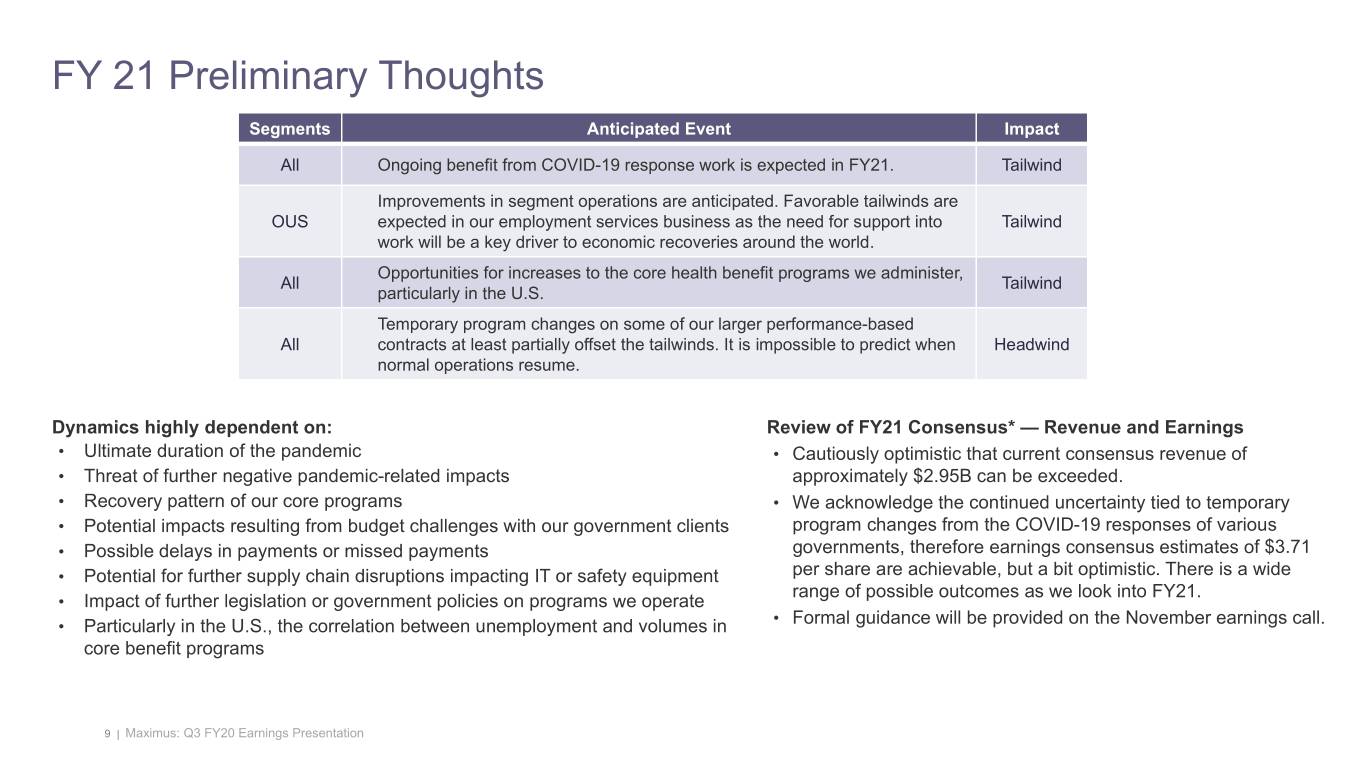
FY 21 Preliminary Thoughts Segments Anticipated Event Impact All Ongoing benefit from COVID-19 response work is expected in FY21. Tailwind Improvements in segment operations are anticipated. Favorable tailwinds are OUS expected in our employment services business as the need for support into Tailwind work will be a key driver to economic recoveries around the world. Opportunities for increases to the core health benefit programs we administer, All Tailwind particularly in the U.S. Temporary program changes on some of our larger performance-based All contracts at least partially offset the tailwinds. It is impossible to predict when Headwind normal operations resume. Dynamics highly dependent on: Review of FY21 Consensus* — Revenue and Earnings • Ultimate duration of the pandemic • Cautiously optimistic that current consensus revenue of • Threat of further negative pandemic-related impacts approximately $2.95B can be exceeded. • Recovery pattern of our core programs • We acknowledge the continued uncertainty tied to temporary • Potential impacts resulting from budget challenges with our government clients program changes from the COVID-19 responses of various • Possible delays in payments or missed payments governments, therefore earnings consensus estimates of $3.71 • Potential for further supply chain disruptions impacting IT or safety equipment per share are achievable, but a bit optimistic. There is a wide range of possible outcomes as we look into FY21. • Impact of further legislation or government policies on programs we operate • Particularly in the U.S., the correlation between unemployment and volumes in • Formal guidance will be provided on the November earnings call. core benefit programs 9 | Maximus: Q3 FY20 Earnings Presentation

Fiscal 2020 Third Quarter Earnings Call Bruce Caswell President & Chief Executive Officer August 6, 2020 10 | Maximus: Q3 FY20 Earnings Presentation
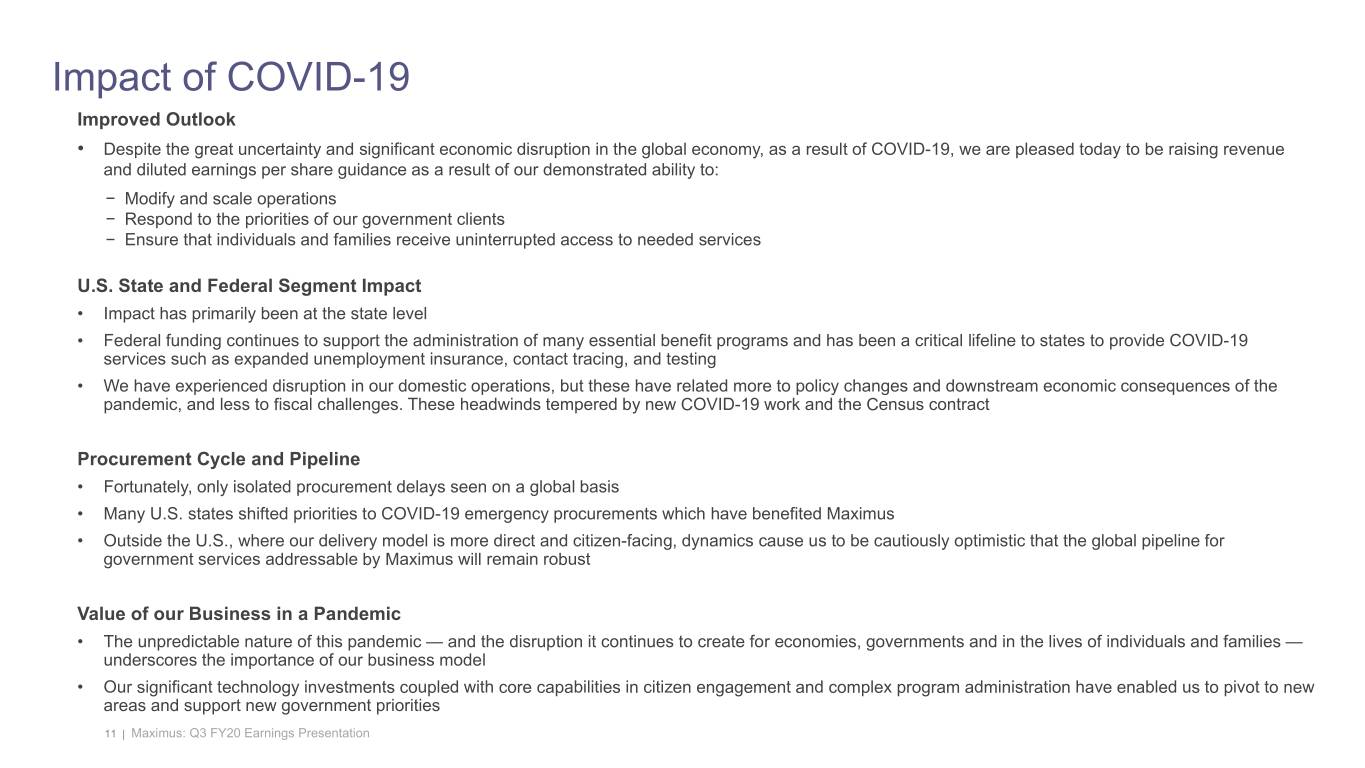
Impact of COVID-19 Improved Outlook • Despite the great uncertainty and significant economic disruption in the global economy, as a result of COVID-19, we are pleased today to be raising revenue and diluted earnings per share guidance as a result of our demonstrated ability to: − Modify and scale operations − Respond to the priorities of our government clients − Ensure that individuals and families receive uninterrupted access to needed services U.S. State and Federal Segment Impact • Impact has primarily been at the state level • Federal funding continues to support the administration of many essential benefit programs and has been a critical lifeline to states to provide COVID-19 services such as expanded unemployment insurance, contact tracing, and testing • We have experienced disruption in our domestic operations, but these have related more to policy changes and downstream economic consequences of the pandemic, and less to fiscal challenges. These headwinds tempered by new COVID-19 work and the Census contract Procurement Cycle and Pipeline • Fortunately, only isolated procurement delays seen on a global basis • Many U.S. states shifted priorities to COVID-19 emergency procurements which have benefited Maximus • Outside the U.S., where our delivery model is more direct and citizen-facing, dynamics cause us to be cautiously optimistic that the global pipeline for government services addressable by Maximus will remain robust Value of our Business in a Pandemic • The unpredictable nature of this pandemic — and the disruption it continues to create for economies, governments and in the lives of individuals and families — underscores the importance of our business model • Our significant technology investments coupled with core capabilities in citizen engagement and complex program administration have enabled us to pivot to new areas and support new government priorities 11 | Maximus: Q3 FY20 Earnings Presentation
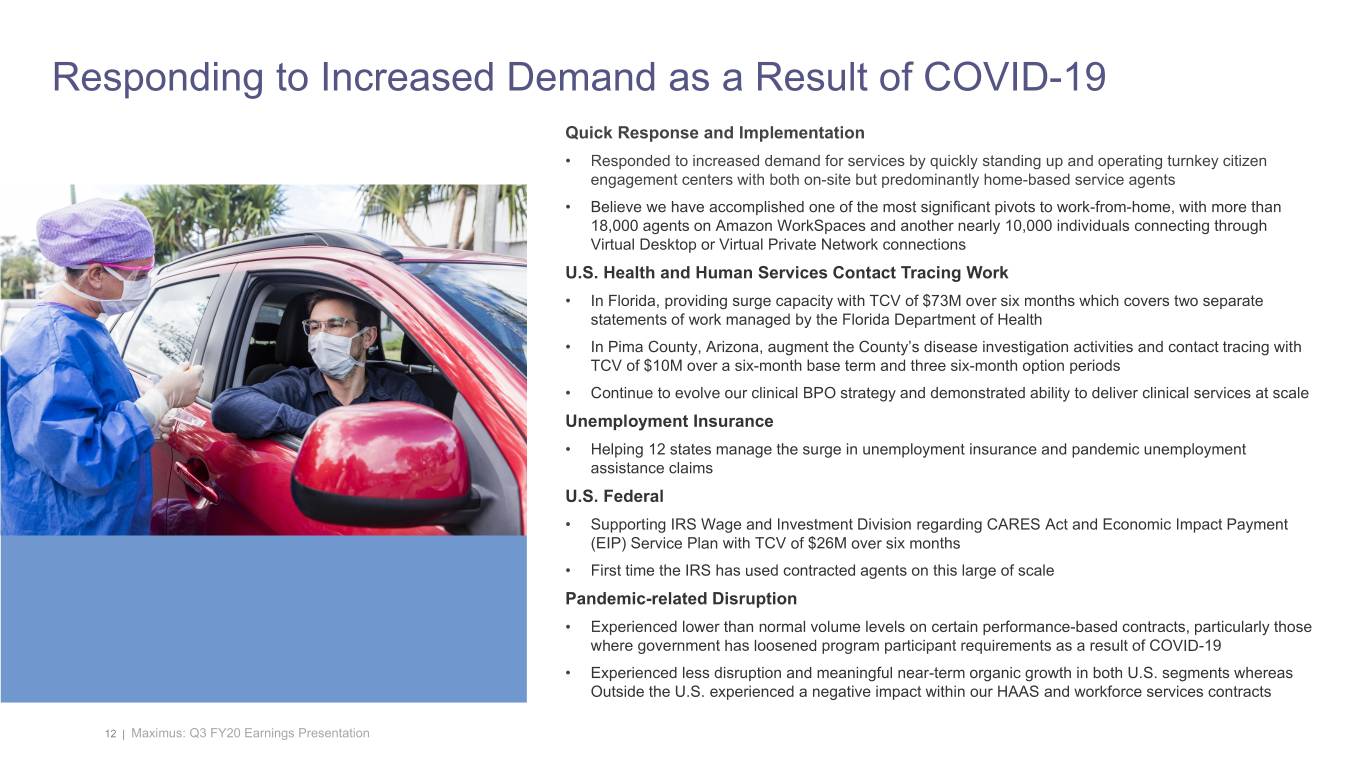
Responding to Increased Demand as a Result of COVID-19 Quick Response and Implementation • Responded to increased demand for services by quickly standing up and operating turnkey citizen engagement centers with both on-site but predominantly home-based service agents • Believe we have accomplished one of the most significant pivots to work-from-home, with more than 18,000 agents on Amazon WorkSpaces and another nearly 10,000 individuals connecting through Virtual Desktop or Virtual Private Network connections U.S. Health and Human Services Contact Tracing Work • In Florida, providing surge capacity with TCV of $73M over six months which covers two separate statements of work managed by the Florida Department of Health • In Pima County, Arizona, augment the County’s disease investigation activities and contact tracing with TCV of $10M over a six-month base term and three six-month option periods • Continue to evolve our clinical BPO strategy and demonstrated ability to deliver clinical services at scale Unemployment Insurance • Helping 12 states manage the surge in unemployment insurance and pandemic unemployment assistance claims U.S. Federal • Supporting IRS Wage and Investment Division regarding CARES Act and Economic Impact Payment (EIP) Service Plan with TCV of $26M over six months • First time the IRS has used contracted agents on this large of scale Pandemic-related Disruption • Experienced lower than normal volume levels on certain performance-based contracts, particularly those where government has loosened program participant requirements as a result of COVID-19 • Experienced less disruption and meaningful near-term organic growth in both U.S. segments whereas Outside the U.S. experienced a negative impact within our HAAS and workforce services contracts 12 | Maximus: Q3 FY20 Earnings Presentation
Digital Transformation • Transitioned operational infrastructure to the cloud to help agencies benefit from the security, scalability, and flexibility through a singular platform solution. • Provides the ability to dynamically scale and allocate capacity in response to demand, but also provides a true omnichannel customer experience — integrate calls, emails, chats, messages, and social comments into one uninterrupted conversation. Can leverage more than one channel at a time for multi-modal communication and customer convenience, all without losing critical context. • This platform enables agencies to handle surges in inquiry volumes (such as Unemployment Insurance), and equip a remote workforce, accommodating not only a more flexible, diverse, and inclusive workforce structure, but also ensuring additional health and safety protections during the pandemic, all while providing essential services without disruption. – Our IRS CARES Act and EIP Service Plan contract migrated to cloud-based infrastructure, enabling a work-from-home model and seamless routing of specific calls to higher level agents. 13 | Maximus: Q3 FY20 Earnings Presentation
Vital Work Continues Amidst the Health Crisis Outside the U.S. Government of Alberta, Canada • Won the Enabling New Models of Care (ENMOC) program to replace old mainframe with a new flexible and configurable solution to better support new models of healthcare • Estimated TCV of $75M over an 81-month base and five one-year option periods • Important new client and first large sized Canadian jurisdiction to undertake this type of modernization of its provincial health insurance technical platform • Reinforces Maximus leadership in digital transformation throughout Canada State Level California Department of Health Care Services • Won the rebid for California’s Optional Targeted Low Income Children Program (OTLICP), the State’s Children’s Health Insurance Program (CHIP)- funded Medicaid program for children from birth to age 19 • Important award with a five-year base contract and three one-year options to renew for a TCV of $136M 14 | Maximus: Q3 FY20 Earnings Presentation
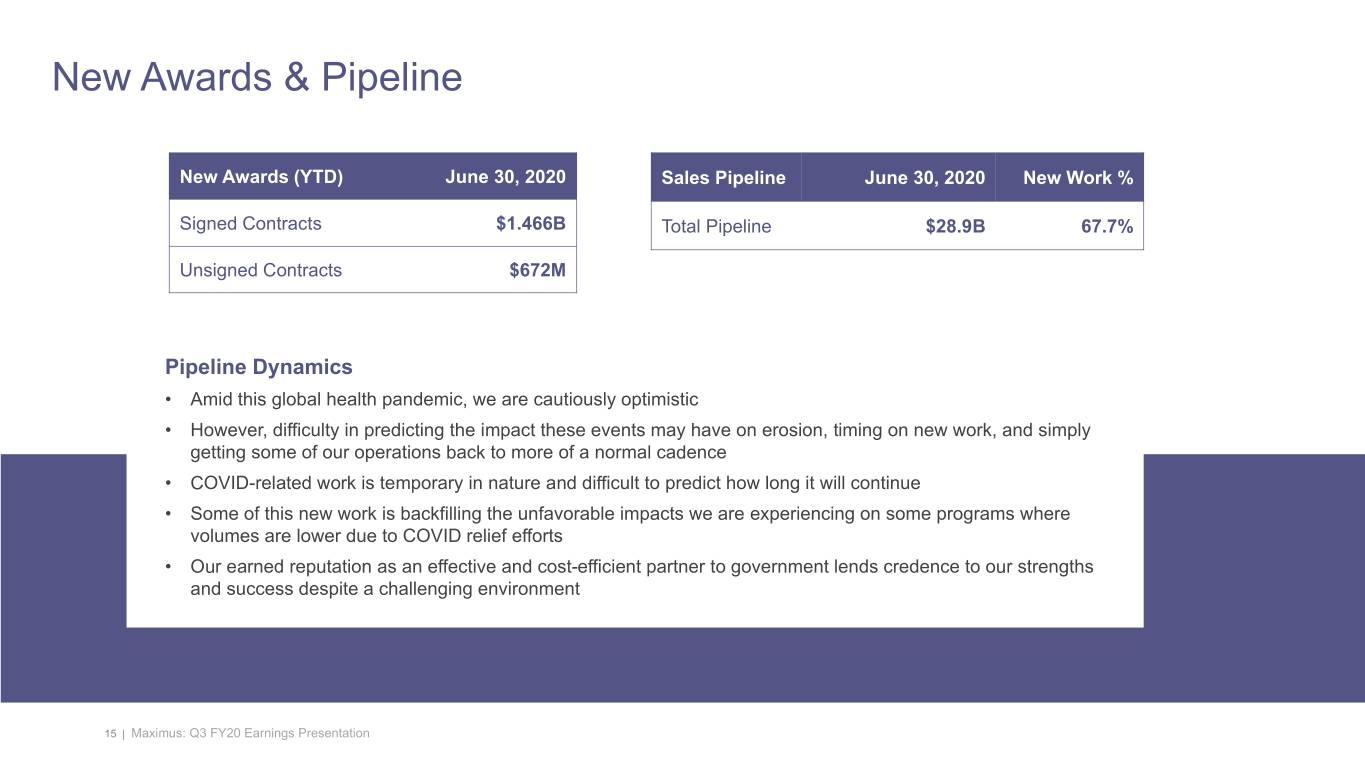
New Awards & Pipeline New Awards (YTD) June 30, 2020 Sales Pipeline June 30, 2020 New Work % Signed Contracts $1.466B Total Pipeline $28.9B 67.7% Unsigned Contracts $672M Pipeline Dynamics • Amid this global health pandemic, we are cautiously optimistic • However, difficulty in predicting the impact these events may have on erosion, timing on new work, and simply getting some of our operations back to more of a normal cadence • COVID-related work is temporary in nature and difficult to predict how long it will continue • Some of this new work is backfilling the unfavorable impacts we are experiencing on some programs where volumes are lower due to COVID relief efforts • Our earned reputation as an effective and cost-efficient partner to government lends credence to our strengths and success despite a challenging environment 15 | Maximus: Q3 FY20 Earnings Presentation
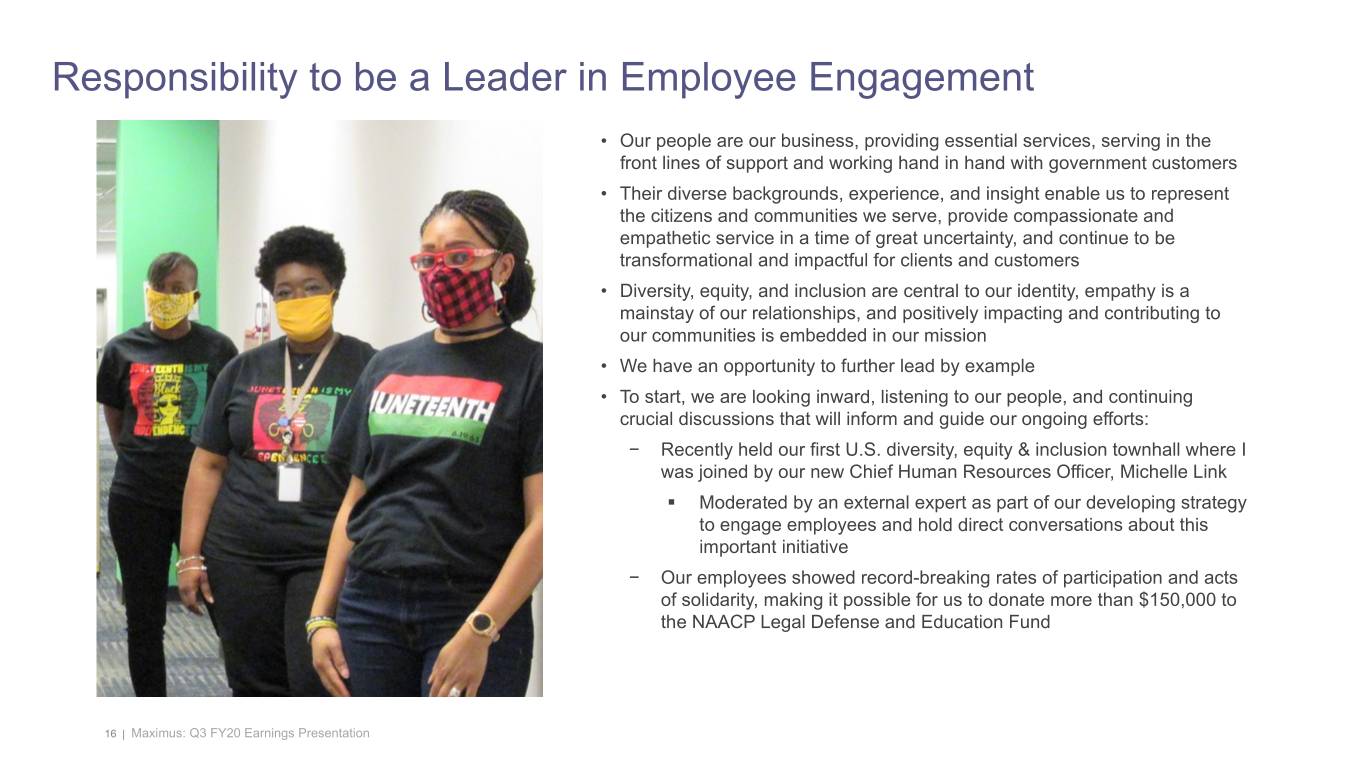
Responsibility to be a Leader in Employee Engagement • Our people are our business, providing essential services, serving in the front lines of support and working hand in hand with government customers • Their diverse backgrounds, experience, and insight enable us to represent the citizens and communities we serve, provide compassionate and empathetic service in a time of great uncertainty, and continue to be transformational and impactful for clients and customers • Diversity, equity, and inclusion are central to our identity, empathy is a mainstay of our relationships, and positively impacting and contributing to our communities is embedded in our mission • We have an opportunity to further lead by example • To start, we are looking inward, listening to our people, and continuing crucial discussions that will inform and guide our ongoing efforts: − Recently held our first U.S. diversity, equity & inclusion townhall where I was joined by our new Chief Human Resources Officer, Michelle Link . Moderated by an external expert as part of our developing strategy to engage employees and hold direct conversations about this important initiative − Our employees showed record-breaking rates of participation and acts of solidarity, making it possible for us to donate more than $150,000 to the NAACP Legal Defense and Education Fund 16 | Maximus: Q3 FY20 Earnings Presentation
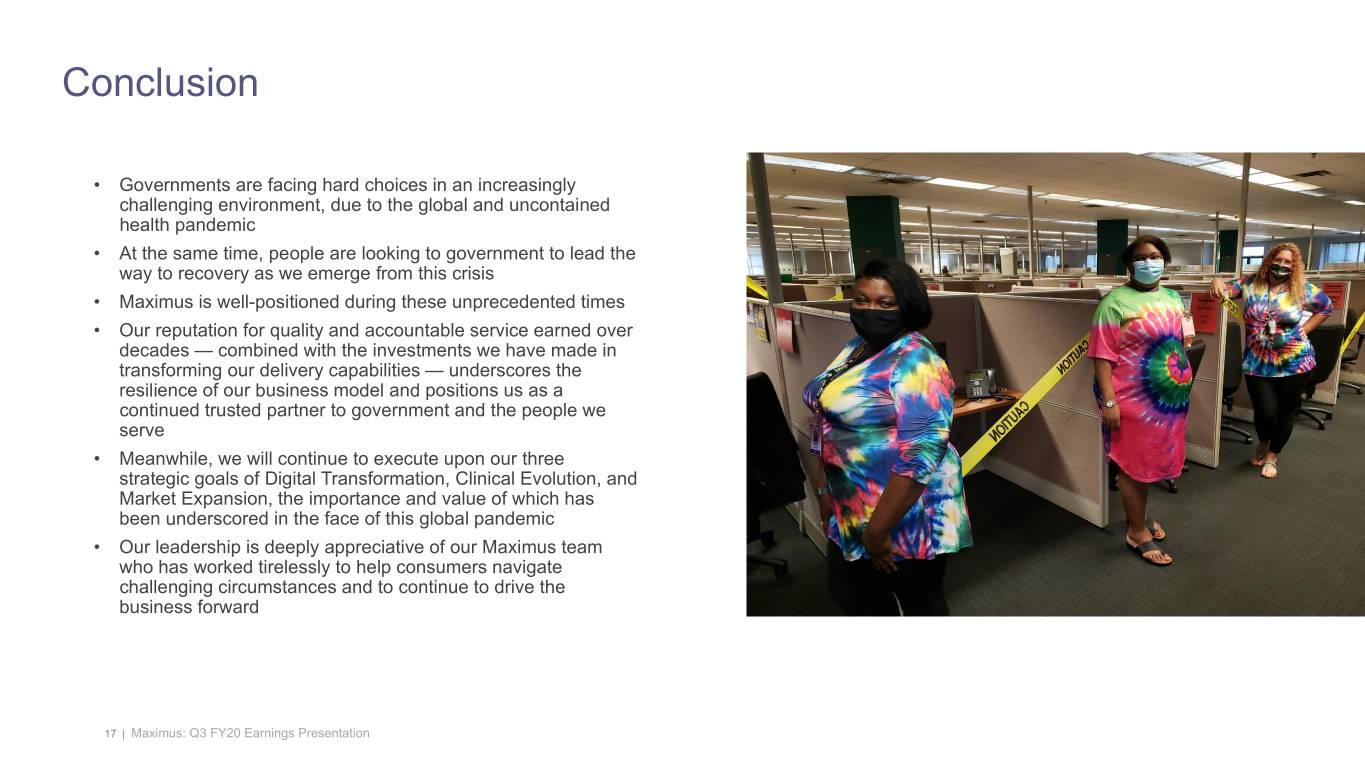
Conclusion • Governments are facing hard choices in an increasingly challenging environment, due to the global and uncontained health pandemic • At the same time, people are looking to government to lead the way to recovery as we emerge from this crisis • Maximus is well-positioned during these unprecedented times • Our reputation for quality and accountable service earned over decades — combined with the investments we have made in transforming our delivery capabilities — underscores the resilience of our business model and positions us as a continued trusted partner to government and the people we serve • Meanwhile, we will continue to execute upon our three strategic goals of Digital Transformation, Clinical Evolution, and Market Expansion, the importance and value of which has been underscored in the face of this global pandemic • Our leadership is deeply appreciative of our Maximus team who has worked tirelessly to help consumers navigate challenging circumstances and to continue to drive the business forward 17 | Maximus: Q3 FY20 Earnings Presentation