
MMS 8-K
Maximus, Inc. (MMS)
8-K
2022-11-28
For: 2022-11-21
View Original
Added on
April 10, 2026
UNITED STATES
SECURITIES AND EXCHANGE COMMISSION
Washington, D.C. 20549
FORM 8-K
CURRENT REPORT PURSUANT TO SECTION 13 OR 15(d)
OF THE SECURITIES EXCHANGE ACT OF 1934
Date of Report (Date of earliest event reported): November 21, 2022

| (Exact name of registrant as specified in its charter) | |||||||||||||||||||||||||||||
(State or other jurisdiction of incorporation) | (Commission File Number) | (I.R.S. Employer Identification No.) | |||||||||||||||||||||||||||
| , | |||||||||||||||||||||||||||||
(Address of principal executive offices) | (Zip Code) | ||||||||||||||||||||||||||||
| Registrant's telephone number, including the area code | ( | ) | |||||||||||||||||||||||||||
| No Change | |||||||||||||||||||||||||||||
| (Former name or former address, if changed since last report) | |||||||||||||||||||||||||||||
Check the appropriate box below if the Form 8-K filing is intended to simultaneously satisfy the filing obligation of the registrant under any of the following provisions:
Securities registered pursuant to Section 12(b) of the Act:
| Title of each class | Trading Symbol(s) | Name of each exchange on which registered | ||||||||||||
Indicate by check mark whether the registrant is an emerging growth company as defined in Rule 405 of the Securities Act of 1933 (§230.405 of this chapter) or Rule 12b-2 of the Securities Exchange Act of 1934 (§240.12b-2 of this chapter).
Emerging growth company ☐
If an emerging growth company, indicate by check mark if the registrant has elected not to use the extended transition period for complying with any new or revised financial accounting standards provided pursuant to Section 13(a) of the Exchange Act. ☐
Item 2.02 Results of Operations and Financial Condition.
On November 21, 2022, the Company issued a press release announcing its financial results for the quarter and year ended September 30, 2022. The full text of the press release is furnished as Exhibit 99.1 to this Current Report on Form 8-K and incorporated by reference into this Item 2.02.
On November 22, 2022, the Company held a conference call with respect to these financial results. The conference call was open to the public. The transcript and slide presentation that accompanied the call are furnished as Exhibit 99.2 and Exhibit 99.3, respectively, to this Current Report on Form 8-K and incorporated by reference into this Item 2.02.
Item 9.01 Financial Statements and Exhibits.
(d) Exhibits. The following exhibits are being furnished pursuant to Item 2.02 above.
| Exhibit No. | Description | ||||
| Press release dated November 21, 2022 | |||||
| Conference call transcript for Earnings Call - November 22, 2022 | |||||
| Conference call slide presentation for Earnings Call - November 22, 2022 | |||||
1
SIGNATURES
Pursuant to the requirements of the Securities Exchange Act of 1934, the registrant has duly caused this report to be signed on its behalf by the undersigned hereunto duly authorized.
| Maximus, Inc. | ||||||||
| (Registrant) | ||||||||
| Date: November 28, 2022 | /s/ David R. Francis | |||||||
| David R. Francis | ||||||||
| General Counsel and Secretary | ||||||||
2

| FOR IMMEDIATE RELEASE | CONTACT: | James Francis 703.251.8526 | |||||||||
| Jessica Batt 703.251.8634 | |||||||||||
| Date: November 21, 2022 | [email protected] | ||||||||||
Maximus Reports Fourth Quarter and Full Year Results for Fiscal Year 2022
Establishes Guidance for Fiscal Year 2023
(Tysons, Va. - November 21, 2022) - Maximus (NYSE: MMS), a leading provider of government services worldwide, reported financial results for the three months and year ended September 30, 2022.
Highlights for fiscal year 2022 include:
•Revenue increased 8.9% to $4.63 billion, compared to $4.25 billion for the prior year. A combination of organic and acquired growth more than offset the $800 million decline in COVID-19 response work.
•Diluted earnings per share were $3.29, and adjusted diluted earnings per share were $4.37. Results for the three months ended September 30, 2022, included combined benefits of $0.33 earnings per share from several contractual and legal items and a one-time gain on sale.
•Record signed contracts awards of $10.5 billion, which includes awarded Centers for Medicare & Medicaid Services contract for Contact Center Operations valued at $6.6 billion.
•A quarterly cash dividend of $0.28 per share payable on November 30, 2022, to shareholders of record on November 15, 2022.
"Our fiscal year 2022 results provide us confidence that the foundation we laid for the core business is yielding the desired outcome. There were record signed contract awards and the backlog of business is at an all-time high," said Bruce Caswell, President and Chief Executive Officer. "Expansion of core work and new business wins that take full advantage of our capabilities more than replaced the anticipated decline in short-term work."
Consolidated Fiscal Year 2022 Results
Revenue for fiscal year 2022 increased 8.9% to $4.63 billion, compared to $4.25 billion for the prior year. Organic growth from new or expanded programs and full-period contributions of the U.S. Federal Services acquisitions drove the $377 million revenue increase, which was net of $800 million less short-term COVID-19 response work. Adjusting for COVID-19 response work, normalized organic growth was approximately 18% over the prior year and driven by contributions from all three segments.
For fiscal year 2022, the operating margin was 7.0% and the adjusted margin operating margin was 9.0%. This compares to margins of 9.6% and 10.6%, respectively, for the prior year. Diluted earnings per share were $3.29 and adjusted diluted earnings per share were $4.37. This compares to $4.67 and $5.19, respectively, for the prior-year period.
Results for the three months ended September 30, 2022, included combined benefits of $28 million, or $0.33 earnings per share, from several contractual and legal items worth $17 million, or $0.20 earnings per share, resolved in the quarter and a one-time gain on the sale of the company's former headquarters worth $11.0 million, or $0.13 diluted earnings per share.
The Outside the U.S. Segment realized a loss in fiscal year 2022 primarily due to the unfortunate rebid outcome in Australia, which included severance costs and the write-down on a percentage of completion project disclosed in the third quarter.
U.S. Federal Services Segment
U.S. Federal Services Segment revenue for fiscal year 2022 increased 19.4% to $2.26 billion, compared to $1.89 billion reported for the prior year. The acquisitions of Attain Federal, Veterans Evaluation Services (VES), and Aidvantage had full-period contributions. Organic growth stemming from new work wins and expansion on recompete wins helped offset the decline in the COVID-19 response work. Adjusting for COVID-19 response work, normalized organic growth in the segment was approximately 4.8% over the prior year.
1

The segment operating margin for fiscal year 2022 was 10.4% as compared to 10.0% reported for the prior year. Approximately one-third of the contractual and legal items benefited segment results for the three months ended September 30, 2022.
U.S. Services Segment
U.S. Services Segment revenue for fiscal year 2022 decreased by 3.3% to $1.61 billion, compared to $1.66 billion reported in the prior year. The expected decline in COVID-19 response work was tempered by growth from previously disclosed new contract wins in the segment. Adjusting for COVID-19 response work, normalized organic growth in the segment was more than 30% over the prior year.
The segment operating margin for fiscal year 2022 was 11.3% compared to 15.3% reported for the prior-year period. Approximately one-third of the contractual and legal items benefited segment results for the three months ended September 30, 2022. Margins were comparatively lower over the prior year, particularly in the second half of fiscal year 2022, as the highly-profitable short-term COVID-19 response work concluded. Meanwhile, redetermination activities remained paused as a result of the PHE, acting as a headwind to the earnings potential of the segment.
Outside the U.S. Segment
Outside the U.S. Segment revenue for fiscal year 2022 increased 9.2% to $763.7 million as compared to $699.1 million reported for the prior year, which was net of a 6% currency headwind. Organic growth in the segment was approximately 11% with U.K. Restart Programme being the largest contributor as caseload ramped across fiscal year 2022.
The segment realized an operating loss of $15.2 million for fiscal year 2022, compared to an operating profit of $20.1 million in the prior year. The fiscal 2022 loss was primarily due to an unfortunate rebid outcome in Australia and a write-down on a percentage of completion project disclosed in the prior quarter.
Sales and Pipeline
Year-to-date signed contract awards at September 30, 2022, totaled $10.5 billion and contracts pending (awarded but unsigned) totaled $800.1 million. These awards include the previously announced Centers for Medicare & Medicaid Services Contract for contact Center Operations valued at $6.6 billion, which contributed to the higher 2.3x book-to-bill ratio at September 30, 2022.
The sales pipeline at September 30, 2022, was $30.7 billion (comprised of approximately $3.4 billion in proposals pending, $3.10 billion in proposals in preparation, and $24.2 billion in opportunities tracking). New work opportunities represent 73.5% of the total sales pipeline.
Balance Sheet and Cash Flows
At September 30, 2022, cash and cash equivalents totaled $40.7 million and gross debt was $1.37 billion. The ratio of debt, net of allowed cash, to pro-forma EBITDA for the full year ended September 30, 2022, as calculated in accordance with our credit agreement, was 2.6x. This reflects debt pay downs of approximately $128 million in the most recent quarter and compares to 2.9x at June 30, 2022. In the near term, the company plans to continue prioritizing debt pay downs using its free cash flow.
For fiscal year 2022, cash flows from operating activities totaled $289.8 million and free cash flow was $233.7 million. This compares to $517.3 million and $480.8 million, respectively, in the prior year, which benefited from additional short-term COVID-19 response work earnings and working capital benefits totaling more than $100 million.
As of September 30, 2022, DSO were 62 days. The company is updating its target range to 60 to 70 days.
On October 7, 2022, our Board of Directors declared a quarterly cash dividend of $0.28 for each share of our common stock outstanding. The dividend is payable on November 30, 2022, to shareholders of record on November 15, 2022.
2
FY23 Outlook
Maximus is establishing fiscal year 2023 guidance. The company expects revenue to range between $4.75 billion and $4.90 billion. Adjusted operating income is expected to range between $390 million and $415 million which excludes an estimated $94 million of expense for amortization of intangible assets. Adjusted diluted earnings per share is expected to range between $3.70 and $4.00 per share.
Guidance assumes that redetermination activities in the U.S. Services segment continue to be paused across fiscal year 2023 as there is currently no projected end date to the PHE. In addition, the short-term COVID response work has concluded and does not contribute to the company's forecast for fiscal year 2023.
Free cash flow is expected to range between $225 million and $275 million for fiscal year 2023. The company forecasts interest expense between $85 million and $95 million, an effective income tax rate between 24.5% and 25.5%, and weighted average shares outstanding between 61.2 million and 61.3 million shares for fiscal year 2023.
"As we enter fiscal year 2023, we conclude a formative but somewhat volatile period for the business, and now have the opportunity to capitalize on the organic growth we are seeing in the core business, and execution of our recently refreshed strategy," Caswell continued. "Our expectations for the upcoming year illustrate while there remain elements in our environment influenced by federal policy decisions, they represent upside opportunity for the business on top of a base that is supported by a stable business model with long-term contracts that provide essential and in-demand government services."
Conference Call and Webcast Information
Maximus will host a conference call tomorrow, November 22, 2022, at 9:00 a.m. ET. Shareholders are invited to submit questions for management’s consideration by emailing [email protected] up to one hour prior to the call.
The call is open to the public and available by webcast or by phone at:
877.407.8289 (Domestic) / +1.201.689.8341 (International)
For those unable to listen to the live call, a recording of the webcast will be available on investor.maximus.com.
About Maximus
As a leading strategic partner to governments across the globe, Maximus helps improve the delivery of public services amid complex technology, health, economic, environmental, and social challenges. With a deep understanding of program service delivery, acute insights that achieve operational excellence, and an extensive awareness of the needs of the people being served, our employees advance the critical missions of our partners. Maximus delivers innovative business process management, impactful consulting services, and technology solutions that provide improved outcomes for the public and higher levels of productivity and efficiency of government-sponsored programs. For more information, visit maximus.com.
Non-GAAP Measures and Risk Factors
This release refers to non-GAAP measures and other indicators, including organic growth normalized for the effects of COVID-19 response work, free cash flow, operating income and EPS adjusted for amortization of intangible assets, pro-forma EBITDA, and other non-GAAP measures.
A description of these non-GAAP measures, the reasons why we use and present them, and details as to how they are calculated are included in our earnings presentation and forthcoming Form 10-K.
The presentation of these non-GAAP numbers is not meant to be considered in isolation, nor as alternatives to cash flows from operations, revenue growth, or net income as measures of performance. These non-GAAP financial measures, as determined and presented by us, may not be comparable to related or similarly titled measures presented by other companies.
3
Statements that are not historical facts, including statements about the company’s confidence and strategies, and the company’s expectations about revenues, results of operations, profitability, future contracts, market opportunities, market demand, or acceptance of the company’s products are forward-looking statements that involve risks and uncertainties.
These risks could cause the Company’s actual results to differ materially from those indicated by such forward-looking statements. A summary of risk factors can be found in Item 1A, "Risk Factors" in our Annual Report on Form 10-K for the year ended September 30, 2022, which will be filed with the Securities and Exchange Commission (SEC) on November 22, 2022. The Company's SEC reports are accessible on maximus.com.
4
Maximus, Inc.
Consolidated Statements of Operations
(Unaudited)
| For the Three Months Ended September 30, | For the Year Ended September 30, | ||||||||||||||||||||||
| 2022 | 2021 | 2022 | 2021 | ||||||||||||||||||||
| (in thousands, except per share amounts) | |||||||||||||||||||||||
| Revenue | $ | 1,177,031 | $ | 1,106,131 | $ | 4,631,018 | $ | 4,254,485 | |||||||||||||||
| Cost of revenue | 904,048 | 887,725 | 3,691,208 | 3,307,510 | |||||||||||||||||||
| Gross profit | 272,983 | 218,406 | 939,810 | 946,975 | |||||||||||||||||||
| Selling, general, and administrative expenses | 146,991 | 129,590 | 534,493 | 494,088 | |||||||||||||||||||
| Amortization of intangible assets | 22,514 | 20,639 | 90,465 | 44,357 | |||||||||||||||||||
| Gain on sale of land and building | 11,046 | — | 11,046 | — | |||||||||||||||||||
| Operating income | 114,524 | 68,177 | 325,898 | 408,530 | |||||||||||||||||||
| Interest expense | 16,098 | 10,695 | 45,965 | 14,744 | |||||||||||||||||||
| Other expense, net | 742 | 521 | 2,835 | 10,105 | |||||||||||||||||||
| Income before income taxes | 97,684 | 56,961 | 277,098 | 383,681 | |||||||||||||||||||
| Provision for income taxes | 28,617 | 4,947 | 73,270 | 92,481 | |||||||||||||||||||
| Net income | $ | 69,067 | $ | 52,014 | $ | 203,828 | $ | 291,200 | |||||||||||||||
| Earnings per share: | |||||||||||||||||||||||
| Basic | $ | 1.13 | $ | 0.84 | $ | 3.30 | $ | 4.69 | |||||||||||||||
| Diluted | $ | 1.13 | $ | 0.83 | $ | 3.29 | $ | 4.67 | |||||||||||||||
| Weighted average shares outstanding: | |||||||||||||||||||||||
| Basic | 61,010 | 62,082 | 61,774 | 62,072 | |||||||||||||||||||
| Diluted | 61,292 | 62,506 | 61,969 | 62,365 | |||||||||||||||||||
| Dividends declared per share | $ | 0.28 | $ | 0.28 | $ | 1.12 | $ | 1.12 | |||||||||||||||
5
Maximus, Inc.
Consolidated Balance Sheets
(Unaudited)
| As of September 30, | |||||||||||
| 2022 | 2021 | ||||||||||
| (in thousands) | |||||||||||
| Assets: | |||||||||||
| Cash and cash equivalents | $ | 40,658 | $ | 135,061 | |||||||
| Accounts receivable, net | 807,110 | 834,819 | |||||||||
| Income taxes receivable | 2,158 | 5,413 | |||||||||
| Prepaid expenses and other current assets | 182,387 | 104,201 | |||||||||
| Total current assets | 1,032,313 | 1,079,494 | |||||||||
| Property and equipment, net | 52,258 | 62,627 | |||||||||
| Capitalized software, net | 58,740 | 42,868 | |||||||||
| Operating lease right-of-use assets | 132,885 | 179,349 | |||||||||
| Goodwill | 1,779,415 | 1,774,406 | |||||||||
| Intangible assets, net | 804,904 | 879,168 | |||||||||
| Deferred contract costs, net | 47,732 | 36,486 | |||||||||
| Deferred compensation plan assets | 37,050 | 46,738 | |||||||||
| Deferred income taxes | 4,970 | 990 | |||||||||
| Other assets | 42,447 | 16,839 | |||||||||
| Total assets | $ | 3,992,714 | $ | 4,118,965 | |||||||
| Liabilities and Shareholders' Equity: | |||||||||||
| Liabilities: | |||||||||||
| Accounts payable and accrued liabilities | $ | 264,553 | $ | 305,565 | |||||||
| Accrued compensation and benefits | 178,199 | 186,809 | |||||||||
| Deferred revenue, current portion | 87,146 | 98,588 | |||||||||
| Income taxes payable | 718 | 6,782 | |||||||||
| Long-term debt, current portion | 63,458 | 80,555 | |||||||||
| Operating lease liabilities, current portion | 63,999 | 76,077 | |||||||||
| Other current liabilities | 116,374 | 35,057 | |||||||||
| Total current liabilities | 774,447 | 789,433 | |||||||||
| Deferred revenue, non-current portion | 21,414 | 35,932 | |||||||||
| Deferred income taxes | 206,099 | 194,638 | |||||||||
| Long-term debt, non-current portion | 1,292,483 | 1,429,137 | |||||||||
| Deferred compensation plan liabilities, non-current portion | 40,210 | 47,405 | |||||||||
| Operating lease liabilities, non-current portion | 86,175 | 121,771 | |||||||||
| Other liabilities | 22,515 | 20,320 | |||||||||
| Total liabilities | 2,443,343 | 2,638,636 | |||||||||
| Shareholders' equity: | |||||||||||
Common stock, no par value; 100,000 shares authorized; 60,774 and 61,954 shares issued and outstanding as of September 30, 2022 and 2021, respectively (shares in thousands) | 557,978 | 532,411 | |||||||||
| Accumulated other comprehensive loss | (33,961) | (39,908) | |||||||||
| Retained earnings | 1,025,354 | 987,826 | |||||||||
| Total shareholders' equity | 1,549,371 | 1,480,329 | |||||||||
| Total liabilities and shareholders' equity | $ | 3,992,714 | $ | 4,118,965 | |||||||
6
Maximus, Inc.
Consolidated Statements of Cash Flows
(Unaudited)
| For the Three Months Ended September 30, | For the Year Ended September 30, | ||||||||||||||||||||||
| 2022 | 2021 | 2022 | 2021 | ||||||||||||||||||||
| (in thousands) | |||||||||||||||||||||||
| Cash flows from operating activities: | |||||||||||||||||||||||
| Net income | $ | 69,067 | $ | 52,014 | $ | 203,828 | $ | 291,200 | |||||||||||||||
| Adjustments to reconcile net income to cash flows from operations: | |||||||||||||||||||||||
| Depreciation and amortization of property, equipment and capitalized software | 12,455 | 12,697 | 42,330 | 46,361 | |||||||||||||||||||
| Amortization of intangible assets | 22,514 | 20,639 | 90,465 | 44,357 | |||||||||||||||||||
| Amortization of debt issuance costs and debt discount | 1,066 | 865 | 3,012 | 865 | |||||||||||||||||||
| Costs related to debt financing | — | — | — | 8,509 | |||||||||||||||||||
| Gain on sale of land and building | (11,046) | — | (11,046) | — | |||||||||||||||||||
| Deferred income taxes | 17,383 | (10,209) | 10,204 | (6,577) | |||||||||||||||||||
| Stock compensation expense | 8,396 | 7,731 | 30,476 | 28,554 | |||||||||||||||||||
| Change in assets and liabilities, net of effects of business combinations: | |||||||||||||||||||||||
| Accounts receivable | 54,129 | 292,882 | 14,132 | 38,578 | |||||||||||||||||||
| Prepaid expenses and other current assets | (16,199) | (24,268) | (6,745) | (16,726) | |||||||||||||||||||
| Deferred contract costs | (4,354) | 347 | (12,056) | (15,426) | |||||||||||||||||||
| Accounts payable and accrued liabilities | 9,855 | (89,969) | (32,722) | 26,904 | |||||||||||||||||||
| Accrued compensation and benefits | (10,558) | (16,275) | 3,288 | 18,112 | |||||||||||||||||||
| Deferred revenue | (19,684) | 30,028 | (19,342) | 53,652 | |||||||||||||||||||
| Income taxes | (688) | (17,898) | (13,510) | (2,733) | |||||||||||||||||||
| Operating lease right-of-use assets and liabilities | 218 | 4,237 | (1,112) | 5,314 | |||||||||||||||||||
| Other assets and liabilities | (12,491) | 7,842 | (11,363) | (3,622) | |||||||||||||||||||
| Net cash provided by operating activities | 120,063 | 270,663 | 289,839 | 517,322 | |||||||||||||||||||
| Cash flows from investing activities: | |||||||||||||||||||||||
| Purchases of property and equipment and capitalized software | (20,209) | (4,432) | (56,145) | (36,565) | |||||||||||||||||||
| Acquisitions of businesses, net of cash acquired | (151) | (19,442) | (14,295) | (1,798,915) | |||||||||||||||||||
| Proceeds from the sale of land and building | 14,431 | — | 16,431 | — | |||||||||||||||||||
| Net cash used in investing activities | (5,929) | (23,874) | (54,009) | (1,835,480) | |||||||||||||||||||
| Cash flows from financing activities: | |||||||||||||||||||||||
| Cash dividends paid to Maximus shareholders | (16,954) | (17,213) | (68,716) | (68,838) | |||||||||||||||||||
| Purchases of Maximus common stock | (22,255) | — | (96,119) | (3,363) | |||||||||||||||||||
| Tax withholding related to RSU vesting | — | — | (9,673) | (9,818) | |||||||||||||||||||
| Payments for contingent consideration | (1,369) | — | (1,369) | — | |||||||||||||||||||
| Payments for debt financing costs | — | (454) | — | (23,213) | |||||||||||||||||||
| Proceeds from borrowings | 200,000 | 33,129 | 615,000 | 2,318,129 | |||||||||||||||||||
| Principal payments for debt | (327,685) | (216,603) | (770,658) | (824,483) | |||||||||||||||||||
| Other | 83,264 | 42 | 83,264 | (2,721) | |||||||||||||||||||
| Net cash (used in)/provided by financing activities | (84,999) | (201,099) | (248,271) | 1,385,693 | |||||||||||||||||||
| Effect of exchange rate changes on cash, cash equivalents, and restricted cash | (2,965) | (2,356) | (7,334) | 474 | |||||||||||||||||||
| Net change in cash, cash equivalents, and restricted cash | 26,170 | 43,334 | (19,775) | 68,009 | |||||||||||||||||||
| Cash, cash equivalents and restricted cash, beginning of period | 110,625 | 113,236 | 156,570 | 88,561 | |||||||||||||||||||
| Cash, cash equivalents and restricted cash, end of period | $ | 136,795 | $ | 156,570 | $ | 136,795 | $ | 156,570 | |||||||||||||||
7
Maximus, Inc.
Consolidated Results of Operations by Segment
(Unaudited)
| For the Three Months Ended September 30, | For the Year Ended September 30, | ||||||||||||||||||||||||||||||||||||||||||||||
| 2022 | 2021 | 2022 | 2021 | ||||||||||||||||||||||||||||||||||||||||||||
| Amount (1) | % (2) | Amount (1) | % (2) | Amount (1) | % (2) | Amount (1) | % (2) | ||||||||||||||||||||||||||||||||||||||||
| (dollars in thousands) | |||||||||||||||||||||||||||||||||||||||||||||||
| Revenue: | |||||||||||||||||||||||||||||||||||||||||||||||
| U.S. Federal Services | $ | 579,066 | $ | 540,302 | $ | 2,259,744 | $ | 1,893,284 | |||||||||||||||||||||||||||||||||||||||
| U.S. Services | 423,798 | 392,623 | 1,607,612 | 1,662,110 | |||||||||||||||||||||||||||||||||||||||||||
| Outside the U.S. | 174,167 | 173,206 | 763,662 | 699,091 | |||||||||||||||||||||||||||||||||||||||||||
| Revenue | $ | 1,177,031 | $ | 1,106,131 | $ | 4,631,018 | $ | 4,254,485 | |||||||||||||||||||||||||||||||||||||||
| Gross profit: | |||||||||||||||||||||||||||||||||||||||||||||||
| U.S. Federal Services | $ | 153,508 | 26.5% | $ | 120,146 | 22.2% | $ | 519,440 | 23.0% | $ | 432,551 | 22.8% | |||||||||||||||||||||||||||||||||||
| U.S. Services | 94,199 | 22.2% | 84,794 | 21.6% | 343,004 | 21.3% | 408,050 | 24.6% | |||||||||||||||||||||||||||||||||||||||
| Outside the U.S. | 25,276 | 14.5% | 13,466 | 7.8% | 77,366 | 10.1% | 106,374 | 15.2% | |||||||||||||||||||||||||||||||||||||||
| Gross profit | $ | 272,983 | 23.2% | $ | 218,406 | 19.7% | $ | 939,810 | 20.3% | $ | 946,975 | 22.3% | |||||||||||||||||||||||||||||||||||
| Selling, general, and administrative expenses: | |||||||||||||||||||||||||||||||||||||||||||||||
| U.S. Federal Services | $ | 81,169 | 14.0% | $ | 70,608 | 13.1% | $ | 284,509 | 12.6% | $ | 243,485 | 12.9% | |||||||||||||||||||||||||||||||||||
| U.S. Services | 45,176 | 10.7% | 36,954 | 9.4% | 160,902 | 10.0% | 153,609 | 9.2% | |||||||||||||||||||||||||||||||||||||||
| Outside the U.S. | 24,084 | 13.8% | 21,230 | 12.3% | 92,536 | 12.1% | 86,248 | 12.3% | |||||||||||||||||||||||||||||||||||||||
| Other (4) | (3,438) | NM | 798 | NM | (3,454) | NM | 10,746 | NM | |||||||||||||||||||||||||||||||||||||||
| Selling, general, and administrative expenses | $ | 146,991 | 12.5% | $ | 129,590 | 11.7% | $ | 534,493 | 11.5% | $ | 494,088 | 11.6% | |||||||||||||||||||||||||||||||||||
| Operating income: | |||||||||||||||||||||||||||||||||||||||||||||||
| U.S. Federal Services | $ | 72,339 | 12.5% | $ | 49,538 | 9.2% | $ | 234,931 | 10.4% | $ | 189,066 | 10.0% | |||||||||||||||||||||||||||||||||||
| U.S. Services | 49,023 | 11.6% | 47,840 | 12.2% | 182,102 | 11.3% | 254,441 | 15.3% | |||||||||||||||||||||||||||||||||||||||
| Outside the U.S. | 1,192 | 0.7% | (7,764) | (4.5)% | (15,170) | (2.0)% | 20,126 | 2.9% | |||||||||||||||||||||||||||||||||||||||
| Amortization of intangible assets | (22,514) | NM | (20,639) | NM | (90,465) | NM | (44,357) | NM | |||||||||||||||||||||||||||||||||||||||
| Gain on sale of land and building (3) | 11,046 | NM | — | NM | 11,046 | NM | — | NM | |||||||||||||||||||||||||||||||||||||||
| Other (4) | 3,438 | NM | (798) | NM | 3,454 | NM | (10,746) | NM | |||||||||||||||||||||||||||||||||||||||
| Operating income | $ | 114,524 | 9.7% | $ | 68,177 | 6.2% | $ | 325,898 | 7.0% | $ | 408,530 | 9.6% | |||||||||||||||||||||||||||||||||||
(1)Expenses that are not specifically included in the segments are included in other categories, including amortization of intangible assets and the direct costs of acquisitions. These costs are excluded from measuring each segment's operating performance.
(2)Percentage of respective segment revenue. Percentages not considered meaningful are marked "NM."
(3)During fiscal year 2022, we sold the land and building which held our corporate headquarters, resulting in a gain on sale of $11.0 million.
(4)Other expenses includes credits and costs that are not allocated to a particular segment. This includes expenses incurred as part of our acquisitions, as well as potential acquisitions which have not been or may not be completed.
8
Maximus, Inc.
Consolidated Free Cash Flows - Non-GAAP
(Unaudited)
| For the Three Months Ended September 30, | For the Year Ended September 30, | ||||||||||||||||||||||
| 2022 | 2021 | 2022 | 2021 | ||||||||||||||||||||
| (in thousands) | |||||||||||||||||||||||
| Net cash provided by operating activities | 120,063 | $ | 270,663 | 289,839 | 517,322 | ||||||||||||||||||
| Purchases of property and equipment and capitalized software | (20,209) | (4,432) | (56,145) | (36,565) | |||||||||||||||||||
| Free cash flow | $ | 99,854 | $ | 266,231 | $ | 233,694 | $ | 480,757 | |||||||||||||||
9
Maximus, Inc.
Non-GAAP Adjusted Results Excluding Amortization of Intangible Assets
(Unaudited)
| For the Three Months Ended September 30, | For the Year Ended September 30, | ||||||||||||||||||||||
| 2022 | 2021 | 2022 | 2021 | ||||||||||||||||||||
| (dollars in thousands, except per share data) | |||||||||||||||||||||||
| Operating income | $ | 114,524 | $ | 68,177 | $ | 325,898 | $ | 408,530 | |||||||||||||||
| Add back: Amortization of intangible assets | 22,514 | 20,639 | 90,465 | 44,357 | |||||||||||||||||||
| Adjusted operating income excluding amortization of intangible assets (Non-GAAP) | $ | 137,038 | $ | 88,816 | $ | 416,363 | $ | 452,887 | |||||||||||||||
| Adjusted operating income margin excluding amortization of intangible assets (Non-GAAP) | 11.6 | % | 8.0 | % | 9.0 | % | 10.6 | % | |||||||||||||||
| Net income | $ | 69,067 | $ | 52,014 | $ | 203,828 | $ | 291,200 | |||||||||||||||
| Add back: Amortization of intangible assets, net of tax | 16,622 | 15,388 | 66,786 | 32,752 | |||||||||||||||||||
| Adjusted net income excluding amortization of intangible assets (Non-GAAP) | $ | 85,689 | $ | 67,402 | $ | 270,614 | $ | 323,952 | |||||||||||||||
| Diluted earnings per share | $ | 1.12 | $ | 0.83 | $ | 3.29 | $ | 4.67 | |||||||||||||||
| Add back: Effect of amortization of intangible assets on diluted earnings per share | 0.28 | 0.25 | 1.08 | 0.52 | |||||||||||||||||||
| Adjusted diluted earnings per share excluding amortization of intangible assets (Non-GAAP) | $ | 1.40 | $ | 1.08 | $ | 4.37 | $ | 5.19 | |||||||||||||||
10
Maximus Fiscal 2022 Fourth Quarter and Year End Earnings Call November 22, 2022 Page 1 of 12 Operator Greetings. Welcome to the Maximus Fiscal 2022 Fourth Quarter and Year End Earnings Conference Call. At this time, all participants are on listen-only mode. A brief question-and-answer session will follow the formal presentation. If anyone should require operator assistance, please press star zero on your telephone keypad. And as a reminder, this conference is being recorded. It is now my pleasure to introduce your host, Jessica Batt, Vice President of Investor Relations and ESG for Maximus. Thank you, Mrs. Batt. Please go ahead. Jessica Batt Good morning and thanks for joining us. With me today is Bruce Caswell, President and CEO, David Mutryn, CFO, and James Francis, Vice President of Investor Relations. I’d like to remind everyone that a number of statements being made today will be forward-looking in nature. Please remember that such statements are only predictions. Actual events and results may differ materially as a result of the risks we face, including those discussed in Item 1A of our most recent Forms 10-Q and 10-K. We encourage you to review the information contained in our recent filings with the SEC and our earnings press release. The company does not assume any obligation to revise or update these forward-looking statements to reflect subsequent events or circumstances except as required by law. Today’s presentation also contains non-GAAP financial information. Management uses this information internally to analyze results and believes it may be informative to investors in gauging the quality of our financial performance, identifying trends, and providing meaningful period-to-period comparisons. For a reconciliation of the non-GAAP measures presented, please see the company’s most recent Forms 10-Q and 10-K. And with that, I’ll hand the call over to David. David Mutryn Thanks, Jessica, and good morning. We ended fiscal year 2022 on a high note, reflecting the growing momentum in our core business. Signed contract awards in the company were at an all-time high, which includes securing the CCO rebid totaling $6.6 billion, a record signing for Maximus. Our contract backlog also stands at an all-time high of $19.8 billion. The short-term COVID response work has concluded as anticipated, and the management team is energized and focused on executing our recently refreshed strategy. As noted in our press release, total company revenue for fiscal 2022 increased 8.9% to $4.63 billion. This is net of a decline in COVID response work of approximately $800 million compared to fiscal 2021. Adjusting for this, normalized organic growth was approximately 18%, which came from new or expanded programs in all three segments. The other source of top-line growth was full period contribution from the Attain Federal, Veterans Evaluation Services, and Aidvantage acquisitions in the U.S. Federal Segment. On the bottom line, the full fiscal year 2022 adjusted operating income margin was 9.0%, which as a reminder, adds back only the intangibles amortization expense. Adjusted EPS, again, only adjusted for intangibles amortization, was $4.37.
Maximus Fiscal 2022 Fourth Quarter and Year End Earnings Call November 22, 2022 Page 2 of 12 Our earnings exceeded the high end of the guidance range we provided in August due to the combined benefits in the fourth quarter totaling $28 million, or $.33 per share. First, several contractual and legal items were resolved in the quarter. This resulted in a $17 million benefit or $0.20 of earnings per share and split roughly evenly between the U.S. Service OI, the U.S. Federal Services OI, and the other line item, which represents items that are not allocated to a particular segment. Second, there was an $11 million, or $0.13 EPS, one-time gain on sale related to our former headquarters, which was finalized in the fourth quarter. And given the nature of this transaction, we did not include any gain in our prior guidance range. In addition to those benefits, it’s worth noting that the VES business in U.S. Federal had notably strong performance, more than offsetting the PACT Act-related investment I spoke to last quarter. I’ll now take you through segment results, starting with our largest segment, U.S. Federal Services. For the U.S. Federal Services segment, revenue increased 19.4% to $2.26 billion. The total growth was driven by full- period contributions from the three acquisitions I mentioned, partially offset by the decline in short-term COVID work. New work wins and expansion on recompetes, examples of which include the additional region won in VES, the SEC modernization effort announced last year with expanded scope, and the CMS Contact Center Operations recompete with higher run rate, drove a normalized organic growth rate in the segment of 4.8%. The operating income margin for U.S. Federal Services was 10.4% in fiscal 2022 as compared to 10.0% in the prior year. As I mentioned, the segment’s fourth quarter earnings were bolstered by approximately one-third of the contractual and legal items. For the U.S. Services segment, revenue decreased 3.3% to $1.61 billion. Normalized for the COVID work decline, organic growth in the segment was over 30%, driven by new work wins and our successful conversion of some short-term work into longer-term contracts. Examples include eligibility support contracts in Indiana and Arkansas, long-term care assessment work across the country, and a multi-year unemployment insurance contract with California. The U.S. Services operating income margin was 11.3% for the full year, with the segment’s fourth quarter earnings bolstered by approximately one-third of the contractual and legal items, as I mentioned. Margins for the segment were lower in the second half of fiscal 2022 as the COVID response work concluded. Meanwhile, redetermination activities tied to Medicaid, which have been paused since 2020 under the public health emergency, continued to be a headwind to the segment’s profitability. I’ll cover our redetermination assumptions in the fiscal 2023 discussion. For the Outside the U.S. Segment, revenue increased 9% to $764 million. This is net of currency impacts, which reduced revenue approximately 6%. Organic growth was about 11% and driven primarily by volume increases on the U.K. Restart Programme as it ramped over the course of the fiscal year. The segment realized an operating loss of $15 million for fiscal 2022 due to the unfortunate rebid outcome in Australia, which included severance costs and the write-down on a percentage of completion projects that we described in the third quarter.
Maximus Fiscal 2022 Fourth Quarter and Year End Earnings Call November 22, 2022 Page 3 of 12 Let’s turn to the balance sheet and cash flow items. As of September 30, 2022, we had gross debt of $1.37 billion, and we had unrestricted cash and cash equivalents of $41 million. We paid down approximately $128 million of debt in the fourth quarter, which brought our debt ratio to 2.6 times at September 30, down from 2.9 times at June 30. As a reminder, this ratio is our debt net of allowed cash to pro forma EBITDA for the last 12 months, as calculated in accordance with our credit agreement. Let me speak to our capital allocation strategy. While strategic acquisitions remain a core focus of our strategy over the broader horizon, in the near term, we plan to prioritize debt paydowns using our free cash flow. We had strong cash flows in the fourth quarter to finish the year. Cash flows from operating activities totaled $290 million, and free cash flow was $234 million. Days sales outstanding, or DSO, were 62 days at September 30, 2022, compared to 68 days for the same day last year. As a result of an increasing portion of our revenue coming from the U.S. federal government, our DSO range is now 60 to 70 days, down from the 65 to 80 days that we have historically targeted. Let’s go to fiscal year 2023 guidance. Revenue is projected to be between $4.75 billion and $4.9 billion. Adjusted operating income is estimated to be between $390 million and $415 million, which is before the estimated $94 million of intangibles amortization expense. Adjusted EPS, excluding intangibles amortization, is projected to be between $3.70 and $4.00 per share. There are two important factors to note in this guidance. First, the guidance range does not reflect any redetermination activities across the entire fiscal year 2023. As a brief reminder, the national Public Health Emergency, which has been extended in 90-day increments since January 2020, provides enhanced Medicaid funding and other benefits to states. A condition of receiving that funding is that states are precluded from performing eligibility checks, known as redeterminations, on their Medicaid populations. With many of our state contracts, the redeterminations generate billable volumes, which are accretive to the U.S. Services Segment. We have been precluded from performing redeterminations since early fiscal 2020 due to the public health emergency. Currently, there is no projected date for resuming redeterminations, so we have excluded any benefit from our guidance. While we still estimate a $0.15 to $0.30 per quarter benefit to EPS once redeterminations start, we felt this approach was prudent, given this is a factor outside of our control. Once there is better visibility to the end of the public health emergency, which could be announced in fiscal year 2023, there would be upside to guidance. The precise impact will depend on the exact timing of the emergency expiration as well as factors that I discussed last quarter, including how the volumes will flow through our programs and outstanding operational decisions by state customers. The second important factor is that short-term COVID response work, which has provided temporary benefit and enhanced cash flows to the two U.S. segments in prior periods, has come to an end. Therefore, there is no short-term COVID response work contributing to our forecast for fiscal 2023.
Maximus Fiscal 2022 Fourth Quarter and Year End Earnings Call November 22, 2022 Page 4 of 12 Reflecting on the revenue guidance, the $4.825 billion midpoint represents mid-single-digit growth over fiscal 2022 while also overcoming $300 million of erosion from short-term COVID response work. The primary drivers are a combination of new work wins in fiscal 2022 and higher volumes in the VES business stemming from the PACT Act legislation. Our guidance for adjusted operating income also reflects core work replacing the short-term COVID response work. And we are still below the earnings potential of the company, given the ongoing public health emergency and no redeterminations assumed across the year. This is why our margins are rolling up to below the 9% low end of the target adjusted margin range for the company that we laid out at our Investor Day in May and which was based on our expectations for when the PHE is over. The adjusted EPS guidance includes between $85 million and $95 million of interest expense, which equates to about $40 million to $50 million of incremental cost compared to last year. As mentioned earlier, our total debt balance at September 30 was $1.37 billion. We entered into a second interest rate swap in October, bringing our total portion that is effectively fixed to $500 million from $300 million previously. I’ll briefly share our forecasts on segment margins, which remain in line with expectations we communicated at the May Investor Day. We expect our U.S. Services Segment to be between 8% and 10% for the year. The ending of the PHE is required to bring this segment into its target range of 11% to 14%. We expect the U.S. Federal Services margin to be in the 10% to 11% range, which is consistent with fiscal 2022 results and within the target range of 10% to 12% for this segment. Finally, we expect Outside the U.S. operating income margins at the low end of the 3% to 7% target range which improves on fiscal 2022’s position. This segment is anticipated to have more stability in fiscal 2023 thanks to strong core programs in place and less disruption caused by residual pandemic factors. On the broader topic of margins, I’d like to offer some commentary on a topic we are often asked about, which is the impact of inflation to our financial profile. Our largest cost is labor, and we have experienced rising market wages. Approximately 30% of our revenue comes from cost-plus contracts, where we are reimbursed for all costs, meaning rising wages drive higher revenue with little impact to the bottom line. For the remainder of our contracts, we have seen some margin erosion in the past year to varying degrees. Our government contracts are typically priced over multi-year periods and include labor rate escalators on the order of 2% to 3%. Market conditions have led us, in some cases, to raise wages more in the 4% to 5% range, and that difference puts pressure on our margins. Therefore, we estimate that the margin impact we have experienced from higher wages is 1% to 2%. This has been felt particularly in our U.S. Services Segment, which has predominantly fixed price and performance-based contracts, so the impact in this segment is at the high end of that range. We typically prefer long-term fixed-price contracts, as they give us the opportunity to drive efficiency and improve margins over the life of the contract. In an era of high inflation, however, we bear the risk until the next repricing opportunity. As we have bid on new contracts over the past year, we have been able to price in higher labor rates, meaning we expect to recapture margin over time. Last point – labor costs are only one of many factors that drive margins on our fixed price contracts. We continue to drive efficiencies through process improvement and technology.
Maximus Fiscal 2022 Fourth Quarter and Year End Earnings Call November 22, 2022 Page 5 of 12 Turning to our quarterly profile, I want to point out that we expect a lighter first quarter of fiscal 2023 as compared to the fourth quarter of fiscal 2022, which included some positive items that won’t recur – most notably, the gain on sale of our old headquarters and the resolved contractual and legal item. Also, in the first quarter of fiscal 2023, we expect higher severance than normal, driven by recently executed cost reduction initiatives. From a cash flow standpoint, we expect free cash flow between $225 million and $275 million for fiscal 2023. Let me note that our expectation for the first quarter is relatively flat free cash flow, given seasonal factors, as well as our second of two payments for the payroll tax deferral that we elected under the 2020 CARES Act, which is about $28 million. Our free cash flow conversion should continue to be at least 1.3 times GAAP net income, which reflects the significant non-cash items such as intangibles amortization and stock compensation, as well as the low capital requirements of our business. The full-year effective income tax rate should be between 24.5% and 25.5%, and weighted average shares should be between 61.2 and 61.3 million. With that, I will turn the call over to Bruce. Bruce Caswell Thank you, David, and good morning, everyone. As David’s remarks underscore, while we continue to operate in an environment influenced by federal policy decisions, FY22 affirms several fundamentals that investors have come to count on in our business model. These include, first, our ability to grow our core business through significant new contract wins; second, the highly recurring nature of our revenue as evidenced by the great confidence our customers express through rebid awards; and third, our disciplined M&A strategy, through which we create the next platforms for organic growth, aligned with our refreshed three-to-five year strategy and catalyzed particularly by our acquisitions of Attain and Veterans Evaluation Services, or VES. As we look ahead at FY23, Maximus continues to be well-positioned for organic growth and to deliver on our near and midterm operating income margin commitments while moving into a period of stability as we transition progressively out of a more volatile time. Our stability and reliability in an uncertain time is evidenced in our core business, where we operate long-term contracts for agencies with large budgets focused on citizen services. These contracts are largely either entitlement programs or essential government functions. Our portfolio of contracts has a weighted average life of eight years, and our new work win rate is strong. Our recompete win rate is more than 90%. Speaking first of the new work we secured as COVID work declined, within U.S. Services, we announced in Q2 a $425 million contract with the Indiana Family and Social Services Administration. I’m pleased to report that our project teams worked closely with the customer to seamlessly transition the program during Q4 from the incumbent to Maximus, experiencing minimal turnover in personnel and no interruption to customer service. Transitions of this nature are complicated, and having this completed in advance of the PHE unwinding was a clear customer priority. I’m proud of the Maximus team as we once again demonstrated our ability to smoothly take over the operations of a complex mission-critical contract.
Maximus Fiscal 2022 Fourth Quarter and Year End Earnings Call November 22, 2022 Page 6 of 12 Our VES business expanded in FY22 with nearly $400 million total contract value, or TCV, awarded across Districts 6 and 7 and volumes increasing solidly through Q4 as we work through existing cases in anticipation of new cases related to the PACT Act in early calendar year 2023. Further, in U.S. Services, we successfully converted several contracts originally secured to support short-term COVID unemployment insurance work to longer-term relationships, including a more than $200 million TCV contract in California. These and other new work wins across all three segments enable us to more than overcome COVID reductions and deliver mid- single-digit growth of 4.2% at the midpoint of our guidance range in FY23. This gives us confidence in our longer-term commitment to sustainable mid-single-digit organic growth. Turning to recurring business, two recent successful recompetes were CCO and CDC, which I’ll speak more to now. In September, we announced that Maximus was awarded the Contact Center Operations, or CCO, award by the Centers for Medicare and Medicaid Services. The total value of the contract with just over a nine-year period of performance is $6.6 billion. This award reflects the commitment of thousands of Maximus employees who each day provide exceptional service to their fellow citizens. More recently, we successfully won a recompete with the Centers for Disease Control and Prevention, or CDC. Under the contract, which has an awarded value of $100 million over five years, Maximus will leverage its technology capabilities and operational improvement skills for the CDC INFO program, which provides critical health information to millions of Americans. Both wins are key drivers in our contract backlog, which stands at an all-time high of $19.8 billion. With respect to FY23 in particular, the number of programs up for rebid is lower than normal, adding further stability to our forecast for the coming fiscal year. Coming out of this volatile period, we remain focused on our customers with whom we enjoy stable partnerships as we carry out the critical programs for which we are responsible. As I mentioned, the volumes in our VES business remain high while we work closely with the VA to reduce current caseload in anticipation of further increased volumes due to the PACT Act. The VA has already begun receiving benefit applications as a result of the PACT Act, and we expect to see the corresponding downstream requests for disability examinations in early calendar year 2023. With respect to Aidvantage, our student loan servicing program, we are diligently managing staffing levels while remaining fully prepared for both return to repayment and the Biden administration’s debt relief program once a final determination is made in the courts. We have a long-standing partnership to support the Department of Education Federal Student Aid, focusing on the end-to-end borrower experience and helping to fulfill their mission. Finally, broadly speaking, our U.S. Services state-based Medicaid and ACA-related programs continue to deliver solid operational performance with no significant rebids of key contracts on the horizon. As a provider of Medicaid eligibility-related services to more than a dozen states and independent enrollment services to many others, we are well-positioned to support the PHE unwinding when it eventually occurs. In the meantime, we continue to evolve the clinical aspects of that business in support of our three-to-five year strategy, successfully supporting our customers with complex, conflict-free independent assessment services. As David mentioned, we’ve made the conservative decision to prepare our FY23 forecast excluding any presumed benefit from Medicaid redeterminations. We continue to work closely with our clients to be ready to respond when the PHE is lifted.
Maximus Fiscal 2022 Fourth Quarter and Year End Earnings Call November 22, 2022 Page 7 of 12 As we’ve noted before, we anticipate that our customers will vary in their approaches to the PHE unwinding when it occurs, taking advantage in some cases of federal waivers that are available and the timelines and guidelines that have been designed by HHS to maximize continuity of coverage. Our delivery model can accommodate these varied approaches, demonstrating our agility and ability to meet our customers’ needs. In some cases, we expect the process of fully redetermining eligibility across the state’s Medicaid population to take up to one year once it commences. I’d like to underscore our anticipated financial resilience during a potential downturn in the economy. Our balance sheet is strong, our business model providing essential government services enables high cash generation and conversion due to modest capital requirements, and our portfolio of contracts gives us confidence, stability, and continued growth through different cycles in the broader economy. Our progress expanding our addressable market to include state-administered unemployment insurance programs during the pandemic puts us in a strong position to assist those customers again in the event of sectoral or regional unemployment increases. Finally, incorporated in our FY23 guidance and underpinning our post-PHE and midterm margin outlook is our commitment to structuring Maximus to best support our strategy. What this means is that, in normal course, from our project operations to our back-office functions, we will continue to carefully manage our costs and drive efficiencies in the business. Each business segment is taking a fresh look at their expenses, and we are reviewing our corporate support functions to ensure they align with our goals and are optimal for our organization now and into the future. To be clear, the leadership team is focused on meeting our margin commitments we articulated on our May Investor Day. I will now turn to award metrics and pipeline as of September 30. For fiscal 2022, signed awards totaled $10.5 billion of TCV. Further, at September 30, there were $800.1 million worth of contracts that had been awarded but not yet signed. These awards translate into a book-to-bill of approximately 2.3 times. Let’s turn our attention to our pipeline of opportunities. Our pipeline at September 30 was $30.7 billion compared to $32.5 billion reported in the third quarter of fiscal 2022. The September 30 pipeline is comprised of approximately $3.4 billion in proposals pending, $3.1 billion in proposals in preparation, and $24.2 billion in opportunities tracking. Of our total pipeline of sales opportunities, 74% represents new work. Additionally, 57% of the $30.7 billion in total pipeline is attributable to our U.S. Federal Segment. When we unveiled our refreshed strategic priorities in March, we communicated a total addressable market of $150 billion in annual value. Going into FY23, our teams heavily scrutinized our pipeline to ensure the opportunities being actively worked aligned with our strategy. I’m pleased to share that we are already seeing an increase in opportunities specifically related to our strategy. The investments we’ve made in our people and expertise are driving a focus on our strategy, particularly in the areas of clinical services and technology solutions. As part of my closing remarks, I’d like to take a moment to congratulate the nearly 11,000 Maximus employees on the CCO contract on the success of their first day of open enrollment for coverage under the Affordable Care Act. Our valuable and dedicated employees handle more than 35 million calls a year from those seeking ACA coverage through the Health Insurance Marketplace, open enrollment for which kicked off on November 1.
Maximus Fiscal 2022 Fourth Quarter and Year End Earnings Call November 22, 2022 Page 8 of 12 On day one, our teams answered incoming calls with no disruption in service for the tens of thousands of Americans seeking information and to sign up for these essential health benefits. I’m proud to note that more than 95% of consumers that day reported they were satisfied with the service they received, a record level since the creation of the marketplace. Thank you, Maximus team, for your ongoing commitment to the consumers you serve and our CMS customer. Finally, let me conclude where I began. We ended FY22 with growing momentum in our core business, supported by organic expansion in all segments and the full-year contributions of our FY21 acquisitions. These achievements enable us to overcome the revenue reduction we see as short-term COVID work exits our portfolio. We enter FY23 with a record backlog, a healthy pipeline, strong core business delivery, minimal near- term rebid risk, and solid progress de-levering the business in a tough interest rate environment. While we cannot precisely forecast the outcome of policy measures, like the PHE unwinding or student loan debt relief, our operating model, designed to maximize variable cost with modest capital requirements, positions us well to respond when these issues resolve. Finally, we are already seeing the organization embrace and respond to our three-to-five year strategic plan to which many contributed, as evidenced in our pipeline of new work opportunities and wins. As scale again builds in the business, we are committed to growing margins ahead of revenue and structuring the company optimally for the future. And with that, we’ll open the line for Q&A. Operator? Operator Thank you. We will now begin the Q&A session, and I’ll turn it over to James Francis. James Francis Good morning. Welcome to the Q&A session. We’ll first go to the line of Charlie Strauzer with CJS Securities. Charlie, do we have you? Charlie Strauzer Yes, good morning. Can you hear me okay? Bruce Caswell Yeah, just fine, Charlie. Good morning. Charlie Strauzer Good morning. Thank you for taking my questions. Just starting off with David if I could; just if you have the organic growth rates for Q4 by segments, that would be helpful. David Mutryn Sure. Yeah, for the company, organic growth in Q4 was about 3%, but that reflects overcoming COVID work declining by nearly $200 million from the year-ago quarter. So normalized for the COVID work decline, organic growth is about 25%. And that’s strong in all three segments at over 50% in U.S. Services, 13% in U.S. Federal, and 15% in Outside the U.S. Those are all normalized for the COVID decline.
Maximus Fiscal 2022 Fourth Quarter and Year End Earnings Call November 22, 2022 Page 9 of 12 Charlie Strauzer Got it. And, David, maybe a little bit more color, too, on some of the one-time benefits you saw on the quarter, you know, the building sale? Talk a little bit more about what some of those benefits were. Bruce Caswell Sure, and Charlie, it’s Bruce – I’m going to start and then turn it over to David. So the nature of some of these items precludes us from sharing too much detail, but let me give you some color on the contractual item that I mentioned and highlight that, for that one in particular, we came to an agreement with a customer, while I can’t name them, it essentially reflected our working with them to reach an equitable adjustment for a contract that was bid well prior to the pandemic. And so, consequently, we were facing higher costs than had been in our bid model for labor, and it was a very difficult and unanticipated operating environment caused by the pandemic. I’m really pleased with that outcome. It’s an example, as I said before, of our going and engaging with our customers when we have a situation like that where a contract needs to be adjusted and amended to reflect the current environment. We work in partnership with them to negotiate that modification, and it better reflects the lessons learned from implementing the contract and also more current labor market realities. David, anything to add? David Mutryn Yeah, just for the contractual and legal items, the $0.20 of diluted EPS impact, I’ll just clarify that the combined pickup of those in Q4 was a reversal of charges that were mostly incurred in prior periods. So while the benefit is outsized in the fourth quarter results, it is reflective of higher operating profitability on the affected contracts. And speaking to the $0.13 real estate transaction, I view that as a more truly one-time and more of a non- operating item since our former headquarters is the only building that we owned. Charlie Strauzer Got it, great. That’s helpful. Thank you very much on that. And then, just looking at your call for adjusted operating margins of 8.3% to 8.5% this coming year, what needs to happen, obviously aside from redeterminations, to get those numbers higher going forward? David Mutryn Yeah. As you said, obviously, the PHE expiring and the redeterminations are the key component to meeting the committed margin ranges. And that would be the biggest piece. I will share, as well, that in anticipation of our guidance, we have run a forecast scenario for the PHE ending in January. And for the post-PHE period, we would still forecast adjusted OI margins in the ranges that we provided at Investor Day for each segment and the 9% to 12% range for the total company. Let me also point out on Slide 9 of the earnings presentation; there’s a chart that crosswalks fiscal year 22 results to the midpoint of our fiscal year 23 guidance. And as we’ve been saying, the COVID work was at a higher-than-average margin. But at this point, it’s behind us, and we do have a more direct line of sight to our profitability going forward. Then just a few more thoughts – as we committed at the May Investor Day, we do intend to improve our margins over time. And one component of that improvement is continuously refining our cost structure and carefully managing it as we grow revenue.
Maximus Fiscal 2022 Fourth Quarter and Year End Earnings Call November 22, 2022 Page 10 of 12 We’ve been giving our cost structure, I’d say even more attention recently, given the pressures of inflation that I covered in my prepared remarks. I should also mention that our strategies to grow the higher mix of clinical and technology work, which can drive higher margins over time, we believe does support higher margins. And then just one last indicator I’ll point out is, for our Outside the U.S. Segment, despite a difficult year, it finished profitable in the fourth quarter. And while we’re not satisfied with the margin that it posted, and we have more work to do, it does give me confidence that we can deliver more stability in that segment. Charlie Strauzer Great, that’s great. Thank you very much for that. And then, Bruce, just tying back to your comments about the pipeline and the strategic refresh that you talked about at the Investor Day, maybe some more granularity or insight as to what you’re seeing in the business in terms of green shoots from that? Bruce Caswell Yeah, absolutely, Charlie. Let’s start back with the pipeline. As I mentioned in my prepared remarks, the pipeline as of September 30 was $30.7 billion. And I’m pleased that 74% of that represents new work, and within that 57% of the total pipeline is in the U.S. Federal Services Segment, so very strong pipeline in federal services. Two areas where we’re seeing a number of green shoots – I like that term, I’ll pick it up from you – our clinical assessments and technology solutions supporting IT modernization initiatives from federal agencies. So I’ll start with the former. We’re seeing opportunities across federal agencies beyond the VA, supporting areas such as fitness for duty exams and other areas related to occupational health for federal employees, as an example. At the state level, we’re also seeing more state Medicaid agencies bring together assessments related to Medicaid populations that have historically been done by multiple parties, and they bring them together into consolidated RFPs, which obviously are very attractive to us. Both of those types of areas of work and opportunity are well suited to Maximus through the prior acquisitions that we did, beginning with Ascend a number of years ago in 2015, 2016, if I recall correctly, but then also, most recently, the Veterans Evaluation Services acquisition. Regarding the latter area that I mentioned, which is technology solutions supporting IT modernization, we are seeing continued budgeted resources in RFP development and procurements related to IT modernization initiatives across a number of federal civilian agencies. The one that’s been in the press probably the most is the IRS, and that’s been kind of most publicized in the nearest term. And while there are many vendors in this space, it is a crowded market we feel that we’re very well positioned from a reputation and capabilities perspective – again, really thrilled with how we’ve developed in this area as a consequence of the Attain Federal acquisition. Finally, what I, I think, find most encouraging is how we’re starting to see a lot of collaboration across the business, in the sales functions and the solution development teams to pull through capabilities from one segment to another. So I’ll give you a quick example. A small example of how we’re leveraging our market- leading experience in U.S. Services in our capabilities in Medicaid eligibility and enrollment as we look at things like health benefit enrollment processes for federal employees. Similarly, we’re also seeing cross-selling opportunities here and there in our federal segment to incorporate business process services, or BPS, into complex solutions that might begin as a technology consulting services, or TCS, opportunity. So those teams are working well together, and we’re bringing the full capabilities of the company to bear for our customers.
Maximus Fiscal 2022 Fourth Quarter and Year End Earnings Call November 22, 2022 Page 11 of 12 The net-net of all this in my mind is that, 18 months ago, we really wouldn’t have been eligible to bid on much of the type of work that we’re now seeing. And seeing what we’re now seeing, it gives me confidence that we’ll generate the revenue synergies that we anticipated through the acquisitions that we accomplished. Hope that helps. James Francis Let me jump in quickly, if you don’t mind, to clarify – 57% of the total $30.7 billion pipeline is in U.S. Federal Services. Bruce Caswell Yeah, right, yes. James Francis Thank you. Charlie, back to you. Charlie Strauzer Great. That’s very helpful. Thanks, Bruce and James, for that. And just kind of like a couple of last minute, last smaller philosophical questions in terms of the midterm elections now being over and the results being out there. What are your thoughts, Bruce, on potential impact of benefit from that? Bruce Caswell Well, it’s interesting, Charlie. I’ll say the first thing that I’d point out is we look at this in the context of, well, does it mean anything to the PHE redeterminations, PHE unwinding, and the impact on redeterminations. And one of the things that I found quite interesting is there’s, of course, a lot of speculation – will the PHE remain in place post-January. We know, of course, that the federal government didn’t provide 60 days’ notice of an ending, but they’ve said it’ll be in place at least through April. On the one hand, there’s this kind of triple threat that folks are talking about with COVID, and RSV, and seasonal influenza, which certainly creates arguments for keeping the PHE in place, at least through the winter months. But speaking to kind of the outcome of elections and kind of where – what’s the sentiment of the legislative branch, we found it very interesting that, the other day, on Tuesday of last week, the Senate voted to end the public health emergency declaration 62/36 – so certainly, bipartisan support, much more bipartisan than when the measure was last voted upon, and it was 48/47 along party lines. So while there’s no indication that the measure is going to be brought up in the House, and the White House has promised a veto of it, I can give you a sense of kind of the sentiment, at least in that part of the legislative branch. What it might mean more broadly, at this point, we think it’s going to be business as usual as it relates to the major IT modernization initiatives that are underway. They will progress as we’ve anticipated. They’ve generally enjoyed bipartisan support. And I think there is a recognition that there are antiquated and aging legacy systems out there that need to be brought up to speed. And it’s less controversial, quite frankly, to talk about modernizing IT environments than it is necessarily to talk about hiring more agents to handle enforcement. The other thought I would have is just that, of course, the major programs that we operate, as you well know, are entitlement programs and mission-critical programs for government that generally have done well, even in environments where there may be gridlock legislatively between Capitol Hill and the White House. So presently, we’re not forecasting any significant impacts from the midterms.
Maximus Fiscal 2022 Fourth Quarter and Year End Earnings Call November 22, 2022 Page 12 of 12 Charlie Strauzer Great. This is all very helpful. Thank you very much. Bruce Caswell Sure. James Francis Great. Thanks, Charlie. At this time, no further questions. Let me turn it back over to the operator. Operator Thank you. Ladies and gentlemen, this concludes today’s event. We thank you for your participation and interest in Maximus. You may disconnect your lines at this time and enjoy the rest of your day.

| Maximus: Q4 FY22 Earnings Presentation1 Fiscal 2022 Year End Earnings Call David Mutryn Chief Financial Officer November 22, 2022
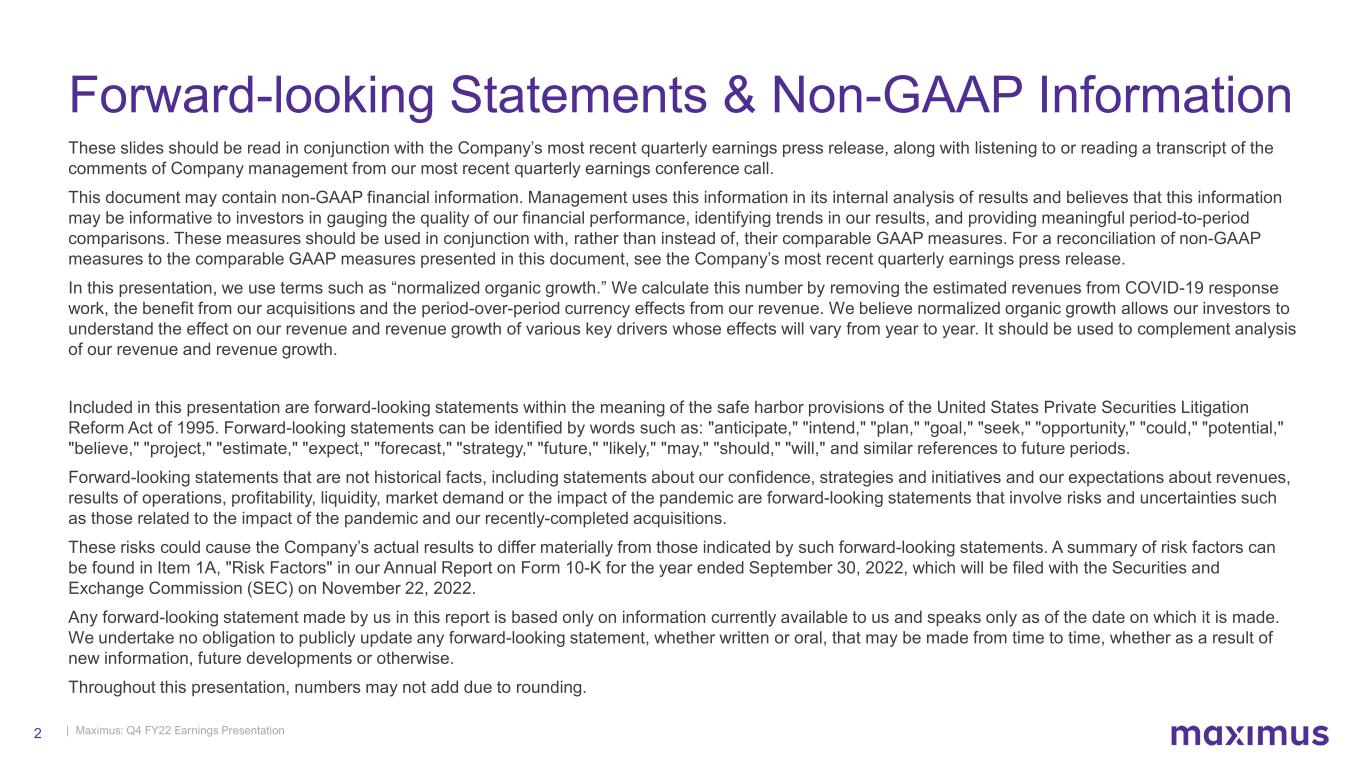
| Maximus: Q4 FY22 Earnings Presentation2 These slides should be read in conjunction with the Company’s most recent quarterly earnings press release, along with listening to or reading a transcript of the comments of Company management from our most recent quarterly earnings conference call. This document may contain non-GAAP financial information. Management uses this information in its internal analysis of results and believes that this information may be informative to investors in gauging the quality of our financial performance, identifying trends in our results, and providing meaningful period-to-period comparisons. These measures should be used in conjunction with, rather than instead of, their comparable GAAP measures. For a reconciliation of non-GAAP measures to the comparable GAAP measures presented in this document, see the Company’s most recent quarterly earnings press release. In this presentation, we use terms such as “normalized organic growth.” We calculate this number by removing the estimated revenues from COVID-19 response work, the benefit from our acquisitions and the period-over-period currency effects from our revenue. We believe normalized organic growth allows our investors to understand the effect on our revenue and revenue growth of various key drivers whose effects will vary from year to year. It should be used to complement analysis of our revenue and revenue growth. Included in this presentation are forward-looking statements within the meaning of the safe harbor provisions of the United States Private Securities Litigation Reform Act of 1995. Forward-looking statements can be identified by words such as: "anticipate," "intend," "plan," "goal," "seek," "opportunity," "could," "potential," "believe," "project," "estimate," "expect," "forecast," "strategy," "future," "likely," "may," "should," "will," and similar references to future periods. Forward-looking statements that are not historical facts, including statements about our confidence, strategies and initiatives and our expectations about revenues, results of operations, profitability, liquidity, market demand or the impact of the pandemic are forward-looking statements that involve risks and uncertainties such as those related to the impact of the pandemic and our recently-completed acquisitions. These risks could cause the Company’s actual results to differ materially from those indicated by such forward-looking statements. A summary of risk factors can be found in Item 1A, "Risk Factors" in our Annual Report on Form 10-K for the year ended September 30, 2022, which will be filed with the Securities and Exchange Commission (SEC) on November 22, 2022. Any forward-looking statement made by us in this report is based only on information currently available to us and speaks only as of the date on which it is made. We undertake no obligation to publicly update any forward-looking statement, whether written or oral, that may be made from time to time, whether as a result of new information, future developments or otherwise. Throughout this presentation, numbers may not add due to rounding. Forward-looking Statements & Non-GAAP Information
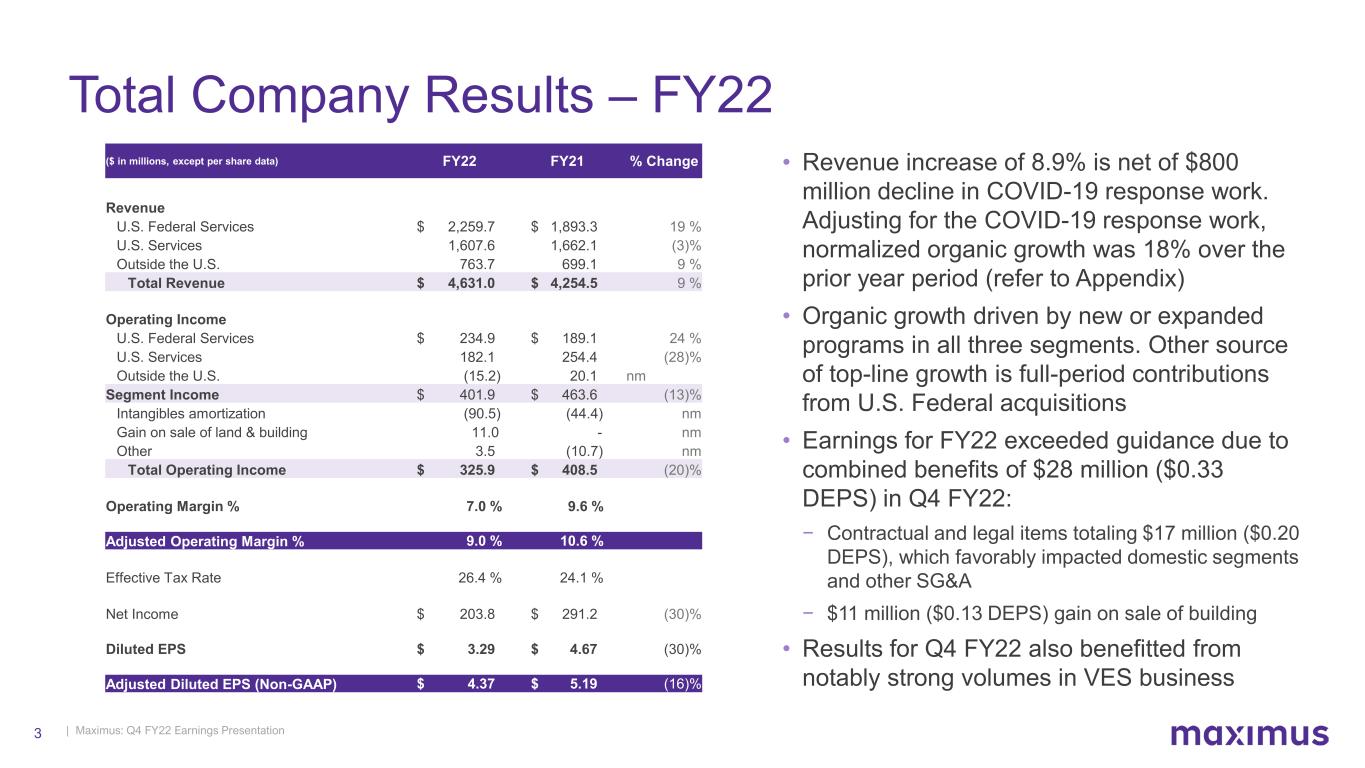
| Maximus: Q4 FY22 Earnings Presentation3 • Revenue increase of 8.9% is net of $800 million decline in COVID-19 response work. Adjusting for the COVID-19 response work, normalized organic growth was 18% over the prior year period (refer to Appendix) • Organic growth driven by new or expanded programs in all three segments. Other source of top-line growth is full-period contributions from U.S. Federal acquisitions • Earnings for FY22 exceeded guidance due to combined benefits of $28 million ($0.33 DEPS) in Q4 FY22: − Contractual and legal items totaling $17 million ($0.20 DEPS), which favorably impacted domestic segments and other SG&A − $11 million ($0.13 DEPS) gain on sale of building • Results for Q4 FY22 also benefitted from notably strong volumes in VES business Total Company Results – FY22 ($ in millions, except per share data) FY22 FY21 % Change Revenue U.S. Federal Services $ 2,259.7 $ 1,893.3 19 % U.S. Services 1,607.6 1,662.1 (3)% Outside the U.S. 763.7 699.1 9 % Total Revenue $ 4,631.0 $ 4,254.5 9 % Operating Income U.S. Federal Services $ 234.9 $ 189.1 24 % U.S. Services 182.1 254.4 (28)% Outside the U.S. (15.2) 20.1 nm Segment Income $ 401.9 $ 463.6 (13)% Intangibles amortization (90.5) (44.4) nm Gain on sale of land & building 11.0 - nm Other 3.5 (10.7) nm Total Operating Income $ 325.9 $ 408.5 (20)% Operating Margin % 7.0 % 9.6 % Adjusted Operating Margin % 9.0 % 10.6 % Effective Tax Rate 26.4 % 24.1 % Net Income $ 203.8 $ 291.2 (30)% Diluted EPS $ 3.29 $ 4.67 (30)% Adjusted Diluted EPS (Non-GAAP) $ 4.37 $ 5.19 (16)%
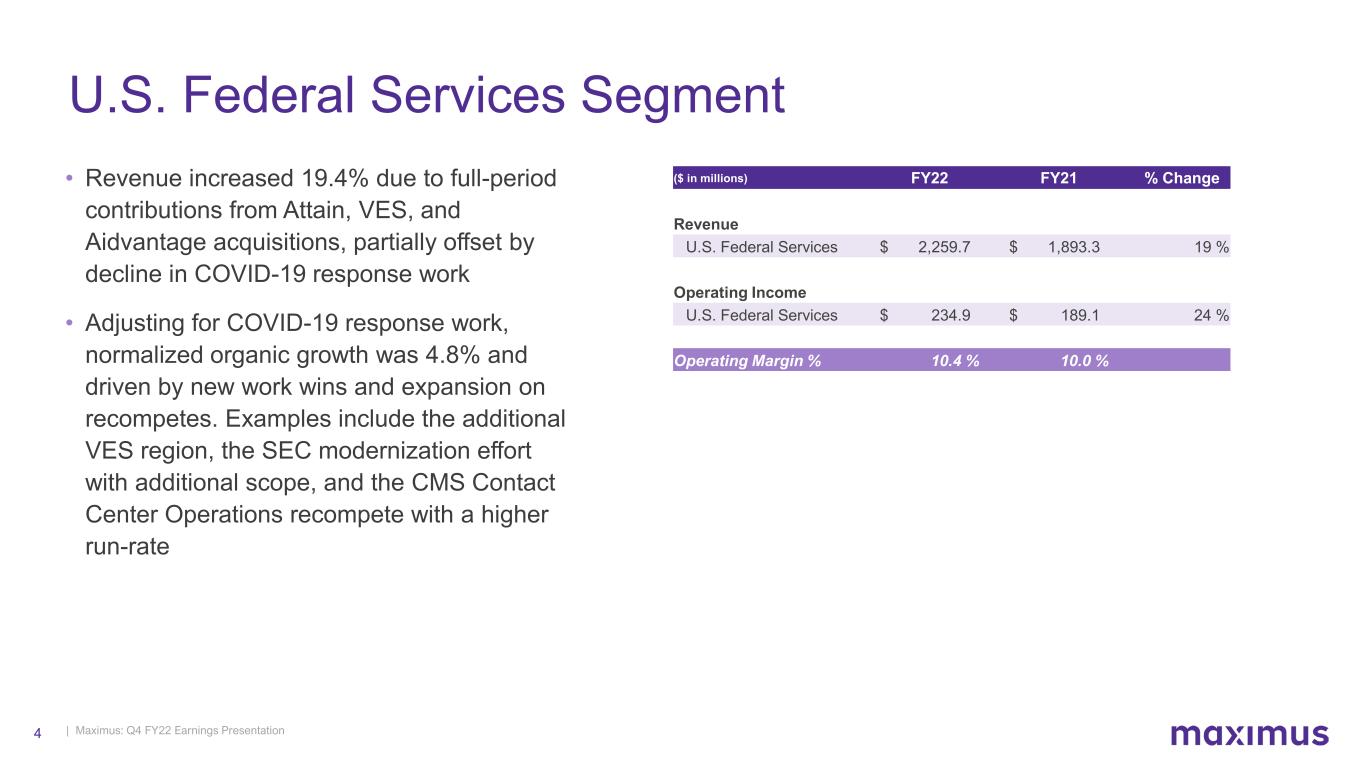
| Maximus: Q4 FY22 Earnings Presentation4 U.S. Federal Services Segment • Revenue increased 19.4% due to full-period contributions from Attain, VES, and Aidvantage acquisitions, partially offset by decline in COVID-19 response work • Adjusting for COVID-19 response work, normalized organic growth was 4.8% and driven by new work wins and expansion on recompetes. Examples include the additional VES region, the SEC modernization effort with additional scope, and the CMS Contact Center Operations recompete with a higher run-rate ($ in millions) FY22 FY21 % Change Revenue U.S. Federal Services $ 2,259.7 $ 1,893.3 19 % Operating Income U.S. Federal Services $ 234.9 $ 189.1 24 % Operating Margin % 10.4 % 10.0 %
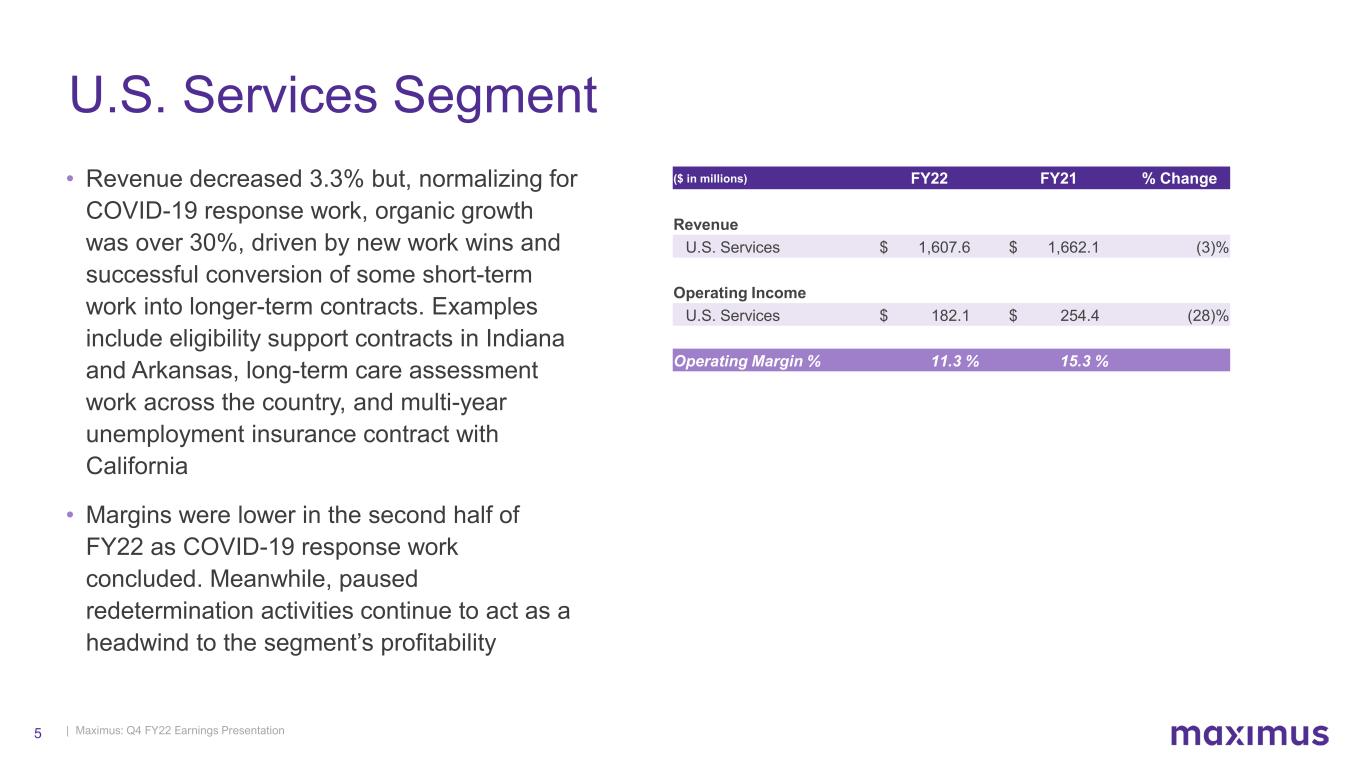
| Maximus: Q4 FY22 Earnings Presentation5 • Revenue decreased 3.3% but, normalizing for COVID-19 response work, organic growth was over 30%, driven by new work wins and successful conversion of some short-term work into longer-term contracts. Examples include eligibility support contracts in Indiana and Arkansas, long-term care assessment work across the country, and multi-year unemployment insurance contract with California • Margins were lower in the second half of FY22 as COVID-19 response work concluded. Meanwhile, paused redetermination activities continue to act as a headwind to the segment’s profitability U.S. Services Segment ($ in millions) FY22 FY21 % Change Revenue U.S. Services $ 1,607.6 $ 1,662.1 (3)% Operating Income U.S. Services $ 182.1 $ 254.4 (28)% Operating Margin % 11.3 % 15.3 %
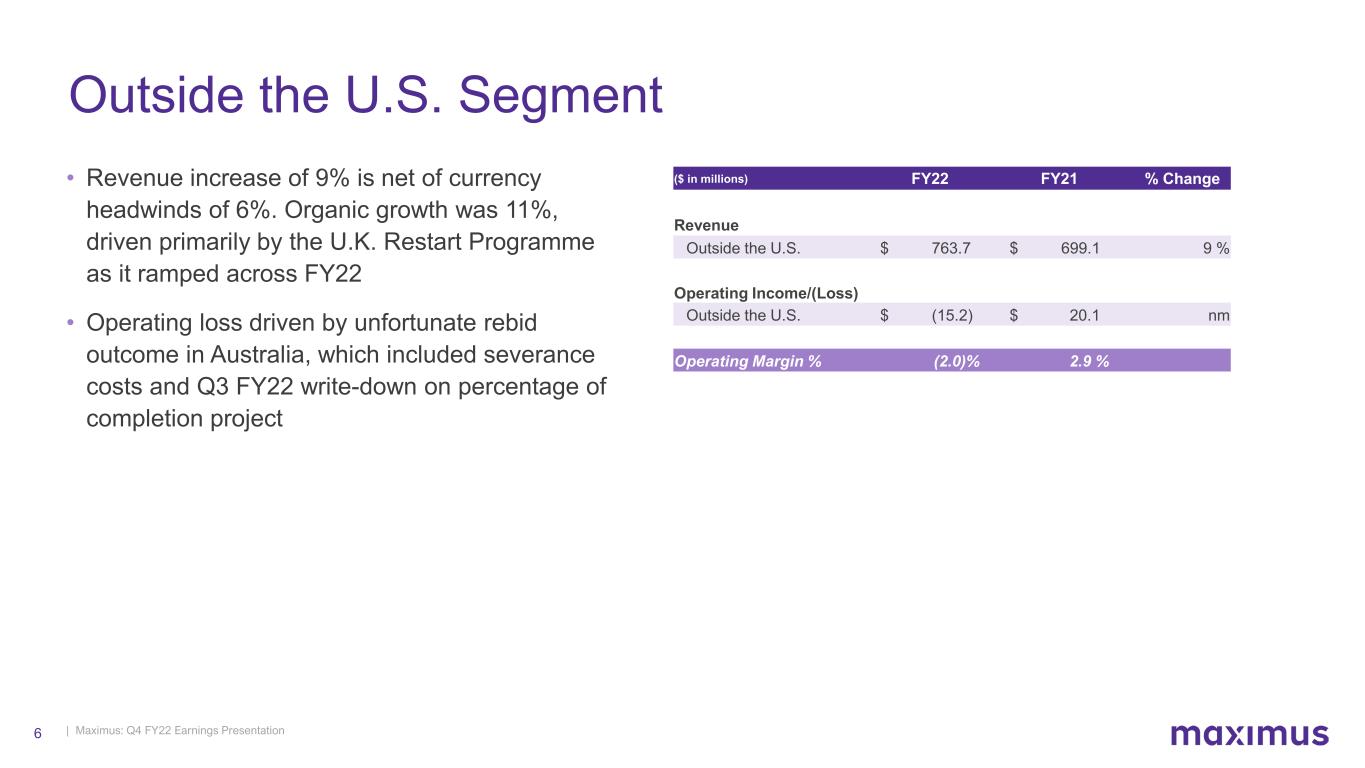
| Maximus: Q4 FY22 Earnings Presentation6 • Revenue increase of 9% is net of currency headwinds of 6%. Organic growth was 11%, driven primarily by the U.K. Restart Programme as it ramped across FY22 • Operating loss driven by unfortunate rebid outcome in Australia, which included severance costs and Q3 FY22 write-down on percentage of completion project Outside the U.S. Segment ($ in millions) FY22 FY21 % Change Revenue Outside the U.S. $ 763.7 $ 699.1 9 % Operating Income/(Loss) Outside the U.S. $ (15.2) $ 20.1 nm Operating Margin % (2.0)% 2.9 %
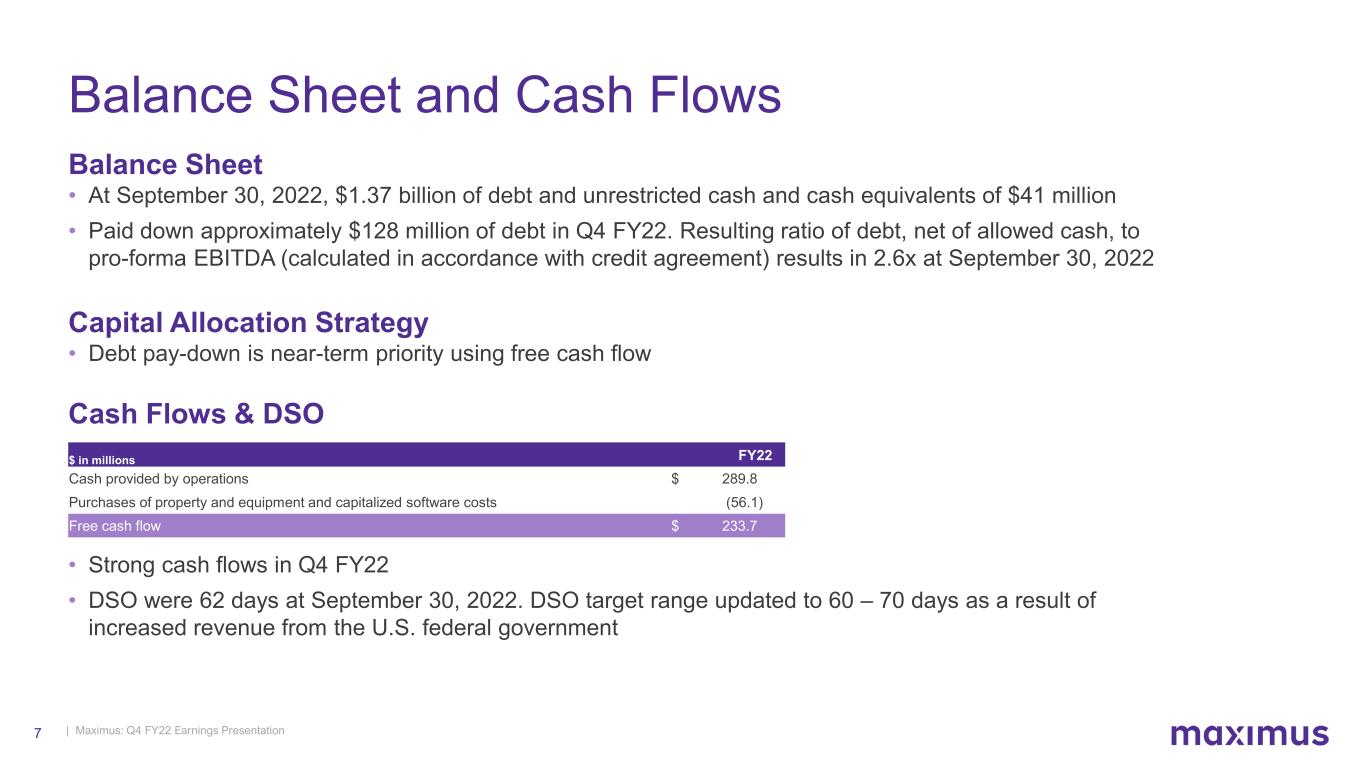
| Maximus: Q4 FY22 Earnings Presentation7 Balance Sheet and Cash Flows Balance Sheet • At September 30, 2022, $1.37 billion of debt and unrestricted cash and cash equivalents of $41 million • Paid down approximately $128 million of debt in Q4 FY22. Resulting ratio of debt, net of allowed cash, to pro-forma EBITDA (calculated in accordance with credit agreement) results in 2.6x at September 30, 2022 Capital Allocation Strategy • Debt pay-down is near-term priority using free cash flow Cash Flows & DSO • Strong cash flows in Q4 FY22 • DSO were 62 days at September 30, 2022. DSO target range updated to 60 – 70 days as a result of increased revenue from the U.S. federal government $ in millions FY22 Cash provided by operations $ 289.8 Purchases of property and equipment and capitalized software costs (56.1) Free cash flow $ 233.7
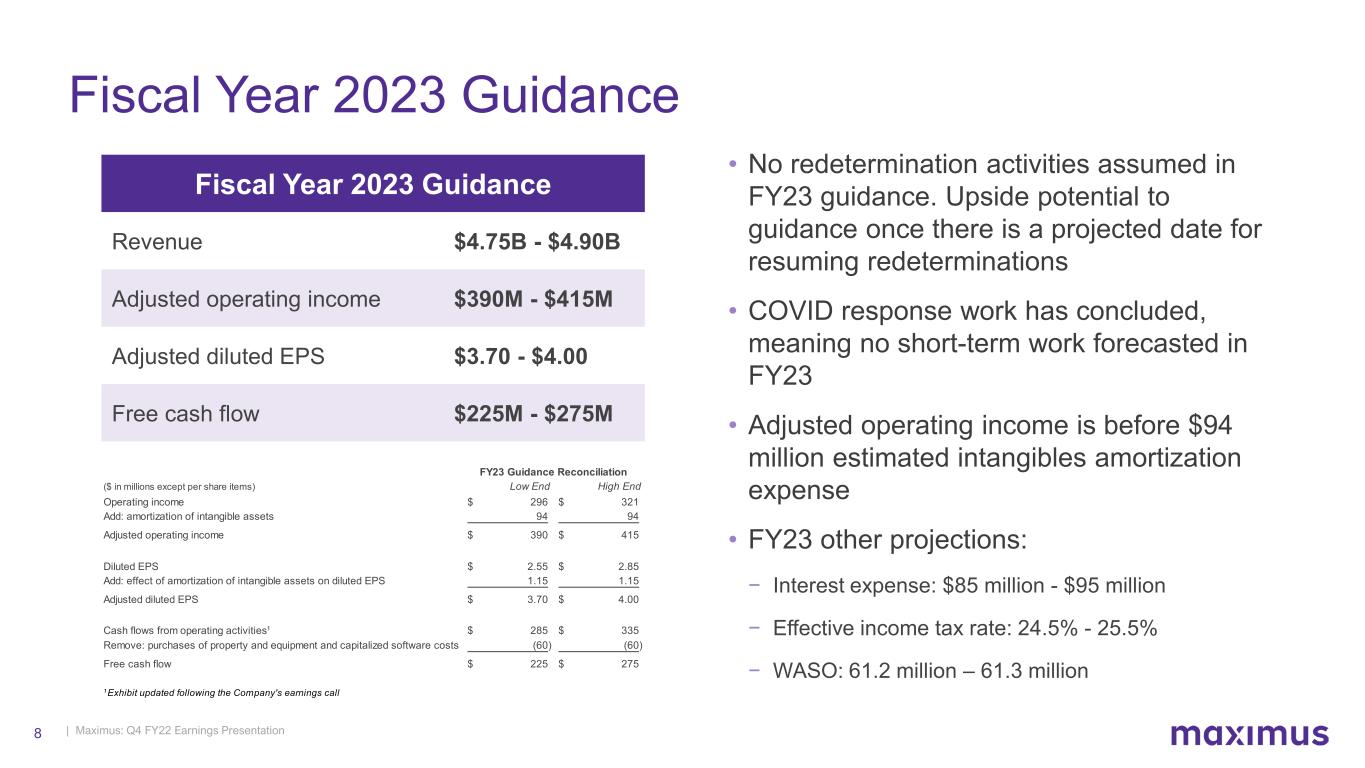
| Maximus: Q4 FY22 Earnings Presentation8 Fiscal Year 2023 Guidance Fiscal Year 2023 Guidance Revenue $4.75B - $4.90B Adjusted operating income $390M - $415M Adjusted diluted EPS $3.70 - $4.00 Free cash flow $225M - $275M • No redetermination activities assumed in FY23 guidance. Upside potential to guidance once there is a projected date for resuming redeterminations • COVID response work has concluded, meaning no short-term work forecasted in FY23 • Adjusted operating income is before $94 million estimated intangibles amortization expense • FY23 other projections: − Interest expense: $85 million - $95 million − Effective income tax rate: 24.5% - 25.5% − WASO: 61.2 million – 61.3 million ($ in millions except per share items) Low End High End Operating income 296$ 321$ Add: amortization of intangible assets 94 94 Adjusted operating income 390$ 415$ Diluted EPS 2.55$ 2.85$ Add: effect of amortization of intangible assets on diluted EPS 1.15 1.15 Adjusted diluted EPS 3.70$ 4.00$ Cash flows from operating activities¹ 285$ 335$ Remove: purchases of property and equipment and capitalized software costs (60) (60) Free cash flow 225$ 275$ ¹ Exhibit updated following the Company's earnings call FY23 Guidance Reconciliation
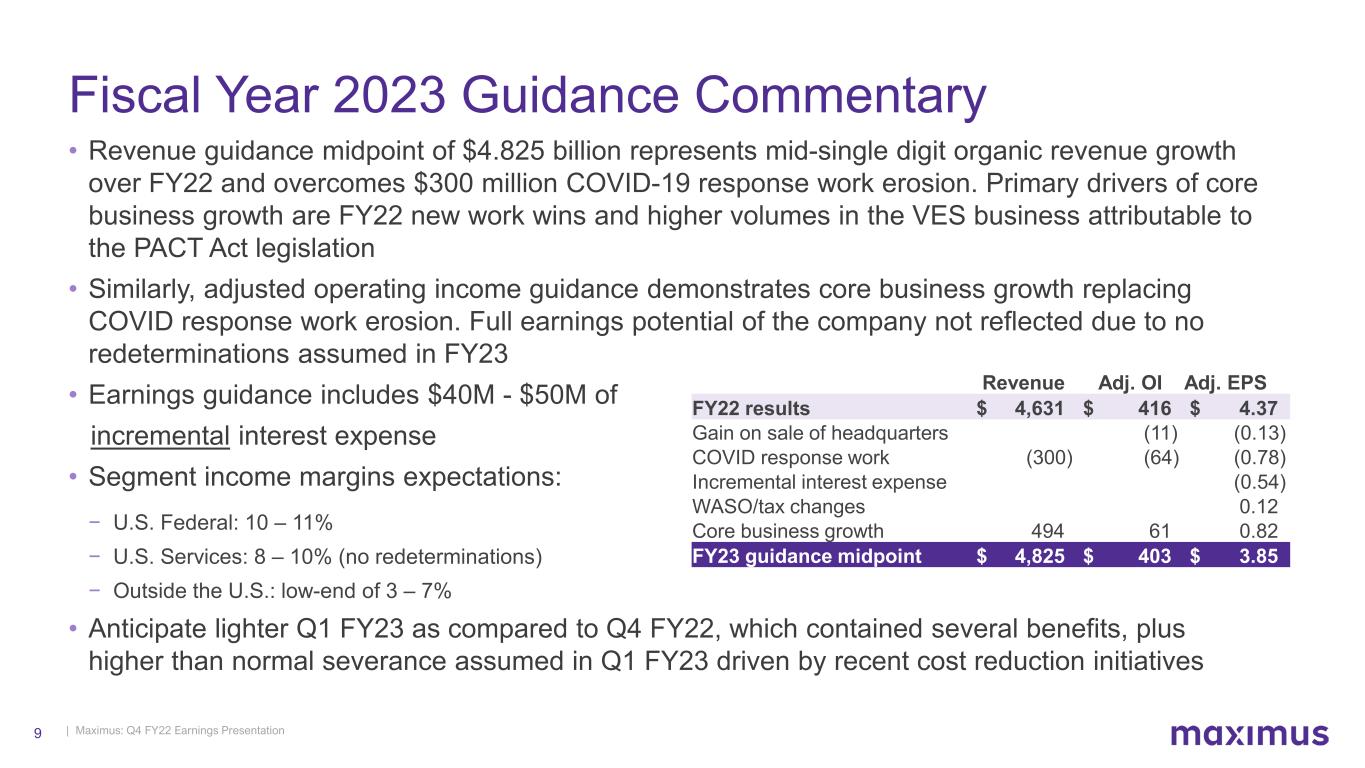
| Maximus: Q4 FY22 Earnings Presentation9 Fiscal Year 2023 Guidance Commentary • Revenue guidance midpoint of $4.825 billion represents mid-single digit organic revenue growth over FY22 and overcomes $300 million COVID-19 response work erosion. Primary drivers of core business growth are FY22 new work wins and higher volumes in the VES business attributable to the PACT Act legislation • Similarly, adjusted operating income guidance demonstrates core business growth replacing COVID response work erosion. Full earnings potential of the company not reflected due to no redeterminations assumed in FY23 • Earnings guidance includes $40M - $50M of incremental interest expense • Segment income margins expectations: − U.S. Federal: 10 – 11% − U.S. Services: 8 – 10% (no redeterminations) − Outside the U.S.: low-end of 3 – 7% • Anticipate lighter Q1 FY23 as compared to Q4 FY22, which contained several benefits, plus higher than normal severance assumed in Q1 FY23 driven by recent cost reduction initiatives Revenue Adj. OI Adj. EPS FY22 results $ 4,631 $ 416 $ 4.37 Gain on sale of headquarters (11) (0.13) COVID response work (300) (64) (0.78) Incremental interest expense (0.54) WASO/tax changes 0.12 Core business growth 494 61 0.82 FY23 guidance midpoint $ 4,825 $ 403 $ 3.85
| Maximus: Q4 FY22 Earnings Presentation10 Fiscal 2022 Year End Earnings Call 10 Bruce Caswell President & Chief Executive Officer November 22, 2022
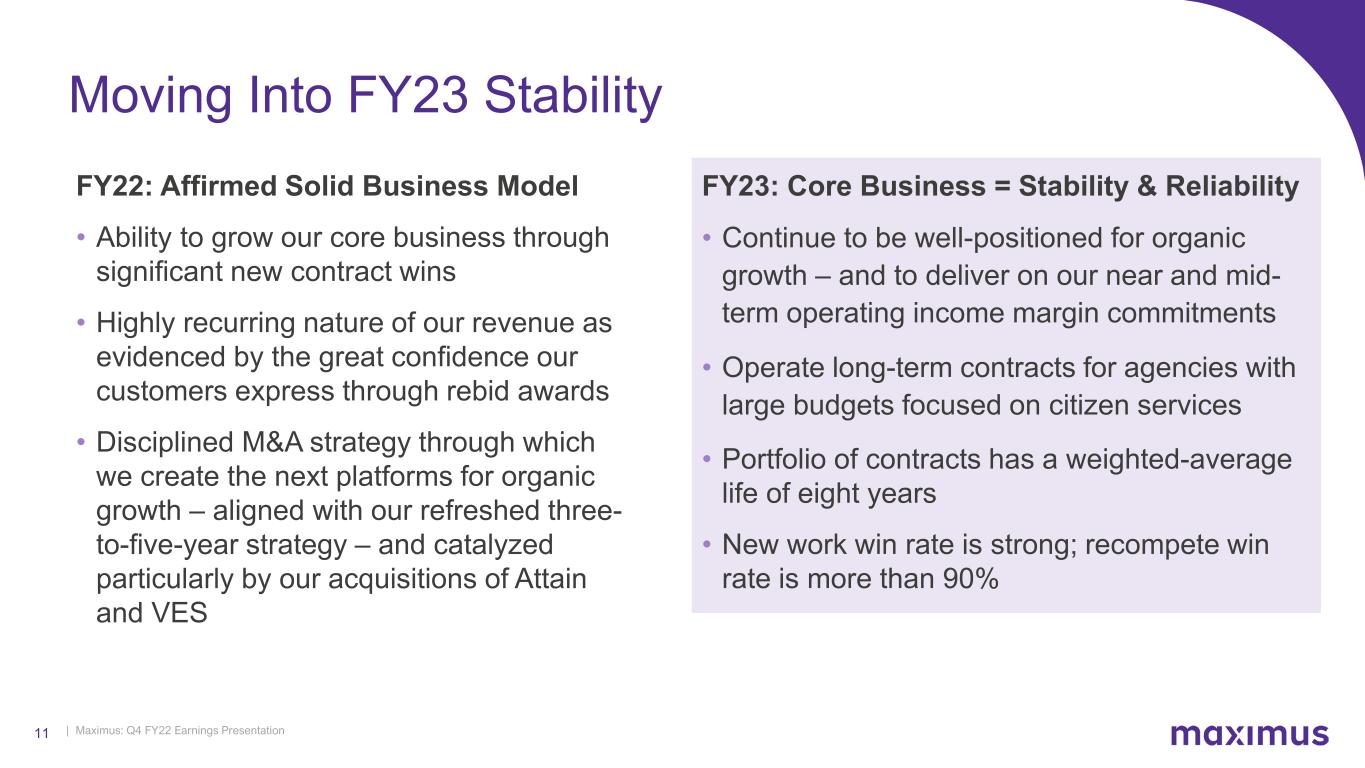
| Maximus: Q4 FY22 Earnings Presentation11 FY23: Core Business = Stability & Reliability • Continue to be well-positioned for organic growth – and to deliver on our near and mid- term operating income margin commitments • Operate long-term contracts for agencies with large budgets focused on citizen services • Portfolio of contracts has a weighted-average life of eight years • New work win rate is strong; recompete win rate is more than 90% FY22: Affirmed Solid Business Model • Ability to grow our core business through significant new contract wins • Highly recurring nature of our revenue as evidenced by the great confidence our customers express through rebid awards • Disciplined M&A strategy through which we create the next platforms for organic growth – aligned with our refreshed three- to-five-year strategy – and catalyzed particularly by our acquisitions of Attain and VES Moving Into FY23 Stability
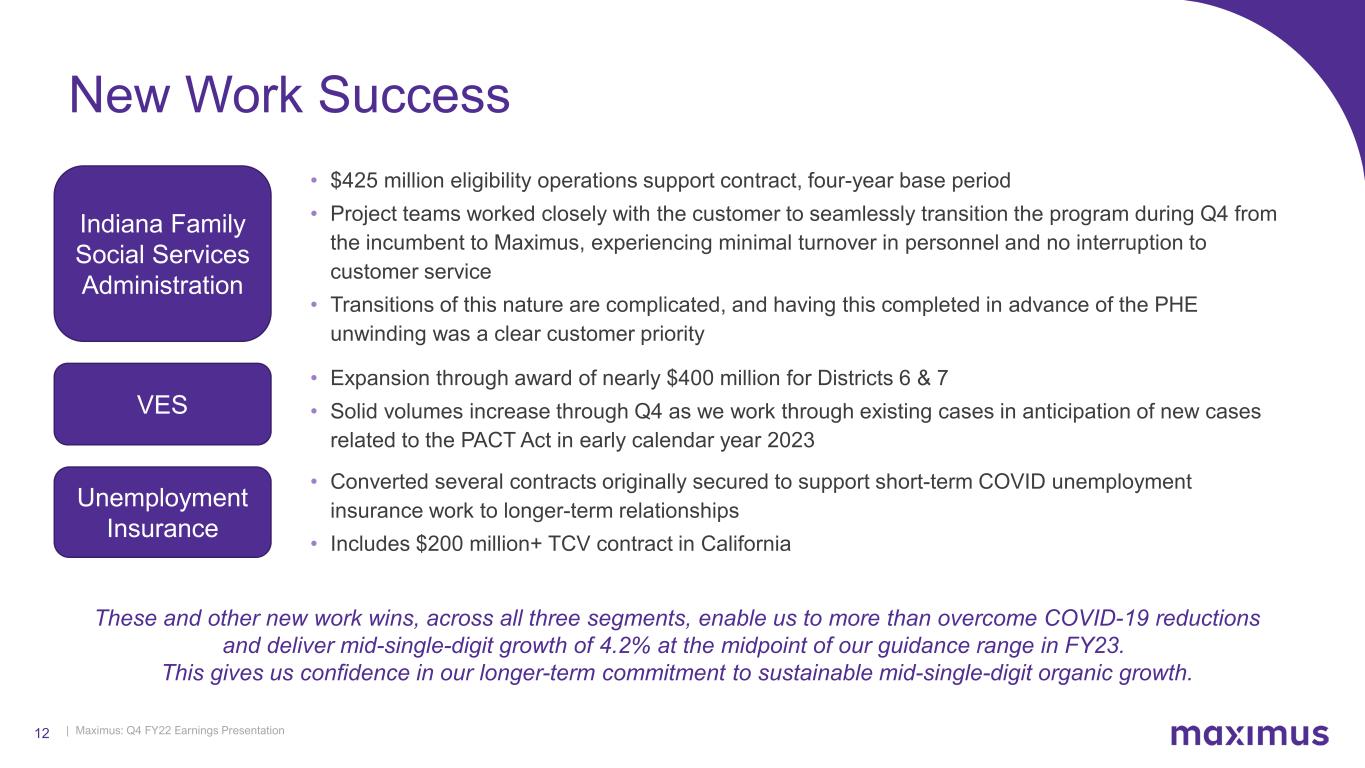
| Maximus: Q4 FY22 Earnings Presentation12 New Work Success • $425 million eligibility operations support contract, four-year base period • Project teams worked closely with the customer to seamlessly transition the program during Q4 from the incumbent to Maximus, experiencing minimal turnover in personnel and no interruption to customer service • Transitions of this nature are complicated, and having this completed in advance of the PHE unwinding was a clear customer priority Indiana Family Social Services Administration VES • Expansion through award of nearly $400 million for Districts 6 & 7 • Solid volumes increase through Q4 as we work through existing cases in anticipation of new cases related to the PACT Act in early calendar year 2023 Unemployment Insurance • Converted several contracts originally secured to support short-term COVID unemployment insurance work to longer-term relationships • Includes $200 million+ TCV contract in California These and other new work wins, across all three segments, enable us to more than overcome COVID-19 reductions and deliver mid-single-digit growth of 4.2% at the midpoint of our guidance range in FY23. This gives us confidence in our longer-term commitment to sustainable mid-single-digit organic growth.
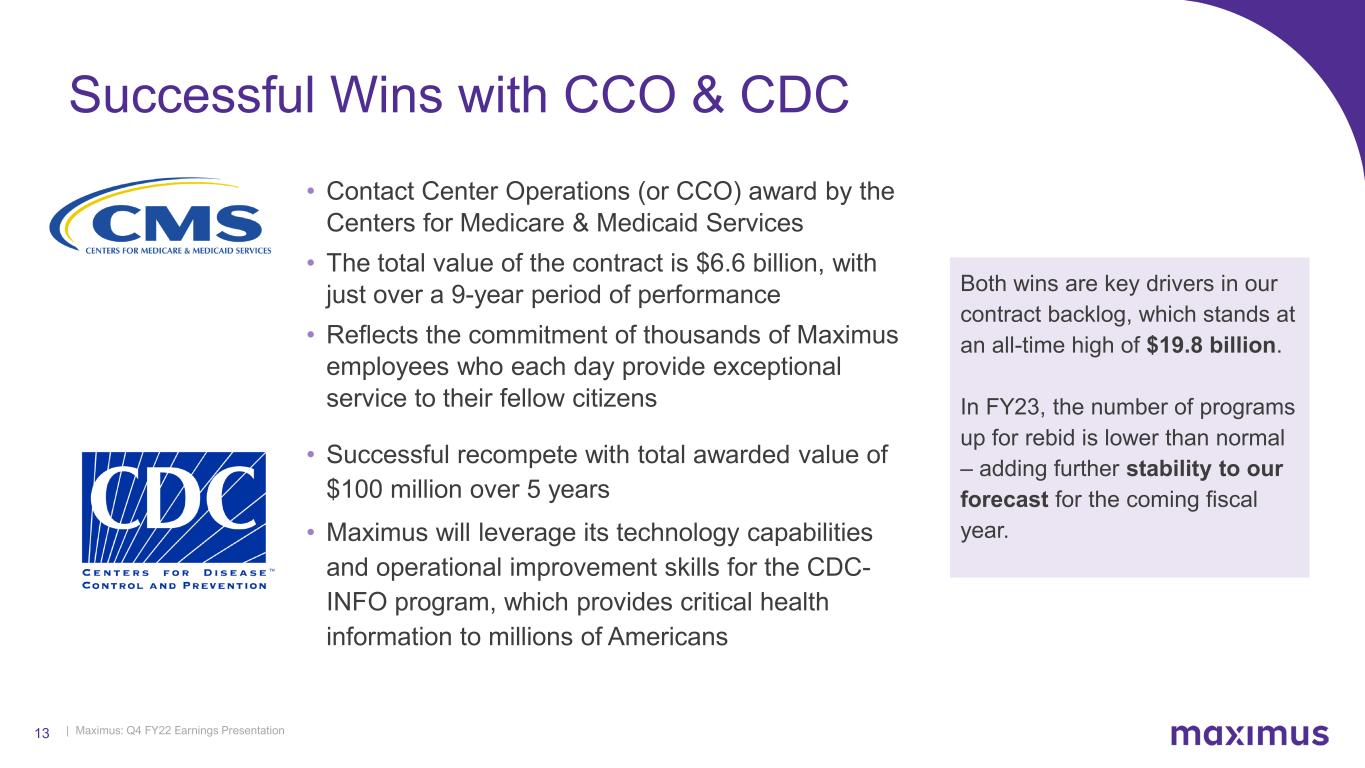
| Maximus: Q4 FY22 Earnings Presentation13 Successful Wins with CCO & CDC • Contact Center Operations (or CCO) award by the Centers for Medicare & Medicaid Services • The total value of the contract is $6.6 billion, with just over a 9-year period of performance • Reflects the commitment of thousands of Maximus employees who each day provide exceptional service to their fellow citizens Both wins are key drivers in our contract backlog, which stands at an all-time high of $19.8 billion. In FY23, the number of programs up for rebid is lower than normal – adding further stability to our forecast for the coming fiscal year. • Successful recompete with total awarded value of $100 million over 5 years • Maximus will leverage its technology capabilities and operational improvement skills for the CDC- INFO program, which provides critical health information to millions of Americans
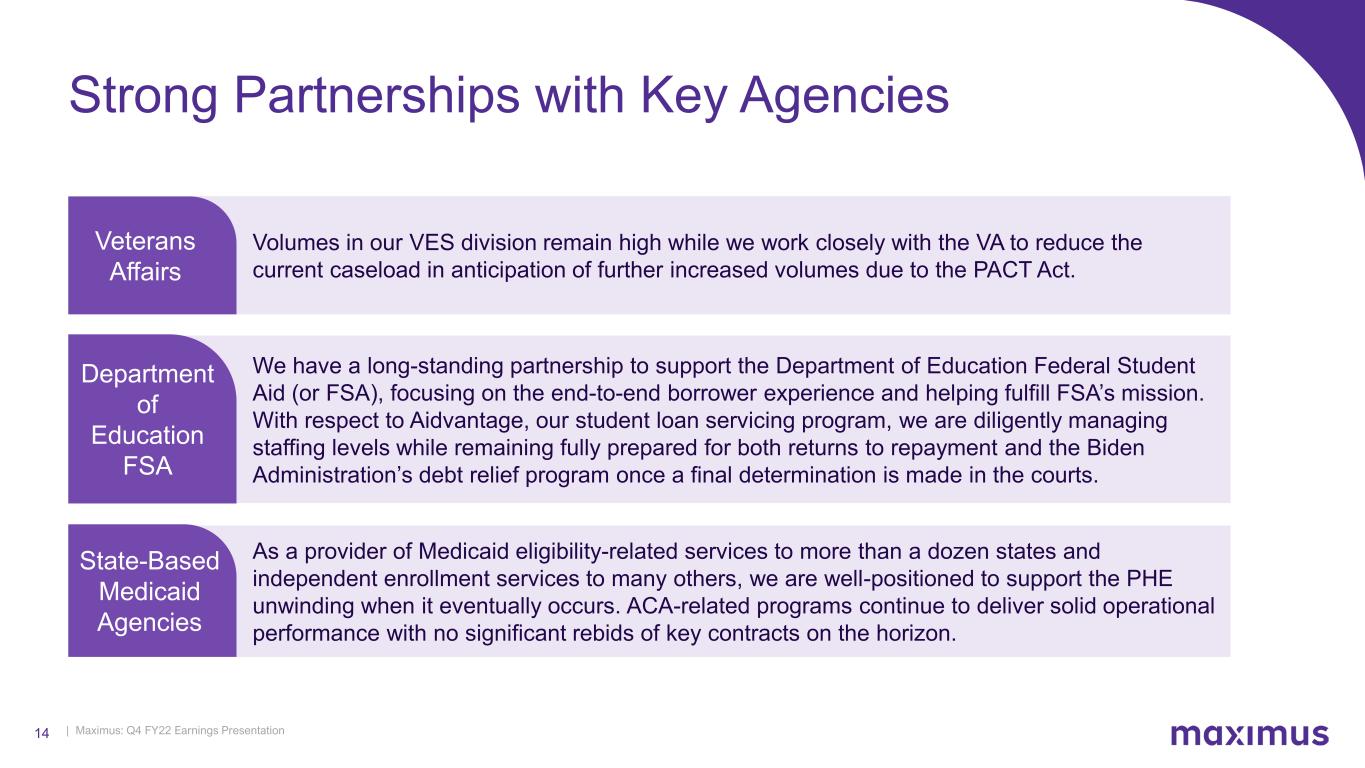
| Maximus: Q4 FY22 Earnings Presentation14 Strong Partnerships with Key Agencies Volumes in our VES division remain high while we work closely with the VA to reduce the current caseload in anticipation of further increased volumes due to the PACT Act. Veterans Affairs We have a long-standing partnership to support the Department of Education Federal Student Aid (or FSA), focusing on the end-to-end borrower experience and helping fulfill FSA’s mission. With respect to Aidvantage, our student loan servicing program, we are diligently managing staffing levels while remaining fully prepared for both returns to repayment and the Biden Administration’s debt relief program once a final determination is made in the courts. Department of Education FSA As a provider of Medicaid eligibility-related services to more than a dozen states and independent enrollment services to many others, we are well-positioned to support the PHE unwinding when it eventually occurs. ACA-related programs continue to deliver solid operational performance with no significant rebids of key contracts on the horizon. State-Based Medicaid Agencies
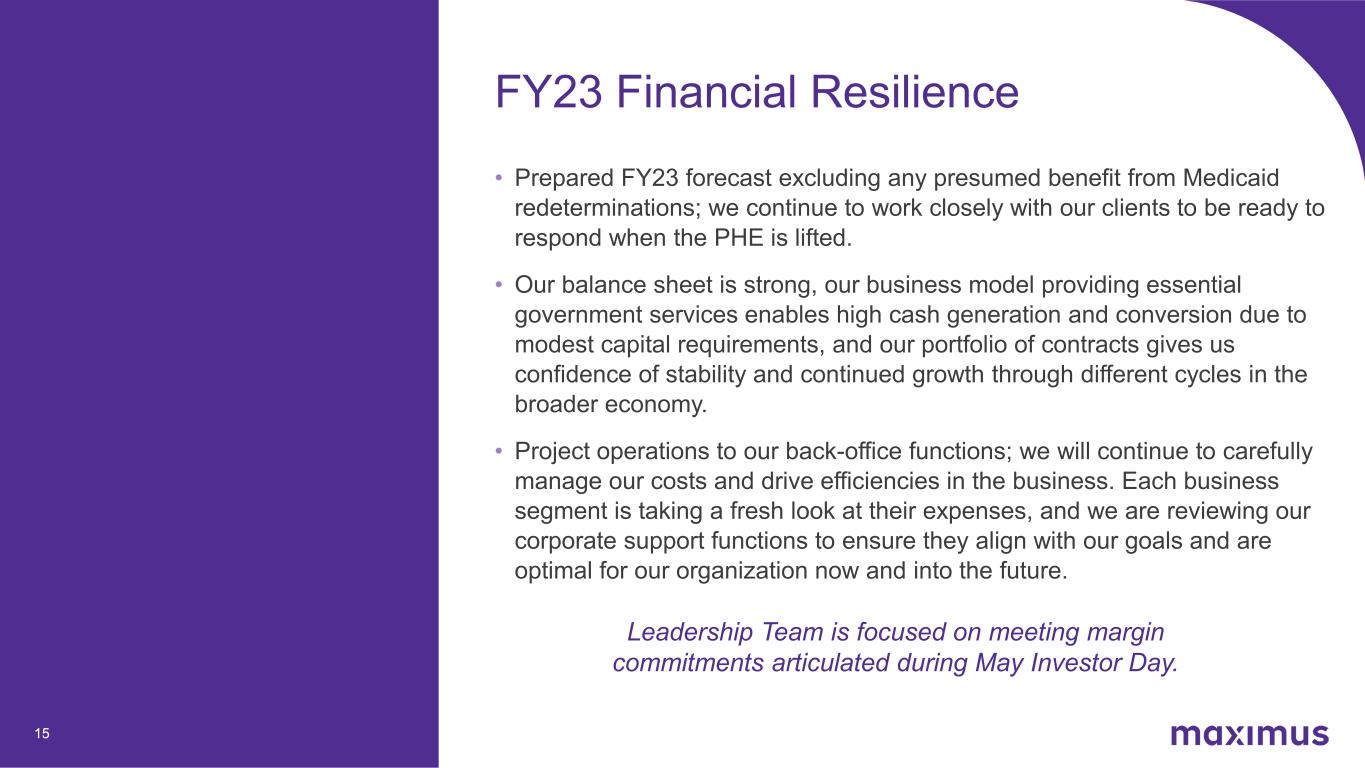
| Maximus: Q4 FY22 Earnings Presentation15 • Prepared FY23 forecast excluding any presumed benefit from Medicaid redeterminations; we continue to work closely with our clients to be ready to respond when the PHE is lifted. • Our balance sheet is strong, our business model providing essential government services enables high cash generation and conversion due to modest capital requirements, and our portfolio of contracts gives us confidence of stability and continued growth through different cycles in the broader economy. • Project operations to our back-office functions; we will continue to carefully manage our costs and drive efficiencies in the business. Each business segment is taking a fresh look at their expenses, and we are reviewing our corporate support functions to ensure they align with our goals and are optimal for our organization now and into the future. FY23 Financial Resilience Leadership Team is focused on meeting margin commitments articulated during May Investor Day.
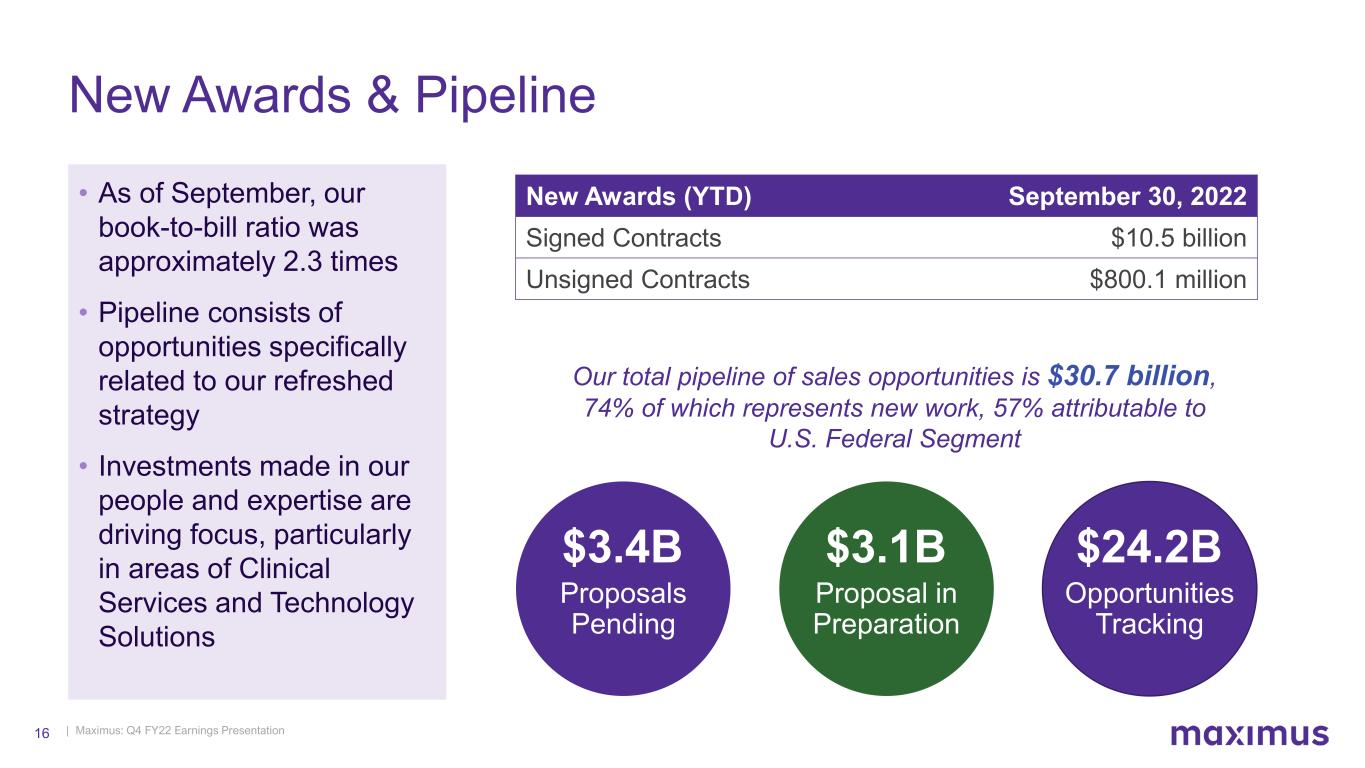
| Maximus: Q4 FY22 Earnings Presentation16 New Awards (YTD) September 30, 2022 Signed Contracts $10.5 billion Unsigned Contracts $800.1 million • As of September, our book-to-bill ratio was approximately 2.3 times • Pipeline consists of opportunities specifically related to our refreshed strategy • Investments made in our people and expertise are driving focus, particularly in areas of Clinical Services and Technology Solutions Proposals Pending Proposal in Preparation Opportunities Tracking New Awards & Pipeline $3.4B $3.1B $24.2B Our total pipeline of sales opportunities is $30.7 billion, 74% of which represents new work, 57% attributable to U.S. Federal Segment
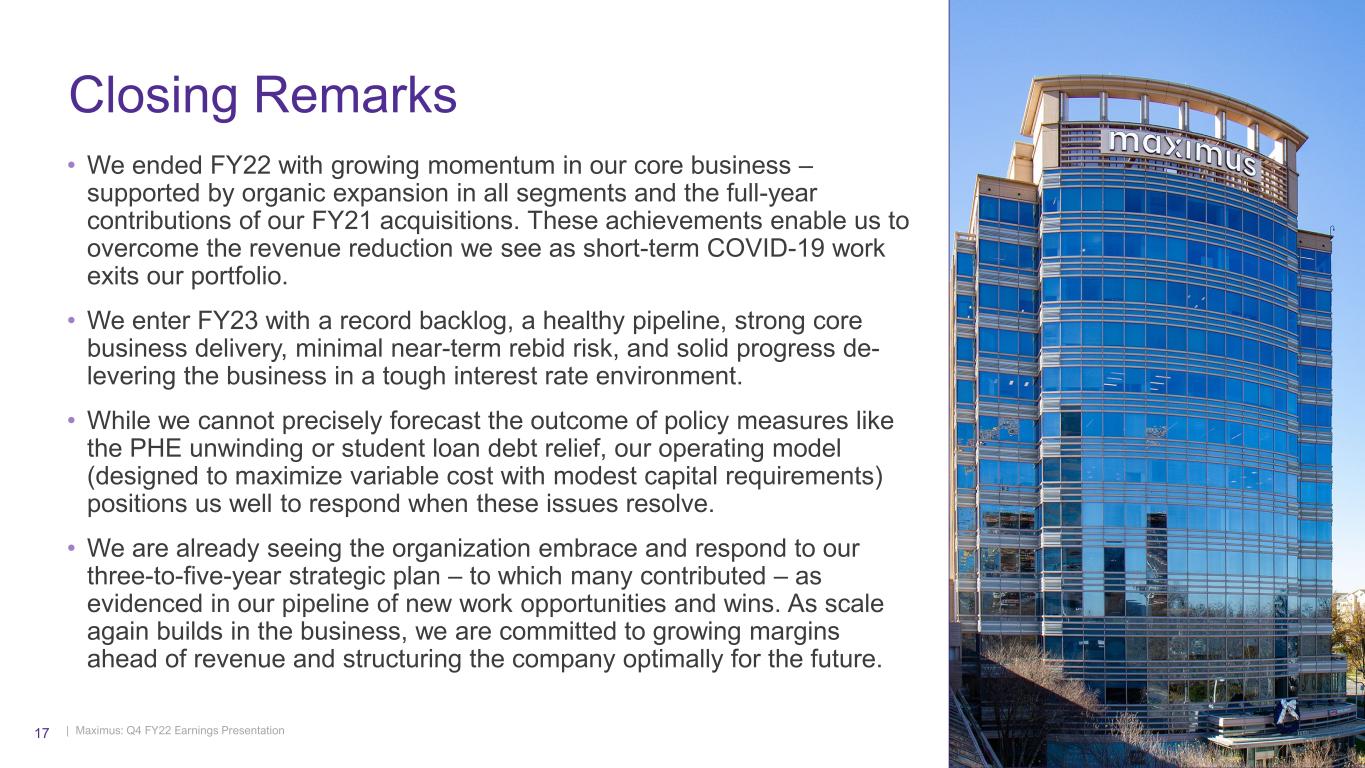
| Maximus: Q4 FY22 Earnings Presentation17 Closing Remarks • We ended FY22 with growing momentum in our core business – supported by organic expansion in all segments and the full-year contributions of our FY21 acquisitions. These achievements enable us to overcome the revenue reduction we see as short-term COVID-19 work exits our portfolio. • We enter FY23 with a record backlog, a healthy pipeline, strong core business delivery, minimal near-term rebid risk, and solid progress de- levering the business in a tough interest rate environment. • While we cannot precisely forecast the outcome of policy measures like the PHE unwinding or student loan debt relief, our operating model (designed to maximize variable cost with modest capital requirements) positions us well to respond when these issues resolve. • We are already seeing the organization embrace and respond to our three-to-five-year strategic plan – to which many contributed – as evidenced in our pipeline of new work opportunities and wins. As scale again builds in the business, we are committed to growing margins ahead of revenue and structuring the company optimally for the future.

| Maximus: Q4 FY22 Earnings Presentation18 APPENDIX
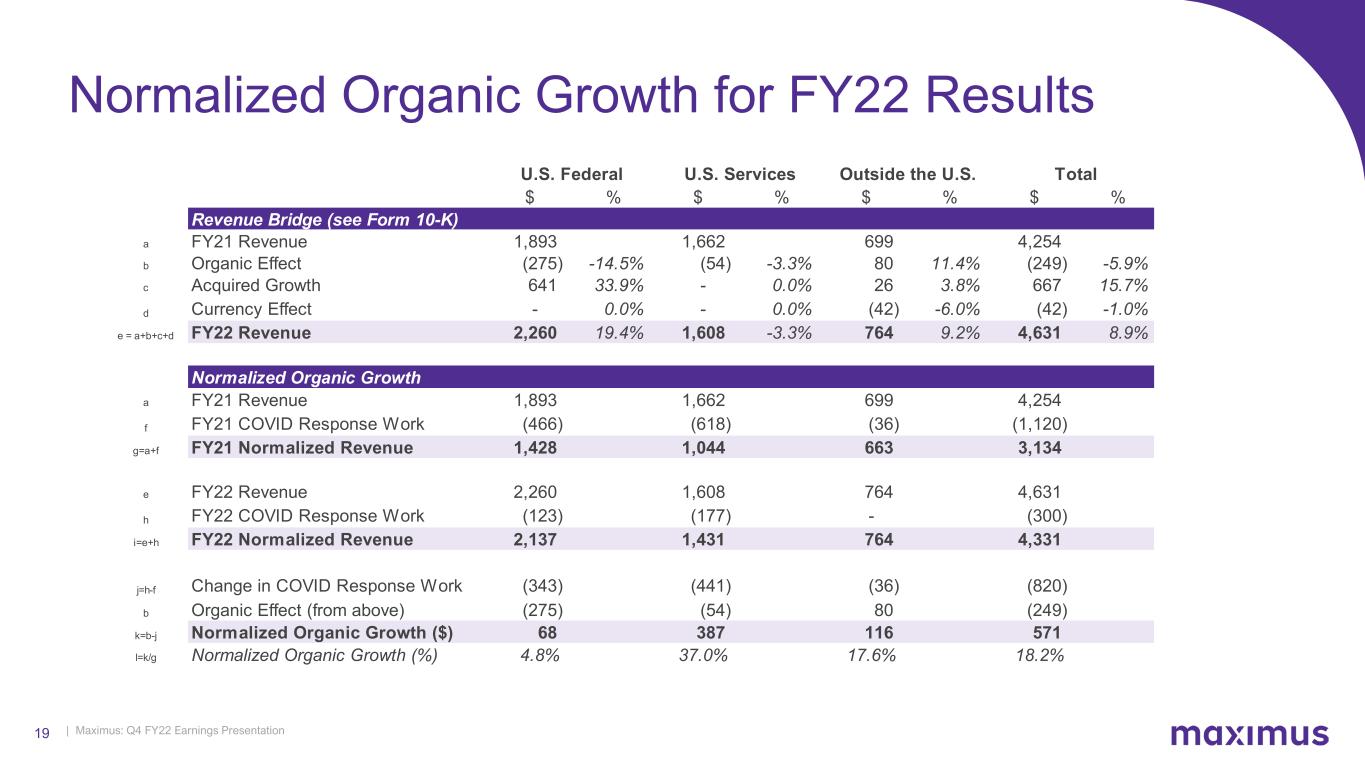
| Maximus: Q4 FY22 Earnings Presentation19 Normalized Organic Growth for FY22 Results $ % $ % $ % $ % Revenue Bridge (see Form 10-K) a FY21 Revenue 1,893 1,662 699 4,254 b Organic Effect (275) -14.5% (54) -3.3% 80 11.4% (249) -5.9% c Acquired Growth 641 33.9% - 0.0% 26 3.8% 667 15.7% d Currency Effect - 0.0% - 0.0% (42) -6.0% (42) -1.0% e = a+b+c+d FY22 Revenue 2,260 19.4% 1,608 -3.3% 764 9.2% 4,631 8.9% Normalized Organic Growth a FY21 Revenue 1,893 1,662 699 4,254 f FY21 COVID Response Work (466) (618) (36) (1,120) g=a+f FY21 Normalized Revenue 1,428 1,044 663 3,134 e FY22 Revenue 2,260 1,608 764 4,631 h FY22 COVID Response Work (123) (177) - (300) i=e+h FY22 Normalized Revenue 2,137 1,431 764 4,331 j=h-f Change in COVID Response Work (343) (441) (36) (820) b Organic Effect (from above) (275) (54) 80 (249) k=b-j Normalized Organic Growth ($) 68 387 116 571 l=k/g Normalized Organic Growth (%) 4.8% 37.0% 17.6% 18.2% TotalU.S. ServicesU.S. Federal Outside the U.S.
| Maximus: Q4 FY22 Earnings Presentation20