
MMS 8-K
Maximus, Inc. (MMS)
8-K
2021-08-10
For: 2021-08-10
View Original
Added on
April 10, 2026
UNITED STATES
SECURITIES AND EXCHANGE COMMISSION
Washington, D.C. 20549
___________
FORM 8-K
CURRENT REPORT
Pursuant to Section 13 or 15(d) of the Securities Exchange Act of 1934
Date of report: August 10, 2021
Date of earliest event reported: August 5, 2021
___________
(Exact name of registrant as specified in its charter)
(State or other jurisdiction of incorporation) | (Commission File Number) | (I.R.S. Employer Identification No.) | |||||||||
(Address of principal executive offices) | (Zip Code) | ||||||||||
Registrant’s telephone number, including area code: (703 ) 251-8500
Not Applicable
(Former name or former address, if changed since last report)
Check the appropriate box below if the Form 8-K filing is intended to simultaneously satisfy the filing obligation of the registrant under any of the following provisions:
Securities registered pursuant to Section 12(b) of the Act:
Title of each class | Trading Symbol(s) | Name of each exchange on which registered | ||||||||||||
Indicate by check mark whether the registrant is an emerging growth company as defined in Rule 405 of the Securities Act of 1933 (§230.405 of this chapter) or Rule 12b-2 of the Securities Exchange Act of 1934 (§240.12b-2 of this chapter).
Emerging growth company ☐
If an emerging growth company, indicate by check mark if the registrant has elected not to use the extended transition period for complying with any new or revised financial accounting standards provided pursuant to Section 13(a) of the Exchange Act. ☐
Item 2.02 Results of Operations and Financial Condition.
On August 5, 2021, the Company issued a press release announcing its financial results for the quarter ended June 30, 2021. The full text of the press release is furnished as Exhibit 99.1 to this Current Report on Form 8-K and incorporated by reference into this Item 2.02.
On August 5, 2021, the Company held a conference call with respect to these financial results. The conference call was open to the public. The transcript and slide presentation that accompanied the call are furnished as Exhibit 99.2 and Exhibit 99.3 to this Current Report on Form 8-K and incorporated by reference into this Item 2.02.
Item 9.01 Financial Statements and Exhibits.
(d) Exhibits. The following exhibits are being furnished pursuant to Item 2.02 above.
| Exhibit No. | Description | ||||
| Press release dated August 5, 2021 | |||||
| Conference call transcript for Earnings Call - August 5, 2021 | |||||
| Conference call slide presentation for Earnings Call - August 5, 2021 | |||||
SIGNATURES
Pursuant to the requirements of the Securities Exchange Act of 1934, the registrant has duly caused this report to be signed on its behalf by the undersigned hereunto duly authorized.
| Maximus, Inc. | ||||||||||||||
| Date: August 10, 2021 | By: | /s/ David R. Francis | ||||||||||||
| David R. Francis | ||||||||||||||
| General Counsel and Secretary | ||||||||||||||

| FOR IMMEDIATE RELEASE | CONTACT: | James Francis 703.251.8526 | |||||||||
| [email protected] | |||||||||||
| Date: August 5, 2021 | Madison West 703.251.8443 | ||||||||||
| [email protected] | |||||||||||
Maximus Reports Fiscal Year 2021 Third Quarter Results
- COVID-19 Response Work Drives Record Quarter -
(RESTON, Va. - August 5, 2021) - Maximus (NYSE: MMS), a leading provider of government services worldwide, reported financial results for the three and nine months ended June 30, 2021.
Highlights for the third quarter of fiscal year 2021 include:
•Record revenue of $1.24 billion beat Company expectations driven by COVID-19 response work including vaccination distribution support services, unemployment insurance program support, disease investigation, contact tracing, and other key initiatives.
•Operating income margin was 11.2% and diluted earnings per share were $1.51. Amortization of intangible assets was $12.1 million, or $0.15 diluted earnings per share. Adjusting for amortization of intangible assets, operating income margin and diluted earnings per share would be 12.2% and $1.66, respectively.
•The Company is raising guidance for fiscal year 2021 to account for the strong third quarter results. Revenue is expected to range between $4.2 billion and $4.25 billion and diluted earnings per share to range between $4.65 and $4.75.
•The acquired businesses of Attain Federal and VES completed on March 1, 2021 and May 28, 2021, respectively, are performing in-line with Company expectations.
•A quarterly cash dividend of $0.28 per share payable on August 31, 2021, to shareholders of record on August 13, 2021.
"I am extremely proud of the team, their accomplishments, and their ability to deliver outstanding results to our government customers and raise the bar in demonstrating our capabilities," shared Bruce Caswell, President and Chief Executive Officer. "As an example, on a single day this quarter, nearly 13,000 employees began their first day of work with Maximus supporting a significant new COVID response contract for a key customer and underpinned by one of the largest cloud-based telephony environments ever created for government capable of handling a half-million calls per hour."
Caswell continued, "Several months into our relationship together, I’m even more impressed with the capabilities and dedication that our Attain Federal and VES teams bring to Maximus. Already, we see the anticipated acquisition benefits coming to fruition for the combined companies and for our customers."
Third Quarter Results
For the third quarter of fiscal 2021, revenue increased 38.0% to $1.24 billion as compared to $901.3 million reported for the prior-year period driven by COVID-19 response work including vaccination distribution support services, unemployment insurance program support, disease investigation, contact tracing, and other key initiatives. COVID-19 response work contributed approximately $460 million and $860 million for the three and

nine months ended June 30, 2021, respectively. The profitability of this work has been steadily improving and now delivers operating income margins above the Company's corporate average.
For the third quarter of fiscal 2021, operating income totaled $139.6 million, yielding an operating margin of 11.2%. This compares to an operating margin of 9.7% for the prior-year period. Diluted earnings per share were $1.51 as compared to $1.04 for the prior-year period. Adjusting for amortization of intangible assets, operating income margin and diluted earnings per share for amortization of intangible assets would be 12.2% and $1.66, respectively, for the third quarter of fiscal 2021.
Results for the quarter include a full three months for Attain Federal and just over one month for VES, contributing revenues of $56 million and $46 million, respectively.
For the nine months ended June 30, 2021, operating income margin was 10.8% and diluted earnings per share were $3.84. Amortization of intangible assets was $23.7 million, or $0.28 diluted earnings per share. Adjusting for amortization of intangible assets, year-to-date operating income margin and diluted earnings per share would be 11.6% and $4.12, respectively.
U.S. Services Segment
U.S. Services Segment revenue for the third quarter of fiscal 2021 increased 29% to $436.3 million as compared to $337.0 million reported for the prior-year period. COVID-19 response work contributed an estimated $164 million of revenue to this segment.
Operating margin for the third quarter of fiscal 2021 was 14.3% compared to 18.1% reported for the prior-year period. The operating margin reflects continued headwinds experienced on some of this segment's core programs, including those impacted by the pause of Medicaid redeterminations. The segment also experienced a delay in non-COVID new work, which is now expected to commence next fiscal year.
The Company expects the U.S. Services Segment to deliver an operating income margin in the range of 16% to 17% for fiscal 2021.
U.S. Federal Services Segment
U.S. Federal Services Segment revenue for the third quarter of fiscal 2021 increased to $617.6 million as compared to $450.1 million reported for the prior-year period. As expected, the Census contract contributed $170.4 million less revenue in the period as compared to the prior-year period. This was offset by an increase of COVID response work that exceeded Company expectations and contributed $280 million of revenue to the segment. Segment results for the quarter included $56 million of revenue from Attain Federal and $46 million of revenue from VES for the period starting at the acquisition date, May 28, 2021.
The operating margin for the third quarter of fiscal 2021 was 13.9% as compared to 8.7% reported for the prior-year period. The margin benefited from the segment's higher than expected volumes on the COVID-19 response work.
The Company expects the U.S. Federal Services Segment to deliver an operating income margin in the range of 10% to 11% for fiscal 2021.
Outside the U.S. Segment
Outside the U.S. Segment revenue for the third quarter of fiscal 2021 increased to $189.6 million as compared to $114.2 million reported for the prior-year period. Operating income for the third quarter of fiscal 2021 was $8.3 million which yielded an operating margin of 4.4%. This compares to an operating loss of $5.8 million reported for the prior-year period as a result of this segment experiencing the most pronounced impacts from
the pandemic. Results for the third quarter of fiscal 2021 were slightly better than expected, driven by favorable performance in the Australia employment services business.
This segment has several contracts in startup, most notably the two-region win on the U.K. Restart program. This contract is responsible for the largest share of the estimated startup losses which are more heavily weighted to the fourth quarter of fiscal 2021. The programs in startup are expected to exceed 10% operating income margins over their lives, with significant improvement to the financial contribution expected in the second half of fiscal 2022.
The Company expects the Outside the U.S. Segment to deliver an operating margin in the low single digits primarily as a result of the startup losses. The fourth quarter for this segment is expected to realize an operating loss due to ramping of the U.K. Restart program.
Sales and Pipeline
Year-to-date signed contract awards at June 30, 2021 totaled $3.24 billion and contracts pending (awarded but unsigned) totaled $1.38 billion. These awards reflect total contract value (TCV) and include the previously announced U.K. Restart award as well as the CDC Vaccination Hotline award assumed at $300 million TCV.
The sales pipeline at June 30, 2021, was $33.6 billion (comprised of approximately $4.2 billion in proposals pending, $6.8 billion in proposals in preparation, and $22.6 billion in opportunities tracking) and decreased as compared to March 31, 2021 due to awarding of UK Restart and an uptick in levels of delay and cancellation resulting from the COVID-19 pandemic. New work opportunities represent 63.6% of the total sales pipeline.
Balance Sheet and Cash Flows
Cash and cash equivalents at June 30, 2021, totaled $96.1 million. At June 30, 2021, there was $1.71 billion of gross debt.
For the three months ended June 30, 2021, cash flow used in operations totaled $33.0 million and free cash flow used in operations was $41.6 million. Cash flows in the quarter were significantly impacted by the additional investment in working capital created by the sequential increase to revenue. The Company expects fourth quarter fiscal 2021 cash flows to be strong.
Days sales outstanding (DSO) were 77 days at June 30, 2021, including VES on a pro-forma basis. The higher revenue for the month of June as compared to April and May contributed to an increased DSO.
On July 9, 2021, our Board of Directors declared a quarterly cash dividend of $0.28 for each share of our common stock outstanding. The dividend is payable on August 31, 2021, to shareholders of record on August 13, 2021.
Pro-forma for Acquisitions
A pro-forma included in this release assumes VES and Attain Federal had been acquired on July 1, 2020, and therefore included for a full twelve months of the Company's operating results. The operating income and operating margin for the twelve month period, excluding amortization of intangible assets, was $591.3 million and 12.7%, respectively, for the combined company inclusive of Attain Federal and VES. Both acquisitions improve the Company's gross profit margin and are accretive to fiscal 2021 results from operations.
A pro-forma included in this release assumes VES and Attain Federal had been acquired on July 1, 2020, and therefore included for a full twelve months of the Company's operating results. The operating income and operating margin for the twelve month period, excluding amortization of intangible assets, was $591.3 million and 12.7%, respectively, for the combined company inclusive of Attain Federal and VES. Both acquisitions improve the Company's gross profit margin and are accretive to fiscal 2021 results from operations.
FY21 Guidance Increase
As a result of the third quarter results, Maximus is increasing revenue, earnings, and cash flow guidance for fiscal 2021. The Company anticipates fiscal 2021 revenue will range between $4.2 billion and $4.25 billion and diluted earnings per share will range between $4.65 and $4.75.
For fiscal 2021, cash from operations is expected to range between $425 million and $455 million and free cash flow between $375 million and $405 million. The effective tax rate is expected to range between 25% and 25.5% and weighted average shares outstanding to be approximately 62.3 million.
Revenue attributable to COVID-19 response work is anticipated to be approximately $1 billion for fiscal 2021. The COVID-19 response work is tapering off as expected, resulting in a lower fourth quarter forecast as compared to the third quarter results. The fourth quarter of fiscal 2021 will be further impacted by the startup contracts in the Outside the U.S. Segment with planned losses totaling $13 million to $15 million for these contracts. Consistent with prior guidance, the Company assumes the Public Health Emergency (PHE) will remain in place beyond September 30, 2021.
Mr. Caswell added, "We are in a solid position to further our long-term organic growth goals and evolve our ongoing strategy across all three segments. This is partly driven by the benefits and new capabilities of the two recent acquisitions, and our team's unprecedented efforts throughout the past year which have deepened our relationships with key clients and brought new clients. With two months remaining in fiscal year 2021, its natural for us to be looking towards next year when we expect to see, not only macro-trends indicating improvement to our core programs but also momentum through new programs such as the UK Restart and more focused clinical and digital work afforded by Attain Federal and VES."
Conference Call and Webcast Information
Maximus will host a conference call this morning, August 5, 2021, at 9:00 a.m. (ET).
The call is open to the public and available by webcast or by phone at:
877.407.8289 (Domestic) / +1.201.689.8341 (International)
For those unable to listen to the live call, a recording of the webcast will be available on investor.maximus.com.
About Maximus
Since 1975, Maximus has operated under its founding mission of Helping Government Serve the People®, enabling citizens around the globe to successfully engage with their governments at all levels and across a variety of health and human services programs. Maximus delivers innovative business process management and technology solutions that contribute to improved outcomes for citizens and higher levels of productivity, accuracy, accountability, and efficiency of government-sponsored programs. With approximately 34,000 employees worldwide, Maximus is a proud partner to government agencies in the United States, Australia, Canada, Italy, Saudi Arabia, Singapore, South Korea, Sweden, and the United Kingdom. For more information, visit maximus.com.
Non-GAAP Measures
This release refers to non-GAAP measures and other indicators, including organic growth, free cash flow, days sales outstanding, results on a pro forma basis and other non-GAAP measures.
A description of these non-GAAP measures, the reasons why we use and present them, and details as to how they are calculated are included in our Annual Report on Form 10-K.
The presentation of these non-GAAP numbers is not meant to be considered in isolation, nor as alternatives to cash flows from operations, revenue growth, or net income as measures of performance. These non-GAAP financial measures, as determined and presented by us, may not be comparable to related or similarly titled measures presented by other companies.
Statements that are not historical facts, including statements about the Company’s confidence and strategies, and the Company’s expectations about revenues, results of operations, profitability, future contracts, market opportunities, market demand, or acceptance of the Company’s products are forward-looking statements that involve risks and uncertainties such as those related to the impact of the pandemic and our recently-completed acquisitions including but not limited to:
•Our indebtedness following the completion of the VES acquisition is significant and could adversely affect our business and our ability to meet our obligations
•Difficulties in integrating our operations with those of Attain and VES and realizing the expected benefits of these acquisitions.
•If one or more of these contracts with the VA are terminated or are not renewed on favorable terms or at all, if the VA reduces the number of medical examinations allocated to VES under the contracts or if VES receives an adverse finding or review resulting from an audit or investigation, the benefits of the VES acquisition may be adversely affected.
•In connection with the acquisitions, we may be required to take write-downs or write-offs, restructuring and impairment, or other charges that could negatively affect our business, assets, liabilities, prospects, outlook, financial condition, and results of operations.
•The ultimate duration of the pandemic
•The threat of further negative pandemic-related impacts
•Delays in our core programs returning to normal volumes and operations
•The potential impacts resulting from budget challenges with our government clients
•The possibility of delayed or missed payments by customers
•The potential for further supply chain disruptions impacting IT or safety equipment
•The impact of further legislation and government policies on the programs we operate
These risks could cause the Company’s actual results to differ materially from those indicated by such forward-looking statements. A summary of risk factors can be found in Item 1A, "Risk Factors" in our Annual Report on Form 10-K for the year ended September 30, 2020, which was filed with the Securities and Exchange Commission (SEC) on November 19, 2020. A supplemental description of risk factors related to the Company's completed acquisitions of the Federal business of Attain and VES are included in our Quarterly Report on Form 10-Q for the quarter ended June 30, 2021 to be filed shortly. The Company's SEC reports are accessible on maximus.com.
Maximus, Inc.
CONSOLIDATED STATEMENTS OF OPERATIONS
(Amounts in thousands, except per share data)
(Unaudited)
| Three Months Ended June 30, | Nine Months Ended June 30, | ||||||||||||||||||||||
| 2021 | 2020 | 2021 | 2020 | ||||||||||||||||||||
| Revenue | $ | 1,243,520 | $ | 901,337 | $ | 3,148,354 | $ | 2,537,701 | |||||||||||||||
| Cost of revenue | 951,664 | 715,734 | 2,419,785 | 2,023,550 | |||||||||||||||||||
| Gross profit | 291,856 | 185,603 | 728,569 | 514,151 | |||||||||||||||||||
| Selling, general, and administrative expenses | 140,129 | 89,582 | 364,498 | 283,662 | |||||||||||||||||||
| Amortization of intangible assets | 12,132 | 8,712 | 23,718 | 26,734 | |||||||||||||||||||
| Operating income | 139,595 | 87,309 | 340,353 | 203,755 | |||||||||||||||||||
| Interest expense | 3,087 | 616 | 4,049 | 1,565 | |||||||||||||||||||
| Other (expense)/income, net | (8,289) | (671) | (9,584) | 621 | |||||||||||||||||||
| Income before income taxes | 128,219 | 86,022 | 326,720 | 202,811 | |||||||||||||||||||
| Provision for income taxes | 33,724 | 21,558 | 87,534 | 51,963 | |||||||||||||||||||
| Net income | $ | 94,495 | 64,464 | $ | 239,186 | $ | 150,848 | ||||||||||||||||
| Basic earnings per share | $ | 1.52 | $ | 1.04 | $ | 3.86 | $ | 2.38 | |||||||||||||||
| Diluted earnings per share | $ | 1.51 | $ | 1.04 | $ | 3.84 | $ | 2.37 | |||||||||||||||
| Dividends declared per share | $ | 0.28 | $ | 0.28 | $ | 0.84 | $ | 0.84 | |||||||||||||||
| Weighted average shares outstanding: | |||||||||||||||||||||||
| Basic | 62,064 | 61,882 | 62,028 | 63,463 | |||||||||||||||||||
| Diluted | 62,453 | 62,102 | 62,300 | 63,666 | |||||||||||||||||||
Maximus, Inc.
CONSOLIDATED BALANCE SHEETS
(Amounts in thousands)
| June 30, 2021 | September 30, 2020 | ||||||||||
| (unaudited) | |||||||||||
| ASSETS | |||||||||||
| Current assets: | |||||||||||
| Cash and cash equivalents | $ | 96,110 | $ | 71,737 | |||||||
| Accounts receivable — billed and billable, net of allowance of $6,607 and $6,051 | 794,653 | 622,871 | |||||||||
| Accounts receivable — unbilled | 334,666 | 163,332 | |||||||||
| Income taxes receivable | 454 | 2,075 | |||||||||
| Prepaid expenses and other current assets | 81,479 | 72,543 | |||||||||
| Total current assets | 1,307,362 | 932,558 | |||||||||
| Property and equipment, net | 67,794 | 66,721 | |||||||||
| Capitalized software, net | 45,739 | 38,033 | |||||||||
| Operating lease right-of-use assets | 186,944 | 177,159 | |||||||||
| Goodwill | 1,757,795 | 593,129 | |||||||||
| Intangible assets, net | 892,487 | 145,893 | |||||||||
| Deferred contract costs, net | 37,020 | 20,891 | |||||||||
| Deferred compensation plan assets | 47,041 | 36,819 | |||||||||
| Deferred income taxes | 506 | 1,915 | |||||||||
| Other assets | 27,905 | 11,584 | |||||||||
| Total assets | $ | 4,370,593 | $ | 2,024,702 | |||||||
| LIABILITIES AND SHAREHOLDERS’ EQUITY | |||||||||||
| Current liabilities: | |||||||||||
| Accounts payable and accrued liabilities | $ | 420,510 | $ | 253,338 | |||||||
| Accrued compensation and benefits | 181,559 | 137,101 | |||||||||
| Deferred revenue | 68,846 | 51,655 | |||||||||
| Income taxes payable | 19,763 | 5,377 | |||||||||
| Current portion of long-term debt and other borrowings | 60,586 | 10,878 | |||||||||
| Operating lease liabilities | 82,572 | 80,748 | |||||||||
| Other current liabilities | 26,768 | 22,071 | |||||||||
| Total current liabilities | 860,604 | 561,168 | |||||||||
| Deferred revenue, less current portion | 36,051 | 27,311 | |||||||||
| Deferred income taxes | 204,174 | 24,737 | |||||||||
| Long-term debt, less current portion | 1,633,135 | 18,017 | |||||||||
| Deferred compensation plan liabilities, less current portion | 44,076 | 38,654 | |||||||||
| Operating lease liabilities, less current portion | 118,341 | 104,011 | |||||||||
| Other liabilities | 20,765 | 8,985 | |||||||||
| Total liabilities | 2,917,146 | 782,883 | |||||||||
| Shareholders’ equity: | |||||||||||
| Common stock, no par value; 100,000 shares authorized; 61,472 and 61,504 shares issued and outstanding at June 30, 2021, and September 30, 2020, respectively | 535,990 | 513,959 | |||||||||
| Accumulated other comprehensive loss | (36,031) | (42,638) | |||||||||
| Retained earnings | 953,488 | 770,498 | |||||||||
| Total shareholders' equity | 1,453,447 | 1,241,819 | |||||||||
| Total liabilities and shareholders' equity | $ | 4,370,593 | $ | 2,024,702 | |||||||
Maximus, Inc.
CONSOLIDATED STATEMENTS OF CASH FLOWS
(Amounts in thousands)
(Unaudited)
| Three Months Ended June 30, | Nine Months Ended June 30, | ||||||||||||||||||||||
| 2021 | 2020 | 2021 | 2020 | ||||||||||||||||||||
| Cash flows from operations: | |||||||||||||||||||||||
| Net income | $ | 94,495 | $ | 64,464 | $ | 239,186 | $ | 150,848 | |||||||||||||||
| Adjustments to reconcile net income to cash flows from operations: | |||||||||||||||||||||||
| Depreciation and amortization of property and equipment and capitalized software | 10,829 | 16,278 | 33,664 | 47,496 | |||||||||||||||||||
| Amortization of intangible assets | 12,132 | 8,712 | 23,718 | 26,734 | |||||||||||||||||||
| Deferred income taxes | (4,319) | (8,248) | 3,632 | (5,210) | |||||||||||||||||||
| Stock compensation expense | 7,344 | 5,758 | 20,823 | 17,558 | |||||||||||||||||||
| Gain on sale of a business | — | (1,706) | — | (1,706) | |||||||||||||||||||
| Costs related to debt financing | 8,509 | — | 8,509 | — | |||||||||||||||||||
| Change in assets and liabilities, net of effects of business combinations | |||||||||||||||||||||||
| Accounts receivable — billed and billable | (167,592) | (94,756) | (83,881) | (147,626) | |||||||||||||||||||
| Accounts receivable — unbilled | (156,929) | (82,556) | (170,423) | (80,267) | |||||||||||||||||||
| Prepaid expenses and other current assets | (532) | (3,733) | 7,542 | 529 | |||||||||||||||||||
| Deferred contract costs | (6,589) | (899) | (15,773) | (1,396) | |||||||||||||||||||
| Accounts payable and accrued liabilities | 104,478 | 26,300 | 116,873 | 48,622 | |||||||||||||||||||
| Accrued compensation and benefits | 51,148 | 29,808 | 34,387 | 33,647 | |||||||||||||||||||
| Deferred revenue | 10,328 | (2,494) | 23,624 | 2,806 | |||||||||||||||||||
| Income taxes | 11,935 | 28,269 | 15,165 | 563 | |||||||||||||||||||
| Operating lease right-of-use assets and liabilities | 1,491 | (1,237) | 1,077 | (1,071) | |||||||||||||||||||
| Other assets and liabilities | (9,767) | 2,851 | (11,464) | 4,556 | |||||||||||||||||||
| Cash flows (used in)/from operations | (33,039) | (13,189) | 246,659 | 96,083 | |||||||||||||||||||
| Cash flows from investing activities: | |||||||||||||||||||||||
| Purchases of property and equipment and capitalized software costs | (8,549) | (9,314) | (32,133) | (28,436) | |||||||||||||||||||
| Acquisitions of businesses, net of cash acquired | (1,365,533) | (60) | (1,779,473) | (2,611) | |||||||||||||||||||
| Proceeds from the sale of a business | — | 3,250 | — | 3,250 | |||||||||||||||||||
| Other | — | 287 | — | 385 | |||||||||||||||||||
| Cash used in investing activities | (1,374,082) | (5,837) | (1,811,606) | (27,412) | |||||||||||||||||||
| Cash flows from financing activities: | |||||||||||||||||||||||
| Cash dividends paid to Maximus shareholders | (17,211) | (17,175) | (51,625) | (52,988) | |||||||||||||||||||
| Purchases of Maximus common stock | — | — | (3,363) | (166,959) | |||||||||||||||||||
| Tax withholding related to RSU vesting | — | — | (9,818) | (10,614) | |||||||||||||||||||
| Payments for debt financing | (22,759) | — | (22,759) | — | |||||||||||||||||||
| Borrowings under new credit facilities | 1,700,000 | — | 1,700,000 | — | |||||||||||||||||||
| Other debt borrowings | 84,838 | 79,773 | 585,000 | 421,488 | |||||||||||||||||||
| Other debt repayments | (344,042) | (87,715) | (607,880) | (278,971) | |||||||||||||||||||
| Other | (1) | (305) | (2,763) | (957) | |||||||||||||||||||
| Cash from/(used in) financing activities | 1,400,825 | (25,422) | 1,586,792 | (89,001) | |||||||||||||||||||
| Effect of exchange rate changes on cash, cash equivalents, and restricted cash | (433) | 1,694 | 2,830 | (174) | |||||||||||||||||||
| Net (decrease)/increase in cash, cash equivalents, and restricted cash | (6,729) | (42,754) | 24,675 | (20,504) | |||||||||||||||||||
| Cash, cash equivalents, and restricted cash, beginning of period | 119,965 | 138,742 | 88,561 | 116,492 | |||||||||||||||||||
| Cash, cash equivalents, and restricted cash, end of period | $ | 113,236 | $ | 95,988 | $ | 113,236 | $ | 95,988 | |||||||||||||||
Maximus, Inc.
SEGMENT INFORMATION
(Amounts in thousands)
(Unaudited)
| Three Months Ended June 30, | Nine Months Ended June 30, | |||||||||||||||||||||||||||||||||||||||||||||||||
| 2021 | % (1) | 2020 | % (1) | 2021 | % (1) | 2020 | % (1) | |||||||||||||||||||||||||||||||||||||||||||
| Revenue: | ||||||||||||||||||||||||||||||||||||||||||||||||||
| U.S. Services | $ | 436,338 | $ | 336,950 | $ | 1,269,487 | $ | 957,929 | ||||||||||||||||||||||||||||||||||||||||||
| U.S. Federal Services | 617,601 | 450,143 | 1,352,982 | 1,210,105 | ||||||||||||||||||||||||||||||||||||||||||||||
| Outside the U.S. | 189,581 | 114,244 | 525,885 | 369,667 | ||||||||||||||||||||||||||||||||||||||||||||||
| Total | $ | 1,243,520 | $ | 901,337 | $ | 3,148,354 | $ | 2,537,701 | ||||||||||||||||||||||||||||||||||||||||||
| Gross Profit: | ||||||||||||||||||||||||||||||||||||||||||||||||||
| U.S. Services | $ | 104,814 | 24.0 | % | $ | 93,029 | 27.6 | % | $ | 323,256 | 25.5 | % | $ | 268,073 | 28.0 | % | ||||||||||||||||||||||||||||||||||
| U.S. Federal Services | 155,776 | 25.2 | % | 84,723 | 18.8 | % | 312,405 | 23.1 | % | 232,502 | 19.2 | % | ||||||||||||||||||||||||||||||||||||||
| Outside the U.S. | 31,266 | 16.5 | % | 7,851 | 6.9 | % | 92,908 | 17.7 | % | 13,576 | 3.7 | % | ||||||||||||||||||||||||||||||||||||||
| Total | $ | 291,856 | 23.5 | % | $ | 185,603 | 20.6 | % | $ | 728,569 | 23.1 | % | $ | 514,151 | 20.3 | % | ||||||||||||||||||||||||||||||||||
| Selling, general, and administrative expense: | ||||||||||||||||||||||||||||||||||||||||||||||||||
| U.S. Services | $ | 42,606 | 9.8 | % | $ | 31,996 | 9.5 | % | $ | 116,655 | 9.2 | % | $ | 102,633 | 10.7 | % | ||||||||||||||||||||||||||||||||||
| U.S. Federal Services | 69,647 | 11.3 | % | 45,490 | 10.1 | % | 172,877 | 12.8 | % | 131,455 | 10.9 | % | ||||||||||||||||||||||||||||||||||||||
| Outside the U.S. | 22,973 | 12.1 | % | 13,668 | 12.0 | % | 65,018 | 12.4 | % | 47,125 | 12.7 | % | ||||||||||||||||||||||||||||||||||||||
| Gain on sale of business (3) | — | NM | (1,706) | NM | — | NM | (1,706) | NM | ||||||||||||||||||||||||||||||||||||||||||
| Other (2) | 4,903 | NM | 134 | NM | 9,948 | NM | 4,155 | NM | ||||||||||||||||||||||||||||||||||||||||||
| Total | $ | 140,129 | 11.3 | % | $ | 89,582 | 9.9 | % | $ | 364,498 | 11.6 | % | $ | 283,662 | 11.2 | % | ||||||||||||||||||||||||||||||||||
| Operating income: | ||||||||||||||||||||||||||||||||||||||||||||||||||
| U.S. Services | $ | 62,208 | 14.3 | % | $ | 61,033 | 18.1 | % | $ | 206,601 | 16.3 | % | $ | 165,440 | 17.3 | % | ||||||||||||||||||||||||||||||||||
| U.S. Federal Services | 86,129 | 13.9 | % | 39,233 | 8.7 | % | 139,528 | 10.3 | % | 101,047 | 8.4 | % | ||||||||||||||||||||||||||||||||||||||
| Outside the U.S. | 8,293 | 4.4 | % | (5,817) | (5.1) | % | 27,890 | 5.3 | % | (33,549) | (9.1) | % | ||||||||||||||||||||||||||||||||||||||
| Amortization of intangible assets | (12,132) | NM | (8,712) | NM | (23,718) | NM | (26,734) | NM | ||||||||||||||||||||||||||||||||||||||||||
| Gain on sale of business (3) | — | NM | 1706 | NM | — | NM | 1706 | NM | ||||||||||||||||||||||||||||||||||||||||||
| Other (2) | (4,903) | NM | (134) | NM | (9,948) | NM | (4,155) | NM | ||||||||||||||||||||||||||||||||||||||||||
| Total | $ | 139,595 | 11.2 | % | $ | 87,309 | 9.7 | % | $ | 340,353 | 10.8 | % | $ | 203,755 | 8.0 | % | ||||||||||||||||||||||||||||||||||
(1) Percentage of respective segment revenue. Percentages not considered meaningful are marked “NM.”
(2) Other selling, general, and administrative expenses includes credits and costs that are not allocated to a particular segment. This includes expenses incurred as part of our acquisitions, as well as potential acquisitions which have not been or may not be completed. Our results for the three and nine months ended June 30, 2021, included $5.6 million and $8.8 million, respectively, of expenses relating to the acquisitions of Attain, LLC, and VES Group, Inc.
(3) During fiscal year 2020, we sold Q2 Administrators LLC, a subsidiary within our U.S. Federal Services Segment, resulting in a gain.
Maximus, Inc.
FREE CASH FLOW
(Non-GAAP measure)
(Amounts in thousands)
(Unaudited)
| Three Months Ended June 30, | Nine Months Ended June 30, | |||||||||||||||||||||||||
| 2021 | 2020 | 2021 | 2020 | |||||||||||||||||||||||
| Cash flows (used in)/from operations | $ | (33,039) | $ | (13,189) | $ | 246,659 | $ | 96,083 | ||||||||||||||||||
| Purchases of property and equipment and capitalized software costs | (8,549) | (9,314) | (32,133) | (28,436) | ||||||||||||||||||||||
| Free cash flow | $ | (41,588) | $ | (22,503) | $ | 214,526 | $ | 67,647 | ||||||||||||||||||
Maximus, Inc.
Unaudited Pro Forma Results
(Amounts in thousands, except per share data)
| Unaudited pro forma results | ||||||||||||||||||||||||||||||||
| Three Months Ended June 30, | Nine Months Ended June 30, | Trailing Twelve Months Ended June 30, | ||||||||||||||||||||||||||||||
| 2021 | 2020 | 2021 | 2020 | 2021 | ||||||||||||||||||||||||||||
| Revenue | $ | 1,335,780 | $ | 996,462 | $ | 3,566,466 | $ | 2,934,920 | $ | 4,645,540 | ||||||||||||||||||||||
| Cost of revenue | 1,004,523 | 787,189 | 2,679,170 | 2,283,589 | 3,503,074 | |||||||||||||||||||||||||||
| Gross profit | 331,257 | 209,273 | 887,296 | 651,331 | 1,142,466 | |||||||||||||||||||||||||||
| Selling, general, and administrative expenses | 151,321 | 110,754 | 425,062 | 360,370 | 551,143 | |||||||||||||||||||||||||||
| Amortization of intangible assets | 21,301 | 25,090 | 63,856 | 75,868 | 88,586 | |||||||||||||||||||||||||||
| Operating income | 158,635 | 73,429 | 398,378 | 215,093 | 502,737 | |||||||||||||||||||||||||||
| Interest expense | 8,701 | 9,423 | 26,715 | 28,528 | 36,426 | |||||||||||||||||||||||||||
| Other (expense)/income, net | (7,320) | (2,126) | (10,401) | (11,755) | (11,437) | |||||||||||||||||||||||||||
| Income before income taxes | 142,614 | 61,880 | 361,262 | 174,810 | 454,874 | |||||||||||||||||||||||||||
| Provision for income taxes | 37,123 | 15,549 | 94,735 | 38,897 | 120,248 | |||||||||||||||||||||||||||
| Net income | $ | 105,491 | $ | 46,331 | $ | 266,527 | $ | 135,913 | $ | 334,626 | ||||||||||||||||||||||
| Basic earnings per share | $ | 1.70 | $ | 0.75 | $ | 4.30 | $ | 2.14 | $ | 5.40 | ||||||||||||||||||||||
| Diluted earnings per share | $ | 1.69 | $ | 0.75 | $ | 4.28 | $ | 2.13 | $ | 5.37 | ||||||||||||||||||||||
| Dividends declared per share | $ | 0.28 | $ | 0.28 | $ | 0.84 | $ | 0.84 | $ | 1.12 | ||||||||||||||||||||||
| Weighted average shares outstanding: | ||||||||||||||||||||||||||||||||
| Basic | 62,064 | 61,882 | 62,028 | 63,463 | 62,001 | |||||||||||||||||||||||||||
| Diluted | 62,453 | 62,102 | 62,300 | 63,666 | 62,285 | |||||||||||||||||||||||||||
Maximus, Inc.
Other Non-GAAP Information
(Amounts in thousands, except per share data)
| Three Months Ended June 30, | Nine Months Ended June 30, | |||||||||||||||||||||||||
| 2021 | 2020 | 2021 | 2020 | |||||||||||||||||||||||
| Operating income | $ | 139,595 | $ | 87,309 | $ | 340,353 | $ | 203,755 | ||||||||||||||||||
| Amortization of intangible assets | 12,132 | 8,712 | 23,718 | 26,734 | ||||||||||||||||||||||
| Operating income excluding amortization of intangible assets - non-GAAP | $ | 151,727 | $ | 96,021 | $ | 364,071 | $ | 230,489 | ||||||||||||||||||
| Net income | $ | 94,495 | $ | 64,464 | $ | 239,186 | $ | 150,848 | ||||||||||||||||||
| Amortization of intangible assets adjusted for income taxes | 8,941 | 6,529 | 17,364 | 19,884 | ||||||||||||||||||||||
| Net income excluding amortization of intangible assets - non-GAAP | $ | 103,436 | $ | 70,993 | $ | 256,550 | $ | 170,732 | ||||||||||||||||||
| Diluted earnings per share | $ | 1.51 | $ | 1.04 | $ | 3.84 | $ | 2.37 | ||||||||||||||||||
| Effect of amortization of intangible assets on diluted earnings per share | 0.15 | 0.10 | 0.28 | 0.31 | ||||||||||||||||||||||
| Diluted earnings per share excluding amortization of intangible assets - non-GAAP | $ | 1.66 | $ | 1.14 | $ | 4.12 | $ | 2.68 | ||||||||||||||||||
-XXX-
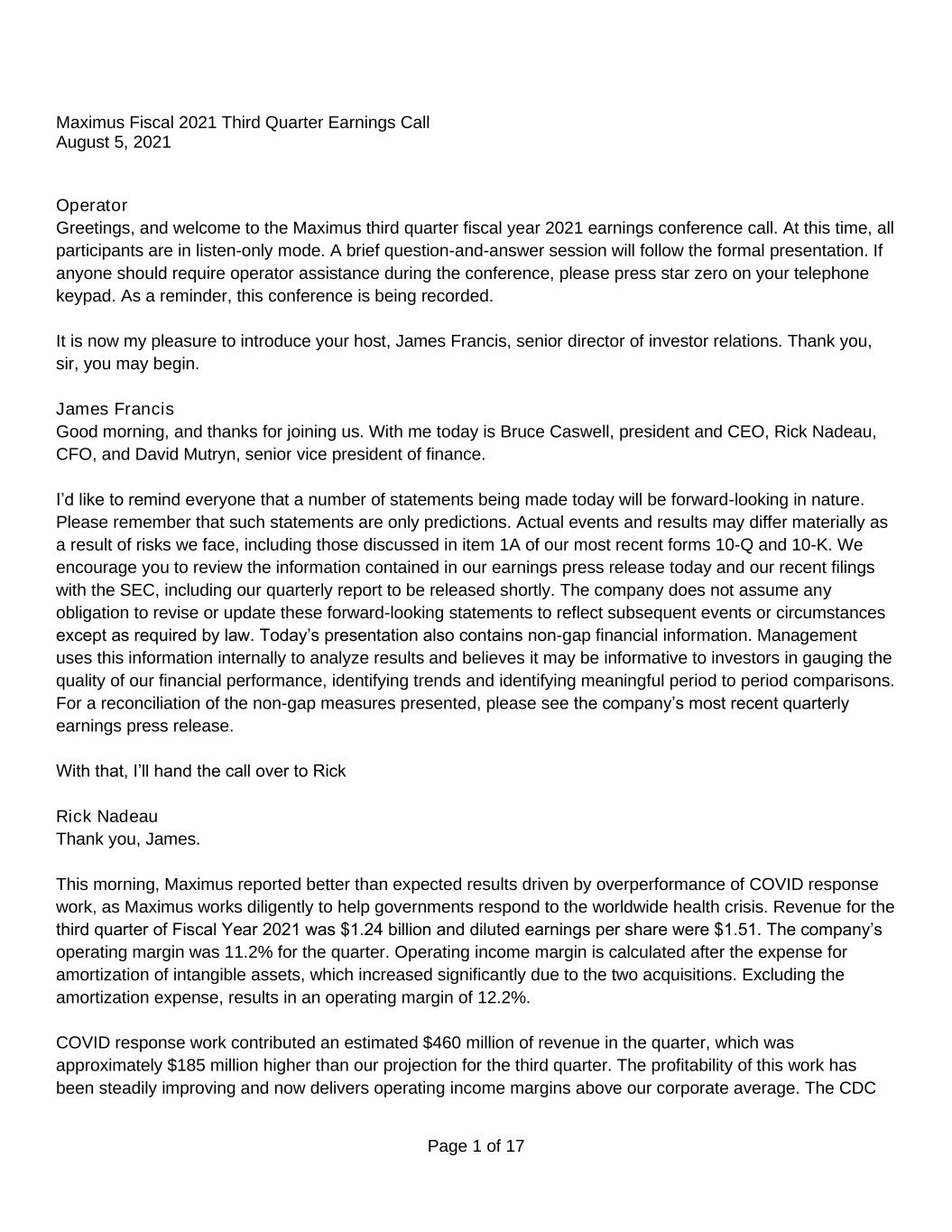
Maximus Fiscal 2021 Third Quarter Earnings Call August 5, 2021 Page 1 of 17 Operator Greetings, and welcome to the Maximus third quarter fiscal year 2021 earnings conference call. At this time, all participants are in listen-only mode. A brief question-and-answer session will follow the formal presentation. If anyone should require operator assistance during the conference, please press star zero on your telephone keypad. As a reminder, this conference is being recorded. It is now my pleasure to introduce your host, James Francis, senior director of investor relations. Thank you, sir, you may begin. James Francis Good morning, and thanks for joining us. With me today is Bruce Caswell, president and CEO, Rick Nadeau, CFO, and David Mutryn, senior vice president of finance. I’d like to remind everyone that a number of statements being made today will be forward-looking in nature. Please remember that such statements are only predictions. Actual events and results may differ materially as a result of risks we face, including those discussed in item 1A of our most recent forms 10-Q and 10-K. We encourage you to review the information contained in our earnings press release today and our recent filings with the SEC, including our quarterly report to be released shortly. The company does not assume any obligation to revise or update these forward-looking statements to reflect subsequent events or circumstances except as required by law. Today’s presentation also contains non-gap financial information. Management uses this information internally to analyze results and believes it may be informative to investors in gauging the quality of our financial performance, identifying trends and identifying meaningful period to period comparisons. For a reconciliation of the non-gap measures presented, please see the company’s most recent quarterly earnings press release. With that, I’ll hand the call over to Rick Rick Nadeau Thank you, James. This morning, Maximus reported better than expected results driven by overperformance of COVID response work, as Maximus works diligently to help governments respond to the worldwide health crisis. Revenue for the third quarter of Fiscal Year 2021 was $1.24 billion and diluted earnings per share were $1.51. The company’s operating margin was 11.2% for the quarter. Operating income margin is calculated after the expense for amortization of intangible assets, which increased significantly due to the two acquisitions. Excluding the amortization expense, results in an operating margin of 12.2%. COVID response work contributed an estimated $460 million of revenue in the quarter, which was approximately $185 million higher than our projection for the third quarter. The profitability of this work has been steadily improving and now delivers operating income margins above our corporate average. The CDC
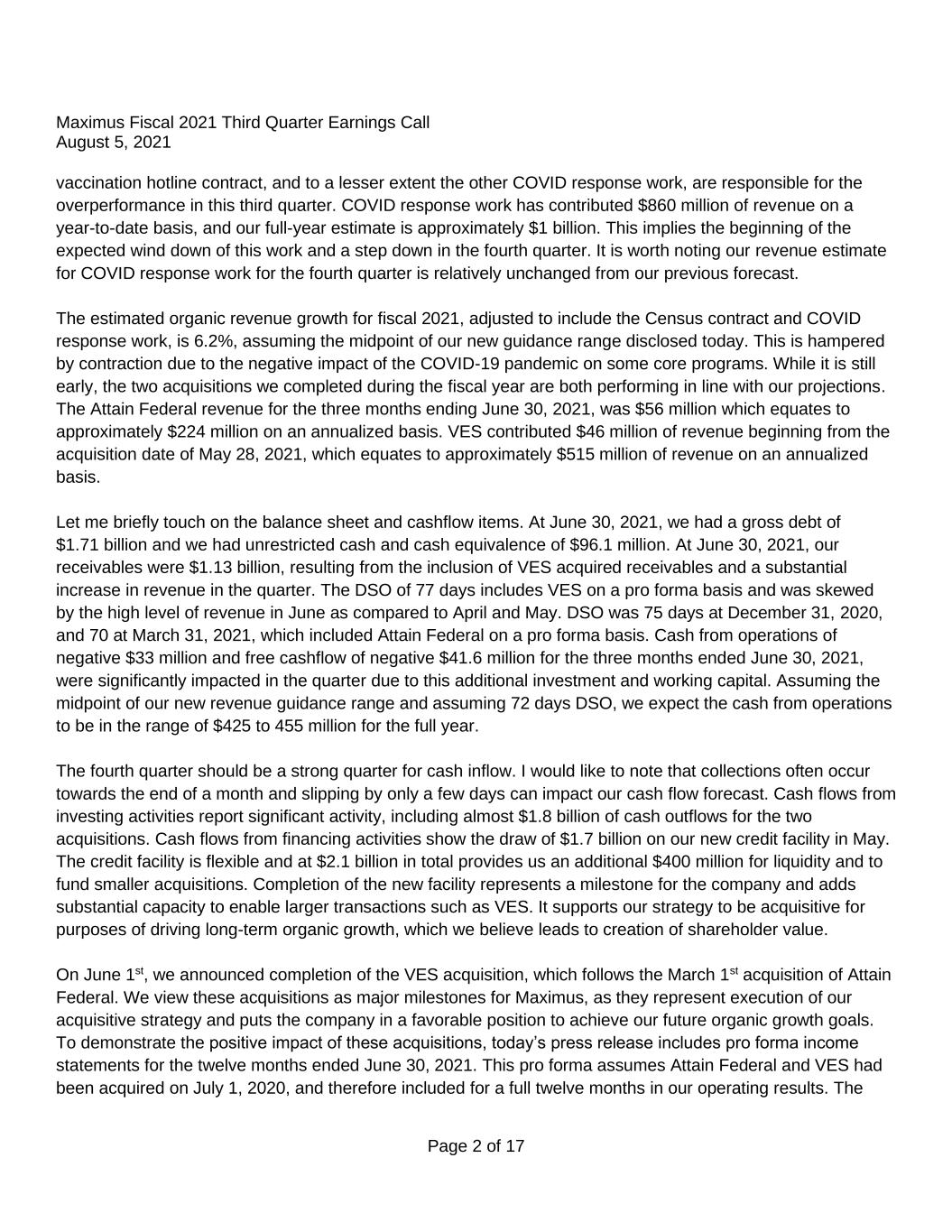
Maximus Fiscal 2021 Third Quarter Earnings Call August 5, 2021 Page 2 of 17 vaccination hotline contract, and to a lesser extent the other COVID response work, are responsible for the overperformance in this third quarter. COVID response work has contributed $860 million of revenue on a year-to-date basis, and our full-year estimate is approximately $1 billion. This implies the beginning of the expected wind down of this work and a step down in the fourth quarter. It is worth noting our revenue estimate for COVID response work for the fourth quarter is relatively unchanged from our previous forecast. The estimated organic revenue growth for fiscal 2021, adjusted to include the Census contract and COVID response work, is 6.2%, assuming the midpoint of our new guidance range disclosed today. This is hampered by contraction due to the negative impact of the COVID-19 pandemic on some core programs. While it is still early, the two acquisitions we completed during the fiscal year are both performing in line with our projections. The Attain Federal revenue for the three months ending June 30, 2021, was $56 million which equates to approximately $224 million on an annualized basis. VES contributed $46 million of revenue beginning from the acquisition date of May 28, 2021, which equates to approximately $515 million of revenue on an annualized basis. Let me briefly touch on the balance sheet and cashflow items. At June 30, 2021, we had a gross debt of $1.71 billion and we had unrestricted cash and cash equivalence of $96.1 million. At June 30, 2021, our receivables were $1.13 billion, resulting from the inclusion of VES acquired receivables and a substantial increase in revenue in the quarter. The DSO of 77 days includes VES on a pro forma basis and was skewed by the high level of revenue in June as compared to April and May. DSO was 75 days at December 31, 2020, and 70 at March 31, 2021, which included Attain Federal on a pro forma basis. Cash from operations of negative $33 million and free cashflow of negative $41.6 million for the three months ended June 30, 2021, were significantly impacted in the quarter due to this additional investment and working capital. Assuming the midpoint of our new revenue guidance range and assuming 72 days DSO, we expect the cash from operations to be in the range of $425 to 455 million for the full year. The fourth quarter should be a strong quarter for cash inflow. I would like to note that collections often occur towards the end of a month and slipping by only a few days can impact our cash flow forecast. Cash flows from investing activities report significant activity, including almost $1.8 billion of cash outflows for the two acquisitions. Cash flows from financing activities show the draw of $1.7 billion on our new credit facility in May. The credit facility is flexible and at $2.1 billion in total provides us an additional $400 million for liquidity and to fund smaller acquisitions. Completion of the new facility represents a milestone for the company and adds substantial capacity to enable larger transactions such as VES. It supports our strategy to be acquisitive for purposes of driving long-term organic growth, which we believe leads to creation of shareholder value. On June 1st, we announced completion of the VES acquisition, which follows the March 1st acquisition of Attain Federal. We view these acquisitions as major milestones for Maximus, as they represent execution of our acquisitive strategy and puts the company in a favorable position to achieve our future organic growth goals. To demonstrate the positive impact of these acquisitions, today’s press release includes pro forma income statements for the twelve months ended June 30, 2021. This pro forma assumes Attain Federal and VES had been acquired on July 1, 2020, and therefore included for a full twelve months in our operating results. The
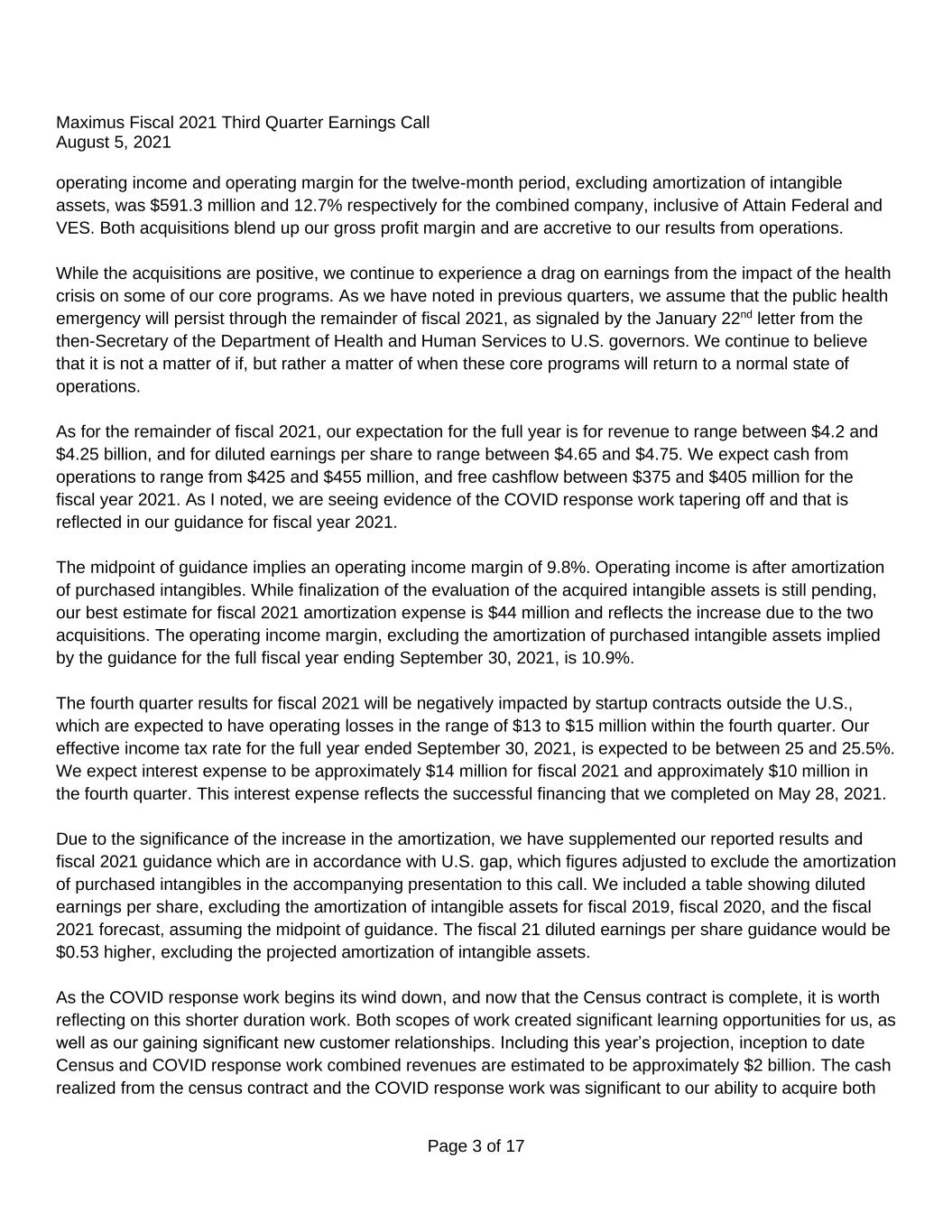
Maximus Fiscal 2021 Third Quarter Earnings Call August 5, 2021 Page 3 of 17 operating income and operating margin for the twelve-month period, excluding amortization of intangible assets, was $591.3 million and 12.7% respectively for the combined company, inclusive of Attain Federal and VES. Both acquisitions blend up our gross profit margin and are accretive to our results from operations. While the acquisitions are positive, we continue to experience a drag on earnings from the impact of the health crisis on some of our core programs. As we have noted in previous quarters, we assume that the public health emergency will persist through the remainder of fiscal 2021, as signaled by the January 22nd letter from the then-Secretary of the Department of Health and Human Services to U.S. governors. We continue to believe that it is not a matter of if, but rather a matter of when these core programs will return to a normal state of operations. As for the remainder of fiscal 2021, our expectation for the full year is for revenue to range between $4.2 and $4.25 billion, and for diluted earnings per share to range between $4.65 and $4.75. We expect cash from operations to range from $425 and $455 million, and free cashflow between $375 and $405 million for the fiscal year 2021. As I noted, we are seeing evidence of the COVID response work tapering off and that is reflected in our guidance for fiscal year 2021. The midpoint of guidance implies an operating income margin of 9.8%. Operating income is after amortization of purchased intangibles. While finalization of the evaluation of the acquired intangible assets is still pending, our best estimate for fiscal 2021 amortization expense is $44 million and reflects the increase due to the two acquisitions. The operating income margin, excluding the amortization of purchased intangible assets implied by the guidance for the full fiscal year ending September 30, 2021, is 10.9%. The fourth quarter results for fiscal 2021 will be negatively impacted by startup contracts outside the U.S., which are expected to have operating losses in the range of $13 to $15 million within the fourth quarter. Our effective income tax rate for the full year ended September 30, 2021, is expected to be between 25 and 25.5%. We expect interest expense to be approximately $14 million for fiscal 2021 and approximately $10 million in the fourth quarter. This interest expense reflects the successful financing that we completed on May 28, 2021. Due to the significance of the increase in the amortization, we have supplemented our reported results and fiscal 2021 guidance which are in accordance with U.S. gap, which figures adjusted to exclude the amortization of purchased intangibles in the accompanying presentation to this call. We included a table showing diluted earnings per share, excluding the amortization of intangible assets for fiscal 2019, fiscal 2020, and the fiscal 2021 forecast, assuming the midpoint of guidance. The fiscal 21 diluted earnings per share guidance would be $0.53 higher, excluding the projected amortization of intangible assets. As the COVID response work begins its wind down, and now that the Census contract is complete, it is worth reflecting on this shorter duration work. Both scopes of work created significant learning opportunities for us, as well as our gaining significant new customer relationships. Including this year’s projection, inception to date Census and COVID response work combined revenues are estimated to be approximately $2 billion. The cash realized from the census contract and the COVID response work was significant to our ability to acquire both
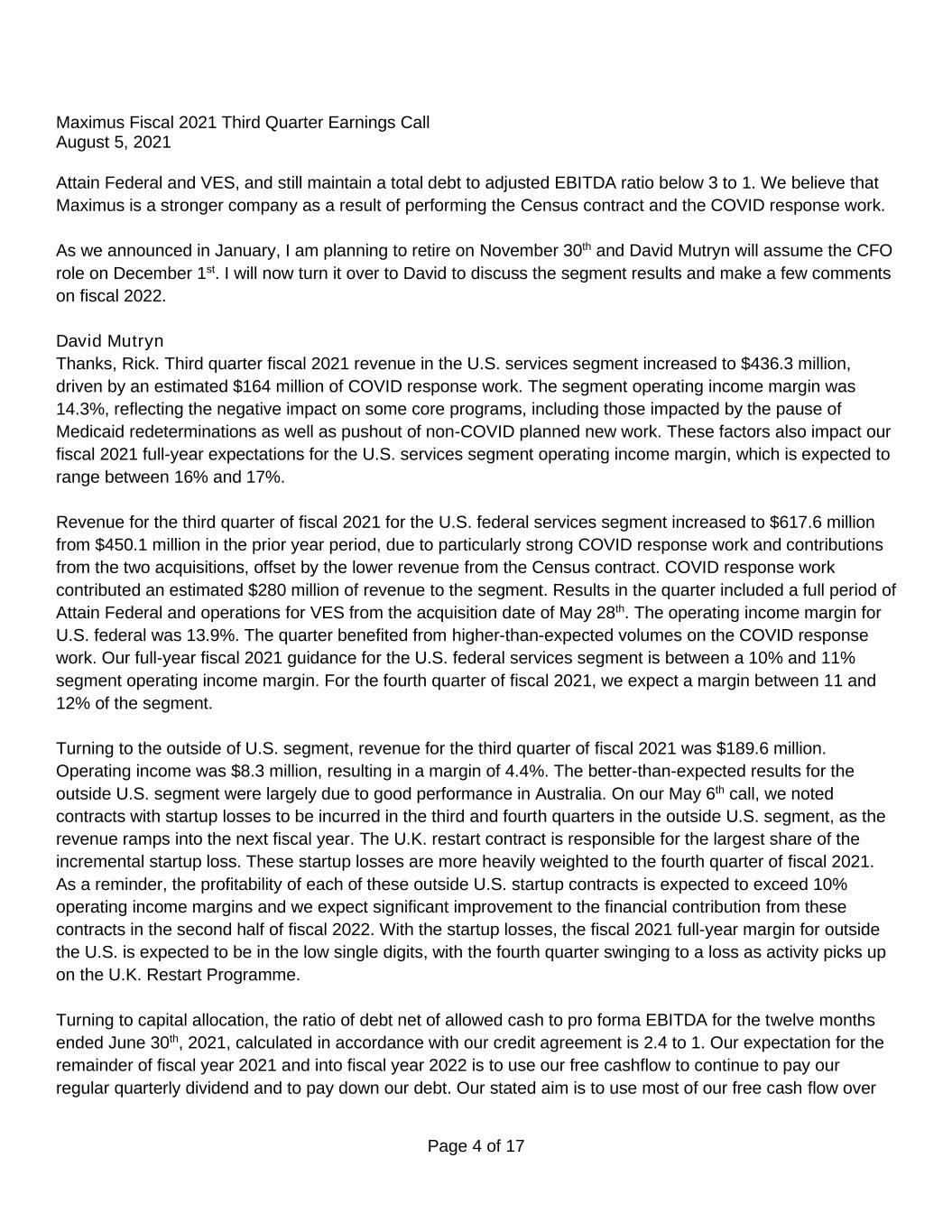
Maximus Fiscal 2021 Third Quarter Earnings Call August 5, 2021 Page 4 of 17 Attain Federal and VES, and still maintain a total debt to adjusted EBITDA ratio below 3 to 1. We believe that Maximus is a stronger company as a result of performing the Census contract and the COVID response work. As we announced in January, I am planning to retire on November 30th and David Mutryn will assume the CFO role on December 1st. I will now turn it over to David to discuss the segment results and make a few comments on fiscal 2022. David Mutryn Thanks, Rick. Third quarter fiscal 2021 revenue in the U.S. services segment increased to $436.3 million, driven by an estimated $164 million of COVID response work. The segment operating income margin was 14.3%, reflecting the negative impact on some core programs, including those impacted by the pause of Medicaid redeterminations as well as pushout of non-COVID planned new work. These factors also impact our fiscal 2021 full-year expectations for the U.S. services segment operating income margin, which is expected to range between 16% and 17%. Revenue for the third quarter of fiscal 2021 for the U.S. federal services segment increased to $617.6 million from $450.1 million in the prior year period, due to particularly strong COVID response work and contributions from the two acquisitions, offset by the lower revenue from the Census contract. COVID response work contributed an estimated $280 million of revenue to the segment. Results in the quarter included a full period of Attain Federal and operations for VES from the acquisition date of May 28th. The operating income margin for U.S. federal was 13.9%. The quarter benefited from higher-than-expected volumes on the COVID response work. Our full-year fiscal 2021 guidance for the U.S. federal services segment is between a 10% and 11% segment operating income margin. For the fourth quarter of fiscal 2021, we expect a margin between 11 and 12% of the segment. Turning to the outside of U.S. segment, revenue for the third quarter of fiscal 2021 was $189.6 million. Operating income was $8.3 million, resulting in a margin of 4.4%. The better-than-expected results for the outside U.S. segment were largely due to good performance in Australia. On our May 6th call, we noted contracts with startup losses to be incurred in the third and fourth quarters in the outside U.S. segment, as the revenue ramps into the next fiscal year. The U.K. restart contract is responsible for the largest share of the incremental startup loss. These startup losses are more heavily weighted to the fourth quarter of fiscal 2021. As a reminder, the profitability of each of these outside U.S. startup contracts is expected to exceed 10% operating income margins and we expect significant improvement to the financial contribution from these contracts in the second half of fiscal 2022. With the startup losses, the fiscal 2021 full-year margin for outside the U.S. is expected to be in the low single digits, with the fourth quarter swinging to a loss as activity picks up on the U.K. Restart Programme. Turning to capital allocation, the ratio of debt net of allowed cash to pro forma EBITDA for the twelve months ended June 30th, 2021, calculated in accordance with our credit agreement is 2.4 to 1. Our expectation for the remainder of fiscal year 2021 and into fiscal year 2022 is to use our free cashflow to continue to pay our regular quarterly dividend and to pay down our debt. Our stated aim is to use most of our free cash flow over
Maximus Fiscal 2021 Third Quarter Earnings Call August 5, 2021 Page 5 of 17 the next few quarters to push this ratio closer to 2 to 1. During this period, we will continue to search for and execute tuck-in transactions that are accretive, deliver good value, and have a strong potential to drive future organic growth. Longer term, we will continue to prioritize strategic acquisitions as our preferred use of capital. We are often asked to comment on our dividend policy. Our plan is to continue to pay a regular quarterly dividend that is fixed, regardless of short-term earnings fluctuations but increases over time as our earnings increase. We target a dividend yield between 1% and 2% of our stock price. Based on our stock price over the last several months, the current annual dividend of $1.12 per year has ranged between a 1.2 and 1.4% yield. This cash yield is consistent with the peer groups we study. Turning to fiscal 2022, I’d like to share some early thoughts that are shaping our thinking for next year. We remain in a period with higher than usual uncertainty due to the pandemic and several unknowns persist that we have already mentioned. On the plus side, we feel less uncertainty going into fiscal 2022 as compared to this time last year, which gives visibility to the following: Number one, we expect the acquired businesses of Attain Federal and VES to deliver approximately $750 million of revenue in fiscal 2022. This compares to $320 to 330 million forecasted for the two acquisitions in fiscal 2021. Number two, we currently expect the revenue in fiscal 2022 in COVID response work to be in the range of $150 to 200 million. This is an expected reduction of profitable work, which as Rick noted is now earning above our corporate average operating income margin. Number three, our expectation is that revenue from the startup contracts outside the U.S. will be at least $150 million higher in fiscal 2022 as compared to fiscal 2021. Number four, we expect amortization expense to be between $80 and $85 million. Number five, we expect interest expense to be between $30 and $33 million, and the effective income tax rate, assuming no change in U.S. federal rates, should be between 25 and 26%. Number six, finally, we anticipate that earnings are backloaded in fiscal 2022, with the first quarter expected to be the low point followed be sequential improvement. There are two reasons for this. First, we are seeing signs that some core programs which have been negatively impacted by the pandemic should see performance improvements between the first and second quarters. We expect the associated costs to be ramping up in the first quarter and the revenue to follow, which is typical with our contracts. Second, we expect the first quarter to be negatively impacted by the startup contracts outside the U.S. We currently expect these startup contracts to achieve break even in the first half of the year and to make strong contributions in the back half of the year, setting the outside the U.S. segment up for improved margins exiting the year.
Maximus Fiscal 2021 Third Quarter Earnings Call August 5, 2021 Page 6 of 17 Consistent with our past practice, we will provide guidance for fiscal year 2022 in November, including additional color around the quarterly profile. And with that, I will turn the call over to Bruce. Bruce Caswell Thank you, David, and good morning, everyone. As the Attain Federal and VES acquisitions settle into our business, we are in a solid position to execute on our long-term organic growth goals across all three segments. Our position is bolstered by the benefits and new capabilities of the two recent acquisitions and our teams unprecedented efforts throughout this past year which have deepened our relationships with key clients and brought new clients. With two months left to go in fiscal year 2021, it’s natural for us to be looking towards next year, when we expect to see not only macro trends bringing improvement to our core programs but also momentum through new programs such as the U.K. Restart, and additional clinical and digital IT services work afforded by Attain Federal and VES. Prior to VES, 15% of our work was clinical in nature, whereas it now accounts for approximately 25% of our portfolio. Further, the additional capabilities from Attain Federal meaningfully expand our technology consulting and growing systems integration skills, increasing our ability to address the most pressing IT needs of our federal clients while providing internal opportunities to improve the quality and efficiency of our business process services operations. I’m pleased that we’re already seeing the anticipated benefits of these acquisitions to the combined companies and to our clients. We are increasing the capacity of VES to deliver on the excess inventory reduction goals of the VA, while working to identify opportunities for greater process efficiencies through new digital solutions. As an example, we have already enhanced the VES contact center to increase capacity and improve veteran outreach and exam scheduling. Our Attain Federal colleagues are delivering on complex program challenges for critical clients while gaining the ability to bid on larger opportunities through newly available contract vehicles. As Maximus moves forward, program administration work, particularly the delivery of citizen services in an independent and conflict-free manner will continue to underpin our business. Over time, we anticipate technology playing a larger role in this area and the work continuing to evolve to include more clinical assessments and related services. Our maturing portfolio of digital solutions and increasing systems integration capabilities will enable us to make greater use of the data underlying our operations, provide improved decision support tools to our employees and enable a more seamless and high-quality customer experience. Looking at our segment profile in the wake of the recent acquisitions, U.S. federal services now delivers approximately half of our revenue. Through the team’s ongoing efforts, as well as the recent acquisitions, the platform capabilities are in place to further our long-term organic growth goals and advance our corporate strategy across all three segments. Our digital strategy started several years ago, with what has now become table stakes, including mobile applications, streamlining program application and enrollment, RPA automating
Maximus Fiscal 2021 Third Quarter Earnings Call August 5, 2021 Page 7 of 17 processes, and chat and text functions providing additional channels for citizen engagement. Maximus must scrutinize these capabilities and create a solid foundation upon which the next generation of solutions can be built. I am proud of our organization’s accomplishments in driving cost out of routine transactions and improving the quality and timeliness of our citizen services. However, we must constantly advance our skills and solutions to meet and exceed client expectations. Our previous technology investments, such as application in telephony cloud migration have created an infrastructure that enables a secure, hybrid work environment and delivers significant value to our clients, as demonstrated during the pandemic. Our platform provides Maximus and our clients more readily available access to valuable data and vast amounts of compute capacity. Through our current and planned investments in data governance, our rapid innovation and delivery methodology, and continued growth of digital competencies across the organization, we are well-positioned to deliver new solutions underpinned by AI and machine learning and leveraging other cognitive computing capabilities as part of the next phase of our digital strategy. Through this client-focused approach, we intend to provide even better decision support tools for our employees and lower costs, while accomplishing more complex transactions for citizens at scale. Serving as a platform upon which we will grow our federal IT services, Maximus Attain brings needed skills and experience, and enables us to systematize how we conduct digital projects. With the addition of Attain, we are driving a cultural shift toward thinking in a digital-first fashion moving forward. To give you more color on the increasing role of AI in our business, let me provide two examples that illustrate use cases focused on creating a better citizen experience and improving the digital support tools available to our clients and employees. Our speech analytics capabilities implemented within our California vaccine information line project, enable us to understand customer sentiment and improve call resolution, determine certain reasons for long silences that impact handle time and quality, and increase call deflection by assessing why individuals are calling, especially during a surge. Furthermore, our topic mining solution empowers our state clients to effectively disseminate critical public health information, a particularly important capability during the pandemic. At U.S. Citizenship and Immigration Services, or USCIS, the Maximus Attain team looked at how we could improve efficiency, implementing AI to automate routine tasks, enabling agency employees to focus on other critical work. This human-plus strategy augments individuals by driving automation, increasing efficiency, and supporting a better decision-making process. I’m also pleased to share the recent award of two modernization contracts from the Internal Revenue Service worth a combined $151 million, awarded on the GSA Alliant 2 contract vehicle. Our team’s efforts to support the agency’s modernization program have been expanded through the development infrastructure security and modernization or DISM contract with the technology integration office of the IRS. This office is responsible for all new technologies brought into the IRS. We have a longstanding relationship with the IRS which initially began in 1991 and are uniquely positioned to support the agency as they focus on modernization projects and build solutions to meet their mission critical needs. Our people have the knowledge and skills critical to the IRS
Maximus Fiscal 2021 Third Quarter Earnings Call August 5, 2021 Page 8 of 17 mission and have been proud to support their government counterpart’s achievements, particularly during the pandemic. Our clinical strategy concentrates on execution of the capabilities platforms that are now in place. As I mentioned, our immediate focus remains in support of VES, the VA, and the veterans we serve to increase capacity and address the excess examination inventory. As a result, we are still targeting the end of the calendar year and into early 2022 for integration to ensure no disruption in service. Meanwhile, we’re working closely with our team to identify and deliver streamlined processes and digital solutions which likely will draw in part on software development capabilities gained through Attain, an added benefit of these recent combinations. Outside the U.S., as Rick noted, our margin profile for Restart U.K. will improve over the next several quarters, with OUS startups collectively anticipated to achieve 10% or higher operating income margin over the life of the contracts and provide us at least $150 million of additional revenue in FY ’22. I’m also pleased to share that the Maximus UK team has received an extension on the Health Assessment Advisory Service contract through August 2023. In March of 2020, the Department of Work and Pensions halted all face-to-face assessments, resulting in reduced activity levels and financial performance. Since that time, the team has worked with the department to adapt, develop, and implement alternative services, including both telephone and video assessments. This approach has enabled us to provide support for thousands of customers, and we anticipate we will remain an element of program delivery going forward. Turning to new awards and pipeline as of June 30th, for the third quarter of fiscal year 2021, year to date signed awards were $3.2 billion of total contract value at June 30th. This includes the U.K. Restart award that we announced on April 26th and the CDC vaccination hotline award for which we have assumed a total $300 million contract value. Further at June 30th, there were another $1.38 billion of contracts that have been awarded but not yet signed. Let’s turn our attention to our pipeline of addressable sales opportunities. Our total contract pipeline at June 30th was $33.6 billion, compared to $35.6 billion reported in the second quarter of fiscal 2021. The June 30th pipeline is comprised of approximately $4.2 billion in proposals pending, $6.8 billion in proposals in preparation and $22.6 billion in opportunities tracking. Of the total pipeline, 63.6% represents new work opportunities. Approximately $1 billion of the pipeline reduction is due to the U.K. Restart Programme award, with the remainder largely a result of government delays or cancellation of work that pushes opportunities past the two-year horizon for pipeline reporting. We have observed that some of this delay is a residual effect of COVID-19 altering procurement priorities. As Rick noted, we primarily beat our revenue expectations as a result of higher than anticipated volumes on COVID-19 response work in the U.S. federal segment. Illustrating the capabilities we demonstrated during the pandemic, we quickly ramped up approximately 13,000 agents on one contract alone, which required initially hiring nearly 20,000 prospective staff. We saw our largest starting class ever on one day, comprising more than 12,500 remote agents as part of this effort. The cloud-based telephony infrastructure built and stress
Maximus Fiscal 2021 Third Quarter Earnings Call August 5, 2021 Page 9 of 17 tested for this same contract was among the largest ever constructed for government, capable of handling up to half a million calls per hour or 160 calls per second. Responding to the changing needs of our client, our team was able to rapidly scale down the operation as directed. The highly variable cost structure of our model coupled with an expansive labor supply chain enhanced through the Census contract and cloud-based technology gives us the opportunity to capitalize on sizable opportunities of a short-term nature without stranding capital assets when the programs wind down. As our results have demonstrated, this both underscores our value to governments in times of need and provides returns that can be invested towards longer-term growth objectives. The execution of our strategy is maturing, as Attain Federal and VES become more fully integrated into our business, and we work to leverage the platforms and capabilities they bring. This will complement the foundation we have built across clinical services and digital technologies previously, and our existing organic growth efforts. As Rick and I have cautioned this year, the COVID-19 work is tapering off quickly while with some exceptions like Australia, our core programs have not yet returned to their pre-pandemic activity levels. However, we expect these activities to ultimately return. We believe it’s a matter of timing and not a shift in long-term market characteristics. Indeed, the fundamental macro trends and long-term needs of governments worldwide that have supported our business for decades remain firmly in place. With the acquisitions we have completed, the agility we have demonstrated during COVID and the desirable financial attributes of our business model, we find ourselves well positioned to respond to these trends and meet the growing needs of our government clients. Finally, on behalf of the Maximus leadership team, Rick, David, and I would like to thank the tens of thousands of Maximus employees and contracted staff worldwide who have risen to the remarkable challenges during this period, who have recently joined through the acquisitions, and have collectively delivered the strong results that we’re able to report this morning. And with that, we will open the line for Q&A. Operator? Operator Thank you. We will now be conducting a question-and-answer session. If you would like to ask a question, please press star 1 on your telephone keypad. A confirmation tone will indicate your line is in the questioning queue. You may press star 2 if you’d like to remove your question from the queue. For participants using speaker equipment, it may be necessary to pick up your handset before pressing the star keys. One moment please while we poll for questions. Thank you. Our first question comes from the line of Charlie Strauzer with CJS Securities. Please proceed with your questions.
Maximus Fiscal 2021 Third Quarter Earnings Call August 5, 2021 Page 10 of 17 Brendan Popson Good morning, this is Brendan on for Charlie. Just wanted to ask first of all, you gave some thoughts on FY 2022 and I want to ask about organic growth for ’22, what base we’re working off of and then I guess the various levers to how you get to where you think growth will be. Bruce Caswell Great. Hey Brendan, it’s Bruce Caswell. David Mutryn is going to take that question. David Mutryn Yes, thanks, Brendan. Yes, we laid out plenty of pieces in the script, so let me look at one other way that we think about it. As you look at the chart in the presentation, you can see we’ve calculated an organic revenue base for FY ’21 of $2.819 billion. So, that would exclude the COVID response work, Census and the acquisitions. If you add $750 million for the acquisitions and $175 million for the midpoint of expected COVID work, that would total $3.744 billion. We took a look at the FY ’22 consensus, which is sitting at about $4.1 billion, which would imply we need approximately $360 million to fill in, which would require about 12% growth over that adjusted organic base. Since we expect to see at least $150 million of growth from outside the U.S. and we expect core program volumes to improve, all in all we think that’s a reasonable expectation. James Francies Thanks, Brendan. Next question, please. Operator Our next question comes from the line of Donald Hooker with KeyBanc Capital Markets. Please proceed with your question. Donald Hooker Great. I wanted to talk a little bit more and hear your perspective around the outside of the U.S. segment, kind of sensitivities around case volumes. I know there’s a lot of assumptions one would need to make there in terms of thinking about those contracts ramping and how much volume. Can you just maybe discuss that a little bit? Thanks. Bruce Caswell Yes, Don, it’s Bruce Caswell. I’d be happy to start, then ask that Rick or David could add further color. Probably the one that I would focus on in terms of OUS is the U.K. Restart contract because that’s the largest of the new startups. As we look at it, it’s a little deceptive in the sense that the unemployment rate in the U.K. is around 5% presently. You might say, well, they’re just getting the program going. Will there be adequate volumes in that program? So, to give you a little more color, there’s a furlough scheme that the U.K. government has implemented during the pandemic that basically keeps people employed. The furlough
Maximus Fiscal 2021 Third Quarter Earnings Call August 5, 2021 Page 11 of 17 payments enable employers to pass those payments along to their employees, as you’d imagine. So, they really don’t count as looking for work. That furlough scheme comes to an end on September 30th, and as all those folks start losing their furlough money, the unemployment rate will go up because they’re no longer considered, obviously, as they have been. And there will be an increase of jobseekers into the market. A couple other points. It’s a mandatory program, so that anybody who’s been claiming the benefits or is claiming benefits from government has to go through this program in order to avoid putting their benefits at risk. And we receive referrals exclusively from the U.K. Job Centre Plus offices. The analysis we have seen that the government did that underpins the procurement itself suggests that the eligible individuals that will be coming through those offices actually exceed the planned entrants under the program and the contract as it’s designed. They had an independent consultant do that work. We also, as you can imagine, did a lot of analysis before fitting the contract packages that we did and successfully won. Our analysis also suggested, and we looked at local labor market conditions, and job types by employer, and so on and so forth, and very highly localized economic analyses for our contract package areas. That supports also the assertion that there are adequate volumes coming into the program to meet the financial objectives. The last point that I would make is that this is a different contract than earlier contracts in the U.K. The DWP was very focused on value for money and ensuring that the participant vendors in the program or companies like Maximus could have returns that exceed their cost of operations. The structure is similar in the sense that there are fixed and variable costs in the cost recovery scheme, and it’s a performance-based outcomes program. But there’s definitely improved protection to margin erosion that we would have seen perhaps on earlier U.K. employment services contracts. So, if we take that all together, we feel confident in, if you will, the profile of how the OUS major startup programs including Restart in particular, since it’s the largest, will perform as we turn the corner into the next fiscal year. With that, Rick is going to add a little bit more. Rick Nadeau Yes, just to reinforce that you’re correct, that is an outcomes-based contract and the U.K. is the biggest piece of it. I also wanted to make sure that you remember that we did those contracts to provide more than a 10% operating income margin over the life of the contract, so they will be more backloaded on the contract life but they will also create a backloading in FY ’22. The back half of the year will definitely be improved by the maturity of those programs outside the U.S. Thanks, Don. Do you have a follow-up? Donald Hooker Yes, can I ask one more, if you don’t mind? One of the things I’m trying to understand is the Biden Administration’s been pretty aggressively encouraging people to go on these exchanges. I would think that’s
Maximus Fiscal 2021 Third Quarter Earnings Call August 5, 2021 Page 12 of 17 positive for you and I think I would see that in your numbers but maybe it’s not? Can you kind of walk through how you guys work with these exchanges? Obviously, it’s federal and state. Bruce Caswell Sure, Don, happy to do that. So, we have two roles, as you well know. We support the federal marketplace through the CCO contract that you’re familiar with, and that’s roughly now 37 or 36 states that remain on the federal marketplace, because there have been some states that have been moving to state-based exchanges. That’s also been positive for us as well, as we’ve picked up work in New Jersey and most recently in Maine, working with those states to implement their exchanges. There are others in the pipeline. It’s well known that Virginia is considering and will be moving to a state-based exchange as well. We have our legacy state-based exchange contracts in large states including New York and others, right, that you’re familiar with. So, a couple things. First of all, I think there was a reasonable uptick in exchange enrollments corresponding to the extended special enrollment period which I believe was January 15th through May 15th of this year. Some numbers would suggest there were about 2 million additional Americans that enrolled during that period. Those volumes would be baked into our numbers. They’re spread out significantly, but we were able to accommodate that within the staffing profile, particularly on our large federal contract. I think what starts to get more interesting are two things. The Biden Administration has come out with a proposed rule that still has to go through the regulatory process that would further encourage and create an environment where more individuals can get into exchange benefit plans over time. The reason they’re focused on this is, as redeterminations come back in for Medicaid, there’s a concern that you could have as many as 10 million Americans--because Medicaid enrollments themselves were up close to 10 million during the pandemic period. So, you could have a lot of people that now that they’re getting back into jobs, depending on their income levels, may no longer qualify for Medicaid but need some type of health benefit coverage. I think it was on July 22nd that CMS Administrator Chiquita Brooks-Lasure spoke at Georgetown University and talked about how CMS is extremely focused on ensuring that people don’t have a benefit clip. When redeterminations begin again, they need to get into the exchanges. So, there’s a pending rule making that would create a special enrollment period each month, particularly for individuals with low income and also, the Biden Administration’s probably worked through executive orders and through proposed rulemaking is finding ways to, for example, decrease the amount of out-of-pocket costs for individuals buying coverage on the exchanges and so forth. So, I think that we have yet to see, honestly, the effect on the exchanges of those dynamics and that is something we’d likely see more in the first and second quarter of next year as the redeterminations begin again and as we start to exit the public health emergency, and individuals need to replace their current coverage with new coverage, in many cases advanced premium tax credit or subsidized exchange coverage. So, I hope that helps in terms of the dynamics, Don.
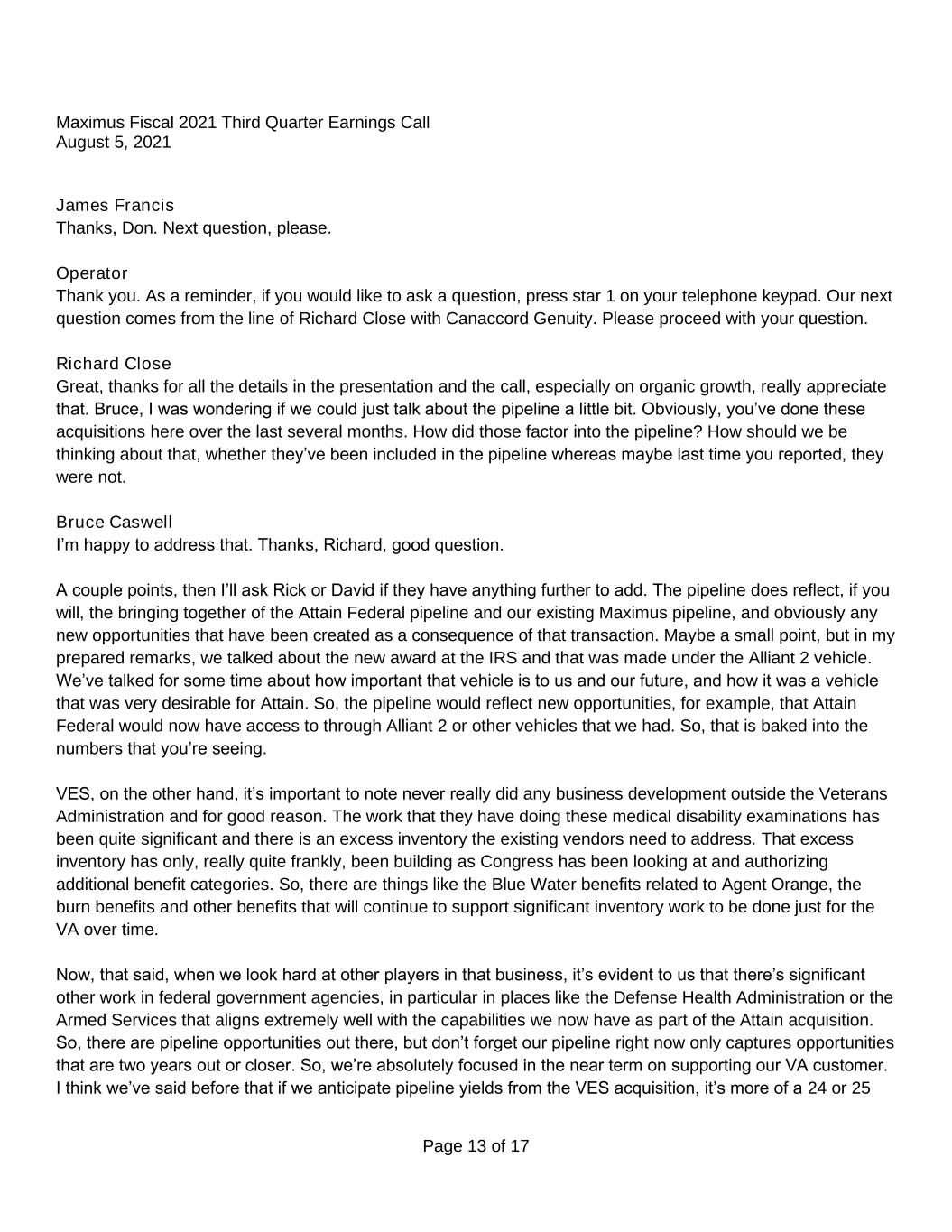
Maximus Fiscal 2021 Third Quarter Earnings Call August 5, 2021 Page 13 of 17 James Francis Thanks, Don. Next question, please. Operator Thank you. As a reminder, if you would like to ask a question, press star 1 on your telephone keypad. Our next question comes from the line of Richard Close with Canaccord Genuity. Please proceed with your question. Richard Close Great, thanks for all the details in the presentation and the call, especially on organic growth, really appreciate that. Bruce, I was wondering if we could just talk about the pipeline a little bit. Obviously, you’ve done these acquisitions here over the last several months. How did those factor into the pipeline? How should we be thinking about that, whether they’ve been included in the pipeline whereas maybe last time you reported, they were not. Bruce Caswell I’m happy to address that. Thanks, Richard, good question. A couple points, then I’ll ask Rick or David if they have anything further to add. The pipeline does reflect, if you will, the bringing together of the Attain Federal pipeline and our existing Maximus pipeline, and obviously any new opportunities that have been created as a consequence of that transaction. Maybe a small point, but in my prepared remarks, we talked about the new award at the IRS and that was made under the Alliant 2 vehicle. We’ve talked for some time about how important that vehicle is to us and our future, and how it was a vehicle that was very desirable for Attain. So, the pipeline would reflect new opportunities, for example, that Attain Federal would now have access to through Alliant 2 or other vehicles that we had. So, that is baked into the numbers that you’re seeing. VES, on the other hand, it’s important to note never really did any business development outside the Veterans Administration and for good reason. The work that they have doing these medical disability examinations has been quite significant and there is an excess inventory the existing vendors need to address. That excess inventory has only, really quite frankly, been building as Congress has been looking at and authorizing additional benefit categories. So, there are things like the Blue Water benefits related to Agent Orange, the burn benefits and other benefits that will continue to support significant inventory work to be done just for the VA over time. Now, that said, when we look hard at other players in that business, it’s evident to us that there’s significant other work in federal government agencies, in particular in places like the Defense Health Administration or the Armed Services that aligns extremely well with the capabilities we now have as part of the Attain acquisition. So, there are pipeline opportunities out there, but don’t forget our pipeline right now only captures opportunities that are two years out or closer. So, we’re absolutely focused in the near term on supporting our VA customer. I think we’ve said before that if we anticipate pipeline yields from the VES acquisition, it’s more of a 24 or 25
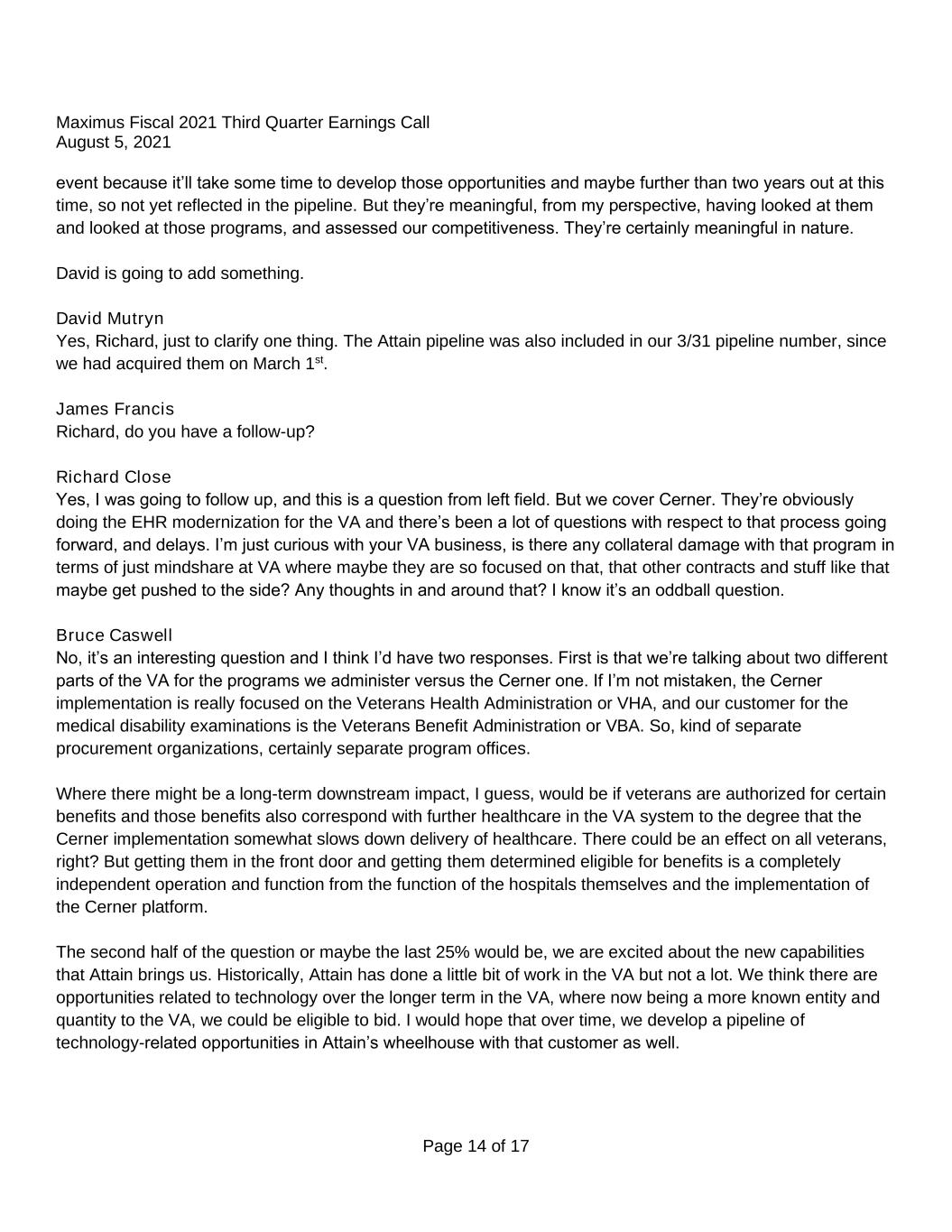
Maximus Fiscal 2021 Third Quarter Earnings Call August 5, 2021 Page 14 of 17 event because it’ll take some time to develop those opportunities and maybe further than two years out at this time, so not yet reflected in the pipeline. But they’re meaningful, from my perspective, having looked at them and looked at those programs, and assessed our competitiveness. They’re certainly meaningful in nature. David is going to add something. David Mutryn Yes, Richard, just to clarify one thing. The Attain pipeline was also included in our 3/31 pipeline number, since we had acquired them on March 1st. James Francis Richard, do you have a follow-up? Richard Close Yes, I was going to follow up, and this is a question from left field. But we cover Cerner. They’re obviously doing the EHR modernization for the VA and there’s been a lot of questions with respect to that process going forward, and delays. I’m just curious with your VA business, is there any collateral damage with that program in terms of just mindshare at VA where maybe they are so focused on that, that other contracts and stuff like that maybe get pushed to the side? Any thoughts in and around that? I know it’s an oddball question. Bruce Caswell No, it’s an interesting question and I think I’d have two responses. First is that we’re talking about two different parts of the VA for the programs we administer versus the Cerner one. If I’m not mistaken, the Cerner implementation is really focused on the Veterans Health Administration or VHA, and our customer for the medical disability examinations is the Veterans Benefit Administration or VBA. So, kind of separate procurement organizations, certainly separate program offices. Where there might be a long-term downstream impact, I guess, would be if veterans are authorized for certain benefits and those benefits also correspond with further healthcare in the VA system to the degree that the Cerner implementation somewhat slows down delivery of healthcare. There could be an effect on all veterans, right? But getting them in the front door and getting them determined eligible for benefits is a completely independent operation and function from the function of the hospitals themselves and the implementation of the Cerner platform. The second half of the question or maybe the last 25% would be, we are excited about the new capabilities that Attain brings us. Historically, Attain has done a little bit of work in the VA but not a lot. We think there are opportunities related to technology over the longer term in the VA, where now being a more known entity and quantity to the VA, we could be eligible to bid. I would hope that over time, we develop a pipeline of technology-related opportunities in Attain’s wheelhouse with that customer as well.
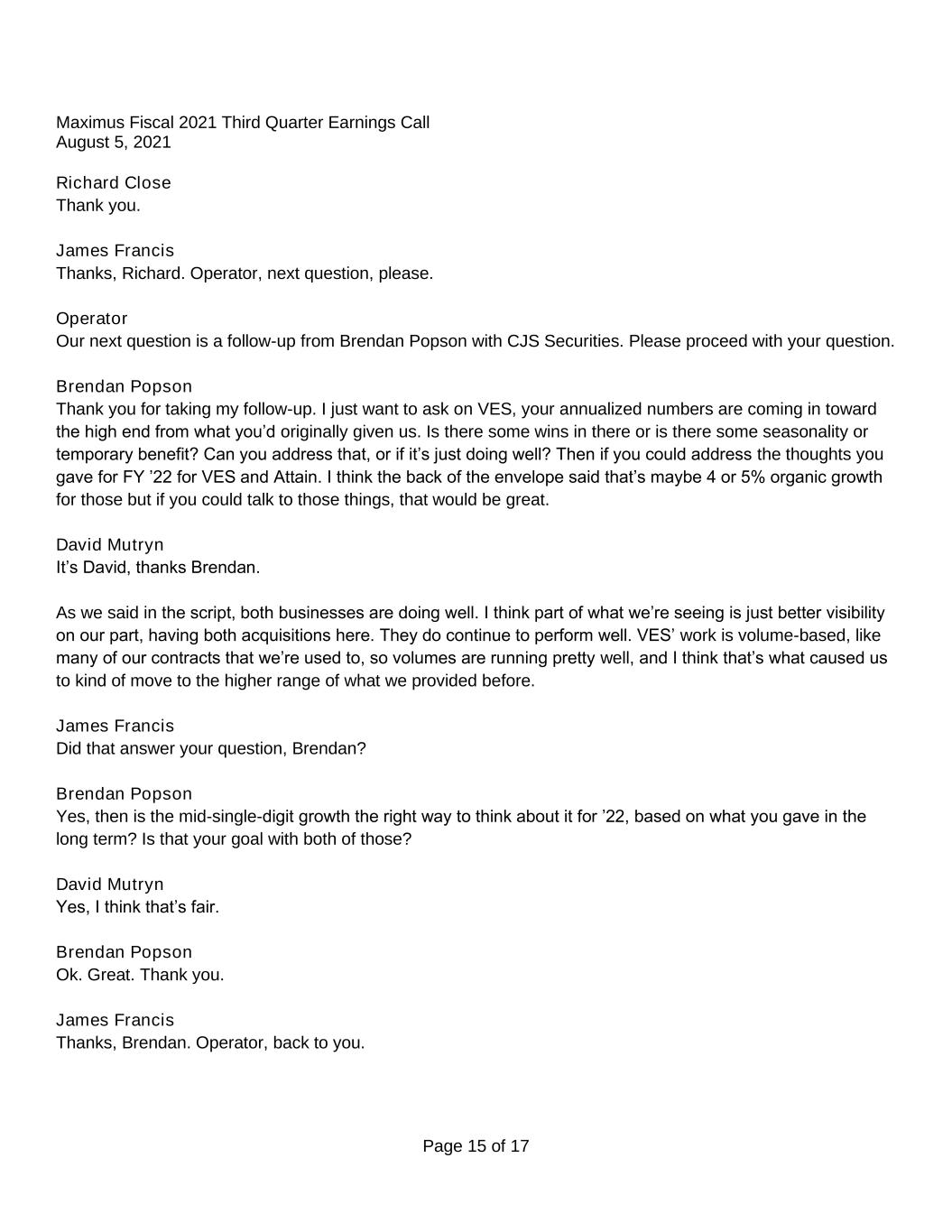
Maximus Fiscal 2021 Third Quarter Earnings Call August 5, 2021 Page 15 of 17 Richard Close Thank you. James Francis Thanks, Richard. Operator, next question, please. Operator Our next question is a follow-up from Brendan Popson with CJS Securities. Please proceed with your question. Brendan Popson Thank you for taking my follow-up. I just want to ask on VES, your annualized numbers are coming in toward the high end from what you’d originally given us. Is there some wins in there or is there some seasonality or temporary benefit? Can you address that, or if it’s just doing well? Then if you could address the thoughts you gave for FY ’22 for VES and Attain. I think the back of the envelope said that’s maybe 4 or 5% organic growth for those but if you could talk to those things, that would be great. David Mutryn It’s David, thanks Brendan. As we said in the script, both businesses are doing well. I think part of what we’re seeing is just better visibility on our part, having both acquisitions here. They do continue to perform well. VES’ work is volume-based, like many of our contracts that we’re used to, so volumes are running pretty well, and I think that’s what caused us to kind of move to the higher range of what we provided before. James Francis Did that answer your question, Brendan? Brendan Popson Yes, then is the mid-single-digit growth the right way to think about it for ’22, based on what you gave in the long term? Is that your goal with both of those? David Mutryn Yes, I think that’s fair. Brendan Popson Ok. Great. Thank you. James Francis Thanks, Brendan. Operator, back to you.
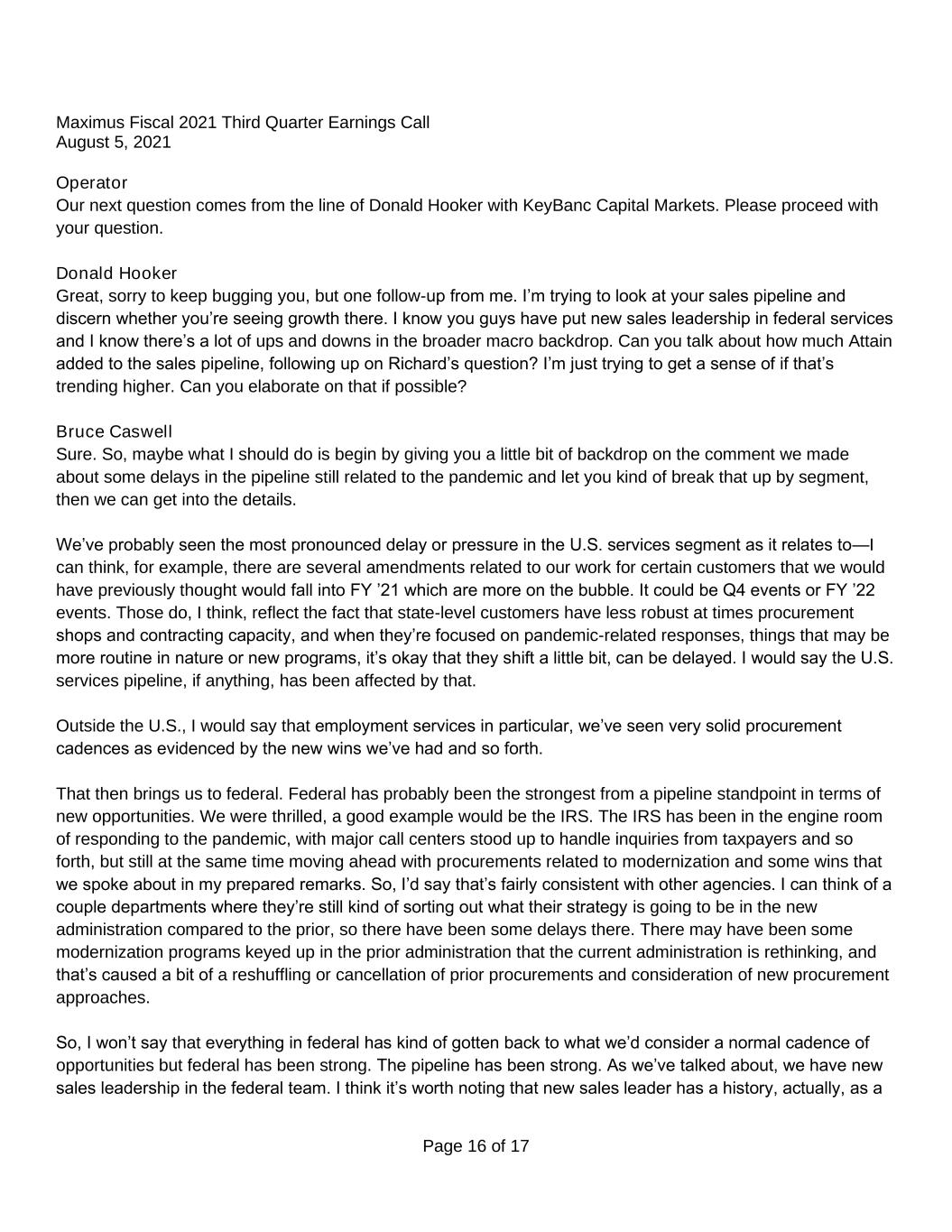
Maximus Fiscal 2021 Third Quarter Earnings Call August 5, 2021 Page 16 of 17 Operator Our next question comes from the line of Donald Hooker with KeyBanc Capital Markets. Please proceed with your question. Donald Hooker Great, sorry to keep bugging you, but one follow-up from me. I’m trying to look at your sales pipeline and discern whether you’re seeing growth there. I know you guys have put new sales leadership in federal services and I know there’s a lot of ups and downs in the broader macro backdrop. Can you talk about how much Attain added to the sales pipeline, following up on Richard’s question? I’m just trying to get a sense of if that’s trending higher. Can you elaborate on that if possible? Bruce Caswell Sure. So, maybe what I should do is begin by giving you a little bit of backdrop on the comment we made about some delays in the pipeline still related to the pandemic and let you kind of break that up by segment, then we can get into the details. We’ve probably seen the most pronounced delay or pressure in the U.S. services segment as it relates to—I can think, for example, there are several amendments related to our work for certain customers that we would have previously thought would fall into FY ’21 which are more on the bubble. It could be Q4 events or FY ’22 events. Those do, I think, reflect the fact that state-level customers have less robust at times procurement shops and contracting capacity, and when they’re focused on pandemic-related responses, things that may be more routine in nature or new programs, it’s okay that they shift a little bit, can be delayed. I would say the U.S. services pipeline, if anything, has been affected by that. Outside the U.S., I would say that employment services in particular, we’ve seen very solid procurement cadences as evidenced by the new wins we’ve had and so forth. That then brings us to federal. Federal has probably been the strongest from a pipeline standpoint in terms of new opportunities. We were thrilled, a good example would be the IRS. The IRS has been in the engine room of responding to the pandemic, with major call centers stood up to handle inquiries from taxpayers and so forth, but still at the same time moving ahead with procurements related to modernization and some wins that we spoke about in my prepared remarks. So, I’d say that’s fairly consistent with other agencies. I can think of a couple departments where they’re still kind of sorting out what their strategy is going to be in the new administration compared to the prior, so there have been some delays there. There may have been some modernization programs keyed up in the prior administration that the current administration is rethinking, and that’s caused a bit of a reshuffling or cancellation of prior procurements and consideration of new procurement approaches. So, I won’t say that everything in federal has kind of gotten back to what we’d consider a normal cadence of opportunities but federal has been strong. The pipeline has been strong. As we’ve talked about, we have new sales leadership in the federal team. I think it’s worth noting that new sales leader has a history, actually, as a
Maximus Fiscal 2021 Third Quarter Earnings Call August 5, 2021 Page 17 of 17 chief information officer in the federal government very connected to the customers and was one of the very senior leaders that came over as part of the Attain Federal acquisition. If anything, that should send a signal in terms of where we feel quite optimistic about the growth trajectory of the business going forward. So, as a result, while we haven’t broken out the Attain Federal contribution to the pipeline specifically, I think the point is, we feel that we’re at a period of pivot and we have some momentum moving into this new area of digital IT services, consulting and application development, really the beginning of systems integration competencies. We’re trying to energize that with the sales leadership and sales team in the organization. So, I think the contributions from Attain to the pipeline over time will only be growing. If you were to look at that, I’ll just conclude by saying against publicly available data from Bloomberg and other sources, we’ve said many times that we want to be in the fast-moving current of an otherwise gradually moving river. That area of IT services, consulting and application modernization is the fastest-growing segment of the federal marketplace. That’s how we’re poised to address it. James Francis Did that help, Don? Donald Hooker Yes, thank you. James Francis Great. Operator, back to you. Operator Thank you, ladies and gentlemen. We have reached the end of the question-and-answer session and with that, the conclusion of today’s call. You may disconnect your lines at this time. Thank you for your participation and have a wonderful day.

1 | Maximus: Q3 FY20 Earnings Presentation Rick Nadeau Chief Financial Officer David Mutryn Senior VP of Finance Fiscal 2021 Third Quarter Earnings Call August 5, 2021
2 | Maximus: Q3 FY21 Earnings Presentation These slides should be read in conjunction with the Company’s most recent quarterly earnings press release, along with listening to or reading a transcript of the comments of Company management from our most recent quarterly earnings conference call. This document may contain non-GAAP financial information. Management uses this information in its internal analysis of results and believes that this information may be informative to investors in gauging the quality of our financial performance, identifying trends in our results, and providing meaningful period-to-period comparisons. These measures should be used in conjunction with, rather than instead of, their comparable GAAP measures. For a reconciliation of non-GAAP measures to the comparable GAAP measures presented in this document, see the Company’s most recent quarterly earnings press release. Throughout this presentation, numbers may not add due to rounding. Included in this presentation are forward-looking statements within the meaning of the safe harbor provisions of the United States Private Securities Litigation Reform Act of 1995. Forward-looking statements can be identified by words such as: “anticipate,” “intend,” “plan,” “goal,” “seek,” “opportunity,” “could,” “potential,” “believe,” “project,” “estimate,” “expect,” “strategy,” “future,” “likely,” “may,” “should,” “will” and similar references to future periods. Forward-looking statements that are not historical facts, including statements about our confidence, strategies and initiatives and our expectations about revenues, results of operations, profitability, liquidity, market demand or the impact of the pandemic are forward-looking statements that involve risks and uncertainties such as those related to the impact of the pandemic and our recently-completed acquisitions are summarized in our 10-Q. These risks could cause the Company’s actual results to differ materially from those indicated by such forward-looking statements. A summary of risk factors can be found in Item 1A, "Risk Factors" in our Annual Report on Form 10-K for the year ended September 30, 2020, which was filed with the Securities and Exchange Commission (SEC) on November 19, 2020. A supplemental description of risk factors related to the Company's completed acquisition of the Federal business of Attain and proposed acquisition of VES are included in our Quarterly Report on Form 10-Q for the quarter ended June 30, 2021, to be filed shortly. The Company's SEC reports are accessible on maximus.com. Any forward-looking statement made by us in this report is based only on information currently available to us and speaks only as of the date on which it is made. We undertake no obligation to publicly update any forward-looking statement, whether written or oral, that may be made from time to time, whether as a result of new information, future developments or otherwise. Forward-looking Statements & Non-GAAP Information
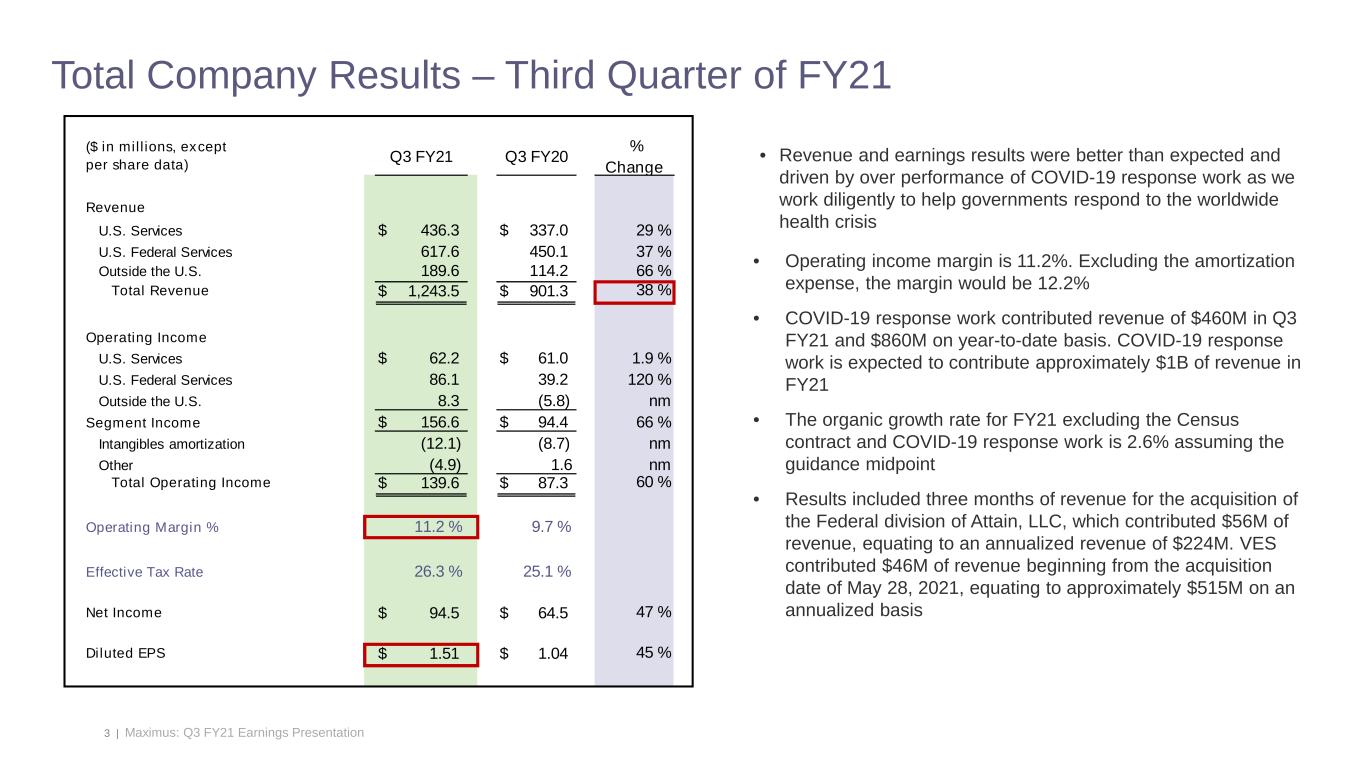
3 | Maximus: Q3 FY21 Earnings Presentation Total Company Results – Third Quarter of FY21 • Revenue and earnings results were better than expected and driven by over performance of COVID-19 response work as we work diligently to help governments respond to the worldwide health crisis • Operating income margin is 11.2%. Excluding the amortization expense, the margin would be 12.2% • COVID-19 response work contributed revenue of $460M in Q3 FY21 and $860M on year-to-date basis. COVID-19 response work is expected to contribute approximately $1B of revenue in FY21 • The organic growth rate for FY21 excluding the Census contract and COVID-19 response work is 2.6% assuming the guidance midpoint • Results included three months of revenue for the acquisition of the Federal division of Attain, LLC, which contributed $56M of revenue, equating to an annualized revenue of $224M. VES contributed $46M of revenue beginning from the acquisition date of May 28, 2021, equating to approximately $515M on an annualized basis ($ in millions, except per share data) Q3 FY21 Q3 FY20 % Change Revenue U.S. Services $ 436.3 $ 337.0 29 % U.S. Federal Services 617.6 450.1 37 % Outside the U.S. 189.6 114.2 66 % Total Revenue $ 1,243.5 $ 901.3 38 % Operating Income U.S. Services $ 62.2 $ 61.0 1.9 % U.S. Federal Services 86.1 39.2 120 % Outside the U.S. 8.3 (5.8) nm Segment Income $ 156.6 $ 94.4 66 % Intangibles amortization (12.1) (8.7) nm Other (4.9) 1.6 nm Total Operating Income $ 139.6 $ 87.3 60 % Operating Margin % 11.2 % 9.7 % Effective Tax Rate 26.3 % 25.1 % Net Income $ 94.5 $ 64.5 47 % Diluted EPS $ 1.51 $ 1.04 45 %
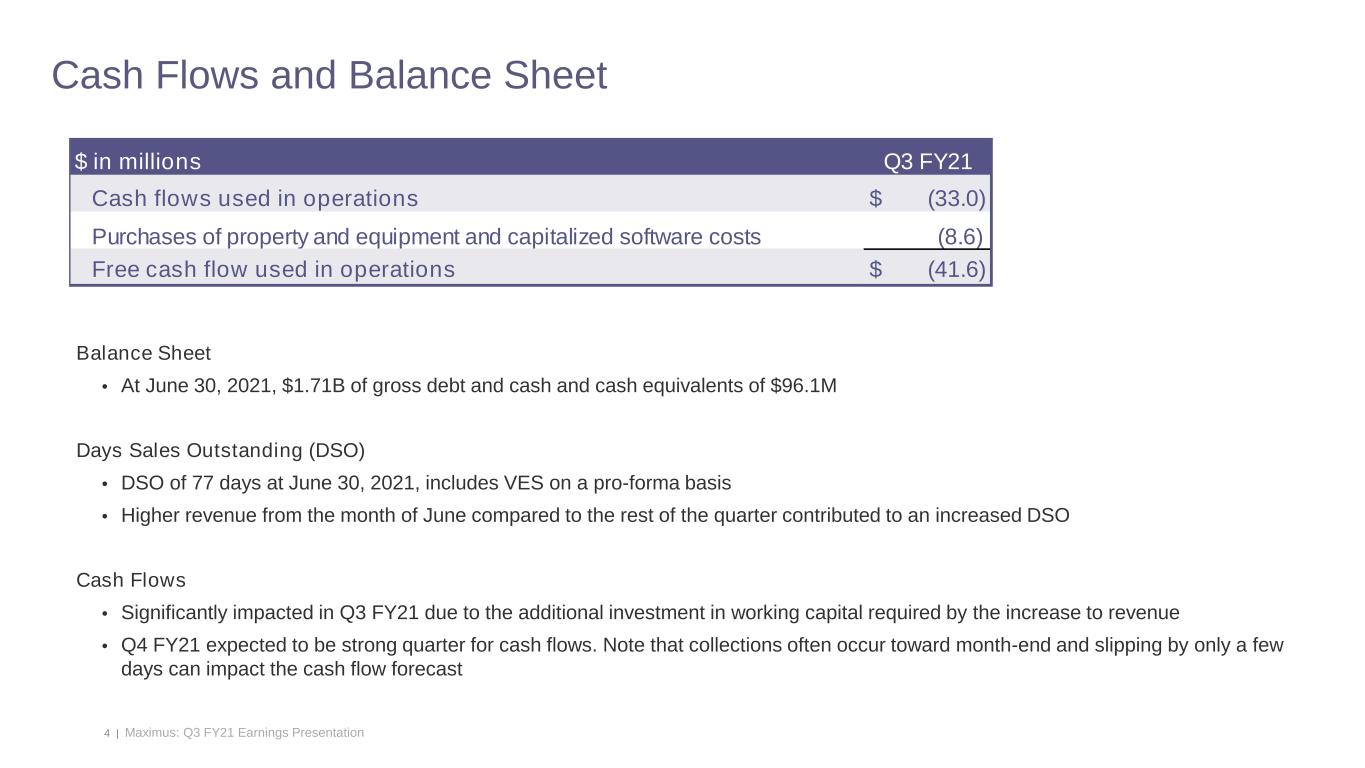
4 | Maximus: Q3 FY21 Earnings Presentation Balance Sheet • At June 30, 2021, $1.71B of gross debt and cash and cash equivalents of $96.1M Days Sales Outstanding (DSO) • DSO of 77 days at June 30, 2021, includes VES on a pro-forma basis • Higher revenue from the month of June compared to the rest of the quarter contributed to an increased DSO Cash Flows • Significantly impacted in Q3 FY21 due to the additional investment in working capital required by the increase to revenue • Q4 FY21 expected to be strong quarter for cash flows. Note that collections often occur toward month-end and slipping by only a few days can impact the cash flow forecast Cash Flows and Balance Sheet $ in millions Q3 FY21 Cash flows used in operations $ (33.0) Purchases of property and equipment and capitalized software costs (8.6) Free cash flow used in operations $ (41.6)
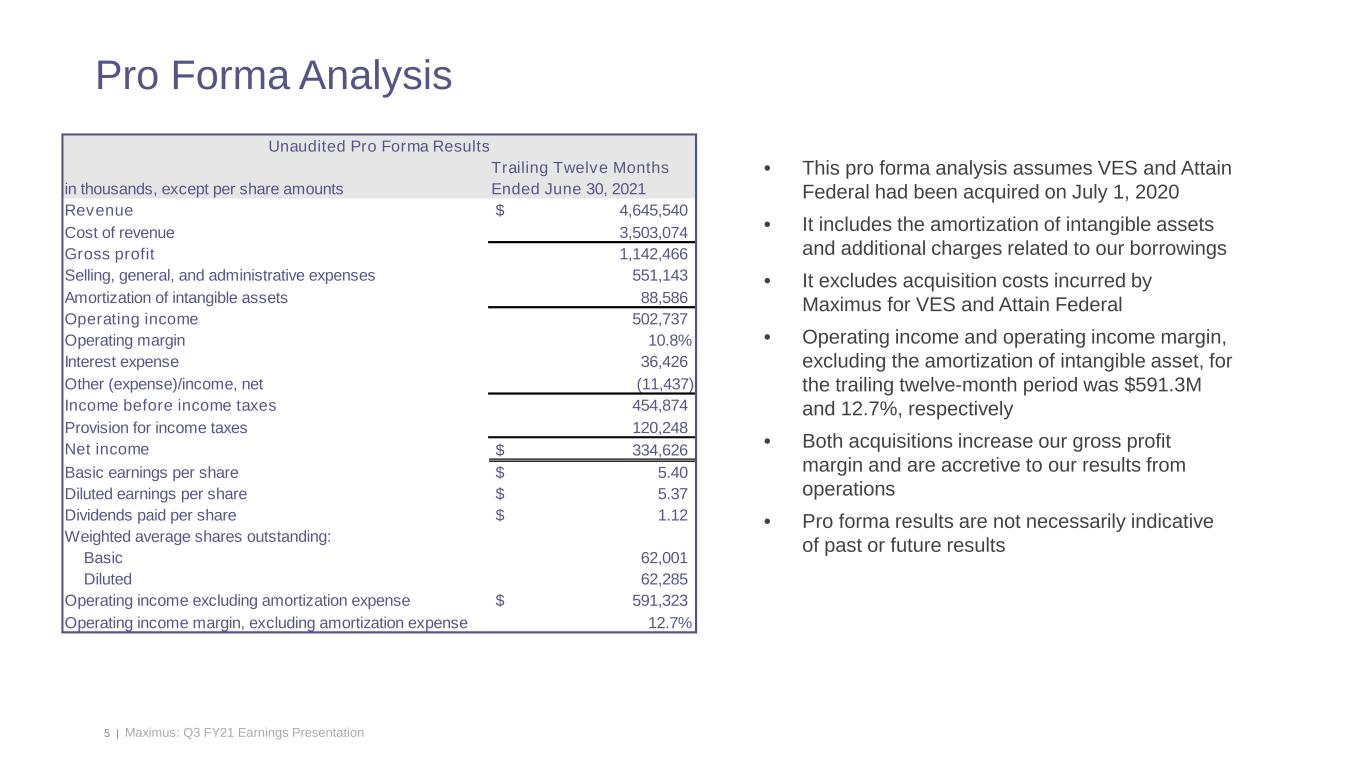
5 | Maximus: Q3 FY21 Earnings Presentation • This pro forma analysis assumes VES and Attain Federal had been acquired on July 1, 2020 • It includes the amortization of intangible assets and additional charges related to our borrowings • It excludes acquisition costs incurred by Maximus for VES and Attain Federal • Operating income and operating income margin, excluding the amortization of intangible asset, for the trailing twelve-month period was $591.3M and 12.7%, respectively • Both acquisitions increase our gross profit margin and are accretive to our results from operations • Pro forma results are not necessarily indicative of past or future results Pro Forma Analysis in thousands, except per share amounts Trailing Twelve Months Ended June 30, 2021 Revenue $ 4,645,540 Cost of revenue 3,503,074 Gross profit 1,142,466 Selling, general, and administrative expenses 551,143 Amortization of intangible assets 88,586 Operating income 502,737 Operating margin 10.8% Interest expense 36,426 Other (expense)/income, net (11,437) Income before income taxes 454,874 Provision for income taxes 120,248 Net income $ 334,626 Basic earnings per share $ 5.40 Diluted earnings per share $ 5.37 Dividends paid per share $ 1.12 Weighted average shares outstanding: Basic 62,001 Diluted 62,285 Operating income excluding amortization expense $ 591,323 Operating income margin, excluding amortization expense 12.7% Unaudited Pro Forma Results
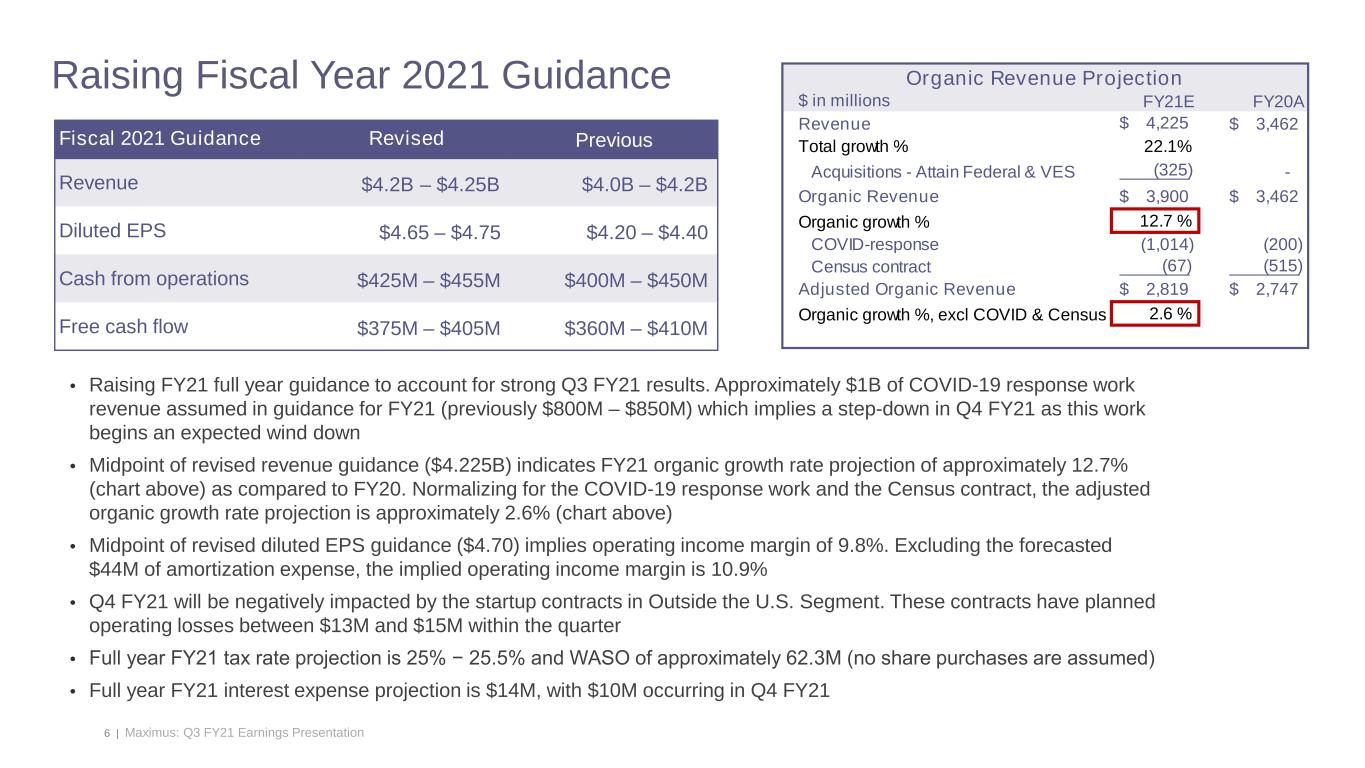
6 | Maximus: Q3 FY21 Earnings Presentation Raising Fiscal Year 2021 Guidance Fiscal 2021 Guidance Revised Previous Revenue $4.2B – $4.25B $4.0B – $4.2B Diluted EPS $4.65 – $4.75 $4.20 – $4.40 Cash from operations $425M – $455M $400M – $450M Free cash flow $375M – $405M $360M – $410M • Raising FY21 full year guidance to account for strong Q3 FY21 results. Approximately $1B of COVID-19 response work revenue assumed in guidance for FY21 (previously $800M – $850M) which implies a step-down in Q4 FY21 as this work begins an expected wind down • Midpoint of revised revenue guidance ($4.225B) indicates FY21 organic growth rate projection of approximately 12.7% (chart above) as compared to FY20. Normalizing for the COVID-19 response work and the Census contract, the adjusted organic growth rate projection is approximately 2.6% (chart above) • Midpoint of revised diluted EPS guidance ($4.70) implies operating income margin of 9.8%. Excluding the forecasted $44M of amortization expense, the implied operating income margin is 10.9% • Q4 FY21 will be negatively impacted by the startup contracts in Outside the U.S. Segment. These contracts have planned operating losses between $13M and $15M within the quarter • Full year FY21 tax rate projection is 25% − 25.5% and WASO of approximately 62.3M (no share purchases are assumed) • Full year FY21 interest expense projection is $14M, with $10M occurring in Q4 FY21 $ in millions FY21E FY20A Revenue $ 4,225 $ 3,462 Total growth % 22.1% Acquisitions - Attain Federal & VES (325) - Organic Revenue $ 3,900 $ 3,462 Organic growth % 12.7 % COVID-response (1,014) (200) Census contract (67) (515) Adjusted Organic Revenue $ 2,819 $ 2,747 Organic growth %, excl COVID & Census 2.6 % Organic Revenue Projection
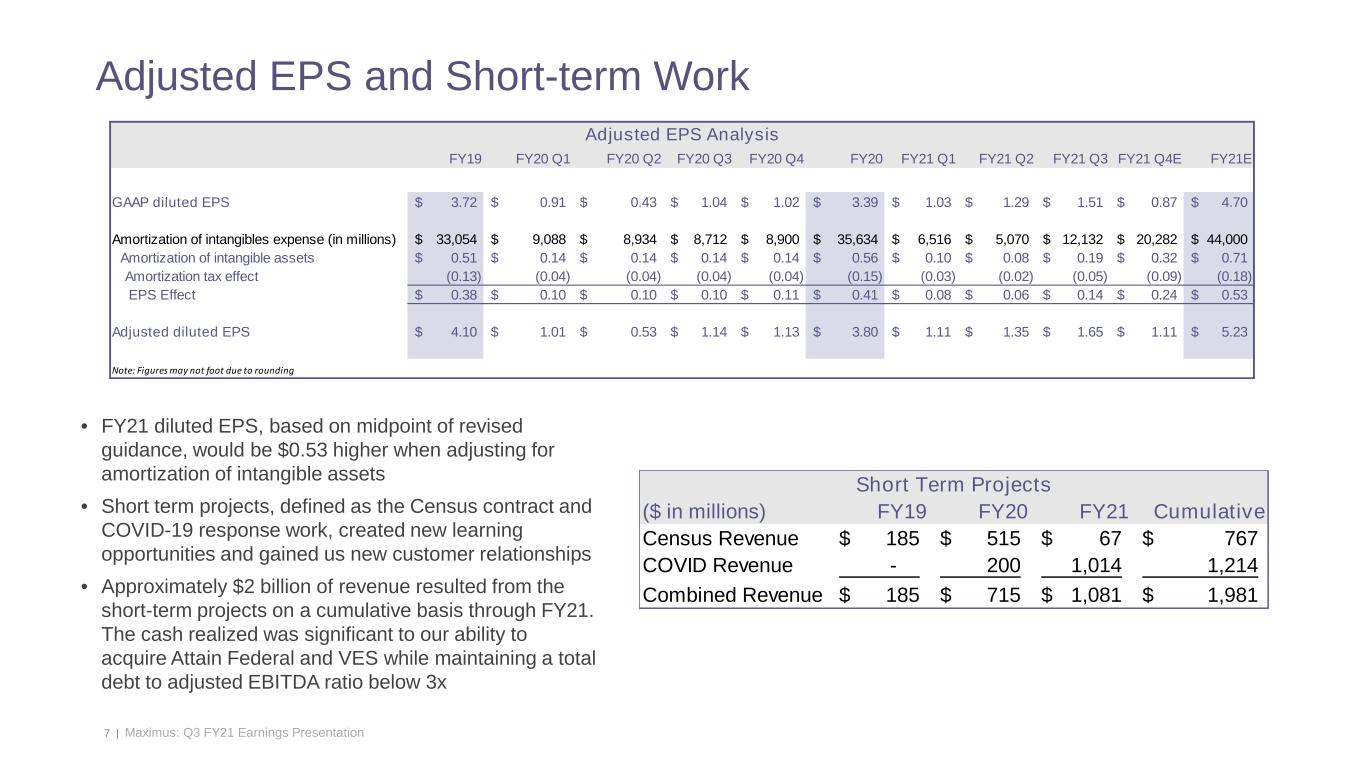
7 | Maximus: Q3 FY21 Earnings Presentation Adjusted EPS and Short-term Work • FY21 diluted EPS, based on midpoint of revised guidance, would be $0.53 higher when adjusting for amortization of intangible assets • Short term projects, defined as the Census contract and COVID-19 response work, created new learning opportunities and gained us new customer relationships • Approximately $2 billion of revenue resulted from the short-term projects on a cumulative basis through FY21. The cash realized was significant to our ability to acquire Attain Federal and VES while maintaining a total debt to adjusted EBITDA ratio below 3x ($ in millions) FY19 FY20 FY21 Cumulative Census Revenue 185$ 515$ 67$ 767$ COVID Revenue - 200 1,014 1,214 Combined Revenue 185$ 715$ 1,081$ 1,981$ Short Term Projects FY19 FY20 Q1 FY20 Q2 FY20 Q3 FY20 Q4 FY20 FY21 Q1 FY21 Q2 FY21 Q3 FY21 Q4E FY21E GAAP diluted EPS 3.72$ 0.91$ 0.43$ 1.04$ 1.02$ 3.39$ 1.03$ 1.29$ 1.51$ 0.87$ 4.70$ Amortization of intangibles expense (in millions) 33,054$ 9,088$ 8,934$ 8,712$ 8,900$ 35,634$ 6,516$ 5,070$ 12,132$ 20,282$ 44,000$ Amortization of intangible assets 0.51$ 0.14$ 0.14$ 0.14$ 0.14$ 0.56$ 0.10$ 0.08$ 0.19$ 0.32$ 0.71$ Amortization tax effect (0.13) (0.04) (0.04) (0.04) (0.04) (0.15) (0.03) (0.02) (0.05) (0.09) (0.18) EPS Effect 0.38$ 0.10$ 0.10$ 0.10$ 0.11$ 0.41$ 0.08$ 0.06$ 0.14$ 0.24$ 0.53$ Adjusted diluted EPS 4.10$ 1.01$ 0.53$ 1.14$ 1.13$ 3.80$ 1.11$ 1.35$ 1.65$ 1.11$ 5.23$ Note: Figures may not foot due to rounding Adjusted EPS Analysis
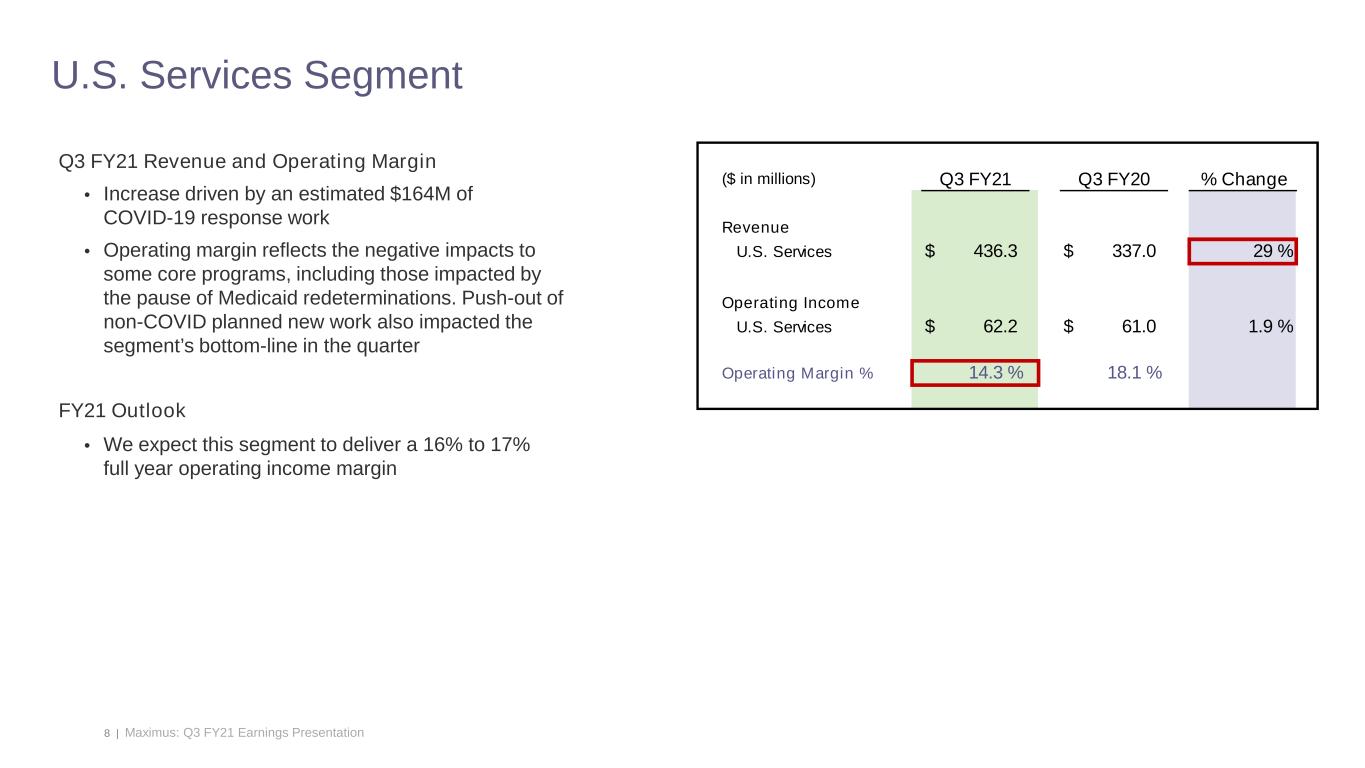
8 | Maximus: Q3 FY21 Earnings Presentation Q3 FY21 Revenue and Operating Margin • Increase driven by an estimated $164M of COVID-19 response work • Operating margin reflects the negative impacts to some core programs, including those impacted by the pause of Medicaid redeterminations. Push-out of non-COVID planned new work also impacted the segment’s bottom-line in the quarter FY21 Outlook • We expect this segment to deliver a 16% to 17% full year operating income margin U.S. Services Segment ($ in millions) Q3 FY21 Q3 FY20 % Change Revenue U.S. Services $ 436.3 $ 337.0 29 % Operating Income U.S. Services $ 62.2 $ 61.0 1.9 % Operating Margin % 14.3 % 18.1 %
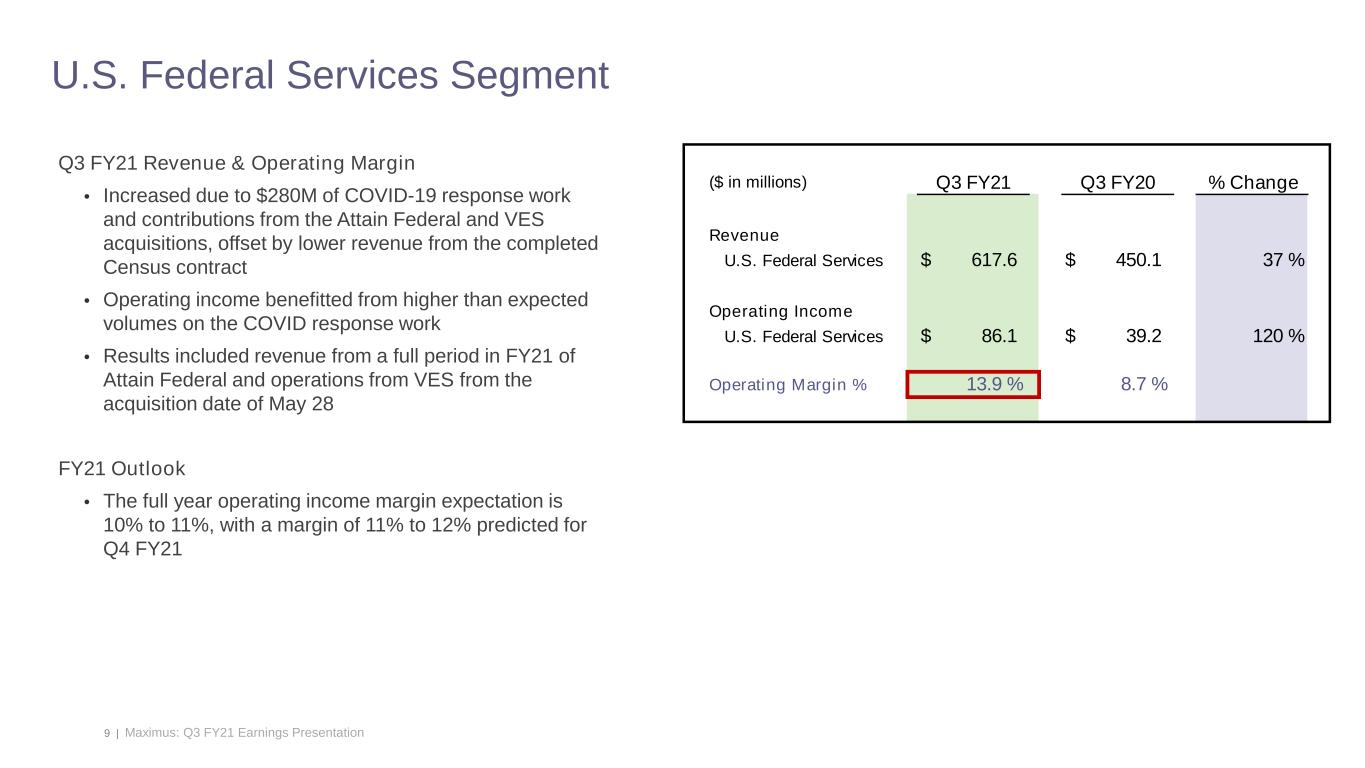
9 | Maximus: Q3 FY21 Earnings Presentation U.S. Federal Services Segment Q3 FY21 Revenue & Operating Margin • Increased due to $280M of COVID-19 response work and contributions from the Attain Federal and VES acquisitions, offset by lower revenue from the completed Census contract • Operating income benefitted from higher than expected volumes on the COVID response work • Results included revenue from a full period in FY21 of Attain Federal and operations from VES from the acquisition date of May 28 FY21 Outlook • The full year operating income margin expectation is 10% to 11%, with a margin of 11% to 12% predicted for Q4 FY21 ($ in millions) Q3 FY21 Q3 FY20 % Change Revenue U.S. Federal Services $ 617.6 $ 450.1 37 % Operating Income U.S. Federal Services $ 86.1 $ 39.2 120 % Operating Margin % 13.9 % 8.7 %
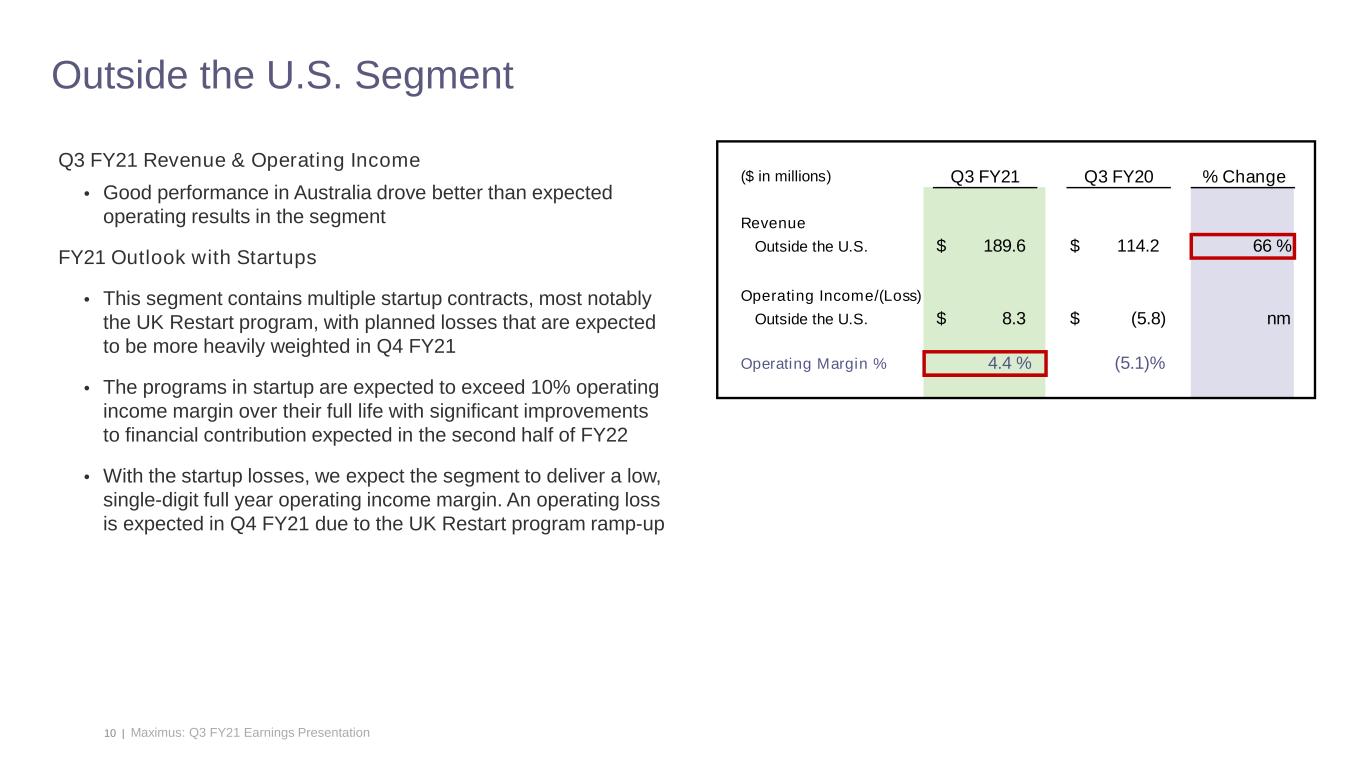
10 | Maximus: Q3 FY21 Earnings Presentation Outside the U.S. Segment Q3 FY21 Revenue & Operating Income • Good performance in Australia drove better than expected operating results in the segment FY21 Outlook with Startups • This segment contains multiple startup contracts, most notably the UK Restart program, with planned losses that are expected to be more heavily weighted in Q4 FY21 • The programs in startup are expected to exceed 10% operating income margin over their full life with significant improvements to financial contribution expected in the second half of FY22 • With the startup losses, we expect the segment to deliver a low, single-digit full year operating income margin. An operating loss is expected in Q4 FY21 due to the UK Restart program ramp-up ($ in millions) Q3 FY21 Q3 FY20 % Change Revenue Outside the U.S. $ 189.6 $ 114.2 66 % Operating Income/(Loss) Outside the U.S. $ 8.3 $ (5.8) nm Operating Margin % 4.4 % (5.1)%
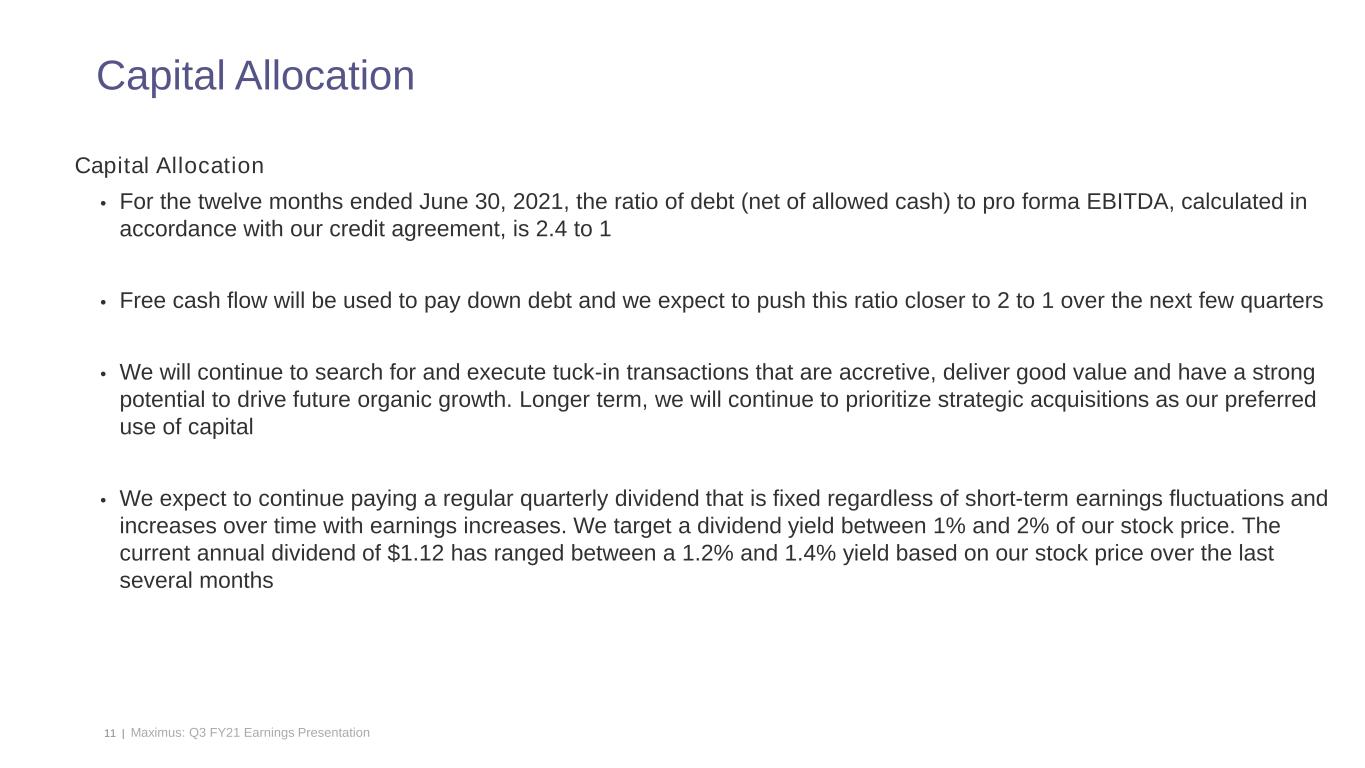
11 | Maximus: Q3 FY21 Earnings Presentation Capital Allocation Capital Allocation • For the twelve months ended June 30, 2021, the ratio of debt (net of allowed cash) to pro forma EBITDA, calculated in accordance with our credit agreement, is 2.4 to 1 • Free cash flow will be used to pay down debt and we expect to push this ratio closer to 2 to 1 over the next few quarters • We will continue to search for and execute tuck-in transactions that are accretive, deliver good value and have a strong potential to drive future organic growth. Longer term, we will continue to prioritize strategic acquisitions as our preferred use of capital • We expect to continue paying a regular quarterly dividend that is fixed regardless of short-term earnings fluctuations and increases over time with earnings increases. We target a dividend yield between 1% and 2% of our stock price. The current annual dividend of $1.12 has ranged between a 1.2% and 1.4% yield based on our stock price over the last several months
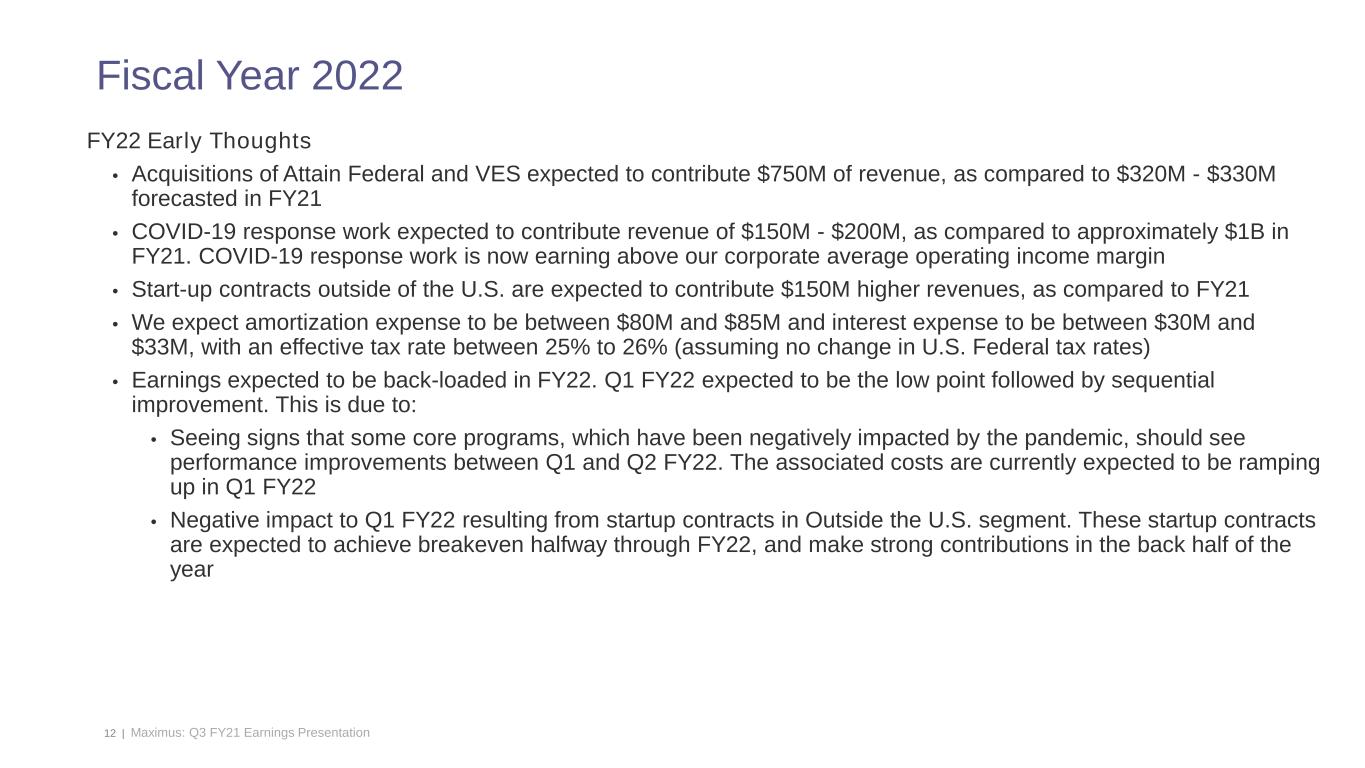
12 | Maximus: Q3 FY21 Earnings Presentation Fiscal Year 2022 FY22 Early Thoughts • Acquisitions of Attain Federal and VES expected to contribute $750M of revenue, as compared to $320M - $330M forecasted in FY21 • COVID-19 response work expected to contribute revenue of $150M - $200M, as compared to approximately $1B in FY21. COVID-19 response work is now earning above our corporate average operating income margin • Start-up contracts outside of the U.S. are expected to contribute $150M higher revenues, as compared to FY21 • We expect amortization expense to be between $80M and $85M and interest expense to be between $30M and $33M, with an effective tax rate between 25% to 26% (assuming no change in U.S. Federal tax rates) • Earnings expected to be back-loaded in FY22. Q1 FY22 expected to be the low point followed by sequential improvement. This is due to: • Seeing signs that some core programs, which have been negatively impacted by the pandemic, should see performance improvements between Q1 and Q2 FY22. The associated costs are currently expected to be ramping up in Q1 FY22 • Negative impact to Q1 FY22 resulting from startup contracts in Outside the U.S. segment. These startup contracts are expected to achieve breakeven halfway through FY22, and make strong contributions in the back half of the year

13 | Maximus: Q3 FY21 Earnings Presentation Bruce Caswell President & Chief Executive Officer Fiscal 2021 Third Quarter Earnings Call August 5, 2021
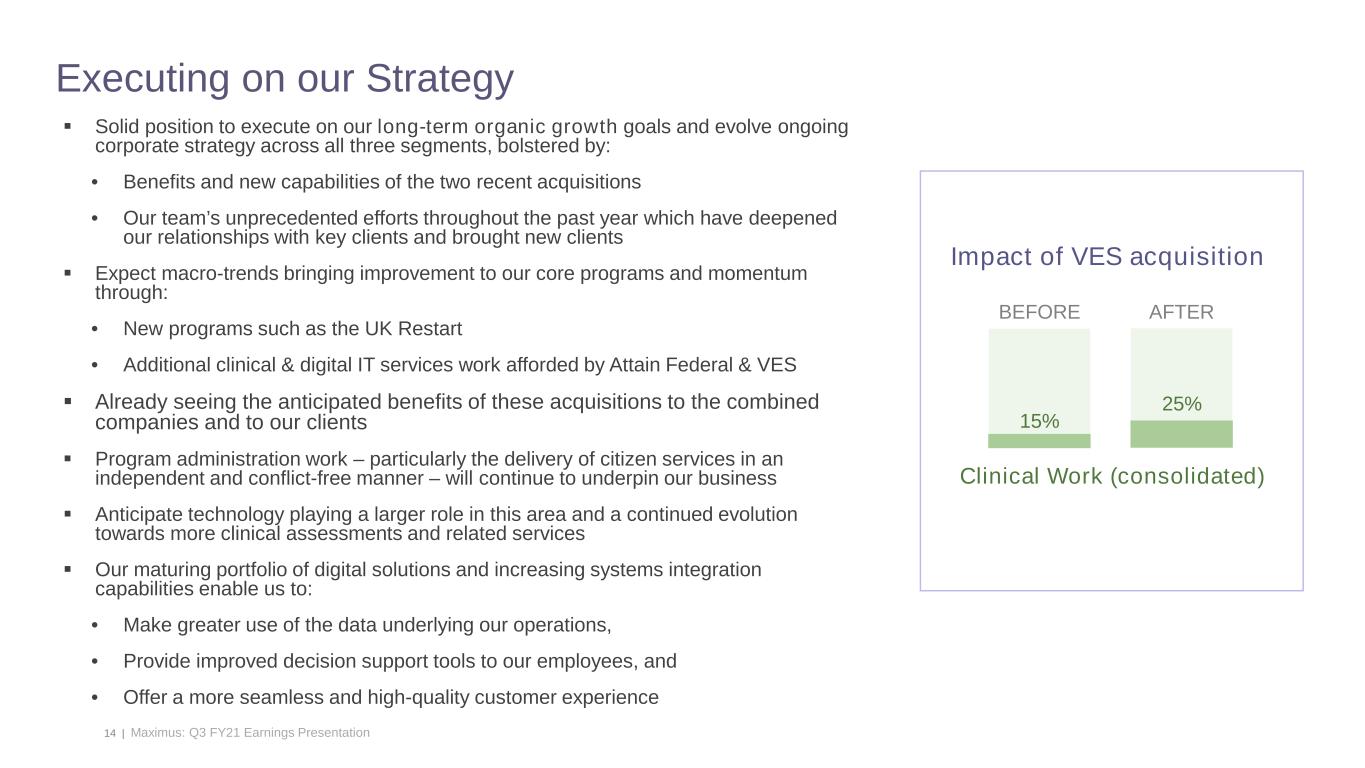
14 | Maximus: Q3 FY21 Earnings Presentation Executing on our Strategy Solid position to execute on our long-term organic growth goals and evolve ongoing corporate strategy across all three segments, bolstered by: • Benefits and new capabilities of the two recent acquisitions • Our team’s unprecedented efforts throughout the past year which have deepened our relationships with key clients and brought new clients Expect macro-trends bringing improvement to our core programs and momentum through: • New programs such as the UK Restart • Additional clinical & digital IT services work afforded by Attain Federal & VES Already seeing the anticipated benefits of these acquisitions to the combined companies and to our clients Program administration work – particularly the delivery of citizen services in an independent and conflict-free manner – will continue to underpin our business Anticipate technology playing a larger role in this area and a continued evolution towards more clinical assessments and related services Our maturing portfolio of digital solutions and increasing systems integration capabilities enable us to: • Make greater use of the data underlying our operations, • Provide improved decision support tools to our employees, and • Offer a more seamless and high-quality customer experience Impact of VES acquisition BEFORE AFTER Clinical Work (consolidated) 15% 25%
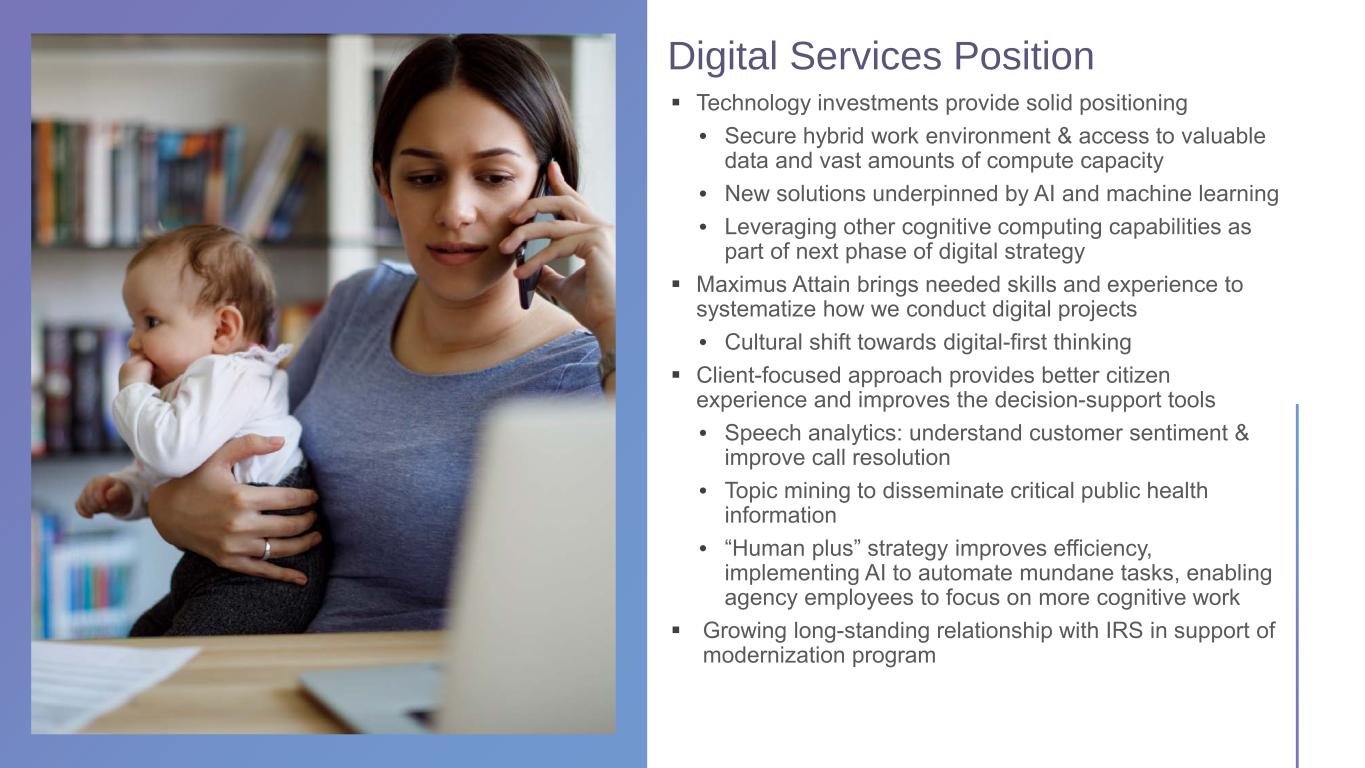
15 | Maximus: Q3 FY21 Earnings Presentation • • • • • • • Digital Services Position
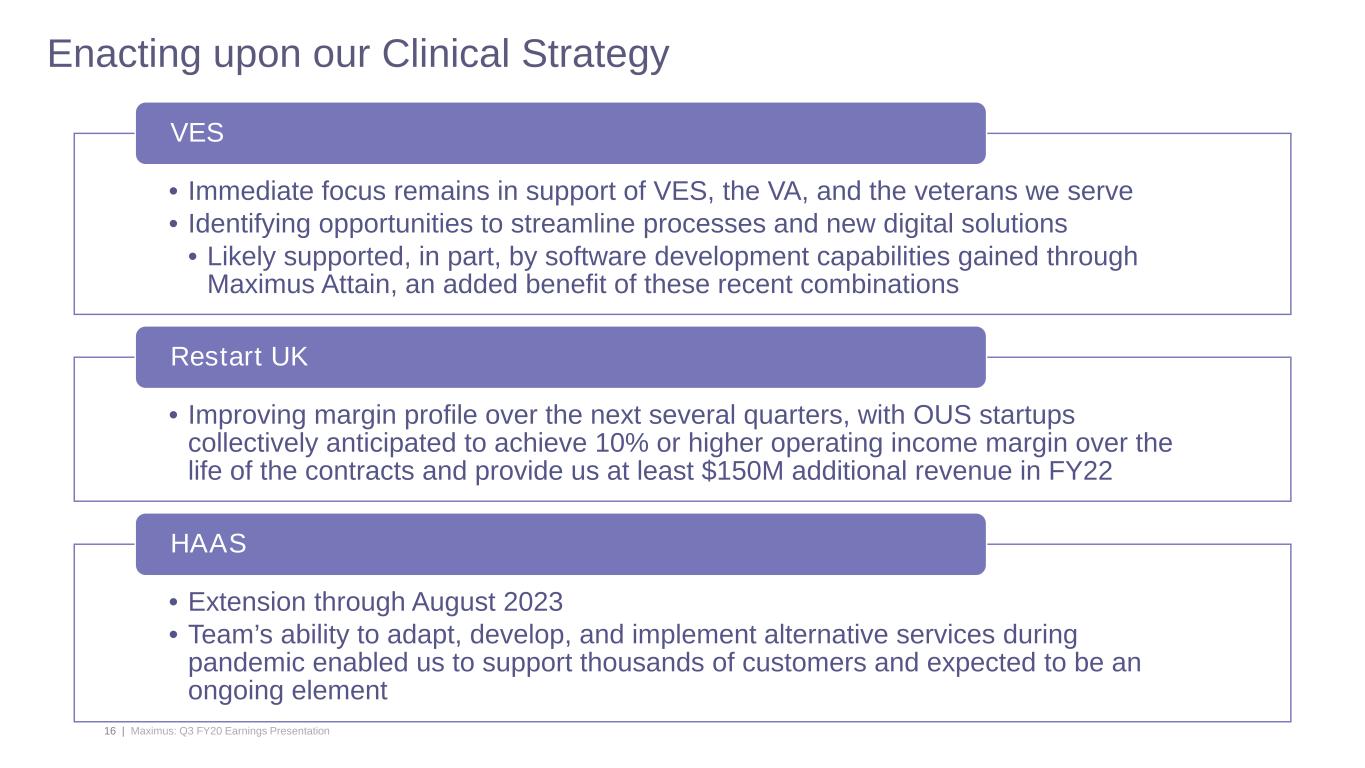
16 | Maximus: Q3 FY20 Earnings Presentation Enacting upon our Clinical Strategy • Immediate focus remains in support of VES, the VA, and the veterans we serve • Identifying opportunities to streamline processes and new digital solutions • Likely supported, in part, by software development capabilities gained through Maximus Attain, an added benefit of these recent combinations VES • Improving margin profile over the next several quarters, with OUS startups collectively anticipated to achieve 10% or higher operating income margin over the life of the contracts and provide us at least $150M additional revenue in FY22 Restart UK • Extension through August 2023 • Team’s ability to adapt, develop, and implement alternative services during pandemic enabled us to support thousands of customers and expected to be an ongoing element HAAS
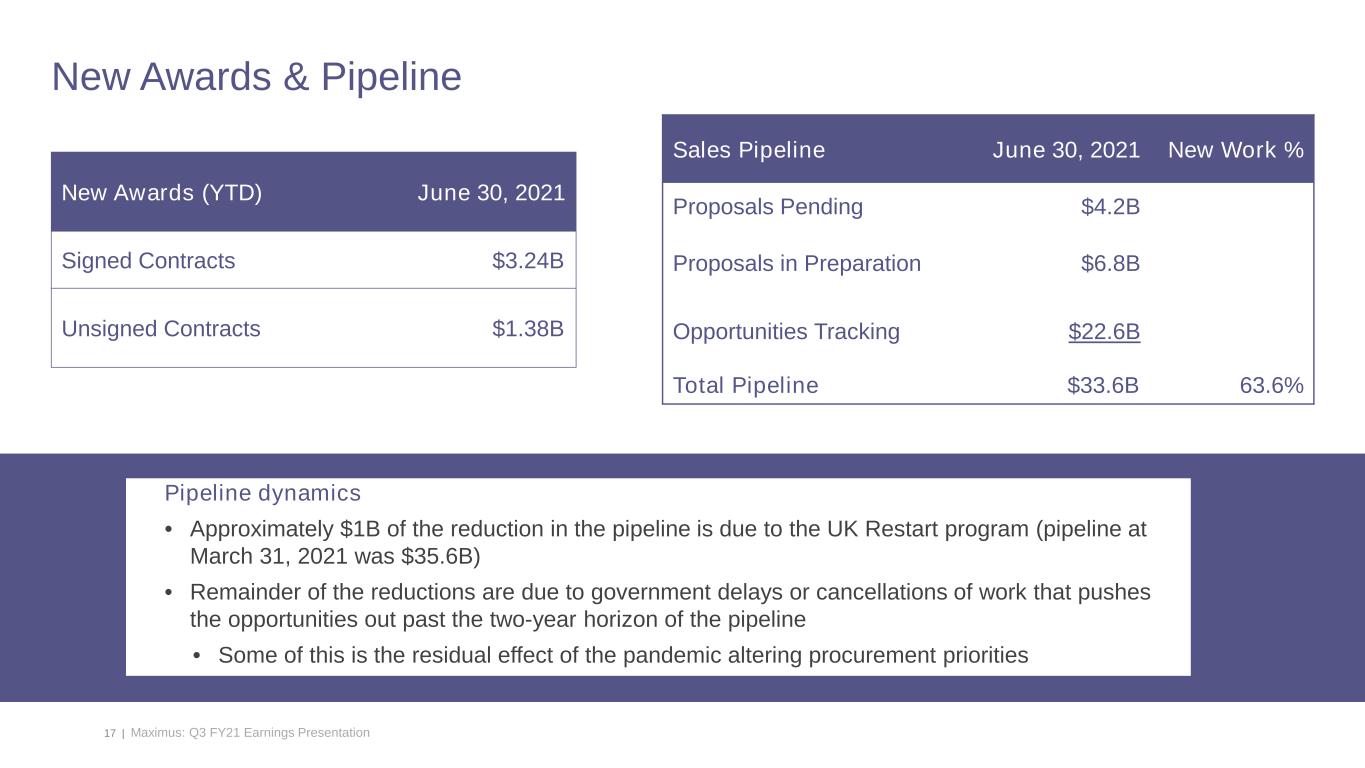
17 | Maximus: Q3 FY21 Earnings Presentation Sales Pipeline June 30, 2021 New Work % Proposals Pending $4.2B Proposals in Preparation $6.8B Opportunities Tracking $22.6B Total Pipeline $33.6B 63.6% New Awards (YTD) June 30, 2021 Signed Contracts $3.24B Unsigned Contracts $1.38B New Awards & Pipeline Pipeline dynamics • Approximately $1B of the reduction in the pipeline is due to the UK Restart program (pipeline at March 31, 2021 was $35.6B) • Remainder of the reductions are due to government delays or cancellations of work that pushes the opportunities out past the two-year horizon of the pipeline • Some of this is the residual effect of the pandemic altering procurement priorities
18 | Maximus: Q3 FY21 Earnings Presentation Responding to Changing Client Needs • Primarily beat our revenue expectations as a result of higher than anticipated volumes on COVID-19 response work in the U.S. Federal Segment • Ramped up approximately 13,000 agents on one contract alone, which required initially hiring nearly 20,000 prospective staff, with our largest starting class on one day of more than 12,500 remote agents • Built and stress-tested largest cloud-based telephony infrastructure for government, capable of handling up to a half-million calls per hour or 160 calls per second • Equally able to rapidly scale down the operations as directed by the client • Ability to capitalize on sizable opportunities of a shorter-term nature without stranding capital assets when the programs wind-down • Underscores our value to governments in times of need and provides returns that can be invested towards longer-term growth objectives
19 | Maximus: Q3 FY21 Earnings Presentation • Strategy execution is maturing as Attain Federal and VES become more fully integrated, and we leverage the platforms and capabilities they bring – Complements foundation we built across clinical services & digital technologies and our existing organic efforts • COVID-19 work is tapering off quickly while, with some exceptions like Australia, core programs have not yet returned to their pre-pandemic activity levels – Believe it is a matter of timing, not a shift in long-term market characteristics • Better positioned than ever to respond to macro-trends and meet needs of our government clients, as supported by: – Combination with recent acquisitions – Agility we demonstrated during COVID-19 – Desirable financial attributes of our business model Thank you • We thank the tens of thousands of Maximus employees and contracted staff worldwide who have risen to remarkable challenges during this period Conclusion