
MMS 8-K
Maximus, Inc. (MMS)
8-K
2023-02-13
For: 2023-02-08
View Original
Added on
April 10, 2026
UNITED STATES
SECURITIES AND EXCHANGE COMMISSION
Washington, D.C. 20549
FORM 8-K
CURRENT REPORT PURSUANT TO SECTION 13 OR 15(d)
OF THE SECURITIES EXCHANGE ACT OF 1934
Date of Report (Date of earliest event reported): February 8, 2023

| (Exact name of registrant as specified in its charter) | |||||||||||||||||||||||||||||
(State or other jurisdiction of incorporation) | (Commission File Number) | (I.R.S. Employer Identification No.) | |||||||||||||||||||||||||||
| , | |||||||||||||||||||||||||||||
(Address of principal executive offices) | (Zip Code) | ||||||||||||||||||||||||||||
| Registrant's telephone number, including the area code | ( | ) | |||||||||||||||||||||||||||
| No Change | |||||||||||||||||||||||||||||
| (Former name or former address, if changed since last report) | |||||||||||||||||||||||||||||
Check the appropriate box below if the Form 8-K filing is intended to simultaneously satisfy the filing obligation of the registrant under any of the following provisions:
Securities registered pursuant to Section 12(b) of the Act:
| Title of each class | Trading Symbol(s) | Name of each exchange on which registered | ||||||||||||
Indicate by check mark whether the registrant is an emerging growth company as defined in Rule 405 of the Securities Act of 1933 (§230.405 of this chapter) or Rule 12b-2 of the Securities Exchange Act of 1934 (§240.12b-2 of this chapter).
Emerging growth company ☐
If an emerging growth company, indicate by check mark if the registrant has elected not to use the extended transition period for complying with any new or revised financial accounting standards provided pursuant to Section 13(a) of the Exchange Act. ☐
Item 2.02 Results of Operations and Financial Condition.
On February 8, 2023, the Company issued a press release announcing its financial results for the quarter ended December 31, 2022. The full text of the press release is furnished as Exhibit 99.1 to this Current Report on Form 8-K and incorporated by reference into this Item 2.02.
On February 9, 2023, the Company held a conference call with respect to these financial results. The conference call was open to the public. The transcript and slide presentation that accompanied the call are furnished as Exhibit 99.2 and Exhibit 99.3, respectively, to this Current Report on Form 8-K and incorporated by reference into this Item 2.02.
Item 9.01 Financial Statements and Exhibits.
(d) Exhibits. The following exhibits are being furnished pursuant to Item 2.02 above.
| Exhibit No. | Description | ||||
| Press release dated February 8, 2023 | |||||
| Conference call transcript for Earnings Call - February 9, 2023 | |||||
| Conference call slide presentation for Earnings Call - February 9, 2023 | |||||
1
SIGNATURES
Pursuant to the requirements of the Securities Exchange Act of 1934, the registrant has duly caused this report to be signed on its behalf by the undersigned hereunto duly authorized.
| Maximus, Inc. | ||||||||
| (Registrant) | ||||||||
| Date: February 13, 2023 | /s/ David R. Francis | |||||||
| David R. Francis | ||||||||
| General Counsel and Secretary | ||||||||
2

| FOR IMMEDIATE RELEASE | CONTACT: | James Francis, VP - IR | |||||||||
| Jessica Batt, VP - IR & ESG | |||||||||||
| Date: February 8, 2023 | [email protected] | ||||||||||
Maximus Reports Fiscal Year 2023 First Quarter Results
Raises FY23 Revenue and Earnings Guidance Following Scheduled Restart of Medicaid Redeterminations
(Tysons, Va. - February 8, 2023) - Maximus (NYSE: MMS), a leading provider of government services worldwide, reported financial results for the three months ended December 31, 2022.
Highlights for the first quarter of fiscal year 2023 include:
•Revenue increased 8.5% to $1.25 billion, compared to $1.15 billion for the prior year period. Organic growth was 10.3% and driven by new or expanded programs in all three segments.
•Diluted earnings per share were $0.65, and adjusted diluted earnings per share were $0.94.
•The company is raising revenue and earnings guidance for fiscal year 2023 following the restart of Medicaid redeterminations scheduled to begin in the third quarter. Fiscal year 2023 revenue is now expected to range between $4.85 billion and $5.0 billion with adjusted diluted earnings per share between $4.00 and $4.30 per share.
•A quarterly cash dividend of $0.28 per share is payable on February 28, 2023, to shareholders of record on February 15, 2023.
"We are pleased with our solid first quarter results which reflect good execution, and we expect continued momentum in fiscal 2023," said Bruce Caswell, President and Chief Executive Officer. "Our increased guidance for fiscal 2023 is significant as it represents a clearing of the last remaining pandemic-related headwind in our U.S. Services business. Restarting Medicaid redeterminations is an unprecedented undertaking and as a long-term public partner to government, we are poised to support our current customers and see solid demand for our capabilities across the broader Medicaid market."
Caswell continued, "We are capitalizing on the organic growth potential of the core business and executing well on our recently refreshed strategy, including making definitive headway in the key areas of clinical services and technology modernization. The remainder of fiscal year 2023, underpinned by our stable business model, should see us continue to successfully capture the upside potential of in-demand government services."
First Quarter Results
Revenue for the first quarter of fiscal year 2023 increased 8.5% to $1.25 billion, compared to $1.15 billion for the prior year period, which was net of a 1.9% currency headwind. Organic growth was 10.3% from new or expanded programs in all three segments resulting from strong demand for the company's services.
For the first quarter of fiscal year 2023, operating margin was 6.0% and the adjusted operating margin was 7.9%. This compares to margins of 7.1% and 9.0%, respectively, for the prior year period. Diluted earnings per share were $0.65 and adjusted diluted earnings per share were $0.94. This compares to $0.85 and $1.12, respectively, for the prior-year period which contained profitable short-term COVID response work in the domestic segments and had less interest expense due to a more favorable rate environment.
U.S. Federal Services Segment
U.S. Federal Services Segment revenue for the first quarter of fiscal year 2023 increased 6.2% to $618.2 million, compared to $581.9 million reported for the prior year period. All growth was organic and driven primarily by volume growth in the segment's clinical services business and an anticipated higher run rate on a large cost-plus contract.
The segment operating margin for the first quarter of fiscal year 2023 was 8.3%, compared to 10.6% reported for the prior year, and in-line with company expectations. The full-year fiscal 2023 margin for the U.S. Federal Services Segment is still expected to range between 10% and 11%.
1
U.S. Services Segment
U.S. Services Segment revenue for the first quarter of fiscal year 2023 increased 13.7% to $439.5 million, compared to $386.4 million reported in the prior year period. All growth was organic and driven by previously disclosed new work in the core business areas of eligibility support and clinical services.
The segment operating margin for the first quarter of fiscal year 2023 was 8.6%, compared to 14.1% reported for the prior year period, reflecting the headwind to the segment's profitability from the paused Medicaid redeterminations. The full-year fiscal 2023 margin for the U.S. Services Segment is expected to range between 9% and 11% with a lift to profitability expected later in the fiscal year due to the scheduled restart of redeterminations.
Outside the U.S. Segment
Outside the U.S. Segment revenue for the first quarter of fiscal year 2023 increased 4.9% to $191.6 million, compared to $182.6 million reported in the prior year period, which was net of a 12% currency headwind. Organic growth in the segment was approximately 16% driven primarily by the U.K. Restart Programme reaching full capacity.
The segment operating income for the first quarter of fiscal year 2023 was $10.1 million, or 5.3% on a margin basis. This compares to an operating loss of $9.5 million in the prior year period due primarily to contracts with planned start-up losses, such as the U.K. Restart Programme. The full-year fiscal 2023 margin for Outside the U.S. Segment is still expected near the lower end of a 3% to 7% range.
Sales and Pipeline
Year-to-date signed contract awards at December 31, 2022, totaled $481 million and contracts pending (awarded but unsigned) totaled $661 million. The book-to-bill ratio at December 31, 2022, was 2.2x calculated on trailing twelve month basis.
The sales pipeline at December 31, 2022, totaled $30.5 billion, comprised of approximately $6.0 billion in proposals pending, $1.71 billion in proposals in preparation, and $22.8 billion in opportunities tracking. New work opportunities represent 74.5% of the total sales pipeline.
Balance Sheet and Cash Flows
At December 31, 2022, cash and cash equivalents totaled $63.1 million, and gross debt was $1.57 billion. The ratio of debt, net of allowed cash, to adjusted EBITDA for the quarter ended December 31, 2022, as calculated in accordance with our credit agreement, was 3.0x. This compares to 2.6x at September 30, 2022.
For the first quarter of fiscal year 2023, cash used in operating activities totaled $134.7 million and free cash flow was an outflow of $150.4 million. Collections for the month of December were lower than expected, contributing to weaker cash flows and a high debt ratio at quarter end. DSO increased to 74 days as of December 31, 2022, reflecting what is expected to be a temporary increase to the target range of 60 to 70 days.
In the month of January, improved collections enabled the company to repay approximately $75 million of debt. The company continues to prioritize debt reduction using its free cash flow.
On January 6, 2023, our Board of Directors declared a quarterly cash dividend of $0.28 for each share of our common stock outstanding. The dividend is payable on February 28, 2023, to shareholders of record on February 15, 2023.
Raising FY23 Guidance
Maximus is raising fiscal year 2023 revenue and earnings guidance following passage of the Consolidated Appropriations Act, 2023 (omnibus spending bill), which directs states to resume Medicaid redeterminations on a prescribed timeline. The company now expects revenue to range between $4.85 billion and $5.0 billion, compared to prior revenue guidance of between $4.75 billion and $4.90 billion.
2

Adjusted operating income is expected to range between $415 million and $440 million, compared to a previous range between $390 million and $415 million. Adjusted operating income excludes an estimated $94 million of expense for amortization of intangible assets. Adjusted diluted earnings per share is now expected to range between $4.00 and $4.30 per share, compared to prior adjusted diluted earnings guidance of between $3.70 and $4.00 per share.
The company's guidance assumes that redetermination activities in the U.S. Services Segment phase in during the third quarter and make a full period contribution in the fourth quarter of fiscal year 2023.
Free cash flow is still expected to range between $225 million and $275 million for fiscal year 2023 and reflects expected working capital increases as a result of higher revenue later in the fiscal year. The company forecasts a slight reduction to interest expense, now ranging between $85 million and $90 million, an effective income tax rate between 24.5% and 25.5%, and weighted average shares outstanding between 61.2 million and 61.3 million shares for fiscal year 2023.
Conference Call and Webcast Information
Maximus will host a conference call tomorrow, February 9, 2023, at 9:00 a.m. ET. Shareholders are invited to submit questions for management’s consideration by emailing [email protected] up to one hour prior to the call.
The call is open to the public and available by webcast or by phone at:
877.407.8289 (Domestic) / +1.201.689.8341 (International)
For those unable to listen to the live call, a recording of the webcast will be available on investor.maximus.com.
About Maximus
As a leading strategic partner to governments across the globe, Maximus helps improve the delivery of public services amid complex technology, health, economic, environmental, and social challenges. With a deep understanding of program service delivery, acute insights that achieve operational excellence, and an extensive awareness of the needs of the people being served, our employees advance the critical missions of our partners. Maximus delivers innovative business process management, impactful consulting services, and technology solutions that provide improved outcomes for the public and higher levels of productivity and efficiency of government-sponsored programs. For more information, visit maximus.com.
Non-GAAP Measures and Risk Factors
This release refers to non-GAAP measures and other indicators, including organic growth, free cash flow, operating income and EPS adjusted for amortization of intangible assets, adjusted EBITDA, and other non-GAAP measures.
A description of these non-GAAP measures, the reasons why we use and present them, and details as to how they are calculated are included in our earnings presentation and forthcoming Form 10-Q.
The presentation of these non-GAAP numbers is not meant to be considered in isolation, nor as alternatives to cash flows from operations, revenue growth, or net income as measures of performance. These non-GAAP financial measures, as determined and presented by us, may not be comparable to related or similarly titled measures presented by other companies.
Statements that are not historical facts, including statements about the company’s confidence and strategies, and the company’s expectations about revenues, results of operations, profitability, future contracts, market opportunities, market demand, or acceptance of the company’s products are forward-looking statements that involve risks and uncertainties.
These risks could cause the Company’s actual results to differ materially from those indicated by such forward-looking statements. A summary of risk factors can be found in Item 1A, "Risk Factors" in our Annual Report on Form 10-K for the year ended September 30, 2022, which was filed with the Securities and Exchange Commission (SEC) on November 22, 2022. The Company's SEC reports are accessible on maximus.com.
3
Maximus, Inc.
Consolidated Statements of Operations
(Unaudited)
| For the Three Months Ended | |||||||||||
| December 31, 2022 | December 31, 2021 | ||||||||||
| (in thousands, except per share amounts) | |||||||||||
| Revenue | $ | 1,249,246 | $ | 1,150,876 | |||||||
| Cost of revenue | 1,004,499 | 922,721 | |||||||||
| Gross profit | 244,747 | 228,155 | |||||||||
| Selling, general, and administrative expenses | 146,452 | 124,221 | |||||||||
| Amortization of intangible assets | 23,518 | 22,405 | |||||||||
| Operating income | 74,777 | 81,529 | |||||||||
| Interest expense | 21,606 | 9,638 | |||||||||
| Other income/(expense), net | 266 | (311) | |||||||||
| Income before income taxes | 53,437 | 71,580 | |||||||||
| Provision for income taxes | 13,442 | 18,250 | |||||||||
| Net income | $ | 39,995 | $ | 53,330 | |||||||
| Earnings per share: | |||||||||||
| Basic | $ | 0.65 | $ | 0.86 | |||||||
| Diluted | $ | 0.65 | $ | 0.85 | |||||||
| Weighted average shares outstanding: | |||||||||||
| Basic | 61,117 | 62,262 | |||||||||
| Diluted | 61,196 | 62,445 | |||||||||
| Dividends declared per share | $ | 0.28 | $ | 0.28 | |||||||
4
Maximus, Inc.
Consolidated Balance Sheets
| December 31, 2022 | September 30, 2022 | ||||||||||
| (unaudited) | |||||||||||
| (in thousands) | |||||||||||
| Assets: | |||||||||||
| Cash and cash equivalents | $ | 63,050 | $ | 40,658 | |||||||
| Accounts receivable, net | 1,014,046 | 807,110 | |||||||||
| Income taxes receivable | 4,486 | 2,158 | |||||||||
| Prepaid expenses and other current assets | 174,505 | 182,387 | |||||||||
| Total current assets | 1,256,087 | 1,032,313 | |||||||||
| Property and equipment, net | 50,181 | 52,258 | |||||||||
| Capitalized software, net | 64,963 | 58,740 | |||||||||
| Operating lease right-of-use assets | 162,289 | 132,885 | |||||||||
| Goodwill | 1,783,239 | 1,779,415 | |||||||||
| Intangible assets, net | 782,821 | 804,904 | |||||||||
| Deferred contract costs, net | 49,030 | 47,732 | |||||||||
| Deferred compensation plan assets | 39,606 | 37,050 | |||||||||
| Deferred income taxes | 5,038 | 4,970 | |||||||||
| Other assets | 41,661 | 42,447 | |||||||||
| Total assets | $ | 4,234,915 | $ | 3,992,714 | |||||||
| Liabilities and Shareholders' Equity: | |||||||||||
| Liabilities: | |||||||||||
| Accounts payable and accrued liabilities | $ | 272,196 | $ | 264,553 | |||||||
| Accrued compensation and benefits | 118,505 | 178,199 | |||||||||
| Deferred revenue, current portion | 96,201 | 87,146 | |||||||||
| Income taxes payable | 12,422 | 718 | |||||||||
| Long-term debt, current portion | 77,479 | 63,458 | |||||||||
| Operating lease liabilities, current portion | 59,553 | 63,999 | |||||||||
| Other current liabilities | 109,866 | 116,374 | |||||||||
| Total current liabilities | 746,222 | 774,447 | |||||||||
| Deferred revenue, non-current portion | 29,624 | 21,414 | |||||||||
| Deferred income taxes | 203,545 | 206,099 | |||||||||
| Long-term debt, non-current portion | 1,486,975 | 1,292,483 | |||||||||
| Deferred compensation plan liabilities, non-current portion | 44,688 | 40,210 | |||||||||
| Operating lease liabilities, non-current portion | 119,081 | 86,175 | |||||||||
| Other liabilities | 23,773 | 22,515 | |||||||||
| Total liabilities | 2,653,908 | 2,443,343 | |||||||||
| Shareholders' equity: | |||||||||||
Common stock, no par value; 100,000 shares authorized; 60,774 issued and outstanding as of December 31, 2022 and September 30 2022, respectively (shares in thousands) | 562,679 | 557,978 | |||||||||
| Accumulated other comprehensive loss | (29,706) | (33,961) | |||||||||
| Retained earnings | 1,048,034 | 1,025,354 | |||||||||
| Total shareholders' equity | 1,581,007 | 1,549,371 | |||||||||
| Total liabilities and shareholders' equity | $ | 4,234,915 | $ | 3,992,714 | |||||||
5
Maximus, Inc.
Consolidated Statements of Cash Flows
(Unaudited)
| For the Three Months Ended | |||||||||||
| December 31, 2022 | December 31, 2021 | ||||||||||
| (in thousands) | |||||||||||
| Cash flows from operating activities: | |||||||||||
| Net income | $ | 39,995 | $ | 53,330 | |||||||
| Adjustments to reconcile net income to cash flows from operations: | |||||||||||
| Depreciation and amortization of property, equipment and capitalized software | 12,280 | 11,365 | |||||||||
| Amortization of intangible assets | 23,518 | 22,405 | |||||||||
| Amortization of debt issuance costs and debt discount | 1,034 | 649 | |||||||||
| Deferred income taxes | (1,331) | (229) | |||||||||
| Stock compensation expense | 4,403 | 8,248 | |||||||||
| Change in assets and liabilities, net of effects of business combinations: | |||||||||||
| Accounts receivable | (200,749) | (14,114) | |||||||||
| Prepaid expenses and other current assets | 10,624 | (5,115) | |||||||||
| Deferred contract costs | (1,013) | (6,811) | |||||||||
| Accounts payable and accrued liabilities | 3,642 | (32,452) | |||||||||
| Accrued compensation and benefits | (53,271) | (56,305) | |||||||||
| Deferred revenue | 14,764 | 5,929 | |||||||||
| Income taxes | 9,465 | 10,321 | |||||||||
| Operating lease right-of-use assets and liabilities | (948) | (6,370) | |||||||||
| Other assets and liabilities | 2,928 | 6,230 | |||||||||
| Net cash used in operating activities | (134,659) | (2,919) | |||||||||
| Cash flows from investing activities: | |||||||||||
| Purchases of property and equipment and capitalized software | (15,697) | (6,327) | |||||||||
| Net cash used in investing activities | (15,697) | (6,327) | |||||||||
| Cash flows from financing activities: | |||||||||||
| Cash dividends paid to Maximus shareholders | (17,017) | (17,347) | |||||||||
| Purchases of Maximus common stock | — | (1,379) | |||||||||
| Tax withholding related to RSU vesting | (8,475) | (9,673) | |||||||||
| Payments for contingent consideration | (1,415) | — | |||||||||
| Proceeds from borrowings | 268,702 | 100,000 | |||||||||
| Principal payments for debt | (61,355) | (16,685) | |||||||||
| Restricted cash movements | (9,473) | — | |||||||||
| Net cash provided by financing activities | 170,967 | 54,916 | |||||||||
| Effect of exchange rate changes on cash, cash equivalents, and restricted cash | 2,421 | 372 | |||||||||
| Net change in cash, cash equivalents, and restricted cash | 23,032 | 46,042 | |||||||||
| Cash, cash equivalents and restricted cash, beginning of period | 136,795 | 156,570 | |||||||||
| Cash, cash equivalents and restricted cash, end of period | $ | 159,827 | $ | 202,612 | |||||||
6
Maximus, Inc.
Consolidated Results of Operations by Segment
(Unaudited)
| For the Three Months Ended | |||||||||||||||||||||||
| December 31, 2022 | December 31, 2021 | ||||||||||||||||||||||
| Amount | % (1) | Amount | % (1) | ||||||||||||||||||||
| (dollars in thousands) | |||||||||||||||||||||||
| Revenue: | |||||||||||||||||||||||
| U.S. Federal Services | $ | 618,167 | $ | 581,871 | |||||||||||||||||||
| U.S. Services | 439,478 | 386,417 | |||||||||||||||||||||
| Outside the U.S. | 191,601 | 182,588 | |||||||||||||||||||||
| Revenue | $ | 1,249,246 | $ | 1,150,876 | |||||||||||||||||||
| Gross profit: | |||||||||||||||||||||||
| U.S. Federal Services | $ | 122,694 | 19.8 | % | $ | 126,576 | 21.8 | % | |||||||||||||||
| U.S. Services | 83,598 | 19.0 | % | 89,699 | 23.2 | % | |||||||||||||||||
| Outside the U.S. | 38,455 | 20.1 | % | 11,880 | 6.5 | % | |||||||||||||||||
| Gross profit | $ | 244,747 | 19.6 | % | $ | 228,155 | 19.8 | % | |||||||||||||||
| Selling, general, and administrative expenses: | |||||||||||||||||||||||
| U.S. Federal Services | $ | 71,649 | 11.6 | % | $ | 64,925 | 11.2 | % | |||||||||||||||
| U.S. Services | 45,842 | 10.4 | % | 35,102 | 9.1 | % | |||||||||||||||||
| Outside the U.S. | 28,389 | 14.8 | % | 21,340 | 11.7 | % | |||||||||||||||||
| Other (2) | 572 | NM | 2,854 | NM | |||||||||||||||||||
| Selling, general, and administrative expenses | $ | 146,452 | 11.7 | % | $ | 124,221 | 10.8 | % | |||||||||||||||
| Operating income: | |||||||||||||||||||||||
| U.S. Federal Services | $ | 51,045 | 8.3 | % | $ | 61,651 | 10.6 | % | |||||||||||||||
| U.S. Services | 37,756 | 8.6 | % | 54,597 | 14.1 | % | |||||||||||||||||
| Outside the U.S. | 10,066 | 5.3 | % | (9,460) | (5.2) | % | |||||||||||||||||
| Amortization of intangible assets | (23,518) | NM | (22,405) | NM | |||||||||||||||||||
| Other (2) | (572) | NM | (2,854) | NM | |||||||||||||||||||
| Operating income | $ | 74,777 | 6.0 | % | $ | 81,529 | 7.1 | % | |||||||||||||||
(1)Percentage of respective segment revenue. Percentages not considered meaningful are marked "NM."
(2)Other expenses includes credits and costs that are not allocated to a particular segment. This includes expenses incurred as part of our acquisitions, as well as potential acquisitions which have not been or may not be completed.
7
Maximus, Inc.
Consolidated Free Cash Flows - Non-GAAP
(Unaudited)
| For the Three Months Ended | |||||||||||
| December 31, 2022 | December 31, 2021 | ||||||||||
| (in thousands) | |||||||||||
| Net cash used in operating activities | (134,659) | (2,919) | |||||||||
| Purchases of property and equipment and capitalized software | (15,697) | (6,327) | |||||||||
| Free cash flow | $ | (150,356) | $ | (9,246) | |||||||
Maximus, Inc.
Non-GAAP Adjusted Results Excluding Amortization of Intangible Assets
(Unaudited)
| For the Three Months Ended | |||||||||||
| December 31, 2022 | December 31, 2021 | ||||||||||
| (dollars in thousands, except per share data) | |||||||||||
| Operating income | $ | 74,777 | $ | 81,529 | |||||||
| Add back: Amortization of intangible assets | 23,518 | 22,405 | |||||||||
| Adjusted operating income excluding amortization of intangible assets (Non-GAAP) | $ | 98,295 | $ | 103,934 | |||||||
| Adjusted operating income margin excluding amortization of intangible assets (Non-GAAP) | 7.9 | % | 9.0 | % | |||||||
| Net income | $ | 39,995 | $ | 53,330 | |||||||
| Add back: Amortization of intangible assets, net of tax | 17,360 | 16,530 | |||||||||
| Adjusted net income excluding amortization of intangible assets (Non-GAAP) | $ | 57,355 | $ | 69,860 | |||||||
| Diluted earnings per share | $ | 0.65 | $ | 0.85 | |||||||
| Add back: Effect of amortization of intangible assets on diluted earnings per share | 0.29 | 0.27 | |||||||||
| Adjusted diluted earnings per share excluding amortization of intangible assets (Non-GAAP) | $ | 0.94 | $ | 1.12 | |||||||
8
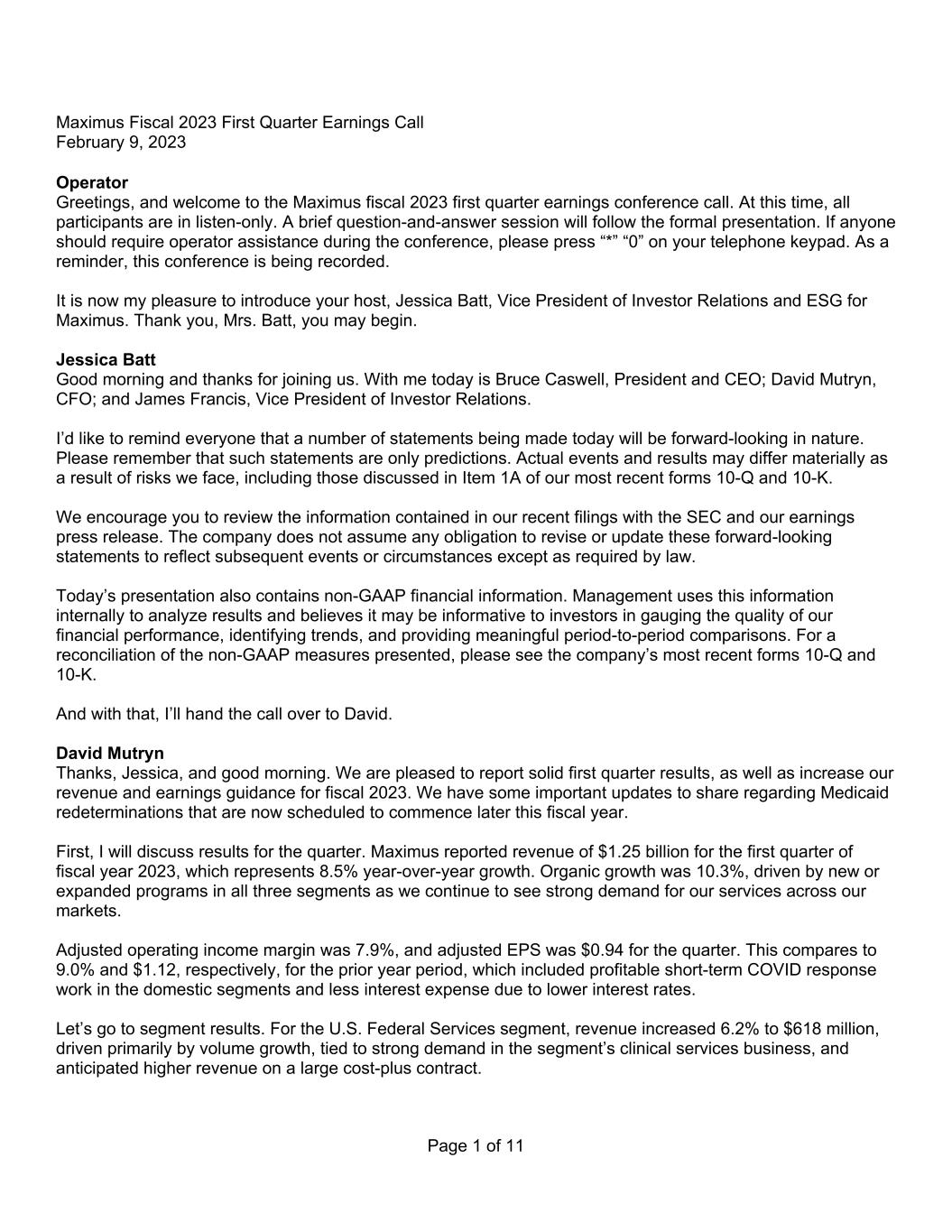
Maximus Fiscal 2023 First Quarter Earnings Call February 9, 2023 Page 1 of 11 Operator Greetings, and welcome to the Maximus fiscal 2023 first quarter earnings conference call. At this time, all participants are in listen-only. A brief question-and-answer session will follow the formal presentation. If anyone should require operator assistance during the conference, please press “*” “0” on your telephone keypad. As a reminder, this conference is being recorded. It is now my pleasure to introduce your host, Jessica Batt, Vice President of Investor Relations and ESG for Maximus. Thank you, Mrs. Batt, you may begin. Jessica Batt Good morning and thanks for joining us. With me today is Bruce Caswell, President and CEO; David Mutryn, CFO; and James Francis, Vice President of Investor Relations. I’d like to remind everyone that a number of statements being made today will be forward-looking in nature. Please remember that such statements are only predictions. Actual events and results may differ materially as a result of risks we face, including those discussed in Item 1A of our most recent forms 10-Q and 10-K. We encourage you to review the information contained in our recent filings with the SEC and our earnings press release. The company does not assume any obligation to revise or update these forward-looking statements to reflect subsequent events or circumstances except as required by law. Today’s presentation also contains non-GAAP financial information. Management uses this information internally to analyze results and believes it may be informative to investors in gauging the quality of our financial performance, identifying trends, and providing meaningful period-to-period comparisons. For a reconciliation of the non-GAAP measures presented, please see the company’s most recent forms 10-Q and 10-K. And with that, I’ll hand the call over to David. David Mutryn Thanks, Jessica, and good morning. We are pleased to report solid first quarter results, as well as increase our revenue and earnings guidance for fiscal 2023. We have some important updates to share regarding Medicaid redeterminations that are now scheduled to commence later this fiscal year. First, I will discuss results for the quarter. Maximus reported revenue of $1.25 billion for the first quarter of fiscal year 2023, which represents 8.5% year-over-year growth. Organic growth was 10.3%, driven by new or expanded programs in all three segments as we continue to see strong demand for our services across our markets. Adjusted operating income margin was 7.9%, and adjusted EPS was $0.94 for the quarter. This compares to 9.0% and $1.12, respectively, for the prior year period, which included profitable short-term COVID response work in the domestic segments and less interest expense due to lower interest rates. Let’s go to segment results. For the U.S. Federal Services segment, revenue increased 6.2% to $618 million, driven primarily by volume growth, tied to strong demand in the segment’s clinical services business, and anticipated higher revenue on a large cost-plus contract.
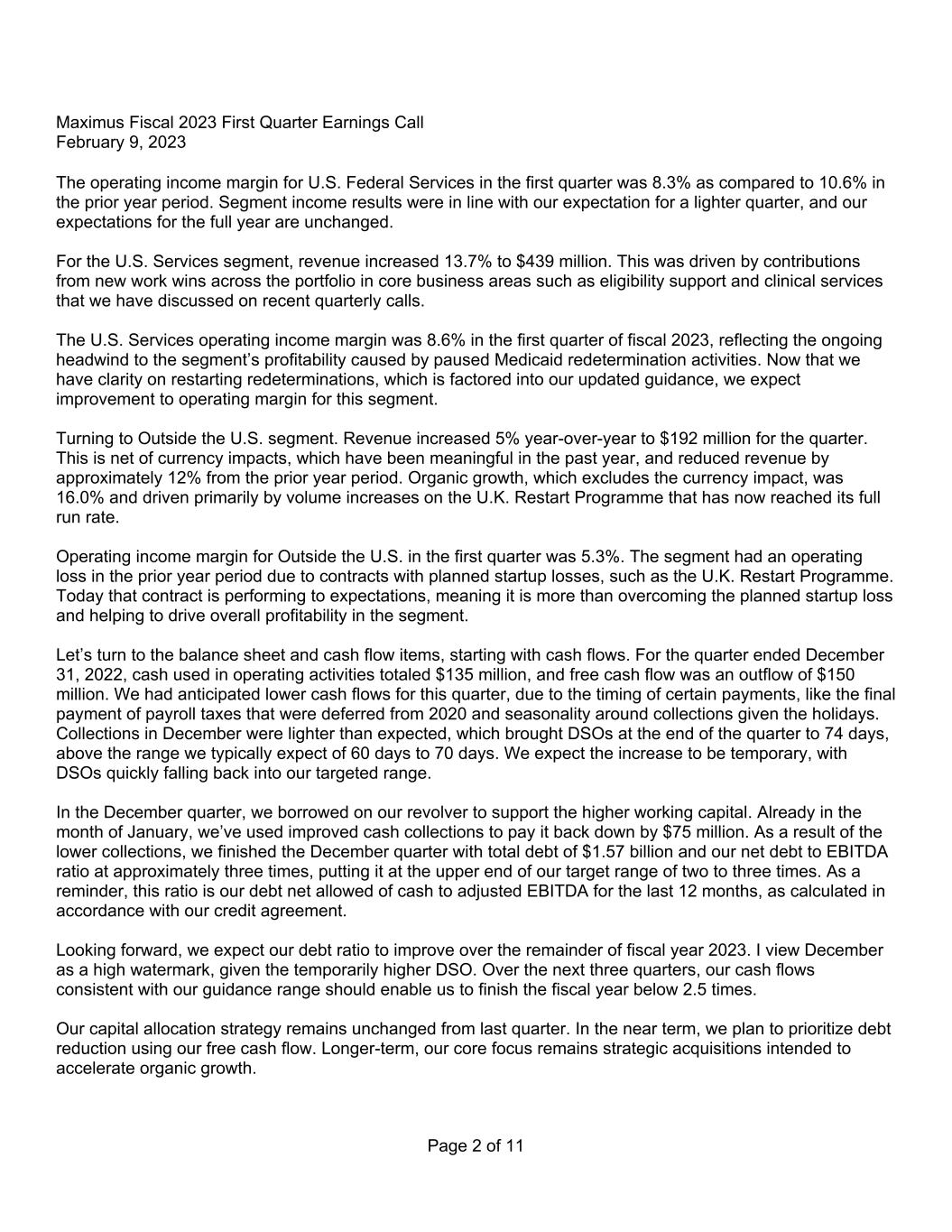
Maximus Fiscal 2023 First Quarter Earnings Call February 9, 2023 Page 2 of 11 The operating income margin for U.S. Federal Services in the first quarter was 8.3% as compared to 10.6% in the prior year period. Segment income results were in line with our expectation for a lighter quarter, and our expectations for the full year are unchanged. For the U.S. Services segment, revenue increased 13.7% to $439 million. This was driven by contributions from new work wins across the portfolio in core business areas such as eligibility support and clinical services that we have discussed on recent quarterly calls. The U.S. Services operating income margin was 8.6% in the first quarter of fiscal 2023, reflecting the ongoing headwind to the segment’s profitability caused by paused Medicaid redetermination activities. Now that we have clarity on restarting redeterminations, which is factored into our updated guidance, we expect improvement to operating margin for this segment. Turning to Outside the U.S. segment. Revenue increased 5% year-over-year to $192 million for the quarter. This is net of currency impacts, which have been meaningful in the past year, and reduced revenue by approximately 12% from the prior year period. Organic growth, which excludes the currency impact, was 16.0% and driven primarily by volume increases on the U.K. Restart Programme that has now reached its full run rate. Operating income margin for Outside the U.S. in the first quarter was 5.3%. The segment had an operating loss in the prior year period due to contracts with planned startup losses, such as the U.K. Restart Programme. Today that contract is performing to expectations, meaning it is more than overcoming the planned startup loss and helping to drive overall profitability in the segment. Let’s turn to the balance sheet and cash flow items, starting with cash flows. For the quarter ended December 31, 2022, cash used in operating activities totaled $135 million, and free cash flow was an outflow of $150 million. We had anticipated lower cash flows for this quarter, due to the timing of certain payments, like the final payment of payroll taxes that were deferred from 2020 and seasonality around collections given the holidays. Collections in December were lighter than expected, which brought DSOs at the end of the quarter to 74 days, above the range we typically expect of 60 days to 70 days. We expect the increase to be temporary, with DSOs quickly falling back into our targeted range. In the December quarter, we borrowed on our revolver to support the higher working capital. Already in the month of January, we’ve used improved cash collections to pay it back down by $75 million. As a result of the lower collections, we finished the December quarter with total debt of $1.57 billion and our net debt to EBITDA ratio at approximately three times, putting it at the upper end of our target range of two to three times. As a reminder, this ratio is our debt net allowed of cash to adjusted EBITDA for the last 12 months, as calculated in accordance with our credit agreement. Looking forward, we expect our debt ratio to improve over the remainder of fiscal year 2023. I view December as a high watermark, given the temporarily higher DSO. Over the next three quarters, our cash flows consistent with our guidance range should enable us to finish the fiscal year below 2.5 times. Our capital allocation strategy remains unchanged from last quarter. In the near term, we plan to prioritize debt reduction using our free cash flow. Longer-term, our core focus remains strategic acquisitions intended to accelerate organic growth.
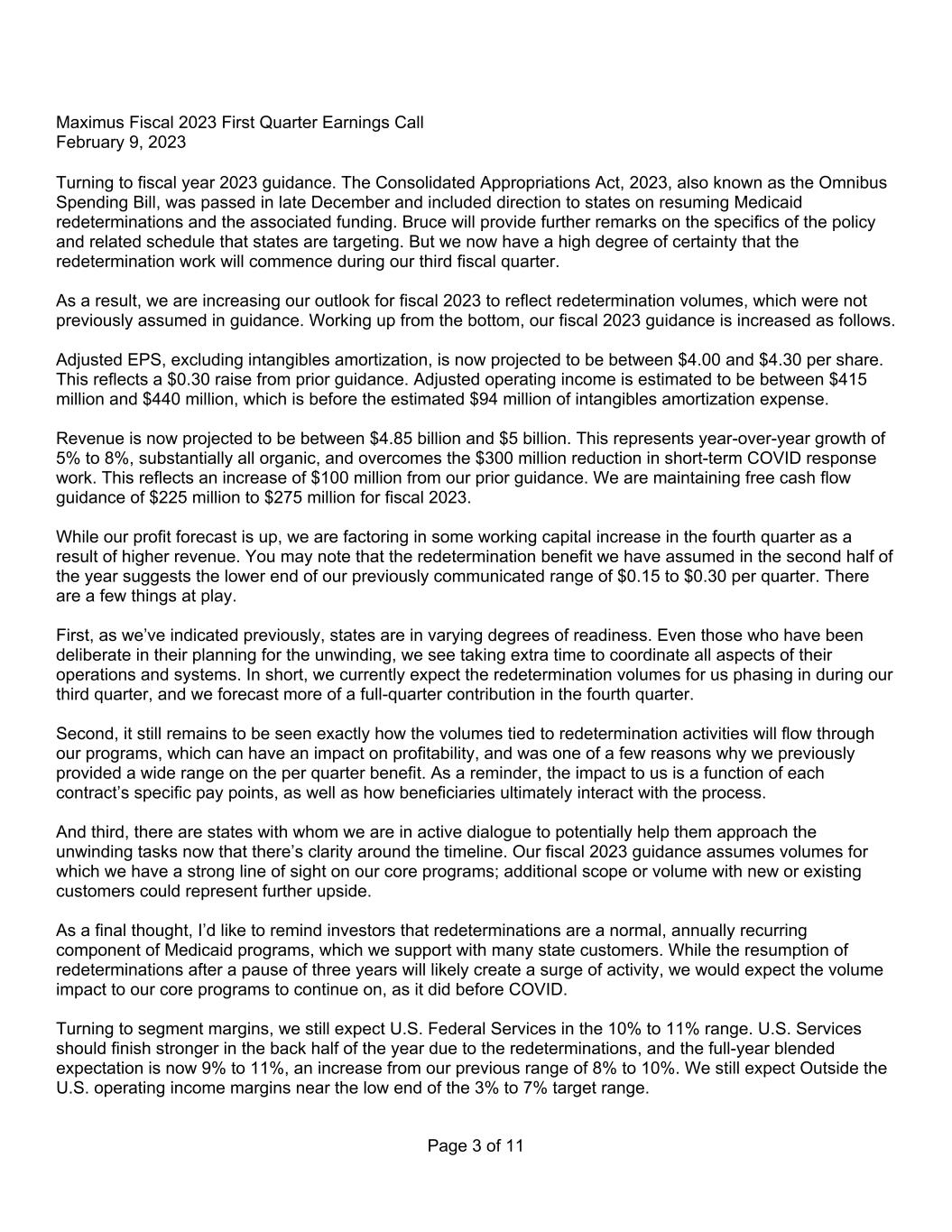
Maximus Fiscal 2023 First Quarter Earnings Call February 9, 2023 Page 3 of 11 Turning to fiscal year 2023 guidance. The Consolidated Appropriations Act, 2023, also known as the Omnibus Spending Bill, was passed in late December and included direction to states on resuming Medicaid redeterminations and the associated funding. Bruce will provide further remarks on the specifics of the policy and related schedule that states are targeting. But we now have a high degree of certainty that the redetermination work will commence during our third fiscal quarter. As a result, we are increasing our outlook for fiscal 2023 to reflect redetermination volumes, which were not previously assumed in guidance. Working up from the bottom, our fiscal 2023 guidance is increased as follows. Adjusted EPS, excluding intangibles amortization, is now projected to be between $4.00 and $4.30 per share. This reflects a $0.30 raise from prior guidance. Adjusted operating income is estimated to be between $415 million and $440 million, which is before the estimated $94 million of intangibles amortization expense. Revenue is now projected to be between $4.85 billion and $5 billion. This represents year-over-year growth of 5% to 8%, substantially all organic, and overcomes the $300 million reduction in short-term COVID response work. This reflects an increase of $100 million from our prior guidance. We are maintaining free cash flow guidance of $225 million to $275 million for fiscal 2023. While our profit forecast is up, we are factoring in some working capital increase in the fourth quarter as a result of higher revenue. You may note that the redetermination benefit we have assumed in the second half of the year suggests the lower end of our previously communicated range of $0.15 to $0.30 per quarter. There are a few things at play. First, as we’ve indicated previously, states are in varying degrees of readiness. Even those who have been deliberate in their planning for the unwinding, we see taking extra time to coordinate all aspects of their operations and systems. In short, we currently expect the redetermination volumes for us phasing in during our third quarter, and we forecast more of a full-quarter contribution in the fourth quarter. Second, it still remains to be seen exactly how the volumes tied to redetermination activities will flow through our programs, which can have an impact on profitability, and was one of a few reasons why we previously provided a wide range on the per quarter benefit. As a reminder, the impact to us is a function of each contract’s specific pay points, as well as how beneficiaries ultimately interact with the process. And third, there are states with whom we are in active dialogue to potentially help them approach the unwinding tasks now that there’s clarity around the timeline. Our fiscal 2023 guidance assumes volumes for which we have a strong line of sight on our core programs; additional scope or volume with new or existing customers could represent further upside. As a final thought, I’d like to remind investors that redeterminations are a normal, annually recurring component of Medicaid programs, which we support with many state customers. While the resumption of redeterminations after a pause of three years will likely create a surge of activity, we would expect the volume impact to our core programs to continue on, as it did before COVID. Turning to segment margins, we still expect U.S. Federal Services in the 10% to 11% range. U.S. Services should finish stronger in the back half of the year due to the redeterminations, and the full-year blended expectation is now 9% to 11%, an increase from our previous range of 8% to 10%. We still expect Outside the U.S. operating income margins near the low end of the 3% to 7% target range.
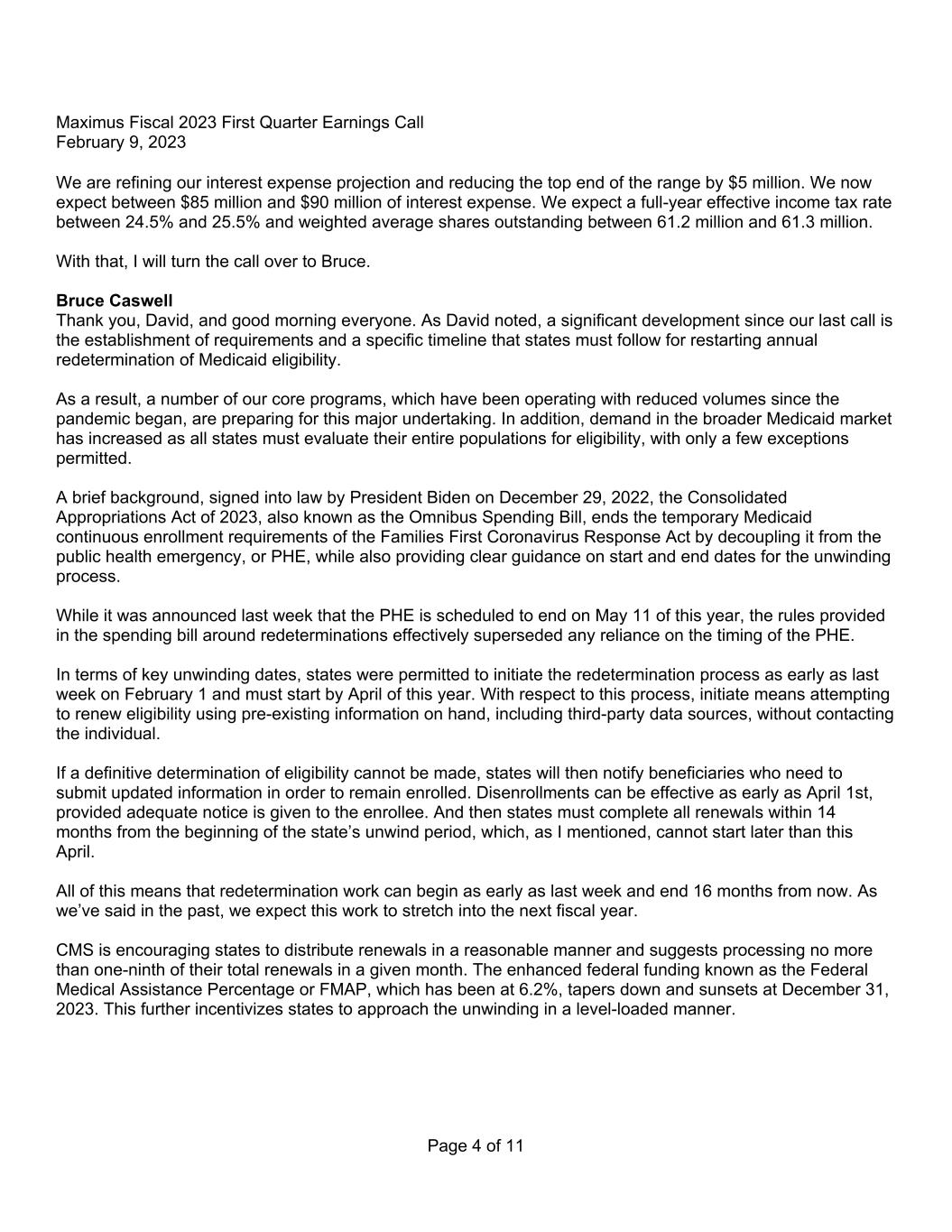
Maximus Fiscal 2023 First Quarter Earnings Call February 9, 2023 Page 4 of 11 We are refining our interest expense projection and reducing the top end of the range by $5 million. We now expect between $85 million and $90 million of interest expense. We expect a full-year effective income tax rate between 24.5% and 25.5% and weighted average shares outstanding between 61.2 million and 61.3 million. With that, I will turn the call over to Bruce. Bruce Caswell Thank you, David, and good morning everyone. As David noted, a significant development since our last call is the establishment of requirements and a specific timeline that states must follow for restarting annual redetermination of Medicaid eligibility. As a result, a number of our core programs, which have been operating with reduced volumes since the pandemic began, are preparing for this major undertaking. In addition, demand in the broader Medicaid market has increased as all states must evaluate their entire populations for eligibility, with only a few exceptions permitted. A brief background, signed into law by President Biden on December 29, 2022, the Consolidated Appropriations Act of 2023, also known as the Omnibus Spending Bill, ends the temporary Medicaid continuous enrollment requirements of the Families First Coronavirus Response Act by decoupling it from the public health emergency, or PHE, while also providing clear guidance on start and end dates for the unwinding process. While it was announced last week that the PHE is scheduled to end on May 11 of this year, the rules provided in the spending bill around redeterminations effectively superseded any reliance on the timing of the PHE. In terms of key unwinding dates, states were permitted to initiate the redetermination process as early as last week on February 1 and must start by April of this year. With respect to this process, initiate means attempting to renew eligibility using pre-existing information on hand, including third-party data sources, without contacting the individual. If a definitive determination of eligibility cannot be made, states will then notify beneficiaries who need to submit updated information in order to remain enrolled. Disenrollments can be effective as early as April 1st, provided adequate notice is given to the enrollee. And then states must complete all renewals within 14 months from the beginning of the state’s unwind period, which, as I mentioned, cannot start later than this April. All of this means that redetermination work can begin as early as last week and end 16 months from now. As we’ve said in the past, we expect this work to stretch into the next fiscal year. CMS is encouraging states to distribute renewals in a reasonable manner and suggests processing no more than one-ninth of their total renewals in a given month. The enhanced federal funding known as the Federal Medical Assistance Percentage or FMAP, which has been at 6.2%, tapers down and sunsets at December 31, 2023. This further incentivizes states to approach the unwinding in a level-loaded manner.
Maximus Fiscal 2023 First Quarter Earnings Call February 9, 2023 Page 5 of 11 We anticipate some states with larger populations, which include our current customers, processing one- twelfth each month, spreading the work over a full year, and following, in most cases, their historical level- loaded model for annual renewals. That means, including the initiation periods, there’s more than a year in which Maximus will be supporting our state customers in working through this renewal workload. We see states taking advantage of the short runway they have now to get ready, which is why we anticipate seeing an uptick in volumes during our third fiscal quarter and achieving run rate levels in the fourth quarter, as David noted. In preparation for redeterminations, Maximus teams have been working with current and prospective clients to inform their plans and tailor our services to varying approaches and timelines. Our delivery model can accommodate these varied approaches, and we’ve been fortunate to be able to offer continued employment opportunities to hundreds of staff who are ramping down from open enrollment. The ability to scale staff and IT quickly gained during the pandemic is paying dividends as we approach this unprecedented period with our Medicaid customers. Meanwhile, we continue to deliver on the three-to-five-year strategy outlined at our investor day last May and supported by the long-term growth drivers in our markets. I’ll take the next few minutes to highlight a few of our recent successes, aligned with our three areas of focus: future of health, advanced technologies for modernization, and customer services digitally enabled. Aligned with our future of health focus within our U.S. Services segment, we recently won new clinical work with a long-standing state customer. Our team of clinicians will be carrying out a variety of complex health assessments, including level of care and Preadmission Screening and Resident Review, or PASRR, assessments on behalf of the state agency, as well as providing helpline assistance and Medicaid LTSS application support. This win, with a total contract value, or TCV, of $129 million over a four-year base period, demonstrates our ability to successfully expand into adjacent service areas with longtime customers as program policy and needs evolve. I would also like to share some exciting news at the federal level in our strategic focus area of technology modernization. As was reported on January 6 by Washington Technology, Maximus was selected as one of two organizations to support the Enterprise Development Operations Services, or EDOS, contract vehicle for the IRS’s Information Technology Application Development Office. The scope delivered via successive task orders includes IT services across a broad range of categories and functions to assist the agency in systems engineering and enterprise architecture, defect reporting and tracking, configuration management, and IT systems programming and source code development. This award for a position on the contract vehicle further demonstrates our deep understanding of the IRS’s current challenges and capability to support their future modernization journey. With a ceiling of $2.6 billion over seven years, this is a strategic win for Maximus. As was also reported, this award is currently under protest, and the resolution is expected by mid-April. Given this uncertainty, we are not assuming any contributions in FY23 and look forward to providing updates as the procurement process moves toward completion.
Maximus Fiscal 2023 First Quarter Earnings Call February 9, 2023 Page 6 of 11 In our OUS segment, we recently were awarded a new contract in the Gulf region. The contract has a five-year base period worth $215 million. This win is continued evidence of our unmatched ability to translate public policy into operating models that achieve outcomes for governments at scale. Working with the client and local charities, our team will be tasked with performing annual surveys of approximately half a million social welfare beneficiary households to ensure new eligibility rules are consistently applied so those with the greatest need are cared for. Expanding our services into an adjacent program domain, the award also evidences the trust our customers have built with Maximus over more than a decade in the region. Turning to our VES business, as mentioned on prior calls, the PACT Act volumes were anticipated to materialize in early calendar year 2023. We’re pleased to report that our team members are starting to see this volume come to fruition. The PACT Act expands certain conditions under which veterans would presumptively qualify for benefits and therefore result in increases in Medical Disability Exam, or MDE, volumes. Due to the additional benefit, the increased volumes from the PACT Act are anticipated to be sustained well into FY24 as we work through initial claims. While it is still early, it’s logical to assume that volumes will settle to a higher level than present over the longer term. I’m proud of the team that’s stepping up in even greater service to our nation’s veterans. With respect to Aidvantage, our student loan servicing program, at the time of our Q4 earnings call, return to repayment was expected to commence January 1. Since then, due to ongoing litigation regarding President Biden’s Debt Relief Program, the Department of Education’s Federal Student Aid Office, or FSA, has pushed the end of deferrals to the earlier of 60 days after the litigation is resolved, or 60 days after June 30, 2023. These prospective outcomes are contemplated in the updated guidance that we’ve laid out today. As the FSA looks toward return to repayment later this fiscal year, we remain committed to their stated goals of improving the borrower experience through improved performance, transparency, and accountability under the loan servicing contract. Understanding that 2023 budget constraints exist within the Department of Education, our plans to implement best practices in continuous review, performance management, and quality monitoring to promote greater transparency and maintain compliance remain. I’ll now turn to award metrics and pipeline as of December 31st. For the first quarter of fiscal 2023, signed awards totaled $480.9 million of TCV. Further, at December 31st, there were $661.1 million worth of contracts that had been awarded but not yet signed. These awards translate into a book-to-bill of approximately 2.2 times for the trailing 12-month period. Let’s turn our attention to our pipeline of opportunities. Our pipeline at December 31st was $30.5 billion, compared to $30.7 billion reported in the fourth quarter of fiscal 2022. The December 31st pipeline is comprised of approximately $6 billion in proposals pending, $1.7 billion in proposals in preparation, and $22.8 billion in opportunities tracking. Of our total pipeline of sales opportunities, 74% represents new work. Additionally, 56% of the $30.5 billion total pipeline is attributable to our U.S. Federal Services segment. On our last call, I noted that we’re fortunate to be entering FY23 with momentum, as evidenced by a record backlog, a healthy pipeline, strong core business delivery, minimal near-term rebid risk, and solid progress delevering the business in a tough interest rate environment.
Maximus Fiscal 2023 First Quarter Earnings Call February 9, 2023 Page 7 of 11 Nothing in that regard has changed. But notably, we now find ourselves with improved visibility with respect to Medicaid redeterminations and evidence of PACT Act volumes ramping, areas that previously presented the greatest forward-looking uncertainty. While David and I have been clear to note that the nationwide redetermination of more than 90 million individuals on Medicaid and CHIP is unprecedented in its scope and states have significant discretion as to their approach, we also underscore our view that this work is very different from the short-term work we took on during the pandemic. The level loading of volumes into the next fiscal year, as well as the requirement to recheck eligibility annually, provides longer range visibility than we have had in some time. It’s one thing to see our organization embrace our three-to-five-year strategic plan, as I also noted last quarter and another for it to gain traction in the market. I’m pleased with the green shoots we’ve seen this quarter in the areas of clinical assessments and technology modernization and the directional affirmation they provide. Maximus is well positioned in addressable markets comprising $150 billion in annual government spending and continues to benefit from favorable long-term growth drivers. During periods of fiscal and budgetary uncertainty, our under-exposure to discretionary spending, compared to the broader GovCon community, is, in our view, beneficial. As we continue into this period of greater stability, scale is again building in the business. And with it, we’re executing on our plans to structure the company optimally for the future and deliver on margin expectations. Finally, I’d like to thank the more than 10,000 Maximus employees for their contributions to a very successful open enrollment season for our customers and in advance for their upcoming work on Medicaid redeterminations. Across the company, as we did during the pandemic, we take great pride in being of service in support of some of the most critical government programs here and abroad. And with that, we’ll open the line for Q&A. Operator? Operator Thank you. We will now be conducting a question-and-answer session. Now, I will now turn it over to James Francis with Investor Relations. James Francis Thank you. Let’s first go to the line of Charlie Strauzer with CJS Securities. Good morning, Charlie. Charlie Strauzer Good morning, James. How are you? James Francis Great. Thank you. We got Bruce and David here. Bruce Caswell Hi, Charlie. Good morning.
Maximus Fiscal 2023 First Quarter Earnings Call February 9, 2023 Page 8 of 11 Charlie Strauzer Good morning. A few questions on the redetermination restart here. As you think about the short-term spike that you mentioned, how much of that is kind of incremental redetermination work, and you can give us some additional context around that? Bruce Caswell Happy to, and I’ll begin and then ask David to add his thoughts as well. So interestingly, part of our core work for our Medicaid customers, as we’ve been saying, is to perform these redeterminations, and, historically, they’re done on an annual basis for the population that we serve. During the pandemic, the states halted those, as we’ve talked about, and many just didn’t take any action whatsoever. But it’s important to note some states continued their redetermination process but just didn’t take any case actions. So in some cases, there are states that have more recent and fresh information on the population than others. As I mentioned during my prepared remarks, states will begin the process by using third-party data sources, or what the government calls ex-parte data sources, which allows them to make really the most least invasive, if you will, determination of re-eligibility for the program. And if that data is insufficient, then they have a period where they notice individuals and try to collect fresh information. So that’s a little bit on the mechanics. The population: when we began the pandemic, we were at about 71 million Medicaid and CHIP beneficiaries; that’s gone up by about 20 million. There’s a good Urban Institute report that talks about this, and Kaiser has released data and CMS as well. So 91 million is kind of the conventional wisdom of the current total enrollment, which may have increased a little bit since that was reported in actually October of last year. So with those many adults that need to be redetermined for eligibility, there’s a 14-month period, we anticipate there being a high watermark, as you’ve noted, and the reason for that is, first of all, while there will generally be level loading, there are states that are going to want to get through the process more expeditiously. Some states, in fact, even have mandates in place from their legislatures to move quickly through this. Similarly, the federal funding will end – that’s been enhanced at 6.2% of the federal match will end in December. So, we anticipate some states moving relatively quickly through that. However, as we look at it for the populations that we serve, we believe that these redeterminations will continue on through Q3 of fiscal year 2024. And then I’ll add a couple of quick, I’d say environmental, caveats to this, and then turn it over to David for the actual number of where we think we’ll land. There is obviously a high correlation between Medicaid enrollments and unemployment. So it’s possible, depending on what the economic conditions are, as we move through the next year, that you could see enrollment stabilizing at a higher level than we saw at pre-pandemic if the economy were to soften. Another point is that one of the trades that was made in order to decouple redeterminations from the public health emergency was to provide enhanced eligibility and extended eligibility for certain populations, like postpartum women and for children. There are some states, in fact, like Oregon, now that basically have kids on CHIP, I think, for six years without any redeterminations. So that could also contribute to higher, a higher final, if you will, water level.
Maximus Fiscal 2023 First Quarter Earnings Call February 9, 2023 Page 9 of 11 And then the last point I would make is that I see this not dissimilar to the pandemic when we went out and worked with 17 different state labor departments to provide unemployment insurance support. So, while by our calculations, there’s about 39% of the Medicaid population that is not currently in states that use vendors to support eligibility support, and therefore redeterminations. These are customers that, if they find themselves in a pinch, that we can develop relationships with and add, if you will, new state customers through this process, not dissimilar to what we did during the pandemic. So that could also affect the final number, but David is going to put a number on it. David Mutryn Thanks, Bruce. Yeah, I can say that at least $0.15 per quarter is a reasonable floor for our expected earnings contribution after the unwinding phase. I do have to caution that it’s difficult to be precise here, given that we haven’t begun the work yet and experienced the actual volume flows. And I will also point out that if we experience volumes that bring us towards the high end of that $0.15 to $0.30 range or even beyond, there’s more likely to be a component there that’s a temporary surge in nature that may decline after the 12 to 14 months. And then last point is just a reminder. These are not typically separate pay points in our contracts; they really just drive volumes of interactions that have, until 2020, always been a part of our contracts that we consider in our pricing structure. So, this specific item is not something we’ll be able to continuously quantify, but we’ve done our best here to estimate and disclose the impact of our core programs returning to a more normal level of volume. Charlie Strauzer Great, that’s very helpful, both of you; thank you very much for that. And then, just turning to more on the margin side, do you need to ramp hiring to support the restart? And a follow-on to that would be what is kind of the state of wage inflation that you have been experiencing prior and your ability to attract qualified candidates? David Mutryn Sure thing. Starting with the margin. So, yes, there is some cost ramp-up, which plays into our Q3 having a partial benefit and Q4 more of a full run rate, as we talked about. But we still do believe that this volume will be highly accretive, as we’ve been saying for many quarters now. And that really relates to the fact that the pricing structures for many of our contracts contemplated this level of volume, which has been missing for three years now. But stepping back with some margin commentary, the FY23 guidance implies an adjusted OI margin of 8.6% to 8.8%, which is a function of fiscal year 23 having a partial period where we do not have the redetermination from the first half. Last May at Investor Day, we set an adjusted OI margin range of 9% to 12% once redeterminations begin. Our forecast for Q4, which has the full period contribution, does have us falling within that target range. And as we committed at the May Investor Day, we intend to improve our margins over time. One component of which is continuously refining our cost structure and carefully managing our costs as we grow. We’ve been giving that even more attention recently, as I noted last quarter. And I should also mention that our strategy is to grow a higher mix of clinical and technology work, which we think can drive higher margins over time as well.
Maximus Fiscal 2023 First Quarter Earnings Call February 9, 2023 Page 10 of 11 Bruce Caswell I’ll jump in and give David a break and talk a little bit about the labor market and ask him to add anything he’d like. I’ve really been pleased, Charlie, to see how the market has improved since we really last had the opportunity to report on it. And we’ve seen some positive trends related to voluntary attrition rates that are declining across our business, really across all three segments. And we’re pleased, for example, even outside the U.S., where we’re able to attract and retain clinicians on our flagship HAAS contract in the United Kingdom and get closer to the overall staffing levels that we’ve been seeking to achieve there. Furthermore, of course, there’s been a real trend, as you’re well aware, in the tech industry, toward at least the temporary layoffs across a number of the major tech services companies. And I think the GovCon community has really been benefiting from that. We offer opportunities for stable employment and productive mission- oriented work for a lot of individuals. And I think they’re taking advantage of that. If you couple that with, in many instances, the ability to work remotely, we found that to be a very attractive arrangement for candidates. So one of the metrics we always look at is how many positions do we have in our technology services business that you know, but for having a candidate could be built out tomorrow, and that number has been steadily declining. In fact, just this week, we held a tech fair, a tech hiring fair here at our headquarters in Tysons, which was very, very well attended. And there was quite a buzz in the building that day. So I’m feeling really good about that. The other comment I would add is that our customers are certainly understanding of the wage pressures that we’ve faced, and I said on a prior call that we would not hesitate to go to customers well in advance of rebids of our contracts to discuss adjustments to accommodate rising wages in the marketplace. And we have done just that. And, we’ve been met with, I will say, a more sympathetic and understanding environment than I might have previously anticipated. So we’ve been able to make some progress in that area. And then lastly, as the portfolio gets rebid, right, that’s the natural opportunity to reset, and we level prices in the market, and we’ve continued to win and grow organically in that environment, which I think it’s a good illustration of the market rates being higher than they were a few years ago. One of the things we’ve said around here is, you know, the $13 is now $18 in many cases, right, in some of these contracts, or more, and that’s evidence that the market can bear those higher rates. So that’s our view on labor. I think the conditions have generally been improving. Charlie Strauzer Great. And then, just one final question of me looking at the OUS segment, I know you are focusing still on the kind of low end of the margin range there. Is that largely because of the new work you’ve just won in the Gulf region, or is it just more just related to absorbing some expenses as you’ve ramped contracts? David Mutryn Yes, I can take that. It’s not necessarily related to the new win; Q1 came in at 5%, which is right in the middle of that range; it did have a small benefit from a contractual change, which brought it a little bit higher than the full-year estimate. We’re still targeting, as you said, the low end of that 3% to 7% range. But I’ll say, again, that we’re not satisfied at the low end of that range, and we’re working hard, and we’re committed to improving the margin in the segment.
Maximus Fiscal 2023 First Quarter Earnings Call February 9, 2023 Page 11 of 11 The segment was very volatile during the COVID period. And so it does seem to have stabilized, which is great, albeit in the low single-digit margin. So now we’re focused on improving that margin up to the mid-single digits and then high single digits. Charlie Strauzer Great, Thank you very much. James Francis Thanks, Charlie. At this time, we have no further questions. Operator, back to you. Operator Thank you. This concludes today’s teleconference. You may disconnect your lines this time. We thank you for your participation.

| Maximus: Q1 FY23 Earnings Presentation1 Fiscal 2023 First Quarter Earnings Call David Mutryn Chief Financial Officer February 9, 2023
| Maximus: Q1 FY23 Earnings Presentation2 These slides should be read in conjunction with the Company’s most recent quarterly earnings press release, along with listening to or reading a transcript of the comments of Company management from our most recent quarterly earnings conference call. This document may contain non-GAAP financial information. Management uses this information in its internal analysis of results and believes that this information may be informative to investors in gauging the quality of our financial performance, identifying trends in our results, and providing meaningful period-to-period comparisons. These measures should be used in conjunction with, rather than instead of, their comparable GAAP measures. For a reconciliation of non-GAAP measures to the comparable GAAP measures presented in this document, see the Company’s most recent quarterly earnings press release. Included in this presentation are forward-looking statements within the meaning of the safe harbor provisions of the United States Private Securities Litigation Reform Act of 1995. Forward-looking statements can be identified by words such as: "anticipate," "intend," "plan," "goal," "seek," "opportunity," "could," "potential," "believe," "project," "estimate," "expect," "forecast," "strategy," "future," "likely," "may," "should," "will," and similar references to future periods. Forward-looking statements that are not historical facts, including statements about our confidence, strategies and initiatives and our expectations about revenues, results of operations, profitability, liquidity, market demand or the impact of the pandemic are forward-looking statements that involve risks and uncertainties such as those related to the impact of the pandemic and our recently-completed acquisitions. These risks could cause the Company’s actual results to differ materially from those indicated by such forward-looking statements. A summary of risk factors can be found in Item 1A, "Risk Factors" in our Annual Report on Form 10-K for the year ended September 30, 2022, which was filed with the Securities and Exchange Commission (SEC) on November 22, 2022. Any forward-looking statement made by us in this report is based only on information currently available to us and speaks only as of the date on which it is made. We undertake no obligation to publicly update any forward-looking statement, whether written or oral, that may be made from time to time, whether as a result of new information, future developments or otherwise. Throughout this presentation, numbers may not add due to rounding. Forward-looking Statements & Non-GAAP Information
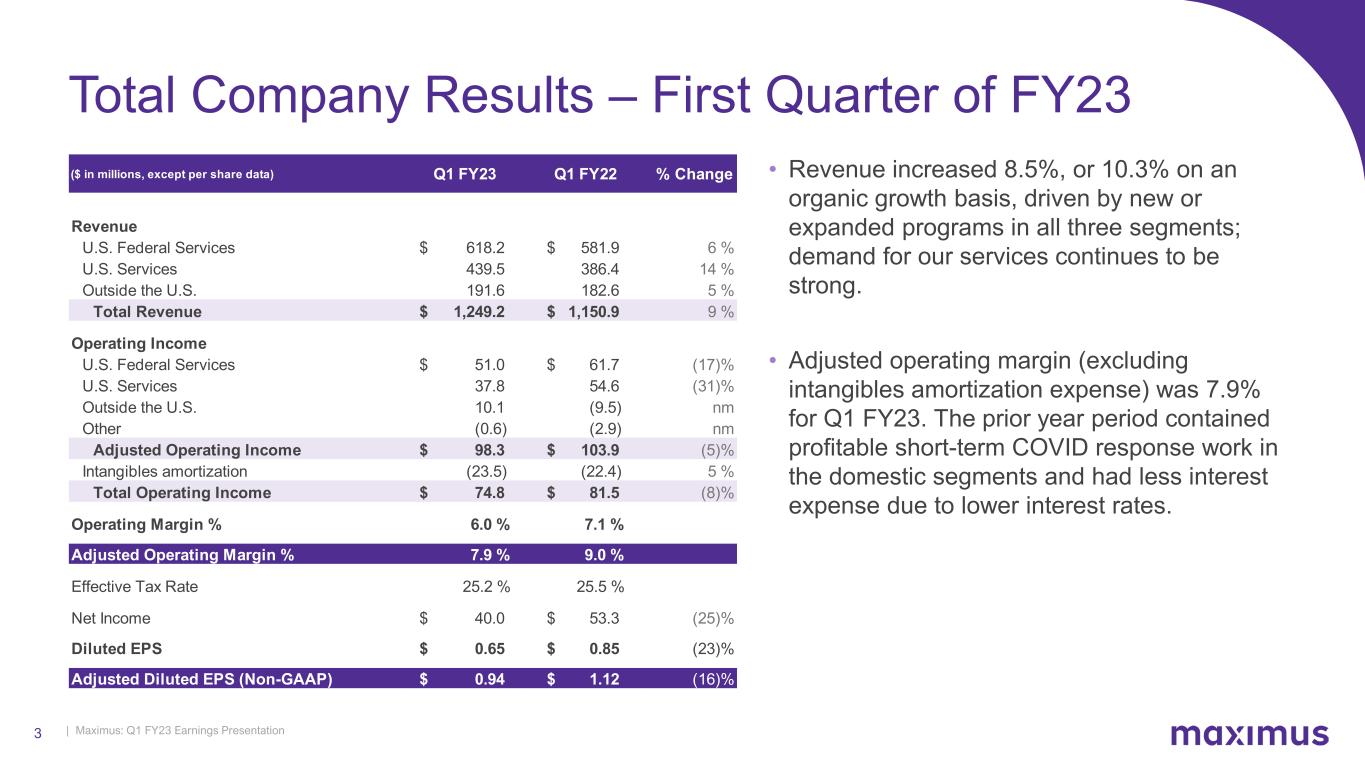
| Maximus: Q1 FY23 Earnings Presentation3 • Revenue increased 8.5%, or 10.3% on an organic growth basis, driven by new or expanded programs in all three segments; demand for our services continues to be strong. • Adjusted operating margin (excluding intangibles amortization expense) was 7.9% for Q1 FY23. The prior year period contained profitable short-term COVID response work in the domestic segments and had less interest expense due to lower interest rates. Total Company Results – First Quarter of FY23 ($ in millions, except per share data) Q1 FY23 Q1 FY22 % Change Revenue U.S. Federal Services $ 618.2 $ 581.9 6 % U.S. Services 439.5 386.4 14 % Outside the U.S. 191.6 182.6 5 % Total Revenue $ 1,249.2 $ 1,150.9 9 % Operating Income U.S. Federal Services $ 51.0 $ 61.7 (17)% U.S. Services 37.8 54.6 (31)% Outside the U.S. 10.1 (9.5) nm Other (0.6) (2.9) nm Adjusted Operating Income $ 98.3 $ 103.9 (5)% Intangibles amortization (23.5) (22.4) 5 % Total Operating Income $ 74.8 $ 81.5 (8)% Operating Margin % 6.0 % 7.1 % Adjusted Operating Margin % 7.9 % 9.0 % Effective Tax Rate 25.2 % 25.5 % Net Income $ 40.0 $ 53.3 (25)% Diluted EPS $ 0.65 $ 0.85 (23)% Adjusted Diluted EPS (Non-GAAP) $ 0.94 $ 1.12 (16)%
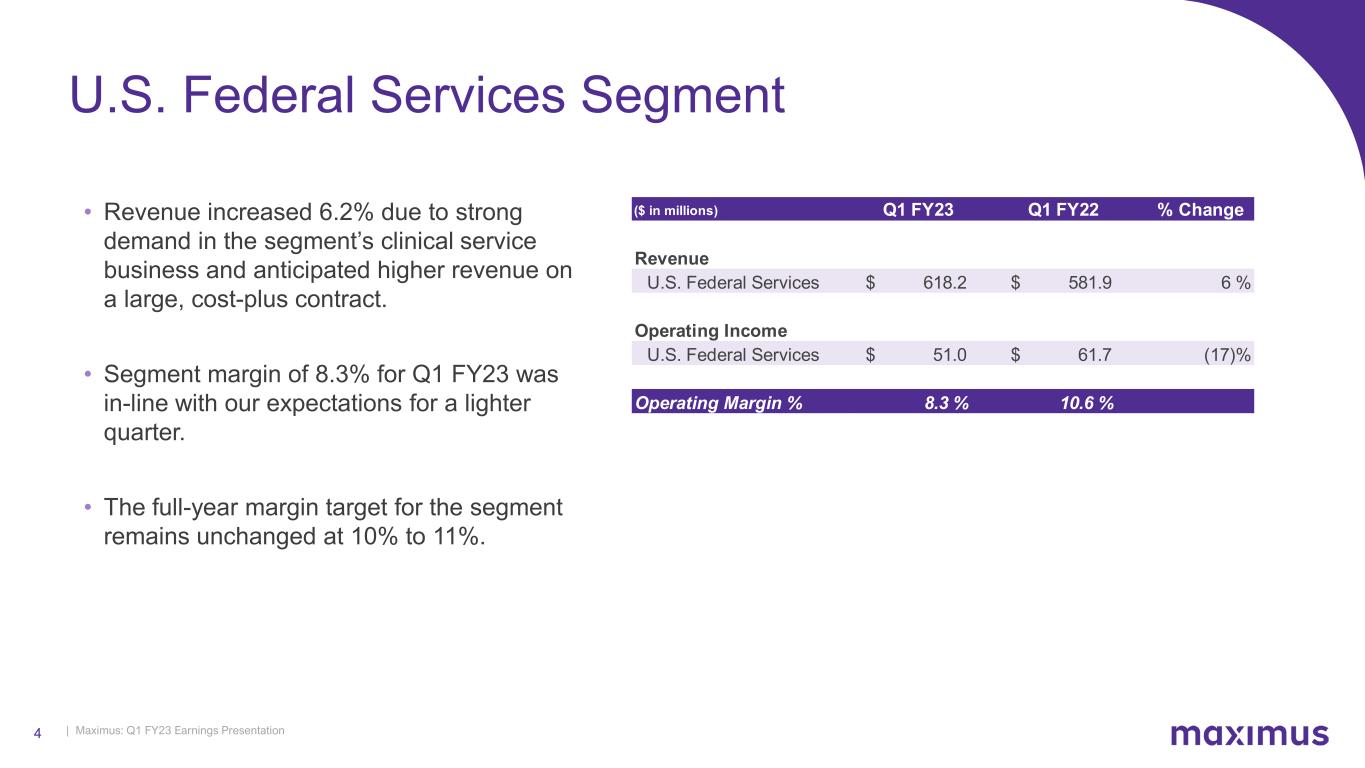
| Maximus: Q1 FY23 Earnings Presentation4 U.S. Federal Services Segment • Revenue increased 6.2% due to strong demand in the segment’s clinical service business and anticipated higher revenue on a large, cost-plus contract. • Segment margin of 8.3% for Q1 FY23 was in-line with our expectations for a lighter quarter. • The full-year margin target for the segment remains unchanged at 10% to 11%. ($ in millions) Q1 FY23 Q1 FY22 % Change Revenue U.S. Federal Services $ 618.2 $ 581.9 6 % Operating Income U.S. Federal Services $ 51.0 $ 61.7 (17)% Operating Margin % 8.3 % 10.6 %
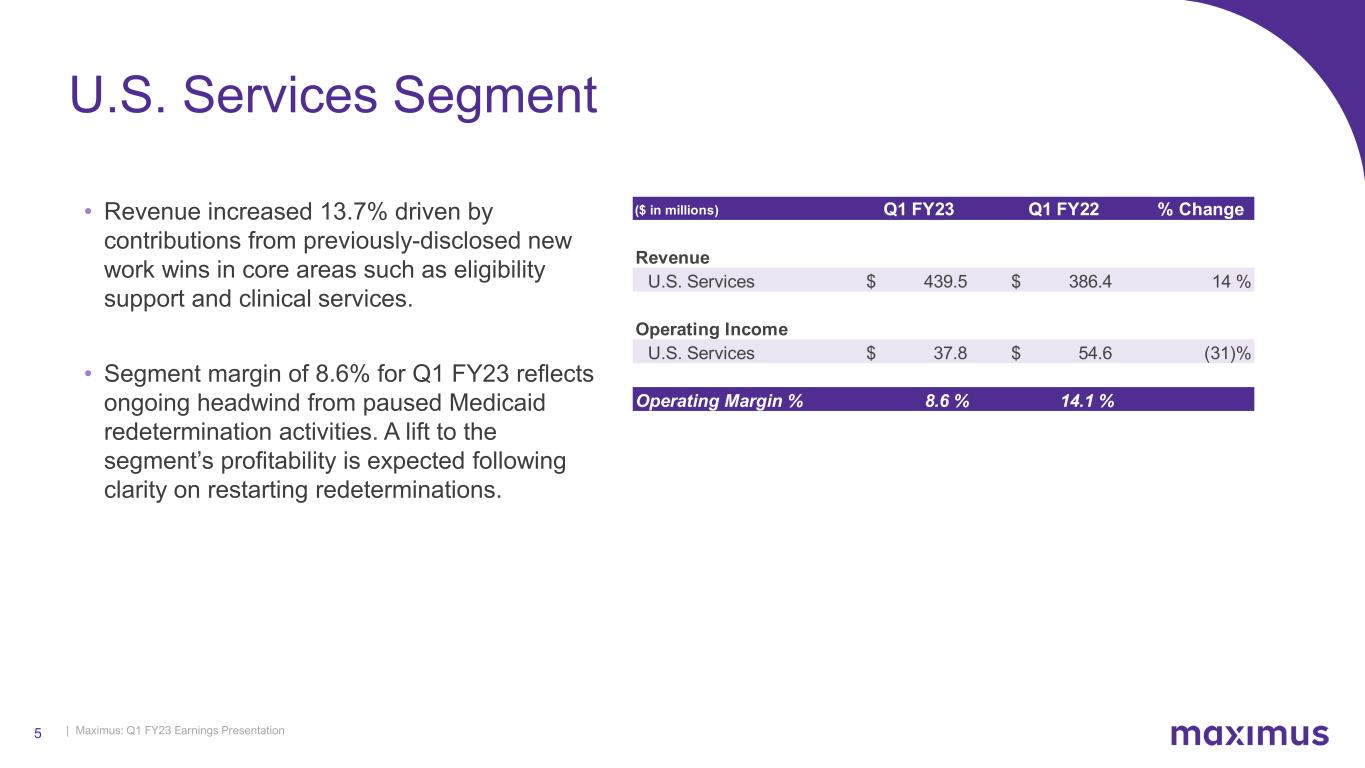
| Maximus: Q1 FY23 Earnings Presentation5 • Revenue increased 13.7% driven by contributions from previously-disclosed new work wins in core areas such as eligibility support and clinical services. • Segment margin of 8.6% for Q1 FY23 reflects ongoing headwind from paused Medicaid redetermination activities. A lift to the segment’s profitability is expected following clarity on restarting redeterminations. U.S. Services Segment ($ in millions) Q1 FY23 Q1 FY22 % Change Revenue U.S. Services $ 439.5 $ 386.4 14 % Operating Income U.S. Services $ 37.8 $ 54.6 (31)% Operating Margin % 8.6 % 14.1 %
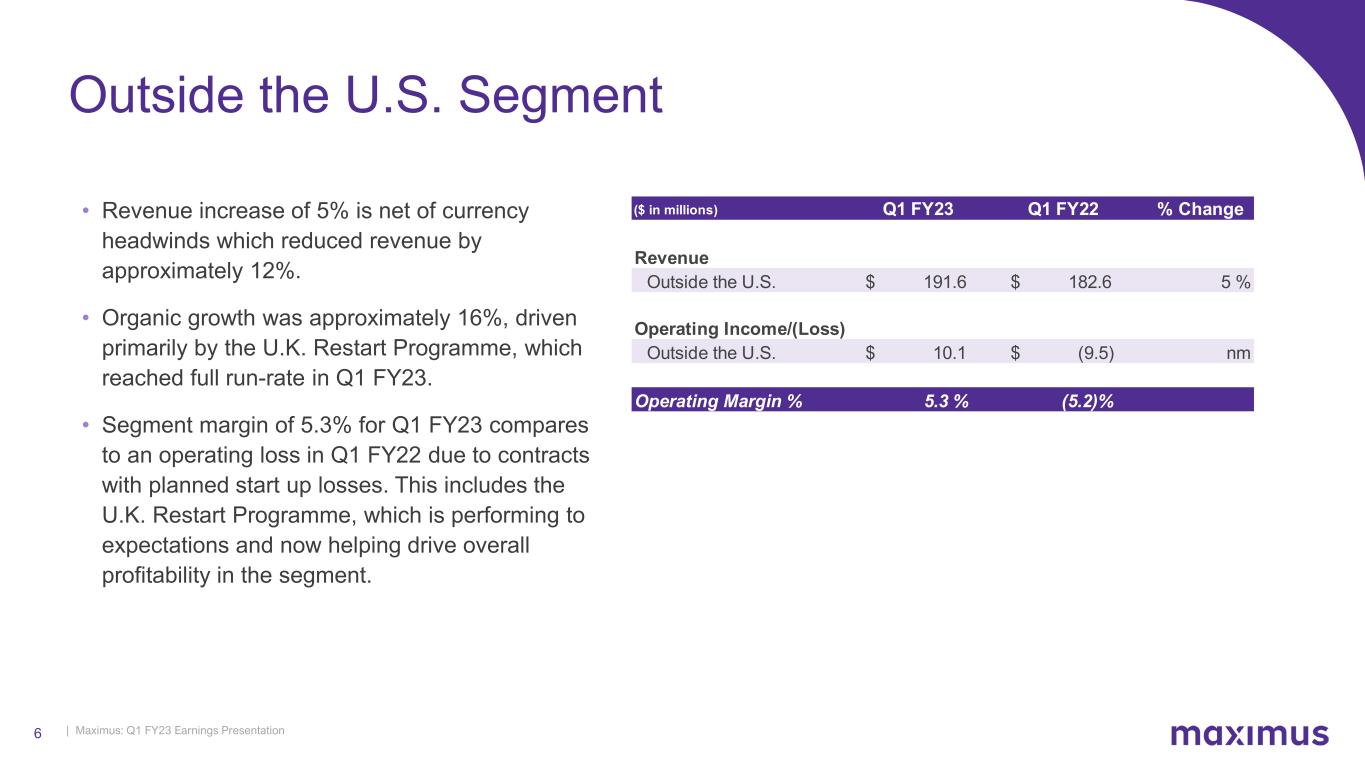
| Maximus: Q1 FY23 Earnings Presentation6 • Revenue increase of 5% is net of currency headwinds which reduced revenue by approximately 12%. • Organic growth was approximately 16%, driven primarily by the U.K. Restart Programme, which reached full run-rate in Q1 FY23. • Segment margin of 5.3% for Q1 FY23 compares to an operating loss in Q1 FY22 due to contracts with planned start up losses. This includes the U.K. Restart Programme, which is performing to expectations and now helping drive overall profitability in the segment. Outside the U.S. Segment ($ in millions) Q1 FY23 Q1 FY22 % Change Revenue Outside the U.S. $ 191.6 $ 182.6 5 % Operating Income/(Loss) Outside the U.S. $ 10.1 $ (9.5) nm Operating Margin % 5.3 % (5.2)%
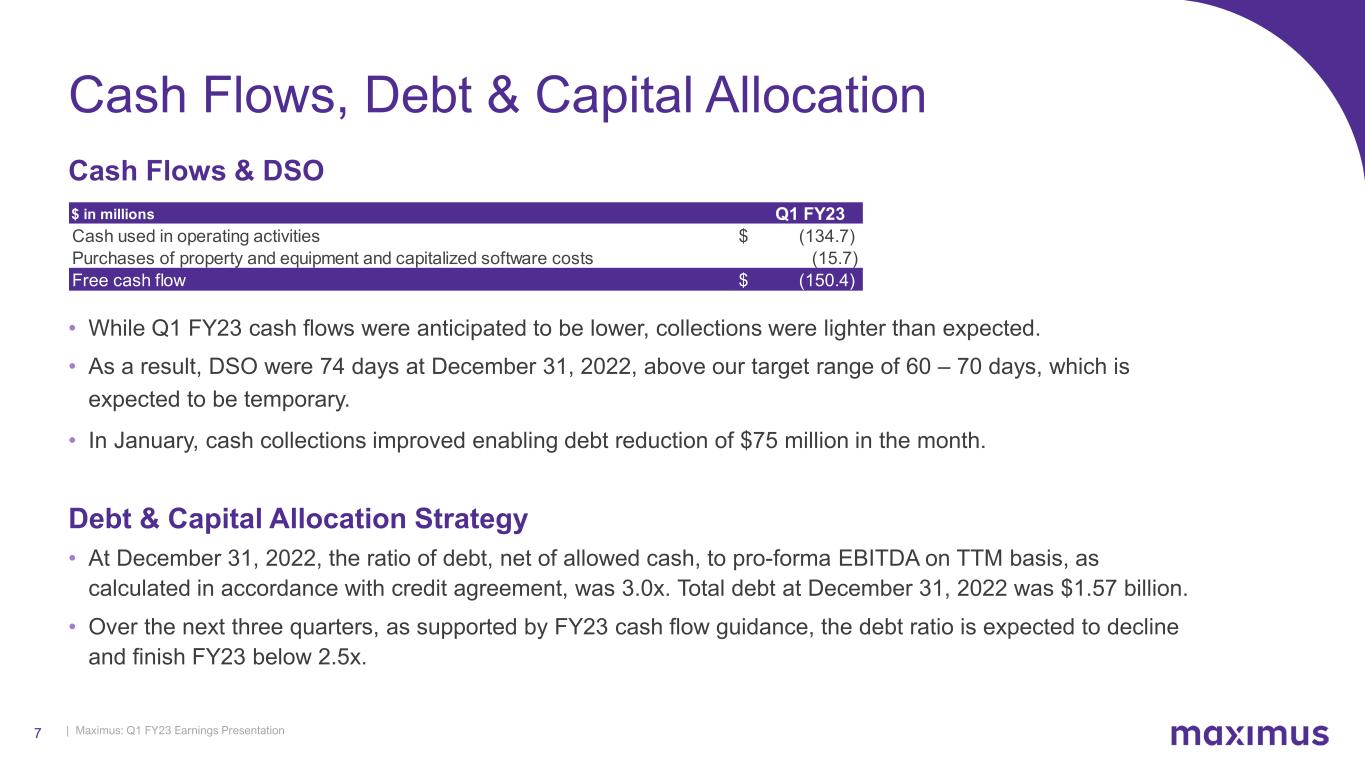
| Maximus: Q1 FY23 Earnings Presentation7 Cash Flows, Debt & Capital Allocation Cash Flows & DSO • While Q1 FY23 cash flows were anticipated to be lower, collections were lighter than expected. • As a result, DSO were 74 days at December 31, 2022, above our target range of 60 – 70 days, which is expected to be temporary. • In January, cash collections improved enabling debt reduction of $75 million in the month. Debt & Capital Allocation Strategy • At December 31, 2022, the ratio of debt, net of allowed cash, to pro-forma EBITDA on TTM basis, as calculated in accordance with credit agreement, was 3.0x. Total debt at December 31, 2022 was $1.57 billion. • Over the next three quarters, as supported by FY23 cash flow guidance, the debt ratio is expected to decline and finish FY23 below 2.5x. $ in millions Q1 FY23 Cash used in operating activities $ (134.7) Purchases of property and equipment and capitalized software costs (15.7) Free cash flow $ (150.4)
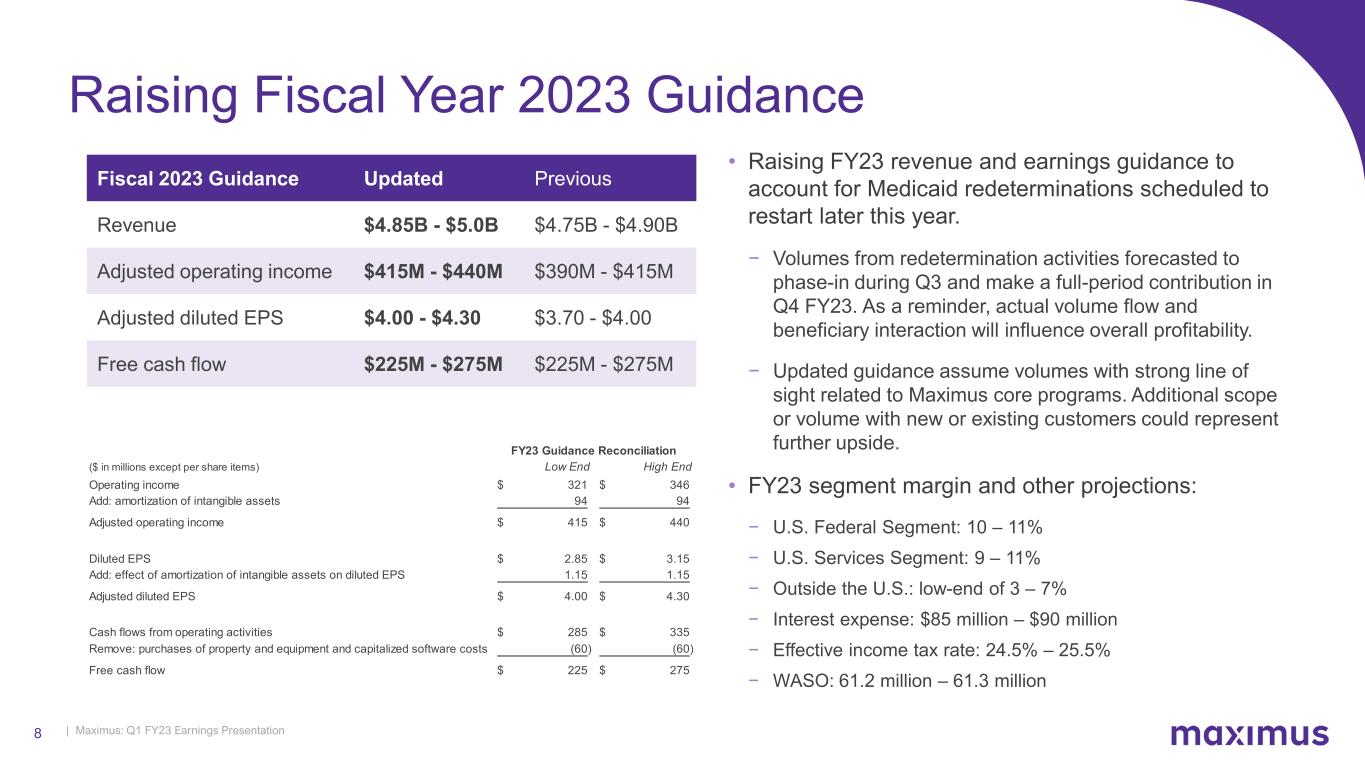
| Maximus: Q1 FY23 Earnings Presentation8 Raising Fiscal Year 2023 Guidance Fiscal 2023 Guidance Updated Previous Revenue $4.85B - $5.0B $4.75B - $4.90B Adjusted operating income $415M - $440M $390M - $415M Adjusted diluted EPS $4.00 - $4.30 $3.70 - $4.00 Free cash flow $225M - $275M $225M - $275M • Raising FY23 revenue and earnings guidance to account for Medicaid redeterminations scheduled to restart later this year. − Volumes from redetermination activities forecasted to phase-in during Q3 and make a full-period contribution in Q4 FY23. As a reminder, actual volume flow and beneficiary interaction will influence overall profitability. − Updated guidance assume volumes with strong line of sight related to Maximus core programs. Additional scope or volume with new or existing customers could represent further upside. • FY23 segment margin and other projections: − U.S. Federal Segment: 10 – 11% − U.S. Services Segment: 9 – 11% − Outside the U.S.: low-end of 3 – 7% − Interest expense: $85 million – $90 million − Effective income tax rate: 24.5% – 25.5% − WASO: 61.2 million – 61.3 million ($ in millions except per share items) Low End High End Operating income 321$ 346$ Add: amortization of intangible assets 94 94 Adjusted operating income 415$ 440$ Diluted EPS 2.85$ 3.15$ Add: effect of amortization of intangible assets on diluted EPS 1.15 1.15 Adjusted diluted EPS 4.00$ 4.30$ Cash flows from operating activities 285$ 335$ Remove: purchases of property and equipment and capitalized software costs (60) (60) Free cash flow 225$ 275$ FY23 Guidance Reconciliation

| Maximus: Q1 FY23 Earnings Presentation9 Fiscal 2023 First Quarter Earnings Call Bruce Caswell President & Chief Executive Officer February 9, 2023
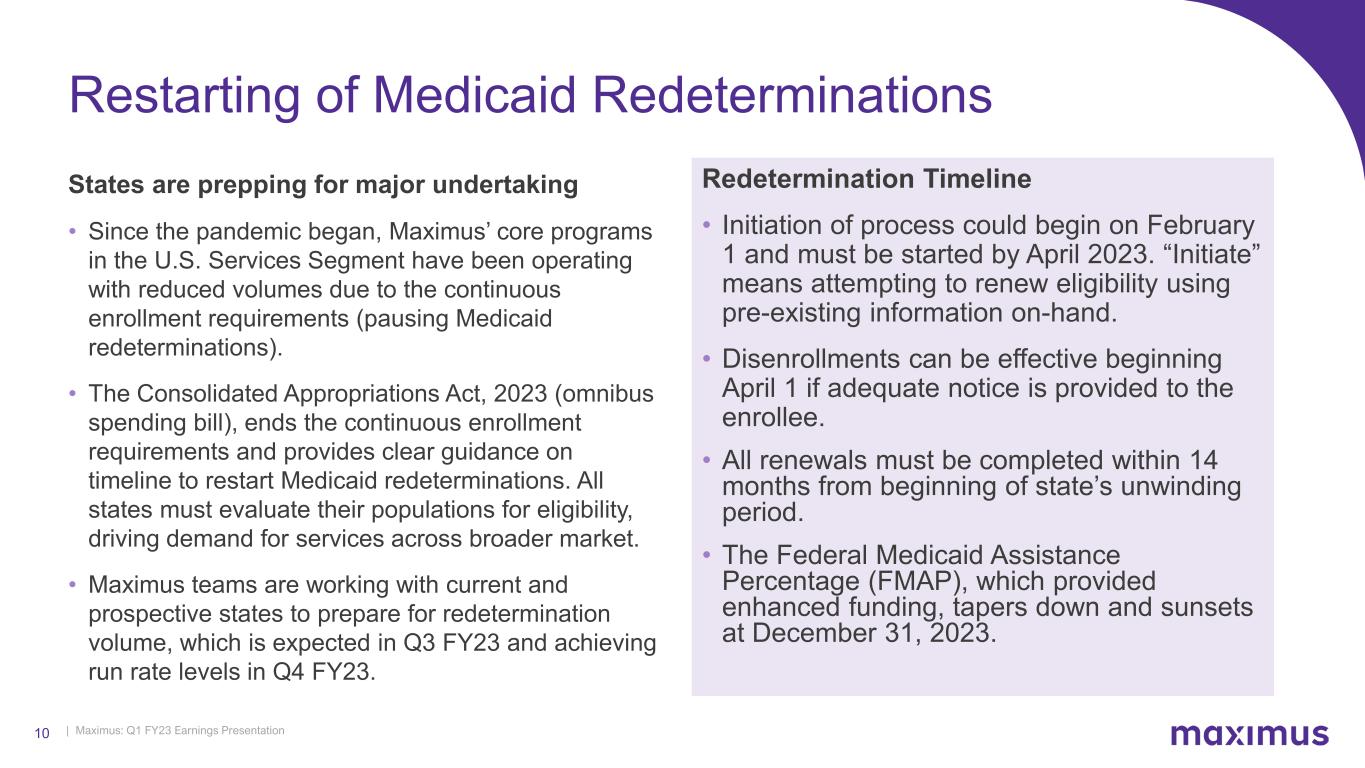
| Maximus: Q1 FY23 Earnings Presentation10 Redetermination Timeline • Initiation of process could begin on February 1 and must be started by April 2023. “Initiate” means attempting to renew eligibility using pre-existing information on-hand. • Disenrollments can be effective beginning April 1 if adequate notice is provided to the enrollee. • All renewals must be completed within 14 months from beginning of state’s unwinding period. • The Federal Medicaid Assistance Percentage (FMAP), which provided enhanced funding, tapers down and sunsets at December 31, 2023. States are prepping for major undertaking • Since the pandemic began, Maximus’ core programs in the U.S. Services Segment have been operating with reduced volumes due to the continuous enrollment requirements (pausing Medicaid redeterminations). • The Consolidated Appropriations Act, 2023 (omnibus spending bill), ends the continuous enrollment requirements and provides clear guidance on timeline to restart Medicaid redeterminations. All states must evaluate their populations for eligibility, driving demand for services across broader market. • Maximus teams are working with current and prospective states to prepare for redetermination volume, which is expected in Q3 FY23 and achieving run rate levels in Q4 FY23. Restarting of Medicaid Redeterminations
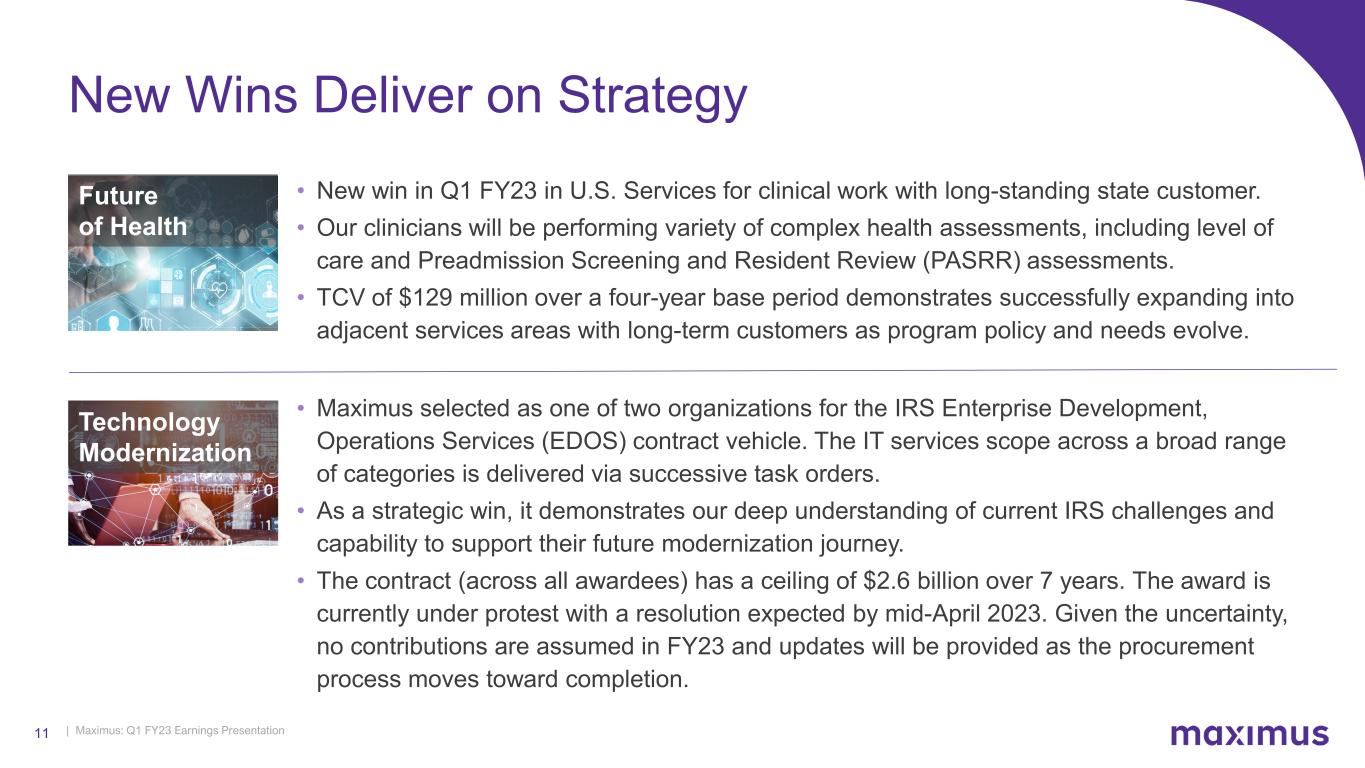
| Maximus: Q1 FY23 Earnings Presentation11 • New win in Q1 FY23 in U.S. Services for clinical work with long-standing state customer. • Our clinicians will be performing variety of complex health assessments, including level of care and Preadmission Screening and Resident Review (PASRR) assessments. • TCV of $129 million over a four-year base period demonstrates successfully expanding into adjacent services areas with long-term customers as program policy and needs evolve. • Maximus selected as one of two organizations for the IRS Enterprise Development, Operations Services (EDOS) contract vehicle. The IT services scope across a broad range of categories is delivered via successive task orders. • As a strategic win, it demonstrates our deep understanding of current IRS challenges and capability to support their future modernization journey. • The contract (across all awardees) has a ceiling of $2.6 billion over 7 years. The award is currently under protest with a resolution expected by mid-April 2023. Given the uncertainty, no contributions are assumed in FY23 and updates will be provided as the procurement process moves toward completion. New Wins Deliver on Strategy Future of Health Technology Modernization
| Maximus: Q1 FY23 Earnings Presentation12 Diversification and Growth Drivers • In Outside the U.S. Segment, Maximus was recently awarded new contract in the Gulf region to perform annual surveys for ~500K social welfare beneficiary households to ensure new eligibility rules are consistently applied. • Contract is for a 5-year base period worth $215 million. • Represents expansion of service into adjacent program domain where the customer has trusted Maximus for more than a decade. • As planned, the Veterans Evaluation Services (VES) business is beginning to see PACT Act-related volume, which are anticipated to sustain well into FY24 for the initial claims. • The PACT Act expands certain conditions under which Veterans would presumptively qualify for benefits resulting in increases in medical disability exam (MDE) volumes. Expanding Our Services VES
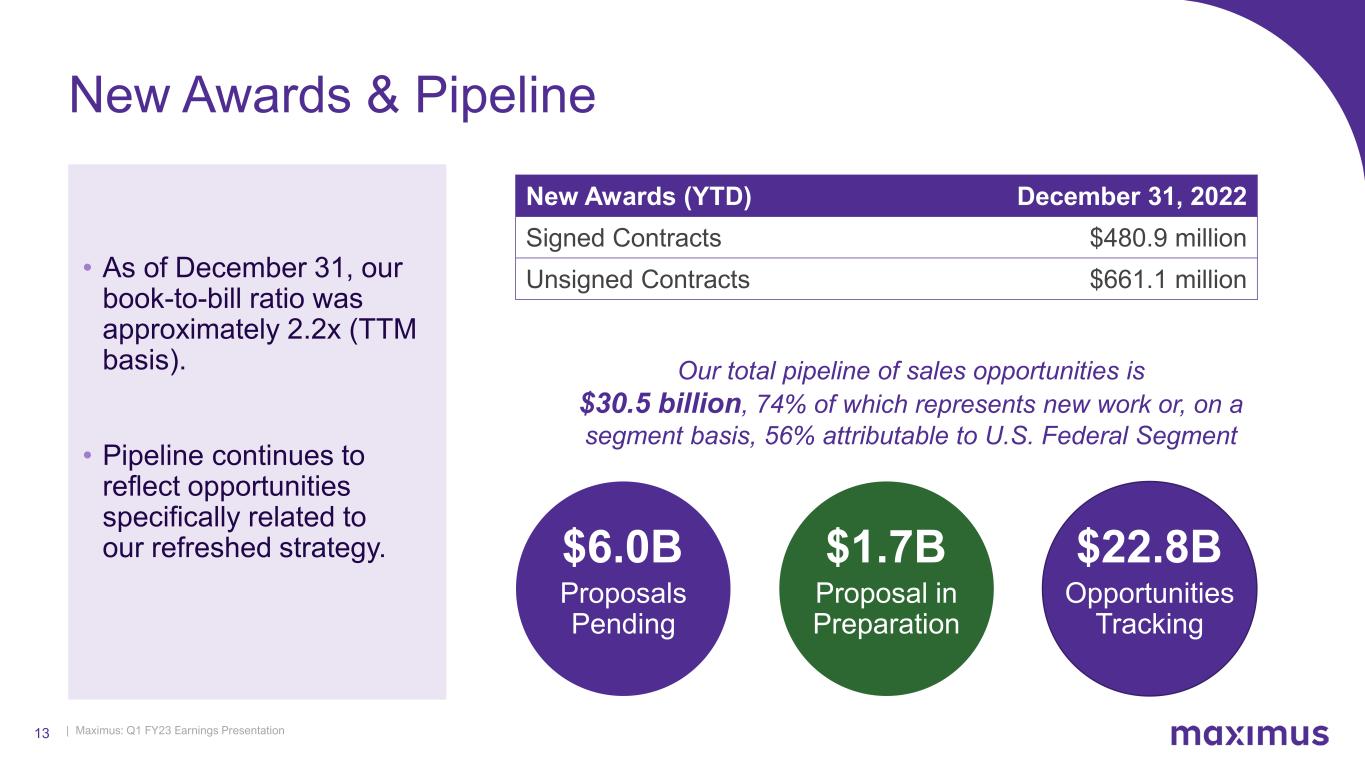
| Maximus: Q1 FY23 Earnings Presentation13 New Awards (YTD) December 31, 2022 Signed Contracts $480.9 million Unsigned Contracts $661.1 million Proposal in Preparation Opportunities Tracking New Awards & Pipeline • As of December 31, our book-to-bill ratio was approximately 2.2x (TTM basis). • Pipeline continues to reflect opportunities specifically related to our refreshed strategy. Proposals Pending $6.0B $1.7B $22.8B Our total pipeline of sales opportunities is $30.5 billion, 74% of which represents new work or, on a segment basis, 56% attributable to U.S. Federal Segment
| Maximus: Q1 FY23 Earnings Presentation14 Closing Remarks • We entered FY23 with momentum, including record backlog, healthy pipeline, strong core business delivery, minimal near-term rebid risk, and solid progress de-levering the business in a tough interest rate environment. • Building on that, we see improved visibility that previously presented the greatest forward-looking uncertainty, including the nationwide redetermination of more than 90 million individuals on Medicaid and CHIP, and evidence of PACT Act volumes ramping. • Pleased to see “green shoots” as we embrace our three-to-five-year strategic plan, including in the areas of clinical assessments and technology modernization. Scale is again building in the business, and we are executing our plans to structure the company optimally for the future and deliver on margin expectations. • Thank you to our Maximus employees for their contributions to a very successful open enrollment season for our customers, and in advance for their upcoming work on Medicaid redeterminations. We take great pride in being of service in support of some of the most critical government programs here and abroad.
| Maximus: Q1 FY23 Earnings Presentation15