
RWT 8-K
Redwood Trust Inc (RWT)
8-K
2022-02-09
For: 2022-02-09
View Original
Added on
April 05, 2026
UNITED STATES
SECURITIES AND EXCHANGE COMMISSION
Washington, D.C. 20549
FORM 8-K
CURRENT REPORT
Pursuant to Section 13 OR 15(d) of The Securities Exchange Act of 1934
Date of Report (Date of earliest event reported): February 9, 2022
(Exact name of registrant as specified in its charter)
(State or other jurisdiction of incorporation) | (Commission File Number) | (I.R.S. Employer Identification No.) | ||||||||||||
(Address of principal executive offices and Zip Code)
(415 ) 389-7373
(Registrant’s telephone number, including area code)
Not Applicable
(Former name or former address, if changed since last report)
Check the appropriate box below if the Form 8-K filing is intended to simultaneously satisfy the filing obligation of the registrant under any of the following provisions (see General Instruction A.2. below):
| Written communications pursuant to Rule 425 under the Securities Act (17 CFR 230.425) | |||||
| Soliciting material pursuant to Rule 14a-12 under the Exchange Act (17 CFR 240.14a-12) | |||||
| Pre-commencement communications pursuant to Rule 14d-2(b) under the Exchange Act (17 CFR 240.14d-2(b)) | |||||
| Pre-commencement communications pursuant to Rule 13e-4(c) under the Exchange Act (17 CFR 240.13e-4(c)) | |||||
Indicate by check mark whether the registrant is an emerging growth company as defined in Rule 405 of the Securities Act of 1933 or Rule 12b-2 of the Securities Exchange Act of 1934.
Emerging growth company ☐
If an emerging growth company, indicate by check mark if the registrant has elected not to use the extended transition period for complying with any new or revised financial accounting standards provided pursuant to Section 13(a) of the Exchange Act. ☐
Securities registered pursuant to Section 12(b) of the Act:
| Title of each class | Trading symbol(s) | Name of each exchange on which registered | ||||||
| Item 2.02. | Results of Operations and Financial Condition; | ||||
| Item 7.01. | Regulation FD Disclosure. | ||||
On February 9, 2022, Redwood Trust, Inc. (the "Company") issued a press release announcing its financial results for the quarter ended December 31, 2021 and The Redwood Review - 4th Quarter 2021, copies of which are attached as Exhibit 99.1 and Exhibit 99.2, respectively, to this current report on Form 8-K.
In addition, on February 9, 2022, the Company made available an investor presentation. A link to the presentation materials is available at the Company’s website at http://www.redwoodtrust.com, in the Investor Relations section of the website under “Presentations.” An archive of the presentation materials will be available at the same location for 90 days.
The information contained in this Item 2.02 and Item 7.01 and the attached Exhibits 99.1 and 99.2 is furnished to and not filed with the SEC, and shall not be incorporated by reference into any registration statement or other document filed under the Securities Act of 1933, as amended, or the Securities Exchange Act of 1934, as amended, except as shall be expressly set forth by specific reference in such filing.
| Item 9.01. | Financial Statements and Exhibits. | ||||
| (d) | Exhibits | |||||||
| Exhibit 99.1 | Press Release dated February 9, 2022 | |||||||
| Exhibit 99.2 | The Redwood Review – 4th Quarter 2021 | |||||||
| Exhibit 104 | Cover Page Interactive Data File (embedded within the inline XBRL document) | |||||||
SIGNATURES
Pursuant to the requirements of the Securities Exchange Act of 1934, the registrant has duly caused this report to be signed on its behalf by the undersigned thereunto duly authorized.
| Date: February 9, 2022 | REDWOOD TRUST, INC. | ||||||||||||||||
| By: | /s/ BROOKE E. CARILLO | ||||||||||||||||
| Name: Brooke E. Carillo | |||||||||||||||||
Title: Chief Financial Officer | |||||||||||||||||
Exhibit Index
| Exhibit No. | Exhibit Title | ||||||||||
| Exhibit 99.1 | |||||||||||
| Exhibit 99.2 | |||||||||||
| Exhibit 104 | Cover Page Interactive Data File (embedded within the inline XBRL document) | ||||||||||
Exhibit 99.1

REDWOOD TRUST REPORTS FOURTH QUARTER 2021 FINANCIAL RESULTS
MILL VALLEY, CA – Redwood Trust, Inc. (NYSE:RWT; "Redwood" or the "Company"), a leader in expanding access to housing for homebuyers and renters, today reported its financial results for the quarter ended December 31, 2021.
Key Financial Results and Metrics
•GAAP net income was $44 million, or $0.34 per diluted common share
•GAAP book value per common share was $12.06 at December 31, 2021, up 0.5% from September 30, 2021 and up 21.7% from December 31, 2020
•Economic return on book value(1) of 2.4% for the fourth quarter and 29.6% for full-year 2021
•Recourse leverage ratio(2) of 2.4x at December 31, 2021
•Declared and paid a regular quarterly dividend of $0.23 per common share for the fourth quarter, a 9.5% increase from the third quarter of 2021 and fourth consecutive quarterly dividend increase
Operational Business Highlights
Business Purpose Mortgage Banking
•Funded $733 million in business purpose loans, up 15% from the third quarter of 2021. Funded $2.3 billion of business purpose loans for full-year 2021, up 60% from 2020
◦Fourth quarter fundings included $367 million of bridge loans (up 50% from the third quarter) and $366 million of single-family rental ("SFR") loans (down 7% from the third quarter)
•Distributed $505 million of loans through securitizations and sales
◦Sold $202 million of SFR loans to large institutional investor
◦Completed one securitization backed by $304 million of SFR loans
Residential Mortgage Banking
•Locked $2.8 billion(3) of jumbo residential loans in fourth quarter and $16.1 billion for full-year 2021, up 76% from 2020; loan purchase commitments were $2.0 billion(4) in the fourth quarter
◦Fourth quarter lock mix(3) was 59% purchase money loans and 41% refinancings; included 87% Select loans and 13% Choice loans
•Purchased $3.2 billion of jumbo loans; jumbo loan pipeline at September 30, 2021 included $1.3 billion of loans identified for purchase
•Distributed $2.8 billion of jumbo loans, including $1.5 billion through whole loan sales and three securitizations backed by a total of $1.3 billion of loans
•Achieved gross margins of 90bps during the quarter, the high end of our historical 75bps to 100bps range
•Subsequent to quarter end, in January 2022, closed SEMT 2022-1, backed by $687 million of loans
_____________________
(1) Economic return on book value is based on the period change in GAAP book value per common share plus dividends declared per common share in the period.
(2) Recourse leverage ratio is defined as recourse debt at Redwood divided by tangible stockholders' equity. Recourse debt excludes $9.9 billion of consolidated securitization debt (ABS issued and servicer advance financing) and other debt that is non-recourse to Redwood, and tangible stockholders' equity excludes $42 million of intangible assets.
(3) Does not account for potential fallout from pipeline that typically occurs through the lending process.
(4) Includes estimated potential fallout from locked pipeline that typically occurs through the lending process.
1
Investment Portfolio
•Deployed $222 million of capital into new investments (including internally sourced investments as well as CRT, HEI and investments in legacy servicing assets)
•Called $79 million of collateral in the fourth quarter, including $33 million of Sequoia residential jumbo loans and $46 million of SFR loans; called $292 million of collateral for the full year of 2021, including $201 million of Sequoia loans and $91 million of SFR loans
•Credit performance remained strong during the fourth quarter, with continued improvement in delinquency trends
Financing Highlights
•Increased non-marginable warehouse capacity for residential loan inventory and for business purpose bridge loans
•Maintained robust balance sheet with unrestricted cash of $450 million and available capital of $150 million at December 31, 2021
RWT Horizons Highlights
•Since inception, completed 15 technology venture investments, including five in the fourth quarter of 2021, that reflect the diversity of our operations and include firms that align with opportunities across our businesses
•Achieved important milestone with first follow-on portfolio company investment in Rentroom
Environmental, Social, Governance ("ESG") Highlights
•Priced first Sequoia securitization that included deal specific ESG disclosure using SASB guidelines
“The fourth quarter of 2021 rounded out a transformative year for our Company where we grew our operating businesses, built out our product and technology offerings, and expanded our strategic investments, while delivering 25% full-year return on equity,” said Chris Abate, Chief Executive Officer of Redwood. “Despite volatility at the end of the year, we demonstrated book value and dividend growth, completed record fundings in our Business Purpose Mortgage Banking business, and deployed significant capital into new investments. As we look ahead in 2022, we expect the diversity and composition of our revenue streams to provide us with a notable advantage in a rising rate environment. Our focus remains on delivering for our shareholders and executing the long-term strategic growth plans we outlined at our September 2021 Investor Day.”
2
Fourth Quarter 2021 Redwood Review Available Online
A further discussion of Redwood's business and financial results is included in the fourth quarter 2021 Redwood Review and the fourth quarter 2021 Investor Presentation which are available within the “Financials-Redwood Review” and "Events and Presentations" sections, respectively, on the Company’s investor relations website at ir.redwoodtrust.com.
Conference Call and Webcast
Redwood will host an earnings call today, February 9, 2022, at 2:00 p.m. Pacific Time / 5:00 p.m. Eastern Time to discuss its fourth quarter 2021 financial results. The number to dial in order to listen to the conference call is 1-877-423-9813 in the U.S. and Canada. International callers must dial 1-201-689-8573. A replay of the call will be available through midnight on February 23, 2022, and can be accessed by dialing 1-844-512-2921 in the U.S. and Canada or 1-412-317-6671 internationally and entering access code #13726362.
The conference call will be webcast live in listen-only mode through the Events and Presentations section of Redwood Trust's Investor Relations website at https://ir.redwoodtrust.com/events-and-presentations/events. To listen to the webcast, please go to Redwood's website at least 15 minutes before the call to register and to download and install any needed audio software. An audio replay of the call will also be available on Redwood's website following the call. Redwood plans to file its Annual Report on Form 10-K with the Securities and Exchange Commission by Tuesday, March 1, 2022, and also make it available on Redwood’s website.
About Redwood Trust
Redwood Trust, Inc. (NYSE: RWT) is a specialty finance company focused on several distinct areas of housing credit. Our operating platforms occupy a unique position in the housing finance value chain, providing liquidity to growing segments of the U.S. housing market not served by government programs. We deliver customized housing credit investments to a diverse mix of investors, through our best-in-class securitization platforms; whole-loan distribution activities; and our publicly-traded shares. Our consolidated investment portfolio has evolved to incorporate a diverse mix of residential, business purpose and multifamily investments. Our goal is to provide attractive returns to shareholders through a stable and growing stream of earnings and dividends, capital appreciation, and a commitment to technological innovation that facilitates risk-minded scale. Since going public in 1994, we have managed our business through several cycles, built a track record of innovation, and a best-in-class reputation for service and a common-sense approach to credit investing. Redwood Trust is internally managed, and structured as a real estate investment trust (“REIT”) for tax purposes. For more information about Redwood, please visit our website at www.redwoodtrust.com or connect with us on LinkedIn, Twitter, or Facebook.
Forward-Looking Statements: This press release and the related conference call contain forward-looking statements within the meaning of the safe harbor provisions of the Private Securities Litigation Reform Act of 1995, including statements related to the amount of residential mortgage loans that we identified for purchase during the fourth quarter of 2021 and expected fallout and the corresponding volume of residential mortgage loans expected to be available for purchase, statements relating to our estimates of our available capital, and the expected timing for the filing of Redwood's Annual Report on Form 10-K. Forward-looking statements involve numerous risks and uncertainties. Redwood's actual results may differ from Redwood's beliefs, expectations, estimates, and projections and, consequently, you should not rely on these forward-looking statements as predictions of future events. Forward-looking statements are not historical in nature and can be identified by words such as “anticipate,” “estimate,” “will,” “should,” “expect,” “believe,” “intend,” “seek,” “plan” and similar expressions or their negative forms, or by references to strategy, plans, or intentions. These forward-looking statements are subject to risks and uncertainties, including, among other things, those described in our Annual Report on Form 10-K for the year ended December 31, 2020 under the caption “Risk Factors”. Other risks, uncertainties, and factors that could cause actual results to differ materially from those projected may be described from time to time in reports we file with the Securities and Exchange Commission, including reports on Forms 10-Q and 8-K. We undertake no obligation to update or revise any forward-looking statements, whether as a result of new information, future events, or otherwise.
3
REDWOOD TRUST, INC.
| ($ in millions, except per share data) | Three Months Ended | Year Ended | |||||||||||||||
| 12/31/2021 | 9/30/2021 | 12/31/21 | |||||||||||||||
| Financial Performance | |||||||||||||||||
| Net income per diluted common share | $ | 0.34 | $ | 0.65 | $ | 2.37 | |||||||||||
| Return on Equity (annualized) | 13 | % | 27 | % | 25 | % | |||||||||||
| Book Value per Share | $ | 12.06 | $ | 12.00 | $ | 12.06 | |||||||||||
| Dividend per Share | $ | 0.23 | $ | 0.21 | $ | 0.78 | |||||||||||
Economic Return on Book Value (1) | 2.4 | % | 6.5 | % | 29.6 | % | |||||||||||
| Available Capital (in millions) | $ | 150 | $ | 350 | $ | 150 | |||||||||||
Recourse Leverage Ratio (2) | 2.4x | 2.2x | 2.4x | ||||||||||||||
| Operating Metrics | |||||||||||||||||
| Business Purpose Loans | |||||||||||||||||
| SFR fundings | $ | 366 | $ | 394 | $ | 1,325 | |||||||||||
| Bridge fundings | $ | 367 | $ | 245 | $ | 960 | |||||||||||
| SFR securitized | $ | 304 | $ | 306 | $ | 1,043 | |||||||||||
| SFR sold | $ | 202 | $ | — | $ | 202 | |||||||||||
| Residential Jumbo Loans | |||||||||||||||||
| Locks | $ | 2,827 | $ | 4,743 | $ | 16,093 | |||||||||||
| Purchases | $ | 3,181 | $ | 3,176 | $ | 12,939 | |||||||||||
| Securitized | $ | 1,335 | $ | 449 | $ | 4,190 | |||||||||||
| Sold | $ | 1,457 | $ | 2,361 | $ | 7,013 | |||||||||||
(1) Economic return on book value is based on the periodic change in GAAP book value per common share plus dividends declared per common share during the period.
(2) Recourse leverage ratio is defined as recourse debt at Redwood divided by tangible stockholders' equity. As of December 31, 2021 and September 30, 2021, recourse debt excludes $9.9 billion and $8.5 billion, respectively, of consolidated securitization debt (ABS issued and servicer advance financing) and other debt that is non-recourse to Redwood, and tangible stockholders' equity excludes $42 million and $45 million, respectively, of intangible assets.
4
REDWOOD TRUST, INC.
Consolidated Income Statements (1) | Three Months Ended | |||||||||||||||||||||||||||||||
| ($ in millions, except share and per share data) | 12/31/21 | 9/30/21 | 6/30/21 | 3/31/21 | 12/31/20 | |||||||||||||||||||||||||||
| Interest income | $ | 162 | $ | 146 | $ | 139 | $ | 128 | $ | 122 | ||||||||||||||||||||||
| Interest expense | (112) | (104) | (108) | (103) | (98) | |||||||||||||||||||||||||||
| Net interest income | 50 | 42 | 31 | 26 | 24 | |||||||||||||||||||||||||||
| Non-interest income | ||||||||||||||||||||||||||||||||
| Mortgage banking activities, net | 36 | 63 | 54 | 83 | 54 | |||||||||||||||||||||||||||
| Investment fair value changes, net | 7 | 26 | 49 | 45 | 23 | |||||||||||||||||||||||||||
| Other income | 4 | 2 | 2 | 4 | — | |||||||||||||||||||||||||||
| Realized gains, net | — | 7 | 8 | 3 | — | |||||||||||||||||||||||||||
| Total non-interest income, net | 47 | 98 | 114 | 134 | 77 | |||||||||||||||||||||||||||
| General and administrative expenses | (39) | (48) | (41) | (44) | (30) | |||||||||||||||||||||||||||
| Loan acquisition costs | (4) | (5) | (4) | (4) | (3) | |||||||||||||||||||||||||||
| Other expenses | (5) | (4) | (4) | (4) | (4) | |||||||||||||||||||||||||||
| (Provision for) benefit from income taxes | (5) | 4 | (7) | (12) | (8) | |||||||||||||||||||||||||||
| Net income | $ | 44 | $ | 88 | $ | 90 | $ | 97 | $ | 54 | ||||||||||||||||||||||
Weighted average diluted shares (thousands) (2) | 143,540 | 141,855 | 141,761 | 141,039 | 140,641 | |||||||||||||||||||||||||||
| Diluted earnings per common share | $ | 0.34 | $ | 0.65 | $ | 0.66 | $ | 0.72 | $ | 0.42 | ||||||||||||||||||||||
| Regular dividends declared per common share | $ | 0.23 | $ | 0.21 | $ | 0.18 | $ | 0.16 | $ | 0.14 | ||||||||||||||||||||||
(1)Certain totals may not foot due to rounding.
(2)In the periods presented above, weighted average diluted shares included shares from the assumed conversion of our convertible and/or exchangeable debt in accordance with GAAP diluted EPS provisions. Actual shares outstanding at December 31, 2021, September 30, 2021, June 30, 2021, March 31, 2021 and December 31, 2020 were 114,892, 114,662, 113,053, 112,999, and 112,090, respectively.
Fourth Quarter 2021 Overview
•Our fourth quarter results demonstrated solid operating performance despite a challenging economic backdrop. Our earnings comfortably exceeded our fourth quarter dividend, producing an annualized ROE of 13% and a quarterly economic return on book value of 2.4%. The decline in our GAAP earnings from the third quarter was primarily due to lower residential mortgage banking revenue (negatively impacted by seasonal factors and year-end interest rate volatility, though with margins at the high end of our historic range), and more modest price appreciation on our investment portfolio relative to the third quarter. These reductions were offset by higher net interest income, durable Business Purpose Mortgage Banking income on record volume, and lower operating expenses.
5
Analysis of Earnings - Changes from Third to Fourth Quarter 2021
•Net interest income increased from the third quarter of 2021, primarily due to higher discount accretion income on our available-for-sale securities (reflecting anticipated future calls of Redwood sponsored securitizations), a higher average balance of investments, and lower cost of funds on bridge loan financing (including from the inaugural bridge loan securitization we completed during the third quarter).
•Income from business purpose mortgage banking activities decreased from the third quarter as securitization spreads widened toward the end of the year, impacting loan inventory valuations. Our results for the quarter otherwise benefited from a significant increase in funding volume (particularly of bridge loans) from the third quarter, to record levels.
•Income from residential mortgage banking activities decreased from third quarter levels, as market conditions during the fourth quarter prompted us to preserve additional margin in our loan purchase activities and decrease loan purchase commitments to $2.0 billion in the fourth quarter.
•Positive investment fair value changes in the fourth quarter reflected continued strength in credit performance across our investment portfolio, particularly in our re-performing loan ("RPL") and SFR securities.
•Other income increased from the third quarter, due to higher MSR income resulting from a reduction in prepayment speeds during the fourth quarter.
•General and administrative expenses decreased from the third quarter, as variable compensation decreased commensurate with the decrease in quarterly GAAP earnings.
•Other expenses were primarily comprised of acquisition-related intangible amortization expense.
•Our income tax provision normalized in the fourth quarter, after recording a significant benefit from income taxes in the third quarter from the release of a valuation allowance recorded against a portion of our deferred tax assets.
6
| REDWOOD TRUST, INC. | ||||||||||||||
Consolidated Income Statements (1) | Year Ended December 31, | |||||||||||||
| ($ in millions, except share and per share data) | 2021 | 2020 | ||||||||||||
| Interest income | $ | 575 | $ | 572 | ||||||||||
| Interest expense | (427) | (448) | ||||||||||||
| Net interest income | 148 | 124 | ||||||||||||
| Non-interest income (loss) | ||||||||||||||
| Mortgage banking activities, net | 236 | 78 | ||||||||||||
| Investment fair value changes, net | 128 | (588) | ||||||||||||
| Other income | 12 | 4 | ||||||||||||
| Realized gains, net | 18 | 30 | ||||||||||||
| Total non-interest income (loss) | 394 | (475) | ||||||||||||
| General and administrative expenses | (171) | (115) | ||||||||||||
| Loan acquisition costs | (16) | (11) | ||||||||||||
| Other expenses | (17) | (109) | ||||||||||||
| (Provision for) benefit from income taxes | (18) | 5 | ||||||||||||
| Net income (loss) | $ | 320 | $ | (582) | ||||||||||
| Weighted average diluted shares (thousands) | 142,070 | 113,936 | ||||||||||||
| Diluted earnings (loss) per common share | $ | 2.37 | $ | (5.12) | ||||||||||
| Regular dividends declared per common share | $ | 0.78 | $ | 0.725 | ||||||||||
(1)Certain totals may not foot due to rounding.
7
| REDWOOD TRUST, INC. | |||||||||||||||||||||||||||||||||||
Consolidated Balance Sheets (1) | |||||||||||||||||||||||||||||||||||
| ($ in millions, except share and per share data) | 12/31/21 | 9/30/21 | 6/30/21 | 3/31/21 | 12/31/20 | ||||||||||||||||||||||||||||||
| Residential loans | $ | 7,592 | $ | 6,216 | $ | 5,743 | $ | 4,702 | $ | 4,249 | |||||||||||||||||||||||||
| Business purpose loans | 4,791 | 4,694 | 4,409 | 4,172 | 4,136 | ||||||||||||||||||||||||||||||
| Multifamily loans | 474 | 483 | 485 | 490 | 492 | ||||||||||||||||||||||||||||||
| Real estate securities | 377 | 353 | 355 | 364 | 344 | ||||||||||||||||||||||||||||||
| Other investments | 642 | 422 | 309 | 323 | 348 | ||||||||||||||||||||||||||||||
| Cash and cash equivalents | 450 | 557 | 421 | 426 | 461 | ||||||||||||||||||||||||||||||
| Other assets | 380 | 347 | 274 | 420 | 324 | ||||||||||||||||||||||||||||||
| Total assets | $ | 14,707 | $ | 13,073 | $ | 11,996 | $ | 10,897 | $ | 10,355 | |||||||||||||||||||||||||
| Short-term debt | $ | 2,177 | $ | 1,751 | $ | 1,485 | $ | 1,254 | $ | 523 | |||||||||||||||||||||||||
| Other liabilities | 249 | 263 | 195 | 317 | 195 | ||||||||||||||||||||||||||||||
| Asset-backed securities issued | 9,254 | 8,184 | 7,537 | 6,672 | 7,101 | ||||||||||||||||||||||||||||||
| Long-term debt, net | 1,641 | 1,500 | 1,484 | 1,438 | 1,425 | ||||||||||||||||||||||||||||||
| Total liabilities | 13,321 | 11,697 | 10,701 | 9,681 | 9,244 | ||||||||||||||||||||||||||||||
| Stockholders' equity | 1,386 | 1,376 | 1,295 | 1,216 | 1,111 | ||||||||||||||||||||||||||||||
| Total liabilities and equity | $ | 14,707 | $ | 13,073 | $ | 11,996 | $ | 10,897 | $ | 10,355 | |||||||||||||||||||||||||
| Shares outstanding at period end (thousands) | 114,892 | 114,662 | 113,053 | 112,999 | 112,090 | ||||||||||||||||||||||||||||||
| GAAP book value per share | $ | 12.06 | $ | 12.00 | $ | 11.46 | $ | 10.76 | $ | 9.91 | |||||||||||||||||||||||||
(1)Certain totals may not foot due to rounding.
| CONTACTS | ||
| Kaitlyn Mauritz | ||
| SVP, Head of Investor Relations | ||
| Phone: 866-269-4976 | ||
| Email: [email protected] | ||
8
| Exhibit 99.2 | ||||||||||||||
T H E R E D W O O D R E V I E W F O U R T H Q U A R T E R 2 0 2 1 | ||||||||||||||
R E D W O O D T R U S T | ||||||||||||||
 |  |  | ||||||||||||
| T A B L E O F C O N T E N T S | ||
| Introduction | |||||
| Shareholder Letter | |||||
| Evolution of Our Earnings Materials | |||||
| Quarterly Results | |||||
Ñ Fourth Quarter Financial Overview | |||||
Ñ Quarterly Earnings and Analysis | |||||
Ñ Book Value | |||||
Ñ Analysis of Operating Results | |||||
Ñ RWT Horizons Updates | |||||
| Quarterly Positions | |||||
Ñ Capital Allocations | |||||
Ñ Financing Overview | |||||
Ñ Credit Overview | |||||
| Financial Tables | |||||
| Appendix | |||||
Ñ Segment Overview | |||||
Ñ Dividends and Taxable Income | |||||
Ñ Non-GAAP Measurements | |||||
Ñ Forward-Looking Statements | |||||
| Endnotes | |||||
| THE REDWOOD REVIEW I 4TH QUARTER 2021 | ||
1 | ||
| I N T R O D U C T I O N | ||
Note to Readers:
We file annual reports (on Form 10-K) and quarterly reports (on Form 10-Q) with the Securities and Exchange Commission. These filings and our earnings press releases provide information about Redwood and our financial results in accordance with generally accepted accounting principles (GAAP). These documents, as well as information about our business and a glossary of terms we use in this and other publications, are available through our website, www.redwoodtrust.com. We encourage you to review these documents.
Within this document, in addition to our GAAP results, we also present certain non-GAAP measures. When we present a non-GAAP measure, we provide a description of that measure and a reconciliation to the comparable GAAP measure within the Non-GAAP Measurement section of the Appendix.
References herein to “Redwood,” the “Company,” “we,” “us,” and “our” include Redwood Trust, Inc. and its consolidated subsidiaries, unless the context otherwise requires. In statements regarding qualification as a REIT, such terms refer solely to Redwood Trust, Inc. Note that because we generally round numbers in the tables to millions, except per share amounts, some numbers may not foot due to rounding. References to the “fourth quarter” refer to the quarter ended December 31, 2021, and references to the “third quarter” refer to the quarter ended September 30, 2021, unless otherwise specified.
Forward-looking statements:
This Redwood Review contains forward-looking statements within the meaning of the safe harbor provisions of the Private Securities Litigation Reform Act of 1995. Forward-looking statements involve numerous risks and uncertainties. Our actual results may differ from our expectations, estimates, and projections and, consequently, you should not rely on these forward-looking statements as predictions of future events. Forward-looking statements are not historical in nature and can be identified by words such as “anticipate,” “estimate,” “will,” “should,” “expect,” “believe,” “intend,” “seek,” “plan,” "could" and similar expressions or their negative forms, or by references to strategy, plans, goals, or intentions. These forward-looking statements are subject to risks and uncertainties, including, among other things, those described in our Annual Report on Form 10-K under the caption “Risk Factors.” Other risks, uncertainties, and factors that could cause actual results to differ materially from those projected are described below and may be described from time to time in reports we file with the Securities and Exchange Commission, including reports on Forms 10-K, 10-Q, and 8-K. We undertake no obligation to update or revise forward-looking statements, whether as a result of new information, future events, or otherwise.
Statements regarding the following subjects, among others, are forward-looking by their nature: statements we make regarding Redwood’s business strategy and strategic focus, statements related to our financial outlook and expectations for 2022 and future years, statements regarding our available capital and sourcing additional capital both internally and from the capital markets, and other statements regarding pending business activities and expectations and estimates relating to our business and financial results. Additional detail regarding the forward-looking statements in this Redwood Review and the important factors that may affect our actual results in 2022 are described in the Appendix of this Redwood Review under the heading “Forward-Looking Statements.”
| Detailed endnotes are included at the end of this Redwood Review. | ||
| THE REDWOOD REVIEW I 4TH QUARTER 2021 | ||
2 | ||
| S H A R E H O L D E R L E T T E R | ||
Dear Fellow Shareholders:
The fourth quarter of 2021 rounded out a transformative year for our Company. Our operating platforms continued to profitably scale, and we executed on our capital deployment goals while advancing key strategic objectives in technology and product development. In all, we took critical steps in establishing ourselves as the leading operator and strategic capital provider in housing finance, the heart of our corporate vision. Through the lens of full-year financial results, we produced a 25% return on equity and delivered four consecutive quarterly dividend increases to generate an annual total shareholder return of over 60%. This past year also saw us begin to unlock the embedded value in both our operating businesses and investment portfolio, contributing to a 22% increase in book value since year-end 2020.
For the fourth quarter, GAAP earnings were $0.34 per diluted share and our book value per share increased to $12.06. We paid a quarterly dividend of $0.23 per share, a 9.5% increase from the third quarter. Going forward, we believe the diversity of our revenue streams – most notably the resiliency they have shown in rising rate environments – leaves us with a runway many others will not have.
In what has quickly become an extremely challenging interest rate environment for mortgage companies, the opportunities for Redwood to differentiate itself have only grown. With the country struggling to turn the page on the Covid-19 pandemic, the broad-based economic recovery many had expected by now has been elusive. Meanwhile, inflation has reached a 40-year high, and an aggressive response by the Fed signals the end of more than a decade’s worth of accommodation. Higher interest rates are no longer a prospect or probability, but are now a reality, as benchmark yields recently reached their highest levels since 2019. The relative consistency in the Fed’s messaging, while laudable, has done little to calm the equity or bond markets in recent months.
As a housing finance company, we confront many of the same challenges as other market participants, but important differences underpin our revenue opportunities. Redwood’s business model is not beholden to low interest rates, quantitative easing, or a steep yield curve. To wit: over the last Fed rate hiking cycle that began in late 2015, Redwood's book value increased as long-term rates rose and the yield curve compressed – and our model has evolved even further since that time to include revenue streams less correlated with the path of benchmark rates.
Over the last number of years, we have strategically evolved our company and positioned our platform to be flexible as the environment evolves. We believe this readiness positions us well to navigate the current landscape. A key example of this strategic evolution has been our expansion into business purpose lending (“BPL”), which began in 2018 and allowed us to access a growing cohort of investors seeking to refurbish and stabilize antiquated housing stock. CoreVest – our BPL business – has provided balance and depth to our platform across a variety of interest rate and credit scenarios. As our shareholders have grown to know, BPL loans are generally either floating rate for the life of the loan, or “rate locked” just prior to their funding, substantially mitigating the interest rate exposure market participants incur in managing a traditional mortgage pipeline.
| Detailed endnotes are included at the end of this Redwood Review. | ||
| THE REDWOOD REVIEW I 4TH QUARTER 2021 | ||
3 | ||
| S H A R E H O L D E R L E T T E R | ||
Our firm’s fourth quarter performance underscores this point. As volatility and traditional year-end seasonality dampened consumer residential lending activity and increased execution costs for most market participants, CoreVest had another record quarter. The team funded over $700 million of loans for the fourth quarter overall, including over $340 million in December – both records that contributed to overall fundings of $2.3 billion for the full year, another milestone for the platform. Having recently eclipsed $15 billion in loan closings since inception, CoreVest continues to scale impressively while serving borrowers more efficiently, affirming our status as the leading lender to housing related real estate investors. The team also continues to broaden its distribution capabilities, avoiding choppy issuance markets in the fourth quarter by selling approximately $200 million of single-family rental loans to a large institutional buyer at a compelling margin versus securitization.
CoreVest enters 2022 with a significant pipeline of activity and a strong outlook. Prevailing industry dynamics – most notably, consistent demand growth for single-family rentals – continue to attract increased equity capital to the space, a trend we see continuing even as rates rise. We have recently witnessed a notable increase in demand for financing from CoreVest’s client base, evidenced by higher funded volumes across all products, particularly in the build-for-rent and multifamily sectors. Our lending activities in BPL continue to support the construction and stabilization of high-quality and accessible rental housing stock, benefiting renters and local communities alike. We also see exciting opportunities to enhance our direct origination capabilities through purchases from third-party correspondents, the expansion of our new residential transition loan ("RTL") securitization platform, and opportunities to further scale our platform through partnerships or additional acquisitions.
Complementing our BPL performance was that of our Investment Portfolio, which took advantage of rising rates and wider credit spreads heading into the end of 2021. We deployed $222 million of capital into investments in the fourth quarter, by far the most in a single quarter since the pandemic began. This included $135 million in third-party investments, an important validation of our team’s ability to capitalize on challenging market conditions. Our purchases included agency CRT securities as well as additional home equity investments (“HEI”), following our inaugural securitization of that asset class in the third quarter of 2021. We also progressed our call strategy, bringing over additional seasoned jumbo and single-family rental loans onto our balance sheet with an opportunity to sell or re-securitize them at a gain. Despite moderately slowing prepayment speeds, our near- to medium-term outlook for call activity remains heightened given a backdrop of strong housing fundamentals. We have been waiting for an environment like the current one to deploy our available capital, and we continue to find ways to raise additional capital accretively through innovative distribution avenues and efficient capital management programs. Our approach has allowed us to remain opportunistic while funding near-term capital needs for our operating and investing platforms.
Our Residential business faced the brunt of broader market headwinds in the fourth quarter while still managing to outperform most, if not all, in the sector. We proactively took a conservative risk management posture late in the year, prioritizing healthy margins at the high end of our historical range, albeit at lower volumes, as heavier loan inventories across the industry pressured credit spreads and margins. Despite this, we issued three securitizations for a combined $1.3 billion of collateral in the fourth quarter, at margins that led the market. Notably, two of the three securitizations were pre-placed to investors, providing us greater certainty into our ultimate loan sale
| Detailed endnotes are included at the end of this Redwood Review. | ||
| THE REDWOOD REVIEW I 4TH QUARTER 2021 | ||
4 | ||
| S H A R E H O L D E R L E T T E R | ||
margins. We also incorporated new ESG-related metrics into our investor disclosures, following the enhanced transparency we had previously added by putting our securitizations on blockchain, providing investors with more timely remittance reporting information on the loans in our offerings.
Looking ahead, we expect a year of transition for the consumer residential mortgage market and one in which Redwood is well-positioned to support the evolving needs of home buyers. Refinance volumes will be lower due to rising rates and will likely trigger contractions for originators with excess capacity until margins stabilize. The quality of our seller network remains on display, however, with nearly 60% of our lock volume during the fourth quarter already in purchase-money loans. Continued volatility into January has also unlocked opportunities to source loans via bulk acquisition as market constituents re-evaluate distribution strategies. We also expect a renewed focus by originators toward expanded credit loan products in 2022, to assist home buyers who are likely to experience declining purchasing power as mortgage rates rise. We’ve been actively preparing for this market shift for months, especially as more geographies across the country become “non-conforming”, where access to homeownership will increasingly rely on the private-label products we purchase.
While last year’s substantial home price appreciation had a proportional impact on increasing GSE loan limits, recent adjustments by the FHFA to the GSEs’ pricing regime (“LLPAs”) for certain high balance and second home products will be an important driver of preserving private capital’s influence in the parts of the market where it is most impactful. We anticipate that the pricing adjustments will result in more high balance and second home loans flowing into the private market. As a partner to the GSEs and a leading voice for quality and innovation in the housing finance sector, we applaud these recent actions by the FHFA and anticipate – as we have in years past – playing a meaningful role in providing liquidity to these otherwise GSE-eligible borrowers. For our Residential business overall, the goal is to once again capture increased market share in 2022, with an emphasis on our lineup of quality expanded credit programs that spoke for 40% of our total volume as recently as late 2019. We’ve proven our ability to grow our footprint in a growing market, and believe we are positioned to continue doing so moving forward, driven by the differentiated quality of our service and our broad suite of products.
Technology continues to be a key part of this formula. Our newest venture, RWT Horizons, just celebrated its first birthday and is poised to offer meaningful alpha in 2022. During its inaugural year, this home-grown venture investing effort made 15 investments in companies with a direct nexus to our operating platforms, including five new investments during the fourth quarter. Our reputation in venture investing has grown significantly in recent months, with many new startups actively seeking the type of strategic capital that Redwood can provide. Though Horizons represents a departure from traditional portfolio investing, we expect our Horizons’ investments to drive significant option value for shareholders as some begin to bear fruit, all while delivering valuable technology and other innovative efficiencies to our platforms in 2022. Our goal by the end of 2022 is to have $50 to $100 million of capital allocated to Horizons across an increasingly diversified portfolio of early to mid stage companies.
| Detailed endnotes are included at the end of this Redwood Review. | ||
| THE REDWOOD REVIEW I 4TH QUARTER 2021 | ||
5 | ||
| S H A R E H O L D E R L E T T E R | ||
After reflecting on such an extraordinary year, we enter 2022 with an air of confidence while confronting formidable market challenges and a global health pandemic whose endpoint remains uncertain. We feel especially privileged to be leading a mission-focused Company that strives to make quality housing, whether rented or owned, accessible to all American households. We continually emphasize the importance of our people and their ability to create solutions to combat some of today’s core affordability challenges for consumers. Most of all, we appreciate our long-term shareholders for your commitment to Redwood and for entrusting us with your support.
Thanks for your continued support.
 |  | |||||||
| Christopher J. Abate | Dashiell I. Robinson | |||||||
| Chief Executive Officer | President | |||||||
| Detailed endnotes are included at the end of this Redwood Review. | ||
| THE REDWOOD REVIEW I 4TH QUARTER 2021 | ||
6 | ||
| E V O L U T I O N O F E A R N I N G S M A T E R I A L S | ||
Evolution of Our Earnings Materials
Since Redwood’s founding in 1994, our commitment to thorough and transparent disclosure has been second to none. The centerpiece of this tradition has been the Redwood Review – a unique document that blends personalized outreach from management with rich detail about our recent results and current financial condition.
As our business model has evolved, the Redwood Review has too, in an effort to synthesize a more diversified set of key business drivers and results. And as our company continues to evolve, so too must our approach to sharing the specifics of our progress. As we have sought and assessed feedback on the standard package of materials we release each quarter, we have decided to make some changes that we believe will make it easier for all of our stakeholders – most importantly our shareholders – to evaluate our results.
As such, this represents the last quarter that we will present the Redwood Review in its current form. Instead, beginning with our earnings release for the first quarter of 2022, the information you are used to seeing in the Redwood Review will be presented in the following documents on our website under Quarterly Results:
•Our quarterly Shareholder Letter remains the most personal way in which we communicate our vision and strategic narrative to our stakeholders. It will be found going forward in standalone form.
•Our Earnings-Related Investor Presentation – a new addition this quarter – will focus primarily on our quarterly results and include many of the Review’s key exhibits in a section entitled “Financial Results”. In future quarters, this document will assume the name “Redwood Review.”
•Our standard Earnings Press Release will be expanded to include the “Analysis of Earnings” section from the Redwood Review, allowing readers to access this important commentary in closer proximity to our full earnings detail.
•The Supplemental Financial Tables currently found in the “Financial Tables” of the Redwood Review will be provided in a downloadable excel format on our website for ease of analyzing our financial disclosures.
Each of the documents bulleted above has been prepared this quarter in the format that stakeholders can expect going forward.
As we continue to expand and scale our company, the transparency and utility of our disclosures must keep pace. We hope you find these changes helpful in following our strategic progress and welcome your ongoing feedback as we continue to evolve our disclosures.
| Detailed endnotes are included at the end of this Redwood Review. | ||
| THE REDWOOD REVIEW I 4TH QUARTER 2021 | ||
7 | ||
| Q U A R T E R L Y R E S U L T S | ||
Fourth Quarter Financial Overview
Key Financial Results and Metrics | ||||||||||||||||||||
($ in millions, except per share amounts) | ||||||||||||||||||||
| Three Months Ended | Year Ended | |||||||||||||||||||
| 12/31/2021 | 9/30/2021 | 12/31/21 | ||||||||||||||||||
| Diluted Earnings per Share | $ | 0.34 | $ | 0.65 | $ | 2.37 | ||||||||||||||
| Return on Equity (annualized) | 13 | % | 27 | % | 25 | % | ||||||||||||||
| Book Value per Share | $ | 12.06 | $ | 12.00 | $ | 12.06 | ||||||||||||||
| Dividend per Share | $ | 0.23 | $ | 0.21 | $ | 0.78 | ||||||||||||||
Economic Return on Book Value (1) | 2.4 | % | 6.5 | % | 29.6 | % | ||||||||||||||
| Available Capital | $ | 150 | $ | 350 | $ | 150 | ||||||||||||||
Recourse Leverage Ratio (2) | 2.4x | 2.2x | 2.4x | |||||||||||||||||
| Operating Metrics | ||||||||||||||||||||
| Business Purpose Loans | ||||||||||||||||||||
| Bridge fundings | $ | 367 | $ | 245 | $ | 960 | ||||||||||||||
| SFR fundings | $ | 366 | $ | 394 | $ | 1,325 | ||||||||||||||
| SFR securitized | $ | 304 | $ | 306 | $ | 1,043 | ||||||||||||||
| SFR sold | $ | 202 | $ | — | $ | 202 | ||||||||||||||
| Residential Jumbo Loans | ||||||||||||||||||||
| Locks | $ | 2,827 | $ | 4,743 | $ | 16,093 | ||||||||||||||
| Purchases | $ | 3,181 | $ | 3,176 | $ | 12,939 | ||||||||||||||
| Securitized | $ | 1,335 | $ | 449 | $ | 4,190 | ||||||||||||||
| Sold | $ | 1,457 | $ | 2,361 | $ | 7,013 | ||||||||||||||
Ñ Our fourth quarter results demonstrated solid operating performance despite a challenging economic backdrop. Our earnings comfortably exceeded our fourth quarter dividend, producing an annualized ROE of 13% and a quarterly economic return on book value of 2.4%. The decline in our GAAP earnings from the third quarter was primarily due to lower residential mortgage banking revenue (negatively impacted by seasonal factors and year-end interest rate volatility, though with margins at the high end of our historic range), and more modest price appreciation on our investment portfolio relative to the third quarter. These reductions were offset by higher net interest income, durable Business Purpose Mortgage Banking income on record volume, and lower operating expenses.
Ñ In December, we announced a 9.5% increase in our quarterly dividend to $0.23 per share, our fourth consecutive quarterly dividend increase.
| Detailed endnotes are included at the end of this Redwood Review. | ||
| THE REDWOOD REVIEW I 4TH QUARTER 2021 | ||
8 | ||
| Q U A R T E R L Y R E S U L T S | ||
Ñ Business purpose loan fundings achieved record volumes for both the fourth quarter and full year 2021 with bridge loans continuing to grow as a percentage of overall fundings. We completed one SFR securitization during the fourth quarter and sold a portfolio of SFR loans to an institutional investor, both at favorable execution levels.
Ñ Residential loan locks slowed in the fourth quarter, driven mainly by seasonal factors, while loan purchases remained stable, as we funded loans locked during a record third quarter for lock volumes.
Ñ We deployed $222 million of capital towards new investments in the fourth quarter, including $92 million of investments sourced through our operating platforms, a $60 million investment in legacy servicing assets, $31 million in home equity investments, and $39 million of CRT securities.
Ñ At December 31, 2021, our unrestricted cash was $450 million, and our estimated available capital decreased to $150 million, driven by our largest quarter of deployed capital since pre-COVID.
Note on Change in Segments
Ñ During the fourth quarter of 2021 we re-organized our segments, moving all retained investments previously held in our Residential Lending and Business Purpose Lending segments to a newly-created Investment Portfolio Segment, where they are now combined with our third-party portfolio investments. Our mortgage banking activities are now reflected in standalone Residential Mortgage Banking and Business Purpose Mortgage Banking segments. See the "Segment Overview" portion of the Appendix to this Redwood Review for additional information on our new segments.
| Detailed endnotes are included at the end of this Redwood Review. | ||
| THE REDWOOD REVIEW I 4TH QUARTER 2021 | ||
9 | ||
| Q U A R T E R L Y R E S U L T S | ||
Quarterly Earnings and Analysis
Below we present GAAP net income for the fourth and third quarters of 2021.
GAAP Net Income | ||||||||||||||
($ in millions, except per share data) | ||||||||||||||
| Three Months Ended | ||||||||||||||
| 12/31/2021 | 9/30/2021 | |||||||||||||
| Net interest income | ||||||||||||||
| Investment portfolio | $ | 50 | $ | 42 | ||||||||||
| Mortgage banking | 8 | 9 | ||||||||||||
Corporate (unsecured debt)(1) | (9) | (9) | ||||||||||||
| Total net interest income | 50 | 42 | ||||||||||||
| Non-interest income | ||||||||||||||
| Business Purpose mortgage banking activities, net | 24 | 30 | ||||||||||||
| Residential mortgage banking activities, net | 12 | 33 | ||||||||||||
| Investment fair value changes, net | 7 | 26 | ||||||||||||
| Other income, net | 4 | 2 | ||||||||||||
| Realized gains, net | — | 7 | ||||||||||||
| Total non-interest income, net | 47 | 98 | ||||||||||||
| General and administrative expenses | (39) | (48) | ||||||||||||
| Loan acquisition costs | (4) | (5) | ||||||||||||
| Other expenses | (5) | (4) | ||||||||||||
| (Provision for) benefit from income taxes | (5) | 4 | ||||||||||||
| Net income | $ | 44 | $ | 88 | ||||||||||
| Earnings per diluted common share | $ | 0.34 | $ | 0.65 | ||||||||||
| Detailed endnotes are included at the end of this Redwood Review. | ||
| THE REDWOOD REVIEW I 4TH QUARTER 2021 | ||
10 | ||
| Q U A R T E R L Y R E S U L T S | ||
Analysis of Earnings
Ñ Net interest income increased from the third quarter of 2021, primarily due to higher discount accretion income on our available-for-sale securities (reflecting anticipated future calls of Redwood sponsored securitizations), a higher average balance of investments, and lower cost of funds on bridge loan financing (including from the inaugural bridge loan securitization we completed during the third quarter).
Ñ Income from business purpose mortgage banking activities decreased from the third quarter as securitization spreads widened toward the end of the year, impacting loan inventory valuations. Our results for the quarter otherwise benefited from a significant increase in funding volume (particularly of bridge loans) from the third quarter, to record levels.
Ñ Income from residential mortgage banking activities decreased from third quarter levels, as market conditions during the fourth quarter prompted us to preserve additional margin in our loan purchase activities and decrease loan purchase commitments to $2.0 billion in the fourth quarter.
Ñ Positive investment fair value changes in the fourth quarter reflected continued strength in credit performance across our investment portfolio, particularly in our re-performing loan ("RPL") and SFR securities.
Ñ Other income increased from the third quarter, due to higher MSR income resulting from a reduction in prepayment speeds during the fourth quarter.
Ñ General and administrative expenses decreased from the third quarter, as variable compensation decreased commensurate with the decrease in quarterly GAAP earnings.
Ñ Other expenses were primarily comprised of acquisition-related intangible amortization expense.
Ñ Our income tax provision normalized in the fourth quarter, after recording a significant benefit from income taxes in the third quarter from the release of a valuation allowance recorded against a portion of our deferred tax assets.
| Detailed endnotes are included at the end of this Redwood Review. | ||
| THE REDWOOD REVIEW I 4TH QUARTER 2021 | ||
11 | ||
| Q U A R T E R L Y R E S U L T S | ||
Book Value
Changes in Book Value per Share | ||||||||||||||
($ in per share) | ||||||||||||||
| Three Months Ended | ||||||||||||||
| 12/31/2021 | 9/30/2021 | |||||||||||||
| Beginning book value per share | $ | 12.00 | $ | 11.46 | ||||||||||
| Basic earnings per share | 0.37 | 0.75 | ||||||||||||
| Changes in accumulated other comprehensive income | ||||||||||||||
| Unrealized gains on available-for-sale (AFS) securities, net | 0.02 | 0.03 | ||||||||||||
| Realized gains on AFS securities | — | (0.06) | ||||||||||||
| Discount accretion on AFS securities | (0.12) | (0.06) | ||||||||||||
| Dividends | (0.23) | (0.21) | ||||||||||||
| Equity compensation, net | 0.02 | 0.04 | ||||||||||||
| Other, net | — | 0.05 | ||||||||||||
| Ending book value per share | $ | 12.06 | $ | 12.00 | ||||||||||
Ñ Our GAAP book value increased $0.06 per share during the fourth quarter of 2021, as basic earnings per share exceeded our fourth quarter dividend of $0.23 per share.
| Detailed endnotes are included at the end of this Redwood Review. | ||
| THE REDWOOD REVIEW I 4TH QUARTER 2021 | ||
12 | ||
| Q U A R T E R L Y R E S U L T S | ||
Analysis of Operating Results
This section provides additional information on quarterly activity within each of our business segments. A full description of our segments is included in the Appendix of this Redwood Review, and detailed segment income statements are presented in Table 2 within the Financial Tables section of this Redwood Review. Below we present a summary of GAAP net income by segment.
GAAP Net Income by Segment | ||||||||||||||
($ in millions) | ||||||||||||||
| Three Months Ended | ||||||||||||||
| 12/31/2021 | 9/30/2021 | |||||||||||||
| Business Purpose Mortgage Banking | $ | 7 | $ | 11 | ||||||||||
| Residential Mortgage Banking | 8 | 19 | ||||||||||||
| Investment Portfolio | 56 | 71 | ||||||||||||
| Corporate | (27) | (13) | ||||||||||||
| Net income | $ | 44 | $ | 88 | ||||||||||
Mortgage Banking Operations
Below we present a summary of the key operating metrics of our Business Purpose and Residential Mortgage Banking operations, by segment.
Mortgage Banking Key Operating Metrics | ||||||||||||||||||||
| ($ in millions) | ||||||||||||||||||||
| Q4 2021 | ||||||||||||||||||||
| Business Purpose Mortgage Banking | Residential Mortgage Banking | Total | ||||||||||||||||||
Mortgage banking income (1) | $ | 27 | $ | 18 | $ | 45 | ||||||||||||||
Net contributions (GAAP) (1) | $ | 7 | $ | 8 | $ | 15 | ||||||||||||||
Add back: acquisition amortization expenses (2) | 3 | — | 3 | |||||||||||||||||
| After-tax net operating contribution (non-GAAP) | $ | 10 | $ | 8 | $ | 18 | ||||||||||||||
Capital utilized (average for quarter) (3) | $ | 143 | $ | 309 | $ | 452 | ||||||||||||||
| Return on capital (GAAP) | 21 | % | 10 | % | 14 | % | ||||||||||||||
Adjusted return on capital (non-GAAP) (4) | 29 | % | 10 | % | 16 | % | ||||||||||||||
| Production Volumes | ||||||||||||||||||||
| SFR loan fundings | $ | 366 | ||||||||||||||||||
| Bridge loan fundings | $ | 367 | ||||||||||||||||||
| Residential loan locks | $ | 2,827 | ||||||||||||||||||
| Residential loan purchase commitments (fallout adjusted) | $ | 1,979 | ||||||||||||||||||
| See Appendix for details on non-GAAP measures. Detailed endnotes are included at the end of this Redwood Review. | ||
| THE REDWOOD REVIEW I 4TH QUARTER 2021 | ||
13 | ||
| Q U A R T E R L Y R E S U L T S | ||
Business Purpose Mortgage Banking
Ñ Fourth quarter Business Purpose Mortgage Banking income benefited from record loan funding volumes at CoreVest, however, the value of our loan inventory at year-end was negatively impacted by spread widening in December.
Ñ Fourth quarter SFR loan fundings decreased (7)% and bridge loan fundings increased 50% from respective third quarter volumes.
Ñ Approximately 60% of total funding volumes in the fourth quarter were from repeat borrowers.
Ñ At December 31, 2021, we had $358 million of SFR loans held-for-sale in inventory on our balance sheet. Bridge loans funded during the quarter were transferred into our Investment Portfolio, including a portion that were contributed into the revolving bridge loan securitization we completed in the third quarter.
Ñ In October 2021, we completed our third broadly-distributed SFR securitization of the year, which included approximately $304 million of SFR loans. In December 2021, we completed the sale of $202 million of SFR loans to an institutional investor at an attractive margin.
Residential Mortgage Banking
Ñ Fourth quarter residential loan locks of $2.8 billion included $2.5 billion of Select loans and $0.4 billion of Choice loans. Fourth quarter loan purchases totaled $3.2 billion.
Ñ Approximately 59% of loans locked in the fourth quarter were purchase-money loans and 41% were refinancings, largely consistent with the mix of third quarter locks, a trend that is increasingly important in the context of the current interest rate environment and expectations for fewer refinancing opportunities.
Ñ During the fourth quarter, we distributed $1.5 billion of loans through whole loan sales and completed three securitizations backed by a total of $1.3 billion of loans at tighter execution levels than comparable transactions from other issuers. Notably, whole loan sales represented 63% of our overall distribution for 2021, a record percentage, as loan sale execution remained advantageous versus securitization during the fourth quarter.
Ñ At December 31, 2021, we had $1.7 billion of loans in inventory on our balance sheet and our loan pipeline included $1.3 billion of loans identified for purchase (locked loans, unadjusted for expected fallout). Additionally, at quarter-end we had outstanding forward sale agreements for $650 million of loans.
Ñ Our gross margin(1) for the fourth quarter was 90 basis points – at the higher end of our historical range of 75-100 bps – as we prioritized preserving margin amidst market volatility approaching year-end.
| See Appendix for details on non-GAAP measures. Detailed endnotes are included at the end of this Redwood Review. | ||
| THE REDWOOD REVIEW I 4TH QUARTER 2021 | ||
14 | ||
| Q U A R T E R L Y R E S U L T S | ||
Investment Portfolio
Below we present key financial results for our Investment Portfolio for the fourth quarter of 2021.
| Investment Portfolio Key Financial Results | ||||||||
| For the three months ended December 31, 2021 | ||||||||
| ($ in millions) | ||||||||
| Net interest income | $ | 50 | ||||||
| Net contribution (GAAP) | $ | 56 | ||||||
Less: realized gains (1) | — | |||||||
Less: investment fair value changes (1) | (8) | |||||||
| Adjusted net contribution (non-GAAP) | $ | 48 | ||||||
| Capital utilized (average for quarter) | $ | 1,159 | ||||||
| Return on capital (GAAP) | 19 | % | ||||||
Adjusted return on capital (non-GAAP) (2) | 17 | % | ||||||
| At period end | ||||||||
| Carrying values of assets | $ | 2,728 | ||||||
Secured debt balances (3) | (1,528) | |||||||
| Capital invested | $ | 1,200 | ||||||
Leverage ratio (4) | 1.27x | |||||||
Ñ Portfolio net interest income increased to $50 million in the fourth quarter from $42 million in the third quarter of 2021, driven by increased discount accretion income on our available-for-sale securities (totaling $14 million or $0.12 per share) and a higher average balance of investments from the fourth quarter's $222 million of capital deployment. The increase in discount accretion in the fourth quarter was primarily driven by expectations for certain of our retained Sequoia securities to be called over the next several quarters, affecting our cash flow forecasts and effective yields for those investments.
Ñ Adjusted return on capital for the investment portfolio (a non-GAAP measure that excludes realized gains and investment fair value changes) was 17% on an annualized basis in the fourth quarter, compared with 13% on an annualized basis in the third quarter of 2021. The increase was driven by higher net interest income as discussed above.
Ñ Positive investment fair value changes in the fourth quarter reflected continuing improvement in credit performance across our Investment Portfolio and spread tightening in certain parts of the book – particularly for our RPL and CAFL securities (see Table 5 in the Financial Tables section for additional detail).
| See Appendix for details on non-GAAP measures. Detailed endnotes are included at the end of this Redwood Review. | ||
| THE REDWOOD REVIEW I 4TH QUARTER 2021 | ||
15 | ||
| Q U A R T E R L Y R E S U L T S | ||
RWT Horizons Updates
The fourth quarter capped off a productive inaugural year for the RWT HorizonsTM initiative. As of year-end, we had 15 active investments in our portfolio and nearly $25 million in capital deployed. We also launched rwthorizons.com, our dedicated website that highlights our objectives for RWT Horizons and showcases our portfolio investments.
We completed five new investments during the fourth quarter, including investments in EasyKnock, a tech-enabled sale/leaseback platform for residential homeowners, and Purlin, which provides advanced artificial intelligence for the real estate market. Investments in the fourth quarter also included two investments via our partnership with Frontiers Capital and our first follow-on investment in an existing portfolio company (Rentroom).
Our RWT Horizons investments continue to mature, and we remain actively engaged with these companies on a number of strategic fronts. Highlights in the fourth quarter included providing enhanced reporting to investors in three additional Sequoia transactions using blockchain technology in partnership with Liquid Mortgage, and renewing our home equity investment (HEI) purchase agreement with Point Digital, through which we were able to add $31 million of HEI to our portfolio during the quarter.
| See Appendix for details on non-GAAP measures. Detailed endnotes are included at the end of this Redwood Review. | ||
| THE REDWOOD REVIEW I 4TH QUARTER 2021 | ||
16 | ||
| Q U A R T E R L Y P O S I T I O N S | ||
Capital Allocations
The following table presents capital allocations between our mortgage banking operating platforms and investment portfolio at December 31, 2021 and September 30, 2021.
| Capital Allocation Summary | ||||||||||||||
| ($ in millions) | ||||||||||||||
| December 31, 2021 | September 30, 2021 | |||||||||||||
| Mortgage Banking Operating Platforms | ||||||||||||||
| Residential | $ | 350 | $ | 315 | ||||||||||
Business Purpose (1) | 192 | 150 | ||||||||||||
| Total | 542 | 465 | ||||||||||||
| Investment Portfolio | ||||||||||||||
| Residential Organic Investments | 244 | 229 | ||||||||||||
| Business Purpose Organic Investments | 248 | 290 | ||||||||||||
| Third-Party Investments | 708 | 584 | ||||||||||||
| Total | 1,200 | 1,103 | ||||||||||||
| Available Capital | 150 | 350 | ||||||||||||
Other Corporate Capital (2) | 154 | 118 | ||||||||||||
| Total Capital | 2,046 | 2,036 | ||||||||||||
| Unsecured Debt | (660) | (660) | ||||||||||||
| Total Equity | $ | 1,386 | $ | 1,376 | ||||||||||
Ñ During the fourth quarter we increased capital allocated to our Mortgage Banking platforms to support origination volumes and associated hedging activities given recent market volatility.
Ñ The increase in capital allocated to our Investment Portfolio during the fourth quarter was driven primarily by increased deployment into new investments, including $92 million into investments sourced through our operating platforms, a $60 million investment in legacy servicing assets, $31 million in home equity investments, and $39 million of CRT securities. See Table 5 in the Financial Tables section of this Redwood Review for additional detail on Investment Portfolio activities.
Ñ At December 31, 2021, we estimate we had approximately $150 million of available capital.
Ñ The difference between our unrestricted cash and our available capital is generally attributable to risk capital that we retain to manage liquidity risk in our operations, and can also be comprised of temporarily unutilized working capital allocated to our mortgage banking operations, which can fluctuate based on the timing of loan acquisitions and dispositions.
| Detailed endnotes are included at the end of this Redwood Review. | ||
| THE REDWOOD REVIEW I 4TH QUARTER 2021 | ||
17 | ||
| Q U A R T E R L Y P O S I T I O N S | ||
The following table presents our allocations of capital by segment and by investment type as of December 31, 2021.
| Capital Allocation Detail by Segment | ||||||||||||||||||||||||||
| By Investment Type | ||||||||||||||||||||||||||
| December 31, 2021 | ||||||||||||||||||||||||||
| ($ in millions) | ||||||||||||||||||||||||||
Fair Value of Assets (1) | Recourse Debt | Non-Recourse Debt (2) | Total Capital | |||||||||||||||||||||||
| Residential Mortgage Banking | ||||||||||||||||||||||||||
Loans and other working capital (3) | 1,860 | (1,510) | — | 350 | ||||||||||||||||||||||
| Total | $ | 1,860 | $ | (1,510) | $ | — | $ | 350 | ||||||||||||||||||
| Business Purpose Mortgage Banking | ||||||||||||||||||||||||||
Loans and other working capital (3) | 400 | (232) | (19) | 150 | ||||||||||||||||||||||
| Platform premium | 42 | — | — | 42 | ||||||||||||||||||||||
| Total | $ | 442 | $ | (232) | $ | (19) | $ | 192 | ||||||||||||||||||
| Investment Portfolio | ||||||||||||||||||||||||||
| Organically Created | ||||||||||||||||||||||||||
| Residential (Sequoia) securities | $ | 390 | $ | (197) | $ | — | $ | 193 | ||||||||||||||||||
| Called residential loans | 172 | (159) | — | 13 | ||||||||||||||||||||||
| SFR (CAFL) securities | 302 | (194) | — | 108 | ||||||||||||||||||||||
| Business purpose bridge loans | 950 | (217) | (593) | 140 | ||||||||||||||||||||||
| Other investments | 39 | — | — | 39 | ||||||||||||||||||||||
| Subtotal | $ | 1,853 | $ | (767) | $ | (593) | $ | 493 | ||||||||||||||||||
| Third-Party | ||||||||||||||||||||||||||
| RPL securities | $ | 511 | $ | — | $ | (145) | $ | 366 | ||||||||||||||||||
| Multifamily securities | 64 | (23) | — | 41 | ||||||||||||||||||||||
| Other third-party securities | 130 | — | — | 130 | ||||||||||||||||||||||
| Other investments | 170 | — | — | 170 | ||||||||||||||||||||||
| Subtotal | 875 | (23) | (145) | $ | 707 | |||||||||||||||||||||
| Total | $ | 2,728 | $ | (790) | $ | (738) | $ | 1,200 | ||||||||||||||||||
Corporate (excluding debt) (4) | 304 | 304 | ||||||||||||||||||||||||
| Corporate debt | — | (660) | — | (660) | ||||||||||||||||||||||
| Totals | $ | 5,334 | $ | (3,192) | $ | (757) | $ | 1,386 | ||||||||||||||||||
| Detailed endnotes are included at the end of this Redwood Review. | ||
| THE REDWOOD REVIEW I 4TH QUARTER 2021 | ||
18 | ||
| Q U A R T E R L Y P O S I T I O N S | ||
Financing Overview
We finance our business with a diversified mix of secured recourse and non-recourse debt, as well as unsecured corporate debt. Following is an overview of our current financing structure.
Recourse Debt
The following summaries present the composition of our recourse debt and its characteristics as of December 31, 2021.
Recourse Debt Balances at December 31, 2021 | ||||||||||||||||||||||||||||||||||||||||||||
($ in millions) | ||||||||||||||||||||||||||||||||||||||||||||
| Secured Debt | ||||||||||||||||||||||||||||||||||||||||||||
| Fair Value of Secured Assets | Non-Marginable Debt (1) | Marginable Debt (1) | Total Secured Debt | Unsecured Debt | Total Debt | Average Borrowing Cost (2) | ||||||||||||||||||||||||||||||||||||||
| Corporate debt | $ | — | $ | — | $ | — | $ | — | $ | 660 | $ | 660 | 4.7 | % | ||||||||||||||||||||||||||||||
| Securities portfolio | 607 | 338 | 75 | 413 | — | 413 | 3.8 | % | ||||||||||||||||||||||||||||||||||||
| SFR loans | 300 | 232 | — | 232 | — | 232 | 2.7 | % | ||||||||||||||||||||||||||||||||||||
| Bridge loans | 266 | 217 | — | 217 | — | 217 | 3.0 | % | ||||||||||||||||||||||||||||||||||||
| Residential loans | 1,800 | 857 | 812 | 1,669 | — | 1,669 | 1.9 | % | ||||||||||||||||||||||||||||||||||||
| Total | $ | 2,973 | $ | 1,644 | $ | 887 | $ | 2,531 | $ | 660 | $ | 3,192 | 2.8 | % | ||||||||||||||||||||||||||||||
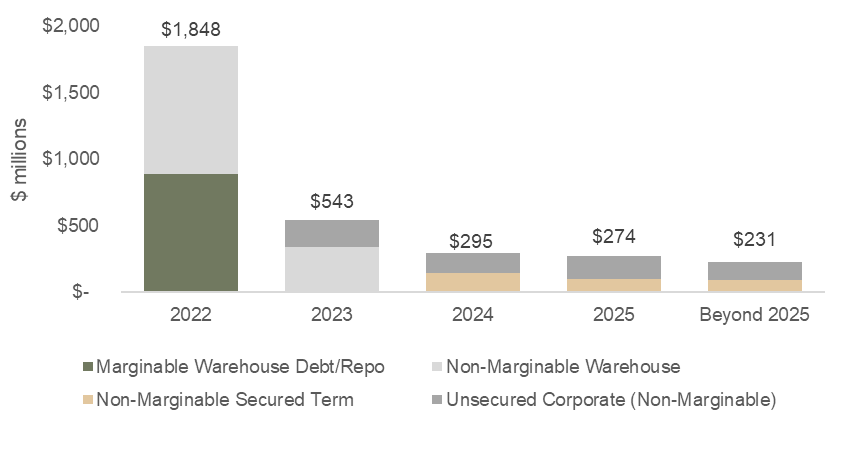
Recourse Debt Scheduled Maturities
($ in millions)
| Detailed endnotes are included at the end of this Redwood Review. | ||
| THE REDWOOD REVIEW I 4TH QUARTER 2021 | ||
19 | ||
| Q U A R T E R L Y P O S I T I O N S | ||
Leverage
Ñ Our recourse leverage ratio(1) was 2.4x at December 31, 2021, relative to 2.2x at September 30, 2021.
Ñ Our warehouse debt coming due in 2022 is used to finance residential loans that we generally expect to sell over a period of one to three months, as well as business purpose bridge loan investments with shorter durations that are generally matched with the duration of their associated borrowings.
Warehouse Capacity
Ñ At December 31, 2021, we had residential warehouse facilities outstanding with seven different counterparties, with $2.9 billion of total capacity and $1.2 billion of available capacity. These included non-marginable facilities with $1.4 billion of total capacity and marginable facilities with $1.5 billion of total capacity.
Ñ At December 31, 2021, we had business purpose warehouse facilities outstanding with four different counterparties, with $1.7 billion of total capacity and $0.9 billion of available capacity (inclusive of capacity on non-recourse facilities). All of these facilities are non-marginable.
Non-Recourse Debt
In addition to our secured recourse debt, we also utilize secured, non-recourse term debt to finance certain of our business purpose bridge loans, the majority of our RPL securities investments and certain other investments. Unlike the non-recourse securitization debt we consolidate on our balance sheet that is associated with subordinate Sequoia and CAFL SFR securities we own, these non-recourse term debt structures have prepayment and other provisions allowing for or requiring repayment over a shorter term.
As this debt is non-recourse, our net economic exposure represents the difference between the fair value of the investment collateral and the associated non-recourse debt. At December 31, 2021, we had $380 million of bridge loans financed with $323 million of non-recourse term debt for a net economic exposure of approximately $57 million to these assets, and $305 million of bridge loans and other assets financed with $270 million of non-recourse securitization debt for a net economic exposure of approximately $35 million to these assets (this securitization structure includes a feature to allow reinvestment of loan payoffs for the first 30 months of the transaction). Additionally, at December 31, 2021, we had: $445 million of RPL securities financed with $143 million of non-recourse debt, for a net economic exposure of approximately $302 million to these assets; $160 million of HEIs financed with $139 million of non-recourse securitization debt, for a net economic exposure of approximately $10 million to these assets(2); and $336 million of servicing advances and restricted cash financed with $295 million of non-recourse short-term debt, for a net economic exposure of approximately $41 million to these assets.
| Detailed endnotes are included at the end of this Redwood Review. | ||
| THE REDWOOD REVIEW I 4TH QUARTER 2021 | ||
20 | ||
| Q U A R T E R L Y P O S I T I O N S | ||
Credit Overview
This section presents select credit characteristics for our major investment types within our Investment Portfolio, with current information as of December 31, 2021.
Residential Investments Credit Characteristics (1) | ||||||||||||||||||||
December 31, 2021 | ||||||||||||||||||||
($ in millions, except where noted) | ||||||||||||||||||||
Sequoia Select Securities(2) | Sequoia Choice Securities(2) | Re-Performing Loan Securities | ||||||||||||||||||
| Market value | $ | 131 | $ | 226 | $ | 511 | ||||||||||||||
| Average FICO (at origination) | 768 | 739 | 608 | |||||||||||||||||
HPI updated average LTV (3) | 40 | % | 51 | % | 68 | % | ||||||||||||||
| Average loan size (in thousands) | $ | 629 | $ | 693 | $ | 162 | ||||||||||||||
| Gross weighted average coupon | 3.9 | % | 4.9 | % | 4.5 | % | ||||||||||||||
| Current 3-month prepayment rate | 34 | % | 47 | % | 16 | % | ||||||||||||||
90+ days delinquency (as a % of UPB)(4) | 0.5 | % | 2.1 | % | 10.2 | % | ||||||||||||||
Investment thickness (5) | 7 | % | 35 | % | 25 | % | ||||||||||||||
Ñ Sequoia Select Securities — Through the fourth quarter of 2021, we had securitized $26.2 billion of Sequoia Select loans since 2010. As of December 31, 2021, our securitized Select portfolio includes fully documented loans to prime borrowers with an average FICO score (at loan origination) of 768, maximum loan-to-value (at origination) of 85%, and a maximum debt-to-income ratio (at origination) of 49.9%. We retain all first-loss securities from our Sequoia Select securitizations, and on average we currently have exposure to the first 7% of credit losses resulting from loans underlying these securities.
Ñ Sequoia Choice Securities — Through the fourth quarter of 2021, we had securitized $3.7 billion of Sequoia Choice loans since 2017. As of December 31, 2021, our securitized Choice portfolio includes fully documented loans to prime borrowers with an average FICO score (at loan origination) of 739, maximum loan-to-value (at origination) of 90%, and a maximum debt-to-income ratio (at origination) of 49.9%. We retain all of the first-loss securities issued as part of our Sequoia Choice program due to risk retention requirements, and on average we currently have exposure to the first 35% of credit losses resulting from loans underlying these securities.
Ñ Re-Performing Loan Securities — As of December 31, 2021, we held $511 million of securities collateralized by re-performing loans, and on average we currently have exposure to the first 25% of the credit losses resulting from loans underlying the securities. The collateral underlying these securities are seasoned re-performing, and to a lesser extent non-performing, loans. In most cases, these loans experienced a credit event leading up to the securitization and were modified in order to keep the borrower in their home and current on their payments under recast loan terms.
| Detailed endnotes are included at the end of this Redwood Review. | ||
| THE REDWOOD REVIEW I 4TH QUARTER 2021 | ||
21 | ||
| Q U A R T E R L Y P O S I T I O N S | ||
Business Purpose and Multifamily Investments Credit Characteristics | ||||||||||||||||||||
December 31, 2021 | ||||||||||||||||||||
($ in millions, except where noted) | ||||||||||||||||||||
| SFR Securities | BPL Bridge Loans(1) | Multifamily B-Pieces | ||||||||||||||||||
| Market value | $ | 302 | $ | 950 | $ | 63 | ||||||||||||||
Average current DSCR (2) | 1.4x | N/A | 1.5x | |||||||||||||||||
Average LTV (at origination) (3) | 68 | % | 69 | % | 69 | % | ||||||||||||||
| Average loan size (in thousands) | $ | 2,917 | $ | 341 | $ | 28,691 | ||||||||||||||
| Gross weighted average coupon | 5.3 | % | 7.0 | % | 3.5 | % | ||||||||||||||
90+ days delinquency (as a % of UPB) (4) | 1.9 | % | 1.9 | % | — | % | ||||||||||||||
Investment thickness (5) | 10 | % | N/A | 10 | % | |||||||||||||||
Ñ SFR Securities — Through the fourth quarter of 2021, CoreVest had securitized $4.8 billion of SFR loans across 18 CAFL securitizations since 2015. We own and retain the first-loss securities from CAFL securitizations, and on average have exposure to the first 10% of credit losses resulting from loans underlying the securities.
Ñ BPL Bridge Loans — Through the fourth quarter of 2021, CoreVest had securitized $0.3 billion of Bridge loans in one securitization. Our business purpose bridge loans and investments are collateralized by residential and multifamily properties, many of which are being rehabilitated or constructed for either re-sale or rental purposes. The average loan term at funding ranges between 12 to 24 months.
Ñ Multifamily B-Pieces — As of December 31, 2021, we owned $63 million of multifamily B-piece securities, which represent first-loss risk on $1.0 billion of underlying multifamily loan collateral across three separate Freddie Mac sponsored securitizations. On average, we have exposure to the first 10% of credit losses resulting from loans underlying these securities.
| Detailed endnotes are included at the end of this Redwood Review. | ||
| THE REDWOOD REVIEW I 4TH QUARTER 2021 | ||
22 | ||

| Table 1: GAAP Earnings (in thousands, except per share data) | |||||||||||||||||||||||||||||||||||||||||
| 2021 Q4 | 2021 Q3 | 2021 Q2 | 2021 Q1 | 2020 Q4 | Twelve Months 2021 | ||||||||||||||||||||||||||||||||||||
| Net interest income | |||||||||||||||||||||||||||||||||||||||||
| From investments | $ | 50,472 | $ | 41,945 | $ | 32,555 | $ | 30,564 | $ | 29,156 | $ | 155,536 | |||||||||||||||||||||||||||||
| From mortgage banking activities | 8,467 | 9,129 | 7,133 | 4,088 | 3,502 | 28,817 | |||||||||||||||||||||||||||||||||||
| Corporate debt expense | (9,113) | (9,106) | (9,058) | (8,899) | (9,008) | (36,176) | |||||||||||||||||||||||||||||||||||
| Net interest income | 49,826 | 41,968 | 30,630 | 25,753 | 23,650 | 148,177 | |||||||||||||||||||||||||||||||||||
| Non-interest income | |||||||||||||||||||||||||||||||||||||||||
| Residential mortgage banking activities, net | 11,505 | 32,946 | 21,265 | 61,435 | 22,943 | 127,151 | |||||||||||||||||||||||||||||||||||
| Business purpose mortgage banking activities, net | 24,050 | 30,217 | 33,154 | 21,172 | 31,018 | 108,593 | |||||||||||||||||||||||||||||||||||
| Investment fair value changes, net | 7,405 | 26,077 | 49,480 | 45,087 | 23,119 | 128,049 | |||||||||||||||||||||||||||||||||||
| Realized gains, net | 190 | 6,703 | 8,384 | 2,716 | 5 | 17,993 | |||||||||||||||||||||||||||||||||||
| Other income, net | 3,661 | 2,388 | 2,126 | 3,843 | 209 | 12,018 | |||||||||||||||||||||||||||||||||||
| Total non-interest income, net | 46,811 | 98,331 | 114,409 | 134,253 | 77,294 | 393,804 | |||||||||||||||||||||||||||||||||||
| Compensation expense | (24,689) | (36,044) | (29,459) | (34,643) | (19,572) | (124,835) | |||||||||||||||||||||||||||||||||||
Acquisition-related equity compensation expense (1) | (200) | (1,189) | (1,212) | (1,212) | (1,212) | (3,813) | |||||||||||||||||||||||||||||||||||
| Other general and administrative expense | (14,133) | (10,459) | (9,923) | (7,696) | (9,588) | (42,211) | |||||||||||||||||||||||||||||||||||
| Total general and administrative expenses | (39,022) | (47,692) | (40,594) | (43,551) | (30,372) | (170,859) | |||||||||||||||||||||||||||||||||||
| Loan acquisition costs (including commissions) | (4,408) | (4,621) | (3,748) | (3,559) | (3,307) | (16,336) | |||||||||||||||||||||||||||||||||||
| Other expenses | (4,591) | (4,023) | (3,985) | (4,096) | (4,499) | (16,695) | |||||||||||||||||||||||||||||||||||
| (Provision for) benefit from income taxes | (4,571) | 4,323 | (6,687) | (11,543) | (8,471) | (18,478) | |||||||||||||||||||||||||||||||||||
| Net income | $ | 44,045 | $ | 88,286 | $ | 90,025 | $ | 97,257 | $ | 54,295 | $ | 319,613 | |||||||||||||||||||||||||||||
Diluted average shares (2) | 143,540 | 141,855 | 141,761 | 141,039 | 140,641 | 142,070 | |||||||||||||||||||||||||||||||||||
| Diluted earnings per common share | $ | 0.34 | $ | 0.65 | $ | 0.66 | $ | 0.72 | $ | 0.42 | $ | 2.37 | |||||||||||||||||||||||||||||
(1)Acquisition-related equity compensation expense relates to shares of restricted stock that were issued to members of CoreVest management as a component of the consideration paid to them for our purchase of their interests in CoreVest.
(2)Diluted average shares includes shares from the assumed conversion of our convertible and/or exchangeable debt in certain periods, in accordance with GAAP diluted EPS provisions. See Table 3 that follows for details of this calculation for the current and prior quarter and our respective Quarterly Reports on Form 10-Q and Annual Report on Form 10-K.
| THE REDWOOD REVIEW I 4TH QUARTER 2021 | Table 1: GAAP Earnings 24 | |||||||
| Table 2: Segment Results ($ in thousands) | ||||||||||||||||||||||||||||||||||||||
| Three Months Ended December 31, 2021 | ||||||||||||||||||||||||||||||||||||||
| Residential Mortgage Banking | Business Purpose Mortgage Banking | Investment Portfolio | Corporate / Other | Total | ||||||||||||||||||||||||||||||||||
| Net interest income (expense) | $ | 6,357 | $ | 2,110 | $ | 50,472 | $ | (9,113) | $ | 49,826 | ||||||||||||||||||||||||||||
| Non-interest income | ||||||||||||||||||||||||||||||||||||||
| Mortgage banking activities, net | 11,505 | 24,050 | — | — | 35,555 | |||||||||||||||||||||||||||||||||
| Investment fair value changes, net | — | — | 7,803 | (398) | 7,405 | |||||||||||||||||||||||||||||||||
| Other income, net | — | 552 | 2,899 | 210 | 3,661 | |||||||||||||||||||||||||||||||||
| Realized gains, net | — | — | 190 | — | 190 | |||||||||||||||||||||||||||||||||
| Total non-interest income (loss), net | 11,505 | 24,602 | 10,892 | (188) | 46,811 | |||||||||||||||||||||||||||||||||
| General and administrative expenses | (6,096) | (12,019) | (2,829) | (18,078) | (39,022) | |||||||||||||||||||||||||||||||||
| Loan acquisition costs | (1,794) | (2,572) | (42) | — | (4,408) | |||||||||||||||||||||||||||||||||
| Other expenses, net | 110 | (3,604) | (1,097) | — | (4,591) | |||||||||||||||||||||||||||||||||
| Provision for income taxes | (2,136) | (1,134) | (1,301) | — | (4,571) | |||||||||||||||||||||||||||||||||
| Net income (loss) | $ | 7,946 | $ | 7,383 | $ | 56,095 | $ | (27,379) | $ | 44,045 | ||||||||||||||||||||||||||||
| Three Months Ended September 30, 2021 | ||||||||||||||||||||||||||||||||||||||
| Residential Mortgage Banking | Business Purpose Mortgage Banking | Investment Portfolio | Corporate / Other | Total | ||||||||||||||||||||||||||||||||||
| Net interest income (expense) | $ | 7,175 | $ | 1,954 | $ | 41,945 | $ | (9,106) | $ | 41,968 | ||||||||||||||||||||||||||||
| Non-interest income | ||||||||||||||||||||||||||||||||||||||
| Mortgage banking activities, net | 32,946 | 30,217 | — | — | 63,163 | |||||||||||||||||||||||||||||||||
| Investment fair value changes, net | — | — | 26,324 | (247) | 26,077 | |||||||||||||||||||||||||||||||||
| Other income, net | — | 216 | 1,842 | 330 | 2,388 | |||||||||||||||||||||||||||||||||
| Realized gains, net | — | — | 6,703 | — | 6,703 | |||||||||||||||||||||||||||||||||
| Total non-interest income, net | 32,946 | 30,433 | 34,869 | 83 | 98,331 | |||||||||||||||||||||||||||||||||
| General and administrative expenses | (7,891) | (12,017) | (4,483) | (23,301) | (47,692) | |||||||||||||||||||||||||||||||||
| Loan acquisition costs | (2,395) | (2,175) | (51) | — | (4,621) | |||||||||||||||||||||||||||||||||
| Other expenses | — | (3,873) | (150) | — | (4,023) | |||||||||||||||||||||||||||||||||
| Benefit from (provision for) income taxes | (10,429) | (3,485) | (1,045) | 19,282 | 4,323 | |||||||||||||||||||||||||||||||||
| Net income (loss) | $ | 19,406 | $ | 10,837 | $ | 71,085 | $ | (13,042) | $ | 88,286 | ||||||||||||||||||||||||||||
| THE REDWOOD REVIEW I 4TH QUARTER 2021 | Table 2: Segment Results 25 | |||||||
| Table 3: GAAP Basic and Diluted Earnings per Common Share (in thousands, except per share data) | ||||||||||||||||||||||||||||||||
| 2021 Q4 | 2021 Q3 | 2021 Q2 | 2021 Q1 | 2020 Q4 | Twelve Months 2021 | |||||||||||||||||||||||||||
| GAAP Earnings per Common Share ("EPS"): | ||||||||||||||||||||||||||||||||
| Net income attributable to Redwood | $ | 44,045 | $ | 88,286 | $ | 90,025 | $ | 97,257 | $ | 54,295 | $ | 319,613 | ||||||||||||||||||||
| Adjust for dividends and undistributed earnings allocated to participating securities | (1,618) | (2,984) | (3,149) | (3,294) | (1,705) | (10,635) | ||||||||||||||||||||||||||
| Net income allocated to common shareholders for GAAP basic EPS | 42,427 | 85,302 | 86,876 | 93,963 | 52,590 | 308,978 | ||||||||||||||||||||||||||
| Incremental adjustment to dividends and undistributed earnings allocated to participating securities | (76) | 237 | 280 | 343 | 58 | 755 | ||||||||||||||||||||||||||
Adjust for interest expense on convertible notes for the period, net of tax (1) | 6,879 | 6,870 | 6,990 | 7,007 | 6,999 | 27,463 | ||||||||||||||||||||||||||
| Net income allocated to common shareholders for GAAP diluted EPS | $ | 49,230 | $ | 92,409 | $ | 94,146 | $ | 101,313 | $ | 59,647 | $ | 337,196 | ||||||||||||||||||||
| Basic weighted average common shares outstanding | 114,641 | 112,996 | 112,921 | 112,277 | 112,074 | 113,230 | ||||||||||||||||||||||||||
| Net effect of dilutive equity awards | 331 | 293 | 273 | 196 | — | 273 | ||||||||||||||||||||||||||
Net effect of assumed convertible notes conversion to common shares (1) | 28,567 | 28,567 | 28,567 | 28,567 | 28,567 | 28,567 | ||||||||||||||||||||||||||
| Diluted weighted average common shares outstanding | 143,539 | 141,855 | 141,761 | 141,040 | 140,641 | 142,070 | ||||||||||||||||||||||||||
| GAAP Basic Earnings per Common Share | $ | 0.37 | $ | 0.75 | $ | 0.77 | $ | 0.84 | $ | 0.47 | $ | 2.73 | ||||||||||||||||||||
| GAAP Diluted Earnings per Common Share | $ | 0.34 | $ | 0.65 | $ | 0.66 | $ | 0.72 | $ | 0.42 | $ | 2.37 | ||||||||||||||||||||
(1)Certain convertible notes were determined to be dilutive in the periods presented and were included in the calculation of diluted EPS under the "if-converted" method. Under this method, the periodic interest expense (net of applicable taxes) for dilutive notes is added back to the numerator and the number of shares that the notes are entitled to (if converted, regardless of whether they are in or out of the money) are included in the denominator.
| THE REDWOOD REVIEW I 4TH QUARTER 2021 | Table 3: GAAP Earnings per Basic and Diluted Common Share 26 | |||||||
| Table 4: Financial Ratios and Book Value ($ in thousands, except per share data) | |||||||||||||||||||||||||||||||||||||||||
| 2021 Q4 | 2021 Q3 | 2021 Q2 | 2021 Q1 | 2020 Q4 | Twelve Months 2021 | ||||||||||||||||||||||||||||||||||||
| Financial performance ratios | |||||||||||||||||||||||||||||||||||||||||
| GAAP net income | $ | 44,045 | $ | 88,286 | $ | 90,025 | $ | 97,257 | $ | 54,295 | $ | 319,613 | |||||||||||||||||||||||||||||
| Corporate general and administrative expenses | $ | (18,078) | $ | (23,301) | $ | (18,183) | $ | (17,504) | $ | (15,176) | $ | (77,066) | |||||||||||||||||||||||||||||
| Average total assets | $ | 13,857,046 | $ | 12,590,752 | $ | 11,649,799 | $ | 10,703,876 | $ | 10,362,681 | $ | 12,210,721 | |||||||||||||||||||||||||||||
| Average total equity | $ | 1,378,634 | $ | 1,324,053 | $ | 1,255,621 | $ | 1,142,855 | $ | 1,079,952 | $ | 1,276,070 | |||||||||||||||||||||||||||||
| Corporate general and administrative expenses / average total equity | 5.25 | % | 7.04 | % | 5.79 | % | 6.13 | % | 5.62 | % | 6.04 | % | |||||||||||||||||||||||||||||
| GAAP net income / average equity (GAAP ROE) | 12.78 | % | 26.67 | % | 28.68 | % | 34.04 | % | 20.11 | % | 25.05 | % | |||||||||||||||||||||||||||||
| Leverage ratios and book value per share | |||||||||||||||||||||||||||||||||||||||||
| Short-term recourse debt | $ | 1,848,197 | $ | 1,546,722 | $ | 1,321,629 | $ | 1,061,811 | $ | 314,234 | |||||||||||||||||||||||||||||||
| Long-term recourse debt | 1,343,361 | 1,404,094 | 1,392,322 | 1,126,147 | 1,074,529 | ||||||||||||||||||||||||||||||||||||
| Total recourse debt | $ | 3,191,558 | $ | 2,950,816 | $ | 2,713,951 | $ | 2,187,958 | $ | 1,388,763 | |||||||||||||||||||||||||||||||
| At consolidated securitization and non-recourse entities | |||||||||||||||||||||||||||||||||||||||||
| ABS issued | 9,253,556.78 | 8,183,825 | 7,536,995 | 6,671,678 | 7,100,662 | ||||||||||||||||||||||||||||||||||||
| Other non-recourse debt | 637,653 | 310,835 | 267,179 | 518,365 | 576,176 | ||||||||||||||||||||||||||||||||||||
| Total ABS issued and non-recourse debt | $ | 9,891,210 | $ | 8,494,660 | $ | 7,804,174 | $ | 7,190,043 | $ | 7,676,838 | |||||||||||||||||||||||||||||||
Consolidated debt (1) | $ | 13,082,768 | $ | 11,445,476 | $ | 10,518,125 | $ | 9,378,001 | $ | 9,065,601 | |||||||||||||||||||||||||||||||
Tangible stockholders' equity (non-GAAP) (2) | $ | 1,344,526 | $ | 1,330,577 | $ | 1,246,022 | $ | 1,162,583 | $ | 1,054,035 | |||||||||||||||||||||||||||||||
| Total stockholders' equity | $ | 1,386,087 | $ | 1,375,823 | $ | 1,295,142 | $ | 1,215,575 | $ | 1,110,899 | |||||||||||||||||||||||||||||||
Total capital (3) | $ | 2,038,436 | $ | 2,027,511 | $ | 1,946,177 | $ | 1,865,968 | $ | 1,760,658 | |||||||||||||||||||||||||||||||
Recourse leverage ratio (recourse debt at Redwood to tangible stockholders' equity)(4) | 2.4x | 2.2x | 2.2x | 1.9x | 1.3x | ||||||||||||||||||||||||||||||||||||
| Consolidated debt to tangible stockholders' equity | 9.7x | 8.6x | 8.4x | 8.1x | 8.6x | ||||||||||||||||||||||||||||||||||||
| Shares outstanding at period end (in thousands) | 114,892 | 114,662 | 113,053 | 112,999 | 112,090 | ||||||||||||||||||||||||||||||||||||
| Book value per share | $ | 12.06 | $ | 12.00 | $ | 11.46 | $ | 10.76 | $ | 9.91 | |||||||||||||||||||||||||||||||
(1)Amounts presented in Consolidated debt above do not include deferred issuance costs or debt discounts.
(2)At December 31, 2021, September 30, 2021, June 30, 2021, March 31, 2021, and December 31, 2020, tangible stockholders' equity excluded $42 million, $45 million, $49 million, $53 million, and $57 million, respectively, of intangible assets.
(3)Our total capital of $2.0 billion at December 31, 2021 included $1.4 billion of equity capital and $0.7 billion of unsecured corporate debt.
(4)Excludes ABS issued and non-recourse debt at consolidated entities. See Table 6 for additional detail on our ABS issued and short-term debt at consolidated entities.
| THE REDWOOD REVIEW I 4TH QUARTER 2021 | Table 4: Financial Ratios and Book Value 27 | |||||||
| Table 5A: Combined Investment Portfolio Detail ($ in millions) | Table 5B: Combined Investment Portfolio Rollforward ($ in millions) | |||||||||||||||||||||||||||||||||||||||||||||||||||||||||||||||||||||||||||||||
| 12/31/21 | 9/30/21 | 6/30/21 | Asset Rollforward | Sequoia Securities | SFR Securities | RPL Securities | Multifamily Securities | Other Third-Party Securities | Bridge Loans | Called Sequoia Loans | Other Investments | Total | ||||||||||||||||||||||||||||||||||||||||||||||||||||||||||||||||||||
| Investment Portfolio Assets | Balance at 6/30/21 | $ | 391 | $ | 268 | $ | 513 | $ | 73 | $ | 86 | $ | 741 | $ | 97 | $ | 161 | $ | 2,330 | |||||||||||||||||||||||||||||||||||||||||||||||||||||||||||||
| Sequoia securities | $ | 390 | $ | 382 | $ | 391 | New investments | 2 | 17 | — | 4 | 7 | 245 | 54 | — | 329 | ||||||||||||||||||||||||||||||||||||||||||||||||||||||||||||||||
| SFR securities | 302 | 288 | 268 | Sales/Paydowns | (13) | — | (13) | (3) | (3) | (156) | (1) | (44) | (233) | |||||||||||||||||||||||||||||||||||||||||||||||||||||||||||||||||||
| RPL securities | 511 | 517 | 513 | MTM | 2 | 3 | 17 | — | 4 | 4 | 1 | 3 | 34 | |||||||||||||||||||||||||||||||||||||||||||||||||||||||||||||||||||
| Multifamily securities | 64 | 74 | 73 | Other, net | — | — | — | — | — | (3) | — | — | (3) | |||||||||||||||||||||||||||||||||||||||||||||||||||||||||||||||||||
| Other third-party securities | 130 | 94 | 86 | Balance at 9/30/21 | $ | 382 | $ | 288 | $ | 517 | $ | 74 | $ | 94 | $ | 831 | $ | 151 | $ | 120 | $ | 2,457 | ||||||||||||||||||||||||||||||||||||||||||||||||||||||||||
| Bridge loans | 950 | 832 | 741 | New investments | 9 | 24 | — | — | 48 | 369 | 33 | 90 | 573 | |||||||||||||||||||||||||||||||||||||||||||||||||||||||||||||||||||
| Called Sequoia loans | 172 | 151 | 97 | Sales/Paydowns | (4) | (14) | (14) | (9) | (13) | (254) | (12) | — | (320) | |||||||||||||||||||||||||||||||||||||||||||||||||||||||||||||||||||
Other investments (1) | 209 | 120 | 161 | MTM | 2 | 4 | 8 | (1) | 1 | 4 | — | — | 18 | |||||||||||||||||||||||||||||||||||||||||||||||||||||||||||||||||||
| Total investments | $ | 2,728 | $ | 2,458 | $ | 2,330 | Other, net | 1 | — | — | — | — | — | — | (1) | — | ||||||||||||||||||||||||||||||||||||||||||||||||||||||||||||||||
| Balance at 12/31/21 | $ | 390 | $ | 302 | $ | 511 | $ | 64 | $ | 130 | $ | 950 | $ | 172 | $ | 209 | $ | 2,728 | ||||||||||||||||||||||||||||||||||||||||||||||||||||||||||||||
| Debt Secured by Portfolio Assets | ||||||||||||||||||||||||||||||||||||||||||||||||||||||||||||||||||||||||||||||||
| Sequoia securities | $ | (197) | $ | (199) | $ | (213) | ||||||||||||||||||||||||||||||||||||||||||||||||||||||||||||||||||||||||||
| SFR securities | (194) | (197) | (102) | |||||||||||||||||||||||||||||||||||||||||||||||||||||||||||||||||||||||||||||
| RPL securities | (145) | (161) | (179) | |||||||||||||||||||||||||||||||||||||||||||||||||||||||||||||||||||||||||||||
| Multifamily securities | (23) | (28) | (28) | |||||||||||||||||||||||||||||||||||||||||||||||||||||||||||||||||||||||||||||
| Other third-party securities | — | — | — | |||||||||||||||||||||||||||||||||||||||||||||||||||||||||||||||||||||||||||||
| Bridge loans | (810) | (633) | (483) | |||||||||||||||||||||||||||||||||||||||||||||||||||||||||||||||||||||||||||||
| Called Sequoia loans | (159) | (137) | (88) | |||||||||||||||||||||||||||||||||||||||||||||||||||||||||||||||||||||||||||||
Other investments (1) | — | — | — | |||||||||||||||||||||||||||||||||||||||||||||||||||||||||||||||||||||||||||||
| Total debt secured by investments | $ | (1,528) | $ | (1,355) | $ | (1,093) | ||||||||||||||||||||||||||||||||||||||||||||||||||||||||||||||||||||||||||
| Net Capital Invested in Portfolio Assets | ||||||||||||||||||||||||||||||||||||||||||||||||||||||||||||||||||||||||||||||||
| Sequoia securities | $ | 193 | $ | 183 | $ | 178 | ||||||||||||||||||||||||||||||||||||||||||||||||||||||||||||||||||||||||||
| SFR securities | 108 | 91 | 166 | |||||||||||||||||||||||||||||||||||||||||||||||||||||||||||||||||||||||||||||
| RPL securities | 366 | 356 | 334 | |||||||||||||||||||||||||||||||||||||||||||||||||||||||||||||||||||||||||||||
| Multifamily securities | 41 | 46 | 45 | |||||||||||||||||||||||||||||||||||||||||||||||||||||||||||||||||||||||||||||
| Other third-party securities | 130 | 94 | 86 | |||||||||||||||||||||||||||||||||||||||||||||||||||||||||||||||||||||||||||||
| Bridge loans | 140 | 199 | 258 | |||||||||||||||||||||||||||||||||||||||||||||||||||||||||||||||||||||||||||||
| Called Sequoia loans | 13 | 14 | 9 | |||||||||||||||||||||||||||||||||||||||||||||||||||||||||||||||||||||||||||||
Other investments (1) | 209 | 120 | 161 | Notes | ||||||||||||||||||||||||||||||||||||||||||||||||||||||||||||||||||||||||||||
| Total capital invested | $ | 1,200 | $ | 1,103 | $ | 1,237 | (1) Other investments is primarily comprised of servicing receivable investments, Home Equity Investment contracts, excess MSRs and other residential and business purpose related investments. (2) Total leverage is calculated by dividing the total debt secured by portfolio assets (both secured recourse and secured pre-payable non-recourse debt), by the total capital invested in portfolio assets. | |||||||||||||||||||||||||||||||||||||||||||||||||||||||||||||||||||||||||
Total leverage (2) | 1.27 | x | 1.23 | x | 0.88 | x | ||||||||||||||||||||||||||||||||||||||||||||||||||||||||||||||||||||||||||
| THE REDWOOD REVIEW I 4TH QUARTER 2021 | Table 5: Combined Investment Portfolio 28 | |||||||
| Table 6: Consolidated Balance Sheet ($ in thousands) | ||||||||||||||||||||||||||||||||||||||||||||||||||||||||||||||||||||
| December 31, 2021 | ||||||||||||||||||||||||||||||||||||||||||||||||||||||||||||||||||||
Consolidated VIEs (1) | ||||||||||||||||||||||||||||||||||||||||||||||||||||||||||||||||||||
| 12/31/2021 | 9/30/2021 | At Redwood (1) | Sequoia | CAFL | Freddie Mac SLST | Freddie Mac K-Series | Other VIEs (2) | Other (3) | Redwood Consolidated | |||||||||||||||||||||||||||||||||||||||||||||||||||||||||||
| Residential loans | $ | 7,592,432 | $ | 6,216,468 | $ | 1,845,282 | $ | 3,628,465 | $ | — | $ | 1,888,230 | $ | — | $ | 230,455 | $ | — | $ | 7,592,432 | ||||||||||||||||||||||||||||||||||||||||||||||||
| Business purpose loans | 4,790,989 | 4,693,555 | 622,378 | — | 3,766,316 | — | — | — | 402,295 | 4,790,989 | ||||||||||||||||||||||||||||||||||||||||||||||||||||||||||
| Multifamily loans | 473,514 | 482,791 | — | — | — | — | 473,514 | — | — | 473,514 | ||||||||||||||||||||||||||||||||||||||||||||||||||||||||||
| Real estate securities | 377,411 | 353,286 | 377,411 | — | — | — | — | — | — | 377,411 | ||||||||||||||||||||||||||||||||||||||||||||||||||||||||||
| Other investments | 641,969 | 422,366 | 97,662 | — | — | — | 544,307 | — | 641,969 | |||||||||||||||||||||||||||||||||||||||||||||||||||||||||||
| Cash and cash equivalents | 450,485 | 556,989 | 444,004 | — | — | — | — | 6,481 | — | 450,485 | ||||||||||||||||||||||||||||||||||||||||||||||||||||||||||
Other assets (4) | 380,144 | 347,259 | 256,831 | 10,890 | 63,468 | 7,820 | 1,315 | 39,820 | — | 380,144 | ||||||||||||||||||||||||||||||||||||||||||||||||||||||||||
| Total assets | $ | 14,706,944 | $ | 13,072,714 | $ | 3,643,568 | $ | 3,639,355 | $ | 3,829,784 | $ | 1,896,050 | $ | 474,829 | $ | 821,063 | $ | 402,295 | $ | 14,706,944 | ||||||||||||||||||||||||||||||||||||||||||||||||
| Short-term debt | $ | 2,177,362 | $ | 1,750,941 | $ | 1,847,872 | $ | — | $ | — | $ | — | $ | — | $ | 294,447 | $ | 35,043 | $ | 2,177,362 | ||||||||||||||||||||||||||||||||||||||||||||||||
| Other liabilities | 249,105 | 262,548 | 177,762 | 8,457 | 12,201 | 4,055 | 1,190 | 45,440 | — | 249,105 | ||||||||||||||||||||||||||||||||||||||||||||||||||||||||||
| ABS issued | 9,253,557 | 8,183,825 | — | 3,383,048 | 3,474,898 | 1,588,462 | 441,857 | 365,292 | — | 9,253,557 | ||||||||||||||||||||||||||||||||||||||||||||||||||||||||||
| Long-term debt, net | 1,640,833 | 1,499,577 | 1,333,618 | — | — | — | — | — | 307,215 | 1,640,833 | ||||||||||||||||||||||||||||||||||||||||||||||||||||||||||
| Total liabilities | 13,320,857 | 11,696,891 | 3,359,252 | 3,391,505 | 3,487,099 | 1,592,517 | 443,047 | 705,179 | 342,258 | 13,320,857 | ||||||||||||||||||||||||||||||||||||||||||||||||||||||||||
| Equity | 1,386,087 | 1,375,823 | 284,316 | 247,850 | 342,685 | 303,533 | 31,782 | 115,884 | 60,037 | 1,386,087 | ||||||||||||||||||||||||||||||||||||||||||||||||||||||||||
| Total liabilities and equity | $ | 14,706,944 | $ | 13,072,714 | $ | 3,643,568 | $ | 3,639,355 | $ | 3,829,784 | $ | 1,896,050 | $ | 474,829 | $ | 821,063 | $ | 402,295 | $ | 14,706,944 | ||||||||||||||||||||||||||||||||||||||||||||||||
(1)The format of this consolidated balance sheet is provided to more clearly delineate between the assets and liabilities belonging to securitization entities (Consolidated VIEs) that we are required to consolidate on our balance sheet in accordance with GAAP, versus the assets that are legally ours and the liabilities of ours for which there is recourse to us. Each of these entities is independent of Redwood and of each other and the assets and liabilities of these entities are not owned by and are not legal obligations of ours. Our exposure to these entities is primarily through the financial interests we have retained or acquired in these entities (generally subordinate and interest-only securities), the fair value of which is represented by our equity in each entity, as presented in this table.
(2)Includes our consolidated Legacy Sequoia, Servicing Investment, and Point entities. At December 31, 2021, our equity in the Legacy Sequoia, Servicing Investment, and Point entities was $3 million, $103 million, and $10 million, respectively. At September 30, 2021, our equity in the Legacy Sequoia, Servicing Investment, and Point entities was $3 million, $60 million, and $10 million, respectively.
(3)Includes business purpose bridge and SFR loans and associated non-recourse secured financing.
(4)At December 31, 2021 and September 30, 2021, other assets at Redwood included a total of $33 million and $34 million, respectively, of assets held by third-party custodians and pledged as collateral to the GSEs in connection with credit risk-sharing arrangements. These pledged assets can only be used to settle obligations to the GSEs under these risk-sharing arrangements.
| THE REDWOOD REVIEW I 4TH QUARTER 2021 | Table 6: Consolidated Balance Sheet 29 | |||||||

| S E G M E N T O V E R V I E W | ||
Segment Overview
During the fourth quarter of 2021, we reorganized our segments to conform with a change in how management evaluates and manages our operations. Our prior segments presented our operations in a vertically integrated manner, with each operating platform and the assets it created within a segment. Our segments now separate each of our operating platforms into separate segments, and present all of our investments in a single portfolio. Each of these new segments has unique financial and operating metrics and different benchmarks and valuation frameworks that we believe are best managed and reported under this new format.
We operate our business in three segments: Residential Mortgage Banking, Business Purpose Mortgage Banking and Investment Portfolio. Our two mortgage banking segments generate income from the origination or acquisition of loans and the subsequent sale or securitization of those loans. Our investment portfolio is comprised of investments sourced through our mortgage banking operations as well as investments purchased from third-parties and generates income primarily from net interest income and asset appreciation.
Following is a further description of our three business segments:
Residential Mortgage Banking – Comprised of our residential mortgage banking operations, which includes the acquisition of non-Agency residential mortgage loans and the sale or securitization of those loans. Net income from this segment is primarily comprised of net interest income earned on loans while they are held in inventory, mark-to-market adjustments on loans from the time loan purchase commitments are entered into to when loans are sold or securitized, gains/losses from associated hedges, and all direct expenses associated with these activities.
Business Purpose Mortgage Banking – Comprised of our business purpose mortgage banking operations, which include the origination and acquisition of mortgage loans made to investors in residential and multifamily properties and the sale or securitization of those loans. Net income from this segment is primarily comprised of net interest income earned on loans while they are held in inventory, origination fees on loans, mark-to-market adjustments on loans from the time loans are originated or purchased to when they are sold, securitized or transferred into our investment portfolio, gains/losses from associated hedges and all direct expenses associated with these activities.
Investment Portfolio – Comprised of investments sourced through our residential and business purpose mortgage banking operations, including primarily securities retained from our residential and business purpose securitization activities, residential and small-balance multifamily bridge loans, as well as third-party investments including re-performing loan securities, third-party RMBS (including CRT securities and legacy securities), multifamily securities, loans we have acquired, and other housing-related investments. Net income from this segment is primarily comprised of net interest income from investments, changes in fair value of investments, and all direct expenses associated with these activities.
| Detailed endnotes are included at the end of this Redwood Review. | ||
| THE REDWOOD REVIEW I 4TH QUARTER 2021 | ||
31 | ||
| D I V I D E N D S A N D T A X A B L E I N C O M E | ||
Dividends and Taxable Income
Summary
As a REIT, Redwood is required to distribute to shareholders at least 90% of its annual REIT taxable income, excluding net capital gains. To the extent Redwood retains REIT taxable income, including net capital gains, it is taxed at corporate tax rates. Redwood also earns taxable income at its taxable REIT subsidiaries (TRS), which it is not required to distribute.
Dividends Overview
In recent years, our Board of Directors has maintained a practice of paying regular quarterly dividends, including when in excess of the amount required to comply with the provisions of the Internal Revenue Code of 1986, as amended (Internal Revenue Code), applicable to REITs. In December 2021, the Board of Directors declared a regular dividend of $0.23 per share for the fourth quarter of 2021, which was paid on December 28, 2021 to shareholders of record on December 17, 2021.
REIT Taxable Income and Dividend Distribution Requirement
Our estimated REIT taxable income (non-GAAP) was $36 million, or $0.32 per share, for the fourth quarter of 2021 and $16 million, or $0.14 per share, for the third quarter of 2021. Realized net capital gains are not included in REIT taxable income as they are offset by a capital loss carryforward of $328 million which was generated in 2020. Any unused portion of the capital loss carryforward will expire at the end of 2025. Under normal circumstances, our minimum REIT dividend requirement would be 90% of our annual REIT taxable income. However, we carried a $37 million federal net operating loss carry forward (NOL) into 2021 at the REIT that affords us the option of retaining REIT taxable income up to the NOL amount, tax free, rather than distributing it as dividends. Federal income tax rules require the dividends paid deduction to be applied to reduce REIT taxable income before the applicability of NOLs is considered; therefore, REIT taxable income must exceed our dividend distribution for us to utilize a portion of our NOL and any remaining NOL amount will carry forward into future years.
Income Tax Characterization of Dividend for Shareholders
Our 2021 dividend distributions are expected to be characterized for federal income tax purposes as 74% ordinary dividend income and 26% qualified dividends. Under the federal income tax rules applicable to REITs, none of the 2021 dividend distributions are expected to be characterized as a return of capital or long-term capital gain dividend income.
| See Appendix for details on non-GAAP measures. Detailed endnotes are included at the end of this Redwood Review. | ||
| THE REDWOOD REVIEW I 4TH QUARTER 2021 | ||
32 | ||
| D I V I D E N D S A N D T A X A B L E I N C O M E | ||
Individual taxpayers may generally deduct 20% of their ordinary REIT dividends from taxable income. This generally results in a maximum federal effective tax rate of 29.6% on an individual taxpayer's ordinary REIT dividends, compared to the highest marginal rate of 37%. This deduction does not apply to REIT dividends classified as qualified dividend income or long-term capital gain dividends, as those dividends are taxed at a maximum rate of 20% for individuals.
Taxable Income (Non-GAAP)
Below we present details of our estimated taxable income for the year ended December 31, 2021 and our taxable income for the year ended December 31, 2020.
Taxable Income (Non-GAAP) (1) | |||||||||||||||||
| (In millions, except for per share data) | |||||||||||||||||
| Estimated Twelve Months 2021 | Twelve Months 2020 (2) | ||||||||||||||||
| REIT taxable income (loss) | $ | 75 | $ | (9) | |||||||||||||
| Taxable income at taxable subsidiaries | 135 | 67 | |||||||||||||||
| Taxable income | $ | 210 | $ | 59 | |||||||||||||
Shares used for taxable EPS calculation(3) | 115 | 112 | |||||||||||||||
| REIT taxable income (loss) per share | $ | 0.66 | $ | (0.06) | |||||||||||||
| Taxable income per share at taxable subsidiaries | $ | 1.19 | $ | 0.60 | |||||||||||||
Taxable income per share(3) | $ | 1.85 | $ | 0.54 | |||||||||||||
| See Appendix for details on non-GAAP measures. Detailed endnotes are included at the end of this Redwood Review. | ||
| THE REDWOOD REVIEW I 4TH QUARTER 2021 | ||
33 | ||
| N O N - G A A P M E A S U R E M E N T S | ||
Non-GAAP Measurements
Information about our non-GAAP financial measures is provided in this Appendix, which supplements the descriptions and information about these non-GAAP financial measures that is set forth in previous sections of this Redwood Review.
After-Tax Net Operating Contribution and Adjusted Return on Capital
What is After-Tax Net Operating Contribution and Adjusted Return on Capital for our Mortgage Banking Operations?
After-Tax Net Operating Contribution and Adjusted Return on Capital are non-GAAP measures derived from GAAP Net Contribution and Return on Capital, respectively, for our mortgage banking operations.
After-Tax Net Operating Contribution presents a measure of the profitability of these business operations, exclusive of non-cash amortization for amounts related to historical business acquisitions (adjusted for tax effects).
Adjusted Return on Capital presents an alternative measure of profitability relative to the amount of capital utilized in the operations of the business during a period, and is calculated by dividing annualized non-GAAP After-Tax Net Operating Contribution by the average capital utilized by the business during the period.
Why does management believe that After-Tax Net Operating Contribution and Adjusted Return on Capital provide useful information to investors in Redwood? How does management use these metrics to analyze Redwood’s performance?
Management utilizes these measures internally as an alternative way of analyzing the performance of Redwood’s mortgage banking operations, as management believes it provides useful comparative results of profitability, exclusive of non-cash amortization for amounts related to historical business acquisitions.
What factors should be considered when comparing non-GAAP After-Tax Net Operating Contribution and Adjusted Return on Capital to GAAP Net Contribution and Return on Capital?
We caution that After-Tax Net Operating Contribution and Adjusted Return on Capital for our mortgage banking operations should not be utilized in isolation, nor should they be considered as alternatives to GAAP Net Contribution, GAAP Return on Capital or other measurements of results of operations computed in accordance with GAAP.
| THE REDWOOD REVIEW I 4TH QUARTER 2021 | ||
34 | ||
| N O N - G A A P M E A S U R E M E N T S | ||
Adjusted Net Contribution and Adjusted Return on Capital
What is Adjusted Net Contribution and Adjusted Return on Capital for our Investment Portfolio?
Adjusted Net Contribution and Adjusted Return on Capital are non-GAAP measures derived from GAAP Net Contribution and Return on Capital, respectively, for our investment portfolio.
Adjusted Net Contribution presents a measure of the profitability of the investment portfolio assets of each business segment, exclusive of realized gains and investment fair value changes (each adjusted for tax effects).
Adjusted Return on Capital presents an alternative measure of profitability relative to the amount of capital utilized within our investment portfolio during a period, and is calculated by dividing annualized non-GAAP Adjusted Net Contribution by the average capital utilized by our investment portfolio during the period.
Why does management believe that Adjusted Net Contribution and Adjusted Return on Capital provide useful information to investors in Redwood? How does management use these metrics to analyze Redwood’s performance?
Management utilizes these measures internally as an alternative way of analyzing the performance of Redwood’s portfolio investments, as management believes it provides useful comparative results, by excluding amounts that may experience variability period-to-period and may not be reflective of the expected recurring earnings over the life of those investments.
What factors should be considered when comparing non-GAAP Adjusted Net Contribution and Adjusted Return on Capital to GAAP Net Contribution and Return on Capital?
We caution that Adjusted Net Contribution and Adjusted Return on Capital for our investment portfolio should not be utilized in isolation, nor should they be considered as alternatives to GAAP Net Contribution, GAAP Return on Capital or other measurements of results of operations computed in accordance with GAAP.
| THE REDWOOD REVIEW I 4TH QUARTER 2021 | ||
35 | ||
| N O N - G A A P M E A S U R E M E N T S | ||
Taxable Income
What is Taxable Income, REIT Taxable Income and Taxable Income at Taxable Subsidiaries?
Taxable Income (comprised of REIT taxable income and taxable income at taxable subsidiaries) is a non-GAAP measure, which is the amount of income earned by Redwood on a consolidated basis as calculated under the Internal Revenue Code. REIT taxable income represents the component of Taxable Income earned at Redwood Trust, Inc. on a stand-alone basis, along with income earned at its qualified REIT subsidiaries. Taxable Income at Taxable Subsidiaries, represents the component of Taxable Income earned at taxable subsidiaries owned by Redwood Trust, Inc.
Below we reconcile Taxable Income (non-GAAP) to GAAP net income (loss) for the years ended December 31, 2021 and December 31, 2020.
| Differences Between GAAP Net Income (Loss) and | |||||||||||||||||
| Taxable Income (Non-GAAP) | |||||||||||||||||
| (In millions, except for per share data) | |||||||||||||||||
| Estimated Twelve Months 2021 | Twelve Months 2020 | ||||||||||||||||
| REIT Taxable Income (loss) | $ | 75 | $ | (9) | |||||||||||||
| Taxable income at taxable subsidiaries | 135 | 67 | |||||||||||||||
| Taxable Income | $ | 210 | $ | 59 | |||||||||||||
| Differences in taxable income calculations: | |||||||||||||||||
| Net interest income | 29 | 23 | |||||||||||||||
| Realized credit losses | 3 | 2 | |||||||||||||||
| Mortgage banking activities, net | 14 | (68) | |||||||||||||||
| Investment fair value changes, net | 129 | (491) | |||||||||||||||
| Other income | (20) | (17) | |||||||||||||||
| Realized gains, net | 18 | 7 | |||||||||||||||
| Operating expenses | (41) | (6) | |||||||||||||||
| Other expenses | (6) | (96) | |||||||||||||||
| Benefit from (provision for) income taxes | (16) | 5 | |||||||||||||||
| GAAP net income (loss) | $ | 320 | $ | (582) | |||||||||||||
Shares used for taxable EPS calculation (1) | 115 | 112 | |||||||||||||||
| REIT Taxable income (loss) per share | $ | 0.66 | $ | (0.06) | |||||||||||||
| Taxable income per share at taxable subsidiaries | $ | 1.19 | $ | 0.60 | |||||||||||||
| Total taxable income (loss) per common share (non-GAAP) | $ | 1.85 | $ | 0.54 | |||||||||||||
| Basic earnings (loss) per common share (GAAP) | $ | 2.73 | $ | (5.12) | |||||||||||||
| THE REDWOOD REVIEW I 4TH QUARTER 2021 | ||
36 | ||
| N O N - G A A P M E A S U R E M E N T S | ||
Why does management believe that Taxable Income, REIT Taxable Income and Taxable Income at Taxable Subsidiaries provide useful information to investors in Redwood? How does management use these metrics to analyze Redwood’s performance?
Management uses Taxable Income primarily to determine the amount of taxes that are owed by Redwood and uses REIT Taxable Income to ensure compliance with various REIT requirements, including minimum required amounts of income that it must distribute to shareholders in order to maintain its REIT status. This information is also useful to investors as it helps to determine the taxability of Redwood's dividends.
What factors should be considered when comparing non-GAAP Taxable Income (inclusive of REIT Taxable income and Taxable Income at Taxable Subsidiaries) to GAAP Net Income?
We caution that Taxable Income (inclusive of REIT Taxable Income and Taxable Income at Taxable Subsidiaries) should not be utilized in isolation, nor should it be considered as an alternative to GAAP Net Income or other measurements of results of operations computed in accordance with GAAP.
| THE REDWOOD REVIEW I 4TH QUARTER 2021 | ||
37 | ||
| F O R W A R D - L O O K I N G S T A T E M E N T S | ||
Forward-Looking Statements
As noted above under the heading “Forward-Looking Statements,” this Redwood Review contains forward-looking statements within the meaning of the safe harbor provisions of the Private Securities Litigation Reform Act of 1995. Forward-looking statements involve numerous risks and uncertainties. Our actual results may differ from our expectations, estimates, and projections and, consequently, you should not rely on these forward-looking statements as predictions of future events. Forward-looking statements are not historical in nature and can be identified by words such as “anticipate,” “estimate,” “will,” “should,” “expect,” “believe,” “intend,” “seek,” “plan,” and similar expressions or their negative forms, or by references to strategy, plans, goals, or intentions. These forward-looking statements are subject to risks and uncertainties, including, among other things, those described in our Annual Report on Form 10-K under the caption “Risk Factors”. Other risks, uncertainties, and factors that could cause actual results to differ materially from those projected are described below and may be described from time to time in reports we file with the Securities and Exchange Commission, including reports on Forms 10-K, 10-Q, and 8-K. We undertake no obligation to update or revise forward-looking statements, whether as a result of new information, future events, or otherwise.
Statements regarding the following subjects, among others, are forward-looking by their nature: (i) statements we make regarding Redwood's business strategy and strategic focus, including statements relating to our overall market position, strategy and long-term prospects (including trends driving the flow of capital in the housing finance market, our strategic initiatives designed to capitalize on those trends, our ability to attract capital to finance those initiatives, our approach to raising capital, our ability to pay dividends in the future, and the prospects for federal housing finance reform); (ii) statements related to our financial outlook and expectations for 2022 and future years, including that we believe the diversity of our revenue streams, notably the resiliency they have shown in rising rate environments, positions us well to navigate the current landscape; (iii) statements related to our residential mortgage banking business, including with respect to our positioning to capture increased market share in 2022; (iv) statements related to our investment portfolio, including that our near- to medium-term outlook for call activity remains heightened given a backdrop of strong housing fundamentals; (v) statements related to our business purpose lending platform, including statements regarding CoreVest's strong outlook and pipeline of activity for 2022, that prevailing industry dynamics continue to attract increased equity capital to the space, a trend we see continuing even as rates rise, and that we see opportunities to enhance our direct origination capabilities through purchases from third-party correspondents, the expansion of our new residential transition loan ("RTL") securitization platform, and opportunities to further scale our platform through partnerships or additional acquisitions; (vi) statements regarding our expectation that RWT Horizons portfolio companies will drive significant option value for shareholders, while delivering technology and other innovative efficiencies to our platforms, and our goal to have $50 to $100 million of capital allocated through Horizons by the end of 2022 across an increasingly diversified portfolio of early to mid stage companies (vii) statements relating to our estimate of our available capital (including that we estimate our available capital at December 31, 2021 was approximately $150 million); (viii) statements relating to acquiring residential
| Detailed endnotes are included at the end of this Redwood Review. | ||
| THE REDWOOD REVIEW I 4TH QUARTER 2021 | ||
38 | ||
| F O R W A R D - L O O K I N G S T A T E M E N T S | ||
mortgage loans in the future that we have identified for purchase or plan to purchase, including the amount of such loans that we identified for purchase during the fourth quarter of 2021 and at December 31, 2021, expected fallout and the corresponding volume of residential mortgage loans expected to be available for purchase, and outstanding forward sale agreements at quarter-end; (ix) statements we make regarding future dividends, including with respect to our regular quarterly dividends in 2022; and (x) statements regarding our expectations and estimates relating to the characterization for income tax purposes of our dividend distributions, our expectations and estimates relating to tax accounting, tax liabilities and tax savings, and GAAP tax provisions, and our estimates of REIT taxable income and TRS taxable income.
Important factors, among others, that may affect our actual results include:
•the impact of the COVID-19 pandemic;
•general economic trends and the performance of the housing, real estate, mortgage finance, and broader financial markets;
•federal and state legislative and regulatory developments and the actions of governmental authorities and entities;
•changing benchmark interest rates, and the Federal Reserve’s actions and statements regarding monetary policy;
•our ability to compete successfully;
•our ability to adapt our business model and strategies to changing circumstances;
•strategic business and capital deployment decisions we make;
•our use of financial leverage;
•our exposure to a breach of our cybersecurity or data security;
•our exposure to credit risk and the timing of credit losses within our portfolio;
•the concentration of the credit risks we are exposed to, including due to the structure of assets we hold, the geographical concentration of real estate underlying assets we own, and our exposure to environmental and climate-related risks;
•the efficacy and expense of our efforts to manage or hedge credit risk, interest rate risk, and other financial and operational risks;
•changes in credit ratings on assets we own and changes in the rating agencies’ credit rating methodologies;
•changes in mortgage prepayment rates;
•changes in interest rates;
•our ability to redeploy our available capital into new investments;
•interest rate volatility, changes in credit spreads, and changes in liquidity in the market for real estate securities and loans;
•our ability to finance the acquisition of real estate-related assets with short-term debt;
•changes in the values of assets we own;
•the ability of counterparties to satisfy their obligations to us;
•our exposure to the discontinuation of LIBOR;
•our exposure to liquidity risk, risks associated with the use of leverage, and market risks;
| Detailed endnotes are included at the end of this Redwood Review. | ||
| THE REDWOOD REVIEW I 4TH QUARTER 2021 | ||
39 | ||
| F O R W A R D - L O O K I N G S T A T E M E N T S | ||
•changes in the demand from investors for residential and business purpose mortgages and investments, and our ability to distribute residential and business purpose mortgages through our whole-loan distribution channel;
•our involvement in securitization transactions, the profitability of those transactions, and the risks we are exposed to in engaging in securitization transactions;
•exposure to claims and litigation, including litigation arising from our involvement in loan origination and securitization transactions;
•whether we have sufficient liquid assets to meet short-term needs;
•our ability to successfully retain or attract key personnel;
•changes in our investment, financing, and hedging strategies and new risks we may be exposed to if we expand our business activities;
•our exposure to a disruption of our technology infrastructure and systems;
•the impact on our reputation that could result from our actions or omissions or from those of others;
•our failure to maintain appropriate internal controls over financial reporting and disclosure controls and procedures;
•the termination of our captive insurance subsidiary’s membership in the Federal Home Loan Bank and the implications for our income generating abilities;
•the impact of changes to U.S. federal income tax laws on the U.S. housing market, mortgage finance markets, and our business;
•our failure to comply with applicable laws and regulation, including our ability to obtain or maintain the governmental licenses;
•our ability to maintain our status as a REIT for tax purposes;
•limitations imposed on our business due to our REIT status and our status as exempt from registration under the Investment Company Act of 1940;
•our common stock may experience price declines, volatility, and poor liquidity, and we may reduce our dividends in a variety of circumstances;
•decisions about raising, managing, and distributing capital;
•our exposure to broad market fluctuations; and
•other factors not presently identified.
| Detailed endnotes are included at the end of this Redwood Review. | ||
| THE REDWOOD REVIEW I 4TH QUARTER 2021 | ||
40 | ||
| E N D N O T E S | ||
Recourse Debt Note
Redwood's recourse debt excludes $9.9 billion and $8.5 billion of consolidated securitization debt (ABS issued and servicer advance financing) and other debt that is non-recourse to Redwood at December 31, 2021 and September 30, 2021, respectively.
Non-GAAP Tangible Stockholders' Equity Note
Non-GAAP tangible stockholders' equity (or book value) is a measurement of stockholders’ equity excluding the value of acquisition-related intangible assets associated with historical acquisitions. Management believes tangible stockholders’ equity provides useful information to investors and management because it eliminates the impact of these acquisition-related items that may not be reflective of the underlying performance of Redwood’s ongoing operations, and which may not be reflective of their impact over the longer term. At December 31, 2021 and September 30, 2021, tangible stockholders' equity excluded $42 million and $45 million of intangible assets, respectively.
Page 8 (Fourth Quarter Financial Overview)
(1)Economic return on book value is based on the periodic change in GAAP book value per common share plus dividends declared per common share during the period.
(2)Recourse leverage ratio is defined as recourse debt (see Recourse Debt Note above) at Redwood divided by tangible stockholders' equity (see Non-GAAP Tangible Book Value Note above).
Page 10 (Quarterly Earnings and Analysis)
(1)Net interest income from Corporate primarily consists of interest expense on corporate unsecured debt.
Page 13 (Analysis of Operating Results)
(1)"Mortgage banking income" presented in this table represents the sum of net interest income earned on loan inventory, income from mortgage banking activities, and other income within each of our mortgage banking operations.
(2)"Acquisition amortization expenses" within this table represent purchase related stock-based consideration amortization expense (a component of General and administrative expenses) and amortization of purchase intangibles (a component of Other expenses), each on a tax-adjusted basis.
(3)Capital utilized during the quarter for business purpose mortgage banking operations includes $42 million of platform premium.
(4)Adjusted return on capital (non-GAAP) presented in this table represents the quotient of annualized After-tax net operating contribution (non-GAAP),
divided by Capital utilized during the period. See the Non-GAAP Measurements section of the Appendix of this Redwood Review for a full description of After-tax Operating return on capital (non-GAAP).
Page 14 (Analysis of Operating Results, Ctd.)
(1)Our gross margin represents mortgage banking income earned in the quarter (net interest income on loan inventory plus mortgage banking activities) divided by loan purchase commitments entered into during the quarter.
Page 15 (Analysis of Operating Results, Ctd.)
(1)Realized gains and investment fair value changes presented in this table to calculate Adjusted net contribution (non-GAAP), are presented on a tax-adjusted basis.
(2)Adjusted return on capital (non-GAAP) represents the quotient of annualized Adjusted net contribution (non-GAAP), divided by Capital utilized during the period. See the Non-GAAP Measurements section of the Appendix of this Redwood Review for a full description of Adjusted return on capital (non-GAAP).
(3)Secured debt includes both recourse debt and non-recourse debt (including for bridge loans and resecuritized RPL securities), secured by our investment assets.
(4)Leverage ratio is calculated by dividing Capital invested by Secured debt balances, as presented within this table.
Page 17 (Capital Allocations)
(1)Capital allocated to our Business Purpose Mortgage Banking platform includes $42 million of platform premium, representing the unamortized balance of intangible assets we recorded in association with the acquisition of CoreVest.
(2)Other corporate capital includes capital allocated to RWT Horizons.
| THE REDWOOD REVIEW I 4TH QUARTER 2021 | ||
41 | ||
| E N D N O T E S | ||
Page 18 (Capital Allocations, Ctd.)
(1)Sequoia securities, SFR securities and third-party other investments each include assets presented as our economic investment in entities that are consolidated under GAAP rules. Third party other investments is primarily comprised of our $103 million economic investment in certain servicing assets (presented net of $295 million of non-recourse debt), our $10 million economic investment in securitized Point HEIs (presented net of $137 million of non-recourse securitization debt and $17 million of non-controlling interests), and other housing related investments. See Table 6 in the Financial Tables section of this Redwood Review for additional information on consolidated VIEs.
(2)Non-recourse debt presented within this table excludes ABS issued from whole loan securitizations consolidated on our balance sheet, including Sequoia, CoreVest, Freddie Mac and Servicing Investment securitization entities, as well as ABS issued from our Point HEI securitization and non-recourse debt used to finance certain servicing investments.
(3)Capital allocated to mortgage banking operations represents the working capital we have allocated to manage our loan inventory at each of our operating businesses. This amount generally includes our net capital in loans held on balance (net of financing), capital to acquire loans in our pipeline, net capital utilized for hedges, and risk capital.
(4)Corporate capital includes capital allocated to RWT Horizons.
Page 19 (Financing Overview)
(1)Non-marginable debt and marginable debt refers to whether such debt is subject to market value-based margin calls on underlying collateral that is non-delinquent.
(2)Average borrowing cost represents the weighted average contractual cost of recourse debt outstanding at December 31, 2021 and does not include deferred issuance costs or debt discounts.
Page 20 (Financing Overview, Ctd.)
(1)Recourse leverage ratio is defined as recourse debt (see Recourse Debt Note above) at Redwood divided by tangible stockholders' equity (see Non-GAAP Tangible Book Value Note above).
(2)Net economic exposure to securitized Point HEIs is exclusive of $17 million of non-controlling interests in the securitization held by third parties.
Page 21 (Credit Overview)
(1)Underlying loan performance information provided in this table is generally reported on a one-month lag. As such, the data reported in this table is from December 2021 reports, which reflect a loan performance date of November 30, 2021.
(2)Sequoia Select and Sequoia Choice securities presented in this table include subordinate securities and do not include interest only or certificated servicing securities.
(3)HPI updated LTV is calculated based on the current loan balance and an updated property value amount that is formulaically adjusted from value at origination based on the FHFA home price index (HPI).
(4)Delinquency percentages at underlying securitizations are calculated using unpaid principal balance ("UPB"). Aggregate delinquency amounts by security type are weighted using the market value of our investments in each securitization.
(5)"Investment thickness" represents the average size of the subordinate securities we own as investments in securitizations, relative to the average overall size of the securitizations. For example, if our investment thickness (of first-loss securities) with respect to a particular securitization is 10%, we have exposure to the first 10% of credit losses resulting from loans underlying that securitization.
Page 22 (Credit Overview, Ctd.)
(1)Bridge loans, as presented in this table, include $945 million of business purpose bridge loans and $6 million of other related assets.
(2)Average current debt service coverage ratio (or DSCR) with respect to a loan is the ratio by which net operating income of the underlying property exceeds it fixed debt costs.
(3)Average loan to value (or LTV) (at origination) is calculated based on the original loan amount and the property value at the time the loan was originated.
(4)Includes loans over 90 days delinquent and all loans in foreclosure (regardless of delinquency status).
(5)"Investment thickness" represents the average size of the securities we own as investments in securitizations, relative to the average overall size of the securitizations. For example, if our investment thickness (of first-loss securities) with respect to a particular securitization is 10%, we have exposure to the first 10% of credit losses resulting from loans underlying that securitization. Investment thickness is not applicable to our BPL Bridge Loan investments as they are whole loans.
Page 33 (Dividends and Taxable Income)
(1)Taxable income (comprised of REIT taxable income and taxable income at taxable subsidiaries), is a non-GAAP measure representing the amount of income earned by Redwood on a consolidated basis, as calculated under the Internal Revenue Code. See the Non-GAAP Measurements section of the Appendix of this Redwood Review for a full description of taxable income. Taxable income for 2021 are estimates until we file our tax returns for
| THE REDWOOD REVIEW I 4TH QUARTER 2021 | ||
42 | ||
| E N D N O T E S | ||
the year. To the extent we expect to pay tax at the corporate level (generally as a result of activity at our TRS), we are required to record a tax provision for GAAP reporting purposes. Any tax provision (or benefit) is not necessarily the actual amount of tax currently due (or receivable as a refund) as a portion of our provision (or benefit) is deferred in nature. It is our intention to retain any excess inclusion income generated in 2021 at our TRS and not pass it through to our shareholders.
(2)In accordance with Internal Revenue Code rules applicable to disaster losses, taxable income at our taxable subsidiaries for the twelve-month period ended December 31, 2020, was adjusted to recognize $59 million of losses incurred in the first quarter of 2020 into the fourth quarter of 2019.
(3)Taxable income per share is based on the number of shares outstanding at the end of each quarter. The year-to-date taxable income per share is the sum of the quarterly per share estimates.
Page 36 (Non-GAAP Measurements)
(1)Taxable income per share is based on the number of shares outstanding at the end of each quarter. The year-to-date taxable income per share is the sum of the quarterly per share estimates.
| THE REDWOOD REVIEW I 4TH QUARTER 2021 | ||
43 | ||
| R E D W O O D T R U S T C O R P O R A T E I N F O R M A T I O N | ||||||||
| D I R E C T O R S : | O F F I C E L O C A T I O N S : | |||||||
| Richard D. Baum | CORPORATE HEADQUARTERS: | |||||||
| Chairman of the Board | One Belvedere Place, Suite 300 | |||||||
| and Former Chief Deputy Insurance | Mill Valley, CA 94941 | |||||||
| Commissioner for the State of California | Telephone: (415) 389-7373 | |||||||
| Greg H. Kubicek | DENVER METRO AREA OFFICE: | |||||||
| Vice Chairman of the Board | 8310 South Valley Highway, Suite 425 | |||||||
| and President, The Holt Group, Inc. | Englewood, CO 80112 | |||||||
| Christopher J. Abate | IRVINE OFFICE: | |||||||
| Chief Executive Officer | 4 Park Plaza, Suite 900 | |||||||
| Irvine, CA 92614 | ||||||||
| Armando Falcon | ||||||||
| CEO, Falcon Capital Advisors LLC | NEW YORK OFFICE: | |||||||
| 650 Fifth Avenue, Suite 2120 | ||||||||
| Douglas B. Hansen | New York, NY 10019 | |||||||
| Private Investor | ||||||||
| Debora D. Horvath | I N V E S T O R R E L A T I O N S : | |||||||
| Principal, Horvath Consulting LLC | Kaitlyn Mauritz | |||||||
| SVP, Head of Investor Relations | ||||||||
| George W. Madison | Phone: 866-269-4976 | |||||||
| Member, Madison Governance Advisors, LLC | Email: [email protected] | |||||||
| Retired Partner, Sidley Austin LLP | ||||||||
| STOCK LISTING: | ||||||||
| Jeffrey T. Pero | The Company's common stock is traded | |||||||
| Retired Partner, Latham & Watkins LLP | on the NYSE under the symbol RWT | |||||||
| Georganne C. Proctor | TRANSFER AGENT: | |||||||
| Former Chief Financial Officer, TIAA-CREF | Computershare Trust Company, N.A. | |||||||
| 2 North LaSalle Street | ||||||||
| Dashiell I. Robinson | Chicago, IL 60602 | |||||||
| President | Telephone: (888) 472-1955 | |||||||
| Faith A. Schwartz | ||||||||
| President, Housing Finance Strategies, LLC | ||||||||
| For more information about Redwood Trust, | ||||||||
| please visit our website at: www.redwoodtrust.com | ||||||||
| R E D W O O D T R U S T | ||