
TMUS 8-K
T-Mobile US, Inc. (TMUS)
8-K
2022-02-02
For: 2022-02-02
View Original
Added on
April 02, 2026
UNITED STATES
SECURITIES AND EXCHANGE COMMISSION
WASHINGTON, DC 20549
FORM 8-K
CURRENT REPORT
Pursuant to Section 13 or 15(d) of the
Securities Exchange Act of 1934
Date of report (Date of earliest event reported): February 2, 2022

(Exact Name of Registrant as Specified in Charter)
| (State or other jurisdiction | (Commission File Number) | (I.R.S. Employer | ||||||||||||
of incorporation or organization) | Identification No.) | |||||||||||||
(Address of principal executive offices)
(Zip Code)
Registrant’s telephone number, including area code: (425 ) 378-4000
(Former Name or Former Address, if Changed Since Last Report):
Check the appropriate box below if the Form 8-K filing is intended to simultaneously satisfy the filing obligation of the registrant under any of the following provisions:
| Written communications pursuant to Rule 425 under the Securities Act (17 CFR 230.425) | |||||
| Soliciting material pursuant to Rule 14a-12 under the Exchange Act (17 CFR 240.14a-12) | |||||
| Pre-commencement communications pursuant to Rule 14d-2(b) under the Exchange Act (17 CFR 240.14d-2(b)) | |||||
| Pre-commencement communications pursuant to Rule 13e-4(c) under the Exchange Act (17 CFR 240.13e-4(c)) | |||||
Securities registered pursuant to Section 12(b) of the Act:
| Title of each class | Trading Symbol | Name of each exchange on which registered | ||||||||||||
Indicate by check mark whether the registrant is an emerging growth company as defined in Rule 405 of the Securities Act of 1933 (§ 230.405 of this chapter) or Rule 12b-2 of the Securities Exchange Act of 1934 (§ 240.12b-2 of this chapter).
Emerging growth company ☐
If an emerging growth company, indicate by check mark if the registrant has elected not to use the extended transition period for complying with any new or revised financial accounting standards provided pursuant to Section 13(a) of the Exchange Act. ☐
Item 2.02 — Results of Operations and Financial Condition
On February 2, 2022, T-Mobile US, Inc. (the “Company”) issued a press release announcing the financial and operating results of the Company for the quarter and year ended December 31, 2021. The text of the press release and accompanying Investor Factbook are furnished as Exhibits 99.1 and 99.2 and incorporated herein by reference.
The information in Item 2.02 to this Current Report on Form 8-K, including Exhibits 99.1 and 99.2, is being furnished and shall not be deemed “filed” for purposes of Section 18 of the Securities Exchange Act of 1934, as amended, or otherwise subject to the liabilities of that section, nor shall it be deemed incorporated by reference in any filing under the Securities Act of 1933, as amended, except as expressly set forth by specific reference in such filing.
Item 9.01 — Financial Statements and Exhibits
(d) Exhibits:
| Exhibit | Description | |||||||
| 104 | Cover Page Interactive Data File (formatted as inline XBRL and contained in Exhibit 101) | |||||||
| SIGNATURES | |||||||||||
Pursuant to the requirements of the Securities Exchange Act of 1934, the registrant has duly caused this report to be signed on its behalf by the undersigned hereunto duly authorized.
T-MOBILE US, INC. | |||||||||||
| February 2, 2022 | /s/ Peter Osvaldik | ||||||||||
| Peter Osvaldik Executive Vice President and Chief Financial Officer | |||||||||||

EXHIBIT 99.1
T-Mobile’s Unique Formula Delivers Industry-Leading Service Revenue and Cash Flow Growth and Exceeds 2021 Guidance
Unrivaled 5G Network Leadership and Best Value Combined with Industry-Leading Postpaid Customer Growth Set Up Strong 2022 Outlook
Industry-Leading and Record-High Postpaid Account and Postpaid Customer Net Additions in 2021(1)
•Postpaid net account additions of 315 thousand in Q4 2021 — 1.2 million in full-year 2021, more than doubled year-over-year
•Postpaid net customer additions of 1.8 million in Q4 2021 — 5.5 million in full-year 2021, exceeded guidance
•Postpaid phone net customer additions of 844 thousand in Q4 2021 — 2.9 million in full-year 2021, increased 32% year-over-year
•High Speed Internet net customer additions of 224 thousand in Q4 2021, highest in industry— 546 thousand in full-year 2021
Differentiated Growth Model Unlocks Industry-Leading Service Revenue and Cash Flow Growth in 2021
•Service revenues of $15.0 billion in Q4 2021 — $58.4 billion in full-year 2021, record-high
•Net income of $422 million in Q4 2021 — $3.0 billion in full-year 2021
•Core Adjusted EBITDA(2) of $5.7 billion in Q4 2021 — $23.6 billion in full-year 2021, exceeded guidance
•Net cash provided by operating activities of $3.0 billion in Q4 2021 — $13.9 billion in full-year 2021, grew more than 60% year-over-year
•Free Cash Flow(2) of $1.1 billion in Q4 2021 — $5.6 billion in full-year 2021, nearly doubled year-over-year(3)
Award-Winning 5G Network Pulls Further Ahead of Competition as Merger Synergies Ramp
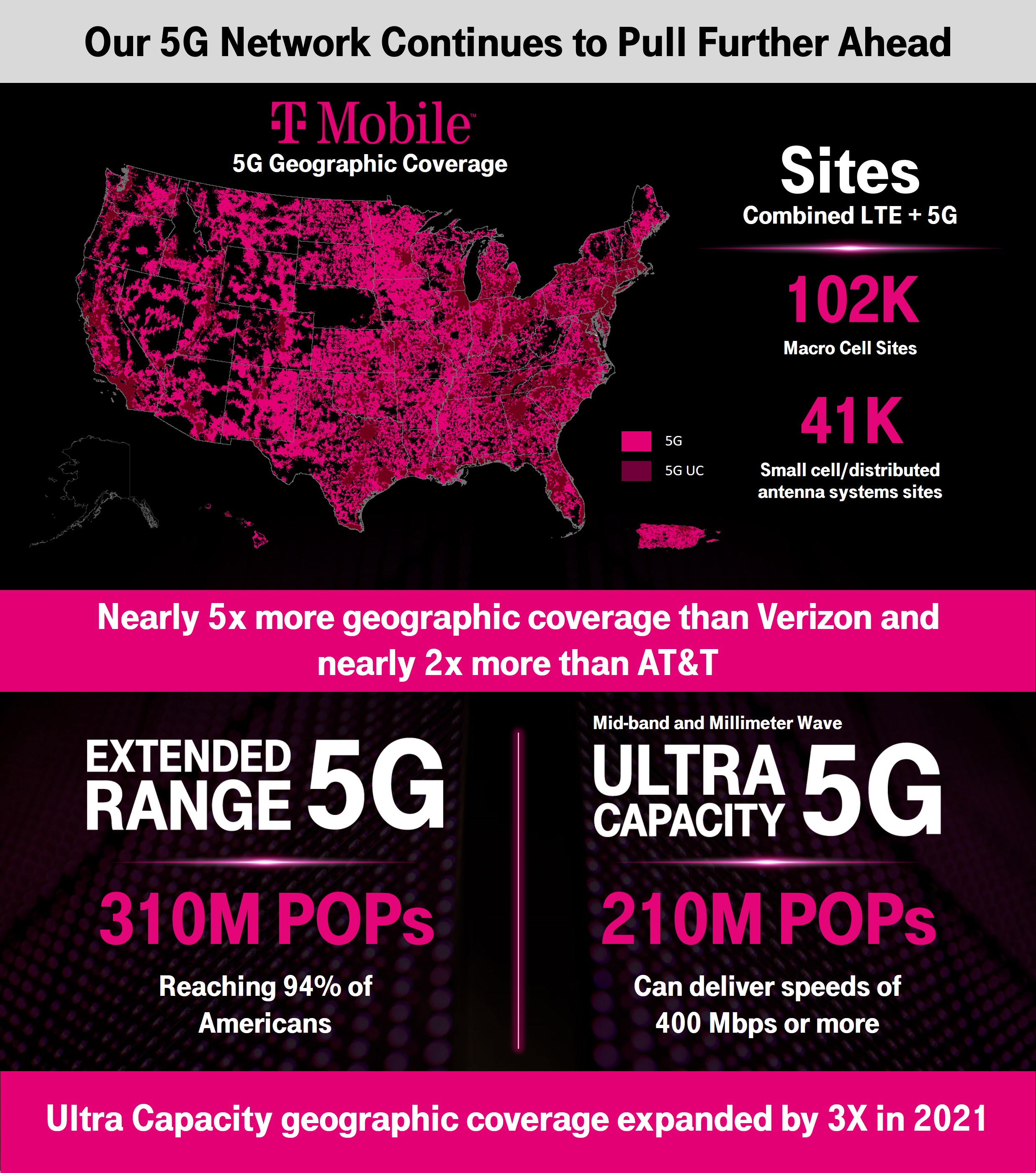
•Ultra Capacity 5G covered 210 million people and Extended Range 5G covered 94% of people at year-end
•Merger synergies of $3.8 billion in full-year 2021 increased nearly 3x year-over-year, exceeded guidance
Doing Good - the Un-carrier way - Leading the Industry to Build Sustainable Future and Bridge Digital Divide
•First and only U.S. wireless provider to commit to and achieve its RE100 goal in 2021, years ahead of others
•Project 10Million connected 3.2 million students and High Speed Internet reaches 10 million rural households
Strong 2022 Outlook on Continued Industry-Leading Postpaid Customer Growth and Merger Synergies(4)
•Core Adjusted EBITDA(2) is expected to grow approximately 10% year-over-year at mid-point of guidance
•Net cash provided by operating activities is expected to grow more than 10% year-over-year and Free Cash Flow(2) is expected to grow more than 30% year-over-year at mid-point of guidance
BELLEVUE, Wash. - February 2, 2021 - T-Mobile US, Inc. (NASDAQ: TMUS) reported fourth quarter and full-year 2021 results today, delivering industry-leading service revenue and cash flow growth in 2021 enabled by its differentiated customer growth momentum and synergy-backed model. T-Mobile’s unmatched network and value combination resulted in record-high and industry-leading postpaid account and customer growth in 2021.
“T-Mobile had our strongest year ever. We didn’t just meet the bold goals we set for 2021 around customer growth, profitability, merger synergies and network buildout – we crushed all of them,” said Mike Sievert, T-Mobile CEO. “Our industry-leading year-end results – adding 1.2 million postpaid accounts and 5.5 million postpaid customers, extending Ultra Capacity 5G to 210 million people – show that the Un-carrier is experiencing the greatest growth momentum in wireless. And we’re poised to sustain that position into 2022 and beyond as we continue to execute on our winning playbook and consistently make investments that have enabled our success. With plenty of room to run, we’re in the best-ever position to continue delivering.”
___________________________________________________________
(1)AT&T Inc. historically does not disclose postpaid net account additions.
(2)Core Adjusted EBITDA and Free Cash Flow are non-GAAP financial measures. These non-GAAP financial measures should be considered in addition to, but not as a substitute for, the information provided in accordance with GAAP. Reconciliations for these non-GAAP financial measures to the most directly comparable GAAP financial measures are provided in the Reconciliation of Non-GAAP Financial Measures to GAAP Financial Measures tables. We are not able to forecast Net income on a forward-looking basis without unreasonable efforts due to the high variability and difficulty in predicting certain items that affect Net income including, but not limited to, Income tax expense, stock-based compensation expense and Interest expense. Core Adjusted EBITDA should not be used to predict Net income as the difference between either of the two measures and Net Income is variable.
(3)As compared to Free Cash Flow excluding gross payments for the settlement of interest rate swaps in 2020.
(4)Postpaid customer growth is based on industry consensus expectations.
1
Industry-Leading and Record-High Postpaid Account and Postpaid Customer Net Additions in 2021
•Postpaid net account additions were 315 thousand in Q4 2021, the highest Q4 in four years and reached a record 1.2 million in full-year 2021, more than doubling year-over-year.
•Postpaid net customer additions were industry-leading with 1.8 million in Q4 2021, the highest Q4, and 5.5 million in full-year 2021, a record-high and above the company’s recent guidance of 5.1 to 5.3 million.
•Postpaid phone net customer additions were 844 thousand in Q4 2021 and 2.9 million in full-year 2021. Postpaid phone churn was 1.10% in Q4 2021, as the company ramped up its Sprint customer integration, and 0.98% in full-year 2021.
•Postpaid other net customer additions were 906 thousand in Q4 2021 and 2.6 million in full-year 2021, which included High Speed Internet net customer additions of 224 thousand in Q4 2021 and 546 thousand in full-year 2021. T-Mobile ended the year with 646 thousand High Speed Internet customers, exceeding its year-end goal of 500 thousand customers.
•Prepaid net customer additions were 49 thousand in Q4 2021 and 342 thousand in full-year 2021, more than doubling year-over-year. Prepaid churn was 3.01% in Q4 2021 and 2.83% in full-year 2021.
•Total net customer additions were 1.8 million in Q4 2021 and 5.8 million in full-year 2021, the highest annual number in five years. The total customer count increased to a record-high of 108.7 million.
The following table includes the impact of the Sprint merger on a prospective basis from the close date of April 1, 2020. Historical results have not been retroactively adjusted and reflect standalone T-Mobile.
| Quarter | Year Ended December 31, | ||||||||||||||||||||||||||||
| (in thousands, except churn) | Q4 2021 | Q3 2021 | Q4 2020 | 2021 | 2020 | ||||||||||||||||||||||||
| Postpaid net account additions | 315 | 268 | 131 | 1,188 | 566 | ||||||||||||||||||||||||
| Total net customer additions | 1,799 | 1,325 | 1,702 | 5,837 | 5,631 | ||||||||||||||||||||||||
| Postpaid net customer additions | 1,750 | 1,259 | 1,618 | 5,495 | 5,486 | ||||||||||||||||||||||||
| Postpaid phone net customer additions | 844 | 673 | 824 | 2,917 | 2,218 | ||||||||||||||||||||||||
| Postpaid other net customer additions | 906 | 586 | 794 | 2,578 | 3,268 | ||||||||||||||||||||||||
| Prepaid net customer additions | 49 | 66 | 84 | 342 | 145 | ||||||||||||||||||||||||
Total customers, end of period (1) | 108,719 | 106,920 | 102,064 | 108,719 | 102,064 | ||||||||||||||||||||||||
| Postpaid phone churn | 1.10 | % | 0.96 | % | 1.03 | % | 0.98 | % | 0.90 | % | |||||||||||||||||||
| Prepaid churn | 3.01 | % | 2.90 | % | 2.92 | % | 2.83 | % | 3.03 | % | |||||||||||||||||||
Differentiated Growth Model Unlocks Industry-Leading Service Revenue and Cash Flow Growth in 2021
•Total service revenues increased 6% year-over-year to $15.0 billion in Q4 2021 and 16% year-over-year to $58.4 billion in full-year 2021.
•Net income decreased year-over-year to $422 million in Q4 2021 and decreased year-over-year to $3.0 billion in full-year 2021, primarily due to a planned increase in merger-related costs. Diluted earnings per share (EPS) decreased year-over-year to $0.34 in Q4 2021 and decreased year-over-year to $2.41 in full-year 2021, primarily due to a planned increase in merger-related costs.
•Adjusted EBITDA was $6.3 billion in Q4 2021 and $26.9 billion in full-year 2021, and Core Adjusted EBITDA increased 3% year-over-year to $5.7 billion in Q4 2021 and increased 16% year-over-year to $23.6 billion in full-year 2021.
•Net cash provided by operating activities decreased year-over-year to $3.0 billion in Q4 2021 and increased year-over-year to $13.9 billion in full-year 2021, which included cash payments for merger-related costs.
•Cash purchases of property and equipment, including capitalized interest was $2.9 billion in Q4 2021 and $12.3 billion in full-year 2021.
•Free Cash Flow more than doubled year-over-year to $1.1 billion in Q4 2021 and nearly doubled year-over-year(2) to $5.6 billion in full-year 2021.
(1)Includes 818,000 postpaid customers acquired from acquisitions in 2021 which were not included in net customer additions.
(2)As compared to Free Cash Flow excluding gross payments for the settlement of interest rate swaps in 2020.
2
The following table includes the impact of the Sprint merger on a prospective basis from the close date of April 1, 2020. Historical results have not been retroactively adjusted and reflect standalone T-Mobile.
| (in millions, except EPS) | Quarter | Year Ended December 31, | Q4 2021 vs. Q3 2021 | Q4 2021 vs. Q4 2020 | YTD 2021 vs. YTD 2020 | ||||||||||||||||||||||||||||||||||||||||||
| Q4 2021 | Q3 2021 | Q4 2020 | 2021 | 2020 | |||||||||||||||||||||||||||||||||||||||||||
| Total service revenues | $ | 14,963 | $ | 14,722 | $ | 14,180 | $ | 58,369 | $ | 50,395 | 1.6 | % | 5.5 | % | 15.8 | % | |||||||||||||||||||||||||||||||
| Total revenues | 20,785 | 19,624 | 20,341 | 80,118 | 68,397 | 5.9 | % | 2.2 | % | 17.1 | % | ||||||||||||||||||||||||||||||||||||
| Net income | 422 | 691 | 750 | 3,024 | 3,064 | (38.9) | % | (43.7) | % | (1.3) | % | ||||||||||||||||||||||||||||||||||||
| Diluted EPS | 0.34 | 0.55 | 0.60 | 2.41 | 2.65 | (38.2) | % | (43.3) | % | (9.1) | % | ||||||||||||||||||||||||||||||||||||
| Adjusted EBITDA | 6,302 | 6,811 | 6,746 | 26,924 | 24,557 | (7.5) | % | (6.6) | % | 9.6 | % | ||||||||||||||||||||||||||||||||||||
| Core Adjusted EBITDA | 5,679 | 6,041 | 5,501 | 23,576 | 20,376 | (6.0) | % | 3.2 | % | 15.7 | % | ||||||||||||||||||||||||||||||||||||
| Net cash provided by operating activities | 3,000 | 3,477 | 3,474 | 13,917 | 8,640 | (13.7) | % | (13.6) | % | 61.1 | % | ||||||||||||||||||||||||||||||||||||
| Cash purchases of property and equipment, including capitalized interest | 2,929 | 2,944 | 3,807 | 12,326 | 11,034 | (0.5) | % | (23.1) | % | 11.7 | % | ||||||||||||||||||||||||||||||||||||
Free Cash Flow | 1,112 | 1,559 | 476 | 5,646 | 658 | (28.7) | % | 133.6 | % | 758.1 | % | ||||||||||||||||||||||||||||||||||||
| Free Cash Flow, excluding gross payments for the settlement of interest rate swaps | 1,112 | 1,559 | 476 | 5,646 | 3,001 | (28.7) | % | 133.6 | % | 88.1 | % | ||||||||||||||||||||||||||||||||||||
Award-Winning 5G Network Pulls Further Ahead of Competition
T-Mobile continues to strengthen its network leadership position as America's only nationwide standalone 5G network, delivering unparalleled network performance and blazing fast speeds to people across the country at an unprecedented pace.
As of year-end, T-Mobile’s 5G network covered 310 million people across 1.8 million square miles, delivering nearly 5x more geographic coverage than Verizon and nearly 2x more than AT&T. As the only operator to have deployed dedicated mid-band spectrum nationwide, T-Mobile continues to rapidly expand both the breadth and depth of its 5G footprint to fuel customer growth, including in smaller markets and rural areas, T-Mobile for Business and new product categories like High Speed Internet. And T-Mobile isn’t slowing down, with plans to bring Ultra Capacity 5G to 260 million people this year and 300 million in 2023.
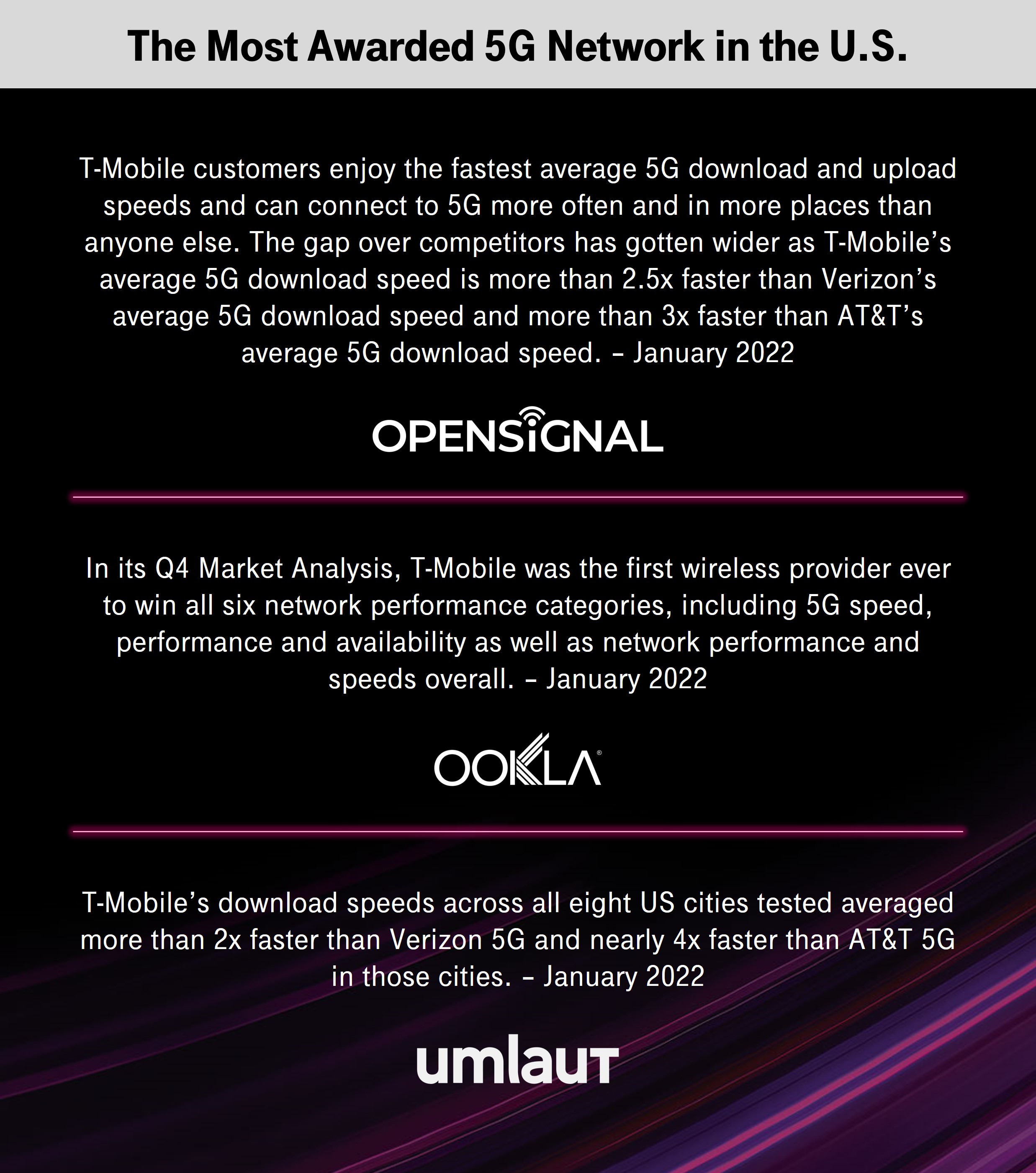
With the largest, fastest, and most reliable 5G network, T-Mobile has earned the crown of America’s 5G leader. More than 20 reports from third-party testing firms in the last year confirm T-Mobile is #1 in 5G speed and availability. As the most awarded 5G network in the country, T-Mobile’s momentum continues into 2022 with new expert studies:
•Opensignal: T-Mobile customers enjoy the fastest average 5G download and upload speeds and can connect to 5G more often and in more places than anyone else. The gap over competitors has gotten wider as T-Mobile’s average 5G download speed is more than 2.5x faster than Verizon’s average 5G download speed and more than 3x faster than AT&T’s average 5G download speed.
•Ookla: In its Q4 Market Analysis, T-Mobile was the first wireless provider ever to win all six network performance categories, including 5G speed, performance and availability as well as network performance and speeds overall.
•umlaut: T-Mobile’s download speeds across all eight US cities tested averaged more than 2x faster than Verizon 5G and nearly 4x faster than AT&T 5G in those cities.
5G and aviation safety have been in the headlines lately and have created some confusion around 5G. To be clear, T-Mobile’s 5G network is already covering 94% of American’s nationwide, and our customers are not affected by this. While headlines talk about “5G,” this issue is really with one specific frequency of spectrum called C-band, which T-Mobile 5G does not use today. So, T-Mobile customers can continue to use their 5G phones and 5G network with confidence!
3
Accelerated Merger Integration Continues Ahead of Schedule
T-Mobile continues to over-deliver on integration milestones, including ending the year with approximately 64% of Sprint customers transitioned to the T-Mobile network. The company continues to expect to complete the network migration by mid-2022.
T-Mobile realized approximately $3.8 billion in Merger synergies in 2021, nearly tripling year-over-year, with over $1.8 billion of sales, general and administrative (SG&A) expense reductions and over $900 million of cost of service expense reductions, which increased cash flows while funding growth initiatives and network build, and approximately $1.0 billion in avoided network build costs.
The company incurred Merger-related costs of $1.2 billion in Q4 2021 and $3.1 billion in full-year 2021. Net of taxes, Merger-related costs were $950 million, or $0.76 per share, in Q4 2021 and $2.3 billion, or $1.86 per share, in full-year 2021. Cash payments for merger-related costs were $1.1 billion in Q4 2021 and $2.2 billion in full-year 2021.
Doing Good - the Un-carrier way - Leading the Industry to Build Sustainable Future and Bridge Digital Divide
T-Mobile continues to stay true to its commitment to use its network, scale and resources for good, building a more connected, equitable and sustainable future for all:
•T-Mobile was the first and only U.S. provider to commit to sourcing 100% of its total electricity usage with renewable energy by the end of 2021 and the first in wireless to achieve this milestone years ahead of its competition.
◦The company met its goal through a combination of renewable energy investments that support its efforts to mobilize for a thriving planet.
◦In addition, T-Mobile has also led Green America’s Wireless Scorecard three years in a row, and the company recently received a top grade in the 2021 CDP Climate Change questionnaire.
•T-Mobile continues to remove economic and geographic barriers by helping to bridge the digital divide:
◦Connected 3.2 million students through Project 10Million.
◦Reached 10 million rural households through its High Speed Internet service.
◦During the pandemic, the Un-carrier launched T-Mobile Connect, its lowest priced plan, and recently expanded participation in the government’s Affordable Connectivity Program to Metro by T-Mobile, in addition to ongoing support from Assurance Wireless.
•The Connecting Heroes program had double-digit growth of first responder agencies joining T-Mobile.
•T-Mobile continues its progress on its Equity in Action commitments to further embed diversity, equity, and inclusion into its culture. For the 10th year in a row, the company recently scored 100% on the 2022 Human Rights Campaign Corporate Equality Index.
4
Strong 2022 Outlook on Continued Industry-Leading Postpaid Customer Growth and Merger Synergies
Building on its best customer and financial growth in company history, T-Mobile’s differentiated growth playbook, 5G leadership and synergy-backed model unlocks a strong outlook for 2022:
•Postpaid net customer additions are expected to be between 5.0 million and 5.5 million, expecting to lead the industry for the 8th consecutive year.
•Core Adjusted EBITDA, which is Adjusted EBITDA less lease revenues, is expected to be between $25.6 billion and $26.1 billion, up approximately 10% year-over-year at the mid-point.
•Merger synergies are expected to be between $5.0 billion and $5.3 billion, including $2.2 billion to $2.35 billion of SG&A expense reductions, $1.5 billion to $1.65 billion of cost of service expense reductions and approximately $1.3 billion in avoided network build costs.
•Merger-related costs are expected to be between $4.5 billion and $5.0 billion before taxes. These costs are excluded from Core Adjusted EBITDA but will impact Net income, Net cash provided from operating activities and Free Cash Flow.
•Net cash provided by operating activities, including payments for Merger-related costs, is expected to be between $15.5 billion and $16.1 billion, up more than 10% year-over-year at the mid-point.
•Cash purchases of property and equipment, including capitalized interest, are expected to be between $13.0 billion to $13.5 billion.
•Free Cash Flow, including payments for Merger-related costs, is expected to be between $7.1 billion and $7.6 billion, up more than 30% year-over-year at the mid-point. Free Cash Flow guidance does not assume any material net cash inflows from securitization.
| (in millions, except Postpaid net customer additions) | FY 2022 Guidance | ||||||||||
| Postpaid net customer additions (thousands) | 5,000 | 5,500 | |||||||||
Net income (1) | N/A | N/A | |||||||||
Core Adjusted EBITDA (2) | 25,600 | 26,100 | |||||||||
| Merger synergies | 5,000 | 5,300 | |||||||||
Merger-related costs (3) | 4,500 | 5,000 | |||||||||
| Net cash provided by operating activities | 15,500 | 16,100 | |||||||||
Capital expenditures (4) | 13,000 | 13,500 | |||||||||
Free Cash Flow (5) | 7,100 | 7,600 | |||||||||
(1)We are not able to forecast Net income on a forward-looking basis without unreasonable efforts due to the high variability and difficulty in predicting certain items that affect GAAP Net income, including, but not limited to, Income tax expense, stock-based compensation expense and Interest expense. Core Adjusted EBITDA should not be used to predict Net income as the difference between this measure and Net income is variable.
(2)Management uses Core Adjusted EBITDA as a measure to monitor the financial performance of our operations, excluding the impact of lease revenues from our related device financing programs. Our guidance ranges assume lease revenues to be between $1.1 billion and $1.4 billion for 2022.
(3)Merger-related costs are excluded from Core Adjusted EBITDA but will impact Net income, Net cash provided by operating activities and Free Cash Flow.
(4)Capital expenditures means cash purchases of property and equipment, including capitalized interest.
(5)Free Cash Flow guidance does not assume any material net cash inflows from securitization in 2022.
Financial Results
For more details on T-Mobile’s Q4 2021 financial results, including the Investor Factbook with detailed financial tables, please visit T-Mobile US, Inc.’s Investor Relations website at http://investor.t-mobile.com.
5
Earnings Call Information
Date/Time
•Wednesday, February 2, 2022 at 4:30 p.m. (EST)
Access via Phone (audio only)
Please plan on accessing the call 10 minutes prior to the scheduled start time.
•US/Canada: 866-575-6534
•International: +1 856-344-9215
•Participant Passcode: 5049036
Access via Webcast
The earnings call will be broadcast live via our Investor Relations website at http://investor.t-mobile.com. A replay of the earnings call will be available for two weeks starting shortly after the call concludes and can be accessed by dialing 888-203-1112 (toll free) or +1-719-457-0820 (international). The passcode required to listen to the replay is 5049036.
Submit Questions via Twitter
Send a tweet to @TMobileIR or @MikeSievert using $TMUS
Contact Information
•Media Relations: [email protected]
•Investor Relations: [email protected]
T-Mobile Social Media
Investors and others should note that we announce material financial and operational information to our investors using our investor relations website (https://investor.t-mobile.com), newsroom website (https://t-mobile.com/news), press releases, SEC filings and public conference calls and webcasts. We also intend to use certain social media accounts as means of disclosing information about us and our services and for complying with our disclosure obligations under Regulation FD (the @TMobileIR Twitter account (https://twitter.com/TMobileIR) and the @MikeSievert Twitter (https://twitter.com/MikeSievert) account, which Mr. Sievert also uses as a means for personal communications and observations). The information we post through these social media channels may be deemed material. Accordingly, investors should monitor these social media channels in addition to following our press releases, SEC filings and public conference calls and webcasts. The social media channels that we intend to use as a means of disclosing the information described above may be updated from time to time as listed on our investor relations website.
About T-Mobile US, Inc.
T-Mobile US, Inc. (NASDAQ: TMUS) is America’s supercharged Un-carrier, delivering an advanced 4G LTE and transformative nationwide 5G network that will offer reliable connectivity for all. T-Mobile’s customers benefit from its unmatched combination of value and quality, unwavering obsession with offering them the best possible service experience and undisputable drive for disruption that creates competition and innovation in wireless and beyond. Based in Bellevue, Wash., T-Mobile provides services through its subsidiaries and operates its flagship brands, T-Mobile and Metro by T-Mobile. For more information please visit: http://www.t-mobile.com.
6
Forward-Looking Statements
This communication includes forward-looking statements within the meaning of the Private Securities Litigation Reform Act of 1995. All statements other than statements of historical fact, including information concerning T-Mobile US, Inc.’s future results of operations, are forward-looking statements. These forward-looking statements are generally identified by the words “anticipate,” “believe,” “estimate,” “expect,” “intend,” “may,” “could” or similar expressions. Forward-looking statements are based on current expectations and assumptions, which are subject to risks and uncertainties and may cause actual results to differ materially from the forward-looking statements. Important factors that could affect future results and cause those results to differ materially from those expressed in the forward-looking statements include, among others, the following: natural disasters, public health crises, including the COVID-19 pandemic (the “Pandemic”), terrorist attacks or similar incidents; adverse economic, political or market conditions in the U.S. and international markets, including those caused by the Pandemic; competition, industry consolidation and changes in the market condition for wireless services; disruption, data loss or other security attacks, such as the criminal cyberattack we became aware of in August 2021; our inability to take advantage of technology developments on a timely basis; our inability to retain or motivate key personnel, hire qualified personnel or maintain our corporate culture; system failures and business disruptions, allowing for unauthorized use of or interference with our network and other systems; scarcity and cost of additional wireless spectrum and regulations relating to spectrum use; the impacts of the actions we have taken and conditions we have agreed to in connection with the regulatory proceedings and approvals of the Transactions (as defined below), including the acquisition by DISH Network Corporation (“DISH”) of the prepaid wireless business operated under the Boost Mobile and Sprint prepaid brands (excluding the Assurance brand Lifeline customers and the prepaid wireless customers of Shenandoah Personal Communications Company LLC (“Shentel”) and Swiftel Communications, Inc.), including customer accounts, inventory, contracts, intellectual property and certain other specified assets (the “Prepaid Business”), and the assumption of certain related liabilities (the “Prepaid Transaction”), the complaint and proposed final judgment (the “Consent Decree”) agreed to by us, Deutsche Telekom AG (“DT”), Sprint Corporation (“Sprint”), SoftBank Group Corp. (“SoftBank”) and DISH with the U.S. District Court for the District of Columbia, which was approved by the Court on April 1, 2020, the proposed commitments filed with the Secretary of the Federal Communications Commission (“FCC”), which we announced on May 20, 2019, certain national security commitments and undertakings, and any other commitments or undertakings entered into including but not limited to those we have made to certain states and nongovernmental organizations (collectively, the “Government Commitments”), and the challenges in satisfying the Government Commitments in the required time frames and the significant cumulative costs incurred in tracking and monitoring compliance; economic, political and market conditions; our inability to manage the ongoing commercial and transition services arrangements entered into in connection with the Prepaid Transaction, and known or unknown liabilities arising in connection therewith; the effects of any future acquisition, investment, or merger involving us; any disruption or failure of our third parties (including key suppliers) to provide products or services for the operation of our business; our substantial level of indebtedness and our inability to service our debt obligations in accordance with their terms or to comply with the restrictive covenants contained therein or limitations on our operating flexibility imposed by such covenants; changes in US credit market conditions, credit rating downgrade or an inability to access the investment grade debt markets; the risk of future material weaknesses we may identify while we work to integrate and align policies, principles and practices of the two companies following the Merger (as defined below), or any other failure by us to maintain effective internal controls, and the resulting significant costs and reputational damage; any changes in regulations or in the regulatory framework under which we operate; laws and regulations relating to the handling of privacy and data protection; unfavorable outcomes of existing or future legal proceedings, including proceedings and inquiries relating to the criminal cyberattack we became aware of in August 2021; our offering of regulated financial services products and exposure to a wide variety of state and federal regulations; new or amended tax laws or regulations or administrative interpretations and judicial decisions affecting the scope or application of tax laws or regulations; the possibility that we may be unable to renew our wireless licenses on attractive terms or the possible revocation of our existing licenses in the event that we violate applicable laws; the choice of forum provision contained in our Certificate of Incorporation; interests of our significant stockholders that may differ from the interests of other stockholders; future sales of our common stock by DT and SoftBank and our inability to attract additional equity financing outside the United States due to foreign ownership limitations by the FCC; our lack of plan to pay cash dividends in the foreseeable future; failure to realize the expected benefits and synergies of the merger (the “Merger”) with Sprint, pursuant to the Business Combination Agreement with Sprint and the other parties named therein (as amended, the “Business Combination Agreement”) and the other transactions contemplated by the Business Combination Agreement (collectively, the “Transactions”) in the expected timeframes or in the amounts anticipated; any delay and costs of, or difficulties in, integrating our business and Sprint’s business and operations, and unexpected additional operating costs, customer loss and business disruptions, including challenges in maintaining relationships with employees, customers, suppliers or vendors; and unanticipated difficulties, disruption, or significant delays in our long-term strategy to migrate Sprint’s legacy customers onto T-Mobile’s existing billing platforms; and other risks as disclosed in our most recent annual report on Form 10-K and other filings with the Securities and Exchange Commission. Given these risks and uncertainties, readers are cautioned not to place undue reliance on such forward-looking statements. We undertake no obligation to revise or publicly release the results of any revision to these forward-looking statements, except as required by law.
7
T-Mobile US, Inc.
Reconciliation of Non-GAAP Financial Measures to GAAP Financial Measures
(Unaudited)
This Press Release includes non-GAAP financial measures. The non-GAAP financial measures should be considered in addition to, but not as a substitute for, the information provided in accordance with GAAP. Reconciliations for the non-GAAP financial measures to the most directly comparable GAAP financial measures are provided below. T-Mobile is not able to forecast Net income on a forward-looking basis without unreasonable efforts due to the high variability and difficulty in predicting certain items that affect GAAP net income including, but not limited to, Income tax expense, stock-based compensation expense and Interest expense. Adjusted EBITDA and Core Adjusted EBITDA should not be used to predict Net income as the difference between either of these measures and Net income is variable.
The following table includes the impact of the Sprint merger on a prospective basis from the close date of April 1, 2020. Historical results prior to April 1, 2020 have not been restated and reflect standalone T-Mobile.
Adjusted EBITDA and Core Adjusted EBITDA are reconciled to Net income as follows:
| Quarter | Year Ended December 31, | ||||||||||||||||||||||||||||||||||||||||||||||||||||||||||
| (in millions) | Q1 2020 | Q2 2020 | Q3 2020 | Q4 2020 | Q1 2021 | Q2 2021 | Q3 2021 | Q4 2021 | 2020 | 2021 | |||||||||||||||||||||||||||||||||||||||||||||||||
| Net income | $ | 951 | $ | 110 | $ | 1,253 | $ | 750 | $ | 933 | $ | 978 | $ | 691 | $ | 422 | $ | 3,064 | $ | 3,024 | |||||||||||||||||||||||||||||||||||||||
| Adjustments: | |||||||||||||||||||||||||||||||||||||||||||||||||||||||||||
| Income from discontinued operations, net of tax | — | (320) | — | — | — | — | — | — | (320) | — | |||||||||||||||||||||||||||||||||||||||||||||||||
| Income (loss) from continuing operations | 951 | (210) | 1,253 | 750 | 933 | 978 | 691 | 422 | 2,744 | 3,024 | |||||||||||||||||||||||||||||||||||||||||||||||||
| Interest expense | 185 | 776 | 765 | 757 | 792 | 820 | 780 | 797 | 2,483 | 3,189 | |||||||||||||||||||||||||||||||||||||||||||||||||
| Interest expense to affiliates | 99 | 63 | 44 | 41 | 46 | 32 | 58 | 37 | 247 | 173 | |||||||||||||||||||||||||||||||||||||||||||||||||
| Interest income | (12) | (6) | (3) | (8) | (3) | (2) | (2) | (13) | (29) | (20) | |||||||||||||||||||||||||||||||||||||||||||||||||
| Other expense, net | 10 | 195 | 99 | 101 | 125 | 1 | 60 | 13 | 405 | 199 | |||||||||||||||||||||||||||||||||||||||||||||||||
| Income tax expense | 306 | 2 | 407 | 71 | 246 | 277 | (3) | (193) | 786 | 327 | |||||||||||||||||||||||||||||||||||||||||||||||||
| Operating income | 1,539 | 820 | 2,565 | 1,712 | 2,139 | 2,106 | 1,584 | 1,063 | 6,636 | 6,892 | |||||||||||||||||||||||||||||||||||||||||||||||||
| Depreciation and amortization | 1,718 | 4,064 | 4,150 | 4,219 | 4,289 | 4,077 | 4,145 | 3,872 | 14,151 | 16,383 | |||||||||||||||||||||||||||||||||||||||||||||||||
Operating income from discontinued operations (1) | — | 432 | — | — | — | — | — | — | 432 | — | |||||||||||||||||||||||||||||||||||||||||||||||||
Stock-based compensation (2) | 123 | 139 | 125 | 129 | 130 | 129 | 127 | 135 | 516 | 521 | |||||||||||||||||||||||||||||||||||||||||||||||||
Merger-related costs | 143 | 798 | 288 | 686 | 298 | 611 | 955 | 1,243 | 1,915 | 3,107 | |||||||||||||||||||||||||||||||||||||||||||||||||
COVID-19-related costs (3) | 117 | 341 | — | — | — | — | — | — | 458 | — | |||||||||||||||||||||||||||||||||||||||||||||||||
| Impairment expense | — | 418 | — | — | — | — | — | — | 418 | — | |||||||||||||||||||||||||||||||||||||||||||||||||
Other, net (4) | 25 | 5 | 1 | — | 49 | (17) | — | (11) | 31 | 21 | |||||||||||||||||||||||||||||||||||||||||||||||||
| Adjusted EBITDA | 3,665 | 7,017 | 7,129 | 6,746 | 6,905 | 6,906 | 6,811 | 6,302 | 24,557 | 26,924 | |||||||||||||||||||||||||||||||||||||||||||||||||
Lease revenues | (165) | (1,421) | (1,350) | (1,245) | (1,041) | (914) | (770) | (623) | (4,181) | (3,348) | |||||||||||||||||||||||||||||||||||||||||||||||||
| Core Adjusted EBITDA | $ | 3,500 | $ | 5,596 | $ | 5,779 | $ | 5,501 | $ | 5,864 | $ | 5,992 | $ | 6,041 | $ | 5,679 | $ | 20,376 | $ | 23,576 | |||||||||||||||||||||||||||||||||||||||
(1)Following the Prepaid Transaction, starting on July 1, 2020, we provide MVNO services to DISH. We have included the operating income from discontinued operations, for periods prior to the Prepaid Transaction, in our determination of Adjusted EBITDA to reflect EBITDA contributions of the Prepaid Business that has been replaced by the MVNO Agreement beginning on July 1, 2020, in order to enable management, analysts and investors to better assess ongoing operating performance and trends.
(2)Stock-based compensation includes payroll tax impacts and may not agree to stock-based compensation expense in the consolidated financial statements. Additionally, certain stock-based compensation expenses associated with the Sprint merger have been included in Merger-related costs.
(3)Supplemental employee payroll, third-party commissions and cleaning-related COVID-19-related costs were not significant for Q3 2020, Q4 2020, Q1 2021, Q2 2021, Q3 2021 and Q4 2021.
(4)Other, net may not agree to the Consolidated Statements of Comprehensive Income, primarily due to certain non-routine operating activities, such as other special items that would not be expected to reoccur or are not reflective of T-Mobile’s ongoing operating performance, and are therefore excluded from Adjusted EBITDA and Core Adjusted EBITDA.
Adjusted EBITDA - Earnings before Interest expense, net of Interest income, Income tax expense, Depreciation and amortization expense, Stock-based compensation and certain expenses not reflective of T-Mobile’s ongoing operating performance, such as Merger-related costs, COVID-19-related costs and Impairment expense. Core Adjusted EBITDA represents Adjusted EBITDA less lease revenues. Core Adjusted EBITDA and Adjusted EBITDA are
8
non-GAAP financial measures utilized by T-Mobile’s management to monitor the financial performance of our operations. T-Mobile uses Core Adjusted EBITDA and Adjusted EBITDA as benchmarks to evaluate T-Mobile’s operating performance in comparison to its competitors. T-Mobile also uses Adjusted EBITDA internally as a measure to evaluate and compensate its personnel and management for their performance. Management believes analysts and investors use Core Adjusted EBITDA and Adjusted EBITDA as supplemental measures to evaluate overall operating performance and facilitate comparisons with other wireless communications companies because they are indicative of T-Mobile’s ongoing operating performance and trends by excluding the impact of Interest expense from financing, non-cash depreciation and amortization from capital investments, stock-based compensation, Merger-related costs including network decommissioning costs, incremental costs directly attributable to COVID-19 and impairment expense, as they are not indicative of T-Mobile’s ongoing operating performance, as well as certain other nonrecurring income and expenses. Management believes analysts and investors use Core Adjusted EBITDA because it normalizes for the transition in the company’s device financing strategy, by excluding the impact of lease revenues from Adjusted EBITDA, to align with the related depreciation expense on leased devices, which is excluded from the definition of Adjusted EBITDA. Core Adjusted EBITDA and Adjusted EBITDA have limitations as analytical tools and should not be considered in isolation or as a substitute for Net income or any other measure of financial performance reported in accordance with U.S. Generally Accepted Accounting Principles (“GAAP”).
9
T-Mobile US, Inc.
Reconciliation of Non-GAAP Financial Measures to GAAP Financial Measures (continued)
(Unaudited)
Free Cash Flow and Free Cash Flow, excluding gross payments for the settlement of interest rate swaps, are calculated as follows:
| Quarter | Year Ended December 31, | ||||||||||||||||||||||||||||||||||||||||||||||||||||||||||
| (in millions) | Q1 2020 | Q2 2020 | Q3 2020 | Q4 2020 | Q1 2021 | Q2 2021 | Q3 2021 | Q4 2021 | 2020 | 2021 | |||||||||||||||||||||||||||||||||||||||||||||||||
| Net cash provided by operating activities | $ | 1,617 | $ | 777 | $ | 2,772 | $ | 3,474 | $ | 3,661 | $ | 3,779 | $ | 3,477 | $ | 3,000 | $ | 8,640 | $ | 13,917 | |||||||||||||||||||||||||||||||||||||||
| Cash purchases of property and equipment | (1,753) | (2,257) | (3,217) | (3,807) | (3,183) | (3,270) | (2,944) | (2,929) | (11,034) | (12,326) | |||||||||||||||||||||||||||||||||||||||||||||||||
| Proceeds from sales of tower sites | — | — | — | — | — | 31 | — | 9 | — | 40 | |||||||||||||||||||||||||||||||||||||||||||||||||
| Proceeds related to beneficial interests in securitization transactions | 868 | 602 | 855 | 809 | 891 | 1,137 | 1,071 | 1,032 | 3,134 | 4,131 | |||||||||||||||||||||||||||||||||||||||||||||||||
| Cash payments for debt prepayment or debt extinguishment costs | — | (24) | (58) | — | (65) | (6) | (45) | — | (82) | (116) | |||||||||||||||||||||||||||||||||||||||||||||||||
Free Cash Flow | 732 | (902) | 352 | 476 | 1,304 | 1,671 | 1,559 | 1,112 | 658 | 5,646 | |||||||||||||||||||||||||||||||||||||||||||||||||
| Gross cash paid for the settlement of interest rate swaps | — | 2,343 | — | — | — | — | — | — | 2,343 | — | |||||||||||||||||||||||||||||||||||||||||||||||||
| Free Cash Flow, excluding gross payments for the settlement of interest rate swaps | $ | 732 | $ | 1,441 | $ | 352 | $ | 476 | $ | 1,304 | $ | 1,671 | $ | 1,559 | $ | 1,112 | $ | 3,001 | $ | 5,646 | |||||||||||||||||||||||||||||||||||||||
Free Cash Flow - Net cash provided by operating activities less Cash purchases of property and equipment, including Proceeds from sales of tower sites and Proceeds related to beneficial interests in securitization transactions and less Cash payments for debt prepayment or debt extinguishment costs. Free Cash Flow and Free Cash Flow, excluding gross payments for the settlement of interest rate swaps, are utilized by T-Mobile’s management, investors and analysts to evaluate cash available to pay debt and provide further investment in the business.
Our guidance range for Free Cash Flow is calculated as follows:
| FY 2022 | |||||||||||
| (in millions) | Guidance Range | ||||||||||
| Net cash provided by operating activities | $ | 15,500 | $ | 16,100 | |||||||
| Cash purchases of property and equipment | (13,000) | (13,500) | |||||||||
Proceeds related to beneficial interests in securitization transactions (1) | 4,600 | 5,000 | |||||||||
| Free Cash Flow | $ | 7,100 | $ | 7,600 | |||||||
(1)Free Cash Flow guidance does not assume any material net cash inflows from securitization in 2022.
10
T-Mobile US, Inc.
Calculation of Operating Measures
(Unaudited)
The following table illustrates the calculation of our operating measures ARPA and ARPU from the related service revenues:
| (in millions, except average number of accounts and customers, ARPA and ARPU) | Quarter | Year Ended December 31, | |||||||||||||||||||||||||||||||||||||||||||||||||||||||||
| Q1 2020 | Q2 2020 | Q3 2020 | Q4 2020 | Q1 2021 | Q2 2021 | Q3 2021 | Q4 2021 | 2020 | 2021 | ||||||||||||||||||||||||||||||||||||||||||||||||||
| Calculation of Postpaid ARPA | |||||||||||||||||||||||||||||||||||||||||||||||||||||||||||
| Postpaid service revenues | $ | 5,887 | $ | 9,959 | $ | 10,209 | $ | 10,251 | $ | 10,303 | $ | 10,492 | $ | 10,804 | $ | 10,963 | $ | 36,306 | $ | 42,562 | |||||||||||||||||||||||||||||||||||||||
| Divided by: Average number of postpaid accounts (in thousands) and number of months in period | 15,155 | 25,424 | 25,582 | 25,677 | 25,840 | 26,188 | 26,766 | 27,062 | 22,959 | 26,464 | |||||||||||||||||||||||||||||||||||||||||||||||||
| Postpaid ARPA | $ | 129.47 | $ | 130.57 | $ | 133.03 | $ | 133.08 | $ | 132.91 | $ | 133.55 | $ | 134.54 | $ | 135.04 | $ | 131.78 | $ | 134.03 | |||||||||||||||||||||||||||||||||||||||
| Calculation of Postpaid Phone ARPU | |||||||||||||||||||||||||||||||||||||||||||||||||||||||||||
| Postpaid service revenues | $ | 5,887 | $ | 9,959 | $ | 10,209 | $ | 10,251 | $ | 10,303 | $ | 10,492 | $ | 10,804 | $ | 10,963 | $ | 36,306 | $ | 42,562 | |||||||||||||||||||||||||||||||||||||||
| Less: Postpaid other revenues | (310) | (618) | (677) | (762) | (820) | (825) | (852) | (911) | (2,367) | (3,408) | |||||||||||||||||||||||||||||||||||||||||||||||||
| Postpaid phone service revenues | 5,577 | 9,341 | 9,532 | 9,489 | 9,483 | 9,667 | 9,952 | 10,052 | 33,939 | 39,154 | |||||||||||||||||||||||||||||||||||||||||||||||||
| Divided by: Average number of postpaid phone customers (in thousands) and number of months in period | 40,585 | 64,889 | 65,437 | 66,084 | 66,834 | 67,680 | 69,033 | 69,764 | 59,249 | 68,327 | |||||||||||||||||||||||||||||||||||||||||||||||||
| Postpaid phone ARPU | $ | 45.80 | $ | 47.99 | $ | 48.55 | $ | 47.86 | $ | 47.30 | $ | 47.61 | $ | 48.06 | $ | 48.03 | $ | 47.74 | $ | 47.75 | |||||||||||||||||||||||||||||||||||||||
| Calculation of Prepaid ARPU | |||||||||||||||||||||||||||||||||||||||||||||||||||||||||||
| Prepaid service revenues | $ | 2,373 | $ | 2,311 | $ | 2,383 | $ | 2,354 | $ | 2,351 | $ | 2,427 | $ | 2,481 | $ | 2,474 | $ | 9,421 | $ | 9,733 | |||||||||||||||||||||||||||||||||||||||
| Divided by: Average number of prepaid customers (in thousands) and number of months in period | 20,759 | 20,380 | 20,632 | 20,605 | 20,728 | 20,994 | 20,936 | 20,977 | 20,594 | 20,909 | |||||||||||||||||||||||||||||||||||||||||||||||||
| Prepaid ARPU | $ | 38.11 | $ | 37.80 | $ | 38.49 | $ | 38.08 | $ | 37.81 | $ | 38.53 | $ | 39.49 | $ | 39.32 | $ | 38.12 | $ | 38.79 | |||||||||||||||||||||||||||||||||||||||
Postpaid Postpaid Average Revenue Per Account (Postpaid ARPA) - Average monthly postpaid service revenue earned per account. Postpaid service revenues for the specified period divided by the average number of postpaid accounts during the period, further divided by the number of months in the period.
Average Revenue Per User (ARPU) - Average monthly service revenue earned per customer. Service revenues for the specified period divided by the average number of customers during the period, further divided by the number of months in the period.
Postpaid phone ARPU excludes postpaid other customers and related revenues.
11
EXHIBIT 99.2

 | 2 | ||||
| Highlights | ||||||||
| Customer Metrics | ||||||||
| Financial Metrics | ||||||||
| Capital Structure | ||||||||
| 5G Network Leadership | ||||||||
| Merger & Integration | ||||||||
| Guidance | ||||||||
| Contacts | ||||||||
| Financial and Operational Tables | ||||||||
The results and analysis presented below include the impact of T-Mobile’s merger (“Merger”) with Sprint Corporation (“Sprint”) on a prospective basis from the close date of April 1, 2020, and the impact of the acquisition of Shentel’s Wireless Assets on a prospective basis from the close date of July 1, 2021. Historical results prior to the respective close dates have not been retroactively adjusted. As such, the year-over-year changes may not be meaningful as further detailed in this Investor Factbook.
 | ||
 | 3 | ||||
T-Mobile’s Unique Formula Delivers Industry-Leading Service Revenue and Cash Flow Growth and Exceeds 2021 Guidance
Unrivaled 5G Network Leadership and Best Value Combined with Industry-Leading Postpaid Customer Growth Set Up Strong 2022 Outlook
Industry-Leading and Record-High Postpaid Account and Postpaid Customer Net Additions in 2021(1)
•Postpaid net account additions of 315 thousand in Q4 2021 — 1.2 million in full-year 2021, more than doubled year-over-year
•Postpaid net customer additions of 1.8 million in Q4 2021 — 5.5 million in full-year 2021, exceeded guidance
•Postpaid phone net customer additions of 844 thousand in Q4 2021 — 2.9 million in full-year 2021, increased 32% year-over-year
•High Speed Internet net customer additions of 224 thousand in Q4 2021, highest in industry— 546 thousand in full-year 2021
Differentiated Growth Model Unlocks Industry-Leading Service Revenue and Cash Flow Growth in 2021
•Service revenues of $15.0 billion in Q4 2021 — $58.4 billion in full-year 2021, record-high
•Net income of $422 million in Q4 2021 — $3.0 billion in full-year 2021
•Core Adjusted EBITDA(2) of $5.7 billion in Q4 2021 — $23.6 billion in full-year 2021, exceeded guidance
•Net cash provided by operating activities of $3.0 billion in Q4 2021 — $13.9 billion in full-year 2021, grew more than 60% year-over-year
•Free Cash Flow(2) of $1.1 billion in Q4 2021 — $5.6 billion in full-year 2021, nearly doubled year-over-year(3)
Award-Winning 5G Network Pulls Further Ahead of Competition as Merger Synergies Ramp
•Ultra Capacity 5G covered 210 million people and Extended Range 5G covered 94% of people at year-end
•Merger synergies of $3.8 billion in full-year 2021 increased nearly 3x year-over-year, exceeded guidance
Doing Good - the Un-carrier way - Leading the Industry to Build Sustainable Future and Bridge Digital Divide
•First and only U.S. wireless provider to commit to and achieve its RE100 goal in 2021, years ahead of others
•Project 10Million connected 3.2 million students and High Speed Internet reaches 10 million rural households
Strong 2022 Outlook on Continued Industry-Leading Postpaid Customer Growth and Merger Synergies(4)
•Core Adjusted EBITDA(2) is expected to grow approximately 10% year-over-year at mid-point of guidance
•Net cash provided by operating activities is expected to grow more than 10% year-over-year and Free Cash Flow(2) is expected to grow more than 30% year-over-year at mid-point of guidance
 | “T-Mobile had our strongest year ever. We didn’t just meet the bold goals we set for 2021 around customer growth, profitability, merger synergies and network buildout – we crushed all of them. Our industry-leading year-end results – adding 1.2 million postpaid accounts and 5.5 million postpaid customers, extending Ultra Capacity 5G to 210 million people – show that the Un-carrier is experiencing the greatest growth momentum in wireless. And we’re poised to sustain that position into 2022 and beyond as we continue to execute on our winning playbook and consistently make investments that have enabled our success. With plenty of room to run, we’re in the best-ever position to continue delivering.” | ||||||||||
| Mike Sievert, CEO | |||||||||||
(1)AT&T Inc. historically does not disclose postpaid net account additions.
(2)Core Adjusted EBITDA and Free Cash Flow are non-GAAP financial measures. These non-GAAP financial measures should be considered in addition to, but not as a substitute for, the information provided in accordance with GAAP. Reconciliations for these non-GAAP financial measures to the most directly comparable GAAP financial measures are provided in the Reconciliation of Non-GAAP Financial Measures to GAAP Financial Measures tables. We are not able to forecast Net income on a forward-looking basis without unreasonable efforts due to the high variability and difficulty in predicting certain items that affect Net income including, but not limited to, Income tax expense, stock-based compensation expense and Interest expense. Core Adjusted EBITDA should not be used to predict Net income as the difference between either of the two measures and Net Income is variable.
(3)As compared to Free Cash Flow excluding gross payments for the settlement of interest rate swaps in 2020.
(4)Postpaid customer growth is based on industry consensus expectations.
| ||
 | 4 | ||||
Postpaid Accounts
(in thousands)
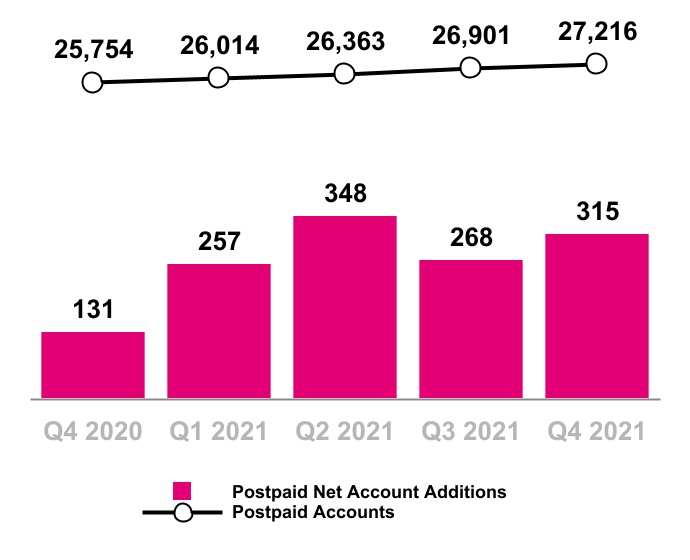
Postpaid net account additions were 315 thousand in Q4 2021, compared to 268 thousand in Q3 2021 and 131 thousand in Q4 2020, as we continue our focus on growing new relationships with businesses and consumers, including those in smaller markets and rural areas as well as High Speed Internet.
Postpaid accounts were 27.2 million at the end of Q4 2021, compared to 26.9 million at the end of Q3 2021 and 25.8 million at the end of Q4 2020.
Total postpaid net customer additions were 1.8 million in Q4 2021, compared to 1.3 million in Q3 2021 and 1.6 million in Q4 2020.
Postpaid phone net customer additions were 844 thousand in Q4 2021, compared to 673 thousand in Q3 2021 and 824 thousand in Q4 2020.
▪Sequentially, the increase was primarily due to seasonally higher gross additions, partially offset by higher churn.
▪Year-over-year, the increase was primarily due to higher gross additions driven by growth in under penetrated customer segments and switching activity returning to more normalized levels relative to muted conditions from the COVID-19 pandemic (the "Pandemic") in the prior year, mostly offset by higher churn.
Postpaid other net customer additions were 906 thousand in Q4 2021, compared to 586 thousand in Q3 2021 and 794 thousand in Q4 2020.
▪Sequentially and year-over-year, the increase was primarily due to higher gross additions from wearables and High Speed Internet, partially offset by higher churn.
The postpaid device upgrade rate was approximately 5.8% in Q4 2021, compared to 4.3% in Q3 2021 and 5.7% in Q4 2020.
Total Postpaid Net Additions
(in thousands)

| ||
| 5 | ||||
Postpaid Phone Churn
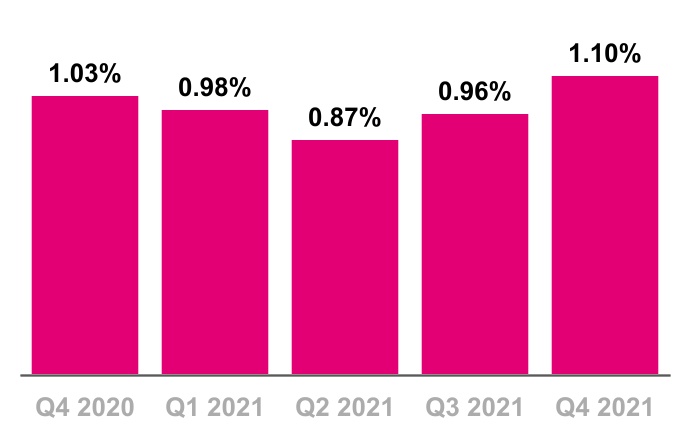
Postpaid phone churn was 1.10% in Q4 2021, up 14 basis points from 0.96% in Q3 2021 and up 7 basis points from 1.03% in Q4 2020.
▪Sequentially, the increase was primarily due to seasonality and elevated Sprint churn during the accelerated integration process.
▪Year-over-year, the increase was primarily driven by more normalized switching activity relative to the muted Pandemic-driven conditions a year ago and elevated Sprint churn during the accelerated integration process.
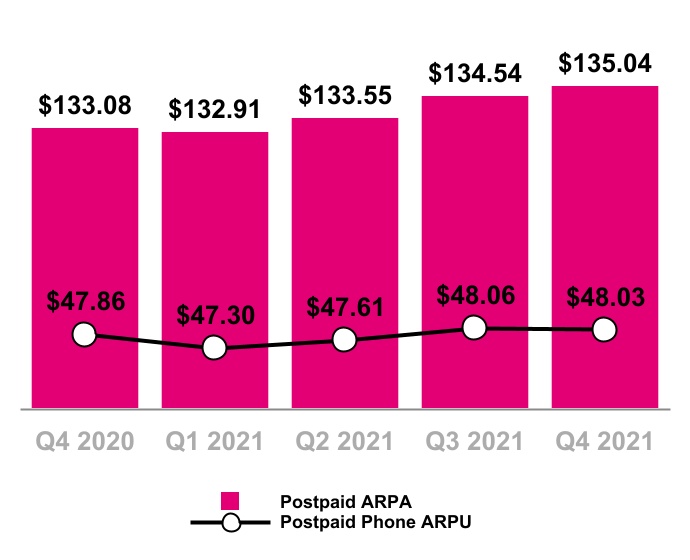
Postpaid ARPA was $135.04 in Q4 2021, up 0.4% compared to $134.54 in Q3 2021 and up 1.5% compared to $133.08 in Q4 2020.
▪Sequentially, the increase was driven by higher premium services including Magenta MAX.
▪Year-over-year, the increase was driven by higher premium services including Magenta MAX and an increase in customers per account.
Postpaid phone ARPU was $48.03 in Q4 2021, relatively flat compared to $48.06 in Q3 2021 and up 0.4% from $47.86 in Q4 2020.
▪Sequentially, the impacts from a seasonal increase in promotional activity were offset by higher premium services including Magenta MAX.
▪Year-over-year, the increase was primarily driven by higher premium services including Magenta MAX partially offset by impacts from increased promotional activity resulting from more normalized switching activity relative to the muted Pandemic-driven conditions a year ago.
Postpaid ARPA & Postpaid Phone ARPU
| ||
| 6 | ||||
Total Prepaid Net Additions
(in thousands)
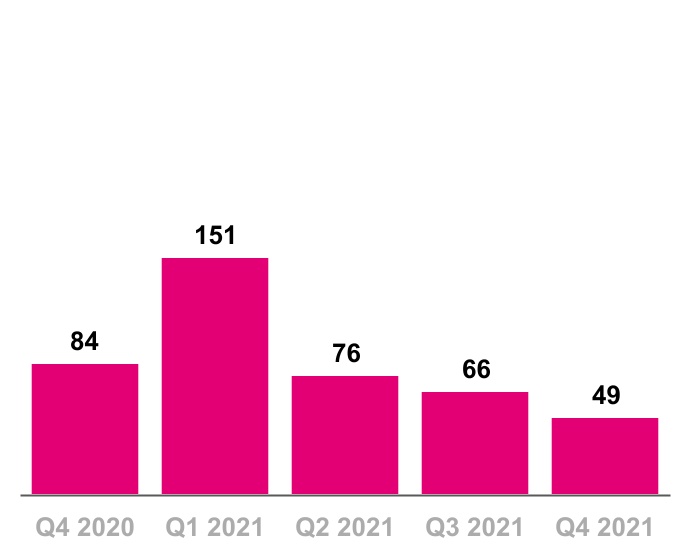
Prepaid net customer additions were 49 thousand in Q4 2021, compared to 66 thousand in Q3 2021 and 84 thousand in Q4 2020.
▪Sequentially and year-over-year, the decrease was primarily driven by higher churn and migrations to postpaid plans, partially offset by higher gross additions.
▪Migrations to postpaid plans reduced prepaid net additions in Q4 2021 by approximately 205 thousand, up from 175 thousand in Q3 2021 and up from 165 thousand in Q4 2020.
Prepaid churn was 3.01% in Q4 2021, compared to 2.90% in Q3 2021 and 2.92% in Q4 2020.
▪Sequentially, the increase was primarily due to seasonality.
▪Year-over-year, the increase was primarily driven by more normalized switching activity relative to the muted Pandemic-driven conditions a year ago.
Prepaid ARPU was $39.32 in Q4 2021, relatively flat from $39.49 in Q3 2021 and up 3.3% from $38.08 in Q4 2020. The year-over-year increase was primarily driven by an increase in premium services.
High Speed Internet Net Additions
(in thousands)

High Speed Internet customer net additions were 224 thousand in Q4 2021, compared to 134 thousand in Q3 2021 and 65 thousand in Q4 2020.
High Speed Internet customers were 646 thousand at the end of Q4 2021, compared to 422 thousand at the end of Q3 2021 and 100 thousand at the end of Q4 2020.
Total net customer additions were 1.8 million in Q4 2021, compared to 1.3 million in Q3 2021 and 1.7 million in Q4 2020.
Total customer connections were 108.7 million at the end of Q4 2021, compared to 106.9 million at the end of Q3 2021 and 102.1 million at the end of Q4 2020.
Total devices sold or leased were 13.8 million units in Q4 2021, compared to 11.3 million units in Q3 2021 and 11.7 million units in Q4 2020.
| ||
 | 7 | ||||
Service Revenues
($ in millions)
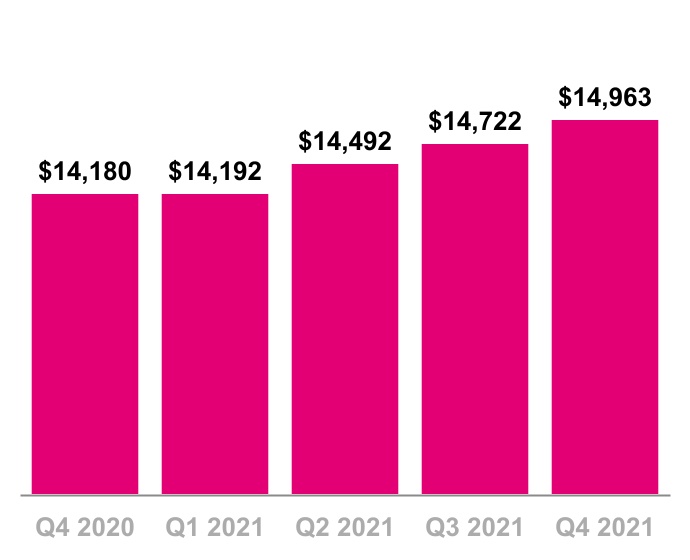
Service revenues were $15.0 billion in Q4 2021, up 2% from $14.7 billion in Q3 2021 and up 6% from $14.2 billion in Q4 2020.
▪Sequentially and year-over-year, the increase was primarily due to an increase in Postpaid revenues, driven by higher average postpaid accounts and higher postpaid ARPA.
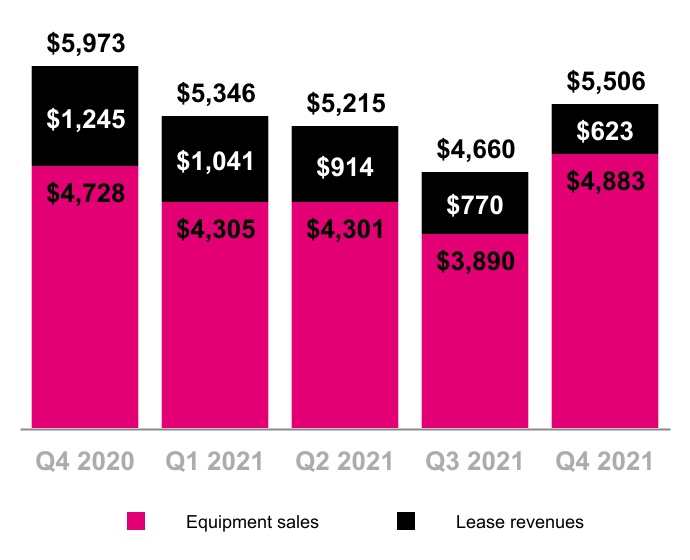
Equipment revenues were $5.5 billion in Q4 2021, up 18% from $4.7 billion in Q3 2021 and down 8% from $6.0 billion in Q4 2020. This includes lower Lease revenues of $623 million in Q4 2021, compared to $770 million in Q3 2021 and $1.2 billion in Q4 2020, reflecting the company’s continued shift in device financing to equipment installment plans.
▪Sequentially, the increase in Equipment sales was primarily driven by a seasonal increase in the number of devices sold and a higher average revenue per device sold, driven by an increase in high-end phone mix, partially offset by seasonally higher promotional activity.
▪Year-over-year, the increase in Equipment sales was primarily due to an increase in the number of devices sold from higher gross additions and upgrades relative to the muted conditions from the Pandemic in the prior year, mostly offset by a lower average revenue per device sold, driven by higher promotional activity relative to muted conditions from the Pandemic in the prior year.
Equipment Revenues
($ in millions)
| ||
| 8 | ||||
Cost of Services, exclusive of D&A
($ in millions, % of Service revenues)
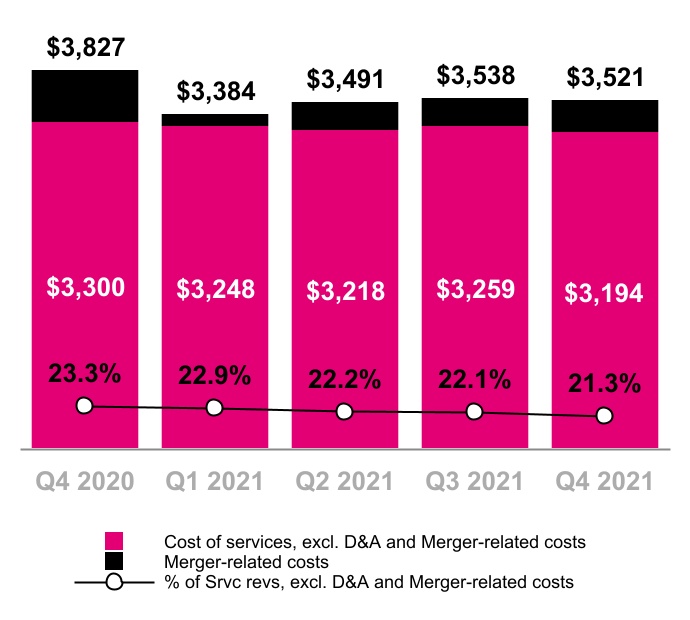
Cost of services, exclusive of depreciation and amortization (D&A), was $3.5 billion in Q4 2021, relatively flat compared to $3.5 billion in Q3 2021 and down 8% from $3.8 billion in Q4 2020.
▪Sequentially, Cost of services was relatively flat.
▪Year-over-year, the decrease was primarily due to lower Merger-related costs and higher realized Merger synergies, partially offset by costs related to the continued build-out of our nationwide 5G network.
▪Merger-related costs, primarily related to network decommissioning and integration, were $327 million in Q4 2021 compared to $279 million in Q3 2021 and $527 million in Q4 2020.
▪As a percentage of Service revenues, Cost of Services, exclusive of D&A, and excluding Merger-related costs, decreased by 80 basis points sequentially, and decreased by 200 basis points year-over-year.
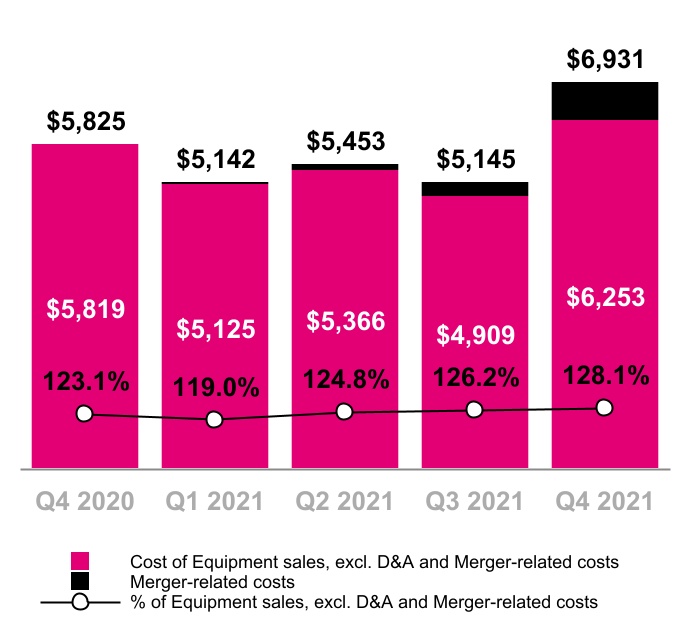
Cost of equipment sales, exclusive of D&A, was $6.9 billion in Q4 2021, up 35% from $5.1 billion in Q3 2021 and up 19% from $5.8 billion in Q4 2020.
▪Sequentially, the increase was driven by the seasonal increase in the number of devices sold and a higher average cost per device sold, driven by an increase in high-end phone mix.
▪Year-over-year, the increase was primarily due to an increase in the number of devices sold from higher gross additions and upgrades relative to the muted conditions from the Pandemic in the prior year.
▪Merger-related costs, primarily related to moving Sprint customers to devices that are compatible with the T-Mobile network, were $678 million in Q4 2021 compared to $236 million in Q3 2021 and $6 million in Q4 2020.
▪As a percentage of Equipment sales, Cost of Equipment Sales, exclusive of D&A, and excluding Merger-related costs, increased by 190 basis point sequentially, and increased by 500 basis points year-over-year.
Cost of Equipment Sales, exclusive of D&A
($ in millions, % of Equipment sales)
| ||
| 9 | ||||
Selling, General and Administrative (SG&A) Expense
($ in millions, % of Service revenues)

Selling, general and administrative (SG&A) expense was $5.4 billion in Q4 2021, up 4% from $5.2 billion in Q3 2021 and up 13% from $4.8 billion in Q4 2020.
▪Sequentially, the increase was primarily driven by seasonally higher labor-related and marketing expenses as well as higher bad debt expense, partially offset by lower Merger-related costs and higher realized Merger synergies.
▪Year-over-year, the increase was primarily driven by higher labor-related, commissions and marketing expenses resulting from a more normalized switching environment compared to the prior period and higher bad debt expense, partially offset by higher realized Merger synergies.
▪Merger-related costs were $238 million in Q4 2021 compared to $440 million in Q3 2021 and $153 million in Q4 2020.
▪As a percentage of Service revenues, SG&A expense, excluding Merger-related, increased 210 basis points sequentially and increased 200 basis points year-over-year.
▪Total bad debt expense and losses from sales of receivables (reported within SG&A expense) was $234 million in Q4 2021, compared to $109 million in Q3 2021 and $112 million in Q4 2020. As a percentage of Total revenues, total bad debt expense and losses from sales of receivables was 1.13% in Q4 2021, compared to 0.56% in Q3 2021 and 0.55% in Q4 2020. Sequentially and year-over-year, the increase was primarily due to estimated credit loss reserves normalizing to pre-Pandemic levels, as well as higher Equipment installment plan receivables driven by higher equipment sales and a mix shift in device financing.
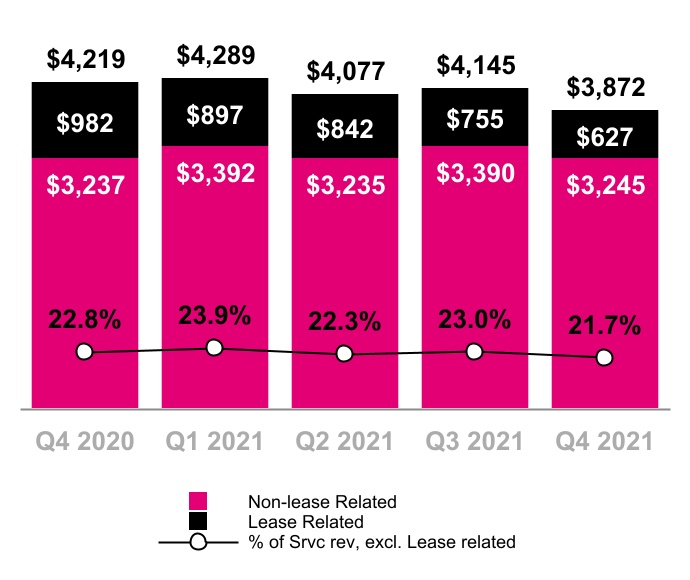
D&A was $3.9 billion in Q4 2021, down 7% from $4.1 billion in Q3 2021 and down 8% from $4.2 billion in Q4 2020. This includes D&A related to Leased devices of $627 million in Q4 2021, compared to $755 million in Q3 2021 and $1.0 billion in Q4 2020.
▪Sequentially and year-over year, the decrease was primarily due to lower depreciation expense on leased devices and certain 4G-related network assets becoming fully depreciated, partially offset by higher depreciation expense from the continued build-out of our nationwide 5G network.
Depreciation & Amortization
($ in millions, % of Service revenues)
| ||
| 10 | ||||
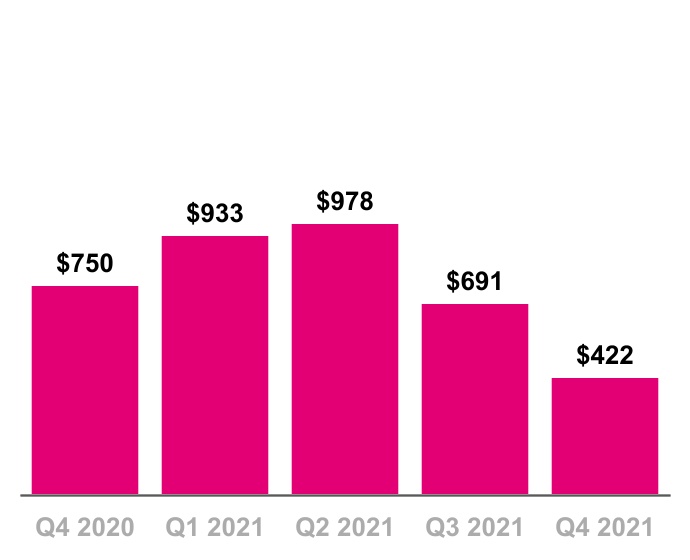
Net Income
($ in millions)
Diluted Earnings Per Share (Diluted EPS)
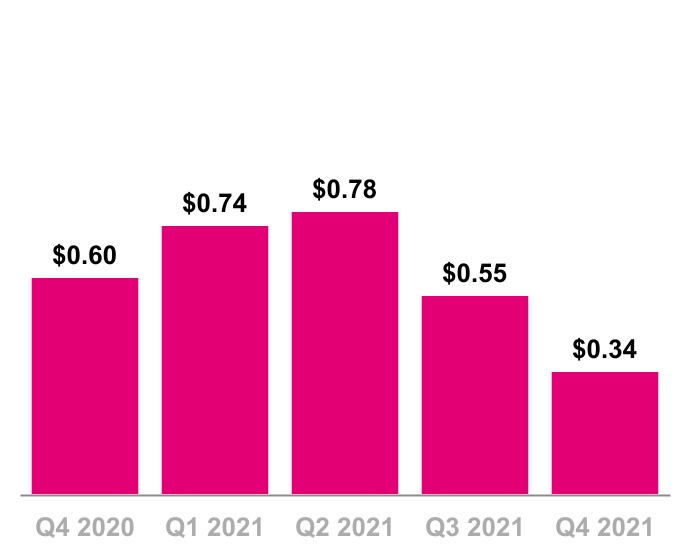
Net income was $422 million in Q4 2021, down 39% from $691 million in Q3 2021 and down 44% from $750 million in Q4 2020. Diluted EPS was $0.34 in Q4 2021, down from $0.55 in Q3 2021 and down from $0.60 in Q4 2020.
▪Sequentially, the decrease in Net income and diluted EPS was primarily due to higher Cost of Equipment sales and higher SG&A, partially offset by higher Equipment revenues, lower Depreciation and Amortization, higher Service revenues, and lower Tax expense.
▪Year-over-year, the decrease in Net income and diluted EPS was primarily driven by higher Cost of equipment sales, higher SG&A and lower Equipment revenues, partially offset by higher Service revenues, lower Depreciation and Amortization, lower Cost of Services, and lower Tax expense.
▪The effective tax rate in Q4 and full year 2021 reflected one-time benefits from accelerated tax integration, which allowed for the release of certain valuation allowances, as we simplified our tax entity structure.
▪Net income and diluted EPS, respectively, were impacted by Merger-related costs, net of tax, for Q4 2021 of $950 million and $0.76, compared to $707 million and $0.56 in Q3 2021 and $506 million and $0.40 in Q4 2020.
▪Net income margin was 2.8% in Q4 2021, compared to 4.7% in Q3 2021 and 5.3% in Q4 2020. Net income margin is calculated as Net income divided by Service revenues.
| ||
| 11 | ||||
Core Adjusted EBITDA
($ in millions, % of Service revenues)
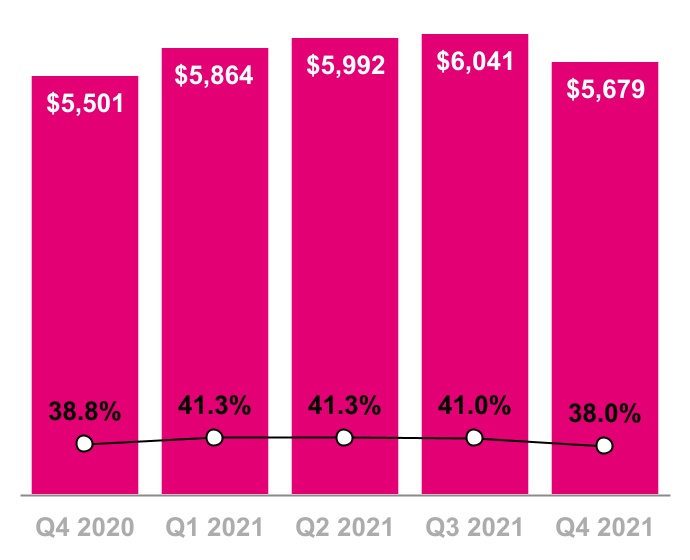
Core Adjusted EBITDA was $5.7 billion in Q4 2021, down 6% from $6.0 billion in Q3 2021 and up 3% from $5.5 billion in Q4 2020.
▪Sequentially, the decrease was primarily due to seasonally higher Cost of equipment sales, excluding Merger-related costs, and higher SG&A expense, excluding Merger-related costs, partially offset by higher Equipment revenues, excluding Lease revenues, and higher Service revenues.
▪Year-over-year, the increase was primarily due to higher Service revenues, higher Equipment revenues, excluding Lease revenues, and lower Cost of Services, excluding Merger-related costs, partially offset by higher SG&A expense, excluding Merger-related costs, and higher Cost of equipment sales, excluding Merger-related costs.
▪Merger-related costs, which are excluded from Core Adjusted EBITDA, were $1.2 billion in Q4 2021, compared to $955 million in Q3 2021 and $686 million in Q4 2020.
▪Core Adjusted EBITDA margin was 38.0% in Q4 2021, compared to 41.0% in Q3 2021 and 38.8% in Q4 2020.
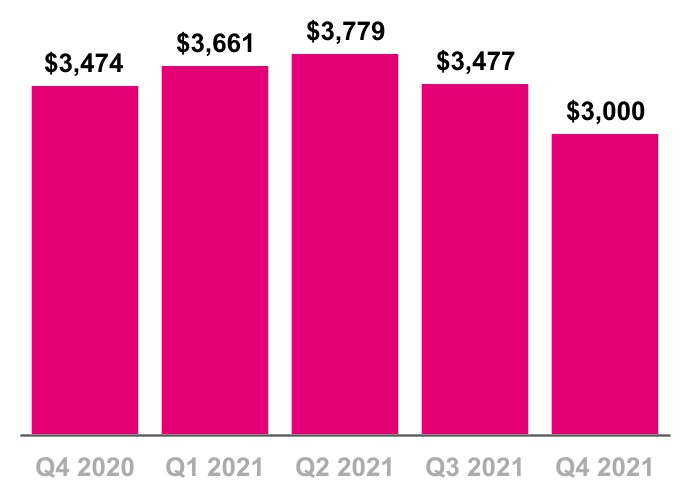
Net cash provided by operating activities was $3.0 billion in Q4 2021, compared to $3.5 billion in Q3 2021 and $3.5 billion in Q4 2020.
▪Sequentially, the decrease was primarily due a decrease in Net income adjusted for non-cash income and expenses and higher cash payments for Merger-related costs, partially offset by a decrease in net cash outflows from seasonal working capital changes and lower use of cash from operating lease liabilities related to an advance rent payment in the prior quarter.
▪Year-over year, the decrease was primarily due a decrease in Net income adjusted for non-cash income and expenses and higher cash payments for Merger-related costs, partially offset by a decrease in net cash outflows from changes in working capital, primarily resulting from lower use of cash from Accounts payable and accrued liabilities.
▪The impact of payments for Merger-related costs on Net cash provided by operating activities was $1.1 billion in Q4 2021 compared to $617 million in Q3 2021 and $583 million in Q4 2020.
Net Cash Provided by Operating Activities
($ in millions)
| ||
| 12 | ||||
Cash Purchases of Property and Equipment
($ in millions, % of Service revenues)
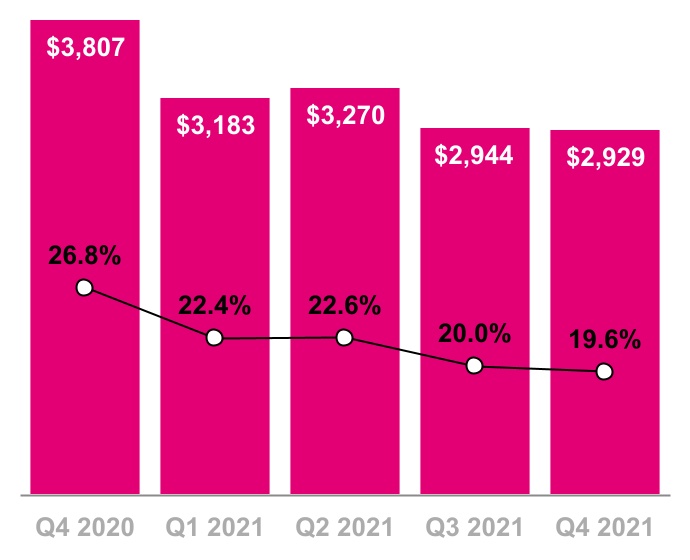
Cash purchases of property and equipment were $2.9 billion in Q4 2021, compared to $2.9 billion in Q3 2021 and $3.8 billion in Q4 2020. Capitalized interest included in cash purchases of property and equipment was $23 million in Q4 2021, compared to $46 million in Q3 2021 and $101 million in Q4 2020.
▪Sequentially, cash purchases of property and equipment were relatively flat, as we continued the rapid deployment of our nationwide 5G network.
▪Year-over year, the decrease was primarily driven by timing of cash payments for equipment and procurement savings from our increased scale.
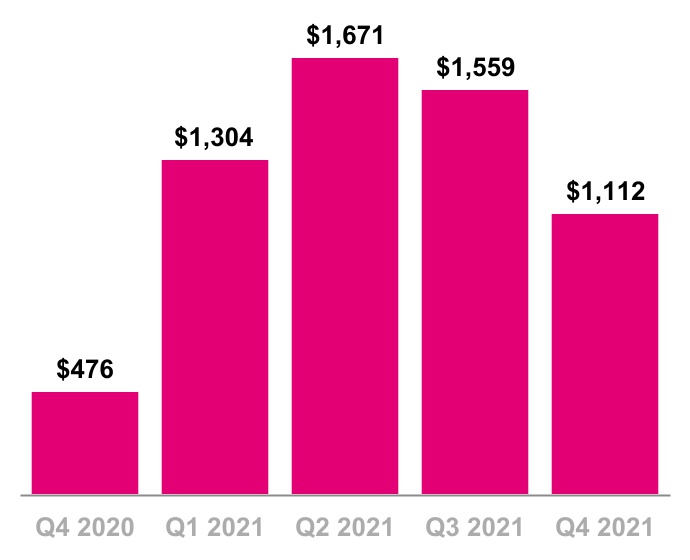
Free Cash Flow was $1.1 billion in Q4 2021, compared to $1.6 billion in Q3 2021 and $476 million in Q4 2020.
▪Sequentially, the decrease was primarily due to lower Net cash provided by operating activities, including the impact of higher cash payments for Merger-related costs.
▪Year-over-year, the increase was primarily due to lower Cash purchases of property and equipment, including capitalized interest, partially offset by lower Net cash provided by operating activities, including the impact of higher cash payments for Merger-related costs.
▪The impact of payments for Merger-related costs on Free Cash Flow was $1.1 billion in Q4 2021 compared to $617 million in Q3 2021 and $583 million in Q4 2020.
Free Cash Flow
($ in millions)
| ||
 | 13 | ||||
Net Debt (Excluding Tower Obligations) & Net Debt to LTM Core Adj. EBITDA Ratio
($ in billions)
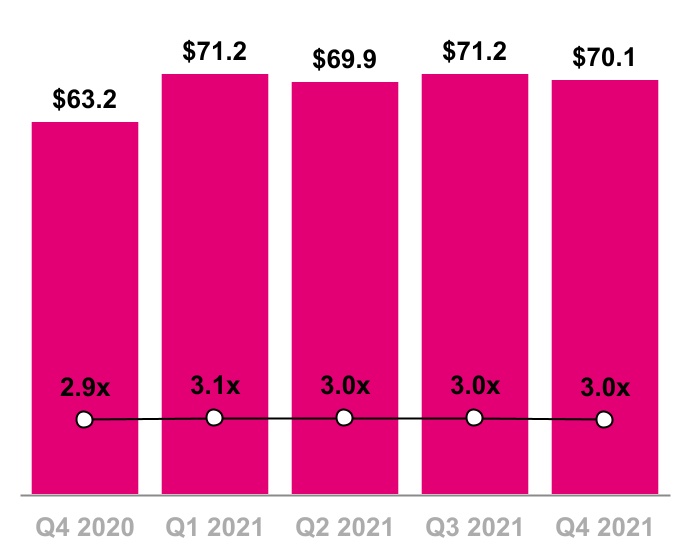
Q4 2020 ratio is calculated based on LTM Pro Forma Core Adj. EBITDA
Total debt, excluding tower obligations, at the end of Q4 2021 was $76.8 billion.
Net debt, excluding tower obligations, at the end of Q4 2021 was $70.1 billion.
▪The ratio of net debt, excluding tower obligations, to Core Adjusted EBITDA for the last twelve months (“LTM”) period was 3.0x at the end of Q4 2021 compared to 3.0x at the end of Q3 2021.
▪The ratio of net debt, excluding tower obligations, to Adjusted EBITDA for the LTM period was 2.6x at the end of Q4 2021 compared to 2.6x at the end of Q3 2021.
Financing activity in Q4 2021 includes:
▪On November 15, 2021, we redeemed at maturity $1.0 billion aggregate principal amount of our 11.50% Senior Notes due 2021.
▪On December 6, 2021, we issued Senior Secured Notes in an aggregate amount of $3.0 billion at an average interest rate of approximately 3.03% and an average maturity of approximately 20.1 years.
| ||
 | 14 | ||||
| ||
| 15 | ||||
| ||
 | 16 | ||||
T-Mobile delivered ~$3.8B in Merger synergies in 2021, nearly tripling year-over-year and exceeding guidance. | ||||||||||||||
The Company realized full-year 2021 Merger synergies in 2021 of $3.8 billion, comprised of the following: ▪Over $1.8 billion of SG&A expense reductions. ▪Over $900 million of cost of service expense reductions. ▪Approximately $1.0 billion of network synergies related to avoided site builds. The Company expects full-year 2022 Merger synergies to be $5.0 billion to $5.3 billion in 2022: ▪$2.2 billion to $2.35 billion of SG&A expense reductions. ▪$1.5 billion to $1.65 billion of cost of service expense reductions. ▪Approximately $1.3 billion of network synergies related to avoided site builds. Merger-related costs in Q4 2021 were $1.2 billion compared to $955 million in Q3 2021 and $686 million in Q4 2020. | ||||||||||||||
| Merger-Related Costs | |||||||||||||||||||||||||||||||||||||||||||||||||||||
| (in millions) | |||||||||||||||||||||||||||||||||||||||||||||||||||||
| Sequential Change | Year-over-year Change | ||||||||||||||||||||||||||||||||||||||||||||||||||||
| Q4 2020 | Q1 2021 | Q2 2021 | Q3 2021 | Q4 2021 | $ | % | $ | % | |||||||||||||||||||||||||||||||||||||||||||||
| Cost of services | $ | 527 | $ | 136 | $ | 273 | $ | 279 | $ | 327 | $ | 48 | 17 | % | $ | (200) | (38) | % | |||||||||||||||||||||||||||||||||||
| Cost of equipment sales | 6 | 17 | 87 | 236 | 678 | 442 | 187 | % | 672 | NM | |||||||||||||||||||||||||||||||||||||||||||
| Selling, general & administrative | 153 | 145 | 251 | 440 | 238 | (202) | (46) | % | 85 | 56 | % | ||||||||||||||||||||||||||||||||||||||||||
| Total Merger-related costs | $ | 686 | $ | 298 | $ | 611 | $ | 955 | $ | 1,243 | $ | 288 | 30 | % | $ | 557 | 81 | % | |||||||||||||||||||||||||||||||||||
| Cash payments for Merger-related costs | $ | 583 | $ | 277 | $ | 190 | $ | 617 | $ | 1,086 | $ | 469 | 76 | % | $ | 503 | 86 | % | |||||||||||||||||||||||||||||||||||
NM - Not Meaningful
| ||
 | 17 | ||||
2022 Outlook
| Postpaid net customer additions | 5.0 to 5.5 million | ||||
Net income (1) | N/A | ||||
Core Adjusted EBITDA (2) | $25.6 to $26.1 billion | ||||
| Merger synergies | $5.0 to $5.3 billion | ||||
Merger-related costs (3) | $4.5 to $5.0 billion | ||||
| Net cash provided by operating activities | $15.5 to $16.1 billion | ||||
Capital expenditures (4) | $13.0 to $13.5 billion | ||||
Free Cash Flow (5) | $7.1 to $7.6 billion | ||||
(1)We are not able to forecast Net income on a forward-looking basis without unreasonable efforts due to the high variability and difficulty in predicting certain items that affect GAAP Net income, including, but not limited to, Income tax expense, stock-based compensation expense and Interest expense. Core Adjusted EBITDA should not be used to predict Net income as the difference between this measure and Net Income is variable.
(2)Management uses Core Adjusted EBITDA as a measure to monitor the financial performance of our operations, excluding the impact of lease revenues from our related device financing programs. Our guidance ranges assume lease revenues to be between $1.1 billion and $1.4 billion for 2022.
(3)Merger-related costs are excluded from Core Adjusted EBITDA but will impact Net income, Net cash provided by operating activities and Free Cash Flow.
(4)Capital expenditures means cash purchases of property and equipment, including capitalized interest.
(5)Free Cash Flow guidance does not assume any material net cash inflows from securitization in 2022.
| ||
 | 18 | ||||
Investor Relations
 |  |  | ||||||||||||||||||
| Jud Henry | Justin Taiber | Trina Schurman | ||||||||||||||||||
| Senior Vice President | Senior Director | Senior Director | ||||||||||||||||||
| Investor Relations | Investor Relations | Investor Relations | ||||||||||||||||||
 |  |  |  | |||||||||||||||||||||||
| Samia Bhatti | Zach Witterstaetter | Rose Kopecky | Jacob Marks | |||||||||||||||||||||||
| Investor Relations | Investor Relations | Investor Relations | Investor Relations | |||||||||||||||||||||||
| Manager | Manager | Manager | Manager | |||||||||||||||||||||||
http://investor.t-mobile.com
| ||
19 | ||
T-Mobile US, Inc.
Consolidated Balance Sheets
| (in millions, except share and per share amounts) | December 31, 2021 | December 31, 2020 | |||||||||
| Assets | |||||||||||
| Current assets | |||||||||||
| Cash and cash equivalents | $ | 6,631 | $ | 10,385 | |||||||
| Accounts receivable, net of allowance for credit losses of $146 and $194 | 4,167 | 4,254 | |||||||||
Equipment installment plan receivables, net of allowance for credit losses and imputed discount of $494 and $478 | 4,748 | 3,577 | |||||||||
| Accounts receivable from affiliates | 27 | 22 | |||||||||
| Inventory | 2,567 | 2,527 | |||||||||
| Prepaid expenses | 746 | 624 | |||||||||
| Other current assets | 2,005 | 2,496 | |||||||||
| Total current assets | 20,891 | 23,885 | |||||||||
| Property and equipment, net | 39,803 | 41,175 | |||||||||
| Operating lease right-of-use assets | 26,959 | 28,021 | |||||||||
| Financing lease right-of-use assets | 3,322 | 3,028 | |||||||||
| Goodwill | 12,188 | 11,117 | |||||||||
| Spectrum licenses | 92,606 | 82,828 | |||||||||
| Other intangible assets, net | 4,733 | 5,298 | |||||||||
Equipment installment plan receivables due after one year, net of allowance for credit losses and imputed discount of $136 and $127 | 2,829 | 2,031 | |||||||||
| Other assets | 3,232 | 2,779 | |||||||||
| Total assets | $ | 206,563 | $ | 200,162 | |||||||
| Liabilities and Stockholders' Equity | |||||||||||
| Current liabilities | |||||||||||
| Accounts payable and accrued liabilities | $ | 11,405 | $ | 10,196 | |||||||
| Payables to affiliates | 103 | 157 | |||||||||
| Short-term debt | 3,378 | 4,579 | |||||||||
| Short-term debt to affiliates | 2,245 | — | |||||||||
| Deferred revenue | 856 | 1,030 | |||||||||
| Short-term operating lease liabilities | 3,425 | 3,868 | |||||||||
| Short-term financing lease liabilities | 1,120 | 1,063 | |||||||||
| Other current liabilities | 967 | 810 | |||||||||
| Total current liabilities | 23,499 | 21,703 | |||||||||
| Long-term debt | 67,076 | 61,830 | |||||||||
| Long-term debt to affiliates | 1,494 | 4,716 | |||||||||
| Tower obligations | 2,806 | 3,028 | |||||||||
| Deferred tax liabilities | 10,216 | 9,966 | |||||||||
| Operating lease liabilities | 25,818 | 26,719 | |||||||||
| Financing lease liabilities | 1,455 | 1,444 | |||||||||
| Other long-term liabilities | 5,097 | 5,412 | |||||||||
| Total long-term liabilities | 113,962 | 113,115 | |||||||||
| Commitments and contingencies | |||||||||||
| Stockholders' equity | |||||||||||
| Common Stock, par value $0.00001 per share, 2,000,000,000 shares authorized; 1,250,751,148 and 1,243,345,584 shares issued, 1,249,213,681 and 1,241,805,706 shares outstanding | — | — | |||||||||
| Additional paid-in capital | 73,292 | 72,772 | |||||||||
| Treasury stock, at cost, 1,537,468 and 1,539,878 shares issued | (13) | (11) | |||||||||
| Accumulated other comprehensive loss | (1,365) | (1,581) | |||||||||
| Accumulated deficit | (2,812) | (5,836) | |||||||||
| Total stockholders' equity | 69,102 | 65,344 | |||||||||
| Total liabilities and stockholders' equity | $ | 206,563 | $ | 200,162 | |||||||
| ||
20 | ||
T-Mobile US, Inc.
Consolidated Statements of Comprehensive Income
(Unaudited)
| Three Months Ended | Year Ended December 31, | ||||||||||||||||||||||||||||
| (in millions, except share and per share amounts) | December 31, 2021 | September 30, 2021 | December 31, 2020 | 2021 | 2020 | ||||||||||||||||||||||||
| Revenues | |||||||||||||||||||||||||||||
| Postpaid revenues | $ | 10,963 | $ | 10,804 | $ | 10,251 | $ | 42,562 | $ | 36,306 | |||||||||||||||||||
| Prepaid revenues | 2,474 | 2,481 | 2,354 | 9,733 | 9,421 | ||||||||||||||||||||||||
| Wholesale revenues | 975 | 944 | 927 | 3,751 | 2,590 | ||||||||||||||||||||||||
| Other service revenues | 551 | 493 | 648 | 2,323 | 2,078 | ||||||||||||||||||||||||
| Total service revenues | 14,963 | 14,722 | 14,180 | 58,369 | 50,395 | ||||||||||||||||||||||||
| Equipment revenues | 5,506 | 4,660 | 5,973 | 20,727 | 17,312 | ||||||||||||||||||||||||
| Other revenues | 316 | 242 | 188 | 1,022 | 690 | ||||||||||||||||||||||||
| Total revenues | 20,785 | 19,624 | 20,341 | 80,118 | 68,397 | ||||||||||||||||||||||||
| Operating expenses | |||||||||||||||||||||||||||||
| Cost of services, exclusive of depreciation and amortization shown separately below | 3,521 | 3,538 | 3,827 | 13,934 | 11,878 | ||||||||||||||||||||||||
| Cost of equipment sales, exclusive of depreciation and amortization shown separately below | 6,931 | 5,145 | 5,825 | 22,671 | 16,388 | ||||||||||||||||||||||||
| Selling, general and administrative | 5,398 | 5,212 | 4,758 | 20,238 | 18,926 | ||||||||||||||||||||||||
| Impairment expense | — | — | — | — | 418 | ||||||||||||||||||||||||
| Depreciation and amortization | 3,872 | 4,145 | 4,219 | 16,383 | 14,151 | ||||||||||||||||||||||||
| Total operating expenses | 19,722 | 18,040 | 18,629 | 73,226 | 61,761 | ||||||||||||||||||||||||
| Operating income | 1,063 | 1,584 | 1,712 | 6,892 | 6,636 | ||||||||||||||||||||||||
| Other income (expense) | |||||||||||||||||||||||||||||
| Interest expense | (797) | (780) | (757) | (3,189) | (2,483) | ||||||||||||||||||||||||
| Interest expense to affiliates | (37) | (58) | (41) | (173) | (247) | ||||||||||||||||||||||||
| Interest income | 13 | 2 | 8 | 20 | 29 | ||||||||||||||||||||||||
| Other expense, net | (13) | (60) | (101) | (199) | (405) | ||||||||||||||||||||||||
| Total other expense, net | (834) | (896) | (891) | (3,541) | (3,106) | ||||||||||||||||||||||||
| Income from continuing operations before income taxes | 229 | 688 | 821 | 3,351 | 3,530 | ||||||||||||||||||||||||
| Income tax expense (benefit) | 193 | 3 | (71) | (327) | (786) | ||||||||||||||||||||||||
| Income from continuing operations | 422 | 691 | 750 | 3,024 | 2,744 | ||||||||||||||||||||||||
| Income from discontinued operations, net of tax | — | — | — | — | 320 | ||||||||||||||||||||||||
| Net income | $ | 422 | $ | 691 | $ | 750 | $ | 3,024 | $ | 3,064 | |||||||||||||||||||
| Net income | $ | 422 | $ | 691 | $ | 750 | $ | 3,024 | $ | 3,064 | |||||||||||||||||||
| Other comprehensive income (loss), net of tax | |||||||||||||||||||||||||||||
| Unrealized gain (loss) on cash flow hedges, net of tax effect of $13, $12, $11, $49 and ($250) | 37 | 35 | 34 | 140 | (723) | ||||||||||||||||||||||||
Unrealized (loss) gain on foreign currency translation adjustment, net of tax effect of $0, $0, $0, $0 and $1 | (4) | (3) | — | (4) | 4 | ||||||||||||||||||||||||
Net unrecognized gain on pension and other postretirement benefits, net of tax effect of $28, $0, $2, $28 and $2 | 80 | — | 6 | 80 | 6 | ||||||||||||||||||||||||
| Other comprehensive income (loss) | 113 | 32 | 40 | 216 | (713) | ||||||||||||||||||||||||
| Total comprehensive income | $ | 535 | $ | 723 | $ | 790 | $ | 3,240 | $ | 2,351 | |||||||||||||||||||
| Earnings per share | |||||||||||||||||||||||||||||
| Basic earnings per share: | |||||||||||||||||||||||||||||
| Continuing operations | $ | 0.34 | $ | 0.55 | $ | 0.60 | $ | 2.42 | $ | 2.40 | |||||||||||||||||||
| Discontinued operations | — | — | — | — | 0.28 | ||||||||||||||||||||||||
| Basic | $ | 0.34 | $ | 0.55 | $ | 0.60 | $ | 2.42 | $ | 2.68 | |||||||||||||||||||
| Diluted earnings per share: | |||||||||||||||||||||||||||||
| Continuing operations | $ | 0.34 | $ | 0.55 | $ | 0.60 | $ | 2.41 | $ | 2.37 | |||||||||||||||||||
| Discontinued operations | — | — | — | — | 0.28 | ||||||||||||||||||||||||
| Diluted | $ | 0.34 | $ | 0.55 | $ | 0.60 | $ | 2.41 | $ | 2.65 | |||||||||||||||||||
| Weighted-average shares outstanding | |||||||||||||||||||||||||||||
| Basic | 1,249,272,296 | 1,248,189,719 | 1,241,578,615 | 1,247,154,988 | 1,144,206,326 | ||||||||||||||||||||||||
| Diluted | 1,254,289,170 | 1,253,661,245 | 1,251,566,899 | 1,254,769,926 | 1,154,749,428 | ||||||||||||||||||||||||
| ||
21 | ||
T-Mobile US, Inc.
Consolidated Statements of Cash Flows
(Unaudited)
| Three Months Ended | Year Ended December 31, | ||||||||||||||||||||||||||||
| (in millions) | December 31, 2021 | September 30, 2021 | December 31, 2020 | 2021 | 2020 | ||||||||||||||||||||||||
| Operating activities | |||||||||||||||||||||||||||||
| Net income | $ | 422 | $ | 691 | $ | 750 | $ | 3,024 | $ | 3,064 | |||||||||||||||||||
| Adjustments to reconcile net income to net cash provided by operating activities | |||||||||||||||||||||||||||||
| Depreciation and amortization | 3,872 | 4,145 | 4,219 | 16,383 | 14,151 | ||||||||||||||||||||||||
| Stock-based compensation expense | 137 | 131 | 136 | 540 | 694 | ||||||||||||||||||||||||
| Deferred income tax (benefit) expense | (213) | (27) | 79 | 197 | 822 | ||||||||||||||||||||||||
| Bad debt expense | 193 | 105 | 113 | 452 | 602 | ||||||||||||||||||||||||
| Losses (gains) from sales of receivables | 41 | 4 | (1) | 15 | 36 | ||||||||||||||||||||||||
| Losses on redemption of debt | — | 55 | 100 | 184 | 371 | ||||||||||||||||||||||||
| Impairment expense | — | — | — | — | 418 | ||||||||||||||||||||||||
| Changes in operating assets and liabilities | |||||||||||||||||||||||||||||
| Accounts receivable | (1,028) | (454) | (489) | (3,225) | (3,273) | ||||||||||||||||||||||||
| Equipment installment plan receivables | (1,316) | (530) | (1,343) | (3,141) | (1,453) | ||||||||||||||||||||||||
| Inventories | (703) | 41 | (609) | 201 | (2,222) | ||||||||||||||||||||||||
| Operating lease right-of-use assets | 1,234 | 1,334 | 939 | 4,964 | 3,465 | ||||||||||||||||||||||||
| Other current and long-term assets | (385) | (88) | (296) | (573) | (402) | ||||||||||||||||||||||||
| Accounts payable and accrued liabilities | 1,794 | 111 | 507 | 549 | (2,123) | ||||||||||||||||||||||||
| Short- and long-term operating lease liabilities | (947) | (2,046) | (752) | (5,358) | (3,699) | ||||||||||||||||||||||||
| Other current and long-term liabilities | (180) | (87) | (16) | (531) | (2,178) | ||||||||||||||||||||||||
| Other, net | 79 | 92 | 137 | 236 | 367 | ||||||||||||||||||||||||
| Net cash provided by operating activities | 3,000 | 3,477 | 3,474 | 13,917 | 8,640 | ||||||||||||||||||||||||
| Investing activities | |||||||||||||||||||||||||||||
| Purchases of property and equipment, including capitalized interest of ($23), ($46), ($101), ($210) and ($440) | (2,929) | (2,944) | (3,807) | (12,326) | (11,034) | ||||||||||||||||||||||||
| Purchases of spectrum licenses and other intangible assets, including deposits | (29) | (407) | (506) | (9,366) | (1,333) | ||||||||||||||||||||||||
| Proceeds from sales of tower sites | 9 | — | — | 40 | — | ||||||||||||||||||||||||
| Proceeds related to beneficial interests in securitization transactions | 1,032 | 1,071 | 809 | 4,131 | 3,134 | ||||||||||||||||||||||||
| Net cash related to derivative contracts under collateral exchange arrangements | — | — | — | — | 632 | ||||||||||||||||||||||||
| Acquisition of companies, net of cash and restricted cash acquired | — | (1,886) | — | (1,916) | (5,000) | ||||||||||||||||||||||||
| Proceeds from the divestiture of prepaid business | — | — | (14) | — | 1,224 | ||||||||||||||||||||||||
| Other, net | 5 | 14 | (129) | 51 | (338) | ||||||||||||||||||||||||
| Net cash used in investing activities | (1,912) | (4,152) | (3,647) | (19,386) | (12,715) | ||||||||||||||||||||||||
| Financing activities | |||||||||||||||||||||||||||||
| Proceeds from issuance of long-term debt | 2,969 | 1,989 | 8,643 | 14,727 | 35,337 | ||||||||||||||||||||||||
| Payments of consent fees related to long-term debt | — | — | — | — | (109) | ||||||||||||||||||||||||
| Repayments of financing lease obligations | (289) | (266) | (257) | (1,111) | (1,021) | ||||||||||||||||||||||||
| Repayments of short-term debt for purchases of inventory, property and equipment and other financial liabilities | (17) | (76) | (74) | (184) | (481) | ||||||||||||||||||||||||
| Repayments of long-term debt | (1,131) | (4,600) | (4,209) | (11,100) | (20,416) | ||||||||||||||||||||||||
| Issuance of common stock | — | — | — | — | 19,840 | ||||||||||||||||||||||||
| Repurchases of common stock | — | — | — | — | (19,536) | ||||||||||||||||||||||||
| Proceeds from issuance of short-term debt | — | — | — | — | 18,743 | ||||||||||||||||||||||||
| Repayments of short-term debt | — | — | — | — | (18,929) | ||||||||||||||||||||||||
| Tax withholdings on share-based awards | (8) | (14) | (88) | (316) | (439) | ||||||||||||||||||||||||
| Cash payments for debt prepayment or debt extinguishment costs | — | (45) | — | (116) | (82) | ||||||||||||||||||||||||
| Other, net | (52) | (48) | (36) | (191) | 103 | ||||||||||||||||||||||||
| Net cash provided by (used in) financing activities | 1,472 | (3,060) | 3,979 | 1,709 | 13,010 | ||||||||||||||||||||||||
| Change in cash and cash equivalents, including restricted cash | 2,560 | (3,735) | 3,806 | (3,760) | 8,935 | ||||||||||||||||||||||||
| Cash and cash equivalents, including restricted cash | |||||||||||||||||||||||||||||
| Beginning of period | 4,143 | 7,878 | 6,657 | 10,463 | 1,528 | ||||||||||||||||||||||||
| End of period | $ | 6,703 | $ | 4,143 | $ | 10,463 | $ | 6,703 | $ | 10,463 | |||||||||||||||||||
| ||
22 | ||
T-Mobile US, Inc.
Consolidated Statements of Cash Flows (Continued)
(Unaudited)
| Three Months Ended | Year Ended December 31, | ||||||||||||||||||||||||||||
| (in millions) | December 31, 2021 | September 30, 2021 | December 31, 2020 | 2021 | 2020 | ||||||||||||||||||||||||
| Supplemental disclosure of cash flow information | |||||||||||||||||||||||||||||
| Interest payments, net of amounts capitalized | $ | 981 | $ | 884 | $ | 844 | $ | 3,723 | $ | 2,733 | |||||||||||||||||||
| Operating lease payments | 1,083 | 2,251 | 1,126 | 6,248 | 4,619 | ||||||||||||||||||||||||
| Income tax payments | 44 | 38 | 100 | 167 | 218 | ||||||||||||||||||||||||
| Non-cash investing and financing activities | |||||||||||||||||||||||||||||
| Non-cash beneficial interest obtained in exchange for securitized receivables | $ | 876 | $ | 891 | $ | 1,560 | $ | 4,237 | $ | 6,194 | |||||||||||||||||||
| Non-cash consideration for the acquisition of Sprint | — | — | — | — | 33,533 | ||||||||||||||||||||||||
| Change in accounts payable and accrued liabilities for purchases of property and equipment | 793 | 113 | 1,144 | 366 | 589 | ||||||||||||||||||||||||
| Leased devices transferred from inventory to property and equipment | 166 | 214 | 443 | 1,198 | 2,795 | ||||||||||||||||||||||||
| Returned leased devices transferred from property and equipment to inventory | (267) | (309) | (430) | (1,437) | (1,460) | ||||||||||||||||||||||||
| Short-term debt assumed for financing of property and equipment | — | — | — | — | 38 | ||||||||||||||||||||||||
| Operating lease right-of-use assets obtained in exchange for lease obligations | 834 | 985 | 1,083 | 3,773 | 14,129 | ||||||||||||||||||||||||
| Financing lease right-of-use assets obtained in exchange for lease obligations | 152 | 623 | 361 | 1,261 | 1,273 | ||||||||||||||||||||||||
| ||
23 | ||
T-Mobile US, Inc.
Supplementary Operating and Financial Data
(Unaudited)
| Quarter | Year Ended December 31, | ||||||||||||||||||||||||||||||||||||||||||||||||||||||||||
| (in thousands) | Q1 2020 | Q2 2020 | Q3 2020 | Q4 2020 | Q1 2021 | Q2 2021 | Q3 2021 | Q4 2021 | 2020 | 2021 | |||||||||||||||||||||||||||||||||||||||||||||||||
| Customers, end of period | |||||||||||||||||||||||||||||||||||||||||||||||||||||||||||
Postpaid phone customers (1)(2) | 40,797 | 65,105 | 65,794 | 66,618 | 67,402 | 68,029 | 69,418 | 70,262 | 66,618 | 70,262 | |||||||||||||||||||||||||||||||||||||||||||||||||
Postpaid other customers (1)(2) | 7,014 | 12,648 | 13,938 | 14,732 | 15,170 | 15,819 | 16,495 | 17,401 | 14,732 | 17,401 | |||||||||||||||||||||||||||||||||||||||||||||||||
| Total postpaid customers | 47,811 | 77,753 | 79,732 | 81,350 | 82,572 | 83,848 | 85,913 | 87,663 | 81,350 | 87,663 | |||||||||||||||||||||||||||||||||||||||||||||||||
Prepaid customers (1) | 20,732 | 20,574 | 20,630 | 20,714 | 20,865 | 20,941 | 21,007 | 21,056 | 20,714 | 21,056 | |||||||||||||||||||||||||||||||||||||||||||||||||
| Total customers | 68,543 | 98,327 | 100,362 | 102,064 | 103,437 | 104,789 | 106,920 | 108,719 | 102,064 | 108,719 | |||||||||||||||||||||||||||||||||||||||||||||||||
Acquired customers, net of base adjustments (1)(2) | — | 29,228 | — | — | 12 | — | 806 | — | 29,228 | 818 | |||||||||||||||||||||||||||||||||||||||||||||||||
(1)Includes customers acquired in connection with the Merger and certain customer base adjustments. See Reconciliations to Beginning Customers and Accounts in this Investor Factbook.
(2)In the first quarter of 2021, we acquired 11,000 postpaid phone customers and 1,000 postpaid other customers through our acquisition of an affiliate. In the third quarter of 2021, we acquired 716,000 postpaid phone customers and 90,000 postpaid other customers through our acquisition of Shentel’s Wireless Assets.
| Quarter | Year Ended December 31, | ||||||||||||||||||||||||||||||||||||||||||||||||||||||||||
| (in thousands) | Q1 2020 | Q2 2020 | Q3 2020 | Q4 2020 | Q1 2021 | Q2 2021 | Q3 2021 | Q4 2021 | 2020 | 2021 | |||||||||||||||||||||||||||||||||||||||||||||||||
| Net customer additions (losses) | |||||||||||||||||||||||||||||||||||||||||||||||||||||||||||
| Postpaid phone customers | 452 | 253 | 689 | 824 | 773 | 627 | 673 | 844 | 2,218 | 2,917 | |||||||||||||||||||||||||||||||||||||||||||||||||
| Postpaid other customers | 325 | 859 | 1,290 | 794 | 437 | 649 | 586 | 906 | 3,268 | 2,578 | |||||||||||||||||||||||||||||||||||||||||||||||||
| Total postpaid customers | 777 | 1,112 | 1,979 | 1,618 | 1,210 | 1,276 | 1,259 | 1,750 | 5,486 | 5,495 | |||||||||||||||||||||||||||||||||||||||||||||||||
| Prepaid customers | (128) | 133 | 56 | 84 | 151 | 76 | 66 | 49 | 145 | 342 | |||||||||||||||||||||||||||||||||||||||||||||||||
| Total customers | 649 | 1,245 | 2,035 | 1,702 | 1,361 | 1,352 | 1,325 | 1,799 | 5,631 | 5,837 | |||||||||||||||||||||||||||||||||||||||||||||||||
| Quarter | Year Ended December 31, | ||||||||||||||||||||||||||||||||||||||||||||||||||||||||||
| (in millions, except percentages) | Q1 2020 | Q2 2020 | Q3 2020 | Q4 2020 | Q1 2021 | Q2 2021 | Q3 2021 | Q4 2021 | 2020 | 2021 | |||||||||||||||||||||||||||||||||||||||||||||||||
| Devices sold or leased | |||||||||||||||||||||||||||||||||||||||||||||||||||||||||||
| Phones | 6.4 | 8.9 | 9.2 | 10.1 | 9.6 | 9.6 | 9.8 | 11.6 | 34.6 | 40.6 | |||||||||||||||||||||||||||||||||||||||||||||||||
| Mobile broadband and IoT devices | 0.8 | 1.2 | 2.2 | 1.6 | 1.0 | 1.4 | 1.5 | 2.2 | 5.8 | 6.1 | |||||||||||||||||||||||||||||||||||||||||||||||||
| Total | 7.2 | 10.1 | 11.4 | 11.7 | 10.6 | 11.0 | 11.3 | 13.8 | 40.4 | 46.7 | |||||||||||||||||||||||||||||||||||||||||||||||||
| Postpaid device upgrade rate | 3.8 | % | 4.5 | % | 4.3 | % | 5.7 | % | 4.8 | % | 4.7 | % | 4.3 | % | 5.8 | % | 18.7 | % | 19.6 | % | |||||||||||||||||||||||||||||||||||||||
| Quarter | Year Ended December 31, | ||||||||||||||||||||||||||||||||||||||||||||||||||||||||||
| Q1 2020 | Q2 2020 | Q3 2020 | Q4 2020 | Q1 2021 | Q2 2021 | Q3 2021 | Q4 2021 | 2020 | 2021 | ||||||||||||||||||||||||||||||||||||||||||||||||||
| Churn | |||||||||||||||||||||||||||||||||||||||||||||||||||||||||||
| Postpaid phone churn | 0.86 | % | 0.80 | % | 0.90 | % | 1.03 | % | 0.98 | % | 0.87 | % | 0.96 | % | 1.10 | % | 0.90 | % | 0.98 | % | |||||||||||||||||||||||||||||||||||||||
| Prepaid churn | 3.52 | % | 2.81 | % | 2.86 | % | 2.92 | % | 2.78 | % | 2.62 | % | 2.90 | % | 3.01 | % | 3.03 | % | 2.83 | % | |||||||||||||||||||||||||||||||||||||||
| Quarter | Year Ended December 31, | ||||||||||||||||||||||||||||||||||||||||||||||||||||||||||
| (in thousands) | Q1 2020 | Q2 2020 | Q3 2020 | Q4 2020 | Q1 2021 | Q2 2021 | Q3 2021 | Q4 2021 | 2020 | 2021 | |||||||||||||||||||||||||||||||||||||||||||||||||
| Accounts, end of period | |||||||||||||||||||||||||||||||||||||||||||||||||||||||||||
Total postpaid customer accounts (1)(2) | 15,244 | 25,486 | 25,623 | 25,754 | 26,014 | 26,363 | 26,901 | 27,216 | 25,754 | 27,216 | |||||||||||||||||||||||||||||||||||||||||||||||||
(1)Includes accounts acquired in connection with the Merger and certain account base adjustments. See Reconciliations to Beginning Customers and Accounts in this Investor Factbook.
(2)In the first quarter of 2021, we acquired 4,000 postpaid accounts through our acquisition of an affiliate. In the third quarter of 2021, we acquired 270,000 postpaid accounts through our acquisition of Shentel’s Wireless Assets.
| ||
24 | ||
T-Mobile US, Inc.
Supplementary Operating and Financial Data
(Unaudited)
| Quarter | Year Ended December 31, | ||||||||||||||||||||||||||||||||||||||||||||||||||||||||||
| (in thousands) | Q1 2020 | Q2 2020 | Q3 2020 | Q4 2020 | Q1 2021 | Q2 2021 | Q3 2021 | Q4 2021 | 2020 | 2021 | |||||||||||||||||||||||||||||||||||||||||||||||||
| Net account additions | |||||||||||||||||||||||||||||||||||||||||||||||||||||||||||
| Postpaid net account additions | 197 | 101 | 137 | 131 | 257 | 348 | 268 | 315 | 566 | 1,188 | |||||||||||||||||||||||||||||||||||||||||||||||||
| Quarter | Year Ended December 31, | ||||||||||||||||||||||||||||||||||||||||||||||||||||||||||
| (in millions, except percentages) | Q1 2020 | Q2 2020 | Q3 2020 | Q4 2020 | Q1 2021 | Q2 2021 | Q3 2021 | Q4 2021 | 2020 | 2021 | |||||||||||||||||||||||||||||||||||||||||||||||||
| Device Financing - Equipment Installment Plans | |||||||||||||||||||||||||||||||||||||||||||||||||||||||||||
| Gross EIP financed | $ | 1,440 | $ | 1,825 | $ | 2,356 | $ | 4,126 | $ | 3,379 | $ | 3,348 | $ | 3,434 | $ | 5,282 | $ | 9,747 | $ | 15,443 | |||||||||||||||||||||||||||||||||||||||
| EIP billings | 1,790 | 2,217 | 2,130 | 2,285 | 2,556 | 2,639 | 2,795 | 3,126 | 8,422 | 11,116 | |||||||||||||||||||||||||||||||||||||||||||||||||
| EIP receivables, net | 3,773 | 4,593 | 4,481 | 5,608 | 6,062 | 6,348 | 6,586 | 7,577 | 5,608 | 7,577 | |||||||||||||||||||||||||||||||||||||||||||||||||
| EIP receivables classified as prime | 52 | % | 48 | % | 53 | % | 57 | % | 57 | % | 61 | % | 60 | % | 62 | % | 57 | % | 62 | % | |||||||||||||||||||||||||||||||||||||||
| EIP receivables classified as prime (including EIP receivables sold) | 53 | % | 50 | % | 54 | % | 57 | % | 56 | % | 59 | % | 57 | % | 58 | % | 57 | % | 58 | % | |||||||||||||||||||||||||||||||||||||||
| Device Financing - Leased Devices | |||||||||||||||||||||||||||||||||||||||||||||||||||||||||||
| Lease revenues | $ | 165 | $ | 1,421 | $ | 1,350 | $ | 1,245 | $ | 1,041 | $ | 914 | $ | 770 | $ | 623 | $ | 4,181 | $ | 3,348 | |||||||||||||||||||||||||||||||||||||||
| Leased device depreciation | 163 | 946 | 1,000 | 982 | 897 | 842 | 755 | 627 | 3,091 | 3,121 | |||||||||||||||||||||||||||||||||||||||||||||||||
| Leased devices transferred from inventory to property and equipment | 309 | 1,444 | 599 | 443 | 485 | 333 | 214 | 166 | 2,795 | 1,198 | |||||||||||||||||||||||||||||||||||||||||||||||||
| Returned leased devices transferred from property and equipment to inventory | (59) | (538) | (433) | (430) | (445) | (416) | (309) | (267) | (1,460) | (1,437) | |||||||||||||||||||||||||||||||||||||||||||||||||
| Leased devices included in property and equipment, net | 819 | 6,621 | 5,788 | 4,819 | 3,962 | 3,037 | 2,188 | 1,459 | 4,819 | 1,459 | |||||||||||||||||||||||||||||||||||||||||||||||||
| Leased devices (units) included in property and equipment, net | 2.1 | 17.0 | 15.8 | 14.2 | 12.4 | 10.7 | 9.0 | 7.1 | 14.2 | 7.1 | |||||||||||||||||||||||||||||||||||||||||||||||||
| ||
25 | ||
T-Mobile US, Inc.
Supplementary Operating and Financial Data (continued)
(Unaudited)
| Quarter | Year Ended December 31, | ||||||||||||||||||||||||||||||||||||||||||||||||||||||||||
| (in millions, except percentages) | Q1 2020 | Q2 2020 | Q3 2020 | Q4 2020 | Q1 2021 | Q2 2021 | Q3 2021 | Q4 2021 | 2020 | 2021 | |||||||||||||||||||||||||||||||||||||||||||||||||
| Financial Measures | |||||||||||||||||||||||||||||||||||||||||||||||||||||||||||
| Service revenues | $ | 8,846 | $ | 13,230 | $ | 14,139 | $ | 14,180 | $ | 14,192 | $ | 14,492 | $ | 14,722 | $ | 14,963 | $ | 50,395 | $ | 58,369 | |||||||||||||||||||||||||||||||||||||||
| Equipment revenue | $ | 2,117 | $ | 4,269 | $ | 4,953 | $ | 5,973 | $ | 5,346 | $ | 5,215 | $ | 4,660 | $ | 5,506 | $ | 17,312 | $ | 20,727 | |||||||||||||||||||||||||||||||||||||||
| Lease revenues | 165 | 1,421 | 1,350 | 1,245 | 1,041 | 914 | 770 | 623 | 4,181 | 3,348 | |||||||||||||||||||||||||||||||||||||||||||||||||
| Equipment sales | $ | 1,952 | $ | 2,848 | $ | 3,603 | $ | 4,728 | $ | 4,305 | $ | 4,301 | $ | 3,890 | $ | 4,883 | $ | 13,131 | $ | 17,379 | |||||||||||||||||||||||||||||||||||||||
| Total revenues | $ | 11,113 | $ | 17,671 | $ | 19,272 | $ | 20,341 | $ | 19,759 | $ | 19,950 | $ | 19,624 | $ | 20,785 | $ | 68,397 | $ | 80,118 | |||||||||||||||||||||||||||||||||||||||
| Net income | $ | 951 | $ | 110 | $ | 1,253 | $ | 750 | $ | 933 | $ | 978 | $ | 691 | $ | 422 | $ | 3,064 | $ | 3,024 | |||||||||||||||||||||||||||||||||||||||
| Net income margin | 10.8 | % | 0.8 | % | 8.9 | % | 5.3 | % | 6.6 | % | 6.7 | % | 4.7 | % | 2.8 | % | 6.1 | % | 5.2 | % | |||||||||||||||||||||||||||||||||||||||
| Adjusted EBITDA | $ | 3,665 | $ | 7,017 | $ | 7,129 | $ | 6,746 | $ | 6,905 | $ | 6,906 | $ | 6,811 | $ | 6,302 | $ | 24,557 | $ | 26,924 | |||||||||||||||||||||||||||||||||||||||
| Adjusted EBITDA margin | 41.4 | % | 53.0 | % | 50.4 | % | 47.6 | % | 48.7 | % | 47.7 | % | 46.3 | % | 42.1 | % | 48.7 | % | 46.1 | % | |||||||||||||||||||||||||||||||||||||||
| Core Adjusted EBITDA | $ | 3,500 | $ | 5,596 | $ | 5,779 | $ | 5,501 | $ | 5,864 | $ | 5,992 | $ | 6,041 | $ | 5,679 | $ | 20,376 | $ | 23,576 | |||||||||||||||||||||||||||||||||||||||
| Core Adjusted EBITDA margin | 39.6 | % | 42.3 | % | 40.9 | % | 38.8 | % | 41.3 | % | 41.3 | % | 41.0 | % | 38.0 | % | 40.4 | % | 40.4 | % | |||||||||||||||||||||||||||||||||||||||
| Cost of services | $ | 1,639 | $ | 3,098 | $ | 3,314 | $ | 3,827 | $ | 3,384 | $ | 3,491 | $ | 3,538 | $ | 3,521 | $ | 11,878 | $ | 13,934 | |||||||||||||||||||||||||||||||||||||||
| Merger-related costs | — | 40 | 79 | 527 | 136 | 273 | 279 | 327 | 646 | 1,015 | |||||||||||||||||||||||||||||||||||||||||||||||||
| Cost of services excluding Merger-related costs | $ | 1,639 | $ | 3,058 | $ | 3,235 | $ | 3,300 | $ | 3,248 | $ | 3,218 | $ | 3,259 | $ | 3,194 | $ | 11,232 | $ | 12,919 | |||||||||||||||||||||||||||||||||||||||
| Cost of equipment sales | $ | 2,529 | $ | 3,667 | $ | 4,367 | $ | 5,825 | $ | 5,142 | $ | 5,453 | $ | 5,145 | $ | 6,931 | $ | 16,388 | $ | 22,671 | |||||||||||||||||||||||||||||||||||||||
| Merger-related costs | — | — | — | 6 | 17 | 87 | 236 | 678 | 6 | 1,018 | |||||||||||||||||||||||||||||||||||||||||||||||||
| Cost of equipment sales excluding Merger-related costs | $ | 2,529 | $ | 3,667 | $ | 4,367 | $ | 5,819 | $ | 5,125 | $ | 5,366 | $ | 4,909 | $ | 6,253 | $ | 16,382 | $ | 21,653 | |||||||||||||||||||||||||||||||||||||||
| Selling, general and administrative | $ | 3,688 | $ | 5,604 | $ | 4,876 | $ | 4,758 | $ | 4,805 | $ | 4,823 | $ | 5,212 | $ | 5,398 | $ | 18,926 | $ | 20,238 | |||||||||||||||||||||||||||||||||||||||
| Merger-related costs | 143 | 758 | 209 | 153 | 145 | 251 | 440 | 238 | 1,263 | 1,074 | |||||||||||||||||||||||||||||||||||||||||||||||||
COVID-19-related costs (1) | 117 | 341 | — | — | — | — | — | — | 458 | — | |||||||||||||||||||||||||||||||||||||||||||||||||
| Selling, general and administrative excluding Merger-related costs and COVID-19-related costs | $ | 3,428 | $ | 4,505 | $ | 4,667 | $ | 4,605 | $ | 4,660 | $ | 4,572 | $ | 4,772 | $ | 5,160 | $ | 17,205 | $ | 19,164 | |||||||||||||||||||||||||||||||||||||||
| Total bad debt expense and losses from sales of receivables | $ | 138 | $ | 263 | $ | 125 | $ | 112 | $ | 64 | $ | 60 | $ | 109 | $ | 234 | $ | 638 | $ | 467 | |||||||||||||||||||||||||||||||||||||||
| Bad debt and losses from sales of receivables as a percentage of Total revenues | 1.24 | % | 1.49 | % | 0.65 | % | 0.55 | % | 0.32 | % | 0.30 | % | 0.56 | % | 1.13 | % | 0.93 | % | 0.58 | % | |||||||||||||||||||||||||||||||||||||||
| Cash purchases of property and equipment including capitalized interest | $ | 1,753 | $ | 2,257 | $ | 3,217 | $ | 3,807 | $ | 3,183 | $ | 3,270 | $ | 2,944 | $ | 2,929 | $ | 11,034 | $ | 12,326 | |||||||||||||||||||||||||||||||||||||||
| Capitalized interest | 112 | 119 | 108 | 101 | 84 | 57 | 46 | 23 | 440 | 210 | |||||||||||||||||||||||||||||||||||||||||||||||||
| Net cash proceeds from securitization | (5) | (99) | 5 | (130) | 22 | 18 | (2) | 1 | (229) | 39 | |||||||||||||||||||||||||||||||||||||||||||||||||
(1)Supplemental employee payroll, third-party commissions and cleaning-related COVID-19-related costs were not significant for Q3 2020, Q4 2020, Q1 2021, Q2 2021, Q3 2021 and Q4 2021.
| ||
26 | ||
T-Mobile US, Inc.
Calculation of Operating Measures
(Unaudited)
The following table illustrates the calculation of our operating measures ARPA and ARPU from the related service revenues:
| (in millions, except average number of accounts and customers, ARPA and ARPU) | Quarter | Year Ended December 31, | |||||||||||||||||||||||||||||||||||||||||||||||||||||||||
| Q1 2020 | Q2 2020 | Q3 2020 | Q4 2020 | Q1 2021 | Q2 2021 | Q3 2021 | Q4 2021 | 2020 | 2021 | ||||||||||||||||||||||||||||||||||||||||||||||||||
| Calculation of Postpaid ARPA | |||||||||||||||||||||||||||||||||||||||||||||||||||||||||||
| Postpaid service revenues | $ | 5,887 | $ | 9,959 | $ | 10,209 | $ | 10,251 | $ | 10,303 | $ | 10,492 | $ | 10,804 | $ | 10,963 | $ | 36,306 | $ | 42,562 | |||||||||||||||||||||||||||||||||||||||
| Divided by: Average number of postpaid accounts (in thousands) and number of months in period | 15,155 | 25,424 | 25,582 | 25,677 | 25,840 | 26,188 | 26,766 | 27,062 | 22,959 | 26,464 | |||||||||||||||||||||||||||||||||||||||||||||||||
| Postpaid ARPA | $ | 129.47 | $ | 130.57 | $ | 133.03 | $ | 133.08 | $ | 132.91 | $ | 133.55 | $ | 134.54 | $ | 135.04 | $ | 131.78 | $ | 134.03 | |||||||||||||||||||||||||||||||||||||||
| Calculation of Postpaid Phone ARPU | |||||||||||||||||||||||||||||||||||||||||||||||||||||||||||
| Postpaid service revenues | $ | 5,887 | $ | 9,959 | $ | 10,209 | $ | 10,251 | $ | 10,303 | $ | 10,492 | $ | 10,804 | $ | 10,963 | $ | 36,306 | $ | 42,562 | |||||||||||||||||||||||||||||||||||||||
| Less: Postpaid other revenues | (310) | (618) | (677) | (762) | (820) | (825) | (852) | (911) | (2,367) | (3,408) | |||||||||||||||||||||||||||||||||||||||||||||||||
| Postpaid phone service revenues | 5,577 | 9,341 | 9,532 | 9,489 | 9,483 | 9,667 | 9,952 | 10,052 | 33,939 | 39,154 | |||||||||||||||||||||||||||||||||||||||||||||||||
| Divided by: Average number of postpaid phone customers (in thousands) and number of months in period | 40,585 | 64,889 | 65,437 | 66,084 | 66,834 | 67,680 | 69,033 | 69,764 | 59,249 | 68,327 | |||||||||||||||||||||||||||||||||||||||||||||||||
| Postpaid phone ARPU | $ | 45.80 | $ | 47.99 | $ | 48.55 | $ | 47.86 | $ | 47.30 | $ | 47.61 | $ | 48.06 | $ | 48.03 | $ | 47.74 | $ | 47.75 | |||||||||||||||||||||||||||||||||||||||
| Calculation of Prepaid ARPU | |||||||||||||||||||||||||||||||||||||||||||||||||||||||||||
| Prepaid service revenues | $ | 2,373 | $ | 2,311 | $ | 2,383 | $ | 2,354 | $ | 2,351 | $ | 2,427 | $ | 2,481 | $ | 2,474 | $ | 9,421 | $ | 9,733 | |||||||||||||||||||||||||||||||||||||||
| Divided by: Average number of prepaid customers (in thousands) and number of months in period | 20,759 | 20,380 | 20,632 | 20,605 | 20,728 | 20,994 | 20,936 | 20,977 | 20,594 | 20,909 | |||||||||||||||||||||||||||||||||||||||||||||||||
| Prepaid ARPU | $ | 38.11 | $ | 37.80 | $ | 38.49 | $ | 38.08 | $ | 37.81 | $ | 38.53 | $ | 39.49 | $ | 39.32 | $ | 38.12 | $ | 38.79 | |||||||||||||||||||||||||||||||||||||||
| ||
27 | ||
T-Mobile US, Inc.
Reconciliation of Non-GAAP Financial Measures to GAAP Financial Measures
(Unaudited)
This Investor Factbook includes non-GAAP financial measures. The non-GAAP financial measures should be considered in addition to, but not as a substitute for, the information provided in accordance with GAAP. Reconciliations for the non-GAAP financial measures to the most directly comparable GAAP financial measures are provided below. T-Mobile is not able to forecast Net income on a forward-looking basis without unreasonable efforts due to the high variability and difficulty in predicting certain items that affect GAAP net income including, but not limited to, Income tax expense, stock-based compensation expense and Interest expense. Adjusted EBITDA and Core Adjusted EBITDA should not be used to predict Net income, as the difference between either of these measures and Net income is variable.
The following table includes the impact of the Merger on a prospective basis from the close date of April 1, 2020. Historical results prior to April 1, 2020 have not been retroactively adjusted and reflect standalone T-Mobile.
Adjusted EBITDA and Core Adjusted EBITDA are reconciled to Net income as follows:
| Quarter | Year Ended December 31, | ||||||||||||||||||||||||||||||||||||||||||||||||||||||||||
| (in millions) | Q1 2020 | Q2 2020 | Q3 2020 | Q4 2020 | Q1 2021 | Q2 2021 | Q3 2021 | Q4 2021 | 2020 | 2021 | |||||||||||||||||||||||||||||||||||||||||||||||||
| Net income | $ | 951 | $ | 110 | $ | 1,253 | $ | 750 | $ | 933 | $ | 978 | $ | 691 | $ | 422 | $ | 3,064 | $ | 3,024 | |||||||||||||||||||||||||||||||||||||||
| Adjustments: | |||||||||||||||||||||||||||||||||||||||||||||||||||||||||||
| Income from discontinued operations, net of tax | — | (320) | — | — | — | — | — | — | (320) | — | |||||||||||||||||||||||||||||||||||||||||||||||||
| Income (loss) from continuing operations | 951 | (210) | 1,253 | 750 | 933 | 978 | 691 | 422 | 2,744 | 3,024 | |||||||||||||||||||||||||||||||||||||||||||||||||
| Interest expense | 185 | 776 | 765 | 757 | 792 | 820 | 780 | 797 | 2,483 | 3,189 | |||||||||||||||||||||||||||||||||||||||||||||||||
| Interest expense to affiliates | 99 | 63 | 44 | 41 | 46 | 32 | 58 | 37 | 247 | 173 | |||||||||||||||||||||||||||||||||||||||||||||||||
| Interest income | (12) | (6) | (3) | (8) | (3) | (2) | (2) | (13) | (29) | (20) | |||||||||||||||||||||||||||||||||||||||||||||||||
| Other expense, net | 10 | 195 | 99 | 101 | 125 | 1 | 60 | 13 | 405 | 199 | |||||||||||||||||||||||||||||||||||||||||||||||||
| Income tax expense | 306 | 2 | 407 | 71 | 246 | 277 | (3) | (193) | 786 | 327 | |||||||||||||||||||||||||||||||||||||||||||||||||
| Operating income | 1,539 | 820 | 2,565 | 1,712 | 2,139 | 2,106 | 1,584 | 1,063 | 6,636 | 6,892 | |||||||||||||||||||||||||||||||||||||||||||||||||
| Depreciation and amortization | 1,718 | 4,064 | 4,150 | 4,219 | 4,289 | 4,077 | 4,145 | 3,872 | 14,151 | 16,383 | |||||||||||||||||||||||||||||||||||||||||||||||||
Operating income from discontinued operations (1) | — | 432 | — | — | — | — | — | — | 432 | — | |||||||||||||||||||||||||||||||||||||||||||||||||
Stock-based compensation (2) | 123 | 139 | 125 | 129 | 130 | 129 | 127 | 135 | 516 | 521 | |||||||||||||||||||||||||||||||||||||||||||||||||
| Merger-related costs | 143 | 798 | 288 | 686 | 298 | 611 | 955 | 1,243 | 1,915 | 3,107 | |||||||||||||||||||||||||||||||||||||||||||||||||
COVID-19-related costs (3) | 117 | 341 | — | — | — | — | — | — | 458 | — | |||||||||||||||||||||||||||||||||||||||||||||||||
| Impairment expense | — | 418 | — | — | — | — | — | — | 418 | — | |||||||||||||||||||||||||||||||||||||||||||||||||
Other, net (4) | 25 | 5 | 1 | — | 49 | (17) | — | (11) | 31 | 21 | |||||||||||||||||||||||||||||||||||||||||||||||||
| Adjusted EBITDA | 3,665 | 7,017 | 7,129 | 6,746 | 6,905 | 6,906 | 6,811 | 6,302 | 24,557 | 26,924 | |||||||||||||||||||||||||||||||||||||||||||||||||
| Lease revenues | (165) | (1,421) | (1,350) | (1,245) | (1,041) | (914) | (770) | (623) | (4,181) | (3,348) | |||||||||||||||||||||||||||||||||||||||||||||||||
| Core Adjusted EBITDA | $ | 3,500 | $ | 5,596 | $ | 5,779 | $ | 5,501 | $ | 5,864 | $ | 5,992 | $ | 6,041 | $ | 5,679 | $ | 20,376 | $ | 23,576 | |||||||||||||||||||||||||||||||||||||||
(1)Following the Prepaid Transaction (as defined below), starting on July 1, 2020, we provide MVNO services to DISH. We have included the operating income from discontinued operations, for periods prior to the Prepaid Transaction, in our determination of the Adjusted EBITDA to reflect contributions of the Prepaid Business that has been replaced by the MVNO Agreement beginning on July 1, 2020 in order to enable management, analysts and investors to better assess ongoing operating performance and trends.
(2)Stock-based compensation includes payroll tax impacts and may not agree to stock-based compensation expense in the Condensed Consolidated Financial Statements. Additionally, certain stock-based compensation expenses associated with the Merger have been included in Merger-related costs.
(3)Supplemental employee payroll, third-party commissions and cleaning-related COVID-19-related costs were not significant for Q3 2020, Q4 2020, Q1 2021, Q2 2021, Q3 2021 and Q4 2021.
(4)Other, net may not agree to the Consolidated Statements of Comprehensive Income, primarily due to certain non-routine operating activities, such as other special items that would not be expected to reoccur or are not reflective of T-Mobile’s ongoing operating performance, and are, therefore, excluded from Adjusted EBITDA and Core Adjusted EBITDA.
| ||
28 | ||
T-Mobile US, Inc.
Reconciliation of Non-GAAP Financial Measures to GAAP Financial Measures (continued)
(Unaudited)
Net debt (excluding tower obligations) to the LTM Adjusted EBITDA and LTM Core Adjusted EBITDA ratios are calculated as follows:
| (in millions, except net debt ratios) | Mar 31, 2020 | Jun 30, 2020 | Sep 30, 2020 | Dec 31, 2020 | Mar 31, 2021 | Jun 30, 2021 | Sep 30, 2021 | Dec 31, 2021 | |||||||||||||||||||||||||||||||||||||||
| Short-term debt | $ | — | $ | 3,818 | $ | 3,713 | $ | 4,579 | $ | 4,423 | $ | 4,648 | $ | 2,096 | $ | 3,378 | |||||||||||||||||||||||||||||||
| Short-term debt to affiliates | 2,000 | 1,235 | — | — | — | 2,235 | 2,240 | 2,245 | |||||||||||||||||||||||||||||||||||||||
| Short-term financing lease liabilities | 918 | 1,040 | 1,050 | 1,063 | 1,013 | 1,045 | 1,154 | 1,120 | |||||||||||||||||||||||||||||||||||||||
| Long-term debt | 10,959 | 62,783 | 58,345 | 61,830 | 66,395 | 65,897 | 66,645 | 67,076 | |||||||||||||||||||||||||||||||||||||||
| Long-term debt to affiliates | 11,987 | 4,706 | 4,711 | 4,716 | 4,721 | 2,490 | 1,494 | 1,494 | |||||||||||||||||||||||||||||||||||||||
| Financing lease liabilities | 1,276 | 1,416 | 1,373 | 1,444 | 1,316 | 1,376 | 1,587 | 1,455 | |||||||||||||||||||||||||||||||||||||||
| Less: Cash and cash equivalents | (1,112) | (11,076) | (6,571) | (10,385) | (6,677) | (7,793) | (4,055) | (6,631) | |||||||||||||||||||||||||||||||||||||||
| Net debt (excluding tower obligations) | $ | 26,028 | $ | 63,922 | $ | 62,621 | $ | 63,247 | $ | 71,191 | $ | 69,898 | $ | 71,161 | $ | 70,137 | |||||||||||||||||||||||||||||||
| Divided by: Last twelve months Adjusted EBITDA | $ | 26,250 | $ | 26,975 | $ | 27,543 | $ | 27,797 | $ | 27,686 | $ | 27,368 | $ | 26,924 | |||||||||||||||||||||||||||||||||
| Net debt (excluding tower obligations) to LTM Adjusted EBITDA Ratio | 2.4 | 2.3 | 2.3 | 2.6 | 2.5 | 2.6 | 2.6 | ||||||||||||||||||||||||||||||||||||||||
| Divided by: Last twelve months Core Adjusted EBITDA | $ | 20,511 | $ | 21,357 | $ | 22,125 | $ | 22,740 | $ | 23,136 | $ | 23,398 | $ | 23,576 | |||||||||||||||||||||||||||||||||
| Net debt (excluding tower obligations) to LTM Core Adjusted EBITDA Ratio | 3.1 | 2.9 | 2.9 | 3.1 | 3.0 | 3.0 | 3.0 | ||||||||||||||||||||||||||||||||||||||||
For the periods from June 30, 2020, through December 31, 2020, LTM Adjusted EBITDA and LTM Core Adjusted EBITDA represent pro forma figures.
LTM Adjusted EBITDA and LTM Core Adjusted EBITDA reflect combined company results of T-Mobile for Q4 2021, Q3 2021, Q2 2021, Q1 2021, Q4 2020, Q3 2020 and Q2 2020 and standalone T-Mobile for prior periods. To illustrate the twelve month results of the combined company as if the Merger had closed on January 1, 2019, we have presented pro forma LTM Adjusted EBITDA and pro forma LTM Core Adjusted EBITDA ratios through December 31, 2020. Pro forma LTM Adjusted EBITDA for the LTM period ended December 31, 2020 is calculated as the sum of Q4 2020, Q3 2020 and Q2 2020 actual Adjusted EBITDA of $6.7 billion, $7.1 billion and $7.0 billion, respectively, plus the pro forma Adjusted EBITDA from Q1 2020 of $6.7 billion. Pro forma LTM Core Adjusted EBITDA for the LTM period ended December 31, 2020 is calculated as the sum of Q4 2020, Q3 2020 and Q2 2020 actual Core Adjusted EBITDA of $5.5 billion, $5.8 billion and $5.6 billion plus the pro forma Core Adjusted EBITDA from Q1 2020 of $5.2 billion. The same method applies to pro forma LTM Adjusted EBITDA and pro forma LTM Core Adjusted EBITDA for the LTM periods ended September 30 and June 30, 2020. These metrics are provided for illustrative purposes only and do not purport to represent what the actual consolidated results would have been had the Merger actually occurred on the date indicated, nor do they purport to project the future consolidated results of operations or consolidated financial condition for any future period or as of any future date. Additional information regarding pro forma adjustments is provided in Pro Forma Income Statement Metrics within this Investor Factbook. LTM Adjusted EBITDA and LTM Core Adjusted EBITDA for Q1 2021 and subsequent periods were not prepared on a pro forma basis as twelve months of actual combined company results were available.
Free Cash Flow and Free Cash Flow, excluding gross payments for the settlement of interest rate swaps, are calculated as follows:
| Quarter | Year Ended December 31, | ||||||||||||||||||||||||||||||||||||||||||||||||||||||||||
| (in millions) | Q1 2020 | Q2 2020 | Q3 2020 | Q4 2020 | Q1 2021 | Q2 2021 | Q3 2021 | Q4 2021 | 2020 | 2021 | |||||||||||||||||||||||||||||||||||||||||||||||||
| Net cash provided by operating activities | $ | 1,617 | $ | 777 | $ | 2,772 | $ | 3,474 | $ | 3,661 | $ | 3,779 | $ | 3,477 | $ | 3,000 | $ | 8,640 | $ | 13,917 | |||||||||||||||||||||||||||||||||||||||
| Cash purchases of property and equipment | (1,753) | (2,257) | (3,217) | (3,807) | (3,183) | (3,270) | (2,944) | (2,929) | (11,034) | (12,326) | |||||||||||||||||||||||||||||||||||||||||||||||||
| Proceeds from sales of tower sites | — | — | — | — | — | 31 | — | 9 | — | 40 | |||||||||||||||||||||||||||||||||||||||||||||||||
| Proceeds related to beneficial interests in securitization transactions | 868 | 602 | 855 | 809 | 891 | 1,137 | 1,071 | 1,032 | 3,134 | 4,131 | |||||||||||||||||||||||||||||||||||||||||||||||||
| Cash payments for debt prepayment or debt extinguishment costs | — | (24) | (58) | — | (65) | (6) | (45) | — | (82) | (116) | |||||||||||||||||||||||||||||||||||||||||||||||||
| Free Cash Flow | 732 | (902) | 352 | 476 | 1,304 | 1,671 | 1,559 | 1,112 | 658 | 5,646 | |||||||||||||||||||||||||||||||||||||||||||||||||
| Gross cash paid for the settlement of interest rate swaps | — | 2,343 | — | — | — | — | — | — | 2,343 | — | |||||||||||||||||||||||||||||||||||||||||||||||||
| Free Cash Flow, excluding gross payments for the settlement of interest rate swaps | $ | 732 | $ | 1,441 | $ | 352 | $ | 476 | $ | 1,304 | $ | 1,671 | $ | 1,559 | $ | 1,112 | $ | 3,001 | $ | 5,646 | |||||||||||||||||||||||||||||||||||||||
| ||
29 | ||
T-Mobile US, Inc.
Reconciliation of Non-GAAP Financial Measures to GAAP Financial Measures (continued)
(Unaudited)
Our guidance range for Free Cash Flow is calculated as follows:
| FY 2022 | |||||||||||
| (in millions) | Guidance Range | ||||||||||
| Net cash provided by operating activities | $ | 15,500 | $ | 16,100 | |||||||
| Cash purchases of property and equipment | (13,000) | (13,500) | |||||||||
Proceeds related to beneficial interests in securitization transactions (1) | 4,600 | 5,000 | |||||||||
| Free Cash Flow | $ | 7,100 | $ | 7,600 | |||||||
(1)Free Cash Flow guidance does not assume any material net cash inflows from securitization in 2022.
| ||
30 | ||
T-Mobile US, Inc.
Reconciliations to Beginning Customers and Accounts
(Unaudited)
| (in thousands) | Postpaid phone customers | Postpaid other customers | Total postpaid customers | Prepaid customers | Total customers | ||||||||||||||||||||||||
| Reconciliation to beginning customers | |||||||||||||||||||||||||||||
| T-Mobile customers as reported, end of period March 31, 2020 | 40,797 | 7,014 | 47,811 | 20,732 | 68,543 | ||||||||||||||||||||||||
| Sprint customers as reported, end of period March 31, 2020 | 25,916 | 8,428 | 34,344 | 8,256 | 42,600 | ||||||||||||||||||||||||
| Total combined customers, end of period March 31, 2020 | 66,713 | 15,442 | 82,155 | 28,988 | 111,143 | ||||||||||||||||||||||||
| Adjustments | |||||||||||||||||||||||||||||
Reseller reclassification to wholesale customers (1) | (199) | (2,872) | (3,071) | — | (3,071) | ||||||||||||||||||||||||
EIP reclassification from postpaid to prepaid (2) | (963) | — | (963) | 963 | — | ||||||||||||||||||||||||
Divested prepaid customers (3) | — | — | — | (9,207) | (9,207) | ||||||||||||||||||||||||
Rate plan threshold (4) | (182) | (918) | (1,100) | — | (1,100) | ||||||||||||||||||||||||
Customers with non-phone devices (5) | (226) | 226 | — | — | — | ||||||||||||||||||||||||
Collection policy alignment (6) | (150) | (46) | (196) | — | (196) | ||||||||||||||||||||||||
Miscellaneous adjustments (7) | (141) | (43) | (184) | (302) | (486) | ||||||||||||||||||||||||
| Total Adjustments | (1,861) | (3,653) | (5,514) | (8,546) | (14,060) | ||||||||||||||||||||||||
| Adjusted beginning customers as of April 1, 2020 | 64,852 | 11,789 | 76,641 | 20,442 | 97,083 | ||||||||||||||||||||||||
(1)In connection with the closing of the Merger, we refined our definition of wholesale customers resulting in the reclassification of certain postpaid and prepaid reseller customers to wholesale customers. Starting with the three months ended March 31, 2020, we discontinued reporting wholesale customers to focus on postpaid and prepaid customers and wholesale revenues, which we consider more relevant than the number of wholesale customers given the expansion of M2M and IoT products.
(2)Prepaid customers with a device installment billing plan historically included as Sprint postpaid customers have been reclassified to prepaid customers to align with the combined company policy.
(3)Customers associated with the Sprint wireless prepaid and Boost brands that were divested on July 1, 2020, have been excluded from our reported customers.
(4)Customers who have rate plans with monthly recurring charges which are considered insignificant have been excluded from our reported customers.
(5)Customers with postpaid phone rate plans without a phone (e.g., non-phone device) have been reclassified from postpaid phone to postpaid other customers to align with the combined company policy.
(6)Certain Sprint customers subjected to collection activity for an extended period of time have been excluded from our reported customers to align with the combined company policy.
(7)Miscellaneous insignificant adjustments to align with the combined company policy.
| (in thousands) | Postpaid Accounts | |||||||
| Reconciliation to beginning accounts | ||||||||
| T-Mobile accounts as reported, end of period March 31, 2020 | 15,244 | |||||||
| Sprint accounts, end of period March 31, 2020 | 11,246 | |||||||
| Total combined accounts, end of period March 31, 2020 | 26,490 | |||||||
| Adjustments | ||||||||
Reseller reclassification to wholesale accounts (1) | (1) | |||||||
EIP reclassification from postpaid to prepaid (2) | (963) | |||||||
Rate plan threshold (3) | (18) | |||||||
Collection policy alignment (4) | (76) | |||||||
Miscellaneous adjustments (5) | (47) | |||||||
| Total Adjustments | (1,105) | |||||||
| Adjusted beginning accounts as of April 1, 2020 | 25,385 | |||||||
(1)In connection with the closing of the Merger, we refined our definition of wholesale accounts resulting in the reclassification of certain postpaid and prepaid reseller accounts to wholesale accounts.
(2)Prepaid accounts with a customer with a device installment billing plan historically included as Sprint postpaid accounts have been reclassified to prepaid accounts to align with T-Mobile policy.
(3)Accounts with customers who have rate plans with monthly recurring charges which are considered insignificant have been excluded from our reported accounts.
(4)Certain Sprint accounts subjected to collection activity for an extended period of time have been excluded from our reported accounts to align with T-Mobile policy.
(5)Miscellaneous insignificant adjustments to align with T-Mobile policy.
| ||
31 | ||
T-Mobile US, Inc.
Pro Forma Income Statement Metrics
(Unaudited)
The following tables present certain income statement metrics on a pro forma basis as though the Merger had been completed on January 1, 2019. The unaudited pro forma income statement metrics have been prepared in accordance with Article 11 of Regulation S-X (“Article 11”) which is a different basis than the unaudited pro forma financial information included in Note 2 - Business Combinations in our Annual Report on Form 10-K for the year ended December 31, 2020. The primary difference between the Article 11 pro forma financial information and the ASC 805 pro forma financial information prepared by us is the treatment of certain one-time transaction costs, which are removed from all periods under Article 11 but are recognized as if they had been incurred in their entirety during Q1 2019 under ASC 805. The unaudited pro forma income statement metrics are provided for illustrative purposes only and do not purport to represent what the actual consolidated results of operations or consolidated financial condition would have been had the Merger actually occurred on the date indicated, nor do they purport to project the future consolidated results of operations or consolidated financial condition for any future period or as of any future date. For the purposes of this section, “Combined” means the summation of historically reported standalone GAAP amounts of T-Mobile and Sprint. “Pro forma adjustments” means adjustments to combined metrics to give effect to matters that are directly attributable to the Merger, factually supportable, and expected to have a continuing impact on the results of the combined company. “Pro forma” metrics are those that have been adjusted as required for the presentation of Article 11 pro forma information.
We are presenting the pro forma metrics for the three months ended September 30, 2019, December 31, 2019 and March 31, 2020 to support the reconciliation of our LTM pro forma Adjusted EBITDA and pro forma Core Adjusted EBITDA calculations included in the Reconciliation of Non-GAAP Financial Measures to GAAP Financial Measures of this presentation.
| Three Months Ended | |||||||||||||||||
| (in millions) | September 30, 2019 | December 31, 2019 | March 31, 2020 | ||||||||||||||
| Service revenues | |||||||||||||||||
Combined service revenues (1) | $ | 13,856 | $ | 14,124 | $ | 14,065 | |||||||||||
Pro forma adjustments (2) | (946) | (916) | (868) | ||||||||||||||
| Pro forma service revenues | $ | 12,910 | $ | 13,208 | $ | 13,197 | |||||||||||
| Equipment revenues (including equipment rentals) | |||||||||||||||||
Combined equipment revenues (including equipment rentals) (1) | $ | 4,708 | $ | 5,539 | $ | 4,569 | |||||||||||
Pro forma adjustments (2)(3) | (734) | (835) | (693) | ||||||||||||||
| Pro forma equipment revenues (including equipment rentals) | $ | 3,974 | $ | 4,704 | $ | 3,876 | |||||||||||
| Other revenues | |||||||||||||||||
Combined other revenues (1) | $ | 292 | $ | 295 | $ | 283 | |||||||||||
Pro forma adjustments (4) | 67 | 78 | 52 | ||||||||||||||
| Pro forma other revenues | $ | 359 | $ | 373 | $ | 335 | |||||||||||
| Total Revenues | |||||||||||||||||
Combined total revenues (1) | $ | 18,856 | $ | 19,958 | $ | 18,917 | |||||||||||
| Pro forma adjustments | (1,613) | (1,673) | (1,509) | ||||||||||||||
| Pro forma total revenues | $ | 17,243 | $ | 18,285 | $ | 17,408 | |||||||||||
| Cost of services, exclusive of depreciation and amortization | |||||||||||||||||
Combined cost of services, exclusive of depreciation and amortization (1) | $ | 3,508 | $ | 3,412 | $ | 3,288 | |||||||||||
Pro forma adjustments (5) | (142) | (115) | (88) | ||||||||||||||
| Pro forma cost of services, exclusive of depreciation and amortization | $ | 3,366 | $ | 3,297 | $ | 3,200 | |||||||||||
| Cost of equipment sales, exclusive of depreciation and amortization | |||||||||||||||||
Combined cost of equipment sales, exclusive of depreciation and amortization (1) | $ | 4,063 | $ | 5,164 | $ | 3,947 | |||||||||||
Pro forma adjustments (2)(3) | (733) | (823) | (679) | ||||||||||||||
| Pro forma cost of equipment sales, exclusive of depreciation and amortization | $ | 3,330 | $ | 4,341 | $ | 3,268 | |||||||||||
| Selling, general and administrative | |||||||||||||||||
Combined selling, general and administrative (1) | $ | 5,434 | $ | 5,701 | $ | 5,709 | |||||||||||
Pro forma adjustments (2)(3)(4) | (455) | (673) | (429) | ||||||||||||||
| Pro forma selling, general and administrative | $ | 4,979 | $ | 5,028 | $ | 5,280 | |||||||||||
| ||
32 | ||
T-Mobile US, Inc.
Pro Forma Income Statement Metrics (Continued)
(Unaudited)
| Three Months Ended | |||||||||||||||||
| (in millions) | September 30, 2019 | December 31, 2019 | March 31, 2020 | ||||||||||||||
| Depreciation and amortization | |||||||||||||||||
Combined depreciation and amortization (1) | $ | 3,882 | $ | 4,332 | $ | 4,061 | |||||||||||
Pro forma adjustments (5) | 202 | (210) | (47) | ||||||||||||||
| Pro forma depreciation and amortization | $ | 4,084 | $ | 4,122 | $ | 4,014 | |||||||||||
| Operating Expenses | |||||||||||||||||
Combined operating expenses (1) | $ | 17,148 | $ | 18,658 | $ | 17,205 | |||||||||||
| Pro forma adjustments | (1,389) | (1,870) | (1,443) | ||||||||||||||
| Pro forma operating expenses | $ | 15,759 | $ | 16,788 | $ | 15,762 | |||||||||||
| Operating Income | |||||||||||||||||
Combined operating income (1) | $ | 1,708 | $ | 1,300 | $ | 1,712 | |||||||||||
| Pro forma adjustments | (224) | 197 | (66) | ||||||||||||||
| Pro forma operating income | $ | 1,484 | $ | 1,497 | $ | 1,646 | |||||||||||
| Interest expense | |||||||||||||||||
Combined interest expense (1) | $ | (778) | $ | (771) | $ | (775) | |||||||||||
Pro forma adjustments (6) | (64) | (69) | (60) | ||||||||||||||
| Pro forma interest expense | $ | (842) | $ | (840) | $ | (835) | |||||||||||
| Interest expense to affiliates | |||||||||||||||||
Combined interest expense to affiliates (1) | $ | (100) | $ | (98) | $ | (99) | |||||||||||
Pro forma adjustments (6) | 91 | 86 | 104 | ||||||||||||||
| Pro forma interest expense to affiliates | $ | (9) | $ | (12) | $ | 5 | |||||||||||
| Interest income | |||||||||||||||||
Combined interest income (1) | $ | 5 | $ | 7 | $ | 12 | |||||||||||
Pro forma adjustments (4) | 16 | 18 | 14 | ||||||||||||||
| Pro forma interest income | $ | 21 | $ | 25 | $ | 26 | |||||||||||
| Other income (expense), net | |||||||||||||||||
Combined other income (expense), net (1) | $ | 17 | $ | (2) | $ | (5) | |||||||||||
Pro forma adjustments (4) | (16) | (18) | (14) | ||||||||||||||
| Pro forma other income (expense), net | $ | 1 | $ | (20) | $ | (19) | |||||||||||
| Pro forma income from continuing operations before tax | $ | 655 | $ | 650 | $ | 823 | |||||||||||
| Income tax (expense) benefit | |||||||||||||||||
Combined income tax (expense) benefit (1) | $ | (261) | $ | 194 | $ | 273 | |||||||||||
Pro forma adjustments (7) | 57 | (51) | 9 | ||||||||||||||
| Pro forma income tax (expense) benefit | $ | (204) | $ | 143 | $ | 282 | |||||||||||
| Income from continuing operations, net of tax | |||||||||||||||||
Combined income from continuing operations, net of tax (1) | $ | 591 | $ | 630 | $ | 1,118 | |||||||||||
| Pro forma adjustments | (140) | 163 | (13) | ||||||||||||||
| Pro forma income from continuing operations, net of tax | $ | 451 | $ | 793 | $ | 1,105 | |||||||||||
| Income from discontinued operations, net of tax | |||||||||||||||||
Combined income from discontinued operations, net of tax (1) | $ | — | $ | — | $ | — | |||||||||||
Pro forma adjustments (2) | 393 | 355 | 357 | ||||||||||||||
| Pro forma income from discontinued operations, net of tax | $ | 393 | $ | 355 | $ | 357 | |||||||||||
| Net income | |||||||||||||||||
Combined net income (1) | $ | 591 | $ | 630 | $ | 1,118 | |||||||||||
| Pro forma adjustments | 253 | 518 | 344 | ||||||||||||||
| Pro forma net income | $ | 844 | $ | 1,148 | $ | 1,462 | |||||||||||
| ||
33 | ||
T-Mobile US, Inc.
Pro Forma Income Statement Metrics (Continued)
(Unaudited)
(1) Represents the sum of historically filed T-Mobile and Sprint standalone GAAP reported amounts. Please reference the T-Mobile Quarterly Reports on Form 10-Q for the quarterly period ended March 31, 2020 and the Current Report on Form 8-K containing Sprint financial results for the year ended March 31, 2020, filed on May 18, 2020.
(2) Significant pro forma adjustments include the removal of the activity of the Prepaid Business which is assumed to have been reclassified to discontinued operations as of January 1, 2019.
(3) Significant pro forma adjustments include adjustments to the timing and recognition of certain revenues and costs to align the historical revenue recognition policies of Sprint with the revenue recognition policies of T-Mobile.
(4) Significant pro forma adjustments include the reclassification among line items of historical Sprint activity to align with T-Mobile’s financial statement presentation.
(5) Significant pro forma adjustments include changes to depreciation and amortization from revalued and newly recognized property, equipment, and intangibles in purchase price accounting.
(6) Significant pro forma adjustments include changes to interest expense resulting from new debt issuances and modifications, as well as additional amortization expense associated with the revaluation of debt in purchase price accounting.
(7) Represents the pro forma tax impact of pro forma adjustments, which have been tax-effected at a blended rate of 26%.
Pro forma Net income is reconciled to Pro forma Adjusted EBITDA and Pro forma Core Adjusted EBITDA as follows:
| Three Months Ended | |||||||||||||||||
| (in millions) | September 30, 2019 | December 31, 2019 | March 31, 2020 | ||||||||||||||
| Pro forma net income | $ | 844 | $ | 1,148 | $ | 1,462 | |||||||||||
| Adjustments: | |||||||||||||||||
| Pro forma income from discontinued operations, net of tax | (393) | (355) | (357) | ||||||||||||||
| Pro forma income from continuing operations, net of tax | 451 | 793 | 1,105 | ||||||||||||||
| Pro forma income tax expense (benefit) | 204 | (143) | (282) | ||||||||||||||
| Pro forma other (income) expense, net | (1) | 20 | 19 | ||||||||||||||
| Pro forma interest income | (21) | (25) | (26) | ||||||||||||||
| Pro forma interest expense to affiliates | 9 | 12 | (5) | ||||||||||||||
| Pro forma interest expense | 842 | 840 | 835 | ||||||||||||||
| Pro forma operating income | 1,484 | 1,497 | 1,646 | ||||||||||||||
| Pro forma depreciation and amortization | 4,084 | 4,122 | 4,014 | ||||||||||||||
Pro forma operating income from discontinued operations (1) | 531 | 480 | 482 | ||||||||||||||
Stock-based compensation, as adjusted (2) | 117 | 119 | 124 | ||||||||||||||
Merger-related costs, as adjusted (3) | 165 | 117 | 136 | ||||||||||||||
COVID-19-related costs (4) | — | — | 174 | ||||||||||||||
Other, net (5) | 24 | (157) | 75 | ||||||||||||||
| Pro forma Adjusted EBITDA | 6,405 | 6,178 | 6,651 | ||||||||||||||
Less: Pro forma Lease Revenues (6) | 1,472 | 1,445 | 1,402 | ||||||||||||||
| Pro forma Core Adjusted EBITDA | $ | 4,933 | $ | 4,733 | $ | 5,249 | |||||||||||
(1) Following the Prepaid Transaction, starting on July 1, 2020, we provide MVNO services to customers of the divested brands. We have included the operating income from discontinued operations in our determination of Adjusted EBITDA to reflect EBITDA contributions of the Prepaid Business that were replaced by the MVNO Agreement beginning on July 1, 2020, in order to enable management, analysts and investors to better assess the ongoing operating performance and trends.
(2) Represents the sum of historically filed T-Mobile and Sprint standalone GAAP reported amounts, adjusted for the fair value of certain Sprint share-based compensation and the acceleration of certain executive compensation related to the Merger.
(3) Represents remaining Merger-related costs other than one-time transaction costs directly attributable to the Merger, which have been adjusted out of the pro forma calculations.
(4) Represents the sum of historically filed T-Mobile and Sprint standalone GAAP reported amounts.
(5) Other, net contains the sum of historical T-Mobile adjustments to EBITDA as well as historical Sprint adjustments that are not otherwise included as a named reconciling item.
(6) Represents the sum of historically filed T-Mobile lease revenues and Sprint equipment rentals.
| ||
34 | ||
Definitions of Terms
Operating and financial measures are utilized by T-Mobile’s management to evaluate its operating performance and, in certain cases, its ability to meet liquidity requirements. Although companies in the wireless industry may not define measures in precisely the same way, T-Mobile believes the measures facilitate key operating performance comparisons with other companies in the wireless industry to provide management, investors and analysts with useful information to assess and evaluate past performance and assist in forecasting future performance.
1.Account - A postpaid account is generally defined as a billing account number that generates revenue. Postpaid accounts generally consist of customers that are qualified for postpaid service utilizing phones, High Speed Internet, wearables, DIGITS or other connected devices which include tablets and SyncUp products, where they generally pay after receiving service.
2.Customer - SIM number with a unique T-Mobile mobile identifier which is associated with an account that generates revenue. Customers generally are qualified either for postpaid service, where they generally pay after incurring service, or prepaid service, where they generally pay in advance.
3.Churn - The number of customers whose service was disconnected as a percentage of the average number of customers during the specified period further divided by the number of months in the period. The number of customers whose service was disconnected is presented net of customers that subsequently have their service restored within a certain period of time.
4.Customers per account - The number of postpaid customers as of the end of the period divided by the number of postpaid accounts as of the end of the period. An account may include postpaid phone, home internet, mobile broadband, and DIGITS customers.
5.Postpaid Average Revenue Per Account (Postpaid ARPA) - Average monthly postpaid service revenue earned per account. Postpaid service revenues for the specified period divided by the average number of postpaid accounts during the period, further divided by the number of months in the period.
Average Revenue Per User (ARPU) - Average monthly service revenue earned per customer. Service revenues for the specified period divided by the average number of customers during the period, further divided by the number of months in the period.
Postpaid phone ARPU excludes postpaid other customers and related revenues.
Service revenues - Postpaid, including handset insurance, prepaid, wholesale and other service revenues.
6.Cost of services - Costs directly attributable to providing wireless service through the operation of T-Mobile’s network, including direct switch and cell site costs, such as rent, network access and transport costs, utilities, maintenance, associated labor costs, long distance costs, regulatory program costs, roaming fees paid to other carriers and data content costs.
Cost of equipment sales - Costs of devices and accessories sold to customers and dealers, device costs to fulfill insurance and warranty claims, write-downs of inventory related to shrinkage and obsolescence, and shipping and handling costs.
Selling, general and administrative expenses - Costs not directly attributable to providing wireless service for the operation of sales, customer care and corporate activities. These include all commissions paid to dealers and retail employees for activations and upgrades, labor and facilities costs associated with retail sales force and administrative space, marketing and promotional costs, customer support and billing, bad debt expense and administrative support activities.
7.Net income margin - Net income margin is calculated as net income divided by service revenues.
8.Adjusted EBITDA and Core Adjusted EBITDA - Adjusted EBITDA represents earnings before Interest expense, net of Interest income, Income tax expense, Depreciation and amortization expense, stock-based compensation and certain expenses not reflective of T-Mobile’s ongoing operating performance, such as Merger-related costs, COVID-19-related costs and Impairment expense. Core Adjusted EBITDA represents Adjusted EBITDA less lease revenues. Core Adjusted EBITDA and Adjusted EBITDA are non-GAAP financial measures utilized by T-Mobile’s management to monitor the financial performance of our operations. T-Mobile uses Core Adjusted EBITDA and Adjusted EBITDA as benchmarks to evaluate T-Mobile’s operating performance in comparison to its competitors. T-Mobile also uses Adjusted EBITDA internally as a measure to evaluate and compensate its personnel and management for their performance. Management believes analysts and investors use Core Adjusted EBITDA and Adjusted EBITDA as supplemental measures to evaluate overall operating performance and facilitate comparisons with other wireless communications companies because they are indicative of T-Mobile’s ongoing operating performance and trends by excluding the impact of Interest expense from financing, non-cash depreciation and amortization from capital investments, stock-based compensation, Merger-related costs including network decommissioning costs, incremental costs directly attributable to COVID-19 and impairment expense, as they are not indicative of T-Mobile’s ongoing operating performance, as well as certain other nonrecurring income and expenses. Management believes analysts and investors use Core Adjusted EBITDA because it normalizes for the transition in the company’s device financing strategy, by excluding the impact of lease revenues from Adjusted EBITDA, to align with the related depreciation expense on leased devices, which is excluded from the definition of Adjusted EBITDA. Core Adjusted EBITDA and Adjusted EBITDA have limitations as analytical tools and should not be considered in isolation or as a substitute for Net income or any other measure of financial performance reported in accordance with U.S. Generally Accepted Accounting Principles (“GAAP”).
9.Adjusted EBITDA Margin and Core Adjusted EBITDA Margin - Adjusted EBITDA margin is calculated as Adjusted EBITDA divided by service revenues. Core Adjusted EBITDA margin is calculated as Core Adjusted EBITDA divided by service revenues.
10.Free Cash Flow - Net cash provided by operating activities less cash purchases of property and equipment, including proceeds from sales of tower sites and proceeds related to beneficial interests in securitization transactions and less cash payments for debt prepayment or debt extinguishment costs. Free Cash Flow is utilized by T-Mobile’s management, investors, and analysts to evaluate cash available to pay debt and provide further investment in the business. The reconciliation of Free Cash Flow to net cash provided by operating activities is detailed in the Reconciliation of Non-GAAP Financial Measures to GAAP Financial Measures schedule.
11.Net debt - Short-term debt, short-term debt to affiliates, long-term debt, and long-term debt (excluding tower obligations) to affiliates, short-term financing lease liabilities and financing lease liabilities, less cash and cash equivalents.
12.Merger-related costs include:
•Integration costs to achieve efficiencies in network, retail, information technology and back office operations and the impact of legal matters assumed as part of the Merger;
•Restructuring costs, including severance, store rationalization and network decommissioning; and
•Transaction costs, including legal and professional services related to the completion of the Merger and the acquisitions of affiliates.
| ||
35 | ||
Cautionary Statement Regarding Forward-Looking Statements
This communication includes forward-looking statements within the meaning of the Private Securities Litigation Reform Act of 1995. All statements other than statements of historical fact, including information concerning T-Mobile US, Inc.’s future results of operations, are forward-looking statements. These forward-looking statements are generally identified by the words “anticipate,” “believe,” “estimate,” “expect,” “intend,” “may,” “could” or similar expressions. Forward-looking statements are based on current expectations and assumptions, which are subject to risks and uncertainties and may cause actual results to differ materially from the forward-looking statements. Important factors that could affect future results and cause those results to differ materially from those expressed in the forward-looking statements include, among others, the following: natural disasters, public health crises, including the COVID-19 pandemic (the “Pandemic”), terrorist attacks or similar incidents; adverse economic, political or market conditions in the U.S. and international markets, including those caused by the Pandemic; competition, industry consolidation and changes in the market condition for wireless services; disruption, data loss or other security attacks, such as the criminal cyberattack we became aware of in August 2021; our inability to take advantage of technology developments on a timely basis; our inability to retain or motivate key personnel, hire qualified personnel or maintain our corporate culture; system failures and business disruptions, allowing for unauthorized use of or interference with our network and other systems; scarcity and cost of additional wireless spectrum and regulations relating to spectrum use; the impacts of the actions we have taken and conditions we have agreed to in connection with the regulatory proceedings and approvals of the Transactions (as defined below), including the acquisition by DISH Network Corporation (“DISH”) of the prepaid wireless business operated under the Boost Mobile and Sprint prepaid brands (excluding the Assurance brand Lifeline customers and the prepaid wireless customers of Shenandoah Personal Communications Company LLC (“Shentel”) and Swiftel Communications, Inc.), including customer accounts, inventory, contracts, intellectual property and certain other specified assets (the “Prepaid Business”), and the assumption of certain related liabilities (the “Prepaid Transaction”), the complaint and proposed final judgment (the “Consent Decree”) agreed to by us, Deutsche Telekom AG (“DT”), Sprint Corporation (“Sprint”), SoftBank Group Corp. (“SoftBank”) and DISH with the U.S. District Court for the District of Columbia, which was approved by the Court on April 1, 2020, the proposed commitments filed with the Secretary of the Federal Communications Commission (“FCC”), which we announced on May 20, 2019, certain national security commitments and undertakings, and any other commitments or undertakings entered into including but not limited to those we have made to certain states and nongovernmental organizations (collectively, the “Government Commitments”), and the challenges in satisfying the Government Commitments in the required time frames and the significant cumulative costs incurred in tracking and monitoring compliance; economic, political and market conditions; our inability to manage the ongoing commercial and transition services arrangements entered into in connection with the Prepaid Transaction, and known or unknown liabilities arising in connection therewith; the effects of any future acquisition, investment, or merger involving us; any disruption or failure of our third parties (including key suppliers) to provide products or services for the operation of our business; our substantial level of indebtedness and our inability to service our debt obligations in accordance with their terms or to comply with the restrictive covenants contained therein or limitations on our operating flexibility imposed by such covenants; changes in US credit market conditions, credit rating downgrade or an inability to access the investment grade debt markets; the risk of future material weaknesses we may identify while we work to integrate and align policies, principles and practices of the two companies following the Merger (as defined below), or any other failure by us to maintain effective internal controls, and the resulting significant costs and reputational damage; any changes in regulations or in the regulatory framework under which we operate; laws and regulations relating to the handling of privacy and data protection; unfavorable outcomes of existing or future legal proceedings, including proceedings and inquiries relating to the criminal cyberattack we became aware of in August 2021; our offering of regulated financial services products and exposure to a wide variety of state and federal regulations; new or amended tax laws or regulations or administrative interpretations and judicial decisions affecting the scope or application of tax laws or regulations; the possibility that we may be unable to renew our wireless licenses on attractive terms or the possible revocation of our existing licenses in the event that we violate applicable laws; the choice of forum provision contained in our Certificate of Incorporation; interests of our significant stockholders that may differ from the interests of other stockholders; future sales of our common stock by DT and SoftBank and our inability to attract additional equity financing outside the United States due to foreign ownership limitations by the FCC; our lack of plan to pay cash dividends in the foreseeable future; failure to realize the expected benefits and synergies of the merger (the “Merger”) with Sprint, pursuant to the Business Combination Agreement with Sprint and the other parties named therein (as amended, the “Business Combination Agreement”) and the other transactions contemplated by the Business Combination Agreement (collectively, the “Transactions”) in the expected timeframes or in the amounts anticipated; any delay and costs of, or difficulties in, integrating our business and Sprint’s business and operations, and unexpected additional operating costs, customer loss and business disruptions, including challenges in maintaining relationships with employees, customers, suppliers or vendors; and unanticipated difficulties, disruption, or significant delays in our long-term strategy to migrate Sprint’s legacy customers onto T-Mobile’s existing billing platforms; and other risks as disclosed in our most recent annual report on Form 10-K and other filings with the Securities and Exchange Commission. Given these risks and uncertainties, readers are cautioned not to place undue reliance on such forward-looking statements. We undertake no obligation to revise or publicly release the results of any revision to these forward-looking statements, except as required by law.
About T-Mobile US, Inc.
T-Mobile US, Inc. (NASDAQ: TMUS) is America’s supercharged Un-carrier, delivering an advanced 4G LTE and transformative nationwide 5G network that will offer reliable connectivity for all. T-Mobile’s customers benefit from its unmatched combination of value and quality, unwavering obsession with offering them the best possible service experience and undisputable drive for disruption that creates competition and innovation in wireless and beyond. Based in Bellevue, Wash., T-Mobile provides services through its subsidiaries and operates its flagship brands, T-Mobile and Metro by T-Mobile. For more information please visit: http://www.t-mobile.com.
| ||