
TOVX 10-Q
Theriva Biologics, Inc. (TOVX)
UNITED STATES SECURITIES AND EXCHANGE COMMISSION
Washington, DC 20549
FORM
(Mark One)
QUARTERLY REPORT PURSUANT TO SECTION 13 OR 15(d) OF THE SECURITIES EXCHANGE ACT OF 1934 |
For the quarterly period ended
OR
TRANSITION REPORT PURSUANT TO SECTION 13 OR 15(d) OF THE SECURITIES EXCHANGE ACT OF 1934 |
For the transition period from ____________ to ____________
Commission File Number:
(Exact name of registrant as specified in its charter)
(State or other jurisdiction of incorporation or organization) | (I.R.S. Employer Identification No.) |
(Address of principal executive offices) | (Zip Code) |
(
(Registrant’s telephone number, including area code)
Securities registered pursuant to Section 12(b) of the Act:
Title of each class | Trading Symbol(s) | Name of each exchange on which registered |
Indicate by check mark whether the registrant: (1) has filed all reports required to be filed by Section 13 or 15(d) of the Securities Exchange Act of 1934 during the preceding 12 months (or for such shorter period that the registrant was required to file such reports), and (2) has been subject to such filing requirements for the past 90 days.
Indicate by check mark whether the registrant has submitted electronically every Interactive Data File required to be submitted pursuant to Rule 405 of Regulation S-T (§ 232.405 of this chapter) during the preceding 12 months (or for such shorter period that the registrant was required to submit such files).
Indicate by check mark whether the registrant is a large accelerated filer, an accelerated filer, a non-accelerated filer, a smaller reporting company or an emerging growth company. See the definitions of “large accelerated filer, “accelerated filer,” “smaller reporting company” and “emerging growth company” in Rule 12b-2 of the Exchange Act.
Large Accelerated Filer | ☐ | Accelerated Filer | ☐ | |
☒ | Smaller Reporting Company | |||
Emerging growth company |
If an emerging growth company, indicate by check mark if the registrant has elected not to use the extended transition period for complying with any new or revised financial accounting standards provided pursuant to Section 13(a) of the Exchange Act. ☐
Indicate by check mark whether the registrant is a shell company (as defined in Rule 12b-2 of the Exchange Act).
Yes
As of August 7, 2026, the registrant had
THERIVA BIOLOGICS, INC.
NOTE REGARDING FORWARD-LOOKING STATEMENTS
This Quarterly Report on Form 10-Q contains “forward-looking statements” within the meaning of Section 27A of the Securities Act of 1933, as amended (the “Securities Act”), and Section 21E of the Securities Exchange Act of 1934, as amended (the “Exchange Act”). In particular, statements contained in this Quarterly Report on Form 10-Q, including but not limited to, statements regarding the timing of our clinical trials, the development and commercialization of our pipeline products, the sufficiency of our cash, our ability to finance our operations and business initiatives and obtain funding for such activities and the timing of any such financing, our future results of operations and financial position, business strategy and plans prospects, or costs and objectives of management for future research, development or operations, are forward-looking statements. These forward-looking statements relate to our future plans, objectives, expectations and intentions and may be identified by words such as “may,” “will,” “should,” “expects,” “plans,” “anticipates,” “intends,” “targets,” “projects,” “contemplates,” “believes,” “seeks,” “goals,” “estimates,” “predicts,” “potential” and “continue” or similar words. Readers are cautioned that these forward-looking statements are based on our current beliefs, expectations and assumptions and are subject to risks, uncertainties, and assumptions that are difficult to predict, including those identified below, under Part II, Item 1A. “Risk Factors” and elsewhere in this Quarterly Report on Form 10-Q, and those identified under Part I, Item 1A of our Annual Report on Form 10-K for the year ended December 31, 2025 filed with the Securities and Exchange Commission on March 12, 2026 (the “2025 Form 10-K”). Therefore, actual results may differ materially and adversely from those expressed, projected or implied in any forward-looking statements. We undertake no obligation to revise or update any forward-looking statements for any reason.
NOTE REGARDING COMPANY REFERENCES
Throughout this Quarterly Report on Form 10-Q, “Theriva Biologics,” the “Company,” “we,” “us” and “our” refer to Theriva Biologics, Inc. and our subsidiaries Theriva Biologics, S.L. (“VCN”, formerly known as VCN Biosciences, S.L.), Pipex Therapeutics, Inc. (“Pipex Therapeutics”), Effective Pharmaceuticals, Inc. (“EPI”), Solovax, Inc. (“Solovax”), CD4 Biosciences, Inc. (“CD4”), Epitope Pharmaceuticals, Inc. (“Epitope”), Healthmine, Inc. (“Healthmine”), Putney Drug Corp. (“Putney”) and Synthetic Biomics, Inc. (“SYN Biomics”).
NOTE REGARDING TRADEMARKS
All trademarks, trade names and service marks appearing in this Quarterly Report on Form 10-Q are the property of their respective owners.
THERIVA BIOLOGICS, INC.
FORM 10-Q
TABLE OF CONTENTS
2
PART I–FINANCIAL INFORMATION
ITEM 1. FINANCIAL STATEMENTS
Theriva Biologics, Inc. and Subsidiaries
Condensed Consolidated Balance Sheets
(In thousands except share and par value amounts)
| June 30, 2026 | | December 31, 2025 | |||
Assets |
| (Unaudited) |
| | ||
Current Assets |
| |
| | ||
Cash and cash equivalents | $ | | $ | | ||
Tax credit receivable | | | ||||
Prepaid expenses and other current assets |
| |
| | ||
Total Current Assets |
| |
| | ||
Non-Current Assets | ||||||
Property and equipment, net |
| |
| |||
Restricted cash | | | ||||
Right of use asset | | | ||||
In-process research and development |
| |
| | ||
Deposits and other assets |
| |
| | ||
Total Assets | $ | | $ | | ||
Liabilities and Stockholders’ Equity |
|
| | |||
Current Liabilities: |
|
| | |||
Accounts payable | $ | | $ | | ||
Accrued expenses |
| |
| | ||
Contingent consideration, current portion |
| |
| — | ||
Accrued employee benefits |
| |
| | ||
Deferred research and development tax credit-current portion | | | ||||
Loans payable-current | | | ||||
Operating lease liability-current portion |
| |
| | ||
Total Current Liabilities |
| |
| | ||
Non-current Liabilities | ||||||
Non-current contingent consideration | | | ||||
Loan Payable - non-current | | | ||||
Non-current deferred research and development tax credit | | | ||||
Non-current operating lease liability | | | ||||
Total Liabilities |
| |
| | ||
Commitments and Contingencies (Note 14) |
|
| ||||
Stockholders’ Equity: |
|
| | |||
Common stock, $ |
| |
| | ||
Additional paid-in capital |
| |
| | ||
Treasury stock at cost, | ( | ( | ||||
Accumulated other comprehensive loss | | | ||||
Accumulated deficit |
| ( |
| ( | ||
Total Stockholders’ Equity |
| |
| | ||
Total Liabilities and Stockholders’ Equity | $ | | $ | | ||
See accompanying notes to unaudited condensed consolidated financial statements.
3
Theriva Biologics, Inc. and Subsidiaries
Condensed Consolidated Statements of Operations and Comprehensive Loss
(In thousands, except share and per share amounts)
(Unaudited)
| For the three months ended June 30, | | For the six months ended June 30, | |||||||||
| 2026 | | 2025 | | 2026 | | 2025 | |||||
License Revenue | $ | — | $ | — | $ | | $ | — | ||||
Operating Costs and Expenses: |
| |
| |
| |
| | ||||
General and administrative | | | | | ||||||||
Research and development |
| |
|
| |
| |
| | |||
Total Operating Costs and Expenses |
| |
|
| |
| |
| | |||
| ||||||||||||
Loss from Operations |
| ( |
| ( |
| ( |
| ( | ||||
| ||||||||||||
Other Income/Expense: | ||||||||||||
Foreign currency exchange (loss) gain | ( | | — | | ||||||||
Interest income |
| |
| |
| |
| | ||||
Total Other Income |
| |
| |
| |
| | ||||
Net Loss before income taxes | ( | ( | ( | ( | ||||||||
Income tax benefit | — | — | — | — | ||||||||
Net Loss Attributable to Common Stockholders | $ | ( | $ | ( | $ | ( | $ | ( | ||||
Net Loss Per Share - Basic and Dilutive | $ | ( | $ | ( | $ | ( | $ | ( | ||||
Weighted average number of shares outstanding during the period - Basic and Dilutive |
| |
| |
| |
| | ||||
Net Loss | ( | ( | ( | ( | ||||||||
(Loss) gain on foreign currency translation | ( | | ( | | ||||||||
Total comprehensive loss | $ | ( | $ | ( | $ | ( | $ | ( | ||||
See accompanying notes to unaudited condensed consolidated financial statements.
4
Theriva Biologics, Inc. and Subsidiaries
Condensed Consolidated Statements of Stockholder’s Equity
(In thousands, except share and par value amounts)
(Unaudited)
Common Stock $0.001 Par Value | Accumulated | |||||||||||||||||||
Additional | Other | Total | ||||||||||||||||||
Paid-in | Accumulated | Comprehensive | Stockholders’ | |||||||||||||||||
| Shares | | Amount | | Capital | | Deficit | | income | | Treasury Stock | | Equity | |||||||
Balance at December 31, 2025 | | $ | | $ | | $ | ( | $ | | ( | $ | | ||||||||
Stock-based compensation | — | — | | — | — | — | | |||||||||||||
Stock issued under “at-the-market” offering | | | | — | — | — | | |||||||||||||
Foreign currency exchange losses | — | — | — | — | ( | — | ( | |||||||||||||
Net loss | — | — | — | ( | — | — | ( | |||||||||||||
Balance at March 31, 2026 | | $ | | $ | | $ | ( | $ | | ( | $ | | ||||||||
Stock-based compensation | — | — | | — | — | — | | |||||||||||||
Foreign currency exchange gains | — | — | — | — | ( | — | ( | |||||||||||||
Net loss | — | — | — | ( | — | — | ( | |||||||||||||
Balance at June 30, 2026 | | $ | | $ | | $ | ( | $ | | $ | ( | $ | | |||||||
Common Stock $0.001 Par Value | Accumulated | |||||||||||||||||||
| Additional | Other | Total | |||||||||||||||||
Paid-in | Accumulated | Comprehensive | Stockholders’ | |||||||||||||||||
| Shares | | Amount | | Capital | | Deficit | | income | | Treasury Stock | | Equity | |||||||
Balance at December 31, 2024 | | $ | | $ | | $ | ( | $ | ( | $ | ( | $ | | |||||||
Stock-based compensation | — | — | | — | — | — | | |||||||||||||
Foreign currency exchange gains | — | — | — | — | | — | | |||||||||||||
Net loss | — | — | — | ( | — | — | ( | |||||||||||||
Balance at March 31, 2025 | | $ | | $ | | $ | ( | $ | ( | $ | ( | $ | | |||||||
Stock-based compensation | — | — | | — | — | — | | |||||||||||||
Issuance of Common Stock and Warrants, net of issuance costs | | | | — | — | — | | |||||||||||||
Conversion of Warrants to Common | | | | — | — | — | | |||||||||||||
Foreign currency exchange gains | — | — | — | — | | — | | |||||||||||||
Net loss | — | — | — | ( | — | — | ( | |||||||||||||
Balance at June 30, 2025 | | $ | | $ | | $ | ( | $ | | $ | ( | $ | | |||||||
See accompanying notes to unaudited condensed consolidated financial statements.
5
Theriva Biologics, Inc. and Subsidiaries
Condensed Consolidated Statements of Cash Flows
(In thousands)
(Unaudited)
For the Six Months Ended June 30, | ||||||
| 2026 | | 2025 | |||
Cash Flows From Operating Activities: |
| |
| | ||
Net loss | $ | ( | $ | ( | ||
Adjustments to reconcile net loss to net cash used in operating activities: |
|
| ||||
Stock-based compensation |
| |
| | ||
Change in fair value of contingent consideration |
| ( |
| | ||
Non-cash lease expense | | | ||||
Depreciation |
| |
| | ||
Deferred research and development tax credit | ( | ( | ||||
Changes in operating assets and liabilities: |
|
| ||||
Prepaid expenses and other current assets |
| |
| | ||
Accounts payable |
| ( |
| ( | ||
Accrued expenses |
| |
| ( | ||
Accrued employee benefits |
| ( |
| ( | ||
Operating lease liability |
| ( |
| ( | ||
Net Cash Used In Operating Activities: |
| ( |
| ( | ||
Net Cash Used in Investing Activities |
|
| ||||
Purchase of property and equipment | ( | ( | ||||
Net Cash Used in Investing Activities | ( | ( | ||||
Cash Flows from Financing Activities: |
|
| ||||
Tax credit receivable | | | ||||
Payment of loans payable | ( | ( | ||||
Proceeds from issuance of common stock under at - the - market offering, net of issuance cost | | — | ||||
Proceeds from issuance of common stock | — | | ||||
Proceeds from issuance of common stock for warrant exercises | — | | ||||
Proceeds from long term debt | — | | ||||
Net Cash provided by Financing Activities | | | ||||
Effects of exchange rate changes on cash and cash equivalents | ( | | ||||
Net increase (decrease) in cash and cash equivalents and restricted cash | ( | | ||||
Cash, cash equivalents and restricted cash at the beginning of this period |
| |
| | ||
Cash, cash equivalents and restricted cash at the end of this period | $ | | $ | | ||
Reconciliation of cash, cash equivalents, and restricted cash reported in the consolidated balance sheet | ||||||
Cash and cash equivalents | $ | | $ | | ||
Restricted cash included in other long-term assets | | | ||||
Total cash, cash equivalents, and restricted cash shown in the statement of cash flows | $ | | $ | | ||
Supplemental non-cash investing and financing activities | ||||||
Right of use asset obtained in exchange for lease liabilities | $ | | $ | — | ||
See accompanying notes to unaudited condensed consolidated financial statements.
6
Theriva Biologics, Inc. and Subsidiaries
Notes to Condensed Consolidated Financial Statements
(Unaudited)
1. Organization, Nature of Operations and Basis of Presentation
Description of Business
Theriva Biologics, Inc. (the “Company” or “Theriva Biologics”) is a diversified clinical-stage company developing therapeutics designed to treat cancer and related diseases in areas of high unmet need. As a result of the Company’s acquisition of Theriva Biologics, S.L. (“VCN”, formerly named VCN Biosciences, S.L.), in March 2022 described in more detail below (the “Acquisition”), the Company transitioned its strategic focus to oncology through the development of VCN’s new oncolytic adenovirus platform designed for intravenous and intravitreal delivery to trigger tumor cell death, to improve access of co-administered cancer therapies to the tumor, and to promote a robust and sustained anti-tumor response by the patient’s immune system. The Company’s lead product candidate, VCN-01 (zabilugene almadenorepvec), is a clinical stage oncolytic human adenovirus that is modified for tumor-selective replication and to express an enzyme, PH20 hyaluronidase, intended to break down the tumor stroma barrier surrounding the tumor. VCN-01 has been evaluated in a Phase 2b clinical study for the treatment of pancreatic cancer (“VIRAGE”), and a Phase 1 clinical study for the treatment of retinoblastoma, as well as various other Phase 1 clinical studies for the treatment of other solid tumors including head and neck squamous cell carcinoma.
Basis of Presentation
The accompanying condensed consolidated financial statements have been prepared pursuant to the rules and regulations of the Securities and Exchange Commission (“SEC”) for interim financial information. Accordingly, they do not include all the information and notes required by Accounting Principles Generally Accepted in the United States of America (“U.S. GAAP”) for complete financial statements. The accompanying condensed consolidated financial statements include all adjustments, comprised of normal recurring adjustments, considered necessary by management to fairly state the Company’s results of operations, financial position, and cash flows. The operating results for the interim periods are not necessarily indicative of results that may be expected for any other interim period or for the full year. These condensed consolidated financial statements should be read in conjunction with the consolidated financial statements and notes thereto included in the Company’s Annual Report on Form 10-K for the year ended December 31, 2025 filed with the SEC on March 12, 2026 (the “2025 Form 10-K”).
The condensed consolidated financial statements are prepared in conformity with U.S. GAAP, which requires the use of estimates, judgments and assumptions that affect the amounts of assets and liabilities at the reporting date and the amounts of revenue and expenses in the periods presented. The Company believes that the accounting estimates employed are appropriate and the resulting balances are reasonable; however, due to the inherent uncertainties in making estimates, actual results may differ from the original estimates, requiring adjustments to these balances in future periods. As of June 30, 2026, the Company has
2. Going Concern
The accompanying consolidated financial statements have been prepared assuming the Company will continue as a going concern. The Company continues to incur losses and, as of June 30, 2026, the Company had an accumulated deficit of approximately $
Management has evaluated whether there are conditions and events, considered in the aggregate, that raise substantial doubt about the Company’s ability to continue as a going concern within one year after the date that these financial statements are issued. The Company’s ability to continue as a going concern is dependent upon the Company’s ability to raise additional debt and equity capital or secure a potential license or strategic relationship that can help fund its clinical development activities. There can be no assurance that such capital will be available in sufficient amounts or on terms acceptable to the Company. These factors raise substantial doubt about the Company’s ability to continue as a going concern. The accompanying consolidated financial statements do not include any adjustments relating to the recoverability of the recorded assets or the classification of liabilities that may be necessary should the Company be unable to continue as a going concern.
7
Theriva Biologics, Inc. and Subsidiaries
Notes to Condensed Consolidated Financial Statements
2. Going Concern – (continued)
The Company continues to experience operating losses and faces significant uncertainties related to its business model, market conditions, and strategic initiatives. These factors raise substantial doubt about the Company’s ability to continue as a going concern beyond the next twelve months without additional capital, or other strategic actions. In order to address the Company’s capital needs, including its planned clinical trials, the Company is actively pursuing additional equity or debt financing in the form of either a private placement or a public offering as well as partnerships, other collaborations and other strategic alternatives. The Company has been in ongoing discussions with strategic institutional investors and investment banks with respect to such possible offerings and licensing and/or partnership arrangements as well as a range of strategic alternatives that may include a business combination, merger or reverse merger. Such additional financing opportunities might not be available to the Company when and if needed, on acceptable terms or at all. If the Company is unable to obtain additional financing in sufficient amounts or on acceptable terms under such circumstances, the Company’s operating results and prospects will be adversely affected.
On September 28, 2025, the Board of Directors of the Company approved a plan to resize and restructure the Company (the “Plan”) for purposes of focusing its attention on business development and licensing activities and the Company’s upcoming meetings with the U.S. Food and Drug Administration (the “FDA”) and the European Medicines Agency (the “EMA”) for planned clinical trials in patients with metastatic pancreatic ductal adenocarcinoma (“PDAC”) and retinoblastoma.
Pursuant to the Plan, on September 30, 2025, the Company implemented a workforce reduction of
The Company may also incur other charges or cash expenditures not currently contemplated due to unanticipated events that may occur. At June 30, 2026, the Company had cash and cash equivalents of approximately $
8
Theriva Biologics, Inc. and Subsidiaries
Notes to Condensed Consolidated Financial Statements
2. Going Concern – (continued)
The actual amount of funds the Company will need to operate is subject to many factors, some of which are beyond its control. These factors include the following:
| ● | the progress of its research activities; |
| ● | the number and scope of its research programs; |
| ● | the ability to recruit patients for clinical studies in a timely manner; |
| ● | the progress of its preclinical and clinical development activities; |
| ● | the progress of the development efforts of parties with whom the Company has entered into research and development agreements and amount of funding received from partners and collaborators; |
| ● | the Company’s ability to establish new research and development and licensing arrangements; |
| ● | the Company’s ability to achieve its milestones under licensing arrangements; |
| ● | the costs associated with manufacturing-related services to produce material for use in its clinical trials; |
| ● | the costs involved in prosecuting and enforcing patent claims and other intellectual property rights; and |
| ● | the costs and timing of regulatory approvals. |
The Company has based its estimates of funding requirements on assumptions that may prove to be wrong. The Company may need to obtain additional funds sooner or in greater amounts than it currently anticipates.
If the Company raises funds by selling additional shares of its common stock, par value $
3. Summary of Significant Accounting Policies
There have been no material changes to the significant accounting policies discussed in the Company’s audited financial statements and the notes thereto included in the 2025 Form 10-K.
Revenue Recognition
Pursuant to FASB ASC Topic 606, Revenue from Contracts with Customers (“ASC 606”), the Company recognizes revenue when a customer obtains control of promised goods or services. Revenue is recognized in an amount that reflects the consideration that the Company expects to receive in exchange for those goods or services. To determine revenue recognition for contracts with customers within the scope of ASC 606, the Company performs the following 5 steps: (i) identify the contract(s) with a customer; (ii) identify the performance obligations in the contract; (iii) determine the transaction price; (iv) allocate the transaction price to the performance obligations in the contract; and (v) recognize revenue when (or as) a performance obligation is satisfied.
9
Theriva Biologics, Inc. and Subsidiaries
Notes to Condensed Consolidated Financial Statements
3. Summary of Significant Accounting Policies – (continued)
License, Collaboration and Royalty Revenue
Licenses
If the license to the Company’s intellectual property is determined to be distinct from the other performance obligations identified in the arrangement, the Company recognizes revenues from non-refundable, upfront fees allocated to the license when the license is transferred to the licensee and the licensee is able to use and benefit from the license. For licenses that are bundled with other performance obligations, management uses judgment to assess the nature of the combined performance obligation to determine whether the combined performance obligation is satisfied over time or at a point in time and, if over time, the appropriate method of measuring progress for purposes of recognizing revenue from non-refundable, upfront fees. The Company evaluates the measure of progress each reporting period and, if necessary, adjusts the measure of performance and related revenue recognition.
Milestones
At the inception of each arrangement that includes development and commercial sales milestone payments, the Company evaluates whether achieving each milestone payment is considered probable and estimates the amount to be included in the transaction price using the most likely amount method. If it is probable that a significant revenue reversal would not occur, the value of the associated milestone is included in the transaction price. The transaction price is then allocated to each performance obligation on a relative stand-alone selling price basis, for which the Company recognizes revenue as or when the performance obligations under the contract are satisfied. At the end of each subsequent reporting period, the Company re-evaluates the probability of achieving such milestones and any related constraint, and if necessary, adjusts its estimate of the overall transaction price. Sales-based milestone payments are recognized in the period that the milestone objectives have been achieved.
Royalties
For arrangements that include sales-based royalties, revenue is recognized when the underlying product sales have occurred. Revenue is recorded based on estimated quarterly net product sales reports provided by its partner. Differences between actual results and estimated amounts are adjusted in the period in which they become known, which typically follows the quarterly period in which the estimate is made.
Segment information
The Company’s chief operating decision maker (“CODM”) is the Company’s Chief Executive Officer. The CODM is assisted in his responsibilities of making decisions regarding resource allocation and performance assessment by the leadership team, consisting of the Senior Vice President of Corporate and Product Development and the General Director, EU Subsidiary.
The Company views its operations and manages its business as
The CODM assesses Company performance using the consolidated net loss and through the achievement of pre-clinical and clinical research goals. In addition to the Company’s Statement of Operations and Comprehensive Loss, the CODM is regularly provided with budgeted and forecasted expense information which is used to determine the Company’s liquidity needs and cash allocation. The measure of segment assets is reported on the consolidated balance sheet as total consolidated assets. The Company’s principal operations are in the United States and the Company’s long-lived assets are located primarily within the United States and Spain. The Company held $
10
Theriva Biologics, Inc. and Subsidiaries
Notes to Condensed Consolidated Financial Statements
3. Summary of Significant Accounting Policies – (continued)
IPR&D
IPR&D assets represent the fair value assigned to technologies that the Company acquired, which at the time of acquisition had not reached technological feasibility and have no alternative future use. IPR&D assets are considered to have indefinite-lives until the completion or abandonment of the associated research and development projects. If and when development is complete, which generally occurs upon regulatory approval and the ability to commercialize products associated with the IPR&D assets, these assets are then deemed to have definite lives and are amortized based on their estimated useful lives at that point in time. If development is terminated or abandoned, the Company may have a full or partial impairment charge related to the IPR&D assets, calculated as the excess of carrying value of the IPR&D assets over fair value.
During the period that the assets are considered indefinite-lived, they are tested for impairment on an annual basis on October 1, or more frequently if the Company becomes aware of any events occurring or changes in circumstances that could indicate an impairment. The impairment test consists of a comparison of the estimated fair value of the IPR&D with its carrying amount. If the carrying amount exceeds the fair value, an impairment charge is recognized in an amount equal to that excess. The key assumptions used to value IPR&D include estimates of future cash flows and the discount rate applicable to the future cash flow periods.
Contingent Consideration
Consideration paid in a business combination may include potential future payments that are contingent upon the acquired business achieving certain milestones in the future (“contingent consideration”). Contingent consideration liabilities are measured at their estimated fair value as of the date of acquisition, with subsequent changes in fair value recorded in the consolidated statements of operations. The Company estimates the fair value of the contingent consideration as of the acquisition date using the estimated future cash outflows based on the probability of meeting future milestones. Payments for amounts not in excess of original fair values established at acquisition date (including measurement period adjustments), and not paid within a period considered to be close to the transaction date, are reflected as financing activities in the statement of cash flows. Subsequent to the date of acquisition, the Company reassesses the actual consideration earned and the probability-weighted future earn-out payments at each balance sheet date. The discounted cash flow is the method used to value the contingent consideration which includes inputs of not readily observable market data, which are level 3 inputs. Any adjustment to the contingent consideration liability will be recorded in the consolidated statements of operations. Contingent consideration liabilities expected to be settled within 12 months after the balance sheet date are presented in current liabilities, with the non-current portion recorded under long-term liabilities in the consolidated balance sheets. See Fair Value of Financial Instruments below.
Long-Lived Assets Impairment
Long-lived assets include property, equipment, and right of use assets. Management reviews the Company’s long-lived assets for impairment annually or whenever events or changes in circumstances indicate that the carrying amount of an asset or asset group may not be fully recoverable. The judgments made related to the expected useful lives of long-lived assets, definitions of lease terms and the Company’s ability to realize undiscounted cash flows in excess of the carrying amounts of these assets are affected by factors such as the ongoing maintenance and improvements of the assets, changes in economic conditions, changes in usage or operating performance and other factors. The Company determines the extent to which an asset may be impaired based upon its expectation of the asset’s future usability as well as whether there is reasonable assurance that the future cash flows associated with the asset will be in excess of its carrying amount. If the total of the expected undiscounted future cash flows is less than the carrying amount of the asset, a loss is recognized for the difference between the fair value and the carrying value of the asset.
11
Theriva Biologics, Inc. and Subsidiaries
Notes to Condensed Consolidated Financial Statements
3. Summary of Significant Accounting Policies – (continued)
Research and Development Tax Credits
The Company, through its Theriva S.L. subsidiary, participates in a Research and Development incentive program sponsored by the Spanish government. The program provides for reimbursement of certain expenses incurred in research and development efforts the Company incurs in the European Union. The program provides for certain limits on the types and amounts of expenses and requires participants to complete a certification and apply for the refund annually. Subsequent to the period in which expenses are incurred, the program requires participants to maintain certain workforce levels and research and development expenditures over a
Recent Accounting Pronouncements and Developments
In December 2025, the FASB issued ASU 2025-10, Accounting for Government Grants Received by Business Entities (ASU 2025-10), ASU 2025-10 establishes guidance on the recognition, measurement, and presentation of government grants received by business entities. The new guidance leverages the principles in the accounting framework for government assistance in IFRS, specifically IAS 20, Accounting for Government Grants and Disclosure of Government Assistance; makes certain targeted improvements; and modifies certain of the existing disclosure requirements in ASC 832, Government Assistance. The new guidance is effective for public business entities in annual periods beginning after December 15, 2028 (including interim periods within) and one year later for all other entities, with early adoption permitted in any period for which financial statements have not yet been issued. The guidance can be applied on a modified prospective basis, a modified retrospective basis, or a full retrospective basis. The Company is currently evaluating the potential impact of the guidance and potential additional disclosures required.
In December 2025, the FASB issued ASU 2025-11, Interim Reporting (Topic 270): Narrow-Scope Improvements (“ASU 2025-11”). ASU 2025-11 is intended to clarify and improve certain aspects of interim financial reporting, including the requirements for interim disclosures and the application of recognition and measurement guidance in interim periods. ASU 2025-11 is effective for interim reporting periods within annual reporting periods beginning after December 15, 2026. The Company is currently evaluating the potential impact of the guidance and potential additional disclosures required.
In November 2025, the FASB issued ASU 2025-09, Derivatives and Hedging (Topic 815): Hedge Accounting Improvements (“ASU 2025-09”). ASU 202509 expands eligibility of risk components for hedge designation, clarifies the presentation and disclosure requirements for hedging relationships, and simplifies the assessment of hedge effectiveness. ASU 2025-09 is effective for annual periods beginning after December 15, 2026, including interim periods within those fiscal years. The Company is currently evaluating the potential impact of the guidance and potential additional disclosures required.
On November 2024, the FASB issued ASU 2024-03 - Income Statement - Reporting Comprehensive Income - Expense Disaggregation Disclosures (Subtopic 220-40): Disaggregation of Income Statement Expenses. The ASU requires more detailed disclosures about the types of expenses in commonly presented expense captions such as cost of sales, selling, general and administrative expenses and research and development expenses. This includes separate footnote disclosure for expenses such as purchases of inventory, employee compensation, depreciation, and intangible asset amortization. Public business entities are required to apply the guidance prospectively and may apply it retrospectively. The ASU’s amendments are effective for public business entities for annual periods beginning after December 15, 2026, and interim reporting periods beginning after December 15, 2027. Public business entities are required to apply the guidance prospectively and may apply it retrospectively. The Company is currently evaluating the effect of adopting this ASU.
12
Theriva Biologics, Inc. and Subsidiaries
Notes to Condensed Consolidated Financial Statements
4. Intangibles
As a result of the Acquisition of Theriva S.L., the Company has an intangible asset, in-process research and development (“IPR&D”). The IPR&D is deemed to have indefinite lives and therefore not amortized.
The following table provides the Company’s in-process R&D as of June 30, 2026.
| In-process | ||
R&D (in thousands) | |||
Balance at December 31, 2025 | $ | | |
Effects of exchange rates | ( | ||
Balance at June 30, 2026 | $ | | |
There were
5. Revenue
On February 18, 2026, the Company entered into a license agreement with Rasayana Therapeutics, Inc., whereby the Company granted Rasayana an exclusive worldwide license with the right to grant sublicenses to research, develop, manufacture and commercialize, which includes SYN-020, an oral formulation of the recombinant intestinal alkaline phosphatase enzyme. Pursuant to the terms of the agreement, Rasayana will assume all responsibility and costs for the development and commercialization of the product. Under the terms of the agreement, the Company received an upfront payment of Three Hundred Thousand Dollars ($
6. Fair Value of Financial Instruments
Accounting Standards Codification (“ASC”) 820, Fair Value Measurement, defines fair value as the amount that would be received to sell an asset or paid to transfer a liability in an orderly transaction between market participants. As such, fair value is determined based upon assumptions that market participants would use in pricing an asset or liability. Fair value measurements are classified on a three-tier hierarchy as follows:
| ● | Level 1 inputs: Quoted prices (unadjusted) for identical assets or liabilities in active markets; |
| ● | Level 2 inputs: Inputs, other than quoted prices, that are observable either directly or indirectly; and |
| ● | Level 3 inputs: Unobservable inputs for which there is little or no market data, which require the reporting entity to develop its own assumptions. |
In many cases, a valuation technique used to measure fair value includes inputs from multiple levels of the fair value hierarchy described above. The lowest level of significant input determines the placement of the entire fair value measurement in the hierarchy.
13
Theriva Biologics, Inc. and Subsidiaries
Notes to Condensed Consolidated Financial Statements
6. Fair Value of Financial Instruments – (continued)
The carrying amounts of the Company’s short-term financial instruments, including cash and cash equivalents, accounts payable and accrued liabilities, approximate fair value due to the relatively short period to maturity for these level 1 instruments.
As a result of the Acquisition of VCN the Company acquired interest-free or below-market interest rate loans extended by the Spanish government. The carrying value of the loans payable approximate fair value and are classified under level 2.
Pursuant to the terms of the share purchase agreement that the Company entered into in connection with the Acquisition of VCN, the Company is required to pay up to $
The following table summarizes the change in the fair value as determined by Level 3 inputs for the contingent consideration liabilities as of June 30, 2026 and December 31, 2025:
| (in thousands) | ||
Balance at December 31, 2025 | $ | | |
Change in fair value |
| ( | |
Balance at June 30, 2026 | $ | | |
Contingent consideration, current portion | $ | | |
Contingent consideration, net of current portion |
| | |
Balance at June 30, 2026 | $ | | |
| (in thousands) | ||
Balance at December 31, 2024 | $ | | |
Change in fair value |
| | |
Reclassification of amounts to accrued expenses due to milestone being achieved |
| ( | |
Balance at December 31, 2025 | $ | | |
Contingent consideration, current portion | $ | — | |
Contingent consideration, net of current portion |
| | |
Balance at December 31, 2025 | $ | | |
14
Theriva Biologics, Inc. and Subsidiaries
Notes to Condensed Consolidated Financial Statements
6. Fair Value of Financial Instruments – (continued)
The fair value of financial instruments measured on a recurring basis is as follows:
| As of June 30, 2026 | |||||||||||
Description | | Total | | Level 1 | | Level 2 | | Level 3 | ||||
Liabilities: |
| |
| |
| |
| | ||||
Contingent consideration | $ | |
| $ | — |
| $ | — | $ | | ||
Total liabilities | $ | |
| $ | — |
| $ | — | $ | | ||
| As of December 31, 2025 | |||||||||||
Description | | Total | | Level 1 | | Level 2 | | Level 3 | ||||
Liabilities: |
| |
| |
| |
| | ||||
Contingent consideration | $ | |
| $ | — |
| $ | — | $ | | ||
Total liabilities | $ | |
| $ | — |
| $ | — | $ | | ||
The recurring Level 3 fair value measurements of contingent consideration for which a liability is recorded include the following significant unobservable inputs:
As of June 30, 2026 | ||||||
Valuation | Significant | Weighted Average | ||||
| Methodology | | Unobservable Input | | (range, if applicable) | |
Contingent Consideration |
| Discounted Cash Flows |
| Milestone dates |
| 2026-2031 |
| ||||||
| |
| Discount rate |
| ||
| |
| Weighted Average Discount rate |
| ||
| |
| Probability of Occurrence (periodic for each Milestone) |
| ||
| |
| Probability of occurrence (cumulative through each Milestone) |
| ||
| As of December 31, 2025 | |||||
Valuation | Significant | Weighted Average | ||||
| Methodology | | Unobservable Input | | (range, if applicable) | |
Contingent Consideration |
| Discounted Cash Flows |
| Milestone dates |
| 2026-2031 |
|
| Discount rate | ||||
Weighted Average Discount rate | ||||||
Probability of Occurrence (periodic for each Milestone) | ||||||
|
| Probability of occurrence (cumulative through each Milestone) | ||||
15
Theriva Biologics, Inc. and Subsidiaries
Notes to Condensed Consolidated Financial Statements
7. Research and Development Tax Credits
The Company, through its Theriva S.L. subsidiary, participates in a Research and Development program sponsored by the Spanish government. The program provides for reimbursement of certain expenses incurred in research and development efforts the Company conducts in the European Union. The reimbursements can be through either tax credits or direct refunds. The program provides for certain limits on the types and amounts of expenses for which reimbursement may be sought and requires participants to complete a certification and apply for the refund annually. Subsequent to the period in which expenses are incurred, the program requires participants to maintain certain workforce levels and research and development expenditures over a
During the quarter ended June 30, 2025, the Company completed the certification and applied for direct reimbursement for its qualifying research and development expenses incurred in the year ended December 31, 2024. The Company received approvals from the Spanish government in November 2025.
The Company evaluated the program and concluded that it qualified to be accounted for as government assistance. Accordingly, the Company, as allowed by U.S. GAAP, elected to account for the grant by analogizing to the guidance provided by International Accounting Standards (“IAS”) 20, Accounting for Government Grants and Disclosure of Government Assistance. Accordingly, the Company recognized a tax credit receivable of $
At June 30, 2026, the Company recorded a corresponding deferred research and development tax credit current portion of $
8. Selected Balance Sheet Information
Prepaid expenses and other current assets (in thousands)
June 30, | December 31, | |||||
| 2026 | | 2025 | |||
Prepaid insurance | $ | | $ | | ||
Prepaid consulting, subscriptions and other expenses | | | ||||
VAT receivable | | | ||||
Prepaid clinical research organizations | | — | ||||
Stock sales receivable | — | | ||||
| — | |||||
Prepaid manufacturing expenses | | | ||||
Total prepaid expenses and other current assets | $ | | $ | | ||
Stock sales receivable was from at-the-market stock sales that was not cash settled prior to the period end.
16
Theriva Biologics, Inc. and Subsidiaries
Notes to Condensed Consolidated Financial Statements
8. Selected Balance Sheet Information – (continued)
Property and equipment, net (in thousands)
| June 30, | December 31, | ||||
| 2026 | | 2025 | |||
Computers and office equipment | $ | | $ | | ||
Other property, plant and equipment | | | ||||
Leasehold improvements |
| |
| | ||
Software |
| |
| | ||
| |
| | |||
Less: accumulated depreciation and amortization |
| ( |
| ( | ||
|
| |||||
Total | $ | | $ | | ||
During the six months ended June 30, 2026 and the year ended December 31, 2025 the Company recognized depreciation expense of $
Accrued expenses (in thousands)
| June 30, | December 31, | ||||
| 2026 | | 2025 | |||
Accrued milestones payments | $ | | $ | | ||
Accrued clinical consulting services | | | ||||
Accrued manufacturing costs |
| |
| | ||
Accrued vendor payments | | | ||||
Total accrued expenses | $ | | $ | | ||
Accrued employee benefits (in thousands)
| June 30, | December 31, | ||||
| 2026 | | 2025 | |||
Accrued compensation expense | $ | | $ | | ||
Accrued vacation expense | | | ||||
Accrued bonus expense |
| — |
| | ||
|
| |||||
Total | $ | | $ | | ||
9. Stock-Based Compensation
Stock Incentive Plans
On November 2, 2010, the Board of Directors and stockholders adopted the 2010 Stock Incentive Plan (“2010 Stock Plan”) for the issuance of up to
17
Theriva Biologics, Inc. and Subsidiaries
Notes to Condensed Consolidated Financial Statements
9. Stock-Based Compensation – (continued)
On September 17, 2020, the stockholders approved and adopted the 2020 Stock Incentive Plan (“2020 Stock Plan”) for the issuance of up to
In the event of an employee’s termination, the Company will cease to recognize compensation expense for that employee. Stock option forfeitures are recognized as incurred. The fair value of the stock-based payment is recognized over the stated vesting period.
The Company has applied fair value accounting for all stock-based payment awards since inception. The fair value of each option granted is estimated on the date of grant using the Black-Scholes option pricing model,. The assumptions used for the six months ended June 30, 2026 and 2025 included:
| 2026 | | 2025 |
| |||
Exercise price | $ | | $ | | |||
Expected dividends |
| — | % |
| — | % | |
Expected volatility |
| | % |
| | % | |
Risk free interest rate |
| | % |
| | % | |
Expected life of option (years) |
|
| |||||
Expected dividends—The Company has never declared or paid dividends on its Common Stock and has no plans to do so in the foreseeable future.
Expected volatility—Volatility is a measure of the amount by which a financial variable such as a share price has fluctuated (historical volatility) or is expected to fluctuate (expected volatility) during a period. The expected volatility assumption is derived from the historical volatility of the Company’s Common Stock over a period approximately equal to the expected term.
Risk-free interest rate—The assumed risk-free rate used is a zero coupon U.S. Treasury security with a maturity that approximates the expected term of the option.
Expected life of the option—The period of time that the options granted are expected to remain unexercised. Options granted during the prior year have a maximum term of seven years. The Company estimates the expected life of the option term based on the weighted average life between the dates that options become fully vested and the maximum life of options granted.
The Company records stock-based compensation based upon the stated vesting provisions in the related agreements. The vesting provisions for these agreements have various terms as follows:
| ● | immediate vesting, |
| ● | in full on the one-year anniversary date of the grant date, |
| ● | half vesting immediately and the remaining over three years, |
| ● | quarterly over three years, |
| ● | annually over three years, |
| ● | one-third immediate vesting and the remaining annually over two years, |
| ● | one-half immediate vesting and the remaining over nine months, |
18
Theriva Biologics, Inc. and Subsidiaries
Notes to Condensed Consolidated Financial Statements
9. Stock-Based Compensation – (continued)
| ● | one-quarter immediate vesting and the remaining over three years, |
| ● | one-quarter immediate vesting and the remaining over 33 months, |
| ● | monthly over one year, and |
| ● | monthly over three years. |
A summary of stock option activity for the six months ended June 30, 2026 and the year ended December 31, 2025 is as follows:
| | Weighted | | Weighted Average | | Aggregate | ||||
Average Exercise | Remaining | Intrinsic | ||||||||
| Options | | Price | | Contractual Life | | Value | |||
Balance - December 31, 2024 |
| | $ | |
| $ | — | |||
|
|
|
| |||||||
Granted |
| | |
|
|
|
| |||
Expired |
| ( | |
|
|
|
| |||
Forfeited |
| ( | |
|
|
|
| |||
Balance - December 31, 2025 | | | — | |||||||
Granted | | | ||||||||
Expired | — | — | ||||||||
Forfeited | ( | | ||||||||
|
|
|
| |||||||
Balance - June 30, 2026 -outstanding |
| | $ | |
| $ | — | |||
|
|
|
|
| ||||||
Balance - June 30, 2026 -exercisable |
| | $ | |
| $ | — | |||
|
| |||||||||
Grant date fair value of options granted – six months ended June 30, 2026 | $ | |
| |
| | ||||
|
| |||||||||
Weighted average grant date fair value - six months ended June 30, 2026 | $ | |
| |
| | ||||
|
| |||||||||
Grant date fair value of options granted – year ended December 31, 2025 | $ | |
| |
| | ||||
|
| |||||||||
Weighted average grant date fair value – year ended December 31, 2025 | $ | |
| |
| | ||||
Stock-based compensation expense for the three months ended June 30, 2026 and 2025 included in general and administrative expenses and research and development expenses relating to stock options issued to employees was $
19
Theriva Biologics, Inc. and Subsidiaries
Notes to Condensed Consolidated Financial Statements
9. Stock-Based Compensation – (continued)
As of June 30, 2026, total unrecognized stock-based compensation expense related to stock options was $
The FASB’s guidance for stock-based payments requires cash flows from excess tax benefits to be classified as a part of cash flows from operating activities. Excess tax benefits are realized tax benefits from tax deductions for exercised options in excess of the deferred tax asset attributable to stock compensation costs for such options. The Company did not record any excess tax benefits during the three and six months ended June 30, 2026 and 2025.
10. Stock Warrants
On May 8, 2025, the Company consummated a public offering (the “May 2025 Offering”) of an aggregate of (i)
A holder of the 2025 Common Warrants (together with its affiliates) may not exercise any portion of the 2025 Common Warrant to the extent that the holder would own more than
20
Theriva Biologics, Inc. and Subsidiaries
Notes to Condensed Consolidated Financial Statements
10. Stock Warrants – (continued)
On October 16, 2025, the Company entered into a warrant inducement agreement (the “Inducement Agreement”) with certain holders named therein (the “Holders”) of existing Common Stock Purchase Warrants to purchase up to an aggregate of
The Company received aggregate gross proceeds of approximately $
A summary of all warrant activity for the Company for the year ended December 31, 2025 and the six months ended June 30, 2026 is as follows:
Weighted Average | |||||||
| Number of | | Weighted Average | | Remaining | ||
Warrants | Exercise Price |
| Contractual Life | ||||
Balance at December 31, 2024 |
| | $ | | |||
Granted | | | |||||
Exercised | ( | | — | ||||
Forfeited | — | — | — | ||||
Balance at December 31, 2025 | | | |||||
Granted | — | — | — | ||||
Exercised | — | — | — | ||||
Forfeited | — | — | — | ||||
Balance at June 30, 2026 | | $ | | ||||
21
Theriva Biologics, Inc. and Subsidiaries
Notes to Condensed Consolidated Financial Statements
11. Net Loss per Share
Basic net loss per share is computed by dividing net loss by the weighted average number of common shares outstanding. Diluted net loss per share is computed by dividing net loss by the weighted average number of common shares outstanding including the effect of common share equivalents. Diluted net loss per share assumes the issuance of potential dilutive common shares outstanding for the period and adjusts for any changes in income and the repurchase of common shares that would have occurred from the assumed issuance, unless such effect is anti-dilutive. Net loss attributable to common stockholders for the three and six months ended June 30, 2026 and was $
12. Common Stock
At-the-Market Issuance Sales Agreement
On May 2, 2024, the Company and A.G.P./Alliance Global Partners (“A.G.P”) entered into the ATM Sales Agreement, pursuant to which the Company may offer and sell, from time to time, at its option, shares of the Common Stock through A.G.P, as sales agent, in an “at the market offering” as defined in Rule 415(a)(4) under the Securities Act of 1933, as amended. Sales in the “at the market offering” may occur under the Company’s current effective registration statement on Form S-3 (File No. 333-279077), which was originally filed on May 2, 2024, as amended and declared effective on September 25, 2024, utilizing a prior prospectus and related prospectus supplements thereto or a newly filed registration statement on Form S-3. In addition, on May 1, 2024, the Company and B. Riley Securities, Inc. mutually agreed to enter into a notice of termination whereby B. Riley Securities, Inc. would no longer be a party to the ATM Sales Agreement. During the six months ended June 30, 2026, the Company sold
13. Loans Payable
As a result of the Acquisition of VCN, the Company acquired interest-free or below-market interest rate loans (
During September 2024, the Company announced that its THERICEL project had been awarded €
22
Theriva Biologics, Inc. and Subsidiaries
Notes to Condensed Consolidated Financial Statements
13. Loans Payable – (continued)
The Company incurred, and charged to interest expense, $
| June 30, 2026 | | June 30, 2026 | December 31, 2025 | | December 31, 2025 | ||||||
Current | Non-current | | Current | Non-current | ||||||||
| |
| |
| |
| | |||||
NEBT Loan | | $ | — | | $ | | ||||||
RETOS 2015 | | | | | ||||||||
THERICEL Loan | — | | — | | ||||||||
$ | | $ | | $ | | $ | | |||||
A maturity analysis of the debt as of June 30, 2026 is as follows (amounts in thousands of dollars):
2027 | | | |
2028 |
| | |
2029 |
| | |
2030 | | ||
2031 | | ||
Thereafter | | ||
Total |
| $ | |
14. Commitments and Contingencies
The Company’s existing leases as of June 30, 2026 for its U.S. and Spanish facilities are classified as operating leases. During the quarter ended June 30, 2021, the Company renewed its Rockville, MD facility lease by entering into a Second Lease Amendment which extends the lease term for
The Company also leases research and office facilities in Parets del Vallès, Barcelona, Spain for its
Operating lease costs are presented as part of general and administrative expenses in the condensed consolidated statements of operations, and for the three and six months ended June 30, 2026 approximated $
23
Theriva Biologics, Inc. and Subsidiaries
Notes to Condensed Consolidated Financial Statements
14. Commitments and Contingencies – (continued)
A maturity analysis of the Company’s operating leases as of June 30, 2026 is as follows (amounts in thousands of dollars):
Future undiscounted cash flow for the years ending December 31, | | | |
2026 | | ||
2027 | | ||
2028 | | ||
2029 | | ||
2030 | | ||
2031 | |||
Total | | ||
Discount factor | ( | ||
| |||
Operating lease liability – current | ( | ||
Operating lease liability – long term | $ | |
Risks and Uncertainties
The uncertain financial markets, disruptions in supply chains, mobility restraints, and changing priorities as well as volatile asset values could impact the Company’s business in the future. The Company and its third-party contract manufacturers, contract research organizations, and clinical sites may also face disruptions in procuring items that are essential to the Company’s research and development activities, including, for example, medical and laboratory supplies used in its clinical trials or preclinical studies, in each case, that are sourced from abroad or for which there are shortages. Further, although the Company has not experienced any material adverse effects on business due to increasing inflation, it has raised operating costs for many businesses and, in the future, could impact demand or pricing manufacturing of its drug candidates or services providers, foreign exchange rates or employee wages. The Company is actively monitoring the effects that these disruptions and increasing inflation could have on its operations.
Through the VCN Acquisition, the Company has operations in Spain related to conducting research and development, manufacturing, and clinical trials in Western European countries. The invasion of Ukraine by Russia, the war in the Middle East, and the retaliatory measures that have been taken, or could be taken in the future, by the United States, NATO, and other countries have created global security concerns that could result in a regional conflict and otherwise have a lasting impact on regional and global economies, any or all of which could disrupt the Company’s supply chain, and despite the fact that it currently does not plan any clinical trials in Eastern Europe or the Middle East, may adversely impact the cost and conduct of R&D, manufacturing, and international clinical trials of its product candidates.
15. Related Party
On December 13, 2024, the Company approved the compensation of Mary Ann Shallcross, the wife of Steven Shallcross, of $
24
Theriva Biologics, Inc. and Subsidiaries
Notes to Condensed Consolidated Financial Statements
16. License Agreements
On February 18, 2026 the Company entered into the Rasayana License Agreement, whereby the Company granted Rasayana an exclusive worldwide license with the right to grant sublicenses to Research, Develop, Manufacture and Commercialize (as such terms are defined in the Rasayana License Agreement) any Product (as such term is defined in the Rasayana License Agreement), which includes SYN-020, an oral formulation of the recombinant intestinal alkaline phosphatase enzyme, comprising, containing, or covered by the Licensed IP (as such term is defined in the Rasayana License Agreement) and/or devised, developed, or produced using the Licensed IP. Pursuant to the terms of the Rasayana License Agreement, Rasayana will assume all responsibility and costs for the Development and Commercialization of the Products.
Under the terms of the Rasayana License Agreement, the Company received an upfront payment of Three Hundred Thousand Dollars ($
In addition, during the Royalty Term (as such term is defined in the Rasayana License Agreement), the Company is entitled to receive tiered royalties ranging from low to mid single digits on net sales of a Product.
The Company will also be entitled to receive a certain percentage of any Sublicense Revenue (as such term is defined in the Rasayana License Agreement) received by Rasayana or its affiliates.
Under the terms and conditions of the Rasayana License Agreement, Rasayana has agreed to use Commercially Reasonable Efforts (as such term is defined in the Rasayana License Agreement) to meet certain specified Development milestones.
The term of the Rasayana License Agreement commenced on the effective date of the Rasayana License Agreement and continues on a country-by-country basis until the expiration of the Royalty Term. If either the Company or Rasayana materially breaches any material obligation under the Rasayana License Agreement and does not cure such breach, the non-breaching party may terminate the Rasayana License Agreement in its entirety; provided that if such breach is capable of being cured but cannot be cured within such sixty () day period and the breaching party initiates actions to cure such breach within such period and thereafter diligently pursues such actions, the breaching party shall have
17. Subsequent Events
The Company has evaluated events through the date these financial statements were filed and determined there are no subsequent events that require disclosure, except as set forth below:
2026 Annual Meeting of Stockholders
On August 3, 2026, at the Company’s 2026 Annual Meeting of Stockholders, its stockholders approved, among other things: (i) the issuance of up to an aggregate of
25
Theriva Biologics, Inc. and Subsidiaries
Notes to Condensed Consolidated Financial Statements
17. Subsequent Events – (continued)
Shallcross Amended and Restated Employment Agreement
On August 10, 2026, the Company entered into an Amended and Restated Employment Agreement with Mr. Shallcross (the “Amended and Restated Shallcross Employment Agreement”), which replaced and superseded the employment agreement that the Company entered into with Mr. Shallcross on March 3, 2025 in its entirety. The Amended and Restated Shallcross Employment Agreement has a stated term of
Pursuant to the Amended and Restated Shallcross Employment Agreement, Mr. Shallcross is entitled to an annual base salary of $
The Amended and Restated Shallcross Employment Agreement provides that if Mr. Shallcross’ employment is terminated for any reason, he or his estate as the case may be, will be entitled to receive the unpaid base salary through the date of termination and accrued vacation, any unpaid annual bonus earned with respect to any calendar year ending on or preceding the date of termination, reimbursement for any unreimbursed expenses incurred through the date of termination, and all other payments and benefits to which Mr. Shallcross may be entitled under the terms of any applicable compensation arrangement or benefit, equity or perquisite plan or program or grant (the “Accrued Amounts”). Upon termination due to Disability (as such term is defined in the Amended and Restated Shallcross Employment Agreement) or death, Mr. Shallcross or his estate shall be entitled to exercise any vested equity awards for a period equal to the shorter of: (i) six (6) months after termination, or (ii) the remaining term of the awards. If Mr. Shallcross’ employment is terminated by the Company for Cause (as such term is defined in the Amended and Restated Shallcross Employment Agreement) or by Mr. Shallcross without Good Reason, Mr. Shallcross shall be entitled to receive any Accrued Amounts only.
If Mr. Shallcross’ employment is terminated by the Company without Cause (and not due to Disability or death) or by Mr. Shallcross for Good Reason (as such term is defined in the Amended and Restated Shallcross Employment Agreement), then, subject to him executing a general release in form acceptable to the Company that becomes effective, in addition to paying the Accrued Amounts, (a) the Company will continue to pay his then current base salary for a period of twelve (12) months following the termination date, (b) the Company will pay the COBRA premiums necessary to continue health insurance coverage under COBRA, if such coverage is timely elected by Mr. Shallcross, for him and his covered dependents until the earliest of twelve (12) months following the termination date, the date Mr. Shallcross becomes eligible for substantially equivalent health insurance coverage in connection with new employment or self-employment, or the date Mr. Shallcross ceases to be eligible for COBRA continuation coverage for any reason, and (c) all unvested stock options and other equity awards shall immediately vest and he shall be entitled to exercise any such vested equity awards for a period equal to the shorter of: (1) twenty-four (24) months after termination, or (2) the remaining term of the awards. In addition, Mr. Shallcross will be eligible to receive a pro-rata portion of his annual bonus, as determined by the Board of Directors, for the performance year in which the termination occurs.
26
Theriva Biologics, Inc. and Subsidiaries
Notes to Condensed Consolidated Financial Statements
17. Subsequent Events – (continued)
Upon the occurrence of a Change in Control (as such term is defined in the Amended and Restated Shallcross Employment Agreement), all unvested stock options and other equity awards shall immediately vest (and any equity awards subject to the satisfaction of performance goals shall be deemed earned at not less than target performance) and the time period that Mr. Shallcross will have to exercise all vested stock options and other awards shall be equal to the shorter of: (i) twenty-four (24) months after termination, or (ii) the remaining term of the awards. If within eighteen (18) months after the occurrence of a Change in Control, Mr. Shallcross terminates his employment for Good Reason or the Company terminates Mr. Shallcross’ employment without Cause, Mr. Shallcross will be entitled to receive: (i) the portion of his base salary for periods prior to the effective date of termination accrued but unpaid (if any); (ii) all unreimbursed expenses (if any); (iii) an aggregate amount (the “Change in Control Severance Amount”) equal to two (2) times the sum of his base salary plus an amount equal to the bonus that would be payable if the target level performance were achieved under the Company’s annual bonus plan (if any) in respect of the fiscal year during which the termination occurs (or the prior fiscal year if bonus levels have not yet been established for the year of termination); and (iv) a payment equal to twenty-four (24) times the monthly COBRA premium for Mr. Shallcross and his eligible dependents (at the rate in effect for Mr. Shallcross’ coverage at the time of his termination), subject to him executing a general release in form acceptable to the Company that becomes effective. An amount equal to $500,000 shall be allocated from the Change in Control Severance Amount as, and deemed, a payment to Mr. Shallcross in exchange for Mr. Shallcross’ covenant not to compete.
Upon the termination of employment for Good Reason by Mr. Shallcross or upon the involuntary termination of employment by the Company for any reason other than death, Disability or Cause, in either case within eighteen (18) months after the occurrence of a Change in Control, the Company shall also provide, for the period of two (2) consecutive years commencing on the date of such termination of employment, medical, dental, life and disability insurance coverage for Mr. Shallcross and the members of his family that are not less favorable to Mr. Shallcross than the group medical, dental, life and disability insurance coverage carried by the Company for Mr. Shallcross and the members of his family at the time of termination, subject to him executing a general release in form acceptable to the Company that becomes effective. The Change in Control Severance Amount is to be paid in a lump sum if the Change in Control event constitutes a “change in the ownership” or a “change in the effective control” of the Company or a “change in the ownership of a substantial portion of a corporation's assets” (each within the meaning of Section 409A of the Internal Revenue Code (“Section 409A”)), or in 48 substantially equal payments, if the Change in Control event does not so comply with Section 409A.
Option Award Amendments
On July 24, 2026, the Board of Directors approved, upon recommendation of the Compensation Committee, amendments to all option agreements for the Company’s directors and U.S. employees, as well as the option agreements for all unvested options issued to the Company’s Spanish employees, to provide for accelerated vesting of options upon the execution of a definitive agreement for a merger.
27
ITEM 2. MANAGEMENT’S DISCUSSION AND ANALYSIS OF FINANCIAL CONDITION AND RESULTS OF OPERATIONS.
The following discussion should be read in conjunction with our unaudited condensed consolidated financial statements and notes thereto included in this Quarterly Report on Form 10-Q, and our audited consolidated financial statements and notes thereto for the year ended December 31, 2025 included in our 2025 Form 10-K. This discussion contains forward-looking statements reflecting our current expectations that involve risks and uncertainties. See “Note Regarding Forward-Looking Statements” for a discussion of the uncertainties, risks and assumptions associated with these statements. Our actual results and the timing of events could differ materially from those expressed or implied by the forward-looking statements due to important factors and risks including, but not limited to, those set forth below under “Risk Factors” and elsewhere herein, and those identified under Part I, Item 1A of our 2025 Form 10-K.
Overview
We are a diversified clinical-stage company developing therapeutics designed to treat cancer and related diseases in areas of high unmet need. As a result of our acquisition of Theriva Biologics, S.L. (“VCN”, formerly named VCN Biosciences, S.L.) (the “Acquisition”) in March 2022, we transitioned our strategic focus to oncology through the development of VCN’s new oncolytic adenovirus platform designed for intravenous and intravitreal delivery to trigger tumor cell death, to improve access of co-administered cancer therapies to the tumor, and to promote a robust and sustained anti-tumor response by the patient’s immune system. Our lead product candidate, VCN-01 (zabilugene almadenorepvec), is a clinical stage oncolytic human adenovirus that is modified for tumor-selective replication and to express an enzyme, PH20 hyaluronidase. VCN-01 has been evaluated in a Phase 2b clinical study for the treatment of pancreatic cancer (“VIRAGE”), a Phase 1 clinical study for the treatment of retinoblastoma, as well as various other Phase 1 clinical studies for the treatment of other solid tumors including head and neck squamous cell carcinoma.
VCN-01 has been administered to 144 patients in multiple Company- and Investigator-sponsored Phase 1 clinical trials and the Phase 2b VIRAGE trial, including patients with pancreatic cancer (in combination with chemotherapy), head and neck squamous cell carcinoma (with an immune checkpoint inhibitor), ovarian carcinoma (with CAR-T cell therapy), colorectal cancer, and retinoblastoma (by intravitreal injection). VCN-01 has also been made available for compassionate use in retinoblastoma patients, and 2 patients have been treated in this program.
Prior to the Acquisition, our focus was on developing therapeutics designed to treat gastrointestinal (GI) diseases which included our clinical development candidates: (1) SYN-004 (ribaxamase) which is designed to degrade certain commonly used intravenous (IV) beta-lactam antibiotics within the GI tract to prevent microbiome damage, thereby preventing overgrowth and infection by pathogenic organisms such as Clostridioides difficile infection (CDI) and vancomycin resistant Enterococci (VRE), and reducing the incidence and severity of acute graft-versus-host-disease (aGVHD) in allogeneic hematopoietic cell transplant (HCT) recipients, and (2) SYN-020, a recombinant oral formulation of the enzyme intestinal alkaline phosphatase (IAP) produced under cGMP conditions and intended to treat both local GI and systemic diseases, which we have out-licensed as described below.
Additionally, as part of our strategic transformation into an oncology focused company, we are exploring value creation options for our SYN-004 asset, including out-licensing or partnering as we do not intend to continue clinical trial activities or further develop SYN-004 without receipt of grant funding or funding through a partnership or other collaboration.
Financial Developments
During the six months ended June 30, 2026, we sold 10,204,319 shares of our Common Stock pursuant to the Amended and Restated At The Market Issuance Sales Agreement, dated February 9, 2021, as amended by Amendment No. 1 thereto, dated May 3, 2021, as further amended by Amendment No. 2 thereto, dated May 2, 2024 (the “ATM Sales Agreement”) and received net proceeds of approximately $2.3 million. On January 22, 2026, we received $1.6 million for the 2024 Research and Development rebate program sponsored by the Spanish government. The program provides for reimbursement of certain expenses incurred in research and development efforts we incur in Spain. The reimbursements can be through either tax credits or direct refunds.
28
Our Current Product Pipeline
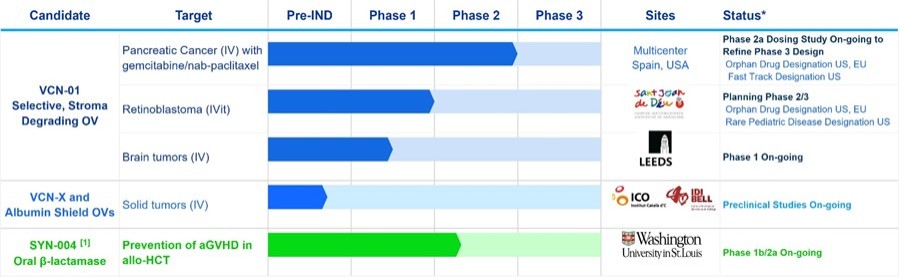
*Based on management’s current beliefs and expectations
aGVHD acute graft-versus-host disease. allo-HCT allogeneic hematopoietic cell transplant. IV intravenous. IVit intravitreal.
¹†Phase 1b/2a study remains open, but enrollment paused after completing 2 of 3 scheduled cohorts; conduct of the third cohort is contingent on grant funding or a partnership.
Recent Clinical Developments
Phase 2 Trial of intravenous VCN-01 with nab-paclitaxel plus gemcitabine in patients with PDAC
On March 23, 2026, we announced a positive End-of-Phase 2 Meeting with U.S. FDA Regarding the Design of a Phase 3 Trial of VCN-01 in Metastatic Pancreatic Ductal Adenocarcinoma.
The FDA provided general agreement with our proposed design for a Phase 3 clinical trial, which closely tracks the design of the successful VIRAGE Phase 2 trial. As announced in 2025, the VIRAGE trial met its primary endpoints, with metastatic PDAC patients receiving VCN-01 with SoC chemotherapy having improved overall survival (OS), progression free survival (PFS) and Duration of Response (DoR) compared to SoC chemotherapy alone. Greater improvements in OS and PFS were observed in patients who received two doses of VCN-01, leading Theriva to plan the Phase 3 trial to include repeat dosing and an adaptive design aimed to optimize the trial’s timelines and outcomes.
Consistent with scientific advice previously received from the Committee for Medicinal Products for Human Use (CHMP) of the EMA, the FDA advised that a potential biologics licensing application (BLA) for VCN-01 in metastatic PDAC could be supported by our proposed Phase 3 clinical trial (if successful) comprising a single, high-quality, randomized, double-blinded, study comparing VCN-01 plus gemcitabine/nab-paclitaxel SoC to gemcitabine/nab-paclitaxel SoC plus placebo. The FDA further agreed on the proposed dosing of VCN-01 and gemcitabine/nab-paclitaxel in repeated “macrocycles” (enabling more than 2 doses of VCN-01 to be administered in the Phase 3 trial), the proposed inclusion/exclusion criteria, the primary endpoint (overall survival), key secondary endpoints (including progression free survival), and the use of an adaptive design. The FDA also clarified statistical expectations regarding the proposed interim analyses and the quality of data required for potential sample size re-estimation or a demonstration of early efficacy.
On April 17, 2026, we announced the presentation of additional data from the VIRAGE Phase 2b Clinical Trial at American Association for Cancer Research (AACR) 2026 Annual Meeting. Tumor response, biomarker, and subgroup analyses from the VIRAGE Phase 2b clinical trial support a VCN-01 immune-mediated mode of action and demonstrate improved outcomes in VCN-01 treated patients across multiple subgroups, including patients with liver metastases were presented in a poster session by Dr. Manuel Hidalgo (NYU Langone Health Perlmutter Cancer Center, New York) in San Diego, California on April 20, 2026.
On July 7, 2026, we announced that the Spanish Agency of Medicines and Medical Devices (“AEMPS”) has authorized us to initiate the VIRAGE2 clinical trial, entitled “A Phase IIa, single-arm, single-center, open-label, proof-of-concept trial evaluating increased
29
frequency dosing of zabilugene almadenorepvec (VCN-01) in combination with gemcitabine/nab-paclitaxel in patients with newly-diagnosed metastatic pancreatic cancer”.
The VIRAGE2 trial builds on the results of the 112-patient VIRAGE Phase 2b clinical trial evaluating VCN-01 in treatment naïve metastatic pancreatic ductal adenocarcinoma (“PDAC”) patients receiving gemcitabine/nab-paclitaxel standard-of-care (“SoC”) chemotherapy. In the VIRAGE trial, patients who received 2 doses of VCN-01 administered 3 months apart had significantly improved overall survival, progression free survival, and duration of response compared to patients treated with only one dose of VCN-01 or with SoC chemotherapy alone. As previously reported, both the EMA and the FDA recognized the improved survival in the group treated with 2 doses of VCN-01, and raised the possibility of more frequent repeated dosing of VCN-01 in combination with SoC chemotherapy to potentially improve clinical outcomes. The VIRAGE2 trial is designed to evaluate the feasibility of administering at least 3 doses of VCN-01 given 2 months apart in combination with SoC chemotherapy. Results from this trial will inform the VCN-01 dosing regimen for potential evaluation in a future pivotal Phase 3 clinical trial.
Phase 1 Trial of intravenous VCN-01 in Combination with Durvalumab in Subjects with Recurrent/ Metastatic SCCHN
On June 11, 2026, we announced that clinical and translational results from VCN-01’s Phase 1 clinical trial in Head & Neck Squamous Cell Carcinoma (“HNSCC”) were recently published on-line first in the journal Clinical Cancer Research.
The trial enrolled 20 adult patients with refractory or metastatic HNSCC, whose disease progressed despite previous therapies, including anti-PD-(L)1 immune checkpoint inhibitors. Six patients were enrolled into the concomitant Arm I LD of the study and were administered IV low dose VCN-01 (3.3E12 virus particles; LD) four hours prior to a fixed IV dose of durvalumab (1500 mg/q4w). Eight patients were enrolled into the sequential Arm II LD of the study, receiving low dose IV VCN-01 14 days prior to IV durvalumab administration. An additional six patients were entered into Arm II HD, receiving high dose IV VCN-01 (1.0E13 virus particles; HD) 14 days prior to IV durvalumab administration.
| ● | Median progression-free survival (PFS) was 1.6 months in Arm I LD, 3.7 months in Arm II LD, and 2.1 months in Arm II HD. |
| ● | Median overall survival (OS) was 10.3 months in Arm I LD, 15.5 months in Arm II LD, and 17.3 months in Arm II HD. |
| ● | Circulating levels of the stroma-degrading hyaluronidase enzyme PH20 (expressed during selective VCN-01 intratumoral replication) increased significantly after VCN-01 administration in all tested patients, peaking on day 3-8 for most patients and detectable until day 28 in 11 of 12 patients. |
| ● | Similarly, VCN-01 viral genome levels detected in patient blood exhibited an initial peak immediately following administration and a secondary peak on day 3-8, consistent with continued viral replication in tumors followed by a return of virus to circulation. |
| ● | Upregulation of CD8 and IDO was observed in tumor biopsy samples, implying increased tumor infiltration with activated cytotoxic T cells – historically associated with increased HNSCC patient survival. Diminished levels of FoxP3, CD25, and CTLA4 were also observed, consistent with a reduction in tumor Tregs and inhibition of tumor immunosuppression. |
| ● | Tumor biopsies revealed upregulation of PD-1 and PD-L1 in most patients following VCN-01 administration that correlated with patient survival, suggesting that immune system activity and heightened PD-L1 expression in tumors contributed to the improved outcomes from VCN-01 and durvalumab combination. |
| ● | Transcriptomic and radiomic analyses showed changes in the extracellular matrix and increased tumor perfusion. |
The collective pharmacokinetic, tissue biopsy, radiomic and transcriptomic results support the proposed VCN-01 stroma-degrading and immune enhancing modes-of-action, resensitizing refractory tumors to durvalumab. As described in the publication, the prolonged OS observed with sequential delivery of VCN-01 followed by durvalumab suggests a potential clinical benefit in this heavily pretreated HNSCC population, These findings support further clinical development of VCN-01 with immune checkpoint inhibitors or other immune modulating anticancer therapies in HNSCC and potentially other cancer indications.
30
Intravitreal VCN-01 with topotecan for the treatment of patients with retinoblastoma
As previously reported, an investigator-sponsored Phase 1 study of VCN-01 in refractory retinoblastoma patients facing imminent enucleation was completed in the first half of 2024. Patients received two intravitreal administrations of VCN-01 on days 1 and 15. Based on the study results, it was concluded that VCN-01 was well tolerated and demonstrated an acceptable adverse event profile. Three patients presented a complete response. The safety and clinical outcomes of the Phase 1 study of VCN-01 were presented by the Principal Investigator (the “PI”) of the study, Dr. Jaume Català-Mora, Pediatric Ophthalmologist, Sant Joan de Déu-Barcelona Children’s Hospital, on February 3, 2026 at an invited session at the 41st Asia-Pacific Academy of Ophthalmology (APAO) Congress in Hong Kong (China).
We have been granted Rare Pediatric Drug Designation (“RPDD”) for VCN-01 for the treatment of retinoblastoma. If a Biologics License Application (BLA) for VCN-01 for the treatment of retinoblastoma is approved by the FDA by September 30, 2029, we may be eligible to receive a Priority Review Voucher, which can be monetized. VCN-01 has also received orphan drug designation from the FDA and Orphan Medicinal Product Designation from the European Commission for the treatment of retinoblastoma.
In the first quarter of 2026, we made VCN-01 available to investigators at Hospital Sant Joan de Déu, Barcelona, for compassionate use in treating patients with retinoblastoma. Two patients have been treated with intravitreal VCN-01 in combination with intravitreal topotecan and patients are being followed by the treating physicians. We expect that outcomes from these compassionate use patients will provide valuable information on the feasibility and tolerability of this combination for use in a potential Phase 2/3 clinical trial.
As previously disclosed, preclinical data demonstrate potential antitumor synergy between VCN-01 and topoisomerase I inhibitors, such as topotecan. We believe that intravitreal coadministration of VCN-01 with topotecan may provide a new treatment option for children with retinoblastoma with vitreous seeds that are refractory/resistant to the use of current intravitreal chemotherapy, which remains an unmet medical need in patients with this ultra rare patient population. Extensive discussions with clinicians and key opinion leaders have enabled the design a Phase 2/3 clinical trial protocol for the VCN-01 + topotecan combination in this ultra rare patient population, and we plan to discuss the proposed protocol with the FDA in Q3 2026.
We anticipate that the cost for the Phase 2/3 trial would be approximately $9 million (including chemistry, manufacturing and controls). If a protocol is ultimately submitted to, and agreed by, the FDA, we expect the first patient to be enrolled in January 2027, with rolling BLA submissions expected to be made in 2029 (if successful), targeting potential approval of the BLA prior to the current legislative deadline of September 30, 2029 to be eligible to receive a Priority Review Voucher. We have revised our estimate of the Phase 2/3 trial cost downward from our estimate of $12 million, as disclosed in our Quarterly Report on Form 10-Q for the quarter ended March 31, 2026, based on a reduced requirement for clinical drug product manufacture , and have adjusted the anticipated first-patient enrollment from December 2026 to January 2027.
Critical Accounting Estimates
The preparation of our consolidated financial statements in accordance with accounting principles generally accepted in the United States of America (“U.S. GAAP”) which requires the use of estimates, judgments and assumptions that affect the reported amounts of assets and liabilities, the disclosure of contingent assets and liabilities at the date of the consolidated financial statements, and the reported amounts of expenses in the periods presented. We believe that the accounting estimates employed are appropriate and resulting balances are reasonable; however, due to inherent uncertainties in making estimates, actual results may differ from the original estimates, requiring adjustments to these balances in future periods.
There are accounting policies, each of which requires significant judgments and estimates on the part of management, that we believe are significant to the presentation of our consolidated financial statements. The most significant accounting estimates relate to valuation of IPR&D and contingent consideration.
IPR&D
IPR&D assets are considered to be indefinite-lived until the completion or abandonment of the associated research and development projects. IPR&D assets represent the fair value assigned to technologies that we acquire, which at the time of acquisition have not reached technological feasibility and have no alternative future use. IPR&D is capitalized at its fair value as an indefinite-lived intangible asset, and any development costs incurred after the acquisition are expensed as incurred. During the period that the assets are considered indefinite-lived, they are tested for impairment on an annual basis, or more frequently if we become aware of any events occurring or
31
changes in circumstances that indicate that the fair value of the IPR&D assets are less than their carrying amounts. If and when development is complete, which generally occurs upon regulatory approval and the ability to commercialize products associated with the IPR&D assets, these assets are then deemed definite-lived and are amortized based on their estimated useful lives at that point in time. If development is terminated or abandoned, we may have a full or partial impairment charge related to the IPR&D assets, calculated as the excess of carrying value of the IPR&D assets over fair value.
We conduct an impairment test of IPR&D on an annual basis as of October 1 of each year and will also conduct tests if events occur or circumstances change that would, more likely than not, reduce our fair value below our net equity value.
Contingent Consideration
Consideration paid in a business combination may include potential future payments that are contingent upon the acquired business achieving certain milestones in the future (“contingent consideration”). Contingent consideration liabilities are measured at their estimated fair value as of the date of acquisition, with subsequent changes in fair value recorded in the consolidated statements of operations. We estimate the fair value of the contingent consideration as of the acquisition date using the estimated future cash outflows based on the probability of meeting future milestones. The milestone payments will be made upon the achievement of clinical and commercialization milestones. Subsequent to the date of acquisition, we reassess the actual consideration earned and the probability-weighted future earn-out payments at each balance sheet date. Any adjustment to the contingent consideration liability will be recorded in the consolidated statements of operations. Contingent consideration liabilities expected to be settled within 12 months after the balance sheet date are presented in current liabilities, with the non-current portion recorded under long term liabilities in the consolidated balance sheets.
Results of Operations
Three Months Ended June 30, 2026 and 2025
General and Administrative Expenses
General and administrative expenses decreased to $2.0 million for the three months ended June 30, 2026, from $11.2 million for the three months ended June 30, 2025. This decrease of 82% is primarily comprised of the prior year increase in fair value of the contingent consideration adjustment of $9.2 million due to the VIRAGE Phase 2b clinical trial of VCN-01 in PDAC achieving its primary survival and safety endpoints, offset set by current year increase in legal fees. The charge related to stock-based compensation expense was $110,000 for the three months ended June 30, 2026, compared to $97,000 for the three months ended June 30, 2025.
Research and Development Expenses
Research and development expenses decreased to $1.3 million for the three months ended June 30, 2026, from approximately $2.0 million for the three months ended June 30, 2025. This decrease of 35% is primarily the result of lower indirect cost related to compensation expense and lower direct clinical trial expenses related to our Phase 1b/2a clinical trial of SYN-004 (ribaxamase) in allogeneic HCT recipients and lower expenses related to SYN-020, offset by higher direct expenses related to VCN-01 manufacturing activities and expenses associated with the planning for the Phase 2a study in metastatic PDAC patients evaluating more frequent VCN-01 dosing for a longer period. We anticipate research and development expense to decrease in the near future until we commence additional clinical trials as we focus on regulatory interactions regarding a proposed pivotal clinical trial of VCN-01 in retinoblastoma, conduct exploratory VCN-01 manufacturing scale-up activities, and continue limited preclinical studies supporting VCN-01 and VCN-12, the first candidate from our VCN-X discovery program. The charge related to stock-based compensation expense was $25,000 for the three months ended June 30, 2026, compared to $76,000 for the three months ended June 30, 2025.
32
The following table sets forth our research and development expenses directly related to our product candidates for the three months ended June 30, 2026 and 2025. These direct expenses were external costs associated with preclinical studies and clinical trials. Indirect research and development expenses related to employee costs, facilities, stock-based compensation and research and development support services that are not directly allocated to specific product candidates.
June 30, | June 30, | |||||
Therapeutic Areas | | 2026 | | 2025 | ||
VCN-01 (zabilugene almadenorepvec) | $ | 895 | $ | 780 | ||
SYN-004 (ribaxamase) | 29 | 105 | ||||
SYN-020 | — | 89 | ||||
Other therapeutic areas |
| 120 |
| 119 | ||
Total direct costs |
| 1,044 |
| 1,093 | ||
Total indirect costs |
| 224 |
| 860 | ||
| ||||||
Total Research and Development | $ | 1,268 | $ | 1,953 | ||
Other Income/Expense
Other income was $78,000 for the three months ended June 30, 2026, compared to other income of $74,000 for the three months ended June 30, 2025. Other income for the three months ended June 30, 2026 is comprised of interest income of $79,000 and an exchange loss of $1,000. Other income for the three months ended June 30, 2025 is comprised of interest income of $54,000 and an exchange gain of $20,000.
Net Loss
Our net loss for the three months ended June 30, 2026 was $3.2 million, or ($0.07) per common share, compared to $13.1 million, or ($1.93) per common share, for the three months ended June 30, 2025.
Six Months Ended June 30, 2026 and 2025
General and Administrative Expenses
General and administrative expenses decreased to $4.1 million for the six months ended June 30, 2026, from $12.6 million for the six months ended June 30, 2025. This decrease of 68% is primarily comprised of the of the prior year increase in fair value of the contingent consideration adjustment of $9.2 million due to the VIRAGE Phase 2b clinical trial of VCN-01 in PDAC achieving its primary survival and safety endpoints, offset set by current year increase in legal fees. The charge related to stock-based compensation expense was $220,000 for the six months ended June 30, 2026, compared to $151,000 for the six months ended June 30, 2025.
Research and Development Expenses
Research and development expenses decreased to $1.6 million for the six months ended June 30, 2026, from approximately $4.9 million for the six months ended June 30, 2025. This decrease of 67% is primarily the result of lower direct clinical trial expenses related to our VIRAGE Phase 2b clinical trial of VCN-01 in PDAC, lower indirect cost related to decreased VCN-01 manufacturing costs and lower clinical trial expenses related to our Phase 1b/2a clinical trial of SYN-004 (ribaxamase) in allogeneic HCT recipients, offset by higher patent expenses related to SYN-020. We anticipate research and development expense to decrease in the near future until we commence additional clinical trials as we focus on regulatory interactions regarding a proposed pivotal clinical trial of VCN-01 in retinoblastoma, conduct exploratory VCN-01 manufacturing scale-up activities, and continue limited preclinical studies supporting VCN-01 and VCN-12, the first candidate from our VCN-X discovery program. The charge related to stock-based compensation expense was $49,000 for the six months ended June 30, 2026, compared to $122,000 related to stock-based compensation expense for the six months ended June 30, 2025.
The following table sets forth our research and development expenses directly related to our product candidates for the six months ended June 30, 2026 and 2025. These direct expenses were external costs associated with preclinical studies and clinical trials. Indirect research and development expenses related to employee costs, facilities, stock-based compensation and research and development support services that are not directly allocated to specific product candidates.
33
| June 30, | | June 30, | |||
Therapeutic Areas | 2026 | 2025 | ||||
VCN-01 (zabilugene almadenorepvec) | $ | 872 | $ | 2,726 | ||
SYN-004 (ribaxamase) |
| 68 |
| 167 | ||
SYN-020 |
| 73 |
| 150 | ||
Other therapeutic areas |
| 235 |
| 205 | ||
Total direct costs |
| 1,248 |
| 3,248 | ||
Total indirect costs |
| 375 |
| 1,673 | ||
Total Research and Development | $ | 1,623 | $ | 4,921 | ||
Other Income/Expense
Other income was $161,000 for the six months ended June 30, 2026 compared to other income of $167,000 for the six months ended June 30, 2025. Other income for the six months ended June 30, 2026 is primarily comprised of interest income of $161,000. Other income for the six months ended June 30, 2025 is primarily comprised of interest income of $150,000 and an exchange gain of $17,000.
Net Loss Attributable to Common Stockholders
Our net loss attributable to common stockholders was approximately $5.3 million, or ($0.12) per basic and diluted common share for the six months ended June 30, 2026, compared to a net loss of approximately $17.4 million, or ($3.64) per basic common share and diluted common share for the six months ended June 30, 2025.
Liquidity and Capital Resources
Historically, we have financed our operations primarily through public and private sales of our securities, and we expect to continue to seek and obtain additional capital in a similar manner. During the year ended December 31, 2025, our primary sources of cash were the approximately $6.8 million in net proceeds received from sales of our Common Stock under the ATM Sales Agreement, approximately $3.9 million in net proceeds from the exercise of existing warrants by holders pursuant to a warrant inducement agreement, the $1.7 million received for the Research and Development rebate program, $1.4 million for the THERICEL project loan from the National Knowledge Transfer Program of the Spanish government’s Ministry of Science and, in May 2025, we closed our May 2025 Offering of 6,818,180 shares of Common Stock (or pre-funded warrants in lieu thereof) in combination with accompanying common stock purchase warrants to purchase an aggregate of 6,818,180 shares of our Common Stock for gross proceeds of $7.5 million (net proceeds of $6.7 million, after deducting underwriting discounts and expenses). During the six months ended June 30, 2026, the primary source of cash was from the $300,000 up-front payment received for the out-licensing agreement of SYN-020, $1.6 million received for the Research and Development rebate program and $2.3 million in net proceeds received from sales of our Common Stock under the ATM Sales Agreement.
Under the terms of the license agreement we entered into with Rasayana Therapeutics, Inc. (“Rasayana”) on February 18, 2026 (the “Rasayana License Agreement”), pursuant to which we granted Rasayana an exclusive worldwide license with the right to grant sublicenses to Research, Develop, Manufacture and Commercialize (as such terms are defined in the Rasayana License Agreement) any Product (as such term is defined in the Rasayana License Agreement), which includes SYN-020, an oral formulation of the recombinant intestinal alkaline phosphatase enzyme, comprising, containing, or covered by the Licensed IP (as such term is defined in the Rasayana License Agreement) and/or devised, developed, or produced using the Licensed IP, we received an upfront payment of $300,000 and we are entitled to receive from Rasayana: (i) development milestone payments of up to an aggregate of $16,000,000; (ii) sales milestone payments of up to an aggregate of $22,000,000 upon achievement of certain development and net sales milestones with respect to Products; and (iii) during the Royalty Term (as such term is defined in the Rasayana License Agreement), tiered royalties ranging from low to mid single digits on net sales of a Product. We will also be entitled to receive a certain percentage of any Sublicense Revenue (as such term is defined in the Rasayana License Agreement) received by Rasayana or its affiliates. However, we do not anticipate receiving any funds due pursuant to the Rasayana License Agreement within the next twelve months.
As of June 30, 2026, we have a significant accumulated deficit, and with the exception of the three months ended June 30, 2010 and the three months ended December 31, 2017, we have experienced significant losses and incurred negative cash flows since inception. We have incurred an accumulated deficit of $364 million as of June 30, 2026, and expect to continue to incur losses in the foreseeable future
34
with the recognition of revenue being contingent on successful phase 3 clinical trials and requisite approvals by the FDA or foreign equivalents and the success of our licensee.
Our cash and cash equivalents totaled $11.3 million as of June 30, 2026, a decrease of $1.7 million from December 31, 2025. During the year ended December 31, 2025 and six months ended June 30, 2026, the primary use of cash was for working capital requirements and operating activities, which resulted in a net loss of $23.7 million and $5.3 million for the year ended December 31, 2025 and the six months ended June 30, 2026, respectively.
With our cash position of $9.6 million as of early August 2026, we believe we will be able to fund our operations into the first quarter of 2027; however, the current cash will only be sufficient to conduct certain limited clinical, regulatory, manufacturing, and preclinical activities as described herein and our cash runway could differ materially from our expectations based on various factors, many of which are out of our control. We continue to experience operating losses and face significant uncertainties related to our business model, market conditions, clinical trial outcomes, FDA review timelines and strategic initiatives. These factors raise substantial doubt about our ability to continue as a going concern beyond the next twelve months without additional capital or other strategic actions. Management has developed plans intended to mitigate these uncertainties, including pursuing strategic collaborations, securing additional financing, prioritizing key development programs and pursuing other strategic alternatives, that may include a business combination, merger or reverse merger. There can be no assurance that such actions will be sufficient to alleviate the going concern uncertainty.
We are devoting substantial time and resources to the strategic review. Despite devoting significant efforts to identify and evaluate potential strategic alternatives, there can be no assurance that this strategic review process will result in us pursuing any transaction or that any transaction, if pursued, will be completed on attractive terms or at all. We have not set a definitive timeline for completion of this strategic review process, and our board of directors has not approved a definitive course of action. Additionally, there can be no assurances that any particular course of action, business arrangement or transaction, or series of transactions, will be pursued, successfully consummated or lead to increased stockholder value.
Based on our current plans, we expect that our cash and cash equivalents will be sufficient to cover overhead costs, commence an approved Phase 2a study evaluating more frequent VCN-01 dosing for a longer period, exploratory VCN-01 manufacturing scale-up activities, regulatory interactions regarding a proposed pivotal clinical trial of VCN-01 in retinoblastoma, and limited preclinical studies supporting VCN-01 and VCN-12, the first candidate from our VCN-X discovery program. We believe that the cash will also be sufficient to fund our committed obligations under the terms of the Share Purchase Agreement entered into in connection with the Acquisition (the “Purchase Agreement”), however, payment of the $5.0 million owed to Grifols Innovation and New Technologies Limited will significantly deplete our cash and cash equivalents, which could materially and adversely affect our liquidity and limit our ability to fund operations or meet other financial obligations. Our current cash will not be sufficient for additional trials of VCN-01 (other than the Phase 2a study evaluating more frequent VCN-01 dosing for a longer period), or additional trials of SYN-004 (ribaxamase), or to complete the last cohort of the Phase 1b/2a clinical trial of SYN-004, which are expected to require significant cash expenditures. Following the completion of our ongoing Phase 1 and Phase 2b clinical trials for VCN-01, and limited preclinical studies supporting VCN-01 and our discovery initiatives, we will need to obtain additional funds for future clinical trials. We anticipate that our future clinical trials will be much larger in size and require larger cash expenditures than the aforementioned clinical programs. We do not have any committed sources of financing for future clinical trials at this time, and it is uncertain whether additional funding will be available when we need it on terms that will be acceptable to us, or at all. Management believes its plan, which is focused on the advancement of VCN-01, will allow us to meet our financial obligations, further advance key products, and maintain our planned operations. Based upon our current available funding and our focus on our clinical development of VCN-01 we do not anticipate that we will fund the last cohort of the Phase 1b/2a clinical trial of SYN-004 and enrollment in this cohort will not commence unless we obtain grant funding, or find a licensee or partner for the SYN-004 development program. However, the amount of additional capital needed by us will also depend upon the costs to advance our VCN-01 clinical programs.
We are actively pursuing additional equity or debt financing opportunities, in the form of either a private placement or a public offering and have been engaged in ongoing discussions with strategic institutional investors and investment banks with respect to such possible offerings as well as other strategic alternatives. Potential sources of financing that we are pursuing include strategic relationships, licensing arrangements, public or private sales of our equity or debt and other sources. Such additional financing opportunities might not be available to us when and if needed, on acceptable terms or at all. We may attempt to utilize the ATM Sales Agreement or seek to raise additional capital in other financing transactions, neither of which is guaranteed. We cannot assure that we will meet the requirements for use of the ATM Sales Agreement especially in light of the fact that we are currently limited by rules of the SEC as to the number of shares of Common Stock that we can sell pursuant to the ATM Sales Agreement due to the market value of our Common Stock held by non-affiliates. Even if we meet the requirements for use of the ATM Sales Agreement, there can be no assurance that we
35
will be able to raise funds through the sale of shares of Common Stock through the ATM Sales Agreement. Additionally, we may seek to access the public or private equity markets when conditions are favorable due to our long-term capital requirements. If we are not able to obtain additional capital (which is not assured at this time), our long-term business plan may not be accomplished, and we may be forced to cease certain development activities. More specifically, the completion of any later stage clinical trial will require significant financing or a significant partnership.
If we raise funds by selling additional shares of Common Stock or other securities convertible into Common Stock, the ownership interest of our existing stockholders will be diluted. If we are not able to obtain funding for future clinical trials when needed, we will not be able to carry out our business plan and we will be forced to delay the initiation of future clinical trials until such time as we obtain adequate financing or we are able to secure a strategic collaboration and may need to abandon some of our development programs, cease operations, sell or otherwise liquidate our assets or reorganize the Company, or complete a combination of the foregoing.
Our ability to continue as a going concern is dependent upon our ability to obtain additional equity or debt financing, attain further operating efficiencies, reduce expenditures, and, ultimately, to generate revenue. Our notes to the consolidated financial statements included in this Quarterly Report contain an explanatory paragraph referring to our recurring and continuing losses from operations and expressing substantial doubt in our ability to continue as a going concern without additional capital becoming available. We cannot provide any assurance that we will be able to obtain the required funding to achieve our current business plan, obtain the required regulatory approvals for our product candidates or complete additional corporate partnering or acquisition transactions in order to commercialize such product candidates once regulatory approval is received. If we fail to obtain additional funding for our clinical trials, whether through the sale of securities or a partner or collaborator, and otherwise when needed, we will not be able to execute our business plan as planned and will be forced to cease certain development activities (including initiation of planned clinical trials) until funding is received or we are able to secure a strategic collaboration and may need to abandon some of our development programs, cease operations, sell or otherwise liquidate our assets or reorganize the Company, engage in a strategic alternative or complete a combination of the foregoing. There can be no assurance that we will be able to successfully effect any of the foregoing.
Cash Flows
The following table summarizes our cash flows for the periods presented (in thousands):
| Six Months Ended June 30, | |||||
2026 | | 2025 | ||||
Cash used in operating activities | $ | (5,541) | $ | (9,468) | ||
Cash used in investing activities |
| (3) |
| (16) | ||
Cash provided by financing activities |
| 3,852 |
| 9,883 | ||
Effects of exchange rate changes on cash and cash equivalents | (29) | 62 | ||||
Net increase (decrease) in cash |
| (1,721) |
| 461 | ||
Cash, cash equivalents and restricted cash, beginning of period |
| 13,102 |
| 11,705 | ||
Cash, cash equivalents and restricted cash, end of period | $ | 11,381 | $ | 12,166 | ||
Cash Used in Operating Activities
Net cash used in operating activities was $5.5 million and $9.5 million during the six months ended June 30, 2026 and 2025, respectively, which was primarily due to the use of funds in our operations related to the development of VCN-01. Cash used in operating activities for the six months ended June 30, 2026 decreased compared to the same period in 2025 due primarily to prior year contingent consideration adjustment, and lower research and development expenses due to completion of trials offset by higher legal and investor relation costs, which led to a decrease in net loss.
Cash Used in Investing Activities
Cash used in investing activities during the six months ended June 30, 2026 and 2025 was $3,000 and $16,000, respectively, for equipment purchases.
36
Cash Provided by Financing Activities
Cash provided by financing activities during the six months ended June 30, 2026 included at the market offering proceeds of $2.3 million from sales of 10,204,319 shares of our Common Stock under the ATM Sales Agreement, and $1.6 million received for the research and development tax credit offset by payments of loans payable of $60,000. Cash provided by financing activities during the six months ended June 30, 2025 included $1.8 million received for the research and development tax credit, $1.4 million in loan proceeds from the THERICEL project loan and $6.9 million in net proceeds from the sale of Common Stock, offset by payments of loans in the amount of $67,000.
Off-Balance Sheet Arrangements
During the three months ended June 30, 2026, we did not have, and we do not currently have, any off-balance sheet arrangements, as defined under SEC rules.
Contractual Obligations
Leases
At the inception of a contract we determine if the arrangement is, or contains, a lease. Right of use (“ROU”) assets represent our right to use an underlying asset for the lease term and lease liabilities represent our obligation to make lease payments arising from the lease. ROU assets and liabilities are recognized at the commencement date based on the present value of lease payments over the lease term.
We have made certain accounting policy elections whereby we (i) do not recognize ROU assets or lease liabilities for short-term leases (those with original terms of 12-months or less) and (ii) combine lease and non-lease elements of our operating leases. As of June 30, 2026, we did not have any material finance leases.
37
ITEM 3. QUANTITATIVE AND QUALITATIVE DISCLOSURES ABOUT MARKET RISK.
We are a smaller reporting company as defined by Rule 12b-2 of the Exchange Act and are not required to provide the information required under this item.
ITEM 4. CONTROLS AND PROCEDURES.
(a) Evaluation of Disclosure Controls and Procedures
Our management, with the participation of our Chief Executive Officer who also serves as our Chief Financial Officer, evaluated the effectiveness of our disclosure controls and procedures as of June 30, 2026. The term “disclosure controls and procedures,” as defined in Rules 13a-15(e) and 15d-15(e) under the Exchange Act, means controls and other procedures of a company that are designed to ensure that information required to be disclosed by a company in the reports that it files or submits under the Exchange Act is recorded, processed, summarized and reported, within the time periods specified in the rules and forms of the SEC. Disclosure controls and procedures include, without limitation, controls and procedures designed to ensure that information required to be disclosed by a company in the reports that it files or submits under the Exchange Act is accumulated and communicated to the Company’s management, including its principal executive and principal financial officers, or persons performing similar functions, as appropriate to allow timely decisions regarding required disclosure. We have adopted and maintain disclosure controls and procedures (as defined Rules 13a-15(e) and 15d-15(e) under the Exchange Act) that are designed to provide reasonable assurance that information required to be disclosed in the reports filed under the Exchange Act, such as this Quarterly Report on Form 10-Q, is collected, recorded, processed, summarized and reported within the time periods specified in the rules of the SEC. The Company’s disclosure controls and procedures are also designed to ensure that such information is accumulated and communicated to management to allow timely decisions regarding required disclosure. Management recognizes that any controls and procedures, no matter how well designed and operated, can provide only reasonable assurance of achieving their objectives and management necessarily applies its judgment in evaluating the cost-benefit relationship of possible controls and procedures. Our Chief Executive Officer who also serves as our Chief Financial Officer concluded that, as of the end of the period covered by this Quarterly Report on Form 10-Q, our disclosure controls and procedures were effective.
(b) Changes in Internal Control over Financial Reporting
There have not been any changes in our internal controls over financial reporting during the three months ended June 30, 2026 that materially affected, or are reasonably likely to materially affect, our internal control over financial reporting.
38
PART II–OTHER INFORMATION
ITEM 1. LEGAL PROCEEDINGS.
From time to time we may become involved in legal proceedings or be subject to claims arising in the ordinary course of our business. We are not presently a party to any legal proceedings that, if determined adversely to us, would individually or taken together have a material adverse effect on our business, operating results, financial condition or cash flows. Regardless of the outcome, litigation can have an adverse impact on us because of defense and settlement costs, diversion of management resources and other factors.
ITEM 1A. RISK FACTORS.
The following information updates, and should be read in conjunction with, the information disclosed in Part I, Item 1A, “Risk Factors,” contained in our 2025 Form 10-K. Except as disclosed below, there have been no material changes from the risk factors disclosed in our 2025 Form 10-K.
RISKS RELATING TO OUR BUSINESS
Our consolidated financial statements have been prepared assuming that we will continue as a going concern.
Our consolidated unaudited financial statements as of June 30, 2026 have been prepared under the assumption that we will continue as a going concern for the next twelve months. Our management concluded that our recurring losses from operations and the fact that we will require additional financing as we continue to execute our business strategy, including the need for additional funds for the commencement of our planned clinical trials, raise substantial doubt about our ability to continue as a going concern for the next twelve months after issuance of our financial statements. In addition, in connection with the filing of our 2025 Form 10-K our independent registered public accounting firm issued a report that included an explanatory paragraph referring to our recurring losses from operations (anticipated continued losses in the future) and net capital deficiency that, as of the date of such report, raised substantial doubt in our ability to continue as a going concern without additional capital becoming available. As of June 30, 2026 we had cash and cash equivalents of approximately $11.3 million and as of early August 2026, we had cash and cash equivalents of $9.6 million. At June 30, 2026, we had an accumulated deficit of $364 million and working capital of $1.6 million. December 31, 2025, we had an accumulated deficit of $358.7 million and working capital of $7.5 million. As of December 31, 2025, we had cash and cash equivalents of approximately $13.1 million consisting of cash and investments in highly liquid U.S. money market funds. Our ability to continue as a going concern is dependent upon our ability to obtain additional equity or debt financing, attain further operating efficiencies, reduce expenditures and, ultimately, to generate revenue. Our consolidated unaudited financial statements as of June 30, 2026 do not include any adjustments that might result from the outcome of this uncertainty. Based upon the Company’s current business plans, we expect that our current cash will be able to fund operations into the first quarter of 2027.
We will need to raise additional capital to operate our business and our failure to obtain funding when needed may force us to delay, reduce or eliminate certain of our development programs or commercialization efforts.
During the six months ended June 30, 2026, our operating activities used net cash of approximately $5.5 million and our cash and cash equivalents were approximately $11.3 million as of June 30, 2026. With the exception of the three months ended June 30, 2010 and the three months ended December 31, 2017, we have experienced significant losses since inception and have a significant accumulated deficit. As of June 30, 2026, our accumulated deficit totaled approximately $364 million on a consolidated basis. Pursuant to the Purchase Agreement entered into in connection with the Acquisition, we have agreed to use reasonable efforts to commercialize VCN-01. Additionally, pursuant to the Purchase Agreement, we agreed to pay up to $70.2 million in contingent consideration upon the achievement of certain milestones, including regulatory filings, of which to date $7.3 million has been paid and an additional $5.0 million has been earned but deferred pending ongoing discussion with Grifols. If we are required to make the deferred $5.0 million milestone payment to Grifols, it will significantly deplete our cash and cash equivalents, which could materially and adversely affect our liquidity and limit our ability to fund operations, continue clinical research and development activities or meet other financial obligations. We expect to incur additional operating losses in the future and therefore expect our cumulative losses to increase. With the exception of the quarter ended June 30, 2010, and limited laboratory revenues from Adeona Clinical Laboratory, which we sold in March 2012, we have generated very minimal revenues. We do not expect to derive revenue from any source in the near future until we or our potential partners successfully commercialize our products. We expect our expenses to increase in connection with our anticipated activities, particularly as we continue research and development, initiate and conduct clinical trials, and seek marketing approval for our product candidates. Until such time as we receive approval from the FDA and other regulatory authorities for our product candidates, we will not be permitted to sell our products and therefore will not have product revenues from the sale of products. For the foreseeable future we will have to fund all of our operations and capital expenditures from equity and debt offerings, cash on hand, licensing and collaboration fees and grants, if any.
39
We will need to raise additional capital to fund our operations and meet our current timelines and we cannot be certain that funding will be available on acceptable terms on a timely basis, or at all. The amount of government funding available for grants is dependent upon governmental budgets over which we have no control and which change with new administrations. Based on our current plans, we expect that our current cash will be sufficient to fund operations into the first quarter of 2027 and will only be sufficient to cover overhead costs, commence an approved Phase 2a study in metastatic PDAC patients evaluating more frequent VCN-01 dosing for a longer period, conduct exploratory VCN-01 manufacturing scale-up activities, complete regulatory interactions regarding a proposed pivotal clinical trial of VCN-01 in retinoblastoma, and undertake limited preclinical studies supporting VCN-01 and VCN-12, the first candidate from our VCN-X discovery program. We believe our cash will also be sufficient to fund our committed obligations under the terms of the Purchase Agreement related to the Acquisition, but may not be sufficient for additional trials of VCN-01 (other than the Phase 2a study evaluating more frequent VCN-01 dosing for a longer period), or SYN-004, or to complete the last cohort of the Phase 1a/2a clinical trial of SYN-004, which are expected to require significant cash expenditures. In addition, based on the significant anticipated cost of a Phase 3 clinical program in a broad indication for SYN-004, we expect it will not be feasible for us to initiate and complete this trial at this time without a partner given the capital constraints tied to our current market cap and share price. We intend to focus our capital on our VCN-01 clinical trials and do not intend to provide further funding for our development of SYN-004 internally. Any future development of SYN-004 is expected to be funded from out-licensing or partnering for which there can be no assurance. Further development of VCN’s product candidates will require additional funding. To the extent that we raise additional funds by issuing equity securities, our stockholders may experience significant dilution. Any debt financing, if available, may involve restrictive covenants that may impact our ability to conduct our business and also have a dilutive effect on our stockholders. A failure otherwise to secure additional funds when needed in the future whether through an equity or debt financing or a sufficient amount of capital without a strategic partnership could result in us being unable to complete planned preclinical and clinical trials or obtain approval of our product candidates from the FDA and other regulatory authorities. In addition, we could be forced to delay, discontinue or curtail product development, forgo sales and marketing efforts, and forgo licensing in attractive business opportunities, cease operations, sell or otherwise liquidate our assets or reorganize the Company, or complete a combination of the foregoing. Our ability to raise capital through the sale of securities may be limited by the rules of the SEC and NYSE American that place limits on the number and dollar amount of securities that may be sold. There can be no assurances that we will be able to raise the funds needed, especially in light of the fact that our ability to sell securities registered on our registration statement on Form S-3 will be limited until such time the market value of our voting securities held by non-affiliates is $75 million or more. We also may be required to seek collaborators for our product candidates at an earlier stage than otherwise would be desirable and on terms that are less favorable than might otherwise be available.
Our activities to evaluate and pursue potential strategic alternatives may not result in any transaction or enhance stockholder value.
We are evaluating and exploring a variety of strategic alternatives focused on maximizing stockholder value, including, but not limited to, an acquisition, merger, reverse merger, other business combination, sales of assets or other strategic transactions. Our ability to successfully execute on a strategic alternative is dependent on a number of factors and we may not be able to execute upon a transaction or other strategic alternative upon favorable terms within an advantageous timeframe and recognize significant value for our assets, if at all. Additionally, the negotiation and consummation of a transaction or other strategic alternative may be costly and time-consuming. Any executed strategic alternative may not maximize or even enhance stockholder value, could result in total costs and expenses that are greater than expected, could make it more difficult to attract and retain qualified personnel and may disrupt our operations, each of which could have a material adverse effect on our business.
The market price of our Common Stock may reflect a market assumption that a strategic alternative will occur, and a failure to complete a strategic alternative could result in negative investor perceptions and could cause a decline in the market price of our Common Stock, which could adversely affect our ability to access the equity and financial markets, as well as our ability to explore and enter into different strategic alternatives. There can be no certainty that any strategic alternative will be completed, be on attractive terms, enhance stockholder value or deliver the anticipated benefits, and successful integration or execution of the strategic alternatives will be subject to additional risks.
40
ITEM 2. UNREGISTERED SALES OF EQUITY SECURITIES AND USE OF PROCEEDS.
| (a) | Unregistered Sales of Equity Securities |
We did not sell any equity securities during the three months ended June 30, 2026 in transactions that were not registered under the Securities Act other than as previously disclosed in our filings with the SEC.
| (b) | Use of Proceeds |
Not applicable.
| (c) | Issuer Purchases of Equity Securities |
Not applicable.
ITEM 3. DEFAULTS UPON SENIOR SECURITIES.
Not applicable.
ITEM 4. MINE SAFETY DISCLOSURES.
Not applicable.
ITEM 5. OTHER INFORMATION.
Disclosure of Material Event
The information set forth below is included herein for purposes of providing disclosures under Items 1.01 and 5.02 of Form 8-K.
Shallcross Amended and Restated Employment Agreement
Mr. Shallcross has served as our Chief Financial Officer since June 1, 2015, initially pursuant to the terms of a two year employment agreement that we entered with him on April 28, 2015, which was replaced by an employment agreement we entered into with him on December 6, 2018 when he became our Chief Executive Officer, which was replaced by a three year employment agreement we entered into with him on January 3, 2022 which expired on January 3, 2025 (the “2022 Shallcross Employment Agreement”). On March 3, 2025, we entered into a new employment agreement with Mr. Shallcross (the “2025 Shallcross Employment Agreement”) for a term of two years, pursuant to which he continued to serve as our Chief Executive Officer and Chief Financial Officer. On August 10, 2026, we entered into an Amended and Restated Employment Agreement with Mr. Shallcross (the “Amended and Restated Shallcross Employment Agreement”), which replaced and superseded the 2025 Shallcross Employment Agreement in its entirety. The Amended and Restated Shallcross Employment Agreement has a stated term of two years from the date of execution of such agreement (the “Employment Term”) and provides for Mr. Shallcross to serve as our President, Chief Executive Officer and Chief Financial Officer. Mr. Shallcross does not receive additional compensation for service as our director.
Pursuant to the Amended and Restated Shallcross Employment Agreement, Mr. Shallcross is entitled to an annual base salary of $687,562, subject to review and adjustment from time to time by the Board (or a committee thereof) in its sole discretion, but which may not be decreased. Mr. Shallcross is also eligible to receive an annual cash performance bonus of up to fifty percent (50%) of his annual base salary and payable based upon the Board's assessment of Mr. Shallcross’ performance and the Company's attainment of targeted goals as set by the Board in its sole discretion, as well as discretionary annual equity awards pursuant to the Company’s incentive equity plans.
The Amended and Restated Shallcross Employment Agreement contains confidentiality obligations and invention assignments by Mr. Shallcross, which are governed by the Proprietary Information, Inventions, Non-Solicitation and Non-Competition Agreement, dated February 27, 2017, which remains in full force and effect. The Amended and Restated Shallcross Employment Agreement also contains non-competition and non-solicitation provisions applicable during the Employment Term and for the one-year period thereafter.
41
The Amended and Restated Shallcross Employment Agreement provides that if Mr. Shallcross’ employment is terminated for any reason, he or his estate as the case may be, will be entitled to receive the unpaid base salary through the date of termination and accrued vacation, any unpaid annual bonus earned with respect to any calendar year ending on or preceding the date of termination, reimbursement for any unreimbursed expenses incurred through the date of termination, and all other payments and benefits to which Mr. Shallcross may be entitled under the terms of any applicable compensation arrangement or benefit, equity or perquisite plan or program or grant (the “Accrued Amounts”). Upon termination due to Disability (as such term is defined in the Amended and Restated Shallcross Employment Agreement) or death, Mr. Shallcross or his estate shall be entitled to exercise any vested equity awards for a period equal to the shorter of: (i) six (6) months after termination, or (ii) the remaining term of the awards. If Mr. Shallcross’ employment is terminated by us for Cause (as such term is defined in the Amended and Restated Shallcross Employment Agreement) or by Mr. Shallcross without Good Reason, Mr. Shallcross shall be entitled to receive any Accrued Amounts only.
If Mr. Shallcross’ employment is terminated by us without Cause (and not due to Disability or death) or by Mr. Shallcross for Good Reason (as such term is defined in the Amended and Restated Shallcross Employment Agreement), then, subject to him executing a general release in form acceptable to us that becomes effective, in addition to paying the Accrued Amounts, (a) we will continue to pay his then current base salary for a period of twelve (12) months following the termination date, (b) if Mr. Shallcross timely elects continued coverage under COBRA, we will pay the COBRA premiums necessary to continue health insurance coverage for Mr. Shallcross and his covered dependents until the earliest of twelve (12) months following the termination date, the date Mr. Shallcross becomes eligible for substantially equivalent health insurance coverage in connection with new employment or self-employment, or the date Mr. Shallcross ceases to be eligible for COBRA continuation coverage for any reason, and (c) all unvested stock options and other equity awards shall immediately vest and he shall be entitled to exercise any such vested equity awards for a period equal to the shorter of: (1) eighteen (18) months after termination, or (2) the remaining term of the awards. In addition, Mr. Shallcross will be eligible to receive a pro-rata portion of his annual bonus, as determined by the Board of Directors, for the performance year in which the termination occurs.
For purposes of the Amended and Restated Shallcross Employment Agreement, a “Change in Control” includes: (i) the acquisition by any person or entity of beneficial ownership of securities representing 50% or more of our voting power; (ii) a merger or consolidation in which our stockholders immediately prior to the transaction do not retain a majority of the voting power of the surviving entity; (iii) the sale of substantially all of our assets or our liquidation or dissolution; or (iv) the execution of a definitive agreement providing for a transaction involving us and a non-listed private operating company, including a reverse merger, sign and close reverse merger, forward merger, share exchange, asset acquisition, recapitalization or similar transaction, that is intended to ultimately result in a change of the majority of the board of directors or a shift in majority voting power from our pre-transaction stockholders after consummation of all of the transactions contemplated by the relevant transaction documents, included the conversion of securities issued as merger consideration. In the case of a Change in Control, Mr. Shallcross’ 180-day period for providing notice of Good Cause will not begin until all conditions necessary to effect the employee’s change in title or position have occurred and any required stockholder approvals relating to the resulting ownership changes have been obtained.
The Amended and Restated Shallcross Employment Agreement provides that upon the occurrence of a Change in Control, all unvested stock options and other equity awards shall immediately vest (and any equity awards subject to the satisfaction of performance goals shall be deemed earned at not less than target performance) and the time period that Mr. Shallcross will have to exercise all vested stock options and other awards shall be equal to the shorter of: (i) twenty-four (24) months after termination, or (ii) the remaining term of the awards.
If within eighteen (18) months after the occurrence of a Change in Control, Mr. Shallcross terminates his employment for Good Reason or we terminate Mr. Shallcross’ employment without Cause, Mr. Shallcross will be entitled to receive: (i) the portion of his base salary for periods prior to the effective date of termination accrued but unpaid (if any); (ii) all unreimbursed expenses (if any); (iii) an aggregate amount (the “Change in Control Severance Amount”) equal to two (2) times the sum of his base salary plus an amount equal to the bonus that would be payable if the target level performance were achieved under our annual bonus plan (if any) in respect of the fiscal year during which the termination occurs (or the prior fiscal year if bonus levels have not yet been established for the year of termination); and (iv) a payment equal to twenty-four (24) times the monthly COBRA premium for Mr. Shallcross and his eligible dependents (at the rate in effect for Mr. Shallcross’ coverage at the time of his termination), subject to him executing a general release in form acceptable to us that becomes effective. An amount equal to $500,000 shall be allocated from the Change in Control Severance Amount as, and deemed, a payment to Mr. Shallcross in exchange for Mr. Shallcross’ covenant not to compete.
Upon the termination of employment for Good Reason by Mr. Shallcross or upon the involuntary termination of employment by the Company for any reason other than death, Disability or Cause, in either case within eighteen (18) months after the occurrence of a
42
Change in Control, the Company shall also provide, for the period of two (2) consecutive years commencing on the date of such termination of employment, medical, dental, life and disability insurance coverage for Mr. Shallcross and the members of his family that are not less favorable to Mr. Shallcross than the group medical, dental, life and disability insurance coverage carried by the Company for Mr. Shallcross and the members of his family at the time of termination, subject to him executing a general release in form acceptable to the Company that becomes effective. The Change in Control Severance Amount is to be paid in a lump sum if the Change in Control event constitutes a “change in the ownership” or a “change in the effective control” of the Company or a “change in the ownership of a substantial portion of a corporation's assets” (each within the meaning of Section 409A of the Internal Revenue Code (“Section 409A”)), or in 48 substantially equal payments, if the Change in Control event does not so comply with Section 409A.
The foregoing description of the material terms of the Amended and Restated Shallcross Employment Agreement is not complete and is qualified in its entirety by reference to the full text thereof, a copy of which is filed as Exhibit 10.1 to this Quarterly Report on Form 10-Q and is incorporated herein by reference.
Insider Trading Arrangements
During the three months ended June 30, 2026,
ITEM 6. EXHIBITS
The exhibits filed or furnished as part of this Quarterly Report on Form 10-Q are set forth on the Exhibit Index, which Exhibit Index is incorporated herein by reference.
43
EXHIBIT INDEX
Exhibit | | Exhibit Title |
3.1 | Certificate of Incorporation, as amended (Incorporated by reference to (i) Exhibit 3.1 of the Registrant’s Current Report on Form 8-K filed October 16, 2008, File No. 001-12584, (ii) Exhibit 3.1 of the Registrant’s Quarterly Report on Form 10-Q for the quarterly period ended June 30, 2001 filed August 14, 2001, File No. 001-12584; and (iii) Exhibits 3.1, 4.1 and 4.2 of the Registrant’s Quarterly Report on Form 10-Q for the quarterly period ended June 30, 1998 filed August 14, 1998, File No. 001-12584.) | |
3.2 | ||
3.3 | ||
3.4 | ||
3.5 | ||
3.6 | ||
3.7 | ||
3.8 | ||
3.9 | ||
3.10 | ||
3.11 | ||
3.12 | ||
3.13 | ||
3.14 | ||
3.15 | ||
3.16 |
44
3.17 | ||
3.18 | ||
3.19 | ||
3.20 | ||
3.21 | ||
10.1* | ||
31.1* | ||
32.1* | ||
101.INS | Inline XBRL Instance Document* | |
101.SCH | Inline XBRL Taxonomy Extension Schema* | |
101.CAL | Inline XBRL Taxonomy Extension Calculation Linkbase* | |
101.DEF | Inline XBRL Taxonomy Extension Definition Linkbase* | |
101.LAB | Inline XBRL Taxonomy Extension Label Linkbase* | |
101.PRE | Inline XBRL Taxonomy Extension Presentation Linkbase* | |
104 | Cover Page Interactive Data File (formatted in XBRL in Exhibit 101) |
*Filed or furnished herewith.
45
SIGNATURES
Pursuant to the requirements of the Securities Exchange Act of 1934, the registrant has duly caused this report to be signed on its behalf by the undersigned thereunto duly authorized.
THERIVA BIOLOGICS, INC. | ||
By: | /s/ Steven A. Shallcross | |
Steven A. Shallcross | ||
Chief Executive Officer, Chief Financial Officer | ||
(Principal Executive Officer, Principal Financial Officer and Principal Accounting Officer) | ||
Date: August 11, 2026 | ||
46
EXHIBIT 10.1
AMENDED AND RESTATED EMPLOYMENT AGREEMENT
This AMENDED AND RESTATED EMPLOYMENT AGREEMENT (the “Agreement”) between Theriva Biologics, Inc., a Nevada corporation, (the “Company”), and Steven A. Shallcross (the “Executive”) is effective as of August 10, 2026 (the “Effective Date”) and replaces and supersedes the employment agreement between the Executive and the Company, dated March 3, 2025 (the “Prior Agreement”).
W I T N E S S E T H:
WHEREAS, the Executive has been employed by the Company as its President, Chief Executive Officer and Chief Financial Officer pursuant to the terms of the Prior Agreement;
WHEREAS, the Company desires to continue to employ the Executive as its President, Chief Executive Officer and Chief Financial Officer and the Executive desires to accept such employment, on the terms and conditions set forth in this Agreement; and
WHEREAS, the Company and the Executive have mutually agreed that, as of the Effective Date, this Agreement shall replace the Prior Employment Agreement in its entirety.
NOW, THEREFORE, in consideration of the promises and the mutual covenants and agreements contained herein and other good and valuable consideration, the receipt and sufficiency of which are hereby acknowledged, the parties hereto, intending to be legally bound hereby, agree as follows:
1. EMPLOYMENT.
(a) TERMINATION OF PRIOR EMPLOYMENT AGREEMENT. This Agreement replaces the Prior Employment Agreement dated March 3, 2025.
(b) EMPLOYMENT TERM. The Company hereby offers to continue to employ the Executive, and the Executive hereby accepts continued employment by the Company, upon the terms and conditions set forth in this Agreement, until the termination of the Executive’s employment in accordance with Section 9 below, as applicable (the “Employment Term”). The Executive shall be employed for two years from the date of execution of this Agreement unless there is an earlier termination in accordance with Section 9 below.
2. POSITION & DUTIES. During the Employment Term, the Executive shall serve as the Company’s President, Chief Executive Officer and Chief Financial Officer. As President, Chief Executive Officer and Chief Financial Officer, the Executive shall have such duties, authorities and responsibilities commensurate with the duties, authorities and responsibilities of persons in similar capacities in similarly sized companies and such other duties and responsibilities as the Company’s Board of Directors (the “Board”) shall designate that are consistent with the Executive’s position as President, Chief Executive Officer and Chief Financial Officer, including directing, supervising and having responsibility for all aspects of the operations and general affairs of the Company as directed by the Board. The Executive shall report to, and be subject to, the lawful direction of the Board. During the Employment Term, the Executive shall use his best efforts to perform faithfully and efficiently the duties and responsibilities assigned to the Executive hereunder and devote all of the Executive’s business time (excluding periods of vacation and other approved leaves of absence) to the performance of the Executive’s duties with the Company. During the Employment Term, the Executive shall also serve, without additional compensation, as a member of the Board and the board of directors of the Company’s subsidiaries and in such other executive-level positions or capacities as may, from time to time, be reasonably requested by the Board.
3. BASE SALARY. The Company agrees to pay the Executive a base salary (the “Base Salary”) at an annual rate of Six Hundred Eighty-Seven Thousand Five Hundred Sixty-Two ($687,562), payable semi-monthly in accordance with the regular payroll practices of the Company. The Executive’s Base Salary shall be subject to review and adjustment from time to time by the Board (or a committee thereof) in its sole discretion, but may not be decreased. The base salary as determined herein from time to time shall constitute “Base Salary” for purposes of this Agreement.
4. ANNUAL BONUS. With respect to each calendar year during the Employment Term (beginning in the year of the Effective Date), the Executive will be eligible to earn a cash annual performance bonus (the “Annual Bonus”). Beginning in the 2026 calendar year and for each full calendar year thereafter, the Executive will be eligible for an Annual Bonus of up to fifty percent (50%) of the Base Salary. The Annual Bonus will be based upon the Board’s assessment of the Executive’s performance and the Company’s attainment of targeted goals as set by the Board in its sole discretion. The Annual Bonus, if any, will be subject to applicable payroll deductions and withholdings. Following the close of each calendar year, the Board will determine whether the Executive has earned the Annual Bonus, and the amount of any Annual Bonus, based on the set criteria. No amount of the Annual Bonus is guaranteed, and the Executive must be an employee in good standing through the end of the applicable calendar year to be eligible to receive an Annual Bonus; no partial or prorated bonuses will be provided. The Annual Bonus, if earned, will be paid on or about December 1, but no later than December 31, of the applicable calendar year for which the Annual Bonus is being measured. The Executive’s eligibility for an Annual Bonus is subject to change in the discretion of the Board (or any authorized committee thereof). In addition, the Executive will also be eligible to receive annual equity awards pursuant to the Company’s incentive equity plans, such awards (including the number and type of awards), if any, to be in the sole discretion of the Board.
5. EQUITY. In accordance with the terms of the various Option Grant Agreements entered into between the Executive and the Company (collectively, the “Grant Agreements”), the Executive has been granted options to purchase an aggregate of Two Hundred Forty Three Thousand Two Hundred Five (243,205) shares of the Company’s publicly traded common stock (the “Grant”) subject to the terms of the Company’s 2020 Stock Incentive Plan, 2001 Stock Incentive Plan, 2007 Stock Incentive Plan, 2010 Stock Incentive Plan and 2020 Stock Incentive Plan (the “Plans”) and the related Grant Agreements between the parties. Except as specifically provided herein, the provisions of the Grant Agreements and the Executive’s rights with respect to the grants thereunder shall continue.
6. EMPLOYEE BENEFITS.
(a) BENEFIT PLANS. The Executive shall, in accordance with Company policy and the terms of the applicable Company benefit plan documents, be eligible to participate in any benefit plan or arrangement, including health, life and disability insurance, retirement plans and the like, that may be in effect from time to time and made available to the Company’s senior management. All matters of eligibility for coverage or benefits under any benefit plan shall be determined in accordance with the provisions of such plan. The Company reserves the right to change, alter, or terminate any benefit plan in its sole discretion. Notwithstanding the foregoing, in the event that the terms of this Agreement differ from or are in conflict with the Company’s general employment policies or practices, this Agreement shall control.
(b) VACATION. The Executive shall be entitled to twenty-two (22) days paid vacation and sick leave per year in accordance with the Company’s policies and shall be entitled to accrue all unused vacation time during the Employment Term in accordance with the Company’s vacation policy. Vacation is to be taken at such intervals as shall be appropriate and consistent with the proper performance of the Executive’s duties hereunder. All vacation will rollover into this Agreement.
(c) SUPPLEMENTAL DISABILITY BENEFITS. During the Employment Term, the Company will pay for the applicable premiums for the Executive’s coverage under its existing supplemental disability policy.
(d) GENERAL EXPENSE REIMBURSEMENTS. The Company will reimburse the Executive for all reasonable business expenses, including travel, computer and cellular phone costs that the Executive incurs in performing the services hereunder pursuant to the Company’s usual expense reimbursement policies and practices, following submission by the Executive of reasonable documentation thereof. All reimbursements provided under this Agreement shall be made in accordance with the requirements of Section 409A (as defined below) to the extent that such reimbursements are subject to Section 409A, including, as applicable, the requirements that (i) any reimbursement is for expenses incurred during the Employment Term, (ii) the amount of expenses eligible for reimbursement during a calendar year may not affect the expenses eligible for reimbursement in any other calendar year, (iii) the reimbursement of an eligible expense shall be made on or before the last day of the calendar year following the calendar year in which the expense was incurred, and (iv) the right to reimbursement is not subject to liquidation or exchange for any other benefit.
(e) INDEMNIFICATION. The Company shall provide the Executive with full advance indemnification to the extent permitted by Nevada law, including indemnification for activities at all subsidiaries.
7. CONFIDENTIALITY AND POST-EMPLOYMENT OBLIGATIONS. Executive agrees that the Company’s form of Proprietary Information, Inventions, Non-Solicitation and Non-Competition Agreement dated February 27, 2017 (the “Confidentiality Agreement”), which Executive had executed remains in full force and effect. The Confidentiality Agreement may be amended by the parties from time to time without regard to this Agreement.
The Confidentiality Agreement contains provisions that are intended by the parties to survive and do survive termination of this Agreement.
8. OUTSIDE ACTIVITIES DURING EMPLOYMENT.
(a) NO ADVERSE INTERESTS. The Executive agrees not to acquire, assume or participate in, directly or indirectly, any position, investment or interest known by him to be adverse or antagonistic to the Company, its business or prospects, financial or otherwise during the Employment Term without the consent of the Board. Except with the prior written consent of the Board, during the Employment Term the Executive will not undertake or engage in any other employment, occupation or business enterprise. Notwithstanding the foregoing, nothing shall not prevent the Executive from participating in charitable, civic, educational, professional, community or industry affairs or, with prior approval of the Board, serving on the board of directors or advisory boards of other companies; provided that such activities or services do not (i) create a conflict with his employment hereunder; (ii) materially interfere with the performance of his duties; or (iii) violate the terms of the Confidentiality Agreement.
(b) NONCOMPETITION. Other than as permitted by Section 8(a), during the Employment Term and for the one year period thereafter (the “Non-Competition Period”), except on behalf of the Company, the Executive will not directly or indirectly, whether as an officer, director, stockholder, partner, proprietor, associate, representative, consultant, or in any capacity whatsoever engage in, become financially interested in, participate in, be employed by or have any business connection with any other person, corporation, firm, partnership or other entity whatsoever which competes with the Company, anywhere throughout the world, in any line of business engaged in (or planned to be engaged in) by the Company other than de minimis stock holdings in public companies; provided, however, that anything above to the contrary notwithstanding, he may own, as a passive investor, securities of any competitor corporation, so long as his direct holdings in any one such corporation shall not in the aggregate constitute more than one percent (1%) of the voting stock of such corporation, and provided that the Executive promptly discloses to the Board any such participation, other than such de minimis stock holdings.
(c) NONSOLICITATION. During the Non-Competition Period, Executive shall not, directly or indirectly, (i) induce or attempt to induce or aid others in inducing anyone working at or for the Company to cease working at or for the Company, or in any way interfere with the relationship between the Company and anyone working at or for the Company
except in the proper exercise of Executive’s authority or (ii) in any way interfere with the relationship between the Company and any customer, supplier, licensee or other business relation of the Company.
(d) SCOPE. If, at the time of enforcement of this Section 8, a court shall hold that the duration, scope, area or other restrictions stated herein are unreasonable under circumstances then existing, the parties agree that the maximum duration, scope, area or other restrictions reasonable under such circumstances shall be substituted for the stated duration, scope, area or other restrictions.
(e) INDEPENDENT AGREEMENT. The covenants made in this Section 8 shall be construed as an agreement independent of any other provisions of this Agreement, and shall survive the termination of this Agreement. Moreover, the existence of any claim or cause of action of Executive against the Company or any of its affiliates, whether or not predicated upon the terms of this Agreement, shall not constitute a defense to the enforcement of these covenants.
9. TERMINATION. The Executive’s employment and the Employment Term shall terminate on the first of the following to occur:
(a) DISABILITY. Upon the 30th day following the Executive’s receipt of notice of the Company’s termination due to Disability (as defined in this Section 9); provided that, the Executive has not returned to full-time performance of his duties within thirty (30) days after receipt of such notice. If the Company determines in good faith that the Executive’s Disability has occurred during the term of this Agreement, it will give the Executive written notice of its intention to terminate his employment. For purposes of this Agreement, “Disability” shall occur when the Board determines that the Executive has become physically or mentally incapable of performing the essential functions of his job duties under this Agreement with or without reasonable accommodation, for ninety (90) consecutive days or one hundred twenty (120) nonconsecutive days in any twelve (12) month period, subject to any applicable law. For purposes of this Section 9, at the Company’s request, the Executive agrees to make himself available and to cooperate in a reasonable examination by an independent qualified physician selected by the Board.
(b) DEATH. Automatically on the date of death of the Executive.
(c) CAUSE. Immediately upon written notice by the Company to the Executive of a termination for Cause. For purposes of this Agreement, “Cause” shall mean the occurrence of any of the following events, as determined by the Board in its sole and absolute discretion: (i) gross insubordination, acts of embezzlement or misappropriation of funds, fraud, dereliction of fiduciary obligations; (ii) conviction of a felony or other crime involving moral turpitude, dishonesty or theft (including entry of a nolo contendere plea); (iii) willful unauthorized disclosure of confidential information belonging to the Company or entrusted to the Company by a client; (iv) material violation of any provision of this Agreement, of any Company policy, and/or of the Confidentiality Agreement, which, to the extent it is curable by the Executive, is not cured by the Executive within thirty (30) days of receiving written notice of such violation by the Company; (v) being under the influence of drugs (other than prescription medicine or other medically-related drugs to the extent that they are taken in accordance with their directions) during the performance of the Executive’s duties under this Agreement; (vi) engages in conduct that violates the Company’s non-discrimination/harassment policy and warrants termination; (vii) willful failure to perform his written assigned tasks, where such failure is attributable to the fault of the Executive which, to the extent it is curable by the Executive, is not cured by Executive within thirty (30) days of receiving written notice of such violation by the Company.
(d) WITHOUT CAUSE. Upon written notice by the Company to the Executive of an involuntary termination without Cause and other than due to death or Disability.
(e) WITH GOOD REASON. Upon the Executive’s notice following the end of the Cure Period (as defined in this Section 9(e)). For purposes of this Agreement, “Good Reason” for the Executive to terminate his employment hereunder shall mean the occurrence of any of the following events without the Executive’s consent: (i) a material reduction in the
Executive’s Base Salary (other than an across-the-board decrease in base salary applicable to all executive officers of the Company); (ii) a material breach of this Agreement by the Company; (iii) a change in the Executive’s titles; or (iv) a material reduction in the Executive’s duties, authority and responsibilities relative to the Executive’s duties, authority, and responsibilities in effect immediately prior to such reduction; provided, however, that, any such termination by the Executive shall only be deemed for Good Reason pursuant to this definition if: (1) the Executive gives the Company written notice of his intent to terminate for Good Reason within one hundred eighty (180) days following the first occurrence of the condition(s) that he believes constitute(s) Good Reason, which notice shall describe the basis for Good Reason; (2) the Company fails to remedy such condition(s) within thirty (30) days following receipt of the written notice (the “Cure Period”); and (3) the Executive voluntarily terminates his employment within thirty (30) days following the end of the Cure Period. For purposes of Section 12(c)(iv) the one hundred eighty (180) days shall commence on the date that all conditions to effecting a change in title or position have occurred and any requisite shareholder approval to effect the change in share percent ownership shall have been obtained.
(f) WITHOUT GOOD REASON. Upon the expiration of the Transition Period (as defined in this Section 9(f)) unless otherwise provided by the Company as provided herein, the Executive shall provide thirty (30) days’ prior written notice (the “Transition Period”) to the Company of the Executive’s intended termination of employment without Good Reason (“Voluntary Termination”). During the Transition Period, the Executive shall assist and advise the Company in any transition of business, customers, prospects, projects and strategic planning, and the Company shall continue to pay Executive’s Base Salary and benefits through the end of the Transition Period. The Company may, in its sole discretion, upon five (5) days prior written notice to the Executive, make such termination of employment effective earlier than the expiration of the Transition Period (“Early Termination Right”), but it shall pay the Executive’s Base Salary and benefits through the earlier of: the end of the Transition Period, or the date that the Executive accepts full-time employment or a full-time consulting engagement from a third party.
10. CONSEQUENCES OF TERMINATION. Any termination payments made and benefits provided under this Agreement to the Executive shall be in lieu of any termination or severance payments or benefits for which the Executive may be eligible under any of the plans, policies or programs of the Company or its affiliates as may be in effect from time to time. Subject to satisfaction of each of the conditions set forth in Section 11, the following amounts and benefits shall be due to the Executive. Any Accrued Amounts (as defined in Section 10(a)) shall be payable on the next regularly scheduled Company payroll date following the date of termination or earlier if required by applicable law.
(a) DISABILITY. Upon employment termination due to Disability, the Company shall pay or provide the Executive: (i) any unpaid Base Salary through the date of termination and any accrued vacation; (ii) any unpaid Annual Bonus earned with respect to any calendar year ending on or preceding the date of termination; (iii) reimbursement for any unreimbursed expenses incurred through the date of termination; and (iv) all other payments and benefits to which the Executive may be entitled under the terms of any applicable compensation arrangement or benefit, equity or perquisite plan or program or grant or this Agreement, including but not limited to any applicable insurance benefits (collectively, “Accrued Amounts”). In addition, upon the Executive’s termination due to Disability, the Executive shall be entitled to exercise any vested equity award(s) granted to the Executive for a period equal to the shorter of: (i) six (6) months after termination, or (ii) the remaining term of the award(s).
(b) DEATH. In the event the Employment Term ends on account of the Executive’s death, the Executive’s estate (or to the extent a beneficiary has been designated in accordance with a program, the beneficiary under such program) shall be entitled to any Accrued Amounts, including but not limited to proceeds from any Company sponsored life insurance programs. In addition, upon the Executive’s death, the Company will extend the time period that the Executive’s estate (or to the extent a beneficiary has been designated in accordance with a program, the beneficiary under such program) shall be entitled to exercise any vested equity award(s) granted to the Executive for a period equal to the shorter of: (i) six (6) months after termination, or (ii) the remaining term of the award(s).
(c) TERMINATION FOR CAUSE OR WITHOUT GOOD REASON. If the Executive’s employment should be terminated (i) by the Company for Cause, or (ii) by the Executive without Good Reason, the Company shall pay to the Executive any Accrued Amounts only, and shall not be obligated to make any additional payments to the Executive. In addition, upon the Executive’s termination by the Company for Cause, or by the Executive for Good Reason, all options not exercised shall terminate.
(d) TERMINATION WITHOUT CAUSE OR FOR GOOD REASON. If the Executive’s employment by the Company is terminated by the Company without Cause (and not due to Disability or death) or by the Executive for Good Reason, then the Company shall pay or provide the Executive with the Accrued Amounts and subject to compliance with Section 11:
(i) continued payment of the Executive’s Base Salary as in effect immediately preceding the last day of the Employment Term (ignoring any decrease in Base Salary that forms the basis for Good Reason), for a period of twelve (12) months following the termination date (the “Severance Period”) on the Company’s regular payroll dates; provided, however, that any payments otherwise scheduled to be made prior to the effective date of the General Release (namely, the date it can no longer be revoked) shall accrue and be paid in the first payroll date that follows such effective date with subsequent payments occurring on each subsequent Company payroll date;
(ii) if the Executive timely elects continued coverage under the Consolidated Omnibus Budget Reconciliation Act (“COBRA”) for himself and his covered dependents under the Company’s group health plans following such termination, then the Company shall pay the COBRA premiums necessary to continue the Executive’s and his covered dependents’ health insurance coverage in effect for himself (and his covered dependents) on the termination date until the earliest of (1) twelve (12) months following the termination date; (2) the date when the Executive becomes eligible for substantially equivalent health insurance coverage in connection with new employment or self-employment; or (3) the date the Executive ceases to be eligible for COBRA continuation coverage for any reason, including plan termination (such period from the termination date through the earlier of (1)-(3), the “COBRA Payment Period”). Notwithstanding the foregoing, if at any time the Company determines that its payment of COBRA premiums on the Executive’s behalf would result in a violation of applicable law (including but not limited to the 2010 Patient Protection and Affordable Care Act, as amended by the 2010 Health Care and Education Reconciliation Act), then in lieu of paying COBRA premiums pursuant to this Section 10, the Company shall pay the Executive on the last day of each remaining month of the COBRA Payment Period, a fully taxable cash payment equal to the COBRA premium for such month, subject to applicable tax withholding (such amount, the “Special Severance Payment”), such Special Severance Payment to be made without regard to the Executive’s payment of COBRA premiums and without regard to the expiration of the COBRA period prior to the end of the COBRA Payment Period. Nothing in this Agreement shall deprive the Executive of his rights under COBRA or ERISA for benefits under plans and policies arising under his employment by the Company; and
(iii) all unvested stock options and other equity awards shall immediately vest and Executive shall be entitled to exercise any vested equity awards for a period equal to the shorter of: (1) eighteen (18) months after termination, or (2) the remaining term of the award(s).
If the Executive’s employment by the Company is terminated by the Company without Cause (and not due to Disability or death) or by the Executive for Good Reason, then the Executive will be eligible to receive additional severance benefits including, but not limited to, a pro-rata portion of the Executive’s Annual Bonus, as determined by the Board of Directors, for the performance year in which the Executive’s termination occur.
11. CONDITIONS. Any payments or benefits made or provided pursuant to Section 10 (other than Accrued Amounts) are subject to the Executive’s (or, in the event of the Executive’s death, the beneficiary’s or estate’s, or in the event of the Executive’s Disability, the guardian’s):
(a) compliance with the provisions of Section 7 hereof;
(b) delivery to the Company of an executed waiver and general release of any and all known and unknown claims, and other provisions and covenants, in the form acceptable to the Company (which shall be delivered to the Executive within five (5) business days following the termination date) (the “General Release”) within 21 days of presentation thereof by the Company to the Executive (or a longer period of time if required by law), and permitting the General Release to become effective in accordance with its terms; and
(c) delivery to the Company of a resignation from all offices, directorships and fiduciary positions with the Company, its affiliates and employee benefit plans effective as of the termination date.
Notwithstanding the due date of any post-employment payments, any amounts due following a termination under this Agreement (other than Accrued Amounts) shall not be due until after the expiration of any revocation period applicable to the General Release without the Executive having revoked such General Release, and any such amounts shall be paid or commence being paid to the Executive within fifteen (15) days of the expiration of such revocation period without the occurrence of a revocation by the Executive (or such later date as may be required under Section 18 of this Agreement). Nevertheless (and regardless of whether the General Release has been executed by the Executive), upon any termination of the Executive’s employment, the Executive shall be entitled to receive any Accrued Amounts, payable after the date of termination in accordance with the Company’s applicable plan, program, policy or payroll procedures. Notwithstanding anything to the contrary in this Agreement, if any severance pay or benefits are deferred compensation under Section 409A (as defined below), and the period during which the Executive may sign the General Release begins in one calendar year and the first payroll date following the period during which the Executive may sign the General Release occurs in the following calendar year, then the severance pay or benefit shall not be paid or the first payment shall not occur until the later calendar year.
12. CONSEQUENCES OF A CHANGE IN CONTROL.
(a) Upon the occurrence of a Change in Control, all unvested stock options and other equity awards shall immediately vest (and any equity awards that are subject to the satisfaction of performance goals shall be deemed earned at not less than target performance) and the time period that the Executive shall have to exercise all vested stock options and other awards that the Executive may have under the Plan (including the Initial Grant) or any successor equity compensation plan as may be in place from time to time shall be equal to the shorter of: (i) twenty-four (24) months after termination, or (ii) the remaining term of the award(s).
(b) If the Executive’s employment is terminated without Cause at any time within eighteen (18) months after the occurrence of a Change in Control, or if the Executive terminates his employment with the Company for Good Reason at any time within eighteen (18) months after the occurrence of a Change in Control, the Company (or the then former Company subsidiary employing the Executive), or the consolidated, surviving or transferee person in the event of a Change in Control pursuant to a consolidation, merger or sale of assets, shall pay, and the Executive shall be entitled to receive from the Company (i) the portion of the Base Salary for periods prior to the effective date of termination accrued but unpaid (if any); (ii) all unreimbursed expenses (if any), subject to Section 6(b); (iii) an aggregate amount (the “Change in Control Severance Amount”) equal to two times the sum of the (x) Base Salary at the time of termination plus (y) an amount equal to the bonus that would be payable if the “target” level performance were achieved under the Company’s annual bonus plan (if any) in respect of the fiscal year in which the termination occurs (or the prior fiscal year if bonus levels have not yet been established for the year of termination) and (iv) a payment equal to twenty-four (24) times the monthly COBRA premium for the Executive and his eligible dependents (at the rate in effect for the Executive’s coverage at the time of his termination. The Change in Control Severance Amount shall be paid in a lump sum, if the Change in Control event constitutes a “change in the ownership” or a “change in the effective control” of the Company or a “change in the ownership of a substantial portion of a corporation’s assets” (each within the meaning of Section 409A), or in 48 substantially equal payments, if the Change in Control event does not so comply with Section 409A. The lump sum amount shall be paid, or the installment payments shall commence, as applicable, on the first scheduled payroll date (in accordance with the Company’s payroll schedule in effect for the Executive immediately prior to such termination) that occurs on or following the date that is 30 days after the Executive’s termination of employment; provided, however, that the payment of such Change in Control Severance Amount is subject to the Executive’s compliance with the requirement to deliver the General Release contemplated pursuant to Section 12(b). Any such installment payment shall be treated as a separate payment as defined under Treasury Regulation §1.409A-2 (b)(2). If the Executive is a “specified employee” (as determined under the Company’s policy for identifying specified employees) on the date of his “separation from service” (within the meaning of Section 409A) and if any portion of the severance amount described in clause (iii) would be considered “deferred compensation” under Section 409A, such severance amount shall not be paid or commence to be paid on any date prior to the first business day after the date that is six months following the Executive’s separation from service (unless any such payment(s) shall satisfy the short-term deferral rule, as defined in Treasury Regulation §1.409A-1(b)(4), or shall be treated as separation pay under Treasury Regulation §1.409A-1(b)(9)(iii) or §1.409A-1(b)(9)(v))or any successor provisions thereto. If paid in installments, the first payment that can be made shall include the cumulative amount of any amounts that could not be paid during such six-month period. In addition, interest will accrue at the 10-year T-bill rate (as in effect as of the first business day of the calendar year in which the separation from service occurs) on such lump sum amount or installment payments, as applicable, not paid to the Executive prior to the first business day after the sixth month anniversary of his separation from service that otherwise would have been paid during such six-month period had this delay provision not applied to the Executive and shall be paid at the same time at which the lump sum payment or the first installment payment, as applicable, is made after such six-month period. Notwithstanding the foregoing, a payment delayed pursuant to the preceding three sentences shall commence earlier in the event of the Executive’s death prior to the end of the six-month period. Upon the termination of employment with the Company for Good Reason by the Executive or upon the involuntary termination of employment with the Company of the Executive for any reason other than death, Disability or Cause, in either case within two years after the occurrence of a Change in Control, the Company (or the then former Company subsidiary employing the Executive), or the consolidated, surviving or transferee person in the event of a Change
in Control pursuant to a consolidation, merger or sale of assets, shall also provide, for the period of two consecutive years commencing on the date of such termination of employment, to the extent not covered by COBRA premiums during the COBRA Payment Period, medical, dental, life and disability insurance coverage for the Executive and the members of his family which is not less favorable to the Executive than the group medical, dental, life and disability insurance coverage carried by the Company for the Executive and the members of his family at the time of termination (or shall reimburse Executive for the cost of such insurance coverage for the Executive and the members of his family); provided, however, that all such payments under this Section 12(b) are subject to the Executive’s compliance with the requirement to deliver the General Release contemplated pursuant to Section 11(b)). An amount equal to Five Hundred Thousand Dollars ($500,000) shall be allocated from the Change in Control Severance Amount as, and deemed, a payment to Executive in exchange for the Executive’s covenant not to compete as set forth in Section 8 of this Agreement, which the parties acknowledge and agree represents the fair market value of the non-compete obligation and is intended to constitute compensation for refraining from services within the meaning of Section 280G(b)(4)(A) of the Internal Revenue Code, as amended (the “Code”). The parties further agree that such amount is separately bargained for, is not severance pay, and shall be treated as consideration for the covenant not to compete and excluded from “parachute payments” under Section 280G to the maximum extent permitted by law.
(c) For purposes of this Agreement, “Change in Control” means:
(i) any person or entity becoming the beneficial owner, directly or indirectly, of securities of the Company representing fifty percent (50%) of the total voting power of all its then outstanding voting securities;
(ii) a merger or consolidation of the Company in which its voting securities immediately prior to the merger or consolidation do not represent, or are not converted into securities that represent, a majority of the voting power of all voting securities of the surviving entity immediately after the merger or consolidation;
(iii) a sale of substantially all of the assets of the Company or a liquidation or dissolution of the Company; or
(iv)the Company’s execution of a definitive agreement, merger agreement or other agreement providing for a transaction in which a non-listed private operating company combines with or is acquired by the Company or any subsidiary of the Company in any structural form, including forward merger, sign and close reverse merger, reverse merger, share exchange, asset acquisition, or recapitalization and such transaction is intended to ultimately results in a change of the majority of Company’s board of directors or the holders of a majority of the voting power prior to such transaction not holding a majority of the voting power after the consummation of all transactions contemplated by the transaction documents, including the conversion of securities issued as merger conversion. This subparagraph captures all reverse merger structures, including those designed to avoid Nasdaq’s reverse merger seasoning rule under Nasdaq Rule 5110(c).
(d)For purposes of this Agreement, the 180 days notice requirement for Good Cause in the case of Change in Control pursuant to Section 12(c)(iv) shall not commence until all conditions to effecting a change in title or position have occurred and any requite shareholder to effect the change in share percent ownership shall have been obtained.
13. ASSIGNMENT. This Agreement shall be binding upon and inure to the benefit of the Executive and the Executive’s heirs, executors, personal representatives, assigns, administrators and legal representatives. Because of the unique and personal nature of the Executive’s duties under this Agreement, neither this Agreement nor any rights or obligations under this Agreement shall be assignable by the Executive. This Agreement shall be binding upon and inure to the benefit of the Company and its successors, assigns and legal representatives. Any such successor or assign of the Company will be deemed substituted for the Company under the terms of this Agreement for all purposes. For this purpose, “successor” means any person, firm, corporation or other business entity which at any time, whether by purchase, merger or otherwise, directly or indirectly acquires all or substantially all of the assets or business of the Company.
14. NOTICE. For the purpose of this Agreement, notices and all other communications provided for in this Agreement shall be in writing and shall be deemed to have been duly given (a) on the date of delivery if delivered by hand, (b) on the date of transmission, if delivered by confirmed facsimile, (c) on the first business day following the date of deposit if delivered by guaranteed overnight delivery service, or (d) on the fourth business day following the date delivered or mailed by United States registered or certified mail, return receipt requested, postage prepaid, addressed as follows:
If to the Company:
Theriva Biologics, Inc.
9605 Medical Center Drive, Suite 270
Rockville, Maryland 20850
Attention: Board of Directors
Email: [email protected]
and a copy (which shall not constitute notice) shall also be sent to:
Blank Rome LLP
1271 Avenue of the Americas
New York, New York 10020
Attention: Leslie Marlow, Esq.
Email: [email protected]
If to the Executive:
To the most recent address of the Executive set forth in the personnel records of the Company.
or to such other address as either party may have furnished to the other in writing in accordance herewith, except that notices of change of address shall be effective only upon receipt.
15. SECTION HEADINGS; INCONSISTENCY. The section headings used in this Agreement are included solely for convenience and shall not affect, or be used in connection with, the interpretation of this Agreement. If there is any inconsistency between this Agreement and any other agreement (including but not limited to any option, stock, long-term incentive or other equity award agreement), plan, program, policy or practice (collectively, “Other Provision”) of the Company the terms of this Agreement shall control over such Other Provision.
16. SEVERABILITY. The provisions of this Agreement shall be deemed severable and the invalidity of unenforceability of any provision shall not affect the validity or enforceability of the other provisions hereof.
17. COUNTERPARTS. This Agreement may be executed in counterparts, each of which shall be deemed to be an original but all of which together will constitute one and the same instruments. One or more counterparts of this Agreement may be delivered by facsimile, with the intention that delivery by such means shall have the same effect as delivery of an original counterpart thereof.
18. SECTION 409A.
(a) Notwithstanding anything to the contrary herein, the following provisions apply to the extent severance benefits provided herein are subject to Section 409A of the Code and the regulations and other guidance thereunder and any state law of similar effect (collectively “Section 409A”). Severance benefits shall not commence until the Executive has a “separation from service” (as defined under Treasury Regulation Section 1.409A-1(h), without regard to any alternative definition thereunder, a “separation from service”). Each installment of severance benefits is a separate “payment” for
purposes of Treas. Reg. Section 1.409A-2(b)(2)(i) or any successor provision, and the severance benefits are intended to satisfy the exemptions from application of Section 409A provided under Treasury Regulations Sections 1.409A-1(b)(4) and 1.409A-1(b)(9) or any successor provision. However, if such exemptions are not available and the Executive is, upon separation from service, a “specified employee” for purposes of Section 409A, then, solely to the extent necessary to avoid adverse personal tax consequences under Section 409A, the timing of the severance benefits payments shall be delayed until the earlier of (i) six (6) months and one day after the Executive’s separation from service, or (ii) the Executive’s death. The parties acknowledge that the exemptions from application of Section 409A to severance benefits are fact specific, and any later amendment of this Agreement to alter the timing, amount or conditions that will trigger payment of severance benefits may preclude the ability of severance benefits provided under this Agreement to qualify for an exemption.
(b) It is intended that this Agreement shall comply with the requirements of Section 409A, and any ambiguity contained herein shall be interpreted in such manner so as to avoid adverse personal tax consequences under Section 409A. Notwithstanding the foregoing, the Company shall in no event be obligated to indemnify the Executive for any taxes or interest that may be assessed by the Internal Revenue Service pursuant to Section 409A of the Code to payments made pursuant to this Agreement.
19. Intentionally Omitted
20. REPRESENTATIONS. The Executive represents and warrants to the Company that the Executive has the legal right to enter into this Agreement and to perform all of the obligations on the Executive’s part to be performed hereunder in accordance with its terms and that the Executive is not a party to any agreement or understanding, written or oral, which could prevent the Executive from entering into this Agreement or performing all of the Executive’s obligations hereunder. The Executive further represents and warrants that he has been advised to consult with an attorney and that he has been represented by the attorney of his choosing during the negotiation of this Agreement, that he has consulted with his attorney before executing this Agreement, that he has carefully read and fully understand all of the provisions of this Agreement and that he is voluntarily entering into this Agreement.
21. WITHHOLDING. The Company may withhold from any and all amounts payable under this Agreement such federal, state and local taxes as may be required to be withheld pursuant to any applicable law or regulation.
22. SURVIVAL. The respective obligations of, and benefits afforded to, the Company and the Executive which by their express terms or clear intent survive termination of the Executive’s employment with the Company, including, without limitation, the provisions of Section 7 and Sections 9 through 28, inclusive of this Agreement, will survive termination of the Executive’s employment with the Company, and will remain in full force and effect according to their terms.
23. AGREEMENT OF THE PARTIES. The language used in this Agreement will be deemed to be the language chosen by the parties hereto to express their mutual intent, and no rule of strict construction will be applied against any party hereto. No agreements or representations, oral or otherwise, express or implied, with respect to the subject matter hereof have been made by either party which are not expressly set forth in this Agreement. Neither the Executive nor the Company shall be entitled to any presumption in connection with any determination made hereunder in connection with any arbitration, judicial or administrative proceeding relating to or arising under this Agreement.
24. INTEGRATION. This Agreement, together with the Confidentiality Agreement and the Grant Agreements, contains the complete, final and exclusive agreement of the parties relating to the terms and conditions of the Executive’s employment and the termination of the Executive’s employment, and supersedes all prior and contemporaneous oral and written employment agreements or arrangements between the parties, including but not limited to the Prior Employment Agreement. The Executive acknowledges and agrees that the Company has fully satisfied, and has no further obligations to the Executive arising under, or relating to, the Prior Employment Agreement or any other employment or consulting arrangement or understanding or otherwise.
25. AMENDMENT. This Agreement cannot be amended or modified except by a written agreement signed by the Executive and a duly authorized officer of the Company.
26. WAIVER. No term, covenant or condition of this Agreement or any breach thereof shall be deemed waived, except with the written consent of the party against whom the wavier is claimed, and any waiver or any such term, covenant, condition or breach shall not be deemed to be a waiver of any preceding or succeeding breach of the same or any other term, covenant, condition or breach.
27. CHOICE OF LAW. This Agreement shall be construed and interpreted in accordance with the internal laws of the State of Nevada without regard to its conflict of laws principles.
28. DISPUTE RESOLUTION. To ensure the rapid and economical resolution of disputes that may arise in connection with the Executive’s employment with the Company, the Executive and the Company both agree that any and all disputes, claims, or causes of action, in law or equity, including but not limited to statutory claims, arising from or relating to the enforcement, breach, performance, or interpretation of this Agreement, the Executive’s employment with the Company, or the termination of the Executive’s employment from the Company, will be resolved pursuant to the Federal Arbitration Act, 9 U.S.C. §1-16, and to the fullest extent permitted by law, by final, binding and confidential arbitration conducted in Nevada by JAMS, Inc. (“JAMS”) or its successors. Both the Executive and the Company acknowledge that by agreeing to this arbitration procedure, each waives the right to resolve any such dispute through a trial by jury or judge or administrative proceeding. Any such arbitration proceeding will be governed by JAMS’ then applicable rules and procedures for employment disputes, which can be found at http://www.jamsadr.com/rules-clauses/, and which will be provided to the Executive upon request. In any such proceeding, the arbitrator shall: (i) have the authority to compel adequate discovery for the resolution of the dispute and to award such relief as would otherwise be permitted by law; and (ii) issue a written arbitration decision including the arbitrator’s essential findings and conclusions and a statement of the award. The Executive and the Company each shall be entitled to all rights and remedies that either would be entitled to pursue in a court of law; provided, however, that in no event shall the arbitrator be empowered to hear or determine any class or collective claim of any type. Nothing in this Agreement is intended to prevent either the Company or the Executive from obtaining injunctive relief in court to prevent irreparable harm pending the conclusion of any such arbitration pursuant to applicable law. The Company shall pay all filing fees in excess of those which would be required if the dispute were decided in a court of law, and shall pay the arbitrator’s fees and any other fees or costs unique to arbitration. Notwithstanding the foregoing, nothing in this Section 28 shall prevent the Company from seeking and obtaining a judicial junction in a court of competent jurisdiction to enforce a violation of Section 7 (and the Agreement referenced in Section 7) or Section 8 of this Agreement. Executive hereby agrees to waive a jury and filing of a bond for any such action by the Company.
[Signature page to follow]
IN WITNESS WHEREOF, the parties hereto have executed this Agreement, effective as of the date first written above.
| THERIVA BIOLOGICS, INC. | |
| | |
| By: | /s/ Timothy Swope |
| Name: Timothy Swope | |
| Title: Secretary | |
| | |
| /s/ Steven A. Shallcross | |
| Steven A. Shallcross | |
EXHIBIT 31.1
CERTIFICATION OF PRINCIPAL EXECUTIVE OFFICER AND PRINCIPAL FINANCIAL OFFICER
PURSUANT TO RULE 13a-14(a) OR RULE 15d-14(a) OF THE SECURITIES EXCHANGE ACT OF 1934,
AS ADOPTED PURSUANT TO SECTION 302 OF THE SARBANES-OXLEY ACT OF 2002
I, Steven A. Shallcross, certify that:
1. | I have reviewed this Quarterly Report on Form 10-Q of Theriva Biologics, Inc.; |
2. | Based on my knowledge, this report does not contain any untrue statement of a material fact or omit to state a material fact necessary to make the statements made, in light of the circumstances under which such statements were made, not misleading with respect to the period covered by this report; |
3. | Based on my knowledge, the financial statements, and other financial information included in this report, fairly present in all material respects the financial condition, results of operations and cash flows of the registrant as of, and for, the periods presented in this report; |
4. | I am responsible for establishing and maintaining disclosure controls and procedures (as defined in Exchange Act Rules 13a-15(e) and 15d-15(e)) and internal control over financial reporting (as defined in Exchange Act Rules 13a-15(f) and 15d-15(f)) for the registrant and have: |
a) | Designed such disclosure controls and procedures, or caused such disclosure controls and procedures to be designed under my supervision, to ensure that material information relating to the registrant, including its consolidated subsidiaries, is made known to us by others within those entities, particularly during the period in which this report is being prepared; |
b) | Designed such internal control over financial reporting, or caused such internal control over financial reporting to be designed under my supervision, to provide reasonable assurance regarding the reliability of financial reporting and the preparation of financial statements for external purposes in accordance with generally accepted accounting principles; |
c) | Evaluated the effectiveness of the registrant’s disclosure controls and procedures and presented in this report my conclusions about the effectiveness of the disclosure controls and procedures, as of the end of the period covered by this report based on such evaluation; and |
d) | Disclosed in this report any change in the registrant’s internal control over financial reporting that occurred during the registrant’s most recent fiscal quarter (the registrant’s fourth fiscal quarter in the case of an annual report) that has materially affected, or is reasonably likely to materially affect, the registrant’s internal control over financial reporting; and |
5. | I have disclosed, based on my most recent evaluation of internal control over financial reporting, to the registrant’s auditors and the audit committee of the registrant’s board of directors (or persons performing the equivalent functions): |
a) | All significant deficiencies and material weaknesses in the design or operation of internal control over financial reporting which are reasonably likely to adversely affect the registrant’s ability to record, process, summarize and report financial information; and |
b) | Any fraud, whether or not material, that involves management or other employees who have a significant role in the registrant’s internal control over financial reporting. |
Date: August 11, 2026 | By: | /s/ Steven A. Shallcross |
| | Name: Steven A. Shallcross |
| | Chief Executive Officer, Chief Financial Officer |
| | (Principal Executive Officer, Principal Financial |
| | Officer and Principal Accounting Officer) |
EXHIBIT 32.1
CERTIFICATION OF PRINCIPAL EXECUTIVE OFFICER AND PRINCIPAL FINANCIAL OFFICER
PURSUANT TO 18 U.S.C. SECTION 1350, AS ADOPTED PURSUANT TO
SECTION 906 OF THE SARBANES-OXLEY ACT OF 2002
Pursuant to 18 U.S.C. § 1350, as adopted pursuant to Section 906 of the Sarbanes-Oxley Act of 2002, the undersigned officer of Theriva Biologics, Inc. (the “Registrant”) hereby certifies, to such officer’s knowledge, that:
(1) | the accompanying Quarterly Report on Form 10-Q of the Registrant for the three months ended June 30, 2026 (the “Report”) fully complies with the requirements of Section 13(a) or Section 15(d), as applicable, of the Securities Exchange Act of 1934, as amended; and |
(2) | the information contained in the Report fairly presents, in all material respects, the financial condition and results of operations of the Registrant. |
Date: August 11, 2026 | By: | /s/ Steven A. Shallcross |
| | Name: Steven A. Shallcross |
| | Chief Executive Officer, Chief Financial Officer |
| | (Principal Executive Officer, Principal Financial Officer and |