
TRLV 8-K
Trulieve Cannabis Corp. (TRLV)
8-K
2026-08-11
For: 2026-08-11
View Original
Added on
August 11, 2026
UNITED STATES
SECURITIES AND EXCHANGE COMMISSION
Washington, D.C. 20549
____________________
FORM 8-K
___________________
CURRENT REPORT
Pursuant to Section 13 or 15(d)
of the Securities Exchange Act of 1934
Date of Report (Date of Earliest Event Reported): August 11, 2026
___________________
(Exact Name of Registrant as specified in its charter)
___________________
(State or Other Jurisdiction of Incorporation) | (Commission File Number) | (IRS Employer Identification No.) | ||||||
(Address of principal executive offices and zip code)
(
(Registrant’s telephone number, including area code)
Not Applicable
(Registrant’s name or former address, if change since last report)
___________________
Check the appropriate box below if the Form 8-K filing is intended to simultaneously satisfy the filing obligation of the registrant under any of the following provisions:
| Written communications pursuant to Rule 425 under the Securities Act (17 CFR 230.425) | |||||
| Soliciting material pursuant to Rule 14a-12 under the Exchange Act (17 CFR 240.14a-12) | |||||
| Pre-commencement communications pursuant to Rule 14d-2(b) under the Exchange Act (17 CFR 240.14d-2(b)) | |||||
| Pre-commencement communications pursuant to Rule 13e-4(c) under the Exchange Act (17 CFR 240.13e-4(c)) | |||||
Securities registered pursuant to Section 12(b) of the Act:
| Title of each class | Trading Symbol(s) | Name of each exchange on which registered | ||||||||||||
Indicate by check mark whether the registrant is an emerging growth company as defined in Rule 405 of the Securities Act of 1933 (§230.405 of this chapter) or Rule 12b-2 of the Securities Exchange Act of 1934 (§240.12b-2 of this chapter).
Emerging Growth Company o
If an emerging growth company, indicate by check mark if the registrant has elected not to use the extended transition period for complying with any new or revised financial accounting standards pursuant to Section 13(a) of the Exchange Act. o
Introductory Note
This Current Report on Form 8-K is being filed by Trulieve Cannabis Corp., a Delaware corporation (“Trulieve Delaware”), as the successor to Trulieve Cannabis Corp., a corporation previously existing under the laws of the Province of British Columbia, Canada (“Trulieve British Columbia”) prior to changing its jurisdiction to the State of Delaware. For purposes of this Current Report on Form 8-K, the terms the “Company,” “Trulieve,” “we,” “us” and “our” refer to (i) Trulieve British Columbia or (ii) Trulieve Delaware, as applicable.
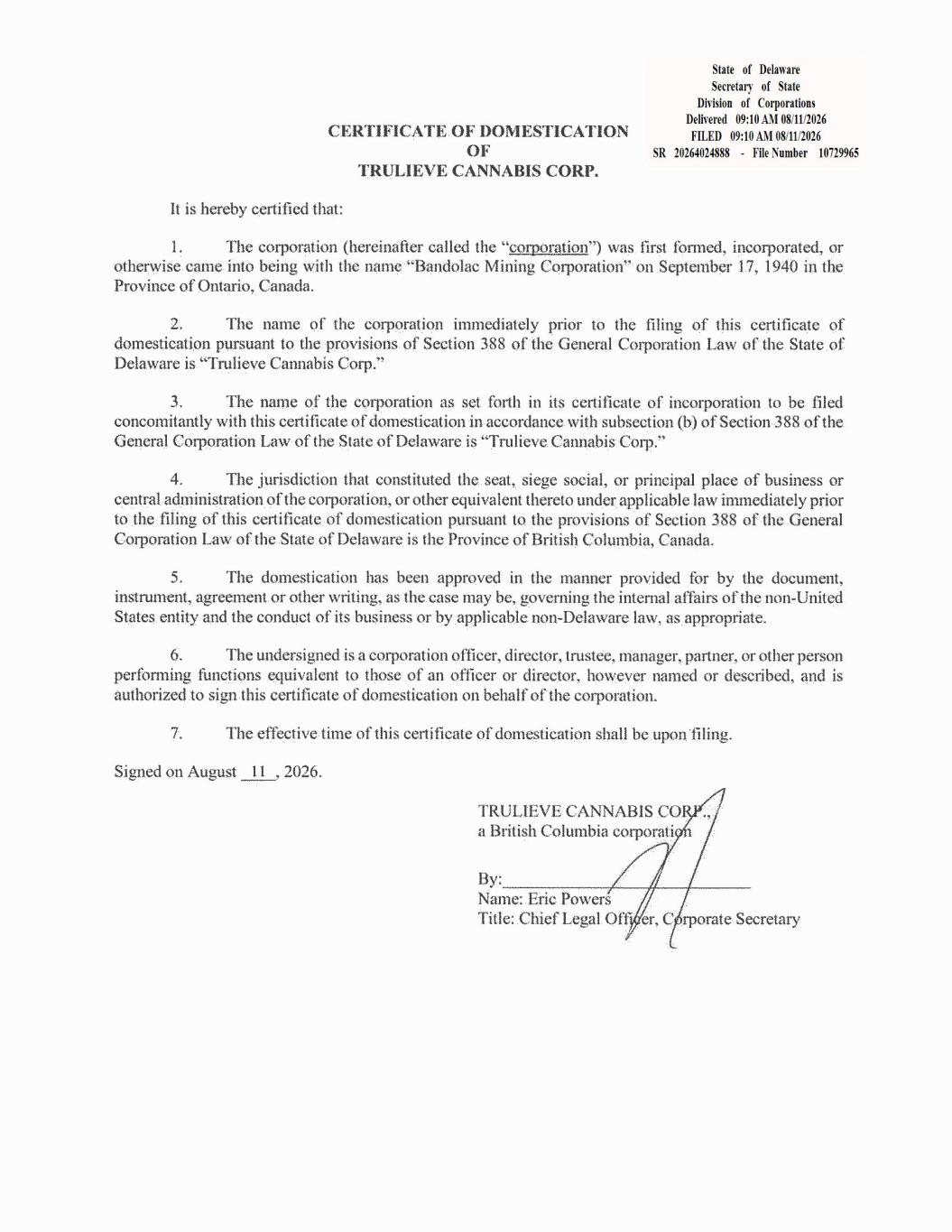
On August 11, 2026, (the “Effective Date”), the Company filed a certificate of domestication (“Certificate of Domestication”) and certificate of incorporation (“Certificate of Incorporation” and together with the Certificate of Domestication, the “Governing Documents”) with the Secretary of State of the State of Delaware to continue out from the jurisdiction of the Province of British Columbia, Canada, to the jurisdiction of the State of Delaware (the “Domestication”). The Domestication was consummated pursuant to a Plan of Arrangement, which was approved by the Company’s shareholders at a special meeting of the shareholders held on August 5, 2026 (the “Plan of Arrangement”), and a Final Order issued by the Supreme Court of British Columbia, Canada on August 10, 2026.
Following the time at which the Governing Documents become effective (the “Effective Time”) on the Effective Date, pursuant to the Plan of Arrangement and by operation of law, (i) all the property, rights, interests, privileges and powers of the Company continue to be property, rights, interests, privileges and powers of the Company; (ii) all debt due to the Company, its subsidiaries, all rights under all contracts and all other causes of action belonging to the Company immediately prior to the Effective Time continue to be vested in the Company; (iii) all debts, liabilities, obligations and duties of the Company immediately prior to the Effective Time remain attached to the Company following the Effective Time and continue to be debts, liabilities, obligations and duties of the Company, and (iv) any existing cause of action, claim or liability to prosecution remains unaffected, a legal proceeding being prosecuted or pending by or against the Company may be prosecuted or its prosecution may be continued, as the case may be, by or against the Company following the Effective Time, and a conviction against, or a ruling, order or judgment in favor of or against, the Company may be enforced by or against the Company following the Effective Time.
The Plan of Arrangement is attached hereto as Exhibit 2.1 and is incorporated by reference herein. For additional information regarding the Domestication, please refer to the management information circular and definitive proxy statement filed by the Company with the U.S. Securities and Exchange Commission (the “SEC”) at www.sec.gov and on SEDAR+ in Canada at www.sedarplus.ca on June 25, 2026 (the “Proxy Statement”).
Item 1.01. Entry into a Material Definitive Agreement.
In connection with the consummation of the Domestication and pursuant to the Company’s Certificate of Incorporation, Bylaws (as defined below) and the Delaware General Corporation Law (the “DGCL”), the Company has or will enter into indemnification agreements with each of the Company’s executive officers and directors providing for the indemnification of, and advancement of expenses to, each such person in connection with claims, suits or proceedings arising as a result of such person’s service as an officer or director of the Company (the “Indemnification Agreements”).
The above description of the Indemnification Agreements does not purport to be complete and is qualified in its entirety by reference to the full text of the form of indemnification agreement, which is attached hereto as Exhibit 10.1 and is incorporated herein by reference.
Item 3.02. Unregistered Sales of Equity Securities.
The information provided in the Introductory Note of this Current Report on Form 8-K is incorporated herein by reference.
As part of the Domestication, the previously authorized, issued and outstanding subordinate voting shares of the Company (the “BC Subordinate Voting Shares”) and the multiple voting shares of the Company (the “BC Multiple Voting Shares”) were deemed to be exchanged on the Effective Date for the applicable class of authorized, issued and outstanding shares of common stock, par value $0.0001 per share, of the Company (“Common Stock”) on a one-for-one basis, with each BC Subordinate Voting Share exchanged for one issued and outstanding share of Class A subordinate voting Common Stock (the “Subordinate Voting Shares”) and each BC Multiple Voting Share exchanged for Class B multiple voting Common Stock (the “Multiple Voting Shares”). The issuance of the shares of Common Stock was made in reliance upon the exemption from registration provided by Section 3(a)(10) of the U.S. Securities Act of 1933, as amended.
Item 3.03. Material Modification to Rights of Security Holders.
The information provided in the Introductory Note of this Current Report on Form 8-K is incorporated herein by reference.
On the Effective Date, (i) each BC Subordinate Voting Share was automatically exchanged into one issued and outstanding Subordinate Voting Share, without any action required on the part of the Company or the holders thereof; (ii) each BC Multiple Voting Share was automatically exchanged into one issued and outstanding Multiple Voting Share, without any action required on the part of the Company or the holders thereof; and (iii) each outstanding stock option to purchase BC Subordinate Voting Shares, and each restricted stock unit (“RSU”) or performance stock unit (“PSU”) that was to be settled in BC Subordinate Voting Shares was deemed to be converted into and exchanged for a stock option, RSU or PSU to purchase or receive (as applicable) Subordinate Voting Shares, on equivalent terms pursuant to the terms of the Third Amended and Restated Trulieve Cannabis Corp. 2021 Omnibus Incentive Plan and applicable award agreement.
In connection with the consummation of the Domestication, the Company adopted the Certificate of Incorporation and Bylaws (the “Bylaws”), each of which is described in the Proxy Statement. The rights of holders of the Company’s capital stock are now governed by the Certificate of Incorporation, the Bylaws and the DGCL, which contain provisions that differ in certain respects from Trulieve British Columbia’s organizational documents and British Columbia law. The sections of the Proxy Statement entitled “Comparison of Shareholders’ Rights under British Columbia and Delaware Law” and “Comparison of Certificate of Incorporation and Company Delaware Bylaws with the BC Notice of Articles and BC Articles” under “Proposal 1: Approval of Delaware Domestication” describe the general effects of changes to the rights of the Company’s shareholders, and are incorporated herein by reference. Such descriptions do not purport to be complete and are qualified in their entirety by reference to the full text of the Certificate of Domestication, Certificate of Incorporation and the Bylaws, copies of which are attached hereto as Exhibits 3.1, 3.2 and 3.3, respectively, each of which is incorporated herein by reference.
Item 5.03. Amendments to Articles of Incorporation or Bylaws; Change in Fiscal Year.
The information provided in the Introductory Note and Item 3.03 of this Current Report on Form 8-K is incorporated herein by reference.
Item 9.01. Financial Statements and Exhibits.
(d) Exhibits
| Exhibit | Description | |||||||
| 2.1 | ||||||||
| 3.1 | ||||||||
| 3.2 | ||||||||
| 3.3 | ||||||||
| 10.1 | ||||||||
| 104 | Cover Page Interactive Data File (embedded within the Inline XBRL document) | |||||||
SIGNATURE
Pursuant to the requirements of the Securities Exchange Act of 1934, as amended, the registrant has duly caused this report to be signed on its behalf by the undersigned hereunto duly authorized.
| Trulieve Cannabis Corp. | ||||||||
| By: | /s/ Eric Powers | |||||||
| Name: | Eric Powers | |||||||
| Title: | Chief Legal Officer | |||||||
Date: August 11, 2026
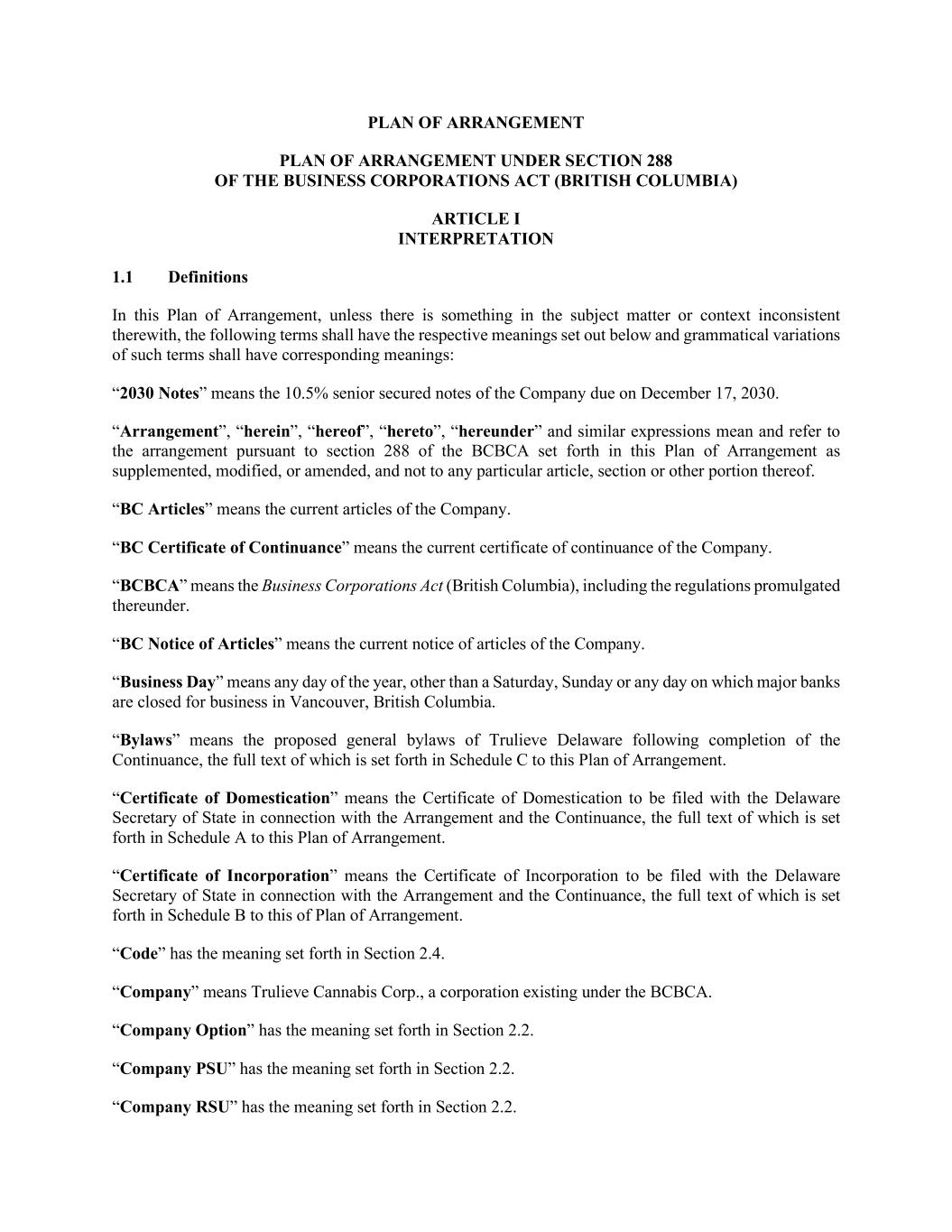
PLAN OF ARRANGEMENT PLAN OF ARRANGEMENT UNDER SECTION 288 OF THE BUSINESS CORPORATIONS ACT (BRITISH COLUMBIA) ARTICLE I INTERPRETATION 1.1 Definitions In this Plan of Arrangement, unless there is something in the subject matter or context inconsistent therewith, the following terms shall have the respective meanings set out below and grammatical variations of such terms shall have corresponding meanings: “2030 Notes” means the 10.5% senior secured notes of the Company due on December 17, 2030. “Arrangement”, “herein”, “hereof”, “hereto”, “hereunder” and similar expressions mean and refer to the arrangement pursuant to section 288 of the BCBCA set forth in this Plan of Arrangement as supplemented, modified, or amended, and not to any particular article, section or other portion thereof. “BC Articles” means the current articles of the Company. “BC Certificate of Continuance” means the current certificate of continuance of the Company. “BCBCA” means the Business Corporations Act (British Columbia), including the regulations promulgated thereunder. “BC Notice of Articles” means the current notice of articles of the Company. “Business Day” means any day of the year, other than a Saturday, Sunday or any day on which major banks are closed for business in Vancouver, British Columbia. “Bylaws” means the proposed general bylaws of Trulieve Delaware following completion of the Continuance, the full text of which is set forth in Schedule C to this Plan of Arrangement. “Certificate of Domestication” means the Certificate of Domestication to be filed with the Delaware Secretary of State in connection with the Arrangement and the Continuance, the full text of which is set forth in Schedule A to this Plan of Arrangement. “Certificate of Incorporation” means the Certificate of Incorporation to be filed with the Delaware Secretary of State in connection with the Arrangement and the Continuance, the full text of which is set forth in Schedule B to this of Plan of Arrangement. “Code” has the meaning set forth in Section 2.4. “Company” means Trulieve Cannabis Corp., a corporation existing under the BCBCA. “Company Option” has the meaning set forth in Section 2.2. “Company PSU” has the meaning set forth in Section 2.2. “Company RSU” has the meaning set forth in Section 2.2.
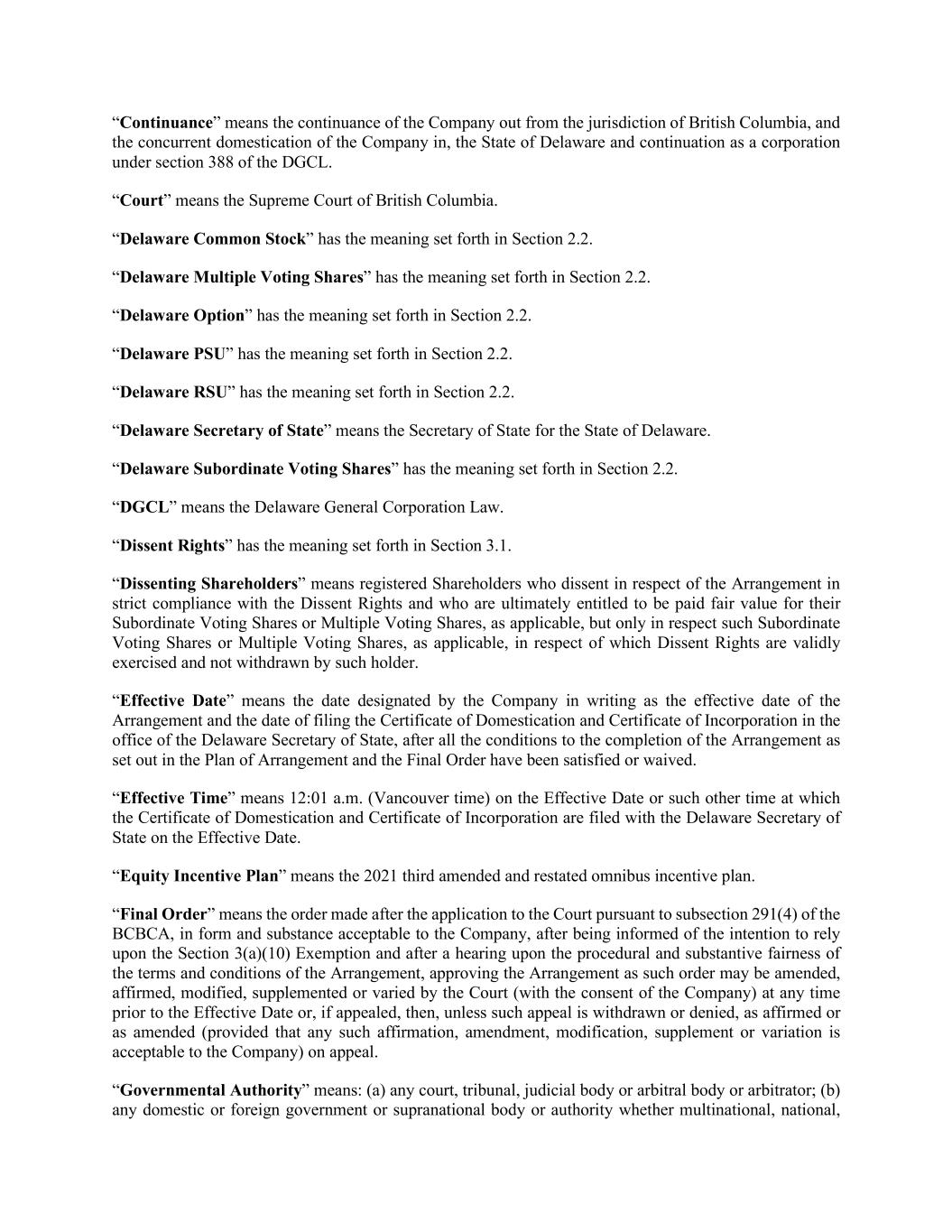
“Continuance” means the continuance of the Company out from the jurisdiction of British Columbia, and the concurrent domestication of the Company in, the State of Delaware and continuation as a corporation under section 388 of the DGCL. “Court” means the Supreme Court of British Columbia. “Delaware Common Stock” has the meaning set forth in Section 2.2. “Delaware Multiple Voting Shares” has the meaning set forth in Section 2.2. “Delaware Option” has the meaning set forth in Section 2.2. “Delaware PSU” has the meaning set forth in Section 2.2. “Delaware RSU” has the meaning set forth in Section 2.2. “Delaware Secretary of State” means the Secretary of State for the State of Delaware. “Delaware Subordinate Voting Shares” has the meaning set forth in Section 2.2. “DGCL” means the Delaware General Corporation Law. “Dissent Rights” has the meaning set forth in Section 3.1. “Dissenting Shareholders” means registered Shareholders who dissent in respect of the Arrangement in strict compliance with the Dissent Rights and who are ultimately entitled to be paid fair value for their Subordinate Voting Shares or Multiple Voting Shares, as applicable, but only in respect such Subordinate Voting Shares or Multiple Voting Shares, as applicable, in respect of which Dissent Rights are validly exercised and not withdrawn by such holder. “Effective Date” means the date designated by the Company in writing as the effective date of the Arrangement and the date of filing the Certificate of Domestication and Certificate of Incorporation in the office of the Delaware Secretary of State, after all the conditions to the completion of the Arrangement as set out in the Plan of Arrangement and the Final Order have been satisfied or waived. “Effective Time” means 12:01 a.m. (Vancouver time) on the Effective Date or such other time at which the Certificate of Domestication and Certificate of Incorporation are filed with the Delaware Secretary of State on the Effective Date. “Equity Incentive Plan” means the 2021 third amended and restated omnibus incentive plan. “Final Order” means the order made after the application to the Court pursuant to subsection 291(4) of the BCBCA, in form and substance acceptable to the Company, after being informed of the intention to rely upon the Section 3(a)(10) Exemption and after a hearing upon the procedural and substantive fairness of the terms and conditions of the Arrangement, approving the Arrangement as such order may be amended, affirmed, modified, supplemented or varied by the Court (with the consent of the Company) at any time prior to the Effective Date or, if appealed, then, unless such appeal is withdrawn or denied, as affirmed or as amended (provided that any such affirmation, amendment, modification, supplement or variation is acceptable to the Company) on appeal. “Governmental Authority” means: (a) any court, tribunal, judicial body or arbitral body or arbitrator; (b) any domestic or foreign government or supranational body or authority whether multinational, national,
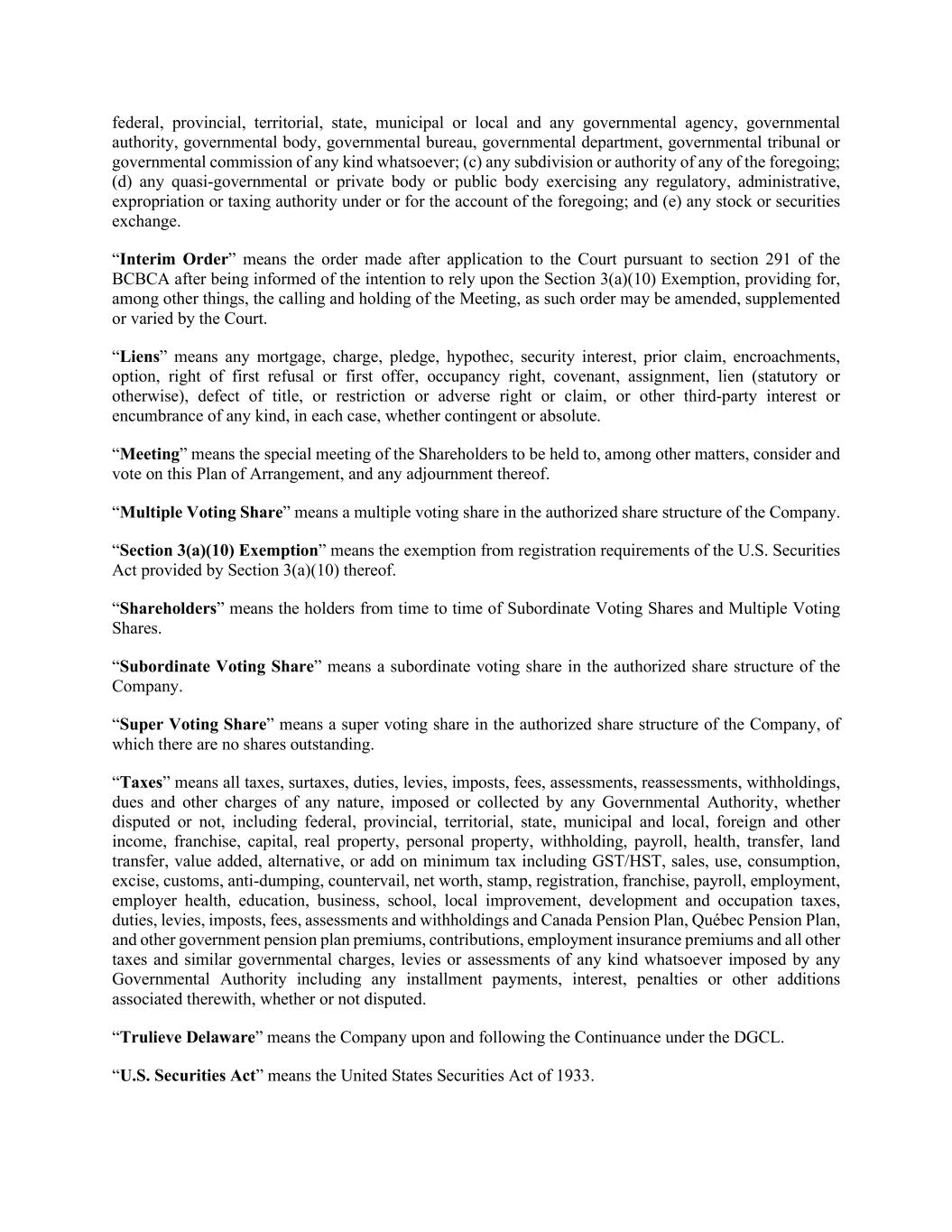
federal, provincial, territorial, state, municipal or local and any governmental agency, governmental authority, governmental body, governmental bureau, governmental department, governmental tribunal or governmental commission of any kind whatsoever; (c) any subdivision or authority of any of the foregoing; (d) any quasi-governmental or private body or public body exercising any regulatory, administrative, expropriation or taxing authority under or for the account of the foregoing; and (e) any stock or securities exchange. “Interim Order” means the order made after application to the Court pursuant to section 291 of the BCBCA after being informed of the intention to rely upon the Section 3(a)(10) Exemption, providing for, among other things, the calling and holding of the Meeting, as such order may be amended, supplemented or varied by the Court. “Liens” means any mortgage, charge, pledge, hypothec, security interest, prior claim, encroachments, option, right of first refusal or first offer, occupancy right, covenant, assignment, lien (statutory or otherwise), defect of title, or restriction or adverse right or claim, or other third-party interest or encumbrance of any kind, in each case, whether contingent or absolute. “Meeting” means the special meeting of the Shareholders to be held to, among other matters, consider and vote on this Plan of Arrangement, and any adjournment thereof. “Multiple Voting Share” means a multiple voting share in the authorized share structure of the Company. “Section 3(a)(10) Exemption” means the exemption from registration requirements of the U.S. Securities Act provided by Section 3(a)(10) thereof. “Shareholders” means the holders from time to time of Subordinate Voting Shares and Multiple Voting Shares. “Subordinate Voting Share” means a subordinate voting share in the authorized share structure of the Company. “Super Voting Share” means a super voting share in the authorized share structure of the Company, of which there are no shares outstanding. “Taxes” means all taxes, surtaxes, duties, levies, imposts, fees, assessments, reassessments, withholdings, dues and other charges of any nature, imposed or collected by any Governmental Authority, whether disputed or not, including federal, provincial, territorial, state, municipal and local, foreign and other income, franchise, capital, real property, personal property, withholding, payroll, health, transfer, land transfer, value added, alternative, or add on minimum tax including GST/HST, sales, use, consumption, excise, customs, anti-dumping, countervail, net worth, stamp, registration, franchise, payroll, employment, employer health, education, business, school, local improvement, development and occupation taxes, duties, levies, imposts, fees, assessments and withholdings and Canada Pension Plan, Québec Pension Plan, and other government pension plan premiums, contributions, employment insurance premiums and all other taxes and similar governmental charges, levies or assessments of any kind whatsoever imposed by any Governmental Authority including any installment payments, interest, penalties or other additions associated therewith, whether or not disputed. “Trulieve Delaware” means the Company upon and following the Continuance under the DGCL. “U.S. Securities Act” means the United States Securities Act of 1933.
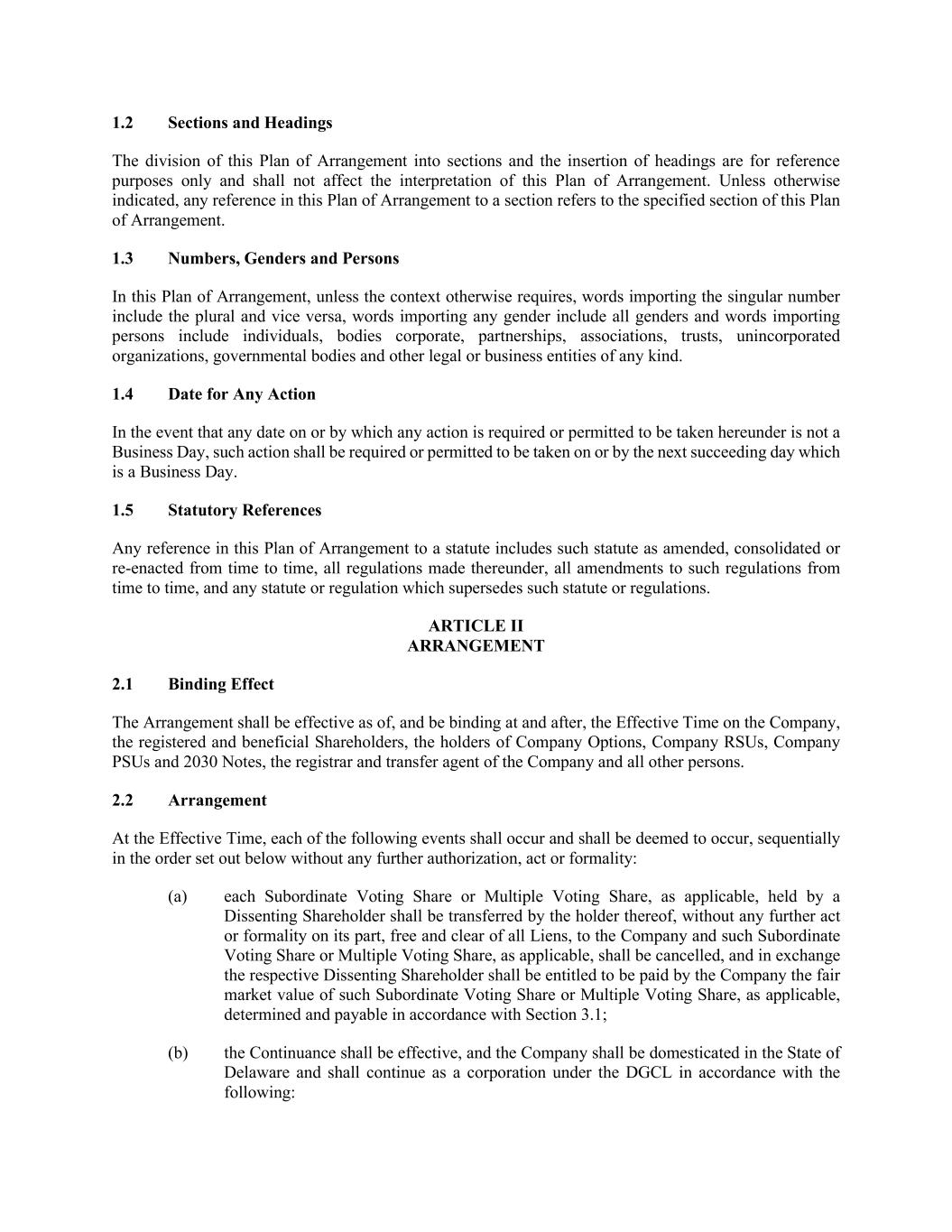
1.2 Sections and Headings The division of this Plan of Arrangement into sections and the insertion of headings are for reference purposes only and shall not affect the interpretation of this Plan of Arrangement. Unless otherwise indicated, any reference in this Plan of Arrangement to a section refers to the specified section of this Plan of Arrangement. 1.3 Numbers, Genders and Persons In this Plan of Arrangement, unless the context otherwise requires, words importing the singular number include the plural and vice versa, words importing any gender include all genders and words importing persons include individuals, bodies corporate, partnerships, associations, trusts, unincorporated organizations, governmental bodies and other legal or business entities of any kind. 1.4 Date for Any Action In the event that any date on or by which any action is required or permitted to be taken hereunder is not a Business Day, such action shall be required or permitted to be taken on or by the next succeeding day which is a Business Day. 1.5 Statutory References Any reference in this Plan of Arrangement to a statute includes such statute as amended, consolidated or re-enacted from time to time, all regulations made thereunder, all amendments to such regulations from time to time, and any statute or regulation which supersedes such statute or regulations. ARTICLE II ARRANGEMENT 2.1 Binding Effect The Arrangement shall be effective as of, and be binding at and after, the Effective Time on the Company, the registered and beneficial Shareholders, the holders of Company Options, Company RSUs, Company PSUs and 2030 Notes, the registrar and transfer agent of the Company and all other persons. 2.2 Arrangement At the Effective Time, each of the following events shall occur and shall be deemed to occur, sequentially in the order set out below without any further authorization, act or formality: (a) each Subordinate Voting Share or Multiple Voting Share, as applicable, held by a Dissenting Shareholder shall be transferred by the holder thereof, without any further act or formality on its part, free and clear of all Liens, to the Company and such Subordinate Voting Share or Multiple Voting Share, as applicable, shall be cancelled, and in exchange the respective Dissenting Shareholder shall be entitled to be paid by the Company the fair market value of such Subordinate Voting Share or Multiple Voting Share, as applicable, determined and payable in accordance with Section 3.1; (b) the Continuance shall be effective, and the Company shall be domesticated in the State of Delaware and shall continue as a corporation under the DGCL in accordance with the following:
(i) the name of Trulieve Delaware shall be “Trulieve Cannabis Corp.”; (ii) the BC Certificate of Continuance, BC Notice of Articles and BC Articles shall be cancelled and substituted with, and which shall be filed with the Delaware Secretary of State, the Certificate of Domestication and Certificate of Incorporation of Trulieve Delaware in the form attached as Schedule A and Schedule B, respectively, hereto and the Bylaws of Trulieve Delaware, which shall be in the form attached as Schedule C hereto; (iii) the number of directors of Trulieve Delaware shall initially be set at seven, and the initial directors of Trulieve Delaware shall be the directors of the Company as of immediately prior to the Effective Time; (iv) the authorized capital of Trulieve Delaware shall consist of: (A) 5,000,300,000 shares of common stock, par value $0.0001 per share (“Delaware Common Stock”) divided into two classes as follows: (i) 5,000,000,000 shares of Class A subordinate voting Common Stock (the “Delaware Subordinate Voting Shares”), and (ii) 300,000 shares of Class B multiple voting Common Stock (the “Delaware Multiple Voting Shares”); and (B) 1,000,000,000 shares of preferred stock, par value $0.0001 per share (the “Delaware Preferred Stock”), in each case having the special rights and restrictions attached thereto as set out in the Certificate of Incorporation, and the authorized capital of the Company shall be amended by: A. amending the maximum number of authorized shares and altering the identifying name of the unlimited Subordinate Voting Shares without par value to 5,000,000,000 authorized Delaware Subordinate Voting Share and deleting the special rights and restrictions attached to the Subordinate Voting Shares as set out in the BC Articles and attaching the special rights and restrictions as set out in the Certificate of Incorporation; B. amending the maximum number of authorized shares and altering the identifying name of the unlimited Multiple Voting Shares without par value to 300,000 authorized Delaware Multiple Voting Share and deleting the special rights and restrictions attached to the Multiple Voting Shares as set out in the BC Articles and attaching the special rights and restrictions as set out in the Certificate of Incorporation; C. authorizing 1,000,000,000 shares of Delaware Preferred Stock and attaching the special rights and restrictions to the Delaware Preferred Stock as set out in the Certificate of Incorporation; D. removing the Super Voting Shares, of which no shares are outstanding, and deleting the special rights and restrictions attached to the Super Voting Shares, as set out in the BC Articles, (v) each issued and outstanding Subordinate Voting Share (for greater certainty, other than those Subordinate Voting Shares, if any, transferred pursuant to subsection 2.2(a) above) will for all purposes be automatically exchanged into one issued and outstanding Delaware Subordinate Voting Share, without any action required on the part of the Company or the holders thereof;
(vi) each issued and outstanding Multiple Voting Share (for greater certainty, other than those Multiple Voting Shares, if any, transferred pursuant to subsection 2.2(a) above) will for all purposes be automatically exchanged into one issued and outstanding Delaware Multiple Voting Share, without any action required on the part of the Company or the holders thereof; (vii) each outstanding option to purchase Subordinate Voting Shares (a “Company Option”) will for all purposes be deemed to be adjusted pursuant to the terms of the Equity Incentive Plan to become one outstanding option to purchase an equal number of Delaware Subordinate Voting Shares at the same exercise price per share and otherwise on the same terms and conditions (a “Delaware Option”) under the Equity Incentive Plan and applicable award agreement; (viii) each outstanding restricted stock unit to receive Subordinate Voting Shares (a “Company RSU”) will for all purposes be deemed to be adjusted pursuant to the terms of the Equity Incentive Plan to become one outstanding restricted stock unit to receive an equal number of Delaware Subordinate Voting Shares and otherwise with the same terms and conditions (a “Delaware RSU”) under the Equity Incentive Plan and applicable award agreement; (ix) each outstanding performance stock unit to receive Subordinate Voting Shares (a “Company PSU”) will for all purposes be deemed to be adjusted pursuant to the terms of the Equity Incentive Plan to become one outstanding performance stock unit to receive an equal number of Delaware Subordinate Voting Shares and otherwise with the same terms and conditions (a “Delaware PSU”) under the Equity Incentive Plan and applicable award agreement; (x) all the property, rights, interests privileges and powers of the Company will continue to be property, rights, interests, privileges and powers of the Company, all debt due to the Company, all subsidiaries of the Company, all rights under all contracts, and all other causes of action belonging to the Company immediately prior to the Effective Time will remain vested in Trulieve Delaware following the Effective Time; (xi) all debts, liabilities and duties of the Company immediately prior to the Effective Time, including the 2030 Notes, will remain attached to Trulieve Delaware following the Effective Time and will remain debts, liabilities and duties of Trulieve Delaware; and (xii) an existing cause of action, claim or liability to prosecution is unaffected, a legal proceeding being prosecuted or pending by or against the Company may be prosecuted or its prosecution may be continued, as the case may be, by or against the Company following the Effective Time, and a conviction against, or a ruling, order or judgment in favour of or against, the company may be enforced by or against the Company following the Effective Time. 2.3 Trulieve Delaware Securities Registers Trulieve Delaware shall make the appropriate entries in its securities registers to reflect the matters referred to under Section 2.2.
2.4 U.S. Federal Income Tax Treatment For U.S. federal income tax purposes, the Continuance is intended to constitute a reorganization within the meaning of Section 368(a)(1)(F) of the Internal Revenue Code of 1986, as amended (the “Code”), and the Treasury Regulations promulgated thereunder, and the Company and Trulieve Delaware are parties to such reorganization within the meaning of Section 368(b) of the Code. This Plan of Arrangement is being adopted as a “plan of reorganization” within the meaning of Section 368(a) of the Code and Sections 1.368- 2(g) and 1.368-3(a) of the Treasury Regulations. 2.5 Securities Fully Paid All securities issued pursuant to this Plan of Arrangement shall be fully paid and non-assessable, and the Company or Trulieve Delaware, as applicable, shall be deemed to have received the full consideration therefor. 2.6 No Liens Any exchange or transfer of securities pursuant to this Plan of Arrangement shall be free and clear of any and all Liens or other claims of third parties of any kind. 2.7 Paramountcy From and after the Effective Time: (a) this Plan of Arrangement shall take precedence and priority over any and all securities of the Company issued and outstanding prior to the Effective Time, including Subordinate Voting Shares, Multiple Voting Shares, Company Options, Company RSUs and Company PSUs; (b) the rights and obligations of the holders (registered or beneficial) of such securities, the Company, the registrar and transfer agent of the Company, clearing agencies in relation to this Plan of Arrangement shall be solely as provided for in this Plan of Arrangement; and (c) all actions, causes of action, claims or proceedings (actual or contingent and whether or not previously asserted) based on or in any way relating to any securities of the Company are deemed to have been settled, compromised, released and determined without liability except as set forth herein. ARTICLE III DISSENTING SHAREHOLDERS 3.1 Dissenting Shareholders Pursuant to the Interim Order, registered holders of Subordinate Voting Shares and/or Multiple Voting Shares may exercise rights of dissent (“Dissent Rights”) under Division 2 of Part 8 of the BCBCA, as modified by this ARTICLE III, the Interim Order and the Final Order, with respect to Subordinate Voting Shares and/or Multiple Voting Shares in connection with the Arrangement, provided that the written notice of dissent to the special resolution to approve the Arrangement contemplated by section 242 of the BCBCA must be sent to the Company by holders who wish to dissent not later than 5:00 p.m. (Vancouver time) on the Business Day that is two Business Days before the Meeting or any date to which the Meeting may be postponed or adjourned. A Dissenting Shareholder who purports to exercise such rights of dissent and who ultimately is entitled to be paid fair value for their Subordinate Voting Shares or Multiple Voting Shares, as applicable, in respect of which such Dissenting Shareholder exercised Dissent Rights shall be entitled to be paid the fair value of such Subordinate Voting Shares or Multiple Voting Shares, as applicable, by the Company and will be deemed to have irrevocably transferred such Subordinate Voting Shares or Multiple Voting Shares, as applicable, to the Company in consideration for such fair value (less, for greater certainty, any applicable withholding or other taxes), at the Effective Time, and will cease to have any rights as a
Shareholder . A Dissenting Shareholder who purports to exercise such rights of dissent and who ultimately is not entitled for any reason to be paid the fair value of such holder’s Subordinate Voting Shares or Multiple Voting Shares, as applicable, shall be deemed to have participated in the Arrangement on the same basis as a non-dissenting Shareholder, notwithstanding the provisions of sections 237 to 247 of the BCBCA, and shall be entitled to receive only what such holder would have received pursuant to the Arrangement if such holder had not purported to exercise Dissent Rights as contemplated in Section 2.2(a) hereof. Notwithstanding the foregoing, in no case will the Company or any other person be required to recognize such holders who purport to exercise Dissent Rights as holders of Subordinate Voting Shares or Multiple Voting Shares, as applicable, after the time that is immediately prior to the Effective Time, and the name of such holders of Subordinate Voting Shares or Multiple Voting Shares, as applicable, who exercise Dissent Rights will cease to be entitled to the rights of a shareholder in respect of the Subordinate Voting Shares or Multiple Voting Shares, as applicable, and the central securities register of the Company will be amended to reflect that such former holder is no longer the holder of such Subordinate Voting Shares or Multiple Voting Shares, as applicable, as at the Effective Time. The fair value of the Subordinate Voting Shares or Multiple Voting Shares, as applicable, for the purposes of the Dissent Rights shall be determined as of the close of business on the last Business Day before the day on which the Arrangement is approved by the Shareholders at the Meeting. For greater certainty, in addition to any other restrictions in sections 237 to 247 of the BCBCA, none of the following shall be entitled to exercise Dissent Rights: (i) any person who has voted, or has instructed a proxyholder to vote, in favor of the special resolution to approve the Arrangement at the Meeting; and (ii) holders of Company Options, Company RSUs, Company PSUs and 2030 Notes. ARTICLE IV AMENDMENT AND TERMINATION 4.1 Amendment (a) The Company reserves the right to amend, modify and/or supplement this Plan of Arrangement from time to time at any time prior to the Effective Time provided that any such amendment, modification or supplement must be: (i) filed with the Court if made after receipt of the Interim Order and, if made following the Meeting, approved by the Court, and (ii) communicated to Shareholders in the manner required by the Court (if so required). (b) Any amendment, modification or supplement to this Plan of Arrangement may be proposed by the Company at any time prior to or at the Meeting with or without any other prior notice or communication, and if so proposed and accepted by the persons voting at the Meeting (other than as may be required under the Interim Order), shall become part of this Plan of Arrangement for all purposes. (c) Any amendment, modification or supplement to this Plan of Arrangement which is approved by the Court following the Meeting shall be effective only (a) if it is consented to by the Company and (b) if required by the Court or applicable law, it is consented to by the Shareholders. (d) Any amendment, modification or supplement to this Plan of Arrangement may be made following the Effective Date unilaterally by the Company provided that it concerns a matter which, in the reasonable opinion of the Company, is of an administrative nature required to better give effect to the implementation of this Plan of Arrangement and is not adverse to any Shareholder. 4.2 Withdrawal of Plan of Arrangement
This Plan of Arrangement may be withdrawn prior to the Effective Time upon the resolution of the directors of the Company. 4.3 Effect of Termination Upon the withdrawal of this Plan of Arrangement pursuant to Section 4.2, no party, including but not limited to the Company, shall have any liability or further obligations hereunder. 4.4 Further Assurances Notwithstanding that the transactions and events set out herein shall occur and shall be deemed to occur in the order set out in this Plan of Arrangement without any further act or formality, the Company shall make, do and execute, or cause to be made, done and executed, all such further acts, deeds, agreements, transfers, assurances, instruments or documents as may reasonably be required by any of them in order to further document or evidence any of the transactions or events set out herein. ARTICLE V TREATMENT OF SECURITIES 5.1 Share Certificates At the Effective Time: (a) registered holders of Subordinate Voting Shares shall be deemed to be the registered holders of Delaware Subordinate Voting Shares. Direct registration system advices or share certificates, if any, representing the Subordinate Voting Shares shall be deemed to represent an identical number of Delaware Subordinate Voting Shares; and (b) registered holders of Multiple Voting Shares shall be deemed to be the registered holders of Delaware Multiple Voting Shares. Direct registration system advices or share certificates, if any, representing the Multiple Voting Shares shall be deemed to represent an identical number of Delaware Multiple Voting Shares. 5.2 Options At the Effective Time, holders of Company Options shall upon deemed adjustment of the Company Options pursuant to Section 2.2(b) be deemed to be holders of Delaware Options to acquire an identical number of Delaware Subordinate Voting Shares at the same exercise price per share. Any document previously evidencing Company Options will thereafter evidence and be deemed to evidence the Delaware Options and no option agreements evidencing the Delaware Options shall be required to be issued and the Delaware Options shall be governed by and be subject to the Equity Incentive Plan and applicable award agreement. 5.3 Restricted Stock Units At the Effective Time, holders of Company RSUs shall upon deemed adjustment of the Company RSUs pursuant to Section 2.2(b) be deemed to be holders of Delaware RSUs to receive an identical number of Delaware Subordinate Voting Shares. Any document previously evidencing Company RSUs will thereafter evidence and be deemed to evidence the Delaware RSUs and no award agreements evidencing the Delaware RSUs shall be required to be issued and the Delaware RSUs shall be governed by and be subject to the Equity Incentive Plan and applicable award agreement.
5.4 Performance Stock Units At the Effective Time, holders of Company PSUs shall upon deemed adjustment of the Company PSUs pursuant to Section 2.2(b) be deemed to be holders of Delaware PSUs to receive an identical number of Delaware Subordinate Voting Shares. Any document previously evidencing Company PSUs will thereafter evidence and be deemed to evidence the Delaware PSUs and no award agreements evidencing the Delaware PSUs shall be required to be issued and the Delaware PSUs shall be governed by and be subject to the Equity Incentive Plan and applicable award agreement. 5.5 Withholding Rights The Company and Trulieve Delaware will be entitled to deduct and withhold from any amounts payable or otherwise deliverable to any person pursuant to this Plan of Arrangement (including, for greater certainty, Shareholders, holders of Company Options and Company RSUs, and Dissenting Shareholders), such Taxes or other amounts as the Company or Trulieve Delaware, as applicable, is required or permitted to deduct or withhold in connection with such payment or delivery under the Income Tax Act (Canada), the Code, or any other provisions of any applicable law. To the extent that amounts so deducted and withheld are remitted to the appropriate Governmental Authority, such deducted, withheld and remitted amounts shall be treated for all purposes of this Plan of Arrangement as having been paid to such Person in respect of which such deduction, withholding and remittance was made. If applicable, the Company and Trulieve Delaware are hereby authorized to sell or dispose (on behalf of the applicable person in respect of which such deduction, withholding and remittance is to be made) of such portion of Subordinate Voting Shares, Multiple Voting Shares, Delaware Subordinate Voting Shares or Delaware Multiple Voting Shares or any other securities issued hereunder, if any, as is necessary to provide sufficient funds to enable it to implement such deduction, withholding and remittance, and the Company or Trulieve Delaware, as applicable, will notify the holder thereof and remit to the holder any unapplied balance of the net proceeds of such sale. 5.6 U.S Securities Law Matters Notwithstanding any provision herein to the contrary, the Company acknowledges and agrees that this Plan of Arrangement will be carried out with the intention that all Delaware Subordinate Voting Shares, Delaware Multiple Voting Shares, Delaware Options, Delaware RSUs and Delaware PSUs issued on completion of this Plan of Arrangement will be issued by the Company in reliance on the exemption from the registration requirements of the U.S. Securities Act, as provided by Section 3(a)(10) thereof, and pursuant to exemptions from registration under any other applicable United States state securities laws. Each securityholder entitled to receive Delaware Options, Delaware RSUs or Delaware PSUs will be advised that the Section 3(a)(10) exemption does not exempt the issuance of securities upon the exercise of Delaware Options, Delaware RSUs or Delaware PSUs and that therefore, the Delaware Subordinate Voting Shares issuable upon exercise of the Delaware Options, Delaware RSUs and Delaware PSUs cannot be issued in reliance on the exemption from registration provided by Section 3(a)(10) of the U.S. Securities Act, and such Delaware Subordinate Voting Shares issuable upon exercise of the Delaware Options, Delaware RSUs and Delaware PSUs may only be issued and subsequently resold pursuant to one or more alternative exemptions from registration or an effective registration statement under the U.S. Securities Act and in compliance with applicable state securities law.
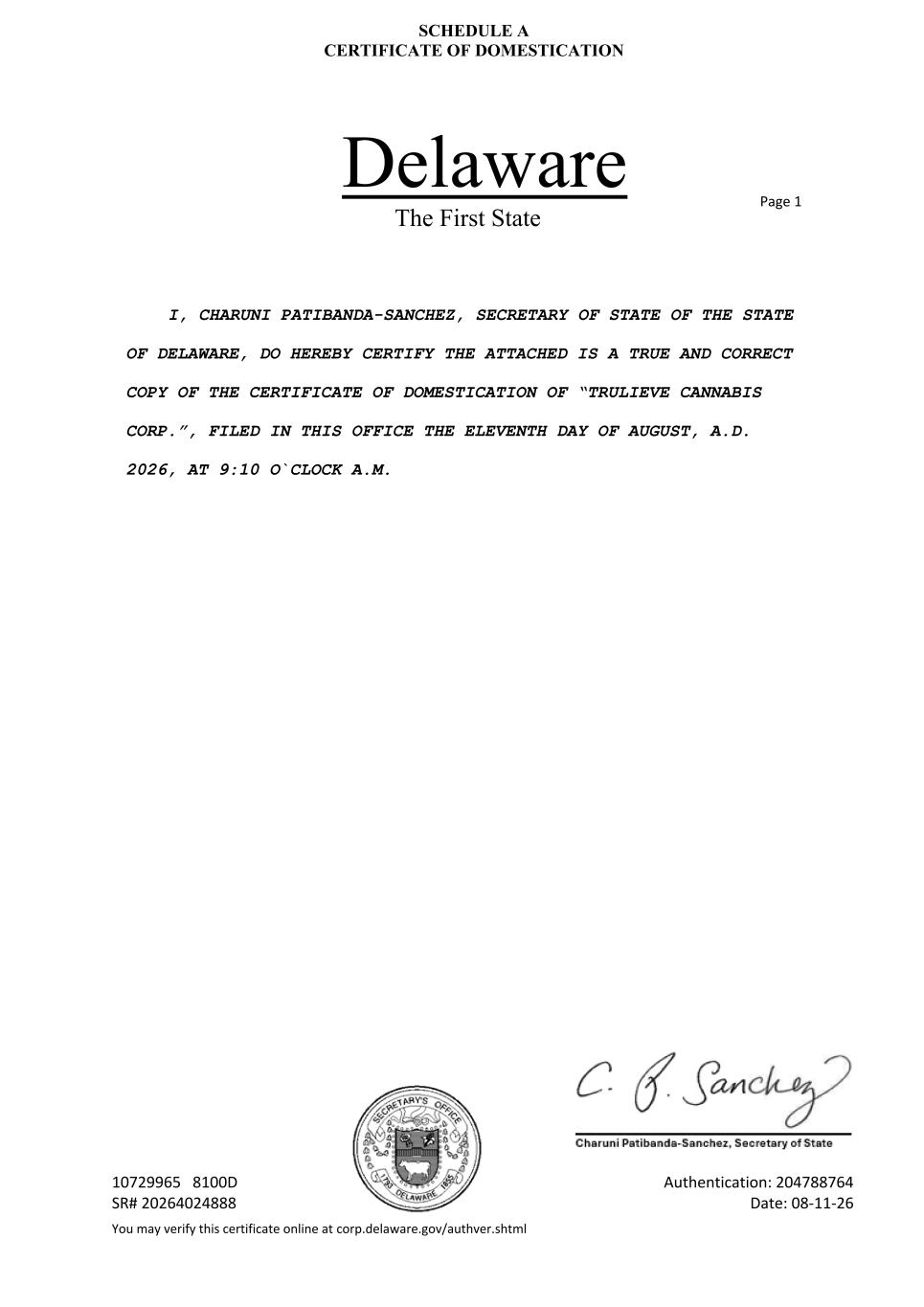
Delaware The First State Page 1 10729965 8100D Authentication: 204788764 SR# 20264024888 Date: 08-11-26 You may verify this certificate online at corp.delaware.gov/authver.shtml I, CHARUNI PATIBANDA-SANCHEZ, SECRETARY OF STATE OF THE STATE OF DELAWARE, DO HEREBY CERTIFY THE ATTACHED IS A TRUE AND CORRECT COPY OF THE CERTIFICATE OF DOMESTICATION OF “TRULIEVE CANNABIS CORP.”, FILED IN THIS OFFICE THE ELEVENTH DAY OF AUGUST, A.D. 2026, AT 9:10 O`CLOCK A.M. SCHEDULE A CERTIFICATE OF DOMESTICATION
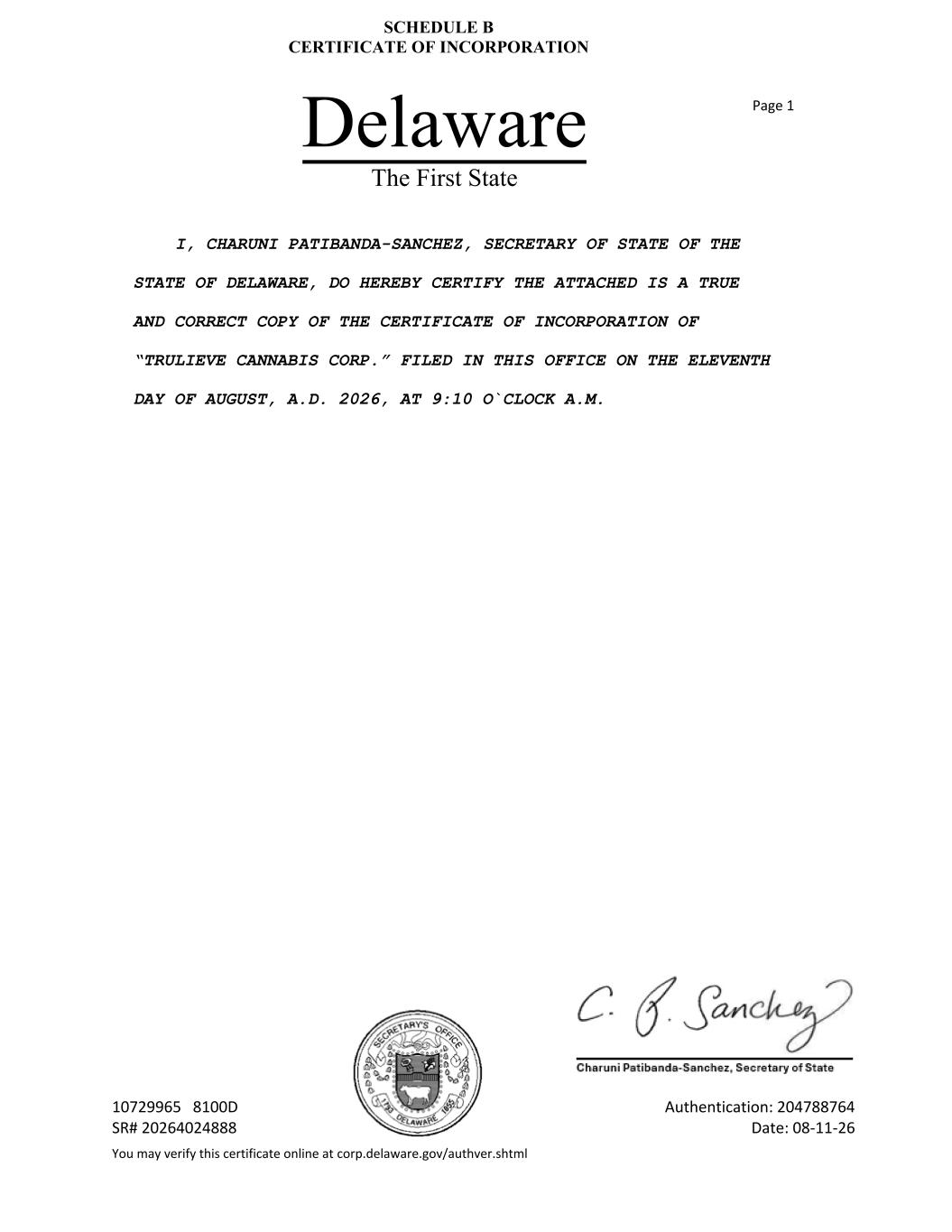
Delaware The First State Page 1 10729965 8100D Authentication: 204788764 SR# 20264024888 Date: 08-11-26 You may verify this certificate online at corp.delaware.gov/authver.shtml I, CHARUNI PATIBANDA-SANCHEZ, SECRETARY OF STATE OF THE STATE OF DELAWARE, DO HEREBY CERTIFY THE ATTACHED IS A TRUE AND CORRECT COPY OF THE CERTIFICATE OF INCORPORATION OF “TRULIEVE CANNABIS CORP.” FILED IN THIS OFFICE ON THE ELEVENTH DAY OF AUGUST, A.D. 2026, AT 9:10 O`CLOCK A.M. SCHEDULE B CERTIFICATE OF INCORPORATION
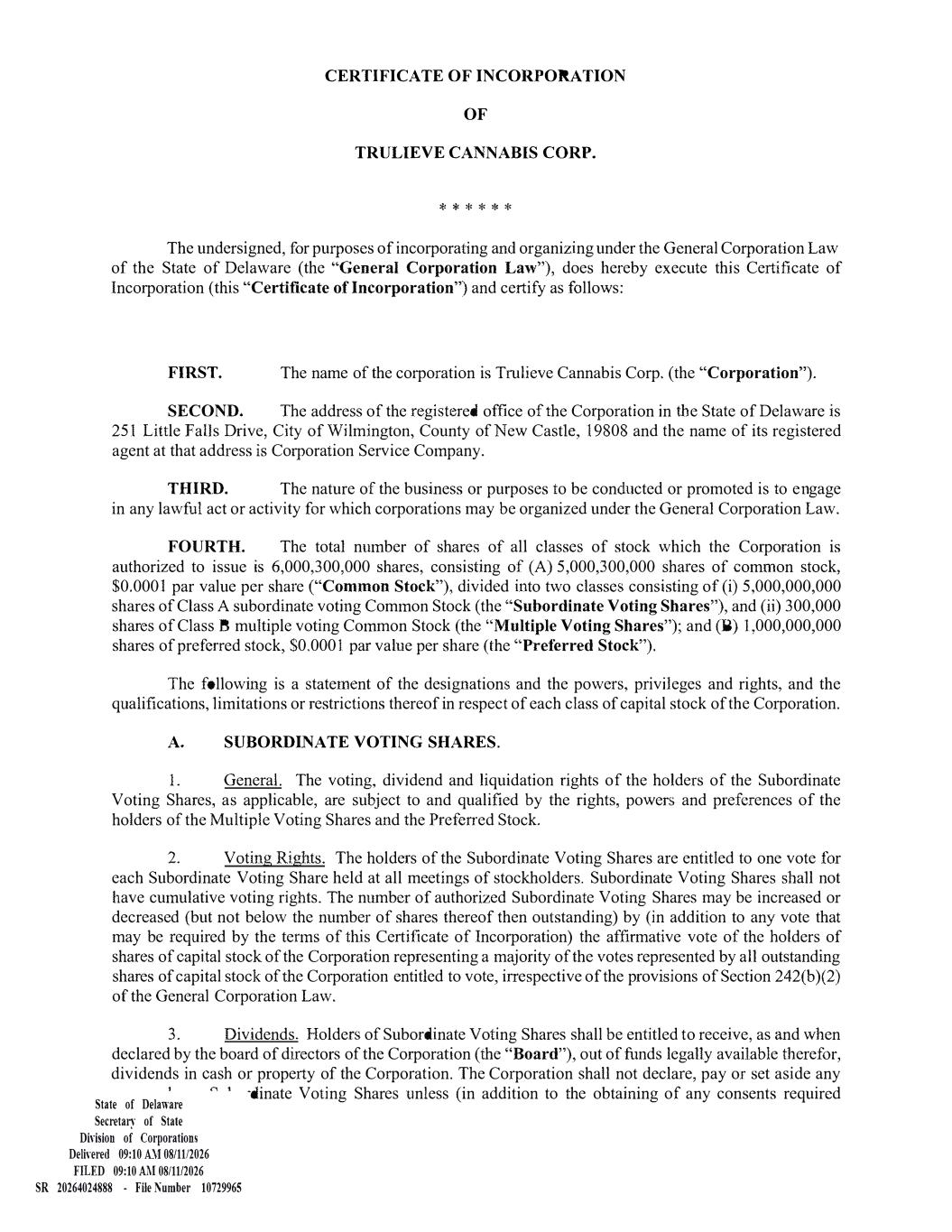
CERTIFICATE OF INCORPORATION OF TRULlEVE CANNABIS CORP. ****** The undersigned, for purposes of incorporating and organizing under the General Corporation Law of the State of Delaware (the "General Corporation Law"), does hereby execute this Certificate of Incorporation (this "Certificate of Incorporation") and certify as follows: FIRST. The name of the corporation is Trulieve Cannabis Corp. (the "Corporation"). SECOND. The address of the registered office of the Corporation in the State of Delaware is 251 Little Falls Drive, City of Wilmington, County of New Castle, 19808 and the name of its registered agent at that address is Corporation Service Company. THIRD. The nature of the business or purposes to be conducted or promoted is to engage in any lawful act or activity for which corporations may be organized under the General Corporation Law. FOURTH. The total number of shares of all classes of stock which the Corporation is authorized to issue is 6,000,300,000 shares, consisting of (A) 5,000,300,000 shares of common stock, $0.0001 par value per share ("Common Stock"), divided into two classes consisting of (i) 5,000,000,000 shares of Class A subordinate voting Common Stock (the "Subordinate Voting Shares"), and (ii) 300,000 shares of Class B multiple voting Common Stock (the "Multiple Voting Shares"); and (B) 1,000,000,000 shares of preferred stock, $0.0001 par value per share (the "Preferred Stock"). The following is a statement of the designations and the powers, privileges and rights, and the qualifications, limitations or restrictions thereof in respect of each class of capital stock of the Corporation. A. SUBORDINATE VOTING SHARES. 1. General. The voting, dividend and liquidation rights of the holders of the Subordinate Voting Shares, as applicable, are subject to and qualified by the rights, powers and preferences of the holders of the Multiple Voting Shares and the Prefen-ed Stock. 2. Voting Rights. The holders of the Subordinate Voting Shares are entitled to one vote for each Subordinate Voting Share held at all meetings of stockholders. Subordinate Voting Shares shall not have cumulative voting rights. The number of authorized Subordinate Voting Shares may be increased or decreased (but not below the number of shares thereof then outstanding) by (in addition to any vote that may be required by the terms of this Certificate of Incorporation) the affirmative vote of the holders of shares of capital stock of the Corporation representing a majority of the votes represented by all outstanding shares of capital stock of the Corporation entitled to vote, irrespective of the provisions of Section 242(6)(2) of the General Corporation Law. 3. Dividends. Holders of Subordinate Voting Shares shall be entitled to receive, as and when declared by the board of directors of the Corporation (the "Board"), out of funds legally available therefor, dividends in cash or property of the Corporation. The Corporation shall not declare, pay or set aside any ' ,.., ' ·dinate Voting Shares unless (in addition to the obtaining of any consents required State of Delaware Secretary of State Division of Corporations Delivered 09:10 AM 08/11/2026 FILED 09: 10 AM 08/11/2026 SR 20264024888 • File Number 10729965
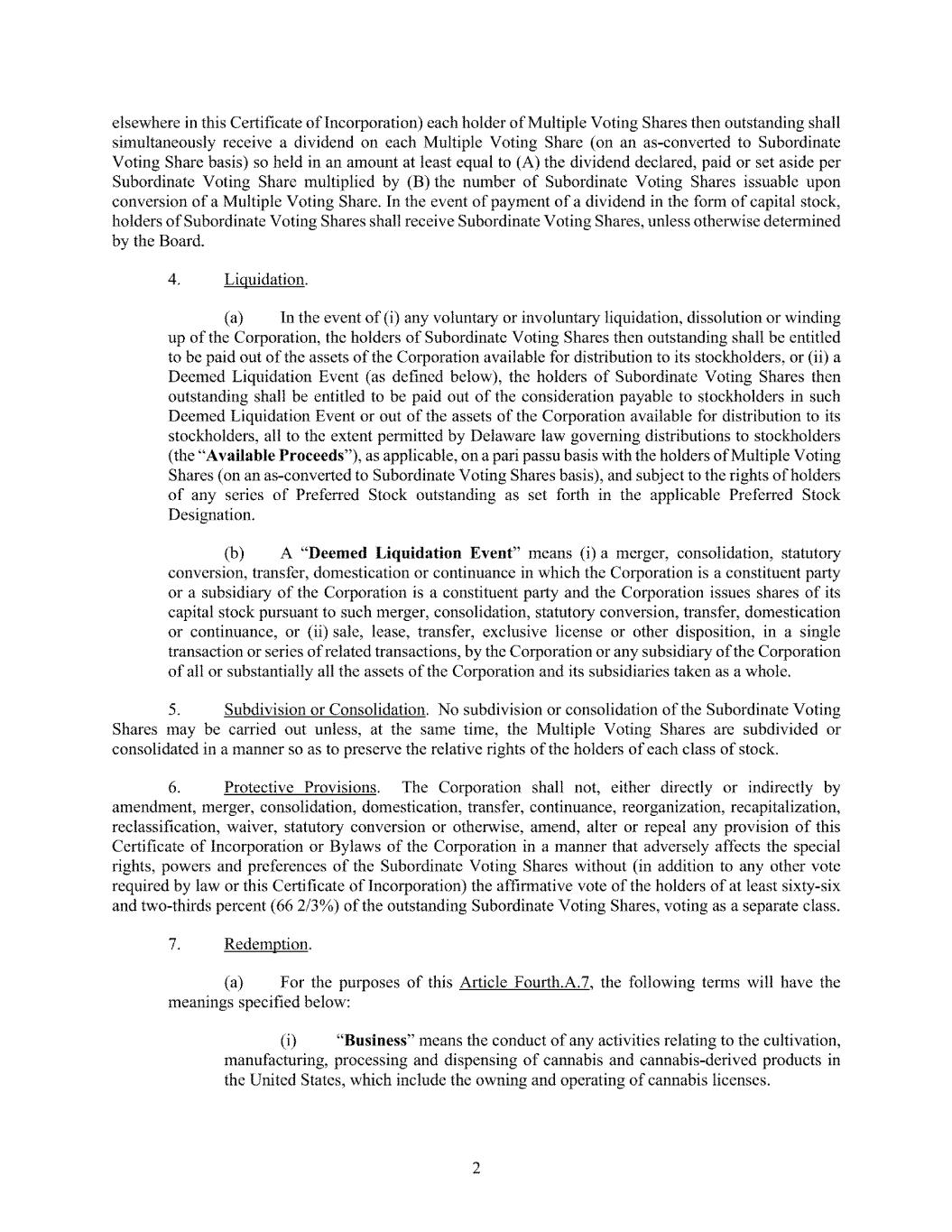
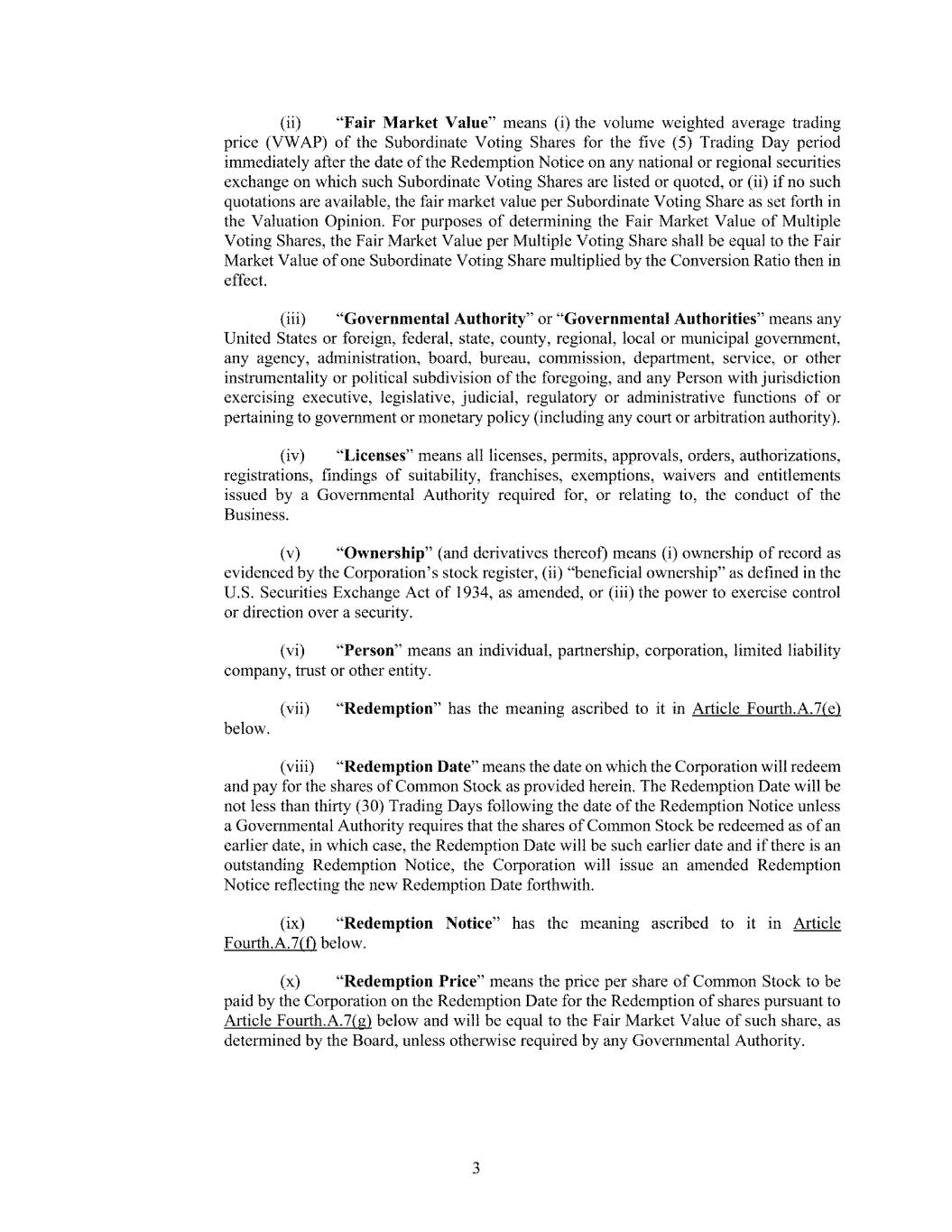

BYLAWS OF TRULIEVE CANNABIS CORP. (THE “CORPORATION”) ARTICLE I. CORPORATE OFFICES Section 1.1 Registered Office and Agent. The registered office and agent of the Corporation shall be fixed in the corporation’s Certificate of Incorporation, as the same may be amended from time to time (the “Certificate of Incorporation”). Section 1.2 Other Offices. The board of directors may at any time establish other offices at any place or places, either within or outside of the State of Delaware, where the Corporation is qualified to do business. ARTICLE II. MEETINGS OF STOCKHOLDERS Section 2.1 Place of Meetings. Meetings of stockholders shall be held at any place designated by the board of directors (a) within or outside the State of Delaware, or (b) by means of remote communication (a “Virtual Meeting”), in each case as may be determined by the board of directors from time to time. In the absence of any such designation, stockholders’ meetings shall be held at the registered office of the Corporation or the board of directors may, in its sole discretion, determine that the meeting shall not be held at any place, but will instead be held solely by means of remote communication as provided under Section 211 of the Delaware General Corporation Law (the “DGCL”). Section 2.2 Annual Meetings. The annual meeting of stockholders shall be held each year on a date and at a time designated by the board of directors. At the annual meeting, directors shall be elected and any other proper business may be transacted. Section 2.3 Special Meetings. Except as otherwise required by law or the Certificate of Incorporation, special meetings of the stockholders may be called only by the board of directors pursuant to a resolution approved by the affirmative vote of a majority of the directors then in office, or, if there are no directors then in office, by an officer of the Corporation. Only those matters set forth in the notice of the special meeting may be considered or acted upon at a special meeting of stockholders of the Corporation, unless otherwise required by law. Section 2.4 Notice of Stockholders’ Meetings. SCHEDULE C BYLAWS
2 Whenever stockholders are required or permitted to take any action at a meeting, a notice of the meeting shall be given in accordance with Section 232 of the DGCL. All notices of meetings of stockholders shall be in the form of a writing or electronic transmission and shall be sent or otherwise given to each stockholder entitled to vote at such meeting as of the record date for determining the stockholders entitled to notice of the meeting in accordance with Section 2.5 of these bylaws (these “Bylaws”) not less than ten (10) nor more than sixty (60) days before the date of the meeting. The notice shall specify the place, date and hour of the meeting, the record date for determining the stockholders entitled to vote at the meeting (if such date is different from the record date for determining stockholders entitled to notice of the meeting) and, in the case of a special meeting, the purpose or purposes for which the meeting is called. The means of remote communication, if any, by which stockholders and proxyholders may be deemed to be present in person and vote at such meeting shall also be provided in the notice. The board of directors acting pursuant to a resolution adopted by a majority of the directors then in office may cancel, postpone or reschedule any previously scheduled meeting of the stockholders at any time before or after the notice for such meeting has been sent to stockholders. Section 2.5 Manner of Giving Notice. A. Whenever notice is required by the DGCL, the Certificate of Incorporation or these Bylaws to be given to any stockholder, such notice may be given by mail, or by other means of written communication or electronic transmission, addressed to the stockholder at such stockholder’s address or electronic mail address, as applicable, as it appears on the records of the Corporation or as given by such stockholder to the Corporation for the purpose of notice. Notice of any meeting of stockholders shall be deemed given: (i) if mailed, when deposited in the U.S. mail, postage prepaid, directed to the stockholder at his or her address as it appears on the Corporation’s records; or (ii) if electronically transmitted as provided in Section 9.1 of these Bylaws. B. An affidavit of the secretary or an assistant secretary of the Corporation or of the transfer agent or any other agent of the Corporation that the notice has been given by mail or by a form of electronic transmission, as applicable, shall, in the absence of fraud, be prima facie evidence of the facts stated therein. Section 2.6 Quorum. A. The holders of one-third of the voting power of the stock issued and outstanding and entitled to vote thereat, present in person or represented by proxy, shall constitute a quorum at all meetings of the stockholders for the transaction of business, except as otherwise provided by statute or by the Certificate of Incorporation. Where a separate vote by one or more class or series is required, one-third of the voting power of the outstanding shares of such class(es) or series, present in person or represented by proxy, shall constitute a quorum entitled to take action with respect to that vote, except as required
3 by law, the Certificate of Incorporation or these Bylaws. If, however, such quorum is not present or represented at any meeting of the stockholders, then either (i) the chair of the meeting or (ii) the stockholders entitled to vote thereat, present in person or represented by proxy, shall have power to adjourn the meeting from time to time, without notice other than announcement at the meeting, until a quorum is present or represented. At such adjourned meeting at which a quorum is present or represented, any business may be transacted that might have been transacted at the meeting as originally noticed. B. When a quorum is present at an annual meeting or special meeting of stockholders, except with respect to the election of directors, action by the stockholders on a matter is approved if the number of votes cast in favor of the action by those present in person or represented by proxy exceeds the number of votes cast in opposition to the action, unless the question is one upon which, by express provision of the Bylaws or of the Certificate of Incorporation, a different vote is required, in which case such express provision shall govern and control the decision of the question. Section 2.7 Other Persons May Attend. The directors, officers, any counsel to the Corporation, any financial auditor of the Corporation and any other persons invited by the directors are entitled to attend any meeting of stockholders, but if any of those persons does attend a meeting of stockholders, that person is not to be counted in the quorum and is not entitled to vote at the meeting unless that person is a stockholder or proxy holder entitled to vote at the meeting. Section 2.8 Adjourned Meeting; Notice. The chair of a meeting of stockholders may, and if so directed by the meeting must, adjourn the meeting from time to time and from place to place (including an adjournment taken to address a technical failure to convene or continue a Virtual Meeting). Unless these Bylaws otherwise require, when a meeting is adjourned to another time or place not more than thirty (30) days from the date of the original meeting (including an adjournment taken to address a technical failure to convene or continue a Virtual Meeting), the Corporation shall not be required to provide separate notice of the adjourned meeting if the time, place, if any, thereof, and the means of remote communication, if any, by which stockholders and proxyholders may be deemed to be present in person and vote at such adjourned meeting are (i) announced at the meeting at which the adjournment is taken, (ii) displayed, during the time scheduled for the meeting, on the same electronic network used to enable stockholders and proxyholders to participate in the meeting by means of remote communication, or (iii) set forth in the notice of meeting given in accordance with the provisions of Section 2.4 and Section 2.5 of these Bylaws. At the adjourned meeting, the Corporation may transact any business that might have been transacted at the original meeting. If the adjournment is for more than thirty (30) days, or if after the adjournment a new record date is fixed for the adjourned meeting, a notice of the adjourned meeting shall be given to each stockholder of record entitled to vote at the meeting in accordance with the provisions of Section 2.4 and Section 2.5 of these Bylaws.
4 Section 2.9 Conduct of Business. The chair of any meeting of stockholders shall determine the order of business and the procedure at the meeting, including such matters as the regulation of the manner of voting and the conduct of business. Section 2.10 Chair; Selection of Alternate Chair. The chair of the board of directors or, in the absence of the chair of the board of directors, the president of the Corporation, shall preside at all meetings of the stockholders. In the absence of both the chair of the board of directors and the president of the Corporation, such person as the board of directors may have designated shall preside, and in the absence of such designation, such person as may be chosen by the holders of a majority of the voting power of the shares entitled to vote who are present, in person or by proxy, shall call to order the meeting and act as chair of the meeting. In the absence of the secretary of the Corporation, the secretary of the meeting shall be such person as the chair of the meeting appoints. Section 2.11 Voting on the Election of Directors; Retention of Ballots and Proxies. A. The stockholders entitled to vote at any meeting of stockholders shall be determined in accordance with the provisions of Section 2.13 of these Bylaws and subject to the provisions of Sections 217 and 218 of the DGCL (relating to voting rights of fiduciaries, pledgors and joint owners of stock and to voting trusts and other voting agreements). B. All elections of directors shall be by written ballot unless otherwise provided in the Certificate of Incorporation; if authorized by the board of directors, such requirement of a written ballot shall be satisfied by a ballot submitted by electronic transmission; provided that any such electronic transmission must either set forth or be submitted with information from which it can be determined that the electronic transmission was authorized by the stockholder or proxy holder. C. The voting rights of each class of capital stock, including whether shares of such class may be voted and the number of votes per share, shall be as set forth in the Certificate of Incorporation. If the Certificate of Incorporation does not specify such voting rights, each outstanding share of capital stock having voting power shall entitle the holder of record thereof or proxy to one vote on all matters properly brought before the stockholders. D. Except as otherwise required by law, the Certificate of Incorporation or these Bylaws, directors shall be elected by a plurality of the voting power of the shares present in person or represented by proxy at the meeting and entitled to vote on the election of directors; provided that, if the rules and requirements of the exchange on which the Corporation’s shares are then listed require a different voting standard for the election of directors, directors will be elected in accordance with the rules and requirements of such exchange. Section 2.12 Waiver of Notice.
5 Whenever notice is required to be given under any provision of the DGCL, the Certificate of Incorporation or these Bylaws, a written waiver thereof, signed by the person entitled to notice, or a waiver by electronic transmission by the person entitled to notice, whether before or after the time stated therein, shall be deemed equivalent to notice. Attendance of a person at a meeting shall constitute a waiver of notice of such meeting, except when the person attends a meeting for the express purpose of objecting, at the beginning of the meeting, to the transaction of any business because the meeting is not lawfully called or convened. Neither the business to be transacted at, nor the purpose of, any regular or special meeting of the stockholders need to be specified in any written waiver of notice, or any waiver by electronic transmission, unless so required by the Certificate of Incorporation or these Bylaws. Section 2.13 Record Date for Stockholder Notice; Voting; Giving Consents. A. In order that the Corporation may determine the stockholders entitled to notice of or to vote at any meeting of stockholders or any adjournment thereof, or entitled to express consent to corporate action in writing without a meeting (if permitted), or entitled to receive payment of any dividend or other distribution or allotment of any rights, or entitled to exercise any rights in respect of any change, conversion, or exchange of stock or for the purpose of any other lawful action, the board of directors may fix, in advance, a record date, which shall not be more than sixty (60) nor less than ten (10) days before the date of such meeting, nor more than sixty (60) days prior to any other action. B. If the board of directors does not so fix a record date: (i) the record date for determining stockholders entitled to notice of or to vote at a meeting of stockholders shall be at the close of business on the day next preceding the day on which notice is given, or, if notice is waived, at the close of business on the day next preceding the day on which the meeting is held; and (ii) the record date for determining stockholders for any other purpose shall be at the close of business on the day on which the board of directors adopts the resolution relating thereto. C. A determination of stockholders of record entitled to notice of or to vote at a meeting of stockholders shall apply to any adjournment of the meeting; provided, however, that the board of directors may fix a new record date for the adjourned meeting. Section 2.14 Nominations and Proposals for Annual Meetings of Stockholders. A. Nominations of persons for election to the board of directors of the Corporation and the proposal of business to be considered by the stockholders may be made at an annual meeting of stockholders (i) pursuant to the Corporation’s notice of meeting, (ii) by or at the direction of the board of directors, or (iii) by any stockholder of the Corporation who (x) was a stockholder of record at the time of giving of the notice provided for in this Section 2.14 and at the time of the annual meeting, (y) is entitled to vote with respect to such matter at the meeting, and (z) complies with the notice procedures set forth in this Section 2.14. At any annual meeting of stockholders, the presiding officer of such meeting may announce the nominations and other business to be considered which are set
6 forth in the Corporation’s notice of meeting and proxy statement and, by virtue thereof, such nominations and other business so announced shall be properly brought before such meeting and may be considered and voted upon by the stockholders of the Corporation entitled to vote thereat without further requirement of nomination, motion, or second. B. For nominations or other business to be properly brought before an annual meeting by a stockholder pursuant to clause (iii) of paragraph A of this Section 2.14, the stockholder making such nominations or proposing such other business must theretofore have given timely notice thereof in writing to the secretary of the Corporation and such other business must otherwise be a proper matter for stockholder action. To be timely, a stockholder’s notice shall be delivered to the secretary at the principal executive offices of the Corporation not later than the close of business on the 90th day nor earlier than the close of business on the 120th day prior to the first anniversary of the preceding year’s annual meeting; provided, however, that in the event that the date of the annual meeting is more than 30 days before or more than 70 days after such anniversary date, notice by the stockholder to be timely must be so delivered not later than the close of business on the later of (x) the 90th day prior to the scheduled date of such annual meeting (and no earlier than the 120th day prior to such scheduled date) or (y) the 10th day following the day on which public announcement of the date of such meeting is first made by the Corporation. In the case of a special meeting for the purpose of electing directors, notice of nominations must generally be received not earlier than the 120th day and not later than the 90th day prior to the meeting or the 10th day following public announcement of the meeting date. In no event shall the public announcement of an adjournment of an annual meeting commence a new time period for the giving of a stockholder’s notice as described above. To be in proper form, a stockholder’s notice to the secretary must: (i) set forth, as to the stockholder giving the notice and the beneficial owner, if any, on whose behalf the nomination or proposal is made (x) the name and address of such stockholder, as they appear on the Corporation’s books, and of such beneficial owner, if any, (y) the class or series and number of shares of the Corporation that are, directly or indirectly, owned beneficially and of record by such stockholder and such beneficial owner, if any, as of the date of such notice (which information shall be supplemented by such stockholder and beneficial owner not later than 10 days after the record date for the meeting to disclose such ownership as of the record date), and (z) any other information relating to such stockholder and beneficial owner, if any, that would be required to be disclosed in a proxy statement or other filings required to be made in connection with solicitations of proxies for, as applicable, the proposal and/or for the election of directors in a contested election pursuant to Section 14 of the Securities Exchange Act of 1934, as amended, and the rules and regulations promulgated thereunder (the “Exchange Act”); (ii) if the notice relates to any business other than the nomination of a director that the stockholder proposes to bring before the meeting, set forth (x) a brief description of the business desired to be brought before the meeting, the reasons for conducting such business at the meeting and any material interest of such stockholder and beneficial owner, if any, in such business, and (z) a
7 description of all agreements, arrangements and understandings between such stockholder and beneficial owner and any other person or persons (including their names) in connection with the proposal of such business by such stockholder; (iii) set forth, as to each person, if any, whom the stockholder proposes to nominate for election or reelection as a director (x) all information relating to such person that would be required to be disclosed in a proxy statement or other filings required to be made in connection with solicitations of proxies for election of directors in a contested election pursuant to Section 14 of the Exchange Act (including such person’s written consent to being named in the proxy statement as a nominee and to serving as a director if elected) and (y) a description of all direct and indirect compensation and other monetary agreements, arrangements and understandings during the past three years, and any other relationships, between or among such stockholder and beneficial owner, if any, and their respective affiliates and associates, or others acting in concert therewith, on the one hand, and each proposed nominee, and their respective affiliates and associates, or others acting in concert therewith, on the other hand, including, without limitation all information that would be required to be disclosed pursuant to Rule 404 promulgated under Regulation S-K if the stockholder making the nomination and any beneficial owner on whose behalf the nomination is made, if any, or any affiliate or associate thereof or person acting in concert therewith, were the “registrant” for purposes of such rule and the nominee were a director or executive officer of such registrant; and (iv) with respect to each nominee for election or reelection to the board of directors, include the completed and signed questionnaire, representation, and agreement required by paragraph D below. The Corporation may require any proposed nominee to furnish such other information as may reasonably be required by the Corporation to determine the eligibility of such proposed nominee to serve as an independent director of the Corporation or that could be material to a reasonable stockholder’s understanding of the independence, or lack thereof, of such nominee. C. Notwithstanding anything in the second sentence of paragraph B of this Section 2.14 to the contrary, in the event that the number of directors to be elected to the board of directors of the Corporation at an annual meeting is increased, whether by increase in the size of the board of directors, or by any vacancy in the board of directors to be filled at such annual meeting, and there is no public announcement by the Corporation naming all of the nominees for directors or specifying the size of the increased board of directors at least 75 days prior to the first anniversary of the preceding year’s annual meeting, a stockholder’s notice required by this Section 2.14 shall also be considered timely, but only with respect to nominees for any such vacant positions and for any new positions created by such increase, if it shall be delivered to the secretary at the principal executive offices of the Corporation not later than the close of business on the 10th day following the day on which such public announcement is first made by the Corporation. D. To be eligible to be a nominee for election or reelection as a director of the Corporation, a person must deliver (in accordance with the time periods prescribed for
8 delivery of notice under paragraphs B and C above) to the secretary of the Corporation at the principal executive offices of the Corporation a completed, written and signed questionnaire (in the form customarily used by the Corporation for its directors) with respect to the background and qualification of such person and the background of any other person or entity on whose behalf the nomination is being made (which questionnaire shall be provided by the secretary upon written request) and a written representation and agreement (in the form provided by the secretary upon written request) that such person: (i) is not and will not become a party to (x) any agreement, arrangement or understanding with, and has not given any commitment or assurance to, any person or entity as to how such person, if elected as a director of the Corporation, will act or vote on any issue or question (a “Voting Commitment”) that has not been disclosed to the Corporation or (y) any Voting Commitment that could limit or interfere with such person’s ability to comply, if elected as a director of the Corporation, with such person’s fiduciary duties under applicable law; (ii) is not and will not become a party to any agreement, arrangement or understanding with any person or entity other than the Corporation with respect to any direct or indirect compensation, reimbursement or indemnification in connection with service or action as a director that has not been disclosed therein; and (iii) in such person’s individual capacity and on behalf of any person or entity on whose behalf the nomination is being made, would be in compliance, if elected as a director of the Corporation, and will comply with all applicable publicly disclosed corporate governance, conflict of interest, confidentiality, and stock ownership and trading policies and guidelines of the Corporation. E. Notwithstanding the foregoing provisions of this Section 2.14, a stockholder shall also comply with all applicable requirements of the Exchange Act, and the rules and regulations thereunder with respect to the matters set forth in this Section 2.14, and nothing in this Section 2.14 shall be deemed to affect any rights of stockholders to request inclusion of proposals in the Corporation’s proxy statement pursuant to Rule 14a-8 under the Exchange Act (or any successor provision thereof) and, to the extent required by such rule, have such proposals considered and voted on at an annual meeting. F. Without exception, no business will be conducted and no person shall be eligible for election as a director of the Corporation at any annual meeting except as brought or nominated in accordance with the provisions set forth in this Section 2.14. In addition, business proposed to be brought by a stockholder may not be brought before the annual meeting, and a nominee shall not be eligible for election, if the notice to the Corporation concerning such business or nomination contains an untrue statement of material fact or omits to state a material fact necessary to make the statements therein not misleading. The chair of the annual meeting shall, if the facts warrant, determine and declare at the annual meeting that business was not properly brought before the annual meeting, and/or nomination was not made, in accordance with this Section 2.14, and, if the chair shall so determine, he or she shall so declare at the annual meeting that any such
9 business not properly brought before the meeting shall not be conducted or nomination disregarded. Section 2.15 List of Stockholders Entitled to Vote. The officer who has charge of the stock ledger of the Corporation shall prepare and make, at least ten (10) days before every meeting of stockholders, a complete list of the stockholders entitled to vote at the meeting, arranged in alphabetical order, and showing the address (but not the electronic address or other electronic contact information) of each stockholder and the number of shares registered in the name of each stockholder. Such list shall be open to the examination of any stockholder, for any purpose germane to the meeting, for a period of at least ten (10) days prior to the meeting (i) during ordinary business hours, either at a place within the city where the meeting is to be held, which place shall he specified in the notice of the meeting, or, if not so specified, at the place where the meeting is to be held or (ii) by a reasonably accessible electronic network; provided that the information required to gain access to such list is provided with the notice of the meeting. If the Corporation determines to make the list available on an electronic network, the Corporation may take reasonable steps to ensure that such information is only available to the stockholders. Such list shall presumptively determine the identity of the stockholders entitled to vote at the meeting, and the number of shares held by each of them. Section 2.16 Proxies. A. Each stockholder entitled to vote at a meeting of stockholders or to express consent or dissent to corporate action in writing without a meeting may authorize another person or persons to act for them by proxy, but no such proxy shall be voted or acted upon after three (3) years from its date, unless the proxy provides for a longer period. A stockholder may appoint one or more alternate proxy holders to act in the place of an absent proxy holder. A proxy shall be deemed signed if the stockholder’s name is placed on the proxy (whether by manual signature, typewriting, facsimile, electronic or telegraphic transmission or otherwise) by the stockholder or the stockholder’s attorney-in-fact. The revocability of a proxy that states on its face that it is irrevocable shall be governed by the provisions of Section 212 of the DGCL. B. A proxy for a meeting of stockholders must: (i) be received at the registered office of the Corporation or at any other place specified, in the notice calling the meeting, for the receipt of proxies, at least the number of business days specified in the notice, or if no number of days is specified, two business days before the day set for the holding of the meeting; or (ii) unless the notice provides otherwise, be provided, at the meeting, to the chair of the meeting or to a person designated by the chair of the meeting. A proxy may be sent to the Corporation by written instrument, fax or any other method of transmitting legibly recorded messages. C. A vote given in accordance with the terms of a proxy is valid notwithstanding the death or incapacity of the stockholder giving the proxy and despite the
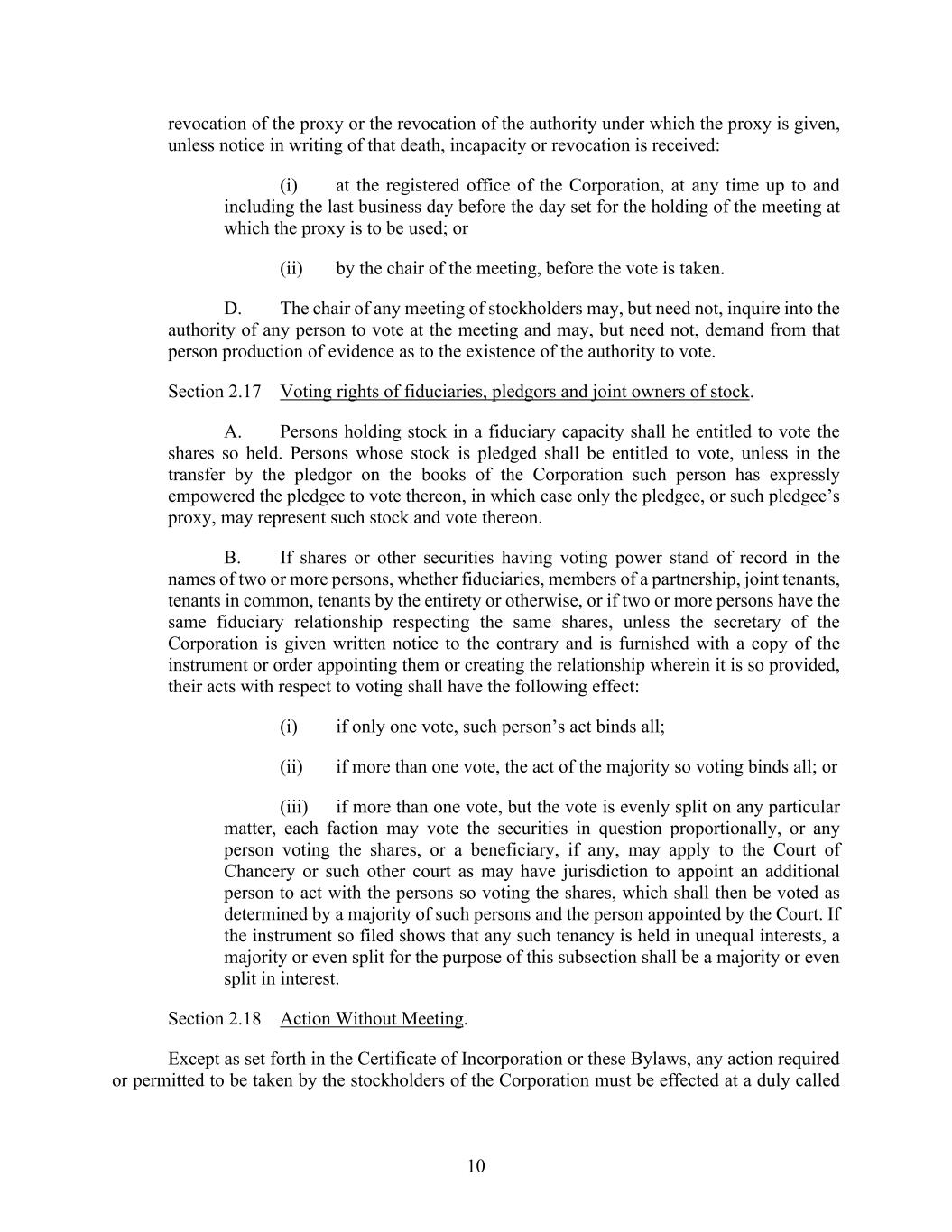
10 revocation of the proxy or the revocation of the authority under which the proxy is given, unless notice in writing of that death, incapacity or revocation is received: (i) at the registered office of the Corporation, at any time up to and including the last business day before the day set for the holding of the meeting at which the proxy is to be used; or (ii) by the chair of the meeting, before the vote is taken. D. The chair of any meeting of stockholders may, but need not, inquire into the authority of any person to vote at the meeting and may, but need not, demand from that person production of evidence as to the existence of the authority to vote. Section 2.17 Voting rights of fiduciaries, pledgors and joint owners of stock. A. Persons holding stock in a fiduciary capacity shall he entitled to vote the shares so held. Persons whose stock is pledged shall be entitled to vote, unless in the transfer by the pledgor on the books of the Corporation such person has expressly empowered the pledgee to vote thereon, in which case only the pledgee, or such pledgee’s proxy, may represent such stock and vote thereon. B. If shares or other securities having voting power stand of record in the names of two or more persons, whether fiduciaries, members of a partnership, joint tenants, tenants in common, tenants by the entirety or otherwise, or if two or more persons have the same fiduciary relationship respecting the same shares, unless the secretary of the Corporation is given written notice to the contrary and is furnished with a copy of the instrument or order appointing them or creating the relationship wherein it is so provided, their acts with respect to voting shall have the following effect: (i) if only one vote, such person’s act binds all; (ii) if more than one vote, the act of the majority so voting binds all; or (iii) if more than one vote, but the vote is evenly split on any particular matter, each faction may vote the securities in question proportionally, or any person voting the shares, or a beneficiary, if any, may apply to the Court of Chancery or such other court as may have jurisdiction to appoint an additional person to act with the persons so voting the shares, which shall then be voted as determined by a majority of such persons and the person appointed by the Court. If the instrument so filed shows that any such tenancy is held in unequal interests, a majority or even split for the purpose of this subsection shall be a majority or even split in interest. Section 2.18 Action Without Meeting. Except as set forth in the Certificate of Incorporation or these Bylaws, any action required or permitted to be taken by the stockholders of the Corporation must be effected at a duly called
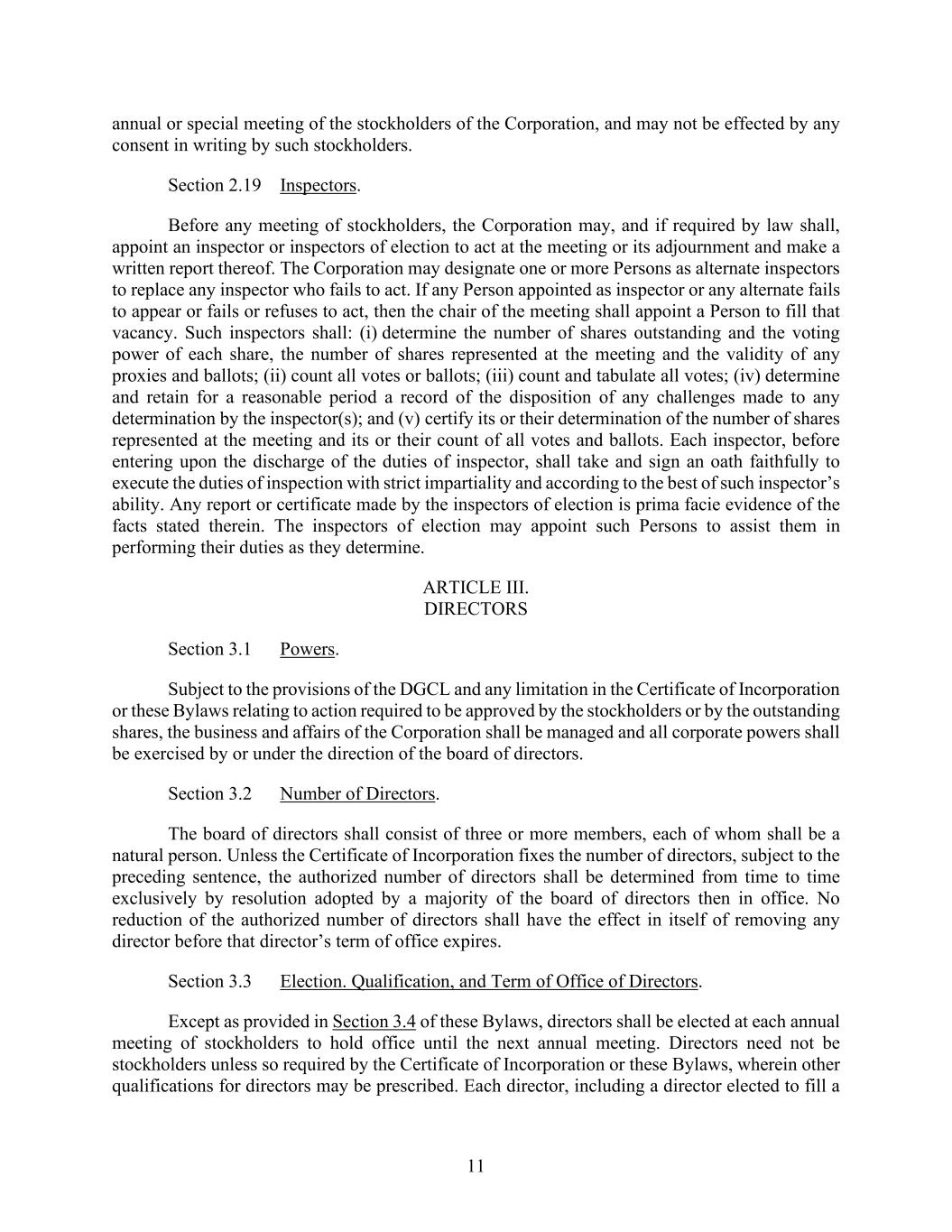
11 annual or special meeting of the stockholders of the Corporation, and may not be effected by any consent in writing by such stockholders. Section 2.19 Inspectors. Before any meeting of stockholders, the Corporation may, and if required by law shall, appoint an inspector or inspectors of election to act at the meeting or its adjournment and make a written report thereof. The Corporation may designate one or more Persons as alternate inspectors to replace any inspector who fails to act. If any Person appointed as inspector or any alternate fails to appear or fails or refuses to act, then the chair of the meeting shall appoint a Person to fill that vacancy. Such inspectors shall: (i) determine the number of shares outstanding and the voting power of each share, the number of shares represented at the meeting and the validity of any proxies and ballots; (ii) count all votes or ballots; (iii) count and tabulate all votes; (iv) determine and retain for a reasonable period a record of the disposition of any challenges made to any determination by the inspector(s); and (v) certify its or their determination of the number of shares represented at the meeting and its or their count of all votes and ballots. Each inspector, before entering upon the discharge of the duties of inspector, shall take and sign an oath faithfully to execute the duties of inspection with strict impartiality and according to the best of such inspector’s ability. Any report or certificate made by the inspectors of election is prima facie evidence of the facts stated therein. The inspectors of election may appoint such Persons to assist them in performing their duties as they determine. ARTICLE III. DIRECTORS Section 3.1 Powers. Subject to the provisions of the DGCL and any limitation in the Certificate of Incorporation or these Bylaws relating to action required to be approved by the stockholders or by the outstanding shares, the business and affairs of the Corporation shall be managed and all corporate powers shall be exercised by or under the direction of the board of directors. Section 3.2 Number of Directors. The board of directors shall consist of three or more members, each of whom shall be a natural person. Unless the Certificate of Incorporation fixes the number of directors, subject to the preceding sentence, the authorized number of directors shall be determined from time to time exclusively by resolution adopted by a majority of the board of directors then in office. No reduction of the authorized number of directors shall have the effect in itself of removing any director before that director’s term of office expires. Section 3.3 Election. Qualification, and Term of Office of Directors. Except as provided in Section 3.4 of these Bylaws, directors shall be elected at each annual meeting of stockholders to hold office until the next annual meeting. Directors need not be stockholders unless so required by the Certificate of Incorporation or these Bylaws, wherein other qualifications for directors may be prescribed. Each director, including a director elected to fill a
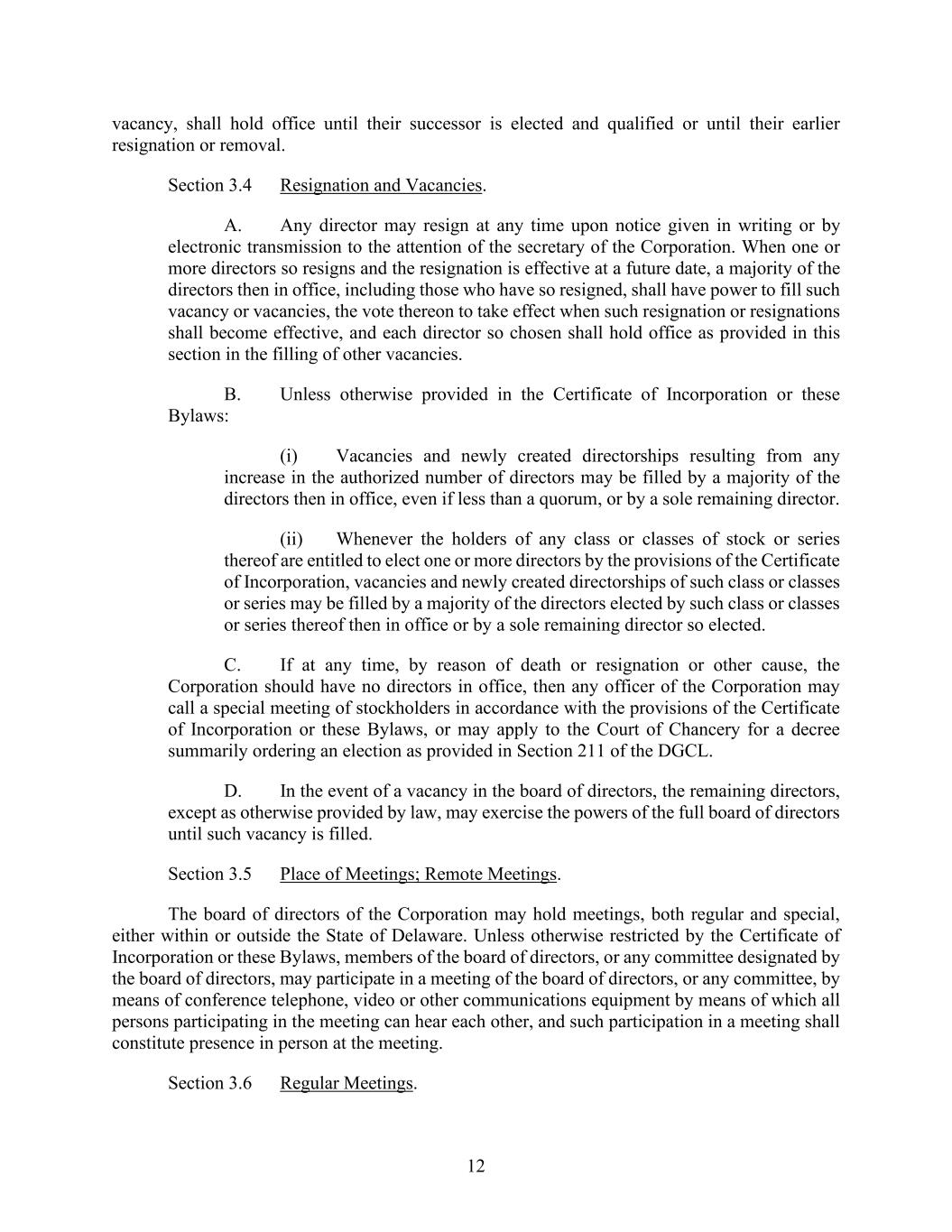
12 vacancy, shall hold office until their successor is elected and qualified or until their earlier resignation or removal. Section 3.4 Resignation and Vacancies. A. Any director may resign at any time upon notice given in writing or by electronic transmission to the attention of the secretary of the Corporation. When one or more directors so resigns and the resignation is effective at a future date, a majority of the directors then in office, including those who have so resigned, shall have power to fill such vacancy or vacancies, the vote thereon to take effect when such resignation or resignations shall become effective, and each director so chosen shall hold office as provided in this section in the filling of other vacancies. B. Unless otherwise provided in the Certificate of Incorporation or these Bylaws: (i) Vacancies and newly created directorships resulting from any increase in the authorized number of directors may be filled by a majority of the directors then in office, even if less than a quorum, or by a sole remaining director. (ii) Whenever the holders of any class or classes of stock or series thereof are entitled to elect one or more directors by the provisions of the Certificate of Incorporation, vacancies and newly created directorships of such class or classes or series may be filled by a majority of the directors elected by such class or classes or series thereof then in office or by a sole remaining director so elected. C. If at any time, by reason of death or resignation or other cause, the Corporation should have no directors in office, then any officer of the Corporation may call a special meeting of stockholders in accordance with the provisions of the Certificate of Incorporation or these Bylaws, or may apply to the Court of Chancery for a decree summarily ordering an election as provided in Section 211 of the DGCL. D. In the event of a vacancy in the board of directors, the remaining directors, except as otherwise provided by law, may exercise the powers of the full board of directors until such vacancy is filled. Section 3.5 Place of Meetings; Remote Meetings. The board of directors of the Corporation may hold meetings, both regular and special, either within or outside the State of Delaware. Unless otherwise restricted by the Certificate of Incorporation or these Bylaws, members of the board of directors, or any committee designated by the board of directors, may participate in a meeting of the board of directors, or any committee, by means of conference telephone, video or other communications equipment by means of which all persons participating in the meeting can hear each other, and such participation in a meeting shall constitute presence in person at the meeting. Section 3.6 Regular Meetings.
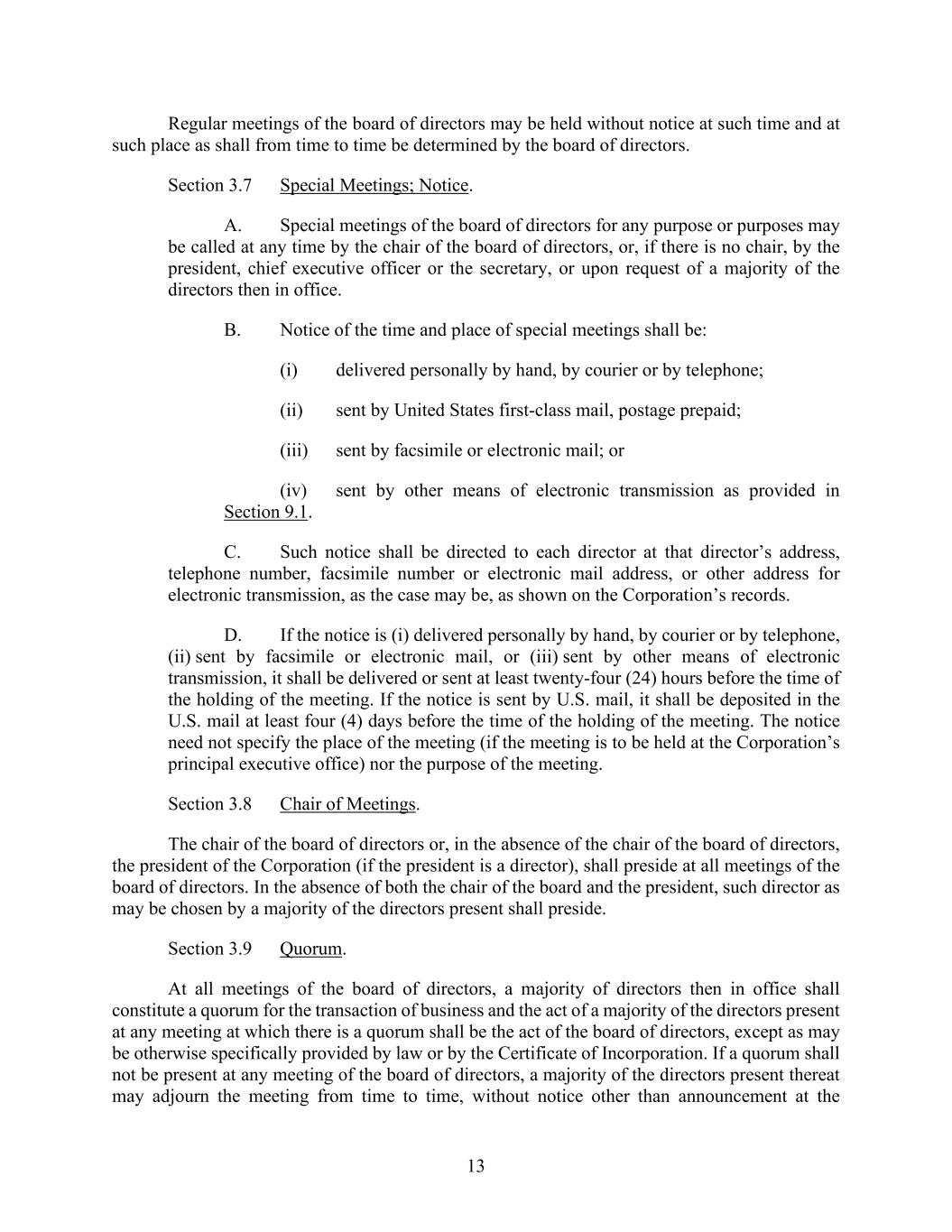
13 Regular meetings of the board of directors may be held without notice at such time and at such place as shall from time to time be determined by the board of directors. Section 3.7 Special Meetings; Notice. A. Special meetings of the board of directors for any purpose or purposes may be called at any time by the chair of the board of directors, or, if there is no chair, by the president, chief executive officer or the secretary, or upon request of a majority of the directors then in office. B. Notice of the time and place of special meetings shall be: (i) delivered personally by hand, by courier or by telephone; (ii) sent by United States first-class mail, postage prepaid; (iii) sent by facsimile or electronic mail; or (iv) sent by other means of electronic transmission as provided in Section 9.1. C. Such notice shall be directed to each director at that director’s address, telephone number, facsimile number or electronic mail address, or other address for electronic transmission, as the case may be, as shown on the Corporation’s records. D. If the notice is (i) delivered personally by hand, by courier or by telephone, (ii) sent by facsimile or electronic mail, or (iii) sent by other means of electronic transmission, it shall be delivered or sent at least twenty-four (24) hours before the time of the holding of the meeting. If the notice is sent by U.S. mail, it shall be deposited in the U.S. mail at least four (4) days before the time of the holding of the meeting. The notice need not specify the place of the meeting (if the meeting is to be held at the Corporation’s principal executive office) nor the purpose of the meeting. Section 3.8 Chair of Meetings. The chair of the board of directors or, in the absence of the chair of the board of directors, the president of the Corporation (if the president is a director), shall preside at all meetings of the board of directors. In the absence of both the chair of the board and the president, such director as may be chosen by a majority of the directors present shall preside. Section 3.9 Quorum. At all meetings of the board of directors, a majority of directors then in office shall constitute a quorum for the transaction of business and the act of a majority of the directors present at any meeting at which there is a quorum shall be the act of the board of directors, except as may be otherwise specifically provided by law or by the Certificate of Incorporation. If a quorum shall not be present at any meeting of the board of directors, a majority of the directors present thereat may adjourn the meeting from time to time, without notice other than announcement at the
14 meeting, until a quorum shall be present. If, and at such times as, the Certificate of Incorporation provides that one or more directors shall have more or less than one vote per director on any matter, every reference in these Bylaws to a majority or other proportion of directors shall refer to a majority or other proportion of the votes of such directors. Section 3.10 Board Action by Written Consent Without a Meeting. Unless otherwise restricted by the Certificate of Incorporation or these Bylaws, any action required or permitted to be taken at any meeting of the board of directors, or of any committee thereof, may be taken without a meeting if all members of the board or committee, as the case may be, consent thereto in writing or by electronic transmission. Section 3.11 Fees and Compensation of Directors. Unless otherwise restricted by the Certificate of Incorporation or these Bylaws, the board of directors shall have the authority to fix the compensation of directors. The directors may be paid their expenses, if any, of attendance at each meeting of the board of directors and may be paid a fixed sum for attendance at each meeting of the board of directors or a stated salary as director. No such payment shall preclude any director from serving the Corporation in any other capacity and receiving compensation therefor, and remuneration may be in addition to any salary or other remuneration paid to any officer or employee of the Corporation as such, who is also a director. Members of special or standing committees may be allowed like compensation for attending committee meetings. Section 3.12 Approval of Loans. The Corporation shall not, either directly or indirectly, including through any subsidiary, extend or maintain credit, arrange for the extension of credit, or renew an extension of credit, in the form of a personal loan to or for any director, executive officer (or equivalent thereof), or control person, but may lend money to and use its credit to assist any employee, excluding such executive officers, directors, or other control persons of the Corporation or of a subsidiary, whenever, in the judgment of the directors, such loan, guarantee, or assistance may reasonably be expected to benefit the Corporation. The loan, guarantee or other assistance may be with or without interest and may be unsecured or secured in such manner as the board of directors shall approve, including, without limitation, a pledge of shares of stock of the Corporation. Nothing contained in this section shall be deemed to deny, limit or restrict the powers of guarantee or warranty of the Corporation at common law or under any statute. Section 3.13 Removal of Directors. A. Unless otherwise restricted by statute, by the Certificate of Incorporation or these Bylaws, any director or the entire board of directors may be removed by an affirmative vote of the holders of at least a majority of the voting power of the outstanding shares then entitled to vote at a meeting of the stockholders called for that purpose. B. No reduction of the authorized number of directors shall have the effect of removing any director prior to the expiration of such director’s term of office.
15 ARTICLE IV. COMMITTEES Section 4.1 Committees of Directors. A. The board of directors may, by resolution passed by a majority of the whole board of directors, designate one or more committees, with each committee to consist of one or more of the directors of the Corporation. The board of directors may designate one or more directors as alternate members of any committee who may replace any absent or disqualified member at any meeting of the committee. In the absence or disqualification of a member of a committee, the member or members thereof present at any meeting and not disqualified from voting, whether or not they constitute a quorum, may unanimously appoint another member of the board of directors to act at the meeting in the place of any such absent or disqualified member. Any such committee, to the extent provided in the resolution of the board of directors or in the Bylaws of the Corporation, shall have and may exercise all the powers and authority of the board of directors in the management of the business and affairs of the Corporation, and may authorize the seal of the Corporation to be affixed to all papers that may require it: but no such committee shall have the power or authority to (i) approve, adopt or recommend to the stockholders any action or matter the DGCL expressly requires be submitted to the stockholders for approval; (ii) adopt, amend, or repeal these Bylaws; (iii) fill vacancies in the board of directors; (iv) remove a director; or (v) change the membership of, or fill vacancies in, any committee of the directors. B. The directors may, at any time, with respect to a committee appointed hereunder, (i) revoke or alter the authority given to the committee, or override a decision made by the committee; (ii) terminate the appointment of, or change the membership of, the committee; and (iii) fill vacancies in the committee. Section 4.2 Committee Minutes. Each committee shall keep regular minutes of its meetings and report the same to the board of directors when required. Section 4.3 Meetings and Action of Committees. A. Meetings and actions of committees shall be governed by, and held and taken in accordance with, the provisions of Section 3.5 (place of meetings and meetings by telephone), Section 3.6 (regular meetings), Section 3.7 (special meetings and notice), Section 3.8 (chair of meetings), Section 3.9 (quorum), and Section 3.10 (board action by written consent without a meeting), with such changes in the context of those bylaws as are necessary to substitute the committee and its members for the board of directors and its members; provided, however, that the time of regular meetings of committees may be determined either by resolution of the board of directors or by resolution of the committee, that special meetings of committees may also be called by resolution of the board of directors and that notice of special meetings of committees shall also be given to all alternate members, who shall have the right to attend all meetings of the committee.
16 B. The board of directors may adopt rules for the governance of any committee not inconsistent with the provisions of these Bylaws. ARTICLE V. OFFICERS Section 5.1 Officers. A. The officers of the Corporation shall include a chief executive officer, a chief financial officer and a secretary and such other officers (including without limitation, a chair of the board of directors, president, vice presidents, assistant secretaries and a treasurer) as the board of directors from time to time may determine. B. An officer is not required to hold stock in the Corporation as qualification for their office but must be qualified as required by the DGCL to become, act or continue to act as an officer. Any number of offices may be held by the same person, unless the Certificate of Incorporation or these Bylaws otherwise provide. C. Any person appointed as the chair of the board of directors must be a director. Any other officer need not be a director. Section 5.2 Appointment of Officers. The officers of the Corporation, except such officers as may be appointed in accordance with the provisions of Section 5.3 or Section 5.5 of these Bylaws, shall be appointed by the board of directors, subject to the rights, if any, of an officer under any contract of employment. Section 5.3 Subordinate Officers. The board of directors may appoint, or empower the chief executive officer to appoint, such other officers and agents as the business of the Corporation may require, each of whom shall hold office for such period, have such authority, and perform such duties as are provided in these Bylaws or as the board of directors may from time to time determine. Section 5.4 Removal and Resignation of Officers. A. Subject to the rights, if any, of an officer under any contract of employment, any officer may be removed, either with or without cause, by an affirmative vote of the majority of the board of directors at any regular or special meeting of the board of directors or, except in the case of an officer chosen by the board of directors, by any officer upon whom such power of removal may be conferred by the board of directors. B. Any officer may resign at any time by giving written notice to the Corporation. Any resignation shall take effect at the date of the receipt of that notice or at any later time specified in that notice; and, unless otherwise specified in that notice, the acceptance of the resignation shall not be necessary to make it effective. Any resignation is without prejudice to the rights, if any, of the Corporation under any contract to which the officer is a party.
17 Section 5.5 Vacancies in Offices. Any vacancy occurring in any office of the Corporation shall be filled by the affirmative vote of a majority of the remaining directors, even if they constitute less than a quorum. Section 5.6 Chair of the Board. The chair of the board of directors, if such an officer be elected, shall, if present, preside at meetings of the board of directors and of the stockholders at which he or she shall be present, and exercise and perform such other powers and duties as may from time to time be assigned to him or her by the board of directors or as may be prescribed by these Bylaws. If there is no chief executive officer, then the chair of the board of directors shall also be the chief executive officer of the Corporation. Section 5.7 Representation of Shares of Other Corporations. The chair of the board of directors, the chief executive officer, any vice president, the chief financial officer, the secretary or assistant secretary of this Corporation, or any other person authorized by the board of directors or the chief executive officer or a vice president, is authorized to vote, represent, and exercise on behalf of this Corporation all rights incident to any and all shares of any other corporation or corporations standing in the name of this Corporation. The authority granted herein may be exercised either by such person directly or by any other person authorized to do so by proxy or power of attorney duly executed by such person having the authority. Section 5.8 Authority and Duties of Officers. In addition to the foregoing authority and duties, all officers of the Corporation shall respectively have such authority and perform such duties in the management of the business of the Corporation as may be designated from time to time by the board of directors or the stockholders. ARTICLE VI. STOCK Section 6.1 Stock Certificates. The shares of the Corporation shall not be represented by certificates but shall be uncertificated and represented by book entry notations in the books of the Corporation; provided that the board of directors by resolution may provide that some or all of the shares of any class or series of stock of the Corporation shall be represented by certificates. Certificates for the shares of stock, if any, shall be in such form as is consistent with the Certificate of Incorporation and applicable law. Every holder of stock represented by a certificate shall be entitled to have a certificate signed by, or in the name of the Corporation by, any two officers authorized to sign stock certificates representing the number of shares registered in certificate form. The chair or vice chair of the board of directors, the president, vice president, the treasurer, any assistant treasurer, the secretary or any assistant secretary of the Corporation shall be specifically authorized to sign stock certificates. Any or all of the signatures on the certificate may be a facsimile or electronic signature. In case any officer who has signed or whose facsimile signature has been placed upon a
18 certificate has ceased to be such officer before such certificate is issued, it may be issued by the Corporation with the same effect as if he or she were such officer at the date of issue. Section 6.2 Lost Certificates. The Corporation may issue a new certificate of stock or uncertificated shares in the place of any certificate theretofore issued by it, alleged to have been lost, stolen or destroyed, and the Corporation may require the owner of the lost, stolen or destroyed certificate, or such owner’s legal representative, to give the Corporation a bond sufficient to indemnify it against any claim that may be made against it on account of the alleged loss, theft or destruction of any such certificate or the issuance of such new certificate or uncertificated shares. Section 6.3 Shares Without Certificates. Unless the board of directors determines that all of the shares of any class or series of stock of the Corporation shall be represented by certificates, the Corporation shall adopt a system of issuance, recordation and transfer of its shares of stock by electronic or other means not involving the issuance of certificates, provided the use of such system by the Corporation is permitted in accordance with applicable law and these Bylaws. Section 6.4 Dividends. The board of directors, subject to any restrictions contained in either the DGCL or the Certificate of Incorporation, may declare and pay dividends upon the shares of its capital stock. Dividends may be paid in cash, in property or in shares of the Corporation’s capital stock. The board of directors may set apart out of any of the funds of the Corporation available for dividends a reserve or reserves for any proper purpose and may abolish any such reserve. Such purposes shall include, but not be limited to, equalizing dividends, repairing or maintaining any property of the Corporation, and meeting contingencies. Section 6.5 Transfer of Stock. Shares of the Corporation shall be transferable in the manner prescribed by law and in these Bylaws. Shares of stock of the Corporation shall be transferred on the books of the Corporation only by the holder of record thereof or by such holder’s attorney duly authorized in writing, upon surrender to the Corporation of the certificate or certificates representing such shares endorsed by the appropriate Person or Persons (or by delivery of duly executed instructions with respect to uncertificated shares), with such evidence of the authenticity of such endorsement or execution, transfer, authorization and other matters as the Corporation may reasonably require, and accompanied by all necessary stock transfer stamps. No transfer of stock shall be valid as against the Corporation for any purpose until it shall have been entered in the stock records of the Corporation by an entry showing the names of the Persons from and to whom it was transferred. ARTICLE VII. INDEMNITY Section 7.1 Third-Party Actions.
19 Subject to the provisions of this Article VII, the Corporation shall indemnify any person who was or is a party or is threatened to be made a party to any threatened, pending or completed action, suit or proceeding, whether civil, criminal, administrative or investigative (other than an action by or in the right of the Corporation) by reason of the fact that they are or were a director or officer of the Corporation, or is or was serving at the request of the Corporation as a director or officer of another corporation, partnership, joint venture, trust or other enterprise, against expenses (including attorneys’ fees), judgments, fines and amounts paid in settlement (if such settlement is approved in advance by the Corporation, which approval shall not be unreasonably withheld) actually and reasonably incurred by them in connection with such action, suit or proceeding if they acted in good faith and in a manner they reasonably believed to be in or not opposed to the best interests of the Corporation, and, with respect to any criminal action or proceeding, had no reasonable cause to believe their conduct was unlawful. The Corporation may, in its sole discretion and on such terms and conditions as the board of directors deems appropriate, indemnify any person who was or is a party or is threatened to be made a party to any such action, suit or proceeding by reason of the fact that they are or were an employee or agent of the Corporation, or is or was serving at the request of the Corporation as an employee or agent of another corporation, partnership, joint venture, trust or other enterprise against such expenses, judgments, fines and amounts paid in settlement on the same terms set forth in the preceding sentence. The termination of any action, suit or proceeding by judgment, order, settlement, conviction or upon a plea of nolo contendere or its equivalent, shall not, of itself, create a presumption that the person did not act in good faith and in a manner which they reasonably believed to be in or not opposed to the best interests of the Corporation, and, with respect to any criminal action or proceeding, had reasonable cause to believe that their conduct was unlawful. Section 7.2 Actions by or in the Right of the Corporation. Subject to the provisions of this Article VII, the Corporation shall indemnify any person who was or is a party or is threatened to be made a party to any threatened, pending or completed action or suit by or in the right of the Corporation to procure a judgment in its favor by reason of the fact that they are or were a director or officer of the Corporation, or is or was serving at the request of the Corporation as a director or officer of another corporation, partnership, joint venture, trust or other enterprise against expenses (including attorneys’ fees) actually and reasonably incurred by them in connection with the defense or settlement of such action or suit, if they acted in good faith and in a manner they reasonably believed to be in or not opposed to the best interests of the Corporation, except that no indemnification shall be made in respect of any claim, issue or matter as to which such person shall have been adjudged to be liable to the Corporation unless and only to the extent that the Delaware Court of Chancery or the court in which such action or suit was brought shall determine upon application that, despite the adjudication of liability but in view of all the circumstances of the case, such person is fairly and reasonably entitled to indemnity for such expenses which the Delaware Court of Chancery or such other court shall deem proper. The Corporation may, in its sole discretion and on such terms and conditions as the board of directors deems appropriate, indemnify any person who was or is a party or is threatened to be made a party to any such action or suit by reason of the fact that they are or were an employee or agent of the Corporation, or is or was serving at the request of the Corporation as an employee or agent of another corporation, partnership, joint venture, trust, or other enterprise, against such expenses on the same terms set forth in the preceding sentence. Notwithstanding any other provision of this Article VII, no person shall be indemnified hereunder for any expenses or amounts paid in
20 settlement with respect to any action to recover short-swing profits under Section 16(b) of the Exchange Act. Section 7.3 Successful Defense. To the extent that a director, officer, employee or agent of the Corporation has been successful on the merits or otherwise in defense of any action, suit, or proceeding referred to in Section 7.1 and Section 7.2, or in defense of any claim, issue or matter therein, they shall be indemnified against expenses (including attorneys’ fees) actually and reasonably incurred by them in connection therewith. Section 7.4 Determination of Conduct. Any indemnification under Section 7.1 or Section 7.2 (unless ordered by a court) shall be made by the Corporation only as authorized in the specific case upon a determination that the indemnification of the director, officer, employee or agent is proper in the circumstances because they have met the applicable standard of conduct set forth in Section 7.1 or Section 7.2 and such indemnified person was authorized in advance by the board of directors, as applicable. Such determination shall be made (i) by the board of directors by a majority vote of a quorum consisting of directors who were not parties to such action, suit, or proceeding or (ii) if such quorum is not obtainable or, even if obtainable, as a quorum of disinterested directors so directs, by independent legal counsel in a written opinion, (iii) by a committee of such directors designated by a majority vote of such directors, even though less than a quorum, (iv) if there are no such directors, or if such directors so direct, by independent legal counsel in a written opinion, or (v) by the stockholders. Notwithstanding the foregoing, a director, officer, employee, or agent of the Corporation shall be entitled to contest any determination that the director, officer, employee, or agent has not met the applicable standard of conduct set forth in Section 7.1 or Section 7.2 by petitioning a court of competent jurisdiction. Section 7.5 Payment of Expenses in Advance. Expenses incurred in defending a civil or criminal action, suit, or proceeding, by an individual who may be entitled to indemnification pursuant to Section 7.1 or Section 7.2, shall be paid by the Corporation in advance of the final disposition of such action, suit, or proceeding upon receipt of an undertaking by or on behalf of the director or officer to repay such amount if it shall ultimately be determined that they are not entitled to be indemnified by the Corporation as authorized in this Article VII. The Corporation may, in its sole discretion and upon such terms and conditions as the board of directors deems appropriate, pay in advance expenses incurred by an employee or agent in defending any such action, suit, or proceeding Section 7.6 Indemnity Not Exclusive. The indemnification and advancement of expenses provided by or granted pursuant to the other sections of this Article VII shall not be deemed exclusive of any other rights to which those seeking indemnification or advancement of expenses may be entitled under any bylaw, agreement, vote of stockholders or disinterested directors or otherwise, both as to action in their official capacity and as to action in another capacity while holding such office. The Corporation’s obligation, if any, to indemnify any person who was or is serving at its request as a director, officer,
21 employee or agent of another corporation, partnership, limited liability company, joint venture, trust, organization or other enterprise shall be reduced by any amount such person may collect as indemnification from such other entity. Section 7.7 Insurance Indemnification. The Corporation shall have the power to purchase and maintain insurance on behalf of any person who is or was a director, officer, employee or agent of the Corporation, or is or was serving at the request of the Corporation, as a director, officer, employee, or agent of another corporation, partnership, joint venture, trust, or other enterprise, against any liability asserted against them and incurred by them in any such capacity or arising out of their status as such, whether or not the Corporation would have the power to indemnify them against such liability under this Article VII. Section 7.8 Indemnification of Other Persons. The provisions of this Article VII shall not be deemed to preclude the indemnification of any person who is not a director or officer of the Corporation or is not serving at the request of the Corporation as a director, officer, employee, or agent of another corporation, partnership, joint venture, trust, or other enterprise, but whom the Corporation has the power or obligation to indemnify under the DGCL or otherwise. The Corporation may, in its sole discretion, indemnify an employee, trustee, or other agent as permitted by the DGCL. The Corporation shall indemnify an employee, trustee, or other agent where required by law. Section 7.9 Savings Clause. If this Article VII or any portion thereof shall be invalidated on any ground by any court of competent jurisdiction, then the Corporation shall nevertheless indemnify each person entitled to indemnification hereunder against expenses (including attorney’s fees), judgments, fines, and amounts paid in settlement with respect to any action, suit, proceeding, or investigation, whether civil, criminal or administrative, and whether internal or external, including a grand jury proceeding and an action or suit brought by or in the right of the Corporation, to the full extent permitted by any applicable portion of this Article VII that shall not have been invalidated, or by any other applicable law. Section 7.10 Continuation of Indemnification and Advancement of Expenses. The indemnification and advancement of expenses provided by, or granted pursuant to, this Article VII shall, unless otherwise provided when authorized or ratified, continue as to a person who has ceased to be a director, officer, employee, or agent and shall inure to the benefit of the heirs, executors, and administrators of such a person. Section 7.11 Conflicts. No indemnification or advance shall be made under this Article VII, except where such indemnification or advance is mandated by law or the order, judgment or decree of any court of competent jurisdiction, in any circumstance where it appears:
22 A. That it would be inconsistent with a provision of the Certificate of Incorporation, these Bylaws, a resolution of the stockholders or an agreement in effect at the time of the accrual of the alleged cause of the action asserted in the proceeding in which the expenses were incurred or other amounts were paid, which prohibits or otherwise limits indemnification; or B. That it would be inconsistent with any condition expressly imposed by a court in approving a settlement. Section 7.12 Proceedings Initiated by Indemnitee. Except for proceedings to enforce rights to indemnification, the Corporation shall not be obligated to indemnify any director or officer (or his heirs, executors, or personal or legal representatives) or advance expenses in connection with a proceeding (or part thereof) initiated by such person unless such proceeding (or part thereof) was authorized by the board of directors. ARTICLE VIII. RECORDS AND REPORTS Section 8.1 Maintenance and Inspection of Records. A. The Corporation shall, either at its principal executive office or at such place or places as designated by the board of directors, keep a record of its stockholders listing their names and addresses and the number and class of shares held by each stockholder, a copy of these Bylaws as amended to date, accounting books, and other records. B. Any stockholder of record, in person or by attorney or other agent, shall, upon written demand under oath stating the purpose thereof, have the right during the usual hours for business to inspect for any proper purpose the Corporation’s stock ledger, a list of its stockholders, and its other books and records and to make copies or extracts therefrom. A proper purpose shall mean a purpose reasonably related to such person’s interest as a stockholder. In every instance where an attorney or other agent is the person who seeks the right to inspection, the demand under oath shall be accompanied by a power of attorney or such other writing that authorizes the attorney or other agent so to act on behalf of the stockholder. The demand under oath shall be directed to the Corporation at its registered office in Delaware or at its principal place of business. C. A complete list of stockholders entitled to vote at any meeting of stockholders, arranged in alphabetical order for each class of stock and showing the address of each such stockholder and the number of shares registered in each such stockholder’s name, shall be open to the examination of any such stockholder for a period of at least 10 days prior to the meeting in the manner provided by law. This list shall presumptively determine the identity of the stockholders entitled to vote at the meeting and the number of shares held by each of them. Section 8.2 Inspection by Directors.
23 Any director shall have the right to examine the Corporation’s stock ledger, a list of its stockholders, and its other books and records for a purpose reasonably related to their position as a director. The Court of Chancery is hereby vested with the exclusive jurisdiction to determine whether a director is entitled to the inspection sought. The Court may summarily order the Corporation to permit the director to inspect any and all books and records, the stock ledger and the stock list, and to make copies or extracts therefrom. The Court may, in its discretion, prescribe any limitations or conditions with reference to the inspection, or award such other and further relief as the Court may deem just and proper. Section 8.3 Annual Statement to Stockholders. The board of directors shall present at each annual meeting, and at any special meeting of the stockholders when called for by vote of the stockholders, a full and clear statement of the business and condition of the Corporation. ARTICLE IX. NOTICE BY ELECTRONIC TRANSMISSION Section 9.1 Notice by Electronic Transmission. A. Without limiting the manner by which notice otherwise may be given effectively to stockholders, any notice to stockholders given by the Corporation under any provision of the DGCL, the Certificate of Incorporation, or the Bylaws shall be effective if given by a form of electronic transmission consented to by the stockholder to whom the notice is given. A corporation may give a notice by electronic mail without obtaining the consent noted herein. Any such consent shall be revocable by the stockholder by written notice or electronic transmission to the Corporation. Notwithstanding the foregoing, a notice may not be given by an electronic transmission from and after the time that: (i) the Corporation is unable to deliver by electronic transmission two consecutive notices given by the Corporation; and (ii) such inability becomes known to the secretary or an assistant secretary of the Corporation or to the transfer agent, or other person responsible for the giving of notice. B. However, the inadvertent failure to treat such inability as a revocation shall not invalidate any meeting or other action. C. Any notice given pursuant to paragraph A of this Section 9.1 shall be deemed given: (i) if by facsimile telecommunication, when directed to a number at which the stockholder has consented to receive notice; (ii) if by a posting on an electronic network together with separate notice to the stockholder of such specific posting, upon the later of (x) such posting and (y) the giving of such separate notice; and
24 (iii) if by any other form of electronic transmission, when directed to the stockholder. D. An affidavit of the secretary or an assistant secretary or of the transfer agent or other agent of the Corporation that the notice has been given by a form of electronic transmission shall, in the absence of fraud, be prima facie evidence of the facts stated therein. Section 9.2 Definition of Electronic Transmission. An “electronic transmission” means any form of communication, not directly involving the physical transmission of paper, that creates a record that may be retained, retrieved, and reviewed by a recipient thereof, and that may be directly reproduced in paper form by such a recipient through an automated process. Section 9.3 Inapplicability. Notice by a form of electronic transmission shall not apply to Sections 164, 296, 311, 312, or 324 of the DGCL. ARTICLE X. GENERAL MATTERS Section 10.1 Construction; Definitions. Unless the context requires otherwise, the general provisions, rules of construction, and definitions in the DGCL shall govern the construction of these Bylaws. Without limiting the generality of this provision, the singular number includes the plural, the plural number includes the singular, and the term “Person” includes both a corporation and a natural person. Section 10.2 Fiscal Year. The fiscal year of the Corporation shall be fixed by resolution of the board of directors and may be changed by the board of directors. Section 10.3 Seal. The Corporation may adopt a corporate seal, which shall be adopted and which may be altered by the board of directors, and may use the same by causing it or a facsimile thereof to be impressed or affixed or in any other manner reproduced. Section 10.4 Conflicts with Certificate of Incorporation. In the event of any conflict between the provisions of the Corporation’s Certificate of Incorporation and these Bylaws, the provisions of the Certificate of Incorporation shall govern. Section 10.5 Forum Selection.
25 Unless the Corporation consents in writing to the selection of an alternative forum, the Court of Chancery of the State of Delaware (or, if the Court of Chancery does not have jurisdiction, another state court located within the State of Delaware or, if no state court located within the State of Delaware has jurisdiction, the federal district court for the District of Delaware) or the state or federal courts located in the State of Florida shall, to the fullest extent permitted by law, be the sole and exclusive forum for: (i) any derivative action or proceeding brought on behalf of the Corporation; (ii) any action asserting a claim of breach of a fiduciary duty owed by any current or former director, officer, employee, or agent of the Corporation to the Corporation or the Corporation’s stockholders; (iii) any action asserting a claim arising pursuant to any provision of the General Corporation Law, this Certificate of Incorporation, or the Bylaws of the Corporation (as either may be amended from time to time); (iv) any action to interpret, apply, enforce, or determine the validity of the Certificate of Incorporation or these Bylaws of the Corporation; or (v) any action asserting a claim governed by the internal affairs doctrine. Any person or entity purchasing or otherwise acquiring or holding any interest in shares of capital stock of the Corporation shall be deemed to have notice of and to have consented to the provisions of these Bylaws. The provisions of these Bylaws shall not apply to suits brought to enforce any liability or duty created by the U.S. Securities Exchange Act of 1934, as amended, or any other claim for which the federal courts of the United States have exclusive jurisdiction. Unless the Corporation consents in writing to the selection of an alternative forum, the federal district courts of the United States of America shall, to the fullest extent permitted by law, be the sole and exclusive forum for the resolution of any complaint asserting a cause of action arising under the Securities Act of 1933, as amended, or the rules and regulations promulgated thereunder. ARTICLE XI. AMENDMENTS Section 11.1 Amendment by Directors. Except as provided otherwise by law, these Bylaws may be amended or repealed by the board of directors by the affirmative vote of a majority of the directors then in office. Section 11.2 Amendment by Stockholders. These Bylaws may be amended or repealed at any annual meeting of stockholders, or special meeting of stockholders called for such purpose, by the affirmative vote of at least a majority of the voting power of the shares present in person or represented by proxy at such meeting and entitled to vote on such amendment or repeal, voting together as a single class. Adopted: ______, 2026
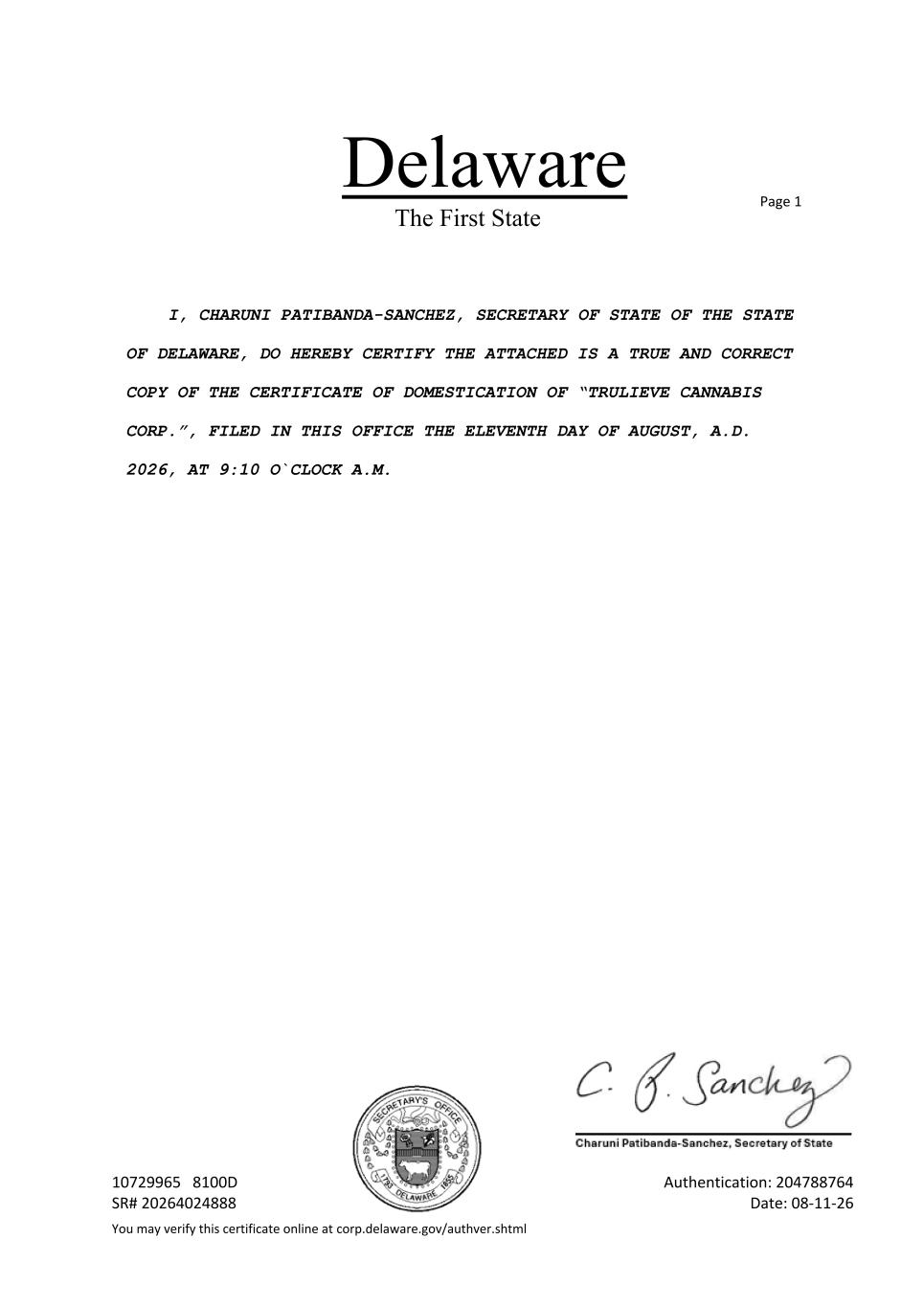
Delaware The First State Page 1 10729965 8100D Authentication: 204788764 SR# 20264024888 Date: 08-11-26 You may verify this certificate online at corp.delaware.gov/authver.shtml I, CHARUNI PATIBANDA-SANCHEZ, SECRETARY OF STATE OF THE STATE OF DELAWARE, DO HEREBY CERTIFY THE ATTACHED IS A TRUE AND CORRECT COPY OF THE CERTIFICATE OF DOMESTICATION OF “TRULIEVE CANNABIS CORP.”, FILED IN THIS OFFICE THE ELEVENTH DAY OF AUGUST, A.D. 2026, AT 9:10 O`CLOCK A.M.
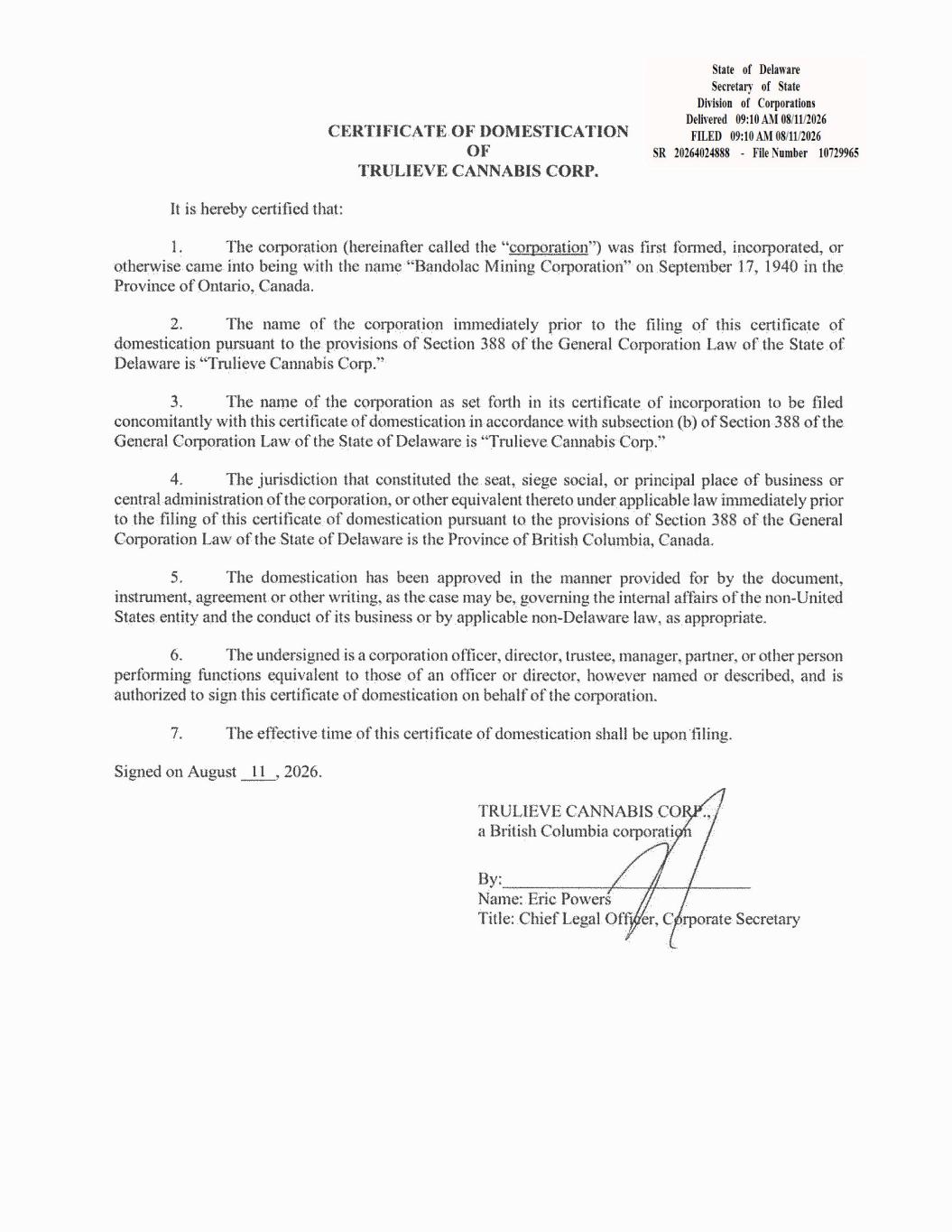
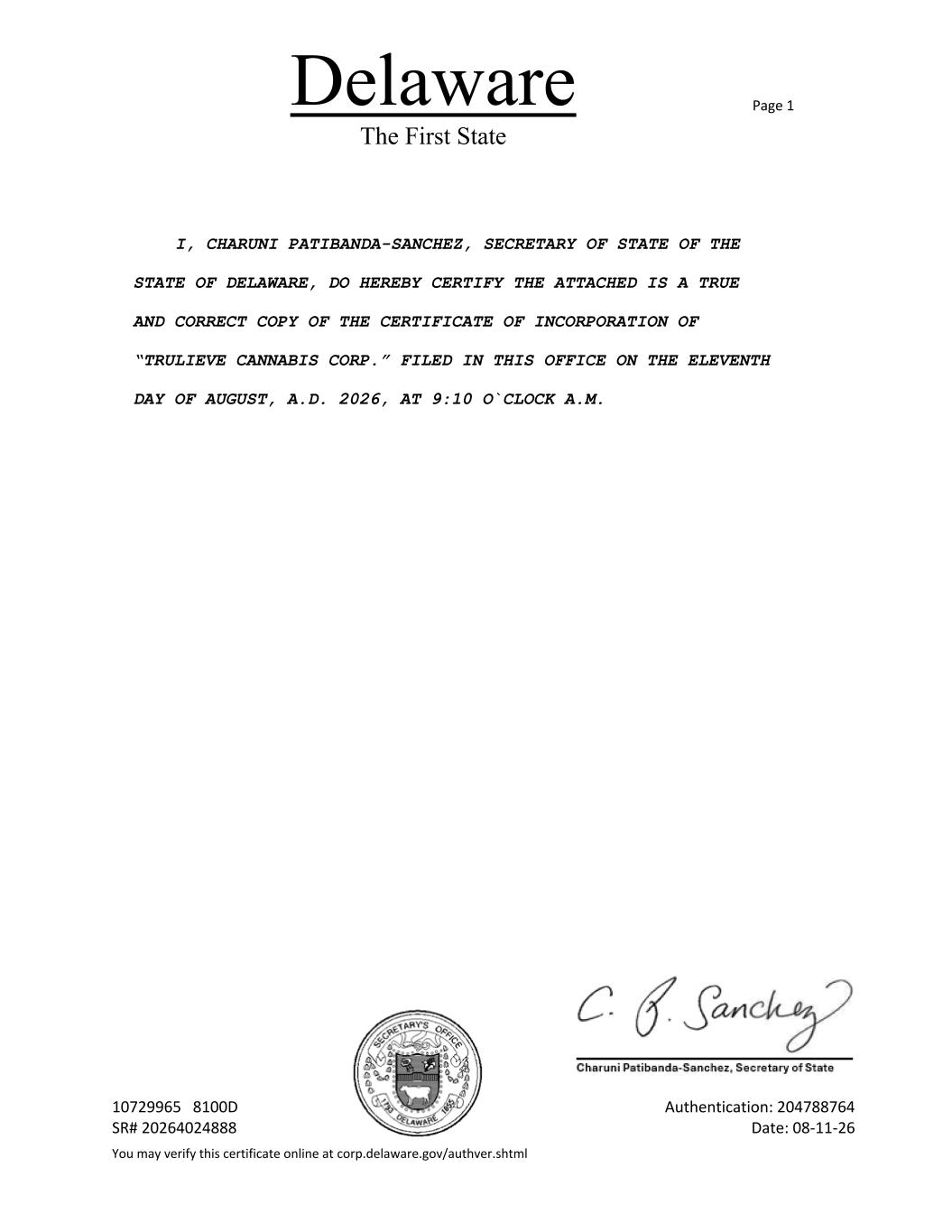
Delaware The First State Page 1 10729965 8100D Authentication: 204788764 SR# 20264024888 Date: 08-11-26 You may verify this certificate online at corp.delaware.gov/authver.shtml I, CHARUNI PATIBANDA-SANCHEZ, SECRETARY OF STATE OF THE STATE OF DELAWARE, DO HEREBY CERTIFY THE ATTACHED IS A TRUE AND CORRECT COPY OF THE CERTIFICATE OF INCORPORATION OF “TRULIEVE CANNABIS CORP.” FILED IN THIS OFFICE ON THE ELEVENTH DAY OF AUGUST, A.D. 2026, AT 9:10 O`CLOCK A.M.
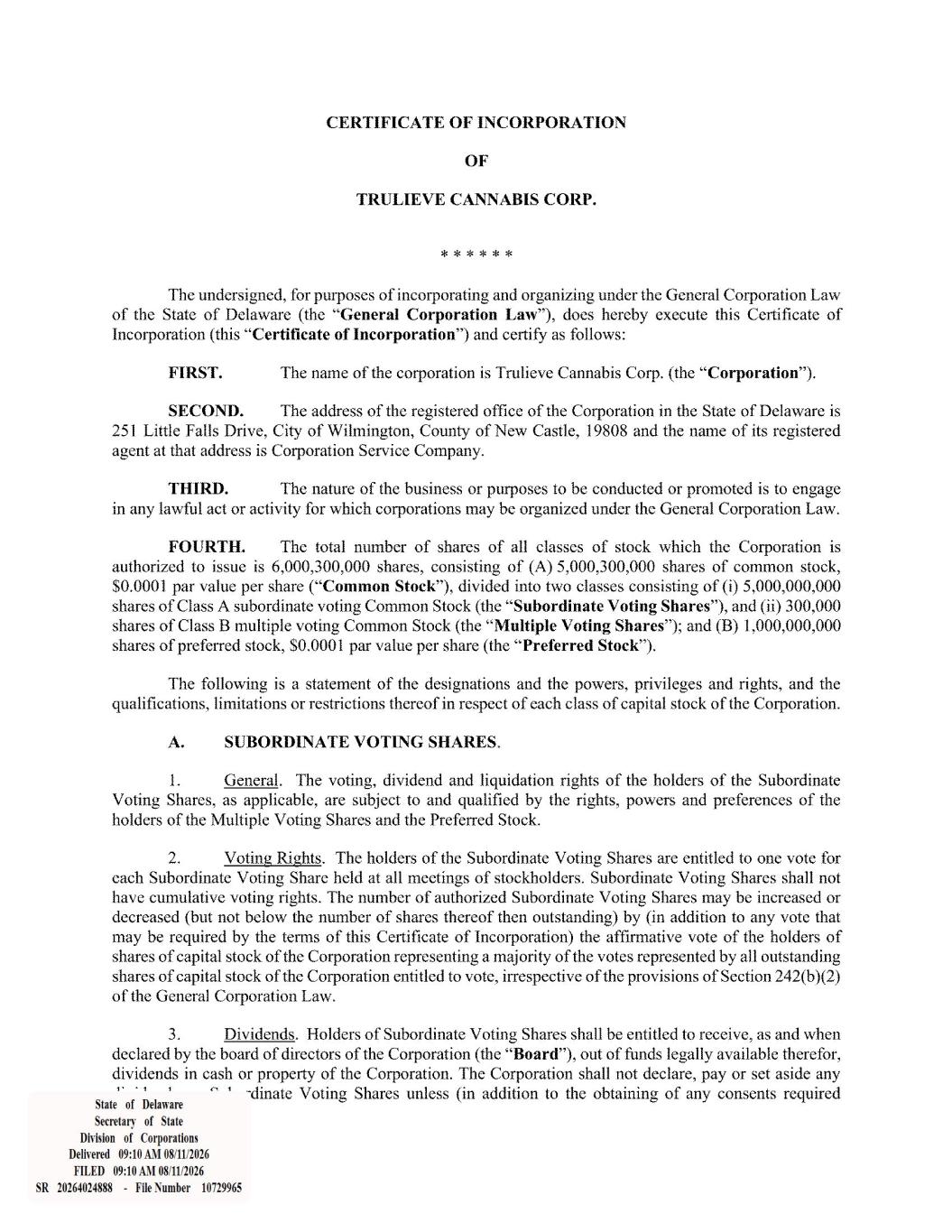
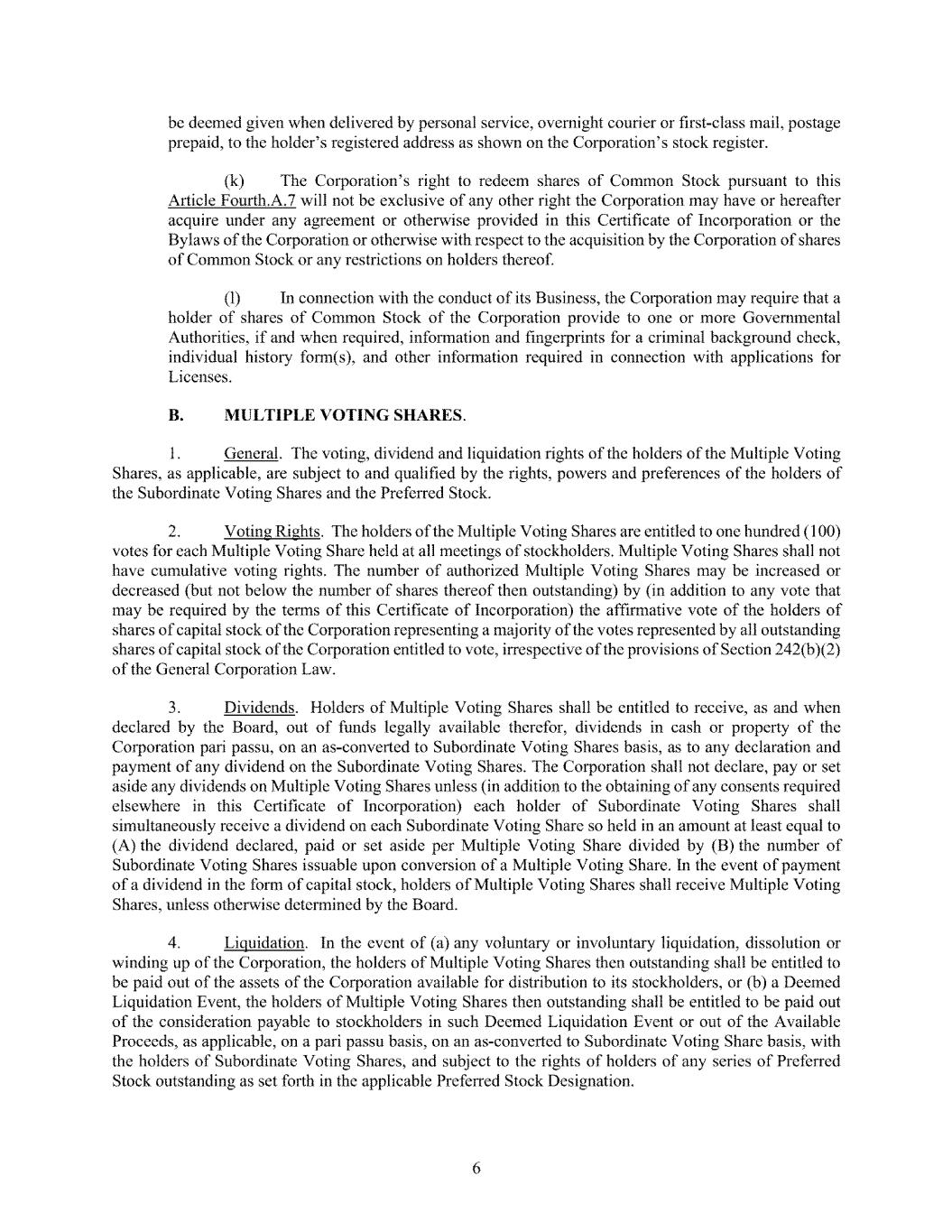
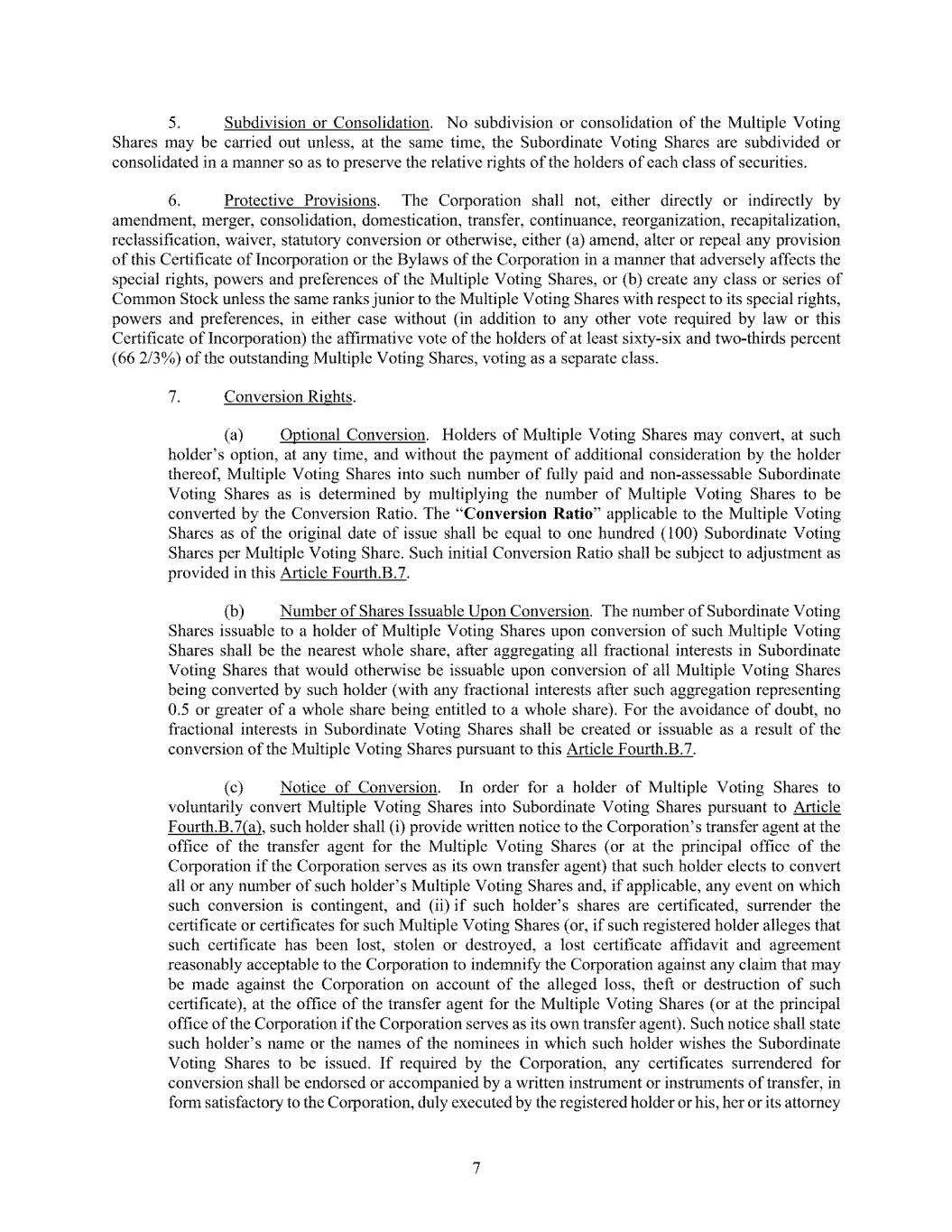
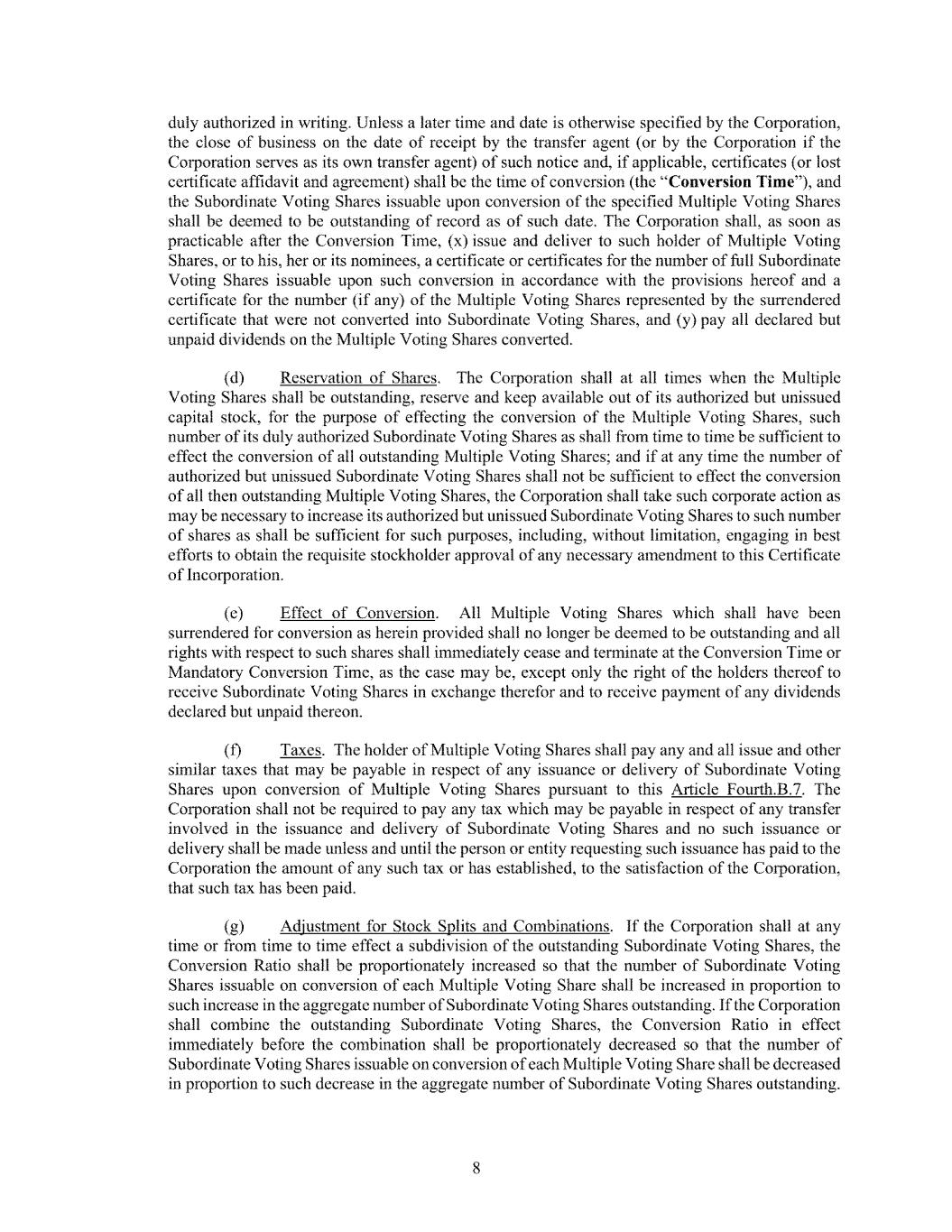
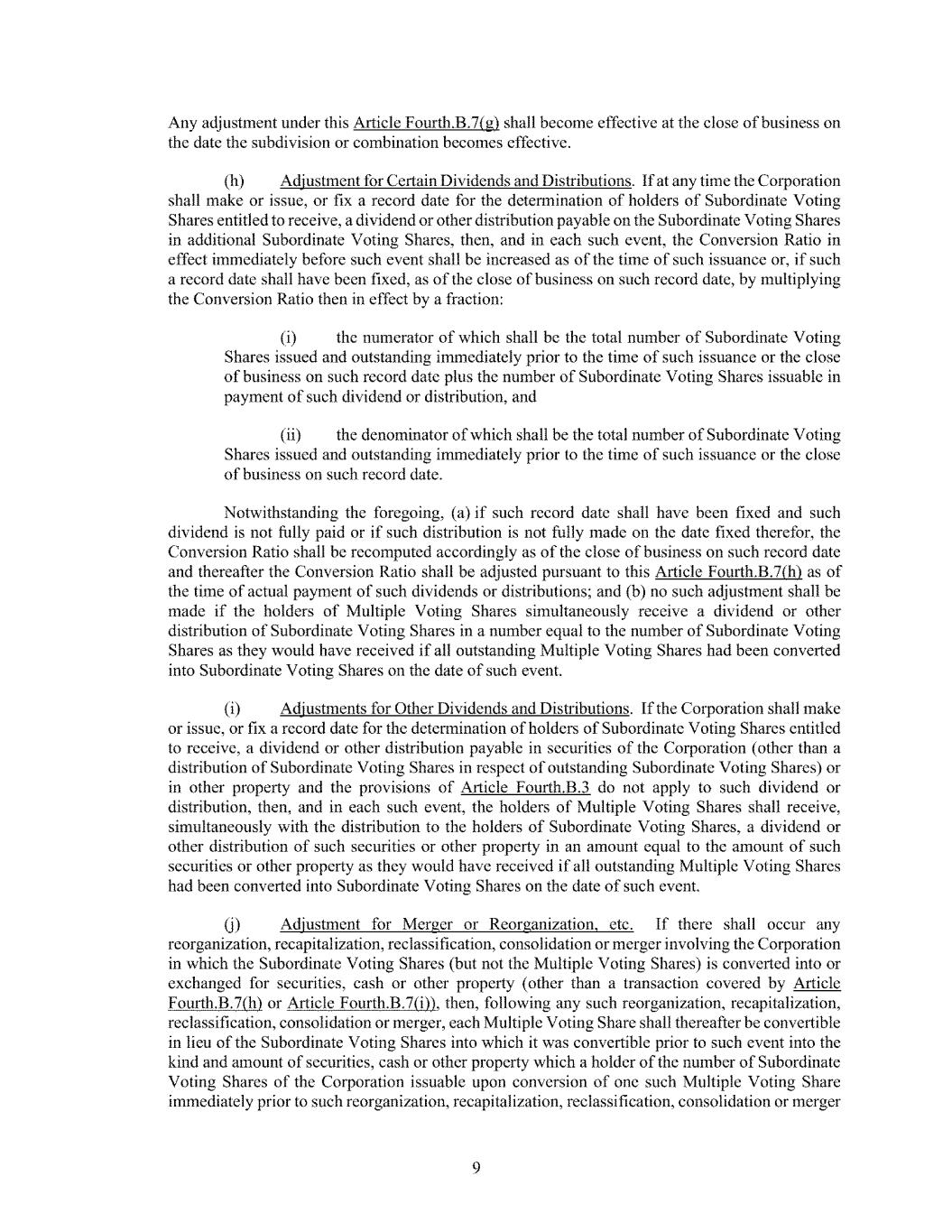

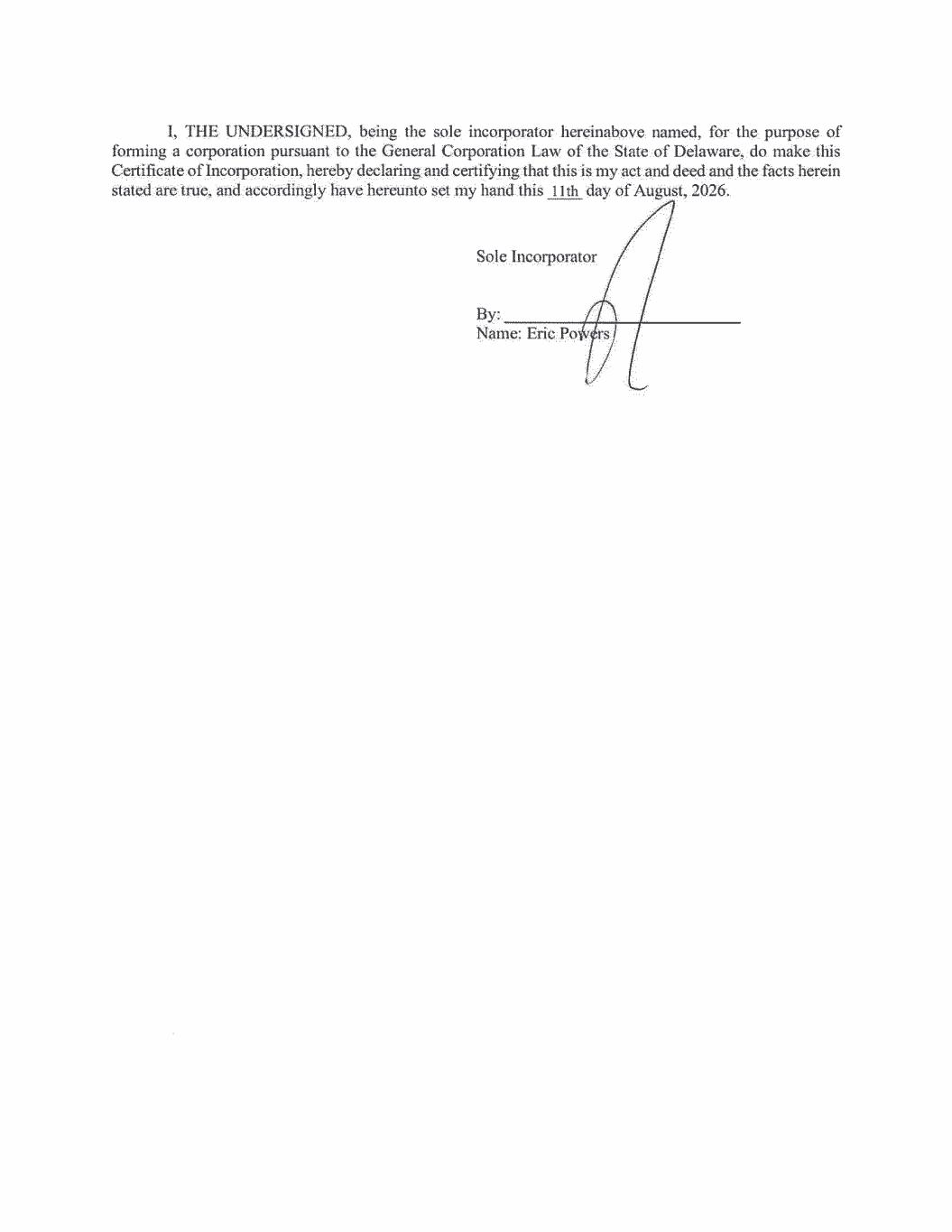
BYLAWS OF TRULIEVE CANNABIS CORP. (THE “CORPORATION”) ARTICLE I. CORPORATE OFFICES Section 1.1 Registered Office and Agent. The registered office and agent of the Corporation shall be fixed in the corporation’s Certificate of Incorporation, as the same may be amended from time to time (the “Certificate of Incorporation”). Section 1.2 Other Offices. The board of directors may at any time establish other offices at any place or places, either within or outside of the State of Delaware, where the Corporation is qualified to do business. ARTICLE II. MEETINGS OF STOCKHOLDERS Section 2.1 Place of Meetings. Meetings of stockholders shall be held at any place designated by the board of directors (a) within or outside the State of Delaware, or (b) by means of remote communication (a “Virtual Meeting”), in each case as may be determined by the board of directors from time to time. In the absence of any such designation, stockholders’ meetings shall be held at the registered office of the Corporation or the board of directors may, in its sole discretion, determine that the meeting shall not be held at any place, but will instead be held solely by means of remote communication as provided under Section 211 of the Delaware General Corporation Law (the “DGCL”). Section 2.2 Annual Meetings. The annual meeting of stockholders shall be held each year on a date and at a time designated by the board of directors. At the annual meeting, directors shall be elected and any other proper business may be transacted. Section 2.3 Special Meetings. Except as otherwise required by law or the Certificate of Incorporation, special meetings of the stockholders may be called only by the board of directors pursuant to a resolution approved by the affirmative vote of a majority of the directors then in office, or, if there are no directors then in office, by an officer of the Corporation. Only those matters set forth in the notice of the special meeting may be considered or acted upon at a special meeting of stockholders of the Corporation, unless otherwise required by law. Section 2.4 Notice of Stockholders’ Meetings.
2 Whenever stockholders are required or permitted to take any action at a meeting, a notice of the meeting shall be given in accordance with Section 232 of the DGCL. All notices of meetings of stockholders shall be in the form of a writing or electronic transmission and shall be sent or otherwise given to each stockholder entitled to vote at such meeting as of the record date for determining the stockholders entitled to notice of the meeting in accordance with Section 2.5 of these bylaws (these “Bylaws”) not less than ten (10) nor more than sixty (60) days before the date of the meeting. The notice shall specify the place, date and hour of the meeting, the record date for determining the stockholders entitled to vote at the meeting (if such date is different from the record date for determining stockholders entitled to notice of the meeting) and, in the case of a special meeting, the purpose or purposes for which the meeting is called. The means of remote communication, if any, by which stockholders and proxyholders may be deemed to be present in person and vote at such meeting shall also be provided in the notice. The board of directors acting pursuant to a resolution adopted by a majority of the directors then in office may cancel, postpone or reschedule any previously scheduled meeting of the stockholders at any time before or after the notice for such meeting has been sent to stockholders. Section 2.5 Manner of Giving Notice. A. Whenever notice is required by the DGCL, the Certificate of Incorporation or these Bylaws to be given to any stockholder, such notice may be given by mail, or by other means of written communication or electronic transmission, addressed to the stockholder at such stockholder’s address or electronic mail address, as applicable, as it appears on the records of the Corporation or as given by such stockholder to the Corporation for the purpose of notice. Notice of any meeting of stockholders shall be deemed given: (i) if mailed, when deposited in the U.S. mail, postage prepaid, directed to the stockholder at his or her address as it appears on the Corporation’s records; or (ii) if electronically transmitted as provided in Section 9.1 of these Bylaws. B. An affidavit of the secretary or an assistant secretary of the Corporation or of the transfer agent or any other agent of the Corporation that the notice has been given by mail or by a form of electronic transmission, as applicable, shall, in the absence of fraud, be prima facie evidence of the facts stated therein. Section 2.6 Quorum. A. The holders of one-third of the voting power of the stock issued and outstanding and entitled to vote thereat, present in person or represented by proxy, shall constitute a quorum at all meetings of the stockholders for the transaction of business, except as otherwise provided by statute or by the Certificate of Incorporation. Where a separate vote by one or more class or series is required, one-third of the voting power of the outstanding shares of such class(es) or series, present in person or represented by proxy, shall constitute a quorum entitled to take action with respect to that vote, except as required
3 by law, the Certificate of Incorporation or these Bylaws. If, however, such quorum is not present or represented at any meeting of the stockholders, then either (i) the chair of the meeting or (ii) the stockholders entitled to vote thereat, present in person or represented by proxy, shall have power to adjourn the meeting from time to time, without notice other than announcement at the meeting, until a quorum is present or represented. At such adjourned meeting at which a quorum is present or represented, any business may be transacted that might have been transacted at the meeting as originally noticed. B. When a quorum is present at an annual meeting or special meeting of stockholders, except with respect to the election of directors, action by the stockholders on a matter is approved if the number of votes cast in favor of the action by those present in person or represented by proxy exceeds the number of votes cast in opposition to the action, unless the question is one upon which, by express provision of the Bylaws or of the Certificate of Incorporation, a different vote is required, in which case such express provision shall govern and control the decision of the question. Section 2.7 Other Persons May Attend. The directors, officers, any counsel to the Corporation, any financial auditor of the Corporation and any other persons invited by the directors are entitled to attend any meeting of stockholders, but if any of those persons does attend a meeting of stockholders, that person is not to be counted in the quorum and is not entitled to vote at the meeting unless that person is a stockholder or proxy holder entitled to vote at the meeting. Section 2.8 Adjourned Meeting; Notice. The chair of a meeting of stockholders may, and if so directed by the meeting must, adjourn the meeting from time to time and from place to place (including an adjournment taken to address a technical failure to convene or continue a Virtual Meeting). Unless these Bylaws otherwise require, when a meeting is adjourned to another time or place not more than thirty (30) days from the date of the original meeting (including an adjournment taken to address a technical failure to convene or continue a Virtual Meeting), the Corporation shall not be required to provide separate notice of the adjourned meeting if the time, place, if any, thereof, and the means of remote communication, if any, by which stockholders and proxyholders may be deemed to be present in person and vote at such adjourned meeting are (i) announced at the meeting at which the adjournment is taken, (ii) displayed, during the time scheduled for the meeting, on the same electronic network used to enable stockholders and proxyholders to participate in the meeting by means of remote communication, or (iii) set forth in the notice of meeting given in accordance with the provisions of Section 2.4 and Section 2.5 of these Bylaws. At the adjourned meeting, the Corporation may transact any business that might have been transacted at the original meeting. If the adjournment is for more than thirty (30) days, or if after the adjournment a new record date is fixed for the adjourned meeting, a notice of the adjourned meeting shall be given to each stockholder of record entitled to vote at the meeting in accordance with the provisions of Section 2.4 and Section 2.5 of these Bylaws.
4 Section 2.9 Conduct of Business. The chair of any meeting of stockholders shall determine the order of business and the procedure at the meeting, including such matters as the regulation of the manner of voting and the conduct of business. Section 2.10 Chair; Selection of Alternate Chair. The chair of the board of directors or, in the absence of the chair of the board of directors, the president of the Corporation, shall preside at all meetings of the stockholders. In the absence of both the chair of the board of directors and the president of the Corporation, such person as the board of directors may have designated shall preside, and in the absence of such designation, such person as may be chosen by the holders of a majority of the voting power of the shares entitled to vote who are present, in person or by proxy, shall call to order the meeting and act as chair of the meeting. In the absence of the secretary of the Corporation, the secretary of the meeting shall be such person as the chair of the meeting appoints. Section 2.11 Voting on the Election of Directors; Retention of Ballots and Proxies. A. The stockholders entitled to vote at any meeting of stockholders shall be determined in accordance with the provisions of Section 2.13 of these Bylaws and subject to the provisions of Sections 217 and 218 of the DGCL (relating to voting rights of fiduciaries, pledgors and joint owners of stock and to voting trusts and other voting agreements). B. All elections of directors shall be by written ballot unless otherwise provided in the Certificate of Incorporation; if authorized by the board of directors, such requirement of a written ballot shall be satisfied by a ballot submitted by electronic transmission; provided that any such electronic transmission must either set forth or be submitted with information from which it can be determined that the electronic transmission was authorized by the stockholder or proxy holder. C. The voting rights of each class of capital stock, including whether shares of such class may be voted and the number of votes per share, shall be as set forth in the Certificate of Incorporation. If the Certificate of Incorporation does not specify such voting rights, each outstanding share of capital stock having voting power shall entitle the holder of record thereof or proxy to one vote on all matters properly brought before the stockholders. D. Except as otherwise required by law, the Certificate of Incorporation or these Bylaws, directors shall be elected by a plurality of the voting power of the shares present in person or represented by proxy at the meeting and entitled to vote on the election of directors; provided that, if the rules and requirements of the exchange on which the Corporation’s shares are then listed require a different voting standard for the election of directors, directors will be elected in accordance with the rules and requirements of such exchange. Section 2.12 Waiver of Notice.
5 Whenever notice is required to be given under any provision of the DGCL, the Certificate of Incorporation or these Bylaws, a written waiver thereof, signed by the person entitled to notice, or a waiver by electronic transmission by the person entitled to notice, whether before or after the time stated therein, shall be deemed equivalent to notice. Attendance of a person at a meeting shall constitute a waiver of notice of such meeting, except when the person attends a meeting for the express purpose of objecting, at the beginning of the meeting, to the transaction of any business because the meeting is not lawfully called or convened. Neither the business to be transacted at, nor the purpose of, any regular or special meeting of the stockholders need to be specified in any written waiver of notice, or any waiver by electronic transmission, unless so required by the Certificate of Incorporation or these Bylaws. Section 2.13 Record Date for Stockholder Notice; Voting; Giving Consents. A. In order that the Corporation may determine the stockholders entitled to notice of or to vote at any meeting of stockholders or any adjournment thereof, or entitled to express consent to corporate action in writing without a meeting (if permitted), or entitled to receive payment of any dividend or other distribution or allotment of any rights, or entitled to exercise any rights in respect of any change, conversion, or exchange of stock or for the purpose of any other lawful action, the board of directors may fix, in advance, a record date, which shall not be more than sixty (60) nor less than ten (10) days before the date of such meeting, nor more than sixty (60) days prior to any other action. B. If the board of directors does not so fix a record date: (i) the record date for determining stockholders entitled to notice of or to vote at a meeting of stockholders shall be at the close of business on the day next preceding the day on which notice is given, or, if notice is waived, at the close of business on the day next preceding the day on which the meeting is held; and (ii) the record date for determining stockholders for any other purpose shall be at the close of business on the day on which the board of directors adopts the resolution relating thereto. C. A determination of stockholders of record entitled to notice of or to vote at a meeting of stockholders shall apply to any adjournment of the meeting; provided, however, that the board of directors may fix a new record date for the adjourned meeting. Section 2.14 Nominations and Proposals for Annual Meetings of Stockholders. A. Nominations of persons for election to the board of directors of the Corporation and the proposal of business to be considered by the stockholders may be made at an annual meeting of stockholders (i) pursuant to the Corporation’s notice of meeting, (ii) by or at the direction of the board of directors, or (iii) by any stockholder of the Corporation who (x) was a stockholder of record at the time of giving of the notice provided for in this Section 2.14 and at the time of the annual meeting, (y) is entitled to vote with respect to such matter at the meeting, and (z) complies with the notice procedures set forth in this Section 2.14. At any annual meeting of stockholders, the presiding officer of such meeting may announce the nominations and other business to be considered which are set
6 forth in the Corporation’s notice of meeting and proxy statement and, by virtue thereof, such nominations and other business so announced shall be properly brought before such meeting and may be considered and voted upon by the stockholders of the Corporation entitled to vote thereat without further requirement of nomination, motion, or second. B. For nominations or other business to be properly brought before an annual meeting by a stockholder pursuant to clause (iii) of paragraph A of this Section 2.14, the stockholder making such nominations or proposing such other business must theretofore have given timely notice thereof in writing to the secretary of the Corporation and such other business must otherwise be a proper matter for stockholder action. To be timely, a stockholder’s notice shall be delivered to the secretary at the principal executive offices of the Corporation not later than the close of business on the 90th day nor earlier than the close of business on the 120th day prior to the first anniversary of the preceding year’s annual meeting; provided, however, that in the event that the date of the annual meeting is more than 30 days before or more than 70 days after such anniversary date, notice by the stockholder to be timely must be so delivered not later than the close of business on the later of (x) the 90th day prior to the scheduled date of such annual meeting (and no earlier than the 120th day prior to such scheduled date) or (y) the 10th day following the day on which public announcement of the date of such meeting is first made by the Corporation. In the case of a special meeting for the purpose of electing directors, notice of nominations must generally be received not earlier than the 120th day and not later than the 90th day prior to the meeting or the 10th day following public announcement of the meeting date. In no event shall the public announcement of an adjournment of an annual meeting commence a new time period for the giving of a stockholder’s notice as described above. To be in proper form, a stockholder’s notice to the secretary must: (i) set forth, as to the stockholder giving the notice and the beneficial owner, if any, on whose behalf the nomination or proposal is made (x) the name and address of such stockholder, as they appear on the Corporation’s books, and of such beneficial owner, if any, (y) the class or series and number of shares of the Corporation that are, directly or indirectly, owned beneficially and of record by such stockholder and such beneficial owner, if any, as of the date of such notice (which information shall be supplemented by such stockholder and beneficial owner not later than 10 days after the record date for the meeting to disclose such ownership as of the record date), and (z) any other information relating to such stockholder and beneficial owner, if any, that would be required to be disclosed in a proxy statement or other filings required to be made in connection with solicitations of proxies for, as applicable, the proposal and/or for the election of directors in a contested election pursuant to Section 14 of the Securities Exchange Act of 1934, as amended, and the rules and regulations promulgated thereunder (the “Exchange Act”); (ii) if the notice relates to any business other than the nomination of a director that the stockholder proposes to bring before the meeting, set forth (x) a brief description of the business desired to be brought before the meeting, the reasons for conducting such business at the meeting and any material interest of such stockholder and beneficial owner, if any, in such business, and (z) a
7 description of all agreements, arrangements and understandings between such stockholder and beneficial owner and any other person or persons (including their names) in connection with the proposal of such business by such stockholder; (iii) set forth, as to each person, if any, whom the stockholder proposes to nominate for election or reelection as a director (x) all information relating to such person that would be required to be disclosed in a proxy statement or other filings required to be made in connection with solicitations of proxies for election of directors in a contested election pursuant to Section 14 of the Exchange Act (including such person’s written consent to being named in the proxy statement as a nominee and to serving as a director if elected) and (y) a description of all direct and indirect compensation and other monetary agreements, arrangements and understandings during the past three years, and any other relationships, between or among such stockholder and beneficial owner, if any, and their respective affiliates and associates, or others acting in concert therewith, on the one hand, and each proposed nominee, and their respective affiliates and associates, or others acting in concert therewith, on the other hand, including, without limitation all information that would be required to be disclosed pursuant to Rule 404 promulgated under Regulation S-K if the stockholder making the nomination and any beneficial owner on whose behalf the nomination is made, if any, or any affiliate or associate thereof or person acting in concert therewith, were the “registrant” for purposes of such rule and the nominee were a director or executive officer of such registrant; and (iv) with respect to each nominee for election or reelection to the board of directors, include the completed and signed questionnaire, representation, and agreement required by paragraph D below. The Corporation may require any proposed nominee to furnish such other information as may reasonably be required by the Corporation to determine the eligibility of such proposed nominee to serve as an independent director of the Corporation or that could be material to a reasonable stockholder’s understanding of the independence, or lack thereof, of such nominee. C. Notwithstanding anything in the second sentence of paragraph B of this Section 2.14 to the contrary, in the event that the number of directors to be elected to the board of directors of the Corporation at an annual meeting is increased, whether by increase in the size of the board of directors, or by any vacancy in the board of directors to be filled at such annual meeting, and there is no public announcement by the Corporation naming all of the nominees for directors or specifying the size of the increased board of directors at least 75 days prior to the first anniversary of the preceding year’s annual meeting, a stockholder’s notice required by this Section 2.14 shall also be considered timely, but only with respect to nominees for any such vacant positions and for any new positions created by such increase, if it shall be delivered to the secretary at the principal executive offices of the Corporation not later than the close of business on the 10th day following the day on which such public announcement is first made by the Corporation. D. To be eligible to be a nominee for election or reelection as a director of the Corporation, a person must deliver (in accordance with the time periods prescribed for
8 delivery of notice under paragraphs B and C above) to the secretary of the Corporation at the principal executive offices of the Corporation a completed, written and signed questionnaire (in the form customarily used by the Corporation for its directors) with respect to the background and qualification of such person and the background of any other person or entity on whose behalf the nomination is being made (which questionnaire shall be provided by the secretary upon written request) and a written representation and agreement (in the form provided by the secretary upon written request) that such person: (i) is not and will not become a party to (x) any agreement, arrangement or understanding with, and has not given any commitment or assurance to, any person or entity as to how such person, if elected as a director of the Corporation, will act or vote on any issue or question (a “Voting Commitment”) that has not been disclosed to the Corporation or (y) any Voting Commitment that could limit or interfere with such person’s ability to comply, if elected as a director of the Corporation, with such person’s fiduciary duties under applicable law; (ii) is not and will not become a party to any agreement, arrangement or understanding with any person or entity other than the Corporation with respect to any direct or indirect compensation, reimbursement or indemnification in connection with service or action as a director that has not been disclosed therein; and (iii) in such person’s individual capacity and on behalf of any person or entity on whose behalf the nomination is being made, would be in compliance, if elected as a director of the Corporation, and will comply with all applicable publicly disclosed corporate governance, conflict of interest, confidentiality, and stock ownership and trading policies and guidelines of the Corporation. E. Notwithstanding the foregoing provisions of this Section 2.14, a stockholder shall also comply with all applicable requirements of the Exchange Act, and the rules and regulations thereunder with respect to the matters set forth in this Section 2.14, and nothing in this Section 2.14 shall be deemed to affect any rights of stockholders to request inclusion of proposals in the Corporation’s proxy statement pursuant to Rule 14a-8 under the Exchange Act (or any successor provision thereof) and, to the extent required by such rule, have such proposals considered and voted on at an annual meeting. F. Without exception, no business will be conducted and no person shall be eligible for election as a director of the Corporation at any annual meeting except as brought or nominated in accordance with the provisions set forth in this Section 2.14. In addition, business proposed to be brought by a stockholder may not be brought before the annual meeting, and a nominee shall not be eligible for election, if the notice to the Corporation concerning such business or nomination contains an untrue statement of material fact or omits to state a material fact necessary to make the statements therein not misleading. The chair of the annual meeting shall, if the facts warrant, determine and declare at the annual meeting that business was not properly brought before the annual meeting, and/or nomination was not made, in accordance with this Section 2.14, and, if the chair shall so determine, he or she shall so declare at the annual meeting that any such
9 business not properly brought before the meeting shall not be conducted or nomination disregarded. Section 2.15 List of Stockholders Entitled to Vote. The officer who has charge of the stock ledger of the Corporation shall prepare and make, at least ten (10) days before every meeting of stockholders, a complete list of the stockholders entitled to vote at the meeting, arranged in alphabetical order, and showing the address (but not the electronic address or other electronic contact information) of each stockholder and the number of shares registered in the name of each stockholder. Such list shall be open to the examination of any stockholder, for any purpose germane to the meeting, for a period of at least ten (10) days prior to the meeting (i) during ordinary business hours, either at a place within the city where the meeting is to be held, which place shall he specified in the notice of the meeting, or, if not so specified, at the place where the meeting is to be held or (ii) by a reasonably accessible electronic network; provided that the information required to gain access to such list is provided with the notice of the meeting. If the Corporation determines to make the list available on an electronic network, the Corporation may take reasonable steps to ensure that such information is only available to the stockholders. Such list shall presumptively determine the identity of the stockholders entitled to vote at the meeting, and the number of shares held by each of them. Section 2.16 Proxies. A. Each stockholder entitled to vote at a meeting of stockholders or to express consent or dissent to corporate action in writing without a meeting may authorize another person or persons to act for them by proxy, but no such proxy shall be voted or acted upon after three (3) years from its date, unless the proxy provides for a longer period. A stockholder may appoint one or more alternate proxy holders to act in the place of an absent proxy holder. A proxy shall be deemed signed if the stockholder’s name is placed on the proxy (whether by manual signature, typewriting, facsimile, electronic or telegraphic transmission or otherwise) by the stockholder or the stockholder’s attorney-in-fact. The revocability of a proxy that states on its face that it is irrevocable shall be governed by the provisions of Section 212 of the DGCL. B. A proxy for a meeting of stockholders must: (i) be received at the registered office of the Corporation or at any other place specified, in the notice calling the meeting, for the receipt of proxies, at least the number of business days specified in the notice, or if no number of days is specified, two business days before the day set for the holding of the meeting; or (ii) unless the notice provides otherwise, be provided, at the meeting, to the chair of the meeting or to a person designated by the chair of the meeting. A proxy may be sent to the Corporation by written instrument, fax or any other method of transmitting legibly recorded messages. C. A vote given in accordance with the terms of a proxy is valid notwithstanding the death or incapacity of the stockholder giving the proxy and despite the
10 revocation of the proxy or the revocation of the authority under which the proxy is given, unless notice in writing of that death, incapacity or revocation is received: (i) at the registered office of the Corporation, at any time up to and including the last business day before the day set for the holding of the meeting at which the proxy is to be used; or (ii) by the chair of the meeting, before the vote is taken. D. The chair of any meeting of stockholders may, but need not, inquire into the authority of any person to vote at the meeting and may, but need not, demand from that person production of evidence as to the existence of the authority to vote. Section 2.17 Voting rights of fiduciaries, pledgors and joint owners of stock. A. Persons holding stock in a fiduciary capacity shall he entitled to vote the shares so held. Persons whose stock is pledged shall be entitled to vote, unless in the transfer by the pledgor on the books of the Corporation such person has expressly empowered the pledgee to vote thereon, in which case only the pledgee, or such pledgee’s proxy, may represent such stock and vote thereon. B. If shares or other securities having voting power stand of record in the names of two or more persons, whether fiduciaries, members of a partnership, joint tenants, tenants in common, tenants by the entirety or otherwise, or if two or more persons have the same fiduciary relationship respecting the same shares, unless the secretary of the Corporation is given written notice to the contrary and is furnished with a copy of the instrument or order appointing them or creating the relationship wherein it is so provided, their acts with respect to voting shall have the following effect: (i) if only one vote, such person’s act binds all; (ii) if more than one vote, the act of the majority so voting binds all; or (iii) if more than one vote, but the vote is evenly split on any particular matter, each faction may vote the securities in question proportionally, or any person voting the shares, or a beneficiary, if any, may apply to the Court of Chancery or such other court as may have jurisdiction to appoint an additional person to act with the persons so voting the shares, which shall then be voted as determined by a majority of such persons and the person appointed by the Court. If the instrument so filed shows that any such tenancy is held in unequal interests, a majority or even split for the purpose of this subsection shall be a majority or even split in interest. Section 2.18 Action Without Meeting. Except as set forth in the Certificate of Incorporation or these Bylaws, any action required or permitted to be taken by the stockholders of the Corporation must be effected at a duly called
11 annual or special meeting of the stockholders of the Corporation, and may not be effected by any consent in writing by such stockholders. Section 2.19 Inspectors. Before any meeting of stockholders, the Corporation may, and if required by law shall, appoint an inspector or inspectors of election to act at the meeting or its adjournment and make a written report thereof. The Corporation may designate one or more Persons as alternate inspectors to replace any inspector who fails to act. If any Person appointed as inspector or any alternate fails to appear or fails or refuses to act, then the chair of the meeting shall appoint a Person to fill that vacancy. Such inspectors shall: (i) determine the number of shares outstanding and the voting power of each share, the number of shares represented at the meeting and the validity of any proxies and ballots; (ii) count all votes or ballots; (iii) count and tabulate all votes; (iv) determine and retain for a reasonable period a record of the disposition of any challenges made to any determination by the inspector(s); and (v) certify its or their determination of the number of shares represented at the meeting and its or their count of all votes and ballots. Each inspector, before entering upon the discharge of the duties of inspector, shall take and sign an oath faithfully to execute the duties of inspection with strict impartiality and according to the best of such inspector’s ability. Any report or certificate made by the inspectors of election is prima facie evidence of the facts stated therein. The inspectors of election may appoint such Persons to assist them in performing their duties as they determine. ARTICLE III. DIRECTORS Section 3.1 Powers. Subject to the provisions of the DGCL and any limitation in the Certificate of Incorporation or these Bylaws relating to action required to be approved by the stockholders or by the outstanding shares, the business and affairs of the Corporation shall be managed and all corporate powers shall be exercised by or under the direction of the board of directors. Section 3.2 Number of Directors. The board of directors shall consist of three or more members, each of whom shall be a natural person. Unless the Certificate of Incorporation fixes the number of directors, subject to the preceding sentence, the authorized number of directors shall be determined from time to time exclusively by resolution adopted by a majority of the board of directors then in office. No reduction of the authorized number of directors shall have the effect in itself of removing any director before that director’s term of office expires. Section 3.3 Election. Qualification, and Term of Office of Directors. Except as provided in Section 3.4 of these Bylaws, directors shall be elected at each annual meeting of stockholders to hold office until the next annual meeting. Directors need not be stockholders unless so required by the Certificate of Incorporation or these Bylaws, wherein other qualifications for directors may be prescribed. Each director, including a director elected to fill a
12 vacancy, shall hold office until their successor is elected and qualified or until their earlier resignation or removal. Section 3.4 Resignation and Vacancies. A. Any director may resign at any time upon notice given in writing or by electronic transmission to the attention of the secretary of the Corporation. When one or more directors so resigns and the resignation is effective at a future date, a majority of the directors then in office, including those who have so resigned, shall have power to fill such vacancy or vacancies, the vote thereon to take effect when such resignation or resignations shall become effective, and each director so chosen shall hold office as provided in this section in the filling of other vacancies. B. Unless otherwise provided in the Certificate of Incorporation or these Bylaws: (i) Vacancies and newly created directorships resulting from any increase in the authorized number of directors may be filled by a majority of the directors then in office, even if less than a quorum, or by a sole remaining director. (ii) Whenever the holders of any class or classes of stock or series thereof are entitled to elect one or more directors by the provisions of the Certificate of Incorporation, vacancies and newly created directorships of such class or classes or series may be filled by a majority of the directors elected by such class or classes or series thereof then in office or by a sole remaining director so elected. C. If at any time, by reason of death or resignation or other cause, the Corporation should have no directors in office, then any officer of the Corporation may call a special meeting of stockholders in accordance with the provisions of the Certificate of Incorporation or these Bylaws, or may apply to the Court of Chancery for a decree summarily ordering an election as provided in Section 211 of the DGCL. D. In the event of a vacancy in the board of directors, the remaining directors, except as otherwise provided by law, may exercise the powers of the full board of directors until such vacancy is filled. Section 3.5 Place of Meetings; Remote Meetings. The board of directors of the Corporation may hold meetings, both regular and special, either within or outside the State of Delaware. Unless otherwise restricted by the Certificate of Incorporation or these Bylaws, members of the board of directors, or any committee designated by the board of directors, may participate in a meeting of the board of directors, or any committee, by means of conference telephone, video or other communications equipment by means of which all persons participating in the meeting can hear each other, and such participation in a meeting shall constitute presence in person at the meeting. Section 3.6 Regular Meetings.
13 Regular meetings of the board of directors may be held without notice at such time and at such place as shall from time to time be determined by the board of directors. Section 3.7 Special Meetings; Notice. A. Special meetings of the board of directors for any purpose or purposes may be called at any time by the chair of the board of directors, or, if there is no chair, by the president, chief executive officer or the secretary, or upon request of a majority of the directors then in office. B. Notice of the time and place of special meetings shall be: (i) delivered personally by hand, by courier or by telephone; (ii) sent by United States first-class mail, postage prepaid; (iii) sent by facsimile or electronic mail; or (iv) sent by other means of electronic transmission as provided in Section 9.1. C. Such notice shall be directed to each director at that director’s address, telephone number, facsimile number or electronic mail address, or other address for electronic transmission, as the case may be, as shown on the Corporation’s records. D. If the notice is (i) delivered personally by hand, by courier or by telephone, (ii) sent by facsimile or electronic mail, or (iii) sent by other means of electronic transmission, it shall be delivered or sent at least twenty-four (24) hours before the time of the holding of the meeting. If the notice is sent by U.S. mail, it shall be deposited in the U.S. mail at least four (4) days before the time of the holding of the meeting. The notice need not specify the place of the meeting (if the meeting is to be held at the Corporation’s principal executive office) nor the purpose of the meeting. Section 3.8 Chair of Meetings. The chair of the board of directors or, in the absence of the chair of the board of directors, the president of the Corporation (if the president is a director), shall preside at all meetings of the board of directors. In the absence of both the chair of the board and the president, such director as may be chosen by a majority of the directors present shall preside. Section 3.9 Quorum. At all meetings of the board of directors, a majority of directors then in office shall constitute a quorum for the transaction of business and the act of a majority of the directors present at any meeting at which there is a quorum shall be the act of the board of directors, except as may be otherwise specifically provided by law or by the Certificate of Incorporation. If a quorum shall not be present at any meeting of the board of directors, a majority of the directors present thereat may adjourn the meeting from time to time, without notice other than announcement at the
14 meeting, until a quorum shall be present. If, and at such times as, the Certificate of Incorporation provides that one or more directors shall have more or less than one vote per director on any matter, every reference in these Bylaws to a majority or other proportion of directors shall refer to a majority or other proportion of the votes of such directors. Section 3.10 Board Action by Written Consent Without a Meeting. Unless otherwise restricted by the Certificate of Incorporation or these Bylaws, any action required or permitted to be taken at any meeting of the board of directors, or of any committee thereof, may be taken without a meeting if all members of the board or committee, as the case may be, consent thereto in writing or by electronic transmission. Section 3.11 Fees and Compensation of Directors. Unless otherwise restricted by the Certificate of Incorporation or these Bylaws, the board of directors shall have the authority to fix the compensation of directors. The directors may be paid their expenses, if any, of attendance at each meeting of the board of directors and may be paid a fixed sum for attendance at each meeting of the board of directors or a stated salary as director. No such payment shall preclude any director from serving the Corporation in any other capacity and receiving compensation therefor, and remuneration may be in addition to any salary or other remuneration paid to any officer or employee of the Corporation as such, who is also a director. Members of special or standing committees may be allowed like compensation for attending committee meetings. Section 3.12 Approval of Loans. The Corporation shall not, either directly or indirectly, including through any subsidiary, extend or maintain credit, arrange for the extension of credit, or renew an extension of credit, in the form of a personal loan to or for any director, executive officer (or equivalent thereof), or control person, but may lend money to and use its credit to assist any employee, excluding such executive officers, directors, or other control persons of the Corporation or of a subsidiary, whenever, in the judgment of the directors, such loan, guarantee, or assistance may reasonably be expected to benefit the Corporation. The loan, guarantee or other assistance may be with or without interest and may be unsecured or secured in such manner as the board of directors shall approve, including, without limitation, a pledge of shares of stock of the Corporation. Nothing contained in this section shall be deemed to deny, limit or restrict the powers of guarantee or warranty of the Corporation at common law or under any statute. Section 3.13 Removal of Directors. A. Unless otherwise restricted by statute, by the Certificate of Incorporation or these Bylaws, any director or the entire board of directors may be removed by an affirmative vote of the holders of at least a majority of the voting power of the outstanding shares then entitled to vote at a meeting of the stockholders called for that purpose. B. No reduction of the authorized number of directors shall have the effect of removing any director prior to the expiration of such director’s term of office.
15 ARTICLE IV. COMMITTEES Section 4.1 Committees of Directors. A. The board of directors may, by resolution passed by a majority of the whole board of directors, designate one or more committees, with each committee to consist of one or more of the directors of the Corporation. The board of directors may designate one or more directors as alternate members of any committee who may replace any absent or disqualified member at any meeting of the committee. In the absence or disqualification of a member of a committee, the member or members thereof present at any meeting and not disqualified from voting, whether or not they constitute a quorum, may unanimously appoint another member of the board of directors to act at the meeting in the place of any such absent or disqualified member. Any such committee, to the extent provided in the resolution of the board of directors or in the Bylaws of the Corporation, shall have and may exercise all the powers and authority of the board of directors in the management of the business and affairs of the Corporation, and may authorize the seal of the Corporation to be affixed to all papers that may require it: but no such committee shall have the power or authority to (i) approve, adopt or recommend to the stockholders any action or matter the DGCL expressly requires be submitted to the stockholders for approval; (ii) adopt, amend, or repeal these Bylaws; (iii) fill vacancies in the board of directors; (iv) remove a director; or (v) change the membership of, or fill vacancies in, any committee of the directors. B. The directors may, at any time, with respect to a committee appointed hereunder, (i) revoke or alter the authority given to the committee, or override a decision made by the committee; (ii) terminate the appointment of, or change the membership of, the committee; and (iii) fill vacancies in the committee. Section 4.2 Committee Minutes. Each committee shall keep regular minutes of its meetings and report the same to the board of directors when required. Section 4.3 Meetings and Action of Committees. A. Meetings and actions of committees shall be governed by, and held and taken in accordance with, the provisions of Section 3.5 (place of meetings and meetings by telephone), Section 3.6 (regular meetings), Section 3.7 (special meetings and notice), Section 3.8 (chair of meetings), Section 3.9 (quorum), and Section 3.10 (board action by written consent without a meeting), with such changes in the context of those bylaws as are necessary to substitute the committee and its members for the board of directors and its members; provided, however, that the time of regular meetings of committees may be determined either by resolution of the board of directors or by resolution of the committee, that special meetings of committees may also be called by resolution of the board of directors and that notice of special meetings of committees shall also be given to all alternate members, who shall have the right to attend all meetings of the committee.
16 B. The board of directors may adopt rules for the governance of any committee not inconsistent with the provisions of these Bylaws. ARTICLE V. OFFICERS Section 5.1 Officers. A. The officers of the Corporation shall include a chief executive officer, a chief financial officer and a secretary and such other officers (including without limitation, a chair of the board of directors, president, vice presidents, assistant secretaries and a treasurer) as the board of directors from time to time may determine. B. An officer is not required to hold stock in the Corporation as qualification for their office but must be qualified as required by the DGCL to become, act or continue to act as an officer. Any number of offices may be held by the same person, unless the Certificate of Incorporation or these Bylaws otherwise provide. C. Any person appointed as the chair of the board of directors must be a director. Any other officer need not be a director. Section 5.2 Appointment of Officers. The officers of the Corporation, except such officers as may be appointed in accordance with the provisions of Section 5.3 or Section 5.5 of these Bylaws, shall be appointed by the board of directors, subject to the rights, if any, of an officer under any contract of employment. Section 5.3 Subordinate Officers. The board of directors may appoint, or empower the chief executive officer to appoint, such other officers and agents as the business of the Corporation may require, each of whom shall hold office for such period, have such authority, and perform such duties as are provided in these Bylaws or as the board of directors may from time to time determine. Section 5.4 Removal and Resignation of Officers. A. Subject to the rights, if any, of an officer under any contract of employment, any officer may be removed, either with or without cause, by an affirmative vote of the majority of the board of directors at any regular or special meeting of the board of directors or, except in the case of an officer chosen by the board of directors, by any officer upon whom such power of removal may be conferred by the board of directors. B. Any officer may resign at any time by giving written notice to the Corporation. Any resignation shall take effect at the date of the receipt of that notice or at any later time specified in that notice; and, unless otherwise specified in that notice, the acceptance of the resignation shall not be necessary to make it effective. Any resignation is without prejudice to the rights, if any, of the Corporation under any contract to which the officer is a party.
17 Section 5.5 Vacancies in Offices. Any vacancy occurring in any office of the Corporation shall be filled by the affirmative vote of a majority of the remaining directors, even if they constitute less than a quorum. Section 5.6 Chair of the Board. The chair of the board of directors, if such an officer be elected, shall, if present, preside at meetings of the board of directors and of the stockholders at which he or she shall be present, and exercise and perform such other powers and duties as may from time to time be assigned to him or her by the board of directors or as may be prescribed by these Bylaws. If there is no chief executive officer, then the chair of the board of directors shall also be the chief executive officer of the Corporation. Section 5.7 Representation of Shares of Other Corporations. The chair of the board of directors, the chief executive officer, any vice president, the chief financial officer, the secretary or assistant secretary of this Corporation, or any other person authorized by the board of directors or the chief executive officer or a vice president, is authorized to vote, represent, and exercise on behalf of this Corporation all rights incident to any and all shares of any other corporation or corporations standing in the name of this Corporation. The authority granted herein may be exercised either by such person directly or by any other person authorized to do so by proxy or power of attorney duly executed by such person having the authority. Section 5.8 Authority and Duties of Officers. In addition to the foregoing authority and duties, all officers of the Corporation shall respectively have such authority and perform such duties in the management of the business of the Corporation as may be designated from time to time by the board of directors or the stockholders. ARTICLE VI. STOCK Section 6.1 Stock Certificates. The shares of the Corporation shall not be represented by certificates but shall be uncertificated and represented by book entry notations in the books of the Corporation; provided that the board of directors by resolution may provide that some or all of the shares of any class or series of stock of the Corporation shall be represented by certificates. Certificates for the shares of stock, if any, shall be in such form as is consistent with the Certificate of Incorporation and applicable law. Every holder of stock represented by a certificate shall be entitled to have a certificate signed by, or in the name of the Corporation by, any two officers authorized to sign stock certificates representing the number of shares registered in certificate form. The chair or vice chair of the board of directors, the president, vice president, the treasurer, any assistant treasurer, the secretary or any assistant secretary of the Corporation shall be specifically authorized to sign stock certificates. Any or all of the signatures on the certificate may be a facsimile or electronic signature. In case any officer who has signed or whose facsimile signature has been placed upon a
18 certificate has ceased to be such officer before such certificate is issued, it may be issued by the Corporation with the same effect as if he or she were such officer at the date of issue. Section 6.2 Lost Certificates. The Corporation may issue a new certificate of stock or uncertificated shares in the place of any certificate theretofore issued by it, alleged to have been lost, stolen or destroyed, and the Corporation may require the owner of the lost, stolen or destroyed certificate, or such owner’s legal representative, to give the Corporation a bond sufficient to indemnify it against any claim that may be made against it on account of the alleged loss, theft or destruction of any such certificate or the issuance of such new certificate or uncertificated shares. Section 6.3 Shares Without Certificates. Unless the board of directors determines that all of the shares of any class or series of stock of the Corporation shall be represented by certificates, the Corporation shall adopt a system of issuance, recordation and transfer of its shares of stock by electronic or other means not involving the issuance of certificates, provided the use of such system by the Corporation is permitted in accordance with applicable law and these Bylaws. Section 6.4 Dividends. The board of directors, subject to any restrictions contained in either the DGCL or the Certificate of Incorporation, may declare and pay dividends upon the shares of its capital stock. Dividends may be paid in cash, in property or in shares of the Corporation’s capital stock. The board of directors may set apart out of any of the funds of the Corporation available for dividends a reserve or reserves for any proper purpose and may abolish any such reserve. Such purposes shall include, but not be limited to, equalizing dividends, repairing or maintaining any property of the Corporation, and meeting contingencies. Section 6.5 Transfer of Stock. Shares of the Corporation shall be transferable in the manner prescribed by law and in these Bylaws. Shares of stock of the Corporation shall be transferred on the books of the Corporation only by the holder of record thereof or by such holder’s attorney duly authorized in writing, upon surrender to the Corporation of the certificate or certificates representing such shares endorsed by the appropriate Person or Persons (or by delivery of duly executed instructions with respect to uncertificated shares), with such evidence of the authenticity of such endorsement or execution, transfer, authorization and other matters as the Corporation may reasonably require, and accompanied by all necessary stock transfer stamps. No transfer of stock shall be valid as against the Corporation for any purpose until it shall have been entered in the stock records of the Corporation by an entry showing the names of the Persons from and to whom it was transferred. ARTICLE VII. INDEMNITY Section 7.1 Third-Party Actions.
19 Subject to the provisions of this Article VII, the Corporation shall indemnify any person who was or is a party or is threatened to be made a party to any threatened, pending or completed action, suit or proceeding, whether civil, criminal, administrative or investigative (other than an action by or in the right of the Corporation) by reason of the fact that they are or were a director or officer of the Corporation, or is or was serving at the request of the Corporation as a director or officer of another corporation, partnership, joint venture, trust or other enterprise, against expenses (including attorneys’ fees), judgments, fines and amounts paid in settlement (if such settlement is approved in advance by the Corporation, which approval shall not be unreasonably withheld) actually and reasonably incurred by them in connection with such action, suit or proceeding if they acted in good faith and in a manner they reasonably believed to be in or not opposed to the best interests of the Corporation, and, with respect to any criminal action or proceeding, had no reasonable cause to believe their conduct was unlawful. The Corporation may, in its sole discretion and on such terms and conditions as the board of directors deems appropriate, indemnify any person who was or is a party or is threatened to be made a party to any such action, suit or proceeding by reason of the fact that they are or were an employee or agent of the Corporation, or is or was serving at the request of the Corporation as an employee or agent of another corporation, partnership, joint venture, trust or other enterprise against such expenses, judgments, fines and amounts paid in settlement on the same terms set forth in the preceding sentence. The termination of any action, suit or proceeding by judgment, order, settlement, conviction or upon a plea of nolo contendere or its equivalent, shall not, of itself, create a presumption that the person did not act in good faith and in a manner which they reasonably believed to be in or not opposed to the best interests of the Corporation, and, with respect to any criminal action or proceeding, had reasonable cause to believe that their conduct was unlawful. Section 7.2 Actions by or in the Right of the Corporation. Subject to the provisions of this Article VII, the Corporation shall indemnify any person who was or is a party or is threatened to be made a party to any threatened, pending or completed action or suit by or in the right of the Corporation to procure a judgment in its favor by reason of the fact that they are or were a director or officer of the Corporation, or is or was serving at the request of the Corporation as a director or officer of another corporation, partnership, joint venture, trust or other enterprise against expenses (including attorneys’ fees) actually and reasonably incurred by them in connection with the defense or settlement of such action or suit, if they acted in good faith and in a manner they reasonably believed to be in or not opposed to the best interests of the Corporation, except that no indemnification shall be made in respect of any claim, issue or matter as to which such person shall have been adjudged to be liable to the Corporation unless and only to the extent that the Delaware Court of Chancery or the court in which such action or suit was brought shall determine upon application that, despite the adjudication of liability but in view of all the circumstances of the case, such person is fairly and reasonably entitled to indemnity for such expenses which the Delaware Court of Chancery or such other court shall deem proper. The Corporation may, in its sole discretion and on such terms and conditions as the board of directors deems appropriate, indemnify any person who was or is a party or is threatened to be made a party to any such action or suit by reason of the fact that they are or were an employee or agent of the Corporation, or is or was serving at the request of the Corporation as an employee or agent of another corporation, partnership, joint venture, trust, or other enterprise, against such expenses on the same terms set forth in the preceding sentence. Notwithstanding any other provision of this Article VII, no person shall be indemnified hereunder for any expenses or amounts paid in
20 settlement with respect to any action to recover short-swing profits under Section 16(b) of the Exchange Act. Section 7.3 Successful Defense. To the extent that a director, officer, employee or agent of the Corporation has been successful on the merits or otherwise in defense of any action, suit, or proceeding referred to in Section 7.1 and Section 7.2, or in defense of any claim, issue or matter therein, they shall be indemnified against expenses (including attorneys’ fees) actually and reasonably incurred by them in connection therewith. Section 7.4 Determination of Conduct. Any indemnification under Section 7.1 or Section 7.2 (unless ordered by a court) shall be made by the Corporation only as authorized in the specific case upon a determination that the indemnification of the director, officer, employee or agent is proper in the circumstances because they have met the applicable standard of conduct set forth in Section 7.1 or Section 7.2 and such indemnified person was authorized in advance by the board of directors, as applicable. Such determination shall be made (i) by the board of directors by a majority vote of a quorum consisting of directors who were not parties to such action, suit, or proceeding or (ii) if such quorum is not obtainable or, even if obtainable, as a quorum of disinterested directors so directs, by independent legal counsel in a written opinion, (iii) by a committee of such directors designated by a majority vote of such directors, even though less than a quorum, (iv) if there are no such directors, or if such directors so direct, by independent legal counsel in a written opinion, or (v) by the stockholders. Notwithstanding the foregoing, a director, officer, employee, or agent of the Corporation shall be entitled to contest any determination that the director, officer, employee, or agent has not met the applicable standard of conduct set forth in Section 7.1 or Section 7.2 by petitioning a court of competent jurisdiction. Section 7.5 Payment of Expenses in Advance. Expenses incurred in defending a civil or criminal action, suit, or proceeding, by an individual who may be entitled to indemnification pursuant to Section 7.1 or Section 7.2, shall be paid by the Corporation in advance of the final disposition of such action, suit, or proceeding upon receipt of an undertaking by or on behalf of the director or officer to repay such amount if it shall ultimately be determined that they are not entitled to be indemnified by the Corporation as authorized in this Article VII. The Corporation may, in its sole discretion and upon such terms and conditions as the board of directors deems appropriate, pay in advance expenses incurred by an employee or agent in defending any such action, suit, or proceeding Section 7.6 Indemnity Not Exclusive. The indemnification and advancement of expenses provided by or granted pursuant to the other sections of this Article VII shall not be deemed exclusive of any other rights to which those seeking indemnification or advancement of expenses may be entitled under any bylaw, agreement, vote of stockholders or disinterested directors or otherwise, both as to action in their official capacity and as to action in another capacity while holding such office. The Corporation’s obligation, if any, to indemnify any person who was or is serving at its request as a director, officer,
21 employee or agent of another corporation, partnership, limited liability company, joint venture, trust, organization or other enterprise shall be reduced by any amount such person may collect as indemnification from such other entity. Section 7.7 Insurance Indemnification. The Corporation shall have the power to purchase and maintain insurance on behalf of any person who is or was a director, officer, employee or agent of the Corporation, or is or was serving at the request of the Corporation, as a director, officer, employee, or agent of another corporation, partnership, joint venture, trust, or other enterprise, against any liability asserted against them and incurred by them in any such capacity or arising out of their status as such, whether or not the Corporation would have the power to indemnify them against such liability under this Article VII. Section 7.8 Indemnification of Other Persons. The provisions of this Article VII shall not be deemed to preclude the indemnification of any person who is not a director or officer of the Corporation or is not serving at the request of the Corporation as a director, officer, employee, or agent of another corporation, partnership, joint venture, trust, or other enterprise, but whom the Corporation has the power or obligation to indemnify under the DGCL or otherwise. The Corporation may, in its sole discretion, indemnify an employee, trustee, or other agent as permitted by the DGCL. The Corporation shall indemnify an employee, trustee, or other agent where required by law. Section 7.9 Savings Clause. If this Article VII or any portion thereof shall be invalidated on any ground by any court of competent jurisdiction, then the Corporation shall nevertheless indemnify each person entitled to indemnification hereunder against expenses (including attorney’s fees), judgments, fines, and amounts paid in settlement with respect to any action, suit, proceeding, or investigation, whether civil, criminal or administrative, and whether internal or external, including a grand jury proceeding and an action or suit brought by or in the right of the Corporation, to the full extent permitted by any applicable portion of this Article VII that shall not have been invalidated, or by any other applicable law. Section 7.10 Continuation of Indemnification and Advancement of Expenses. The indemnification and advancement of expenses provided by, or granted pursuant to, this Article VII shall, unless otherwise provided when authorized or ratified, continue as to a person who has ceased to be a director, officer, employee, or agent and shall inure to the benefit of the heirs, executors, and administrators of such a person. Section 7.11 Conflicts. No indemnification or advance shall be made under this Article VII, except where such indemnification or advance is mandated by law or the order, judgment or decree of any court of competent jurisdiction, in any circumstance where it appears:
22 A. That it would be inconsistent with a provision of the Certificate of Incorporation, these Bylaws, a resolution of the stockholders or an agreement in effect at the time of the accrual of the alleged cause of the action asserted in the proceeding in which the expenses were incurred or other amounts were paid, which prohibits or otherwise limits indemnification; or B. That it would be inconsistent with any condition expressly imposed by a court in approving a settlement. Section 7.12 Proceedings Initiated by Indemnitee. Except for proceedings to enforce rights to indemnification, the Corporation shall not be obligated to indemnify any director or officer (or his heirs, executors, or personal or legal representatives) or advance expenses in connection with a proceeding (or part thereof) initiated by such person unless such proceeding (or part thereof) was authorized by the board of directors. ARTICLE VIII. RECORDS AND REPORTS Section 8.1 Maintenance and Inspection of Records. A. The Corporation shall, either at its principal executive office or at such place or places as designated by the board of directors, keep a record of its stockholders listing their names and addresses and the number and class of shares held by each stockholder, a copy of these Bylaws as amended to date, accounting books, and other records. B. Any stockholder of record, in person or by attorney or other agent, shall, upon written demand under oath stating the purpose thereof, have the right during the usual hours for business to inspect for any proper purpose the Corporation’s stock ledger, a list of its stockholders, and its other books and records and to make copies or extracts therefrom. A proper purpose shall mean a purpose reasonably related to such person’s interest as a stockholder. In every instance where an attorney or other agent is the person who seeks the right to inspection, the demand under oath shall be accompanied by a power of attorney or such other writing that authorizes the attorney or other agent so to act on behalf of the stockholder. The demand under oath shall be directed to the Corporation at its registered office in Delaware or at its principal place of business. C. A complete list of stockholders entitled to vote at any meeting of stockholders, arranged in alphabetical order for each class of stock and showing the address of each such stockholder and the number of shares registered in each such stockholder’s name, shall be open to the examination of any such stockholder for a period of at least 10 days prior to the meeting in the manner provided by law. This list shall presumptively determine the identity of the stockholders entitled to vote at the meeting and the number of shares held by each of them. Section 8.2 Inspection by Directors.
23 Any director shall have the right to examine the Corporation’s stock ledger, a list of its stockholders, and its other books and records for a purpose reasonably related to their position as a director. The Court of Chancery is hereby vested with the exclusive jurisdiction to determine whether a director is entitled to the inspection sought. The Court may summarily order the Corporation to permit the director to inspect any and all books and records, the stock ledger and the stock list, and to make copies or extracts therefrom. The Court may, in its discretion, prescribe any limitations or conditions with reference to the inspection, or award such other and further relief as the Court may deem just and proper. Section 8.3 Annual Statement to Stockholders. The board of directors shall present at each annual meeting, and at any special meeting of the stockholders when called for by vote of the stockholders, a full and clear statement of the business and condition of the Corporation. ARTICLE IX. NOTICE BY ELECTRONIC TRANSMISSION Section 9.1 Notice by Electronic Transmission. A. Without limiting the manner by which notice otherwise may be given effectively to stockholders, any notice to stockholders given by the Corporation under any provision of the DGCL, the Certificate of Incorporation, or the Bylaws shall be effective if given by a form of electronic transmission consented to by the stockholder to whom the notice is given. A corporation may give a notice by electronic mail without obtaining the consent noted herein. Any such consent shall be revocable by the stockholder by written notice or electronic transmission to the Corporation. Notwithstanding the foregoing, a notice may not be given by an electronic transmission from and after the time that: (i) the Corporation is unable to deliver by electronic transmission two consecutive notices given by the Corporation; and (ii) such inability becomes known to the secretary or an assistant secretary of the Corporation or to the transfer agent, or other person responsible for the giving of notice. B. However, the inadvertent failure to treat such inability as a revocation shall not invalidate any meeting or other action. C. Any notice given pursuant to paragraph A of this Section 9.1 shall be deemed given: (i) if by facsimile telecommunication, when directed to a number at which the stockholder has consented to receive notice; (ii) if by a posting on an electronic network together with separate notice to the stockholder of such specific posting, upon the later of (x) such posting and (y) the giving of such separate notice; and
24 (iii) if by any other form of electronic transmission, when directed to the stockholder. D. An affidavit of the secretary or an assistant secretary or of the transfer agent or other agent of the Corporation that the notice has been given by a form of electronic transmission shall, in the absence of fraud, be prima facie evidence of the facts stated therein. Section 9.2 Definition of Electronic Transmission. An “electronic transmission” means any form of communication, not directly involving the physical transmission of paper, that creates a record that may be retained, retrieved, and reviewed by a recipient thereof, and that may be directly reproduced in paper form by such a recipient through an automated process. Section 9.3 Inapplicability. Notice by a form of electronic transmission shall not apply to Sections 164, 296, 311, 312, or 324 of the DGCL. ARTICLE X. GENERAL MATTERS Section 10.1 Construction; Definitions. Unless the context requires otherwise, the general provisions, rules of construction, and definitions in the DGCL shall govern the construction of these Bylaws. Without limiting the generality of this provision, the singular number includes the plural, the plural number includes the singular, and the term “Person” includes both a corporation and a natural person. Section 10.2 Fiscal Year. The fiscal year of the Corporation shall be fixed by resolution of the board of directors and may be changed by the board of directors. Section 10.3 Seal. The Corporation may adopt a corporate seal, which shall be adopted and which may be altered by the board of directors, and may use the same by causing it or a facsimile thereof to be impressed or affixed or in any other manner reproduced. Section 10.4 Conflicts with Certificate of Incorporation. In the event of any conflict between the provisions of the Corporation’s Certificate of Incorporation and these Bylaws, the provisions of the Certificate of Incorporation shall govern. Section 10.5 Forum Selection.
25 Unless the Corporation consents in writing to the selection of an alternative forum, the Court of Chancery of the State of Delaware (or, if the Court of Chancery does not have jurisdiction, another state court located within the State of Delaware or, if no state court located within the State of Delaware has jurisdiction, the federal district court for the District of Delaware) or the state or federal courts located in the State of Florida shall, to the fullest extent permitted by law, be the sole and exclusive forum for: (i) any derivative action or proceeding brought on behalf of the Corporation; (ii) any action asserting a claim of breach of a fiduciary duty owed by any current or former director, officer, employee, or agent of the Corporation to the Corporation or the Corporation’s stockholders; (iii) any action asserting a claim arising pursuant to any provision of the General Corporation Law, this Certificate of Incorporation, or the Bylaws of the Corporation (as either may be amended from time to time); (iv) any action to interpret, apply, enforce, or determine the validity of the Certificate of Incorporation or these Bylaws of the Corporation; or (v) any action asserting a claim governed by the internal affairs doctrine. Any person or entity purchasing or otherwise acquiring or holding any interest in shares of capital stock of the Corporation shall be deemed to have notice of and to have consented to the provisions of these Bylaws. The provisions of these Bylaws shall not apply to suits brought to enforce any liability or duty created by the U.S. Securities Exchange Act of 1934, as amended, or any other claim for which the federal courts of the United States have exclusive jurisdiction. Unless the Corporation consents in writing to the selection of an alternative forum, the federal district courts of the United States of America shall, to the fullest extent permitted by law, be the sole and exclusive forum for the resolution of any complaint asserting a cause of action arising under the Securities Act of 1933, as amended, or the rules and regulations promulgated thereunder. ARTICLE XI. AMENDMENTS Section 11.1 Amendment by Directors. Except as provided otherwise by law, these Bylaws may be amended or repealed by the board of directors by the affirmative vote of a majority of the directors then in office. Section 11.2 Amendment by Stockholders. These Bylaws may be amended or repealed at any annual meeting of stockholders, or special meeting of stockholders called for such purpose, by the affirmative vote of at least a majority of the voting power of the shares present in person or represented by proxy at such meeting and entitled to vote on such amendment or repeal, voting together as a single class. Adopted: ______, 2026
(Signature page to Indemnification Agreement) TRULIEVE CANNABIS CORP. INDEMNIFICATION AGREEMENT This Indemnification Agreement, dated [_______], 2026, is made between Trulieve Cannabis Corp., a Delaware corporation (the “Company”), and [______________] (“Indemnitee”). RECITALS WHEREAS, the Company desires to attract and retain the services of talented and experienced individuals, such as Indemnitee, to serve as directors and officers of the Company and its subsidiaries and wishes to indemnify its directors and officers to the maximum extent permitted by law; WHEREAS, the Company and Indemnitee recognize that corporate litigation in general has subjected directors and officers to expensive litigation risks; WHEREAS, Section 145 (“Section 145”) of the General Corporation Law of the State of Delaware, as amended (“DGCL”), under which the Company is organized, empowers the Company to indemnify its directors and officers by agreement and to indemnify persons who serve, at the request of the Company, as the directors and officers of other corporations or enterprises, and expressly provides that the indemnification provided by Section 145 is not exclusive; WHEREAS, Section 145(g) of the DGCL allows for the purchase of director and officer liability insurance (“D&O Insurance”) by the Company, which in theory can cover asserted liabilities without regard to whether they are indemnifiable by the Company or not; WHEREAS, individuals considering service or presently serving expect to be extended market terms of indemnification commensurate with their position, and that entities such as the Company will endeavor to maintain appropriate D&O Insurance; WHEREAS, the Company was previously organized under the laws of British Columbia, Canada, and has domesticated to the State of Delaware pursuant to Section 388 of the DGCL (the “Domestication”), and the Company desires to ensure that Indemnitee is indemnified for service as a director or officer of the Company, whether before or after the Domestication; and WHEREAS, in order to induce Indemnitee to serve or continue to serve as a director or officer of the Company and/or one or more subsidiaries of the Company, or otherwise serve the Company in an indemnifiable capacity as set forth below, the Company and Indemnitee enter into this Agreement. AGREEMENT NOW, THEREFORE, in consideration of the mutual covenants made herein and other good and valuable consideration, the receipt and sufficiency of which are mutually acknowledged, Indemnitee and the Company agree as follows: 1. Definitions. As used in this Agreement: (a) “Agent” means any person who is or was a director, officer, employee or other agent of the Company or a direct or indirect subsidiary or parent of the Company; or is or was serving at the request of, for the convenience of, or to represent the interests of the Company, or a direct or indirect subsidiary or parent of the Company, as a director, officer, employee, manager, partner, fiduciary, or agent
of another foreign or domestic corporation, limited liability company, employee benefit plan, nonprofit entity, partnership, joint venture, trust or other enterprise; or was a director, officer, employee, manager, partner, fiduciary, or agent of a foreign or domestic entity which was a predecessor of the Company (including, for the avoidance of doubt, the Company prior to the Domestication) or a direct or indirect parent or subsidiary of the Company, or was a director, officer, employee, manager, partner, fiduciary, or agent of another enterprise at the request of, for the convenience of, or to represent the interests of such predecessor entity. For the purposes of this Agreement, (i) “director, officer, employee, manager, partner, fiduciary, or agent” and “foreign or domestic corporation, limited liability company, employee benefit plan, nonprofit entity, partnership, joint venture, trust or other enterprise” shall be deemed to include foreign equivalents of such positions and such entities, and (ii) “direct or indirect subsidiary or parent” means any degree of ownership or control. (b) “Board” means the Board of Directors of the Company. (c) “Change in Control” shall be deemed to have occurred if (i) any “person,” as such term is used in Sections 13(d) and 14(d) of the Exchange Act, other than a trustee or other fiduciary holding securities under an employee benefit plan of the Company or a corporation owned directly or indirectly by the stockholders of the Company in substantially the same proportions as their ownership of stock of the Company, is or becomes the “beneficial owner” (as defined in Rule 13d-3 under the Exchange Act), directly or indirectly, of securities of the Company representing a majority of the total voting power represented by the Company’s then outstanding voting securities, (ii) during any period of two (2) consecutive years, individuals who at the beginning of such period constituted the Board, together with any new directors whose election by the Board or nomination for election by the Company’s stockholders was approved by a vote of at least two-thirds (2/3) of the directors then still in office who either were directors at the beginning of the period or whose election or nomination was previously so approved, cease for any reason to constitute a majority of the Board, (iii) the stockholders of the Company approve a merger or consolidation or a sale of all or substantially all of the Company’s assets with or to another entity, other than a merger, consolidation or asset sale that would result in the holders of the Company’s outstanding voting securities immediately prior thereto continuing to represent (either by remaining outstanding or by being converted into voting securities of the surviving entity) at least a majority of the total voting power represented by the voting securities of the Company or such surviving or successor entity outstanding immediately thereafter, or (iv) the stockholders of the Company approve a plan of complete liquidation of the Company. (d) “ERISA” means Employee Retirement Income Security Act of 1974, as amended. (e) “Exchange Act” means Securities Exchange Act of 1934, as amended. (f) “Expenses” shall include all out-of-pocket costs of any type or nature whatsoever (including, without limitation, all attorneys’ fees and related costs and disbursements), actually and reasonably incurred by Indemnitee in connection with either the investigation, defense, or appeal of a Proceeding, or establishing or enforcing a right to indemnification under this Agreement, or Section 145 or otherwise; provided, however, that “Expenses” shall not include any judgments, fines, ERISA excise taxes or penalties, or amounts paid in settlement of a Proceeding. (g) “Final Adjudication” and “finally adjudged” means a final judgment or other binding determination from which there is no further procedural recourse, including without limitation following exhaustion or expiration of all available appeals. (h) “Independent Counsel” means a law firm, or a partner (or, if applicable, member) of such a law firm, that is experienced in relevant matters of corporation law and neither currently is, nor in the past five years has been, retained to represent: (i) the Company or Indemnitee in any matter material
to either such party or (ii) any other party to or witness in the proceeding giving rise to a claim for indemnification hereunder; provided however, that “Independent Counsel” shall not include any person who, under the applicable standards of professional conduct then prevailing, would have a conflict of interest in representing either the Company or Indemnitee in an action to determine Indemnitee’s rights under this Agreement. Where required by this Agreement, Independent Counsel shall be retained at the Company’s sole expense. (i) “Proceeding” means any threatened, pending, or completed action, claim, demand, discovery request, subpoena, hearing, suit, arbitration, alternate dispute resolution mechanism, investigation, administrative hearing, or any other proceeding whether formal or informal, civil, criminal, administrative, or investigative, including any such investigation or proceeding instituted by or on behalf of the Company or its Board, including any appeal of the foregoing, in which Indemnitee is or reasonably may be involved as a party or target, that is associated with Indemnitee’s being an Agent of the Company. (j) “Securities Act” means the Securities Act of 1933, as amended. 2. Agreement to Serve. Indemnitee agrees to serve and/or continue to serve as an Agent of the Company, at its will (or under separate agreement, if such agreement exists), in the capacity Indemnitee currently serves as an Agent of the Company, or in such additional Agent capacities as Indemnitee may agree in the future to serve, so long as Indemnitee is duly appointed or elected and qualified until such time as Indemnitee tenders his or her resignation in writing; provided, however, that nothing contained in this Agreement is intended to create any right to continued employment or other service by Indemnitee. 3. Liability Insurance. (a) Maintenance of D&O Insurance. The Company covenants and agrees that, so long as Indemnitee shall continue to serve as an Agent of the Company and thereafter so long as Indemnitee shall be subject to any possible Proceeding by reason of the fact that Indemnitee was an Agent of the Company, the Company, subject to Section 3(c), shall promptly obtain and maintain in full force and effect D&O Insurance in reasonable amounts from established and reputable insurers of a minimum A.M. Best rating of A-VII, and as more fully described below. In the event of a Change in Control, the Company shall, as set forth in Section 3(c), either: (i) maintain such D&O Insurance for six (6) years; or (ii) purchase a six (6) year tail for such D&O Insurance. (b) Rights and Benefits. In all policies of D&O Insurance, Indemnitee shall qualify as an insured in such a manner as to provide Indemnitee the same rights and benefits as are accorded to the most favorably insured of the Company’s Agents of the same standing as Indemnitee. (c) Limitation on Required Maintenance of D&O Insurance. Notwithstanding the foregoing, the Company shall have no obligation to obtain or maintain D&O Insurance at all, or of any type, terms, or amount, if the Company determines in good faith and after using commercially reasonable efforts that: such insurance is not reasonably available; the premium costs for such insurance are disproportionate to the amount of coverage provided; the coverage provided by such insurance is limited so as to provide an insufficient or unreasonable benefit; Indemnitee is covered by similar insurance maintained by a parent, subsidiary, or affiliate of the Company; or the Company is to be acquired and a tail policy of reasonable terms and duration can be purchased for pre-closing acts or omissions by Indemnitee. 4. Mandatory Indemnification. Subject to the terms of this Agreement: (a) Third Party Actions. If Indemnitee is a person who was or is a party or is threatened to be made a party to any Proceeding (other than an action by or in the right of the Company)
by reason of the fact that Indemnitee is or was an Agent of the Company, or by reason of anything done or not done by Indemnitee in any such capacity, the Company shall indemnify Indemnitee against all Expenses and liabilities of any type whatsoever (including, but not limited to, judgments, fines, ERISA excise taxes and penalties, and amounts paid in settlement) actually and reasonably incurred by Indemnitee in connection with the investigation, defense, settlement or appeal of such Proceeding; provided that Indemnitee acted in good faith and in a manner Indemnitee reasonably believed to be in or not opposed to the best interests of the Company, and, with respect to any criminal action or Proceeding, had no reasonable cause to believe his or her conduct was unlawful. (b) Actions By or In the Right of the Company. If Indemnitee is a person who was or is a party or is threatened to be made a party to any Proceeding by or in the right of the Company by reason of the fact that Indemnitee is or was an Agent of the Company, or by reason of anything done or not done by Indemnitee in any such capacity, the Company shall indemnify Indemnitee against all Expenses actually and reasonably incurred by Indemnitee in connection with the investigation, defense, settlement or appeal of such Proceeding; provided that Indemnitee acted in good faith and in a manner Indemnitee reasonably believed to be in or not opposed to the best interests of the Company; except that no indemnification under this Section 4(b) shall be made in respect to any claim, issue or matter as to which Indemnitee shall have been finally adjudged to be liable to the Company by a court of competent jurisdiction, unless and only to the extent that the Selected Court in which such Proceeding was brought shall determine upon application that, despite the adjudication of liability but in view of all the circumstances of the case, Indemnitee is fairly and reasonably entitled to indemnity for such amounts which such court shall deem proper. (c) Actions where Indemnitee is Deceased. If Indemnitee is a person who was or is a party or is threatened to be made a party to any Proceeding by reason of the fact that Indemnitee is or was an Agent of the Company, or by reason of anything done or not done by Indemnitee in any such capacity, and if, prior to, during the pendency of or after completion of such Proceeding Indemnitee is deceased, the Company shall indemnify Indemnitee’s heirs, executors and administrators against all Expenses and liabilities of any type whatsoever to the extent Indemnitee would have been entitled to indemnification pursuant to this Agreement were Indemnitee still alive. (d) Certain Terminations. The termination of any Proceeding or of any claim, issue, or matter therein by judgment, order, settlement, or conviction, or upon a plea of nolo contendere or its equivalent, shall not (except as otherwise expressly provided in this Agreement) of itself create a presumption that Indemnitee did not act in good faith and in a manner which Indemnitee reasonably believed to be in or not opposed to the best interests of the Company or, with respect to any criminal action or Proceeding, that Indemnitee had reasonable cause to believe that Indemnitee’s conduct was unlawful. (e) Limitations. Notwithstanding the foregoing provisions of Sections 4(a), 4(b), 4(c) and 4(d), but subject to the exception set forth in Section 13 which shall control, the Company shall not be obligated to indemnify Indemnitee for Expenses or liabilities of any type whatsoever for which payment (and the Company’s indemnification obligations under this Agreement shall be reduced by such payment) is actually made to or on behalf of Indemnitee, by the Company or otherwise, under a corporate insurance policy, or under a valid and enforceable indemnity clause, right, by-law, or agreement; and, in the event the Company has previously made a payment to Indemnitee for an Expense or liability of any type whatsoever for which payment is actually made to or on behalf of Indemnitee from any such source, Indemnitee shall return to the Company the amounts subsequently received by Indemnitee from that source. (f) Witness. In the event that Indemnitee is not a party or threatened to be made a party to a Proceeding, but is subpoenaed (or given a written request to be interviewed by or provide documents or information to a government authority of any jurisdiction) in such a Proceeding by reason of

the fact that Indemnitee is or was an Agent of the Company, or by reason of anything witnessed or allegedly witnessed by Indemnitee in that capacity, the Company shall indemnify Indemnitee against all actually and reasonably incurred out of pocket costs (including without limitation legal fees) incurred by Indemnitee in responding to such subpoena or written request for an interview. As a condition to this right, Indemnitee must provide notice of such subpoena or request to the Company within 14 days, otherwise the Company’s obligation to pay such costs shall only attach for costs incurred from the date of notice. 5. Indemnification for Expenses in a Proceeding in Which Indemnitee is Wholly or Partly Successful. (a) Successful Defense. Notwithstanding any other provisions of this Agreement, to the extent Indemnitee has been successful, on the merits or otherwise, in defense of any Proceeding (including, without limitation, an action by or in the right of the Company) in which Indemnitee was a party by reason of the fact that Indemnitee is or was an Agent of the Company at any time, the Company shall indemnify Indemnitee against all Expenses actually and reasonably incurred by or on behalf of Indemnitee in connection with the investigation, defense or appeal of such Proceeding. (b) Partially Successful Defense. Notwithstanding any other provisions of this Agreement, to the extent that Indemnitee is a party to any Proceeding (including, without limitation, an action by or in the right of the Company) in which Indemnitee was a party by reason of the fact that Indemnitee is or was an Agent of the Company at any time and is successful, on the merits or otherwise, as to one or more but less than all claims, issues or matters in such Proceeding, the Company shall indemnify Indemnitee against all Expenses actually and reasonably incurred by or on behalf of Indemnitee in connection with each successfully resolved claim, issue or matter. (c) Dismissal. For purposes of this section and without limitation, the termination of any claim, issue or matter in such a Proceeding by dismissal, with or without prejudice, shall be deemed to be a successful result as to such claim, issue or matter. (d) Contribution. If the indemnification provided in this Agreement is unavailable and may not be paid to Indemnitee, then to the extent allowed by law, in respect of any Proceeding in which the Company is jointly liable with Indemnitee (or would be if joined in such Proceeding), the Company shall in lieu of indemnifying Indemnitee contribute to the amount of expenses (including attorneys’ fees), judgments, fines and amounts paid in settlement actually and reasonably incurred and paid or payable by Indemnitee in such proportion as is appropriate to reflect (i) the relative benefits received by the Company on the one hand and Indemnitee on the other hand from the transaction from which such Proceeding arose, and (ii) the relative fault of Company on the one hand and of Indemnitee on the other in connection with the events which resulted in such Expenses, judgments, fines or settlement amounts, as well as any other relevant equitable considerations. The relative fault of the Company on the one hand and of Indemnitee on the other shall be determined by reference to, among other things, the parties' relative intent, knowledge, access to information, active or passive conduct, and opportunity to correct or prevent the circumstances resulting in such expenses, judgments, fines or settlement amounts. The Company agrees that it would not be just and equitable if contribution pursuant to this section were determined by pro rata allocation or any other method of allocation which does not take account of the foregoing equitable considerations. (e) Settlements by Company. The Company may not settle any claim held by Indemnitee without express written consent of Indemnitee, which may be given or withheld in Indemnitee’s sole discretion; provided, the foregoing provision shall not apply to any claim held by Indemnitee for which Indemnitee has been indemnified or held harmless by the Company, in which case consent of Indemnitee to such settlement shall be given on reasonable request of the Company.

6. Mandatory Advancement of Expenses. (a) Subject to the terms of this Agreement and following notice pursuant to Section 7(a) below, the Company shall advance, interest free, all Expenses reasonably incurred by Indemnitee in connection with the investigation, defense, settlement or appeal of any Proceeding to which Indemnitee is a party or is threatened to be made a party by reason of the fact that Indemnitee is or was an Agent of the Company (unless there has been a Final Adjudication such that Indemnitee is not entitled to indemnification for such Expenses) upon receipt of satisfactory documentation supporting such Expenses. Such advances are intended to be an obligation of the Company to Indemnitee hereunder and shall in no event be deemed to be a personal loan. Such advancement of Expenses shall otherwise be unsecured and without regard to Indemnitee’s ability to repay. The advances to be made hereunder shall be paid by the Company to Indemnitee within 30 days following delivery of a written request therefore by Indemnitee to the Company, along with such documentation and information as is reasonably available to Indemnitee and is reasonably necessary to determine whether and to what extent Indemnitee is entitled to advancement (which shall include without limitation reasonably detailed invoices for legal services, but with disclosure of confidential work product not required if that would work a waiver of privilege as to an adverse party). The Company shall discharge its advancement duty by, at its option, (a) paying such Expenses on behalf of Indemnitee, (b) advancing to Indemnitee funds in an amount sufficient to pay such Expenses, or (c) reimbursing Indemnitee for Expenses already paid by Indemnitee. In the event that the Company fails to pay Expenses as incurred by Indemnitee as required by this paragraph, Indemnitee may seek mandatory injunctive relief (including without limitation specific performance) from any court having jurisdiction to require the Company to pay Expenses as set forth in this paragraph. If Indemnitee seeks mandatory injunctive relief pursuant to this paragraph, it shall not be a defense to enforcement of the Company’s obligations set forth in this paragraph that Indemnitee has an adequate remedy at law for damages. This Section 6 shall not apply to any claim made by Indemnitee for which indemnity is excluded pursuant to Section 9. (b) Undertakings. Indemnitee shall qualify for advances upon the execution and delivery to the Company of this Agreement, which constitutes an undertaking whereby Indemnitee promises to repay any amounts advanced if and to the extent that it shall ultimately be determined that Indemnitee is not entitled to indemnification by the Company. 7. Notice and Other Indemnification Procedures. (a) Notice by Indemnitee. Promptly after receipt by Indemnitee of notice of the commencement of or the threat of commencement of any Proceeding, Indemnitee shall, if Indemnitee believes that indemnification with respect thereto may be sought from the Company under this Agreement, notify the Company in writing of the commencement or threat of commencement thereof; provided, however, that a delay in giving such notice will not deprive Indemnitee of any right to be indemnified under this Agreement unless, and then only to the extent that, the Company did not otherwise learn of the Proceeding and such delay is materially prejudicial to the Company; provided, further, that notice will be deemed to have been given without any action on the part of Indemnitee in the event the Company is a party to the same Proceeding and already has notice of all the matters for which Indemnitee is demanding indemnification and advancement. (b) Insurance. If the Company receives notice pursuant to Section 7(a) of the commencement of a Proceeding that may be covered under D&O Insurance then in effect, the Company shall give prompt notice of the commencement of such Proceeding to the insurers in accordance with the procedures set forth in the respective policies.

(c) Defense. In the event the Company shall be obligated to pay the Expenses of any Proceeding against Indemnitee, the Company shall be entitled to assume the defense of such Proceeding, with counsel selected by the Company and approved by Indemnitee (which approval shall not be unreasonably withheld), upon the delivery to Indemnitee of written notice of the Company’s election so to do. After delivery of such notice, and the retention of such counsel by the Company, the Company will not be liable to Indemnitee under this Agreement for any fees of counsel subsequently incurred by Indemnitee with respect to the same Proceeding; provided that (i) Indemnitee shall have the right to employ his or her own counsel in any such Proceeding at Indemnitee’s expense; and (ii) Indemnitee shall have the right to employ his or her own counsel in any such Proceeding at the Company’s expense if (A) the Company has authorized the employment of counsel by Indemnitee at the expense of the Company; (B) Indemnitee shall have reasonably concluded based on the written advice of Indemnitee’s legal counsel that there may be a conflict of interest between the Company and Indemnitee in the conduct of any such defense; or (C) the Company shall not, in fact, have employed counsel to assume the defense of such Proceeding. In addition to all the requirements above, if the Company has D&O Insurance, or other insurance, with a panel counsel requirement that may cover the matter for which indemnity is claimed by Indemnitee, then Indemnitee shall use such panel counsel or other counsel approved by the insurers, unless there is an actual conflict of interest posed by representation by all such counsel, or unless and to the extent Company waives such requirement in writing. Indemnitee and his or her counsel shall provide reasonable cooperation with such insurer on request of the Company. 8. Right to Indemnification. (a) Right to Indemnification. In the event that Section 5(a) is inapplicable, the Company shall indemnify Indemnitee pursuant to this Agreement unless, and except to the extent that, it shall have been determined by one of the methods listed in Section 8(b) that Indemnitee has not met the applicable standard of conduct required to entitle Indemnitee to such indemnification. (b) Determination of Right to Indemnification. A determination of Indemnitee’s right to indemnification under this Section 8 shall be made at the election: (i) by a majority vote of directors who are not parties to the Proceeding for which indemnification is being sought, even though less than a quorum; (ii) by a committee of the Board consisting of directors who are not parties to the Proceeding for which indemnification is being sought, who, even though less than a quorum, have been designated by a majority vote of the disinterested directors; (iii) if there are no such disinterested directors or if the disinterested directors so direct, by Independent Counsel chosen by the Company in a written opinion to the Board, a copy of which shall be delivered to Indemnitee; or (iv) by the Company’s stockholders. However, in the event there has been a Change in Control, then the determination shall, at Indemnitee’s sole option, be made by Independent Counsel as in (b)(iii) above, with Company choosing the Independent Counsel subject to Indemnitee’s consent, such consent not to be unreasonably withheld. (c) Submission for Decision. As soon as practicable, and in no event later than 30 days after Indemnitee’s written request for indemnification, the Board shall select the method for determining Indemnitee’s right to indemnification. Indemnitee shall cooperate with the person or persons or entity making such determination with respect to Indemnitee’s right to indemnification, including providing to such person, persons or entity, upon reasonable advance request, any documentation or information which is not privileged or otherwise protected from disclosure and which is reasonably available to Indemnitee and reasonably necessary to such determination. Any Independent Counsel or member of the Board shall act reasonably and in good faith in making a determination regarding Indemnitee’s entitlement to indemnification under this Agreement. (d) Application to Court. If (i) a claim for indemnification or advancement of Expenses is denied, in whole or in part, (ii) no disposition of such claim is made by the Company within
60 days after the request therefore, (iii) the advancement of Expenses is not timely made pursuant to Section 6 of this Agreement or (iv) payment of indemnification is not made pursuant to Section 5 of this Agreement, Indemnitee shall have the right at his or her option to apply to the Selected Courts, for the purpose of enforcing Indemnitee’s right to indemnification (including the advancement of Expenses) pursuant to this Agreement. Upon written request by Indemnitee, the Company shall consent to service of process. (e) Expenses Related to the Enforcement or Interpretation of this Agreement. The Company shall indemnify Indemnitee against all reasonable Expenses incurred by Indemnitee in connection with any hearing or proceeding under this Section 8 involving Indemnitee, and against all reasonable Expenses incurred by Indemnitee in connection with any other proceeding between the Company and Indemnitee to the extent involving the interpretation or enforcement of the rights of Indemnitee under this Agreement, if and to the extent Indemnitee is successful. (f) Determination of Final Adjudication. In no event shall Indemnitee’s right to indemnification (apart from advancement of Expenses) be determined prior to a Final Adjudication in a Proceeding at issue if the Proceeding is both ongoing, and of the nature to have a Final Adjudication, unless a Final Adjudication in another Proceeding establishes that Indemnitee is not entitled to indemnification in the first Proceeding. (g) Standard. In any proceeding to determine Indemnitee’s right to indemnification or advancement, Indemnitee shall be presumed to be entitled to indemnification or advancement, with the burden of proof on the Company to prove, by a preponderance of the evidence (or higher standard if required by relevant law) that Indemnitee is not so entitled. (h) Good Faith. Indemnitee shall be fully indemnified for those matters where, in the performance of his or her duties for the Company, he or she relied in good faith upon the records of the Company and upon such information, opinions, reports or statements presented to the Company by any of the Company’s officers or employees, or committees of the Board, or by any other person as to matters Indemnitee reasonably believed were within such other person’s professional or expert competence and who was selected with reasonable care by or on behalf of the Company. 9. Exceptions. Any other provision herein to the contrary notwithstanding, the Company shall not be obligated: (a) Claims Initiated by Indemnitee. To indemnify or advance Expenses to Indemnitee with respect to Proceedings or claims initiated or brought voluntarily by Indemnitee (including cross actions), with a reasonable allocation where appropriate, unless (i) such indemnification is expressly required to be made by law, (ii) the Proceeding was authorized by the Board, (iii) such indemnification is provided by the Company, in its sole discretion, pursuant to the powers vested in the Company under the DGCL or (iv) the Proceeding is brought pursuant to Section 8 specifically to establish or enforce a right to indemnification under this Agreement or any other statute or law or otherwise as required under Section 145 in advance of a Final Adjudication, in which case Section 8(e) provision shall control. For clarity, the raising of defenses by the Company by way of argument or affirmative defenses in an Indemnitee-initiated Proceeding against the Company shall not themselves be deemed to be a Proceeding. (b) Fees on Fees. To indemnify Indemnitee for any Expenses incurred by Indemnitee with respect to any Proceeding instituted by Indemnitee to enforce or interpret this Agreement, to the extent Indemnitee is not successful in such a Proceeding.

(c) Unauthorized Settlements. To indemnify Indemnitee under this Agreement for any amounts paid in settlement of a Proceeding unless the Company consents to such settlement, which consent shall not be unreasonably withheld. (d) Claims Under Section 16(b). To indemnify Indemnitee for Expenses associated with any Proceeding related to, or the payment of profits made from the purchase and sale (or sale and purchase) by Indemnitee of securities of the Company within the meaning of Section 16(b) of the Exchange Act, or similar provisions of state statutory law or common law (provided, however, that the Company must advance Expenses for such matters as otherwise permissible under this Agreement). (e) Payments Contrary to Law. To indemnify or advance Expenses to Indemnitee for which payment is prohibited by applicable law. (f) Required Reimbursement. To indemnify Indemnitee for any reimbursement of the Company by Indemnitee of any compensation, including bonus or other incentive-based or equity-based compensation or of any profits realized by Indemnitee from the sale of securities of the Company, as required in each case under the Securities Act or the Exchange Act (including without limitation reimbursements that (i) arise from an accounting restatement of the Company pursuant to Section 304 of the Sarbanes-Oxley Act of 2002, as amended (“Sarbanes-Oxley”) or the payment to the Company of profits arising from the purchase and sale by Indemnitee of securities in violation of Section 306 of Sarbanes- Oxley, or (ii) arise pursuant to regulations or policies adopted in compliance with Section 954 of the Investor Protection and Securities Reform Act of 2010, as amended). 10. Non-Exclusivity. The provisions for indemnification and advancement of Expenses set forth in this Agreement shall not be deemed exclusive of any other rights which Indemnitee may have under any provision of law, the Company’s Certificate of Incorporation or Bylaws, the vote of the Company’s stockholders or disinterested directors, other agreements, or otherwise, both as to action in Indemnitee’s official capacity and as to action in another capacity while occupying Indemnitee’s position as an Agent of the Company. Indemnitee’s rights hereunder shall continue after Indemnitee has ceased acting as an Agent of the Company and shall inure to the benefit of the heirs, executors and administrators of Indemnitee. This Agreement shall supersede all prior indemnification agreements with the Company; provided Indemnitee is entitled to any advancement or indemnification rights (pursuant to the Company’s Certificate of Incorporation, Bylaws, the Company’s former articles, a prior indemnification agreement, or other agreement) in effect at the time of Indemnitee’s service that is at issue in the matter potentially subject to indemnification, to the extent such rights are more favorable to Indemnitee than those granted herein. 11. Permitted Defenses. It shall be a defense to any action for which a claim for indemnification is made under this Agreement (other than an action brought to enforce a claim for Expenses pursuant to Section 6; provided that the required documents have been tendered to the Company) that Indemnitee is not entitled to indemnification because of the limitations set forth in Sections 4 and 9. Neither the failure of the Company or an Independent Counsel to have made a determination prior to the commencement of such enforcement action that indemnification of Indemnitee is proper in the circumstances, nor an actual determination by the Company or an Independent Counsel that such indemnification is improper, shall be a defense to the action or create a presumption that Indemnitee is not entitled to indemnification under this Agreement or otherwise. In making any determination concerning Indemnitee’s right to indemnification, there shall be a presumption that Indemnitee has satisfied the applicable standard of conduct. Any determination by the Company concerning Indemnitee’s right to indemnification that is adverse to Indemnitee may be challenged by Indemnitee in the Selected Courts. 12. Subrogation. Subject to the limitations of Section 13, in the event the Company is obligated to make a payment under this Agreement, the Company shall be subrogated to the extent of such

payment to all of the rights of recovery of Indemnitee, who shall execute all documents reasonably required and take all action that may be necessary to secure such rights and to enable the Company effectively to bring suit to enforce such rights (provided that the Company pays Indemnitee’s costs and expenses of doing so), including without limitation by assigning all such rights to the Company or its designee to the extent of such indemnification or advancement of Expenses. Subject to the limitations of Section 13, the Company’s obligation to indemnify or advance expenses under this Agreement shall be reduced by any amount Indemnitee has collected from such other source, and in the event that Company has fully paid such indemnity or expenses, Indemnitee shall return to the Company any amounts subsequently received from such other source of indemnification. 13. Primacy of Indemnification. The Company acknowledges that Indemnitee may have certain rights to indemnification, advancement of expenses, or liability insurance, neither procured or provided by the Company (including for this section any parent, affiliate, or investment vehicle) nor any entity Indemnitee served or is serving at the direction of the Company, from a third party (collectively, the “Third Party Indemnitors”). The Company agrees that (i) it is the indemnitor of first resort (i.e., its obligations to Indemnitee under this Agreement and any indemnity provisions set forth in its Certificate of Incorporation, Bylaws or elsewhere (collectively, “Indemnity Arrangements”) are primary), and any obligation of the Third Party Indemnitors to advance expenses or to provide indemnification for the same expenses or liabilities incurred by Indemnitee is secondary and excess, (ii) it shall advance the full amount of expenses incurred by Indemnitee and shall be liable for the full amount of all expenses, judgments, penalties, fines and amounts paid in settlement by or on behalf of Indemnitee, to the extent legally permitted and as required by any Indemnity Arrangement, without regard to any rights Indemnitee may have against the Third Party Indemnitors, and (iii) it irrevocably waives, relinquishes and releases the Third Party Indemnitors from any claims against the Third Party Indemnitors for contribution, subrogation or any other recovery of any kind arising out of or relating to any Indemnity Arrangement. The Company further agrees that no advancement or indemnification payment by any Third Party Indemnitor on behalf of Indemnitee shall affect the foregoing, and the Third Party Indemnitors shall be subrogated to the extent of such advancement or payment to all of the rights of recovery of Indemnitee against the Company. The Company and Indemnitee agree that the Third Party Indemnitors are express third party beneficiaries of the terms of this Section 13. The Company, on its own behalf and on behalf of its insurers to the extent allowed by its insurance policies, waives subrogation rights against Indemnitee and Third Party Indemnitors. Notwithstanding anything in the foregoing, “Third Party Indemnitors” shall not include any subsidiary of the Company nor any entity Indemnitee served or is serving at the request or direction of the Company, nor any joint venture. 14. No Imputation. The knowledge or actions, or failure to act, of any director, officer, employee, or agent of the Company, or the Company itself shall not be imputed to Indemnitee for the purpose of determining Indemnitee’s rights hereunder. 15. Survival of Rights. (a) All agreements and obligations of the Company contained herein shall continue during the period Indemnitee is an Agent of the Company and shall continue thereafter so long as Indemnitee shall be subject to any possible claim or threatened, pending or completed Proceeding by reason of the fact that Indemnitee was serving in the capacity referred to herein. (b) The Company shall require any successor to the Company (whether direct or indirect, by purchase, merger, consolidation or otherwise) to all or substantially all of the business or assets of the Company, expressly to assume and agree to perform this Agreement in the same manner and to the same extent that the Company would be required to perform if no such succession had taken place.
16. Severability. If any provision or provisions of this Agreement shall be held to be invalid, illegal or unenforceable for any reason whatsoever, (i) the validity, legality and enforceability of the remaining provisions of the Agreement (including, without limitation, all portions of any paragraphs of this Agreement containing any such provision held to be invalid, illegal or unenforceable, that are not themselves invalid, illegal, or unenforceable) shall not in any way be affected or impaired thereby, and (ii) to the fullest extent possible, such remaining provisions shall be construed so as to give effect to the intent manifested by the provision held invalid, illegal, or unenforceable. 17. Modification and Waiver. No supplement, modification, or amendment of this Agreement shall be binding unless it is in a writing signed by both of the parties hereto. No waiver of any of the provisions of this Agreement shall be deemed or shall constitute a waiver of any other provisions (even if similar) nor shall such waiver constitute a continuing waiver. 18. Notice. All notices, requests, demands and other communications under this Agreement shall be in writing and shall be deemed to have been duly given (a) upon delivery if delivered by hand to the party to whom such notice or other communication shall have been directed, (b) if mailed by certified or registered mail with postage prepaid, return receipt requested, on the third business day after the date on which it is so mailed, (c) one (1) business day after the business day of deposit with a nationally recognized overnight delivery service, specifying next day delivery, with written verification of receipt, or (d) on the same day as delivered by electronic transmission if delivered during business hours or on the next successive business day if delivered by electronic transmission after business hours. Addresses for notice to either party shall be as shown on the signature page of this Agreement, or to such other address as may have been furnished by either party in the manner set forth above. 19. Governing Law and Consent to Jurisdiction. This Agreement shall be governed exclusively by and construed according to the laws of the State of Delaware as applied to contracts between Delaware residents entered into and to be performed entirely within Delaware. This Agreement is intended to be an agreement of the type contemplated by Section 145(f) of the DGCL. The Company and Indemnitee hereby irrevocably and unconditionally (i) agree that any action or proceeding arising out of or in connection with this Agreement shall be brought only in (x) the Court of Chancery of the State of Delaware (or, if the Court of Chancery does not have jurisdiction, another state court located within the State of Delaware or, if no state court located within the State of Delaware has jurisdiction, the federal district court for the District of Delaware) or (y) the state or federal courts located in the State of Florida (each, a “Selected Court”), and not in any other state or federal court in the United States of America or any court in any other country, (ii) consent to submit to the exclusive jurisdiction of the Selected Court for purposes of any action or proceeding arising out of or in connection with this Agreement, (iii) waive any objection to the laying of venue of any such action or proceeding in the Selected Court, and (iv) waive, and agree not to plead or to make, any claim that any such action or proceeding brought in the Selected Court has been brought in an improper or inconvenient forum. 20. Counterparts. This Agreement may be executed in one or more counterparts, each of which shall for all purposes be deemed to be an original but all of which together shall constitute one and the same Agreement, and electronically transmitted signatures shall be valid. (Signature page follows) The parties hereto have entered into this Indemnification Agreement, including the undertaking contained herein, effective as of the date first above written.

COMPANY: TRULIEVE CANNABIS CORP. By: Name: Title: Address: 3494 Martin Hurst Road Tallahassee, Florida 32312 Email: [email] INDEMNITEE: [NAME] Address: [address] [address] Email: [email]